ES2914978T3 - Use of a PCSK9 inhibitor to treat hyperlipidemia - Google Patents
Use of a PCSK9 inhibitor to treat hyperlipidemia Download PDFInfo
- Publication number
- ES2914978T3 ES2914978T3 ES19210918T ES19210918T ES2914978T3 ES 2914978 T3 ES2914978 T3 ES 2914978T3 ES 19210918 T ES19210918 T ES 19210918T ES 19210918 T ES19210918 T ES 19210918T ES 2914978 T3 ES2914978 T3 ES 2914978T3
- Authority
- ES
- Spain
- Prior art keywords
- patient
- patients
- ldl
- antibody
- week
- Prior art date
- Legal status (The legal status is an assumption and is not a legal conclusion. Google has not performed a legal analysis and makes no representation as to the accuracy of the status listed.)
- Active
Links
Classifications
-
- A—HUMAN NECESSITIES
- A61—MEDICAL OR VETERINARY SCIENCE; HYGIENE
- A61K—PREPARATIONS FOR MEDICAL, DENTAL OR TOILETRY PURPOSES
- A61K39/00—Medicinal preparations containing antigens or antibodies
- A61K39/395—Antibodies; Immunoglobulins; Immune serum, e.g. antilymphocytic serum
- A61K39/39533—Antibodies; Immunoglobulins; Immune serum, e.g. antilymphocytic serum against materials from animals
- A61K39/3955—Antibodies; Immunoglobulins; Immune serum, e.g. antilymphocytic serum against materials from animals against proteinaceous materials, e.g. enzymes, hormones, lymphokines
-
- C—CHEMISTRY; METALLURGY
- C07—ORGANIC CHEMISTRY
- C07K—PEPTIDES
- C07K16/00—Immunoglobulins [IG], e.g. monoclonal or polyclonal antibodies
- C07K16/40—Immunoglobulins [IG], e.g. monoclonal or polyclonal antibodies against enzymes
-
- A—HUMAN NECESSITIES
- A61—MEDICAL OR VETERINARY SCIENCE; HYGIENE
- A61K—PREPARATIONS FOR MEDICAL, DENTAL OR TOILETRY PURPOSES
- A61K45/00—Medicinal preparations containing active ingredients not provided for in groups A61K31/00 - A61K41/00
- A61K45/06—Mixtures of active ingredients without chemical characterisation, e.g. antiphlogistics and cardiaca
-
- A—HUMAN NECESSITIES
- A61—MEDICAL OR VETERINARY SCIENCE; HYGIENE
- A61P—SPECIFIC THERAPEUTIC ACTIVITY OF CHEMICAL COMPOUNDS OR MEDICINAL PREPARATIONS
- A61P3/00—Drugs for disorders of the metabolism
- A61P3/06—Antihyperlipidemics
-
- A—HUMAN NECESSITIES
- A61—MEDICAL OR VETERINARY SCIENCE; HYGIENE
- A61P—SPECIFIC THERAPEUTIC ACTIVITY OF CHEMICAL COMPOUNDS OR MEDICINAL PREPARATIONS
- A61P43/00—Drugs for specific purposes, not provided for in groups A61P1/00-A61P41/00
-
- A—HUMAN NECESSITIES
- A61—MEDICAL OR VETERINARY SCIENCE; HYGIENE
- A61K—PREPARATIONS FOR MEDICAL, DENTAL OR TOILETRY PURPOSES
- A61K39/00—Medicinal preparations containing antigens or antibodies
- A61K2039/505—Medicinal preparations containing antigens or antibodies comprising antibodies
-
- A—HUMAN NECESSITIES
- A61—MEDICAL OR VETERINARY SCIENCE; HYGIENE
- A61K—PREPARATIONS FOR MEDICAL, DENTAL OR TOILETRY PURPOSES
- A61K39/00—Medicinal preparations containing antigens or antibodies
- A61K2039/545—Medicinal preparations containing antigens or antibodies characterised by the dose, timing or administration schedule
-
- A—HUMAN NECESSITIES
- A61—MEDICAL OR VETERINARY SCIENCE; HYGIENE
- A61K—PREPARATIONS FOR MEDICAL, DENTAL OR TOILETRY PURPOSES
- A61K2300/00—Mixtures or combinations of active ingredients, wherein at least one active ingredient is fully defined in groups A61K31/00 - A61K41/00
-
- C—CHEMISTRY; METALLURGY
- C07—ORGANIC CHEMISTRY
- C07K—PEPTIDES
- C07K2317/00—Immunoglobulins specific features
- C07K2317/20—Immunoglobulins specific features characterized by taxonomic origin
- C07K2317/21—Immunoglobulins specific features characterized by taxonomic origin from primates, e.g. man
-
- C—CHEMISTRY; METALLURGY
- C07—ORGANIC CHEMISTRY
- C07K—PEPTIDES
- C07K2317/00—Immunoglobulins specific features
- C07K2317/70—Immunoglobulins specific features characterized by effect upon binding to a cell or to an antigen
- C07K2317/76—Antagonist effect on antigen, e.g. neutralization or inhibition of binding
Landscapes
- Health & Medical Sciences (AREA)
- Chemical & Material Sciences (AREA)
- Medicinal Chemistry (AREA)
- Life Sciences & Earth Sciences (AREA)
- General Health & Medical Sciences (AREA)
- Organic Chemistry (AREA)
- Pharmacology & Pharmacy (AREA)
- Animal Behavior & Ethology (AREA)
- Public Health (AREA)
- Veterinary Medicine (AREA)
- Bioinformatics & Cheminformatics (AREA)
- Engineering & Computer Science (AREA)
- Immunology (AREA)
- General Chemical & Material Sciences (AREA)
- Nuclear Medicine, Radiotherapy & Molecular Imaging (AREA)
- Chemical Kinetics & Catalysis (AREA)
- Epidemiology (AREA)
- Biophysics (AREA)
- Biochemistry (AREA)
- Proteomics, Peptides & Aminoacids (AREA)
- Molecular Biology (AREA)
- Genetics & Genomics (AREA)
- Hematology (AREA)
- Diabetes (AREA)
- Obesity (AREA)
- Endocrinology (AREA)
- Mycology (AREA)
- Microbiology (AREA)
- Medicines Containing Antibodies Or Antigens For Use As Internal Diagnostic Agents (AREA)
- Medicines That Contain Protein Lipid Enzymes And Other Medicines (AREA)
- Pharmaceuticals Containing Other Organic And Inorganic Compounds (AREA)
- Peptides Or Proteins (AREA)
- Acyclic And Carbocyclic Compounds In Medicinal Compositions (AREA)
- Emergency Medicine (AREA)
Abstract
Una composición farmacéutica que comprende 75 mg o 150 mg de un anticuerpo o fragmento de unión al antígeno del mismo que se une específicamente a PCSK9 humano para su uso en el tratamiento de hipercolesterolemia o dislipidemia mixta en un paciente que es incapaz de alcanzar objetivos de C-LDL con la dosis máxima tolerada de estatinas o que es intolerante a las estatinas, en donde el anticuerpo o fragmento de unión al antígeno del mismo comprende una HCVR que tiene la secuencia de aminoácidos de SEQ ID NO:1 y una LCVR que tiene la secuencia de aminoácidos de SEQ ID NO:6, en donde el anticuerpo o fragmento de unión al antígeno del mismo se administra en ausencia de terapia con estatinas, y en donde el anticuerpo o fragmento de unión al antígeno del mismo se administra al paciente en dosis de 75 mg o 150 mg a una frecuencia de una vez cada dos semanas.A pharmaceutical composition comprising 75 mg or 150 mg of an antibody or antigen-binding fragment thereof that specifically binds to human PCSK9 for use in the treatment of hypercholesterolemia or mixed dyslipidemia in a patient who is unable to achieve C targets. -LDL with the maximum tolerated dose of statins or who is intolerant to statins, wherein the antibody or antigen-binding fragment thereof comprises an HCVR having the amino acid sequence of SEQ ID NO:1 and an LCVR having the amino acid sequence of SEQ ID NO:6, wherein the antibody or antigen-binding fragment thereof is administered in the absence of statin therapy, and wherein the antibody or antigen-binding fragment thereof is administered to the patient in doses 75 mg or 150 mg at a frequency of once every two weeks.
Description
DESCRIPCIÓNDESCRIPTION
Uso de un inhibidor de PCSK9 para tratar hiperlipidemiaUse of a PCSK9 inhibitor to treat hyperlipidemia
La presente invención se refiere al campo de los tratamientos terapéuticos de enfermedades y trastornos que están asociados con niveles elevados de lípidos y lipoproteínas. Más específicamente, la invención se refiere al uso de anticuerpos anti-PCSK9 o fragmentos de unión al antígeno de los mismos para tratar pacientes con hiperlipidemia que no están en terapia con estatinas, que incluyen pacientes que son insensibles a las estatinas, mal controlados con terapia con estatinas, intolerantes a las estatinas, o que tienen antecedentes de reacciones adversas a la terapia con estatinas.The present invention relates to the field of therapeutic treatments of diseases and disorders that are associated with elevated levels of lipids and lipoproteins. More specifically, the invention relates to the use of anti-PCSK9 antibodies or antigen-binding fragments thereof to treat patients with hyperlipidemia who are not on statin therapy, including patients who are statin insensitive, poorly controlled on statin therapy. with statins, intolerant to statins, or who have a history of adverse reactions to statin therapy.
ANTECEDENTESBACKGROUND
Las hipercolesterolemia, particularmente un aumento en los niveles de colesterol de las lipoproteínas de baja densidad (LDL) (C-LDL), constituye un riesgo importante de desarrollo de aterosclerosis y enfermedad cardíaca coronaria (ECC) (Sharrett et al., 2001, Circulation 104:1108-1113). El colesterol de las lipoproteínas de baja densidad se identifica como el objetivo primario de la terapia hipocolesterolemiante y es aceptada como un criterio de valoración terapéutico sustituto válido. Numerosos estudios han demostrado que la reducción de los niveles de C-LDL reduce el riesgo de ECC con una fuerte relación directa entre los niveles de C-LDL y eventos de ECC; por cada 1 mmol/L (~40 mg/dL) de reducción en C-LDL, la mortalidad y morbilidad de la enfermedad cardiovascular (ECV) se reduce en 22 %. Mayores reducciones en C-LDL producen mayor reducción en acontecimientos, y datos comparativos de tratamiento con estatinas de intenso frente a estándar sugieren que cuanto más bajo sea el nivel de C-LDL, mayor será el beneficio en los pacientes en riesgo cardiovascular (CV) muy alto.Hypercholesterolemia, particularly an increase in low-density lipoprotein (LDL) cholesterol (LDL-C) levels, constitutes a significant risk for the development of atherosclerosis and coronary heart disease (CHD) (Sharrett et al., 2001, Circulation 104:1108-1113). Low-density lipoprotein cholesterol is identified as the primary target of cholesterol-lowering therapy and is accepted as a valid surrogate therapeutic endpoint. Numerous studies have shown that lowering LDL-C levels reduces CHD risk with a strong direct relationship between LDL-C levels and CHD events; For every 1 mmol/L (~40 mg/dL) reduction in LDL-C, mortality and morbidity from cardiovascular disease (CVD) is reduced by 22%. Greater reductions in LDL-C produce greater reduction in events, and comparative data from intensive versus standard statin therapy suggest that the lower the LDL-C level, the greater the benefit in patients at cardiovascular (CV) risk very high.
Las actuales medicaciones reductoras de C-LDL incluyen estatinas, inhibidores de la absorción de colesterol (por ejemplo, ezetimiba [EZE]), fibratos, niacina y secuestrantes de ácidos biliares. Mientras que las modificaciones en el estilo de vida y el tratamiento con fármacos convencionales son frecuentemente satisfactorias en reducir los niveles de colesterol, no todos los pacientes son capaces de alcanzar los niveles de colesterol objetivo recomendados con dichos enfoques. Diversas afecciones, tales como hipercolesterolemia familiar (FH), parecen ser resistentes a la reducción de los niveles de C-LDL a pesar del agresivo uso de terapia convencional. Específicamente, el tratamiento con estatinas, que reducen C-LDL inhibiendo la síntesis del colesterol y regulando por incremento el receptor de LDL hepático, puede tener poco efecto en pacientes cuyos receptores de LDL son inexistentes, o defectuosos. Además, muchos pacientes son insensibles a las estatinas, están mal controlados con terapia con estatinas, no pueden tolerar las estatinas, y/o no cumplen con su régimen de estatinas terapéuticas recetado debido a los efectos secundarios relacionados con las estatinas. Debido a que la hipercolesterolemia es en gran medida asintomática, cualquier efecto desagradable de agentes farmacológicos usados para manejar este trastorno puede debilitar el cumplimiento del paciente. En estudios de varias cohortes, la tasa informada de cumplimiento de la terapia con estatinas en 1 año varió desde 26 % hasta 85 %, con una rápida disminución en las tasas observadas de cumplimiento normalmente en el plazo de los primeros meses. La inhibición de PCSK9 puede ser una estrategia prometedora en reducir el colesterol asociados a LDL para prevenir enfermedades cardiovasculares o atenuar su progresión y daño (Costet P, "PCSK9 inhibitors as LDL cholesterol-lowering agents: Rationale, concerns and preliminary outcomes", Drugs of the Future. Vol. 37, No. 5, páginas 331-341, 1 de mayo de 2012). El efecto de un anticuerpo monoclonal dirigido a PCSK9 en combinación con ezetimiba sobre los niveles de C-LDL en pacientes intolerantes a las estatinas se evalúa en ensayos clínicos, por ejemplo, el ensayo aleatorizado GAUSS (Sullivan et al. "Effect of a Monoclonal Antibody to PCSK9 on Low-Density Lipoprotein Cholesterol Levels in Statin-intolerant Patients", JAMA, Vol. 308, No. 23, página 2497, 19 de diciembre de 2012).Current LDL-C lowering medications include statins, cholesterol absorption inhibitors (eg, ezetimibe [EZE]), fibrates, niacin, and bile acid sequestrants. While lifestyle modifications and conventional drug treatment are often successful in lowering cholesterol levels, not all patients are able to achieve recommended target cholesterol levels with such approaches. Various conditions, such as familial hypercholesterolemia (FH), appear to be resistant to lowering LDL-C levels despite aggressive use of conventional therapy. Specifically, treatment with statins, which lower LDL-C by inhibiting cholesterol synthesis and upregulating the hepatic LDL receptor, may have little effect in patients whose LDL receptors are absent, or defective. In addition, many patients are statin insensitive, poorly controlled on statin therapy, unable to tolerate statins, and/or noncompliant with their prescribed therapeutic statin regimen due to statin-related side effects. Because hypercholesterolemia is largely asymptomatic, any unpleasant effects of pharmacological agents used to manage this disorder may impair patient compliance. In multi-cohort studies, the reported rate of adherence to statin therapy at 1 year ranged from 26% to 85%, with a rapid decline in adherence rates observed typically within the first few months. Inhibition of PCSK9 may be a promising strategy in lowering LDL-associated cholesterol to prevent cardiovascular disease or attenuate its progression and damage (Costet P, "PCSK9 inhibitors as LDL cholesterol-lowering agents: Rationale, concerns and preliminary outcomes", Drugs of the Future, Vol. 37, No. 5, pages 331-341, May 1, 2012). The effect of a monoclonal antibody targeting PCSK9 in combination with ezetimibe on LDL-C levels in statin-intolerant patients is being evaluated in clinical trials, for example, the GAUSS randomized trial (Sullivan et al. "Effect of a Monoclonal Antibody to PCSK9 on Low-Density Lipoprotein Cholesterol Levels in Statin-intolerant Patients", JAMA, Vol. 308, No. 23, page 2497, December 19, 2012).
Por consiguiente, existe una necesidad en la materia de opciones alternativas para reducir C-LDL en los pacientes. Accordingly, there is a need in the art for alternative options to lower LDL-C in patients.
BREVE SUMARIO DE LA INVENCIÓNBRIEF SUMMARY OF THE INVENTION
Según un aspecto, los pacientes con hiperlipidemia incluyen pacientes con hipercolesterolemia no familiar, hipercolesterolemia familiar heterocigótica u homocigótica, o dislipidemia mixta. En ciertos aspectos, un paciente con hiperlipidemia también tiene diabetes mellitus de tipo 2.According to one aspect, patients with hyperlipidemia include patients with non-familial hypercholesterolemia, heterozygous or homozygous familial hypercholesterolemia, or mixed dyslipidemia. In certain aspects, a patient with hyperlipidemia also has type 2 diabetes mellitus.
En algunas realizaciones, el anticuerpo anti-PCSK9 o fragmentos de unión al antígeno del mismo se administra a un paciente como una monoterapia, en ausencia de cualquier otra terapia modificadora de lípidos. En algunas realizaciones, el anticuerpo anti-PCSK9 o fragmentos de unión al antígeno del mismo se administra a un paciente en combinación con otra terapia modificadora de lípidos no de estatinas.In some embodiments, the anti-PCSK9 antibody or antigen-binding fragments thereof is administered to a patient as a monotherapy, in the absence of any other lipid-modifying therapy. In some embodiments, the anti-PCSK9 antibody or antigen-binding fragments thereof is administered to a patient in combination with other non-statin lipid-modifying therapy.
Según un aspecto, los métodos de la presente invención comprenden administrar una o más dosis de un anticuerpo anti-PCSK9 o fragmentos de unión al antígeno del mismo a un paciente que es intolerante a las estatinas o que tiene antecedentes de reacciones adversas a la terapia con estatinas. Los ejemplos de reacciones adversas a la terapia con estatinas incluyen, por ejemplo, dolor de músculos esqueléticos, molestia, debilidad y/o dolor de tipo cólico. Así, según ciertas realizaciones, la presente invención proporciona métodos de reducción de los niveles de C-LDL en suero en un paciente sin inducir dolor de músculos esqueléticos, molestia, debilidad o dolor de tipo cólico, por ejemplo, interrumpiendo el régimen terapéutico de estatinas del paciente y administrando un anticuerpo anti-PCSK9 o fragmentos de unión al antígeno del mismo al paciente. According to one aspect, the methods of the present invention comprise administering one or more doses of an anti-PCSK9 antibody or antigen-binding fragments thereof to a patient who is intolerant to statins or who has a history of adverse reactions to statin therapy. statins. Examples of adverse reactions to statin therapy include, for example, skeletal muscle pain, discomfort, weakness, and/or crampy pain. Thus, according to certain embodiments, the present invention provides methods of lowering serum LDL-C levels in a patient without inducing skeletal muscle pain, discomfort, weakness, or cramping pain, for example, by discontinuing the statin therapeutic regimen. from the patient and administering an anti-PCSK9 antibody or antigen-binding fragments thereof to the patient.
La presente invención también proporciona métodos de reducción de los niveles de C-LDL en suero en un paciente intolerante a las estatina seleccionando un paciente con riesgo cardiovascular moderado, alto o muy alto que es intolerante a las estatinas o que tiene antecedentes de reacciones adversas a la terapia con estatinas y administrando una o más dosis de un inhibidor de PCSK9 al paciente.The present invention also provides methods of lowering serum LDL-C levels in a statin-intolerant patient by selecting a patient at moderate, high, or very high cardiovascular risk who is intolerant to statins or has a history of adverse reactions to statins. statin therapy and administering one or more doses of a PCSK9 inhibitor to the patient.
La presente invención también proporciona métodos de tratamiento de hipercolesterolemia o dislipidemia mixta en un paciente que es intolerante a las estatinas o que tiene antecedentes de reacciones adversas a la terapia con estatinas seleccionando un paciente con riesgo cardiovascular moderado, alto o muy alto que ha experimentado previamente síntomas relacionados con los músculos esqueléticos que empezaron o aumentaron mientras que estaban en un régimen de estatinas terapéuticas diario y administrando una o más dosis de un anticuerpo anti-PCSK9 o fragmentos de unión al antígeno del mismo al paciente. Según ciertas realizaciones, el paciente se selecciona basándose en que ha experimentado previamente síntomas relacionados con los músculos esqueléticos que empezaron o aumentaron mientras que estaban en al menos dos regímenes de estatinas terapéuticas diarios separados (por ejemplo, en donde al menos uno de los regímenes de estatinas terapéuticas diarios es la dosis diaria autorizada más baja de una estatina).The present invention also provides methods of treating hypercholesterolemia or mixed dyslipidemia in a patient who is intolerant to statins or who has a history of adverse reactions to statin therapy by selecting a patient with moderate, high, or very high cardiovascular risk who has previously experienced skeletal muscle-related symptoms that began or increased while on a daily therapeutic statin regimen and administering one or more doses of an anti-PCSK9 antibody or antigen-binding fragments thereof to the patient. According to certain embodiments, the patient is selected on the basis of having previously experienced skeletal muscle-related symptoms that began or increased while on at least two separate daily therapeutic statin regimens (e.g., wherein at least one of the regimens daily therapeutic statins is the lowest authorized daily dose of a statin).
La presente invención también proporciona composiciones farmacéuticas que comprenden un anticuerpo anti-PCSK9 o fragmentos de unión al antígeno del mismo para su uso en el tratamiento de pacientes con hipercolesterolemia o dislipidemia mixta que no están en terapia con estatinas.The present invention also provides pharmaceutical compositions comprising an anti-PCSK9 antibody or antigen-binding fragments thereof for use in treating patients with hypercholesterolemia or mixed dyslipidemia who are not on statin therapy.
Una realización proporciona una composición farmacéutica para su uso en el tratamiento de hipercolesterolemia en un paciente en necesidad del mismo, que comprende: (a) seleccionar un paciente que es intolerante a las estatinas o que tiene antecedentes de reacciones adversas a la terapia con estatinas; y (b) administrar una o más dosis de un anticuerpo anti-PCSK9 o fragmentos de unión al antígeno del mismo al paciente.One embodiment provides a pharmaceutical composition for use in treating hypercholesterolemia in a patient in need thereof, comprising: (a) selecting a patient who is statin intolerant or who has a history of adverse reactions to statin therapy; and (b) administering one or more doses of an anti-PCSK9 antibody or antigen-binding fragments thereof to the patient.
Otra realización proporciona una composición farmacéutica para su uso en reducir los niveles de C-LDL en suero en un paciente sin inducir dolor de músculos esqueléticos, molestia, debilidad o dolor de tipo cólico, que comprende: (a) seleccionar un paciente que ha experimentado un síntoma relacionado con los músculos esqueléticos que empezó o aumentó mientras que tomaba una dosis diaria autorizada más baja de una o más estatinas; y (b) administrar una o más dosis de un anticuerpo anti-PCSK9 o fragmentos de unión al antígeno del mismo al paciente; que reduce así los niveles de C-LDL en suero en el paciente sin inducir dolor de músculos esqueléticos, molestia debilidad o dolor de tipo cólico.Another embodiment provides a pharmaceutical composition for use in reducing serum LDL-C levels in a patient without inducing skeletal muscle pain, discomfort, weakness, or crampy pain, comprising: (a) selecting a patient who has experienced a skeletal muscle-related symptom that began or increased while taking a lower authorized daily dose of one or more statins; and (b) administering one or more doses of an anti-PCSK9 antibody or antigen-binding fragments thereof to the patient; thus reducing serum LDL-C levels in the patient without inducing skeletal muscle pain, discomfort, weakness or crampy pain.
Otra realización proporciona una composición farmacéutica para su uso en reducir los niveles de C-LDL en suero en un paciente hipercolesterolémico intolerante a las estatinas, que comprende: (a) seleccionar un paciente con riesgo cardiovascular moderado, alto o muy alto que es intolerante a las estatinas o que tiene antecedentes de reacciones adversas a la terapia con estatinas; y (b) administrar una o más dosis de un anticuerpo anti-PCSK9 o fragmentos de unión al antígeno del mismo al paciente.Another embodiment provides a pharmaceutical composition for use in reducing serum LDL-C levels in a statin-intolerant hypercholesterolemic patient, comprising: (a) selecting a patient with moderate, high, or very high cardiovascular risk who is statin-intolerant; statins or who has a history of adverse reactions to statin therapy; and (b) administering one or more doses of an anti-PCSK9 antibody or antigen-binding fragments thereof to the patient.
Otra realización proporciona una composición farmacéutica para su uso en el tratamiento de hipercolesterolemia en un paciente que es intolerante a las estatinas o que tiene antecedentes de reacciones adversas a la terapia con estatinas, que comprende: (a) seleccionar un paciente con riesgo cardiovascular moderado, alto o muy alto que ha experimentado previamente síntomas relacionados con los músculos esqueléticos que empezaron o aumentaron mientras que estaba en un régimen de estatinas terapéuticas diario; y (b) administrar una o más dosis de un anticuerpo anti-PCSK9 o fragmentos de unión al antígeno del mismo al paciente.Another embodiment provides a pharmaceutical composition for use in treating hypercholesterolemia in a patient who is intolerant to statins or who has a history of adverse reactions to statin therapy, comprising: (a) selecting a patient at moderate cardiovascular risk, high or very high who have previously experienced skeletal muscle-related symptoms that began or increased while on a daily therapeutic statin regimen; and (b) administering one or more doses of an anti-PCSK9 antibody or antigen-binding fragments thereof to the patient.
En algunas realizaciones, el paciente experimentó previamente síntomas relacionados con los músculos esqueléticos que empezaron o aumentaron mientras que estaba en al menos dos regímenes de estatinas terapéuticas diarios separados. En algunas realizaciones, al menos uno de los regímenes de estatinas terapéuticas diarios es la dosis diaria autorizada más baja de una estatina. En algunas realizaciones, al menos uno de los regímenes de estatinas terapéuticas diarios se selecciona del grupo que consiste en: 5 mg de rosuvastatina al día, 10 mg de atorvastatina al día, 10 mg de simvastatina al día, 20 mg de lovastatina al día, 40 mg de pravastatina al día, 40 mg de fluvastatina al día y 2 mg de pitavastatina al día. En algunas realizaciones, el anticuerpo anti-PCSK9 o fragmentos de unión al antígeno del mismo se administra al paciente en ausencia de terapia con estatinas.In some embodiments, the patient previously experienced skeletal muscle-related symptoms that began or increased while on at least two separate daily therapeutic statin regimens. In some embodiments, at least one of the daily therapeutic statin regimens is the lowest authorized daily dose of a statin. In some embodiments, at least one of the daily therapeutic statin regimens is selected from the group consisting of: rosuvastatin 5 mg daily, atorvastatin 10 mg daily, simvastatin 10 mg daily, lovastatin 20 mg daily, Pravastatin 40 mg daily, fluvastatin 40 mg daily, and pitavastatin 2 mg daily. In some embodiments, the anti-PCSK9 antibody or antigen-binding fragments thereof is administered to the patient in the absence of statin therapy.
Una realización proporciona una composición farmacéutica para su uso en eliminar el uso de estatinas en un paciente hipercolesterolémico que es intolerante a las estatinas mientras que se reducen los niveles de C-LDL en suero del paciente, comprendiendo el método: (a) seleccionar un paciente que está o estaba en un régimen de estatinas terapéuticas diario y que es intolerante a las estatinas o que tiene antecedentes de reacciones adversas a la terapia con estatinas; (b) interrumpir el régimen de estatinas terapéuticas diario del paciente; y (c) administrar una o más dosis de un anticuerpo anti-PCSK9 o fragmentos de unión al antígeno del mismo al paciente.One embodiment provides a pharmaceutical composition for use in eliminating the use of statins in a hypercholesterolemic patient who is intolerant to statins while lowering the patient's serum LDL-C levels, the method comprising: (a) selecting a patient who is or was on a daily therapeutic statin regimen and is statin intolerant or has a history of adverse reactions to statin therapy; (b) discontinue the patient's daily therapeutic statin regimen; and (c) administering one or more doses of an anti-PCSK9 antibody or antigen-binding fragments thereof to the patient.
En algunas realizaciones, el paciente, antes o en el momento de la administración del anticuerpo anti-PCSK9 o fragmentos de unión al antígeno del mismo, presenta hipercolesterolemia definida como un nivel de colesterol de las lipoproteínas de baja densidad (C-LDL) en suero superior a aproximadamente 70 mg/dL. En algunas realizaciones, el paciente, antes o en el momento de la administración del anticuerpo anti-PCSK9 o fragmentos de unión al antígeno del mismo, presenta hipercolesterolemia definida como un nivel de colesterol de las lipoproteínas de baja densidad (C-LDL) en suero superior a aproximadamente 100 mg/dL.In some embodiments, the patient, before or at the time of administration of the anti-PCSK9 antibody or antigen-binding fragments thereof, has hypercholesterolemia defined as a serum low-density lipoprotein cholesterol (LDL-C) level greater than about 70 mg/dL. In some embodiments, the patient, before or at the time of administration of the anti-PCSK9 antibody or antigen-binding fragments has hypercholesterolemia defined as a serum low-density lipoprotein cholesterol (LDL-C) level greater than approximately 100 mg/dL.
En algunas realizaciones, el paciente tiene hipercolesterolemia familiar heterocigótica (HFhe). En algunas realizaciones, el paciente tiene una forma de hipercolesterolemia que es hipercolesterolemia no familiar (H no F). En algunas realizaciones, el paciente, antes o en el momento de la administración del inhibidor de PCSK9, tiene riesgo cardiovascular moderado definido como una PUNTUACIÓN calculada de riesgo de 10 años de enfermedad cardiovascular mortal superior o igual a 1 % e inferior a 5 %. En algunas realizaciones, el paciente, antes o en el momento de la administración del inhibidor de PCSK9, tiene riesgo cardiovascular alto definido como una PUNTUACIÓN calculada de riesgo de 10 años de enfermedad cardiovascular mortal superior o igual a 5 % junto con uno o más de: (i) enfermedad renal crónica moderada, (ii) diabetes mellitus de tipo 1 sin daño de órganos afectados, (iii) diabetes mellitus de tipo 2 sin daño de órganos afectados, y/o (iv) HFhe. En algunas realizaciones, el paciente, antes o en el momento de la administración del anticuerpo anti-PCSK9 o fragmentos de unión al antígeno del mismo, tiene riesgo cardiovascular muy alto definido como uno o más de: (i) enfermedad cardíaca coronaria documentada; (ii) accidente cerebrovascular isquémico; (iii) accidente cerebrovascular periférico; (iv) enfermedad arterial periférica (EAP); (v) ataque isquémico transitorio (AIT); (vi) aneurisma de la aorta abdominal; (vii) oclusión de la arteria carótida >50 % sin síntomas; (viii) endarterectomía carotídea; (ix) procedimiento de prótesis endovascular de la arteria carótida; (x) estenosis de la arteria renal; (xi) procedimiento de prótesis endovascular de la arteria renal; (xii) diabetes mellitus de tipo 1 con daño de órganos afectados; y/o (xiii) diabetes mellitus de tipo 2 con daño de órganos afectados.In some embodiments, the patient has heterozygous familial hypercholesterolemia (heFH). In some embodiments, the patient has a form of hypercholesterolemia that is non-familial hypercholesterolemia (H not F). In some embodiments, the patient, prior to or at the time of administration of the PCSK9 inhibitor, is at moderate cardiovascular risk defined as a calculated 10-year risk SCORE of fatal cardiovascular disease greater than or equal to 1% and less than 5%. In some embodiments, the patient, prior to or at the time of PCSK9 inhibitor administration, is at high cardiovascular risk defined as a calculated 10-year risk SCORE of fatal cardiovascular disease greater than or equal to 5% along with one or more of the following: : (i) moderate chronic kidney disease, (ii) type 1 diabetes mellitus without target organ damage, (iii) type 2 diabetes mellitus without target organ damage, and/or (iv) heFH. In some embodiments, the patient, prior to or at the time of administration of the anti-PCSK9 antibody or antigen-binding fragments thereof, is at very high cardiovascular risk defined as one or more of: (i) documented coronary heart disease; (ii) ischemic stroke; (iii) peripheral stroke; (iv) peripheral arterial disease (PAD); (v) transient ischemic attack (TIA); (vi) abdominal aortic aneurysm; (vii) carotid artery occlusion >50% without symptoms; (viii) carotid endarterectomy; (ix) carotid artery stent graft procedure; (x) renal artery stenosis; (xi) renal artery stent graft procedure; (xii) type 1 diabetes mellitus with affected organ damage; and/or (xiii) type 2 diabetes mellitus with affected organ damage.
El anticuerpo anti-PCSK9 o fragmentos de unión al antígeno del mismo es un anticuerpo o fragmento de unión al antígeno del mismo que comprende las CDRs de la cadena pesada y ligera de un par de secuencias de aminoácidos de HCVR/LCVR que comprende SEQ ID NO: 1/6. En algunas realizaciones, el anticuerpo o fragmento de unión al antígeno del mismo comprende secuencias de aminoácidos de CDRs de la cadena pesada y ligera que tienen SEQ ID NOs: 2, 3, 4, 7, 8 y 10. En algunas realizaciones, el anticuerpo o fragmento de unión al antígeno del mismo comprende una HCVR que tiene la secuencia de aminoácidos de SEQ ID NO: 1 y una LCVR que tiene la secuencia de aminoácidos de SEQ ID NO: 6. En algunas realizaciones, el anticuerpo o proteína de unión al antígeno que se une específicamente a PCSK9 se administra al paciente a una dosis de aproximadamente 75 mg a una frecuencia de una vez cada dos semanas. En algunas realizaciones, la dosis de aproximadamente 75 mg se mantiene si el C-LDL del paciente medido después de cinco o más dosis es <70 mg/dL. En algunas realizaciones, la dosis de aproximadamente 75 mg se interrumpe si el C-LDL del paciente medido después de cinco o más dosis sigue siendo >70 mg/dL, y el anticuerpo o fragmento de unión al antígeno del mismo que se une específicamente a PCSK9 se administra posteriormente al paciente a una dosis de aproximadamente 150 mg a una frecuencia de una vez cada dos semanas. En algunas realizaciones, el anticuerpo o proteína de unión al antígeno que se une específicamente a PCSK9 se administra al paciente a una dosis de aproximadamente 150 mg a una frecuencia de una vez cada dos semanas. Anti-PCSK9 antibody or antigen-binding fragments thereof is an antibody or antigen-binding fragment thereof comprising the heavy and light chain CDRs of an HCVR/LCVR amino acid sequence pair comprising SEQ ID NO : 1/6. In some embodiments, the antibody or antigen-binding fragment thereof comprises amino acid sequences of heavy and light chain CDRs having SEQ ID NOs: 2, 3, 4, 7, 8, and 10. In some embodiments, the antibody or antigen-binding fragment thereof comprises an HCVR having the amino acid sequence of SEQ ID NO: 1 and an LCVR having the amino acid sequence of SEQ ID NO: 6. In some embodiments, the antigen-binding antibody or protein Antigen that specifically binds to PCSK9 is administered to the patient at a dose of approximately 75 mg at a frequency of once every two weeks. In some embodiments, the dose of about 75 mg is maintained if the patient's LDL-C measured after five or more doses is <70 mg/dL. In some embodiments, the dose of about 75 mg is interrupted if the patient's LDL-C measured after five or more doses is still >70 mg/dL, and the antibody or antigen-binding fragment thereof that specifically binds to PCSK9 is subsequently administered to the patient at a dose of approximately 150 mg at a frequency of once every two weeks. In some embodiments, the antibody or antigen-binding protein that specifically binds to PCSK9 is administered to the patient at a dose of about 150 mg at a frequency of once every two weeks.
En algunas realizaciones, el anticuerpo anti-PCSK9 o fragmentos de unión al antígeno del mismo se administra al paciente en combinación con una terapia modificadora de lípidos no de estatinas. En algunas realizaciones, la terapia modificadora de lípidos no de estatinas comprende un agente terapéutico seleccionado del grupo que consiste en ezetimiba, un fibrato, niacina, un ácido graso omega-3 y una resina de ácido biliar.In some embodiments, the anti-PCSK9 antibody or antigen-binding fragments thereof is administered to the patient in combination with non-statin lipid-modifying therapy. In some embodiments, the non-statin lipid-modifying therapy comprises a therapeutic agent selected from the group consisting of ezetimibe, a fibrate, niacin, an omega-3 fatty acid, and a bile acid resin.
En algunas realizaciones, la composición farmacéutica para su uso mejora los niveles en suero de uno o más componentes lipídicos seleccionados del grupo que consiste en: (a) reducción del colesterol de las lipoproteínas de baja densidad (C-LDL) del paciente en al menos 35 %; (b) reducción de la apolipoproteína B (ApoB) del paciente en al menos 25 %; (c) reducción del colesterol no de las lipoproteínas de alta densidad (C no HDL) del paciente en al menos 30 %; (d) reducción del colesterol total del paciente en al menos 20 %; y (e) reducción de la lipoproteína a (Lp(a)) del paciente en al menos 15 %.In some embodiments, the pharmaceutical composition for use improves serum levels of one or more lipid components selected from the group consisting of: (a) lowering the patient's low-density lipoprotein cholesterol (LDL-C) by at least 35%; (b) reduction of the patient's apolipoprotein B (ApoB) by at least 25%; (c) reduction of the patient's non-high-density lipoprotein cholesterol (non-HDL-C) by at least 30%; (d) reduction of the patient's total cholesterol by at least 20%; and (e) reduction of the patient's lipoprotein a (Lp(a)) by at least 15%.
Una realización proporciona una composición farmacéutica para su uso en mejorar el nivel en suero de uno o más componentes lipídicos en un paciente hipercolesterolémico intolerante a las estatinas, comprendiendo el método: (a) seleccionar un paciente con riesgo cardiovascular moderado, alto o muy alto que es intolerante a las estatinas o que tiene antecedentes de reacciones adversas a la terapia con estatinas; y (b) administrar múltiples dosis de un anticuerpo anti-PCSK9 al paciente en una cantidad de administración de aproximadamente 75 a 150 mg por dosis, y una frecuencia de administración de aproximadamente una vez cada dos semanas, en donde después de aproximadamente 24 semanas de tratamiento con el anticuerpo anti-PCSK9, la mejora en el nivel en suero de uno o más componentes lipídicos se selecciona del grupo que consiste en: (a) reducción del colesterol de las lipoproteínas de baja densidad (C-LDL) del paciente en al menos 35 %; (b) reducción de la apolipoproteína B (ApoB) del paciente en al menos 25 %; (c) reducción del colesterol no de las lipoproteínas de alta densidad (C no HDL) del paciente en al menos 30 %; (d) reducción del colesterol total del paciente en al menos 20 %; y (e) reducción de la lipoproteína a (Lp(a)) del paciente en al menos 15 %.One embodiment provides a pharmaceutical composition for use in improving the serum level of one or more lipid components in a statin-intolerant hypercholesterolemic patient, the method comprising: (a) selecting a patient with moderate, high, or very high cardiovascular risk who are statin intolerant or have a history of adverse reactions to statin therapy; and (b) administering multiple doses of an anti-PCSK9 antibody to the patient in an administration amount of about 75 to 150 mg per dose, and an administration frequency of about once every two weeks, wherein after about 24 weeks of treatment with the anti-PCSK9 antibody, the improvement in the serum level of one or more lipid components is selected from the group consisting of: (a) reduction of the patient's low-density lipoprotein cholesterol (LDL-C) in at minus 35%; (b) reduction of the patient's apolipoprotein B (ApoB) by at least 25%; (c) reduction of the patient's non-high-density lipoprotein cholesterol (non-HDL-C) by at least 30%; (d) reduction of the patient's total cholesterol by at least 20%; and (e) reduction of the patient's lipoprotein a (Lp(a)) by at least 15%.
Otra realización de la invención proporciona una composición farmacéutica para su uso en el tratamiento de hipercolesterolemia en un paciente en necesidad del mismo, que comprende administrar al paciente como una monoterapia una composición farmacéutica que comprende un anticuerpo anti-PCSK9 o fragmentos de unión al antígeno del mismo, en donde la composición se administra cada dos semanas y el paciente no está tomando simultáneamente otra terapia modificadora de lípidos, tratando así la hipercolesterolemia en el paciente. Another embodiment of the invention provides a pharmaceutical composition for use in treating hypercholesterolemia in a patient in need thereof, comprising administering to the patient as a monotherapy a pharmaceutical composition comprising an anti-PCSK9 antibody or PCSK9 antigen-binding fragments. same, wherein the composition is administered every two weeks and the patient is not concurrently taking other lipid-modifying therapy, thus treating hypercholesterolemia in the patient.
Otra realización de la invención proporciona una composición farmacéutica para su uso en reducir el colesterol de las lipoproteínas de baja densidad (C-LDL) en un paciente en necesidad del mismo, que comprende administrar al paciente como una monoterapia una composición farmacéutica que comprende un anticuerpo anti-PCSK9 o fragmentos de unión al antígeno del mismo, en donde la composición se administra cada dos semanas y el paciente no está tomando simultáneamente otra terapia modificadora de lípidos, que reduce así el C-LDL en el paciente. Another embodiment of the invention provides a pharmaceutical composition for use in lowering low-density lipoprotein cholesterol (LDL-C) in a patient in need thereof, comprising administering to the patient as a monotherapy a pharmaceutical composition comprising an antibody anti-PCSK9 or antigen-binding fragments thereof, wherein the composition is administered every other week and the patient is not concurrently taking other lipid-modifying therapy, thereby lowering LDL-C in the patient.
Otra realización de la invención proporciona una composición farmacéutica para su uso en mantener constante los niveles de colesterol de las lipoproteínas de baja densidad (C-LDL) en un paciente que comprende administrar al paciente como una monoterapia una composición farmacéutica que comprende un inhibidor de PCSK9 a una dosis inicial de aproximadamente 75 mg, en donde la composición se administra cada dos semanas, y en donde el paciente no está tomando simultáneamente otra terapia hipolipemiante, manteniendo así constantes los niveles de C-LDL en el paciente. En algunas realizaciones, el anticuerpo anti-PCSK9 o fragmentos de unión al antígeno del mismo se administra al paciente durante al menos 24 semanas, y los niveles de C-LDL del paciente se mantienen constantes durante 20 semanas.Another embodiment of the invention provides a pharmaceutical composition for use in maintaining constant low-density lipoprotein cholesterol (LDL-C) levels in a patient comprising administering to the patient as a monotherapy a pharmaceutical composition comprising a PCSK9 inhibitor at an initial dose of about 75 mg, wherein the composition is administered every two weeks, and wherein the patient is not concurrently taking other lipid-lowering therapy, thus maintaining constant LDL-C levels in the patient. In some embodiments, the anti-PCSK9 antibody or antigen-binding fragments thereof is administered to the patient for at least 24 weeks, and the patient's LDL-C levels remain constant for 20 weeks.
En algunas realizaciones que proporcionan la administración de un anticuerpo anti-PCSK9 o fragmentos de unión al antígeno del mismo como una monoterapia, el paciente es intolerante a las estatinas o tiene antecedentes de reacciones adversas a la terapia con estatinas. En algunas realizaciones, el paciente experimentó previamente síntomas relacionados con los músculos esqueléticos que empezaron o aumentaron mientras que estaba con al menos dos regímenes de estatinas terapéuticas diarios separados. En algunas realizaciones, al menos uno de los regímenes de estatinas terapéuticas diarios es la dosis diaria autorizada más baja de una estatina. En algunas realizaciones, al menos uno de los regímenes de estatinas terapéuticas diarios se selecciona del grupo que consiste en: 5 mg de rosuvastatina al día, 10 mg de atorvastatina al día, 10 mg de simvastatina al día, 20 mg de lovastatina al día, 40 mg de pravastatina al día, 40 mg de fluvastatina al día y 2 mg de pitavastatina al día.In some embodiments that provide for the administration of an anti-PCSK9 antibody or antigen-binding fragments thereof as a monotherapy, the patient is statin intolerant or has a history of adverse reactions to statin therapy. In some embodiments, the patient previously experienced skeletal muscle-related symptoms that began or increased while on at least two separate daily therapeutic statin regimens. In some embodiments, at least one of the daily therapeutic statin regimens is the lowest authorized daily dose of a statin. In some embodiments, at least one of the daily therapeutic statin regimens is selected from the group consisting of: rosuvastatin 5 mg daily, atorvastatin 10 mg daily, simvastatin 10 mg daily, lovastatin 20 mg daily, Pravastatin 40 mg daily, fluvastatin 40 mg daily, and pitavastatin 2 mg daily.
En algunas realizaciones que proporcionan la administración de un anticuerpo anti-PCSK9 o fragmentos de unión al antígeno del mismo como una monoterapia, el paciente, antes o en el momento de la administración del inhibidor de PCSK9, presenta hipercolesterolemia definida como un nivel de colesterol de las lipoproteínas de baja densidad (C-LDL) en suero superior a aproximadamente 70 mg/dL.In some embodiments providing for the administration of an anti-PCSK9 antibody or antigen-binding fragments thereof as a monotherapy, the patient, prior to or at the time of administration of the PCSK9 inhibitor, has hypercholesterolemia defined as a cholesterol level of serum low-density lipoprotein (LDL-C) greater than about 70 mg/dL.
En algunas realizaciones que proporcionan la administración de un anticuerpo anti-PCSK9 o fragmentos de unión al antígeno del mismo como una monoterapia, el paciente, antes o en el momento de la administración del anticuerpo anti-PCSK9 o fragmentos de unión al antígeno del mismo, presenta hipercolesterolemia definida como un nivel de colesterol de las lipoproteínas de baja densidad (C-LDL) en suero superior a aproximadamente 100 mg/dL.In some embodiments providing for the administration of an anti-PCSK9 antibody or antigen-binding fragments thereof as a monotherapy, the patient, before or at the time of administration of the anti-PCSK9 antibody or antigen-binding fragments thereof, has hypercholesterolemia defined as a serum low-density lipoprotein cholesterol (LDL-C) level greater than approximately 100 mg/dL.
En algunas realizaciones que proporcionan la administración de un anticuerpo anti-PCSK9 o fragmentos de unión al antígeno del mismo como una monoterapia, el paciente tiene hipercolesterolemia familiar heterocigótica (HFhe). En algunas realizaciones que proporcionan la administración de un anticuerpo anti-PCSK9 o fragmentos de unión al antígeno del mismo como una monoterapia, el paciente tiene una forma de hipercolesterolemia que es hipercolesterolemia no familiar (H no F). En algunas realizaciones, el paciente, antes o en el momento de la administración del anticuerpo anti-PCSK9 o fragmentos de unión al antígeno del mismo, tiene riesgo cardiovascular moderado definido como una PUNTUACIÓN calculada de riesgo de 10 años de enfermedad cardiovascular mortal superior o igual a 1 % e inferior a 5 %. En algunas realizaciones, el paciente, antes o en el momento de la administración del anticuerpo anti-PCSK9 o fragmentos de unión al antígeno del mismo, tiene riesgo cardiovascular alto definido como una PUNTUACIÓN calculada de riesgo de 10 años de enfermedad cardiovascular mortal superior o igual a 5 % junto con uno o más de: (i) enfermedad renal crónica moderada, (ii) diabetes mellitus de tipo 1 sin daño de órganos afectados, (iii) diabetes mellitus de tipo 2 sin daño de órganos afectados, y/o (iv) HFhe. En algunas realizaciones, el paciente, antes o en el momento de la administración del anticuerpo anti-PCSK9 o fragmentos de unión al antígeno del mismo, tiene riesgo cardiovascular muy alto definido como uno o más de: (i) enfermedad cardíaca coronaria documentada; (ii) accidente cerebrovascular isquémico; (iii) accidente cerebrovascular periférico; (iv) enfermedad arterial periférica (EAP); (v) ataque isquémico transitorio (AIT); (vi) aneurisma de la aorta abdominal; (vii) oclusión de la arteria carótida >50 % sin síntomas; (viii) endarterectomía carotídea; (ix) procedimiento de prótesis endovascular de la arteria carótida; (x) estenosis de la arteria renal; (xi) procedimiento de prótesis endovascular de la arteria renal; (xii) diabetes mellitus de tipo 1 con daño de órganos afectados; y/o (xiii) diabetes mellitus de tipo 2 con daño de órganos afectados.In some embodiments that provide for the administration of an anti-PCSK9 antibody or antigen-binding fragments thereof as a monotherapy, the patient has heterozygous familial hypercholesterolemia (heFH). In some embodiments that provide for the administration of an anti-PCSK9 antibody or antigen-binding fragments thereof as a monotherapy, the patient has a form of hypercholesterolemia that is non-familial (H not F) hypercholesterolemia. In some embodiments, the patient, prior to or at the time of administration of the anti-PCSK9 antibody or antigen-binding fragments thereof, is at moderate cardiovascular risk defined as a calculated 10-year risk SCORE of fatal cardiovascular disease greater than or equal to to 1% and less than 5%. In some embodiments, the patient, prior to or at the time of administration of the anti-PCSK9 antibody or antigen-binding fragments thereof, is at high cardiovascular risk defined as a calculated 10-year risk SCORE of fatal cardiovascular disease greater than or equal to to 5% in conjunction with one or more of: (i) moderate chronic kidney disease, (ii) type 1 diabetes mellitus without target organ damage, (iii) type 2 diabetes mellitus without target organ damage, and/or ( iv) HFhe. In some embodiments, the patient, prior to or at the time of administration of the anti-PCSK9 antibody or antigen-binding fragments thereof, is at very high cardiovascular risk defined as one or more of: (i) documented coronary heart disease; (ii) ischemic stroke; (iii) peripheral stroke; (iv) peripheral arterial disease (PAD); (v) transient ischemic attack (TIA); (vi) abdominal aortic aneurysm; (vii) carotid artery occlusion >50% without symptoms; (viii) carotid endarterectomy; (ix) carotid artery stent graft procedure; (x) renal artery stenosis; (xi) renal artery stent graft procedure; (xii) type 1 diabetes mellitus with affected organ damage; and/or (xiii) type 2 diabetes mellitus with affected organ damage.
En algunas realizaciones que proporcionan la administración de un anticuerpo anti-PCSK9 o fragmentos de unión al antígeno del mismo como una monoterapia, el anticuerpo anti-PCSK9 o fragmentos de unión al antígeno del mismo es un anticuerpo o fragmento de unión al antígeno del mismo que comprende las CDRs de la cadena pesada y ligera de un par de secuencias de aminoácidos de HCVR/LCVR que comprende SEQ ID NO: 1/6. En algunas realizaciones, el anticuerpo o fragmento de unión al antígeno del mismo comprende secuencias de aminoácidos de CDRs de la cadena pesada y ligera que tienen SEQ ID NOs: 2, 3, 4, 7, 8 y 10. En algunas realizaciones, el anticuerpo o fragmento de unión al antígeno del mismo comprende una HCVR que tiene la secuencia de aminoácidos de SEQ ID NO: 1 y una LCVR que tiene la secuencia de aminoácidos de s Eq ID NO: 6. En algunas realizaciones que proporcionan la administración de un anticuerpo anti-PCSK9 o fragmentos de unión al antígeno del mismo como una monoterapia, el anticuerpo o proteína de unión al antígeno que se une específicamente a PCSK9 se administra al paciente a una dosis de aproximadamente 75 mg a una frecuencia de una vez cada dos semanas. En algunas realizaciones, la dosis de aproximadamente 75 mg se mantiene si el C-LDL del paciente medido después de cinco o más dosis es <70 mg/dL. En algunas realizaciones, la dosis de aproximadamente 75 mg se interrumpe si el C-LDL del paciente medido después de cinco o más dosis sigue siendo >70 mg/dL, y el anticuerpo o fragmento de unión al antígeno del mismo que se une específicamente a PCSK9 se administra posteriormente al paciente a una dosis de aproximadamente 150 mg a una frecuencia de una vez cada dos semanas. En algunas realizaciones, el anticuerpo o proteína de unión al antígeno que se une específicamente a PCSK9 se administra al paciente a una dosis de aproximadamente 150 mg a una frecuencia de una vez cada dos semanas.In some embodiments providing for the administration of an anti-PCSK9 antibody or antigen-binding fragments thereof as a monotherapy, the anti-PCSK9 antibody or antigen-binding fragments thereof is an antibody or antigen-binding fragments thereof that comprises the heavy and light chain CDRs of an HCVR/LCVR amino acid sequence pair comprising SEQ ID NO: 1/6. In some embodiments, the antibody or antigen-binding fragment thereof comprises amino acid sequences of heavy and light chain CDRs having SEQ ID NOs: 2, 3, 4, 7, 8, and 10. In some embodiments, the antibody or antigen-binding fragment thereof comprises an HCVR having the amino acid sequence of SEQ ID NO: 1 and an LCVR having the amino acid sequence of s Eq ID NO: 6. In some embodiments providing administration of an antibody anti-PCSK9 or antigen-binding fragments thereof As a monotherapy, the antibody or antigen-binding protein that specifically binds to PCSK9 is administered to the patient at a dose of about 75 mg at a frequency of once every two weeks. In some embodiments, the dose of approximately 75 mg is maintained if the patient's LDL-C measured after five or more doses is <70 mg/dL. In some embodiments, the dose of about 75 mg is interrupted if the patient's LDL-C measured after five or more doses is still >70 mg/dL, and the antibody or antigen-binding fragment thereof that specifically binds to PCSK9 is subsequently administered to the patient at a dose of approximately 150 mg at a frequency of once every two weeks. In some embodiments, the antibody or antigen-binding protein that specifically binds to PCSK9 is administered to the patient at a dose of about 150 mg at a frequency of once every two weeks.
En algunas realizaciones que proporcionan la administración de un anticuerpo anti-PCSK9 o fragmentos de unión al antígeno del mismo como una monoterapia, el método mejora los niveles en suero de uno o más componentes lipídicos seleccionados del grupo que consiste en: (a) reducción del colesterol de las lipoproteínas de baja densidad (C-LDL) del paciente en al menos 35 %; (b) reducción de la apolipoproteína B (ApoB) del paciente en al menos 25 %; (c) reducción del colesterol no de las lipoproteínas de alta densidad (C no HDL) del paciente en al menos 30 %; (d) reducción del colesterol total del paciente en al menos 20 %; y (e) reducción de la lipoproteína a (Lp(a)) del paciente en al menos 15 %.In some embodiments providing for the administration of an anti-PCSK9 antibody or antigen-binding fragments thereof as a monotherapy, the method improves serum levels of one or more lipid components selected from the group consisting of: (a) reduction of the patient's low-density lipoprotein cholesterol (LDL-C) by at least 35%; (b) reduction of the patient's apolipoprotein B (ApoB) by at least 25%; (c) reduction of the patient's non-high-density lipoprotein cholesterol (non-HDL-C) by at least 30%; (d) reduction of the patient's total cholesterol by at least 20%; and (e) reduction of the patient's lipoprotein a (Lp(a)) by at least 15%.
Una realización proporciona una composición farmacéutica para su uso en reducir los niveles de PCSK9 libre en un paciente que comprende administrar al paciente como una monoterapia una composición farmacéutica que comprende un anticuerpo anti-PCSK9 o proteína de unión al antígeno a una dosis de aproximadamente 75 mg, en donde la composición se administra cada dos semanas, y en donde el paciente no está tomando simultáneamente otra terapia hipolipemiante, reduciendo así los niveles de PCSK9 libre en el paciente.One embodiment provides a pharmaceutical composition for use in reducing free PCSK9 levels in a patient comprising administering to the patient as a monotherapy a pharmaceutical composition comprising an anti-PCSK9 antibody or antigen-binding protein at a dose of about 75 mg. , wherein the composition is administered every two weeks, and wherein the patient is not concurrently taking other lipid-lowering therapy, thus reducing free PCSK9 levels in the patient.
Una realización proporciona una composición farmacéutica para su uso en mejorar el nivel en suero de uno o más componentes lipídicos en un paciente en necesidad del mismo que comprende administrar múltiples dosis de un anticuerpo anti-PCSK9 o fragmento de unión al antígeno del mismo como una monoterapia al paciente en una cantidad de administración de aproximadamente 75 a 150 mg por dosis, a una frecuencia de administración de aproximadamente una vez cada dos semanas, en donde el paciente no está tomando simultáneamente otra terapia modificadora de lípidos y en donde después de aproximadamente 24 semanas de tratamiento con el anticuerpo anti-PCSK9 o fragmento de unión al antígeno del mismo la mejora en el nivel en suero de uno o más componentes lipídicos se selecciona del grupo que consiste en: (a) reducción del colesterol de las lipoproteínas de baja densidad (C-LDL) del paciente en al menos 35 %; (b) reducción de la apolipoproteína B (ApoB) del paciente en al menos 25 %; (c) reducción del colesterol no de las lipoproteínas de alta densidad (C no HDL) del paciente en al menos 30 %; (d) reducción del colesterol total del paciente en al menos 20 %; y (e) reducción de la lipoproteína a (Lp(a)) del paciente en al menos 15 %.One embodiment provides a pharmaceutical composition for use in improving the serum level of one or more lipid components in a patient in need thereof comprising administering multiple doses of an anti-PCSK9 antibody or antigen-binding fragment thereof as a monotherapy. to the patient in an administration amount of about 75 to 150 mg per dose, at an administration frequency of about once every two weeks, where the patient is not concurrently taking other lipid-modifying therapy, and where after about 24 weeks of treatment with the anti-PCSK9 antibody or antigen-binding fragment thereof the improvement in the serum level of one or more lipid components is selected from the group consisting of: (a) reduction of low-density lipoprotein cholesterol ( LDL-C) of the patient by at least 35%; (b) reduction of the patient's apolipoprotein B (ApoB) by at least 25%; (c) reduction of the patient's non-high-density lipoprotein cholesterol (non-HDL-C) by at least 30%; (d) reduction of the patient's total cholesterol by at least 20%; and (e) reduction of the patient's lipoprotein a (Lp(a)) by at least 15%.
Otras realizaciones de la presente invención serán evidentes a partir de una revisión de la siguiente descripción detallada.Other embodiments of the present invention will become apparent from a review of the following detailed description.
BREVE DESCRIPCIÓN DE LAS FIGURASBRIEF DESCRIPTION OF THE FIGURES
La Figura 1 muestra el diseño del estudio del ensayo clínico descrito en el Ejemplo 2. Aunque el protocolo requirió un umbral de C-LDL de >100 mg/dL para el ajuste ascendente de la dosis, se aplicó un umbral de >70 mg/dL en un modo ciego en este estudio. Las flechas a lo largo de la parte inferior de la figura indican los tiempos de evaluación. EOT, final del tratamiento; EZE, ezetimiba; C-LDL, colesterol de las lipoproteínas de baja densidad; NCEP ATP III TCP, Panel III de Tratamiento de Adultos del Programa Nacional de Educación sobre el Colesterol; Q2W, cada 2 semanas; W, semana.Figure 1 shows the study design of the clinical trial described in Example 2. Although the protocol required an LDL-C threshold of >100 mg/dL for upward dose adjustment, a threshold of >70 mg/dL was applied. dL in a blinded mode in this study. Arrows along the bottom of the figure indicate testing times. EOT, end of treatment; EZE, ezetimibe; LDL-C, low-density lipoprotein cholesterol; NCEP ATP III TCP, National Cholesterol Education Program Adult Treatment Panel III; Q2W, every 2 weeks; Wow, week.
La Figura 2 muestra la disposición de pacientes del ensayo clínico descrito en el Ejemplo 2. *Los eventos de la vida hicieron muy difícil la continuación. IDT, intención de tratar.Figure 2 shows the patient disposition of the clinical trial described in Example 2. *Life events made continuation very difficult. IDT, intention to treat.
La Figura 3 es un gráfico que muestra los niveles de C-LDL (mg/dL) frente al momento de tiempo del estudio (análisis durante el tratamiento) para el ensayo clínico descrito en el Ejemplo 2. Los valores por encima de los puntos de datos de la Semana 12 y la Semana 24 indican el cambio en % de la media de MC (EE) desde el nivel inicial. C-LDL, colesterol de las lipoproteínas de baja densidad; MC, mínimos cuadrados; EE, error estándar. Figure 3 is a graph showing LDL-C levels (mg/dL) versus study time point (on-treatment analysis) for the clinical trial described in Example 2. Values above the cut-off points Week 12 and Week 24 data indicate LS mean (SE) % change from baseline. LDL-C, low-density lipoprotein cholesterol; LS, least squares; SE, standard error.
La Figura 4 es un grupo de cuatro gráficos que muestran la distribución de los cambios en porcentaje en C-LDL desde el nivel inicial hasta la Semana 12 (Figura 4A) y Semana 24 (Figura 4B) en pacientes tratados con mAb316P (alirocumab), y Semana 12 (Figura 4C) y Semana 24 (Figura 4D) en pacientes tratados con ezetimiba (Población en tratamiento) en el ensayo clínico descrito en el Ejemplo 2.Figure 4 is a group of four graphs showing the distribution of percent changes in LDL-C from baseline through Week 12 (Figure 4A) and Week 24 (Figure 4B) in patients treated with mAb316P (alirocumab), and Week 12 (Figure 4C) and Week 24 (Figure 4D) in patients treated with ezetimibe (Treatment Population) in the clinical trial described in Example 2.
La Figura 5 es un grupo de dos gráficos que muestran los análisis de subgrupos de cambio en porcentaje desde el nivel inicial en C-LDL en la Semana 24 según las características demográficas (Figura 5A) y otras características del nivel inicial (Figura 5B) (Población IDT) para el ensayo clínico descrito en el Ejemplo 2. Figure 5 is a group of two graphs showing subgroup analyzes of percent change from baseline in LDL-C at Week 24 by demographic characteristics (Figure 5A) and other baseline characteristics (Figure 5B) ( IDT Population) for the clinical trial described in Example 2.
La Figura 6 muestra una serie de gráficos que ilustran los niveles medios de C-LDL (Figura 6A), concentraciones Cvalle y Cseguimiento de mAb316P (alirocumab) (Figura 6B), y los niveles de PCSK9 libre (Figura 6C) en pacientes tratados con mAb316P según el estado de ajuste ascendente de la dosis en el ensayo clínico descrito en el Ejemplo 2. Los valores de Cvalle se tomaron 14±6 días después de la inyección previa; los valores de Cseguimiento se tomaron > 21 días después de la última inyección. Los triángulos representan el grupo de ajuste ascendente de la dosis en la Semana 12. Los cuadrados representan el grupo sin ajuste ascendente de la dosis en la Semana 12.Figure 6 shows a series of graphs illustrating mean LDL-C levels (Figure 6A), mAb316P (alirocumab) Ctrough and Ctrough concentrations (Figure 6B), and free PCSK9 levels (Figure 6C) in patients treated with mAb316P according to dose-up status in the clinical trial described in Example 2. Ctrough values were taken 14±6 days after the previous injection; the values of Ctracking were taken > 21 days after the last injection. Triangles represent the titration-up group at Week 12. Squares represent the group with no titration-up at Week 12.
La Figura 7 es un diagrama de flujo del estudio que ilustra el ensayo clínico descrito en el Ejemplo 3 en el presente documento. "REGN727" es una designación para el anticuerpo denominado en el presente documento alirocumab o mAb316P.Figure 7 is a study flow chart illustrating the clinical trial described in Example 3 herein. "REGN727" is a designation for the antibody referred to herein as alirocumab or mAb316P.
DESCRIPCIÓN DETALLADADETAILED DESCRIPTION
Antes de describir la presente invención, se debe entender que la presente invención no se limita a métodos y condiciones experimentales particulares descritas, y que pueden variar dichos métodos y condiciones. También se debe entender que la terminología usada en el presente documento es con el fin de describir realizaciones particulares solo, y no pretende ser limitante, puesto que el alcance de la presente invención se limitará solo por las reivindicaciones adjuntas.Before describing the present invention, it is to be understood that the present invention is not limited to the particular experimental methods and conditions described, and such methods and conditions may vary. It is also to be understood that the terminology used herein is for the purpose of describing particular embodiments only, and is not intended to be limiting, as the scope of the present invention will be limited only by the appended claims.
DefinicionesDefinitions
A menos que se defina de otro modo, todos los términos técnicos y científicos usados en el presente documento tienen el mismo significado que comúnmente es entendido por un experto habitual en la técnica.Unless otherwise defined, all technical and scientific terms used herein have the same meaning as is commonly understood by one of ordinary skill in the art.
Se indica aquí que como se usa en esta memoria descriptiva y las reivindicaciones adjuntas, las formas en singular "un", "una", "el" y "la" también incluyen la referencia en plural, a menos que el contexto lo imponga claramente de otro modo.It is hereby noted that as used in this specification and the appended claims, the singular forms "a", "an", "the", and "the" also include plural reference, unless the context clearly dictates. else.
El término "aproximadamente", cuando se usa en referencia a un valor numérico citado particular, significa que el valor puede variar desde el valor citado en no más de 1 %. Por ejemplo, como se usa en el presente documento, la expresión "aproximadamente 100" incluye 99 y 101 y todos los valores intermedios (por ejemplo, 99,1, 99,2, 99,3, 99,4, etc.). The term "approximately", when used in reference to a particular quoted numerical value, means that the value may vary from the quoted value by no more than 1%. For example, as used herein, the term "approximately 100" includes 99 and 101 and all values in between (eg, 99.1, 99.2, 99.3, 99.4, etc.).
Los términos "administrar" o "administración" se refieren al acto de inyectar o suministrar físicamente de otro modo una sustancia como existe fuera del cuerpo (por ejemplo, una formulación de la invención) en un paciente, tal como por administración mucosa, intradérmica, intravenosa, subcutánea, intramuscular y/o cualquier otro método de administración física descrita en el presente documento o conocido en la técnica. Cuando está tratándose una enfermedad, o un síntoma de la misma, la administración de la sustancia normalmente ocurre después de la aparición de la enfermedad o síntomas de la misma. Cuando se está previniendo una enfermedad o síntomas de la misma, la administración de la sustancia normalmente ocurre antes de la aparición de la enfermedad o síntomas de la misma. The terms "administer" or "administration" refer to the act of injecting or otherwise physically delivering a substance as it exists outside the body (eg, a formulation of the invention) into a patient, such as by mucosal, intradermal, intravenous, subcutaneous, intramuscular and/or any other method of physical administration described herein or known in the art. When a disease, or a symptom thereof, is being treated, the administration of the substance normally occurs after the onset of the disease or symptoms thereof. When a disease or symptoms thereof are being prevented, the administration of the substance normally occurs prior to the onset of the disease or symptoms thereof.
Los términos "composición" y "formulación" pretenden englobar un producto que contiene los componentes especificados (por ejemplo, un anticuerpo anti-PCSK9) en, opcionalmente, las cantidades especificadas, así como cualquier producto que resulte, directamente o indirectamente, de la combinación de los componentes especificados en, opcionalmente, las cantidades especificadas.The terms "composition" and "formulation" are intended to encompass a product containing the specified components (for example, an anti-PCSK9 antibody) in, optionally, the specified amounts, as well as any product resulting, directly or indirectly, from the combination of the specified components in, optionally, the specified amounts.
El término "excipientes" se refiere a sustancias inertes que se usan comúnmente como un diluyente, vehículo, conservante, aglutinante, agente estabilizante, etc., para fármacos e incluye, pero no se limita a, proteínas (por ejemplo, albúmina de suero, etc.), aminoácidos (por ejemplo, ácido aspártico, ácido glutámico, lisina, arginina, glicina, histidina, etc.), ácidos grasos y fosfolípidos (por ejemplo, sulfonatos de alquilo, caprilato, etc.), tensioactivos (por ejemplo, SDS, polisorbato, tensioactivo no iónico, etc.), sacáridos (por ejemplo, sacarosa, maltosa, trehalosa, etc.) y polioles (por ejemplo, manitol, sorbitol, etc.). Véase, por tanto, Remington's Pharmaceutical Sciences (1990) Mack Publishing Co., Easton, Pa.The term "excipients" refers to inert substances that are commonly used as a diluent, carrier, preservative, binder, stabilizing agent, etc., for drugs and includes, but is not limited to, proteins (for example, serum albumin, etc.), amino acids (for example, aspartic acid, glutamic acid, lysine, arginine, glycine, histidine, etc.), fatty acids and phospholipids (for example, alkyl sulfonates, caprylate, etc.), surfactants (for example, SDS, polysorbate, non-ionic surfactant, etc.), saccharides (eg sucrose, maltose, trehalose, etc.), and polyols (eg mannitol, sorbitol, etc.). See, therefore, Remington's Pharmaceutical Sciences (1990) Mack Publishing Co., Easton, Pa.
En el contexto de un péptido o polipéptido, el término "fragmento" se refiere a un péptido o polipéptido que comprende menos de la secuencia de aminoácidos de longitud completa. Dicho fragmento puede surgir, por ejemplo, de una truncación en el extremo amino, una truncación en el extremo carboxi, y/o una deleción interna de un resto(s) de la secuencia de aminoácidos. Los fragmentos pueden resultar, por ejemplo, de corte y empalme alternativo de ARN o de actividad de proteasa in vivo. En ciertas realizaciones, los fragmentos de PCSK9 incluyen polipéptidos que comprenden una secuencia de aminoácidos de al menos 50, al 100 restos de aminoácidos, al menos 125 restos de aminoácidos contiguos, al menos 150 restos de aminoácidos contiguos, al menos 175 restos de aminoácidos contiguos, al menos 200 restos de aminoácidos contiguos, o al menos 250 restos de aminoácidos contiguos de la secuencia de aminoácidos de un polipéptido PCSK9. En una realización específica, un fragmento de un polipéptido PCSK9 o un anticuerpo que se une específicamente a un antígeno PCSK9, retiene al menos 1, al menos 2, o al menos 3 funciones del polipéptido o anticuerpo de longitud completa.In the context of a peptide or polypeptide, the term "fragment" refers to a peptide or polypeptide that comprises less than the full-length amino acid sequence. Such a fragment may arise, for example, from an amino-terminal truncation, a carboxy-terminal truncation, and/or an internal deletion of amino acid sequence residue(s). Fragments may result, for example, from alternative RNA splicing or protease activity in vivo. In certain embodiments, PCSK9 fragments include polypeptides comprising an amino acid sequence of at least 50, at 100 amino acid residues, at least 125 contiguous amino acid residues, at least 150 contiguous amino acid residues, at least 175 contiguous amino acid residues , at least 200 contiguous amino acid residues, or at least 250 contiguous amino acid residues from the amino acid sequence of a PCSK9 polypeptide. In a specific embodiment, a fragment of a PCSK9 polypeptide or antibody that specifically binds to a PCSK9 antigen retains at least 1, at least 2, or at least 3 functions of the full-length polypeptide or antibody.
El término "farmacéuticamente aceptable" significa que está autorizado por una agencia reguladora del gobierno federal o uno estatal, o enumerado en la Farmacopea de los EE. UU., Farmacopea Europea u otra farmacopea reconocida, en general, para su uso en animales, y más particularmente en seres humanos.The term "pharmaceutically acceptable" means that it is authorized by a federal or state government regulatory agency, or listed in the US Pharmacopeia, European Pharmacopeia, or other generally recognized pharmacopeia for use in animals, and more particularly in humans.
Los términos "previenen", "prevenir" y "prevención" se refieren a la inhibición total o parcial del desarrollo, reaparición, aparición o diseminación de una enfermedad mediada por PCSK9 y/o síntoma relacionado con la misma, resultante de la administración de una terapia o combinación de terapias proporcionadas en el presente documento (por ejemplo, una combinación de agentes profilácticos o terapéuticos).The terms "prevent", "prevent" and "prevention" refer to the total or partial inhibition of the development, recurrence, occurrence or spread of a PCSK9-mediated disease and/or related symptom, resulting from the administration of a therapy or combination of therapies provided herein (eg, a combination of prophylactic or therapeutic agents).
El término "antígeno PCSK9" se refiere a que la porción de un polipéptido PCSK9 a la que se une específicamente un anticuerpo. Un antígeno PCSK9 también se refiere a un análogo o derivado de un polipéptido PCSK9 o fragmento del mismo al que se une específicamente un anticuerpo. En algunas realizaciones, un antígeno PCSK9 es un antígeno PCSK9 monomérico o un antígeno PCSK9 trimérico. Una región de un polipéptido PCSK9 que contribuye a un epítope puede ser aminoácidos contiguos del polipéptido, o el epítope se puede juntar de dos o más regiones no contiguas del polipéptido. El epítope puede o puede no ser una característica superficial tridimensional del antígeno. Una región localizada sobre la superficie de un antígeno PCSK9 que es capaz de provocar una respuesta inmunitaria es un epítope PCSK9. El epítope puede o puede no ser una característica superficial tridimensional del antígeno.The term "PCSK9 antigen" refers to that portion of a PCSK9 polypeptide to which an antibody specifically binds. A PCSK9 antigen also refers to an analog or derivative of a PCSK9 polypeptide or fragment thereof to which an antibody specifically binds. In some embodiments, a PCSK9 antigen is a monomeric PCSK9 antigen or a trimeric PCSK9 antigen. A region of a PCSK9 polypeptide that contributes to an epitope may be contiguous amino acids of the polypeptide, or the epitope may join two or more non-contiguous regions of the polypeptide. The epitope may or may not be a three-dimensional surface feature of the antigen. A region located on the surface of a PCSK9 antigen that is capable of eliciting an immune response is a PCSK9 epitope. The epitope may or may not be a three-dimensional surface feature of the antigen.
El término "PCSK9 humano", "hPCSK9" o "polipéptido hPCSK9" y términos similares se refieren a los polipéptidos ("polipéptidos", "péptidos" y "proteínas" se usan indistintamente en el presente documento) que comprenden la secuencia de aminoácidos de SEQ ID NO: 198 y polipéptidos relacionados, que incluyen variantes de SNP de los mismos. Los polipéptidos relacionados incluyen variantes alélicas (por ejemplo, variantes SNP); variantes de corte y empalme; fragmentos; derivados; variantes de sustitución, deleción e inserción; polipéptidos de fusión; y homólogos entre especies, preferentemente, que retienen la actividad de PCSK9 y/o son suficientes para generar una respuesta inmunitaria anti-PCSK9. También están englobadas formas solubles de PCSK9 que son suficientes para generar una respuesta inmunológica anti-PCSK9. Como apreciarán los expertos en la técnica, un anticuerpo anti-PCSK9 se puede unirse a un polipéptido PCSK9, fragmento de polipéptido, antígeno, y/o epítope, ya que el epítope es parte del antígeno más grande, que es parte del fragmento de polipéptido más grande, que, a su vez, es parte del polipéptido más grande. hPCSK9 puede existir en una forma trímera (nativa) o monómera (desnaturalizada).The term "human PCSK9", "hPCSK9" or "hPCSK9 polypeptide" and similar terms refer to polypeptides ("polypeptides", "peptides" and "proteins" are used interchangeably herein) comprising the amino acid sequence of SEQ ID NO: 198 and related polypeptides, including SNP variants thereof. Related polypeptides include allelic variants (eg, SNP variants); cut and splice variants; fragments; derivatives; substitutional, deletional, and insertional variants; fusion polypeptides; and interspecies homologues, preferably, that retain PCSK9 activity and/or are sufficient to generate an anti-PCSK9 immune response. Soluble forms of PCSK9 that are sufficient to generate an anti-PCSK9 immune response are also encompassed. As those skilled in the art will appreciate, an anti-PCSK9 antibody can bind to a PCSK9 polypeptide, polypeptide fragment, antigen, and/or epitope, since the epitope is part of the larger antigen, which is part of the polypeptide fragment. larger, which, in turn, is part of the larger polypeptide. hPCSK9 can exist in a trimer (native) or monomeric (denatured) form.
Los términos "enfermedad mediada por PCSK9", "afección mediada por PCSK9" y "trastorno mediado por PCSK9" se usan indistintamente y se refieren a cualquier enfermedad que es completamente o parcialmente provocada por o es el resultado de PCSK9, por ejemplo, hPCSK9. En ciertas realizaciones, PCSK9 se expresa anormalmente (por ejemplo, altamente). En algunas realizaciones, PCSK9 se pueden regular anormalmente por incremento. En otras realizaciones, la señalización normal, anormal o excesiva de células se provoca por la unión de PCSK9 a un ligando PCSK9. En ciertas realizaciones, el ligando PCSK9 es un receptor de PCSK9. En ciertas realizaciones, la enfermedad mediada o afección por PCSK9 se selecciona del grupo que consiste en: niveles totales elevados de colesterol; niveles elevados de colesterol de las lipoproteínas de baja densidad (C-LDL); hiperlipidemia; dislipidemia; hipercolesterolemia, particularmente hipercolesterolemia no controlada por estatinas, hipercolesterolemia, tal como hipercolesterolemia familiar o hipercolesterolemia no familiar, e hipercolesterolemia no controlada por estatinas; aterosclerosis; y enfermedades cardiovasculares.The terms "PCSK9-mediated disease," "PCSK9-mediated condition," and "PCSK9-mediated disorder" are used interchangeably and refer to any disease that is wholly or partially caused by or is the result of PCSK9, eg, hPCSK9. In certain embodiments, PCSK9 is abnormally (eg, highly) expressed. In some embodiments, PCSK9 may be upregulated. In other embodiments, normal, abnormal, or excessive cell signaling is caused by PCSK9 binding to a PCSK9 ligand. In certain embodiments, the PCSK9 ligand is a PCSK9 receptor. In certain embodiments, the PCSK9-mediated disease or condition is selected from the group consisting of: elevated total cholesterol levels; elevated levels of low-density lipoprotein cholesterol (LDL-C); hyperlipidemia; dyslipidemia; hypercholesterolemia, particularly hypercholesterolemia not controlled by statins, hypercholesterolemia, such as familial hypercholesterolemia or non-familial hypercholesterolemia, and hypercholesterolemia not controlled by statins; atherosclerosis; and cardiovascular diseases.
Los términos "sujeto" y "paciente" se usan indistintamente. Como se usa en el presente documento, un sujeto es preferentemente un mamífero, tal como un no primate (por ejemplo, vacas, cerdos, caballos, gatos, perros, ratas, etc.) o un primate (por ejemplo, mono y humano), lo más preferentemente un humano. En una realización, el sujeto es un mamífero, preferentemente un humano, que tiene una enfermedad mediada por PCSK9. En otra realización, el sujeto es un mamífero, preferentemente un humano, en riesgo de desarrollar una enfermedad mediada por PCSK9.The terms "subject" and "patient" are used interchangeably. As used herein, a subject is preferably a mammal, such as a non-primate (eg, cows, pigs, horses, cats, dogs, rats, etc.) or a primate (eg, monkey and human). , most preferably a human. In one embodiment, the subject is a mammal, preferably a human, having a PCSK9-mediated disease. In another embodiment, the subject is a mammal, preferably a human, at risk of developing a PCSK9-mediated disease.
El término "agente terapéutico" se refiere a cualquier agente que se pueda usar en el tratamiento, manejo o mejora de una enfermedad mediada por PCSK9 y/o un síntoma relacionado con la misma. En ciertas realizaciones, el término "agente terapéutico" se refiere a un anticuerpo contra PCSK9 para su uso de la invención. En ciertas otras realizaciones, el término "agente terapéutico" se refiere a un agente distinto de un anticuerpo contra PCSK9 para el uso de la invención. Preferentemente, un agente terapéutico es un agente que se conoce por ser útil para, o ha sido o está siendo actualmente usado para el tratamiento, manejo o mejora de una enfermedad mediada por PCSK9 o uno o más síntomas relacionados con la misma.The term "therapeutic agent" refers to any agent that can be used in the treatment, management, or amelioration of a PCSK9-mediated disease and/or a symptom related thereto. In certain embodiments, the term "therapeutic agent" refers to an antibody against PCSK9 for use of the invention. In certain other embodiments, the term "therapeutic agent" refers to an agent other than an antibody against PCSK9 for use of the invention. Preferably, a therapeutic agent is an agent that is known to be useful for, or has been, or is currently being used for the treatment, management, or amelioration of a PCSK9-mediated disease or one or more symptoms related thereto.
El término "terapia" se refiere a cualquier protocolo, método y/o agente que se puede usar en la prevención, manejo, tratamiento y/o mejora de una enfermedad mediada por PCSK9 (por ejemplo, aterosclerosis o hipercolesterolemia). En ciertas realizaciones, los términos "terapias" y "terapia" se refieren a una terapia biológica, terapia complementaria, y/u otras terapias útiles en la prevención, manejo, tratamiento y/o mejora de una enfermedad mediada por PCSK9 conocida para un experto en la técnica, tal como personal médico.The term "therapy" refers to any protocol, method, and/or agent that can be used in the prevention, management, treatment, and/or amelioration of a PCSK9-mediated disease (eg, atherosclerosis or hypercholesterolemia). In certain embodiments, the terms "therapies" and "therapy" refer to biological therapy, adjunctive therapy, and/or other therapies useful in the prevention, management, treatment, and/or amelioration of a PCSK9-mediated disease known to one of skill. in the art, such as medical personnel.
Los términos "tratar", "tratamiento" y "tratar" se refieren a la reducción o mejora de la progresión, gravedad y/o duración de una enfermedad mediada por PCSK9 (por ejemplo, aterosclerosis) resultante de la administración de una o más terapias (que incluyen, pero no se limitan a, la administración de uno o más agentes profilácticos o terapéuticos). En realizaciones específicas, dichos términos se refieren a la reducción o inhibición de la unión de PCSK9 a un ligando PCSK9.The terms "treating", "treatment", and "treating" refer to the reduction or amelioration of the progression, severity, and/or duration of a PCSK9-mediated disease (eg, atherosclerosis) resulting from the administration of one or more therapies. (including, but not limited to, the administration of one or more prophylactic or therapeutic agents). In specific embodiments, such terms refer to the reduction or inhibition of PCSK9 binding to a PCSK9 ligand.
Aunque cualquier método y material similar o equivalente a los descritos en el presente documento se puede usar en la práctica de la presente invención, ahora se describen los métodos y materiales preferidos. Although any methods and materials similar or equivalent to those described herein may be used in the practice of the present invention, preferred methods and materials are now described.
Selección de pacientesPatient Selection
La presente invención incluye composiciones farmacéuticas para su uso, entre otras cosas, para tratar pacientes que tienen hipercolesterolemia o dislipidemia mixta que no están en terapia con estatinas, que incluyen pacientes que son insensibles a las estatinas, mal controlados con terapia con estatinas, intolerantes a las estatinas, o que tienen antecedentes de reacciones adversas a la terapia con estatinas.The present invention includes pharmaceutical compositions for use in, among other things, treating patients who have hypercholesterolemia or mixed dyslipidemia who are not on statin therapy, including patients who are statin insensitive, poorly controlled on statin therapy, intolerant to statins, or who have a history of adverse reactions to statin therapy.
La presente invención comprende seleccionar pacientes que tienen, o están en riesgo de desarrollar hipercolesterolemia o dislipidemia mixta y administrar a estos pacientes una composición farmacéutica que comprende un anticuerpo anti-PCSK9 o fragmentos de unión al antígeno del mismo. Por ejemplo, se puede seleccionar un paciente para el tratamiento con los métodos de la presente invención si el paciente está diagnosticado con o se ha identificado que está en riesgo de desarrollar una afección de hiperlipidemia tal como, por ejemplo, hipercolesterolemia familiar heterocigótica (HFhe), hipercolesterolemia familiar homocigótica (HFho), hipercolesterolemia dominante autosómica (ADH, por ejemplo, ADH asociado a uno o más mutaciones de ganancia de función en el gen PCSK9), hipercolesterolemia no familiar (H no F), dislipidemia y dislipidemia mixta. En ciertos aspectos, el paciente que se va a tratar está indicado para aféresis de LDL. En ciertos aspectos, un paciente con hiperlipidemia también tiene diabetes mellitus de tipo 2. En ciertos aspectos, el paciente que se va a tratar está diagnosticado con hipercolesterolemia y es intolerante a las estatinas, insensible a las estatinas, o no controlado por estatinas. Como se usa en el presente documento, la hiperlipidemia incluye hiperlipidemia primaria, hiperlipidemia secundaria y fenotipo de Fredrickson clases I-V.The present invention comprises selecting patients who have, or are at risk of developing, hypercholesterolemia or mixed dyslipidemia and administering to these patients a pharmaceutical composition comprising an anti-PCSK9 antibody or antigen-binding fragments thereof. For example, a patient may be selected for treatment with the methods of the present invention if the patient is diagnosed with or has been identified as being at risk of developing a hyperlipidemic condition such as, for example, heterozygous familial hypercholesterolemia (heFH). , homozygous familial hypercholesterolemia (hoFH), autosomal dominant hypercholesterolemia (ADH, eg, ADH associated with one or more gain-of-function mutations in the PCSK9 gene), non-familial hypercholesterolemia (H not F), dyslipidemia, and mixed dyslipidemia. In certain aspects, the patient to be treated is indicated for LDL apheresis. In certain aspects, a patient with hyperlipidemia also has type 2 diabetes mellitus. In certain aspects, the patient to be treated is diagnosed with hypercholesterolemia and is statin intolerant, statin insensitive, or statin uncontrolled. As used herein, hyperlipidemia includes primary hyperlipidemia, secondary hyperlipidemia, and Fredrickson phenotype classes I-V.
Como se usa en el presente documento, la expresión "un paciente en necesidad del mismo" significa un animal humano o no humano que presenta uno o más síntomas o indicios de hiperlipidemia o que ha sido diagnosticado con hiperlipidemia, o que de otro modo se beneficiaría de una reducción en el colesterol total en suero, LDL, triglicéridos, VLDL, lipoproteína(a) [Lp(a)], o que se beneficiaría de un aumento en HDL.As used herein, the term "a patient in need thereof" means a human or non-human animal that exhibits one or more symptoms or indications of hyperlipidemia or that has been diagnosed with hyperlipidemia, or that would otherwise benefit from a reduction in serum total cholesterol, LDL, triglycerides, VLDL, lipoprotein(a) [Lp(a)], or who would benefit from an increase in HDL.
La presente invención comprende seleccionar pacientes que no están actualmente en terapia con estatinas. Como se usa en el presente documento, una terapia con estatinas es un inhibidor de HMG-CoA reductasa e incluye, pero no se limita a, atorvastatina, cerivastatina, fluvastatina, lovastatina, mevastatina, pitavastatina, pravastatina, rosuvastatina, simvastatina, etc. En algunas realizaciones, las dosis de un inhibidor de PCSK9 se administran a un paciente cuya terapia con estatinas previa (o "de fondo") se interrumpe antes de o es simultánea con la administración de la primera dosis del inhibidor de PCSK9.The present invention comprises selecting patients who are not currently on statin therapy. As used herein, a statin therapy is an HMG-CoA reductase inhibitor and includes, but is not limited to, atorvastatin, cerivastatin, fluvastatin, lovastatin, mevastatin, pitavastatin, pravastatin, rosuvastatin, simvastatin, etc. In some embodiments, doses of a PCSK9 inhibitor are administered to a patient whose prior (or "background") statin therapy is discontinued prior to or concurrent with administration of the first dose of the PCSK9 inhibitor.
Según ciertas realizaciones, el paciente se puede seleccionar basándose en que tiene riesgo CV moderado, alto o muy alto. El grado del riesgo CV se puede evaluar y expresar en términos de un valor de la PUNTUACIÓN calculada de riesgo de 10 años de enfermedad cardiovascular (ECV) mortal, como se define por The Task Force for the Management of Dislipidaemias of the European Society of Cardiology (ESC) and the European Atherosclerosis Society (EAS), como se expone en ESC/EAS Guidelines for the Management of Dislipidaemias, European Heart Journal, 2100; 32:1769-1818 (denominado en el presente documento "ESC/EAS 2011"). Como se usa en el presente documento, "riesgo CV moderado" significa una PUNTUACIÓN calculada de riesgo de 10 años de ECV moral superior o igual a 1 % e inferior a 5 %. Como se usa en el presente documento, "riesgo CV alto" significa una PUNTUACIÓN calculada de 10 años de riesgo ECV mortal superior o igual a 5 %, y/o enfermedad renal (ERC) moderada, y/o diabetes mellitus de tipo 1 o tipo 2 sin daño de órganos afectados, y/o HFhe. Como se usa en el presente documento, "riesgo CV muy alto" significa antecedentes de enfermedad cardíaca coronaria (ECC) documentada, accidente cerebrovascular isquémico, enfermedad arterial periférica (EAP), ataque isquémico transitorio (AIT), aneurisma de la aorta abdominal, oclusión de la arteria carótida superior a 50 % sin síntomas, endarterectomía carotídea o procedimiento de prótesis endovascular de la arteria carótida, estenosis de la arteria renal, procedimiento de prótesis endovascular de la arteria renal, y/o diabetes mellitus de tipo 1 o tipo 2 con daño de órganos afectados.According to certain embodiments, the patient may be selected on the basis of having moderate, high, or very high CV risk. The degree of CV risk can be assessed and expressed in terms of a calculated 10-year risk SCORE value for fatal cardiovascular disease (CVD), as defined by The Task Force for the Management of Dyslipidemias of the European Society of Cardiology (ESC) and the European Atherosclerosis Society (EAS), as set forth in ESC/EAS Guidelines for the Management of Dyslipidemias, European Heart Journal, 2100; 32:1769-1818 (herein referred to as "ESC/EAS 2011"). As used herein, "moderate CV risk" means a calculated 10-year moral CVD risk SCORE greater than or equal to 1% and less than 5%. As used herein, "high CV risk" means a calculated 10-year SCORE of fatal CVD risk greater than or equal to 5%, and/or moderate renal disease (CKD), and/or type 1 diabetes mellitus or type 2 without affected organ damage, and/or heFH. As used herein, "very high CV risk" means a history of documented coronary heart disease (CHD), ischemic stroke, peripheral arterial disease (PAD), transient ischemic attack (TIA), abdominal aortic aneurysm, occlusion carotid artery stent greater than 50% without symptoms, carotid endarterectomy or carotid artery stent procedure, renal artery stenosis, renal artery stent procedure, and/or type 1 or type 2 diabetes mellitus with affected organ damage.
Según ciertas realizaciones, el paciente se puede seleccionar basándose en que tiene antecedentes de enfermedad cardíaca coronaria (ECC). Como se usa en el presente documento, "antecedentes de ECC" (o "antecedentes documentados de ECC") incluye uno o más de: (i) infarto agudo de miocardio (IM); (ii) IM silencioso; (iii) angina inestable; (iv) procedimiento de revascularización coronaria (por ejemplo, intervención coronaria percutánea [ICP] o cirugía de injerto de derivación de las arterias coronarias [IDAC]); y/o (v) ECC clínicamente significativa diagnosticada por prueba invasiva o no invasiva (tal como angiografía coronaria, ensayo de esfuerzo usando cinta de correr, ecocardiografía de esfuerzo o imágenes de resonancia magnética nuclear).According to certain embodiments, the patient may be selected based on having a history of coronary heart disease (CHD). As used herein, "history of CHD" (or "documented history of CHD") includes one or more of: (i) acute myocardial infarction (MI); (ii) silent MI; (iii) unstable angina; (iv) coronary revascularization procedure (eg, percutaneous coronary intervention [PCI] or coronary artery bypass graft [CABG] surgery); and/or (v) clinically significant CHD diagnosed by invasive or non-invasive testing (such as coronary angiography, treadmill stress testing, stress echocardiography, or magnetic resonance imaging).
Según ciertas realizaciones, el paciente se puede seleccionar basándose en que tiene uno o más factores de riesgo adicionales seleccionados del grupo que consiste en edad (por ejemplo, mayor de 40, 45, 50, 55, 60, 65, 70, 75 u 80 años), raza, origen nacional, sexo (masculino o femenino), hábitos de ejercicio (por ejemplo, persona que hace ejercicio regularmente, persona que no hace ejercicio), otras afecciones médicas preexistentes (por ejemplo, diabetes de tipo II, hipertensión arterial, etc.), y estado de medicación actual (por ejemplo, tomando actualmente betabloqueantes, niacina, ezetimiba, fibratos, ácidos grasos omega-3, resinas de ácido biliar, etc.).According to certain embodiments, the patient may be selected based on having one or more additional risk factors selected from the group consisting of age (eg, greater than 40, 45, 50, 55, 60, 65, 70, 75, or 80). years), race, national origin, sex (male or female), exercise habits (for example, person who exercises regularly, person who does not exercise), other pre-existing medical conditions (for example, type II diabetes, high blood pressure , etc.), and current medication status (for example, currently taking beta-blockers, niacin, ezetimibe, fibrates, omega-3 fatty acids, bile acid resins, etc.).
Los métodos de la presente invención comprenden administrar una o más dosis de un anticuerpo anti-PCSK9 o fragmentos de unión al antígeno del mismo a un paciente que no está en terapia con estatinas. Los pacientes con hipercolesterolemia o dislipidemia mixta pueden no estar en terapia con estatinas debido a que son insensibles a las estatinas, mal controlados con terapia con estatinas, intolerantes a las estatinas, tienen antecedentes de reacciones adversas a la terapia con estatinas, o por cualquier otro motivo.The methods of the present invention comprise administering one or more doses of an anti-PCSK9 antibody or antigen-binding fragments thereof to a patient who is not on statin therapy. Patients with hypercholesterolemia or mixed dyslipidemia may not be on statin therapy because they are unresponsive to statin drugs. statins, poorly controlled on statin therapy, intolerant to statins, have a history of adverse reactions to statin therapy, or for any other reason.
Aunque las modificaciones en el estilo de vida y el tratamiento de fármacos convencionales son frecuentemente satisfactorios en reducir los niveles de colesterol, no todos los pacientes son capaces de alcanzar los niveles de colesterol objetivo recomendados con dichos enfoques. Diversas afecciones, tales como hipercolesterolemia familiar (FH), parece ser resistente a reducir los niveles de C-LDL a pesar del uso agresivo de terapia convencional. La hipercolesterolemia familiar homocigótica y heterocigótica (HFho, HFhe) son afecciones asociadas a enfermedad vascular aterosclerótica prematura. Sin embargo, los pacientes diagnosticados con HFho son en gran medida insensibles a la farmacoterapia convencional y tienen opciones de tratamiento limitadas. Específicamente, el tratamiento con estatinas, que reduce C-LDL inhibiendo la síntesis del colesterol y regulando por incremento el receptor hepático de LDL, puede tener poco efecto en pacientes cuyos receptores de l Dl son inexistentes o defectuosos. Se ha informado recientemente de una reducción media de C-LDL de solo menos de aproximadamente 20 % en pacientes con HFho de genotipo confirmado tratados con la máxima dosis de estatinas. La adición de ezetimiba 10 mg/día a este régimen produjo una reducción total de los niveles de C-LDL de 27 %, que está todavía lejos de ser óptima. Asimismo, muchos pacientes son insensibles a las estatinas o están mal controlados con terapia con estatinas. Although lifestyle modifications and conventional drug treatment are often successful in lowering cholesterol levels, not all patients are able to achieve recommended target cholesterol levels with such approaches. Various conditions, such as familial hypercholesterolemia (FH), appear to be resistant to lowering LDL-C levels despite aggressive use of conventional therapy. Homozygous and heterozygous familial hypercholesterolemia (hoFH, heFH) are conditions associated with premature atherosclerotic vascular disease. However, patients diagnosed with hoFH are largely unresponsive to conventional pharmacotherapy and have limited treatment options. Specifically, statin therapy, which lowers LDL-C by inhibiting cholesterol synthesis and upregulating the hepatic LDL receptor, may have little effect in patients whose LDL receptors are missing or defective. A mean LDL-C reduction of only less than approximately 20% has recently been reported in patients with genotype-confirmed hoFH treated with the highest dose of statins. The addition of ezetimibe 10 mg/day to this regimen produced a total reduction in LDL-C levels of 27%, which is still far from optimal. Also, many patients are statin insensitive or poorly controlled on statin therapy.
En algunos aspectos, los métodos de la presente invención comprenden administrar una o más dosis de un anticuerpo anti-PCSK9 o fragmentos de unión al antígeno del mismo a un paciente que es "intolerante a las estatinas". Como se usa en el presente documento, se considera que un paciente es "intolerante a las estatinas" si el paciente tiene antecedentes de experimentar una o más reacciones adversas que empezaron o aumentaron mientras que estaba en un régimen terapéutico de estatinas diario y se detuvo cuando se interrumpió la terapia con estatinas. En ciertas realizaciones, las reacciones adversas son de naturaleza musculoesquelética, por ejemplo, dolor de músculos esqueléticos, dolores, debilidad o dolor de tipo cólico (por ejemplo, mialgia, miopatía, rabdomiólisis, etc.). En ciertas realizaciones, las reacciones adversas son dolor de músculos esqueléticos o dolores que ocurren o son intensificados tras el ejercicio o la ejercitación. Las reacciones adversas relacionadas con estatinas también incluyen síntomas hepáticos, gastrointestinales y psiquiátricos que se correlacionan con la administración de estatinas. Según ciertas realizaciones, se considera que un paciente es "intolerante a las estatinas" si el paciente tiene antecedentes de síntomas relacionados con los músculos esqueléticos asociados a al menos dos pautas terapéuticas de estatinas diarias diferentes y separadas. Según ciertas realizaciones, un paciente es "intolerante a las estatinas" si el paciente presenta una o más reacción (reacciones) adversa(s) relacionadas con las estatinas a las dosis diarias autorizadas más bajas de una o más estatinas. En ciertas realizaciones, un paciente es "intolerante a las estatinas" si el paciente es incapaz de tolerar una dosis de estatinas semanal acumulada de siete veces el tamaño de comprimidos autorizado más bajo. Según otras realizaciones de la presente invención, un paciente es "intolerante a las estatinas" si el paciente es capaz de tolerar una terapia con estatinas de baja dosis, pero desarrolla síntomas cuando la dosis es elevada (por ejemplo, para lograr un nivel objetivo de C-LDL).In some aspects, the methods of the present invention comprise administering one or more doses of an anti-PCSK9 antibody or antigen-binding fragments thereof to a patient who is "statin intolerant." As used herein, a patient is considered to be "statin intolerant" if the patient has a history of experiencing one or more adverse reactions that began or increased while on a daily statin therapeutic regimen and stopped when statin therapy was discontinued. In certain embodiments, the adverse reactions are musculoskeletal in nature, eg, skeletal muscle pain, aches, weakness, or colicky pain (eg, myalgia, myopathy, rhabdomyolysis, etc.). In certain embodiments, the adverse reactions are skeletal muscle pain or pain that occurs or is intensified after exercise or exercise. Statin-related adverse reactions also include hepatic, gastrointestinal, and psychiatric symptoms that correlate with statin administration. According to certain embodiments, a patient is considered to be "statin intolerant" if the patient has a history of skeletal muscle-related symptoms associated with at least two different and separate daily statin regimens. According to certain embodiments, a patient is "statin intolerant" if the patient exhibits one or more statin-related adverse reaction(s) at the lowest authorized daily doses of one or more statins. In certain embodiments, a patient is "statin intolerant" if the patient is unable to tolerate a cumulative weekly statin dose of seven times the lowest authorized tablet size. According to other embodiments of the present invention, a patient is "statin intolerant" if the patient is able to tolerate low-dose statin therapy, but develops symptoms when the dose is raised (for example, to achieve a target level of statin). LDL-C).
Según la presente invención, "antecedentes de síntomas relacionados con los músculos esqueléticos asociados a tomar al menos dos estatinas diferentes y separadas" incluye dolor relacionado con los músculos esqueléticos, dolores, debilidad y/o dolor de tipo cólico, que empezaron o aumentaron durante la terapia con estatinas y se detuvieron cuando se interrumpió la terapia con estatinas. En el contexto de la presente invención, las terapias de estatinas asociadas a la intolerancia a las estatinas a modo de ejemplo puede incluir regímenes de estatinas terapéuticas diarios seleccionados del grupo que consiste en: 5 mg de rosuvastatina al día, 10 mg de atorvastatina al día, 10 mg de simvastatina al día, 20 mg de lovastatina al día, 40 mg de pravastatina al día, 40 mg de fluvastatina al día y 2 mg de pitavastatina al día.According to the present invention, "history of skeletal muscle-related symptoms associated with taking at least two different and separate statins" includes skeletal muscle-related pain, aches, weakness, and/or crampy pain, which began or increased during statin therapy and stopped when statin therapy was discontinued. In the context of the present invention, exemplary statin therapies associated with statin intolerance may include daily therapeutic statin regimens selected from the group consisting of: rosuvastatin 5 mg daily, atorvastatin 10 mg daily , simvastatin 10 mg daily, lovastatin 20 mg daily, pravastatin 40 mg daily, fluvastatin 40 mg daily, and pitavastatin 2 mg daily.
Los pacientes que se pueden tratar con las composiciones farmacéuticas de la presente invención pueden estar recibiendo una o varias de otras terapias modificadoras de lípidos no de estatinas. Alternativamente, pueden no estar recibiendo ninguna otra terapia modificadora de lípidos; en este caso, la administración del anticuerpo anti-PCSK9 o fragmentos de unión al antígeno del mismo se puede describir como una monoterapia. Como se usa en el presente documento, el uso del anticuerpo anti-PCSK9 o fragmentos de unión al antígeno del mismo como una "monoterapia" significa en ausencia de cualquier otra terapia modificadora de lípidos simultánea.Patients who can be treated with the pharmaceutical compositions of the present invention may be receiving one or more other non-statin lipid-modifying therapies. Alternatively, they may not be receiving any other lipid-modifying therapy; in this case, administration of the anti-PCSK9 antibody or antigen-binding fragments thereof can be described as monotherapy. As used herein, the use of the anti-PCSK9 antibody or antigen-binding fragments thereof as a "monotherapy" means in the absence of any other concurrent lipid-modifying therapy.
Métodos de tratamiento de hiperlipidemia y reducción de los niveles de C-LDL en sueroMethods of treating hyperlipidemia and lowering serum LDL-C levels
Según ciertas realizaciones, el paciente que es tratable por los métodos de la presente invención tiene hipercolesterolemia (algunas veces denominado en el presente documento "un paciente hipercolesterolémico"). La "hipercolesterolemia", como se usa en el presente documento, incluye una concentración de C-LDL en suero superior o igual a 70 mg/dL, o una concentración de C-LDL en suero superior o igual a 100 mg/dL, dependiendo del riesgo cardiovascular del paciente ("riesgo CV"). Por ejemplo, para pacientes con un riesgo CV muy alto (como se define en cualquier parte en el presente documento), se considera que el paciente tiene hipercolesterolemia si la concentración de C-LDL en suero del paciente es mayor o igual a aproximadamente 70 mg/dL. Para pacientes con riesgo CV moderado o alto (como se define en cualquier parte en el presente documento), se considera que el paciente tiene hipercolesterolemia si la concentración de C-LDL en suero del paciente es mayor o igual a aproximadamente 100 mg/dL. According to certain embodiments, the patient who is treatable by the methods of the present invention has hypercholesterolemia (sometimes referred to herein as "a hypercholesterolemic patient"). "Hypercholesterolemia," as used herein, includes a serum LDL-C concentration greater than or equal to 70 mg/dL, or a serum LDL-C concentration greater than or equal to 100 mg/dL, depending on the of the patient's cardiovascular risk ("CV risk"). For example, for patients at very high CV risk (as defined anywhere herein), the patient is considered to have hypercholesterolemia if the patient's serum LDL-C concentration is greater than or equal to approximately 70 mg /dL. For patients with moderate or high CV risk (as defined anywhere herein), the patient is considered to have hypercholesterolemia if the patient's serum LDL-C concentration is greater than or equal to approximately 100 mg/dL.
La hipercolesterolemia, para los fines de la presente invención, incluye hipercolesterolemia familiar heterocigótica (HFhe), hipercolesterolemia familiar homocigótica (HFho), hipercolesterolemia dominante autosómica (ADH, por ejemplo, ADH asociada a una o más mutaciones de ganancia de función en el gen PCSK9), así como incidencias de hipercolesterolemia que son distintas de hipercolesterolemia familiar (H no F).Hypercholesterolemia, for purposes of the present invention, includes heterozygous familial hypercholesterolemia (heFH), homozygous familial hypercholesterolemia (hoFH), autosomal dominant hypercholesterolemia (ADH, eg, ADH associated with one or more gain-of-function mutations in the PCSK9 gene ), as well as incidences of hypercholesterolemia that are different from familial hypercholesterolemia (H not F).
La presente invención incluye composiciones farmacéuticas para su uso en reducir los niveles de C-LDL en suero en un paciente. El paciente puede ser un paciente hipercolesterolémico intolerante a las estatinas, o cualquier otro paciente para el que una reducción en el C-LDL en suero se considera beneficiosa o deseable. Similarmente, la presente invención incluye composiciones farmacéuticas para su uso en reducir los niveles de C-LDL en suero en un paciente sin inducir dolor de músculos esqueléticos, molestia, debilidad, o dolor de tipo cólico. Como se usa en este contexto, "reducir los niveles de C-LDL en suero" significa causar que el nivel en suero de C-LDL del paciente se reduzca en al menos 10 % (por ejemplo, al menos 15 %, 20 %, 25 %, 30 %, 35 %, 40 %, 45 %, 50 %, 55 %, 60 %, 65 %, 70 %, 75 % o más).The present invention includes pharmaceutical compositions for use in lowering serum LDL-C levels in a patient. The patient may be a statin-intolerant hypercholesterolemic patient, or any other patient for whom a reduction in serum LDL-C is considered beneficial or desirable. Similarly, the present invention includes pharmaceutical compositions for use in reducing serum LDL-C levels in a patient without inducing skeletal muscle pain, discomfort, weakness, or crampy pain. As used in this context, "reduce serum LDL-C levels" means to cause the patient's serum LDL-C level to be reduced by at least 10% (for example, at least 15%, 20%, 25%, 30%, 35%, 40%, 45%, 50%, 55%, 60%, 65%, 70%, 75% or more).
Métodos de eliminación o reducción del uso de estatinasMethods of eliminating or reducing the use of statins
La presente invención incluye una composición farmacéutica para su uso, entre otras cosas, para eliminar o reducir el uso de estatinas en un paciente con hipercolesterolemia o dislipidemia mixta, que incluye un paciente hipercolesterolémico, por ejemplo, un paciente hipercolesterolémico que es intolerante a las estatinas. Los métodos según este aspecto de la invención comprenden: (a) seleccionar un paciente que está o estaba en un régimen de estatinas terapéuticas diario y que es intolerante a las estatinas o que tiene antecedentes de reacciones adversas a la terapia con estatinas; y (b) interrumpir o reducir el régimen de estatinas terapéuticas diario del paciente; y (c) administrar una o más dosis de un anticuerpo anti-PCSK9 o fragmentos de unión al antígeno del mismo al paciente. Según ciertas realizaciones de este aspecto de la invención, el régimen de estatinas terapéuticas diario del paciente puede ser completamente interrumpido en el momento de o justo antes del comienzo de un ciclo terapéutico de tratamiento que comprende la administración de una o más dosis de un anticuerpo anti-PCSK9 o fragmentos de unión al antígeno del mismo al paciente. En otras realizaciones, el régimen de estatinas terapéuticas diario del paciente puede ser gradualmente reducido en el momento de o justo antes del comienzo de un ciclo terapéutico de tratamiento que comprende la administración de una o más dosis de un anticuerpo anti-PCSK9 o fragmentos de unión al antígeno del mismo al paciente. La reducción gradual de un régimen de estatinas, en el contexto de este aspecto de la invención, puede comprender reducir la cantidad de estatina administrada a un paciente, y/o disminuir la frecuencia de administración de estatina al paciente. La reducción gradual de un régimen de estatinas, según este aspecto de la invención, puede dar como resultado la completa eliminación del uso de estatinas por el paciente mientras que el paciente está recibiendo un anticuerpo anti-PCSK9 o fragmentos de unión al antígeno del mismo en lugar de la estatina. A este respecto, los efectos adversos de las estatinas sobre un paciente se reducen o eliminan reduciendo o eliminando el uso de estatinas por el paciente, mientras que todavía se permite el tratamiento adecuado de la hipercolesterolemia en el paciente por administración de un anticuerpo anti-PCSK9 o fragmentos de unión al antígeno del mismo.The present invention includes a pharmaceutical composition for use, among other things, to eliminate or reduce the use of statins in a patient with hypercholesterolemia or mixed dyslipidemia, including a hypercholesterolemic patient, for example, a hypercholesterolemic patient who is intolerant to statins. . Methods according to this aspect of the invention comprise: (a) selecting a patient who is or was on a daily therapeutic statin regimen and who is statin intolerant or has a history of adverse reactions to statin therapy; and (b) interrupting or reducing the patient's daily therapeutic statin regimen; and (c) administering one or more doses of an anti-PCSK9 antibody or antigen-binding fragments thereof to the patient. According to certain embodiments of this aspect of the invention, the patient's daily therapeutic statin regimen may be completely discontinued at the time of or just before the start of a therapeutic course of treatment comprising the administration of one or more doses of an anti-antibody. -PCSK9 or antigen-binding fragments thereof to the patient. In other embodiments, the patient's daily therapeutic statin regimen may be tapered at the time of or just before the start of a therapeutic course of treatment comprising the administration of one or more doses of an anti-PCSK9 antibody or binding fragments. to the antigen thereof to the patient. Tapering a statin regimen, in the context of this aspect of the invention, may comprise reducing the amount of statin administered to a patient, and/or decreasing the frequency of statin administration to the patient. The gradual reduction of a statin regimen, according to this aspect of the invention, can result in the complete elimination of the use of statins by the patient while the patient is receiving an anti-PCSK9 antibody or antigen-binding fragments thereof in instead of the statin. In this regard, the adverse effects of statins on a patient are reduced or eliminated by reducing or eliminating the use of statins by the patient, while still allowing adequate treatment of hypercholesterolemia in the patient by administration of an anti-PCSK9 antibody. or antigen-binding fragments thereof.
Eficacia terapéuticatherapeutic efficacy
Las composiciones farmacéuticas de la presente invención da como resultado la reducción en los niveles en suero de uno o más componentes lipídicos seleccionados del grupo que consiste en C-LDL, ApoB100, C no HDL, colesterol total, VC-LDL, triglicéridos, Lp(a) y/o colesterol remanente, y ApoA-1 creciente.The pharmaceutical compositions of the present invention result in the reduction in serum levels of one or more lipid components selected from the group consisting of LDL-C, ApoB100, non-HDL-C, total cholesterol, VC-LDL, triglycerides, Lp( a) and/or remaining cholesterol, and increasing ApoA-1.
Según ciertas realizaciones de la presente invención, la administración de una composición farmacéutica que comprende un anticuerpo anti-PCSK9 o fragmentos de unión al antígeno del mismo a un paciente con hipercolesterolemia como una monoterapia, en ausencia de cualquier otra terapia modificadora de lípidos, dará como resultado una reducción media en porcentaje desde el nivel inicial en colesterol de las lipoproteínas de baja densidad (C-LDL) en suero de al menos aproximadamente 25 %, 30 %, 40 %, 45 %, 50 %, 60 %, o mayor; una reducción media en porcentaje desde el nivel inicial en ApoB100 de al menos aproximadamente 25 %, 30 %, 40 %, 50 %, 60 %, o mayor; una reducción media en porcentaje desde el nivel inicial en C no HDL de al menos aproximadamente 25 %, 30 %, 40 %, 50 %, 60 %, o mayor; una reducción media en porcentaje desde el nivel inicial en colesterol total de al menos aproximadamente 10 %, 15 %, 20 %, 25 %, 30 %, 35 %, o mayor; y/o un aumento medio en porcentaje desde el nivel inicial en ApoA-1 de al menos aproximadamente 2 %, 3 %, 4 %, 5 %, 6 %, 7 %, 8 %, 9 %, 10 %, o mayor. Las reducciones en porcentaje en los diversos parámetros de lípidos como se expone anteriormente se pueden lograr en 1, 2, 3, 4, 5, 6, 7, 8, 9, 10, 11, 12, 14, 16, 18, 20, 22, 24, 26, 28, 30, o más semanas después del comienzo de un régimen terapéutico que comprende la administración de un anticuerpo anti-PCSK9 o fragmentos de unión al antígeno del mismo como se desvela en el presente documento (por ejemplo, 75 mg o 150 mg de mAb316P administrado una vez cada dos semanas, u otros regímenes de administración similares; véase, por ejemplo, el Ejemplo 2 en el presente documento).According to certain embodiments of the present invention, the administration of a pharmaceutical composition comprising an anti-PCSK9 antibody or antigen-binding fragments thereof to a patient with hypercholesterolemia as a monotherapy, in the absence of any other lipid-modifying therapy, will result in resulted in a mean percent reduction from baseline in serum low-density lipoprotein cholesterol (LDL-C) of at least about 25%, 30%, 40%, 45%, 50%, 60%, or greater; a mean percentage reduction from baseline in ApoB100 of at least about 25%, 30%, 40%, 50%, 60%, or greater; a mean percentage reduction from baseline in non-HDL C of at least about 25%, 30%, 40%, 50%, 60%, or greater; a mean percentage reduction from baseline in total cholesterol of at least about 10%, 15%, 20%, 25%, 30%, 35%, or greater; and/or a mean percent increase from baseline in ApoA-1 of at least about 2%, 3%, 4%, 5%, 6%, 7%, 8%, 9%, 10%, or greater. Percent reductions in the various lipid parameters as set forth above can be achieved at 1, 2, 3, 4, 5, 6, 7, 8, 9, 10, 11, 12, 14, 16, 18, 20, 22, 24, 26, 28, 30, or more weeks after the start of a therapeutic regimen comprising administration of an anti-PCSK9 antibody or antigen-binding fragments thereof as disclosed herein (eg, 75 mg or 150 mg of mAb316P administered once every two weeks, or other similar administration regimens, see, eg, Example 2 herein).
Según ciertas realizaciones específicas, la presente invención incluye composiciones farmacéuticas para su uso en reducir los niveles de C-LDL en suero en un paciente hipercolesterolémico en ausencia de cualquier otra terapia modificadora de lípidos. Las composiciones farmacéuticas para su uso según este aspecto de la invención comprenden: (a) seleccionar un paciente con C-LDL entre 100 mg/dL (2,59 mmol/L) y 190 mg/dL (4,9 mmol/L) que está en riesgo cardiovascular moderado y que no está recibiendo ninguna otra terapia modificadora de lípidos; y (b) administrar múltiples dosis de un anticuerpo anti-PCSK9 o fragmento de unión al antígeno del mismo al paciente en una cantidad de administración de aproximadamente 75 a 150 mg por dosis, y una frecuencia de administración de aproximadamente una vez cada dos semanas, en donde después de aproximadamente 24 semanas de tratamiento con el anticuerpo anti-PCSK9 o fragmento de unión al antígeno del mismo, el paciente presenta una o más mejoras en los parámetros de lípidos seleccionados del grupo que consiste en: una reducción en el nivel de C-LDL desde el nivel inicial de aproximadamente 47 %, una reducción en el nivel de C no HDL desde el nivel inicial de aproximadamente 41 %, una reducción en el nivel de Apo B desde el nivel inicial de aproximadamente 37 %, y/o una reducción en el nivel de colesterol total desde el nivel inicial de aproximadamente 30 %. Las composiciones farmacéuticas para su uso según este aspecto de la invención pueden comprender interrumpir la terapia modificadora de lípidos de fondo del paciente antes de o simultáneamente con el comienzo del tratamiento con el anticuerpo anti-PCSK9 o fragmento de unión al antígeno del mismo.According to certain specific embodiments, the present invention includes pharmaceutical compositions for use in lowering serum LDL-C levels in a hypercholesterolemic patient in the absence of any other lipid-modifying therapy. Pharmaceutical compositions for use according to this aspect of the invention comprise: (a) selecting a patient with LDL-C between 100 mg/dL (2.59 mmol/L) and 190 mg/dL (4.9 mmol/L) who is at moderate cardiovascular risk and is not receiving any other lipid-modifying therapy; and (b) administer multiple doses of an anti-PCSK9 antibody or antigen-binding fragment thereof to the patient in an administration amount of about 75 to 150 mg per dose, and an administration frequency of about once every two weeks, wherein after After approximately 24 weeks of treatment with the anti-PCSK9 antibody or antigen-binding fragment thereof, the patient has one or more improvements in lipid parameters selected from the group consisting of: a reduction in LDL-C level from baseline level of approximately 47%, a reduction in non-HDL C level from baseline of approximately 41%, a reduction in Apo B level from baseline of approximately 37%, and/or a reduction in of total cholesterol from the initial level of approximately 30%. Pharmaceutical compositions for use according to this aspect of the invention may comprise discontinuing the patient's background lipid-modifying therapy prior to or simultaneously with commencement of treatment with the anti-PCSK9 antibody or antigen-binding fragment thereof.
Las composiciones farmacéuticas para su uso de la presente invención dan como resultado la reducción en los niveles en suero de uno o más componentes lipídicos seleccionados del grupo que consiste en C-LDL, ApoB100, C no HDL, colesterol total, C-VLDL, triglicéridos, Lp(a) y/o colesterol remanente. Por ejemplo, según ciertas realizaciones de la presente invención, la administración de una composición farmacéutica que comprende un anticuerpo anti-PCSK9 o fragmentos de unión al antígeno del mismo a un paciente con hipercolesterolemia que es intolerante a las estatinas o que tiene antecedentes de reacciones adversas a la terapia con estatinas (también denominado en el presente documento un "paciente hipercolesterolémico intolerante a las estatinas") dará como resultado una reducción media en el porcentaje desde el nivel inicial en el colesterol de las lipoproteínas de baja densidad en suero (C-LDL) de al menos aproximadamente 25 %, 30 %, 40 %, 45 %, 50 %, 60 %, o mayor; una reducción media en porcentaje desde el nivel inicial en ApoB100 de al menos aproximadamente 25 %, 30 %, 40 %, 50 %, 60 %, o mayor; una reducción media en porcentaje desde el nivel inicial en C no HDL de al menos aproximadamente 25 %, 30 %, 40 %, 50 %, 60 %, o mayor; una reducción media en porcentaje desde el nivel inicial en el colesterol total de al menos aproximadamente 10 %, 15 %, 20 %, 25 %, 30 %, 35 %, o mayor; una reducción media en porcentaje desde el nivel inicial en C-VLDL de al menos aproximadamente 5 %, 10 %, 15 %, 20 %, 25 %, 30 %, o mayor; una reducción media en porcentaje desde el nivel inicial en triglicéridos (por ejemplo, triglicéridos en ayunas) de al menos aproximadamente 5 %, 10 %, 15 %, 20 %, 25 %, 30 %, 35 % o mayor; y/o una reducción media en porcentaje desde el nivel inicial en Lp(a) de al menos aproximadamente 5 %, 10 %, 15 %, 20 %, 25 %, o mayor. Las reducciones en porcentaje en los diversos parámetros de lípidos como se expone anteriormente se pueden lograr en 1, 2, 3, 4, 5, 6, 7, 8, 9, 10, 11, 12, 14, 16, 18, 20, 22, 24, 26, 28, 30, o más semanas después del comienzo de un régimen terapéutico que comprende la administración de un anticuerpo anti-PCSK9 o fragmentos de unión al antígeno del mismo como se desvela en el presente documento (por ejemplo, 75 mg o 150 mg de mAb316P administrados una vez cada dos semanas, u otros regímenes de administración similares; véase, por ejemplo, el Ejemplo 3 en el presente documento).The pharmaceutical compositions for use of the present invention result in the reduction in serum levels of one or more lipid components selected from the group consisting of LDL-C, ApoB100, non-HDL-C, total cholesterol, VLDL-C, triglycerides , Lp(a) and/or remaining cholesterol. For example, according to certain embodiments of the present invention, administering a pharmaceutical composition comprising an anti-PCSK9 antibody or antigen-binding fragments thereof to a patient with hypercholesterolemia who is intolerant to statins or who has a history of adverse reactions to statin therapy (also referred to herein as a "statin-intolerant hypercholesterolemic patient") will result in a mean percent reduction from baseline in serum low-density lipoprotein cholesterol (LDL-C). ) of at least about 25%, 30%, 40%, 45%, 50%, 60%, or greater; a mean percentage reduction from baseline in ApoB100 of at least about 25%, 30%, 40%, 50%, 60%, or greater; a mean percentage reduction from baseline in non-HDL C of at least about 25%, 30%, 40%, 50%, 60%, or greater; a mean percent reduction from baseline in total cholesterol of at least about 10%, 15%, 20%, 25%, 30%, 35%, or greater; a mean percent reduction from baseline in VLDL-C of at least about 5%, 10%, 15%, 20%, 25%, 30%, or greater; a mean percent reduction from baseline in triglycerides (eg, fasting triglycerides) of at least about 5%, 10%, 15%, 20%, 25%, 30%, 35% or greater; and/or a mean percentage reduction from baseline in Lp(a) of at least about 5%, 10%, 15%, 20%, 25%, or greater. Percent reductions in the various lipid parameters as set forth above can be achieved at 1, 2, 3, 4, 5, 6, 7, 8, 9, 10, 11, 12, 14, 16, 18, 20, 22, 24, 26, 28, 30, or more weeks after the start of a therapeutic regimen comprising administration of an anti-PCSK9 antibody or antigen-binding fragments thereof as disclosed herein (eg, 75 mg or 150 mg of mAb316P administered once every two weeks, or other similar administration regimens; see, eg, Example 3 herein).
Según ciertas realizaciones específicas, la presente invención incluye composiciones farmacéuticas para su uso en reducir los niveles de C-LDL en suero en un paciente hipercolesterolémico intolerante a las estatinas. Las composiciones farmacéuticas para su uso según este aspecto de la invención comprenden: (a) seleccionar un paciente con riesgo cardiovascular moderado, alto o muy alto que es intolerante a las estatinas o que tiene antecedentes de reacciones adversas a la terapia con estatinas; y (b) administrar múltiples dosis de un anticuerpo anti-PCSK9 al paciente en una cantidad de administración de aproximadamente 75 a 150 mg por dosis, y una frecuencia de administración de aproximadamente una vez cada dos semanas, en donde después de aproximadamente 24 semanas de tratamiento con el anticuerpo anti-PCSK9, el paciente presenta una o más mejoras en los parámetros de lípidos seleccionados del grupo que consiste en: una reducción en el nivel de C-LDL desde el nivel inicial de aproximadamente 45 %, una reducción en el nivel de C no HDL desde el nivel inicial de aproximadamente 40 %, una reducción en el nivel de Apo B desde el nivel inicial de aproximadamente 36 %, y/o una reducción en el nivel de Lp(a) desde el nivel inicial de aproximadamente 26 %. Las composiciones farmacéuticas para su uso según este aspecto de la invención pueden comprender interrumpir la terapia con estatinas de fondo del paciente antes de o simultáneamente con el comienzo del tratamiento con el anticuerpo anti-PCSK9.According to certain specific embodiments, the present invention includes pharmaceutical compositions for use in reducing serum LDL-C levels in a statin-intolerant hypercholesterolemic patient. Pharmaceutical compositions for use according to this aspect of the invention comprise: (a) selecting a patient at moderate, high, or very high cardiovascular risk who is statin intolerant or has a history of adverse reactions to statin therapy; and (b) administering multiple doses of an anti-PCSK9 antibody to the patient in an administration amount of about 75 to 150 mg per dose, and an administration frequency of about once every two weeks, wherein after about 24 weeks of treatment with the anti-PCSK9 antibody, the patient has one or more improvements in lipid parameters selected from the group consisting of: a reduction in the level of LDL-C from baseline of approximately 45%, a reduction in the level of non-HDL C from baseline of approximately 40%, a reduction in Apo B level from baseline of approximately 36%, and/or a reduction in Lp(a) level from baseline of approximately 26 %. Pharmaceutical compositions for use according to this aspect of the invention may comprise discontinuing the patient's background statin therapy prior to or simultaneously with the initiation of anti-PCSK9 antibody treatment.
Anticuerpos contra PCSK9Antibodies against PCSK9
La composición farmacéutica para su uso de la presente invención comprende administrar a un paciente una composición terapéutica que comprende un anticuerpo anti-PCSK9 o fragmento de unión al antígeno del mismo. Como se usa en el presente documento, un "anticuerpo anti-PCSK9" es un agente que se une o interacciona con PCSK9 humano e inhibe la función biológica normal de PCSK9 in vitro o in vivo. Los ejemplos de anticuerpo anti-PCSK9 o fragmento de unión al antígeno del mismo incluyen anticuerpos o fragmentos de unión al antígeno de anticuerpos que se unen específicamente a PCSK9 humano.The pharmaceutical composition for use of the present invention comprises administering to a patient a therapeutic composition comprising an anti-PCSK9 antibody or antigen-binding fragment thereof. As used herein, an "anti-PCSK9 antibody" is an agent that binds or interacts with human PCSK9 and inhibits the normal biological function of PCSK9 in vitro or in vivo. Examples of the anti-PCSK9 antibody or antigen-binding fragment thereof include antibodies or antigen-binding fragments of antibodies that specifically bind to human PCSK9.
El término "proproteína convertasa subtilisina/kexina humana tipo 9" o "PCSK9 humano" o "hPCSK9", como se usa en el presente documento, se refiere a PCSK9 codificado por la secuencia de ácidos nucleicos mostrada en SEQ ID NO: 197 y que comprende la secuencia de aminoácidos de SEQ ID NO: 198, o un fragmento biológicamente activo de la misma.The term "human proprotein convertase subtilisin/kexin type 9" or "human PCSK9" or "hPCSK9", as used herein, refers to PCSK9 encoded by the nucleic acid sequence shown in SEQ ID NO: 197 and which comprises the amino acid sequence of SEQ ID NO: 198, or a biologically active fragment thereof.
El término "anticuerpo", como se usa en el presente documento, pretende referirse a moléculas de inmunoglobulina que comprenden cuatro cadenas de polipéptidos, dos cadenas pesadas (H) y dos cadenas ligeras (L) interconectadas por enlaces disulfuro, así como multímeros de los mismos (por ejemplo, IgM). Cada cadena pesada comprende una región variable de la cadena pesada (abreviada en el presente documento HCVR o Vh) y una región constante de la cadena pesada. La región constante de la cadena pesada comprende tres dominios, Ch1, Ch2 y Ch3. Cada cadena ligera comprende una región variable de la cadena ligera (abreviada en el presente documento LCVR o Vl) y una región constante de la cadena ligera. La región constante de la cadena ligera comprende un dominio (Cl1). Las regiones Vh y Vl se pueden subdividir además en regiones de hipervariabilidad, denominadas regiones determinantes de la complementariedad (CDRs), intercalas con regiones que están más conservadas, denominadas regiones estructurales (FR). Cada Vh y Vl está compuesta por tres CDRs y cuatro FRs, dispuestas desde el extremo amino hasta el extremo carboxi en el siguiente orden: FR1, CDR1, FR2, CDR2, FR3, CDR3, FR4. En diferentes realizaciones de la invención, las FRs del anticuerpo anti-PCSK9 (o porción de unión al antígeno del mismo) pueden ser idénticas a las secuencias de la línea germinal humana, o pueden ser modificadas naturalmente o artificialmente. Se puede definir una secuencia de aminoácidos consenso basándose en un análisis comparativo directo de dos o más CDRs.The term "antibody", as used herein, is intended to refer to immunoglobulin molecules comprising four polypeptide chains, two heavy (H) chains and two light (L) chains interconnected by disulfide bonds, as well as multimers of the themselves (for example, IgM). Each heavy chain comprises a heavy chain variable region (herein abbreviated HCVR or V h ) and a heavy chain constant region. The heavy chain constant region comprises three domains, C h 1 , C h 2 , and C h 3 . Each light chain comprises a light chain variable region (herein abbreviated LCVR or V l ) and a light chain constant region. the light chain. The light chain constant region comprises one domain (C 1 1). The Vh and Vl regions can be further subdivided into regions of hypervariability, termed complementarity determining regions (CDRs), interspersed with regions that are more conserved, termed framework regions (FR). Each V h and V l is composed of three CDRs and four FRs, arranged from the amino terminus to the carboxy terminus in the following order: FR1, CDR1, FR2, CDR2, FR3, CDR3, FR4. In different embodiments of the invention, the FRs of the anti-PCSK9 antibody (or antigen-binding portion thereof) may be identical to human germline sequences, or may be naturally or artificially modified. A consensus amino acid sequence can be defined based on a direct comparative analysis of two or more CDRs.
El término "anticuerpo", como se usa en el presente documento, también incluye fragmentos de unión al antígeno de moléculas de anticuerpo completas. Los términos "porción de unión al antígeno" de un anticuerpo, "fragmento de unión al antígeno" de un anticuerpo, y similares, como se usan en el presente documento, incluyen cualquier polipéptido o glucoproteína que existe de forma natural, obtenible enzimáticamente, sintético, o genéticamente manipulado, que se une específicamente a un antígeno para formar un complejo. Los fragmentos de unión al antígeno de un anticuerpo se pueden derivar, por ejemplo, de moléculas de anticuerpo completas que usan cualquier técnica convencional adecuada, tal como digestión proteolítica o técnicas de ingeniería genética recombinante que implican la manipulación y expresión de dominios variables y opcionalmente constantes de anticuerpos que codifican ADN. Dichos ADN se conocen como y/o está fácilmente disponibles de, por ejemplo, fuentes comerciales, bibliotecas de ADN (incluyendo, por ejemplo, bibliotecas de fago-anticuerpo), o se pueden sintetizar. El ADN se puede secuenciar y manipular químicamente o usando técnicas de biología molecular, por ejemplo, para disponer uno o más dominios variables y/o constantes en una configuración adecuada, o para introducir codones, crear restos de cisteína, modificar, añadir o delecionar aminoácidos, etc.The term "antibody" as used herein also includes antigen-binding fragments of complete antibody molecules. The terms "antigen-binding portion" of an antibody, "antigen-binding fragment" of an antibody, and the like, as used herein, include any naturally occurring, enzymatically obtainable, synthetic polypeptide or glycoprotein. , or genetically engineered, that specifically binds to an antigen to form a complex. Antigen-binding fragments of an antibody can be derived, for example, from complete antibody molecules using any suitable conventional technique, such as proteolytic digestion or recombinant genetic engineering techniques involving the manipulation and expression of variable and optionally constant domains. DNA-encoding antibodies. Such DNAs are known as and/or are readily available from, for example, commercial sources, DNA libraries (including, for example, phage-antibody libraries), or can be synthesized. DNA can be sequenced and manipulated chemically or using molecular biology techniques, for example, to arrange one or more variable and/or constant domains in a suitable configuration, or to introduce codons, create cysteine residues, modify, add or delete amino acids. , etc.
Los ejemplos no limitantes de fragmentos de unión al antígeno incluyen: (i) fragmentos Fab; (ii) fragmentos F(ab')2; (iii) fragmentos Fd; (iv) fragmentos Fv; (v) moléculas de Fv monocatenarias (scFv); (vi) fragmentos dAb; y (vii) unidades mínimas de reconocimiento que consisten en los restos de aminoácidos que imitan la región hipervariable de un anticuerpo (por ejemplo, una región determinante de la complementariedad (CDR) aislada tal como un péptido CDR3), o un péptido FR3-CDR3-FR4 limitado. También están englobadas dentro de la expresión "fragmento de unión al antígeno", como se usa en el presente documento, otras moléculas manipuladas, tales como anticuerpos específicos de dominio, anticuerpos de un solo dominio, anticuerpos de dominio delecionado, anticuerpos quiméricos, anticuerpos injertados con CDR, diacuerpos, triacuerpos, tetracuerpos, minicuerpos, nanocuerpos (por ejemplo, nanocuerpos monovalentes, nanocuerpos bivalentes, etc.), productos inmunofarmacéuticos modulares pequeños (SMIPs) y dominios IgNAR variables de tiburón.Non-limiting examples of antigen binding fragments include: (i) Fab fragments; (ii) F(ab')2 fragments; (iii) Fd fragments; (iv) Fv fragments; (v) single-chain Fv (scFv) molecules; (vi) dAb fragments; and (vii) minimal recognition units consisting of amino acid residues that mimic the hypervariable region of an antibody (eg, an isolated complementarity determining region (CDR) such as a CDR3 peptide), or an FR3-CDR3 peptide. -FR4 limited. Also encompassed within the term "antigen-binding fragment" as used herein are other engineered molecules, such as domain-specific antibodies, single-domain antibodies, domain-deleted antibodies, chimeric antibodies, grafted antibodies with CDRs, diabodies, triabodies, tetrabodies, minibodies, nanobodies (eg, monovalent nanobodies, bivalent nanobodies, etc.), small modular immunopharmaceuticals (SMIPs), and shark IgNAR variable domains.
Un fragmento de unión al antígeno de un anticuerpo normalmente comprenderá al menos un dominio variable. El dominio variable puede ser de cualquier tamaño o composición de aminoácidos y generalmente comprenderá al menos una CDR que es adyacente o está en marco con una o más secuencias de la región estructural. En los fragmentos de unión al antígeno que tienen un dominio Vh asociado a un dominio Vl, los dominios Vh y Vl pueden estar situados en cualquier disposición adecuada el uno con respecto al otro. Por ejemplo, la región variable puede ser dimérica y contener dímeros Vh-Vh, Vh-Vl o Vl-Vl. Alternativamente, el fragmento de unión al antígeno de un anticuerpo puede contener un dominio Vh o Vl monomérico.An antigen-binding fragment of an antibody will typically comprise at least one variable domain. The variable domain may be of any size or amino acid composition and will generally comprise at least one CDR that is adjacent to or in frame with one or more framework sequences. In antigen-binding fragments having a V h domain associated with a V l domain, the V h and V l domains may be located in any suitable arrangement with respect to one another. For example, the variable region may be dimeric and contain Vh- Vh , Vh - Vl or Vl - Vl dimers . Alternatively, the antigen-binding fragment of an antibody may contain a monomeric Vh or Vl domain.
En ciertas realizaciones, un fragmento de unión al antígeno de un anticuerpo puede contener al menos un dominio variable enlazado covalentemente a al menos un dominio constante. Las configuraciones a modo de ejemplo no limitantes de dominios variables y constantes que se pueden encontrar dentro de un fragmento de unión al antígeno de un anticuerpo de la presente invención incluyen: (i) Vh-Ch1 ; (ii) Vh-Ch2; (iii) Vh-Ch3; (iv) Vh-Ch1-Ch2; (v) Vh-Ch1-Ch2-Ch3; (vi) Vh-Ch2-Ch3; (vii) Vh-Cl ; (viii) Vl-Ch1 ; (ix) Vl-Ch2; (x) Vl-Ch3; (xi) Vl-Ch1-Ch2; (xii) Vl-Ch1-Ch2-Ch3; (xiii) Vl-Ch2-Ch3; y (xiv) Vl-Cl. En cualquier configuración de dominios variables y constantes, que incluye cualquiera de las configuraciones a modo de ejemplo enumeradas anteriormente, los dominios variables y constantes pueden estar o bien directamente enlazados entre sí, o pueden estar enlazados por una región de bisagra o de conector total o parcial. Una región bisagra puede consistir en al menos 2 (por ejemplo, 5, 10, 15, 20, 40, 60 o más) aminoácidos que dan como resultado un enlace flexible o semiflexible entre dominios variables y/o constantes adyacentes en una única molécula de polipéptido. Además, un fragmento de unión al antígeno de un anticuerpo de la presente invención puede comprender un homodímero o heterodímero (u otro multímero) de cualquiera de las configuraciones de dominios variables y constantes enumeradas anteriormente en asociación no covalente entre sí y/o con uno o más dominios Vh o Vl monoméricos (por ejemplo, por enlace(s) disulfuro).In certain embodiments, an antigen-binding fragment of an antibody may contain at least one variable domain covalently linked to at least one constant domain. Non-limiting exemplary configurations of variable and constant domains that may be found within an antigen-binding fragment of an antibody of the present invention include: (i) V h -C h 1 ; (ii) V h -C h 2 ; (iii) V h -C h 3 ; (iv) V h -C h 1-C h 2; (v) V h -C h 1-C h 2-C h 3; (vi) V h -C h 2 -C h 3; (vii) V h -C l ; (viii) V l -C h 1 ; (ix) V l -C h 2 ; (x) V l -C h 3; (xi) V 1 -C h 1-C h 2; (xii) V l -C h 1-C h 2-C h 3; (xiii) V 1 -C h 2 -C h 3; and (xiv) V l -C l . In any configuration of variable and constant domains, including any of the exemplary configurations listed above, the variable and constant domains may be either directly linked to each other, or may be linked by an entire hinge or linker region or partial. A hinge region may consist of at least 2 (eg, 5, 10, 15, 20, 40, 60, or more) amino acids that result in a flexible or semi-flexible bond between adjacent variable and/or constant domains in a single molecule. polypeptide. In addition, an antigen-binding fragment of an antibody of the present invention may comprise a homodimer or heterodimer (or other multimer) of any of the variable and constant domain configurations listed above in non-covalent association with each other and/or with one or more monomeric Vh or Vl domains (eg, by disulfide bond(s).
Como con las moléculas de anticuerpo completas, los fragmentos de unión al antígeno pueden ser monoespecíficos o multiespecíficos (por ejemplo, biespecíficos). Un fragmento de unión al antígeno multiespecífico de un anticuerpo normalmente comprenderá al menos dos dominios variables diferentes, en donde cada dominio variable es capaz de unirse específicamente a un antígeno separado o a un epítope diferente en el mismo antígeno. Se puede adaptar para su uso en el contexto de un fragmento de unión al antígeno de un anticuerpo para el uso de la presente invención cualquier formato de anticuerpo multiespecífico, que incluye los formatos de anticuerpo biespecífico a modo de ejemplo desvelados en el presente documento, usando técnicas rutinarias disponibles en la técnica. As with complete antibody molecules, the antigen-binding fragments may be monospecific or multispecific (eg, bispecific). A multispecific antigen-binding fragment of an antibody will typically comprise at least two different variable domains, where each variable domain is capable of specifically binding a separate antigen or a different epitope on the same antigen. Any multispecific antibody format, including the exemplary bispecific antibody formats disclosed herein, can be adapted for use in the context of an antigen-binding fragment of an antibody for use in the present invention, using routine techniques available in the art.
La región constante de un anticuerpo es importante en la capacidad de un anticuerpo para fijarse al complemento y mediar en la citotoxicidad dependiente de células. Así, el isotipo de un anticuerpo se puede seleccionar basándose en si se desea que el anticuerpo medie en la citotoxicidad.The constant region of an antibody is important in an antibody's ability to fix complement and mediate cell-dependent cytotoxicity. Thus, the isotype of an antibody can be selected based on whether the antibody is desired to mediate cytotoxicity.
El término "anticuerpo humano", como se usa en el presente documento, pretende incluir anticuerpos que tienen regiones variables y constantes derivadas de secuencias de inmunoglobulina de la línea germinal humana. Los anticuerpos humanos para su uso en la invención pueden incluir, sin embargo, restos de aminoácidos no codificados por secuencias de inmunoglobulina de la línea germinal humana (por ejemplo, mutaciones introducidas por mutagénesis aleatoria o específica de sitio in vitro o por mutación somática in vivo), por ejemplo, en las CDRs y en particular CDR3. Sin embargo, el término "anticuerpo humano", como se usa en el presente documento, no pretende incluir anticuerpos en los que se han injertado sobre secuencias de la región estructural humana secuencias de CDR derivadas de la línea germinal de otras especies de mamífero, tales como un ratón.The term "human antibody", as used herein, is intended to include antibodies having variable and constant regions derived from human germline immunoglobulin sequences. Human antibodies for use in the invention may, however, include amino acid residues not encoded by human germline immunoglobulin sequences (eg, mutations introduced by random or site-specific mutagenesis in vitro or by somatic mutation in vivo ). ), for example, in the CDRs and in particular CDR3. However, the term "human antibody", as used herein, is not intended to include antibodies in which CDR sequences derived from the germ line of other mammalian species have been grafted onto human framework sequences, such as like a mouse
El término "anticuerpo humano recombinante", como se usa en el presente documento, pretende incluir todos los anticuerpos humanos que se preparan, expresan, crean o aíslan por medios recombinantes, tales como anticuerpos expresados usando un vector de expresión recombinante transfectado en una célula hospedadora (descrita más adelante), anticuerpos aislados de una biblioteca combinatoria recombinante de anticuerpos humanos (descrita más adelante), anticuerpos aislados de un animal (por ejemplo, un ratón) que es transgénico para los genes de la inmunoglobulina humana (véase, por ejemplo, Taylor et al. (1992) Nucl. Acids Res. 20:6287-6295) o anticuerpos preparados, expresados, creados o aislados por cualquier otro medio que implique el corte y empalme de secuencias de genes de la inmunoglobulina humana con otras secuencias de ADN. Dichos anticuerpos humanos recombinantes tienen regiones variables y constantes derivadas de secuencias de inmunoglobulina de la línea germinal humana. En ciertas realizaciones, sin embargo, dichos anticuerpos humanos recombinantes se someten a mutagénesis in vitro (o, cuando se usa un animal transgénico para secuencias de Ig humana, a mutagénesis somática in vivo) y así las secuencias de aminoácidos de las regiones Vh y Vl de los anticuerpos recombinantes son secuencias que, aunque se derivan y relacionan con las secuencias de Vh y Vl de la línea germinal humana, no pueden existir naturalmente dentro del repertorio de la línea germinal de anticuerpo humano in vivo. The term "recombinant human antibody," as used herein, is intended to include all human antibodies that are prepared, expressed, created, or isolated by recombinant means, such as antibodies expressed using a recombinant expression vector transfected into a host cell. (described below), antibodies isolated from a recombinant combinatorial library of human antibodies (described below), antibodies isolated from an animal (eg, a mouse) that is transgenic for human immunoglobulin genes (see, for example, Taylor et al (1992) Nucl Acids Res 20:6287-6295) or antibodies prepared, expressed, created, or isolated by any other means involving splicing of human immunoglobulin gene sequences with other DNA sequences . Such recombinant human antibodies have variable and constant regions derived from human germline immunoglobulin sequences. In certain embodiments, however, said recombinant human antibodies are subjected to in vitro mutagenesis (or, when using a transgenic animal for human Ig sequences, to in vivo somatic mutagenesis) and thus the amino acid sequences of the V h and Vl of the recombinant antibodies are sequences that, although derived from and related to the human germline Vh and Vl sequences, cannot exist naturally within the human germline antibody repertoire in vivo.
Los anticuerpos humanos pueden existir en dos formas que están asociadas con heterogeneidad de bisagra. En una forma, una molécula de inmunoglobulina comprende una construcción estable de cuatro cadenas de aproximadamenteHuman antibodies can exist in two forms that are associated with hinge heterogeneity. In one form, an immunoglobulin molecule comprises a stable four-chain construct of approximately
150-160 kDa en la que los dímeros se mantienen juntos por un enlace disulfuro de cadena pesada intercatenario. En una segunda forma, los dímeros no están ligados a través de enlaces disulfuro intercatenarios y se forma una molécula de aproximadamente 75-80 kDa compuesta de una cadena ligera y pesada acopladas covalentemente (semianticuerpo). Estas formas han sido extremadamente difíciles de separar, incluso después de purificación por afinidad.150-160 kDa in which the dimers are held together by an interchain heavy chain disulfide bond. In a second form, the dimers are not linked through interchain disulfide bonds and an approximately 75-80 kDa molecule composed of a covalently coupled light and heavy chain (half-antibody) is formed. These forms have been extremely difficult to separate, even after affinity purification.
La frecuencia de aparición de la segunda forma en los diversos isotipos de IgG intacta es debida a, pero no se limita a, diferencias estructurales asociadas al isotipo de la región de bisagra del anticuerpo. Una sustitución de un único aminoácido en la región bisagra de la bisagra de lgG4 humana puede reducir significativamente la aparición de la segunda forma (Angal et al. (1993) Molecular Immunology 30:105) hasta los niveles normalmente observados usando una bisagra de IgG 1 humana. La presente invención engloba anticuerpos que tienen una o más mutaciones en la región bisagra, Ch2 o Ch3 que pueden ser deseables, por ejemplo, en la producción, para mejorar el rendimiento de la forma deseada de anticuerpo.The frequency of occurrence of the second form in the various isotypes of intact IgG is due to, but not limited to, structural differences associated with the isotype of the hinge region of the antibody. A single amino acid substitution in the hinge region of the human IgG4 hinge can significantly reduce the appearance of the second form (Angal et al. (1993) Molecular Immunology 30:105) to levels normally observed using an IgG hinge 1 human. The present invention encompasses antibodies having one or more mutations in the hinge region, C h 2 or C h 3 which may be desirable, for example, in production, to improve the yield of the desired form of antibody.
Un "anticuerpo aislado", como se usa en el presente documento, significa un anticuerpo que se ha identificado y separado y/o recuperado de al menos un componente de su entorno natural. Por ejemplo, un anticuerpo que se ha separado o retirado de al menos un componente de un organismo, o de un tejido o célula en el que el anticuerpo existe naturalmente o se produce naturalmente, es un "anticuerpo aislado" para los fines de la presente invención. Un anticuerpo aislado incluye también un anticuerpo in situ dentro de una célula recombinante. Los anticuerpos aislados son anticuerpos que se han sometido a al menos una etapa de purificación o aislamiento. Según ciertas realizaciones, un anticuerpo aislado puede estar sustancialmente libre de otro material celular y/o productos químicos.An "isolated antibody," as used herein, means an antibody that has been identified and separated and/or recovered from at least one component of its natural environment. For example, an antibody that has been separated or removed from at least one component of an organism, or from a tissue or cell in which the antibody naturally exists or occurs naturally, is an "isolated antibody" for purposes of this document. invention. An isolated antibody also includes an antibody in situ within a recombinant cell. Isolated antibodies are antibodies that have been subjected to at least one purification or isolation step. According to certain embodiments, an isolated antibody may be substantially free of other cellular material and/or chemicals.
El término "se une específicamente a", o similares, significa que un anticuerpo o fragmento de unión al antígeno del mismo forma un complejo con un antígeno que es relativamente estable en condiciones fisiológicas. Se conocen bien en la técnica los métodos de determinación de si un anticuerpo se une específicamente a un antígeno, e incluyen, por ejemplo, diálisis en equilibrio, resonancia de plasmones superficiales, y similares. Por ejemplo, un anticuerpo que "se une específicamente a" PCSK9, como se usa en el contexto de la presente invención, incluye anticuerpos que se unen a PCSK9 o una porción del mismo con una Kd inferior a aproximadamente 1000 nM, inferior a aproximadamente 500 nM, inferior a aproximadamente 300 nM, inferior a aproximadamente 200 nM, inferior a aproximadamente 100 nM, inferior a aproximadamente 90 nM, inferior a aproximadamente 80 nM, inferior a aproximadamente 70 nM, inferior a aproximadamente 60 nM, inferior a aproximadamente 50 nM, inferior a aproximadamente 40 n aproximadamente 30 nM, inferior a aproximadamente 20 nM, inferior a aproximadamente 10 n aproximadamente 5 nM, inferior a aproximadamente 4 nM, inferior a aproximadamente 3 nM, inferior a aproximadamente 2 nM, inferior a aproximadamente 1 nM o inferior a aproximadamente 0,5 nM, como se mide en un ensayo de resonancia de plasmones superficiales. Un anticuerpo aislado que se une específicamente a PCSK9 humano puede tener, sin embargo, reactividad cruzada con otros antígenos, tales como moléculas de PCSK9 de otras especies (no humanas). The term "binds specifically to", or the like, means that an antibody or antigen-binding fragment thereof forms a complex with an antigen that is relatively stable under physiological conditions. Methods of determining whether an antibody specifically binds an antigen are well known in the art, and include, for example, equilibrium dialysis, surface plasmon resonance, and the like. For example, an antibody that "specifically binds" PCSK9, as used in the context of the present invention, includes antibodies that bind to PCSK9 or a portion thereof with a K d of less than about 1000 nM, less than about 500 nM, less than about 300 nM, less than about 200 nM, less than about 100 nM, less than about 90 nM, less than about 80 nM, less than about 70 nM, less than about 60 nM, less than about 50 nM , less than about 40 n about 30 nM, less than about 20 nM, less than about 10 n about 5 nM, less than about 4 nM, less than about 3 nM, less than about 2 nM, less than about 1 nM or less at about 0.5 nM, as measured in a surface plasmon resonance assay. An isolated antibody that specifically binds to human PCSK9 may, however, be cross-reactive with other antigens, such as PCSK9 molecules from other (non-human) species.
Los anticuerpos anti-PCSK9 comprendidos en las composiciones farmacéuticas para su uso en la presente invención pueden comprender una o más sustituciones, inserciones y/o deleciones de aminoácidos en la región estructural y/o regiones CDR de los dominios variables de la cadena pesada y ligera en comparación con las secuencias de la línea germinal correspondientes de las que derivaron los anticuerpos. Dichas mutaciones se pueden establecer fácilmente comparando las secuencias de aminoácidos desveladas en el presente documento con secuencias de la línea germinal disponibles de, por ejemplo, bases de datos de secuencias de anticuerpos públicas. La presente invención incluye composiciones farmacéuticas para su uso que comprenden anticuerpos, y fragmentos de unión al antígeno de los mismos, que derivan de cualquiera de las secuencias de aminoácidos desveladas en el presente documento, en donde uno o más aminoácidos dentro de una o más regiones estructurales y/o regiones CDR están mutados al (a los) resto(s) correspondiente(s) de la secuencia de la línea germinal de la que derivó el anticuerpo, o al (a los) resto(s) correspondiente(s) de otra secuencia de la línea germinal humana, o a una sustitución de aminoácidos conservativa del (de los) resto(s) de la línea germinal correspondiente (dichos cambios de secuencia se denominan en el presente documento conjuntamente las "mutaciones de la línea germinal"). Un experto habitual en la técnica, partiendo de las secuencias de región variable de cadena pesada y ligera desveladas en el presente documento, puede producir fácilmente numerosos anticuerpos y fragmentos de unión al antígeno que comprenden una o más mutaciones individuales de la línea germinal o combinaciones de las mismas. En ciertas realizaciones, todos los restos de la región estructural y/o CDR dentro de los dominios Vh y/o Vl se retromutan a los restos encontrados en la secuencia original de la línea germinal de la que derivó el anticuerpo. En otras realizaciones, solo ciertos restos se retromutan a la secuencia original de la línea germinal, por ejemplo, solo los restos mutados encontrados dentro de los primeros 8 aminoácidos de FR1 o dentro de los últimos 8 aminoácidos de FR4, o solo los restos mutados encontrados dentro de CDR1, CDR2 o CDR3. En otras realizaciones, se mutan uno o más de los restos de la región estructural y/o CDR al (a los) restos correspondientes de una secuencia diferente de la línea germinal (es decir, una secuencia de la línea germinal que es diferente de la secuencia de la línea germinal de la que derivó originalmente el anticuerpo). Además, los anticuerpos para uso en la presente invención pueden contener cualquier combinación de dos o más mutaciones de la línea germinal dentro de las regiones estructurales y/o CDR, por ejemplo, en donde ciertos restos individuales se mutan al resto correspondiente de una secuencia particular de la línea germinal mientras que ciertos otros restos que se diferencian de la secuencia original de la línea germinal se mantienen o se mutan al resto correspondiente de una secuencia diferente de la línea germinal. Una vez obtenidos, los anticuerpos y fragmentos de unión al antígeno que contienen una o más mutaciones de la línea germinal se pueden probar fácilmente para una o más propiedades deseadas tales como especificidad de unión mejorada, afinidad de unión incrementada, propiedades biológicas antagonistas o agonistas mejoradas o potenciadas (según lo requiera el caso), inmunogenicidad reducida, etc. El uso de anticuerpos y fragmentos de unión al antígeno obtenidos en este modo general está englobado dentro de la presente invención.The anti-PCSK9 antibodies comprised in the pharmaceutical compositions for use in the present invention may comprise one or more amino acid substitutions, insertions and/or deletions in the framework region and/or CDR regions of the heavy and light chain variable domains. compared to the corresponding germline sequences from which the antibodies were derived. Such mutations can be readily established by comparing the amino acid sequences disclosed herein with germline sequences available from, for example, public antibody sequence databases. The present invention includes pharmaceutical compositions for use comprising antibodies, and antigen-binding fragments thereof, that are derived from any of the amino acid sequences disclosed herein, wherein one or more amino acids within one or more regions structural and/or CDR regions are mutated to the corresponding residue(s) of the germline sequence from which the antibody was derived, or to the corresponding residue(s) of another human germline sequence, or to a conservative amino acid substitution of the corresponding germline residue(s) (such sequence changes are collectively referred to herein as "germline mutations"). One of ordinary skill in the art, starting from the heavy and light chain variable region sequences disclosed herein, can readily produce numerous antibodies and antigen-binding fragments comprising one or more individual germline mutations or combinations of them. the same. In certain embodiments, all framework and/or CDR residues within the Vh and/or Vl domains are backmutated to residues found in the original germline sequence from which the antibody was derived. In other embodiments, only certain residues are mutated back to the original germline sequence, eg, only mutated residues found within the first 8 amino acids of FR1 or within the last 8 amino acids of FR4, or only mutated residues found within CDR1, CDR2 or CDR3. In other embodiments, one or more of the framework and/or CDR residues are mutated to the corresponding residue(s) of a different germline sequence (i.e., a germline sequence that is different from the germline sequence from which the antibody was originally derived). In addition, antibodies for use in the present invention may contain any combination of two or more germline mutations within the framework and/or CDR regions, for example, where certain individual residues are mutated to the corresponding residue of a particular sequence. germline while certain other residues that differ from the original germline sequence remain or are mutated to the corresponding residue of a different germline sequence. Once obtained, antibodies and antigen-binding fragments containing one or more germline mutations can be readily tested for one or more desired properties such as improved binding specificity, increased binding affinity, improved antagonistic or agonistic biological properties. or enhanced (as the case requires), reduced immunogenicity, etc. The use of antibodies and antigen-binding fragments obtained in this general way is encompassed within the present invention.
La presente invención también incluye composiciones farmacéuticas para su uso que comprenden anticuerpos anti-PCSK9 que comprenden variantes de cualquiera de las secuencias de aminoácidos de HCVR, LCVR y/o CDR desveladas en el presente documento que tienen una o más sustituciones conservativas. Por ejemplo, la presente invención incluye las composiciones farmacéuticas para su uso que comprenden anticuerpos anti-PCSK9 que tienen secuencias de aminoácidos de HCVR, LCVR y/o CDR con, por ejemplo, 10 o menos, 8 o menos, 6 o menos, 4 o menos, etc., sustituciones de aminoácidos conservativas con respecto a cualquiera de las secuencias de aminoácidos de HCVR, LCVR, y/o CDR desveladas en el presente documento.The present invention also includes pharmaceutical compositions for use comprising anti-PCSK9 antibodies comprising variants of any of the HCVR, LCVR and/or CDR amino acid sequences disclosed herein having one or more conservative substitutions. For example, the present invention includes pharmaceutical compositions for use comprising anti-PCSK9 antibodies having HCVR, LCVR and/or CDR amino acid sequences with, for example, 10 or less, 8 or less, 6 or less, 4 or less, etc., conservative amino acid substitutions with respect to any of the HCVR, LCVR, and/or CDR amino acid sequences disclosed herein.
El término "resonancia de plasmones superficiales", como se usa en el presente documento, se refiere a un fenómeno óptico que permite el análisis de interacciones en tiempo real por detección de alteraciones en las concentraciones de proteína dentro de una matriz biosensora, por ejemplo usando el sistema BIAcore™ (Biacore Life Sciences, división de GE Healthcare, Piscataway, NJ).The term "surface plasmon resonance", as used herein, refers to an optical phenomenon that enables real-time analysis of interactions by detecting alterations in protein concentrations within a biosensor array, for example using the BIAcore™ system (Biacore Life Sciences, a division of GE Healthcare, Piscataway, NJ).
El término "Kd", como se usa en el presente documento, pretende referirse a la constante de disociación en equilibrio de una interacción anticuerpo-antígeno particular.The term "K d ", as used herein, is intended to refer to the equilibrium dissociation constant of a particular antibody-antigen interaction.
El término "epítope" se refiere a un determinante antigénico que interacciona con un sitio de unión al antígeno específico en la región variable de una molécula de anticuerpo conocida como un parátope. Un solo antígeno puede tener más de un epítope. Así, diferentes anticuerpos se pueden unir a diferentes áreas sobre un antígeno y pueden tener diferentes efectos biológicos. Los epítopes pueden ser o bien conformacionales o lineales. Un epítope conformacional se produce por aminoácidos espacialmente yuxtapuestos de diferentes segmentos de la cadena de polipéptidos lineal. Un epítope lineal es el producido por restos de aminoácidos adyacentes en una cadena de polipéptidos. En ciertas circunstancias, un epítope puede incluir restos de sacáridos, grupos fosforilo, o grupos sulfonilo en el antígeno.The term "epitope" refers to an antigenic determinant that interacts with a specific antigen-binding site on the variable region of an antibody molecule known as a paratope. A single antigen can have more than one epitope. Thus, different antibodies can bind to different areas on an antigen and can have different biological effects. Epitopes can be either conformational or linear. A conformational epitope is produced by spatially juxtaposed amino acids from different segments of the linear polypeptide chain. A linear epitope is one produced by adjacent amino acid residues in a polypeptide chain. In certain circumstances, an epitope may include saccharide residues, phosphoryl groups, or sulfonyl groups on the antigen.
Según ciertas realizaciones, el anticuerpo anti-PCSK9 comprendido en las composiciones farmacéuticas para su uso en la presente invención es un anticuerpo con características de unión dependiente del pH. Como se usa en el presente documento, la expresión "unión dependiente del pH" significa que el anticuerpo o fragmento de unión al antígeno del mismo presenta "unión reducida a PCSK9 a pH ácido en comparación con pH neutro" (para los fines de la presente divulgación, ambas expresiones se pueden usar indistintamente). Por ejemplo, anticuerpos "con características de unión dependiente del pH" incluyen anticuerpos y fragmentos de unión al antígeno de los mismos que se unen a PCSK9 con mayor afinidad a pH neutro que a pH ácido. En ciertas realizaciones, los anticuerpos y fragmentos de unión al antígeno de la presente invención se unen a PCSK9 con una afinidad al menos 3, 5, 10, 15, 20, 25, 30, 35, 40, 45, 50, 55, 60, 65, 70, 75, 80, 85, 90, 95, 100, o más veces más alta, a pH neutro que a pH ácido.According to certain embodiments, the anti-PCSK9 antibody comprised in pharmaceutical compositions for use in the present invention is an antibody with pH-dependent binding characteristics. As used herein, the term "pH-dependent binding" means that the antibody or antigen-binding fragment thereof exhibits "reduced binding to PCSK9 at acidic pH compared to neutral pH" (for purposes herein disclosure, both expressions can be used interchangeably). For example, antibodies "with pH-dependent binding characteristics" include antibodies and antigen-binding fragments thereof that bind PCSK9 with greater affinity at neutral pH than at acidic pH. In certain embodiments, the antibodies and fragments of binding to the antigen of the present invention bind to PCSK9 with an affinity of at least 3, 5, 10, 15, 20, 25, 30, 35, 40, 45, 50, 55, 60, 65, 70, 75, 80, 85, 90, 95, 100, or more times higher, at neutral pH than at acid pH.
Según este aspecto de la invención, la composición farmacéutica para su uso que comprende anticuerpos anti-PCSK9 con características de unión dependiente del pH pueden poseer una o más variaciones de aminoácidos con respecto al anticuerpo anti-PCSK9 parental. Por ejemplo, un anticuerpo anti-PCSK9 con características de unión dependiente del pH puede contener una o más sustituciones o inserciones de histidina, por ejemplo, en una o más CDRs de un anticuerpo anti-PCSK9 parental. Así, según ciertas realizaciones de la presente invención, se proporcionan composiciones farmacéuticas para su uso que comprenden administrar un anticuerpo anti-PCSK9 que comprende secuencias de aminoácidos de CDR (por ejemplo, CDRs de la cadena ligera y pesada) que son idénticas a las secuencias de aminoácidos de CDR de un anticuerpo anti-PCSK9 parental, excepto por la sustitución de uno o más aminoácidos de una o más CDRs del anticuerpo parental con un resto de histidina. Los anticuerpos anti-PCSK9 con unión dependiente del pH pueden poseer, por ejemplo, 1,2, 3, 4, 5, 6, 7, 8, 9, o más, sustituciones de histidina, ya sea dentro de una CDR simple de un anticuerpo parental o distribuidas a lo largo de múltiples (por ejemplo, 2, 3, 4, 5 o 6) CDRs de un anticuerpo anti-PCSK9 parental. Por ejemplo, la presente invención incluye composiciones farmacéuticas para su uso que comprenden anticuerpos anti-PCSK9 con unión dependiente del pH que comprenden una o más sustituciones de histidina en HCDR1, una o más sustituciones de histidina en HCDR2, una o más sustituciones de histidina en HCDR3, una o más sustituciones de histidina en LCDR1, una o más sustituciones de histidina en LCDR2, y/o una o más sustituciones de histidina en LCDR3, de un anticuerpo anti-PCSK9 parental.According to this aspect of the invention, the pharmaceutical composition for use comprising anti-PCSK9 antibodies with pH-dependent binding characteristics may possess one or more amino acid variations relative to the parent anti-PCSK9 antibody. For example, an anti-PCSK9 antibody with pH-dependent binding characteristics may contain one or more histidine substitutions or insertions, eg, in one or more CDRs of a parent anti-PCSK9 antibody. Thus, according to certain embodiments of the present invention, there are provided pharmaceutical compositions for use comprising administering an anti-PCSK9 antibody comprising CDR amino acid sequences (eg, heavy and light chain CDRs) that are identical to the sequences of CDR amino acids of a parent anti-PCSK9 antibody, except for the substitution of one or more amino acids of one or more CDRs of the parent antibody with a histidine residue. Anti-PCSK9 antibodies with pH-dependent binding may possess, for example, 1,2, 3, 4, 5, 6, 7, 8, 9, or more histidine substitutions, either within a single CDR of a parental antibody or distributed across multiple (eg, 2, 3, 4, 5, or 6) CDRs of a parental anti-PCSK9 antibody. For example, the present invention includes pharmaceutical compositions for use comprising anti-PCSK9 antibodies with pH-dependent binding comprising one or more histidine substitutions in HCDR1, one or more histidine substitutions in HCDR2, one or more histidine substitutions in HCDR3, one or more histidine substitutions in LCDR1, one or more histidine substitutions in LCDR2, and/or one or more histidine substitutions in LCDR3, from a parent anti-PCSK9 antibody.
Como se usa en el presente documento, la expresión "pH ácido" significa un pH de 6,0 o menos (por ejemplo, inferior a aproximadamente 6,0, inferior a aproximadamente 5,5, inferior a aproximadamente 5,0, etc.). La expresión "pH ácido" incluye valores de pH de aproximadamente 6,0, 5,95, 5,90, 5,85, 5,8, 5,75, 5,7, 5,65, 5,6, 5,55, 5,5, 5,45, 5,4, 5,35, 5,3, 5,25, 5,2, 5,15, 5,1,5,05, 5,0, o menos. Como se usa en el presente documento, la expresión "pH neutro" significa un pH de aproximadamente 7,0 a aproximadamente 7,4. La expresión "pH neutro" incluye valores de pH de aproximadamente 7,0, 7,05, 7,1,7,15, 7,2, 7,25, 7,3, 7,35 y 7,4.As used herein, the term "acidic pH" means a pH of 6.0 or less (eg, less than about 6.0, less than about 5.5, less than about 5.0, etc. ). The term "acidic pH" includes pH values of about 6.0, 5.95, 5.90, 5.85, 5.8, 5.75, 5.7, 5.65, 5.6, 5, 55, 5.5, 5.45, 5.4, 5.35, 5.3, 5.25, 5.2, 5.15, 5.1,5.05, 5.0, or less. As used herein, the term "neutral pH" means a pH of from about 7.0 to about 7.4. The term "neutral pH" includes pH values of about 7.0, 7.05, 7.1, 7.15, 7.2, 7.25, 7.3, 7.35 and 7.4.
Los ejemplos no limitantes de anticuerpos anti-PCSK9 que se pueden usar en el contexto de la presente invención incluyen alirocumab o porciones de unión al antígeno del mismo.Non-limiting examples of anti-PCSK9 antibodies that can be used in the context of the present invention include alirocumab or antigen-binding portions thereof.
Preparación de anticuerpos humanosPreparation of human antibodies
Se conocen en la técnica métodos de generación de anticuerpos humanos en ratones transgénicos. Se puede usar cualquiera de dichos métodos conocidos en el contexto de la presente invención para preparar anticuerpos humanos que se unen específicamente a PCSK9 humano.Methods of generating human antibodies in transgenic mice are known in the art. Any such known method can be used in the context of the present invention to prepare human antibodies that specifically bind to human PCSK9.
Usando la tecnología VELOCIMMUNE™ (véase, por ejemplo, la patente de EE. UU. N°: 6.596.541 B2, Regeneron Pharmaceuticals) o cualquier otro método conocido para generar anticuerpos monoclonales, se aíslan inicialmente anticuerpos quiméricos de alta afinidad por PCSK9 que tienen una región variable humana y una región constante de ratón. La tecnología VELOCIMMUNE® implica generación de un ratón transgénico que tiene un genoma que comprende regiones variables de las cadenas pesada y ligera humanas operativamente unidas a loci de regiones constantes de ratones endógenos tal que el ratón produzca un anticuerpo que comprende una región variable humana y una región constante de ratón en respuesta a estimulación antigénica. Se aísla el ADN que codifica las regiones variables de las cadenas pesadas y ligeras del anticuerpo y se une operativamente a ADN que codifica las regiones constantes humanas de las cadenas pesada y ligera. Entonces se expresa el ADN en una célula capaz de expresar el anticuerpo completamente humano.Using VELOCIMMUNE™ technology (see, for example, US Patent No: 6,596,541 B2, Regeneron Pharmaceuticals) or any other known method of generating monoclonal antibodies, high-affinity chimeric antibodies to PCSK9 are initially isolated that they have a human variable region and a mouse constant region. The VELOCIMMUNE® technology involves generation of a transgenic mouse having a genome comprising human heavy and light chain variable regions operatively linked to endogenous mouse constant region loci such that the mouse produces an antibody comprising a human variable region and a human variable region. mouse constant region in response to antigenic stimulation. DNA encoding the heavy and light chain variable regions of the antibody is isolated and operatively linked to DNA encoding the human heavy and light chain constant regions. The DNA is then expressed in a cell capable of expressing the fully human antibody.
Generalmente, un ratón VELOCIMMUNE® se expone al antígeno de interés, y se recuperan células linfáticas (tales como linfocitos B) de los ratones que expresan los anticuerpos. Las células linfáticas se pueden fusionar con una línea de células de mieloma para preparar líneas celulares de hibridoma inmortales, y dichas líneas celulares de hibridoma se criban y seleccionan para identificar líneas celulares de hibridoma que producen anticuerpos específicos para el antígeno de interés. Se puede aislar el ADN que codifica las regiones variables de la cadena pesada y cadena ligera y enlazar a regiones constantes isotípicas deseables de la cadena pesada y cadena ligera. Dicha proteína de anticuerpo se puede producir en una célula, tal como una célula CHO. Alternativamente, el ADN que codifica los anticuerpos quiméricos específicos de antígeno o los dominios variables de las cadenas ligeras y pesadas se puede aislar directamente de linfocitos específicos de antígeno.Generally, a VELOCIMMUNE® mouse is challenged with the antigen of interest, and lymphatic cells (such as B lymphocytes) are recovered from the mice expressing the antibodies. The lymphatic cells can be fused with a myeloma cell line to prepare immortal hybridoma cell lines, and said hybridoma cell lines are screened and selected to identify hybridoma cell lines that produce antibodies specific for the antigen of interest. DNA encoding the heavy chain and light chain variable regions can be isolated and linked to desirable heavy chain and light chain isotypic constant regions. Said antibody protein can be produced in a cell, such as a CHO cell. Alternatively, DNA encoding antigen-specific chimeric antibodies or heavy and light chain variable domains can be isolated directly from antigen-specific lymphocytes.
Inicialmente, se aíslan anticuerpos quiméricos de alta afinidad que tienen una región variable humana y una región constante de ratón. Los anticuerpos se caracterizan y seleccionan para características deseables, que incluyen afinidad, selectividad, epítope, etc., usando procedimientos convencionales conocidos por los expertos en la técnica. Las regiones constantes de ratón se sustituyen por una región constante humana deseada para generar el anticuerpo completamente humano comprendido en la composición farmacéutica para su uso en la invención, por ejemplo IgG1 o IgG4 no mutante o modificada. Mientras que la región constante seleccionada pueda variar según uso específico, la unión al antígeno con alta afinidad y las características de especificidad por diana residen en la región variable. Initially, high affinity chimeric antibodies are isolated having a human variable region and a mouse constant region. Antibodies are characterized and screened for desirable characteristics, including affinity, selectivity, epitope, etc., using standard procedures known to those of skill in the art. The mouse constant regions are replaced with a desired human constant region to generate the fully human antibody comprised in the pharmaceutical composition for use in the invention, eg, non-mutant or modified IgG1 or IgG4. While the selected constant region may vary according to specific use, the high affinity antigen binding and target specificity characteristics reside in the variable region.
En general, los anticuerpos que se pueden usar en las composiciones farmacéuticas de la presente invención poseen altas afinidades, como se ha descrito anteriormente, cuando se miden uniendo a antígeno ya sea inmovilizado sobre fase sólida o en fase de disolución. Las regiones constantes de ratón se sustituyen por regiones constantes humanas deseadas para generar los anticuerpos completamente humanos comprendidos en las composiciones farmacéuticas de la invención. Aunque la región constante seleccionada puede variar según uso específico, la unión al antígeno con alta afinidad y las características de especificidad por diana residen en la región variable.In general, antibodies that can be used in the pharmaceutical compositions of the present invention possess high affinities, as described above, when measured by binding to antigen either immobilized on solid phase or solution phase. The mouse constant regions are substituted for the desired human constant regions to generate the fully human antibodies comprised in the pharmaceutical compositions of the invention. Although the constant region selected may vary according to specific use, the high affinity antigen binding and target specificity characteristics reside in the variable region.
Los ejemplos específicos de anticuerpos humanos o fragmentos de unión al antígeno de anticuerpos que se unen específicamente a PCSK9 que se pueden usar en el contexto de las composiciones farmacéuticas para su uso en la presente invención incluyen cualquier anticuerpo o fragmento de unión al antígeno que comprende las tres CDRs de la cadena pesada (HCDR1, HCDR2 y HCDR3) contenidas dentro de una región variable de la cadena pesada (HCVR) que tiene una secuencia de aminoácidos seleccionada del grupo que consiste en SEQ ID NOs: 1 y 11, o una secuencia sustancialmente similar de la misma que tiene al menos 90 %, al menos 95 %, al menos 98 % o al menos 99 % de identidad de secuencia. Alternativamente, los ejemplos específicos de anticuerpos humanos o fragmentos de unión al antígeno de anticuerpos que se unen específicamente a PCSK9 que se pueden usar en el contexto de las composiciones farmacéuticas para su uso en la presente invención incluyen cualquier anticuerpo o fragmento de unión al antígeno que comprende las tres CDRs de la cadena pesada (HCDR1, HCDR2 y HCDR3) contenidas dentro de una región variable de la cadena pesada (HCVR) que tiene una secuencia de aminoácidos seleccionada del grupo que consiste en SEQ ID NOs 37, 45, 53, 61,69, 77, 85, 93, 101, 109, 117, 125, 133, 141, 149, 157, 165, 173, 181 y 189, o una secuencia sustancialmente similar de la misma que tiene al menos 90 %, al menos 95 %, al menos 98 % o al menos 99 % de identidad de secuencia. El anticuerpo o fragmento de unión al antígeno puede comprender las tres CDRs de la cadena ligera (LCVR1, LCVR2, LCVR3) contenidas dentro de una región variable de la cadena ligera (LCVR) que tiene una secuencia de aminoácidos seleccionada del grupo que consiste en SEQ ID NOs 6 y 15, o una secuencia sustancialmente similar de la misma que tiene al menos 90 %, al menos 95 %, al menos 98 % o al menos 99 % de identidad de secuencia. Alternativamente, el anticuerpo o fragmento de unión al antígeno puede comprender las tres CDRs de la cadena ligera (LCVR1, LCVR2, LCVR3) contenidas dentro de una región variable de la cadena ligera (LCVR) que tiene una secuencia de aminoácidos seleccionada del grupo que consiste en SEQ ID NOs 41,49, 57, 65, 73, 81,89, 97, 105, 113, 121, 129, 137, 145, 153, 161, 169, 177, 185 y 193, o una secuencia sustancialmente similar de la misma que tiene al menos 90 %, al menos 95 %, al menos 98 % o al menos 99 % de identidad de secuencia.Specific examples of human antibodies or antigen-binding fragments of antibodies that specifically bind to PCSK9 that can be used in the context of the pharmaceutical compositions for use in the present invention include any antibody or antigen-binding fragment comprising the three heavy chain CDRs (HCDR1, HCDR2, and HCDR3) contained within a heavy chain variable region (HCVR) having an amino acid sequence selected from the group consisting of SEQ ID NOs: 1 and 11, or a sequence substantially like thereof having at least 90%, at least 95%, at least 98%, or at least 99% sequence identity. Alternatively, specific examples of human antibodies or antigen-binding fragments of antibodies that specifically bind PCSK9 that can be used in the context of the pharmaceutical compositions for use in the present invention include any antibody or antigen-binding fragment that comprises the three heavy chain CDRs (HCDR1, HCDR2 and HCDR3) contained within a heavy chain variable region (HCVR) having an amino acid sequence selected from the group consisting of SEQ ID NOs 37, 45, 53, 61 ,69, 77, 85, 93, 101, 109, 117, 125, 133, 141, 149, 157, 165, 173, 181, and 189, or a substantially similar sequence thereof having at least 90%, at least 95%, at least 98%, or at least 99% sequence identity. The antibody or antigen-binding fragment may comprise all three light chain CDRs (LCVR1, LCVR2, LCVR3) contained within a light chain variable region (LCVR) having an amino acid sequence selected from the group consisting of SEQ ID NOs 6 and 15, or a substantially similar sequence thereof having at least 90%, at least 95%, at least 98%, or at least 99% sequence identity. Alternatively, the antibody or antigen-binding fragment may comprise all three light chain CDRs (LCVR1, LCVR2, LCVR3) contained within a light chain variable region (LCVR) having an amino acid sequence selected from the group consisting of in SEQ ID NOs 41,49, 57, 65, 73, 81,89, 97, 105, 113, 121, 129, 137, 145, 153, 161, 169, 177, 185 and 193, or a substantially similar sequence of the same having at least 90%, at least 95%, at least 98% or at least 99% sequence identity.
La identidad de secuencia entre dos secuencias de aminoácidos se determina a lo largo de la longitud entera de la secuencia de aminoácidos de referencia, es decir, la secuencia de aminoácidos identificada con SEQ ID NO, usando el mejor alineamiento de secuencias y/o a lo largo de la región del mejor alineamiento de secuencias entre las dos secuencias de aminoácidos, en donde el mejor alineamiento de secuencias se puede obtener con herramientas conocidas en la técnica, por ejemplo Align, usando parámetros estándar, preferentemente EMBOSS::needle, Matrix:Blosum62, Gap Open 10.0, Gap Extend 0.5.Sequence identity between two amino acid sequences is determined along the entire length of the reference amino acid sequence, i.e., the amino acid sequence identified with SEQ ID NO, using best sequence alignment and/or along of the region of best sequence alignment between the two amino acid sequences, where the best sequence alignment can be obtained with tools known in the art, for example Align, using standard parameters, preferably EMBOSS::needle, Matrix:Blosum62, Gap Open 10.0, Gap Extend 0.5.
En ciertas realizaciones de la presente invención, el anticuerpo o proteína de unión al antígeno usado comprende las seis CDRs (HCDR1, HCDR2, HCDR3, LCDR1, LCDR2 y LCDR3) del par de secuencias de aminoácidos de la región variable de la cadena pesada y ligera (HCVR/LCVR) de SEQ ID NOs: 1/6. Alternativamente, en ciertas realizaciones de la presente invención, el anticuerpo o proteína de unión al antígeno usado comprende las seis CDRs (HCDR1, HCDR2, HCDR3, LCDR1, LCDR2 y LCDR3) de los pares de las secuencias de aminoácidos de la región variable de la cadena pesada y ligera (HCVR/LCVR) seleccionados del grupo que consiste en SEQ ID NOs: 37/41,45/49, 53/57, 61/65, 69/73, 77/81,85/89, 93/97, 101/105, 109/113, 117/121, 125/129, 133/137, 141/145, 149/153, 157/161,165/169, 173/177, 181/185 y 189/193.In certain embodiments of the present invention, the antibody or antigen-binding protein used comprises all six CDRs (HCDR1, HCDR2, HCDR3, LCDR1, LCDR2, and LCDR3) of the heavy and light chain variable region amino acid sequence pair (HCVR/LCVR) of SEQ ID NOs: 1/6. Alternatively, in certain embodiments of the present invention, the antibody or antigen-binding protein used comprises all six CDRs (HCDR1, HCDR2, HCDR3, LCDR1, LCDR2, and LCDR3) of paired variable region amino acid sequences. heavy and light chain (HCVR/LCVR) selected from the group consisting of SEQ ID NOs: 37/41, 45/49, 53/57, 61/65, 69/73, 77/81, 85/89, 93/97 , 101/105, 109/113, 117/121, 125/129, 133/137, 141/145, 149/153, 157/161,165/169, 173/177, 181/185 and 189/193.
En ciertas realizaciones de la presente invención, el anticuerpo anti-PCSK9, o proteína de unión al antígeno, que se puede usar en la composición farmacéutica para su uso en la presente invención tiene las secuencias de aminoácidos HCDR1/HCDR2/HCDR3/LCDR1/LCDR2/LCDR3 seleccionadas de SEQ ID NOs: 2/3/4/7/8/10 (mAb316P [también denominado "REGN727," o "alirocumab"]).In certain embodiments of the present invention, the anti-PCSK9 antibody, or antigen-binding protein, that can be used in the pharmaceutical composition for use in the present invention has the amino acid sequences HCDR1/HCDR2/HCDR3/LCDR1/LCDR2 /LCDR3 selected from SEQ ID NOs: 2/3/4/7/8/10 (mAb316P [also called "REGN727," or "alirocumab"]).
En ciertas realizaciones de la presente invención, el anticuerpo o proteína de unión al antígeno comprende el par de secuencias de aminoácidos de HCVR/LCVR de SEQ ID NOs: 1/6. En ciertas realizaciones a modo de ejemplo, el anticuerpo o proteína de unión al antígeno usado comprende una secuencia de aminoácidos de HCVR de SEQ ID NO: 1 y una secuencia de aminoácidos de LCVR de SEQ ID NO: 6. En ciertas realizaciones a modo de ejemplo, el anticuerpo o proteína de unión al antígeno comprende una secuencia de aminoácidos de HCVR de SEQ ID NO: 11 y una secuencia de aminoácidos de LCVR de SEQ ID NO: 15. En ciertas realizaciones a modo de ejemplo, el anticuerpo o proteína de unión al antígeno comprende una secuencia de aminoácidos de HCVR de SEQ ID NO: 11 y una secuencia de aminoácidos de LCVR de SEQ ID NO: 15 que comprende una sustitución de histidina por leucina en el resto de aminoácido 30 (L30H).In certain embodiments of the present invention, the antibody or antigen-binding protein comprises the HCVR/LCVR amino acid sequence pair of SEQ ID NOs: 1/6. In certain exemplary embodiments, the antibody or antigen binding protein used comprises an HCVR amino acid sequence of SEQ ID NO: 1 and an LCVR amino acid sequence of SEQ ID NO: 6. In certain exemplary embodiments For example, the antibody or antigen-binding protein comprises an HCVR amino acid sequence of SEQ ID NO: 11 and an LCVR amino acid sequence of SEQ ID NO: 15. In certain exemplary embodiments, the antibody or protein of antigen binding comprises an HCVR amino acid sequence of SEQ ID NO: 11 and an LCVR amino acid sequence of SEQ ID NO: 15 comprising a substitution of histidine for leucine at amino acid residue 30 (L30H).
Composiciones farmacéuticas y métodos de administraciónPharmaceutical compositions and methods of administration
La presente invención incluye composiciones farmacéuticas para su uso, que comprenden administrar un anticuerpo anti-PCSK9 o fragmentos de unión al antígeno del mismo a un paciente, en donde el anticuerpo anti-PCSK9 o fragmentos de unión al antígeno del mismo está contenido dentro de la composición farmacéutica. Las composiciones farmacéuticas para su uso en la invención se formulan con vehículos adecuados, excipientes, y otros agentes que proporcionan transferencia adecuada, administración, tolerancia, y similares. Se pueden encontrar una multitud de formulaciones apropiadas en el formulario conocido por todos los químicos farmacéuticos: Remington's Pharmaceutical Sciences, Mack Publishing Company, Easton, PA. Estas formulaciones incluyen, por ejemplo, polvos, pastas, pomadas, jaleas, ceras, aceites, lípidos, vesículas que contienen lípidos (catiónicos o aniónicos) (tales como LIPOFECTIN™), conjugados de ADN, pastas anhidras de absorción, emulsiones de aceite en agua y de agua en aceite, emulsiones Carbowax (polietilenglicoles de diversos pesos moleculares), geles semisólidos y mezclas semisólidas que contienen Carbowax. Véase también Powell et al. "Compendium of excipients for parenteral formulations" PDA (1998) J Pharm Sci Technol 52:238-311.The present invention includes pharmaceutical compositions for use comprising administering an anti-PCSK9 antibody or antigen-binding fragments thereof to a patient, wherein the anti-PCSK9 antibody or antigen-binding fragments thereof is contained within the pharmaceutical composition. Pharmaceutical compositions for use in the invention are formulated with suitable carriers, excipients, and other agents that provide adequate transfer, administration, tolerance, and the like. You can find a multitude of appropriate formulations in the form known to all pharmaceutical chemists: Remington's Pharmaceutical Sciences, Mack Publishing Company, Easton, PA. These formulations include, for example, powders, pastes, ointments, jellies, waxes, oils, lipids, lipid-containing vesicles (cationic or anionic) (such as LIPOFECTIN™), DNA conjugates, anhydrous absorption pastes, oil-in- water and water-in-oil, Carbowax emulsions (polyethylene glycols of various molecular weights), semi-solid gels and semi-solid mixtures containing Carbowax. See also Powell et al. "Compendium of excipients for parenteral formulations" PDA (1998) J Pharm Sci Technol 52:238-311.
Se conocen diversos sistemas de administración y se pueden usar para administrar la composición farmacéutica para su uso en la invención, por ejemplo, encapsulación en liposomas, micropartículas, microcápsulas, células recombinantes capaces de expresar los virus mutantes, endocitosis mediada por receptor (véase, por ejemplo, Wu et al., 1987, J. Biol. Chem. 262:4429-4432). Los métodos de administración incluyen, pero no se limitan a, vías intradérmica, intramuscular, intraperitoneal, intravenosa, subcutánea, intranasal, epidural y oral. La composición se puede administrar por cualquier vía conveniente, por ejemplo por infusión o inyección en bolo, por absorción a través de los revestimientos epiteliales o mucocutáneos (por ejemplo, mucosa oral, mucosa rectal e intestinal, etc.) y se puede administrar junto con otros agentes biológicamente activos.Various delivery systems are known and can be used to deliver the pharmaceutical composition for use in the invention, for example, encapsulation in liposomes, microparticles, microcapsules, recombinant cells capable of expressing the mutant viruses, receptor-mediated endocytosis (see, for example, Wu et al., 1987, J. Biol. Chem. 262:4429-4432). Methods of administration include, but are not limited to, intradermal, intramuscular, intraperitoneal, intravenous, subcutaneous, intranasal, epidural, and oral routes. The composition may be administered by any convenient route, for example by infusion or bolus injection, by absorption through epithelial or mucocutaneous linings (eg oral mucosa, rectal and intestinal mucosa, etc.), and may be administered together with other biologically active agents.
Se puede administrar una composición farmacéutica para su uso en la presente invención por vía subcutánea o por vía intravenosa con una aguja y jeringa estándar. Además, con respecto a la administración subcutánea, un dispositivo de administración de pluma tiene fácilmente aplicaciones en administrar una composición farmacéutica para su uso en la presente invención. Dicho dispositivo de administración de pluma puede ser reutilizable o desechable. Un dispositivo de administración de pluma reutilizable utiliza generalmente un cartucho reemplazable que contiene una composición farmacéutica. Una vez se ha administrado toda la composición farmacéutica dentro del cartucho y el cartucho está vacío, se puede desechar fácilmente el cartucho vacío y reemplazar por un cartucho nuevo que contiene la composición farmacéutica. Entonces se puede reutilizar el dispositivo de administración de pluma. En un dispositivo de administración de pluma desechable, no hay cartucho reemplazable. En lugar de ello, el dispositivo de administración de pluma desechable viene precargado con la composición farmacéutica contenida en un depósito dentro del dispositivo. Una vez se vacía el depósito de la composición farmacéutica, se desecha el dispositivo completo.A pharmaceutical composition for use in the present invention can be administered subcutaneously or intravenously with a standard needle and syringe. Furthermore, with regard to subcutaneous administration, a pen administration device readily has applications in administering a pharmaceutical composition for use in the present invention. Said pen administration device may be reusable or disposable. A reusable pen delivery device generally uses a replaceable cartridge containing a pharmaceutical composition. Once all of the pharmaceutical composition has been dispensed into the cartridge and the cartridge is empty, the empty cartridge can be easily disposed of and replaced with a fresh cartridge containing the pharmaceutical composition. The pen administration device can then be reused. In a disposable pen delivery device, there is no replaceable cartridge. Instead, the disposable pen delivery device comes pre-filled with the pharmaceutical composition contained in a reservoir within the device. Once the pharmaceutical composition reservoir is emptied, the entire device is discarded.
Numerosos dispositivos de administración de pluma y autoinyector reutilizables tienen aplicaciones en la administración subcutánea de una composición farmacéutica para su uso en la presente invención. Los ejemplos incluyen, pero no se limitan a AUTOPEN™ (Owen Mumford, Inc., Woodstock, RU), pluma DISETRONIC™ (Disetronic Medical Systems, Bergdorf, Suiza), pluma HUMALOG MIX 75/25™, pluma HUm Al OG™, pluma HUMALIN 70/30™ (Eli Lilly y Co., Indianápolis, IN), No VOPEN™ I, II y III (Novo Nordisk, Copenhague, Dinamarca), NOVOPEN JUNIOR™ (Novo Nordisk, Copenhague, Dinamarca), pluma BD™ (Becton Dickinson, Franklin Lakes, NJ), OPTIPEN™, OPTIPEN PRO™, OPTIPEN STARLET™ y OPTICLIK™ (Sanofi-aventis, Fráncfort, Alemania), por nombrar solo unos pocos. Los ejemplos de dispositivos de administración de pluma desechables que tienen aplicaciones en la administración subcutánea de una composición farmacéutica para su uso en la presente invención incluyen, pero no se limitan a, la pluma SOLOSTAR™ (Sanofi-aventis), FLEXPEN™ (Novo Nordisk) y KWIKPEN™ (Eli Lilly), el autoinyector SUr Ec LICK™ (Amgen, Thousand Oaks, CA), PENLET™ (Haselmeier, Stuttgart, Alemania), EPIPEN (Dey, L.P.) y la pluma HUMIRA™ (Abbott Labs, Abbott Park iL), por nombrar solo unos pocos.Numerous reusable pen and autoinjector delivery devices have applications in the subcutaneous administration of a pharmaceutical composition for use in the present invention. Examples include, but are not limited to AUTOPEN™ (Owen Mumford, Inc., Woodstock, UK), DISETRONIC™ Pen (Disetronic Medical Systems, Bergdorf, Switzerland), HUMALOG MIX 75/25™ Pen, HUm Al OG™ Pen, HUMALIN 70/30™ pen (Eli Lilly and Co., Indianapolis, IN), No VOPEN™ I, II and III (Novo Nordisk, Copenhagen, Denmark), NOVOPEN JUNIOR™ (Novo Nordisk, Copenhagen, Denmark), BD™ pen (Becton Dickinson, Franklin Lakes, NJ), OPTIPEN™, OPTIPEN PRO™, OPTIPEN STARLET™, and OPTICLIK™ (Sanofi-aventis, Frankfurt, Germany), to name just a few. Examples of disposable pen delivery devices that have applications in the subcutaneous administration of a pharmaceutical composition for use in the present invention include, but are not limited to, the SOLOSTAR™ pen (Sanofi-aventis), FLEXPEN™ (Novo Nordisk ) and KWIKPEN™ (Eli Lilly), SUr Ec LICK™ autoinjector (Amgen, Thousand Oaks, CA), PENLET™ (Haselmeier, Stuttgart, Germany), EPIPEN (Dey, L.P.), and HUMIRA™ pen (Abbott Labs, Abbott Park iL), to name just a few.
En ciertas situaciones, la composición farmacéutica se puede administrar en un sistema de liberación controlada. En una realización, se puede usar una bomba (véase Langer, arriba; Sefton, 1987, CRC Crit. Ref. Biomed. Eng. 14:201). En otra realización, se pueden usar materiales poliméricos; véase, Medical Applications of Controlled Release, Langer and Wise (eds.), 1974, CRC Pres., Boca Raton, Florida. En otra realización más, un sistema de liberación controlada se puede colocar en la proximidad de la diana de la composición, requiriendo así solo una fracción de la dosis sistémica (véase, por ejemplo, Goodson, 1984, en Medical Applications of Controlled Release, arriba, vol. 2, pp. 115-138). Otros sistemas de liberación controlada se tratan en la revisión por Langer, 1990, Science 249:1527-1533.In certain situations, the pharmaceutical composition can be administered in a controlled release system. In one embodiment, a pump can be used (see Langer, supra; Sefton, 1987, CRC Crit. Ref. Biomed. Eng. 14:201). In another embodiment, polymeric materials may be used; see, Medical Applications of Controlled Release, Langer and Wise (eds.), 1974, CRC Pres., Boca Raton, Florida. In yet another embodiment, a controlled release system can be placed in close proximity to the target of the composition, thus requiring only a fraction of the systemic dose (see, eg, Goodson, 1984, in Medical Applications of Controlled Release, supra). , vol 2, pp. 115-138). Other controlled release systems are discussed in the review by Langer, 1990, Science 249:1527-1533.
Las preparaciones inyectables pueden incluir formas farmacéuticas para inyecciones intravenosas, subcutáneas, intracutáneas e intramusculares, infusiones por goteo, etc. Estas preparaciones inyectables se pueden preparar por métodos conocidos. Por ejemplo, las preparaciones inyectables se pueden preparar, por ejemplo, disolviendo, suspendiendo o emulsionando el anticuerpo o su sal descrito anteriormente en un medio acuoso estéril o un medio aceitoso convencionalmente usado para inyecciones. Como medio acuoso para inyecciones existen, por ejemplo, solución salina fisiológica, una disolución isotónica que contiene glucosa y otros agentes auxiliares, etc., que se puede usar en combinación con un agente solubilizante apropiado tal como un alcohol (por ejemplo, etanol), un polialcohol (por ejemplo, propilenglicol, polietilenglicol), un tensioactivo no iónico [por ejemplo, polisorbato 80, HCO-50 (aducto de polioxietileno (50 moles) de aceite de ricino hidrogenado)], etc. Como medio aceitoso, se emplean, por ejemplo, aceite de sésamo, aceite de soja, etc., que se pueden usar en combinación con un agente solubilizante tal como benzoato de bencilo, alcohol bencílico, etc. La inyección así preparada se rellena preferentemente en una ampolla apropiada. Injectable preparations may include pharmaceutical forms for intravenous, subcutaneous, intracutaneous and intramuscular injections, drip infusions, etc. These injection preparations can be prepared by known methods. For example, injectable preparations can be prepared by, for example, dissolving, suspending or emulsifying the antibody or its salt described above in a sterile aqueous medium or an oily medium conventionally used for injections. As the aqueous medium for injection, there are, for example, physiological saline, an isotonic solution containing glucose and other auxiliary agents, etc., which can be used in combination with an appropriate solubilizing agent such as alcohol (for example, ethanol), a polyalcohol (eg, propylene glycol, polyethylene glycol), a non-ionic surfactant [eg, polysorbate 80, HCO-50 (polyoxyethylene adduct (50 moles) of hydrogenated castor oil)], etc. As the oily medium, for example, sesame oil, soybean oil, etc., which can be used in combination with a solubilizing agent such as benzyl benzoate, benzyl alcohol, etc., are used. The injection thus prepared is preferably filled into an appropriate ampoule.
Ventajosamente, las composiciones farmacéuticas para uso oral o parenteral descritas anteriormente se preparan en formas farmacéuticas en una dosis unitaria apta para ajustarse a una dosis de los principios activos. Dichas formas farmacéuticas en una dosis unitaria incluyen, por ejemplo, comprimidos, píldoras, cápsulas, inyecciones (ampollas), supositorios, etc. Advantageously, the pharmaceutical compositions for oral or parenteral use described above are prepared in pharmaceutical forms in a unit dose suitable for adjusting to a dose of the active ingredients. Such unit dose dosage forms include, for example, tablets, pills, capsules, injections (ampoules), suppositories, etc.
Las formulaciones farmacéuticas a modo de ejemplo que comprenden un anticuerpo anti-PCSK9 que se pueden usar en el contexto de las composiciones farmacéuticas para su uso en la presente invención se exponen, por ejemplo, en la publicación de patente de EE. UU. 2013/0189277.Exemplary pharmaceutical formulations comprising an anti-PCSK9 antibody that can be used in the context of pharmaceutical compositions for use in the present invention are set forth, for example, in US Patent Publication 2013/ 0189277.
DosisDose
La cantidad de un anticuerpo anti-PCSK9 o fragmentos de unión al antígeno del mismo administrada a un paciente según la composición farmacéutica para su uso en la presente invención es, en general, una cantidad terapéuticamente eficaz. Como se usa en el presente documento, la expresión "cantidad terapéuticamente eficaz" significa una dosis de un anticuerpo anti-PCSK9 o fragmento de unión al antígeno del mismo que da como resultado una reducción detectable (al menos aproximadamente 5 %, 10 %, 15 %, 20 %, 25 %, 30 %, 35 %, 40 %, 45 %, 50 %, 55 %, 60 %, 65 %, 70 %, 75 %, o más desde el nivel inicial) en uno o más parámetros seleccionados del grupo que consiste en C-LDL, ApoB100, C no HDL, colesterol total, C-VLDL, triglicéridos, Lp(a) y colesterol remanente.The amount of an anti-PCSK9 antibody or antigen-binding fragments thereof administered to a patient in accordance with the pharmaceutical composition for use in the present invention is, in general, a therapeutically effective amount. As used herein, the term "therapeutically effective amount" means a dose of an anti-PCSK9 antibody or antigen-binding fragment thereof that results in a detectable reduction (at least about 5%, 10%, 15 %, 20%, 25%, 30%, 35%, 40%, 45%, 50%, 55%, 60%, 65%, 70%, 75%, or more from baseline) on one or more parameters selected from the group consisting of LDL-C, ApoB100, non-HDL-C, total cholesterol, VLDL-C, triglycerides, Lp(a), and remnant cholesterol.
Para un anticuerpo anti-PCSK9, una cantidad terapéuticamente eficaz puede ser desde aproximadamente 0,05 mg hasta aproximadamente 600 mg, por ejemplo, aproximadamente 0,05 mg, aproximadamente 0,1 mg, aproximadamente 1,0 mg, aproximadamente 1,5 mg, aproximadamente 2,0 mg, aproximadamente 10 mg, aproximadamente 20 mg, aproximadamente 30 mg, aproximadamente 40 mg, aproximadamente 50 mg, aproximadamente 60 mg, aproximadamente 70 mg, aproximadamente 75 mg, aproximadamente 80 mg, aproximadamente 90 mg, aproximadamente 100 mg, aproximadamente 110 mg, aproximadamente 120 mg, aproximadamente 130 mg. aproximadamente 140 mg, aproximadamente 150 mg, aproximadamente 160 mg, aproximadamente 170 mg. aproximadamente 180 mg, aproximadamente 190 mg, aproximadamente 200 mg, aproximadamente 210 mg. aproximadamente 220 mg, aproximadamente 230 mg, aproximadamente 240 mg, aproximadamente 250 mg aproximadamente 260 mg, aproximadamente 270 mg, aproximadamente 280 mg, aproximadamente 290 mg aproximadamente 300 mg, aproximadamente 310 mg, aproximadamente 320 mg, aproximadamente 330 mg aproximadamente 340 mg, aproximadamente 350 mg, aproximadamente 360 mg, aproximadamente 370 mg aproximadamente 380 mg, aproximadamente 390 mg, aproximadamente 400 mg, aproximadamente 410 mg. aproximadamente 420 mg, aproximadamente 430 mg, aproximadamente 440 mg, aproximadamente 450 mg aproximadamente 460 mg, aproximadamente 470 mg, aproximadamente 480 mg, aproximadamente 490 mg aproximadamente 500 mg, aproximadamente 510 mg, aproximadamente 520 mg, aproximadamente 530 mg aproximadamente 540 mg, aproximadamente 550 mg, aproximadamente 560 mg, aproximadamente 570 mg, aproximadamente 580 mg, aproximadamente 590 mg, o aproximadamente 600 mg, del anticuerpo anti-PCSK9. En ciertas realizaciones, la cantidad terapéuticamente eficaz es 75 mg del anticuerpo anti-PCSK9. En ciertas realizaciones, la cantidad terapéuticamente eficaz es 150 mg del anticuerpo anti-PCSK9.For an anti-PCSK9 antibody, a therapeutically effective amount may be from about 0.05 mg to about 600 mg, eg, about 0.05 mg, about 0.1 mg, about 1.0 mg, about 1.5 mg. , about 2.0 mg, about 10 mg, about 20 mg, about 30 mg, about 40 mg, about 50 mg, about 60 mg, about 70 mg, about 75 mg, about 80 mg, about 90 mg, about 100 mg , about 110 mg, about 120 mg, about 130 mg. about 140 mg, about 150 mg, about 160 mg, about 170 mg. about 180 mg, about 190 mg, about 200 mg, about 210 mg. about 220 mg, about 230 mg, about 240 mg, about 250 mg about 260 mg, about 270 mg, about 280 mg, about 290 mg about 300 mg, about 310 mg, about 320 mg, about 330 mg about 340 mg, about 350 mg, about 360 mg, about 370 mg, about 380 mg, about 390 mg, about 400 mg, about 410 mg. about 420 mg, about 430 mg, about 440 mg, about 450 mg about 460 mg, about 470 mg, about 480 mg, about 490 mg about 500 mg, about 510 mg, about 520 mg, about 530 mg about 540 mg, about 550 mg, about 560 mg, about 570 mg, about 580 mg, about 590 mg, or about 600 mg of the anti-PCSK9 antibody. In certain embodiments, the therapeutically effective amount is 75 mg of the anti-PCSK9 antibody. In certain embodiments, the therapeutically effective amount is 150 mg of the anti-PCSK9 antibody.
La cantidad de anticuerpo anti-PCSK9 contenida dentro de las dosis individuales se puede expresar en términos de miligramos de anticuerpo por kilogramo de peso corporal del paciente (es decir, mg/kg). Por ejemplo, el anticuerpo anti-PCSK9 se puede administrar a un paciente a una dosis de aproximadamente 0,0001 a aproximadamente 10 mg/kg de peso corporal del paciente.The amount of anti-PCSK9 antibody contained within individual doses can be expressed in terms of milligrams of antibody per kilogram of patient body weight (ie, mg/kg). For example, the anti-PCSK9 antibody can be administered to a patient at a dose of from about 0.0001 to about 10 mg/kg of the patient's body weight.
Terapias de combinaciónCombination therapies
Según ciertas realizaciones de la presente invención, se puede administrar al paciente una o más terapias modificadoras de lípidos no de estatinas en combinación con las composiciones farmacéuticas para su uso que comprenden un anticuerpo anti-PCSK9 o fragmentos de unión al antígeno del mismo. Los ejemplos de dichas terapias modificadoras de lípidos no de estatinas incluyen, por ejemplo, (1) un agente que inhibe los inhibidores de la absorción del colesterol (por ejemplo, ezetimiba); (2) un agente que aumenta el catabolismo de las lipoproteínas (tal como ácido nicotínico, que incluye niacina y niacinas de liberación lenta); (3) ácido fíbrico, (4) un secuestrante de ácidos biliares y/o (5) un activador del factor de transcripción de LXR que desempeña una función en la eliminación de colesterol (tal como 22-hidroxicolesterol).According to certain embodiments of the present invention, one or more non-statin lipid-modifying therapies may be administered to the patient in combination with pharmaceutical compositions for use comprising an anti-PCSK9 antibody or antigen-binding fragments thereof. Examples of such non-statin lipid-modifying therapies include, for example, (1) an agent that inhibits cholesterol absorption inhibitors (eg, ezetimibe); (2) an agent that increases lipoprotein catabolism (such as nicotinic acid, including niacin and slow-release niacins); (3) fibric acid, (4) a bile acid sequestrant, and/or (5) an activator of the LXR transcription factor that plays a role in the removal of cholesterol (such as 22-hydroxycholesterol).
Regímenes de administraciónAdministration regimens
Según ciertas realizaciones de la presente invención, se pueden administrar a un paciente múltiples dosis de un anticuerpo anti-PCSK9 o fragmento de unión al antígeno del mismo (es decir, una composición farmacéutica para su uso que comprende un anticuerpo anti-PCSK9 o fragmento de unión al antígeno del mismo) durante una evolución temporal definida (por ejemplo, en lugar de un régimen de estatinas terapéuticas diario). Las composiciones farmacéuticas para su uso según este aspecto de la invención comprenden administrar secuencialmente a un paciente múltiples dosis de un anticuerpo anti-PCSK9 o fragmentos de unión al antígeno del mismo. Como se usa en el presente documento, "administrar secuencialmente" significa que cada dosis de un anticuerpo anti-PCSK9 o fragmentos de unión al antígeno del mismo se administra al paciente en un momento diferente en el tiempo, por ejemplo, en diferentes días separados por un intervalo predeterminado (por ejemplo, horas, días, semanas o meses). La presente invención incluye métodos que comprenden administrar secuencialmente al paciente una dosis inicial única de un anticuerpo anti-PCSK9 o fragmentos de unión al antígeno del mismo, seguido por una o más dosis secundarias del anticuerpo anti-PCSK9 o fragmentos de unión al antígeno del mismo, y opcionalmente seguido por una o más dosis terciarias del anticuerpo anti-PCSK9 o fragmentos de unión al antígeno del mismo. According to certain embodiments of the present invention, multiple doses of an anti-PCSK9 antibody or antigen-binding fragment thereof (i.e., a pharmaceutical composition for use comprising an anti-PCSK9 antibody or fragment thereof) may be administered to a patient. binding to the same antigen) during a defined time course (for example, instead of a regimen of daily therapeutic statins). Pharmaceutical compositions for use according to this aspect of the invention comprise sequentially administering to a patient multiple doses of an anti-PCSK9 antibody or antigen-binding fragments thereof. As used herein, "administer sequentially" means that each dose of an anti-PCSK9 antibody or antigen-binding fragments thereof is administered to the patient at a different point in time, for example, on different days separated by a predetermined interval (for example, hours, days, weeks, or months). The present invention includes methods comprising sequentially administering to the patient a single initial dose of an anti-PCSK9 antibody or antigen-binding fragments thereof, followed by one or more secondary doses of anti-PCSK9 antibody or antigen-binding fragments thereof. , and optionally followed by one or more tertiary doses of the anti-PCSK9 antibody or antigen-binding fragments thereof.
Los términos "dosis inicial", "dosis secundaria" y "dosis terciaria" se refieren a la secuencia de administración temporal de las dosis individuales de una composición farmacéutica que comprende un anticuerpo anti-PCSK9 o fragmentos de unión al antígeno del mismo. Así, la "dosis inicial" es la dosis que se administra al principio del régimen de tratamiento (también denominado la "dosis de nivel inicial"); las "dosis secundarias" son las dosis que se administran después de la dosis inicial; y las "dosis terciarias" son las dosis que se administran después de las dosis secundarias. Las dosis inicial, secundaria y terciaria pueden todas contener la misma cantidad del anticuerpo anti-PCSK9 o fragmentos de unión al antígeno del mismo, pero, en general, se pueden diferenciar entre sí en términos de frecuencia de administración. En ciertas realizaciones, sin embargo, la cantidad de anticuerpo anti-PCSK9 o fragmentos de unión al antígeno del mismo contenido en las dosis inicial, secundaria y/o terciaria varía entre sí (por ejemplo, se ajusta por arriba o por abajo según convenga) durante el transcurso del tratamiento. En ciertas realizaciones, se administran dos 0 más dosis (por ejemplo, 2, 3, 4 o 5) al principio del régimen de tratamiento como "dosis de carga", seguido por dosis posteriores que se administran en una base menos frecuente (por ejemplo, "dosis de mantenimiento").The terms "initial dose", "secondary dose" and "tertiary dose" refer to the temporal administration sequence of individual doses of a pharmaceutical composition comprising an anti-PCSK9 antibody or antigen-binding fragments thereof. Thus, the "starting dose" is the dose that is given at the beginning of the treatment regimen (also called the "starting dose"); "secondary doses" are doses given after the initial dose; and "tertiary doses" are doses given after secondary doses. The initial, secondary, and tertiary doses may all contain the same amount of the anti-PCSK9 antibody or antigen-binding fragments thereof, but can generally be differentiated from each other in terms of frequency of administration. In certain embodiments, however, the amount of anti-PCSK9 antibody or antigen-binding fragments of the same contained in the initial, secondary, and/or tertiary doses varies from one another (eg, adjusted up or down as appropriate) during the course of treatment. In certain embodiments, two or more doses (eg, 2, 3, 4, or 5) are administered at the beginning of the treatment regimen as a "loading dose", followed by subsequent doses that are administered on a less frequent basis (eg, , "maintenance dose").
Según las realizaciones a modo de ejemplo de la presente invención, cada dosis secundaria y/o terciaria se administra 1 a 26 (por ejemplo, 1, 1 / , 2, 2 / , 3, 31/2, 4, 41/2, 5, 51/2, 6, 61/2, 7, 71/2, 8, 81/2, 9, 91/2, 10, 101/2, 11, 111/2, 12, 121/2, 13, 131/2, 14, 14 /, 15, 15 /, 16, 16 /, 17, 17 /, 18, 18 /, 19, 19 /, 20, 20 /, 21 ,21 /, 22, 22 /, 23, 23 /, 24, 24 /, 25, 25 /, 26, 26 /, o más) semanas después de la dosis inmediatamente precedente. La expresión "la dosis inmediatamente precedente", como se usa en el presente documento, significa, en una secuencia de múltiples administraciones, la dosis de molécula de unión al antígeno que se administra a un paciente antes de la administración de la siguiente dosis en la secuencia sin dosis intermedias.According to exemplary embodiments of the present invention, each secondary and/or tertiary dose is administered 1 to 26 (eg, 1, 1 / , 2, 2 / , 3, 31/2, 4, 41/2, 5, 51/2, 6, 61/2, 7, 71/2, 8, 81/2, 9, 91/2, 10, 101/2, 11, 111/2, 12, 121/2, 13, 131/2, 14, 14/, 15, 15/, 16, 16/, 17, 17/, 18, 18/, 19, 19/, 20, 20/, 21, 21/, 22, 22/, 23 , 23 /, 24, 24 /, 25, 25 /, 26, 26 /, or more) weeks after the immediately preceding dose. The term "immediately preceding dose" as used herein means, in a sequence of multiple administrations, the dose of antigen-binding molecule that is administered to a patient prior to the administration of the next dose in the sequence without intermediate doses.
Las composiciones farmacéuticas para su uso según este aspecto de la invención puede comprender administrar a un paciente cualquier número de dosis secundarias y/o terciarias de un anticuerpo anti-PCSK9 o fragmentos de unión al antígeno del mismo. Por ejemplo, en ciertas realizaciones, solo se administra una dosis secundaria única al paciente. En otras realizaciones, se administran dos o más (por ejemplo, 2, 3, 4, 5, 6, 7, 8, o más) dosis secundarias al paciente. Asimismo, en ciertas realizaciones, solo se administra una dosis terciaria única al paciente. En otras realizaciones, se administran dos o más (por ejemplo, 2, 3, 4, 5, 6, 7, 8, o más) dosis terciarias al paciente.Pharmaceutical compositions for use according to this aspect of the invention may comprise administering to a patient any number of secondary and/or tertiary doses of an anti-PCSK9 antibody or antigen-binding fragments thereof. For example, in certain embodiments, only a single secondary dose is administered to the patient. In other embodiments, two or more (eg, 2, 3, 4, 5, 6, 7, 8, or more) secondary doses are administered to the patient. Also, in certain embodiments, only a single tertiary dose is administered to the patient. In other embodiments, two or more (eg, 2, 3, 4, 5, 6, 7, 8, or more) tertiary doses are administered to the patient.
En realizaciones que implican múltiples dosis secundarias, cada dosis secundaria se puede administrar a la misma frecuencia que las otras dosis secundarias. Por ejemplo, cada dosis secundaria se puede administrar al paciente 1 a 2, 4, 6, 8 o más semanas después de la dosis inmediatamente precedente. Similarmente, en realizaciones que implican múltiples dosis terciarias, cada dosis terciaria se puede administrar a la misma frecuencia que las otras dosis terciarias. Por ejemplo, cada dosis terciaria se puede administrar al paciente 1 a 2, 4, 6, 8 o más semanas después de la dosis inmediatamente precedente. Alternativamente, la frecuencia a la que las dosis secundarias y/o terciarias se administran a un paciente puede variar durante el transcurso de la pauta de tratamiento. La frecuencia de administración también se puede ajustar durante el transcurso de tratamiento por un médico dependiendo de las necesidades del paciente individual tras el examen clínico.In embodiments involving multiple secondary doses, each secondary dose can be administered at the same frequency as the other secondary doses. For example, each secondary dose can be administered to the patient 1 to 2, 4, 6, 8 or more weeks after the immediately preceding dose. Similarly, in embodiments involving multiple tertiary doses, each tertiary dose may be administered at the same frequency as the other tertiary doses. For example, each tertiary dose can be administered to the patient 1 to 2, 4, 6, 8 or more weeks after the immediately preceding dose. Alternatively, the frequency at which the secondary and/or tertiary doses are administered to a patient may vary during the course of the treatment regimen. The frequency of administration can also be adjusted during the course of treatment by a physician depending on the needs of the individual patient upon clinical examination.
Según ciertas realizaciones de la presente invención, se administran múltiples dosis de una composición farmacéutica que comprende aproximadamente 75 mg de anticuerpo anti-PCSK9 a un paciente a una frecuencia de una vez cada dos semanas.According to certain embodiments of the present invention, multiple doses of a pharmaceutical composition comprising about 75 mg of anti-PCSK9 antibody are administered to a patient at a frequency of once every two weeks.
Según ciertas realizaciones de la presente invención, se administran múltiples dosis de una composición farmacéutica que comprende aproximadamente 150 mg de anticuerpo anti-PCSK9 a un paciente a una frecuencia de una vez cada dos semanas.According to certain embodiments of the present invention, multiple doses of a pharmaceutical composition comprising about 150 mg of anti-PCSK9 antibody are administered to a patient at a frequency of once every two weeks.
Según ciertas realizaciones de la presente invención, se administran múltiples dosis de una composición farmacéutica que comprende aproximadamente 75 mg de anticuerpo anti-PCSK9 a un paciente a una frecuencia de una vez cada cuatro semanas.According to certain embodiments of the present invention, multiple doses of a pharmaceutical composition comprising about 75 mg of anti-PCSK9 antibody are administered to a patient at a frequency of once every four weeks.
Según ciertas realizaciones de la presente invención, se administran múltiples dosis de una composición farmacéutica que comprende aproximadamente 150 mg de anticuerpo anti-PCSK9 a un paciente a una frecuencia de una vez cada cuatro semanas.According to certain embodiments of the present invention, multiple doses of a pharmaceutical composition comprising about 150 mg of anti-PCSK9 antibody are administered to a patient at a frequency of once every four weeks.
La presente invención incluye regímenes de administración que comprenden una opción de ajuste ascendente de la dosis (también denominado en el presente documento "modificación de la dosis"). Como se usa en el presente documento, una "opción de ajuste ascendente de la dosis" significa que, después de recibir un número particular de dosis de un anticuerpo anti-PCSK9 o fragmentos de unión al antígeno del mismo, si un paciente no ha alcanzado una reducción especificada en uno o más parámetros terapéuticos definidos, se incrementa a partir de aquí la dosis del anticuerpo anti-PCSK9 o fragmentos de unión al antígeno del mismo. Por ejemplo, en el caso de un régimen terapéutico que comprende la administración de 75 mg de dosis de un anticuerpo anti-PCSK9 o fragmentos de unión al antígeno del mismo a un paciente a una frecuencia de una vez cada dos semanas, si después de 8 semanas (es decir, 5 dosis administradas en la Semana 0, Semana 2 y Semana 4, Semana 6 y Semana 8), el paciente no ha alcanzado una concentración de C-LDL en suero inferior a 70 mg/dL, entonces la dosis de anticuerpo anti-PCSK9 o fragmentos de unión al antígeno del mismo se aumenta hasta, por ejemplo, 150 mg administrados una vez cada dos semanas a partir de aquí (por ejemplo, empezando en la Semana 10 o Semana 12, o después). The present invention includes administration regimens that comprise an option for upward dose adjustment (also referred to herein as "dose modification"). As used herein, a "dose-up option" means that, after receiving a particular number of doses of an anti-PCSK9 antibody or antigen-binding fragments thereof, if a patient has not reached a specified reduction in one or more defined therapeutic parameters, the dose of the anti-PCSK9 antibody or antigen-binding fragments thereof is increased thereafter. For example, in the case of a therapeutic regimen comprising administering a 75 mg dose of an anti-PCSK9 antibody or antigen-binding fragments thereof to a patient at a frequency of once every two weeks, if after 8 weeks (i.e., 5 doses administered at Week 0, Week 2, and Week 4, Week 6, and Week 8), the patient has not achieved a serum LDL-C concentration less than 70 mg/dL, then the dose of anti-PCSK9 antibody or antigen-binding fragments thereof is increased to, for example, 150 mg administered once every two weeks thereafter (for example, starting at or after Week 10 or Week 12).
En ciertas realizaciones, el anticuerpo anti-PCSK9 o fragmentos de unión al antígeno del mismo se administra a un paciente a una dosis de aproximadamente 75 mg cada dos semanas, por ejemplo durante al menos tres dosis. In certain embodiments, the anti-PCSK9 antibody or antigen-binding fragments thereof is administered to a patient at a dose of about 75 mg every two weeks, eg, for at least three doses.
En ciertas realizaciones, el anticuerpo anti-PCSK9 o fragmentos de unión al antígeno del mismo se administra a un paciente a una dosis de aproximadamente 150 mg cada dos semanas, por ejemplo durante al menos tres dosis. In certain embodiments, the anti-PCSK9 antibody or antigen-binding fragments thereof is administered to a patient at a dose of about 150 mg every two weeks, eg, for at least three doses.
En algunas realizaciones, el anticuerpo anti-PCSK9 o fragmentos de unión al antígeno del mismo se administra a un paciente a una dosis de aproximadamente 75 mg cada dos semanas durante 12 semanas, y la dosis sigue siendo a 75 mg cada dos semanas si, en la Semana 8, el valor de C-LDL del paciente era inferior a 100 mg/dL y un 30 % de reducción de C-LDL.In some embodiments, the anti-PCSK9 antibody or antigen-binding fragments thereof is administered to a patient at a dose of about 75 mg every other week for 12 weeks, and the dose remains at 75 mg every other week if, in at Week 8, the patient's LDL-C value was less than 100 mg/dL and a 30% reduction in LDL-C.
En otras realizaciones, el anticuerpo anti-PCSK9 o fragmentos de unión al antígeno del mismo se administra a un paciente a una dosis de aproximadamente 75 mg cada dos semanas durante 12 semanas, y la dosis se ajusta de forma ascendente hasta aproximadamente 150 mg cada dos semanas si, en la Semana 8, el valor de C-LDL del paciente era superior o igual a 100 mg/dL.In other embodiments, the anti-PCSK9 antibody or antigen-binding fragments thereof is administered to a patient at a dose of about 75 mg every other week for 12 weeks, and the dose is adjusted upward to about 150 mg every other week. weeks if, at Week 8, the patient's LDL-C value was greater than or equal to 100 mg/dL.
En algunas realizaciones, el anticuerpo anti-PCSK9 o fragmentos de unión al antígeno del mismo se administra a un paciente a una dosis de aproximadamente 75 mg cada dos semanas durante 12 semanas, y la dosis sigue siendo a 75 mg cada dos semanas si, en la Semana 8, el valor de C-LDL del paciente era inferior a 70 mg/dL y un 30 % de reducción de C-LDL.In some embodiments, the anti-PCSK9 antibody or antigen-binding fragments thereof is administered to a patient at a dose of about 75 mg every other week for 12 weeks, and the dose remains at 75 mg every other week if, in at Week 8, the patient's LDL-C value was less than 70 mg/dL and a 30% reduction in LDL-C.
En otra realización, el anticuerpo anti-PCSK9 o fragmentos de unión al antígeno del mismo se administra a un paciente a una dosis de aproximadamente 300 mg cada cuatro semanas.In another embodiment, the anti-PCSK9 antibody or antigen-binding fragments thereof is administered to a patient at a dose of about 300 mg every four weeks.
En una realización adicional, el anticuerpo anti-PCSK9 o fragmentos de unión al antígeno del mismo se administra a un paciente a una dosis de aproximadamente 300 mg cada cuatro semanas para un total de tres dosis, y la dosis se cambia hasta 150 mg cada dos semanas durante otras 36 semanas si, en la Semana 8, el paciente no alcanzó un objetivo de tratamiento predeterminado o el paciente no tuvo al menos un 30 % de reducción de C-LDL desde el nivel inicial.In a further embodiment, the anti-PCSK9 antibody or antigen-binding fragments thereof is administered to a patient at a dose of about 300 mg every four weeks for a total of three doses, and the dose is changed up to 150 mg every two weeks. weeks for another 36 weeks if, at Week 8, the patient did not meet a predetermined treatment goal or the patient did not have at least a 30% reduction in LDL-C from baseline.
En ciertas realizaciones, el anticuerpo anti-PCSK9 o fragmentos de unión al antígeno del mismo se administra a un paciente a una dosis de aproximadamente 150 mg cada cuatro semanas durante al menos tres dosis.In certain embodiments, the anti-PCSK9 antibody or antigen-binding fragments thereof is administered to a patient at a dose of about 150 mg every four weeks for at least three doses.
En algunas realizaciones, el anticuerpo anti-PCSK9 o fragmentos de unión al antígeno del mismo se administra a un paciente a una dosis de aproximadamente 150 mg cada cuatro semanas durante 12 semanas, y la dosis sigue siendo a 150 mg cada cuatro semanas si, en la Semana 8, el valor de C-LDL del paciente era inferior a 100 mg/dL y un 30 % de reducción de C-LDL.In some embodiments, the anti-PCSK9 antibody or antigen-binding fragments thereof is administered to a patient at a dose of about 150 mg every four weeks for 12 weeks, and the dose remains at 150 mg every four weeks if, in at Week 8, the patient's LDL-C value was less than 100 mg/dL and a 30% reduction in LDL-C.
En otras realizaciones, el anticuerpo anti-PCSK9 o fragmentos de unión al antígeno del mismo se administra a un paciente a una dosis de aproximadamente 150 mg cada cuatro semanas durante 12 semanas, y la dosis se ajusta de forma ascendente a aproximadamente 300 mg cada dos semanas si, en la Semana 8, el valor de C-LDL del paciente era superior o igual a 100 mg/dL.In other embodiments, the anti-PCSK9 antibody or antigen-binding fragments thereof is administered to a patient at a dose of about 150 mg every four weeks for 12 weeks, and the dose is adjusted upward to about 300 mg every two weeks. weeks if, at Week 8, the patient's LDL-C value was greater than or equal to 100 mg/dL.
En algunas realizaciones, el anticuerpo anti-PCSK9 o fragmentos de unión al antígeno del mismo se administra a un paciente a una dosis de aproximadamente 150 mg cada cuatro semanas durante 12 semanas, y la dosis sigue siendo a 150 mg cada cuatro semanas durante otras 12 semanas si, en la Semana 8, el valor de C-LDL del paciente era inferior a 70 mg/dL y un 30 % de reducción de C-LDL.In some embodiments, the anti-PCSK9 antibody or antigen-binding fragments thereof is administered to a patient at a dose of about 150 mg every four weeks for 12 weeks, and the dose remains at 150 mg every four weeks for another 12 weeks. weeks if, at Week 8, the patient's LDL-C value was less than 70 mg/dL and a 30% reduction in LDL-C.
En otra realización, el anticuerpo anti-PCSK9 o fragmentos de unión al antígeno del mismo se administra a un paciente a una dosis de aproximadamente 300 mg cada cuatro semanas.In another embodiment, the anti-PCSK9 antibody or antigen-binding fragments thereof is administered to a patient at a dose of about 300 mg every four weeks.
En una realización adicional, el anticuerpo anti-PCSK9 o fragmentos de unión al antígeno del mismo se administra a un paciente a una dosis de aproximadamente 300 mg cada cuatro semanas durante un total de tres dosis, y la dosis se cambia hasta 150 mg cada dos semanas durante otras 36 semanas si, en la Semana 8, el paciente no alcanzó un objetivo de tratamiento predeterminado o el paciente no tuvo al menos un 30 % de reducción de C-LDL desde el nivel inicial.In a further embodiment, the anti-PCSK9 antibody or antigen-binding fragments thereof is administered to a patient at a dose of about 300 mg every four weeks for a total of three doses, and the dose is changed to 150 mg every two weeks. weeks for another 36 weeks if, at Week 8, the patient did not meet a predetermined treatment goal or the patient did not have at least a 30% reduction in LDL-C from baseline.
Ejemplosexamples
Los siguientes ejemplos se proponen de manera que se provea a los expertos habituales en la técnica de una divulgación y descripción completa de cómo preparar las composiciones farmacéuticas para su uso en la invención, y no pretenden limitar el alcance de lo que los inventores consideran como su invención. Se han hecho esfuerzos para garantizar la exactitud con respecto a los números usados (por ejemplo, cantidades, temperatura, etc.), pero se deben tener en cuenta algunos errores experimentales y desviaciones. A menos que se indique lo contrario, partes son partes en peso, peso molecular es peso molecular medio, temperatura es en grados centígrados, y la presión es atmosférica o próxima a atmosférica. The following examples are intended to provide those of ordinary skill in the art with a full disclosure and description of how to prepare the pharmaceutical compositions for use in the invention, and are not intended to limit the scope of what the inventors consider to be their invention. Efforts have been made to ensure accuracy with respect to the numbers used (eg, amounts, temperature, etc.), but some experimental errors and deviations must be taken into account. Unless otherwise indicated, parts are parts by weight, molecular weight is weight average molecular weight, temperature is in degrees Centigrade, and pressure is at or near atmospheric.
Ejemplo 1. Generación de anticuerpos humanos contra PCSK9 humanoExample 1. Generation of Human Antibodies Against Human PCSK9
Se generaron anticuerpos anti-PCSK9 humanos como se describen en la patente de EE. UU. N° 8.062.640. El anticuerpo anti-PCSK9 o fragmentos de unión al antígeno del mismo a modo de ejemplo usado en el siguiente ejemplo es el anticuerpo anti-PCSK9 humano designado "mAb316P", también conocido como "REGN727", o "alirocumab". mAb316P tiene las siguientes características de la secuencia de aminoácidos: una cadena pesada que comprende SEQ ID NO: 5 y una cadena ligera que comprende SEQ ID NO: 9; una región variable de la cadena pesada (HCVR) que comprende SEQ ID NO: 1 y un dominio variable de la cadena ligera (LCVR) que comprende SEQ ID NO: 6; una región determinante de la complementariedad 1 de la cadena pesada (HCDR1) que comprende SEQ ID NO: 2, una HCDR2 que comprende SEQ ID NO: 3, una HCDR3 que comprende SEQ ID NO: 4, una región determinante de la complementariedad 1 de la cadena ligera (LCDR1) que comprende SEQ ID NO: 7, una LCDR2 que comprende SEQ ID NO: 8 y una LCDR3 que comprende SEQ ID NO: 10.Human anti-PCSK9 antibodies were generated as described in US Patent No. 8,062,640. The exemplary anti-PCSK9 antibody or antigen-binding fragments thereof used in the following example is the human anti-PCSK9 antibody designated "mAb316P", also known as "REGN727", or "alirocumab". mAb316P has the following amino acid sequence characteristics: a heavy chain comprising SEQ ID NO: 5 and a light chain comprising SEQ ID NO: 9; a heavy chain variable region (HCVR) comprising SEQ ID NO: 1 and a light chain variable domain (LCVR) comprising SEQ ID NO: 6; a heavy chain complementarity determining region 1 (HCDR1) comprising SEQ ID NO: 2, a HCDR2 comprising SEQ ID NO: 3, a HCDR3 comprising SEQ ID NO: 4, a heavy chain complementarity determining region 1 the light chain (LCDR1) comprising SEQ ID NO: 7, an LCDR2 comprising SEQ ID NO: 8 and an LCDR3 comprising SEQ ID NO: 10.
Ejemplo 2: Monoterapia con un anticuerpo anti-PCSK9 ("mAb316P") frente a ezetimiba en pacientes con hipercolesterolemia: Resultados de un ensayo de 24 semanas, de doble ciego, aleatorizado, de fase 3 Example 2: Monotherapy with an anti-PCSK9 antibody ("mAb316P") against ezetimibe in patients with hypercholesterolemia: Results of a 24-week, double-blind, randomized, phase 3 trial
ANTECEDENTESBACKGROUND
La hipercolesterolemia, particularmente un aumento en los niveles de colesterol de las lipoproteínas de baja densidad (C-LDL), constituye un riesgo importante de desarrollo de la aterosclerosis y ECC, la principal causa de muerte e incapacidad en el mundo occidental. El C-LDL se identifica como la diana primaria de la terapia hipocolesterolemiante y se acepta como un criterio de valoración sustituto válido. Numerosos estudios han demostrado que reduciendo los niveles de C-LDL principalmente por inhibición de 3-hidroxi-3-metil-glutaril-CoA reductasa (HMG CoA) con estatina, se reduce el riesgo de ECC, con una fuerte relación directa entre los niveles de C-LDL y los eventos ECC; por cada 1 mmol/L (~40 mg/dL) de reducción en C-LDL, la mortalidad y morbilidad de la enfermedad cardiovascular (ECV) se reduce en 22 %.Hypercholesterolemia, particularly an increase in low-density lipoprotein cholesterol (LDL-C) levels, constitutes a major risk for the development of atherosclerosis and CHD, the leading cause of death and disability in the Western world. LDL-C is identified as the primary target of cholesterol-lowering therapy and is accepted as a valid surrogate endpoint. Numerous studies have shown that reducing LDL-C levels mainly by inhibiting 3-hydroxy-3-methyl-glutaryl-CoA reductase (HMG CoA) with a statin reduces the risk of CHD, with a strong direct relationship between levels LDL-C and ECC events; For every 1 mmol/L (~40 mg/dL) reduction in LDL-C, mortality and morbidity from cardiovascular disease (CVD) is reduced by 22%.
Se han realizado tres estudios de fase 1 con mAb316P y se evaluaron la seguridad, tolerabilidad y perfil PK/PD. Se realizaron dos estudios de administración de dosis única (un estudio con administración IV de dosis desde 0,3 mg hasta 12 mg/kg y otro estudio con administración SC de dosis desde 50 mg hasta 250 mg) en sujetos sanos con C-LDL >100 mg/dL para los que no se indicó la terapia con estatinas. El tercer estudio se realizó en pacientes hipercolesterolémicos (familiar o no familiar) con administración SC de única a múltiple de 50 mg, 100 mg, 150 mg y 200 mg, ya fuera como complemento a dosis estables de atorvastatina desde 10 mg hasta 40 mg/día o como monoterapia.Three phase 1 studies have been conducted with mAb316P and the safety, tolerability and PK/PD profile were evaluated. Two single-dose administration studies (one study with IV administration of doses from 0.3 mg to 12 mg/kg and another study with SC administration of doses from 50 mg to 250 mg) were conducted in healthy subjects with LDL-C > 100 mg/dL for whom statin therapy was not indicated. The third study was conducted in hypercholesterolemic patients (familial or non-familial) with single to multiple SC administration of 50 mg, 100 mg, 150 mg and 200 mg, either as a complement to stable doses of atorvastatin from 10 mg to 40 mg/ day or as monotherapy.
Los resultados de estos estudios de fase 1 mostraron que mAb316P administrado a sujetos sanos y pacientes ya fuera por administración IV o SC era, en general, bien tolerado a todas las dosis; los acontecimientos adversos emergentes del tratamiento (TEAEs) no mostraron una relación de dosis. No se identificó patrón de acontecimientos adversos (AEs) relacionados con el fármaco. En todos estos estudios de fase 1, la administración de mAb316P indujo reducciones rápidas, sustanciales y sostenidas desde el nivel inicial en C-LDL, hasta 60 %. La magnitud y duración de estas reducciones se relacionó positivamente con la dosis administrada. También se debe observar que en el tercer estudio, los resultados fueron similares en los pacientes con hipercolesterolemia familiar y no familiar. En general, se expusieron un total de 109 sujetos a al menos 1 dosis de mAb316P en estos 3 estudios de fase 1.The results of these phase 1 studies showed that mAb316P administered to healthy subjects and patients by either IV or SC administration was generally well tolerated at all doses; treatment-emergent adverse events (TEAEs) did not show a dose relationship. No pattern of drug-related adverse events (AEs) was identified. In all of these phase 1 studies, administration of mAb316P induced rapid, substantial, and sustained reductions from baseline in LDL-C, up to 60%. The magnitude and duration of these reductions were positively related to the dose administered. It should also be noted that in the third study, the results were similar in patients with familial and non-familial hypercholesterolemia. Overall, a total of 109 subjects were exposed to at least 1 dose of mAb316P in these 3 Phase 1 studies.
También se han realizado tres estudios de fase 2. Los resultados de estos estudios se han informado previamente. Three phase 2 studies have also been conducted. The results of these studies have been previously reported.
INTRODUCCIÓNINTRODUCTION
En el presente ejemplo, se realizó un ensayo clínico de fase 3 para evaluar la eficacia y seguridad de mAb316P cuando se administran como una monoterapia.In the present example, a phase 3 clinical trial was conducted to evaluate the efficacy and safety of mAb316P when administered as a monotherapy.
El objetivo de este estudio era proporcionar información sobre la magnitud del efecto y perfil de seguridad cuando se usa el producto en investigación mAb316P como monoterapia. Es importante obtener datos sobre la eficacia y seguridad singulares de mAb316P para poner en perspectiva con datos obtenidos cuando se usa un complemento a estatina.The objective of this study was to provide information on the magnitude of effect and safety profile when using the investigational product mAb316P as monotherapy. It is important to obtain data on the unique efficacy and safety of mAb316P to put into perspective with data obtained when using a statin adjunct.
Otro objetivo de este estudio era proporcionar datos de monoterapia que soportaran la evaluación de mAb316P en pacientes intolerantes a las estatinas. Las actuales medicaciones reductoras de C-LDL que se pueden usar como monoterapia cuando las estatinas se consideran inapropiadas o no son toleradas incluyen ezetimiba, niacina y secuestrantes de ácidos biliares. Las opciones que se podrían usar en la monoterapia están asociadas con aproximadamente 20 % de reducción de C-LDL.Another objective of this study was to provide monotherapy data to support the evaluation of mAb316P in patients intolerant to statins. Current LDL-C lowering medications that can be used as monotherapy when statins are considered inappropriate or are not tolerated include ezetimibe, niacin, and bile acid sequestrants. Options that could be used as monotherapy are associated with approximately 20% reduction in LDL-C.
El brazo de control que se seleccionó para este estudio era ezetimiba 10 mg PO al día. Esto permitió un estudio que comparaba mAb316P con una opción de tratamiento (es decir, ezetimiba) que está disponible en la práctica clínica rutinaria.The control arm that was selected for this study was ezetimibe 10 mg PO daily. This allowed for a study comparing mAb316P with a treatment option (ie, ezetimibe) that is available in routine clinical practice.
Este estudio específico se realizó para demostrar en pacientes con riesgo CV moderado y con C-LDL entre 100 mg/dL (2,59 mmol/L) y 190 mg/dL (4,9 mmol/L) que mAb316P 75 mg y/o 150 mg Q2W como monoterapia provocaban una reducción estadísticamente significativa y clínicamente significativa en C-LDL en comparación con ezetimiba. This specific study was performed to demonstrate in patients with moderate CV risk and with LDL-C between 100 mg/dL (2.59 mmol/L) and 190 mg/dL (4.9 mmol/L) that mAb316P 75 mg and/or o 150 mg Q2W as monotherapy caused a statistically significant and clinically significant reduction in LDL-C compared to ezetimibe.
Población del estudioStudy Population
La población del estudio para el estudio de monoterapia era pacientes con C-LDL entre 100 mg/dL (2,59 mmol/L) y 190 mg/dL (4,9 mmol/L).The study population for the monotherapy study was patients with LDL-C between 100 mg/dL (2.59 mmol/L) and 190 mg/dL (4.9 mmol/L).
Este estudio incluyó pacientes con riesgo CV moderado, como se define por un riesgo de 10 años de muerte por ECV >1 % y <5 % basado en el gráfico PUNTUACIÓN, y sin ECC establecida o equivalentes de riesgo de ECC. Los gráficos de riesgos tales como PUNTUACIÓN están previstos para facilitar la estimación de riesgos en personas aparentemente sanas sin signos de enfermedad clínica o preclínica. PUNTUACIÓN mide el riesgo de 10 años de muerte CV basado en colesterol total, edad, sexo, fumador y TA sistólica. Este nivel de riesgo se consideró apropiado en el contexto de un estudio de monoterapia con un comparador activo no de estatina.This study included patients with moderate CV risk, as defined by >1% and <5% 10-year risk of CVD death based on the SCORE chart, and no established CHD or CHD risk equivalents. Risk graphs such as SCORE are intended to facilitate risk estimation in apparently healthy individuals with no signs of clinical or preclinical disease. SCORE measures the 10-year risk of CV death based on total cholesterol, age, gender, smoking, and systolic BP. This level of risk was considered appropriate in the context of a monotherapy study with an active non-statin comparator.
Se planeó el tamaño de muestra de 100 pacientes (50 pacientes por grupo) con una duración del tratamiento del estudio de doble ciego de 24 semanas para detectar una diferencia de tratamiento de 20 % en medias del cambio en porcentaje en C-LDL desde el nivel inicial hasta la Semana 24, con un nivel de significancia bilateral de 0,05 y suponiendo una DE común de 25 % y 5 % de criterio de evaluación primario no evaluable.The sample size of 100 patients (50 patients per group) with a double-blind study treatment duration of 24 weeks was planned to detect a 20% treatment difference in mean percent change in LDL-C from baseline. baseline through Week 24, with a two-sided significance level of 0.05 and assuming a common SD of 25% and 5% primary endpoint not evaluable.
Selección de la dosisDose Selection
Todos los pacientes fueron inicialmente tratados con 75 mg Q2W, y solo a los pacientes cuyos niveles de C-LDL permanecieron iguales o superiores a 100 mg/dL después de 8 semanas de tratamiento se les ajustó de forma ascendente la dosis hasta 150 mg Q2W en la Semana 12 en adelante.All patients were initially treated with 75 mg Q2W, and only patients whose LDL-C levels remained equal to or greater than 100 mg/dL after 8 weeks of treatment had their dose adjusted upwards to 150 mg Q2W at Week 12 onwards.
La selección de dosis, la frecuencia de administración y el enfoque de ajuste ascendente de la dosis se basa en la reducción de C-LDL necesaria para proporcionar el mejor beneficio en términos de reducción de enfermedad CV, y posibles consideraciones de seguridad referentes a valores bajos de C-LDL. Basándose en los resultados de los 2 estudios de búsqueda de dosis, se espera que la pauta posológica Q2W mantenga la reducción del C-LDL constante durante todo el intervalo entre dosis, con la máxima eficacia a las 12 semanas proporcionada por la dosis de 150 mg Q2W. Sin embargo, para muchos pacientes, la magnitud de los efectos observados con la dosis de 150 mg Q2W puede no ser necesaria para lograr el objetivo diana de C-LDL, y se puede comenzar a empezar con una dosis más baja. Usando un modelo de respuesta a dosis, se seleccionaron 75 mg Q2W para proporcionar aproximadamente 50 % de disminución en C-LDL desde el nivel inicial: todos los pacientes fueron inicialmente tratados con 75 mg Q2W, y solo en los pacientes cuyos niveles de C-LDL siguen iguales o superiores a 100 mg/dL después de 8 semanas de tratamiento se ajustó de forma ascendente la dosis hasta 150 mg Q2W (en la Semana 12). Con este esquema de tratamiento, se esperó que la mayoría de los pacientes con hipercolesterolemia primaria lograran su nivel objetivo de C-LDL, alcanzando algunos pacientes un nivel inferior a 25 mg/dL.Dose selection, frequency of administration, and dose-up titration approach is based on the LDL-C reduction needed to provide the best benefit in terms of CV disease reduction, and possible safety considerations regarding low values. of LDL-C. Based on the results of the 2 dose-finding studies, the Q2W dosage regimen is expected to maintain constant LDL-C lowering throughout the dosing interval, with maximal efficacy at 12 weeks provided by the 150 mg dose. Q2W. However, for many patients, the magnitude of effects seen with the 150 mg Q2W dose may not be necessary to achieve the LDL-C target, and a lower dose can be started. Using a dose-response model, 75 mg Q2W was selected to provide approximately 50% decrease in LDL-C from baseline: all patients were initially treated with 75 mg Q2W, and only those patients whose LDL-C levels LDL remains equal to or greater than 100 mg/dL after 8 weeks of treatment the dose was adjusted upwards to 150 mg Q2W (at Week 12). With this treatment schedule, most patients with primary hypercholesterolemia were expected to achieve their target LDL-C level, with some patients reaching a level below 25 mg/dL.
Los datos PK preliminares de los estudios de fase 2 mostraron que la exposición a mAb316P disminuyó durante el periodo de seguimiento de 8 semanas que siguió al periodo de tratamiento de doble ciego, con concentraciones de suero total de mAb316P todavía detectables, pero a niveles muy bajos. Por tanto, para garantizar concentraciones de mAb316P en suero no eficaces suficientemente bajas, los pacientes fueron seguidos durante un periodo de seguimiento de 8 semanas (es decir, 10 semanas después de la última dosis). Son importantes los resultados de farmacocinética en este ensayo, puesto que no existen antecedentes de estatinas para atenuar el efecto de mAb316P. Preliminary PK data from phase 2 studies showed that mAb316P exposure decreased during the 8-week follow-up period following the double-blind treatment period, with total serum concentrations of mAb316P still detectable, but at very low levels. . Therefore, to ensure low enough non-effective serum mAb316P concentrations, patients were followed for a follow-up period of 8 weeks (ie, 10 weeks after the last dose). The pharmacokinetic results in this trial are important, since there is no history of statins to attenuate the effect of mAb316P.
OBJETIVOS DEL ESTUDIOOBJECTIVES OF THE STUDY
El objetivo primario del estudio de monoterapia era demostrar la reducción del colesterol de las lipoproteínas de baja densidad (C-LDL) por mAb316P cada 2 semanas (Q2W) como monoterapia en comparación con ezetimiba (EZE) 10 mg al día después de 24 semanas de tratamiento en pacientes con hipercolesterolemia en riesgo cardiovascular (CV) moderado.The primary objective of the monotherapy study was to demonstrate low-density lipoprotein cholesterol (LDL-C) reduction by mAb316P every 2 weeks (Q2W) as monotherapy compared to ezetimibe (EZE) 10 mg daily after 24 weeks of treatment in patients with hypercholesterolemia at moderate cardiovascular (CV) risk.
Los objetivos secundarios del estudio de monoterapia fueron del siguiente modo. (1) Para evaluar el efecto de mAb316P 75 mg en comparación con EZE sobre C-LDL después de 12 semanas de tratamiento. (2) Para evaluar el efecto de mAb316P sobre otros parámetros de lípidos (es decir, Apo B, C no HDL, C total, Lp (a), C-HDL, niveles de TG y niveles de Apo A-1). (3) Para evaluar la seguridad y tolerabilidad de mAb316P. (4) Para evaluar el desarrollo de anticuerpos anti-mAb316P. (5) Para evaluar la farmacocinética (PK) de mAb316P.The secondary objectives of the monotherapy study were as follows. (1) To assess the effect of mAb316P 75 mg compared to EZE on LDL-C after 12 weeks of treatment. (2) To assess the effect of mAb316P on other lipid parameters (ie, Apo B, non-HDL-C, total C, Lp(a), HDL-C, TG levels, and Apo A-1 levels). (3) To evaluate the safety and tolerability of mAb316P. (4) To assess the development of anti-mAb316P antibodies. (5) To evaluate the pharmacokinetics (PK) of mAb316P.
DISEÑO DEL ESTUDIOSTUDY DESIGN
Este fue un estudio aleatorizado, de doble ciego, de grupos paralelos, con doble simulación, controlado por ezetimiba, equilibrado (1:1, mAb316P:ezetimiba), multicéntrico, multinacional para evaluar la eficacia y seguridad de mAb316P en pacientes con hipercolesterolemia y una puntuación de riesgo de 10 años (PUNTUACIÓN) 21 % y < 5 %. La aleatorización se estratificó según estado de DM. Después de la aleatorización, los pacientes recibieron el tratamiento del estudio de doble ciego (o mAb316P o placebo) cada 2 semanas y ezetimiba o placebo para ezetimiba PO diaria durante un periodo de 24 semanas. También puede ocurrir un ajuste ascendente de la dosis en la Semana 12 dependiendo de los niveles de C-LDL en la Semana 8 para pacientes aleatorizados a mAb316P. Los pacientes fueron seguidos durante 8 semanas después de la última visita del periodo de tratamiento de doble ciego (DBTP). El diseño del estudio se muestra en la Figura 1. This was a randomized, double-blind, parallel-group, double-dummy, ezetimibe-controlled, balanced (1:1, mAb316P:ezetimibe), multicenter, multinational study to evaluate the efficacy and safety of mAb316P in patients with hypercholesterolemia and a 10-year risk score (SCORE) 21% and < 5%. Randomization was stratified by DM status. After randomization, patients received double-blind study treatment (either mAb316P or placebo) every 2 weeks and ezetimibe or placebo for ezetimibe PO daily for a period of 24 weeks. Upward dose adjustment may also occur at Week 12 depending on LDL-C levels at Week 8 for patients randomized to mAb316P. Patients were followed up for 8 weeks after the last visit of the double-blind treatment period (DBTP). The study design is shown in Figure 1.
Descripción del protocoloProtocol Description
El estudio consistió en 3 periodos: selección, tratamiento de doble ciego y seguimiento.The study consisted of 3 periods: screening, double-blind treatment, and follow-up.
Periodo de selección - hasta 2 semanas de duración que incluye una visita intermedia durante la que el paciente (u otra persona designada tal como cónyuge, pariente, etc.) recibió formación para auto-inyectar/inyectar con placebo para mAb316P. Se realizaron evaluaciones de elegibilidad para permitir la aleatorización de los pacientes en el estudio. Los investigadores tuvieron la opción de proporcionar un segundo kit de placebo de entrenamiento para mAb316P para pacientes que requirieron formación de auto-inyección adicional antes de la visita de aleatorización. El paciente o investigador pudo elegir que el paciente se inyectara en casa o en el sitio del estudio.Screening period - up to 2 weeks in duration including an interim visit during which the patient (or other designated person such as spouse, relative, etc.) received training to self-inject/inject with placebo for mAb316P. Eligibility assessments were performed to allow randomization of patients into the study. The investigators had the option of providing a second mAb316P training placebo kit for patients who required additional self-injection training prior to the randomization visit. The patient or investigator could choose to have the patient inject at home or at the study site.
Periodo de tratamiento de doble ciego (DBTP) - Un periodo de tratamiento del estudio de doble simulación de doble ciego aleatorizado de 24 semanas. La primera inyección durante el periodo de doble ciego se hizo en el sitio en el día de aleatorización (Semana 0 [D1] - V3) y tan pronto como fue posible después de la llamada al IVRS/IWRS para la aleatorización en el estudio. Las inyecciones posteriores se hicieron por el paciente (auto-inyección) u otra persona designada (tal como cónyuge, pariente, etc.) en una localización preferida por el paciente (casa, etc.). Los pacientes aleatorizados a mAb316P recibieron una dosis de 75 mg de mAb316P desde la aleatorización (V3) hasta la Semana 12 (V6) (es decir, Semanas 0, 2, 4, 6, 8 y 10) placebo para ezetimiba PO diaria. En la visita de la Semana 12 (V6) estos pacientes, en un modo cegado, o: (1) continuaron con mAb316P 75 mg cada 2 semanas (desde la semana 12 en adelante hasta la última inyección en la Semana 22), si el C-LDL de la Semana 8 fue <100 mg/dL (1,81 mmol/L), o (2) ajuste ascendente de la dosis hasta mAb316P 150 mg cada 2 semanas (desde la Semana 12 en adelante hasta que la última inyección en la Semana 22), si el C-LDL de la Semana 8 era 2100 mg/dL (1,81 mmol/L). Los pacientes aleatorizados a ezetimiba recibieron placebo de mAb316P inyectado cada 2 semanas ezetimiba 10 mg PO diario desde la aleatorización (V3) hasta la semana 24 (V8).Double-Blind Treatment Period (DBTP) - A 24-week randomized double-blind, double-dummy study treatment period. The first injection during the double-blind period was given at the site on the day of randomization (Week 0 [D1] - V3) and as soon as possible after the call to IVRS/IWRS for study randomization. Subsequent injections were made by the patient (self-injection) or another designated person (such as spouse, relative, etc.) at a location preferred by the patient (home, etc.). Patients randomized to mAb316P received a 75 mg dose of mAb316P from randomization (V3) through Week 12 (V6) (ie, Weeks 0, 2, 4, 6, 8, and 10) placebo to ezetimibe PO daily. At the Week 12 (V6) visit these patients, in a blinded fashion, either: (1) continued mAb316P 75 mg every 2 weeks (from Week 12 onwards until the last injection at Week 22), if the Week 8 LDL-C was <100 mg/dL (1.81 mmol/L), or (2) titrate up to mAb316P 150 mg every 2 weeks (from Week 12 onwards until the last injection at Week 22), if the LDL-C at Week 8 was 2100 mg/dL (1.81 mmol/L). Patients randomized to ezetimibe received mAb316P placebo injected every 2 weeks ezetimibe 10 mg PO daily from randomization (V3) through week 24 (V8).
Periodo de seguimiento - Un periodo de 8 semanas después del final del periodo de tratamiento de doble ciego. Follow-up Period - A period of 8 weeks after the end of the double-blind treatment period.
Duración de la participación en el estudioDuration of study participation
La duración del estudio incluyó un periodo de selección de hasta 2 semanas, un periodo de tratamiento de doble ciego de 24 semanas para eficacia y evaluación de la seguridad, y un periodo de seguimiento post-tratamiento de 8 semanas para todos los pacientes después de la última visita del DBTP. Así, la duración del estudio por paciente fue aproximadamente 34 semanas.Study duration included a screening period of up to 2 weeks, a 24-week double-blind treatment period for efficacy and safety evaluation, and an 8-week post-treatment follow-up period for all patients after last DBTP visit. Thus, the study duration per patient was approximately 34 weeks.
SELECCIÓN DE PACIENTESSELECTION OF PATIENTS
La población objetivo para este estudio fue pacientes con hipercolesterolemia en riesgo cardiovascular (CV) moderado definido con una puntuación de riesgo de 10 años >1 % y <5 %, basada en la Estimación de Riesgo Coronario Sistemático (PUNTUACIÓN), e incluyó un consentimiento informado por escrito firmado.The target population for this study was patients with hypercholesterolemia at moderate cardiovascular (CV) risk defined with a 10-year risk score >1% and <5%, based on the Systematic Coronary Risk Estimate (SCORE), and included a consent informed in writing signed.
Los pacientes que cumplieron todos los criterios de inclusión anteriores se seleccionaron para los siguientes criterios de exclusión, que se clasificaron y numeraron en las 3 siguientes subsecciones:Patients who met all of the above inclusion criteria were selected for the following exclusion criteria, which were classified and numbered in the following 3 subsections:
A. Criterios de exclusión relacionados con la metodología del estudioA. Exclusion criteria related to study methodology
1. C-LDL <100 mg/dL o >190 mg/dL (<2,59 mmol/L o >4,9 mmol/L, respectivamente) en la Semana -2 (selección, V1).1. LDL-C <100 mg/dL or >190 mg/dL (<2.59 mmol/L or >4.9 mmol/L, respectively) at Week -2 (screening, V1).
2. Antecedentes de ECC establecida o equivalentes de riesgo de ECC como se define como: (A). Antecedentes documentados de ECC (incluyen uno o más de los siguientes): (1) Infarto agudo de miocardio (IM); (2) IM silencioso; (3) Angina inestable; (4) Procedimiento de revascularización coronaria (por ejemplo, intervención coronaria percutánea [ICP] o cirugía de injerto de derivación de las arterias coronarias [IDAC]); (5) ECC clínicamente significativa diagnosticada por prueba invasiva o no invasiva (tal como angiografía coronaria, ensayo de esfuerzo usando cinta de correr, ecocardiografía de esfuerzo o imágenes de resonancia magnética nuclear) (B) Los equivalentes de riesgo de ECC incluyen manifestaciones clínicas de formas no coronarias de enfermedad aterosclerótica: (1) Enfermedad arterial periférica sintomática; (2) Aneurisma de la aorta abdominal; o (3) Ataques isquémicos transitorios o accidente cerebrovascular isquémico y "obstrucción de la arteria carótida clínicamente significativa por prueba invasiva o no invasiva (tal como angiografía o ultrasonidos)".2. History of established CCP or CCP risk equivalents as defined as: (A). Documented history of CHD (includes one or more of the following): (1) Acute myocardial infarction (MI); (2) silent MI; (3) Unstable angina; (4) Coronary revascularization procedure (eg, percutaneous coronary intervention [PCI] or coronary artery bypass graft [CABG] surgery); (5) Clinically significant CHD diagnosed by invasive or noninvasive testing (such as coronary angiography, treadmill stress testing, stress echocardiography, or magnetic resonance imaging) (B) CHD risk equivalents include clinical manifestations of Non-coronary forms of atherosclerotic disease: (1) Symptomatic peripheral arterial disease; (2) Abdominal aortic aneurysm; or (3) Transient ischemic attacks or ischemic stroke and "clinically significant carotid artery obstruction by invasive or non-invasive test (such as angiography or ultrasound)".
3. Pacientes con DM asociada a una PUNTUACIÓN de riesgo >5 % o con cualquier factor de riesgo adicional (como se enumera a continuación): (1) antecedentes documentados de índice tobillo-brazo <0,90; (2) antecedentes documentados de microalbuminuria o macroalbuminuria (30) o análisis de orina por tira reactiva en la visita de selección (Semana -2) con >2+ proteína; o (3) antecedentes documentados de retinopatía preproliferativa o proliferativa o tratamiento láser para retinopatía.3. Patients with DM associated with a risk SCORE >5% or any additional risk factors (as listed below): (1) documented history of ankle-brachial index <0.90; (2) documented history of microalbuminuria or macroalbuminuria (30) or urinalysis dipstick at screening visit (Week -2) with >2+ protein; or (3) documented history of preproliferative or proliferative retinopathy or laser treatment for retinopathy.
4. Uso de una estatina, ácido nicotínico, un secuestrante de unión a ácido biliar, un bloqueante de la absorción de colesterol intestinal (ACI) (es decir, ezetimiba), o ácidos grasos omega-3 a dosis >1000 mg al día en el plazo de 4 semanas desde la visita de selección (Semana -2, V1) o entre las visitas de selección y de aleatorización. 4. Use of a statin, nicotinic acid, a bile acid binding sequestrant, an intestinal cholesterol absorption blocker (ICA) (ie, ezetimibe), or omega-3 fatty acids at doses >1000 mg daily in within 4 weeks of the screening visit (Week -2, V1) or between the screening and randomization visits.
5. Uso de un fibrato en el plazo de 6 semanas desde la visita de selección (Semana -2, V1) o entre las visitas de selección y de aleatorización.5. Use of a fibrate within 6 weeks of the screening visit (Week -2, V1) or between the screening and randomization visits.
6. Uso de productos nutracéuticos o terapias sin receta médica que pueden afectar los lípidos que no han estado en una dosis/cantidad estable durante al menos 4 semanas antes de la visita de selección (Semana -2) o entre las visitas de selección y de aleatorización6. Use of over-the-counter nutraceuticals or therapies that may affect lipids that have not been at a stable dose/amount for at least 4 weeks prior to the Screening Visit (Week -2) or between the Screening and Screening Visits randomization
7. Uso de productos de arroz de levadura roja en el plazo de 4 semanas desde la visita de selección (Semana -2) o entre las visitas de selección y de aleatorización.7. Use of red yeast rice products within 4 weeks of the screening visit (Week -2) or between the screening and randomization visits.
8. Plan de someterse a ICP programada, IDAC, revascularización carotídea o periférica durante el estudio. 9. Tensión arterial (TA) sistólica >160 mmHg o TA diastólica >100 mmHg en las visitas de selección (Semana -2, V1) o aleatorización (Semana 0).8. Plan to undergo elective PCI, CABG, carotid or peripheral revascularization during the study. 9. Systolic blood pressure (BP) >160 mmHg or diastolic BP >100 mmHg at screening (Week -2, V1) or randomization (Week 0) visits.
10. Antecedentes de insuficiencia cardíaca de clase III o IV de la Asociación del Corazón de Nueva York (NYHA) en el plazo de los últimos 12 meses.10. History of New York Heart Association (NYHA) class III or IV heart failure within the past 12 months.
11. Antecedentes conocidos de accidente cerebrovascular hemorrágico11. Known history of hemorrhagic stroke
12. Edad <18 años o mayoría de edad legal en la visita de selección (Semana -2), cualquiera que sea mayor.12. Age <18 years or legal age of majority at screening visit (Week -2), whichever is greater.
13. Pacientes no previamente informados sobre una dieta baja en colesterol antes de la visita de selección (Semana -2)13. Patients not previously informed about a low cholesterol diet before the screening visit (Week -2)
14. Diabetes recién diagnosticada (en el plazo de 3 meses antes de la visita de aleatorización [Semana 0]) o mal controlada (HbA1c> 8,5 % en la visita de selección [Semana -2])14. Diabetes newly diagnosed (within 3 months prior to randomization visit [Week 0]) or poorly controlled (HbA1c > 8.5% at Screening Visit [Week -2])
15. Presencia de cualquier enfermedad endocrina no controlada clínicamente significativa conocida por influir en los lípidos o las lipoproteínas en suero. Nota: Se pueden incluir pacientes en terapia de reemplazo tiroideo si la dosificación ha sido estable durante al menos 12 semanas antes de la selección y el nivel de TSH está dentro del intervalo normal del Laboratorio Central en la visita de selección.15. Presence of any clinically significant uncontrolled endocrine disease known to influence serum lipids or lipoproteins. Note: Patients on thyroid replacement therapy may be included if dosage has been stable for at least 12 weeks prior to Screening and TSH level is within the Central Laboratory normal range at Screening visit.
16. Antecedentes de cirugía bariátrica en el plazo de 12 meses antes de la visita de selección (Semana -2) 17. Peso inestable definido por una variación >5 kg en el plazo de 2 meses antes de la visita de selección (Semana -2)16. History of bariatric surgery within 12 months prior to Screening Visit (Week -2) 17. Unstable weight defined by a change >5 kg within 2 months prior to Screening Visit (Week -2 )
18. Antecedentes conocidos de hipercolesterolemia familiar homocigótica o heterocigótica18. Known history of homozygous or heterozygous familial hypercholesterolemia
19. Antecedentes conocidos de pérdida de función de PCSK9 (es decir, mutación genética o variación de secuencias)19. Known history of PCSK9 loss of function (ie, genetic mutation or sequence variation)
20. Uso de corticosteroides sistémicos, a menos que se usen como terapia de sustitución para enfermedad hipofisaria-suprarrenal con un régimen estable durante al menos 6 semanas antes de la visita de aleatorización (Semana 0). Nota: Las terapias esteroideas tópicas, intrarticulares, nasales, inhaladas y oftálmicas no se consideran 'sistémicas' y se permiten.20. Use of systemic corticosteroids, unless used as substitution therapy for pituitary-adrenal disease with a stable regimen for at least 6 weeks prior to the randomization visit (Week 0). Note: Topical, intra-articular, nasal, inhaled, and ophthalmic steroid therapies are not considered 'systemic' and are permitted.
21. Uso de terapia continua de reemplazo hormonal de estrógenos o testosterona a menos que el régimen haya sido estable en las últimas 6 semanas antes de la visita de selección (Semana -2) y sin planes de cambiar el régimen durante el estudio.21. Use of continuous estrogen or testosterone hormone replacement therapy unless regimen has been stable for the last 6 weeks prior to Screening Visit (Week -2) and with no plans to change regimen during the study.
22. Antecedentes de cáncer en el plazo de los últimos 5 años, excepto cáncer de piel de células basales adecuadamente tratado, cáncer de piel de células escamosas, o cáncer de cuello uterino in situ 22. History of cancer within the past 5 years, except adequately treated basal cell skin cancer, squamous cell skin cancer, or cervical cancer in situ
23. Antecedentes conocidos de positividad a VIH23. Known history of HIV positivity
24. Paciente que ha tomado cualquier fármaco en investigación distinto de los kits de placebo de entrenamiento de mAb316P en el plazo de 1 mes o 5 semividas, cualquiera que sea más largo24. Patient who has taken any investigational drug other than mAb316P training placebo kits within 1 month or 5 half-lives, whichever is longer
25. Paciente que ha participado previamente en algún ensayo clínico de mAb316P o cualquier otra terapia anti-PCSK9.25. Patient who has previously participated in a clinical trial of mAb316P or any other anti-PCSK9 therapy.
26. Paciente que retira el consentimiento durante el periodo de selección (paciente que no desea continuar o no vuelve).26. Patient who withdraws consent during the screening period (patient who does not wish to continue or does not return).
27. Condiciones/situaciones tales como: (1) Cualquier anomalía clínicamente significativa identificada en el momento de la selección que, a criterio del investigador o cualquier investigador colaborador, impediría la terminación segura del estudio o restringiría la valoración de criterios de evaluación tales como enfermedades sistémicas importantes, pacientes con una esperanza de vida corta; o (2) pacientes considerados por el investigador o cualquier investigador colaborador como inapropiados para este estudio por cualquier motivo, por ejemplo: (a) considerados incapaces de cumplir requisitos específicos del protocolo, tales como visitas programadas; (b) considerados incapaces de administrar o tolerar inyecciones a largo plazo según el paciente o el investigador; (c) investigador o cualquier investigador colaborador, farmacéutico, coordinador del estudio, otro personal del estudio o pariente de los mismos directamente implicado en la realización del protocolo, etc.; o (d) presencia de cualquier otra condición (por ejemplo, geográfica, social) tanto actual como anticipada, que el investigador sienta que restringiría o limitaría la participación del paciente durante la duración del estudio. 28. Datos de laboratorio durante el periodo de selección (que no incluyen laboratorios de aleatorización en la Semana 0): (1) Prueba positiva para antígeno de superficie de la hepatitis B o anticuerpo de la hepatitis C (confirmada por prueba refleja); (2) Positivo de beta-hCG en suero o prueba del embarazo en orina (incluyendo Semana 0) en mujeres en potencial de procrear; (3) Triglicéridos >400 mg/dL (>4,52 mmol/L) (se permite 1 laboratorio de repetición); (4) eGFR <60 ml/min/1,73 m2 según la ecuación del Estudio de MDRD de 4 variables (calculado por el laboratorio central); (5) ALT o AST >3 x ULN (se permite 1 laboratorio de repetición); (6) CPK >3 x ULN (se permite 1 laboratorio de repetición); o (7) TSH <l Ln o >ULN.27. Conditions/situations such as: (1) Any clinically significant abnormality identified at screening that, in the judgment of the investigator or any collaborating investigator, would prevent safe completion of the study or restrict assessment of evaluation criteria such as disease important systemic, patients with a short life expectancy; or (2) patients considered by the investigator or any collaborating investigator as inappropriate for this study for any reason, including: (a) deemed unable to meet specific protocol requirements, such as scheduled visits; (b) considered unable to administer or tolerate long-term injections by the patient or investigator; (c) investigator or any collaborating investigator, pharmacist, study coordinator, other study personnel, or relatives thereof directly involved in conducting the protocol, etc.; or (d) presence of any other conditions (eg, geographic, social), both current and anticipated, that the investigator feels would restrict or limit the patient's participation during the duration of the study. 28. Laboratory data during screening period (not including randomization laboratories at Week 0): (1) Positive test for hepatitis B surface antigen or hepatitis C antibody (confirmed by reflex test); (2) Positive serum beta-hCG or urine pregnancy test (including Week 0) in women of childbearing potential; (3) Triglycerides >400 mg/dL (>4.52 mmol/L) (1 repeat lab allowed); (4) eGFR <60 mL/min/1.73 m2 by the 4-Variable MDRD Study equation (calculated by the central laboratory); (5) ALT or AST >3 x ULN (1 repeat lab allowed); (6) CPK >3 x ULN (1 repeat lab allowed); or (7) TSH <l Ln or >ULN.
B. Criterios de exclusión relacionados con la terapia de fondoB. Exclusion criteria related to background therapy
29. Todas las contraindicaciones al comparador activo (ezetimiba) o advertencia / precaución de uso (cuando convenga) como se presenta en el etiquetado nacional de productos respectivo.29. All contraindications to the active comparator (ezetimibe) or warning/caution for use (when appropriate) as presented in the respective national product labeling.
C. Criterios de exclusión relacionados con mAb316PC. Exclusion criteria related to mAb316P
30. Hipersensibilidad conocida a terapéuticos de anticuerpo monoclonal30. Known hypersensitivity to monoclonal antibody therapeutics
31. Mujeres embarazadas o lactantes31. Pregnant or lactating women
32. Mujeres en potencial de procrear sin método anticonceptivo eficaz de control de la natalidad y/o que no están dispuestas o son incapaces de hacerse la prueba del embarazo32. Women of childbearing potential without an effective contraceptive method of birth control and/or who are unwilling or unable to take a pregnancy test
Nota: Las mujeres en potencial de procrear deben tener una prueba del embarazo negativa confirmada en las visitas de selección y de aleatorización. Deben usar un método anticonceptivo eficaz durante todo el estudio, y acceder a repetirse la prueba del embarazo en orina en las visitas designadas. Los métodos anticonceptivos aplicados tienen que cumplir los criterios de un método altamente eficaz de control de la natalidad según la Nota para orientación sobre estudios de seguridad no clínicos para la realización de ensayos clínicos humanos y la autorización de comercialización de productos farmacéuticos. Las mujeres posmenopáusicas deben ser amenorreicas durante al menos 12 meses.Note: Women of childbearing potential must have a confirmed negative pregnancy test at screening and randomization visits. They must use effective contraception throughout the study, and agree to repeat urine pregnancy testing at designated visits. The contraceptive methods applied have to meet the criteria of a highly effective method of birth control according to the Note for guidance on non-clinical safety studies for the conduct of human clinical trials and the marketing authorization of pharmaceutical products. Postmenopausal women must be amenorrheic for at least 12 months.
TRATAMIENTOS DEL ESTUDIOSTUDY TREATMENTS
Especialidad farmacéutica en investigación (IMP) y administraciónPharmaceutical specialty in investigation (IMP) and administration
Se suministró medicamento de mAb316P estéril a una concentración de 75 mg/mL y 150 mg/mL ambas como 1 mL de volumen en un autoinyector. Se preparó placebo estéril para mAb316P en la misma formulación que mAb316P sin la adición de proteína como 1 mL de volumen en un autoinyector.Sterile mAb316P drug was supplied at a concentration of 75 mg/mL and 150 mg/mL both as 1 mL volume in an autoinjector. Sterile placebo for mAb316P in the same formulation as mAb316P without the addition of protein was prepared as a 1 mL volume in an autoinjector.
Comprimidos de ezetimiba 10 mg sobre-encapsulados. Placebo para cápsulas de ezetimiba.Ezetimibe 10 mg over-encapsulated tablets. Placebo for ezetimibe capsules.
Se podría administrar el IMP de mAb316P por auto-inyección o por otra persona designada (tal como un cónyuge, pariente, etc.). Se desechó el autoinyector usado en un recipiente para objetos punzocortantes que se proporcionó a los pacientes.The mAb316P IMP could be administered by self-injection or by another designated person (such as a spouse, relative, etc.). The used autoinjector was disposed of in a sharps container provided to patients.
Se pidió a los pacientes que guardaran el mAb316P IMP en un frigorífico. Antes de la administración, el IMP debía sacarse fuera en una localización segura a temperatura ambiente durante aproximadamente 30 a 40 minutos. A partir de aquí, el IMP se debe administrar tan pronto como sea posible.Patients were asked to store mAb316P IMP in a refrigerator. Prior to administration, the IMP was to be removed to a secure location at room temperature for approximately 30 to 40 minutes. From here, the IMP should be administered as soon as possible.
Durante el periodo de tratamiento de doble ciego, se administró mAb316P o placebo para mAb316P por vía subcutánea cada 2 semanas, empezando en la Semana 0 continuando hasta la última inyección (Semana 22) 2 semanas antes del final del periodo de tratamiento de doble ciego.During the double-blind treatment period, mAb316P or placebo for mAb316P was administered subcutaneously every 2 weeks, starting at Week 0 and continuing until the last injection (Week 22) 2 weeks before the end of the double-blind treatment period.
La inyección de IMP de mAb316P se administró idealmente cada 2 semanas por vía subcutánea a aproximadamente la misma hora del día; sin embargo, fue aceptable tener un periodo de ventana de ± 3 días.The IMP injection of mAb316P was ideally administered every 2 weeks subcutaneously at approximately the same time of day; however, it was acceptable to have a window period of ± 3 days.
Se tomaron por vía oral ezetimiba 10 mg o placebo para cápsulas de ezetimiba una vez al día a aproximadamente la misma hora del día, con o sin comida.Ezetimibe 10 mg or placebo for ezetimibe capsules were taken orally once daily at approximately the same time of day, with or without food.
CRITERIOS DE VALORACIÓN DEL ESTUDIOSTUDY ASSESSMENT CRITERIA
Criterio de valoración de eficacia primaria Primary Efficacy Endpoint
El criterio de valoración de eficacia primaria fue el cambio en porcentaje en C-LDL calculado desde el nivel inicial hasta la semana 24, que se define como: 100 x (valor de C-LDL calculado en la Semana 24 - valor de C-LDL calculado en el nivel inicial) / valor de C-LDL calculado en el nivel inicial.The primary efficacy endpoint was the percent change in calculated LDL-C from baseline to Week 24, defined as: 100 x (Week 24 calculated LDL-C value - Week 24 calculated LDL-C value calculated at baseline) / LDL-C value calculated at baseline.
El valor de C-LDL calculado en el nivel inicial fue el último nivel de C-LDL obtenido antes del primer IMP de doble ciego, definido como la más temprana entre la primera fecha de inyección de doble ciego y la primera ingestión de cápsula.The LDL-C value calculated at baseline was the last LDL-C level obtained before the first double-blind IMP, defined as the earliest between the first double-blind injection date and the first capsule ingestion.
El C-LDL calculado en la Semana 24 fue el nivel de C-LDL obtenido dentro de la ventana de tiempo de la Semana 24 y durante el periodo principal de eficacia. El periodo principal de eficacia se definió como el tiempo desde el primer IMP de doble ciego hasta 21 días después de la última inyección de IMP de doble ciego o hasta el límite superior de la ventana de análisis de la Semana 24, sea cual fuera primero.Calculated LDL-C at Week 24 was the LDL-C level obtained within the Week 24 time window and during the main efficacy period. The primary period of efficacy was defined as the time from the first double-blind IMP to 21 days after the last double-blind IMP injection or to the upper limit of the Week 24 analysis window, whichever came first.
Todos los valores de C-LDL calculados (programados o sin programar, en ayunas o no en ayunas) se pueden usar para proporcionar un valor para el criterio primario de valoración de eficacia si es apropiado según la definición anterior. Criterio de valoración secundaria de eficaciaAll calculated LDL-C values (scheduled or unscheduled, fasting or non-fasting) can be used to provide a value for the primary efficacy endpoint if appropriate based on the above definition. Secondary Efficacy Endpoint
Criterios de eficacia secundaria claveKey Secondary Efficacy Criteria
(1) El cambio en porcentaje en C-LDL calculado desde el nivel inicial hasta la Semana 12: definición y reglas similares a las de antes, excepto que el C-LDL calculado en la Semana 12 estuvo al nivel de C-LDL obtenido dentro de la ventana de análisis de la Semana 12 y durante el periodo de eficacia de 12 semanas. El periodo de eficacia de 12 semanas se definió como el tiempo desde el primer IMP de doble ciego hasta el contacto IVRS de re-suministro de la Visita 6 o hasta 21 días después de la última inyección de IMP de doble ciego, sea cual sea primero. La muestra de sangre recogida el día del contacto IVRS de re-suministro de la Visita 6 se consideró como antes de la valoración.(1) Percent change in calculated LDL-C from baseline to Week 12: Similar definition and rules as above, except calculated LDL-C at Week 12 was at LDL-C level obtained within Week 12 analysis window and throughout the 12-week efficacy period. The 12-week efficacy period was defined as the time from the first double-blind IMP to contact IVRS re-supply at Visit 6 or up to 21 days after the last double-blind IMP injection, whichever came first. . The blood sample collected on the day of the re-supply IVRS contact at Visit 6 was considered as prior to assessment.
(2) El cambio en porcentaje en Apo B desde el nivel inicial hasta la Semana 24. Misma definición y reglas que para el criterio primario de valoración.(2) The percent change in Apo B from baseline to Week 24. Same definition and rules as for the primary endpoint.
(3) El cambio en porcentaje en C no HDL desde el nivel inicial hasta la Semana 24. Misma definición y reglas que para el criterio primario de valoración.(3) The percent change in non-HDL C from baseline to Week 24. Same definition and rules as for the primary endpoint.
(4) El cambio en porcentaje en C total desde el nivel inicial hasta la Semana 24. Misma definición y reglas que para el criterio primario de valoración.(4) The percent change in total C from baseline to Week 24. Same definition and rules as for the primary endpoint.
(5) El cambio en porcentaje en Apo B desde el nivel inicial hasta la Semana 12. Misma definición y reglas que para el cambio en porcentaje en C-LDL calculado desde el nivel inicial hasta la Semana 12.(5) The percent change in Apo B from baseline through Week 12. Same definition and rules as for the percent change in LDL-C calculated from baseline through Week 12.
(6) El cambio en porcentaje en C no HDL desde el nivel inicial hasta la Semana 12. Misma definición y reglas que para el cambio en porcentaje en C-LDL calculado desde el nivel inicial hasta la Semana 12.(6) The percent change in non-HDL-C from baseline through Week 12. Same definition and rules as for the percent change in LDL-C calculated from baseline through Week 12.
(7) El cambio en porcentaje en C total desde el nivel inicial hasta la Semana 12. Misma definición y reglas que para el cambio en porcentaje en C-LDL calculado desde el nivel inicial hasta la Semana 12.(7) The percent change in total C from baseline to Week 12. Same definition and rules as for the percent change in LDL-C calculated from baseline to Week 12.
(8) La proporción de pacientes que alcanzan el objetivo de C-LDL <100 mg/dL (2,59 mmol/L) en la Semana 24, usando la definición y las reglas usadas para el criterio primario de valoración.(8) The proportion of patients achieving goal LDL-C <100 mg/dL (2.59 mmol/L) at Week 24, using the definition and rules used for the primary endpoint.
(9) La proporción de pacientes que alcanzan el objetivo de C-LDL <70 mg/dL (1,81 mmol/L) en la Semana 24, usando la definición y las reglas usadas para el criterio primario de valoración.(9) The proportion of patients achieving goal LDL-C <70 mg/dL (1.81 mmol/L) at Week 24, using the definition and rules used for the primary endpoint.
(10) El cambio en porcentaje en Lp(a) desde el nivel inicial hasta la Semana 24. Misma definición y reglas que para el criterio primario de valoración.(10) The percent change in Lp(a) from baseline to Week 24. Same definition and rules as for primary endpoint.
(11) El cambio en porcentaje en C-HDL desde el nivel inicial hasta la Semana 24. Misma definición y reglas que para el criterio primario de valoración.(11) The percent change in HDL-C from baseline to Week 24. Same definition and rules as for the primary endpoint.
(12) El cambio en porcentaje en C-HDL desde el nivel inicial hasta la Semana 12. Misma definición y reglas que para el cambio en porcentaje en C-LDL calculado desde el nivel inicial hasta la Semana 12.(12) The percent change in HDL-C from baseline through Week 12. Same definition and rules as for the percent change in LDL-C calculated from baseline through Week 12.
(13) El cambio en porcentaje en Lp(a) desde el nivel inicial hasta la Semana 12. Misma definición y reglas que para el cambio en porcentaje en C-LDL calculado desde el nivel inicial hasta la Semana 12.(13) The percent change in Lp(a) from baseline to Week 12. Same definition and rules as for the percent change in LDL-C calculated from baseline to Week 12.
(14) El cambio en porcentaje en TG en ayunas desde el nivel inicial hasta la Semana 24. Misma definición y reglas que para el criterio primario de valoración.(14) The percent change in fasting TG from baseline to Week 24. Same definition and rules as for the primary endpoint.
(15) El cambio en porcentaje en TG en ayunas desde el nivel inicial hasta la Semana 12. Misma definición y reglas que para el cambio en porcentaje en C-LDL calculado desde el nivel inicial hasta la Semana 12. (15) The percent change in fasting TG from baseline through Week 12. Same definition and rules as for the percent change in LDL-C calculated from baseline through Week 12.
(16) El cambio en porcentaje en Apo A-1 desde el nivel inicial hasta la Semana 24. Misma definición y reglas que para el criterio primario de valoración.(16) The percent change in Apo A-1 from baseline to Week 24. Same definition and rules as for the primary endpoint.
(17) El cambio en porcentaje en Apo A-1 desde el nivel inicial hasta la Semana 12. Misma definición y reglas que para el cambio en porcentaje en C-LDL calculado desde el nivel inicial hasta la Semana 12.(17) The percentage change in Apo A-1 from baseline to Week 12. Same definition and rules as for the percentage change in LDL-C calculated from baseline to Week 12.
Otros criterios secundarios de valoración de la eficaciaOther secondary efficacy endpoints
(18) La proporción de pacientes que alcanzan C-LDL <100 mg/dL (2,59 mmol/L) en la Semana 12.(18) The proportion of patients achieving LDL-C <100 mg/dL (2.59 mmol/L) at Week 12.
(19) La proporción de pacientes que alcanzan C-LDL <70 mg/dL (1,81 mmol/L) en la Semana 12.(19) The proportion of patients achieving LDL-C <70 mg/dL (1.81 mmol/L) at Week 12.
(20) El cambio absoluto en C-LDL (mg/dL y mmol/L) desde el nivel inicial hasta la Semanas 12 y 24.(20) The absolute change in LDL-C (mg/dL and mmol/L) from baseline through Weeks 12 and 24.
(21) El cambio en relación Apo B/Apo A-1 desde el nivel inicial hasta la Semanas 12 a Semana 24.(21) The change in Apo B/Apo A-1 ratio from baseline through Weeks 12 to Week 24.
(22) La proporción de pacientes con Apo B <80 mg/dL (0,8 g/L) en la Semana 12 y la Semana 24.(22) The proportion of patients with Apo B <80 mg/dL (0.8 g/L) at Week 12 and Week 24.
(23) La proporción de pacientes con C no HDL <100 mg/dL (2,59 mmol/L) en las Semanas 12 y 24.(23) The proportion of patients with non-HDL C <100 mg/dL (2.59 mmol/L) at Weeks 12 and 24.
(24) La proporción de pacientes con C-LDL <70 mg/dL (1,81 mmol/L) y / o ?50 % de reducción en C-LDL (si C-Ld L ?70 mg/dL [1,81 mmol/L]) en las Semanas 12 y 24.(24) The proportion of patients with LDL-C <70 mg/dL (1.81 mmol/L) and/or ?50% reduction in LDL-C (if LdL-C ?70 mg/dL [1, 81 mmol/L]) at Weeks 12 and 24.
Método de evaluación de la eficaciaEfficacy evaluation method
Parámetros de lípidosLipid parameters
Se midieron directamente C total, C-HDL, TG, Apo B, Apo A-1 y Lp (a). Se calculó C-LDL usando la fórmula de Friedewald en todas las visitas (excepto la Semana -1 y la visita de seguimiento). Si los valores de TG superaron 400 mg/dL (4,52 mmol/L), entonces el laboratorio central midió de forma reflexiva (mediante el método de cuantificación beta) el C-LDL en vez de calcularlo. No se calculó C-HDL restando C-HDL de C total. Se calculó la relación Apo B/Apo A-1.Total C, HDL-C, TG, Apo B, Apo A-1 and Lp(a) were measured directly. LDL-C was calculated using the Friedewald formula at all visits (except Week -1 and the follow-up visit). If TG values exceeded 400 mg/dL (4.52 mmol/L), then the central laboratory reflexively measured (using the beta quantification method) the LDL-C instead of calculating it. HDL-C was not calculated by subtracting HDL-C from total C. The Apo B/Apo A-1 ratio was calculated.
Criterios de evaluación de seguridad - Periodo de observaciónSafety Evaluation Criteria - Observation Period
La observación de datos de seguridad fue del siguiente modo:The safety data observation was as follows:
Periodo de PRETRATAMIENTO: El periodo de observación del PRETRATAMIENTO se definió a partir del consentimiento informado firmado hasta la primera dosis de IMP de doble ciego.PRETREATMENT Period: The PRETREATMENT observation period was defined from signed informed consent to the first dose of double-blind IMP.
Periodo de TEAE: El periodo de observación de TEAE se definió como el tiempo desde la primera dosis de IMP de doble ciego hasta la última dosis de inyección de IMP de doble ciego 70 días (10 semanas) ya que se espera el efecto residual de mAb316P hasta 10 semanas después de la parada de la inyección de IMP de doble ciego. Periodo de POST-TRATAMIENTO: El periodo de observación de POST-TRATAMIENTO se definió como el tiempo a partir del día después del final del periodo de TEAE hasta el final de estudioTEAE period: The TEAE observation period was defined as the time from the first double-blind IMP dose to the last double-blind IMP injection dose 70 days (10 weeks) as residual effect of mAb316P is expected up to 10 weeks after stopping the double-blind IMP injection. POST-TREATMENT period: The POST-TREATMENT observation period was defined as the time from the day after the end of the TEAE period to the end of the study.
Criterios de evaluación de seguridad - Seguridad laboratorioSafety Evaluation Criteria - Laboratory Safety
Los datos de laboratorio clínico consistieron en análisis de orina y análisis de sangre, hematología (recuento de RBC, anchura de la distribución de glóbulos rojos (RDW), recuento de reticulocitos, hemoglobina, hematocrito, plaquetas, recuento de WBC con fórmula leucocítica), analítica química estándar (glucosa, sodio, potasio, cloruro, bicarbonato, calcio, fósforo, nitrógeno ureico, creatinina, ácido úrico, proteína total, LDH, albúmina, Y -glutamiltransferasa [yGT]), anticuerpo de la hepatitis C, panel hepático (ALT, AST, ALP y bilirrubina total) y CPK.Clinical laboratory data consisted of urinalysis and blood tests, hematology (RBC count, red blood cell distribution width (RDW), reticulocyte count, hemoglobin, hematocrit, platelets, WBC count with differential), standard chemical tests (glucose, sodium, potassium, chloride, bicarbonate, calcium, phosphorus, urea nitrogen, creatinine, uric acid, total protein, LDH, albumin, Y-glutamyltransferase [yGT]), hepatitis C antibody, liver panel ( ALT, AST, ALP and total bilirubin) and CPK.
Criterios de evaluación de seguridad - Medición de constantes vitales: Constantes vitales incluidas: FC, TA sistólica y diastólica en sedestación.Safety evaluation criteria - Measurement of vital signs: Vital signs included: HR, systolic and diastolic BP in a sitting position.
Otros criterios de evaluación de evaluaciones de anticuerpos anti-mAb316P: Los anticuerpos anti-mAb316P incluyeron el estado de anticuerpos (positivo/negativo) y los títulos de anticuerpos.Other Evaluation Criteria for Anti-mAb316P Antibody Assessments: Anti-mAb316P antibodies included antibody status (positive/negative) and antibody titers.
Tiempo de muestreo: Se extrajeron periódicamente muestras de suero para la determinación de anticuerpos antimAb316P durante todo el estudio. La primera muestra programada en la visita de aleatorización se obtuvo antes de la inyección de IMP (predosis).Sampling time: Serum samples were drawn periodically for the determination of anti-mAb316P antibodies throughout the study. The first scheduled sample at the randomization visit was obtained before the IMP injection (predose).
Los pacientes que tienen un título de 240 o superior para el anticuerpo anti-mAb316P en la visita de seguimiento presentaron una muestra(s) de anticuerpos adicionales, 6 a 12 meses después de la última dosis y a partir de aquí aproximadamente cada 3 a 6 meses hasta que el título volvió a estar por debajo de 240. Para mantener el cegado del estudio, las solicitudes de la recogida de muestras de los anticuerpos anti-mAb316P posteriores al estudio se hicieron en pacientes con títulos inferiores a 240 en la visita de seguimiento. Patients who have an anti-mAb316P antibody titer of 240 or higher at the follow-up visit had an additional antibody sample(s) 6 to 12 months after the last dose and approximately every 3 to 6 months thereafter until the titer returned below 240. To maintain study blinding, requests for post-study anti-mAb316P antibody sample collection were made in patients with titers below 240 at the follow-up visit.
Procedimiento de muestreo: Se recogieron cinco (5) mL de volumen de sangre para cada muestra de anticuerpo antimAb316P.Sampling Procedure: Five (5) mL volume of blood was collected for each anti-mAb316P antibody sample.
Método bioanalítico: Se analizaron todas las muestras de anticuerpos anti-mAb316P (ADA; anticuerpo antifármaco). Bioanalytical method: All samples were tested for anti-mAb316P antibodies (ADA; anti-drug antibody).
Se analizaron muestras de anticuerpos anti-mAb316P usando un inmunoensayo de doble captura basado en el título validado no cuantitativo. Implicó una selección inicial, un ensayo de confirmación basado en especificidad por el fármaco y una medición del título de anticuerpos anti-mAb316P en la muestra. El límite inferior de detección fue aproximadamente 1,5 ng/mL.Anti-mAb316P antibody samples were assayed using a validated non-quantitative titer-based dual-capture immunoassay. It involved an initial screening, a confirmatory assay based on drug specificity, and a measurement of the anti-mAb316P antibody titer in the sample. The lower limit of detection was approximately 1.5 ng/mL.
Las muestras que dieron positivo en el ensayo de ADA se evaluaron para anticuerpos neutralizantes usando un ensayo de unión a ligando validado, no cuantitativo, competitivo. El límite inferior de detección basado en un anticuerpo neutralizante de control positivo monoclonal es 390 ng/mL.Samples that were positive in the ADA assay were evaluated for neutralizing antibodies using a competitive, non-quantitative, validated ligand-binding assay. The lower limit of detection based on a monoclonal positive control neutralizing antibody is 390 ng/mL.
hs-CRP: El cambio en porcentaje en hs-CRP desde el nivel inicial hasta la Semana 12 y la Semana 24.hs-CRP: The percent change in hs-CRP from baseline through Week 12 and Week 24.
HbA1C: El cambio absoluto en HbA1c (%) desde el nivel inicial hasta la Semana 12 y la Semana 24.HbA1C: The absolute change in HbA1c (%) from baseline through Week 12 and Week 24.
Cuestionario de paciente EQ-5D: EQ-5D es una medida normalizada del estado de salud desarrollado por el Grupo EuroQol para proporcionar una medida genérica simple de la salud para valoración clínica y económica. EQ-5D, como una medida de la calidad de vida relacionada con la salud, define la salud en términos de 5 dimensiones: movilidad, cuidado de sí mismo, actividades usuales, dolor/molestia, ansiedad/depresión. Cada dimensión puede adoptar una de las tres respuestas (3 niveles ordinales de gravedad): "sin problema" (1) "algunos problemas" (2) "graves problemas" (3). El estado de salud general se define como un número de cinco dígitos. Los estados de salud definidos por la clasificación de 5 dimensiones se pueden convertir en puntuaciones del índice correspondientes que cuantifican el estado de salud, donde 0 representa "muerte" y 1 representa "salud perfecta". Si faltó la respuesta a una o más dimensiones, faltará la puntuación del índice.EQ-5D Patient Questionnaire: EQ-5D is a standardized measure of health status developed by the EuroQol Group to provide a simple generic measure of health for clinical and economic assessment. EQ-5D, as a measure of health-related quality of life, defines health in terms of 5 dimensions: mobility, self-care, usual activities, pain/discomfort, anxiety/depression. Each dimension can adopt one of three responses (3 ordinal levels of severity): "no problem" (1) "some problems" (2) "serious problems" (3). General health status is defined as a five-digit number. Health states defined by the 5-dimensional classification can be converted to corresponding index scores that quantify health status, where 0 represents "dead" and 1 represents "perfect health." If the answer to one or more dimensions was missing, the index score will be missing.
Las variables de EQ-5D incluyeron la respuesta de cada punto de EQ-5D, la puntuación de índice y el cambio de la puntuación del índice desde el nivel inicial.The EQ-5D variables included the response of each EQ-5D point, the index score, and the index score change from baseline.
Farmacocinética: Las variables farmacocinéticas incluyeron concentración de mAb316P en suero total. Si se necesitó, se podrían medir concentraciones de PCSK9 total y libre de la misma muestra PK.Pharmacokinetics: Pharmacokinetic variables included total serum mAb316P concentration. If needed, total and free PCSK9 concentrations could be measured from the same PK sample.
Tiempo de muestreo: Se recogieron muestras de suero para concentración de mAb316P total antes de IMP (predosis) en la Semana 0 (visita de aleatorización) y luego en varias visitas hasta el final del periodo de seguimiento. Para recoger información sobre la fase de absorción, se recogió una muestra PK opcional a los 5 días (± 2) después de la inyección de IMP de la Semana 22 o a los 5 días (± 2) después de cualquier inyección de IMP posterior mientras que el sujeto estaba con el tratamiento.Sampling time: Serum samples for total mAb316P concentration were collected prior to IMP (pre-dose) at Week 0 (randomization visit) and then at various visits until the end of the follow-up period. To collect information on the uptake phase, an optional PK sample was collected at 5 days (±2) after the Week 22 IMP injection or at 5 days (±2) after any subsequent IMP injection while the subject was on treatment.
Procedimiento de muestreo: Se recogieron cinco (5) mL de volumen de sangre para cada muestra PK.Sampling Procedure: Five (5) mL volume of blood was collected for each PK sample.
Método bioanalítico: Se analizaron todas las muestras PK para la determinación de las concentraciones de mAb316P total (es decir, mAb316P libre y mAb316P presente en complejos de PCSK9:mAb316P) usando un enzimoinmunoanálisis de adsorción (ELISA) validado. El límite inferior de cuantificación (LLQ) para este ensayo es 0,078 pg/mL.Bioanalytical method: All PK samples were analyzed for concentrations of total mAb316P (ie, free mAb316P and mAb316P present in PCSK9:mAb316P complexes) using a validated enzyme-linked immunosorbent assay (ELISA). The lower limit of quantitation (LLQ) for this assay is 0.078 pg/mL.
Si se necesita, se podrían analizar muestras PK para la determinación de los niveles de PCSK9 total y libre usando ELISA validado. El LLQ es 0,156 pg/mL para el ensayo de PCSK9 total y 0,0312 pg/mL para el ensayo de PCSK9 libre.If required, PK samples could be assayed for total and free PCSK9 levels using validated ELISA. The LLQ is 0.156 pg/mL for the total PCSK9 assay and 0.0312 pg/mL for the free PCSK9 assay.
PROCEDIMIENTOS DEL ESTUDIOSTUDY PROCEDURES
Para todas las visitas después del Día 1/Semana 0 (visita de aleatorización), se dejó un periodo de tiempo de un cierto número de días. El periodo de ventana para las visitas en las Semanas 12 y 24 fue ± 3 días y para todas las otras visitas en el sitio fue ± 7 días durante el periodo de tratamiento de doble ciego, y periodo de seguimiento. Se dejó un periodo de ventana de 3 días para la visita de aleatorización (Día1/Semana 0) y para la visita de selección para el entrenamiento de inyección (Semana -1).For all visits after Day 1/Week 0 (randomization visit), a time window of a certain number of days was allowed. The window period for visits at Weeks 12 and 24 was ±3 days and for all other site visits was ±7 days during the double-blind treatment period and follow-up period. A window period of 3 days was allowed for the randomization visit (Day 1/Week 0) and for the injection training screening visit (Week -1).
Muestreos de sangre: El muestreo de sangre para la determinación de los parámetros de lípidos (es decir, C total, C-LDL, C-HDL, TG, C no HDL, Apo B, Apo A-1, relación Apo B/Apo A-1, Lp [a]) se debe realizar por la mañana, en ayunas (es decir, durante la noche, ayunar al menos 10 a 12 horas y abstenerse de fumar) para todas las visitas en el sitio durante todo el estudio. Se recomendó no consumir alcohol en el plazo de 48 horas y no hacer ejercicio físico intenso en el plazo de las 24 horas precedentes al muestreo de sangre.Blood Sampling: Blood sampling for determination of lipid parameters (ie, total C, LDL-C, HDL-C, TG, non-HDL-C, Apo B, Apo A-1, Apo B/Apo ratio A-1, Lp[a]) should be performed in the morning, fasting (ie, overnight, fast at least 10 to 12 hours, and refrain from smoking) for all site visits throughout the study. It was recommended not to consume alcohol within 48 hours and not to engage in intense physical exercise within 24 hours prior to blood sampling.
Pruebas de laboratorio: Se recogieron los datos de laboratorio y se remitieron al laboratorio central, que incluye hematología; química; panel hepático (en caso de valores de bilirrubina total por encima del intervalo normal, la diferenciación en bilirrubina conjugada y no conjugada ocurrirá automáticamente); creatina fosfocinasa (CPK); antígeno de superficie de la hepatitis B; anticuerpo de la hepatitis C (se confirmaron pruebas positivas con prueba refleja); y prueba del embarazo en suero.Laboratory tests: Laboratory data were collected and forwarded to the central laboratory, which includes hematology; chemistry; liver panel (in case of total bilirubin values above the normal range, differentiation into conjugated and unconjugated bilirubin will occur automatically); creatine phosphokinase (CPK); hepatitis B surface antigen; hepatitis C antibody (positive tests confirmed with reflex test); and serum pregnancy test.
Muestreos de orina: Análisis de orina - Se realizó tira reactiva en el laboratorio central y se evaluó para pH, gravedad específica, y para la presencia de sangre, proteína, glucosa, cetonas, nitratos, esterasa leucocitaria, urobilinógeno y bilirrubina. Si la tira reactiva fue anormal, entonces se realizó microscopía estándar.Urine Sampling: Urinalysis - A dipstick was performed at the central laboratory and evaluated for pH, specific gravity, and for the presence of blood, protein, glucose, ketones, nitrates, leukocyte esterase, urobilinogen, and bilirubin. If the dipstick was abnormal, then standard microscopy was performed.
Métodos de valoración de otros criterios de evaluación: Se midieron todos los otros parámetros de la sangre por un laboratorio central durante el estudio. Se recomendó no consumir alcohol en el plazo de 48 horas y no hacer ejercicio físico intenso en el plazo de las 24 horas precedentes al muestreo de sangre. Los parámetros glucémicos (HbA1c y glucosa en suero) se midieron por un laboratorio central, periódicamente durante todo el estudio. El muestreo de sangre para parámetro inflamatorio, hs-CRP, se recogió periódicamente durante todo el estudio.Methods of Assessment of Other Evaluation Criteria: All other blood parameters were measured by a central laboratory during the study. It was recommended not to consume alcohol within 48 hours and not to engage in intense physical exercise within 24 hours prior to blood sampling. Glycemic parameters (HbA1c and serum glucose) were measured by a central laboratory, periodically throughout the study. Blood sampling for the inflammatory parameter, hs-CRP, was collected periodically throughout the study.
Muestras farmacocinéticas: Se obtuvieron periódicamente muestras de suero para la evaluación de la concentración de mAb316P durante todo el estudio.Pharmacokinetic samples: Serum samples for evaluation of mAb316P concentration were obtained periodically throughout the study.
Examen físico: Se debe haber realizado un examen físico general.Physical exam: A general physical exam should have been performed.
Tensión arterial (TA)/frecuencia cardíaca: Se debe medir la TA en sedestación en condiciones normalizadas, aproximadamente a la misma hora del día, en el mismo brazo, con el mismo aparato (después de que el paciente haya descansado cómodamente en sedestación durante al menos 5 minutos). Los valores se registraron en el e-CRF; se deben registrar tanto TA sistólica como TA diastólica. En la primera visita de selección, se debe medir TA en ambos brazos. El brazo con la mayor presión diastólica será determinado en esta visita, y se debe medir TA en este brazo durante todo el estudio. Este valor más alto se registrará en el e-CRF. La frecuencia cardíaca se medirá en el momento de la medición de TA.Blood pressure (BP)/heart rate: Sitting BP should be measured under standard conditions, at approximately the same time of day, in the same arm, with the same device (after the patient has rested comfortably in a sitting position for at least 5 minutes). The values were recorded in the e-CRF; both systolic BP and diastolic BP should be recorded. At the first screening visit, BP should be measured in both arms. The arm with the highest diastolic pressure will be determined at this visit, and BP should be measured in this arm throughout the study. This higher value will be recorded in the e-CRF. Heart rate will be measured at the time of BP measurement.
Electrocardiograma: Se deben realizar ECGs de 12 derivaciones después de al menos 10 minutos de descanso y en decúbito supino.Electrocardiogram: 12-lead ECGs should be performed after at least 10 minutes of rest and in the supine position.
Peso corporal y estatura: Se debe obtener el peso corporal con el paciente vistiendo ropa interior o ropa muy ligera y sin zapatos, y con la vejiga vacía.Body weight and height: Body weight should be obtained with the patient wearing underwear or very light clothing and without shoes, and with an empty bladder.
ANÁLISIS ESTADÍSTICOSTATISTIC ANALYSIS
Se calculó un tamaño de muestra de 45 pacientes por brazo de tratamiento para tener 95 % de potencia para detectar una diferencia media entre mAb316P y ezetimiba de 20 % en cambio en porcentaje de C-LDL desde el nivel inicial hasta la Semana 24 usando una prueba de la t bilateral con 5 % de significancia, suponiendo una desviación estándar (DE) común de 25 % basada en un ensayo previo de mAb316P (McKenney et al., “Safety and efficacy of a monoclonal antibody to proprotein convertase subtilisin/kexin type 9 serine protease, SAR236553/REGN727, in patients with primary hypercholesterolemia receiving ongoing stable atorvastatin therapy”, J Am Coll Cardiol, vol. 59, pp. 2344-2353 (2012)) y con una tasa de exclusión esperada de 5 %.A sample size of 45 patients per treatment arm was calculated to have 95% power to detect a mean difference between mAb316P and ezetimibe of 20% in percent LDL-C change from baseline to Week 24 using a test. of two-sided t with 5% significance, assuming a common standard deviation (SD) of 25% based on a previous mAb316P assay (McKenney et al., “Safety and efficacy of a monoclonal antibody to proprotein convertase subtilisin/kexin type 9 serine protease, SAR236553/REGN727, in patients with primary hypercholesterolemia receiving ongoing stable atorvastatin therapy”, J Am Coll Cardiol, vol. 59, pp. 2344-2353 (2012)) and with an expected exclusion rate of 5%.
Se evaluó el criterio primario de valoración en la población por intención de tratar (IDT), que incluyó todos los pacientes aleatorizados que tenían al menos 1 valor de C-LDL calculado en el nivel inicial y en uno de los momentos de tiempo planeados desde la Semanas 4 a 24. También se llevó a cabo un análisis durante el tratamiento (correspondiente a la IDT modificada o IDTm) que incluyó todos los pacientes aleatorizados y tratados que tenían al menos 1 valor de C-LDL calculado en el nivel inicial y en uno de los momentos de tiempo planeados desde las Semanas 4 a 24 en tratamiento, definido como el periodo entre la primera dosis del tratamiento del estudio y hasta 21 días después de la última inyección o 3 días después de la última ingestión de cápsula, sea cual fuera primero.The primary endpoint was evaluated in the intention-to-treat (ITT) population, which included all randomized patients who had at least 1 calculated LDL-C value at baseline and at one of the planned time points from baseline. Weeks 4 to 24. An on-treatment analysis (corresponding to the modified IDT or mIDT) was also performed, including all randomized and treated patients who had at least 1 calculated LDL-C value at baseline and one of the planned time points from Weeks 4 to 24 on treatment, defined as the period between the first dose of study treatment and up to 21 days after the last injection or 3 days after the last capsule ingestion, whichever was first.
Se tuvieron en cuenta los datos que faltan por medio de un modelo de efecto mixto con el enfoque de medidas repetidas (MMRM) (Siddiqui et al., MMRM vs. LOCF: a comprehensive comparison 30ase don simulation study and 25 NDA datasets”, J Biopharm Stat, vol. 19, pp. 227-246 (2009); National Research Council, “The Prevention and Treatment of Missing Data in Clinical Trials” Panel on Handling Missing Data in Clinical Trials. Committee on National Statistics, Division of Behavioral and Social Sciences and Education. 2010. Washington, DC: The National Academies Press; Andersen et al., “On the practical application of mixed effects models for repeated measures to clinical trial data”, Pharm Stat., vol. 12, pp.7-16 (2013)). Para el análisis IDT, se usaron en MMRM todas las mediciones disponibles en los momentos de tiempo planeados desde las Semanas 4 hasta 24 (que significa la Semana 4, 8, 12, 16 y 24), sea cual sea su estado en tratamiento o sin tratamiento. Se usó un modelo de MMRM para C-LDL para proporcionar estimaciones de las medias de mínimos cuadrados y la comparación entre brazos de tratamiento en las Semanas 24 y 12. Más detalles sobre el modelo se dan a continuación. Para el análisis durante el tratamiento, se usaron todas las mediciones disponibles durante el tratamiento (es decir, hasta 21 días después de la última inyección/3 días después de la última cápsula, sea cual fuera primero) en momentos de tiempo planeados desde las Semanas 4 hasta 24 en el modelo de MMRM. De la misma forma que para el análisis IDT, se usó un modelo para proporcionar estimaciones y la comparación en la Semana 24 y Semana 12 para el análisis durante el tratamiento. Se analizaron criterios secundarios de valoración clave continuos distintos de Lp(a) y triglicéridos de un modo similar al criterio primario de valoración y a continuación se proporciona la descripción de la metodología estadística para los criterios secundarios de valoración y análisis de subgrupos. Missing data were accounted for using a mixed effects model with the repeated measures approach (MMRM) (Siddiqui et al., MMRM vs. LOCF: a comprehensive comparison 30ase don simulation study and 25 NDA datasets”, J Biopharm Stat, vol 19, pp 227-246 (2009), National Research Council, “The Prevention and Treatment of Missing Data in Clinical Trials” Panel on Handling Missing Data in Clinical Trials, Committee on National Statistics, Division of Behavioral and Social Sciences and Education. 2010. Washington, DC: The National Academies Press; Andersen et al., “On the practical application of mixed effects models for repeated measures to clinical trial data”, Pharm Stat., vol 12, pp.7 -16 (2013)). For the IDT analysis, all available measurements at planned time points from Weeks 4 through 24 (meaning Weeks 4, 8, 12, 16, and 24) were used in MMRM, regardless of their on-treatment or off-treatment status. treatment. An MMRM model for LDL-C was used to provide least squares mean estimates and comparison between treatment arms at Weeks 24 and 12. More details on the model are given below. For on-treatment analysis, all available on-treatment measurements (i.e., up to 21 days after last injection/3 days after last capsule, whichever came first) were used at planned time points from Weeks 4 to 24 in the MMRM model. As for the IDT analysis, a model was used to provide estimates and comparison at Week 24 and Week 12 for the on-treatment analysis. Key continuous secondary endpoints other than Lp(a) and triglycerides were analyzed in a similar manner to the primary endpoint, and description of the statistical methodology for the secondary endpoints and subgroup analyzes is provided below.
El análisis de seguridad incluyó todos los pacientes aleatorizados y tratados. Los datos de seguridad se analizaron por estadística descriptiva. Todos los análisis estadísticos se realizaron usando SAS® versión 9.2 o superior (SAS Institute Inc., Cary, n C).The safety analysis included all randomized and treated patients. Safety data were analyzed by descriptive statistics. All statistical analyzes were performed using SAS® version 9.2 or higher (SAS Institute Inc., Cary, nC).
Modelo de efectos mixtos con medidas repetidas (MMRM)Mixed effects model with repeated measures (MMRM)
El MMRM incluyó efectos categóricos fijos del grupo de tratamiento (mAb316P frente a ezetimiba), momento de tiempo (semanas 4, 8, 12, 16 y 24) e interacción de tratamiento por momento de tiempo, así como las covariables fijas continuas del valor de colesterol de las lipoproteínas de baja densidad (C-LDL) en el nivel inicial y la interacción de tratamiento por momento de tiempo en el nivel inicial. Las salidas del modelo fueron las estimaciones de la media de mínimos cuadrados (MC) ajustada en el nivel inicial en la Semana 24 para ambos grupos de tratamiento con su error estándar (EE) correspondiente. Se usó la instrucción de contraste apropiada para probar la diferencia entre estas estimaciones en el nivel alfa de 5 % bilateral. Para evaluar la robustez del análisis primario y para comparar los resultados durante el tratamiento entre grupos, también se aplicó el modelo de MMRM a los valores de C-LDL recogidos durante el tratamiento.The MMRM included categorical fixed effects of treatment group (mAb316P vs. ezetimibe), time point (weeks 4, 8, 12, 16, and 24), and treatment-by-time point interaction, as well as continuous fixed covariates of baseline low-density lipoprotein cholesterol (LDL-C) and treatment by time point interaction at baseline. Model outputs were adjusted least squares mean (LS) estimates at baseline at Week 24 for both treatment groups with their corresponding standard error (SE). The appropriate contrast instruction was used to test the difference between these estimates at the two-sided 5% alpha level. To assess the robustness of the primary analysis and to compare results during treatment between groups, the MMRM model was also applied to LDL-C values collected during treatment.
Análisis de subgrupoSubgroup analysis
Para evaluar la homogeneidad del efecto del tratamiento a través de diversos subgrupos, se añadieron los términos de interacción de factor de tratamiento por subgrupo, factor de momento de tiempo por subgrupo y tratamiento por momento de tiempo por subgrupo y un término de factor por subgrupo al modelo primario de MMRM. Los subgrupos de interés incluyeron el índice de masa corporal (IMC) >30 kg/m2; sexo; región (América del Norte, Europa Occidental); edad >65 años; C-LDL en el nivel inicial (>130 o >160 mg/dL); colesterol de las lipoproteínas de alta densidad (C-HDL) en el nivel inicial <40 mg/dL; triglicéridos en ayunas en el nivel inicial >150 mg/dL; lipoproteína(a) en el nivel inicial [Lp(a)] >30 mg/dL; y niveles de proproteína convertasa subtilisina/kexina libre tipo 9 (PCSK9) en el nivel inicial (por debajo / por encima de la mediana).To assess the homogeneity of the treatment effect across various subgroups, the interaction terms of treatment factor by subgroup, moment of time factor by subgroup, and treatment by moment of time by subgroup and a factor by subgroup term were added to the primary model of MMRM. Subgroups of interest included body mass index (BMI) >30 kg/m2; sex; region (North America, Western Europe); age >65 years; LDL-C at baseline (>130 or >160 mg/dL); high-density lipoprotein cholesterol (HDL-C) at baseline <40 mg/dL; baseline fasting triglycerides >150 mg/dL; baseline lipoprotein(a) [Lp(a)] >30 mg/dL; and proprotein convertase subtilisin/free kexin type 9 (PCSK9) levels at baseline (below/above median).
Análisis estadístico de criterios secundarios de valoración claveStatistical analysis of key secondary endpoints
Para analizar los criterios secundarios de valoración clave, se usó un procedimiento jerárquico para controlar el error de tipo I y tratar la multiplicidad. Se probaron secuencialmente los criterios secundarios de valoración de la eficacia usando el orden dado anteriormente, en la población por intención de tratar. Se analizaron los criterios secundarios de valoración clave continuos (incluyendo criterios secundarios de valoración en la Semana 12), excepto Lp(a) y triglicéridos, usando el mismo modelo de MMRM que para el criterio primario de valoración con efectos categóricos fijos del grupo de tratamiento, momentos de tiempo planeados hasta la Semana 24 e interacción de tratamiento por momento de tiempo, así como las covariables fijas continuas de valor en el nivel inicial correspondiente e interacción de valor por momento de tiempo en el nivel inicial. Se analizaron Lp(a) y triglicéridos (que tienen una distribución no gaussiana) y los criterios de evaluación binarios (proporción de pacientes con C-LDL <100 mg/dL y <70 mg/dL) usando un enfoque de imputación múltiple para la manipulación de valores faltantes. Para Lp(a) y triglicéridos, la imputación múltiple fue seguida por el robusto modelo de regresión con grupos de tratamiento y valor en el nivel inicial correspondiente como efectos. Para los criterios de evaluación binarios, la imputación múltiple fue seguida por regresión logística con grupo de tratamiento como efecto y valor en el nivel inicial correspondiente como covariable. Se aplicó un análisis de sensibilidad de criterios secundarios de valoración clave usando el mismo enfoque estadístico que se ha descrito anteriormente usando valores durante el tratamiento.To analyze the key secondary endpoints, a hierarchical procedure was used to control for type I error and treat for multiplicity. Secondary efficacy endpoints were tested sequentially using the order given above, in the intention-to-treat population. Key continuous secondary endpoints (including secondary endpoints at Week 12), except Lp(a) and triglycerides, were analyzed using the same MMRM model as for the primary endpoint with treatment group fixed categorical effects. , planned time points through Week 24, and treatment by time point interaction, as well as the corresponding fixed continuous covariates of value at baseline and value per time point at baseline interaction. Lp(a) and triglycerides (which have a non-Gaussian distribution) and binary endpoints (proportion of patients with LDL-C <100 mg/dL and <70 mg/dL) were analyzed using a multiple imputation approach for the handling of missing values. For Lp(a) and triglycerides, multiple imputation was followed by the robust regression model with corresponding treatment groups and baseline value as effects. For binary endpoints, multiple imputation was followed by logistic regression with treatment group as effect and corresponding baseline value as covariate. A sensitivity analysis of key secondary endpoints was applied using the same statistical approach as described above using values during treatment.
RESULTADOSRESULTS
De los 204 pacientes seleccionados, 103 cumplieron los criterios de elegibilidad para el estudio y se aleatorizaron (52 al brazo de mAb316P y 51 al brazo de ezetimiba; Figura 2). Las características en el nivel inicial y los parámetros de lípidos fueron, en general, distribuidos uniformemente a través de los 2 brazos del estudio (Tabla 1). Se identificaron un total de 4 pacientes que tenían diabetes mellitus en la selección (3 en el brazo de mAb316P y 1 en el brazo de ezetimiba). Los niveles de C-LDL medios en el nivel inicial fueron 141,1 mg/dL (3,65 mmol/L) en el brazo de mAb316P y 138,3 mg/dL (3,58 mmol/L) en el brazo de ezetimiba (Tabla 1).Of the 204 patients selected, 103 met the eligibility criteria for the study and were randomized (52 to the mAb316P arm and 51 to the ezetimibe arm; Figure 2). Baseline characteristics and lipid parameters were generally evenly distributed across the 2 study arms (Table 1). A total of 4 patients were identified as having diabetes mellitus at screening (3 in the mAb316P arm and 1 in the ezetimibe arm). Mean LDL-C levels at baseline were 141.1 mg/dL (3.65 mmol/L) in the mAb316P arm and 138.3 mg/dL (3.58 mmol/L) in the mAb316P arm. ezetimibe (Table 1).
Se ajustó de forma ascendente la dosis en un modo ciego de catorce pacientes en el brazo de mAb316P en la Semana 12 hasta la pauta posológica 150 mg Q2W debido a que su C-LDL en la Semana 8 fue >70 mg/dL; solo uno de estos pacientes tuvo C-LDL >100 mg/dL. Los valores medios de C-LDL en el nivel inicial fueron 153,2 mg/dL (3,96 mmol/L) en pacientes en los que la dosis se ajustó de forma ascendente hasta mAb316P 150 mg Q2W y 134,7 mg/dL (3,48 mmol/L) en pacientes en los que la dosis no se ajustó de forma ascendente. Los valores en el nivel inicial de otros valores de lípidos según si la dosis de los pacientes se ajustó de forma ascendente o no se muestran en la Tabla 2. Fourteen patients in the mAb316P arm at Week 12 were titrated up in a blinded fashion to the 150 mg Q2W regimen because their LDL-C at Week 8 was >70 mg/dL; only one of these patients had LDL-C >100 mg/dL. Mean baseline LDL-C values were 153.2 mg/dL (3.96 mmol/L) in patients titrated up to mAb316P 150 mg Q2W and 134.7 mg/dL (3.48 mmol/L) in patients in whom the dose was not titrated upwards. Baseline values of other lipid values depending on whether patients were titrated up or not are shown in Table 2.
En general, 44/52 (85 %) pacientes en el brazo de mAb316P y 44/51 (86 %) pacientes en el brazo de ezetimiba completaron el periodo de tratamiento de 24 semanas (Figura 2). El principal motivo para la interrupción del tratamiento del estudio fue TEAEs en ambos brazos de tratamiento (Figura 2). De los 15 pacientes que interrumpieron prematuramente el tratamiento, 3 (6 %) pacientes en el brazo de mAb316P y 5 (10 %) pacientes en el brazo de ezetimiba no tuvieron un valor de C-LDL calculado en la Semana 24. Overall, 44/52 (85%) patients in the mAb316P arm and 44/51 (86%) patients in the ezetimibe arm completed the 24-week treatment period (Figure 2). The main reason for study treatment discontinuation was TEAEs in both treatment arms (Figure 2). Of the 15 patients who prematurely discontinued treatment, 3 (6%) patients in the mAb316P arm and 5 (10%) patients in the ezetimibe arm did not have a calculated LDL-C value at Week 24.
Cuarenta y ocho pacientes en cada brazo se auto-inyectaron todas las inyecciones (94 % en el brazo de ezetimiba, 92 % en el brazo de mAb316P). Tres pacientes en el brazo de ezetimiba y 4 en el brazo de mAb316P se autoinyectaron algunas de las inyecciones y pidieron a otra persona que lo hiciera para las otras inyecciones. Ningún paciente pidió a otra persona que realizara todas sus inyecciones.Forty-eight patients in each arm self-injected all injections (94% in the ezetimibe arm, 92% in the mAb316P arm). Three patients in the ezetimibe arm and 4 in the mAb316P arm self-injected some of the injections and had someone else do it for the other injections. No patient asked someone else to perform all of their injections.
Todos los pacientes aleatorizados recibieron al menos 1 dosis de su fármaco asignado y se incluyeron en las poblaciones por intención de tratar (IDT) y de seguridad (Figura 2). Un paciente de cada brazo de tratamiento se retiró del tratamiento antes de que se hiciera cualquier medición de C-LDL post-aleatorización y así se excluyeron del análisis durante el tratamiento. Sin embargo, continuaron el estudio y se les tomaron mediciones de C-LDL mientras que estuvieron sin tratamiento, pero antes del final del periodo del estudio de 24 semanas, por lo que se incluyeron en el análisis IDT.All randomized patients received at least 1 dose of their assigned drug and were included in the intention-to-treat (ITT) and safety populations (Figure 2). One patient in each treatment arm withdrew from treatment before any post-randomization LDL-C measurements were made and thus were excluded from the on-treatment analysis. However, they continued the study and had their LDL-C measurements taken while off treatment, but before the end of the 24-week study period, so they were included in the IDT analysis.
Tabla 1. Características en el nivel inicial (Todos los pacientes aleatorizados) Característica (media [DE] a menos que se establezca de otro Ezetimiba 10 mg mAb316P 75 mg Q2W modo) (N=51) (N=52) Edad, años 59,6 (5,3) 60,8 (4,6)Table 1. Baseline Characteristics (All Randomized Patients) Characteristic (mean [SD] unless otherwise stated Ezetimibe 10 mg mAb316P 75 mg Q2W mode) (N=51) (N=52) Age, years 59 .6 (5.3) 60.8 (4.6)
>65 años, n (%) 8 (15,7) 11 (21,2) Sexo masculino, n (%) 27 (52,9) 28 (53,8) Raza, n (%)>65 years, n (%) 8 (15.7) 11 (21.2) Male gender, n (%) 27 (52.9) 28 (53.8) Race, n (%)
Blanca 47 (92,2) 46 (88,5) Negra o afroamericana 4 (7,8) 6 (11,5) IMC, kg/m2 28,4 (6,7) 30,1 (5,9) HbA1c, % 5,6 (0,4) 5,7 (0,5) Glucemia en ayunas, mg/dL 97,4 (9,0) 101,4 (14,3) Tiempo desde el diagnóstico de hipercolesterolemia, años 4,5 (7,8) 4,0 (4,7) Riesgo de 10 años de ECV mortal (PUNTUACIÓN), % 2,68 (1,14) 2,97 (1,29)White 47 (92.2) 46 (88.5) Black or African American 4 (7.8) 6 (11.5) BMI, kg/m2 28.4 (6.7) 30.1 (5.9) HbA1c , % 5.6 (0.4) 5.7 (0.5) Fasting glucose, mg/dL 97.4 (9.0) 101.4 (14.3) Time since diagnosis of hypercholesterolemia, years 4 .5 (7.8) 4.0 (4.7) 10-year risk of fatal CVD (SCORE), % 2.68 (1.14) 2.97 (1.29)
Parámetros de lípidos, mg/dLLipid parameters, mg/dL
C-LDL 138,3 (24,5) 141,1 (27,1) Intervalo (mín : máx) 73 : 186 77 : 207 Apolipoproteína B 104,3 (19,1) 104,3 (18,4) Colesterol total 223,9 (30,2) 221,7 (33,7) C no HDL 164,0 (29,7) 167,4 (30,3) Lipoproteína(a), mediana (IQR) 16,0 (6,0:34,0) 13,0 (4,0:39,0) Triglicéridos, mediana (IQR) 117,0 (87,0:154,0) 119,0 (89,0:153,0) C-HDL 59,9 (19,2) 54,3 (16,1) Apolipoproteína A-1 163,8 (33,4) 153,1 (29,2) Se identificaron un total de 4 pacientes con diabetes mellitus en la selección (3 en el brazo de mAb316P y 1 en el brazo de ezetimiba). No hubo diferencias clínica o estadísticamente significativas entre grupos.LDL-C 138.3 (24.5) 141.1 (27.1) Range (min : max) 73 : 186 77 : 207 Apolipoprotein B 104.3 (19.1) 104.3 (18.4) Cholesterol total 223.9 (30.2) 221.7 (33.7) Non-HDL C 164.0 (29.7) 167.4 (30.3) Lipoprotein(a), median (IQR) 16.0 (6 ,0:34.0) 13.0 (4.0:39.0) Triglycerides, median (IQR) 117.0 (87.0:154.0) 119.0 (89.0:153.0) C -HDL 59.9 (19.2) 54.3 (16.1) Apolipoprotein A-1 163.8 (33.4) 153.1 (29.2) A total of 4 patients with diabetes mellitus were identified in the selection (3 in the mAb316P arm and 1 in the ezetimibe arm). There were no clinically or statistically significant differences between groups.
Para convertir las mediciones de glucosa en mmol/L, multiplicar por 0,0555; para convertir las mediciones de colesterol en mmol/L, multiplicar por 0,02586; para convertir las mediciones de triglicéridos en mmol/L, multiplicar por 0,01129.To convert glucose measurements to mmol/L, multiply by 0.0555; To convert cholesterol measurements to mmol/L, multiply by 0.02586; To convert triglyceride measurements to mmol/L, multiply by 0.01129.
IMC, índice de masa corporal; HbA1c, hemoglobina glucosilada; C-HDL, colesterol de las lipoproteínas de alta densidad; IQR, intervalo intercuartílico; C-LDL, colesterol de las lipoproteínas de baja densidad; Q2W, cada 2 semanas; PUNTUACIÓN, Estimación Sistémica del Riesgo Coronario; DE, desviación estándar. BMI, body mass index; HbA1c, glycated hemoglobin; HDL-C, high-density lipoprotein cholesterol; IQR, interquartile range; LDL-C, low-density lipoprotein cholesterol; Q2W, every 2 weeks; SCORE, Systemic Coronary Risk Estimation; SD, standard deviation.
Tabla 2. Parámetros de lípidos en el nivel inicial según el estado de ajuste ascendente de la dosis (pacientes de la población de seguridad con al menos una inyección posterior a la Semana 12)Table 2. Baseline Lipid Parameters by Dose-Up Status (Patients in the Safety Population with at Least One Post-Week 12 Injection)
Parámetro de los lípidos (mg/dL) Sin ajuste ascendente Ajuste ascendente de la dosis en el grupoLipid parameter (mg/dL) No upward adjustment Dose upward adjustment in group
de la dosis en el grupo de de mAb316P (N=14)of the dose in the mAb316P group (N=14)
mAb316P (N=32)mAb316P (N=32)
C-LDLLDL-C
Media (DE) 134,7 (26,7) 153,2 (24,6)*Mean (SD) 134.7 (26.7) 153.2 (24.6)*
Intervalo (Mín : máx) 77 : 206 122:207Interval (Min : Max) 77 : 206 122:207
C-HDLHDL-C
Media (DE) 51,3 (16,3) 60,3 (15,2)tMean (SD) 51.3 (16.3) 60.3 (15.2)t
Intervalo (Mín : máx) 30 : 98 33 : 96Range (Min : Max) 30 : 98 33 : 96
Colesterol totalTotal cholesterol
Media (DE) 215,1 (32,9) 236,6 (30,6)*Mean (SD) 215.1 (32.9) 236.6 (30.6)*
Intervalo (Mín : máx) 159:289 184 : 296Interval (Min : Max) 159:289 184 : 296
C no HDLC non-HDL
Media (DE) 163,7 (32,5) 176,4 (24,0)§Mean (SD) 163.7 (32.5) 176.4 (24.0)§
Intervalo (Mín : máx) 100:233 144: 231Interval (Min : Max) 100:233 144:231
Triglicéridos en ayunasfasting triglycerides
Media (DE) 145,3 (80,5) 115,4 (34,1)»Mean (SD) 145.3 (80.5) 115.4 (34.1)»
Intervalo (Mín : máx) 36 : 373 62:183Interval (Min : Max) 36 : 373 62:183
Valores de p frente a pacientes sin ajuste ascendente de la dosis: *P=0,0436; f P=0,0280; *P=0,0546; §P=0,2989, »P=0,3455. Los valores de p no se ajustaron para multiplicidad y son solo para fines descriptivos. p -values vs. patients with no upward dose adjustment: *P=0.0436; fP=0.0280; *P=0.0546; §P=0.2989, »P=0.3455. P values were not adjusted for multiplicity and are for descriptive purposes only.
C-HDL, colesterol de las lipoproteínas de alta densidad; C-LDL, colesterol de las lipoproteínas de baja densidad;HDL-C, high-density lipoprotein cholesterol; LDL-C, low-density lipoprotein cholesterol;
DE, desviación estándar.SD, standard deviation.
Resultados de eficaciaEfficacy results
Para el análisis de eficacia primaria (análisis IDT), reducciones en porcentaje en la media de mínimos cuadrados (MC) en C-LDL desde el nivel inicial hasta la Semana 24 fueron 47 (3) % en el grupo de mAb316P frente a 16 (3) % en el grupo de ezetimiba, con una diferencia de la media de MC (EE) estadísticamente significativa entre grupos de -32 (4) % (P<0,0001) (Tabla 3). Los resultados de los análisis durante el tratamiento fueron similares a los del análisis IDT: las reducciones de C-LDL medias de MC (EE) desde el nivel inicial hasta la Semana 24 fueron 54 (2) % frente a 17 (2) % (P<0,0001), con mAb316P y ezetimiba, respectivamente (Tabla 3).For the primary efficacy analysis (IDT analysis), least squares (LS) mean percent reductions in LDL-C from baseline through Week 24 were 47 (3) % in the mAb316P group vs. 16 ( 3) % in the ezetimibe group, with a statistically significant LS mean difference (SE) between groups of -32 (4) % (P<0.0001) (Table 3). The results of the on-treatment analyzes were similar to those of the IDT analysis: LS mean LDL-C reductions (SE) from baseline to Week 24 were 54 (2)% vs. 17 (2)% ( P<0.0001), with mAb316P and ezetimibe, respectively (Table 3).
En la Semana 12, cuando todos los pacientes en el brazo de mAb316P estuvieron recibiendo 75 mg Q2W, los niveles de C-LDL se redujeron en 48 (3) % con mAb316P frente a 20 (3) % con ezetimiba en el análisis IDT, con una diferencia media de MC (EE) entre grupos de -28 (4) % (P<0,0001). Las reducciones de C-LDL correspondientes en el análisis durante el tratamiento en la Semana 12 fueron 53 (2) % con mAb316P frente a 20 (2) % con ezetimiba, con una diferencia media de MC (EE) entre grupos de -33 (3) %.At Week 12, when all patients in the mAb316P arm were receiving 75 mg Q2W, LDL-C levels were reduced by 48 (3)% with mAb316P vs. 20 (3)% with ezetimibe in the IDT analysis, with a mean difference of LS (SE) between groups of -28 (4) % (P<0.0001). Corresponding LDL-C reductions in the on-treatment analysis at Week 12 were 53 (2)% with mAb316P versus 20 (2)% with ezetimibe, with a mean LS difference (SE) between groups of -33 ( 3) %.
La Figura 3 muestra el transcurso de tiempo de cambios en los niveles de C-LDL durante el periodo de estudio para los pacientes tratados con mAb316P y ezetimiba. Aquí se muestran los valores durante el tratamiento puesto que el fin es entender la durabilidad del efecto del fármaco sin confusión por abandono. Hubo una espectacular disminución en el C-LDL desde el nivel inicial hasta la Semana 4 en los pacientes que recibieron mAb316P, con robustas reducciones de C-LDL mantenidas desde la Semana 4 hasta el final del periodo de tratamiento en la Semana 24. El análisis estadístico de la interacción entre el tratamiento y el momento de tiempo en el modelo de MMRM no fue significativo, sugiriendo la estabilidad del efecto reductor de LDL de mAb316P frente a ezetimiba con el tiempo (como se ilustra en la Figura 3).Figure 3 shows the time course of changes in LDL-C levels during the study period for patients treated with mAb316P and ezetimibe. Values during treatment are shown here since the aim is to understand the durability of drug effect without confounding by default. There was a dramatic decline in LDL-C from baseline to Week 4 in patients receiving mAb316P, with robust LDL-C reductions maintained from Week 4 to the end of the treatment period at Week 24. The analysis The statistical analysis of the interaction between treatment and time point in the MMRM model was not significant, suggesting the stability of the LDL-lowering effect of mAb316P versus ezetimibe over time (as illustrated in Figure 3).
Las proporciones estimadas de pacientes con reducciones de C-LDL >50 % en la Semana 12, antes del ajuste ascendente de la dosis, fueron 58 % en el brazo de mAb316P, en comparación con 3 % de pacientes en el brazo de ezetimiba (IDT). Los valores correspondientes en el análisis durante el tratamiento fueron 65 % en el brazo de mAb316P y 2 % en el brazo de ezetimiba. Todos los pacientes respondieron a mAb316P mientras se expusieron al tratamiento (población en tratamiento) (Figura 4).The estimated proportions of patients with >50% LDL-C reductions at Week 12, prior to upward dose adjustment, were 58% in the mAb316P arm, compared with 3% of patients in the mAb316P arm. ezetimibe (IDT). The corresponding values in the on-treatment analysis were 65% in the mAb316P arm and 2% in the ezetimibe arm. All patients responded to mAb316P while exposed to treatment (treatment population) (FIG. 4).
Para estimar el impacto del ajuste ascendente de la dosis basado en C-LDL >70 mg/dL en lugar de >100 mg/dL sobre el parámetro primario de eficacia, se realizó un análisis adicional excluyendo los valores de C-LDL después del ajuste ascendente de la dosis para los 13 pacientes en los que se ajustó de forma ascendente la dosis a pesar de que tenían valores de C-LDL <100 mg/dL; este análisis dio resultados similares al análisis IDT global (Tabla 4).To estimate the impact of upward dose adjustment based on LDL-C >70 mg/dL instead of >100 mg/dL on the primary efficacy parameter, additional analysis was performed excluding post-adjustment LDL-C values. dose ascending for the 13 patients in whom the dose was adjusted upwards despite having LDL-C values <100 mg/dL; this analysis gave similar results to the overall IDT analysis (Table 4).
El porcentaje de reducciones desde el nivel inicial en Apo B, colesterol total y C no HDL fue significativamente mayor para mAb316P frente a ezetimiba en la Semana 24 y similar en los análisis IDT y durante el tratamiento (Tabla 5). Se observaron reducciones moderadas en Lp(a), TGs y aumentos en C-HDL siguiendo ambos de los tratamientos del estudio, sin diferencias entre los brazos de mAb316P y de ezetimiba (Tabla 5).The percentage reductions from baseline in Apo B, total cholesterol, and non-HDL C were significantly greater for mAb316P vs. ezetimibe at Week 24 and similar in IDT and on-treatment analyzes (Table 5). Moderate reductions in Lp(a), sTG, and increases in HDL-C were observed following both of the study treatments, with no difference between the mAb316P and ezetimibe arms (Table 5).
Los análisis de subgrupos no sugirieron diferencias importantes sobre la eficacia de mAb316P frente a ezetimiba en la población IDT para diversos parámetros (Figura 5).Subgroup analyzes did not suggest important differences in the efficacy of mAb316P versus ezetimibe in the IDT population for various parameters (Figure 5).
Tabla 3. Cambio en porcentaje en C-LDL desde el nivel inicial hasta la Semana 24 (análisis IDT o durante el tratamiento como se indica)Table 3. Percent Change in LDL-C from Baseline to Week 24 (IDT Analysis or During Treatment as Indicated)
mAb316P frente a ezetimibamAb316P vs. ezetimibe
C-LDL Ezetimiba mAb316P Diferencia media de IC del Valor de p 10 mg 75 mg Q2W MC (EE) % 95 %LDL-C Ezetimibe mAb316P CI Mean Difference p -Value 10 mg 75 mg Q2W LS (SE) % 95 %
IDT N=51 N=52IDI N=51 N=52
Cambio de media de MC (EE) -15,6(3,1) -47,2 (3,0) -31,6(4,3) -40,2 a - <0,0001* desde el nivel inicial (%) 23,0LS mean change (SE) -15.6(3.1) -47.2 (3.0) -31.6(4.3) -40.2 to - <0.0001* from baseline (%) 23.0
En tratamiento1' N=50 N=51In treatment1' N=50 N=51
C-LDL en el nivel inicial, media 137,5 141,1 (27,4)LDL-C at baseline, mean 137.5 141.1 (27.4)
(DE), mg/dL (24,1)(SD), mg/dL (24.1)
Mín : máx 73:186 77 : 207Min : max 73:186 77 : 207
Cambio de media de MC (EE) -17,2 -54,1 (2,0) -36,9 (2,9) -42,7 a - <0,0001* desde el nivel inicial (%) (2,0) 31,2 *Estadísticamente significativo según el enfoque quirúrgico fijado usado para controlar la tasa de error de tipo I global.LS mean change (SE) -17.2 -54.1 (2.0) -36.9 (2.9) -42.7 to - <0.0001* from baseline (%) (2 .0) 31.2 *Statistically significant based on the fixed surgical approach used to control for the overall type I error rate.
*Incluye todos los pacientes en la población IDT con al menos 1 valor de C-LDL calculado en un momento de tiempo planeado entre la primera dosis del tratamiento del estudio y hasta 21 días después de la última inyección o 3 días después de la última ingestión de cápsula, sea cual sea primero.*Includes all patients in the IDT population with at least 1 calculated LDL-C value at a planned time point between the first dose of study treatment and up to 21 days after the last injection or 3 days after the last ingestion capsule, whichever comes first.
*El valor de p se muestra solo para fines descriptivos.* P value is shown for descriptive purposes only.
IC, intervalos de confianza; IDT, intención de tratar; C-LDL, colesterol de las lipoproteínas de baja densidad; MC, mínimos cuadrados; Q2W, cada 2 semanas; DE, desviación estándar; EE, error estándar.CI, confidence intervals; IDT, intention to treat; LDL-C, low-density lipoprotein cholesterol; LS, least squares; Q2W, every 2 weeks; SD, standard deviation; SE, standard error.
Tabla 4. Cambio en porcentaje en C-LDL desde el nivel inicial hasta la Semana 24 excluyendo los datos del posterior ajuste ascendente de la dosis de pacientes a los que se ajustó de forma ascendente la dosis desde mAb316P 75 mg hasta 150 mg Q2W que tienen C-LDL <100 mg/dL (población por intención de tratar) mAb316P frente a ezetimibaTable 4. Percent change in LDL-C from baseline to Week 24 excluding post-titration data for patients who were dosed up from mAb316P 75 mg to 150 mg Q2W who have LDL-C <100 mg/dL (intent-to-treat population) mAb316P vs. ezetimibe
C-LDL, media de MC (EE) Ezetimiba mAb316P 75 mg Diferencia media IC del Valor de p 10 mg (N=51) Q2W (N=52) de MC (EE) % 95 %LDL-C, LS Mean (SE) Ezetimibe mAb316P 75 mg LS Mean Difference p-Value 10 mg (N=51) Q2W (N=52) CI (SE) % 95 %
Cambio en la Semana 24 -15,6 (3,2) -44,3(3,4) -28,7 (4,6) -37,9 a <0,0001* desde el nivel inicial (%) - 19,5Week 24 change -15.6 (3.2) -44.3(3.4) -28.7 (4.6) -37.9 to <0.0001* from baseline (%) - 19.5
*El valor de p se muestra solo para fines descriptivos. * P value is shown for descriptive purposes only.
IC, intervalo de confianza; C-LDL, colesterol de las lipoproteínas de baja densidad; MC, mínimos cuadrados; Q2W, cada 2 semanas.CI, confidence interval; LDL-C, low-density lipoprotein cholesterol; LS, least squares; Q2W, every 2 weeks.
Tabla 5. Cambio en porcentaje desde el nivel inicial en los parámetros secundarios de los lípidos (análisis IDT o durante el tratamiento como se indica)Table 5. Percent Change from Baseline in Secondary Lipid Parameters (IDT Analysis or During Treatment as Indicated)
mAb316P frente a ezetimiba Cambio en % de la media de MC Ezetimiba mAb316P Diferencia IC del 95 % Valor de (EE) desde el nivel inicial hasta la 10 mg 75 mg Q2W media de MC p Semana 24 (EE) %mAb316P vs Ezetimibe Mean LS % Change Ezetimibe mAb316P Difference 95% CI Value of (SE) from Baseline to 10 mg 75 mg Q2W LS Mean p Week 24 (SE) %
IDT N=51 N=52IDI N=51 N=52
Apo B -11,0 (2,4) -36,7 (2,3) -25,8 (3,3) -32,3 a -19,2 <0,0001* C no HDL -15,1 (2,9) -40,6 (2,8) -25,5 (4,1) -33,5 a -17,4 <0,0001* Colesterol total -10,9 (2,2) -29,6 (2,1) -18,7 (3,0) -24,7 a -12,7 <0,0001* Lp(a)f -12,3 (3,8) -16,7 (3,7) -4,4 (5,3) -14,8 a 5,9 0,4013 TGst -10,8 (4,3) -11,9 (4,2) -1,2 (5,9) -12,7 a 10,3 0,8433* C-HDL 1,6 (1,9) 6,0 (1,9) 4,4 (2,7) -1,0 a 9,8 0,1116* Apo A-1 -0,6 (1,6) 4,7 (1,6) 5,3 (2,2) 0,9 a 9,8 0,0196* Durante el tratamiento N=50 N=51Apo B -11.0 (2.4) -36.7 (2.3) -25.8 (3.3) -32.3 to -19.2 <0.0001* Non-HDL C -15.1 (2.9) -40.6 (2.8) -25.5 (4.1) -33.5 to -17.4 <0.0001* Total cholesterol -10.9 (2.2) -29 .6 (2.1) -18.7 (3.0) -24.7 to -12.7 <0.0001* Lp(a)f -12.3 (3.8) -16.7 (3 .7) -4.4 (5.3) -14.8 to 5.9 0.4013 TGst -10.8 (4.3) -11.9 (4.2) -1.2 (5.9 ) -12.7 to 10.3 0.8433* HDL-C 1.6 (1.9) 6.0 (1.9) 4.4 (2.7) -1.0 to 9.8 0. 1116* Apo A-1 -0.6 (1.6) 4.7 (1.6) 5.3 (2.2) 0.9 to 9.8 0.0196* During treatment N=50 N= 51
Apo B -11,5 (1,9) -40,8 (1,9) -29,2 (2,6) -34,4 a -24,0 <0,0001§ C no HDL -16,6 (1,9) -47,1 (1,9) -30,5 (2,7) -35,9 a -25,1 <0,0001§ Colesterol total -12,0 (1,6) -34,2 (1,6) -22,2 (2,3) -26,7 a -17,7 <0,0001§ Lp(a)t -12,3 (4,0) -17,7 (4,1) -5,4 (5,7) -16,6 a 5,9 0,3506§ TGst -12,7 (4,2) -14,7 (4,4) -1,9 (6,0) -13,7 a 9,8 0,7452§ C-HDL 1,7 (1,9) 8,0 (1,9) 6,2 (2,7) 0,8 a 11,6 0,0241§ Apo A-1 -0,7 (1,6) 5,3 (1,6) 6,1 (2,3) 1,6 a 10,6 0,0084§ ‘ Estadísticamente significativo según el enfoque jerárquico fijado usado para controlar la tasa de error de tipo I global.Apo B -11.5 (1.9) -40.8 (1.9) -29.2 (2.6) -34.4 to -24.0 <0.0001§ Non-HDL C -16.6 (1.9) -47.1 (1.9) -30.5 (2.7) -35.9 to -25.1 <0.0001§ Total cholesterol -12.0 (1.6) -34 .2 (1.6) -22.2 (2.3) -26.7 to -17.7 <0.0001§ Lp(a)t -12.3 (4.0) -17.7 (4 .1) -5.4 (5.7) -16.6 to 5.9 0.3506§ TGst -12.7 (4.2) -14.7 (4.4) -1.9 (6, 0) -13.7 to 9.8 0.7452§ HDL-C 1.7 (1.9) 8.0 (1.9) 6.2 (2.7) 0.8 to 11.6 0, 0241§ Apo A-1 -0.7 (1.6) 5.3 (1.6) 6.1 (2.3) 1.6 to 10.6 0.0084§ ' Statistically significant according to the fixed hierarchical approach used to control the global type I error rate.
t La estimación combinada para los cambios en porcentaje de la media ajustada (EE) se muestran para Lp(a) y TGs.t Pooled estimate for percent changes from fitted mean (SE) are shown for Lp(a) and TGs.
*Como la diferencia en Lp(a) en la Semana 24 no fue significativa para mAb316P frente a ezetimiba, no se realizó prueba de significancia adicional según el enfoque jerárquico fijado. Valores de p para TGs, C-HDL y Apo A-1 se muestran solo para fines descriptivos.*As the difference in Lp(a) at Week 24 was not significant for mAb316P vs. ezetimibe, no further significance testing was performed based on the fixed hierarchical approach. p -values for sTG, HDL-C, and Apo A-1 are shown for descriptive purposes only.
§Los valores de p se muestran solo para fines descriptivos. §P -values are shown for descriptive purposes only.
Apo, apolipoproteína; IC, intervalos de confianza; C-HDL, colesterol de las lipoproteínas de alta densidad; IDT, intención de tratar; Lp(a), lipoproteína(a); MC, mínimos cuadrados; Q2W, cada 2 semanas; EE, error estándar; TGs, triglicéridos.Apo, apolipoprotein; CI, confidence intervals; HDL-C, high-density lipoprotein cholesterol; IDT, intention to treat; Lp(a), lipoprotein(a); LS, least squares; Q2W, every 2 weeks; SE, standard error; TGs, triglycerides.
Resultados de seguridadSafety results
El porcentaje global de pacientes que tuvieron al menos un TEAE fue 69 % en el brazo de mAb316P y 78 % en el brazo de ezetimiba (Tabla 6). No hubo muertes. Se informó de dos SAEs durante el periodo de TEAE: un paciente, que había recibido mAb316P 75 mg Q2W durante 3 meses y tenía antecedentes de fibrilación auricular y trastorno pulmonar obstructivo crónico, tuvo una embolia pulmonar; se interrumpió el tratamiento del estudio y el paciente fue hospitalizado, donde él se recuperó. Un paciente en el brazo de ezetimiba con un antecedente personal de artritis tuvo erosión de la glenoides y fue hospitalizado para cirugía (artroplastia de hombro). El paciente se recuperó en el hospital y completó el estudio. Ninguno de los SAEs fue considerado por el investigador como relacionado con el tratamiento del estudio. Los TEAEs que ocurren en 5 % o más pacientes en cualquiera de los brazos de tratamiento se muestran en la Tabla 6.The overall percentage of patients who had at least one TEAE was 69% in the mAb316P arm and 78% in the ezetimibe arm (Table 6). There were no deaths. Two SAEs were reported during the TEAE period: one patient, who had received mAb316P 75 mg Q2W for 3 months and had a history of atrial fibrillation and chronic obstructive pulmonary disorder, had a pulmonary embolism; study treatment was discontinued and the patient was hospitalized, where he recovered. One patient in the ezetimibe arm with a personal history of arthritis had glenoid erosion and was hospitalized for surgery (shoulder arthroplasty). The patient recovered in the hospital and completed the study. None of the SAEs were considered by the investigator to be related to study treatment. TEAEs occurring in 5% or more patients in either treatment arm are shown in Table 6.
Nueve pacientes interrumpieron prematuramente el tratamiento del estudio tras uno o más TEAEs (5 [10 %] pacientes en el brazo de mAb316P y 4 [8 %] en el brazo de ezetimiba). En el grupo de ezetimiba, los TEAEs que condujeron a la interrupción fueron gota en 1 paciente, fatiga, dolor de espalda y micción frecuente en 1 paciente, dolor abdominal de tipo cólico y reacción del sitio de inyección en 1 paciente, y sueños demasiado intensos en 1 paciente. En el grupo de ezetimiba mAb316P, los TEAEs que condujeron a la interrupción fueron embolia pulmonar en 1 paciente, náuseas, fatiga, cefalea y rubor en 1 paciente, artralgia (dolor generalizado) en 1 paciente, reacción del sitio de inyección en 1 paciente y diarrea en otro paciente.Nine patients prematurely discontinued study treatment after one or more TEAEs (5 [10%] patients in the mAb316P arm and 4 [8%] in the ezetimibe arm). In the ezetimibe group, TEAEs leading to discontinuation were gout in 1 patient, fatigue, back pain and frequent urination in 1 patient, crampy abdominal pain and injection site reaction in 1 patient, and excessively intense dreams in 1 patient. In the ezetimibe mAb316P group, TEAEs leading to discontinuation were pulmonary embolism in 1 patient, nausea, fatigue, headache, and flushing in 1 patient, arthralgia (generalized pain) in 1 patient, injection site reaction in 1 patient, and diarrhea in another patient.
La clase más común de TEAEs fue infección (42,3 % de mAb316P frente a 39,2 % de ezetimiba), principalmente respiratoria. Los TEAEs relacionados con los músculos ocurrieron en 2 (4 %) de los pacientes con mAb316P y 2 (4 %) de los pacientes con ezetimiba. Se informaron niveles elevados de creatina cinasa superiores a 10 veces el límite superior de la normalidad en 1 paciente en el grupo de ezetimiba (Tabla 6). Los tres pacientes tuvieron una reacción local del sitio de inyección (1 [2 %] paciente en el grupo de mAb316P y 2 [4 %] en el grupo de ezetimiba). Estos acontecimientos fueron de intensidad leve. El paciente en el brazo de mAb316P tuvo 3 episodios de reacción local del sitio de inyección tras las inyecciones consecutivas. Tres pacientes que se trataron con mAb316P 75 mg Q2W tuvieron al menos 1 valor de C-LDL <25 mg/dL; no se observó preocupación de seguridad particular asociada a los bajos niveles de C-LDL con estos 3 pacientes.The most common class of TEAEs was infection (42.3% mAb316P vs. 39.2% ezetimibe), primarily respiratory. Muscle-related TEAEs occurred in 2 (4%) of the mAb316P patients and 2 (4%) of the ezetimibe patients. Elevated creatine kinase levels greater than 10 times the upper limit of normal were reported in 1 patient in the ezetimibe group (Table 6). All three patients had a local injection site reaction (1 [2%] patient in the mAb316P group and 2 [4%] in the ezetimibe group). These events were of mild intensity. The patient in the mAb316P arm had 3 episodes of local injection site reaction after consecutive injections. Three patients treated with mAb316P 75 mg Q2W had at least 1 LDL-C value <25 mg/dL; no particular safety concern associated with low LDL-C levels was observed with these 3 patients.
Algunos pacientes (2 o menos) en el grupo de ezetimiba y ningún paciente en el grupo de mAb316P presentaron anomalías en las constantes vitales (tensión arterial, frecuencia cardíaca). Además, no hubo aumentos superiores a 3 veces el límite superior de la normalidad en la alanina aminotransferasa o aspartato aminotransferasa (Tabla 6). Más pacientes tuvieron glucemia >126 mg/dL (7 mmol/L) en el brazo de mAb316P que en el brazo de ezetimiba (6 pacientes frente a 1 paciente; Tabla 6). Los 6 pacientes en el brazo de mAb316P que tuvieron alta glucemia durante el periodo de tratamiento tuvieron glucosa en ayunas anormal en la selección o nivel inicial y no se observó ningún patrón en los cambios ni en la glucemia ni en HbA1c desde la selección hasta la Semana 24 (Tabla 7).Some patients (2 or less) in the ezetimibe group and no patients in the mAb316P group had abnormal vital signs (blood pressure, heart rate). In addition, there were no increases greater than 3 times the upper limit of normal in alanine aminotransferase or aspartate aminotransferase (Table 6). More patients had blood glucose >126 mg/dL (7 mmol/L) in the mAb316P arm than in the ezetimibe arm (6 patients vs. 1 patient; Table 6). All 6 patients in the mAb316P arm who had high blood glucose during the treatment period had abnormal fasting glucose at screening or baseline, and no pattern was observed in either blood glucose or HbA1c changes from screening to Week 24 (Table 7).
Se encontraron anticuerpos anti-fármaco emergentes del tratamiento en 6 (12 %) pacientes en el brazo de mAb316P y no se observaron en pacientes en el brazo de ezetimiba. Para todos los pacientes positivos para anticuerpos anti fármaco, los títulos fueron bajos (<240 en el ensayo usado) y no se detectó anticuerpo anti-fármaco neutralizante que pudiera afectar la farmacocinética de mAb316P, efectos de C-LDL, o la seguridad.Treatment-emergent anti-drug antibodies were found in 6 (12%) patients in the mAb316P arm and were not seen in patients in the ezetimibe arm. For all patients positive for anti-drug antibodies, titers were low (<240 in the assay used) and no neutralizing anti-drug antibody was detected that could affect mAb316P pharmacokinetics, LDL-C effects, or safety.
Tabla 6. TEAEs y parámetros de laboratorio (población de seguridad) Table 6. TEAEs and laboratory parameters (safety population).
Categoría de AE o parámetro de laboratorio, n (%) Ezetimiba mAb316P 75 mg 10 mg (n=51) Q2W (n=52) AE category or laboratory parameter, n (%) Ezetimibe mAb316P 75 mg 10 mg (n=51) Q2W (n=52)
Pacientes con cualquier TEAE 40 (78,4) 36 (69,2) Patients with any TEAE 40 (78.4) 36 (69.2)
Pacientes con cualquier SAE emergente del tratamiento 1 (2,0) 1 (1,9) Patients with any treatment-emergent SAE 1 (2.0) 1 (1.9)
Pacientes con cualquier TEAE que conduce a muerte 0 0 Patients with any TEAE leading to death 0 0
Pacientes con cualquier TEAE que conduce a interrupción del tratamiento 4 (7,8) 5 (9,6) Patients with any TEAE leading to treatment discontinuation 4 (7.8) 5 (9.6)
TEAEs que ocurren en >5 % de pacientes en cualquier grupoTEAEs occurring in >5% of patients in any group
Nasofaringitis 8 (15,7) 12 (23,1) Nasopharyngitis 8 (15.7) 12 (23.1)
Diarrea 2 (3,9) 6 (11,5) Diarrhea 2 (3.9) 6 (11.5)
Gripe 3 (5,9) 6 (11,5) Flu 3 (5.9) 6 (11.5)
Artralgia 2 (3,9) 3 (5,8) Arthralgia 2 (3.9) 3 (5.8)
Cefaleas 2 (3,9) 3 (5,8) Headaches 2 (3.9) 3 (5.8)
Náuseas 3 (5,9) 3 (5,8) Nausea 3 (5.9) 3 (5.8)
Infección de las vías respiratorias superiores 5 (9,8) 2 (3,8) Categoría de AE o parámetro de laboratorio, n (%) Ezetimiba mAb316P 75 mg 10 mg (n=51) Q2W (n=52) Dolor de espalda* 3 (5,9) 1 (1,9) Mareos 3 (5,9) 1 (1,9) Infección de las vías urinarias 3 (5,9) 0 Pacientes con TEAEs de interésUpper respiratory tract infection 5 (9.8) 2 (3.8) AE category or laboratory parameter, n (%) Ezetimibe mAb316P 75 mg 10 mg (n=51) Q2W (n=52) Back pain* 3 (5.9) 1 (1.9) Dizziness 3 (5, 9) 1 (1.9) Urinary tract infection 3 (5.9) 0 Patients with TEAEs of interest
Trastornos musculoesquelético y de tejido conjuntivo 11 (21,6) 8(15,4) Músculo trastornos 2 (3,9) 2 (3,8) Mialgia 1 (2,0) 2 (3,8) Espasmos musculares 1 (2,0) 0 Trastornos musculoesquelético y de tejido conjuntivo NEC 5 (9,8) 2 (3,8) Dolor musculoesquelético 1 (2,0) 1 (1,9) Trastornos generales y condiciones del sitio de administración 5 (9,8) 5 (9,6) Reacción del sitio de inyección 2 (3,9) 1 (1,9) Parámetros de laboratorio n/N (%)Musculoskeletal and connective tissue disorders 11 (21.6) 8(15.4) Muscle disorders 2 (3.9) 2 (3.8) Myalgia 1 (2.0) 2 (3.8) Muscle spasms 1 (2 .0) 0 Musculoskeletal and connective tissue disorders NEC 5 (9.8) 2 (3.8) Musculoskeletal pain 1 (2.0) 1 (1.9) General disorders and administration site conditions 5 (9.8 ) 5 (9.6) Injection site reaction 2 (3.9) 1 (1.9) Laboratory parameters n/N (%)
Alanina aminotransferasa (ALT)Alanine aminotransferase (ALT)
>3x ULN (si ALT en el nivel inicial <ULN) o >2x valor en el 0/51 0/52 nivel inicial (si ALT en el nivel inicial >ULN)>3x ULN (if ALT at baseline <ULN) or >2x value at baseline 0/51 0/52 (if ALT at baseline >ULN)
>3x ULN 0/51 0/52 Aspartato aminotransferasa>3x ULN 0/51 0/52 Aspartate aminotransferase
>3x ULN 0/51 0/52 Glucosa>3x ULN 0/51 0/52 Glucose
<70 mg/dL (3,9 mmol/L) y <LLN 0/50 0/52 >126 mg/dL (7 mmol/L) (en ayunas) 1/50 (2,0) 6/51 (11,8)** Albúmina<70 mg/dL (3.9 mmol/L) and <LLN 0/50 0/52 >126 mg/dL (7 mmol/L) (fasted) 1/50 (2.0) 6/51 (11 .8)** Albumin
<25 g/L 0/50 0/51 Creatina cinasa<25 g/L 0/50 0/51 Creatine kinase
>3x ULN 1/50 (2,0) 0/51 >10x ULN 1/50 (2,0) 0/51 *También se contó el dolor de espalda como un TEAE de especial interés (trastornos musculoesqueléticos y de tejido conjuntivo NEC).>3x ULN 1/50 (2.0) 0/51 >10x ULN 1/50 (2.0) 0/51 *Back pain was also counted as a TEAE of special interest (musculoskeletal and connective tissue disorders NEC ).
** Se identificó que tres de estos pacientes tenían diabetes mellitus en la selección y los 6 pacientes tenían glucemia en ayunas anormal en la selección o nivel inicial; no se observó patrón en los cambios en glucemia con el tiempo (véase la Tabla complementaria 6).** Three of these patients were identified as having diabetes mellitus at screening and all 6 patients had abnormal fasting blood glucose at screening or baseline; no pattern was observed in changes in blood glucose over time (see Supplementary Table 6).
TEAEs son eventos adversos que se desarrollaron o empeoraron o se volvieron graves durante el periodo de TEAE (definido como el tiempo desde la primera dosis de tratamiento del estudio de doble ciego hasta la última inyección más 70 días [10 semanas], ya que se esperó el efecto residual de mAb316P hasta 10 semanas después de la última inyección.TEAEs are adverse events that developed or worsened or became serious during the TEAE period (defined as the time from the first dose of double-blind study treatment to the last injection plus 70 days [10 weeks], as expected). the residual effect of mAb316P up to 10 weeks after the last injection.
LLN, límite inferior de normal; NEC, no clasificado en otra parte; Q2W, cada 2 semanas; SAE, acontecimiento adverso grave; TEAE, acontecimiento adverso emergente del tratamiento; y ULN, límite superior de la normalidad. LLN, lower limit of normal; NEC, not elsewhere classified; Q2W, every 2 weeks; SAE, serious adverse event; TEAE, treatment emergent adverse event; and ULN, upper limit of normal.
Tabla 7. Niveles de glucemia para pacientes en el brazo de mAb316PTable 7. Blood glucose levels for patients in the mAb316P arm.
que informaron alta glucemia durante el estudio (n=6)who reported high blood glucose during the study (n=6)
Paciente (número arbitrario) Momento de tiempo Glucemia en ayunas (mg/dL) HbA1c(%) 1 Selección (Semana -2) 121 5,7Patient (arbitrary number) Time point Fasting blood glucose (mg/dL) HbA1c(%) 1 Selection (Week -2) 121 5.7
Nivel inicial (Semana 0) 115Initial level (Week 0) 115
Semana 24 112 5,9 2 Selección (Semana -2) 128 6,2Week 24 112 5.9 2 Selection (Week -2) 128 6.2
Nivel inicial (Semana 0) 119Initial level (Week 0) 119
Semana 24 121 6,5 3* Selección (Semana -2) 126 6,2Week 24 121 6.5 3* Selection (Week -2) 126 6.2
Semana 24 112 5,9 4* Selección (Semana -2) 105 7,0Week 24 112 5.9 4* Selection (Week -2) 105 7.0
Nivel inicial (Semana 0) 97Initial level (Week 0) 97
Semana 24 70 6,2 5* Selección (Semana -2) 164 7,5Week 24 70 6.2 5* Selection (Week -2) 164 7.5
Nivel inicial (Semana 0) 142Initial level (Week 0) 142
Semana 24 183 7,7 6 Selección (Semana -2) 125 6,7Week 24 183 7.7 6 Selection (Week -2) 125 6.7
Nivel inicial (Semana 0) 129Initial level (Week 0) 129
Semana 12 135 6,3 Los valores no estuvieron disponibles en todos los momentos de tiempo para todos los pacientes.Week 12 135 6.3 Values were not available at all time points for all patients.
*Se identificó que tenía diabetes mellitus en la selección.*Identified as having diabetes mellitus at screening.
Este fue el primer estudio de mAb316P de fase 3, el primer estudio de mAb316P de monoterapia, y el primer estudio para usar la pauta posológica de 75 mg Q2W. MAb316P demostró eficacia superior en la monoterapia en comparación con ezetimiba durante 24 semanas de tratamiento. Se observaron reducciones de C-LDL de 48 % en la Semana 12 (antes del ajuste ascendente de la dosis) en pacientes que recibieron mAb316P 75 mg Q2W, en comparación con 20 % para ezetimiba 10 mg al día, en el análisis IDT. Las reducciones correspondientes para pacientes que estuvieron en tratamiento fueron 53 % con mAb316P 75 mg Q2W frente a 20 % con ezetimiba.This was the first phase 3 mAb316P study, the first mAb316P monotherapy study, and the first study to use the 75 mg Q2W dosage regimen. MAb316P demonstrated superior efficacy as monotherapy compared to ezetimibe through 24 weeks of treatment. LDL-C reductions of 48% were observed at Week 12 (prior to upward dose adjustment) in patients receiving mAb316P 75 mg Q2W, compared to 20% for ezetimibe 10 mg daily, in the IDT analysis. The corresponding reductions for patients who were on treatment were 53% with mAb316P 75 mg Q2W versus 20% with ezetimibe.
La eficacia de mAb316P fue coherente a través de los parámetros en el nivel inicial que incluyen niveles de C-LDL y PCSK9, y características demográficas. De hecho, todos los pacientes tratados con mAb316P respondieron a 75 mg Q2W en monoterapia en el análisis durante el tratamiento. La monoterapia de mAb316P mostró un efecto reductor de LDL sostenido desde las Semanas 4 hasta 24.The efficacy of mAb316P was consistent across baseline parameters including LDL-C and PCSK9 levels, and demographic characteristics. In fact, all patients treated with mAb316P responded to 75 mg Q2W monotherapy in the on-treatment analysis. mAb316P monotherapy showed a sustained LDL-lowering effect from Weeks 4 through 24.
De acuerdo con las marcadas reducciones en C-LDL, mAb316P también proporcionó robustas reducciones en el colesterol total, Apo B y C no HDL. mAb316P produjo un 18 % de reducción en Lp(a) en el presente estudio, en comparación con 12 % en el brazo de ezetimiba.Consistent with the marked reductions in LDL-C, mAb316P also provided robust reductions in total cholesterol, Apo B, and non-HDL-C. mAb316P produced an 18% reduction in Lp(a) in the present study, compared to 12% in the ezetimibe arm.
MAb316P demostró tolerabilidad y seguridad comparable con ezetimiba. Los AEs relacionados con los músculos ocurrieron en una frecuencia similar en ambos brazos de tratamiento (4 % de los pacientes con mAb316P y 4 % de ezetimiba). Además, fue bajo el desarrollo de anticuerpos anti-fármaco en los pacientes tratados con mAb316P.MAb316P demonstrated comparable safety and tolerability with ezetimibe. Muscle-related AEs occurred at a similar frequency in both treatment arms (4% of patients on mAb316P and 4% on ezetimibe). Furthermore, the development of anti-drug antibodies was low in the patients treated with mAb316P.
En resumen, esta es la primera evaluación cegada de 6 meses duración, fase 3, cegada, de un inhibidor de PCSK9. Se observó una reducción en C-LDL de ~50 % en el brazo de mAb316P 75 mg Q2W a las 12 semanas en una población de monoterapia, que fue sustancialmente superior a la que se observó en el brazo de ezetimiba (20 %). Este estudio extiende las observaciones de seguridad desde los ensayos de fase 2, sin pruebas de señales de seguridad que parecen limitar el uso y la tolerabilidad. Este también fue el primer ensayo controlado aleatorizado de un anticuerpo monoclonal inyectable contra PCSK9 utilizando un autoinyector desechable, que produjo menos AEs relacionados con la inyección (<2 % de pacientes con mAb316P y <4 % de ezetimiba).In summary, this is the first 6-month, phase 3, blinded evaluation of a PCSK9 inhibitor. A reduction in LDL-C of ~50% was observed in the mAb316P 75 mg Q2W arm at 12 weeks in a monotherapy population, which was substantially greater than that observed in the ezetimibe arm (20%). This study extends safety observations from phase 2 trials, with no evidence of safety signals that appear to limit use and tolerability. This was also the first randomized controlled trial of an injectable PCSK9 monoclonal antibody using a disposable autoinjector, which produced fewer injection-related AEs (<2% of patients on mAb316P and <4% on ezetimibe).
Resultados farmacocinéticosPharmacokinetic results
Se evaluó la relación entre las concentraciones de mAb316P, PCSK9 libre y C-LDL en pacientes que recibieron monoterapia de mAb316P. También se evaluaron cambios en PCSK9 libre y C-LDl en el brazo de ezetimiba. The relationship between mAb316P, free PCSK9, and LDL-C concentrations in patients receiving mAb316P monotherapy was evaluated. Changes in free PCSK9 and LD1-C in the ezetimibe arm were also evaluated.
Se determinaron niveles de mAb316P en suero y de PCSK9 libre usando enzimoinmunoanálisis de adsorción validados. Serum mAb316P and free PCSK9 levels were determined using validated enzyme-linked immunosorbent assays.
Se realizaron análisis farmacocinéticos en 46 pacientes en el brazo de tratamiento de mAb316P que no se habían retirado antes de la Semana 12 (Tabla 8). De los 46 pacientes tratados con mAb316P, 32 pacientes alcanzaron C-LDL <70 mg/dL en la Semana 8 y se mantuvieron con mAb316P 75 mg Q2W, y a 14 pacientes se les ajustó de forma ascendente la dosis hasta mAb316P 150 mg Q2W.Pharmacokinetic analyzes were performed on 46 patients in the mAb316P treatment arm who had not withdrawn before Week 12 (Table 8). Of the 46 patients treated with mAb316P, 32 patients achieved LDL-C <70 mg/dL at Week 8 and were maintained on mAb316P 75 mg Q2W, and 14 patients were titrated up to mAb316P 150 mg Q2W.
Los niveles de C-LDL en el nivel inicial fueron mayores en los pacientes con mAb316P con ajuste ascendente de la dosis en comparación con los pacientes con mAb316P sin ajuste ascendente de la dosis (P=0,044) (Tabla 9). En el grupo sin ajuste ascendente de la dosis, las reducciones de C-LDL observadas en la Semana 4 fueron sostenidas hasta la Semana 24 (Figura 6A). En el grupo de ajuste ascendente de la dosis, los niveles de C-LDL también se redujeron en la Semana 4, pero hasta un grado relativo menor que el grupo sin ajuste ascendente de la dosis (Figura 6A). Las reducciones en C-LDL con mAb316P fueron similares en las Semanas 12 y 24, independientemente de si la dosis de mAb316P se ajustó de forma ascendente en la Semana 12 (Figura 6A), y fueron coherentemente superiores a con ezetimiba (Tabla 9).Baseline LDL-C levels were higher in patients on mAb316P with titration up compared to patients on mAb316P without titration (P=0.044) (Table 9). In the no dose titration group, the LDL-C reductions seen at Week 4 were sustained through Week 24 (Figure 6A). In the titration-up group, LDL-C levels were also reduced at Week 4, but to a lesser relative degree than the no-titration-up group (Figure 6A). Reductions in LDL-C with mAb316P were similar at Weeks 12 and 24, regardless of whether the mAb316P dose was titrated upwards at Week 12 (Figure 6A), and were consistently greater than with ezetimibe (Table 9).
Los niveles de mAb316P en suero fueron similares en los grupos de ajuste ascendente de la dosis y sin ajuste ascendente de la dosis durante las primeras 12 semanas del estudio cuando todos los pacientes recibieron la dosis de 75 mg, y aproximadamente se duplicaron en pacientes de ajuste ascendente de la dosis en la Semana 12 (Figura 6B; Tabla 9). Serum mAb316P levels were similar in the titration and no titration groups during the first 12 weeks of the study when all patients received the 75 mg dose, and approximately doubled in titration patients. dose escalation at Week 12 (Figure 6B; Table 9).
Los niveles de PCSK9 libre y total en el nivel inicial fueron ligeramente mayores en el grupo de ajuste ascendente de la dosis en comparación con los grupos sin ajuste ascendente de la dosis y de ezetimiba (Tabla 9). Los niveles de PCSK9 libre alcanzaron el punto más bajo en la Semana 4 en el grupo sin ajuste ascendente de la dosis; los niveles de PCSK9 libre también se redujeron en las Semanas 4-12 en el grupo de ajuste ascendente de la dosis pero fueron 2-3 veces superiores a en el grupo sin ajuste ascendente de la dosis (Figura 6C; Tabla 9). El ajuste ascendente de la dosis hasta mAb316P 150 mg Q2W en la Semana 12 se asoció a supresión adicional de los niveles de PCSK9 libre; las reducciones se mantuvieron hasta la Semana 24 (Figura 6C; Tabla 9). Los niveles de PCSK9 libre permanecieron relativamente invariables desde el nivel inicial hasta la Semana 12 en el grupo de ezetimiba, pero se redujeron en la Semana 24 (Tabla 9). Los niveles de PCSK9 total aumentaron tras el tratamiento con mAb316P pero no ezetimiba (Tabla 9), posiblemente debido a que el complejo de anticuerpo:PCSK9 tuvo una semivida más larga que PCSK9 libre.Free and total PCSK9 levels at baseline were slightly higher in the titration group compared to the no titration and ezetimibe groups (Table 9). Free PCSK9 levels were lowest at Week 4 in the non-up-titration group; free PCSK9 levels were also reduced at Weeks 4-12 in the titration group but were 2-3 fold higher than in the no titration group (Figure 6C; Table 9). Dose titration up to mAb316P 150 mg Q2W at Week 12 was associated with additional suppression of free PCSK9 levels; reductions were maintained through Week 24 (Figure 6C; Table 9). Free PCSK9 levels were relatively unchanged from baseline through Week 12 in the ezetimibe group, but decreased at Week 24 (Table 9). Total PCSK9 levels increased after treatment with mAb316P but not ezetimibe (Table 9), possibly because the antibody:PCSK9 complex had a longer half-life than free PCSK9.
En pacientes mantenidos con monoterapia de mAb316P 75 mg Q2W hasta la Semana 24, los niveles de PCSK9 libre se redujeron de forma máxima en la Semana 4; se mantuvo la eficacia reductora de C-LDL desde la Semana 4 hasta 24. En pacientes con ajuste ascendente de la dosis hasta mAb316P 150 mg Q2W en la Semana 12, aumentaron las concentraciones de mAb316P en suero como era de esperar y hubo una disminución adicional en los niveles de PCSK9 libre, pero hubo poco efecto adicional sobre C-LDL. Los resultados sugieren que la monoterapia con mAb316P 75 mg Q2W es suficiente para bloquear PCSK9 libre y mantener la eficacia de reducción de C-LDL durante 24 semanas en la mayoría de los pacientes que no reciben una estatina u otras terapias modificadoras de lípidos. A medida que se acelera la eliminación mediada por diana de mAb316P por su unión a PCSK9 libre, se pueden requerir dosis más altas de mAb316P en el ámbito clínico donde los pacientes están recibiendo estatina simultánea u otros agentes modificadores de lípidos que aumentan PCSK9 libre.In patients maintained on mAb316P 75 mg Q2W monotherapy through Week 24, free PCSK9 levels were maximally reduced at Week 4; LDL-C lowering efficacy was maintained from Week 4 through 24. In patients titrated up to mAb316P 150 mg Q2W at Week 12, serum mAb316P concentrations increased as expected and there was a further decrease on free PCSK9 levels, but there was little additional effect on LDL-C. The results suggest that monotherapy with mAb316P 75 mg Q2W is sufficient to block free PCSK9 and maintain LDL-C lowering efficacy for 24 weeks in most patients not receiving a statin or other lipid-modifying therapies. As the target-mediated clearance of mAb316P by its binding to free PCSK9 is accelerated, higher doses of mAb316P may be required in the clinical setting where patients are receiving concurrent statin or other lipid-modifying agents that increase free PCSK9.
Tabla 8. Características del nivel inicial medio (DE)Table 8. Characteristics of the initial mean level (SD)

Tabla 9. Concentraciones medias (DE) de mAb316P en suero, PCSK9 total y libre, y C-LDLTable 9. Mean (SD) concentrations of mAb316P in serum, total and free PCSK9, and LDL-C

Ejemplo 3: Un estudio aleatorizado de doble ciego de la eficacia y seguridad de un anticuerpo anti-PCSK9 ("mAb316P") en pacientes con hipercolesterolemia primaria que son intolerantes a las estatinasExample 3: A Double-Blind, Randomized Study of the Efficacy and Safety of an Anti-PCSK9 Antibody ("mAb316P") in Patients With Primary Hypercholesterolemia Who Are Intolerant to Statins
IntroducciónIntroduction
El objetivo del presente estudio era evaluar la capacidad de un anticuerpo anti-PCSK9 ("mAb316P," también conocido como REGN727 o alirocumab) para reducir C-LDL en comparación con ezetimiba (EZE) en pacientes con hipercolesterolemia primaria (HFhe y H no F) que son intolerantes a las estatinas.The objective of the present study was to evaluate the ability of an anti-PCSK9 antibody ("mAb316P," also known as REGN727 or alirocumab) to lower LDL-C compared to ezetimibe (EZE) in patients with primary hypercholesterolemia (heFH and non-F ) who are intolerant to statins.
Los síntomas relacionados con los músculos en los ensayos clínicos, que implican grupos de pacientes altamente seleccionados con alto cumplimiento del tratamiento y tolerancia a las estatinas, pueden no reflejar la verdadera prevalencia de la mialgia en la clínica, como se evidencia por los hallazgos en estudios de observación. La discrepancia de la incidencia de acontecimientos adversos (AEs) relacionados con los músculos puede ser secundaria a algunos pacientes que tienen AEs con múltiples medicaciones, y esto puede no representar la verdadera intolerancia a las estatinas. Por tanto, para tener en cuenta los pacientes que pueden tener AEs con múltiples medicaciones y no solo con estatinas, se seleccionó un número suficiente de pacientes y se incluyeron en el periodo de preinclusión con placebo de simple ciego del presente estudio para garantizar el tamaño de muestra del periodo de tratamiento de doble ciego de 250 pacientes (100:100:50; mAb316P:EZE:atorvastatina).Muscle-related symptoms in clinical trials, involving highly selected patient groups with high treatment compliance and tolerance to statins, may not reflect the true prevalence of myalgia in the clinic, as evidenced by findings in observational studies. The discrepancy in the incidence of muscle-related adverse events (AEs) may be secondary to some patients having AEs on multiple medications, and this may not represent true statin intolerance. Therefore, to account for patients who may have AEs on multiple medications and not just statins, a sufficient number of patients were selected and included in the single-blind placebo run-in period of the present study to ensure study size. double-blind treatment period sample of 250 patients (100:100:50; mAb316P:EZE:atorvastatin).
El tamaño de muestra de 250 pacientes (100:100:50; mAb316P:EZE:atorvastatina), con una duración del tratamiento del estudio de doble ciego de 24 semanas, tenía como objetivo obtener información de la eficacia y obtener experiencia descriptiva con acontecimientos de seguridad en general, todos los acontecimientos relacionados con los músculos esqueléticos, y abandonos relacionados con los músculos esqueléticos en particular. Se incluyeron en este estudio pacientes hipercolesterolémicos con riesgo CV moderado, alto o muy alto, como una población en la que la obtención del objetivo de C-LDL es más difícil de alcanzar cuando se usan solo alternativas no de estatina. La definición de riesgo CV se basa en las pautas existentes (véase, por ejemplo, The Task Force for the management of dyslipidaemias of the European Society of Cardiology [ESC] and the European Atherosclerosis Society [EAS], ESC/EAS Guidelines for the management of dislipidaemias. European Heart Journal 2011; 32:1769-1818); Expert Panel on Detection, Evaluation, and Treatment of High Blood Cholesterol in Adults. Executive summary of the Third Report of the National Cholesterol Education Program [NCEP] Expert Panel on Detection, Evaluation, and Treatment of High Blood Cholesterol in Adults [Adult Treatment Panel III], JAMA 2001; 285:2486-2497).The sample size of 250 patients (100:100:50; mAb316P:EZE:atorvastatin), with a double-blind study treatment duration of 24 weeks, was aimed at obtaining efficacy information and descriptive experience with events of safety in general, all skeletal muscle related events, and skeletal muscle related dropouts in particular. Hypercholesterolemic patients with moderate, high, or very high CV risk were included in this study, as a population in which achievement of the LDL-C goal is more difficult to achieve when using only non-statin alternatives. The definition of CV risk is based on existing guidelines (see, for example, The Task Force for the management of dyslipidaemias of the European Society of Cardiology [ESC] and the European Atherosclerosis Society [EAS], ESC/EAS Guidelines for the management of dyslipidaemias.European Heart Journal 2011;32:1769-1818); Expert Panel on Detection, Evaluation, and Treatment of High Blood Cholesterol in Adults. Executive summary of the Third Report of the National Cholesterol Education Program [NCEP] Expert Panel on Detection, Evaluation, and Treatment of High Blood Cholesterol in Adults [Adult Treatment Panel III], JAMA 2001; 285:2486-2497).
El uso de un periodo de lavado de 2 semanas garantizó que no hubo un efecto residual de la terapia de fondo en los brazos comparativos.The use of a 2-week washout period ensured that there was no residual effect of background therapy in the comparative arms.
Se usó el periodo de preinclusión con placebo de 4 semanas para eliminar pacientes que podían desarrollar síntomas relacionados con los músculos con otras medicaciones, que incluyen placebo.The 4-week placebo run-in period was used to eliminate patients who might develop muscle-related symptoms on other medications, including placebo.
Los datos farmacocinéticos preliminares de los estudios de mAb316P de fase 2 mostraron que la exposición a mAb316P disminuyó durante el periodo de seguimiento de 8 semanas que siguió al periodo de tratamiento de doble ciego, con concentraciones totales en suero de mAb316P todavía detectables, pero a niveles muy bajos. Por tanto, para garantizar concentraciones de mAb316P en suero suficientemente bajas, no eficaces, los pacientes fueron seguidos durante un periodo de seguimiento de 8 semanas (es decir, 10 semanas después de la última dosis). Preliminary pharmacokinetic data from the phase 2 mAb316P studies showed that mAb316P exposure decreased during the 8-week follow-up period following the double-blind treatment period, with total serum concentrations of mAb316P still detectable, but at levels very low. Therefore, to ensure non-effective, sufficiently low serum mAb316P concentrations, patients were followed for a follow-up period of 8 weeks (ie, 10 weeks after the last dose).
Se usó ezetimiba como comparador activo debido a que es el actual tratamiento de referencia para pacientes que son incapaces de tolerar estatinas, y el objetivo primario del estudio fue evaluar la reducción de C-LDL después de 24 semanas para mAb316P en comparación con EZE. También se incluyó atorvastatina como un comparador para determinar que la población seleccionada en el estudio era una población verdaderamente intolerante a las estatinas, evaluando la incidencia y frecuencia de interrupción debido a los AEs relacionados con los músculos esqueléticos (Fung y Crook, Cardiovasc. Ther. 2012 Oct, 30(5):e212-218).Ezetimibe was used as the active comparator because it is the current gold standard treatment for patients who are unable to tolerate statins, and the primary endpoint of the study was to assess LDL-C reduction after 24 weeks for mAb316P compared to EZE. Atorvastatin was also included as a comparator to determine that the study population selected was a truly statin-intolerant population by evaluating the incidence and frequency of discontinuation due to skeletal muscle-related AEs (Fung and Crook, Cardiovasc. Ther. 2012 Oct, 30(5):e212-218).
Se usaron dos dosis de mAb316P en el presente estudio: 75 mg y 150 mg administrados por vía subcutánea cada dos semanas (Q2W). La selección de dosis se basó en los datos de los programas de fase 1 y fase 2. La selección de dosis, frecuencia de administración y el enfoque de ajuste ascendente de la dosis también se basaron en la reducción de C-LDL necesaria para proporcionar el mejor beneficio en términos de reducción de ECV, y las posibles consideraciones de seguridad referentes a los bajos valores de C-LDL.Two doses of mAb316P were used in the present study: 75 mg and 150 mg administered subcutaneously every two weeks (Q2W). Dose selection was based on data from the phase 1 and phase 2 schedules. Dose selection, frequency of administration, and dose-titration approach were also based on the LDL-C reduction required to provide the best benefit in terms of CVD reduction, and possible safety considerations regarding low LDL-C values.
Se espera que la pauta posológica Q2W mantenga la reducción de C-LDL constante durante todo el intervalo entre la administración, proporcionando la máxima eficacia a las 12 semanas por la dosis de 150 mg Q2W. Sin embargo, para muchos pacientes, la magnitud de efecto observada con la dosis de 150 mg Q2W puede no ser necesaria para lograr el objetivo de C-LDL, y el tratamiento puede empezar con una dosis más baja. Por tanto, en el presente estudio, todos los pacientes fueron inicialmente tratados con 75 mg Q2W, y solo los pacientes con riesgo CV alto y muy alto y un C-LDL >70 mg/dL y pacientes con riesgo CV moderado y un C-LDL >100 mg/dL después de 8 semanas de tratamiento se sometieron a ajuste ascendente de la dosis hasta 150 mg Q2W en la Semana 12.The Q2W dosage regimen is expected to maintain constant LDL-C reduction throughout the dosing interval, providing maximum efficacy at 12 weeks for the 150 mg Q2W dose. However, for many patients, the magnitude of effect seen with the 150 mg Q2W dose may not be necessary to achieve the LDL-C goal, and treatment can be started at a lower dose. Therefore, in the present study, all patients were initially treated with 75 mg Q2W, and only patients with high and very high CV risk and an LDL-C >70 mg/dL and patients with moderate CV risk and a C- LDL >100 mg/dL after 8 weeks of treatment underwent upward dose adjustment to 150 mg Q2W at Week 12.
Basándose en los datos clínicos disponibles en el momento del comienzo del presente estudio, el tratamiento con mAb316P ha demostrado un efecto significativo de reducción de C-LDL y era, en general, bien tolerado en una población de pacientes con hipercolesterolemia no familiar o con hipercolesterolemia familiar heterocigótica. La eficacia sobre la reducción de C-LDL se asoció a resultados coherentes en C total, ApoB, C no HDL y la relación ApoB/ApoA-1 y una tendencia positiva para C-HDL, TG y Lp(a). No hubo evidencia de que mAb316P afectara adversamente otros factores de riesgo cardiovascular (CV), por ejemplo, peso corporal, tensión arterial, glucosa, o proteína C reactiva.Based on clinical data available at the time of initiation of the present study, treatment with mAb316P demonstrated a significant LDL-C lowering effect and was generally well tolerated in a population of patients with non-familial hypercholesterolemia or hypercholesterolemia. heterozygous relative. LDL-C lowering efficacy was associated with consistent results for total C, ApoB, non-HDL-C, and the ApoB/ApoA-1 ratio, and a positive trend for HDL-C, TG, and Lp(a). There was no evidence that mAb316P adversely affected other cardiovascular (CV) risk factors, eg, body weight, blood pressure, glucose, or C-reactive protein.
OBJETIVOS DEL ESTUDIOOBJECTIVES OF THE STUDY
El objetivo primario del estudio era demostrar la reducción de C-LDL por mAb316P en comparación con EZE 10 mg por vía oral una vez al día (PO QD) después de 24 semanas en pacientes con hipercolesterolemia primaria (HFhe y H no F) que fueron intolerantes a las estatinas. The primary objective of the study was to demonstrate LDL-C reduction by mAb316P compared to EZE 10 mg orally once daily (PO QD) after 24 weeks in patients with primary hypercholesterolemia (heFH and non-FH) who were intolerant to statins.
Los objetivos secundarios del estudio fueron: (1) Evaluar el efecto de mAb316P 75 mg en comparación con EZE sobre C-LDL después de 12 semanas de tratamiento; (2) Evaluar el efecto de mAb316P sobre otros parámetros de lípidos (por ejemplo, ApoB, C no HDL, C total, Lp(a), C-HDL, niveles de TG y niveles de ApoA-1); (3) Evaluar la seguridad y tolerabilidad de mAb316P, que incluye la caracterización de la tasa de incidencia y la tasa de abandonos del tratamiento de AEs relacionados con los músculos esqueléticos; y (4) Evaluar el desarrollo de anticuerpos antimAb316P.The secondary objectives of the study were: (1) To assess the effect of mAb316P 75 mg compared to EZE on LDL-C after 12 weeks of treatment; (2) Evaluate the effect of mAb316P on other lipid parameters (eg, ApoB, non-HDL-C, total-C, Lp(a), HDL-C, TG levels, and ApoA-1 levels); (3) Evaluate the safety and tolerability of mAb316P, including characterization of the incidence rate and dropout rate of skeletal muscle-related AEs; and (4) Evaluate the development of anti-mAb316P antibodies.
DISEÑO DEL ESTUDIOSTUDY DESIGN
El presente estudio fue un estudio aleatorizado, de doble ciego, con doble simulación, de control activo, de grupos paralelos, multinacional, multicéntrico, en pacientes con hipercolesterolemia primaria y riesgo CV moderado, alto o muy alto que son intolerantes a las estatinas. El diseño del estudio se ilustra en la Figura 7.The present study was a randomized, double-blind, double-dummy, active-controlled, parallel-group, multinational, multicenter study in patients with primary hypercholesterolemia and moderate, high, or very high CV risk who are statin intolerant. The study design is illustrated in Figure 7.
La intolerancia a las estatinas se definió como la incapacidad para tolerar al menos 2 estatinas previas a la dosis diaria autorizada más baja debido a síntomas relacionados con los músculos esqueléticos, distintos de los debidos a esfuerzo o traumatismo, tal como dolor, debilidad, o dolor de tipo cólico, que empezaron o aumentaron durante la terapia con estatinas y se detuvieron cuando se interrumpió la terapia con estatinas.Statin intolerance was defined as the inability to tolerate at least 2 prior statins at the lowest authorized daily dose due to skeletal muscle-related symptoms, other than those due to exertion or trauma, such as pain, weakness, or soreness. crampy, which started or increased during statin therapy and stopped when statin therapy was stopped.
El estudio consistió en 5 periodos: selección; lavado; preinclusión con placebo de simple ciego; tratamiento de doble ciego; y seguimiento.The study consisted of 5 periods: selection; washed; single-blind placebo run-in; double-blind treatment; and monitoring.
(1) Selección:(1) Selection:
La selección duró aproximadamente 1 semana (Semana -7). Se les solicitó a los pacientes que mantuvieran una dieta estable equivalente a la dieta de Cambios Terapéuticos en el Estilo de Vida (TLC) del Panel III de Tratamiento de Adultos del Programa Nacional de Educación sobre el Colesterol (NCEP-ATP III) durante toda la duración del estudio, empezando en la selección hasta la visita de final de tratamiento.Selection lasted approximately 1 week (Week -7). Patients were asked to maintain a stable diet equivalent to the National Cholesterol Education Program Adult Treatment Panel III (NCEP-ATP III) Therapeutic Lifestyle Changes (TLC) diet throughout the study. duration of the study, beginning at screening through the end-of-treatment visit.
(2) Lavado:(2) Washing:
Los pacientes que cumplieron todos los criterios de inclusión y exclusión de la selección entraron en un periodo de lavado de 2 semanas (Semana -6 a Semana -4) de EZE, estatinas (para pacientes que tomaban una dosis o régimen no autorizado) y arroz de levadura roja.Patients who met all screening inclusion and exclusion criteria entered a 2-week washout period (Week -6 to Week -4) of EZE, statins (for patients taking an off-label dose or regimen), and rice red yeast.
(3) Preinclusión con placebo de simple ciego:(3) Single-blind placebo run-in:
Tras el lavado, los pacientes entraron en un periodo de preinclusión con placebo de 4 semanas (Semana -4 a Semana 0), de simple ciego (solo los pacientes están cegados al tratamiento) que consistió en 4 semanas de tratamiento con placebo para mAb316P Q2W (un total de 2 dosis) más un placebo para cápsula de EZE/atorvastatina PO QD (28 dosis).Following washout, patients entered a 4-week (Week -4 to Week 0), single-blind (only patients are blinded to treatment) placebo run-in period consisting of 4 weeks of placebo treatment for mAb316P Q2W (a total of 2 doses) plus a placebo for EZE/atorvastatin capsule PO QD (28 doses).
Solo los pacientes que no tuvieron AEs relacionados con los músculos esqueléticos, distintos de los debidos a esfuerzo o traumatismo, durante el periodo de preinclusión de placebo de simple ciego fueron elegibles para entrar en el periodo de tratamiento de doble ciego, descrito a continuación.Only patients who had no skeletal muscle-related AEs, other than due to exertion or trauma, during the single-blind placebo run-in period were eligible to enter the double-blind treatment period, described below.
Se les informó a los pacientes que tuvieron AEs relacionados con los músculos esqueléticos, distintos de los debidos a esfuerzo o traumatismo durante el periodo de preinclusión de placebo de simple ciego de 4 semanas que pararan la terapia y fueron retirados del estudio.Patients who had skeletal muscle-related AEs, other than due to exertion or trauma, during the 4-week single-blind placebo run-in period were told to stop therapy and were withdrawn from the study.
En la primera visita programada del periodo de preinclusión con placebo de simple ciego (Semana -4), los pacientes (o sus cuidadores) fueron instruidos sobre la administración del fármaco del estudio usando un autoinyector de simple ciego que contenía placebo para mAb316P y se auto-administraron la primera dosis (en la Semana -4) en la clínica. La segunda dosis del fármaco del estudio durante el periodo de preinclusión con placebo de simple ciego (en la Semana -2) se administró por el paciente o cuidador en casa usando el segundo autoinyector de simple ciego de placebo para mAb316P. Los pacientes tomaron un placebo para cápsula de EZE/atorvastatina QD durante 4 semanas durante el periodo de preinclusión con placebo.At the first scheduled visit of the single-blind placebo run-in period (Week -4), patients (or their caregivers) were instructed in the administration of study drug using a single-blind placebo-containing autoinjector for mAb316P and self-reported. -administered the first dose (at Week -4) in the clinic. The second dose of study drug during the single-blind placebo run-in period (at Week -2) was administered by the patient or caregiver at home using the second single-blind placebo autoinjector for mAb316P. Patients took a placebo for EZE/atorvastatin QD capsule for 4 weeks during the placebo run-in period.
(4) Tratamiento de doble ciego:(4) Double-blind treatment:
Se aleatorizaron los pacientes que cumplen todos los criterios de inclusión, y que no cumplen ninguno de los criterios de exclusión, que incluyen haber tenido AEs relacionados con los músculos esqueléticos, distintos de los debidos a esfuerzo o traumatismo, durante el periodo de preinclusión con placebo de simple ciego de 4 semanas, para recibir cualquiera de: (A) mAb316P 75 mg Sc Q2W un placebo para EZE/atorvastatina PO QD; o (B) EZE 10 mg PO QD placebo para mAb316P SC Q2W; o (C) Atorvastatina 20 mg PO QD placebo para mAb316P Sc Q2W.Patients who met all inclusion criteria, and who did not meet any of the exclusion criteria, including having had skeletal muscle-related AEs, other than due to stress or trauma, were randomized during the placebo run-in period. 4-week single-blind, to receive either: (A) mAb316P 75 mg Sc Q2W a placebo for EZE/atorvastatin PO QD; or (B) EZE 10 mg PO QD placebo for mAb316P SC Q2W; or (C) Atorvastatin 20 mg PO QD placebo for mAb316P Sc Q2W.
Ezetimiba 10 mg y atorvastatina 20 mg estuvieron sobre-encapsulados en una cápsula para hacer coincidir el placebo para EZE/atorvastatina para garantizar el doble ciego. Ezetimiba 10 mg, atorvastatina 20 mg y placebo fueron indistinguibles entre sí. Ezetimibe 10 mg and atorvastatin 20 mg were over-encapsulated in one capsule to match placebo for EZE/atorvastatin to ensure double-blinding. Ezetimibe 10 mg, atorvastatin 20 mg, and placebo were indistinguishable from each other.
La aleatorización se estratificó por antecedentes de infarto de miocardio (IM) documentado o accidente cerebrovascular isquémico, (Sí/No).Randomization was stratified by history of documented myocardial infarction (MI) or ischemic stroke, (Yes/No).
La primera inyección durante el periodo de tratamiento de doble ciego se administró en el sitio en el día de aleatorización (Semana 0 [día 1] - Visita 4) y tan pronto como fue posible después de la llamada al sistema interactivo de respuesta de voz (IVRS)/ sistema interactivo de respuesta web (IWRS) para la aleatorización en el estudio. Se administraron inyecciones posteriores por el paciente (auto-inyección) o un cuidador designado (cónyuge, pariente, etc.) en una localización preferida por el paciente (por ejemplo, casa o lugar de trabajo). Se les permitió a los pacientes elegir volver al sitio Q2W para que la inyección fuera administrada por el personal del estudio. Los pacientes aleatorizados a mAb316P recibieron 75 mg del fármaco del estudio desde la aleatorización hasta la Semana 12 (semanas 0, 2, 4, 6, 8 y 10).The first injection during the double-blind treatment period was administered at the site on the day of randomization (Week 0 [day 1] - Visit 4) and as soon as possible after the call to the interactive voice response system ( IVRS)/interactive web response system (IWRS) for randomization in the study. Subsequent injections were administered by the patient (self-injection) or a designated caregiver (spouse, relative, etc.) at a location preferred by the patient (eg, home or workplace). Patients were allowed to elect to return to the Q2W site to have the injection administered by study personnel. Patients randomized to mAb316P received 75 mg of study drug from randomization through Week 12 (weeks 0, 2, 4, 6, 8, and 10).
En la visita de la Semana 12, basándose en su C-LDL en la Semana 8 y el riesgo CV en el nivel inicial (definido en cualquier parte en el presente documento), los pacientes o continuaron recibiendo mAb316P 75 mg Q2W o ajustaron de forma ascendente sus dosis, del siguiente modo:At the Week 12 visit, based on their Week 8 LDL-C and baseline CV risk (defined anywhere herein), patients either continued to receive mAb316P 75 mg Q2W or adjusted accordingly. ascending your doses, as follows:
(A) Pacientes con riesgo CV muy alto, en un modo cegado, o: (i) continuaron recibiendo mAb316P 75 mg Q2W desde la Semana 12 en adelante hasta la última inyección en la Semana 22, si su C-LDL en la Semana 8 fue <70 mg/dL (1,81 mmol/L); o (ii) recibieron una dosis que se ajusta de forma ascendente hasta mAb316P 150 mg Q2W desde la Semana 12 en adelante hasta la última inyección en la Semana 22, si su C-LDL en la Semana 8 fue >70 mg/dL (1,81 mmol/L).(A) Very high CV risk patients, in a blinded mode, or: (i) continued to receive mAb316P 75 mg Q2W from Week 12 onwards until the last injection at Week 22, if their LDL-C at Week 8 it was <70 mg/dL (1.81 mmol/L); or (ii) received a dose that is titrated up to mAb316P 150 mg Q2W from Week 12 onwards through the last injection at Week 22, if their LDL-C at Week 8 was >70 mg/dL (1 .81mmol/L).
(B) Pacientes con riesgo CV alto o moderado, en un modo cegado, o: (i) continuaron recibiendo mAb316P 75 mg Q2W desde la Semana 12 en adelante hasta la última inyección en la Semana 22, si su C-LDL en la Semana 8 fue <100 mg/dL (2,59 mmol/L), o (ii) recibieron una dosis que se ajustó de manera ascendente hasta mAb316P 150 mg Q2W desde la Semana 12 en adelante hasta la última inyección en la Semana 22, si su C-LDL en la Semana 8 fue >100 mg/dL (2,59 mmol/L).(B) Patients with high or moderate CV risk, in a blinded mode, or: (i) continued to receive mAb316P 75 mg Q2W from Week 12 onwards until the last injection at Week 22, if their LDL-C at Week 8 was <100 mg/dL (2.59 mmol/L), or (ii) received a dose that was titrated up to mAb316P 150 mg Q2W from Week 12 onwards to the last injection at Week 22, if his LDL-C at Week 8 was >100 mg/dL (2.59 mmol/L).
(5) Seguimiento:(5) Tracking:
Los pacientes fueron seguidos durante un periodo de 8 semanas después del final del periodo de tratamiento de doble ciego, o después de la interrupción prematura del tratamiento del estudio.Patients were followed up for a period of 8 weeks after the end of the double-blind treatment period, or after premature discontinuation of study treatment.
Durante todo el estudio:Throughout the study:
Los pacientes fueron instruidos para seguir tomando su terapia modificadora de lípidos (TML) de fondo durante todo el estudio (con la excepción de EZE, estatinas, arroz de levadura roja y fibratos [distintos de fenofibrato]).Patients were instructed to continue taking their background lipid-modifying therapy (LMT) throughout the study (with the exception of EZE, statins, red yeast rice, and fibrates [other than fenofibrate]).
Las TMLs permitidas (si fue aplicable) fueron estables (incluyendo dosis) desde la selección hasta la visita de final de tratamiento, excepto circunstancias excepcionales por las que las preocupaciones principales (que incluyen, pero no se limitan a, alerta de TG informada por el laboratorio central) garantizaran dichos cambios, según el criterio del investigador.Allowable TMLs (if applicable) were stable (including doses) from screening to end-of-treatment visit, except for rare circumstances for which primary concerns (including, but not limited to, patient-reported TG alert) central laboratory) warrant such changes, at the discretion of the investigator.
La duración máxima del estudio por paciente fue hasta aproximadamente 39 semanas (9 meses): hasta 1 semana para la selección; 2 semanas para el lavado; 4 semanas para la preinclusión con placebo de simple ciego; 24 semanas para tratamiento de doble ciego; y 8 semanas de seguimiento. El final de estudio se definió como la última visita al sitio del paciente, como se programó por el protocolo.The maximum study duration per patient was up to approximately 39 weeks (9 months): up to 1 week for screening; 2 weeks for washing; 4 weeks for single-blind placebo run-in; 24 weeks for double-blind treatment; and 8 weeks of follow-up. The end of study was defined as the patient's last site visit, as scheduled per protocol.
SELECCIÓN DE PACIENTESSELECTION OF PATIENTS
Se seleccionó un número suficiente de pacientes, y se incluyeron en el periodo de preinclusión con placebo de simple ciego para garantizar que al menos 250 pacientes (100:100:50; mAb316P:EZE:atorvastatina) fueron elegibles para ser aleatorizados en el periodo de tratamiento de doble ciego.Sufficient numbers of patients were selected and included in the single-blind placebo run-in period to ensure that at least 250 patients (100:100:50; mAb316P:EZE:atorvastatin) were eligible to be randomized in the run-in period. double-blind treatment.
Población del estudio: La población del estudio consistió en pacientes con hipercolesterolemia (HFhe o H no F) y riesgo CV moderado, alto o muy alto que fueron intolerantes a las estatinas. El riesgo CV moderado se definió como una PUNTUACIÓN calculada de riesgo de 10 años de ECV mortal >1 y <5 % (ESC/EAS 2011). Riesgo CV alto se definió como una PUNTUACIÓN calculada de riesgo de 10 años de ECV mortal >5 % (ESC/EAS 2011), enfermedad renal crónica (ERC) moderada, diabetes mellitus de tipo 1 o tipo 2 sin daño de órganos afectados, o HFhe. Riesgo CV muy alto se definió como antecedentes de ECC documentada, accidente cerebrovascular isquémico, enfermedad arterial periférica (EAP), ataque isquémico transitorio (AIT), aneurisma de la aorta abdominal, oclusión de la arteria carótida >50 % sin síntomas, endarterectomía carotídea o procedimiento de prótesis endovascular de la arteria carótida, estenosis de la arteria renal, procedimiento de prótesis endovascular de la arteria renal, diabetes mellitus de tipo 1 o tipo 2 con daño de órganos afectados.Study Population: The study population consisted of patients with hypercholesterolemia (heHF or non-FH) and moderate, high, or very high CV risk who were statin intolerant. Moderate CV risk was defined as a calculated 10-year risk SCORE of fatal CVD >1 and <5% (ESC/EAS 2011). High CV risk was defined as a calculated 10-year risk SCORE of fatal CVD >5% (ESC/EAS 2011), moderate chronic kidney disease (CKD), type 1 or type 2 diabetes mellitus without target organ damage, or HFhe. Very high CV risk was defined as a history of documented CHD, ischemic stroke, peripheral arterial disease (PAD), transient ischemic attack (TIA), abdominal aortic aneurysm, carotid artery occlusion >50% without symptoms, carotid endarterectomy, or carotid artery stent procedure, renal artery stenosis, renal artery stent procedure, type 1 or type 2 diabetes mellitus with organ damage.
Antecedentes documentada de ECC se definió como la aparición de uno o más de los siguientes: (i) IM agudo; (ii) IM silencioso; (iii) Angina inestable; (iv) Procedimiento de revascularización coronaria (por ejemplo, intervención coronaria percutánea [ICP] o cirugía de injerto de derivación de las arterias coronarias [IDAC]); y/o (v) ECC clínicamente significativa diagnosticada por prueba invasiva o no invasiva (tal como angiografía coronaria, ensayo de esfuerzo usando cinta de correr, ecocardiografía de esfuerzo o imágenes de resonancia magnética nuclear).Documented history of CHD was defined as the occurrence of one or more of the following: (i) acute MI; (ii) silent MI; (iii) Unstable angina; (iv) Coronary revascularization procedure (eg, percutaneous coronary intervention [PCI] or coronary artery bypass graft [CABG] surgery); and/or (v) CHD clinically Significant disease diagnosed by invasive or non-invasive testing (such as coronary angiography, treadmill stress testing, stress echocardiography, or magnetic resonance imaging).
Criterios de inclusión: Para ser elegible para el presente estudio, los pacientes deben tener hipercolesterolemia primaria (HFhe o H no F) con riesgo cardiovascular moderado, alto o muy alto, y antecedentes de intolerancia a las estatinas.Inclusion Criteria: To be eligible for this study, patients must have primary hypercholesterolemia (heHF or non-FH) with moderate, high, or very high cardiovascular risk, and a history of statin intolerance.
El diagnóstico de HFhe se hizo o por genotipificación o por criterios clínicos. Para pacientes que no fueron genotipificados, se requirió que el diagnóstico clínica fuera un diagnóstico cierto/determinado y se podría basar en o los criterios de Simon Broome o los criterios de la OMS/Dutch Lipid Network. El riesgo CV moderado, alto y muy alto fue como se ha definido anteriormente.The diagnosis of heFH was made either by genotyping or by clinical criteria. For patients who were not genotyped, the clinical diagnosis was required to be a certain/determined diagnosis and could be based on either the Simon Broome criteria or the WHO/Dutch Lipid Network criteria. Moderate, high, and very high CV risk were as defined above.
Definición de intolerancia a las estatinas: Incapacidad para tolerar al menos 2 estatinas previas a la dosis diaria autorizada más baja debido a síntomas relacionados con los músculos esqueléticos, distintos de los debidos a esfuerzo o traumatismo, tal como dolor, debilidad, o dolor de tipo cólico, que empezaron o aumentaron durante la terapia con estatinas y se detuvieron cuando se interrumpió la terapia con estatinas.Definition of statin intolerance: Inability to tolerate at least 2 prior statins at the lowest authorized daily dose due to skeletal muscle-related symptoms, other than those due to exertion or trauma, such as pain, weakness, or abdominal pain. colic, which started or increased during statin therapy and stopped when statin therapy was stopped.
Criterios de exclusión: Se excluyeron del estudio los posibles pacientes que cumplieron cualquiera de los siguientes criterios (subcategorizados en los puntos A, B y C, a continuación):Exclusion Criteria: Potential patients who met any of the following criteria (subcategorized under A, B, and C below) were excluded from the study:
A. Criterios de exclusión relacionados con la metodología del estudio:A. Exclusion criteria related to study methodology:
1. C-LDL en suero calculado <70 mg/dL (1,81 mmol/L) y riesgo CV muy alto (como se define en cualquier parte en el presente documento) en la visita de selección (Semana -7);1. Calculated serum LDL-C <70 mg/dL (1.81 mmol/L) and very high CV risk (as defined anywhere herein) at Screening Visit (Week -7);
2. C-LDL en suero calculado <100 mg/dL (2,59 mmol/L) y riesgo CV alto o moderado (como se define en cualquier parte en el presente documento) en la visita de selección (Semana -7);2. Calculated serum LDL-C <100 mg/dL (2.59 mmol/L) and high or moderate CV risk (as defined anywhere herein) at Screening Visit (Week -7);
3. Una PUNTUACIÓN de riesgo de 10 años de ECV mortal <1 % en la visita de selección (Semana -7); 4. Uso de una estatina que es o está por encima de la dosis diaria autorizada más baja en el plazo de 4 semanas antes de la visita de selección (Semana -7);3. A fatal CVD 10-year risk SCORE <1% at Screening Visit (Week -7); 4. Use of a statin at or above the lowest authorized daily dose within 4 weeks prior to the Screening Visit (Week -7);
5. Tuvieron acontecimientos adversos relacionados con los músculos esqueléticos (AEs), distintos de los debidos a esfuerzo o traumatismo durante la preinclusión con placebo de simple ciego de 4 semanas;5. Had skeletal muscle (SA)-related adverse events, other than due to exertion or trauma during the 4-week single-blind placebo run-in;
6. Tuvieron AE(s) relacionados con los músculos esqueléticos, distintos de los debidos a esfuerzo o traumatismo en el momento de la selección (Semana -7), comienzo del periodo de preinclusión con placebo de simple ciego (Semana -4), o día 1/semana 0;6. Had skeletal muscle-related AEs, other than due to exertion or trauma at Screening (Week -7), start of single-blind placebo run-in period (Week -4), or day 1/week 0;
7. No en una dosis estable de terapia modificadora de lípidos (TML) durante al menos 4 semanas y/o fenofibrato durante al menos 6 semanas, según sea aplicable, antes de la visita de selección (Semana -7) o desde la selección hasta la aleatorización, según sea aplicable;7. Not on a stable dose of lipid-modifying therapy (MLT) for at least 4 weeks and/or fenofibrate for at least 6 weeks, as applicable, prior to Screening visit (Week -7) or from Screening through randomization, as applicable;
8. Uso de fibratos, distintos de fenofibrato, en el plazo de 6 semanas desde la visita de selección (Semana -7); 9. Uso de nutracéuticos o terapias sin receta médica conocidas por afectar los lípidos, a una dosis/cantidad que no ha sido estable durante al menos 4 semanas antes de la visita de selección (Semana -7) o entre las visitas de selección y de aleatorización;8. Use of fibrates, other than fenofibrate, within 6 weeks of screening visit (Week -7); 9. Use of nutraceuticals or non-prescription therapies known to affect lipids, at a dose/amount that has not been stable for at least 4 weeks prior to the Screening Visit (Week -7) or between the Screening and Screening Visits. randomization;
10. Uso de arroz de levadura roja desde la visita de selección (Semana -7) hasta la visita de final de estudio (Semana 32);10. Use of red yeast rice from screening visit (Week -7) to end of study visit (Week 32);
11. Uso de analgésicos para los que no está planeado que la dosis sea estable desde la visita de selección hasta la visita de final de estudio (Semana 32);11. Use of analgesics for which the dose is not planned to be stable from Screening Visit to End of Study Visit (Week 32);
12. Diagnóstico de fibromialgia;12. Diagnosis of fibromyalgia;
13. Antecedentes de dolor neuropático grave;13. History of severe neuropathic pain;
14. Antecedentes de enfermedad reumatológica asociada a síntomas que pueden ser confundidos con síntomas de intolerancia a las estatinas (por ejemplo, artritis reumatoide);14. History of rheumatologic disease associated with symptoms that may be confused with symptoms of statin intolerance (eg, rheumatoid arthritis);
15. Antecedentes de mialgia o miopatía que empezó o aumentó durante el tratamiento con TML, distinta de la terapia con estatinas, y se detuvo cuando se interrumpió la TML;15. History of myalgia or myopathy that began or increased during treatment with SMT, other than statin therapy, and stopped when SMT was discontinued;
16. Antecedentes conocidos de trastorno convulsivo;16. Known history of seizure disorder;
17. Antecedentes de cirugía de trasplante previa; 17. History of previous transplant surgery;
18. Uso de medicaciones que requieren administración intramuscular, o inyecciones intramusculares planeadas durante el estudio;18. Use of medications that require intramuscular administration, or planned intramuscular injections during the study;
19. Antecedentes conocidos de miopatía, distinta de miopatía asociada a estatinas;19. Known history of myopathy, other than statin-associated myopathy;
20. Antecedentes de rabdomiólisis (definida como evidencia de daño al órgano con creatina cinasa >10.000 UI/L);20. History of rhabdomyolysis (defined as evidence of organ damage with creatine kinase >10,000 IU/L);
21. Presencia de cualquier enfermedad endocrina no controlada clínicamente significativa conocida por influir en los lípidos o lipoproteínas en suero. [Nota: Se permitió que se incluyeran pacientes con terapia de reemplazo tiroideo si la dosificación de tiroxina era estable durante al menos 12 semanas antes de la selección y el nivel de hormona estimulante de la tiroides (TSH) estaba dentro del intervalo normal del laboratorio central en la visita de selección (Semana -7)];21. Presence of any clinically significant uncontrolled endocrine disease known to influence serum lipids or lipoproteins. [Note: Patients on thyroid replacement therapy were allowed to be included if thyroxine dosage was stable for at least 12 weeks prior to screening and thyroid-stimulating hormone (TSH) level was within the normal central laboratory range. at screening visit (Week -7)];
22. Antecedentes de cirugía bariátrica en el plazo de 12 meses antes de la visita de selección (Semana -7); 23. Peso inestable (variación >5 kg) en el plazo de 2 meses antes de la visita de selección (Semana -7); 24. Antecedentes conocidos de pérdida de función de PCSK9 (por ejemplo, mutación genética o variación de secuencias);22. History of bariatric surgery within 12 months prior to Screening Visit (Week -7); 23. Unstable weight (change >5 kg) within 2 months prior to Screening Visit (Week -7); 24. Known history of PCSK9 loss of function (eg, genetic mutation or sequence variation);
25. Antecedentes conocidos de FH homocigótica;25. Known history of homozygous FH;
26. Diabetes mellitus recién diagnosticada (en el plazo de 3 meses antes de la visita de aleatorización [Semana 0/Día 1]) o diabetes mal controlada (A1c en hemoglobina [HbA1c] >8,5 %);26. Newly diagnosed diabetes mellitus (within 3 months prior to randomization visit [Week 0/Day 1]) or poorly controlled diabetes (hemoglobin A1c [HbA1c] >8.5%);
27. Uso de corticosteroides sistémicos, a menos que se usen como terapia de sustitución para enfermedad hipofisaria-suprarrenal con un régimen estable durante al menos 6 semanas antes de la aleatorización. Nota: Las terapias esteroideas tópicas, intrarticulares, nasales, inhaladas y oftálmicas no se consideraron "sistémicas" y se permitieron;27. Use of systemic corticosteroids, unless used as substitution therapy for pituitary-adrenal disease with a stable regimen for at least 6 weeks prior to randomization. Note: Topical, intra-articular, nasal, inhaled, and ophthalmic steroid therapies were not considered "systemic" and were allowed;
28. Uso de terapia de estrógenos o testosterona a menos que el régimen hubiera sido estable en las 6 semanas antes de la visita de selección (Semana -7), y sin planes de cambiar el régimen durante el estudio;28. Use of estrogen or testosterone therapy unless the regimen had been stable in the 6 weeks prior to the Screening Visit (Week -7), and with no plans to change the regimen during the study;
29. Antecedentes de recibir tratamiento de plasmaféresis en el plazo de 2 meses antes de la visita de selección (Semana -7), o planes de recibir plasmaféresis durante el estudio;29. History of receiving plasmapheresis treatment within 2 months prior to Screening Visit (Week -7), or plans to receive plasmapheresis during the study;
30. Tensión arterial sistólica >160 mm Hg o tensión arterial diastólica >100 mm Hg en la visita de selección (Semana -7) o tiempo de aleatorización (Semana 0/Día 1);30. Systolic blood pressure >160 mm Hg or diastolic blood pressure >100 mm Hg at screening visit (Week -7) or time of randomization (Week 0/Day 1);
31. Antecedentes de un infarto de miocardio (IM), angina inestable que conduce a hospitalización, cirugía de injerto de derivación de las arterias coronarias (IDAC), intervención coronaria percutánea (ICP), arritmia cardíaca no controlada, cirugía carotídea o prótesis endovascular, accidente cerebrovascular, ataque isquémico transitorio, revascularización carotídea, procedimiento endovascular o intervención quirúrgica para enfermedad vascular periférica en el plazo de 3 meses antes de la visita de selección (Semana -7);31. History of a myocardial infarction (MI), unstable angina leading to hospitalization, coronary artery bypass graft (CABG) surgery, percutaneous coronary intervention (PCI), uncontrolled cardiac arrhythmia, carotid surgery or stent graft, stroke, transient ischemic attack, carotid revascularization, endovascular procedure, or surgical intervention for peripheral vascular disease within 3 months prior to Screening Visit (Week -7);
32. Pacientes que participan actualmente en un programa de rehabilitación o de ejercicios32. Patients currently participating in a rehabilitation or exercise program
33. Antecedentes de insuficiencia cardíaca de clase III o IV de la Asociación del Corazón de Nueva York en el plazo de los últimos 12 meses;33. History of New York Heart Association class III or IV heart failure within the past 12 months;
34. Edad <18 años o mayoría de edad legal en la visita de selección (Semana -7), cualquiera que sea mayor; 35. No previamente informados sobre una dieta baja en colesterol antes de la visita de selección (Semana -7); 36. Antecedentes conocidos de un accidente cerebrovascular hemorrágico;34. Age <18 years or legal age of majority at Screening Visit (Week -7), whichever is greater; 35. Not previously informed of a low-cholesterol diet prior to Screening Visit (Week -7); 36. Known history of hemorrhagic stroke;
37. Antecedentes de cáncer en el plazo de los últimos 5 años, excepto cáncer de piel de células basales adecuadamente tratado, cáncer de piel de células escamosas, o cáncer de cuello uterino in situ; 37. History of cancer within the past 5 years, except adequately treated basal cell skin cancer, squamous cell skin cancer, or cervical cancer in situ;
38. Antecedentes conocidos de positividad a VIH;38. Known history of HIV positivity;
39. Uso de cualquier fármaco en investigación activa en el plazo de 1 mes o 5 semividas, cualquiera que sea más largo;39. Use of any active investigational drug within 1 month or 5 half-lives, whichever is longer;
40. Participación previa en cualquier ensayo clínico de mAb316P (alirocumab) o cualquier otro anticuerpo monoclonal anti-PCSK9;40. Prior participation in any clinical trial of mAb316P (alirocumab) or any other anti-PCSK9 monoclonal antibody;
41. Condiciones/situaciones tales como: (A) Cualquier anomalía clínicamente significativa identificada en el momento de la selección que, a criterio del investigador o cualquier investigador colaborador, impediría la terminación segura del estudio o restringiría la valoración de criterios de evaluación; por ejemplo, enfermedades sistémicas importantes, pacientes con una esperanza de vida corta; (B) Considerados por el investigador o cualquier investigador colaborador como inapropiados para este estudio por cualquier motivo, por ejemplo: (i) Considerados incapaces de cumplir requisitos específicos del protocolo, tales como visitas programadas; (ii) Considerados incapaces de administrar o tolerar inyecciones a largo plazo según el paciente o el investigador; (iii) Investigador o cualquier investigador colaborador, farmacéutico, coordinador del estudio, otro personal del estudio o pariente de los mismos directamente implicado en la realización del protocolo, etc.; (iv) Presencia de cualquier otra condición (por ejemplo, geográfica o social), tanto actual como anticipada, que el investigador sienta que restringiría o limitaría la participación del paciente durante la duración del estudio;41. Conditions/situations such as: (A) Any clinically significant abnormality identified at screening that, in the judgment of the investigator or any collaborating investigator, would preclude safe completion of the study or would restrict assessment of evaluation criteria; for example, major systemic diseases, patients with a short life expectancy; (B) Considered by the investigator or any collaborating investigator to be inappropriate for this study for any reason, for example: (i) Considered unable to meet specific protocol requirements, such as scheduled visits; (ii) Considered unable to administer or tolerate long-term injections by the patient or investigator; (iii) Investigator or any collaborating investigator, pharmacist, study coordinator, other study personnel or relatives thereof directly involved in conducting the protocol, etc.; (iv) Presence of any other conditions (eg, geographic or social), both current and anticipated, that the investigator feels would restrict or limit the patient's participation during the duration of the study;
42. Datos de laboratorio durante el periodo de selección (que no incluyen laboratorios de aleatorización): (A) Prueba positiva para antígeno de superficie de la hepatitis B y/o anticuerpo de la hepatitis C; (B) Positivo de beta-hCG en suero o prueba del embarazo en orina en mujeres en potencial de procrear; (C) TG >400 mg/dL (>3,95 mmol/L) (se permite 1 laboratorio de repetición); (D) eGFR <30 mL/min/1,73 m2 según la ecuación del Estudio de MDRD de 4 variables (calculado por el laboratorio central); (E) Alanina aminotransferasa (ALT) o aspartato aminotransferasa (AST) >3 x límite superior de la normalidad (ULN) (se permite 1 laboratorio de repetición); (F) CPK >2 x Ul N; (G) TSH < límite inferior de la normalidad (LLN) o > ULN del laboratorio central; (H) Vitamina D3 <20 ng/mL [50 nmol/L];42. Laboratory data during screening period (not including randomization laboratories): (A) Positive test for hepatitis B surface antigen and/or hepatitis C antibody; (B) Positive serum beta-hCG or urine pregnancy test in women of childbearing potential; (C) TG >400 mg/dL (>3.95 mmol/L) (1 repeat lab allowed); (D) eGFR <30 mL/min/1.73 m2 by the 4-Variable MDRD Study equation (calculated by the central laboratory); (E) Alanine aminotransferase (ALT) or aspartate aminotransferase (AST) >3 x upper limit of normal (ULN) (1 repeat lab allowed); (F) CPK >2 x UlN; (G) TSH < lower limit of normal (LLN) or > ULN from central laboratory; (H) Vitamin D3 <20 ng/mL [50 nmol/L];
B. Criterios de exclusión relacionados con el comparador activo u otros fármacos del estudio:B. Exclusion criteria related to active comparator or other study drugs:
43. Todas las contraindicaciones a los otros fármacos del estudio (atorvastatina y EZE) o advertencias/precauciones de uso (cuando convenga) como se presenta en el etiquetado nacional de productos respectivo;43. All contraindications to the other study drugs (atorvastatin and EZE) or warnings/cautions for use (where appropriate) as presented in the respective national product labeling;
C. Criterios de exclusión relacionados con el agente activo (mAb316P):C. Exclusion criteria related to the active agent (mAb316P):
44. Hipersensibilidad conocida a terapéuticos de anticuerpo monoclonal;44. Known hypersensitivity to monoclonal antibody therapeutics;
45. Mujeres embarazadas o lactantes;45. Pregnant or lactating women;
46. Mujeres en potencial de procrear sin método anticonceptivo eficaz de control de la natalidad y/o que no están dispuestas o son incapaces de hacerse la prueba del embarazo.46. Women of childbearing potential without an effective contraceptive method of birth control and/or who are unwilling or unable to take a pregnancy test.
Los pacientes que interrumpieron prematuramente el estudio no fueron sustituidos.Patients who prematurely discontinued the study were not replaced.
TRATAMIENTOS DEL ESTUDIOSTUDY TREATMENTS
El tratamiento del estudio fue una única inyección subcutánea (SC) de 1 mL para una dosis de 75 o 150 mg de mAb316P o placebo proporcionado en un autoinyector, administrado en el abdomen, el muslo, o área externa del brazo superior. Durante el periodo de tratamiento de doble ciego (Semana 0 a 24), se aleatorizaron pacientes elegibles para recibir: (1) mAb316P 75 mg SC una vez cada dos semanas (Q2W) placebo para ezetimiba (EZE)/atorvastatina por vía oral una vez al día (PO QD); o (2) EZE 10 mg PO QD placebo para mAb316P SC Q2W; o (3) Atorvastatina 20 mg PO QD placebo para mAb316P SC Q2W.Study treatment was a single 1 mL subcutaneous (SC) injection for a 75 or 150 mg dose of mAb316P or placebo provided in an autoinjector, administered to the abdomen, thigh, or outer upper arm. During the double-blind treatment period (Week 0 to 24), eligible patients were randomized to receive: (1) mAb316P 75 mg SC once every two weeks (Q2W) placebo to ezetimibe (EZE)/atorvastatin orally once per day (PO QD); or (2) EZE 10 mg PO QD placebo for mAb316P SC Q2W; or (3) Atorvastatin 20 mg PO QD placebo for mAb316P SC Q2W.
Ezetimiba 10 mg y atorvastatina 20 mg estuvieron sobre-encapsulados en una cápsula para hacer coincidir el placebo para EZE/atorvastatina para garantizar el doble ciego. Ezetimiba 10 mg, atorvastatina 20 mg y placebo fueron indistinguibles entre sí. El fármaco del estudio se administró por inyección SC Q2W, empezando en la Semana 0 y continuando hasta la última inyección (Semana 22), 2 semanas antes del final del periodo de tratamiento de doble ciego.Ezetimibe 10 mg and atorvastatin 20 mg were over-encapsulated in one capsule to match placebo for EZE/atorvastatin to ensure double-blinding. Ezetimibe 10 mg, atorvastatin 20 mg, and placebo were indistinguishable from each other. Study drug was administered by SC Q2W injection, starting at Week 0 and continuing until the last injection (Week 22), 2 weeks before the end of the double-blind treatment period.
La primera inyección del fármaco del estudio de doble ciego se administró en el sitio clínico, tan pronto como fuera posible después de que el paciente se aleatorizara dentro del estudio. El paciente se observó en el sitio clínico durante 30 minutos tras la primera inyección. El paciente/cuidador administró inyecciones posteriores fuera de la clínica según el programa de administración. En los días donde la visita a la clínica del estudio coincidió con la administración, la dosis de fármaco del estudio se administró después de que se hubieran realizado todas las evaluaciones del estudio y se hubieran recogido todas las muestras de laboratorio.The first double-blind study drug injection was administered at the clinical site, as soon as possible after the patient was randomized into the study. The patient was observed at the clinical site for 30 minutes after the first injection. The patient/caregiver administered subsequent injections outside the clinic according to the administration schedule. On days where the study clinic visit coincided with administration, the study drug dose was administered after all study assessments had been performed and all laboratory samples had been collected.
El fármaco del estudio fue idealmente administrado Q2W SC a aproximadamente la misma hora del día; sin embargo, se consideró aceptable tener un periodo de ventana de ± 3 días. La hora del día se basó en la preferencia del paciente. The study drug was ideally administered Q2W SC at approximately the same time of day; however, having a window period of ± 3 days was considered acceptable. The time of day was based on patient preference.
En el caso de que una inyección se retrasara durante más de 7 días o faltara completamente, el paciente fue instruido para volver al programa original de administración de fármaco del estudio sin administrar inyecciones adicionales. Si el retraso fue inferior o igual a 7 días desde la fecha incumplida, el paciente fue instruido para administrar la inyección retrasada y luego reanudar el programa de administración original. Se les permitió a los pacientes elegir que el personal del sitio del estudio les administrara las inyecciones y volver al sitio Q2W para sus inyecciones. El placebo para EZE/atorvastatina, EZE 10 mg o cápsulas de atorvastatina 20 mg se tomó por vía oral una vez al día. Las instrucciones detalladas para el transporte, almacenamiento, preparación y administración del fármaco del estudio se proporcionarán por el sitio al paciente/cuidador.In the event that an injection was delayed for more than 7 days or missed completely, the patient was instructed to return to the original study drug administration schedule without administering additional injections. If the delay was less than or equal to 7 days from the missed date, the patient was instructed to administer the delayed injection and then resume the original administration schedule. Patients were allowed to choose to have their injections administered by staff at the study site and to return to the Q2W site for their injections. Placebo for EZE/atorvastatin, EZE 10 mg, or atorvastatin 20 mg capsules was taken orally once daily. The instructions Detailed instructions for transportation, storage, preparation, and administration of the study drug will be provided by the site to the patient/caregiver.
Modificación de dosis ("opción de ajuste ascendente de la dosis”) Dose Modification ( "Dose Upward Option")
En la visita de la Semana 12, basándose en su C-LDL en la Semana 8 y el riesgo CV en el nivel inicial (definido en cualquier parte en el presente documento), los pacientes o continuaron recibiendo mAb316P 75 mg Q2W o ajustaron de forma ascendente sus dosis, del siguiente modo:At the Week 12 visit, based on their Week 8 LDL-C and baseline CV risk (defined anywhere herein), patients either continued to receive mAb316P 75 mg Q2W or adjusted accordingly. ascending your doses, as follows:
(A) Pacientes con riesgo CV muy alto, en un modo cegado, o: (1) continuaron recibiendo mAb316P 75 mg Q2W desde la Semana 12 en adelante hasta la última inyección en la Semana 22 si su C-LDL en la Semana 8 fue <70 mg/dL (1,81 mmol/L); o (2) recibieron una dosis que fue ajustada de forma ascendente hasta mAb316P 150 mg Q2W desde la Semana 12 en adelante hasta la última inyección en la Semana 22 si su C-LDL en la Semana 8 fue >70 mg/dL (1,81 mmol/L).(A) Very high CV risk patients, in a blinded mode, or: (1) continued to receive mAb316P 75 mg Q2W from Week 12 onwards until the last injection at Week 22 if their LDL-C at Week 8 was <70mg/dL (1.81mmol/L); or (2) received a dose that was titrated up to mAb316P 150 mg Q2W from Week 12 onwards to the last injection at Week 22 if their LDL-C at Week 8 was >70 mg/dL (1, 81mmol/L).
(B) Pacientes con riesgo CV alto o moderado, en un modo cegado, o: (1) continuaron recibiendo mAb316P 75 mg Q2W desde la Semana 12 en adelante hasta la última inyección en la Semana 22, si su C-LDL en la Semana 8 fue <100 mg/dL (2,59 mmol/L); o (2) recibieron una dosis que fue ajustada de forma ascendente hasta mAb316P 150 mg Q2W desde la Semana 12 en adelante hasta la última inyección en la Semana 22 si su C-LDL en la Semana 8 fue >100 mg/dL (2,59 mmol/L).(B) Patients with high or moderate CV risk, in a blinded mode, or: (1) continued to receive mAb316P 75 mg Q2W from Week 12 onwards until the last injection at Week 22, if their LDL-C at Week 8 were <100 mg/dL (2.59 mmol/L); or (2) received a dose that was titrated up to mAb316P 150 mg Q2W from Week 12 onwards until the last injection at Week 22 if their LDL-C at Week 8 was >100 mg/dL (2, 59mmol/L).
Entrenamiento de inyeccióninjection training
Durante la primera visita programada del periodo de preinclusión con placebo de simple ciego (en la Semana -4), los pacientes fueron instruidos sobre la administración del fármaco del estudio usando un autoinyector de simple ciego que contenía placebo para mAb316P y se auto-administró la primera dosis en la clínica. La segunda dosis de fármaco del estudio durante el periodo de preinclusión con placebo de simple ciego (en la Semana -2) fue administrada por el paciente o cuidador en casa usando el segundo autoinyector de simple ciego de placebo para mAb316P.During the first scheduled visit of the single-blind placebo run-in period (at Week -4), patients were instructed in the administration of study drug using a single-blind placebo-containing auto-injector for mAb316P and self-administered the first dose in the clinic. The second dose of study drug during the single-blind placebo run-in period (at Week -2) was administered by the patient or caregiver at home using the second single-blind placebo autoinjector for mAb316P.
La primera inyección durante el periodo de tratamiento de doble ciego se administró en el sitio en el día de la aleatorización (Semana 0 [día 1] - visita 4) y tan pronto como fuera posible después de la aleatorización en el estudio, usando un autoinyector del kit al que se aleatorizaron los pacientes. Se administraron inyecciones posteriores por el paciente (auto-inyección) o por un cuidador designado, o los pacientes tuvieron opción de volver al sitio Q2W para que la inyección fuera administrada por el personal del estudio. Todos los pacientes y cuidadores que planearon inyectarse el fármaco del estudio fueron entrenados por el personal del estudio antes de administrar las inyecciones.The first injection during the double-blind treatment period was administered at the site on the day of randomization (Week 0 [Day 1] - Visit 4) and as soon as possible after randomization into the study, using an autoinjector. of the kit to which the patients were randomised. Subsequent injections were administered by the patient (self-injection) or by a designated caregiver, or patients had the option of returning to the Q2W site to have the injection administered by study personnel. All patients and caregivers who planned to inject the study drug were trained by study personnel before administering the injections.
Tratamiento en investigacióninvestigational treatment
Se suministró medicamento de mAb316P estéril a una concentración de 75 mg/mL o 150 mg/mL en histidina, pH 6,0, polisorbato 20 y sacarosa en un autoinyector. Se suministró placebo equivalente a mAb316P en la misma formulación que mAb316P, sin la adición de proteína, en un autoinyector. Se sobre-encapsularon ezetimiba 10 mg y atorvastatina 20 mg en una cápsula para igualar el placebo para EZE/atorvastatina para garantizar el doble ciego. Ezetimiba 10 mg, atorvastatina 20 mg, y placebo fueron indistinguible entre sí.Sterile mAb316P drug was delivered at a concentration of 75 mg/mL or 150 mg/mL in histidine, pH 6.0, polysorbate 20, and sucrose in an autoinjector. Placebo equivalent mAb316P was delivered in the same formulation as mAb316P, without the addition of protein, in an autoinjector. Ezetimibe 10 mg and atorvastatin 20 mg were over-encapsulated in one capsule to match placebo for EZE/atorvastatin to ensure double-blinding. Ezetimibe 10 mg, atorvastatin 20 mg, and placebo were indistinguishable from each other.
Tratamiento de fondobackground treatment
Se requirió que los pacientes estuvieran en la TML estable durante al menos 4 semanas (6 semanas para fenofibrato) antes de la visita de selección (Semana -7). Los pacientes fueron instruidos para continuar tomando su TML de fondo durante todo el estudio (distinto de EZE, estatinas, arroz de levadura roja y fibratos [distinto de fenofibrato]). Se cegaron los valores del perfil de lípidos de las muestras obtenidas después de la aleatorización. No se hizo cambio en la TML de fondo del paciente desde la visita de selección (Semana -7) hasta la visita de final de estudio (Semana 32). No ocurrió ajuste de dosis, interrupción o inicio de otra TML (incluyendo TML prohibida) durante este tiempo, excepto circunstancias excepcionales por lo que las principales preocupaciones garantizaron dichos cambios, por el criterio del investigador.Patients were required to be on stable SMT for at least 4 weeks (6 weeks for fenofibrate) prior to the screening visit (Week -7). Patients were instructed to continue taking their background MLT throughout the study (other than EZE, statins, red yeast rice, and fibrates [other than fenofibrate]). Lipid profile values of samples obtained after randomization were blinded. No change was made in the patient's background TML from Screening Visit (Week -7) to End of Study Visit (Week 32). No dose adjustments, interruptions, or initiation of other SMTs (including prohibited SMTs) occurred during this time, except in exceptional circumstances for which major concerns warranted such changes, per the investigator's discretion.
En resumen, la TML de fondo no se modificó desde la selección hasta la visita de seguimiento. Otros tratamientos de fondo permitidos en el estudio incluyeron: secuestrantes de la unión a ácidos nucleicos (tales como colestiramina, colestipol, colesevelam); ácido nicotínico; fenofibrato; y ácidos grasos omega-3 (>1000 mg al día).In summary, background TML did not change from screening to follow-up visit. Other background treatments allowed in the study included: nucleic acid binding sequestrants (such as cholestyramine, colestipol, colesevelam); nicotinic acid; fenofibrate; and omega-3 fatty acids (>1000 mg daily).
Aleatorizaciónrandomization
Los pacientes se aleatorizaron para recibir mAb316P, EZE, o atorvastatina durante el periodo de tratamiento del estudio de doble ciego usando una relación 2:2:1, con aleatorización por bloques permutados. La aleatorización se estratificó según antecedentes de IM documentado o accidente cerebrovascular isquémico [Sí/No].Patients were randomized to receive mAb316P, EZE, or atorvastatin during the double-blind study treatment period using a 2:2:1 ratio, with permuted block randomization. Randomization was stratified by history of documented MI or ischemic stroke [Yes/No].
CegadoBlind
Inclusión de placebo de simple ciego. Para la preinclusión con placebo de simple ciego y según el diseño de simple ciego, solo los pacientes del estudio siguieron ciegos al tratamiento; los investigadores no se cegaron al tratamiento del estudio. El placebo para mAb316P se suministró en autoinyectores. Se suministró placebo oral para EZE/atorvastatina en una cápsula para conservar el cegado.Single-blind placebo inclusion. For the single-blind placebo run-in and according to the single-blind design, only study patients remained blinded to treatment; investigators were not blinded to treatment of the studio. Placebo for mAb316P was supplied in autoinjectors. Oral placebo for EZE/atorvastatin was given in a capsule to maintain blinding.
Periodo de tratamiento de doble ciego. Para el periodo de tratamiento de doble ciego, se proporcionaron mAb316P y placebo para mAb316P en autoinyectores idénticamente correspondientes, y se envasaron y se etiquetaron de forma idéntica para conservar el cegado. Ezetimiba y atorvastatina fueron sobre-encapsulados en una cápsula para igualar el placebo para EZE/atorvastatina para garantizar el doble ciego. Ezetimiba 10 mg, atorvastatina 20 mg y placebo fueron indistinguibles entre sí.Double-blind treatment period. For the double-blind treatment period, mAb316P and placebo for mAb316P were provided in identically matched autoinjectors, and identically packaged and labeled to preserve blinding. Ezetimibe and atorvastatin were over-encapsulated in one capsule to match placebo for EZE/atorvastatin to ensure double-blinding. Ezetimibe 10 mg, atorvastatin 20 mg, and placebo were indistinguishable from each other.
Cada kit de tratamiento de doble ciego se etiquetó con un número, que se generó por un programa informático. Los números del kit de tratamiento se obtuvieron por el investigador en el momento de la aleatorización de pacientes y las posteriores visitas del paciente programadas por un sistema de asignación de tratamiento centralizado que estuvo disponible 24 horas al día, 7 días a la semana.Each double-blind treatment kit was labeled with a number, which was generated by a computer program. Treatment kit numbers were obtained by the investigator at the time of patient randomization and subsequent scheduled patient visits by a centralized treatment allocation system that was available 24 hours a day, 7 days a week.
Según el diseño de doble ciego, los pacientes del estudio, investigadores y personal del sitio del estudio siguieron cegados al tratamiento del estudio y no tuvieron acceso a la aleatorización (códigos de tratamiento), excepto en circunstancias específicamente definidas.Under the double-blind design, study patients, investigators, and study site personnel remained blinded to study treatment and did not have access to randomization (treatment codes) except under specifically defined circumstances.
Los valores de los parámetros de lípidos de las muestras de sangre obtenidas después de la visita de aleatorización, analizadas por el laboratorio central, no fueron comunicados a los sitios de manera que no fueran capaces de deducir el grupo de tratamiento de sus pacientes basándose en el nivel de C-LDL obtenido. El equipo de operaciones del patrocinador no tuvo acceso a los parámetros de lípidos después de la aleatorización y hasta después de que ocurrió el cierre de la base de datos final. Los sitios y el equipo de operaciones del patrocinador se cegaron al ajuste ascendente de la dosis desde 75 mg hasta 150 mg, en el caso de que un paciente cumpliera los criterios para el ajuste ascendente de la dosis. Se usaron los kits de fármacos del estudio cegados codificados con un sistema de numeración de la medicación. Para mantener el cegado, no estuvieron accesibles para los individuos las listas que conectan estos códigos con los números de lotes de productos implicados en la realización del estudio.The values of the lipid parameters of the blood samples obtained after the randomization visit, analyzed by the central laboratory, were not communicated to the sites so that they were not able to deduce the treatment group of their patients based on the LDL-C level obtained. The sponsor's operations team did not have access to lipid parameters after randomization and until after the final database lockout occurred. The sponsor sites and operations team were blinded to dose titration upwards from 75 mg to 150 mg, in the event that a patient met the criteria for dose titration upwards. Blinded study drug kits coded with a medication numbering system were used. To maintain blinding, the lists connecting these codes with the product lot numbers involved in conducting the study were not accessible to individuals.
No se comunicaron los resultados de anticuerpos anti-fármaco (ADA) a los sitios y el equipo de operaciones del patrocinador no tuvo acceso a los resultados asociados a la identificación de pacientes hasta después del cierre final de la base de datos. De los pacientes que tuvieron títulos en 240 o superiores para anticuerpos anti-mAb316P en la visita de seguimiento se obtuvieron muestra(s) de anticuerpos adicionales 6 a 12 meses después de la última dosis, y a partir de aquí, aproximadamente cada 3 a 6 meses, hasta que el título volvió a ser bajo 240. Para mantener el cegado del estudio, las solicitudes de recogida de muestras de los anticuerpos anti-mAb316P después del estudio se hicieron en pacientes con títulos inferiores a 240 en la visita de seguimiento.Anti-drug antibody (ADA) results were not reported to the sites and results associated with patient identification were not accessible to the sponsor's operations team until after the final closure of the database. Patients who had titers of 240 or higher for anti-mAb316P antibodies at the follow-up visit had additional antibody sample(s) obtained 6 to 12 months after the last dose, and approximately every 3 to 6 months thereafter. , until the titer returned to below 240. To maintain blinding of the study, requests for sample collection of anti-mAb316P antibodies after the study were made in patients with titers below 240 at the follow-up visit.
Medicaciones simultáneasSimultaneous medications
Si se considera necesario para el bienestar del paciente y es poco probable que interfiera con el fármaco del estudio, se permitió administrar medicaciones simultáneas (distintas de las que están prohibidas durante el estudio) a criterio del investigador, en una dosis estable (cuando fuera posible). Se permitió cualquier otra medicación (medicaciones) simultáneas y se registraron según conviniera.If deemed necessary for the patient's well-being and unlikely to interfere with study drug, concurrent medications (other than those prohibited during the study) may be administered at the investigator's discretion, at a stable dose (where possible). ). Any other concurrent medication(s) were allowed and recorded as appropriate.
Se permitieron productos nutracéuticos o terapias sin receta médica que pueden afectar los lípidos solo si habían sido usado en una dosis estable durante al menos 4 semanas antes de la visita de selección (Semana -7) y se mantuvieron desde la visita de selección hasta el final de estudio (Semana 32). Los ejemplos de dichos productos nutracéuticos o terapias sin receta médica incluyen: ácidos grasos omega-3 a dosis <1000 mg, estanoles vegetales tales como los encontrados en Benecol, aceite de semilla de lino y psilio.Over-the-counter nutraceuticals or therapies that may affect lipids were allowed only if they had been used at a stable dose for at least 4 weeks prior to the screening visit (Week -7) and were maintained from the screening visit to the end of study (Week 32). Examples of such over-the-counter nutraceuticals or therapies include: omega-3 fatty acids at doses <1000 mg, plant stanols such as those found in Benecol, flax seed oil, and psyllium.
Las medicaciones simultáneas prohibidas de la visita de selección inicial hasta la visita de seguimiento incluyeron las siguientes: estatinas; fibratos, distintos de fenofibrato; EZE; y productos de arroz de levadura roja.Prohibited concurrent medications from the initial screening visit through the follow-up visit included the following: statins; Fibrates, other than fenofibrate; EZE; and red yeast rice products.
CRITERIOS DE VALORACIÓN DEL ESTUDIOSTUDY ASSESSMENT CRITERIA
Las características del nivel inicial incluyeron demografía estándar (por ejemplo, edad, raza, peso, altura, etc.), características de la enfermedad que incluyen antecedentes personales, y antecedentes de medicación para cada paciente. La información histórica referente a las estatinas, dosis y eventos relacionados con músculos esqueléticos reales que condujeron al diagnóstico de "intolerancia a las estatinas" se recogieron como parte de los antecedentes médicos/quirúrgicos.Baseline characteristics included standard demographics (eg, age, race, weight, height, etc.), disease characteristics including personal history, and medication history for each patient. Historical information regarding statins, doses, and actual skeletal muscle events leading to the diagnosis of "statin intolerance" were collected as part of the medical/surgical history.
Criterio de valoración primario de eficacia: El criterio primario de valoración de eficacia fue el cambio en porcentaje en C-LDL calculado desde el nivel inicial hasta la Semana 24, que se definió como: 100 x (Valor de C-LDL calculado en la Semana 24 - Valor de C-LDL calculado en el nivel inicial) / Valor de C-LDL calculado en el nivel inicial. Se necesitó un valor de C-LDL en el nivel inicial para cada paciente ya que el valor de C-LDL calculado en el nivel inicial fue el último nivel de C-LDL obtenido antes de la primera inyección del fármaco del estudio de doble ciego.Primary Efficacy Endpoint: The primary efficacy endpoint was the percent change in calculated LDL-C from baseline through Week 24, defined as: 100 x (Calculated LDL-C Value at Week 24). 24 - Calculated LDL-C value at baseline) / Calculated LDL-C value at baseline. A baseline LDL-C value was needed for each patient as the calculated baseline LDL-C value was the last LDL-C level obtained prior to the first double-blind study drug injection.
El C-LDL calculado en la Semana 24 fue el nivel de C-LDL obtenido dentro de la ventana de análisis de la Semana 24 y durante el principal periodo de eficacia. El principal periodo de eficacia se definió como el tiempo desde la primera inyección del fármaco del estudio de doble ciego hasta 21 días después de la última inyección del fármaco del estudio de doble ciego o hasta el límite superior de la ventana de análisis de la Semana 24, lo que ocurra primero.Calculated LDL-C at Week 24 was the LDL-C level obtained within the Week 24 analysis window and during the main efficacy period. The main period of efficacy was defined as the time from the first double-blind study drug injection until 21 days after the last double-blind study drug injection or up to the upper limit of the Week 24 analysis window, whichever comes first.
Se usaron todos los valores de C-LDL calculados (programados o no programados, en ayunas o no en ayunas) para proporcionar un valor para el criterio primario de valoración de eficacia si es apropiado según la definición anterior. La ventana de análisis usada para asignar un momento de tiempo a una medición se definió en un plan de análisis estadístico (SAP).All calculated LDL-C values (scheduled or unscheduled, fasting or non-fasting) were used to provide a value for the primary efficacy endpoint if appropriate according to the above definition. The analysis window used to assign a point in time to a measurement was defined in a statistical analysis plan (SAP).
Criterios secundarios de valoración de la eficacia: Los criterios secundarios de valoración del presente estudio incluyeron los siguientes:Secondary Efficacy Endpoints: The secondary endpoints for this study included the following:
(1) El cambio en porcentaje en C-LDL calculado desde el nivel inicial hasta la Semana 12: el C-LDL calculado en la Semana 12 fue el nivel de C-LDL obtenido dentro de la ventana de análisis de la Semana 12 y durante el periodo de eficacia de 12 semanas. El periodo de eficacia de 12 semanas se define como el tiempo desde la primera inyección de fármaco del estudio de doble ciego hasta el contacto de la visita 6 o hasta 21 días después de la última inyección de doble ciego del fármaco del estudio, lo que ocurra primero.(1) Percent change in calculated LDL-C from baseline through Week 12: Calculated LDL-C at Week 12 was the LDL-C level obtained within the Week 12 analysis window and during the efficacy period of 12 weeks. The 12-week efficacy period is defined as the time from the first double-blind study drug injection to contact visit 6 or up to 21 days after the last double-blind study drug injection, whichever occurs first.
(2) El cambio en porcentaje en ApoB desde el nivel inicial hasta la Semana 24.(2) The percent change in ApoB from baseline through Week 24.
(3) El cambio en porcentaje en C no HDL desde el nivel inicial hasta la Semana 24.(3) The percent change in non-HDL C from baseline to Week 24.
(4) El cambio en porcentaje en C total desde el nivel inicial hasta la Semana 24.(4) The percent change in total C from baseline to Week 24.
(5) El cambio en porcentaje en ApoB desde el nivel inicial hasta la Semana 12.(5) The percent change in ApoB from baseline through Week 12.
(6) El cambio en porcentaje en C no HDL desde el nivel inicial hasta la Semana 12.(6) Percent change in non-HDL C from baseline to Week 12.
(7) El cambio en porcentaje en C total desde el nivel inicial hasta la Semana 12.(7) The percent change in total C from baseline to Week 12.
(8) La proporción de pacientes que alcanzan el objetivo de C-LDL en la Semana 24; por ejemplo, C-LDL <70 mg/dL (1,81 mmol/L) en caso de riesgo CV muy alto, o C-LDL <100 mg/dL (2,59 mmol/L) para pacientes con riesgo CV moderado o alto, definido como: (número de pacientes cuyo valor de C-LDL calculado en la Semana 24 alcanza el objetivo de C-LDL/número de pacientes en la población por intención de tratar modificada [IDTm])*100, usando la definición y las reglas usadas para el criterio primario de valoración.(8) The proportion of patients achieving LDL-C goal at Week 24; for example, LDL-C <70 mg/dL (1.81 mmol/L) for very high CV risk, or LDL-C <100 mg/dL (2.59 mmol/L) for patients with moderate CV risk or high, defined as: (number of patients whose calculated LDL-C value at Week 24 reaches the LDL-C goal/number of patients in the modified intention-to-treat [mITT] population)*100, using the definition and the rules used for the primary endpoint.
(9) La proporción de pacientes que alcanzan C-LDL <70 mg/dL (1,81 mmol/L) en la Semana 24.(9) The proportion of patients achieving LDL-C <70 mg/dL (1.81 mmol/L) at Week 24.
(10) El cambio en porcentaje en Lp(a) desde el nivel inicial hasta la Semana 24.(10) The percent change in Lp(a) from baseline to Week 24.
(11) El cambio en porcentaje en C-HDL desde el nivel inicial hasta la Semana 24.(11) The percent change in HDL-C from baseline through Week 24.
(12) El cambio en porcentaje en C-HDL desde el nivel inicial hasta la Semana 12.(12) The percent change in HDL-C from baseline through Week 12.
(13) El cambio en porcentaje en Lp(a) desde el nivel inicial hasta la Semana 12.(13) The percent change in Lp(a) from baseline to Week 12.
(14) El cambio en porcentaje en TG en ayunas desde el nivel inicial hasta la Semana 24.(14) The percent change in fasting TG from baseline through Week 24.
(15) El cambio en porcentaje en TG en ayunas desde el nivel inicial hasta la Semana 12.(15) The percent change in fasting TG from baseline through Week 12.
(16) El cambio en porcentaje en ApoA-1 desde el nivel inicial hasta la Semana 24.(16) The percent change in ApoA-1 from baseline to Week 24.
(17) El cambio en porcentaje en ApoA-1 desde el nivel inicial hasta la Semana 12.(17) The percent change in ApoA-1 from baseline to Week 12.
(18) La proporción de pacientes que alcanzan el objetivo de C-LDL en la Semana 12; por ejemplo, C-LDL <70 mg/dL (1,81 mmol/L) en caso de riesgo CV muy alto, y C-LDL <100 mg/dL (2,59 mmol/L) en caso de riesgo CV moderado o alto, definido como: (número de pacientes cuyo valor de C-LDL calculado en la Semana 12 alcanza el objetivo de C-LDL/número de pacientes en la población IDTm)*100.(18) The proportion of patients achieving LDL-C goal at Week 12; for example, LDL-C <70 mg/dL (1.81 mmol/L) for very high CV risk, and LDL-C <100 mg/dL (2.59 mmol/L) for moderate CV risk or high, defined as: (number of patients whose calculated LDL-C value at Week 12 reaches target LDL-C/number of patients in mIDT population)*100.
(19) La proporción de pacientes que alcanzan C-LDL <100 mg/dL (2,59 mmol/L) en la Semana 24.(19) The proportion of patients achieving LDL-C <100 mg/dL (2.59 mmol/L) at Week 24.
(20) La proporción de pacientes que alcanzan C-LDL <100 mg/dL (2,59 mmol/L) en la Semana 12.(20) The proportion of patients achieving LDL-C <100 mg/dL (2.59 mmol/L) at Week 12.
(21) La proporción de pacientes que alcanzan C-LDL <70 mg/dL (1,81 mmol/L) en la Semana 12.(21) The proportion of patients achieving LDL-C <70 mg/dL (1.81 mmol/L) at Week 12.
(22) El cambio absoluto en C-LDL calculado (mg/dL y mmol/L) desde el nivel inicial hasta las semanas 12 y 24. (23) El cambio en relación ApoB/ApoA-1 desde el nivel inicial hasta las semanas 12 y 24.(22) The absolute change in calculated LDL-C (mg/dL and mmol/L) from baseline through weeks 12 and 24. (23) The change in ApoB/ApoA-1 ratio from baseline through weeks 12 and 24.
(24) La proporción de pacientes con ApoB <80 mg/dL (0,8 mmol/L) en las Semanas 12 y 24.(24) The proportion of patients with ApoB <80 mg/dL (0.8 mmol/L) at Weeks 12 and 24.
(25) La proporción de pacientes con C no HDL <100 mg/dL en las Semanas 12 y 24. (25) The proportion of patients with non-HDL C <100 mg/dL at Weeks 12 and 24.
(26) La proporción de pacientes con C-LDL calculado <70 mg/dL (1,81 mmol/L) y/o >50 % de reducción en C-LDL calculado (si C-LDL calculado >70 mg/dL [1,81 mmol/L]) en las Semanas 12 y 24.(26) The proportion of patients with calculated LDL-C <70 mg/dL (1.81 mmol/L) and/or >50% reduction in calculated LDL-C (if calculated LDL-C >70 mg/dL [ 1.81 mmol/L]) at Weeks 12 and 24.
Otros criterios de valoración: (1) Estado de anticuerpos anti-fármaco anti-mAb316P (positivos/negativos) y títulos evaluados durante todo el estudio; (2) El cambio en porcentaje en proteína C reactiva de alta sensibilidad (hs-CRP) desde el nivel inicial hasta la Semana 24; (3) El cambio absoluto en HbA1c (%) desde el nivel inicial hasta la Semana 24.Other endpoints: (1) Anti-mAb316P anti-drug antibody status (positive/negative) and titers assessed throughout the study; (2) The percent change in high-sensitivity C-reactive protein (hs-CRP) from baseline to Week 24; (3) The absolute change in HbA1c (%) from baseline to Week 24.
PROCEDIMIENTOS DEL ESTUDIOSTUDY PROCEDURES
Se recogieron todas las muestras de laboratorio antes de administrar la dosis de fármaco del estudio. Se recogieron muestras de sangre para paneles de lípidos por la mañana, en ayunas (es decir, durante la noche, al menos un ayuno de 10 horas y abstenerse de fumar) para todas las visitas clínicas. Se recomendó no consumir alcohol en el plazo de 48 horas y no hacer ejercicio físico intenso en el plazo de las 24 horas precedentes al muestreo de sangre. Nota: si el paciente no estaba en ayunas, no se recogió la muestra de sangre y se programó una nueva cita el día después (o tan pronto como fuera posible a esa fecha) con un recordatorio de que la muestra de sangre debía ser tomada en ayunas (al menos 10 horas).All laboratory samples were collected prior to administering the study drug dose. Blood samples for lipid panels were collected in the morning, fasting (ie, overnight, at least a 10-hour fast, and abstaining from smoking) for all clinic visits. It was recommended not to consume alcohol within 48 hours and not to engage in intense physical exercise within 24 hours prior to blood sampling. Note: If the patient was not fasting, the blood sample was not collected and a new appointment was scheduled the day after (or as soon as possible after that date) with a reminder that the blood sample was to be taken at fasting (at least 10 hours).
Se midieron directamente C total, C-HDL, TG, ApoB, ApoA-1 y Lp(a) por un laboratorio central según un programa predeterminado. Se calculó el colesterol de las lipoproteínas de baja densidad usando la fórmula de Friedewald en todas las visitas (excepto la Semana -15 y la visita de seguimiento). Si los valores de TG superaron 400 mg/dL (4,52 mmol/L), entonces el laboratorio central midió (mediante el método de cuantificación beta) el C-LDL en vez de calcularlo. No se calculó C-HDL restando C-HDL del C total. Se calculó la relación ApoB/ApoA-1.Total C, HDL-C, TG, ApoB, ApoA-1, and Lp(a) were measured directly by a central laboratory according to a predetermined schedule. Low-density lipoprotein cholesterol was calculated using the Friedewald formula at all visits (except Week -15 and the follow-up visit). If TG values were greater than 400 mg/dL (4.52 mmol/L), then LDL-C was measured (using the beta quantification method) by the central laboratory rather than calculated. HDL-C was not calculated by subtracting HDL-C from total C. The ApoB/ApoA-1 ratio was calculated.
Panel de lípidos (en ayunas): Se recogieron muestras de sangre para el panel de lípidos (C total, TG, C-HDL y C-LDL calculado) después de al menos un ayuno de 10 horas en momentos de tiempo previamente especificados.Lipid panel (fasting): Blood samples for the lipid panel (total-C, TG, HDL-C, and calculated LDL-C) were collected after at least a 10-hour fast at pre-specified time points.
Panel de lípidos especializado (en ayunas): Se recogieron muestras de sangre para el panel de lípidos especializado (ApoB, ApoA-1, relación ApoB/ApoA-1 y Lp[a]) después de al menos un ayuno de 10 horas en momentos de tiempo previamente especificados.Specialized lipid panel (fasting): Blood samples for the specialized lipid panel (ApoB, ApoA-1, ApoB/ApoA-1 ratio, and Lp[a]) were collected after at least a 10-hour fast at time points. previously specified time.
Tensión arterial y frecuencia cardíaca: Se evaluaron la tensión arterial y la frecuencia cardíaca en momentos de tiempo previamente especificados. La tensión arterial se midió preferentemente en sedestación en condiciones normalizadas, aproximadamente a la misma hora del día, en el mismo brazo, con el mismo aparato (después de que el paciente hubiera descansado cómodamente en sedestación durante al menos 5 minutos). En la primera visita de selección, se midió la tensión arterial en ambos brazos. Se determinó en la primera visita el brazo con la tensión diastólica más alta, y se midió la tensión arterial en ese brazo durante todo el estudio. Se registró el valor más alto en el cuaderno electrónico de recogida de datos (eCRF). Se midió la frecuencia cardíaca en el momento de la medición de la tensión arterial.Blood pressure and heart rate: Blood pressure and heart rate were assessed at pre-specified time points. Blood pressure was preferably measured in a sitting position under standardized conditions, at approximately the same time of day, in the same arm, with the same device (after the patient had rested comfortably in a sitting position for at least 5 minutes). At the first screening visit, blood pressure was measured in both arms. The arm with the highest diastolic pressure was determined at the first visit, and blood pressure in that arm was measured throughout the study. The highest value was recorded in the electronic data collection notebook (eCRF). Heart rate was measured at the time of blood pressure measurement.
Examen físico: Se realizó un examen físico exhaustivo y completo, que incluye altura y peso, en la visita de selección (visita 1). Se realizó el examen físico con el peso corporal en momentos de tiempo previamente especificados.Physical Examination: A thorough and complete physical examination, including height and weight, was performed at the Screening Visit (Visit 1). Physical examination with body weight was performed at previously specified time points.
Peso corporal y altura: Se obtuvo el peso corporal con el paciente vistiendo ropa interior y ropa muy ligera y sin zapatos, con una vejiga vacía. Se usó preferentemente la misma báscula durante todo el estudio. Se recomendó el uso de básculas calibradas, si fue posible.Body weight and height: Body weight was obtained with the patient wearing underwear and very light clothing and no shoes, with an empty bladder. The same scale was preferably used throughout the study. The use of calibrated scales was recommended, if possible.
Electrocardiograma: Se realizaron electrocardiogramas antes de que la sangre se extrajera durante las visitas que requirieron extracciones de sangre. Se realizó un ECG estándar de 12 derivaciones en los momentos de tiempo previamente especificados. Los ECGs de 12 derivaciones se realizaron después de al menos 10 minutos de descanso y en decúbito supino. Los electrodos se situaron en el mismo sitio, en la medida de lo posible, para cada trazado de ECG durante todo el estudio. El ECG fue interpretado locamente por el investigador. Se analizó cada trazado en comparación con el trazado registrado en la selección.Electrocardiogram: Electrocardiograms were performed before blood was drawn during visits that required blood draws. A standard 12-lead ECG was performed at previously specified time points. 12-lead ECGs were performed after at least 10 minutes of rest and in the supine position. The electrodes were placed in the same place, as far as possible, for each ECG tracing throughout the study. The ECG was interpreted madly by the investigator. Each trace was analyzed in comparison with the trace recorded in the selection.
Pruebas de laboratorio: Todas las muestras de laboratorio se recogieron antes de que se administrara la dosis de fármaco del estudio. Se recogieron muestras para pruebas de laboratorio en momentos de tiempo previamente especificados y se analizaron por un laboratorio central durante el estudio.Laboratory tests: All laboratory samples were collected before the study drug dose was administered. Samples for laboratory testing were collected at pre-specified time points and analyzed by a central laboratory during the study.
RESULTADOSRESULTS
Disposición de sujetosArrangement of subjects
Se seleccionaron un total de 519 pacientes este estudio, de los que 361 (69,6 %) pacientes completaron la selección y entraron en el periodo de preinclusión con placebo de simple ciego. Para los pacientes que entraron en el periodo de preinclusión con placebo de simple ciego, 47 (13 %) pacientes interrumpieron prematuramente el tratamiento con placebo, entre los que 29 (8 %) pacientes lo interrumpieron debido a acontecimientos adversos relacionados con los músculos esqueléticos (es decir, cumplieron los criterios de exclusión especificados). Por tanto, 314 pacientes (87 %) completaron el periodo de preinclusión y fueron elegibles para ser aleatorizados en el periodo de doble ciego. A total of 519 patients were enrolled in this study, of which 361 (69.6%) patients completed screening and entered the single-blind placebo run-in period. For patients who entered the single-blind placebo run-in period, 47 (13%) patients discontinued placebo treatment prematurely, among whom 29 (8%) patients discontinued due to skeletal muscle-related adverse events ( that is, they met the specified exclusion criteria). Therefore, 314 patients (87%) completed the run-in period and were eligible to be randomized in the double-blind period.
Se aleatorizaron un total de 314 pacientes (63 al grupo de atorvastatina, 125 al grupo de ezetimiba y 126 al grupo de mAb316P), con un único paciente en el grupo de ezetimiba aleatorizado, pero que no recibió tratamiento del estudio debido a un motivo de "Otros" (problemas para fijar las visitas de protocolo requeridas). Por tanto, la población de seguridad contuvo 313 pacientes. Este paciente no volvió para ninguna evaluación después y, por tanto, no se incluyó en la población IDT. Además, se excluyeron 3 pacientes más de la población IDT, 1 (en el grupo de ezetimiba) debido a la falta de valor de C-LDL en el nivel inicial y los otros 2 (1 en el grupo de atorvastatina y 1 en el grupo de ezetimiba) debido a una falta de evaluaciones post-nivel inicial. Finalmente, se excluyeron 9 pacientes adicionales (2 en el grupo de atorvastatina, 4 en el grupo de ezetimiba y 3 en el grupo de mAb316P) de la población IDTm debido a la falta de evaluaciones post-nivel inicial durante el tratamiento.A total of 314 patients were randomized (63 to the atorvastatin group, 125 to the ezetimibe group, and 126 to the mAb316P group), with a single patient randomized to the ezetimibe group, but who did not receive study treatment due to a reason for withdrawal. "Others" (problems in setting the required protocol visits). Thus, the safety population contained 313 patients. This patient did not return for any further evaluation and therefore was not included in the IDT population. In addition, 3 more patients were excluded from the IDT population, 1 (in the ezetimibe group) due to lack of baseline LDL-C value and the other 2 (1 in the atorvastatin group and 1 in the of ezetimibe) due to a lack of post-baseline evaluations. Ultimately, an additional 9 patients (2 in the atorvastatin group, 4 in the ezetimibe group, and 3 in the mAb316P group) were excluded from the mIDT population due to a lack of post-baseline assessments during treatment.
En cuanto al corte de datos de la primera etapa, el estado de los pacientes durante el estudio fue del siguiente modo: Regarding the cutoff of data from the first stage, the status of the patients during the study was as follows:
220 (70,1 %) pacientes completaron el periodo de tratamiento de doble ciego de 24 semanas: 42 (66,7 %) en el grupo de atorvastatina, 82 (65,6 %) en el grupo de ezetimiba y 96 (76,2 %) en el grupo de ezetimiba.220 (70.1%) patients completed the 24-week double-blind treatment period: 42 (66.7%) in the atorvastatin group, 82 (65.6%) in the ezetimibe group, and 96 (76. 2%) in the ezetimibe group.
93 (29,6 %) pacientes interrumpieron prematuramente el tratamiento del estudio antes de completar el periodo de tratamiento de doble ciego: 21 (33,3 %) en el grupo de atorvastatina, 42 (33,6 %) en el grupo de ezetimiba y 30 (23,8 %) en el grupo de mAb316P. 70 (22,3 %) pacientes terminaron prematuramente el tratamiento del estudio debido a acontecimientos adversos: 16 (25,4 %) en el grupo de atorvastatina, 31 (24,8 %) en el grupo de ezetimiba y 23 (18,3 %) en el grupo de mAb316P. 2 (3,2 %) pacientes terminaron prematuramente el tratamiento del estudio debido a un mal cumplimiento del protocolo, y ambos pacientes estuvieron en el grupo de atorvastatina. 21 (6,7 %) pacientes terminaron prematuramente los tratamientos del estudio debido a diversos otros motivos: 3 (4,8 %) en el grupo de atorvastatina, 11 (8,8 %) en el grupo de ezetimiba y 7 (5,6 %) en el grupo de mAb316P.93 (29.6%) patients discontinued study treatment prematurely before completing the double-blind treatment period: 21 (33.3%) in the atorvastatin group, 42 (33.6%) in the ezetimibe group and 30 (23.8%) in the mAb316P group. 70 (22.3%) patients terminated study treatment prematurely due to adverse events: 16 (25.4%) in the atorvastatin group, 31 (24.8%) in the ezetimibe group, and 23 (18.3%) %) in the mAb316P group. 2 (3.2%) patients prematurely terminated study treatment due to poor protocol compliance, and both patients were in the atorvastatin group. 21 (6.7%) patients terminated study treatments prematurely due to various other reasons: 3 (4.8%) in the atorvastatin group, 11 (8.8%) in the ezetimibe group, and 7 (5. 6%) in the mAb316P group.
281 (89,5 %) pacientes fueron administrados con al menos un tratamiento de mAb316P de etiqueta abierta, y por tanto, están incluidos en la población OLE.281 (89.5%) patients were administered at least one open-label mAb316P treatment and are therefore included in the OLE population.
9 (3,2 %) pacientes terminaron el tratamiento del estudio en el periodo de OLE, en cuanto al corte de datos para este KRM, y 8 (2,8 %) de los pacientes terminaron debido a un acontecimiento adverso.9 (3.2%) patients terminated study treatment within the OLE period, per the data cutoff for this KRM, and 8 (2.8%) of patients terminated due to an adverse event.
Los 272 (96,8 %) pacientes restantes en la población OLE están en curso y recibiendo tratamiento del estudio en el periodo OLE.The remaining 272 (96.8%) patients in the OLE population are ongoing and receiving study treatment in the OLE period.
Las características del nivel inicial de los pacientes incluidos en el estudio se resumen en la Tabla 10.The baseline characteristics of the patients included in the study are summarized in Table 10.
Tabla 10. Características del nivel inicialTable 10. Characteristics of the initial level

Los parámetros de lípidos en el nivel inicial se resumen en la Tabla 11. Lipid parameters at baseline are summarized in Table 11.
Tabla 11. Lípidos en el nivel inicialTable 11. Lipids at the initial level.

Resultados de eficaciaEfficacy results
La preinclusión con placebo fue completada por 87,0 % (314/361) de pacientes. En general, las características demográficas, las características de enfermedad en el nivel inicial, el cuestionario de intolerancia a las estatinas, los parámetros de lípidos de eficacia en el nivel inicial, antecedentes de TML y uso de TML de fondo fueron comparables entre pacientes aleatorizados a cada uno de los tres grupos de tratamiento del estudio. El quince por ciento de los pacientes tuvieron FH heterocigótica. El C-LDL medio en el nivel inicial fue 187,3 mg/dL en el grupo de atorvastatina, 194,2 mg/dL en el grupo de ezetimiba y 191,1 mg/dL en el grupo de mAb316P. En total, 89,5 % de los pacientes aleatorizados entraron en la extensión de etiqueta abierta.Placebo run-in was completed by 87.0% (314/361) of patients. Overall, demographic characteristics, baseline disease characteristics, statin intolerance questionnaire, baseline efficacy lipid parameters, history of SMT, and background SMT use were comparable between patients randomized to each of the three study treatment groups. Fifteen percent of patients had heterozygous FH. Mean LDL-C at baseline was 187.3 mg/dL in the atorvastatin group, 194.2 mg/dL in the ezetimibe group, and 191.1 mg/dL in the mAb316P group. Overall, 89.5% of randomized patients entered the open-label extension.
El análisis de los criterios de valoración de eficacia del periodo de doble ciego da como resultado el orden de pruebas jerárquicas estadísticas como se especificó en el protocolo anterior (con los múltiples ensayos controlados al nivel de significancia de 0,05) se expone en la Tabla 12. Se realizaron análisis de eficacia primaria y secundaria clave comparando pacientes tratados con mAb316P con pacientes tratados con ezetimiba. Para aclaración, el análisis IDT se define para pacientes en la población IDT e incluye todas las valoraciones de los criterios de evaluación en una ventana de análisis, independientemente del tratamiento del estado de dosificación del tratamiento del estudio (es decir, incluye evaluaciones post-tratamiento). El análisis durante el tratamiento se define para pacientes en la población IDTm e incluye todas las valoraciones de los criterios de evaluación desde el primer fármaco del estudio de doble ciego (cápsula o inyección, sea cual sea primero) hasta 21 días después de la última inyección del fármaco del estudio de doble ciego, o 3 días después de la última ingestión de cápsula, sea cual sea primero (es decir, incluye evaluaciones en el periodo de tratamiento de eficacia). Nota: Un resultado es estadísticamente significativo si el valor de P es < 0,05, en el orden de prueba jerárquico.Analysis of the efficacy endpoints of the double-blind period results in the statistical hierarchical test order as specified in the protocol above (with multiple trials controlled at the 0.05 level of significance) as set forth in Table 12. Key primary and secondary efficacy analyzes were performed comparing patients treated with mAb316P with patients treated with ezetimibe. For clarification, the IDT analysis is defined for patients in the IDT population and includes all endpoint assessments in an analysis window, regardless of treatment of study treatment dosage status (i.e., includes post-treatment assessments). ). On-treatment analysis is defined for patients in the mIDT population and includes all endpoint assessments from the first double-blind study drug (capsule or injection, whichever came first) through 21 days after the last injection of double-blind study drug, or 3 days after last capsule ingestion, whichever comes first (ie, includes in-treatment evaluations of efficacy). Note: A result is statistically significant if the P value is < 0.05, in the hierarchical test order.
Tabla 12. Resumen de los resultados del análisis de eficacia (cambio en porcentaje desde el nivel inicial)Table 12. Summary of Efficacy Analysis Results (Percent Change from Baseline)

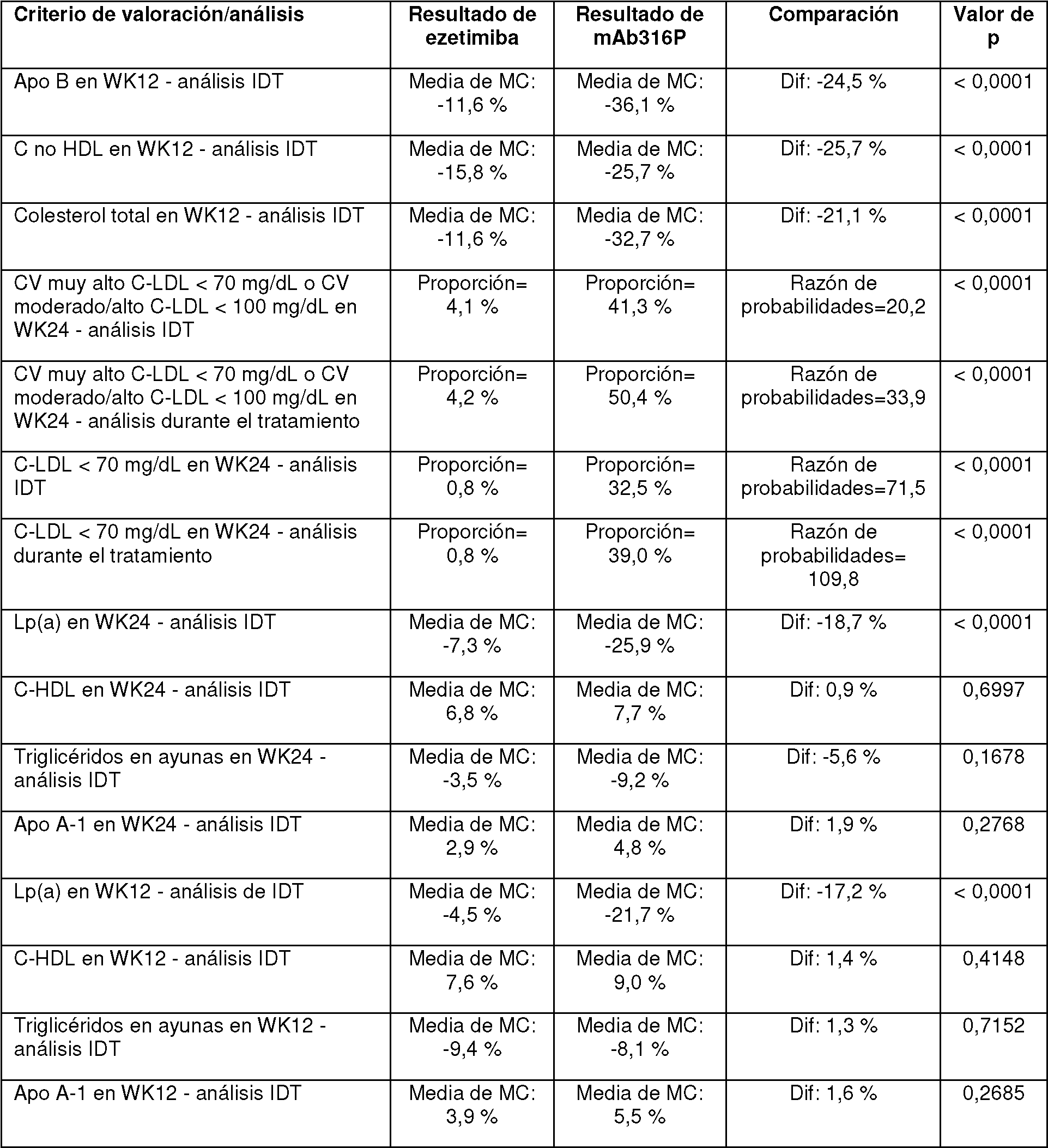
Para pacientes tratados con mAb316P, el valor de C-LDL medio de MC en la Semana 24 fue 108,5 mg/dL que representa un cambio en el nivel de C-LDL desde el nivel inicial de -84 mg/dL (es decir, -45,0 %). Por el contrario, para pacientes tratados con EZE, el valor de C-LDL medio de MC en la Semana 24 fue 159,9 mg/dL que representa un cambio en el nivel de C-LDL desde el nivel inicial de -33 mg/dL (es decir, -14,6 %). La diferencia en % de la media de MC en C-LDL en la Semana 24 para pacientes tratados con mAb316P frente a pacientes tratados con ezetimiba fue -30,4 % (EE = 3,1, p<0,0001).For patients treated with mAb316P, the MC mean LDL-C value at Week 24 was 108.5 mg/dL representing a change in LDL-C level from baseline of -84 mg/dL (i.e. , -45.0%). In contrast, for EZE-treated patients, the MC mean LDL-C value at Week 24 was 159.9 mg/dL representing a change in LDL-C level from baseline of -33 mg/dL. dL (ie -14.6%). The % difference in mean LS LDL-C at Week 24 for mAb316P-treated patients versus ezetimibe-treated patients was -30.4% (SE=3.1, p<0.0001).
Cincuenta y dos pacientes con mAb316P (41,9 %) alcanzaron el objetivo de C-LDL en la Semana 24, mientras que solo 5 pacientes de EZE (4,4 %) alcanzaron el objetivo de C-LDL en la Semana 24 (valor de p <0,0001). Para los fines de este análisis, el objetivo de C-LDL se definió como inferior a 70 mg/dL para pacientes en riesgo muy alto, e inferior a 100 mg/dL para pacientes en riesgo moderado y alto. Además, 54/109 pacientes con mAb316P (49,5 %) se sometieron a un ajuste ascendente de la dosis desde 75 mg Q2W hasta 150 mg Q2W en la Semana 12 (basado en el nivel de C-LDL de la Semana 8).Fifty-two mAb316P patients (41.9%) achieved LDL-C goal at Week 24, while only 5 EZE patients (4.4%) achieved LDL-C goal at Week 24 ( p<0.0001). For the purposes of this analysis, the LDL-C goal was defined as less than 70 mg/dL for patients at very high risk, and less than 100 mg/dL for patients at moderate and high risk. In addition, 54/109 mAb316P patients (49.5%) underwent dose escalation from 75 mg Q2W to 150 mg Q2W at Week 12 (based on Week 8 LDL-C level).
Un resumen de reducciones en los parámetros de lípidos secundarios seleccionados (C no HDL, Apo B y Lp(a)) en la Semana 24 se muestra en la Tabla 13. A summary of reductions in selected secondary lipid parameters (non-HDL C, Apo B, and Lp(a)) at Week 24 is shown in Table 13.
Tabla 13. Reducciones en los parámetros de lípidos secundarios en la Semana 24Table 13. Reductions in secondary lipid parameters at Week 24

El criterio primario de valoración de eficacia y más de dos tercios de los criterios secundarios de valoración de eficacia clave alcanzaron beneficio estadísticamente significativo en favor de los pacientes tratados con mAb316P según el procedimiento de prueba jerárquica.The primary efficacy endpoint and more than two-thirds of the key secondary efficacy endpoints achieved statistically significant benefit in favor of patients treated with mAb316P based on the hierarchical test procedure.
Resultados de seguridadSafety results
Se aleatorizaron un total de 313 pacientes y recibieron al menos una dosis parcial de tratamiento de doble ciego del estudio (Población de seguridad), y 281 pacientes recibieron el tratamiento del estudio OLE (Población OLE). Los SAEs emergentes del tratamiento ocurrieron en un total de 29 pacientes, específicamente, 7 (11,1 %) pacientes en el grupo de tratamiento de atorvastatina, 10 (8,1 %) pacientes en el grupo de tratamiento con ezetimiba, y 12 (9,5 %) pacientes en el grupo de tratamiento con mAb316P. No hubo más de 1 notificación en ningún término preferente de acontecimiento para cada uno de los tres grupos de tratamiento, con la única excepción de 4 (3,2 %) pacientes que informaron dolor de pecho no cardíaco en el grupo de tratamiento con ezetimiba.A total of 313 patients were randomized and received at least a partial dose of double-blind study treatment (Safety Population), and 281 patients received OLE study treatment (OLE Population). Treatment-emergent SAEs occurred in a total of 29 patients, specifically, 7 (11.1%) patients in the atorvastatin treatment group, 10 (8.1%) patients in the ezetimibe treatment group, and 12 ( 9.5%) patients in the mAb316P treatment group. There was no more than 1 report in any preferred event term for each of the three treatment groups, with the sole exception of 4 (3.2%) patients reporting non-cardiac chest pain in the ezetimibe treatment group.
Un total de 70 (22,4 %) pacientes interrumpieron prematuramente el tratamiento del estudio debido a un TEAE. Específicamente, 16 (25,4 %) pacientes en el grupo de tratamiento con atorvastatina, 31 (25,0 %) pacientes en el grupo de tratamiento con ezetimiba, y 23 (18,3 %) pacientes en el grupo de tratamiento con mAb316P terminaron el tratamiento del estudio antes de tiempo. Los acontecimientos más predominantes que causaron la terminación antes de tiempo estuvieron contenidos en el SOC Trastornos musculoesqueléticos y del tejido conjuntivo (14 [22,2 %] pacientes en el grupo de atorvastatina, 26 [21,0 %] pacientes en el grupo de ezetimiba y 20 [15,9 %] pacientes en el grupo de ezetimiba), con el término preferente más frecuentemente informado de mialgia.A total of 70 (22.4%) patients prematurely discontinued study treatment due to a TEAE. Specifically, 16 (25.4%) patients in the atorvastatin treatment group, 31 (25.0%) patients in the ezetimibe treatment group, and 23 (18.3%) patients in the mAb316P treatment group terminated study treatment early. The most predominant events leading to early termination were contained in the SOC Musculoskeletal and connective tissue disorders (14 [22.2%] patients in the atorvastatin group, 26 [21.0%] patients in the ezetimibe group and 20 [15.9%] patients in the ezetimibe group), with the most frequently reported preferred term being myalgia.
No se informaron muertes de pacientes en el momento del análisis provisional.No patient deaths were reported at the time of the interim analysis.
Los TEAEs ocurrieron en 54 (85,7 %) pacientes en el grupo de tratamiento con atorvastatina, 100 (80,6 %) pacientes en el grupo de tratamiento con ezetimiba y 104 (82,5 %) pacientes en el grupo de tratamiento con mAb316P. Los TEAEs que ocurrieron en >5 % de los pacientes en cualquier grupo de tratamiento son: - nasofaringitis (3,2 % / 8,1 % / 6,3 % para atorvastatina / ezetimiba / mAb316P, respectivamente); - infección de las vías respiratorias superiores (3,2 % / 4,0 % / 5,6 % para atorvastatina / ezetimiba / mAb316P, respectivamente); - cefalea (6,3 % / 4,8 % / 4,8 % para atorvastatina / ezetimiba / mAb316P, respectivamente); - parestesia (6,3 % / 0 / 3,2 % para atorvastatina / ezetimiba / mAb316P, respectivamente); - artralgia (7,9 % / 7,3 % / 5,6 % para atorvastatina / ezetimiba / mAb316P, respectivamente); - dolor de espalda (7,9 % / 5,6 % / 4,0 % para atorvastatina / ezetimiba / mAb316P, respectivamente); - espasmos musculares (11,1 % / 7,3 % / 4,0 % para atorvastatina / ezetimiba / mAb316P, respectivamente); - debilidad muscular (6,3 % / 1,6 % / 0,8 % para atorvastatina / ezetimiba / mAb316P, respectivamente); - mialgia (27 % / 23,4 % / 24,6 % para atorvastatina / ezetimiba / mAb316P, respectivamente); - y fatiga (7,9 % / 3,2 % / 4,8 % para atorvastatina / ezetimiba / mAb316P, respectivamente).TEAEs occurred in 54 (85.7%) patients in the atorvastatin treatment group, 100 (80.6%) patients in the ezetimibe treatment group, and 104 (82.5%) patients in the atorvastatin treatment group. mAb316P. TEAEs that occurred in >5% of patients in any treatment group are: - nasopharyngitis (3.2% / 8.1% / 6.3% for atorvastatin / ezetimibe / mAb316P, respectively); - upper respiratory tract infection (3.2% / 4.0% / 5.6% for atorvastatin / ezetimibe / mAb316P, respectively); - headache (6.3% / 4.8% / 4.8% for atorvastatin / ezetimibe / mAb316P, respectively); - paresthesia (6.3% / 0 / 3.2% for atorvastatin / ezetimibe / mAb316P, respectively); - arthralgia (7.9% / 7.3% / 5.6% for atorvastatin / ezetimibe / mAb316P, respectively); - back pain (7.9% / 5.6% / 4.0% for atorvastatin / ezetimibe / mAb316P, respectively); - muscle spasms (11.1% / 7.3% / 4.0% for atorvastatin / ezetimibe / mAb316P, respectively); - muscle weakness (6.3% / 1.6% / 0.8% for atorvastatin / ezetimibe / mAb316P, respectively); - myalgia (27% / 23.4% / 24.6% for atorvastatin / ezetimibe / mAb316P, respectively); - and fatigue (7.9% / 3.2% / 4.8% for atorvastatin / ezetimibe / mAb316P, respectively).
Los SOCs con una frecuencia de pacientes > 5 % en el grupo de mAb316P y una frecuencia más alta en el grupo de mAb316P en comparación con tanto los grupos de tratamiento de atorvastatina como de EZE fueron: Los "Trastornos psiquiátricos" ocurrieron en 9 (7,1 %) pacientes en el grupo de tratamiento con mAb316P, frente a 2 (3,2 %) en el grupo de tratamiento con atorvastatina y 5 (4,0 %) pacientes en el grupo de tratamiento con EZE. El acontecimiento más común fue 5 (4,0 %) notificaciones de insomnio en el grupo de tratamiento con mAb316P frente a 1 (1,6 %) de dichos eventos en el grupo de tratamiento con atorvastatina frente a 2 (1,6 %) de dichas notificaciones en el grupo de tratamiento con ezetimiba. Los "Trastornos del oído y del laberinto" ocurrieron en 8 (6,3 %) pacientes en el grupo de tratamiento con mAb316P, frente a 1 (1,6 %) paciente en el grupo de tratamiento con atorvastatina y 4 (3,2 %) pacientes en el grupo de tratamiento con EZE. El acontecimiento más común fue 6 (4,8 %) notificaciones de vértigo en el grupo de tratamiento con mAb316P frente a 1 (1,6 %) de dicha notificaciones en el grupo de tratamiento con atorvastatina frente a 2 (1,6 %) de dichas notificaciones en el grupo de tratamiento con ezetimiba. Los "Trastornos cardíacos" ocurrieron en 10 (7,9 %) pacientes en el grupo de tratamiento con mAb316P, frente a 2 (3,2 %) pacientes en el grupo de tratamiento con atorvastatina y 6 (4,8 %) pacientes en el grupo de tratamiento con EZE. El acontecimiento más común fue 4 (3,2 %) notificaciones de palpitaciones en el grupo de tratamiento con mAb316P frente a 0 de dichas notificaciones en el grupo de tratamiento con atorvastatina frente a 2 (1,6 %) de dichas notificaciones en el grupo de tratamiento con ezetimiba. Las "Investigaciones" ocurrieron en 9 (7,1 %) pacientes en el grupo de tratamiento con mAb316P, frente a 3 (4,8 %) pacientes en el grupo de tratamiento con atorvastatina y 7 (5,6 %) paciente en el grupo de tratamiento con EZE. El único SOC con una frecuencia más alta en tanto los grupos de tratamiento de atorvastatina como de EZE en comparación con el grupo de tratamiento con mAb316P fue los trastornos musculoesqueléticos y del tejido conjuntivo.SOCs with a patient frequency > 5% in the mAb316P group and a higher frequency in the mAb316P group compared to both the atorvastatin and EZE treatment groups were: "Psychiatric disorders" occurred in 9 (7 .1%) patients in the mAb316P treatment group, versus 2 (3.2%) in the atorvastatin treatment group and 5 (4.0%) patients in the EZE treatment group. The most common event was 5 (4.0%) reports of insomnia in the mAb316P treatment group vs. 1 (1.6%) such events in the atorvastatin treatment group vs. 2 (1.6%) of such reports in the ezetimibe treatment group. "Ear and labyrinth disorders" occurred in 8 (6.3%) patients in the mAb316P treatment group, versus 1 (1.6%) patient in the atorvastatin treatment group and 4 (3.2%) %) patients in the EZE treatment group. The most common event was 6 (4.8%) reports of vertigo in the mAb316P treatment group vs. 1 (1.6%) such reports in the mAb316P treatment group. atorvastatin versus 2 (1.6%) of such reports in the ezetimibe treatment group. "Cardiac disorders" occurred in 10 (7.9%) patients in the mAb316P treatment group, versus 2 (3.2%) patients in the atorvastatin treatment group and 6 (4.8%) patients in the the EZE treatment group. The most common event was 4 (3.2%) reports of palpitations in the mAb316P treatment group vs. 0 such reports in the atorvastatin treatment group vs. 2 (1.6%) such reports in the of treatment with ezetimibe. "Investigations" occurred in 9 (7.1%) patients in the mAb316P treatment group, versus 3 (4.8%) patients in the atorvastatin treatment group and 7 (5.6%) patients in the EZE treatment group. The only SOC with a higher frequency in both the atorvastatin and EZE treatment groups compared to the mAb316P treatment group was musculoskeletal and connective tissue disorders.
Para TEAEs de especial interés (AESIs), los resultados se presentan por agrupaciones de términos preferentes SMQ o CMQ predefinidos: Las reacciones del sitio de inyección (ISRs) emergentes del tratamiento ocurrieron en 1 (1,6 %) paciente en el grupo de tratamiento con atorvastatina, 6 (4,8 %) pacientes en el grupo de tratamiento con ezetimiba y 6 (4,8 %) pacientes en el grupo de tratamiento con mAb316P. Los TEAEs alérgicos generales, identificados mediante el SMQ de MedDRA de "Hipersensibilidad" ocurrieron en 4 (6,3 %) pacientes en el grupo de tratamiento con atorvastatina, 9 (7,3 %) pacientes en el grupo de tratamiento con ezetimiba y 12 (9,5 %) pacientes en el grupo de tratamiento con mAb316P. Los AEs neurológicos emergentes del tratamiento ocurrieron en 8 (12,7 %) pacientes en el grupo de tratamiento con atorvastatina, 4 (3,2 %) pacientes en el grupo de tratamiento con ezetimiba y 11 (8,7 %) pacientes en el grupo de tratamiento con mAb316P. Los términos preferentes más comunes fueron parestesia (6,3 % / 0 / 3,2 % para atorvastatina / ezetimiba / mAb316P, respectivamente) y debilidad muscular (6,3 % / 1,6 % / 0,8 % para atorvastatina / ezetimiba / mAb316P, respectivamente). Los trastornos neurocognitivos emergentes del tratamiento ocurrieron en cero pacientes en el grupo de tratamiento con atorvastatina, 2 (1,6 %) pacientes en el grupo de tratamiento con ezetimiba y 3 (2,4 %) pacientes en el grupo de tratamiento con mAb316P.For TEAEs of Special Interest (AESIs), results are presented by predefined SMQ or CMQ preferred term groupings: Treatment-emergent injection site reactions (ISRs) occurred in 1 (1.6%) patient in the treatment group with atorvastatin, 6 (4.8%) patients in the ezetimibe treatment group and 6 (4.8%) patients in the mAb316P treatment group. General allergic TEAEs, identified by the MedDRA SMQ of "Hypersensitivity" occurred in 4 (6.3%) patients in the atorvastatin treatment group, 9 (7.3%) patients in the ezetimibe treatment group, and 12 (9.5%) patients in the mAb316P treatment group. Treatment-emergent neurological AEs occurred in 8 (12.7%) patients in the atorvastatin treatment group, 4 (3.2%) patients in the ezetimibe treatment group, and 11 (8.7%) patients in the mAb316P treatment group. The most common preferred terms were paresthesia (6.3% / 0 / 3.2% for atorvastatin / ezetimibe / mAb316P, respectively) and muscle weakness (6.3% / 1.6% / 0.8% for atorvastatin / ezetimibe / mAb316P, respectively). Treatment-emergent neurocognitive disorders occurred in zero patients in the atorvastatin treatment group, 2 (1.6%) patients in the ezetimibe treatment group, and 3 (2.4%) patients in the mAb316P treatment group.
Para pacientes con acontecimientos cardiovasculares identificados para adjudicación, un (0,8 %) paciente fue adjudicado positivamente para IM no mortal, y este paciente estuvo en el grupo de tratamiento con mAb316P.For patients with cardiovascular events identified for adjudication, one (0.8%) patient was positively adjudicated for nonfatal MI, and this patient was in the mAb316P treatment group.
Con respecto a la frecuencia de pacientes con 2 mediciones consecutivas de C-LDL calculado inferiores a 25 mg/dL, ningún paciente tuvo una manifestación en ninguno de los tres grupos de tratamiento.Regarding the frequency of patients with 2 consecutive measurements of calculated LDL-C less than 25 mg/dL, no patient had a manifestation in any of the three treatment groups.
Los TEAEs relacionados con los músculos esqueléticos se definen dos veces para este estudio, específicamente para los eventos recogidos en el CRF relacionado con los músculos esqueléticos y otra vez por CMQ (como se define en el apéndice del protocolo). Un total de 99 (31,6 %) pacientes informaron un término preferente de CMQ, específicamente 25 (39,7 %) pacientes en el grupo de tratamiento con atorvastatina, 40 (32,3 %) pacientes en el grupo de tratamiento con ezetimiba y 34 (27,0 %) pacientes en el grupo de tratamiento con mAb316P. Los términos preferentes definidos por CMQ más predominantes que causaron eventos relacionados con músculos esqueléticos fueron mialgia (27 % / 23,4 % / 24,6 % para atorvastatina / ezetimiba / mAb316P, respectivamente), espasmos musculares (11,1 % / 7,3 % / 4,0 % para atorvastatina / ezetimiba / mAb316P, respectivamente) y debilidad muscular (6,3 % / 1,6 % / 0,8 % para atorvastatina / ezetimiba / mAb316P, respectivamente), todos los cuales están contenidos en el SCO Trastornos musculoesqueléticos y del tejido conjuntivo.Skeletal muscle-related TEAEs are defined twice for this study, specifically for events collected by skeletal muscle-related CRF and again by CMQ (as defined in the protocol appendix). A total of 99 (31.6%) patients reported a preferred term of CMQ, specifically 25 (39.7%) patients in the atorvastatin treatment group, 40 (32.3%) patients in the ezetimibe treatment group and 34 (27.0%) patients in the mAb316P treatment group. The most prevalent CMQ-defined preferred terms causing skeletal muscle-related events were myalgia (27%/23.4%/24.6% for atorvastatin/ezetimibe/mAb316P, respectively), muscle spasms (11.1%/7, 3% / 4.0% for atorvastatin / ezetimibe / mAb316P, respectively) and muscle weakness (6.3% / 1.6% / 0.8% for atorvastatin / ezetimibe / mAb316P, respectively), all of which are contained in the SCO Musculoskeletal and connective tissue disorders.
Se informaron acontecimientos relacionados con los músculos esqueléticos emergentes del tratamiento que dan como resultado la interrupción del tratamiento antes de tiempo en 55 (17,6 %) pacientes, específicamente 13 (20,6 %) pacientes en el grupo de tratamiento con atorvastatina, 23 (18,5 %) pacientes en el grupo de tratamiento con ezetimiba y 19 (15,1 %) pacientes en el grupo de tratamiento con mAb316P. No se informó ningún acontecimiento grave relacionado con los músculos esqueléticos emergente del tratamiento en ningún grupo de tratamiento. No se informó ninguna muerte de paciente debido a TEAE de eventos relacionados con los músculos esqueléticos en ningún grupo de tratamiento.Treatment-emergent skeletal muscle-related events resulting in premature treatment discontinuation were reported in 55 (17.6%) patients, specifically 13 (20.6%) patients in the atorvastatin treatment group, 23 (18.5%) patients in the ezetimibe treatment group and 19 (15.1%) patients in the mAb316P treatment group. No serious treatment-emergent skeletal muscle-related events were reported in any treatment group. No patient deaths due to TEAEs from skeletal muscle-related events were reported in any treatment group.
ConclusionesConclusions
El presente estudio evaluó pacientes con antecedentes de intolerancia a al menos dos estatinas diferentes, incluyendo una a la dosis más baja, debido a síntomas relacionados con los músculos. Los pacientes se aleatorizaron para recibir mAb316P, ezetimiba o atorvastatina 20 mg (un brazo calibrador). Los pacientes tratados en este estudio tuvieron niveles de C-LDL muy altos cuando entraron por primera vez en el ensayo (entre 187-193,5 mg/dL en promedio). En la práctica clínica, 10-25 por ciento de los pacientes informan intolerancia a estatinas.The current study evaluated patients with a history of intolerance to at least two different statins, including one at the lowest dose, due to muscle-related symptoms. Patients were randomized to receive mAb316P, ezetimibe, or atorvastatin 20 mg (a calibrator arm). The patients treated in this study had very high LDL-C levels when they first entered the trial (between 187-193.5 mg/dL on average). In clinical practice, 10-25 percent of patients report statin intolerance.
El presente estudio alcanzó el criterio primario de valoración de eficacia en la población IDT de una reducción estadísticamente significativa en cambio en porcentaje desde el C-LDL en el nivel inicial calculado en los pacientes tratados con mAb316P (media de MC = -45,0 %), en comparación con los pacientes tratados con ezetimiba (media de MC = -14,6 %), con una diferencia media de MC entre grupos de tratamiento de -30,4 %. Para más de dos tercios de los criterios secundarios de valoración de la eficacia clave, este estudio alcanzó beneficio estadísticamente significativo en los pacientes tratados con mAb316P, en comparación con los pacientes tratados con ezetimiba. Basándose en los datos disponibles de este estudio, la administración subcutánea de mAb316P en pacientes con hipercolesterolemia primaria (HFhe y H no F) que son intolerantes a las estatinas fue, en general, segura y bien tolerada. La tasa de AEs relacionados con los músculos esqueléticos para los pacientes tratados con mAb316P fue menos en cualquier grupo The present study met the primary efficacy endpoint in the IDT population of a statistically significant reduction in percent change from calculated baseline LDL-C in patients treated with mAb316P (LS mean = -45.0% ), compared to patients treated with ezetimibe (LS mean = -14.6%), with a mean LS difference between treatment groups of -30.4%. For more than two-thirds of the key secondary efficacy endpoints, this study achieved statistically significant benefit in patients treated with mAb316P, compared with patients treated with ezetimibe. Based on the available data from this study, subcutaneous administration of mAb316P in patients with primary hypercholesterolemia (heHF and non-FH) who are intolerant to statins was generally safe and well tolerated. The rate of skeletal muscle-related AEs for patients treated with mAb316P was less in any group
Claims (17)
Applications Claiming Priority (8)
| Application Number | Priority Date | Filing Date | Title |
|---|---|---|---|
| US201361890154P | 2013-10-11 | 2013-10-11 | |
| US201461923103P | 2014-01-02 | 2014-01-02 | |
| US201461955514P | 2014-03-19 | 2014-03-19 | |
| US201462004620P | 2014-05-29 | 2014-05-29 | |
| US201462025104P | 2014-07-16 | 2014-07-16 | |
| EP14306221 | 2014-07-31 | ||
| US201462054571P | 2014-09-24 | 2014-09-24 | |
| EP14306584 | 2014-10-09 |
Publications (1)
| Publication Number | Publication Date |
|---|---|
| ES2914978T3 true ES2914978T3 (en) | 2022-06-20 |
Family
ID=52813751
Family Applications (1)
| Application Number | Title | Priority Date | Filing Date |
|---|---|---|---|
| ES19210918T Active ES2914978T3 (en) | 2013-10-11 | 2014-10-10 | Use of a PCSK9 inhibitor to treat hyperlipidemia |
Country Status (14)
| Country | Link |
|---|---|
| US (1) | US20150140002A1 (en) |
| EP (2) | EP3689913B1 (en) |
| JP (2) | JP6846931B2 (en) |
| KR (3) | KR20230119045A (en) |
| CN (3) | CN115154599A (en) |
| AU (2) | AU2014331754B2 (en) |
| CA (1) | CA2926942A1 (en) |
| EA (1) | EA037526B1 (en) |
| ES (1) | ES2914978T3 (en) |
| IL (1) | IL244995B (en) |
| MX (3) | MX373298B (en) |
| PL (2) | PL3055333T4 (en) |
| TW (1) | TWI669131B (en) |
| WO (1) | WO2015054619A2 (en) |
Families Citing this family (29)
| Publication number | Priority date | Publication date | Assignee | Title |
|---|---|---|---|---|
| JO3672B1 (en) | 2008-12-15 | 2020-08-27 | Regeneron Pharma | High Affinity Human Antibodies to PCSK9 |
| US20130064834A1 (en) | 2008-12-15 | 2013-03-14 | Regeneron Pharmaceuticals, Inc. | Methods for treating hypercholesterolemia using antibodies to pcsk9 |
| MX385311B (en) | 2011-01-28 | 2025-03-18 | Sanofi Biotechnology | HUMAN ANTIBODIES AGAINST PCSK9 FOR USE IN METHODS OF TREATMENT OF SPECIFIC GROUPS OF PATIENTS. |
| AR087305A1 (en) | 2011-07-28 | 2014-03-12 | Regeneron Pharma | STABILIZED FORMULATIONS CONTAINING ANTI-PCSK9 ANTIBODIES, PREPARATION METHOD AND KIT |
| HUE069234T2 (en) | 2011-09-16 | 2025-02-28 | Regeneron Pharma | Methods for reducing lipoprotein(a) levels by administering an inhibitor of proprotein convertase subtilisin kexin-9 (pcsk9) |
| US9255154B2 (en) | 2012-05-08 | 2016-02-09 | Alderbio Holdings, Llc | Anti-PCSK9 antibodies and use thereof |
| US10058630B2 (en) * | 2012-10-22 | 2018-08-28 | Concievalve, Llc | Methods for inhibiting stenosis, obstruction, or calcification of a stented heart valve or bioprosthesis |
| US10111953B2 (en) | 2013-05-30 | 2018-10-30 | Regeneron Pharmaceuticals, Inc. | Methods for reducing remnant cholesterol and other lipoprotein fractions by administering an inhibitor of proprotein convertase subtilisin kexin-9 (PCSK9) |
| KR20160024906A (en) | 2013-06-07 | 2016-03-07 | 사노피 바이오테크놀로지 | Methods for inhibiting atherosclerosis by administering an inhibitor of pcsk9 |
| EP3068803B1 (en) | 2013-11-12 | 2021-01-20 | Sanofi Biotechnology | Dosing regimens for use with pcsk9 inhibitors |
| EP3169710A1 (en) * | 2014-07-14 | 2017-05-24 | Amgen Inc. | Crystalline antibody formulations |
| CN107206068A (en) | 2014-07-16 | 2017-09-26 | 赛诺菲生物技术公司 | Methods for treating patients with heterozygous familial hypercholesterolemia (heFH) |
| US20180140747A1 (en) * | 2015-04-15 | 2018-05-24 | ConcieValve LLC | Devices and methods for inhibiting stenosis, obstruction, or calcification of a native heart valve, stented heart valve or bioprosthesis |
| CN104861071B (en) * | 2015-04-27 | 2019-04-12 | 南京师范大学 | Variable region gene and its application for the full human monoclonal antibody of PCSK9 |
| KR20240172758A (en) * | 2015-08-18 | 2024-12-10 | 리제너론 파아마슈티컬스, 인크. | Anti-pcsk9 inhibitory antibodies for treating patients with hyperlipidemia undergoing lipoprotein apheresis |
| KR20190049866A (en) | 2016-09-20 | 2019-05-09 | 우시 바이올로직스 아일랜드 리미티드 | A novel anti-PCSK9 antibody |
| BR112019020148A2 (en) | 2017-04-13 | 2020-05-05 | Cadila Healthcare Limited | peptide |
| US20200131576A1 (en) | 2017-04-25 | 2020-04-30 | The Brigham And Women's Hospital, Inc. | IL-8, IL-6, IL-1 Beta and TET2 and DNMT3A in Atherosclerosis |
| CN107090474A (en) * | 2017-05-22 | 2017-08-25 | 山东大学 | A kind of preparation method of abdominal aneurvsm disease animal model |
| WO2018228406A1 (en) * | 2017-06-14 | 2018-12-20 | 江苏恒瑞医药股份有限公司 | Pcsk9 antibody, antigen-binding fragment and medical use thereof |
| EP3762026B1 (en) * | 2018-03-06 | 2026-04-08 | Sanofi Biotechnology | Use of pcsk9 inhibitor for reducing cardiovascular risk |
| IL321719A (en) | 2018-06-21 | 2025-08-01 | Merck Sharp ַ& Dohme Llc | PCSK9 antagonist compounds |
| US11248001B2 (en) | 2019-01-18 | 2022-02-15 | Astrazeneca Ab | PCSK9 inhibitors and methods of use thereof |
| EA202191890A1 (en) | 2019-01-18 | 2022-02-03 | Астразенека Аб | PCSK9 INHIBITORS AND METHODS FOR THEIR USE |
| PH12022551172A1 (en) * | 2019-11-18 | 2024-02-19 | Ad Pharmaceuticals Co Ltd | Anti-pcsk9 antibody and use thereof |
| WO2021119321A1 (en) * | 2019-12-10 | 2021-06-17 | Regeneron Pharmaceuticals, Inc. | Use of a pcsk9 inhibitor to treat homozygous familial hypercholesterolemia |
| US12577259B2 (en) | 2019-12-20 | 2026-03-17 | Merck Sharp & Dohme Llc | PCSK9 antagonist compounds |
| CN114277032A (en) * | 2021-12-31 | 2022-04-05 | 华中科技大学同济医学院附属协和医院 | Low-density lipoprotein receptor gene mutant and application thereof |
| CN116983434B (en) * | 2023-09-28 | 2024-03-15 | 康霖生物科技(杭州)有限公司 | Nucleic acid constructs for gene therapy and uses thereof |
Family Cites Families (10)
| Publication number | Priority date | Publication date | Assignee | Title |
|---|---|---|---|---|
| US6596541B2 (en) | 2000-10-31 | 2003-07-22 | Regeneron Pharmaceuticals, Inc. | Methods of modifying eukaryotic cells |
| JO3672B1 (en) * | 2008-12-15 | 2020-08-27 | Regeneron Pharma | High Affinity Human Antibodies to PCSK9 |
| US8357371B2 (en) * | 2008-12-15 | 2013-01-22 | Regeneron Pharmaceuticals, Inc. | Methods for treating hypercholesterolemia using antibodies to PCSK9 |
| US20130064834A1 (en) * | 2008-12-15 | 2013-03-14 | Regeneron Pharmaceuticals, Inc. | Methods for treating hypercholesterolemia using antibodies to pcsk9 |
| MX385311B (en) * | 2011-01-28 | 2025-03-18 | Sanofi Biotechnology | HUMAN ANTIBODIES AGAINST PCSK9 FOR USE IN METHODS OF TREATMENT OF SPECIFIC GROUPS OF PATIENTS. |
| JOP20200043A1 (en) * | 2011-05-10 | 2017-06-16 | Amgen Inc | Ways to treat or prevent cholesterol disorders |
| US20130006482A1 (en) * | 2011-06-30 | 2013-01-03 | Ramadev Burigsay Hukkeri | Guidance system for a mobile machine |
| AR087305A1 (en) | 2011-07-28 | 2014-03-12 | Regeneron Pharma | STABILIZED FORMULATIONS CONTAINING ANTI-PCSK9 ANTIBODIES, PREPARATION METHOD AND KIT |
| HUE069234T2 (en) * | 2011-09-16 | 2025-02-28 | Regeneron Pharma | Methods for reducing lipoprotein(a) levels by administering an inhibitor of proprotein convertase subtilisin kexin-9 (pcsk9) |
| TWI682780B (en) * | 2013-05-30 | 2020-01-21 | 美商再生元醫藥公司 | Use of a pharmaceutical composition for the manufacture of a medicament for treating autosomal dominant hypercholesterolemia associated with pcsk9 gain-of-function mutations |
-
2014
- 2014-10-10 ES ES19210918T patent/ES2914978T3/en active Active
- 2014-10-10 EP EP19210918.9A patent/EP3689913B1/en active Active
- 2014-10-10 KR KR1020237026483A patent/KR20230119045A/en not_active Ceased
- 2014-10-10 EP EP14802527.3A patent/EP3055333B1/en active Active
- 2014-10-10 JP JP2016521604A patent/JP6846931B2/en active Active
- 2014-10-10 PL PL14802527T patent/PL3055333T4/en unknown
- 2014-10-10 KR KR1020167012099A patent/KR20160062166A/en not_active Ceased
- 2014-10-10 CN CN202210729601.0A patent/CN115154599A/en active Pending
- 2014-10-10 WO PCT/US2014/060109 patent/WO2015054619A2/en not_active Ceased
- 2014-10-10 MX MX2016004580A patent/MX373298B/en active IP Right Grant
- 2014-10-10 CN CN201480066894.2A patent/CN105814085A/en active Pending
- 2014-10-10 US US14/511,975 patent/US20150140002A1/en not_active Abandoned
- 2014-10-10 EA EA201690754A patent/EA037526B1/en unknown
- 2014-10-10 AU AU2014331754A patent/AU2014331754B2/en active Active
- 2014-10-10 PL PL19210918T patent/PL3689913T3/en unknown
- 2014-10-10 CA CA2926942A patent/CA2926942A1/en active Pending
- 2014-10-10 KR KR1020227011822A patent/KR20220048051A/en not_active Ceased
- 2014-10-10 CN CN202210762455.1A patent/CN115192704A/en active Pending
- 2014-10-13 TW TW103135495A patent/TWI669131B/en active
-
2016
- 2016-04-08 MX MX2020004023A patent/MX2020004023A/en unknown
- 2016-04-08 MX MX2022013172A patent/MX2022013172A/en unknown
- 2016-04-10 IL IL244995A patent/IL244995B/en active IP Right Grant
-
2019
- 2019-08-09 JP JP2019146940A patent/JP6994484B2/en active Active
-
2020
- 2020-06-02 AU AU2020203636A patent/AU2020203636B2/en active Active
Also Published As
Similar Documents
| Publication | Publication Date | Title |
|---|---|---|
| AU2020203636B2 (en) | Use of a PCSK9 inhibitor to treat hyperlipidemia | |
| US12606638B2 (en) | Dosing regimens for use with PCSK9 inhibitors | |
| JP7744190B2 (en) | Anti-PCSK9 inhibitor antibodies for treating hyperlipidemic patients undergoing lipoprotein apheresis | |
| JP2017506626A (en) | Methods for treating patients with hypercholesterolemia that are not adequately managed with moderate dose statin therapy | |
| US20150283236A1 (en) | Methods for treating subjects with primary hypercholesterolemia that is not adequately controlled | |
| ES2779126T3 (en) | Using a PCSK9 Inhibitor to Treat Hyperlipidemia | |
| HK40033729B (en) | Use of a pcsk9 inhibitor to treat hyperlipidemia | |
| HK40033729A (en) | Use of a pcsk9 inhibitor to treat hyperlipidemia | |
| ES2864350T3 (en) | Dosage Guidelines for Use with PCSK9 Inhibitors | |
| HK1227890B (en) | Use of a pcsk9 inhibitor to treat hyperlipidemia | |
| HK1227890A1 (en) | Use of a pcsk9 inhibitor to treat hyperlipidemia | |
| HK40059806A (en) | Dosing regimens for use with pcsk9 inhibitors | |
| EA051213B1 (en) | USE OF PCSK9 INHIBITOR FOR THE TREATMENT OF HYPERLIPIDEMIA |