ES2919779T3 - 1-[(2,3,4-trimethoxyphenyl)methyl]-piperazine derivative, compositions thereof and methods for increasing the efficiency of cardiac metabolism - Google Patents
1-[(2,3,4-trimethoxyphenyl)methyl]-piperazine derivative, compositions thereof and methods for increasing the efficiency of cardiac metabolism Download PDFInfo
- Publication number
- ES2919779T3 ES2919779T3 ES18821590T ES18821590T ES2919779T3 ES 2919779 T3 ES2919779 T3 ES 2919779T3 ES 18821590 T ES18821590 T ES 18821590T ES 18821590 T ES18821590 T ES 18821590T ES 2919779 T3 ES2919779 T3 ES 2919779T3
- Authority
- ES
- Spain
- Prior art keywords
- compound
- disease
- trimetazidine
- compounds
- heart
- Prior art date
- Legal status (The legal status is an assumption and is not a legal conclusion. Google has not performed a legal analysis and makes no representation as to the accuracy of the status listed.)
- Active
Links
Classifications
-
- C—CHEMISTRY; METALLURGY
- C07—ORGANIC CHEMISTRY
- C07D—HETEROCYCLIC COMPOUNDS
- C07D213/00—Heterocyclic compounds containing six-membered rings, not condensed with other rings, with one nitrogen atom as the only ring hetero atom and three or more double bonds between ring members or between ring members and non-ring members
- C07D213/02—Heterocyclic compounds containing six-membered rings, not condensed with other rings, with one nitrogen atom as the only ring hetero atom and three or more double bonds between ring members or between ring members and non-ring members having three double bonds between ring members or between ring members and non-ring members
- C07D213/04—Heterocyclic compounds containing six-membered rings, not condensed with other rings, with one nitrogen atom as the only ring hetero atom and three or more double bonds between ring members or between ring members and non-ring members having three double bonds between ring members or between ring members and non-ring members having no bond between the ring nitrogen atom and a non-ring member or having only hydrogen or carbon atoms directly attached to the ring nitrogen atom
- C07D213/60—Heterocyclic compounds containing six-membered rings, not condensed with other rings, with one nitrogen atom as the only ring hetero atom and three or more double bonds between ring members or between ring members and non-ring members having three double bonds between ring members or between ring members and non-ring members having no bond between the ring nitrogen atom and a non-ring member or having only hydrogen or carbon atoms directly attached to the ring nitrogen atom with hetero atoms or with carbon atoms having three bonds to hetero atoms with at the most one bond to halogen, e.g. ester or nitrile radicals, directly attached to ring carbon atoms
- C07D213/78—Carbon atoms having three bonds to hetero atoms, with at the most one bond to halogen, e.g. ester or nitrile radicals
- C07D213/79—Acids; Esters
- C07D213/80—Acids; Esters in position 3
-
- A—HUMAN NECESSITIES
- A61—MEDICAL OR VETERINARY SCIENCE; HYGIENE
- A61K—PREPARATIONS FOR MEDICAL, DENTAL OR TOILETRY PURPOSES
- A61K47/00—Medicinal preparations characterised by the non-active ingredients used, e.g. carriers or inert additives; Targeting or modifying agents chemically bound to the active ingredient
- A61K47/50—Medicinal preparations characterised by the non-active ingredients used, e.g. carriers or inert additives; Targeting or modifying agents chemically bound to the active ingredient the non-active ingredient being chemically bound to the active ingredient, e.g. polymer-drug conjugates
- A61K47/51—Medicinal preparations characterised by the non-active ingredients used, e.g. carriers or inert additives; Targeting or modifying agents chemically bound to the active ingredient the non-active ingredient being chemically bound to the active ingredient, e.g. polymer-drug conjugates the non-active ingredient being a modifying agent
- A61K47/54—Medicinal preparations characterised by the non-active ingredients used, e.g. carriers or inert additives; Targeting or modifying agents chemically bound to the active ingredient the non-active ingredient being chemically bound to the active ingredient, e.g. polymer-drug conjugates the non-active ingredient being a modifying agent the modifying agent being an organic compound
- A61K47/55—Medicinal preparations characterised by the non-active ingredients used, e.g. carriers or inert additives; Targeting or modifying agents chemically bound to the active ingredient the non-active ingredient being chemically bound to the active ingredient, e.g. polymer-drug conjugates the non-active ingredient being a modifying agent the modifying agent being an organic compound the modifying agent being also a pharmacologically or therapeutically active agent, i.e. the entire conjugate being a codrug
- A61K47/551—Medicinal preparations characterised by the non-active ingredients used, e.g. carriers or inert additives; Targeting or modifying agents chemically bound to the active ingredient the non-active ingredient being chemically bound to the active ingredient, e.g. polymer-drug conjugates the non-active ingredient being a modifying agent the modifying agent being an organic compound the modifying agent being also a pharmacologically or therapeutically active agent, i.e. the entire conjugate being a codrug one of the codrug's components being a vitamin, e.g. niacinamide, vitamin B3, cobalamin, vitamin B12, folate, vitamin A or retinoic acid
-
- C—CHEMISTRY; METALLURGY
- C07—ORGANIC CHEMISTRY
- C07D—HETEROCYCLIC COMPOUNDS
- C07D295/00—Heterocyclic compounds containing polymethylene-imine rings with at least five ring members, 3-azabicyclo [3.2.2] nonane, piperazine, morpholine or thiomorpholine rings, having only hydrogen atoms directly attached to the ring carbon atoms
- C07D295/04—Heterocyclic compounds containing polymethylene-imine rings with at least five ring members, 3-azabicyclo [3.2.2] nonane, piperazine, morpholine or thiomorpholine rings, having only hydrogen atoms directly attached to the ring carbon atoms with substituted hydrocarbon radicals attached to ring nitrogen atoms
- C07D295/08—Heterocyclic compounds containing polymethylene-imine rings with at least five ring members, 3-azabicyclo [3.2.2] nonane, piperazine, morpholine or thiomorpholine rings, having only hydrogen atoms directly attached to the ring carbon atoms with substituted hydrocarbon radicals attached to ring nitrogen atoms substituted by singly bound oxygen or sulfur atoms
- C07D295/096—Heterocyclic compounds containing polymethylene-imine rings with at least five ring members, 3-azabicyclo [3.2.2] nonane, piperazine, morpholine or thiomorpholine rings, having only hydrogen atoms directly attached to the ring carbon atoms with substituted hydrocarbon radicals attached to ring nitrogen atoms substituted by singly bound oxygen or sulfur atoms with the ring nitrogen atoms and the oxygen or sulfur atoms separated by carbocyclic rings or by carbon chains interrupted by carbocyclic rings
-
- A—HUMAN NECESSITIES
- A61—MEDICAL OR VETERINARY SCIENCE; HYGIENE
- A61K—PREPARATIONS FOR MEDICAL, DENTAL OR TOILETRY PURPOSES
- A61K31/00—Medicinal preparations containing organic active ingredients
- A61K31/33—Heterocyclic compounds
- A61K31/395—Heterocyclic compounds having nitrogen as a ring hetero atom, e.g. guanethidine or rifamycins
- A61K31/495—Heterocyclic compounds having nitrogen as a ring hetero atom, e.g. guanethidine or rifamycins having six-membered rings with two or more nitrogen atoms as the only ring heteroatoms, e.g. piperazine or tetrazines
-
- A—HUMAN NECESSITIES
- A61—MEDICAL OR VETERINARY SCIENCE; HYGIENE
- A61K—PREPARATIONS FOR MEDICAL, DENTAL OR TOILETRY PURPOSES
- A61K47/00—Medicinal preparations characterised by the non-active ingredients used, e.g. carriers or inert additives; Targeting or modifying agents chemically bound to the active ingredient
- A61K47/50—Medicinal preparations characterised by the non-active ingredients used, e.g. carriers or inert additives; Targeting or modifying agents chemically bound to the active ingredient the non-active ingredient being chemically bound to the active ingredient, e.g. polymer-drug conjugates
- A61K47/51—Medicinal preparations characterised by the non-active ingredients used, e.g. carriers or inert additives; Targeting or modifying agents chemically bound to the active ingredient the non-active ingredient being chemically bound to the active ingredient, e.g. polymer-drug conjugates the non-active ingredient being a modifying agent
- A61K47/54—Medicinal preparations characterised by the non-active ingredients used, e.g. carriers or inert additives; Targeting or modifying agents chemically bound to the active ingredient the non-active ingredient being chemically bound to the active ingredient, e.g. polymer-drug conjugates the non-active ingredient being a modifying agent the modifying agent being an organic compound
- A61K47/55—Medicinal preparations characterised by the non-active ingredients used, e.g. carriers or inert additives; Targeting or modifying agents chemically bound to the active ingredient the non-active ingredient being chemically bound to the active ingredient, e.g. polymer-drug conjugates the non-active ingredient being a modifying agent the modifying agent being an organic compound the modifying agent being also a pharmacologically or therapeutically active agent, i.e. the entire conjugate being a codrug
-
- A—HUMAN NECESSITIES
- A61—MEDICAL OR VETERINARY SCIENCE; HYGIENE
- A61K—PREPARATIONS FOR MEDICAL, DENTAL OR TOILETRY PURPOSES
- A61K47/00—Medicinal preparations characterised by the non-active ingredients used, e.g. carriers or inert additives; Targeting or modifying agents chemically bound to the active ingredient
- A61K47/50—Medicinal preparations characterised by the non-active ingredients used, e.g. carriers or inert additives; Targeting or modifying agents chemically bound to the active ingredient the non-active ingredient being chemically bound to the active ingredient, e.g. polymer-drug conjugates
- A61K47/51—Medicinal preparations characterised by the non-active ingredients used, e.g. carriers or inert additives; Targeting or modifying agents chemically bound to the active ingredient the non-active ingredient being chemically bound to the active ingredient, e.g. polymer-drug conjugates the non-active ingredient being a modifying agent
- A61K47/56—Medicinal preparations characterised by the non-active ingredients used, e.g. carriers or inert additives; Targeting or modifying agents chemically bound to the active ingredient the non-active ingredient being chemically bound to the active ingredient, e.g. polymer-drug conjugates the non-active ingredient being a modifying agent the modifying agent being an organic macromolecular compound, e.g. an oligomeric, polymeric or dendrimeric molecule
- A61K47/59—Medicinal preparations characterised by the non-active ingredients used, e.g. carriers or inert additives; Targeting or modifying agents chemically bound to the active ingredient the non-active ingredient being chemically bound to the active ingredient, e.g. polymer-drug conjugates the non-active ingredient being a modifying agent the modifying agent being an organic macromolecular compound, e.g. an oligomeric, polymeric or dendrimeric molecule obtained otherwise than by reactions only involving carbon-to-carbon unsaturated bonds, e.g. polyureas or polyurethanes
- A61K47/60—Medicinal preparations characterised by the non-active ingredients used, e.g. carriers or inert additives; Targeting or modifying agents chemically bound to the active ingredient the non-active ingredient being chemically bound to the active ingredient, e.g. polymer-drug conjugates the non-active ingredient being a modifying agent the modifying agent being an organic macromolecular compound, e.g. an oligomeric, polymeric or dendrimeric molecule obtained otherwise than by reactions only involving carbon-to-carbon unsaturated bonds, e.g. polyureas or polyurethanes the organic macromolecular compound being a polyoxyalkylene oligomer, polymer or dendrimer, e.g. PEG, PPG, PEO or polyglycerol
-
- A—HUMAN NECESSITIES
- A61—MEDICAL OR VETERINARY SCIENCE; HYGIENE
- A61K—PREPARATIONS FOR MEDICAL, DENTAL OR TOILETRY PURPOSES
- A61K9/00—Medicinal preparations characterised by special physical form
- A61K9/0012—Galenical forms characterised by the site of application
- A61K9/0053—Mouth and digestive tract, i.e. intraoral and peroral administration
-
- A—HUMAN NECESSITIES
- A61—MEDICAL OR VETERINARY SCIENCE; HYGIENE
- A61P—SPECIFIC THERAPEUTIC ACTIVITY OF CHEMICAL COMPOUNDS OR MEDICINAL PREPARATIONS
- A61P21/00—Drugs for disorders of the muscular or neuromuscular system
-
- A—HUMAN NECESSITIES
- A61—MEDICAL OR VETERINARY SCIENCE; HYGIENE
- A61P—SPECIFIC THERAPEUTIC ACTIVITY OF CHEMICAL COMPOUNDS OR MEDICINAL PREPARATIONS
- A61P29/00—Non-central analgesic, antipyretic or antiinflammatory agents, e.g. antirheumatic agents; Non-steroidal antiinflammatory drugs [NSAID]
-
- A—HUMAN NECESSITIES
- A61—MEDICAL OR VETERINARY SCIENCE; HYGIENE
- A61P—SPECIFIC THERAPEUTIC ACTIVITY OF CHEMICAL COMPOUNDS OR MEDICINAL PREPARATIONS
- A61P3/00—Drugs for disorders of the metabolism
-
- A—HUMAN NECESSITIES
- A61—MEDICAL OR VETERINARY SCIENCE; HYGIENE
- A61P—SPECIFIC THERAPEUTIC ACTIVITY OF CHEMICAL COMPOUNDS OR MEDICINAL PREPARATIONS
- A61P3/00—Drugs for disorders of the metabolism
- A61P3/08—Drugs for disorders of the metabolism for glucose homeostasis
- A61P3/10—Drugs for disorders of the metabolism for glucose homeostasis for hyperglycaemia, e.g. antidiabetics
-
- A—HUMAN NECESSITIES
- A61—MEDICAL OR VETERINARY SCIENCE; HYGIENE
- A61P—SPECIFIC THERAPEUTIC ACTIVITY OF CHEMICAL COMPOUNDS OR MEDICINAL PREPARATIONS
- A61P35/00—Antineoplastic agents
-
- A—HUMAN NECESSITIES
- A61—MEDICAL OR VETERINARY SCIENCE; HYGIENE
- A61P—SPECIFIC THERAPEUTIC ACTIVITY OF CHEMICAL COMPOUNDS OR MEDICINAL PREPARATIONS
- A61P9/00—Drugs for disorders of the cardiovascular system
-
- A—HUMAN NECESSITIES
- A61—MEDICAL OR VETERINARY SCIENCE; HYGIENE
- A61P—SPECIFIC THERAPEUTIC ACTIVITY OF CHEMICAL COMPOUNDS OR MEDICINAL PREPARATIONS
- A61P9/00—Drugs for disorders of the cardiovascular system
- A61P9/04—Inotropic agents, i.e. stimulants of cardiac contraction; Drugs for heart failure
-
- A—HUMAN NECESSITIES
- A61—MEDICAL OR VETERINARY SCIENCE; HYGIENE
- A61P—SPECIFIC THERAPEUTIC ACTIVITY OF CHEMICAL COMPOUNDS OR MEDICINAL PREPARATIONS
- A61P9/00—Drugs for disorders of the cardiovascular system
- A61P9/10—Drugs for disorders of the cardiovascular system for treating ischaemic or atherosclerotic diseases, e.g. antianginal drugs, coronary vasodilators, drugs for myocardial infarction, retinopathy, cerebrovascula insufficiency, renal arteriosclerosis
-
- A—HUMAN NECESSITIES
- A61—MEDICAL OR VETERINARY SCIENCE; HYGIENE
- A61P—SPECIFIC THERAPEUTIC ACTIVITY OF CHEMICAL COMPOUNDS OR MEDICINAL PREPARATIONS
- A61P9/00—Drugs for disorders of the cardiovascular system
- A61P9/12—Antihypertensives
-
- C—CHEMISTRY; METALLURGY
- C07—ORGANIC CHEMISTRY
- C07D—HETEROCYCLIC COMPOUNDS
- C07D401/00—Heterocyclic compounds containing two or more hetero rings, having nitrogen atoms as the only ring hetero atoms, at least one ring being a six-membered ring with only one nitrogen atom
- C07D401/02—Heterocyclic compounds containing two or more hetero rings, having nitrogen atoms as the only ring hetero atoms, at least one ring being a six-membered ring with only one nitrogen atom containing two hetero rings
- C07D401/12—Heterocyclic compounds containing two or more hetero rings, having nitrogen atoms as the only ring hetero atoms, at least one ring being a six-membered ring with only one nitrogen atom containing two hetero rings linked by a chain containing hetero atoms as chain links
Landscapes
- Health & Medical Sciences (AREA)
- Chemical & Material Sciences (AREA)
- Engineering & Computer Science (AREA)
- Bioinformatics & Cheminformatics (AREA)
- Organic Chemistry (AREA)
- Veterinary Medicine (AREA)
- Medicinal Chemistry (AREA)
- Pharmacology & Pharmacy (AREA)
- Life Sciences & Earth Sciences (AREA)
- Animal Behavior & Ethology (AREA)
- General Health & Medical Sciences (AREA)
- Public Health (AREA)
- Nuclear Medicine, Radiotherapy & Molecular Imaging (AREA)
- Chemical Kinetics & Catalysis (AREA)
- General Chemical & Material Sciences (AREA)
- Epidemiology (AREA)
- Cardiology (AREA)
- Heart & Thoracic Surgery (AREA)
- Diabetes (AREA)
- Hematology (AREA)
- Obesity (AREA)
- Hospice & Palliative Care (AREA)
- Urology & Nephrology (AREA)
- Vascular Medicine (AREA)
- Orthopedic Medicine & Surgery (AREA)
- Neurology (AREA)
- Physical Education & Sports Medicine (AREA)
- Pain & Pain Management (AREA)
- Physiology (AREA)
- Emergency Medicine (AREA)
- Endocrinology (AREA)
- Nutrition Science (AREA)
- Rheumatology (AREA)
- Pharmaceuticals Containing Other Organic And Inorganic Compounds (AREA)
- Medicinal Preparation (AREA)
- Acyclic And Carbocyclic Compounds In Medicinal Compositions (AREA)
- Medicines That Contain Protein Lipid Enzymes And Other Medicines (AREA)
- Pyridine Compounds (AREA)
- Medicines Containing Material From Animals Or Micro-Organisms (AREA)
Abstract
Se proporcionan composiciones y métodos para aumentar la eficiencia del metabolismo cardíaco. (Traducción automática con Google Translate, sin valor legal)Compositions and methods for increasing the efficiency of cardiac metabolism are provided. (Automatic translation with Google Translate, without legal value)
Description
DESCRIPCIÓNDESCRIPTION
Derivado de 1-[(2,3,4-trimetoxifenil)metil]-piperazina, composiciones del mismo y métodos para aumentar la eficiencia del metabolismo cardíaco1-[(2,3,4-trimethoxyphenyl)methyl]-piperazine derivative, compositions thereof and methods for increasing the efficiency of cardiac metabolism
Esta solicitud reivindica el beneficio y la prioridad de Solicitud de la Patente Provisional de los Estados Unidos No.This application claims the benefit and priority of United States Provisional Patent Application No.
62/647,926, presentada el 26 de marzo de 2018, Solicitud de la Patente Provisional de los Estados Unid 62/637,434, presentada el 2 de marzo de 2018, Solicitud de la Patente Provisional de los Estados Unidos No.62/647,926, filed March 26, 2018, United States Provisional Patent Application 62/637,434, filed March 2, 2018, United States Provisional Patent Application No.
62/710,316, presentada el 16 de febrero de 2018, Solicitud de la Patente Provisional de los Estados Unid 62/524,237, presentada el 23 de junio de 2017, y Solicitud de 
Campo de la invenciónfield of invention
Esta solicitud se refiere a composiciones y compuestos para su uso para aumentar la eficiencia del metabolismo cardíaco.This application relates to compositions and compounds for use in increasing the efficiency of cardiac metabolism.
AntecedentesBackground
Las enfermedades del corazón son la principal causa de muerte en todo el mundo, con 15 millones de muertes en todo el mundo en 2015. En muchas formas de enfermedad cardíaca, la disminución de la eficiencia cardíaca se debe a cambios en el metabolismo energético mitocondrial. Las mitocondrias son compartimentos subcelulares en los que los metabolitos derivados de la glucosa y los ácidos grasos se oxidan para producir moléculas de alta energía. El aumento de la oxidación de ácidos grasos en el corazón disminuye la oxidación de glucosa y viceversa. La oxidación de glucosa es una fuente de energía más eficiente, pero en ciertos tipos de enfermedades cardíacas, tal como la insuficiencia cardíaca, la cardiopatía isquémica y las miocardiopatías diabéticas, la oxidación de ácidos grasos predomina en las mitocondrias cardíacas. Como resultado, se reduce la capacidad de bombeo del corazón.Heart disease is the leading cause of death worldwide, with 15 million deaths worldwide in 2015. In many forms of heart disease, decreased cardiac efficiency is due to changes in mitochondrial energy metabolism. Mitochondria are subcellular compartments in which metabolites derived from glucose and fatty acids are oxidized to produce high-energy molecules. Increased fatty acid oxidation in the heart decreases glucose oxidation and vice versa. Glucose oxidation is a more efficient energy source, but in certain types of heart disease, such as heart failure, ischemic heart disease, and diabetic cardiomyopathies, fatty acid oxidation predominates in cardiac mitochondria. As a result, the heart's pumping ability is reduced.
Los fármacos existentes que restablecen el equilibrio entre la oxidación de glucosa y la oxidación de ácidos grasos en las mitocondrias cardíacas tienen serias deficiencias. La más importante de ellas es que tales fármacos abordan solamente una parte del problema: la dependencia de la oxidación de ácidos grasos en lugar de la oxidación de glucosa provoca una reducción del 10 % en la eficiencia en la producción de energía, pero los pacientes con enfermedades cardíacas a menudo muestran una disminución en la eficiencia cardíaca de hasta al 30 %. En consecuencia, los enfoques existentes para mejorar la función cardíaca alterando el metabolismo mitocondrial no son satisfactorios y millones de personas continúan muriendo de enfermedades cardíacas cada año.Existing drugs that restore the balance between glucose oxidation and fatty acid oxidation in cardiac mitochondria have serious deficiencies. The most important of these is that such drugs address only part of the problem: the reliance on fatty acid oxidation instead of glucose oxidation causes a 10% reduction in the efficiency of energy production, but patients with heart diseases often show a decrease in cardiac efficiency of up to 30%. Consequently, existing approaches to improving cardiac function by altering mitochondrial metabolism are unsuccessful, and millions of people continue to die of heart disease each year.
Los ejemplos de enfoques existentes se divulgan en los documentos de patente CN 101747929 y EP 0144991 que se relacionan con derivados de trimetazidina (es decir, 1-(2,3,4-trimetoxi-bencil)piperazina) y sus usos médicos.Examples of existing approaches are disclosed in CN 101747929 and EP 0144991 which relate to trimetazidine derivatives (ie 1-(2,3,4-trimethoxy-benzyl)piperazine) and their medical uses.
Además, WO 03/006628 divulga compuestos que tienen al menos tres anillos aromáticos y derivados del ácido nicotínico 1126 y 1294.Furthermore, WO 03/006628 discloses compounds having at least three aromatic rings and nicotinic acid derivatives 1126 and 1294.
ResumenSummary
En un primer aspecto, la invención proporciona un compuesto representado por la fórmula (X):In a first aspect, the invention provides a compound represented by formula (X):

En una realización del primer aspecto de la invención, el compuesto representado por la fórmula (X) para su uso como medicamento.In an embodiment of the first aspect of the invention, the compound represented by formula (X) for use as a medicament.
En otra realización del primer aspecto de la invención, se proporciona el compuesto para su uso en el tratamiento de una enfermedad, trastorno o afección que comprende una función mitocondrial deteriorada o una oxidación de ácidos grasos alterada en un sujeto, en el que la enfermedad, trastorno o afección se selecciona del grupo que consiste en insuficiencia cardíaca, cardiopatía isquémica, miocardiopatía diabética, cardiopatía reumática, cardiopatía valvular, aneurisma, aterosclerosis, presión arterial alta, enfermedad arterial periférica, angina, aterosclerosis, enfermedad de las arterias coronarias, enfermedad coronaria, ataque cardíaco, aterosclerosis, enfermedad vascular cerebral, accidente cerebrovascular, ataques isquémicos transitorios, aterosclerosis, miocardiopatía, enfermedad pericárdica, enfermedad valvular cardíaca y enfermedad cardíaca congénita. In another embodiment of the first aspect of the invention, there is provided the compound for use in treating a disease, disorder or condition comprising impaired mitochondrial function or impaired fatty acid oxidation in a subject, wherein the disease, disorder or condition is selected from the group consisting of heart failure, ischemic heart disease, diabetic cardiomyopathy, rheumatic heart disease, valvular heart disease, aneurysm, atherosclerosis, high blood pressure, peripheral arterial disease, angina, atherosclerosis, coronary artery disease, coronary heart disease, heart attack, atherosclerosis, cerebrovascular disease, stroke, transient ischemic attacks, atherosclerosis, cardiomyopathy, pericardial disease, valvular heart disease, and congenital heart disease.
En otra realización del primer aspecto de la invención, en la que la enfermedad, trastorno o afección es insuficiencia cardíaca o angina.In another embodiment of the first aspect of the invention, wherein the disease, disorder or condition is heart failure or angina.
En otra realización del primer aspecto de la invención, se proporciona el compuesto para su uso, formulado para administración oral.In another embodiment of the first aspect of the invention, the compound for use, formulated for oral administration, is provided.
En otra realización del primer aspecto de la invención, se proporciona el compuesto para su uso en el que la formulación comprende un formato seleccionado del grupo que consiste en comprimido, pastilla, comprimido para deshacer en la boca, suspensión acuosa, suspensión oleosa, emulsión, cápsula dura, cápsula blanda y jarabe. In another embodiment of the first aspect of the invention, the compound for use is provided wherein the formulation comprises a format selected from the group consisting of tablet, lozenge, melt-in-the-mouth tablet, aqueous suspension, oily suspension, emulsion, hard capsule, soft capsule and syrup.
En un segundo aspecto de la invención se proporciona una composición farmacéutica que comprende el compuesto del primer aspecto de la invención.In a second aspect of the invention there is provided a pharmaceutical composition comprising the compound of the first aspect of the invention.
En una realización del segundo aspecto de la invención, la enfermedad, trastorno o afección se selecciona del grupo que consiste en insuficiencia cardíaca, cardiopatía isquémica, miocardiopatía diabética, cardiopatía reumática, cardiopatía valvular, aneurisma, aterosclerosis, hipertensión arterial, enfermedad arterial periférica, angina, aterosclerosis, enfermedad de las arterias coronarias, enfermedad coronaria, ataque cardíaco, aterosclerosis, enfermedad vascular cerebral, accidente cerebrovascular, ataques isquémicos transitorios, aterosclerosis, miocardiopatía, enfermedad pericárdica, cardiopatía valvular y enfermedad cardíaca congénita.In an embodiment of the second aspect of the invention, the disease, disorder or condition is selected from the group consisting of heart failure, ischemic heart disease, diabetic cardiomyopathy, rheumatic heart disease, valvular heart disease, aneurysm, atherosclerosis, arterial hypertension, peripheral arterial disease, angina , atherosclerosis, coronary artery disease, coronary artery disease, heart attack, atherosclerosis, cerebrovascular disease, stroke, transient ischemic attacks, atherosclerosis, cardiomyopathy, pericardial disease, valvular heart disease, and congenital heart disease.
En una realización del segundo aspecto de la invención, la enfermedad, trastorno o afección es insuficiencia cardíaca o angina.In an embodiment of the second aspect of the invention, the disease, disorder or condition is heart failure or angina.
En una realización del segundo aspecto de la invención, la composición se formula para administración oral.In an embodiment of the second aspect of the invention, the composition is formulated for oral administration.
En una realización del segundo aspecto de la invención, la composición comprende un formato seleccionado del grupo que consiste en comprimido, pastilla, comprimido para deshacer en la boca, suspensión acuosa, suspensión oleosa, emulsión, cápsula dura, cápsula blanda y jarabe.In an embodiment of the second aspect of the invention, the composition comprises a format selected from the group consisting of tablet, lozenge, melt-in-the-mouth tablet, aqueous suspension, oily suspension, emulsion, hard capsule, soft capsule and syrup.
Tema divulgado en este documentoTopic disclosed in this document
El tema divulgado en este documento no forma parte de la invención. Los términos "divulgación" y "ejemplo" como se divulga en este documento se refieren a información que puede ser útil en el contexto de la presente invención pero que no forma parte de la invención reivindicada.The subject matter disclosed in this document does not form part of the invention. The terms "disclosure" and "example" as disclosed herein refer to information that may be useful in the context of the present invention but does not form part of the claimed invention.
Las referencias a métodos de tratamiento en los párrafos posteriores de esta descripción deben interpretarse como referencias a los compuestos, composiciones farmacéuticas y medicamentos de la presente invención para su uso en un método para el tratamiento del cuerpo humano (o animal) mediante terapia.References to methods of treatment in subsequent paragraphs of this description are to be construed as referring to the compounds, pharmaceutical compositions, and medicaments of the present invention for use in a method of treating the human (or animal) body by therapy.
La presente divulgación proporciona composiciones que estimulan la oxidación de glucosa cardiaca y la respiración mitocondrial. Las composiciones incluyen un compuesto que cambia el metabolismo cardíaco de la oxidación de ácidos grasos a la oxidación de glucosa, tal como la trimetazidina, y un compuesto que promueve la respiración mitocondrial, tal como el succinato. Las composiciones también pueden incluir una molécula, tal como el ácido nicotínico, que sirve como precursor para la síntesis de nicotinamida adenina dinucleótido (NAD+), que también facilita la respiración mitocondrial. Preferiblemente, las composiciones incluyen compuestos en los que un derivado de trimetazidina, succinato y, opcionalmente, un precursor de NAD+ están unidos covalentemente en una única molécula. Tales compuestos se pueden metabolizar en el cuerpo para permitir que los componentes individuales ejerzan distintos efectos bioquímicos para aumentar la oxidación de glucosa en relación con la oxidación de ácidos grasos y mejorar la respiración mitocondrial general en el corazón. La presente divulgación también proporciona métodos para alterar el metabolismo cardíaco proporcionando los compuestos de la divulgación.The present disclosure provides compositions that stimulate cardiac glucose oxidation and mitochondrial respiration. The compositions include a compound that switches cardiac metabolism from fatty acid oxidation to glucose oxidation, such as trimetazidine, and a compound that promotes mitochondrial respiration, such as succinate. The compositions may also include a molecule, such as nicotinic acid, that serves as a precursor for the synthesis of nicotinamide adenine dinucleotide (NAD+), which also facilitates mitochondrial respiration. Preferably, the compositions include compounds in which a trimetazidine derivative, succinate, and optionally a NAD+ precursor are covalently linked in a single molecule. Such compounds can be metabolized in the body to allow the individual components to exert different biochemical effects to increase glucose oxidation relative to fatty acid oxidation and improve overall mitochondrial respiration in the heart. The present disclosure also provides methods for altering cardiac metabolism by providing the compounds of the disclosure.
Debido a que las composiciones desplazan concomitantemente el metabolismo cardíaco hacia la oxidación de la glucosa y aumentan la respiración mitocondrial, son útiles como agentes terapéuticos para tratar enfermedades cardíacas caracterizadas por una oxidación elevada de ácidos grasos, tales como insuficiencia cardíaca, cardiopatía isquémica y miocardiopatías diabéticas. Cambiando el metabolismo cardíaco de la oxidación de ácidos grasos a la oxidación de glucosa, las composiciones permiten el uso de una fuente de energía más eficiente. Además, las composiciones estimulan vías metabólicas que son comunes a la oxidación tanto de glucosa como de ácidos grasos y que también pueden verse alteradas en pacientes con enfermedad cardíaca. Algunas composiciones de la divulgación incluyen un compuesto que comprende trimetazidina acoplada covalentemente a uno o más activadores de la respiración mitocondrial.Because the compositions concomitantly shift cardiac metabolism toward glucose oxidation and increase mitochondrial respiration, they are useful as therapeutic agents for treating cardiac diseases characterized by elevated fatty acid oxidation, such as heart failure, ischemic heart disease, and diabetic cardiomyopathies. . By switching cardiac metabolism from fatty acid oxidation to glucose oxidation, the compositions allow the use of a more efficient energy source. In addition, the compositions stimulate metabolic pathways that are common to both glucose and fatty acid oxidation and that may also be altered in patients with heart disease. Some compositions of the disclosure include a compound comprising trimetazidine covalently coupled to one or more activators of mitochondrial respiration.
Además, la trimetazidina puede causar síntomas parkinsonianos en una parte de la población. Sin limitarse a ninguna teoría o mecanismo de acción en particular, también se cree que la administración de trimetazidina como componente de una molécula más grande puede mejorar su eficacia y mitigar sus efectos secundarios.Furthermore, trimetazidine can cause parkinsonian symptoms in a part of the population. Without being limited to any particular theory or mechanism of action, it is also believed that administration of trimetazidine as a component of a larger molecule may improve its efficacy and mitigate its side effects.
En este documento se divulgan compuestos representados por la fórmula (I):Compounds represented by formula (I) are disclosed herein:
A-L-B (I), ALB(I),
en el que A es un compuesto que cambia el metabolismo cardíaco de la oxidación de ácidos grasos a la oxidación de glucosa, L es un enlazante y B es un compuesto que promueve la respiración mitocondrial.wherein A is a compound that changes cardiac metabolism from fatty acid oxidation to glucose oxidation, L is a linker, and B is a compound that promotes mitochondrial respiration.
El compuesto que cambia el metabolismo cardíaco de la oxidación de ácidos grasos a la oxidación de glucosa puede ser trimetazidina, etomoxir, perhexilina, un agonista de PPAR, un inhibidor de la malonil CoA descarboxilasa o dicloroacetato.The compound that changes cardiac metabolism from fatty acid oxidation to glucose oxidation can be trimetazidine, etomoxir, perhexiline, a PPAR agonist, a malonyl CoA decarboxylase inhibitor, or dichloroacetate.
El compuesto que promueve la respiración mitocondrial puede ser un intermedio del ciclo del ácido cítrico o una molécula que puede metabolizarse para entrar en el ciclo del ácido cítrico. Por ejemplo, el compuesto puede ser succinato, fumarato, malato, oxaloacetato, citrato, isocitrato, a-cetoglutarato, piruvato, acetona, ácido acetoacético, ácido p-hidroxibutírico, p-cetopentanoato o p-hidroxipentanoato.The mitochondrial respiration promoting compound may be a citric acid cycle intermediate or a molecule that can be metabolized to enter the citric acid cycle. For example, the compound can be succinate, fumarate, malate, oxaloacetate, citrate, isocitrate, α-ketoglutarate, pyruvate, acetone, acetoacetic acid, p-hydroxybutyric acid, p-ketopentanoate or p-hydroxypentanoate.
El enlazante puede ser cualquier enlazante apropiado que pueda escindirse in vivo. El enlazante puede ser un grupo alcoxi. El enlazante puede ser polietilenglicol de cualquier longitud. Preferiblemente, el enlazante está representado por (CH2CH2O)x, en la que x = 1-15.The linker can be any suitable linker that can be cleaved in vivo. The linker may be an alkoxy group. The binder can be polyethylene glycol of any length. Preferably, the linker is represented by (CH 2 CH 2 O)x, where x = 1-15.
El compuesto puede incluir una molécula precursora de NAD+ unida covalentemente a otro componente del compuesto. La molécula precursora de NAD+ puede ser ácido nicotínico, nicotinamida o ribósido de nicotinamida. La molécula precursora de NAD+ puede unirse al compuesto que cambia el metabolismo cardíaco, al compuesto que promueve la respiración mitocondrial o al enlazante. La molécula precursora de NAD+ se puede unir a otro componente a través de un enlazante adicional. Preferiblemente, la molécula precursora de NAD+ se une al compuesto que promueve la respiración mitocondrial a través de un enlace 1,3-propanodiol.The compound may include an NAD+ precursor molecule covalently linked to another component of the compound. The NAD+ precursor molecule can be nicotinic acid, nicotinamide, or nicotinamide riboside. The NAD+ precursor molecule can bind to the compound that changes cardiac metabolism, the compound that promotes mitochondrial respiration, or the linker. The NAD+ precursor molecule can be attached to another component through an additional linker. Preferably, the NAD+ precursor molecule is linked to the mitochondrial respiration promoting compound through a 1,3-propanediol bond.
El compuesto de fórmula (I) puede estar representado por la fórmula (II):The compound of formula (I) may be represented by formula (II):

en la que y = 1-3.where y = 1-3.
El compuesto de fórmula (I) puede estar representado por la fórmula (III):The compound of formula (I) may be represented by formula (III):

También se divulga en este documento un compuesto representado por la fórmula (IV): Also disclosed herein is a compound represented by formula (IV):

en la que R1, R2 y R3 son independientemente H o un grupo alquilo (C1-C4); R4 y R5 juntos son =O, -O(CH2)mO-, o -(CH2)m-, en la que m = 2-4, o R4 es H y R5 es OR14, SR14, o (CH2CH2O)nH, en la que R14 es H o un grupo alquilo (C1-C4) y n = 1-15; y R6 es una estructura de anillo simple o múltiple opcionalmente sustituida en una o más posiciones del anillo por un heteroátomo, en el que cada posición del anillo comprende opcionalmente uno o más sustituyentes. Una o más posiciones de anillo de R6 puede incluir un sustituyente que incluye un compuesto que promueve la respiración mitocondrial, tal como succinato, fumarato, malato, oxaloacetato, citrato, isocitrato, a-cetoglutarato, piruvato, acetona, ácido acetoacético, ácido p-hidroxibutírico, p-cetopentanoato o p-hidroxipentanoato. El sustituyente puede incluir un enlazante, tal como (CH2CH2O)x, en la que x = 1-15. El sustituyente puede incluir una molécula precursora de NAD+, tal como el ácido nicotínico, la nicotinamida y el ribósido de nicotinamida.wherein R 1 , R 2 and R 3 are independently H or a (C1-C4) alkyl group; R4 and R5 together are =O, -O(CH2)mO-, or -(CH2)m-, where m = 2-4, or R4 is H and R5 is OR14 , SR14 , or (CH2CH2O)nH, where R 14 is H or a (C1-C4) alkyl group and n = 1-15; and R 6 is a single or multiple ring structure optionally substituted at one or more ring positions by a heteroatom, wherein each ring position optionally comprises one or more substituents. One or more ring positions of R 6 may include a substituent including a compound that promotes mitochondrial respiration, such as succinate, fumarate, malate, oxaloacetate, citrate, isocitrate, α-ketoglutarate, pyruvate, acetone, acetoacetic acid, p -hydroxybutyric acid, p-ketopentanoate or p-hydroxypentanoate. The substituent may include a linker, such as (CH2CH2O)x, where x = 1-15. The substituent may include a precursor molecule of NAD+, such as nicotinic acid, nicotinamide, and nicotinamide riboside.
El sustituyente en una posición del anillo de R6 puede serThe substituent at a ring position of R 6 can be

en la que y = 1-3.where y = 1-3.
El sustituyente en una posición del anillo de R6 puede serThe substituent at a ring position of R6 can be

en la que y = 1-3.where y = 1-3.
R6 puede serR6 can be
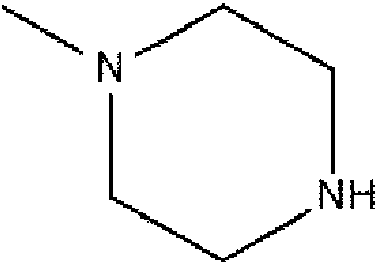
El compuesto de fórmula (IV) puede tener una estructura representada por la fórmula (IX) o el compuesto de fórmula (IV) puede tener una estructura representada por una fórmula de la invención, fórmula (X): The compound of formula (IV) may have a structure represented by formula (IX) or the compound of formula (IV) may have a structure represented by a formula of the invention, formula (X):

También se divulgan en este documento los compuestos representados por la fórmula (V):Compounds represented by formula (V) are also disclosed herein:

en la que R1, R2 y R3 son independientemente H o un grupo alquilo (C1-C4); R4 y R8 juntos son =O, -O(CH2)mO-, o -(CH2)m-, en el que m = 2-4, o R4 es H y R8 es H, OR14, s R14, o (CH2CH2O)nH, en la que R14 es H o un grupo alquilo (C1-C4) y n = 1-15; R9 , R10, R12 y R13 son independientemente H o (CH2CH2O)zH, en la que z = 1-6; y R11 comprende un compuesto que promueve la respiración mitocondrial.wherein R 1 , R 2 and R 3 are independently H or a (C1-C4) alkyl group; R 4 and R 8 together are =O, -O(CH2)mO-, or -(CH2)m-, where m = 2-4, or R 4 is H and R 8 is H, OR 14 , s R14, or (CH2CH2O)nH, where R14 is H or a (C1-C4) alkyl group and n = 1-15; R 9 , R 10 , R 12 and R 13 are independently H or (CH2CH2O)zH, where z = 1-6; and R 11 comprises a compound that promotes mitochondrial respiration.
El compuesto que promueve la respiración mitocondrial puede ser un intermedio del ciclo del ácido cítrico o una molécula que puede metabolizarse para entrar en el ciclo del ácido cítrico. Por ejemplo, el compuesto puede ser succinato, fumarato, malato, oxaloacetato, citrato, isocitrato, a-cetoglutarato, piruvato, acetona, ácido acetoacético, ácido p-hidroxibutírico, p-cetopentanoato o p-hidroxipentanoato.The mitochondrial respiration promoting compound may be a citric acid cycle intermediate or a molecule that can be metabolized to enter the citric acid cycle. For example, the compound can be succinate, fumarate, malate, oxaloacetate, citrate, isocitrate, α-ketoglutarate, pyruvate, acetone, acetoacetic acid, p-hydroxybutyric acid, p-ketopentanoate or p-hydroxypentanoate.
R11 puede incluir un enlazante, tal como polietilenglicol. Por ejemplo, R11 puede incluir (CH2CH2O)x, en la que x = 1 15.R 11 can include a linker, such as polyethylene glycol. For example, R 11 can include (CH2CH2O)x, where x = 1 15.
R11 puede ser R11 can be

en la que y = 1-3.where y = 1-3.
R11 puede incluir una molécula precursora de NAD+. Por ejemplo, R.11 puede incluir ácido nicotínico, nicotinamida o ribósido de nicotinamida. R11 can include a precursor molecule of NAD+. For example, R.11 can include nicotinic acid, nicotinamide, or nicotinamide riboside.
R11 puede serR11 can be

en la que y = 1-3.where y = 1-3.
También se divulgan en este documento compuestos representados por la fórmula (VII):Also disclosed herein are compounds represented by formula (VII):
A-C (VII),AC (VII),
en la que A es un compuesto que cambia el metabolismo cardíaco de la oxidación de ácidos grasos a la oxidación de glucosa, y C es una molécula precursora de NAD+. A y C pueden estar unidos covalentemente.where A is a compound that switches cardiac metabolism from fatty acid oxidation to glucose oxidation, and C is a precursor molecule of NAD+. A and C may be covalently linked.
El compuesto que cambia el metabolismo cardíaco de la oxidación de ácidos grasos a la oxidación de glucosa puede ser trimetazidina, etomoxir, perhexilina, un agonista de PPAR, un inhibidor de la malonil CoA descarboxilasa o dicloroacetato.The compound that changes cardiac metabolism from fatty acid oxidation to glucose oxidation can be trimetazidine, etomoxir, perhexiline, a PPAR agonist, a malonyl CoA decarboxylase inhibitor, or dichloroacetate.
El compuesto que cambia el metabolismo cardíaco de la oxidación de ácidos grasos a la oxidación de glucosa se puede PEGilar con una unidad estructural de etilenglicol. El compuesto que cambia el metabolismo cardíaco de la oxidación de ácidos grasos a la oxidación de glucosa puede tener múltiples unidades estructurales de etilenglicol, tales como una, dos, tres, cuatro, cinco o más unidades estructurales de etilenglicol. La unidad estructural de etilenglicol puede estar representada por (CH2CH2O)x, en la que x = 1-15. La unidad estructural de etilenglicol puede formar un enlace covalente entre el compuesto que cambia el metabolismo cardíaco de la oxidación de ácidos grasos a la oxidación de glucosa y la molécula precursora de NAD+. La unidad estructural de etilenglicol puede estar separada de un enlace covalente entre el compuesto que cambia el metabolismo cardíaco de la oxidación de ácidos grasos a la oxidación de glucosa y la molécula precursora de NAD+. El compuesto que cambia el metabolismo cardíaco de la oxidación de ácidos grasos a la oxidación de glucosa puede ser una forma PEGilada de trimetazidina.The compound that changes cardiac metabolism from fatty acid oxidation to glucose oxidation can be PEGylated with an ethylene glycol moiety. The compound that changes cardiac metabolism from fatty acid oxidation to glucose oxidation may have multiple ethylene glycol structural units, such as one, two, three, four, five or more ethylene glycol structural units. The structural unit of ethylene glycol can be represented by (CH 2 CH 2 O)x, where x = 1-15. The ethylene glycol structural unit can form a covalent bond between the compound that changes cardiac metabolism from fatty acid oxidation to glucose oxidation and the NAD+ precursor molecule. The ethylene glycol structural unit may be separated from a covalent bond between the compound that changes cardiac metabolism from fatty acid oxidation to glucose oxidation and the NAD+ precursor molecule. The compound that switches cardiac metabolism from fatty acid oxidation to glucose oxidation may be a PEGylated form of trimetazidine.
La molécula precursora de NAD+ puede ser ácido nicotínico, nicotinamida o ribósido de nicotinamida.The NAD+ precursor molecule can be nicotinic acid, nicotinamide, or nicotinamide riboside.
El compuesto de fórmula (VII) puede incluir ácido nicotínico que está unido covalentemente a una forma PEGilada de trimetazidina. El ácido nicotínico puede unirse covalentemente a través de la unidad estructural PEGilada, es decir, a través de un enlace de etilenglicol. El ácido nicotínico puede unirse covalentemente a través de la unidad estructural trimetazidina.The compound of formula (VII) may include nicotinic acid which is covalently linked to a PEGylated form of trimetazidine. Nicotinic acid can be covalently linked through the PEGylated moiety, ie through an ethylene glycol bond. Nicotinic acid can be covalently linked through the trimetazidine moiety.
El compuesto de fórmula (VII) puede tener una estructura representada por la fórmula (X), como como se muestra anteriormente.The compound of formula (VII) may have a structure represented by formula (X), as shown above.
En este documento se divulgan los compuestos representados por la fórmula (VIII):Compounds represented by formula (VIII) are disclosed herein:
A-L-C (VIII),A-L-C (VIII),
en la que A es un compuesto que cambia el metabolismo cardíaco de la oxidación de ácidos grasos a la oxidación de glucosa, L es un enlazante y C es una molécula precursora de NAD+. A puede estar unido covalentemente a L, y L puede estar unido covalentemente a C.where A is a compound that switches cardiac metabolism from fatty acid oxidation to glucose oxidation, L is a linker, and C is an NAD+ precursor molecule. A can be covalently linked to L, and L can be covalently linked to C.
El compuesto que cambia el metabolismo cardíaco de la oxidación de ácidos grasos a la oxidación de glucosa, el enlazante y la molécula precursora de NAD+ puede ser como se ha descrito anteriormente en relación con los compuestos de otras fórmulas.The compound that changes cardiac metabolism from fatty acid oxidation to glucose oxidation, the linker and precursor molecule of NAD+ can be as described above in relation to compounds of other formulas.
El compuesto de fórmula (VIII) puede tener una estructura representada por la fórmula (X), como como se muestra anteriormente.The compound of formula (VIII) may have a structure represented by formula (X), as shown above.
Cualquiera de los compuestos descritos anteriormente puede incluir uno o más átomos que están enriquecidos en un isótopo. Por ejemplo, los compuestos pueden tener uno o más átomos de hidrógeno reemplazados por deuterio o tritio. El átomo o átomos enriquecidos isotópicamente pueden estar ubicados en cualquier posición dentro del compuesto.Any of the compounds described above may include one or more atoms that are isotope-enriched. For example, the compounds may have one or more hydrogen atoms replaced by deuterium or tritium. The isotopically enriched atom(s) may be located at any position within the compound.
También se divulgan en este documento composiciones que incluyen al menos dos de A, B y C, en las que A es un compuesto que cambia el metabolismo cardíaco de la oxidación de ácidos grasos a la oxidación de glucosa como se describe anteriormente, B es un compuesto que promueve la respiración mitocondrial como se describe anteriormente, y C es una molécula precursora de NAD+ como se ha descrito anteriormente. Las composiciones pueden incluir A, B y C. Cada uno de los componentes A, B y C puede proporcionarse como una molécula separada, o dos o más de los componentes pueden estar unidos covalentemente en una única molécula. Por ejemplo, los componentes A y B pueden unirse covalentemente en una única molécula y C puede proporcionarse como una molécula separada. Also disclosed herein are compositions that include at least two of A, B, and C, wherein A is a compound that switches cardiac metabolism from fatty acid oxidation to glucose oxidation as described above, B is a compound that promotes mitochondrial respiration as described above, and C is a precursor molecule of NAD+ as described above. Compositions may include A, B and C. Each of components A, B, and C may be provided as a separate molecule, or two or more of the components may be covalently linked in a single molecule. For example, components A and B can be covalently linked in a single molecule and C can be provided as a separate molecule.
Las composiciones pueden incluir cocristales de dos o más moléculas separadas que incluyen dos o más de los componentes A, B y C. Por ejemplo, un cocristal puede incluir (1) un compuesto de fórmula (I), (III), (IV), o (V) y (2) ácido nicotínico, nicotinamida o ribósido de nicotinamida. Preferiblemente, el cocristal incluye nicotinamida.The compositions may include co-crystals of two or more separate molecules that include two or more of components A, B, and C. For example, a co-crystal may include (1) a compound of formula (I), (III), (IV) , or (V) and (2) nicotinic acid, nicotinamide or nicotinamide riboside. Preferably, the cocrystal includes nicotinamide.
La presente divulgación incluye métodos para aumentar la eficiencia del metabolismo cardíaco en un sujeto. Los métodos incluyen proporcionar un compuesto representado por la fórmula (I), como se describe anteriormente. En los métodos, el compuesto de fórmula (I) puede incluir cualquiera de las características descritas anteriormente en relación con los compuestos de la divulgación.The present disclosure includes methods for increasing the efficiency of cardiac metabolism in a subject. The methods include providing a compound represented by formula (I), as described above. In the methods, the compound of formula (I) may include any of the features described above in relation to the compounds of the disclosure.
La presente divulgación también incluye métodos para aumentar la eficiencia del metabolismo cardíaco en un sujeto. Los métodos incluyen proporcionar un compuesto que cambia el metabolismo cardíaco de la oxidación de ácidos grasos a la oxidación de glucosa, un compuesto que promueve la respiración mitocondrial y, opcionalmente, un compuesto que es una molécula precursora de NAD+.The present disclosure also includes methods for increasing the efficiency of cardiac metabolism in a subject. The methods include providing a compound that switches cardiac metabolism from fatty acid oxidation to glucose oxidation, a compound that promotes mitochondrial respiration, and, optionally, a compound that is a precursor molecule of NAD+.
El compuesto que cambia el metabolismo cardíaco de la oxidación de ácidos grasos a la glucosa puede ser trimetazidina, etomoxir, perhexilina, un agonista de PPAR, un inhibidor de la malonil CoA descarboxilasa o dicloroacetato.The compound that changes cardiac metabolism from fatty acid oxidation to glucose can be trimetazidine, etomoxir, perhexiline, a PPAR agonist, a malonyl CoA decarboxylase inhibitor, or dichloroacetate.
El compuesto que promueve la respiración mitocondrial puede ser un intermedio del ciclo del ácido cítrico o una molécula que puede metabolizarse para ingresar al ciclo del ácido cítrico, tal como succinato, fumarato, malato, oxaloacetato, citrato, isocitrato, a-cetoglutarato, piruvato, acetona, ácido acetoacético, ácido p-hidroxibutírico, pcetopentanoato o p-hidroxipentanoato.The mitochondrial respiration promoting compound may be a citric acid cycle intermediate or a molecule that can be metabolized to enter the citric acid cycle, such as succinate, fumarate, malate, oxaloacetate, citrate, isocitrate, a-ketoglutarate, pyruvate, acetone, acetoacetic acid, p-hydroxybutyric acid, pcetopentanoate or p-hydroxypentanoate.
La molécula precursora de NAD+ puede ser ácido nicotínico, nicotinamida o ribósido de nicotinamida.The NAD+ precursor molecule can be nicotinic acid, nicotinamide, or nicotinamide riboside.
Los compuestos se pueden proporcionar de cualquier manera apropiada. Los compuestos se pueden proporcionar en una única composición. Alternativamente, los compuestos pueden no proporcionarse en una única composición. Por ejemplo, uno o dos de los compuestos pueden proporcionarse en una única composición y otro compuesto puede proporcionarse en una composición separada. Alternativamente, cada compuesto puede proporcionarse en una composición separada. Los compuestos pueden proporcionarse simultánea o secuencialmente. Los compuestos se pueden proporcionar a diferentes intervalos, con diferente frecuencia o en diferentes cantidades.The compounds can be provided in any suitable manner. The compounds can be provided in a single composition. Alternatively, the compounds may not be provided in a single composition. For example, one or two of the compounds may be provided in a single composition and another compound may be provided in a separate composition. Alternatively, each compound may be provided in a separate composition. The compounds can be provided simultaneously or sequentially. The compounds can be provided at different intervals, with different frequency, or in different amounts.
Se cree que cualquier enfermedad que pueda tratarse usando trimetazidina se beneficiaría de los compuestos de la divulgación como se describe en este documento con resultados más eficaces y menos efectos secundarios. Ejemplos de enfermedades son aquellas que implican una función mitocondrial deteriorada o una oxidación de ácidos grasos alterada, tales como enfermedades de insuficiencia cardíaca, enfermedades de disfunción cardíaca o enfermedades de miopatía muscular. Los métodos de ejemplo implican proporcionar una composición como se describe en este documento o cualquier combinación de un compuesto que cambie el metabolismo cardíaco de la oxidación de ácidos grasos al metabolismo de la glucosa, un compuesto que promueva la respiración mitocondrial y/u opcionalmente una molécula precursora de NAD+.It is believed that any disease that can be treated using trimetazidine would benefit from the compounds of the disclosure as described herein with more effective results and fewer side effects. Examples of diseases are those involving impaired mitochondrial function or impaired fatty acid oxidation, such as heart failure diseases, cardiac dysfunction diseases, or muscular myopathy diseases. Exemplary methods involve providing a composition as described herein or any combination of a compound that switches cardiac metabolism from fatty acid oxidation to glucose metabolism, a compound that promotes mitochondrial respiration, and/or optionally a molecule. NAD+ precursor.
Breve descripción de los dibujosBrief description of the drawings
La figura 1 es una tabla que resume los efectos de diversos compuestos sobre la función mitocondrial.Figure 1 is a table summarizing the effects of various compounds on mitochondrial function.
La figura 2 es una tabla que resume los efectos de la nicotinamida en diversos parámetros funcionales mitocondriales. Figure 2 is a table summarizing the effects of nicotinamide on various mitochondrial functional parameters.
La figura 3 es una serie de gráficos que muestran los efectos de la nicotinamida sobre la tasa de consumo de oxígeno y la capacidad de reserva.Figure 3 is a series of graphs showing the effects of nicotinamide on oxygen consumption rate and reserve capacity.
La figura 4 es una serie de gráficos que muestran los efectos de la nicotinamida sobre la tasa de acidificación extracelular.Figure 4 is a series of graphs showing the effects of nicotinamide on the rate of extracellular acidification.
La figura 5 es una tabla que resume los efectos de una combinación de trimetazidina y nicotinamida sobre diversos parámetros funcionales mitocondriales.Figure 5 is a table summarizing the effects of a combination of trimetazidine and nicotinamide on various mitochondrial functional parameters.
La figura 6 es una serie de gráficos que muestran los efectos de una combinación de trimetazidina y nicotinamida sobre la tasa de consumo de oxígeno y la capacidad de reserva.Figure 6 is a series of graphs showing the effects of a combination of trimetazidine and nicotinamide on oxygen consumption rate and reserve capacity.
La figura 7 es una serie de gráficos que muestran los efectos de una combinación de trimetazidina y nicotinamida sobre la tasa de acidificación extracelular.Figure 7 is a series of graphs showing the effects of a combination of trimetazidine and nicotinamide on the rate of extracellular acidification.
La figura 8 es una tabla que resume los efectos del succinato sobre diversos parámetros funcionales mitocondriales. Figure 8 is a table summarizing the effects of succinate on various mitochondrial functional parameters.
La figura 9 es una serie de gráficos que muestran los efectos del succinato sobre la tasa de consumo de oxígeno y la capacidad de reserva.Figure 9 is a series of graphs showing the effects of succinate on oxygen consumption rate and reserve capacity.
La figura 10 es una serie de gráficos que muestran los efectos del succinato sobre la tasa de acidificación extracelular. Figure 10 is a series of graphs showing the effects of succinate on the rate of extracellular acidification.
La figura 11 es una tabla que resume los efectos del compuesto CV-8816 sobre diversos parámetros funcionales mitocondriales.Figure 11 is a table summarizing the effects of compound CV-8816 on various mitochondrial functional parameters.
La figura 12 es una serie de gráficos que muestran los efectos del compuesto CV-8816 sobre la tasa de consumo de oxígeno y la capacidad de reserva.Figure 12 is a series of graphs showing the effects of compound CV-8816 on oxygen consumption rate and reserve capacity.
La figura 13 es una serie de gráficos que muestran los efectos del compuesto CV-8816 sobre la tasa de acidificación extracelular.Figure 13 is a series of graphs showing the effects of compound CV-8816 on the rate of extracellular acidification.
La figura 14 es una tabla que resume los efectos del compuesto CV-8814 sobre diversos parámetros funcionales mitocondriales.Figure 14 is a table summarizing the effects of compound CV-8814 on various mitochondrial functional parameters.
La figura 15 es una serie de gráficos que muestran los efectos del compuesto CV-8814 sobre la tasa de consumo de oxígeno y la capacidad de reserva.Figure 15 is a series of graphs showing the effects of compound CV-8814 on oxygen consumption rate and reserve capacity.
La figura 16 es una serie de gráficos que muestran los efectos del compuesto CV-8814 sobre la tasa de acidificación extracelular.Figure 16 is a series of graphs showing the effects of compound CV-8814 on the rate of extracellular acidification.
La figura 17 es una tabla que resume los efectos de la trimetazidina sobre diversos parámetros funcionales mitocondriales.Figure 17 is a table summarizing the effects of trimetazidine on various mitochondrial functional parameters.
La figura 18 es una serie de gráficos que muestran los efectos de la trimetazidina sobre la tasa de consumo de oxígeno y la capacidad de reserva.Figure 18 is a series of graphs showing the effects of trimetazidine on oxygen consumption rate and reserve capacity.
La figura 19 es una serie de gráficos que muestran los efectos de la trimetazidina sobre la tasa de acidificación extracelular.Figure 19 is a series of graphs showing the effects of trimetazidine on the rate of extracellular acidification.
La figura 20 es una tabla que resume los efectos del compuesto CV-8815 sobre diversos parámetros funcionales mitocondriales.Figure 20 is a table summarizing the effects of compound CV-8815 on various mitochondrial functional parameters.
La figura 21 es una serie de gráficos que muestran los efectos del compuesto CV-8815 sobre la tasa de consumo de oxígeno y la capacidad de reserva.Figure 21 is a series of graphs showing the effects of compound CV-8815 on oxygen consumption rate and reserve capacity.
La figura 22 es una serie de gráficos que muestran los efectos del compuesto CV-8815 sobre la tasa de acidificación extracelular.Figure 22 is a series of graphs showing the effects of compound CV-8815 on the rate of extracellular acidification.
La figura 23 es una tabla que resume los efectos de una combinación de succinato, nicotinamida y trimetazidina sobre diversos parámetros funcionales mitocondriales.Figure 23 is a table summarizing the effects of a combination of succinate, nicotinamide, and trimetazidine on various mitochondrial functional parameters.
La figura 24 es una serie de gráficos que muestran los efectos de una combinación de succinato, nicotinamida y trimetazidina sobre la tasa de consumo de oxígeno y la capacidad de reserva.Figure 24 is a series of graphs showing the effects of a combination of succinate, nicotinamide and trimetazidine on oxygen consumption rate and reserve capacity.
La figura 25 es una serie de gráficos que muestran los efectos de una combinación de succinato, nicotinamida y trimetazidina sobre la tasa de acidificación extracelular.Figure 25 is a series of graphs showing the effects of a combination of succinate, nicotinamide and trimetazidine on the rate of extracellular acidification.
La figura 26 es una tabla que resume los efectos de una combinación de análogo 2 de trimetazidina y nicotinamida sobre diversos parámetros funcionales mitocondriales.Figure 26 is a table summarizing the effects of a combination of trimetazidine analog 2 and nicotinamide on various mitochondrial functional parameters.
La figura 27 es una serie de gráficos que muestran los efectos de una combinación de análogo 2 de trimetazidina y nicotinamida sobre la tasa de consumo de oxígeno y la capacidad de reserva.Figure 27 is a series of graphs showing the effects of a combination of trimetazidine analog 2 and nicotinamide on oxygen consumption rate and reserve capacity.
La figura 28 es una serie de gráficos que muestran los efectos de una combinación de análogo 2 de trimetazidina y nicotinamida sobre la tasa de acidificación extracelular.Figure 28 is a series of graphs showing the effects of a combination of trimetazidine analog 2 and nicotinamide on the rate of extracellular acidification.
La figura 29 es una tabla que resume los efectos de una combinación de análogo 1 de trimetazidina y nicotinamida sobre diversos parámetros funcionales mitocondriales.Figure 29 is a table summarizing the effects of a combination of trimetazidine analog 1 and nicotinamide on various mitochondrial functional parameters.
La figura 30 es una serie de gráficos que muestran los efectos de una combinación del análogo 1 de trimetazidina y nicotinamida sobre la tasa de consumo de oxígeno y la capacidad de reserva.Figure 30 is a series of graphs showing the effects of a combination of trimetazidine analog 1 and nicotinamide on oxygen consumption rate and reserve capacity.
La figura 31 es una serie de gráficos que muestran los efectos de una combinación de análogo 1 de trimetazidina y nicotinamida sobre la tasa de acidificación extracelular.Figure 31 is a series of graphs showing the effects of a combination of trimetazidine analog 1 and nicotinamide on the rate of extracellular acidification.
La figura 32 es una tabla que resume los efectos de una combinación de análogo 3 de trimetazidina y nicotinamida sobre diversos parámetros funcionales mitocondriales. Figure 32 is a table summarizing the effects of a combination of trimetazidine analog 3 and nicotinamide on various mitochondrial functional parameters.
La figura 33 es una serie de gráficos que muestran los efectos de una combinación del análogo 3 de trimetazidina y nicotinamida sobre la tasa de consumo de oxígeno y la capacidad de reserva.Figure 33 is a series of graphs showing the effects of a combination of trimetazidine analog 3 and nicotinamide on oxygen consumption rate and reserve capacity.
La figura 34 es una serie de gráficos que muestran los efectos de una combinación de análogo 3 de trimetazidina y nicotinamida sobre la tasa de acidificación extracelular.Figure 34 is a series of graphs showing the effects of a combination of trimetazidine analog 3 and nicotinamide on the rate of extracellular acidification.
La figura 35 es una tabla que resume los efectos de una combinación de succinato y nicotinamida sobre diversos parámetros funcionales mitocondriales.Figure 35 is a table summarizing the effects of a combination of succinate and nicotinamide on various mitochondrial functional parameters.
La figura 36 es una serie de gráficos que muestran los efectos de una combinación de succinato y nicotinamida sobre la tasa de consumo de oxígeno y la capacidad de reserva.Figure 36 is a series of graphs showing the effects of a combination of succinate and nicotinamide on oxygen consumption rate and reserve capacity.
La figura 37 es una serie de gráficos que muestran los efectos de una combinación de succinato y nicotinamida sobre la tasa de acidificación extracelular.Figure 37 is a series of graphs showing the effects of a combination of succinate and nicotinamide on the rate of extracellular acidification.
La figura 38 es un esquema del método de isquemia-reperfusión (IR) usado para analizar los efectos de las composiciones de la divulgación sobre el flujo coronario.Figure 38 is a schematic of the ischemia-reperfusion (IR) method used to analyze the effects of the compositions of the disclosure on coronary flow.
La figura 39 es un gráfico de flujo coronario después de IR.Figure 39 is a graph of coronary flow after IR.
La figura 40 es un gráfico de la presión desarrollada del ventrículo izquierdo (LVDP) después del IR.Figure 40 is a graph of left ventricular developed pressure (LVDP) after IR.
La figura 41 muestra imágenes de cortes de corazón teñidos con TTC después del IR.Figure 41 shows images of TTC-stained heart sections after IR.
La figura 42 es un gráfico del tamaño del infarto después del IR.Figure 42 is a graph of infarct size after IR.
La figura 43 es un esquema del método usado para analizar los efectos de las composiciones de la divulgación sobre la función cardíaca.Figure 43 is a schematic of the method used to test the effects of the compositions of the disclosure on cardiac function.
La figura 44 muestra corazones de ratones seis semanas después de la constricción aórtica transversal.Figure 44 shows mouse hearts six weeks after transverse aortic constriction.
La figura 45 es un gráfico del peso del corazón en relación con el peso corporal seis semanas después de la constricción aórtica transversal.Figure 45 is a graph of heart weight relative to body weight six weeks after transverse aortic constriction.
La figura 46 es un gráfico del peso del corazón seis semanas después de la constricción aórtica transversa.Figure 46 is a graph of heart weight six weeks after transverse aortic constriction.
La figura 47 muestra gráficos de acortamiento fraccional (FS) y fracción de eyección (EF) en puntos de tiempo indicados después de la constricción aórtica transversal.Figure 47 shows plots of fractional shortening (FS) and ejection fraction (EF) at indicated time points after transverse aortic constriction.
La figura 48 es un gráfico del diámetro sistólico final del ventrículo izquierdo en los puntos de tiempo indicados después de la constricción aórtica transversal.Figure 48 is a graph of left ventricular end systolic diameter at the indicated time points after transverse aortic constriction.
La figura 49 es un gráfico de la dimensión del tabique intraventricular en puntos de tiempo indicados después de la constricción aórtica transversal.Figure 49 is a graph of intraventricular septal dimension at indicated time points after transverse aortic constriction.
La figura 50 es un gráfico de la masa ventricular izquierda en los puntos de tiempo indicados después de la constricción aórtica transversal.Figure 50 is a graph of left ventricular mass at the indicated time points after transverse aortic constriction.
La figura 51 es un gráfico del tiempo de relajación isovolumétrica en puntos de tiempo indicados después de la constricción aórtica transversal.Figure 51 is a graph of isovolumic relaxation time at indicated time points after transverse aortic constriction.
La figura 52 es un gráfico de la proporción de flujo de velocidad máxima en la diástole temprana frente a la diástole tardía en puntos de tiempo indicados después de la constricción aórtica transversal.Figure 52 is a plot of peak velocity flow ratio in early diastole versus late diastole at indicated time points after transverse aortic constriction.
La figura 53 es un gráfico de la presión desarrollada en el ventrículo izquierdo seis semanas después de la constricción aórtica transversal.Figure 53 is a graph of the pressure developed in the left ventricle six weeks after transverse aortic constriction.
La figura 54 es un gráfico de la tasa de aumento de la presión del ventrículo izquierdo seis semanas después de la constricción aórtica transversal.Figure 54 is a graph of the rate of increase in left ventricular pressure six weeks after transverse aortic constriction.
La figura 55 es un gráfico que muestra los niveles de CV-8814 y trimetazidina después de la administración intravenosa de CV-8834.Figure 55 is a graph showing the levels of CV-8814 and trimetazidine after intravenous administration of CV-8834.
La figura 56 es un gráfico que muestra los niveles de CV-8814 y trimetazidina después de la administración oral de CV-8834.Figure 56 is a graph showing the levels of CV-8814 and trimetazidine after oral administration of CV-8834.
La figura 57 es un gráfico que muestra los niveles de CV-8814 y trimetazidina después de la administración oral de CV-8834. Figure 57 is a graph showing the levels of CV-8814 and trimetazidine after oral administration of CV-8834.
La figura 58 es un gráfico que muestra los niveles de CV-8814 y trimetazidina después de la administración oral de CV-8834.Figure 58 is a graph showing the levels of CV-8814 and trimetazidine after oral administration of CV-8834.
La figura 59 es un gráfico que muestra los niveles de CV-8814 y trimetazidina después de la administración oral de CV-8834.Figure 59 is a graph showing the levels of CV-8814 and trimetazidine after oral administration of CV-8834.
La figura 60 es un gráfico que muestra los niveles de trimetazidina después de la administración oral de CV-8972 o la administración intravenosa de trimetazidina.Figure 60 is a graph showing trimetazidine levels after oral administration of CV-8972 or intravenous administration of trimetazidine.
La figura 61 es un gráfico que muestra los niveles de CV-8814 después de la administración oral de CV-8972 o la administración intravenosa de CV-8814.Figure 61 is a graph showing the levels of CV-8814 after oral administration of CV-8972 or intravenous administration of CV-8814.
La figura 62 es un gráfico que muestra los niveles de CV-8814 después de la administración intravenosa de CV-8834 o la administración oral de CV-8834.Figure 62 is a graph showing the levels of CV-8814 after intravenous administration of CV-8834 or oral administration of CV-8834.
La figura 63 es un gráfico que muestra los niveles de CV-8814 después de la administración intravenosa de CV-8814 o la administración oral de CV-8814.Figure 63 is a graph showing CV-8814 levels after intravenous administration of CV-8814 or oral administration of CV-8814.
La figura 64 es un gráfico que muestra el perfil de elución de HPLC de un lote de CV-8972.Figure 64 is a graph showing the HPLC elution profile of a batch of CV-8972.
La figura 65 es un gráfico que muestra el análisis de las especies moleculares presentes en un lote de CV-8972. La figura 66 es un par de gráficos que muestran perfiles de elución de HPLC de especies moleculares presentes en un lote de CV-8972.Figure 65 is a graph showing the analysis of the molecular species present in a batch of CV-8972. Figure 66 is a pair of graphs showing HPLC elution profiles of molecular species present in a batch of CV-8972.
La figura 67 es un par de gráficos que muestran perfiles de elución de HPLC de especies moleculares presentes en un lote de CV-8972.Figure 67 is a pair of graphs showing HPLC elution profiles of molecular species present in a batch of CV-8972.
La figura 68 es un gráfico que muestra el análisis de difracción de rayos X en polvo de un lote de CV-8972.Figure 68 is a graph showing X-ray powder diffraction analysis of a batch of CV-8972.
La figura 69 es un gráfico que muestra el análisis de difracción de rayos X en polvo de lotes de CV-8972.Figure 69 is a graph showing X-ray powder diffraction analysis of batches of CV-8972.
La figura 70 es un gráfico que muestra la calorimetría de barrido diferencial y el análisis gravimétrico térmico de un lote de CV-8972.Figure 70 is a graph showing differential scanning calorimetry and thermal gravimetric analysis of a batch of CV-8972.
La figura 71 es un gráfico que muestra la sorción dinámica de vapor (DVS) de un lote de CV-8972.Figure 71 is a graph showing the dynamic vapor sorption (DVS) of a batch of CV-8972.
La figura 72 es un gráfico que muestra la calorimetría de barrido diferencial y el análisis gravimétrico térmico de un lote de CV-8972.Figure 72 is a graph showing differential scanning calorimetry and thermal gravimetric analysis of a batch of CV-8972.
La figura 73 es un gráfico que muestra la sorción dinámica de vapor (DVS) de un lote de CV-8972.Figure 73 is a graph showing the dynamic vapor sorption (DVS) of a batch of CV-8972.
La figura 74 es un gráfico que muestra el análisis de difracción de rayos X en polvo de muestras de CV-8972.Figure 74 is a graph showing X-ray powder diffraction analysis of CV-8972 samples.
La figura 75 es un gráfico que muestra la calorimetría de barrido diferencial y el análisis gravimétrico térmico de un lote de CV-8972.Figure 75 is a graph showing differential scanning calorimetry and thermal gravimetric analysis of a batch of CV-8972.
La figura 76 es un gráfico que muestra el análisis de difracción de rayos X en polvo de muestras de CV-8972.Figure 76 is a graph showing X-ray powder diffraction analysis of CV-8972 samples.
La figura 77 es un gráfico que muestra el análisis de difracción de rayos X en polvo de muestras de CV-8972.Figure 77 is a graph showing X-ray powder diffraction analysis of CV-8972 samples.
La figura 78 es un gráfico que muestra la calorimetría de barrido diferencial y el análisis gravimétrico térmico de muestras que contienen la forma A de CV-8972.Figure 78 is a graph showing differential scanning calorimetry and thermal gravimetric analysis of samples containing Form A of CV-8972.
La figura 79 es un gráfico que muestra la calorimetría de barrido diferencial y el análisis gravimétrico térmico de una muestra que contiene la forma A de CV-8972.Figure 79 is a graph showing differential scanning calorimetry and thermal gravimetric analysis of a sample containing CV-8972 Form A.
Descripción detalladaDetailed description
La presente divulgación proporciona composiciones que aumentan la eficacia del metabolismo cardíaco al cambiar simultáneamente el metabolismo cardíaco de la oxidación de ácidos grasos a la oxidación de glucosa y aumentar la respiración mitocondrial. La oxidación de glucosa y la oxidación de ácidos grasos son vías metabólicas productoras de energía que compiten entre sí por los sustratos. En la oxidación de glucosa, la glucosa se descompone en piruvato a través de la glucólisis en el citosol de la célula. Luego, el piruvato ingresa a la mitocondria, donde se convierte en acetil coenzima A (acetil-CoA). En la oxidación beta de los ácidos grasos, que ocurre en las mitocondrias, las unidades de dos carbonos de los ácidos grasos de cadena larga se convierten secuencialmente en acetil-CoA.The present disclosure provides compositions that increase the efficiency of cardiac metabolism by simultaneously switching cardiac metabolism from fatty acid oxidation to glucose oxidation and increasing mitochondrial respiration. Glucose oxidation and fatty acid oxidation are energy-producing metabolic pathways that compete with each other for substrates. In glucose oxidation, glucose is broken down to pyruvate through glycolysis in the cytosol of the cell. The pyruvate then enters the mitochondria, where it is converted to acetyl coenzyme A (acetyl-CoA). In beta oxidation of fatty acids, which occurs in the mitochondria, the two-carbon units of long-chain fatty acids are sequentially converted to acetyl-CoA.
Las etapas restantes en la producción de energía a partir de la oxidación de glucosa o ácidos grasos son comunes a las dos vías. Acetil-CoA se oxida a dióxido de carbono (CO2) a través del ciclo del ácido cítrico, que resulta en la conversión de nicotinamida adenina dinucleótido (NAD+) a su forma reducida, NADH. NADH, a su vez, impulsa la cadena de transporte de electrones mitocondrial. La cadena de transporte de electrones comprende una serie de cuatro complejos ligados a la membrana mitocondrial que transfieren electrones a través de reacciones redox y bombean protones a través de la membrana para crear un gradiente de protones. Las reacciones redox de la cadena de transporte de electrones requieren oxígeno molecular (O2). Finalmente, el gradiente de protones permite que otro complejo enzimático unido a la membrana forme moléculas de ATP de alta energía, la fuente de energía para la mayoría de las reacciones celulares.The remaining steps in energy production from glucose or fatty acid oxidation are common to both pathways. Acetyl-CoA is oxidized to carbon dioxide (CO 2 ) through the citric acid cycle, resulting in the conversion of nicotinamide adenine dinucleotide (NAD+) to its reduced form, NADH. NADH, in turn, drives the mitochondrial electron transport chain. The electron transport chain comprises a series of four mitochondrial membrane-bound complexes that transfer electrons through redox reactions and pump protons across the membrane to create a proton gradient. The redox reactions of the electron transport chain require molecular oxygen (O 2 ). Finally, the proton gradient allows another membrane-bound enzyme complex to form high-energy ATP molecules, the energy source for most cellular reactions.
En muchos tipos de enfermedades cardíacas, la eficiencia general de la producción de energía por parte de las mitocondrias cardíacas disminuye. En parte, esto se debe a una mayor dependencia de la oxidación de ácidos grasos sobre la oxidación de glucosa en muchos tipos de enfermedades cardíacas. La oxidación de glucosa es una ruta más eficiente para la producción de energía, medida por el número de moléculas de ATP producidas por molécula O2 consumida, que la oxidación de ácidos grasos. Sin embargo, otros cambios metabólicos contribuyen a la disminución de la eficiencia cardíaca en pacientes con enfermedades cardíacas. Por ejemplo, el metabolismo oxidativo mitocondrial general puede verse afectado en la insuficiencia cardíaca y la producción de energía disminuye en la cardiopatía isquémica debido a un suministro limitado de oxígeno. Como se indicó anteriormente, las etapas finales en la síntesis de ATP, que incluyen varias reacciones redox y el transporte de protones impulsado por oxígeno, son comunes las vías tanto de oxidación de glucosa como de oxidación de ácidos grasos. De este modo, cambiar el equilibrio de la oxidación de ácidos grasos a la oxidación de glucosa por sí mismo no es suficiente en muchas circunstancias para restaurar la eficiencia cardíaca completa porque los procesos posteriores también se ven afectados.In many types of heart disease, the overall efficiency of energy production by the cardiac mitochondria decreases. In part, this is due to a greater reliance of fatty acid oxidation on glucose oxidation in many types of heart disease. Glucose oxidation is a more efficient pathway for energy production, as measured by the number of ATP molecules produced per O 2 molecule consumed, than fatty acid oxidation. However, other metabolic changes contribute to decreased cardiac efficiency in patients with heart disease. For example, overall mitochondrial oxidative metabolism may be impaired in heart failure, and energy production is decreased in ischemic heart disease due to limited oxygen supply. As noted above, the final steps in ATP synthesis, including various redox reactions and oxygen-driven proton transport, are common to both glucose oxidation and fatty acid oxidation pathways. Thus, changing the balance from fatty acid oxidation to glucose oxidation by itself is not sufficient in many circumstances to restore full cardiac efficiency because downstream processes are also affected.
La presente divulgación proporciona composiciones que mejoran la eficiencia cardíaca mediante el uso de múltiples mecanismos para alterar el metabolismo mitocondrial. Al incluir un componente que cambia el metabolismo cardíaco de la oxidación de ácidos grasos a la oxidación de glucosa y uno o más componentes que promueven la respiración mitocondrial, las composiciones desencadenan un cambio en la ruta usada para producir energía y, al mismo tiempo, mejoran la función oxidativa mitocondrial general. En consecuencia, las composiciones de la divulgación son más eficaces para restaurar la capacidad cardíaca en pacientes con enfermedades cardíacas, tales como insuficiencia cardíaca, cardiopatía isquémica y miocardiopatías diabéticas, que los compuestos que solamente efectúan un cambio a la oxidación de la glucosa.The present disclosure provides compositions that improve cardiac efficiency by using multiple mechanisms to alter mitochondrial metabolism. By including a component that switches cardiac metabolism from fatty acid oxidation to glucose oxidation and one or more components that promote mitochondrial respiration, the compositions trigger a change in the pathway used to produce energy while simultaneously improving overall mitochondrial oxidative function. Consequently, the compositions of the disclosure are more effective in restoring cardiac capacity in patients with cardiac diseases, such as heart failure, ischemic heart disease, and diabetic cardiomyopathies, than compounds that only effect a switch to glucose oxidation.
En algunos ejemplos, las composiciones son compuestos representados por la fórmula (I):In some examples, the compositions are compounds represented by formula (I):
A-L-B (I),A-L-B (I),
en la que A es un compuesto que cambia el metabolismo cardíaco de la oxidación de ácidos grasos a la oxidación de glucosa, L es un enlazante y B es un compuesto que promueve la respiración mitocondrial.where A is a compound that changes cardiac metabolism from fatty acid oxidation to glucose oxidation, L is a linker, and B is a compound that promotes mitochondrial respiration.
El componente A puede ser cualquier compuesto apropiado que cambie el metabolismo cardíaco de la oxidación de ácidos grasos a la oxidación de glucosa. Tales compuestos se pueden clasificar en base a su mecanismo de acción. Véase, Fillmore, N., et al., Mitochondrial fatty acid oxidation alterations in heart failure, ischemic heart disease and diabetic cardiomyopathy, Brit. J. Pharmacol. 171:2080-2090 (2014).Component A can be any suitable compound that changes cardiac metabolism from fatty acid oxidation to glucose oxidation. Such compounds can be classified based on their mechanism of action. See, Fillmore, N., et al., Mitochondrial fatty acid oxidation alterations in heart failure, ischemic heart disease and diabetic cardiomyopathy, Brit. J. Pharmacol. 171:2080-2090 (2014).
Una clase de compuestos de cambio de glucosa incluye compuestos que inhiben directamente la oxidación de ácidos grasos. Los compuestos de esta clase incluyen inhibidores de malonil CoA descarboxilasa (MCD), carnitina palmitoil transferasa 1 (CPT-1), u oxidación de ácidos grasos mitocondriales. Los inhibidores de la oxidación de ácidos grasos mitocondriales incluyen trimetazidina y otros compuestos descritos en el documento WO 2002/064576. La trimetazidina se une a sitios distintos en las membranas mitocondriales internas y externas y afecta tanto la permeabilidad iónica como la función metabólica de las mitocondrias. Morin, D., et al., Evidence for the existence of [3H]-trimetazidine binding sites involved in the regulation of the mitochondrial permeability transition pore, Brit. J. Pharmacol. 123:1385-1394 (1998). Los inhibidores de MCD incluyen CBM-301106, CBM-300864, CBM-301940, 5-(1,1,1,3,3,3-hexafluoro-2-hidroxipropan-2-il)-4,5-dihidroisoxazol-3-carboxamidas, 5-(N-(4-(1,1,1,3,3,3-hexafluoro-2-hidroxipropan-2-il)fenil)morfolina-4-carboxamido)pentanoato de metilo y otros compuestos descritos en Chung, J.F., et al., Discovery of Potent and Orally Available Malonyl-CoA Decarboxylase Inhibitors as Cardioprotective Agents, J. Med. Chem. 49:4055-4058 (2006); Cheng J.F. et al., Synthesis and structure-activity relationship of smallmolecule malonyl coenzyme A decarboxylase inhibitors, J. Med. Chem. 49:1517-1525 (2006); la Publicación de los estados Unidos No. 2004/0082564; y el documento WO 2002/058698. Los inhibidores de CPT-1 incluyen oxfenicina, perhexilina, etomoxir y otros compuestos descritos en los documentos WO 2015/018660, WO 2008/109991; WO 2009/015485; Publicación de los Estados Unidos No. 2011/0212072; y el documento WO 2009/156479.One class of glucose-shifting compounds includes compounds that directly inhibit fatty acid oxidation. Compounds in this class include inhibitors of malonyl CoA decarboxylase (MCD), carnitine palmitoyl transferase 1 (CPT-1), or mitochondrial fatty acid oxidation. Mitochondrial fatty acid oxidation inhibitors include trimetazidine and other compounds described in WO 2002/064576. Trimetazidine binds to distinct sites on the inner and outer mitochondrial membranes and affects both ion permeability and metabolic function of mitochondria. Morin, D., et al., Evidence for the existence of [3H]-trimetazidine binding sites involved in the regulation of the mitochondrial permeability transition pore, Brit. J. Pharmacol. 123:1385-1394 (1998). MCD inhibitors include CBM-301106, CBM-300864, CBM-301940, 5-(1,1,1,3,3,3-hexafluoro-2-hydroxypropan-2-yl)-4,5-dihydroisoxazole-3 -carboxamides, methyl 5-(N-(4-(1,1,1,3,3,3-hexafluoro-2-hydroxypropan-2-yl)phenyl)morpholine-4-carboxamido)pentanoate and other compounds described in Chung, J.F., et al., Discovery of Potent and Orally Available Malonyl-CoA Decarboxylase Inhibitors as Cardioprotective Agents, J. Med. Chem. 49:4055-4058 (2006); Cheng J.F. et al., Synthesis and structure-activity relationship of smallmolecule malonyl coenzyme A decarboxylase inhibitors, J. Med. Chem. 49:1517-1525 (2006); United States Publication No. 2004/0082564; and WO 2002/058698. CPT-1 inhibitors include oxphenicin, perhexiline, etomoxir and other compounds described in WO 2015/018660, WO 2008/109991; WO 2009/015485; United States Publication No. 2011/0212072; and WO 2009/156479.
Otra clase de compuestos de cambio de glucosa incluye compuestos que estimulan directamente la oxidación de la glucosa. Ejemplos de tales compuestos se describen en Publicación de los Estados Unidos No. 2003/0191182; el documento w O 2006/117686; la Patente de los Estados Unidos No. 8,202,901.Another class of glucose-shifting compounds includes compounds that directly stimulate glucose oxidation. Examples of such compounds are described in US Publication No. 2003/0191182; WO 2006/117686; United States Patent No. 8,202,901.
Otra clase de compuestos de cambio de la glucosa incluye compuestos que disminuyen el nivel de ácidos grasos circulantes que abastecen al corazón. Los ejemplos de dichos compuestos incluyen agonistas de PPARa y PPARy, incluidos fármacos de fibrato, tales como clofibrato, gemfibrozilo, ciprofibrato, bezafibrato y fenofibrato, y tiazolidinedionas, GW-9662 y otros compuestos descritos en la Patente de los Estados Unidos No. 9096538. Another class of glucose-changing compounds includes compounds that decrease the level of circulating fatty acids that supply the heart. Examples of such compounds include PPARα and PPARα agonists, including fibrate drugs such as clofibrate, gemfibrozil, ciprofibrate, bezafibrate, and fenofibrate, and thiazolidinediones, GW-9662 and other compounds described in US Patent No. 9096538 .
El componente L puede ser cualquier enlazante apropiado. Preferiblemente, el enlazante se puede escindir in vivo para liberar los componentes A y B. El enlazante puede ser un grupo alcoxi. El enlazante puede ser polietilenglicol de cualquier longitud. El enlazante puede estar representado por (CH2CH2O)x, en la que x = 1-15 o (CH2CH2O)x, en la que x = 1-3. Otros enlazantes apropiados incluyen 1,3-propanodiol, enlazantes de diazo, enlazantes de fosforamidita, enlazantes de disulfuro, péptidos escindibles, enlazantes de ácido iminodiacético, enlazantes de tioéter y otros enlazantes descritos en Leriche, G., et al., Cleavable linkers in chemical biology, Bioorg. Med. Chem. 20:571-582 (2012); el documento WO 1995000165; and la Patente de los Estados Unidos No. 8461117.The L component can be any suitable linker. Preferably, the linker can be cleaved in vivo to release components A and B. The linker can be an alkoxy group. The binder can be polyethylene glycol of any length. The linker may be represented by (CH 2 CH 2 O)x, where x = 1-15 or (CH 2 CH 2 O)x, where x = 1-3. Other suitable linkers include 1,3-propanediol, diazo linkers, phosphoramidite linkers, disulfide linkers, cleavable peptides, iminodiacetic acid linkers, thioether linkers, and other linkers described in Leriche, G., et al., Cleavable linkers in chemical biology, Bioorg. Med. Chem. 20:571-582 (2012); WO 1995000165; and United States Patent No. 8461117.
El componente B puede ser cualquier compuesto que promueva la respiración mitocondrial. Por ejemplo, el componente B puede ser un intermedio del ciclo del ácido cítrico o una molécula que puede metabolizarse para entrar en el ciclo del ácido cítrico, tal como succinato, fumarato, malato, oxaloacetato, citrato, isocitrato, a-cetoglutarato, piruvato, acetona, ácido acetoacético, ácido p-hidroxibutírico, p-cetopentanoato o p-hidroxipentanoato. Los intermedios del ciclo del ácido cítrico pueden agotarse si estas moléculas se usan con fines biosintéticos, lo que da como resultado una generación ineficiente de ATP a partir del ciclo del ácido cítrico. Sin embargo, debido al efecto anaplerótico, proporcionar un producto intermedio del ciclo del ácido cítrico conduce a la restauración de todos los intermedios a medida que avanza el ciclo. De este modo, los intermedios del ciclo del ácido cítrico pueden promover la respiración mitocondrial.Component B can be any compound that promotes mitochondrial respiration. For example, component B can be a citric acid cycle intermediate or a molecule that can be metabolized to enter the citric acid cycle, such as succinate, fumarate, malate, oxaloacetate, citrate, isocitrate, a-ketoglutarate, pyruvate, acetone, acetoacetic acid, p-hydroxybutyric acid, p-ketopentanoate or p-hydroxypentanoate. Citric acid cycle intermediates can be depleted if these molecules are used for biosynthetic purposes, resulting in inefficient generation of ATP from the citric acid cycle. However, due to the anaplerotic effect, providing an intermediate of the citric acid cycle leads to restoration of all intermediates as the cycle proceeds. Thus, intermediates of the citric acid cycle can promote mitochondrial respiration.
El compuesto puede incluir una molécula precursora de NAD+. NAD+ es un importante agente oxidante que actúa como coenzima en múltiples reacciones del ciclo del ácido cítrico. En estas reacciones, NAD+ se reduce a NADH. Por el contrario, la NADH se oxida de nuevo a NAD+ cuando dona electrones a la cadena de transporte de electrones mitocondrial. En humanos, NAD+ puede sintetizarse de novo a partir de triptófano, pero no en cantidades suficientes para satisfacer las demandas metabólicas. En consecuencia, NAD+ también se sintetiza a través de una ruta de recuperación, que usa precursores que deben ser suministrados por la dieta. Entre los precursores usados por la ruta de recuperación de la síntesis de NAD+ son el ácido nicotínico, la nicotinamida y el ribósido de nicotinamida. Al proporcionar un precursor de NAD+, tal como el ácido nicotínico, la nicotinamida o el ribósido de nicotinamida, el compuesto facilita la síntesis de NAD+.The compound may include a precursor molecule of NAD+. NAD+ is an important oxidizing agent that acts as a coenzyme in multiple reactions of the citric acid cycle. In these reactions, NAD+ is reduced to NADH. In contrast, NADH is oxidized back to NAD+ when it donates electrons to the mitochondrial electron transport chain. In humans, NAD+ can be synthesized de novo from tryptophan, but not in sufficient quantities to meet metabolic demands. Consequently, NAD+ is also synthesized via a salvage pathway, which uses precursors that must be supplied by the diet. Among the precursors used by the salvage pathway of NAD+ synthesis are nicotinic acid, nicotinamide, and nicotinamide riboside. By providing a precursor to NAD+, such as nicotinic acid, nicotinamide, or nicotinamide riboside, the compound facilitates NAD+ synthesis.
La inclusión de un precursor de NAD+ en los compuestos de la divulgación permite que los compuestos estimulen la producción de energía en las mitocondrias cardíacas de múltiples formas. Primero, el componente A cambia el metabolismo cardíaco de la oxidación de ácidos grasos a la oxidación de glucosa, que es inherentemente más eficiente. Luego, el componente B asegura que los intermedios del ciclo del ácido cítrico estén presentes en niveles apropiados y no se agoten o limiten. Como resultado, la acetil CoA derivada de la glucosa se oxida eficazmente. Finalmente, el precursor de NAD+ proporciona una coenzima esencial que cicla entre formas oxidadas y reducidas para promover la respiración. En forma oxidada, NAD+ impulsa las reacciones del ciclo del ácido cítrico. En su forma reducida, NADH promueve el transporte de electrones para crear un gradiente de protones que permite la síntesis de ATP. En consecuencia, el potencial químico resultante de la oxidación de acetil CoA se convierte eficientemente en ATP que puede usarse para diversas funciones celulares.The inclusion of an NAD+ precursor in the compounds of the disclosure allows the compounds to stimulate energy production in cardiac mitochondria in multiple ways. First, component A switches cardiac metabolism from fatty acid oxidation to glucose oxidation, which is inherently more efficient. Component B then ensures that the citric acid cycle intermediates are present at appropriate levels and are not depleted or limited. As a result, acetyl CoA derived from glucose is efficiently oxidized. Finally, the NAD+ precursor provides an essential coenzyme that cycles between oxidized and reduced forms to promote respiration. In the oxidized form, NAD+ drives the reactions of the citric acid cycle. In its reduced form, NADH promotes electron transport to create a proton gradient that enables ATP synthesis. Consequently, the chemical potential resulting from the oxidation of acetyl CoA is efficiently converted to ATP that can be used for various cellular functions.
La molécula precursora de NAD+ se puede unir covalentemente al compuesto de cualquier manera apropiada. Por ejemplo, puede vincularse a A, L o B, y puede vincularse directamente o a través de otro enlazante. Preferiblemente, se une a través de un enlazante que se puede escindir in vivo. La molécula precursora de NAD+ se puede unir a través de un enlace 1,3-propanodiol.The NAD+ precursor molecule can be covalently attached to the compound in any appropriate manner. For example, it can be linked to A, L, or B, and can be linked directly or through another linker. Preferably, it is attached through a linker that can be cleaved in vivo. The NAD+ precursor molecule can be attached via a 1,3-propanediol bond.
El compuesto puede unirse covalentemente a una o más moléculas de polietilenglicol (PEG), es decir, el compuesto puede estar PEGilado. En muchos casos, la PEGilación de moléculas reduce su inmunogenicidad, lo que evita que las moléculas se eliminen del cuerpo y les permite permanecer en circulación por más tiempo. El compuesto puede contener un polímero PEG de cualquier tamaño. Por ejemplo, el polímero PEG puede tener de 1 a 500 unidades (CH2CH2O). El polímero de PEG puede tener cualquier geometría apropiada, tal como una cadena lineal, una cadena ramificada, una configuración en estrella o una configuración en peine. El compuesto se puede PEGilar en cualquier sitio. Por ejemplo, el compuesto puede estar PEGilado en el componente A, el componente B, el componente L o, si está presente, el precursor de NAD+. El compuesto puede estar PEGilado en múltiples sitios. Para un compuesto PEGilado en múltiples sitios, los diversos polímeros de PEG pueden ser del mismo o diferente tamaño y de la misma o diferente configuración.The compound may be covalently bound to one or more polyethylene glycol (PEG) molecules, ie, the compound may be PEGylated. In many cases, PEGylation of molecules reduces their immunogenicity, which prevents the molecules from being eliminated from the body and allows them to remain in circulation longer. The compound can contain a PEG polymer of any size. For example, the PEG polymer can have from 1 to 500 (CH 2 CH 2 O) units. The PEG polymer can have any suitable geometry, such as a straight chain, branched chain, star configuration, or comb configuration. The compound can be PEGylated at any site. For example, the compound may be PEGylated to component A, component B, component L, or, if present, the NAD+ precursor. The compound may be PEGylated at multiple sites. For a multisite PEGylated compound, the various PEG polymers can be of the same or different size and of the same or different configuration.
El compuesto puede ser una forma PEGilada de trimetazidina. Por ejemplo, el compuesto puede estar representado por la fórmula (VI): The compound may be a PEGylated form of trimetazidine. For example, the compound may be represented by formula (VI):

en la que uno o más de los átomos de carbono en las posiciones A, B, C, D y E y/o el átomo de nitrógeno en la posición F están sustituidos con -(CH2CH2O)nH y n = 1-15. Los átomos de carbono en las posiciones A, B, C, D y E pueden tener dos sustituyentes PEG. En moléculas que tienen múltiples cadenas de PEG, las diferentes cadenas de PEG pueden tener la misma o diferente longitud.wherein one or more of the carbon atoms at positions A, B, C, D and E and/or the nitrogen atom at position F are substituted with -(CH 2 CH 2 O)nH and n = 1- fifteen. Carbon atoms at positions A, B, C, D and E can have two PEG substituents. In molecules having multiple PEG chains, the different PEG chains can be of the same or different length.
Los compuestos de fórmula (I) pueden estar representados por la fórmula (II):The compounds of formula (I) may be represented by formula (II):

en la que y = 1-3.where y = 1-3.
Los compuestos de fórmula (I) pueden estar representados por la fórmula (III):The compounds of formula (I) may be represented by formula (III):

en la que y = 1where y = 1
La divulgación también proporciona compuestos representados por la fórmula (IV): The disclosure also provides compounds represented by formula (IV):

en la que R1, R2 y R3 son independientemente H o un grupo alquilo (C1-C4); R4 y R5 juntos son =O, -O(CH2)mO-, o -(CH2)m-, en la que m = 2-4, o R4 es H y R5 es OR14, SR14, o (CH2CH2O)nH, en la que R14 es H o un grupo alquilo (C1-C4) y n = 1-15; y R6 es una estructura de anillo simple o múltiple opcionalmente sustituida en una o más posiciones del anillo por un heteroátomo, en la que cada posición del anillo comprende opcionalmente uno o más sustituyentes. wherein R 1 , R 2 and R 3 are independently H or a (C1-C4) alkyl group; R4 and R5 together are =O, -O(CH2)mO-, or -(CH2)m-, where m = 2-4, or R4 is H and R5 is OR14 , SR14 , or (CH2CH2O)nH, where R 14 is H or a (C1-C4) alkyl group and n = 1-15; and R 6 is a single or multiple ring structure optionally substituted at one or more ring positions by a heteroatom, wherein each ring position optionally comprises one or more substituents.
R6 puede ser una estructura de anillo simple o múltiple de cualquier tamaño. Por ejemplo, la estructura puede contener de 3-22 átomos, sin incluir los átomos de hidrógeno unidos a los átomos en las posiciones del anillo. La estructura puede incluir uno o más anillos alquilo, alquenilo o aromáticos. La estructura puede incluir uno o más heteroátomos, es decir, átomos distintos al carbono. Por ejemplo, el heteroátomo puede ser oxígeno, nitrógeno, azufre o fósforo. R 6 can be a single or multiple ring structure of any size. For example, the structure may contain from 3-22 atoms, not including hydrogen atoms bonded to atoms in ring positions. The structure may include one or more alkyl, alkenyl, or aromatic rings. The structure may include one or more heteroatoms, ie, atoms other than carbon. For example, the heteroatom can be oxygen, nitrogen, sulfur, or phosphorous.
Una o más posiciones de anillo de R6 puede incluir un sustituyente que incluye un compuesto que promueve la respiración mitocondrial, como se describe anteriormente en relación con el componente B de fórmula (I). El sustituyente puede incluir un enlazante, como se describe anteriormente en relación con el componente L de fórmula (I). El sustituyente puede incluir una molécula precursora de NAD+, como se ha descrito anteriormente en relación con los compuestos de fórmula (I).One or more ring positions of R 6 may include a substituent including a compound that promotes mitochondrial respiration, as described above in relation to component B of formula (I). The substituent may include a linker, as described above in relation to component L of formula (I). The substituent may include a precursor molecule of NAD+, as described above in relation to the compounds of formula (I).
El sustituyente en una posición del anillo de R6 puede serThe substituent at a ring position of R 6 can be

en la que y = 1-3.where y = 1-3.
El sustituyente en una posición del anillo de R6 puede serThe substituent at a ring position of R6 can be

en la que y = 1-3.where y = 1-3.
R6 puede serR6 can be

Para algunos compuestos de la divulgación que incluyen profármacos, análogos y derivados de trimetazidina, es ventajoso tener la unidad estructural de trimetazidina sustituida con una única unidad estructural de etilenglicol. De este modo, las composiciones preferidas de la divulgación incluyen compuestos de fórmulas (I) y (VIII) que contienen enlazantes en los que x = 1, compuestos de fórmulas (II) y (III) en los que y = 1, compuestos de fórmula (V) en los que z = 1, compuestos de fórmula (VI) en los que n = 1, y compuestos de fórmula (VII) en los que A está unido a C a través de una única unidad estructural de etilenglicol. Sin desear limitarse a la teoría, la unión de una única unidad estructural de etilenglicol a la unidad estructural de trimetazidina puede mejorar la biodisponibilidad de la trimetazidina.For some compounds of the disclosure including trimetazidine prodrugs, analogs and derivatives, it is advantageous to have the trimetazidine moiety replaced with a single ethylene glycol moiety. Thus, preferred compositions of the disclosure include compounds of formulas (I) and (VIII) containing linkers in which x = 1, compounds of formulas (II) and (III) in which y = 1, compounds of formula (V) in which z = 1, compounds of formula (VI) in which n = 1, and compounds of formula (VII) in which A is linked to C through a single ethylene glycol moiety. Without wishing to be bound by theory, the attachment of a single ethylene glycol moiety to the trimetazidine moiety can improve the bioavailability of trimetazidine.
El compuesto de fórmula (IV) puede tener una estructura representada por la fórmula (IX) o el compuesto de fórmula (IV) puede tener una estructura representada por una fórmula de la invención, fórmula (X):The compound of formula (IV) may have a structure represented by formula (IX) or the compound of formula (IV) may have a structure represented by a formula of the invention, formula (X):

La presente divulgación también proporciona compuestos representados por la fórmula (V):The present disclosure also provides compounds represented by formula (V):

en la que R1, R2y R3 son independientemente H o un grupo alquilo (C1-C4); R4 y R8 juntos son =O, -O(CH2)mO-, o -(CH2)m-, en la que m = 2-4, o R4 es H y R8 es H, O R 14, s R14, o (CH2CH2O)nH, en la que R14 es H o un grupo alquilo (C1-C4) y n = 1-15; R9, R10, R12 y R13 son independientemente H o (CH2CH2O)zH, en la que z = 1-15; y R11 comprende un compuesto que favorece la respiración mitocondrial, tal como se ha descrito anteriormente en relación con el componente B de fórmula (I). R11 puede incluir un enlazante, como se describe anteriormente en relación con el componente L de fórmula (I).wherein R 1 , R 2 and R 3 are independently H or a (C1-C4) alkyl group; R 4 and R 8 together are =O, -O(CH2)mO-, or -(CH2)m-, where m = 2-4, or R 4 is H and R 8 is H, OR 14 , s R14, or (CH2CH2O)nH, where R14 is H or a (C1-C4) alkyl group and n = 1-15; R 9 , R 10 , R 12 and R 13 are independently H or (CH2CH2O)zH, where z = 1-15; and R 11 comprises a compound that promotes mitochondrial respiration, as described above in relation to component B of formula (I). R 11 may include a linker, as described above in relation to component L of formula (I).
R11 puede ser R11 can be

en la que y = 1-3.where y = 1-3.
R11 puede incluir una molécula precursora de NAD+, como se ha descrito anteriormente en relación con los compuestos de fórmula (I).R11 may include a precursor molecule of NAD+, as described above in relation to the compounds of formula (I).
R11 puede serR11 can be

en la que y = 1-3.where y = 1-3.
En algunos ejemplos descritos anteriormente, los compuestos de la presente divulgación incluyen múltiples agentes activos unidos por enlazantes en una única molécula. Puede ser ventajoso administrar múltiples agentes activos como componentes de una única molécula. Sin desear limitarse a una teoría particular, existen varias razones por las que puede ser ventajoso el suministro conjunto de agentes activos en una única molécula. Una posibilidad es que una única molécula grande pueda tener efectos secundarios reducidos en comparación con los agentes componentes. La trimetazidina libre causa síntomas similares a los de la enfermedad de Parkinson en una fracción de pacientes. Sin embargo, cuando la trimetazidina forma derivados para incluir otros componentes, tales como el succinato, la molécula es más voluminosa y es posible que no pueda acceder a los sitios donde la trimetazidina libre puede causar efectos no deseados. La trimetazidina derivada como se describe anteriormente también es más hidrofílica y, de este modo, es menos probable que cruce la barrera hematoencefálica para causar efectos neurológicos. Otra posibilidad es que la modificación de la trimetazidina pueda alterar sus propiedades farmacocinéticas. Debido a que la molécula derivada se metaboliza para producir el agente activo, el agente activo se libera gradualmente. En consecuencia, es posible que los niveles del agente activo en el cuerpo no alcancen picos tan altos como cuando se administra una cantidad comparable en un único bolo. Otra posibilidad es que se requiera menos de cada agente activo, tal como trimetazidina, porque los compuestos de la divulgación incluyen múltiples agentes activos. Por ejemplo, la trimetazidina cambia el metabolismo de la oxidación de ácidos grasos a la oxidación de glucosa, y el succinato mejora la respiración mitocondrial en general. De este modo, un compuesto que proporciona ambos agentes estimula un aumento mayor en la producción de ATP impulsada por la glucosa para una cantidad dada de trimetazidina que un compuesto que únicamente administra trimetazidina.In some examples described above, the compounds of the present disclosure include multiple active agents linked by linkers in a single molecule. It may be advantageous to administer multiple active agents as components of a single molecule. Without wishing to be bound by any particular theory, there are several reasons why co-delivery of active agents in a single molecule may be advantageous. One possibility is that a single large molecule may have reduced side effects compared to the component agents. Free trimetazidine causes symptoms similar to those of Parkinson's disease in a fraction of patients. However, when trimetazidine is derivatized to include other components, such as succinate, the molecule is bulkier and may not be able to access sites where free trimetazidine can cause unwanted effects. Trimetazidine derived as described above is also more hydrophilic and thus less likely to cross the blood-brain barrier to cause neurological effects. Another possibility is that modification of trimetazidine may alter its pharmacokinetic properties. Because the derivative molecule is metabolized to produce the active agent, the active agent is gradually released. Consequently, levels of the active agent in the body may not peak as high as when a comparable amount is administered in a single bolus. Another possibility is that less of each active agent, such as trimetazidine, is required because the compounds of the disclosure include multiple active agents. For example, trimetazidine switches metabolism from fatty acid oxidation to glucose oxidation, and succinate improves mitochondrial respiration in general. Thus, a compound that delivers both agents stimulates a greater increase in glucose-driven ATP production for a given amount of trimetazidine than a compound that delivers trimetazidine alone.
La presente divulgación también proporciona compuestos representados por la fórmula (VII):The present disclosure also provides compounds represented by formula (VII):
A-C (VII),AC (VII),
en el que A es un compuesto que cambia el metabolismo cardíaco de la oxidación de ácidos grasos a la oxidación de glucosa, y C es una molécula precursora de NAD+. A y C pueden estar unidos covalentemente.where A is a compound that switches cardiac metabolism from fatty acid oxidation to glucose oxidation, and C is a precursor molecule of NAD+. A and C may be covalently linked.
El compuesto que cambia el metabolismo cardíaco de la oxidación de ácidos grasos a la oxidación de glucosa se puede PEGilar con una unidad estructural de etilenglicol. El compuesto que cambia el metabolismo cardíaco de la oxidación de ácidos grasos a la oxidación de glucosa puede tener múltiples unidades estructurales de etilenglicol, tales como una, dos, tres, cuatro, cinco o más unidades estructurales de etilenglicol. La unidad estructural de etilenglicol puede estar representada por (CH2CH2O)x, en la que x = 1-15. La unidad estructural de etilenglicol puede formar un enlace covalente entre el compuesto que cambia el metabolismo cardíaco de la oxidación de ácidos grasos a la oxidación de glucosa y la molécula precursora de NAD+. La unidad estructural de etilenglicol puede estar separada de un enlace covalente entre el compuesto que cambia el metabolismo cardíaco de la oxidación de ácidos grasos a la oxidación de glucosa y la molécula precursora de NAD+.The compound that changes cardiac metabolism from fatty acid oxidation to glucose oxidation can be PEGylated with an ethylene glycol moiety. The compound that changes cardiac metabolism from fatty acid oxidation to glucose oxidation may have multiple ethylene glycol structural units, such as one, two, three, four, five or more ethylene glycol structural units. The structural unit of ethylene glycol can be represented by (CH 2 CH 2 O)x, where x = 1-15. The ethylene glycol structural unit can form a covalent bond between the compound that changes cardiac metabolism from fatty acid oxidation to glucose oxidation and the NAD+ precursor molecule. The ethylene glycol structural unit may be separated from a covalent bond between the compound that changes cardiac metabolism from fatty acid oxidation to glucose oxidation and the NAD+ precursor molecule.
El compuesto de fórmula (VII) puede incluir ácido nicotínico que está unido covalentemente a una forma PEGilada de trimetazidina. El ácido nicotínico puede unirse covalentemente a través de una unidad estructural PEGilada, es decir, a través de un enlace de etilenglicol. El ácido nicotínico puede unirse covalentemente a través de la unidad estructural trimetazidina.The compound of formula (VII) may include nicotinic acid which is covalently linked to a PEGylated form of trimetazidine. Nicotinic acid can be covalently linked through a PEGylated moiety, ie through an ethylene glycol bond. Nicotinic acid can be covalently linked through the trimetazidine moiety.
La divulgación también proporciona compuestos representados por la fórmula (VIII):The disclosure also provides compounds represented by formula (VIII):
A-L-C (VIII),A-L-C (VIII),
en la que A es un compuesto que cambia el metabolismo cardíaco de la oxidación de ácidos grasos a la oxidación de glucosa, L es un enlazante y C es una molécula precursora de NAD+. A puede estar unido covalentemente a L, y L puede estar unido covalentemente a C. where A is a compound that switches cardiac metabolism from fatty acid oxidation to glucose oxidation, L is a linker, and C is an NAD+ precursor molecule. A can be covalently linked to L, and L can be covalently linked to C.
El compuesto que cambia el metabolismo cardíaco de la oxidación de ácidos grasos a la oxidación de glucosa, el enlazante y la molécula precursora de NAD+ puede ser como se ha descrito anteriormente en relación con los compuestos de otras fórmulas.The compound that changes cardiac metabolism from fatty acid oxidation to glucose oxidation, the linker and precursor molecule of NAD+ can be as described above in relation to compounds of other formulas.
La divulgación también proporciona composiciones que incluyen al menos dos de (1) un compuesto que cambia el metabolismo cardíaco de la oxidación de ácidos grasos a la oxidación de glucosa, (2) un compuesto que promueve la respiración mitocondrial y (3) una molécula precursora de NAD+. Los componentes mencionados anteriormente de la composición se pueden proporcionar como moléculas separadas.The disclosure also provides compositions that include at least two of (1) a compound that switches cardiac metabolism from fatty acid oxidation to glucose oxidation, (2) a compound that promotes mitochondrial respiration, and (3) a precursor molecule. of NAD+. The aforementioned components of the composition may be provided as separate molecules.
Las composiciones pueden incluir cada uno de (1) un compuesto que cambia el metabolismo cardíaco de la oxidación de ácidos grasos a la oxidación de glucosa, (2) un compuesto que promueve la respiración mitocondrial y (3) una molécula precursora de NAD+. En tales composiciones, cada uno de los tres componentes se puede proporcionar como una molécula separada. Alternativamente, en tales composiciones, dos de los componentes se pueden unir covalentemente como parte de una única molécula y el tercer componente se puede proporcionar como una molécula separada. Por ejemplo, el compuesto que cambia el metabolismo cardíaco de la oxidación de ácidos grasos a la oxidación de glucosa puede estar relacionado con el compuesto que promueve la respiración mitocondrial y el precursor de NAD+ se puede proporcionar como una molécula separada.The compositions may each include (1) a compound that switches cardiac metabolism from fatty acid oxidation to glucose oxidation, (2) a compound that promotes mitochondrial respiration, and (3) an NAD+ precursor molecule. In such compositions, each of the three components can be provided as a separate molecule. Alternatively, in such compositions, two of the components may be covalently linked as part of a single molecule and the third component may be provided as a separate molecule. For example, the compound that changes cardiac metabolism from fatty acid oxidation to glucose oxidation may be related to the compound that promotes mitochondrial respiration, and the NAD+ precursor may be provided as a separate molecule.
Los compuestos de la divulgación se pueden proporcionar como cocristales con otros compuestos. Los cocristales son materiales cristalinos compuestos por dos o más moléculas diferentes en la misma red cristalina. Las diferentes moléculas pueden ser neutras e interactuar de forma no iónica dentro de la red. Los cocristales de la divulgación pueden incluir uno o más compuestos de la divulgación con una o más moléculas que estimulan la respiración mitocondrial o sirven como precursores de NAD+. Por ejemplo, un cocristal puede incluir cualquiera de las siguientes combinaciones: (1) un compuesto que cambia el metabolismo cardíaco de la oxidación de ácidos grasos a la oxidación de glucosa y (2) una molécula precursora de NAD+; (1) un compuesto que promueve la respiración mitocondrial y (2) una molécula precursora de n Ad+; (1) un compuesto que cambia el metabolismo cardíaco de la oxidación de ácidos grasos a la oxidación de glucosa y (2) un compuesto que promueve la respiración mitocondrial; (1) una molécula que comprende un compuesto que cambia el metabolismo cardíaco de la oxidación de ácidos grasos a la oxidación de glucosa unida covalentemente a un compuesto que promueve la respiración mitocondrial y (2) una molécula precursora de NAD+. En ejemplos específicos, un cocristal puede incluir (1) un compuesto de fórmula (I), (III), (IV) o (V) y (2) ácido nicotínico, nicotinamida o ribósido de nicotinamida.The compounds of the disclosure can be provided as co-crystals with other compounds. Cocrystals are crystalline materials composed of two or more different molecules in the same crystal lattice. The different molecules can be neutral and interact non-ionically within the network. The co-crystals of the disclosure may include one or more compounds of the disclosure with one or more molecules that stimulate mitochondrial respiration or serve as NAD+ precursors. For example, a co-crystal may include any of the following combinations: (1) a compound that switches cardiac metabolism from fatty acid oxidation to glucose oxidation and (2) an NAD+ precursor molecule; (1) a compound that promotes mitochondrial respiration and (2) an n A d + precursor molecule; (1) a compound that changes cardiac metabolism from fatty acid oxidation to glucose oxidation and (2) a compound that promotes mitochondrial respiration; (1) a molecule comprising a compound that switches cardiac metabolism from fatty acid oxidation to glucose oxidation covalently linked to a compound that promotes mitochondrial respiration and (2) an NAD+ precursor molecule. In specific examples, a cocrystal may include (1) a compound of formula (I), (III), (IV), or (V), and (2) nicotinic acid, nicotinamide, or nicotinamide riboside.
Los compuestos pueden incluir uno o más átomos que están enriquecidos en un isótopo. Por ejemplo, los compuestos pueden tener uno o más átomos de hidrógeno reemplazados por deuterio o tritio. La sustitución o enriquecimiento isotópico puede ocurrir en el carbono, azufre o fósforo, u otros átomos. Los compuestos pueden estar sustituidos o enriquecidos isotópicamente para un átomo dado en una o más posiciones dentro del compuesto, o los compuestos pueden estar sustituidos o enriquecidos isotópicamente en todos los casos de un átomo dado dentro del compuesto. The compounds may include one or more atoms that are enriched in an isotope. For example, the compounds may have one or more hydrogen atoms replaced by deuterium or tritium. Isotopic substitution or enrichment can occur at carbon, sulfur or phosphorus, or other atoms. The compounds may be isotopically substituted or enriched for a given atom at one or more positions within the compound, or the compounds may be isotopically substituted or enriched at all occurrences of a given atom within the compound.
La divulgación proporciona composiciones farmacéuticas que contienen uno o más de los compuestos descritos anteriormente. Una composición farmacéutica que contiene los compuestos puede estar en una forma apropiada para uso oral, por ejemplo, como comprimidos, trociscos, comprimidos para deshacer en la boca, suspensiones acuosas u oleosas de fusión rápida, polvos o gránulos dispersables, emulsiones, cápsulas duras o blandas, jarabes o elixires. Las composiciones destinadas al uso oral se pueden preparar según cualquier método conocido en la técnica para la fabricación de composiciones farmacéuticas y tales composiciones pueden contener uno o más agentes seleccionados entre agentes edulcorantes, agentes aromatizantes, agentes colorantes y agentes conservantes, con el fin de proporcionar preparaciones farmacéuticamente elegantes y agradables al paladar. Los comprimidos contienen los compuestos mezclados con excipientes no tóxicos farmacéuticamente aceptables que son apropiados para la fabricación de comprimidos. Estos excipientes pueden ser, por ejemplo, diluyentes inertes, tales como carbonato cálcico, carbonato sódico, lactosa, fosfato cálcico o fosfato sódico; agentes de granulación y disgregación, por ejemplo, almidón de maíz o ácido algínico; agentes aglutinantes, por ejemplo, almidón, gelatina o acacia, y agentes lubricantes, por ejemplo, estearato de magnesio, ácido esteárico o talco. Los comprimidos pueden estar sin recubrir o pueden estar recubiertos mediante técnicas conocidas para retrasar la desintegración en el estómago y la absorción más abajo en el tracto gastrointestinal y, así, proporcionar una acción sostenida durante un período más prolongado. Por ejemplo, puede emplearse un material de retardo de tiempo tal como monoestearato de glicerilo o diestearato de glicerilo. También se pueden recubrir por las técnicas descritas en las Patentes de los Estados Unidos 4,256,108, 4,166,452 y 4,265,874, para formar comprimidos terapéuticos osmóticos para liberación controlada. La preparación y administración de compuestos se discute en la Patente de los Estados Unidos 6,214,841 y la Publicación de los Estados Unidos 2003/0232877.The disclosure provides pharmaceutical compositions containing one or more of the compounds described above. A pharmaceutical composition containing the compounds may be in a form suitable for oral use, for example, as tablets, troches, lozenges, fast-melting aqueous or oily suspensions, dispersible powders or granules, emulsions, hard capsules or soft drinks, syrups or elixirs. Compositions intended for oral use may be prepared according to any method known in the art for the manufacture of pharmaceutical compositions, and such compositions may contain one or more agents selected from sweetening agents, flavoring agents, coloring agents, and preserving agents, in order to provide pharmaceutically elegant and palatable preparations. The tablets contain the compounds in admixture with non-toxic pharmaceutically acceptable excipients that are suitable for the manufacture of tablets. These excipients can be, for example, inert diluents, such as calcium carbonate, sodium carbonate, lactose, calcium phosphate or sodium phosphate; granulating and disintegrating agents, for example, corn starch or alginic acid; binding agents, for example starch, gelatin or acacia, and lubricating agents, for example magnesium stearate, stearic acid or talc. The tablets may be uncoated or they may be coated by known techniques to retard disintegration in the stomach and absorption further down the gastrointestinal tract and thus provide sustained action over a longer period. For example, a time delay material such as glyceryl monostearate or glyceryl distearate may be used. They can also be coated by the techniques described in US Patents 4,256,108, 4,166,452 and 4,265,874, to form osmotic therapeutic tablets for controlled release. The preparation and administration of compounds is discussed in US Patent 6,214,841 and US Publication 2003/0232877.
Las formulaciones para uso oral también pueden presentarse como cápsulas de gelatina dura en las que los compuestos se mezclan con un diluyente sólido inerte, por ejemplo, carbonato de calcio, fosfato de calcio o caolín, o como cápsulas de gelatina blanda en las que los compuestos se mezclan con agua o un medio oleoso, por ejemplo, aceite de cacahuete, parafina líquida o aceite de oliva.Formulations for oral use may also be presented as hard gelatin capsules in which the compounds are mixed with an inert solid diluent, for example calcium carbonate, calcium phosphate or kaolin, or as soft gelatin capsules in which the compounds are mixed. they are mixed with water or an oily medium, for example, peanut oil, liquid paraffin or olive oil.
Una formulación oral alternativa, donde se busca el control de la hidrólisis del compuesto en el tracto gastrointestinal, se puede lograr usando una formulación de liberación controlada, donde un compuesto de la divulgación se encapsula en un recubrimiento entérico. An alternative oral formulation, where control of the hydrolysis of the compound in the gastrointestinal tract is sought, can be achieved using a controlled release formulation, where a compound of the disclosure is encapsulated in an enteric coating.
Las suspensiones acuosas pueden contener los compuestos mezclados con excipientes apropiados para la fabricación de suspensiones acuosas. Tales excipientes son agentes de suspensión, por ejemplo, carboximetilcelulosa sódica, metilcelulosa, hidroxipropilmetilcelulosa, alginato sódico, polivinilpirrolidona, goma tragacanto y goma arábiga; agentes dispersantes o humectantes tales como un fosfátido natural, por ejemplo, lecitina, o productos de condensación de un óxido de alquileno con ácidos grasos, por ejemplo, estearato de polioxietileno, o productos de condensación de óxido de etileno con alcoholes alifáticos de cadena larga, por ejemplo, heptadecaetilenoxietanol, o productos de condensación de óxido de etileno con ésteres parciales derivados de ácidos grasos y un hexitol tal como un polioxietileno con ésteres parciales derivados de ácidos grasos y anhídridos de hexitol, por ejemplo monooleato de polioxietilensorbitán. Las suspensiones acuosas también pueden contener uno o más conservantes, por ejemplo phidroxibenzoato de etilo o n-propilo, uno o más agentes colorantes, uno o más agentes aromatizantes y uno o más agentes edulcorantes, tal como sacarosa o sacarina.Aqueous suspensions may contain the compounds in admixture with excipients suitable for the manufacture of aqueous suspensions. Such excipients are suspending agents, for example sodium carboxymethylcellulose, methylcellulose, hydroxypropylmethylcellulose, sodium alginate, polyvinylpyrrolidone, gum tragacanth and gum arabic; dispersing or wetting agents such as a natural phosphatide, eg lecithin, or condensation products of an alkylene oxide with fatty acids, eg polyoxyethylene stearate, or condensation products of ethylene oxide with long chain aliphatic alcohols, for example, heptadecaethyleneoxyethanol, or condensation products of ethylene oxide with partial esters derived from fatty acids and a hexitol such as a polyoxyethylene with partial esters derived from fatty acids and hexitol anhydrides, for example polyoxyethylene sorbitan monooleate. Aqueous suspensions may also contain one or more preservatives, for example ethyl or n-propyl p-hydroxybenzoate, one or more coloring agents, one or more flavoring agents, and one or more sweetening agents, such as sucrose or saccharin.
Las suspensiones oleosas pueden formularse suspendiendo los compuestos en un aceite vegetal, por ejemplo, aceite de cacahuete, aceite de oliva, aceite de sésamo o aceite de coco, o en un aceite mineral tal como parafina líquida. Las suspensiones oleosas pueden contener un agente espesante, por ejemplo, cera de abejas, parafina dura o alcohol cetílico. Se pueden añadir agentes edulcorantes tales como los expuestos anteriormente y agentes aromatizantes para proporcionar una preparación oral agradable al paladar. Estas composiciones pueden conservarse mediante la adición de un antioxidante tal como el ácido ascórbico.Oily suspensions can be formulated by suspending the compounds in a vegetable oil, for example, peanut oil, olive oil, sesame oil or coconut oil, or in a mineral oil such as liquid paraffin. Oily suspensions may contain a thickening agent, for example beeswax, hard paraffin or cetyl alcohol. Sweetening agents such as those set forth above and flavoring agents may be added to provide a palatable oral preparation. These compositions can be preserved by the addition of an antioxidant such as ascorbic acid.
Los polvos y gránulos dispersables apropiados para la preparación de una suspensión acuosa mediante la adición de agua proporcionan los compuestos mezclados con un agente dispersante o humectante, un agente de suspensión y uno o más conservantes. Se ejemplifican agentes dispersantes o humectantes y agentes de suspensión apropiados, por ejemplo, también pueden estar presentes agentes edulcorantes, aromatizantes y colorantes.Dispersible powders and granules suitable for the preparation of an aqueous suspension by the addition of water provide the compounds mixed with a dispersing or wetting agent, a suspending agent and one or more preservatives. Appropriate dispersing or wetting agents and suspending agents are exemplified, for example, sweetening, flavoring and coloring agents may also be present.
Las composiciones farmacéuticas de la divulgación también pueden estar en forma de emulsiones de aceite en agua. La fase oleosa puede ser un aceite vegetal, por ejemplo aceite de oliva o aceite de cacahuete, o un aceite mineral, por ejemplo parafina líquida o mezclas de estos. Los agentes emulsionantes apropiados pueden ser gomas naturales, por ejemplo, goma arábiga o goma tragacanto, fosfátidos naturales, por ejemplo, soja, lecitina y ésteres o ésteres parciales derivados de ácidos grasos y anhídridos de hexitol, por ejemplo, monooleato de sorbitán y productos de condensación de dichos ésteres parciales con óxido de etileno, por ejemplo monooleato de polioxietilensorbitán. Las emulsiones también pueden contener agentes edulcorantes y aromatizantes.The pharmaceutical compositions of the disclosure may also be in the form of oil-in-water emulsions. The oily phase can be a vegetable oil, for example olive oil or peanut oil, or a mineral oil, for example liquid paraffin or mixtures of these. Suitable emulsifying agents may be natural gums, for example gum arabic or gum tragacanth, natural phosphatides, for example soybeans, lecithin, and esters or partial esters derived from fatty acids and anhydrides of hexitol, for example sorbitan monooleate, and products of condensation of said partial esters with ethylene oxide, for example polyoxyethylene sorbitan monooleate. The emulsions may also contain sweetening and flavoring agents.
Los jarabes y elixires pueden formularse con agentes edulcorantes, tales como glicerol, propilenglicol, sorbitol o sacarosa. Tales formulaciones también pueden contener un demulcente, un conservante y agentes para dar sabor y/o coloración. Las composiciones farmacéuticas pueden presentarse en forma de suspensión acuosa u oleaginosa inyectable estéril. Esta suspensión se puede formular según la técnica conocida usando los agentes dispersantes o humectantes y los agentes de suspensión apropiados que se han mencionado anteriormente. La preparación inyectable estéril también puede estar en una solución o suspensión inyectable estéril en un diluyente o disolvente no tóxico aceptable por vía parenteral, por ejemplo como una solución en 1,3-butanodiol. Entre los vehículos y disolventes aceptables que pueden emplearse están el agua, la solución de Ringer y la solución isotónica de cloruro de sodio. Además, los aceites fijos estériles se emplean convencionalmente como disolvente o medio de suspensión. Para este fin, se puede emplear cualquier aceite fijo suave, incluidos los monoglicéridos o diglicéridos sintéticos. Además, los ácidos grasos tales como el ácido oleico encuentran uso en la preparación de inyectables.Syrups and elixirs can be formulated with sweetening agents, such as glycerol, propylene glycol, sorbitol, or sucrose. Such formulations may also contain a demulcent, a preservative, and flavoring and/or coloring agents. The pharmaceutical compositions may be presented in the form of a sterile injectable aqueous or oleaginous suspension. This suspension can be formulated according to the known art using the appropriate dispersing or wetting agents and suspending agents mentioned above. The sterile injectable preparation may also be in a sterile injectable solution or suspension in a non-toxic parenterally acceptable diluent or solvent, for example as a solution in 1,3-butanediol. Among the acceptable vehicles and solvents that may be employed are water, Ringer's solution, and isotonic sodium chloride solution. In addition, sterile fixed oils are conventionally used as a solvent or suspending medium. For this purpose, any bland fixed oil can be used, including synthetic monoglycerides or diglycerides. Furthermore, fatty acids such as oleic acid find use in the preparation of injectables.
Los compuestos de la presente divulgación son útiles para mejorar la eficiencia cardiaca. En la literatura médica existe una variedad de definiciones de eficiencia cardíaca. Véase, por ejemplo, Schipke, J.D. Cardiac efficiency, Basic Res. Cardiol. 89:207-40 (1994); and Gibbs, C.L. and Barclay, C.J. Cardiac efficiency, Cardiovasc. Res. 30:627-634 (1995). Una definición de eficiencia mecánica cardíaca es la proporción entre la potencia cardíaca externa y el gasto de energía cardíaca por parte del ventrículo izquierdo. Véase, Lopaschuk G.D., et al., Myocardial Fatty Acid Metabolism in Health and Disease, Phys. Rev. 90:207-258 (2010). Otra definición es la proporción entre el trabajo sistólico y el consumo de oxígeno, que oscila entre el 20 y el 25 % en el corazón humano normal Visser, F., Measuring cardiac efficiency: is it useful? Hear Metab. 39:3-4 (2008). Otra definición es la proporción entre el volumen sistólico y la presión arterial media. Se puede usar cualquier definición apropiada de eficiencia cardíaca para medir los efectos de los compuestos de la divulgación.The compounds of the present disclosure are useful for improving cardiac efficiency. There are a variety of definitions of cardiac efficiency in the medical literature. See, for example, Schipke, J.D. Cardiac efficiency, Basic Res. Cardiol. 89:207-40 (1994); and Gibbs, C.L. and Barclay, C.J. Cardiac efficiency, Cardiovasc. Res. 30:627-634 (1995). One definition of cardiac mechanical efficiency is the ratio of external cardiac power to cardiac energy expenditure by the left ventricle. See, Lopaschuk G.D., et al., Myocardial Fatty Acid Metabolism in Health and Disease, Phys. Rev. 90:207-258 (2010). Another definition is the ratio of stroke work to oxygen consumption, which ranges from 20 to 25% in the normal human heart Visser, F., Measuring cardiac efficiency: is it useful? Hear Metab. 39:3-4 (2008). Another definition is the ratio of stroke volume to mean arterial pressure. Any appropriate definition of cardiac efficiency can be used to measure the effects of the compounds of the disclosure.
La presente divulgación también proporciona métodos para alterar el metabolismo cardíaco en un sujeto para aumentar la oxidación de glucosa en relación con la oxidación de ácidos grasos. Los métodos pueden incluir proporcionar una composición de la divulgación, tal como cualquiera de los compuestos descritos anteriormente, incluidos los compuestos representados por las fórmulas (I), (II), (III), (IV) o (V) o formulaciones de los mismos. The present disclosure also provides methods for altering cardiac metabolism in a subject to increase glucose oxidation relative to fatty acid oxidation. The methods may include providing a composition of the disclosure, such as any of the compounds described above, including compounds represented by formulas (I), (II), (III), (IV), or (V), or formulations thereof. themselves.
Los métodos pueden incluir proporcionar un compuesto que cambia el metabolismo cardíaco de la oxidación de ácidos grasos a la oxidación de glucosa, como se describe anteriormente, y un compuesto que promueve la respiración mitocondrial, como se describe anteriormente. Los compuestos se pueden proporcionar como componentes de una única molécula, como moléculas separadas en una única composición o como composiciones separadas.The methods may include providing a compound that switches cardiac metabolism from fatty acid oxidation to glucose oxidation, as described above, and a compound that promotes mitochondrial respiration, as described above. The compounds can be provided as components of a single molecule, as separate molecules in a single composition, or as separate compositions.
Los métodos también pueden incluir proporcionar una molécula precursora de NAD+, como se ha descrito anteriormente. En métodos que implican proporcionar un compuesto que cambia el metabolismo cardíaco de la oxidación de ácidos grasos a la oxidación de glucosa, un compuesto que promueve la respiración mitocondrial y una molécula precursora de NAD+, los compuestos pueden proporcionarse como componentes de una única molécula, dos moléculas diferentes o tres moléculas diferentes. Los compuestos se pueden proporcionar en una, dos, tres o cualquier cantidad de composiciones diferentes. Los compuestos se pueden proporcionar juntos, por separado o en cualquier combinación. Los compuestos pueden proporcionarse simultánea o secuencialmente. Los compuestos se pueden proporcionar a diferentes intervalos, con diferente frecuencia, en diferentes cantidades o en diferentes dosis. The methods can also include providing an NAD+ precursor molecule, as described above. In methods that involve providing a compound that changes cardiac metabolism of the fatty acid oxidation to the oxidation of glucose, a compound that promotes mitochondrial respiration, and a precursor molecule of NAD+, the compounds may be provided as components of a single molecule, two different molecules, or three different molecules. The compounds can be provided in one, two, three, or any number of different compositions. The compounds can be provided together, separately, or in any combination. The compounds can be provided simultaneously or sequentially. The compounds can be provided at different intervals, with different frequency, in different amounts, or in different doses.
La presente divulgación también proporciona métodos de tratamiento de afecciones al proporcionar composiciones de la divulgación. La afección puede ser una enfermedad cardíaca, como insuficiencia cardíaca, cardiopatía isquémica, miocardiopatía diabética, cardiopatía reumática, cardiopatía valvular, aneurisma, aterosclerosis, presión arterial alta (hipertensión), enfermedad arterial periférica, angina, aterosclerosis, enfermedad de las arterias coronarias, enfermedad coronaria, ataque cardíaco, aterosclerosis, enfermedad vascular cerebral, accidente cerebrovascular, ataques isquémicos transitorios, aterosclerosis, miocardiopatía, enfermedad pericárdica, cardiopatía valvular o enfermedad cardíaca congénita.The present disclosure also provides methods of treating conditions by providing compositions of the disclosure. The condition may be heart disease, such as heart failure, ischemic heart disease, diabetic cardiomyopathy, rheumatic heart disease, valvular heart disease, aneurysm, atherosclerosis, high blood pressure (hypertension), peripheral arterial disease, angina, atherosclerosis, coronary artery disease, heart disease coronary artery disease, heart attack, atherosclerosis, cerebrovascular disease, stroke, transient ischemic attacks, atherosclerosis, cardiomyopathy, pericardial disease, valvular heart disease, or congenital heart disease.
Ejemplosexamples
ProtocoloProtocol
Se analizaron los efectos de los compuestos de la divulgación sobre la función mitocondrial. Las células HepG2 se dosificaron con el compuesto de prueba y en tiempo real se midieron los niveles de oxígeno extracelular y el pH usando el analizador de flujo XFe96 (Seahorse Biosciences). La tecnología XFe usa sensores de estado sólido para medir simultáneamente la tasa de consumo de oxígeno (OCR) y la tasa de acidificación extracelular (ECAR) para determinar los efectos sobre la fosforilación oxidativa (OXPHOS) y la glucólisis simultáneamente. Luego, las células se sometieron a una exposición secuencial a diversos inhibidores de la función mitocondrial para evaluar el metabolismo celular. The effects of the compounds of the disclosure on mitochondrial function were tested. HepG2 cells were dosed with test compound and real-time extracellular oxygen levels and pH were measured using the XFe96 flow analyzer (Seahorse Biosciences). XFe technology uses solid-state sensors to simultaneously measure oxygen consumption rate (OCR) and extracellular acidification rate (ECAR) to determine effects on oxidative phosphorylation (OXPHOS) and glycolysis simultaneously. Cells were then subjected to sequential exposure to various inhibitors of mitochondrial function to assess cell metabolism.
Interpretación de datos.Data interpretation.
Un compuesto se identificó como compuesto activo mitocondrial positivo cuando provocó un cambio en la tasa de consumo de oxígeno (OCR) o la tasa de acidificación extracelular (ECAR) en ausencia de citotoxicidad. La citotoxicidad se determinó cuando se inhibieron tanto OXPHOS (OCR) como la glucólisis (ECAR).A compound was identified as a positive mitochondrial active compound when it caused a change in oxygen consumption rate (OCR) or extracellular acidification rate (ECAR) in the absence of cytotoxicity. Cytotoxicity was determined when both OXPHOS (OCR) and glycolysis (ECAR) were inhibited.
Definición de parámetros mitocondriales.Definition of mitochondrial parameters.
La tasa de consumo de oxígeno (OCR) es una medida del contenido de oxígeno en medios extracelulares. Los cambios en OCR indican efectos sobre la función mitocondrial y pueden ser bidireccionales. Una disminución se debe a una inhibición de la respiración mitocondrial, mientras que un aumento puede indicar un desacoplador, en el que la respiración no está vinculada a la producción de energía.The oxygen consumption rate (OCR) is a measure of the oxygen content in extracellular media. Changes in OCR indicate effects on mitochondrial function and may be bidirectional. A decrease is due to an inhibition of mitochondrial respiration, while an increase may indicate an uncoupler, in which respiration is not linked to energy production.
OCR del compuesto - OCR no mitocondrialCompound OCR - Non-mitochondrial OCR
OCR OCR basal - OCR no mitocondrialOCR Basal OCR - Non-Mitochondrial OCR
La tasa de acidificación extracelular (ECAR) es la medida de la concentración de protones extracelulares (pH). Un aumento en la señal significa un aumento en la velocidad del número de iones de pH (de este modo, disminuye el valor de pH) y se ve como un aumento en la glucólisis. ECAR se expresa como una fracción del control basal (tasa antes de la adición del compuesto).Extracellular acidification rate (ECAR) is the measure of extracellular proton concentration (pH). An increase in signal means an increase in the rate of the number of pH ions (thus lowering the pH value) and is seen as an increase in glycolysis. ECAR is expressed as a fraction of basal control (rate before compound addition).
ECAR del compuestoECAR of the compound
ECAR = ---------------------- ----------ECAR = ---------------------- ----------
ECAR basalBaseline RCT
La capacidad de reserva es la capacidad medida de las células para responder a un aumento en la demanda de energía. Una reducción indica disfunción mitocondrial. Esta medida demuestra lo cerca que está la célula del límite bioenergético.Reserve capacity is the measured ability of cells to respond to an increase in energy demand. A reduction indicates mitochondrial dysfunction. This measurement demonstrates how close the cell is to the bioenergetic limit.
OCR de FCCP - OCR no mitocondrialFCCP OCR - non-mitochondrial OCR
capacidad de reserva = ----------------------------------------------------------OCR basal - OCR no mitocondrialreserve capacity = ---------------------------------------------- ------------Basal OCR - non-mitochondrial OCR
Prueba de estrés mitocondrial.Mitochondrial stress test.
Se agregaron secuencialmente una serie de compuestos a las células para evaluar un perfil bioenergético, los efectos de los compuestos de prueba en parámetros tales como la fuga de protones y la capacidad de reserva. Esto se puede usar para ayudar a comprender los posibles mecanismos de toxicidad mitocondrial. Se agregaron los siguientes compuestos en orden: (1) oligomicina, (2) FCCP y (3) rotenona y antimicina A.A series of compounds were sequentially added to cells to assess a bioenergetic profile, the effects of test compounds on parameters such as proton leakage and reserve capacity. This can be use to help understand possible mechanisms of mitochondrial toxicity. The following compounds were added in order: (1) oligomycin, (2) FCCP, and (3) rotenone and antimycin A.
La oligomicina es un inhibidor conocido de la ATP sintasa y previene la formación de ATP. El tratamiento con oligomicina proporciona una medida de la cantidad de consumo de oxígeno relacionado con la producción de ATP y el recambio de ATP. La adición de oligomicina da como resultado una disminución de la OCR en condiciones normales, y la OCR residual está relacionada con la fuga natural de protones.Oligomycin is a known inhibitor of ATP synthase and prevents the formation of ATP. Oligomycin treatment provides a measure of the amount of oxygen consumption related to ATP production and ATP turnover. The addition of oligomycin results in a decrease in OCR under normal conditions, and the residual OCR is related to natural proton leakage.
FCCP es un protonóforo y es un desacoplador conocido del consumo de oxígeno de la producción de ATP. El tratamiento FCCP permite la transferencia máxima alcanzable de electrones y la tasa de consumo de oxígeno y proporciona una medida de la capacidad de reserva.FCCP is a protonophore and is a known uncoupler of oxygen consumption from ATP production. The FCCP treatment allows for the maximum achievable electron transfer and oxygen consumption rate and provides a measure of reserve capacity.
La rotenona y la antimicina A son inhibidores conocidos del complejo I y III de la cadena de transporte de electrones, respectivamente. El tratamiento con estos compuestos inhibe completamente el transporte de electrones, y cualquier consumo de oxígeno residual se debe a la actividad no mitocondrial a través de enzimas que requieren oxígeno. Definición de mecanismos.Rotenone and antimycin A are known inhibitors of complex I and complex III of the electron transport chain, respectively. Treatment with these compounds completely inhibits electron transport, and any residual oxygen consumption is due to non-mitochondrial activity via oxygen-requiring enzymes. Definition of mechanisms.
Un inhibidor de la cadena de transporte de electrones es un inhibidor de la respiración mitocondrial que provoca un aumento de la glucólisis como respuesta adaptativa (por ejemplo, disminución de OCR y aumento de ECAR).An electron transport chain inhibitor is an inhibitor of mitochondrial respiration that causes increased glycolysis as an adaptive response (eg decreased OCR and increased ECAR).
La inhibición del consumo de oxígeno también puede deberse a la disponibilidad reducida de sustratos (por ejemplo, glucosa, ácidos grasos, glutamina, piruvato), por ejemplo, a través de la inhibición del transportador. Los compuestos que reducen la disponibilidad de sustratos son inhibidores de sustratos. Un inhibidor de sustrato no da como resultado un aumento de la glucólisis (por ejemplo, disminución de OCR, ausencia de respuesta en ECAR).Inhibition of oxygen consumption may also be due to reduced availability of substrates (eg glucose, fatty acids, glutamine, pyruvate), for example through transporter inhibition. Compounds that reduce substrate availability are substrate inhibitors. A substrate inhibitor does not result in increased glycolysis (eg, decreased OCR, no ECAR response).
Los compuestos que inhiben el acoplamiento del procedimiento de oxidación de la producción de ATP se conocen como desacopladores. Estos dan como resultado un aumento en la respiración mitocondrial (OCR) pero la inhibición de la producción de ATP.Compounds that inhibit the coupling of the oxidation process of ATP production are known as uncouplers. These result in an increase in mitochondrial respiration (OCR) but inhibition of ATP production.
La figura 1 es una tabla que resume los efectos de diversos compuestos sobre la función mitocondrial.Figure 1 is a table summarizing the effects of various compounds on mitochondrial function.
La figura 2 es una tabla que resume los efectos de la nicotinamida en diversos parámetros funcionales mitocondriales. La figura 3 es una serie de gráficos que muestran los efectos de la nicotinamida sobre la tasa de consumo de oxígeno y la capacidad de reserva.Figure 2 is a table summarizing the effects of nicotinamide on various mitochondrial functional parameters. Figure 3 is a series of graphs showing the effects of nicotinamide on oxygen consumption rate and reserve capacity.
La figura 4 es una serie de gráficos que muestran los efectos de la nicotinamida sobre la tasa de acidificación extracelular.Figure 4 is a series of graphs showing the effects of nicotinamide on the rate of extracellular acidification.
La figura 5 es una tabla que resume los efectos de una combinación de trimetazidina y nicotinamida sobre diversos parámetros funcionales mitocondriales.Figure 5 is a table summarizing the effects of a combination of trimetazidine and nicotinamide on various mitochondrial functional parameters.
La figura 6 es una serie de gráficos que muestran los efectos de una combinación de trimetazidina y nicotinamida sobre la tasa de consumo de oxígeno y la capacidad de reserva.Figure 6 is a series of graphs showing the effects of a combination of trimetazidine and nicotinamide on oxygen consumption rate and reserve capacity.
La figura 7 es una serie de gráficos que muestran los efectos de una combinación de trimetazidina y nicotinamida sobre la tasa de acidificación extracelular.Figure 7 is a series of graphs showing the effects of a combination of trimetazidine and nicotinamide on the rate of extracellular acidification.
La figura 8 es una tabla que resume los efectos del succinato sobre diversos parámetros funcionales mitocondriales. La figura 9 es una serie de gráficos que muestran los efectos del succinato sobre la tasa de consumo de oxígeno y la capacidad de reserva.Figure 8 is a table summarizing the effects of succinate on various mitochondrial functional parameters. Figure 9 is a series of graphs showing the effects of succinate on oxygen consumption rate and reserve capacity.
La figura 10 es una serie de gráficos que muestran los efectos del succinato sobre la tasa de acidificación extracelular. La figura 11 es una tabla que resume los efectos del compuesto CV-8816 sobre diversos parámetros funcionales mitocondriales.Figure 10 is a series of graphs showing the effects of succinate on the rate of extracellular acidification. Figure 11 is a table summarizing the effects of compound CV-8816 on various mitochondrial functional parameters.
La figura 12 es una serie de gráficos que muestran los efectos del compuesto CV-8816 sobre la tasa de consumo de oxígeno y la capacidad de reserva.Figure 12 is a series of graphs showing the effects of compound CV-8816 on oxygen consumption rate and reserve capacity.
La figura 13 es una serie de gráficos que muestran los efectos del compuesto CV-8816 sobre la tasa de acidificación extracelular.Figure 13 is a series of graphs showing the effects of compound CV-8816 on the rate of extracellular acidification.
La figura 14 es una tabla que resume los efectos del compuesto CV-8814 sobre diversos parámetros funcionales mitocondriales.Figure 14 is a table summarizing the effects of compound CV-8814 on various mitochondrial functional parameters.
La figura 15 es una serie de gráficos que muestran los efectos del compuesto CV-8814 sobre la tasa de consumo de oxígeno y la capacidad de reserva. Figure 15 is a series of graphs showing the effects of compound CV-8814 on oxygen consumption rate and reserve capacity.
La figura 16 es una serie de gráficos que muestran los efectos del compuesto CV-8814 sobre la tasa de acidificación extracelular.Figure 16 is a series of graphs showing the effects of compound CV-8814 on the rate of extracellular acidification.
La figura 17 es una tabla que resume los efectos de la trimetazidina sobre diversos parámetros funcionales mitocondriales.Figure 17 is a table summarizing the effects of trimetazidine on various mitochondrial functional parameters.
La figura 18 es una serie de gráficos que muestran los efectos de la trimetazidina sobre la tasa de consumo de oxígeno y la capacidad de reserva.Figure 18 is a series of graphs showing the effects of trimetazidine on oxygen consumption rate and reserve capacity.
La figura 19 es una serie de gráficos que muestran los efectos de la trimetazidina sobre la tasa de acidificación extracelular.Figure 19 is a series of graphs showing the effects of trimetazidine on the rate of extracellular acidification.
La figura 20 es una tabla que resume los efectos del compuesto CV-8815 sobre diversos parámetros funcionales mitocondriales.Figure 20 is a table summarizing the effects of compound CV-8815 on various mitochondrial functional parameters.
La figura 21 es una serie de gráficos que muestran los efectos del compuesto CV-8815 sobre la tasa de consumo de oxígeno y la capacidad de reserva.Figure 21 is a series of graphs showing the effects of compound CV-8815 on oxygen consumption rate and reserve capacity.
La figura 22 es una serie de gráficos que muestran los efectos del compuesto CV-8815 sobre la tasa de acidificación extracelular.Figure 22 is a series of graphs showing the effects of compound CV-8815 on the rate of extracellular acidification.
La figura 23 es una tabla que resume los efectos de una combinación de succinato, nicotinamida y trimetazidina sobre diversos parámetros funcionales mitocondriales.Figure 23 is a table summarizing the effects of a combination of succinate, nicotinamide, and trimetazidine on various mitochondrial functional parameters.
La figura 24 es una serie de gráficos que muestran los efectos de una combinación de succinato, nicotinamida y trimetazidina sobre la tasa de consumo de oxígeno y la capacidad de reserva.Figure 24 is a series of graphs showing the effects of a combination of succinate, nicotinamide and trimetazidine on oxygen consumption rate and reserve capacity.
La figura 25 es una serie de gráficos que muestran los efectos de una combinación de succinato, nicotinamida y trimetazidina sobre la tasa de acidificación extracelular.Figure 25 is a series of graphs showing the effects of a combination of succinate, nicotinamide and trimetazidine on the rate of extracellular acidification.
La figura 26 es una tabla que resume los efectos de una combinación de análogo 2 de trimetazidina y nicotinamida sobre diversos parámetros funcionales mitocondriales.Figure 26 is a table summarizing the effects of a combination of trimetazidine analog 2 and nicotinamide on various mitochondrial functional parameters.
La figura 27 es una serie de gráficos que muestran los efectos de una combinación de análogo 2 de trimetazidina y nicotinamida sobre la tasa de consumo de oxígeno y la capacidad de reserva.Figure 27 is a series of graphs showing the effects of a combination of trimetazidine analog 2 and nicotinamide on oxygen consumption rate and reserve capacity.
La figura 28 es una serie de gráficos que muestran los efectos de una combinación de análogo 2 de trimetazidina y nicotinamida sobre la tasa de acidificación extracelular.Figure 28 is a series of graphs showing the effects of a combination of trimetazidine analog 2 and nicotinamide on the rate of extracellular acidification.
La figura 29 es una tabla que resume los efectos de una combinación de análogo 1 de trimetazidina y nicotinamida sobre diversos parámetros funcionales mitocondriales.Figure 29 is a table summarizing the effects of a combination of trimetazidine analog 1 and nicotinamide on various mitochondrial functional parameters.
La figura 30 es una serie de gráficos que muestran los efectos de una combinación del análogo 1 de trimetazidina y nicotinamida sobre la tasa de consumo de oxígeno y la capacidad de reserva.Figure 30 is a series of graphs showing the effects of a combination of trimetazidine analog 1 and nicotinamide on oxygen consumption rate and reserve capacity.
La figura 31 es una serie de gráficos que muestran los efectos de una combinación de análogo 1 de trimetazidina y nicotinamida sobre la tasa de acidificación extracelular.Figure 31 is a series of graphs showing the effects of a combination of trimetazidine analog 1 and nicotinamide on the rate of extracellular acidification.
La figura 32 es una tabla que resume los efectos de una combinación de análogo 3 de trimetazidina y nicotinamida sobre diversos parámetros funcionales mitocondriales.Figure 32 is a table summarizing the effects of a combination of trimetazidine analog 3 and nicotinamide on various mitochondrial functional parameters.
La figura 33 es una serie de gráficos que muestran los efectos de una combinación del análogo 3 de trimetazidina y nicotinamida sobre la tasa de consumo de oxígeno y la capacidad de reserva.Figure 33 is a series of graphs showing the effects of a combination of trimetazidine analog 3 and nicotinamide on oxygen consumption rate and reserve capacity.
La figura 34 es una serie de gráficos que muestran los efectos de una combinación de análogo 3 de trimetazidina y nicotinamida sobre la tasa de acidificación extracelular.Figure 34 is a series of graphs showing the effects of a combination of trimetazidine analog 3 and nicotinamide on the rate of extracellular acidification.
La figura 35 es una tabla que resume los efectos de una combinación de succinato y nicotinamida sobre diversos parámetros funcionales mitocondriales.Figure 35 is a table summarizing the effects of a combination of succinate and nicotinamide on various mitochondrial functional parameters.
La figura 36 es una serie de gráficos que muestran los efectos de una combinación de succinato y nicotinamida sobre la tasa de consumo de oxígeno y la capacidad de reserva.Figure 36 is a series of graphs showing the effects of a combination of succinate and nicotinamide on oxygen consumption rate and reserve capacity.
La figura 37 es una serie de gráficos que muestran los efectos de una combinación de succinato y nicotinamida sobre la tasa de acidificación extracelular.Figure 37 is a series of graphs showing the effects of a combination of succinate and nicotinamide on the rate of extracellular acidification.
Efecto de las composiciones sobre el flujo coronario, la función cardiaca y el tamaño del infarto.Effect of compositions on coronary flow, cardiac function and infarct size.
Se analizó el efecto de las composiciones sobre el flujo coronario, la función cardiaca y el tamaño del infarto. The effect of the compositions on coronary flow, cardiac function and infarct size was tested.
La figura 38 es un esquema del método de isquemia-reperfusión (IR) utilizado para analizar los efectos de las composiciones de la descripción sobre el flujo coronario, la función cardíaca y el tamaño del infarto. En el tiempo 0, los ratones recibieron (1) 20 (j M de trimetazidina (TMZ), (2) 2 (j M de cada uno de trimetazidina, nicotinamida y succinato (TNF), (3) 20 (j M de cada uno de trimetazidina, nicotinamida y succinato (TNS), o (4) el vehículo de administración (CON). A los 20 minutos se indujo isquemia y se analizó el flujo coronario. A los 50 minutos se inició la reperfusión para restaurar el flujo sanguíneo. A los 170 minutos, se analizó el flujo coronario y la función cardíaca, y luego los corazones se conservaron, seccionaron y se midió el tamaño del infarto mediante tinción con cloruro de trifeniltetrazolio (TTC).Figure 38 is a schematic of the ischemia-reperfusion (IR) method used to analyze the effects of the compositions of the disclosure on coronary flow, cardiac function, and infarct size. At time 0, mice received (1) 20 (j M of trimetazidine (TMZ), (2) 2 (j M each of trimetazidine, nicotinamide, and succinate (TNF), (3) 20 (j M of each one of trimetazidine, nicotinamide, and succinate (TNS), or (4) the administration vehicle (CON) At 20 minutes, ischemia was induced and coronary flow was analyzed At 50 minutes, reperfusion was started to restore blood flow At 170 minutes, coronary flow and cardiac function were analyzed, and hearts were then preserved, sectioned, and infarct size measured by triphenyltetrazolium chloride (TTC) staining.
La figura 39 es un gráfico de flujo coronario después de IR. Los datos se expresan como la proporción entre el flujo cardíaco a los 170 minutos y el flujo cardíaco a los 20 minutos. El tratamiento con TNS preservó el flujo coronario después del IR. Los datos en bruto se proporcionan en las tablas 1-2.Figure 39 is a graph of coronary flow after IR. Data are expressed as the ratio of cardiac flow at 170 minutes to cardiac flow at 20 minutes. TNS treatment preserved coronary flow after IR. Raw data is provided in Tables 1-2.
Tabla 1.Table 1.


Tabla 2.Table 2.

La figura 40 es un gráfico de la presión desarrollada del ventrículo izquierdo (LVDP) después del IR. Las barras azules indican LVDP a los 20 minutos y las barras naranjas indican LVDP a los 170 minutos. El tratamiento con TMZ, TNS y TNF evitó una disminución de la función cardíaca después del IR. Los datos en bruto se proporcionan en las tablas 3 6.Figure 40 is a graph of left ventricular developed pressure (LVDP) after IR. Blue bars indicate LVDP at 20 minutes and orange bars indicate LVDP at 170 minutes. Treatment with TMZ, TNS and TNF prevented a decrease in cardiac function after IR. Raw data is provided in Tables 3-6.
Tabla 3.Table 3.


Tabla 4.Table 4.


Tabla 5.Table 5.


Tabla 6.Table 6.

La figura 41 muestra imágenes de cortes de corazón teñidos con TTC después del IR. El tratamiento con TMZ y TNS redujo el tamaño del infarto después del IR. Figure 41 shows images of TTC-stained heart sections after IR. Treatment with TMZ and TNS reduced infarct size after IR.
La figura 42 es un gráfico del tamaño del infarto después del IR. El tratamiento con TMZ y TNS redujo el tamaño del infarto después del IR. Los datos en bruto se proporcionan en las tablas 7-55.Figure 42 is a graph of infarct size after IR. Treatment with TMZ and TNS reduced infarct size after IR. Raw data is provided in Tables 7-55.
Tabla 7: Valores en bruto de CN11Table 7: Raw values of CN11


Tabla 8: Resumen de CN11Table 8: Summary of CN11

Tabla 9: Valores en bruto de CN12Table 9: Raw values of CN12


Tabla 10: Resumen de CN12Table 10: Summary of CN12

Tabla 11: Valores en bruto de TNS1Table 11: Raw values of TNS1


Tabla 12: Resumen de TNS1Table 12: Summary of TNS1
Sin IS 46.67 Without SI 46.67

Tabla 13: Valores en bruto de TNS2Table 13: TNS2 Raw Values


Tabla 14: Resumen de TNS2Table 14: Summary of TNS2

Tabla 15: Valores en bruto de TNF1Table 15: Raw values of TNF1


Tabla 16: Resumen de TNF1Table 16: Summary of TNF1

Tabla 17: Valores en bruto de TNF2Table 17: TNF2 Raw Values


Tabla 18: Resumen de TNF2Table 18: Summary of TNF2

Tabla 19: Valores en bruto de TNS3Table 19: TNS3 Raw Values


Tabla 20: Resumen de TNS3Table 20: Summary of TNS3

Tabla 21: Valores en bruto de TNS4Table 21: TNS4 Raw Values


Tabla 22: Resumen de TNS4Table 22: Summary of TNS4

Tabla 23: Valores en bruto de TNF3Table 23: Raw values of TNF3
1 1551 


Tabla 24: Resumen de TNF3Table 24: Summary of TNF3

Tabla 25: Valores en bruto de TNF4Table 25: TNF4 Raw Values


Tabla 26: Resumen de TNF4Table 26: Summary of TNF4

Tabla 27 : Valores en bruto de TNS5Table 27 : TNS5 Raw Values


Tabla 28: Resumen de TNS5Table 28: Summary of TNS5

Tabla 29: Valores en bruto de TNS6Table 29: Raw values of TNS6


Tabla 30: Resumen de TNS6Table 30: Summary of TNS6

Tabla 31: Valores en bruto de CN13Table 31: Raw values of CN13


Tabla 32: resumen CN13Table 32: CN13 summary

Tabla 33: Valores en bruto de CN14Table 33: Raw values of CN14


Tabla 34: Resumen de CN14Table 34: Summary of CN14
Sin IS 32.62Without SI 32.62
IS 62.74 IS 62.74

Tabla 35: Valores en bruto de TNF5Table 35: TNF5 Raw Values

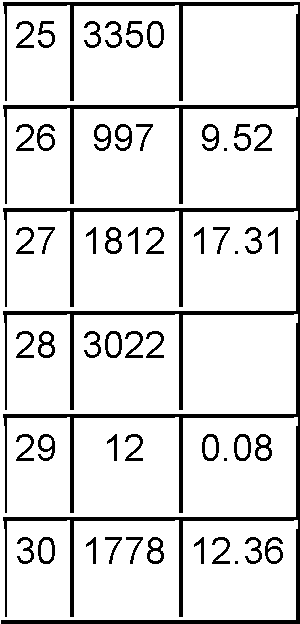
Tabla 36: Resumen de TNF5Table 36: Summary of TNF5

Tabla 37 : Valores en bruto de TNF6Table 37 : Raw values of TNF6
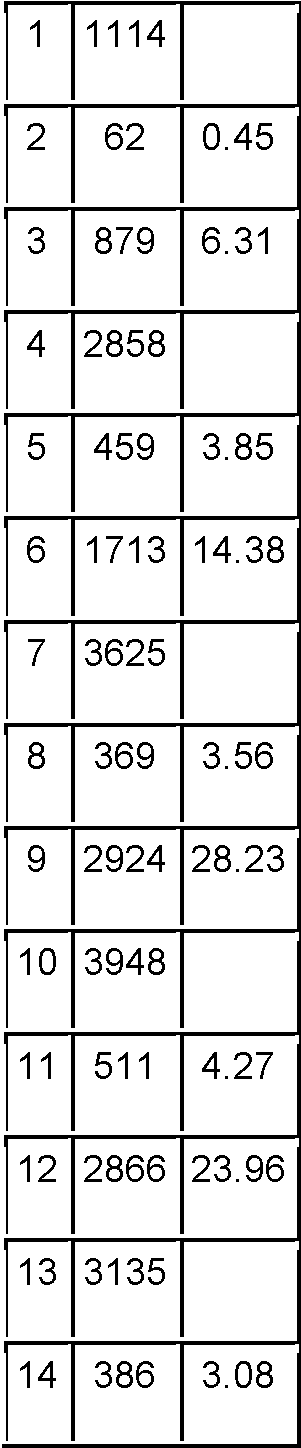

Tabla 38: Resumen de TNF6Table 38: Summary of TNF6

Tabla 39: Valores en bruto de TNS7Table 39: Raw values of TNS7


Tabla 40: Resumen de TNS7 Table 40: TNS7 Summary

Tabla 41: Valores en bruto de TNS8Table 41: Raw values of TNS8


Tabla 42: Resumen de TNS8Table 42: TNS8 Summary

Tabla 43: Valores en bruto de TNF7Table 43: Raw values of TNF7


Tabla 44: Resumen de TNF7Table 44: Summary of TNF7

Tabla 45: Valores en bruto de TNF8Table 45: Raw values of TNF8
1 1553 
2 572 2.58

30 1731 14.3530 1731 14.35
Tabla 46: Resumen de TNF8Table 46: Summary of TNF8

Tabla 47: Valores en bruto de TNS9Table 47: Raw values of TNS9


Tabla 48: Resumen de TNS9Table 48: Summary of TNS9

Tabla 49: Valores en bruto de TNS10Table 49: Raw values of TNS10


Tabla 50: Resumen de TNS10Table 50: TNS10 Summary

IS/LV 26 % Tabla 51: Valores en bruto de TNF9IS/LV 26% Table 51: TNF9 Raw Values


Tabla 52: Resumen de TNF9Table 52: Summary of TNF9

Tabla 53: Valores en bruto de TNF10Table 53: TNF10 Raw Values


Tabla 54: Resumen de TNF10Table 54: Summary of TNF10

Tabla 55: Datos de imagen compuestaTable 55: Composite Image Data
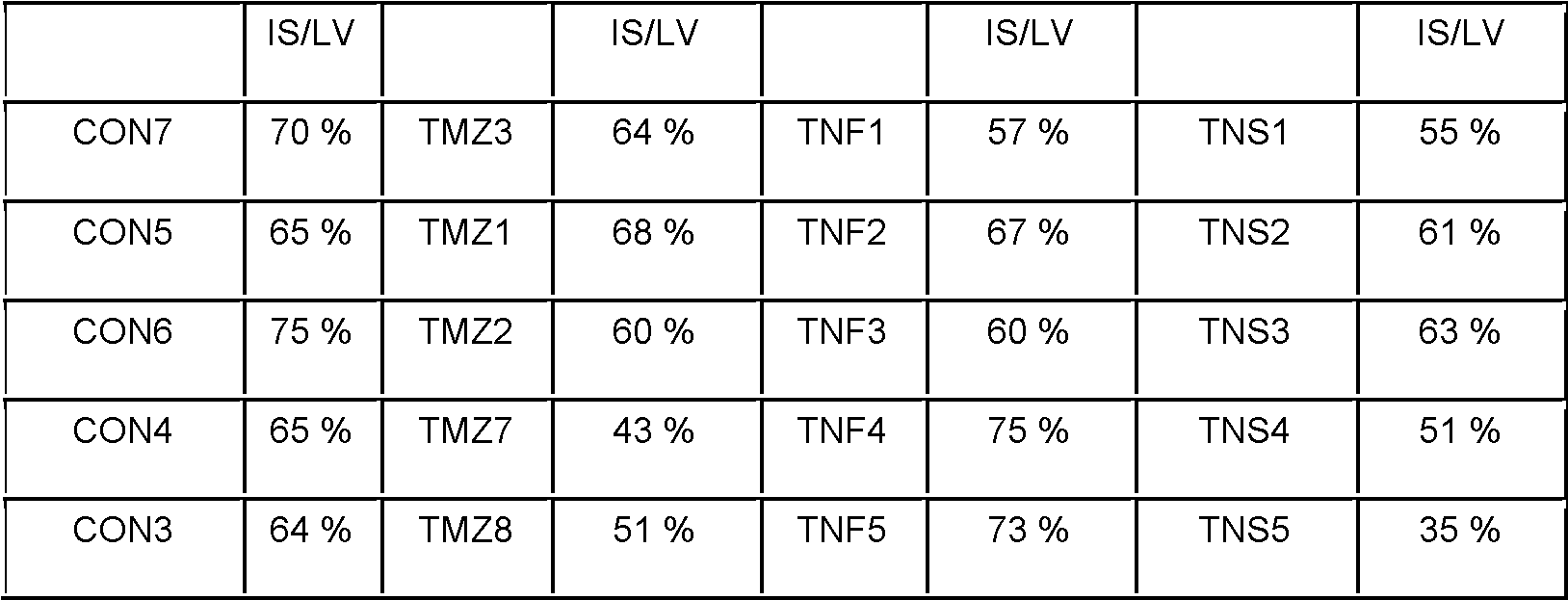

Los resultados muestran que una combinación de trimetazidina, nicotinamida y succinato a 20 pM preservó el flujo coronario y la recuperación funcional cardíaca y disminuyó el tamaño del infarto en corazones aislados después de la isquemia-reperfusión. Esta combinación fue más efectiva para disminuir el tamaño del infarto que TMZ único. Una combinación de trimetazidina, nicotinamida y succinato a 2 pM no pareció disminuir la lesión miocárdica por isquemiareperfusión.The results show that a combination of trimetazidine, nicotinamide, and succinate at 20 pM preserved coronary flow and cardiac functional recovery and decreased infarct size in isolated hearts after ischemia-reperfusion. This combination was more effective in reducing infarct size than TMZ alone. A combination of trimetazidine, nicotinamide, and succinate at 2 pM did not appear to reduce myocardial ischemia-reperfusion injury.
Este estudio sugirió que la combinación de trimetazidina, nicotinamida y succinato a 20 pM generó una mejor protección contra la lesión por isquemia-reperfusión en el sistema de Langendorff.This study suggested that the combination of trimetazidine, nicotinamide, and succinate at 20 pM provided better protection against ischemia-reperfusion injury in the Langendorff system.
La figura 43 es un esquema del método usado para analizar los efectos de las composiciones de la divulgación sobre la función cardíaca. Después de la constricción aórtica transversal (TAC) o de un procedimiento simulado, a los ratones se les administró uno de los siguientes a través de una minibomba osmótica: CV8814 a 5.85 mg/kg/día (CV4); CV8814 a 5.85 mg/kg/día, ácido nicotínico a 1.85 mg/kg/día y succinato a 2.43 mg/kg/día (TV8); o solución salina (SA). Los ecocardiogramas se midieron inmediatamente después de TAC, tres semanas después de TAC y 6 semanas después de TAC. Los ratones se sacrificaron a las 6 semanas y se analizaron los tejidos.Figure 43 is a schematic of the method used to test the effects of the compositions of the disclosure on cardiac function. Following transverse aortic constriction (TAC) or a sham procedure, mice were administered one of the following via an osmotic minipump: CV8814 at 5.85 mg/kg/day (CV4); CV8814 at 5.85 mg/kg/day, nicotinic acid at 1.85 mg/kg/day, and succinate at 2.43 mg/kg/day (TV8); or saline (SA). Echocardiograms were measured immediately after CT scan, three weeks after CT scan, and 6 weeks after CT scan. Mice were sacrificed at 6 weeks and tissues were analyzed.
La figura 44 muestra corazones de ratones seis semanas después de un procedimiento simulado (SIMULADO), TAC seguido de administración de solución salina (TAC), TAC seguido de administración de CV4 (CV4) o TAC seguido de administración de TV8.Figure 44 shows mouse hearts six weeks after a sham procedure (SAMULATED), CT followed by administration of saline (CT), CT followed by administration of CV4 (CV4), or CT followed by administration of TV8.
La figura 45 es un gráfico del peso del corazón en relación con el peso corporal seis semanas después de la constricción aórtica transversal. Los tratamientos son como se indica en relación con la fig. 44.Figure 45 is a graph of heart weight relative to body weight six weeks after transverse aortic constriction. Treatments are as indicated in relation to fig. 44.
La figura 46 es un gráfico del peso del corazón seis semanas después de la constricción aórtica transversa. Los tratamientos son como se indica en relación con la fig. 44.Figure 46 is a graph of heart weight six weeks after transverse aortic constriction. Treatments are as indicated in relation to fig. 44.
La figura 47 muestra gráficos de acortamiento fraccional (FS) y fracción de eyección (EF) en puntos de tiempo indicados después de la constricción aórtica transversal. Los tratamientos son como se indica en relación con la fig.Figure 47 shows plots of fractional shortening (FS) and ejection fraction (EF) at indicated time points after transverse aortic constriction. Treatments are as indicated in relation to fig.
44. 44.
La figura 48 es un gráfico del diámetro sistólico final del ventrículo izquierdo en los puntos de tiempo indicados después de la constricción aórtica transversal. Los tratamientos son como se indica en relación con la fig. 44.Figure 48 is a graph of left ventricular end systolic diameter at the indicated time points after transverse aortic constriction. Treatments are as indicated in relation to fig. 44.
La figura 49 es un gráfico de la dimensión del tabique intraventricular en puntos de tiempo indicados después de la constricción aórtica transversal. Los tratamientos son como se indica en relación con la fig. 44.Figure 49 is a graph of intraventricular septal dimension at indicated time points after transverse aortic constriction. Treatments are as indicated in relation to fig. 44.
La figura 50 es un gráfico de la masa ventricular izquierda en los puntos de tiempo indicados después de la constricción aórtica transversal. Los tratamientos son como se indica en relación con la fig. 44.Figure 50 is a graph of left ventricular mass at the indicated time points after transverse aortic constriction. Treatments are as indicated in relation to fig. 44.
La figura 51 es un gráfico del tiempo de relajación isovolumétrica en puntos de tiempo indicados después de la constricción aórtica transversal. Los tratamientos son como se indica en relación con la fig. 44.Figure 51 is a graph of isovolumic relaxation time at indicated time points after transverse aortic constriction. Treatments are as indicated in relation to fig. 44.
La figura 52 es un gráfico de la proporción de flujo de velocidad máxima en la diástole temprana frente a la diástole tardía en puntos de tiempo indicados después de la constricción aórtica transversal. Los tratamientos son como se indica en relación con la fig. 44.Figure 52 is a plot of peak velocity flow ratio in early diastole versus late diastole at indicated time points after transverse aortic constriction. Treatments are as indicated in relation to fig. 44.
La figura 53 es un gráfico de la presión desarrollada en el ventrículo izquierdo seis semanas después de la constricción aórtica transversal. Los tratamientos son como se indica en relación con la fig. 44.Figure 53 is a graph of the pressure developed in the left ventricle six weeks after transverse aortic constriction. Treatments are as indicated in relation to fig. 44.
La figura 54 es un gráfico de la tasa de aumento de la presión del ventrículo izquierdo seis semanas después de la constricción aórtica transversal. Los tratamientos son como se indica en relación con la fig. 44.Figure 54 is a graph of the rate of increase in left ventricular pressure six weeks after transverse aortic constriction. Treatments are as indicated in relation to fig. 44.
Esquemas de síntesis química.Chemical synthesis schemes.
Los compuestos de la divulgación incluyen 2-(4-(2,3,4-trimetoxibencil)piperazin-1-il)etano-1-ol (denominado en este documento CV8814) y los compuestos de la invención incluyen nicotinato de 2-(4-(2,3,4-trimetoxibencil)piperazin-1-il)etilo (denominado en este documento CV-8972). Estos compuestos se pueden sintetizar según el siguiente esquema:Compounds of the disclosure include 2-(4-(2,3,4-trimethoxybenzyl)piperazin-1-yl)ethane-1-ol (referred to herein as CV8814) and compounds of the invention include 2-( 4-(2,3,4-trimethoxybenzyl)piperazin-1-yl)ethyl (referred to herein as CV-8972). These compounds can be synthesized according to the following scheme:
Etapa 1:Stage 1:

2.3.4- 2-(4-(2,3,4-tri m etoxi b e n ci I: trimetoxibenzaldehido 2-(piperaiin-1-il)etan-1ül piperaun-1-il;etan-1-ol2.3.4- 2-(4-(2,3,4-tri m ethoxy benzyl I:trimethoxybenzaldehyde 2-(piperain-1-yl)ethan-1ül piperaun-1-yl;ethan-1-ol

2-( 4-(2,3,4-tri m etoxi b e n ci I; piperazin-1 -il)etan-1 -ol Di HCI C1SH?8N,CI204= 383.312-( 4-(2,3,4-tri m ethoxy benz ci I; piperazin-1 -yl) ethan-1 -ol Di HCl C 1 SH? 8 N,CI 2 04= 383.31
CV8814 CV8814

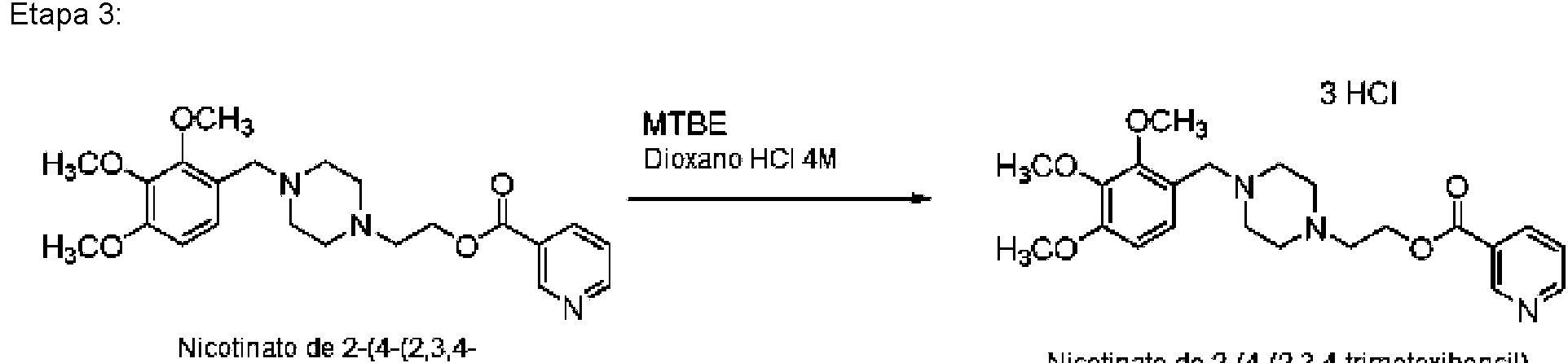
- - , , -trimetoxibencil jpiperazin- - , , -trimethoxybenzyl jpiperazin
-1-n; etilo piperazin-l-il)etilo 
CV8972CV8972
El producto se convirtió en el polimorfo deseado por recristalización. El porcentaje de agua y la proporción metanol:metil etil cetona (MEK) se variaron en diferentes lotes usando 2.5 g de producto.The product was converted to the desired polymorph by recrystallization. The water percentage and the methanol:methyl ethyl ketone (MEK) ratio were varied in different batches using 2.5 g of product.
En el lote MBA 25, 5 % de agua w/r/t del volumen total de disolvente (23 volúmenes) que contiene 30 % de metanol: se usó MEK al 70 % para la precipitación. El rendimiento fue del 67 % de monohidrato de CV-8972. Se determinó por KF que el contenido de agua era del 3.46 %.In MBA batch 25, 5% water w/r/t of total solvent volume (23 volumes) containing 30% methanol: 70% MEK was used for precipitation. The yield was 67% CV-8972 monohydrate. The water content was determined by KF to be 3.46%.
En el lote MBA 26, 1.33 % de agua w/r/t del volumen total de disolvente (30 volúmenes) que contiene 20 % de metanol: Se usó MEK al 80 % para la precipitación. El rendimiento fue del 86.5 % de monohidrato de CV-8972. Se determinó por KF que el contenido de agua era del 4.0 %. El producto se secó al vacío a 40 °C, durante 24 horas para disminuir el contenido de agua al 3.75 %.In MBA batch 26, 1.33% water w/r/t of total solvent volume (30 volumes) containing 20% methanol: 80% MEK was used for precipitation. The yield was 86.5% CV-8972 monohydrate. The water content was determined by KF to be 4.0%. The product was vacuum dried at 40 °C for 24 hours to reduce the water content to 3.75%.
En el lote MBA 27, 3 % agua w/r/t del volumen total de disolvente (32 volúmenes) que contiene 22 % metanol: Se usó MEK al 78 % para la precipitación. El rendimiento fue del 87.22 % de monohidrato de CV-8972. Se determinó por KF que el contenido de agua era del 3.93 % después de 18 horas de secado a temperatura ambiente al vacío. El producto se secó adicionalmente al vacío a 40 °C, durante 24 horas para disminuir el contenido de agua al 3.54 %.In MBA batch 27, 3% water w/r/t of total solvent volume (32 volumes) containing 22% methanol: 78% MEK was used for precipitation. The yield was 87.22% CV-8972 monohydrate. The water content was determined by KF to be 3.93% after 18 hours of drying at room temperature under vacuum. The product was further vacuum dried at 40 °C for 24 hours to decrease the water content to 3.54%.
En otros lotes, la proporción y el volumen total de disolvente se mantuvieron constantes al 20 % de metanol: 80 % MEK y 30 volúmenes en lotes usando 2.5 g de producto, y solamente se varió el porcentaje de agua. In other batches, the proportion and total volume of solvent were kept constant at 20% methanol: 80% MEK and 30 volumes in batches using 2.5 g of product, and only the percentage of water was varied.
En el lote MBA 29, se agregó 1.0 equivalente de agua. El material se aisló y se secó al vacío a 40 °C, durante 24 horas. Se determinó por KF que el contenido de agua era del del 0.89 %, lo que muestra que la forma de monohidrato no se estaba formando estequiométricamente.In batch MBA 29, 1.0 equivalent of water was added. The material was isolated and dried under vacuum at 40°C for 24 hours. The water content was determined by KF to be 0.89%, showing that the monohydrate form was not forming stoichiometrically.
En el lote MBA 30, se agregó un 3 % de agua. El material se aisló y se secó al vacío a 40 °C, durante 24 horas. Se determinó por KF que el contenido de agua era del 3.51 %, lo que muestra que se está formando monohidrato con la adición de un exceso de agua.In batch MBA 30, 3% water was added. The material was isolated and dried under vacuum at 40°C for 24 hours. The water content was determined by KF to be 3.51%, showing that monohydrate is being formed with the addition of excess water.
En el lote MBA 31, se agregó un 5 % de agua. El material se aisló y se secó al vacío a 40 °C, durante 24 horas. Se determinó por KF que el contenido de agua era del 3.30 %, lo que muestra que se está formando monohidrato con la adición de un exceso de agua.In batch MBA 31, 5% water was added. The material was isolated and dried under vacuum at 40°C for 24 hours. The water content was determined by KF to be 3.30%, showing that monohydrate is being formed with the addition of excess water.
Los resultados se resumen en la tabla 56. The results are summarized in table 56.

Metabolismo de compuestos en perros.Compound metabolism in dogs.
Se analizó el metabolismo de diversos compuestos en perros.The metabolism of various compounds in dogs was analyzed.
La figura 55 es un gráfico que muestra los niveles de CV-8814 (triángulos sólidos, líneas continuas) y trimetazidina (triángulos vacíos, líneas discontinuas) después de la administración intravenosa de CV-8834 a 2.34 mg/kg. CV-8834 es un compuesto de fórmula (II) en la que y = 1.Figure 55 is a graph showing the levels of CV-8814 (solid triangles, solid lines) and trimetazidine (open triangles, dashed lines) after intravenous administration of CV-8834 at 2.34 mg/kg. CV-8834 is a compound of formula (II) where y = 1.
La figura 56 es un gráfico que muestra los niveles de CV-8814 (triángulos sólidos, líneas continuas) y trimetazidina (triángulos vacíos, líneas discontinuas) después de la administración oral de CV-8834 a 77.4 mg/kg.Figure 56 is a graph showing the levels of CV-8814 (solid triangles, solid lines) and trimetazidine (open triangles, dashed lines) after oral administration of CV-8834 at 77.4 mg/kg.
La figura 57 es un gráfico que muestra los niveles de CV-8814 (triángulos sólidos, líneas continuas) y trimetazidina (triángulos vacíos, líneas discontinuas) después de la administración oral de CV-8834 a 0.54 mg/kg.Figure 57 is a graph showing the levels of CV-8814 (solid triangles, solid lines) and trimetazidine (open triangles, dashed lines) after oral administration of CV-8834 at 0.54 mg/kg.
La figura 58 es un gráfico que muestra los niveles de CV-8814 (triángulos sólidos, líneas continuas) y trimetazidina (triángulos vacíos, líneas discontinuas) después de la administración oral de CV-8834 a 1.08 mg/kg.Figure 58 is a graph showing the levels of CV-8814 (solid triangles, solid lines) and trimetazidine (open triangles, dashed lines) after oral administration of CV-8834 at 1.08 mg/kg.
La figura 59 es un gráfico que muestra los niveles de CV-8814 (triángulos sólidos, líneas continuas) y trimetazidina (triángulos vacíos, líneas discontinuas) después de la administración oral de CV-8834 a 2.15 mg/kg.Figure 59 is a graph showing the levels of CV-8814 (solid triangles, solid lines) and trimetazidine (open triangles, dashed lines) after oral administration of CV-8834 at 2.15 mg/kg.
Los datos de las figuras 55-59 se resume en la tabla 57.The data from Figures 55-59 is summarized in Table 57.
Tabla 57Table 57

La figura 60 es un gráfico que muestra los niveles de trimetazidina después de la administración oral de CV-8972 a 1.5 mg/kg (triángulos) o la administración intravenosa de trimetazidina a 2 mg/kg (cuadrados).Figure 60 is a graph showing trimetazidine levels after oral administration of CV-8972 at 1.5 mg/kg (triangles) or intravenous administration of trimetazidine at 2 mg/kg (squares).
La figura 61 es un gráfico que muestra los niveles de CV-8814 después de la administración oral de CV-8972 a 1.5 mg/kg (triángulos) o la administración intravenosa de CV-8814 a 2.34 mg/kg (cuadrados).Figure 61 is a graph showing CV-8814 levels after oral administration of CV-8972 at 1.5 mg/kg (triangles) or intravenous administration of CV-8814 at 2.34 mg/kg (squares).
La figura 62 es un gráfico que muestra los niveles de CV-8814 después de la administración intravenosa de CV-8834 a 4.3 mg/kg (cuadrados) o la administración oral de CV-8834 a 2.15 mg/kg (triángulos).Figure 62 is a graph showing CV-8814 levels after intravenous administration of CV-8834 at 4.3 mg/kg (squares) or oral administration of CV-8834 at 2.15 mg/kg (triangles).
La figura 63 es un gráfico que muestra los niveles de CV-8814 después de la administración intravenosa de CV-8814 a 2.34 mg/kg (cuadrados) o la administración oral de CV-8814 a 2.34 mg/kg (triángulos).Figure 63 is a graph showing CV-8814 levels after intravenous administration of CV-8814 at 2.34 mg/kg (squares) or oral administration of CV-8814 at 2.34 mg/kg (triangles).
Los datos de las figuras 60-63 se resume en la tabla 58. The data from Figures 60-63 is summarized in Table 58.
Tabla 58.Table 58.

Efecto de CV-8814 sobre la actividad enzimáticaEffect of CV-8814 on enzyme activity
El efecto de CV-8814 sobre la actividad de diversas enzimas se analizó en ensayos in vitro. La actividad enzimática se analizó en presencia de CV-8814 10 pM usando condiciones de tiempo, temperatura, sustrato y solución reguladora que se optimizaron para cada enzima en base a la bibliografía publicada. No se observó una inhibición del 50 % o superior para ninguna de las siguientes enzimas: ATPasa, Na+/K+, corazón de cerdo; colinesterasa, acetilo, ACES, humana; ciclooxigenasa COX-1, humana; ciclooxigenasa COX-2, humana; monoaminooxidasa MAO-A, humana; monoaminooxidasa MAO-B, humana; peptidasa, enzima convertidora de angiotensina, conejo; peptidasa, CTSG (catepsina G), humana; fosfodiesterasa PDE3, humana; Fosfodiesterasa PDE4, humana; proteína serina/treonina quinasa, PKC, no selectiva, rata; proteína tirosina quinasa, receptor de insulina, humano; proteína tirosina quinasa, LCK, humana; adenosina A1, humana; Adenosina A2A, humana; adrenérgico a-iA, rata; adrenérgico a-m, rata; adrenérgico a1D, humano; adrenérgico a2A, humano; adrenérgico a2B, humano; adrenérgico p1, humano; adrenérgico p2, humano; andrógeno (testosterona), humano; angiotensina AT1, humano; bradicinina B2, humano; canal de calcio tipo L, benzotiazepina, rata; canal de calcio tipo L, dihidropiridina, rata; canal de calcio tipo L, fenilalquilamina, rata; canal de calcio tipo N, rata; cannabinoide CB1, humano; cannabinoide CB2, humano; quimiocina CCR1, humana; quimiocina CXCR2 (IL-8Rb), humana; colecistoquinina CCK1 (CCKa), humano; colecistoquinina CCK2 (CCKb), humano; dopamina D1, humano; dopamina D2L, humano; dopamina D2S, humano; endotelina eTa, humana; estrógeno ERa, humano; GABAa, canal de cloruro, TBOB, rata; GABAa, Flunitrazepam, Central, rata; GABAa, Ro-15-1788, hipocampo, rata; GABAb1a, humana; glucocorticoide humano; glutamato, AMPA, rata; glutamato, Kainato, rata; glutamato, metabotrópico, mGlu5, humano; glutamato, NMDA, agonismo, rata; glutamato, NMDA, glicina, rata; glutamato, NMDA, fenciclidina, rata; glutamato, NMDA, poliamina, rata; glicina, estricnina-sensible, rata; histamina H1, humana; Histamina H2, humana; melanocortina MC1, humana; melanocortina MC4, humana; Muscarínico M1, humano; Muscarínico M2, humano; Muscarínico M3, humano; Muscarínico M4, humano; Neuropéptido YY1, humano; acetilcolina nicotínica humana; acetilcolina nicotínica a1, bungarotoxina humana; Opiáceo 81 (Op1, DOP), humano; Opiáceo k (OP2, KOP), humano; Opiáceo p (OP3, MOP), humano; factor activador de plaquetas (PAF), humano; canal de potasio [KATP], hámster; canal de potasio hERG, humano; PPARy, humano; progesterona PR-B, humana; Serotonina (5-hidroxitriptamina) 5 -HT1A, humana; Serotonina (5-hidroxitriptamina) 5 -HT1B, humana; Serotonina (5-hidroxitriptamina) 5-HT2A, humana; Serotonina (5-hidroxitriptamina) 5-HT2B, humana; Serotonina (5-hidroxitriptamina) 5-HT2C, humana; Serotonina (5-hidroxitriptamina) 5 -HT3, humana; canal de sodio, sitio 2, rata; Taquiquinina NK1, humana; transportador, adenosina, conejillo de indias; transportador, Dopamina (DAT), humana; transportador, GABA, rata; transportador, norepinefrina (NET), humana; Transportador, serotonina (5-hidroxitriptamina) (SERT), humana; y vasopresina V ia , humana.The effect of CV-8814 on the activity of various enzymes was analyzed in in vitro assays. Enzyme activity was assayed in the presence of 10 pM CV-8814 using time, temperature, substrate, and buffer conditions that were optimized for each enzyme based on published literature. Inhibition of 50% or greater was not observed for any of the following enzymes: ATPase, Na+/K+, pig heart; cholinesterase, acetyl, ACES, human; COX-1 cyclooxygenase, human; COX-2 cyclooxygenase, human; MAO-A monoamine oxidase, human; MAO-B monoamine oxidase, human; peptidase, angiotensin converting enzyme, rabbit; peptidase, CTSG (cathepsin G), human; PDE3 phosphodiesterase, human; PDE4 phosphodiesterase, human; serine/threonine protein kinase, PKC, non-selective, rat; protein tyrosine kinase, insulin receptor, human; protein tyrosine kinase, LCK, human; adenosine A1, human; Adenosine A 2 A, human; a-iA adrenergic, rat; adrenergic am, rat; 1 D adrenergic, human; 2A -adrenergic, human; 2 B adrenergic, human; p 1 -adrenergic, human; p 2 -adrenergic, human; androgen (testosterone), human; angiotensin AT 1 , human; bradykinin B 2 , human; L-type calcium channel, benzothiazepine, rat; L-type calcium channel, dihydropyridine, rat; L-type calcium channel, phenylalkylamine, rat; N-type calcium channel, rat; cannabinoid CB 1 , human; cannabinoid CB 2 , human; CCR1 chemokine, human; CXCR chemokine 2 (IL-8R b ), human; cholecystokinin CCK 1 (CCK a ), human; cholecystokinin CCK 2 (CCK b ), human; dopamine D 1 , human; dopamine D 2 L, human; dopamine D 2 S, human; eTa endothelin, human; estrogen ERa, human; GABAa , chloride channel, TBOB, rat; GABA a , Flunitrazepam, Central, rat; GABA a , Ro-15-1788, hippocampus, rat; GABA b1a , human; human glucocorticoid; glutamate, AMPA, rat; glutamate, Kainate, rat; glutamate, metabotropic, mGlu5, human; glutamate, NMDA, agonism, rat; glutamate, NMDA, glycine, rat; glutamate, NMDA, phencyclidine, rat; glutamate, NMDA, polyamine, rat; glycine, strychnine-sensitive, rat; histamine H 1 , human; Histamine H 2 , human; melanocortin MC 1 , human; melanocortin MC 4 , human; Muscarinic M 1 , human; Muscarinic M 2 , human; Muscarinic M 3 , human; Muscarinic M 4 , human; Neuropeptide YY 1 , human; human nicotinic acetylcholine; nicotinic acetylcholine a1, human bungarotoxin; Opioid 81 (Op1, DOP), human; Opioid k (OP2, KOP), human; Opioid p (OP3, MOP), human; platelet activating factor (PAF), human; potassium channel [KATP], hamster; hERG potassium channel, human; PPARy , human; progesterone PR-B, human; Serotonin (5-hydroxytryptamine) 5 -HT 1 A, human; Serotonin (5-hydroxytryptamine) 5 -HT 1 B, human; Serotonin (5-hydroxytryptamine) 5-HT2A, human; Serotonin (5-hydroxytryptamine) 5-HT2B, human; Serotonin (5-hydroxytryptamine) 5-HT2C, human; Serotonin (5-hydroxytryptamine) 5 -HT 3 , human; sodium channel, site 2, rat; Tachykinin NK 1 , human; conveyor, adenosine, guinea pig; transporter, Dopamine (DAT), human; transporter, GABA, rat; transporter, norepinephrine (NET), human; Transporter, serotonin (5-hydroxytryptamine) (SERT), human; and vasopressin V ia , human.
Análisis de las propiedades del lote CV-8972Analysis of the properties of lot CV-8972
Se preparó y analizó CV-8972 (nicotinato de 2-(4-(2,3,4-trimetoxibencil)piperazin-1-il)etilo, sal de HCl, monohidrato). Se determinó que el lote tenía una pureza del 99.62 % mediante HPLC.CV-8972 (2-(4-(2,3,4-trimethoxybenzyl)piperazin-1-yl)ethyl nicotinate, HCl salt, monohydrate) was prepared and tested. The batch was determined to be 99.62% pure by HPLC.
La figura 64 es un gráfico que muestra el perfil de elución de HPLC de un lote de CV-8972.Figure 64 is a graph showing the HPLC elution profile of a batch of CV-8972.
La figura 65 es un gráfico que muestra el análisis de las especies moleculares presentes en un lote de CV-8972. La figura 66 es un par de gráficos que muestran perfiles de elución de HPLC de especies moleculares presentes en un lote de CV-8972.Figure 65 is a graph showing the analysis of the molecular species present in a batch of CV-8972. Figure 66 is a pair of graphs showing HPLC elution profiles of molecular species present in a batch of CV-8972.
La figura 67 es un par de gráficos que muestran perfiles de elución de HPLC de especies moleculares presentes en un lote de CV-8972.Figure 67 is a pair of graphs showing HPLC elution profiles of molecular species present in a batch of CV-8972.
La figura 68 es un gráfico que muestra el análisis de difracción de rayos X en polvo de un lote de CV-8972.Figure 68 is a graph showing X-ray powder diffraction analysis of a batch of CV-8972.
La figura 69 es un gráfico que muestra el análisis de difracción de rayos X en polvo de lotes de CV-8972. El lote 289-MBA-15-A, que se muestra en azul, contiene la forma B de CV-8972, el lote 276-MBA-172, que se muestra en negro, contiene la forma A de CV-8972 y el lote 289-MBA-16, que se muestra en rojo, contiene una mezcla de las formas A y B.Figure 69 is a graph showing X-ray powder diffraction analysis of batches of CV-8972. Lot 289-MBA-15-A, shown in blue, contains Form B of CV-8972, Lot 276-MBA-172, shown in black, contains Form A of CV-8972, and Lot 289-MBA-16, shown in red, contains a mixture of forms A and B.
La figura 70 es un gráfico que muestra la calorimetría de barrido diferencial y el análisis gravimétrico térmico del lote 276-MBA-172 de CV-8972.Figure 70 is a graph showing differential scanning calorimetry and thermal gravimetric analysis of CV-8972 lot 276-MBA-172.
La figura 71 es un gráfico que muestra la sorción dinámica de vapor (DVS) del lote 276-MBA-172 de CV-8972. La figura 72 es un gráfico que muestra la calorimetría de barrido diferencial y el análisis gravimétrico térmico del lote 289-MBA-15-A de CV-8972.Figure 71 is a graph showing the dynamic vapor sorption (DVS) of CV-8972 lot 276-MBA-172. Figure 72 is a graph showing differential scanning calorimetry and thermal gravimetric analysis of CV-8972 lot 289-MBA-15-A.
La figura 73 es un gráfico que muestra la sorción dinámica de vapor (DVS) del lote 289-MBA-15-A de CV-8972. La figura 74 es un gráfico que muestra el análisis de difracción de rayos X en polvo de muestras de CV-8972. Una muestra previa a DVS del lote 276-MBA-172 se muestra en azul, una muestra previa a DVS del lote 289-MBA-15-A se muestra en rojo y una muestra posterior a DVS del lote 289-MBA-15- A se muestra en negro.Figure 73 is a graph showing the dynamic vapor sorption (DVS) of CV-8972 lot 289-MBA-15-A. Figure 74 is a graph showing X-ray powder diffraction analysis of CV-8972 samples. A pre-DVS sample from lot 276-MBA-172 is shown in blue, a pre-DVS sample from lot 289-MBA-15-A is shown in red, and a post-DVS sample from lot 289-MBA-15-A shown in black.
La figura 75 es un gráfico que muestra la calorimetría de barrido diferencial y el análisis gravimétrico térmico del lote 289-MBA-16 de CV-8972.Figure 75 is a graph showing differential scanning calorimetry and thermal gravimetric analysis of CV-8972 lot 289-MBA-16.
La figura 76 es un gráfico que muestra el análisis de difracción de rayos X en polvo de muestras de CV-8972. La forma B se muestra en verde, la forma A se muestra en azul, una muestra de una lechada de etanol del lote 289-MBA-15-A se muestra en rojo y una muestra de una lechada de etanol del lote 289-MBA-16 se muestra en negro.Figure 76 is a graph showing X-ray powder diffraction analysis of CV-8972 samples. Form B is shown in green, Form A is shown in blue, a sample of an ethanol slurry from lot 289-MBA-15-A is shown in red, and a sample of an ethanol slurry from lot 289-MBA-15-A. 16 is shown in black.
Se analizó la estabilidad de CV-8972.CV-8972 was tested for stability.
Las muestras del lote 289-MBA-15-A (que contiene la forma B) se agregaron a diversos disolventes, se incubaron en diversas condiciones y se analizaron mediante difracción de rayos X en polvo. Los resultados se resumen en la tabla 59.Samples from lot 289-MBA-15-A (containing Form B) were added to various solvents, incubated under various conditions, and analyzed by X-ray powder diffraction. The results are summarized in table 59.
Tabla 59.Table 59.


Se agregaron muestras del lote 289-MBA-16 (que contenía las formas A y B) a diversos disolventes, se incubaron en diversas condiciones y se analizaron mediante difracción de rayos X en polvo. Los resultados se resumen en la tabla 60.Samples from lot 289-MBA-16 (containing Forms A and B) were added to various solvents, incubated under various conditions, and analyzed by X-ray powder diffraction. The results are summarized in table 60.
Tabla 60.Table 60.

La figura 77 es un gráfico que muestra el análisis de difracción de rayos X en polvo de muestras de CV-8972. Una muestra que contiene la forma B se muestra en azul, una muestra que contiene la forma A se muestra en rojo y una muestra que contiene una mezcla de las formas A y C se muestra en negro.Figure 77 is a graph showing X-ray powder diffraction analysis of CV-8972 samples. A sample containing form B is shown in blue, a sample containing form A is shown in red, and a sample containing a mixture of forms A and C is shown in black.
Se analizó la estabilidad de CV-8972. Las muestras acuosas que contenían CV-8972 a diferentes concentraciones y pH se incubaron durante diversos periodos y se analizaron. Los resultados se muestran en la tabla 61.CV-8972 was tested for stability. Aqueous samples containing CV-8972 at different concentrations and pH were incubated for various periods and analyzed. The results are shown in table 61.
Tabla 61.Table 61.


Se agregaron muestras del lote S-18-0030513 (que contenía la forma A) a diversos disolventes, se incubaron en diversas condiciones y se analizaron mediante difracción de rayos X en polvo. Los resultados se resumen en la tabla 62.Samples from lot S-18-0030513 (containing Form A) were added to various solvents, incubated under various conditions and analyzed by X-ray powder diffraction. The results are summarized in table 62.
Tabla 62.Table 62.


Se agregaron muestras del lote 289-MBA-16 (que contenía las formas A y B) a diversos disolventes, se incubaron en diversas condiciones y se analizaron mediante difracción de rayos X en polvo. Los resultados se resumen en la tabla 63.Samples from lot 289-MBA-16 (containing Forms A and B) were added to various solvents, incubated under various conditions, and analyzed by X-ray powder diffraction. The results are summarized in table 63.
Tabla 63.Table 63.

La figura 78 es un gráfico que muestra la calorimetría de barrido diferencial y el análisis gravimétrico térmico de muestras que contienen la forma A de CV-8972. Una muestra de una lechada de agua y acetato de etanol se muestra con líneas continuas, una muestra de una lechada de agua con metanol se muestra con líneas discontinuas regulares y una muestra de una lechada de agua con etanol se muestra con líneas discontinuas.Figure 78 is a graph showing differential scanning calorimetry and thermal gravimetric analysis of samples containing Form A of CV-8972. A sample of a water-ethanol acetate slurry is shown with solid lines, a sample of a water-methanol slurry is shown with regular dashed lines, and a sample of a water-ethanol slurry is shown with dashed lines.
La figura 79 es un gráfico que muestra la calorimetría de barrido diferencial y el análisis gravimétrico térmico de una muestra que contiene la forma A de CV-8972. Antes del análisis, la muestra se secó a 100 °C, durante 20 minutos. Figure 79 is a graph showing differential scanning calorimetry and thermal gravimetric analysis of a sample containing CV-8972 Form A. Before analysis, the sample was dried at 100 °C for 20 minutes.
Se analizó la estabilidad de las muestras que contenían la forma A de CV-8972 en respuesta a la humedad. Las muestras se incubaron a 40 °C, 75 % de humedad relativa durante diversos periodos y se analizaron. Los resultados se muestran en la tabla 64.Samples containing CV-8972 Form A were tested for stability in response to moisture. Samples were incubated at 40°C, 75% relative humidity for various periods and analyzed. The results are shown in table 64.
Tabla 64.Table 64.

Se analizó la estabilidad en solución acuosa de la forma A de CV-8972. Las muestras acuosas que contenían CV-8972 a diferentes concentraciones y pH se incubaron durante diversos periodos y se analizaron. Los resultados se muestran en la tabla 65. CV-8972 Form A was tested for stability in aqueous solution. Aqueous samples containing CV-8972 at different concentrations and pH were incubated for various periods and analyzed. The results are shown in table 65.
Tabla 65.Table 65.

Se analizó la cantidad de CV-8972 presente en diversas composiciones de dosificación. Los resultados se muestran en la tabla 66.The amount of CV-8972 present in various dosage compositions was analyzed. The results are shown in table 66.
Tabla 66.Table 66.

Proporción cerebro-plasma de compuestos in vivoBrain-plasma ratio of compounds in vivo
La proporción cerebro-plasma de trimetazidina y CV-8814 se analizó después de la administración intravenosa de los compuestos a ratas. Las soluciones de dosificación se analizaron mediante espectrometría de masas en tándem de cromatografía líquida (LC-MS/MS). Los resultados se muestran en la tabla 67. The brain-plasma ratio of trimetazidine and CV-8814 was analyzed after intravenous administration of the compounds to rats. Dosing solutions were analyzed by liquid chromatography tandem mass spectrometry (LC-MS/MS). The results are shown in table 67.
Tabla 67.Table 67.

Las concentraciones de los compuestos en el cerebro y el plasma se analizaron 2 horas después de administrar los compuestos a 1 mg/kg a las ratas. Los resultados de las ratas tratadas con trimetazidina se muestran en la tabla 68. Los resultados de las ratas tratadas con CV-8814 se muestran en la tabla 69.Brain and plasma concentrations of the compounds were analyzed 2 hours after administering the compounds at 1 mg/kg to the rats. The results for the trimetazidine-treated rats are shown in Table 68. The results for the CV-8814-treated rats are shown in Table 69.
Tabla 68: Ratas tratadas con TMZTable 68: Rats treated with TMZ

Tabla 69: Ratas tratadas con CV-8814Table 69: Rats treated with CV-8814

La proporción promedio de B:P para las ratas tratadas con trimetazidina fue de 2.33 ± 0.672. La proporción promedio de B:P para las ratas tratadas con trimetazidina fue de 1.32 ± 0.335. The mean B:P ratio for the trimetazidine-treated rats was 2.33 ± 0.672. The mean B:P ratio for the trimetazidine-treated rats was 1.32 ± 0.335.
Claims (1)

Applications Claiming Priority (6)
| Application Number | Priority Date | Filing Date | Title |
|---|---|---|---|
| US201762522214P | 2017-06-20 | 2017-06-20 | |
| US201762524237P | 2017-06-23 | 2017-06-23 | |
| US201862710316P | 2018-02-16 | 2018-02-16 | |
| US201862637434P | 2018-03-02 | 2018-03-02 | |
| US201862647926P | 2018-03-26 | 2018-03-26 | |
| PCT/US2018/038067 WO2018236745A1 (en) | 2017-06-20 | 2018-06-18 | Compositions and methods for increasing efficiency of cardiac metabolism |
Publications (1)
| Publication Number | Publication Date |
|---|---|
| ES2919779T3 true ES2919779T3 (en) | 2022-07-28 |
Family
ID=64655983
Family Applications (1)
| Application Number | Title | Priority Date | Filing Date |
|---|---|---|---|
| ES18821590T Active ES2919779T3 (en) | 2017-06-20 | 2018-06-18 | 1-[(2,3,4-trimethoxyphenyl)methyl]-piperazine derivative, compositions thereof and methods for increasing the efficiency of cardiac metabolism |
Country Status (11)
| Country | Link |
|---|---|
| US (8) | US10556013B2 (en) |
| EP (2) | EP4092013A1 (en) |
| JP (4) | JP2020527133A (en) |
| KR (2) | KR102704242B1 (en) |
| CN (2) | CN111093662B (en) |
| AU (3) | AU2018289303B2 (en) |
| CA (1) | CA3068254A1 (en) |
| ES (1) | ES2919779T3 (en) |
| IL (4) | IL308744B2 (en) |
| PL (1) | PL3641769T3 (en) |
| WO (1) | WO2018236745A1 (en) |
Families Citing this family (25)
| Publication number | Priority date | Publication date | Assignee | Title |
|---|---|---|---|---|
| EP4092013A1 (en) | 2017-06-20 | 2022-11-23 | Imbria Pharmaceuticals, Inc. | Compositions and methods for increasing efficiency of cardiac metabolism |
| EP3810120A2 (en) | 2018-06-21 | 2021-04-28 | Société des Produits Nestlé S.A. | Compositions and methods using a nicotinamide adenine dinucleotide (nad+) precursor and at least one ketone or ketone precursor |
| WO2020081361A1 (en) | 2018-10-17 | 2020-04-23 | Imbria Pharmaceuticals, Inc. | Methods of treating rheumatic diseases using trimetazidine-based compounds |
| WO2020190671A1 (en) * | 2019-03-18 | 2020-09-24 | Imbria Pharmaceuticals, Inc. | Methods of treating cancer using trimetazidine-based compounds |
| WO2020243119A1 (en) * | 2019-05-31 | 2020-12-03 | Imbria Pharmaceuticals, Inc. | Methods of altering cardiac remodeling using compounds that promote glucose oxidation |
| WO2020243120A1 (en) * | 2019-05-31 | 2020-12-03 | Imbria Pharmaceuticals, Inc. | Methods of treating fibrosis using compounds that promote glucose oxidation |
| WO2020247213A1 (en) * | 2019-06-03 | 2020-12-10 | Imbria Pharmaceuticals, Inc. | Combination therapies that include an agent that promotes glucose oxidation and an inhibitor of pyruvate dehydrogenase kinase |
| EP4146215A4 (en) * | 2020-05-04 | 2024-05-01 | Imbria Pharmaceuticals, Inc. | DOSING METHODS FOR THE TREATMENT OF CARDIOVASCULAR DISEASES |
| US11530184B2 (en) | 2020-06-30 | 2022-12-20 | Imbria Pharmaceuticals, Inc. | Crystal forms of 2-[4-[(2,3,4-trimethoxyphenyl)methyl]piperazin-1-yl]ethyl pyridine-3-carboxylate |
| US11780811B2 (en) | 2020-06-30 | 2023-10-10 | Imbria Pharmaceuticals, Inc. | Methods of synthesizing 2-[4-[(2,3,4-trimethoxyphenyl)methyl]piperazin-1-yl]ethyl pyridine-3-carboxylate |
| US20210401833A1 (en) * | 2020-06-30 | 2021-12-30 | Imbria Pharmaceuticals, Inc. | Modified release formulations of modified forms of trimetazidine |
| KR20230031320A (en) * | 2020-06-30 | 2023-03-07 | 임브리아 파마슈티칼스, 인크. | Crystal form and synthetic method of 2-[4-[(2,3,4-trimethoxyphenyl)methyl]piperazin-1-yl]ethyl pyridine-3-carboxylate |
| AU2021299197A1 (en) * | 2020-06-30 | 2023-02-02 | Imbria Pharmaceuticals, Inc. | Modified release formulations of modified forms of trimetazidine |
| US12076318B2 (en) | 2020-12-10 | 2024-09-03 | Imbria Pharmaceuticals, Inc. | Methods of treating heart failure with hibernating myocardium using modified forms of trimetazidine |
| US11730733B2 (en) | 2020-12-10 | 2023-08-22 | Imbria Pharmaceuticals, Inc. | Methods of treating non-obstructive hypertrophic cardiomyopathy using modified forms of trimetazidine |
| US11969422B2 (en) * | 2020-12-10 | 2024-04-30 | Imbria Pharmaceuticals, Inc. | Methods of treating heart failure with reduced ejection fraction using modified forms of trimetazidine |
| US11793807B2 (en) | 2020-12-10 | 2023-10-24 | Imbria Pharmaceuticals, Inc. | Methods of treating heart failure with preserved ejection fraction using modified forms of trimetazidine |
| CN116829000A (en) * | 2021-01-06 | 2023-09-29 | 安布里亚制药公司 | combination therapy |
| US20240082242A1 (en) * | 2021-01-06 | 2024-03-14 | Imbria Pharmaceuticals, Inc. | Combination therapies |
| US11883396B2 (en) | 2021-05-03 | 2024-01-30 | Imbria Pharmaceuticals, Inc. | Methods of treating kidney conditions using modified forms of trimetazidine |
| EP4416502A1 (en) * | 2021-10-12 | 2024-08-21 | Agilent Technologies, Inc. | Methods and systems for determining metabolic poise and capacity of living cells |
| IL312523A (en) * | 2021-11-01 | 2024-07-01 | Imbria Pharmaceuticals Inc | Methods for treating cardiovascular conditions and methods for increasing the efficiency of cardiac metabolism |
| EP4531845A4 (en) * | 2022-06-03 | 2026-04-29 | Imbria Pharmaceuticals Inc | Compounds and methods for increasing efficiency of cardiac metabolism |
| CN116650457B (en) * | 2023-04-28 | 2024-03-01 | 复旦大学附属中山医院 | Application of PDK1 inhibitor DCA in treatment of aortic aneurysm and dissection |
| CN118994271B (en) * | 2024-10-23 | 2025-02-07 | 山东福洋生物科技股份有限公司 | A process for preparing D-tagatose crystals |
Family Cites Families (118)
| Publication number | Priority date | Publication date | Assignee | Title |
|---|---|---|---|---|
| DE1670360A1 (en) * | 1966-07-02 | 1970-10-29 | Cassella Farbwerke Mainkur Ag | Process for the preparation of derivatives of piperazine |
| US4100285A (en) | 1976-04-09 | 1978-07-11 | Nippon Shinyaku Co., Ltd. | N-substituted trialkoxybenzyl piperazine derivatives |
| US4166452A (en) | 1976-05-03 | 1979-09-04 | Generales Constantine D J Jr | Apparatus for testing human responses to stimuli |
| US4256108A (en) | 1977-04-07 | 1981-03-17 | Alza Corporation | Microporous-semipermeable laminated osmotic system |
| US4265874A (en) | 1980-04-25 | 1981-05-05 | Alza Corporation | Method of delivering drug with aid of effervescent activity generated in environment of use |
| JPS6027674B2 (en) * | 1981-03-16 | 1985-06-29 | 日本新薬株式会社 | Production method of piperazine derivatives |
| JPS57131777A (en) * | 1981-07-24 | 1982-08-14 | Nippon Shinyaku Co Ltd | Preparation of piperazine derivative |
| JPS60155171A (en) | 1983-12-10 | 1985-08-15 | Wako Pure Chem Ind Ltd | Polymethoxybenzylpiperazine derivative |
| JPS611677A (en) * | 1984-06-14 | 1986-01-07 | Ss Pharmaceut Co Ltd | Piperazine derivative and its production |
| JPS632986A (en) | 1986-06-23 | 1988-01-07 | Kanebo Ltd | Novel piperazine derivative and antiulcer agent containing said compound as active ingredient |
| DE3633977A1 (en) | 1986-10-06 | 1988-04-07 | Cassella Ag | TETRAHYDROQUINOL DERIVATIVES, A METHOD FOR THE PRODUCTION THEREOF, THEIR USE AND PHARMACEUTICAL PREPARATIONS CONTAINING THE SAME |
| US4885300A (en) | 1988-03-03 | 1989-12-05 | Ortho Pharmaceutical Corporation | 4-Substituted pyrazolo[3,4-D]pyrimidine derivatives |
| US4876257A (en) | 1988-03-03 | 1989-10-24 | Ortho Pharmaceutical Corporation | 6-Substituted purinyl piperazine derivatives useful as cardiotonic and antiarrhythmic agents |
| FR2644786B1 (en) | 1989-03-21 | 1993-12-31 | Adir Cie | NOVEL 4-FLUORO-4 BENZOIC DERIVATIVES, PROCESSES FOR THEIR PREPARATION AND THE PHARMACEUTICAL COMPOSITIONS CONTAINING THEM |
| DE4111861A1 (en) | 1991-04-11 | 1992-10-15 | Schwabe Willmar Gmbh & Co | BENZOPYRANONE, PROCESS FOR THEIR PREPARATION AND USE |
| FR2676055B1 (en) | 1991-05-03 | 1993-09-03 | Sanofi Elf | AMINO POLYCYCLIC COMPOUNDS AND THEIR ENANTIOMERS, PROCESS FOR THEIR PREPARATION AND PHARMACEUTICAL COMPOSITIONS CONTAINING THEM. |
| DE4119758A1 (en) | 1991-06-15 | 1992-12-17 | Basf Ag | AMINOALKYL-SUBSTITUTED 2-AMINO-5-MERCAPTOTHIADIAZOLE, THEIR PRODUCTION AND USE |
| EP0524146A1 (en) | 1991-07-19 | 1993-01-20 | Ciba-Geigy Ag | Aminosubstituted Piperazinederivatives |
| DE69232981T2 (en) | 1991-08-07 | 2004-01-08 | Daiichi Suntory Pharma Co., Ltd. | pyrroloazepine |
| ATE236162T1 (en) | 1991-08-07 | 2003-04-15 | Suntory Ltd | PYRROLOAZEPINE DERIVATIVES |
| FR2680508B1 (en) | 1991-08-20 | 1995-03-03 | Adir | NOVEL 1- (ALCOXYBENZYL) PIPERAZINE AMIDE COMPOUNDS, PROCESSES FOR THEIR PREPARATION AND THE PHARMACEUTICAL COMPOSITIONS CONTAINING THEM. |
| FR2699918B1 (en) | 1992-12-30 | 1995-03-17 | Pf Medicament | Selective 5HY1D-5HT1B receptor ligands derived from indole-piperazine useful as medicaments. |
| US5384319A (en) | 1993-01-06 | 1995-01-24 | Ciba-Geigy Corporation | Aminoalkylphenyl compounds |
| US5380726A (en) | 1993-01-15 | 1995-01-10 | Ciba-Geigy Corporation | Substituted dialkylthio ethers |
| TW248556B (en) | 1993-01-18 | 1995-06-01 | Takeda Pharm Industry Co | |
| US5441795A (en) | 1993-03-19 | 1995-08-15 | Xerox Corporation | Recording sheets containing pyridinium compounds |
| EP0751779B1 (en) | 1993-06-21 | 2001-12-19 | Selectide Corporation | Selectively cleavable linkers based on iminodiacetic acid ester bonds |
| CA2166100A1 (en) | 1993-06-23 | 1995-01-05 | Richard A. Glennon | Sigma receptor ligands and the use thereof |
| DE4330175A1 (en) | 1993-08-31 | 1995-03-02 | Schering Ag | Alkoxy substituted beta carbolines |
| JPH0912562A (en) | 1995-06-22 | 1997-01-14 | Suntory Ltd | Substituted benzothiazine derivative |
| EP0661266A1 (en) | 1993-12-27 | 1995-07-05 | Toa Eiyo Ltd. | Substituted cyclic amine compounds as 5HT2 antagonists |
| EP0670313A1 (en) | 1994-03-04 | 1995-09-06 | Takeda Chemical Industries, Ltd. | Spiro compounds, their production and use |
| DE4410822A1 (en) | 1994-03-24 | 1995-09-28 | Schering Ag | New piperidine derivatives |
| DE4439846A1 (en) | 1994-11-08 | 1996-05-09 | Merck Patent Gmbh | Adhesion receptor antagonists |
| IL117149A0 (en) | 1995-02-23 | 1996-06-18 | Schering Corp | Muscarinic antagonists |
| WO1996030054A1 (en) | 1995-03-28 | 1996-10-03 | Mallinckrodt Medical, Inc. | 99mTc - LABELLED SEROTONIN RECEPTOR BINDING SUBSTANCES |
| IL117580A0 (en) | 1995-03-29 | 1996-07-23 | Merck & Co Inc | Inhibitors of farnesyl-protein transferase and pharmaceutical compositions containing them |
| US5856326A (en) | 1995-03-29 | 1999-01-05 | Merck & Co., Inc. | Inhibitors of farnesyl-protein transferase |
| AUPN380695A0 (en) * | 1995-06-23 | 1995-07-20 | Queen Elizabeth Hospital, The | Methods related to the treatment of and isolation of compounds for treatment of ischaemic conditions |
| JPH0967367A (en) | 1995-06-23 | 1997-03-11 | Suntory Ltd | Thiopyran derivative |
| IL121432A (en) | 1995-12-01 | 2000-09-28 | Suntory Ltd | Pyrrolo [3,2-C]azepine-4-one derivatives and pyrrolo [3,4-C]azepine-4-one derivatives their preparation and pharmaceutical compositions containing them |
| FR2744449B1 (en) | 1996-02-02 | 1998-04-24 | Pf Medicament | NOVEL AROMATIC PIPERAZINES DERIVED FROM SUBSTITUTED CYCLOAZANES, AS WELL AS THEIR PREPARATION METHOD, PHARMACEUTICAL COMPOSITIONS AND THEIR USE AS MEDICAMENTS |
| AU2446297A (en) | 1996-04-30 | 1997-11-19 | Warner-Lambert Company | Substituted piperazines and piperidines as central nervous system agents |
| WO1997046549A1 (en) | 1996-06-05 | 1997-12-11 | Novartis Ag | Anti-neurodegeneratively effective xanthene derivatives |
| FR2757164B1 (en) | 1996-12-16 | 1999-01-22 | Adir | NOVEL N-BENZYLPIPERAZINE DERIVATIVES, PROCESS FOR THEIR PREPARATION AND THE PHARMACEUTICAL COMPOSITIONS CONTAINING THEM |
| US6214841B1 (en) | 1997-05-15 | 2001-04-10 | Eli Lilly And Company | Antithrombotic compound |
| US5998458A (en) | 1997-06-25 | 1999-12-07 | University Technology Corporation | Method of treating heart failure |
| KR100343067B1 (en) | 1997-07-31 | 2002-07-03 | 프리돌린 클라우스너, 롤란드 비. 보레르 | 0-substituted hydroxycumaranone derivatives as antitumor and antimetastatic agents |
| JPH11193289A (en) | 1997-12-26 | 1999-07-21 | Suntory Ltd | Pyrrole sulfonamide derivative |
| JPH11193290A (en) | 1997-12-26 | 1999-07-21 | Suntory Ltd | Pyrrole sulfonamide-based compound |
| US6528529B1 (en) | 1998-03-31 | 2003-03-04 | Acadia Pharmaceuticals Inc. | Compounds with activity on muscarinic receptors |
| NZ525108A (en) | 1998-03-31 | 2005-02-25 | Acadia Pharm Inc | Compounds with activity on muscarinic receptors |
| JP4013367B2 (en) | 1998-11-10 | 2007-11-28 | Jsr株式会社 | Radiation sensitive resin composition |
| AR025884A1 (en) | 1999-10-01 | 2002-12-18 | Takeda Pharmaceutical | CYCLINE AMINE COMPOUNDS, ITS PRODUCTION AND USE |
| US6693099B2 (en) | 2000-10-17 | 2004-02-17 | The Procter & Gamble Company | Substituted piperazine compounds optionally containing a quinolyl moiety for treating multidrug resistance |
| US6573264B1 (en) | 2000-10-23 | 2003-06-03 | Cv Therapeutics, Inc. | Heteroaryl alkyl piperazine derivatives |
| ES2362270T3 (en) | 2001-01-26 | 2011-06-30 | Chugai Seiyaku Kabushiki Kaisha | MALONIL-COA DECARBOXYLASE INHIBITORS USEFUL AS METABOLIC MODULATORS. |
| CA2437409C (en) | 2001-02-20 | 2010-10-19 | Chugai Seiyaku Kabushiki Kaisha | Azoles as malonyl-coa decarboxylase inhibitors useful as metabolic modulators |
| US7084173B2 (en) | 2001-03-30 | 2006-08-01 | The Governors Of The Univerity Of Alberta | Compounds that stimulate glucose utilization and methods of use |
| WO2003006628A2 (en) * | 2001-07-13 | 2003-01-23 | Virtual Drug Development, Inc. | Nad synthetase inhibitors and uses thereof |
| WO2003037323A2 (en) | 2001-10-26 | 2003-05-08 | MEDIGENE AG Gesellschaft für Molekularbiologische Kardiologie und Onkologie | Inhibitors of the fatty acid oxidation for prophylaxis and treatment of diseases related to mitochondrial dysfunction |
| AU2002361811A1 (en) | 2001-12-19 | 2003-07-09 | Atherogenics, Inc. | 1,3-bis-(substituted-phenyl)-2-propyn-1-ones and their use to treat disorders |
| US7524885B2 (en) | 2002-04-01 | 2009-04-28 | The Governors Of The University Of Alberta | Compounds that stimulate glucose utilization and methods of use |
| DE10322191B4 (en) | 2003-05-16 | 2014-02-27 | The Medicines Company (Leipzig) Gmbh | N-sulfonylated amino acid derivatives, process for their preparation and their use |
| MXPA05013596A (en) | 2003-06-30 | 2006-03-09 | Schering Corp | Mch antagonists for the treatment of obesity. |
| US7320675B2 (en) | 2003-08-21 | 2008-01-22 | Cardiac Pacemakers, Inc. | Method and apparatus for modulating cellular metabolism during post-ischemia or heart failure |
| WO2005070126A2 (en) | 2004-01-08 | 2005-08-04 | The Regents Of The University Of Colorado | Methods and compositions for treating human diseases and wounds with ucp and fas inhibitors |
| CN101022806A (en) | 2004-04-15 | 2007-08-22 | 萨马里坦药品公司 | Use of (4-alkylpiperazinyl)(phenyl) methanones in the treatment of alzheimer's disease |
| EP1634598A1 (en) | 2004-09-07 | 2006-03-15 | Laboratorios Del Dr. Esteve, S.A. | Use of piperazine derivatives and analogues for the manufacture of a medicament for the prophylaxis and/or treatment of disorders of food ingestion |
| JP2006113343A (en) | 2004-10-15 | 2006-04-27 | Konica Minolta Medical & Graphic Inc | Lithographic printing plate material |
| DE602005016297D1 (en) | 2004-11-29 | 2009-10-08 | Lilly Co Eli | ANTITHROMBOTIC DIAMIDE |
| WO2006081332A1 (en) | 2005-01-25 | 2006-08-03 | Epix Delaware, Inc. | Substituted arylamine compounds and their use as 5-ht6 modulators |
| US20060205727A1 (en) * | 2005-03-11 | 2006-09-14 | Wayne Kaesemeyer | Combination therapy for endothelial dysfunction, angina and diabetes |
| US20060229265A1 (en) | 2005-03-30 | 2006-10-12 | Sirtris Pharmaceuticals, Inc. | Nicotinamide riboside and analogues thereof |
| DE102005061657A1 (en) | 2005-06-16 | 2006-12-28 | Merck Patent Gmbh | Use of substituted piperazine and morpholine derivatives |
| US7754724B2 (en) | 2005-06-30 | 2010-07-13 | Dow Agrosciences Llc | N-substituted piperazines |
| WO2007059362A2 (en) | 2005-11-21 | 2007-05-24 | The Board Of Regents Of The University Of Oklahoma | Activation of cardiac alpha receptors by spinal cord stimulation produces cardioprotection against ischemia, arrhythmias, and heart failure |
| EP1964575B1 (en) | 2005-11-28 | 2015-09-23 | Senju Pharmaceutical Co., Ltd. | Pharmaceutical comprising ppar agonist |
| JP2009521448A (en) | 2005-12-21 | 2009-06-04 | シェーリング コーポレイション | Phenoxypiperidine and analogs useful as histamine H3 antagonists |
| ITRM20060090A1 (en) | 2006-02-22 | 2007-08-23 | Sigma Tau Ind Farmaceuti | NEW COMPOUNDS CPT INHIBITORS AT LEVEL OF THE SNC AS ANTI-DIABETIC AND OR ANTI-BESIDE DRUGS |
| WO2007116074A1 (en) | 2006-04-10 | 2007-10-18 | Mintails Limited | Trimetazidine for use in the treatment of fibromyalgia syndrome and related conditions |
| WO2007116243A2 (en) | 2006-04-10 | 2007-10-18 | Mintails Limited | Method for treating fibromyalgia and related conditions |
| WO2008052044A2 (en) | 2006-10-26 | 2008-05-02 | Xenoport, Inc. | Use of derivatives of propofol for treating diseases associated with oxidative stress |
| DE102006060598A1 (en) | 2006-12-21 | 2008-06-26 | Merck Patent Gmbh | New tetrahydrobenzoisoxazole compounds are mitotic motor protein Eg5 modulators useful to treat and prevent cancer, and to treat e.g. monocyte leukemia, glioblastoma, colon carcinoma, myelotic leukemia and lymphatic leukemia |
| TWI412367B (en) | 2006-12-28 | 2013-10-21 | 梅達雷克斯有限責任公司 | Chemical linker and cleavable substrate and conjugate thereof |
| CA2680366C (en) | 2007-03-09 | 2016-06-21 | University Health Network | Inhibitors of carnitine palmitoyltransferase and treating cancer |
| CN101336914B (en) * | 2007-07-03 | 2011-12-28 | 常州高新技术产业开发区三维工业技术研究所有限公司 | Medicine combination capable of reducing myocardial infarction area and use thereof |
| WO2009015485A1 (en) | 2007-08-01 | 2009-02-05 | University Health Network | Cyclic inhibitors of carnitine palmitoyltransferase and treating cancer |
| BRPI0815602A2 (en) | 2007-08-08 | 2015-03-03 | Usv Ltd | PROPOSED TRIMETHYZIDINE RELEASE COMPOSITIONS AND PROCESS FOR PREPARING THEM |
| WO2009058818A2 (en) | 2007-10-29 | 2009-05-07 | The Board Of Regents Of The University Of Texas System | Compositions comprising a micro-rna and methods of their use in regulating cardiac remodeling |
| RU2377989C2 (en) | 2007-11-27 | 2010-01-10 | Товарыство з обмэжэною видповидальнистю "Фарма Старт" | Trimetazidine preparation as matrix tablet of prolonged action and method for making thereof |
| TW200938203A (en) | 2007-12-17 | 2009-09-16 | Intervet Int Bv | Anthelmintic agents and their use |
| CA2716321A1 (en) * | 2008-02-21 | 2009-08-27 | The Regents Of The University Of Colorado | Methods for treating cancer using combination therapy |
| AU2009264237B2 (en) | 2008-06-27 | 2016-04-14 | Meta-Iq Aps | Inhibitors of carnitin-palmitoyl-transferase-1 for the treatment and prevention of disorders caused by delipidation of neural tissue |
| CN101747929B (en) | 2008-11-28 | 2013-01-09 | 中国石油化工股份有限公司 | Catalytic conversion method for preparing lower olefins and aromatics |
| CA2764526A1 (en) | 2009-06-24 | 2010-12-29 | Christine Kritikou | The use of spinosyns and spinosyn compositions against diseases caused by protozoans, viral infections and cancer |
| KR101256018B1 (en) | 2009-08-20 | 2013-04-18 | 한국과학기술연구원 | 1,3,6-Substituted indole derivatives having inhibitory activity for protein kinase |
| CA2772618C (en) * | 2009-09-01 | 2018-08-21 | Catabasis Pharmaceuticals, Inc. | Fatty acid niacin conjugates and their uses |
| US20120214818A1 (en) | 2009-09-11 | 2012-08-23 | The Board Of Trustees Of The University Of Illinois | Methods of treating diastolic dysfunction and related conditions |
| WO2011032099A1 (en) | 2009-09-11 | 2011-03-17 | The Board Of Trustees Of The University Of Illinois | Methods of treating diastolic dysfunction and related conditions |
| CN101747292B (en) * | 2009-12-29 | 2011-07-20 | 中国药科大学 | Benzoylguanidine-trimetazidine conjugate, as well as preparation method and medical application thereof |
| HRP20150325T1 (en) | 2010-04-08 | 2015-04-24 | Aziende Chimiche Riunite Angelini Francesco - A.C.R.A.F. - S.P.A. | INDICOLE TRICYCLIC COMPOUND, PROCEDURE FOR PREPARING IT AND THE PHARMACEUTICAL COMPOSITION CONTAINING IT |
| EP2627644B1 (en) | 2010-10-14 | 2014-12-10 | Basf Se | Method for producing a cyclic tertiary amine |
| US8379145B2 (en) | 2011-01-25 | 2013-02-19 | Silicon Image, Inc. | Conversion and processing of deep color video in a single clock domain |
| EP2727916A1 (en) | 2012-10-30 | 2014-05-07 | Universitat Autònoma de Barcelona | Neuroprotective multi-target directed drugs |
| EP2986689B1 (en) | 2013-04-16 | 2017-04-19 | Merck Patent GmbH | Device containing a liquid-crystalline medium |
| JP6184830B2 (en) | 2013-06-14 | 2017-08-23 | 花王株式会社 | Bleach cleaning composition |
| EP3030240B1 (en) | 2013-08-05 | 2018-10-03 | Vib Vzw | Carnitine palmitoyltransferase 1 inhibitors for inhibition of pathological angiogenesis |
| WO2015089360A1 (en) | 2013-12-13 | 2015-06-18 | The Board Of Regents Of The University Of Texas System | Inhibitors of mitochnondrial pyruvate dehydrogenase kinase isoforms 1-4 and uses thereof |
| NZ724904A (en) | 2014-03-14 | 2023-04-28 | Biomolecular Holdings Llc | Hybrid immunoglobulin containing non-peptidyl linkage |
| US10676711B2 (en) | 2014-06-06 | 2020-06-09 | Riken | Agent for inducing callus and method for inducing callus |
| BR112017000398A2 (en) | 2014-07-11 | 2018-01-23 | Intervet Int Bv | compound or salt thereof, method of treating an infection caused by heartworm immitis, and, kit. |
| CN105753814A (en) | 2015-01-01 | 2016-07-13 | 成都贝斯凯瑞生物科技有限公司 | Substituted nitrogen heterocyclic derivative and application thereof |
| FR3048968B1 (en) | 2016-03-16 | 2018-03-02 | Commissariat A L'energie Atomique Et Aux Energies Alternatives | PROCESS FOR THE PREPARATION OF ALKYLAMINES |
| EP4092013A1 (en) | 2017-06-20 | 2022-11-23 | Imbria Pharmaceuticals, Inc. | Compositions and methods for increasing efficiency of cardiac metabolism |
| WO2020081361A1 (en) | 2018-10-17 | 2020-04-23 | Imbria Pharmaceuticals, Inc. | Methods of treating rheumatic diseases using trimetazidine-based compounds |
| WO2020243119A1 (en) * | 2019-05-31 | 2020-12-03 | Imbria Pharmaceuticals, Inc. | Methods of altering cardiac remodeling using compounds that promote glucose oxidation |
| US11969422B2 (en) * | 2020-12-10 | 2024-04-30 | Imbria Pharmaceuticals, Inc. | Methods of treating heart failure with reduced ejection fraction using modified forms of trimetazidine |
-
2018
- 2018-06-18 EP EP22169109.0A patent/EP4092013A1/en active Pending
- 2018-06-18 US US16/011,196 patent/US10556013B2/en active Active
- 2018-06-18 CN CN201880056018.XA patent/CN111093662B/en active Active
- 2018-06-18 CA CA3068254A patent/CA3068254A1/en active Pending
- 2018-06-18 KR KR1020207001272A patent/KR102704242B1/en active Active
- 2018-06-18 WO PCT/US2018/038067 patent/WO2018236745A1/en not_active Ceased
- 2018-06-18 PL PL18821590.9T patent/PL3641769T3/en unknown
- 2018-06-18 EP EP18821590.9A patent/EP3641769B1/en active Active
- 2018-06-18 JP JP2019571473A patent/JP2020527133A/en not_active Withdrawn
- 2018-06-18 AU AU2018289303A patent/AU2018289303B2/en active Active
- 2018-06-18 IL IL308744A patent/IL308744B2/en unknown
- 2018-06-18 ES ES18821590T patent/ES2919779T3/en active Active
- 2018-06-18 CN CN202311189187.XA patent/CN117100751A/en active Pending
- 2018-06-18 IL IL283725A patent/IL283725B2/en unknown
- 2018-06-18 KR KR1020247029652A patent/KR20240135687A/en not_active Ceased
-
2019
- 2019-03-26 US US16/365,074 patent/US20190216936A1/en active Pending
- 2019-12-10 IL IL271312A patent/IL271312B/en active IP Right Grant
- 2019-12-20 US US16/722,691 patent/US10953102B2/en active Active
- 2019-12-20 US US16/722,754 patent/US10918728B2/en active Active
-
2020
- 2020-10-20 US US17/074,877 patent/US11376330B2/en active Active
-
2022
- 2022-05-31 US US17/828,640 patent/US11844840B2/en active Active
- 2022-12-02 JP JP2022193786A patent/JP7528181B2/en active Active
-
2023
- 2023-11-01 US US18/386,101 patent/US12318453B2/en active Active
- 2023-12-11 AU AU2023281715A patent/AU2023281715B2/en active Active
-
2024
- 2024-07-24 JP JP2024118723A patent/JP7761717B2/en active Active
-
2025
- 2025-05-02 US US19/196,944 patent/US20250262310A1/en active Pending
- 2025-10-16 JP JP2025174628A patent/JP2026004610A/en active Pending
- 2025-10-20 IL IL324090A patent/IL324090A/en unknown
- 2025-11-10 AU AU2025263897A patent/AU2025263897A1/en active Pending
Also Published As
Similar Documents
| Publication | Publication Date | Title |
|---|---|---|
| ES2919779T3 (en) | 1-[(2,3,4-trimethoxyphenyl)methyl]-piperazine derivative, compositions thereof and methods for increasing the efficiency of cardiac metabolism | |
| EP3866794B1 (en) | Methods of treating rheumatic diseases using trimetazidine-based compounds | |
| EP3976103A1 (en) | Methods of altering cardiac remodeling using compounds that promote glucose oxidation | |
| WO2020247213A1 (en) | Combination therapies that include an agent that promotes glucose oxidation and an inhibitor of pyruvate dehydrogenase kinase | |
| US12569480B2 (en) | Methods of treating fibrosis using compounds that promote glucose oxidation | |
| US20220168431A1 (en) | Methods of treating cancer using trimetazidine-based compounds |