ES2920138T3 - Compound and chewing gum comprising the compound to detect viruses by taste - Google Patents
Compound and chewing gum comprising the compound to detect viruses by taste Download PDFInfo
- Publication number
- ES2920138T3 ES2920138T3 ES17762078T ES17762078T ES2920138T3 ES 2920138 T3 ES2920138 T3 ES 2920138T3 ES 17762078 T ES17762078 T ES 17762078T ES 17762078 T ES17762078 T ES 17762078T ES 2920138 T3 ES2920138 T3 ES 2920138T3
- Authority
- ES
- Spain
- Prior art keywords
- compound
- neu5ac
- thymol
- carvacrol
- following formula
- Prior art date
- Legal status (The legal status is an assumption and is not a legal conclusion. Google has not performed a legal analysis and makes no representation as to the accuracy of the status listed.)
- Active
Links
Classifications
-
- A—HUMAN NECESSITIES
- A61—MEDICAL OR VETERINARY SCIENCE; HYGIENE
- A61K—PREPARATIONS FOR MEDICAL, DENTAL OR TOILETRY PURPOSES
- A61K49/00—Preparations for testing in vivo
- A61K49/0004—Screening or testing of compounds for diagnosis of disorders, assessment of conditions, e.g. renal clearance, gastric emptying, testing for diabetes, allergy, rheuma, pancreas functions
-
- C—CHEMISTRY; METALLURGY
- C07—ORGANIC CHEMISTRY
- C07H—SUGARS; DERIVATIVES THEREOF; NUCLEOSIDES; NUCLEOTIDES; NUCLEIC ACIDS
- C07H5/00—Compounds containing saccharide radicals in which the hetero bonds to oxygen have been replaced by the same number of hetero bonds to halogen, nitrogen, sulfur, selenium, or tellurium
- C07H5/04—Compounds containing saccharide radicals in which the hetero bonds to oxygen have been replaced by the same number of hetero bonds to halogen, nitrogen, sulfur, selenium, or tellurium to nitrogen
- C07H5/06—Aminosugars
-
- C—CHEMISTRY; METALLURGY
- C12—BIOCHEMISTRY; BEER; SPIRITS; WINE; VINEGAR; MICROBIOLOGY; ENZYMOLOGY; MUTATION OR GENETIC ENGINEERING
- C12Q—MEASURING OR TESTING PROCESSES INVOLVING ENZYMES, NUCLEIC ACIDS OR MICROORGANISMS; COMPOSITIONS OR TEST PAPERS THEREFOR; PROCESSES OF PREPARING SUCH COMPOSITIONS; CONDITION-RESPONSIVE CONTROL IN MICROBIOLOGICAL OR ENZYMOLOGICAL PROCESSES
- C12Q1/00—Measuring or testing processes involving enzymes, nucleic acids or microorganisms; Compositions therefor; Processes of preparing such compositions
- C12Q1/02—Measuring or testing processes involving enzymes, nucleic acids or microorganisms; Compositions therefor; Processes of preparing such compositions involving viable microorganisms
- C12Q1/04—Determining presence or kind of microorganism; Use of selective media for testing antibiotics or bacteriocides; Compositions containing a chemical indicator therefor
-
- C—CHEMISTRY; METALLURGY
- C12—BIOCHEMISTRY; BEER; SPIRITS; WINE; VINEGAR; MICROBIOLOGY; ENZYMOLOGY; MUTATION OR GENETIC ENGINEERING
- C12Q—MEASURING OR TESTING PROCESSES INVOLVING ENZYMES, NUCLEIC ACIDS OR MICROORGANISMS; COMPOSITIONS OR TEST PAPERS THEREFOR; PROCESSES OF PREPARING SUCH COMPOSITIONS; CONDITION-RESPONSIVE CONTROL IN MICROBIOLOGICAL OR ENZYMOLOGICAL PROCESSES
- C12Q1/00—Measuring or testing processes involving enzymes, nucleic acids or microorganisms; Compositions therefor; Processes of preparing such compositions
- C12Q1/34—Measuring or testing processes involving enzymes, nucleic acids or microorganisms; Compositions therefor; Processes of preparing such compositions involving hydrolase
Landscapes
- Chemical & Material Sciences (AREA)
- Health & Medical Sciences (AREA)
- Life Sciences & Earth Sciences (AREA)
- Organic Chemistry (AREA)
- Engineering & Computer Science (AREA)
- General Health & Medical Sciences (AREA)
- Wood Science & Technology (AREA)
- Proteomics, Peptides & Aminoacids (AREA)
- Zoology (AREA)
- Genetics & Genomics (AREA)
- Biotechnology (AREA)
- Biochemistry (AREA)
- Molecular Biology (AREA)
- Toxicology (AREA)
- General Engineering & Computer Science (AREA)
- Microbiology (AREA)
- Immunology (AREA)
- Bioinformatics & Cheminformatics (AREA)
- Biophysics (AREA)
- Analytical Chemistry (AREA)
- Physics & Mathematics (AREA)
- Pathology (AREA)
- Epidemiology (AREA)
- Endocrinology (AREA)
- Gastroenterology & Hepatology (AREA)
- Biomedical Technology (AREA)
- Rheumatology (AREA)
- Urology & Nephrology (AREA)
- Diabetes (AREA)
- Animal Behavior & Ethology (AREA)
- Public Health (AREA)
- Veterinary Medicine (AREA)
- Acyclic And Carbocyclic Compounds In Medicinal Compositions (AREA)
- Polysaccharides And Polysaccharide Derivatives (AREA)
- Confectionery (AREA)
- Saccharide Compounds (AREA)
Abstract
La invención se relaciona con un sensor de diagnóstico que puede trabajarse en una goma de mascar diagnóstica que detecta concentraciones relevantes de virus de la influenza en la cavidad oral. La aplicación técnica de la misma es el diagnóstico inicial por parte del sujeto, es decir, cuando se producen dolor de garganta. La detección de los virus de la influenza permite la terapia dirigida de la infección, y el uso de antibióticos, que son efectivos solo para enfermedades bacterianas, se puede reducir. (Traducción automática con Google Translate, sin valor legal)The invention relates to a diagnostic sensor that can be worked in a diagnostic chewing gum that detects relevant concentrations of influenza viruses in the oral cavity. The technical application of it is the initial diagnosis by the subject, that is, when sore throats occur. Detection of influenza viruses allows targeted therapy of infection, and the use of antibiotics, which are effective only for bacterial illnesses, can be reduced. (Automatic translation with Google Translate, without legal value)
Description
DESCRIPCIÓNDESCRIPTION
Compuesto y goma de mascar que comprende el compuesto para detectar virus por el gustoCompound and chewing gum comprising the compound to detect viruses by taste
Las infecciones víricas causan una pluralidad de enfermedades, que suponen una carga considerable para grandes sectores de la población y el sistema de salud cada año. Sobre todo, las infecciones por el virus de la influenza A y B afectan al público en general a gran escala. Según el Instituto Robert Koch, entre dos y diez millones de personas contraen la gripe cada año solo en Alemania, en donde las muertes en 2013 se estiman en 20.600 (Robert Koch Institute, Boletín Epidemiológico N° 3 de 19 de enero de 2015). Sin embargo, las tasas de mortalidad son a menudo incluso más altas, ya que muchas personas no mueren directamente a causa de la infección, sino a causa de una curación insuficiente y el debilitamiento del sistema inmunitario. Debido a los síntomas inespecíficos, tal como fiebre, dolores de cabeza y de cuerpo, resfriado, tos, náuseas o vómitos, es muy a menudo difícil diagnosticar correctamente esta enfermedad. Además, las frecuentes mutaciones en las cepas del virus contribuyen a que la virulencia y la gravedad de los síntomas cambien con mucha frecuencia y rapidez.Viral infections cause a plurality of diseases, which place a considerable burden on large sectors of the population and the health system each year. Above all, influenza A and B virus infections affect the general public on a large scale. According to the Robert Koch Institute, between two and ten million people get the flu each year in Germany alone, where deaths in 2013 are estimated at 20,600 (Robert Koch Institute, Epidemiological Bulletin No. 3 of January 19, 2015). However, mortality rates are often even higher, as many people die not directly from the infection, but from insufficient healing and a weakened immune system. Due to non-specific symptoms, such as fever, head and body aches, cold, cough, nausea or vomiting, it is very often difficult to correctly diagnose this disease. In addition, the frequent mutations in the virus strains contribute to the fact that the virulence and the severity of the symptoms change very frequently and rapidly.
Una posibilidad fiable de diagnóstico contribuye a detectar de forma rápida y específica la infección por el virus. Los inmunoensayos basados en anticuerpos se utilizan a menudo para este fin, que identifican ciertos epítopos de los virus por unión específica. Además está a disposición un método basado en PCR, con el que se pueden detectar secciones características en el genoma del virus. Ambos métodos tienen la desventaja de que son muy caros, requieren tiempo y son complicados de manejar, de modo que tienen únicamente un bajo efecto amplio. Además, los inmunoensayos tienen la desventaja de que las superficies parcialmente modificadas por mutaciones frecuentes en el caso de los virus de la influenza ya no se reconocen por los ensayos.A reliable diagnostic possibility contributes to the rapid and specific detection of virus infection. Antibody-based immunoassays are often used for this purpose, which identify certain epitopes of viruses by specific binding. In addition, a PCR-based method is available, with which characteristic sections in the virus genome can be detected. Both methods have the disadvantage that they are very expensive, time consuming and complicated to handle, so they have only a low broad effect. In addition, immunoassays have the disadvantage that surfaces partially modified by mutations common in influenza viruses are no longer recognized by the assays.
Las proteínas enzimáticamente activas, específicas de virus - estas se encuentran en su envoltura - que son esenciales para su replicación, también pueden usarse para la detección de virus. Así, el virus de la influenza expresa una neuraminidasa específica del virus, que se libera al exterior.Virus-specific, enzymatically active proteins - these are found in their envelope - which are essential for their replication, can also be used for virus detection. Thus, the influenza virus expresses a virus-specific neuraminidase, which is released abroad.
En la naturaleza, el ácido N-acetilneurámico (Neu5Ac) [1] (representado en este caso con átomos de carbono numerados) se encuentra en el glucocáliz de organismos superiores acoplado terminalmente a las cadenas de glucano y se escinde de estas mediante la neuraminidasa en el proceso de liberación del virus.In nature, N-acetylneuramic acid (Neu5Ac) [1] (represented in this case with numbered carbon atoms) is found in the glycocalyx of higher organisms terminally coupled to glucan chains and is cleaved from these by neuraminidase at the process of virus release.

La posición 2 de [1] es en este caso el átomo de carbono anomérico, en el que se encuentra el enlace glucosídico a las cadenas de azúcar. Este enlace se escinde hidrolíticamente por la neuraminidasa durante la liberación del virus. Por tanto, es lógico colocar en este punto un compuesto que pueda detectarse después de la escisión.Position 2 of [1] is in this case the anomeric carbon atom, where the glycosidic bond to the sugar chains is found. This bond is hydrolytically cleaved by neuraminidase during virus release. Therefore, it is logical to place at this point a compound that can be detected after cleavage.
Un método de cómo puede realizarse la detección de la presencia de virus de la influenza por medio de la reacción de esta enzima se describe en la patente estadounidense n.° 5.252.458. Con el fin de lograr una detección selectiva solo de enfermedades condicionadas de manera viral, el ácido N-acetilneurámico utilizado se modifica ligeramente. En los ácidos siálicos, la posición 4 juega un papel importante en la interacción entre la enzima y el sustrato. Se ha demostrado que el 4-metoxi-Neu5Ac no se corta en absoluto por las sialidasas bacterianas, por el contrario se corta muy rápidamente por sialidasas virales (Beau et al., Eur. J. Biochem., 106 (1980) 531-540). Esta diferenciación se ve reforzada adicionalmente por una alquilación del grupo hidroxi en la posición 7, de modo que también es posible distinguir entre diferentes virus neuraminidasas. En la patente estadounidense n.° 5.719.020 se muestra que el Neu5Ac modificado en 4,7 unido a un componente cromogénico puede diferenciar entre influenza A y B, y al mismo tiempo puede distinguir las neuraminidasas bacterianas de las virales.A method of how detection of the presence of influenza viruses can be performed by the reaction of this enzyme is described in US Patent No. 5,252,458. In order to achieve a selective detection only of virally induced diseases, the N-acetylneuramic acid used is slightly modified. In sialic acids, position 4 plays an important role in the interaction between the enzyme and the substrate. It has been shown that 4-methoxy-Neu5Ac is not cleaved at all by bacterial sialidases, but rather very rapidly by viral sialidases (Beau et al., Eur. J. Biochem., 106 (1980) 531-540 ). This differentiation is further enhanced by an alkylation of the hydroxy group at position 7, so that it is also possible to distinguish between different neuraminidase viruses. US Patent No. 5,719,020 shows that 4,7-modified Neu5Ac coupled to a chromogenic component can differentiate between influenza A and B, and at the same time can distinguish bacterial from viral neuraminidases.
Un sensor similar, que libera un colorante detectable en el caso de contacto con ácido neurámico, ya se ha lanzado al mercado (ZymeTx, prueba ZstatFlu™ para Influenza tipos A y B). En este sistema es desventajoso, sin embargo, el manejo complicado que debe realizarse al igual que los demás procedimientos mencionados por especialistas. El documento WO2013/132058 describe una goma de mascar de diagnóstico para la detección de patógenos detectables por vía oral por medio de la escisión proteolítica de sustratos que están acoplados a sustancias saborizantes enmascaradas.A similar sensor, which releases a detectable dye in the event of contact with neuramic acid, has already been launched on the market (ZymeTx, ZstatFlu™ test for Influenza types A and B). Disadvantageous in this system, however, is the complicated handling that has to be carried out like the other procedures mentioned by specialists. WO2013/132058 describes a diagnostic chewing gum for the detection of orally detectable pathogens via proteolytic cleavage of substrates that are coupled to masked flavor substances.
Por consiguiente, el objetivo de la presente invención es la facilitación de un agente o bien un procedimiento que permita al paciente determinar el mismo una infección viral y que permita al médico distinguir fácilmente una infección viral de una infección bacteriana y así impedir el uso innecesario de antibióticos. Therefore, the object of the present invention is the provision of an agent or a method that allows the patient to determine himself a viral infection and that allows the doctor to easily distinguish a viral infection from a bacterial infection and thus prevent the unnecessary use of antibiotics.
Este objetivo se consigue de acuerdo con la invención mediante un compuesto de la siguiente fórmula general [A para su uso en un método para el diagnóstico in vivo de una infección viralThis object is achieved according to the invention by a compound of the following general formula [A for use in a method for the in vivo diagnosis of a viral infection
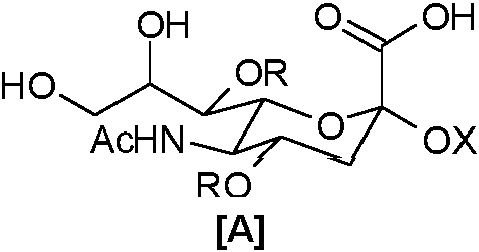
en donde los restos R independientemente entre sí representan hidrógeno o alquilo C1-C6, preferentemente metilo, y el resto -OX se deriva de una sustancia aromática o un colorante con la fórmula general HOX, en donde en el caso de OH se trata de un grupo hidroxi y en el caso de X se trata de un resto alifático, aromático o heterocíclico, en donde en el caso de la sustancia aromática se trata de timol o carvacrol.where the R moieties independently of one another represent hydrogen or C1-C6 alkyl, preferably methyl, and the -OX moiety is derived from an aromatic substance or a dye with the general formula HOX, where in the case of OH it is a hydroxy group and in the case of X it is an aliphatic, aromatic or heterocyclic radical, where in the case of the aromatic substance it is thymol or carvacrol.
El objetivo consigue además mediante una goma de mascar para su uso en un método para el diagnóstico in vivo de una infección viral, que comprende el compuesto de acuerdo con la invención.The object is further achieved by a chewing gum for use in a method for in vivo diagnosis of a viral infection, comprising the compound according to the invention.
Partiendo de la prueba ZstatFlu™ ahora hemos ampliado la aplicación óptica de este sistema, pudiéndose realizar ahora el reconocimiento mediante una sensación de gusto o bien de olfato. La detección no se realiza por tanto fuera del cuerpo humano, sino directamente en la cavidad oral usando la lengua humana (sentido del gusto) y la nariz (sentido del olfato) como detector, realizándose la detección en particular por el sentido del gusto. Cuando el compuesto sintetizado entra en contacto con la neuraminidasa de uno de estos tipos de virus, se libera una sustancia aromática, que ahora puede percibirse de manera gustativa u olfativa.Starting from the ZstatFlu™ test, we have now extended the optical application of this system, now being able to perform recognition through a sensation of taste or smell. Detection is therefore not performed outside the human body, but directly in the oral cavity using the human tongue (sense of taste) and the nose (sense of smell) as detectors, detection being performed in particular by the sense of taste. When the synthesized compound comes into contact with the neuraminidase of one of these types of virus, an aromatic substance is released, which can now be perceived taste or smell.
El compuesto de acuerdo con la invención se formula en una goma de mascar y por consiguiente entra en contacto con la saliva que contiene neuraminidasa durante un período de tiempo suficiente para poder reaccionar.The compound according to the invention is formulated in a chewing gum and therefore comes into contact with saliva containing neuraminidase for a period of time sufficient to be able to react.
Por consiguiente, el paciente puede diagnosticarse fácilmente a sí mismo, si los síntomas no unívocos, tal como por ejemplo "fiebre" se deben a una infección bacteriana o a una infección vírica. Esta información también es importante para el médico en la estrategia de tratamiento posterior. Mediante un diagnóstico fiable de la gripe, que a menudo se trata erróneamente con antibióticos, también es posible reducir de manera eficaz la prescripción de antibióticos sin beneficio relevante.Therefore, the patient can easily diagnose himself, whether unambiguous symptoms, such as "fever", are due to a bacterial infection or a viral infection. This information is also important for the doctor in the subsequent treatment strategy. By reliably diagnosing influenza, which is often wrongly treated with antibiotics, it is also possible to effectively reduce the prescription of antibiotics without relevant benefit.
La presente invención se refiere además a un procedimiento para la preparación del compuesto.The present invention further relates to a process for the preparation of the compound.
Sumario de la invenciónSummary of the invention
En resumen, la presente invención se refiere a:In summary, the present invention relates to:
[1] compuesto de la siguiente fórmula general [A] para su uso en un método para el diagnóstico in vivo de una infección viral,[1] compound of the following general formula [A] for use in a method for the in vivo diagnosis of a viral infection,

en donde los restos R independientemente entre sí representan hidrógeno o alquilo C1-C6, preferentemente metilo, y el resto -OX se deriva de una sustancia aromática con la fórmula general HOX, en donde en el caso de OH se trata de un grupo hidroxi y en el caso de X se trata de un resto alifático, aromático o heterocíclico, en donde en el caso de la sustancia aromática se trata de timol o carvacrol.where the R moieties independently of each other represent hydrogen or C1-C6 alkyl, preferably methyl, and the -OX moiety is derived from an aromatic substance with the general formula HOX, where in the case of OH it is a hydroxy group and X is an aliphatic, aromatic or heterocyclic radical, the aromatic substance being thymol or carvacrol.
[2] Compuesto para su uso de acuerdo con el punto [1], en donde en el caso del compuesto de fórmula A se trata de Neu5Ac-timol con la siguiente fórmula [5a] [2] Compound for use according to item [1], wherein in the case of the compound of formula A it is Neu5Ac-thymol with the following formula [5a]

de Neu5Ac-carvacrol con la siguiente fórmula [5b]of Neu5Ac-carvacrol with the following formula [5b]

de 4,7-di-O-metil-Neu5Ac-timol con la siguiente fórmula [12a]of 4,7-di-O-methyl-Neu5Ac-thymol with the following formula [12a]

o de 4,7-di-O-metil-Neu5Ac-carvacrol con la siguiente fórmula [12b]or from 4,7-di-O-methyl-Neu5Ac-carvacrol with the following formula [12b]

[3] Procedimiento para la preparación de un compuesto de acuerdo con uno de los puntos [1] y [2], que comprende: (a) enlazar timol o carvacrol, con un compuesto de la siguiente fórmula [3][3] Process for the preparation of a compound according to one of the items [1] and [2], comprising: (a) linking thymol or carvacrol, with a compound of the following formula [3]

o un compuesto de la siguiente fórmula [10]or a compound of the following formula [10]

(b) desproteger el producto de acoplamiento obtenido en la etapa (a).(b) deprotecting the coupling product obtained in step (a).
[4] Goma de mascar para su uso en un método de diagnóstico in vivo de una infección viral, que comprende un compuesto de acuerdo con uno de los puntos 1 y 2.[4] Chewing gum for use in a method of in vivo diagnosis of a viral infection, comprising a compound according to one of items 1 and 2.
Descripción detallada de la invenciónDetailed description of the invention
En el caso de una "sustancia aromática" se trata de una sustancia que durante la liberación en la cavidad oral de una persona, preferentemente un paciente con una infección viral, desencadena una percepción de sabor (gustativa) o bien de olor (olfatoria). En particular, se produce a este respecto una percepción gustativa, de modo que en el caso de la sustancia aromática se trate en particular de una sustancia saborizante. Las sustancias aromáticas usadas en el marco de la presente invención disponen de la idoneidad para usarse en alimentos.An "aromatic substance" is a substance which, during release in the oral cavity of a person, preferably a patient with a viral infection, triggers a perception of taste (gustatory) or smell (olfactory). In particular, a taste perception is produced in this connection, so that in the case of the aromatic substance it is in particular a flavoring substance. The flavoring substances used in the context of the present invention have the suitability for use in foods.
En el caso de las sustancias aromáticas se trata de sustancias aromáticas con la fórmula general HOX, en donde en el caso de OH se trata de un grupo hidroxi y en el caso de X se trata de un resto alifático, aromático o heterocíclico. En el caso de las sustancias aromáticas, que se usan en el marco de la presente invención, se trata de carvacrol y timol.The aromatic substances are aromatic substances with the general formula HOX, where OH is a hydroxy group and X is an aliphatic, aromatic or heterocyclic radical. The aromatic substances used in the context of the present invention are carvacrol and thymol.
Los productos de acoplamiento, que se derivan del ácido N-acetilneurámico o bien un derivado del mismo, se designan en el marco de la presente invención en aras de la simplicidad como "Neu5Ac-sustancia aromática" o bien "derivado de Neu5Ac-sustancia aromática". Un producto de acoplamiento, que se deriva por tanto, por ejemplo, del ácido N-acetilneurámico (Neu5Ac) y timol, se designa en el marco de la presente invención como "Neu5Ac-timol".Coupling products, which are derived from N-acetylneuramic acid or a derivative thereof, are designated within the scope of the present invention as "Neu5Ac-aromatic substance" or "Neu5Ac-aromatic substance derivative ". A coupling product, which is derived, for example, from N-acetylneuramic acid (Neu5Ac) and thymol, is designated in the context of the present invention as "Neu5Ac-thymol".
La invención muestra una ruta de síntesis con la que el ácido N-acetilneurámico puede acoplarse a diversas sustancias aromáticas en rendimiento cuantitativo. En combinación con el ácido N-acetilneurámico o su derivado 4,7-alquilado C1-C6 no puede percibirse o bien apenas puede percibirse la sustancia aromática de manera gustativa por el paciente. Sin embargo, si el sistema entra en contacto con la neuraminidasa viral, el compuesto se escinde y se producen Neu5Ac (o bien 4,7-alcoxi (C1-C6)-Neu5Ac) y la sustancia aromática en su forma Oh alcohólica. Ahora, la sustancia aromática libre puede volver a desencadenar estímulos gustativos y olfativos en medida significativa. Por lo tanto, es posible una percepción por parte del paciente, de modo que mediante una aparición de sabor y olor del compuesto acoplado seleccionado, o mediante una coloración de la lengua se detecta una gripe desencadena por virus de la influenza.The invention shows a synthetic route with which N-acetylneuramic acid can be coupled to various aromatic substances in quantitative yield. In combination with N-acetylneuramic acid or its 4,7-C1-C6-alkylated derivative, the aroma substance can hardly be perceived or can hardly be perceived by the patient. However, if the system comes into contact with the viral neuraminidase, the compound is cleaved, producing Neu5Ac (or 4,7-(C1-C6)alkoxy-Neu5Ac) and the aromatic substance in its alcoholic Oh form. Now the free aromatic substance can once again trigger taste and olfactory stimuli to a significant extent. Thus, a perception by the patient is possible, so that a flu triggered by influenza viruses is detected by a taste and odor appearance of the selected coupled compound or by a discoloration of the tongue.
La estructura del sistema, que se sintetizó a modo de ejemplo, puede caracterizarse con la siguiente fórmula [B]:The structure of the system, which was synthesized by way of example, can be characterized by the following formula [B]:

en donde -OX se deriva de timol o carvacrol. Al entrar en contacto con la enzima neuraminidasa, timol o bien carvacrol se escinden del ácido 4,7-dimetoxi-N-acetilneurámico y desencadenan en la forma libre HO-X una sensación gustativa y olfativa. El 2-cetósido está acoplado en este caso a la sustancia aromática en la conformación anomérica p.where -OX is derived from thymol or carvacrol. Upon contact with the enzyme neuraminidase, thymol or carvacrol are cleaved from 4,7-dimethoxy-N-acetylneuramic acid and trigger a taste and olfactory sensation in the free form HO-X. In this case, the 2-ketoside is coupled to the aromatic substance in the p anomeric conformation.
Común a los compuestos timol y carvacrol es un sistema fenólico que estabiliza suficientemente el grupo hidroxi desprotonado, que se requiere en el acoplamiento para el ataque nucleofílico en el C2 anomérico del Neu5Ac. Con nuestra estrategia de síntesis ahora es posible enlazar los compuestos mencionados a Neu5Ac o derivados del mismo. El ácido N-acetilneurámico sirvió como material de partida, que se obtuvo de Carbo-Synth (Compton - Berkshire -Reino Unido).Common to the thymol and carvacrol compounds is a phenolic system that sufficiently stabilizes the deprotonated hydroxy group, which is required in the coupling for nucleophilic attack on the anomeric C2 of Neu5Ac. With our synthesis strategy it is now possible to link the mentioned compounds to Neu5Ac or derivatives thereof. N-acetylneuramic acid served as starting material, which was obtained from Carbo-Synth (Compton-Berkshire-UK).
En la primera etapa de la síntesis, este se convierte en el éster metílico. En este caso, el grupo carboxi en la posición 1 se metila mediante un tratamiento con metanol en condiciones de una catálisis ácida con formación del producto [2].In the first stage of the synthesis, this is converted to the methyl ester. In this case, the carboxy group in position 1 is methylated by treatment with methanol under conditions of acid catalysis with formation of the product [2].

Para esta etapa resultan rendimientos del 80 - 85 %.Yields of 80-85% result for this stage.
A continuación se trata el éster metílico en ácido acético con cloruro de acetilo (AcCl), de manera que, por un lado, se acetilan los grupos hidroxi libres, por otro lado, el grupo hidroxi en la posición 2 se convierte en un cloruro debido a su particular reactividad como hemiacetal. Debido a la reactividad y la inestabilidad, el producto [3] obtenido de esta reacción se procesa inmediatamente.The methyl ester in acetic acid is then treated with acetyl chloride (AcCl), so that on the one hand the free hydroxy groups are acetylated, on the other hand the hydroxy group in position 2 is converted to a chloride due to to its particular reactivity as a hemiacetal. Due to reactivity and instability, the product [3] obtained from this reaction is processed immediately.

El compuesto a acoplar ahora se desprotona por medio de hidruro de sodio (NaH), de modo que pueda atacar nucleofílicamente al C2 activado del compuesto. Con exclusión del oxígeno del aire (por medio de gas protector N2) ahora puede continuar la reacción de acoplamiento del ácido N-acetilneurámico y la sustancia aromática seleccionada. Bajo las condiciones, el acoplamiento con timol dio como resultado rendimientos de aproximadamente el 30 %. En este caso se forma el siguiente producto [4a]:The compound to be coupled is now deprotonated by means of sodium hydride (NaH), so that it can nucleophilically attack the activated C2 of the compound. With the exclusion of oxygen from the air (by means of protective gas N2), the coupling reaction of N-acetylneuramic acid and the selected aromatic substance can now continue. Under the conditions, coupling with thymol resulted in yields of approximately 30%. In this case the following product [4a] is formed:

Tras la escisión de los grupos protectores en las posiciones 4,7,8,9 mediante tratamiento básico del compuesto, por ejemplo, mediante NaOH acuoso, así como tras la saponificación del éster metílico se obtiene el siguiente producto final [5a]:After cleavage of the protecting groups at positions 4,7,8,9 by basic treatment of the compound, for example with aqueous NaOH, as well as after saponification of the methyl ester, the following end product [5a] is obtained:

En el presente caso, Neu5Ac se acopló a timol. El isómero de timol, carvacrol, igualmente que puede percibirse bien de manera gustativa, en el que el grupo isopropilideno y el grupo metilo están invertidos en comparación con el timol, es otro posible componente de acoplamiento. Dado que en este el impedimento estérico es menor, pero la reactividad es por lo demás comparable, puede acoplarse este compuesto igualmente con el esquema de síntesis utilizado en el caso de timol. La estrategia de síntesis de Neu5Ac-timol y Neu5Ac-carvacrol se resume en la Fig.1.In the present case, Neu5Ac was coupled to thymol. The isomer of thymol, carvacrol, also well palatable, in which the isopropylidene group and the methyl group are reversed compared to thymol, is another possible coupling component. Since the steric hindrance is less in this, but the reactivity is otherwise comparable, this compound can also be coupled with the synthesis scheme used in the case of thymol. The synthesis strategy of Neu5Ac-thymol and Neu5Ac-carvacrol is summarized in Fig.1.
En el caso del acoplamiento de la sustancia aromática con el derivado 4,7-di-O-metilado, primero se deben introducir los grupos metilo en el Neu5Ac, antes de que pueda ocurrir el enlace de ambos componentes. La síntesis de un compuesto acoplable se trata de manera detallada en la patente estadounidense n.° 6.303.764 B1 y se realiza tal como se describe allí. Solo la última etapa, el acoplamiento con el Neu5Ac ahora 4,7-di-O-metilado se modifica, de modo que nuestros compuestos puedan acoplarse. La estrategia de síntesis se muestra esquemáticamente en la Fig. 2, en donde el componente [10] descrito en las publicaciones está enlazado con las sustancias aromáticas usadas por nosotros. En publicaciones y patentes anteriores, se acoplaron el Neu5Ac no modificado, así como el mono- y dimetilado a numerosos componentes fluorogénicos y cromogénicos. No hubo diferencias significativas entre los diversos derivados de Neu5Ac, en lo que se refiere a la reactividad durante el acoplamiento. Para conseguir el acoplamiento selectivo, se aplica el método de Koenigs-Knorr al compuesto dimetilado. En este caso, el grupo fenólico de la sustancia aromática se acopla al derivado de Neu5Ac por medio de carbonato de plata. En este caso, como en la variante no metilada, primero se forma un cloruro de glicosilo [10] por reacción con cloruro de acetilo, en donde los grupos hidroxi restantes se dotan simultáneamente de grupos protectores de acetilo de nuevo. Mediante la reacción del cloruro de glicosilo con carbonato de plata finalmente se forma un ion dioxolanio, que puede ser atacado por un grupo alcohólico. En este caso se forma el siguiente producto [11]:In the case of the coupling of the aromatic substance with the 4,7-di-O-methylated derivative, the methyl groups must first be introduced into the Neu5Ac, before the bonding of both components can occur. The synthesis of a coupling compound is discussed in detail in US Patent No. 6,303,764 B1 and is performed as described therein. Only the last step, the coupling with the now 4,7-di-O-methylated Neu5Ac is modified, from so that our compounds can couple. The synthesis strategy is shown schematically in Fig. 2, where the component [10] described in the publications is linked to the aromatic substances used by us. In previous publications and patents, unmodified as well as mono- and dimethylated Neu5Ac were coupled to numerous fluorogenic and chromogenic components. There were no significant differences between the various Neu5Ac derivatives in terms of reactivity during coupling. To achieve selective coupling, the Koenigs-Knorr method is applied to the dimethylated compound. In this case, the phenolic group of the aromatic substance is coupled to the Neu5Ac derivative by means of silver carbonate. In this case, as in the unmethylated variant, a glycosyl chloride [10] is first formed by reaction with acetyl chloride, whereby the remaining hydroxy groups are simultaneously endowed with acetyl protecting groups again. By reaction of glycosyl chloride with silver carbonate, a dioxolanium ion is finally formed, which can be attacked by an alcoholic group. In this case the following product is formed [11]:

Mediante la reacción del cloruro de glicosilo con carbonato de plata finalmente se forma un ion dioxolanio, que puede ser atacado por un grupo alcohólico. En este caso se forma el siguiente producto [11]:By reaction of glycosyl chloride with silver carbonate, a dioxolanium ion is finally formed, which can be attacked by an alcoholic group. In this case the following product is formed [11]:

La desprotección con cantidades catalíticas de metanolato de sodio en metanol da el producto final desprotegido [12]:Deprotection with catalytic amounts of sodium methanolate in methanol gives the final deprotected product [12]:

Los ejemplos de aplicación no son solo los compuestos Neu5Ac-timol [5a] y Neu5Ac-carvacrol [5b], sino también los compuestos derivados de estos 4,7-di-O-metil-Neu5Ac-timol [12a] y 4,7-di-O-metil-Neu5Ac-carvacrol [12b].Application examples are not only the compounds Neu5Ac-thymol [5a] and Neu5Ac-carvacrol [5b], but also the compounds derived from these 4,7-di-O-methyl-Neu5Ac-thymol [12a] and 4,7 -di-O-methyl-Neu5Ac-carvacrol [12b].
La invención se ilustra mediante los siguientes ejemplos.The invention is illustrated by the following examples.
Ejemplo 1: Síntesis del éster metílico de Neu5Ac [2] Example 1: Synthesis of the methyl ester of Neu5Ac [2]
Se dispersan 1,563 g de Neu5Ac [1] (CarboSynth) en 50 ml de metanol anhidro. Se añaden 2 g de Dowex 50 W X 2 (lavado con metanol seco) y la mezcla de reacción se agita a temperatura ambiente durante 5 horas. Transcurrido este tiempo, el intercambiador de iones se separa por filtración y se lava varias veces con metanol. Después de eliminar el metanol por destilación, el producto [2] se purifica por medio de gel de sílice (eluyente: metanol) para obtener 1,354 g (83 %) de [2]. 1.563 g of Neu5Ac [1] (CarboSynth) are dispersed in 50 ml of anhydrous methanol. 2 g of Dowex 50 WX 2 (dry methanol wash) are added and the reaction mixture is stirred at room temperature for 5 hours. After this time, the ion exchanger is filtered off and washed several times with methanol. After distilling off methanol, the product [2] is purified by means of silica gel (eluent: methanol) to obtain 1.354 g (83%) of [2].
Ejemplo 2: Síntesis de Neu5Ac-timol [5a] Example 2: Synthesis of Neu5Ac-thymol [5a]
A una solución del éster metílico de Neu5Ac [2] (603 mg, 1,95 mmol) en ácido acético (10 ml) se añade cloruro de acetilo (10 ml) y la mezcla de reacción se deja en agitación cerrada a temperatura ambiente durante 18 h. A continuación, la solución se concentra a vacío y se seca por medio de adición de tolueno para obtener [3] como residuo blanco. El producto se utiliza sin más purificación debido a la inestabilidad del cloruro.To a solution of Neu5Ac[2] methyl ester (603 mg, 1.95 mmol) in acetic acid (10 mL) is added acetyl chloride (10 mL) and the reaction mixture is left under closed stirring at room temperature for 6 p.m. The solution is then concentrated in vacuo and dried by adding toluene to obtain [3] as a white residue. The product is used without further purification due to the instability of the chloride.
A una suspensión de NaH (60 % en aceite mineral, 82 mg, 3,429 mmol) en tetrahidrofurano (THF) se añade gota a gota lentamente una solución de timol (510 mg, 3,40 mmol) en dimetilformamida (DMF) (10 ml) a 0 °C y la mezcla de reacción se agitó durante 10 min. La mezcla se mezcla con la solución del cloruro [3] en THF en el intervalo de 15 minutos. Después de completar la adición, la mezcla se agita a temperatura ambiente durante 19 horas. Transcurrido el tiempo, la mezcla se diluye con 40 ml de acetato de etilo y se transfiere a un embudo de decantación. La fase orgánica se lava ahora con agua (2 x 30 ml) y con solución saturada de cloruro de sodio (2 x 30 ml), se seca sobre Na2SO4 y se elimina el disolvente a presión reducida.To a suspension of NaH (60% in mineral oil, 82 mg, 3.429 mmol) in tetrahydrofuran (THF) is slowly added dropwise a solution of thymol (510 mg, 3.40 mmol) in dimethylformamide (DMF) (10 mL ) at 0 °C and the reaction mixture was stirred for 10 min. The mixture is mixed with the solution of the chloride [3] in THF within 15 minutes. After the addition is complete, the mixture is stirred at room temperature for 19 hours. At the end of time, the mixture is diluted with 40 ml of ethyl acetate and transferred to a separatory funnel. The organic phase is now washed with water (2 x 30 ml) and with saturated sodium chloride solution (2 x 30 ml), dried over Na 2 SO 4 and the solvent is removed under reduced pressure.
El residuo (que contiene [4a]) se disuelve en metanol (8 ml), se mezcla con NaOH 0,1 M (2 ml) y se agita a temperatura ambiente durante una hora. La mezcla de reacción se lleva a pH = 4,5-5 con HCl 3 M y se extrae con diclorometano (DCM) (3 x 15 ml). La fase de agua se purifica con un sistema FPLC (purificador Ákta, GE Healthcare) usando cromatografía de fase reversa (RPC) en una columna C18 (Phenomenex®) (eluyente A: ácido trifluoroacético (TFA) al 0,1 % en agua, eluyente B: TFA al 0,1 % en acetonitrilo). Después de la liofilización posterior, se obtiene ácido N-acetilneurámico-timol [5a] como polvo blanco. El rendimiento total asciende a 253 mg (29,4 %).The residue (containing [4a]) is dissolved in methanol (8 ml), mixed with 0.1 M NaOH (2 ml) and stirred at room temperature for one hour. The reaction mixture is brought to pH=4.5-5 with 3M HCl and extracted with dichloromethane (DCM) (3 x 15 mL). The water phase is purified with an FPLC system (Ákta purifier, GE Healthcare) using reverse phase chromatography (RPC) on a C18 column (Phenomenex®) (eluent A: 0.1% trifluoroacetic acid (TFA) in water, mobile phase B: 0.1% TFA in acetonitrile). After further freeze-drying, N-acetylneuramic acid-thymol [5a] is obtained as a white powder. The total yield is 253 mg (29.4%).
Ejemplo 3: Síntesis de 4,7-di-O-metil-Neu5Ac-timol [12a] Example 3: Synthesis of 4,7-di-O-methyl-Neu5Ac-thymol [12a]
A una solución del éster metílico de 4,7-di-O-metil-Neu5Ac [9a] (33 mg, 0,094 mmol) en ácido acético (3 ml) se añade cloruro de acetilo (3 ml) y la mezcla de reacción se deja en agitación cerrada a temperatura ambiente durante 18 h. A continuación, la solución se concentra a vacío y se seca por medio de adición de tolueno para obtener [3] como residuo blanco. El producto se utiliza sin más purificación debido a la inestabilidad del cloruro.To a solution of 4,7-di-O-methyl-Neu5Ac[9a] methyl ester (33 mg, 0.094 mmol) in acetic acid (3 mL) is added acetyl chloride (3 mL) and the reaction mixture is left under closed stirring at room temperature for 18 h. The solution is then concentrated in vacuo and dried by adding toluene to obtain [3] as a white residue. The product is used without further purification due to the instability of the chloride.
El cloruro de beta-sililo [10a] se disuelve en 10 ml de DCM anhidro. En otro matraz, con exclusión de la luz y el oxígeno, 586 mg de timol (3,9 mmol), 95 mg de carbonato de plata (0,345 mmol) y 300 mg de tamiz molecular 4A en 10 ml de DCM anhidro. La primera solución con el material de partida se añade lentamente a la segunda y se agita a temperatura ambiente durante 72 h.Beta-silyl chloride [10a] is dissolved in 10 ml of anhydrous DCM. In another flask, excluding light and oxygen, 586 mg thymol (3.9 mmol), 95 mg silver carbonate (0.345 mmol), and 300 mg molecular sieve 4A in 10 mL anhydrous DCM. The first starting material solution is slowly added to the second and stirred at room temperature for 72 h.
Transcurrido el tiempo, la mezcla se diluye con 40 ml de acetato de etilo y se transfiere a un embudo de decantación. La fase orgánica se lava ahora con agua (2 x 30 ml) y con solución saturada de cloruro de sodio (2 x 30 ml), se seca sobre Na2SO4 y se elimina el disolvente a presión reducida. El residuo (que contiene [11a]) se disuelve en metanol (8 ml), se mezcla con metanolato de sodio 0,1 M hasta un pH de 8-9 y se agita durante una hora a temperatura ambiente. La mezcla de reacción se neutraliza con HCl 1 M, se filtra y se extrae con diclorometano (DCM) (3 x 15 ml). La fase de agua se purifica con un sistema FPLC (purificador Ákta, GE Healthcare) usando cromatografía de fase reversa (RPC) en una columna C18 (Phenomenex®) (eluyente A: ácido trifluoroacético (TFA) al 0,1 % en agua, eluyente B: TFA al 0,1 % en acetonitrilo). Después de la liofilización posterior, se obtiene 4,7-di-O-metil-Neu5Ac-timol [12a] como polvo blanco. El rendimiento total asciende a 10,2 mg (23,1 %). At the end of time, the mixture is diluted with 40 ml of ethyl acetate and transferred to a separatory funnel. The organic phase is now washed with water (2 x 30 ml) and with saturated sodium chloride solution (2 x 30 ml), dried over Na 2 SO 4 and the solvent is removed under reduced pressure. The residue (containing [11a]) is dissolved in methanol (8 ml), mixed with 0.1 M sodium methanolate to pH 8-9 and stirred for one hour at room temperature. The reaction mixture is neutralized with 1M HCl, filtered and extracted with dichloromethane (DCM) (3 x 15 mL). The water phase is purified with an FPLC system (Ákta purifier, GE Healthcare) using reverse phase chromatography (RPC) on a C18 column (Phenomenex®) (eluent A: 0.1% trifluoroacetic acid (TFA) in water, mobile phase B: 0.1% TFA in acetonitrile). After further freeze-drying, 4,7-di-O-methyl-Neu5Ac-thymol [12a] is obtained as a white powder. The total yield is 10.2 mg (23.1%).
Claims (4)


Applications Claiming Priority (2)
| Application Number | Priority Date | Filing Date | Title |
|---|---|---|---|
| DE102016011298 | 2016-09-19 | ||
| PCT/EP2017/071572 WO2018050429A1 (en) | 2016-09-19 | 2017-08-28 | Diagnostic sensor and chewing gum comprising such a diagnostic sensor for the taste-based detection of viruses |
Publications (1)
| Publication Number | Publication Date |
|---|---|
| ES2920138T3 true ES2920138T3 (en) | 2022-08-01 |
Family
ID=59799354
Family Applications (1)
| Application Number | Title | Priority Date | Filing Date |
|---|---|---|---|
| ES17762078T Active ES2920138T3 (en) | 2016-09-19 | 2017-08-28 | Compound and chewing gum comprising the compound to detect viruses by taste |
Country Status (6)
| Country | Link |
|---|---|
| US (1) | US20190209710A1 (en) |
| EP (1) | EP3516067B1 (en) |
| ES (1) | ES2920138T3 (en) |
| PL (1) | PL3516067T3 (en) |
| PT (1) | PT3516067T (en) |
| WO (1) | WO2018050429A1 (en) |
Families Citing this family (1)
| Publication number | Priority date | Publication date | Assignee | Title |
|---|---|---|---|---|
| CN111839513A (en) * | 2020-07-10 | 2020-10-30 | 东华大学 | A smart sensor for human health monitoring and encrypted transmission of information |
Family Cites Families (6)
| Publication number | Priority date | Publication date | Assignee | Title |
|---|---|---|---|---|
| US3818107A (en) * | 1972-09-28 | 1974-06-18 | Brook D | Chewing gum with sustained flavor release compositions |
| US5252458A (en) | 1990-12-31 | 1993-10-12 | Symex Corp. | Method for visually detecting the presence of a virus in a clinical specimen |
| US5719020A (en) | 1996-09-25 | 1998-02-17 | Oklahoma Medical Research Foundation | 4,7-dialkoxy N-acetylneuraminic acid derivatives and methods for detection of influenza type A and B viruses in clinical specimens |
| US6303764B1 (en) | 1998-09-24 | 2001-10-16 | Zymetx, Inc. | Synthesis of 4,7-dialkyl chromogenic glycosides of N-acetylneuraminic acids |
| EP1010981A1 (en) * | 1998-12-18 | 2000-06-21 | Diagor GmbH | Conjugates to detect viruses and their use |
| EP2823050B1 (en) * | 2012-03-08 | 2017-03-01 | Julius-Maximilians-Universität Würzburg | Diagnostic chewing gum for pathogens |
-
2017
- 2017-08-28 WO PCT/EP2017/071572 patent/WO2018050429A1/en not_active Ceased
- 2017-08-28 PT PT177620788T patent/PT3516067T/en unknown
- 2017-08-28 ES ES17762078T patent/ES2920138T3/en active Active
- 2017-08-28 EP EP17762078.8A patent/EP3516067B1/en active Active
- 2017-08-28 PL PL17762078.8T patent/PL3516067T3/en unknown
- 2017-08-28 US US16/334,293 patent/US20190209710A1/en not_active Abandoned
Also Published As
| Publication number | Publication date |
|---|---|
| US20190209710A1 (en) | 2019-07-11 |
| PL3516067T3 (en) | 2022-08-08 |
| EP3516067A1 (en) | 2019-07-31 |
| EP3516067B1 (en) | 2022-04-06 |
| WO2018050429A1 (en) | 2018-03-22 |
| PT3516067T (en) | 2022-06-29 |
Similar Documents
| Publication | Publication Date | Title |
|---|---|---|
| JP3930559B2 (en) | Pharmaceutical composition containing a sialic acid derivative | |
| US5760072A (en) | Paclitaxel prodrugs, method for preparation as well as their use in selective chemotherapy | |
| JPWO1996002255A1 (en) | Pharmaceutical compositions containing sialic acid derivatives | |
| AU2015230061B2 (en) | Amide compounds, methods for preparation, and use thereof as agents for the treatment and prevention of diseases caused by RNA- and/or DNA-containing viruses, and concomitant diseases | |
| JPH06506687A (en) | Glycosylated prodrugs, their preparation and uses | |
| IL132739A (en) | Immunoeffectors and adjuants polyacylated aminoalkyl glucosaminide phosphate compounds and pharmaceutical and vaccine compositions containing them | |
| ES2254745T3 (en) | ENZYMATIC CHROMOGEN SUBSTRATES AND METHOD FOR THE DETECTION OF ACTIVITY OF BETA-D-RIBOFURANOSIDASA. | |
| JP5022911B2 (en) | Gemcitabine amide prodrug, composition, and uses thereof | |
| ES2880957T3 (en) | Streptococcus pneumoniae serotype 5 vaccines | |
| EP2582672A1 (en) | X-ray and gamma-photon activable organic compounds, their preparation and their uses | |
| ES2920138T3 (en) | Compound and chewing gum comprising the compound to detect viruses by taste | |
| JP3390965B2 (en) | Polymer compound containing sugar-linked sphingosine | |
| CA3045703A1 (en) | Piperidine-2,6-dione derivatives and ulcerative colitis treating | |
| CN101289460B (en) | Organoboronic acid compounds and applications thereof as fluorescent probe | |
| JP4233262B2 (en) | Carbasugar amine derivatives and glycosidase inhibitors using the same | |
| RU2341529C2 (en) | Glycosidic promedicine of 5-aminosalicylic acid | |
| JP5428017B2 (en) | Vaccine | |
| ES2219419T3 (en) | DERIVATIVES OF BETA-D-5-THIOXYLOSE, PROCEDURE FOR PREPARATION AND USE IN THERAPEUTICS. | |
| KR100571487B1 (en) | Quinolinone glycosides, preparation methods and anti-allergic agents | |
| ES2292557T3 (en) | PROCEDURE FOR THE PREPARATION OF FUNCTIONALIZED DERIVATIVES OF B- (1,3) -GLUCANS. | |
| ES2260444T3 (en) | AN ENZYMATIC PROCEDURE TO OBTAIN 4-0-B-D-GALACTOPIRANOSIL-D-XYLOSA, 4-O-B-D-GALACTOPIRANOSIL-D-XYLOSA OBTAINED IN ACCORDANCE WITH THE PROCEDURE, COMPOSITIONS THAT CONTAIN IT AND ITS USE IN THE EVALUATION. | |
| JP3073309B2 (en) | Sialic acid-bound 5-deazaflavin compounds | |
| JPH01131192A (en) | Chromogen aclidinone enzyme substrate and its production | |
| JPWO2004076471A1 (en) | Anti-influenza virus compounds comprising biflavonoid sialic acid glycosides | |
| JP2025130484A (en) | Compound, salt thereof, or solvate thereof useful as a fluorescent probe for detecting ADP-ribosylase activity |