ES2921350T3 - Alvocidib Prodrugs That Have Increased Bioavailability - Google Patents
Alvocidib Prodrugs That Have Increased Bioavailability Download PDFInfo
- Publication number
- ES2921350T3 ES2921350T3 ES19167051T ES19167051T ES2921350T3 ES 2921350 T3 ES2921350 T3 ES 2921350T3 ES 19167051 T ES19167051 T ES 19167051T ES 19167051 T ES19167051 T ES 19167051T ES 2921350 T3 ES2921350 T3 ES 2921350T3
- Authority
- ES
- Spain
- Prior art keywords
- compound
- pharmaceutically acceptable
- pharmaceutical composition
- acceptable salt
- cancer
- Prior art date
- Legal status (The legal status is an assumption and is not a legal conclusion. Google has not performed a legal analysis and makes no representation as to the accuracy of the status listed.)
- Active
Links
Classifications
-
- C—CHEMISTRY; METALLURGY
- C07—ORGANIC CHEMISTRY
- C07F—ACYCLIC, CARBOCYCLIC OR HETEROCYCLIC COMPOUNDS CONTAINING ELEMENTS OTHER THAN CARBON, HYDROGEN, HALOGEN, OXYGEN, NITROGEN, SULFUR, SELENIUM OR TELLURIUM
- C07F9/00—Compounds containing elements of Groups 5 or 15 of the Periodic Table
- C07F9/02—Phosphorus compounds
- C07F9/547—Heterocyclic compounds, e.g. containing phosphorus as a ring hetero atom
- C07F9/6558—Heterocyclic compounds, e.g. containing phosphorus as a ring hetero atom containing at least two different or differently substituted hetero rings neither condensed among themselves nor condensed with a common carbocyclic ring or ring system
- C07F9/65586—Heterocyclic compounds, e.g. containing phosphorus as a ring hetero atom containing at least two different or differently substituted hetero rings neither condensed among themselves nor condensed with a common carbocyclic ring or ring system at least one of the hetero rings does not contain nitrogen as ring hetero atom
-
- A—HUMAN NECESSITIES
- A61—MEDICAL OR VETERINARY SCIENCE; HYGIENE
- A61K—PREPARATIONS FOR MEDICAL, DENTAL OR TOILETRY PURPOSES
- A61K31/00—Medicinal preparations containing organic active ingredients
- A61K31/66—Phosphorus compounds
- A61K31/661—Phosphorus acids or esters thereof not having P—C bonds, e.g. fosfosal, dichlorvos, malathion or mevinphos
-
- A—HUMAN NECESSITIES
- A61—MEDICAL OR VETERINARY SCIENCE; HYGIENE
- A61K—PREPARATIONS FOR MEDICAL, DENTAL OR TOILETRY PURPOSES
- A61K31/00—Medicinal preparations containing organic active ingredients
- A61K31/33—Heterocyclic compounds
- A61K31/38—Heterocyclic compounds having sulfur as a ring hetero atom
-
- A—HUMAN NECESSITIES
- A61—MEDICAL OR VETERINARY SCIENCE; HYGIENE
- A61K—PREPARATIONS FOR MEDICAL, DENTAL OR TOILETRY PURPOSES
- A61K31/00—Medicinal preparations containing organic active ingredients
- A61K31/33—Heterocyclic compounds
- A61K31/395—Heterocyclic compounds having nitrogen as a ring hetero atom, e.g. guanethidine or rifamycins
- A61K31/435—Heterocyclic compounds having nitrogen as a ring hetero atom, e.g. guanethidine or rifamycins having six-membered rings with one nitrogen as the only ring hetero atom
- A61K31/44—Non condensed pyridines; Hydrogenated derivatives thereof
- A61K31/445—Non condensed piperidines, e.g. piperocaine
- A61K31/4523—Non condensed piperidines, e.g. piperocaine containing further heterocyclic ring systems
- A61K31/453—Non condensed piperidines, e.g. piperocaine containing further heterocyclic ring systems containing a six-membered ring with oxygen as a ring hetero atom
-
- A—HUMAN NECESSITIES
- A61—MEDICAL OR VETERINARY SCIENCE; HYGIENE
- A61P—SPECIFIC THERAPEUTIC ACTIVITY OF CHEMICAL COMPOUNDS OR MEDICINAL PREPARATIONS
- A61P35/00—Antineoplastic agents
-
- A—HUMAN NECESSITIES
- A61—MEDICAL OR VETERINARY SCIENCE; HYGIENE
- A61P—SPECIFIC THERAPEUTIC ACTIVITY OF CHEMICAL COMPOUNDS OR MEDICINAL PREPARATIONS
- A61P35/00—Antineoplastic agents
- A61P35/02—Antineoplastic agents specific for leukemia
-
- A—HUMAN NECESSITIES
- A61—MEDICAL OR VETERINARY SCIENCE; HYGIENE
- A61P—SPECIFIC THERAPEUTIC ACTIVITY OF CHEMICAL COMPOUNDS OR MEDICINAL PREPARATIONS
- A61P43/00—Drugs for specific purposes, not provided for in groups A61P1/00-A61P41/00
-
- C—CHEMISTRY; METALLURGY
- C07—ORGANIC CHEMISTRY
- C07D—HETEROCYCLIC COMPOUNDS
- C07D311/00—Heterocyclic compounds containing six-membered rings having one oxygen atom as the only hetero atom, condensed with other rings
- C07D311/02—Heterocyclic compounds containing six-membered rings having one oxygen atom as the only hetero atom, condensed with other rings ortho- or peri-condensed with carbocyclic rings or ring systems
- C07D311/04—Benzo[b]pyrans, not hydrogenated in the carbocyclic ring
- C07D311/22—Benzo[b]pyrans, not hydrogenated in the carbocyclic ring with oxygen or sulfur atoms directly attached in position 4
-
- C—CHEMISTRY; METALLURGY
- C07—ORGANIC CHEMISTRY
- C07D—HETEROCYCLIC COMPOUNDS
- C07D311/00—Heterocyclic compounds containing six-membered rings having one oxygen atom as the only hetero atom, condensed with other rings
- C07D311/02—Heterocyclic compounds containing six-membered rings having one oxygen atom as the only hetero atom, condensed with other rings ortho- or peri-condensed with carbocyclic rings or ring systems
- C07D311/04—Benzo[b]pyrans, not hydrogenated in the carbocyclic ring
- C07D311/22—Benzo[b]pyrans, not hydrogenated in the carbocyclic ring with oxygen or sulfur atoms directly attached in position 4
- C07D311/26—Benzo[b]pyrans, not hydrogenated in the carbocyclic ring with oxygen or sulfur atoms directly attached in position 4 with aromatic rings attached in position 2 or 3
- C07D311/28—Benzo[b]pyrans, not hydrogenated in the carbocyclic ring with oxygen or sulfur atoms directly attached in position 4 with aromatic rings attached in position 2 or 3 with aromatic rings attached in position 2 only
- C07D311/30—Benzo[b]pyrans, not hydrogenated in the carbocyclic ring with oxygen or sulfur atoms directly attached in position 4 with aromatic rings attached in position 2 or 3 with aromatic rings attached in position 2 only not hydrogenated in the hetero ring, e.g. flavones
-
- C—CHEMISTRY; METALLURGY
- C07—ORGANIC CHEMISTRY
- C07D—HETEROCYCLIC COMPOUNDS
- C07D405/00—Heterocyclic compounds containing both one or more hetero rings having oxygen atoms as the only ring hetero atoms, and one or more rings having nitrogen as the only ring hetero atom
- C07D405/02—Heterocyclic compounds containing both one or more hetero rings having oxygen atoms as the only ring hetero atoms, and one or more rings having nitrogen as the only ring hetero atom containing two hetero rings
- C07D405/04—Heterocyclic compounds containing both one or more hetero rings having oxygen atoms as the only ring hetero atoms, and one or more rings having nitrogen as the only ring hetero atom containing two hetero rings directly linked by a ring-member-to-ring-member bond
-
- C—CHEMISTRY; METALLURGY
- C07—ORGANIC CHEMISTRY
- C07F—ACYCLIC, CARBOCYCLIC OR HETEROCYCLIC COMPOUNDS CONTAINING ELEMENTS OTHER THAN CARBON, HYDROGEN, HALOGEN, OXYGEN, NITROGEN, SULFUR, SELENIUM OR TELLURIUM
- C07F9/00—Compounds containing elements of Groups 5 or 15 of the Periodic Table
- C07F9/02—Phosphorus compounds
- C07F9/06—Phosphorus compounds without P—C bonds
- C07F9/08—Esters of oxyacids of phosphorus
- C07F9/09—Esters of phosphoric acids
- C07F9/12—Esters of phosphoric acids with hydroxyaryl compounds
-
- C—CHEMISTRY; METALLURGY
- C07—ORGANIC CHEMISTRY
- C07F—ACYCLIC, CARBOCYCLIC OR HETEROCYCLIC COMPOUNDS CONTAINING ELEMENTS OTHER THAN CARBON, HYDROGEN, HALOGEN, OXYGEN, NITROGEN, SULFUR, SELENIUM OR TELLURIUM
- C07F9/00—Compounds containing elements of Groups 5 or 15 of the Periodic Table
- C07F9/02—Phosphorus compounds
- C07F9/547—Heterocyclic compounds, e.g. containing phosphorus as a ring hetero atom
- C07F9/6561—Heterocyclic compounds, e.g. containing phosphorus as a ring hetero atom containing systems of two or more relevant hetero rings condensed among themselves or condensed with a common carbocyclic ring or ring system, with or without other non-condensed hetero rings
Landscapes
- Chemical & Material Sciences (AREA)
- Health & Medical Sciences (AREA)
- Organic Chemistry (AREA)
- General Health & Medical Sciences (AREA)
- Life Sciences & Earth Sciences (AREA)
- Medicinal Chemistry (AREA)
- Animal Behavior & Ethology (AREA)
- Veterinary Medicine (AREA)
- Public Health (AREA)
- Pharmacology & Pharmacy (AREA)
- Chemical Kinetics & Catalysis (AREA)
- General Chemical & Material Sciences (AREA)
- Nuclear Medicine, Radiotherapy & Molecular Imaging (AREA)
- Biochemistry (AREA)
- Molecular Biology (AREA)
- Epidemiology (AREA)
- Hematology (AREA)
- Oncology (AREA)
- Bioinformatics & Cheminformatics (AREA)
- Engineering & Computer Science (AREA)
- Pharmaceuticals Containing Other Organic And Inorganic Compounds (AREA)
- Medicines That Contain Protein Lipid Enzymes And Other Medicines (AREA)
- Medicinal Preparation (AREA)
- Plural Heterocyclic Compounds (AREA)
Abstract
Se proporcionan compuestos que tienen la siguiente estructura (IB') y sales farmacéuticamente aceptables. Las composiciones farmacéuticas que comprenden los compuestos y los métodos para el uso de los compuestos para tratar enfermedades asociadas con la sobreexpresión de una quinasa dependiente de ciclina (CDK). (Traducción automática con Google Translate, sin valor legal)Compounds having the following structure (IB') and pharmaceutically acceptable salts are provided. Pharmaceutical compositions comprising the compounds and methods of using the compounds to treat diseases associated with overexpression of a cyclin-dependent kinase (CDK). (Automatic translation with Google Translate, without legal value)
Description
DESCRIPCIÓNDESCRIPTION
Profármacos de alvocidib que tienen biodisponibilidad aumentadaAlvocidib Prodrugs That Have Increased Bioavailability
AntecedentesBackground
Campo técnicotechnical field
La presente invención se refiere generalmente a profármacos de fosfato de alvocidib y al uso de los mismos para el tratamiento de cáncer.The present invention relates generally to alvocidib phosphate prodrugs and their use for the treatment of cancer.
Descripción de la técnica relacionadaDescription of Related Art
Las cinasas dependientes de ciclina (CDK) son importantes reguladores que controlan la cronología y coordinación del ciclo celular. Las CDK forman complejos reversibles con sus compañeros ciclina obligados para controlar la transición a través de uniones claves en el ciclo celular. Por ejemplo, el complejo CDK4-ciclina D1 activado controla la progresión a través de la fase G1 del ciclo celular, mientras que el complejo CDK1-ciclina B1 controla la entrada en la fase mitótica del ciclo celular. Las proteínas inhibidoras de cinasa dependientes de ciclina endógenas (CDKI) se conocen por unirse o bien al componente de CDK o bien al de ciclina e inhibir la actividad de cinasa del complejo. En muchos tumores tales como melanomas, cánceres pancreáticos y esofágicos, estas CDKI naturales o bien están ausentes o bien mutadas. Por tanto, puede probarse que los inhibidores de CDK selectivos son eficaces como agentes quimioterápicos.Cyclin-dependent kinases (CDKs) are important regulators that control the timing and coordination of the cell cycle. CDKs form reversible complexes with their obligate cyclin partners to control transition through key junctions in the cell cycle. For example, the activated CDK4-cyclin D1 complex controls progression through the G1 phase of the cell cycle, while the CDK1-cyclin B1 complex controls entry into the mitotic phase of the cell cycle. Endogenous cyclin-dependent kinase inhibitor (CDKI) proteins are known to bind to either the CDK or cyclin component and inhibit the kinase activity of the complex. In many tumors such as melanomas, pancreatic and esophageal cancers, these natural CDKIs are either absent or mutated. Therefore, selective CDK inhibitors can be proved to be effective as chemotherapeutic agents.
Alvocidib (también conocido como flavopiridol) es una flavona sintética que tiene la siguiente estructura:Alvocidib (also known as flavopiridol) is a synthetic flavone that has the following structure:

Alvocidib es un inhibidor potente y selectivo de las CDK y tiene actividad antitumoral contra diversas líneas celulares tumorales, tales como carcinoma de pulmón y carcinoma de mama humano, y también inhibe el crecimiento del tumor en modelos de xenoinjerto. El alvocidib ha demostrado que induce la detención tanto en las fases G1 como G2 del ciclo celular y también inhibe la transcripción dirigida por polimerasa II inhibiendo CDK9. Inhibiendo CDK9, que forma parte del complejo conocido como el factor de elongación de la transcripción positivo o P-TEFb, el tratamiento con alvocidib reduce la expresión de oncogenes claves tales como MYC y proteínas antiapoptóticas clave tales como MCL1. Por consiguiente, alvocidib es un agente terapéutico atractivo para el cáncer y actualmente se encuentra en ensayos clínicos en pacientes con LMA con recidiva/refractaria.Alvocidib is a potent and selective inhibitor of CDKs and has antitumor activity against various tumor cell lines, such as lung carcinoma and human breast carcinoma, and also inhibits tumor growth in xenograft models. Alvocidib has been shown to induce both G1 and G2 cell cycle arrest and also inhibits polymerase II-directed transcription by inhibiting CDK9. By inhibiting CDK9, which is part of the complex known as positive transcription elongation factor or P-TEFb, alvocidib treatment reduces the expression of key oncogenes such as MYC and key anti-apoptotic proteins such as MCL1. Therefore, alvocidib is an attractive therapeutic agent for cancer and is currently in clinical trials in patients with relapsed/refractory AML.
La administración oral de alvocidib se ha limitado debido a la toxicidad gastrointestinal y la biodisponibilidad oral limitada. Además, los estudios preclínicos sugieren que la exposición prolongada puede ser importante para maximizar la actividad de alvocidib. Por consiguiente, se han explorado de manera extensiva esquemas de infusión intravenosa continuos en ensayos en humanos. Además se ha explorado la administración híbrida alternativa, incluyendo una dosis en bolo intravenosa seguida por una infusión lenta, pero hasta ahora no ha habido informes de administración por vía oral de una cantidad terapéuticamente eficaz de alvocidib.Oral administration of alvocidib has been limited due to gastrointestinal toxicity and limited oral bioavailability. Additionally, preclinical studies suggest that prolonged exposure may be important in maximizing the activity of alvocidib. Consequently, continuous intravenous infusion schedules have been extensively explored in human trials. In addition, alternative hybrid administration, including an intravenous bolus dose followed by slow infusion, has been explored, but there have been no reports of oral administration of a therapeutically effective amount of alvocidib to date.
Si bien se han realizado progresos, sigue existiendo la necesidad en la técnica del aumento de la biodisponibilidad oral de alvocidib. La presente invención satisface esta necesidad y proporciona ventajas relacionadas.While progress has been made, there remains a need in the art to increase the oral bioavailability of alvocidib. The present invention meets this need and provides related benefits.
Breve sumariobrief summary
En resumen, las realizaciones de la presente invención proporcionan profármacos de fosfato de alvocidib que tienen biodisponibilidad aumentada en relación con el compuesto original de alvocidib. Por consiguiente, en una realización se proporciona un compuesto que tiene la siguiente estructura (I): In summary, embodiments of the present invention provide alvocidib phosphate prodrugs having increased bioavailability relative to the parent alvocidib compound. Accordingly, in one embodiment there is provided a compound having the following structure (I):

o un estereoisómero, un tautómero o una sal farmacéuticamente aceptable del mismo, en el que:or a stereoisomer, a tautomer or a pharmaceutically acceptable salt thereof, in which:
uno de R1 , R2 o R3 es -P(=O)(OH)2 , y los otros dos de R1 , R2 y R3 son cada uno H.one of R 1 , R 2 or R 3 is -P(=O)(OH) 2 , and the other two of R 1 , R 2 and R 3 are each H.
Otras realizaciones se refieren a una composición farmacéutica que comprende un portador o excipiente farmacéuticamente aceptable y un compuesto de estructura (I). Además, también se proporcionan los métodos para el uso del compuesto de estructura (I), y las composiciones farmacéuticas que comprenden el mismo, para el tratamiento de una enfermedad asociada con la sobreexpresión de una cinasa dependiente de ciclina (CDK) en un mamífero que lo necesita.Other embodiments relate to a pharmaceutical composition comprising a pharmaceutically acceptable carrier or excipient and a compound of structure (I). In addition, methods for the use of the compound of structure (I), and pharmaceutical compositions comprising the same, for the treatment of a disease associated with the overexpression of a cyclin-dependent kinase (CDK) in a mammal that you need it.
Estos y otros aspectos de la invención resultarán evidentes con referencia a la siguiente descripción detallada. Para este fin, se exponen diversas referencias en el presente documento que describen en más detalle determinada información, procedimientos, compuestos y/o composiciones previos, y se incorporan cada uno al presente documento por referencia en su totalidad.These and other aspects of the invention will become apparent upon reference to the following detailed description. To this end, various references are set forth herein that describe certain prior information, procedures, compounds, and/or compositions in more detail, and are each incorporated herein by reference in their entireties.
Breve descripción de los dibujosBrief description of the drawings
La figura 1 muestra el perfil farmacocinético de alvocidib y del compuesto IB tras la administración de compuesto IB a ratas Sprague Dawley.Figure 1 shows the pharmacokinetic profile of alvocidib and Compound IB after administration of Compound IB to Sprague Dawley rats.
Las figuras 2A-D representan los pesos corporales de ratones tratados con una única dosis (las figuras 2A-B por vía oral, las figuras 2C-D por vía intravenosa) de alvocidib o de compuesto IB.Figures 2A-D represent the body weights of mice treated with a single dose (Figures 2A-B orally, Figures 2C-D intravenously) of alvocidib or Compound IB.
Las figuras 3A-D muestran los pesos corporales de ratones tratados con dosis diarias (las figuras 3A-B por vía oral, las figuras 3C-D por vía intravenosa) de alvocidib o de compuesto IB.Figures 3A-D show the body weights of mice treated with daily doses (Figures 3A-B orally, Figures 3C-D intravenously) of alvocidib or Compound IB.
Las figuras 4A-B muestran los pesos corporales y el consumo de alimentos de ratas tratadas con una única dosis (por vía oral) de alvocidib o de compuesto IB.Figures 4A-B show the body weights and food consumption of rats treated with a single dose (orally) of alvocidib or compound IB.
Las figuras 5A-B muestran el volumen del tumor y el peso corporal in vivo tras la administración de compuesto IB durante un estudio de eficacia de xenoinjerto.Figures 5A-B show tumor volume and body weight in vivo following administration of Compound IB during a xenograft efficacy study.
Las figuras 6A-B representan la reducción de la expresión de la proteína MCL-1 tras el tratamiento con compuesto IB durante un estudio farmacodinámico de xenoinjerto.Figures 6A-B depict the reduction in MCL-1 protein expression following Compound IB treatment during a xenograft pharmacodynamic study.
Descripción detalladaDetailed description
En la siguiente memoria descriptiva, se exponen determinados detalles específicos para proporcionar una comprensión completa de diversas realizaciones de la invención. Sin embargo, un experto en la técnica entenderá que la invención puede ponerse en práctica sin estos detalles.In the following specification, certain specific details are set forth to provide a thorough understanding of various embodiments of the invention. However, one skilled in the art will understand that the invention can be practiced without these details.
A menos que el contexto requiera lo contrario, a lo largo de la presente memoria descriptiva y las reivindicaciones, la palabra “comprenden” y variaciones de la misma, tales como, “comprende” y “que comprende” deben interpretarse en un sentido abierto e inclusivo, es decir, como “incluyendo, pero sin limitarse a”.Unless the context requires otherwise, throughout this specification and claims, the word "comprise" and variations thereof, such as, "comprise" and "comprising" are to be construed in an open and inclusive, that is, as “including, but not limited to”.
La referencia a lo largo de esta memoria descriptiva a “una realización” significa que un rasgo característico, estructura o característica particular descritos en relación con la realización se incluye en al menos una realización de la presente invención. Por tanto, la aparición de la expresión “en una realización” en diversos lugares a lo largo de esta memoria descriptiva no se refiere necesariamente todos a la misma realización. Además, los rasgos característicos o características particulares pueden combinarse de cualquier manera adecuada en una o más realizaciones.Reference throughout this specification to "an embodiment" means that a particular feature, structure, or characteristic described in connection with the embodiment is included in at least one embodiment of the present invention. Thus, the appearance of the term "in one embodiment" in various places throughout this specification does not necessarily all refer to the same embodiment. Furthermore, the characteristic features or particular characteristics may be combined in any suitable manner in one or more embodiments.
Las realizaciones de la presente invención incluyen profármacos de fosfato de alvocidib. “Fosfato” se refiere al resto OP(=O)(OH)2. Para facilitar la ilustración los restos de fosfato en el presente documento se representan a menudo en la forma diprotonada, pero también existen en las formas monoprotonada (-OP(=O)(OH)(O' )) y no protonada (-OP(=O)(O- )2), dependiendo del pH. Las formas mono y no protonadas se asociarán normalmente con un contraión, de modo que los compuestos están en forma de una sal farmacéuticamente aceptable. Tales formas mono- y no protonadas, y sus sales farmacéuticamente aceptables, se engloban dentro del alcance de las invenciones, incluso si no se ilustran específicamente en las estructuras químicas.Embodiments of the present invention include phosphate prodrugs of alvocidib. “Phosphate” refers to the rest OP(=O)(OH) 2 . For ease of illustration, phosphate moieties herein are often depicted in the diprotonated form, but also exist in the monoprotonated (-OP(=O)(OH)(O ' )) and unprotonated (-OP( =O)(O - ) 2 ), depending on the pH. The mono and unprotonated forms will normally be associated with a counterion, so that the compounds are in the form of a pharmaceutically acceptable salt. Such mono- and unprotonated forms, and pharmaceutically acceptable salts thereof, are encompassed within the scope of the inventions, even if not specifically illustrated in the chemical structures.
“Profármaco” pretende indicar un compuesto que puede convertirse en condiciones fisiológicas o mediante solvólisis en un compuesto biológicamente activo descrito en el presente documento (por ejemplo, el compuesto de estructura (I)). Por tanto, el término “profármaco” se refiere a un precursor de un compuesto biológicamente activo que es farmacéuticamente aceptable. En algunos aspectos, un profármaco es inactivo cuando se administra a un sujeto, pero se convierte in vivo en un compuesto activo, por ejemplo, mediante hidrólisis. El compuesto de profármaco a menudo ofrece ventajas de solubilidad, compatibilidad con los tejidos o liberación retardada en un organismo mamífero (véase, por ejemplo, Bundgard, H., Design of Prodrugs (1985), págs. 7-9, 21-24 (Elsevier, Amsterdam). Un análisis de profármacos se proporciona en Higuchi, T., et al., “Pro-drugs as Novel Delivery Systems,” A.C.S. Symposium Series, vol. 14, y en Bioreversible Carriers Drug Design, ed. Edward B. Roche, American Pharmaceutical Association y Pergamon Press, 1987, ambos de los cuales se incorporan en su totalidad como referencia en el presente documento. "Prodrug" is intended to indicate a compound that can be converted under physiological conditions or by solvolysis to a biologically active compound described herein (eg, the compound of structure (I)). Thus, the term "prodrug" refers to a precursor to a biologically active compound that is pharmaceutically acceptable. In some aspects, a prodrug is inactive when administered to a subject, but is converted to an active compound in vivo , for example, by hydrolysis. The prodrug compound often offers solubility, tissue compatibility, or delayed release benefits in a mammalian organism (see, eg, Bundgard, H., Design of Prodrugs (1985), pp. 7-9, 21-24 ( Elsevier, Amsterdam).A discussion of prodrugs is provided in Higuchi, T., et al., "Pro-drugs as Novel Delivery Systems," ACS Symposium Series, vol 14, and in Bioreversible Carriers Drug Design, ed. Edward B Roche, American Pharmaceutical Association and Pergamon Press, 1987, both of which are incorporated herein by reference in their entirety.
Un “compuesto de la invención” se refiere a un compuesto de estructura (I), y sus subestructuras, tal como se define en el presente documento.A "compound of the invention" refers to a compound of structure (I), and its substructures, as defined herein.
Las realizaciones de la invención divulgadas en el presente documento también están destinadas a abarcar todos los compuestos farmacéuticamente aceptables de estructura (I) que están marcados isotópicamente teniendo uno o más átomos reemplazados por un átomo que tiene una masa atómica o número másico diferente. Los ejemplos de isotopos que pueden incorporarse en los compuestos divulgados incluyen isotopos de hidrógeno, carbono, nitrógeno, oxígeno, fósforo, flúor, cloro y yodo, tales como 2 H, 3 H, 11 C, 13 C, 14 C, 13 N, 15 N, 15O, 17O, 18O, 31 P, 32P, 35S, 18 F, 36Cl, 123 I y 125 I, respectivamente. Estos compuestos radiomarcados pueden ser útiles para ayudar a determinar o medir la efectividad de los compuestos, caracterizando, por ejemplo, el sitio o modo de acción, o la afinidad de unión al sitio farmacológicamente importante de acción. Determinados compuestos marcados isotópicamente de estructura (I), por ejemplo, aquellos que incorporan un isótopo radioactivo, son útiles en estudios de distribución en tejidos de fármaco y/o sustrato. Los isotopos radioactivos tritio, es decir 3 H, y carbono 14, es decir 14 C, son particularmente útiles para este propósito en vista de su facilidad de incorporación y medios de detección listos.The embodiments of the invention disclosed herein are also intended to encompass all pharmaceutically acceptable compounds of structure (I) that are isotopically labeled by having one or more atoms replaced by an atom having a different atomic mass or mass number. Examples of isotopes that can be incorporated into the disclosed compounds include isotopes of hydrogen, carbon, nitrogen, oxygen, phosphorus, fluorine, chlorine, and iodine, such as 2H , 3H , 11C , 13C , 14C , 13N , 15N , 15O , 17O , 18O , 31P , 32P , 35S , 18F, 36Cl, 123I and 125I , respectively . These radiolabeled compounds may be useful in helping to determine or measure the effectiveness of the compounds, characterizing, for example, the site or mode of action, or the binding affinity to the pharmacologically important site of action. Certain isotopically labeled compounds of structure (I), eg, those incorporating a radioactive isotope, are useful in drug and/or substrate tissue distribution studies. The radioactive isotopes tritium, ie 3 H, and carbon 14, ie 14 C, are particularly useful for this purpose in view of their ease of incorporation and ready means of detection.
La sustitución con isótopos más pesados tales como deuterio, es decir 2 H, puede proporcionar determinadas ventajas terapéuticas que dan como resultado una estabilidad metabólica mayor, por ejemplo, semivida in vivo aumentada o requisitos de dosificación reducida, y por tanto puede preferirse en algunas circunstancias.Substitution with heavier isotopes such as deuterium, i.e. 2H , may provide certain therapeutic advantages resulting in greater metabolic stability, for example increased in vivo half-life or reduced dosage requirements, and may therefore be preferred in some circumstances. .
La sustitución con isótopos que emiten positrones, tales como 11 C, 18 F, 15 O y 13 N, puede ser útil en estudios de tomografía por emisión de positrones (p Et ) para examinar la ocupación del receptor de sustrato. Los compuestos isotópicamente marcados de estructura (I) pueden prepararse generalmente mediante técnicas convencionales conocidas por los expertos en la técnica o mediante procedimientos análogos a los descritos en las preparaciones y ejemplos tal como se exponen a continuación usando un reactivo isotópicamente marcado apropiado en lugar del reactivo no marcado empleado previamente.Substitution with positron-emitting isotopes, such as 11 C, 18 F, 15 O, and 13 N, can be useful in positron emission tomography (pEt) studies to examine substrate receptor occupancy. Isotopically-labeled compounds of structure (I) may generally be prepared by conventional techniques known to those skilled in the art or by procedures analogous to those described in the Preparations and Examples as set forth below using an appropriate isotopically-labeled reagent in place of the reagent unmarked previously employed.
Las realizaciones de la invención divulgadas en el presente documento también están destinadas a abarcar todos los productos metabólicos in vivo de los compuestos divulgados. Tales productos pueden resultar de, por ejemplo, la oxidación, reducción, hidrólisis, amidación, esterificación, y similares del compuesto administrado, debido principalmente a procesos enzimáticos. Por consiguiente, las realizaciones de la invención incluyen compuestos producidos mediante un procedimiento que comprende administrar un compuesto de esta invención a un mamífero durante un periodo de tiempo suficiente para producir un producto metabólico del mismo. Tales productos se identifican normalmente administrando un compuesto radiomarcado de la invención en una dosis detectable a un animal, tal como rata, ratón, cobaya, mono o a un humano, dejando suficiente tiempo para que se produzca el metabolismo, y aislando sus productos de conversión de la orina, sangre u otras muestras biológicas.The embodiments of the invention disclosed herein are also intended to encompass all in vivo metabolic products of the disclosed compounds. Such products may result from, for example, oxidation, reduction, hydrolysis, amidation, esterification, and the like of the administered compound, primarily due to enzymatic processes. Accordingly, embodiments of the invention include compounds produced by a method comprising administering a compound of this invention to a mammal for a period of time sufficient to produce a metabolic product thereof. Such products are typically identified by administering a radiolabeled compound of the invention in a detectable dose to an animal, such as a rat, mouse, guinea pig, monkey, or a human, allowing sufficient time for metabolism to occur, and isolating its conversion products from urine, blood or other biological samples.
“Portador, diluyente o excipiente farmacéuticamente aceptable” incluye sin limitación cualquier adyuvante, portador, excipiente, deslizante, agente edulcorante, diluyente, conservante, tinte/colorante, saborizante, tensioactivo, agente humectante, agente de dispersión, agente de suspensión, estabilizador, agente isotónico, disolvente o emulsionante que se ha aprobado por la Administración de Alimentos y Medicamentos de Estados Unidos como que es aceptable para el uso en humanos o en animales domésticos."Pharmaceutically acceptable carrier, diluent, or excipient" includes without limitation any adjuvant, carrier, excipient, glidant, sweetening agent, diluent, preservative, dye/colorant, flavor, surfactant, wetting agent, dispersing agent, suspending agent, stabilizer, isotonic, solvent, or emulsifier that has been approved by the US Food and Drug Administration as being acceptable for use in humans or domestic animals.
“Sal farmacéuticamente aceptable” incluye tanto sales de adición de ácido como de base."Pharmaceutically acceptable salt" includes both base and acid addition salts.
“Sal de adición de ácido farmacéuticamente aceptable” se refiere a las sales que retienen la efectividad y propiedades biológicas de las bases libres, que no son biológicamente o de otro modo indeseables, y que se forman con ácidos inorgánicos tales como, pero sin limitarse a, ácido clorhídrico, ácido bromhídrico, ácido sulfúrico, ácido nítrico, ácido fosfórico, y similares, y ácidos orgánicos tales como, pero sin limitarse a, ácido acético, ácido 2,2-dicloroacético, ácido adípico, ácido algínico, ácido ascórbico, ácido aspártico, ácido bencenosulfónico, ácido benzoico, ácido 4-acetamidobenzoico, ácido canfórico, ácido canfor-10-sulfónico, ácido cáprico, ácido caproico, ácido caprílico, ácido carbónico, ácido cinámico, ácido cítrico, ácido ciclámico, ácido dodecilsulfúrico, ácido etano-1,2-disulfónico, ácido etanosulfónico, ácido 2-hidroxietanosulfónico, ácido fórmico, ácido fumárico, ácido galactárico, ácido gentísico, ácido glucoheptónico, ácido glucónico, ácido glucurónico, ácido glutámico, ácido glutárico, ácido 2-oxo-glutárico, ácido glicerofosfórico, ácido glicólico, ácido hipúrico, ácido isobutírico, ácido láctico, ácido lactobiónico, ácido láurico, ácido maleico, ácido málico, ácido malónico, ácido mandélico, ácido metanosulfónico, ácido múcico, ácido naftaleno-1,5-disulfónico, ácido naftaleno-2-sulfónico, ácido 1-hidroxi-2-naftoico, ácido nicotínico, ácido oleico, ácido orótico, ácido oxálico, ácido palmítico, ácido pamoico, ácido propiónico, ácido piroglutámico, ácido pirúvico, ácido salicílico, ácido 4-aminosalicílico, ácido sebácico, ácido esteárico, ácido succínico, ácido tartárico, ácido tiociánico, ácido ptoluenosulfónico, ácido trifluoroacético, ácido undecilénico, y similares."Pharmaceutically acceptable acid addition salt" refers to salts that retain the biological effectiveness and properties of the free bases, that are not biologically or otherwise undesirable, and that are formed with inorganic acids such as, but not limited to , hydrochloric acid, hydrobromic acid, sulfuric acid, nitric acid, phosphoric acid, and the like, and organic acids such as, but not limited to, acetic acid, 2,2-dichloroacetic acid, adipic acid, alginic acid, ascorbic acid, aspartic acid, benzenesulfonic acid, benzoic acid, 4-acetamidobenzoic acid, camphoric acid, camphor-10-sulfonic acid, capric acid, caproic acid, caprylic acid, carbonic acid, cinnamic acid, citric acid, Cyclamic acid, dodecylsulfuric acid, ethane-1,2-disulfonic acid, ethanesulfonic acid, 2-hydroxyethanesulfonic acid, formic acid, fumaric acid, galactaric acid, gentisic acid, glucoheptonic acid, gluconic acid, glucuronic acid, glutamic acid, glutaric acid, 2-oxo-glutaric acid, glycerophosphoric acid, glycolic acid, hippuric acid, isobutyric acid, lactic acid, lactobionic acid, lauric acid, maleic acid, malic acid, malonic acid, mandelic acid, methanesulfonic acid, mucic acid, naphthalene-1 acid ,5-disulfonic acid, naphthalene-2-sulfonic acid, 1-hydroxy-2-naphthoic acid, nicotinic acid, oleic acid, orotic acid, oxalic acid, palmitic acid, pamoic acid, propionic acid, acid pyroglutamic acid, pyruvic acid, salicylic acid, 4-aminosalicylic acid, sebacic acid, stearic acid, succinic acid, tartaric acid, thiocyanic acid, ptoluenesulfonic acid, trifluoroacetic acid, undecylenic acid, and the like.
“Sal de adición de base farmacéuticamente aceptable” se refiere a las sales que retienen la efectividad y propiedades biológicas de los ácidos libres, que no son biológicamente o de otro modo indeseables. Estas sales se preparan a partir de la adición de una base inorgánica o una base orgánica al ácido libre. Las sales derivadas de bases inorgánicas incluyen, pero no se limitan a, las sales de sodio, potasio, litio, amonio, calcio, magnesio, hierro, cinc, cobre, manganeso, aluminio y similares. Las sales inorgánicas preferidas son las sales de amonio, sodio, potasio, calcio y magnesio. Las sales derivadas de bases orgánicas incluyen, pero no se limitan a, sales de aminas primarias, secundarias y terciarias, aminas sustituidas incluyendo aminas sustituidas que se producen de forma natural, aminas cíclicas y resinas básicas de intercambio iónico, tales como amoníaco, isopropilamina, trimetilamina, dietilamina, trietilamina, tripropilamina, dietanolamina, etanolamina, deanol, 2-dimetilaminoetanol, 2-dietilaminoetanol, diciclohexilamina, lisina, arginina, histidina, cafeína, procaína, hidrabamina, colina, betaína, benetamina, benzatina, etilendiamina, glucosamina, metilglucamina, teobromina, trietanolamina, trometamina, purinas, piperazina, piperidina, /V-etilpiperidina, resinas de poliamina y similares. Las bases orgánicas particularmente preferidas son isopropilamina, dietilamina, etanolamina, trimetilamina, diciclohexilamina, colina y cafeína."Pharmaceutically acceptable base addition salt" refers to salts that retain the biological effectiveness and properties of the free acids, that are not biologically or otherwise undesirable. These salts are prepared from the addition of an inorganic base or an organic base to the free acid. Salts derived from inorganic bases include, but are not limited to, sodium, potassium, lithium, ammonium, calcium, magnesium, iron, zinc, copper, manganese, aluminum salts, and the like. Preferred inorganic salts are the ammonium, sodium, potassium, calcium and magnesium salts. Salts derived from organic bases include, but are not limited to, salts of primary, secondary and tertiary amines, substituted amines including naturally occurring substituted amines, cyclic amines and basic ion exchange resins, such as ammonia, isopropylamine, trimethylamine, diethylamine, triethylamine, tripropylamine, diethanolamine, ethanolamine, deanol, 2-dimethylaminoethanol, 2-diethylaminoethanol, dicyclohexylamine, lysine, arginine, histidine, caffeine, procaine, hydrabamine, choline, betaine, benetamine, benzathine, ethylenediamine, glucosamine, methylglucamine, theobromine, triethanolamine, tromethamine, purines, piperazine, piperidine, /V-ethylpiperidine, polyamine resins, and the like. Particularly preferred organic bases are isopropylamine, diethylamine, ethanolamine, trimethylamine, dicyclohexylamine, choline, and caffeine.
A menudo las cristalizaciones producen un solvato del compuesto de la invención. Tal como se usa en el presente documento, el término “solvato” se refiere a un agregado que comprende una o más moléculas de un compuesto de la invención con una o más moléculas de disolvente. El disolvente puede ser agua, en cuyo caso el solvato puede ser un hidrato. Alternativamente, el disolvente puede ser un disolvente orgánico. Por tanto, las realizaciones de los compuestos de la presente invención pueden existir como un hidrato, incluyendo un monohidrato, dihidrato, hemihidrato, sesquihidrato, trihidrato, tetrahidrato y similares, así como las correspondientes formas solvatadas. Las realizaciones del compuesto de la invención pueden ser verdaderos solvatos, mientras que en otros casos, el compuesto de la invención el compuesto de la invención puede simplemente retener agua adventicia o ser una mezcla de agua más algún disolvente adventicio.Crystallizations often produce a solvate of the compound of the invention. As used herein, the term "solvate" refers to an aggregate comprising one or more molecules of a compound of the invention with one or more molecules of solvent. The solvent may be water, in which case the solvate may be a hydrate. Alternatively, the solvent may be an organic solvent. Thus, embodiments of the compounds of the present invention may exist as a hydrate, including a monohydrate, dihydrate, hemihydrate, sesquihydrate, trihydrate, tetrahydrate, and the like, as well as the corresponding solvated forms. Embodiments of the compound of the invention may be true solvates, while in other cases the compound of the invention may simply retain adventitious water or be a mixture of water plus some adventitious solvent.
Una “composición farmacéutica” se refiere a una formulación de un compuesto de la invención y un medio generalmente aceptado en la técnica para la administración del compuesto biológicamente activo a mamíferos, por ejemplo, a humanos. Un medio de este tipo incluye todos los portadores, diluyentes o excipientes farmacéuticamente aceptables del mismo.A "pharmaceutical composition" refers to a formulation of a compound of the invention and a means generally accepted in the art for the administration of the biologically active compound to mammals, eg, humans. Such a medium includes all pharmaceutically acceptable carriers, diluents, or excipients therefor.
“Mamífero” incluye humanos y tanto animales domésticos como animales de laboratorio y mascotas domésticas (por ejemplo, gatos, perros, cerdos, ganado vacuno, ovejas, cabras, caballos, conejos) y animales no domésticos como fauna silvestre y similares."Mammal" includes humans and both domestic animals such as laboratory animals and domestic pets (eg, cats, dogs, pigs, cattle, sheep, goats, horses, rabbits) and non-domestic animals such as wildlife and the like.
“Cantidad eficaz” o “cantidad terapéuticamente eficaz” se refiere a esa cantidad de un compuesto de la invención que, cuando se administra a un mamífero, preferiblemente a un humano, es suficiente para efectuar el tratamiento, tal como se define a continuación, de una enfermedad asociada con la sobreexpresión de una cinasa dependiente de ciclina (CDK) en el mamífero, preferiblemente un humano. La cantidad de un compuesto de la invención que constituye una “cantidad terapéuticamente eficaz” variará dependiendo del compuesto, el estado y su gravedad, el modo de administración, y la edad del mamífero que va a tratarse, pero puede determinarse de manera rutinaria por un experto habitual en la técnica teniendo en cuenta su propio conocimiento y esta divulgación."Effective amount" or "therapeutically effective amount" refers to that amount of a compound of the invention which, when administered to a mammal, preferably a human, is sufficient to effect treatment, as defined below, of a disease associated with overexpression of a cyclin-dependent kinase (CDK) in the mammal, preferably a human. The amount of a compound of the invention that constitutes a "therapeutically effective amount" will vary depending on the compound, the condition and its severity, the mode of administration, and the age of the mammal to be treated, but can be routinely determined by a of ordinary skill in the art having regard to their own knowledge and this disclosure.
“Tratar” o “tratamiento” tal como se usan en el presente documento cubren el tratamiento de la enfermedad o el estado de interés en un mamífero, preferiblemente un humano, que tiene la enfermedad o el estado de interés, e incluye: "Treat" or "treatment" as used herein covers treatment of the disease or condition of interest in a mammal, preferably a human, having the disease or condition of interest, and includes:
(i) prevenir la enfermedad o el estado de producirse en un mamífero, en particular, cuando dicho mamífero está predispuesto al estado pero aún no se ha diagnosticado como que lo tiene;(i) preventing the disease or condition from occurring in a mammal, in particular, when said mammal is predisposed to the condition but has not yet been diagnosed as having it;
(ii) inhibir la enfermedad o el estado, es decir, parar su desarrollo;(ii) inhibit the disease or condition, that is, stop its development;
(iii) aliviar la enfermedad o el estado, es decir, producir la regresión de la enfermedad o el estado; o(iii) alleviate the disease or condition, ie, cause regression of the disease or condition; either
(iv) aliviar los síntomas que resultan de la enfermedad o el estado, es decir, aliviar el dolor sin abordar la enfermedad o el estado subyacente. Tal como se usa en el presente documento, los términos “enfermedad” y “estado” pueden usarse de manera intercambiable o pueden ser diferentes en que la dolencia o el estado particular puede no tener un agente causal conocido (por lo que la etiología aún no se ha resuelto) y, por tanto, aún no se ha reconocido como una enfermedad, sino solo como un estado o síndrome indeseable, en la que los médicos han identificado un conjunto más o menos específico de síntomas.(iv) relieve symptoms resulting from the disease or condition, that is, relieve pain without addressing the underlying disease or condition. As used herein, the terms "disease" and "condition" may be used interchangeably or may be different in that the particular ailment or condition may not have a specific meaning. known causative agent (so the etiology is not yet resolved) and therefore not yet recognized as a disease, but only as an undesirable condition or syndrome, in which clinicians have identified a more or less symptom specific.
Los compuestos de la invención, o sus sales farmacéuticamente aceptables pueden contener uno o más centros asimétricos y pueden por tanto dar lugar a enantiómeros, diastereómeros y otras formas estereoisoméricas que pueden definirse, en términos de estereoquímica absoluta, como (R)- o (S)- o, como (D)- o (L)- para aminoácidos. La presente invención pretende incluir todos los posibles isómeros, así como sus formas racémicas y ópticamente puras. Los isómeros (+) y (-), (R)- y (S)-, o (D)- y (L)- ópticamente activos pueden prepararse usando sintones quirales o reactivos quirales, o resolverse usando técnicas convencionales, por ejemplo, cromatografía y cristalización fraccional. Las técnicas convencionales para la preparación/aislamiento de enantiómeros individuales incluyen la síntesis quiral a partir de un precursor ópticamente puro adecuado o la resolución del racemato (o el racemato de una sal o derivado) usando, por ejemplo, cromatografía líquida a alta presión quiral (HPLC). Cuando los compuestos descritos en el presente documento contienen dobles enlaces olefínicos u otros centros de asimetría geométrica, y a menos que se especifique lo contrario, se pretende que los compuestos incluyan ambos isómeros geométricos E y Z. Asimismo, se pretende que se incluyan todas las formas tautoméricas.The compounds of the invention, or their pharmaceutically acceptable salts, may contain one or more asymmetric centers and may therefore give rise to enantiomers, diastereomers and other stereoisomeric forms that can be defined, in terms of absolute stereochemistry, as (R)- or (S )- or, as (D)- or (L)- for amino acids. The present invention is intended to include all possible isomers, as well as their racemic and optically pure forms. The (+) and (-), (R)- and (S)-, or (D)- and (L)- optically active isomers can be prepared using chiral synthons or chiral reagents, or resolved using conventional techniques, e.g. chromatography and fractional crystallization. Conventional techniques for the preparation/isolation of individual enantiomers include chiral synthesis from a suitable optically pure precursor or resolution of the racemate (or racemate of a salt or derivative) using, for example, chiral high pressure liquid chromatography ( HPLC). When compounds described herein contain olefinic double bonds or other centers of geometric asymmetry, and unless otherwise specified, the compounds are intended to include both E and Z geometric isomers. Likewise, all forms are intended to be included. tautomeric.
Un “estereoisómero” se refiere a un compuesto formado por los mismos átomos unidos por los mismos enlaces pero que tienen estructuras tridimensionales diferentes, las cuales no son intercambiables. Las realizaciones de la presente invención contemplan diversos estereoisómeros y mezclas de los mismos e incluyen “enantiómeros”, que se refieren a dos estereoisómeros cuyas moléculas son imágenes especulares no superponibles la una de la otra.A "stereoisomer" refers to a compound made up of the same atoms held together by the same bonds but having different three-dimensional structures, which are not interchangeable. Embodiments of the present invention contemplate various stereoisomers and mixtures thereof and include "enantiomers," which refer to two stereoisomers whose molecules are non-superimposable mirror images of one another.
Un “tautómero” se refiere a un desplazamiento de protón desde un átomo de una molécula a otro átomo de la misma molécula. Las realizaciones de la presente invención incluyen tautómeros de cualquiera de dichos compuestos. A "tautomer" refers to a proton shift from one atom in a molecule to another atom in the same molecule. Embodiments of the present invention include tautomers of any of said compounds.
I. CompuestosI. Compounds
Tal como se señaló anteriormente, las realizaciones de la presente divulgación se refieren a profármacos de alvocidib que tienen biodisponibilidad aumentada en relación con el compuesto original. Sorprendentemente, los experimentos realizados en apoyo de la presente invención demuestran que un análogo de monofosfato de alvocidib tiene una biodisponibilidad de aproximadamente 1,3 veces el compuesto de alvocidib original cuando se administró por vía oral a ratones CD-1 y más de 8 veces la de los profármacos de difosfato relacionados. Los compuestos de monofosfato actualmente divulgados se metabolizan a alvocidib in vivo y, aunque no desean limitarse a ninguna teoría, se cree que el aumento en la biodisponibilidad de alvocidib liberado a partir del profármaco de monofosfato en comparación con el compuesto original de alvocidib se refiere a una velocidad más lenta de metabolismo del profármaco en comparación con alvocidib. Otras ventajas esperadas de los presentes compuestos incluyen solubilidad aumentada en formulaciones farmacéuticas típicas, en agua y en líquidos corporales, y toxicidad disminuida en relación con el compuesto original de alvocidib cuando se administra por vía oral.As noted above, embodiments of the present disclosure relate to alvocidib prodrugs that have increased bioavailability relative to the parent compound. Surprisingly, experiments performed in support of the present invention show that an alvocidib monophosphate analog has a bioavailability of approximately 1.3 times that of the parent alvocidib compound when administered orally to CD-1 mice and more than 8 times that of parent alvocidib. of related diphosphate prodrugs. The currently disclosed monophosphate compounds are metabolized to alvocidib in vivo and, while not wishing to be bound by theory, it is believed that the increased bioavailability of alvocidib released from the monophosphate prodrug compared to the parent alvocidib compound is related to a slower rate of metabolism of the prodrug compared to alvocidib. Other expected advantages of the present compounds include increased solubility in typical pharmaceutical formulations, in water and in body fluids, and decreased toxicity relative to the parent alvocidib compound when administered orally.
Por consiguiente, en una realización se proporciona un compuesto que tiene la siguiente estructura (I):Accordingly, in one embodiment there is provided a compound having the following structure (I):

o un estereoisómero, un tautómero o una sal farmacéuticamente aceptable del mismo, en el que:or a stereoisomer, a tautomer or a pharmaceutically acceptable salt thereof, in which:
uno de R1 , R2 o R3 es -P(=O)(OH)2 , y los otros dos de R1 , R2 y R3 son cada uno H.one of R 1 , R 2 or R 3 is -P(=O)(OH) 2 , and the other two of R 1 , R 2 and R 3 are each H.
En determinadas realizaciones el compuesto tiene la siguiente estructura (I'): In certain embodiments, the compound has the following structure (I'):

En algunas otras realizaciones, el compuesto tiene la siguiente estructura (IA):In some other embodiments, the compound has the following structure (IA):

En algunas más realizaciones, el compuesto tiene la siguiente estructura (IA')In some more embodiments, the compound has the following structure (IA')

En aún otras realizaciones, el compuesto tiene la siguiente estructura (IB):In yet other embodiments, the compound has the following structure (IB):

En otras realizaciones diferentes, el compuesto tiene la siguiente estructura (IB'):In other different embodiments, the compound has the following structure (IB'):

En todavía más realizaciones, el compuesto tiene la siguiente estructura (IC):In still more embodiments, the compound has the following structure (IC):

En algunas otras realizaciones diferentes, el compuesto tiene la siguiente estructura (IC'):In some other different embodiments, the compound has the following structure (IC'):

En algunas realizaciones, cualquiera de los compuestos anteriores está en la forma de una sal farmacéuticamente aceptable. La sal puede ser una sal de adición de ácido o una sal de adición de base. Por ejemplo, la sal puede ser una sal de amina formada por la protonación del resto de N-metilpiperazina (por ejemplo, sal de clorhidrato y similares). En otras realizaciones, la sal se forma en el fosfato, y los compuestos están en forma de mono o disales del grupo fosfato (por ejemplo, sal de fosfato de mono o disodio y similares). Todas las sales farmacéuticamente aceptables de los compuestos anteriores se incluyen en el alcance de la invención.In some embodiments, any of the above compounds is in the form of a pharmaceutically acceptable salt. The salt may be an acid addition salt or a base addition salt. For example, the salt can be an amine salt formed by protonation of the N-methylpiperazine moiety (eg, hydrochloride salt and the like). In other embodiments, the salt is formed at the phosphate, and the compounds are in the form of mono- or di-salts of the phosphate group (eg, mono- or disodium phosphate salt and the like). All pharmaceutically acceptable salts of the above compounds are included in the scope of the invention.
Además se proporcionan composiciones farmacéuticas que comprenden un portador o excipiente farmacéuticamente aceptable y cualquiera de los compuestos anteriores (es decir, un compuesto de estructura (I), (I'), (IA), (IA'), (IB), (IB'), (IC) o (IC')). De manera ventajosa, los compuestos divulgados actualmente tienen biodisponibilidad aumentada en relación con el compuesto original de alvocidib, y por tanto determinadas realizaciones se refieren a las composiciones farmacéuticas anteriores formuladas para administración oral. Cualquiera de los portadores y/o excipientes conocidos en la técnica para formulación oral pueden usarse en estas realizaciones, además de otros portadores y/o excipientes derivables por un experto habitual en la técnica.Further provided are pharmaceutical compositions comprising a pharmaceutically acceptable carrier or excipient and any of the above compounds (i.e., a compound of structure (I), (I'), (IA), (IA'), (IB), ( IB'), (IC) or (IC')). Advantageously, the presently disclosed compounds have increased bioavailability relative to the parent alvocidib compound, and thus certain embodiments refer to the above pharmaceutical compositions formulated for oral administration. Any of the carriers and/or excipients known in the art for oral formulation may be used in these embodiments, in addition to other carriers and/or excipients derivable by one of ordinary skill in the art.
Para los propósitos de administración, los compuestos de la presente invención pueden administrarse como un producto químico sin procesar o pueden formularse como composiciones farmacéuticas. Las realizaciones de las composiciones farmacéuticas de la presente invención comprenden un compuesto de estructura (I) y un portador, diluyente o excipiente farmacéuticamente aceptable. El compuesto de estructura (I) está presente en la composición en una cantidad que es eficaz para tratar una enfermedad o un estado particular de interés; es decir, normalmente en una cantidad suficiente para tratar una enfermedad asociada con la sobreexpresión de una cinasa dependiente de ciclina (CDK), y preferiblemente con toxicidad aceptable por el paciente. La biodisponibilidad de compuestos de estructura (I) puede determinarse por un experto en la técnica, por ejemplo, tal como se describe en los ejemplos a continuación. Las concentraciones y dosificaciones adecuadas pueden determinarse fácilmente por un experto en la técnica.For administration purposes, the compounds of the present invention may be administered as a raw chemical or may be formulated as pharmaceutical compositions. Embodiments of the pharmaceutical compositions of the present invention comprise a compound of structure (I) and a carrier, pharmaceutically acceptable diluent or excipient. The compound of structure (I) is present in the composition in an amount that is effective to treat a particular disease or condition of interest; that is, usually in an amount sufficient to treat a disease associated with overexpression of a cyclin-dependent kinase (CDK), and preferably with patient-acceptable toxicity. The bioavailability of compounds of structure (I) can be determined by one skilled in the art, for example, as described in the examples below. Suitable concentrations and dosages can be readily determined by one of skill in the art.
La administración de los compuestos de la invención, o sus sales farmacéuticamente aceptables, en forma pura o una composición farmacéutica apropiada, puede llevarse a cabo a través de cualquiera de los modos aceptados de administración de agentes para servir a utilidades similares. Las composiciones farmacéuticas de realizaciones de la invención pueden prepararse combinando un compuesto de la invención con un portador, diluyente o excipiente farmacéuticamente aceptable apropiado, y pueden formularse en preparaciones en formas sólidas, semisólidas, líquidas o gaseosas, tales como comprimidos, cápsulas, polvos, gránulos, pomadas, disoluciones, supositorios, inyecciones, inhalatorios, geles, microesferas y aerosoles. Las vías típicas de administración de tales composiciones farmacéuticas incluyen, sin limitación, oral, tópica, transdérmica, inhalación, parenteral, sublingual, bucal, rectal, vaginal e intranasal. El término parenteral tal como se usa en el presente documento incluye inyecciones subcutáneas, inyección intravenosa, intramuscular, intraesternal o técnicas de infusión. Las composiciones farmacéuticas de la invención se formulan para permitir que los principios activos contenidos en ellas estén biodisponibles tras la administración de la composición a un paciente. Las composiciones que se administrarán a un sujeto o paciente toman la forma de una o más unidades de dosificación, donde por ejemplo, un comprimido puede ser una única unidad de dosificación, y un envase de un compuesto de la invención en forma de aerosol puede contener una pluralidad de unidades de dosificación. Los métodos reales de preparación de tales formas de dosificación se conocen, o resultarán evidentes, para aquellos expertos en esta técnica; por ejemplo, véase Remington: The Science and Practice of Pharmacy, 20a edición (Philadelphia College of Pharmacy and Science, 2000). La composición que va a administrarse contendrá, en cualquier caso, una cantidad terapéuticamente eficaz de un compuesto de la invención, o una sal farmacéuticamente aceptable del mismo, para el tratamiento de una enfermedad o un estado de interés según las enseñanzas de esta invención.Administration of the compounds of the invention, or their pharmaceutically acceptable salts, in pure form or an appropriate pharmaceutical composition, may be accomplished via any of the accepted modes of administering agents to serve similar utilities. Pharmaceutical compositions of embodiments of the invention may be prepared by combining a compound of the invention with an appropriate pharmaceutically acceptable carrier, diluent, or excipient, and may be formulated into solid, semi-solid, liquid, or gaseous preparations, such as tablets, capsules, powders, granules, ointments, solutions, suppositories, injections, inhalants, gels, microspheres and aerosols. Typical routes of administration of such pharmaceutical compositions include, without limitation, oral, topical, transdermal, inhalation, parenteral, sublingual, buccal, rectal, vaginal, and intranasal. The term parenteral as used herein includes subcutaneous injections, intravenous injection, intramuscular, intrasternal, or infusion techniques. The pharmaceutical compositions of the invention are formulated to allow the active ingredients contained therein to be bioavailable after administration of the composition to a patient. Compositions to be administered to a subject or patient take the form of one or more dosage units, where, for example, a tablet may be a single dosage unit, and a container of a compound of the invention in aerosol form may contain a plurality of dosage units. The actual methods of preparing such dosage forms are known, or will be apparent, to those skilled in the art; for example, see Remington: The Science and Practice of Pharmacy, 20th edition (Philadelphia College of Pharmacy and Science, 2000). The composition to be administered will, in any event, contain a therapeutically effective amount of a compound of the invention, or a pharmaceutically acceptable salt thereof, for the treatment of a disease or condition of interest according to the teachings of this invention.
Una composición farmacéutica de algunas realizaciones de la invención puede estar en forma de un sólido o un líquido. En un aspecto, el/los portador(es) es/son particulado(s), de modo que las composiciones están, por ejemplo, en forma de comprimido o polvo. El/los portador(es) puede(n) ser líquido(s), siendo las composiciones, por ejemplo, un aerosol, un líquido inyectable o un jarabe oral, que es útil en, por ejemplo, administración por inhalación.A pharmaceutical composition of some embodiments of the invention may be in the form of a solid or a liquid. In one aspect, the carrier(s) is/are particulate, such that the compositions are, for example, in the form of a tablet or powder. The carrier(s) may be liquid(s), the compositions being, for example, an aerosol, an injectable liquid, or an oral syrup, which is useful in, for example, administration by inhalation.
Cuando se destina a administración oral, la composición farmacéutica está preferiblemente en forma o bien sólida o bien líquida, donde se incluyen formas semisólidas, semilíquidas, de suspensión y de gel dentro de las formas consideradas en el presente documento como o bien sólidas o bien líquidas.When intended for oral administration, the pharmaceutical composition is preferably in either solid or liquid form, where semi-solid, semi-liquid, suspension and gel forms are included within the forms considered herein as either solid or liquid. .
Como una composición sólida para administración oral, la composición farmacéutica puede formularse en un polvo, gránulo, comprimido fabricado por compresión, píldora, cápsula, chicle, oblea, o forma similar. Una composición sólida de este tipo contendrá normalmente uno o más diluyentes inertes o portadores comestibles. Además, uno o más de los siguientes pueden estar presentes: aglutinantes tales como carboximetilcelulosa, etilcelulosa, celulosa microcristalina, goma tragacanto o gelatina; excipientes tales como almidón, lactosa o dextrinas, agentes disgregantes tales como ácido algínico, alginato de sodio, Primogel, almidón de maíz y similares; lubricantes tales como estearato de magnesio o Sterotex; deslizantes tales como dióxido de silicio coloidal; agentes edulcorantes tales como sacarosa o sacarina; un agente aromatizante tal como menta piperita, salicilato de metilo o aromatizante de naranja; y un agente colorante.As a solid composition for oral administration, the pharmaceutical composition may be formulated in a powder, granule, compressed tablet, pill, capsule, chewing gum, wafer, or the like. Such a solid composition will normally contain one or more inert diluents or edible carriers. In addition, one or more of the following may be present: binders such as carboxymethylcellulose, ethylcellulose, microcrystalline cellulose, gum tragacanth, or gelatin; excipients such as starch, lactose or dextrins, disintegrating agents such as alginic acid, sodium alginate, Primogel, corn starch and the like; lubricants such as magnesium stearate or Sterotex; glidants such as colloidal silicon dioxide; sweetening agents such as sucrose or saccharin; a flavoring agent such as peppermint, methyl salicylate or orange flavoring; and a coloring agent.
Cuando la composición farmacéutica está en forma de una cápsula, por ejemplo, una cápsula de gelatina, puede contener, además de los materiales del tipo anterior, un portador líquido tal como polietilenglicol o aceite.When the pharmaceutical composition is in the form of a capsule, for example a gelatin capsule, it may contain, in addition to materials of the above type, a liquid carrier such as polyethylene glycol or oil.
La composición farmacéutica puede estar en forma de un líquido, por ejemplo, un elixir, un jarabe, una disolución, una emulsión o una suspensión. El líquido puede ser para administración oral o para administración mediante inyección, como dos ejemplos. Cuando se destina a administración oral, la composición preferida contiene, además de los presentes compuestos, uno o más de un agente edulcorante, conservantes, tinte/colorante y saborizante. En una composición que se pretende que se administre por inyección, pueden incluirse uno o más de un tensioactivo, conservante, agente humectante, agente de dispersión, agente de suspensión, tampón, estabilizador y agente isotónico.The pharmaceutical composition may be in the form of a liquid, for example an elixir, a syrup, a solution, an emulsion or a suspension. The liquid can be for oral administration or for administration by injection, as two examples. When intended for oral administration, the preferred composition contains, in addition to the present compounds, one or more than one sweetening agent, preservative, dye/colorant and flavor. In a composition intended to be administered by injection, one or more of a surfactant, preservative, wetting agent, dispersing agent, suspending agent, buffer, stabilizer, and isotonic agent may be included.
Las composiciones farmacéuticas líquidas de algunas realizaciones de la invención, ya sean disoluciones, suspensiones u otra forma similar, pueden incluir uno o más de los siguientes adyuvantes: diluyentes estériles tales como agua para inyección, solución salina, preferiblemente solución salina fisiológica, disolución de Ringer, cloruro de sodio isotónico, aceites fijos tales como mono o diglicéridos sintéticos que pueden servir como disolvente o medio de suspensión, polietilenglicoles, glicerina, propilenglicol u otros disolventes; agentes antibacterianos tales como alcohol bencílico o metilparabeno; antioxidantes tales como ácido ascórbico o bisulfito de sodio; agentes quelantes tales como ácido etilendiaminotetraacético; tampones tales como acetatos, citratos o fosfatos y agentes para el ajuste de tonicidad tal como cloruro de sodio o dextrosa. La preparación parenteral puede incluirse en ampollas, jeringas desechables o viales de dosis múltiples hechos de vidrio o plástico. La solución salina fisiológica es un adyuvante preferido. Una composición farmacéutica inyectable es preferiblemente estéril.Liquid pharmaceutical compositions of some embodiments of the invention, whether solutions, suspensions, or the like, may include one or more of the following adjuvants: sterile diluents such as water for injection, saline, preferably physiological saline, Ringer's solution , isotonic sodium chloride, fixed oils such as synthetic mono or diglycerides which can serve as a solvent or suspending medium, polyethylene glycols, glycerin, propylene glycol or other solvents; antibacterial agents such as benzyl alcohol or methyl paraben; antioxidants such as ascorbic acid or sodium bisulfite; chelating agents such as ethylenediaminetetraacetic acid; buffers such as acetates, citrates or phosphates and agents for adjusting tonicity such as sodium chloride or dextrose. The parenteral preparation may be contained in ampoules, disposable syringes, or multi-dose vials made of glass or plastic. Physiological saline solution is a preferred adjuvant. An injectable pharmaceutical composition is preferably sterile.
Una composición farmacéutica líquida de determinadas realizaciones de la invención destinada a administración o bien parenteral o bien oral debe contener una cantidad de un compuesto de la invención de modo que se obtendrá una dosificación adecuada.A liquid pharmaceutical composition of certain embodiments of the invention intended for either parenteral or oral administration must contain an amount of a compound of the invention such that a suitable dosage will be obtained.
En algunas realizaciones, la composición farmacéutica de la invención puede destinarse a administración tópica, en cuyo caso el portador puede comprender de manera adecuada una base de disolución, emulsión, pomada o gel. La base, por ejemplo, puede comprender uno o más de los siguientes: vaselina, lanolina, polietilenglicoles, cera de abeja, aceite mineral, diluyentes tales como agua y alcohol, y emulsionantes y estabilizantes. Los agentes espesantes pueden estar presentes en una composición farmacéutica para administración tópica. Si se destina a administración transdérmica, la composición puede incluir un parche transdérmico o un dispositivo de iontoforesis.In some embodiments, the pharmaceutical composition of the invention may be intended for topical administration, in which case the carrier may suitably comprise a solution, emulsion, ointment, or gel base. The base, for example, may comprise one or more of the following: petrolatum, lanolin, polyethylene glycols, beeswax, mineral oil, diluents such as water and alcohol, and emulsifiers and stabilizers. Thickening agents may be present in a pharmaceutical composition for topical administration. If intended for transdermal administration, the composition may include a transdermal patch or iontophoresis device.
La composición farmacéutica de diversas realizaciones de la invención puede destinarse a la administración rectal, en forma, por ejemplo, de un supositorio, que se fundirá en el recto y liberará el fármaco. La composición para administración rectal puede contener una base oleosa como un excipiente no irritante adecuado. Tales bases incluyen, sin limitación, lanolina, manteca de cacao y polietilenglicol.The pharmaceutical composition of various embodiments of the invention may be intended for rectal administration, in the form of, for example, a suppository, which will melt in the rectum and release the drug. The composition for rectal administration may contain an oily base as a suitable non-irritating excipient. Such bases include, without limitation, lanolin, cocoa butter, and polyethylene glycol.
Las realizaciones de la composición farmacéutica de la invención pueden incluir diversos materiales, que modifican la forma física de una unidad de dosificación sólida o líquida. Por ejemplo, la composición puede incluir materiales que forman una cubierta de recubrimiento alrededor de los principios activos. Los materiales que forman la cubierta de recubrimiento son típicamente inertes, y pueden seleccionarse de, por ejemplo, azúcar, goma laca y otros agentes de recubrimiento entérico. Alternativamente, los principios activos pueden estar encerrados en una cápsula de gelatina. Embodiments of the pharmaceutical composition of the invention may include various materials, which modify the physical form of a solid or liquid dosage unit. For example, the composition can include materials that form a coating shell around the active ingredients. The materials that form the coating shell are typically inert, and can be selected from, for example, sugar, shellac, and other enteric coating agents. Alternatively, the active ingredients may be enclosed in a gelatin capsule.
La composición farmacéutica de algunas realizaciones de la invención en forma sólida o líquida puede incluir un agente que se une al compuesto de la invención y, por lo tanto, ayuda en la administración del compuesto. Los agentes adecuados que pueden actuar en esta capacidad incluyen un anticuerpo monoclonal o policlonal, una proteína o un liposoma.The pharmaceutical composition of some embodiments of the invention in solid or liquid form may include an agent that binds to the compound of the invention and thus aids in the administration of the compound. Suitable agents that can act in this capacity include a monoclonal or polyclonal antibody, a protein, or a liposome.
La composición farmacéutica de otras realizaciones de la invención puede consistir en unidades de dosificación que pueden administrarse como un aerosol. El término aerosol se utiliza para denotar una variedad de sistemas que oscilan desde los de naturaleza coloidal hasta los sistemas que consisten en recipientes presurizados. La administración puede ser por medio de un gas licuado o comprimido o por un sistema de bombeo adecuado que dispense los principios activos. Los aerosoles de los compuestos de la invención pueden administrarse en sistemas únicos, bifásicos o trifásicos para administrar el/los principio(s) activo(s). La administración del aerosol incluye el envase necesario, los activadores, las válvulas, los subenvases y similares, que juntos pueden formar un kit. Un experto en la técnica, sin excesiva experimentación, puede determinar los aerosoles preferidos.The pharmaceutical composition of other embodiments of the invention may consist of dosage units that can be administered as an aerosol. The term aerosol is used to denote a variety of systems ranging from colloidal in nature to systems consisting of pressurized containers. Administration can be by means of a liquefied or compressed gas or by a suitable pumping system that dispenses the active ingredients. Aerosols of the compounds of the invention can be administered in single, biphasic, or triphasic systems to deliver the active ingredient(s). The administration of the aerosol includes the necessary packaging, activators, valves, sub-packaging and the like, which together can form a kit. One skilled in the art, without undue experimentation, can determine the preferred aerosols.
En algunas realizaciones, las composiciones farmacéuticas de la invención pueden prepararse por una metodología bien conocida en la técnica farmacéutica. Por ejemplo, una composición farmacéutica que se pretende administrar por inyección puede prepararse combinando un compuesto de la invención con agua destilada estéril para formar una disolución. Puede añadirse un tensioactivo para facilitar la formación de una disolución o suspensión homogénea. Los tensioactivos son compuestos que interaccionan de manera no covalente con el compuesto de la invención para facilitar la disolución o suspensión homogénea del compuesto en el sistema de administración acuoso.In some embodiments, the pharmaceutical compositions of the invention may be prepared by methodology well known in the art of pharmacy. For example, a pharmaceutical composition intended to be administered by injection can be prepared by combining a compound of the invention with sterile distilled water to form a solution. A surfactant may be added to facilitate the formation of a homogeneous solution or suspension. Surfactants are compounds that non-covalently interact with the compound of the invention to facilitate homogeneous dissolution or suspension of the compound in the aqueous delivery system.
Los compuestos de la invención, o sus sales farmacéuticamente aceptables, se administran en una cantidad terapéuticamente eficaz, que variará dependiendo de una variedad de factores que incluyen la actividad del compuesto específico empleado; la estabilidad metabólica y la duración de la acción del compuesto; la edad, el peso corporal, la salud general, el sexo y la dieta del paciente; el modo y momento de administración; la tasa de excreción; la combinación de fármacos, la gravedad del trastorno o estado particular; y el sujeto sometido a terapia.The compounds of the invention, or pharmaceutically acceptable salts thereof, are administered in a therapeutically effective amount, which will vary depending on a variety of factors including the activity of the specific compound employed; the metabolic stability and duration of action of the compound; the patient's age, body weight, general health, gender, and diet; the mode and time of administration; the rate of excretion; the combination of drugs, the severity of the particular disorder or condition; and the subject undergoing therapy.
Los compuestos de la invención, o sus derivados farmacéuticamente aceptables, también pueden administrarse simultáneamente con, antes o después de la administración, uno o más de otros agentes terapéuticos. Dicha terapia de combinación incluye la administración de una única formulación de dosificación farmacéutica que contiene un compuesto de la invención y uno o más agentes activos adicionales, así como la administración del compuesto de la invención y cada agente activo en su propia formulación de dosificación farmacéutica separada. Por ejemplo, un compuesto de la invención y el otro agente activo pueden administrarse al paciente juntos en una única composición de dosificación oral tal como un comprimido o una cápsula, o cada agente administrado en formulaciones de dosificación oral separadas. Cuando se usan formulaciones de dosificación separadas, los compuestos de la invención y uno o más agentes activos adicionales pueden administrarse esencialmente al mismo tiempo, es decir, simultáneamente, o en tiempos escalonados por separado, es decir, secuencialmente; se entiende que la terapia de combinación incluye todos estos regímenes.The compounds of the invention, or their pharmaceutically acceptable derivatives, may also be administered simultaneously with, before or after administration, one or more other therapeutic agents. Such combination therapy includes the administration of a single pharmaceutical dosage formulation containing a compound of the invention and one or more additional active agents, as well as the administration of the compound of the invention and each active agent in its own separate pharmaceutical dosage formulation. . For example, a compound of the invention and the other active agent may be administered to the patient together in a single oral dosage composition such as a tablet or capsule, or each agent administered in separate oral dosage formulations. When separate dosage formulations are used, the compounds of the invention and one or more additional active agents may be administered at essentially the same time, ie, simultaneously, or at separate staggered times, ie, sequentially; combination therapy is understood to include all of these regimens.
En algunas realizaciones, la concentración del compuesto de estructura (I) proporcionado en las composiciones farmacéuticas de la presente invención es menos del 100%, del 90%, del 80%, del 70%, del 60%, del 50%, del 40%, del 30%, del 20%, del 19%, del 18%, del 17%, del 16%, del 15%, del 14%, del 13%, del 12%, del 11%, del 10%, del 9%, del 8%, del 7%, del 6%, del 5%, del 4%, del 3%, del 2%, del 1%, del 0,5%, del 0,4%, del 0,3%, del 0,2%, del 0,1%, del 0,09%, del 0,08%, del 0,07%, del 0,06%, del 0,05%, del 0,04%, del 0,03%, del 0,02%, del 0,01%, del 0,009%, del 0,008%, del 0,007%, del 0,006%, del 0,005%, del 0,004%, del 0,003%, del 0,002%, del 0,001%, del 0,0009%, del 0,0008%, del 0,0007%, del 0,0006%, del 0,0005%, del 0,0004%, del 0,0003%, del 0,0002% o del 0,0001% p/p, p/v o v/v.In some embodiments, the concentration of the compound of structure (I) provided in the compositions pharmaceuticals of the present invention is less than 100%, 90%, 80%, 70%, 60%, 50%, 40%, 30%, 20%, 19%, 18% , 17%, 16%, 15%, 14%, 13%, 12%, 11%, 10%, 9%, 8%, 7%, 6%, 5%, 4%, 3%, 2%, 1%, 0.5%, 0.4%, 0.3%, 0.2%, 0.1%, 0.09%, 0.08%, 0.07%, 0.06%, 0.05%, 0.04%, 0.03%, 0.02%, 0, 01%, 0.009%, 0.008%, 0.007%, 0.006%, 0.005%, 0.004%, 0.003%, 0.002%, 0.001%, 0.0009%, 0.0008% , 0.0007%, 0.0006%, 0.0005%, 0.0004%, 0.0003%, 0.0002% or 0.0001% p/p, p/vov/ v.
En algunas realizaciones, la concentración del compuesto de estructura (I) proporcionado en las composiciones farmacéuticas de la presente invención es mayor del 90%, del 80%, del 70%, del 60%, del 50%, del 40%, del 30%, del 20%, del 19,75%, del 19,50%, del 19,25% 19%, del 18,75%, del 18,50%, del 18,25%, del 18%, del 17,75%, del 17,50%, del 17,25%, del 17%, del 16,75%, del 16,50%, del 16,25%, del 16%, del 15,75%, del 15,50%, del 15,25%, del 15%, del 14,75%, del 14,50%, del 14,25%, del 14%, del 13,75%, del 13,50%, del 13,25% 13%, del 12,75%, del 12,50%, del 12,25%, del 12%, del 11,75%, del 11,50%, del 11,25%, del 11%, del 10,75%, del 10,50%, del 10,25%, del 10%, del 9,75%, del 9,50%, del 9,25%, del 9%, del 8,75%, del 8,50%, del 8,25%, del 8%, del 7,75%, del 7,50%, del 7,25%, del 7%, del 6,75%, del 6,50%, del 6,25%, del 6%, del 5,75%, del 5,50%, del 5,25%, del 5%, del 4,75%, del 4,50%, del 4,25%, del 4%, del 3,75%, del 3,50%, del 3,25%, del 3%, del 2,75%, del 2,50%, del 2,25%, del 2%, del 1,75%, del 1,50%, del 125%, del 1%, del 0,5%, del 0,4%, del 0,3%, del 0,2%, del 0,1%, del 0,09%, del 0,08%, del 0,07%, del 0,06%, del 0,05%, del 0,04%, del 0,03%, del 0,02%, del 0,01%, del 0,009%, del 0,008%, del 0,007%, del 0,006%, del 0,005%, del 0,004%, del 0,003%, del 0,002%, del 0,001%, del 0,0009%, del 0,0008%, del 0,0007%, del 0,0006%, del 0,0005%, del 0,0004%, del 0,0003%, del 0,0002% o del 0,0001% p/p, p/v o v/v.In some embodiments, the concentration of the compound of structure (I) provided in the pharmaceutical compositions of the present invention is greater than 90%, 80%, 70%, 60%, 50%, 40%, 30 %, 20%, 19.75%, 19.50%, 19.25% 19%, 18.75%, 18.50%, 18.25%, 18%, 17 .75%, 17.50%, 17.25%, 17%, 16.75%, 16.50%, 16.25%, 16%, 15.75%, 15 .50%, 15.25%, 15%, 14.75%, 14.50%, 14.25%, 14%, 13.75%, 13.50%, 13 .25% 13%, 12.75%, 12.50%, 12.25%, 12%, 11.75%, 11.50%, 11.25%, 11%, 10.75%, 10.50%, 10.25%, 10%, 9.75%, 9.50%, 9.25%, 9%, 8.75%, 8.50%, 8.25%, 8%, 7.75%, 7.50%, 7.25%, 7%, 6.75%, 6.50%, 6.25%, 6%, 5.75%, 5.50%, 5.25%, 5%, 4.75%, 4.50%, 4.25%, 4%, 3.75%, 3.50%, 3.25%, 3%, 2.75%, 2.50%, 2.25%, 2%, of l 1.75%, 1.50%, 125%, 1%, 0.5%, 0.4%, 0.3%, 0.2%, 0.1%, 0.09%, 0.08%, 0.07%, 0.06%, 0.05%, 0.04%, 0.03%, 0.02%, 0 0.01%, 0.009%, 0.008%, 0.007%, 0.006%, 0.005%, 0.004%, 0.003%, 0.002%, 0.001%, 0.0009%, 0.0008 %, 0.0007%, 0.0006%, 0.0005%, 0.0004%, 0.0003%, 0.0002% or 0.0001% p/p, p/v or v / v.
En algunas realizaciones, la concentración del compuesto de estructura (I) proporcionado en las composiciones farmacéuticas de la presente invención está en el intervalo de desde aproximadamente el 0,0001% hasta el aproximadamente el 50%, de aproximadamente el 0,001% hasta el aproximadamente 40 %, de aproximadamente el 0,01% hasta aproximadamente el 30%, de aproximadamente el 0,02% hasta aproximadamente el 29%, de aproximadamente el 0,03% hasta aproximadamente el 28%, de aproximadamente el 0,04% hasta aproximadamente el 27%, de aproximadamente el 0,05% hasta aproximadamente el 26%, de aproximadamente el 0,06% hasta aproximadamente el 25%, de aproximadamente el 0,07% hasta aproximadamente el 24%, de aproximadamente el 0,08% hasta aproximadamente el 23%, de aproximadamente el 0,09% hasta aproximadamente el 22%, de aproximadamente el 0,1% hasta aproximadamente el 21%, de aproximadamente el 0,2% hasta aproximadamente el 20%, de aproximadamente el 0,3% hasta aproximadamente el 19%, de aproximadamente el 0,4% hasta aproximadamente el 18%, de aproximadamente el 0,5% hasta aproximadamente el 17%, de aproximadamente el 0,6% hasta aproximadamente el 16%, de aproximadamente el 0,7% hasta aproximadamente el 15%, de aproximadamente el 0,8% hasta aproximadamente el 14%, de aproximadamente el 0,9% hasta aproximadamente el 12%, de aproximadamente el 1% hasta aproximadamente el 10% p/p, p/v o v/v.In some embodiments, the concentration of the compound of structure (I) provided in the pharmaceutical compositions of the present invention is in the range of from about 0.0001% to about 50%, from about 0.001% to about 40 %, from about 0.01% to about 30%, from about 0.02% to about 29%, from about 0.03% to about 28%, from about 0.04% to about 27%, from about 0.05% to about 26%, from about 0.06% to about 25%, from about 0.07% to about 24%, from about 0.08% to about 23%, from about 0.09% to about 22%, from about 0.1% to about 21%, from about 0.2% to about 20%, from about 0, 3% to about 19%, from approx. Approximately 0.4% to about 18%, from about 0.5% to about 17%, from about 0.6% to about 16%, from about 0.7% to about 15% , from about 0.8% to about 14%, from about 0.9% to about 12%, from about 1% to about 10% w/w, w/v or v/v.
En algunas realizaciones, la concentración del compuesto de estructura (I) proporcionado en las composiciones farmacéuticas de la presente invención están en el intervalo desde aproximadamente el 0,001% hasta aproximadamente el 10%, de aproximadamente el 0,01% hasta aproximadamente el 5%, de aproximadamente el 0,02% hasta aproximadamente el 4,5%, de aproximadamente el 0,03% hasta aproximadamente el 4%, de aproximadamente el 0,04% hasta aproximadamente el 3,5%, de aproximadamente el 0,05% hasta aproximadamente el 3%, de aproximadamente el 0,06% hasta aproximadamente el 2,5%, de aproximadamente el 0,07% hasta aproximadamente el 2%, de aproximadamente el 0,08% hasta aproximadamente el 1,5%, de aproximadamente el 0,09% hasta aproximadamente el 1%, de aproximadamente el 0,1% hasta aproximadamente el 0,9% p/p, p/v o v/v. In some embodiments, the concentration of the compound of structure (I) provided in the pharmaceutical compositions of the present invention range from about 0.001% to about 10%, from about 0.01% to about 5%, from about 0.02% to about 4.5%, from about 0.03% to about 4%, from about 0.04% to about 3.5%, from about 0.05% to about 3%, from about 0.06% to about 2.5%, from about 0.07% to about 2%, from about 0.08% to about 1.5%, of about 0.09% to about 1%, about 0.1% to about 0.9% w/w, w/v or v/v.
En algunas realizaciones, la cantidad del compuesto de estructura (I) proporcionado en las composiciones farmacéuticas de la presente invención es igual o menor de 10 g, 9,5 g, 9,0 g, 8,5 g, 8,0 g, 7,5 g, 7,0 g, 6,5 g, 6,0 g, 5,5 g, 5,0 g, 4,5 g, 4,0 g, 3,5 g, 3,0 g, 2,5 g, 2,0 g, 1,5 g, 1,0 g, 0,95 g, 0,9 g, 0,85 g, 0,8 g, 0,75 g, 0,7 g, 0,65 g, 0,6 g, 0,55 g, 0,5 g, 0,45 g, 0,4 g, 0,35 g, 0,3 g, 0,25 g, 0,2 g, 0,15 g, 0,1 g, 0,09 g, 0,08 g, 0,07 g, 0,06 g, 0,05 g, 0,04 g, 0,03 g, 0,02 g, 0,01 g, 0,009 g, 0,008 g, 0,007 g, 0,006 g, 0,005 g, 0,004 g, 0,003 g, 0,002 g, 0,001 g, 0,0009 g, 0,0008 g, 0,0007 g, 0,0006 g, 0,0005 g, 0,0004 g, 0,0003 g, 0,0002 g ó 0,0001 g.In some embodiments, the amount of the compound of structure (I) provided in the pharmaceutical compositions of the present invention is equal to or less than 10 g, 9.5 g, 9.0 g, 8.5 g, 8.0 g, 7.5g, 7.0g, 6.5g, 6.0g, 5.5g, 5.0g, 4.5g, 4.0g, 3.5g, 3.0g, 2.5g, 2.0g, 1.5g, 1.0g, 0.95g, 0.9g, 0.85g, 0.8g, 0.75g, 0.7g, 0.65g, 0.6g, 0.55g, 0.5g, 0.45g, 0.4g, 0.35g, 0.3g, 0.25g, 0.2g, 0.15g, 0.1g, 0.09g, 0.08g, 0.07g, 0.06g, 0.05g, 0.04g, 0.03g, 0.02g, 0.01g, 0.009g, 0.008g, 0.007g, 0.006g, 0.005g, 0.004g, 0.003g, 0.002g, 0.001g, 0.0009g, 0.0008g, 0.0007g, 0.0006 g, 0.0005 g, 0.0004 g, 0.0003 g, 0.0002 g or 0.0001 g.
En algunas realizaciones, la cantidad del compuesto de estructura (I) proporcionado en las composiciones farmacéuticas de la presente invención es más de 0,0001 g, 0,0002 g, 0,0003 g, 0,0004 g, 0,0005 g, 0,0006 g, 0,0007 g, 0,0008 g, 0,0009 g, 0,001 g, 0,0015 g, 0,002 g, 0,0025 g, 0,003 g, 0,0035 g, 0,004 g, 0,0045 g, 0,005 g, 0,0055 g, 0,006 g, 0,0065 g, 0,007 g, 0,0075 g, 0,008 g, 0,0085 g, 0,009 g, 0,0095 g, 0,01 g, 0,015 g, 0,02 g, 0,025 g, 0,03 g, 0,035 g, 0,04 g, 0,045 g, 0,05 g, 0,055 g, 0,06 g, 0,065 g, 0,07 g, 0,075 g, 0,08 g, 0,085 g, 0,09 g, 0,095 g, 0,1 g,, 0,15 g, 0,2 g,, 0,25 g, 0,3 g,, 0,35 g, 0,4 g,, 0,45 g, 0,5 g, 0,55 g, 0,6 g,, 0,65 g, 0,7 g, 0,75 g, 0,8 g, 0,85 g, 0,9 g, 0,95 g, 1 g, 1,5 g, 2 g, 2,5, 3 g, 3,5, 4 g, 4,5 g, 5 g, 5,5 g, 6 g, 6,5g, 7 g, 7,5g, 8 g, 8,5 g, 9 g, 9,5 g ó 10 g.In some embodiments, the amount of the compound of structure (I) provided in the pharmaceutical compositions of the present invention is more than 0.0001 g, 0.0002 g, 0.0003 g, 0.0004 g, 0.0005 g, 0.0006g, 0.0007g, 0.0008g, 0.0009g, 0.001g, 0.0015g, 0.002g, 0.0025g, 0.003g, 0.0035g, 0.004g, 0.0045 g, 0.005g, 0.0055g, 0.006g, 0.0065g, 0.007g, 0.0075g, 0.008g, 0.0085g, 0.009g, 0.0095g, 0.01g, 0.015g, 0.02g, 0.025g, 0.03g, 0.035g, 0.04g, 0.045g, 0.05g, 0.055g, 0.06g, 0.065g, 0.07g, 0.075g, 0, 08g, 0.085g, 0.09g, 0.095g, 0.1g, 0.15g, 0.2g, 0.25g, 0.3g, 0.35g, 0.4 g,, 0.45g, 0.5g, 0.55g, 0.6g,, 0.65g, 0.7g, 0.75g, 0.8g, 0.85g, 0 .9g, 0.95g, 1g, 1.5g, 2g, 2.5, 3g, 3.5, 4g, 4.5g, 5g, 5.5g, 6g, 6.5g, 7g, 7.5g, 8g, 8.5g, 9g, 9.5g or 10g.
En algunas realizaciones, la cantidad del compuesto de estructura (I) proporcionado en las composiciones farmacéuticas de la presente invención está en el intervalo de 0,0001-10 g, 0,0005-9 g, 0,001-8 g, 0,005-7 g, 0,01-6 g, 0,05-5 g, 0,1-4 g, 0,5-4 g ó 1-3 g.In some embodiments, the amount of the compound of structure (I) provided in the pharmaceutical compositions of the present invention is in the range of 0.0001-10 g, 0.0005-9 g, 0.001-8 g, 0.005-7 g , 0.01-6g, 0.05-5g, 0.1-4g, 0.5-4g or 1-3g.
Los expertos en la técnica también apreciarán que, en los procedimientos para preparar compuestos de estructura (I) descritos en el presente documento, los grupos funcionales de los compuestos intermedios pueden necesitar protegerse con grupos protectores adecuados. Tales grupos funcionales incluyen hidroxilo, amino, mercapto y ácido carboxílico. Los grupos protectores adecuados para hidroxilo incluyen trialquilsililo o diarilalquilsililo (por ejemplo, t-butildimetilsililo, t-butildifenilsililo o trimetilsililo), tetrahidropiranilo, bencilo y similares. Los grupos protectores adecuados para amino, amidino y guanidino incluyen t-butoxicarbonilo, benciloxicarbonilo y similares. Los grupos protectores adecuados para mercapto incluyen -C(O)-R” (donde R” es alquilo, arilo o arilalquilo), p-metoxibencilo, tritilo y similares. Los grupos protectores adecuados para ácido carboxílico incluyen ésteres de alquilo, arilo o arilalquilo. Los grupos protectores pueden añadirse o eliminarse de acuerdo con técnicas habituales, que son conocidas por los expertos en la técnica y tal como se describen en el presente documento. El uso de grupos protectores se describe en detalle en Green, T.W. y P.G.M. Wutz, Protective Groups in Organic Synthesis (1999), 3a ed., Wiley. Como apreciará un experto en la técnica, el grupo protector también puede ser una resina de polímero tal como una resina Wang, una resina de Rink o una resina de cloruro de 2-clorotritilo.Those skilled in the art will also appreciate that, in processes for preparing compounds of structure (I) described herein, the functional groups of the intermediate compounds may need to be protected with suitable protecting groups. Such functional groups include hydroxyl, amino, mercapto, and carboxylic acid. Suitable protecting groups for hydroxyl include trialkylsilyl or diarylalkylsilyl (eg, t -butyldimethylsilyl, t-butyldiphenylsilyl, or trimethylsilyl), tetrahydropyranyl, benzyl, and the like. Suitable protecting groups for amino, amidino, and guanidino include t-butoxycarbonyl, benzyloxycarbonyl, and the like. Suitable protecting groups for mercapto include -C(O)-R" (where R" is alkyl, aryl, or arylalkyl), p-methoxybenzyl, trityl, and the like. Suitable protecting groups for carboxylic acid include alkyl, aryl or arylalkyl esters. Protecting groups can be added or removed according to standard techniques, which are known to those of skill in the art and as described herein. The use of protecting groups is described in detail in Green, TW and PGM Wutz, Protective Groups in Organic Synthesis (1999), 3rd ed., Wiley. As one skilled in the art will appreciate, the protecting group can also be a polymeric resin such as a Wang resin, a Rink resin, or a 2-chlorotrityl chloride resin.
Los expertos en la técnica también apreciarán que, aunque tales derivados protegidos de los compuestos de esta invención pueden no poseer actividad farmacológica como tal, pueden administrarse a un mamífero y posteriormente metabolizarse en el cuerpo para formar compuestos de la invención que son farmacológicamente activos. Tales derivados pueden por tanto describirse como “profármacos”. Todos los profármacos de compuestos de esta invención están incluidos dentro del alcance de la invención.Those skilled in the art will also appreciate that, although such protected derivatives of the compounds of this invention may not possess pharmacological activity as such, they may be administered to a mammal and subsequently metabolized in the body to form compounds of the invention that are pharmacologically active. Such derivatives may therefore be described as "prodrugs". All prodrugs of compounds of this invention are included within the scope of the invention.
Además, todos los compuestos de la invención que existen en forma de base o ácido libres pueden convertirse en sus sales farmacéuticamente aceptables mediante el tratamiento con la base o el ácido inorgánicos u orgánicos apropiados mediante métodos conocidos por un experto en la técnica. Las sales de los compuestos de la invención pueden convertirse en su base libre o forma ácida mediante técnicas convencionales.Furthermore, all compounds of the invention that exist in free base or acid form can be converted to their pharmaceutically acceptable salts by treatment with the appropriate inorganic or organic base or acid by methods known to one skilled in the art. Salts of the compounds of the invention can be converted to their free base or acid form by conventional techniques.
Los compuestos de estructura (I) pueden prepararse mediante la adición de un grupo fosfato a uno de los tres hidroxilos libres de alvocidib. El compuesto original de alvocidib (y sales y solvatos del mismo) puede comprarse de fuentes comerciales o puede prepararse de acuerdo con los métodos conocidos en la técnica, por ejemplo, tal como se describe en las patentes estadounidenses n.os: 6.136.981; 6.225.473; 6.406.912; 6.576.647 y 6.821.990, cuyas divulgaciones completas se incorporan al presente documento por referencia en su totalidad.Compounds of structure (I) can be prepared by the addition of a phosphate group to one of the three free hydroxyls of alvocidib. Alvocidib parent compound (and salts and solvates thereof) may be purchased from commercial sources or may be prepared according to methods known in the art, eg, as described in US Patent Nos: 6,136,981; 6,225,473; 6,406,912; 6,576,647 and 6,821,990, the entire disclosures of which are incorporated herein by reference in their entirety.
El siguiente esquema de reacción general ilustra un método de fabricación de compuestos de esta invención, es decir, el compuesto de estructura (I):The following general reaction scheme illustrates a method of making compounds of this invention, i.e., the compound of structure (I):

o un estereoisómero, un tautómero o una sal farmacéuticamente aceptable del mismo, en el que R1, R2 y R3 son tal como se definió anteriormente. Se entiende que un experto en la técnica es capaz de fabricar estos compuestos mediante métodos similares o combinando otros métodos conocidos por un experto en la técnica. Además se entenderá que un experto en la técnica será capaz de fabricar, de una manera similar tal como se describe a continuación, otros compuestos de estructura (I) no ilustrados específicamente a continuación usando los componentes de partida apropiados y modificando los parámetros de la síntesis según sea necesario. En general, los componentes de partida pueden obtenerse de fuentes tales como Sigma Aldrich, Lancaster Synthesis, Inc., Maybridge, Matrix Scientific, TCI y Fluorochem USA, etc., o sintetizarse según fuentes conocidas por los expertos en la técnica (véase, por ejemplo, Advanced Organic Chemistry: Reactions, Mechanisms, and Structure, 5a edición (Wiley, diciembre de 2000)) o prepararse tal como se describe en esta invención. or a stereoisomer, tautomer, or pharmaceutically acceptable salt thereof, wherein R1, R2, and R3 are as defined above. It is understood that one of ordinary skill in the art is capable of making these compounds by similar methods or by combining other methods known to one of ordinary skill in the art. It will further be understood that one skilled in the art will be able to make, in a similar manner as described below, other compounds of structure (I) not specifically illustrated below using the appropriate starting components and modifying the parameters of the synthesis. as necessary. In general, starting components can be obtained from sources such as Sigma Aldrich, Lancaster Synthesis, Inc., Maybridge, Matrix Scientific, TCI, and Fluorochem USA, etc., or synthesized from sources known to those of skill in the art (see, for example, example, Advanced Organic Chemistry: Reactions, Mechanisms, and Structure, 5th edition (Wiley, December 2000)) or prepared as described herein.

Tal como se muestra en el esquema de reacción general 1, se hace reaccionar primero la sal de clorhidrato de alvocidib A con un clorofosfato adecuadamente protegido (es decir, B, en el que R es un grupo protector, tal como etilo). La desprotección proporciona entonces el compuesto deseado de estructura (I). Resultará evidente para un experto habitual en la técnica que los compuestos de estructura (I) que tienen un único fosfato en cualquiera de los tres grupos hidroxilo de alvocidib pueden prepararse de acuerdo con el esquema anterior, y el regioisómero deseado puede separarse mediante técnicas habituales, tales como la cromatografía. Las estrategias de grupo protector para optimizar el rendimiento del regioisómero deseado también serán evidentes para un experto habitual en la técnica.As shown in General Reaction Scheme 1, alvocidib hydrochloride salt A is first reacted with an appropriately protected chlorophosphate (ie, B, where R is a protecting group, such as ethyl). Deprotection then provides the desired compound of structure (I). It will be apparent to one of ordinary skill in the art that compounds of structure (I) having a single phosphate at any of the three alvocidib hydroxyl groups can be prepared according to the above scheme, and the desired regioisomer can be separated by standard techniques, such as chromatography. Protecting group strategies to optimize the yield of the desired regioisomer will also be apparent to one of ordinary skill in the art.
MétodosMethods
En diversas realizaciones, la invención proporciona un método para tratar una enfermedad en un mamífero que lo necesita mediante la administración de un compuesto de estructura (I), o una composición farmacéutica que comprende el mismo, al mamífero. En algunas realizaciones específicas, el método es para tratar una enfermedad asociada con la sobreexpresión de una cinasa dependiente de ciclina (CDK) en un mamífero que lo necesita, comprendiendo el método administrar una cantidad terapéuticamente eficaz de cualquiera de los compuestos de la estructura (I) anteriores, o una composición farmacéutica que comprende el mismo, al mamífero.In various embodiments, the invention provides a method of treating a disease in a mammal in need thereof by administering a compound of structure (I), or a pharmaceutical composition comprising the same, to the mammal. In some specific embodiments, the method is for treating a disease associated with overexpression of a cyclin-dependent kinase (CDK) in a mammal in need thereof, the method comprising administering a therapeutically effective amount of any of the compounds of structure (I ) above, or a pharmaceutical composition comprising the same, to the mammal.
En algunas realizaciones adicionales, la enfermedad es cáncer, por ejemplo un cáncer hematológico. En algunas de estas realizaciones, el cáncer hematológico se selecciona de leucemia mielógena aguda (LMA), mieloma múltiple, linfoma folicular, leucemia linfoblástica aguda (LLA), leucemia linfocítica crónica (LLC) y linfoma no Hodgkin. En otras realizaciones, el cáncer hematológico es leucemia mielógena aguda (LMA). En otras realizaciones diferentes, el cáncer hematológico es leucemia linfocítica crónica (LLC). En aún más realizaciones diferentes, el cáncer hematológico es síndrome mielodisplásico (SMD).In some further embodiments, the disease is cancer, for example a hematological cancer. In some of these embodiments, the hematologic cancer is selected from acute myelogenous leukemia (AML), multiple myeloma, follicular lymphoma, acute lymphoblastic leukemia (ALL), chronic lymphocytic leukemia (CLL), and non-Hodgkin's lymphoma. In other embodiments, the hematologic cancer is acute myelogenous leukemia (AML). In other different embodiments, the hematologic cancer is chronic lymphocytic leukemia (CLL). In still further different embodiments, the hematologic cancer is myelodysplastic syndrome (MDS).
En algunas otras realizaciones específicas de los métodos anteriores, el método comprende administrar por vía oral el compuesto de estructura (I), o la composición farmacéutica que comprende el mismo, al mamífero.In some other specific embodiments of the above methods, the method comprises orally administering the compound of structure (I), or the pharmaceutical composition comprising the same, to the mammal.
Además de las enfermedades a modo de ejemplo anteriores, una amplia variedad de cánceres, incluyendo tumores sólidos y leucemias (por ejemplo, leucemia mieloide aguda) son susceptibles a los métodos descritos en el presente documento. Los tipos de cáncer que pueden tratarse en diversas realizaciones incluyen, pero no se limitan a: adenocarcinoma de mama, próstata y colon; todas las formas de carcinoma broncogénico del pulmón; mieloide melanoma; hepatoma; neuroblastoma; papiloma; apudoma; coristoma; branquioma; síndrome carcinoide maligno; enfermedad cardíaca carcinoide; y carcinoma (por ejemplo, de Walker, de células basales, basoescamoso, de Brown-Pearce, ductal, tumor de Ehrlich, de Krebs 2, de células de Merkel, escamoso, de células no pequeñas de pulmón, de células en avena, papilar, escirroso, bronquial, broncogénico, de células escamosas, y de célula de transición). Los tipos adicionales de cánceres que pueden tratarse incluyen: trastornos histiocíticos; leucemia; histiocitosis maligna; enfermedad de Hodgkin; inmunoproliferativo pequeño; linfoma no Hodgkin; plasmacitoma; reticuloendoteliosis; melanoma; condroblastoma; condroma; condrosarcoma; fibroma; fibrosarcoma; tumores de células gigantes; histiocitoma; lipoma; liposarcoma; mesotelioma; mixoma; mixosarcoma; osteoma; osteosarcoma; cordoma; craneofaringioma; disgerminoma; hamartoma; mesenquimoma; mesonefroma; miosarcoma; ameloblastoma; cementoma; odontoma; teratoma; timoma; tumor trofoblástico. Además, los siguientes tipos de cáncer también se consideran susceptibles de tratamiento: adenoma; colangioma; colesteatoma; ciclindroma; cistoadenocarcinoma; cistoadenoma; tumor de células de la granulosa; ginandroblastoma; hepatoma; hidradenoma; tumor de células de los islotes; tumor de células de Leydig; papiloma; tumor de células de sertoli; tumor de células de la teca; leimioma; leiomiosarcoma; mioblastoma; mioma; miosarcoma; rabdomioma; rabdomiosarcoma; ependimoma; ganglioneuroma; glioma; meduloblastoma; meningioma; neurilemoma; neuroblastoma; neuroepitelioma; neurofibroma; neuroma; paraganglioma; paraganglioma no cromafina. Los tipos de cánceres que pueden tratarse también incluyen, pero sin limitarse a, angioqueratoma; hiperplasia angilinfoide con eosinofilia; angioma esclerosante; angiomatosis; glomangioma; hemangioendotelioma; hemangioma; hemangiopericitoma; hemangiosarcoma; linfangioma; linfangiomioma; linfangiosarcoma; pinealoma; carcinosarcoma; condrosarcoma; cistosarcoma filoides; fibrosarcoma; hemangiosarcoma; leiomiosarcoma; leucosarcoma; liposarcoma; linfangiosarcoma; miosarcoma; mixosarcoma; carcinoma de ovario; rabdomiosarcoma; sarcoma; neoplasias; nerofibromatosis y displasia cervical.In addition to the exemplary diseases above, a wide variety of cancers, including solid tumors and leukemias (eg, acute myeloid leukemia) are amenable to the methods described herein. Cancer types that can be treated in various embodiments include, but are not limited to: adenocarcinoma of the breast, prostate, and colon; all forms of bronchogenic carcinoma of the lung; myeloid melanoma; hepatoma; neuroblastoma; papilloma; apudome; choristoma; branchiome; malignant carcinoid syndrome; carcinoid heart disease; and carcinoma (eg, Walker, basal cell, basosquamous, Brown-Pearce, ductal, Ehrlich tumor, Krebs 2, Merkel cell, squamous, non-small cell lung, oat cell, papillary , scirrhous, bronchial, bronchogenic, squamous cell, and transitional cell). Additional types of cancers that can be treated include: histiocytic disorders; leukemia; malignant histiocytosis; Hodgkin's disease; small immunoproliferative; non-Hodgkin's lymphoma; plasmacytoma; reticuloendotheliosis; melanoma; chondroblastoma; chondroma; chondrosarcoma; fibroma; fibrosarcoma; giant cell tumors; histiocytoma; lipoma; liposarcoma; mesothelioma; myxoma; myxosarcoma; osteoma; osteosarcoma; chordoma; craniopharyngioma; dysgerminoma; hamartoma; mesenchymoma; mesonephroma; myosarcoma; ameloblastoma; cementome; odontoma; teratoma; thymoma; trophoblastic tumor. In addition, the following types of cancer are also considered treatable: adenoma; cholangioma; cholesteatoma; cyclindroma; cystadenocarcinoma; cystadenoma; granulosa cell tumor; gynandroblastoma; hepatoma; hidradenoma; islet cell tumor; Leydig cell tumor; papilloma; sertoli cell tumor; theca cell tumor; lemyoma; leiomyosarcoma; myoblastoma; myoma; myosarcoma; rhabdomyoma; rhabdomyosarcoma; ependymoma; ganglioneuroma; glioma; medulloblastoma; meningioma; neurilemmoma; neuroblastoma; neuroepithelioma; neurofibroma; neuroma; paraganglioma; nonchromaffin paraganglioma. Types of cancers that may be treated also include, but are not limited to, angiokeratoma; angylymphoid hyperplasia with eosinophilia; sclerosing angioma; angiomatosis; glomangioma; hemangioendothelioma; hemangioma; hemangiopericytoma; hemangiosarcoma; lymphangioma; lymphangiomyoma; lymphangiosarcoma; pinealoma; carcinosarcoma; chondrosarcoma; phyllodes cystosarcoma; fibrosarcoma; hemangiosarcoma; leiomyosarcoma; leukosarcoma; liposarcoma; lymphangiosarcoma; myosarcoma; myxosarcoma; ovarian carcinoma; rhabdomyosarcoma; sarcoma; neoplasms; nerofibromatosis and cervical dysplasia.
Los compuestos de la invención son eficaces sobre un amplio intervalo de dosificación. Por ejemplo, en el tratamiento de humanos adultos, las dosificaciones desde 0,01 hasta 1000 mg, desde 0,5 hasta 100 mg, desde 1 hasta 50 mg por día, y desde 5 hasta 40 mg por día son ejemplos de dosificaciones que se usan en algunas realizaciones. Una dosificación a modo de ejemplo es de 10 a 30 mg por día. La dosificación exacta dependerá de la vía de administración, la forma en la que se administra el compuesto, el sujeto que va a tratarse, el peso corporal del sujeto que va a tratarse, y la preferencia y experiencia del médico que lo atiende.The compounds of the invention are effective over a wide dosage range. For example, in the treatment of adult humans, dosages from 0.01 to 1000 mg, from 0.5 to 100 mg, from 1 to 50 mg per day, and from 5 to 40 mg per day are examples of dosages that are used. used in some embodiments. An exemplary dosage is 10 to 30 mg per day. The exact dosage will depend on the route of administration, the form in which the compound is administered, the subject to be treated, the body weight of the subject to be treated, and the preference and experience of the attending physician.
En algunas realizaciones, se administra un compuesto de la invención en una única dosis. Una única dosis de un compuesto de la invención también puede usarse para el tratamiento de un estado agudo.In some embodiments, a compound of the invention is administered in a single dose. A single dose of a compound of the invention can also be used for the treatment of an acute condition.
En algunas realizaciones, se administra un compuesto de la invención en dosis múltiples. En algunas realizaciones, la administración de dosis es aproximadamente una vez, dos veces, tres veces, cuatro veces, cinco veces, seis veces, o más de seis veces por día. En otras realizaciones, la administración de dosis es aproximadamente una vez al mes, una vez cada dos semanas, una vez a la semana o una vez cada dos días. En otra realización, un compuesto de la invención y otro agente se administran juntos aproximadamente de una vez por día hasta aproximadamente 6 veces por día. En otra realización, la administración de un compuesto de la invención y un agente continúa durante menos de aproximadamente 7 días. En aún otra realización, la administración continúa durante más de aproximadamente 6, 10, 14, 28 días, dos meses, seis meses o un año. En algunos casos, se logra la administración de dosis continua y se mantiene tanto como sea necesario.In some embodiments, a compound of the invention is administered in multiple doses. In some embodiments, the dosage administration is about once, twice, three times, four times, five times, six times, or more than six times per day. In other embodiments, the dosage administration is about once a month, once every two weeks, once a week, or once every other day. In another embodiment, a compound of the invention and another agent are administered together from about once per day to about 6 times per day. In another embodiment, administration of a compound of the invention and an agent continues for less than about 7 days. In yet another embodiment, administration continues for more than about 6, 10, 14, 28 days, two months, six months, or one year. In some cases, continuous dosing is achieved and maintained as long as necessary.
La administración de los compuestos de la invención puede continuar tanto como sea necesaria. En algunas realizaciones, se administra un compuesto de la invención durante más de 1,2, 3, 4, 5, 6, 7, 14 ó 28 días. En algunas realizaciones, se administra un compuesto de la invención durante menos de 28, 14, 7, 6, 5, 4, 3, 2 ó 1 día. En algunas realizaciones, se administra un compuesto de la invención de manera crónica de manera continua, por ejemplo, para el tratamiento de efectos crónicos.The administration of the compounds of the invention can be continued as long as necessary. In some embodiments, a compound of the invention is administered for more than 1, 2, 3, 4, 5, 6, 7, 14, or 28 days. In some embodiments, a compound of the invention is administered for less than 28, 14, 7, 6, 5, 4, 3, 2, or 1 day. In some embodiments, a compound of the invention is administered chronically on an ongoing basis, eg, for the treatment of chronic effects.
En algunas realizaciones, los compuestos de la invención se administran en dosificaciones. Debido a la variabilidad intersubjetiva en la farmacocinética del compuesto, en determinadas realizaciones se proporciona la individualización del régimen de administración de dosis. La administración de dosis para un compuesto de la invención puede encontrarse mediante experimentación rutinaria a la luz de la presente divulgación y/o puede derivarse por un experto habitual en la técnica.In some embodiments, the compounds of the invention are administered in dosages. Due to intersubjective variability in compound pharmacokinetics, individualization of the dosing regimen is provided in certain embodiments. Dosage administration for a compound of the invention can be found by routine experimentation in light of the present disclosure and/or can be derived by one of ordinary skill in the art.
Ejemplosexamples
Ejemplo 1. Preparación del profármaco de fosfato representativo (IB') Example 1. Preparation of Representative Phosphate Prodrug (IB')
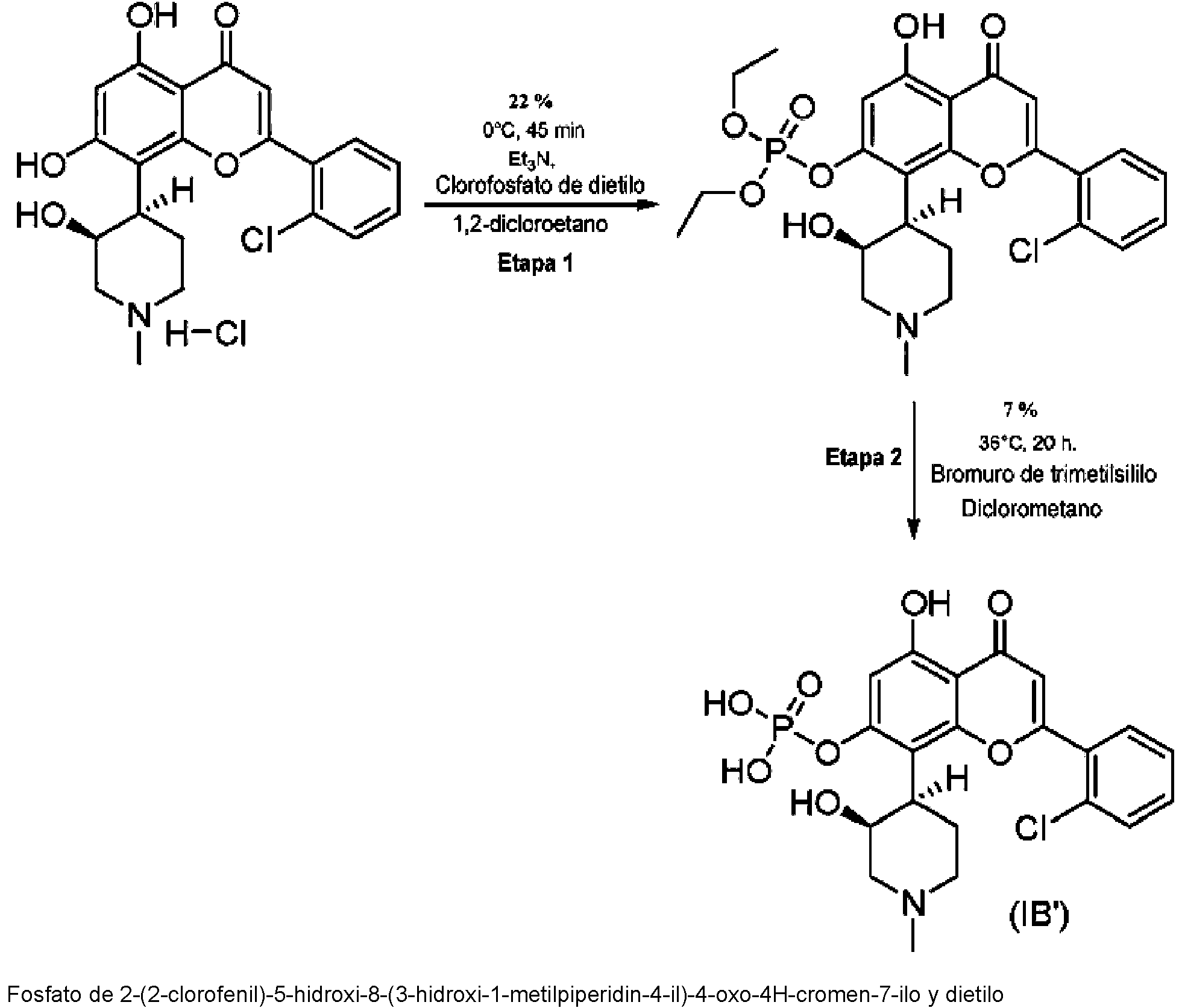
Se enfrió una suspensión de clorhidrato de alvocidib (2 g, 4,56 mmol, 1 eq.) en 1,2-dicloroetano (40 ml) hasta 0°C. A esta disolución, se le añadieron trietilamina (1,9 ml, 13,7 mmol, 3 eq.) seguido por clorofosfato de dietilo (0,78 g, 4,56 mmol, 1 eq.). Se agitó la mezcla de reacción a 0°C durante 30-45 min. Luego se vertió la mezcla de reacción sobre hielo y se extrajo con diclorometano (3 x 25 ml). Se secaron las fases orgánicas combinadas sobre Na2SO4 anhidro y se concentraron para conseguir un residuo bruto. Se purificó el residuo bruto mediante cromatografía en columna ultrarrápida usando metanol al 10-15% en diclorometano para proporcionar fosfato de 2-(2-clorofenil)-5-hidroxi-8-(3-hidroxi-1-metilpiperidin-4-il)-4-oxo-4H-cromen-7-ilo y dietilo (550 mg, 1,02 mmol; 22%).A suspension of alvocidib hydrochloride (2 g, 4.56 mmol, 1 eq.) in 1,2-dichloroethane (40 mL) was cooled to 0°C. To this solution, triethylamine (1.9 mL, 13.7 mmol, 3 eq.) followed by diethyl chlorophosphate (0.78 g, 4.56 mmol, 1 eq.) were added. The reaction mixture was stirred at 0°C for 30-45 min. The reaction mixture was then poured onto ice and extracted with dichloromethane (3 x 25 mL). The combined organic phases were dried over anhydrous Na 2 SO 4 and concentrated to give a crude residue. The crude residue was purified by flash column chromatography using 10-15% methanol in dichloromethane to give 2-(2-chlorophenyl)-5-hydroxy-8-(3-hydroxy-1-methylpiperidin-4-yl) phosphate. -4-oxo-4H-chromen-7-yl and diethyl (550 mg, 1.02 mmol, 22%).
CL-EM: columna: XBridge C8 (50 x 4,6 mm x 3,5 |i m); fase móvil: A: NH4CO3 10 mM en H2O; B: ACN; TA: 5,97; pureza: (máx: 67,63); M+H: 538,0.LC-MS: column: XBridge C8 (50 x 4.6 mm x 3.5 µm); mobile phase: A: 10 mM NH 4 CO 3 in H 2 O; B: ACN; RT: 5.97; purity: (max: 67.63); M+H: 538.0.
Dihidrogenofosfato de 2-(2-clorofenil)-5-hidroxi-8-(3-hidroxi-1-metilpiperidin-4-il)-4-oxo-4H-cromen-7-ilo (IB') 2-(2-chlorophenyl)-5-hydroxy-8-(3-hydroxy-1-methylpiperidin-4-yl)-4-oxo-4H-chromen-7-yl dihydrogen phosphate (IB')
A una disolución de fosfato de 2-(2-clorofenil)-5-hidroxi-8-(3-hidroxi-1-metilpiperidin-4-il)-4-oxo-4H-cromen-7-ilo y dietilo (0,55 g, 1,02 mmol, 1 eq.) en diclorometano (4 ml) a 0°C, se le añadió bromuro de trimetilsililo (2,0 ml, 15,1 mmol, 15 eq.). Luego se calentó la mezcla de reacción a 36°C en condición sellada durante 20 h. Se evaporó la mezcla de reacción. Se purificó el residuo bruto obtenido mediante HPLC preparativa para proporcionar dihidrogenofosfato de 2-(2-clorofenil)-5-hidroxi-8-(3-hidroxi-1-metilpiperidin-4-il)-4-oxo-4H-cromen-7-ilo (35 mg; 0,073 mmol; 7%).To a solution of 2-(2-chlorophenyl)-5-hydroxy-8-(3-hydroxy-1-methylpiperidin-4-yl)-4-oxo-4H-chromen-7-yl phosphate and diethyl (0, 55 g, 1.02 mmol, 1 eq.) in dichloromethane (4 mL) at 0°C, trimethylsilyl bromide (2.0 mL, 15.1 mmol, 15 eq.) was added. The reaction mixture was then heated at 36°C under sealed condition for 20h. The reaction mixture was evaporated. The crude residue obtained was purified by preparative HPLC to give 2-(2-chlorophenyl)-5-hydroxy-8-(3-hydroxy-1-methylpiperidin-4-yl)-4-oxo-4H-chromen-7 dihydrogen phosphate -yl (35mg, 0.073mmol, 7%).
CL-EM: columna: XBridge C8 (50 x 4,6 mm x 3,5 |i m); fase móvil: A: NH4CO310mM en H2O; B: ACN; TA: 3,11; pureza: (máx: 93,56); M+H: 482,0.LC-MS: column: XBridge C8 (50 x 4.6 mm x 3.5 µm); mobile phase: A: 10mM NH 4 CO 3 in H 2 O; B: ACN; RT: 3.11; purity: (max: 93.56); M+H: 482.0.
HPLC: columna: XBridge C8 (50 x 4,6 mm x 3,5 |i m); fase móvil: A: TFA al 0,1% en H2O; B: ACN; TA: 2,55; pureza: (máx: 96,39; 254 nm: 96,57).HPLC: column: XBridge C8 (50 x 4.6 mm x 3.5 µm); mobile phase: A: 0.1% TFA in H 2 O; B: ACN; RT: 2.55; purity: (max: 96.39; 254nm: 96.57).
1 H RMN (intercambio DMSO-d6-D2O): 8 7,84 (d, J = 7,20 Hz, 1H), 7,71-7,70 (m, 1H), 7,65-7,62 (m, 1H), 7,59-7,55 (m, 1H), 7,07 (s, 1H), 6,62 (s, 1H), 4,12 (s, 1H), 3,60-3,54 (m, 1H), 3,30-3,26 (m, 3H), 3,13-3,11 (m, 2H), 2,71 (s, 3H), 1,83 1,80 (m, 1H). 1 H NMR (DMSO-d 6 -D 2 O exchange): 8 7.84 (d, J = 7.20 Hz, 1H), 7.71-7.70 (m, 1H), 7.65-7 .62 (m, 1H), 7.59-7.55 (m, 1H), 7.07 (s, 1H), 6.62 (s, 1H), 4.12 (s, 1H), 3.60-3.54 (m, 1H), 3.30-3.26 (m, 3H), 3.13-3.11 (m, 2H), 2.71 (s, 3H), 1.83-1.80 (m, 1H).
Ejemplo 2. Perfil farmacocinético de profármacos de alvocidibExample 2. Pharmacokinetic profile of alvocidib prodrugs
Se prepararon los siguientes compuestos y se determinó y se comparó su perfil farmacocinético con el perfil farmacocinético del compuesto (IB') tal como se describe a continuación.The following compounds were prepared and their pharmacokinetic profile was determined and compared to the pharmacokinetic profile of compound (IB') as described below.

Se prepararon los compuestos y se administraron a ratones CD-1 por vía intravenosa (IV) o por vía oral (PO) tal como se resume en la tabla 1. Se determinó la concentración de plasma del compuesto original de alvocidib a diversos intervalos de tiempo (tabla 2) y se calcularon los parámetros farmacocinéticos (tabla 3). Los compuestos E y F no se transformaron en alvocidib in vivo (es decir, no se detectó alvocidib en las muestras de plasma de ratones tratados con estos compuestos), y sus parámetros farmacocinéticos no se investigaron más. Tal como puede verse en la tabla 3, la biodisponibilidad del compuesto (IB') es superior a la del compuesto de alvocidib original (A) y la de los dos compuestos difosfato (C y D).Compounds were prepared and administered to CD-1 mice intravenously (IV) or orally (PO) as summarized in Table 1. Plasma concentration of alvocidib parent compound was determined at various time intervals. (Table 2) and the pharmacokinetic parameters were calculated (Table 3). Compounds E and F were not converted to alvocidib in vivo (ie, alvocidib was not detected in plasma samples from mice treated with these compounds), and their pharmacokinetic parameters were not further investigated. As can be seen in Table 3, the bioavailability of compound (IB') is superior to that of the parent alvocidib compound (A) and that of the two diphosphate compounds (C and D).
Tabla 1. Diseño de los experimentos de obtención de perfil farmacocinéticoTable 1. Design of the experiments to obtain the pharmacokinetic profile.


Tabla 2. Concentración en plasma de alvocidibTable 2. Plasma concentration of alvocidib.

Nota: los resultados se expresan en media ± DE, n = 3 animales/grupoNote: results are expressed as mean ± SD, n = 3 animals/group
n.e.: no evaluadon.e.: not evaluated
Tabla 3. Perfiles farmacocinéticosTable 3. Pharmacokinetic profiles.

______ ____________ ______
Nota: los resultados se expresan en media ± DE, n = 3 animales/grupoNote: results are expressed as mean ± SD, n = 3 animals/group
Ejemplo 3. Perfiles de solubilidad cinéticaExample 3. Kinetic solubility profiles
Se determinó la solubilidad cinética acuosa del compuesto IB' a través de un amplio intervalo de pH (es decir, pH 2,2 - pH 8,7) y se comparó con la solubilidad cinética acuosa de alvocidib para el mismo intervalo de pH. Se encontró que la solubilidad del compuesto IB' presentaba un exceso de 1 mg/ml al pH más bajo sometido a prueba (pH 2,2), subiendo hasta por encima de 5 mg/ml a pH 6,8 y pH 8,7. Por comparación, la solubilidad de alvocidib está por encima de 1 mg/ml a pH 2,2 y pH 4,5 pero disminuye hasta 0,02 mg/ml a pH 6,8 y pH 8,7.The aqueous kinetic solubility of compound IB' was determined over a wide pH range (ie pH 2.2 - pH 8.7) and compared to the aqueous kinetic solubility of alvocidib for the same pH range. The solubility of compound IB' was found to be in excess of 1 mg/mL at the lowest pH tested (pH 2.2), rising to above 5 mg/mL at pH 6.8 and pH 8.7. . By comparison, the solubility of alvocidib is above 1 mg/mL at pH 2.2 and pH 4.5 but decreases to 0.02 mg/mL at pH 6.8 and pH 8.7.
Tabla 4. Perfiles de solubilidad cinética Table 4. Kinetic solubility profiles.

Ejemplo 4. Perfiles de estabilidad en plasmaExample 4. Plasma stability profiles
Se determinó la estabilidad en plasma del compuesto IB' usando plasma de cuatro especies. Los resultados para ratón, rata, perro y humano se muestran en las tablas 5, 6, 7 y 8, respectivamente. Se usaron como control alvocidib y flumazenil. En plasma de ratón, de rata y de humano, el compuesto IB' mantuvo el 100% de estabilidad después de 5 horas de incubación. En plasma de perro, se mantuvo aproximadamente el 90% del compuesto IB' después de 5 horas. Por comparación, alvocidib mantuvo el 100% de estabilidad a través de todas las cuatro especies después de 5 horas, y flumazenil fue inestable en plasma de ratón y de rata.Plasma stability of compound IB' was determined using plasma from four species. The results for mouse, rat, dog, and human are shown in Tables 5, 6, 7, and 8, respectively. Alvocidib and flumazenil were used as controls. In mouse, rat and human plasma, compound IB' maintained 100% stability after 5 hours of incubation. In dog plasma, approximately 90% of compound IB' remained after 5 hours. By comparison, alvocidib maintained 100% stability across all four species after 5 hours, and flumazenil was unstable in mouse and rat plasma.
Tabla 5. Perfiles de estabilidad en plasma de ratónTable 5. Stability profiles in mouse plasma.

Tabla 6. Perfiles de estabilidad en plasma de rataTable 6. Stability profiles in rat plasma.

Tabla 7. Perfiles de estabilidad en plasma de perroTable 7. Dog Plasma Stability Profiles

Tabla 8. Perfiles de estabilidad de plasma de ser humanoTable 8. Human Plasma Stability Profiles

Ejemplo 5. Farmacocinética en ratas Sprague DawleyExample 5. Pharmacokinetics in Sprague Dawley rats
Se determinaron las concentraciones en plasma de alvocidib producidas mediante la administración oral e intravenosa (IV) del compuesto IB' y del compuesto absorbido IB' en sí mismo, en ratas macho Sprague Dawley (SD) (véase la figura 1). Se tomaron muestras de plasma a 8 puntos de tiempo (IV) o 7 puntos de tiempo (oral) a lo largo de un periodo de 24 horas seguido por una única dosis del compuesto IB' (3 animales por grupo). Los parámetros farmacocinéticos calculados se muestran en la tabla 9 y en la tabla 10. Tanto la administración IV como la administración oral del compuesto IB' condujo a una exposición significativa de alvocidib. Administrado por vía intravenosa, se metabolizó el compuesto IB' (1 mg/kg) a alvocidib con una C0 de 270,3 ng/ml, que se eliminó con una semivida de 1,6 horas. Administrado por vía oral, se metabolizó el compuesto IB' (10 mg/kg) a alvocidib con una Cmáx de 178,6 ng/ml y un T máx de 2,92 horas, que se eliminó con una semivida de 4,4 horas. La biodisponibilidad de alvocidib (99,03%) se calculó a partir de la razón del área bajo la curva (AUC) para alvocidib producido a partir de la administración oral e IV del compuesto IB'. También se analizaron las muestras de plasma para determinar la presencia del compuesto IB'. Las concentraciones en plasma del compuesto IB' en ratas SD se muestran también en la figura 1 y en la tabla 11. Tanto para la administración IV como para la administración oral en ratas SD, los niveles de plasma del compuesto IB' disminuyeron por debajo de los niveles cuantitativos a las 2 horas tras recibir la dosificación.Plasma concentrations of alvocidib produced by oral and intravenous (IV) administration of compound IB' and absorbed compound IB' itself were determined in male Sprague Dawley (SD) rats (see Figure 1). Plasma samples were taken at 8 time points (IV) or 7 time points (oral) over a 24 hour period followed by a single dose of Compound IB' (3 animals per group). Calculated pharmacokinetic parameters are shown in Table 9 and Table 10. Both IV and oral administration of Compound IB' led to significant alvocidib exposure. Administered intravenously, Compound IB' (1 mg/kg) was metabolized to alvocidib with a C0 of 270.3 ng/mL, which was eliminated with a half-life of 1.6 hours. Administered orally, Compound IB' (10 mg/kg) was metabolized to alvocidib with a Cmax of 178.6 ng/mL and a Tmax of 2.92 hours, which was eliminated with a half-life of 4.4 hours. . The bioavailability of alvocidib (99.03%) was calculated from the ratio of the area under the curve (AUC) for alvocidib produced from oral and IV administration of the compound IB'. Plasma samples were also analyzed for the presence of compound IB'. Plasma concentrations of Compound IB' in SD rats are also shown in Figure 1 and Table 11. For both IV administration and oral administration in SD rats, plasma levels of Compound IB' decreased below quantitative levels at 2 hours after dosing.
Tabla 9. Parámetros farmacocinéticos para alvocidib tras la administración intravenosa del compuesto IB' en ratas Sprague DawleyTable 9. Pharmacokinetic Parameters for Alvocidib Following Intravenous Administration of Compound IB' in Sprague Dawley Rats

Tabla 10. Parámetros farmacocinéticos para alvocidib tras la administración oral del compuesto IB' en ratas Sprague DawleyTable 10. Pharmacokinetic Parameters for Alvocidib Following Oral Administration of Compound IB' in Sprague Dawley Rats

________ ________________ ________
Tabla 11. Concentraciones en plasma del compuesto IB tras la administración intravenosa u oral del compuesto IB' en ratas Sprague DawleyTable 11. Plasma concentrations of compound IB after intravenous or oral administration of compound IB' in Sprague Dawley rats

# no medido; BQL = por debajo del límite de cuantificación# not measured; BQL = below limit of quantification
Ejemplo 6. Dosis aguda máxima tolerada en ratonesExample 6. Maximum Tolerated Acute Dose in Mice
Se realizaron estudios toxicológicos agudos (es decir, de dosis única) en ratones. Se realizaron estudios agudos en ratones hembra SHO SCID usando tres animales por grupo de tratamiento. Se trataron los animales con una única dosis del compuesto IB' a 45, 30, 15 ó 7,5 mg/kg. Por comparación, se trataron animales adicionales con alvocidib a los mismos niveles de dosis. Se usaron mediciones del peso corporal tras recibir la dosificación oral (figuras 2A-B) y la dosificación intravenosa (IV) (figuras 2C-D), junto con observaciones de mortalidad y clínicas para determinar la dosis aguda máxima tolerada (DMTaguda).Acute (ie, single dose) toxicology studies were performed in mice. Acute studies were performed in female SHO SCID mice using three animals per treatment group. Animals were treated with a single dose of Compound IB' at 45, 30, 15, or 7.5 mg/kg. For comparison, additional animals were treated with alvocidib at the same dose levels. Body weight measurements following oral dosing (Figures 2A-B) and intravenous (IV) dosing (Figures 2C-D), along with mortality and clinical observations, were used to determine the acute maximum tolerated dose ( acute MTD).
Los resultados del estudio agudo determinaron que la DMTaguda del compuesto IB', dosificado por vía oral, es de 15 mg/kg. La DMTaguda del compuesto IB', dosificado por vía intravenosa, es de 15 mg/kg. Se observaron pérdida de peso corporal y letargo aumentado en animales dosificados a 30 mg/kg y a 45 mg/kg. En animales dosificados por vía oral a 45 mg/kg, un animal murió en el día dos y un animal murió en el día tres. En animales dosificados por vía oral a 30 mg/kg, un animal murió en el día cuatro. En animales dosificados por vía intravenosa a 45 mg/kg, dos animales murieron en el día dos. En animales dosificados por vía intravenosa a 30 mg/kg, un animal murió en el día tres. The results of the acute study determined that the acute MTD of compound IB', dosed orally, is 15 mg/kg. The acute MTD of compound IB', dosed intravenously, is 15 mg/kg. Body weight loss and increased lethargy were observed in animals dosed at 30 mg/kg and 45 mg/kg. In animals dosed orally at 45 mg/kg, one animal died on day two and one animal died on day three. In animals dosed orally at 30 mg/kg, one animal died by day four. In animals dosed intravenously at 45 mg/kg, two animals died on day two. In animals dosed intravenously at 30 mg/kg, one animal died on day three.
La DMTaguda aguda de alvocidib, cuando se dosifica por vía oral, es de 15 mg/kg. La DMTaguda de alvocidib, cuando se dosifica por vía intravenosa, es de 7,5 mg/kg. Se observaron cierta pérdida de peso corporal, letargo aumentado y muertes de animales en animales dosificados con alvocidib a tanto los niveles de dosis de 30 como de 45 mg/kg. The acute acute MTD of alvocidib, when dosed orally, is 15 mg/kg. The acute MTD of alvocidib, when dosed intravenously, is 7.5 mg/kg. Some body weight loss, increased lethargy and animal deaths in animals dosed with alvocidib at both the 30 and 45 mg/kg dose levels.
Se observó pérdida de peso corporal en animales supervivientes a niveles de dosificación oral de 45 mg/kg y de 30 mg/kg del compuesto IB', alcanzando el máximo al 17% en el grupo de 30 mg/kg. La pérdida de peso corporal en animales supervivientes dosificados por vía intravenosa alcanzó el máximo al 12%.Body weight loss was observed in surviving animals at oral dosage levels of 45 mg/kg and 30 mg/kg of compound IB', peaking at 17% in the 30 mg/kg group. Body weight loss in surviving animals dosed intravenously peaked at 12%.
No se observó toxicidad manifiesta en ratones dosificados por vía oral o por vía intravenosa a 15 mg/kg o 7,5 mg/kg. La menor pérdida de peso corporal que alcanzó el máximo al 3,3% en el grupo de dosificación intravenosa de 15 mg/kg se atribuyó a la fluctuación del peso corporal normal en los animales sometidos a prueba.No overt toxicity was observed in mice dosed orally or intravenously at 15 mg/kg or 7.5 mg/kg. The lower body weight loss peaking at 3.3% in the 15 mg/kg intravenous dosing group was attributed to fluctuation from normal body weight in the animals tested.
El compuesto IB' se tolera mejor (DMTaguda = 15 mg/kg) en ratones cuando se dosifica por vía intravenosa en comparación con alvocidib (DMTaguda = 7,5 mg/kg).Compound IB' is better tolerated ( acute DMT = 15 mg/kg) in mice when dosed intravenously compared to alvocidib ( acute DMT = 7.5 mg/kg).
Ejemplo 7. Pauta de dosificación repetida máxima tolerada en ratonesExample 7. Maximal Tolerated Repeated Dosing Regimen in Mice
Se realizaron estudios de toxicología de dosis repetida en ratones hembra SHO SCID usando 3 animales por grupo de tratamiento. Se trataron los animales con cinco dosis diarias de compuesto IB' a 15, 7,5 ó 2,5 mg/kg, y se observaron durante cinco días adicionales tras la pauta posológica. Por comparación, se trataron animales adicionales con alvocidib a los mismos niveles de dosis y la misma pauta de dosificación/observación. Se usaron mediciones del peso corporal de animales tratados mediante dosificación oral (véanse las figuras 3A-B) y dosificación intravenosa (véanse las figuras 3C-D) a lo largo del transcurso del periodo de dosificación repetido durante 5 días y el posterior periodo de observación de 5 días, junto con observaciones de mortalidad y clínicas, para determinar la pauta de dosificación máxima tolerada (DMTrepetida).Repeat dose toxicology studies were performed in female SHO SCID mice using 3 animals per treatment group. Animals were treated with five daily doses of Compound IB' at 15, 7.5, or 2.5 mg/kg, and observed for an additional five days following the dosage regimen. For comparison, additional animals were treated with alvocidib at the same dose levels and the same dosing/observation schedule. Body weight measurements of animals treated by oral dosing (see Figures 3A-B) and intravenous dosing (see Figures 3C-D) were used over the course of the repeated 5-day dosing period and the subsequent observation period. of 5 days, together with mortality and clinical observations, to determine the maximum tolerated dosage regimen ( repeat MTD).
Los resultados del estudio de dosis repetida de 5 días determinaron que la DMTrepetida del compuesto IB, dosificado por vía oral, es de 7,5 mg/kg. La DMTrepetida del compuesto IB', dosificado por vía intravenosa, es de 15 mg/kg. Se observó pérdida de peso corporal en animales dosificados por vía oral a 15 mg/kg. En animales dosificados por vía oral a 15 mg/kg, un animal murió en el día 5, y un animal murió en el día 7.The results of the 5-day repeat dose study determined that the repeat MTD of Compound IB, dosed orally, is 7.5 mg/kg. The repeated MTD of compound IB', dosed intravenously, is 15 mg/kg. Body weight loss was observed in animals dosed orally at 15 mg/kg. In animals dosed orally at 15 mg/kg, one animal died by day 5, and one animal died by day 7.
Por comparación, la DMTrepetida determinada para alvocidib, cuando se dosifica por vía oral, fue de 7,5 mg/kg. La DMTrepetida determinada para alvocidib, cuando se dosifica por vía intravenosa, fue de 7,5 mg/kg. Se observaron letargo, pérdida de peso corporal y muertes a los niveles de dosificación de 15 mg/kg tanto para dosificación oral como para dosificación intravenosa con alvocidib.For comparison, the repeated MTD determined for alvocidib, when dosed orally, was 7.5 mg/kg. The repeat MTD determined for alvocidib, when dosed intravenously, was 7.5 mg/kg. Lethargy, body weight loss, and deaths were observed at the 15 mg/kg dose levels for both oral and intravenous dosing with alvocidib.
Se observó pérdida de peso corporal en animales supervivientes al nivel de dosificación oral de 15 mg/kg con el compuesto IB', que alcanzó el máximo al 12%. No se observó toxicidad manifiesta en animales dosificados por vía oral a 7,5 mg/kg o 2,5 mg/kg, o en animales dosificados a cualquier nivel de dosis probado cuando se administra por vía intravenosa.Body weight loss was observed in surviving animals at the 15 mg/kg oral dosage level with Compound IB', which peaked at 12%. No overt toxicity was observed in animals dosed orally at 7.5 mg/kg or 2.5 mg/kg, or in animals dosed at any dose level tested when administered intravenously.
El compuesto IB' se tolera mejor (DMTrepetida = 15 mg/kg) en ratones cuando se dosifica por vía intravenosa en comparación con alvocidib (DMTrepetida = 7,5 mg/kg).Compound IB' is better tolerated ( repeat DMT = 15 mg/kg) in mice when dosed intravenously compared to alvocidib ( repeat DMT = 7.5 mg/kg).
Ejemplo 8. Dosis aguda máxima tolerada en ratasExample 8. Maximum Tolerated Acute Dose in Rats
Se realizaron estudios toxicológicos agudos (es decir, de dosis única) en ratas. Se realizaron estudios agudos en ratas hembra Sprague Dawley usando tres animales por grupo de tratamiento. Se trataron los animales con una única dosis del compuesto IB' a 36, 18, 9 ó 4,5 mg/kg. Por comparación, se dosificaron animales adicionales con 18, 9 ó 4,5 mg/kg alvocidib. Se usaron mediciones del peso corporal tras la dosificación oral (véase la figura 4A), junto con observaciones clínicas de mortalidad, del consumo de alimentos (véase la figura 4B) y de recuentos de sangre completa (CBC; véase la tabla 12) para determinar la dosis aguda máxima tolerada (DMTaguda).Acute (ie, single dose) toxicology studies were conducted in rats. Acute studies were performed in female Sprague Dawley rats using three animals per treatment group. Animals were treated with a single dose of Compound IB' at 36, 18, 9, or 4.5 mg/kg. For comparison, additional animals were dosed with 18, 9, or 4.5 mg/kg alvocidib. Post-oral dosing body weight measurements (see Figure 4A), along with clinical observations of mortality, food consumption (see Figure 4B), and complete blood counts (CBC; see Table 12) were used to determine the acute maximum tolerated dose ( acute MTD).
Los resultados del estudio agudo determinaron que la DMTaguda del compuesto IB' en ratas es de 18 mg/kg. Se observaron diarrea, pérdida de peso corporal y letargo aumentado en animales dosificados con compuesto IB a 36 mg/kg. A este nivel de dosis, un animal murió en el día tres, un animal murió en el día cuatro y un animal murió en el día 5. No se observaron muertes en ningún otro grupo de tratamiento.The results of the acute study determined that the acute MTD of compound IB' in rats is 18 mg/kg. Diarrhea, body weight loss, and increased lethargy were observed in animals dosed with Compound IB at 36 mg/kg. At this dose level, one animal died on day three, one animal died on day four, and one animal died on day 5. No deaths were observed in any other treatment groups.
Se observó pérdida de peso corporal en los animales tratados, precediendo a la muerte, alcanzando el 13,1% en animales tratados al nivel de dosis de 36 mg/kg con compuesto IB' (véase la figura 4A). Se acompañó esta pérdida de peso corporal por diarrea significativa y por letargo aumentado en estos animales. No se observó toxicidad manifiesta, incluyendo cambio en el peso corporal o diarrea, en ratas dosificadas a 18, 9 ó 4,5 mg/kg con compuesto IB'. En comparación, los animales dosificados con 18 mg/kg de alvocidib mostraron signos de diarrea. Además, se observaron patrones de consumo de alimento anómalos con dosificación de 18 mg/kg de alvocidib que no se observaron con los animales tratados con el compuesto IB' al mismo nivel de dosificación.Body weight loss was observed in treated animals, preceding death, reaching 13.1% in animals treated at the 36 mg/kg dose level with Compound IB' (see Figure 4A). This loss of body weight was accompanied by significant diarrhea and increased lethargy in these animals. No overt toxicity, including change in body weight or diarrhea, was observed in rats dosed at 18, 9, or 4.5 mg/kg with Compound IB'. In comparison, animals dosed with 18 mg/kg alvocidib showed signs of diarrhoea. In addition, abnormal food consumption patterns were observed at the 18 mg/kg alvocidib dosage that were not observed with animals treated with Compound IB' at the same dosage level.
Se observaron CBC anómalos en algunos animales (tabla 12). Específicamente, los recuentos de plaquetas estaban fuera del intervalo normal para el vehículo y para la dosificación de 9 mg/kg de compuesto IB', y para la dosis de 4,5 mg/kg de alvocidib. No se observó una tendencia dependiente de la dosis en los animales tratados supervivientes. Se observaron recuentos de glóbulos rojos y blancos ligeramente reducidos al nivel de dosis de 18 mg/kg para el compuesto IB'. Sin embargo, también se observaron recuentos ligeramente elevados en algunos animales no tratados. La alta variabilidad de estos resultados se atribuyó a la variación entre animales, y no a mecanismos dependientes del fármaco. Como los animales tratados con 36 mg/kg de compuesto IB' murieron durante la noche, los CBC no estuvieron disponibles.Abnormal CBCs were observed in some animals (Table 12). Specifically, platelet counts were outside the normal range for vehicle and for the 9 mg/kg Compound IB' dosage, and for the 4.5mg/kg alvocidib. No dose-dependent trend was observed in surviving treated animals. Slightly reduced red and white blood cell counts were observed at the 18 mg/kg dose level for compound IB'. However, slightly elevated counts were also observed in some untreated animals. The high variability of these results was attributed to inter-animal variation, and not to drug-dependent mechanisms. Since animals treated with 36 mg/kg Compound IB' died overnight, CBCs were not available.
Basándose en los datos anteriores, se encontró que la DMTaguda oral para ratas del compuesto IB' distinguía su perfil de tolerabilidad frente al de alvocidib, dado que se encontró que el nivel sin efecto adverso observable (NOAEL) era de 18 mg/kg para el compuesto IB' y de 9 mg/kg para alvocidib.Based on the above data, the rat oral acute DMT of compound IB' was found to distinguish its tolerability profile versus that of alvocidib, as the no-observable-adverse-effect-level (NOAEL) was found to be 18 mg/kg for the compound IB'. compound IB' and 9 mg/kg for alvocidib.
Tabla 12. Recuento sanguíneo de ratas tratadas con una dosis única de compuesto IBTable 12. Blood counts of rats treated with a single dose of compound IB

Ejemplo 9. Estudio de la eficacia de xenoinjerto en ratonesExample 9. Study of xenograft efficacy in mice
Se determinó la actividad in vivo del compuesto IB' en un modelo de xenoinjerto de ratón MV4-11 de leucemia mieloide aguda (LMA). Se siguió la inyección de 8 x 10⁶ células MV4-11/ratón por el crecimiento de tumores hasta aproximadamente 100 mm3. Después de que los tumores alcanzaran el tamaño apropiado, se aleatorizaron los ratones en los siguientes grupos de tratamiento: vehículo, compuesto IB' (7,5 mg/kg, qdx5x3), compuesto IB' (2,5 mg/kg, qdx5x3), compuesto IB' (0,1 mg/kg, qdx5x3) y compuesto IB (7,5 mg/kg, q7dx3). Se administraron vehículo y compuesto IB' por vía oral, excepto en el último grupo del compuesto IB' (7,5 mg/kg, q7dx3), que se dosificó por vía intravenosa. El tratamiento dio como resultado una inhibición del crecimiento del tumor significativa (%de TGI; véanse las figuras 5A-B y la tabla 13).The in vivo activity of compound IB' was determined in an MV4-11 mouse xenograft model of acute myeloid leukemia (AML). Injection of 8 x 10 6 MV4-11 cells/mouse was followed by growth of tumors to approximately 100 mm 3 . After tumors reached the appropriate size, mice were randomized to the following treatment groups: vehicle, Compound IB' (7.5 mg/kg, qdx5x3), Compound IB' (2.5 mg/kg, qdx5x3) , compound IB' (0.1 mg/kg, qdx5x3) and compound IB (7.5 mg/kg, q7dx3). Vehicle and Compound IB' were administered orally, except for the last Compound IB' group (7.5 mg/kg, q7dx3), which was dosed intravenously. The treatment resulted in significant tumor growth inhibition (%TGI; see Figures 5A-B and Table 13).
Tabla 13. Inhibición del crecimiento del tumor para el estudio de la eficacia de xenoinjerto en ratonesTable 13. Inhibition of tumor growth for the xenograft efficacy study in mice

Ejemplo 10. Estudio farmacodinámico de xenoinjerto en ratonesExample 10. Pharmacodynamic study of xenograft in mice
Se determinó la actividad farmacodinámica in vivo del compuesto IB' en un modelo de xenoinjerto de ratón MV4-11 de LMA (figuras 6A-B). Se siguió la inyección de 8 x 10⁶ células/ratón por el crecimiento de tumores hasta aproximadamente 100 mm3. Después de que los tumores alcanzaran el tamaño apropiado, se aleatorizaron los ratones en los siguientes grupos de tratamiento: vehículo, compuesto IB' (2,5 mg/kg), compuesto IB' (0,5 mg/kg), compuesto IB' (0,1 mg/kg), compuesto IB' (0,02 mg/kg). Se administró a los ratones una única dosis de tratamiento y se recogieron los tumores 48 horas después del tratamiento. Se evaluaron los niveles de proteína MCL-1 en los tumores recogidos usando la técnica de inmunotransferencia y electroforesis en gel de poliacrilamida convencional (figura 6A). El tratamiento dio como resultado la reducción de la expresión de la proteína MCL-1 (véase la figura 6B y la tabla 14 a continuación).The in vivo pharmacodynamic activity of compound IB' was determined in an MV4-11 mouse xenograft model of AML (Figures 6A-B). Injection of 8 x 10 6 cells/mouse was followed by growth of tumors to approximately 100 mm 3 . After tumors reached the appropriate size, mice were randomized to the following treatment groups: vehicle, Compound IB' (2.5 mg/kg), Compound IB' (0.5 mg/kg), Compound IB' (0.1 mg/kg), compound IB' (0.02 mg/kg). Mice were given a single dose of treatment and tumors were harvested 48 hours after treatment. MCL-1 protein levels in harvested tumors were assessed using the standard polyacrylamide gel electrophoresis and immunoblot technique (FIG. 6A). Treatment resulted in reduced expression of MCL-1 protein (see Figure 6B and Table 14 below).
Tabla 14. Reducción de la expresión de la proteína MCL-1 Table 14. Reduction of MCL-1 protein expression

Claims (23)


Applications Claiming Priority (1)
| Application Number | Priority Date | Filing Date | Title |
|---|---|---|---|
| US201562163188P | 2015-05-18 | 2015-05-18 |
Publications (1)
| Publication Number | Publication Date |
|---|---|
| ES2921350T3 true ES2921350T3 (en) | 2022-08-24 |
Family
ID=56087537
Family Applications (2)
| Application Number | Title | Priority Date | Filing Date |
|---|---|---|---|
| ES19167051T Active ES2921350T3 (en) | 2015-05-18 | 2016-05-18 | Alvocidib Prodrugs That Have Increased Bioavailability |
| ES16725997T Active ES2739749T3 (en) | 2015-05-18 | 2016-05-18 | Alvocidib prodrugs that have increased bioavailability |
Family Applications After (1)
| Application Number | Title | Priority Date | Filing Date |
|---|---|---|---|
| ES16725997T Active ES2739749T3 (en) | 2015-05-18 | 2016-05-18 | Alvocidib prodrugs that have increased bioavailability |
Country Status (19)
| Country | Link |
|---|---|
| US (5) | US9758539B2 (en) |
| EP (3) | EP4086264B1 (en) |
| JP (4) | JP6510075B2 (en) |
| KR (1) | KR102608921B1 (en) |
| CN (2) | CN107849073B (en) |
| AU (2) | AU2016264212B2 (en) |
| CA (1) | CA2985804A1 (en) |
| CY (1) | CY1121851T1 (en) |
| DK (2) | DK3298021T3 (en) |
| ES (2) | ES2921350T3 (en) |
| HK (1) | HK1251941B (en) |
| HU (1) | HUE045585T2 (en) |
| IL (1) | IL255465B (en) |
| MX (1) | MX380798B (en) |
| PL (1) | PL3298021T3 (en) |
| PT (1) | PT3298021T (en) |
| RU (1) | RU2752729C2 (en) |
| TR (1) | TR201911032T4 (en) |
| WO (1) | WO2016187316A1 (en) |
Families Citing this family (22)
| Publication number | Priority date | Publication date | Assignee | Title |
|---|---|---|---|---|
| MX394360B (en) | 2013-03-14 | 2025-03-24 | Sumitomo Pharma Oncology Inc | JAK2 AND ALK2 INHIBITORS AND METHODS OF THEIR USE. |
| EP3236882B1 (en) | 2014-12-23 | 2020-02-05 | Automed Pty Ltd | Delivery apparatus, system and associated methods |
| HK1251655A1 (en) | 2015-04-20 | 2019-02-01 | Tolero Pharmaceuticals, Inc. | Predicting response to alvocidib by mitochondrial profiling |
| KR102608921B1 (en) | 2015-05-18 | 2023-12-01 | 스미토모 파마 온콜로지, 인크. | Albocidip prodrug with increased bioavailability |
| JP7083497B2 (en) | 2015-08-03 | 2022-06-13 | スミトモ ファーマ オンコロジー, インコーポレイテッド | Combination therapy for the treatment of cancer |
| WO2018094275A1 (en) * | 2016-11-18 | 2018-05-24 | Tolero Pharmaceuticals, Inc. | Alvocidib prodrugs and their use as protein kinase inhibitors |
| AU2017379847B2 (en) | 2016-12-19 | 2022-05-26 | Sumitomo Pharma Oncology, Inc. | Profiling peptides and methods for sensitivity profiling |
| JP7196160B2 (en) | 2017-09-12 | 2022-12-26 | スミトモ ファーマ オンコロジー, インコーポレイテッド | Treatment Regimens for Cancers Insensitive to BCL-2 Inhibitors Using the MCL-1 Inhibitor Albocidib |
| KR20210003780A (en) | 2018-04-05 | 2021-01-12 | 스미토모 다이니폰 파마 온콜로지, 인크. | AXL kinase inhibitors and uses thereof |
| WO2019200243A1 (en) * | 2018-04-13 | 2019-10-17 | Tolero Pharmaceuticals, Inc. | Cyclin-dependent kinase inhibitors in combination with anthracyclines for treatment of cancer |
| US20210277037A1 (en) * | 2018-06-21 | 2021-09-09 | Sumitomo Dainippon Pharma Oncology, Inc. | Deuterated alvocidib and alvocidib prodrugs |
| AU2019310590A1 (en) | 2018-07-26 | 2021-01-14 | Sumitomo Pharma Oncology, Inc. | Methods for treating diseases associated with abnormal acvr1 expression and acvr1 inhibitors for use in the same |
| US11034710B2 (en) * | 2018-12-04 | 2021-06-15 | Sumitomo Dainippon Pharma Oncology, Inc. | CDK9 inhibitors and polymorphs thereof for use as agents for treatment of cancer |
| CA3120850A1 (en) * | 2018-12-07 | 2020-06-11 | Sumitomo Dainippon Pharma Oncology, Inc. | Methods for treating castration-resistant and castration- sensitive prostate cancer |
| US20220040324A1 (en) | 2018-12-21 | 2022-02-10 | Daiichi Sankyo Company, Limited | Combination of antibody-drug conjugate and kinase inhibitor |
| WO2020191326A1 (en) * | 2019-03-20 | 2020-09-24 | Sumitomo Dainippon Pharma Oncology, Inc. | Treatment of acute myeloid leukemia (aml) with venetoclax failure |
| KR20210141621A (en) | 2019-03-22 | 2021-11-23 | 스미토모 다이니폰 파마 온콜로지, 인크. | Compositions comprising PKM2 modulators and methods of treatment using same |
| EP3994132A1 (en) | 2019-07-03 | 2022-05-11 | Sumitomo Dainippon Pharma Oncology, Inc. | Tyrosine kinase non-receptor 1 (tnk1) inhibitors and uses thereof |
| US20220305037A1 (en) | 2019-07-08 | 2022-09-29 | Sumitomo Dainippon Pharma Oncology, Inc. | Treatment of Cancer |
| WO2021113688A1 (en) | 2019-12-05 | 2021-06-10 | Sumitomo Dainippon Pharma Oncology, Inc. | Combination therapies for treatment of myelodysplastic syndrome |
| US11957542B2 (en) | 2020-04-30 | 2024-04-16 | Automed Patent Holdco, Llc | Sensing complete injection for animal injection device |
| CA3230353A1 (en) * | 2021-08-23 | 2023-03-02 | Sumitomo Pharma Co., Ltd. | Self degradation-type cdk9 inhibitor prodrug and liposome encapsulating same |
Family Cites Families (280)
| Publication number | Priority date | Publication date | Assignee | Title |
|---|---|---|---|---|
| US4048314A (en) | 1974-12-17 | 1977-09-13 | Delmar Chemicals Limited | Morpholino containing 4-arylpiperidine derivatives |
| FR2338043A1 (en) | 1976-01-13 | 1977-08-12 | Delmar Chem | Antidepressant 4-aryl-piperidines and salts - some having local anaesthetic and antiarrhythmic activity |
| US4132710A (en) | 1976-12-20 | 1979-01-02 | Ayerst, Mckenna And Harrison, Ltd. | [2]Benzopyrano[3,4-c]pyridines and process therefor |
| US4522811A (en) | 1982-07-08 | 1985-06-11 | Syntex (U.S.A.) Inc. | Serial injection of muramyldipeptides and liposomes enhances the anti-infective activity of muramyldipeptides |
| US4816567A (en) | 1983-04-08 | 1989-03-28 | Genentech, Inc. | Recombinant immunoglobin preparations |
| DE3329186A1 (en) | 1983-08-12 | 1985-02-21 | Hoechst Ag, 6230 Frankfurt | CHROMONAL CALALIDE, METHOD FOR ITS INSULATION FROM DYSOXYLUM BINECTARIFERUM, AND ITS USE AS A MEDICINAL PRODUCT |
| US4676980A (en) | 1985-09-23 | 1987-06-30 | The United States Of America As Represented By The Secretary Of The Department Of Health And Human Services | Target specific cross-linked heteroantibodies |
| US5225539A (en) | 1986-03-27 | 1993-07-06 | Medical Research Council | Recombinant altered antibodies and methods of making altered antibodies |
| IN164232B (en) * | 1986-04-11 | 1989-02-04 | Hoechst India | |
| FR2601676B1 (en) | 1986-07-17 | 1988-09-23 | Rhone Poulenc Sante | PROCESS FOR THE PREPARATION OF TAXOL AND DESACETYL-10 TAXOL |
| FR2601675B1 (en) | 1986-07-17 | 1988-09-23 | Rhone Poulenc Sante | TAXOL DERIVATIVES, THEIR PREPARATION AND THE PHARMACEUTICAL COMPOSITIONS CONTAINING THEM |
| US4946778A (en) | 1987-09-21 | 1990-08-07 | Genex Corporation | Single polypeptide chain binding molecules |
| JP2691986B2 (en) | 1987-08-28 | 1997-12-17 | チッソ株式会社 | Process for producing optically active compound having pyridine skeleton |
| DE3743824C2 (en) | 1987-12-23 | 1997-03-06 | Hoechst Ag | Process for the enzymatic resolution of racemic alcohols with / in vinyl esters by transesterification |
| GB8823869D0 (en) | 1988-10-12 | 1988-11-16 | Medical Res Council | Production of antibodies |
| DE3836676A1 (en) | 1988-10-28 | 1990-05-03 | Hoechst Ag | THE USE OF 4H-1-BENZOPYRAN-4-ON DERIVATIVES, NEW 4H-1-BENZOPYRAN-4-ON DERIVATIVES AND MEDICINAL PRODUCTS CONTAINING THEM |
| US5284856A (en) | 1988-10-28 | 1994-02-08 | Hoechst Aktiengesellschaft | Oncogene-encoded kinases inhibition using 4-H-1-benzopyran-4-one derivatives |
| GB8827305D0 (en) | 1988-11-23 | 1988-12-29 | British Bio Technology | Compounds |
| ES2096590T3 (en) | 1989-06-29 | 1997-03-16 | Medarex Inc | BI-SPECIFIC REAGENTS FOR AIDS THERAPY. |
| US5804604A (en) | 1989-12-21 | 1998-09-08 | Biogen, Inc. | Tat-derived transport polypeptides and fusion proteins |
| US5670617A (en) | 1989-12-21 | 1997-09-23 | Biogen Inc | Nucleic acid conjugates of tat-derived transport polypeptides |
| WO1996033735A1 (en) | 1995-04-27 | 1996-10-31 | Abgenix, Inc. | Human antibodies derived from immunized xenomice |
| DE69120146T2 (en) | 1990-01-12 | 1996-12-12 | Cell Genesys Inc | GENERATION OF XENOGENIC ANTIBODIES |
| ATE158021T1 (en) | 1990-08-29 | 1997-09-15 | Genpharm Int | PRODUCTION AND USE OF NON-HUMAN TRANSGENT ANIMALS FOR THE PRODUCTION OF HETEROLOGUE ANTIBODIES |
| US5661016A (en) | 1990-08-29 | 1997-08-26 | Genpharm International Inc. | Transgenic non-human animals capable of producing heterologous antibodies of various isotypes |
| US5625126A (en) | 1990-08-29 | 1997-04-29 | Genpharm International, Inc. | Transgenic non-human animals for producing heterologous antibodies |
| US5633425A (en) | 1990-08-29 | 1997-05-27 | Genpharm International, Inc. | Transgenic non-human animals capable of producing heterologous antibodies |
| US5545806A (en) | 1990-08-29 | 1996-08-13 | Genpharm International, Inc. | Ransgenic non-human animals for producing heterologous antibodies |
| JPH0641075A (en) | 1990-09-01 | 1994-02-15 | Kazuo Achinami | New 1,4-dihydropyridine compound and its production |
| MX9102128A (en) | 1990-11-23 | 1992-07-08 | Rhone Poulenc Rorer Sa | DERIVATIVES OF TAXANE, PROCEDURE FOR ITS PREPARATION AND PHARMACEUTICAL COMPOSITION THAT CONTAINS THEM |
| AU647603B2 (en) | 1991-04-02 | 1994-03-24 | Hoechst Aktiengesellschaft | An immobilized biocatalyst, its preparation and use for ester synthesis in a column reactor |
| WO1992020373A1 (en) | 1991-05-14 | 1992-11-26 | Repligen Corporation | Heteroconjugate antibodies for treatment of hiv infection |
| FI941572A7 (en) | 1991-10-07 | 1994-05-27 | Oncologix Inc | Combination and method of use of anti-erbB-2 monoclonal antibodies |
| WO1993008829A1 (en) | 1991-11-04 | 1993-05-13 | The Regents Of The University Of California | Compositions that mediate killing of hiv-infected cells |
| CA2372813A1 (en) | 1992-02-06 | 1993-08-19 | L.L. Houston | Biosynthetic binding protein for cancer marker |
| ES2301158T3 (en) | 1992-07-24 | 2008-06-16 | Amgen Fremont Inc. | XENOGENIC ANTIBODY PRODUCTION. |
| US6177401B1 (en) | 1992-11-13 | 2001-01-23 | Max-Planck-Gesellschaft Zur Forderung Der Wissenschaften | Use of organic compounds for the inhibition of Flk-1 mediated vasculogenesis and angiogenesis |
| DK0752248T3 (en) | 1992-11-13 | 2000-11-13 | Idec Pharma Corp | Therapeutic use of chimeric and radiolabeled antibodies against human B lymphocyte restricted differentiation antibody |
| US5455258A (en) | 1993-01-06 | 1995-10-03 | Ciba-Geigy Corporation | Arylsulfonamido-substituted hydroxamic acids |
| IL112248A0 (en) | 1994-01-25 | 1995-03-30 | Warner Lambert Co | Tricyclic heteroaromatic compounds and pharmaceutical compositions containing them |
| GB9422836D0 (en) | 1994-11-11 | 1995-01-04 | Wainscoat James | Monitoring malignant disease |
| US5731168A (en) | 1995-03-01 | 1998-03-24 | Genentech, Inc. | Method for making heteromultimeric polypeptides |
| US5863949A (en) | 1995-03-08 | 1999-01-26 | Pfizer Inc | Arylsulfonylamino hydroxamic acid derivatives |
| ES2153031T4 (en) | 1995-04-20 | 2001-05-16 | Pfizer | ARILSULFONIL HYDROXAMIC ACID DERIVATIVES AS INHIBITORS OF MMP AND TNF. |
| WO1996034096A1 (en) | 1995-04-28 | 1996-10-31 | Abgenix, Inc. | Human antibodies derived from immunized xenomice |
| US5747498A (en) | 1996-05-28 | 1998-05-05 | Pfizer Inc. | Alkynyl and azido-substituted 4-anilinoquinazolines |
| US5880141A (en) | 1995-06-07 | 1999-03-09 | Sugen, Inc. | Benzylidene-Z-indoline compounds for the treatment of disease |
| ATE365808T1 (en) | 1995-07-28 | 2007-07-15 | Marie Curie Cancer Care | TRANSPORT PROTEINS AND THEIR USES |
| GB9520822D0 (en) | 1995-10-11 | 1995-12-13 | Wellcome Found | Therapeutically active compounds |
| US5733920A (en) | 1995-10-31 | 1998-03-31 | Mitotix, Inc. | Inhibitors of cyclin dependent kinases |
| GB9624482D0 (en) | 1995-12-18 | 1997-01-15 | Zeneca Phaema S A | Chemical compounds |
| ATE225343T1 (en) | 1995-12-20 | 2002-10-15 | Hoffmann La Roche | MATRIX METALLOPROTEASE INHIBITORS |
| EP0888458A4 (en) | 1996-02-20 | 2004-05-06 | Sloan Kettering Institutefor C | COMBINATION OF PROTEIN KINASE C INHIBITORS AND THERAPEUTIC AGENTS FOR THE TREATMENT OF CANCER |
| NZ331191A (en) | 1996-03-05 | 2000-03-27 | Zeneca Ltd | 4-anilinoquinazoline derivatives and pharmaceutical compositions thereof |
| US6087366A (en) | 1996-03-07 | 2000-07-11 | The Trustees Of Columbia University In The City Of New York | Use of flavopiridol or a pharmaceutically acceptable salt thereof for inhibiting cell damage or cell death |
| US5849733A (en) | 1996-05-10 | 1998-12-15 | Bristol-Myers Squibb Co. | 2-thio or 2-oxo flavopiridol analogs |
| EP0818442A3 (en) | 1996-07-12 | 1998-12-30 | Pfizer Inc. | Cyclic sulphone derivatives as inhibitors of metalloproteinases and of the production of tumour necrosis factor |
| AR007857A1 (en) | 1996-07-13 | 1999-11-24 | Glaxo Group Ltd | HETERO-CYCLIC COMPOUNDS FUSED AS PROTEIN INHIBITORS, THYROSINE KINASE, THEIR PREPARATION METHODS, INTERMEDIARY USE IN MEDICINE AND PHARMACEUTICAL COMPOSITIONS CONTAINING THEM. |
| HRP970371A2 (en) | 1996-07-13 | 1998-08-31 | Kathryn Jane Smith | Heterocyclic compounds |
| EA199900021A1 (en) | 1996-07-13 | 1999-08-26 | Глаксо, Груп Лимитед | BICYCLIC HETEROAROMATIC COMPOUNDS AS PROTEINTHYROSINKINASE INHIBITORS |
| KR20000067904A (en) | 1996-07-18 | 2000-11-25 | 디. 제이. 우드, 스피겔 알렌 제이 | Phosphinate Based Inhibitors of Matrix Metalloproteases |
| KR20000068248A (en) | 1996-08-23 | 2000-11-25 | 디. 제이. 우드, 스피겔 알렌 제이 | Arylsulfonylamino Hydroxamic Acid Derivatives |
| US5965703A (en) | 1996-09-20 | 1999-10-12 | Idun Pharmaceuticals | Human bad polypeptides, encoding nucleic acids and methods of use |
| US5908934A (en) | 1996-09-26 | 1999-06-01 | Bristol-Myers Squibb Company | Process for the preparation of chiral ketone intermediates useful for the preparation of flavopiridol and analogs |
| ID18494A (en) | 1996-10-02 | 1998-04-16 | Novartis Ag | PIRAZOLA DISTRIBUTION IN THE SEQUENCE AND THE PROCESS OF MAKING IT |
| US5916771A (en) | 1996-10-11 | 1999-06-29 | Abgenix, Inc. | Production of a multimeric protein by cell fusion method |
| JP3338064B2 (en) | 1997-01-06 | 2002-10-28 | ファイザー・インク | Cyclic sulfone derivative |
| NZ336840A (en) | 1997-02-03 | 2001-01-26 | Pfizer Prod Inc | Arylsulfonylamino hydroxamic acid derivatives useful in the treatment of tumor necrosis factor and matrix metalloproteinase mediated diseases |
| WO1998033798A2 (en) | 1997-02-05 | 1998-08-06 | Warner Lambert Company | Pyrido[2,3-d]pyrimidines and 4-amino-pyrimidines as inhibitors of cell proliferation |
| JP2000507975A (en) | 1997-02-07 | 2000-06-27 | ファイザー・インク | N-hydroxy-β-sulfonylpropionamide derivatives and their use as matrix metalloproteinase inhibitors |
| EP0960098A1 (en) | 1997-02-11 | 1999-12-01 | Pfizer Inc. | Arylsulfonyl hydroxamic acid derivatives |
| GB9704444D0 (en) | 1997-03-04 | 1997-04-23 | Isis Innovation | Non-invasive prenatal diagnosis |
| JP2002511852A (en) | 1997-05-07 | 2002-04-16 | スージェン・インコーポレーテッド | 2-indolinone derivatives as modulators of protein kinase activity |
| JP2002501532A (en) | 1997-05-30 | 2002-01-15 | メルク エンド カンパニー インコーポレーテッド | Novel angiogenesis inhibitors |
| CA2299355C (en) | 1997-08-08 | 2005-09-27 | Pfizer Products Inc. | Aryloxyarylsulfonylamino hydroxamic acid derivatives |
| ES2289791T3 (en) | 1997-08-22 | 2008-02-01 | Astrazeneca Ab | DERIVATIVES OF OXINDOLILQUINAZOLINA AS INHIBITORS OF ANGIOGENESIS. |
| EP1015578A4 (en) | 1997-09-17 | 2004-12-01 | Walker And Eliza Hall Inst Of | THERAPEUTIC MOLECULES |
| AU744939B2 (en) | 1997-09-26 | 2002-03-07 | Merck & Co., Inc. | Novel angiogenesis inhibitors |
| WO1999016787A1 (en) | 1997-09-26 | 1999-04-08 | Washington University | Cell death agonists |
| EP1028964A1 (en) | 1997-11-11 | 2000-08-23 | Pfizer Products Inc. | Thienopyrimidine and thienopyridine derivatives useful as anticancer agents |
| GB9725782D0 (en) | 1997-12-05 | 1998-02-04 | Pfizer Ltd | Therapeutic agents |
| GB9800575D0 (en) | 1998-01-12 | 1998-03-11 | Glaxo Group Ltd | Heterocyclic compounds |
| RS49779B (en) | 1998-01-12 | 2008-06-05 | Glaxo Group Limited, | BICYCLIC HETEROAROMATIC COMPOUNDS AS PROTEIN TYROSINE KINASE INHIBITORS |
| DE19802449A1 (en) | 1998-01-23 | 1999-07-29 | Hoechst Marion Roussel De Gmbh | Preparation of 3-hydroxy-1-methyl-4-phenyl-piperidine derivative isomer, for use as intermediate for antitumor agent flavopiridol |
| US6437136B2 (en) | 1998-01-23 | 2002-08-20 | Aventis Pharma Deutschland Gmbh | Process for the preparation of (−)cis-3-hydroxy-1-methyl-4-(2,4,6-trimethoxyphenyl)piperidine |
| GB9801690D0 (en) | 1998-01-27 | 1998-03-25 | Pfizer Ltd | Therapeutic agents |
| DE19809649A1 (en) | 1998-03-06 | 1999-09-09 | Hoechst Marion Roussel De Gmbh | Process for the enzymatic separation of enantiomers of 3 (R) - and 3 (S) -hydroxy-1-methyl-4- (2,4,6-trimethoxyphenyl) -1,2,3,6-tetrahydro-pyridine or the Carboxylic acid esters |
| JP4462654B2 (en) | 1998-03-26 | 2010-05-12 | ソニー株式会社 | Video material selection device and video material selection method |
| PA8469401A1 (en) | 1998-04-10 | 2000-05-24 | Pfizer Prod Inc | BICYCLE DERIVATIVES OF HYDROXAMIC ACID |
| PA8469501A1 (en) | 1998-04-10 | 2000-09-29 | Pfizer Prod Inc | HYDROXAMIDES OF THE ACID (4-ARILSULFONILAMINO) -TETRAHIDROPIRAN-4-CARBOXILICO |
| US20020029391A1 (en) | 1998-04-15 | 2002-03-07 | Claude Geoffrey Davis | Epitope-driven human antibody production and gene expression profiling |
| SK287132B6 (en) | 1998-05-29 | 2009-12-07 | Sugen, Inc. | Pharmaceutical composition containing pyrrole substituted 2-indolinone, kit containing mentioned composition and use pyrrole substituted 2-indolinone |
| UA60365C2 (en) | 1998-06-04 | 2003-10-15 | Пфайзер Продактс Інк. | Isothiazole derivatives, a method for preparing thereof, a pharmaceutical composition and a method for treatment of hyperproliferative disease of mammal |
| FR2780056B1 (en) | 1998-06-18 | 2000-08-04 | Hoechst Marion Roussel Inc | NEW PROCESS FOR THE PREPARATION OF DERIVATIVES OF 4-PHENYL-1-2 3,6-TETRAHYDROPYRIDINE AND THE INTERMEDIATE PRODUCTS USED |
| CA2338638C (en) | 1998-07-30 | 2009-03-17 | Sigma-Tau Industrie Farmaceutiche Riunite S.P.A. | Use of l-carnitine and its alkanoyl derivatives in the preparation of medicaments with anticancer activity |
| US6268499B1 (en) | 1998-08-10 | 2001-07-31 | Hoffman-La Roche Inc. | Process and intermediates for preparation of substituted piperidine-epoxides |
| DE19981729D2 (en) | 1998-08-29 | 2001-08-09 | Ghyczy Miklos | Pharmaceutical and / or dietetic product |
| EP1004578B1 (en) | 1998-11-05 | 2004-02-25 | Pfizer Products Inc. | 5-oxo-pyrrolidine-2-carboxylic acid hydroxamide derivatives |
| UA71945C2 (en) | 1999-01-27 | 2005-01-17 | Pfizer Prod Inc | Substituted bicyclic derivatives being used as anticancer agents |
| US6399633B1 (en) | 1999-02-01 | 2002-06-04 | Aventis Pharmaceuticals Inc. | Use of 4-H-1-benzopryan-4-one derivatives as inhibitors of smooth muscle cell proliferation |
| IL129299A0 (en) | 1999-03-31 | 2000-02-17 | Mor Research Applic Ltd | Monoclonal antibodies antigens and diagnosis of malignant diseases |
| EP1210098A1 (en) | 1999-04-07 | 2002-06-05 | Thomas Jefferson University | Enhancement of peptide cellular uptake |
| US6511993B1 (en) | 1999-06-03 | 2003-01-28 | Kevin Neil Dack | Metalloprotease inhibitors |
| AU6906100A (en) | 1999-08-16 | 2001-03-13 | Government of The United States of America, as represented by The Secretary Department of Health & Human Services, The National Institutes of Health, The | Receptor-mediated uptake of an extracellular bcl-xl fusion protein inhibits apoptosis |
| DK1234031T3 (en) | 1999-11-30 | 2017-07-03 | Mayo Foundation | B7-H1, AN UNKNOWN IMMUNE REGULATORY MOLECULE |
| DE19959546A1 (en) | 1999-12-09 | 2001-06-21 | Rhone Poulenc Rorer Gmbh | Pharmaceutical preparation for the treatment of tumor diseases |
| EP1248869A2 (en) | 2000-01-07 | 2002-10-16 | Transform Pharmaceuticals, Inc. | High-throughput formation, identification, and analysis of diverse solid-forms |
| US6821990B2 (en) | 2000-01-18 | 2004-11-23 | Aventis Pharma Deutschland Gmbh | Ethanol solvate of (-)-cis-2-(2-chlorophenyl)-5, 7-dihydroxy-8 [4R-(3S-hydroxy-1-M ethyl) piperidinyl]-4H-1-benzopyran-4-one |
| US6576647B2 (en) | 2000-01-18 | 2003-06-10 | Aventis Pharmaceuticals Inc. | Pseudopolymorph of (—)-cis-2-(2-chlorophenyl)-5,7-dihydroxy-8[4R-(3S-hydroxy -1-methyl)piperidinyl]-4H-1-benzopyran-4-one |
| JP3663382B2 (en) | 2000-02-15 | 2005-06-22 | スージェン・インコーポレーテッド | Pyrrole-substituted 2-indolinone protein kinase inhibitor |
| FR2805538B1 (en) | 2000-02-29 | 2006-08-04 | Hoechst Marion Roussel Inc | NOVEL FLAVON DERIVATIVES, PROCESS FOR THE PREPARATION THEREOF, THEIR USE AS MEDICAMENTS, PHARMACEUTICAL COMPOSITIONS AND NOVEL USE |
| WO2001080896A2 (en) | 2000-04-21 | 2001-11-01 | Arch Development Corporation | Flavopiridol drug combinations and methods with reduced side effects |
| WO2002020568A2 (en) | 2000-09-06 | 2002-03-14 | Abbott Laboratories | Mutant peptides derived from bad and their use to identify substances which bind to a member of the bcl-2 family of proteins |
| WO2002046182A1 (en) | 2000-12-08 | 2002-06-13 | Bristol-Myers Squibb Pharma Company | Semicarbazides and their uses as cyclin dependent kinase inhibitors |
| WO2002069995A2 (en) | 2001-02-16 | 2002-09-12 | Medical College Of Georgia Research Institute, Inc. | Use of trail and antiprogestins for treating cancer |
| ES2387562T3 (en) * | 2001-03-23 | 2012-09-26 | Luitpold Pharmaceuticals, Inc. | Conjugates fatty alcohol-medication |
| EP1427407A4 (en) | 2001-03-23 | 2005-05-11 | Luitpold Pharm Inc | CONJUGATES BASED ON FATTY AMINES AND PHARMACEUTICAL AGENTS |
| KR20030026069A (en) | 2001-09-24 | 2003-03-31 | 주식회사 엘지생명과학 | Apoptosis-inducing cancer-cell-specific composition by combination with TNF family protein and flavopiridol |
| EP1436406A4 (en) | 2001-09-24 | 2004-10-13 | Blood Ct Res Foundation | Method of modulating or examining ku70 levels in cells |
| WO2003040168A2 (en) | 2001-11-06 | 2003-05-15 | Enanta Pharmaceuticals, Inc. | Methods and compositions for identifying peptide aptamers capable of altering a cell phenotype |
| WO2003057158A2 (en) | 2001-12-31 | 2003-07-17 | Dana-Farber Cancer Institute, Inc. | Method of treating apoptosis and compositions thereof |
| CA2478047C (en) | 2002-03-01 | 2014-01-21 | Immunomedics, Inc. | Rs7 antibodies |
| IL149820A0 (en) | 2002-05-23 | 2002-11-10 | Curetech Ltd | Humanized immunomodulatory monoclonal antibodies for the treatment of neoplastic disease or immunodeficiency |
| US20040106647A1 (en) | 2002-06-28 | 2004-06-03 | Schneider Michael D. | Modulators of Cdk9 as a therapeutic target in cardiac hypertrophy |
| AU2003281200A1 (en) | 2002-07-03 | 2004-01-23 | Tasuku Honjo | Immunopotentiating compositions |
| US7884127B2 (en) | 2002-07-08 | 2011-02-08 | Pirimal Life Sciences Ltd. | Inhibitors of cyclin dependent kinases and their use |
| US7915301B2 (en) | 2002-07-08 | 2011-03-29 | Piramal Life Science Limited | Inhibitors of cyclin dependent kinases and their use |
| US20040171809A1 (en) | 2002-09-09 | 2004-09-02 | Korsmeyer Stanley J. | BH3 peptides and method of use thereof |
| CN101899114A (en) | 2002-12-23 | 2010-12-01 | 惠氏公司 | Anti-PD-1 antibody and uses thereof |
| WO2004058804A1 (en) | 2002-12-24 | 2004-07-15 | Walter And Eliza Hall Institute Of Medical Research | Peptides and therapeutic uses thereof |
| KR20060022647A (en) * | 2003-04-25 | 2006-03-10 | 길리애드 사이언시즈, 인코포레이티드 | Kinase Inhibition Phosphonate Analogs |
| US7452901B2 (en) | 2003-04-25 | 2008-11-18 | Gilead Sciences, Inc. | Anti-cancer phosphonate analogs |
| GB0315259D0 (en) | 2003-06-30 | 2003-08-06 | Cyclacel Ltd | Use |
| TWI476206B (en) | 2003-07-18 | 2015-03-11 | Amgen Inc | a specific binding agent for hepatocyte growth factor |
| CN1302004C (en) | 2003-08-22 | 2007-02-28 | 浙江海正药业股份有限公司 | A kind of preparation method of cytarabine |
| ES2586387T3 (en) | 2003-11-05 | 2016-10-14 | Dana-Farber Cancer Institute, Inc. | Suitable alpha helical peptides to activate or inhibit cell death |
| JP4814245B2 (en) * | 2004-09-21 | 2011-11-16 | ヴァイオン ファーマシューティカルズ、インコーポレーテッド | Phosphate-containing prodrugs of sulfonylhydrazines as hypoxia-selective antitumor agents |
| WO2006069186A2 (en) | 2004-12-22 | 2006-06-29 | The Ohio State Research Foundation | Small molecule bcl-xl/bcl-2 binding inhibitors |
| WO2006101846A1 (en) | 2005-03-16 | 2006-09-28 | Aventis Pharmaceuticals Inc. | Dosing regimen of flavopiridol for treating cancer in particular cll |
| WO2006099667A1 (en) | 2005-03-21 | 2006-09-28 | The Walter And Eliza Hall Institute Of Medical Research | Prophylactic and therapeutic agents and uses therefor |
| DK2439273T3 (en) | 2005-05-09 | 2019-06-03 | Ono Pharmaceutical Co | HUMAN MONOCLONAL ANTIBODIES FOR PROGRAMMED DEATH-1 (PD-1) AND PROCEDURES FOR TREATMENT OF CANCER USING ANTI-PD-1 ANTIBODIES ALONE OR IN COMBINATION WITH OTHER IMMUNTER APPLICATIONS |
| PT1907424E (en) | 2005-07-01 | 2015-10-09 | Squibb & Sons Llc | Human monoclonal antibodies to programmed death ligand 1 (pd-l1) |
| US7750000B2 (en) | 2005-09-02 | 2010-07-06 | Bayer Schering Pharma Ag | Substituted imidazo[1,2b]pyridazines as kinase inhibitors, their preparation and use as medicaments |
| AU2006288847A1 (en) * | 2005-09-09 | 2007-03-15 | Analytecon Sa | Isoquinolines derivatives as IGF-1R inhibitors |
| CA2645853A1 (en) | 2006-03-31 | 2007-11-01 | Dana-Farber Cancer Institute | Methods of determining cellular chemosensitivity |
| US20090142337A1 (en) | 2006-05-08 | 2009-06-04 | Astex Therapeutics Limited | Pharmaceutical Combinations of Diazole Derivatives for Cancer Treatment |
| US9360473B2 (en) | 2006-08-16 | 2016-06-07 | Eutropics Pharmaceuticals, Inc. | Assay system to identify therapeutic agents |
| CA2666624C (en) | 2006-10-19 | 2015-12-29 | Signal Pharmaceuticals, Llc | Heteroaryl compounds, compositions thereof, and use thereof as protein kinase inhibitors |
| JP2010520222A (en) | 2007-03-01 | 2010-06-10 | スーパージェン, インコーポレイテッド | Use of pyrimidine-2,4-diamine derivatives and pyrimidine-2,4-diamine derivatives as JAK2 kinase inhibitors |
| GB0706633D0 (en) | 2007-04-04 | 2007-05-16 | Cyclacel Ltd | Combination |
| EP1987839A1 (en) | 2007-04-30 | 2008-11-05 | I.N.S.E.R.M. Institut National de la Sante et de la Recherche Medicale | Cytotoxic anti-LAG-3 monoclonal antibody and its use in the treatment or prevention of organ transplant rejection and autoimmune disease |
| US9244059B2 (en) | 2007-04-30 | 2016-01-26 | Immutep Parc Club Orsay | Cytotoxic anti-LAG-3 monoclonal antibody and its use in the treatment or prevention of organ transplant rejection and autoimmune disease |
| EP2154971B1 (en) | 2007-05-15 | 2011-12-28 | Piramal Life Sciences Limited | A synergistic pharmaceutical combination for the treatment of cancer |
| RU2438664C2 (en) | 2007-05-15 | 2012-01-10 | Пирамал Лайф Сайнсиз Лимитед | Synergetic pharmaceutical combination for cancer treatment |
| BR122017025062B8 (en) | 2007-06-18 | 2021-07-27 | Merck Sharp & Dohme | monoclonal antibody or antibody fragment to human programmed death receptor pd-1, polynucleotide and composition comprising said antibody or fragment |
| US20090030005A1 (en) | 2007-07-19 | 2009-01-29 | Amgen Inc. | Combinations for the treatment of cancer |
| CA2700925C (en) | 2007-09-26 | 2016-08-23 | Dana Farber Cancer Institute | Methods and compositions for modulating bcl-2 family polypeptides |
| EP2044949A1 (en) | 2007-10-05 | 2009-04-08 | Immutep | Use of recombinant lag-3 or the derivatives thereof for eliciting monocyte immune response |
| EP2249831A2 (en) | 2007-12-10 | 2010-11-17 | Sunesis Pharmaceuticals, Inc. | Methods of using (+)-1,4-dihydro-7-ý(3s,4s)-3-methoxy-4-(methylamino)-1-pyrrolidinyl¨-4-oxo-1-(2-thiazolyl)-1,8-naphthyridine-3-carboxylic acid for treatment of antecedent hematologic disorders |
| EP2250180A1 (en) * | 2008-02-08 | 2010-11-17 | Wyeth LLC | Phosphate derivatives of substituted benzoxazoles |
| US8168755B2 (en) | 2008-05-07 | 2012-05-01 | Eutropics Pharmaceuticals, Inc. | Antibodies specific to heterodimers of Bcl-2 family and uses thereof |
| AU2009259136B2 (en) | 2008-06-09 | 2014-09-25 | Cyclacel Limited | Combinations of sapacitabine or CNDAC with DNA methyltransferase inhibitors such as decitabine and procaine |
| AR072999A1 (en) | 2008-08-11 | 2010-10-06 | Medarex Inc | HUMAN ANTIBODIES THAT JOIN GEN 3 OF LYMPHOCYTARY ACTIVATION (LAG-3) AND THE USES OF THESE |
| JP2012500855A (en) | 2008-08-25 | 2012-01-12 | アンプリミューン、インコーポレーテッド | PD-1 antagonists and methods for treating infectious diseases |
| TWI453207B (en) | 2008-09-08 | 2014-09-21 | Signal Pharm Llc | Aminotriazolopyridines, compositions thereof, and methods of treatment therewith |
| WO2010030727A1 (en) * | 2008-09-10 | 2010-03-18 | Wyeth Llc | 3-substituted-1h-indole, 3-substituted-1h-pyrrolo[2,3-b]pyridine and 3-substituted-1h-pyrrolo[3,2-b]pyridine compounds, their use as mtor kinase and pi3 kinase inhibitors, and their syntheses |
| AU2009290544B2 (en) | 2008-09-12 | 2015-07-16 | Oxford University Innovation Limited | PD-1 specific antibodies and uses thereof |
| US8552154B2 (en) | 2008-09-26 | 2013-10-08 | Emory University | Anti-PD-L1 antibodies and uses therefor |
| EP3255060A1 (en) | 2008-12-09 | 2017-12-13 | F. Hoffmann-La Roche AG | Anti-pd-l1 antibodies and their use to enhance t-cell function |
| JP2012517241A (en) | 2009-02-11 | 2012-08-02 | アボット・ラボラトリーズ | Methods and compositions for identifying, classifying and monitoring subjects with Bcl-2 family inhibitor resistant tumors and cancers |
| ES3000111T3 (en) | 2009-02-13 | 2025-02-27 | Immunomedics Inc | Intermediates for preparing conjugates with an intracellularly-cleavable linkage |
| WO2010147961A1 (en) | 2009-06-15 | 2010-12-23 | Precision Therapeutics, Inc. | Methods and markers for predicting responses to chemotherapy |
| AU2010314395B2 (en) | 2009-11-05 | 2015-04-09 | Glaxosmithkline Llc | Benzodiazepine bromodomain inhibitor |
| PL2504364T3 (en) | 2009-11-24 | 2017-12-29 | Medimmune Limited | Targeted binding agents against b7-h1 |
| WO2011066342A2 (en) | 2009-11-24 | 2011-06-03 | Amplimmune, Inc. | Simultaneous inhibition of pd-l1/pd-l2 |
| US20130011393A1 (en) | 2010-01-12 | 2013-01-10 | Johnathan Mark Lancaster | Bad pathway gene signature |
| EP2545078A1 (en) | 2010-03-11 | 2013-01-16 | UCB Pharma, S.A. | Pd-1 antibody |
| US8372819B2 (en) | 2010-04-11 | 2013-02-12 | Salk Institute For Biological Studies | Methods and compositions for targeting skip |
| MX354217B (en) | 2010-05-14 | 2018-02-19 | Dana Farber Cancer Inst Inc | Compositions and methods for treating leukemia. |
| WO2011153374A1 (en) | 2010-06-04 | 2011-12-08 | Syndax Pharmaceuticals Inc. | Prodrugs of azacitidine 5'-phosphate |
| AU2011262758B8 (en) | 2010-06-11 | 2014-09-04 | Kyowa Kirin Co., Ltd. | Anti-tim-3 antibody |
| WO2011159877A2 (en) | 2010-06-18 | 2011-12-22 | The Brigham And Women's Hospital, Inc. | Bi-specific antibodies against tim-3 and pd-1 for immunotherapy in chronic immune conditions |
| US8907053B2 (en) | 2010-06-25 | 2014-12-09 | Aurigene Discovery Technologies Limited | Immunosuppression modulating compounds |
| SG180031A1 (en) | 2010-10-15 | 2012-05-30 | Agency Science Tech & Res | Combination treatment of cancer |
| AR084070A1 (en) | 2010-12-02 | 2013-04-17 | Constellation Pharmaceuticals Inc | BROMODOMINIUM INHIBITORS AND USES OF THE SAME |
| US8987271B2 (en) | 2010-12-22 | 2015-03-24 | Eutropics Pharmaceuticals, Inc. | 2,2′-biphenazine compounds and methods useful for treating disease |
| EP2684167B1 (en) | 2011-03-08 | 2020-09-09 | Eutropics Pharmaceuticals, Inc. | Compositions and methods useful for treating diseases |
| JP6072771B2 (en) | 2011-04-20 | 2017-02-01 | メディミューン,エルエルシー | Antibodies and other molecules that bind to B7-H1 and PD-1 |
| PH12013502523A1 (en) | 2011-06-14 | 2019-10-11 | Novartis Ag | Combination of panobinostat and ruxolitinib in the treatment of cancer such as a myeloproliferative neoplasm |
| WO2013006490A2 (en) | 2011-07-01 | 2013-01-10 | Cellerant Therapeutics, Inc. | Antibodies that specifically bind to tim3 |
| CA2840018C (en) | 2011-07-24 | 2019-07-16 | Curetech Ltd. | Variants of humanized immunomodulatory monoclonal antibodies |
| EP2561867A1 (en) | 2011-08-22 | 2013-02-27 | Lead Discovery Center GmbH | CDK9 inhibitors in the treatment of midline carcinoma |
| US9012215B2 (en) | 2011-09-22 | 2015-04-21 | The Johns Hopkins University | Methods for identifying leukemia stem cells and distinguishing them from normal hematopietic stem cells in patients with acute myeloid leukemia: uses in diagnosis, treatment, and research |
| US20130122492A1 (en) | 2011-11-14 | 2013-05-16 | Kellbenx Inc. | Detection, isolation and analysis of rare cells in biological fluids |
| KR101764096B1 (en) | 2011-11-28 | 2017-08-02 | 메르크 파텐트 게엠베하 | Anti-pd-l1 antibodies and uses thereof |
| WO2013082660A1 (en) | 2011-12-09 | 2013-06-13 | Alfred Health | Prediction method |
| WO2013138702A2 (en) | 2012-03-15 | 2013-09-19 | Bristol-Myers Squibb Company | Methods for predicting gastrointestinal immune-related adverse events (gi-irae) in patients treated with modulation of the co-stimulatory pathway |
| WO2013142281A1 (en) | 2012-03-20 | 2013-09-26 | Dana Farber Cancer Institute, Inc. | Inhibition of mcl-1 and/or bfl-1/a1 |
| US20150301053A1 (en) | 2012-05-10 | 2015-10-22 | Eutropics Pharmaceuticals, Inc. | Surrogate functional diagnostics test for cancer |
| KR20220084444A (en) | 2012-05-31 | 2022-06-21 | 소렌토 쎄라퓨틱스, 인코포레이티드 | Antigen binding proteins that bind pd-l1 |
| WO2013182519A1 (en) | 2012-06-04 | 2013-12-12 | Universitaet Basel | Combination of lysosomotropic or autophagy modulating agents and a gsk-3 inhibitor for treatment of cancer |
| WO2013188355A1 (en) | 2012-06-12 | 2013-12-19 | Merck Sharp & Dohme Corp. | Cdk inhibitor for treating refractory chronic lymphocytic leukemia |
| WO2013192423A2 (en) | 2012-06-20 | 2013-12-27 | Eutropics Pharmaceuticals, Inc. | Methods and compositions useful for treating diseases involving bcl-2 family proteins with quinoline derivatives |
| US20150322479A1 (en) | 2012-06-20 | 2015-11-12 | Cytospan Technologies Corporation | Apparatus and method for quantification of replicative lifespan and observation of senescene |
| UY34887A (en) | 2012-07-02 | 2013-12-31 | Bristol Myers Squibb Company Una Corporacion Del Estado De Delaware | OPTIMIZATION OF ANTIBODIES THAT FIX THE LYMPHOCYTE ACTIVATION GEN 3 (LAG-3) AND ITS USES |
| CN111499755A (en) | 2012-08-03 | 2020-08-07 | 丹娜法伯癌症研究院 | Anti-PD-L1 and PD-L2 double binding antibody single reagent and method of use |
| JP6352924B2 (en) | 2012-09-19 | 2018-07-04 | ダナ−ファーバー キャンサー インスティテュート, インコーポレイテッド | Dynamic BH3 profiling |
| US9241941B2 (en) | 2012-09-20 | 2016-01-26 | Memorial Sloan-Kettering Cancer Center | Methods for treatment of lymphomas with mutations in cell cycle genes |
| AU2013323736A1 (en) | 2012-09-26 | 2015-04-09 | Mannkind Corporation | Multiple kinase pathway inhibitors |
| BR112015007672A2 (en) | 2012-10-04 | 2017-08-08 | Dana Farber Cancer Inst Inc | human monoclonal anti-pd-l1 antibodies and methods of use |
| CA2887129A1 (en) | 2012-10-09 | 2014-04-17 | Igenica, Inc. | Anti-c16orf54 antibodies and methods of use thereof |
| WO2014065275A1 (en) | 2012-10-23 | 2014-05-01 | 国立大学法人福井大学 | Therapeutic or prophylactic agent for tumor lysis syndrome |
| EP2912178B1 (en) | 2012-10-25 | 2020-06-17 | Whitehead Institute For Biomedical Research | Super-enhancers and methods of use thereof |
| US9765039B2 (en) | 2012-11-21 | 2017-09-19 | Zenith Epigenetics Ltd. | Biaryl derivatives as bromodomain inhibitors |
| AR093984A1 (en) | 2012-12-21 | 2015-07-01 | Merck Sharp & Dohme | ANTIBODIES THAT JOIN LEGEND 1 OF SCHEDULED DEATH (PD-L1) HUMAN |
| PL2945628T3 (en) | 2013-01-15 | 2020-09-21 | Aragon Pharmaceuticals, Inc. | Androgen receptor modulator in combination with abiraterone acetate and prednisone for treating prostate cancer |
| US10344088B2 (en) | 2013-03-15 | 2019-07-09 | Glaxosmithkline Intellectual Property Development Limited | Antigen binding proteins |
| SMT202100065T1 (en) | 2013-05-02 | 2021-03-15 | Anaptysbio Inc | Antibodies directed against programmed death-1 (pd-1) |
| WO2014194302A2 (en) | 2013-05-31 | 2014-12-04 | Sorrento Therapeutics, Inc. | Antigen binding proteins that bind pd-1 |
| US20160145355A1 (en) | 2013-06-24 | 2016-05-26 | Biomed Valley Discoveries, Inc. | Bispecific antibodies |
| EP3022222A4 (en) | 2013-07-18 | 2017-06-07 | Eutropics Pharmaceuticals, Inc. | Differential bh3 mitochondrial profiling |
| US10732182B2 (en) | 2013-08-01 | 2020-08-04 | Eutropics Pharmaceuticals, Inc. | Method for predicting cancer sensitivity |
| CN112552401B (en) | 2013-09-13 | 2023-08-25 | 广州百济神州生物制药有限公司 | anti-PD 1 antibodies and their use as therapeutic and diagnostic agents |
| AU2014323526B2 (en) | 2013-09-19 | 2020-07-23 | Dana-Farber Cancer Institute, Inc. | Methods of BH3 profiling |
| WO2015047510A1 (en) | 2013-09-27 | 2015-04-02 | Immunomedics, Inc. | Anti-trop-2 antibody-drug conjugates and uses thereof |
| EP3060581A4 (en) | 2013-10-25 | 2017-06-07 | Dana-Farber Cancer Institute, Inc. | Anti-pd-l1 monoclonal antibodies and fragments thereof |
| JP6538044B2 (en) | 2013-10-30 | 2019-07-03 | ユートロピクス ファーマシューティカルズ, インコーポレイテッド | Methods of determining chemosensitivity and chemotoxicity |
| RU2016122654A (en) | 2013-11-08 | 2017-12-14 | Дана-Фарбер Кэнсер Инститьют, Инк. | COMBINED THERAPY OF A MALIGNANT TUMOR USING BRODOMODOMENE AND EXTRATERMINAL (BET) PROTEIN INHIBITORS |
| WO2015081158A1 (en) | 2013-11-26 | 2015-06-04 | Bristol-Myers Squibb Company | Method of treating hiv by disrupting pd-1/pd-l1 signaling |
| SG10201804945WA (en) | 2013-12-12 | 2018-07-30 | Shanghai hengrui pharmaceutical co ltd | Pd-1 antibody, antigen-binding fragment thereof, and medical application thereof |
| PL3094351T3 (en) | 2014-01-15 | 2022-06-27 | Kadmon Corporation, Llc | Immunomodulatory agents |
| TWI680138B (en) | 2014-01-23 | 2019-12-21 | 美商再生元醫藥公司 | Human antibodies to pd-l1 |
| TWI681969B (en) | 2014-01-23 | 2020-01-11 | 美商再生元醫藥公司 | Human antibodies to pd-1 |
| PE20170255A1 (en) | 2014-01-24 | 2017-03-22 | Dana Farber Cancer Inst Inc | ANTIBODY MOLECULES BINDING AND USES OF PD-1 |
| HUE057817T2 (en) | 2014-01-28 | 2022-06-28 | Bristol Myers Squibb Co | Anti-LAG-3 antibodies for the treatment of hematological malignancies |
| HUE045065T2 (en) | 2014-01-31 | 2019-12-30 | Novartis Ag | TIM-3 antibody molecules and their uses |
| EP3476392A1 (en) | 2014-02-28 | 2019-05-01 | Merck Sharp & Dohme Corp. | Method for treating cancer |
| KR102442436B1 (en) | 2014-03-14 | 2022-09-15 | 노파르티스 아게 | Antibody molecules to lag-3 and uses thereof |
| WO2015161247A1 (en) | 2014-04-17 | 2015-10-22 | Igenica Biotherapeutics, Inc. | Humanized anti-c16orf54 antibodies and methods of use thereof |
| JP6666905B2 (en) | 2014-05-29 | 2020-03-18 | スプリング バイオサイエンス コーポレーション | PD-L1 antibody and use thereof |
| WO2015195163A1 (en) | 2014-06-20 | 2015-12-23 | R-Pharm Overseas, Inc. | Pd-l1 antagonist fully human antibody |
| TWI693232B (en) | 2014-06-26 | 2020-05-11 | 美商宏觀基因股份有限公司 | Covalently bonded diabodies having immunoreactivity with pd-1 and lag-3, and methods of use thereof |
| CN106604742B (en) | 2014-07-03 | 2019-01-11 | 百济神州有限公司 | Anti-PD-L1 antibody and its use as a therapeutic and diagnostic agent |
| JO3663B1 (en) | 2014-08-19 | 2020-08-27 | Merck Sharp & Dohme | Anti-lag3 antibodies and antigen-binding fragments |
| JP6839074B2 (en) | 2014-09-17 | 2021-03-03 | ノバルティス アーゲー | Targeting cytotoxic cells at chimeric receptors for adoptive immunotherapy |
| CA3000633C (en) | 2014-10-14 | 2023-10-03 | The Regents Of The University Of California | Use of cdk9 and brd4 inhibitors to inhibit inflammation |
| EP4245376A3 (en) | 2014-10-14 | 2023-12-13 | Novartis AG | Antibody molecules to pd-l1 and uses thereof |
| SI3215532T1 (en) | 2014-11-06 | 2020-02-28 | F. Hoffmann-La Roche Ag | Anti-TIM3 antibodies and application procedures |
| KR20170092543A (en) | 2014-11-07 | 2017-08-11 | 톨레로 파마수티컬스, 인크. | Methods to target transcriptional control at super-enhancer regions |
| TWI595006B (en) | 2014-12-09 | 2017-08-11 | 禮納特神經系統科學公司 | Anti-PD-1 antibodies and methods of using same |
| WO2016111947A2 (en) | 2015-01-05 | 2016-07-14 | Jounce Therapeutics, Inc. | Antibodies that inhibit tim-3:lilrb2 interactions and uses thereof |
| US10793915B2 (en) | 2015-01-12 | 2020-10-06 | Eutropics Pharmaceuticals, Inc. | Context dependent diagnostics test for guiding cancer treatment |
| US10052346B2 (en) | 2015-02-17 | 2018-08-21 | Cantex Pharmaceuticals, Inc. | Treatment of myelodysplastic syndromes with 2-O and,or 3-O desulfated heparinoids |
| EP3265486A4 (en) | 2015-03-06 | 2018-11-14 | Sorrento Therapeutics, Inc. | Antibody therapeutics that bind tim3 |
| CA2979999A1 (en) | 2015-03-18 | 2016-09-22 | Massachusetts Institute Of Technology | Selective mcl-1 binding peptides |
| US20180100859A1 (en) | 2015-03-24 | 2018-04-12 | Eutropics Pharmaceuticals, Inc. | Surrogate functional biomarker for solid tumor cancer |
| FI3277321T3 (en) | 2015-04-01 | 2024-10-31 | Anaptysbio Inc | Antibodies directed against t cell immunoglobulin and mucin protein 3 (tim-3) |
| WO2016161248A1 (en) | 2015-04-02 | 2016-10-06 | Tolero Pharmaceuticals, Inc. | Targeting pim kinases in combination with btk inhibition |
| HK1251655A1 (en) | 2015-04-20 | 2019-02-01 | Tolero Pharmaceuticals, Inc. | Predicting response to alvocidib by mitochondrial profiling |
| EP3288964B1 (en) | 2015-04-27 | 2024-02-21 | Dana-Farber Cancer Institute, Inc. | High throughput bh3 profiling: a rapid and scalable technology to bh3 profile on low numbers of cells |
| KR102608921B1 (en) | 2015-05-18 | 2023-12-01 | 스미토모 파마 온콜로지, 인크. | Albocidip prodrug with increased bioavailability |
| JP7083497B2 (en) | 2015-08-03 | 2022-06-13 | スミトモ ファーマ オンコロジー, インコーポレイテッド | Combination therapy for the treatment of cancer |
| WO2017075349A2 (en) | 2015-10-30 | 2017-05-04 | Massachusetts Institute Of Technology | Selective mcl-1 binding peptides |
| US9782232B1 (en) | 2016-04-25 | 2017-10-10 | Novartis Ag | Automated intraocular pressure tamponade |
| CN105919955A (en) | 2016-06-13 | 2016-09-07 | 佛山市腾瑞医药科技有限公司 | Ruxolitinib preparation and application thereof |
| SG11201900344YA (en) | 2016-07-15 | 2019-02-27 | Novartis Ag | Treatment and prevention of cytokine release syndrome using a chimeric antigen receptor in combination with a kinase inhibitor |
| WO2018094275A1 (en) | 2016-11-18 | 2018-05-24 | Tolero Pharmaceuticals, Inc. | Alvocidib prodrugs and their use as protein kinase inhibitors |
| AU2017379847B2 (en) | 2016-12-19 | 2022-05-26 | Sumitomo Pharma Oncology, Inc. | Profiling peptides and methods for sensitivity profiling |
| JP7196160B2 (en) | 2017-09-12 | 2022-12-26 | スミトモ ファーマ オンコロジー, インコーポレイテッド | Treatment Regimens for Cancers Insensitive to BCL-2 Inhibitors Using the MCL-1 Inhibitor Albocidib |
| WO2019200243A1 (en) | 2018-04-13 | 2019-10-17 | Tolero Pharmaceuticals, Inc. | Cyclin-dependent kinase inhibitors in combination with anthracyclines for treatment of cancer |
| US20210277037A1 (en) | 2018-06-21 | 2021-09-09 | Sumitomo Dainippon Pharma Oncology, Inc. | Deuterated alvocidib and alvocidib prodrugs |
| US20210379042A1 (en) | 2018-10-12 | 2021-12-09 | Sumitomo Dainippon Pharma Oncology, Inc. | Methods for monitoring tumor lysis syndrome |
| WO2020092615A1 (en) | 2018-11-01 | 2020-05-07 | Oregon Health & Science University | Treatments for venetoclax-resistant and venetoclax-sensitive acute myeloid leukemia |
| JP7222673B2 (en) | 2018-11-20 | 2023-02-15 | 株式会社日立製作所 | Particle beam therapy system and its control method |
| US11034710B2 (en) | 2018-12-04 | 2021-06-15 | Sumitomo Dainippon Pharma Oncology, Inc. | CDK9 inhibitors and polymorphs thereof for use as agents for treatment of cancer |
| CA3120850A1 (en) | 2018-12-07 | 2020-06-11 | Sumitomo Dainippon Pharma Oncology, Inc. | Methods for treating castration-resistant and castration- sensitive prostate cancer |
| WO2020191326A1 (en) | 2019-03-20 | 2020-09-24 | Sumitomo Dainippon Pharma Oncology, Inc. | Treatment of acute myeloid leukemia (aml) with venetoclax failure |
| US20220305037A1 (en) | 2019-07-08 | 2022-09-29 | Sumitomo Dainippon Pharma Oncology, Inc. | Treatment of Cancer |
| WO2021007314A2 (en) | 2019-07-08 | 2021-01-14 | Sumitomo Dainippon Pharma Oncology, Inc. | Treatment of cancer |
| WO2021113688A1 (en) | 2019-12-05 | 2021-06-10 | Sumitomo Dainippon Pharma Oncology, Inc. | Combination therapies for treatment of myelodysplastic syndrome |
-
2016
- 2016-05-18 KR KR1020177036133A patent/KR102608921B1/en active Active
- 2016-05-18 PT PT16725997T patent/PT3298021T/en unknown
- 2016-05-18 EP EP22166479.0A patent/EP4086264B1/en active Active
- 2016-05-18 ES ES19167051T patent/ES2921350T3/en active Active
- 2016-05-18 EP EP19167051.2A patent/EP3527574B1/en active Active
- 2016-05-18 MX MX2017014645A patent/MX380798B/en unknown
- 2016-05-18 HK HK18111270.8A patent/HK1251941B/en unknown
- 2016-05-18 AU AU2016264212A patent/AU2016264212B2/en active Active
- 2016-05-18 CN CN201680028628.XA patent/CN107849073B/en active Active
- 2016-05-18 DK DK16725997.7T patent/DK3298021T3/en active
- 2016-05-18 HU HUE16725997A patent/HUE045585T2/en unknown
- 2016-05-18 DK DK19167051.2T patent/DK3527574T3/en active
- 2016-05-18 CA CA2985804A patent/CA2985804A1/en active Pending
- 2016-05-18 RU RU2017143776A patent/RU2752729C2/en active
- 2016-05-18 ES ES16725997T patent/ES2739749T3/en active Active
- 2016-05-18 CN CN202010157126.5A patent/CN111349118B/en active Active
- 2016-05-18 EP EP16725997.7A patent/EP3298021B1/en active Active
- 2016-05-18 WO PCT/US2016/033099 patent/WO2016187316A1/en not_active Ceased
- 2016-05-18 US US15/158,206 patent/US9758539B2/en active Active
- 2016-05-18 PL PL16725997T patent/PL3298021T3/en unknown
- 2016-05-18 JP JP2017559812A patent/JP6510075B2/en active Active
- 2016-05-18 TR TR2019/11032T patent/TR201911032T4/en unknown
-
2017
- 2017-08-09 US US15/673,213 patent/US10259835B2/en active Active
- 2017-11-06 IL IL255465A patent/IL255465B/en unknown
-
2018
- 2018-08-17 JP JP2018153504A patent/JP6695940B2/en active Active
-
2019
- 2019-02-19 US US16/279,958 patent/US10562925B2/en active Active
- 2019-07-26 CY CY20191100801T patent/CY1121851T1/en unknown
- 2019-12-26 US US16/727,693 patent/US20200131210A1/en not_active Abandoned
-
2020
- 2020-04-22 JP JP2020075973A patent/JP6883688B2/en active Active
-
2021
- 2021-01-20 AU AU2021200343A patent/AU2021200343A1/en not_active Abandoned
- 2021-05-07 US US17/314,896 patent/US12338261B2/en active Active
- 2021-05-10 JP JP2021079708A patent/JP7133680B2/en active Active
Also Published As
Similar Documents
| Publication | Publication Date | Title |
|---|---|---|
| ES2921350T3 (en) | Alvocidib Prodrugs That Have Increased Bioavailability | |
| US11279694B2 (en) | Alvocidib prodrugs and their use as protein kinase inhibitors | |
| ES2858753T3 (en) | Derivatives of 6-oxo-N- (1- (benzyl) -1H-pyrazol-4-yl) -6,7,8,9-tetrahydropyrido [3 ', 2': 4,5] pyrrolo [1,2- a] pyrazine-2-carboxamide as inhibitors of ribosomal S6 kinase (RSK) p90 for the treatment of cancer | |
| ES2992301T3 (en) | Solid oral dosage forms comprising decitabine and cedazuridine | |
| HK40082754A (en) | Alvocidib prodrugs having increased bioavailability | |
| BR112017024933B1 (en) | COMPOUND, TAUTOMER THEREOF, PHARMACEUTICALLY ACCEPTABLE SALT THEREOF, PHARMACEUTICAL COMPOSITION, USE OF SAID COMPOUND AND METHOD FOR PREPARING THE SAME | |
| HK40013110A (en) | Alvocidib prodrugs having increased bioavailability | |
| US20240024347A1 (en) | Prodrugs of 6-mercaptopurine | |
| BR112018002087B1 (en) | GLUTAMINE ANALOG COMPOUNDS, PHARMACEUTICAL COMPOSITION COMPRISING THE SAME AND THEIR USE IN THE TREATMENT OF CANCER |