ES2924111T3 - Fibroblast growth factor receptor inhibitors - Google Patents
Fibroblast growth factor receptor inhibitors Download PDFInfo
- Publication number
- ES2924111T3 ES2924111T3 ES18177131T ES18177131T ES2924111T3 ES 2924111 T3 ES2924111 T3 ES 2924111T3 ES 18177131 T ES18177131 T ES 18177131T ES 18177131 T ES18177131 T ES 18177131T ES 2924111 T3 ES2924111 T3 ES 2924111T3
- Authority
- ES
- Spain
- Prior art keywords
- mmol
- amino
- synthesis
- stirred
- compound
- Prior art date
- Legal status (The legal status is an assumption and is not a legal conclusion. Google has not performed a legal analysis and makes no representation as to the accuracy of the status listed.)
- Active
Links
Classifications
-
- C—CHEMISTRY; METALLURGY
- C07—ORGANIC CHEMISTRY
- C07D—HETEROCYCLIC COMPOUNDS
- C07D239/00—Heterocyclic compounds containing 1,3-diazine or hydrogenated 1,3-diazine rings
- C07D239/70—Heterocyclic compounds containing 1,3-diazine or hydrogenated 1,3-diazine rings condensed with carbocyclic rings or ring systems
- C07D239/72—Quinazolines; Hydrogenated quinazolines
- C07D239/78—Quinazolines; Hydrogenated quinazolines with hetero atoms directly attached in position 2
- C07D239/84—Nitrogen atoms
-
- A—HUMAN NECESSITIES
- A61—MEDICAL OR VETERINARY SCIENCE; HYGIENE
- A61K—PREPARATIONS FOR MEDICAL, DENTAL OR TOILETRY PURPOSES
- A61K31/00—Medicinal preparations containing organic active ingredients
- A61K31/33—Heterocyclic compounds
- A61K31/395—Heterocyclic compounds having nitrogen as a ring hetero atom, e.g. guanethidine or rifamycins
- A61K31/435—Heterocyclic compounds having nitrogen as a ring hetero atom, e.g. guanethidine or rifamycins having six-membered rings with one nitrogen as the only ring hetero atom
- A61K31/44—Non condensed pyridines; Hydrogenated derivatives thereof
- A61K31/4427—Non condensed pyridines; Hydrogenated derivatives thereof containing further heterocyclic ring systems
- A61K31/444—Non condensed pyridines; Hydrogenated derivatives thereof containing further heterocyclic ring systems containing a six-membered ring with nitrogen as a ring heteroatom, e.g. amrinone
-
- A—HUMAN NECESSITIES
- A61—MEDICAL OR VETERINARY SCIENCE; HYGIENE
- A61K—PREPARATIONS FOR MEDICAL, DENTAL OR TOILETRY PURPOSES
- A61K31/00—Medicinal preparations containing organic active ingredients
- A61K31/33—Heterocyclic compounds
- A61K31/395—Heterocyclic compounds having nitrogen as a ring hetero atom, e.g. guanethidine or rifamycins
- A61K31/495—Heterocyclic compounds having nitrogen as a ring hetero atom, e.g. guanethidine or rifamycins having six-membered rings with two or more nitrogen atoms as the only ring heteroatoms, e.g. piperazine or tetrazines
- A61K31/505—Pyrimidines; Hydrogenated pyrimidines, e.g. trimethoprim
- A61K31/517—Pyrimidines; Hydrogenated pyrimidines, e.g. trimethoprim ortho- or peri-condensed with carbocyclic ring systems, e.g. quinazoline, perimidine
-
- A—HUMAN NECESSITIES
- A61—MEDICAL OR VETERINARY SCIENCE; HYGIENE
- A61K—PREPARATIONS FOR MEDICAL, DENTAL OR TOILETRY PURPOSES
- A61K31/00—Medicinal preparations containing organic active ingredients
- A61K31/33—Heterocyclic compounds
- A61K31/395—Heterocyclic compounds having nitrogen as a ring hetero atom, e.g. guanethidine or rifamycins
- A61K31/495—Heterocyclic compounds having nitrogen as a ring hetero atom, e.g. guanethidine or rifamycins having six-membered rings with two or more nitrogen atoms as the only ring heteroatoms, e.g. piperazine or tetrazines
- A61K31/505—Pyrimidines; Hydrogenated pyrimidines, e.g. trimethoprim
- A61K31/519—Pyrimidines; Hydrogenated pyrimidines, e.g. trimethoprim ortho- or peri-condensed with heterocyclic rings
-
- A—HUMAN NECESSITIES
- A61—MEDICAL OR VETERINARY SCIENCE; HYGIENE
- A61P—SPECIFIC THERAPEUTIC ACTIVITY OF CHEMICAL COMPOUNDS OR MEDICINAL PREPARATIONS
- A61P1/00—Drugs for disorders of the alimentary tract or the digestive system
- A61P1/16—Drugs for disorders of the alimentary tract or the digestive system for liver or gallbladder disorders, e.g. hepatoprotective agents, cholagogues, litholytics
-
- A—HUMAN NECESSITIES
- A61—MEDICAL OR VETERINARY SCIENCE; HYGIENE
- A61P—SPECIFIC THERAPEUTIC ACTIVITY OF CHEMICAL COMPOUNDS OR MEDICINAL PREPARATIONS
- A61P3/00—Drugs for disorders of the metabolism
- A61P3/06—Antihyperlipidemics
-
- A—HUMAN NECESSITIES
- A61—MEDICAL OR VETERINARY SCIENCE; HYGIENE
- A61P—SPECIFIC THERAPEUTIC ACTIVITY OF CHEMICAL COMPOUNDS OR MEDICINAL PREPARATIONS
- A61P35/00—Antineoplastic agents
-
- A—HUMAN NECESSITIES
- A61—MEDICAL OR VETERINARY SCIENCE; HYGIENE
- A61P—SPECIFIC THERAPEUTIC ACTIVITY OF CHEMICAL COMPOUNDS OR MEDICINAL PREPARATIONS
- A61P43/00—Drugs for specific purposes, not provided for in groups A61P1/00-A61P41/00
-
- C—CHEMISTRY; METALLURGY
- C07—ORGANIC CHEMISTRY
- C07D—HETEROCYCLIC COMPOUNDS
- C07D235/00—Heterocyclic compounds containing 1,3-diazole or hydrogenated 1,3-diazole rings, condensed with other rings
- C07D235/02—Heterocyclic compounds containing 1,3-diazole or hydrogenated 1,3-diazole rings, condensed with other rings condensed with carbocyclic rings or ring systems
- C07D235/04—Benzimidazoles; Hydrogenated benzimidazoles
- C07D235/24—Benzimidazoles; Hydrogenated benzimidazoles with hetero atoms or with carbon atoms having three bonds to hetero atoms with at the most one bond to halogen, e.g. ester or nitrile radicals, directly attached in position 2
- C07D235/30—Nitrogen atoms not forming part of a nitro radical
-
- C—CHEMISTRY; METALLURGY
- C07—ORGANIC CHEMISTRY
- C07D—HETEROCYCLIC COMPOUNDS
- C07D401/00—Heterocyclic compounds containing two or more hetero rings, having nitrogen atoms as the only ring hetero atoms, at least one ring being a six-membered ring with only one nitrogen atom
- C07D401/02—Heterocyclic compounds containing two or more hetero rings, having nitrogen atoms as the only ring hetero atoms, at least one ring being a six-membered ring with only one nitrogen atom containing two hetero rings
- C07D401/04—Heterocyclic compounds containing two or more hetero rings, having nitrogen atoms as the only ring hetero atoms, at least one ring being a six-membered ring with only one nitrogen atom containing two hetero rings directly linked by a ring-member-to-ring-member bond
-
- C—CHEMISTRY; METALLURGY
- C07—ORGANIC CHEMISTRY
- C07D—HETEROCYCLIC COMPOUNDS
- C07D401/00—Heterocyclic compounds containing two or more hetero rings, having nitrogen atoms as the only ring hetero atoms, at least one ring being a six-membered ring with only one nitrogen atom
- C07D401/02—Heterocyclic compounds containing two or more hetero rings, having nitrogen atoms as the only ring hetero atoms, at least one ring being a six-membered ring with only one nitrogen atom containing two hetero rings
- C07D401/12—Heterocyclic compounds containing two or more hetero rings, having nitrogen atoms as the only ring hetero atoms, at least one ring being a six-membered ring with only one nitrogen atom containing two hetero rings linked by a chain containing hetero atoms as chain links
-
- C—CHEMISTRY; METALLURGY
- C07—ORGANIC CHEMISTRY
- C07D—HETEROCYCLIC COMPOUNDS
- C07D403/00—Heterocyclic compounds containing two or more hetero rings, having nitrogen atoms as the only ring hetero atoms, not provided for by group C07D401/00
- C07D403/02—Heterocyclic compounds containing two or more hetero rings, having nitrogen atoms as the only ring hetero atoms, not provided for by group C07D401/00 containing two hetero rings
- C07D403/12—Heterocyclic compounds containing two or more hetero rings, having nitrogen atoms as the only ring hetero atoms, not provided for by group C07D401/00 containing two hetero rings linked by a chain containing hetero atoms as chain links
-
- C—CHEMISTRY; METALLURGY
- C07—ORGANIC CHEMISTRY
- C07D—HETEROCYCLIC COMPOUNDS
- C07D403/00—Heterocyclic compounds containing two or more hetero rings, having nitrogen atoms as the only ring hetero atoms, not provided for by group C07D401/00
- C07D403/14—Heterocyclic compounds containing two or more hetero rings, having nitrogen atoms as the only ring hetero atoms, not provided for by group C07D401/00 containing three or more hetero rings
-
- C—CHEMISTRY; METALLURGY
- C07—ORGANIC CHEMISTRY
- C07D—HETEROCYCLIC COMPOUNDS
- C07D405/00—Heterocyclic compounds containing both one or more hetero rings having oxygen atoms as the only ring hetero atoms, and one or more rings having nitrogen as the only ring hetero atom
- C07D405/02—Heterocyclic compounds containing both one or more hetero rings having oxygen atoms as the only ring hetero atoms, and one or more rings having nitrogen as the only ring hetero atom containing two hetero rings
- C07D405/12—Heterocyclic compounds containing both one or more hetero rings having oxygen atoms as the only ring hetero atoms, and one or more rings having nitrogen as the only ring hetero atom containing two hetero rings linked by a chain containing hetero atoms as chain links
-
- C—CHEMISTRY; METALLURGY
- C07—ORGANIC CHEMISTRY
- C07D—HETEROCYCLIC COMPOUNDS
- C07D409/00—Heterocyclic compounds containing two or more hetero rings, at least one ring having sulfur atoms as the only ring hetero atoms
- C07D409/02—Heterocyclic compounds containing two or more hetero rings, at least one ring having sulfur atoms as the only ring hetero atoms containing two hetero rings
- C07D409/12—Heterocyclic compounds containing two or more hetero rings, at least one ring having sulfur atoms as the only ring hetero atoms containing two hetero rings linked by a chain containing hetero atoms as chain links
-
- C—CHEMISTRY; METALLURGY
- C07—ORGANIC CHEMISTRY
- C07D—HETEROCYCLIC COMPOUNDS
- C07D471/00—Heterocyclic compounds containing nitrogen atoms as the only ring hetero atoms in the condensed system, at least one ring being a six-membered ring with one nitrogen atom, not provided for by groups C07D451/00 - C07D463/00
- C07D471/02—Heterocyclic compounds containing nitrogen atoms as the only ring hetero atoms in the condensed system, at least one ring being a six-membered ring with one nitrogen atom, not provided for by groups C07D451/00 - C07D463/00 in which the condensed system contains two hetero rings
- C07D471/04—Ortho-condensed systems
-
- C—CHEMISTRY; METALLURGY
- C07—ORGANIC CHEMISTRY
- C07D—HETEROCYCLIC COMPOUNDS
- C07D475/00—Heterocyclic compounds containing pteridine ring systems
Landscapes
- Chemical & Material Sciences (AREA)
- Organic Chemistry (AREA)
- Health & Medical Sciences (AREA)
- General Health & Medical Sciences (AREA)
- Veterinary Medicine (AREA)
- Public Health (AREA)
- Life Sciences & Earth Sciences (AREA)
- Animal Behavior & Ethology (AREA)
- Medicinal Chemistry (AREA)
- Pharmacology & Pharmacy (AREA)
- Chemical Kinetics & Catalysis (AREA)
- General Chemical & Material Sciences (AREA)
- Nuclear Medicine, Radiotherapy & Molecular Imaging (AREA)
- Epidemiology (AREA)
- Bioinformatics & Cheminformatics (AREA)
- Engineering & Computer Science (AREA)
- Obesity (AREA)
- Hematology (AREA)
- Diabetes (AREA)
- Gastroenterology & Hepatology (AREA)
- Pharmaceuticals Containing Other Organic And Inorganic Compounds (AREA)
- Medicines That Contain Protein Lipid Enzymes And Other Medicines (AREA)
- Nitrogen Condensed Heterocyclic Rings (AREA)
- Plural Heterocyclic Compounds (AREA)
- Medicines Containing Material From Animals Or Micro-Organisms (AREA)
Abstract
En el presente documento se describen inhibidores de FGFR-4, composiciones farmacéuticas que incluyen tales compuestos y métodos para usar tales compuestos y composiciones. (Traducción automática con Google Translate, sin valor legal)FGFR-4 inhibitors, pharmaceutical compositions including such compounds, and methods of using such compounds and compositions are described herein. (Automatic translation with Google Translate, without legal value)
Description
DESCRIPCIÓNDESCRIPTION
Inhibidores del receptor del factor de crecimiento de fibroblastosFibroblast growth factor receptor inhibitors
AntecedentesBackground
El receptor 4 del factor de crecimiento de fibroblastos (FGFR-4) es una proteína que, en seres humanos, está codificada por el gen FGFR-4. Esta proteína pertenece a la familia de receptores del factor de crecimiento de fibroblastos, donde la secuencia de aminoácidos estaba altamente conservada entre los miembros durante la evolución. Los miembros 1-4 de la familia de FGFR difieren entre sí por sus afinidades por el ligando y la distribución tisular. Una proteína representativa de longitud completa consiste en una región extracelular formada por tres dominios similares a inmunoglobulina, un solo segmento transmembrana hidrófobo y un dominio de tirosina cinasa citoplasmático. La parte extracelular de la proteína interacciona con factores de crecimiento de fibroblastos, poniendo en movimiento una cascada de señales posteriores, que influyen en última instancia en la mitogénesis y la diferenciación. La organización genómica del gen de FGFR-4 abarca 18 exones. Aunque se ha observado corte y empalme alternativo, no hay evidencias de que la mitad C-terminal del dominio IgIII de esta proteína varíe entre las tres formas alternativas, como se indica para FGFR 1-3.Fibroblast growth factor receptor 4 (FGFR-4) is a protein that, in humans, is encoded by the FGFR-4 gene. This protein belongs to the fibroblast growth factor receptor family, where the amino acid sequence was highly conserved between members during evolution. FGFR family members 1-4 differ from each other in their ligand affinities and tissue distribution. A representative full-length protein consists of an extracellular region made up of three immunoglobulin-like domains, a single hydrophobic transmembrane segment, and a cytoplasmic tyrosine kinase domain. The extracellular part of the protein interacts with fibroblast growth factors, setting in motion a downstream signaling cascade, ultimately influencing mitogenesis and differentiation. The genomic organization of the FGFR-4 gene spans 18 exons. Although alternative splicing has been observed, there is no evidence that the C-terminal half of the IgIII domain of this protein varies between the three alternative forms, as indicated for FGFR 1-3.
La mineralización ectópica, caracterizada por la deposición inadecuada de calcio y fósforo en los tejidos blandos, se ha observado en ratas tratadas con un inhibidor de FGFR-1 (Brown, AP et al. (2005), Toxicol. Pathol., págs. 449-455). Esto sugiere que la inhibición selectiva de FGFR-4 sin inhibición de otras isoformas del FGFR, incluido el FGFR-1, puede ser deseable para evitar ciertas toxicidades. FGFR-4 se une preferentemente al factor de crecimiento de fibroblastos 19 (FGF19) y recientemente se ha asociado con la progresión de determinados sarcomas, cáncer de células renales, cáncer de mama y cáncer hepático.Ectopic mineralization, characterized by inadequate calcium and phosphorus deposition in soft tissues, has been observed in rats treated with an FGFR-1 inhibitor (Brown, AP et al. (2005), Toxicol. Pathol., pp. 449 -455). This suggests that selective inhibition of FGFR-4 without inhibition of other FGFR isoforms, including FGFR-1, may be desirable to avoid certain toxicities. FGFR-4 preferentially binds fibroblast growth factor 19 (FGF19) and has recently been associated with the progression of certain sarcomas, renal cell cancer, breast cancer, and liver cancer.
Se describen compuestos para su uso en el tratamiento de enfermedades mediadas por proteína cinasas, por ejemplo, en el documento EP 1836174 (publicado como el documento WO 2006/039718 a 2). Este documento describe compuestos de arilo que contienen nitrógeno, incluidas quinazolinas 2,6-sustituidas. Sin embargo, los compuestos se describen generalmente como inhibidoras de proteínas cinasas y ninguno se describe como dirigido específicamente o selectivo para el FGFR-4.Compounds for use in the treatment of diseases mediated by protein kinases are described, for example, in EP 1836174 (published as WO 2006/039718 a 2). This document describes nitrogen-containing aryl compounds, including 2,6-substituted quinazolines. However, the compounds are generally described as inhibitors of protein kinases and none are described as specifically targeting or selective for FGFR-4.
Breve descripción de los dibujosBrief description of the drawings
La figura 1 es una gráfica que ilustra la inhibición del crecimiento de los grupos tratados con el compuesto 27 frente a los tumores por xenoinjerto de Hep3B en ratones desnudos.Figure 1 is a graph illustrating growth inhibition of Compound 27 treated groups against Hep3B xenograft tumors in nude mice.
La figura 2 es una gráfica que representa el cambio en el peso corporal (%) de ratones desnudos portadores de Hep3B durante el periodo del estudio.Figure 2 is a graph depicting the change in body weight (%) of Hep3B-bearing nude mice over the study period.
SumarioSummary
La presente invención se refiere a compuestos como se expone en las reivindicaciones adjuntas, a composiciones farmacéuticas que comprenden los mismos y al uso terapéutico de dichos compuestos, por ejemplo, a su uso en el tratamiento de determinados cánceres o de la hiperlipidemia. Concretamente, la invención proporciona compuestos que tienen la fórmula estructural:The present invention relates to compounds as set forth in the appended claims, to pharmaceutical compositions comprising the same and to the therapeutic use of said compounds, for example, their use in the treatment of certain cancers or hyperlipidemia. Specifically, the invention provides compounds having the structural formula:

y sales farmacéuticamente aceptables de los mismos, en dondeand pharmaceutically acceptable salts thereof, wherein
Warhead es un resto capaz de formar un enlace covalente con un nucleófilo;Warhead is a moiety capable of forming a covalent bond with a nucleophile;
el anillo A es tetrahidrofuranilo o tetrahidropiranilo;ring A is tetrahydrofuranyl or tetrahydropyranyl;
cada uno de R1 y R2 se selecciona independientemente entre halo, ciano, alcoxi C1-6, hidroxi, oxo, amino, amido, alquilurea, alquilo C1-6 y heterociclilo, en donde cada uno de alcoxi C1-6, alquilo C1-6 y heterociclilo está opcionalmente sustituido con 0-5 grupos seleccionados independientemente entre halo, hidroxi, amino, ciano y heterociclilo; R1 and R2 are each independently selected from halo, cyano, C1-6 alkoxy , hydroxy, oxo, amino, amido, alkylurea , C1-6 alkyl, and heterocyclyl, wherein each is C1-6 alkoxy , C1-6 alkyl C 1-6 and heterocyclyl is optionally substituted with 0-5 groups independently selected from halo, hydroxy, amino, cyano and heterocyclyl;
R3 es halo; R3 is halo;
m es 0-3;m is 0-3;
n es 0-4; yn is 0-4; Y
p es 0 -2 ,p is 0 - 2 ,
en donde Warhead se selecciona entre:where Warhead is selected from:

en donde X es un grupo saliente; y cada uno de Ra, Rb y Rc es, independientemente, H, alquilo C1-4 sustituido o sin sustituir, cicloalquilo C1-4 sustituido o sin sustituir o ciano.where X is a leaving group; and each of Ra, Rb and Rc is independently H, substituted or unsubstituted C 1-4 alkyl, substituted or unsubstituted C 1-4 cycloalkyl or cyano.
De forma más general, la presente divulgación (que incluye la presente invención) describe inhibidores de FGFR-4. La presente divulgación describe adicionalmente formulaciones farmacéuticas que incluyen un inhibidor de FGFR-4. More generally, the present disclosure (including the present invention) describes inhibitors of FGFR-4. The present disclosure further describes pharmaceutical formulations that include an inhibitor of FGFR-4.
En un aspecto, la divulgación presenta un compuesto de fórmula I o una sal farmacéuticamente aceptable del mismo:In one aspect, the disclosure features a compound of formula I or a pharmaceutically acceptable salt thereof:

en dondewhere
Warhead es un resto capaz de formar un enlace covalente con un nucleófilo;Warhead is a moiety capable of forming a covalent bond with a nucleophile;
el anillo A es un cicloalquilo o heterociclilo de 3-8 miembros monocíclico o bicíclico;ring A is a monocyclic or bicyclic 3-8 membered cycloalkyl or heterocyclyl;
cada uno de R1 y R2 es, independientemente, halo, ciano, alcoxi C1-6 , hidroxi, oxo, amino, amido, sulfonilo, sulfonamido, éster, alquilurea, alquilo C1-6 , -C(O)O-, -C(O)-alquilo C1-6, -C(O)-alquilamino C1-6 , heteroalquilo C1-6 , heterociclilo o heterociclilalquilo, en donde cada uno de alcoxi C1-6 , amino, amido, sulfonamido, éster, alquilurea, alquilo C1-6 , heteroalquilo C1-6 , heterociclilo o heterocililalquilo está independientemente sustituido con 0-5 apariciones de R4; R1 and R2 are each independently halo, cyano, C1-6 alkoxy , hydroxy, oxo, amino, amido, sulfonyl, sulfonamido, ester, alkylurea , C1-6 alkyl , -C(O)O-, -C(O)-C 1-6 alkyl, -C(O)-C 1-6 alkylamino, C 1-6 heteroalkyl , heterocyclyl , or heterocyclylalkyl, each of C 1-6 alkoxy , amino, amido , sulfonamido , ester, alkylurea , C 1-6 alkyl, C 1-6 heteroalkyl , heterocyclyl, or heterocylalkyl is independently substituted with 0-5 occurrences of R4;
R3 es halo;R3 is halo;
cada R4 se selecciona independientemente entre alquilo C1-6 , alcoxi C1-6, halo, hidroxi, oxo, amino, ciano, cicloalquilo y heterociclilo;each R4 is independently selected from C 1-6 alkyl, C 1-6 alkoxy , halo , hydroxy, oxo, amino, cyano, cycloalkyl, and heterocyclyl;
m es 0-3;m is 0-3;
n es 0-4; yn is 0-4; Y
p es 0-2.p is 0-2.
En algunos casos, el anillo A es cicloalquilo monocíclico. En algunos casos, el anillo A es ciclobutilo, ciclopentilo o ciclohexilo. In some cases, ring A is monocyclic cycloalkyl. In some cases, ring A is cyclobutyl, cyclopentyl, or cyclohexyl.
En algunos casos, el anillo A es cicloalquilo bicíclico.In some cases, ring A is bicyclic cycloalkyl.
En algunos casos, el anillo A es heterociclilo. En algunos casos, el anillo A es pirrolidinilo, piperidinilo, tetrahidrofuranilo o tetrahidropiranilo.In some cases, ring A is heterocyclyl. In some cases, ring A is pyrrolidinyl, piperidinyl, tetrahydrofuranyl, or tetrahydropyranyl.
En otro aspecto, la divulgación presenta un compuesto de fórmula II o una sal farmacéuticamente aceptable del mismo:In another aspect, the disclosure features a compound of formula II or a pharmaceutically acceptable salt thereof:

en dondewhere
el anillo A es un cicloalquilo o heterociclilo de 3-6 miembros;ring A is a 3-6 membered cycloalkyl or heterocyclyl;
R1, es, independientemente, halo, ciano, alcoxi C1-6 , hidroxi, oxo, amino, amido, sulfonilo, sulfonamido, éster, alquilurea, alquilo C1-6, -C(O)O-, -C(O)-alquilo C1-6, -C(O)-alquilamino C1-6 o heteroalquilo C1-6; R1 is independently halo, cyano, C1-6 alkoxy , hydroxy, oxo, amino, amido, sulfonyl, sulfonamido, ester, alkylurea, C1-6 alkyl, -C(O)O-, -C(O) -C1-6 alkyl, -C(O)-C1-6 alkylamino or C1-6 heteroalkyl;
R2 es halo o alcoxi C1-6 ;R2 is halo or C 1-6 alkoxy ;
R3 es halo; yR3 is halo; Y
m es 0-1; n es 0-4; y p es 0-1.m is 0-1; n is 0-4; and p is 0-1.
En algunos casos, el anillo A es cicloalquilo.In some cases, ring A is cycloalkyl.
En algunos casos, el anillo A es heterociclilo. En algunos casos, R3 es, independientemente, halo.In some cases, ring A is heterocyclyl. In some cases, R3 is independently halo.
En algunos casos, el anillo A es ciclobutilo, ciclopentilo, ciclohexilo, pirrolidinilo, piperidinilo, tetrahidrofuranilo o tetrahidropiranilo.In some cases, ring A is cyclobutyl, cyclopentyl, cyclohexyl, pyrrolidinyl, piperidinyl, tetrahydrofuranyl, or tetrahydropyranyl.
En los compuestos divulgados en el presente documento, warhead es un resto que reacciona con un nucleófilo, por ejemplo, capaz de formar un enlace covalente con un nucleófilo. Algunos ejemplos de warhead incluyen, sin limitación, haluros de alquilo, sulfonatos de alquilo, haluros de heteroarilo, epóxidos, haloacetamidas, maleimidas, ésteres de sulfonato, cetonas alfa-beta insaturadas, ésteres alfa-beta insaturados, vinil sulfonas, amidas de propargilo, acrilamidas. En algunos de estos casos, por ejemplo, acrilamida y propargilamida, el N de warhead es el N adyacente en las fórmulas mostradas anteriormente. Las estructuras de warhead ilustrativas se muestran a continuación:In the compounds disclosed herein, warhead is a moiety that is reactive with a nucleophile, eg, capable of forming a covalent bond with a nucleophile. Some examples of warheads include, without limitation, alkyl halides, alkyl sulfonates, heteroaryl halides, epoxides, haloacetamides, maleimides, sulfonate esters, alpha-beta unsaturated ketones, alpha-beta unsaturated esters, vinyl sulfones, propargyl amides, acrylamides. In some of these cases, for example, acrylamide and propargylamide, the warhead N is the adjacent N in the formulas shown above. Illustrative warhead structures are shown below:

en donde X es un grupo saliente, tal como halo o un resto hidroxilo activado (por ejemplo, triflato); y cada uno de Ra, Rb y Rc es, independientemente, H, alquilo C1-4 sustituido o sin sustituir, cicloalquilo C1-4 sustituido o sin sustituir o ciano.where X is a leaving group, such as halo or an activated hydroxyl moiety (eg triflate); and R a , R b and R c are each independently H, substituted or unsubstituted C 1-4 alkyl, substituted or unsubstituted C 1-4 cycloalkyl or cyano.
En las fórmulas mostradas anteriormente, los warhead se unen típicamente a un átomo de N en el inhibidor. En otros casos, el warhead puede unirse como alternativa a un átomo distinto de N. Algunos ejemplos ilustrativos de warhead incluyen, sin limitación, In the formulas shown above, the warheads are typically attached to an N atom on the inhibitor. In other cases, the warhead may alternatively be attached to an atom other than N. Illustrative examples of warheads include, without limitation,

Otros ejemplos de warhead pueden encontrarse, por ejemplo, en los documentos WO 2010/028236 y WO 2011/034907.Other examples of warhead can be found, for example, in WO 2010/028236 and WO 2011/034907.
En ciertos casos, los inhibidores de FGFR-4 de la divulgación inhiben con mayor potencia la actividad de FGFR-4 que la actividad de FGFR-1. Por ejemplo, los inhibidores de FGFR-4 pueden inhibir la actividad de FGFR-4 al menos 10 veces, al menos 50 veces, al menos 100 veces, al menos 200 veces o al menos 500 veces con más potencia que la actividad de inhibición de FGFR-1.In certain instances, the FGFR-4 inhibitors of the disclosure more potently inhibit FGFR-4 activity than FGFR-1 activity. For example, FGFR-4 inhibitors can inhibit FGFR-4 activity at least 10-fold, at least 50-fold, at least 100-fold, at least 200-fold, or at least 500-fold more potently than FGFR-4 inhibition activity. FGFR-1.
En un aspecto, la selectividad se mide comparando la inhibición de FGFR-1 y FGFR-4 provocada por los compuestos de la presente divulgación en el mismo tipo de ensayo. En un caso, los ensayos utilizados para medir la inhibición de FGFR-1 y FGFR-4 son cualquiera de los ensayos descritos en el presente documento. Normalmente, la inhibición se expresa como CI50 (la concentración del inhibidor a la cual se inhibe un 50 % de la actividad de la enzima) y por tanto, el múltiplo de selectividad se mide mediante la ecuación: (CI50 FGFR-1)/ (CI50 FGFR-4). También pueden utilizarse las mismas mediciones y cálculos para medir la selectividad respecto de FGFR-2 y FGFR-3.In one aspect, selectivity is measured by comparing the inhibition of FGFR-1 and FGFR-4 caused by the compounds of the present disclosure in the same type of assay. In one instance, the assays used to measure FGFR-1 and FGFR-4 inhibition are any of the assays described herein. Inhibition is normally expressed as IC 50 (the inhibitor concentration at which 50% of enzyme activity is inhibited) and therefore the selectivity multiple is measured by the equation: (IC 50 FGFR-1) / (IC 50 FGFR-4). The same measurements and calculations can also be used to measure selectivity for FGFR-2 and FGFR-3.
Pueden utilizarse cualesquiera otros ensayos de actividad de FGFR para determinar la inhibición relativa de FGFR-1 y FGFR-4 mediante los compuestos de la presente divulgación, en tanto que dichos ensayos utilicen lo que un experto en la materia consideraría los mismos parámetros en la medición de la actividad de FGFR.Any other FGFR activity assays may be used to determine the relative inhibition of FGFR-1 and FGFR-4 by the compounds of this disclosure, so long as such assays use what one skilled in the art would consider to be the same parameters in measurement. of FGFR activity.
En otro aspecto, la divulgación presenta una composición farmacéutica que comprende un portador farmacéuticamente aceptable y un compuesto divulgado en el presente documento.In another aspect, the disclosure features a pharmaceutical composition comprising a carrier pharmaceutically acceptable and a compound disclosed herein.
En otro aspecto, la presente divulgación presenta un método de tratamiento de una afección mediada por FGFR-4, una afección caracterizada por la sobreexpresión de FGFR-4, una afección caracterizada por la amplificación de FGFR4, una afección mediada por FGF19, una afección caracterizada por FGF-19 amplificada o una afección caracterizada por la sobreexpresión de FGF19, comprendiendo cualquiera de estos métodos administrar una cantidad terapéuticamente eficaz de un compuesto divulgado en el presente documento a un sujeto.In another aspect, the present disclosure presents a method of treating a condition mediated by FGFR-4, a condition characterized by overexpression of FGFR-4, a condition characterized by amplification of FGFR4, a condition mediated by FGF19, a condition characterized by amplified FGF-19 or a condition characterized by overexpression of FGF19, any of these methods comprising administering a therapeutically effective amount of a compound disclosed herein to a subject.
En otro aspecto, la divulgación presenta un método de tratamiento de cualquiera de las siguientes afecciones mediante la administración de una cantidad terapéuticamente eficaz de un compuesto divulgado en el presente documento a un sujeto: carcinoma hepatocelular, cáncer de mama, cáncer de ovario, cáncer de pulmón, cáncer de hígado, un sarcoma o hiperlipidemia.In another aspect, the disclosure features a method of treating any of the following conditions by administering a therapeutically effective amount of a compound disclosed herein to a subject: hepatocellular carcinoma, breast cancer, ovarian cancer, lung, liver cancer, a sarcoma, or hyperlipidemia.
La divulgación incluye todas las posibles combinaciones de los casos descritos anteriormente y a continuación. The disclosure includes all possible combinations of the cases described above and below.
Descripción detalladaDetailed description
Los compuestos divulgados a continuación pueden formar un enlace covalente con la proteína FGFR4; por ejemplo, los compuestos pueden formar un enlace covalente con un resto de cisteína de FGFR4, por ejemplo, la cisteína en el resto 552. Los FGFR1-3 no contienen esta cisteína. Por tanto, la capacidad para formar un enlace covalente entre el compuesto y FGFR4 es un factor importante para la selectividad de los compuestos divulgados en el presente documento por FGFR4.The compounds disclosed below can form a covalent bond with the FGFR4 protein; for example, the compounds can form a covalent bond with a cysteine residue of FGFR4, eg, the cysteine at residue 552. FGFR1-3 do not contain this cysteine. Therefore, the ability to form a covalent bond between the compound and FGFR4 is an important factor in the selectivity of the compounds disclosed herein for FGFR4.
Los detalles sobre la construcción y la disposición de los componentes expuestos en la siguiente descripción o ilustrados en los dibujos no pretenden ser limitantes. Asimismo, la fraseología y terminología empleadas en el presente documento tienen una finalidad descriptiva y no deben considerarse limitantes. El uso de "incluyendo", "incluye", "incluir", "comprendiendo", o "teniendo", "que contiene", "que implica" y variaciones de los mismos en el presente documento, pretende abarcar los elementos enumerados a continuación en el presente documento y equivalentes de los mismos, así como elementos adicionales.Details on the construction and arrangement of components set forth in the following description or illustrated in the drawings are not intended to be limiting. Also, the phraseology and terminology used herein is for the purpose of description and should not be construed as limiting. The use of "including", "includes", "include", "comprising", or "having", "containing", "implying" and variations thereof in this document, is intended to cover the elements listed below herein and equivalents thereof, as well as additional elements.
DefinicionesDefinitions
"Grupo alifático", como se usa en el presente documento, se refiere a un grupo hidrocarburo de cadena lineal, de cadena ramificada o cíclico e incluye grupos saturados e insaturados, tales como un grupo alquilo, un grupo alquenilo y un grupo alquinilo."Aliphatic group", as used herein, refers to a straight chain, branched chain, or cyclic hydrocarbon group and includes saturated and unsaturated groups, such as an alkyl group, an alkenyl group, and an alkynyl group.
"Alquenilo", como se usa en el presente documento, se refiere a un grupo alifático que contiene al menos un doble enlace."Alkenyl" as used herein refers to an aliphatic group containing at least one double bond.
"Alcoxilo" o "alcoxi", como se usa en el presente documento, se refiere a un grupo alquilo que tiene un radical de oxígeno unido al mismo. Los grupos alcoxilo representativos incluyen metoxi, etoxi, propiloxi, terc-butoxi y similares. "Alkoxy" or "alkoxy", as used herein, refers to an alkyl group having an oxygen radical attached thereto. Representative alkoxy groups include methoxy, ethoxy, propyloxy, tert-butoxy, and the like.
"Alquilo" se refiere a un radical monovalente de un hidrocarburo lineal o ramificado saturado, tal como un grupo lineal o ramificado de 1-12, 1-10 o 1-6 átomos de carbono, citados en el presente documento como alquilo C1-C12, alquilo C1-C10 y alquilo C1-C6 , respectivamente. Algunos grupos alquilo ilustrativos incluyen, pero sin limitación, metilo, etilo, propilo, isopropilo, 2-metil-1 -propilo, 2-metil-2-propilo, 2-metil-1 -butilo, 3-metil-1-butilo, 2-metil-3-butilo, 2,2-dimetil-1-propilo, 2-metil-1 -pentilo, 3-metil-1-pentilo, 4-metil-1 -pentilo, 2-metil-2-pentilo, 3-metil-2-pentilo, 4-metil-2-pentilo, 2,2-dimetil-1-butilo, 3,3-dimetil-1-butilo, 2-etil-1 -butilo, butilo, isobutilo, t-butilo, pentilo, isopentilo, neopentilo, hexilo, heptilo, octilo, etc."Alkyl" refers to a monovalent radical of a saturated linear or branched hydrocarbon, such as a linear or branched group of 1-12, 1-10 or 1-6 carbon atoms, referred to herein as C 1 -alkyl. C12 , C1- C10 alkyl, and C1- C6 alkyl , respectively . Illustrative alkyl groups include, but are not limited to, methyl, ethyl, propyl, isopropyl, 2-methyl-1-propyl, 2-methyl-2-propyl, 2-methyl-1-butyl, 3-methyl-1-butyl, 2-methyl-3-butyl, 2,2-dimethyl-1-propyl, 2-methyl-1-pentyl, 3-methyl-1-pentyl, 4-methyl-1-pentyl, 2-methyl-2-pentyl, 3-methyl-2-pentyl, 4-methyl-2-pentyl, 2,2-dimethyl-1-butyl, 3,3-dimethyl-1-butyl, 2-ethyl-1-butyl, butyl, isobutyl, t- butyl, pentyl, isopentyl, neopentyl, hexyl, heptyl, octyl, etc.
"Alquileno" se refiere a un radical divalente de un grupo alquilo, por ejemplo, -CH2-, -CH2CH2- y CH2CH2CH2-."Alkylene" refers to a divalent radical of an alkyl group, eg, -CH 2 -, -CH 2 CH 2 -, and CH 2 CH 2 CH 2 -.
"Alquinilo" se refiere a una cadena de hidrocarburo lineal o ramificada que contiene 2-12 átomos de carbono y que se caracteriza por que tiene uno o más triples enlaces. Algunos ejemplos de grupos alquinilo incluyen, pero sin limitación, etinilo, propargilo y 3-hexinilo. Uno de los carbonos con triple enlace puede ser opcionalmente el punto de unión del sustituyente alquinilo."Alkynyl" refers to a straight or branched hydrocarbon chain containing 2-12 carbon atoms and characterized by having one or more triple bonds. Some examples of alkynyl groups include, but are not limited to, ethynyl, propargyl, and 3-hexynyl. One of the triple bonded carbons may optionally be the point of attachment of the alkynyl substituent.
"Alquinileno" se refiere a un alquinilo que tiene dos puntos de conexión. Por ejemplo, "etinileno" representa el grupo -C=C-. Los grupos alquinileno también pueden estar en una forma no sustituida o en una forma sustituida con uno o más sustituyentes."Alkynylene" refers to an alkynyl having two connection points. For example, "ethinylene" represents the group -C=C-. Alkynylene groups may also be in unsubstituted form or in substituted form with one or more substituents.
"Alquiltio", como se usa en el presente documento, se refiere a un grupo hidrocarbilo que tiene un radical azufre unido al mismo. En algunos casos, el resto "alquiltio" está representado por uno de -S-alquilo, -S-alquenilo o -S-alquinilo. Los grupos alquiltio representativos incluyen metiltio, etiltio y similares."Alkylthio" as used herein refers to a hydrocarbyl group having a sulfur radical attached thereto. In some cases, the "alkylthio" moiety is represented by one of -S-alkyl, -S-alkenyl, or -S-alkynyl. Representative alkylthio groups include methylthio, ethylthio, and the like.
"Amido", como se usa en el presente documento, se refiere a -C(=O)-N(R1)(R2) o -N(R1)-C(=O)-R2, donde cada uno de R1 y R2 es H, alquilo, cicloalquilo, alcoxi o hidroxi."Amido", as used herein, refers to -C(=O)-N(R1)(R2) or -N(R1)-C(=O)-R2, where each of R 1 and R 2 is H, alkyl, cycloalkyl, alkoxy or hydroxy.
"Amino", como se usa en el presente documento, se refiere a -NH2, -NH(alquilo) o -N(alquil)(alquilo)."Amino" as used herein refers to -NH 2 , -NH(alkyl), or -N(alkyl)(alkyl).
"Amplificado", como se usa en el presente documento, significa que se producen copias adicionales de un gen o cromosoma en las células cancerosas, que pueden conferir una ventaja de proliferación o supervivencia."Amplified," as used herein, means that additional copies of a gene or chromosome are produced in the cancer cells, which may confer a proliferation or survival advantage.
"Arilalquilo" o "aralquilo", como se usa en el presente documento, se refiere a un grupo alquilo sustituido con un grupo arilo (por ejemplo, un grupo aromático o heteroaromático). Aralquilo incluye grupos en los que más de un átomo de hidrógeno se ha reemplazado por un grupo arilo. Algunos ejemplos de "arilalquilo" o "aralquilo" incluyen grupos bencilo, 2-feniletilo, 3-fenilpropilo, 9-fluorenilo, benzhidrilo y tritilo."Arylalkyl" or "aralkyl", as used herein, refers to an alkyl group substituted with an aryl group (eg, an aromatic or heteroaromatic group). Aralkyl includes groups in which more than one hydrogen atom has been replaced by an aryl group. Some examples of "arylalkyl" or "aralkyl" include benzyl, 2-phenylethyl, 3-phenylpropyl, 9-fluorenyl, benzhydryl, and trityl groups.
"Arilo", como se usa en el presente documento, se refieren a grupos aromáticos de un solo anillo de 5, 6 o 7 miembros que pueden incluir de cero a cuatro heteroátomos, por ejemplo, fenilo, pirrolilo, furanilo, tiofenilo, imidazolilo, oxazolilo, tiazolilo, triazolilo, pirazolilo, piridinilo, pirazinilo, piridazinilo, pirimidinilo y similares. Dichos grupos arilo que tienen heteroátomos en la estructura del anillo también pueden denominarse "aril heterociclos" o "heteroaromáticos". El anillo aromático puede estar sustituido en una o más posiciones del anillo con sustituyentes como los descritos anteriormente, por ejemplo, halógeno, azida, alquilo, aralquilo, alquenilo, alquinilo, cicloalquilo, policiclilo, hidroxilo, alcoxilo, amino, nitro, sulfhidrilo, imino, amido, fosfato, fosfonato, fosfinato, carbonilo, carboxilo, sililo, éter, alquiltio, sulfonilo, sulfonamido, cetona, aldehído, éster, heterociclilo, restos aromáticos o heteroaromáticos, -CF3 , -CN o similares. El término "arilo" también incluye sistemas de anillos policíclicos que tienen dos o más anillos cíclicos en los que dos o más átomos de carbono son comunes a dos anillos contiguos (los anillos son "anillos condensados") en donde al menos uno de los anillos es aromático, por ejemplo, los otros anillos cíclicos pueden ser cicloalquilos, cicloalquenilos, cicloalquinilos, arilos y/o heterociclilos. Cada anillo puede contener, por ejemplo, 5-7 miembros. "Aryl" as used herein refers to 5-, 6-, or 7-membered single-ring aromatic groups that may include zero to four heteroatoms, for example, phenyl, pyrrolyl, furanyl, thiophenyl, imidazolyl, oxazolyl, thiazolyl, triazolyl, pyrazolyl, pyridinyl, pyrazinyl, pyridazinyl, pyrimidinyl, and the like. Such aryl groups having heteroatoms in the ring structure may also be referred to as "aryl heterocycles" or "heteroaromatics". The aromatic ring may be substituted at one or more ring positions with substituents as described above, e.g. halogen, azide, alkyl, aralkyl, alkenyl, alkynyl, cycloalkyl, polycyclyl, hydroxyl, alkoxyl, amino, nitro, sulfhydryl, imino , amido, phosphate, phosphonate, phosphinate, carbonyl, carboxyl, silyl, ether, alkylthio, sulfonyl, sulfonamido, ketone, aldehyde, ester, heterocyclyl, aromatic or heteroaromatic moieties, -CF 3 , -CN or the like. The term "aryl" also includes polycyclic ring systems having two or more cyclic rings in which two or more carbon atoms are common to two contiguous rings (the rings are "fused rings") in which at least one of the rings is aromatic, for example, the other cyclic rings can be cycloalkyl, cycloalkenyl, cycloalkynyl, aryl and/or heterocyclyl. Each ring may contain, for example, 5-7 members.
"Sistema de anillo carbocíclico", como se usa en el presente documento, se refiere a un sistema de anillo hidrocarburo monocíclico, bicíclico o policíclico, en donde cada anillo está o bien completamente saturado o contiene una o más unidades de insaturación, pero donde ningún anillo es aromático."Carbocyclic ring system", as used herein, refers to a monocyclic, bicyclic, or polycyclic hydrocarbon ring system, where each ring is either fully saturated or contains one or more units of unsaturation, but where no ring is aromatic.
"Carbociclilo", como se usa en el presente documento, se refiere a un radical monovalente de un sistema de anillo carbocíclico. Algunos grupos carbocíclicos representativos incluyen grupos cicloalquilo (por ejemplo, ciclopentilo, ciclobutilo, ciclopentilo, ciclohexilo y similares) y grupos cicloalquenilo (por ejemplo, ciclopentenilo, ciclohexenilo, ciclopentadienilo y similares)."Carbocyclyl", as used herein, refers to a monovalent radical of a carbocyclic ring system. Some representative carbocyclic groups include cycloalkyl groups (eg, cyclopentyl, cyclobutyl, cyclopentyl, cyclohexyl, and the like) and cycloalkenyl groups (eg, cyclopentenyl, cyclohexenyl, cyclopentadienyl, and the like).
"Cicloalquilo", como se usa en el presente documento, se refiere a grupos hidrocarburo no aromáticos cíclicos, bicíclicos, tricíclicos o policíclicos que tienen de 3 a 12 carbonos. Cualquier átomo sustituible del anillo puede estar sustituido (por ejemplo, con uno o más sustituyentes). Los grupos cicloalquilo pueden contener anillos condensados o espiro. Los anillos condensados son anillos que comparten un átomo de carbono común. Los ejemplos de restos cicloalquilo incluyen, pero sin limitación, ciclopropilo, ciclohexilo, metilciclohexilo, adamantilo y norbornilo."Cycloalkyl", as used herein, refers to non-aromatic cyclic, bicyclic, tricyclic, or polycyclic hydrocarbon groups having from 3 to 12 carbons. Any substitutable ring atom may be substituted (eg, with one or more substituents). Cycloalkyl groups may contain fused or spiro rings. Fused rings are rings that share a common carbon atom. Examples of cycloalkyl moieties include, but are not limited to, cyclopropyl, cyclohexyl, methylcyclohexyl, adamantyl, and norbornyl.
"Cicloalquilo", como se usa en el presente documento, se refiere a un radical -(cicloalquil)-alquilo, donde el cicloalquilo y el alquilo son como se divulgan en el presente documento. El "cicloalquilalquilo" está unido a la estructura molecular precursora a través del grupo cicloalquilo."Cycloalkyl", as used herein, refers to a -(cycloalkyl)-alkyl radical, where cycloalkyl and alkyl are as disclosed herein. The "cycloalkylalkyl" is attached to the parent molecular structure through the cycloalkyl group.
"Ciano", como se usa en el presente documento, se refiere a -CN."Cyano" as used herein refers to -CN.
"Inhibidor covalente", como se usa en el presente documento, significa un inhibidor que puede formar un enlace covalente con una proteína."Covalent inhibitor" as used herein means an inhibitor that can form a covalent bond with a protein.
"Éster", como se usa en el presente documento, se refiere a -C(=O)-O(R1) o -O-C(=O)-R1, donde R1 es H o alquilo. "Ester" as used herein refers to -C(=O)-O(R 1 ) or -OC(=O)-R 1 , where R 1 is H or alkyl.
"FGFR-4" o "proteína FGFR-4" se refiere a cualquier forma de la proteína FGFR-4, incluyendo el tipo silvestre y todas las formas variantes (incluyendo, sin limitación, formas mutantes y variantes de corte y empalme). La proteína FGFR-4 es un producto del gen FGFR-4 y por tanto, la proteína FGFR-4 incluye cualquier proteína codificada por cualquier forma del gen FGFR-4, incluidas todas las aberraciones, por ejemplo, mutaciones puntuales, indeles, fusiones de traslocación y amplificaciones focales."FGFR-4" or "FGFR-4 protein" refers to any form of the FGFR-4 protein, including wild-type and all variant forms (including, without limitation, mutant forms and splice variants). FGFR-4 protein is a product of the FGFR-4 gene and therefore FGFR-4 protein includes any protein encoded by any form of the FGFR-4 gene, including all aberrations, eg, point mutations, indels, fusions of translocation and focal amplifications.
"Sistema de anillo heteroaromático" es un término reconocido en la técnica y se refiere a un sistema de anillo monocíclico, bicíclico o policíclico en donde al menos un anillo es aromático y comprende al menos un heteroátomo (por ejemplo, N, O u S); y en donde ninguno de los otros anillos es heterociclilo (como se define a continuación). En ciertos casos, un anillo que es aromático y comprende un heteroátomo contiene 1, 2, 3 o 4 heteroátomos de anillo en dicho anillo."Heteroaromatic ring system" is an art-recognized term and refers to a monocyclic, bicyclic, or polycyclic ring system in which at least one ring is aromatic and comprises at least one heteroatom (eg, N, O, or S) ; and wherein none of the other rings is heterocyclyl (as defined below). In certain instances, a ring that is aromatic and comprises one heteroatom contains 1, 2, 3 or 4 ring heteroatoms in said ring.
"Heteroarilo" se refiere a un radical monovalente de un sistema de anillo heteroaromático. Algunos grupos heteroarilo representativos incluyen sistemas de anillo donde (i) cada anillo comprende un heteroátomo y es aromático, por ejemplo, imidazolilo, oxazolilo, tiazolilo, triazolilo, pirrolilo, furanilo, tiofenilo, pirazolilo, piridinilo, pirazinilo, piridazinilo, pirimidinilo, indolizinilo, purinilo, naftiridinilo, pirido[2,3-d]pirimidina y pteridinilo; (ii) cada anillo es aromático o de carbociclilo, al menos un anillo aromático comprende un heteroátomo y al menos otro anillo diferente es un anillo hidrocarburo o, por ejemplo, indolilo, isoindolilo, benzotienilo, benzofuranilo, dibenzofuranilo, indazolilo, bencimidazolilo, benzotiazolilo, quinolilo, isoquinolilo, cinolinilo, ftalazinilo, quinazolinilo, quinoxalinilo, carbazolilo, acridinilo, fenazinilo, fenotiazinilo, fenoxazinilo, pirido[2,3-b]-1,4-oxazin-3-(4H)-ona, 5,6,7,8-tetrahidroquinolinilo y 5,6,7,8-tetrahidroisoquinolinilo; y (iii) cada anillo es aromático o carbociclilo y al menos un anillo aromático comparte un heteroátomo de cabeza de puente con otro anillo aromático, por ejemplo, 4H-quinolizinilo."Heteroaryl" refers to a monovalent radical of a heteroaromatic ring system. Some representative heteroaryl groups include ring systems where (i) each ring comprises a heteroatom and is aromatic, for example, imidazolyl, oxazolyl, thiazolyl, triazolyl, pyrrolyl, furanyl, thiophenyl, pyrazolyl, pyridinyl, pyrazinyl, pyridazinyl, pyrimidinyl, indolizinyl, purinyl, naphthyridinyl, pyrido[2,3-d]pyrimidine, and pteridinyl; (ii) each ring is aromatic or carbocyclyl, at least one aromatic ring comprises a heteroatom and at least one other ring is a hydrocarbon ring or, for example, indolyl, isoindolyl, benzothienyl, benzofuranyl, dibenzofuranyl, indazolyl, benzimidazolyl, benzothiazolyl, quinolyl, isoquinolyl, cinolinyl, phthalazinyl, quinazolinyl, quinoxalinyl, carbazolyl, acridinyl, phenazinyl, phenothiazinyl, phenoxazinil, pyrido[2,3-b]-1,4-oxazin-3-(4H)-one, 5,6,7 ,8-tetrahydroquinolinyl and 5,6,7,8-tetrahydroisoquinolinyl; and (iii) each ring is aromatic or carbocyclyl and at least one aromatic ring shares a bridgehead heteroatom with another aromatic ring, eg, 4H-quinolizinyl.
"Sistema de anillo heterocíclico" se refiere a sistemas de anillo monocíclicos, bicíclicos y policíclicos donde al menos un anillo está saturado o parcialmente insaturado (pero no es aromático) y comprende al menos un heteroátomo. Un sistema de anillo heterocíclico puede estar unido a su grupo colgante en cualquier heteroátomo o átomo de carbono, que da como resultado una estructura estable y cualquiera de los átomos del anillo puede estar opcionalmente sustituido."Heterocyclic ring system" refers to monocyclic, bicyclic and polycyclic ring systems where at least one ring is saturated or partially unsaturated (but not aromatic) and comprises at least one heteroatom. A heterocyclic ring system may be attached to its pendant group at any heteroatom or carbon atom, which results in a stable structure and any of the ring atoms may be optionally substituted.
"Heterociclilo" se refiere a un radical monovalente de un sistema de anillo heterocíclico. Algunos heterociclilos representativos incluyen sistemas de anillo en los que (i) cada anillo es no aromático y al menos un anillo comprende un heteroátomo, por ejemplo, tetrahidrofuranilo, tetrahidropiranilo, tetrahidrotienilo, pirrolidinilo, piranilo, tianilo, pirrolidonilo, piperidinilo, pirrolinilo, decahidroquinolinilo, oxazolidinilo, piperazinilo, dioxanilo, dioxolanilo, diazepinilo, oxazepinilo, tiazepinilo, morfolinilo y quinuclidinilo; (ii) al menos un anillo es no aromático y comprende un heteroátomo y al menos un anillo diferente es un anillo de carbono aromático, por ejemplo, 1,2,3,4-tetrahidroquinolinilo, 1,2,3,4-tetrahidroisoquinolinilo; y (iii) al menos un anillo es no aromático y comprende un heteroátomo y al menos otro anillo es aromático y comprende un heteroátomo, por ejemplo, 3,4-dihidro-1H-pirano[4,3-c]piridina y 1,2,3,4-tetrahidro-2,6-naftiridina. En algunos casos, heterociclilo puede incluir:"Heterocyclyl" refers to a monovalent radical of a heterocyclic ring system. Some representative heterocyclyls include ring systems in which (i) each ring is non-aromatic and at least one ring comprises a heteroatom, for example, tetrahydrofuranyl, tetrahydropyranyl, tetrahydrothienyl, pyrrolidinyl, pyranyl, thianyl, pyrrolidonyl, piperidinyl, pyrrolinyl, decahydroquinolinyl, oxazolidinil, piperazinil, dioxanil, dioxolanil, diazepinil, oxazepinil, thiazepinil, morpholinil, and quinuclidinil; (ii) at least one ring is non-aromatic and comprises a heteroatom and at least one other ring is an aromatic carbon ring, eg 1,2,3,4-tetrahydroquinolinyl, 1,2,3,4-tetrahydroisoquinolinyl; and (iii) at least one ring is non-aromatic and comprises a heteroatom and at least one other ring is aromatic and comprises a heteroatom, for example, 3,4-dihydro-1H-pyrano[4,3-c]pyridine and 1, 2,3,4-tetrahydro-2,6-naphthyridine. In some cases, heterocyclyl can include:

"Heterociclilalquilo", como se usa en el presente documento, se refiere a un grupo alquilo sustituido con un grupo heterociclilo."Heterocyclylalkyl", as used herein, refers to an alkyl group substituted with a heterocyclyl group.
"Heteroarilalquilo", como se usa en el presente documento, se refiere a un grupo alquilo sustituido con un grupo heteroarilo."Heteroarylalkyl", as used herein, refers to an alkyl group substituted with a heteroaryl group.
"Hidroxi" o "hidroxilo", como se usa en el presente documento, se refiere a -OH."Hydroxy" or "hydroxyl", as used herein, refers to -OH.
"Inhibidor", como se usa en el presente documento, se refiere a un compuesto que inhibe una enzima, de tal forma que puede observarse una reducción en la actividad de la enzima, por ejemplo, en un ensayo bioquímico. En ciertos casos, un inhibidor tiene una CI50 de menos de aproximadamente 1 ^M, menos de aproximadamente 500 nM, menos de aproximadamente 250 nM, menos de aproximadamente 100 nM, menos de aproximadamente 50 nM o menos de aproximadamente 10 nM. Un inhibidor de FGFR-4 se refiere a un compuesto que inhibe a FGFR-4."Inhibitor", as used herein, refers to a compound that inhibits an enzyme, such that a reduction in enzyme activity can be observed, for example, in a biochemical assay. In certain instances, an inhibitor has an IC 50 of less than about 1 ^M, less than about 500 nM, less than about 250 nM, less than about 100 nM, less than about 50 nM, or less than about 10 nM. An FGFR-4 inhibitor refers to a compound that inhibits FGFR-4.
"Nitro", como se usa en el presente documento, se refiere a -NO2."Nitro" as used herein refers to -NO 2 .
"Nucleófilo", como se usa en el presente documento, se refiere a una especie que dona un par de electrones a un electrófilo, formándose un enlace químico en una reacción. En algunos casos, un nucleófilo puede ser un nucleófilo de oxígeno, por ejemplo, agua o hidroxilo, un nucleófilo de nitrógeno, por ejemplo, amina o un nucleófilo de azufre, por ejemplo, tiol, tal como, por ejemplo, el tiol en la cadena lateral de un resto de cisteína."Nucleophile", as used herein, refers to a species that donates an electron pair to an electrophile, forming a chemical bond in a reaction. In some cases, a nucleophile can be an oxygen nucleophile, eg, water or hydroxyl, a nitrogen nucleophile, eg, amine, or a sulfur nucleophile, eg, thiol, such as, for example, the thiol in the side chain of a cysteine residue.
"Sobreexpresado", como se usa en el presente documento, significa que hay producción de un producto génico en una muestra que es sustancialmente mayor que la observada en una población de muestras de control (por ejemplo, tejido normal)."Overexpressed," as used herein, means that there is production of a gene product in a sample that is substantially greater than that observed in a population of control samples (eg, normal tissue).
"Selectivo" se refiere a un compuesto que inhibe la actividad de una proteína diana, por ejemplo, FGFR-4, con mayor potencia que la inhibición de la actividad de otras proteínas. En este caso, las isoformas FGFR-1, FGFR-2, FGFR-3 y FGFR-4 se consideran proteínas diferentes. En algunos casos, un compuesto puede inhibir la actividad de la proteína diana, por ejemplo, Fg Fr -4, al menos 1,5, al menos 2, al menos 5, al menos 10, al menos 20, al menos 30, al menos 40, al menos 50, al menos 60, al menos 70, al menos 80, al menos 90, al menos 100, al menos 200, al menos 500 o al menos 1000 o más veces con más potencia que la inhibición de una proteína no diana."Selective" refers to a compound that inhibits the activity of a target protein, for example, FGFR-4, with greater potency than the inhibition of the activity of other proteins. In this case, the isoforms FGFR-1, FGFR-2, FGFR-3 and FGFR-4 are considered to be different proteins. In some cases, a compound can inhibit the activity of the target protein, for example, F g F r -4, at least 1.5, at least 2, at least 5, at least 10, at least 20, at least 30 , at least 40, at least 50, at least 60, at least 70, at least 80, at least 90, at least 100, at least 200, at least 500, or at least 1000 or more times more potent than inhibition of a non-target protein.
"Sustituido", independientemente de que esté o no precedido por el término "opcionalmente", se refiere en el presente documento a restos que tiene sustituyentes que reemplazan al hidrógeno o uno o más carbonos de la cadena principal. Se entenderá que el término "sustitución" o la expresión "sustituido con" incluyen la condición implícita de que cada sustitución está conforme con la valencia permitida del átomo sustituido y del sustituyente, y de que la sustitución da como resultado un compuesto estable, por ejemplo, que no sufre transformación espontánea, tal como reordenamiento, ciclación, eliminación, etc. Como se usa en el presente documento, se contempla que el término "sustituido" incluye todos los sustituyentes admisibles de los compuestos orgánicos. En un amplio aspecto, los sustituyentes admisibles incluyen sustituyentes de compuestos orgánicos acíclicos y cíclicos, ramificados o no ramificados, carbocíclicos y heterocíclicos, aromáticos y no aromáticos de los compuestos orgánicos. Los sustituyentes admisibles pueden ser uno o más y el mismo o diferente para los compuestos orgánicos adecuados. A efectos de la presente divulgación, los heteroátomos tales como nitrógeno pueden tener sustituyentes de hidrógeno y/o cualquier sustituyente admisible de compuestos orgánicos descritos en el presente documento que satisfagan las valencias de los heteroátomos. Los sustituyentes pueden incluir cualquiera de los sustituyentes descritos en el presente documento, por ejemplo, un halógeno, un hidroxilo, un carbonilo (tal como un carboxilo, un alcoxicarbonilo, un formilo o un acilo), un tiocarbonilo (tal como un tioéster, un tioacetato o un tioformiato), un alcoxilo, un fosforilo, un fosfato, un fosfonato, un fosfinato, un amino, un amido, una amidina, una imina, un ciano, un nitro, un azido, un sulfhidrilo, un alquiltio, un sulfato, un sulfonato, un sulfamoílo, un sulfonamido, un sulfonilo, un heterociclilo, un aralquilo o un resto aromático o heteroaromático. Los expertos en la materia entenderán que los restos sustituidos en la cadena de hidrocarburo pueden estar en sí sustituidos, si es apropiado. Por ejemplo, los sustituyentes de un alquilo sustituido pueden incluir formas sustituidas y no sustituidas de grupos amino, azido, imino, amido, fosforilo (incluidos fosfonato y fosfinato), sulfonilo (incluidos sulfato, sulfonamido, sulfamoílo y sulfonato) y sililo, así como éteres, alquiltios, carbonilos (incluidos cetonas, aldehídos, carboxilatos y ésteres), -CF3 , -CN y similares. Se describen alquilos sustituidos ilustrativos más adelante. Los cicloalquilos pueden sustituirse además con alquilos, alquenilos, alcoxis, alquiltios, aminoalquilos, alquilos sustituidos con carbonilo, -CF3, -CN, y similares. Se pueden realizar sustituciones análogas a grupos alquenilo y alquinilo para producir, por ejemplo, aminoalquenilos, aminoalquinilos, amidoalquenilos, amidoalquinilos, iminoalquenilos, iminoalquinilos, tioalquenilos, tioalquinilos, alquenilos sustituidos con carbonilo o alquinilos."Substituted," whether or not preceded by the term "optionally," refers herein to moieties having substituents that replace hydrogen or one or more backbone carbons. The term "substitution" or the expression "substituted with" shall be understood to include the implicit proviso that each substitution conforms to the permitted valence of the substituted atom and substituent, and that the substitution results in a stable compound, e.g. , which does not undergo spontaneous transformation, such as rearrangement, cyclization, elimination, etc. As used herein, the term "substituted" is contemplated to include all permissible substituents on organic compounds. In a broad aspect, permissible substituents include acyclic and cyclic, branched and unbranched, carbocyclic and heterocyclic, aromatic and non-aromatic organic compound substituents. Permissible substituents may be one or more and the same or different for suitable organic compounds. For purposes of the present disclosure, heteroatoms such as nitrogen may have hydrogen substituents and/or any allowable substituents of organic compounds described herein that satisfy the valences of the heteroatoms. Substituents may include any of the substituents described herein, for example, halogen, hydroxyl, carbonyl (such as carboxyl, alkoxycarbonyl, formyl, or acyl), thiocarbonyl (such as thioester, thioacetate or thioformate), an alkoxyl, a phosphoryl, a phosphate, a phosphonate, a phosphinate, an amino, an amido, an amidine, an imine, a cyano, a nitro, an azido, a sulfhydryl, an alkylthio, a sulfate , a sulfonate, a sulfamoyl, a sulfonamido, a sulfonyl, a heterocyclyl, an aralkyl, or an aromatic or heteroaromatic moiety. Those skilled in the art will understand that substituted moieties on the hydrocarbon chain may themselves be substituted, if appropriate. For example, substituents on a substituted alkyl can include substituted and unsubstituted forms of amino, azido, imino, amido, phosphoryl (including phosphonate and phosphinate), sulfonyl (including sulfate, sulfonamido, sulfamoyl and sulfonate), and silyl groups, as well as ethers, alkylthios, carbonyls (including ketones, aldehydes, carboxylates, and esters), -CF 3 , -CN, and the like. Illustrative substituted alkyls are described below. Cycloalkyls may be further substituted with alkyl, alkenyl, alkoxy, alkylthio, aminoalkyl, carbonyl-substituted alkyl, -CF 3 , -CN, and the like. Analogous substitutions can be made to alkenyl and alkynyl groups to produce, for example, aminoalkenyls, aminoalkynyls, amidoalkenyls, amidoalkynyls, iminoalkenyls, iminoalkynyls, thioalkenyls, thioalkynyls, carbonyl-substituted alkenyls, or alkynyls.
Como se usa en el presente documento, la definición de cada expresión, por ejemplo, alquilo, m, n, etc., cuando se produce más de una vez en cualquier estructura, pretende ser independiente de su definición en cualquier otra parte de la misma estructura.As used herein, the definition of each expression, for example, alkyl, m, n, etc., when it occurs more than once in any structure, is intended to be independent of its definition elsewhere in it. structure.
"Sulfonilo", como se usa en el presente documento, se refiere a -SO2-."Sulfonyl" as used herein refers to -SO 2 -.
"Sulfonamido", como se usa en el presente documento, se refiere a -S(=O)-N(R1)( R2) o -N(R1)-S(=O)-R2, en donde cada uno de R1 y R2 es independientemente H o alquilo."Sulfonamido", as used herein, refers to -S(=O)-N(R 1 )( R 2 ) or -N(R 1 )-S(=O)-R 2 , where each of R 1 and R 2 is independently H or alkyl.
"Resto warhead" o "warhead" se refiere a un resto de un inhibidor que participa, ya sea de manera reversible o irreversible, con la reacción de un donante, por ejemplo, una proteína, con un sustrato. Los warhead pueden, por ejemplo, formar enlaces covalentes con la proteína o pueden crear estados de transición estables o ser un agente alquilante reversible o irreversible. Por ejemplo, el resto warhead puede ser un grupo funcional o un inhibidor que pueda participar en la reacción de formación de un enlace, en donde se forma un nuevo enlace covalente entre una parte del warhead y un donante, por ejemplo, un resto de aminoácido de una proteína. El warhead es un electrófilo y el "donante" es un nucleófilo, tal como la cadena lateral de un resto de cisteína. Algunos ejemplos adecuados de warhead incluyen, sin limitación, los grupos mostrados a continuación:"Warhead moiety" or "warhead" refers to a moiety of an inhibitor that participates, either reversibly or irreversibly, in the reaction of a donor, eg, a protein, with a substrate. Warheads can, for example, form covalent bonds with the protein or can create stable transition states or be a reversible or irreversible alkylating agent. For example, the warhead moiety may be a functional group or an inhibitor that may participate in the bond-forming reaction, where a new covalent bond is formed between a portion of the warhead and a donor, eg, an amino acid residue. of a protein. The warhead is an electrophile and the "donor" is a nucleophile, such as the side chain of a cysteine residue. Some suitable examples of warhead include, but are not limited to, the groups shown below:

en donde X es un grupo saliente, tal como halo o un resto hidroxilo activado (por ejemplo, triflato); y cada uno de Ra, Rb y Rc es, independientemente, H, alquilo C1-4 sustituido o sin sustituir, cicloalquilo C1-4 sustituido o sin sustituir o ciano.where X is a leaving group, such as halo or an activated hydroxyl moiety (eg triflate); and each of Ra, Rb and Rc is independently H, substituted or unsubstituted C 1-4 alkyl, substituted or unsubstituted C 1-4 cycloalkyl or cyano.
Los compuestos descritos en el presente documento pueden contener proporciones no naturales de isótopos atómicos en uno o más de los átomos que constituyen dichos compuestos. Por ejemplo, los compuestos pueden radiomarcarse con isótopos radioactivos, tal como, por ejemplo, tritio (3H) o carbono-14 (14C). Se pretende que todas las variaciones isotópicas de los compuestos divulgados en el presente documento, ya sean radiactivas o no, estén abarcadas dentro del ámbito de la presente divulgación. Por ejemplo, se pretende que estén abarcados los compuestos deuterados o los compuestos que contienen 13C.The compounds described herein may contain unnatural ratios of atomic isotopes at one or more of the atoms constituting said compounds. For example, compounds can be radiolabeled with radioactive isotopes, such as, for example, tritium ( 3 H) or carbon-14 ( 14 C). All isotopic variations of the compounds disclosed herein, whether radioactive or not, are intended to be encompassed within the scope of this disclosure. For example, deuterated compounds or compounds containing 13 C are intended to be covered.
Ciertos compuestos pueden existir en diferentes formas tautoméricas y se pretende que todas las posibles formas tautoméricas de todos los compuestos estén abarcadas dentro del ámbito de la divulgación.Certain compounds may exist in different tautomeric forms and all possible tautomeric forms of all compounds are intended to be encompassed within the scope of the disclosure.
El "exceso enantiomérico" o el "% de exceso enantiomérico" de una composición puede calcularse utilizando la ecuación mostrada a continuación. En el ejemplo mostrado a continuación, una composición contiene un 90 % de un enantiómero, por ejemplo, el enantiómero S y un 10 % del otro enantiómero, es decir, el enantiómero R.The "enantiomeric excess" or "% enantiomeric excess" of a composition can be calculated using the equation shown below. In the example shown below, a composition contains 90% of one enantiomer, for example the S enantiomer, and 10% of the other enantiomer, for example the R enantiomer.
ee= (90-10)7100 = 80%ee= (90-10)7100 = 80%
Por tanto, se dice que una composición que contiene un 90 % de un enantiómero y un 10 % del otro enantiómero tiene un exceso enantiomérico del 80 %. Algunas de las composiciones descritas en el presente documento contienen un exceso enantiomérico de al menos un 50 %, al menos un 75 %, al menos un 80 %, al menos un 85 %, al menos un 90 %, al menos un 95 % o al menos un 99 % del compuesto 1 (el enantiómero S). En otras palabras, las composiciones contienen un exceso enantiomérico del enantiómero S con respecto al enantiómero R.Thus, a composition containing 90% of one enantiomer and 10% of the other enantiomer is said to have an enantiomeric excess of 80%. Some of the compositions described herein contain an enantiomeric excess of at least 50%, at least 75%, at least 80%, at least 85%, at least 90%, at least 95%, or at least 99% of compound 1 (the S-enantiomer). In other words, the compositions contain an enantiomeric excess of the S enantiomer relative to the R enantiomer.
A menos que se indique otra cosa, las estructuras representadas en el presente documento también pretenden incluir todas las formas isoméricas (por ejemplo, enantioméricas, diastereoméricas y geométricas (o conformacionales)) de la estructura; por ejemplo, las configuraciones R y S para cada centro asimétrico, isómeros de doble enlace Z y E e isómeros conformacionales Z y E. Por lo tanto, se encuentran dentro del alcance de la divulgación los isómeros estereoquímicos individuales, así como mezclas enantioméricas, diastereoméricas y geométricas (o conformacionales) de los presentes compuestos. A menos que se indique otra cosa, todas las formas tautoméricas de los compuestos de la divulgación se encuentran dentro del ámbito de la divulgación.Unless otherwise indicated, structures depicted herein are also intended to include all isomeric (eg, enantiomeric, diastereomeric, and geometric (or conformational)) forms of the structure; for example, R and S configurations for each asymmetric center, Z and E double bond isomers, and Z and E conformational isomers . Thus, individual stereochemical isomers, as well as enantiomeric, diastereomeric mixtures, are within the scope of the disclosure. and geometric (or conformational) properties of the present compounds. Unless otherwise indicated, all tautomeric forms of the compounds of the disclosure are within the scope of the disclosure.
Los compuestos descritos en el presente documento pueden ser útiles en forma de la base libre o como una sal. Las sales representativas incluyen las sales de bromhidrato, clorhidrato, sulfato, bisulfato, fosfato, nitrato, acetato, valerato, oleato, palmitato, estearato, laurato, benzoato, lactato, fosfato, tosilato, citrato, maleato, fumarato, succinato, tartrato, naftilato, mesilato, glucoheptonato, lactobionato, laurilsulfonato y similares. (Véase, por ejemplo, Berge et al. (1977) "Pharmaceutical Salts", J. Pharm. Sci. 66:1-19).The compounds described herein may be useful in free base form or as a salt. Representative salts include the hydrobromide, hydrochloride, sulfate, bisulfate, phosphate, nitrate, acetate, valerate, oleate, palmitate, stearate, laurate, benzoate, lactate, phosphate, tosylate, citrate, maleate, fumarate, succinate, tartrate, naphthylate salts. , mesylate, glucoheptonate, lactobionate, laurylsulfonate and the like. (See, eg, Berge et al. (1977) "Pharmaceutical Salts", J. Pharm. Sci. 66:1-19).
Ciertos compuestos divulgados en el presente documento pueden existir en formas no solvatadas, así como en formas solvatadas, incluidas formas hidratadas. En general, las formas solvatadas son equivalentes a las formas no solvatadas y están incluidas dentro del alcance de la presente divulgación. Ciertos compuestos divulgados en el presente documento pueden existir en múltiples formas cristalinas o amorfas. En general, todas las formas físicas son equivalentes para los usos contemplados por la presente divulgación y se pretende que se encuentren dentro del ámbito de la misma.Certain compounds disclosed herein may exist in unsolvated forms, as well as solvated forms, including hydrated forms. In general, solvated forms are equivalent to unsolvated forms and are included within the scope of this disclosure. Certain compounds disclosed herein may exist in multiple crystalline or amorphous forms. In general, all physical forms are equivalent for the uses contemplated by this disclosure and are intended to be within the scope of this disclosure.
Composiciones farmacéuticasPharmaceutical compositions
Aunque es posible administrar de manera individual un compuesto divulgado en el presente documento, es preferible administrar el compuesto como una formulación farmacéutica, donde el compuesto se combina con uno o más excipientes o portadores farmacéuticamente aceptables. Los compuestos divulgados en el presente documento pueden formularse para su administración de cualquier modo conveniente para su uso en medicina humana o veterinaria. En ciertos casos, el compuesto incluido en la preparación farmacéutica puede ser en sí activo o puede ser un profármaco, por ejemplo, que puede convertirse en un compuesto activo en un contexto fisiológico. En ciertos casos, los compuestos proporcionados en el presente documento incluyen sus hidratos.Although it is possible to administer a compound disclosed herein individually, it is preferable to administer the compound as a pharmaceutical formulation, where the compound is combined with one or more pharmaceutically acceptable excipients or carriers. The compounds disclosed herein may be formulated for administration in any manner convenient for use in human or veterinary medicine. In certain cases, the compound included in the pharmaceutical preparation may itself be active or may be a prodrug, for example, which can be converted to an active compound in a physiological context. In certain instances, the compounds provided herein include their hydrates.
La expresión "farmacéuticamente aceptable" se emplea en el presente documento para hacer referencia a aquellos compuestos, materiales, composiciones y/o formas farmacéuticas que, dentro del alcance del buen criterio médico, son adecuadas para su uso en contacto con los tejidos de los seres humanos y animales sin excesiva toxicidad, irritación, respuesta alérgica u otro problema o complicación, acorde con una relación beneficio/riesgo razonable. The term "pharmaceutically acceptable" is used herein to refer to those compounds, materials, compositions and/or dosage forms that, within the scope of good medical judgment, are suitable for use in contact with the tissues of living beings. humans and animals without excessive toxicity, irritation, allergic response or other problem or complication, consistent with a reasonable benefit/risk ratio.
Algunos ejemplos de sales farmacéuticamente aceptables de un compuesto descrito en el presente documento incluyen las procedentes de ácidos y bases inorgánicos y orgánicos farmacéuticamente aceptables. Algunos ejemplos de sales ácidas adecuadas incluyen acetato, adipato, benzoato, bencenosulfonato, butirato, citrato, digluconato, dodecilsulfato, formiato, fumarato, glicolato, hemisulfato, heptanoato, hexanoato, clorhidrato, bromhidrato, yodhidrato, lactato, maleato, malonato, metanosulfonato, 2-naftalenosulfonato, nicotinato, nitrato, palmoato, fosfato, picrato, pivalato, propionato, salicilato, succinato, sulfato, tartrato, tosilato y undecanoato. Las sales derivadas de bases adecuadas incluyen sales de metales alcalinos (por ejemplo, sodio), metales alcalinotérreos (por ejemplo, magnesio), de amonio y de N-(alquilo)4+. La presente divulgación también prevé la cuaternización de cualquier grupo básico que contiene nitrógeno de los compuestos descritos en el presente documento. Pueden obtenerse productos solubles o dispersables en agua o aceite mediante dicha cuaternización.Some examples of pharmaceutically acceptable salts of a compound described herein include those derived from pharmaceutically acceptable inorganic and organic acids and bases. Some examples of suitable acid salts include acetate, adipate, benzoate, benzenesulfonate, butyrate, citrate, digluconate, dodecyl sulfate, formate, fumarate, glycolate, hemisulfate, heptanoate, hexanoate, hydrochloride, hydrobromide, hydroiodide, lactate, maleate, malonate, methanesulfonate, 2-naphthalenesulfonate, nicotinate, nitrate, palmoate, phosphate, picrate, pivalate, propionate, salicylate, succinate, sulfate, tartrate, tosylate, and undecanoate. Suitable salts derived from bases include alkali metal (eg sodium), alkaline earth metal (eg magnesium), ammonium and N-(alkyl) 4 + salts. The present disclosure also provides for the quaternization of any basic nitrogen-containing groups of the compounds described herein. Products soluble or dispersible in water or oil can be obtained by said quaternization.
Algunos ejemplos de portadores farmacéuticamente aceptables incluyen: (1) azúcares, tales como lactosa, glucosa y sacarosa; (2) almidones, tales como almidón de maíz y almidón de patata; (3) celulosa y sus derivados, tales como carboximetilcelulosa, etilcelulosa y acetato de celulosa; (4) tragacanto en polvo; (5) malta; (6) gelatina; (7) talco; (8) excipientes, tales como manteca de cacao y ceras para supositorio; (9) aceites, tales como aceite de cacahuete, aceite de semilla de algodón, aceite de cártamo, aceite de sésamo, aceite de oliva, aceite de maíz y aceite de soja; (10) glicoles, tales como propilenglicol; (11) polioles, tales como glicerina, sorbitol, manitol y polietilenglicol; (12) ésteres, tales como oleato de etilo y laurato de etilo; (13) agar; (14) agentes tamponadores, tales como hidróxido de magnesio e hidróxido de aluminio; (15) ácido algínico; (16) agua despirogenada; (17) solución salina isotónica; (18) solución de Ringer; (19) alcohol etílico; (20) soluciones de tampón fosfato; (21) ciclodextrinas, tales como Captisol®; ligandos de direccionamiento unidos a nanopartículas, tales como Accurins™; y (22) otras sustancias compatibles no tóxicas, tales como composiciones a base de polímeros, empleadas en las formulaciones farmacéuticas.Some examples of pharmaceutically acceptable carriers include: (1) sugars, such as lactose, glucose, and sucrose; (2) starches, such as corn starch and potato starch; (3) cellulose and its derivatives, such as carboxymethylcellulose, ethylcellulose, and cellulose acetate; (4) powdered tragacanth; (5) malt; (6) gelatin; (7) talc; (8) excipients, such as cocoa butter and suppository waxes; (9) oils, such as peanut oil, cottonseed oil, safflower oil, sesame oil, olive oil, corn oil, and soybean oil; (10) glycols, such as propylene glycol; (11) polyols, such as glycerin, sorbitol, mannitol, and polyethylene glycol; (12) esters, such as ethyl oleate and ethyl laurate; (13) agar; (14) buffering agents, such as magnesium hydroxide and aluminum hydroxide; (15) alginic acid; (16) depyrogenated water; (17) isotonic saline solution; (18) Ringer's solution; (19) ethyl alcohol; (20) phosphate buffer solutions; (21) cyclodextrins, such as Captisol®; nanoparticle-bound targeting ligands, such as Accurins™; and (22) other compatible non-toxic substances, such as polymer-based compositions, used in pharmaceutical formulations.
Algunos ejemplos de antioxidantes farmacéuticamente aceptables incluyen: (1) antioxidantes hidrosolubles, tales como ácido ascórbico, clorhidrato de cisteína, bisulfato de sodio, metabisulfito de sodio, sulfito de sodio y similares; (2) antioxidantes liposolubles, tales como palmitato de ascorbilo, hidroxianisol butilado (BHA), hidroxitolueno butilado (BHT), lecitina, galato de propilo, alfa-tocoferol y similares; y (3) agentes quelantes metálicos, tales como ácido cítrico, ácido etilendiaminotetraacético (EDTA), sorbitol, ácido tartárico, ácido fosfórico y similares. Las formas farmacéuticas sólidas (por ejemplo, cápsulas, comprimidos, píldoras, grageas, polvos, gránulos y similares) pueden incluir uno o más portadores farmacéuticamente aceptables, tales como citrato de sodio o fosfato dicálcico y/o cualquiera de los siguientes: (1) cargas o diluyentes, tales como almidones, lactosa, sacarosa, glucosa, manitol y/o ácido silícico; (2) aglutinantes, tal como, por ejemplo, carboximetilcelulosa, alginatos, gelatina, polivinilpirrolidona, sacarosa y/o goma arábiga; (3) humectantes, tales como glicerol; (4) agentes disgregantes, tales como agar-agar, carbonato de calcio, almidón de patata o tapioca, ácido algínico, determinados silicatos y carbonato de sodio; (5) agentes retardantes de la disolución, tales como parafina; (6) aceleradores de la absorción, tales como compuestos de amonio cuaternario; (7) agentes humectantes, tal como, por ejemplo, alcohol cetílico y monoestearato de glicerol; (8) absorbentes, tales como caolín y arcilla de bentonita; (9) lubricantes, tales como talco, estearato de calcio, estearato de magnesio, polietilenglicoles sólidos, laurilsulfato de sodio y mezclas de los mismos; y (10) agentes colorantes. Las formas farmacéuticas líquidas pueden incluir emulsiones, microemulsiones, soluciones, suspensiones, jarabes y elixires farmacéuticamente aceptables. Además del principio activo, las formas farmacéuticas líquidas pueden contener diluyentes inertes usados habitualmente en la técnica, tal como, por ejemplo, agua u otros disolventes, agentes solubilizantes y emulsionantes, tales como alcohol etílico, alcohol isopropílico, carbonato de etilo, acetato de etilo, alcohol bencílico, benzoato de bencilo, propilenglicol, 1,3-butilenglicol, aceites (en particular, aceite de semilla de algodón, cacahuete, maíz, germen, oliva, colza y sésamo), glicerol, alcohol tetrahidrofurílico, polietilenglicoles y ésteres de ácidos grasos de sorbitán, y mezclas de los mismos.Some examples of pharmaceutically acceptable antioxidants include: (1) water-soluble antioxidants, such as ascorbic acid, cysteine hydrochloride, sodium bisulfate, sodium metabisulfite, sodium sulfite, and the like; (2) fat-soluble antioxidants, such as ascorbyl palmitate, butylated hydroxyanisole (BHA), butylated hydroxytoluene (BHT), lecithin, propyl gallate, alpha-tocopherol, and the like; and (3) metal chelating agents, such as citric acid, ethylenediaminetetraacetic acid (EDTA), sorbitol, tartaric acid, phosphoric acid, and the like. Solid dosage forms (eg, capsules, tablets, pills, dragees, powders, granules, and the like) may include one or more pharmaceutically acceptable carriers, such as sodium citrate or dicalcium phosphate and/or any of the following: (1) fillers or diluents, such as starches, lactose, sucrose, glucose, mannitol and/or silicic acid; (2) binders, such as, for example, carboxymethylcellulose, alginates, gelatin, polyvinylpyrrolidone, sucrose, and/or gum arabic; (3) humectants, such as glycerol; (4) disintegrating agents, such as agar-agar, calcium carbonate, potato or tapioca starch, alginic acid, certain silicates, and sodium carbonate; (5) dissolution retarding agents, such as paraffin; (6) absorption accelerators, such as quaternary ammonium compounds; (7) wetting agents, such as, for example, cetyl alcohol and glycerol monostearate; (8) absorbents, such as kaolin and bentonite clay; (9) lubricants, such as talc, calcium stearate, magnesium stearate, solid polyethylene glycols, sodium lauryl sulfate, and mixtures thereof; and (10) coloring agents. Liquid dosage forms may include pharmaceutically acceptable emulsions, microemulsions, solutions, suspensions, syrups and elixirs. In addition to the active ingredient, the liquid pharmaceutical forms may contain inert diluents commonly used in the art, such as, for example, water or other solvents, solubilizing and emulsifying agents, such as ethyl alcohol, isopropyl alcohol, ethyl carbonate, ethyl acetate , benzyl alcohol, benzyl benzoate, propylene glycol, 1,3-butylene glycol, oils (particularly cottonseed, peanut, corn, germ, olive, rapeseed, and sesame oil), glycerol, tetrahydrofuryl alcohol, polyethylene glycols, and acid esters sorbitan fatty, and mixtures thereof.
Las suspensiones, además de los compuestos activos, pueden contener agentes de suspensión como, por ejemplo, alcoholes isoestearílicos etoxilados, polioxietilensorbitol y ésteres de sorbitán, celulosa microcristalina, metahidróxido de aluminio, bentonita, agar-agar y tragacanto y mezclas de los mismos.The suspensions, in addition to the active compounds, may contain suspending agents such as, for example, ethoxylated isostearyl alcohols, polyoxyethylene sorbitol and sorbitan esters, microcrystalline cellulose, aluminum metahydroxide, bentonite, agar-agar and tragacanth, and mixtures thereof.
Las pomadas, pastas, cremas y geles pueden contener, además de un compuesto activo, excipientes, tales como grasas animales y vegetales, aceites, ceras, parafinas, almidón, tragacanto, derivados de celulosa, polietilenglicoles, siliconas, bentonitas, ácido silícico, talco y óxido de cinc o mezclas de los mismos.Ointments, pastes, creams and gels may contain, in addition to an active compound, excipients, such as animal and vegetable fats, oils, waxes, paraffins, starch, tragacanth, cellulose derivatives, polyethylene glycols, silicones, bentonites, silicic acid, talc and zinc oxide or mixtures thereof.
Los polvos y pulverizaciones pueden contener, además de un compuesto activo, excipientes tales como lactosa, talco, ácido silícico, hidróxido de aluminio, silicatos de calcio y polvo de poliamida o mezclas de estas sustancias. Los pulverizadores pueden contener además propulsores habituales, tales como clorofluorohidrocarburos e hidrocarburos sin sustituir volátiles, tales como butano y propano.Powders and sprays may contain, in addition to an active compound, excipients such as lactose, talc, silicic acid, aluminum hydroxide, calcium silicates, and polyamide powder, or mixtures of these substances. The sprays may further contain common propellants, such as chlorofluorohydrocarbons and volatile unsubstituted hydrocarbons, such as butane and propane.
Las formulaciones pueden presentarse convenientemente en una forma farmacéutica unitaria y se pueden preparar mediante cualquier método bien conocido en la técnica de farmacia. La cantidad de principio activo que puede combinarse con un material portador para producir una forma farmacéutica individual variará en función del hospedador que se esté tratando, del modo particular de administración. La cantidad de principio activo que se puede combinar con un material portador para producir una forma farmacéutica individual generalmente será aquella cantidad del compuesto que produce un efecto terapéutico.The formulations may conveniently be presented in unit dosage form and may be prepared by any method well known in the art of pharmacy. The amount of active ingredient that can be combined with a carrier material to produce a single dosage form will vary depending on the host being treated, the particular mode of administration. The amount of active ingredient that can be combined with a carrier material to produce a single dosage form will generally be that amount of the compound that produces a therapeutic effect.
Las formas farmacéuticas para administración tópica o transdérmica de un compuesto de la presente divulgación incluyen polvos, pulverizaciones, pomadas, pastas, cremas, lociones, geles, soluciones, parches e inhaladores. El compuesto activo puede mezclarse en condiciones estériles con un transportador farmacéuticamente aceptable y con cualquier conservante, tampón o propulsor que pueda ser necesario. Dosage forms for topical or transdermal administration of a compound of the present disclosure include powders, sprays, ointments, pastes, creams, lotions, gels, solutions, patches, and inhalants. The active compound can be mixed under sterile conditions with a pharmaceutically acceptable carrier and with any preservatives, buffers or propellants that may be necessary.
Cuando los compuestos divulgados en el presente documento se administran como composiciones farmacéuticas, a seres humanos y a animales, pueden administrarse tal cual o en forma de una composición farmacéutica que contiene, por ejemplo, del 0,1 al 99,5 % (más preferentemente, del 0,5 al 90 %) de principio activo junto con un portador farmacéuticamente aceptable.When the compounds disclosed herein are administered as pharmaceutical compositions, to humans and animals, they may be administered as is or in the form of a pharmaceutical composition containing, for example, 0.1 to 99.5% (more preferably, 0.5 to 90%) of active ingredient together with a pharmaceutically acceptable carrier.
Las formulaciones pueden administrarse por vía tópica, por vía oral, por vía transdérmica, por vía rectal, por vía vaginal, por vía parental, por vía intranasal, por vía intrapulmonar, por vía intraocular, por vía intravenosa, por vía intramuscular, por vía intraarterial, por vía intratecal, por vía intracapsular, por vía intradérmica, por vía intraperitoneal, por vía subcutánea, por vía subcuticular o por inhalación.The formulations can be administered topically, orally, transdermally, rectally, vaginally, parenterally, intranasally, intrapulmonarily, intraocularly, intravenously, intramuscularly, intraarterially, intrathecally, intracapsularly, intradermally, intraperitoneally, subcutaneously, subcuticularly or by inhalation.
IndicacionesIndications
El FGFR-4 regula la proliferación, la supervivencia y la secreción de la alfa-fetoproteína durante la progresión del carcinoma hepatocelular (HCC); por tanto, los inhibidores del FGFR-4 son agentes terapéuticos potenciales prometedores para esta necesidad médica no satisfecha (Ho et al., Journal of Hepatology, 2009, 50:118-27). El CHC afecta a más de 550.000 personas cada año en todo el mundo y tiene una de las peores tasas de supervivencia en 1 año de cualquier tipo de cáncer.FGFR-4 regulates proliferation, survival, and alpha-fetoprotein secretion during hepatocellular carcinoma (HCC) progression; therefore, FGFR-4 inhibitors are promising potential therapeutic agents for this unmet medical need (Ho et al., Journal of Hepatology, 2009, 50:118-27). HCC affects more than 550,000 people each year worldwide and has one of the worst 1-year survival rates of any type of cancer.
Otras pruebas de la relación entre el FGFR-4 y el HCC se muestran a través de la implicación del FGF19, un miembro de la familia del factor de crecimiento de fibroblastos (FGF), que consiste en hormonas que regulan la homeostasis de la glucosa, los lípidos y la energía. Se ha observado un aumento de la proliferación de hepatocitos y la formación de tumores hepáticos en ratones transgénicos con FGF19. FGF19 activa a FGFR-4, su receptor predominante en el hígado y se cree que la activación del FGFR-4 es el mecanismo por el que el FGF19 puede aumentar la proliferación de los hepatocitos e inducir la formación de carcinomas hepatocelulares (Wu et al., J Biol Chem (2010) 285(8):5165-5170). El FGF19 también se ha identificado como un gen causante del CHC por otros (Sawey et al., Cancer Cell (2011) 19: 347-358). Por lo tanto, se cree que los compuestos divulgados en el presente documento, que son inhibidores potentes y selectivos del FGFR-4, puede utilizarse para tratar el CHC y otros cánceres de hígado.Further evidence for the relationship between FGFR-4 and HCC is shown through the involvement of FGF19, a member of the fibroblast growth factor (FGF) family, which consists of hormones that regulate glucose homeostasis, lipids and energy. Increased hepatocyte proliferation and liver tumor formation have been observed in FGF19 transgenic mice. FGF19 activates FGFR-4, its predominant receptor in the liver, and activation of FGFR-4 is believed to be the mechanism by which FGF19 can increase hepatocyte proliferation and induce hepatocellular carcinoma formation (Wu et al. , J Biol Chem (2010) 285(8):5165-5170). FGF19 has also been identified as a causative gene for HCC by others (Sawey et al., Cancer Cell (2011) 19:347-358). Therefore, it is believed that the compounds disclosed herein, which are potent and selective inhibitors of FGFR-4, can be used to treat HCC and other liver cancers.
El cribado del oncogenoma ha identificado una mutación Y367C activadora del receptor 4 del factor de crecimiento de fibroblastos (FGFR-4) en la línea celular de cáncer de mama humano MDA-MB-453. Se ha demostrado que esta mutación provoca una fosforilación constitutiva, lo que da lugar a una activación de la cascada de la proteína cinasa activada por mitógenos. Por consiguiente, se ha sugerido que el FGFR-4 puede ser un impulsor del crecimiento tumoral en el cáncer de mama (Roidl et al., Oncogene (2010) 29(10): 1543-1552). Por lo tanto, se cree que los compuestos divulgados en el presente documento, que son inhibidores potentes y selectivos del FGFR-4, pueden usarse para tratar el cáncer de mama modulado por FGFR-4.Oncogenome screening has identified an activating mutation of fibroblast growth factor receptor 4 (FGFR-4) Y367C in the human breast cancer cell line MDA-MB-453. This mutation has been shown to cause constitutive phosphorylation, leading to activation of the mitogen-activated protein kinase cascade. Therefore, it has been suggested that FGFR-4 may be a driver of tumor growth in breast cancer (Roidl et al., Oncogene (2010) 29(10): 1543-1552). Therefore, it is believed that the compounds disclosed herein, which are potent and selective inhibitors of FGFR-4, can be used to treat FGFR-4 modulated breast cancer.
Los cambios moleculares (por ejemplo, las translocaciones) en los genes anteriores al FGFR-4 pueden conducir a la activación/sobreexpresión del FGFR-4. Por ejemplo, una translocación/fusión génica de PAX3-FKHR puede dar lugar a la sobreexpresión de FGFR-4. La sobreexpresión de FGFR-4 debido a este mecanismo se ha asociado con el rabdomiosarcoma (RMS) (Cao et al., Cancer Res (2010) 70(16): 6497-6508). Las mutaciones en el propio FGFR-4 (por ejemplo, mutaciones en el dominio de cinasa) pueden dar lugar a la sobreactivación de la proteína; este mecanismo se ha asociado con una subpoblación de RMS (Taylor et al., J Clin Invest (2009) 119: 3395-3407). Por lo tanto, se cree que los compuestos divulgados en el presente documento, que son inhibidores potentes y selectivos del FGFR-4, puede usarse para tratar el RMS modulado por FGFR-4 y otros sarcomas.Molecular changes (eg, translocations) in genes upstream of FGFR-4 can lead to activation/overexpression of FGFR-4. For example, a PAX3-FKHR gene translocation/fusion can lead to overexpression of FGFR-4. FGFR-4 overexpression due to this mechanism has been associated with rhabdomyosarcoma (RMS) (Cao et al., Cancer Res (2010) 70(16): 6497-6508). Mutations in FGFR-4 itself (eg, mutations in the kinase domain) can lead to overactivation of the protein; this mechanism has been associated with a subpopulation of RMS (Taylor et al., J Clin Invest (2009) 119: 3395-3407). Therefore, it is believed that the compounds disclosed herein, which are potent and selective inhibitors of FGFR-4, can be used to treat FGFR-4 modulated RMS and other sarcomas.
Otras enfermedades se han asociado a cambios en los genes anteriores al FGFR-4 o a mutaciones en el propio FGFR-4. Por ejemplo, las mutaciones en el dominio cinasa de FGFR-4 conducen a la sobreactivación, que se ha asociado al adenocarcinoma de pulmón (Ding et al., Nature (2008) 455(7216): 1069-1075). La amplificación de FGFR-4 se ha asociado a enfermedades como el carcinoma de células renales (datos provisionales del TCGA). Además, el silenciamiento de FGFR4 y la inhibición de la unión entre el ligando y el receptor disminuyen significativamente el crecimiento del tumor de ovario, lo que sugiere que los inhibidores del FGFR4 podrían ser útiles en el tratamiento del cáncer de ovario. (Zaid et al., Clin. Cancer Res. (2013) 809).Other diseases have been associated with changes in genes upstream of FGFR-4 or with mutations in FGFR-4 itself. For example, mutations in the kinase domain of FGFR-4 lead to overactivation, which has been associated with lung adenocarcinoma (Ding et al., Nature (2008) 455(7216): 1069-1075). FGFR-4 amplification has been associated with diseases such as renal cell carcinoma (provisional data from TCGA). Furthermore, silencing of FGFR4 and inhibition of ligand-receptor binding significantly decrease ovarian tumor growth, suggesting that FGFR4 inhibitors might be useful in the treatment of ovarian cancer. (Zaid et al., Clin. Cancer Res. (2013) 809).
Las elevaciones patógenas de los niveles de ácidos biliares se han relacionado con variaciones en los niveles de FGF19 (Vergnes et al., Cell Metabolism (2013) 17, 916-28). Por lo tanto, la reducción del nivel de FGF19 puede ser beneficiosa para promover la síntesis de ácidos biliares y, por lo tanto, para el tratamiento de la hiperlipidemia. Pathogenic elevations in bile acid levels have been linked to variations in FGF19 levels (Vergnes et al., Cell Metabolism (2013) 17, 916-28). Therefore, reducing the level of FGF19 may be beneficial in promoting bile acid synthesis and thus in the treatment of hyperlipidemia.
Niveles de dosisDose levels
Los niveles de dosis reales de los principios activos en las composiciones farmacéuticas de la presente divulgación pueden variarse a fin de obtener una cantidad del principio activo que sea eficaz para lograr la respuesta terapéutica para un paciente, una composición y un modo de administración particulares, sin que sea tóxico para el paciente. The actual dose levels of the active ingredients in the pharmaceutical compositions of the present disclosure may be varied in order to obtain an amount of the active ingredient that is effective to achieve the therapeutic response for a particular patient, composition, and mode of administration, without that is toxic to the patient.
El nivel de dosis seleccionado dependerá de diversos factores, entre los que se incluyen la actividad del compuesto particular divulgado en el presente documento empleado o el éster, la sal o la amida de las mismas, la vía de administración, el momento de la administración, la tasa de excreción del compuesto particular que se esté empleando, la duración del tratamiento, otros fármacos, compuestos y/o materiales usados en combinación con el compuesto particular empleado, la edad, el sexo, el peso, la afección, el estado de salud general y la anamnesis previa del paciente que se está tratando y factores similares bien conocidos en las técnicas médicas.The dose level selected will depend upon a number of factors, including the activity of the particular compound disclosed herein employed or the ester, salt, or amide thereof, the route of administration, the time of administration, the rate of excretion of the particular compound being used, the duration of treatment, other drugs, compounds, and/or materials used in combination with the particular compound employed, the age, sex, weight, condition, general health, and prior history of the patient being treated, and similar factors well known in the medical arts.
Un médico o veterinario que tenga experiencia en la materia puede determinar y prescribir fácilmente la cantidad eficaz de la composición farmacéutica necesaria. Por ejemplo, el médico o el veterinario podría empezar con dosis de los compuestos de la divulgación empleados en la composición farmacéutica a niveles inferiores que los requeridos para conseguir el efecto terapéutico deseado y aumentar gradualmente la dosificación hasta conseguir el efecto deseado. A physician or veterinarian having skill in the art can easily determine and prescribe the effective amount of the pharmaceutical composition needed. For example, the physician or veterinarian could start doses of the compounds of the disclosure employed in the pharmaceutical composition at levels lower than those required to achieve the desired therapeutic effect and gradually increase the dosage until the desired effect is achieved.
En general, una dosis diaria adecuada de un compuesto de la divulgación será aquella cantidad del compuesto que sea la dosis eficaz más baja para producir un efecto terapéutico. Dicha dosis eficaz generalmente dependerá de los factores descritos anteriormente. Generalmente, las dosis de los compuestos de la presente divulgación para un paciente oscilarán de aproximadamente 0,0001 a aproximadamente 100 mg por kilogramo de peso corporal por día. Por ejemplo, la dosis podría ser de entre 10 y 2000 mg por día. Como alternativa, la dosis puede ser de entre 100 y 1000 mg por día o de entre 200 y 600 mg por día. Si se desea, la dosis diaria eficaz del compuesto activo puede administrarse como una, dos, tres, cuatro o más subdosis administradas por separado a intervalos adecuados a lo largo del día, opcionalmente, en formas farmacéuticas unitarias.In general, a suitable daily dose of a compound of the disclosure will be that amount of the compound which is the lowest effective dose to produce a therapeutic effect. Said effective dose will generally depend on the factors described above. Generally, dosages of the compounds of this disclosure for a patient will range from about 0.0001 to about 100 mg per kilogram of body weight per day. For example, the dose could be between 10 and 2000 mg per day. Alternatively, the dose can be between 100 and 1000 mg per day or between 200 and 600 mg per day. If desired, the effective daily dose of the active compound may be administered as one, two, three, four or more sub-doses administered separately at suitable intervals throughout the day, optionally in unit dosage form.
Terapia combinada y dirigidaCombined and targeted therapy
La administración de los inhibidores de FGFR-4 divulgados en el presente documento puede combinarse con otros tratamientos antineoplásicos. Por ejemplo, los inhibidores pueden administrarse combinados con tratamientos quirúrgicos, radiación u otros agentes terapéuticos, tales como anticuerpos, otros inhibidores de cinasa selectivos o quimioterápicos. Los inhibidores también pueden administrarse combinados con tratamiento de iARN o tratamiento de antisentido. Los inhibidores de FGFR-4 descritos en el presente documento pueden combinarse con uno, dos o más agentes terapéuticos diferentes. En los ejemplos expuestos a continuación, se entiende que el "segundo agente terapéutico" también incluye más de un agente terapéutico distinto del inhibidor de FGFR-4. Por ejemplo, los compuestos divulgados en el presente documento pueden combinarse con un agente, tal como sorafenib. Un inhibidor de FGFR-4 descrito en el presente documento puede administrarse con uno, dos o más agentes terapéuticos diferentes.Administration of the FGFR-4 inhibitors disclosed herein may be combined with other anticancer treatments. For example, the inhibitors can be administered in combination with surgical treatments, radiation, or other therapeutic agents, such as antibodies, other selective kinase inhibitors, or chemotherapy. Inhibitors can also be given in combination with RNAi therapy or antisense therapy. The FGFR-4 inhibitors described herein can be combined with one, two or more other therapeutic agents. In the examples set forth below, the "second therapeutic agent" is also understood to include more than one therapeutic agent other than the FGFR-4 inhibitor. For example, the compounds disclosed herein can be combined with an agent, such as sorafenib. An FGFR-4 inhibitor described herein can be administered with one, two or more other therapeutic agents.
Los inhibidores de FGFR-4 descritos en el presente documento y el segundo agente terapéutico no tienen por qué administrarse en la misma composición farmacéutica y pueden, debido a las diferentes características físicas y químicas, administrarse por diferentes vías. Por ejemplo, el inhibidor de FGFR-4 puede administrarse por vía oral, mientras que el segundo agente terapéutico se administra por vía intravenosa. La determinación del modo de administración y de la conveniencia de la misma, cuando sea posible, en la misma composición farmacéutica, está al alcance de los conocimientos del médico experto. La administración inicial puede realizarse de acuerdo con protocolos establecidos conocidos la técnica, y después, basándose en los efectos observados, el médico experto puede modificar la dosis, los modos y los tiempos de administración.The FGFR-4 inhibitors described herein and the second therapeutic agent need not be administered in the same pharmaceutical composition and may, due to different physical and chemical characteristics, be administered by different routes. For example, the FGFR-4 inhibitor can be administered orally, while the second therapeutic agent is administered intravenously. The determination of the mode of administration and its convenience, when possible, in the same pharmaceutical composition, is within the scope of the expert physician's knowledge. Initial administration can be done according to established protocols known in the art, and then, based on observed effects, the skilled clinician can modify the dose, modes and times of administration.
El inhibidor de FGFR-4 y el segundo agente terapéutico pueden administrarse de manera concurrente (por ejemplo, de manera simultánea, de manera esencialmente simultánea o en el mismo protocolo de tratamiento) o de manera secuencial (es decir, uno seguido del otro, con un intervalo de tiempo opcional entre ellos), dependiendo de la naturaleza de la enfermedad proliferativa, el estado del paciente y la elección del segundo agente terapéutico que se vaya a administrar.The FGFR-4 inhibitor and the second therapeutic agent may be administered concurrently (eg, simultaneously, essentially simultaneously, or in the same treatment protocol) or sequentially (ie, one after the other, with an optional time interval between them), depending on the nature of the proliferative disease, the condition of the patient and the choice of second therapeutic agent to be administered.
Además, los inhibidores de FGFR-4 divulgados en el presente documento pueden administrarse como parte de un conjugado de anticuerpo-fármaco, donde el inhibidor de FGFR-4 es la porción de "carga útil" del conjugado.In addition, the FGFR-4 inhibitors disclosed herein can be administered as part of an antibody-drug conjugate, where the FGFR-4 inhibitor is the "payload" portion of the conjugate.
Compuestoscompounds
La tabla a continuación muestra las estructuras de los compuestos descritos en el presente documento. The table below shows the structures of the compounds described herein.

(continuación)(continuation)

continuacióncontinuation

continuacióncontinuation

continuacióncontinuation

continuacióncontinuation

continuacióncontinuation

continuacióncontinuation

(continuación)(continuation)

continuacióncontinuation

continuacióncontinuation

continuacióncontinuation

continuacióncontinuation

continuacióncontinuation

(continuación)(continuation)

continuacióncontinuation

(continuación)(continuation)

continuacióncontinuation

continuacióncontinuation

(continuación)(continuation)

SíntesisSynthesis
Los compuestos de la divulgación, incluidas las sales y N-óxidos de los mismos, pueden prepararse utilizando técnicas de síntesis orgánica conocidas y pueden sintetizarse de acuerdo con cualquiera de numerosas rutas sintéticas posibles, como las de los esquemas a continuación. Las reacciones para preparar compuestos de la divulgación pueden llevarse a cabo en disolventes adecuados que pueden seleccionarse fácilmente por un experto en la técnica de síntesis orgánica. Los disolventes adecuados pueden ser sustancialmente no reactivos con los materiales de partida (reactivos), los intermedios o los productos a las temperaturas a las que se llevan a cabo las reacciones, por ejemplo, temperaturas que pueden variar desde la temperatura de congelación del disolvente hasta la temperatura de ebullición del disolvente. Una reacción concreta puede llevarse a cabo en un disolvente o en una mezcla de más de un disolvente. Dependiendo de la etapa de reacción particular, los expertos en la materia pueden elegir los disolventes adecuados para una etapa de reacción particular.The compounds of the disclosure, including salts and N-oxides thereof, can be prepared using known organic synthetic techniques and can be synthesized according to any of numerous possible synthetic routes, such as those in the schemes below. Reactions to prepare compounds of the disclosure can be carried out in suitable solvents which can be readily selected by one skilled in the art of organic synthesis. Suitable solvents may be substantially unreactive with starting materials (reagents), intermediates, or products at the temperatures at which the reactions are carried out, for example, temperatures that may range from the freezing point of the solvent to the boiling temperature of the solvent. A particular reaction may be carried out in one solvent or in a mixture of more than one solvent. Depending on the particular reaction step, those skilled in the art can choose suitable solvents for a particular reaction step.
La preparación de compuestos de la divulgación puede implicar la protección y desprotección de diversos grupos químicos. La necesidad de protección y desprotección y la selección de los grupos protectores adecuados, puede determinarse fácilmente por un experto en la materia. La química de grupos protectores puede encontrarse, por ejemplo, en Wuts and Greene, Protective Groups in Organic Synthesis, 4.a ed., John Wiley & Sons: Nueva Jersey, (2006).The preparation of compounds of the disclosure may involve the protection and deprotection of various chemical groups. The need for protection and deprotection, and the selection of suitable protecting groups, can be readily determined by one skilled in the art. The chemistry of protecting groups can be found, for example, in Wuts and Greene, Protective Groups in Organic Synthesis, 4th ed., John Wiley & Sons: New Jersey, (2006).
El seguimiento de las reacciones puede realizarse de acuerdo con cualquier método adecuado conocido en la técnica. Por ejemplo, la formación del producto puede controlarse por medios espectroscópicos, tales como espectroscopía por resonancia magnética nuclear (RMN) (por ejemplo, 1H o 13C), espectroscopía infrarroja (IR), espectrometría (por ejemplo, de absorción en el UV-visible), espectrometría de masas (Em ) o mediante métodos cromatográficos, tales como cromatografía de líquidos de alta resolución (HPLC) o cromatografía en capa fina (TLC). Instrumentos analíticos y métodos para la caracterización de compuestos:Monitoring of reactions can be done according to any suitable method known in the art. For example, product formation can be monitored by spectroscopic means, such as nuclear magnetic resonance (NMR) spectroscopy (eg, 1H or 13C), infrared (IR) spectroscopy, spectrometry (eg, UV-visible absorption ), mass spectrometry (E m ) or by chromatographic methods, such as high performance liquid chromatography (HPLC) or thin layer chromatography (TLC). Analytical instruments and methods for the characterization of compounds:
CL-EM: A menos que se indique de otro modo, todos los datos de cromatografía de líquidos acoplada a espectrometría de masas (CL-EM) (muestra analizada para determinar la pureza y la identidad) se obtuvieron con un sistema de CL Agilent modelo 1260 usando un espectrómetro de masas Agilent modelo 6120 que utiliza ionización por EN-API con una columna de fase inversa Agilent Poroshel 120 (EC-C18, tamaño de partículas de 2,7 um, dimensiones: 3,0 x 5 0 mm) a 22,4 grados Celsius. La fase móvil consistía en una mezcla de disolvente de ácido fórmico al 0,1 % en agua y ácido fórmico al 0,1 % en acetonitrilo. Se utilizó un gradiente constante de fase móvil de 95 % acuosa/5 % orgánica a 5 % acuosa/95 % orgánica a lo largo de 4 minutos. El caudal fue constante a 1 ml/min.LC-MS: Unless otherwise noted, all liquid chromatography-mass spectrometry (LC-MS) data (sample tested for purity and identity) were obtained on a model Agilent LC system 1260 using an Agilent model 6120 mass spectrometer using EN-API ionization with an Agilent Poroshel 120 reverse phase column (EC-C18, 2.7 um particle size, dimensions: 3.0 x 50 mm) a 22.4 degrees Celsius. The mobile phase consisted of a solvent mixture of 0.1% formic acid in water and 0.1% formic acid in acetonitrile. A constant gradient of mobile phase from 95% aqueous/5% organic to 5% aqueous/95% organic over 4 minutes was used. The flow rate was constant at 1 ml/min.
CL-EM preparativa: La HPLC preparativa se realizó en un sistema Shimadzu Discovery VP® Preparative equipado con una columna Luna 5u C18(2) 100A, empaquetada con AXIA, de 250 x 21,2 mm de fase inversa a 22,4 grados Celsius. La fase móvil consistía en una mezcla de disolvente de ácido fórmico al 0,1 % en agua y ácido fórmico al 0,1 % en acetonitrilo. Se utilizó un gradiente constante de fase móvil de 95 % acuosa/5 % orgánica a 5 % acuosa/95 % orgánica a lo largo de 25 minutos. El caudal fue constante a 20 ml/min. Las reacciones llevadas a cabo en un microondas se realizaron en una unidad de microondas Biotage Initiator.Preparative LC-MS: Preparative HPLC was performed on a Shimadzu Discovery VP® Preparative system equipped with a Luna 5u C18(2) 100A column, packed with AXIA, 250 x 21.2 mm reverse phase at 22.4 degrees Celsius. . The mobile phase consisted of a solvent mixture of 0.1% formic acid in water and 0.1% formic acid in water. 0.1 % in acetonitrile. A constant gradient of mobile phase from 95 % aqueous/5 % organic to 5 % aqueous/95 % organic over 25 minutes was used. The flow rate was constant at 20 ml/min. Reactions carried out in a microwave were performed in a Biotage Initiator microwave unit.
Cromatografía de gel de sílice: La cromatografía de gel de sílice se realizó en una unidad Teledyne Isco CombiFlash® Rf o en una unidad Biotage® Isolera Four.Silica gel chromatography: Silica gel chromatography was performed on a Teledyne Isco CombiFlash® Rf unit or a Biotage® Isolera Four unit.
RMN de protones: A menos que se indique de otro modo, todos los espectros de RMN 1H se obtuvieron con un instrumento de RMN Varian 400MHz Unity Inova 400 MHz (tiempo de adquisición = 3,5 segundos con un retardo de 1 segundo; 16 a 64 barridos). Cuando se caracterizaron, todos los protones se notificaron en disolvente de DMSO-d6 como partes por millón (ppm) con respecto al DMSO residual (2,50 ppm).Proton NMR: Unless otherwise stated, all 1H NMR spectra were obtained on a Varian 400MHz Unity Inova 400 MHz NMR instrument (acquisition time = 3.5 seconds with a 1 second delay; 16 to 64 sweeps). When characterized, all protons were reported in DMSO-d6 solvent as parts per million (ppm) relative to residual DMSO (2.50 ppm).
Ejemplosexamples
Se presente de que los siguientes ejemplos sean ilustrativos y no pretenden ser en modo alguno limitantes.It is understood that the following examples are illustrative and are not intended to be limiting in any way.
Se pretende que los esquemas a continuación proporcionen orientación general en relación con la preparación de los compuestos de la divulgación. Un experto en la materia entenderá que las preparaciones mostradas en los esquemas pueden modificarse u optimizarse utilizando el conocimiento general en química orgánica para preparar diversos compuestos de la divulgación.The schemes below are intended to provide general guidance regarding the preparation of the compounds of the disclosure. One skilled in the art will understand that the preparations shown in the schemes can be modified or optimized using general knowledge in organic chemistry to prepare various compounds of the disclosure.
Protocolo sintético 1Synthetic Protocol 1

= grupo pro ec or p. e., oc= group pro ec or p. e., oc
2 = reactivo de B o Sn o Zn2 = reactive of B or Sn or Zn
La 6-bromo-2-cloroquinazolina puede sustituirse por una cicloalquildiamina 1,2-mono-protegida en condiciones de reacción de sustitución aromática nucleófila usando una base, tal como diisopropiletilamina (DIPEA) o trietilamina (TEA) en un disolvente polar, tal como dioxano, para proporcionar la quinazolina sustituida con diamina. La 6-bromoquinazolina puede acoplarse a un reactivo de aril boro, estaño o zinc o heteroarilo a través de una reacción de acoplamiento mediada por paladio, por ejemplo, Suzuki, Stille, acoplamiento de Negishi, para proporcionar el intermedio que posteriormente se desprotege para revelar la amina. La amina en el cicloalcano puede hacerse reaccionar con ácido propiólico usando condiciones de reacción de acoplamiento de amida o hacerse reaccionar con cloruro de acriloílo para preparar la acrilamida. Como se muestra a continuación, Los compuestos 2 y 6 se prepararon usando el protocolo sintético 1.6-Bromo-2-chloroquinazoline can be substituted for a 1,2-mono-protected cycloalkyldiamine under nucleophilic aromatic substitution reaction conditions using a base, such as diisopropylethylamine (DIPEA) or triethylamine (TEA) in a polar solvent, such as dioxane, to provide the diamine-substituted quinazoline. 6-Bromoquinazoline can be coupled to an aryl boron, tin, or zinc or heteroaryl reagent via a palladium-mediated coupling reaction, e.g., Suzuki, Stille, Negishi coupling, to provide the intermediate which is subsequently deprotected to reveal the amine. The amine in the cycloalkane can be reacted with propiolic acid using amide coupling reaction conditions or reacted with acryloyl chloride to prepare the acrylamide. As shown below, Compounds 2 and 6 were prepared using Synthetic Protocol 1.
Ejemplo 1: Síntesis de N-((1S.1R)-2-((6-(2.6.-d¡fluoro-3-metox¡fen¡l)qu¡nazol¡n-2-¡l)am¡no)ciclopent¡l)prop¡olam¡da (compuesto 2) Example 1: Synthesis of N-((1S.1R)-2-((6-(2.6.-difluoro-3-methoxyphenyl)quinazolin-2-¡l)amino )cyclopent¡l)prop¡olam¡da (compound 2)
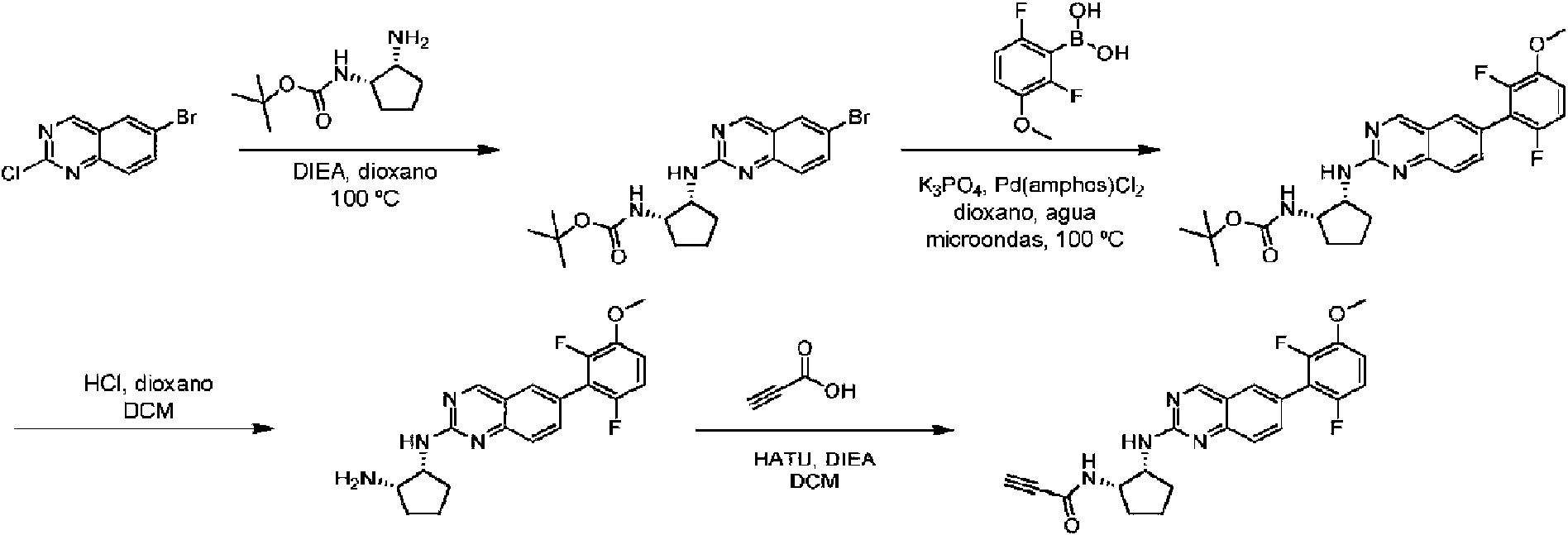
Etapa 1: Síntesis de ((1S,2R)-2-((6-bromoquinazolin-2-il)amino) ciclopentil)carbamato de ferc-butiloStep 1: Synthesis of tert-butyl ((1S,2R)-2-((6-bromoquinazolin-2-yl)amino)cyclopentyl)carbamate

Una mezcla de ((1S,2R)-2-((6-bromoquinazolin-2-il)amino)cidopentil)carbamato de ferc-butilo (25 mg, 0,06 mmol), ácido (2,6-difluoro-3-metoxifenil)borónico (24 mg, 0,12 mmol), bis(di-ferc-butil(4-dimetilaminofenil)fosfina)dicloropaladio(II) (3 mg, 0,003 mmol) y fosfato de potasio (40 mg, 0,19 mmol) en 1,4-dioxano/agua (1 ml/0,2 ml) se desgasificó con nitrógeno durante 5 min y se agitó a 100 °C durante 30 min con microondas. La mezcla de reacción se enfrió a temperatura ambiente, se diluyó con acetato de etilo, se lavó con solución saturada de cloruro de amonio y se secó con sulfato de sodio. El residuo se purificó mediante cromatografía en columna de gel de sílice, obteniéndose ((1S,2R)-2-((6-(2,6-difluoro-3-metoxifenil)quinazolin-2-il)amino)ciclopentil)carbamato de ferc-butilo (21 mg, 37 %). EM (EN+) C26H30N4O5 requiere: 470, encontrado: 471 [M+H]+.A mixture of tert-butyl ((1S,2R)-2-((6-bromoquinazolin-2-yl)amino)cidopentyl)carbamate (25 mg, 0.06 mmol), (2,6-difluoro-3 -methoxyphenyl)boronic acid (24 mg, 0.12 mmol), bis(di-fert-butyl(4-dimethylaminophenyl)phosphine)dichloropalladium(II) (3 mg, 0.003 mmol), and potassium phosphate (40 mg, 0.19 mmol) in 1,4-dioxane/water (1 mL/0.2 mL) was degassed with nitrogen for 5 min and stirred at 100 °C for 30 min with microwave. The reaction mixture was cooled to room temperature, diluted with ethyl acetate, washed with saturated ammonium chloride solution and dried over sodium sulfate. The residue was purified by silica gel column chromatography to obtain ((1S,2R)-2-((6-(2,6-difluoro-3-methoxyphenyl)quinazolin-2-yl)amino)cyclopentyl)carbamate tert-butyl (21 mg, 37%). MS (ES+) C 26 H 30 N 4 O 5 requires: 470, found: 471 [M+H]+.
Etapa 3: Síntesis de (1R,2S)-N1-(6-(2,6-difluoro-3-metoxifenil)quinazolin-2-il)ciclopentano-1,2-diaminaStep 3: Synthesis of (1R,2S)-N1-(6-(2,6-difluoro-3-methoxyphenyl)quinazolin-2-yl)cyclopentane-1,2-diamine

Una mezcla de ((1S,2R)-2-((6-(2,6-difluoro-3-metoxifenil)quinazolin-2-il)amino)ciclopentil)carbamato de ferc-butilo (21 mg, 0,045 mmol) y HCl 4 M en dioxano (0,5 ml) en diclorometano (1 ml) se agitó a temperatura ambiente durante 16 h. La CL-EM indicó que el MP se había consumido por completo. La mezcla de reacción se concentró y se usó sin purificación adicional en la etapa siguiente.A mixture of tert-butyl ((1S,2R)-2-((6-(2,6-difluoro-3-methoxyphenyl)quinazolin-2-yl)amino)cyclopentyl)carbamate (21 mg, 0.045 mmol) and 4M HCl in dioxane (0.5 mL) in dichloromethane (1 mL) was stirred at room temperature for 16 h. LC-MS indicated that the MP was completely consumed. The reaction mixture was concentrated and used without further purification in the next step.
Etapa 4: Síntesis de N-((lS,2R)-2-((6-(2,6-difluoro-3-metoxifenil)quinazolin-2-il)amino)ciclopentil)propiolamida Step 4: Synthesis of N-((lS,2R)-2-((6-(2,6-difluoro-3-methoxyphenyl)quinazolin-2-yl)amino)cyclopentyl)propiolamide

Una mezcla de (1R,2S)-N1-(6-(2,6-difluoro-3-metoxifenil)quinazolin-2-il)cidopentano-1,2-diamina (0,045 mmol), ácido propiólico (0,004 ml, 0,067 mmol), HATU (25 mg, 0,067 mmol) y DIEA (0,023 ml, 0,135 mmol) en diclorometano (1 ml) se agitó a temperatura ambiente durante 60 minutos. La CL-EM indicó que el MP se había consumido por completo. La mezcla de reacción se purificó mediante cromatografía de gel de sílice, obteniéndose N-((1S,2R)-2-((6-(2,6-difluoro-3-metoxifenil)quinazolin-2-il)amino)ciclopentil)propiolamida (compuesto 2) (13 mg, 6 8 %). EM (EN+) C27H27N5O3 requiere: 422, encontrado: 423 [M+H]+.A mixture of (1R,2S)-N1-(6-(2,6-difluoro-3-methoxyphenyl)quinazolin-2-yl)cidopentane-1,2-diamine (0.045 mmol), propiolic acid (0.004 mL, 0.067 mmol), HATU (25 mg, 0.067 mmol) and DIEA (0.023 mL, 0.135 mmol) in dichloromethane (1 mL) was stirred at room temperature for 60 min. LC-MS indicated that the MP was completely consumed. The reaction mixture was purified by silica gel chromatography to give N-((1S,2R)-2-((6-(2,6-difluoro-3-methoxyphenyl)quinazolin-2-yl)amino)cyclopentyl) propiolamide (compound 2) (13 mg, 6-8 %). MS (ES+) C 27 H 27 N 5 O 3 requires: 422, found: 423 [M+H]+.
Ejemplo 2: Síntesis de N-((1S.2R)-2-((6-(2-cloro-3-etox¡-6-fluorofen¡l)qu¡nazol¡n-2-¡l)am¡no)ciclopent¡l)prop¡olam¡da (compuesto 6 )Example 2: Synthesis of N-((1S.2R)-2-((6-(2-chloro-3-ethoxy-6-fluorophenyl)quinazolin-2-¡l)amino )cyclopent¡l)prop¡olam¡da (compound 6 )

Etapa 1: Síntesis de ((1S,2R)-2-((6-bromoquinazolin-2-il)amino)ciclopentil)carbamato de ferc-butiloStep 1: Synthesis of tert-butyl ((1S,2R)-2-((6-bromoquinazolin-2-yl)amino)cyclopentyl)carbamate
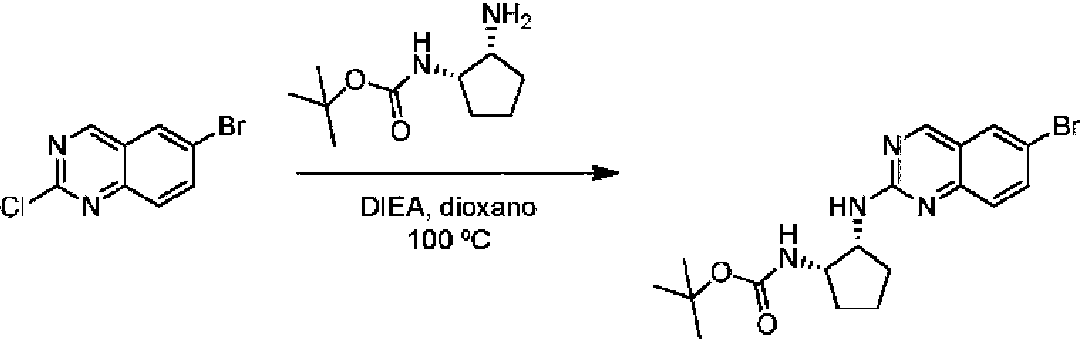
Una mezcla de 6-bromo-2-cloroquinazolina (1 g, 4,14 mmol) y ((1S,2R)-2-aminociclopentil)carbamato de ferc-butilo (0,826 g, 4,14 mmol) se agitó a 100 °C en dioxano (10 ml) durante 48 h. La mezcla de reacción se enfrió a temperatura ambiente, se concentró y el residuo se purificó mediante cromatografía en columna de gel de sílice, obteniéndose ((1S,2R)-2-((6-bromoquinazolin-2-il)amino)ciclopentil)carbamato de ferc-butilo (1 g, 59%). EM (EN+) C1sH23BrN4O2 requiere: 406, encontrado: 407 [M+H]+.A mixture of 6-bromo-2-chloroquinazoline (1 g, 4.14 mmol) and tert-butyl ((1S,2R)-2-aminocyclopentyl)carbamate (0.826 g, 4.14 mmol) was stirred at 100 ° C in dioxane (10 ml) for 48 h. The reaction mixture was cooled to room temperature, concentrated, and the residue was purified by silica gel column chromatography to give ((1S,2R)-2-((6-bromoquinazolin-2-yl)amino)cyclopentyl) tert-butyl carbamate (1 g, 59%). MS (ES+) C 1 sH 23 BrN 4 O 2 requires: 406, found: 407 [M+H]+.
Etapa 2: Síntesis de ((1S,2R)-2-((6-(2-cloro-3-etoxi-6-fluorofenil)quinazolin-2-il)amino)ciclopentil)carbamato de ferc-butilo Step 2: Synthesis of tert -butyl ((1S,2R)-2-((6-(2-chloro-3-ethoxy-6-fluorophenyl)quinazolin-2-yl)amino)cyclopentyl)carbamate

Una mezcla de ((1S,2R)-2-((6-bromoquinazolin-2-il)amino)cidopentil)carbamato de ferc-butilo (50 mg, 0,12 mmol), ácido (2-cloro-3-etoxi-6-fluorofenil)borónico (40 mg, 0,18 mmol), bis(di-ferc-butil(4-dimetilaminofenil)fosfina)dicloropaladio(II) (4 mg, 0,005 mmol) y fosfato de potasio (78 mg, 0,37 mmol) en 1,4-dioxano/agua (1,15 ml/0,15 ml) se desgasificó con nitrógeno durante 5 min y se agitó a 100 °C durante 30 min con microondas. La mezcla de reacción se enfrió a temperatura ambiente, se diluyó con acetato de etilo, se lavó con solución saturada de cloruro de amonio y se secó con sulfato de sodio. El residuo se purificó mediante cromatografía en columna de gel de sílice, obteniéndose ((1S,2R)-2-((6-(2-cloro-3-etoxi-6-fluorofenil)quinazolin-2-il)amino)ciclopentil)carbamato de ferc-butilo (51 mg, 83 %). EM (EN+) C26H30CFN 4O3 requiere: 500, encontrado: 501 [M+H]+.A mixture of tert-butyl ((1S,2R)-2-((6-bromoquinazolin-2-yl)amino)cidopentyl)carbamate (50 mg, 0.12 mmol), (2-chloro-3-ethoxy -6-fluorophenyl)boronic acid (40 mg, 0.18 mmol), bis(di-fert-butyl(4-dimethylaminophenyl)phosphine)dichloropalladium(II) (4 mg, 0.005 mmol), and potassium phosphate (78 mg, 0 0.37 mmol) in 1,4-dioxane/water (1.15 mL/0.15 mL) was degassed with nitrogen for 5 min and stirred at 100 °C for 30 min with microwave. The reaction mixture was cooled to room temperature, diluted with ethyl acetate, washed with saturated ammonium chloride solution and dried over sodium sulfate. The residue was purified by silica gel column chromatography to obtain ((1S,2R)-2-((6-(2-chloro-3-ethoxy-6-fluorophenyl)quinazolin-2-yl)amino)cyclopentyl) tert-butyl carbamate (51 mg, 83%). MS (ES+) C 26 H 30 CFN 4 O 3 requires: 500, found: 501 [M+H]+.
Etapa 3: Síntesis de (1R,2S)-N1-(6-(2-cloro-3-etoxi-6-fluorofenil)quinazolin-2-il)ciclopentano-1,2-diaminaStep 3: Synthesis of (1R,2S)-N1-(6-(2-chloro-3-ethoxy-6-fluorophenyl)quinazolin-2-yl)cyclopentane-1,2-diamine

Una mezcla de ((1S,2R)-2-((6-(2-cloro-3-etoxi-6-fluorofenil)quinazolin-2-il)amino)ciclopentil)carbamato de ferc-butilo (51 mg, 0,1 mmol) y HCl 4 M en dioxano (0,5 ml) en diclorometano (1 ml) se agitó a temperatura ambiente durante 2 h. La CL-EM indicó que el MP se había consumido por completo. La mezcla de reacción se concentró y se usó sin purificación adicional en la etapa siguiente.A mixture of tert-butyl ((1S,2R)-2-((6-(2-chloro-3-ethoxy-6-fluorophenyl)quinazolin-2-yl)amino)cyclopentyl)carbamate (51 mg, 0. 1 mmol) and 4M HCl in dioxane (0.5 mL) in dichloromethane (1 mL) was stirred at room temperature for 2 h. LC-MS indicated that the MP was completely consumed. The reaction mixture was concentrated and used without further purification in the next step.
Etapa 4: Síntesis de N-((lS,2R)-2-((6-(2-cloro-3-etoxi-6-fluorofenil)quinazolin-2-il)amino)ciclopentil)propiolamidaStep 4: Synthesis of N-((lS,2R)-2-((6-(2-chloro-3-ethoxy-6-fluorophenyl)quinazolin-2-yl)amino)cyclopentyl)propiolamide

Una mezcla de (1R,2S)-N1-(6-(2-cloro-3-etoxi-6-fluorofenil)quinazolin-2-il)ciclopentano-1,2-diamina (0,1 mmol), ácido propiólico (0,007 ml, 0,12 mmol), HATU (57 mg, 0,15 mmol) y DIEA (0,052 ml, 0,3 mmol) en diclorometano (1 ml) se agitó a temperatura ambiente durante 40 minutos. La CL-EM indicó que el MP se había consumido por completo. La mezcla de reacción se purificó mediante cromatografía de gel de sílice, obteniéndose N-((1S,2R)-2-((6-(2-cloro-3-etoxi-6-fluorofenil)quinazolin-2-il)amino)ciclopentil)propiolamida (compuesto 6 ) (35 mg, 76 %). EM (EN+) C24H22CFN 4O2 requiere: 452, encontrado: 453 [M+H]+.A mixture of (1R,2S)-N1-(6-(2-chloro-3-ethoxy-6-fluorophenyl)quinazolin-2-yl)cyclopentane-1,2-diamine (0.1 mmol), propiolic acid ( 0.007 mL, 0.12 mmol), HATU (57 mg, 0.15 mmol), and DIEA (0.052 mL, 0.3 mmol) in dichloromethane (1 mL) was stirred at room temperature for 40 min. LC-MS indicated that the MP was completely consumed. The reaction mixture was purified by silica gel chromatography to give N-((1S,2R)-2-((6-(2-chloro-3-ethoxy-6-fluorophenyl)quinazolin-2-yl)amino) Cyclopentyl)propiolamide (compound 6 ) (35 mg, 76%). MS (ES+) C 24 H 22 CFN 4 O 2 requires: 452, found: 453 [M+H]+.
Protocolo sintético 2 Synthetic Protocol 2

La 6-bromo-2-cloroquinazolina puede sustituirse por una cicloalquildiamina 1,2-mono-protegida en condiciones de reacción de sustitución aromática nucleófila usando una base, tal como diisopropiletilamina (DIPEA) o trietilamina (TEA) en un disolvente polar, tal como dioxano, para proporcionar la quinazolina sustituida con diamina. La 6-bromoquinazolian puede acoplarse a un reactivo de aril boro, estaño o cinc, heteroarilo, ácido carboxílico o éster mediante una reacción de acoplamiento mediada por paladio, por ejemplo, Suzuki, Stille, acoplamiento de Negishi. Posteriormente, el ácido carboxílico puede hacerse reaccionar con una amina usando condiciones de reacción de acoplamiento de amida (tales como HATU y diisopropiletilamina), obteniéndose un intermedio que posteriormente se desprotege y revelando la amina en el cicloalcano. La amina puede hacerse reaccionar con ácido propiólico usando condiciones de reacción de acoplamiento de amida o hacerse reaccionar con cloruro de acriloílo para preparar la acrilamida. Como se muestra a continuación, el compuesto 13 se preparó usando el protocolo sintético 2.6-Bromo-2-chloroquinazoline can be substituted for a 1,2-mono-protected cycloalkyldiamine under nucleophilic aromatic substitution reaction conditions using a base, such as diisopropylethylamine (DIPEA) or triethylamine (TEA) in a polar solvent, such as dioxane, to provide the diamine-substituted quinazoline. 6-Bromoquinazolian can be coupled to an aryl boron, tin, or zinc reagent, heteroaryl, carboxylic acid, or ester via a palladium-mediated coupling reaction, eg, Suzuki, Stille, Negishi coupling. The carboxylic acid can then be reacted with an amine using amide coupling reaction conditions (such as HATU and diisopropylethylamine), yielding an intermediate which is subsequently deprotected revealing the amine on the cycloalkane. The amine can be reacted with propiolic acid using amide coupling reaction conditions or reacted with acryloyl chloride to prepare the acrylamide. As shown below, compound 13 was prepared using synthetic protocol 2.
Compuesto 13Compound 13

Etapa 1: Síntesis de ((1S,2R)-2-((6-bromoquinazolin-2-il)amino)cidopentil)carbamato de ferc-butiloStep 1: Synthesis of tert-butyl ((1S,2R)-2-((6-bromoquinazolin-2-yl)amino)cidopentyl)carbamate

Una mezcla de 6-bromo-2-cloroquinazolina (1 g, 4,14 mmol) y ((1S,2R)-2-aminocidopentil)carbamato de ferc-butilo (0,826 g, 4,14 mmol) se agitó a 100 °C en dioxano (10 ml) durante 48 h. La mezcla de reacción se enfrió a temperatura ambiente, se concentró y el residuo se purificó mediante cromatografía en columna de gel de sílice, obteniéndose ((1S,2R)-2-((6-bromoquinazolin-2-il)amino)ciclopentil)carbamato de ferc-butilo (1 g, 59%). EM (EN+) C1sH23BrN4O2 requiere: 406, encontrado: 407 [M+H]+.A mixture of 6-bromo-2-chloroquinazoline (1 g, 4.14 mmol) and tert-butyl ((1S,2R)-2-aminocidopentyl)carbamate (0.826 g, 4.14 mmol) was stirred at 100 ° C in dioxane (10 ml) for 48 h. The reaction mixture was cooled to room temperature, concentrated, and the residue was purified by silica gel column chromatography to give ((1S,2R)-2-((6-bromoquinazolin-2-yl)amino)cyclopentyl) tert-butyl carbamate (1 g, 59%). MS (ES+) C 1 sH 23 BrN 4 O 2 requires: 406, found: 407 [M+H]+.
Etapa 2: Síntesis de ácido 4-(2-(((1R,2S)-2-((ferc-butoxicarbonil)amino)ciclopentil)amino)quinazolin-6-il)-3-metoxibenzoicoStep 2: Synthesis of 4-(2-(((1R,2S)-2-((tert-butoxycarbonyl)amino)cyclopentyl)amino)quinazolin-6-yl)-3-methoxybenzoic acid

Una mezcla de ((1S,2R)-2-((6-bromoquinazolin-2-il)amino)ciclopentil)carbamato de ferc-butilo (100 mg, 0,25 mmol), ácido 3-metoxi-5-(4,4,5,5-tetrametil-1,3,2-dioxaborolan-2-il)benzoico (82 mg, 0,29 mmol), bis(di-ferc-butil(4-dimetilaminofenil)fosfina)dicloropaladio(II) (9 mg, 0,01 mmol) y fosfato de potasio (157 mg, 0,74 mmol) en 1,4-dioxano/agua (2,5 ml/0,25 ml) se desgasificó con nitrógeno durante 5 min y se agitó a 100 °C durante 30 min con microondas. La mezcla de reacción se enfrió a temperatura ambiente, se diluyó con acetato de etilo, se lavó con solución saturada de cloruro de amonio y se secó con sulfato de sodio. El residuo se purificó mediante cromatografía en columna de gel de sílice, obteniéndose ácido metil 4-(2-(((1R,2S)-2-((fercbutoxicarbonil)amino)ciclopentil)amino)quinazolin-6-il)-3-metoxibenzoico (114 mg, 96%). EM (EN+) C26H30N4O5 requiere: 478, encontrado: 479 [M+H]+.A mixture of tert-butyl ((1S,2R)-2-((6-bromoquinazolin-2-yl)amino)cyclopentyl)carbamate (100 mg, 0.25 mmol), 3-methoxy-5-(4 Benzoic,4,5,5-tetramethyl-1,3,2-dioxaborolan-2-yl) (82 mg, 0.29 mmol), bis(di-fert-butyl(4-dimethylaminophenyl)phosphine)dichloropalladium(II) (9 mg, 0.01 mmol) and potassium phosphate (157 mg, 0.74 mmol) in 1,4-dioxane/water (2.5 mL/0.25 mL) was degassed with nitrogen for 5 min and stirred at 100 °C for 30 min with microwave. The reaction mixture was cooled to room temperature, diluted with ethyl acetate, washed with saturated ammonium chloride solution and dried over sodium sulfate. The residue was purified by silica gel column chromatography to give methyl 4-(2-(((1R,2S)-2-((tertbutoxycarbonyl)amino)cyclopentyl)amino)quinazolin-6-yl)-3- methoxybenzoic acid (114 mg, 96%). MS (ES+) C 26 H 30 N 4 O 5 requires: 478, found: 479 [M+H]+.
Etapa 3: Síntesis de ((1S,2R)-2-((6-(4-(ciclopropilcarbamoil)-2-metoxifenil)quinazolin-2-il)amino)ciclopentil)carbamato de ferc-butiloStep 3: Synthesis of tert -butyl ((1S,2R)-2-((6-(4-(cyclopropylcarbamoyl)-2-methoxyphenyl)quinazolin-2-yl)amino) cyclopentyl )carbamate

Una mezcla de ácido 4-(2-(((1R,2S)-2-((ferc-butoxicarbonil)amino)ciclopentil)amino)quinazolin-6-il)-3-metoxibenzoico (57 mg, 0,12 mmol), ciclopropilamina (0,012 ml, 0,18 mmol), HAt U ( 68 mg, 0,18 mmol) y DIEA (0,052 ml, 0,30 mmol) en diclorometano (1,5 ml) se agitó a temperatura ambiente durante 30 minutos. La CL-Em indicó que el MP se había consumido por completo. La mezcla de reacción se purificó mediante cromatografía de gel de sílice, obteniéndose ((1S,2R)-2-((6-(4-(ciclopropilcarbamoil)-2-metoxifenil)quinazolin-2-il)amino)ciclopentil)carbamato de ferc-butilo (58 mg, 93 %). EM (EN+) C29H35N5O4 requiere: 517, encontrado: 518 [M+H]+.A mixture of 4-(2-(((1R,2S)-2-((tert-butoxycarbonyl)amino)cyclopentyl)amino)quinazolin-6-yl)-3-methoxybenzoic acid (57 mg, 0.12 mmol) , cyclopropylamine (0.012 mL, 0.18 mmol), HAt U (68 mg, 0.18 mmol), and DIEA (0.052 mL, 0.30 mmol) in dichloromethane (1.5 mL) was stirred at room temperature for 30 min. . The LC-E m indicated that the MP had been completely consumed. The reaction mixture was purified by silica gel chromatography, obtaining ((1S,2R)-2-((6-(4-(cyclopropylcarbamoyl)-2-methoxyphenyl)quinazolin-2-yl)amino)cyclopentyl)carbamate tert-butyl (58 mg, 93%). MS (ES+) C 29 H 35 N 5 O 4 requires: 517, found: 518 [M+H]+.
Etapa 4: Síntesis de 4-(2-(((1R,2S)-2-aminociclopentil)amino)quinazolin-6-il)-N-ciclopropil-3-metoxibenzamida Step 4: Synthesis of 4-(2-(((1R,2S)-2-aminocyclopentyl)amino)quinazolin-6-yl)-N-cyclopropyl-3-methoxybenzamide

Una mezcla de ((1S,2R)-2-((6-(4-(cidopropilcarbamoil)-2-metoxifenil)quinazolin-2-il)amino)cidopentil)carbamato de ferc-butilo (58 mg, 0,11 mmol) y HCl 4 M en dioxano (0,8 ml) en diclorometano (1,5 ml) se agitó a temperatura ambiente durante 120 minutos. La CL-Em indicó que el MP se había consumido por completo. La mezcla de reacción se concentró y se usó sin purificación adicional en la etapa siguiente.A mixture of tert-butyl ((1S,2R)-2-((6-(4-(cidopropylcarbamoyl)-2-methoxyphenyl)quinazolin-2-yl)amino)cidopentyl)carbamate (58 mg, 0.11 mmol ) and 4M HCl in dioxane (0.8 mL) in dichloromethane (1.5 mL) was stirred at room temperature for 120 min. LC-Em indicated that the MP had been completely consumed. The reaction mixture was concentrated and used without further purification in the next step.
Etapa 5: Síntesis de N-ciclopropil-3-metoxi-4-(2-(((1R,2S)-2-propiolamidociclopentil)amino)quinazolin-6-il)benzamidaStep 5: Synthesis of N-cyclopropyl-3-methoxy-4-(2-(((1R,2S)-2-propiolamidocyclopentyl)amino)quinazolin-6-yl)benzamide
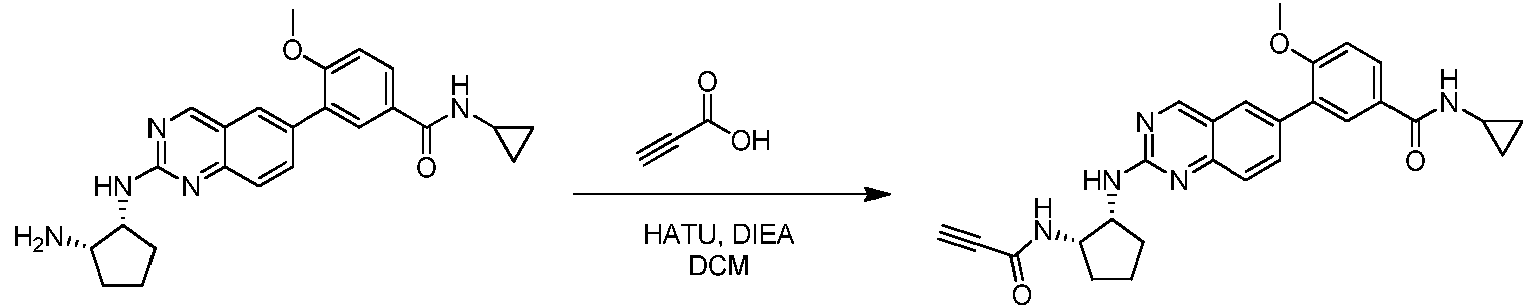
Una mezcla de 4-(2-(((1R,2S)-2-aminociclopentil)amino)quinazolin-6-il)-N-ciclopropil-3-metoxibenzamida (0,11 mmol), ácido propiólico (0,010 ml, 0,17 mmol), HATU (64 mg, 0,17 mmol) y DIEA (0,06 ml, 0,34 mmol) en diclorometano (1,5 ml) se agitó a temperatura ambiente durante 45 minutos. La CL-EM indicó que el MP se había consumido por completo. La mezcla de reacción se purificó mediante cromatografía de gel de sílice, obteniéndose N-ciclopropil-3-metoxi-4-(2-(((1R,2S)-2-propiolamidociclopentil)amino)quinazolin-6-il)benzamida (compuesto 13) (35 mg, 69%). EM (EN+) C27H27N5O3 requiere: 469, encontrado: 470 [M+H]+.A mixture of 4-(2-(((1R,2S)-2-aminocyclopentyl)amino)quinazolin-6-yl)-N-cyclopropyl-3-methoxybenzamide (0.11 mmol), propiolic acid (0.010 mL, 0 0.17 mmol), HATU (64 mg, 0.17 mmol) and DIEA (0.06 mL, 0.34 mmol) in dichloromethane (1.5 mL) was stirred at room temperature for 45 min. LC-MS indicated that the MP was completely consumed. The reaction mixture was purified by silica gel chromatography to obtain N-cyclopropyl-3-methoxy-4-(2-(((1R,2S)-2-propiolamidocyclopentyl)amino)quinazolin-6-yl)benzamide (compound 13) (35mg, 69%). MS (ES+) C 27 H 27 N 5 O 3 requires: 469, found: 470 [M+H]+.
Protocolo sintético 3Synthetic Protocol 3

La 2-cloro-6-(2,6-dicloro-3,5-dimetoxifenil)quinazolina (descrita en el documento WO 2014011900) puede sustituirse con una cicloalquildiamina 1 ,2 -mono-protegida en diversas condiciones de reacción de sustitución aromática-nucleófila usando una base (tal como diisopropiletilamina (DIPEA), DBU o NaHCOa) en un disolvente polar (tal como dioxano, CH3CN o NMP) o mediante una reacción de acoplamiento de Buchwald mediada por paladio, obteniéndose la quinazolina sustituida con diamina. El grupo protector de la amina se elimina para revelar la amina en el cicloalcano. La amina puede hacerse reaccionar con ácido propiólico usando condiciones de reacción de acoplamiento de amida o hacerse reaccionar con cloruro de acriloílo para preparar la acrilamida. Como se muestra a continuación, los compuestos 27, 32, 34, 36 y 40 se prepararon usando el protocolo sintético 3. 2 -Chloro-6-(2,6-dichloro-3,5-dimethoxyphenyl)quinazoline (described in WO 2014011900) can be substituted with a 1,2 -mono-protected cycloalkyldiamine under various aromatic-substitution reaction conditions. nucleophilic using a base (such as diisopropylethylamine (DIPEA), DBU, or NaHCOa) in a polar solvent (such as dioxane, CH 3 CN, or NMP) or by a palladium-mediated Buchwald coupling reaction, yielding the diamine-substituted quinazoline. The amine protecting group is removed to reveal the amine on the cycloalkane. The amine can be reacted with propiolic acid using amide coupling reaction conditions or reacted with acryloyl chloride to prepare the acrylamide. As shown below, compounds 27, 32, 34, 36, and 40 were prepared using Synthetic Protocol 3.
Compuesto 27Compound 27
Síntesis de N-[(3R,4S)-4-{[6-(2,6-dicloro-3,5-dimetoxifenil)quinazolin-2-il]amino}oxolan-3-il]prop-2-enamida Synthesis of N-[(3R,4S)-4-{[6-(2,6-dichloro-3,5-dimethoxyphenyl)quinazolin-2-yl]amino}oxolan-3-yl]prop-2-enamide
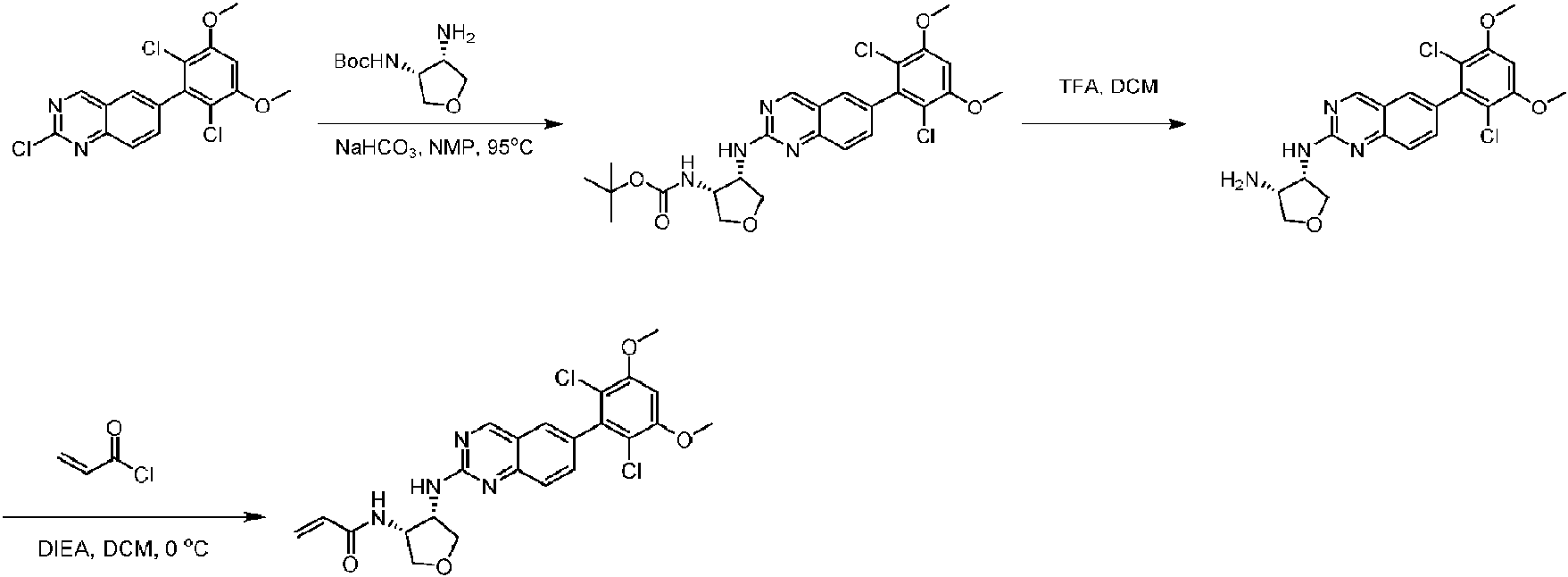
Etapa 1: Síntesis de ((3R,4S)-4-((6-(2,6-didoro-3,5-dimetoxifenil)quinazolin-2-il)amino)tetrahidrofuran-3-il)carbamato de tere-butilo en forma de una espuma de color amarillo.Step 1: Synthesis of tert-butyl ((3R,4S)-4-((6-(2,6-didoro-3,5-dimethoxyphenyl)quinazolin-2-yl)amino)tetrahydrofuran-3-yl)carbamate in the form of a yellow foam.

Una mezcla de 2-cloro-6-(2,6-dicloro-3,5-dimetoxifenil)quinazolina (1,02 g, 2,76 mmol), ((3R,4S)-4-aminotetrahidrofuran-3-il)carbamato de tere-butilo (0,85 g, 4,20 mmol) y bicarbonato de sodio (0,58 g, 6,90 mmol) se agitó en NMP (5,5 ml, 0,5M) a 95 °C durante 12 horas.A mixture of 2-chloro-6-(2,6-dichloro-3,5-dimethoxyphenyl)quinazoline (1.02 g, 2.76 mmol), ((3R,4S)-4-aminotetrahydrofuran-3-yl) tert-butyl carbamate (0.85 g, 4.20 mmol) and sodium bicarbonate (0.58 g, 6.90 mmol) was stirred in NMP (5.5 mL, 0.5M) at 95 °C for 12 hours.
La reacción se eliminó del baño de aceite y mientras se enfriaba hasta temperatura ambiente, se trató con aproximadamente 90 ml de agua y posteriormente se trató con ultrasonidos y se agitó durante 20 minutos. Se aisló un sólido de color amarillo-naranja mediante filtración, se aclaró varias veces con pequeñas cantidades de agua, y se secó al vacío durante aproximadamente 1 hora, obteniéndose 3,35 g de producto en bruto, que se purificó mediante cromatografía en gel de sílice, obteniéndose 1,10 g (rendimiento del 74,5%) de ((3R,4S)-4-((6-(2,6-dicloro-3,5-dimetoxifenil)quinazolin-2-il)amino)tetrahidrofuran-3-il)carbamato de tere-butilo en forma de una espuma de color amarillo. EM (EN+) C25H28Cl2N4O5 requiere: 534, encontrado: 535 [M+H]+.The reaction was removed from the oil bath and while cooling to room temperature, treated with approximately 90 mL of water and subsequently sonicated and stirred for 20 minutes. A yellow-orange solid was isolated by filtration, rinsed several times with small amounts of water, and dried under vacuum for about 1 hour, yielding 3.35 g of crude product, which was purified by gel chromatography. silica, obtaining 1.10 g (74.5% yield) of ((3R,4S)-4-((6-(2,6-dichloro-3,5-dimethoxyphenyl)quinazolin-2-yl)amino) tert-butyl tetrahydrofuran-3-yl)carbamate as a yellow foam. MS (ES+) C 25 H 2 8 Cl 2 N 4 O 5 requires: 534, found: 535 [M+H]+.
Etapa 2: Síntesis de (3S,4R)-N3-(6-(2,6-dicloro-3,5-dimetoxifenil)quinazolin-2-il)tetrahidrofuran-3,4-diaminaStep 2: Synthesis of (3S,4R)-N3-(6-(2,6-dichloro-3,5-dimethoxyphenyl)quinazolin-2-yl)tetrahydrofuran-3,4-diamine

Una solución de ((3R,4S)-4-((6-(2,6-dicloro-3,5-dimetoxifenil)quinazolin-2-il)amino)tetrahidrofuran-3-il)carbamato de tere-butilo (1,097 g, 2,049 mmol) en DCM (15 ml, 0,137 M) y TFA (11,7 g, 102 mmol) se agitó durante aproximadamente 40 minutos a temperatura ambiente. Los disolventes en exceso se eliminaron a presión reducida. El aceite de color amarillo se disolvió en DCM (-60 ml) y se lavó con NaOH 1 N (-30 ml). Posteriormente se diluyó la capa acuosa con salmuera (-15 ml) y se extrajo con DCM fresco (3 * 30 ml). Las capas orgánicas combinadas se secaron sobre sulfato de sodio, se filtraron, se concentraron y se secaron, obteniéndose (3S,4R)-N3-(6-(2,6-dicloro-3,5-dimetoxifenil)quinazolin-2-il)tetrahidrofuran-3,4-diamina en forma de una espuma de color amarillo muy claro (0,879 g, 99 %).A solution of tert-butyl ((3R,4S)-4-((6-(2,6-dichloro-3,5-dimethoxyphenyl)quinazolin-2-yl)amino)tetrahydrofuran-3-yl)carbamate (1.097 g, 2.049 mmol) in DCM (15 mL, 0.137 M) and TFA (11.7 g, 102 mmol) was stirred for ca. 40 min at room temperature. Excess solvents were removed under reduced pressure. The yellow oil was dissolved in DCM (-60 mL) and washed with 1N NaOH (-30 mL). Subsequently the aqueous layer was diluted with brine (-15 ml) and extracted with fresh DCM (3*30 ml). The combined organic layers were dried over sodium sulfate, filtered, concentrated, and dried to give (3S,4R)-N3-(6-(2,6-dichloro-3,5-dimethoxyphenyl)quinazolin-2-yl )tetrahydrofuran-3,4-diamine as a very light yellow foam (0.879 g, 99%).
Etapa 3: Síntesis de N-[(3R,4S)-4-{[6-(2,6-dicloro-3,5-dimetoxifenil)quinazolin-2-il]amino}oxolan-3-il]prop-2-enamida Step 3: Synthesis of N-[(3R,4S)-4-{[6-(2,6-dichloro-3,5-dimethoxyphenyl)quinazolin-2-yl]amino}oxolan-3-yl]prop-2 -enamide

A una solución de (3S,4R)-N3-(6-(2,6-didoro-3,5-dimetoxifenil)quinazolin-2-il)tetrahidrofuran-3,4-diamina (0,94 g, 2.1 mmol) en diclorometano (25 ml) a 0 °C se le añadió DIEA (0,37 ml, 2,1 mmol) y cloruro de acriloílo (0,17 ml, 2.1 mmol) y la reacción se agitó durante 3 h. La CL-EM indicó que el MP se había consumido por completo. La mezcla de reacción se purificó mediante cromatografía de gel de sílice, obteniéndose N-((1S,2R)-2-((6-(2,6-dicloro-3,5-dimetoxifenil)quinazolin-2-il)amino)ciclohexil)acrilamida (compuesto 27) (0,8 g, 76 %). EM (EN+) C23H22Cl2N4O4 requiere: 488, encontrado: 489To a solution of (3S,4R)-N3-(6-(2,6-didoro-3,5-dimethoxyphenyl)quinazolin-2-yl)tetrahydrofuran-3,4-diamine (0.94 g, 2.1 mmol) in dichloromethane (25 mL) at 0 °C DIEA (0.37 mL, 2.1 mmol) and acryloyl chloride (0.17 mL, 2.1 mmol) were added and the reaction stirred for 3 h. LC-MS indicated that the MP was completely consumed. The reaction mixture was purified by silica gel chromatography to give N-((1S,2R)-2-((6-(2,6-dichloro-3,5-dimethoxyphenyl)quinazolin-2-yl)amino) cyclohexyl)acrylamide (compound 27) (0.8 g, 76%). MS (ES+) C23H22Cl2N4O4 requires: 488, found: 489
Compuesto 32Compound 32
Síntesis de N-((1S,2R,3S,5S)-2-((6-(2,6-dicloro-3,5-dimetoxifenil)quinazolin-2-il)amino)biciclo[3.1.0]hexan-3-il)acrilamidaSynthesis of N-((1S,2R,3S,5S)-2-((6-(2,6-dichloro-3,5-dimethoxyphenyl)quinazolin-2-yl)amino)bicyclo[3.1.0]hexan- 3-yl)acrylamide

Etapa 1: Síntesis de (1S,2R,3S,5S)-2-(6-(2,6-dicloro-3,5-dimetoxifenil)quinazolin-2-ilamino)biciclo[3.1.0]hexan-3-ilcarbamato de 2-(trimetilsilil)etiloStep 1: Synthesis of (1S,2R,3S,5S)-2-(6-(2,6-dichloro-3,5-dimethoxyphenyl)quinazolin-2-ylamino)bicyclo[3.1.0]hexan-3-ylcarbamate 2-(trimethylsilyl)ethyl
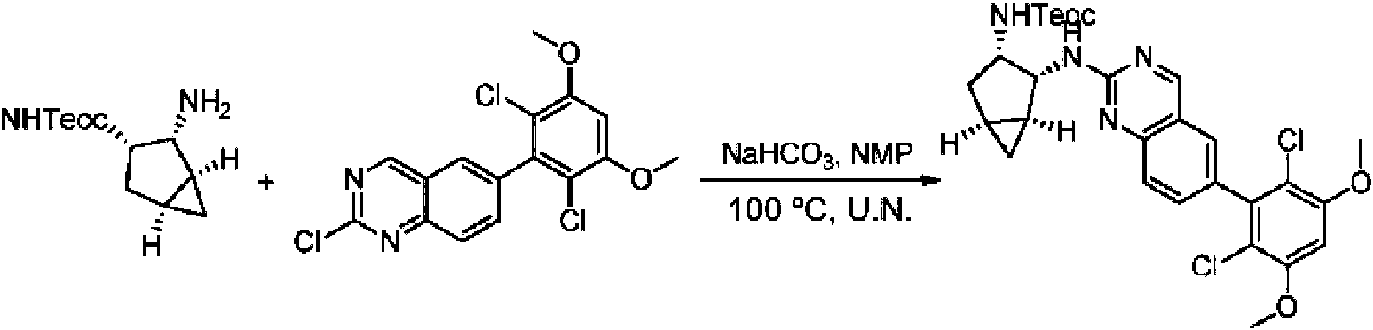
Una solución de (1S,2R,3S,5S)-2-aminobiciclo[3.1.0]hexan-3-ilcarbamato de 2-(trimetilsilil)etilo (250 mg, 0,977 mmol), 2-cloro-6-(2,6-dicloro-3,5-dimetoxifenil)quinazolina (300 mg, 0,814 mmol) y bicarbonato de sodio (205 mg, 2,442 mmol) en N-metil-2-pirrolidona (10 ml) se agitó a 100 °C durante una noche. La solución de reacción se enfrió a temperatura ambiente, se diluyó con acetato de etilo (100 ml) y se lavó con agua (ocho veces) y salmuera (50 ml). La capa orgánica se secó sobre sulfato de sodio, se filtró y se concentró, obteniéndose un producto en bruto, que se purificó mediante cromatografía en columna de gel de sílice (acetato de etilo:éter de petróleo = 4:2), obteniéndose el compuesto del título (300 mg, 52 %) en forma de un sólido de color amarillo. EM (EN+) C28H34ChN4O4Si requiere: 588, 590, encontrado: 589, 591 [M H]+.A solution of 2-(trimethylsilyl)ethyl (1S,2R,3S,5S)-2-aminobicyclo[3.1.0]hexan-3-ylcarbamate (250 mg, 0.977 mmol), 2-chloro-6-(2, 6-dichloro-3,5-dimethoxyphenyl)quinazoline (300 mg, 0.814 mmol) and sodium bicarbonate (205 mg, 2.442 mmol) in N-methyl-2-pyrrolidone (10 mL) was stirred at 100 °C overnight. . The reaction solution was cooled to room temperature, diluted with ethyl acetate (100 ml), and washed with water (8 times) and brine (50 ml). The organic layer was dried over sodium sulfate, filtered and concentrated, obtaining a crude product, which was purified by silica gel column chromatography (ethyl acetate:petroleum ether = 4:2), obtaining the compound of the title (300 mg, 52%) as a yellow solid. MS (ES+) C 28 H 34 ChN 4 O 4 Si requires: 588, 590, found: 589, 591 [MH]+.
Etapa 2: Síntesis de (1S,2R,3S,5S)-N2-(6-(2,6-dicloro-3,5-dimetoxifenil)quinazolin-2-il)biciclo[3.1.0]hexano-2,3-diamina Step 2: Synthesis of (1S,2R,3S,5S)-N2-(6-(2,6-dichloro-3,5-dimethoxyphenyl)quinazolin-2-yl)bicyclo[3.1.0]hexane-2,3 -diamine

A una solución de (1S,2R,3S,5S)-2-(6-(2,6-didoro-3,5-dimetoxifenil)quinazolin-2-ilamino)bicido[3.1.0]hexan-3-ilcarbamato de 2-(trimetilsilil)etilo (200 mg, 340 mmol) en dioxano (10 ml) se le añadió HCl conc. 12 M (1 ml) a temperatura ambiente. La mezcla resultante se agitó durante una noche, después se inactivó con agua (50 ml), y se ajustó el pH de la solución a pH = 8-9 con solución saturada de carbonato de sodio. La mezcla de solución se extrajo con acetato de etilo (3 x 50 ml), y las capas combinadas se lavaron con salmuera (50 ml), se secaron sobre sulfato de sodio, se filtraron y se concentraron. El residuo se purificó mediante cromatografía en capa fina (Prep-TLC) (diclorometano:metanol = 15:1), y después se purificó adicionalmente mediante cromatografía en columna de gel de sílice (diclorometano:metanol = 20:1), obteniéndose el compuesto del título (70 mg, 46 %) en forma de un sólido de color blanco. EM (EN+) C22H22Cl2N4O2 requiere: 444, 446, encontrado: 445, 447 [M H]+.To a solution of (1S,2R,3S,5S)-2-(6-(2,6-didoro-3,5-dimethoxyphenyl)quinazolin-2-ylamino)bicido[3.1.0]hexan-3-ylcarbamate 2-(trimethylsilyl)ethyl (200 mg, 340 mmol) in dioxane (10 mL) was added conc. 12M (1ml) at room temperature. The resulting mixture was stirred overnight, then quenched with water (50 ml), and the pH of the solution was adjusted to pH=8-9 with saturated sodium carbonate solution. The solution mixture was extracted with ethyl acetate (3 x 50 mL), and the combined layers were washed with brine (50 mL), dried over sodium sulfate, filtered, and concentrated. The residue was purified by thin layer chromatography (Prep-TLC) (dichloromethane:methanol = 15:1), and then further purified by silica gel column chromatography (dichloromethane:methanol = 20:1), to obtain the compound of the title (70 mg, 46%) as a white solid. MS (ES+) C22H22Cl2N4O2 requires: 444, 446, found: 445, 447 [MH]+.
Etapa 3: Síntesis de N-((1S,2R,3S,5S)-2-((6-(2,6-dicloro-3,5-dimetoxifenil)quinazolin-2-il)amino)biciclo[3.1.0]hexan-3-il)acrilamidaStep 3: Synthesis of N-((1S,2R,3S,5S)-2-((6-(2,6-dichloro-3,5-dimethoxyphenyl)quinazolin-2-yl)amino)bicyclo[3.1.0 ]hexan-3-yl)acrylamide

A una solución de (1S,2R,3S,5S)-N2-(6-(2,6-dicloro-3,5-dimetoxifenil)quinazolin-2-il)biciclo[3.1.0]hexano-2,3-diamina (42 mg, 0,094 mmol) en diclorometano (1,9 ml) a 0 °C se le añadió DiEa (0,025 ml, 0,14 mmol) y cloruro de acriloílo (0,009 ml, 0,11 mmol) y la reacción se agitó durante 1 h. La CL-EM indicó que el MP se había consumido por completo. La mezcla de reacción se purificó mediante cromatografía de gel de sílice, obteniéndose N-((1S,2R,3S,5S)-2-((6-(2,6-dicloro-3,5-dimetoxifenil)quinazolin-2-il)amino)biciclo[3.1.0]hexan-3-il)acrilamida (36 mg, 76 %) en forma de un sólido de color amarillo pálido. EM (EN+) C25H24Cl2N4O3 requiere: 498, encontrado: 499To a solution of (1S,2R,3S,5S)-N2-(6-(2,6-dichloro-3,5-dimethoxyphenyl)quinazolin-2-yl)bicyclo[3.1.0]hexane-2,3- diamine (42 mg, 0.094 mmol) in dichloromethane (1.9 mL) at 0 °C was added D i E to (0.025 mL, 0.14 mmol) and acryloyl chloride (0.009 mL, 0.11 mmol) and the reaction was stirred for 1 h. LC-MS indicated that the MP was completely consumed. The reaction mixture was purified by silica gel chromatography, obtaining N-((1S,2R,3S,5S)-2-((6-(2,6-dichloro-3,5-dimethoxyphenyl)quinazolin-2- yl)amino)bicyclo[3.1.0]hexan-3-yl)acrylamide (36 mg, 76%) as a pale yellow solid. MS (ES+) C 25 H 24 Cl 2 N 4 O 3 requires: 498, found: 499
Compuesto 34Compound 34
Síntesis de N-((1S,2R)-2-((6-(2,6-dicloro-3,5-dimetoxifenil)quinazolin-2-il)amino)ciclohexil)acrilamidaSynthesis of N-((1S,2R)-2-((6-(2,6-dichloro-3,5-dimethoxyphenyl)quinazolin-2-yl)amino)cyclohexyl)acrylamide

Etapa 1: Síntesis de ((1S,2R)-2-((6-(2,6-dicloro-3,5-dimetoxifenil)quinazolin-2-il)amino)ciclohexil)carbamato de terc-butilo: Step 1: Synthesis of tert -butyl ((1S,2R)-2-((6-(2,6-dichloro-3,5-dimethoxyphenyl)quinazolin-2-yl)amino)cyclohexyl)carbamate:

Una mezcla de 2-cloro-6-(2,6-dicloro-3,5-dimetoxifenil)quinazolina (0,95 g, 2,6 mmol), ((1S,2R)-2-aminoddohexil)carbamato de tere-butilo (1,1 g, 5,14 mmol), y DBU (0,77 ml, 5,14 mmol) en acetonitrilo (9 ml) se desgasificó con N2 durante 5 min y se calentó a 70 °C durante 16 h. La mezcla se enfrió a temperatura ambiente, se concentró y el residuo se purificó mediante cromatografía en columna de gel de sílice, obteniéndose ((1S,2R)-2-((6-(2,6-dicloro-3,5-dimetoxifenil)quinazolin-2-il)amino)ciclohexil)carbamato de tere-butilo (1 ,1 g, 81 %). EM (EN+) C27H32G 2N4O4 requiere: 546, encontrado: 547 [M+H]+.A mixture of 2-chloro-6-(2,6-dichloro-3,5-dimethoxyphenyl)quinazoline (0.95 g, 2.6 mmol), tetra-((1S,2R)-2-aminoddohexyl)carbamate butyl (1.1 g, 5.14 mmol), and DBU (0.77 mL, 5.14 mmol) in acetonitrile (9 mL) was degassed with N 2 for 5 min and heated at 70 °C for 16 h. . The mixture was cooled to room temperature, concentrated, and the residue was purified by silica gel column chromatography to obtain ((1S,2R)-2-((6-(2,6-dichloro-3,5-dimethoxyphenyl tert-butyl)quinazolin-2-yl)amino)cyclohexyl)carbamate ( 1.1 g, 81%). MS (ES+) C 27 H 32 G 2 N 4 O 4 requires: 546, found: 547 [M+H]+.
Etapa 2: Síntesis de (1R,2S)-N1-(6-(2,6-dicloro-3,5-dimetoxifenil)quinazolin-2-il)ciclohexano-1,2-diaminaStep 2: Synthesis of (1R,2S)-N1-(6-(2,6-dichloro-3,5-dimethoxyphenyl)quinazolin-2-yl)cyclohexane-1,2-diamine

Una mezcla de ((1S,2R)-2-((6-(2,6-dicloro-3,5-dimetoxifenil)quinazolin-2-il)amino)ciclohexil)carbamato de tere-butilo (1,14 g, 2,1 mmol) y HCl 4 N en dioxano (5,2 ml) en diclorometano (10 ml) se agitó a temperatura ambiente durante 30 minutos. La CL-EM indicó que el MP se había consumido por completo. La mezcla de reacción se concentró, obteniéndose (1R,2S)-N1-(6-(2,6-dicloro-3,5-dimetoxifenil)quinazolin-2-il)ciclohexano-1,2-diamina (0,94 g, 100 %) que se usó sin purificación adicional en la etapa siguiente.A mixture of tert-butyl ((1S,2R)-2-((6-(2,6-dichloro-3,5-dimethoxyphenyl)quinazolin-2-yl)amino)cyclohexyl)carbamate (1.14 g, 2.1 mmol) and 4N HCl in dioxane (5.2 mL) in dichloromethane (10 mL) was stirred at room temperature for 30 minutes. LC-MS indicated that the MP was completely consumed. The reaction mixture was concentrated to give (1R,2S)-N1-(6-(2,6-dichloro-3,5-dimethoxyphenyl)quinazolin-2-yl)cyclohexane-1,2-diamine (0.94 g , 100%) which was used without further purification in the next step.
Etapa 3: Síntesis de N-((1S,2R)-2-((6-(2,6-dicloro-3,5-dimetoxifenil)quinazolin-2-il)amino)ciclohexil)acrilamidaStep 3: Synthesis of N-((1S,2R)-2-((6-(2,6-dichloro-3,5-dimethoxyphenyl)quinazolin-2-yl)amino)cyclohexyl)acrylamide

A una solución de (1R,2S)-N1-(6-(2,6-dicloro-3,5-dimetoxifenil)quinazolin-2-il)ciclohexano-1,2-diamina (0,94 g, 2.1 mmol) en diclorometano (25 ml) a 0 °C se le añadió DIEA (0,37 ml, 2,1 mmol) y cloruro de acriloílo (0,17 ml, 2.1 mmol) y la reacción se agitó durante 3 h. La CL-EM indicó que el MP se había consumido por completo. La mezcla de reacción se purificó mediante cromatografía de gel de sílice, obteniéndose N-((1S,2R)-2-((6-(2,6-dicloro-3,5-dimetoxifenil)quinazolin-2-il)amino)ciclohexil)acrilamida (0,8 g, 76 %). EM (EN+) C25 H26Cl2 N4O3 requiere: 500, encontrado: 501.To a solution of (1R,2S)-N1-(6-(2,6-dichloro-3,5-dimethoxyphenyl)quinazolin-2-yl)cyclohexane-1,2-diamine (0.94 g, 2.1 mmol) in dichloromethane (25 mL) at 0 °C DIEA (0.37 mL, 2.1 mmol) and acryloyl chloride (0.17 mL, 2.1 mmol) were added and the reaction stirred for 3 h. LC-MS indicated that the MP was completely consumed. The reaction mixture was purified by silica gel chromatography to give N-((1S,2R)-2-((6-(2,6-dichloro-3,5-dimethoxyphenyl)quinazolin-2-yl)amino) Cyclohexyl)acrylamide (0.8g, 76%). MS (ES+) C 25 H 26 Cl 2 N 4 O 3 requires: 500, found: 501.
Compuesto 36Compound 36
Síntesis de N-((1S,2S)-2-((6-(2,6-dicloro-3,5-dimetoxifenil)quinazolin-2-il)amino)ciclohexil)acrilamidaSynthesis of N-((1S,2S)-2-((6-(2,6-dichloro-3,5-dimethoxyphenyl)quinazolin-2-yl)amino)cyclohexyl)acrylamide


Una mezcla de 2-doro-6-(2,6-didoro-3,5-dimetoxifenil)quinazolina (0,1 g, 0,27 mmol), ((1S,2S)-2-aminoddohexil)carbamato de /ere-butilo (75 mg, 0,35 mmol), Cs2CÜ3 (176 mg, 0,54 mmol), X-Phos (13 mg, 0,027 mmol) y Pd2dba3 (12,5 mg, 0,013 mmol) en DMA (1,8 ml) se desgasificó con N2 durante 5 min y se calentó en un reactor de microondas a 125 °C durante 30 min. La mezcla se enfrió a temperatura ambiente, se filtró a través de celite y se lavó con agua, seguido de solución de salmuera saturada. El residuo se purificó mediante cromatografía en columna de gel de sílice, obteniéndose ((1S,2R)-2-((6-(2,6-dicloro-3,5-dimetoxifenil)quinazolin-2-il)amino)ciclohexil)carbamato de /ere-butilo (67 mg, 45 %). EM (EN+) C27H32Cl2N4O4 requiere: 546, encontrado: 547 [M+H]+.A mixture of 2-doro-6-(2,6-didoro-3,5-dimethoxyphenyl)quinazoline (0.1g, 0.27mmol), ((1S,2S)-2-aminoddohexyl)carbamate de/ere -butyl (75 mg, 0.35 mmol), Cs 2 CÜ 3 (176 mg, 0.54 mmol), X-Phos (13 mg, 0.027 mmol), and Pd2dba3 (12.5 mg, 0.013 mmol) in DMA ( 1.8 mL) was degassed with N2 for 5 min and heated in a microwave reactor at 125 °C for 30 min. The mixture was cooled to room temperature, filtered through celite and washed with water followed by saturated brine solution. The residue was purified by silica gel column chromatography to obtain ((1S,2R)-2-((6-(2,6-dichloro-3,5-dimethoxyphenyl)quinazolin-2-yl)amino)cyclohexyl) /ere-butyl carbamate (67 mg, 45%). MS (ES+) C27H 3 2Cl2N4O4 requires: 546, found: 547 [M+H]+.
Etapa 2: Síntesis de (1R,2S)-N1-(6-(2,6-dicloro-3,5-dimetoxifenil)quinazolin-2-il)ciclohexano-1,2-diaminaStep 2: Synthesis of (1R,2S)-N1-(6-(2,6-dichloro-3,5-dimethoxyphenyl)quinazolin-2-yl)cyclohexane-1,2-diamine

Una mezcla de ((1S,2R)-2-((6-(2,6-dicloro-3,5-dimetoxifenil)quinazolin-2-il)amino)ciclohexil)carbamato de /ere-butilo (67 mg, 0,12 mmol) y TFA (0,6 ml) en diclorometano (0,6 ml) se agitó a temperatura ambiente durante 60 minutos. La Cl-EM indicó que el MP se había consumido por completo. La mezcla de reacción se diluyó con NaHCÜ3 saturado y después se extrajo con diclorometano. Las capas orgánicas combinadas se secaron con Na2SO4, se filtraron y se concentraron, obteniéndose (1R,2S)-N1-(6-(2,6-dicloro-3,5-dimetoxifenil)quinazolin-2-il)ciclohexano-1,2-diamina que se usó sin purificación adicional en la etapa siguiente.A mixture of /ere-butyl ((1S,2R)-2-((6-(2,6-dichloro-3,5-dimethoxyphenyl)quinazolin-2-yl)amino)cyclohexyl)carbamate (67 mg, 0 0.12 mmol) and TFA (0.6 mL) in dichloromethane (0.6 mL) was stirred at room temperature for 60 min. Cl-MS indicated that the MP was completely consumed. The reaction mixture was diluted with saturated NaHCÜ3 and then extracted with dichloromethane. The combined organic layers were dried over Na2SO4, filtered, and concentrated to give (1R,2S)-N1-(6-(2,6-dichloro-3,5-dimethoxyphenyl)quinazolin-2-yl)cyclohexane-1, 2-diamine which was used without further purification in the next step.
Etapa 3: Síntesis de N-((1S,2S)-2-((6-(2,6-dicloro-3,5-dimetoxifenil)quinazolin-2-il)amino)ciclohexil)acrilamidaStep 3: Synthesis of N-((1S,2S)-2-((6-(2,6-dichloro-3,5-dimethoxyphenyl)quinazolin-2-yl)amino)cyclohexyl)acrylamide

A una solución de (1R,2S)-N1-(6-(2,6-dicloro-3,5-dimetoxifenil)quinazolin-2-il)ciclohexano-1,2-diamina (0,12 mmol) en diclorometano (1,3 ml) a 0 °C se le añadió DIEA (0,004 ml, 0,02 mmol) y cloruro de acriloílo (0,012 ml, 0,15 mmol) y la reacción se agitó durante 1 h. La CL-EM indicó que el MP se había consumido por completo. La mezcla de reacción se purificó mediante cromatografía de gel de sílice, obteniéndose N-((1S,2S)-2-((6-(2,6-dicloro-3,5-dimetoxifenil)quinazolin-2-il)amino)ciclohexil)acrilamida (35 mg, 58 %). EM (EN+) C2sH26Cl2N4Ü3 requiere: 500, encontrado: 501.To a solution of (1R,2S)-N1-(6-(2,6-dichloro-3,5-dimethoxyphenyl)quinazolin-2-yl)cyclohexane-1,2-diamine (0.12 mmol) in dichloromethane ( 1.3 mL) at 0 °C DIEA (0.004 mL, 0.02 mmol) and acryloyl chloride (0.012 mL, 0.15 mmol) were added and the reaction stirred for 1 h. LC-MS indicated that the MP was completely consumed. The reaction mixture was purified by silica gel chromatography to give N-((1S,2S)-2-((6-(2,6-dichloro-3,5-dimethoxyphenyl)quinazolin-2-yl)amino) cyclohexyl)acrylamide (35mg, 58%). MS (EN+) C2sH26Cl2N4Ü 3 requires: 500, found: 501.
Compuesto 40 Compound 40
Síntesis de N-((3S,4S)-3-((6-(2,6-dicloro-3,5-dimetoxifenil)quinazolin-2-il)amino)tetrahidro-2H-piran-4-il)acrilamidaSynthesis of N-((3S,4S)-3-((6-(2,6-dichloro-3,5-dimethoxyphenyl)quinazolin-2-yl)amino)tetrahydro-2H-pyran-4-yl)acrylamide

Etapa 1: Síntesis de N-((3S,4S)-4-azidotetrahidro-2H-piran-3-il)-6-(2,6-dicloro-3,5-dimetoxifenil)quinazolin-2-aminaStep 1: Synthesis of N-((3S,4S)-4-azidotetrahydro-2H-pyran-3-yl)-6-(2,6-dichloro-3,5-dimethoxyphenyl)quinazolin-2-amine

Se cargaron (3S,4S)-4-azidotetrahidro-2H-piran-3-amina, HCl (0,200 g, 1,120 mmol) y 2-cloro-6-(2,6-dicloro-3,5-dimetoxifenil)quinazolina (0,318 g, 0,861 mmol) en NMP (2 ml) y se añadió carbonato de sodio (0,217 g, 2,58 mmol). La reacción se calentó a 100 °C durante una noche. Después de enfriar hasta temperatura ambiente, la reacción se vertió en 5 ml de agua y se agitó durante 30 min. La capa sólida se eliminó por filtración y se lavó con agua y se secó adicionalmente con alto vacío, obteniéndose N-((3S,4S)-4-azidotetrahidro-2H-piran-3-il)-6-(2,6-dicloro-3,5-dimetoxifenil)quinazolin-2-amina (0,300 g, 0,631 mmol, rendimiento del 73,3 %). EM (EN+) C21H20Cl2N6O3 requiere: 474, encontrado: 475 [M H]+.(3S,4S)-4-azidotetrahydro-2H-pyran-3-amine, HCl (0.200 g, 1.120 mmol), and 2-chloro-6-(2,6-dichloro-3,5-dimethoxyphenyl)quinazoline ( 0.318 g, 0.861 mmol) in NMP (2 mL) and sodium carbonate (0.217 g, 2.58 mmol) was added. The reaction was heated at 100 °C overnight. After cooling to room temperature, the reaction was poured into 5 mL of water and stirred for 30 min. The solid layer was filtered off and washed with water and further dried under high vacuum to give N-((3S,4S)-4-azidotetrahydro-2H-pyran-3-yl)-6-(2,6- dichloro-3,5-dimethoxyphenyl)quinazolin-2-amine (0.300 g, 0.631 mmol, 73.3% yield). MS (ES+) C21H20Cl2N6O3 requires: 474, found: 475 [MH]+.
Etapa 2: Síntesis de (3S,4S)-N3-(6-(2,6-dicloro-3,5-dimetoxifenil)quinazolin-2-il)tetrahidro-2H-piran-3,4-diaminaStep 2: Synthesis of (3S,4S)-N3-(6-(2,6-dichloro-3,5-dimethoxyphenyl)quinazolin-2-yl)tetrahydro-2H-pyran-3,4-diamine

Se cargó N-((3S,4S)-4-azidotetrahidro-2H-piran-3-il)-6-(2,6-dicloro-3,5-dimetoxifenil)quinazolin-2-amina (0,063 g, 0,133 mmol) en metanol (7 ml) y EtOAc (7,00 ml), se añadió Pd-C (0,014 g, 0,133 mmol) y se agitó bajo un globo de H2 durante 1 hora. Tras completarse la reacción, se filtró a través de celite y se eliminó el disolvente. La (3S,4S)-N3-(6-(2,6-dicloro-3,5-dimetoxifenil)quinazolin-2-il)tetrahidro-2H-piran-3,4-diamina (0,060 g, 0,134 mmol, rendimiento del 101 %) se recuperó en forma de un sólido de color amarillo, que se llevó a la siguiente etapa sin purificación adicional. EM (EN+) C21H22Cl2N¿O3 requiere: 448, encontrado: 449 [M H]+.N-((3S,4S)-4-azidotetrahydro-2H-pyran-3-yl)-6-(2,6-dichloro-3,5-dimethoxyphenyl)quinazolin-2-amine (0.063 g, 0.133 mmol) was charged ) in methanol (7 mL) and EtOAc (7.00 mL), added Pd-C (0.014 g, 0.133 mmol) and stirred under H 2 balloon for 1 hour. After completion of the reaction, it was filtered through celite and the solvent was removed. (3S,4S)-N3-(6-(2,6-dichloro-3,5-dimethoxyphenyl)quinazolin-2-yl)tetrahydro-2H-pyran-3,4-diamine (0.060 g, 0.134 mmol, yield 101%) was recovered as a yellow solid, which was carried on to the next step without further purification. MS (ES+) C 21 H 22 Cl 2 N¿O 3 requires: 448, found: 449 [MH]+.
Etapa 3: Síntesis de N-((3S,4S)-3-((6-(2,6-dicloro-3,5-dimetoxifenil)quinazolin-2-il)amino)tetrahidro-2H-piran-4-il)acrilamida Step 3: Synthesis of N-((3S,4S)-3-((6-(2,6-dichloro-3,5-dimethoxyphenyl)quinazolin-2-yl)amino)tetrahydro-2H-pyran-4-yl )acrylamide

Se cargó (3S,4S)-N3-(6-(2,6-didoro-3,5-dimetoxifenil)quinazolin-2-il)tetrahidro-2H-piran-3,4-diamina (0,060 g, 0,134 mmol) en CH2CI2 (2 ml) y se enfrió a 0 °C, seguido de la adición de DIEA (0,023 ml, 0,134 mmol) y después cloruro de acriloílo (0,012 ml, 0,147 mmol) lentamente. La reacción se agitó a 0 °C durante 30 minutos, después la mezcla se cargó directamente en sílice y se purificó mediante cromatografía ultrarrápida usando CH2Cl2 al 0 10 %/MeOH. Se recuperó N-((3S,4S)-3-((6-(2,6-dicloro-3,5-dimetoxifenil)quinazolin-2-il)amino)tetrahidro-2H-piran-4-il)acrilamida (0,041 g, 0,081 mmol, rendimiento del 61 %) en forma de un sólido de color blanquecino. EM (EN+) C24H24CbN4O4 requiere: 502, encontrado: 503 [M H]+.(3S,4S)-N3-(6-(2,6-didoro-3,5-dimethoxyphenyl)quinazolin-2-yl)tetrahydro-2H-pyran-3,4-diamine (0.060 g, 0.134 mmol) was charged in CH 2 Cl 2 (2 mL) and cooled to 0 °C, followed by the addition of DIEA (0.023 mL, 0.134 mmol) and then acryloyl chloride (0.012 mL, 0.147 mmol) slowly. The reaction was stirred at 0 °C for 30 min, then the mixture was loaded directly onto silica and purified by flash chromatography using 0-10% CH2Cl2/MeOH. N-((3S,4S)-3-((6-(2,6-dichloro-3,5-dimethoxyphenyl)quinazolin-2-yl)amino)tetrahydro-2H-pyran-4-yl)acrylamide ( 0.041 g, 0.081 mmol, 61% yield) as an off-white solid. MS (ES+) C 24 H 24 CbN 4 O 4 requires: 502, found: 503 [MH]+.
Protocolo sintético 4Synthetic Protocol 4

La 2-cloro-6-(2,6-dicloro-3,5-dimetoxifenil)quinazolina (descrita en el documento WO 2014011900) puede sustituirse con una pirrolidin diamina 1,2-mono-protegida en condiciones de reacción de sustitución nucleófila-aromática usando una base (tal como NaHCO3) en un disolvente polar (tal como NMP) obteniéndose la quinazolina sustituida con diamina. El grupo protector de la amina se elimina en condiciones adecuadas para revelar la amina en la pirrolidina. Puede hacerse reaccionar la amina con cloruro de acriloílo para preparar la acrilamida. Como se muestra a continuación, Los compuestos 56 y 83 se prepararon usando el protocolo sintético 4.2-Chloro-6-(2,6-dichloro-3,5-dimethoxyphenyl)quinazoline (described in WO 2014011900) can be substituted with a 1,2-mono-protected pyrrolidine diamine under nucleophilic substitution reaction conditions. aromatic using a base (such as NaHCO 3 ) in a polar solvent (such as NMP) yielding the diamine-substituted quinazoline. The amine protecting group is removed under suitable conditions to reveal the amine on the pyrrolidine. The amine can be reacted with acryloyl chloride to prepare the acrylamide. As shown below, Compounds 56 and 83 were prepared using Synthetic Protocol 4.
Compuesto 56Compound 56
Síntesis de N-((3S,4R)-1-acetil-4-((6-(2,6-dicloro-3,5-dimetoxifenil)quinazolin-2-il)amino)pirrolidin-3-il)acrilamidaSynthesis of N-((3S,4R)-1-acetyl-4-((6-(2,6-dichloro-3,5-dimethoxyphenyl)quinazolin-2-yl)amino)pyrrolidin-3-yl)acrylamide


Etapa 1: Síntesis de (3R,4S)-3-((6-(2,6-dicloro-3,5-dimetoxifenil)quinazolin-2-il)amino)-4-(((2-(trimetilsilil)etoxi)carbonil)amino)pirrolidin-1-carboxilato de tere-butiloStep 1: Synthesis of (3R,4S)-3-((6-(2,6-dichloro-3,5-dimethoxyphenyl)quinazolin-2-yl)amino)-4-(((2-(trimethylsilyl)ethoxy tert-butyl)carbonyl)amino)pyrrolidine-1-carboxylate

Una mezcla de 2-cloro-6-(2,6-dicloro-3,5-dimetoxifenil)quinazolina (2,65 g, 7,17 mmol), (3R,4S)-3-amino-4-(((2,2,2-tricloroetoxi)carbonil)amino)pirrolidin-1-carboxilato de tere-butilo (2,97 g, 8,6 mmol), y bicarbonato de sodio (2,41 g, 28,7 mmol) se agitó en NMP (40 ml) a 95 °C durante 16 horas. La reacción se eliminó del baño de aceite, se enfrió a temperatura ambiente y se añadió a 300 ml de agua. Se aisló un sólido de color amarillo-naranja mediante filtración, se enjuagó varias veces con pequeñas cantidades de agua y se secó al vacío, obteniéndose 5 g de producto en bruto, que se purificó mediante cromatografía en gel de sílice, obteniéndose 2,82 g (rendimiento del 58 %) de (3R,4S)-3-((6-(2,6-dicloro-3,5-dimetoxifenil)quinazolin-2-il)amino)-4-(((2-(trimetilsilil)etoxi)carbonil)amino)pirrolidin-1-carboxilato de tere-butilo. EM (EN+) Cs-iH^Ch^OaSi requiere: 677, encontrado: 678 [M+H]+.A mixture of 2-chloro-6-(2,6-dichloro-3,5-dimethoxyphenyl)quinazoline (2.65 g, 7.17 mmol), (3R,4S)-3-amino-4-((( tert-Butyl 2,2,2-trichloroethoxy)carbonyl)amino)pyrrolidine-1-carboxylate (2.97 g, 8.6 mmol), and sodium bicarbonate (2.41 g, 28.7 mmol) was stirred in NMP (40 ml) at 95 °C for 16 hours. The reaction was removed from the oil bath, cooled to room temperature and added to 300 mL of water. A yellow-orange solid was isolated by filtration, rinsed several times with small amounts of water and dried in vacuo to give 5 g of crude product, which was purified by silica gel chromatography to give 2.82 g (58% yield) of (3R,4S)-3-((6-(2,6-dichloro-3,5-dimethoxyphenyl)quinazolin-2-yl)amino)-4-(((2-(trimethylsilyl tert-butyl)ethoxy)carbonyl)amino)pyrrolidine-1-carboxylate. MS (EN+) Cs-iH^Ch^OaSi requires: 677, found: 678 [M+H]+.
Etapa 2: Síntesis de (3S,4R)-3-amino-4-((6-(2,6-dicloro-3,5-dimetoxifenil)quinazolin-2-il)amino)pirrolidin-1-carboxilato de tere-butiloStep 2: Synthesis of (3S,4R)-3-amino-4-((6-(2,6-dichloro-3,5-dimethoxyphenyl)quinazolin-2-yl)amino)pyrrolidine-1-carboxylate of tere- butyl

Una mezcla de (3R,4S)-3-((6-(2,6-dicloro-3,5-dimetoxifenil)quinazolin-2-il)amino)-4-(((2-(trimetilsilil)etoxi)carbonil)amino)pirrolidin-1-carboxilato de tere-butilo (2,77 g, 4,1 mmol) y TBAF 1 M en THF (6,1 ml, 6,1 mmol) se agitó en THF (27 ml) a 50 °C durante 4 h y después 16 h a temperatura ambiente. La mezcla de reacción se diluyó con metanol al 10 % en diclorometano (100 ml) y se lavó con agua (50 ml). Después, se extrajo la capa acuosa con diclorometano fresco (3 x 20 ml). Las capas orgánicas combinadas se lavaron con solución de salmuera saturada, se secaron sobre sulfato de sodio, se filtraron, se concentraron, y se secaron, obteniéndose (3S,4R)-3-amino-4-((6-(2,6-dicloro-3,5-dimetoxifenil)quinazolin-2-il)amino)pirrolidin-1-carboxilato de tere-butilo en forma de un sólido de color amarillo (2,1 g, 94 %).A mixture of (3R,4S)-3-((6-(2,6-dichloro-3,5-dimethoxyphenyl)quinazolin-2-yl)amino)-4-(((2-(trimethylsilyl)ethoxy)carbonyl tert-butyl)amino)pyrrolidine-1-carboxylate (2.77 g, 4.1 mmol) and 1 M TBAF in THF (6.1 mL, 6.1 mmol) was stirred in THF (27 mL) at 50 °C for 4 h and then 16 h at room temperature. The reaction mixture was diluted with 10% methanol in dichloromethane (100 ml) and washed with water (50 ml). The aqueous layer was then extracted with fresh dichloromethane (3 x 20 mL). The combined organic layers were washed with saturated brine solution, dried over sodium sulfate, filtered, concentrated, and dried to give (3S,4R)-3-amino-4-((6-(2,6 tert-butyl -dichloro-3,5-dimethoxyphenyl)quinazolin-2-yl)amino)pyrrolidine-1-carboxylate as a yellow solid (2.1 g, 94%).
Etapa 3: Síntesis de (3S,4R)-3-acrilamido-4-((6-(2,6-dicloro-3,5-dimetoxifenil)quinazolin-2-il)amino)pirrolidin-1-carboxilato de tere-butilo Step 3: Synthesis of (3S,4R)-3-acrylamido-4-((6-(2,6-dichloro-3,5-dimethoxyphenyl)quinazolin-2-yl)amino)pyrrolidine-1-carboxylate of tere- butyl

A una solución de (3S,4R)-3-amino-4-((6-(2,6-didoro-3,5-dimetoxifenil)quinazolin-2-il)amino)pirrolidin-1-carboxilato (2,1 g, 4,1 mmol) en diclorometano (82 ml) a 0 °C se le añadió DIEA (1,07 ml, 6,1 mmol) y cloruro de acriloílo (0,36 ml, 4,5 mmol) y la reacción se agitó durante 30 min. La CL-EM indicó que el MP se había consumido por completo. La mezcla de reacción se purificó mediante cromatografía de gel de sílice, obteniéndose (3S,4R)-3-acrilamido-4-((6-(2,6-dicloro-3,5-dimetoxifenil)quinazolin-2-il)amino)pirrolidin-1-carboxilato de ferc-butilo (1,26 g, 52%). EM (EN+) C28H3-iCl2N5O5 requiere: 587, encontrado: 588.To a solution of (3S,4R)-3-amino-4-((6-(2,6-didoro-3,5-dimethoxyphenyl)quinazolin-2-yl)amino)pyrrolidine-1-carboxylate (2.1 g, 4.1 mmol) in dichloromethane (82 mL) at 0 °C was added to DIEA (1.07 mL, 6.1 mmol) and acryloyl chloride (0.36 mL, 4.5 mmol) and the reaction it was stirred for 30 min. LC-MS indicated that the MP was completely consumed. The reaction mixture was purified by silica gel chromatography to obtain (3S,4R)-3-acrylamido-4-((6-(2,6-dichloro-3,5-dimethoxyphenyl)quinazolin-2-yl)amino ) tert-butyl pyrrolidine-1-carboxylate (1.26 g, 52%). MS (ES+) C 28 H 3 -iCl 2 N 5 O 5 requires: 587, found: 588.
Etapa 4: Síntesis de N-((3S,4R)-4-((6-(2,6-dicloro-3,5-dimetoxifenil)quinazolin-2-il)amino)pirrolidin-3-il)acrilamidaStep 4: Synthesis of N-((3S,4R)-4-((6-(2,6-dichloro-3,5-dimethoxyphenyl)quinazolin-2-yl)amino)pyrrolidin-3-yl)acrylamide
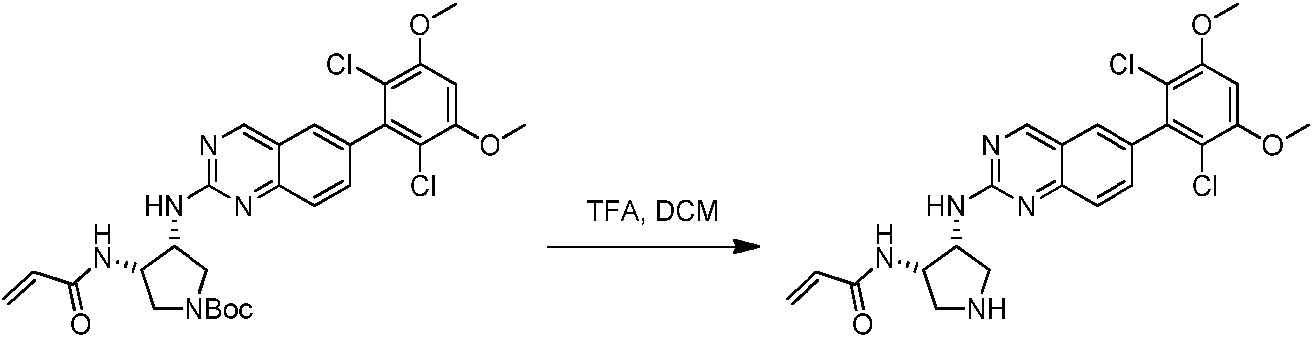
Una solución de (3S,4R)-3-acrilamido-4-((6-(2,6-dicloro-3,5-dimetoxifenil)quinazolin-2-il)amino)pirrolidin-1-carboxilato de ferc-butilo (1,26 g, 2,14 mmol) en DCM (8 ml) y TFA (3 ml, 39 mmol) se agitó durante 3 h a temperatura ambiente. Los disolventes en exceso se eliminaron a presión reducida. El aceite de color amarillo se disolvió en DCM (-100 ml) y se lavó con solución acuosa saturada de bicarbonato de sodio (-50 ml). Después, la capa acuosa se extrajo con DCM fresco (3 * 30 ml). Las capas orgánicas combinadas se secaron sobre sulfato de sodio, se filtraron, se concentraron y se secaron, obteniéndose N-((3S,4R)-4-((6-(2,6-dicloro-3,5-dimetoxifenil)quinazolin-2-il)amino)pirrolidin-3-il)acrilamida que se usó sin purificación adicional en la etapa siguienteA solution of tert-butyl (3S,4R)-3-acrylamido-4-((6-(2,6-dichloro-3,5-dimethoxyphenyl)quinazolin-2-yl)amino)pyrrolidine-1-carboxylate ( 1.26 g, 2.14 mmol) in DCM (8 mL) and TFA (3 mL, 39 mmol) was stirred for 3 h at room temperature. Excess solvents were removed under reduced pressure. The yellow oil was dissolved in DCM (-100 mL) and washed with saturated aqueous sodium bicarbonate solution (-50 mL). Then the aqueous layer was extracted with fresh DCM (3*30 ml). The combined organic layers were dried over sodium sulfate, filtered, concentrated, and dried to give N-((3S,4R)-4-((6-(2,6-dichloro-3,5-dimethoxyphenyl)quinazolin -2-yl)amino)pyrrolidin-3-yl)acrylamide which was used without further purification in the next step
Etapa 5: Síntesis de N-((3S,4R)-1-acetil-4-((6-(2,6-dicloro-3,5-dimetoxifenil)quinazolin-2-il)amino)pirrolidin-3-il)acrilamidaStep 5: Synthesis of N-((3S,4R)-1-acetyl-4-((6-(2,6-dichloro-3,5-dimethoxyphenyl)quinazolin-2-yl)amino)pyrrolidin-3-yl )acrylamide

A una solución de N-((3S,4R)-4-((6-(2,6-dicloro-3,5-dimetoxifenil)quinazolin-2-il)amino)pirrolidin-3-il)acrilamida (0,37 g, 0,76 mmol) en diclorometano (15 ml) a 0 °C se le añadió DIEA (0,16 ml, 0,92 mmol) y cloruro de acetilo (0,054 ml, 0,76 mmol) y la reacción se agitó durante 60 min. La CL-EM indicó que el MP se había consumido por completo. La mezcla de reacción se purificó mediante cromatografía de gel de sílice, obteniéndose N-((3S,4R)-1-acetil-4-((6-(2,6-dicloro-3,5-dimetoxifenil)quinazolin-2-il)amino)pirrolidin-3-il)acrilamida (0,207 g, 51 %). EM (EN+) C25H25Cl2N5O4 requiere: 529, encontrado: 530.To a solution of N-((3S,4R)-4-((6-(2,6-dichloro-3,5-dimethoxyphenyl)quinazolin-2-yl)amino)pyrrolidin-3-yl)acrylamide (0. 37 g, 0.76 mmol) in dichloromethane (15 mL) at 0 °C DIEA (0.16 mL, 0.92 mmol) and acetyl chloride (0.054 mL, 0.76 mmol) were added and the reaction was stirred for 60 min. LC-MS indicated that the MP was completely consumed. The reaction mixture was purified by silica gel chromatography to obtain N-((3S,4R)-1-acetyl-4-((6-(2,6-dichloro-3,5-dimethoxyphenyl)quinazolin-2- yl)amino)pyrrolidin-3-yl)acrylamide (0.207g, 51%). MS (ES+) C 25 H 25 Cl 2 N 5 O 4 requires: 529, found: 530.
Compuesto 83Compound 83
Síntesis de (3S,4R)-3-acrilamido-4-((6-(2,6-dicloro-3,5-dimetoxifenil)quinazolin-2-il)amino)-N-etilpirrolidin-1-carboxamida Synthesis of (3S,4R)-3-acrylamido-4-((6-(2,6-dichloro-3,5-dimethoxyphenyl)quinazolin-2-yl)amino)-N-ethylpyrrolidine-1-carboxamide

A una solución de N-((3S,4R)-4-((6-(2,6-didoro-3,5-dimetoxifenil)quinazolin-2-il)amino)pirrolidin-3-il)acrilamida (0,040 g, 0,082 mmol) en diclorometano (l,5 ml) a 0 °C se le añadió TEA (0,014 ml, 0,098 mmol) e isocianato de etilo (0,008 ml, 0,098 mmol) y la reacción se agitó durante 45 min. La CL-EM indicó que el MP se había consumido por completo. La mezcla de reacción se purificó mediante cromatografía de gel de sílice, obteniéndose (3S,4R)-3-acrilamido-4-((6-(2,6-dicloro3,5-dimetoxifenil)quinazolin-2-il)amino)-N-etilpirrolidin-1-carboxamida (0,035 g, 76 %). EM (EN+) C26H28ChN6O4 requiere: 558, encontrado: 559.To a solution of N-((3S,4R)-4-((6-(2,6-didoro-3,5-dimethoxyphenyl)quinazolin-2-yl)amino)pyrrolidin-3-yl)acrylamide (0.040 g , 0.082 mmol) in dichloromethane (1.5 mL) at 0 °C was added TEA (0.014 mL, 0.098 mmol) and ethyl isocyanate (0.008 mL, 0.098 mmol) and the reaction stirred for 45 min. LC-MS indicated that the MP was completely consumed. The reaction mixture was purified by silica gel chromatography to obtain (3S,4R)-3-acrylamido-4-((6-(2,6-dichloro3,5-dimethoxyphenyl)quinazolin-2-yl)amino)- N-ethylpyrrolidine-1-carboxamide (0.035 g, 76%). MS (ES+) C 26 H 28 ChN 6 O 4 requires: 558, found: 559.
Protocolo sintético 5Synthetic Protocol 5

El heterociclo 2-Cl (descrito en el documento WO 2014/011900) puede sustituirse con una diamina 1,2-mono-protegida mediante una reacción de acoplamiento de Buchwald mediada por paladio, obteniéndose el heterociclo sustituido con diamina. Después, el grupo protector de la amina se elimina para revelar la amina en el cicloalcano. La amina puede hacerse reaccionar con ácido propiólico usando condiciones de reacción de acoplamiento de amida, obteniéndose la propargil amida o se hizo reaccionar con cloruro de acriloílo, obteniéndose la acrilamida. Como se muestra a continuación, el compuesto 62 se preparó usando el protocolo sintético 5.The 2-Cl heterocycle (described in WO 2014/011900) can be substituted with a 1,2-mono-protected diamine via a palladium-mediated Buchwald coupling reaction, yielding the diamine-substituted heterocycle. The amine protecting group is then removed to reveal the amine on the cycloalkane. The amine can be reacted with propiolic acid using amide coupling reaction conditions to give propargyl amide or reacted with acryloyl chloride to give acrylamide. As shown below, compound 62 was prepared using synthetic protocol 5.
Compuesto 62Compound 62
Síntesis de N-((1S,2R)-2-((6-(2,6-dicloro-3,5-dimetoxifenil)-8-etil-7-oxo-7,8-dihidropirido[2,3-d]pirimidin-2-il)amino)ciclopentil)acrilamidaSynthesis of N-((1S,2R)-2-((6-(2,6-dichloro-3,5-dimethoxyphenyl)-8-ethyl-7-oxo-7,8-dihydropyrido[2,3-d ]pyrimidin-2-yl)amino)cyclopentyl)acrylamide

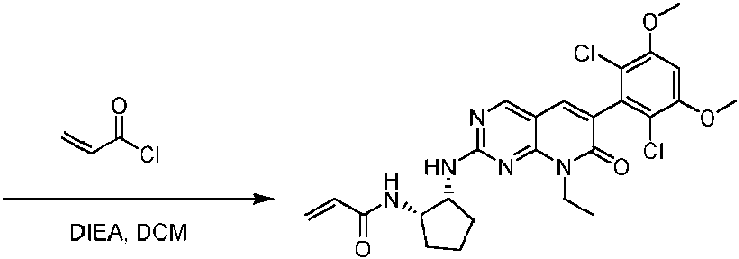
Etapa 1: Síntesis de ((1S,2R)-2-((6-(2,6-dicloro-3,5-dimetoxifenil)-8-etil-7-oxo-7,8-dihidropirido[2,3-d]pirimidin-2-il)amino)ciclopentil)carbamato de ferc-butiloStep 1: Synthesis of ((1S,2R)-2-((6-(2,6-dichloro-3,5-dimethoxyphenyl)-8-ethyl-7-oxo-7,8-dihydropyrido[2,3- tert-butyl d]pyrimidin-2-yl)amino)cyclopentyl)carbamate

Una mezcla de 2-cloro-6-(2,6-dicloro-3,5-dimetoxifenil)-8-etilpirido[2,3-d]pirimidin-7(8H)-ona (0,2 g, 0,48 mmol), ((1S,2R)-2-aminociclopentil)carbamato de ferc-butilo (145 mg, 0,72 mmol), Cs2CO3 (393 mg, 1,21 mmol), X-Phos (23 mg, 0,048 mmol) y Pd2dba3 (22 mg, 0,024 mmol) en DMA (3,2 ml) se desgasificó con N2 durante 5 min y se calentó en un reactor de microondas a 115 °C durante 60 min. La mezcla se enfrió a temperatura ambiente, se diluyó con EtOAc, se filtró a través de celite y se lavó con agua (4x) seguido de solución saturada de salmuera. El residuo se purificó mediante cromatografía en columna de gel de sílice, obteniéndose ferc-butil ((1S,2R)-2-((6-(2,6-dicloro-3,5-dimetoxifenil)-8-etil-7-oxo-7,8-dihidropirido[2,3-d]pirimidin-2-il)amino)ciclopentil)carbamato de ferc-butilo (60 mg, 22 %). EM (EN+) C27H33Cl2NaO5 requiere: 577, encontrado: 578 [M+H]+.A mixture of 2-chloro-6-(2,6-dichloro-3,5-dimethoxyphenyl)-8-ethylpyrido[2,3-d]pyrimidin-7(8H)-one (0.2 g, 0.48 mmol), tert-butyl ((1S,2R)-2-aminocyclopentyl)carbamate (145 mg, 0.72 mmol), Cs 2 CO 3 (393 mg, 1.21 mmol), X-Phos (23 mg, 0.048 mmol) and Pd2dba3 (22 mg, 0.024 mmol) in DMA (3.2 mL) was degassed with N2 for 5 min and heated in a microwave reactor at 115 °C for 60 min. The mixture was cooled to room temperature, diluted with EtOAc, filtered through celite and washed with water (4x) followed by saturated brine. The residue was purified by silica gel column chromatography to obtain tert-butyl ((1S,2R)-2-((6-(2,6-dichloro-3,5-dimethoxyphenyl)-8-ethyl-7- tert-Butyl oxo-7,8-dihydropyrido[2,3-d]pyrimidin-2-yl)amino)cyclopentyl)carbamate (60 mg, 22%). MS (ES+) C 27 H 33 Cl 2 NaO 5 requires: 577, found: 578 [M+H]+.
Etapa 2: Síntesis de 2-(((1R,2S)-2-aminociclopentil)amino)-6-(2,6-dicloro-3,5-dimetoxifenil)-8-etilpirido[2,3-d]pirimidin-7(8H)-onaStep 2: Synthesis of 2-(((1R,2S)-2-aminocyclopentyl)amino)-6-(2,6-dichloro-3,5-dimethoxyphenyl)-8-ethylpyrido[2,3-d]pyrimidine- 7(8H)-one

Una mezcla de ferc-butil ((1S,2R)-2-((6-(2,6-dicloro-3,5-dimetoxifenil)-8-etil-7-oxo-7,8-dihidropirido[2,3-d]pirimidin-2-il)amino)ciclopentil)carbamato de ferc-butilo (60 mg, 0,105 mmol) y TFA (0,5 ml) en diclorometano (2 ml) se agitó a temperatura ambiente durante 90 minutos. La CL-EM indicó que el MP se había consumido por completo. La mezcla de reacción se diluyó con NaHCO3 saturado y después se extrajo con diclorometano. Las capas orgánicas combinadas se secaron con Na2SO4, se filtraron y se concentraron, obteniéndose 2-(((1R,2S)-2-aminociclopentil)amino)-6-(2,6-dicloro-3,5-dimetoxifenil)-8-etilpirido[2,3-d]pirimidin-7(8H)-ona que se usó sin purificación adicional en la etapa siguiente.A mixture of tert-butyl ((1S,2R)-2-((6-(2,6-dichloro-3,5-dimethoxyphenyl)-8-ethyl-7-oxo-7,8-dihydropyrido[2,3 tert-Butyl -d]pyrimidin-2-yl)amino)cyclopentyl)carbamate (60 mg, 0.105 mmol) and TFA (0.5 mL) in dichloromethane (2 mL) was stirred at room temperature for 90 minutes. LC-MS indicated that the MP was completely consumed. The reaction mixture was diluted with saturated NaHCO3 and then extracted with dichloromethane. The combined organic layers were dried over Na2SO4, filtered, and concentrated to give 2-(((1R,2S)-2-aminocyclopentyl)amino)-6-(2,6-dichloro-3,5-dimethoxyphenyl)-8 -ethylpyrido[2,3-d]pyrimidin-7(8H)-one which was used without further purification in the next step.
Etapa 3: Síntesis de N-((1S,2R)-2-((6-(2,6-dicloro-3,5-dimetoxifenil)-8-etil-7-oxo-7,8-dihidropirido[2,3-d]pirimidin-2-il)amino)ciclopentil)acrilamidaStep 3: Synthesis of N-((1S,2R)-2-((6-(2,6-dichloro-3,5-dimethoxyphenyl)-8-ethyl-7-oxo-7,8-dihydropyrido[2, 3-d]pyrimidin-2-yl)amino)cyclopentyl)acrylamide


A una solución de 2-(((1R,2S)-2-aminocidopentil)amino)-6-(2,6-didoro-3,5-dimetoxifenil)-8-etilpirido[2,3-d]pirimidin-7(8H)-ona (0,105 mmol) en diclorometano (2,1 ml) a -20 °C se le añadió DIEA (0,018 ml, 0,105 mmol) y cloruro de acriloílo (0,008 ml, 0,105 mmol) y la reacción se agitó durante 1 h. La CL-EM indicó que el MP se había consumido por completo. La mezcla de reacción se purificó mediante cromatografía de gel de sílice, obteniéndose N-((1S,2R)-2-((6-(2,6-dicloro-3,5-dimetoxifenil)-8-etil-7-oxo-7,8-dihidropirido[2,3-d]pirimidin-2-il)amino)ciclopentil)acrilamida (36 mg, 6 5 %). EM (EN+) C25H27Cl2N5O4 requiere: 531, encontrado: 532.To a solution of 2-(((1R,2S)-2-aminocidopentyl)amino)-6-(2,6-didoro-3,5-dimethoxyphenyl)-8-ethylpyrido[2,3-d]pyrimidin-7 (8H)-one (0.105 mmol) in dichloromethane (2.1 mL) DIEA (0.018 mL, 0.105 mmol) and acryloyl chloride (0.008 mL, 0.105 mmol) were added at -20 °C and the reaction stirred for 1 hour. LC-MS indicated that the MP was completely consumed. The reaction mixture was purified by silica gel chromatography to give N-((1S,2R)-2-((6-(2,6-dichloro-3,5-dimethoxyphenyl)-8-ethyl-7-oxo -7,8-dihydropyrido[2,3-d]pyrimidin-2-yl)amino)cyclopentyl)acrylamide (36mg, 6.5 %). MS (ES+) C 25 H 27 Cl 2 N 5 O 4 requires: 531, found: 532.
Protocolo sintético 6 Synthetic Protocol 6

El heterociclo 2-Cl puede sustituirse con un 1,2-trans-amino alcohol a través de varias condiciones de reacción de sustitución aromática nucleófila utilizando una base (tal como diisopropiletilamina (DIPEA), DBU o NaHCOa) en un disolvente polar (tal como dioxano, CH3CN o NMP) o mediante una reacción de acoplamiento de Buchwald mediada por paladio, obteniéndose la quinazolina sustituida. El alcohol en el cicloalcano se hace reaccionar en condiciones de reacción de sustitución nucleófila (tales como la reacción de Mitsunobu), obteniéndose la amina protegida. La eliminación del grupo protector en la amina (tal como hidrazina para el grupo protector de ftalimida) proporcionó la amina en el cicloalcano. La amina puede hacerse reaccionar con ácido propargílico (utilizando condiciones de acoplamiento de amida, tales como HATU, DIPEA) o hacerse reaccionar con cloruro de acriloílo para preparar los compuestos finales. Como se muestra a continuación, Los compuestos 81 y 82 se prepararon usando el protocolo sintético 6.The 2-Cl heterocycle can be substituted with a 1,2-trans-amino alcohol through various nucleophilic aromatic substitution reaction conditions using a base (such as diisopropylethylamine (DIPEA), DBU, or NaHCOa) in a polar solvent (such as dioxane, CH 3 CN or NMP) or by a palladium-mediated Buchwald coupling reaction, yielding the substituted quinazoline. The alcohol in the cycloalkane is reacted under nucleophilic substitution reaction conditions (such as the Mitsunobu reaction) to give the protected amine. Removal of the protecting group on the amine (such as hydrazine for the phthalimide protecting group) provided the amine on the cycloalkane. The amine can be reacted with propargylic acid (using amide coupling conditions such as HATU, DIPEA) or reacted with acryloyl chloride to prepare the final compounds. As shown below, Compounds 81 and 82 were prepared using synthetic protocol 6 .
Compuestos 81 y 82Compounds 81 and 82
Síntesis de (1S,3S,4R)-3-acrilamido-4-((6-(2,6-dicloro-3,5-dimetoxifenil)quinazolin-2-il)amino)-N,N-dimetilciclopentanocarboxamida y (1R,3S,4R)-3-acrilamido-4-((6-(2,6-dicloro-3,5-dimetoxifenil)quinazolin-2-il)amino)-N,N-dimetilciclopentano-1 -carboxamida Synthesis of (1S,3S,4R)-3-acrylamido-4-((6-(2,6-dichloro-3,5-dimethoxyphenyl)quinazolin-2-yl)amino)-N,N-dimethylcyclopentanecarboxamide and (1R ,3S,4R)-3-acrylamido-4-((6-(2,6-dichloro-3,5-dimethoxyphenyl)quinazolin-2-yl)amino)-N,N-dimethylcyclopentane-1-carboxamide
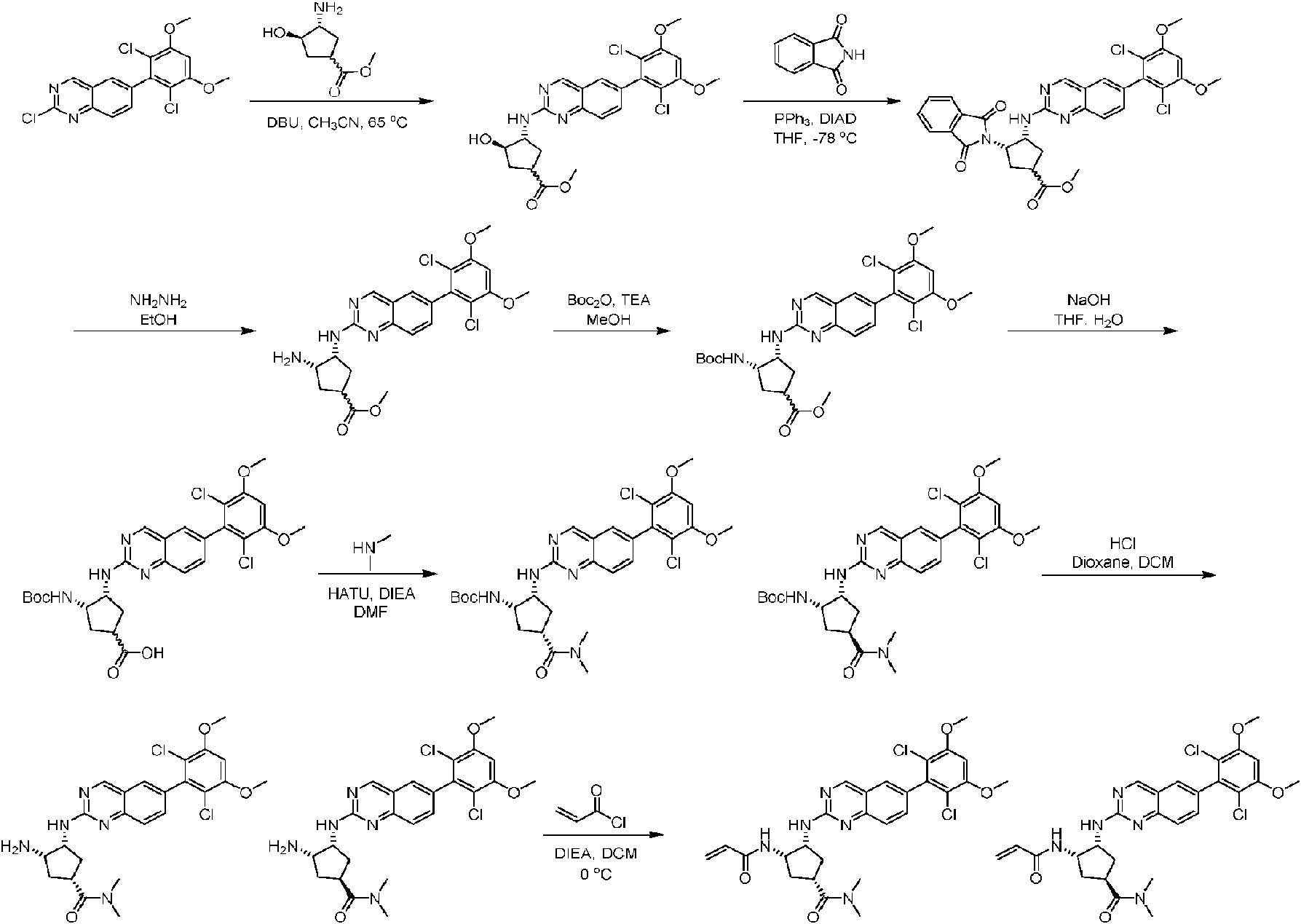
Etapa 1: Síntesis de (3R,4R)-3-((6-(2,6-dicloro-3,5-dimetoxifenil)-quinazolin-2-il)amino)-4-hidroxiciclopentano-1-carboxilato de metilo racémicoStep 1: Synthesis of racemic methyl (3R,4R)-3-((6-(2,6-dichloro-3,5-dimethoxyphenyl)-quinazolin-2-yl)amino)-4-hydroxycyclopentane-1-carboxylate
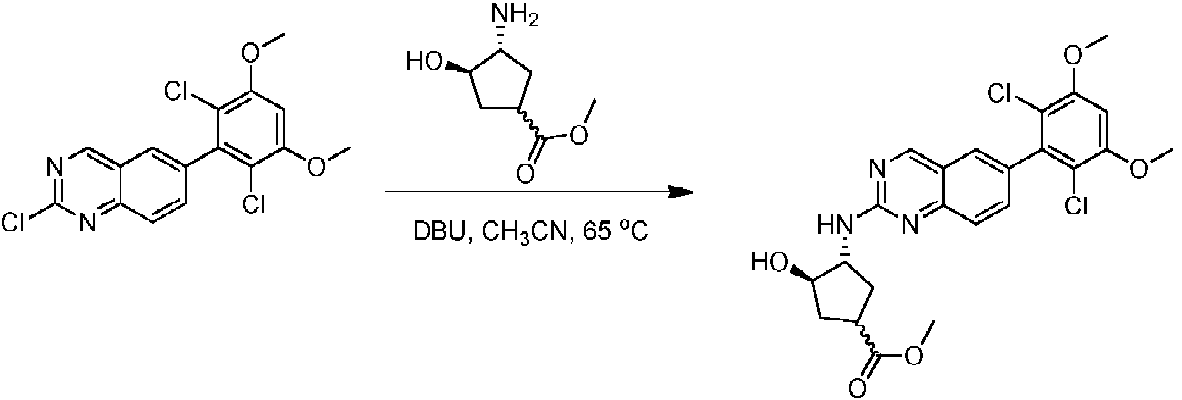
Se combinaron 2-doro-6-(2,6-didoro-3,5-dimetoxifenN)quinazolina (0,576 g, 1,558 mmol), (3R,4R)-3-amino-4-hidroxiddopentano-1-carboxilato de metilo (0,372 g, 2,337 mmol) en acetonitrilo (3 ml) y se añadió DBU (0,470 ml, 3,12 mmol). La reacción se purgó con N2 durante 5 minutos y después se calentó a 65 °C durante una noche. Después de enfriar hasta temperatura ambiente, el disolvente se eliminó a presión reducida. El residuo se purificó mediante cromatografía ultrarrápida (Hex al 0-100 %/EtOAc; columna de 12 g), y se recuperó el 3-((6-(2,6-dicloro-3,5-dimetoxifenil)quinazolin-2-il)amino)-4-hidroxiciclopentanocarboxilato de (1S,3R,4R)-metilo (0,520 g, 1,056 mmol, rendimiento del 67,8 %). EM (EN+) C23 H23Cl2N3O5 requiere: 492, encontrado: 493 [M H]+.Methyl 2-doro-6-(2,6-didoro-3,5-dimethoxyphenN)quinazoline (0.576 g, 1.558 mmol), (3R,4R)-3-amino-4-hydroxyddopentane-1-carboxylate methyl ( 0.372 g, 2.337 mmol) in acetonitrile (3 mL) and DBU (0.470 mL, 3.12 mmol) was added. The reaction was purged with N2 for 5 min and then heated at 65 °C overnight. After cooling to room temperature, the solvent was removed under reduced pressure. The residue was purified by flash chromatography (0-100% Hex/EtOAc; 12 g column), and 3-((6-(2,6-dichloro-3,5-dimethoxyphenyl)quinazolin-2- (1S,3R,4R)-methyl yl)amino)-4-hydroxycyclopentanecarboxylate (0.520 g, 1.056 mmol, 67.8% yield). MS (ES+) C2 3 H2 3 Cl2N 3 O5 requires: 492, found: 493 [MH]+.
Etapa 2: Síntesis de (3R,4S)-3-((6-(2,6-dicloro-3,5-dimetoxifenil)quinazolin-2-il)amino)-4-(1,3-dioxoisoindolin-2-il)ciclopentano-1-carboxilato de metilo racémicoStep 2: Synthesis of (3R,4S)-3-((6-(2,6-dichloro-3,5-dimethoxyphenyl)quinazolin-2-yl)amino)-4-(1,3-dioxoisoindolin-2- Racemic methyl yl)cyclopentane-1-carboxylate
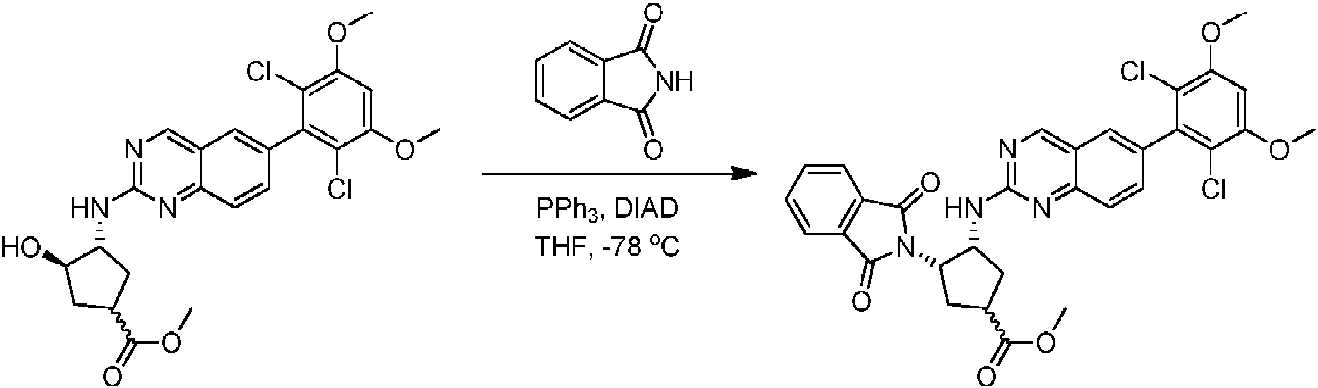
Se cargó Ph3P (0,213 g, 0,812 mmol) en THF (6 ml) y se enfrió a -78 °C en atmósfera de N2. Se añadió DIAD (0,126 ml, 0,650 mmol) seguido de la adición de ftalimida (0,105 g, 0,711 mmol) y se agitó a -78 °C durante 1 hora, seguido de la adición de 3-((6-(2,6-dicloro-3,5-dimetoxifenil)quinazolin-2-il)amino)-4-hidroxiciclopentanocarboxilato de (1S,3R,4R)-metilo (0,100 g, 0,203 mmol) en 4 ml de THF a -78 °C. La reacción se agitó durante una noche mientras se calentaba hasta temperatura ambiente, tras lo cual se eliminó el disolvente a presión reducida. El residuo se purificó mediante cromatografía ultrarrápida (Hex al 0-100 %/EtOAc; columna de 12 g), obteniéndose (3R,4S)-3-((6-(2,6-dicloro-3,5-dimetoxifenil)quinazolin-2-il)amino)-4-(1,3-dioxoisoindolin-2-il)ciclopentano-1-carboxilato de metilo (0,126 g, 0,203 mmol). EM (EN+) C31H26Cl2N4O6 requiere: 621, encontrado: 622 [M H]+.Ph 3 P (0.213 g, 0.812 mmol) in THF (6 mL) was charged and cooled to -78 °C under N 2 . DIAD (0.126 mL, 0.650 mmol) was added followed by the addition of phthalimide (0.105 g, 0.711 mmol) and stirred at -78 °C for 1 hour, followed by the addition of 3-((6-(2.6 (1S,3R,4R)-methyl-dichloro-3,5-dimethoxyphenyl)quinazolin-2-yl)amino)-4-hydroxycyclopentanecarboxylate (0.100 g, 0.203 mmol) in 4 mL THF at -78 °C. The reaction was stirred overnight while warming to room temperature, after which the solvent was removed under reduced pressure. The residue was purified by flash chromatography (0-100% Hex/EtOAc; 12 g column) to give (3R,4S)-3-((6-(2,6-dichloro-3,5-dimethoxyphenyl)quinazolin Methyl -2-yl)amino)-4-(1,3-dioxoisoindolin-2-yl)cyclopentane-1-carboxylate (0.126 g, 0.203 mmol). MS (ES+) C 31 H 26 Cl 2 N 4 O 6 requires: 621, found: 622 [MH]+.
Etapa 3: Síntesis de (3S,4R)-3-amino-4-((6-(2,6-dicloro-3,5-dimetoxifenil)quinazolin-2-il)amino)ciclopentano-1-carboxilato de metilo racémicoStep 3: Synthesis of racemic methyl (3S,4R)-3-amino-4-((6-(2,6-dichloro-3,5-dimethoxyphenyl)quinazolin-2-yl)amino)cyclopentane-1-carboxylate

Se cargó 3-((6-(2,6-dicloro-3,5-dimetoxifenil)quinazolin-2-il)amino)-4-(1,3-dioxoisoindolin-2-il)ciclopentanocarboxilato de (1S,3R,4S)-metilo (0,500 g, 0,805 mmol) en EtOH (20 ml) y se añadió monohidrato de hidrazina (0,079 ml, 1,61 mmol). La reacción se agitó durante una noche a temperatura ambiente. Se retiró por filtración un precipitado de color blanco y el disolvente se eliminó a presión reducida. El precipitado se trituró con éter, seguido de la eliminación del disolvente a presión reducida, obteniéndose (3S,4R)-3-amino-4-((6-(2,6-dicloro-3,5-dimetoxifenil)quinazolin-2-il)amino)ciclopentano-1-carboxilato de metilo (0,395 g, 0,805 mmol) con un rendimiento cuantitativo, que se llevó a la siguiente etapa sin purificación adicional. EM (EN+) C23H24ChN4O4 requiere: 491, encontrado: 492 [M H]+.3-((6-(2,6-dichloro-3,5-dimethoxyphenyl)quinazolin-2-yl)amino)-4-(1,3-dioxoisoindolin-2-yl)cyclopentanecarboxylate (1S,3R, 4S)-methyl (0.500 g, 0.805 mmol) in EtOH (20 mL) and hydrazine monohydrate (0.079 mL, 1.61 mmol) was added. The reaction was stirred overnight at room temperature. A white precipitate was filtered off and the solvent was removed under reduced pressure. The precipitate was triturated with ether, followed by removal of the solvent under reduced pressure to give (3S,4R)-3-amino-4-((6-(2,6-dichloro-3,5-dimethoxyphenyl)quinazolin-2 Methyl -yl)amino)cyclopentane-1-carboxylate (0.395 g, 0.805 mmol) in quantitative yield, which was carried on to the next step without further purification. MS (ES+) C 23 H 24 ChN 4 O 4 requires: 491, found: 492 [MH]+.
Etapa 4: Síntesis de (3S,4R)-3-((terc-butoxicarbonil)amino)-4-((6-(2,6-dicloro-3,5-dimetoxifenil)quinazolin-2-il)amino)ciclopentano-1-carboxilato de metilo racémicoStep 4: Synthesis of (3S,4R)-3-((tert-butoxycarbonyl)amino)-4-((6-(2,6-dichloro-3,5-dimethoxyphenyl)quinazolin-2-yl)amino)cyclopentane Racemic methyl-1-carboxylate

Se cargó (3S,4R)-3-amino-4-((6-(2,6-dicloro-3,5-dimetoxifenil)quinazolin-2-il)amino)ciclopentano-1-carboxilato (0,550 g, 1,119 mmol) en metanol (10 ml) seguido de la adición de Et3N (0,156 ml, 1,119 mmol) y BOC-anhídrido (0,286 ml, 1,231 mmol). La reacción se agitó a temperatura ambiente durante la noche. Tras eliminar el disolvente al vacío, el residuo se recogió en DCM y se lavó con agua (2x), se secó sobre sulfato de sodio y el disolvente se eliminó a presión reducida, obteniéndose (3S,4R)-3-((terc-butoxicarbonil)amino)-4-((6-(2,6-dicloro-3,5-dimetoxifenil)quinazolin-2-il)amino)ciclopentano-1-carboxilato de metilo (0,662g, 1,119 mmol), que se llevó a la siguiente etapa sin purificación adicional. EM (EN+) C28H32ChN4O6 requiere: 591, encontrado: 592 [M H]+.(3S,4R)-3-amino-4-((6-(2,6-dichloro-3,5-dimethoxyphenyl)quinazolin-2-yl)amino)cyclopentane-1-carboxylate (0.550 g, 1.119 mmol ) in methanol (10 mL) followed by the addition of Et 3 N (0.156 mL, 1.119 mmol) and BOC-anhydride (0.286 mL, 1.231 mmol). The reaction was stirred at room temperature overnight. After removing the solvent in vacuo, the residue was taken up in DCM and washed with water (2x), dried over sodium sulfate and the solvent removed under reduced pressure to give (3S,4R)-3-((tert- methyl butoxycarbonyl)amino)-4-((6-(2,6-dichloro-3,5-dimethoxyphenyl)quinazolin-2-yl)amino)cyclopentane-1-carboxylate (0.662g, 1.119mmol), which was taken to the next step without further purification. MS (ES+) C 28 H 32 ChN 4 O 6 requires: 591, found: 592 [MH]+.
Etapa 5: Síntesis de ácido (3S,4R)-3-((terc-butoxicarbonil)amino)-4-((6-(2,6-dicloro-3,5-dimetoxifenil)quinazolin-2-il)amino)ciclopentano-1-carboxílico racémicoStep 5: Synthesis of (3S,4R)-3-((tert-butoxycarbonyl)amino)-4-((6-(2,6-dichloro-3,5-dimethoxyphenyl)quinazolin-2-yl)amino) acid racemic cyclopentane-1-carboxylic acid

Se cargó (3S,4R)-3-((terc-butoxicarbonil)amino)-4-((6-(2,6-dicloro-3,5-dimetoxifenil)-quinazolin-2-il)amino)ciclopentano-1-carboxilato de metilo (0,662 g, 1,119 mmol) en metanol (10 ml), THF (4ml) y se trató con 10ml de NaOH 1 N. La mezcla de reacción se agitó a temperatura ambiente durante 2 horas. Los disolventes orgánicos se eliminaron a presión reducida, posteriormente se acidificó la capa acuosa con HCl 1 N hasta pH ~2. La capa acuosa se extrajo con EtOAcx3. Se combinaron las capas orgánicas, se secaron sobre sulfato de sodio y el disolvente se eliminó, obteniéndose ácido (3S,4R)-3-((ferc-butoxicarbonil)amino)-4-((6-(2,6-dicloro-3,5-dimetoxifenil)quinazolin-2-il)amino)ciclopentano-1-carboxílico en bruto (0,580 g, 1,00 mmol, rendimiento del 91 %) que se llevó a la siguiente etapa sin purificación adicional. EM (EN+) C27H3üCl2N4O6 requiere: 577, encontrado: 578 [M H]+.(3S,4R)-3-((tert-butoxycarbonyl)amino)-4-((6-(2,6-dichloro-3,5-dimethoxyphenyl)-quinazolin-2-yl)amino)cyclopentane-1 -methyl carboxylate (0.662 g, 1.119 mmol) in methanol (10 mL), THF (4 mL) and treated with 10 mL of 1N NaOH. The reaction mixture was stirred at room temperature for 2 hours. Organic solvents were removed under reduced pressure, then the aqueous layer was acidified with 1N HCl to pH ~2. The aqueous layer was extracted with EtOAcx3. The organic layers were combined, dried over sodium sulfate, and the solvent was removed to give (3S,4R)-3-((fert-butoxycarbonyl)amino)-4-((6-(2,6-dichloro- Crude 3,5-dimethoxyphenyl)quinazolin-2-yl)amino)cyclopentane-1-carboxylic acid (0.580 g, 1.00 mmol, 91% yield) which was carried on to the next step without further purification. MS (ES+) C 27 H 3 üCl 2 N 4 O 6 requires: 577, found: 578 [MH]+.
Etapa 6: Síntesis de ((1S,2R,4S)-2-((6-(2,6-dicloro-3,5-dimetoxifenil)quinazolin-2-il)amino)-4-(dimetilcarbamoil)ciclopentil)carbamato de ferc-butilo y ((1S,2R,4R)-2-((6-(2,6-dicloro-3,5-dimetoxifenil)quinazolin-2-il)amino)-4-(dimetilcarbamoil)ciclopentil)carbamato de ferc-butiloStep 6: Synthesis of ((1S,2R,4S)-2-((6-(2,6-dichloro-3,5-dimethoxyphenyl)quinazolin-2-yl)amino)-4-(dimethylcarbamoyl)cyclopentyl)carbamate tert-butyl and ((1S,2R,4R)-2-((6-(2,6-dichloro-3,5-dimethoxyphenyl)quinazolin-2-yl)amino)-4-(dimethylcarbamoyl)cyclopentyl)carbamate tert-butyl

Se cargó ácido (3S,4R)-3-((ferc-butoxicarbonil)amino)-4-((6-(2,6-dicloro-3,5-dimetoxifenil)quinazolin-2-il)amino)ciclopentano-1-carboxílico (0,270 g, 0,468 mmol) en DMF (3 ml), Se añadieron HATU (0,267 g, 0,701 mmol), dimetilamina 2 M en THF (0,250 ml, 0,500 mmol) y DIeA (0,245 ml, 1,403 mmol) y se agitó a temperatura ambiente durante 30 minutos. La reacción se completó tras su supervisión mediante CLEM, que mostró dos picos que contenían la masa correcta. La reacción se purificó mediante cromatografía en fase inversa (acetonitrilo al 5-60 %/agua ácido fórmico al 0,01 %; columna de 12 g). Pico A: ((1S,2R,4R)-2-((6-(2,6-dicloro-3,5-dimetoxifenil)quinazolin-2-il)amino)-4-(dimetilcarbamoil)ciclopentil)carbamato de ferc-butilo (0,086 g, 0,142 mmol) EM (EN+) C29H35O 2N5O5 requiere: 604, encontrado: 605 [M H]+, tiempo de retención 3,039. Pico B: ((1S,2R,4S)-2-((6-(2,6-dicloro-3,5-dimetoxifenil)quinazolin-2-il)amino)-4-(dimetilcarbamoil)ciclopentil)carbamato de ferc-butilo (0,062 g, 0,103 mmol) EM (EN+) C29H35Cl2N5O5 requiere: 604, encontrado: 605 [M H]+, tiempo de retención 2,879. Nota: la configuración absoluta se asignó de manera arbitraria.(3S,4R)-3-((tert-butoxycarbonyl)amino)-4-((6-(2,6-dichloro-3,5-dimethoxyphenyl)quinazolin-2-yl)amino)cyclopentane-1 acid was charged -carboxylic acid (0.270 g, 0.468 mmol) in DMF (3 mL), HATU (0.267 g, 0.701 mmol), 2M dimethylamine in THF (0.250 mL, 0.500 mmol), and DIeA (0.245 mL, 1.403 mmol) were added and stirred at room temperature for 30 min. The reaction was complete upon monitoring by LCMS, which showed two peaks containing the correct mass. The reaction was purified by reverse phase chromatography (5-60% acetonitrile/0.01% formic acid water; 12 g column). Peak A: fert ((1S,2R,4R)-2-((6-(2,6-dichloro-3,5-dimethoxyphenyl)quinazolin-2-yl)amino)-4-(dimethylcarbamoyl)cyclopentyl)carbamate -butyl (0.086 g, 0.142 mmol) MS (EN+) C 29 H 35 O 2 N 5 O 5 requires: 604, found: 605 [MH]+, retention time 3.039. Peak B: fert ((1S,2R,4S)-2-((6-(2,6-dichloro-3,5-dimethoxyphenyl)quinazolin-2-yl)amino)-4-(dimethylcarbamoyl)cyclopentyl)carbamate -butyl (0.062 g, 0.103 mmol) MS (EN+) C 29 H 35 Cl 2 N 5 O 5 requires: 604, found: 605 [MH]+, retention time 2.879. Note: The absolute setting was assigned arbitrarily.
Etapa 7a: Síntesis de (1S,3S,4R)-3-amino-4-((6-(2,6-dicloro-3,5-dimetoxifenil)quinazolin-2-il)amino)-N,N-dimetilciclopentano-1-carboxamidaStep 7a: Synthesis of (1S,3S,4R)-3-amino-4-((6-(2,6-dichloro-3,5-dimethoxyphenyl)quinazolin-2-yl)amino)-N,N-dimethylcyclopentane -1-carboxamide
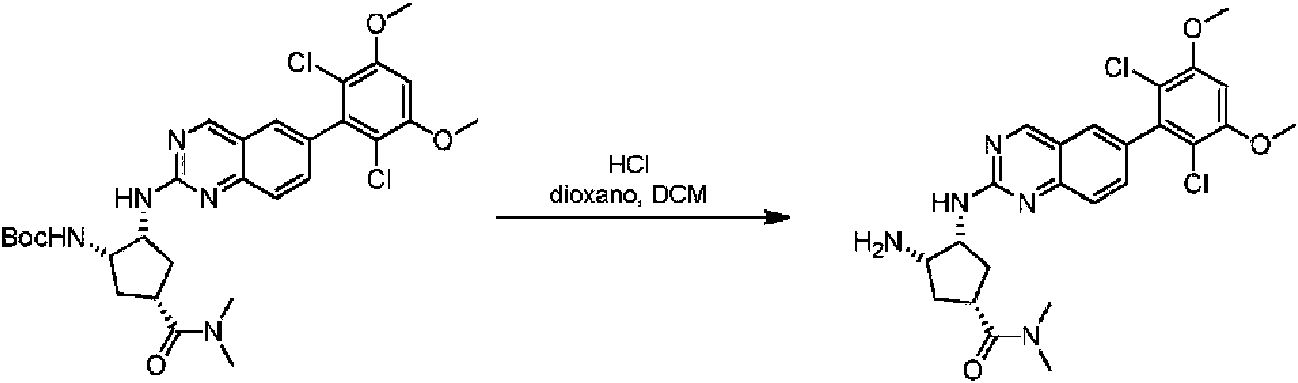
Se cargó ((1S,2R,4R)-2-((6-(2,6-dicloro-3,5-dimetoxifenil)quinazolin-2-il)amino)-4-(dimetilcarbamoil)ciclopentil)carbamato de ferc-butilo (0,086 g, 0,142 mmol) en DCM (2 ml) y se trató con HCl 4 M en dioxano (3 ml) y se agitó durante 3 horas. Se eliminó el disolvente, obteniéndose (1S,3S,4R)-3-amino-4-((6-(2,6-dicloro-3,5-dimetoxifenil)quinazolin-2-il)amino)-N,N-dimetilciclopentano-1-carboxamida en bruto, rendimiento cuantitativo. EM (EN+) C24H27Cl2N5O3 requiere: 504, encontrado: 505 [M H]+.((1S,2R,4R)-2-((6-(2,6-dichloro-3,5-dimethoxyphenyl)quinazolin-2-yl)amino)-4-(dimethylcarbamoyl)cyclopentyl)carbamate was charged with fert- butyl (0.086 g, 0.142 mmol) in DCM (2 mL) and treated with 4M HCl in dioxane (3 mL) and stirred for 3 hours. The solvent was removed to give (1S,3S,4R)-3-amino-4-((6-(2,6-dichloro-3,5-dimethoxyphenyl)quinazolin-2-yl)amino)-N,N- crude dimethylcyclopentane-1-carboxamide, quantitative yield. MS (ES+) C 24 H 27 Cl 2 N 5 O 3 requires: 504, found: 505 [MH]+.
Etapa 8 a: Síntesis de (1R,3S,4R)-3-acrilamido-4-((6-(2,6-dicloro-3,5-dimetoxifenil)quinazolin-2-il)amino)-N,N-dimetilciclopentano-1-carboxamida Step 8 a: Synthesis of (1R,3S,4R)-3-acrylamido-4-((6-(2,6-dichloro-3,5-dimethoxyphenyl)quinazolin-2-yl)amino)-N,N- dimethylcyclopentane-1-carboxamide

Se cargó (1S,3S,4R)-3-amino-4-((6-(2,6-dicloro-3,5-dimetoxifenil)quinazolin-2-il)amino)-N,N-dimetilcidopentanocarboxamida (0,050 g, 0,099 mmol) en CH2CI2 (25 ml) y se enfrió a 0 °C, seguido de la adición de DIEA (0,017 ml, 0,099 mmol) y después de cloruro de acriloílo (8 , 8 6 pl, 0,109 mmol) lentamente. La mezcla de reacción se agitó a 0 °C durante 30 minutos. Después de que se completara la reacción, la mezcla de reacción se cargó directamente sobre sílice y se purificó mediante cromatografía ultrarrápida (0 - 1 0 % CH2Cl2/MeOH; columna de 12 g) obteniéndose (1R,3S,4R)-3-acrilamido-4-((6-(2,6-dicloro-3,5-dimetoxifenil)quinazolin-2-il)amino)-N,N-dimetilciclopentanocarboxamida (0,043 g, 0,077 mmol, rendimiento del 78 %). EM (EN+) C27H29O 2N5O4 requiere: 558, encontrado: 559 [M H]+.(1S,3S,4R)-3-amino-4-((6-(2,6-dichloro-3,5-dimethoxyphenyl)quinazolin-2-yl)amino)-N,N-dimethylcyclopentanecarboxamide (0.050 g , 0.099 mmol) in CH 2 Cl 2 (25 mL) and cooled to 0 °C, followed by the addition of DIEA (0.017 mL, 0.099 mmol) and then acryloyl chloride ( 8.8 6 pl, 0.109 mmol) slowly. The reaction mixture was stirred at 0°C for 30 minutes. After the reaction was complete, the reaction mixture was loaded directly onto silica and purified by flash chromatography ( 0-10 % CH 2 Cl 2 /MeOH; 12 g column) to give (1R,3S,4R)- 3-acrylamido-4-((6-(2,6-dichloro-3,5-dimethoxyphenyl)quinazolin-2-yl)amino)-N,N-dimethylcyclopentanecarboxamide (0.043 g, 0.077 mmol, 78% yield). MS (ES+) C 27 H 29 O 2 N 5 O 4 requires: 558, found: 559 [MH]+.
Etapa 7b: Síntesis de (1R,3S,4R)-3-amino-4-((6-(2,6-dicloro-3,5-dimetoxifenil)quinazolin-2-il)amino)-N,N-dimetilciclopentano-1 -carboxamidaStep 7b: Synthesis of (1R,3S,4R)-3-amino-4-((6-(2,6-dichloro-3,5-dimethoxyphenyl)quinazolin-2-yl)amino)-N,N-dimethylcyclopentane - 1 -carboxamide

Se cargó ((1S,2R,4S)-2-((6-(2,6-dicloro-3,5-dimetoxifenil)quinazolin-2-il)amino)-4-(dimetilcarbamoil)ciclopentil)carbamato de ferc-butilo (0,062 g, 0,103 mmol) en DCM (2 ml) y se trató con HCl 4 M en dioxano (3 ml) y se agitó durante 3 horas. Se eliminó el disolvente, obteniéndose (1S,3S,4R)-3-amino-4-((6-(2,6-dicloro-3,5-dimetoxifenil)quinazolin-2-il)amino)-N,N-dimetilciclopentano-1-carboxamida en bruto, rendimiento cuantitativo. EM (EN+) C24H27Cl2N5O3 requiere: 504, encontrado: 505 [M H]+.((1S,2R,4S)-2-((6-(2,6-dichloro-3,5-dimethoxyphenyl)quinazolin-2-yl)amino)-4-(dimethylcarbamoyl)cyclopentyl)carbamate was charged with fert- butyl (0.062 g, 0.103 mmol) in DCM (2 mL) and treated with 4M HCl in dioxane (3 mL) and stirred for 3 hours. The solvent was removed to give (1S,3S,4R)-3-amino-4-((6-(2,6-dichloro-3,5-dimethoxyphenyl)quinazolin-2-yl)amino)-N,N- crude dimethylcyclopentane-1-carboxamide, quantitative yield. MS (ES+) C 24 H 27 Cl 2 N 5 O 3 requires: 504, found: 505 [MH]+.
Etapa 8 b: Síntesis de (1S,3S,4R)-3-acrilamido-4-((6-(2,6-dicloro-3,5-dimetoxifenil)quinazolin-2-il)amino)-N,N-dimetilciclopentano-1 -carboxamidaStep 8 b: Synthesis of (1S,3S,4R)-3-acrylamido-4-((6-(2,6-dichloro-3,5-dimethoxyphenyl)quinazolin-2-yl)amino)-N,N- dimethylcyclopentane- 1 -carboxamide

Se cargó (1R,3S,4R)-3-amino-4-((6-(2,6-dicloro-3,5-dimetoxifenil)quinazolin-2-il)amino)-N,N-dimetilciclopentanocarboxamida (0,050 g, 0,099 mmol) en CH2Cl2 (25 ml) y se enfrió a 0 °C, seguido de la adición de DIEA (0,017 ml, 0,099 mmol) y después de cloruro de acriloílo (8,86 pl, 0,109 mmol) lentamente. La mezcla de reacción se agitó a 0 °C durante 30 minutos. Después de que se completara la reacción, se cargó directamente sobre sílice y se purificó mediante cromatografía ultrarrápida (CH2Cl2 al 0-10%/MeOH; columna de 12 g) obteniéndose (1S,3S,4R)-3-acrilamido-4-((6-(2,6-dicloro-3,5-dimetoxifenil)quinazolin-2-il)amino)-N,N-dimetilciclopentanocarboxamida (0,029 g, 0,052 mmol, rendimiento del 52,4 %). EM (EN+) C27H29O 2N5O4 requiere: 558, encontrado: 559 [M H]+.(1R,3S,4R)-3-amino-4-((6-(2,6-dichloro-3,5-dimethoxyphenyl)quinazolin-2-yl)amino)-N,N-dimethylcyclopentanecarboxamide (0.050 g , 0.099 mmol) in CH 2 Cl 2 (25 mL) and cooled to 0 °C, followed by the addition of DIEA (0.017 mL, 0.099 mmol), then acryloyl chloride (8.86 mL, 0.109 mmol) slowly . The reaction mixture was stirred at 0°C for 30 minutes. After the reaction was complete, it was loaded directly onto silica and purified by flash chromatography (0-10% CH 2 Cl 2 /MeOH; 12 g column) to give (1S,3S,4R)-3-acrylamido- 4-((6-(2,6-dichloro-3,5-dimethoxyphenyl)quinazolin-2-yl)amino)-N,N-dimethylcyclopentanecarboxamide (0.029g, 0.052mmol, 52.4% yield). MS (ES+) C 27 H 29 O 2 N 5 O 4 requires: 558, found: 559 [MH]+.
Preparación de los intermedios comunesPreparation of common intermediates
Síntesis de ((3R,4S)-4-am¡notetrah¡drofuran-3-il)carbamato de ferc-butilo Synthesis of tert-butyl ((3R,4S)-4-am¡tetrah¡drofuran-3-yl)carbamate

Etapa 1: Síntesis de ((3S,4R)-4-hidroxitetrahidrofuran-3-il)carbamato de ferc-butiloStep 1: Synthesis of tert-butyl ((3S,4R)-4-hydroxytetrahydrofuran-3-yl)carbamate
El intermedio (3R,4S)-4-aminotetrahidrofuran-3-ol se preparó como en el documento WO 01/29013 (PCT/US00/28815; págs. 44-45; Ejemplo 1). Una solución de (3R,4S)-4-aminotetrahidrofuran-3-ol (10,6 g, 103 mmol), trietilamina (26 g, 257 mmol), y BOC anhídrido (24,7 g, 113 mmol) en metanol (206 ml, 0,5 M) se agitó a temperatura ambiente durante 45 horas. Después, los disolventes se eliminaron a presión reducida. El sólido de color beige se trató con agua (aproximadamente 120 ml). Se aisló un sólido cristalino de color blanco mediante filtración y se secó durante una noche al vacío, obteniéndose ((3S,4R)-4-hidroxitetrahidrofuran-3-il)carbamato de ferc-butilo en forma de un sólido de color blanco (17,08 g, 82 %).The intermediate (3R,4S)-4-aminotetrahydrofuran-3-ol was prepared as in WO 01/29013 (PCT/US00/28815; pp. 44-45; Example 1). A solution of (3R,4S)-4-aminotetrahydrofuran-3-ol (10.6 g, 103 mmol), triethylamine (26 g, 257 mmol), and BOC anhydride (24.7 g, 113 mmol) in methanol ( 206 ml, 0.5 M) was stirred at room temperature for 45 hours. Then the solvents were removed under reduced pressure. The beige solid was treated with water (approximately 120 mL). A white crystalline solid was isolated by filtration and dried overnight in vacuo to give tert-butyl ((3S,4R)-4-hydroxytetrahydrofuran-3-yl)carbamate as a white solid (17 .08g, 82%).
Etapa 2: Síntesis de ((3R,4S)-4-(1,3-dioxoisoindolin-2-il)tetrahidrofuran-3-il)carbamato de ferc-butiloStep 2: Synthesis of tert-butyl ((3R,4S)-4-(1,3-dioxoisoindolin-2-yl)tetrahydrofuran-3-yl)carbamate
Una mezcla de ((3S,4R)-4-hidroxitetrahidrofuran-3-il)carbamato de ferc-butilo (15,36 g, 76 mmol), ftalimida (13,34 g, 91 mmol), y trifenilfosfina (23,8 g, 91 mmol) se agitó en THF (378 ml, 0,2 M) a 0 °C durante 10 minutos antes de la adición gota a gota de DIAD (18,34 g, 91 mmol) durante 20 minutos. La reacción se agitó aproximadamente 40 minutos a 0 °C. El disolvente se eliminó a presión reducida, y el aceite en bruto se trató con menos de 50 ml de éter dietílico y con ultrasonidos. Se formó un precipitado de color blanco. El sólido se aisló por filtración, se lavó con pequeñas cantidades de éter y se secó, obteniéndose 10,62 g de un sólido de color blanco. El filtrado enfriado se volvió a filtrar, obteniéndose 2,54 g adicionales de un sólido de color blanco, con un rendimiento total de 13,16 g de ((3R,4S)-4-(1,3-dioxoisoindolin-2-il)tetrahidrofuran-3-il)carbamato de ferc-butilo.A mixture of tert-butyl ((3S,4R)-4-hydroxytetrahydrofuran-3-yl)carbamate (15.36 g, 76 mmol), phthalimide (13.34 g, 91 mmol), and triphenylphosphine (23.8 g, 91 mmol) was stirred in THF (378 mL, 0.2 M) at 0 °C for 10 min before the dropwise addition of DIAD (18.34 g, 91 mmol) over 20 min. The reaction was stirred approximately 40 minutes at 0°C. The solvent was removed under reduced pressure, and the crude oil was treated with less than 50 mL of diethyl ether and sonicated. A white precipitate formed. The solid was isolated by filtration, washed with small amounts of ether and dried to give 10.62 g of white solid. The cooled filtrate was refiltered to give an additional 2.54 g of white solid, yielding a total of 13.16 g of ((3R,4S)-4-(1,3-dioxoisoindolin-2-yl tert-butyl)tetrahydrofuran-3-yl)carbamate.
Etapa 3: Síntesis de ((3R,4S)-4-aminotetrahidrofuran-3-il)carbamato de ferc-butiloStep 3: Synthesis of tert-butyl ((3R,4S)-4-aminotetrahydrofuran-3-yl)carbamate
Se disolvió ((3R,4S)-4-(1,3-dioxoisoindolin-2-il)tetrahidrofuran-3-il)carbamato de ferc-butilo (13,08 g, 39,4 mmol) en etanol (98 ml, 0,4 M)). Se añadió monohidrato de hidrazina (1,97 g, 39,4 mmol), y la reacción se agitó durante 30 minutos a 50 °C y después durante 2 horas a 75 °C. Después se enfrió la reacción a temperatura ambiente y el sólido de color blanco se eliminó por filtración. El filtrado se concentró y se secó, después se trató con etanol (aproximadamente 15 ml). El sólido de color blanco adicional se eliminó por filtración, después se concentró el filtrado y se secó, obteniéndose ((3R,4S)-4-aminotetrahidrofuran-3-il)carbamato de ferc-butilo en forma de un aceite espeso transparente (8,724 g con una pureza del 90 %; 99 %).tert-Butyl ((3R,4S)-4-(1,3-dioxoisoindolin-2-yl)tetrahydrofuran-3-yl)carbamate (13.08 g, 39.4 mmol) was dissolved in ethanol (98 mL, 0.4M)). Hydrazine monohydrate (1.97 g, 39.4 mmol) was added, and the reaction was stirred for 30 minutes at 50 °C and then for 2 hours at 75 °C. The reaction was then cooled to room temperature and the white solid was filtered off. The filtrate was concentrated and dried, then treated with ethanol (ca. 15 mL). The additional white solid was filtered off, then the filtrate was concentrated and dried to give tert-butyl ((3R,4S)-4-aminotetrahydrofuran-3-yl)carbamate as a clear thick oil (8.724 g with a purity of 90%; 99%).
Síntesis de (3S,4S)-4-az¡dotetrah¡dro-2H-piran-3-am¡naSynthesis of (3S,4S)-4-az¡dotetrah¡dro-2H-pyran-3-am¡na

Etapa 1: Síntesis de (3R,4R)-4-hidroxitetrahidro-2H-piran-3-il)carbamatoStep 1: Synthesis of (3R,4R)-4-hydroxytetrahydro-2H-pyran-3-yl)carbamate

Se cargó (3R,4R)-3-(((S)-1-feniletil)amino)tetrahidro-2H-piran-4-ol (2,0 g, 9,04 mmol) en metanol (10 ml) seguido de la adición de Et3N (1,260 ml, 9,04 mmol) y BOC-anhídrido (2,308 ml, 9,94 mmol). La mezcla de reacción se agitó a temperatura ambiente durante una noche. Los disolventes se eliminaron al vacío y el residuo se cargó en DCM (10ml) y hexano (20ml) y se calentó a 80 °C hasta que el nivel de disolvente se había reducido a la mitad. La mezcla de reacción se eliminó del calor y se enfrió hasta temperatura ambiente con agitación. Después se añadieron 5 ml de éter y la reacción se agitó a temperatura ambiente durante 2 horas. La mezcla de reacción se filtró para eliminar los sólidos, se lavó con éter y se secó, obteniéndose ((3R,4R)-4-hidroxitetrahidro-2H-piran-3-il)carbamato de ferc-butilo (1,6 g, 7,36 mmol, rendimiento del 81 %) en forma de un sólido de color blanco.(3R,4R)-3-(((S)-1-phenylethyl)amino)tetrahydro-2H-pyran-4-ol (2.0 g, 9.04 mmol) in methanol (10 mL) was charged followed by the addition of Et 3 N (1.260 mL, 9.04 mmol) and BOC-anhydride (2.308 mL, 9.94 mmol). The reaction mixture was stirred at room temperature overnight. Solvents were removed in vacuo and the residue was loaded into DCM (10ml) and hexane (20ml) and heated at 80°C until the solvent level had halved. The reaction mixture was removed from heat and cooled to room temperature with stirring. Then 5 ml of ether was added and the reaction was stirred at room temperature for 2 hours. The reaction mixture was filtered to remove solids, washed with ether and dried to give tert-butyl ((3R,4R)-4-hydroxytetrahydro-2H-pyran-3-yl)carbamate (1.6 g, 7.36 mmol, 81% yield) as a white solid.
Etapa 2: Síntesis de metanosulfonato de (3R,4R)-3-((ferc-butoxicarbonil)amino)tetrahidro-2H-piran-4-iloStep 2: Synthesis of (3R,4R)-3-((fert-butoxycarbonyl)amino)tetrahydro-2H-pyran-4-yl methanesulfonate

Se cargó ((3R,4R)-4-hidroxitetrahidro-2H-piran-3-il)carbamato de ferc-butilo (1,6 g, 7,36 mmol) en CH2O 2 (20 ml) y se enfrió a 0 °C seguido de la adición de Et3N (1,232 ml, 8,84 mmol). Después de 5 minutos, se añadió gota a gota cloruro de metanosulfonilo (0,631 ml, 8,10 mmol) en DCM (5 ml). La mezcla de reacción se agitó a 0 °C durante 30 minutos y se dejó calentar hasta temperatura ambiente con agitación durante 2 horas. La mezcla de reacción se diluyó con agua y DCM y se separaron las capas. Las capas orgánicas se combinaron y se lavaron con agua dos veces, se secaron sobre Na2SO4 , y el disolvente se eliminó al vacío. El residuo se secó a alto vacío durante una noche, obteniéndose el metanosulfonato de (3R,4R)-3-((ferc-butoxicarbonil)amino)tetrahidro-2H-piran-4-ilo recuperado (2,2 g, 7,45 mmol, rendimiento del 10 0 %) en forma de un sólido de color blanco.tert-Butyl ((3R,4R)-4-hydroxytetrahydro-2H-pyran-3-yl)carbamate (1.6 g, 7.36 mmol) in CH 2 O 2 (20 mL) was charged and cooled to 0 °C followed by the addition of Et 3 N (1.232 mL, 8.84 mmol). After 5 minutes, methanesulfonyl chloride (0.631 mL, 8.10 mmol) in DCM (5 mL) was added dropwise. The reaction mixture was stirred at 0°C for 30 minutes and allowed to warm to room temperature with stirring for 2 hours. The reaction mixture was diluted with water and DCM and the layers were separated. The organic layers were combined and washed with water twice, dried over Na 2 SO 4 , and the solvent removed in vacuo. The residue was dried under high vacuum overnight to give the recovered (3R,4R)-3-((tert-butoxycarbonyl)amino)tetrahydro-2H-pyran-4-yl methanesulfonate (2.2 g, 7.45 mmol, 100 % yield) as a white solid.
Etapa 3: Síntesis de ((3S,4S)-4-azidotetrahidro-2H-piran-3-il)carbamato de ferc-butiloStep 3: Synthesis of tert-butyl ((3S,4S)-4-azidotetrahydro-2H-pyran-3-yl)carbamate

Se cargaron metanosulfonato de (3R,4R)-3-((ferc-butoxicarbonil)amino)tetrahidro-2H-piran-4-ilo (2,2 g, 7,45 mmol), azida de sodio (0,968 g, 14,90 mmol) y acetato de sodio (1,222 g, 14,90 mmol) en DMF (15 ml). La mezcla de reacción se calentó a 95 °C durante una noche. La mezcla de reacción se eliminó del calor y se añadieron 20 ml de agua y se agitó mientras se enfriaba. La mezcla de reacción se extrajo con EtOAc. Las capas orgánicas se combinaron y lavaron con agua. Los extractos orgánicos se secaron y se eliminó el disolvente, obteniéndose ((3S,4S)-4-azidotetrahidro-2H-piran-3-il)carbamato de ferc-butilo (1,8 g, 7,43 mmol, rendimiento del 100 %) en forma de un aceite de color amarillo. EM (EN+) C10H18N4O3 requiere: 242, encontrado: 265 [M Na]+.(3R,4R)-3-((fert-Butoxycarbonyl)amino)tetrahydro-2H-pyran-4-yl methanesulfonate (2.2 g, 7.45 mmol), sodium azide (0.968 g, 14, 90 mmol) and sodium acetate (1.222 g, 14.90 mmol) in DMF (15 mL). The reaction mixture was heated at 95 °C overnight. The reaction mixture was removed from heat and 20 mL of water was added and stirred while cooling. The reaction mixture was extracted with EtOAc. The organic layers were combined and washed with water. The organic extracts were dried and the solvent removed to give tert-butyl ((3S,4S)-4-azidotetrahydro-2H-pyran-3-yl)carbamate (1.8 g, 7.43 mmol, 100% yield). %) as a yellow oil. MS (ES+) C10H18N4O3 requires : 242 , found: 265 [ M Na]+.
Etapa 4: Síntesis de (3S,4S)-4-azidotetrahidro-2H-piran-3-aminaStep 4: Synthesis of (3S,4S)-4-azidotetrahydro-2H-pyran-3-amine

Se cargó ((3S,4S)-4-azidotetrahidro-2H-piran-3-il)carbamato de ferc-butilo (1,5 g, 6,19 mmol) en DCM (5 ml) y se añadió HCl 4 N en dioxano (4,64 ml, 18,57 mmol). La mezcla de reacción se agitó a temperatura ambiente durante 2 horas. Se eliminó el disolvente, obteniéndose (3S,4S)-4-azidotetrahidro-2H-piran-3-amina (1,1 g, 6,16 mmol, rendimiento del 99 %) en forma de una sal de HCl. e M (EN+) CSH10N4O requiere: 142, encontrado: 143 [M H]+. tert-Butyl ((3S,4S)-4-azidotetrahydro-2H-pyran-3-yl)carbamate (1.5 g, 6.19 mmol) in DCM (5 mL) was charged and 4N HCl was added under dioxane (4.64ml, 18.57mmol). The reaction mixture was stirred at room temperature for 2 hours. The solvent was removed to give (3S,4S)-4-azidotetrahydro-2H-pyran-3-amine (1.1 g, 6.16 mmol, 99% yield) as an HCl salt. e M(EN+)CSH 10 N 4 O requires: 142, found: 143 [MH]+.
Síntesis de (1S.2R.3S,5S)-2-am¡nob¡c¡clo[3.1.01hexan-3-¡lcarbamato de 2-(trimetilsilil)etilo Synthesis of 2-(trimethylsilyl)ethyl (1S.2R.3S,5S)-2-am¡nob¡c¡clo[3.1.01hexan-3-¡carbamate

Etapa 1: Síntesis de (R)-4-bencil-3-pent-4-enoiloxazolidin-2-onaStep 1: Synthesis of (R)-4-benzyl-3-pent-4-enoyloxazolidin-2-one
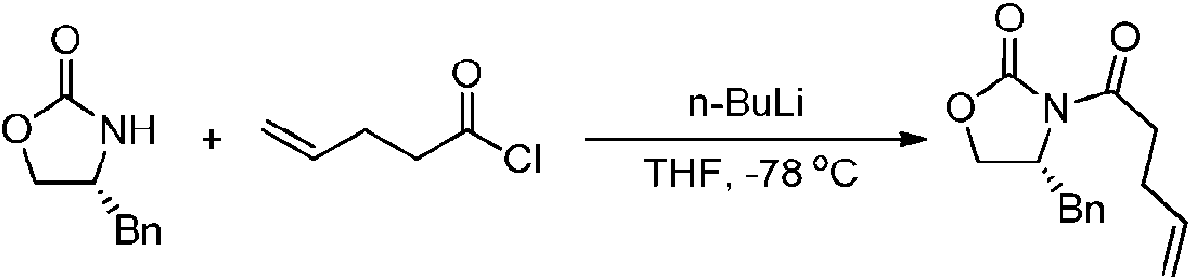
A una solución de (4R)-4-(fenilmetil)-1,3-oxazolidin-2-ona (50 g, 282 mmol) en THF (300 ml) se le añadió gota a gota n-BuLi en THF (2,4 M, 176 ml, 423 mmol) en atmósfera de nitrógeno a -78 °C, y la mezcla resultante se agitó a -78 °C durante 1 hora. Después se añadió cloruro de 4-pentenoílo (49 ml, 423 mmol) gota a gota. Después de agitar a -78 °C durante 1 hora más, se dejó que la mezcla de reacción se calentase hasta temperatura ambiente y se agitó durante una noche. Después de diluir con agua, la mezcla se extrajo con acetato de etilo (2 * 400 ml). Los extractos combinados en acetato de etilo se lavaron con salmuera, se secaron sobre sulfato de sodio, se filtraron y se concentraron a presión reducida. El residuo en bruto se purificó mediante cromatografía en columna de gel de sílice (acetato de etilo:éter de petróleo = 1:10), obteniéndose el compuesto del título ( 68 g, 93 %) en forma de un aceite de color amarillo claro. EM (EN+) C15H17NO3 requiere: 259, encontrado: 260 [M H]+.To a solution of (4R)-4-(phenylmethyl)-1,3-oxazolidin-2-one (50 g, 282 mmol) in THF (300 mL) was added n-BuLi in THF (2, 4 M, 176 mL, 423 mmol) under nitrogen at -78 °C, and the resulting mixture was stirred at -78 °C for 1 hour. 4-Pentenoyl chloride (49 mL, 423 mmol) was then added dropwise. After stirring at -78°C for an additional 1 hour, the reaction mixture was allowed to warm to room temperature and stirred overnight. After diluting with water, the mixture was extracted with ethyl acetate (2*400 ml). The combined ethyl acetate extracts were washed with brine, dried over sodium sulfate, filtered, and concentrated under reduced pressure. The crude residue was purified by silica gel column chromatography (ethyl acetate:petroleum ether = 1:10) to obtain the title compound (68 g, 93%) as light yellow oil. MS (ES+) C 15 H 17 NO 3 requires: 259, found: 260 [MH]+.
Etapa 2: Síntesis de (R)-3-((2S,3S,E)-2-alil-3-hidroxi-5-fenilpent-4-enoil)-4-benciloxazolidin-2-onaStep 2: Synthesis of (R)-3-((2S,3S,E)-2-allyl-3-hydroxy-5-phenylpent-4-enoyl)-4-benzyloxazolidin-2-one

Una mezcla de (R)-4-bencil-3-pent-4-enoiloxazolidin-2-ona (50 g, 193 mmol), cloruro de magnesio (18,3 g, 193 mmol), hexafluoroestibato(V) de sodio (14,9 g, 58 mmol), trietilamina (80 ml, 579 mmol), (trans)-cinamaldehído (30,6 g, 232 mmol) y clorotrimetilsilano (37,2 ml, 290 mmol) en acetato de etilo (500 ml) se agitó a temperatura ambiente durante 17 horas. La mezcla se diluyó con acetato de etilo y se filtró para eliminar los sólidos. El filtrado se concentró hasta un pequeño volumen, y después se diluyó con metanol (500 ml) y una pequeña cantidad de acetato de etilo. Después del tratamiento con ácido trifluoroacético (3 ml), la solución resultante se agitó a temperatura ambiente durante 1 h, y después se concentró a sequedad a presión reducida. El residuo se purificó mediante cromatografía en columna de gel de sílice (acetato de etilo:éter de petróleo = 1 :1 0 ), obteniéndose el compuesto del título (60 g,80 %) en forma de un semisólido de color amarillo. EM (En ) C24H25NO4 requiere: 391, encontrado: 374 [M H - H2O]+. A mixture of (R)-4-benzyl-3-pent-4-enoyloxazolidin-2-one (50 g, 193 mmol), magnesium chloride (18.3 g, 193 mmol), sodium hexafluorostybate (V) ( 14.9 g, 58 mmol), triethylamine (80 mL, 579 mmol), (trans)-cinnamaldehyde (30.6 g, 232 mmol), and chlorotrimethylsilane (37.2 mL, 290 mmol) in ethyl acetate (500 mL ) was stirred at room temperature for 17 hours. The mixture was diluted with ethyl acetate and filtered to remove solids. The filtrate was concentrated to a small volume, then diluted with methanol (500 mL) and a small amount of ethyl acetate. After treatment with trifluoroacetic acid (3 ml), the resulting solution was stirred at room temperature for 1 h, and then concentrated to dryness under reduced pressure. The residue was purified by silica gel column chromatography (ethyl acetate:petroleum ether= 1 : 10 ) to obtain the title compound (60 g, 80%) as a yellow semi-solid. MS (En) C 24 H 25 NO 4 requires: 391, found: 374 [MH-H 2 O]+.
Etapa 3: Síntesis de (S)-5-bencil-1-((1S,2S)-2-hidroxicidopent-3-enecarbonil)pirrolidin-2-onaStep 3: Synthesis of (S)-5-benzyl-1-((1S,2S)-2-hydroxycidopent-3-enecarbonyl)pyrrolidin-2-one

Una solución de (R)-3-((2S,3S,E)-2-alil-3-hidroxi-5-fenilpent-4-enoil)-4-benciloxazolidin-2-ona (50 g, 128 mmol) y catalizador de Grubbs de 2.a generación (5,4 g, 6,4 mmol) en tolueno (300 ml) se desgasificó con nitrógeno tres veces y se agitó a temperatura ambiente durante una noche. La mezcla de reacción se concentró posteriormente a sequedad a presión reducida, y el residuo se purificó mediante cromatografía en gel de sílice (acetato de etilo:éter de petróleo = 1:4), obteniéndose el compuesto del título (32 g, 87 %) en forma de un aceite de color pardo oscuro, que solidificó después de un periodo de reposo. EM (EN+) C17H19NO3 requiere: 285, encontrado: 270 [M H-H2O]+.A solution of (R)-3-((2S,3S,E)-2-allyl-3-hydroxy-5-phenylpent-4-enoyl)-4-benzyloxazolidin-2-one (50 g, 128 mmol) and Grubbs 2nd generation catalyst (5.4 g, 6.4 mmol) in toluene (300 mL) was degassed with nitrogen three times and stirred at room temperature overnight. The reaction mixture was further concentrated to dryness under reduced pressure, and the residue was purified by silica gel chromatography (ethyl acetate:petroleum ether = 1:4), to obtain the title compound (32 g, 87%) as a dark brown oil, which solidified after a period of standing. MS (EN+) C17H19NO3 requires: 285, found: 270 [M H-H2O]+.
Etapa 4: Síntesis de (R)-4-bencil-3-((1S,2S,3S,5S)-2-hidroxibiciclo[3.1.0]hexano-3-carbonil)oxazolidin-2-onaStep 4: Synthesis of (R)-4-benzyl-3-((1S,2S,3S,5S)-2-hydroxybicyclo[3.1.0]hexane-3-carbonyl)oxazolidin-2-one

Una solución de (S)-5-bencil-1-((1S,2S)-2-hidroxiciclopent-3-enecarbonil)pirrolidin-2-ona (25 g, 87,1 mmol) en diclorometano (300 ml) se enfrió en un baño de agua y hielo y se trató con dietilcinc 1 M en hexano (435 ml, 435 mmol) mediante adición gota a gota. Después de agitar a 0 °C durante 20 minutos, se añadió gota a gota diyodometano (69,6 ml, 871 mmol). La solución turbia resultante se agitó a 0 °C durante otros 20 minutos, y después se dejó calentar hasta temperatura ambiente. Después de agitar durante 6 horas a temperatura ambiente, la mezcla de reacción se inactivó con cloruro de amonio acuoso saturado y se extrajo con acetato de etilo. Los extractos orgánicos combinados se lavaron con salmuera, se secaron sobre sulfato de sodio, se filtraron y se concentraron a sequedad a presión reducida. El material en bruto se purificó mediante cromatografía en columna de gel de sílice (acetato de etilo:éter de petróleo = 1:4), obteniéndose el compuesto del título (308 mg, 89 %) en forma de un aceite viscoso de color pardo claro. EM (EN+) C17H19NO4 requiere: 301, encontrado: 284 [M H - H2O]+.A solution of (S)-5-benzyl-1-((1S,2S)-2-hydroxycyclopent-3-enecarbonyl)pyrrolidin-2-one (25 g, 87.1 mmol) in dichloromethane (300 mL) was cooled in an ice-water bath and treated with 1M diethylzinc in hexane (435 mL, 435 mmol) by dropwise addition. After stirring at 0 °C for 20 min, diiodomethane (69.6 mL, 871 mmol) was added dropwise. The resulting cloudy solution was stirred at 0°C for a further 20 minutes, then allowed to warm to room temperature. After stirring for 6 hours at room temperature, the reaction mixture was quenched with saturated aqueous ammonium chloride and extracted with ethyl acetate. The combined organic extracts were washed with brine, dried over sodium sulfate, filtered, and concentrated to dryness under reduced pressure. The crude material was purified by silica gel column chromatography (ethyl acetate:petroleum ether = 1:4) to give the title compound (308 mg, 89%) as light brown viscous oil. . MS (EN+)C17H19NO4 requires: 301, found: 284 [MH-H2O]+.
Etapa 5: Síntesis de (R)-4-bencil-3-((1S,2S,3S,5S)-2-(ferc-butildimetilsililoxi)-biciclo[3.1.0]hexano-3-carbonil)oxazolidin-2-onaStep 5: Synthesis of (R)-4-benzyl-3-((1S,2S,3S,5S)-2-(fert-butyldimethylsilyloxy)-bicyclo[3.1.0]hexane-3-carbonyl)oxazolidin-2- one

A una solución en agitación de (R)-4-bencil-3-((1S,2S,3S,5S)-2-hidroxibiciclo[3.1.0]hexano-3-carbonil)oxazolidin-2-ona (25 g, 83 mmol) y 2,6-lutidina (38,2 ml, 332 mmol) en diclorometano (300 ml) se le añadió trifluorometanosulfonato de ferc-butildimetilsililo (47,6 ml, 207,5 mmol) a 0 °C en atmósfera de nitrógeno. La mezcla resultante se agitó a 0 °C durante 30 minutos y después a temperatura ambiente durante 1 hora. Tras diluirse con metanol (25 ml), la mezcla se vertió en agua y se extrajo con éter (2 * 400 ml). Los extractos en éter combinados se lavaron con salmuera, se secaron sobre sulfato de sodio, se filtraron, se concentraron y se purificaron mediante cromatografía de gel de sílice (acetato de etilo:éter de petróleo = 1:8), obteniéndose el compuesto del título (29 g, 86%) en forma de un aceite incoloro. EM (EN+) C23H33NO4Si requiere: 415, encontrado: 416 [M H - H2O]+.To a stirred solution of (R)-4-benzyl-3-((1S,2S,3S,5S)-2-hydroxybicyclo[3.1.0]hexane-3-carbonyl)oxazolidin-2-one (25 g, 83 mmol) and 2,6-lutidine (38.2 mL, 332 mmol) in dichloromethane (300 mL) was added to tert-butyldimethylsilyl trifluoromethanesulfonate (47.6 mL, 207.5 mmol) at 0 °C under an atmosphere of nitrogen. The resulting mixture was stirred at 0°C for 30 minutes and then at room temperature for 1 hour. After being diluted with methanol (25 ml), the mixture was poured into water and extracted with ether (2*400 ml). The combined ether extracts were washed with brine, dried over sodium sulfate, filtered, concentrated and purified by silica gel chromatography (ethyl acetate:petroleum ether=1:8) to give the title compound. (29 g, 86%) as a colorless oil. MS (EN+) C2 3 H 33 NO 4 If Requires: 415, Found: 416 [MH - H2O]+.
Etapa 6: Síntesis de ácido (1S,2S,3S,5S)-2-(fe/r-butildimetilsililoxi)biciclo[3.1.0]hexano-3-carboxílico Step 6: Synthesis of (1S,2S,3S,5S)-2-(fe/r-butyldimethylsilyloxy)bicyclo[3.1.0]hexane-3-carboxylic acid

A una solución de (R)-4-bencil-3-((1S,2S,3S,5S)-2-(terc-butildimetilsililoxi)biciclo[3.1.0]hexano-3-carbonil)oxazolidin-2-ona (40 g, 96,4 mmol) en THF (200 ml) y agua (50 ml) se le añadió peróxido de hidrógeno acuoso al 30 % ( 8 8 ml, 771 mmol) gota a gota a 0 °C, seguido de la adición de una solución de hidróxido de litio monohidratado (16 g, 386 mmol) en agua (100 ml). Después de agitar durante 1 hora a 0 °C, la mezcla de reacción se agitó a temperatura ambiente durante una noche. El exceso de peróxido de hidrógeno se consumió por completo mediante la adición de bisulfato de sodio acuoso saturado. Después se ajustó el pH de la mezcla a pH = 14 con NaOH 1 N y se lavó con éter (400 ml). La capa acuosa se acidificó posteriormente a pH = 3 con hidrogenosulfato de potasio acuoso 1 M, y se extrajo con acetato de etilo (3 * 400 ml). Los extractos orgánicos combinados se lavaron con salmuera, se secaron sobre sulfato de sodio, se filtraron y se concentraron, obteniéndose el compuesto del título ( 2 2 g, 88 %) en forma de un aceite incoloro.To a solution of (R)-4-benzyl-3-((1S,2S,3S,5S)-2-(tert-butyldimethylsilyloxy)bicyclo[3.1.0]hexane-3-carbonyl)oxazolidin-2-one ( 40 g, 96.4 mmol) in THF (200 mL) and water (50 mL) was added to 30% aqueous hydrogen peroxide (8 mL, 771 mmol) dropwise at 0 °C, followed by the addition of a solution of lithium hydroxide monohydrate (16 g, 386 mmol) in water (100 mL). After stirring for 1 hour at 0°C, the reaction mixture was stirred at room temperature overnight. The excess hydrogen peroxide was completely consumed by the addition of saturated aqueous sodium bisulfate. The pH of the mixture was then adjusted to pH=14 with 1N NaOH and washed with ether (400 mL). The aqueous layer was further acidified to pH=3 with 1M aqueous potassium hydrogen sulfate, and extracted with ethyl acetate (3*400 mL). The combined organic extracts were washed with brine, dried over sodium sulfate, filtered and concentrated to give the title compound (2 g, 88 %) as a colorless oil.
Etapa 7: Síntesis de (1S,2S,3S,5S)-2-(terc-butildimetilsililoxi)biciclo[3.1.0]hexan-3-ilcarbamato de benciloStep 7: Synthesis of benzyl (1S,2S,3S,5S)-2-(tert-butyldimethylsilyloxy)bicyclo[3.1.0]hexan-3-ylcarbamate

A una solución de ácido (1S,2S,3S,5S)-2-(terc-butildimetilsililoxi)biciclo[3.1.0]hexano-3-carboxílico (4 g, 15,625 mmol), trietilamina (22 ml, 156 mmol) y alcohol bencílico (17 ml, 156 mmol) en tolueno (50 ml) a temperatura ambiente se le añadió difenil fosforil azida (33,7 ml, 156 mmol) gota a gota, y la mezcla resultante se agitó a 100 °C durante una noche. La solución de reacción se enfrió a temperatura ambiente, se diluyó con acetato de etilo (100 ml) y se lavó con agua (3 * 50 ml) y salmuera (50 ml). La capa orgánica se secó sobre sulfato de sodio, se filtró y se concentró, obteniéndose un producto en bruto, que se purificó mediante cromatografía en columna de gel de sílice (acetato de etilo:éter de petróleo = 1:8), obteniéndose el compuesto del título (3,0 g, 54 %) en forma de un sólido de color blanco. EM (EN+) C20H31 NOsSi requiere: 361, encontrado: 362 [M H]+.To a solution of (1S,2S,3S,5S)-2-(tert-butyldimethylsilyloxy)bicyclo[3.1.0]hexane-3-carboxylic acid (4 g, 15.625 mmol), triethylamine (22 mL, 156 mmol) and Benzyl alcohol (17 mL, 156 mmol) in toluene (50 mL) at room temperature was added to diphenyl phosphoryl azide (33.7 mL, 156 mmol) dropwise, and the resulting mixture was stirred at 100 °C overnight. . The reaction solution was cooled to room temperature, diluted with ethyl acetate (100 ml), and washed with water (3*50 ml) and brine (50 ml). The organic layer was dried over sodium sulfate, filtered and concentrated, obtaining a crude product, which was purified by silica gel column chromatography (ethyl acetate:petroleum ether = 1:8), obtaining the compound of the title (3.0 g, 54%) as a white solid. MS (EN+) C 20 H 31 NOsSi requires: 361, found: 362 [MH]+.
Etapa 8 : Síntesis de (1S,2S,3S,5S)-2-hidroxibiciclo[3.1.0]hexan-3-ilcarbamato de benciloStep 8 : Synthesis of (1S,2S,3S,5S)-2-hydroxybicyclo[3.1.0]hexan-3-ylcarbamate benzyl
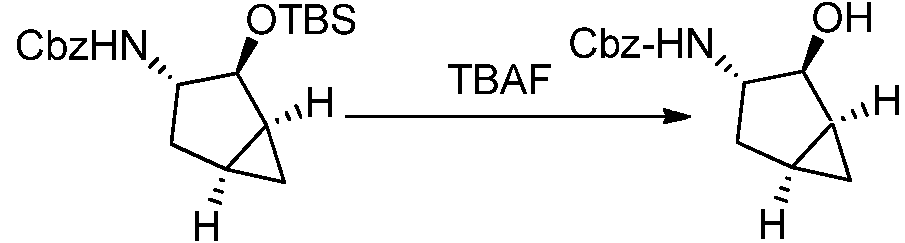
A una solución de (1S,2S,3S,5S)-2-(terc-butildimetilsililoxi)biciclo[3.1.0]hexan-3-ilcarbamato de bencilo (2,0 g, 5,540 mmol) en THF (20) a temperatura ambiente se le añadió fluoruro de tetrabutilamonio 1 M en THF (55 ml, 55,4 mmol), y la mezcla se agitó a temperatura ambiente durante una noche. La solución de reacción se diluyó con acetato de etilo (100 ml), y se lavó con agua (3 * 50 ml) y salmuera (50 ml). La capa orgánica se secó sobre sulfato de sodio, se filtró y se concentró, obteniéndose el compuesto del título (1,2 g, 92 %) en forma de un sólido de color blanco. EM (EN+) C14H17NO3 requiere: 247, encontrado: 230 [M H - H2O]+.To a solution of benzyl (1S,2S,3S,5S)-2-(tert-butyldimethylsilyloxy)bicyclo[3.1.0]hexan-3-ylcarbamate (2.0 g, 5.540 mmol) in THF (20) at room temperature 1M tetrabutylammonium fluoride in THF (55 mL, 55.4 mmol) was added to room temperature, and the mixture was stirred at room temperature overnight. The reaction solution was diluted with ethyl acetate (100 ml), and washed with water (3*50 ml) and brine (50 ml). The organic layer was dried over sodium sulfate, filtered and concentrated to give the title compound (1.2 g, 92%) as a white solid. MS (ES+) C 14 H 17 NO 3 requires: 247, found: 230 [MH-H 2 O]+.
Etapa 9: Síntesis de (1S,2R,3S,5S)-2-(1,3-dioxoisoindolin-2-il)biciclo[3.1.0]hexan-3-ilcarbamato de benciloStep 9: Synthesis of benzyl (1S,2R,3S,5S)-2-(1,3-dioxoisoindolin-2-yl)bicyclo[3.1.0]hexan-3-ylcarbamate

Una solución de trifenilfosfina (6,4 g, 24,292 mmol), ftalimida (6,2 g, 42,511 mmol) y (1S,2S,3S,5S)-2-hidroxibiciclo[3.1.0]hexan-3-ilcarbamato de bencilo (3,0 g, 12,146 mmol) en tolueno (250 ml) se agitó a -78 °C durante 30 minutos con protección de nitrógeno, seguido de la adición gota a gota de azodicarboxilato de diisopropilo (8 , 6 ml, 42,511 mmol). La mezcla resultante se agitó a -78 °C durante 1 hora más y después a temperatura ambiente durante una noche. La mezcla de reacción se trató con 10 ml de metanol, y los disolventes se eliminaron a presión reducida. El material en bruto se purificó mediante cromatografía en columna de gel de sílice (acetato de etilo:éter de petróleo = 1:2), obteniéndose el compuesto del título (3,0 g, 65% ) en forma de un aceite de color amarillo claro. EM (EN+) C22H20N2O4 requiere: 376, encontrado: 399 [M 23]+.A solution of triphenylphosphine (6.4 g, 24.292 mmol), phthalimide (6.2 g, 42.511 mmol), and benzyl (1S,2S,3S,5S)-2-hydroxybicyclo[3.1.0]hexan-3-ylcarbamate (3.0 g, 12.146 mmol) in toluene (250 mL) was stirred at -78 °C for 30 min under nitrogen protection, followed by the dropwise addition of diisopropyl azodicarboxylate ( 8.6 mL, 42.511mmol). The resulting mixture was stirred at -78°C for an additional 1 hour and then at room temperature overnight. The reaction mixture was treated with 10 ml of methanol, and the solvents were removed under reduced pressure. The crude material was purified by silica gel column chromatography (ethyl acetate:petroleum ether = 1:2) to obtain the title compound (3.0 g, 65%) as yellow oil. Sure. MS (ES+) C 22 H 20 N 2 O 4 requires: 376, found: 399 [M 23]+.
Etapa 10: Síntesis de 2-((1S,2R,3S,5S)-3-aminobiciclo[3.1.0]hexan-2-il)isoindolin-1,3-dionaStep 10: Synthesis of 2-((1S,2R,3S,5S)-3-aminobicyclo[3.1.0]hexan-2-yl)isoindolin-1,3-dione

A una solución de (1S,2R,3S,SS)-2-(1,3-dioxoisoindolin-2-il)biciclo[3.1.0]hexan-3-ilcarbamato de bencilo (4,0 g, 10,638 mmol) en cloroformo (30 ml) a temperatura ambiente se le añadió yoduro de trimetilsililo (14,6 ml, 106,380 mmol) gota a gota, y la mezcla resultante se agitó a temperatura ambiente durante 1 hora. La reacción se inactivó con metanol (5 ml), se diluyó con acetato de etilo (150 ml), y se lavó con agua (3 * 50 ml) y salmuera (50 ml). La capa orgánica se secó sobre sulfato de sodio, se filtró y se concentró, obteniéndose un compuesto en bruto, que se usó directamente en la reacción siguiente sin purificación adicional. EM (EN+) C14H14N2O2 requiere: 242, encontrado: 243 [M H]+.To a solution of benzyl (1S,2R,3S,SS)-2-(1,3-dioxoisoindolin-2-yl)bicyclo[3.1.0]hexan-3-ylcarbamate (4.0 g, 10.638 mmol) in chloroform (30 mL) at room temperature was added to trimethylsilyl iodide (14.6 mL, 106.380 mmol) dropwise, and the resulting mixture was stirred at room temperature for 1 hour. The reaction was quenched with methanol (5 mL), diluted with ethyl acetate (150 mL), and washed with water (3*50 mL) and brine (50 mL). The organic layer was dried over sodium sulfate, filtered and concentrated to give a crude compound, which was used directly in the next reaction without further purification. MS (ES+) C 14 H 14 N 2 O 2 requires: 242, found: 243 [MH]+.
Etapa 11: Síntesis de (1S,2R,3S,5S)-2-(1,3-dioxoisoindolin-2-il)biciclo[3.1.0]hexan-3-ilcarbamato de 2-(trimetilsilil)etiloStep 11: Synthesis of 2-(trimethylsilyl)ethyl (1S,2R,3S,5S)-2-(1,3-dioxoisoindolin-2-yl)bicyclo[3.1.0]hexan-3-ylcarbamate

Una solución de 2-((1S,2R,3S,5S)-3-aminobiciclo[3.1.0]hexan-2-il)isoindolin-1,3-diona (2,0 g, 8,264 mmol), carbonato de 2,5-dioxopirrolidin-1-il 2-(trimetilsilil)etilo (3,2 g, 12,396 mmol) y trietilamina (3,4 ml, 24,792 mmol) en dioxano/agua (100 ml, v/v = 1/1) se agitó a temperatura ambiente durante 1,5 horas. Después se diluyó la mezcla de reacción con acetato de etilo (100 ml), se lavó con ácido clorhídrico 1 M (2 * 50 ml), solución saturada de bicarbonato de sodio (2 * 50 ml) y salmuera (50 ml). La capa orgánica se concentró a presión reducida, y el residuo se purificó mediante cromatografía en gel de sílice (acetato de etilo:éter de petróleo = 1:4), obteniéndose el compuesto del título (2,5 g, 78 %) en forma de un aceite de color amarillo. EM (EN+) C20H26N2O4Si requiere: 386, encontrado: 410 [M 23]+. A solution of 2-((1S,2R,3S,5S)-3-aminobicyclo[3.1.0]hexan-2-yl)isoindolin-1,3-dione (2.0 g, 8.264 mmol), 2 ,5-dioxopyrrolidin-1-yl 2-(trimethylsilyl)ethyl (3.2 g, 12.396 mmol) and triethylamine (3.4 mL, 24.792 mmol) in dioxane/water (100 mL, v/v = 1/1) it was stirred at room temperature for 1.5 hours. The reaction mixture was then diluted with ethyl acetate (100 mL), washed with 1M hydrochloric acid (2*50 mL), saturated sodium bicarbonate solution (2*50 mL) and brine (50 mL). The organic layer was concentrated under reduced pressure, and the residue was purified by silica gel chromatography (ethyl acetate:petroleum ether = 1:4) to obtain the title compound (2.5 g, 78%) as of a yellow oil. MS (EN+) C 20 H 26 N 2 O 4 If required: 386, found: 410 [M 23]+.
Etapa 12: Síntesis de (1S,2R,3S,5S)-2-aminobiciclo[3.1.0]hexan-3-ilcarbamato de 2-(trimetilsilil)etiloStep 12: Synthesis of 2-(trimethylsilyl)ethyl (1S,2R,3S,5S)-2-aminobicyclo[3.1.0]hexan-3-ylcarbamate

A una solución de (1S,2R,3S,5S)-2-(1,3-dioxoisoindolin-2-il)biciclo[3.1.0]hexan-3-ilcarbamato de 2-(trimetilsilil)etilo (1,5 g, 3,886 mmol) en etanol (20 ml) a temperatura ambiente se le añadió hidrazina (1,9 ml, 38,860 mmol), y la mezcla resultante se agitó a 75 °C durante 2 horas. La solución de reacción se concentró, y el residuo se purificó mediante cromatografía en gel de sílice (acetato de etilo:éter de petróleo = 1:4), obteniéndose el compuesto del título (800 mg, 80 %) en forma de un semisólido de color amarillo claro.To a solution of 2-(trimethylsilyl)ethyl (1S,2R,3S,5S)-2-(1,3-dioxoisoindolin-2-yl)bicyclo[3.1.0]hexan-3-ylcarbamate (1.5 g , 3.886 mmol) in ethanol (20 mL) at room temperature was added to hydrazine (1.9 mL, 38.860 mmol), and the resulting mixture was stirred at 75 °C for 2 hours. The reaction solution was concentrated, and the residue was purified by silica gel chromatography (ethyl acetate:petroleum ether=1:4), to obtain the title compound (800 mg, 80%) as a semi-solid of light yellow colour.
Síntesis de 3-h¡drox¡-1.1-d¡oxohexahidro-1-t¡op¡ran-4-¡lcarbamato de c/s-terc-butilo Synthesis of c/s-tert-butyl 3-h¡drox¡-1.1-d¡oxohexahydro-1-t¡op¡ran-4-¡lcarbamate

En un matraz secado a la llama en atmósfera de nitrógeno se le añadió metanol (60 ml). La solución en agitación se enfrió a 0 °C antes de añadir cloruro de tionilo (7,32 ml, 100,34 mmol) gota a gota. La solución se agitó a 0 °C durante 10 min antes de añadir metionina (10 g, 33,8 mmol) en una porción. La reacción se agitó a temperatura ambiente durante una noche, tras lo cual se eliminaron los volátiles a presión reducida, obteniéndose el compuesto del título en forma de un sólido de color amarillento.In a flame-dried flask under nitrogen, methanol (60 mL) was added. The stirred solution was cooled to 0 °C before thionyl chloride (7.32 mL, 100.34 mmol) was added dropwise. The solution was stirred at 0 °C for 10 min before methionine (10 g, 33.8 mmol) was added in one portion. The reaction was stirred at room temperature overnight, after which the volatiles were removed under reduced pressure to give the title compound as a yellowish solid.
Etapa 2: Síntesis de 2-(ferc-butoxicarbonilamino)-4-(metiltio)butanoato de (S)-metiloStep 2: Synthesis of (S)-methyl 2-(fert-butoxycarbonylamino)-4-(methylthio)butanoate

A una solución de 2-amino-4-(metiltio)butanoato de (S)-metilo en diclorometano (300 ml) a 0 °C se le añadió trietilamina (35 ml), seguido de la adición de dicarbonato de di-ferc-butilo (26,98 g, 125 mmol). Después de agitar a temperatura ambiente durante 3 h, la mezcla de reacción se diluyó con diclorometano (200 ml) y se lavó con agua (2*150 ml). Las capas orgánicas combinadas se secaron (sulfato de magnesio), se filtraron y se concentraron a presión reducida. El producto (Fr = 0,5, acetato de etilo:éter de petróleo, 1:4) se purificó mediante cromatografía en columna ultrarrápida, obteniéndose el compuesto del título (15g, rendimiento del 85 %) en forma de un aceite transparente. To a solution of (S)-methyl 2-amino-4-(methylthio)butanoate in dichloromethane (300 mL) at 0 °C was added triethylamine (35 mL), followed by the addition of di-ferc-dicarbonate. butyl (26.98g, 125mmol). After stirring at room temperature for 3h, the reaction mixture was diluted with dichloromethane (200ml) and washed with water (2*150ml). The combined organic layers were dried (magnesium sulfate), filtered, and concentrated under reduced pressure. The product (R=0.5, 1:4 ethyl acetate:petroleum ether) was purified by flash column chromatography to give the title compound (15g, 85% yield) as a clear oil.
Etapa 3: Síntesis de 2-(ferc-butoxicarbonilamino)-4-(metilsulfonil)butanoato de (S)-metiloStep 3: Synthesis of (S)-methyl 2-(fert-butoxycarbonylamino)-4-(methylsulfonyl)butanoate

Se añadió éster metílico de N-(fe/c-butoxicarbonil)-L-metionina (8,76 g, 33,3 mmol) a un matraz de fondo redondo de 1000 ml y se disolvió en diclorometano (150 ml). La solución en agitación se enfrió a 0 °C, seguido de la adición de ácido 3-45 cloroperoxibenzoico (70 %, 18,0 g, 7,32 mmol) en 30 ml de diclorometano a lo largo de un periodo de 5 min. La mezcla de reacción se agitó a temperatura ambiente durante 1,5 horas, tras lo cual se diluyó con diclorometano (200 ml) e hidrogenocarbonato de sodio (300 ml de una solución acuosa saturada). Se separó la capa orgánica, se lavó sucesivamente con hidrogenocarbonato de sodio (2* 300 ml de una solución acuosa saturada), se secó (sulfato de magnesio), se filtró, y se concentró a presión reducida. El producto se purificó mediante cromatografía en columna ultrarrápida (acetato de 50 etilo:éter de petróleo, 6:4), obteniéndose el compuesto del título (5 g, rendimiento del 51 %) en forma de un sólido de color amarillo.N-(fe/c-Butoxycarbonyl)-L-methionine methyl ester (8.76 g, 33.3 mmol) was added to a 1000 mL round bottom flask and dissolved in dichloromethane (150 mL). The stirred solution was cooled to 0 °C, followed by the addition of 3-45-chloroperoxybenzoic acid (70%, 18.0 g, 7.32 mmol) in 30 mL dichloromethane over a period of 5 min. The reaction mixture was stirred at room temperature for 1.5 hours, after which it was diluted with dichloromethane (200 mL) and sodium hydrogencarbonate (300 mL of a saturated aqueous solution). The organic layer was separated, washed successively with sodium hydrogencarbonate (2*300 ml of a saturated aqueous solution), dried (magnesium sulfate), filtered, and concentrated under reduced pressure. The product was purified by flash column chromatography (ethyl acetate:petroleum ether, 6:4) to give the title compound (5 g, 51% yield) as a yellow solid.
Etapa 4: Síntesis de (1,1-dioxido-3-oxotetrahidro-2H-tiopiran-4-il)carbamato de terc-butilo Step 4: Synthesis of tert-butyl (1,1-dioxido-3-oxotetrahydro-2H-thiopyran-4-yl)carbamate

Una solución de 2-(ferc-butoxicarbonilamino)-4-(metilsulfonil)butanoato de (S)-metilo (2 g, 6,78 mmol) en tetrahidrofurano (50 ml) se enfrió a -78 °C, a lo que se añadió bis(trimetilsiMl)amida de potasio (1,0 M, solución en tolueno, 15 ml) gota a gota, y la mezcla se agitó a -78 °C durante 2 horas y a temperatura ambiente durante otras 2 horas. Se añadió una solución acuosa de cloruro de amonio (1 M), y se agitó la mezcla. La mezcla de reacción se sometió a separación de líquidos. La capa orgánica resultante se lavó posteriormente con agua y salmuera y se secó sobre sulfato de magnesio anhidro. El disolvente se eliminó a presión reducida, y el sólido formado se recogió mediante filtración, obteniéndose el compuesto del título. La capa acuosa previamente separada se extrajo dos veces con acetato de etilo. Las capas orgánicas resultantes se combinaron, se lavaron con agua y salmuera y se secaron sobre sulfato de magnesio anhidro. Los extractos en acetato de etilo se combinaron, se secaron y después se concentraron a presión reducida, obteniéndose el compuesto del título. El producto combinado se purificó mediante cromatografía ultrarrápida en columna (acetato de etilo:éter de petróleo, 3:1), obteniéndose el compuesto del título (55 mg, rendimiento del 2 2 %) en forma de un sólido de color amarillo.A solution of (S)-methyl 2-(fert-butoxycarbonylamino)-4-(methylsulfonyl)butanoate (2 g, 6.78 mmol) in tetrahydrofuran (50 mL) was cooled to -78 °C, at which potassium bis(trimethylsiMl)amide (1.0 M, toluene solution, 15 mL) was added dropwise, and the mixture was stirred at -78 °C for 2 hours and at room temperature for another 2 hours. Aqueous ammonium chloride solution (1M) was added, and the mixture was stirred. The reaction mixture was subjected to liquid separation. The resulting organic layer was further washed with water and brine, and dried over anhydrous magnesium sulfate. The solvent was removed under reduced pressure, and the formed solid was collected by filtration to give the title compound. The previously separated aqueous layer was extracted twice with ethyl acetate. The resulting organic layers were combined, washed with water and brine, and dried over anhydrous magnesium sulfate. The ethyl acetate extracts were combined, dried, and then concentrated under reduced pressure to give the title compound. The combined product was purified by flash column chromatography (ethyl acetate:petroleum ether, 3:1) to give the title compound (55 mg, 2-2 % yield) as a yellow solid.
Etapa 5: Síntesis de (3-(hidroxiimino)-1,1-dioxidotetrahidro-2H-tiopiran-4-il)carbamato de (Z)-ferc-butiloStep 5: Synthesis of (Z)-fert-butyl (3-(hydroxyimino)-1,1-dioxidotetrahydro-2H-thiopyran-4-yl)carbamate

Se añadió clorhidrato de hidroxilamina (26 mg, 0,379 mmol) a una mezcla del compuesto 5 (50 mg, 0,189 mmol) y carbonato de sodio (64 mg, 0,757 mmol) en agua (5 ml). Después de agitarse a 50 °C durante 4 h, la mezcla de reacción se enfrió a TA y se enfrió, obteniéndose el compuesto del título (50 mg, rendimiento del 95 %) en forma de un sólido de color blanco. EM (EN+) C10H18N2O5S requiere: 278, encontrado: 179 [M H -100]+, 223 [M H - 56]+. Hydroxylamine hydrochloride (26mg, 0.379mmol) was added to a mixture of compound 5 (50mg, 0.189mmol) and sodium carbonate (64mg, 0.757mmol) in water (5ml). After being stirred at 50 °C for 4 h, the reaction mixture was cooled to RT and chilled to give the title compound (50 mg, 95% yield) as a white solid. MS (ES+) C 10 H 18 N 2 O 5 S requires: 278, found: 179 [MH -100]+, 223 [MH - 56]+.
Etapa 6 : Síntesis de 3-hidroxi-1,1-dioxohexahidro-1-tiopiran-4-ilcarbamato de c/s-terc-butiloStep 6 : Synthesis of c/s-tert-butyl 3-hydroxy-1,1-dioxohexahydro-1-thiopyran-4-ylcarbamate

Una mezcla del compuesto (3-(hidroxiimino)-1,1-dioxidotetrahidro-2H-tiopiran-4-il)carbamato de (Z)-terc-butilo (2,5 g, 7,6mmol) y níquel Raney (en exceso) en metanol (200 ml) y THF (200 ml) se agitó a temperatura ambiente bajo un globo de nitrógeno durante 24 horas. La mezcla se filtró y el filtrado se concentró. El residuo se purificó mediante cromatografía en columna ultrarrápida (metanol:diclorometano, 1 :2 ) obteniéndose una mezcla racémica de un compuesto de baja polaridad (400 mg, rendimiento del 16 %) y un compuesto de alta polaridad (600 mg, rendimiento del 25 %).A mixture of (Z)-tert-butyl (3-(hydroxyimino)-1,1-dioxidotetrahydro-2H-thiopyran-4-yl)carbamate compound (2.5 g, 7.6 mmol) and Raney nickel (excess ) in methanol (200 mL) and THF (200 mL) was stirred at room temperature under a nitrogen balloon for 24 hours. The mixture was filtered and the filtrate was concentrated. The residue was purified by flash column chromatography (methanol:dichloromethane, 1 : 2 ), obtaining a racemic mixture of a low polarity compound (400 mg, 16% yield) and a high polarity compound (600 mg, 25% yield). %).
Etapa 7: Síntesis de 3-amino-4-(benciloxicarbonilamino)piperidin-1-carboxilato de (3R,4S)-ferc-butilo y 3-amino-4-(benciloxicarbonilamino)piperidin-1-carboxilato de (3S,4R)-ferc-butilo Step 7: Synthesis of (3R,4S)-fert-butyl 3-amino-4-(benzyloxycarbonylamino)piperidine-1-carboxylate and (3S,4R) 3-amino-4-(benzyloxycarbonylamino)piperidine-1-carboxylate -fert-butyl

A una mezcla en agitación de 4-amino-3-hidroxipiperidin-1-carboxilato de trans-terc-butilo (1,05 g, 4,86 mmol) en 80 ml de diclorometano se le añadió trietilamina (5,89 g, 5,83 mmol), seguido de la adición de N-(benciloxicarboniloxi)succinimida (1,27 g, 5,10 mmol) a 0 °C. La reacción se agitó a temperatura ambiente durante 16 horas y después se diluyó con 100 ml de diclorometano. La mezcla de solución se lavó con solución de ácido cítrico al 5 % (2 X 100 ml), solución de carbonato de potasio al 5 % (2 * 100 ml) y salmuera (200 ml). La capa orgánica se secó sobre sulfato de sodio anhidro y se filtró, seguido de concentración a presión reducida. El material oleoso resultante se purificó mediante cromatografía en columna de gel de sílice (acetato de etilo: éter de petróleo = 1:4-1:2), obteniéndose el compuesto del título (1,7 g, -100 %, en bruto) en forma de un aceite incoloro. EM (EN+) C18H26N2O5 requiere: 350, encontrado: 251 [M H -100]+.To a stirred mixture of trans-tert-butyl 4-amino-3-hydroxypiperidine-1-carboxylate (1.05 g, 4.86 mmol) in 80 mL dichloromethane was added triethylamine (5.89 g, 5 0.83 mmol), followed by the addition of N-(benzyloxycarbonyloxy)succinimide (1.27 g, 5.10 mmol) at 0 °C. The reaction was stirred at room temperature for 16 hours, then diluted with 100 mL of dichloromethane. The solution mixture was washed with 5% citric acid solution (2 X 100 ml), 5% potassium carbonate solution (2 * 100 ml) and brine (200 ml). The organic layer was dried over anhydrous sodium sulfate and filtered, followed by concentration under reduced pressure. The resulting oily material was purified by silica gel column chromatography (ethyl acetate:petroleum ether=1:4-1:2) to give the title compound (1.7 g, -100%, crude) in the form of a colorless oil. MS (ES+) C 18 H 26 N 2 O 5 requires: 350, found: 251 [MH -100]+.
Etapa 9: Síntesis de 4-(benciloxicarbonilamino)-3-(metilsulfoniloxi)-piperidin-1-carboxilato de trans-terc-butiloStep 9: Synthesis of trans-tert-butyl 4-(benzyloxycarbonylamino)-3-(methylsulfonyloxy)-piperidine-1-carboxylate

A una solución de 4-(benciloxicarbonilamino)-3-hidroxipiperidin-1-carboxilato de trans-terc-butilo (5,0 g, 14,3 mmol) y trietilamina (4,5 g, 43,0 mmol) en diclorometano (100 ml) se le añadió cloruro de metanosulfonilo (4,9 g, 43,0 mmol) a 0 °C, y la mezcla se agitó a 0 °C durante 2 horas. La solución se lavó con agua (150 ml * 3) y salmuera, se secó sobre sulfato de sodio anhidro y se filtró, seguido de concentración a presión reducida, obteniéndose el compuesto del título (6,0 g, en bruto) en forma de un aceite de color amarillo. EM (EN+) C19H28N2O7S requiere: 428, encontrado: 329 [M H -100]+.To a solution of trans-tert-butyl 4-(benzyloxycarbonylamino)-3-hydroxypiperidine-1-carboxylate (5.0 g, 14.3 mmol) and triethylamine (4.5 g, 43.0 mmol) in dichloromethane ( 100 mL) was added to methanesulfonyl chloride (4.9 g, 43.0 mmol) at 0 °C, and the mixture was stirred at 0 °C for 2 hours. The solution was washed with water (150 ml * 3) and brine, dried over anhydrous sodium sulfate, and filtered, followed by concentration under reduced pressure, to obtain the title compound (6.0 g, crude) as a yellow oil. MS (ES+) C 19 H 28 N 2 O 7 S requires: 428, found: 329 [MH -100]+.
Etapa 10: Síntesis de 3-azido-4-(benciloxicarbonilamino)piperidin-1-carboxilato de trans-terc-butilo Step 10: Synthesis of trans-tert-butyl 3-azido-4-(benzyloxycarbonylamino)piperidine-1-carboxylate

A una solución de 4-(benciloxicarbonilamino)-3-(metilsulfoniloxi)piperidin-1-carboxilato de trans-terc-butilo (6,0 g, 14 mmol) en dimetilsulfóxido (40 ml) se le añadió azida de sodio (9,11 g, 140 mmol), y la mezcla de reacción se agitó a 90 °C durante una noche en atmósfera de N2. La mezcla de solución se enfrió a -30 °C, se diluyó con acetato de etilo (-300 ml), y se lavó con agua (700 ml * 3) y salmuera. La capa orgánica se secó sobre sulfato de sodio anhidro, se filtró y se concentró, obteniéndose el compuesto del título (3,8 g, 72 %) en forma de un aceite de color amarillo. EM (EN+) C18H25N5O4 requiere: 375, encontrado: 276 [M H -100]+, 373 [M Na]+. To a solution of trans-tert-butyl 4-(benzyloxycarbonylamino)-3-(methylsulfonyloxy)piperidine-1-carboxylate (6.0 g, 14 mmol) in dimethylsulfoxide (40 mL) was added sodium azide (9. 11 g, 140 mmol), and the reaction mixture was stirred at 90 °C overnight under N 2 atmosphere. The solution mixture was cooled to -30 °C, diluted with ethyl acetate (-300 mL), and washed with water (700 mL * 3) and brine. The organic layer was dried over anhydrous sodium sulfate, filtered, and concentrated to give the title compound (3.8 g, 72%) as a yellow oil. MS (ES+) C 18 H 25 N 5 O 4 requires: 375, found: 276 [MH -100]+, 373 [M Na]+.
Etapa 11: Síntesis de 3-amino-4-(benciloxicarbonilamino)piperidin-1-carboxilato de (3R,4S)-terc-butilo y 3-amino-4-(benciloxicarbonilamino)piperidin-l-carboxilato de (3S,4R)-terc-butiloStep 11: Synthesis of (3R,4S)-tert-butyl 3-amino-4-(benzyloxycarbonylamino)piperidine-1-carboxylate and (3S,4R) 3-amino-4-(benzyloxycarbonylamino)piperidine-l-carboxylate -tert-butyl

Una mezcla de 3-azido-4-(benciloxicarbonilamino)piperidin-1-carboxilato de trans-terc-butilo en bruto (12 g, -32 mmol) y trifenilfosfina (41,9 g, 160 mmol) en THF (100 ml) y agua (5 ml) se agitó a 70 °C durante 2 horas. La mezcla de reacción se enfrió a temperatura ambiente y se diluyó con acetato de etilo (500 ml). La capa orgánica se lavó con salmuera (50 ml) y se evaporó directamente a presión reducida. El residuo se purificó mediante cromatografía en columna de gel de sílice (éter de petróleo/acetato de etilo = 4/1 -1:1), obteniéndose 3-amino-4-(benciloxicarbonilamino)piperidin-1-carboxilato de trans-terc-butilo (5,0 g, 44% ) en forma de un aceite de color amarillo. EM (EN+) C18H27N3O4 requiere: 349, encontrado: 350 [M H]+.A mixture of crude trans-tert-butyl 3-azido-4-(benzyloxycarbonylamino)piperidine-1-carboxylate (12 g, -32 mmol) and triphenylphosphine (41.9 g, 160 mmol) in THF (100 mL) and water (5 ml) was stirred at 70 °C for 2 hours. The reaction mixture was cooled to room temperature and diluted with ethyl acetate (500 mL). The organic layer was washed with brine (50 ml) and directly evaporated under reduced pressure. The residue was purified by silica gel column chromatography (petroleum ether/ethyl acetate = 4/1 -1:1), obtaining trans-tert- 3-amino-4-(benzyloxycarbonylamino)piperidine-1-carboxylate. butyl (5.0 g, 44%) as a yellow oil. MS (ES+) C 18 H 27 N 3 O 4 requires: 349, found: 350 [MH]+.
Se separaron 2 g de la muestra racémica anterior mediante HPLC quiral, obteniéndose 3-amino-4-(benciloxicarbonilamino)piperidin-1-carboxilato de (3R,4S)-terc-butilo (550 mg, pico 1 en la HPLC quiral) y 3-amino-4-(benciloxicarbonilamino)piperidin-1-carboxilato de (3S,4R)-terc-butilo (620 mg, pico 2 en la HPLC quiral).2 g of the above racemic sample were separated by chiral HPLC, yielding (3R,4S)-tert-butyl 3-amino-4-(benzyloxycarbonylamino)piperidine-1-carboxylate (550 mg, chiral HPLC peak 1) and (3S,4R)-tert-butyl 3-amino-4-(benzyloxycarbonylamino)piperidine-1-carboxylate (620 mg, chiral HPLC peak 2).
Síntesis de 4-am¡no-3-(((2-(tr¡met¡ls¡l¡l)etox¡)carbon¡l)amino)p¡per¡d¡n-1-carbox¡lato de c/s-terc-butiloSynthesis of c /s-tert-butyl

Etapa 1: Síntesis de 4-(benciloxicarbonilamino)-3-hidroxipiperidin-1-carboxilato de trans-terc-butilo Step 1: Synthesis of trans-tert-butyl 4-(benzyloxycarbonylamino)-3-hydroxypiperidine-1-carboxylate

A una mezcla en agitación de 4-amino-3-hidroxipiperidin-1-carboxilato de trans-terc-butilo (1,05 g, 4,86 mmol) en 80 ml de diclorometano se le añadió trietilamina (5,89 g, 5,83 mmol), seguido de la adición de N-(benciloxicarboniloxi)succinimida (1,27 g, 5,10 mmol) a 0 °C. La mezcla de reacción se agitó a temperatura ambiente durante 16 horas y después se diluyó con 100 ml de diclorometano. La mezcla de solución se lavó con solución de ácido cítrico al 5 % (2 * 100 ml), solución de carbonato de potasio al 5 % (2 * 100 ml) y salmuera (200 ml). La capa orgánica se secó sobre sulfato de sodio anhidro y se filtró, seguido de concentración a presión reducida. El material oleoso resultante se purificó mediante cromatografía en columna de gel de sílice (acetato de etilo: éter de petróleo = 1:4-1:2), obteniéndose el compuesto del título (1,7 g, -100%, en bruto) en forma de un aceite incoloro. EM (EN+) C18H26N2O5 requiere: 350, encontrado: 251 [M H -100]+.To a stirred mixture of trans-tert-butyl 4-amino-3-hydroxypiperidine-1-carboxylate (1.05 g, 4.86 mmol) in 80 mL dichloromethane was added triethylamine (5.89 g, 5 0.83 mmol), followed by the addition of N-(benzyloxycarbonyloxy)succinimide (1.27 g, 5.10 mmol) at 0 °C. The reaction mixture was stirred at room temperature for 16 hours and then diluted with 100 mL of dichloromethane. The solution mixture was washed with 5% citric acid solution (2*100 ml), 5% potassium carbonate solution (2*100 ml) and brine (200 ml). The organic layer was dried over anhydrous sodium sulfate and filtered, followed by concentration under reduced pressure. The resulting oily material was purified by silica gel column chromatography (ethyl acetate:petroleum ether = 1:4-1:2) to give the title compound (1.7 g, -100%, crude) in the form of a colorless oil. MS (ES+) C 18 H 26 N 2 O 5 requires: 350, found: 251 [MH -100]+.
Etapa 2: Síntesis de 4-(benciloxicarbonilamino)-3-(metilsulfoniloxi)piperidin-1-carboxilato de trans-terc-butilo NHCbz NHCbzStep 2: Synthesis of trans-tert-butyl 4-(benzyloxycarbonylamino)-3-(methylsulfonyloxy)piperidine-1-carboxylate NHCbz NHCbz

, ,, ,
Boc Bocboc boc
A una solución de 4-(benciloxicarbonilamino)-3-hidroxipiperidin-1-carboxilato de trans-terc-butilo (5,0 g, 14,3 mmol) y trietilamina (4,5 g, 43,0 mmol) en diclorometano (100 ml) se le añadió cloruro de metanosulfonilo (4,9 g, 43,0 mmol) a 0 °C, y la mezcla se agitó a 0 °C durante 2 horas. La solución se lavó con agua (150 ml * 3) y salmuera, se secó sobre sulfato de sodio anhidro y se filtró, seguido de concentración a presión reducida, obteniéndose el compuesto del título (6,0 g, en bruto) en forma de un aceite de color amarillo. EM (EN+) C19H28N2O7S requiere: 428, encontrado: 329 [M H -100]+.To a solution of trans-tert-butyl 4-(benzyloxycarbonylamino)-3-hydroxypiperidine-1-carboxylate ( 5.0 g, 14.3 mmol) and triethylamine (4.5 g, 43.0 mmol) in dichloromethane ( 100 mL) was added to methanesulfonyl chloride (4.9 g, 43.0 mmol) at 0 °C, and the mixture was stirred at 0 °C for 2 hours. The solution was washed with water (150 ml * 3) and brine, dried over anhydrous sodium sulfate, and filtered, followed by concentration under reduced pressure, to obtain the title compound (6.0 g, crude) as a yellow oil. MS (ES+) C 19 H 28 N 2 O 7 S requires: 428, found: 329 [MH -100]+.
Etapa 3: Síntesis de 3-azido-4-(benciloxicarbonilamino)piperidin-1-carboxilato de c/s-terc-butiloStep 3: Synthesis of c/s-tert-butyl 3-azido-4-(benzyloxycarbonylamino)piperidine-1-carboxylate

A una solución de 4-(benciloxicarbonilamino)-3-(metilsulfoniloxi)piperidin-1-carboxilato de trans-terc-butilo (6,0 g, 14 mmol) en dimetilsulfóxido (40 ml) se le añadió azida de sodio (9,11 g, 140 mmol), y la mezcla de reacción se agitó a 90 °C durante una noche en atmósfera de N2. La mezcla de solución se enfrió a -30 °C, se diluyó con acetato de etilo (~300 ml), y se lavó con agua (700 ml * 3) y salmuera. La capa orgánica se secó sobre sulfato de sodio anhidro, se filtró y se concentró, obteniéndose el compuesto del título (3,8 g, 72 %) en forma de un aceite de color amarillo. EM (EN+) C18H25N5O4 requiere: 375, encontrado: 276 [M H -100]+, 373 [M Na]+.To a solution of trans-tert-butyl 4-(benzyloxycarbonylamino)-3-(methylsulfonyloxy)piperidine-1-carboxylate (6.0 g, 14 mmol) in dimethylsulfoxide (40 mL) was added sodium azide (9. 11 g, 140 mmol), and the reaction mixture was stirred at 90 °C overnight under N 2 atmosphere. The solution mixture was cooled to -30 °C, diluted with ethyl acetate (~300 mL), and washed with water (700 mL * 3) and brine. The organic layer was dried over anhydrous sodium sulfate, filtered, and concentrated to give the title compound (3.8 g, 72%) as a yellow oil. MS (ES+) C 18 H 25 N 5 O 4 requires: 375, found: 276 [MH -100]+, 373 [M Na]+.
Etapa 4: Síntesis de 3-amino-4-(benciloxicarbonilamino)piperidin-1-carboxilato de c/s-terc-butilo y 3-amino-4-(benciloxicarbonilamino)piperidin-1-carboxilato de (3S,4R)-terc-butiloStep 4: Synthesis of c/s-tert-butyl 3-amino-4-(benzyloxycarbonylamino)piperidine-1-carboxylate and (3S,4R)-tert 3-amino-4-(benzyloxycarbonylamino)piperidine-1-carboxylate -butyl

Una mezcla de 3-azido-4-(benciloxicarbonilamino)piperidin-1-carboxilato de c/s-terc-butilo en bruto (12 g, -32 mmol) y trifenilfosfina (41,9 g, 160 mmol) en THF (100 ml) yagua (5 ml) se agitó a 70 °C durante 2 horas. La mezcla de reacción se enfrió a temperatura ambiente y se diluyó con acetato de etilo (500 ml). La capa orgánica se lavó con salmuera (50 ml) y se evaporó directamente a presión reducida. El residuo se purificó mediante cromatografía en columna de gel de sílice (éter de petróleo/acetato de etilo = 4/1~1:1), obteniéndose el compuesto del título (racemato, 5,0 g, 44 %) en forma de un aceite de color amarillo. EM (EN+) C18H27N3O4 requiere: 349, encontrado: 350 [M H]+.A mixture of crude c/s-tert-butyl 3-azido-4-(benzyloxycarbonylamino)piperidine-1-carboxylate (12 g, -32 mmol) and triphenylphosphine (41.9 g, 160 mmol) in THF (100 ml) and water (5 ml) was stirred at 70 °C for 2 hours. The reaction mixture was cooled to room temperature and diluted with ethyl acetate (500 mL). The organic layer was washed with brine (50 ml) and directly evaporated under reduced pressure. The residue was purified by silica gel column chromatography (petroleum ether/ethyl acetate = 4/1~1:1) to obtain the title compound (racemate, 5.0 g, 44%) as a yellow oil. MS (ES+) C 18 H 27 N 3 O 4 requires: 349, found: 350 [MH]+.
Etapa 5: Síntesis de 4-(benciloxicarbonilamino)-3-((2-(trimetilsilil)etoxi)-carbonilamino)piperidin-1-carboxilato de c/sterc-butiloStep 5: Synthesis of c/stert -butyl 4-(benzyloxycarbonylamino)-3-((2-(trimethylsilyl)ethoxy)-carbonylamino)piperidine-1-carboxylate

Una solución de 3-amino-4-(benciloxicarbonilamino)piperidin-1-carboxilato de c/s-terc-butilo (3,0 g, 8,6 mmol), carbonato de 2,5-dioxopirrolidin-1-il 2-(trimetilsilil)etilo (2,5 g, 9,5 mmol) y trietilamina en dioxano/agua (40 ml, v/v = 1/1) se agitó a temperatura ambiente durante 4 horas. Después de esto, la solución se diluyó con acetato de etilo (200 ml), y se lavó con ácido clorhídrico 1 M (50 ml), solución saturada de bicarbonato de sodio (50 ml) y salmuera (50 ml). La capa orgánica se secó sobre sulfato sódico, se filtró y se concentró. El residuo se purificó mediante cromatografía en columna de gel de sílice (éter de petróleo/acetato de etilo = 4/1), obteniéndose el compuesto del título (3,5 g, 83 %) en forma de un sólido de color blanco. EM (EN+) C24H3gN3O6Si requiere: 493, encontrado: 516 [M 23]+. A solution of c/s-tert-butyl 3-amino-4-(benzyloxycarbonylamino)piperidine-1-carboxylate (3.0 g, 8.6 mmol), 2,5-dioxopyrrolidin-1-yl 2- (trimethylsilyl)ethyl (2.5 g, 9.5 mmol) and triethylamine in dioxane/water (40 mL, v/v = 1/1) was stirred at room temperature for 4 hours. After this, the solution was diluted with ethyl acetate (200 ml), and washed with 1M hydrochloric acid (50 ml), saturated sodium bicarbonate solution (50 ml) and brine (50 ml). The organic layer was dried over sodium sulfate, filtered, and concentrated. The residue was purified by silica gel column chromatography (petroleum ether/ethyl acetate = 4/1) to obtain the title compound (3.5 g, 83%) as a white solid. MS (EN+) C 24 H 3 gN 3 O 6 If required: 493, found: 516 [M 23]+.
Etapa 6: Síntesis de 4-amino-3-((2-(trimetilsilil)etoxi)-carbonilamino)piperidin-1-carboxilato de c/s-ferc-butiloStep 6: Synthesis of c/s-fert-butyl 4-amino-3-((2-(trimethylsilyl)ethoxy)-carbonylamino)piperidine-1-carboxylate

Una mezcla de 4-(benciloxicarbonilamino)-3-((2-(trimetilsilil)etoxi)carbonilamino)piperidin-1-carboxilato de c/s-fercbutilo (1,8 g, 3,6 mmol) y paladio sobre carbono al 10 % (180 mg) en isopropanol (60 ml) se agitó en una atmósfera de hidrógeno a 1 atm (globo de hidrógeno) a temperatura ambiente durante 3 horas. Después de esto, la mezcla se filtró a través de un lecho de celite. El filtrado se concentró y se purificó mediante cromatografía en columna de gel de sílice (metanol/diclorometano = 1/30 a 1/10), obteniéndose el compuesto del título (800 mg, 61 %) en forma de un aceite de color amarillo. EM (EN+) C16H33N3Ü4Si requiere: 359, encontrado: 360 [M H]+.A mixture of c/s-tertbutyl 4-(benzyloxycarbonylamino)-3-((2-(trimethylsilyl)ethoxy)carbonylamino)piperidine-1-carboxylate c/s-tertbutyl (1.8 g, 3.6 mmol) and 10% palladium on carbon % (180 mg) in isopropanol (60 ml) was stirred under an atmosphere of hydrogen at 1 atm (hydrogen balloon) at room temperature for 3 hours. After this, the mixture was filtered through a pad of celite. The filtrate was concentrated and purified by silica gel column chromatography (methanol/dichloromethane = 1/30 to 1/10) to obtain the title compound (800 mg, 61%) as a yellow oil. MS (EN+) C 16 H 33 N 3 Ü 4 If required: 359, found: 360 [MH]+.
Síntesis de racemato de 4-am¡no-3-(ferc-butox¡carbonilam¡no)c¡clohexanocarbox¡lato de etiloEthyl 4-am¡no-3-(fert-butox¡carbonylam¡no)cyclohexanecarbox¡late racemate synthesis

Etapa 1: Síntesis de racemato de 4-yodo-6-oxa-biciclo[3.2.1]octan-7-onaStep 1: Synthesis of 4-iodo-6-oxa-bicyclo[3.2.1]octan-7-one racemate

A una mezcla de ácido ciclohex-3-enocarboxílico (racemato, 42,0 g, 333 mmol), yoduro de potasio (72,0 g, 433 mmol) e hidrogenocarbonato de sodio (36,4 g, 433 mmol) en cloruro de metileno (750 ml) y agua (750 ml) se le añadió yodo (110,0 g, 433 mmol) a una temperatura interna de 5 °C, y la mezcla de reacción se agitó a temperatura ambiente durante 3 horas. Después de inactivar con tiosulfato de sodio acuoso 1 N (1500 ml), la mezcla resultante se extrajo con cloruro de metileno (1000 ml * 2). Las capas orgánicas combinadas se lavaron con hidrogenocarbonato de sodio acuoso (1000 ml), agua (2000 ml) y salmuera (1000 ml), se secaron sobre sulfato de magnesio anhidro, se filtraron, y después se concentraron a presión reducida. Los cristales precipitados se recogieron mediante filtración y se lavaron con hexano, seguido de secado, para de este modo dar el compuesto del título (80,2 g, 95 %) en forma de un sólido de color blanco.To a mixture of cyclohex-3-enecarboxylic acid (racemate, 42.0 g, 333 mmol), potassium iodide (72.0 g, 433 mmol), and sodium hydrogen carbonate (36.4 g, 433 mmol) in sodium chloride methylene (750 ml) and water (750 ml) was added to iodine (110.0 g, 433 mmol) at an internal temperature of 5 °C, and the reaction mixture was stirred at room temperature for 3 hours. After quenching with 1N aqueous sodium thiosulfate (1500 ml), the resulting mixture was extracted with methylene chloride (1000 ml*2). The combined organic layers were washed with aqueous sodium hydrogen carbonate (1000 ml), water (2000 ml), and brine (1000 ml), dried over anhydrous magnesium sulfate, filtered, and then concentrated under reduced pressure. The precipitated crystals were collected by filtration and washed with hexane, followed by drying, to thereby give the title compound (80.2 g, 95%) as a white solid.
Etapa 2: Síntesis de racemato de 7-oxa-biciclo[4.1.0]heptano-3-carboxilato de etiloStep 2: Synthesis of 7-oxa-bicyclo[4.1.0]heptane-3-carboxylate ethyl racemate

A una suspensión de racemato de 4-yodo-6-oxa-biciclo[3.2.1]octan-7-ona (45,0 g, 180 mmol) en etanol (400 ml) se le añadió hidróxido de sodio acuoso 2 N (110 ml, 220 mmol) a temperatura ambiente con agitación, y la mezcla resultante se agitó durante 3 horas. La mezcla de reacción se concentró en un baño a una temperatura de 35 °C a presión reducida. Se añadió agua (500 ml) a la materia oleosa resultante, y la mezcla resultante se extrajo con acetato de etilo (500 ml). La capa orgánica se lavó con agua (500 ml), se secó sobre sulfato de sodio anhidro, se filtró y a continuación se concentró a presión reducida. La materia oleosa resultante se purificó mediante cromatografía en columna de gel de sílice (acetato de etilo:éter de petróleo = 1:10 ~ 1:5), obteniéndose de este modo el compuesto del título (15,9 g, 52 %) en forma de un aceite de color amarillo pálido.To a suspension of 4-iodo-6-oxa-bicyclo[3.2.1]octan-7-one racemate (45.0 g, 180 mmol) in ethanol (400 mL) was added 2N aqueous sodium hydroxide ( 110 ml, 220 mmol) at room temperature with stirring, and the resulting mixture was stirred for 3 hours. The reaction mixture was concentrated in a bath at a temperature of 35 °C under reduced pressure. Water (500 ml) was added to the resulting oily matter, and the resulting mixture was extracted with ethyl acetate (500 ml). The organic layer was washed with water (500 ml), dried over anhydrous sodium sulfate, filtered, and then concentrated under reduced pressure. The resulting oily matter was purified by silica gel column chromatography (ethyl acetate:petroleum ether = 1:10 ~ 1:5), thereby obtaining the title compound (15.9 g, 52%) in form of a pale yellow oil.
Etapa 3: Síntesis de racemato de 3-azido-4-hidroxiciclohexanocarboxilato de etiloStep 3: Synthesis of ethyl 3-azido-4-hydroxycyclohexanecarboxylate racemate

Una mezcla de racemato de 7-oxa-biciclo[4.1.0]heptane-3-carboxilato de etilo (24,0 g, 140 mmol), cloruro de amonio (13,6 g, 210 mmol) y azida de sodio (13,7 g, 210 mmol) en N,N-dimetilformamida (120 ml) se agitó a 76 °C durante 13 horas. Después de recoger cualquier materia insoluble mediante filtración, el filtrado se concentró a presión reducida sin dejar que el disolvente se evaporase a sequedad. El residuo se combinó con la materia sólida recogida mediante la filtración anterior, y la mezcla obtenida de este modo se disolvió en agua (500 ml). La solución se extrajo con acetato de etilo (500 ml). El extracto se lavó con agua (500 ml * 5) y salmuera saturada, se secó sobre sulfato de sodio anhidro, se filtró y se concentró, obteniéndose el compuesto del título (28 g, en bruto) en forma de un aceite de color amarillo. EM (EN+) C9H15N3O3 requiere: 213, encontrado: 214 [M H]+, 236 [M Na]+.A mixture of ethyl 7-oxa-bicyclo[4.1.0]heptane-3-carboxylate racemate (24.0 g, 140 mmol), ammonium chloride (13.6 g, 210 mmol), and sodium azide (13 0.7 g, 210 mmol) in N,N-dimethylformamide (120 mL) was stirred at 76 °C for 13 hours. After collecting any insoluble matter by filtration, the filtrate was concentrated under reduced pressure without allowing the solvent to evaporate to dryness. The residue was combined with the solid matter collected by the above filtration, and the thus obtained mixture was dissolved in water (500 ml). The solution was extracted with ethyl acetate (500 ml). The extract was washed with water (500 ml * 5) and saturated brine, dried over anhydrous sodium sulfate, filtered and concentrated to give the title compound (28 g, crude) as yellow oil. . MS (ES+) C 9 H 15 N 3 O 3 requires: 213, found: 214 [MH]+, 236 [M Na]+.
Etapa 4: Síntesis de racemato de 3-(terc-butoxicarbonilamino)-4-hidroxiciclohexanocarboxilato de etiloStep 4: Synthesis of Ethyl 3-(tert-butoxycarbonylamino)-4-hydroxycyclohexanecarboxylate racemate

Una mezcla de racemato de 3-azido-4-hidroxiciclohexanocarboxilato de etilo (14,0 g, 6 6 mmol), carbonato de di-tercbutilo (18,5 g, 85 mmol) y paladio sobre carbono al 5 % (50 % húmedo, 2,5 g) en acetato de etilo (300 ml) se agitó a temperatura ambiente durante una noche con una presión de hidrógeno de ~1 atm. Después de filtrar la mezcla de reacción, se concentró el filtrado y el material oleoso obtenido de este modo se purificó mediante cromatografía en columna de gel de sílice (éter de petróleo:acetato de etilo = 4:1 -3:1). El compuesto obtenido de este modo se cristalizó a partir de hexano, obteniéndose de este modo el compuesto del título (1 2 , 0 g, 62 %) en forma de un sólido de color blanco. EM (EN+) C14H25NO5 requiere: 287, encontrado: 188 [M H -100]+.A mixture of ethyl 3-azido-4-hydroxycyclohexanecarboxylate racemate (14.0 g, 6 mmol), di-tert-butyl carbonate (18.5 g, 85 mmol), and 5% palladium on carbon (50% wet , 2.5 g) in ethyl acetate (300 mL) was stirred at room temperature overnight under ~1 atm hydrogen pressure. After the reaction mixture was filtered, the filtrate was concentrated, and the oily material thus obtained was purified by silica gel column chromatography (petroleum ether:ethyl acetate=4:1-3:1). The thus obtained compound was crystallized from hexane, thereby obtaining the title compound ( 1-2.0 g, 62%) as a white solid. MS (ES+) C 14 H 25 NO 5 requires: 287, found: 188 [MH -100]+.
Etapa 5: Síntesis de racemato de 3-(terc-butoxicarbonilamino)-4-(metilsulfoniloxi)ciclohexanocarboxilato de etiloStep 5: Synthesis of Ethyl 3-(tert-butoxycarbonylamino)-4-(methylsulfonyloxy)cyclohexanecarboxylate racemate

A una solución de racemato de 3-(terc-butoxicarbonilamino)-4-hidroxiciclohexanocarboxilato de etilo (12,0 g, 42 mmol) y trietilamina (12,7 g, 126 mmol) en diclorometano (150 ml) se le añadió cloruro de metanosulfonilo (9,5 g, 84 mmol) gota a gota a 0 °C, y la mezcla se agitó a 0 °C durante 3 horas. La solución se lavó con agua (100 ml * 3) y salmuera, se secó sobre sulfato de sodio anhidro, se filtró y se concentró, obteniéndose el compuesto del título (15 g, en bruto) en forma de un aceite de color amarillo. EM (EN+) C15H27NO7S requiere: 365, encontrado: 266 [M H -100]+.To a solution of ethyl 3-(tert-butoxycarbonylamino)-4-hydroxycyclohexanecarboxylate racemate (12.0 g, 42 mmol) and triethylamine (12.7 g, 126 mmol) in dichloromethane (150 mL) was added methyl chloride. methanesulfonyl (9.5 g, 84 mmol) dropwise at 0 °C, and the mixture was stirred at 0 °C for 3 hours. The solution was washed with water (100 ml * 3) and brine, dried over anhydrous sodium sulfate, filtered and concentrated to give the title compound (15 g, crude) as a yellow oil. MS (ES+) C 15 H 27 NO 7 S requires: 365, found: 266 [MH -100]+.
Etapa 6 : Síntesis de racemato de 4-azido-3-(ferc-butoxicarbonilamino)-ciclohexanocarboxilato de etiloStep 6 : Synthesis of 4-azido-3-(fert-butoxycarbonylamino)-cyclohexanecarboxylate ethyl racemate

A una solución de racemato de 3-(ferc-butoxicarbonilamino)-4-(metilsulfoniloxi)ciclohexanocarboxilato de etilo (11,0 g, 30 mmol) en dimetilsulfóxido (110 ml) se le añadió azida de sodio (20 g, 300 mmol), y la mezcla se agitó a 90 °C durante una noche en atmósfera de N2. La solución se enfrió a -30 °C, se disolvió en acetato de etilo (-500 ml), se lavó con agua (500 ml * 5) y salmuera, se secó sobre sulfato de sodio anhidro, se filtró y se concentró. El residuo se purificó mediante cromatografía en columna de gel de sílice (éter de petróleo:acetato de etilo = 4:1~2:1) obteniéndose de este modo el compuesto del título (4,1 g, 44% ) en forma de un aceite incoloro. EM (EN+) C14H24N4O4 requiere: 312, encontrado: 213 [M H -100]+.To a solution of ethyl 3-(fert-butoxycarbonylamino)-4-(methylsulfonyloxy)cyclohexanecarboxylate racemate (11.0 g, 30 mmol) in dimethylsulfoxide (110 mL) was added sodium azide (20 g, 300 mmol). , and the mixture was stirred at 90 °C overnight under N 2 atmosphere. The solution was cooled to -30 °C, dissolved in ethyl acetate (-500 mL), washed with water (500 mL * 5) and brine, dried over anhydrous sodium sulfate, filtered, and concentrated. The residue was purified by silica gel column chromatography (petroleum ether:ethyl acetate = 4:1~2:1), thereby obtaining the title compound (4.1 g, 44%) as a colorless oil. MS (ES+) C 14 H 24 N 4 O 4 requires: 312, found: 213 [MH -100]+.
Etapa 7: Síntesis de racemato de 4-amino-3-(ferc-butoxicarbonilamino)-ciclohexanocarboxilato de etiloStep 7: Synthesis of Ethyl 4-amino-3-(fert-butoxycarbonylamino)-cyclohexanecarboxylate racemate

Una mezcla de racemato de 4-azido-3-(ferc-butoxicarbonilamino)ciclohexanocarboxilato de etilo (14,0 g, 66 mmol) y paladio sobre carbono al 5 % (50 % húmedo, 1,0 g) en acetato de etilo (100 ml) se agitó a temperatura ambiente durante una noche con una presión de hidrógeno de ~1 atm. Después de filtrar la mezcla de reacción, el filtrado se concentró. El residuo oleoso resultante se purificó mediante cromatografía en columna de gel de sílice (éter de petróleo:acetato de etilo = 4:1~1:1) obteniéndose de este modo el compuesto del título (2,0 g, 59 %) en forma de un sólido de color amarillo.A mixture of ethyl 4-azido-3-(tert-butoxycarbonylamino)cyclohexanecarboxylate racemate (14.0 g, 66 mmol) and 5% palladium on carbon (50% wet, 1.0 g) in ethyl acetate ( 100 mL) was stirred at room temperature overnight under ~1 atm hydrogen pressure. After filtering the reaction mixture, the filtrate was concentrated. The resulting oily residue was purified by silica gel column chromatography (petroleum ether:ethyl acetate = 4:1~1:1), thereby obtaining the title compound (2.0 g, 59%) as of a yellow solid.
Síntesis de racemato de 4-am¡no-3-(6-(2.6-d¡cloro-3.5-d¡metox¡fen¡l)qu¡nazolin-2-¡lam¡no)c¡clohexanocarboxam¡daRacemate synthesis of 4-am¡no-3-(6-(2.6-d¡chloro-3.5-d¡methox¡l)qu¡nazolin-2-¡lam¡no)c¡clohexanecarboxamide

Etapa 1: Síntesis de racemato de 3-amino-4-hidroxiciclohexanocarboxilato de etilo Step 1: Synthesis of ethyl 3-amino-4-hydroxycyclohexanecarboxylate racemate

Una mezcla en suspensión de racemato de 3-azido-4-hidroxicidohexanocarboxNato de etilo (8,0 g, 37,5 mmol) y paladio sobre carbono al 5 % (50 % húmedo, 2,0 g) en acetato de etilo (250 ml) se agitó en atmósfera de hidrógeno (~1 atm) a temperatura ambiente durante una noche. Después de filtrar la mezcla de reacción, se concentró el filtrado, obteniéndose de este modo el compuesto del título (5,8 g, 83 %) en forma de un sólido de color amarillo. EM (EN+) C9H17NO3 requiere: 187, encontrado: 188 [M H]+.A suspension mixture of ethyl 3-azido-4-hydroxycidohexanecarboxnate racemate (8.0 g, 37.5 mmol) and 5% palladium on carbon (50% wet, 2.0 g) in ethyl acetate (250 mL) was stirred under an atmosphere of hydrogen (~1 atm) at room temperature overnight. After filtering the reaction mixture, the filtrate was concentrated, thereby obtaining the title compound (5.8 g, 83%) as a yellow solid. MS (EN+) C 9 H 17 NO 3 requires: 187, found: 188 [MH]+.
Etapa 2: Síntesis de racemato de 3-(benciloxicarbonilamino)-4-hidroxiciclohexanocarboxilato de etiloStep 2: Synthesis of Ethyl 3-(benzyloxycarbonylamino)-4-hydroxycyclohexanecarboxylate racemate

A una mezcla en agitación de racemato de 3-amino-4-hidroxiciclohexanocarboxilato de etilo (4,7 g, 25 mmol) en 120 ml de diclorometano se le añadió trietilamina (3,03 g, 30 mmol), seguido de la adición de N-(benciloxicarboniloxi)succinimida (6,55 g, 26,3 mmol) a 0 °C. La mezcla de reacción se agitó a temperatura ambiente durante 16 horas y después se diluyó con 200 ml de diclorometano. La solución se lavó con solución de ácido cítrico al 5 % ( 2 x 150 ml), solución de carbonato de potasio al 5 % (2 * 150 ml) y salmuera (200 ml). La capa orgánica se separó, se secó sobre sulfato de sodio anhidro y se filtró, seguido de concentración a presión reducida. La materia oleosa resultante se purificó mediante cromatografía en gel de sílice (acetato de etilo:éter de petróleo = 1:4 ~ 2:5), obteniéndose de este modo el compuesto del título (7,0 g, 87 %) en forma de un aceite de color amarillo. EM (EN+) C17H23NO5 requiere: 321, encontrado: 322 [M H]+.To a stirred mixture of ethyl 3-amino-4-hydroxycyclohexanecarboxylate racemate (4.7 g, 25 mmol) in 120 mL of dichloromethane was added triethylamine (3.03 g, 30 mmol), followed by the addition of N-(benzyloxycarbonyloxy)succinimide (6.55 g, 26.3 mmol) at 0 °C. The reaction mixture was stirred at room temperature for 16 hours and then diluted with 200 mL of dichloromethane. The solution was washed with 5% citric acid solution (2 x 150 ml), 5% potassium carbonate solution (2 x 150 ml) and brine (200 ml). The organic layer was separated, dried over anhydrous sodium sulfate and filtered, followed by concentration under reduced pressure. The resulting oily matter was purified by silica gel chromatography (ethyl acetate:petroleum ether = 1:4 ~ 2:5), thereby obtaining the title compound (7.0 g, 87%) as a yellow oil. MS (ES+) C 17 H 23 NO 5 requires: 321, found: 322 [MH]+.
Etapa 3: Síntesis de racemato de 4-azido-3-(benciloxicarbonilamino)-ciclohexanocarboxilato de etiloStep 3: Synthesis of Ethyl 4-azido-3-(benzyloxycarbonylamino)-cyclohexanecarboxylate racemate

A una solución de racemato de 3-(benciloxicarbonilamino)-4-hidroxiciclohexanocarboxilato de etilo (7,0 g, 22 mmol) y trietilamina (6,7 g, 6 6 mmol) en diclorometano (100 ml) se le añadió gota a gota cloruro de metanosulfonilo (5,1 g, 44 mmol) a 0 °C, y la mezcla se agitó a esta temperatura durante 2 horas. La mezcla de reacción se lavó con agua (200 ml x 3) y salmuera. La capa orgánica se secó sobre sulfato de sodio anhidro, se filtró y se concentró, obteniéndose de este modo un producto en bruto (8,0 g, en bruto) en forma de un aceite de color amarillo. Una mezcla del residuo anterior (8,0 g, 20 mmol) y azida de sodio (7,8 g, 120 mmol) en dimetilsulfóxido (50 ml) se agitó a 100 °C durante 18 horas. La mezcla de reacción se enfrió a -30 °C, se disolvió en agua (~300 ml) y se extrajo con acetato de etilo (200 ml * 2). Las capas orgánicas combinadas se lavaron con salmuera (~200 ml), se secaron sobre sulfato de sodio anhidro, se filtraron y se concentraron, obteniéndose el compuesto del título (3,5 g, rendimiento total del 46 % en dos etapas) en forma de un aceite incoloro. EM (EN+) C17H22N4O4 requiere: 346, encontrado: 347 [M H]+, 369 [M Na]+.To a solution of ethyl 3-(benzyloxycarbonylamino)-4-hydroxycyclohexanecarboxylate racemate (7.0 g, 22 mmol) and triethylamine (6.7 g, 6 mmol) in dichloromethane (100 mL) was added dropwise methanesulfonyl chloride (5.1 g, 44 mmol) at 0 °C, and the mixture was stirred at this temperature for 2 hours. The reaction mixture was washed with water (200 mL x 3) and brine. The organic layer was dried over anhydrous sodium sulfate, filtered and concentrated, thereby obtaining crude product (8.0 g, crude) as yellow oil. A mixture of the above residue (8.0 g, 20 mmol) and sodium azide (7.8 g, 120 mmol) in dimethylsulfoxide (50 mL) was stirred at 100 °C for 18 hours. The reaction mixture was cooled to -30 °C, dissolved in water (~300 mL), and extracted with ethyl acetate (200 mL * 2). The combined organic layers were washed with brine (~200 mL), dried over anhydrous sodium sulfate, filtered, and concentrated to give the title compound (3.5 g, 46% total yield over two steps) as of a colorless oil. MS (ES+) C 17 H 22 N 4 O 4 requires: 346, found: 347 [MH]+, 369 [M Na]+.
Etapa 4: Síntesis de racemato de 3-(terc-butoxicarbonilamino)-4-hidroxiciclohexanocarboxilato de etilo Step 4: Synthesis of Ethyl 3-(tert-butoxycarbonylamino)-4-hydroxycyclohexanecarboxylate racemate

Una mezcla de racemato de 4-azido-3-(benciloxicarbonilamino)cidohexanocarboxilato de etilo (3,5 g, 10mmol) y trifenilfosfina (10,4 g, 40 mmol) en THF (200 ml) y agua (10 ml) se agitó a 65 °C durante 18 horas. La mezcla de reacción se enfrió a temperatura ambiente, después se diluyó con acetato de etilo ( 2 0 0 ml), se lavó con salmuera (200 ml) y se evaporó al vacío. El residuo se purificó mediante cromatografía de gel de sílice (éter de petróleo/acetato de etilo = 2/1 - diclorometano/metanol = 10:1), obteniéndose el compuesto del título (2,4 g, 75 %) en forma de un aceite de color amarillo. EM (EN+) C17H24N2O4 requiere: 320, encontrado: 321 [M H]+.A mixture of ethyl 4-azido-3-(benzyloxycarbonylamino)cidohexanecarboxylate ethyl racemate (3.5 g, 10 mmol) and triphenylphosphine (10.4 g, 40 mmol) in THF (200 mL) and water (10 mL) was stirred. at 65 °C for 18 hours. The reaction mixture was cooled to room temperature, then diluted with ethyl acetate ( 200 mL), washed with brine (200 mL) and evaporated in vacuo. The residue was purified by silica gel chromatography (petroleum ether/ethyl acetate = 2/1-dichloromethane/methanol = 10:1) to obtain the title compound (2.4 g, 75%) as a yellow oil. MS (ES+) C 17 H 24 N 2 O 4 requires: 320, found: 321 [MH]+.
Etapa 5: Síntesis de racemato de 3-(benciloxicarbonilamino)-4-((2-(trimetilsilil)etoxi)carbonilamino)ciclohexanocarboxilato de etiloStep 5: Synthesis of Ethyl 3-(benzyloxycarbonylamino)-4-((2-(trimethylsilyl)ethoxy)carbonylamino)cyclohexanecarboxylate racemate

Una solución de racemato de 3-(terc-butoxicarbonilamino)-4-hidroxiciclohexanocarboxilato de etilo (1,6 g, 5,0 mmol), carbonato de 1,3-dioxoisoindolin-2-il 2-(trimetilsilil)etilo (1,42 g, 5,5 mmol) y trietilamina (760 mg, 7,5 mmol) en dioxano/agua (25/25 ml) se agitó a temperatura ambiente durante 3 horas. La mezcla de reacción se diluyó con acetato de etilo (200 ml), y se lavó con ácido clorhídrico 1 M (100 ml), solución saturada de bicarbonato de sodio (100 ml) y salmuera (100 ml). La capa orgánica se concentró y se purificó mediante cromatografía de gel de sílice (éter de petróleo/acetato de etilo = 4/1), obteniéndose el compuesto del título (2,3 g, 99%) en forma de un sólido de color blanco. EM (EN+) C23H36N2OaSi requiere: 464, encontrado: 487 [M Na]+.A solution of ethyl 3-(tert-butoxycarbonylamino)-4-hydroxycyclohexanecarboxylate racemate (1.6 g, 5.0 mmol), 1,3-dioxoisoindolin-2-yl 2-(trimethylsilyl)ethyl carbonate (1, 42 g, 5.5 mmol) and triethylamine (760 mg, 7.5 mmol) in dioxane/water (25/25 mL) was stirred at room temperature for 3 hours. The reaction mixture was diluted with ethyl acetate (200 ml), and washed with 1M hydrochloric acid (100 ml), saturated sodium bicarbonate solution (100 ml) and brine (100 ml). The organic layer was concentrated and purified by silica gel chromatography (petroleum ether/ethyl acetate = 4/1) to obtain the title compound (2.3 g, 99%) as a white solid. . MS (ES+) C 23 H 36 N 2 OaSi requires: 464, found: 487 [M Na]+.
Etapa 6: Síntesis de racemato de 3-amino-4-((2-(trimetilsilil)etoxi)carbonilamino)ciclohexanocarboxilato de etiloStep 6: Synthesis of Ethyl 3-amino-4-((2-(trimethylsilyl)ethoxy)carbonylamino)cyclohexanecarboxylate racemate

Una mezcla de racemato de 3-(benciloxicarbonilamino)-4-((2-(trimetilsilil)etoxi)carbonilamino)ciclohexanocarboxilato de etilo (1,7 g, 3,7 mmol) y paladio al 5 % sobre carbono (50 % en húmedo, 300 mg) en isopropanol (35 ml) se agitó en una atmósfera de hidrógeno a 1 atm a temperatura ambiente durante 18 horas. La mezcla se filtró a través de un lecho de celite. El filtrado se concentró y se purificó mediante cromatografía de gel de sílice (metanol/diclorometano = 1/30 a 1/10), obteniéndose el compuesto del título (1,0 g, 89 %) en forma de un aceite de color amarillo. EM (EN+) C-,5H30N2O4S¡ requiere: 330, encontrado: 331 [M H]+.A mixture of ethyl 3-(benzyloxycarbonylamino)-4-((2-(trimethylsilyl)ethoxy)carbonylamino)cyclohexanecarboxylate racemate (1.7 g, 3.7 mmol) and 5% palladium on carbon (50% wet , 300 mg) in isopropanol (35 mL) was stirred under an atmosphere of hydrogen at 1 atm at room temperature for 18 hours. The mixture was filtered through a pad of celite. The filtrate was concentrated and purified by silica gel chromatography (methanol/dichloromethane = 1/30 to 1/10) to obtain the title compound (1.0 g, 89%) as a yellow oil. MS (EN+) C-, 5 H 30 N 2 O 4 S¡ requires: 330, found: 331 [MH]+.
Síntesis de (4S.5S)-5-am¡no-2,2-d¡met¡l-tetrah¡dro-2H-p¡ran-4-¡lcarbamato de terc-butilo y (4R,5R)-5-amino-2,2-dimetil-tetrahidro-2H-piran-4-ilcarbamato de terc-butilo Synthesis of (4S.5S)-5-am¡no-2,2-d¡methyl-tetrah¡dro-2H-p¡ran-4-¡carbamate of tert-butyl and (4R,5R)-5 tert-butyl-amino-2,2-dimethyl-tetrahydro-2H-pyran-4-ylcarbamate

Etapa 1: Síntesis de 2-metilpent-4-en-2-olStep 1: Synthesis of 2-methylpent-4-en-2-ol

A una solución de alMcloruro de magnesio en THF anhidro (1,7 M, 200 ml, 340 mmol) se le añadió lentamente acetona (13,2 g, 227 mmol) a 0 °C. Después de agitar durante 15 min a 0 °C, la mezcla de reacción se agitó a temperatura ambiente durante otras 2 horas. La reacción se inactivó con solución ac. de cloruro de amonio y se extrajo con éter metílico de tere-butilo. Las capas orgánicas combinadas se lavaron con agua y salmuera, se secaron sobre sulfato de sodio, se filtraron y se concentraron a presión reducida. El residuo se purificó mediante destilación a presión reducida (-10-15 bar, p.e. 50 °C) obteniéndose el compuesto del título (15 g, 6 6 %) en forma de un aceite incoloro.To a solution of magnesium chloride in anhydrous THF (1.7 M, 200 mL, 340 mmol), acetone (13.2 g, 227 mmol) was added slowly at 0 °C. After stirring for 15 min at 0 °C, the reaction mixture was stirred at room temperature for another 2 hours. The reaction was quenched with aq. ammonium chloride solution and extracted with tert-butyl methyl ether. The combined organic layers were washed with water and brine, dried over sodium sulfate, filtered, and concentrated under reduced pressure. The residue was purified by distillation under reduced pressure (-10-15 bar, bp 50 °C) to obtain the title compound (15 g, 6-6 %) as a colorless oil.
Etapa 2: Síntesis de 4-(aliloxi)-4-metilpent-1-enoStep 2: Synthesis of 4-(allyloxy)-4-methylpent-1-ene

A una suspensión de hidruro de sodio (60 %, 24 g, 60 mmol) en N,N-dimetilformamida (150 ml) a 0 °C se le añadió lentamente 2-metilpent-4-en-2-ol (20,0 g, 200 mmol). Después de 1 hora a 0 °C, se le añadió lentamente bromuro de alilo (48,0 g, 400 mmol) a 0-5 °C, y después la mezcla de reacción se agitó a 0 °C durante 1 hora más. La reacción se inactivó con solución ac. de cloruro de amonio y se extrajo con éter metílico de tere-butilo. Las capas orgánicas combinadas se lavaron con agua y salmuera, se secaron sobre sulfato de sodio, se filtraron y se concentraron a presión reducida, obteniéndose el compuesto del título (44 g, en bruto) en forma de un aceite de color amarillo, que se usó directamente en la siguiente etapa sin purificación adicional.To a suspension of sodium hydride (60%, 24 g, 60 mmol) in N,N-dimethylformamide (150 mL) at 0 °C was added 2-methylpent-4-en-2-ol (20. g, 200mmol). After 1 hour at 0°C, allyl bromide (48.0 g, 400 mmol) was added slowly at 0-5°C, and then the reaction mixture was stirred at 0°C for an additional 1 hour. The reaction was quenched with aq. ammonium chloride solution and extracted with tert-butyl methyl ether. The combined organic layers were washed with water and brine, dried over sodium sulfate, filtered and concentrated under reduced pressure to give the title compound (44 g, crude) as a yellow oil, which was used directly in the next step without further purification.
Etapa 3: Síntesis de 2,2-dimetil-3,6-dihidro-2H-pirano Step 3: Synthesis of 2,2-dimethyl-3,6-dihydro-2H-pyran

Se añadió catalizador de Grubbs II (1,20 g, 1,43 mmol) a una solución de 4-(aliloxi)-4-metilpent-1-eno (10,0 g, 71,4 mmol) en diclorometano (300 ml) y la mezcla de reacción se sometió a reflujo durante una noche. Después de evaporar el disolvente, el residuo se destiló a presión reducida, obteniéndose el compuesto del título (4,0 g, 50 %) en forma de un aceite incoloro.Grubbs II catalyst (1.20 g, 1.43 mmol) was added to a solution of 4-(allyloxy)-4-methylpent-1-ene (10.0 g, 71.4 mmol) in dichloromethane (300 mL ) and the reaction mixture was refluxed overnight. After evaporating the solvent, the residue was distilled under reduced pressure to obtain the title compound (4.0 g, 50%) as a colorless oil.
Etapa 4: Síntesis de 4,4-dimetil-3,7-dioxa-biciclo[4.1.0]heptanoStep 4: Synthesis of 4,4-dimethyl-3,7-dioxa-bicyclo[4.1.0]heptane

A una solución de 2,2-dimetil-3,6-dihidro-2H-pirano (4,0 g, 36 mmol) en diclorometano (20 ml) se le añadió ácido 3-cloroperoxibenzoico (18,4 g, 107 mmol), y la mezcla se agitó a temperatura ambiente durante una noche. La mezcla de reacción se diluyó a continuación con diclorometano y se lavó con sulfito de sodio acuoso saturado y salmuera. La capa orgánica se secó sobre sulfato de sodio, se filtró y se concentró a presión reducida, obteniéndose el compuesto del título (5,0 g, en bruto) en forma de un aceite de color amarillo, que se usó directamente en la siguiente etapa sin purificación adicional.To a solution of 2,2-dimethyl-3,6-dihydro-2H-pyran (4.0 g, 36 mmol) in dichloromethane (20 mL), 3-chloroperoxybenzoic acid (18.4 g, 107 mmol) was added. , and the mixture was stirred at room temperature overnight. The reaction mixture was then diluted with dichloromethane and washed with saturated aqueous sodium sulfite and brine. The organic layer was dried over sodium sulfate, filtered and concentrated under reduced pressure to give the title compound (5.0 g, crude) as a yellow oil, which was used directly in the next step. without further purification.
Etapa 5: Síntesis de (4R,5R)-2,2-dimetil-5-((R)-1-feniletilamino)-tetrahidro-2H-piran-4-ol (6 a) y (4S,5S)-2,2-dimetil-5-((R)-1-feniletilamino)-tetrahidro-2H-piran-4-ol (6 b)Step 5: Synthesis of (4R,5R)-2,2-dimethyl-5-((R)-1-phenylethylamino)-tetrahydro-2H-pyran-4-ol ( 6a ) and (4S,5S)-2 ,2-dimethyl-5-((R)-1-phenylethylamino)-tetrahydro-2H-pyran-4-ol ( 6b )

Una mezcla de 4,4-dimetil-3,7-dioxa-biciclo[4.1.0]heptano (7,0 g, 54 mmol) y (R)-1-feniletanamina (9,9 g, 82 mmol) en isopropanol (50 ml) se agitó a 80 °C durante 6 días. La mezcla de reacción se enfrió a temperatura ambiente y se concentró a presión reducida. El residuo se purificó mediante cromatografía de gel de sílice (eluyente:éter de petróleo:diclorometano que contenía amoniaco al 1 %-metanol (7 M), 10:1 a diclorometano que contenía amoniaco al 1 %/metanol (7 M), obteniéndose (4R,5R)-2,2-dimetil-5-((R)-1-feniletilamino)-tetrahidro-2H-piran-4-ol (6 a) (fracción más polar, 1,5 g) y (4S,5S)-2,2-dimetil-5-((R)-1-feniletilamino)-tetrahidro-2H-piran-4-ol (6 b) (fracción menos polar, 1,7 g) en forma de un aceite de color amarillo. Nota: La configuración absoluta de los productos se asignó aleatoriamente. EM (EN+) C15H23NO2 requiere: 249, encontrado: 250 [M H]+. Fase móvil para la TLC: acetato de etilo/diclorometano = 2 / 1.A mixture of 4,4-dimethyl-3,7-dioxa-bicyclo[4.1.0]heptane (7.0 g, 54 mmol) and (R)-1-phenylethanamine (9.9 g, 82 mmol) in isopropanol (50 ml) was stirred at 80 °C for 6 days. The reaction mixture was cooled to room temperature and concentrated under reduced pressure. The residue was purified by silica gel chromatography (eluent: petroleum ether: dichloromethane containing 1% ammonia-methanol (7M), 10:1 to dichloromethane containing 1% ammonia/methanol (7M), yielding (4R,5R)-2,2-dimethyl-5-((R)-1-phenylethylamino)-tetrahydro-2H-pyran-4-ol ( 6 a) (more polar fraction, 1.5 g) and (4S ,5S)-2,2-dimethyl-5-((R)-1-phenylethylamino)-tetrahydro-2H-pyran-4-ol ( 6 b) (less polar fraction, 1.7 g) as an oil yellow Note: Absolute configuration of products randomly assigned MS (EN+) C 15 H 23 NO 2 required: 249, found: 250 [MH]+ Mobile phase for TLC: ethyl acetate/dichloromethane = 2 / 1 .
Etapa 6 : Síntesis de (4R,5R)-5-amino-2,2-dimetil-tetrahidro-2H-piran-4-olStep 6 : Synthesis of (4R,5R)-5-amino-2,2-dimethyl-tetrahydro-2H-pyran-4-ol

Una mezcla de (4R,5R)-2,2-dimetil-5-((R)-1-feniletilamino)-tetrahidro-2H-piran-4-ol (600 mg, 2,40 mmol) y paladio al 10 % sobre carbono (100 mg) en metanol (50 ml) se agitó a temperatura ambiente con hidrogenación durante una noche. Después de esto, la mezcla se filtró a través de un lecho de celite, y el filtrado se concentró, obteniéndose el compuesto del título (550 mg, en bruto) en forma de un aceite de color amarillo, que se usó directamente para la siguiente etapa sin purificación adicional.A mixture of (4R,5R)-2,2-dimethyl-5-((R)-1-phenylethylamino)-tetrahydro-2H-pyran-4-ol (600 mg, 2.40 mmol) and 10% palladium on carbon (100 mg) in methanol (50 ml) was stirred at room temperature with hydrogenation overnight. After this, the mixture was filtered through a pad of celite, and the filtrate was concentrated to give the title compound (550 mg, crude) as a yellow oil, which was used directly for the following: step without further purification.
Etapa 7: Síntesis de (3R,4R)-4-hidroxi-6,6-dimetil-tetrahidro-2H-piran-3-ilcarbamato de 2-(trimetilsilil)etilo Step 7: Synthesis of 2-(trimethylsilyl)ethyl (3R,4R)-4-hydroxy-6,6-dimethyl-tetrahydro-2H-pyran-3-ylcarbamate
H,N NHTeocH,NNHTeoc
Teoc-OSu 
HO'HO'
A una solución de (4R,5R)-5-amino-2,2J-dimertil-tetrahidro-2H-piran-4-ol (550 mg, 2,40 mmol) y trietilamina (484 mg, 4,80 mmol) en dioxano (5 ml) y agua (5 ml) se le añadió 2,5-dioxopirrolidin-1-carboxilato de 2-(trimetilsilil)etilo (750 mg, 2,90 mmol) a temperatura ambiente. La mezcla de reacción se agitó a temperatura ambiente durante 4 horas. Después de esto, la solución se diluyó con acetato de etilo y se lavó con salmuera. La capa orgánica se concentró, y el residuo se purificó mediante cromatografía en columna de gel de sílice con éter de petróleo/acetato de etilo = 4/1 a 1/1, obteniéndose el compuesto del título (360 mg, 52 % en 2 etapas) en forma de un sólido de color gris.To a solution of (4R,5R)-5-amino-2,2 J -dimer til-tetrahydro-2H-pyran-4-ol (550 mg, 2.40 mmol) and triethylamine (484 mg, 4.80 mmol) in dioxane (5 mL) and water (5 mL) was added to 2-(trimethylsilyl)ethyl 2,5-dioxopyrrolidine-1-carboxylate (750 mg, 2.90 mmol) at room temperature. The reaction mixture was stirred at room temperature for 4 hours. After this, the solution was diluted with ethyl acetate and washed with brine. The organic layer was concentrated, and the residue was purified by silica gel column chromatography with petroleum ether/ethyl acetate=4/1 to 1/1 to give the title compound (360 mg, 52% over 2 steps ) as a gray solid.
Etapa 8 : Síntesis de metanosulfonato de (4R,5R)-2,2-dimetil-5-((2-(trimetilsilil)etoxi)carbonilamino)-tetrahidro-2H-piran-4-iloStep 8 : Synthesis of (4R,5R)-2,2-dimethyl-5-((2-(trimethylsilyl)ethoxy)carbonylamino)-tetrahydro-2H-pyran-4-yl methanesulfonate

A una solución de (3R,4R)-4-hidroxi-6,6-dimetil-tetrahidro-2H-piran-3-ilcarbamato de 2-(trimetNsilN)etNo (360 mg, 1,25 mmol) y trietilamina (378 mg, 3,75 mmol) en diclorometano (5 ml) se le añadió gota a gota cloruro de mesilo (213 mg, 1,87 mmol) a 0 °C. La mezcla de reacción se agitó a temperatura ambiente durante 4 h, y después se diluyó con diclorometano (100 ml). La capa orgánica se lavó con agua (50 ml) y salmuera (50 ml), se secó sobre sulfato de sodio, se filtró y se concentró, obteniéndose el compuesto del título (550 mg, en bruto) en forma de un aceite de color amarillo, que se usó directamente en la siguiente etapa sin purificación adicional.To a solution of 2-(trimethNsilN)ethNo (3R,4R)-4-hydroxy-6,6-dimethyl-tetrahydro-2H-pyran-3-ylcarbamate (360 mg, 1.25 mmol) and triethylamine (378 mg , 3.75 mmol) in dichloromethane (5 mL) mesyl chloride (213 mg, 1.87 mmol) was added dropwise at 0 °C. The reaction mixture was stirred at room temperature for 4h, then diluted with dichloromethane (100ml). The organic layer was washed with water (50 mL), brine (50 mL), dried over sodium sulfate, filtered, and concentrated to give the title compound (550 mg, crude) as a light brown oil. yellow, which was used directly in the next step without further purification.
Etapa 9: Síntesis de (3S,4S)-4-azido-6,6-dimetil-tetrahidro-2H-piran-3-ilcarbamato de 2-(trimetilsilil)etiloStep 9: Synthesis of 2-(trimethylsilyl)ethyl (3S,4S)-4-azido-6,6-dimethyl-tetrahydro-2H-pyran-3-ylcarbamate

A una solución de metanosulfonato de (4R,5R)-2,2-dimetil-5-((2-(trimetNsilil)etoxi)carbonilamino)-tetrahidro-2H-piran-4-ilo (550 mg, 1,25 mmol) en W,W-dimetilformamida (10 ml) se le añadió azida de sodio (812 mg, 12,5 mmol) y acetato de sodio (1,05 mg, 12,5 mmol) a temperatura ambiente. La mezcla resultante se agitó a 95 °C durante 2 días. Después de esto, la mezcla se enfrió a temperatura ambiente y se diluyó con acetato de etilo (100 ml). La fase orgánica se lavó con agua (100 ml * 8 ) y salmuera (50 ml), se secó sobre sulfato de sodio, se filtró y se concentró, obteniéndose el compuesto del título (510 mg, en bruto) en forma de un aceite de color amarillo que se usó directamente en la etapa siguiente sin purificación adicional.To a solution of (4R,5R)-2,2-dimethyl-5-((2-(trimethNsilyl)ethoxy)carbonylamino)-tetrahydro-2H-pyran-4-yl methanesulfonate (550 mg, 1.25 mmol) Sodium azide (812 mg, 12.5 mmol) and sodium acetate (1.05 mg, 12.5 mmol) were added in W,W-dimethylformamide (10 mL) at room temperature. The resulting mixture was stirred at 95 °C for 2 days. After this, the mixture was cooled to room temperature and diluted with ethyl acetate (100 ml). The organic phase was washed with water (100 ml * 8 ) and brine (50 ml), dried over sodium sulfate, filtered and concentrated to give the title compound (510 mg, crude) as an oil. yellow in color which was used directly in the next step without further purification.
Etapa 10: Síntesis de (3S,4S)-4-amino-6,6-dimetil-tetrahidro-2H-piran-3-ilcarbamato de 2-(trimetilsilil)etiloStep 10: Synthesis of 2-(trimethylsilyl)ethyl (3S,4S)-4-amino-6,6-dimethyl-tetrahydro-2H-pyran-3-ylcarbamate

Una mezcla de (3S,4S)-4-azido-6,6-dimetil-tetrahidro-2H-piran-3-ilcarbamato de 2-(trimetilsilil)etilo (510 mg, 1,25 mmol), paladio sobre carbono al 10% (50 mg) en metanol (10 ml) se agitó a temperatura ambiente en una atmósfera de hidrógeno de 1 atm (globo de hidrógeno) durante una noche. Después de esto, la mezcla se filtró a través de un lecho de celite. El filtrado se concentró, obteniéndose el compuesto del título (450 mg, en bruto) en forma de un aceite de color pardo, que se usó directamente para la siguiente etapa sin purificación adicional.A mixture of 2-(trimethylsilyl)ethyl (3S,4S)-4-azido-6,6-dimethyl-tetrahydro-2H-pyran-3-ylcarbamate (510 mg, 1.25 mmol), 10% palladium on carbon % (50 mg) in methanol (10 mL) was stirred at room temperature under 1 atm hydrogen atmosphere (hydrogen balloon) overnight. After this, the mixture was filtered through a pad of celite. The filtrate was concentrated to give the title compound (450 mg, crude) as a brown oil, which was used directly for the next step without further purification.
Etapa 11: Síntesis de (3S,4S)-(4-terc-butoxicarbonNamino)-6,6-dimetil-tetrahidro-2H-piran-3-ilcarbamato de 2-(trimetilsilil)etiloStep 11: Synthesis of 2-(trimethylsilyl)ethyl (3S,4S)-(4-tert-butoxycarbonNamino)-6,6-dimethyl-tetrahydro-2H-pyran-3-ylcarbamate

A una solución de (3S,4S)-4-amino-6,6-dimetil-tetrahidro-2H-piran-3-ilcarbamato de 2-(trimetilsilil)etilo (450 mg, 1,25 mmol) y trietilamina (379 mg, 3,75 mmol) en diclorometano (10 ml) a temperatura ambiente se le añadió dicarbonato de di-ferc-butilo (410 mg, 1,88 mmol). La mezcla de reacción se agitó a temperatura ambiente durante 2 horas. Después de esto, se concentró la solución y el residuo se purificó mediante cromatografía de gel de sílice usando éter de petróleo/acetato de etilo = 4/1 como eluyente, obteniéndose el compuesto del título (160 mg, 33 % en 4 etapas) en forma de un sólido de color amarillo.To a solution of 2-(trimethylsilyl)ethyl (3S,4S)-4-amino-6,6-dimethyl-tetrahydro-2H-pyran-3-ylcarbamate (450 mg, 1.25 mmol) and triethylamine (379 mg , 3.75 mmol) in dichloromethane (10 mL) at room temperature was added di-tert-butyl dicarbonate (410 mg, 1.88 mmol). The reaction mixture was stirred at room temperature for 2 hours. After this, the solution was concentrated and the residue was purified by silica gel chromatography using petroleum ether/ethyl acetate = 4/1 as eluent to obtain the title compound (160 mg, 33% over 4 steps) in form of a yellow solid.
Etapa 12: Síntesis de (4S,5S)-5-amino-2,2-dimetil-tetrahidro-2H-piran-4-ilcarbamato de ferc-butiloStep 12: Synthesis of tert-butyl (4S,5S)-5-amino-2,2-dimethyl-tetrahydro-2H-pyran-4-ylcarbamate

A una solución del compuesto de (3S,4S)-(4-ferc-butoxicarbonilamino)-6,6-dimetil-tetrahidro-2H-piran-3-ilcarbamato de 2-(trimetilsilil)etilo (160 mg, 0,41 mmol) en tetrahidrofurano (2 ml) a temperatura ambiente se le añadió fluoruro de tetrabutilamonio en tetrahidrofurano (1 M, 1,23 ml, 1,23 mmol). La mezcla de reacción se agitó a 50 °C durante 2 horas. Después de esto, la solución se concentró, y el residuo se purificó mediante cromatografía de gel de sílice con acetato de etilo como eluyente, obteniéndose el compuesto del título ( 1 1 0 mg, en bruto) en forma de un aceite de color amarillo.To a solution of 2-(trimethylsilyl)ethyl (3S,4S)-(4-fert-butoxycarbonylamino)-6,6-dimethyl-tetrahydro-2H-pyran-3-ylcarbamate compound (160 mg, 0.41 mmol ) in tetrahydrofuran (2 mL) at room temperature was added tetrabutylammonium fluoride in tetrahydrofuran (1 M, 1.23 mL, 1.23 mmol). The reaction mixture was stirred at 50°C for 2 hours. After this, the solution was concentrated, and the residue was purified by silica gel chromatography with ethyl acetate as eluant to obtain the title compound (110 mg, crude) as a yellow oil.

Etapa 1: Síntesis de (4S,5S)-5-amino-2,2-dimetil-tetrahidro-2H-piran-4-olStep 1: Synthesis of (4S,5S)-5-amino-2,2-dimethyl-tetrahydro-2H-pyran-4-ol

Una mezcla en suspensión de (4S,5S)-2,2-dimetil-5-((R)-1-feniletilamino)-tetrahidro-2H-piran-4-ol (1,0 g, 4,0 mmol) y paladio sobre carbono al 10 % ( 2 0 0 mg) en metanol ( 2 0 ml) se agitó a temperatura ambiente en una atmósfera de hidrógeno de 1 atm (globo de hidrógeno) durante una noche. Después de esto, la mezcla se filtró a través de un lecho de celite, y se concentró el filtrado, obteniéndose el compuesto del título (1 ,1 g, en bruto) en forma de un aceite de color amarillo, que se usó directamente para la siguiente etapa sin purificación adicional.A suspension mixture of (4S,5S)-2,2-dimethyl-5-((R)-1-phenylethylamino)-tetrahydro-2H-pyran-4-ol (1.0 g, 4.0 mmol) and 10 % palladium on carbon (200 mg) in methanol (20 mL) was stirred at room temperature under a 1 atm hydrogen atmosphere (hydrogen balloon) overnight. After this, the mixture was filtered through a pad of celite, and the filtrate was concentrated, giving the title compound ( 1.1 g, crude) as a yellow oil, which was used directly for the next step without further purification.
Etapa 2: Síntesis de (3S,4S)-4-hidroxi-6,6-dimetil-tetrahidro-2H-piran-3-ilcarbamato de 2-(trimetilsilil)etiloStep 2: Synthesis of 2-(trimethylsilyl)ethyl (3S,4S)-4-hydroxy-6,6-dimethyl-tetrahydro-2H-pyran-3-ylcarbamate

A una solución de (4S,5S)-5-amino-2,2-dimetil-tetrahidro-2H-piran-4-ol (1,1 g, 4,0 mmol) y trietilamina (1,1 ml, 8,0 mmol) en un disolvente mixto de dioxano (5 ml) y agua (5 ml) a temperatura ambiente se le añadió 2,5dioxopirrolidin-1-carboxilato de 2-(trimetilsilil)etilo (1,2 g, 4,8 mmol). La mezcla de reacción se agitó a temperatura ambiente durante 4 horas. Después de esto, la solución se diluyó con acetato de etilo y se lavó con salmuera. La capa orgánica se separó y se concentró. El residuo resultante se purificó mediante cromatografía de gel de sílice usando éter de petróleo/acetato de etilo = 4/1 a 1/1 como eluyente, obteniéndose el compuesto del título (1,0 g, 8 6 % en 2 etapas) en forma de un aceite de color amarillo.To a solution of (4S,5S)-5-amino-2,2-dimethyl-tetrahydro-2H-pyran-4-ol (1.1 g, 4.0 mmol) and triethylamine (1.1 mL, 8, 0 mmol) in a mixed solvent of dioxane (5 mL) and water (5 mL) at room temperature was added 2-(trimethylsilyl)ethyl 2,5-dioxopyrrolidine-1-carboxylate (1.2 g, 4.8 mmol). The reaction mixture was stirred at room temperature for 4 hours. After this, the solution was diluted with ethyl acetate and washed with brine. The organic layer was separated and concentrated. The resulting residue was purified by silica gel chromatography using petroleum ether/ethyl acetate = 4/1 to 1/1 as eluant to give the title compound (1.0 g, 8-6 % over 2 steps) as of a yellow oil.
Etapa 3: Síntesis de metanosulfonato de (4S,5S)-2,2-dimetil-5-((2-(trimetilsilil)etoxi)carbonilamino)-tetrahidro-2H-piran-4-iloStep 3: Synthesis of (4S,5S)-2,2-dimethyl-5-((2-(trimethylsilyl)ethoxy)carbonylamino)-tetrahydro-2H-pyran-4-yl methanesulfonate

A una solución de (3S,4S)-4-hidroxi-6,6-dimetil-tetrahidro-2H-piran-3-ilcarbamato de 2-(trimetilsilil)etilo (1,0 g, 3,5 mmol) y trietilamina (1,4 ml, 10 mmol) en diclorometano (10 ml) a 0 °C se le añadió gota a gota cloruro de mesilo (600 mg, 5,20 mmol). La mezcla de reacción se agitó a temperatura ambiente durante 4 horas y después se diluyó con diclorometano (100 ml). La capa orgánica se lavó con agua (50 ml) y salmuera (50 ml), se secó sobre sulfato de sodio, se filtró y se concentró, obteniéndose el compuesto del título (1 , 6 g, en bruto) en forma de un aceite de color amarillo que se usó directamente en la etapa siguiente sin purificación adicional.To a solution of 2-(trimethylsilyl)ethyl (3S,4S)-4-hydroxy-6,6-dimethyl-tetrahydro-2H-pyran-3-ylcarbamate (1.0 g, 3.5 mmol) and triethylamine ( 1.4 mL, 10 mmol) in dichloromethane (10 mL) at 0 °C mesyl chloride (600 mg, 5.20 mmol) was added dropwise. The reaction mixture was stirred at room temperature for 4 hours, then diluted with dichloromethane (100 mL). The organic layer was washed with water (50 mL), brine (50 mL), dried over sodium sulfate, filtered, and concentrated to give the title compound ( 1.6 g, crude) as an oil. yellow in color which was used directly in the next step without further purification.
Etapa 4: Síntesis de (3R,4R)-4-azido-6,6-dimetil-tetrahidro-2H-piran-3-ilcarbamato de 2-(trimetilsilil)etiloStep 4: Synthesis of 2-(trimethylsilyl)ethyl (3R,4R)-4-azido-6,6-dimethyl-tetrahydro-2H-pyran-3-ylcarbamate

A una solución de metanosulfonato de (4S,5S)-2,2-dimetil-5-((2-(trimetilsilil)etoxi)carbonilamino)-tetrahidro-2H-piran-4-ilo (1,6 g, 3,5 mmol) en W,W-dimetilformamida (10 ml) se le añadió azida de sodio (2,3 g, 35 mmol) y acetato de sodio (2,8 g, 35 mmol) a temperatura ambiente. La mezcla resultante se agitó a 95 °C durante 2 días. Después de esto, la mezcla se enfrió a temperatura ambiente y se diluyó con acetato de etilo (100 ml). La capa orgánica se lavó con agua (100 ml x 8 ) y salmuera (50 ml), se secó sobre sulfato de sodio, se filtró y se concentró, obteniéndose el compuesto del título (1,3 g, en bruto) en forma de un aceite de color amarillo, que se usó directamente en la siguiente etapa sin purificación adicional.To a solution of (4S,5S)-2,2-dimethyl-5-((2-(trimethylsilyl)ethoxy)carbonylamino)-tetrahydro-2H-pyran-4-yl methanesulfonate (1.6 g, 3.5 mmol) in W,W-dimethylformamide (10 mL) was added with sodium azide (2.3 g, 35 mmol) and sodium acetate (2.8 g, 35 mmol) at room temperature. The resulting mixture was stirred at 95 °C for 2 days. After this, the mixture was cooled to room temperature and diluted with ethyl acetate (100 ml). The organic layer was washed with water (100 mL x 8 ) and brine (50 mL), dried over sodium sulfate, filtered, and concentrated to give the title compound (1.3 g, crude) as a yellow oil, which was used directly in the next step without further purification.
Etapa 5: Síntesis de (3R,4R)-4-amino-6,6-dimetil-tetrahidro-2H-piran-3-ilcarbamato de 2-(trimetilsilil)etiloStep 5: Synthesis of 2-(trimethylsilyl)ethyl (3R,4R)-4-amino-6,6-dimethyl-tetrahydro-2H-pyran-3-ylcarbamate

Una mezcla de (3R,4R)-4-azido-6,6-dimetil-tetrahidro-2H-piran-3-ilcarbamato de 2-(trimetilsilil)etilo (1,3 g, 3,5 mmol) y paladio sobre carbono al 10 % ( 2 0 0 mg) en metanol ( 1 0 ml) se agitó a temperatura ambiente en una atmósfera de hidrógeno de 1 atm (globo de hidrógeno) durante una noche. Después de esto, la mezcla se filtró a través de un lecho de celite. El filtrado se concentró, obteniéndose el compuesto del título (1,2 g, en bruto) en forma de un aceite de color amarillo, que se usó directamente para la siguiente etapa sin purificación adicional.A mixture of 2-(trimethylsilyl)ethyl (3R,4R)-4-azido-6,6-dimethyl-tetrahydro-2H-pyran-3-ylcarbamate (1.3 g, 3.5 mmol) and palladium on carbon 10 % (200 mg) in methanol (10 mL) was stirred at room temperature under 1 atm hydrogen atmosphere (hydrogen balloon) overnight. After this, the mixture was filtered through a pad of celite. The filtrate was concentrated to give the title compound (1.2 g, crude) as a yellow oil, which was used directly for the next step without further purification.
Etapa 6 : Síntesis de (3R,4R)-(4-terc-butoxicarbonilamino)-6,6-dimetil-tetrahidro-2H-piran-3-ilcarbamato de 2-(trimetilsilil)etiloStep 6 : Synthesis of 2-(trimethylsilyl)ethyl (3R,4R)-(4-tert-butoxycarbonylamino)-6,6-dimethyl-tetrahydro-2H-pyran-3-ylcarbamate

A una solución de (3R,4R)-4-amino-6,6-dimetil-tetrahidro-2H-piran-3-ilcarbamato de 2-(trimetilsilil)etilo (1,2 g, 3,5 mmol) y trietilamina (1,4 ml, 10,5 mmol) en diclorometano (10 ml) se le añadió dicarbonato de di-terc-butilo (1,1 g, 5,2 mmol) a temperatura ambiente. La mezcla de reacción se agitó a temperatura ambiente durante 2 horas. Después de esto, la mezcla se concentró directamente y se purificó mediante cromatografía en columna de gel de sílice usando éter de petróleo/acetato de etilo = 4/1 como eluyente, obteniéndose el compuesto del título (440 mg, 32 % en 4 etapas) en forma de un sólido de color gris. To a solution of 2-(trimethylsilyl)ethyl (3R,4R)-4-amino-6,6-dimethyl-tetrahydro-2H-pyran-3-ylcarbamate (1.2 g, 3.5 mmol) and triethylamine ( 1.4 mL, 10.5 mmol) in dichloromethane (10 mL) was added to di-tert-butyl dicarbonate (1.1 g, 5.2 mmol) at room temperature. The reaction mixture was stirred at room temperature for 2 hours. After this, the mixture was directly concentrated and purified by silica gel column chromatography using petroleum ether/ethyl acetate = 4/1 as eluant to give the title compound (440 mg, 32% over 4 steps) in the form of a gray solid.
Etapa 7: Síntesis de (4R,5R)-5-amino-2,2-dimetil-tetrahidro-2H-piran-4-ilcarbamato de ferc-butiloStep 7: Synthesis of tert-butyl (4R,5R)-5-amino-2,2-dimethyl-tetrahydro-2H-pyran-4-ylcarbamate

A una solución de (3R,4RH4-ferc-butoxicarbonilamino)-6,6-dimetil-tetrahidro-2H-piran-3-ilcarbamato de 2-(trimetilsilil)etilo (440 mg, 1,13 mmol) en tetrahidrofurano (2 ml) a temperatura ambiente se le añadió fluoruro de tetrabutilamonio en tetrahidrofurano (1 M, 3,4 ml, 3,4 mmol). La mezcla de reacción se agitó a 50 °C durante 2 horas. Después de esto, la solución se enfrió a temperatura ambiente, se concentró y se purificó mediante cromatografía de gel de sílice usando acetato de etilo como eluido, obteniéndose el compuesto del título (80 mg, 29 %) en forma de un aceite de color amarillo.To a solution of 2-(trimethylsilyl)ethyl (3R,4RH4-fert-butoxycarbonylamino)-6,6-dimethyl-tetrahydro-2H-pyran-3-ylcarbamate (440 mg, 1.13 mmol) in tetrahydrofuran (2 mL ) at room temperature was added tetrabutylammonium fluoride in tetrahydrofuran (1M, 3.4 mL, 3.4 mmol). The reaction mixture was stirred at 50°C for 2 hours. After this, the solution was cooled to room temperature, concentrated and purified by silica gel chromatography using ethyl acetate as eluate to give the title compound (80 mg, 29%) as yellow oil. .
Síntesis de (2S.4S.5S)-5-amino-2-met¡ltetrah¡dro-2H-p¡ran-4-¡lcarbamato de ferc-butiloSynthesis of tert-butyl (2S.4S.5S)-5-amino-2-methyltetrah¡dro-2H-p¡ran-4-¡carbamate

Etapa 1: Síntesis de (S)-4-(aliloxi)pent-1-eno Step 1: Synthesis of (S)-4-(allyloxy)pent-1-ene

A una suspensión de hidruro de sodio (21 g, 34 mmol) en N,N-dimetilformamida (100 ml) se le anadio gota a gota (S)-pent-4-en-2-ol (10 g, 116 mmol) a 0 °C. La mezcla de reacción se agitó a 0 °C durante 1 hora. Después de esto, se añadió gota a gota bromuro de alilo (14,0 g, 116,2 mmol) a la mezcla a 0 °C. La mezcla resultante se agitó a 0 °C durante otras 3 h, y la mezcla se inactivó con solución saturada de cloruro de amonio (500 ml). La capa acuosa se extrajo con éter metílico de ferc-butilo (200 ml * 3), y las capas orgánicas combinadas se lavaron con agua (100 ml * 3) y salmuera (100 ml), se secaron sobre sulfato de sodio, se filtraron y se concentraron, obteniéndose (S)-4-(aliloxi)pent-1 -eno ( ~ 2 0 ml de solución en éter metílico de ferc-butilo), que se usó en la etapa siguiente sin purificación adicional. To a suspension of sodium hydride (21 g, 34 mmol) in N,N-dimethylformamide (100 mL) was added (S)-pent-4-en-2-ol (10 g, 116 mmol) dropwise. at 0°C. The reaction mixture was stirred at 0°C for 1 hour. After this, allyl bromide (14.0 g, 116.2 mmol) was added dropwise to the mixture at 0 °C. The resulting mixture was stirred at 0 °C for another 3 h, and the mixture was quenched with saturated ammonium chloride solution (500 mL). The aqueous layer was extracted with tert-butyl methyl ether (200 mL * 3), and the combined organic layers were washed with water (100 mL * 3), brine (100 mL), dried over sodium sulfate, filtered and concentrated to give (S)-4-(allyloxy)pent- 1 -ene (~20 mL solution in tert-butyl methyl ether), which was used in the next step without further purification.
Etapa 2: Síntesis de (S)-2-metil-3,6-dihidro-2H-piranoStep 2: Synthesis of (S)-2-methyl-3,6-dihydro-2H-pyran

Una mezcla de (S)-4-(aliloxi)pent-1-eno (~20 ml de solución, 116 mmol), catalizador de Grubbs de 2.a generación (1,8 g) en diclorometano (500 ml) se agitó a 40 °C durante una noche. Después de esto, la solución se enfrió a temperatura ambiente y el compuesto del título (-3,5 g, 31 % en 2 etapas) se obtuvo mediante destilación al vacío. A mixture of (S)-4-(allyloxy)pent-1-ene (~20 mL solution, 116 mmol), Grubbs 2nd generation catalyst (1.8 g) in dichloromethane (500 mL) was stirred at 40 °C overnight. After this, the solution was cooled to room temperature and the title compound (-3.5 g, 31% over 2 steps) was obtained by vacuum distillation.
Etapa 3: Síntesis de (4S)-4-metil-3,7-dioxabiciclo[4.1.0]heptanoStep 3: Synthesis of (4S)-4-methyl-3,7-dioxabicyclo[4.1.0]heptane

A una solución de (S)-2-metil-3,6-dihidro-2H-pirano (~1 g, 10 mmol) en diclorometano (20 ml) se le añadió ácido 3-cloroperoxibenzoico (1,8 g, 20 mmol) a 0 °C. La mezcla resultante se agitó a temperatura ambiente durante una noche. Después de esto, la mezcla se lavó con solución saturada de sulfito de sodio (15 ml), carbonato de sodio (15 ml) y salmuera (15 ml). La capa orgánica se secó sobre sulfato de sodio y se concentró, obteniéndose el compuesto del título (~3 ml en solución en diclorometano), que se usó directamente para la siguiente etapa sin purificación adicional. To a solution of (S)-2-methyl-3,6-dihydro-2H-pyran (~1 g, 10 mmol) in dichloromethane (20 mL) was added 3-chloroperoxybenzoic acid (1.8 g, 20 mmol ) at 0°C. The resulting mixture was stirred at room temperature overnight. After this, the mixture was washed with saturated sodium sulfite solution (15 ml), sodium carbonate (15 ml) and brine (15 ml). The organic layer was dried over sodium sulfate and concentrated to give the title compound (~3 mL as solution in dichloromethane), which was used directly for the next step without further purification.
Etapa 4: Síntesis de (3R,4S,6S)-6-metil-4-((S)-1-feniletilamino)tetrahidro-2H-piran-3-olStep 4: Synthesis of (3R,4S,6S)-6-methyl-4-((S)-1-phenylethylamino)tetrahydro-2H-pyran-3-ol

Una mezcla de (4S)-4-metil-3,7-dioxabiciclo[4.1.0]heptano (~3 ml en solución en diclorometano, 10 mmol) y (R)-1-feniletanamina (2,4 g, 20 mmol) en alcohol isopropílico (20 ml) se agitó a 85 °C durante 1 semana. Después de esto, la solución se enfrió a temperatura ambiente y se purificó mediante HPLC preparativa, obteniéndose el compuesto del título (más polar, 12 0 mg, 10 % en 2 etapas) en forma de un sólido de color amarillo y un producto secundario (menos polar, 400 mg, 32% en 2 etapas) en forma de un sólido de color blanco. EM (EN+) C14H21NO2 requiere: 235, encontrado: 236 [M H]+.A mixture of (4S)-4-methyl-3,7-dioxabicyclo[4.1.0]heptane (~3 mL soln in dichloromethane, 10 mmol) and (R)-1-phenylethanamine (2.4 g, 20 mmol ) in isopropyl alcohol (20 mL) was stirred at 85 °C for 1 week. After this, the solution was cooled to room temperature and purified by preparative HPLC to give the title compound (more polar, 120 mg, 10 % over 2 steps) as a yellow solid and a side product ( less polar, 400 mg, 32% over 2 steps) as a white solid. MS (ES+) C 14 H 21 NO 2 requires: 235, found: 236 [MH]+.
Etapa 5: Síntesis de (3R,4S,6S)-4-amino-6-metiltetrahidro-2H-piran-3-olStep 5: Synthesis of (3R,4S,6S)-4-amino-6-methyltetrahydro-2H-pyran-3-ol

Una mezcla de íerc-butil (2S,4S,5R)-5-h¡drox¡-2-met¡ltetrah¡dro-2H-p¡ran-4-¡lcarbamato de (3S,4R)-terc-but¡lo (200 mg, 0,85 mmol) y palad¡o sobre carbono al 10 % (50 mg) en ¡sopropanol (10 ml) se ag¡tó a temperatura amb¡ente con h¡drogenac¡ón durante una noche. Después de esto, la mezcla se f¡ltró a través de un lecho de cel¡te y se concentró, obten¡éndose el compuesto del título (150 mg, en bruto) en forma de un ace¡te de color amar¡llo, que se usó d¡rectamente para la s¡gu¡ente etapa s¡n pur¡f¡cac¡ón ad¡c¡onal.A mixture of tert-butyl (2S,4S,5R)-5-h¡drox¡-2-methyltetrah¡dro-2H-p¡ran-4-¡lcarbamate of (3S,4R)-tert-but¡ lo (200 mg, 0.85 mmol) and 10% palladium on carbon (50 mg) in isopropanol (10 mL) was stirred at room temperature with hydrogenation overnight. After this, the mixture was filtered through a pad of celite and concentrated to give the title compound (150 mg, crude) as a yellow oil, which was used directly for the next step without further purification.
Etapa 6 : Síntes¡s de (2S,4S,5R)-5-h¡drox¡-2-met¡ltetrah¡dro-2H-p¡ran-4-¡lcarbamato de terc-but¡loStep 6 : Synthesis of (2S,4S,5R)-5-h¡drox¡-2-methyltetrah¡dro-2H-p¡ran-4-¡lcarbamate of tert-but¡lo

A una soluc¡ón de (3R,4S,6S)-4-am¡no-6-met¡ltetrah¡dro-2H-p¡ran-3-ol (150 mg, 1,1 mmol) y tr¡et¡lam¡na (333 mg, 3,3 mmol) en d¡clorometano (80 ml) a 0 °C se le añad¡ó gota a gota d¡carbonato de d¡-terc-but¡lo (475 mg, 2,2 mmol). La mezcla de reacc¡ón se agitó a temperatura amb¡ente durante 4 horas. Después de esto, la soluc¡ón se concentró y se pur¡f¡có med¡ante columna de gel de síl¡ce con metanol/d¡clorometano = 1/30 a 1/15 como elu¡do, obten¡éndose el compuesto del título (130 mg, 51 % en 2 etapas) en forma de un ace¡te de color amar¡llo.To a solution of (3R,4S,6S)-4-am¡no-6-methyltetrah¡dro-2H-p¡ran-3-ol (150 mg, 1.1 mmol) and tr¡et d¡-tert-butyl dicarbonate (475 mg, 2 .2mmol). The reaction mixture was stirred at room temperature for 4 hours. After this, the solution was concentrated and purified by silica gel column with methanol/dichloromethane = 1/30 to 1/15 as eluate, obtaining the title compound (130 mg, 51% over 2 steps) as a yellow oil.
Etapa 7: Síntes¡s de (2S,4S,5S)-5-az¡do-2-met¡ltetrah¡dro-2H-p¡ran-4-¡lcarbamato de terc-butilo Step 7: Synthesis of tert-butyl (2S,4S,5S)-5-az¡do-2-methyltetrahydro-2H-p¡ran-4-¡carbamate

A una soluc¡ón de (2S,4S,5R)-5-h¡drox¡-2-met¡ltetrah¡dro-2H-p¡ran-4-¡lcarbamato de terc-but¡lo 7 (130 mg, 0,6 mmol) y tr¡et¡lam¡na (202 mg, 2,0 mmol) en d¡clorometano (10 ml) a 0 °C se le añad¡ó gota a gota cloruro de mes¡lo (194 mg, 1,7 mmol). La mezcla de reacc¡ón se ag¡tó a temperatura amb¡ente durante 4 horas y después se d¡luyó con d¡clorometano (100 ml). Las capas orgán¡cas se lavaron con agua (50 ml) y salmuera (50 ml), se secaron sobre sulfato de sod¡o, se f¡ltraron y se concentraron, obten¡éndose el compuesto del título (190 mg, en bruto) en forma de un ace¡te de color amar¡llo (4,0 g, 98 %), que se usó d¡rectamente en la s¡gu¡ente etapa s¡n pur¡f¡cac¡ón ad¡c¡onal.To a solution of tert-butyl (2S,4S,5R)-5-h¡drox¡-2-methyltetrah¡dro-2H-p¡ran-4-¡carbamate 7 (130 mg, 0.6 mmol) and triethylamine (202 mg, 2.0 mmol) in dichloromethane (10 mL) at 0 °C was added dropwise to mesyl chloride (194 mg , 1.7mmol). The reaction mixture was stirred at room temperature for 4 hours, then diluted with dichloromethane (100 mL). The organic layers were washed with water (50 mL), brine (50 mL), dried over sodium sulfate, filtered, and concentrated to give the title compound (190 mg, crude ) as a yellow oil (4.0 g, 98%), which was used directly in the next step without further purification. onal.
Etapa 8 : Síntes¡s de (2S,4S,5S)-5-az¡do-2-met¡ltetrah¡dro-2H-p¡ran-4-¡lcarbamato de terc-but¡loStep 8 : Syntheses of tert-butyl (2S,4S,5S)-5-az¡do-2-methyltetrahdro-2H-p¡ran-4-¡lcarbamate

A una soluc¡ón de (2S,4S,5S)-5-az¡do-2-met¡ltetrah¡dro-2H-p¡ran-4-¡lcarbamato de terc-but¡lo (190 mg, 0,6 mmol) en W,W-d¡met¡lformam¡da (10 ml) se le añad¡ó az¡da de sod¡o (375 mg, 5,6 mmol) y acetato de sod¡o (459 mg, 5,6 mmol) a temperatura amb¡ente. La mezcla resultante se ag¡tó a 95 °C durante 2 días. Después de esto, la mezcla se d¡luyó con acetato de et¡lo (100 ml), se lavó con agua (50 ml) y salmuera (50 ml), se secó sobre sulfato de sod¡o, se f¡ltró y se concentró, obten¡éndose el compuesto del título (180 mg, en bruto) en forma de un ace¡te de color amar¡llo (4,0 g, 98 %), que se usó d¡rectamente en la s¡gu¡ente etapa s¡n pur¡f¡cac¡ón ad¡c¡onal.To a solution of tert-butyl (2S,4S,5S)-5-az¡do-2-methyltetrahydro-2H-p¡ran-4-¡carbamate (190 mg, 0. 6 mmol) in W,W-dimethylformamide (10 mL) was added sodium azide (375 mg, 5.6 mmol) and sodium acetate (459 mg, 5. 6 mmol) at room temperature. The resulting mixture was stirred at 95°C for 2 days. After this, the mixture was diluted with ethyl acetate (100 ml), washed with water (50 ml) and brine (50 ml), dried over sodium sulfate, filtered and concentrated to give the title compound (180 mg, crude) as a yellow oil (4.0 g, 98%), which was used directly in the following This stage without further purification.
Etapa 9: Síntes¡s de (2S,4S,5S)-5-am¡no-2-met¡ltetrah¡dro-2H-p¡ran-4-¡lcarbamato de terc-but¡loStep 9: Syntheses of tert-butyl (2S,4S,5S)-5-am¡no-2-methyltetrahydro-2H-p¡ran-4-¡lcarbamate

Una mezcla de (2S,4S,5S)-5-az¡do-2-met¡ltetrah¡dro-2H-p¡ran-4-¡lcarbamato de terc-but¡lo (1,8 g, 3,6 mmol) y palad¡o sobre carbono al 10% (50 mg) en ¡sopropanol (10 ml) se ag¡tó a temperatura amb¡ente con h¡drogenac¡ón durante una noche. Después de esto, la mezcla se f¡ltró a través de un lecho de cel¡te. Se concentró, obten¡éndose el compuesto del título (150 mg, en bruto) en forma de un ace¡te de color amar¡llo, que se usó d¡rectamente para la s¡gu¡ente etapa s¡n pur¡f¡cac¡ón ad¡c¡onal.A mixture of tert-butyl (2S,4S,5S)-5-az¡do-2-methyltetrahydro-2H-p¡ran-4-¡carbamate (1.8 g, 3.6 mmol) and 10% palladium on carbon (50 mg) in isopropanol (10 mL) was stirred at room temperature with hydrogenation overnight. After this, the mixture was filtered through a pad of celite. It was concentrated to give the title compound (150 mg, crude) as a yellow oil, which was used directly for the next step without purification. additional cation.
Síntes¡s de 2.8-d¡cloro-6-(2.6-d¡cloro-3,5-d¡metox¡fen¡l)qu¡nazol¡na Synthesis of 2.8-dichloro-6-(2.6-dichloro-3,5-dimethoxyphenyl)quinazolin
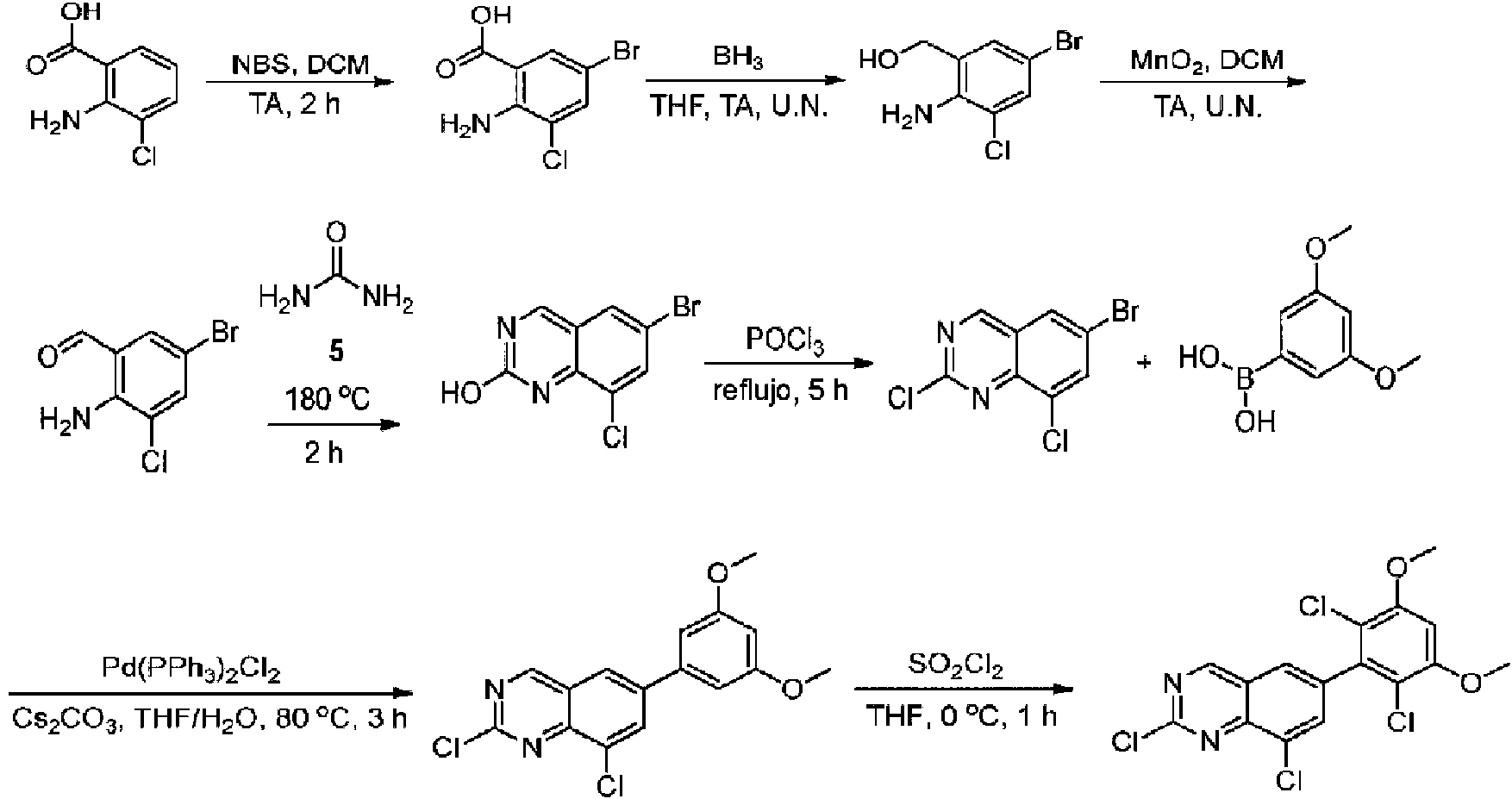
Etapa 1: Síntesis de ácido 2-amino-5-bromo-3-clorobenzoicoStep 1: Synthesis of 2-amino-5-bromo-3-chlorobenzoic acid
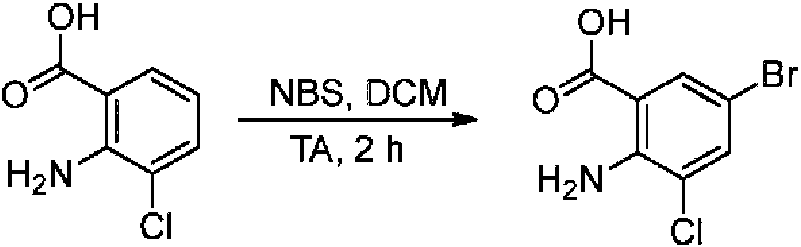
A una solución de ácido 2-amino-3-fluorobenzoico (10,0 g, 58,5 mmol) en diclorometano (150 ml) se le añadió N-bromosuccinimida (10,4 g, 58,5 mmol), y la mezcla se agitó a temperatura ambiente durante 2 horas. La CLEM mostró que la reacción se había completado. El sólido se filtró y se lavó con diclorometano (100 ml * 3) obteniéndose el compuesto del título en forma de un sólido de color blanco (13,0 g, 89 %), que se usó directamente en la siguiente etapa sin purificación adicional. EM (EN+) C7HsBrClNO2 requiere: 249, 251, encontrado: 250, 252 [M H]+.To a solution of 2-amino-3-fluorobenzoic acid (10.0 g, 58.5 mmol) in dichloromethane (150 mL) was added N-bromosuccinimide (10.4 g, 58.5 mmol), and the mixture it was stirred at room temperature for 2 hours. LCMS showed the reaction to be complete. The solid was filtered and washed with dichloromethane (100ml*3) to give the title compound as a white solid (13.0g, 89%), which was used directly in the next step without further purification. MS (ES+) C 7 HsBrClNO 2 requires: 249, 251, found: 250, 252 [MH]+.
Etapa 2: Síntesis de (2-amino-5-bromo-3-clorofenil)metanolStep 2: Synthesis of (2-amino-5-bromo-3-chlorophenyl)methanol
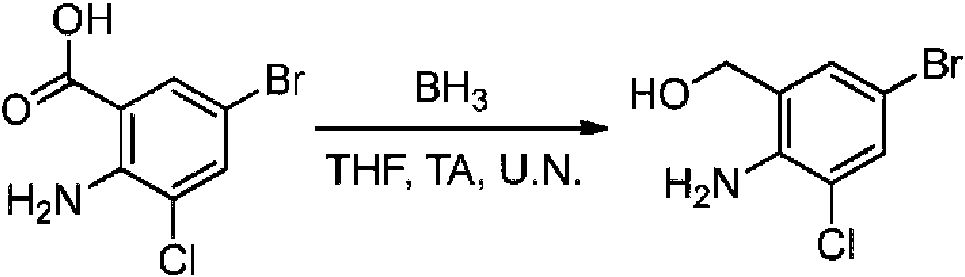
A una solución de ácido 2-amino-5-bromo-3-clorobenzoico (13,0 g, 52,0 mmol) en THF (200 ml) se le añadió borohidruro en THF (300 ml, 1 N) en un baño de agua/hielo, y la mezcla de reacción se agitó a temperatura ambiente durante una noche. La mezcla se inactivó con metanol (100 ml) y se concentró hasta un volumen de 50 ml. El residuo se diluyó con bicarbonato de sodio acuoso (400 ml) y se extrajo con acetato de etilo (200 ml * 3). Las capas orgánicas se separaron, se combinaron, se lavaron con salmuera ( 1 0 0 ml), se secaron sobre sulfato de sodio, se filtraron y se concentraron, obteniéndose el producto del título (10,0 g, 82%). EM (EN+) C7H7BrClNO requiere: 234, 236, encontrado: 236, 238 [M H]+.To a solution of 2-amino-5-bromo-3-chlorobenzoic acid (13.0 g, 52.0 mmol) in THF (200 mL) was added borohydride in THF (300 mL, 1N) in a water bath. water/ice, and the reaction mixture was stirred at room temperature overnight. The mixture was quenched with methanol (100 mL) and concentrated to a volume of 50 mL. The residue was diluted with aqueous sodium bicarbonate (400 ml) and extracted with ethyl acetate (200 ml * 3). The organic layers were separated, combined, washed with brine ( 100 mL), dried over sodium sulfate, filtered, and concentrated to give the title product (10.0 g, 82%). MS (ES+) C 7 H 7 BrClNO requires: 234, 236, found: 236, 238 [MH]+.
Etapa 3: Síntesis de 2-amino-5-bromo-3-clorobenzaldehídoStep 3: Synthesis of 2-amino-5-bromo-3-chlorobenzaldehyde

Una mezcla de (2-amino-5-bromo-3-clorofenil)metanol (10,0 g, 42,5 mmol) y óxido de manganeso (21,9 g, 255 mmol) en diclorometano (400 ml) se agitó a temperatura ambiente durante una noche. El sólido se eliminó por filtración y se concentró el filtrado, obteniéndose el compuesto del título en forma de un sólido de color amarillo claro (9,0 g, 91 %), que se usó directamente en la siguiente etapa sin purificación adicional.A mixture of (2-amino-5-bromo-3-chlorophenyl)methanol (10.0 g, 42.5 mmol) and manganese oxide (21.9 g, 255 mmol) in dichloromethane (400 mL) was stirred at room temperature overnight. The solid was removed by filtration and The filtrate was concentrated to give the title compound as a pale yellow solid (9.0 g, 91%), which was used directly in the next step without further purification.
Etapa 4: Síntesis de 6-bromo-8-cloroquinazolin-2-olStep 4: Synthesis of 6-bromo-8-chloroquinazolin-2-ol

Una mezcla de 2-amino-5-bromo-3-clorobenzaldehído (9,0 g, 38,6 mmol) y urea (34,7 g, 579 mmol) se calentó a 180 °C y se agitó durante 2 horas. La mezcla de reacción se enfrió a temperatura ambiente, y el precipitado resultante se diluyó con agua (1 l) y se agitó durante 2 horas. El precipitado resultante se filtró, y la humedad atrapada se eliminó completamente mediante coevaporación con tolueno tres veces. El compuesto del título (9,0 g, 90 %) se obtuvo en forma de un sólido de color amarillo. EM (EN+) C8H4BrClN2O requiere: 257, 259, encontrado: 258, 260 [M+H]+. Etapa 5: Síntesis de 6-bromo-2,8-dicloroquinazolinaA mixture of 2-amino-5-bromo-3-chlorobenzaldehyde (9.0 g, 38.6 mmol) and urea (34.7 g, 579 mmol) was heated to 180 °C and stirred for 2 hours. The reaction mixture was cooled to room temperature, and the resulting precipitate was diluted with water (1 L) and stirred for 2 hours. The resulting precipitate was filtered, and the trapped moisture was completely removed by coevaporation with toluene three times. The title compound (9.0 g, 90%) was obtained as a yellow solid. MS (ES+) C8H4BrClN2O requires: 257, 259, found: 258, 260 [M+H]+. Step 5: Synthesis of 6-bromo-2,8-dichloroquinazoline

Una solución de 6-bromo-8-cloroquinazolin-2-ol (9,0 g, 35 mmol) en oxicloruro fosforoso (100 ml) se sometió a reflujo durante 5 horas. La mayor parte del oxicloruro fosforoso se eliminó a presión reducida, y el residuo se añadió a una mezcla en agitación de hielo/agua (500 ml). El precipitado resultante se recogió por filtración y después se sometió a reflujo en THF. El sólido se eliminó por filtración, y el filtrado se concentró, obteniéndose el compuesto del título en forma de un sólido de color amarillo (7,0 g, 78 %). EM (EN+) C8H4BrClN2 requiere: 275, 277, encontrado: 276, 278 [M H]+.A solution of 6-bromo-8-chloroquinazolin-2-ol (9.0 g, 35 mmol) in phosphorous oxychloride (100 mL) was refluxed for 5 hours. Most of the phosphorous oxychloride was removed under reduced pressure, and the residue was added to a stirring mixture of ice/water (500 mL). The resulting precipitate was collected by filtration and then refluxed in THF. The solid was filtered off and the filtrate was concentrated to give the title compound as a yellow solid (7.0 g, 78%). MS (ES+) C8H4BrClN2 requires : 275, 277, found: 276, 278 [MH]+.
Etapa 6: Síntesis de 2,8-dicloro-6-(3,5-dimetoxifenil)quinazolinaStep 6: Synthesis of 2,8-dichloro-6-(3,5-dimethoxyphenyl)quinazoline

Una mezcla de 6-bromo-2,8-dicloroquinazolina (4,0 g, 14,5 mmol), ácido 3,5-dimetilfenoxiborónico (4,23 g, 16,0 mmol), carbonato de cesio (9,42 g, 29,0 mmol) y Pd(PPh3)2Cl2 (220 mg, 0,70 mmol) en THF (200 ml) y agua (10 ml) se desgasificó con nitrógeno tres veces, y se agitó a 80 °C durante 5 horas. La mezcla de reacción se enfrió a temperatura ambiente, se concentró directamente y se purificó mediante cromatografía de gel de sílice (éter de petróleo: diclorometano = 2:1~1:1), obteniéndose el compuesto del título en forma de un sólido de color amarillo (2,0 g, 41 %). EM (EN+) C16H12Cl2N2O2 requiere: 334, 336, encontrado: 335, 337 [M H]+.A mixture of 6-bromo-2,8-dichloroquinazoline (4.0 g, 14.5 mmol), 3,5-dimethylphenoxyboronic acid (4.23 g, 16.0 mmol), cesium carbonate (9.42 g , 29.0 mmol) and Pd(PPh3)2Cl2 (220 mg, 0.70 mmol) in THF (200 mL) and water (10 mL) was degassed with nitrogen three times, and stirred at 80 °C for 5 hours. . The reaction mixture was cooled to room temperature, directly concentrated, and purified by silica gel chromatography (petroleum ether: dichloromethane = 2:1~1:1) to obtain the title compound as a pale yellow solid. yellow (2.0g, 41%). MS (ES+) C16H12Cl2N2O2 requires : 334, 336, found: 335, 337 [MH]+.
Etapa 7: Síntesis de 2,8-dicloro-6-(2,6-dicloro-3,5-dimetoxifenil)quinazolinaStep 7: Synthesis of 2,8-dichloro-6-(2,6-dichloro-3,5-dimethoxyphenyl)quinazoline
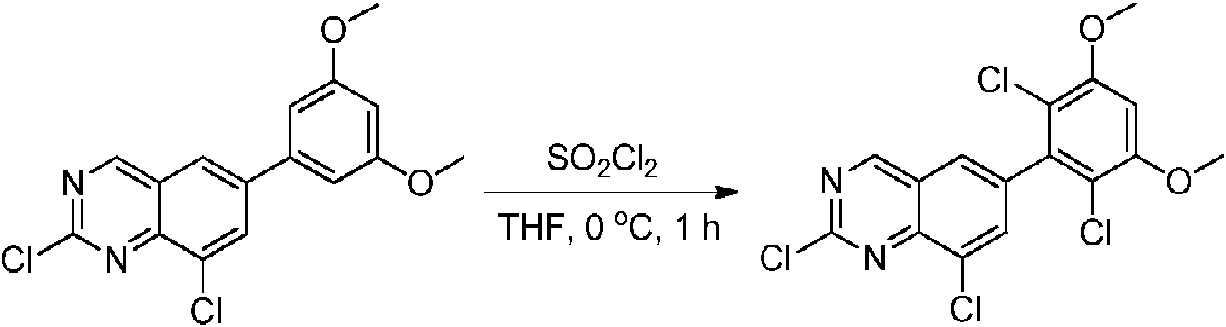
A una solución de 2,8-dicloro-6-(3,5-dimetoxifenil)quinazolina (2,0 g, 6,0 mmol) en THF seco (40 ml) se le añadió gota a gota cloruro de sulfurilo (1,59 g, 1,75 mmol) a 0 °C, y la mezcla se agitó durante 30 min a 0 °C. La reacción se inactivó con agua (1 ml), y el precipitado se recogió mediante filtración, obteniéndose el compuesto del título (1,3 g, 54 %) en forma de un sólido de color amarillo. EM (EN+) C16H10CI4N2O2 requiere: 402, 404, encontrado: 403, 405 [M+H]+; RMN 1H (400 MHz, CDCls) 5 ppm 9,36 (s, 1H), 7,94 (s, 1H), 7,79 (s, 1H), 6,69 (s, 1H), 4,01 (s, 6 H).Sulfuryl chloride (1, 59 g, 1.75 mmol) at 0 °C, and the mixture was stirred for 30 min at 0 °C. The reaction was quenched with water (1 mL), and the precipitate was collected by filtration to give the title compound (1.3 g, 54%) as a yellow solid. MS (ES+) C 16 H 10 CI 4 N 2 O 2 requires: 402, 404, found: 403, 405 [M+H]+; 1H NMR (400 MHz, CDCls) 5 ppm 9.36 (s, 1H), 7.94 (s, 1H), 7.79 (s, 1H), 6.69 (s, 1H), 4.01 ( yes, 6H ).
Síntesis de 2,7-dicloro-6-(2,6-dicloro-3,5-dimetoxifenil)quinazolinaSynthesis of 2,7-dichloro-6-(2,6-dichloro-3,5-dimethoxyphenyl)quinazoline

Etapa 1: Síntesis de ácido 2-amino-5-bromo-4-clorobenzoicoStep 1: Synthesis of 2-amino-5-bromo-4-chlorobenzoic acid

A una solución de ácido 2-amino-4-clorobenzoico (10,0 g, 58,5 mmol) en metanol (150 ml) se le añadió bromo (15,7 ml) a -78 °C, y la mezcla de reacción se agitó a -78 °C durante 2 horas. La mezcla de reacción se inactivó con agua-hielo (100 ml) y tiosulfato de sodio ac., y se extrajo con acetato de etilo (150 ml x 3). Las capas orgánicas se separaron, se combinaron, se lavaron con agua ( 1 0 0 ml) y salmuera ( 1 0 0 ml), se secaron sobre sulfato de sodio, se filtraron y se concentraron, obteniéndose el compuesto del título (9 g, 6 2 %).To a solution of 2-amino-4-chlorobenzoic acid (10.0 g, 58.5 mmol) in methanol (150 mL) was added bromine (15.7 mL) at -78 °C, and the reaction mixture it was stirred at -78 °C for 2 hours. The reaction mixture was quenched with ice-water (100 mL) and aq. sodium thiosulfate, and extracted with ethyl acetate (150 mL x 3). The organic layers were separated, combined, washed with water (100 mL), brine ( 100 mL), dried over sodium sulfate, filtered, and concentrated to give the title compound (9 g, 6 2 %).
Etapa 2: Síntesis de (2-amino-5-bromo-4-clorofenil)metanolStep 2: Synthesis of (2-amino-5-bromo-4-chlorophenyl)methanol
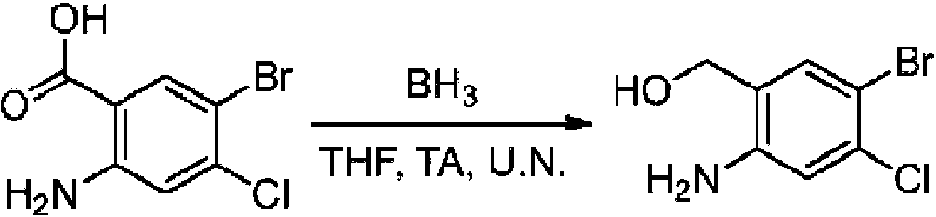
A una solución de ácido 2-amino-5-bromo-4-clorobenzoico (9,0 g, 36,0 mmol) en THF (150 ml) se le añadió borohidruro en THF (144 ml, 1 M) a temperatura ambiente, y la mezcla de reacción se agitó durante una noche. La mezcla de reacción se inactivó con metanol (50 ml), y se concentró hasta un volumen de 50 ml. El residuo se diluyó con agua (100 ml) y se extrajo con acetato de etilo (150 ml x 3 ). Las capas orgánicas se separaron, se combinaron, se lavaron con agua (100 ml) y salmuera (100 ml), se secaron sobre sulfato de sodio, se filtraron y se concentraron, obteniéndose el compuesto del título (en bruto, 6 g, 71 %).To a solution of 2-amino-5-bromo-4-chlorobenzoic acid (9.0 g, 36.0 mmol) in THF (150 mL) was added borohydride in THF (144 mL, 1 M) at room temperature, and the reaction mixture was stirred overnight. The reaction mixture was quenched with methanol (50 mL), and concentrated to a volume of 50 mL. The residue was diluted with water (100 ml) and extracted with ethyl acetate (150 ml x 3 ). The organic layers were separated, combined, washed with water (100 mL), brine (100 mL), dried over sodium sulfate, filtered, and concentrated to give the title compound (crude, 6 g, 71 %).
Etapa 3: Síntesis de 2-amino-5-bromo-4-clorobenzaldehídoStep 3: Synthesis of 2-amino-5-bromo-4-chlorobenzaldehyde

Una mezcla de (2-amino-5-bromo-4-clorofenil)metanol ( 6 g, 25,5 mmol) y óxido de manganeso(IV) (15,5 g, 0,178 mol) en diclorometano (100 ml) se agitó a temperatura ambiente durante una noche. El sólido se eliminó por filtración, y el filtrado se concentró, obteniéndose el compuesto del título en forma de un sólido de color amarillo claro (5 g, 81 %). A mixture of (2-amino-5-bromo-4-chlorophenyl)methanol (6 g, 25.5 mmol) and manganese(IV) oxide (15.5 g, 0.178 mol) in dichloromethane (100 mL) was stirred at room temperature overnight. The solid was filtered off and the filtrate was concentrated to give the title compound as a pale yellow solid (5 g, 81%).
EM (EN+) C7H5B1CINO requiere: 233, 235, encontrado: 234, 236 [M H]+.MS (EN+) C 7 H 5 B 1 CYNO requires: 233, 235, found: 234, 236 [MH]+.
Etapa 4: Síntesis de 6-bromo-7-cloroquinazolin-2-olStep 4: Synthesis of 6-bromo-7-chloroquinazolin-2-ol

Una mezcla de 2-amino-5-bromo-4-clorobenzaldemdo (5 g, 21,46 mmol) y urea (18 g, 300,0 mmol) se agito a 180 °C durante 5 horas. La LCMS demostró que la reacción se había completado. La mezcla se enfrió a temperatura ambiente, se lavó con agua (100 ml * 3) y se filtró. La torta de filtración se secó, obteniéndose el compuesto del título en forma de un sólido de color amarillo (6 g, en bruto, 100 %). EM (EN+) C a ^B rC l^O requiere: 258, 260, encontrado: 259, 261 [M H]+.A mixture of 2-amino-5-bromo-4-chlorobenzaldemdo (5 g, 21.46 mmol) and urea (18 g, 300.0 mmol) was stirred at 180 °C for 5 hours. LCMS showed the reaction to be complete. The mixture was cooled to room temperature, washed with water (100 ml * 3), and filtered. The filter cake was dried to give the title compound as a yellow solid (6 g crude, 100%). MS (EN+) C a ^B rC l^O requires: 258, 260, found: 259, 261 [MH]+.
Etapa 5: Síntesis de 6-bromo-2,7-dicloroquinazolinaStep 5: Synthesis of 6-bromo-2,7-dichloroquinazoline

Una solución de 6-bromo-7-cloroquinazolin-2-ol (6,0 g, 23 mmol) en oxicloruro fosforoso (50 ml) se sometió a reflujo durante 5 horas. La reacción se enfrió hasta temperatura ambiente y se eliminó la mayoría del oxicloruro fosforoso a presión reducida. El residuo se añadió gota a gota a una mezcla de hielo-agua (500 ml), y el precipitado resultante se recogió por filtración, obteniéndose el compuesto del título en forma de un sólido de color amarillo (3 g, 48 %).A solution of 6-bromo-7-chloroquinazolin-2-ol (6.0 g, 23 mmol) in phosphorous oxychloride (50 mL) was refluxed for 5 hours. The reaction was cooled to room temperature and most of the phosphorous oxychloride was removed under reduced pressure. The residue was added dropwise to ice-water (500 mL), and the resulting precipitate was collected by filtration to give the title compound as a yellow solid (3 g, 48%).
Etapa 6: Síntesis de 2,7-dicloro-6-(3,5-dimetoxifenil)quinazolinaStep 6: Synthesis of 2,7-dichloro-6-(3,5-dimethoxyphenyl)quinazoline

Una mezcla de 6-bromo-2,7-dicloroquinazolina (3 g, 10,8 mmol), ácido 3,5-dimetoxifenilborónico (2,2 g, 11,9 mmol), carbonato de cesio (1,06 g, 32,4 mmol) y Pd(PPh3)2Cl2 (702 mg, 1,08 mmol) en THF (50 ml) y agua (10 ml) se desgasificó con nitrógeno tres veces, y la mezcla de reacción se agitó a 85 °C durante 3 horas. La mezcla de reacción se enfrió a temperatura ambiente y se concentró directamente. El residuo se purificó mediante cromatografía de gel de sílice (éter de petróleo:acetato de etilo = 10:1-4:1), obteniéndose el compuesto del título (2,0 g, rendimiento del 55 %) en forma de un sólido amarillento. EM (EN+) requiere: 334, 336, C16H12Cl2N2O2, encontrado: 335, 337 [M H]+. A mixture of 6-bromo-2,7-dichloroquinazoline (3 g, 10.8 mmol), 3,5-dimethoxyphenylboronic acid (2.2 g, 11.9 mmol), cesium carbonate (1.06 g, 32 0.4 mmol) and Pd(PPh 3 ) 2 Cl 2 (702 mg, 1.08 mmol) in THF (50 mL) and water (10 mL) was degassed with nitrogen three times, and the reaction mixture was stirred at 85 °C for 3 hours. The reaction mixture was cooled to room temperature and directly concentrated. The residue was purified by silica gel chromatography (petroleum ether:ethyl acetate = 10:1-4:1) to obtain the title compound (2.0 g, 55% yield) as a yellowish solid. . MS (ES+) requires: 334, 336, C 16 H 12 Cl 2 N 2 O 2 , found: 335, 337 [MH]+.
Etapa 7: Síntesis de 2,7-dicloro-6-(2,6-dicloro-3,5-dimetoxifenil)quinazolinaStep 7: Synthesis of 2,7-dichloro-6-(2,6-dichloro-3,5-dimethoxyphenyl)quinazoline

A una solución de 2,7-dicloro-6-(3,5-dimetoxifenil)quinazolina (2,0 g, 6,0 mmol) en THF (30 ml) se le añadió cloruro de sulfurilo (1,77 g, 13,2 mmol) a -10 °C, y la mezcla se agitó a -10 °C durante 1 hora. La solución se inactivó con agua (1 ml) y se concentró a presión reducida. El residuo se purificó mediante cromatografía de gel de sílice (éter de petróleo:acetato de etilo = 10:1~4:1), obteniéndose el compuesto del título (1,2 g, 50 %) en forma de un sólido de color blanco. EM (EN+) C16H1üCl4N2O2 requiere: 402, 404, encontrado: 403, 405 [M H]+.To a solution of 2,7-dichloro-6-(3,5-dimethoxyphenyl)quinazoline (2.0 g, 6.0 mmol) in THF (30 mL) was added sulfuryl chloride (1.77 g, 13 0.2 mmol) at -10 °C, and the mixture was stirred at -10 °C for 1 hour. The solution was quenched with water (1 mL) and concentrated under reduced pressure. The residue was purified by silica gel chromatography (petroleum ether:ethyl acetate = 10:1~4:1) to obtain the title compound (1.2 g, 50%) as a white solid. . MS (ES+) C16H1uCl4N2O2 requires : 402 , 404, found: 403, 405 [ MH ] +.
Etapa 8: Síntesis de 2-cloro-6-(2,6-dicloro-3,5-dimetoxifenil)pirido[2,3-d]pirimidina Step 8: Synthesis of 2-chloro-6-(2,6-dichloro-3,5-dimethoxyphenyl)pyrido[2,3-d]pyrimidine

Etapa 9: Síntesis de 6-bromopirido[2,3-d]pirimidin-2-olStep 9: Synthesis of 6-bromopyrido[2,3-d]pyrimidin-2-ol

Una mezcla de 2-amino-5-bromonicotinaldehído (2,0 g, 10,0 mmol) y urea (9,0 g, 150,0 mmol) se calentó a 180 °C y se agitó vigorosamente durante 2 horas. La mezcla de reacción se enfrió a temperatura ambiente,. y el precipitado resultante se recogió, se lavó con agua (3 * 100 ml) y se coevaporó con tolueno tres veces para eliminar completamente la humedad atrapada. El compuesto del título (2,1 g, 93 %) se obtuvo en forma de un sólido de color amarillo. EM (EN+) CgHaBr^O requiere: 225, 227, encontrado: 226, 228 [M H]+.A mixture of 2-amino-5-bromonicotinaldehyde (2.0 g, 10.0 mmol) and urea (9.0 g, 150.0 mmol) was heated to 180 °C and stirred vigorously for 2 hours. The reaction mixture was cooled to room temperature. and the resulting precipitate was collected, washed with water (3*100 mL) and coevaporated with toluene three times to completely remove trapped moisture. The title compound (2.1 g, 93%) was obtained as a yellow solid. MS (EN+) CgHaBr^O requires: 225, 227, found: 226, 228 [MH]+.
Etapa 10: Síntesis de 6-bromo-2-cloropirido[2,3-d]pirimidinaStep 10: Synthesis of 6-bromo-2-chloropyrido[2,3-d]pyrimidine
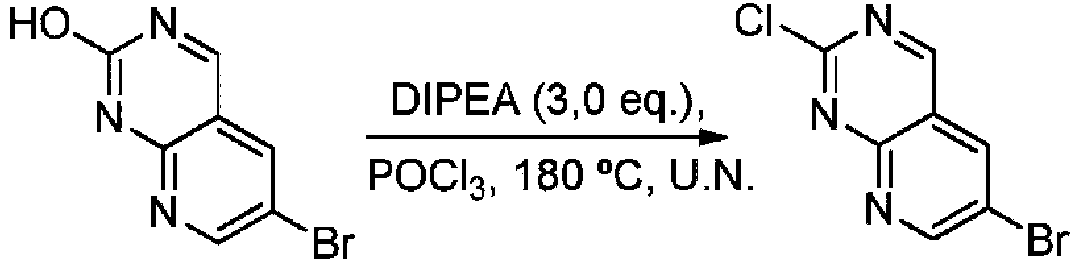
A una mezcla en agitación de 6-bromopirido[2,3-d]pirimidin-2-ol (1,1 g, 4,9 mmol) en 30 ml de tricloruro de fosforilo se le añadió diisopropiletilamina (1 , 6 g, 12 , 2 mmol) a temperatura ambiente, y después se agitó la mezcla de reacción a 120 °C durante 12 horas. La mayoría del tricloruro de fosforilo se eliminó a presión reducida. El residuo se diluyó con acetato de etilo (200 ml) y se añadió a una solución saturada de bicarbonato de sodio (300 ml) a 0 °C. La mezcla se extrajo con acetato de etilo (200 ml * 3). Las capas orgánicas combinadas se secaron sobre sulfato de sodio anhidro, se filtraron y se concentraron, obteniéndose el compuesto del título (800 mg, 67 %) en forma de un sólido de color amarillo. EM (EN+) CyHaBrClNa requiere: 243, 245, encontrado: 244, 246 [M H]+.To a stirred mixture of 6-bromopyrido[2,3-d]pyrimidin-2-ol (1.1 g, 4.9 mmol) in 30 mL phosphoryl trichloride was added diisopropylethylamine (1.6 g , 12 , 2 mmol) at room temperature, and then the reaction mixture was stirred at 120 °C for 12 hours. Most of the phosphoryl trichloride was removed under reduced pressure. The residue was diluted with ethyl acetate (200 mL) and added to saturated sodium bicarbonate solution (300 mL) at 0 °C. The mixture was extracted with ethyl acetate (200 ml * 3). The combined organic layers were dried over anhydrous sodium sulfate, filtered, and concentrated to give the title compound (800 mg, 67%) as a yellow solid. MS (ES+) CyHaBrClNa requires: 243, 245, found: 244, 246 [MH]+.
Etapa 11: Síntesis de 2-cloro-6-(3,5-dimetoxifenil)pirido[2,3-d]pirimidina:Step 11: Synthesis of 2-chloro-6-(3,5-dimethoxyphenyl)pyrido[2,3-d]pyrimidine:

Una mezcla de 6-bromo-2-cloropirido[2,3-d]pirimidina (800 mg, 3,3 mmol), ácido 3,5-dimetoxifenilborónico (655 mg, 3,6 mmol), bis(tri-ferc-butilfosfina)paladio (83 mg, 0,16 mmol) y carbonato de cesio (1,06 g, 3,3 mmol) en THF (30 ml) y agua ( 6 ml) se desgasificó con nitrógeno tres veces y después se calentó a 85 °C durante 0,5 horas. La mezcla se enfrió a temperatura ambiente y se concentró a presión reducida. El residuo se purificó mediante cromatografía en columna de gel de sílice (diclorometano/acetato de etilo = 3/1), obteniéndose el producto del título en forma de un sólido de color amarillo (460 mg, 47 %) en forma de un sólido de color amarillo. EM (EN+) C-i5H-i2ClN3O2 requiere: 301, 302, encontrado: 302, 304 [M H]+.A mixture of 6-bromo-2-chloropyrido[2,3-d]pyrimidine (800 mg, 3.3 mmol), 3,5-dimethoxyphenylboronic acid (655 mg, 3.6 mmol), bis(tri-fert-butylphosphine)palladium (83 mg, 0.16 mmol), and cesium carbonate (1.06 g, 3.3 mmol) in THF (30 mL) and water (6 mL ) was degassed with nitrogen three times and then heated at 85 °C for 0.5 hours. The mixture was cooled to room temperature and concentrated under reduced pressure. The residue was purified by silica gel column chromatography (dichloromethane/ethyl acetate = 3/1) to obtain the title product as a yellow solid (460 mg, 47%) as a solid of yellow color. MS (ES+) Ci 5 Hi 2 ClN 3 O 2 requires: 301, 302, found: 302, 304 [MH]+.
Etapa 12: Síntesis de 2-cloro-6-(2,6-dicloro-3,5-dimetoxifenil)pirido[2,3-d]pirimidinaStep 12: Synthesis of 2-chloro-6-(2,6-dichloro-3,5-dimethoxyphenyl)pyrido[2,3-d]pyrimidine
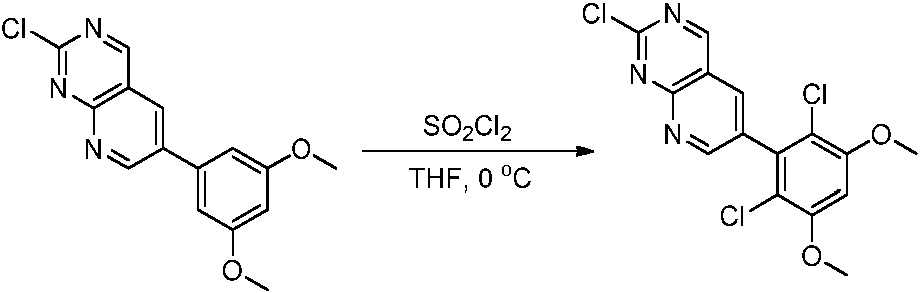
A una solución de 2-cloro-6-(3,5-dimetoxifenil)pirido[2,3-d]pirimidina (300 mg, 1,0 mmol) en THF (30 ml) se le añadió gota a gota cloruro de sulfurilo (337 mg, 2,5 mmol) a 0 °C, y la mezcla se agitó durante 20 min a 0 °C. La mezcla de reacción se inactivó con agua (50 ml) y se extrajo con acetato de etilo (100 ml * 3). Las capas orgánicas combinadas se lavaron con salmuera (100 ml), se secaron sobre sulfato de sodio, se filtraron y se concentraron. El residuo se purificó mediante cromatografía de gel de sílice (diclorometano/acetato de etilo = 5/1) obteniéndose el producto del título en forma de un sólido de color bronceado (240 mg, 65 %). EM (EN+) C15H1üCl3N3O2 requiere: 369, encontrado: 370, 372 [M H]+.To a solution of 2-chloro-6-(3,5-dimethoxyphenyl)pyrido[2,3-d]pyrimidine (300 mg, 1.0 mmol) in THF (30 mL) was added sulfuryl chloride dropwise. (337 mg, 2.5 mmol) at 0 °C, and the mixture was stirred for 20 min at 0 °C. The reaction mixture was quenched with water (50 ml) and extracted with ethyl acetate (100 ml * 3). The combined organic layers were washed with brine (100 mL), dried over sodium sulfate, filtered, and concentrated. The residue was purified by silica gel chromatography (dichloromethane/ethyl acetate=5/1) to give the title product as a tan solid (240mg, 65%). MS (ES+) C15H1uCl3N3O2 requires : 369 , found: 370, 372 [ MH ] +.
Síntesis de 2-cloro-6-(2.6-d¡cloro-3.5-d¡metoxifen¡l)-7-fluoroqu¡nazol¡naSynthesis of 2-chloro-6-(2.6-dichloro-3.5-dimethoxyphenyl)-7-fluoroquinazolin

Etapa 1: Síntesis de 5-bromo-4-fluoro-2-nitrobenzaldehídoStep 1: Synthesis of 5-bromo-4-fluoro-2-nitrobenzaldehyde

A una solución en agitación de ácido nítrico concentrado (6 , 8 ml, 101,0 mmol) en ácido sulfúrico concentrado (60 ml) se le añadió lentamente 3-bromo-4-fluorobenzaldehído (10 g, 49,5 mmol) a 0 °C. Después de finalizar la adición, se eliminó el baño de hielo, y se dejó que la reacción se calentarse hasta temperatura ambiente y se agitó durante 3 horas. La mezcla se agitó en agua-hielo y se extrajo con acetato de etilo (200 ml). La capa orgánica se concentró, obteniéndose el compuesto del título en forma de un sólido de color amarillo (en bruto, 12 g, 10 0 %), que se usó directamente para la siguiente etapa sin purificación adicional.To a stirring solution of concentrated nitric acid ( 6.8 mL, 101.0 mmol) in concentrated sulfuric acid (60 mL) was slowly added 3-bromo-4-fluorobenzaldehyde (10 g, 49.5 mmol) at 0 °C After the addition was complete, the ice bath was removed, and the reaction was allowed to warm to room temperature and stir for 3 hours. The mixture was stirred in ice-water and extracted with ethyl acetate (200 ml). The organic layer was concentrated to give the title compound as a yellow solid (crude, 12 g, 100 %), which was used directly for the next step without further purification.
Etapa 2: Síntesis de 6-fluoro-3',5'-dimetoxi-4-nitrobifenil-3-carbaldehído Step 2: Synthesis of 6-fluoro-3',5'-dimethoxy-4-nitrobiphenyl-3-carbaldehyde

Una mezcla de 5-bromo-4-fluoro-2-nitrobenzaldehído (10,0 g, 40,0 mmol), ácido 3,5-dimetoxifenilborónico (7,3 g, 40,0 mmol), cloruro de bis(trifenilfosfino)paladio(M) (1,4 g, 2,0 mmol) y carbonato de cesio (32,6 g, 100,0 mmol) en dioxano/agua (550 ml, v/v = 10/1) se desgasificó con nitrógeno tres veces y se calentó a 90 °C durante 3 horas. La mezcla se enfrió a temperatura ambiente, se concentró, se diluyó con acetato de etilo ( 1 0 0 0 ml), y se lavó con agua (500 ml) y salmuera (500 ml). La capa orgánica se secó, se concentró, y el residuo se purificó mediante cromatografía en gel de sílice (éter de petróleo/acetato de etilo = 8/1 a 5/1), obteniéndose el compuesto del título (9 g, 61 %) en forma de un sólido de color amarillo. EM (EN+) C15H12FNO5 requiere: 305, encontrado: 306 [M H]+.A mixture of 5-bromo-4-fluoro-2-nitrobenzaldehyde (10.0 g, 40.0 mmol), 3,5-dimethoxyphenylboronic acid (7.3 g, 40.0 mmol), bis(triphenylphosphine) chloride palladium(M) (1.4 g, 2.0 mmol) and cesium carbonate (32.6 g, 100.0 mmol) in dioxane/water (550 mL, v/v = 10/1) was degassed with nitrogen three times and heated at 90 °C for 3 hours. The mixture was cooled to room temperature, concentrated, diluted with ethyl acetate ( 1000 mL), and washed with water (500 mL) and brine (500 mL). The organic layer was dried, concentrated, and the residue was purified by silica gel chromatography (petroleum ether/ethyl acetate = 8/1 to 5/1) to give the title compound (9 g, 61%) as a yellow solid. MS (EN+) C 15 H 12 FNO 5 requires: 305, found: 306 [MH]+.
Etapa 3: Síntesis de 2-(6-fluoro-3',5'-dimetoxi-4-nitrobifenil-3-il)-1,3-dioxolanoStep 3: Synthesis of 2-(6-fluoro-3',5'-dimethoxy-4-nitrobiphenyl-3-yl)-1,3-dioxolane
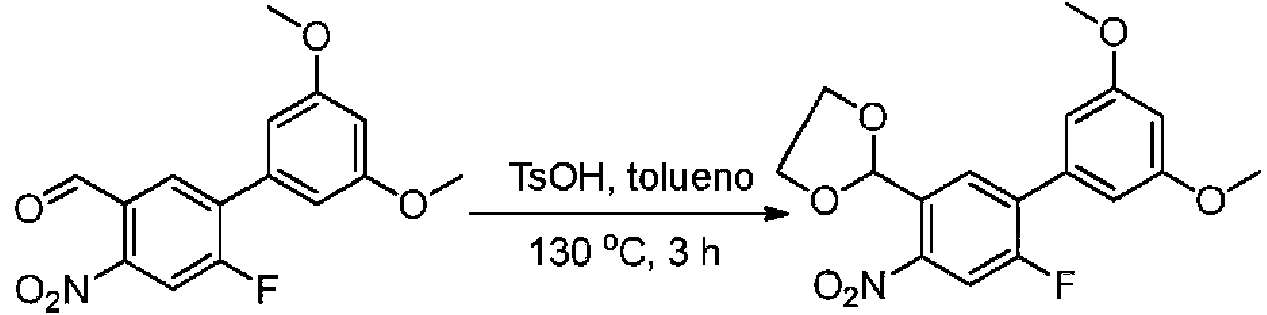
Una mezcla de 6-fluoro-3,5-dimetoxi-4-nitrobifenil-3-carbaldehido (1,7 g, 5,6 mmol) y ácido 4-toluenosulfónico (95,8 mg, 0,6 mmol) en 1,2-etanodiol (4,3 ml) y tolueno (60 ml) se calentó a 130 °C durante 3 horas. Después de esto, la mezcla de reacción se enfrió a temperatura ambiente, se diluyó con acetato de etilo ( 1 0 0 ml), y se lavó con agua (100 ml * 3) y salmuera (100 ml). Las capas orgánicas combinadas se secaron sobre sulfato de sodio, se filtraron y se concentraron. El residuo se purificó mediante cromatografía en columna de gel de sílice (éter de petróleo/acetato de etilo = 8/1 a 5/1), obteniéndose el compuesto del título (1,8 g, 89 %) en forma de un sólido de color amarillo. EM (EN+) C17H16FNO6 requiere: 349, encontrado: 350 [M H]+.A mixture of 6-fluoro-3,5-dimethoxy-4-nitrobiphenyl-3-carbaldehyde (1.7 g, 5.6 mmol) and 4-toluenesulfonic acid (95.8 mg, 0.6 mmol) in 1, 2-ethanediol (4.3 ml) and toluene (60 ml) was heated at 130 °C for 3 hours. After this, the reaction mixture was cooled to room temperature, diluted with ethyl acetate ( 100 mL), and washed with water (100 mL * 3) and brine (100 mL). The combined organic layers were dried over sodium sulfate, filtered, and concentrated. The residue was purified by silica gel column chromatography (petroleum ether/ethyl acetate = 8/1 to 5/1) to obtain the title compound (1.8 g, 89%) as a solid of yellow color. MS (EN+) C 17 H 16 FNO 6 requires: 349, found: 350 [MH]+.
Etapa 4: Síntesis de 5-(1,3-dioxolan-2-il)-2-fluoro-3',5'-dimetoxibifenil-4-aminaStep 4: Synthesis of 5-(1,3-dioxolan-2-yl)-2-fluoro-3',5'-dimethoxybiphenyl-4-amine

Una mezcla de 2-(6-fluoro-3',5'-dimetoxi-4-nitrobifenil-3-il)-1,3-dioxolano (1,8 g, 5,2 mmol), borohidruro de sodio (587,9 mg, 15,5 mmol) y paladio sobre carbono al 10 % (0,2 g) en etanol/agua (33 ml, v/v = 10/1) se calentó a 90 °C durante 1 hora. Después de esto, la mezcla se diluyó con acetato de etilo (150 ml), y se lavó con agua (50 ml) y salmuera (50 ml). La capa orgánica se secó sobre sodio, se filtró y se concentró. El residuo se purificó mediante cromatografía en columna de gel de sílice (éter de petróleo/acetato de etilo = 5/1 a 4/1), obteniéndose el compuesto del título (1,4 g, 88 %) en forma de un sólido de color amarillo. EM (EN+) C17H18FNO4 requiere: 319, encontrado: 320 [M H]+.A mixture of 2-(6-fluoro-3',5'-dimethoxy-4-nitrobiphenyl-3-yl)-1,3-dioxolane (1.8 g, 5.2 mmol), sodium borohydride (587, 9 mg, 15.5 mmol) and 10% palladium on carbon (0.2 g) in ethanol/water (33 mL, v/v = 10/1) was heated at 90 °C for 1 hour. After this, the mixture was diluted with ethyl acetate (150 ml), and washed with water (50 ml) and brine (50 ml). The organic layer was dried over sodium, filtered and concentrated. The residue was purified by silica gel column chromatography (petroleum ether/ethyl acetate = 5/1 to 4/1) to obtain the title compound (1.4 g, 88 %) as a solid of yellow color. MS (EN+) C 17 H 18 FNO 4 requires: 319, found: 320 [MH]+.
Etapa 5: Síntesis de 6-(3,5-dimetoxifenil)-7-fluoroquinazolin-2-olStep 5: Synthesis of 6-(3,5-dimethoxyphenyl)-7-fluoroquinazolin-2-ol

A una solución de 5-(1,3-dioxolan-2-il)-2-fluoro-3',5'-dimetoxibifenil-4-amina (1,9 g, 6,0 mmol) y trietilamina (3,0 ml, 21,4 mmol) en THF (20 ml) a 0 °C se le añadió trifosgeno (0,6 g, 2,0 mmol), y se agitó a 0 °C durante 0,5 horas. Después de esto, se añadió amoniaco en metanol (3 ml, 21 mmol, 7 mol/l). La reacción se agitó a 0 °C durante 30 min y se calentó rápidamente a temperatura ambiente. Después de agitar durante 30 min más a temperatura ambiente, la mezcla de reacción se acidificó con HCl a 4 mol/l en dioxano (8,2 ml) a pH 2 y después se agitó a temperatura ambiente durante 1 hora. Después, la solución resultante se concentró y se purificó mediante cromatografía en columna de gel de sílice (diclorometano/metanol = 50/1 a 10/1), obteniéndose el compuesto del título (2,0 g, 99 %) en forma de un sólido de color amarillo. EM (EN+) C16H13FN2O3 requiere: 300, encontrado: 301 [M H]+.To a solution of 5-(1,3-dioxolan-2-yl)-2-fluoro-3',5'-dimethoxybiphenyl-4-amine (1.9 g, 6.0 mmol) and triethylamine (3.0 ml, 21.4 mmol) in THF (20 mL) at 0 °C was added to triphosgene (0.6 g, 2.0 mmol), and stirred at 0 °C for 0.5 hours. After this, ammonia in methanol (3 mL, 21 mmol, 7 mol/L) was added. The reaction was stirred at 0 °C for 30 min and quickly warmed to room temperature. After stirring for a further 30 min at room temperature, the reaction mixture was acidified with 4 mol/L HCl in dioxane (8.2 mL) to pH 2 and then stirred at room temperature for 1 hour. Then, the resulting solution was concentrated and purified by silica gel column chromatography (dichloromethane/methanol = 50/1 to 10/1) to obtain the title compound (2.0 g, 99%) as a yellow solid. MS (EN+) C 16 H 13 FN 2 O 3 requires: 300, found: 301 [MH]+.
Etapa 6 : Síntesis de 2-cloro-6-(3,5-dimetoxifenil)-7-fluoroquinazolinaStep 6 : Synthesis of 2-chloro-6-(3,5-dimethoxyphenyl)-7-fluoroquinazoline

Una solución de 6-(3,5-dimetoxifenil)-7-fluoroquinazolin-2-ol (2,0 g, 6,7 mmol) en POCh (30 ml) se calentó a 135 °C durante 2 horas. Después de esto, la solución de reacción se enfrió a temperatura ambiente y se añadió gota a gota a una solución saturada de bicarbonato de sodio (800 ml) a 0 °C. La mezcla se extrajo con acetato de etilo (200 ml * 3). Las capas orgánicas combinadas se secaron sobre sulfato de sodio anhidro, se filtraron y se concentraron, obteniéndose el compuesto del título (1,1 g, 52% ) en forma de un sólido de color amarillo pálido. EM (EN+) C16H12CFN 2O2 requiere: 318, encontrado: 319 [M H]+.A solution of 6-(3,5-dimethoxyphenyl)-7-fluoroquinazolin-2-ol (2.0 g, 6.7 mmol) in POCh (30 mL) was heated at 135 °C for 2 hours. After this, the reaction solution was cooled to room temperature and added dropwise to saturated sodium bicarbonate solution (800 mL) at 0°C. The mixture was extracted with ethyl acetate (200 ml * 3). The combined organic layers were dried over anhydrous sodium sulfate, filtered, and concentrated to give the title compound (1.1 g, 52%) as a pale yellow solid. MS (ES+) C 16 H 12 CFN 2 O 2 requires: 318, found: 319 [MH]+.
Etapa 7: Síntesis de 2-cloro-6-(2,6-dicloro-3,5-dimetoxifenil)-7-fluoroquinazolinaStep 7: Synthesis of 2-chloro-6-(2,6-dichloro-3,5-dimethoxyphenyl)-7-fluoroquinazoline

A una solución de 2-cloro-6-(3,5-dimetoxifenil)-7-fluoroquinazolina (1,2 g, 3,8 mmol) en acetonitrilo/tetrahidrofurano (200 ml, v/v = 1/1) se le añadió cloruro de sulfurilo (1,7 ml, 18,9 mmol) a 0 °C. La solución resultante se agitó a 0 °C durante 0,5 horas. Después de esto, la solución se concentró y se diluyó con acetato de etilo (500 ml). La fase orgánica se lavó con solución saturada de bicarbonato de sodio ( 2 0 0 ml) y salmuera ( 2 0 0 ml), se secó sobre sulfato de sodio anhidro, se filtró y se concentró, obteniéndose el compuesto del título (946 mg, 65 %) en forma de un sólido de color amarillo. EM (EN+) C16H10Q 3FN2O2 requiere: 386, encontrado: 387 [M H]+.To a solution of 2-chloro-6-(3,5-dimethoxyphenyl)-7-fluoroquinazoline (1.2 g, 3.8 mmol) in acetonitrile/tetrahydrofuran (200 mL, v/v = 1/1) was added added sulfuryl chloride (1.7 mL, 18.9 mmol) at 0 °C. The resulting solution was stirred at 0°C for 0.5 hour. After this, the solution was concentrated and diluted with ethyl acetate (500 mL). The organic phase was washed with saturated sodium bicarbonate solution (200 mL), brine ( 200 mL), dried over anhydrous sodium sulfate, filtered, and concentrated to give the title compound (946 mg, 65%) as a yellow solid. MS (EN+) C 16 H 10 Q 3 FN 2 O 2 requires: 386, found: 387 [MH]+.
Etapa 8 : Síntesis de 2-cloro-6-(2,6-dicloro-3,5-dimetoxifenil)-8-fluoroquinazolinaStep 8 : Synthesis of 2-chloro-6-(2,6-dichloro-3,5-dimethoxyphenyl)-8-fluoroquinazoline

Etapa 9: Síntesis de ácido 2-amino-5-bromo-3-fluorobenzoicoStep 9: Synthesis of 2-amino-5-bromo-3-fluorobenzoic acid

A una solución de ácido 2-amino-3-fluorobenzoico (10,85 g, 70 mmol) en diclorometano (175 ml) se le añadió N-bromosuccinimida (12,46 g, 70 mmol), y la mezcla se agitó a temperatura ambiente durante 2 horas. El precipitado se filtró y se lavó con diclorometano (100 ml*3) obteniéndose el compuesto del título (12,7 g, 78 %) en forma de un sólido de color gris, que se usó directamente en la siguiente etapa sin purificación adicional. EM (EN+) CyHsBrFNO2 requiere: 233, 235, encontrado: 232, 234 [M H]+.To a solution of 2-amino-3-fluorobenzoic acid (10.85 g, 70 mmol) in dichloromethane (175 mL) was added N-bromosuccinimide (12.46 g, 70 mmol), and the mixture was stirred at room temperature. environment for 2 hours. The precipitate was filtered and washed with dichloromethane (100ml*3) to give the title compound (12.7g, 78%) as a gray solid, which was used directly in the next step without further purification. MS (EN+) CyHsBrFNO 2 requires: 233, 235, found: 232, 234 [MH]+.
Etapa 10: Síntesis de (2-amino-5-bromo-3-fluorofenil)metanolStep 10: Synthesis of (2-amino-5-bromo-3-fluorophenyl)methanol
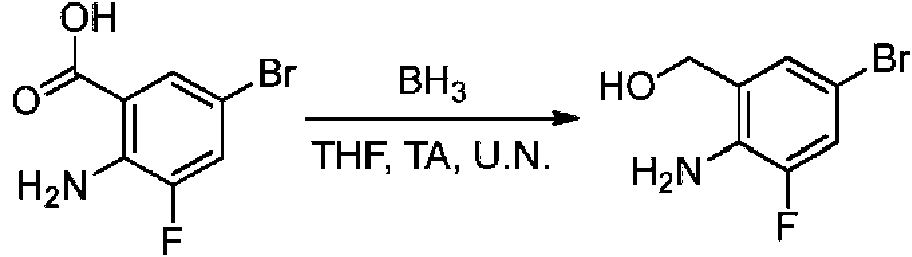
A una solución de ácido 2-amino-5-bromo-3-fluorobenzoico (14,5 g, 62,2 mmol) en THF (150 ml) a 0 °C se le añadió borohidruro en THF (1 M, 310 ml), y la mezcla de reacción se agitó a temperatura ambiente durante una noche. La reacción se inactivó con metanol (150 ml), se concentró al vacío, se diluyó con bicarbonato de sodio acuoso (400 ml) y se extrajo con acetato de etilo (200 ml*3). Las capas orgánicas se separaron, se combinaron, se lavaron con agua ( 2 0 0 ml) y salmuera ( 2 0 0 ml), se secaron sobre sulfato de sodio, se filtraron y se concentraron, obteniéndose el compuesto del título (13,0 g, en bruto), que se usó directamente en la etapa siguiente sin purificación adicional. EM (EN+) CyHyBrFNO requiere: 219, 221, encontrado: 220, 222 [M H]+.To a solution of 2-amino-5-bromo-3-fluorobenzoic acid (14.5 g, 62.2 mmol) in THF (150 mL) at 0 °C was added borohydride in THF (1 M, 310 mL) , and the reaction mixture was stirred at room temperature overnight. The reaction was quenched with methanol (150 mL), concentrated in vacuo, diluted with aqueous sodium bicarbonate (400 mL) and extracted with ethyl acetate (200 mL*3). The organic layers were separated, combined, washed with water (200 mL), brine ( 200 mL), dried over sodium sulfate, filtered, and concentrated to give the title compound (13.0 g, crude), which was used directly in the next step without further purification. MS (EN+) CyHyBrFNO requires: 219, 221, found: 220, 222 [MH]+.
Etapa 11: Síntesis de 2-amino-5-bromo-3-fluorobenzaldehídoStep 11: Synthesis of 2-amino-5-bromo-3-fluorobenzaldehyde

Una mezcla de (2-amino-5-bromo-3-fluorofenil)metanol (13 g, 59,4 mmol) y óxido de manganeso (31 g, 356,4 mmol) en diclorometano (400 ml) se agitó a temperatura ambiente durante una noche. El sólido se eliminó por filtración y se concentró el filtrado, obteniéndose el compuesto del título (11 g, 85 %) en forma de un sólido de color amarillo claro, que se usó directamente en la siguiente etapa sin purificación adicional.A mixture of (2-amino-5-bromo-3-fluorophenyl)methanol (13 g, 59.4 mmol) and manganese oxide (31 g, 356.4 mmol) in dichloromethane (400 mL) was stirred at room temperature. for one night. The solid was filtered off and the filtrate was concentrated to give the title compound (11 g, 85%) as a pale yellow solid, which was used directly in the next step without further purification.
Etapa 12: Síntesis de 6-bromo-8-fluoroquinazolin-2-olStep 12: Synthesis of 6-bromo-8-fluoroquinazolin-2-ol

Una mezcla en agitación de 2-amino-5-bromo-3-fluorobenzaldehído (2,17 g, 10 mmol) y urea (9 g, 150 mmol) se calentó a 180 °C durante 2 horas. La mezcla de reacción se enfrió a temperatura ambiente, y el precipitado resultante se filtró y se lavó con agua (500 ml *3). La humedad atrapada se eliminó por completo mediante coevaporación con tolueno tres veces. El compuesto del título (2 g, 83 %) se obtuvo en forma de un sólido de color amarillo. EM (EN+) CsH4BrFN2O requiere: 242, 244, encontrado: 243, 245 [M H]+.A stirred mixture of 2-amino-5-bromo-3-fluorobenzaldehyde (2.17 g, 10 mmol) and urea (9 g, 150 mmol) was heated at 180 °C for 2 hours. The reaction mixture was cooled to room temperature, and the resulting precipitate was filtered off and washed with water (500 ml *3). Entrapped moisture was completely removed by coevaporation with toluene three times. The title compound (2g, 83%) was obtained as a yellow solid. MS (EN+) CsH 4 BrFN 2 O requires: 242, 244, found: 243, 245 [MH]+.
Etapa 13: Síntesis de 6-bromo-2-cloroquinazolina Step 13: Synthesis of 6-bromo-2-chloroquinazoline

Una solución de 6-bromoquinazolin-2-ol (9,72 g, 40 mmol) en oxicloruro fosforoso (100 ml) se sometió a reflujo durante 5 horas. La reacción se enfrió hasta temperatura ambiente y se eliminó la mayoría del oxicloruro fosforoso a presión reducida. El residuo se añadió gota a gota a hielo-agua (500 ml), y el precipitado resultante se recogió por filtración, obteniéndose el compuesto del título (9 g, 87 %) en forma de un sólido de color amarillo. EM (EN+) CsH3BrClFN2 requiere: 260, 262, encontrado: 261 , 2 6 3 [M H]+.A solution of 6-bromoquinazolin-2-ol (9.72 g, 40 mmol) in phosphorous oxychloride (100 mL) was refluxed for 5 hours. The reaction was cooled to room temperature and most of the phosphorous oxychloride was removed under reduced pressure. The residue was added dropwise to ice-water (500 mL), and the resulting precipitate was collected by filtration to give the title compound (9 g, 87%) as a yellow solid. MS (EN+) CsH 3 BrClFN 2 requires: 260, 262, found: 261 , 2 6 3 [MH]+.
Etapa 14: Síntesis de 2-cloro-6-(3,5-dimetoxifenil)-8-fluoroquinazolinaStep 14: Synthesis of 2-chloro-6-(3,5-dimethoxyphenyl)-8-fluoroquinazoline

Una mezcla de 6-bromo-2-cloro-8-fluoroquinazolina (4,0 g, 15,4 mmol), ácido 3,5-dimetoxifenilborónico (4,47 g, 16,9 mmol), carbonato de cesio (10,0 g, 30,8 mmol) y Pd(PPh3)2Ch (236 mg, 0,77 mmol) en THF (200 ml) y agua (10 ml) se desgasificó con nitrógeno tres veces, y se agitó a 80 °C durante 3 horas. La mezcla de reacción se enfrió a temperatura ambiente y se concentró directamente. El residuo se purificó mediante cromatografía de gel de sílice (éter de petróleo:diclorometano = 2:1 a 1:1), obteniéndose el compuesto del título (2,5 g, 51 %) en forma de un sólido de color amarillo. EM (EN+) C16H12CFN 2O2 requiere: 318/320, encontrado: 319/321 [M H]+.A mixture of 6-bromo-2-chloro-8-fluoroquinazoline (4.0 g, 15.4 mmol), 3,5-dimethoxyphenylboronic acid (4.47 g, 16.9 mmol), cesium carbonate (10, 0 g, 30.8 mmol) and Pd(PPh 3 ) 2 Ch (236 mg, 0.77 mmol) in THF (200 mL) and water (10 mL) was degassed with nitrogen three times, and stirred at 80 °C. C for 3 hours. The reaction mixture was cooled to room temperature and directly concentrated. The residue was purified by silica gel chromatography (petroleum ether:dichloromethane = 2:1 to 1:1) to give the title compound (2.5 g, 51%) as a yellow solid. MS (EN+) C 16 H 12 CFN 2 O 2 requires: 318/320, found: 319/321 [MH]+.
Etapa 15: Síntesis de 2-cloro-6-(2,6-dicloro-3,5-dimetoxifenil)-8-fluoroquinazolinaStep 15: Synthesis of 2-chloro-6-(2,6-dichloro-3,5-dimethoxyphenyl)-8-fluoroquinazoline

A una solución de 2-cloro-6-(3,5-dimetoxifenil)-8-fluoroquinazolina (1,5 g, 4,7 mmol) en THF seco (40 ml) se le añadió gota a gota cloruro de sulfurilo (1,59 g, 1,75 mmol) a 0 °C, y la mezcla se agitó durante 1 hora. La reacción se inactivó con agua (1 ml), y los disolventes se eliminaron a presión reducida. El residuo se lavó con acetonitrilo y se secó, obteniéndose el compuesto del título (700 mg, 38 %) en forma de un sólido de color blanco. (EM (EN+) C16H-i0Cl3FN2O2 requiere: 386, 388, encontrado: 387, 389 [M H]+.Sulfuryl chloride (1 0.59 g, 1.75 mmol) at 0 °C, and the mixture was stirred for 1 hour. The reaction was quenched with water (1 mL) and the solvents removed under reduced pressure. The residue was washed with acetonitrile and dried to give the title compound (700mg, 38%) as a white solid. (MS (ES+) C 16 Hi 0 Cl 3 FN 2 O 2 requires: 386, 388, found: 387, 389 [MH]+.
Síntesis de 2-cloro-6-(2.6-d¡cloro-3.5-d¡metoxifen¡l)-5-fluoroqu¡nazol¡naSynthesis of 2-chloro-6-(2.6-dichloro-3.5-dimethoxyphenyl)-5-fluoroquinazolin

Etapa 1: Síntesis de ácido 6-amino-3-bromo-2-fluorobenzoicoStep 1: Synthesis of 6-amino-3-bromo-2-fluorobenzoic acid
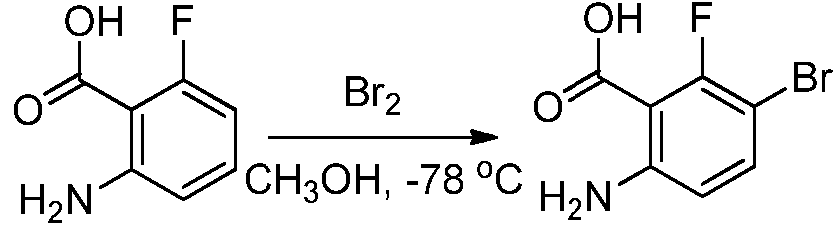
A una solución de ácido 2-amino-6-fluorobenzoico (12,0 g, 77,35 mmol) en metanol (150 ml) se le añadió bromo (15,7 ml) a -78 °C, y la mezcla se agitó 2 horas a -78 °C. La mezcla de reacción se inactivó con hielo-agua (100 ml) y solución acuosa de sulfotioato de sodio, y se extrajo con acetato de etilo (150 ml * 3). Las capas orgánicas se separaron, se combinaron, se lavaron con agua ( 1 0 0 ml) y salmuera ( 1 0 0 ml), se secaron sobre sulfato de sodio, se filtraron y se concentraron, obteniéndose el producto del título en bruto (9,0 g, 50 %). EM (EN+) CyHsBrFNO2 requiere: 232, encontrado: 233, 235 [M H]+.To a solution of 2-amino-6-fluorobenzoic acid (12.0 g, 77.35 mmol) in methanol (150 mL) was added bromine (15.7 mL) at -78 °C, and the mixture was stirred. 2 hours at -78°C. The reaction mixture was quenched with ice-water (100 ml) and sodium sulfothioate aqueous solution, and extracted with ethyl acetate (150 ml * 3). The organic layers were separated, combined, washed with water (100 mL), brine ( 100 mL), dried over sodium sulfate, filtered, and concentrated to give crude title product (9 .0g, 50%). MS (EN+) CyHsBrFNO 2 requires: 232, found: 233, 235 [MH]+.
Etapa 2: Síntesis de (6-amino-3-bromo-2-fluorofenil)metanolStep 2: Synthesis of (6-amino-3-bromo-2-fluorophenyl)methanol

A una solución de ácido 6-amino-3-bromo-2-fluorobenzoico (9,0 g, 38,46 mmol) en THF (150 ml) se le añadió BH3-THF (1 M, 193 ml) a 0 °C, y la mezcla se agitó a temperatura ambiente durante una noche. La reacción se inactivó lentamente con metanol (50 ml), y los disolventes se eliminaron a presión reducida. El residuo se diluyó con 200 ml de acetato de etilo, se lavó con agua ( 2 0 0 ml) y salmuera ( 2 0 0 ml), se secó sobre sulfato de sodio, se filtró y se concentró, obteniéndose el producto del título (8,3 g, 98 %), que se usó directamente en la siguiente etapa sin purificación adicional. EM (e N+) CzHzBrFNO requiere: 219, encontrado: 2 2 0 , 2 2 2 [M H]+.To a solution of 6-amino-3-bromo-2-fluorobenzoic acid (9.0 g, 38.46 mmol) in THF (150 mL) was added BH 3 -THF (1 M, 193 mL) at 0 ° C, and the mixture was stirred at room temperature overnight. The reaction was slowly quenched with methanol (50 mL) and the solvents removed under reduced pressure. The residue was diluted with 200 mL of ethyl acetate, washed with water ( 200 mL), brine ( 200 mL), dried over sodium sulfate, filtered, and concentrated to give the title product ( 8.3 g, 98%), which was used directly in the next step without further purification. MS (e N+) CzHzBrFNO requires: 219, found: 2 2 0 , 2 2 2 [MH]+.
Etapa 3: Síntesis de 6-amino-3-bromo-2-fluorobenzaldehídoStep 3: Synthesis of 6-amino-3-bromo-2-fluorobenzaldehyde

Una mezcla en suspensión de (6-amino-3-bromo-2-fluorofenil)metanol (8,3 g, 37,72 mmol) y óxido de manganeso(IV) (19,68 g, 226,32 mmol) en diclorometano (400 ml) se agitó a temperatura ambiente durante una noche. El sólido se retiró por filtración, y se concentró el filtrado, obteniéndose el producto del título en forma de un sólido de color amarillo claro (6,0 g, 73 %), que se usó directamente en la siguiente etapa sin purificación adicional. EM (EN+) CzHsBrFNO requiere: 217, encontrado: 218, 220 [M H]+.A suspension mixture of (6-amino-3-bromo-2-fluorophenyl)methanol (8.3 g, 37.72 mmol) and manganese(IV) oxide (19.68 g, 226.32 mmol) in dichloromethane (400 mL) was stirred at room temperature overnight. The solid was filtered off, and the filtrate was concentrated to give the title product as a pale yellow solid (6.0 g, 73%), which was used directly in the next step without further purification. MS (EN+) CzHsBrFNO requires: 217, found: 218, 220 [MH]+.
Etapa 4: Síntesis de 6-bromo-5-fluoroquinazolin-2-olStep 4: Synthesis of 6-bromo-5-fluoroquinazolin-2-ol

Una mezcla de 6-amino-3-bromo-2-fluorobenzaldehído (3,0 g, 13,76 mmol) y urea (12,40 g, 206,40 mmol) se calentó a 180 °C y se agitó durante 2 horas. La mezcla de reacción se enfrió a temperatura ambiente. El precipitado resultante se recogió, se lavó con agua (3 * 100 ml) y se coevaporó con tolueno tres veces para eliminar completamente la humedad atrapada. El compuesto del título (3,3 g, 99 %) se obtuvo en forma de un sólido de color amarillo. EM (EN+) CsH4BrFN2O requiere: 242, encontrado: 243, 245 [M H]+.A mixture of 6-amino-3-bromo-2-fluorobenzaldehyde (3.0 g, 13.76 mmol) and urea (12.40 g, 206.40 mmol) was heated to 180 °C and stirred for 2 hours. . The reaction mixture was cooled to room temperature. The resulting precipitate was collected, washed with water (3*100 mL) and coevaporated with toluene three times to completely remove trapped moisture. The title compound (3.3 g, 99%) was obtained as a yellow solid. MS (EN+) CsH 4 BrFN 2 O requires: 242, found: 243, 245 [MH]+.
Etapa 5: Síntesis de 6-bromo-2-cloro-5-fluoroquinazolina Step 5: Synthesis of 6-bromo-2-chloro-5-fluoroquinazoline

Una solución de 6-bromo-5-fluoroquinazolin-2-ol (3,0 g, 12,34 mmol) en tricloruro de fosforilo (10 ml) se sometió a reflujo a 135 °C durante 5 horas. La mayor parte del tricloruro de fosforilo se eliminó a presión reducida y el residuo se añadió gota a gota a agua-hielo (200 ml). El precipitado resultante se recogió mediante filtración en forma de un sólido de color amarillo (3,1 g, 96 %). EM (EN+) C8H3BrClFN2 requiere: 260, encontrado: 261, 263 [M H]+.A solution of 6-bromo-5-fluoroquinazolin-2-ol (3.0 g, 12.34 mmol) in phosphoryl trichloride (10 mL) was refluxed at 135 °C for 5 hours. Most of the phosphoryl trichloride was removed under reduced pressure and the residue was added dropwise to ice-water (200 mL). The resulting precipitate was collected by filtration as a yellow solid (3.1 g, 96%). MS (ES+) C 8 H 3 BrClFN 2 requires: 260, found: 261, 263 [MH]+.
Etapa 6: Síntesis de 2-cloro-6-(3,5-dimetoxifenil)-5-fluoroquinazolinaStep 6: Synthesis of 2-chloro-6-(3,5-dimethoxyphenyl)-5-fluoroquinazoline

Una mezcla de 6-bromo-2-cloro-5-fluoroquinazolina (1,5 g, 5,74 mmol), ácido 3,5-dimetoxifenilborónico (1,15 g, 6,31 mmol), carbonato de cerio (1,87 g, 5,74 mmol) y bis(tri-ferc-butilfosfina)paladio (148 mg, 0,29 mmol) en THF (30 ml) y agua (3 ml) se desgasificó con nitrógeno tres veces y se agitó a 80 °C durante una noche. La mezcla se enfrió a temperatura ambiente y se extrajo con acetato de etilo (3 * 200 ml). Las capas orgánicas combinadas se lavaron con agua y salmuera, se secaron sobre sulfato de sodio, se filtraron y se concentraron. El residuo se purificó mediante cromatografía de gel de sílice (éter de petróleo:acetato de etilo = 8:1) obteniéndose el producto del título en forma de un sólido de color blanco (1,3 g, 70 %). EM (EN+) C16H12CFN 2O2 requiere: 318, encontrado: 319, 321 [M H]+.A mixture of 6-bromo-2-chloro-5-fluoroquinazoline (1.5 g, 5.74 mmol), 3,5-dimethoxyphenylboronic acid (1.15 g, 6.31 mmol), cerium carbonate (1, 87 g, 5.74 mmol) and bis(tri-fert-butylphosphine)palladium (148 mg, 0.29 mmol) in THF (30 mL) and water (3 mL) was degassed with nitrogen three times and stirred at 80 °C overnight. The mixture was cooled to room temperature and extracted with ethyl acetate (3*200 ml). The combined organic layers were washed with water and brine, dried over sodium sulfate, filtered, and concentrated. The residue was purified by silica gel chromatography (petroleum ether:ethyl acetate = 8:1) to give the title product as a white solid (1.3 g, 70%). MS (ES+) C 16 H 12 CFN 2 O 2 requires: 318, found: 319, 321 [MH]+.
Etapa 7: Síntesis de 2-cloro-6-(2,6-dicloro-3,5-dimetoxifenil)-5-fluoroquinazolinaStep 7: Synthesis of 2-chloro-6-(2,6-dichloro-3,5-dimethoxyphenyl)-5-fluoroquinazoline

A una solución de 2-cloro-6-(3,5-dimetoxifenil)-5-fluoroquinazolina (1,25 g, 3,92 mmol) en acetonitrilo seco/THF (20 ml/10 ml) se le añadió gota a gota cloruro de sulfurilo (1,32 g, 9,80 mmol) a -20 °C, y la mezcla se agitó durante 1 hora. La reacción se inactivó con agua (1 ml), y los disolventes se eliminaron a presión reducida. El precipitado se lavó con acetonitrilo y se secó, obteniéndose el producto del título (886,5 mg, 56 %) en forma de un sólido de color blanco. EM (EN+) C16H1üCl3FN2O2 requiere: 386, encontrado: 387, 389 [M H]+.To a solution of 2-chloro-6-(3,5-dimethoxyphenyl)-5-fluoroquinazoline (1.25 g, 3.92 mmol) in dry acetonitrile/THF (20 mL/10 mL) was added dropwise sulfuryl chloride (1.32 g, 9.80 mmol) at -20 °C, and the mixture was stirred for 1 hour. The reaction was quenched with water (1 mL) and the solvents removed under reduced pressure. The precipitate was washed with acetonitrile and dried to give the title product (886.5 mg, 56%) as a white solid. MS (EN+) C 16 H 1 üCl 3 FN 2 O 2 requires: 386, found: 387, 389 [MH]+.
Síntesis de 2-cloro-6-(2.6-d¡cloro-3.5-d¡metoxifen¡l)-7-metox¡qu¡nazol¡na Synthesis of 2-chloro-6-(2.6-dichloro-3.5-dimethoxyphenyl)-7-methoxyquinazolin

Etapa 1: Síntesis de (2-amino-4-metoxifenil)metanolStep 1: Synthesis of (2-amino-4-methoxyphenyl)methanol

A una solución de acido 2-amino-4-metoxibenzoico (15,0 g, 89,8 mmol) en THF (300 ml) se le anadio borohidruro en THF (450 ml, 450 mmol) a 0 °C, y la mezcla de reacción se agitó a temperatura ambiente durante una noche. La reacción se inactivo con agua (150 ml) y se extrajo con acetato de etilo (500 ml * 3). Las capas orgánicas se separaron, se combinaron, se lavaron con agua (200 ml) y salmuera (200 ml), se secaron sobre sulfato de sodio, se filtraron y se concentraron, obteniéndose el compuesto del título. EM (EN+) C8H11NO2 requiere: 153, encontrado: 154 [M H]+. To a solution of 2-amino-4-methoxybenzoic acid (15.0 g, 89.8 mmol) in THF (300 mL) was added borohydride in THF (450 mL, 450 mmol) at 0 °C, and the mixture reaction mixture was stirred at room temperature overnight. The reaction was quenched with water (150 mL) and extracted with ethyl acetate (500 mL*3). The organic layers were separated, combined, washed with water (200 mL), brine (200 mL), dried over sodium sulfate, filtered, and concentrated to give the title compound. MS (EN+) C 8 H 11 NO 2 requires: 153, found: 154 [MH]+.
Etapa 2: Síntesis de 2-amino-4-metoxibenzaldehídoStep 2: Synthesis of 2-amino-4-methoxybenzaldehyde

Una mezcla de (2-amino-4-metoxifenil)metanol (20 g, 131,0 mmol) y óxido de manganeso ( 6 8 g, 786,0 mmol) en diclorometano (300 ml) se agitó a temperatura ambiente durante una noche. El sólido se retiró por filtración y se concentró el filtrado. El residuo se purificó mediante cromatografía de gel de sílice (éter de petróleo:acetato de etilo = 6:1) obteniéndose el compuesto del título (7 g, 35 %) en forma de un sólido de color amarillo. EM (EN+) C8H9NO2 requiere: 151, encontrado: 152 [M H]+.A mixture of (2-amino-4-methoxyphenyl)methanol (20 g, 131.0 mmol) and manganese oxide ( 68 g, 786.0 mmol) in dichloromethane (300 mL) was stirred at room temperature overnight. . The solid was filtered off and the filtrate was concentrated. The residue was purified by silica gel chromatography (petroleum ether:ethyl acetate = 6:1) to obtain the title compound (7 g, 35%) as a yellow solid. MS (EN+) C 8 H 9 NO 2 requires: 151, found: 152 [MH]+.
Etapa 3: Síntesis de 2-amino-5-bromo-4-metoxibenzaldehídoStep 3: Synthesis of 2-amino-5-bromo-4-methoxybenzaldehyde

A una solución en agitación de 2-amino-4-metoxibenzaldehido (6 g, 39,7 mmol) en diclorometano (100 ml) se le anadió N-bromosuccinimida (7 g, 39,7 mmol). La mezcla de reacción se diluyó con diclorometano y agua. La capa orgánica separada se secó sobre sulfato de sodio, se filtró y se concentró, obteniéndose el compuesto del título (5 g, 56 %) en forma de un sólido de color amarillo. EM (EN+) C8H8BrNO2 requiere: 229, 231, encontrado: 230, 232 [M H]+. To a stirring solution of 2-amino-4-methoxybenzaldehyde (6 g, 39.7 mmol) in dichloromethane (100 mL) was added N-bromosuccinimide (7 g, 39.7 mmol). The reaction mixture was diluted with dichloromethane and water. The separated organic layer was dried over sodium sulfate, filtered and concentrated to give the title compound (5 g, 56%) as a yellow solid. MS (EN+) C 8 H 8 BrNO 2 requires: 229, 231, found: 230, 232 [MH]+.
Etapa 4: Síntesis de 6-bromo-7-metoxiquinazolin-2-olStep 4: Synthesis of 6-bromo-7-methoxyquinazolin-2-ol

Una mezcla de 2-amino-5-bromo-4-metoxibenzaldehído (3 g, 13,1 mmol) y urea (12 g, 196,5 mmol) se agitó a 180 °C durante 2 horas. La mezcla de reacción se enfrió a temperatura ambiente y se lavó con agua (3 * 100 ml). El precipitado se recogió y se secó, obteniéndose el compuesto del título (3 g, en bruto) en forma de un sólido de color amarillo. EM (EN+) CsH7BrN2O2 requiere: 254, 256, encontrado: 255, 257 [M H]+.A mixture of 2-amino-5-bromo-4-methoxybenzaldehyde (3 g, 13.1 mmol) and urea (12 g, 196.5 mmol) was stirred at 180 °C for 2 hours. The reaction mixture was cooled to room temperature and washed with water (3*100 mL). The precipitate was collected and dried to give the title compound (3 g crude) as a yellow solid. MS (EN+) CsH 7 BrN 2 O 2 requires: 254, 256, found: 255, 257 [MH]+.
Etapa 5: Síntesis de 6-bromo-2-cloro-7-metoxiquinazolinaStep 5: Synthesis of 6-bromo-2-chloro-7-methoxyquinazoline

A una solución de 6-bromo-7-metoxiquinazolin-2-ol (3,0 g, 11,8 mmol) en tricloruro de fosforilo (30 ml) se sometió a reflujo a 130 °C durante 5 horas. La reacción se enfrió a temperatura ambiente, y se evaporó la mayor parte del tricloruro de fosforilo. El residuo se añadió gota a gota a hielo-agua (100 ml), y el precipitado resultante se recogió por filtración, obteniéndose el compuesto del título en forma de un sólido de color amarillo (2,4 g, 75 %). EM (EN+) CgHaBrClN2O requiere: 272, 274, encontrado: 273, 275 [M H]+.A solution of 6-bromo-7-methoxyquinazolin-2-ol (3.0 g, 11.8 mmol) in phosphoryl trichloride (30 mL) was refluxed at 130 °C for 5 hours. The reaction was cooled to room temperature, and most of the phosphoryl trichloride was evaporated. The residue was added dropwise to ice-water (100 mL), and the resulting precipitate was collected by filtration to give the title compound as a yellow solid (2.4 g, 75%). MS (ES+) CgHaBrClN 2 O requires: 272, 274, found: 273, 275 [MH]+.
Etapa 6 : Síntesis de 2-cloro-6-(3,5-dimetoxifenil)-7-metoxiquinazolinaStep 6 : Synthesis of 2-chloro-6-(3,5-dimethoxyphenyl)-7-methoxyquinazoline

Una mezcla de 6-bromo-2-cloro-7-metoxiquinazolina (2,4 g, 8,82 mmol), ácido 3,5-dimetoxifenilborónico (1,6 g, 8,82 mmol), carbonato de cerio (8 , 6 g, 26,46 mmol) y Pd(PPh3)2Ch (1,4 g, 2,1 mmol) en THF (10 ml), dioxano (10 ml) y agua (2 ml) se desgasificó con nitrógeno tres veces y se agitó a 85 °C durante 3 horas. La mezcla se enfrió a temperatura ambiente y se extrajo con diclorometano (3 * 50 ml). Las capas orgánicas se separaron, se combinaron, se lavaron con agua y salmuera, se secaron sobre sulfato de sodio, se filtraron y se concentraron. El residuo se purificó mediante cromatografía de gel de sílice (éter de petróleo: acetato de etilo = 1:4) obteniéndose el compuesto del título (1,1 g, 38 %) en forma de un sólido de color blanco. EM (EN+) C17H15ClN2O3 requiere: 330, 332, encontrado: 331, 333 [M H]+.A mixture of 6-bromo-2-chloro-7-methoxyquinazoline (2.4 g, 8.82 mmol), 3,5-dimethoxyphenylboronic acid (1.6 g, 8.82 mmol), cerium carbonate ( 8, 6 g, 26.46 mmol) and Pd(PPh 3 ) 2 Ch (1.4 g, 2.1 mmol) in THF (10 mL), dioxane (10 mL), and water (2 mL) was degassed with nitrogen three times and stirred at 85 °C for 3 hours. The mixture was cooled to room temperature and extracted with dichloromethane (3*50 ml). The organic layers were separated, combined, washed with water and brine, dried over sodium sulfate, filtered, and concentrated. The residue was purified by silica gel chromatography (petroleum ether:ethyl acetate = 1:4) to obtain the title compound (1.1 g, 38%) as a white solid. MS (ES+) C 17 H 15 ClN 2 O 3 requires: 330, 332, found: 331, 333 [MH]+.
Etapa 7: Síntesis de 2-cloro-6-(2,6-dicloro-3,5-dimetoxifenil)-7-metoxiquinazolinaStep 7: Synthesis of 2-chloro-6-(2,6-dichloro-3,5-dimethoxyphenyl)-7-methoxyquinazoline

A una solución de 2-cloro-6-(3,5-dimetoxifenil)-7-metoxiquinazolina (200 mg, 0,61 mmol) en acetonitrilo (5 ml) se le añadió cloruro de sulfurilo (205 mg, 1,52 mmol), y la mezcla se agitó a -20 °C durante 1 hora. La reacción se inactivó con agua (1 ml) y se concentró a presión reducida. El precipitado se lavó con acetonitrilo y se secó, obteniéndose el compuesto del título en forma de un sólido de color blanco (120 mg, 50 %). EM (EN+) C17H13Cl3N2O3 requiere: 398, encontrado: 399, 401 [M+H]+. To a solution of 2-chloro-6-(3,5-dimethoxyphenyl)-7-methoxyquinazoline (200 mg, 0.61 mmol) in acetonitrile (5 mL) was added sulfuryl chloride (205 mg, 1.52 mmol ), and the mixture was stirred at -20 °C for 1 hour. The reaction was quenched with water (1 mL) and concentrated under reduced pressure. The precipitate was washed with acetonitrile and dried to give the title compound as a white solid (120mg, 50%). MS (ES+) C 17 H 13 Cl 3 N 2 O 3 requires: 398, found: 399, 401 [M+H]+.
En la tabla a continuación se muestran los datos de RMN y CL-EM de determinados compuestos. También se indica el protocolo sintético utilizado para preparar los compuestos.NMR and LC-MS data for selected compounds are shown in the table below. The synthetic protocol used to prepare the compounds is also indicated.

continuacióncontinuation

continuacióncontinuation

continuacióncontinuation

continuacióncontinuation

continuacióncontinuation

continuacióncontinuation

Evaluación de la actividad bioquímicaEvaluation of biochemical activity
Para evaluar la actividad de los compuestos químicos contra la cinasa relevante de interés, se utiliza la plataforma tecnológica de cambio de movilidad electroforética de Caliper LifeSciences. El péptido de sustrato marcado con fluorescencia se incuba en presencia de los niveles dosificados de los compuestos, una concentración determinada de cinasa y de ATP, para que una proporción respectiva del péptido se fosforile. Al final de la reacción, la mezcla de péptidos fosforilados (producto) y no fosforilados (sustrato) se hace pasar por el sistema de microfluidos Caliper LabChip® EZ Reader II, con una diferencia de potencial aplicada. La presencia del grupo fosfato en el péptido producto proporciona una diferencia de masa y carga entre el péptido producto y el péptido sustrato, lo que resulta en una separación de los grupos de sustrato y producto en la muestra. A medida que los grupos pasan los LED dentro del instrumento, estos grupos se detectan y se resuelven como picos separados. La relación entre estos picos refleja, por tanto, la actividad de la materia química a esa concentración en ese pocillo, en esas condiciones.To assess the activity of chemical compounds against the relevant kinase of interest, the Caliper LifeSciences electrophoretic mobility shift technology platform is used. The fluorescently labeled substrate peptide is incubated in the presence of dosed levels of the compounds, a given concentration of kinase and ATP, so that a respective proportion of the peptide is phosphorylated. At the end of the reaction, the mixture of phosphorylated (product) and non-phosphorylated (substrate) peptides is passed through the Caliper LabChip® EZ Reader II microfluidic system, with a potential difference applied. The presence of the phosphate group in the product peptide provides a difference in mass and charge between the product peptide and the substrate peptide, resulting in a separation of the substrate and product groups in the sample. As the clusters pass the LEDs within the instrument, these clusters are detected and resolved as separate peaks. The relationship between these peaks therefore reflects the activity of the chemical at that concentration in that well, under those conditions.
Ensayo de FGFR-4 de tipo silvestre en Km: En cada pocillo de una placa de 384 pocillos, se incubaron 0,5 ng/ul de FGFR-4 de tipo silvestre (Carna Biosciences, Inc.) en un total de 12,5 ul de tampón (HEPES 100 mM a pH 7,5, Brij 35 al 0,015 %, MgCl210 mM, DTT 1 mM) con CSKtide 1 uM (5 -FAM-KKKEEIYFFFG-NH2) y ATP 400 uM a 25 °C durante 90 minutos en presencia o ausencia de una serie de concentraciones dosificadas del compuesto (concentración final de DMSO al 1 %). La reacción se detuvo mediante la adición de 70 ul de tampón de parada (HEPES 100 mM a pH 7,5, Brij 35 al 0,015 %, EDTA 35 mM y un 0,2 % de reactivo de recubrimiento 3 (Caliper Lifesciences)). A continuación, la placa se leyó en un Caliper LabChip® EZ Reader II (parámetros del protocolo: -13,1 kPa (-1,9 psi), tensión ascendente -700, tensión descendente -3000, muestra posterior 35 s).Km Wild-Type FGFR-4 Assay: In each well of a 384-well plate, 0.5 ng/ul of wild-type FGFR-4 (Carna Biosciences, Inc.) was incubated for a total of 12.5 ul of buffer (100 mM HEPES pH 7.5, 0.015% Brij 35, 10 mM MgCl 2 , 1 mM DTT) with 1 uM CSKtide ( 5 -FAM-KKKEEIYFFFG-NH 2 ) and 400 uM ATP at 25 °C for 90 minutes in the presence or absence of a series of dosed concentrations of the compound (1% DMSO final concentration). The reaction was stopped by the addition of 70 ul stop buffer (100 mM HEPES pH 7.5, 0.015% Brij 35, 35 mM EDTA, and 0.2% Coating Reagent 3 (Caliper Lifesciences)). Next, the plate was read on a Caliper LabChip® EZ Reader II (protocol parameters: -13.1 kPa (-1.9 psi), rising strain -700, falling strain -3000, post sample 35 s).
Detección pMAPK (Thr202/Tyr204) mediante Alpha ElisapMAPK (Thr202/Tyr204) detection by Alpha Elisa
Se sembraron células MDA-MB453 o DMS 114 en placas de cultivo celular de 96 pocillos a una densidad de 1 x 10⁵ células o 3 x 10⁴ células, respectivamente. Se dejó que se uniesen las células y el medio de crecimiento se reemplazó por medio sin suero. Los compuestos se añadieron a las concentraciones indicadas. Después de 1 h de incubación en presencia del compuesto, se recogieron las células. Para las células DMS 114, se añadieron 100 ng/ml de FGF2 durante 10 min antes de la recogida de las células. Los lisados celulares se prepararon y procesaron de acuerdo con las instrucciones del fabricante (kit AlphaScreen® SureFire™ Phospho-ERK 1/2 (Perkin Elmer).MDA-MB453 or DMS 114 cells were seeded in 96-well cell culture plates at a density of 1 x 10 5 cells or 3 x 10 4 cells, respectively. Cells were allowed to attach and the growth medium was replaced with serum-free medium. Compounds were added at the indicated concentrations. After 1 h of incubation in the presence of the compound, the cells were harvested. For DMS 114 cells, 100 ng/ml FGF2 was added for 10 min prior to cell harvest. Cell lysates were prepared and processed according to the manufacturer's instructions (AlphaScreen® SureFire™ Phospho-ERK 1/2 kit (Perkin Elmer).
La tabla a continuación resume los datos bioquímicos de los compuestos 1-92. En la siguiente tabla, para el Alpha Lisa de FGFR4 y pERK: "A" significa que la CI50 es inferior a 10 nM; "B" significa que la CI50 es mayor o igual a 10 y menor que 100 nM; "C" significa que la CI50 es mayor o igual que 100 y menor que 1000 nM; "D" significa que la CI50 es mayor que 1000 nM.The table below summarizes the biochemical data for compounds 1-92. In the following table, for the Alpha Lisa of FGFR4 and pERK: "A" means that the IC 50 is less than 10 nM; "B" means that the IC 50 is greater than or equal to 10 and less than 100 nM; "C" means that the IC 50 is greater than or equal to 100 and less than 1000 nM; "D" means that the IC 50 is greater than 1000 nM.

continuacióncontinuation

Eficacia en un modelo in vivo Efficacy in an in vivo model
Se estudiaron los efectos del compuesto 27 en la inhibición del crecimiento tumoral en el modelo de xenoinjerto subcutáneo de células de cáncer hepático Hep3B con diferentes dosis.The effects of compound 27 on the inhibition of tumor growth in the subcutaneous xenograft model of Hep3B liver cancer cells were studied at different doses.
Se usaron ratones desnudos (Mus musculus) hembra con una edad de 6 a 8 semanas. Cultivo e inoculación de células tumorales: Se cultivaron células Hep3B con medio EMEM (Invitrogen, EE. UU.) complementado con FBS al 10% (Gibco, Australia). Las células se recolectaron cuando alcanzaron una confluencia del 90% y la viabilidad no era inferior al 90 %. Se implantaron en los ratones por vía subcutánea (s.c.) 200 pl de 10 * 106 células Hep3B en matrigel al 50 % en el costado izquierdo al comienzo del estudio.Female nude mice ( Mus musculus) aged 6 to 8 weeks were used. Tumor cell culture and inoculation: Hep3B cells were cultured with EMEM medium (Invitrogen, USA) supplemented with 10% FBS (Gibco, Australia). Cells were harvested when they reached 90% confluency and viability was not less than 90%. Mice were implanted subcutaneously (sc) with 200 pl of 10*10 6 Hep3B cells in 50% matrigel on the left flank at the start of the study.
Agrupamiento de los animales y pauta posológica: Diez días después de implantar las células, cuando los tumores alcanzaron un tamaño promedio de 284 mm3, se seleccionaron 36 ratones en función del volumen tumoral y se les asignó a 5 grupos de tratamiento (n = 9). El día de la aleatorización se indicó como día 0 y el tratamiento comenzó a partir de ese momento.Animal grouping and dosage regimen: Ten days after cell implantation, when tumors reached an average size of 284 mm3, 36 mice were selected based on tumor volume and assigned to 5 treatment groups (n = 9). The day of randomization was indicated as day 0 and treatment began from that time.
Mediciones del volumen tumoral y del peso corporal: El tamaño tumoral se midió dos veces a la semana en dos dimensiones utilizando un calibre y el volumen se expresó en mm3 utilizando la fórmula: V = 0,5 a x b2, donde a y b eran los diámetros mayor y menor del tumor, respectivamente. El peso corporal se midió al menos dos veces a la semana.Tumor volume and body weight measurements: Tumor size was measured twice weekly in two dimensions using a caliper and volume was expressed in mm3 using the formula: V = 0.5a x b2, where a and b were the largest diameters. and minor of the tumor, respectively. Body weight was measured at least twice a week.
Volúmenes tumorales de los ratones desnudos portadores de Hep3B: La Fig. 1 es una gráfica de líneas que ilustra la inhibición del crecimiento de los grupos tratados con el compuesto 27 frente a los tumores por xenoinjerto de Hep3B en ratones desnudos. Se observó una reducción estadísticamente significativa de los volúmenes tumorales en los grupos de eficacia de 30 y 100 mg/kg PO BID en comparación con el grupo de vehículo. El aumento de la dosis del compuesto 27 potenció la eficacia de la inhibición tumoral. Los tumores en el grupo tratado con el compuesto 27 (100 mg/kg PO BID) remitieron.Tumor volumes of Hep3B-bearing nude mice: Fig. 1 is a line graph illustrating growth inhibition of Compound 27-treated groups versus Hep3B xenograft tumors in nude mice. A statistically significant reduction in tumor volumes was observed in the 30 and 100 mg/kg PO BID efficacy groups compared to the vehicle group. Increasing the dose of compound 27 enhanced the efficacy of tumor inhibition. Tumors in the compound 27 (100 mg/kg PO BID) treated group regressed.
Cambio de peso corporal (%) en ratones desnudos portadores de Hep3B: La Fig. 2 es una gráfica de líneas que representa el cambio del peso corporal (%) durante todo el periodo del estudio. Todos los ratones, excepto los ratones en los grupos tratados con el compuesto 27 (100 mg/kg PO BID) mostraron una pérdida significativa del peso corporal. El peso corporal de los ratones en el grupo de vehículo se redujo en aproximadamente un 15 % en el día 10 por la carga del tumor. Este resultado indica que el compuesto 27 se toleraba bien con las dosis y pautas posológicas actuales en ratones desnudos y que el compuesto 27 podría aliviar la pérdida de peso corporal mediante la inhibición del crecimiento tumoral.Body weight change (%) in Hep3B-bearing nude mice: Fig. 2 is a line graph depicting body weight change (%) over the entire study period. All mice except mice in the compound 27 (100 mg/kg PO BID) treated groups showed significant loss of body weight. Body weight of mice in the vehicle group was reduced by approximately 15% on day 10 by tumor burden. This result indicates that compound 27 was well tolerated at current doses and dosage schedules in nude mice and that compound 27 could alleviate body weight loss by inhibiting tumor growth.
Los ratones tratados con el compuesto 27 mostraron una reducción significativa del volumen tumoral, en comparación con el grupo de vehículo durante todo el estudio. El aumento de la dosis del compuesto 27 de 10 mg/kg a 100 mg/kg potenció la eficacia de la inhibición tumoral. Los tumores de los ratones en el grupo tratado con el compuesto 27 (100 mg/kg PO BID) remitieron y prácticamente desaparecieron. Todos los ratones, salvo aquellos tratados con el compuesto 27 (100 mg/kg PO BID) perdieron peso corporal. El peso corporal de los ratones en el grupo de vehículo se redujo en aproximadamente un 15% en el día 10 por la carga del tumor. Estos resultados indicaron que el compuesto 27 se toleraba bien con las dosis y pautas posológicas actuales en ratones desnudos y que el compuesto 27 podría aliviar la pérdida de peso corporal mediante la inhibición del crecimiento tumoral.Mice treated with compound 27 showed a significant reduction in tumor volume, compared to the vehicle group throughout the study. Increasing the dose of compound 27 from 10 mg/kg to 100 mg/kg enhanced the efficacy of tumor inhibition. The tumors of the mice in the group treated with compound 27 (100 mg/kg PO BID) regressed and practically disappeared. All mice except those treated with compound 27 (100 mg/kg PO BID) lost body weight. Body weight of mice in the vehicle group was reduced by approximately 15% on day 10 by tumor burden. These results indicated that compound 27 was well tolerated at current doses and dosage schedules in nude mice and that compound 27 could alleviate body weight loss by inhibiting tumor growth.
EquivalentesEquivalents
Los expertos en la materia reconocerán o podrán determinar, usando únicamente experimentación habitual, diversos equivalentes para los casos específicos y las realizaciones descritas en el presente documento. Those skilled in the art will recognize or be able to determine, using only routine experimentation, various equivalents for the specific cases and embodiments described herein.
Claims (14)


Applications Claiming Priority (2)
| Application Number | Priority Date | Filing Date | Title |
|---|---|---|---|
| US201361895472P | 2013-10-25 | 2013-10-25 | |
| US201461927782P | 2014-01-15 | 2014-01-15 |
Publications (1)
| Publication Number | Publication Date |
|---|---|
| ES2924111T3 true ES2924111T3 (en) | 2022-10-04 |
Family
ID=51947473
Family Applications (1)
| Application Number | Title | Priority Date | Filing Date |
|---|---|---|---|
| ES18177131T Active ES2924111T3 (en) | 2013-10-25 | 2014-10-23 | Fibroblast growth factor receptor inhibitors |
Country Status (27)
| Country | Link |
|---|---|
| US (4) | US9434700B2 (en) |
| EP (2) | EP3395814B1 (en) |
| JP (2) | JP6458023B2 (en) |
| KR (1) | KR102405452B1 (en) |
| CN (2) | CN105658642B (en) |
| AU (1) | AU2014339972B9 (en) |
| BR (1) | BR112016008849B8 (en) |
| CA (1) | CA2928042C (en) |
| CY (1) | CY1125393T1 (en) |
| DK (1) | DK3395814T3 (en) |
| ES (1) | ES2924111T3 (en) |
| HR (1) | HRP20220840T1 (en) |
| HU (1) | HUE059037T2 (en) |
| IL (1) | IL244738B (en) |
| LT (1) | LT3395814T (en) |
| MX (1) | MX2016005297A (en) |
| PH (1) | PH12016500739B1 (en) |
| PL (1) | PL3395814T3 (en) |
| PT (1) | PT3395814T (en) |
| RS (1) | RS63405B1 (en) |
| RU (1) | RU2704112C2 (en) |
| SI (1) | SI3395814T1 (en) |
| SM (1) | SMT202200292T1 (en) |
| TW (1) | TWI675828B (en) |
| UY (1) | UY35798A (en) |
| WO (1) | WO2015061572A1 (en) |
| ZA (1) | ZA201601971B (en) |
Families Citing this family (110)
| Publication number | Priority date | Publication date | Assignee | Title |
|---|---|---|---|---|
| AR077468A1 (en) | 2009-07-09 | 2011-08-31 | Array Biopharma Inc | PIRAZOLO COMPOUNDS (1,5-A) PYRIMIDINE SUBSTITUTED AS TRK-QUINASA INHIBITORS |
| US8754114B2 (en) | 2010-12-22 | 2014-06-17 | Incyte Corporation | Substituted imidazopyridazines and benzimidazoles as inhibitors of FGFR3 |
| RS58514B1 (en) | 2012-06-13 | 2019-04-30 | Incyte Holdings Corp | Substituted tricyclic compounds as fgfr inhibitors |
| SG11201500125QA (en) * | 2012-07-11 | 2015-02-27 | Blueprint Medicines Corp | Inhibitors of the fibroblast growth factor receptor |
| US9388185B2 (en) | 2012-08-10 | 2016-07-12 | Incyte Holdings Corporation | Substituted pyrrolo[2,3-b]pyrazines as FGFR inhibitors |
| WO2014160521A1 (en) | 2013-03-15 | 2014-10-02 | Blueprint Medicines Corporation | Piperazine derivatives and their use as kit modulators |
| EP3943087A1 (en) | 2013-03-15 | 2022-01-26 | Celgene CAR LLC | Heteroaryl compounds and uses thereof |
| CN105307657B (en) | 2013-03-15 | 2020-07-10 | 西建卡尔有限责任公司 | Heteroaryl compounds and their uses |
| US9321786B2 (en) | 2013-03-15 | 2016-04-26 | Celgene Avilomics Research, Inc. | Heteroaryl compounds and uses thereof |
| PH12015502383B1 (en) | 2013-04-19 | 2023-02-03 | Incyte Holdings Corp | Bicyclic heterocycles as fgfr inhibitors |
| SI3057969T1 (en) | 2013-10-17 | 2018-10-30 | Blueprint Medicines Corporation | Compositions useful for treating disorders related to kit |
| PH12016500676B1 (en) | 2013-10-18 | 2022-07-20 | Eisai R&D Man Co Ltd | Pyrimidine fgfr4 inhibitors |
| RS63405B1 (en) | 2013-10-25 | 2022-08-31 | Blueprint Medicines Corp | FIBROBLAST GROWTH FACTOR RECEPTOR INHIBITORS |
| TN2016000115A1 (en) | 2013-10-25 | 2017-07-05 | Novartis Ag | Ring-fused bicyclic pyridyl derivatives as fgfr4 inhibitors. |
| US9695165B2 (en) | 2014-01-15 | 2017-07-04 | Blueprint Medicines Corporation | Inhibitors of the fibroblast growth factor receptor |
| CN105294682B (en) | 2014-07-26 | 2017-07-07 | 广东东阳光药业有限公司 | Compound of CDK type small molecular inhibitors and application thereof |
| JP6585167B2 (en) | 2014-10-03 | 2019-10-02 | ノバルティス アーゲー | Use of fused bicyclic pyridyl derivatives as FGFR4 inhibitors |
| US10851105B2 (en) | 2014-10-22 | 2020-12-01 | Incyte Corporation | Bicyclic heterocycles as FGFR4 inhibitors |
| WO2016127074A1 (en) | 2015-02-06 | 2016-08-11 | Blueprint Medicines Corporation | 2-(pyridin-3-yl)-pyrimidine derivatives as ret inhibitors |
| MA41551A (en) | 2015-02-20 | 2017-12-26 | Incyte Corp | BICYCLIC HETEROCYCLES USED AS FGFR4 INHIBITORS |
| TWI712601B (en) | 2015-02-20 | 2020-12-11 | 美商英塞特公司 | Bicyclic heterocycles as fgfr inhibitors |
| US9580423B2 (en) | 2015-02-20 | 2017-02-28 | Incyte Corporation | Bicyclic heterocycles as FGFR4 inhibitors |
| US9802917B2 (en) | 2015-03-25 | 2017-10-31 | Novartis Ag | Particles of N-(5-cyano-4-((2-methoxyethyl)amino)pyridin-2-yl)-7-formyl-6-((4-methyl-2-oxopiperazin-1-yl)methyl)-3,4-dihydro-1,8-naphthyridine-1(2H)-carboxamide |
| KR102548229B1 (en) | 2015-04-14 | 2023-06-27 | 에자이 알앤드디 매니지먼트 가부시키가이샤 | Crystalline FGFR4 inhibitor compounds and uses thereof |
| BR112018000808A2 (en) | 2015-07-16 | 2018-09-04 | Array Biopharma Inc | substituted pyrazolo [1,5-a] pyridine compounds as retinase inhibitors |
| CN108026102A (en) | 2015-07-24 | 2018-05-11 | 蓝印药品公司 | Available for treatment and the compound of the relevant illnesss of KIT and PDGFR |
| BR112018003588A2 (en) | 2015-08-26 | 2018-09-25 | Blueprint Medicines Corp | compounds and compositions useful for treating ntrk-related disorders |
| EP3368039A1 (en) | 2015-10-26 | 2018-09-05 | The Regents of The University of Colorado, A Body Corporate | Point mutations in trk inhibitor-resistant cancer and methods relating to the same |
| SI3371171T1 (en) | 2015-11-02 | 2024-03-29 | Blueprint Medicines Corporation | Inhibitors of ret |
| SG10201912607SA (en) | 2015-11-19 | 2020-02-27 | Blueprint Medicines Corp | Compounds and compositions useful for treating disorders related to ntrk |
| US10183928B2 (en) | 2016-03-17 | 2019-01-22 | Blueprint Medicines Corporation | Inhibitors of RET |
| FI3439662T3 (en) | 2016-04-04 | 2024-09-04 | Loxo Oncology Inc | Liquid formulations of (s)-n-(5-((r)-2-(2,5-difluorophenyl)-pyrrolidin-1-yl)-pyrazolo[1,5-a]pyrimidin-3-yl)-3-hydroxypyrrolidine-1-carboxamide |
| US10045991B2 (en) | 2016-04-04 | 2018-08-14 | Loxo Oncology, Inc. | Methods of treating pediatric cancers |
| AU2017246547B2 (en) | 2016-04-04 | 2023-02-23 | Loxo Oncology, Inc. | Methods of treating pediatric cancers |
| CN109311889B (en) | 2016-04-15 | 2021-11-16 | 缆图药品公司 | Activin receptor-like kinase inhibitors |
| JP7372740B2 (en) | 2016-05-10 | 2023-11-01 | エーザイ・アール・アンド・ディー・マネジメント株式会社 | Combinations of drugs to reduce cell viability and/or cell proliferation |
| EP3458456B1 (en) | 2016-05-18 | 2020-11-25 | Loxo Oncology Inc. | Preparation of (s)-n-(5-((r)-2-(2,5-difluorophenyl)pyrrolidin-1-yl)pyrazolo[1,5-a]pyrimidin-3-yl)-3-hydroxypyrrolidine-1-carboxamide |
| US10227329B2 (en) | 2016-07-22 | 2019-03-12 | Blueprint Medicines Corporation | Compounds useful for treating disorders related to RET |
| WO2018022761A1 (en) | 2016-07-27 | 2018-02-01 | Blueprint Medicines Corporation | Substituted cyclopentane-amides for treating disorders related to ret |
| CN107793395B (en) * | 2016-09-01 | 2021-01-05 | 南京药捷安康生物科技有限公司 | Fibroblast growth factor receptor inhibitors and uses thereof |
| WO2018049233A1 (en) | 2016-09-08 | 2018-03-15 | Nicolas Stransky | Inhibitors of the fibroblast growth factor receptor in combination with cyclin-dependent kinase inhibitors |
| TWI752098B (en) | 2016-10-10 | 2022-01-11 | 美商亞雷生物製藥股份有限公司 | Substituted pyrazolo[1,5-a]pyridine compounds as ret kinase inhibitors |
| TWI704148B (en) | 2016-10-10 | 2020-09-11 | 美商亞雷生物製藥股份有限公司 | Substituted pyrazolo[1,5-a]pyridine compounds as ret kinase inhibitors |
| JOP20190092A1 (en) | 2016-10-26 | 2019-04-25 | Array Biopharma Inc | PROCESS FOR THE PREPARATION OF PYRAZOLO[1,5-a]PYRIMIDINES AND SALTS THEREOF |
| CN106986809B (en) * | 2016-12-02 | 2020-03-24 | 广东省微生物研究所(广东省微生物分析检测中心) | Synthesis method of 5-bromo-6-chloro-3-indoxyl |
| AU2017378943B2 (en) * | 2016-12-19 | 2020-06-18 | Abbisko Therapeutics Co., Ltd. | FGFR4 inhibitor, preparation method therefor and pharmaceutical use thereof |
| CN108264511B (en) * | 2017-01-03 | 2021-04-13 | 浙江海正药业股份有限公司 | Heterocyclic derivatives and preparation method thereof and use in medicine |
| WO2018136663A1 (en) | 2017-01-18 | 2018-07-26 | Array Biopharma, Inc. | Ret inhibitors |
| WO2018136661A1 (en) | 2017-01-18 | 2018-07-26 | Andrews Steven W | SUBSTITUTED PYRAZOLO[1,5-a]PYRAZINE COMPOUNDS AS RET KINASE INHIBITORS |
| CN108503593B (en) * | 2017-02-28 | 2021-04-27 | 暨南大学 | 2-Aminopyrimidine compounds and their applications |
| KR102583737B1 (en) * | 2017-03-03 | 2023-09-26 | 오클랜드 유니서비시즈 리미티드 | FGFR Kinase Inhibitors and Pharmaceutical Uses |
| JOP20190213A1 (en) | 2017-03-16 | 2019-09-16 | Array Biopharma Inc | Macrocyclic compounds as ros1 kinase inhibitors |
| US11040979B2 (en) | 2017-03-31 | 2021-06-22 | Blueprint Medicines Corporation | Substituted pyrrolo[1,2-b]pyridazines for treating disorders related to KIT and PDGFR |
| CN108689878B (en) * | 2017-04-10 | 2023-05-09 | 浙江九洲药业股份有限公司 | Preparation method of optically active diamino derivatives |
| AR111960A1 (en) | 2017-05-26 | 2019-09-04 | Incyte Corp | CRYSTALLINE FORMS OF A FGFR INHIBITOR AND PROCESSES FOR ITS PREPARATION |
| CA3074885A1 (en) * | 2017-09-05 | 2019-03-14 | Bioardis Llc | Aromatic derivative, preparation method for same, and medical applications thereof |
| TWI876442B (en) | 2017-10-10 | 2025-03-11 | 美商絡速藥業公司 | Formulations of 6-(2-hydroxy-2-methylpropoxy)-4-(6-(6-((6-methoxypyridin-3-yl)methyl)-3,6-diazabicyclo[3.1.1]heptan-3-yl)pyridin-3-yl)pyrazolo[1,5-a]pyridine-3-carbonitrile |
| TWI791053B (en) | 2017-10-10 | 2023-02-01 | 美商亞雷生物製藥股份有限公司 | Crystalline forms of 6-(2-hydroxy-2-methylpropoxy)-4-(6-(6-((6-methoxypyridin-3-yl)methyl)-3,6-diazabicyclo[3.1.1]heptan-3-yl)pyridin-3-yl)pyrazolo[1,5-a]pyridine-3-carbonitrile and pharmaceutical composition thereof |
| EP3697786B1 (en) | 2017-10-18 | 2022-08-31 | Blueprint Medicines Corporation | Substituted pyrrolopyridines as inhibitors of activin receptor-like kinase |
| AU2018361264B2 (en) | 2017-11-01 | 2021-04-01 | Guangdong Xianqiang Pharmaceutical Co., Ltd | Salt form and crystal form of compound as FGFR4 inhibitor and preparation method thereof |
| CN109745325B (en) * | 2017-11-08 | 2022-02-15 | 上海翰森生物医药科技有限公司 | FGFR4 inhibitor, preparation method and application thereof |
| US11472802B2 (en) | 2018-01-18 | 2022-10-18 | Array Biopharma Inc. | Substituted pyrazolyl[4,3-c]pyridine compounds as RET kinase inhibitors |
| EP3740490A1 (en) | 2018-01-18 | 2020-11-25 | Array Biopharma, Inc. | Substituted pyrazolo[3,4-d]pyrimidine compounds as ret kinase inhibitors |
| JP7060694B2 (en) | 2018-01-18 | 2022-04-26 | アレイ バイオファーマ インコーポレイテッド | Substituted pyrolo [2,3-D] pyrimidine compounds as RET kinase inhibitors |
| PE20210096A1 (en) | 2018-04-03 | 2021-01-12 | Blueprint Medicines Corp | RET INHIBITOR FOR USE IN TREATING CANCER THAT HAS A RET ALTERATION |
| AU2019262579B2 (en) | 2018-05-04 | 2024-09-12 | Incyte Corporation | Salts of an FGFR inhibitor |
| HRP20241288T1 (en) | 2018-05-04 | 2024-12-06 | Incyte Corporation | Solid forms of an fgfr inhibitor and processes for preparing the same |
| CN111868058B (en) * | 2018-05-25 | 2023-06-13 | 上海和誉生物医药科技有限公司 | A kind of FGFR inhibitor, its preparation method and its application in medicine |
| CN117285467A (en) | 2018-07-31 | 2023-12-26 | 罗索肿瘤学公司 | Spray-dried dispersions and formulations |
| CN112996794A (en) | 2018-09-10 | 2021-06-18 | 阿雷生物药品公司 | Fused heterocyclic compounds as RET kinase inhibitors |
| CN110950867A (en) * | 2018-09-27 | 2020-04-03 | 首药控股(北京)有限公司 | FGFR4 kinase inhibitor and preparation method and application thereof |
| KR20210066839A (en) | 2018-09-27 | 2021-06-07 | 베타 파머수티컬 컴퍼니 리미티드 | FGFR4 inhibitors and uses thereof |
| CN111138459B (en) * | 2018-11-06 | 2022-10-18 | 南京圣和药业股份有限公司 | Optical isomer of FGFR4 inhibitor and application thereof |
| WO2020119606A1 (en) * | 2018-12-10 | 2020-06-18 | Guangdong Newopp Biopharmaceuticals Co., Ltd. | Heterocyclic compounds as inhibitors of fibroblast growth factor receptor |
| EP3898626A1 (en) | 2018-12-19 | 2021-10-27 | Array Biopharma, Inc. | Substituted pyrazolo[1,5-a]pyridine compounds as inhibitors of fgfr tyrosine kinases |
| US12351571B2 (en) | 2018-12-19 | 2025-07-08 | Array Biopharma Inc. | Substituted quinoxaline compounds as inhibitors of FGFR tyrosine kinases |
| WO2020177067A1 (en) | 2019-03-05 | 2020-09-10 | Bioardis Llc | Aromatic derivatives, preparation methods, and medical uses thereof |
| US11628162B2 (en) | 2019-03-08 | 2023-04-18 | Incyte Corporation | Methods of treating cancer with an FGFR inhibitor |
| ES2966512T3 (en) | 2019-04-12 | 2024-04-22 | Blueprint Medicines Corp | Crystalline forms of (S)-1-(4-fluorophenyl)-1-(2-(4-(6-(1-methyl-1H-pyrazol-4-yl)pyrrolo[2,1-f][1, 2,4]triazin-4-yl)piperazinyl)-pyrimidin-5-yl)ethane-1-amine and methods of preparation |
| US11591329B2 (en) | 2019-07-09 | 2023-02-28 | Incyte Corporation | Bicyclic heterocycles as FGFR inhibitors |
| ES2954774T3 (en) * | 2019-08-08 | 2023-11-24 | Zhangzhou Pien Tze Huang Pharm | Crystal form A and crystal form B of pyrazine-2(1H)-ketone compound and its preparation method |
| CN114174272B (en) * | 2019-08-08 | 2023-05-12 | 漳州片仔癀药业股份有限公司 | Preparation method of pyrazin-2 (1H) -ketone compound |
| WO2021067374A1 (en) | 2019-10-01 | 2021-04-08 | Incyte Corporation | Bicyclic heterocycles as fgfr inhibitors |
| CA3157361A1 (en) | 2019-10-14 | 2021-04-22 | Incyte Corporation | Bicyclic heterocycles as fgfr inhibitors |
| WO2021076728A1 (en) | 2019-10-16 | 2021-04-22 | Incyte Corporation | Bicyclic heterocycles as fgfr inhibitors |
| CN112759593A (en) | 2019-11-01 | 2021-05-07 | 北京伯汇生物技术有限公司 | Bridged ring-fused aldehyde pyridine derivative and application thereof |
| WO2021088846A1 (en) * | 2019-11-04 | 2021-05-14 | Cstone Pharmaceuticals (Suzhou) Co., Ltd. | Fgfr4/pd-1 combination treatments |
| CA3163875A1 (en) | 2019-12-04 | 2021-06-10 | Incyte Corporation | Tricyclic heterocycles as fgfr inhibitors |
| JP7832891B2 (en) | 2019-12-04 | 2026-03-18 | インサイト・コーポレイション | Derivatives of FGFR inhibitors |
| US20230101747A1 (en) | 2019-12-06 | 2023-03-30 | Schrödinger, Inc. | Cyclic compounds and methods of using same |
| CN113087696A (en) * | 2019-12-23 | 2021-07-09 | 江苏开元药业有限公司 | Quinoline compound and application thereof |
| IL294214B2 (en) | 2019-12-27 | 2026-04-01 | Schrodinger Inc | Cyclic compounds and methods of using same |
| US12012409B2 (en) | 2020-01-15 | 2024-06-18 | Incyte Corporation | Bicyclic heterocycles as FGFR inhibitors |
| WO2021190623A1 (en) | 2020-03-27 | 2021-09-30 | 贝达药业股份有限公司 | Salt and crystalline forms of fgfr4 inhibitor and uses thereof |
| EP4157829A1 (en) | 2020-05-29 | 2023-04-05 | Blueprint Medicines Corporation | Solid forms of pralsetinib |
| CN116490507A (en) | 2020-09-10 | 2023-07-25 | 薛定谔公司 | Heterocyclic inclusion condensed CDC7 kinase inhibitors for the treatment of cancer |
| CN116194926A (en) * | 2020-09-18 | 2023-05-30 | 株式会社半导体能源研究所 | Semiconductor devices and electronic equipment |
| EP4215534A4 (en) | 2020-09-18 | 2024-10-02 | Carna Biosciences, Inc. | AMINE DERIVATIVE |
| US20230398227A1 (en) | 2020-10-05 | 2023-12-14 | Chiome Bioscience Inc. | Medicine for treating cancer |
| EP4284804A1 (en) | 2021-01-26 | 2023-12-06 | Schrödinger, Inc. | Tricyclic compounds useful in the treatment of cancer, autoimmune and inflammatory disorders |
| WO2022194160A1 (en) * | 2021-03-16 | 2022-09-22 | 上海启晟合研医药科技有限公司 | Solid form of fisogatinib and preparation method therefor |
| TW202300150A (en) | 2021-03-18 | 2023-01-01 | 美商薛定諤公司 | Cyclic compounds and methods of using same |
| EP4317143A4 (en) * | 2021-03-26 | 2025-01-15 | Hangzhou Apeloa Medicine Research Institute Co., Ltd. | Bicyclic heterocyclic fgfr4 inhibitor, pharmaceutical composition and preparation comprising same, and application thereof |
| WO2022221170A1 (en) | 2021-04-12 | 2022-10-20 | Incyte Corporation | Combination therapy comprising an fgfr inhibitor and a nectin-4 targeting agent |
| CA3220155A1 (en) | 2021-06-09 | 2022-12-15 | Incyte Corporation | Tricyclic heterocycles as fgfr inhibitors |
| US11939331B2 (en) | 2021-06-09 | 2024-03-26 | Incyte Corporation | Tricyclic heterocycles as FGFR inhibitors |
| TWI896159B (en) * | 2023-06-09 | 2025-09-01 | 大陸商上海和譽生物醫藥科技有限公司 | A FGFR4 inhibitor composition, its preparation method and pharmaceutical application |
| CN118459369A (en) * | 2023-09-05 | 2024-08-09 | 成都师范学院 | Synthetic method of N-Boc-vinyl glycine methyl ester and isomer thereof |
| WO2025059027A1 (en) | 2023-09-11 | 2025-03-20 | Schrödinger, Inc. | Cyclopenta[e]pyrazolo[1,5-a]pyrimidine derivatives as malt1 inhibitors |
| CN118221569A (en) * | 2024-03-22 | 2024-06-21 | 浙江大学 | A cyclopentane-1,2-diamine derivative and preparation method thereof |
Family Cites Families (65)
| Publication number | Priority date | Publication date | Assignee | Title |
|---|---|---|---|---|
| PL181893B1 (en) | 1994-11-14 | 2001-10-31 | Warner Lambert Co | Pyrimidine and naphthyridine derivative compounds and a pharmaceutical preparation containing them EN EN EN |
| IL117923A (en) | 1995-05-03 | 2000-06-01 | Warner Lambert Co | Anti-cancer pharmaceutical compositions containing polysubstituted pyrido¬2,3-d¾pyrimidine derivatives and certain such novel compounds |
| GB9708917D0 (en) | 1997-05-01 | 1997-06-25 | Pfizer Ltd | Compounds useful in therapy |
| TR200003429T2 (en) | 1998-05-26 | 2001-07-23 | Warner-Lambert Company | Bicyclic pyrimidines and bicyclic 3,4-dihydropyrimidines as cellular growth inhibitors. |
| AU776250B2 (en) | 1999-10-21 | 2004-09-02 | F. Hoffmann-La Roche Ag | Heteroalkylamino-substituted bicyclic nitrogen heterocycles as inhibitors of P38 protein kinase |
| US6403799B1 (en) | 1999-10-21 | 2002-06-11 | Agouron Pharmaceuticals, Inc. | Methods for the preparation of intermediates in the synthesis of HIV-protease inhibitors |
| EP1235815A1 (en) | 1999-11-22 | 2002-09-04 | Warner-Lambert Company | Quinazolines and their use for inhibiting cyclin-dependent kinase enzymes |
| US6605615B2 (en) | 2000-03-01 | 2003-08-12 | Tularik Inc. | Hydrazones and analogs as cholesterol lowering agents |
| US7022711B2 (en) | 2000-08-04 | 2006-04-04 | Warner-Lambert Company | 2-(4-Pyridyl)amino-6-dialkoxyphenyl-pyrido[2,3-d]pyrimidin-7-ones |
| US6653313B2 (en) | 2000-08-10 | 2003-11-25 | Warner-Lambert Company Llc | 1,4-dihydropyridine compounds as bradykinin antagonists |
| WO2002076985A1 (en) | 2001-03-23 | 2002-10-03 | Smithkline Beecham Corporation | Compounds useful as kinase inhibitors for the treatment of hyperproliferative diseases |
| MXPA04005939A (en) | 2002-01-22 | 2005-01-25 | Warner Lambert Co | 2-(PYRIDIN-2-YLAMINO)-PYRIDO[2,3d]PYRIMIDIN-7-ONES. |
| WO2004063195A1 (en) * | 2003-01-03 | 2004-07-29 | Sloan-Kettering Institute For Cancer Research | Pyridopyrimidine kinase inhibitors |
| WO2005030131A2 (en) | 2003-09-23 | 2005-04-07 | Replidyne, Inc | Bis-quinazoline compounds for the treatment of bacterial infections |
| US20070054916A1 (en) * | 2004-10-01 | 2007-03-08 | Amgen Inc. | Aryl nitrogen-containing bicyclic compounds and methods of use |
| KR100938364B1 (en) | 2005-01-28 | 2010-01-22 | 액테리온 파마슈티칼 리미티드 | 7- {4- [2- (2,6-dichloro-4-methylphenoxy) ethoxy] phenyl} -3,9-diazabicyclo [3.3.1] non- as an inhibitor of renin for treating hypertension 6-ene-6-carboxylic acid cyclopropyl- (2,3-dimethylbenzyl) amide |
| US7906522B2 (en) | 2005-04-28 | 2011-03-15 | Kyowa Hakko Kirin Co., Ltd | 2-aminoquinazoline derivatives |
| HRP20150642T1 (en) | 2006-12-22 | 2015-08-14 | Astex Therapeutics Limited | BIKE HETEROCYCLIC SUBSTANCES AS FGFR INHIBITORS |
| JP2010514693A (en) | 2006-12-22 | 2010-05-06 | ノバルティス アーゲー | Quinazoline for PDK1 inhibition |
| GB2467670B (en) | 2007-10-04 | 2012-08-01 | Intellikine Inc | Chemical entities and therapeutic uses thereof |
| NZ603525A (en) | 2008-06-27 | 2015-02-27 | Celgene Avilomics Res Inc | Pyrimidine based compound and uses thereof |
| WO2010026291A1 (en) | 2008-09-03 | 2010-03-11 | Licentia Ltd. | Materials and methods for inhibiting cancer cell invasion related to fgfr4 |
| JP2012501654A (en) * | 2008-09-05 | 2012-01-26 | アビラ セラピューティクス, インコーポレイテッド | Algorithms for the design of irreversible inhibitors |
| CA2748319A1 (en) | 2008-12-29 | 2010-07-08 | Fovea Pharmaceuticals | Substituted quinazoline compounds of general formula (i) and uses thereof for treating disorders relating to tyrosine kinase dysregulation |
| HRP20151258T1 (en) | 2009-08-07 | 2016-02-26 | Chugai Seiyaku Kabushiki Kaisha | AMINOPIRAZOLA DERIVATIVE |
| US9556426B2 (en) * | 2009-09-16 | 2017-01-31 | Celgene Avilomics Research, Inc. | Protein kinase conjugates and inhibitors |
| UY33227A (en) | 2010-02-19 | 2011-09-30 | Novartis Ag | PIRROLOPIRIMIDINE COMPOUNDS AS INHIBITORS OF THE CDK4 / 6 |
| GB201007286D0 (en) | 2010-04-30 | 2010-06-16 | Astex Therapeutics Ltd | New compounds |
| RS61447B1 (en) | 2011-04-21 | 2021-03-31 | Glaxo Group Ltd | Modulation of hepatitis b virus (hbv) expression |
| ES2770550T3 (en) | 2011-05-17 | 2020-07-02 | Univ California | Kinase inhibitors |
| FR2985257B1 (en) | 2011-12-28 | 2014-02-14 | Sanofi Sa | FGFS RECEPTOR AGONISTIC DIMERS (FGFRS), PREPARATION METHOD AND THERAPEUTIC USE THEREOF |
| MY171055A (en) | 2012-01-19 | 2019-09-23 | Taiho Pharmaceutical Co Ltd | 3,5-disubstituted alkynylbenzene compound and salt thereof |
| TW201336847A (en) * | 2012-02-07 | 2013-09-16 | Taiho Pharmaceutical Co Ltd | Quinolyl pyrrolopyrimidine compound or salt thereof |
| GB201209609D0 (en) | 2012-05-30 | 2012-07-11 | Astex Therapeutics Ltd | New compounds |
| SG11201500125QA (en) * | 2012-07-11 | 2015-02-27 | Blueprint Medicines Corp | Inhibitors of the fibroblast growth factor receptor |
| US9388185B2 (en) | 2012-08-10 | 2016-07-12 | Incyte Holdings Corporation | Substituted pyrrolo[2,3-b]pyrazines as FGFR inhibitors |
| WO2014044846A1 (en) | 2012-09-24 | 2014-03-27 | Evotec (Uk) Ltd. | 3-(aryl- or heteroaryl-amino)-7-(3,5-dimethoxyphenyl)isoquinoline derivatives as fgfr inhibitors useful for the treatment of proliferative disorders or dysplasia |
| TWI629266B (en) | 2012-12-28 | 2018-07-11 | 藍印藥品公司 | Inhibitors of the fibroblast growth factor receptor |
| MX386473B (en) | 2013-02-21 | 2025-03-18 | Pfizer | Solid forms of a selective cdk4/6 inhibitor |
| US9321786B2 (en) | 2013-03-15 | 2016-04-26 | Celgene Avilomics Research, Inc. | Heteroaryl compounds and uses thereof |
| WO2014160521A1 (en) | 2013-03-15 | 2014-10-02 | Blueprint Medicines Corporation | Piperazine derivatives and their use as kit modulators |
| CN105307657B (en) | 2013-03-15 | 2020-07-10 | 西建卡尔有限责任公司 | Heteroaryl compounds and their uses |
| SI3057969T1 (en) | 2013-10-17 | 2018-10-30 | Blueprint Medicines Corporation | Compositions useful for treating disorders related to kit |
| WO2015058129A1 (en) | 2013-10-17 | 2015-04-23 | Blueprint Medicines Corporation | Compositions useful for treating disorders related to kit |
| PH12016500676B1 (en) | 2013-10-18 | 2022-07-20 | Eisai R&D Man Co Ltd | Pyrimidine fgfr4 inhibitors |
| TN2016000115A1 (en) | 2013-10-25 | 2017-07-05 | Novartis Ag | Ring-fused bicyclic pyridyl derivatives as fgfr4 inhibitors. |
| RS63405B1 (en) | 2013-10-25 | 2022-08-31 | Blueprint Medicines Corp | FIBROBLAST GROWTH FACTOR RECEPTOR INHIBITORS |
| US9695165B2 (en) | 2014-01-15 | 2017-07-04 | Blueprint Medicines Corporation | Inhibitors of the fibroblast growth factor receptor |
| US9715813B1 (en) | 2014-03-02 | 2017-07-25 | Durex International Corp | Visibility electronic controller and current-based status monitor |
| US9688680B2 (en) | 2014-08-04 | 2017-06-27 | Blueprint Medicines Corporation | Compositions useful for treating disorders related to kit |
| US20160115164A1 (en) | 2014-10-22 | 2016-04-28 | Incyte Corporation | Bicyclic heterocycles as fgfr4 inhibitors |
| WO2016127074A1 (en) | 2015-02-06 | 2016-08-11 | Blueprint Medicines Corporation | 2-(pyridin-3-yl)-pyrimidine derivatives as ret inhibitors |
| MA41551A (en) | 2015-02-20 | 2017-12-26 | Incyte Corp | BICYCLIC HETEROCYCLES USED AS FGFR4 INHIBITORS |
| TWI712601B (en) | 2015-02-20 | 2020-12-11 | 美商英塞特公司 | Bicyclic heterocycles as fgfr inhibitors |
| US9580423B2 (en) | 2015-02-20 | 2017-02-28 | Incyte Corporation | Bicyclic heterocycles as FGFR4 inhibitors |
| CN108026102A (en) | 2015-07-24 | 2018-05-11 | 蓝印药品公司 | Available for treatment and the compound of the relevant illnesss of KIT and PDGFR |
| BR112018003588A2 (en) | 2015-08-26 | 2018-09-25 | Blueprint Medicines Corp | compounds and compositions useful for treating ntrk-related disorders |
| US10208024B2 (en) | 2015-10-23 | 2019-02-19 | Array Biopharma Inc. | 2-aryl- and 2-heteroaryl-substituted 2-pyridazin-3(2H)-one compounds as inhibitors of FGFR tyrosine kinases |
| SI3371171T1 (en) | 2015-11-02 | 2024-03-29 | Blueprint Medicines Corporation | Inhibitors of ret |
| SG10201912607SA (en) | 2015-11-19 | 2020-02-27 | Blueprint Medicines Corp | Compounds and compositions useful for treating disorders related to ntrk |
| US10183928B2 (en) | 2016-03-17 | 2019-01-22 | Blueprint Medicines Corporation | Inhibitors of RET |
| CN109311889B (en) | 2016-04-15 | 2021-11-16 | 缆图药品公司 | Activin receptor-like kinase inhibitors |
| US10227329B2 (en) | 2016-07-22 | 2019-03-12 | Blueprint Medicines Corporation | Compounds useful for treating disorders related to RET |
| WO2018022761A1 (en) | 2016-07-27 | 2018-02-01 | Blueprint Medicines Corporation | Substituted cyclopentane-amides for treating disorders related to ret |
| WO2018049233A1 (en) | 2016-09-08 | 2018-03-15 | Nicolas Stransky | Inhibitors of the fibroblast growth factor receptor in combination with cyclin-dependent kinase inhibitors |
-
2014
- 2014-10-23 RS RS20220624A patent/RS63405B1/en unknown
- 2014-10-23 US US14/521,909 patent/US9434700B2/en active Active
- 2014-10-23 CA CA2928042A patent/CA2928042C/en active Active
- 2014-10-23 DK DK18177131.2T patent/DK3395814T3/en active
- 2014-10-23 HU HUE18177131A patent/HUE059037T2/en unknown
- 2014-10-23 MX MX2016005297A patent/MX2016005297A/en active IP Right Grant
- 2014-10-23 SI SI201431968T patent/SI3395814T1/en unknown
- 2014-10-23 BR BR112016008849A patent/BR112016008849B8/en active IP Right Grant
- 2014-10-23 EP EP18177131.2A patent/EP3395814B1/en active Active
- 2014-10-23 SM SM20220292T patent/SMT202200292T1/en unknown
- 2014-10-23 LT LTEP18177131.2T patent/LT3395814T/en unknown
- 2014-10-23 EP EP14802532.3A patent/EP3060560A1/en not_active Withdrawn
- 2014-10-23 JP JP2016525063A patent/JP6458023B2/en active Active
- 2014-10-23 PH PH1/2016/500739A patent/PH12016500739B1/en unknown
- 2014-10-23 PT PT181771312T patent/PT3395814T/en unknown
- 2014-10-23 ES ES18177131T patent/ES2924111T3/en active Active
- 2014-10-23 HR HRP20220840TT patent/HRP20220840T1/en unknown
- 2014-10-23 KR KR1020167012396A patent/KR102405452B1/en active Active
- 2014-10-23 CN CN201480058647.8A patent/CN105658642B/en active Active
- 2014-10-23 AU AU2014339972A patent/AU2014339972B9/en active Active
- 2014-10-23 PL PL18177131.2T patent/PL3395814T3/en unknown
- 2014-10-23 WO PCT/US2014/061974 patent/WO2015061572A1/en not_active Ceased
- 2014-10-23 CN CN201910274804.3A patent/CN110028491B/en active Active
- 2014-10-23 RU RU2016120012A patent/RU2704112C2/en active
- 2014-10-24 TW TW103136870A patent/TWI675828B/en active
- 2014-10-24 UY UY0001035798A patent/UY35798A/en unknown
-
2016
- 2016-03-22 ZA ZA2016/01971A patent/ZA201601971B/en unknown
- 2016-03-23 IL IL244738A patent/IL244738B/en unknown
- 2016-07-28 US US15/222,523 patent/US10221154B2/en active Active
-
2018
- 2018-10-01 JP JP2018186710A patent/JP2019019131A/en active Pending
-
2019
- 2019-02-19 US US16/279,904 patent/US10875837B2/en active Active
-
2020
- 2020-11-24 US US17/102,628 patent/US20210347756A1/en not_active Abandoned
-
2022
- 2022-07-05 CY CY20221100453T patent/CY1125393T1/en unknown
Also Published As
Similar Documents
| Publication | Publication Date | Title |
|---|---|---|
| ES2924111T3 (en) | Fibroblast growth factor receptor inhibitors | |
| EP3724190B1 (en) | Substituted bicyclic heterocyclic compounds as prmt5 inhibitors | |
| ES2916220T3 (en) | Fibroblast growth factor receptor inhibitors | |
| JP2010522209A (en) | Imidazolopyrimidine analogs and their use as inhibitors of PI3 kinase and mTOR | |
| HK40011485B (en) | Inhibitors of the fibroblast growth factor receptor | |
| HK40011485A (en) | Inhibitors of the fibroblast growth factor receptor | |
| HK1221460B (en) | Inhibitors of the fibroblast growth factor receptor | |
| OA19533A (en) | Substituted bicyclic heterocyclic compounds as PRMT5 inhibitors. | |
| HK40033314B (en) | Substituted bicyclic heterocyclic compounds as prmt5 inhibitors | |
| HK40033314A (en) | Substituted bicyclic heterocyclic compounds as prmt5 inhibitors | |
| NZ718076B2 (en) | Inhibitors of the fibroblast growth factor receptor |