ES2924652T3 - Wetting and dispersing agents with rheological property - Google Patents
Wetting and dispersing agents with rheological property Download PDFInfo
- Publication number
- ES2924652T3 ES2924652T3 ES18212170T ES18212170T ES2924652T3 ES 2924652 T3 ES2924652 T3 ES 2924652T3 ES 18212170 T ES18212170 T ES 18212170T ES 18212170 T ES18212170 T ES 18212170T ES 2924652 T3 ES2924652 T3 ES 2924652T3
- Authority
- ES
- Spain
- Prior art keywords
- groups
- formula
- acid
- hydroxyphenyl
- bis
- Prior art date
- Legal status (The legal status is an assumption and is not a legal conclusion. Google has not performed a legal analysis and makes no representation as to the accuracy of the status listed.)
- Active
Links
- 239000002270 dispersing agent Substances 0.000 title claims description 26
- 238000009736 wetting Methods 0.000 title claims description 12
- 239000000080 wetting agent Substances 0.000 title claims description 12
- 150000001875 compounds Chemical class 0.000 claims abstract description 55
- 239000000203 mixture Substances 0.000 claims abstract description 51
- GYZLOYUZLJXAJU-UHFFFAOYSA-N diglycidyl ether Chemical compound C1OC1COCC1CO1 GYZLOYUZLJXAJU-UHFFFAOYSA-N 0.000 claims abstract description 45
- 150000003839 salts Chemical class 0.000 claims abstract description 40
- 229920000570 polyether Polymers 0.000 claims abstract description 24
- 239000004721 Polyphenylene oxide Substances 0.000 claims abstract description 23
- 239000003822 epoxy resin Substances 0.000 claims abstract description 21
- 229920000647 polyepoxide Polymers 0.000 claims abstract description 21
- 150000007942 carboxylates Chemical group 0.000 claims abstract description 15
- LFQSCWFLJHTTHZ-UHFFFAOYSA-N Ethanol Chemical compound CCO LFQSCWFLJHTTHZ-UHFFFAOYSA-N 0.000 claims abstract description 13
- QAOWNCQODCNURD-UHFFFAOYSA-L sulfate group Chemical group S(=O)(=O)([O-])[O-] QAOWNCQODCNURD-UHFFFAOYSA-L 0.000 claims abstract description 13
- 125000001273 sulfonato group Chemical group [O-]S(*)(=O)=O 0.000 claims abstract description 13
- 125000002467 phosphate group Chemical group [H]OP(=O)(O[H])O[*] 0.000 claims abstract description 12
- 125000001931 aliphatic group Chemical group 0.000 claims abstract description 11
- 125000003118 aryl group Chemical group 0.000 claims abstract description 11
- 125000000524 functional group Chemical group 0.000 claims abstract description 10
- IAYPIBMASNFSPL-UHFFFAOYSA-N Ethylene oxide Chemical group C1CO1 IAYPIBMASNFSPL-UHFFFAOYSA-N 0.000 claims abstract description 8
- WYURNTSHIVDZCO-UHFFFAOYSA-N Tetrahydrofuran Chemical group C1CCOC1 WYURNTSHIVDZCO-UHFFFAOYSA-N 0.000 claims abstract description 8
- 125000004432 carbon atom Chemical group C* 0.000 claims abstract description 7
- GOOHAUXETOMSMM-UHFFFAOYSA-N Propylene oxide Chemical group CC1CO1 GOOHAUXETOMSMM-UHFFFAOYSA-N 0.000 claims abstract description 6
- SNRUBQQJIBEYMU-UHFFFAOYSA-N Dodecane Natural products CCCCCCCCCCCC SNRUBQQJIBEYMU-UHFFFAOYSA-N 0.000 claims abstract description 5
- 125000000484 butyl group Chemical group [H]C([*])([H])C([H])([H])C([H])([H])C([H])([H])[H] 0.000 claims abstract description 5
- 125000002704 decyl group Chemical group [H]C([H])([H])C([H])([H])C([H])([H])C([H])([H])C([H])([H])C([H])([H])C([H])([H])C([H])([H])C([H])([H])C([H])([H])* 0.000 claims abstract description 5
- 125000003438 dodecyl group Chemical group [H]C([H])([H])C([H])([H])C([H])([H])C([H])([H])C([H])([H])C([H])([H])C([H])([H])C([H])([H])C([H])([H])C([H])([H])C([H])([H])C([H])([H])* 0.000 claims abstract description 5
- 125000002496 methyl group Chemical group [H]C([H])([H])* 0.000 claims abstract description 5
- 125000001421 myristyl group Chemical group [H]C([*])([H])C([H])([H])C([H])([H])C([H])([H])C([H])([H])C([H])([H])C([H])([H])C([H])([H])C([H])([H])C([H])([H])C([H])([H])C([H])([H])C([H])([H])C([H])([H])[H] 0.000 claims abstract description 5
- 125000002347 octyl group Chemical group [H]C([*])([H])C([H])([H])C([H])([H])C([H])([H])C([H])([H])C([H])([H])C([H])([H])C([H])([H])[H] 0.000 claims abstract description 5
- 125000004079 stearyl group Chemical group [H]C([*])([H])C([H])([H])C([H])([H])C([H])([H])C([H])([H])C([H])([H])C([H])([H])C([H])([H])C([H])([H])C([H])([H])C([H])([H])C([H])([H])C([H])([H])C([H])([H])C([H])([H])C([H])([H])C([H])([H])C([H])([H])[H] 0.000 claims abstract description 5
- 239000000049 pigment Substances 0.000 claims description 123
- 238000004519 manufacturing process Methods 0.000 claims description 32
- -1 octanediol glycidylethers Chemical class 0.000 claims description 32
- 239000007787 solid Substances 0.000 claims description 32
- 238000006243 chemical reaction Methods 0.000 claims description 31
- KWYUFKZDYYNOTN-UHFFFAOYSA-M Potassium hydroxide Chemical compound [OH-].[K+] KWYUFKZDYYNOTN-UHFFFAOYSA-M 0.000 claims description 30
- PXKLMJQFEQBVLD-UHFFFAOYSA-N bisphenol F Chemical compound C1=CC(O)=CC=C1CC1=CC=C(O)C=C1 PXKLMJQFEQBVLD-UHFFFAOYSA-N 0.000 claims description 30
- 239000002966 varnish Substances 0.000 claims description 29
- 239000000126 substance Substances 0.000 claims description 28
- 239000002904 solvent Substances 0.000 claims description 27
- IISBACLAFKSPIT-UHFFFAOYSA-N bisphenol A Chemical compound C=1C=C(O)C=CC=1C(C)(C)C1=CC=C(O)C=C1 IISBACLAFKSPIT-UHFFFAOYSA-N 0.000 claims description 24
- 238000000034 method Methods 0.000 claims description 24
- 230000015572 biosynthetic process Effects 0.000 claims description 20
- NBIIXXVUZAFLBC-UHFFFAOYSA-N Phosphoric acid Chemical compound OP(O)(O)=O NBIIXXVUZAFLBC-UHFFFAOYSA-N 0.000 claims description 18
- 239000006185 dispersion Substances 0.000 claims description 16
- KJFMBFZCATUALV-UHFFFAOYSA-N phenolphthalein Chemical compound C1=CC(O)=CC=C1C1(C=2C=CC(O)=CC=2)C2=CC=CC=C2C(=O)O1 KJFMBFZCATUALV-UHFFFAOYSA-N 0.000 claims description 16
- LYCAIKOWRPUZTN-UHFFFAOYSA-N Ethylene glycol Chemical compound OCCO LYCAIKOWRPUZTN-UHFFFAOYSA-N 0.000 claims description 15
- 150000001298 alcohols Chemical class 0.000 claims description 15
- 239000000976 ink Substances 0.000 claims description 14
- 239000012141 concentrate Substances 0.000 claims description 13
- 230000000694 effects Effects 0.000 claims description 13
- WMFOQBRAJBCJND-UHFFFAOYSA-M Lithium hydroxide Chemical compound [Li+].[OH-] WMFOQBRAJBCJND-UHFFFAOYSA-M 0.000 claims description 12
- HEMHJVSKTPXQMS-UHFFFAOYSA-M Sodium hydroxide Chemical group [OH-].[Na+] HEMHJVSKTPXQMS-UHFFFAOYSA-M 0.000 claims description 12
- 239000002253 acid Substances 0.000 claims description 12
- 239000003086 colorant Substances 0.000 claims description 12
- 125000002887 hydroxy group Chemical group [H]O* 0.000 claims description 11
- 239000000463 material Substances 0.000 claims description 11
- 229920005989 resin Polymers 0.000 claims description 11
- 239000011347 resin Substances 0.000 claims description 11
- QAOWNCQODCNURD-UHFFFAOYSA-N Sulfuric acid Chemical compound OS(O)(=O)=O QAOWNCQODCNURD-UHFFFAOYSA-N 0.000 claims description 10
- 239000011248 coating agent Substances 0.000 claims description 10
- IJGRMHOSHXDMSA-UHFFFAOYSA-N nitrogen Substances N#N IJGRMHOSHXDMSA-UHFFFAOYSA-N 0.000 claims description 10
- AKEJUJNQAAGONA-UHFFFAOYSA-N sulfur trioxide Chemical compound O=S(=O)=O AKEJUJNQAAGONA-UHFFFAOYSA-N 0.000 claims description 10
- VPWNQTHUCYMVMZ-UHFFFAOYSA-N 4,4'-sulfonyldiphenol Chemical compound C1=CC(O)=CC=C1S(=O)(=O)C1=CC=C(O)C=C1 VPWNQTHUCYMVMZ-UHFFFAOYSA-N 0.000 claims description 9
- 229910000147 aluminium phosphate Inorganic materials 0.000 claims description 9
- 229940106691 bisphenol a Drugs 0.000 claims description 9
- 239000007809 chemical reaction catalyst Substances 0.000 claims description 9
- 239000002245 particle Substances 0.000 claims description 9
- UYEMGAFJOZZIFP-UHFFFAOYSA-N 3,5-dihydroxybenzoic acid Chemical compound OC(=O)C1=CC(O)=CC(O)=C1 UYEMGAFJOZZIFP-UHFFFAOYSA-N 0.000 claims description 8
- QIGBRXMKCJKVMJ-UHFFFAOYSA-N Hydroquinone Chemical compound OC1=CC=C(O)C=C1 QIGBRXMKCJKVMJ-UHFFFAOYSA-N 0.000 claims description 8
- WQDUMFSSJAZKTM-UHFFFAOYSA-N Sodium methoxide Chemical compound [Na+].[O-]C WQDUMFSSJAZKTM-UHFFFAOYSA-N 0.000 claims description 8
- YCIMNLLNPGFGHC-UHFFFAOYSA-N catechol Chemical compound OC1=CC=CC=C1O YCIMNLLNPGFGHC-UHFFFAOYSA-N 0.000 claims description 8
- 238000007639 printing Methods 0.000 claims description 8
- GHMLBKRAJCXXBS-UHFFFAOYSA-N resorcinol Chemical compound OC1=CC=CC(O)=C1 GHMLBKRAJCXXBS-UHFFFAOYSA-N 0.000 claims description 8
- 229910052757 nitrogen Inorganic materials 0.000 claims description 7
- DLYUQMMRRRQYAE-UHFFFAOYSA-N phosphorus pentoxide Inorganic materials O1P(O2)(=O)OP3(=O)OP1(=O)OP2(=O)O3 DLYUQMMRRRQYAE-UHFFFAOYSA-N 0.000 claims description 7
- 229920005862 polyol Polymers 0.000 claims description 7
- 150000003077 polyols Chemical class 0.000 claims description 7
- 229920000137 polyphosphoric acid Polymers 0.000 claims description 7
- 125000004122 cyclic group Chemical group 0.000 claims description 6
- KEQGZUUPPQEDPF-UHFFFAOYSA-N 1,3-dichloro-5,5-dimethylimidazolidine-2,4-dione Chemical compound CC1(C)N(Cl)C(=O)N(Cl)C1=O KEQGZUUPPQEDPF-UHFFFAOYSA-N 0.000 claims description 5
- AWMVMTVKBNGEAK-UHFFFAOYSA-N Styrene oxide Chemical group C1OC1C1=CC=CC=C1 AWMVMTVKBNGEAK-UHFFFAOYSA-N 0.000 claims description 5
- 150000007513 acids Chemical class 0.000 claims description 5
- FOCAUTSVDIKZOP-UHFFFAOYSA-N chloroacetic acid Chemical compound OC(=O)CCl FOCAUTSVDIKZOP-UHFFFAOYSA-N 0.000 claims description 5
- 229940106681 chloroacetic acid Drugs 0.000 claims description 5
- XTHPWXDJESJLNJ-UHFFFAOYSA-N chlorosulfonic acid Substances OS(Cl)(=O)=O XTHPWXDJESJLNJ-UHFFFAOYSA-N 0.000 claims description 5
- 125000003700 epoxy group Chemical group 0.000 claims description 5
- 238000005188 flotation Methods 0.000 claims description 5
- MHYFEEDKONKGEB-UHFFFAOYSA-N oxathiane 2,2-dioxide Chemical compound O=S1(=O)CCCCO1 MHYFEEDKONKGEB-UHFFFAOYSA-N 0.000 claims description 5
- UHZYTMXLRWXGPK-UHFFFAOYSA-N phosphorus pentachloride Chemical compound ClP(Cl)(Cl)(Cl)Cl UHZYTMXLRWXGPK-UHFFFAOYSA-N 0.000 claims description 5
- 239000006254 rheological additive Substances 0.000 claims description 5
- FSSPGSAQUIYDCN-UHFFFAOYSA-N 1,3-Propane sultone Chemical compound O=S1(=O)CCCO1 FSSPGSAQUIYDCN-UHFFFAOYSA-N 0.000 claims description 4
- YKPXTMAQTAVHDA-UHFFFAOYSA-N 1-methylcyclohexa-3,5-diene-1,3-diol Chemical compound CC1(O)CC(O)=CC=C1 YKPXTMAQTAVHDA-UHFFFAOYSA-N 0.000 claims description 4
- DDLBHIIDBLGOTE-UHFFFAOYSA-N 3-chloro-2-hydroxypropane-1-sulfonic acid Chemical compound ClCC(O)CS(O)(=O)=O DDLBHIIDBLGOTE-UHFFFAOYSA-N 0.000 claims description 4
- WOCGGVRGNIEDSZ-UHFFFAOYSA-N 4-[2-(4-hydroxy-3-prop-2-enylphenyl)propan-2-yl]-2-prop-2-enylphenol Chemical compound C=1C=C(O)C(CC=C)=CC=1C(C)(C)C1=CC=C(O)C(CC=C)=C1 WOCGGVRGNIEDSZ-UHFFFAOYSA-N 0.000 claims description 4
- PVFQHGDIOXNKIC-UHFFFAOYSA-N 4-[2-[3-[2-(4-hydroxyphenyl)propan-2-yl]phenyl]propan-2-yl]phenol Chemical compound C=1C=CC(C(C)(C)C=2C=CC(O)=CC=2)=CC=1C(C)(C)C1=CC=C(O)C=C1 PVFQHGDIOXNKIC-UHFFFAOYSA-N 0.000 claims description 4
- RGCKGOZRHPZPFP-UHFFFAOYSA-N Alizarin Natural products C1=CC=C2C(=O)C3=C(O)C(O)=CC=C3C(=O)C2=C1 RGCKGOZRHPZPFP-UHFFFAOYSA-N 0.000 claims description 4
- GIXXQTYGFOHYPT-UHFFFAOYSA-N Bisphenol P Chemical compound C=1C=C(C(C)(C)C=2C=CC(O)=CC=2)C=CC=1C(C)(C)C1=CC=C(O)C=C1 GIXXQTYGFOHYPT-UHFFFAOYSA-N 0.000 claims description 4
- DGAQECJNVWCQMB-PUAWFVPOSA-M Ilexoside XXIX Chemical compound C[C@@H]1CC[C@@]2(CC[C@@]3(C(=CC[C@H]4[C@]3(CC[C@@H]5[C@@]4(CC[C@@H](C5(C)C)OS(=O)(=O)[O-])C)C)[C@@H]2[C@]1(C)O)C)C(=O)O[C@H]6[C@@H]([C@H]([C@@H]([C@H](O6)CO)O)O)O.[Na+] DGAQECJNVWCQMB-PUAWFVPOSA-M 0.000 claims description 4
- 239000002202 Polyethylene glycol Substances 0.000 claims description 4
- ZLMJMSJWJFRBEC-UHFFFAOYSA-N Potassium Chemical compound [K] ZLMJMSJWJFRBEC-UHFFFAOYSA-N 0.000 claims description 4
- 229910021627 Tin(IV) chloride Inorganic materials 0.000 claims description 4
- GHVZOJONCUEWAV-UHFFFAOYSA-N [K].CCO Chemical compound [K].CCO GHVZOJONCUEWAV-UHFFFAOYSA-N 0.000 claims description 4
- 229910052783 alkali metal Inorganic materials 0.000 claims description 4
- RQPZNWPYLFFXCP-UHFFFAOYSA-L barium dihydroxide Chemical compound [OH-].[OH-].[Ba+2] RQPZNWPYLFFXCP-UHFFFAOYSA-L 0.000 claims description 4
- 229910001863 barium hydroxide Inorganic materials 0.000 claims description 4
- SRSXLGNVWSONIS-UHFFFAOYSA-N benzenesulfonic acid Chemical compound OS(=O)(=O)C1=CC=CC=C1 SRSXLGNVWSONIS-UHFFFAOYSA-N 0.000 claims description 4
- 229940092714 benzenesulfonic acid Drugs 0.000 claims description 4
- VCCBEIPGXKNHFW-UHFFFAOYSA-N biphenyl-4,4'-diol Chemical group C1=CC(O)=CC=C1C1=CC=C(O)C=C1 VCCBEIPGXKNHFW-UHFFFAOYSA-N 0.000 claims description 4
- CDQSJQSWAWPGKG-UHFFFAOYSA-N butane-1,1-diol Chemical compound CCCC(O)O CDQSJQSWAWPGKG-UHFFFAOYSA-N 0.000 claims description 4
- 150000001735 carboxylic acids Chemical class 0.000 claims description 4
- 239000003795 chemical substances by application Substances 0.000 claims description 4
- IMHDGJOMLMDPJN-UHFFFAOYSA-N dihydroxybiphenyl Natural products OC1=CC=CC=C1C1=CC=CC=C1O IMHDGJOMLMDPJN-UHFFFAOYSA-N 0.000 claims description 4
- POULHZVOKOAJMA-UHFFFAOYSA-N dodecanoic acid Chemical compound CCCCCCCCCCCC(O)=O POULHZVOKOAJMA-UHFFFAOYSA-N 0.000 claims description 4
- GNBHRKFJIUUOQI-UHFFFAOYSA-N fluorescein Chemical compound O1C(=O)C2=CC=CC=C2C21C1=CC=C(O)C=C1OC1=CC(O)=CC=C21 GNBHRKFJIUUOQI-UHFFFAOYSA-N 0.000 claims description 4
- ACCCMOQWYVYDOT-UHFFFAOYSA-N hexane-1,1-diol Chemical compound CCCCCC(O)O ACCCMOQWYVYDOT-UHFFFAOYSA-N 0.000 claims description 4
- HGPXWXLYXNVULB-UHFFFAOYSA-M lithium stearate Chemical compound [Li+].CCCCCCCCCCCCCCCCCC([O-])=O HGPXWXLYXNVULB-UHFFFAOYSA-M 0.000 claims description 4
- KKZJGLLVHKMTCM-UHFFFAOYSA-N mitoxantrone Chemical compound O=C1C2=C(O)C=CC(O)=C2C(=O)C2=C1C(NCCNCCO)=CC=C2NCCNCCO KKZJGLLVHKMTCM-UHFFFAOYSA-N 0.000 claims description 4
- 229960001156 mitoxantrone Drugs 0.000 claims description 4
- NXPPAOGUKPJVDI-UHFFFAOYSA-N naphthalene-1,2-diol Chemical compound C1=CC=CC2=C(O)C(O)=CC=C21 NXPPAOGUKPJVDI-UHFFFAOYSA-N 0.000 claims description 4
- OEIJHBUUFURJLI-UHFFFAOYSA-N octane-1,8-diol Chemical compound OCCCCCCCCO OEIJHBUUFURJLI-UHFFFAOYSA-N 0.000 claims description 4
- 229920001223 polyethylene glycol Polymers 0.000 claims description 4
- 229920001451 polypropylene glycol Polymers 0.000 claims description 4
- 229910052700 potassium Inorganic materials 0.000 claims description 4
- 239000011591 potassium Substances 0.000 claims description 4
- 229920006395 saturated elastomer Polymers 0.000 claims description 4
- 229910052708 sodium Inorganic materials 0.000 claims description 4
- 239000011734 sodium Substances 0.000 claims description 4
- QDRKDTQENPPHOJ-UHFFFAOYSA-N sodium ethoxide Chemical compound [Na+].CC[O-] QDRKDTQENPPHOJ-UHFFFAOYSA-N 0.000 claims description 4
- UUCCCPNEFXQJEL-UHFFFAOYSA-L strontium dihydroxide Chemical compound [OH-].[OH-].[Sr+2] UUCCCPNEFXQJEL-UHFFFAOYSA-L 0.000 claims description 4
- 229910001866 strontium hydroxide Inorganic materials 0.000 claims description 4
- HPGGPRDJHPYFRM-UHFFFAOYSA-J tin(iv) chloride Chemical compound Cl[Sn](Cl)(Cl)Cl HPGGPRDJHPYFRM-UHFFFAOYSA-J 0.000 claims description 4
- XJDNKRIXUMDJCW-UHFFFAOYSA-J titanium tetrachloride Chemical compound Cl[Ti](Cl)(Cl)Cl XJDNKRIXUMDJCW-UHFFFAOYSA-J 0.000 claims description 4
- 239000002841 Lewis acid Substances 0.000 claims description 3
- LCKIEQZJEYYRIY-UHFFFAOYSA-N Titanium ion Chemical compound [Ti+4] LCKIEQZJEYYRIY-UHFFFAOYSA-N 0.000 claims description 3
- ORLQHILJRHBSAY-UHFFFAOYSA-N [1-(hydroxymethyl)cyclohexyl]methanol Chemical compound OCC1(CO)CCCCC1 ORLQHILJRHBSAY-UHFFFAOYSA-N 0.000 claims description 3
- 239000003513 alkali Substances 0.000 claims description 3
- 150000007517 lewis acids Chemical class 0.000 claims description 3
- JILPJDVXYVTZDQ-UHFFFAOYSA-N lithium methoxide Chemical compound [Li+].[O-]C JILPJDVXYVTZDQ-UHFFFAOYSA-N 0.000 claims description 3
- XOOMNEFVDUTJPP-UHFFFAOYSA-N naphthalene-1,3-diol Chemical compound C1=CC=CC2=CC(O)=CC(O)=C21 XOOMNEFVDUTJPP-UHFFFAOYSA-N 0.000 claims description 3
- SLCVBVWXLSEKPL-UHFFFAOYSA-N neopentyl glycol Chemical compound OCC(C)(C)CO SLCVBVWXLSEKPL-UHFFFAOYSA-N 0.000 claims description 3
- LMHHRCOWPQNFTF-UHFFFAOYSA-N s-propan-2-yl azepane-1-carbothioate Chemical compound CC(C)SC(=O)N1CCCCCC1 LMHHRCOWPQNFTF-UHFFFAOYSA-N 0.000 claims description 3
- BDAWXSQJJCIFIK-UHFFFAOYSA-N potassium methoxide Chemical compound [K+].[O-]C BDAWXSQJJCIFIK-UHFFFAOYSA-N 0.000 claims description 2
- 239000003381 stabilizer Substances 0.000 claims description 2
- 125000004203 4-hydroxyphenyl group Chemical group [H]OC1=C([H])C([H])=C(*)C([H])=C1[H] 0.000 claims 2
- 150000008065 acid anhydrides Chemical class 0.000 claims 2
- 125000001183 hydrocarbyl group Chemical group 0.000 claims 2
- 229940117969 neopentyl glycol Drugs 0.000 claims 2
- HIGURUTWFKYJCH-UHFFFAOYSA-N 2-[[1-(oxiran-2-ylmethoxymethyl)cyclohexyl]methoxymethyl]oxirane Chemical class C1OC1COCC1(COCC2OC2)CCCCC1 HIGURUTWFKYJCH-UHFFFAOYSA-N 0.000 claims 1
- WHXSMMKQMYFTQS-UHFFFAOYSA-N Lithium Chemical compound [Li] WHXSMMKQMYFTQS-UHFFFAOYSA-N 0.000 claims 1
- OAICVXFJPJFONN-UHFFFAOYSA-N Phosphorus Chemical compound [P] OAICVXFJPJFONN-UHFFFAOYSA-N 0.000 claims 1
- YWEUIGNSBFLMFL-UHFFFAOYSA-N diphosphonate Chemical compound O=P(=O)OP(=O)=O YWEUIGNSBFLMFL-UHFFFAOYSA-N 0.000 claims 1
- 229910052744 lithium Inorganic materials 0.000 claims 1
- 229910052698 phosphorus Inorganic materials 0.000 claims 1
- 239000011574 phosphorus Substances 0.000 claims 1
- 238000002360 preparation method Methods 0.000 description 21
- 239000000945 filler Substances 0.000 description 20
- 238000012360 testing method Methods 0.000 description 19
- 239000013049 sediment Substances 0.000 description 18
- GWEVSGVZZGPLCZ-UHFFFAOYSA-N Titan oxide Chemical compound O=[Ti]=O GWEVSGVZZGPLCZ-UHFFFAOYSA-N 0.000 description 16
- 239000007788 liquid Substances 0.000 description 16
- 239000002609 medium Substances 0.000 description 15
- 238000009472 formulation Methods 0.000 description 14
- LNEPOXFFQSENCJ-UHFFFAOYSA-N haloperidol Chemical compound C1CC(O)(C=2C=CC(Cl)=CC=2)CCN1CCCC(=O)C1=CC=C(F)C=C1 LNEPOXFFQSENCJ-UHFFFAOYSA-N 0.000 description 12
- 239000000654 additive Substances 0.000 description 11
- 239000002537 cosmetic Substances 0.000 description 11
- 239000004593 Epoxy Substances 0.000 description 10
- 239000000725 suspension Substances 0.000 description 9
- XEEYBQQBJWHFJM-UHFFFAOYSA-N Iron Chemical compound [Fe] XEEYBQQBJWHFJM-UHFFFAOYSA-N 0.000 description 8
- 229920000180 alkyd Polymers 0.000 description 8
- OKTJSMMVPCPJKN-UHFFFAOYSA-N Carbon Chemical compound [C] OKTJSMMVPCPJKN-UHFFFAOYSA-N 0.000 description 7
- 150000001491 aromatic compounds Chemical class 0.000 description 7
- 238000000576 coating method Methods 0.000 description 7
- 230000000052 comparative effect Effects 0.000 description 7
- 239000000047 product Substances 0.000 description 7
- 239000007789 gas Substances 0.000 description 6
- 229910052760 oxygen Inorganic materials 0.000 description 6
- 238000004062 sedimentation Methods 0.000 description 6
- XLYOFNOQVPJJNP-UHFFFAOYSA-N water Substances O XLYOFNOQVPJJNP-UHFFFAOYSA-N 0.000 description 6
- HCHKCACWOHOZIP-UHFFFAOYSA-N Zinc Chemical compound [Zn] HCHKCACWOHOZIP-UHFFFAOYSA-N 0.000 description 5
- XLOMVQKBTHCTTD-UHFFFAOYSA-N Zinc monoxide Chemical compound [Zn]=O XLOMVQKBTHCTTD-UHFFFAOYSA-N 0.000 description 5
- 230000000996 additive effect Effects 0.000 description 5
- 125000002947 alkylene group Chemical group 0.000 description 5
- QVGXLLKOCUKJST-UHFFFAOYSA-N atomic oxygen Chemical compound [O] QVGXLLKOCUKJST-UHFFFAOYSA-N 0.000 description 5
- 239000011230 binding agent Substances 0.000 description 5
- 239000000975 dye Substances 0.000 description 5
- UQSXHKLRYXJYBZ-UHFFFAOYSA-N iron oxide Inorganic materials [Fe]=O UQSXHKLRYXJYBZ-UHFFFAOYSA-N 0.000 description 5
- 238000005259 measurement Methods 0.000 description 5
- 230000037230 mobility Effects 0.000 description 5
- 238000006386 neutralization reaction Methods 0.000 description 5
- 239000001301 oxygen Substances 0.000 description 5
- 229920003023 plastic Polymers 0.000 description 5
- 239000004033 plastic Substances 0.000 description 5
- 150000003254 radicals Chemical class 0.000 description 5
- 239000004408 titanium dioxide Substances 0.000 description 5
- VYZAMTAEIAYCRO-UHFFFAOYSA-N Chromium Chemical compound [Cr] VYZAMTAEIAYCRO-UHFFFAOYSA-N 0.000 description 4
- VEXZGXHMUGYJMC-UHFFFAOYSA-N Hydrochloric acid Chemical compound Cl VEXZGXHMUGYJMC-UHFFFAOYSA-N 0.000 description 4
- VYPSYNLAJGMNEJ-UHFFFAOYSA-N Silicium dioxide Chemical compound O=[Si]=O VYPSYNLAJGMNEJ-UHFFFAOYSA-N 0.000 description 4
- 150000008064 anhydrides Chemical class 0.000 description 4
- 239000006229 carbon black Substances 0.000 description 4
- 150000002118 epoxides Chemical group 0.000 description 4
- 239000010408 film Substances 0.000 description 4
- 235000013980 iron oxide Nutrition 0.000 description 4
- 239000003921 oil Substances 0.000 description 4
- 239000012860 organic pigment Substances 0.000 description 4
- 150000002989 phenols Chemical class 0.000 description 4
- 229920002635 polyurethane Polymers 0.000 description 4
- 239000004814 polyurethane Substances 0.000 description 4
- 239000000243 solution Substances 0.000 description 4
- 238000003756 stirring Methods 0.000 description 4
- 238000003860 storage Methods 0.000 description 4
- 239000000758 substrate Substances 0.000 description 4
- ZWEHNKRNPOVVGH-UHFFFAOYSA-N 2-Butanone Chemical compound CCC(C)=O ZWEHNKRNPOVVGH-UHFFFAOYSA-N 0.000 description 3
- CSCPPACGZOOCGX-UHFFFAOYSA-N Acetone Chemical compound CC(C)=O CSCPPACGZOOCGX-UHFFFAOYSA-N 0.000 description 3
- LCFVJGUPQDGYKZ-UHFFFAOYSA-N Bisphenol A diglycidyl ether Chemical compound C=1C=C(OCC2OC2)C=CC=1C(C)(C)C(C=C1)=CC=C1OCC1CO1 LCFVJGUPQDGYKZ-UHFFFAOYSA-N 0.000 description 3
- RTZKZFJDLAIYFH-UHFFFAOYSA-N Diethyl ether Chemical compound CCOCC RTZKZFJDLAIYFH-UHFFFAOYSA-N 0.000 description 3
- XEKOWRVHYACXOJ-UHFFFAOYSA-N Ethyl acetate Chemical compound CCOC(C)=O XEKOWRVHYACXOJ-UHFFFAOYSA-N 0.000 description 3
- 229920000877 Melamine resin Polymers 0.000 description 3
- YXFVVABEGXRONW-UHFFFAOYSA-N Toluene Chemical compound CC1=CC=CC=C1 YXFVVABEGXRONW-UHFFFAOYSA-N 0.000 description 3
- 150000001338 aliphatic hydrocarbons Chemical class 0.000 description 3
- 150000001412 amines Chemical class 0.000 description 3
- 150000004945 aromatic hydrocarbons Chemical class 0.000 description 3
- 229910010293 ceramic material Inorganic materials 0.000 description 3
- 125000000664 diazo group Chemical class [N-]=[N+]=[*] 0.000 description 3
- 238000001035 drying Methods 0.000 description 3
- 238000005516 engineering process Methods 0.000 description 3
- 238000011156 evaluation Methods 0.000 description 3
- 238000007667 floating Methods 0.000 description 3
- 150000002334 glycols Chemical class 0.000 description 3
- 239000001257 hydrogen Substances 0.000 description 3
- 229910052739 hydrogen Inorganic materials 0.000 description 3
- 229910052742 iron Inorganic materials 0.000 description 3
- 239000004850 liquid epoxy resins (LERs) Substances 0.000 description 3
- 239000003960 organic solvent Substances 0.000 description 3
- 239000003973 paint Substances 0.000 description 3
- ISWSIDIOOBJBQZ-UHFFFAOYSA-N phenol group Chemical group C1(=CC=CC=C1)O ISWSIDIOOBJBQZ-UHFFFAOYSA-N 0.000 description 3
- 229920000233 poly(alkylene oxides) Polymers 0.000 description 3
- 229920000642 polymer Polymers 0.000 description 3
- 239000000843 powder Substances 0.000 description 3
- 238000010992 reflux Methods 0.000 description 3
- 235000012239 silicon dioxide Nutrition 0.000 description 3
- 230000006641 stabilisation Effects 0.000 description 3
- 238000011105 stabilization Methods 0.000 description 3
- 238000006467 substitution reaction Methods 0.000 description 3
- 239000002562 thickening agent Substances 0.000 description 3
- 238000004448 titration Methods 0.000 description 3
- 239000012463 white pigment Substances 0.000 description 3
- 239000011787 zinc oxide Substances 0.000 description 3
- 235000014692 zinc oxide Nutrition 0.000 description 3
- HXVNBWAKAOHACI-UHFFFAOYSA-N 2,4-dimethyl-3-pentanone Chemical compound CC(C)C(=O)C(C)C HXVNBWAKAOHACI-UHFFFAOYSA-N 0.000 description 2
- CCTFMNIEFHGTDU-UHFFFAOYSA-N 3-methoxypropyl acetate Chemical compound COCCCOC(C)=O CCTFMNIEFHGTDU-UHFFFAOYSA-N 0.000 description 2
- FFWSICBKRCICMR-UHFFFAOYSA-N 5-methyl-2-hexanone Chemical compound CC(C)CCC(C)=O FFWSICBKRCICMR-UHFFFAOYSA-N 0.000 description 2
- VEXZGXHMUGYJMC-UHFFFAOYSA-M Chloride anion Chemical compound [Cl-] VEXZGXHMUGYJMC-UHFFFAOYSA-M 0.000 description 2
- RYGMFSIKBFXOCR-UHFFFAOYSA-N Copper Chemical compound [Cu] RYGMFSIKBFXOCR-UHFFFAOYSA-N 0.000 description 2
- BRLQWZUYTZBJKN-UHFFFAOYSA-N Epichlorohydrin Chemical compound ClCC1CO1 BRLQWZUYTZBJKN-UHFFFAOYSA-N 0.000 description 2
- KFZMGEQAYNKOFK-UHFFFAOYSA-N Isopropanol Chemical compound CC(C)O KFZMGEQAYNKOFK-UHFFFAOYSA-N 0.000 description 2
- LRHPLDYGYMQRHN-UHFFFAOYSA-N N-Butanol Chemical compound CCCCO LRHPLDYGYMQRHN-UHFFFAOYSA-N 0.000 description 2
- PXHVJJICTQNCMI-UHFFFAOYSA-N Nickel Chemical compound [Ni] PXHVJJICTQNCMI-UHFFFAOYSA-N 0.000 description 2
- 229910019142 PO4 Inorganic materials 0.000 description 2
- XBDQKXXYIPTUBI-UHFFFAOYSA-M Propionate Chemical compound CCC([O-])=O XBDQKXXYIPTUBI-UHFFFAOYSA-M 0.000 description 2
- NRCMAYZCPIVABH-UHFFFAOYSA-N Quinacridone Chemical compound N1C2=CC=CC=C2C(=O)C2=C1C=C1C(=O)C3=CC=CC=C3NC1=C2 NRCMAYZCPIVABH-UHFFFAOYSA-N 0.000 description 2
- XSQUKJJJFZCRTK-UHFFFAOYSA-N Urea Chemical compound NC(N)=O XSQUKJJJFZCRTK-UHFFFAOYSA-N 0.000 description 2
- 150000001252 acrylic acid derivatives Chemical class 0.000 description 2
- 239000002671 adjuvant Substances 0.000 description 2
- 239000003905 agrochemical Substances 0.000 description 2
- 125000005907 alkyl ester group Chemical group 0.000 description 2
- 125000000129 anionic group Chemical group 0.000 description 2
- RJGDLRCDCYRQOQ-UHFFFAOYSA-N anthrone Chemical compound C1=CC=C2C(=O)C3=CC=CC=C3CC2=C1 RJGDLRCDCYRQOQ-UHFFFAOYSA-N 0.000 description 2
- IRERQBUNZFJFGC-UHFFFAOYSA-L azure blue Chemical compound [Na+].[Na+].[Na+].[Na+].[Na+].[Na+].[Na+].[Na+].[Al+3].[Al+3].[Al+3].[Al+3].[Al+3].[Al+3].[S-]S[S-].[O-][Si]([O-])([O-])[O-].[O-][Si]([O-])([O-])[O-].[O-][Si]([O-])([O-])[O-].[O-][Si]([O-])([O-])[O-].[O-][Si]([O-])([O-])[O-].[O-][Si]([O-])([O-])[O-] IRERQBUNZFJFGC-UHFFFAOYSA-L 0.000 description 2
- 229910052788 barium Inorganic materials 0.000 description 2
- DSAJWYNOEDNPEQ-UHFFFAOYSA-N barium atom Chemical compound [Ba] DSAJWYNOEDNPEQ-UHFFFAOYSA-N 0.000 description 2
- 239000011324 bead Substances 0.000 description 2
- 235000013877 carbamide Nutrition 0.000 description 2
- 229910052799 carbon Inorganic materials 0.000 description 2
- MVPPADPHJFYWMZ-UHFFFAOYSA-N chlorobenzene Chemical compound ClC1=CC=CC=C1 MVPPADPHJFYWMZ-UHFFFAOYSA-N 0.000 description 2
- ZCDOYSPFYFSLEW-UHFFFAOYSA-N chromate(2-) Chemical class [O-][Cr]([O-])(=O)=O ZCDOYSPFYFSLEW-UHFFFAOYSA-N 0.000 description 2
- 238000004040 coloring Methods 0.000 description 2
- 238000010276 construction Methods 0.000 description 2
- 229920001577 copolymer Polymers 0.000 description 2
- 239000006071 cream Substances 0.000 description 2
- JHIVVAPYMSGYDF-UHFFFAOYSA-N cyclohexanone Chemical compound O=C1CCCCC1 JHIVVAPYMSGYDF-UHFFFAOYSA-N 0.000 description 2
- 238000011161 development Methods 0.000 description 2
- QDOXWKRWXJOMAK-UHFFFAOYSA-N dichromium trioxide Chemical compound O=[Cr]O[Cr]=O QDOXWKRWXJOMAK-UHFFFAOYSA-N 0.000 description 2
- 239000000839 emulsion Substances 0.000 description 2
- 150000002148 esters Chemical class 0.000 description 2
- 150000002170 ethers Chemical class 0.000 description 2
- 238000001704 evaporation Methods 0.000 description 2
- 230000008020 evaporation Effects 0.000 description 2
- 229960005191 ferric oxide Drugs 0.000 description 2
- SZVJSHCCFOBDDC-UHFFFAOYSA-N ferrosoferric oxide Chemical compound O=[Fe]O[Fe]O[Fe]=O SZVJSHCCFOBDDC-UHFFFAOYSA-N 0.000 description 2
- 239000011521 glass Substances 0.000 description 2
- RBTKNAXYKSUFRK-UHFFFAOYSA-N heliogen blue Chemical compound [Cu].[N-]1C2=C(C=CC=C3)C3=C1N=C([N-]1)C3=CC=CC=C3C1=NC([N-]1)=C(C=CC=C3)C3=C1N=C([N-]1)C3=CC=CC=C3C1=N2 RBTKNAXYKSUFRK-UHFFFAOYSA-N 0.000 description 2
- CATSNJVOTSVZJV-UHFFFAOYSA-N heptan-2-one Chemical compound CCCCCC(C)=O CATSNJVOTSVZJV-UHFFFAOYSA-N 0.000 description 2
- 150000002390 heteroarenes Chemical class 0.000 description 2
- 150000002430 hydrocarbons Chemical group 0.000 description 2
- 238000010348 incorporation Methods 0.000 description 2
- 235000019239 indanthrene blue RS Nutrition 0.000 description 2
- UHOKSCJSTAHBSO-UHFFFAOYSA-N indanthrone blue Chemical compound C1=CC=C2C(=O)C3=CC=C4NC5=C6C(=O)C7=CC=CC=C7C(=O)C6=CC=C5NC4=C3C(=O)C2=C1 UHOKSCJSTAHBSO-UHFFFAOYSA-N 0.000 description 2
- 229910021432 inorganic complex Inorganic materials 0.000 description 2
- 239000001023 inorganic pigment Substances 0.000 description 2
- VBMVTYDPPZVILR-UHFFFAOYSA-N iron(2+);oxygen(2-) Chemical class [O-2].[Fe+2] VBMVTYDPPZVILR-UHFFFAOYSA-N 0.000 description 2
- ZXEKIIBDNHEJCQ-UHFFFAOYSA-N isobutanol Chemical compound CC(C)CO ZXEKIIBDNHEJCQ-UHFFFAOYSA-N 0.000 description 2
- 150000002576 ketones Chemical class 0.000 description 2
- JVTAAEKCZFNVCJ-UHFFFAOYSA-N lactic acid Chemical compound CC(O)C(O)=O JVTAAEKCZFNVCJ-UHFFFAOYSA-N 0.000 description 2
- 239000000696 magnetic material Substances 0.000 description 2
- NYGZLYXAPMMJTE-UHFFFAOYSA-M metanil yellow Chemical group [Na+].[O-]S(=O)(=O)C1=CC=CC(N=NC=2C=CC(NC=3C=CC=CC=3)=CC=2)=C1 NYGZLYXAPMMJTE-UHFFFAOYSA-M 0.000 description 2
- BDAGIHXWWSANSR-UHFFFAOYSA-N methanoic acid Natural products OC=O BDAGIHXWWSANSR-UHFFFAOYSA-N 0.000 description 2
- 235000015927 pasta Nutrition 0.000 description 2
- FDPIMTJIUBPUKL-UHFFFAOYSA-N pentan-3-one Chemical compound CCC(=O)CC FDPIMTJIUBPUKL-UHFFFAOYSA-N 0.000 description 2
- 235000021317 phosphate Nutrition 0.000 description 2
- IEQIEDJGQAUEQZ-UHFFFAOYSA-N phthalocyanine Chemical compound N1C(N=C2C3=CC=CC=C3C(N=C3C4=CC=CC=C4C(=N4)N3)=N2)=C(C=CC=C2)C2=C1N=C1C2=CC=CC=C2C4=N1 IEQIEDJGQAUEQZ-UHFFFAOYSA-N 0.000 description 2
- 239000004014 plasticizer Substances 0.000 description 2
- 229920001225 polyester resin Polymers 0.000 description 2
- XOFYZVNMUHMLCC-ZPOLXVRWSA-N prednisone Chemical compound O=C1C=C[C@]2(C)[C@H]3C(=O)C[C@](C)([C@@](CC4)(O)C(=O)CO)[C@@H]4[C@@H]3CCC2=C1 XOFYZVNMUHMLCC-ZPOLXVRWSA-N 0.000 description 2
- 239000003755 preservative agent Substances 0.000 description 2
- BDERNNFJNOPAEC-UHFFFAOYSA-N propan-1-ol Chemical compound CCCO BDERNNFJNOPAEC-UHFFFAOYSA-N 0.000 description 2
- 239000011541 reaction mixture Substances 0.000 description 2
- 239000000377 silicon dioxide Substances 0.000 description 2
- 125000006850 spacer group Chemical group 0.000 description 2
- 239000004753 textile Substances 0.000 description 2
- FYSNRJHAOHDILO-UHFFFAOYSA-N thionyl chloride Chemical compound ClS(Cl)=O FYSNRJHAOHDILO-UHFFFAOYSA-N 0.000 description 2
- 229910052725 zinc Inorganic materials 0.000 description 2
- 239000011701 zinc Substances 0.000 description 2
- 229910000859 α-Fe Inorganic materials 0.000 description 2
- RYHBNJHYFVUHQT-UHFFFAOYSA-N 1,4-Dioxane Chemical compound C1COCCO1 RYHBNJHYFVUHQT-UHFFFAOYSA-N 0.000 description 1
- HNAGHMKIPMKKBB-UHFFFAOYSA-N 1-benzylpyrrolidine-3-carboxamide Chemical compound C1C(C(=O)N)CCN1CC1=CC=CC=C1 HNAGHMKIPMKKBB-UHFFFAOYSA-N 0.000 description 1
- IIZPXYDJLKNOIY-JXPKJXOSSA-N 1-palmitoyl-2-arachidonoyl-sn-glycero-3-phosphocholine Chemical compound CCCCCCCCCCCCCCCC(=O)OC[C@H](COP([O-])(=O)OCC[N+](C)(C)C)OC(=O)CCC\C=C/C\C=C/C\C=C/C\C=C/CCCCC IIZPXYDJLKNOIY-JXPKJXOSSA-N 0.000 description 1
- PTTPXKJBFFKCEK-UHFFFAOYSA-N 2-Methyl-4-heptanone Chemical compound CC(C)CC(=O)CC(C)C PTTPXKJBFFKCEK-UHFFFAOYSA-N 0.000 description 1
- NQBXSWAWVZHKBZ-UHFFFAOYSA-N 2-butoxyethyl acetate Chemical compound CCCCOCCOC(C)=O NQBXSWAWVZHKBZ-UHFFFAOYSA-N 0.000 description 1
- ZNQVEEAIQZEUHB-UHFFFAOYSA-N 2-ethoxyethanol Chemical compound CCOCCO ZNQVEEAIQZEUHB-UHFFFAOYSA-N 0.000 description 1
- 229940093475 2-ethoxyethanol Drugs 0.000 description 1
- SVONRAPFKPVNKG-UHFFFAOYSA-N 2-ethoxyethyl acetate Chemical compound CCOCCOC(C)=O SVONRAPFKPVNKG-UHFFFAOYSA-N 0.000 description 1
- WUPHOULIZUERAE-UHFFFAOYSA-N 3-(oxolan-2-yl)propanoic acid Chemical compound OC(=O)CCC1CCCO1 WUPHOULIZUERAE-UHFFFAOYSA-N 0.000 description 1
- VXKUOGVOWWPRNM-UHFFFAOYSA-N 3-ethoxypropyl acetate Chemical compound CCOCCCOC(C)=O VXKUOGVOWWPRNM-UHFFFAOYSA-N 0.000 description 1
- OSWFIVFLDKOXQC-UHFFFAOYSA-N 4-(3-methoxyphenyl)aniline Chemical group COC1=CC=CC(C=2C=CC(N)=CC=2)=C1 OSWFIVFLDKOXQC-UHFFFAOYSA-N 0.000 description 1
- KSYGTCNPCHQRKM-UHFFFAOYSA-N 4-[2-(4-hydroxyphenyl)propan-2-yl]phenol Chemical compound C=1C=C(O)C=CC=1C(C)(C)C1=CC=C(O)C=C1.C=1C=C(O)C=CC=1C(C)(C)C1=CC=C(O)C=C1 KSYGTCNPCHQRKM-UHFFFAOYSA-N 0.000 description 1
- OAMHYUFAZBQLPK-UHFFFAOYSA-N 5,6-di(propan-2-ylidene)cyclohexa-1,3-diene Chemical compound CC(C)=C1C=CC=CC1=C(C)C OAMHYUFAZBQLPK-UHFFFAOYSA-N 0.000 description 1
- YEHVMOSEQXQFJE-UHFFFAOYSA-N 6-ethoxyhexan-3-ol Chemical compound CCOCCCC(O)CC YEHVMOSEQXQFJE-UHFFFAOYSA-N 0.000 description 1
- ONRLJIQIPPJCSQ-UHFFFAOYSA-N 6-methoxyhexan-3-ol Chemical compound CCC(O)CCCOC ONRLJIQIPPJCSQ-UHFFFAOYSA-N 0.000 description 1
- HGINCPLSRVDWNT-UHFFFAOYSA-N Acrolein Chemical compound C=CC=O HGINCPLSRVDWNT-UHFFFAOYSA-N 0.000 description 1
- NIXOWILDQLNWCW-UHFFFAOYSA-M Acrylate Chemical compound [O-]C(=O)C=C NIXOWILDQLNWCW-UHFFFAOYSA-M 0.000 description 1
- 239000005995 Aluminium silicate Substances 0.000 description 1
- 229910052580 B4C Inorganic materials 0.000 description 1
- 229910052582 BN Inorganic materials 0.000 description 1
- 229930185605 Bisphenol Natural products 0.000 description 1
- PZNSFCLAULLKQX-UHFFFAOYSA-N Boron nitride Chemical compound N#B PZNSFCLAULLKQX-UHFFFAOYSA-N 0.000 description 1
- DKPFZGUDAPQIHT-UHFFFAOYSA-N Butyl acetate Natural products CCCCOC(C)=O DKPFZGUDAPQIHT-UHFFFAOYSA-N 0.000 description 1
- XMWRBQBLMFGWIX-UHFFFAOYSA-N C60 fullerene Chemical class C12=C3C(C4=C56)=C7C8=C5C5=C9C%10=C6C6=C4C1=C1C4=C6C6=C%10C%10=C9C9=C%11C5=C8C5=C8C7=C3C3=C7C2=C1C1=C2C4=C6C4=C%10C6=C9C9=C%11C5=C5C8=C3C3=C7C1=C1C2=C4C6=C2C9=C5C3=C12 XMWRBQBLMFGWIX-UHFFFAOYSA-N 0.000 description 1
- OYPRJOBELJOOCE-UHFFFAOYSA-N Calcium Chemical compound [Ca] OYPRJOBELJOOCE-UHFFFAOYSA-N 0.000 description 1
- 229920000049 Carbon (fiber) Polymers 0.000 description 1
- 235000005979 Citrus limon Nutrition 0.000 description 1
- 244000131522 Citrus pyriformis Species 0.000 description 1
- QPLDLSVMHZLSFG-UHFFFAOYSA-N Copper oxide Chemical compound [Cu]=O QPLDLSVMHZLSFG-UHFFFAOYSA-N 0.000 description 1
- 239000005751 Copper oxide Substances 0.000 description 1
- XFXPMWWXUTWYJX-UHFFFAOYSA-N Cyanide Chemical compound N#[C-] XFXPMWWXUTWYJX-UHFFFAOYSA-N 0.000 description 1
- 229920000896 Ethulose Polymers 0.000 description 1
- 239000001856 Ethyl cellulose Substances 0.000 description 1
- ZZSNKZQZMQGXPY-UHFFFAOYSA-N Ethyl cellulose Chemical compound CCOCC1OC(OC)C(OCC)C(OCC)C1OC1C(O)C(O)C(OC)C(CO)O1 ZZSNKZQZMQGXPY-UHFFFAOYSA-N 0.000 description 1
- 239000001859 Ethyl hydroxyethyl cellulose Substances 0.000 description 1
- 239000005802 Mancozeb Substances 0.000 description 1
- CERQOIWHTDAKMF-UHFFFAOYSA-N Methacrylic acid Chemical compound CC(=C)C(O)=O CERQOIWHTDAKMF-UHFFFAOYSA-N 0.000 description 1
- NTIZESTWPVYFNL-UHFFFAOYSA-N Methyl isobutyl ketone Chemical compound CC(C)CC(C)=O NTIZESTWPVYFNL-UHFFFAOYSA-N 0.000 description 1
- UIHCLUNTQKBZGK-UHFFFAOYSA-N Methyl isobutyl ketone Natural products CCC(C)C(C)=O UIHCLUNTQKBZGK-UHFFFAOYSA-N 0.000 description 1
- RJUFJBKOKNCXHH-UHFFFAOYSA-N Methyl propionate Chemical compound CCC(=O)OC RJUFJBKOKNCXHH-UHFFFAOYSA-N 0.000 description 1
- 238000006845 Michael addition reaction Methods 0.000 description 1
- ZOKXTWBITQBERF-UHFFFAOYSA-N Molybdenum Chemical compound [Mo] ZOKXTWBITQBERF-UHFFFAOYSA-N 0.000 description 1
- CTQNGGLPUBDAKN-UHFFFAOYSA-N O-Xylene Chemical compound CC1=CC=CC=C1C CTQNGGLPUBDAKN-UHFFFAOYSA-N 0.000 description 1
- BPQQTUXANYXVAA-UHFFFAOYSA-N Orthosilicate Chemical compound [O-][Si]([O-])([O-])[O-] BPQQTUXANYXVAA-UHFFFAOYSA-N 0.000 description 1
- YGYAWVDWMABLBF-UHFFFAOYSA-N Phosgene Chemical compound ClC(Cl)=O YGYAWVDWMABLBF-UHFFFAOYSA-N 0.000 description 1
- 239000004952 Polyamide Substances 0.000 description 1
- 244000028344 Primula vulgaris Species 0.000 description 1
- 235000016311 Primula vulgaris Nutrition 0.000 description 1
- 229910052581 Si3N4 Inorganic materials 0.000 description 1
- LSNNMFCWUKXFEE-UHFFFAOYSA-N Sulfurous acid Chemical compound OS(O)=O LSNNMFCWUKXFEE-UHFFFAOYSA-N 0.000 description 1
- UCKMPCXJQFINFW-UHFFFAOYSA-N Sulphide Chemical compound [S-2] UCKMPCXJQFINFW-UHFFFAOYSA-N 0.000 description 1
- XSTXAVWGXDQKEL-UHFFFAOYSA-N Trichloroethylene Chemical compound ClC=C(Cl)Cl XSTXAVWGXDQKEL-UHFFFAOYSA-N 0.000 description 1
- WGLPBDUCMAPZCE-UHFFFAOYSA-N Trioxochromium Chemical compound O=[Cr](=O)=O WGLPBDUCMAPZCE-UHFFFAOYSA-N 0.000 description 1
- 235000005811 Viola adunca Nutrition 0.000 description 1
- 240000009038 Viola odorata Species 0.000 description 1
- 235000013487 Viola odorata Nutrition 0.000 description 1
- 235000002254 Viola papilionacea Nutrition 0.000 description 1
- 239000005083 Zinc sulfide Substances 0.000 description 1
- MCMNRKCIXSYSNV-UHFFFAOYSA-N ZrO2 Inorganic materials O=[Zr]=O MCMNRKCIXSYSNV-UHFFFAOYSA-N 0.000 description 1
- YSVZGWAJIHWNQK-UHFFFAOYSA-N [3-(hydroxymethyl)-2-bicyclo[2.2.1]heptanyl]methanol Chemical compound C1CC2C(CO)C(CO)C1C2 YSVZGWAJIHWNQK-UHFFFAOYSA-N 0.000 description 1
- 238000010521 absorption reaction Methods 0.000 description 1
- KXKVLQRXCPHEJC-UHFFFAOYSA-N acetic acid trimethyl ester Natural products COC(C)=O KXKVLQRXCPHEJC-UHFFFAOYSA-N 0.000 description 1
- NIXOWILDQLNWCW-UHFFFAOYSA-N acrylic acid group Chemical group C(C=C)(=O)O NIXOWILDQLNWCW-UHFFFAOYSA-N 0.000 description 1
- 239000004480 active ingredient Substances 0.000 description 1
- 239000013543 active substance Substances 0.000 description 1
- 238000007259 addition reaction Methods 0.000 description 1
- 150000001299 aldehydes Chemical class 0.000 description 1
- 125000003545 alkoxy group Chemical group 0.000 description 1
- 150000005215 alkyl ethers Chemical class 0.000 description 1
- 229910045601 alloy Inorganic materials 0.000 description 1
- 239000000956 alloy Substances 0.000 description 1
- 229910052782 aluminium Inorganic materials 0.000 description 1
- XAGFODPZIPBFFR-UHFFFAOYSA-N aluminium Chemical compound [Al] XAGFODPZIPBFFR-UHFFFAOYSA-N 0.000 description 1
- 235000012211 aluminium silicate Nutrition 0.000 description 1
- 150000001408 amides Chemical class 0.000 description 1
- 229910003481 amorphous carbon Inorganic materials 0.000 description 1
- PYKYMHQGRFAEBM-UHFFFAOYSA-N anthraquinone Natural products CCC(=O)c1c(O)c2C(=O)C3C(C=CC=C3O)C(=O)c2cc1CC(=O)OC PYKYMHQGRFAEBM-UHFFFAOYSA-N 0.000 description 1
- 150000004056 anthraquinones Chemical class 0.000 description 1
- 238000013459 approach Methods 0.000 description 1
- 239000012736 aqueous medium Substances 0.000 description 1
- QFFVPLLCYGOFPU-UHFFFAOYSA-N barium chromate Chemical compound [Ba+2].[O-][Cr]([O-])(=O)=O QFFVPLLCYGOFPU-UHFFFAOYSA-N 0.000 description 1
- TZCXTZWJZNENPQ-UHFFFAOYSA-L barium sulfate Chemical compound [Ba+2].[O-]S([O-])(=O)=O TZCXTZWJZNENPQ-UHFFFAOYSA-L 0.000 description 1
- 239000010428 baryte Substances 0.000 description 1
- 229910052601 baryte Inorganic materials 0.000 description 1
- 239000000440 bentonite Substances 0.000 description 1
- 229910000278 bentonite Inorganic materials 0.000 description 1
- SVPXDRXYRYOSEX-UHFFFAOYSA-N bentoquatam Chemical compound O.O=[Si]=O.O=[Al]O[Al]=O SVPXDRXYRYOSEX-UHFFFAOYSA-N 0.000 description 1
- 230000003115 biocidal effect Effects 0.000 description 1
- 239000003139 biocide Substances 0.000 description 1
- 229910052797 bismuth Inorganic materials 0.000 description 1
- JCXGWMGPZLAOME-UHFFFAOYSA-N bismuth atom Chemical compound [Bi] JCXGWMGPZLAOME-UHFFFAOYSA-N 0.000 description 1
- INAHAJYZKVIDIZ-UHFFFAOYSA-N boron carbide Chemical compound B12B3B4C32B41 INAHAJYZKVIDIZ-UHFFFAOYSA-N 0.000 description 1
- 239000011449 brick Substances 0.000 description 1
- OBNCKNCVKJNDBV-UHFFFAOYSA-N butanoic acid ethyl ester Natural products CCCC(=O)OCC OBNCKNCVKJNDBV-UHFFFAOYSA-N 0.000 description 1
- 239000001030 cadmium pigment Substances 0.000 description 1
- 229910052980 cadmium sulfide Inorganic materials 0.000 description 1
- 239000011575 calcium Substances 0.000 description 1
- 229910052791 calcium Inorganic materials 0.000 description 1
- BRPQOXSCLDDYGP-UHFFFAOYSA-N calcium oxide Chemical compound [O-2].[Ca+2] BRPQOXSCLDDYGP-UHFFFAOYSA-N 0.000 description 1
- 239000000292 calcium oxide Substances 0.000 description 1
- ODINCKMPIJJUCX-UHFFFAOYSA-N calcium oxide Inorganic materials [Ca]=O ODINCKMPIJJUCX-UHFFFAOYSA-N 0.000 description 1
- 239000004202 carbamide Substances 0.000 description 1
- 239000004917 carbon fiber Substances 0.000 description 1
- 229910021394 carbon nanobud Inorganic materials 0.000 description 1
- 239000002646 carbon nanobud Substances 0.000 description 1
- 229910021400 carbon nanofoam Inorganic materials 0.000 description 1
- 239000008209 carbon nanofoam Substances 0.000 description 1
- 229910021393 carbon nanotube Inorganic materials 0.000 description 1
- 239000002041 carbon nanotube Substances 0.000 description 1
- 125000003178 carboxy group Chemical group [H]OC(*)=O 0.000 description 1
- 239000012876 carrier material Substances 0.000 description 1
- 239000004359 castor oil Substances 0.000 description 1
- 239000001913 cellulose Substances 0.000 description 1
- 229920002678 cellulose Polymers 0.000 description 1
- 229920003086 cellulose ether Polymers 0.000 description 1
- 239000000919 ceramic Substances 0.000 description 1
- 239000003985 ceramic capacitor Substances 0.000 description 1
- 239000007795 chemical reaction product Substances 0.000 description 1
- 229940089960 chloroacetate Drugs 0.000 description 1
- FOCAUTSVDIKZOP-UHFFFAOYSA-M chloroacetate Chemical compound [O-]C(=O)CCl FOCAUTSVDIKZOP-UHFFFAOYSA-M 0.000 description 1
- CRQQGFGUEAVUIL-UHFFFAOYSA-N chlorothalonil Chemical compound ClC1=C(Cl)C(C#N)=C(Cl)C(C#N)=C1Cl CRQQGFGUEAVUIL-UHFFFAOYSA-N 0.000 description 1
- 230000003098 cholesteric effect Effects 0.000 description 1
- 239000011651 chromium Substances 0.000 description 1
- 229910052804 chromium Inorganic materials 0.000 description 1
- 229910000423 chromium oxide Inorganic materials 0.000 description 1
- 239000001031 chromium pigment Substances 0.000 description 1
- 229910017052 cobalt Inorganic materials 0.000 description 1
- 239000010941 cobalt Substances 0.000 description 1
- GUTLYIVDDKVIGB-UHFFFAOYSA-N cobalt atom Chemical compound [Co] GUTLYIVDDKVIGB-UHFFFAOYSA-N 0.000 description 1
- 239000002772 conduction electron Substances 0.000 description 1
- 238000001816 cooling Methods 0.000 description 1
- 150000004696 coordination complex Chemical class 0.000 description 1
- 229910052802 copper Inorganic materials 0.000 description 1
- 239000010949 copper Substances 0.000 description 1
- 229910000431 copper oxide Inorganic materials 0.000 description 1
- OBRMNDMBJQTZHV-UHFFFAOYSA-N cresol red Chemical compound C1=C(O)C(C)=CC(C2(C3=CC=CC=C3S(=O)(=O)O2)C=2C=C(C)C(O)=CC=2)=C1 OBRMNDMBJQTZHV-UHFFFAOYSA-N 0.000 description 1
- 150000001896 cresols Chemical class 0.000 description 1
- 238000010908 decantation Methods 0.000 description 1
- 229910003460 diamond Inorganic materials 0.000 description 1
- 239000010432 diamond Substances 0.000 description 1
- 235000014113 dietary fatty acids Nutrition 0.000 description 1
- 239000003085 diluting agent Substances 0.000 description 1
- 150000002009 diols Chemical class 0.000 description 1
- 239000000986 disperse dye Substances 0.000 description 1
- 238000005553 drilling Methods 0.000 description 1
- 239000003814 drug Substances 0.000 description 1
- 238000005108 dry cleaning Methods 0.000 description 1
- 239000003995 emulsifying agent Substances 0.000 description 1
- 238000005886 esterification reaction Methods 0.000 description 1
- 229920001249 ethyl cellulose Polymers 0.000 description 1
- 235000019325 ethyl cellulose Nutrition 0.000 description 1
- 235000019326 ethyl hydroxyethyl cellulose Nutrition 0.000 description 1
- 239000011552 falling film Substances 0.000 description 1
- 239000000194 fatty acid Substances 0.000 description 1
- 229930195729 fatty acid Natural products 0.000 description 1
- 150000004665 fatty acids Chemical class 0.000 description 1
- 230000002349 favourable effect Effects 0.000 description 1
- 239000000835 fiber Substances 0.000 description 1
- 238000001914 filtration Methods 0.000 description 1
- 238000005189 flocculation Methods 0.000 description 1
- 230000016615 flocculation Effects 0.000 description 1
- 235000019253 formic acid Nutrition 0.000 description 1
- WBJINCZRORDGAQ-UHFFFAOYSA-N formic acid ethyl ester Natural products CCOC=O WBJINCZRORDGAQ-UHFFFAOYSA-N 0.000 description 1
- 229910003472 fullerene Inorganic materials 0.000 description 1
- 239000012767 functional filler Substances 0.000 description 1
- 239000000417 fungicide Substances 0.000 description 1
- LNTHITQWFMADLM-UHFFFAOYSA-M gallate Chemical compound OC1=CC(C([O-])=O)=CC(O)=C1O LNTHITQWFMADLM-UHFFFAOYSA-M 0.000 description 1
- 239000000499 gel Substances 0.000 description 1
- 239000008187 granular material Substances 0.000 description 1
- 229910021389 graphene Inorganic materials 0.000 description 1
- 238000000892 gravimetry Methods 0.000 description 1
- 238000000227 grinding Methods 0.000 description 1
- 239000000118 hair dye Substances 0.000 description 1
- 150000008282 halocarbons Chemical class 0.000 description 1
- FUZZWVXGSFPDMH-UHFFFAOYSA-N hexanoic acid Chemical compound CCCCCC(O)=O FUZZWVXGSFPDMH-UHFFFAOYSA-N 0.000 description 1
- 229910003480 inorganic solid Inorganic materials 0.000 description 1
- 239000001034 iron oxide pigment Substances 0.000 description 1
- DCYOBGZUOMKFPA-UHFFFAOYSA-N iron(2+);iron(3+);octadecacyanide Chemical compound [Fe+2].[Fe+2].[Fe+2].[Fe+3].[Fe+3].[Fe+3].[Fe+3].N#[C-].N#[C-].N#[C-].N#[C-].N#[C-].N#[C-].N#[C-].N#[C-].N#[C-].N#[C-].N#[C-].N#[C-].N#[C-].N#[C-].N#[C-].N#[C-].N#[C-].N#[C-] DCYOBGZUOMKFPA-UHFFFAOYSA-N 0.000 description 1
- PXZQEOJJUGGUIB-UHFFFAOYSA-N isoindolin-1-one Chemical class C1=CC=C2C(=O)NCC2=C1 PXZQEOJJUGGUIB-UHFFFAOYSA-N 0.000 description 1
- GWVMLCQWXVFZCN-UHFFFAOYSA-N isoindoline Chemical class C1=CC=C2CNCC2=C1 GWVMLCQWXVFZCN-UHFFFAOYSA-N 0.000 description 1
- JMMWKPVZQRWMSS-UHFFFAOYSA-N isopropanol acetate Natural products CC(C)OC(C)=O JMMWKPVZQRWMSS-UHFFFAOYSA-N 0.000 description 1
- 229940011051 isopropyl acetate Drugs 0.000 description 1
- GWYFCOCPABKNJV-UHFFFAOYSA-N isovaleric acid Chemical compound CC(C)CC(O)=O GWYFCOCPABKNJV-UHFFFAOYSA-N 0.000 description 1
- NLYAJNPCOHFWQQ-UHFFFAOYSA-N kaolin Chemical compound O.O.O=[Al]O[Si](=O)O[Si](=O)O[Al]=O NLYAJNPCOHFWQQ-UHFFFAOYSA-N 0.000 description 1
- 239000004310 lactic acid Substances 0.000 description 1
- 235000014655 lactic acid Nutrition 0.000 description 1
- MOUPNEIJQCETIW-UHFFFAOYSA-N lead chromate Chemical compound [Pb+2].[O-][Cr]([O-])(=O)=O MOUPNEIJQCETIW-UHFFFAOYSA-N 0.000 description 1
- 239000010985 leather Substances 0.000 description 1
- 239000000787 lecithin Substances 0.000 description 1
- 235000010445 lecithin Nutrition 0.000 description 1
- 229940067606 lecithin Drugs 0.000 description 1
- 239000004973 liquid crystal related substance Substances 0.000 description 1
- 229910021402 lonsdaleite Inorganic materials 0.000 description 1
- 239000006210 lotion Substances 0.000 description 1
- 239000002932 luster Substances 0.000 description 1
- 239000006224 matting agent Substances 0.000 description 1
- 238000000691 measurement method Methods 0.000 description 1
- 229910052751 metal Inorganic materials 0.000 description 1
- 239000002184 metal Substances 0.000 description 1
- 229910044991 metal oxide Inorganic materials 0.000 description 1
- 150000004706 metal oxides Chemical class 0.000 description 1
- 239000002923 metal particle Substances 0.000 description 1
- 229920000609 methyl cellulose Polymers 0.000 description 1
- 229940017219 methyl propionate Drugs 0.000 description 1
- 239000001923 methylcellulose Substances 0.000 description 1
- 238000012986 modification Methods 0.000 description 1
- 230000004048 modification Effects 0.000 description 1
- 229910052750 molybdenum Inorganic materials 0.000 description 1
- 239000011733 molybdenum Substances 0.000 description 1
- 229910052901 montmorillonite Inorganic materials 0.000 description 1
- 229910052759 nickel Inorganic materials 0.000 description 1
- 150000004005 nitrosamines Chemical class 0.000 description 1
- 229920003986 novolac Polymers 0.000 description 1
- 239000007764 o/w emulsion Substances 0.000 description 1
- 230000003287 optical effect Effects 0.000 description 1
- 150000007524 organic acids Chemical class 0.000 description 1
- 235000005985 organic acids Nutrition 0.000 description 1
- 230000003647 oxidation Effects 0.000 description 1
- 238000007254 oxidation reaction Methods 0.000 description 1
- TWNQGVIAIRXVLR-UHFFFAOYSA-N oxo(oxoalumanyloxy)alumane Chemical compound O=[Al]O[Al]=O TWNQGVIAIRXVLR-UHFFFAOYSA-N 0.000 description 1
- RVTZCBVAJQQJTK-UHFFFAOYSA-N oxygen(2-);zirconium(4+) Chemical compound [O-2].[O-2].[Zr+4] RVTZCBVAJQQJTK-UHFFFAOYSA-N 0.000 description 1
- 239000013618 particulate matter Substances 0.000 description 1
- 239000006072 paste Substances 0.000 description 1
- 150000002979 perylenes Chemical class 0.000 description 1
- 125000001997 phenyl group Chemical group [H]C1=C([H])C([H])=C(*)C([H])=C1[H] 0.000 description 1
- QCDYQQDYXPDABM-UHFFFAOYSA-N phloroglucinol Chemical compound OC1=CC(O)=CC(O)=C1 QCDYQQDYXPDABM-UHFFFAOYSA-N 0.000 description 1
- 229960001553 phloroglucinol Drugs 0.000 description 1
- NBIIXXVUZAFLBC-UHFFFAOYSA-K phosphate Chemical compound [O-]P([O-])([O-])=O NBIIXXVUZAFLBC-UHFFFAOYSA-K 0.000 description 1
- 239000010452 phosphate Substances 0.000 description 1
- 150000003013 phosphoric acid derivatives Chemical class 0.000 description 1
- 230000000485 pigmenting effect Effects 0.000 description 1
- 239000002798 polar solvent Substances 0.000 description 1
- 229920000058 polyacrylate Polymers 0.000 description 1
- 229920002647 polyamide Polymers 0.000 description 1
- 125000003367 polycyclic group Chemical group 0.000 description 1
- 239000004645 polyester resin Substances 0.000 description 1
- 239000004848 polyfunctional curative Substances 0.000 description 1
- 229920005749 polyurethane resin Polymers 0.000 description 1
- 230000002335 preservative effect Effects 0.000 description 1
- 125000002924 primary amino group Chemical group [H]N([H])* 0.000 description 1
- 238000012545 processing Methods 0.000 description 1
- QQONPFPTGQHPMA-UHFFFAOYSA-N propylene Natural products CC=C QQONPFPTGQHPMA-UHFFFAOYSA-N 0.000 description 1
- 125000004805 propylene group Chemical group [H]C([H])([H])C([H])([*:1])C([H])([H])[*:2] 0.000 description 1
- 229960003351 prussian blue Drugs 0.000 description 1
- 239000013225 prussian blue Substances 0.000 description 1
- 238000011002 quantification Methods 0.000 description 1
- 238000011084 recovery Methods 0.000 description 1
- 239000001054 red pigment Substances 0.000 description 1
- 238000002310 reflectometry Methods 0.000 description 1
- 238000000518 rheometry Methods 0.000 description 1
- 229960005369 scarlet red Drugs 0.000 description 1
- RCTGMCJBQGBLKT-PAMTUDGESA-N scarlet red Chemical compound CC1=CC=CC=C1\N=N\C(C=C1C)=CC=C1\N=N\C1=C(O)C=CC2=CC=CC=C12 RCTGMCJBQGBLKT-PAMTUDGESA-N 0.000 description 1
- 238000006748 scratching Methods 0.000 description 1
- 230000002393 scratching effect Effects 0.000 description 1
- 230000035945 sensitivity Effects 0.000 description 1
- 238000000926 separation method Methods 0.000 description 1
- RMAQACBXLXPBSY-UHFFFAOYSA-N silicic acid Chemical compound O[Si](O)(O)O RMAQACBXLXPBSY-UHFFFAOYSA-N 0.000 description 1
- HBMJWWWQQXIZIP-UHFFFAOYSA-N silicon carbide Chemical compound [Si+]#[C-] HBMJWWWQQXIZIP-UHFFFAOYSA-N 0.000 description 1
- 229910010271 silicon carbide Inorganic materials 0.000 description 1
- HQVNEWCFYHHQES-UHFFFAOYSA-N silicon nitride Chemical compound N12[Si]34N5[Si]62N3[Si]51N64 HQVNEWCFYHHQES-UHFFFAOYSA-N 0.000 description 1
- 150000003384 small molecules Chemical class 0.000 description 1
- 159000000000 sodium salts Chemical class 0.000 description 1
- TZLNJNUWVOGZJU-UHFFFAOYSA-M sodium;3-chloro-2-hydroxypropane-1-sulfonate Chemical compound [Na+].ClCC(O)CS([O-])(=O)=O TZLNJNUWVOGZJU-UHFFFAOYSA-M 0.000 description 1
- BWYYYTVSBPRQCN-UHFFFAOYSA-M sodium;ethenesulfonate Chemical compound [Na+].[O-]S(=O)(=O)C=C BWYYYTVSBPRQCN-UHFFFAOYSA-M 0.000 description 1
- 239000011343 solid material Substances 0.000 description 1
- 239000000992 solvent dye Substances 0.000 description 1
- 238000004528 spin coating Methods 0.000 description 1
- 229910052596 spinel Inorganic materials 0.000 description 1
- 239000011029 spinel Substances 0.000 description 1
- 239000007921 spray Substances 0.000 description 1
- 125000001424 substituent group Chemical group 0.000 description 1
- BDHFUVZGWQCTTF-UHFFFAOYSA-M sulfonate Chemical compound [O-]S(=O)=O BDHFUVZGWQCTTF-UHFFFAOYSA-M 0.000 description 1
- 150000003871 sulfonates Chemical class 0.000 description 1
- 238000006277 sulfonation reaction Methods 0.000 description 1
- 150000003467 sulfuric acid derivatives Chemical class 0.000 description 1
- 230000037072 sun protection Effects 0.000 description 1
- 239000013589 supplement Substances 0.000 description 1
- 239000004094 surface-active agent Substances 0.000 description 1
- 238000003786 synthesis reaction Methods 0.000 description 1
- 229920002994 synthetic fiber Polymers 0.000 description 1
- 239000000454 talc Substances 0.000 description 1
- 229910052623 talc Inorganic materials 0.000 description 1
- 235000012222 talc Nutrition 0.000 description 1
- YLQBMQCUIZJEEH-UHFFFAOYSA-N tetrahydrofuran Natural products C=1C=COC=1 YLQBMQCUIZJEEH-UHFFFAOYSA-N 0.000 description 1
- 229920001169 thermoplastic Polymers 0.000 description 1
- 229920001187 thermosetting polymer Polymers 0.000 description 1
- 239000004416 thermosoftening plastic Substances 0.000 description 1
- GINSRDSEEGBTJO-UHFFFAOYSA-N thietane 1-oxide Chemical compound O=S1CCC1 GINSRDSEEGBTJO-UHFFFAOYSA-N 0.000 description 1
- 239000012749 thinning agent Substances 0.000 description 1
- JOUDBUYBGJYFFP-FOCLMDBBSA-N thioindigo Chemical compound S\1C2=CC=CC=C2C(=O)C/1=C1/C(=O)C2=CC=CC=C2S1 JOUDBUYBGJYFFP-FOCLMDBBSA-N 0.000 description 1
- 230000009974 thixotropic effect Effects 0.000 description 1
- 230000036962 time dependent Effects 0.000 description 1
- VXUYXOFXAQZZMF-UHFFFAOYSA-N titanium(IV) isopropoxide Chemical compound CC(C)O[Ti](OC(C)C)(OC(C)C)OC(C)C VXUYXOFXAQZZMF-UHFFFAOYSA-N 0.000 description 1
- 230000007704 transition Effects 0.000 description 1
- 229910052723 transition metal Inorganic materials 0.000 description 1
- 150000003624 transition metals Chemical class 0.000 description 1
- 150000003672 ureas Chemical class 0.000 description 1
- LSGOVYNHVSXFFJ-UHFFFAOYSA-N vanadate(3-) Chemical compound [O-][V]([O-])([O-])=O LSGOVYNHVSXFFJ-UHFFFAOYSA-N 0.000 description 1
- 125000000391 vinyl group Chemical group [H]C([*])=C([H])[H] 0.000 description 1
- 229920002554 vinyl polymer Polymers 0.000 description 1
- 238000005303 weighing Methods 0.000 description 1
- 239000008096 xylene Substances 0.000 description 1
- 229910052984 zinc sulfide Inorganic materials 0.000 description 1
- DRDVZXDWVBGGMH-UHFFFAOYSA-N zinc;sulfide Chemical compound [S-2].[Zn+2] DRDVZXDWVBGGMH-UHFFFAOYSA-N 0.000 description 1
- 229910006297 γ-Fe2O3 Inorganic materials 0.000 description 1
Classifications
-
- C—CHEMISTRY; METALLURGY
- C08—ORGANIC MACROMOLECULAR COMPOUNDS; THEIR PREPARATION OR CHEMICAL WORKING-UP; COMPOSITIONS BASED THEREON
- C08G—MACROMOLECULAR COMPOUNDS OBTAINED OTHERWISE THAN BY REACTIONS ONLY INVOLVING UNSATURATED CARBON-TO-CARBON BONDS
- C08G59/00—Polycondensates containing more than one epoxy group per molecule; Macromolecules obtained by polymerising compounds containing more than one epoxy group per molecule using curing agents or catalysts which react with the epoxy groups
- C08G59/14—Polycondensates modified by chemical after-treatment
- C08G59/1433—Polycondensates modified by chemical after-treatment with organic low-molecular-weight compounds
- C08G59/1438—Polycondensates modified by chemical after-treatment with organic low-molecular-weight compounds containing oxygen
- C08G59/1444—Monoalcohols
-
- C—CHEMISTRY; METALLURGY
- C09—DYES; PAINTS; POLISHES; NATURAL RESINS; ADHESIVES; COMPOSITIONS NOT OTHERWISE PROVIDED FOR; APPLICATIONS OF MATERIALS NOT OTHERWISE PROVIDED FOR
- C09D—COATING COMPOSITIONS, e.g. PAINTS, VARNISHES OR LACQUERS; FILLING PASTES; CHEMICAL PAINT OR INK REMOVERS; INKS; CORRECTING FLUIDS; WOODSTAINS; PASTES OR SOLIDS FOR COLOURING OR PRINTING; USE OF MATERIALS THEREFOR
- C09D163/00—Coating compositions based on epoxy resins; Coating compositions based on derivatives of epoxy resins
-
- C—CHEMISTRY; METALLURGY
- C08—ORGANIC MACROMOLECULAR COMPOUNDS; THEIR PREPARATION OR CHEMICAL WORKING-UP; COMPOSITIONS BASED THEREON
- C08G—MACROMOLECULAR COMPOUNDS OBTAINED OTHERWISE THAN BY REACTIONS ONLY INVOLVING UNSATURATED CARBON-TO-CARBON BONDS
- C08G59/00—Polycondensates containing more than one epoxy group per molecule; Macromolecules obtained by polymerising compounds containing more than one epoxy group per molecule using curing agents or catalysts which react with the epoxy groups
- C08G59/14—Polycondensates modified by chemical after-treatment
- C08G59/1433—Polycondensates modified by chemical after-treatment with organic low-molecular-weight compounds
- C08G59/1483—Polycondensates modified by chemical after-treatment with organic low-molecular-weight compounds containing sulfur
-
- C—CHEMISTRY; METALLURGY
- C08—ORGANIC MACROMOLECULAR COMPOUNDS; THEIR PREPARATION OR CHEMICAL WORKING-UP; COMPOSITIONS BASED THEREON
- C08G—MACROMOLECULAR COMPOUNDS OBTAINED OTHERWISE THAN BY REACTIONS ONLY INVOLVING UNSATURATED CARBON-TO-CARBON BONDS
- C08G59/00—Polycondensates containing more than one epoxy group per molecule; Macromolecules obtained by polymerising compounds containing more than one epoxy group per molecule using curing agents or catalysts which react with the epoxy groups
- C08G59/14—Polycondensates modified by chemical after-treatment
- C08G59/1433—Polycondensates modified by chemical after-treatment with organic low-molecular-weight compounds
- C08G59/1488—Polycondensates modified by chemical after-treatment with organic low-molecular-weight compounds containing phosphorus
-
- C—CHEMISTRY; METALLURGY
- C08—ORGANIC MACROMOLECULAR COMPOUNDS; THEIR PREPARATION OR CHEMICAL WORKING-UP; COMPOSITIONS BASED THEREON
- C08G—MACROMOLECULAR COMPOUNDS OBTAINED OTHERWISE THAN BY REACTIONS ONLY INVOLVING UNSATURATED CARBON-TO-CARBON BONDS
- C08G59/00—Polycondensates containing more than one epoxy group per molecule; Macromolecules obtained by polymerising compounds containing more than one epoxy group per molecule using curing agents or catalysts which react with the epoxy groups
- C08G59/18—Macromolecules obtained by polymerising compounds containing more than one epoxy group per molecule using curing agents or catalysts which react with the epoxy groups ; e.g. general methods of curing
- C08G59/20—Macromolecules obtained by polymerising compounds containing more than one epoxy group per molecule using curing agents or catalysts which react with the epoxy groups ; e.g. general methods of curing characterised by the epoxy compounds used
- C08G59/22—Di-epoxy compounds
- C08G59/24—Di-epoxy compounds carbocyclic
- C08G59/245—Di-epoxy compounds carbocyclic aromatic
-
- C—CHEMISTRY; METALLURGY
- C08—ORGANIC MACROMOLECULAR COMPOUNDS; THEIR PREPARATION OR CHEMICAL WORKING-UP; COMPOSITIONS BASED THEREON
- C08G—MACROMOLECULAR COMPOUNDS OBTAINED OTHERWISE THAN BY REACTIONS ONLY INVOLVING UNSATURATED CARBON-TO-CARBON BONDS
- C08G59/00—Polycondensates containing more than one epoxy group per molecule; Macromolecules obtained by polymerising compounds containing more than one epoxy group per molecule using curing agents or catalysts which react with the epoxy groups
- C08G59/18—Macromolecules obtained by polymerising compounds containing more than one epoxy group per molecule using curing agents or catalysts which react with the epoxy groups ; e.g. general methods of curing
- C08G59/40—Macromolecules obtained by polymerising compounds containing more than one epoxy group per molecule using curing agents or catalysts which react with the epoxy groups ; e.g. general methods of curing characterised by the curing agents used
- C08G59/62—Alcohols or phenols
-
- C—CHEMISTRY; METALLURGY
- C08—ORGANIC MACROMOLECULAR COMPOUNDS; THEIR PREPARATION OR CHEMICAL WORKING-UP; COMPOSITIONS BASED THEREON
- C08G—MACROMOLECULAR COMPOUNDS OBTAINED OTHERWISE THAN BY REACTIONS ONLY INVOLVING UNSATURATED CARBON-TO-CARBON BONDS
- C08G59/00—Polycondensates containing more than one epoxy group per molecule; Macromolecules obtained by polymerising compounds containing more than one epoxy group per molecule using curing agents or catalysts which react with the epoxy groups
- C08G59/18—Macromolecules obtained by polymerising compounds containing more than one epoxy group per molecule using curing agents or catalysts which react with the epoxy groups ; e.g. general methods of curing
- C08G59/68—Macromolecules obtained by polymerising compounds containing more than one epoxy group per molecule using curing agents or catalysts which react with the epoxy groups ; e.g. general methods of curing characterised by the catalysts used
- C08G59/681—Metal alcoholates, phenolates or carboxylates
- C08G59/682—Alcoholates
-
- C—CHEMISTRY; METALLURGY
- C08—ORGANIC MACROMOLECULAR COMPOUNDS; THEIR PREPARATION OR CHEMICAL WORKING-UP; COMPOSITIONS BASED THEREON
- C08G—MACROMOLECULAR COMPOUNDS OBTAINED OTHERWISE THAN BY REACTIONS ONLY INVOLVING UNSATURATED CARBON-TO-CARBON BONDS
- C08G59/00—Polycondensates containing more than one epoxy group per molecule; Macromolecules obtained by polymerising compounds containing more than one epoxy group per molecule using curing agents or catalysts which react with the epoxy groups
- C08G59/18—Macromolecules obtained by polymerising compounds containing more than one epoxy group per molecule using curing agents or catalysts which react with the epoxy groups ; e.g. general methods of curing
- C08G59/68—Macromolecules obtained by polymerising compounds containing more than one epoxy group per molecule using curing agents or catalysts which react with the epoxy groups ; e.g. general methods of curing characterised by the catalysts used
- C08G59/688—Macromolecules obtained by polymerising compounds containing more than one epoxy group per molecule using curing agents or catalysts which react with the epoxy groups ; e.g. general methods of curing characterised by the catalysts used containing phosphorus
-
- C—CHEMISTRY; METALLURGY
- C09—DYES; PAINTS; POLISHES; NATURAL RESINS; ADHESIVES; COMPOSITIONS NOT OTHERWISE PROVIDED FOR; APPLICATIONS OF MATERIALS NOT OTHERWISE PROVIDED FOR
- C09D—COATING COMPOSITIONS, e.g. PAINTS, VARNISHES OR LACQUERS; FILLING PASTES; CHEMICAL PAINT OR INK REMOVERS; INKS; CORRECTING FLUIDS; WOODSTAINS; PASTES OR SOLIDS FOR COLOURING OR PRINTING; USE OF MATERIALS THEREFOR
- C09D11/00—Inks
- C09D11/02—Printing inks
- C09D11/03—Printing inks characterised by features other than the chemical nature of the binder
- C09D11/037—Printing inks characterised by features other than the chemical nature of the binder characterised by the pigment
-
- C—CHEMISTRY; METALLURGY
- C09—DYES; PAINTS; POLISHES; NATURAL RESINS; ADHESIVES; COMPOSITIONS NOT OTHERWISE PROVIDED FOR; APPLICATIONS OF MATERIALS NOT OTHERWISE PROVIDED FOR
- C09D—COATING COMPOSITIONS, e.g. PAINTS, VARNISHES OR LACQUERS; FILLING PASTES; CHEMICAL PAINT OR INK REMOVERS; INKS; CORRECTING FLUIDS; WOODSTAINS; PASTES OR SOLIDS FOR COLOURING OR PRINTING; USE OF MATERIALS THEREFOR
- C09D11/00—Inks
- C09D11/02—Printing inks
- C09D11/10—Printing inks based on artificial resins
- C09D11/102—Printing inks based on artificial resins containing macromolecular compounds obtained by reactions other than those only involving unsaturated carbon-to-carbon bonds
-
- C—CHEMISTRY; METALLURGY
- C09—DYES; PAINTS; POLISHES; NATURAL RESINS; ADHESIVES; COMPOSITIONS NOT OTHERWISE PROVIDED FOR; APPLICATIONS OF MATERIALS NOT OTHERWISE PROVIDED FOR
- C09D—COATING COMPOSITIONS, e.g. PAINTS, VARNISHES OR LACQUERS; FILLING PASTES; CHEMICAL PAINT OR INK REMOVERS; INKS; CORRECTING FLUIDS; WOODSTAINS; PASTES OR SOLIDS FOR COLOURING OR PRINTING; USE OF MATERIALS THEREFOR
- C09D11/00—Inks
- C09D11/30—Inkjet printing inks
- C09D11/32—Inkjet printing inks characterised by colouring agents
- C09D11/322—Pigment inks
-
- C—CHEMISTRY; METALLURGY
- C09—DYES; PAINTS; POLISHES; NATURAL RESINS; ADHESIVES; COMPOSITIONS NOT OTHERWISE PROVIDED FOR; APPLICATIONS OF MATERIALS NOT OTHERWISE PROVIDED FOR
- C09D—COATING COMPOSITIONS, e.g. PAINTS, VARNISHES OR LACQUERS; FILLING PASTES; CHEMICAL PAINT OR INK REMOVERS; INKS; CORRECTING FLUIDS; WOODSTAINS; PASTES OR SOLIDS FOR COLOURING OR PRINTING; USE OF MATERIALS THEREFOR
- C09D17/00—Pigment pastes, e.g. for mixing in paints
-
- C—CHEMISTRY; METALLURGY
- C09—DYES; PAINTS; POLISHES; NATURAL RESINS; ADHESIVES; COMPOSITIONS NOT OTHERWISE PROVIDED FOR; APPLICATIONS OF MATERIALS NOT OTHERWISE PROVIDED FOR
- C09D—COATING COMPOSITIONS, e.g. PAINTS, VARNISHES OR LACQUERS; FILLING PASTES; CHEMICAL PAINT OR INK REMOVERS; INKS; CORRECTING FLUIDS; WOODSTAINS; PASTES OR SOLIDS FOR COLOURING OR PRINTING; USE OF MATERIALS THEREFOR
- C09D5/00—Coating compositions, e.g. paints, varnishes or lacquers, characterised by their physical nature or the effects produced; Filling pastes
- C09D5/24—Electrically-conducting paints
-
- C—CHEMISTRY; METALLURGY
- C09—DYES; PAINTS; POLISHES; NATURAL RESINS; ADHESIVES; COMPOSITIONS NOT OTHERWISE PROVIDED FOR; APPLICATIONS OF MATERIALS NOT OTHERWISE PROVIDED FOR
- C09D—COATING COMPOSITIONS, e.g. PAINTS, VARNISHES OR LACQUERS; FILLING PASTES; CHEMICAL PAINT OR INK REMOVERS; INKS; CORRECTING FLUIDS; WOODSTAINS; PASTES OR SOLIDS FOR COLOURING OR PRINTING; USE OF MATERIALS THEREFOR
- C09D7/00—Features of coating compositions, not provided for in group C09D5/00; Processes for incorporating ingredients in coating compositions
- C09D7/40—Additives
- C09D7/45—Anti-settling agents
-
- C—CHEMISTRY; METALLURGY
- C09—DYES; PAINTS; POLISHES; NATURAL RESINS; ADHESIVES; COMPOSITIONS NOT OTHERWISE PROVIDED FOR; APPLICATIONS OF MATERIALS NOT OTHERWISE PROVIDED FOR
- C09D—COATING COMPOSITIONS, e.g. PAINTS, VARNISHES OR LACQUERS; FILLING PASTES; CHEMICAL PAINT OR INK REMOVERS; INKS; CORRECTING FLUIDS; WOODSTAINS; PASTES OR SOLIDS FOR COLOURING OR PRINTING; USE OF MATERIALS THEREFOR
- C09D7/00—Features of coating compositions, not provided for in group C09D5/00; Processes for incorporating ingredients in coating compositions
- C09D7/40—Additives
- C09D7/65—Additives macromolecular
Landscapes
- Chemical & Material Sciences (AREA)
- Organic Chemistry (AREA)
- Chemical Kinetics & Catalysis (AREA)
- Health & Medical Sciences (AREA)
- Polymers & Plastics (AREA)
- Medicinal Chemistry (AREA)
- Life Sciences & Earth Sciences (AREA)
- Engineering & Computer Science (AREA)
- Materials Engineering (AREA)
- Wood Science & Technology (AREA)
- General Chemical & Material Sciences (AREA)
- Emergency Medicine (AREA)
- Epoxy Resins (AREA)
- Paints Or Removers (AREA)
- Pigments, Carbon Blacks, Or Wood Stains (AREA)
- Emulsifying, Dispersing, Foam-Producing Or Wetting Agents (AREA)
Abstract
La presente invención se refiere a compuestos de poliadición y sales de los mismos que pueden obtenerse mediante la reacción de una resina epoxídica basada en al menos un diglicidil éter de fórmula (I) con R = un radical alifático divalente o aromático mononuclear o aromático binuclear o mezclas de los mismos, con al menos un poliéter alcohol fórmula general (II) R-[OEt]-[OPr]-[OBu]-[OSO]-OH fórmula (II), donde R = radicales hidrocarbonados opcionalmente aromáticos lineales o ramificados, independientemente idénticos o diferentes, que tienen de 1 a 18 átomos de carbono, preferiblemente metilo, butilo, octilo, decilo, dodecilo, tetradecilo, octadecilo o mezclas de los mismos, con [OEt] = residuo de óxido de etileno, con [OPr] = residuo de óxido de propileno, con [OBu] = residuo de óxido de butileno, con [ OSO] = radical de óxido de estireno, con n = 0 a 100, preferiblemente n = 1 - 80, particularmente preferiblemente n = 10 - 50, m = 0 a 50, preferiblemente m = 0 - 35, particularmente preferiblemente m = 0 - 25, s = 0 a 20, preferiblemente s = 0-15, particularmente preferiblemente s = 0 - 10 yr = 0 a 3, con la condición de que n+m+s+r = 3 - 103, preferiblemente n+m+s+r = 4 - 60, particularmente preferiblemente n+m+s+r = 5 - es 40, y con al menos un compuesto que contiene al menos un grupo funcional seleccionado de grupos sulfato, grupos sulfonato, grupos carboxilato o grupos fosfato. (Traducción automática con Google Translate, sin valor legal)The present invention relates to polyaddition compounds and salts thereof that can be obtained by reacting an epoxy resin based on at least one diglycidyl ether of formula (I) with R = a divalent aliphatic or mononuclear aromatic or binuclear aromatic radical or mixtures thereof, with at least one polyether alcohol general formula (II) R-[OEt]-[OPr]-[OBu]-[OSO]-OH formula (II), where R = linear or branched optionally aromatic hydrocarbon radicals , independently identical or different, having 1 to 18 carbon atoms, preferably methyl, butyl, octyl, decyl, dodecyl, tetradecyl, octadecyl or mixtures thereof, with [OEt] = ethylene oxide residue, with [OPr ] = propylene oxide residue, with [OBu] = butylene oxide residue, with [OSO] = styrene oxide radical, with n = 0 to 100, preferably n = 1 - 80, particularly preferably n = 10 - 50, m = 0 to 50, preferably m = 0 - 35, particularly preferably m = 0 - 25, s = 0 to 20, preferably s = 0-15, particularly preferably s = 0 - 10 and r = 0 to 3, with the proviso that n+m+s+r = 3 - 103, preferably n+m+s+r = 4 - 60, particularly preferably n+m+s+r = 5 - is 40, and with at least one compound containing at least one functional group selected from sulfate groups, sulfonate groups, carboxylate groups, or phosphate groups. (Automatic translation with Google Translate, without legal value)
Description
DESCRIPCIÓNDESCRIPTION
Agentes humectantes y dispersantes con propiedad reológicaWetting and dispersing agents with rheological property
La presente invención se refiere a compuestos de poliadición y sus sales, a sus procedimientos de producción, así como al empleo como agentes humectantes y dispersantes con propiedad reológica.The present invention relates to polyaddition compounds and their salts, their production processes, as well as their use as wetting and dispersing agents with rheological properties.
Se conoce un gran número de sustancias diferentes que se emplean actualmente como agentes humectantes y dispersantes para pigmentos y/o materiales de relleno.A large number of different substances are known and are currently used as wetting and dispersing agents for pigments and/or fillers.
Para introducir pigmentos y/o materiales de relleno en medios líquidos son necesarias fuerzas mecánicas elevadas. No obstante, debido a fuerzas de atracción recíprocas, los pigmentos y los materiales de relleno tienden a reaglomerarse de nuevo tras el proceso de dispersión, lo que hace fracasar el esfuerzo de dispersión invertido previamente y conduce a graves problemas técnicos de aplicación.To introduce pigments and/or fillers into liquid media, high mechanical forces are necessary. However, due to reciprocal attractive forces, the pigments and the fillers tend to re-agglomerate after the dispersion process, which causes the previously invested dispersion effort to fail and leads to serious technical application problems.
Es conocido el empleo de agentes dispersantes para facilitar la incorporación de pigmentos y materiales de relleno. A este respecto se trata de sustancias tensioactivas, también llamadas agentes tensioactivos o macrotensioactivos. Estas sustancias se aplican directamente sobre la sustancia sólida o bien se añaden al medio dispersante en cantidades reducidas.The use of dispersing agents to facilitate the incorporation of pigments and fillers is known. These are surface-active substances, also called surfactants or macrosurfactants. These substances are applied directly to the solid substance or are added to the dispersing medium in small quantities.
Por el estado de la técnica también son conocidos agentes humectantes y dispersantes que contienen por una parte grupos afines a pigmentos, como funcionalidades carboxilo, amino o fenilo, y por otra parte cadenas laterales solubles en el medio. Los grupos afines a pigmentos deben poseer una rápida orientación en la superficie de los pigmentos, así como una permanencia elevada sobre esta. Las cadenas laterales aseguran la compatibilidad con el medio dispersante y una estabilización estérica de la fase dispersada.Wetting and dispersing agents are also known from the state of the art which contain, on the one hand, pigment-like groups, such as carboxyl, amino, or phenyl functionalities, and, on the other hand, side chains that are soluble in the medium. The pigment-related groups must have a rapid orientation on the surface of the pigments, as well as a high permanence on it. The side chains ensure compatibility with the dispersing medium and steric stabilization of the dispersed phase.
En la producción de preparaciones pigmentarias, a modo de ejemplo se emplean agentes dispersantes que estabilizan físicamente las partículas de pigmento en su forma finamente dividida en un medio acuoso o acuoso/orgánico. Para la selección de los agentes dispersantes es además esencial la compatibilidad en los diferentes medios de aplicación. In the production of pigment preparations, for example, dispersing agents are used which physically stabilize the pigment particles in their finely divided form in an aqueous or aqueous/organic medium. For the selection of the dispersing agents, compatibility in the different application media is also essential.
Se encuentra una visión de conjunto sobre los diferentes agentes dispersantes en el documento EP 0 318 999. A modo de ejemplo, además de compuestos simples de bajo peso molecular, como lecitina, ácidos grasos y sus sales, así como etoxilatos de alquilfenol, también se emplean estructuras complejas como agentes humectantes y dispersantes.An overview of the various dispersants can be found in EP 0 318 999. For example, in addition to simple low molecular weight compounds such as lecithin, fatty acids and their salts, as well as alkylphenol ethoxylates, They employ complex structures as wetting and dispersing agents.
El documento WO93/12187 A1 da a conocer en el Ejemplo 22 una formulación colorante producida a partir de una primera composición y una segunda composición, siendo la primera composición un endurecedor terminado en amina, que se modificó con ácido fórmico.WO93/12187 A1 discloses in Example 22 a colorant formulation made from a first composition and a second composition, the first composition being an amine terminated hardener, which was modified with formic acid.
El documento EP 1486 524 A1 describe la producción de aductos de epóxido amina y sus sales para empleo como agente dispersante. Estos son obtenibles mediante la reacción de epóxidos aromáticos mono- o polifuncionales con polioxialquilenmonoaminas.EP 1486 524 A1 describes the production of epoxide amine adducts and their salts for use as a dispersing agent. These are obtainable by reacting mono- or polyfunctional aromatic epoxides with polyoxyalkylene monoamines.
El documento EP 1745 104 A1 da a conocer polieteralcanolaminas tipo peine como agente dispersante para tintas y colores de impresión. En el documento WO 2016/059066 se describen copolímeros tipo peine a base de aductos de epoxi amina.EP 1745 104 A1 discloses comb-type polyetheralkanolamines as a dispersing agent for printing inks and colours. WO 2016/059066 describes comb copolymers based on epoxy amine adducts.
Por lo demás, se observó que las partículas defloculadas tienden a la sedimentación en mayor medida que las sustancias aglomeradas. En especial en el caso de materiales pesados, como polvo de zinc y óxidos metálicos, esto puede conducir a una fuerte sedimentación no deseada. Para contrarrestar esto, se debe modificar la reología del concentrado pigmentario. Por lo tanto, adicionalmente se emplean aditivos reológicos para obtener un comportamiento tixotrópico con una proporción de elasticidad.Furthermore, it was observed that the deflocculated particles tend to settle to a greater extent than the agglomerated substances. Especially in the case of heavy materials, such as zinc dust and metal oxides, this can lead to undesirable strong sedimentation. To counteract this, the rheology of the pigment concentrate must be modified. Therefore, rheological additives are additionally used to obtain a thixotropic behavior with a proportion of elasticity.
El propio aditivo no debe empeorar las propiedades de revestimiento. En su lugar, este debe intensificar la función del pigmento en el sistema de revestimiento respectivamente. Se deben evitar pérdidas de brillo y desplazamientos del tono de color en barnices y revestimientos y un insuficiente desarrollo de la intensidad de color.The additive itself must not impair the coating properties. Instead, it should intensify the function of the pigment in the coating system respectively. Loss of gloss and color tone shifts in varnishes and coatings and insufficient development of color intensity must be avoided.
Los agentes espesantes típicos para sistemas acuosos son, por ejemplo, derivados de celulosa (a modo de ejemplo metilcelulosa, etilhidroxipropilcelulosa) o poliacrilatos, y se emplean en general en colores en dispersión. Los espesantes de poliuretano (agentes espesantes asociativos) con propiedades de nivelado más convenientes también se emplean en formulaciones en medida creciente.Typical thickeners for aqueous systems are, for example, cellulose derivatives (for example methylcellulose, ethylhydroxypropylcellulose) or polyacrylates and are generally used in dispersion colors. Polyurethane thickeners (associative thickeners) with more favorable leveling properties are also being used in formulations to an increasing extent.
En el comercio se encuentran disponibles un gran número de aditivos reológicos para sistemas basados en disolvente, como por ejemplo aceites de ricino hidrogenados, ácido silícico pirógeno, ureas modificadas y montmorillonitas modificadas (arcillas orgánicas, bentonita).A large number of rheological additives for solvent-based systems are commercially available. such as hydrogenated castor oils, fumed silicic acid, modified ureas and modified montmorillonites (organic clays, bentonite).
El efecto reológico de los anteriores aditivos se basa en el hecho de que se formen estructuras de redes a través de puentes de hidrógeno en formulaciones de color. Estas estructuras de redes tridimensionales se destruyen mediante la introducción de fuerzas de cizallamiento, pero se forman de nuevo cuando ya no se corta la formulación de color, aunque esta recuperación no sucede inmediatamente. No obstante, la viscosidad creciente a través del tiempo posibilita primeramente un nivelado de la superficie e impide un asentamiento de los pigmentos y las sustancias sólidas. Esta modificación de la viscosidad dependiente del tiempo es conocida como tixotropía. La tixotropía es deseable en barnices como comportamiento de fluidez puramente viscoso desde el punto de vista estructural, ya que permite un compromiso entre asentamiento de los pigmentos o los materiales de relleno y nivelado del barniz. Los agentes humectantes y dispersantes convencionales no pueden reunir en un aditivo propiedades dispersantes y reológicas. Por consiguiente, existe una demanda de agentes humectantes y dispersantes que permitan propiedades dispersantes en sistemas acuosos y/o que contienen disolventes, pero que también presenten correspondientemente un límite de fluidez.The rheological effect of the above additives is based on the fact that network structures are formed through hydrogen bonds in color formulations. These three-dimensional network structures are destroyed by the introduction of shear forces, but form again when the color formulation is no longer sheared, although this recovery does not occur immediately. However, the increasing viscosity over time initially enables a leveling of the surface and prevents pigments and solids from settling. This time-dependent change in viscosity is known as thixotropy. Thixotropy is desirable in varnishes as a purely viscous flow behavior from a structural point of view, since it allows a compromise between settling of the pigments or fillers and leveling of the varnish. Conventional wetting and dispersing agents cannot combine dispersing and rheological properties in one additive. Consequently, there is a demand for wetting and dispersing agents which allow dispersing properties in aqueous and/or solvent-containing systems, but which also exhibit a corresponding flow limit.
Por lo tanto, la tarea de la presente invención es la puesta a disposición de compuestos que sean apropiados como agentes dispersantes y presenten además propiedades reológicas en sistemas acuosos y/o que contienen disolventes, de modo que las sustancias sólidas no sedimenten de manera significativa, y no presenten pérdidas en las pruebas de aplicación técnicas, como por ejemplo de intensidad de color o borrado.Therefore, the object of the present invention is to provide compounds that are suitable as dispersing agents and additionally have rheological properties in aqueous and/or solvent-containing systems, so that solids do not settle significantly, and do not show losses in technical application tests, such as color intensity or erasure.
Para la solución de la tarea se proponen compuestos de poliadición exentos de amina y sus sales del tipo citado inicialmente, que son obtenibles mediante reacción deTo solve the task, amine-free polyaddition compounds and their salts of the type mentioned initially are proposed, which are obtainable by reaction of
- resina epoxi a base de al menos un diglicidiléter según la Fórmula (I)- epoxy resin based on at least one diglycidyl ether according to Formula (I)

Fórmula (I)Formula (I)
con R = un resto alifático divalente o aromático mononuclear o aromático dinuclear o mezclas de estos, - con al menos un alcohol de poliéter de la Fórmula general (II)with R = a divalent aliphatic or mononuclear aromatic or dinuclear aromatic radical or mixtures of these, - with at least one polyether alcohol of the general Formula (II)
R1-[OEt]n-[OPr]m-[OBu]s-[OSO]r-OH Fórmula (II),R 1 -[OEt] n -[OPr] m -[OBu] s -[OSO] r -OH Formula (II),
con R1 = independientemente entre sí restos hidrocarburo iguales o diferentes lineales o ramificados, en caso dado aromáticos, con 1 a 18 átomos de carbono, preferentemente metilo, butilo, octilo, decilo, dodecilo, tetradecilo, octadecilo o mezclas de estos,with R 1 = independently of one another identical or different linear or branched, optionally aromatic, hydrocarbon residues with 1 to 18 carbon atoms, preferably methyl, butyl, octyl, decyl, dodecyl, tetradecyl, octadecyl or mixtures of these,
con [OEt] = resto óxido de etilenowith [OEt] = ethylene oxide residue
con [OPr] = resto óxido de propileno,with [OPr] = propylene oxide moiety,
con [OBu] = resto óxido de butileno,with [OBu] = butylene oxide moiety,
con [OSO] = resto óxido de estireno,with [OSO] = styrene oxide moiety,
con n = 0 a 100, preferentemente n = 1 - 80, de modo especialmente preferente n = 10 - 50,with n=0 to 100, preferably n=1-80, particularly preferably n=10-50,
m = 0 a 50, preferentemente m = 0 - 35, de modo especialmente preferente m = 0 - 25,m=0 to 50, preferably m=0-35, particularly preferably m=0-25,
s = 0 a 20, preferentemente s = 0 - 15, de modo especialmente preferente s = 0 - 10 ys=0 to 20, preferably s=0-15, particularly preferably s=0-10 and
r = 0 a 3,r = 0 to 3,
con la condición de que n+m+s+r sea = 3 - 103, preferentemente n+m+s+r = 4 - 60, de modo especialmente preferente n+m+s+r = 5 - 40, provided that n+m+s+r is = 3 - 103, preferably n+m+s+r = 4 - 60, more preferably n+m+s+r = 5 - 40,
yY
- con al menos un compuesto que contiene un grupo funcional seleccionado a partir de grupos sulfato, grupos sulfonato, grupos carboxilato o grupos fosfato.- with at least one compound containing a functional group selected from sulfate groups, sulfonate groups, carboxylate groups or phosphate groups.
Se ha demostrado que los compuestos de poliadición según la invención y sus sales se pueden emplear en especial como agentes humectantes y dispersantes con propiedad reológica tanto para sistemas acuosos como también para sistemas que contienen disolventes.It has been found that the polyaddition compounds according to the invention and their salts can be used in particular as wetting and dispersing agents with rheological properties both for aqueous systems and for solvent-containing systems.
Se sospecha que estas propiedades universales resultan de la reacción de grupos OH libres de los alcoholes de poliéter según la Fórmula (II) con los grupos funcionales, como grupo sulfato, grupo sulfonato, grupo carboxilato o grupo fosfato.It is suspected that these universal properties result from the reaction of free OH groups of the polyether alcohols according to Formula (II) with functional groups, such as sulfate group, sulfonate group, carboxylate group or phosphate group.
Los compuestos de poliadición según la invención y sus sales se pueden producir ventajosamente sobre una base exenta de amina, por lo tanto se puede evitar la formación de nitrosaminas.The polyaddition compounds according to the invention and their salts can advantageously be produced on an amine-free basis, thus the formation of nitrosamines can be avoided.
Las resinas epoxi se obtienen, por ejemplo, a partir de la reacción de un compuesto epoxi, como por ejemplo epiclorhidrina, con un alcohol polifuncional, es decir, un diol, triol o poliol. Según control de reacción, en la reacción de alcoholes polifuncionales con un compuesto epoxi, como por ejemplo epiclorhidrina, como productos secundarios también se forman los correspondientes compuestos hidroxi-epoxi en diferentes concentraciones. Estos se pueden aislar mediante operaciones de separación habituales. La mezcla de productos obtenida en la reacción de glicidización de polioles puede estar constituida por poliol completa y parcialmente transformado en glicidiléter.Epoxy resins are obtained, for example, from the reaction of an epoxy compound, such as epichlorohydrin, with a polyfunctional alcohol, that is, a diol, triol or polyol. Depending on reaction control, in the reaction of polyfunctional alcohols with an epoxy compound, such as epichlorohydrin, the corresponding hydroxy-epoxy compounds are also formed in different concentrations as secondary products. These can be isolated by usual separation operations. The mixture of products obtained in the glycidization reaction of polyols can be made up of polyol completely and partially converted into glycidyl ether.
Son especialmente preferentes resinas epoxi a base de diglicidiléter de bisfenol A (BADGE), bisfenol F o bisfenol A/F. Estas resinas epoxi se encuentran en el comercio a gran escala. Estas se pueden obtener a partir de la reacción de bisfenol A, bisfenol F o mezclas de bisfenol A y bisfenol F (también denominadas bisfenol A/F) con epichorhidrina. Según control de reacción, se pueden producir productos de reacción de alto o bajo peso molecular.Epoxy resins based on bisphenol A diglycidyl ether (BADGE), bisphenol F or bisphenol A/F are particularly preferred. These epoxy resins are commercially available on a large scale. These can be obtained from the reaction of bisphenol A, bisphenol F or mixtures of bisphenol A and bisphenol F (also called bisphenol A/F) with epichohydrin. Depending on reaction control, high or low molecular weight reaction products can be produced.
Son preferentes diglicidiléteres de la Fórmula (I) seleccionados a partir de diglicidiléteres de alcoholes C2-C30 difuncionales saturados o insaturados, ramificados o no ramificados, cíclicos o de cadena abierta, como por ejemplo etilenglicol, butanodiol, hexanodiol, glicidiléter de octanodiol, diglicidiléter de ciclohexanodimetanol, diglicidiléter de neopentilglicol, diglicidiléter de polieterpolioles difuncionales de bajo a alto peso molecular, como por ejemplo diglicidiléter de polietilenglicol, diglicidiléter de polipropilenglicol, diglicidiléter de difenoles difuncionales y, en caso dado, trifenoles, entendiéndose por estos no solo fenoles puros, sino, en caso dado, también fenoles sustituidos. El tipo de sustitución puede ser diverso. En especial, preferentemente se entiende por esta una sustitución directamente en el anillo aromático al que está unido el grupo OH fenólico. Además, se entiende por fenoles compuestos aromáticos o heteroaromáticos no solo mononucleares, sino también polinucleares o condensados, que presentan el grupo OH fenólico directamente en el compuesto aromático, o bien heteroaromático.Diglycidyl ethers of formula (I) selected from diglycidyl ethers of C2-C30 difunctional saturated or unsaturated, branched or unbranched, cyclic or open-chain alcohols, such as, for example, ethylene glycol, butanediol, hexanediol, octanediol glycidyl ether, octanediol diglycidyl ether, are preferred. Cyclohexanedimethanol, diglycidyl ether of neopentyl glycol, diglycidyl ether of low to high molecular weight difunctional polyether polyols, such as, for example, diglycidyl ether of polyethylene glycol, diglycidyl ether of polypropylene glycol, diglycidyl ether of difunctional diphenols and, where appropriate, triphenols, these meaning not only pure phenols, but also optionally also substituted phenols. The type of substitution can be diverse. In particular, this is preferably understood to mean a substitution directly on the aromatic ring to which the phenolic OH group is attached. Furthermore, phenols are understood to mean not only mononuclear, but also polynuclear or condensed aromatic or heteroaromatic compounds, which have the phenolic OH group directly in the aromatic or heteroaromatic compound.
Como bisfenoles y, en caso dado, trifenoles, son especialmente preferentes los seleccionados a partir de 1,4-dihidroxibenceno, 1,3-dihidroxibenceno, 1,2-dihidroxibenceno, 1,3-dihidroxitolueno, 3,5-dihidroxibenzoato, 2,2-bis(4-hidroxifenil)propano (bisfenol-A), bis(4-hidroxifenil)metano (bisfenol-F), bis(4-hidroxifenil)sulfona (bisfenol-S), naftoresorcina, dihidroxinaftalina, dihidroxiantraquinona, dihidroxibifenilo, 3,3-bis(p-hidroxifenil)-ftalida, 5,5-bis(4-hidroxifenil)hexahidro-4,7-metanoindano, fenolftaleína, fluoresceína, 4,4'-[bis-(hidroxifenil)-I,3-fenilenbis-(I-metiletilideno)] (bisfenol-M), 4,4'-[bis-(hidroxifenil)-I,4-fenilenbis-(I-metil-etilideno)] (bisfenol-P), 2,2'-dialil-bisfenol-A, difenoles y dicresoles producidos mediante reacción de fenoles y cresoles con diisopropilidenbenceno, floroglucina, galato, novolacas fenólicas o cresólicas con funcionalidad -OH de 2,0 a 3,5, así como todos los isómeros de los compuestos citados anteriormente.Particularly preferred bisphenols and, if appropriate, triphenols are those selected from 1,4-dihydroxybenzene, 1,3-dihydroxybenzene, 1,2-dihydroxybenzene, 1,3-dihydroxytoluene, 3,5-dihydroxybenzoate, 2, 2-bis(4-hydroxyphenyl)propane (bisphenol-A), bis(4-hydroxyphenyl)methane (bisphenol-F), bis(4-hydroxyphenyl)sulfone (bisphenol-S), naphthoresorcin, dihydroxynaphthalene, dihydroxyanthraquinone, dihydroxybiphenyl, 3 ,3-bis(p-hydroxyphenyl)-phthalide, 5,5-bis(4-hydroxyphenyl)hexahydro-4,7-methaneindane, phenolphthalein, fluorescein, 4,4'-[bis-(hydroxyphenyl)-I,3- phenylenebis-(I-methylethylidene)] (bisphenol-M), 4,4'-[bis-(hydroxyphenyl)-I,4-phenylenebis-(I-methylethylidene)] (bisphenol-P), 2,2' -diallyl-bisphenol-A, diphenols and dicresols produced by reaction of phenols and cresols with diisopropylidenebenzene, phloroglucin, gallate, phenolic or cresolic novolacs with -OH functionality from 2.0 to 3.5, as well as all isomers of the mentioned compounds previously.
Es asimismo concebible emplear diglicidiléter de la Fórmula (A-I), las denominadas resinas epoxi líquidas, o de la Fórmula (A-II), las denominadas resinas epoxi sólidas.It is likewise conceivable to use diglycidyl ether of the formula (A-I), the so-called liquid epoxy resins, or of the formula (A-II), the so-called solid epoxy resins.

A este respecto, los sustituyentes R', R", Rm y R"" representan independientemente entre sí H o CH3. Además, el índice r representa un valor de 0 a 1. Preferentemente, el índice r representa un valor menor que 0,2. Además, el índice s representa un valor de > 1, en especial > 1,5, en especial de 2 a 12. Los compuestos de la Fórmula (A-II) con un índice s entre 1 y 1,5 se denominan resinas epoxi semisólidas por el especialista. No obstante, son preferentes resinas epoxi sólidas en sentido más estricto, es decir, en las que el índice s presenta un valor de > 1,5.In this regard, the substituents R', R", Rm and R"" independently of one another represent H or CH 3 . Furthermore, the index r represents a value from 0 to 1. Preferably, the index r represents a value less than 0 Furthermore, the s-index represents a value of > 1, especially > 1.5, especially 2 to 12. Compounds of Formula (A-II) with an s-index between 1 and 1.5 are These are called semi-solid epoxy resins by those skilled in the art, however, solid epoxy resins in the narrower sense, ie in which the index s has a value of >1.5, are preferred.
Tales resinas epoxi sólidas se encuentran disponibles comercialmente, a modo de ejemplo de Dow o Huntsman o Hexion. Ya anteriormente se citaron resinas epoxi líquidas comerciales de la Fórmula (A-I).Such solid epoxy resins are commercially available, for example from Dow or Huntsman or Hexion. Commercial liquid epoxy resins of the formula (A-I) have already been mentioned above.
De modo especialmente preferente, en el caso del diglicidiléter de la Fórmula (I) se trata de una resina epoxi líquida, en especial un diglicidiléter de bisfenol-A (BADGE), de bisfenol-F o de bisfenol-A/F.The diglycidyl ether of formula (I) is particularly preferably a liquid epoxy resin, in particular a diglycidyl ether of bisphenol-A (BADGE), bisphenol-F or bisphenol-A/F.
Los restos [OEt], [OPr], [OBu], [OSO], también llamados unidades óxido de alquileno, pueden estar dispuestos en cualquier orden en el alcohol de poliéter de la Fórmula general (II). Entre estos cuenta en especial un orden estadístico o la disposición en forma de bloques de [OEt], [OPr], [OBu] y/o [OSO] o una disposición en forma de un gradiente, a modo de ejemplo un enriquecimiento o empobrecimiento de unidades [OEt] u otras unidades alcoxi a lo largo de la cadena de óxido de polialquileno.The radicals [OEt], [OPr], [OBu], [OSO], also called alkylene oxide units, can be arranged in any order in the polyether alcohol of the general Formula (II). These include in particular a statistical order or block-like arrangement of [OEt], [OPr], [OBu] and/or [OSO] or a gradient-like arrangement, for example an enrichment or depletion of [OEt] units or other alkoxy units along the polyalkylene oxide chain.
De modo especialmente preferente se considera n > m > s > r. De modo muy especialmente preferente, s es = 0. Las unidades óxido de alquileno se seleccionan preferentemente a partir de unidades óxido de etileno, óxido de propileno, óxido de butileno y óxido de estireno, entre las cuales son preferentes unidades óxido de etileno y óxido de propileno.Particular preference is given to n > m > s > r. Very particularly preferably, s is = 0. The alkylene oxide units are preferably selected from ethylene oxide, propylene oxide, butylene oxide and styrene oxide units, among which ethylene oxide and ethylene oxide units are preferred. of propylene.
Si está contenida más de una unidad óxido de alquileno en el resto óxido de alquileno, se habla de un resto óxido de polialquileno. Por lo tanto, los restos óxido de polialquileno contienen preferentemente 4 a 60, de modo especialmente preferente 5 a 40 unidades óxido de alquileno.If more than one alkylene oxide unit is contained in the alkylene oxide radical, it is referred to as a polyalkylene oxide radical. Therefore, the polyalkylene oxide radicals preferably contain 4 to 60, particularly preferably 5 to 40, alkylene oxide units.
De modo especialmente preferente, en el caso del resto R de la Fórmula (II) se trata de un resto cíclico, alifático o aromático, que puede estar hidrogenado o no estar hidrogenado. En principio son posibles todos los restos aromáticos y alifáticos.The radical R of the formula (II) is particularly preferably a cyclic, aliphatic or aromatic radical, which may or may not be hydrogenated. In principle, all aromatic and aliphatic residues are possible.
La producción de los compuestos de poliadición según la invención y sus sales se realiza preferentemente en presencia de catalizadores de reacción. Estos posibilitan en especial la reacción de la resina epoxi según la Fórmula (I) con el alcohol de poliéter según la Fórmula (II).The production of the polyaddition compounds according to the invention and their salts is preferably carried out in the presence of reaction catalysts. These enable in particular the reaction of the epoxy resin according to the formula (I) with the polyether alcohol according to the formula (II).
Preferentemente se seleccionan catalizadores de reacción a partir de hidróxido sódico, hidróxido potásico, hidróxido de litio, hidróxido de bario, hidróxido de estroncio, alcoholatos alcalinos, como metilato sódico, etilato potásico, metilato de litio, etilato sódico y dodecilato potásico, así como las sales alcalinas de ácidos carboxílicos, como por ejemplo estearato de sodio y litio, ácidos próticos inorgánicos y orgánicos, por ejemplo ácido fosfórico, ácido tetrafluorobórico y ácido bencenosulfónico, ácidos de Lewis y sus complejos, como cloruro de estaño (IV), cloruro de titanio (IV), isopropilato de titanio (IV), tetrafluoroborato de trietiloxonio y heterociclos nitrogenados alifáticos, cicloalifáticos. Los compuestos que contienen grupos funcionales se seleccionan preferentemente a partir de ácido sulfúrico, ácido clorosulfónico o trióxido de azufre para la formación de grupos sulfato, ácido polifosfórico, ácido fosfórico, pentóxido de fósforo o pentacloruro de fósforo para la formación de grupos fosfato, anhídrido de ácido o ácido cloroacético para la formación de grupos carboxilato, propanosultona, butanosultona o ácido 3-cloro-2-hidroxipropanosulfónico para la formación de grupos sulfonato y/o sus sales.Reaction catalysts are preferably selected from sodium hydroxide, potassium hydroxide, lithium hydroxide, barium hydroxide, strontium hydroxide, alkali alcoholates, such as sodium methylate, potassium ethylate, lithium methylate, sodium ethylate and potassium dodecylate, as well as the alkali metal salts of carboxylic acids, such as sodium and lithium stearate, inorganic and organic protic acids, such as phosphoric acid, tetrafluoroboric acid and benzenesulfonic acid, Lewis acids and their complexes, such as tin(IV) chloride, titanium chloride (IV), titanium isopropylate (IV), triethyloxonium tetrafluoroborate and aliphatic, cycloaliphatic nitrogen heterocycles. The compounds containing functional groups are preferably selected from sulfuric acid, chlorosulfonic acid or sulfur trioxide for the formation of sulfate groups, polyphosphoric acid, phosphoric acid, phosphorus pentoxide or phosphorus pentachloride for the formation of phosphate groups, anhydride of acid or chloroacetic acid for the formation of carboxylate groups, propane sultone, butane sultone or 3-chloro-2-hydroxypropanesulfonic acid for the formation of sulfonate groups and/or its salts.
Otro objeto de la presente invención es un procedimiento para la producción de los compuestos de poliadición según la invención y sus sales, haciéndose reaccionarAnother object of the present invention is a process for the production of the polyaddition compounds according to the invention and their salts, by reacting
- resinas epoxi a base de al menos un diglicidiléter según la Fórmula (I)- epoxy resins based on at least one diglycidyl ether according to Formula (I)

Fórmula (I)Formula (I)
con R = un resto alifático divalente o aromático mononuclear o aromático dinuclear o mezclas de estos, - con al menos un alcohol de poliéter de la Fórmula general (II) with R = a divalent aliphatic or mononuclear aromatic or dinuclear aromatic radical or mixtures of these, - with at least one polyether alcohol of the general Formula (II)
R1-[OEt]n-[OPr]m-[OBu]s-[OSO]r-OH Fórmula (II),R 1 -[OEt] n -[OPr] m -[OBu] s -[OSO] r -OH Formula (II),
con R1 = independientemente entre sí restos hidrocarburo iguales o diferentes lineales o ramificados, en caso dado aromáticos, con 1 a 18 átomos de carbono, preferentemente metilo, butilo, octilo, decilo, dodecilo, tetradecilo, octadecilo o mezclas de estos, con [OEt] = resto óxido de etileno,with R1 = independently of one another identical or different linear or branched, optionally aromatic, hydrocarbon residues with 1 to 18 carbon atoms, preferably methyl, butyl, octyl, decyl, dodecyl, tetradecyl, octadecyl or mixtures of these, with [OEt ] = ethylene oxide moiety,
con [OPr] = resto óxido de propileno,with [OPr] = propylene oxide moiety,
con [OBu] = resto óxido de butileno,with [OBu] = butylene oxide moiety,
con [OSO] = resto óxido de estireno,with [OSO] = styrene oxide moiety,
con n = 0 a 100, preferentemente n = 1 - 80, de modo especialmente preferente n = 10 - 50,with n=0 to 100, preferably n=1-80, particularly preferably n=10-50,
m = 0 a 50, preferentemente m = 0 - 35, de modo especialmente preferente m = 0 - 25,m=0 to 50, preferably m=0-35, particularly preferably m=0-25,
s = 0 a 20, preferentemente s = 0 - 15, de modo especialmente preferente s = 0 - 10 y r = 0 a 3, s=0 to 20, preferably s=0-15, particularly preferably s=0-10 and r=0 to 3,
con la condición de que n+m+s+r sea = 3 - 103, preferentemente n+m+s+r = 4 - 60, de modo especialmente preferente n+m+s+r = 5 - 40,provided that n+m+s+r is = 3 - 103, preferably n+m+s+r = 4 - 60, more preferably n+m+s+r = 5 - 40,
a una temperatura entre 25°C y 300 °C, preferentemente 40°C y 200°C, de modo especialmente preferente 50°C y 100°C, haciéndose reaccionar a continuación con al menos un compuesto que contiene al menos un grupo funcional seleccionado a partir de grupos sulfato, grupos sulfonato, grupos carboxilato o grupos fosfato.at a temperature between 25°C and 300°C, preferably 40°C and 200°C, especially preferably 50°C and 100°C, subsequently reacting with at least one compound containing at least one selected functional group from sulfate groups, sulfonate groups, carboxylate groups or phosphate groups.
A este respecto, preferentemente, las resinas epoxi según la Fórmula (I) y los alcoholes de poliéter según la Fórmula (II) se disponen y se calientan a la temperatura de reacción, o bien en primer lugar se disponen los alcoholes de poliéter según la Fórmula (II) y las resinas epoxi según la Fórmula (I) se añaden con dosificación como mezcla o secuencialmente, o se dosifican durante un intervalo de tiempo.In this connection, the epoxy resins according to Formula (I) and the polyether alcohols according to Formula (II) are preferably introduced and heated to the reaction temperature, or the polyether alcohols according to Formula (II) are introduced first. Formula (II) and the epoxy resins according to Formula (I) are metered in as a mixture or sequentially, or metered in over a time interval.
Para garantizar una conversión parcial o completa de resinas epoxi según la Fórmula (I) y alcoholes de poliéter según la Fórmula (II), se debe considerar la proporción molar de ambos compuestos entre sí. A este respecto se utilizan los grupos epoxi de diglicidiléteres según la Fórmula (I) y los grupos OH de alcoholes de poliéter según la Fórmula (II). In order to guarantee a partial or complete conversion of epoxy resins according to Formula (I) and polyether alcohols according to Formula (II), the molar ratio of both compounds to each other must be considered. Here, the epoxy groups of diglycidyl ethers according to Formula (I) and the OH groups of polyether alcohols according to Formula (II) are used.
La proporción molar de grupos epoxi de diglicidiléteres según la Fórmula (I) respecto a los grupos OH de alcoholes de poliéter según la fórmula (II) asciende preferentemente a 1,0 : 0,5 a 1,0 : 4,0, preferentemente 1,0 : 1,0 a 1,0 : 2,0. The molar ratio of epoxy groups of diglycidyl ethers according to formula (I) to OH groups of polyether alcohols according to formula (II) is preferably 1.0:0.5 to 1.0:4.0, preferably 1 .0 : 1.0 to 1.0 : 2.0.
El compuesto que contiene grupos funcionales se selecciona preferentemente a partir de ácido sulfúrico, ácido clorosulfónico o trióxido de azufre para la formación de grupos sulfato, ácido polifosfórico, ácido fosfórico, pentóxido de fósforo o pentacloruro de fósforo para la formación de grupos fosfato, anhídrido de ácido o ácido cloroacético para la formación de grupos carboxilato, propanosultona, butanosultona o ácido 3-cloro-2-hidroxipropanosulfónico para la formación de grupos sulfonato y/o sus sales.The compound containing functional groups is preferably selected from sulfuric acid, chlorosulfonic acid or sulfur trioxide for the formation of sulfate groups, polyphosphoric acid, phosphoric acid, phosphorus pentoxide or phosphorus pentachloride for the formation of phosphate groups, anhydride of acid or chloroacetic acid for the formation of carboxylate groups, propane sultone, butane sultone or 3-chloro-2-hydroxypropanesulfonic acid for the formation of sulfonate groups and/or its salts.
A modo de ejemplo, se pueden introducir preferentemente grupos aniónicos en los compuestos de poliadición y sus sales generándose estos partiendo de grupos OH libres de los alcoholes de poliéter según la Fórmula (II). Los grupos sulfonato se pueden introducir mediante adición de vinilo o reacción de sustitución, generándose espaciadores OX correspondientes. De manera alternativa, el grupo OH libre también se puede transformar previamente en un cloruro, que es accesible a una sulfonación directa a continuación. Se pueden obtener carboxilatos, a modo de ejemplo, mediante reacción con acetato de cloro, anhídridos, acrilato o acrilatos sustituidos H 2C=(R')C(O)0 <">, siendo R' H o un resto alquilo con 1 a 4 átomos de carbono. En principio se compone el grupo aniónico, que es un grupo sulfato, sulfonato, carboxilato o fosfato, así como el espaciador OX, que puede ser un enlace simple en el más sencillo de los casos (o = 0).For example, anionic groups can preferably be introduced into the polyaddition compounds and their salts, these being generated starting from free OH groups of the polyether alcohols according to Formula (II). Sulfonate groups can be introduced by vinyl addition or substitution reaction, generating corresponding OX spacers. Alternatively, the free OH group can also be converted into a chloride beforehand, which is subsequently accessible for direct sulfonation. Carboxylates can be obtained, for example, by reaction with chloro acetate, anhydrides, acrylates or substituted acrylates H 2C=(R')C(O)0 <">, where R' is H or an alkyl radical with 1 to 4 carbon atoms In principle, the anionic group is composed, which is a sulfate, sulfonate, carboxylate or phosphate group, as well as the spacer OX, which can be a single bond in the simplest of cases (o = 0).
En el caso de un grupo sulfato, a modo de ejemplo se puede recurrir a la reacción con ácido sulfúrico, ácido clorosulfónico o trióxido de azufre en el reactor de película descendente con subsiguiente neutralización.In the case of a sulfate group, for example, reaction with sulfuric acid, chlorosulfonic acid or sulfur trioxide can be used in the falling film reactor with subsequent neutralization.
En el caso de un grupo sulfonato, a modo de ejemplo se puede recurrir a la reacción con propanosultona y la subsiguiente neutralización, con butanosulfona y subsiguiente neutralización, con sal sódica de ácido vinilsulfónico o con sal sódica de ácido 3-cloro-2-hidroxipropanosulfónico. Para la producción de sulfonatos, el grupo OH terminal también se puede transformar en un cloruro, a modo de ejemplo con fosgeno o cloruro de tionilo, y a continuación hacer reaccionar, a modo de ejemplo, con sulfito. In the case of a sulfonate group, for example, reaction with propanesulfone and subsequent neutralization with butanesulfone and subsequent neutralization with vinylsulfonic acid sodium salt or with 3-chloro-2-hydroxypropanesulfonic acid sodium salt can be used. . For the production of sulfonates, the terminal OH group can also be converted into a chloride, for example with phosgene or thionyl chloride, and then reacted, for example, with sulfite.
En el caso de un grupo carboxilato se puede recurrir, a modo de ejemplo, a la oxidación de alcohol con oxígeno y la subsiguiente neutralización, o bien la reacción con sal sódica de ácido cloroacético o anhídridos. Los carboxilatos se pueden obtener también mediante adición de Michael de ácido o éster (met)acrílico.In the case of a carboxylate group, for example, oxidation of the alcohol with oxygen and subsequent neutralization or reaction with sodium salt of chloroacetic acid or anhydrides can be used. The carboxylates can also be obtained by Michael addition of (meth)acrylic acid or ester.
Se pueden obtener fosfatos, a modo de ejemplo, mediante reacción de esterificación con ácido fosfórico, pentacloruro de fósforo, pentóxido de fósforo o ácido polifosfórico.Phosphates can be obtained, for example, by esterification reaction with phosphoric acid, phosphorus pentachloride, phosphorus pentoxide or polyphosphoric acid.
El procedimiento según la invención se realiza preferentemente en presencia de catalizadores de reacción. En este caso se añade preferentemente el catalizador de reacción a la mezcla de reacción para catalizar la reacción entre grupos OH y grupos epóxido.The process according to the invention is preferably carried out in the presence of reaction catalysts. In this case, the reaction catalyst is preferably added to the reaction mixture to catalyze the reaction between OH groups and epoxide groups.
La reacción se realiza preferentemente hasta conversión completa. La conversión se puede determinar por medio de NMR o por medio de la determinación de equivalente de epóxido según la norma DIN ISO 16945 de modo correspondiente al campo de aplicación, de modo que se puede ajustar libremente conversión parcial a completa. The reaction is preferably carried out until complete conversion. The conversion can be determined by means of NMR or by determination of the epoxide equivalent according to DIN ISO 16945 depending on the field of application, so that partial or complete conversion can be freely set.
Preferentemente entran en consideración catalizadores de reacción seleccionados a partir de hidróxido sódico, hidróxido potásico, hidróxido de litio, hidróxido de bario, hidróxido de estroncio, alcoholatos alcalinos, como metilato sódico, etilato potásico, metilato de litio, etilato sódico y dodecilato potásico, así como las sales alcalinas de ácidos carboxílicos, como por ejemplo estearato de sodio y litio, ácidos próticos inorgánicos y orgánicos, por ejemplo ácido fosfórico, ácido tetrafluorobórico y ácido bencenosulfónico, ácidos de Lewis y sus complejos, como cloruro de estaño (IV), cloruro de titanio (IV), isopropilato de titanio (IV), tetrafluoroborato de trietiloxonio y heterociclos nitrogenados alifáticos, cicloalifáticos, aralifáticos.Reaction catalysts selected from sodium hydroxide, potassium hydroxide, lithium hydroxide, barium hydroxide, strontium hydroxide, alkali alcoholates, such as sodium methylate, potassium ethylate, lithium methylate, sodium ethylate and potassium dodecylate, as well as such as alkali metal salts of carboxylic acids, such as sodium and lithium stearate, inorganic and organic protic acids, such as phosphoric acid, tetrafluoroboric acid and benzenesulfonic acid, Lewis acids and their complexes, such as tin(IV) chloride, chloride titanium (IV), titanium (IV) isopropylate, triethyloxonium tetrafluoroborate and aliphatic, cycloaliphatic, araliphatic nitrogen heterocycles.
Preferentemente se seleccionan diglicidiléteres de la Fórmula (I) a partir de diglicidiléteres de alcoholes C2-C30 difuncionales saturados o insaturados, ramificados o no ramificados, cíclicos o de cadena abierta, como por ejemplo etilenglicol, butanodiol, hexanodiol, glicidiléteres de octanodiol, diglicidiléteres de ciclohexanodimetanol o diglicidiléteres de neopentilglicol, a partir de diglicidiléteres de polieterpolioles difuncionales de bajo a alto peso molecular, seleccionados a partir de diglicidiléteres de polietilenglicol o diglicidiléteres de polipropilenglicol, o a partir de diglicidiléteres de difenoles o trifenoles difuncionales no sustituidos o sustituidos, mononucleares, polinucleares y/o condensados, seleccionados a partir de 1,4-dihidroxibenceno, 1,3-dihidroxibenceno, 1,2-dihidroxibenceno, 1,3-dihidroxitolueno, 3,5-dihidroxibenzoato, 2,2-bis(4-hidroxifenil)propano (=bisfenol-A), bis(4-hidroxifenil)metano (=bisfenol-F), bis(4-hidroxifenil)sulfona (=bisfenol-S), naftoresorcina, dihidroxinaftalina, dihidroxiantraquinona, dihidroxibifenilo, 3,3-bis(p-hidroxifenil)-ftalida, 5,5-bis(4-hidroxifenil)hexahidro-4,7-metanoindano, fenolftaleína, fluoresceína, 4,4'-[bis-(hidroxifenil)-I,3-fenilenbis-(I-metil-etilideno)] (=bisfenol-M), 4,4'-[bis-(hidroxifenil)-I,4-fenilenbis-(I-metil-etiliden)] (=bisfenol-P), 2 ,2 '-dialil-bisfenol-A.Diglycidyl ethers of Formula (I) are preferably selected from diglycidyl ethers of difunctional saturated or unsaturated, branched or unbranched, cyclic or open-chain C2-C30 alcohols, such as, for example, ethylene glycol, butanediol, hexanediol, glycidyl ethers of octanediol, diglycidyl ethers of Cyclohexanedimethanol or diglycidyl ethers of neopentyl glycol, from diglycidyl ethers of low to high molecular weight difunctional polyether polyols, selected from diglycidyl ethers of polyethylene glycol or diglycidyl ethers of polypropylene glycol, or from diglycidyl ethers of unsubstituted or substituted difunctional diphenols or triphenols, mononuclear, polynuclear and /or condensed, selected from 1,4-dihydroxybenzene, 1,3-dihydroxybenzene, 1,2-dihydroxybenzene, 1,3-dihydroxytoluene, 3,5-dihydroxybenzoate, 2,2-bis(4-hydroxyphenyl)propane ( =bisphenol-A), bis(4-hydroxyphenyl)methane (=bisphenol-F), bis(4-hydroxyphenyl)sulfone (=bisphenol-S), naphthose Rcin, Dihydroxynaphthalene, Dihydroxyanthraquinone, Dihydroxybiphenyl, 3,3-bis(p-hydroxyphenyl)-phthalide, 5,5-bis(4-hydroxyphenyl)hexahydro-4,7-methaneindane, Phenolphthalein, Fluorescein, 4,4'-[bis -(hydroxyphenyl)-I,3-phenylenebis-(I-methyl-ethylidene)] (=bisphenol-M), 4,4'-[bis-(hydroxyphenyl)-I,4-phenylenebis-(I-methyl-ethylidene )] (=bisphenol-P), 2,2'-diallyl-bisphenol-A.
Preferentemente se puede realizar un paso de neutralización tras la reacción.A neutralization step can preferably be carried out after the reaction.
Sorprendentemente se verificó que los compuestos de poliadición según la invención y sus sales presentan un límite de fluidez en sistemas acuosos y/o que contienen disolventes. Esta propiedad no solo permite correspondientemente dispersar pigmentos y/o sustancias sólidas en formulaciones correspondientes, sino que, gracias al límite de fluidez, se suprime una sedimentación de los pigmentos y/o las sustancias sólidas durante el almacenamiento. Por consiguiente, no se debe efectuar una incorporación compleja de aditivos reológicos orgánicos o inorgánicos.Surprisingly, it has been found that the polyaddition compounds according to the invention and their salts exhibit a flow limit in aqueous and/or solvent-containing systems. This property not only enables pigments and/or solids to be appropriately dispersed in corresponding formulations, but due to the flow limit, sedimentation of the pigments and/or solids during storage is suppressed. Therefore, a complex incorporation of organic or inorganic rheological additives should not be carried out.
Según la norma DIN 1342-1 "Viskositat - Rheologische Begriffe", punto 3.18, el límite de fluidez se define como la mínima tensión de cizallamiento por encima de la cual una sustancia plástica se comporta como un líquido desde el punto de vista reológico. Adicionalmente, la definición como sustancia plástica según la norma DIN 1342-3, punto 4.3, es: una sustancia deformable se denomina plástica si se comporta como un cuerpo sólido rígido, elástico o viscoelástico en un intervalo inferior de tensión de cizallamiento, pero se comporta como un líquido en un intervalo superior de tensión de cizallamiento. La tensión de cizallamiento que tiene lugar en esta transición se denomina límite de fluidez (también tensión de fluidez).According to DIN 1342-1 "Viskositat - Rheologische Begriffe", point 3.18, the flow limit is defined as the minimum shear stress above which a plastic substance behaves like a liquid from the rheological point of view. Additionally, the definition as a plastic substance according to DIN 1342-3, point 4.3, is: a deformable substance is called plastic if it behaves like a rigid, elastic or viscoelastic solid body in a lower range of shear stress, but behaves as a liquid in an upper range of shear stress. The shear stress that occurs at this transition is called the yield point (also yield stress).
La determinación del límite de fluidez se puede efectuar mediante el registro de una curva de fluidez con un reómetro. El valor obtenido depende en gran medida de la sensibilidad del aparato de medición y de las especificaciones de tiempo para el proceso de medición (tasa de carga) que sirve como base para la medición. Esto es independiente de que la medición se efectúe con un viscosímetro de tensión de cizallamiento o controlado por índice de revoluciones. Escalas de tiempo cortas (rápido aumento de las cargas) proporcionan generalmente valores más elevados para el límite de fluidez. Se obtienen mejores resultados para el límite de fluidez si la tensión de cizallamiento se puede registrar a velocidades de deformación tan reducidas (y deformaciones reducidas) que sea posible una evaluación de la tensión de cizallamiento como función de la deformación (o viceversa) (fuente: Rompp 2005 - FlieBgrenze - Sieghard Millow). Según el informe técnico DIN N° 143 de NPF/NAB 21.1 "Rheologie" (pigmentos y materiales de relleno), con el método de punto de intersección de tangente se pueden determinar los valores de límite de fluidez.Determination of the yield point can be made by recording a yield curve with a rheometer. The value obtained largely depends on the sensitivity of the measuring device and the time specifications for the measurement process (charge rate) that serves as the basis for the measurement. This is independent of whether the measurement is made with a speed-controlled or shear stress viscometer. Short time scales (rapidly increasing loads) generally provide higher values for the yield point. Better yield strength results are obtained if shear stress can be recorded at such low strain rates (and low strains) that an evaluation of shear stress as a function of strain (or vice versa) is possible (source: Rompp 2005 - Flie Bgrenze - Sieghard Millow). According to the technical report DIN No. 143 of NPF/NAB 21.1 "Rheologie" (pigments and fillers), with the method of point of intersection of tangent the values of flow limit can be determined.
Además, otro objeto de la invención es una composición que contiene al menos una sustancia sólida en forma de partículas y los compuestos de poliadición según la invención y/o sus sales. Esta se puede emplear para la producción de sistemas acuosos y/o que contienen disolventes.In addition, another object of the invention is a composition that contains at least one solid substance in the form of particles and the polyaddition compounds according to the invention and/or their salts. This can be used for the production of aqueous and/or solvent-containing systems.
La composición según la invención presenta preferentemente un límite de fluidez como sistemas acuosos y/o que contienen disolventes.The composition according to the invention preferably exhibits a flow limit as aqueous and/or solvent-containing systems.
El límite de fluidez de los sistemas acuosos y/o que contienen disolventes, determinado según la norma DIN 1342-1 2003 11 y el informe técnico DIN 143, asciende preferentemente a un valor de t en PA = 0,1 - 400, preferentemente t en PA = 0,1 - 100, de modo especialmente preferente t en PA = 0,1 - 50.The fluidity limit of aqueous and/or solvent-containing systems, determined according to DIN 1342-1 2003 11 and DIN 143 technical report, is preferably a value of t in PA = 0.1 - 400, preferably t at PA=0.1-100, particularly preferably t at PA=0.1-50.
La composición según la invención no presenta preferentemente un sedimento tras 24 h de almacenamiento como sistemas acuosos y/o que contienen disolventes.The composition according to the invention preferably does not exhibit a sediment after 24 h of storage like aqueous and/or solvent-containing systems.
La composición según la invención presenta preferentemente un efecto antiflotación como sistemas acuosos y/o que contienen disolventes.The composition according to the invention preferably exhibits an anti-flotation effect as aqueous and/or solvent-containing systems.
Las formulaciones de barniz comerciales están monopigmentadas solo en casos excepcionales, generalmente se trata de mezclas de dos o más pigmentos diferentes. También en tales sistemas, todos los pigmentos se deben humectar convenientemente y deflocular en lo posible y distribuir uniformemente en la película de barniz total.Commercial varnish formulations are monopigmented only in exceptional cases, usually mixtures of two or more different pigments. Also in such systems, all pigments must be suitably wetted and deflocculated as far as possible and distributed evenly throughout the total varnish film.
No obstante, si se interfiere en esta mezcla al disgregarse los pigmentos, se producen modificaciones del tono de color en el barniz. Este efecto se denomina "flotación".However, if this mixture is interfered with by disintegrating the pigments, changes in the color tone of the varnish are produced. This effect is called "floating".
Una de las causas de la disgregación de pigmentos son los fenómenos de flujo en la película de barniz que se seca. Durante la fase de secado de una película de barniz, el disolvente se debe transportar de las capas de barniz inferiores a la superficie, en la evaporación aumenta la densidad del material remanente (a modo de ejemplo pigmentos) y este se hunde de nuevo en la profundidad.One of the causes of pigment disintegration is flow phenomena in the drying varnish film. During the drying phase of a varnish film, the solvent must be transported from the lower varnish layers to the surface, during evaporation the remaining material (eg pigments) increases in density and sinks back into the surface. depth.
Adicionalmente, en la evaporación se producen efectos de enfriamiento y se modifica la tensión superficial. Todo esto conduce a la formación de turbulencias, que se disponen en forma de células hexagonales más o menos uniformes (las denominadas células de Benard). En el centro de las células, el material del barniz asciende, se distribuye entonces sobre la superficie y fluye de nuevo hacia abajo en los límites de las células. Estas corrientes celulares son conocidas desde hace tiempo - no solo en el barniz - y se producen en cualquier película de barniz líquida (también sin pigmentar). En un sistema pigmentado, también los pigmentos participan en estas turbulencias y, siempre que la movilidad de los diferentes pigmentos sea similar, también se transportan en los vórtices de modo muy similar y no se produce la disgregación. No obstante, si las movilidades de los pigmentos son claramente diferentes, también es diferente el comportamiento de transporte y se puede producir la disgregación.Additionally, during evaporation cooling effects are produced and the surface tension is modified. All this leads to the formation of turbulences, which are arranged in the form of more or less uniform hexagonal cells (so-called Benard cells). In the center of the cells, the varnish material rises, then spreads over the surface and flows back down at the cell boundaries. These cell currents have been known for a long time - not only in varnish - and occur in any liquid varnish film (also unpigmented). In a pigmented system, pigments also participate in these turbulences and, as long as the mobility of the different pigments is similar, they are also transported in the vortices in a very similar way and disintegration does not occur. However, if the mobilities of the pigments are clearly different, the transport behavior is also different and disintegration can occur.
La disgregación de los pigmentos está estrechamente relacionada con la diferente movilidad de los pigmentos. Los pigmentos participan en estos movimientos y, si se diferencian en su movilidad, se puede producir la disgregación y, por lo tanto, la flotación.The disintegration of the pigments is closely related to the different mobility of the pigments. The pigments participate in these movements and, if they differ in their mobility, disintegration and therefore flotation can occur.
Estas diferencias de movilidad se pueden compensar mediante el empleo de compuestos de poliadición según la invención y sus sales.These mobility differences can be compensated by using the polyaddition compounds according to the invention and their salts.
La composición según la invención se puede emplear preferentemente para la producción de dispersiones, materiales molturados, pinturas, colores, barnices o tintas de imprenta, Inkjet, resinas de frotamiento o concentrados pigmentarios.The composition according to the invention can preferably be used for the production of dispersions, ground materials, paints, colours, varnishes or printing inks, Inkjet, rubbing resins or pigment concentrates.
También es objeto de la invención el empleo de compuestos de poliadición según la invención y sus sales como agentes humectantes o dispersantes, como estabilizadores de dispersión, como agente antisedimentación, como aditivo reológico, como agente de revestimiento.Another object of the invention is the use of polyaddition compounds according to the invention and their salts as wetting or dispersing agents, as dispersion stabilizers, as antisedimentation agents, as rheological additives, as coating agents.
Asimismo es objeto de la presente invención una dispersión que comprende los compuestos de poliadición según la invención y sus sales como agente dispersante, una sustancia sólida en forma de partículas y un medio orgánico y/o un medio acuoso. La sustancia sólida presente en la dispersión puede ser cualquier material sólido inorgánico u orgánico que sea esencialmente insoluble en el medio orgánico a la temperatura en cuestión y se deba estabilizar en este en una forma finamente distribuida. Son ejemplos de sustancias sólidas apropiadas pigmentos para tintas en disolvente, pigmentos; agentes diluyentes y materiales de relleno para pinturas y materiales sintéticos; colorantes, en especial colorantes en dispersión; aclaradores ópticos y aditivos textiles para baños de colorante en disolvente, tintas y otros sistemas de aplicación de disolventes; sustancias sólidas para lodos de perforación basados en aceite y en emulsión inversa; suciedad y partículas sólidas en líquidos de limpieza en seco; materiales cerámicos en forma de partículas; materiales magnéticos y medios de registro magnéticos y biocidas, productos agroquímicos y farmacéuticos, que se emplean como dispersiones en medios orgánicos. Another object of the present invention is a dispersion comprising the polyaddition compounds according to the invention and their salts as dispersing agent, a solid substance in the form of particles and an organic medium and/or an aqueous medium. The solid substance present in the dispersion can be any inorganic or organic solid material which is essentially insoluble in the organic medium at the temperature in question and must be stabilized therein in a finely distributed form. Examples of suitable solid substances are pigments for solvent inks, pigments; thinning agents and fillers for paints and synthetic materials; dyes, especially disperse dyes; optical brighteners and textile additives for solvent dye baths, inks and other solvent application systems; solid substances for oil-based and inverse emulsion drilling muds; dirt and solid particles in dry cleaning liquids; ceramic materials in particulate form; magnetic materials and magnetic recording media and biocides, agrochemicals and pharmaceuticals, which are used as dispersions in organic media.
Una sustancia sólida preferente es un pigmento de cualquiera de las clases de pigmentos reconocidas, que se describen, a modo de ejemplo, en Third Edition of the Colour Index (1971) y siguientes reediciones y complementos bajo el capítulo con el título "pigmentos". Son ejemplos de pigmentos inorgánicos dióxido de titanio, óxido de zinc, azul de Prusia, sulfuro de cadmio, óxidos de hierro, bermellón, ultramarino y los pigmentos de cromo, incluyendo cromatos, molibdatos y cromatos y sulfatos mixtos de plomo, zinc, bario, calcio y mezclas y modificaciones de estos, que se encuentran disponibles comercialmente como pigmentos verdosos-amarillos a rojos bajo los nombres cromo primrose, cromo limón, medio, naranja, rojo escarlata y rojo. Son ejemplos de pigmentos orgánicos aquellos de la serie de pigmentos azoicos, diazoicos, azoicos condensados, pigmentos de tioíndigo, indantrona, isoindantrona, antantrona, antraquinona, isodibenzantrona, trifendioxazina, quinacridona y ftalocianina, en especial ftalocianina de cobre y sus derivados halogenados en el núcleo, así como también barnices a partir de colorantes ácidos, básicos y decapantes. Negro de carbono se comporta más bien como un pigmento orgánico respecto a sus propiedades dispersantes, a pesar de ser estrictamente inorgánico. Pigmentos orgánicos preferentes son pigmentos de ftalocianina, en especial ftalocianina de cobre, pigmentos monoazoicos, disazoicos, de indantrona, antantrona, quinacridona y negro de carbono.A preferred solid substance is a pigment of any of the recognized classes of pigments, which are described, by way of example, in Third Edition of the Color Index (1971) and subsequent reissues and supplements under the chapter headed "pigments". Examples of inorganic pigments are titanium dioxide, zinc oxide, Prussian blue, cadmium sulfide, iron oxides, vermilion, ultramarine, and the chromium pigments, including chromates, molybdates, and mixed chromates and sulfates of lead, zinc, barium, calcium and mixtures and modifications of these, which are commercially available as greenish-yellow to red pigments under the names primrose chrome, lemon chrome, medium, orange, scarlet red, and red. Examples of organic pigments are those from the series of azo, diazo, condensed azo pigments, thioindigo, indanthrone, isoindanthrone, anthrone, anthraquinone, isodibenzantrone, triphendioxazine, quinacridone and phthalocyanine pigments, especially copper phthalocyanine and its halogenated derivatives in the nucleus , as well as varnishes from acid, basic and stripping dyes. Carbon black behaves more like an organic pigment with respect to its dispersing properties, despite being strictly inorganic. Preferred organic pigments are phthalocyanine pigments, especially copper phthalocyanine, monoazo, disazo, indanthrone, anthrone, quinacridone and carbon black pigments.
Otras sustancias sólidas preferentes son agentes diluyentes y materiales de relleno, como talco, caolín, dióxido de silicio, barita y creta; materiales cerámicos en forma de partículas, como óxido de aluminio, dióxido de silicio, dióxido de zirconio, dióxido de titanio, nitruro de silicio, nitruro de boro, carburo de silicio, carburo de boro, nitruros de silicioaluminio mixtos y titanatos metálicos, materiales magnéticos en forma de partículas, como los óxidos magnéticos de metales de transición, en especial hierro y cromo, por ejemplo gamma-Fe2O3, Fe3O4 y óxidos de hierro dopados con cobalto, óxido de calcio, ferritas, en especial ferritas de bario y partículas metálicas, en especial hierro, níquel, cobalto metálico y aleaciones de estos, y productos agroquímicos, como los fungicidas flutriafen, carbendiazim, clortalonil y mancozeb.Other preferred solid substances are diluents and fillers, such as talc, kaolin, silicon dioxide, barite, and chalk; particulate ceramic materials, such as aluminum oxide, silicon dioxide, zirconium dioxide, titanium dioxide, silicon nitride, boron nitride, silicon carbide, boron carbide, mixed silicon-aluminum nitrides and metal titanates, magnetic materials in particulate form, such as magnetic oxides of transition metals, especially iron and chromium, for example gamma-Fe2O3, Fe3O4 and cobalt-doped iron oxides, calcium oxide, ferrites, especially barium ferrites, and metal particles, especially iron, nickel, metallic cobalt and their alloys, and agrochemical products, such as the fungicides flutriafen, carbendiazim, chlorthalonil and mancozeb.
El medio acuoso u orgánico presente en las dispersiones de la invención es preferentemente un medio orgánico polar o un hidrocarburo alifático o aromático esencialmente no polar o un hidrocarburo halogenado. Con el concepto "polar" en relación con el medio orgánico se indica un líquido orgánico o una resina que puede formar enlaces moderados a fuertes, como se describe en el artículo con el título "A Three Dimensional Approach to Solubility" de Crowley et al. en Journal of Paint Technology, tomo 38, 1966, en la página 269. Tales medios orgánicos tienen generalmente un índice de enlace de hidrógeno de 5 o más, como se define en el artículo citado anteriormente.The aqueous or organic medium present in the dispersions of the invention is preferably a polar organic medium or an essentially non-polar aliphatic or aromatic hydrocarbon or a halogenated hydrocarbon. With the concept "polar" in relation to the organic medium is meant an organic liquid or a resin that can form moderate to strong bonds, as described in the article with the title "A Three Dimensional Approach to Solubility" by Crowley et al. in Journal of Paint Technology, Volume 38, 1966, at page 269. Such organic media generally have a hydrogen bonding number of 5 or more, as defined in the article cited above.
Son ejemplos de medios orgánicos polares apropiados aminas, éteres, en especial éteres de alquilo inferiores, ácidos orgánicos, ésteres, cetonas, glicoles, alcoholes y amidas. Se indican numerosos ejemplos específicos de tales líquidos enlazantes de hidrógeno moderadamente fuertes en el libro con el título "Compatibility and Solubility" de Ibert Mellan (publicado en 1968 por Noyes Development Corporation) en la Tabla 2.14 en las páginas 39 - 40. Todos los líquidos citados en la publicación corresponden al concepto de medio orgánico polar y, por lo tanto, son componente de la presente divulgación.Examples of suitable polar organic media are amines, ethers, especially lower alkyl ethers, organic acids, esters, ketones, glycols, alcohols and amides. Numerous specific examples of such moderately strong hydrogen bonding liquids are listed in the book entitled "Compatibility and Solubility" by Ibert Mellan (published in 1968 by Noyes Development Corporation) in Table 2.14 on pages 39-40. All liquids cited in the publication correspond to the concept of polar organic medium and, therefore, are a component of the present disclosure.
Líquidos orgánicos polares preferentes son dialquilcetonas, ésteres de alquilo de ácidos alcanocarboxílicos y alcanoles, en especial aquellos líquidos que contienen hasta un número total de 6 átomos de carbono inclusive. Medios orgánicos especialmente preferentes son dialquil- y cicloalquilcetonas, como acetona, metiletilcetona, dietilcetona, diisopropilcetona, metilisobutilcetona, diisobutilcetona, metilisoamilcetona, metil-n-amilcetona y ciclohexanona; ésteres de alquilo, como acetato de metilo, acetato de etilo, acetato de isopropilo, acetato de butilo, formiato de etilo, propionato de metilo, acetato de metoxipropilo y butirato de etilo; glicoles y ésteres glicólicos y éteres, como etilenglicol, 2-etoxietanol, 3-metoxipropilpropanol, 3-etoxipropilpropanol, acetato de 2-butoxietilo, acetato de 3-metoxipropilo, acetato de 3-etoxipropilo y acetato de 2-etoxietilo, alcanoles, como metanol, etanol, n-propanol, isopropanol, n-butanol e isobutanol, y ésteres de dialquilo y cíclicos, como éter dietílico y tetrahidrofurano.Preferred polar organic liquids are dialkyl ketones, alkyl esters of alkanecarboxylic acids and alkanols, especially those liquids containing up to a total number of 6 carbon atoms inclusive. Particularly preferred organic media are dialkyl and cycloalkyl ketones, such as acetone, methyl ethyl ketone, diethyl ketone, diisopropyl ketone, methyl isobutyl ketone, diisobutyl ketone, methyl isoamyl ketone, methyl n-amyl ketone and cyclohexanone; alkyl esters such as methyl acetate, ethyl acetate, isopropyl acetate, butyl acetate, ethyl formate, methyl propionate, methoxypropyl acetate, and ethyl butyrate; glycols and glycol esters and ethers, such as ethylene glycol, 2-ethoxyethanol, 3-methoxypropylpropanol, 3-ethoxypropylpropanol, 2-butoxyethyl acetate, 3-methoxypropyl acetate, 3-ethoxypropyl acetate and 2-ethoxyethyl acetate, alkanols, such as methanol , ethanol, n-propanol, isopropanol, n-butanol and isobutanol, and dialkyl and cyclic esters, such as diethyl ether and tetrahydrofuran.
Los medios esencialmente no polares, que se pueden emplear por separado, o bien en mezcla con los citados disolventes polares, son hidrocarburos alifáticos o aromáticos, como tolueno y xileno, e hidrocarburos alifáticos y aromáticos halogenados, como tricloroetileno, percloroetileno y clorobenceno. Son ejemplos de resinas polares apropiadas como medio para la forma de dispersión de la presente invención aquellas resinas filmógenas que son apropiadas para la producción de tintas, colores y virutas para empleo en numerosas aplicaciones, como colores y tintas. Los ejemplos de tales resinas incluyen poliamidas, como por ejemplo Versamid* de la firma BASF SE o éteres de celulosa, como etilcelulosa y etilhidroxietilcelulosa. Los ejemplos de resinas colorantes incluyen resinas alquídicas/de melamina formaldehído cortas en aceite, resinas de poliéster/melamina formaldehído, resinas acrílicas/de melamina formaldehído termoendurecibles, resinas alquídicas largas en aceite y resinas multicapa, como resinas acrílicas y de urea/aldehído.Substantially nonpolar media, which can be used separately or in admixture with said polar solvents, are aliphatic or aromatic hydrocarbons, such as toluene and xylene, and halogenated aliphatic and aromatic hydrocarbons, such as trichloroethylene, perchloroethylene and chlorobenzene. Examples of polar resins suitable as a medium for the dispersion form of the present invention are those film-forming resins which are suitable for the production of inks, colors and chips for use in numerous applications, such as colors and inks. Examples of such resins include polyamides, such as Versamid* from BASF SE, or cellulose ethers, such as ethylcellulose and ethylhydroxyethylcellulose. Examples of coloring resins include short oil alkyd/melamine formaldehyde resins, polyester/melamine formaldehyde resins, thermosetting acrylic/melamine formaldehyde resins, long oil alkyd resins and multilayer resins such as acrylic and urea/aldehyde resins.
Si se desea, la dispersión puede contener otros componentes, por ejemplo resinas (siempre que estos no representen ya el medio orgánico), agentes aglutinantes, medios licuefactores (como los descritos en los documentos GB-A-1508576 y GB-A-2108143), agentes plastificantes, agentes de nivelado y agentes conservantes.If desired, the dispersion may contain other components, for example resins (provided these no longer represent the organic medium), binding agents, liquefying media (such as those described in GB-A-1508576 and GB-A-2108143) , plasticizing agents, leveling agents and preserving agents.
Los compuestos de poliadición según la invención y/o sus sales se emplean preferentemente en una cantidad de 0,1 a 10,0 % en peso, de modo especialmente preferente 0,3 a 4,5 % en peso y de modo muy especialmente preferente 0,5 a 4,0 % en peso, referido al peso total de la dispersión.The polyaddition compounds according to the invention and/or their salts are preferably used in an amount of 0.1 to 10.0% by weight, particularly preferably 0.3 to 4.5% by weight and very particularly preferably 0.5 to 4.0% by weight, based on the total weight of the dispersion.
La dispersión según la invención se presenta preferentemente como tinta o agente de revestimiento, Inkjet, en especial como color de impresión o barniz o colores para construcción.The dispersion according to the invention is preferably in the form of an inkjet ink or coating agent, in particular as a printing or varnish color or construction color.
Otros campos de empleo son concebibles, como por ejemplo en la producción o elaboración de barnices, colores de impresión, colores para construcción, estucado de papel, colores para cuero y materiales textiles, pastas, concentrados pigmentarios, chorro de tinta, materiales cerámicos o preparados cosméticos, y en especial si estos productos contienen sustancias sólidas en forma de partículas, como pigmentos y/o materiales de relleno.Other fields of use are conceivable, such as in the production or processing of varnishes, printing colors, construction colors, paper coating, colors for leather and textile materials, pastes, pigment concentrates, inkjet, ceramic materials or preparations cosmetics, and especially if these products contain solid substances in particulate form, such as pigments and/or fillers.
Los compuestos de poliadición según la invención y sus sales se pueden emplear para la producción de concentrados de sustancias sólidas, como concentrados pigmentarios. A tal efecto, estos se disponen en un medio soporte, como disolventes orgánicos, plastificantes y/o agua, y se añaden las sustancias sólidas a dispersar bajo agitación. Adicionalmente, estos concentrados pueden contener agentes aglutinantes y/u otros adyuvantes. No obstante, con los compuestos de poliadición según la invención y sus sales también es posible producir en especial concentrados pigmentarios estables exentos de agentes aglutinantes, que no forman un sedimento a lo largo del tiempo. Con los compuestos de poliadición según la invención es asimismo posible producir concentrados de sustancias sólidas fluidos a partir de tortas de prensado de pigmentos. A este respecto, los compuestos de poliadición según la invención y sus sales se mezclan con la torta de prensado, que puede contener aún disolventes orgánicos, plastificantes y/o agua, y la mezcla obtenida de este modo se dispersa. Los concentrados de sustancias sólidas producidos por diversas vías se pueden incorporar entonces en diferentes sustratos, como por ejemplo resinas alquídicas, resinas de poliéster, resinas de acrilato, resinas de poliuretano o resinas epoxi. No obstante, las sustancias sólidas en partículas, pero en especial pigmentos y/o materiales de relleno, también se pueden dispersar directamente en los polímeros sin disolvente, y entonces son apropiados para la pigmentación de formulaciones de material sintético termoplásticas y duroplásticas.The polyaddition compounds according to the invention and their salts can be used for the production of solid substance concentrates, such as pigment concentrates. To this end, they are placed in a support medium, such as organic solvents, plasticizers and/or water, and the solid substances to be dispersed are added under stirring. Additionally, these concentrates may contain binding agents and/or other adjuvants. With the polyaddition compounds according to the invention and their salts, however, it is also possible to produce, in particular, stable pigment concentrates that are free of binders and that do not form a deposit over time. With the polyaddition compounds according to the invention it is likewise possible to produce free-flowing solids concentrates from pigment press cakes. In this connection, the polyaddition compounds according to the invention and their salts are mixed with the press cake, which may still contain organic solvents, plasticizers and/or water, and the resulting mixture is dispersed. The solid substance concentrates produced in various ways can then be incorporated into different substrates, such as alkyd resins, polyester resins, acrylate resins, polyurethane resins or epoxy resins. However, solid particulate substances, but in particular pigments and/or fillers, can also be dispersed directly in the polymers without solvent and are then suitable for pigmenting thermoplastic and hard plastic formulations.
Por lo tanto, la invención se refiere también a un preparado de partículas que contiene 5,0 a 99,9 % en peso de una o varias sustancias sólidas en partículas, así como 0,1 a 95,0 % en peso de uno o varios compuestos de poliadición según la invención y sus sales, referido al peso total de preparado en partículas. En el caso de los preparados en partículas se trata preferentemente de preparados de pigmentos o preparados de pigmentos-materiales de relleno, así como preparaciones de pigmentos o preparaciones de pigmentos-materiales de relleno. En los preparados, o bien en las preparaciones citadas anteriormente, las sustancias sólidas en partículas, en especial los pigmentos y/o los materiales de relleno se presentan en concentración más elevada que en las posteriores aplicaciones. En el más sencillo de los casos, como material soporte para las sustancias sólidas en partículas pueden servir compuestos de poliadición según la invención y sus sales, de modo que en tal caso las preparaciones están constituidas por 5,0 a 99,9 % en peso de una o varias sustancias sólidas en partículas, así como 0,1 a 95,0 % en peso de uno o varios polímeros según la invención. No obstante, los preparados en partículas también pueden contener agentes aglutinantes diferentes a agentes humectantes y dispersantes, incluyendo otros aditivos y/o disolventes orgánicos y/o agua. Los preparados en partículas se pueden presentar en forma sólida, a modo de ejemplo como polvo, chips o granulados, o en forma líquida. En el caso de preparaciones de pigmentos o preparaciones de pigmentos-materiales de relleno líquidas, dependiendo de la proporción de pigmento o de la proporción de pigmento y material de relleno se habla también de concentrados de color, pastas pigmentarias, pastas de color puro, pastas de matizado o tintado o de pastas pigmentarias.The invention therefore also relates to a particulate preparation containing 5.0 to 99.9% by weight of one or more solid particulate substances, as well as 0.1 to 95.0% by weight of one or more various polyaddition compounds according to the invention and their salts, based on the total weight of the particulate preparation. The particulate preparations are preferably pigment preparations or pigment-filler preparations as well as pigment preparations or pigment-filler preparations. In the preparations or in the preparations mentioned above, the solid particulate substances, in particular the pigments and/or the fillers, are present in a higher concentration than in subsequent applications. In the simplest of cases, polyaddition compounds according to the invention and their salts can serve as carrier material for the solid particulate matter, so that in this case the preparations consist of 5.0 to 99.9% by weight of one or more solid particulate substances, as well as 0.1 to 95.0% by weight of one or more polymers according to the invention. However, particulate preparations may also contain binding agents other than wetting and dispersing agents, including other additives and/or organic solvents and/or water. The particulate preparations can be in solid form, for example as powder, chips or granules, or in liquid form. In the case of liquid pigment preparations or pigment-filler preparations, depending on the pigment ratio or the pigment/filler ratio, color concentrates, pigment pastes, pure color pastes, shading or tinting or pigment pastes.
Los preparados en partículas según la invención, en especial los preparados de pigmentos o los preparados de pigmentos-material de relleno se emplean preferentemente en la producción de barnices, colores de impresión y materiales sintéticos.The particulate preparations according to the invention, in particular the pigment preparations or the pigment-filler preparations, are preferably used in the production of varnishes, printing colors and plastics.
Esta tecnología de concentrados pigmentarios se puede ampliar a otras sustancias, como agentes de mateado, materiales de relleno funcionales, pigmentos anticorrosivos, principios activos biocidas, como óxido de cobre, polvo de zinc y otros. Esto posibilita nuevos conceptos de formulación, cuyo potencial total aún no se ha agotado. Por consiguiente, los conceptos pigmentos y concentrados pigmentarios se refieren también a sustancias no colorantes. This pigment concentrate technology can be extended to other substances, such as matting agents, functional fillers, anticorrosive pigments, biocidal active ingredients, such as copper oxide, zinc powder and others. This enables new formulation concepts, the full potential of which has not yet been exhausted. Therefore, the terms pigments and pigment concentrates also refer to non-coloring substances.
Los compuestos de poliadición según la invención y sus sales se pueden emplear también ventajosamente en la producción de tintas para procedimientos de impresión "Non-Impact", como "Thermal-Inkjet" y el "procedimiento Bubblejet". Estas tintas pueden ser, a modo de ejemplo, formulaciones de tinta acuosas, formulaciones de tinta basadas en disolvente, tintas exentas de disolvente o pobres en disolvente para aplicaciones UV, como también tintas ceráceas.The polyaddition compounds according to the invention and their salts can also be used advantageously in the production of inks for "non-impact" printing processes, such as "thermal inkjet" and the "bubblejet process". These inks can be, for example, aqueous ink formulations, solvent-based ink formulations, solvent-free or low-solvent inks for UV applications, as well as waxy inks.
Los compuestos de poliadición según la invención y sus sales también se pueden emplear ventajosamente en la producción de filtros de color para indicadores, pantallas de cristal líquido, aparatos de resolución de color, sensores, pantallas de plasma, indicadores a base de SED (Surface conduction Electron emitter Display) y para MLCC (Multi Layer Ceramic Capacitors). A este respecto, el barniz de filtro de color líquido, que también se llama Color Resist, se puede aplicar mediante los más diversos procedimientos de aplicación, como Spin Coating, racleado, combinación de ambos procedimientos, o a través de procedimientos de impresión "non impact", como por ejemplo el procedimiento Inkjet. La tecnología MLCC se emplea en la producción de microchips y placas conductoras.The polyaddition compounds according to the invention and their salts can also be advantageously used in the production of color filters for displays, liquid crystal displays, color resolution devices, sensors, plasma displays, displays based on SED (Surface conduction Electron emitter Display) and for MLCC (Multi Layer Ceramic Capacitors). In this respect, the liquid color filter varnish, which is also called Color Resist, can be applied by means of the most diverse application procedures, such as Spin Coating, scratching, a combination of both procedures, or through "non-impact" printing procedures. ", such as the procedure Inkjet. MLCC technology is used in the production of microchips and conductive plates.
Los compuestos de poliadición según la invención y sus sales también se pueden emplear para la producción de preparados cosméticos, como por ejemplo maquillaje, polvo, lápices labiales, colorantes para el cabello, cremas, esmaltes de uñas y preparados de protección solar. Estos se pueden presentar en las formas habituales, como por ejemplo como emulsiones W/O u O/W (emulsiones Water-in-Oil u Oil-in-Water), disoluciones, geles, cremas, lociones o aerosoles.The polyaddition compounds according to the invention and their salts can also be used for the production of cosmetic preparations, such as make-up, powders, lipsticks, hair dyes, creams, nail varnishes and sun protection preparations. These can be in the usual forms, for example as W/O or O/W emulsions (water-in-oil or oil-in-water emulsions), solutions, gels, creams, lotions or sprays.
Finalmente, el agente dispersante según la invención se puede emplear también para la producción de un revestimiento pigmentado sobre un sustrato, aplicándose un agente de revestimiento pigmentado sobre el sustrato y sometiéndose a cochura o endureciéndose de otro modo, o bien reticulándose el agente de revestimiento pigmentado aplicado sobre el sustrato.Finally, the dispersing agent according to the invention can also be used for the production of a pigmented coating on a substrate, a pigmented coating agent being applied to the substrate and being fired or otherwise cured, or the pigmented coating agent being crosslinked. applied on the substrate.
Un posible empleo de los compuestos de poliadición según la invención y sus sales consiste también en la producción de sustancias sólidas dispersables en forma de partículas de polvo y/o partículas de fibra, en especial de pigmentos o materiales de relleno dispersables, en especial materiales de relleno sintéticos, estando revestidas las partículas con el polímero según la invención. Tales revestimientos de sustancias sólidas orgánicas, así como inorgánicas, se realizan de modo conocido. A este respecto, el disolvente o emulsionante se puede eliminar o puede quedar en la mezcla bajo formación de pastas. Estas pastas son productos comerciales habituales y pueden contener adicionalmente proporciones de agente aglutinante, así como otros adyuvantes y aditivos. Especialmente en el caso de pigmentos, el revestimiento de la superficie de los pigmentos se puede efectuar durante o tras la síntesis de los pigmentos, por ejemplo mediante adición de copolímeros a la suspensión de pigmentos o durante el acabado de los pigmentos. Los pigmentos tratados previamente de este modo se distinguen por una elaborabilidad más fácil, así como por un comportamiento mejorado de viscosidad, floculación y brillo y por intensidad de color más elevada frente a pigmentos no tratados.A possible use of the polyaddition compounds according to the invention and their salts also consists in the production of dispersible solids in the form of powder particles and/or fiber particles, in particular dispersible pigments or fillers, in particular fillers. synthetic fillers, the particles being coated with the polymer according to the invention. Such coatings of organic as well as inorganic solid substances are carried out in a known manner. In this connection, the solvent or emulsifier can be removed or can remain in the mixture under the formation of pastes. These pastes are common commercial products and may additionally contain proportions of binding agent, as well as other adjuvants and additives. Especially in the case of pigments, the surface coating of the pigments can be carried out during or after the synthesis of the pigments, for example by adding copolymers to the pigment suspension or during the finishing of the pigments. Pigments pretreated in this way are distinguished by easier processability as well as improved viscosity, flocculation and gloss behavior and higher color intensity compared to untreated pigments.
Son ejemplos de pigmentos inorgánicos apropiados en el ámbito de la presente invención pigmentos de óxido y oxihidróxido, así como pigmentos complejos inorgánicos, como por ejemplo pigmentos de dióxido de titanio, pigmentos de óxido de hierro, pigmentos de óxido de cromo, pigmentos de vanadato de bismuto, pigmentos de color complejos inorgánicos, a modo de ejemplo con retículas de rutilo o espinela o cuerpos de color oxídicos cerámicos, pigmentos de sulfuro y sulfuro seleniuro, como por ejemplo pigmentos de sulfuro de zinc y pigmentos de cadmio, pigmentos de cromato de plomo, como por ejemplo pigmentos amarillos de cromo, pigmentos rojos de molibdeno y pigmentos verdes de cromo y verdes originales de cromo, pigmentos de sal compleja, como por ejemplo pigmentos de cianuro (azul de hierro), pigmentos de silicato, como por ejemplo pigmentos ultramarinos; pigmentos de efecto, como por ejemplo pigmentos de aluminio, bronce dorado y zinc en forma de laminillas, pigmentos de brillo nacarado, pigmentos de efecto a base de óxido de hierro, pigmentos de efecto de base metálica, pigmentos de color variable y pigmentos de efecto colestéricos, pigmentos anticorrosivos, como por ejemplo polvo de zinc, pigmentos de fosfato, óxido de zinc/blanco de zinc, hierro micáceo y pigmentos anticorrosivos a base de dióxido de titanio; y negro de carbón pigmentario, como por ejemplo negro de humo, hegro de gas y negro de llama.Examples of suitable inorganic pigments within the scope of the present invention are oxide and oxyhydroxide pigments as well as inorganic complex pigments, such as, for example, titanium dioxide pigments, iron oxide pigments, chromium oxide pigments, vanadate pigments, bismuth, inorganic complex color pigments, for example with rutile or spinel lattices or ceramic oxidic color bodies, sulfide and sulfide selenide pigments, such as zinc sulfide pigments and cadmium pigments, lead chromate pigments such as yellow chrome pigments, red molybdenum pigments and green chrome pigments and original chrome green, complex salt pigments such as cyanide pigments (iron blue), silicate pigments such as ultramarine pigments ; effect pigments, such as aluminum, gold bronze and zinc flake pigments, pearl luster pigments, iron oxide-based effect pigments, metallic-based effect pigments, variable color pigments and effect pigments cholesterics, anticorrosive pigments, such as zinc dust, phosphate pigments, zinc oxide/zinc white, micaceous iron, and titanium dioxide-based anticorrosive pigments; and pigmentary carbon black, such as carbon black, gas black and flame black.
Son ejemplos de pigmentos orgánicos apropiados en el ámbito de la presente invención pigmentos azoicos, como por ejemplo pigmentos monoazoicos, pigmentos diazoicos, pigmentos poliazoicos y pigmentos de complejos metálicos; pigmentos policíclicos, como por ejemplo ftalocianinas de cobre, dicetopirrolopirroles (DPP), quinacridonas, isoindolinonas, isoindolinas, perilenos y perinonas; son ejemplos de apariencias de carbono apropiadas en el ámbito de la presente invención, en tanto no se indiquen ya bajo el concepto de pigmentos o materiales de relleno, a modo de ejemplo, carbono amorfo, fibras de carbono, carbono vidriado, grafeno, fullerenos, diamante, lonsdaleíta, carbón activo, nanotubos de carbono, nanobuds de carbono, nano espuma de carbono y aerografito.Examples of suitable organic pigments in the context of the present invention are azo pigments, such as monoazo pigments, diazo pigments, polyazo pigments and metal complex pigments; polycyclic pigments, such as copper phthalocyanines, diketopyrrolopyrroles (DPP), quinacridones, isoindolinones, isoindolines, perylenes and perinones; are examples of suitable carbon appearances within the scope of the present invention, insofar as they are not already indicated under the concept of pigments or fillers, for example, amorphous carbon, carbon fibers, glazed carbon, graphene, fullerenes, diamond, lonsdaleite, activated carbon, carbon nanotubes, carbon nanobuds, carbon nanofoam and aerographite.
La invención se explica más detalladamente a continuación por medio de ejemplos de realización:The invention is explained in more detail below by means of exemplary embodiments:
Métodos de medición:Measurement methods:
Para la determinación de parámetros o valores de medición se emplean preferentemente los métodos descritos a continuación. Estos métodos se emplearon en especial en los ejemplos del presente derecho de propiedad.For the determination of parameters or measured values, the methods described below are preferably used. These methods were used in particular in the examples of this copyright.
Equivalente de epóxidoEpoxy Equivalent
El equivalente de epóxido se determina en base a la norma DIN ISO 16945:The epoxy equivalent is determined based on DIN ISO 16945:
Se entiende por peso equivalente de epóxido la cantidad de resina epoxi en g que contiene 16 g de oxígeno unido mediante enlace epoxídico (oxígeno epoxi). Los grupos epoxi en resinas epoxi se pueden determinar mediante adición de HCl al anillo epoxi. El exceso de ácido clorhídrico se vuelve a titrar bajo consideración de un valor en blanco con hidróxido potásico etanólico aplicado paralelamente. By equivalent weight of epoxide is meant the amount of epoxy resin in g containing 16 g of oxygen bound by epoxy bond (epoxy oxygen). The epoxy groups in epoxy resins can be determined by adding HCl to the epoxy ring. The excess hydrochloric acid is titrated again, taking into account a blank value, with ethanolic potassium hydroxide applied in parallel.
En el matraz Erlenmeyer se pesa exactamente la cantidad de muestra en 0,1 mg. A continuación se pipetea con la pipeta volumétrica 40 ml de una disolución de HCl 0,1 mol/l en dioxano. Se cierra el matraz con un tapón esmerilado apropiado. Se voltea frecuentemente hasta que la muestra se ha disuelto por completo. Tras adición de algunas gotas de disolución de indicador rojo cresol se titra frente a 0,1 mol/l de hidróxido potásico etanólico. Con la adición de indicador, la disolución vira a rojo ladrillo, poco antes de alcanzar el punto final, vira a amarillo limón. El punto final de la titración se alcanza cuando se efectúa un nuevo viraje de color a azul-violeta.In the Erlenmeyer flask the amount of sample is weighed exactly to 0.1 mg. 40 ml of a 0.1 mol/l HCl solution in dioxane is then pipetted with the volumetric pipette. The flask is closed with a suitable ground stopper. Vortex frequently until the sample has completely dissolved. After addition of a few drops of cresol red indicator solution, it is titrated against 0.1 mol/l of ethanolic potassium hydroxide. With the addition of indicator, the solution turns brick red, shortly before reaching the end point, it turns lemon yellow. The end point of the titration is reached when a new color change to blue-violet takes place.
Bajo consideración del consumo de 0,1 mol/l de hidróxido potásico etanólico de valor en blanco y muestra y la pesada se calcula el contenido en oxígeno epoxi de la siguiente manera:Considering the consumption of 0.1 mol/l of ethanolic potassium hydroxide of blank value and sample and weighing, the epoxy oxygen content is calculated as follows:

En esta fórmula significan:In this formula they mean:
VBlanco consumo de 0,1 mol/l de hidróxido potásico etanólico en ml en la titración de valor en blancoVBlank consumption of 0.1 mol/l ethanolic potassium hydroxide in ml in the blank value titration
V consumo de 0,1 mol/l de hidróxido potásico etanólico en ml en la titración de la muestraV consumption of 0.1 mol/l of ethanolic potassium hydroxide in ml in the sample titration
C concentración de hidróxido potásico etanólico empleado (0,1 mol/l)C concentration of ethanolic potassium hydroxide used (0.1 mol/l)
M masa molar de oxígeno (16 g/mol)M molar mass of oxygen (16 g/mol)
E pesada de muestra en gE of sample in g
1. Producción de compuestos de poliadición según la invención y sus sales1. Production of polyaddition compounds according to the invention and their salts
1.1 Reacción de resina epoxi con el alcohol de poliéter1.1 Reaction of epoxy resin with polyether alcohol
En un matraz de cuatro bocas provisto de agitador, termómetro, refrigerante de reflujo y tubo de introducción de nitrógeno se dispone el poliéter o la mezcla de poliéteres y se calienta bajo agitación y gas N2 a 90°C. Se añade metanolato potásico al poliéter en una proporción ponderal de 1,0 %. A continuación se añade gota a gota la resina epoxi en el intervalo de 30 minutos y se deja reaccionar posteriormente bajo gas N2 Gas a 80°C hasta que el equivalente de epóxido es cero. La mezcla de reacción se neutraliza con ácido láctico.The polyether or the mixture of polyethers is placed in a four-necked flask equipped with a stirrer, thermometer, reflux condenser and nitrogen introduction tube and heated under stirring and N2 gas at 90°C. Potassium methanolate is added to the polyether in a weight ratio of 1.0%. The epoxy resin is then added dropwise within 30 minutes and is further allowed to react under N2 Gas at 80°C until the epoxide equivalent is zero. The reaction mixture is neutralized with lactic acid.
Se obtiene un líquido ligeramente teñido de amarillo. La reacción demuestra una conversión del 100 % basándose en la reacción de grupos epoxi.A slightly yellow-tinged liquid is obtained. The reaction demonstrates 100% conversion based on reaction of epoxy groups.
1.2 a) Producción de compuestos de poliadición según la invención y sus sales1.2 a) Production of polyaddition compounds according to the invention and their salts
En un matraz de cuatro bocas provisto de agitador, termómetro, refrigerante de reflujo y tubo de introducción de nitrógeno se dispone el producto de 1.1 (1,0 mol) y se calienta bajo agitación y gas N2 a 80°C. A continuación se añade gota a gota ácido polifosfórico (0,25 mol) en el intervalo de 30 minutos y se deja reaccionar posteriormente bajo gas N2 a 80° durante 4 horas.The product of 1.1 (1.0 mol) is placed in a four-necked flask equipped with a stirrer, thermometer, reflux condenser and nitrogen introduction tube and heated under stirring and N2 gas at 80°C. Polyphosphoric acid (0.25 mol) is then added dropwise within 30 minutes and the reaction is further allowed under N2 gas at 80° for 4 hours.
Se obtuvo un líquido ligeramente teñido de amarillo anaranjado.A slightly orange-yellow tinged liquid was obtained.
1.2 b) Producción de compuestos de poliadición según la invención y sus sales1.2 b) Production of polyaddition compounds according to the invention and their salts
En un matraz de cuatro bocas provisto de agitador, termómetro, refrigerante de reflujo y tubo de introducción de nitrógeno se dispone el producto de 1.1 (1,0 mol) y se calienta bajo agitación y gas N2 a 80°C. A continuación se añade gota a gota ácido polifosfórico (0,5 mol) en el intervalo de 30 minutos y se deja reaccionar posteriormente bajo gas N2 a 80° durante 4 horas.The product of 1.1 (1.0 mol) is placed in a four-necked flask equipped with a stirrer, thermometer, reflux condenser and nitrogen introduction tube and heated under stirring and N2 gas at 80°C. Polyphosphoric acid (0.5 mol) is then added dropwise within 30 minutes and the reaction is further allowed under N2 gas at 80° for 4 hours.
Se obtuvo un líquido ligeramente teñido de amarillo anaranjado.A slightly orange-yellow tinged liquid was obtained.
La receta se puede extraer de la Tabla 1.The recipe can be extracted from Table 1.
Los compuestos de poliadición según la invención y sus sales se emplearon para la producción de pastas de color cuyas propiedades técnicas de aplicación se analizaron. The polyaddition compounds according to the invention and their salts were used to produce color pastes, the application properties of which were analyzed.
Tabla 1:Table 1:


Materiales empleados:Materials employed:
Tabla 2:Table 2:

2. Método para pruebas técnicas de aplicación2. Method for application technical tests
Prueba de borrado:Erase test:
Para la prueba de "borrado" se aplicaron las pastas de color sobre una placa con una barra desplegable de Leneta. Después de 5 minutos de tiempo de secado se realizó la "prueba de borrado", que consiste en frotar el barniz extendido. Los valores de color se determinan correspondientemente antes y después del frotamiento y se calcula AE (delta E), o bien diferencias de color, que se emplea como una medida de la distancia de dos colores y posibilita correspondientemente una conclusión respecto a la estabilización de pigmento en la realización de la "prueba de borrado". En el dato de diferencias de color, el valor 1 o menor que 1 designa una distancia que el ojo humano ya no percibe.For the "erase" test, the color pastes were applied on a plate with a Leneta pull-up bar. After 5 minutes of drying time, the "wipe test" was carried out, which consists in rubbing the spread varnish. The color values are determined accordingly before and after rubbing, and AE (delta E), or color differences, are calculated, which is used as a measure of the distance between two colors and accordingly enables a conclusion regarding pigment stabilization. in performing the "erasing test". In the color difference data, the value 1 or less than 1 designates a distance that the human eye no longer perceives.
Intensidad de colorcolor intensity
Los valores colorimétricos se determinaron con un espectrómetro modelo SP 62 de X-Rite. La intensidad de color F se determinó por medio de la siguiente medición: Colorimetric values were determined with an X-Rite model SP 62 spectrometer. The color intensity F was determined by means of the following measurement:

Y = es la reflectividad de longitud de onda de la máxima absorciónY = is the wavelength reflectivity of the maximum absorption
La intensidad de color permite una conclusión respecto a la intensidad de color, que puede variar según pigmento, pero también según agente dispersante y proceso de molturación. Cuanto más elevada es la intensidad de color, tanto mejor es el agente dispersante.The color intensity allows a conclusion regarding the color intensity, which can vary depending on the pigment, but also depending on the dispersing agent and the grinding process. The higher the color intensity, the better the dispersing agent.
SedimentoSediment
Las pastas de color se examinan visualmente después de 24 de almacenamiento a temperatura ambiente para comprobar si se presenta un sedimento o no.The color pastes are visually examined after 24 hours of storage at room temperature to check whether or not a sediment occurs.
Límite de fluidezflow limit
Según la norma DIN 1342-1 200311 y el informe técnico DIN N° 143 se determinó el límite de fluidez y se calcularon los valores de límite de fluidez con el método del punto de intersección de tangente.According to DIN 1342-1 200311 and DIN technical report No. 143, the yield point was determined and the yield point values were calculated using the tangent intersection point method.
3. Valoración técnica de aplicación3. Application technical assessment
3.1 Pastas de color para sistemas acuosos y que contienen disolventes3.1 Color pastes for aqueous and solvent-containing systems
Para la valoración técnica de aplicación se produjeron en primer lugar pastas de color según las formulaciones de las respectivas Tablas 4-6. Los Ejemplos comparativos (VG) se produjeron con agentes dispersantes comerciales. Para el examen técnico de aplicación se transformaron las respectivas pastas de color en sistemas acuosos o que contienen disolventes.For the technical appraisal evaluation, color pastes were first produced according to the formulations in the respective Tables 4-6. Comparative Examples (VG) were produced with commercial dispersing agents. For application testing, the respective color pastes were converted into aqueous or solvent-containing systems.
El límite de fluidez y el sedimento se determinan directamente a partir de la pasta de color.The yield point and sediment are determined directly from the color paste.
3.1.1 Producción del sistema de prueba acuoso:3.1.1 Production of the aqueous test system:
Se pesaron 0,73 g de pasta de color (VG1 y 1B amarilla) y 19,27 g de un barniz de la marca ContiPur Satin a base de poliuretano de la firma Kluthe en un envase de cosmético de 50 ml y se homogeneizaron con ayuda del Speed Mixer DAC 150 FVZ (firma Hauschild) durante 1 min a 2.000 rpm.0.73 g of color paste (VG1 and 1B yellow) and 19.27 g of a polyurethane-based ContiPur Satin brand varnish from Kluthe were weighed into a 50 ml cosmetic container and homogenized with the help of of the Speed Mixer DAC 150 FVZ (by Hauschild) for 1 min at 2,000 rpm.
3.1.2 Producción del sistema de prueba que contiene disolventes:3.1.2 Production of the test system containing solvents:
Se pesaron 0,73 g de pasta de color (VG1 y 1B amarilla) y 19,27 g de un barniz de la marca Impredur Hochglanzlack 840, exento de compuestos aromáticos a base de resina alquídica de la firma Brillux, en un envase de cosmético de 50 ml y se homogeneizaron con ayuda del Speed Mixer DAC 150 FVZ (firma Hauschild) durante 1 min a 2.000 rpm.0.73 g of color paste (VG1 and 1B yellow) and 19.27 g of an Impredur Hochglanzlack 840 brand varnish, free of aromatic compounds based on alkyd resin from Brillux, were weighed into a cosmetic container of 50 ml and homogenized with the help of the Speed Mixer DAC 150 FVZ (signature Hauschild) during 1 min at 2,000 rpm.
Tabla 3: Materiales empleadosTable 3: Materials used


Tabla 4: Pigmento Bayferrox 915Table 4: Bayferrox 915 pigment

Si bien se pudo observar un límite de fluidez en VG1, se puede verificar una sedimentación de los pigmentos. La pasta de color 1B amarilla según la invención presenta casi los mismos valores de color que VG1, pero no se puede verificar una sedimentación de los pigmentos.Although a fluidity limit could be observed in VG1, a sedimentation of the pigments can be verified. The yellow color paste 1B according to the invention has almost the same color values as VG1, but no sedimentation of the pigments can be detected.
"Aditivo sólido sobre pigmento" es una magnitud conocida por el especialista, a este respecto, "aditivo" significa = TEGO® Dispers 653 o los compuestos de poliadición según la invención y sus sales."Solid additive on pigment" is a quantity known to those skilled in the art, in this connection "additive" means = TEGO® Dispers 653 or the polyaddition compounds according to the invention and their salts.
Tabla 5: Pigmento Hostaperm Rosa ETable 5: Pigment Hostaperm Rosa E

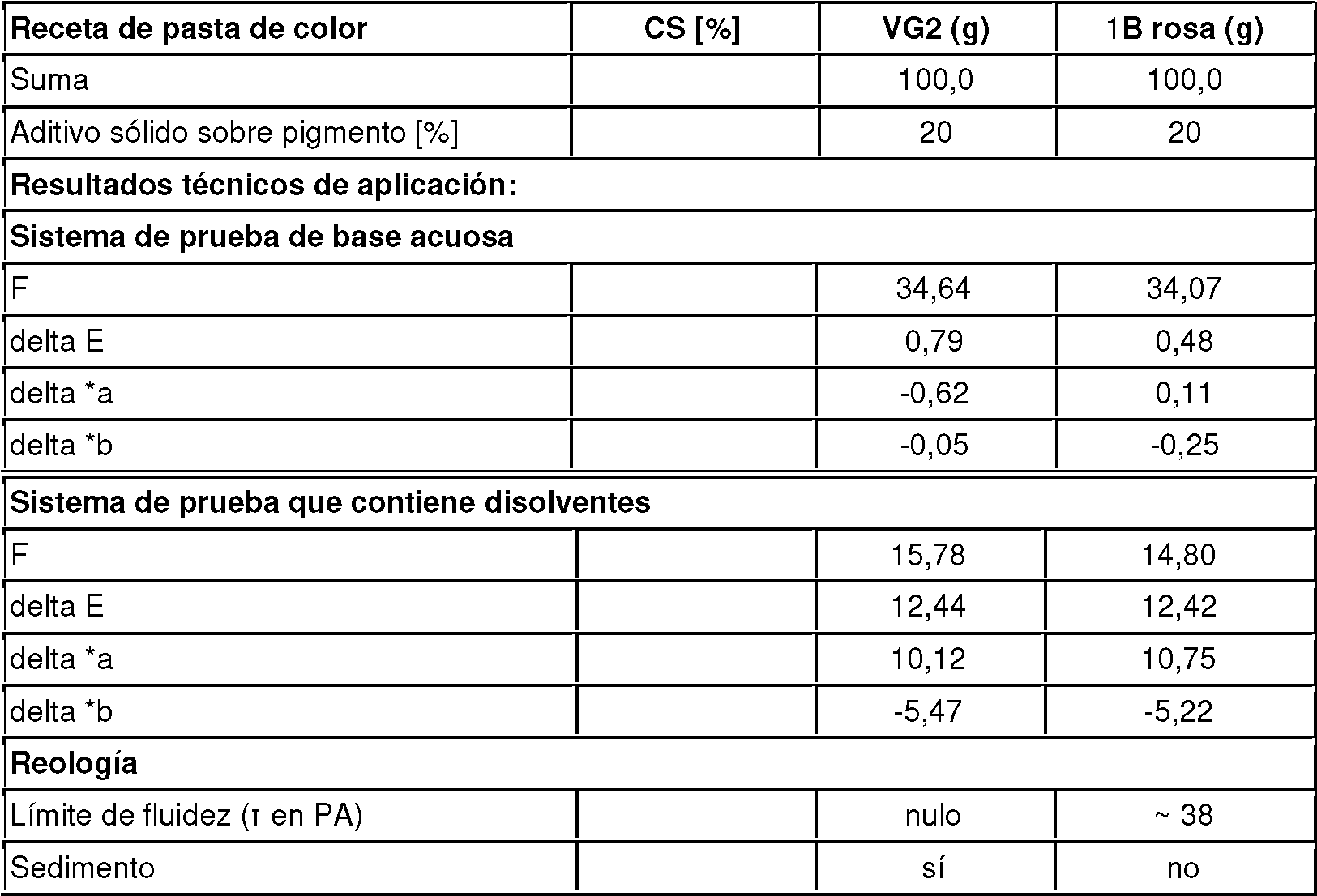
3.1.3 Producción del sistema de prueba acuoso:3.1.3 Production of the aqueous test system:
Se pesaron 0,64 g de pasta de color (VG2 y 1B rosa) y 19,36 g de un barniz de la marca ContiPur Satin a base de poliuretano de la firma Kluthe en un envase de cosmético de 50 ml y se homogeneizaron con ayuda del Speed Mixer DAC 150 FVZ (firma Hauschild) durante 1 min a 2.000 rpm.0.64 g of color paste (VG2 and 1B pink) and 19.36 g of a polyurethane-based ContiPur Satin brand varnish from Kluthe were weighed into a 50 ml cosmetic container and homogenized with the help of of the Speed Mixer DAC 150 FVZ (by Hauschild) for 1 min at 2,000 rpm.
3.1.4 Producción del sistema de prueba que contiene disolventes:3.1.4 Production of the test system containing solvents:
Se pesaron 0,64 g de pasta de color (VG1 y 1B rosa) y 19,36 g de un barniz de la marca Impredur Hochglanzlack 840, exento de compuestos aromáticos a base de resina alquídica de la firma Brillux, en un envase de cosmético de 50 ml y se homogeneizaron con ayuda del Speed Mixer DAC 150 FVZ (firma Hauschild) durante 1 min a 2.000 rpm.0.64 g of color paste (VG1 and 1B pink) and 19.36 g of an Impredur Hochglanzlack 840 brand varnish, free of aromatic compounds based on alkyd resin from Brillux, were weighed into a cosmetic container of 50 ml and homogenized with the help of the Speed Mixer DAC 150 FVZ (signature Hauschild) during 1 min at 2,000 rpm.
Tabla 6: Pigmento Color Black FW 200Table 6: Pigment Color Black FW 200


3.1.5 Producción del sistema de prueba acuoso:3.1.5 Production of the aqueous test system:
Se pesaron 0,80 g de pasta de color (VG2 y 1B rosa) y 19,2 g de un barniz de la marca ContiPur Satin a base de poliuretano de la firma Kluthe en un envase de cosmético de 50 ml y se homogeneizaron con ayuda del Speed Mixer DAC 150 FVZ (firma Hauschild) durante 1 min a 2.000 rpm.0.80 g of color paste (VG2 and 1B pink) and 19.2 g of a polyurethane-based ContiPur Satin brand varnish from Kluthe were weighed into a 50 ml cosmetic container and homogenized with the help of of the Speed Mixer DAC 150 FVZ (by Hauschild) for 1 min at 2,000 rpm.
3.1.6 Producción del sistema de prueba que contiene disolventes:3.1.6 Production of the test system containing solvents:
Se pesaron 0,80 g de pasta de color (VG1 y 1B rosa) y 19,2 g de un barniz de la marca Impredur Hochglanzlack 840, exento de compuestos aromáticos a base de resina alquídica de la firma Brillux, en un envase de cosmético de 50 ml y se homogeneizaron con ayuda del Speed Mixer DAC 150 FVZ (firma Hauschild) durante 1 min a 2.000 rpm.0.80 g of color paste (VG1 and 1B pink) and 19.2 g of an Impredur Hochglanzlack 840 brand varnish, free of aromatic compounds based on alkyd resin from Brillux, were weighed into a cosmetic container of 50 ml and homogenized with the help of the Speed Mixer DAC 150 FVZ (signature Hauschild) during 1 min at 2,000 rpm.
Se puede verificar que VG2 y VG3 no presentan límite de fluidez y además presentan un sedimento. Las pastas de color según la invención con los respectivos pigmentos presentan buenos valores de color y no presentan un sedimento. Se pudo determinar un límite de fluidez.It can be verified that VG2 and VG3 do not present a flow limit and also present a sediment. The color pastes according to the invention with the respective pigments have good color values and do not have a deposit. A flow limit could be determined.
3.2 Pastas de color para sistemas que contienen disolventes3.2 Color pastes for systems containing solvents
Para la valoración técnica de aplicación se produjeron en primer lugar pastas de color según las formulaciones de las respectivas Tablas 8-9. Los Ejemplos comparativos (VG) se produjeron con agentes dispersantes comerciales. For the technical appraisal evaluation, color pastes were first produced according to the formulations in the respective Tables 8-9. Comparative Examples (VG) were produced with commercial dispersing agents.
Para el examen técnico de aplicación se transformaron las respectivas pastas de color en sistemas que contienen disolventes.For the technical application test, the respective color pastes were converted into solvent-containing systems.
3.2.1 Producción del sistema de prueba que contiene disolventes para pigmento BAYFERROX® 915:3.2.1 Production of the test system containing solvents for BAYFERROX® 915 pigment:
Se pesaron 0,73 g de pasta de color con el pigmento BAYFERROX® 915 y 19,27 g de un barniz de la marca Impredur Hochglanzlack 840, exento de compuestos aromáticos a base de resina alquídica de la firma Brillux, en un envase de cosmético de 50 ml y se homogeneizaron con ayuda del Speed Mixer DAC 150 FVZ (firma Hauschild) durante 1 min a 2.000 rpm.0.73 g of color paste with the pigment BAYFERROX® 915 and 19.27 g of an Impredur Hochglanzlack 840 brand varnish, free of aromatic compounds based on alkyd resin from the firm Brillux, were weighed into a cosmetic container of 50 ml and homogenized with the help of the Speed Mixer DAC 150 FVZ (signature Hauschild) during 1 min at 2,000 rpm.
3.2.2 Producción del sistema de prueba que contiene disolventes para pigmento BAYFERROX® 140M:3.2.2 Production of the test system containing solvents for BAYFERROX® 140M pigment:
Se pesaron 0,62 g de pasta de color con el pigmento BAYFERROX® 915 y 19,38 g de un barniz de la marca Impredur Hochglanzlack 840, exento de compuestos aromáticos a base de resina alquídica de la firma Brillux, en un envase de cosmético de 50 ml y se homogeneizaron con ayuda del Speed Mixer DAC 150 FVZ (firma Hauschild) durante 1 min a 2.000 rpm.0.62 g of color paste with the pigment BAYFERROX® 915 and 19.38 g of an Impredur Hochglanzlack 840 brand varnish, free of aromatic compounds based on alkyd resin from the firm Brillux, were weighed into a cosmetic container of 50 ml and homogenized with the help of the Speed Mixer DAC 150 FVZ (signature Hauschild) during 1 min at 2,000 rpm.
Tabla 7: Materiales empleados:Table 7: Materials used:

Tabla 8: Pigmento BAYFERROX® 140 MTable 8: BAYFERROX® 140 M pigment

Tabla 9: Pigmento Bayferrox 915Table 9: Bayferrox 915 pigment

También en el caso de estas pastas de color se pudo verificar que las pastas de color 5B roja, 5B amarilla y 5C roja, 5C amarilla según la invención presentan buenos valores de color con límites de fluidez y sin sedimento.Also in the case of these color pastes, it was possible to verify that the color pastes 5B red, 5B yellow and 5C red, 5C yellow according to the invention have good color values with flow limits and without sediment.
3.3 Pastas de color para sistemas acuosos 3.3 Color pastes for aqueous systems
Para la determinación del límite de fluidez y del sedimento se produjeron en primer lugar pastas de color según las formulaciones de las respectivas Tablas 11-16. Los Ejemplos comparativos (VG) se produjeron con agentes dispersantes comerciales.To determine the flow limit and the sedimentation, color pastes were first produced according to the formulations in the respective Tables 11-16. Comparative Examples (VG) were produced with commercial dispersing agents.
Tabla 10: materiales empleadosTable 10: materials used

Tabla 11: Pigmento BAYFERROX® 318 MTable 11: BAYFERROX® 318 M pigment

Tabla 12: Pigmento BAYFERROX® 140 MTable 12: BAYFERROX® 140 M pigment


Tabla 12: Pigmento BAYFERROX® 3920Table 12: BAYFERROX® 3920 Pigment

Tabla 13: Pigmento KRONOS ® 2190Table 13: KRONOS ® Pigment 2190

Tabla 14: Pigmento KRONOS ® 2310 Table 14: KRONOS ® Pigment 2310


Tabla 15: Pigmento Tronox 902 Table 15: Tronox 902 Pigment


Tabla 16: Pigmento SICOPAL® L 1110Table 16: SICOPAL® L 1110 pigment

Se pudo mostrar que los compuestos de poliadición según la invención y sus sales son apropiados para la producción de pastas de color con diferentes pigmentos, no mostrando las pastas de color una sedimentación de los pigmentos y presentando estas además un límite de fluidez.It was possible to show that the polyaddition compounds according to the invention and their salts are suitable for the production of color pastes with different pigments, the color pastes showing no sedimentation of the pigments and also having a flow limit.
3.4 Efecto antiflotación3.4 Anti-floating effect
Para la valoración del efecto antiflotación se produjeron en primer lugar una pasta de color y una pasta blanca. Después se añadieron ambas pastas a una formulación de tinte y se analizaron.To assess the anti-flotation effect, a colored paste and a white paste were first produced. Both pastes were then added to a dye formulation and analyzed.
La receta de las pastas se puede extraer de las Tablas 18 - 20.The pasta recipe can be extracted from Tables 18 - 20.
Tabla 17: Materiales empleadosTable 17: Materials used
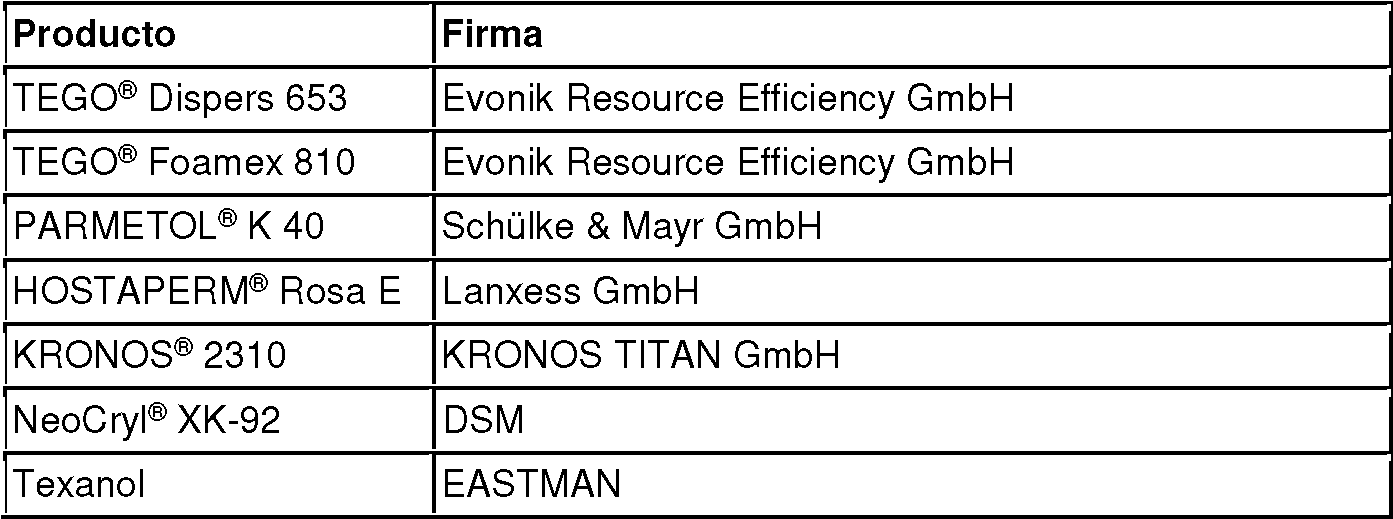
Tabla 18: Receta pasta de color 11 con pigmento HOSTAPERM® Rosa ETable 18: Paste recipe for color 11 with HOSTAPERM® Rosa E pigment

Tabla 19: Receta pasta blanca 11Table 19: White pasta recipe 11
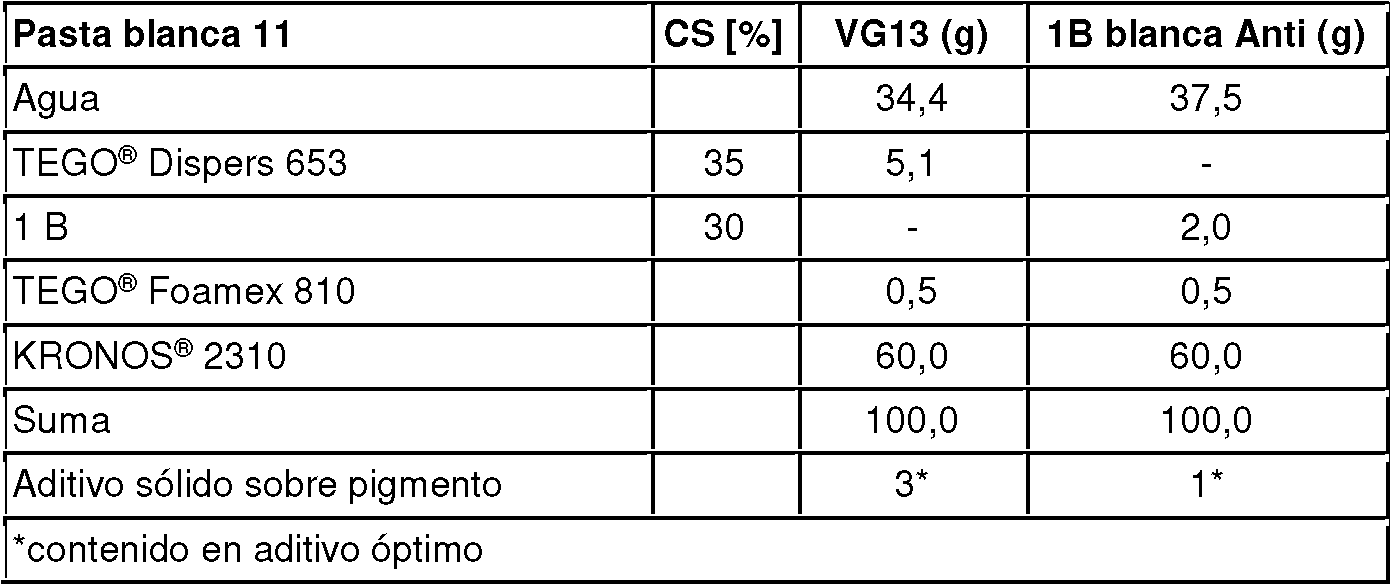
Tabla 20: Receta de tinteTable 20: Dye Recipe


3.4.1 Valor de color y borrado3.4.1 Color value and erase
Para el examen técnico de aplicación se homogeneizaron 10 g de tinte con 5 g de pasta blanca 11 con ayuda del Speed Mixer DAC 150 FVZ (firma Hauschild) durante 1 min a 2.000. A continuación se pesó 1 g de pasta de color 11 y se homogeneizó con ayuda del Speed Mixer DAC 150 FVZ (firma Hauschild) durante 1 min a 2.000, denominado Z AntiFor the technical application test, 10 g of dye were homogenized with 5 g of white paste 11 using the Speed Mixer DAC 150 FVZ (from Hauschild) for 1 min at 2000. Next, 1 g of color 11 paste was weighed and homogenized with the help of the Speed Mixer DAC 150 FVZ (by Hauschild) for 1 min at 2,000, called Z Anti
Para el ejemplo comparativo VGAnti se emplearon análogamente VG13 y VG2.For the comparative example VGAnti, VG13 and VG2 were used analogously.
Esta composición Z Anti y el Ejemplo comparativo VGAnti se aplicaron correspondientemente para la prueba de borrado y para la medición de la intensidad de color.This composition Z Anti and Comparative Example VGAnti were correspondingly applied for the smudge test and for the color intensity measurement.
Tabla 21: Resultados del efecto antiflotaciónTable 21: Results of the anti-flotation effect

La composición ZAnti según la invención presenta un delta E muy reducido en contrapartida al Ejemplo comparativo VGAnti, lo que indica una buena estabilización de pigmento y simultáneamente un efecto antiflotación.The ZAnti composition according to the invention has a very low delta E in contrast to the Comparative Example VGAnti, which indicates good pigment stabilization and simultaneously an anti-floating effect.
F representa la intensidad de color. En el Ejemplo comparativo VGAnti se puede observar un cambio significativo de la intensidad de color, mientras que en la composición ZAnti según la invención apenas se modifica la intensidad de color.F represents the color intensity. In Comparative Example VGAnti a significant change in color intensity can be observed, whereas in the composition ZAnti according to the invention the color intensity hardly changes.
3.5 Examen técnico de aplicación con TiO2 (pigmento blanco)3.5 Technical examination of application with TiO2 (white pigment)
Para la valoración técnica de aplicación se produjeron en primer lugar suspensiones:For the technical assessment of application, suspensions were produced first:
las suspensiones, una mezcla diluida de agua y dióxido de titanio muy finamente distribuido (pigmento blanco), se producen por medio de la receta de examen según la Tabla 22. A tal efecto se mezcla primero agua, aditivo, agente conservante y pigmento blanco en los siguientes porcentajes y orden.the suspensions, a dilute mixture of water and very finely distributed titanium dioxide (white pigment), are produced by means of the test recipe according to Table 22. For this purpose, water, additive, preservative and white pigment are first mixed in the following percentages and order.
Tabla 22: Receta de examen:Table 22: Exam Recipe:
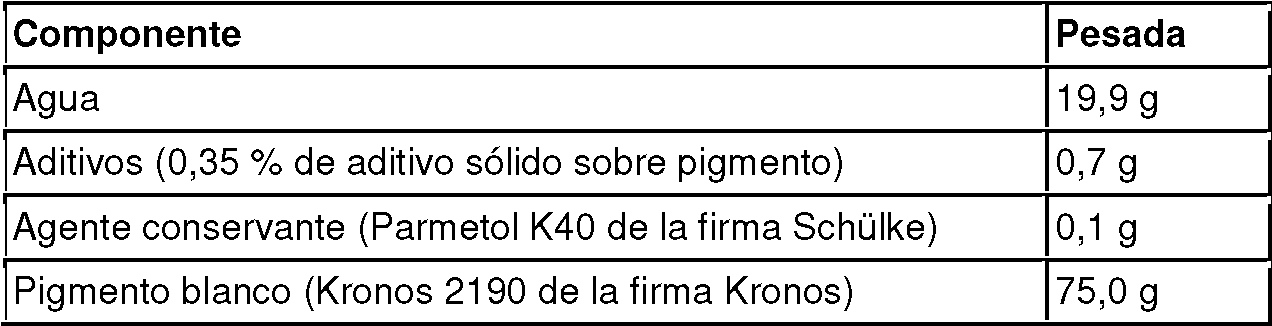
A continuación se pesan 75,0 g de la mezcla producida y 75,0 g de perlas de vidrio en un envase de cosmético de 150 ml y se homogeneizan con ayuda del Speed Mixer DAC 150 FVZ (firma Hauschild) durante 5 min a 1.300 rpm. Tras el proceso de dispersión se separa la suspensión producida de este modo de las perlas de vidrio mediante filtración simple.75.0 g of the mixture produced and 75.0 g of glass beads are then weighed into a 150 ml cosmetic container and homogenized using the Speed Mixer DAC 150 FVZ (from Hauschild) for 5 min at 1300 rpm. . After the dispersion process, the suspension produced in this way is separated from the glass beads by simple filtration.
Las suspensiones se examinan visualmente después de 2 semanas de almacenamiento a 50°C para comprobar si se presenta un sedimento o no. Si se ha formado un sedimento, para una cuantificación del sedimento se elimina cuidadosamente el medio situado por encima con una pipeta. Por lo tanto, se decantó el sedimento de la suspensión. La cantidad de sedimento remanente se determinó mediante gravimetría. El porcentaje de la cantidad de sedimento se calcula a partir de las cantidades de suspensión pesada divididas por la cantidad de sedimento tras decantación. The suspensions are visually examined after 2 weeks of storage at 50°C to check whether a sediment is present or not. If a sediment has formed, the overlying medium is carefully removed with a pipette for quantification of the sediment. Therefore, the sediment was decanted from the suspension. The amount of remaining sediment was determined by gravimetry. The percentage of the amount of sediment is calculated from the amounts of heavy suspension divided by the amount of sediment after decantation.
Cantidad de sedimento (%) = cantidad de suspensión (g) / cantidad de sedimento tras decantación (g) Se adjunta la correspondiente Tabla 23 con los correspondientes porcentajes de sedimento de las sustancias inventivas producidas en comparación con aditivos disponibles comercialmente.Amount of sediment (%) = amount of suspension (g) / amount of sediment after decanting (g) The corresponding Table 23 is attached with the corresponding percentages of sediment of the inventive substances produced in comparison with commercially available additives.
A partir de esta se puede observar y deducir que las sustancias inventivas producidas son superiores a los aditivos disponibles comercialmente. En el caso de las suspensiones con los compuestos según la invención no se ha formado apenas sedimento.From this it can be seen and deduced that the inventive substances produced are superior to the commercially available additives. In the case of the suspensions with the compounds according to the invention hardly any sediment was formed.
Tabla 23: Sedimento en porcentajeTable 23: Sediment in percentage

Claims (18)


Applications Claiming Priority (1)
| Application Number | Priority Date | Filing Date | Title |
|---|---|---|---|
| EP17210626 | 2017-12-27 |
Publications (1)
| Publication Number | Publication Date |
|---|---|
| ES2924652T3 true ES2924652T3 (en) | 2022-10-10 |
Family
ID=61002779
Family Applications (1)
| Application Number | Title | Priority Date | Filing Date |
|---|---|---|---|
| ES18212170T Active ES2924652T3 (en) | 2017-12-27 | 2018-12-13 | Wetting and dispersing agents with rheological property |
Country Status (6)
| Country | Link |
|---|---|
| US (1) | US10752801B2 (en) |
| EP (1) | EP3505550B1 (en) |
| JP (1) | JP7248417B2 (en) |
| CN (1) | CN109988289B (en) |
| ES (1) | ES2924652T3 (en) |
| PL (1) | PL3505550T3 (en) |
Families Citing this family (16)
| Publication number | Priority date | Publication date | Assignee | Title |
|---|---|---|---|---|
| PL3744752T3 (en) | 2019-05-28 | 2025-02-10 | Evonik Operations Gmbh | Method for producing alkoxy-functionalized noncyclic polysiloxanes |
| PL3744756T3 (en) | 2019-05-28 | 2024-10-28 | Evonik Operations Gmbh | Acetoxy systems |
| ES2913783T3 (en) | 2019-05-28 | 2022-06-06 | Evonik Operations Gmbh | Procedure for the purification of acetoxysiloxanes |
| EP3744764A1 (en) | 2019-05-28 | 2020-12-02 | Evonik Operations GmbH | Production of sioc-linked siloxanes |
| DK3744763T3 (en) | 2019-05-28 | 2024-11-04 | Evonik Operations Gmbh | TAILOR-MADE SIOC BASED POLYETHERSILOXANE |
| EP3744774B1 (en) | 2019-05-28 | 2021-09-01 | Evonik Operations GmbH | Method for recycling of silicones |
| CN111072919B (en) * | 2019-12-26 | 2022-04-26 | 浙江工业大学 | Method for synthesizing epoxy resin condensate capable of being hydrolyzed under weak alkaline |
| WO2021137537A1 (en) * | 2020-01-02 | 2021-07-08 | 코오롱인더스트리 주식회사 | Epoxy resin, epoxy paint composition containing same, coating film formed by epoxy paint composition, and substrate with coating film adhered thereto |
| ES2924476T3 (en) | 2020-01-08 | 2022-10-07 | Evonik Operations Gmbh | Formulation and its use as defoamer |
| EP3954740A1 (en) | 2020-08-14 | 2022-02-16 | Evonik Operations GmbH | Defoamer composition based on polysiloxanes with organofunctionally modified polysiloxanes |
| EP4119597A1 (en) | 2021-07-14 | 2023-01-18 | Evonik Operations GmbH | Molecular weight structure of low-molecular alpha, omega-polysiloxane diols |
| CN116082930B (en) * | 2021-11-08 | 2025-12-05 | 廊坊立邦涂料有限公司 | A solvent-based anti-settling high-solids intermediate coating composition and its preparation method |
| KR102638252B1 (en) * | 2021-12-03 | 2024-02-19 | 최광복 | Composition for water solubilizing polyol resin |
| UY40321A (en) * | 2022-06-22 | 2023-12-29 | Swimc Llc | LOW VOC UNIVERSAL DYE COMPOSITIONS |
| CN115612088B (en) * | 2022-10-10 | 2024-07-12 | 上海金仕迈树脂有限公司 | Ether amine polyol, and preparation method and application thereof |
| CN118812794B (en) * | 2024-08-22 | 2025-05-13 | 深圳市五山新材料股份有限公司 | Preparation method and application of polycarboxylic acid-based high-efficiency water reducing agent |
Family Cites Families (33)
| Publication number | Priority date | Publication date | Assignee | Title |
|---|---|---|---|---|
| GB1508576A (en) | 1974-09-17 | 1978-04-26 | Ici Ltd | Dispersion of solids in organic solvents |
| NZ201300A (en) | 1981-08-11 | 1985-12-13 | Ici Plc | Pigment:fluidising compositions containing disazo compounds |
| US4942213A (en) | 1987-12-04 | 1990-07-17 | Byk-Chemie Gmbh | Addition compounds useful as dispersing agents and dispersion stabilizers, process for producing them, their use and solids coated therewith |
| MX9207340A (en) * | 1991-12-17 | 1994-03-31 | Dow Chemical Co | RESIN FINISHED IN AMINE COMPATIBLE WITH WATER USES TO CURE EPOXY RESINS. |
| US5527839A (en) * | 1994-12-13 | 1996-06-18 | Air Products And Chemicals, Inc. | Self-emulsifying epoxy curing agent based on the reaction product of epoxy resin and polyether polyol |
| ZA9510780B (en) * | 1994-12-21 | 1996-06-21 | Shell Int Research | Novel epoxy-functional polyethers |
| DE19520854A1 (en) * | 1995-06-08 | 1996-12-12 | Hoechst Ag | Self-emulsifying aqueous epoxy resin dispersions |
| DE19536608A1 (en) * | 1995-09-30 | 1997-04-03 | Hoechst Ag | Emulsifier system for water-thinnable epoxy resin systems with pot life display |
| EP0883638A1 (en) * | 1996-11-20 | 1998-12-16 | Sika Chemie GmbH | Epoxy resin-amine addition products for use as emulsifiers for epoxy resins; aqueous based epoxy resin dispersions and process for producing the same |
| DE10029648C1 (en) * | 2000-06-15 | 2002-02-07 | Goldschmidt Ag Th | Block copolymers of phosphoric acid esters, their salts and their use as emulsifiers and dispersants |
| DE10149613A1 (en) | 2001-10-09 | 2003-04-10 | Goldschmidt Ag Th | Testing of outdoor building finish, e.g. paint, dye, involves sprayed application of heated impure water |
| DE10326147A1 (en) * | 2003-06-06 | 2005-03-03 | Byk-Chemie Gmbh | Epoxide adducts and their salts as dispersants |
| DE10348825A1 (en) | 2003-10-21 | 2005-06-02 | Goldschmidt Ag | Dispersant for the preparation of aqueous pigment pastes |
| JP5014984B2 (en) | 2004-05-13 | 2012-08-29 | ハンツマン ペトロケミカル コーポレイション | Comb polyether alkanolamine in ink |
| DE102004044253A1 (en) | 2004-09-14 | 2006-03-16 | Goldschmidt Gmbh | Water-insoluble grafted polysiloxane copolymers and their use for defoaming and deaeration of nonaqueous oils |
| DE102004050955A1 (en) * | 2004-10-20 | 2006-04-27 | Byk-Chemie Gmbh | Alkoxylated epoxy-amine adducts and their use |
| DE102006041088A1 (en) | 2006-09-01 | 2008-03-06 | Evonik Goldschmidt Gmbh | Silicone-containing block-shaped graft copolymers |
| DE102006059558A1 (en) | 2006-12-16 | 2008-06-19 | Evonik Goldschmidt Gmbh | Novel dispersing resins, their preparation and their use for the dispersion of solids |
| JP4994305B2 (en) | 2008-06-03 | 2012-08-08 | 横浜ゴム株式会社 | High thermal conductive epoxy resin composition |
| US20110144269A1 (en) | 2008-08-11 | 2011-06-16 | Evonik Goldschmidt Gmbh | Dispersing agent and its use |
| DE102008043032A1 (en) | 2008-10-22 | 2010-04-29 | Evonik Goldschmidt Gmbh | Defoamer for defoaming paints |
| DE102009046922A1 (en) | 2009-11-20 | 2011-05-26 | Evonik Röhm Gmbh | Bulk polymerization of (meth) acrylate copolymers, which are soluble in the aqueous-alkaline |
| EP2333000A1 (en) * | 2009-12-11 | 2011-06-15 | BYK-Chemie GmbH | Polyether modified epoxide-amine adducts as wetting and dispersing agents |
| DE102010039140A1 (en) | 2010-08-10 | 2012-02-16 | Evonik Goldschmidt Gmbh | Dispersants and process for their preparation |
| DE102012206574A1 (en) | 2012-04-20 | 2013-10-24 | Evonik Industries Ag | Use of polyglycerol partial esters as defoamers |
| DE102013204605A1 (en) | 2013-03-15 | 2014-09-18 | Evonik Industries Ag | Phosphoric acid esters, their preparation and use |
| DE102014203231A1 (en) | 2014-02-24 | 2015-08-27 | Evonik Degussa Gmbh | Dispersing resins for pigment preparations with low volatile organic content |
| DE102014205680A1 (en) | 2014-03-26 | 2015-10-01 | Evonik Degussa Gmbh | dispersing resins |
| KR102335792B1 (en) | 2014-10-14 | 2021-12-07 | 비와이케이-케미 게엠베하 | Epoxy/amine adducts for dispersing solids |
| ES2992846T3 (en) | 2016-03-24 | 2024-12-18 | Evonik Operations Gmbh | Dispersants |
| PL3305840T3 (en) | 2016-10-05 | 2021-05-04 | Evonik Operations Gmbh | Compatibilizer for universal colorant in solventborne alkyd paints |
| DK3434737T3 (en) | 2017-07-26 | 2023-03-27 | Evonik Operations Gmbh | MODIFIED PIGMENTS AND THEIR USE |
| EP3438158B1 (en) | 2017-08-01 | 2020-11-25 | Evonik Operations GmbH | Production of sioc-linked siloxanes |
-
2018
- 2018-12-13 PL PL18212170.7T patent/PL3505550T3/en unknown
- 2018-12-13 ES ES18212170T patent/ES2924652T3/en active Active
- 2018-12-13 EP EP18212170.7A patent/EP3505550B1/en active Active
- 2018-12-17 JP JP2018235224A patent/JP7248417B2/en active Active
- 2018-12-24 US US16/231,666 patent/US10752801B2/en active Active
- 2018-12-27 CN CN201811608407.7A patent/CN109988289B/en active Active
Also Published As
| Publication number | Publication date |
|---|---|
| EP3505550B1 (en) | 2022-06-22 |
| CN109988289A (en) | 2019-07-09 |
| JP7248417B2 (en) | 2023-03-29 |
| CN109988289B (en) | 2023-05-09 |
| JP2019143121A (en) | 2019-08-29 |
| PL3505550T3 (en) | 2022-09-12 |
| EP3505550A1 (en) | 2019-07-03 |
| US10752801B2 (en) | 2020-08-25 |
| US20190194488A1 (en) | 2019-06-27 |
Similar Documents
| Publication | Publication Date | Title |
|---|---|---|
| CN109988289B (en) | Wetting and dispersing agents having rheological properties | |
| ES2359532T3 (en) | MODIFIED PEINE TYPE COPOLYMERS BASED ON STYRENE / MALEIC ANHYDRIDE. | |
| JP6767972B2 (en) | Epoxy / amine adduct to disperse solids | |
| ES2992846T3 (en) | Dispersants | |
| EP0896602B1 (en) | Phosphate esters of polyoxyalkylene ether block copolymers and their dispersants | |
| KR100860185B1 (en) | Aqueous pigment dispersions, and methods for producing and using them | |
| CA1107878A (en) | Dispersion of particulates in polar organic solvents | |
| US9303144B2 (en) | Dispersing agent from renewable raw materials for binding agent-free pigment preparations | |
| JP7185055B2 (en) | Water-based pigment preparations, their manufacture and use | |
| DE10232908A1 (en) | Use of organically modified polysiloxanes containing phenyl derivatives as dispersants and wetting agents for fillers and pigments in aqueous pigment pastes and color or coating formulations | |
| CN101400749A (en) | Water-based pigment preparation | |
| US8383749B2 (en) | Dry pigment preparations comprising non-ionic additives | |
| US8221539B2 (en) | Dry pigment preparations comprising anionic additives | |
| CN107922749A (en) | The universal pigment preparation used for point of sale | |
| CA2752185A1 (en) | Easily dispersible solid pigment preparations | |
| US4443263A (en) | Solids dispersions which can be easily distributed in hydrophobic and hydrophilic media and are stable to flocculation, and their use | |
| BRPI0608065A2 (en) | comb-type polyetheralkanolamines in paints and coatings | |
| US9187614B2 (en) | Binding agent free-pigment preparations containing phosphoric acid ester | |
| EP1721941A2 (en) | Waterbased pigment preparations | |
| ES3034293T3 (en) | Universal dispersing agent for inorganic and organic pigments | |
| JP7277663B2 (en) | Aqueous pigment preparations and their use for toning systems and for coloring coating materials | |
| US7014699B2 (en) | Oxalkylation products produced from epoxides and amines and their use in pigment preparations | |
| JPH11256068A (en) | Carbon black dispersion | |
| BRPI0608065B1 (en) | POLYETHYLCANOLAMINS OF PAINT TYPE IN PAINT AND COATINGS | |
| WO1998050474A1 (en) | Use of colourless polycyclic sulphonates |