ES2924770T3 - Method for producing polyurethanes without isocyanate - Google Patents
Method for producing polyurethanes without isocyanate Download PDFInfo
- Publication number
- ES2924770T3 ES2924770T3 ES19382006T ES19382006T ES2924770T3 ES 2924770 T3 ES2924770 T3 ES 2924770T3 ES 19382006 T ES19382006 T ES 19382006T ES 19382006 T ES19382006 T ES 19382006T ES 2924770 T3 ES2924770 T3 ES 2924770T3
- Authority
- ES
- Spain
- Prior art keywords
- group
- alkyl
- halo
- alkyl group
- alkoxy
- Prior art date
- Legal status (The legal status is an assumption and is not a legal conclusion. Google has not performed a legal analysis and makes no representation as to the accuracy of the status listed.)
- Active
Links
Classifications
-
- C—CHEMISTRY; METALLURGY
- C08—ORGANIC MACROMOLECULAR COMPOUNDS; THEIR PREPARATION OR CHEMICAL WORKING-UP; COMPOSITIONS BASED THEREON
- C08G—MACROMOLECULAR COMPOUNDS OBTAINED OTHERWISE THAN BY REACTIONS ONLY INVOLVING UNSATURATED CARBON-TO-CARBON BONDS
- C08G71/00—Macromolecular compounds obtained by reactions forming a ureide or urethane link, otherwise, than from isocyanate radicals in the main chain of the macromolecule
- C08G71/04—Polyurethanes
-
- C—CHEMISTRY; METALLURGY
- C07—ORGANIC CHEMISTRY
- C07D—HETEROCYCLIC COMPOUNDS
- C07D209/00—Heterocyclic compounds containing five-membered rings, condensed with other rings, with one nitrogen atom as the only ring hetero atom
- C07D209/02—Heterocyclic compounds containing five-membered rings, condensed with other rings, with one nitrogen atom as the only ring hetero atom condensed with one carbocyclic ring
- C07D209/04—Indoles; Hydrogenated indoles
- C07D209/30—Indoles; Hydrogenated indoles with hetero atoms or with carbon atoms having three bonds to hetero atoms with at the most one bond to halogen, directly attached to carbon atoms of the hetero ring
- C07D209/42—Carbon atoms having three bonds to hetero atoms with at the most one bond to halogen, e.g. ester or nitrile radicals
-
- C—CHEMISTRY; METALLURGY
- C07—ORGANIC CHEMISTRY
- C07D—HETEROCYCLIC COMPOUNDS
- C07D235/00—Heterocyclic compounds containing 1,3-diazole or hydrogenated 1,3-diazole rings, condensed with other rings
- C07D235/02—Heterocyclic compounds containing 1,3-diazole or hydrogenated 1,3-diazole rings, condensed with other rings condensed with carbocyclic rings or ring systems
- C07D235/04—Benzimidazoles; Hydrogenated benzimidazoles
- C07D235/24—Benzimidazoles; Hydrogenated benzimidazoles with hetero atoms or with carbon atoms having three bonds to hetero atoms with at the most one bond to halogen, e.g. ester or nitrile radicals, directly attached in position 2
- C07D235/30—Nitrogen atoms not forming part of a nitro radical
-
- C—CHEMISTRY; METALLURGY
- C07—ORGANIC CHEMISTRY
- C07D—HETEROCYCLIC COMPOUNDS
- C07D295/00—Heterocyclic compounds containing polymethylene-imine rings with at least five ring members, 3-azabicyclo [3.2.2] nonane, piperazine, morpholine or thiomorpholine rings, having only hydrogen atoms directly attached to the ring carbon atoms
- C07D295/04—Heterocyclic compounds containing polymethylene-imine rings with at least five ring members, 3-azabicyclo [3.2.2] nonane, piperazine, morpholine or thiomorpholine rings, having only hydrogen atoms directly attached to the ring carbon atoms with substituted hydrocarbon radicals attached to ring nitrogen atoms
- C07D295/12—Heterocyclic compounds containing polymethylene-imine rings with at least five ring members, 3-azabicyclo [3.2.2] nonane, piperazine, morpholine or thiomorpholine rings, having only hydrogen atoms directly attached to the ring carbon atoms with substituted hydrocarbon radicals attached to ring nitrogen atoms substituted by singly or doubly bound nitrogen atoms
- C07D295/135—Heterocyclic compounds containing polymethylene-imine rings with at least five ring members, 3-azabicyclo [3.2.2] nonane, piperazine, morpholine or thiomorpholine rings, having only hydrogen atoms directly attached to the ring carbon atoms with substituted hydrocarbon radicals attached to ring nitrogen atoms substituted by singly or doubly bound nitrogen atoms with the ring nitrogen atoms and the substituent nitrogen atoms separated by carbocyclic rings or by carbon chains interrupted by carbocyclic rings
Landscapes
- Chemical & Material Sciences (AREA)
- Organic Chemistry (AREA)
- Health & Medical Sciences (AREA)
- Chemical Kinetics & Catalysis (AREA)
- Medicinal Chemistry (AREA)
- Polymers & Plastics (AREA)
- Polyurethanes Or Polyureas (AREA)
- Low-Molecular Organic Synthesis Reactions Using Catalysts (AREA)
- Organic Low-Molecular-Weight Compounds And Preparation Thereof (AREA)
- Plural Heterocyclic Compounds (AREA)
Abstract
La presente solicitud está dirigida a un método para producir poliuretanos sin isocianato. Más particularmente, la solicitud se dirige a un método para producir poliuretanos sin isocianato usando un único componente catalítico seleccionado de un derivado de amidoindol, un derivado de bencimidazol y un derivado de escuaramida. (Traducción automática con Google Translate, sin valor legal)The present application is directed to a method of producing non-isocyanate polyurethanes. More particularly, the application is directed to a method of producing non-isocyanate polyurethanes using a single catalyst component selected from an amidoindole derivative, a benzimidazole derivative, and a squaramide derivative. (Automatic translation with Google Translate, without legal value)
Description
DESCRIPCIÓNDESCRIPTION
Método para producir poliuretanos sin isocianatoMethod for producing polyurethanes without isocyanate
CAMPO DE LA INVENCIÓNFIELD OF THE INVENTION
La presente solicitud se refiere a un método para producir poliuretanos sin isocianato. Más particularmente, la solicitud se refiere a un método para producir poliuretanos sin isocianato usando un componente de catalizador único.The present application refers to a method for producing polyurethanes without isocyanate. More particularly, the application relates to a method of producing isocyanate-free polyurethanes using a single catalyst component.
ANTECEDENTES DE LA INVENCIÓNBACKGROUND OF THE INVENTION
La aminolisis de ciclocarbonatos permite la preparación de poliuretanos sin isocianato (NIPU) que son análogos sin reactivos tóxicos de los poliuretanos (PU). Las reacciones de apertura de anillo de carbonatos cíclicos mediante aminas primarias y secundarias a temperatura ambiente son demasiado lentas para usarse a escala industrial, dado que pueden durar varios días. Por esa razón, es muy importante desarrollar un sistema de catalizadores mejorado para acelerar la formación del poliuretano no basado en isocianato que incluya la activación de los monómeros por acción de un catalizador. Se han realizado esfuerzos para desarrollar tales catalizadores para la aminolisis de ciclocarbonatos con aminas a temperatura ambiente.The aminolysis of cyclocarbonates allows the preparation of non-isocyanate polyurethanes (NIPU) which are analogs without toxic reagents of polyurethanes (PU). Ring-opening reactions of cyclic carbonates by primary and secondary amines at room temperature are too slow to be used on an industrial scale, as they can take several days. For that reason, it is very important to develop an improved catalyst system to accelerate the formation of the non-isocyanate based polyurethane that includes the activation of the monomers by the action of a catalyst. Efforts have been made to develop such catalysts for the aminolysis of cyclocarbonates with amines at room temperature.
ChemSusChem 2016, 9, 1-5 desvela un cribado de sistemas catalíticos basado en derivados de urea y compara su comportamiento con el exhibido por sus análogos de tiourea en la apertura de anillo de carbonato de propileno con ciclohexilamina. El pKa de la (tio)urea y el patrón de sustitución desigual son críticos para la eficacia de la apertura del carbonato. Las (tio)ureas más ácidas o más básicas proporcionaron conversiones inferiores. En realidad, la ciclohexilamina es capaz de desprotonar los derivados de (tio)urea más ácidos [pKa(ciclohexilamina) = 11,5 a 25 °C]. Por consiguiente, el catalizador desprotonado no es capaz de activar el carbonato. Por el contrario, los catalizadores menos ácidos no activan de forma suficientemente fuerte el carbonilo para permitir el ataque nucleófilo de la amina.ChemSusChem 2016, 9, 1-5 discloses a catalyst system screen based on urea derivatives and compares their behavior with that exhibited by their thiourea analogs in ring opening of propylene carbonate with cyclohexylamine. The pKa of the (thio)urea and the unequal substitution pattern are critical to the effectiveness of carbonate opening. The more acidic or more basic (thio)ureas gave lower conversions. In fact, cyclohexylamine is capable of deprotonating the most acidic (thio)urea derivatives [pKa(cyclohexylamine) = 11.5 at 25 °C]. Therefore, the deprotonated catalyst is not capable of activating the carbonate. In contrast, less acidic catalysts do not activate the carbonyl strongly enough to allow nucleophilic attack of the amine.
El documento de Patente US 2016/9260564 B2 desvela un sistema de catalizadores cooperativo que incluye un ácido de Lewis y una base de Lewis para la apertura de anillo de carbonatos cíclicos mediante aminas primarias a temperatura ambiente. El ácido de Lewis (LiOTf) y la base de Lewis (TBD y DBU) pueden trabajar conjuntamente para activar el electrófilo (carbonato) y el nucleófilo (amina). Sin embargo, algunos de los catalizadores presentan problemas de seguridad y para la salud (DBU) o son sensibles al aire (TBD y DBU). Además, se usa una elevada cantidad de cada catalizador (más de un 10 %) para llevar a cabo las reacciones.US Patent 2016/9260564 B2 discloses a cooperative catalyst system including a Lewis acid and a Lewis base for ring opening of cyclic carbonates by primary amines at room temperature. Lewis acid (LiOTf) and Lewis base (TBD and DBU) can work together to activate the electrophile (carbonate) and the nucleophile (amine). However, some of the catalysts have health and safety concerns (DBU) or are air sensitive (TBD and DBU). Furthermore, a high amount of each catalyst (more than 10%) is used to carry out the reactions.
El documento de Patente US 2016/0326132 A1 enseña un método para preparar poli(hidroxiuretano) usando una etapa de polimerización de biscarbonatos cíclicos de 5 miembros obtenidos a partir de aceites vegetales renovables y poliamina primaria, opcionalmente en presencia de un catalizador tal como una base fuerte y/o un nucleófilo. Como bases fuertes, se usan catalizador de tiourea de Schreiner, la guanidina MTBD (7-metil-1.5.7-triazabiciclo-[4.4.0]dec-5-eno), la base de amidina DBU (1,8-diazabiciclo[5.4.0]undec-7-eno) y la guanidina TBD (1.5.7-triazabiciclo-[4.4.0]dec-5-eno). Los nucleófilos empleados incluyen DMAP (4-dimetilaminopiridina), la sal LiCI y ZnAc (acetato de cinc). Además, puede añadirse un cocatalizador. Sin embargo, la reacción se llevó a cabo en un intervalo de temperatura comprendido entre 60 °C y 105 °C, que podría considerarse bastante elevado para algunas aplicaciones industriales.Patent document US 2016/0326132 A1 teaches a method for preparing poly(hydroxyurethane) using a 5-membered cyclic bicarbonate polymerization stage obtained from renewable vegetable oils and primary polyamine, optionally in the presence of a catalyst such as a base strong and/or a nucleophile. As strong bases, Schreiner's thiourea catalyst, the guanidine MTBD (7-methyl-1.5.7-triazabicyclo-[4.4.0]dec-5-ene), the amidine base DBU (1,8-diazabicyclo[ 5.4.0]undec-7-ene) and the guanidine TBD (1.5.7-triazabicyclo-[4.4.0]dec-5-ene). Employed nucleophiles include DMAP (4-dimethylaminopyridine), the LiCl salt, and ZnAc (zinc acetate). In addition, a cocatalyst may be added. However, the reaction was carried out in a temperature range between 60 °C and 105 °C, which could be considered quite high for some industrial applications.
El documento de Patente WO 2013/092011 A1 enseña un método para síntesis y uso de 2-oxo-1,3-dioxolano-4-carboxamidas en la preparación de polihidroxiuretanos, polihidroxicarbonatos e hidroxisulfanilformiatos. Los experimentos de curado usan IPDA (isoforonadiamina) y TMD (mezcla isómera de hexametilendiamina). Sin embargo, la reacción que usa estos nuevos ciclocarbonatos activados por éster se prolonga demasiado (de 3 a 7 días) a temperatura ambiente.Patent document WO 2013/092011 A1 teaches a method for the synthesis and use of 2-oxo-1,3-dioxolane-4-carboxamides in the preparation of polyhydroxyurethanes, polyhydroxycarbonates and hydroxysulfanylformates. Curing experiments use IPDA (isophoronediamine) and TMD (isomeric mixture of hexamethylenediamine). However, the reaction using these new ester-activated cyclocarbonates takes too long (3-7 days) at room temperature.
El documento de Patente WO 2013060950 A1 desvela un proceso para la preparación de un compuesto que comprende una unidad de uretano p-hidroxi o un uretano con patrón hidroxi-Y-. Se informa la reacción entre un ciclocarbonato reactivo con una unidad reactiva amino (-NH2) en presencia de un sistema de catalizadores. El sistema de catalizadores incluye un complejo organometálico como catalizador y un cocatalizador seleccionado entre el grupo de bases de Lewis o sales de tetraalquilamonio. No obstante, tanto el catalizador como el cocatalizador se consideran peligrosos y tóxicos.WO 2013060950 A1 discloses a process for the preparation of a compound comprising a p-hydroxy urethane unit or a hydroxy-Y-patterned urethane. The reaction between a reactive cyclocarbonate with a reactive amino unit (-NH 2 ) in the presence of a catalyst system is reported. The catalyst system includes an organometallic complex as a catalyst and a cocatalyst selected from the group of Lewis bases or tetraalkylammonium salts. However, both the catalyst and the cocatalyst are considered dangerous and toxic.
El documento de Patente EP 1070733 A1 describe una reacción de oligómeros polifuncionales que contienen grupos epoxi y ciclocarbonato con aminas alifáticas o cicloalifáticas. Por otra parte, la reacción se lleva a cabo en atmósfera de nitrógeno y, además, se usan diferentes intervalos de temperatura (80 a 120 °C), así como algunos disolventes orgánicos.Patent document EP 1070733 A1 describes a reaction of polyfunctional oligomers containing epoxy and cyclocarbonate groups with aliphatic or cycloaliphatic amines. On the other hand, the reaction is carried out under a nitrogen atmosphere and, in addition, different temperature ranges (80 to 120 °C) are used, as well as some organic solvents.
El documento de Patente US 2007151666 A1 describe un sistema de agente de unión que comprende dos componentes que se usan como adhesivo/sellador. Se informan grupos carbonato cíclico y su mezcla como Componente A y aminas primarias y secundarias como componente B. Sin embargo, para la síntesis del agente de unión se usó acetato de etilo como disolvente. Además, los carbonatos cíclicos se obtuvieron usando isocianatos peligrosos.US 2007151666 A1 discloses a bonding agent system comprising two components used as an adhesive/sealant. Cyclic carbonate groups and their mixture are reported as Component A and primary and secondary amines as component B. However, for the synthesis of the coupling agent, ethyl acetate was used as solvent. Furthermore, cyclic carbonates were obtained using dangerous isocyanates.
Polym. Chem. 2017, 8, 7054 desvela el uso de escuaramidas (donador de enlace de hidrógeno) y cocatalizadores de amina como enfoque versátil para la polimerización por apertura de anillo de los tres tipos principales de monómeros de éster cíclico: lactidas, carbonatos cíclicos y lactonas.Polym. Chem. 2017, 8, 7054 discloses the use of squaramides (hydrogen bond donor) and amine cocatalysts as a versatile approach for the ring-opening polymerization of the three main types of cyclic ester monomers: lactides, cyclic carbonates and lactones .
Chem. Eur. J. 2010, 16, 4196-4205 describe un mecanismo de la polimerización por apertura de anillo de lactida catalizada por una pareja de organocatalizadores de enlace de hidrógeno. Se usan ciertos amidoindoles, tioamidoindoles, amidobenzimidazoles y tioamidobenzimidazoles como activadores del monómero. Además, también se usó un cocatalizador, una amina terciaria, que activa el crecimiento de la cadena polimérica mediante enlace de hidrógeno.Chem. Eur. J. 2010, 16, 4196-4205 describes a mechanism of the ring-opening polymerization of lactide catalyzed by a pair of hydrogen-bonding organocatalysts. Certain amidoindoles, thioamidoindoles, amidobenzimidazoles and thioamidobenzimidazoles are used as monomer activators. In addition, a cocatalyst, a tertiary amine, which activates the growth of the polymer chain by hydrogen bonding, was also used.
Por tanto, aún existe la necesidad de desarrollar un método mejorado para producir un poliuretano no basado en isocianato usando un sistema de catalizadores que no sea complicado ni tóxico para la reacción de apertura de anillo de un carbonato cíclico con una amina. Además, se requiere que el sistema de catalizadores permita que la reacción de apertura de anillo se realice a temperatura ambiente de modo que el método de producción del poliuretano no basado en isocianato sea adecuado a escala industrial.Therefore, there is still a need to develop an improved method of producing a non-isocyanate-based polyurethane using a catalyst system that is neither complicated nor toxic to the ring-opening reaction of a cyclic carbonate with an amine. Furthermore, the catalyst system is required to allow the ring-opening reaction to proceed at room temperature so that the non-isocyanate-based polyurethane production method is suitable on an industrial scale.
BREVE DESCRIPCIÓN DE LA INVENCIÓNBRIEF DESCRIPTION OF THE INVENTION
De acuerdo con un primer aspecto de la presente invención, se proporciona un método para producir poliuretano no basado en isocianato, comprendiendo dicho método:According to a first aspect of the present invention, there is provided a method for producing non-isocyanate based polyurethane, said method comprising:
(1) proporcionar un componente de carbonato cíclico,(1) provide a cyclic carbonate component,
(2) proporcionar un componente de amina seleccionado entre el grupo que consiste en una amina primaria, una amina secundaria, y combinación de las mismas, y(2) providing an amine component selected from the group consisting of a primary amine, a secondary amine, and combinations thereof, and
(3) proporcionar un componente de catalizador único que realiza la reacción de apertura de anillo del componente de carbonato cíclico con el componente de amina, seleccionado entre el grupo que consiste en: (a) un derivado de amidoindol representado por la Fórmula (I),(3) providing a single catalyst component that performs the ring opening reaction of the cyclic carbonate component with the amine component, selected from the group consisting of: (a) an amidoindole derivative represented by Formula (I) ,

en donde R1 y R2 representan cada uno independientemente un hidrógeno, un halógeno, un grupo nitro, un grupo ciano, un grupo hidroxilo, un grupo alquilo C1-C6 , un grupo halo-alquilo C1-C6 , un grupo hidroxi-alquilo C1-C6 , un grupo ciclo-alquilo C3-C6 , un grupo alquenilo C2-C6 , un grupo alcoxi C1-C6 , un grupo halo-alcoxi C1-C6, un grupo éster, un grupo carbonilo, un grupo alcoxicarbonilo C1-C6, un grupo ariloxicarbonilo, un grupo alquilsulfinilo C1-C6 , un grupo arilsulfinilo, un grupo alquilsulfonilo C1-C6 , un grupo arilsulfonilo, o un grupo sulfamoílo,wherein R 1 and R 2 each independently represent a hydrogen, a halogen, a nitro group, a cyano group, a hydroxyl group, a C 1 -C 6 alkyl group, a halo-C 1 -C 6 alkyl group, a hydroxy-C 1 -C 6 alkyl group, a cyclo-C 3 -C 6 alkyl group, a C 2 -C 6 alkenyl group, a C 1 -C 6 alkoxy group, a halo-C 1 -C 6 alkoxy group, a ester group, a carbonyl group, a C1- C6 alkoxycarbonyl group, an aryloxycarbonyl group, a C1 -C6 alkylsulfinyl group, an arylsulfinyl group, a C1 - C6 alkylsulfonyl group, an arylsulfonyl group, or a sulfamoyl group ,
(b) un derivado de benzimidazol representado por la Fórmula (II),(b) a benzimidazole derivative represented by Formula (II),

en donde R3 y R4 representan cada uno independientemente un hidrógeno, un halógeno, un grupo nitro, un grupo ciano, un grupo hidroxilo, un grupo alquilo C1-C6 , un grupo halo-alquilo C1-C6 , un grupo hidroxi-alquilo Ci-Ca, un grupo ciclo-alquilo C3-C6 , un grupo alquenilo C2-C6 , un grupo alcoxi C1-C6 , un grupo halo-alcoxi Ci Ca, y, un grupo éster, un grupo carbonilo, un grupo alcoxicarbonilo C1-Ca, un grupo ariloxicarbonilo, un grupo alquilsulfinilo C1-Ca, un grupo arilsulfinilo, un grupo alquilsulfonilo C1-Ca, un grupo arilsulfonilo, o un grupo sulfamoílo,where R 3 and R 4 each independently represent a hydrogen, a halogen, a nitro group, a cyano group, a hydroxyl group, a C 1 -C 6 alkyl group, a halo-C 1 -C 6 alkyl group, a hydroxy-Ci-Ca alkyl group, a cyclo-C 3 -C 6 alkyl group, an alkenyl group C 2 -C 6 , a C 1 -C 6 alkoxy group, a halo-alkoxy Ci Ca group, and, an ester group, a carbonyl group, a C 1 -Ca alkoxycarbonyl group, an aryloxycarbonyl group, a C 1 alkylsulfinyl group -Ca, an arylsulfinyl group, a C 1 alkylsulfonyl group -Ca, an arylsulfonyl group, or a sulfamoyl group,
(c) un derivado de escuaramida representado por la Fórmula (III),(c) a squaramide derivative represented by Formula (III),

en dondewhere
R5 y Ra representan cada uno independientemente un hidrógeno, un halógeno, un grupo nitro, un grupo ciano, un grupo hidroxilo, un grupo alquilo C1-Ca, un grupo halo-alquilo C1-Ca, un grupo hidroxi-alquilo C1-Ca, un grupo ciclo-alquilo C3-Ca, un grupo alquenilo C2-Ca, un grupo alcoxi C1-Ca, un grupo halo-alcoxi C1-Ca, un grupo éster, un grupo carbonilo, un grupo alcoxicarbonilo C1-Ca, un grupo ariloxicarbonilo, un grupo alquilsulfinilo C1-Ca, un grupo arilsulfinilo, un grupo alquilsulfonilo C1-Ca, un grupo arilsulfonilo, o un grupo sulfamoílo, yR 5 and Ra each independently represent a hydrogen, a halogen, a nitro group, a cyano group, a hydroxyl group, a C 1 -Ca alkyl group, a halo-C 1 -Ca alkyl group, a hydroxy-C alkyl group 1 -Ca, a C3-Ca cyclo-alkyl group, a C 2 -Ca alkenyl group, a C 1 -Ca alkoxy group, a C 1 -Ca halo-alkoxy group, an ester group, a carbonyl group, an alkoxycarbonyl group C 1 -Ca, an aryloxycarbonyl group, a C 1 -Ca alkylsulfinyl group, an arylsulfinyl group, a C 1 -Ca alkylsulfonyl group, an arylsulfonyl group, or a sulfamoyl group, and
R7 representa un grupo ciclo-alquilo C3-Ca, un fenilo, un naftilo, o un heteroarilo de 5-10 miembros que consiste en átomos de carbono y 1-3 heteroátomos seleccionados entre N, O, y S, opcionalmente sustituido con un halógeno, un grupo nitro, un grupo ciano, un grupo hidroxilo, un grupo alquilo C1-Ca, un grupo halo-alquilo C1-Ca, un grupo hidroxi-alquilo C1-Ca, un grupo ciclo-alquilo C3-Ca, un grupo alquenilo C2-Ca, un grupo alcoxi C1-Ca, un grupo halo-alcoxi C1-Ca, o un grupo ciclo-alquilo C3-Ca, un fenilo, un naftilo, o un heteroarilo de 5-10 miembros que consiste en átomos de carbono y 1-3 heteroátomos seleccionados entre N, O, y S.R 7 represents a 5-10 membered C3-Ca cyclo-alkyl, phenyl, naphthyl, or heteroaryl group consisting of carbon atoms and 1-3 heteroatoms selected from N, O, and S, optionally substituted with a halogen, a nitro group, a cyano group, a hydroxyl group, a C 1 -Ca alkyl group, a halo-C 1 -Ca alkyl group, a hydroxy-C 1 -Ca alkyl group, a cyclo-C3-Ca alkyl group , a C 2 -Ca alkenyl group, a C 1 -Ca alkoxy group, a halo-C 1 -Ca alkoxy group, or a C3-Ca cyclo-alkyl group, a phenyl, a naphthyl, or a 5-10 heteroaryl members consisting of carbon atoms and 1-3 heteroatoms selected from N, O, and S.
Otro aspecto de la presente invención es el uso de un componente de catalizador único de acuerdo con la presente invención para formar un polímero de poliuretano no basado en isocianato usando un componente de carbonato cíclico y un componente de amina.Another aspect of the present invention is the use of a single catalyst component in accordance with the present invention to form a non-isocyanate based polyurethane polymer using a cyclic carbonate component and an amine component.
DESCRIPCIÓN DETALLADA DE LA INVENCIÓN DEFINICIONESDETAILED DESCRIPTION OF THE INVENTION DEFINITIONS
Como se usa en el presente documento, las formas en singular "un", "uno", "una", "el" y "la" incluyen las referencias en plural a menos que el contexto lo indique claramente de otro modo.As used herein, the singular forms "a", "one", "an", "the" and "the" include plural references unless the context clearly indicates otherwise.
Los pesos moleculares dados en el presente texto se refieren a pesos moleculares promedio en peso (Mw), a menos que se estipule de otro modo. Todos los datos de peso molecular se refieren a valores obtenidos mediante cromatografía por permeación en gel (GPC), a menos que se estipule de otro modo.Molecular weights given herein refer to weight average molecular weights (Mw), unless otherwise stated. All molecular weight data refer to values obtained by gel permeation chromatography (GPC), unless otherwise stated.
A menos que se indique de otro modo, los índices de amina dados se obtuvieron por valoración con ácido clorhídrico 0,1 N, de acuerdo con la norma ASTM D2572-91, y posteriormente se convirtieron en mg KOH/g.Unless otherwise stated, the amine numbers given were obtained by titration with 0.1N hydrochloric acid, according to ASTM D2572-91, and subsequently converted to mg KOH/g.
Como se usa en el presente documento, la temperatura ambiente es 23 °C más o menos 2 °C.As used herein, room temperature is 23°C plus or minus 2°C.
Como se usa en el presente documento, el término "grupo aromático" significa un grupo hidrocarburo aromático mono o polinuclear.As used herein, the term "aromatic group" means a mono or polynuclear aromatic hydrocarbon group.
Como se usa en el presente documento, "grupo alquilo" se refiere a un grupo monovalente que es un radical de un alcano e incluye grupos orgánicos de cadena lineal y ramificados, grupos que pueden estar sustituidos o sin sustituir. Específicamente, como se usa en el presente documento, un grupo "alquilo Ci-Ce" se refiere a un grupo alquilo que contiene 1 a a átomos de carbono.As used herein, "alkyl group" refers to a monovalent group that is a radical of an alkane and includes straight chain and branched organic groups, which groups may be substituted or unsubstituted. Specifically, as used herein, a "Ci-Ce alkyl" group refers to an alkyl group containing 1 to a carbon atoms.
Algunos ejemplos de grupos alquilo incluyen, pero no se limitan a: metilo; etilo; propilo; isopropilo; n-butilo; isobutilo; sec-butilo; terc-butilo; n-pentilo; y, n-hexilo. En la presente invención, tales grupos alquilo pueden estar sin sustituir o pueden estar sustituidos con uno o más sustituyentes tales como halo, nitro, ciano, amido, amino, sulfonilo, sulfinilo, sulfanilo, sulfoxi, urea, tiourea, sulfamoílo, sulfamida e hidroxi. En particular, los derivados halogenados de los radicales hidrocarburo ejemplares enumerados anteriormente podrían mencionarse como ejemplos de grupos alquilo sustituidos adecuados. Sin embargo, en general, se ha de observar la preferencia por grupos alquilo sin sustituir que contienen 1-6 átomos de carbono (alquilo C1-C6), por ejemplo grupos alquilo sin sustituir que contienen de 1 a 4 átomos de carbono (alquilo C1-C4) o 1 o 2 átomos de carbono (alquilo C1-C2).Some examples of alkyl groups include, but are not limited to: methyl; ethyl; propyl; isopropyl; n-butyl; isobutyl; sec-butyl; tert-butyl; n-pentyl; and, n-hexyl. In the present invention, such alkyl groups may be unsubstituted or may be substituted with one or more substituents such as halo, nitro, cyano, amido, amino, sulfonyl, sulfinyl, sulfanyl, sulfoxy, urea, thiourea, sulfamoyl, sulfamide, and hydroxy. In particular, halogenated derivatives of the exemplary hydrocarbon radicals listed above could be mentioned as examples of suitable substituted alkyl groups. In general, however, a preference for unsubstituted alkyl groups containing 1-6 carbon atoms (C 1 -C 6 alkyl), for example unsubstituted alkyl groups containing 1-4 carbon atoms ( C 1 -C 4 alkyl) or 1 or 2 carbon atoms (C 1 -C 2 alkyl).
Como se usa en el presente documento, ''alquileno Ci-Ce significa un radical hidrocarburo saturado divalente, lineal o ramificado, que tiene de 1 a 6 átomos de carbono, radical que puede estar sustituido o sin sustituir. Para su compleción, los sustituyentes adecuados son los mencionados anteriormente en el presente documento en la definición de grupos alquilo. Y algunos ejemplos no limitantes de los mismos incluyen metileno, etileno, trimetileno, propileno, tetrametileno y pentametileno.As used herein, "Ci-Ce alkylene" means a linear or branched divalent saturated hydrocarbon radical having from 1 to 6 carbon atoms, which radical may be substituted or unsubstituted. For completeness, suitable substituents are those mentioned hereinabove in the definition of alkyl groups. And some non-limiting examples thereof include methylene, ethylene, trimethylene, propylene, tetramethylene, and pentamethylene.
Se ha de observar que el término "poliisocianato" pretende incluir prepolímeros formados por reacción parcial de los isocianatos alifáticos, cicloalifáticos, aromáticos y heterocíclicos mencionados anteriormente con polioles para dar oligómeros funcionales isocianato, oligómeros que pueden usarse solos o en combinación con isocianatos libres. Como se usa en el presente documento, la expresión "cantidad catalítica" significa una cantidad subestequiométrica de catalizador con respecto a un reactivo.It is to be noted that the term "polyisocyanate" is intended to include prepolymers formed by partial reaction of the aforementioned aliphatic, cycloaliphatic, aromatic, and heterocyclic isocyanates with polyols to give isocyanate-functional oligomers, which oligomers may be used alone or in combination with free isocyanates. As used herein, the term "catalytic amount" means a substoichiometric amount of catalyst relative to a reactant.
La expresión "básicamente exento" pretende indicar en el presente documento que el grupo, compuesto, mezcla o componente pertinente constituye menos de un 0,1 % en peso, basado en el peso de la composición definida.The term "substantially free" is intended herein to indicate that the relevant group, compound, mixture, or component constitutes less than 0.1% by weight, based on the weight of the defined composition.
DESCRIPCIÓN DETALLADA DE LA INVENCIÓNDETAILED DESCRIPTION OF THE INVENTION
El poliuretano no basado en isocianato de la presente invención se produce por reacción de apertura de anillo de un componente de carbonato cíclico con un componente de amina en presencia de un componente de catalizador único, como se describe posteriormente. Esta afirmación no excluye la presencia de reactivos adicionales en la reacción de apertura de anillo a excepción de catalizador adicional.The non-isocyanate-based polyurethane of the present invention is produced by the ring-opening reaction of a cyclic carbonate component with an amine component in the presence of a single catalyst component, as described below. This statement does not exclude the presence of additional reagents in the ring opening reaction except for additional catalyst.
En general, un componente de catalizador único que realiza la reacción de apertura de anillo del componente de carbonato cíclico con el componente de amina se selecciona entre el grupo que consiste en un derivado de amidoindol, un derivado de benzimidazol y un derivado de escuaramida. Los presentes inventores han descubierto sorprendentemente que un componente de catalizador único puede conseguir un excelente rendimiento de poliuretano no basado en isocianato.In general, a single catalyst component that performs the ring-opening reaction of the cyclic carbonate component with the amine component is selected from the group consisting of an amidoindole derivative, a benzimidazole derivative, and a squaramide derivative. The present inventors have surprisingly found that a single catalyst component can achieve excellent non-isocyanate based polyurethane performance.
De acuerdo con la presente invención, los derivados de amidoindol están representados por la siguiente Fórmula (I):According to the present invention, amidoindole derivatives are represented by the following Formula (I):

en donde R1 y R2 representan cada uno independientemente un hidrógeno, un halógeno, un grupo nitro, un grupo ciano, un grupo hidroxilo, un grupo alquilo C1-C6 , un grupo halo-alquilo C1-C6 , un grupo hidroxi-alquilo C1-C6 , un grupo ciclo-alquilo C3-C6 , un grupo alquenilo C2-C6 , un grupo alcoxi C1-C6 , un grupo halo-alcoxi C1-C6 , un grupo éster, un grupo carbonilo, un grupo alcoxicarbonilo C1-C6 , un grupo ariloxicarbonilo, un grupo alquilsulfinilo C1-C6 , un grupo arilsulfinilo, un grupo alquilsulfonilo C1-C6 , un grupo arilsulfonilo, o un grupo sulfamoílo. Preferentemente, R1 y R2 representan cada uno independientemente un hidrógeno, un halógeno, un grupo alquilo C1-C6 , un grupo alcoxi C1-C6, un grupo halo-alquilo C1-C6 , o un grupo arilsulfonilo. Más preferentemente, R1 representa un halógeno, un grupo alquilo C1-C6, un grupo alcoxi C1-C6 , un grupo halo-alquilo C1-C6, o un grupo arilsulfonilo, y R2 representa un hidrógeno.wherein R 1 and R 2 each independently represent a hydrogen, a halogen, a nitro group, a cyano group, a hydroxyl group, a C 1 -C 6 alkyl group, a halo-C 1 -C 6 alkyl group, a hydroxy-C 1 -C 6 alkyl group, a cyclo-C 3 -C 6 alkyl group, a C 2 -C 6 alkenyl group, a C 1 -C 6 alkoxy group, a halo-C 1 -C 6 alkoxy group, an ester group, a carbonyl group, a C1- C6 alkoxycarbonyl group, an aryloxycarbonyl group, a C1 -C6 alkylsulfinyl group, an arylsulfinyl group, a C1 - C6 alkylsulfonyl group, an arylsulfonyl group, or a sulfamoyl. Preferably, R 1 and R 2 each independently represent a hydrogen, a halogen, a C 1 -C 6 alkyl group, a C 1 -C 6 alkoxy group, a C 1 -C 6 halo-alkyl group, or an arylsulfonyl group. . More preferably, R 1 represents a halogen, a C 1 -C 6 alkyl group, a C 1 -C 6 alkoxy group, a C 1 -C 6 halo-alkyl group, or an arylsulfonyl group, and R 2 represents a hydrogen.
En una realización, R1 es un halógeno, tal como flúor, cloro y bromo, y R2 es hidrógeno en la Fórmula (I).In one embodiment, R 1 is halogen, such as fluorine, chlorine, and bromine, and R 2 is hydrogen in Formula (I).
En otra realización, R1 es un grupo halo-alquilo C1-C6 , tal como fluorometilo, difluorometilo, trifluorometilo, clorometilo, diclorometilo, triclorometilo, pentafluoroetilo, heptafluoropropilo, difluoroclorometilo, diclorofluorometilo, difluoroetilo, difluoropropilo, dicloroetilo, y dicloropropilo, y R2 es hidrógeno en la Fórmula (I).In another embodiment, R 1 is a halo-C 1 -C 6 alkyl group, such as fluoromethyl, difluoromethyl, trifluoromethyl, chloromethyl, dichloromethyl, trichloromethyl, pentafluoroethyl, heptafluoropropyl, difluorochloromethyl, dichlorofluoromethyl, difluoroethyl, difluoropropyl, dichloroethyl, and dichloropropyl, and R 2 is hydrogen in Formula (I).
En otra realización más, R1 es un grupo alcoxi C1-C6 , tal como metoxi, etoxi, propoxi, isopropoxi y butoxi, y R2 es hidrógeno en la Fórmula (I).In yet another embodiment, R 1 is a C 1 -C 6 alkoxy group, such as methoxy, ethoxy, propoxy, isopropoxy, and butoxy, and R 2 is hydrogen in Formula (I).
En otra realización más, R1 y R2 representan cada uno independientemente un grupo arilsulfonilo, tal como bencenosulfonilo, o hidrógeno en la Fórmula (I).In yet another embodiment, R 1 and R 2 each independently represent an arylsulfonyl group, such as benzenesulfonyl, or hydrogen in Formula (I).
De acuerdo con la presente invención, el derivado de benzimidazol está representado por la siguiente Fórmula (II),According to the present invention, the benzimidazole derivative is represented by the following Formula (II),

en donde R3 y R4 representan cada uno independientemente un hidrógeno, un halógeno, un grupo nitro, un grupo ciano, un grupo hidroxilo, un grupo alquilo C1-C6 , un grupo halo-alquilo C1-C6 , un grupo hidroxi-alquilo C1-C6 , un grupo ciclo-alquilo C3-C6 , un grupo alquenilo C2-C6 , un grupo alcoxi C1-C6 , un grupo halo-alcoxi C1-C6 , un grupo éster, un grupo carbonilo, un grupo alcoxicarbonilo C1-C6 , un grupo ariloxicarbonilo, un grupo alquilsulfinilo C1-C6 , un grupo arilsulfinilo, un grupo alquilsulfonilo C1-C6 , un grupo arilsulfonilo, o un grupo sulfamoílo. Preferentemente, R3 y R4 representan cada uno independientemente un hidrógeno, un halógeno, un grupo alquilo C1-C6 , un grupo alcoxi C1-C6, un grupo halo-alquilo C1-C6, o un grupo arilsulfonilo. Más preferentemente, R3 representa un halógeno, un grupo alquilo C1-C6, un grupo alcoxi C1-C6 , un grupo halo-alquilo C1-C6, o un grupo arilsulfonilo, y R4 representa un hidrógeno.wherein R 3 and R 4 each independently represent a hydrogen, a halogen, a nitro group, a cyano group, a hydroxyl group, a C 1 -C 6 alkyl group, a halo-C 1 -C 6 alkyl group, a hydroxy-C 1 -C 6 alkyl group, a cyclo-C 3 -C 6 alkyl group, a C 2 -C 6 alkenyl group, a C 1 -C 6 alkoxy group, a halo-C 1 -C 6 alkoxy group, an ester group, a carbonyl group, a C1- C6 alkoxycarbonyl group, an aryloxycarbonyl group, a C1 -C6 alkylsulfinyl group, an arylsulfinyl group, a C1 - C6 alkylsulfonyl group, an arylsulfonyl group, or a sulfamoyl. Preferably, R 3 and R 4 each independently represent a hydrogen, a halogen, a C 1 -C 6 alkyl group, a C 1 -C 6 alkoxy group, a C 1 -C 6 halo-alkyl group, or an arylsulfonyl group. . More preferably, R 3 represents a halogen, a C 1 -C 6 alkyl group, a C 1 -C 6 alkoxy group, a halo-C 1 -C 6 alkyl group , or an arylsulfonyl group, and R 4 represents a hydrogen.
En una realización, R3 es un halógeno, tal como flúor, cloro y bromo, y R4 es hidrógeno en la Fórmula (II).In one embodiment, R 3 is halogen, such as fluorine, chlorine, and bromine, and R 4 is hydrogen in Formula (II).
En otra realización, R3 es un grupo halo-alquilo C1-C6 , tal como fluorometilo, difluorometilo, trifluorometilo, clorometilo, diclorometilo, triclorometilo, pentafluoroetilo, heptafluoropropilo, difluoroclorometilo, diclorofluorometilo, difluoroetilo, difluoropropilo, dicloroetilo, y dicloropropilo, y R4 es hidrógeno en la Fórmula (II).In another embodiment, R 3 is a halo-C 1 -C 6 alkyl group, such as fluoromethyl, difluoromethyl, trifluoromethyl, chloromethyl, dichloromethyl, trichloromethyl, pentafluoroethyl, heptafluoropropyl, difluorochloromethyl, dichlorofluoromethyl, difluoroethyl, difluoropropyl, dichloroethyl, and dichloropropyl, and R 4 is hydrogen in Formula (II).
En otra realización más, R3 es un grupo alcoxi C1-C6 , tal como metoxi, etoxi, propoxi, isopropoxi y butoxi, y R4 es hidrógeno en la Fórmula (II).In yet another embodiment, R 3 is a C 1 -C 6 alkoxy group, such as methoxy, ethoxy, propoxy, isopropoxy, and butoxy, and R 4 is hydrogen in Formula (II).
En otra realización más, R3 y R4 representan cada uno independientemente un grupo arilsulfonilo, tal como bencenosulfonilo, o hidrógeno en la Fórmula (II).In yet another embodiment, R 3 and R 4 each independently represent an arylsulfonyl group, such as benzenesulfonyl, or hydrogen in Formula (II).
De acuerdo con la presente invención, el derivado de escuaramida está representado por la Fórmula (III),According to the present invention, the squaramide derivative is represented by Formula (III),

en dondewhere
R5 y R6 representan cada uno independientemente un hidrógeno, un halógeno, un grupo nitro, un grupo ciano, un grupo hidroxilo, un grupo alquilo C1-C6 , un grupo halo-alquilo C1-C6 , un grupo hidroxi-alquilo C1-C6 , un grupo ciclo-alquilo C3-C6 , un grupo alquenilo C2-C6 , un grupo alcoxi C1-C6 , un grupo halo-alcoxi C1-C6, un grupo éster, un grupo carbonilo, un grupo alcoxicarbonilo C1-C6 , un grupo ariloxicarbonilo, un grupo alquilsulfinilo C1-C6 , un grupo arilsulfinilo, un grupo alquilsulfonilo C1-C6, un grupo arilsulfonilo, o un grupo sulfamoílo, y R5 and R6 each independently represent a hydrogen, a halogen, a nitro group, a cyano group, a hydroxyl group, a C1-C6 alkyl group, a halo-C1-C6 alkyl group, a hydroxy- C 1 -C 6 alkyl, a C 3 -C 6 cyclo-alkyl group, a C 2 -C 6 alkenyl group, a C 1 -C 6 alkoxy group, a halo-C 1 -C 6 alkoxy group, an ester group , a carbonyl group, a C1- C6 alkoxycarbonyl group, an aryloxycarbonyl group, a C1 -C6 alkylsulfinyl group, an arylsulfinyl group, a C1 - C6 alkylsulfonyl group, an arylsulfonyl group, or a sulfamoyl group, and
R7 representa un grupo ciclo-alquilo C3-C6 , un fenilo, un naftilo, o un heteroarilo de 5-10 miembros que consiste en átomos de carbono y 1-3 heteroátomos seleccionados entre N, O, y S, opcionalmente sustituido con un halógeno, un grupo nitro, un grupo ciano, un grupo hidroxilo, un grupo alquilo C1-C6 , un grupo halo-alquilo C1-C6, un grupo hidroxi-alquilo C1-C6 , un grupo ciclo-alquilo C3-C6 , un grupo alquenilo C2-C6, un grupo alcoxi C1-C6, un grupo halo-alcoxi C1-C6 , un fenilo, un naftilo, o un heteroarilo de 5-10 miembros que consiste en átomos de carbono y 1-3 heteroátomos seleccionados entre N, O, y S. R 7 represents a cyclo-C 3 -C 6 alkyl group, a phenyl, a naphthyl, or a 5-10 membered heteroaryl consisting of carbon atoms and 1-3 heteroatoms selected from N, O, and S, optionally substituted with a halogen, a nitro group, a cyano group, a hydroxyl group, a C1- C6 alkyl group, a halo-C1-C6 alkyl group, a hydroxy-C1-C6 alkyl group, a cyclo group -C 3 -C 6 alkyl, a C 2 -C 6 alkenyl group, a C 1 -C 6 alkoxy group, a halo-C 1 -C 6 alkoxy group, a phenyl, a naphthyl, or a 5-10 heteroaryl members consisting of carbon atoms and 1-3 heteroatoms selected from N, O, and S.
Preferentemente, R5 y R6 representan cada uno independientemente un hidrógeno, un halógeno, un grupo alquilo C1-C6, un grupo halo-alquilo C1-C6 , un grupo alcoxi C1-C6 , un grupo halo-alcoxi C1-C6, o un grupo alquilsulfonilo C1-Ca, y R7 representa un grupo ciclo-alquilo C3-C6 , un fenilo, o un heteroarilo de 5-10 miembros que consiste en átomos de carbono y 1-3 heteroátomos seleccionados entre N, O, y S, opcionalmente sustituido con un halógeno, un grupo alquilo C1-Ca, un grupo halo-alquilo C1-Ca, un grupo ciclo-alquilo C3-Ca, un grupo alcoxi C1-Ca, un grupo haloalcoxi C1-Ca, o un grupo ciclo-alquilo C3-Ca, un fenilo, un naftilo, o un heteroarilo de 5-10 miembros que consiste en átomos de carbono y 1-3 heteroátomos seleccionados entre N, O, y S.Preferably, R 5 and R 6 each independently represent a hydrogen, a halogen, a C 1 -C 6 alkyl group, a halo-C 1 -C 6 alkyl group, a C 1 -C 6 alkoxy group, a halo-alkoxy group C 1 -C 6 , or a C 1 -Ca alkylsulfonyl group, and R 7 represents a C 3 -C 6 cyclo-alkyl group, a phenyl, or a 5-10 membered heteroaryl consisting of carbon atoms and 1- 3 heteroatoms selected from N, O, and S, optionally substituted with a halogen, a C 1 -Ca alkyl group, a halo-C 1 -Ca alkyl group, a C 3 -Ca cyclo-alkyl group, a C 1 -alkoxy group - Ca, a C1-Ca haloalkoxy group, or a C3-Ca cyclo-alkyl group, a phenyl, a naphthyl, or a 5-10 membered heteroaryl consisting of carbon atoms and 1-3 heteroatoms selected from N, O , and S.
En una realización, R5 es un grupo halo-alquilo C1-Ca, tal como fluorometilo, difluorometilo, trifluorometilo, clorometilo, diclorometilo, triclorometilo, pentafluoroetilo, heptafluoropropilo, difluoroclorometilo, diclorofluorometilo, difluoroetilo, difluoropropilo, dicloroetilo, y dicloropropilo, Ra es hidrógeno, y R7 es un grupo ciclo-alquilo C3-Ca sustituido con un heteroarilo de 5-10 miembros que consiste en átomos de carbono y 1-3 heteroátomos seleccionados entre N, O, y S, tal como (1-piperidinil)ciclohexilo en la Fórmula (III).In one embodiment, R 5 is a halo-C 1 -Ca alkyl group, such as fluoromethyl, difluoromethyl, trifluoromethyl, chloromethyl, dichloromethyl, trichloromethyl, pentafluoroethyl, heptafluoropropyl, difluorochloromethyl, dichlorofluoromethyl, difluoroethyl, difluoropropyl, dichloroethyl, and dichloropropyl, Ra is hydrogen, and R 7 is a 5-10 membered heteroaryl substituted C3-Ca cyclo-alkyl group consisting of carbon atoms and 1-3 heteroatoms selected from N, O, and S, such as (1-piperidinyl) cyclohexyl in Formula (III).
En otra realización, R5 y Ra son ambos un grupo halo-alquilo C1-Ca, tal como fluorometilo, difluorometilo, trifluorometilo, clorometilo, diclorometilo, triclorometilo, pentafluoroetilo, heptafluoropropilo, difluoroclorometilo, diclorofluorometilo, difluoroetilo, difluoropropilo, dicloroetilo, y dicloropropilo, y R7 es un grupo fenilo sustituido con un grupo halo-alquilo C1-Ca, tal como fluorometilo, difluorometilo, trifluorometilo, clorometilo, diclorometilo, triclorometilo, pentafluoroetilo, heptafluoropropilo, difluoroclorometilo, diclorofluorometilo, difluoroetilo, difluoropropilo, dicloroetilo, y dicloropropilo en la Fórmula (IIl).In another embodiment, R 5 and Ra are both a halo-C 1 -Ca alkyl group, such as fluoromethyl, difluoromethyl, trifluoromethyl, chloromethyl, dichloromethyl, trichloromethyl, pentafluoroethyl, heptafluoropropyl, difluorochloromethyl, dichlorofluoromethyl, difluoroethyl, difluoropropyl, dichloroethyl, and dichloropropyl , and R 7 is a phenyl group substituted with a halo-C 1 -Ca alkyl group, such as fluoromethyl, difluoromethyl, trifluoromethyl, chloromethyl, dichloromethyl, trichloromethyl, pentafluoroethyl, heptafluoropropyl, difluorochloromethyl, dichlorofluoromethyl, difluoroethyl, difluoropropyl, dichloroethyl, and dichloropropyl in Formula (III).
En otra realización más, R5 y Ra son ambos un grupo halo-alquilo C1-Ca, tal como fluorometilo, difluorometilo, trifluorometilo, clorometilo, diclorometilo, triclorometilo, pentafluoroetilo, heptafluoropropilo, difluoroclorometilo, diclorofluorometilo, difluoroetilo, difluoropropilo, dicloroetilo, y dicloropropilo, y R7 es un grupo ciclo-alquilo C3-Ca, tal como ciclohexilo en la Fórmula (III).In yet another embodiment, R 5 and Ra are both a halo-C 1 -Ca alkyl group, such as fluoromethyl, difluoromethyl, trifluoromethyl, chloromethyl, dichloromethyl, trichloromethyl, pentafluoroethyl, heptafluoropropyl, difluorochloromethyl, dichlorofluoromethyl, difluoroethyl, difluoropropyl, dichloroethyl, and dichloropropyl, and R 7 is a C3-Ca cyclo-alkyl group, such as cyclohexyl in Formula (III).
En otra realización más, R5 y Ra son ambos hidrógeno, y R7 es un grupo fenilo en la Fórmula (III).In yet another embodiment, R 5 and Ra are both hydrogen, and R 7 is a phenyl group in Formula (III).
En otra realización más, R5 y Ra representan cada uno independientemente un grupo arilsulfonilo, tal como bencenosulfonilo, o hidrógeno, y R7 es un grupo ciclo-alquilo C3-Ca, un fenilo, o un heteroarilo de 5-10 miembros que consiste en átomos de carbono y 1-3 heteroátomos seleccionados entre N, O, y S en la Fórmula (III).In yet another embodiment, R 5 and Ra each independently represent an arylsulfonyl group, such as benzenesulfonyl, or hydrogen, and R 7 is a C3-Ca cycloalkyl group, a phenyl, or a 5-10 membered heteroaryl consisting on carbon atoms and 1-3 heteroatoms selected from N, O, and S in Formula (III).
Algunos ejemplos de catalizador adecuado para usarse como el componente de catalizador único de la presente invención son los siguientes compuestos:Some examples of catalyst suitable for use as the sole catalyst component of the present invention are the following compounds:

Preferentemente, el componente de catalizador único se selecciona entre los siguientes compuestos: Preferably, the single catalyst component is selected from the following compounds:

Aunque la determinación de una cantidad catalítica apropiada de un compuesto es sencilla para un experto habitual en la materia, es preferente que el componente de catalizador único esté presente en una cantidad de un 1 a un 15 % en moles, preferentemente de un 5 a un 10 % en moles, basado en el número de moles del componente de carbonato cíclico.Although determination of an appropriate catalytic amount of a compound is straightforward for one of ordinary skill in the art, it is preferred that the single catalyst component be present in an amount of 1 to 15 mol %, preferably 5 to 10 mol %. 10 mol%, based on the number of moles of the cyclic carbonate component.
Los catalizadores pueden estar disponibles en una fuente comercial, por ejemplo, Sigma-Aldrich, o prepararse de acuerdo con las siguientes citas: Chemistry - A European Journal 2010, 16, 14, 4196-4205, J. Med. Chem., 1997, 40 (8), pág. 1201-1210 y J. Am. Chem. Soc. 1947, 69, 2459-2461.Catalysts may be available from a commercial source, for example, Sigma-Aldrich, or prepared according to the following citations: Chemistry - A European Journal 2010, 16, 14, 4196-4205, J. Med. Chem., 1997, 40 (8), p. 1201-1210 and J. Am. Chem. Soc. 1947, 69, 2459-2461.
En la primera etapa del método para producir poliuretano no basado en isocianato de acuerdo con la presente invención, se proporciona un componente de carbonato cíclico.In the first step of the method for producing non-isocyanate-based polyurethane according to the present invention, a cyclic carbonate component is provided.
Aunque no existe ninguna limitación para los carbonatos cíclicos que se usan como componente en el método, es preferente un carbonato cíclico de cinco miembros. El carbonato cíclico de cinco miembros puede estar representado por la Fórmula (IV) o (V)Although there is no limitation for the cyclic carbonates to be used as a component in the method, a five-membered cyclic carbonate is preferred. The five-membered cyclic carbonate may be represented by Formula (IV) or (V)

en donde Rs representa un grupo alquilo C1-C6 , un grupo halo-alquilo C1-C6 , un grupo hidroxi-alquilo C1-C6, un grupo alquenilo C2-C6 , un grupo alcoxi C1-C6 , un grupo halo-alcoxi C1-C6, un grupo éter, un grupo poliéter, un grupo éster, un grupo poliéster, un grupo amida, un grupo poliamida, un grupo uretano, un grupo poliuretano, un grupo urea, un grupo poliurea, un grupo acetal, un grupo poliacetal y, preferentemente, Rs representa un grupo alquilo C1-C6 tal como metilo, etilo, propilo, butilo, un grupo éster tal como un grupo formiato de metilo, un grupo acetato de metilo, un grupo propionato de metilo, un grupo formiato de etilo, o un grupo amida, por ejemplo un grupo W-alquilamida C1-C6 , tal como W-metilamida, W-etilamida, W-propilamida, o W-butilamida,where Rs represents a C1- C6 alkyl group, a C1-C6 halo- alkyl group, a C1-C6 hydroxy-alkyl group, a C2 - C6 alkenyl group, a C1-C6 alkoxy group C 6 , a halo-C 1 -C 6 alkoxy group, an ether group, a polyether group, an ester group, a polyester group, an amide group, a polyamide group, a urethane group, a polyurethane group, a urea group, a polyurea group, an acetal group, a polyacetal group, and preferably Rs represents a C 1 -C 6 alkyl group such as methyl, ethyl, propyl, butyl, an ester group such as a methyl formate group, an acetate group methyl, a methyl propionate group, an ethyl formate group, or an amide group, for example a W-C 1 -C 6 alkylamide group, such as W-methylamide, W-ethylamide, W-propylamide, or W-butylamide ,

en donde A es un grupo orgánico, que contiene al menos un grupo funcional seleccionado entre un grupo éter, un grupo poliéter, un grupo éster, un grupo poliéster, un grupo amida, un grupo poliamida, un grupo uretano, un grupo poliuretano, un grupo urea, un grupo poliurea, un grupo acetal, y un grupo poliacetal y, preferentemente, es un grupo orgánico que contiene un grupo éter, tal como un grupo etilenglicol monobutil éter, un grupo etilenglicol monofenil éter, un grupo dietilenglicol monometil éter, un grupo dietilenglicol monobutil éter, un grupo dietilenglicol dimetil éter, un grupo dietilengMcol metiletil éter, un grupo dietilenglicol dietil éter, trietilglicol, un grupo trietilenglicol monometil éter, un grupo trietilenglicol monoetil éter, un grupo propilenglicol monometil éter, un grupo propilenglicol monoetil éter, un grupo propilenglicol monobutil éter, un grupo dipropilenglicol monometil éter, un grupo dipropilenglicol monoetil éter, tripropilenglicol monometil éter, butilenglicol monometil éter, butilenglicol monometil éter, o hexilenglicol monometil éter, y/o un grupo éster.where A is an organic group, containing at least one functional group selected from an ether group, a polyether group, an ester group, a polyester group, an amide group, a polyamide group, a urethane group, a polyurethane group, a urea group, a polyurea group, an acetal group, and a polyacetal group, and is preferably an organic group containing an ether group, such as an ethylene glycol monobutyl ether group, an ethylene glycol monophenyl ether group, a diethylene glycol monomethyl ether group, a diethylene glycol monobutyl ether group, a diethylene glycol dimethyl ether group, a diethylene glycol methyl ethyl ether group, a diethylene glycol diethyl ether group, triethyl glycol, a triethylene glycol monomethyl ether group, a triethylene glycol monoethyl ether group, a propylene glycol monomethyl ether group, a propylene glycol monoethyl ether group, a propylene glycol monobutyl ether group, a dipropylene glycol monomethyl ether group, a dipropylene glycol monoethyl ether, tripropylene glycol monomethyl ether, butylene glycol monomethyl ether, butylene glycol monomethyl ether, or hexylene glycol monomethyl ether group, and/or an ester group.
De acuerdo con la presente invención, el carbonato cíclico puede estar activado o no activado. Los carbonatos no activados tienen un grupo liberador de electrones tal como un grupo alquilo C1-C6 en la posición de grupo R8 en la Fórmula (I). Tales carbonatos cíclicos no activados exhiben una velocidad de polimerización lenta frente a aminas. Los carbonatos activados se refieren a los que tienen un heteroátomo, tal como N, O, o S en la posición de grupo R8 (posición p) y preferentemente cerca de la estructura anular, que puede mejorar/activar su reactividad frente a aminas.In accordance with the present invention, the cyclic carbonate may be activated or non-activated. Unactivated carbonates have an electron releasing group such as a C 1 -C 6 alkyl group at the R8 group position in Formula (I). Such unactivated cyclic carbonates exhibit a slow polymerization rate against amines. Activated carbonates refer to those having a heteroatom, such as N, O, or S in the R8 group position (p-position) and preferably near the ring structure, which can enhance/activate their reactivity towards amines.
Sorprendentemente, los presentes inventores han descubierto que, usando el componente de catalizador único en el método para producir poliuretano no basado en isocianato de acuerdo con la presente invención, la reacción de apertura de anillo de los carbonatos activados, e incluso de los carbonatos no activados, con aminas puede realizarse a una temperatura de reacción inferior (5 °C a 50 °C, tal como a temperatura ambiente) con una mayor tasa de conversión (al menos un 40 %) con tiempos de reacción menores (en 24 horas).Surprisingly, the present inventors have discovered that, using the single catalyst component in the method for producing non-isocyanate-based polyurethane according to the present invention, the ring-opening reaction of activated carbonates, and even non-activated carbonates , with amines can be done at a lower reaction temperature (5°C to 50°C, such as room temperature) with a higher conversion rate (at least 40%) with shorter reaction times (within 24 hours).
Algunos ejemplos del carbonato cíclico adecuado para usarse como componente en la presente invención son los siguientes compuestos:Some examples of the cyclic carbonate suitable for use as a component in the present invention are the following compounds:

Los carbonatos cíclicos pueden estar disponibles en una fuente comercial, por ejemplo, Sigma-Aldrich, o prepararse de acuerdo con las siguientes citas: documentos de Patente US 2014/0378648 A1, WO 2013/92011, EP 3098219 B1, o EP 3401350 A1.Cyclic carbonates may be available from a commercial source, eg, Sigma-Aldrich, or prepared according to the following citations: US Patent 2014/0378648 A1, WO 2013/92011, EP 3098219 B1, or EP 3401350 A1.
En la segunda etapa del método para producir poliuretano no basado en isocianato de acuerdo con la presente invención, se proporciona un componente de amina. El componente de amina que se usa en la presente invención puede seleccionarse entre el grupo que consiste en una amina primaria, una amina secundaria, y una combinación de las mismas. Preferentemente, el componente de amina se selecciona entre el grupo que consiste en 1,2-dimetilpropilamina, 3-(2-aminoetilamino)-propilamina, n-butilamina, butilamina secundaria, butilamina terciaria, dibutilamina, amilamina terciaria, ciclopentilamina, ciclohexilamina, cicloheptilamina, diciclohexilamina, N-metilciclohexilamina, N,N'-diisopropiletilendiamina, N,N'-dietilenediamina, N-metil-1,3-propanodiamina, N-metiletilendiamina, N,N,N',N'-tetrametil-1,2-diaminoetano, N,N,N',N'-tetrametil-1,4-diaminobutano, N,N,N',N'-tetrametil-1,6-diaminohexano, 1,2-dipiperidinaetano, dipiperidinametano, 2-amino-3,3-dimetilbutano, N,N-dimetilciclohexilamina, neopentilamina, adamantilamina, N,N-dietilciclohexilamina, N-isopropilciclohexilamina, N-metilciclohexilamina, ciclobutilamina, norborilamina y mezclas de las mismas. Más preferentemente, el componente de amina se selecciona entre el grupo que consiste en butilamina, dibutilamina, metilciclohexilamina, y mezclas de las mismas. In the second step of the method for producing non-isocyanate based polyurethane according to the present invention, an amine component is provided. The amine component used in the present invention may be selected from the group consisting of a primary amine, a secondary amine, and a combination thereof. Preferably, the amine component is selected from the group consisting of 1,2-dimethylpropylamine, 3-(2-aminoethylamino)-propylamine, n-butylamine, secondary butylamine, tertiary butylamine, dibutylamine, tertiary amylamine, cyclopentylamine, cyclohexylamine, cycloheptylamine. , dicyclohexylamine, N-methylcyclohexylamine, N,N'-diisopropylethylenediamine, N,N'-diethylenediamine, N-methyl-1,3-propanediamine, N-methylethylenediamine, N,N,N',N'-tetramethyl-1,2 -diaminoethane, N,N,N',N'-tetramethyl-1,4-diaminobutane, N,N,N',N'-tetramethyl-1,6-diaminohexane, 1,2-dipiperidineethane, dipiperidinemethane, 2-amino -3,3-dimethylbutane, N,N-dimethylcyclohexylamine, neopentylamine, adamantylamine, N,N-diethylcyclohexylamine, N-isopropylcyclohexylamine, N-methylcyclohexylamine, cyclobutylamine, norborylamine, and mixtures thereof. More preferably, the amine component is selected from the group consisting of butylamine, dibutylamine, methylcyclohexylamine, and mixtures thereof.
En la etapa (c), la reacción de apertura de anillo del componente de carbonato cíclico con el componente de amina se realiza con la ayuda de un componente de catalizador único de acuerdo con la presente invención.In step (c), the ring-opening reaction of the cyclic carbonate component with the amine component is carried out with the aid of a single catalyst component according to the present invention.
En la etapa (c), la proporción en peso entre el componente de carbonato cíclico y el componente de amina se establece en 2:1 a 1:2, y preferentemente 1:1 a 1:1,5. El componente de catalizador único está presente en una cantidad de un 1 a un 15 % en moles, preferentemente de un 5 a un 10 % en moles, basado en el número de moles del componente de carbonato cíclico.In step (c), the weight ratio of the cyclic carbonate component to the amine component is set to 2:1 to 1:2, and preferably 1:1 to 1:1.5. The single catalyst component is present in an amount of 1 to 15 mol%, preferably 5 to 10 mol%, based on the number of moles of the cyclic carbonate component.
Aunque no se desea quedar ligado a ninguna teoría particular, se cree que la reacción de apertura de anillo se realiza debido a interacciones intermoleculares específicas entre el componente de catalizador único de enlace de hidrógeno y el carbonato cíclico como aceptor de enlace de hidrógeno.Although not wishing to be bound by any particular theory, it is believed that the ring opening reaction occurs due to specific intermolecular interactions between the single hydrogen bonding catalyst component and the cyclic carbonate as the hydrogen bonding acceptor.
Sorprendentemente, los presentes inventores han descubierto que el componente de catalizador único de acuerdo con la presente solicitud puede facilitar de forma eficaz una reacción de apertura de anillo rápida por activación del carbonato cíclico mediante efecto de enlace de hidrógeno a temperatura ambiente y, de ese modo, es adecuada para aplicación a escala industrial. El componente de catalizador único no contiene de forma intencionada ningún otro componente catalítico tal como catalizador o cocatalizador, a menos que sean impurezas inevitables. El efecto de enlace de hidrógeno del derivado de escuaramida con un carbonato cíclico de cinco miembros puede ilustrarse como sigue a continuación:Surprisingly, the present inventors have found that the single catalyst component according to the present application can effectively facilitate a rapid ring opening reaction by activating the cyclic carbonate by hydrogen bonding effect at room temperature and thereby It is suitable for application on an industrial scale. The single catalyst component intentionally does not contain any other catalyst components such as catalyst or cocatalyst, other than unavoidable impurities. The hydrogen bonding effect of the squaramide derivative with a five-membered cyclic carbonate can be illustrated as follows:

Aunque el experto en la materia puede determinar mediante experimentación la temperatura de operación óptima para esta etapa del proceso, puede mencionarse un intervalo de temperatura adecuado de 0 °C a 80 °C, siendo un intervalo de temperatura preferente de 5 °C a 50 °C, 20 °C a 35 °C o incluso la temperatura ambiente.Although the person skilled in the art can determine through experimentation the optimum operating temperature for this stage of the process, a suitable temperature range of 0 °C to 80 °C can be mentioned, with a preferred temperature range of 5 °C to 50 °C. C, 20°C to 35°C or even room temperature.
La presión del proceso no es crítica. Como tal, la reacción puede proceder a presiones subatmosféricas, atmosféricas o superatmosféricas, pero son preferentes la presión atmosférica o presiones superiores.Process pressure is not critical. As such, the reaction may proceed at subatmospheric, atmospheric, or superatmospheric pressures, but atmospheric or higher pressures are preferred.
Se han obtenido buenos resultados cuando la reacción de apertura de anillo se realiza en condiciones anhidras. Además, la reacción de apertura de anillo puede realizarse en atmósfera de aire, y la atmósfera inerte no es un punto crítico de acuerdo con la presente invención.Good results have been obtained when the ring opening reaction is carried out under anhydrous conditions. Furthermore, the ring opening reaction can be carried out in an air atmosphere, and the inert atmosphere is not a critical point according to the present invention.
La reacción también puede realizarse en condiciones sin disolvente o con disolvente. Si se emplean, los disolventes adecuados serían inertes: no contendrían ningún grupo funcional que reaccione con los compuestos de partida. De ese modo, pueda hacerse mención a: hidrocarburos halogenados, ilustrativamente cloruro de metileno, cloroformo, percloroetileno o 1,2-dicloroetano, hidrocarburos aromáticos, ilustrativamente tolueno o benceno; disolventes de hidrocarburo alifático que tienen de 5 a 12 átomos de carbono, tales como heptano, hexano u octano; éteres tales como dietil éter, metil etil éter, diisopropil éter, dioxano y tetrahidrofurano; y, ésteres tales como acetato de etilo, acetato de amilo y formiato de metilo. De estos disolventes, son preferentes los hidrocarburos halogenados.The reaction can also be carried out under solvent-free or solvent-based conditions. If used, suitable solvents would be inert: they would not contain any functional groups that would react with the starting compounds. Thus, mention may be made of: halogenated hydrocarbons, illustratively methylene chloride, chloroform, perchlorethylene or 1,2-dichloroethane, aromatic hydrocarbons, illustratively toluene or benzene; aliphatic hydrocarbon solvents having from 5 to 12 carbon atoms, such as heptane, hexane, or octane; ethers such as diethyl ether, methyl ethyl ether, diisopropyl ether, dioxane, and tetrahydrofuran; and, esters such as ethyl acetate, amyl acetate, and methyl formate. Of these solvents, halogenated hydrocarbons are preferred.
El tiempo de reacción para obtener una conversión adecuada del anhídrido reactivo dependerá de diversos factores tales como temperatura, tipo de catalizador y tipo de carbonato cíclico. La reacción puede monitorizarse por RMN 1H a lo largo del tiempo. En general, el tiempo que es suficiente para que la reacción tenga lugar será de 2 a 36 horas, por ejemplo, de 4 a 8 horas o de 4 a 7 horas.The reaction time to obtain adequate conversion of the reactive anhydride will depend on various factors such as temperature, type of catalyst and type of cyclic carbonate. The reaction can be monitored by 1H NMR over time. In general, the time that is sufficient for the reaction to take place will be from 2 to 36 hours, for example, from 4 to 8 hours or from 4 to 7 hours.
En una realización, la conversión del carbonato cíclico alcanza al menos un 40 %, preferentemente al menos un 70 %, y más preferentemente al menos un 80 % en 24 horas. En una realización particular, la conversión del carbonato cíclico no activado alcanza al menos un 40 % en 24 horas. En otra realización particular, la conversión del carbonato cíclico activado alcanza al menos un 40 % en 5 horas. En otra realización particular más, la conversión del carbonato cíclico activado alcanza al menos un 70 % en 24 horas.In one embodiment, the conversion of the cyclic carbonate reaches at least 40%, preferably at least 70%, and more preferably at least 80% in 24 hours. In a particular embodiment, the conversion of non-activated cyclic carbonate reaches at least 40% in 24 hours. In another particular embodiment, the conversion of the activated cyclic carbonate reaches at least 40% in 5 hours. In yet another particular embodiment, the conversion of the activated cyclic carbonate reaches at least 70% in 24 hours.
En otro aspecto, la presente invención se refiere a un componente de catalizador único para formar un polímero de poliuretano no basado en isocianato usando un componente de carbonato cíclico y un componente de amina, y el componente de catalizador único se selecciona entre el grupo que consiste en un derivado de amidoindol, un derivado de benzimidazol y un derivado de escuaramida representados como se ha descrito anteriormente. In another aspect, the present invention relates to a single catalyst component for forming a non-isocyanate based polyurethane polymer using a cyclic carbonate component and an amine component, and the single catalyst component is selected from the group consisting of into an amidoindole derivative, a benzimidazole derivative and a squaramide derivative represented as described above.
En otro aspecto más, la presente invención desvela un polímero de poliuretano no basado en isocianato, que comprende una unión uretano que es el producto de reacción de un componente de carbonato cíclico y un componente de amida formada en presencia de un componente de catalizador único de acuerdo con la presente invención. Los poliuretanos no basados en isocianato tienen una unión uretano que se forma en ausencia de restos isocianato, uniones que pueden ser similares estructuralmente a las uniones uretano basadas en isocianato con la excepción del grupo hidroxilo primario o secundario adyacente.In yet another aspect, the present invention discloses a non-isocyanate based polyurethane polymer comprising a urethane linkage that is the reaction product of a cyclic carbonate component and an amide component formed in the presence of a single catalyst component of according to the present invention. Non-isocyanate-based polyurethanes have a urethane linkage that forms in the absence of isocyanate moieties, which linkages may be structurally similar to isocyanate-based urethane linkages with the exception of the adjacent primary or secondary hydroxyl group.
Se describen diversas características y realizaciones de la divulgación en los siguientes ejemplos, que se pretende que sean representativos y no limitantes.Various features and embodiments of the disclosure are described in the following examples, which are intended to be representative and not limiting.
EJEMPLOSEXAMPLES
En los Ejemplos se emplean los siguientes materiales y abreviaturas:The following materials and abbreviations are used in the Examples:
PC: Carbonato de propileno de Sigma-AldrichPC: Sigma-Aldrich Propylene Carbonate
CCA1: (2-oxo-1,3-dioxolan-4-il)acetato de metiloCCA1: Methyl (2-oxo-1,3-dioxolan-4-yl)acetate
CCA2: (2-oxo-1,3-dioxolan-4-il)butilcarboxamidaCCA2: (2-oxo-1,3-dioxolan-4-yl)butylcarboxamide
CCA3: resina de carbonato cíclico que tiene la fórmulaCCA3: cyclic carbonate resin having the formula

CCA4: resina de carbonato cíclico que tiene la fórmulaCCA4: cyclic carbonate resin having the formula

BA: n-butilamina de Sigma-AldrichBA: n-butylamine from Sigma-Aldrich
DBA: di-n-butilamina de Sigma-AldrichDBA: di-n-butylamine from Sigma-Aldrich
MCA: metilciclohexilamina de TCIMCA: Methylcyclohexylamine from TCI
BCA: derivado de benzimidazol de Sigma-Aldrich que tiene la fórmulaBCA: Sigma-Aldrich's benzimidazole derivative having the formula


C5: derivado de benzimidazol que tiene la formulaC5: benzimidazole derivative having the formula

SQ: derivado de escuaramida de Sigma-Aldnch que tiene la fórmulaSQ: Sigma-Aldnch derivative of squaramide having the formula

TBD: 1,5,7-triazabiciclo-[4.4.0]dec-5-eno de Sigma-AldrichTBD: 1,5,7-triazabicyclo-[4.4.0]dec-5-ene from Sigma-Aldrich
Preparación de carbonato cíclico CCA1:Preparation of cyclic carbonate CCA1:
Se preparó (2-oxo-1,3-dioxolan-4-il)acetato de metilo (CCA1) de acuerdo con el Ejemplo 2 del documento de Patente US 2014/0378648 A1.Methyl (2-oxo-1,3-dioxolan-4-yl)acetate (CCA1) was prepared according to Example 2 of US Patent Document 2014/0378648 A1.

En un matraz de dos bocas equipado con un condensador se introdujo el carbonato de glicerol (13,42 g, 0,11 mol) y anhídrido acético (11,17 g, 0,11 mol) y una gota de ácido sulfúrico. La reacción se agitó y se calentó a 60 °C durante 45 minutos en aire. A continuación, la reacción se enfrió a temperatura ambiente. Después de eso, el producto se extrajo con cloroformo y se lavó diez veces con agua destilada y se secó sobre sulfato de magnesio anhidro y se evaporó con rotavapor. El rendimiento de la reacción fue un 34 %.Glycerol carbonate (13.42 g, 0.11 mol) and acetic anhydride (11.17 g, 0.11 mol) and a drop of sulfuric acid were added to a two-necked flask equipped with a condenser. The reaction was stirred and heated at 60°C for 45 minutes in air. The reaction was then cooled to room temperature. After that, the product was extracted with chloroform and washed ten times with distilled water and dried over anhydrous magnesium sulfate and rotary evaporated. The reaction yield was 34%.
Preparación de carbonato cíclico CCA2:Preparation of cyclic carbonate CCA2:
Se preparó (2-oxo-1,3-dioxolan-4-il)butilcarboxamida (CCA2) de acuerdo con JOC 2003, 68, 4999-5001, y el Ejemplo 11 del documento de Patente WO 2013/92011.(2-oxo-1,3-dioxolan-4-yl)butylcarboxamide (CCA2) was prepared according to JOC 2003, 68, 4999-5001, and Example 11 of WO 2013/92011.
En la primera etapa, se preparó el derivado de ácido carboxílico a partir de carbonato de glicerol siguiendo un procedimiento similar al informado en JOC2003, 68, 4999-5001.In the first step, the carboxylic acid derivative was prepared from glycerol carbonate following a similar procedure as reported in JOC2003, 68, 4999-5001.

Se disolvió carbonato de glicerol (5,5 g, 0,042 mol) en 65 ml de acetona y se enfrió a 0 °C, y a continuación se añadieron sucesivamente H2O (0,762 ml, 0,042 mol), NaBr (0,218 g, 0,002 mol) y TEMPO (0,066 g, 0,000423 mol) a la solución. Finalmente, se añadió lentamente ácido tricloroisocianúrico (20,27 g, 0,084 mol) durante 10 minutos. La mezcla se agitó durante 18 h a temperatura ambiente. A continuación, la mezcla se trató con 25 ml de isopropanol y se filtró a través de un embudo Buchner de vidrio sinterizado. El líquido filtrado se concentró al vacío y el residuo se trató con 50 ml de una solución saturada de NaHCO3. La fase acuosa se lavó con AcOEt (3 x 50 ml) y a continuación se acidificó con HCl 1 M hasta un pH de aproximadamente 1. El producto se extrajo con AcOEt (3 x 100 ml) y la fase orgánica se secó con MgSO4. Finalmente, el disolvente se evaporó para producir 3,23 g de ácido 2-oxo-1,3-dioxolano-4-carboxílico. El rendimiento fue un 58 %.Glycerol carbonate (5.5 g, 0.042 mol) was dissolved in 65 mL of acetone and cooled to 0 °C, and then H 2 O (0.762 mL, 0.042 mol), NaBr (0.218 g, 0.002 mol ) and TEMPO (0.066 g, 0.000423 mol) to solution. Finally, trichloroisocyanuric acid (20.27 g, 0.084 mol) was added slowly over 10 minutes. The mixture was stirred for 18h at room temperature. The mixture was then treated with 25 ml of isopropanol and filtered through a sintered glass Buchner funnel. The filtrate was concentrated in vacuo and the residue was treated with 50 mL of saturated NaHCO3 solution. The aqueous phase was washed with AcOEt (3 x 50 mL) and then acidified with 1M HCl to pH about 1. The product was extracted with AcOEt (3 x 100 mL) and the organic phase was dried with MgSO4. Finally, the solvent was evaporated to give 3.23 g of 2-oxo-1,3-dioxolane-4-carboxylic acid. The yield was 58%.
En la segunda etapa, se sintetizó (2-oxo-1,3-dioxolan-4-il)butilcarboxamida (CCA2) a partir de un derivado de ácido carboxílico preparado de acuerdo con el ejemplo 9 informado en el documento de solicitud de Patente WO 2013/092011 A1.In the second step, (2-oxo-1,3-dioxolan-4-yl)butylcarboxamide (CCA2) was synthesized from a carboxylic acid derivative prepared according to example 9 reported in WO patent application 2013/092011 A1.

Se disolvió ácido 2-oxo-1,3-dioxolano-4-carboxílico (2,5 g, 0,019 mol) en THF anhidro (60 ml) en atmósfera de argón. A continuación, se añadieron isocianato de n-butilo (2,2 ml, 0,019 mol) y 4-dimetilaminopiridina (0,023 g, 0,00019 mol). La solución se agitó a temperatura ambiente durante 5 días. A continuación, se añadió dióxido de silicio y la mezcla se agitó durante 45 min. Después de filtración, el disolvente se evaporó y el producto crudo se recristalizó en ciclohexano, para dar 1,27 g de CCA2. El rendimiento fue un 36 %.2-Oxo-1,3-dioxolane-4-carboxylic acid (2.5 g, 0.019 mol) was dissolved in anhydrous THF (60 mL) under argon. Next, n-butyl isocyanate (2.2 mL, 0.019 mol) and 4-dimethylaminopyridine (0.023 g, 0.00019 mol) were added. The solution was stirred at room temperature for 5 days. Silicon dioxide was then added and the mixture was stirred for 45 min. After filtration, the solvent was evaporated and the crude product was recrystallized from cyclohexane to give 1.27 g of CCA2. The yield was 36%.
Preparación de resina de carbonato cíclico CCA3:Preparation of CCA3 cyclic carbonate resin:
La resina de carbonato cíclico que tiene la siguiente fórmula se preparó de acuerdo con el documento de Patente EP 3098219 B1.The cyclic carbonate resin having the following formula was prepared according to EP Patent Document 3098219 B1.

Preparación de resina de carbonato cíclico CCA4:Preparation of CCA4 cyclic carbonate resin:
La resina de carbonato cíclico que tiene la siguiente fórmula se preparó de acuerdo con el documento de Patente EP 3401350 A1.The cyclic carbonate resin having the following formula was prepared according to EP 3401350 A1.

Preparación de derivado de amidoindol C3:Preparation of C3 amidoindole derivative:

Una solución de ácido indol-2-carboxílico (0,483 g, 0,003 mol) y cloruro de tionilo (2,2 ml, 0,03 mol) en CH2Cl2 seco (10 ml) se calentó a reflujo durante 2 h en atmósfera de argón y a continuación se evaporó. El residuo se secó al vacío durante 30 min y se disolvió en CH2Cl2 seco (10 ml) y se añadió gota a gota una mezcla de m-anisidina (0,308 g, 0,0025 mol) y W,W-diisopropiletilamina (0,517 g, 0,004 mol) en CH2Cl2 seco (5 ml) en atmósfera de argón. A solution of indole-2-carboxylic acid (0.483 g, 0.003 mol) and thionyl chloride (2.2 mL, 0.03 mol) in dry CH 2 Cl 2 (10 mL) was refluxed for 2 h under atmosphere of argon and then evaporated. The residue was dried in vacuo for 30 min and dissolved in dry CH 2 Cl 2 (10 mL) and a mixture of m-anisidine (0.308 g, 0.0025 mol) and W,W-diisopropylethylamine ( 0.517 g, 0.004 mol) in dry CH 2 Cl 2 (5 mL) under argon.
La solución se agitó a temperatura ambiente durante 20 min, y a continuación se calentó a reflujo durante 16 horas. Después de enfriar la mezcla a temperatura ambiente, se diluyó con CH2Cl2 (30 ml) y a continuación se lavó sucesivamente con NaHCO3 saturado acuoso (3 x 10 ml), NH4Cl saturado acuoso (2 x 10 ml), agua (2 x 10 ml) y solución salina saturada (20 ml). A continuación, la fase orgánica se secó sobre MgSO4 y se evaporó. El producto crudo resultante se recristalizó en CHCb, para dar C3 con un 27 % de rendimiento.The solution was stirred at room temperature for 20 min, then heated under reflux for 16 hours. After cooling the mixture to room temperature, it was diluted with CH 2 Cl 2 (30 mL) and then washed successively with saturated aqueous NaHCO3 (3 x 10 mL), saturated aqueous NH4Cl (2 x 10 mL), water (2 x 10 ml) and saturated saline solution (20 ml). The organic phase was then dried over MgSO4 and evaporated. The resulting crude product was recrystallized from CHCb to give C3 in 27% yield.
Preparación de derivado de benzimidazol C4:Preparation of C4 benzimidazole derivative:

Una solución de cloruro de 3-trifluorometilbenzoílo (0,498 ml, 0,0033 mol) en THF seco (5 ml) se añadió gota a gota a una solución de 2-aminobenzimidazol (0,399 g, 0,003 mol) y N,N-diisopropiletilamina (0,99 ml, 0,0057 mol) en THF seco (15 ml). La mezcla se agitó a temperatura ambiente durante 16 h en atmósfera de argón y se evaporó. El residuo se disolvió en CH2Cl2 (35 ml) y la solución se lavó con NH4Cl saturado (2 x 30 ml), NaHCO3 saturado acuoso (2 x 15 ml), agua (2 x 15 ml) y solución salina saturada (15 ml), se secó sobre Na2SO4, y se evaporó. El producto precipitó en las fases acuosas con un rendimiento de un 25 %.A solution of 3-trifluoromethylbenzoyl chloride (0.498 mL, 0.0033 mol) in dry THF (5 mL) was added dropwise to a solution of 2-aminobenzimidazole (0.399 g, 0.003 mol) and N,N-diisopropylethylamine ( 0.99 mL, 0.0057 mol) in dry THF (15 mL). The mixture was stirred at room temperature for 16 h under argon and evaporated. The residue was dissolved in CH 2 Cl 2 (35 mL), and the solution was washed with saturated NH4Cl (2 x 30 mL), saturated aqueous NaHCO3 (2 x 15 mL), water (2 x 15 mL), and saturated brine ( 15 mL), dried over Na2SO4, and evaporated. The product precipitated from the aqueous phases in 25% yield.
Preparación de derivado de benzimidazol C5:Preparation of C5 benzimidazole derivative:

Una solución de cloruro de 3-metoxibenzoílo (1,126 g, 0,0066 mol) en THF seco (10 ml) se añadió gota a gota a una solución de 2-aminobenzimidazol (0,800 g, 0,006 mol) y N,N-diisopropiletilamina (2 ml, 0,0114 mol) en THF seco (30 ml). La mezcla se agitó a temperatura ambiente durante 16 h en atmósfera de argón y se evaporó. El residuo se disolvió en CH2O 2 (70 ml) y la solución se lavó con NH4Cl saturado (2 x 30 ml), NaHCO3 saturado acuoso (2 x 30 ml), agua (2 x 30 ml) y solución salina saturada (1 x 30 ml), se secó sobre Na2SO4, y se evaporó. A continuación, la muestra resultante se recristalizó en CHCb/MeOH.A solution of 3-methoxybenzoyl chloride (1.126 g, 0.0066 mol) in dry THF (10 mL) was added dropwise to a solution of 2-aminobenzimidazole (0.800 g, 0.006 mol) and N,N-diisopropylethylamine ( 2 mL, 0.0114 mol) in dry THF (30 mL). The mixture was stirred at room temperature for 16 h under argon and evaporated. The residue was dissolved in CH 2 O 2 (70 mL), and the solution was washed with saturated NH4Cl (2 x 30 mL), saturated aqueous NaHCO3 (2 x 30 mL), water (2 x 30 mL), and saturated brine ( 1 x 30 mL), dried over Na2SO4, and evaporated. The resulting sample was then recrystallized from CHCb/MeOH.
Ejemplo 1: Reacción de PC y MCA usando catalizadores o sin catalizadorExample 1: Reaction of PC and MCA using catalysts or without catalyst
Se mezclaron cantidades equimolares de carbonato cíclico no activado PC (0,102 g, 0,001 mol) y N-metilciclohexamina (0,113 g, 0,001 mol) y un 5 % en moles de catalizador a temperatura ambiente y la reacción fue seguida de RMN 1H. Los resultados se resumen en la Tabla 1.Equimolar amounts of non-activated cyclic carbonate PC (0.102 g, 0.001 mol) and N-methylcyclohexamine (0.113 g, 0.001 mol) and 5 mol% catalyst were mixed at room temperature and the reaction followed by 1 H NMR. The results are summarized in Table 1.
Tabla 1. Estudios cinéticos del sistema PC MCA.Table 1. Kinetic studies of the PC MCA system.
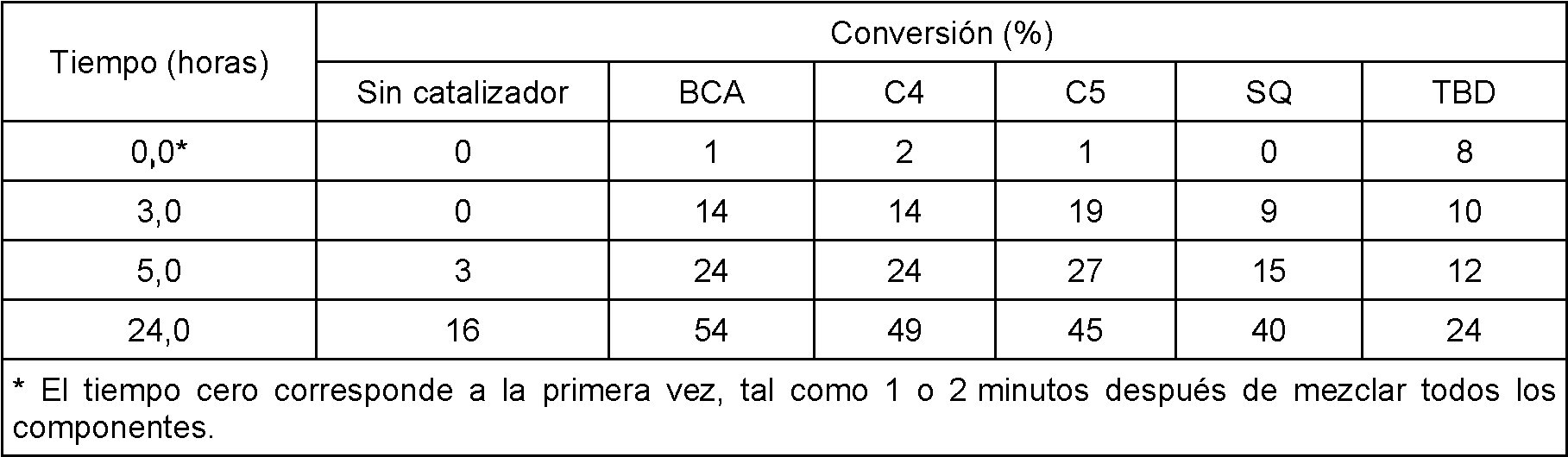
Como se ha mostrado anteriormente, el efecto de los catalizadores BCA, C4, C5 y SQ fue más notable para tiempos de reacción cortos (5 horas) donde los catalizadores mencionados alcanzaron conversiones de un 10 % a un 20 %. En las mismas 5 horas, la reacción sin catalizador quedó prácticamente sin reaccionar. Además, para tiempos de reacción mayores (1 día), BCA, C4, C5 y SQ ayudaron a alcanzar conversiones de aproximadamente un 40 %. As shown above, the effect of the BCA, C4, C5 and SQ catalysts was more notable for short reaction times (5 hours) where the mentioned catalysts reached conversions of 10% to 20%. In the same 5 hours, the reaction without catalyst was practically unreacted. Furthermore, for longer reaction times (1 day), BCA, C4, C5 and SQ helped to achieve conversions of approximately 40%.
Ejemplo 2: Reacción de carbonato cíclico de tipo éter y BA en disolvente usando catalizadores o sin catalizador Se disolvió CCA3 (0,116 g, 0,0003 mol) en 0,5 ml de CDCb. A continuación, se añadió un 5 % en moles del catalizador y se mezcló hasta que la mezcla fue homogénea (15-30 minutos). A continuación, se añadió BA (0,044 g, 0,0006 mol) a la mezcla y se agitó. Las reacciones se monitorizaron por RMN 1H. La conversión de la reacción se calculó con respecto a formación de producto y consumo de la amina. Los resultados se resumen en la Tabla 2.Example 2: Reaction of cyclic ether-type carbonate and BA in solvent using catalysts or without catalyst CCA3 (0.116 g, 0.0003 mol) was dissolved in 0.5 mL of CDCb. Next, 5 mol% of the catalyst was added and mixed until the mixture was homogeneous (15-30 minutes). BA (0.044 g, 0.0006 mol) was then added to the mixture and stirred. Reactions were monitored by 1H NMR. The conversion of the reaction was calculated with respect to product formation and consumption of the amine. The results are summarized in Table 2.
T abla 2. Estudios cinéticos de sistema de resina de carbonato de ti o éter CCA3 BA en CDCbT able 2. Kinetic studies of thi or ether CCA3 BA carbonate resin system in CDCb

Como puede observarse en la Tabla 2, todos los catalizadores de la invención aumentaron la conversión después de 3 y 5 horas de la reacción. Incluso a tiempo cero usando BCA y C4 (benzimidazoles con grupos electroatractores), la conversión fue mayor que la conversión alcanzada sin catalizador. Después de 1 día de reacción, todos los catalizadores alcanzaron conversiones mayores. Por el contrario, TBD consiguió una conversión inferior. En ese tiempo, todos los catalizadores estimularon de forma eficaz la reacción entre CCA3 y BA y alcanzaron mayores conversiones que la reacción de blanco.As can be seen in Table 2, all the catalysts of the invention increased the conversion after 3 and 5 hours of the reaction. Even at time zero using BCA and C4 (benzimidazoles with electrowithdrawing groups), the conversion was higher than the conversion achieved without catalyst. After 1 day of reaction, all catalysts reached higher conversions. In contrast, TBD achieved a lower conversion. At that time, all catalysts efficiently stimulated the reaction between CCA3 and BA and achieved higher conversions than the blank reaction.
Ejemplo 3: Reacción de carbonato cíclico de tipo éter y BA sin disolvente usando catalizadores o sin catalizador Las reacciones entre resinas de ciclocarbonato de tipo éter y aminas se realizaron en volumen con o sin catalizador. La amina BA (0,044 g, 0,0006 mol) se mezcló con un 5 % en moles de catalizador hasta que la mezcla fue homogénea (1-2 min). A continuación, se añadió resina CCA3 (0,116 g, 0,0003 mol) a la mezcla y se agitó. Las reacciones se monitorizaron por RMN 1H. La conversión de la reacción se calculó con respecto a la formación de producto y el consumo de amina, y los resultados se resumen en la Tabla 3.Example 3 Reaction of Cyclic Ether Type Carbonate and BA without Solvent Using Catalysts or Without a Catalyst Reactions between cyclic ether type carbonate resins and amines were carried out by volume with or without a catalyst. Amine BA (0.044 g, 0.0006 mol) was mixed with 5 mol% catalyst until the mixture was homogeneous (1-2 min). CCA3 resin (0.116 g, 0.0003 mol) was then added to the mixture and stirred. Reactions were monitored by 1H NMR. The conversion of the reaction was calculated with respect to product formation and amine consumption, and the results are summarized in Table 3.
T abla 3. Estudios cinéticos de resina de ciclocarbonato de ti o éter CCA3 BA sin disolventeT able 3. Kinetic studies of solvent-free thi or ether CCA3 BA cyclocarbonate resin

En estas condiciones de reacción, el efecto catalítico se observó en gran medida en tiempos muy cortos, C4 y SQ fueron comparables a TDB sin las desventajas que representa el último para el proceso y el producto final. Además, BCA, C3 y C5 obtuvieron mayores conversiones que la reacción no catalizada. Por otra parte, después de una hora de reacción, todas las muestras alcanzaron conversiones de aproximadamente un 80 %, incluyendo la reacción de blanco.Under these reaction conditions, the catalytic effect was largely observed in very short times, C4 and SQ were comparable to TDB without the disadvantages that the latter represents for the process and the final product. Furthermore, BCA, C3 and C5 obtained higher conversions than the uncatalyzed reaction. On the other hand, after one hour of reaction, all samples reached conversions of approximately 80%, including the blank reaction.
Ejemplo 4: Reacción de resina de carbonato cíclico de tipo éster y BA con disolvente usando catalizadorExample 4: Reaction of ester-type cyclic carbonate resin and BA with solvent using catalyst
Las reacciones entre resinas de ciclocarbonato de tipo éster y aminas se realizaron usando dos disolventes diferentes tales como acetato de etilo y cloroformo. Se pusieron CCA4 (0,218 g, 0,0003 mol), un 5 % en moles de catalizador y 0,5 ml de acetato de etilo en un vial y se agitaron hasta la dispersión completa del catalizador. A continuación, se añadió BA (0,044 g, 0,0006 mol). Las reacciones se monitorizaron por RMN 1H. La conversión de la reacción se calculó con respecto a la formación de producto, y los resultados se resumen en la Tabla 4. Reactions between ester-type cyclocarbonate resins and amines were carried out using two different solvents such as ethyl acetate and chloroform. CCA4 (0.218 g, 0.0003 mol), 5 mol% catalyst and 0.5 mL ethyl acetate were placed in a vial and stirred until complete dispersion of the catalyst. BA (0.044 g, 0.0006 mol) was then added. Reactions were monitored by 1H NMR. The conversion of the reaction was calculated relative to product formation, and the results are summarized in Table 4.
Tabla 4. Estudios cinéticos de ciclocarbonato de ti o éster CCA4 BA en EtOAc.Table 4. Kinetic studies of thi cyclocarbonate or CCA4 BA ester in EtOAc.

Como se muestra en la Tabla 4, todos los catalizadores obtuvieron conversiones mayores. Por otra parte, después de 5 horas de reacción, todas las muestras alcanzaron conversiones de aproximadamente un 80 %. As shown in Table 4, all catalysts obtained higher conversions. On the other hand, after 5 hours of reaction, all samples reached conversions of approximately 80%.
Claims (9)


Applications Claiming Priority (1)
| Application Number | Priority Date | Filing Date | Title |
|---|---|---|---|
| EP19382006.5A EP3677616B1 (en) | 2019-01-04 | 2019-01-04 | Method for producing non-isocyanate polyurethanes |
Publications (1)
| Publication Number | Publication Date |
|---|---|
| ES2924770T3 true ES2924770T3 (en) | 2022-10-10 |
Family
ID=65010702
Family Applications (1)
| Application Number | Title | Priority Date | Filing Date |
|---|---|---|---|
| ES19382006T Active ES2924770T3 (en) | 2019-01-04 | 2019-01-04 | Method for producing polyurethanes without isocyanate |
Country Status (8)
| Country | Link |
|---|---|
| US (1) | US12146030B2 (en) |
| EP (1) | EP3677616B1 (en) |
| JP (1) | JP7499258B2 (en) |
| KR (1) | KR102841781B1 (en) |
| CN (1) | CN113286844B (en) |
| ES (1) | ES2924770T3 (en) |
| PL (1) | PL3677616T3 (en) |
| WO (1) | WO2020141046A1 (en) |
Families Citing this family (7)
| Publication number | Priority date | Publication date | Assignee | Title |
|---|---|---|---|---|
| US20250145749A1 (en) * | 2021-08-20 | 2025-05-08 | Cornell University | Poly(cyclic vinyl ethers), compositions of same, methods of making same and uses thereof |
| CN116082290A (en) * | 2021-11-08 | 2023-05-09 | 浙江蓝天环保高科技股份有限公司 | Preparation method of high-purity 4- [ (fluoroalkyl acyloxy) methyl ] -1, 3-dioxacycloalkyl-2-ketone |
| CN114409896B (en) * | 2022-01-20 | 2023-10-24 | 南京工业大学 | Preparation method of non-isocyanate polyurethane |
| CN114773938A (en) * | 2022-04-20 | 2022-07-22 | 史丹龙涂料(常州)有限公司 | Environment-friendly anti-corrosion quick-drying paint and preparation method thereof |
| FR3146473A1 (en) * | 2023-03-08 | 2024-09-13 | Saint-Gobain Weber France | Process for the preparation of isocyanate-free polyurethanes |
| CN119143965A (en) * | 2024-10-12 | 2024-12-17 | 南京林业大学 | Polyurethane elastomer adopting squaric amide chain extension and preparation method thereof |
| CN120118307A (en) * | 2025-05-13 | 2025-06-10 | 天津工业大学 | A non-isocyanate self-healing elastomer and its preparation method and application |
Family Cites Families (19)
| Publication number | Priority date | Publication date | Assignee | Title |
|---|---|---|---|---|
| US3072613A (en) * | 1957-08-20 | 1963-01-08 | Union Carbide Corp | Multiple cyclic carbonate polymers |
| DE3726497A1 (en) * | 1987-08-08 | 1989-02-16 | Hoechst Ag | TARDERABLE COMPOUNDS, THEIR PRODUCTION AND USE |
| US5548041A (en) * | 1991-05-08 | 1996-08-20 | Daicel Chemical Industries, Ltd. | Process for producing polycarbonate |
| DE4412677A1 (en) | 1994-04-13 | 1995-10-19 | Basf Ag | Process for the production of polyurethane foams in the presence of aminoalkyl or aminophenyl imidazoles as a catalyst and the use of these catalysts for the production of polyisocyanate polyaddition products |
| US5977262A (en) | 1997-05-08 | 1999-11-02 | E. I. Du Pont De Nemours And Company | Preparation of hydroxy urethanes |
| EP1070733A1 (en) | 1999-07-21 | 2001-01-24 | Polymate Ltd. | Method of synthesis of polyaminofunctional hydroxyurethane oligomers and hybride polymers formed therefrom |
| JP2006009001A (en) | 2004-05-26 | 2006-01-12 | Japan Paint Manufacturers Association | Method for producing polyhydroxyurethane |
| DE102004035542A1 (en) | 2004-07-22 | 2006-02-09 | Henkel Kgaa | Two-component binder |
| DE102005001053A1 (en) | 2005-01-07 | 2006-07-20 | Merck Patent Gmbh | Square acid derivatives |
| WO2010081670A2 (en) * | 2009-01-14 | 2010-07-22 | Lonza Ltd | Process for the preparation of benzimidazoles |
| FR2981931B1 (en) | 2011-10-28 | 2014-07-04 | Gen Produits Ind S E G Soc D Expl | PROCESS FOR PREPARING A COMPOUND COMPRISING AT LEAST ONE BETA-HYDROXY-URETHANE PATTERN AND / OR AT LEAST ONE GAMMA-HYDROXY-URETHANE PATTERN. |
| RU2632903C2 (en) * | 2011-12-22 | 2017-10-11 | Констракшн Рисёрч Энд Текнолоджи Гмбх | 2-oxo-1,3-dioxolane-4-carboxamides, their production and application |
| EP2883872A1 (en) | 2013-12-16 | 2015-06-17 | Universite De Bordeaux I | Five-membered cyclic biscarbonates bearing amide linkages, their preparation and their uses for the preparation of polyhydroxyurethanes |
| US9260564B2 (en) * | 2014-03-03 | 2016-02-16 | Dow Global Technologies Llc | Catalyst for non-isocyanate based polyurethane |
| JP6202200B2 (en) | 2014-05-20 | 2017-09-27 | 富士電機機器制御株式会社 | Magnetic contactor |
| JP6224529B2 (en) | 2014-06-04 | 2017-11-01 | 大日精化工業株式会社 | Method for producing polyhydroxyurethane |
| ES2665759T3 (en) | 2014-09-30 | 2018-04-27 | Henkel Ag & Co. Kgaa | Curable composition |
| PL3098219T3 (en) | 2015-05-27 | 2018-07-31 | Henkel Ag & Co. Kgaa | Synthesis of cyclic carbonates |
| PT3401350T (en) | 2017-05-11 | 2020-03-04 | Henkel Ag & Co Kgaa | Method for producing functionalized polyesters |
-
2019
- 2019-01-04 PL PL19382006.5T patent/PL3677616T3/en unknown
- 2019-01-04 ES ES19382006T patent/ES2924770T3/en active Active
- 2019-01-04 EP EP19382006.5A patent/EP3677616B1/en active Active
- 2019-12-10 WO PCT/EP2019/084398 patent/WO2020141046A1/en not_active Ceased
- 2019-12-10 JP JP2021539025A patent/JP7499258B2/en active Active
- 2019-12-10 CN CN201980087287.7A patent/CN113286844B/en active Active
- 2019-12-10 KR KR1020217020534A patent/KR102841781B1/en active Active
-
2021
- 2021-06-29 US US17/362,110 patent/US12146030B2/en active Active
Also Published As
| Publication number | Publication date |
|---|---|
| JP7499258B2 (en) | 2024-06-13 |
| KR20210110816A (en) | 2021-09-09 |
| CN113286844B (en) | 2023-05-26 |
| PL3677616T3 (en) | 2022-10-31 |
| WO2020141046A1 (en) | 2020-07-09 |
| EP3677616A1 (en) | 2020-07-08 |
| KR102841781B1 (en) | 2025-08-01 |
| JP2022516323A (en) | 2022-02-25 |
| EP3677616B1 (en) | 2022-07-20 |
| US20210324141A1 (en) | 2021-10-21 |
| US12146030B2 (en) | 2024-11-19 |
| CN113286844A (en) | 2021-08-20 |
Similar Documents
| Publication | Publication Date | Title |
|---|---|---|
| JP7499258B2 (en) | Method for producing non-isocyanate polyurethane | |
| US9309218B2 (en) | 2-Oxo-1,3-dioxolane-4-carboxamides, their preparation and use | |
| ES2792914T3 (en) | 2-oxo-1,3-dioxolane-4-carboxamide building blocks, their preparation and use | |
| US9926288B2 (en) | Five-membered cyclic biscarbonates bearing amide linkages, their preparation and their uses for the preparation of polymers | |
| EP3760664A1 (en) | Self-blowing isocyanate-free polyurethane foams | |
| CN107075077B (en) | Curable organic polymers comprising at least one acylurea unit, their preparation and use | |
| JPS62230763A (en) | Production of n, n-disubstituted mono-and oligourethane |