ES2933277T3 - Process for preparing a salt-fiber powder with binding properties - Google Patents
Process for preparing a salt-fiber powder with binding properties Download PDFInfo
- Publication number
- ES2933277T3 ES2933277T3 ES19713084T ES19713084T ES2933277T3 ES 2933277 T3 ES2933277 T3 ES 2933277T3 ES 19713084 T ES19713084 T ES 19713084T ES 19713084 T ES19713084 T ES 19713084T ES 2933277 T3 ES2933277 T3 ES 2933277T3
- Authority
- ES
- Spain
- Prior art keywords
- salt
- fiber
- bran
- fiber powder
- drying
- Prior art date
- Legal status (The legal status is an assumption and is not a legal conclusion. Google has not performed a legal analysis and makes no representation as to the accuracy of the status listed.)
- Active
Links
Classifications
-
- A—HUMAN NECESSITIES
- A23—FOODS OR FOODSTUFFS; TREATMENT THEREOF, NOT COVERED BY OTHER CLASSES
- A23L—FOODS, FOODSTUFFS OR NON-ALCOHOLIC BEVERAGES, NOT OTHERWISE PROVIDED FOR; PREPARATION OR TREATMENT THEREOF
- A23L27/00—Spices; Flavouring agents or condiments; Artificial sweetening agents; Table salts; Dietetic salt substitutes; Preparation or treatment thereof
- A23L27/40—Table salts; Dietetic salt substitutes
-
- A—HUMAN NECESSITIES
- A23—FOODS OR FOODSTUFFS; TREATMENT THEREOF, NOT COVERED BY OTHER CLASSES
- A23L—FOODS, FOODSTUFFS OR NON-ALCOHOLIC BEVERAGES, NOT OTHERWISE PROVIDED FOR; PREPARATION OR TREATMENT THEREOF
- A23L23/00—Soups; Sauces; Preparation or treatment thereof
- A23L23/10—Soup concentrates, e.g. powders or cakes
-
- A—HUMAN NECESSITIES
- A23—FOODS OR FOODSTUFFS; TREATMENT THEREOF, NOT COVERED BY OTHER CLASSES
- A23L—FOODS, FOODSTUFFS OR NON-ALCOHOLIC BEVERAGES, NOT OTHERWISE PROVIDED FOR; PREPARATION OR TREATMENT THEREOF
- A23L29/00—Foods or foodstuffs containing additives; Preparation or treatment thereof
- A23L29/20—Foods or foodstuffs containing additives; Preparation or treatment thereof containing gelling or thickening agents
- A23L29/206—Foods or foodstuffs containing additives; Preparation or treatment thereof containing gelling or thickening agents of vegetable origin
- A23L29/212—Starch; Modified starch; Starch derivatives, e.g. esters or ethers
-
- A—HUMAN NECESSITIES
- A23—FOODS OR FOODSTUFFS; TREATMENT THEREOF, NOT COVERED BY OTHER CLASSES
- A23L—FOODS, FOODSTUFFS OR NON-ALCOHOLIC BEVERAGES, NOT OTHERWISE PROVIDED FOR; PREPARATION OR TREATMENT THEREOF
- A23L33/00—Modifying nutritive qualities of foods; Dietetic products; Preparation or treatment thereof
- A23L33/20—Reducing nutritive value; Dietetic products with reduced nutritive value
- A23L33/21—Addition of substantially indigestible substances, e.g. dietary fibres
-
- A—HUMAN NECESSITIES
- A23—FOODS OR FOODSTUFFS; TREATMENT THEREOF, NOT COVERED BY OTHER CLASSES
- A23L—FOODS, FOODSTUFFS OR NON-ALCOHOLIC BEVERAGES, NOT OTHERWISE PROVIDED FOR; PREPARATION OR TREATMENT THEREOF
- A23L33/00—Modifying nutritive qualities of foods; Dietetic products; Preparation or treatment thereof
- A23L33/20—Reducing nutritive value; Dietetic products with reduced nutritive value
- A23L33/21—Addition of substantially indigestible substances, e.g. dietary fibres
- A23L33/22—Comminuted fibrous parts of plants, e.g. bagasse or pulp
Landscapes
- Life Sciences & Earth Sciences (AREA)
- Chemical & Material Sciences (AREA)
- Health & Medical Sciences (AREA)
- Nutrition Science (AREA)
- Engineering & Computer Science (AREA)
- Food Science & Technology (AREA)
- Polymers & Plastics (AREA)
- Mycology (AREA)
- Dispersion Chemistry (AREA)
- Botany (AREA)
- Seasonings (AREA)
- Coloring Foods And Improving Nutritive Qualities (AREA)
Abstract
La presente invención se refiere a un polvo de fibra salina, en particular a un proceso para preparar un polvo de fibra salina con propiedades aglutinantes. El proceso comprende mezclar sal, fibra y agua antes, durante o después de la disolución de la sal en el agua, seguido de secado de la mezcla y, opcionalmente, molienda para obtener un polvo de sal y fibra. (Traducción automática con Google Translate, sin valor legal)The present invention relates to a salt fiber powder, in particular to a process for preparing a salt fiber powder with binding properties. The process comprises mixing salt, fiber and water before, during or after dissolution of the salt in the water, followed by drying the mixture and, optionally, milling to obtain a salt and fiber powder. (Automatic translation with Google Translate, without legal value)
Description
DESCRIPCIÓNDESCRIPTION
Proceso de preparación de un polvo de sal-fibra con propiedades aglomerantesProcess for preparing a salt-fiber powder with binding properties
Campo de la invenciónfield of invention
La presente invención se relaciona con un polvo de sal-fibra, en particular a un proceso para preparar un polvo de salfibra con propiedades aglomerantes. El proceso comprende mezclar sal, fibra y agua antes, durante o después de la disolución de la sal en el agua, seguido de secado de la mezcla y, opcionalmente, molienda para obtener un polvo de sal-fibra.The present invention relates to a salt-fiber powder, in particular to a process for preparing a salt-fiber powder with binding properties. The process comprises mixing salt, fiber and water before, during or after the dissolution of the salt in the water, followed by drying the mixture and, optionally, milling to obtain a salt-fiber powder.
Antecedentes de la invenciónBackground of the invention
La sal, o cloruro de sodio (NaCl), se ha utilizado como conservante de alimentos y agente de condimento durante años y años. En ciertas culturas, en las que los alimentos preparados se consumen ampliamente, la sal se ha convertido en el condimento más utilizado, tanto que podría decirse que se usa más de lo que debería o al menos más de lo que podría recomendarse para mantener prácticas alimentarias saludables. La sal también es el ingrediente principal en un comprimido/cubo de consomé. Un comprimido de consomé formado comprimiendo ingredientes en forma de comprimido, por ejemplo un cubo, se usa ampliamente como concentrado para preparar un consomé, un caldo o una sopa. El comprimido de consomé normalmente se agrega a una solución acuosa caliente, lo que permite que se disuelva. Además, un comprimido de consomé se puede utilizar en la preparación de otros platos, como condimento. El tiempo de disolución de los comprimidos de consomé depende en gran medida de su grado de compactación, que se puede medir/expresar por la dureza de dicho producto. La razón de compactar polvos en forma regular presenta varias ventajas para la comercialización (por ejemplo, reducción de volumen, optimización del uso del material de empaque, vida útil y conveniencia). Un hábito desarrollado por los usuarios de los comprimidos de consomé es desmenuzar el comprimido o cubo en el plato durante el proceso de preparación, ya sea para asegurar una buena distribución o para acelerar su tiempo de disolución en el agua de cocción. Esta capacidad de desmenuzamiento es uno de los atributos que debe garantizarse durante la vida útil y, por lo tanto, debe evitarse un post endurecimiento del comprimido o el cubo. Es necesaria una dureza mínima para permitir una envoltura del comprimido. Una dureza máxima asegura que un usuario normal pueda romper el comprimido con los dedos sin el uso de herramientas o aparatos adicionales. Una comprimido o cubo de consomé típico contiene sales, compuestos que mejoran el sabor como el glutamato monosódico (MSG), azúcares, almidón o harina, grasa, componentes saborizantes, vegetales, extractos de carne, especias, colorantes, etc. Las cantidades de los compuestos respectivos pueden variar según la finalidad específica del producto, del mercado o del gusto del consumidor al que se dirige.Salt, or sodium chloride (NaCl), has been used as a food preservative and seasoning agent for years and years. In certain cultures, where prepared foods are widely consumed, salt has become the most widely used seasoning, so much so that it is arguably used more than it should or at least more than what might be recommended to maintain eating practices. healthy. Salt is also the main ingredient in a bouillon tablet/cube. A bouillon tablet formed by compressing ingredients in the form of a tablet, for example a cube, is widely used as a concentrate for preparing a bouillon, broth or soup. The bouillon tablet is usually added to a hot aqueous solution, allowing it to dissolve. In addition, a bouillon tablet can be used in the preparation of other dishes, as a seasoning. The dissolution time of bouillon tablets largely depends on their degree of compaction, which can be measured/expressed by the hardness of said product. The reason for compacting powders on a regular basis presents several advantages for commercialization (for example, volume reduction, optimization of the use of packaging material, shelf life and convenience). A habit developed by users of bouillon tablets is to crumble the tablet or cube on the plate during the preparation process, either to ensure good distribution or to speed up its dissolution time in the cooking water. This crumbling ability is one of the attributes that must be ensured during shelf life and therefore a post hardening of the tablet or cube must be avoided. A minimum hardness is necessary to allow tablet coating. A maximum hardness ensures that a normal user can break the tablet with his fingers without the use of additional tools or apparatus. A typical bouillon tablet or cube contains salts, flavor-enhancing compounds like monosodium glutamate (MSG), sugars, starch or flour, fat, flavoring components, vegetables, meat extracts, spices, colorings, etc. The amounts of the respective compounds may vary according to the specific purpose of the product, the market or the taste of the consumer to whom it is directed.
Una forma convencional de fabricar comprimidos de consomé comprende mezclar componentes de consomé en polvo con grasa y prensar la mezcla en un comprimido. En este tipo de comprimido de consomé, la grasa es el ingrediente principal que mantiene unida la estructura.A conventional way of making bouillon tablets comprises mixing powdered bouillon components with fat and pressing the mixture into a tablet. In this type of bouillon tablet, fat is the main ingredient that holds the structure together.
Hoy en día existe una tendencia nutricional a evitar o al menos reducir el consumo de grasas ricas en ácidos grasos saturados y consumir preferentemente aceites ricos en ácidos grasos monoinsaturados y/o ácidos grasos poliinsaturados. El documento WO2004/049831 describe cómo es posible tener muy poca grasa sólida atrapada en un comprimido de consomé duro siempre que el comprimido también comprenda cristales, un agente de relleno y un agente adherente. El agente adherente puede comprender ingredientes cuya adición (combinada con un aumento adecuado de la actividad del agua) imparte una temperatura de transición vítrea a la mezcla final que puede superarse con relativa facilidad durante la formación de comprimidos. Dichos ingredientes incluyen extracto de carne, sabores procesados y/o extractos vegetales.Today there is a nutritional trend to avoid or at least reduce the consumption of fats rich in saturated fatty acids and preferably consume oils rich in monounsaturated fatty acids and/or polyunsaturated fatty acids. WO2004/049831 describes how it is possible to have very little solid fat trapped in a hard bouillon tablet as long as the tablet also comprises crystals, a filler and a sticking agent. The tackifying agent may comprise ingredients whose addition (combined with a suitable increase in water activity) imparts a glass transition temperature to the final mixture that can be relatively easily exceeded during tableting. Said ingredients include meat extract, processed flavors and/or vegetable extracts.
Los agentes adherentes utilizados para aglomerar cubos de consomé con bajo contenido de grasa son típicamente ingredientes amorfos higroscópicos. Estos se activan en la mezcla de consomé mediante la adición de agua. Este proceso de adición de agua puede ser problemático, por ejemplo, es difícil asegurar una distribución homogénea del agua y se necesita un tiempo de almacenamiento de hasta 24 horas para alcanzar el equilibrio de la actividad del agua. Puede ocurrir la formación de costras, lo que requiere detener la mezcladora para limpiarla. A veces se forman grumos en las mezclas que causan defectos de calidad en los comprimidos prensados terminados. Además, puede ocurrir un post endurecimiento del comprimido de consomé.The binding agents used to agglomerate low-fat bouillon cubes are typically hygroscopic amorphous ingredients. These are activated in the bouillon mix by the addition of water. This process of adding water can be problematic, for example it is difficult to ensure a homogeneous distribution of water and a storage time of up to 24 hours is needed to reach equilibrium of water activity. Crusting may occur, requiring shutdown of the mixer for cleaning. Lumps sometimes form in the mixtures which cause quality defects in the finished compressed tablets. In addition, post-hardening of the bouillon tablet may occur.
El documento US5034378 divulga una composición potenciadora del sabor para alimentos humanos compuesta por una sal comestible seleccionada del grupo que consiste en cloruro de sodio, cloruro de potasio y glutamato monosódico, y fibra granulada o en polvo, estando dicha composición en forma granular o en polvo. El documento WO2017171553 divulga una preparación de gránulos y gránulos reventados que comprenden sustancias funcionales o sustancias activas y un material portador o material de matriz. Los documentos WO2004049831 y WO03003858 divulgan un comprimido o cubo de consomé duro que comprende solo o principalmente aceite líquido y nada o poca grasa además de los ingredientes de consomé convencionales no grasos. El documento WO2017097499 divulga un comprimido de consomé que comprende sal, aceite y/o grasa y un saborizante culinario, caracterizada porque el comprimido comprende además del 1 al 25 % en peso seco de un salvado de cereal, divulga un comprimido de consomé y/o condimento, que comprende de 0.5 a 10 % en peso de aceite y/o de 0 a 5 % en peso de grasa, aglomerantes, sal, entre 2 y 3 % en peso de agua total, y entre 0.5 y 8 % en peso de cereal, fibras de vegetales o frutas.Document US5034378 discloses a flavor-enhancing composition for human foods composed of an edible salt selected from the group consisting of sodium chloride, potassium chloride and monosodium glutamate, and granulated or powdered fiber, said composition being in granular or powder form. . WO2017171553 discloses a preparation of granules and burst granules comprising functional substances or active substances and a carrier material or matrix material. WO2004049831 and WO03003858 disclose a hard bouillon tablet or cube comprising only or mainly liquid oil and little or no fat in addition to conventional non-fat bouillon ingredients. Document WO2017097499 discloses a consommé tablet comprising salt, oil and/or fat and a culinary flavoring, characterized in that the tablet also comprises 1 to 25% by dry weight of a cereal bran, discloses a consommé tablet and/or seasoning, comprising from 0.5 to 10% by weight of oil and/or from 0 to 5% by weight of fat, binders, salt, between 2 and 3 % by weight of total water, and between 0.5 and 8 % by weight of cereal, vegetable or fruit fibers.
Por tanto, existe una necesidad persistente en la técnica de encontrar procesos mejorados para formar comprimidos de consomé, especialmente comprimidos de consomé que utilicen un nuevo sistema de aglomeración a pesar del sistema de aglomeración bien conocido de aglomeración amorfa y/o aglomeración grasa.Therefore, there is a continuing need in the art for improved processes for forming bouillon tablets, especially bouillon tablets that utilize a new agglomeration system despite the well-known agglomeration system of amorphous agglomeration and/or fat agglomeration.
Sumario de la invenciónSummary of the invention
Un objeto de la presente invención es mejorar el estado de la técnica y proporcionar una solución mejorada para superar al menos algunos de los inconvenientes descritos anteriormente o al menos proporcionar una alternativa útil. El objeto de la presente invención se logra mediante la materia objeto de las reivindicaciones independientes. Las reivindicaciones dependientes desarrollan más la idea de la presente invención.An object of the present invention is to improve the state of the art and provide an improved solution to overcome at least some of the drawbacks described above or at least provide a useful alternative. The object of the present invention is achieved by the subject matter of the independent claims. The dependent claims further develop the idea of the present invention.
En consecuencia, la presente invención proporciona en un primer aspecto un proceso para la producción de un polvo de sal-fibra, el proceso que comprende las etapas de:Accordingly, the present invention provides in a first aspect a process for the production of a salt-fiber powder, the process comprising the steps of:
a) mezclar sal, fibra y agua antes, durante o después de la disolución de la sal en el agua, en donde la sal se disuelve en el agua en una proporción entre 1:2.8 a 1:20;a) mix salt, fiber and water before, during or after the dissolution of the salt in the water, where the salt is dissolved in the water in a ratio between 1:2.8 to 1:20;
b) secar la mezcla de la etapa a) para obtener una masa de sal-fibra seca; yb) drying the mixture from step a) to obtain a dry salt-fiber mass; and
c) moler la masa de sal-fibra seca para obtener un polvo de sal-fibra;c) grinding the dry salt-fiber mass to obtain a salt-fiber powder;
en donde el polvo de sal-fibra comprende del 10 al 90 % en peso de sal y del 10 al 90 % en peso de fibra, en donde la fibra es una fibra dietética, salvado de cereal o una combinación de los mismos y en donde la fibra se selecciona de al menos una de zanahoria, remolacha, calabaza, cítricos, trigo, avena, bambú, tomate, pimiento morrón, puerro, jengibre, cebolla, col rizada, chirivía, apio, pepino, calabacín, brócoli, colinabo, espárragos o combinaciones de los mismos y en donde el salvado de cereal se selecciona del grupo que consiste en salvado de arroz, salvado de trigo, salvado de trigo sarraceno, salvado de maíz, salvado de avena, salvado de cebada o una combinación de los mismos y en donde el polvo de sal-fibra no contiene ácido añadido, goma añadida, hidrocoloide añadido o una combinación de los mismos.wherein the salt-fiber powder comprises 10 to 90% by weight of salt and 10 to 90% by weight of fiber, wherein the fiber is a dietary fiber, cereal bran, or a combination thereof, and wherein the fiber is selected from at least one of carrot, beetroot, pumpkin, citrus, wheat, oats, bamboo, tomato, bell pepper, leek, ginger, onion, kale, parsnip, celery, cucumber, zucchini, broccoli, kohlrabi, asparagus or combinations thereof and wherein the cereal bran is selected from the group consisting of rice bran, wheat bran, buckwheat bran, corn bran, oat bran, barley bran or a combination thereof and wherein the salt-fiber powder does not contain added acid, added gum, added hydrocolloid, or a combination thereof.
Sorprendentemente, los inventores han encontrado que el uso de un polvo de sal-fibra coprocesado tiene muy buenos valores de fluidez y proporciona un nuevo sistema de aglomeración eficaz, por ejemplo, en un comprimido de consomé. El uso del polvo de sal-fibra aumenta la dureza de los comprimidos/cubos de consomé después del prensado. La dureza obtenida puede exceder la dureza que se observa comúnmente durante el prensado de cubos/comprimidos de consomé. Al mismo tiempo, los productos de consomé producidos aún se pueden desmenuzar. Hasta ahora, tal comportamiento no se ha observado para valores de dureza comparables. Esto indica fuertemente que está presente un mecanismo de aglomeración diferente y nuevo. Debido a esto, los cubos/comprimidos se pueden producir fácilmente (alta dureza ventajosa para la fabricación) pero al mismo tiempo muestran una buena capacidad de desmenuzamiento. La capacidad de desmenuzamiento es un impulsor clave del gusto por los consumidores y, por lo tanto, es deseable. Además, los comprimidos/cubos de consomé tienen un tiempo de disolución más rápido en comparación con los comprimidos/cubos de consomé estándar. Esto es muy sorprendente ya que debido a la mayor dureza se espera un tiempo de disolución más lento.Surprisingly, the inventors have found that the use of a co-processed salt-fiber powder has very good flowability values and provides a new effective agglomeration system, eg in a bouillon tablet. The use of salt-fiber powder increases the hardness of the tablets/bouillon cubes after pressing. The hardness obtained may exceed the hardness commonly observed during bouillon cube/tablet pressing. At the same time, the consommé products produced can still be crumbled. So far, such behavior has not been observed for comparable hardness values. This strongly indicates that a different and new agglomeration mechanism is present. Due to this, cubes/tablets can be easily produced (advantageous high hardness for manufacturing) but at the same time show good crumbliness. Crumbability is a key driver of taste for consumers and is therefore desirable. In addition, the tablets/bouillon cubes have a faster dissolution time compared to standard tablets/bouillon cubes. This is very surprising since due to the higher hardness a slower dissolution time is expected.
Además, el polvo de sal-fibra se utiliza para producir cubos de consomé con un contenido de sal reducido (por ejemplo, entre un 10 a 50 % de reducción). Sorprendentemente, se encontró que los cubos/comprimidos se podían prensar incluso aunque se usara un alto contenido de fibra (las fibras son elásticas y pueden conducir a decapado/roturas después del prensado). Este comportamiento podría explicarse por el atrapamiento de sal en las fibras. Permite el uso de mayores contenidos de fibras en las aplicaciones. También se debe mencionar que la fluidez se ve influenciada positivamente por el uso del polvo de sal-fibra en comparación con las fibras puras.Additionally, salt-fiber powder is used to produce bouillon cubes with reduced salt content (eg 10 to 50% reduction). Surprisingly, it was found that the cubes/tablets could be pressed even when using a high fiber content (fibers are elastic and can lead to chipping/breakage after pressing). This behavior could be explained by the entrapment of salt in the fibers. Allows the use of higher fiber contents in applications. It should also be mentioned that the flowability is positively influenced by the use of the salt-fiber powder compared to the pure fibers.
Descripción detallada de la invenciónDetailed description of the invention
En consecuencia, la presente invención se relaciona con un proceso para la producción de un polvo de sal-fibra, el proceso que comprende las etapas de:Consequently, the present invention relates to a process for the production of a salt-fiber powder, the process comprising the steps of:
a) mezclar sal, fibra y agua antes, durante o después de la disolución de la sal en el agua, en donde la sal se disuelve en el agua en una proporción entre 1:2.8 y 1:20;a) mix salt, fiber and water before, during or after the dissolution of the salt in the water, where the salt is dissolved in the water in a ratio between 1:2.8 and 1:20;
b) secar la mezcla de la etapa a) para obtener una masa de sal-fibra seca; yb) drying the mixture from step a) to obtain a dry salt-fiber mass; and
c) moler la masa de sal-fibra seca para obtener un polvo de sal-fibra; c) grinding the dry salt-fiber mass to obtain a salt-fiber powder;
en donde el polvo de sal-fibra comprende del 10 al 90 % en peso de sal y del 10 al 90 % en peso de fibra, en donde la fibra es una fibra dietética, salvado de cereal o una combinación de los mismos y en donde la fibra se selecciona de al menos una de zanahoria, remolacha, calabaza, cítricos, trigo, avena, bambú, tomate, pimiento morrón, puerro, jengibre, cebolla, col rizada, chirivía, apio, pepino, calabacín, brócoli, colinabo, espárragos o combinaciones de los mismos y en donde el salvado de cereal se selecciona del grupo que consiste en salvado de arroz, salvado de trigo, salvado de trigo sarraceno, salvado de maíz, salvado de avena, salvado de cebada o una combinación de los mismos y en donde el polvo de sal-fibra no contiene ácido añadido, goma añadida, hidrocoloide añadido o una combinación de los mismos.wherein the salt-fiber powder comprises 10 to 90 % by weight of salt and 10 to 90 % by weight of fiber, wherein the fiber is a dietary fiber, cereal bran, or a combination thereof, and wherein the fiber is selected from at least one of carrot, beetroot, pumpkin, citrus, wheat, oats, bamboo, tomato, bell pepper, leek, ginger, onion, kale, parsnip, celery, cucumber, zucchini, broccoli, kohlrabi, asparagus or combinations thereof and wherein the cereal bran is selected from the group consisting of rice bran, wheat bran, buckwheat bran, corn bran, oat bran, barley bran or a combination thereof and wherein the salt-fiber powder does not contain added acid, added gum, added hydrocolloid, or a combination thereof.
Un aspecto de la invención proporciona el uso del polvo de sal-fibra para obtener un comprimido de consomé.One aspect of the invention provides the use of the salt-fiber powder to obtain a bouillon tablet.
"Sal" de acuerdo con esta invención significa sales comestibles capaces de impartir o mejorar una percepción de sabor salado. La sal se selecciona del grupo que consiste en cloruro de sodio, cloruro de potasio, cloruro de amonio o una combinación de los mismos, más preferiblemente cloruro de sodio."Salt" according to this invention means edible salts capable of imparting or enhancing a salty taste perception. The salt is selected from the group consisting of sodium chloride, potassium chloride, ammonium chloride, or a combination thereof, more preferably sodium chloride.
El término "disolución" de acuerdo con esta invención significa que la sal se disuelve en agua. La sal se disuelve en agua en una proporción de 1:2.8 a 1:20, preferentemente de 1:2.8 a 1:20, preferentemente de 1:2.8 a 1:15, preferentemente de 1:2.8 a 1:10, preferentemente de 1:2.8 a 1:6, preferentemente 1:3 a 1:20, preferentemente 1:3 a 1:15, preferentemente 1:3 a 1:10, preferentemente 1:3 a 1:6, preferentemente 1:4 a 1:20, preferentemente 1:4 a 1:15, preferiblemente 1:4 a 1:10, preferiblemente 1:4 a 1:6. En una realización preferida se obtiene una solución saturada de agua y sal. En una realización, las fibras y el agua se mezclan después de la disolución de la sal en el agua. The term "solution" according to this invention means that the salt is dissolved in water. The salt is dissolved in water in a ratio of 1:2.8 to 1:20, preferably 1:2.8 to 1:20, preferably 1:2.8 to 1:15, preferably 1:2.8 to 1:10, preferably 1:2.8 to 1:6, preferably 1:3 to 1:20, preferably 1:3 to 1:15, preferably 1:3 to 1:10, preferably 1:3 to 1:6, preferably 1:4 to 1 :20, preferably 1:4 to 1:15, preferably 1:4 to 1:10, preferably 1:4 to 1:6. In a preferred embodiment, a saturated solution of water and salt is obtained. In one embodiment, the fibers and water are mixed after dissolution of the salt in the water.
"Fibras" de acuerdo con esta invención son fibras dietéticas, salvado de cereales o una combinación de los mismos. La fibra dietética consiste en los restos de células vegetales comestibles, polisacáridos, lignina y sustancias asociadas resistentes a la digestión (hidrólisis) por las enzimas alimentarias de humanos. Las fibras dietéticas son de vegetales, frutas, cereales o combinaciones de los mismos. Las fibras dietéticas se seleccionan de al menos una de zanahoria, remolacha, calabaza, cítricos, trigo, avena, bambú, tomate, pimiento morrón, puerro, jengibre, cebolla, col rizada, chirivía, apio, pepino, calabacín, brócoli, colinabo, espárragos o combinaciones de los mismos, preferiblemente zanahoria, remolacha, calabaza, cítricos, trigo, avena, bambú, tomate o combinaciones de los mismos. "Salvado" de acuerdo con esta invención son las capas exteriores de los granos que consisten en pericarpio, testa, germen de la capa de aleurona y pueden comprender una parte del endospermo amiláceo. Las preparaciones comerciales de salvado contienen cantidades variables de germen y endospermo amiláceo según la variedad de cereal y el proceso de molienda. El salvado se obtiene principalmente a partir de granos de cereal, como cebada, trigo sarraceno, bulgur, alpiste, avena común (Avena sativa, también denominada aquí como avena), maíz, mijo, arroz (por ejemplo, arroz negro, arroz integral y/o arroz salvaje), centeno, sorgo, espelta, teff, triticale, trigo y bayas de trigo. Los cereales integrales más preferidos son los de las plantas monocotiledóneas de la familia Poaceae (familia de las gramíneas) cultivadas por sus granos amiláceos comestibles. Las especies de plantas que no pertenecen a la familia de las gramíneas también producen semillas o frutos amiláceos que pueden utilizarse de la misma manera que los granos de cereales, se denominan pseudocereales. Ejemplos de pseudocereales incluyen amaranto, trigo sarraceno, trigo sarraceno tártaro y quinua. A menos que el contexto aquí indique claramente lo contrario, el término 'cereal' tal como se utiliza aquí incluye tanto cereales como pseudocereales; y los salvados usados aquí pueden ser de cualquier tipo. En general, la fuente de grano que se utiliza depende del producto al que se va a agregar, ya que cada grano tiene su propio perfil de sabor."Fibers" according to this invention are dietary fibers, cereal bran, or a combination thereof. Dietary fiber consists of edible plant cell debris, polysaccharides, lignin, and associated substances resistant to digestion (hydrolysis) by human food enzymes. Dietary fibers are from vegetables, fruits, grains, or combinations thereof. The dietary fibers are selected from at least one of carrot, beetroot, pumpkin, citrus, wheat, oats, bamboo, tomato, bell pepper, leek, ginger, onion, kale, parsnip, celery, cucumber, zucchini, broccoli, kohlrabi, asparagus or combinations thereof, preferably carrot, beetroot, pumpkin, citrus, wheat, oats, bamboo, tomato or combinations thereof. "Bran" according to this invention are the outer layers of the kernels consisting of pericarp, testa, aleurone layer germ and may comprise a part of the starchy endosperm. Commercial bran preparations contain variable amounts of germ and starchy endosperm depending on the variety of cereal and the milling process. Bran is obtained mainly from cereal grains, such as barley, buckwheat, bulgur, canary seed, common oats (Avena sativa, also referred to herein as oats), maize, millet, rice (for example, black rice, brown rice and /or wild rice), rye, sorghum, spelt, teff, triticale, wheat and wheat berries. The most preferred whole grains are those from the monocotyledonous plants of the Poaceae family (grass family) cultivated for their edible starchy grains. Plant species that do not belong to the grass family also produce seeds or starchy fruits that can be used in the same way as cereal grains, they are called pseudocereals. Examples of pseudocereals include amaranth, buckwheat, tartar buckwheat, and quinoa. Unless the context herein clearly indicates otherwise, the term 'cereal' as used herein includes both cereals and pseudocereals; and the brans used here can be of any type. In general, the source of grain that is used depends on the product to which it is being added, since each grain has its own flavor profile.
En una realización de la presente invención, el salvado de cereal se selecciona del grupo que consiste en salvado de arroz, salvado de trigo, salvado de trigo sarraceno, salvado de maíz, salvado de avena, salvado de cebada o una combinación de los mismos.In one embodiment of the present invention, the cereal bran is selected from the group consisting of rice bran, wheat bran, buckwheat bran, corn bran, oat bran, barley bran, or a combination thereof.
Dependiendo del tipo de grano de cereal, el salvado constituye aproximadamente el 3-30 % del peso seco del grano. El componente principal del salvado es la fibra dietética. En una realización de la invención donde el salvado se origina a partir de cereales integrales de trigo, el salvado puede comprender de manera útil componentes en las siguientes cantidades: fibras 30-70 % (p/p), almidón 20-50 % (p/p), proteínas 5-20 % (p/p), grasa 0.5-10 % (p/p).Depending on the type of cereal grain, the bran constitutes approximately 3-30% of the dry weight of the grain. The main component of bran is dietary fiber. In an embodiment of the invention where the bran originates from whole wheat cereals, the bran may usefully comprise components in the following amounts: fiber 30-70% (w/w), starch 20-50% (w /p), proteins 5-20% (p/p), fat 0.5-10% (p/p).
El salvado en la composición de la invención puede opcionalmente ser tratado térmicamente y puede ser grueso o en polvo y para reducir su tamaño de partícula y lograr las propiedades de partícula definidas. En una realización preferida, el salvado es salvado de cereales en polvo. Los métodos para producir salvado en polvo son conocidos por la persona experimentada en la técnica.The bran in the composition of the invention may optionally be heat treated and may be coarse or powdery and to reduce its particle size and achieve defined particle properties. In a preferred embodiment, the bran is powdered cereal bran. Methods for producing powdered bran are known to the person skilled in the art.
En una realización de la presente invención, el salvado de cereal contenido en el comprimido de la presente invención se muele. Preferiblemente, el salvado de cereales se muele en seco. Normalmente, la molienda transforma el salvado de cereal en una forma más apetecible al reducir el tamaño de partícula del salvado. La molienda del salvado tiene la ventaja de que, por ejemplo, mejora la homogeneidad del producto final, que mejora la eficiencia de mezcla del salvado y los otros ingredientes, que mejora la capacidad de aglomeración entre los diferentes ingredientes, que mejora la digestibilidad del salvado por parte del consumidor. La molienda reduce preferentemente el tamaño de partícula del salvado de cereales. In an embodiment of the present invention, the cereal bran contained in the tablet of the present invention is ground. Preferably, the cereal bran is ground dry. Typically, milling transforms the cereal bran into a more palatable form by reducing the particle size of the bran. Grinding the bran has the advantage that, for example, it improves the homogeneity of the final product, that it improves the mixing efficiency of the bran and the other ingredients, that it improves the agglomeration capacity between the different ingredients, that it improves the digestibility of the bran by the consumer. Milling preferentially reduces the particle size of the cereal bran.
Las fibras (fibras dietéticas, salvado de cereales o una combinación de las mismas) están en forma de polvo y tienen un tamaño de partícula de 5 jim a 1000 |jm, preferiblemente de 5 jim a 1000 |jm, preferiblemente de 5 jim a 800 |jm, preferiblemente de 5 jim a 700 jim, preferiblemente de 5 jim a 500 jim, preferiblemente de 15 jim a 1000 jim, preferiblemente de 15 jim a 700 jim, preferiblemente de 15 jim a 500 jim, preferiblemente de 20 jim a 500 jim, preferiblemente de 50 jim a 800 jim, preferiblemente de 5 jim a 500 jim, preferiblemente de 75 jim a 700 jim, preferiblemente de 80 jim a 500 jim, preferiblemente de 100 jim a 600 jim, preferiblemente de 100 jim a 500 jim, preferiblemente de 250 jim a 500 jim. El tamaño de partícula y la distribución del tamaño de partícula pueden medirse por difracción láser usando un Malvern Mastersizer.The fibers (dietary fibers, cereal bran or a combination thereof) are in powder form and have a particle size of 5 jim to 1000 |jm, preferably 5 jim to 1000 |jm, preferably 5 jim to 800 |jm, preferably from 5 jim to 700 jim, preferably from 5 jim to 500 jim, preferably from 15 jim to 1000 jim, preferably from 15 jim to 700 jim, preferably from 15 jim to 500 jim, preferably from 20 jim to 500 jim , preferably from 50 jim to 800 jim, preferably from 5 jim to 500 jim, preferably from 75 jim to 700 jim, preferably from 80 jim to 500 jim, preferably from 100 jim to 600 jim, preferably from 100 jim to 500 jim, preferably from 250 jim to 500 jim. Particle size and particle size distribution can be measured by laser diffraction using a Malvern Mastersizer.
"Masa de sal-fibra" o "polvo de sal-fibra" de acuerdo con esta invención es un agregado de fibras, en donde la sal se cristaliza en, sobre y a través de la fibra agregada que tiene una protuberancia superficial de sal con un tamaño de partícula de sal entre 0.5-50 jim, preferiblemente 0.5-30 jim, preferiblemente 0.5-10 jim, preferiblemente 1-50 jim, preferiblemente 1-30 jim, preferiblemente 1-10 jim, preferiblemente 1.5-50 jim, preferiblemente 1.5-30 jim, preferiblemente 1.5-10 jim, preferiblemente 2-50 jim, preferiblemente 2-30 jim, preferiblemente 2-10 jim. El polvo de sal-fibra no es hueco. El polvo seco de sal-fibra tiene una distribución de tamaño de partícula con un diámetro medio Dv50 en el intervalo de 50 a 1500 jim, preferiblemente en el intervalo de 100 a 1500 jim, preferiblemente en el intervalo de 150 a 1500 jim, preferiblemente en el intervalo de 200 a 1500 jim, preferiblemente en el intervalo de 200 a 1000 jim, preferiblemente en el intervalo de 225 a 1000 jim, preferiblemente en el intervalo de 225 a 800 jim, preferiblemente en el intervalo de 250 a 800 jim. En una realización adicional, el polvo de sal-fibra comprende del 10 al 90 % de sal (en peso del polvo de sal-fibra) y del 10 al 90 % de fibras (en peso del polvo de sal-fibra), preferiblemente del 15 al 85 % de sal y 15 a 85% de fibras, preferiblemente 18 a 82% de sal y 18 a 82 % de fibras, preferiblemente 20 a 80 % de sal y 20 a 80% de fibras, preferiblemente 25 a 75 % de sal y 25 a 75 % de fibras, preferentemente 30 a 70 % de sal y 30 a 70 % de fibras, preferentemente 50 % de sal y 50 % de fibras (en peso de polvo de sal-fibra). El polvo de sal-fibra no contiene ácido añadido, goma añadida, hidrocoloide añadido o una combinación de los mismos. La goma de acuerdo con esta invención es goma de xantano, carragenano, goma de algarrobo, agar, alginatos, goma guar, goma arábiga, gellan o una combinación de los mismos."Salt-fiber dough" or "salt-fiber powder" according to this invention is a fiber aggregate, wherein salt crystallizes in, on, and through the aggregate fiber having a surface bulge of salt with a salt particle size between 0.5-50 jim, preferably 0.5-30 jim, preferably 0.5-10 jim, preferably 1-50 jim, preferably 1-30 jim, preferably 1-10 jim, preferably 1.5-50 jim, preferably 1.5- 30 jim, preferably 1.5-10 jim, preferably 2-50 jim, preferably 2-30 jim, preferably 2-10 jim. Salt-fiber powder is not hollow. The salt-fiber dry powder has a particle size distribution with a mean diameter Dv50 in the range of 50 to 1500 jim, preferably in the range 100 to 1500 jim, preferably in the range 150 to 1500 jim, preferably in the range 150 to 1500 jim. the range of 200 to 1500 jim, preferably in the range of 200 to 1000 jim, preferably in the range of 225 to 1000 jim, preferably in the range of 225 to 800 jim, preferably in the range of 250 to 800 jim. In a further embodiment, the salt-fiber powder comprises 10 to 90% salt (by weight of the salt-fiber powder) and 10 to 90% fibers (by weight of the salt-fiber powder), preferably from 15 to 85% salt and 15 to 85% fibers, preferably 18 to 82% salt and 18 to 82% fibers, preferably 20 to 80% salt and 20 to 80% fibers, preferably 25 to 75% salt and 25 to 75% fibers, preferably 30 to 70% salt and 30 to 70% fibers, preferably 50% salt and 50% fibers (by weight of salt-fiber powder). The salt-fiber powder contains no added acid, added gum, added hydrocolloid, or a combination thereof. The gum according to this invention is xanthan gum, carrageenan, locust bean gum, agar, alginates, guar gum, acacia, gellan or a combination thereof.
El tamaño de partícula Dv50 se usa en el sentido convencional como la mediana de la distribución del tamaño de partícula. Los valores de la mediana se definen como el valor donde la mitad de la población reside por encima de este punto y la mitad reside por debajo de este punto. El Dv50 es el tamaño en micrómetros que divide la distribución de volumen con la mitad por encima y la mitad por debajo de este diámetro. La distribución del tamaño de partículas puede medirse mediante dispersión de luz láser, microscopía o microscopía combinada con análisis de imágenes. Por ejemplo, la distribución del tamaño de partículas puede medirse mediante dispersión de luz láser. Dado que el resultado principal de la difracción láser es una distribución de volumen, el Dv50 citado es la mediana de volumen. The Dv50 particle size is used in the conventional sense as the median of the particle size distribution. Median values are defined as the value where half of the population resides above this point and half resides below this point. The Dv50 is the size in micrometers that divides the volume distribution with half above and half below this diameter. Particle size distribution can be measured by laser light scattering, microscopy, or microscopy combined with image analysis. For example, the particle size distribution can be measured by laser light scattering. Since the primary result of laser diffraction is a volume distribution, the quoted Dv50 is the median volume.
La etapa de secado puede llevarse a cabo mediante cualquier técnica de secado comúnmente conocida, como secado al aire, secado en horno, secado en tambor, secado bajo vacío, secado en lecho, secado bajo vacío por microondas, secado por radiación infrarroja o combinaciones de los mismos. La etapa de secado no incluye el secado por aspersión. En una realización de la invención el secado se realiza a una temperatura entre 50 a 150 ° C, preferentemente entre 50 a 120 ° C, preferentemente entre 60 a 120 ° C, preferentemente entre 60 a 100 ° C, preferentemente entre 65 a 120 ° C, preferentemente entre 65 y 100 ° C, preferentemente entre 65 y 90 ° C, preferentemente entre 65 y 80 ° C. Antes del secado, la masa de sal-fibra tiene una viscosidad de al menos 600 mPa.s, preferiblemente de al menos 800 mPa.s, preferiblemente de al menos 1000 mPa.s. Para el secado por aspersión se utiliza una viscosidad inferior a 350 mPa.s. En presencia de partículas en la suspensión, una reducción adicional considerable de la viscosidad máxima en la alimentación del secado por aspersión suele ser esencial para evitar la obstrucción del atomizador de secado por aspersión. La viscosidad se mide con un reómetro a una rata de corte de 10 s_1 utilizando el reómetro MCR300 con cilindro de medición CC27 y unidad de termostatización Peltier TEZ150P (Anton Paar GmbH, Alemania).The drying step can be carried out by any commonly known drying technique, such as air drying, oven drying, drum drying, vacuum drying, bed drying, microwave vacuum drying, infrared radiation drying or combinations of the same. The drying stage does not include spray drying. In one embodiment of the invention, drying is carried out at a temperature between 50 and 150 °C, preferably between 50 and 120 °C, preferably between 60 and 120 °C, preferably between 60 and 100 °C, preferably between 65 and 120 °C. C, preferably between 65 and 100 °C, preferably between 65 and 90 °C, preferably between 65 and 80 °C. Before drying, the salt-fiber mass has a viscosity of at least 600 mPa.s, preferably at least 800 mPa.s, preferably at least 1000 mPa.s. For spray drying, a viscosity of less than 350 mPa.s is used. In the presence of particles in the slurry, a significant further reduction of the peak viscosity in the spray-dry feed is often essential to prevent clogging of the spray-dry atomizer. Viscosity is measured with a rheometer at a shear rate of 10 s_1 using the MCR300 rheometer with CC27 measuring cylinder and TEZ150P Peltier thermostat unit (Anton Paar GmbH, Germany).
La molienda de acuerdo con esta invención es un proceso que rompe materiales sólidos en pedazos más pequeños mediante triturado, desmenuzado o cortado. La molienda se puede llevar a cabo mediante cualquiera de las técnicas de molienda comúnmente conocidas, tales como molino de rodillos, molino de martillos, molino troceador, molino de bolas, molino SAG, molino de barras o combinaciones de los mismos.Milling in accordance with this invention is a process that breaks solid materials into smaller pieces by crushing, shredding, or cutting. The grinding can be carried out by any of the commonly known grinding techniques, such as roller mill, hammer mill, chop mill, ball mill, SAG mill, rod mill or combinations thereof.
En otra realización, el "polvo de sal-fibra seco " de acuerdo con esta invención tiene una actividad de agua por debajo de 0.35, preferiblemente por debajo de 0.30, preferiblemente entre 0.1-0.35, preferiblemente entre 0.1-0.3. La fibra mojada tiene una actividad de agua de al menos 0.6, preferiblemente de al menos 0.7.In another embodiment, the "dry fiber-salt powder" according to this invention has a water activity below 0.35, preferably below 0.30, preferably between 0.1-0.35, preferably between 0.1-0.3. The wet fiber has a water activity of at least 0.6, preferably at least 0.7.
"Capacidad de flujo" significa propiedades de flujo sobre la facilidad con que fluye un polvo. Capacidad de flujo (ffc) se cuantifica como el cociente del estrés de consolidación 01 al límite elástico ilimitado oc de acuerdo con "Schulze, D. (2006). Flow properties of powders and bulk solids. Braunschweig/Wolfenbuttel, Germany: University of Applied Sciences." En una realización, la capacidad de flujo (ffc) del polvo de sal-fibra seco es de al menos 2.5 a 23 ° C, preferiblemente entre el intervalo de 2.5 a 20 a 23 ° C, preferiblemente al menos 3 a 23 ° C, preferiblemente entre el intervalo de 3 a 15 a 23 ° C. En una realización, la capacidad de flujo (ffc) del consomé en polvo es de al menos 2.5 a 23 ° C, preferiblemente entre el intervalo de 2.5 a 12 a 23 ° C, preferiblemente entre el intervalo de 2.7 a 10 a 23 ° C, preferiblemente al menos 3 a 23 ° C, preferiblemente entre el intervalo de 3 a 10 a 23 ° C, preferiblemente entre el intervalo de 3.2 a 10 a 23 ° C, preferiblemente entre el intervalo de 3.2 a 7 a 23 ° C. La capacidad de flujo se midió usando un Schulze Ring Shear Tester RST-01.pc de acuerdo con ASTM D6467. Las mediciones de capacidad de flujo se llevaron a cabo con una tensión normal pre cizallamiento establecida en 2600 Pa y una tensión normal de cizallamiento en 390, 1235 y 2080 Pa."Flowability" means flow properties about how easily a powder flows. Flow capacity ( ffc) is quantified as the ratio of the consolidation stress 01 to the unlimited yield strength oc according to "Schulze, D. (2006). Flow properties of powders and bulk solids. Braunschweig/Wolfenbuttel, Germany: University of Applied Sciences." In one embodiment, the flowability ( ffc) of the dry salt-fiber powder is at least 2.5 at 23°C, preferably between the range of 2.5 at 20 at 23°C, preferably at least 3 at 23°C, preferably between the range of 3 to 15 at 23°C. In one embodiment, the flowability ( ffc) of the bouillon powder is at least 2.5 at 23°C, preferably between the range of 2.5 at 12 at 23°C , preferably between the range of 2.7 to 10 at 23 °C, preferably at least 3 to 23 °C, preferably between the range of 3 to 10 at 23 °C, preferably between 3.2 to 10 range at 23°C, preferably between the 3.2 to 7 range at 23°C. Flowability was measured using a Schulze Ring Shear Tester RST-01.pc in accordance with ASTM D6467. Flowability measurements were carried out with pre-shear stress set at 2600 Pa and shear stress at 390, 1235 and 2080 Pa.
En una realización, el comprimido de consomé es estable en almacenamiento durante 12 meses y, por lo tanto, tiene una actividad de agua por debajo de 0.55, preferiblemente entre 0.10 y 0.55, preferiblemente por debajo de 0.5, preferiblemente entre 0.1 a 0.5.In one embodiment, the bouillon tablet is storage stable for 12 months and therefore has a water activity below 0.55, preferably between 0.10 and 0.55, preferably below 0.5, preferably between 0.1 and 0.5.
En una realización, el comprimido de consomé tiene una dureza de comprimido de al menos 90 N, preferiblemente al menos 95 N, preferiblemente al menos 100 N, preferiblemente al menos 110 N, preferiblemente al menos 120 N, preferiblemente entre 90 a 700 N, preferiblemente entre 90 a 500 N, preferiblemente entre 90 a 300 N, preferentemente entre 100 a 700 N, preferentemente entre 100 a 500 N, preferentemente entre 100 a 300 N.In one embodiment, the bouillon tablet has a tablet hardness of at least 90 N, preferably at least 95 N, preferably at least 100 N, preferably at least 110 N, preferably at least 120 N, preferably between 90 to 700 N, preferably between 90 to 500 N, preferably between 90 to 300 N, preferably between 100 to 700 N, preferably between 100 to 500 N, preferably between 100 to 300 N.
Las personas experimentadas en la técnica comprenderán que pueden combinar libremente todas las características de la presente invención divulgadas aquí. En particular, se pueden combinar las características descritas para diferentes realizaciones de la presente invención. Donde existen equivalentes conocidos para características específicas, dichos equivalentes se incorporan como si se mencionaran específicamente en esta especificación. Ejemplos Persons skilled in the art will understand that they are free to combine all of the features of the present invention disclosed herein. In particular, the features described for different embodiments of the present invention can be combined. Where known equivalents exist for specific features, such equivalents are incorporated as if specifically mentioned in this specification. examples
Ejemplo 1: ProcesoExample 1: Process
El procedimiento general para preparar polvos con propiedades mejoradas de aumento de volumen y formación de comprimidos de la invención es el siguiente:The general procedure for preparing powders with improved bulking and tabletting properties of the invention is as follows:
1. Disolver ingredientes de sal en agua.1. Dissolve salt ingredients in water.
2. Agregar fibra a la solución obtenida de la etapa 1.2. Add fiber to the solution obtained from stage 1.
3. Seguido de mezclar3. Followed by mixing
4. Secar4. Dry
5. Moler (opcional)5. Grind (optional)
Se colocó agua en Thermomix TM5 (Vorwerk & Co. KG, Alemania). La sal en polvo se pesó en una balanza PG5002S (Mettler-Toledo GmbH, Suiza) y se agregó a Thermomix. La mezcla se llevó a cabo a una velocidad de configuración 3 durante 3 minutos a temperatura ambiente hasta que se disolvieron todos los cristales de sal. La fibra se pesó en una balanza PG5002S (Mettler-Toledo GmbH, Suiza) y se agregó a Thermomix. El mezclado se llevó a cabo de nuevo a una velocidad de configuración 3 durante 3 minutos a temperatura ambiente hasta que se humedecieron todas las fibras y se obtuvo una suspensión. A continuación, la suspensión se extendió sobre una bandeja para hornear; el espesor de la suspensión se mantuvo entre 5 y 10 mm, luego se secó en el Rational Self Cooking Centre Electric Combination Oven SCC202E (Rational AG, Alemania). El secado se llevó a cabo durante 12 horas a 70 ° C con una velocidad del ventilador del 30 %. La torta resultante se molió con un molino FREWITT con tamaño de malla de tamiz de 2 mm.Water was placed in a Thermomix TM5 (Vorwerk & Co. KG, Germany). The powdered salt was weighed on a PG5002S balance (Mettler-Toledo GmbH, Switzerland) and added to the Thermomix. Mixing was carried out at speed setting 3 for 3 minutes at room temperature until all salt crystals had dissolved. The fiber was weighed on a PG5002S balance (Mettler-Toledo GmbH, Switzerland) and added to the Thermomix. Mixing was carried out again at speed setting 3 for 3 minutes at room temperature until all the fibers were wetted and a slurry was obtained. The suspension was then spread out on a baking sheet; the thickness of the suspension was kept between 5 and 10 mm, then it was dried in the Rational Self Cooking Center Electric Combination Oven SCC202E (Rational AG, Germany). Drying was carried out for 12 hours at 70 °C with a fan speed of 30%. The resulting cake was ground with a FREWITT mill with a mesh size of 2 mm.
Prensado del comprimido/cubo de consoméPressed tablet/bouillon cube
El prensado del cubo de consomé se llevó a cabo con un equipo Flexitab Tablet Pressing (Roltgen GmbH, Alemania). Aproximadamente 3 gramos de consomé en polvo se alimentaron a un molde de comprimidos (14 mm de largo y 14 mm de ancho) y se prensaron con una fuerza de entre 5.0 y 6.0 kN.The bouillon cube was pressed using Flexitab Tablet Pressing equipment (Roltgen GmbH, Germany). Approximately 3 grams of bouillon powder were fed into a tablet mold (14 mm long and 14 mm wide) and pressed with a force between 5.0 and 6.0 kN.
Medición de la dureza del comprimido/cuboTablet/cube hardness measurement
La medición de la dureza se llevó a cabo utilizando Texture Analyzer TA-HDplus (Stable Micro System, Reino Unido) equipado con una celda de carga de 250 kg y una placa de compresión P/75. El modo de prueba del analizador de texturas se configuró en "Compresión" con una velocidad pre prueba de 1 mm/s, velocidad de prueba de 0.5 mm/s, velocidad post prueba de 10 mm/s, modo objetivo de "Distancia", distancia de 4 mm, el tiempo de parada se configuró en "No", un retroceso de 10 mm, el tipo de disparo en "Auto(Fuerza) y la fuerza de disparo de 50 gramos. La dureza no se mide en la orientación donde se presionó originalmente el comprimido/cubo en Flexitab; pero de lado. La medición de dureza se llevó a cabo en 10 repeticiones.Hardness measurement was carried out using the TA-HDplus Texture Analyzer (Stable Micro System, UK) equipped with a 250 kg load cell and a P/75 compression plate. The texture analyzer test mode was set to "Compression" with a pre test speed of 1mm/s, test speed of 0.5mm/s, post test speed of 10mm/s, target mode of "Distance", distance of 4mm, stop time set to "No", recoil set to 10mm, shot type set to "Auto(Force) and shot force set to 50 grams. Toughness is not measured in the orientation where tablet/cube was originally pressed in Flexitab, but sideways Hardness measurement was carried out in 10 replicates.
Ejemplo 2-5: Proceso comparativo Example 2-5: Comparative Process
En caso de que la fibra y las sales se mezclen en seco (sin ninguna otra etapa de procesamiento), las mezclas resultantes no pueden formarse en comprimidos al compactarse con nuestro sistema de formación de comprimidos.In case the fiber and salts are mixed dry (without any further processing steps), the resulting mixtures cannot be formed into tablets when compacted with our tableting system.

Ejemplo 6-9: Proceso comparativoExample 6-9: Comparative Process
En caso de que la fibra se haya agregado al agua, se haya mezclado más y luego se haya secado antes de que se mezcle en seco con sal, las mezclas resultantes no pueden formarse en comprimidos al compactarse utilizando nuestro sistema de formación de comprimidos. Por lo tanto los ejemplos comparativos 6 a 9 se procesaron de acuerdo con el proceso del ejemplo 1 reemplazando una solución de agua con sal con agua pura. Esto significa que las fibras se han mezclado solo con agua pura y se han vuelto a secar. Las fibras resultantes se han mezclado con sal seca (sin solución de agua con sal) y las mezclas secas resultantes no pueden formarse en comprimidos tras la compactación y permanecen como polvo utilizando nuestro sistema de formación de comprimidos. Esto muestra que solo se puede lograr una compactación con el proceso de nuestra invención (fibras añadidas a una solución de agua con sal, mezcladas aún más y luego secadas, las mezclas resultantes pueden formarse en comprimidos tras la compactación utilizando nuestro sistema de formación de comprimidos).In the event that the fiber has been added to water, further blended, and then dried before it is dry blended with salt, the resulting blends cannot be formed into tablets when compacted using our tableting system. Therefore Comparative Examples 6 to 9 were processed according to the process of Example 1 by replacing a salt water solution with pure water. This means that the fibers have been mixed with only pure water and dried again. The resulting fibers have been mixed with dry salt (no salt water solution) and the resulting dry blends cannot be tableted after compaction and remain as a powder using our tableting system. This shows that compaction can only be achieved with the process of our invention (fibers added to a salt water solution, mixed further and then dried, the resulting mixtures can be formed into tablets after compaction using our tableting system ).

Ejemplos 10-13: Diferente origen de la fibraExamples 10-13: Different origin of the fiber
Se han probado diferentes tipos de fibras de acuerdo con el proceso del ejemplo 1. En caso de que la fibra se haya agregado a una solución de agua con sal, se haya mezclado más y luego se haya secado, las mezclas resultantes pueden formarse en comprimidos al compactarse utilizando nuestro sistema de formación de comprimidos.Different types of fibers have been tested according to the process of Example 1. In case the fiber has been added to a salt water solution, mixed further and then dried, the resulting mixtures can be formed into tablets. when compacted using our tableting system.

(continuación)(continuation)

En los ejemplos 10 y 11 se muestra que la capacidad de flujo del polvo de sal-salvado seco tiene un valor de entre 10.8 y 11 y es mucho mejor como se muestra en los ejemplos de comparación 7 y 7 que tienen solo un valor de capacidad de flujo de entre 2.3 a 2.4.In examples 10 and 11 it is shown that the flowability of dry salt-bran powder has a value between 10.8 and 11 and is much better as shown in comparison examples 7 and 7 which have only one capacity value. of flow between 2.3 to 2.4.
El tiempo de disolución del comprimido del ejemplo 10 es de solo 16 segundos. Esto es sorprendente ya que el comprimido es mucho más duro en comparación con un comprimido de consomé normal de aproximadamente 150 200 N y un tiempo de disolución de entre 30 y 45 segundos.The dissolution time of the tablet of example 10 is only 16 seconds. This is surprising as the tablet is much harder compared to a normal bouillon tablet of approximately 150-200 N and a dissolution time of between 30 and 45 seconds.
Ejemplos 14-20: Fibra-sal de diferente proporciónExamples 14-20: Fiber-salt of different proportion
Se han probado diferentes proporciones de fibra-sal de acuerdo con el proceso del ejemplo 1.Different fiber-salt ratios have been tested according to the process of example 1.
El ejemplo comparativo 14 muestra el resultado si se usa sal pura. El ejemplo comparativo 17 o el ejemplo comparativo 20 muestra el resultado si solo se mezclan fibras o salvado con agua pura (sin solución de agua-sal), después se seca y se prensa. Esto muestra que solo se puede lograr una compactación con el proceso de nuestra invención (fibras añadidas a una solución de agua-sal, mezcladas aún más y luego secadas, las mezclas resultantes pueden formarse en comprimidos tras la compactación utilizando nuestro sistema de formación de comprimidos).Comparative Example 14 shows the result if pure salt is used. Comparative Example 17 or Comparative Example 20 shows the result if only fibers or bran are mixed with pure water (without water-salt solution), then dried and pressed. This shows that a compaction can only be achieved with the process of our invention (fibers added to a water-salt solution, mixed further and then dried, the resulting mixtures can be formed into tablets after compaction using our tableting system ).
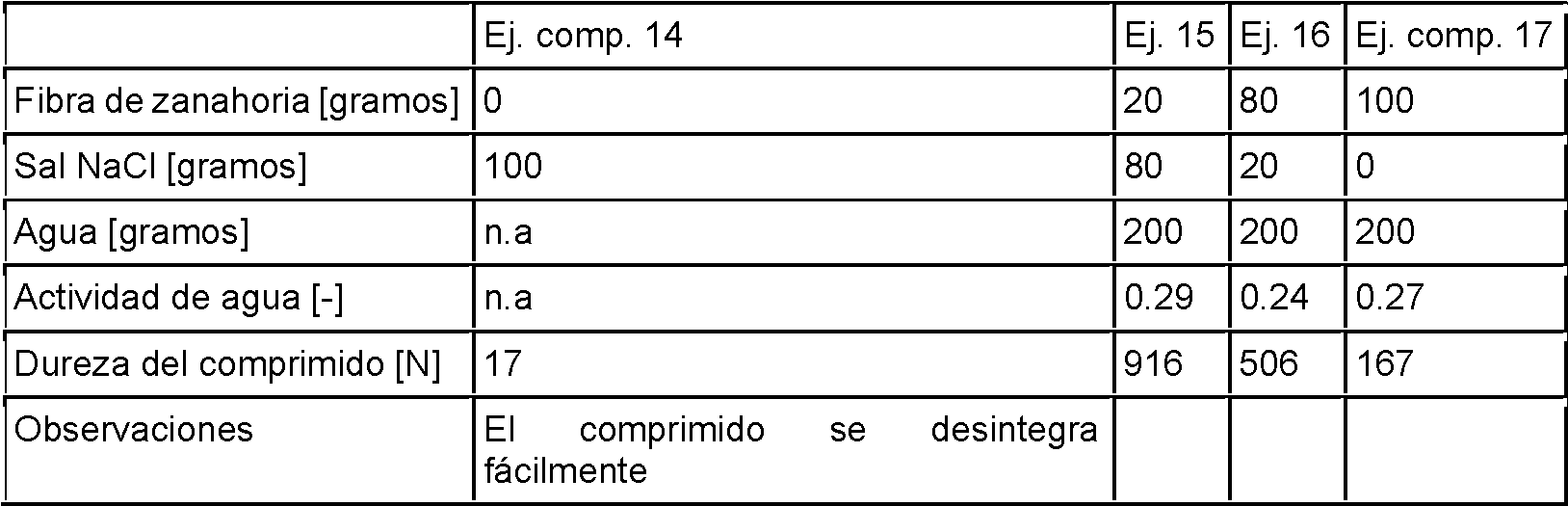

Ejemplos 21-22: Diferente proporción de agua Examples 21-22: Different proportion of water

La proporción mínima de sal a agua es de 1:2.8 para obtener una solución saturada de agua-sal. Los ejemplos 21 y 22 muestran que se puede usar una mayor cantidad de agua sin que tenga una influencia significativa sobre el polvo de sal-fibra obtenido y la dureza obtenida.The minimum ratio of salt to water is 1:2.8 to obtain a saturated water-salt solution. Examples 21 and 22 show that a larger amount of water can be used without it having a significant influence on the salt-fiber powder obtained and the hardness obtained.
Ejemplo 23: Diferente origen de salExample 23: Different origin of salt

Ejemplos 24-34: Aplicación en cubos de consoméExamples 24-34: Application in bouillon cubes
Preparación de consomé en polvoPreparation of bouillon powder
Todos los ingredientes del consomé en polvo se pesaron en una balanza PG5002S (Mettler-Toledo, Estados Unidos) y luego se mezclaron en Thermomix TM5 (Vorwerk & Co. KG, Alemania). La mezcla se llevó a cabo a una velocidad de configuración 3 durante 30 segundos con la rotación de la hélice configurada en dirección inversa. Luego, el polvo resultante se almacenó en una cámara climática ICH-110 (Memmert GmbH, Alemania) a 25 ° C con una humedad relativa del 48 % y una velocidad del ventilador del 40 % durante 24 horas antes del prensado.All bouillon powder ingredients were weighed on a PG5002S balance (Mettler-Toledo, USA) and then mixed in a Thermomix TM5 (Vorwerk & Co. KG, Germany). Mixing was carried out at speed setting 3 for 30 seconds with the propeller rotation set to the reverse direction. The resulting powder was then stored in an ICH-110 climatic chamber (Memmert GmbH, Germany) at 25 °C with 48% relative humidity and 40% fan speed for 24 hours before pressing.
Medición de la actividad del aguaMeasurement of water activity
La actividad del agua se midió con Hygrolab HC2-aw-USB (Rotronic AG, Suiza) conectado a una PC con el software HW4-P-QUICK-Vx (Rotronic AG, Suiza). Las mediciones se llevaron a cabo a 25.0 ± 0.5 ° C de acuerdo con AOAC 978.18-1978, Actividad del agua de vegetales enlatados.The water activity was measured with Hygrolab HC2-aw-USB (Rotronic AG, Switzerland) connected to a PC with HW4-P-QUICK-Vx software (Rotronic AG, Switzerland). Measurements were carried out at 25.0 ± 0.5 °C in accordance with AOAC 978.18-1978, Water Activity of Canned Vegetables.
Capacidad de flujoflow capacity
La capacidad de flujo se midió usando un Schulze Ring Shear Tester RST-01.pc de acuerdo con ASTM D6467. Las mediciones de capacidad de flujo se llevaron a cabo con una tensión normal pre cizallamiento establecida en 2600 Pa y una tensión normal de cizallamiento en 390, 1235 y 2080 Pa.Flowability was measured using a Schulze Ring Shear Tester RST-01.pc in accordance with ASTM D6467. Flowability measurements were carried out with pre-shear stress set at 2600 Pa and shear stress at 390, 1235 and 2080 Pa.
Prensado del comprimido/cubo de consomé y medición de dureza del comprimido/cuboPressing the bouillon tablet/cube and measuring the hardness of the tablet/cube
El prensado del cubo de consomé y la medición de la dureza se llevaron a cabo como se describe anteriormente.The bouillon cube pressing and hardness measurement were carried out as described above.

continuacióncontinuation

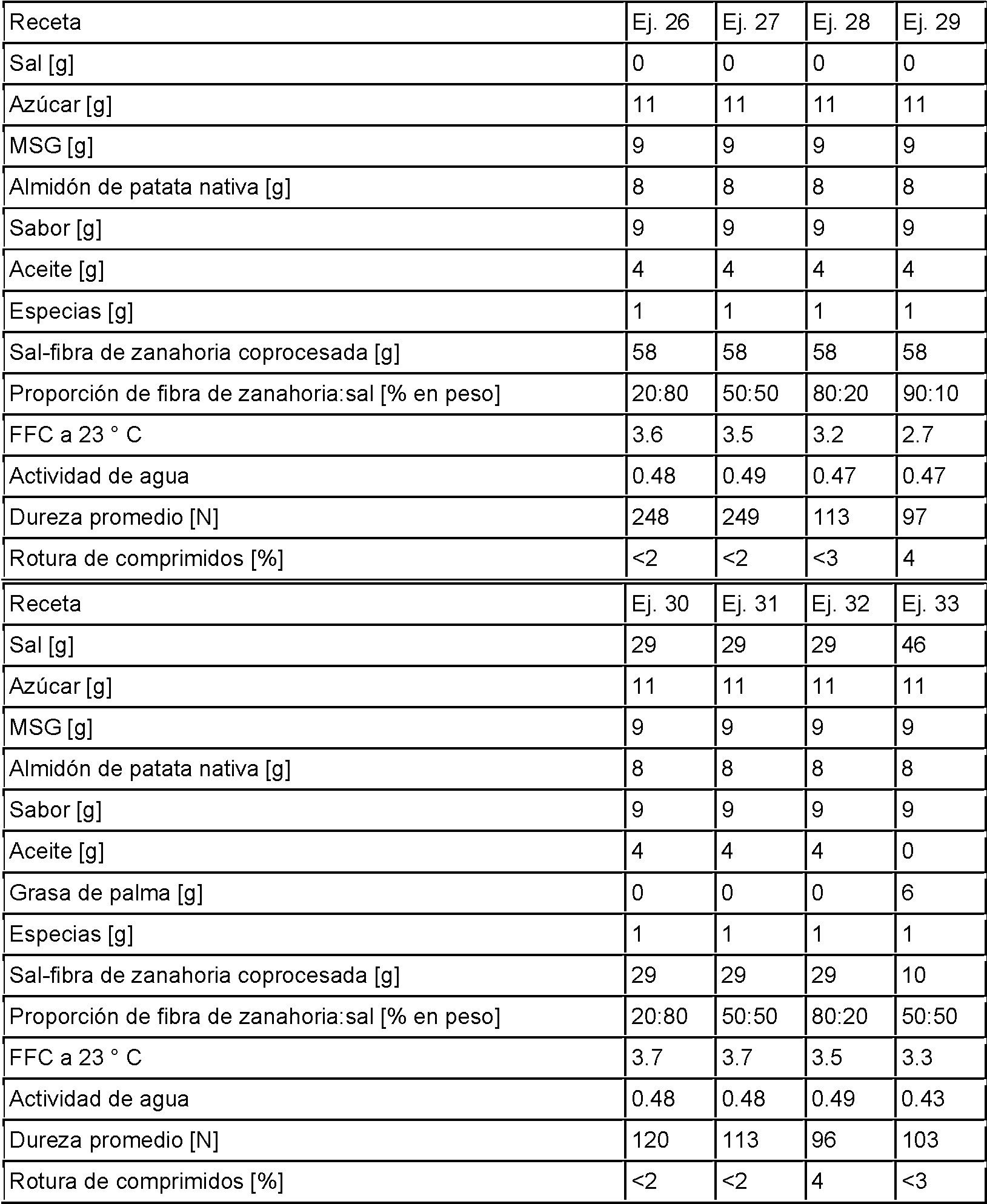

El ejemplo comparativo 24 muestra un comprimido que usa sal pura sin usar un polvo de sal-fibra coprocesado. El ejemplo comparativo 25 muestra un comprimido que usa una mezcla seca de sal y fibra sin usar un polvo de sal-fibra coprocesado. En comparación con la sal pura, la dureza del comprimido se reduce al usar una mezcla seca de sal y fibra en lugar de sal pura. El ejemplo 27 muestra el efecto de un polvo de sal-fibra coprocesado de acuerdo con la invención en comparación con el ejemplo de comparación 25 usando solo una mezcla seca de sal y fibra sin usar un polvo de sal-fibra coprocesado. La capacidad de flujo del polvo de consomé es mayor y la dureza del comprimido es mucho mayor, lo que demuestra que el polvo de sal-fibra coprocesado de acuerdo con la invención conduce a un nuevo sistema de aglomeración. Los ejemplos 26 y 28 a 33 muestran que la invención funciona con diferentes proporciones sal-fibra y diferentes cantidades de polvo de sal-fibra. El ejemplo 34 ha utilizado salvado de cereal en lugar de fibra. Los ejemplos 30 a 33 tienen además de la masa de sal-fibra coprocesada que proporciona la aglomeración del comprimido de consomé, también el cloruro de sodio estándar en la receta. Comparative Example 24 shows a tablet using pure salt without using a co-processed salt-fiber powder. Comparative Example 25 shows a tablet using a dry salt-fiber blend without using a co-processed salt-fiber powder. Compared to pure salt, tablet hardness is reduced by using a dry mixture of salt and fiber instead of pure salt. Example 27 shows the effect of a co-processed salt-fiber powder according to the invention compared to Comparison Example 25 using only a dry salt-fiber mix without using a co-processed salt-fiber powder. The flowability of the bouillon powder is higher and the hardness of the tablet is much higher, demonstrating that the co-processed salt-fiber powder according to the invention leads to a new agglomeration system. Examples 26 and 28 to 33 show that the invention works with different salt-fiber ratios and different amounts of salt-fiber powder. Example 34 has used cereal bran instead of fiber. Examples 30 to 33 have, in addition to the co-processed salt-fiber mass that provides the agglomeration of the bouillon tablet, also the standard sodium chloride in the recipe.
Claims (7)
Applications Claiming Priority (2)
| Application Number | Priority Date | Filing Date | Title |
|---|---|---|---|
| EP18166008 | 2018-04-06 | ||
| PCT/EP2019/058180 WO2019192956A1 (en) | 2018-04-06 | 2019-04-01 | Process for preparing a salt-fiber powder with binding properties |
Publications (1)
| Publication Number | Publication Date |
|---|---|
| ES2933277T3 true ES2933277T3 (en) | 2023-02-03 |
Family
ID=61912989
Family Applications (1)
| Application Number | Title | Priority Date | Filing Date |
|---|---|---|---|
| ES19713084T Active ES2933277T3 (en) | 2018-04-06 | 2019-04-01 | Process for preparing a salt-fiber powder with binding properties |
Country Status (5)
| Country | Link |
|---|---|
| EP (1) | EP3773008B1 (en) |
| CN (1) | CN111818810A (en) |
| ES (1) | ES2933277T3 (en) |
| PL (1) | PL3773008T3 (en) |
| WO (1) | WO2019192956A1 (en) |
Families Citing this family (1)
| Publication number | Priority date | Publication date | Assignee | Title |
|---|---|---|---|---|
| CN109601960A (en) * | 2019-01-30 | 2019-04-12 | 上海交通大学 | A kind of non-bitter low-sodium salt added with carrageenan and its preparation method and application |
Family Cites Families (6)
| Publication number | Priority date | Publication date | Assignee | Title |
|---|---|---|---|---|
| US5034378A (en) * | 1988-12-15 | 1991-07-23 | James P. Cox | Synergistic flavor enhancement nutritional compositions and methods |
| EP1269864A1 (en) * | 2001-06-20 | 2003-01-02 | Societe Des Produits Nestle S.A. | "Hard bouillon tablet" |
| AU2002358589A1 (en) | 2002-12-02 | 2004-06-23 | Nestec S.A. | Hard bouillon tablet or cube |
| EP1820409A1 (en) * | 2006-01-24 | 2007-08-22 | Nestec S.A. | A bouillon and/or seasoning tablet |
| UA125557C2 (en) * | 2015-12-10 | 2022-04-20 | Сосьєте Де Продюі Нестле С.А. | Tablet with spices or broughtic table, application of the tablet and method of reducing the further hardening of the tablet on the treatment |
| CA3019384A1 (en) * | 2016-03-31 | 2017-10-05 | Tuttifoodi B.V. | Granules |
-
2019
- 2019-04-01 ES ES19713084T patent/ES2933277T3/en active Active
- 2019-04-01 CN CN201980016896.3A patent/CN111818810A/en not_active Withdrawn
- 2019-04-01 PL PL19713084.2T patent/PL3773008T3/en unknown
- 2019-04-01 EP EP19713084.2A patent/EP3773008B1/en active Active
- 2019-04-01 WO PCT/EP2019/058180 patent/WO2019192956A1/en not_active Ceased
Also Published As
| Publication number | Publication date |
|---|---|
| EP3773008B1 (en) | 2022-10-05 |
| CN111818810A (en) | 2020-10-23 |
| WO2019192956A1 (en) | 2019-10-10 |
| PL3773008T3 (en) | 2023-01-30 |
| EP3773008A1 (en) | 2021-02-17 |
Similar Documents
| Publication | Publication Date | Title |
|---|---|---|
| ES3021008T3 (en) | Process for preparing a bouillon tablet | |
| ES2972707T3 (en) | Process for the production of a food composition with improved fluidity | |
| ES3021010T3 (en) | Process for preparing a bouillon tablet | |
| EP3773008B1 (en) | Process for preparing a salt-fiber powder with binding properties | |
| ES3018584T3 (en) | Process for preparing a stock cube | |
| EP3773009B1 (en) | Process for preparing a salt-starch powder with binding properties | |
| ES3021007T3 (en) | Process for preparing a bouillon tablet | |
| ES3034528T3 (en) | Process for preparing a bouillon tablet |