ES2933350T3 - Diaryl macrocycles as modulators of protein kinases - Google Patents
Diaryl macrocycles as modulators of protein kinases Download PDFInfo
- Publication number
- ES2933350T3 ES2933350T3 ES19169041T ES19169041T ES2933350T3 ES 2933350 T3 ES2933350 T3 ES 2933350T3 ES 19169041 T ES19169041 T ES 19169041T ES 19169041 T ES19169041 T ES 19169041T ES 2933350 T3 ES2933350 T3 ES 2933350T3
- Authority
- ES
- Spain
- Prior art keywords
- alkyl
- fluoro
- mmol
- equiv
- methyl
- Prior art date
- Legal status (The legal status is an assumption and is not a legal conclusion. Google has not performed a legal analysis and makes no representation as to the accuracy of the status listed.)
- Active
Links
Classifications
-
- C—CHEMISTRY; METALLURGY
- C07—ORGANIC CHEMISTRY
- C07D—HETEROCYCLIC COMPOUNDS
- C07D498/00—Heterocyclic compounds containing in the condensed system at least one hetero ring having nitrogen and oxygen atoms as the only ring hetero atoms
- C07D498/12—Heterocyclic compounds containing in the condensed system at least one hetero ring having nitrogen and oxygen atoms as the only ring hetero atoms in which the condensed system contains three hetero rings
- C07D498/18—Bridged systems
-
- A—HUMAN NECESSITIES
- A61—MEDICAL OR VETERINARY SCIENCE; HYGIENE
- A61K—PREPARATIONS FOR MEDICAL, DENTAL OR TOILETRY PURPOSES
- A61K31/00—Medicinal preparations containing organic active ingredients
- A61K31/33—Heterocyclic compounds
- A61K31/395—Heterocyclic compounds having nitrogen as a ring hetero atom, e.g. guanethidine or rifamycins
- A61K31/495—Heterocyclic compounds having nitrogen as a ring hetero atom, e.g. guanethidine or rifamycins having six-membered rings with two or more nitrogen atoms as the only ring heteroatoms, e.g. piperazine or tetrazines
- A61K31/505—Pyrimidines; Hydrogenated pyrimidines, e.g. trimethoprim
- A61K31/519—Pyrimidines; Hydrogenated pyrimidines, e.g. trimethoprim ortho- or peri-condensed with heterocyclic rings
-
- A—HUMAN NECESSITIES
- A61—MEDICAL OR VETERINARY SCIENCE; HYGIENE
- A61P—SPECIFIC THERAPEUTIC ACTIVITY OF CHEMICAL COMPOUNDS OR MEDICINAL PREPARATIONS
- A61P19/00—Drugs for skeletal disorders
- A61P19/02—Drugs for skeletal disorders for joint disorders, e.g. arthritis, arthrosis
-
- A—HUMAN NECESSITIES
- A61—MEDICAL OR VETERINARY SCIENCE; HYGIENE
- A61P—SPECIFIC THERAPEUTIC ACTIVITY OF CHEMICAL COMPOUNDS OR MEDICINAL PREPARATIONS
- A61P21/00—Drugs for disorders of the muscular or neuromuscular system
-
- A—HUMAN NECESSITIES
- A61—MEDICAL OR VETERINARY SCIENCE; HYGIENE
- A61P—SPECIFIC THERAPEUTIC ACTIVITY OF CHEMICAL COMPOUNDS OR MEDICINAL PREPARATIONS
- A61P25/00—Drugs for disorders of the nervous system
-
- A—HUMAN NECESSITIES
- A61—MEDICAL OR VETERINARY SCIENCE; HYGIENE
- A61P—SPECIFIC THERAPEUTIC ACTIVITY OF CHEMICAL COMPOUNDS OR MEDICINAL PREPARATIONS
- A61P25/00—Drugs for disorders of the nervous system
- A61P25/04—Centrally acting analgesics, e.g. opioids
-
- A—HUMAN NECESSITIES
- A61—MEDICAL OR VETERINARY SCIENCE; HYGIENE
- A61P—SPECIFIC THERAPEUTIC ACTIVITY OF CHEMICAL COMPOUNDS OR MEDICINAL PREPARATIONS
- A61P25/00—Drugs for disorders of the nervous system
- A61P25/14—Drugs for disorders of the nervous system for treating abnormal movements, e.g. chorea, dyskinesia
-
- A—HUMAN NECESSITIES
- A61—MEDICAL OR VETERINARY SCIENCE; HYGIENE
- A61P—SPECIFIC THERAPEUTIC ACTIVITY OF CHEMICAL COMPOUNDS OR MEDICINAL PREPARATIONS
- A61P25/00—Drugs for disorders of the nervous system
- A61P25/14—Drugs for disorders of the nervous system for treating abnormal movements, e.g. chorea, dyskinesia
- A61P25/16—Anti-Parkinson drugs
-
- A—HUMAN NECESSITIES
- A61—MEDICAL OR VETERINARY SCIENCE; HYGIENE
- A61P—SPECIFIC THERAPEUTIC ACTIVITY OF CHEMICAL COMPOUNDS OR MEDICINAL PREPARATIONS
- A61P25/00—Drugs for disorders of the nervous system
- A61P25/28—Drugs for disorders of the nervous system for treating neurodegenerative disorders of the central nervous system, e.g. nootropic agents, cognition enhancers, drugs for treating Alzheimer's disease or other forms of dementia
-
- A—HUMAN NECESSITIES
- A61—MEDICAL OR VETERINARY SCIENCE; HYGIENE
- A61P—SPECIFIC THERAPEUTIC ACTIVITY OF CHEMICAL COMPOUNDS OR MEDICINAL PREPARATIONS
- A61P29/00—Non-central analgesic, antipyretic or antiinflammatory agents, e.g. antirheumatic agents; Non-steroidal antiinflammatory drugs [NSAID]
-
- A—HUMAN NECESSITIES
- A61—MEDICAL OR VETERINARY SCIENCE; HYGIENE
- A61P—SPECIFIC THERAPEUTIC ACTIVITY OF CHEMICAL COMPOUNDS OR MEDICINAL PREPARATIONS
- A61P3/00—Drugs for disorders of the metabolism
- A61P3/08—Drugs for disorders of the metabolism for glucose homeostasis
- A61P3/10—Drugs for disorders of the metabolism for glucose homeostasis for hyperglycaemia, e.g. antidiabetics
-
- A—HUMAN NECESSITIES
- A61—MEDICAL OR VETERINARY SCIENCE; HYGIENE
- A61P—SPECIFIC THERAPEUTIC ACTIVITY OF CHEMICAL COMPOUNDS OR MEDICINAL PREPARATIONS
- A61P31/00—Antiinfectives, i.e. antibiotics, antiseptics, chemotherapeutics
-
- A—HUMAN NECESSITIES
- A61—MEDICAL OR VETERINARY SCIENCE; HYGIENE
- A61P—SPECIFIC THERAPEUTIC ACTIVITY OF CHEMICAL COMPOUNDS OR MEDICINAL PREPARATIONS
- A61P35/00—Antineoplastic agents
-
- A—HUMAN NECESSITIES
- A61—MEDICAL OR VETERINARY SCIENCE; HYGIENE
- A61P—SPECIFIC THERAPEUTIC ACTIVITY OF CHEMICAL COMPOUNDS OR MEDICINAL PREPARATIONS
- A61P37/00—Drugs for immunological or allergic disorders
-
- A—HUMAN NECESSITIES
- A61—MEDICAL OR VETERINARY SCIENCE; HYGIENE
- A61P—SPECIFIC THERAPEUTIC ACTIVITY OF CHEMICAL COMPOUNDS OR MEDICINAL PREPARATIONS
- A61P37/00—Drugs for immunological or allergic disorders
- A61P37/02—Immunomodulators
-
- A—HUMAN NECESSITIES
- A61—MEDICAL OR VETERINARY SCIENCE; HYGIENE
- A61P—SPECIFIC THERAPEUTIC ACTIVITY OF CHEMICAL COMPOUNDS OR MEDICINAL PREPARATIONS
- A61P37/00—Drugs for immunological or allergic disorders
- A61P37/02—Immunomodulators
- A61P37/06—Immunosuppressants, e.g. drugs for graft rejection
-
- A—HUMAN NECESSITIES
- A61—MEDICAL OR VETERINARY SCIENCE; HYGIENE
- A61P—SPECIFIC THERAPEUTIC ACTIVITY OF CHEMICAL COMPOUNDS OR MEDICINAL PREPARATIONS
- A61P37/00—Drugs for immunological or allergic disorders
- A61P37/08—Antiallergic agents
-
- A—HUMAN NECESSITIES
- A61—MEDICAL OR VETERINARY SCIENCE; HYGIENE
- A61P—SPECIFIC THERAPEUTIC ACTIVITY OF CHEMICAL COMPOUNDS OR MEDICINAL PREPARATIONS
- A61P43/00—Drugs for specific purposes, not provided for in groups A61P1/00-A61P41/00
-
- A—HUMAN NECESSITIES
- A61—MEDICAL OR VETERINARY SCIENCE; HYGIENE
- A61P—SPECIFIC THERAPEUTIC ACTIVITY OF CHEMICAL COMPOUNDS OR MEDICINAL PREPARATIONS
- A61P9/00—Drugs for disorders of the cardiovascular system
- A61P9/10—Drugs for disorders of the cardiovascular system for treating ischaemic or atherosclerotic diseases, e.g. antianginal drugs, coronary vasodilators, drugs for myocardial infarction, retinopathy, cerebrovascula insufficiency, renal arteriosclerosis
-
- C—CHEMISTRY; METALLURGY
- C07—ORGANIC CHEMISTRY
- C07B—GENERAL METHODS OF ORGANIC CHEMISTRY; APPARATUS THEREFOR
- C07B2200/00—Indexing scheme relating to specific properties of organic compounds
- C07B2200/13—Crystalline forms, e.g. polymorphs
Landscapes
- Health & Medical Sciences (AREA)
- Chemical & Material Sciences (AREA)
- Organic Chemistry (AREA)
- Veterinary Medicine (AREA)
- Public Health (AREA)
- Medicinal Chemistry (AREA)
- Pharmacology & Pharmacy (AREA)
- Life Sciences & Earth Sciences (AREA)
- Animal Behavior & Ethology (AREA)
- General Health & Medical Sciences (AREA)
- Engineering & Computer Science (AREA)
- Bioinformatics & Cheminformatics (AREA)
- Chemical Kinetics & Catalysis (AREA)
- General Chemical & Material Sciences (AREA)
- Nuclear Medicine, Radiotherapy & Molecular Imaging (AREA)
- Neurology (AREA)
- Immunology (AREA)
- Biomedical Technology (AREA)
- Neurosurgery (AREA)
- Diabetes (AREA)
- Epidemiology (AREA)
- Pain & Pain Management (AREA)
- Physical Education & Sports Medicine (AREA)
- Rheumatology (AREA)
- Orthopedic Medicine & Surgery (AREA)
- Psychology (AREA)
- Urology & Nephrology (AREA)
- Hematology (AREA)
- Pulmonology (AREA)
- Hospice & Palliative Care (AREA)
- Oncology (AREA)
- Vascular Medicine (AREA)
- Cardiology (AREA)
- Heart & Thoracic Surgery (AREA)
- Communicable Diseases (AREA)
- Emergency Medicine (AREA)
- Endocrinology (AREA)
- Psychiatry (AREA)
- Obesity (AREA)
- Transplantation (AREA)
Abstract
La presente invención se refiere a ciertos compuestos macrocíclicos de diarilo, composiciones farmacéuticas que los contienen y métodos para usarlos, incluidos métodos para tratar el cáncer, el dolor, las enfermedades neurológicas, las enfermedades autoinmunes y la inflamación. (Traducción automática con Google Translate, sin valor legal)The present invention relates to certain macrocyclic diaryl compounds, pharmaceutical compositions containing them, and methods of using them, including methods of treating cancer, pain, neurological diseases, autoimmune diseases, and inflammation. (Automatic translation with Google Translate, without legal value)
Description
DESCRIPCIÓNDESCRIPTION
Macrociclos de diarilo como moduladores de proteína quinasasDiaryl macrocycles as modulators of protein kinases
Campo técnicotechnical field
La presente invención se refiere a ciertos derivados macrocíclicos de diarilo, a composiciones farmacéuticas que los contienen y a su uso en métodos para tratar cáncer, dolor, enfermedades neurológicas, enfermedades autoinmunitarias e inflamación.The present invention relates to certain macrocyclic diaryl derivatives, pharmaceutical compositions containing them, and their use in methods of treating cancer, pain, neurological diseases, autoimmune diseases, and inflammation.
AntecedentesBackground
Las proteína quinasas son reguladores clave para el crecimiento, la proliferación y la supervivencia celulares. Las alteraciones genéticas y epigenéticas se acumulan en las células cancerosas conduciendo a una activación anormal de las rutas de transducción de señales que impulsan los procesos neoplásicos. Manning, G. et al., Science 2002, 298, 1912-1934. La inhibición farmacológica de estas rutas de señalización presenta oportunidades de intervención prometedoras para terapias dirigidas contra el cáncer. Sawyers, C., Nature 2004, 432, 294-297.Protein kinases are key regulators of cell growth, proliferation, and survival. Genetic and epigenetic alterations accumulate in cancer cells leading to abnormal activation of signal transduction pathways that drive neoplastic processes. Manning, G. et al., Science 2002, 298, 1912-1934. Pharmacological inhibition of these signaling pathways presents promising intervention opportunities for targeted cancer therapies. Sawyers, C., Nature 2004, 432, 294-297.
MET, junto con RON, pertenece a una subfamilia única de tirosina quinasas receptoras y se produce principalmente en células de origen epitelial o endotelial. Park, M. et al., Cell 1986, 45, 895-904. El factor de crecimiento de hepatocitos (HGF), también conocido como factor de dispersión (SF), es el único ligando natural conocido de alta afinidad de MET y se expresa principalmente en células de origen mesenquimatoso. Bottaro, D. P. et al., Science 1991, 251, 802-804. La señalización de HGF/MET controla los procesos de proliferación, supervivencia y migración celulares dependientes de MET que son críticos para el crecimiento invasivo durante el desarrollo embrionario y la regeneración posnatal de órganos y son completamente activos en adultos solo para procesos de cicatrización de heridas y regeneración de tejidos. Trusolino, L. et al., Nature Rev. Mol. Cell Biol. 2010, 11.834-848. El eje HGF/MET se regula positivamente con frecuencia en muchos cánceres a través de mutación activadora, amplificación génica, producción aberrante de ligandos paracrinos o autocrinos y está fuertemente relacionado con la tumorigénesis, el crecimiento invasivo y la metástasis. Gherardi, E. et al., Nature Rev. Cancer 2012, 12, 89-103. Además, la activación de la señalización de HGF/MET está emergiendo como un mecanismo importante en la resistencia a los tratamientos con inhibidores de EGFR y BRAF a través de la amplificación de METy/o la regulación positiva de HGF estromal. Engelman, J. A. et al., Science 2007, 316, 1039-1043; Wilson, T.R. et al., Nature 2012, 4 8 7 , 505-509. Debido al papel de la señalización aberrante de HGF/MET en la oncogénesis humana, la invasión/metástasis y la resistencia, la inhibición de la ruta de señalización HGF/MET tiene un gran potencial en la terapia del cáncer.MET, along with RON, belongs to a unique subfamily of receptor tyrosine kinases and is produced primarily in cells of epithelial or endothelial origin. Park, M. et al., Cell 1986, 45, 895-904. Hepatocyte growth factor (HGF), also known as dispersal factor (SF), is the only known high-affinity natural ligand of MET and is expressed primarily in cells of mesenchymal origin. Bottaro, DP et al., Science 1991, 251, 802-804. HGF/MET signaling controls MET-dependent cell proliferation, survival, and migration processes that are critical for invasive growth during embryonic development and postnatal organ regeneration and are fully active in adults only for wound healing processes and tissue regeneration. Trusolino, L. et al., Nature Rev. Mol. Cell Biol. 2010, 11834-848. The HGF/MET axis is frequently upregulated in many cancers through activating mutation, gene amplification, aberrant production of paracrine or autocrine ligands, and is strongly related to tumorigenesis, invasive growth, and metastasis. Gherardi, E. et al., Nature Rev. Cancer 2012, 12, 89-103. In addition, activation of HGF/MET signaling is emerging as an important mechanism in resistance to EGFR and BRAF inhibitor treatments through MET amplification and/or stromal HGF upregulation. Engelman, JA et al., Science 2007, 316, 1039-1043; Wilson, TR et al., Nature 2012, 4 8 7 , 505-509. Due to the role of aberrant HGF/MET signaling in human oncogenesis, invasion/metastasis, and resistance, inhibition of the HGF/MET signaling pathway has great potential in cancer therapy.
ALK, junto con la tirosina quinasa de leucocitos (LTK), se agrupa dentro de la superfamilia de receptores de insulina (IR) de tirosina quinasas receptoras. ALK se expresa principalmente en los sistemas nerviosos central y periférico lo que sugiere un papel potencial en el desarrollo y la función normales del sistema nervioso. Pulford, K. et al., Cell Mol. Life Sci. 2004, 6 1 , 2939. La ALK se descubrió por primera vez como una proteína de fusión, NPM (nucleofosmina)-ALK, codificada por un gen de fusión que surge de la translocación cromosómica t(2;5)(p23;q35) en líneas celulares de linfoma anaplásico de células macrocíticas (ALCL). Morris, S.W. et al., Science 1994, 2 6 3 , 1281. Se han descubierto más de veinte compañeros de translocación de ALK distintos en muchos cánceres, incluyendo ALCL (incidencia del 60-90 %), tumores miofibroblásticos inflamatorios (IMT, 50-60 %), carcinomas de pulmón de células no microcíticas (NSCLC, 3-7 %), cánceres colorrectales (CCR, 0-2,4 %), cánceres de mama (0-2,4 %) y otros carcinomas. Grande, E. et al., Mol. Cancer Ther. 2011, 10, 569-579. Las proteínas de fusión ALK están ubicadas en el citoplasma y los compañeros de fusión con ALK juegan un papel en la dimerización u oligomerización de las proteínas de fusión a través de una interacción bobina-bobina para generar la activación constitutiva de la función ALK quinasa. Bischof, D. et al., Mol. Cell Biol., 1997, 17, 2312-2325. EML4-ALK, que comprende porciones de los microtúbulos del gen de equinodermo asociados a proteínas similares a 4 (EML4) gen y el gen ALK, se descubrió por primera vez en NSCLC, es altamente oncogénico y se demostró que provoca adenocarcinoma de pulmón en ratones transgénicos. Soda, M. et al., Nature 2007, 448, 561-566. Oncogenic point mutations of ALK in both familial and sporadic cases of neuroblastoma. Mosse, Y. P. et al., Nature 2008, 455, 930-935. ALK es una diana molecular atractiva para la intervención terapéutica del cáncer debido a los papeles importantes en tumores hematopoyéticos, sólidos y mesenquimáticos. Grande, citado anteriormente. ALK, along with leukocyte tyrosine kinase (LTK), is grouped within the insulin receptor (IR) superfamily of receptor tyrosine kinases. ALK is primarily expressed in the central and peripheral nervous systems suggesting a potential role in normal nervous system development and function. Pulford, K. et al., Cell Mol. Life Sci. 2004, 6 1 , 2939. ALK was first discovered as a fusion protein, NPM (nucleophosmin)-ALK, encoded by a fusion gene arising from the t(2;5)(p23) chromosomal translocation ;q35) in anaplastic large cell lymphoma (ALCL) cell lines. Morris, SW et al., Science 1994, 2 6 3 , 1281. More than twenty different ALK translocation partners have been discovered in many cancers, including ALCL (60-90% incidence), inflammatory myofibroblastic tumors (IMT, 50 -60%), non-small cell lung carcinomas (NSCLC, 3-7%), colorectal cancers (CRC, 0-2.4%), breast cancers (0-2.4%), and other carcinomas. Grande, E. et al., Mol. Cancer Ther. 2011, 10, 569-579. ALK fusion proteins are located in the cytoplasm, and ALK fusion partners play a role in dimerization or oligomerization of the fusion proteins through a coil-coil interaction to generate constitutive activation of ALK kinase function. Bischof, D. et al., Mol. Cell Biol., 1997, 17, 2312-2325. EML4-ALK, comprising portions of the microtubule-associated echinoderm gene-like protein 4 ( EML4) gene and the ALK gene, was first discovered in NSCLC, is highly oncogenic and has been shown to cause lung adenocarcinoma in mice transgenic. Soda, M. et al., Nature 2007, 448, 561-566. Oncogenic point mutations of ALK in both familial and sporadic cases of neuroblastoma. Mosse, YP et al., Nature 2008, 455, 930-935. ALK is an attractive molecular target for cancer therapeutic intervention due to important roles in hematopoietic, solid, and mesenchymal tumors. Large, cited above .
Los receptores tirosina quinasa relacionados con la tropomiosina (Trk) son los receptores de alta afinidad para las neurotrofinas (NT), una familia de proteínas del factor de crecimiento nervioso (NGF). Los miembros de la familia Trk están altamente expresados en células de origen neural. La activación de los Trk (TrkA, TrkB y TrkC) por sus neurotrofinas preferidas (NGF a TrkA, factor neurotrófico derivado del cerebro [BDNF] y NT4/5 a TrkB y NT3 a TrkC) media la supervivencia y diferenciación de las neuronas durante el desarrollo. La ruta de señalización n T/T rk funciona como un sistema endógeno que protege las neuronas después de agresiones bioquímicas, isquemia transitoria o lesión física. Thiele, C. J. et al., Clin. Cancer Res. 2009, 15, 5962-5967. Sin embargo, Trk se clonó originalmente como un oncogén fusionado con el gen de la tropomiosina en el dominio extracelular. Las mutaciones activadoras provocadas por reordenamientos cromosómicos o mutaciones en NTRK1 (TrkA) se han identificado en carcinoma de tiroides papilar y medular y, recientemente, en cáncer de pulmón de células no microcíticas. Pierotti, M. A. et al., Cancer Lett. 2006, 232, 90-98; Vaishnavi, A. et al., Nat. Med. 2013, 19, 1469-1472. Debido a que las Trks juegan un papel importante en la sensación de dolor, así como en el crecimiento de células tumorales y la señalización de supervivencia, los inhibidores de las quinasas del receptor T rk pueden proporcionar beneficios como tratamientos para el dolor y el cáncer.Tropomyosin-related receptor tyrosine kinases (Trk) are the high-affinity receptors for neurotrophins (NTs), a family of nerve growth factor (NGF) proteins. Members of the Trk family are highly expressed in cells of neural origin. Activation of Trks (TrkA, TrkB, and TrkC) by their preferred neurotrophins (NGF to TrkA, brain-derived neurotrophic factor [BDNF], and NT4/5 to TrkB and NT3 to TrkC) mediates the survival and differentiation of neurons during growth. development. The n T/T rk signaling pathway functions as an endogenous system that protects neurons after biochemical insults, transient ischemia, or physical injury. Thiele, CJ et al., Clin. Cancer Res. 2009, 15, 5962-5967. However, Trk was originally cloned as an oncogene fused to the tropomyosin gene in the extracellular domain. Activating mutations caused by chromosomal rearrangements or mutations in NTRK1 (TrkA) have been identified in papillary and medullary thyroid carcinoma and, recently, in non-small cell lung cancer. Pierotti, MA et al., Cancer Lett. 2006, 232, 90-98; Vaishnavi, A. et al., Nat. Med. 2013, 19, 1469-1472. Because Trks play a Playing an important role in pain sensation as well as tumor cell growth and survival signaling, inhibitors of T rk receptor kinases may provide benefits as treatments for pain and cancer.
El receptor tirosina quinasa AXL pertenece a la familia de proteínas TAM y se detectó originalmente en pacientes con leucemia mielógena crónica (CML) como un gen transformante no identificado. Verma, A. et al., Mol. Cancer Ther.The AXL receptor tyrosine kinase belongs to the TAM family of proteins and was originally detected in patients with chronic myelogenous leukemia (CML) as an unidentified transforming gene. Verma, A. et al., Mol. Cancer Ther.
2011, 10, 1763-1773. El ligando principal para los receptores TAM es la proteína 6 específica de detención del crecimiento (Gas6 ). AXL se expresa de forma ubicua y se ha detectado en una amplia diversidad de órganos y células, incluyendo el hipocampo y el cerebelo, monocitos, macrófagos, plaquetas, células endoteliales (EC), corazón, músculo esquelético, hígado, riñón y testículo. Se ha informado una regulación positiva de Gas6 /AXL en muchos cánceres humanos incluyendo de colon, esofágico, de tiroides, de mama, de pulmón, de hígado y astrocitoma-glioblastoma. Id. Se ha observado una mayor activación de AXL en modelos de cáncer de pulmón con mutación de EGFR in vitro e in vivo con resistencia adquirida a erlotinib en ausencia de alteración de EGFR T790M o activación de MET. Zhang, Z. et al., Nat. Genet. 2012, 44, 852-860. La inhibición genética o farmacológica de AXL restauró la sensibilidad a erlotinib en estos modelos tumorales. La expresión aumentada de AXL y, en algunos casos, de su ligando Gas6 se descubrió en cánceres de pulmón mutantes en EGFR obtenidos de individuos con resistencia adquirida a los inhibidores de la tirosina quinasa. Id. Por lo tanto, AXL es una diana terapéutica prometedora para pacientes con cáncer de pulmón con mutación en EGFR que adquirieron resistencia a los inhibidores de EGFR.2011, 10, 1763-1773. The main ligand for TAM receptors is specific growth arrest protein 6 (Gas 6 ). AXL is ubiquitously expressed and has been detected in a wide variety of organs and cells, including the hippocampus and cerebellum, monocytes, macrophages, platelets, endothelial cells (EC), heart, skeletal muscle, liver, kidney, and testis. Upregulation of Gas 6 /AXL has been reported in many human cancers including colon, esophageal, thyroid, breast, lung, liver, and astrocytoma-glioblastoma. Id. Increased AXL activation has been observed in in vitro and in vivo EGFR-mutated lung cancer models with acquired erlotinib resistance in the absence of EGFR T790M disruption or MET activation. Zhang, Z. et al., Nat. Genet. 2012, 44, 852-860. Genetic or pharmacological inhibition of AXL restored erlotinib sensitivity in these tumor models. Increased expression of AXL and, in some cases, of its Gas 6 ligand was found in EGFR-mutant lung cancers obtained from individuals with acquired resistance to tyrosine kinase inhibitors. Id. Thus, AXL is a promising therapeutic target for EGFR-mutant lung cancer patients who have acquired resistance to EGFR inhibitors.
Crizotinib (PF-02341066) es un fármaco de tirosina quinasa dirigido a MET/ALK/ROS1/RON con actividad moderada contra Tr K y AXL. Cui, J. J. et al., J. Med. Chem. 2011,54, 6342-6363. Se aprobó para tratar a determinados pacientes con NSCLC en fase tardía (localmente avanzado o metastásico) que expresa el gen de fusión ALK anormal identificado por una prueba de diagnóstico complementaria (Kit Vysis ALK Break Apart FISH Probe). Al igual que el imatinib y otros fármacos inhibidores de quinasa, la resistencia se desarrolla invariablemente después de un cierto tiempo de tratamiento con crizotinib. Los mecanismos de resistencia incluyen la amplificación del gen ALK, mutaciones secundarias de ALK y activación aberrante de otras quinasas incluyendo KIT y EGFR. Katayama, R. et al., Sci. Transl. Med. 2012, 4, 120ra17. Basado en el éxito clínico de los inhibidores ABL de segunda generación para el tratamiento de la resistencia a imatinib en pacientes con CML, está surgiendo una segunda generación de inhibidores de ALK. Estos medicamentos están dirigidos al tratamiento de pacientes con NSCLC refractario o resistente a crizotinib con una inhibición más potente contra las proteínas ALK tanto silvestres como mutantes. Gridelli, C. et al., Cancer Treat Rev. 2014, 40, 300-306.Crizotinib (PF-02341066) is a MET/ALK/ROS1/RON targeting tyrosine kinase drug with moderate activity against TrK and AXL. Cui, JJ et al., J. Med. Chem. 2011, 54, 6342-6363. It is approved to treat certain patients with late-stage (locally advanced or metastatic) NSCLC that expresses the abnormal ALK fusion gene identified by an add-on diagnostic test (Vysis ALK Break Apart FISH Probe Kit). Like imatinib and other kinase inhibitor drugs, resistance invariably develops after some time on crizotinib treatment. Resistance mechanisms include amplification of the ALK gene, secondary ALK mutations, and aberrant activation of other kinases including KIT and EGFR. Katayama, R. et al., Sci. Transl. Med. 2012, 4, 120ra17. Based on the clinical success of second generation ABL inhibitors for the treatment of imatinib resistance in patients with CML, a second generation of ALK inhibitors is emerging. These drugs are targeted for the treatment of patients with crizotinib-refractory or refractory NSCLC with stronger inhibition against both wild-type and mutant ALK proteins. Gridelli, C. et al., Cancer Treat Rev. 2014, 40, 300-306.
Mediante la modulación de múltiples dianas entre el grupo de tirosina quinasas estructuralmente relacionadas MET, ALK, AXL y TRK, los compuestos descritos en el presente documento abordan la resistencia a crizotinib, la resistencia a fármacos inhibidores de EGFR y otras indicaciones primarias con señalización celular anormal debida a mutaciones de MET, ALK, AXL y/o TRK y amplificación génica. Los compuestos descritos en el presente documento son inhibidores de MET, ALK silvestres y mutantes, AXL y TRK y serán útiles en el tratamiento de pacientes con cáncer con señalización anormal de uno o más de MET, ALK, AXL o TRK.By modulating multiple targets among the group of structurally related tyrosine kinases MET, ALK, AXL, and TRK, the compounds described herein address crizotinib resistance, resistance to EGFR-inhibiting drugs, and other primary indications with abnormal cell signaling. due to MET, ALK, AXL and/or TRK mutations and gene amplification. The compounds described herein are inhibitors of MET, wild type and mutant ALK, AXL and TRK and will be useful in the treatment of cancer patients with abnormal signaling of one or more of MET, ALK, AXL or TRK.
La familia Janus de quinasas (JAK) incluye JAK1, JAK2, JAK3 y TYK2 y son tirosina quinasas citoplásticas necesarias para la señalización fisiológica de citocinas y factores de crecimiento. Quintas-Cardama, A. et al., Nat. Rev. Drug Discov. 2011, 10(2), 127-40; Pesu, M. et al., Immunol. Rev. 2008, 223, 132-142; Murray, P.J., J. Immunol. 2007, 178(5), 2623-2329. Las JAK se activan por oligomerización inducida por ligando, dando como resultado la activación de la ruta de señalización transcripcional posterior llamada STAT (transductores de señal y activadores de la transcripción). Los STAT fosforilados se dimerizan y se translocan al núcleo para impulsar la expresión de genes específicos implicados en la proliferación, la apoptosis, la diferenciación, que son esenciales para la hematopoyesis, la inflamación y la respuesta inmunitaria. Murray, citado anteriormente.The Janus family of kinases (JAKs) include JAK1, JAK2, JAK3, and TYK2 and are cytoplastic tyrosine kinases required for physiological signaling of cytokines and growth factors. Quintas-Cardama, A. et al., Nat. Rev. Drug Discov. 2011, 10(2), 127-40; Pesu, M. et al., Immunol. Rev. 2008, 223, 132-142; Murray, PJ, J. Immunol. 2007, 178(5), 2623-2329. JAKs are activated by ligand-induced oligomerization, resulting in activation of the downstream transcriptional signaling pathway called STAT (signal transducers and activators of transcription). Phosphorylated STATs dimerize and translocate to the nucleus to drive the expression of specific genes involved in proliferation, apoptosis, differentiation, which are essential for hematopoiesis, inflammation, and the immune response. Murray, cited above.
Los estudios de inactivación génica en ratones han implicado las funciones principales de la señalización JAK-STAT con cierta superposición entre ellas. JAK1 juega un papel crítico en la señalización de diversas citocinas proinflamatorias tales como IL-1, IL-4, IL- 6 y factor de necrosis tumoral alfa (TNFa). Muller, M. et al., Nature 1993, 366(6451), 129-135. JAK2 funciona para la señalización de factores de crecimiento hematopoyéticos tales como Epo, IL-3, IL-5, GM-CSF, hormona de crecimiento trombopoyetina y señalización mediada por prolactina. Neubauer, H. et al., Cell 199893(3), 397-409. JAK3 juega un papel en la mediación de las respuestas inmunitarias, y TYK2 se asocia a JAK2 o JAK3 para transducir la señalización de citocinas, tales como lL-12. Nosaka, T. et al., Science 1995, 270(5237), 800-802; Vainchenker, W. et al., Semin. Cell. Dev. Biol. 2008, 19(4), 385-393.Knockout studies in mice have implicated the major functions of JAK-STAT signaling with some overlap between them. JAK1 plays a critical role in signaling various proinflammatory cytokines such as IL-1, IL-4, IL -6 , and tumor necrosis factor alpha (TNFa). Muller, M. et al., Nature 1993, 366(6451), 129-135. JAK2 functions for hematopoietic growth factor signaling such as Epo, IL-3, IL-5, GM-CSF, thrombopoietin growth hormone, and prolactin-mediated signaling. Neubauer, H. et al., Cell 199893(3), 397-409. JAK3 plays a role in mediating immune responses, and TYK2 associates with JAK2 or JAK3 to transduce cytokine signaling, such as IL-12. Nosaka, T. et al., Science 1995, 270(5237), 800-802; Vainchenker, W. et al., Semin. Cell. Dev. Biol. 2008, 19(4), 385-393.
La regulación aberrante de las rutas JAK/STAT se ha implicado en múltiples enfermedades patológicas humanas, incluyendo cáncer (JAK2) y artritis reumatoide (JAK1, JAK3). Se ha descubierto una mutación de ganancia de función de jAk2 (JAK2V617F) con alta frecuencia en pacientes con MPN. Levine, R.L. et al., Cancer Cell 2005, 7(4), 387-397; Kralovics, R. et al., N. Engl. J. Med. 2005, 253(17), 1779-1790; James, C. et al., Nature 2005, 434(7037), 1144-1148; Baxter, E.J. et al. Lancet 2005, 365(9464), 1054-1061. La mutación en el dominio pseudoquinasa JH2 de JAK2 conduce a una actividad quinasa constitutiva. Las células que contienen la mutación JAK2V617F adquieren una capacidad de crecimiento independiente de las citocinas y, a menudo, se convierten en tumores, proporcionando una fuerte justificación para el desarrollo de inhibidores de JAK como terapia diana. Aberrant regulation of the JAK/STAT pathways has been implicated in multiple human pathologies, including cancer (JAK2) and rheumatoid arthritis (JAK1, JAK3). A jAk2 gain-of-function mutation (JAK2V617F) has been discovered with high frequency in patients with MPN. Levine, RL et al., Cancer Cell 2005, 7(4), 387-397; Kralovics, R. et al., N. Engl. J. Med. 2005, 253(17), 1779-1790; James, C. et al., Nature 2005, 434(7037), 1144-1148; Baxter, EJ et al. Lancet 2005, 365(9464), 1054-1061. Mutation in the JH2 pseudokinase domain of JAK2 leads to constitutive kinase activity. Cells containing the JAK2V617F mutation acquire cytokine-independent growth ability and often become tumors, providing a strong rationale for the development of JAK inhibitors as target therapy.
Múltiples inhibidores de JAK en ensayos clínicos mostraron un beneficio significativo en la esplenomegalia y los síntomas constitucionales relacionados con la enfermedad para los pacientes con mielofibrosis, incluyendo el primer inhibidor de JAK2, ruxolitinib, aprobado por la FDA en 2011. Quintas-Cardama, citado anteriormente; Sonbol, M.B. et al., Ther. Adv. Hematol. 2013, 4(1), 15-35; LaFave, L.M. et al., Trends Pharmacol. Sci. 2012, 33(11), 574-582. Los datos clínicos recopilados recientemente relacionados con el tratamiento con ruxolitinib indicaron que los inhibidores de JAK funcionan tanto en los casos de JAK2 de tipo silvestre como en los de JAK2 mutado. Verstovsek, S. et al., N. Engl. J. Med. 2012, 366(9), 799-807; Quintas-Cardama, A. et al., Blood 2010, 115(15), 3109-3117. El descubrimiento de inhibidores selectivos de JAK2 vs JAK1/3 sigue siendo un desafío sin resolver. Además, la hiperactivación de JAK2/transductores de señales y activadores de la transcripción 3 (JAK2/STAT3) es responsable de la diferenciación anormal de células dendríticas que conduce a la diferenciación anormal de células dendríticas y la acumulación de células mieloides inmunosupresoras en el cáncer (Nefedova, Y. et al., Cancer Res 2005; 65(20): 9525-35). En tumores senescentes nulos para Pten, la activación de la ruta Jak2/Stat3 establece un microambiente tumoral inmunosupresor que contribuye al crecimiento tumoral y la quimiorresistencia (Toso, A. et al., Cell Reports 2014, 9, 75-89). Por lo tanto, la inhibición farmacológica de la ruta JAK2/STAT3 puede ser una nueva estrategia terapéutica importante para mejorar la actividad antitumoral a través de la regulación de la inmunidad antitumoral.Multiple JAK inhibitors in clinical trials have shown significant benefit in splenomegaly and disease-related constitutional symptoms for patients with myelofibrosis, including the first JAK2 inhibitor, ruxolitinib, approved by the FDA in 2011. Quintas-Cardama, cited above ; Sonbol, MB et al., Ther. Adv. Hematol. 2013, 4(1), 15-35; LaFave, LM et al., Trends Pharmacol. Sci. 2012, 33(11), 574-582. Recently collected clinical data related to ruxolitinib treatment indicated that JAK inhibitors work in both JAK2 wild-type and JAK2 mutated cases. Verstovsek, S. et al., N. Engl. J Med 2012, 366(9), 799-807; Quintas-Cardama, A. et al., Blood 2010, 115(15), 3109-3117. The discovery of selective inhibitors of JAK2 vs. JAK1/3 remains an unresolved challenge. Furthermore, hyperactivation of JAK2/signal transducers and activators of transcription 3 (JAK2/STAT3) is responsible for abnormal dendritic cell differentiation leading to abnormal dendritic cell differentiation and accumulation of immunosuppressive myeloid cells in cancer ( Nefedova, Y. et al., Cancer Res 2005;65(20):9525-35). In senescent Pten-null tumors, activation of the Jak2/Stat3 pathway establishes an immunosuppressive tumor microenvironment that contributes to tumor growth and chemoresistance (Toso, A. et al., Cell Reports 2014, 9, 75-89). Therefore, pharmacological inhibition of the JAK2/STAT3 pathway may be an important new therapeutic strategy to enhance antitumor activity through regulation of antitumor immunity.
La quinasa ROS1 es un receptor de tirosina quinasa con un ligando desconocido. Las funciones normales de la quinasa ROS1 humana no se han entendido completamente. Sin embargo, se ha informado que la quinasa ROS1 sufre reordenamientos genéticos para crear proteínas de fusión constitutivamente activas en una diversidad de cánceres humanos incluyendo glioblastoma, cáncer de pulmón de células no microcíticas (NSCLC), colangiocarcinoma, cáncer de ovario, adenocarcinoma gástrico, cáncer colorrectal, tumor miofibroblástico inflamatorio, angiosarcoma y hemangioendotelioma epitelioide (Davies, KD et al., Clin Cancer Res 2013, 19 (15): 4040-4045). El direccionamiento de las proteínas de fusión ROS1 con crizotinib ha demostrado una efectividad clínica prometedora en pacientes con NSCLC cuyos tumores son positivos para anomalías genéticas ROS1 (Shaw, AT et al., N Engl J Med. 2014, 371(21): 1963-1971). Se han observado mutaciones resistentes adquiridas en pacientes tratados con crizotinib (Awad, M. M. et al., N Engl J Med. 2013, 368(25):2396-2401). Es urgente desarrollar la segunda generación de inhibidores de ROS1 para superar la resistencia a de ROS1 a crizotinib.ROS1 kinase is a receptor tyrosine kinase with an unknown ligand. The normal functions of the human ROS1 kinase have not been fully understood. However, the ROS1 kinase has been reported to undergo genetic rearrangements to create constitutively active fusion proteins in a variety of human cancers including glioblastoma, non-small cell lung cancer (NSCLC), cholangiocarcinoma, ovarian cancer, gastric adenocarcinoma, cancer colorectal, inflammatory myofibroblastic tumor, angiosarcoma, and epithelioid hemangioendothelioma (Davies, KD et al., Clin Cancer Res 2013, 19(15):4040-4045). Targeting of ROS1 fusion proteins with crizotinib has shown promising clinical effectiveness in NSCLC patients whose tumors are positive for ROS1 genetic abnormalities (Shaw, AT et al., N Engl J Med. 2014, 371(21): 1963- 1971). Acquired resistant mutations have been observed in patients treated with crizotinib (Awad, MM et al., N Engl J Med. 2013, 368(25):2396-2401). There is an urgent need to develop second generation ROS1 inhibitors to overcome ROS1 resistance to crizotinib.
Sigue existiendo la necesidad de inhibidores de molécula pequeña de estas dianas de proteína o tirosina quinasa múltiples con propiedades farmacéuticas deseables. Se ha descubierto que ciertos compuestos macrocíclicos de diarilo en el contexto de esta invención tienen este perfil de actividad ventajoso.There remains a need for small molecule inhibitors of these multiple protein or tyrosine kinase targets with desirable pharmaceutical properties. Certain macrocyclic diaryl compounds in the context of this invention have been found to have this advantageous activity profile.
SumarioSummary
La presente invención proporciona un compuesto seleccionado entre el grupo que consiste enThe present invention provides a compound selected from the group consisting of

en dondewhere
M es CH o N;M is CH or N;
X1 y X1' son independientemente -C(R1a)(R2a)-, -S-, -S(O)-, -S(O)2-, -O- o -N(Rk')-;X1 and X1' are independently -C(R1a)(R2a)-, -S-, -S(O)-, -S(O) 2 -, -O- or -N(Rk')-;
cada R1a y R2a es independientemente H, deuterio, alquilo C1-6, cicloalquilo C3-6, arilo C6-10, -C(O)ORa', -C(O)NRa'Rb', -NRa'Rb', -SRa', -S(O)Ra', -S(O)NRa', -S(O)2Ra', -S(O)2NRa' u -ORa' en donde cada átomo de hidrógeno en el alquilo C1-6 está de manera independiente opcionalmente sustituido con deuterio, halógeno, -OH, -Oalquilo C1-4 , -NH2 , -NH(alquilo C1-4), -N(alquilo C1-4)2, -NHC(O)alquilo C1-4 , -N(alquil C1-4)C(O)alquilo C1-4 , -NHC(O)NHalquilo C1-4, -N(alquil C1-4)C(O)NHalquilo C1-4, -NHC(O)N(alquilo C1-4)2, -N(alquil C1-4)C(O)N(alquilo C1-4)2 , -NHC(O)Oalquilo C1-4 , -N(alquil C1-4)C(O)Oalquilo C1-4 , -CO2H, -CO2alquilo C1-4 , -CONH2 , -CONH(alquilo C1-4), -CON(alquilo C1-4)2, -Salquilo C1-4, -S(O)alquilo C1-4 , -S(O)2alquilo C1-4, -S(O)NH(alquilo C1-4), -S(O)2NH(alquilo C1 -4), -S(O)N(alquilo C1-4)2, -S(O)2N(alquilo C1-4)2, cicloalquilo C3-6o heterocicloalquilo de 3 a 7 miembros;each R1a and R2a is independently H, deuterium, C 1-6 alkyl, C 3-6 cycloalkyl, C 6-10 aryl, -C(O)ORa', -C(O)NRa'Rb', -NRa'Rb ', -SRa', -S(O)Ra', -S(O)NRa', -S(O) 2 Ra', -S(O) 2 NRa' or -ORa' where each hydrogen atom in C 1-6 alkyl is independently optionally substituted with deuterium, halogen, -OH, -OC 1-4 alkyl, -NH 2 , -NH(C 1-4 alkyl), -N(C 1-4 alkyl)2 , -NHC(O)C 1-4 alkyl , -N(C 1-4 alkyl)C(O)C 1-4 alkyl , -NHC(O)NHC 1-4 alkyl , -N(C 1-4 alkyl)C (O)NHC 1-4 alkyl, -NHC(O)N(C 1-4 alkyl)2, -N(C 1-4 alkyl)C(O)N(C 1-4 alkyl) 2 , -NHC(O ) OC 1-4 alkyl, -N(C1-4 alkyl)C(O)OC 1-4 alkyl, -CO 2 H, -CO 2 C 1-4 alkyl, -CONH 2 , -CONH(C 1-4 alkyl ), -CON(C1-4 alkyl)2, -C 1-4 alkyl, -S(O)C 1-4 alkyl, -S(O) 2 C 1-4 alkyl, -S(O)NH(alkyl C 1-4 ), -S(O) 2 NH(C 1-4 alkyl ), -S(O)N(C 1-4 alkyl)2, -S(O) 2 N(C 1-4 alkyl)2, C3-6 cycloalkyl or 3-7 membered heterocycloalkyl;
R3a y R3b son cada uno independientemente H, flúor, cloro, bromo, metilo, etilo, propilo, isopropilo, metoxi, etoxi, isopropoxi, -CN o -CF3;R3a and R3b are each independently H, fluoro, chloro, bromo, methyl, ethyl, propyl, isopropyl, methoxy, ethoxy, isopropoxy, -CN or -CF 3 ;
R7a es H, alquilo C1-6 o heterocicloalquilo de 3 a 7 miembros, en donde cada átomo de hidrógeno en el alquilo C1-6 o heterocicloalquilo de 3 a 7 miembros está de manera independiente opcionalmente sustituido con halógeno, -OH, -Oalquilo C1-4 , -NH2 , -NH(alquilo C1-4), -N(alquilo C1-4)2, -CO2H, -CO2alquilo C1-4 , -CONH2 , -CONH(alquilo C1 -4), -CON(alquilo C1-4)2, cicloalquilo o heterocicloalquilo monocicloalquilo;R7a is H, C 1-6 alkyl or 3 to 7 membered heterocycloalkyl, wherein each hydrogen atom in the C 1-6 alkyl or 3 to 7 membered heterocycloalkyl is independently optionally substituted with halogen, -OH, - OC 1-4 alkyl, -NH 2 , -NH(C 1-4 alkyl), -N(C 1-4 alkyl)2, -CO 2 H, -CO 2 C 1-4 alkyl, -CONH 2 , -CONH (C 1-4 alkyl), -CON(C 1-4 alkyl)2, cycloalkyl or heterocycloalkyl monocycloalkyl;
cada Rk' es independientemente H, deuterio, alquilo C1-6, alquenilo C2-6, alquinilo C2-6, cicloalquilo C3-6, heterocicloalquilo de 3 a 7 miembros, arilo C6-10 o heteroarilo mono o bicíclico; en donde cada átomo de hidrógeno en el alquilo C1-6, alquenilo C2-6, alquinilo C2-6, cicloalquilo C3-6, heterocicloalquilo de 3 a 7 miembros, arilo C6-10 o heteroarilo mono o bicíclico en Rk' está de manera independiente opcionalmente sustituido con deuterio, halógeno, alquilo C1-6, haloalquilo C1-6 u -ORa';each Rk' is independently H, deuterium, C 1-6 alkyl, C 2-6 alkenyl , C 2-6 alkynyl, C 3-6 cycloalkyl, 3- to 7-membered heterocycloalkyl, C 6-10 aryl, or mono or bicyclic heteroaryl ; wherein each hydrogen atom in the C 1-6 alkyl, C 2-6 alkenyl, C 2-6 alkynyl , C 3-6 cycloalkyl, 3- to 7-membered heterocycloalkyl, C 6-10 aryl or mono or bicyclic heteroaryl in Rk' is independently optionally substituted with deuterium, halogen, C 1-6 alkyl, haloC 1-6 alkyl or -ORa';
en donde cada Ra' y Rb' es independientemente H, deuterio, alquilo C1-6 , alquenilo C2-6, alquinilo C2-6, cicloalquilo C3-6, heterocicloalquilo de 3 a 7 miembros, arilo C6-10 o heteroarilo; ywherein each Ra' and Rb' is independently H, deuterium, C 1-6 alkyl, C 2-6 alkenyl, C 2-6 alkynyl, C 3-6 cycloalkyl, 3-7 membered heterocycloalkyl, C 6-10 aryl or heteroaryl; and
cada Z1, Z2, Z3, Z4, Z5, Z6 o Z7 es independientemente N, NH o C(RX), en donde cada RX cuando está presente es independientemente H, deuterio, halógeno, alquilo C1-4 , -O-alquilo C1-4 , -OH, -NH2 , -NH(alquilo C1-4), -NH(fenilo), -NH(heteroarilo), CN o -CF3, con la condición de que al menos uno de Z1, Z2, Z3, Z4, Z5, Z6 o Z7 es N o NH; y each Z1, Z2, Z3, Z4, Z5, Z6 or Z7 is independently N, NH or C(RX), where each RX when present is independently H, deuterium, halogen, C 1-4 alkyl, -O-alkyl C 1-4 , -OH, -NH 2 , -NH(C 1-4 alkyl), -NH(phenyl), -NH(heteroaryl), CN or -CF 3 , provided that at least one of Z1 , Z2, Z3, Z4, Z5, Z6 or Z7 is N or NH; and
m' es 2 o 3;m' is 2 or 3;
o una sal farmacéuticamente aceptable de los mismos.or a pharmaceutically acceptable salt thereof.
En otra realización, la presente invención proporciona una composición farmacéutica que comprende (a) al menos un compuesto de la invención, o una de sus sales farmacéuticamente aceptable, y (b) un excipiente farmacéuticamente aceptable.In another embodiment, the present invention provides a pharmaceutical composition comprising (a) at least one compound of the invention, or a pharmaceutically acceptable salt thereof, and (b) a pharmaceutically acceptable excipient.
En otra realización, la presente invención proporciona un compuesto de la invención, o una sal farmacéuticamente aceptable del mismo, para su uso en el tratamiento del cáncer, dolor, enfermedades neurológicas, enfermedades autoinmunes, o inflamación en un sujeto que necesita de tal tratamiento.In another embodiment, the present invention provides a compound of the invention, or a pharmaceutically acceptable salt thereof, for use in the treatment of cancer, pain, neurological diseases, autoimmune diseases, or inflammation in a subject in need of such treatment.
La presente memoria descriptiva desvela además un compuesto de la siguiente Fórmula (I-A) (la Fórmula (I-A) cae dentro de la invención en la medida en que se superpone con la Fórmula (VII) como se define en la reivindicación 1):The present specification further discloses a compound of the following Formula (I-A) (Formula (I-A) falls within the invention insofar as it overlaps with Formula (VII) as defined in claim 1):

en dondewhere
en Anillo A' y el Anillo B' son cada uno de ellos independientemente un arilo o heteroarilo monocíclico o bicíclico; donde uno de Anillo A' y Anillo B' es un arilo o heteroarilo monocíclico y el otro es un heteroarilo bicíclico; y al menos uno de Anillo A' y Anillo B' comprende al menos un miembro del anillo de nitrógeno;Ring A' and Ring B' are each independently a monocyclic or bicyclic aryl or heteroaryl; where one of Ring A' and Ring B' is a monocyclic aryl or heteroaryl and the other is a bicyclic heteroaryl; and at least one of Ring A' and Ring B' comprises at least one nitrogen ring member;
cada L1 y L2 es independientemente -C(R1')(R2')-, -O-, -N(Rk')-, -S-, -S(O)- o -S(O)2-;each L1 and L2 is independently -C(R1')(R2')-, -O-, -N(Rk')-, -S-, -S(O)- or -S(O) 2 -;
cada R1' y R2' son independientemente H, deuterio, halógeno, alquilo C1-6, alquenilo C2-6, alquinilo C2-6, cicloalquilo C3-6, heterocicloalquilo de 3 a 7 miembros, arilo C6-10, o heteroarilo mono o bicíclico, -ORa', -OC(O)Ra', -OC(O)NRa'Rb', -OS(O)Ra', -OS(O)2Ra', -SRa', -S(O)Ra', -S(O)2Ra', -S(O)NRa'Rb', -S(O)2NRa'Rb', -OS(O)NRa'Rb', -OS(O)2NRa'Rb', -NRa'Rb', -NRa'C(O)Rb', -NRa'C(O)ORb', -NRa'C(O)NRa'Rb', -NRa'S(O)Rb', -NRaS(O)2Rb', -NRa'S(O)NRa'Rb', -NRa'S(O)2NRa'Rb', -C(O)Ra', -C(O)ORa', -C(O)NRa'Rb', -PRa'Rb', -P(O)Ra'Rb', -P(O)2Ra'Rb', -P(O)NRa'Rb', -P(O)2NRa'Rb', -P(O)ORa', -P(O)2ORa', -CN o -NO2 , o R1' y R2' tomados junto con el carbono o carbonos a los cuales están unidos forman un cicloalquilo C3-6 o un heterocicloalquilo de 4 a 6 miembros, en donde cada átomo de hidrógeno en el alquilo C1-6, alquenilo C2-6, alquinilo C2-6, cicloalquilo C3-6, heterocicloalquilo de 3 a 7 miembros, arilo C6-10, heteroarilo mono o bicíclico, heterocicloalquilo de 4 a 6 miembros está de manera independiente opcionalmente sustituido con deuterio, halógeno, alquilo C1-6, haloalquilo C1-6, -ORe', -OC(O)Re', -OC(O)NRe'Rf', -OS(O)Re', -OS(O)2Re', -OS(O)NRe'Rf', -OS(O)2NRe'Rf', -SRe', -S(O)Re', -S(O)2Re', -S(O)NRe'Rf', -S(O)2NRe'Rf', -NRe'Rf', -NRe'C(O)Rf', -NRe'C(O)ORf', -NRe'C(O)NRe'Rf', -NRe'S(O)Rf', -NRe'S(O)2Rf', -NRe'S(O)NRe'Rf', -NRe'S(O)2NRe'Rf', -C(O)Re', -C(O)ORe', -C(O)NRe'Rf', -PRe'Rf', -P(O)Re'Rf', -P(O)2Re'Rf', -P(O)NRe'Rf', -P(O)2NRe'Rf', -P(O)ORe', -P(O)2ORe', -CN o -NO2 ;each R1' and R2' are independently H, deuterium, halogen, C 1-6 alkyl, C 2-6 alkenyl, C 2-6 alkynyl, C 3-6 cycloalkyl, 3- to 7-membered heterocycloalkyl, C 6-10 aryl , or mono or bicyclic heteroaryl, -ORa', -OC(O)Ra', -OC(O)NRa'Rb', -OS(O)Ra', -OS(O)2Ra', -SRa', - S(O)Ra', -S(O)2Ra', -S(O)NRa'Rb', -S(O)2NRa'Rb', -OS(O)NRa'Rb', -OS(O) 2NRa'Rb', -NRa'Rb', -NRa'C(O)Rb', -NRa'C(O)ORb', -NRa'C(O)NRa'Rb', -NRa'S(O)Rb' , -NRaS(O)2Rb', -NRa'S(O)NRa'Rb', -NRa'S(O)2NRa'Rb', -C(O)Ra', -C(O)ORa', -C(O) NRa'Rb', -PRa'Rb' , -P(O)Ra'Rb', -P(O)2Ra'Rb', -P(O)NRa'Rb', -P(O)2NRa'Rb ', -P(O)ORa', -P(O) 2 ORa', -CN or -NO 2 , or R1' and R2' taken together with the carbon(s) to which they are attached form a C3 - cycloalkyl 6 or a 4- to 6- membered heterocycloalkyl, wherein each hydrogen atom in C 1-6 alkyl, C 2-6 alkenyl, C 2-6 alkynyl, C 3-6 cycloalkyl, 3- to 7-membered heterocycloalkyl, aryl C 6 -10 , mono or bicyclic heteroaryl, 4-heterocycloalkyl to 6 members is independently optionally substituted with deuterium, halogen, C 1-6 alkyl, haloC 1-6 alkyl, -ORe', -OC(O)Re', -OC(O)NRe'Rf', -OS (O)Re', -OS(O)2Re', -OS(O)NRe'Rf', -OS(O)2NRe'Rf', -SRe', -S(O)Re', -S(O )2Re', -S(O)NRe'Rf', -S(O)2NRe'Rf', -NRe'Rf', -NRe'C(O)Rf', -NRe'C(O)ORf', -NRe'C(O)NRe'Rf', -NRe'S(O)Rf', -NRe'S(O)2Rf', -NRe'S(O)NRe'Rf', -NRe'S(O)2NRe'Rf', -C (O)Re', -C(O)ORe', -C(O)NRe'Rf', -PRe'Rf', -P(O)Re'Rf', -P(O)2Re'Rf', -P(O)NRe'Rf', -P(O) 2 NRe'Rf', -P(O)ORe', -P(O) 2 ORe', -CN or -NO 2 ;
cada Rk' es independientemente H, deuterio, alquilo C1-6, alquenilo C2-6, alquinilo C2-6, cicloalquilo C3-6, heterocicloalquilo de 3 a 7 miembros, arilo Ca-io, o heteroarilo mono o bicíclico, en donde cada átomo de hidrógeno en el alquilo Ci-a, alquenilo C2-a, alquinilo C2-a, cicloalquilo C3-a, heterocicloalquilo de 3 a 7 miembros, arilo Ca-10 o heteroarilo mono o bicíclico está de manera independiente opcionalmente sustituido con deuterio, halógeno, alquiloeach Rk' is independently H, deuterium, C 1-6 alkyl, C 2-6 alkenyl, C 2-6 alkynyl, C 3-6 cycloalkyl, 3- to 7-membered heterocycloalkyl, Ca-io aryl, or mono- or bicyclic heteroaryl, where each hydrogen atom in the Ci-a alkyl, C 2 -a alkenyl, C 2 -a alkynyl, C3-a cycloalkyl, 3 to 7 membered, Ca- 10 aryl or mono- or bicyclic heteroaryl is independently optionally substituted with deuterium, halogen, alkyl
Ci-a, haloalquilo Ci-a, -ORe', -OC(O)Re', -OC(O)NRe'Rf', -OS(O)Re', -OS(O)2Re', -OS(O)NRe'Rf', -SRe', -S(O)Re', -S(O)2Re', -S(O)NRe'Rf', -S(O)2NRe'Rf', -NRe'Rf', -NRe'C(O)Rf', -NRe'C(O)ORf', -NRe'C(O)NRe'Rf', -NRe'S(O)Rf', -NRe'S(O)2Rf', -NRe'S(O)NRe'Rf', -NRe'S(O)2NRe'Rf', -C(O)Re', -C(O)ORe', -C(O)NRe'Rf', -PRe'Rf', -P(O)Re'Rf', -P(O)2Re'Rf', -P(O)NRe'Rf', -P(O)2NRe'Rf', -P(O)ORe', -P(O)2ORe', -CN o -NO2 ;Ci-a, Haloalkyl Ci-a, -ORe', -OC(O)Re', -OC(O)NRe'Rf', -OS(O)Re', -OS(O) 2 Re', -OS (O)NRe'Rf', -SRe', -S(O)Re', -S(O)2Re', -S(O)NRe'Rf', -S(O)2NRe'Rf', -NRe 'Rf', -NRe'C(O)Rf', -NRe'C(O)ORf', -NRe'C(O)NRe'Rf', -NRe'S(O)Rf', -NRe'S(O)2Rf ', -NRe'S(O)NRe'Rf', -NRe'S(O)2NRe'Rf', -C(O)Re', -C(O)ORe', -C(O)NRe'Rf', -PRe 'Rf', -P(O)Re'Rf', -P(O) 2 Re'Rf', -P(O)NRe'Rf', -P(O) 2 NRe'Rf', -P(O )ORe', -P(O) 2 ORe', -CN or -NO 2 ;
cada R3' y R4' es independientemente deuterio, halógeno, -ORc', -Oc (O)Rc', -OC(O)NRc'Rd', -OC(=N)NRc'Rd', -OS(O)Rc', -OS(O)2Rc', -OS(O)NRc'Rd', -OS(O)2NRc'Rd', -SRc', -S(O)Rc', -S(O)2Rc', -S(O)NRc'Rd', -S(O)2NRc'Rd', -NRc'Rd', -NRc'C(O)Rd', -NRc'C(O)ORd', -NRc'C(O)NRc'Rd', -NRc'C(=N)NRc'Rd', -NRc'S(O)Rd', -NRc'S(O)2Rd', -NRc'S(O)NRc'Rd', -NRc'S(O)2NRc'Rd', -C(O)Rc', -C(O)ORc', -C(O)NRc'Rd', -C(=N)NRc'Rd', -PRc'Rd', -P(O)Rc'Rd', -P(O)2Rc'Rd', -P(O)NRc'Rd', -P(O)2NRc'Rd', -P(O)ORc', -P(O)2ORc', -CN, -NO2 , alquilo Ci-a, alquenilo C2-a, alquiniloeach R3' and R4' is independently deuterium, halogen, -ORc', -Oc(O)Rc', -OC(O)NRc'Rd', -OC(=N)NRc'Rd', -OS(O) Rc', -OS(O)2Rc', -OS(O)NRc'Rd', -OS(O)2NRc'Rd', -SRc', -S(O)Rc', -S(O)2Rc' , -S(O)NRc'Rd', -S(O)2NRc'Rd', -NRc'Rd', -NRc'C(O)Rd', -NRc'C(O)ORd', -NRc'C(O)NRc'Rd',-NRc'C(=N)NRc'Rd',-NRc'S(O)Rd',-NRc'S(O)2Rd',-NRc'S(O)NRc'Rd',-NRc'S(O)2NRc'Rd',-C(O)Rc',-C(O)ORc',-C(O)NRc'Rd',-C(=N)NRc'Rd',-PRc'Rd' , -P(O)Rc'Rd', -P(O) 2 Rc'Rd', -P(O)NRc'Rd', -P(O) 2 NRc'Rd', -P(O)ORc' , -P(O) 2 ORc', -CN, -NO 2 , Ci-a alkyl, C 2 -a alkenyl, alkynyl
C2-6, cicloalquilo C3-a, heterocicloalquilo de 3 a 7 miembros, arilo Ca-10 , o heteroarilo mono o bicíclico, o cualquiera de los dos grupos R3' o cualquiera de los dos grupos R4' tomados junto con el anillo al que están unidos forman un cicloalquilo C5-8 o un heterocicloalquilo de 5 a 8 miembros, en donde cada átomo de hidrógeno en el alquilo Ci-a, alquenilo C2-a, alquinilo C2-a, cicloalquilo C3-a, heterocicloalquilo de 3 a 7 miembros, arilo Ca-10, heteroarilo mono o bicíclico, cicloalquilo C5-8 o un heterocicloalquilo de 5 a 8 miembros está opcionalmente sustituido independientemente por deuterio, halógeno, alquilo Ci-a, haloalquilo Ci-a, -ORe', -OC(O)Re', -OC(O)NRe'Rf', -OS(O)Re', -OS(O)2Re', -OS(O)NRe'Rf', -OS(O)2NRe'Rf', -SRe', -S(O)Re', -S(O)2Re', -S(O)NRe'Rf', -S(O)2NRe'Rf', -NRe'Rf', -NRe'C(O)Rf', -NRe'C(O)ORf', -NRe'C(O)NRe'Rf', -NRe'S(O)Rf', -NRe'S(O)2Rf', -NRe'S(O)NRe'Rf', -NRe'S(O)2NRe'Rf', -C(O)Re', -C(O)ORe', -C(O)NRe'Rf', -PRe'Rf', -P(O)Re'Rf', -P(O)2Re'Rf', -P(O)NRe'Rf', -P(O)2NRe'Rf', -P(O)ORe', -P(O)2ORe', -CN o -NO2 ;C 2-6 , C3-a cycloalkyl, 3- to 7-membered heterocycloalkyl, Ca -10 aryl, or mono- or bicyclic heteroaryl, or any two R3' groups or any two R4' groups taken together with the ring at which are joined form C 5-8 cycloalkyl or 5- to 8- membered heterocycloalkyl, where each hydrogen atom in the C1-a alkyl, C 2 -a alkenyl, C 2 -a alkynyl, C3-a cycloalkyl, heterocycloalkyl 3 to 7 membered, Ca- 10 aryl, mono or bicyclic heteroaryl, C 5-8 cycloalkyl or a 5 to 8 membered heterocycloalkyl is optionally substituted independently by deuterium, halogen, Ci-a alkyl, Ci-a haloalkyl, -ORe ', -OC(O)Re', -OC(O)NRe'Rf', -OS(O)Re', -OS(O)2Re', -OS(O)NRe'Rf', -OS(O )2NRe'Rf', -SRe', -S(O)Re', -S(O)2Re', -S(O)NRe'Rf', -S(O)2NRe'Rf', -NRe'Rf ', -NRe'C(O)Rf', -NRe'C(O)ORf', -NRe'C(O)NRe'Rf', -NRe'S(O)Rf', -NRe'S(O)2Rf', -NRe'S(O)NRe'Rf', -NRe'S(O)2NRe'Rf', -C(O)Re', -C(O)ORe', -C(O)NRe'Rf', -PRe'Rf ', -P(O)Re'Rf', -P(O)2Re'Rf', -P (O)NRe'Rf', -P(O) 2 NRe'Rf', -P(O)ORe', -P(O) 2 ORe', -CN or -NO 2 ;
R7' es H, deuterio, alquilo Ci-a, alquenilo C2-a, alquinilo C2-a, cicloalquilo C3-a, heterocicloalquilo de 3 a 7 miembros, arilo Ca-10 o heteroarilo mono o bicíclico, en donde cada átomo de hidrógeno en el alquilo Ci-a, alquenilo C2-a, alquinilo C2-a, cicloalquilo C3-a, heterocicloalquilo de 3 a 7 miembros, arilo Ca-10 o heteroarilo mono o bicíclico está de manera independiente opcionalmente sustituido con deuterio, halógeno, -OR'', -OC(O)R'', -OC(O)NRi'Rj', -OS(O)R'', -OS(O)2R'', -OS(O)NRi'Rj', -OS(O)2NRi'Rj', -SRi', -S(O)Ri', -S(O)2Ri', -S(O)NRi'Rj'1 -S(O)2NRi'Rj'1 -NRi'Rj'1 -NRi'C(O)Rj'1 -NRi'C(O)ORj'1 -NRi'C(O)NRi'Rj', -NRi'S(O)Rj', -NRi'S(O)2Rj', -NRi'S(O)NRi'Rj', -NRi'S(O)2NRi'Rj', -C(O)Ri', -C(O)ORi', -C(O)NRi'Rj', -PRi'Rj', -P(O)Ri'Rj', -P(O)2Ri'Rj', -P(O)NRi'Rj', -P(O)2NRi'Rj', -P(O)ORi', -P(O)2ORi',R7' is H, deuterium, C1-a alkyl, C2 -a alkenyl, C2 -a alkynyl, C3-a cycloalkyl, 3- to 7-membered heterocycloalkyl, Ca -10 aryl or mono or bicyclic heteroaryl, where each atom hydrogen in C1-a alkyl, C2 -a alkenyl, C2 -a alkynyl, C3-a cycloalkyl, 3- to 7-membered heterocycloalkyl, Ca- 10 aryl or mono- or bicyclic heteroaryl is independently optionally substituted with deuterium , halogen, -OR'', -OC(O)R'', -OC(O)NRi'Rj', -OS(O)R'', -OS(O)2R'', -OS(O) NRi'Rj', -OS(O)2NRi'Rj', -SRi', -S(O)Ri', -S(O)2Ri', -S(O)NRi'Rj'1 -S(O) 2NRi'Rj'1 -NRi'Rj'1 -NRi'C(O)Rj'1 -NRi'C(O)ORj'1 -NRi'C(O)NRi'Rj', -NRi'S(O)Rj' , -NRi'S(O)2Rj', -NRi'S(O)NRi'Rj', -NRi'S(O)2NRi'Rj', -C(O)Ri', -C(O)ORi', -C(O) NRi'Rj', -PRi'Rj', -P(O)Ri'Rj', -P(O)2Ri'Rj', -P(O)NRi'Rj', -P(O)2NRi'Rj' , -P(O)ORi', -P(O)2ORi',
-CN o -NO2 ;-CN or -NO 2 ;
cada Ra', Rb', Rc', Rd', Re', Rf', R'' y Rj' se selecciona independientemente entre el grupo que consiste en H, deuterio, alquilo Ci-a, alquenilo C2-a, alquinilo C2-a, cicloalquilo C3-a, heterocicloalquilo de 3 a 7 miembros, arilo Ca-10 y heteroarilo; m' es 2, 3, 4 o 5;each Ra', Rb', Rc', Rd', Re', Rf', R'', and Rj' is independently selected from the group consisting of H, deuterium, Ci-a alkyl, C 2 -a alkenyl, alkynyl C 2 -a, C3-a cycloalkyl, 3 to 7 membered heterocycloalkyl, Ca- 10 aryl and heteroaryl; m' is 2, 3, 4 or 5;
n' es 2, 3 o 4;n' is 2, 3 or 4;
p' es 0, 1, 2, 3 o 4; yp' is 0, 1, 2, 3 or 4; and
q' es 0, 1, 2, 3 o 4;q' is 0, 1, 2, 3 or 4;
o una sal farmacéuticamente aceptable de los mismos.or a pharmaceutically acceptable salt thereof.
La presente memoria descriptiva desvela además una entidad química de la siguiente Fórmula (I-A) (la Fórmula (I-A) cae dentro de la invención en la medida en que se superpone con la Fórmula (VII) como se define en la reivindicaciónThe present specification further discloses a chemical entity of the following Formula (I-A) (Formula (I-A) falls within the invention insofar as it overlaps with Formula (VII) as defined in claim
1 ): 1 ):

en dondewhere
en Anillo A' y el Anillo B' son cada uno de ellos independientemente un arilo o heteroarilo monocíclico o bicíclico;Ring A' and Ring B' are each independently a monocyclic or bicyclic aryl or heteroaryl;
donde uno de Anillo A' y Anillo B' es un arilo o heteroarilo monocíclico y el otro es un heteroarilo bicíclico; y al menos uno de Anillo A' y Anillo B' comprende al menos un miembro del anillo de nitrógeno;where one of Ring A' and Ring B' is a monocyclic aryl or heteroaryl and the other is a bicyclic heteroaryl; and at least one of Ring A' and Ring B' comprises at least one nitrogen ring member;
cada R3' y R4' es independientemente deuterio, halógeno, -ORc', -OC(O)Rc', -OC(O)NRc'Rd', -OC(=N)NRc'Rd', -OS(O)0-2Rc', -OS(O)0-2NRc'Rd', -S(O)0-2Rc', -S(O)0-2NRc'Rd', -NRc'Rd', -NRc'C(O)Rd', -NRc'C(O)NRc'Rd', -NRc'C(=N)NRc'Rd', -NRc'S(O)0-2Rd', -NRc'S(O)0-2NRc'Rd', -C(O)Rc', -C(O)ORc', -C(O)NRc'Rd', -C(=N)NRc'Rd', -P(O)0-2Rc'Rd', -P(O)0-2NRc'Rd', -P(O)0-2ORc', -CN, -NO2 , alquilo Ci-a, alquenilo C2-a, alquinilo C2-a, cicloalquilo C3-a, heterocicloalquilo de 3 a 7 miembros, fenilo, naftilo o heteroarilo mono o bicíclico; o dos cualquiera de los gruposeach R3' and R4' is independently deuterium, halogen, -ORc', -OC(O)Rc', -OC(O)NRc'Rd', -OC(=N)NRc'Rd', -OS(O) 0-2Rc', -OS(O)0-2NRc'Rd', -S(O)0-2Rc', -S(O)0-2NRc'Rd', -NRc'Rd', -NRc'C( O)Rd', -NRc'C(O)NRc'Rd', -NRc'C(=N)NRc'Rd', -NRc'S(O)0-2Rd', -NRc'S(O)0-2NRc'Rd ', -C(O)Rc', -C(O)ORc', -C(O)NRc'Rd', -C(=N)NRc'Rd', -P(O)0- 2 Rc'Rd ', -P(O) 0-2 NRc'Rd', -P(O) 0-2 ORc', -CN, -NO 2 , Ci-a alkyl, C 2 -a alkenyl, C 2 -a alkynyl, C3-a cycloalkyl, 3- to 7-membered heterocycloalkyl, mono or bicyclic phenyl, naphthyl or heteroaryl; or two any of the groups
R3' o dos cualquiera de los grupos R4' tomados junto con el anillo al que están unidos forman un cicloalquilo C5-8 o un heterocicloalquilo de 5 a 8 miembros;R3' or any two of the R4' groups taken together with the ring to which they are attached form a C5-8 cycloalkyl or a 5- to 8- membered heterocycloalkyl;
en donde cada alquilo, alquenilo, alquinilo, cicloalquilo, heterocicloalquilo, fenilo, naftilo y heteroarilo mono owherein each alkyl, alkenyl, alkynyl, cycloalkyl, heterocycloalkyl, phenyl, naphthyl, and heteroaryl mono or
a to
bicíclico está sin sustituir o sustituido con uno o más sustituyentes seleccionados entre el grupo que consiste en deuterio, halógeno, alquilo Ci-6, haloalquilo Ci-6, -ORe',-OC(O)Re', -OC(O)NRe'Rf', -OS(O)o-2Re', -oS(O)o-2NRe'Rf', -S(O)o-2Re', -S(O)0-2NRe'Rf',-NRe'Rf', -NRe'C(O)Rf', -NRe'C(O)NRe'Rf', -NReS(O)0-2Rf', -NRe'S(O)0-2NRe'Rf', -C(O)Re',-C(O)ORe', -C(O)NRe'Rf', -P(O)0-2Re'Rf', -P(O)0-2NRe'Rf', -P(O)0-2ORe', -CN y -NO2 ; ybicyclic is unsubstituted or substituted with one or more substituents selected from the group consisting of deuterium, halogen, Ci-6 alkyl, Ci-6 haloalkyl, -ORe', -OC(O)Re', -OC(O)NRe 'Rf', -OS(O)o -2 Re', -oS(O)o -2 NRe'Rf', -S(O)o -2 Re', -S(O) 0-2 NRe'Rf ',-NRe'Rf', -NRe'C(O)Rf', -NRe'C(O)NRe'Rf', -NReS(O) 0-2 Rf', -NRe'S(O) 0-2 NRe 'Rf', -C(O)Re',-C(O)ORe', -C(O)NRe'Rf', -P(O) 0-2 Re'Rf', -P(O) 0- 2 NRe'Rf', -P(O) 0-2 ORe', -CN and -NO 2 ; and
cada Rc', Rd', Re', y Rf' se selecciona independientemente entre el grupo que consiste en H, deuterio, alquilo C1-6 , alquenilo C2-6, alquinilo C2-6, cicloalquilo C3-6, heterocicloalquilo de 3 a 7 miembros, fenilo, naftilo y heteroarilo; R7' es H, deuterio, alquilo C1-6, alquenilo C2-6, alquinilo C2-6, cicloalquilo C3-6, heterocicloalquilo de 3 a 7 miembros, fenilo, naftilo o heteroarilo mono o bicíclico;each Rc', Rd', Re', and Rf' is independently selected from the group consisting of H, deuterium, C 1-6 alkyl, C 2-6 alkenyl, C 2-6 alkynyl, C 3-6 cycloalkyl, 3 to 7 membered heterocycloalkyl, phenyl, naphthyl and heteroaryl; R7' is H, deuterium, C 1-6 alkyl, C 2-6 alkenyl, C 2-6 alkynyl, C 3-6 cycloalkyl, 3- to 7-membered heterocycloalkyl, phenyl, naphthyl, or mono or bicyclic heteroaryl;
en donde cada alquilo, alquenilo, alquinilo, cicloalquilo, heterocicloalquilo, fenilo, naftilo o heteroarilo está sustituido o sin sustituir con uno o más sustituyentes seleccionados entre el grupo que consiste en deuterio, halógeno, -OR'', -OC(O)R", -OC(O)NR''Rj', -OS(O)0-2Ri', -OS(O)0-2NR''Rj', -S(O)0-2Ri', -S(O)0-2NR''Rj', -NRi'Rj', -NRi'C(O)Rj'1 -NRi'C(O)NRi'Rj', -NRi'S(O)0-2Rj', -NRi'S(O)0-2NRi'Rj', -C(O)R", -C(O)OR", -C(O)NRi'Rj', -P(O)0-2Ri'Rj', -P(O)0-2NRi'Rj', -P(O)0-2OR", -CN y -NO2 ;wherein each alkyl, alkenyl, alkynyl, cycloalkyl, heterocycloalkyl, phenyl, naphthyl, or heteroaryl is substituted or unsubstituted with one or more substituents selected from the group consisting of deuterium, halogen, -OR'', -OC(O)R ", -OC(O)NR''Rj', -OS(O)0-2Ri', -OS(O)0-2NR''Rj', -S(O)0-2Ri', -S(O )0-2NR''Rj', -NRi'Rj', -NRi'C(O)Rj'1 -NRi'C(O)NRi'Rj', -NRi'S(O)0-2Rj', -NRi'S( O)0-2NRi'Rj', -C(O)R", -C(O)OR", -C(O)NRi'Rj', -P(O)0-2Ri'Rj', -P( O)0-2NRi'Rj', -P(O) 0-2 OR", -CN and -NO 2 ;
en donde cada R'' y R'' es independientemente H, deuterio, alquilo C1-6, alquenilo C2-6, alquinilo C2-6, cicloalquilo C3-6, heterocicloalquilo de 3 a 7 miembros, fenilo, naftilo o heteroarilo mono o bicíclico;wherein each R'' and R'' is independently H, deuterium, C 1-6 alkyl, C 2-6 alkenyl, C 2-6 alkynyl, C 3-6 cycloalkyl, 3-7 membered heterocycloalkyl, phenyl, naphthyl or mono or bicyclic heteroaryl;
cada L1 y L2 es independientemente -C(R1')(R2')-, -O-, -N(Rk')- o -S(O)0-2;each L1 and L2 is independently -C(R1')(R2')-, -O-, -N(Rk')- or -S(O) 0-2 ;
en donde cada R1' y R2' son independientemente H, deuterio, halógeno, alquilo C1-6, alquenilo C2-6, alquinilo C2-6, cicloalquilo C3-6, heterocicloalquilo de 3 a 7 miembros, fenilo, naftilo o heteroarilo mono o bicíclico; o R1' y R2' tomados junto con el carbono o carbonos a los cuales están unidos forman un cicloalquilo C3-6 o un heterocicloalquilo de 4 a 6 miembros; cada Rk' es independientemente H, deuterio, alquilo C1-6 , alquenilo C2-6, alquinilo C2-6, cicloalquilo C3-6, heterocicloalquilo de 3 a 7 miembros, fenilo, naftilo o heteroarilo mono o bicíclico; en donde cada alquilo, alquenilo, alquinilo, cicloalquilo, heterocicloalquilo, fenilo, naftilo o heteroarilo en R1', R2' o Rk' está independientemente sin sustituir o sustituido con uno o más sustituyentes seleccionados entre el grupo que consiste en deuterio, halógeno, alquilo C1-6, haloalquilo C1-6, -ORa', -OC(O)Ra', -OC(O)NRa'Rb', -OS(O)0-2Ra', -OS(O)0-2NRa'Rb', -S(O)0-2Ra', -S(O)0-2NRa'Rb', -NRa'Rb', -NRa'C(O)Rb', -NRa'C(O)NRa'Rb', -NRa'S(O)0-2Rb', -NRa'S(O)0-2NRa'Rb',-C(O)Ra', -C(O)ORa', -C(O)NRa'Rb', -P(O)0-2Ra'Rb', -P(O)0-2NRa'Rb', -P(O)0-2ORa', -CN y -NO2 ; en donde cada Ra' y Rb' es independientemente H, deuterio, alquilo C1-6, alquenilo C2-6, alquinilo C2-6, cicloalquilo C3-6, heterocicloalquilo de 3 a 7 miembros, fenilo, naftilo o heteroarilo;wherein each R1' and R2' are independently H, deuterium, halogen, C 1-6 alkyl, C 2-6 alkenyl, C 2-6 alkynyl, C 3-6 cycloalkyl, 3- to 7-membered heterocycloalkyl, phenyl, naphthyl or mono or bicyclic heteroaryl; or R1' and R2' taken together with the carbon or carbons to which they are attached form a C 3-6 cycloalkyl or a 4 to 6 membered heterocycloalkyl; each Rk' is independently H, deuterium, C 1-6 alkyl, C 2-6 alkenyl, C 2-6 alkynyl, C 3-6 cycloalkyl, 3- to 7-membered heterocycloalkyl, phenyl, naphthyl, or mono or bicyclic heteroaryl; wherein each alkyl, alkenyl, alkynyl, cycloalkyl, heterocycloalkyl, phenyl, naphthyl, or heteroaryl in R1', R2', or Rk' is independently unsubstituted or substituted with one or more substituents selected from the group consisting of deuterium, halogen, alkyl C 1-6 , C 1-6 haloalkyl, -ORa', -OC(O)Ra', -OC(O)NRa'Rb', -OS(O) 0-2 Ra', -OS(O)0 -2NRa'Rb', -S(O)0-2Ra', -S(O)0-2NRa'Rb', -NRa'Rb', -NRa'C(O)Rb', -NRa'C(O )NRa'Rb', -NRa'S(O)0-2Rb', -NRa'S(O) 0-2 NRa'Rb',-C(O)Ra', -C(O)ORa', -C(O) NRa'Rb', -P(O) 0-2 Ra'Rb', -P(O) 0-2 NRa'Rb', -P(O) 0-2 ORa', -CN and -NO 2 ; wherein each Ra' and Rb' is independently H, deuterium, C 1-6 alkyl, C 2-6 alkenyl, C 2-6 alkynyl, C 3-6 cycloalkyl, 3- to 7-membered heterocycloalkyl, phenyl, naphthyl, or heteroaryl ;
m' es 3, 4 o 5;m' is 3, 4 or 5;
n' es 2, 3 o 4;n' is 2, 3 or 4;
p' es 0, 1,2, 3 o 4; yp' is 0, 1,2, 3 or 4; and
q' es 0, 1,2, 3 o 4;q' is 0, 1,2, 3 or 4;
o una sal farmacéuticamente aceptable de los mismos.or a pharmaceutically acceptable salt thereof.
La presente memoria descriptiva desvela además una entidad química de la siguiente Fórmula (I) (la Fórmula (I-A) cae dentro de la invención en la medida en que se superpone con la Fórmula (VII) como se define en la reivindicación 1 ):The present specification further discloses a chemical entity of the following Formula (I) (Formula (IA) falls within the invention to the extent that it overlaps with Formula (VII) as defined in claim 1 ):

en dondewhere
en Anillo A y el Anillo B son cada uno de ellos independientemente un arilo o heteroarilo monocíclico o bicíclico; en donde uno del Anillo A y el Anillo B es monocíclico y el otro es bicíclico; y el Anillo comprende al menos un miembro del anillo de nitrógeno;in Ring A and Ring B are each independently a monocyclic or bicyclic aryl or heteroaryl; wherein one of Ring A and Ring B is monocyclic and the other is bicyclic; and the Ring comprises at least one nitrogen ring member;
R1 y R2 son cada uno independientemente H, deuterio, alquilo C1-6, alquenilo C2-6, alquinilo C2-6, cicloalquilo C3-6, heterocicloalquilo de 3 a 7 miembros, fenilo, naftilo o heteroarilo mono o bicíclico; o R1' y R2' tomados junto con el carbono al cual están unidos forman un cicloalquilo C3-6 o un heterocicloalquilo de 4 a 6 miembros;R1 and R2 are each independently H, deuterium, C1-6alkyl , C2-6alkenyl , C2-6alkynyl , C3-6cycloalkyl , 3- to 7-membered heterocycloalkyl, phenyl, naphthyl, or mono or bicyclic heteroaryl ; or R1' and R2' taken together with the carbon to which they are attached form a C 3-6 cycloalkyl or a 4 to 6 membered heterocycloalkyl;
en donde cada alquilo, alquenilo, alquinilo, cicloalquilo, heterocicloalquilo, fenilo, naftilo o heteroarilo está sin sustituir o sustituido con uno o más sustituyentes seleccionados entre el grupo que consiste en deuterio, halógeno, alquilo C1-6, haloalquilo C1-6, -ORa, -OC(O)Ra, -OC(O)NRaRb, -OS(O)0-2Ra, -OS(O)0-2NRaRb, -NRaRb, -NRaC(O)Rb, -NRaC(O)NRaRb, -NRaS(O)0-2Rb, -NRaS(O)0-2NRaRb, -C(O)Ra, -C(O)ORa, -C(O)NRaRb, -P(O)0-2RaRb, -P(O)0-2NRaRb, -P(O)0-2ORa, -CN y -NO2 ;wherein each alkyl, alkenyl, alkynyl, cycloalkyl, heterocycloalkyl, phenyl, naphthyl, or heteroaryl is unsubstituted or substituted with one or more substituents selected from the group consisting of deuterium, halogen, C 1-6 alkyl, haloC 1-6 alkyl , -ORa, -OC(O)Ra, -OC(O)NRaRb, -OS(O) 0-2 Ra, -OS(O) 0-2 NRaRb, -NRaRb, -NRaC(O)Rb, -NRaC (O)NRaRb, -NRaS(O)0-2Rb, -NRaS(O)0-2NRaRb, -C(O)Ra, -C(O)ORa, -C(O)NRaRb, -P(O)0 -2RaRb, -P(O)0- 2 NRaRb, -P(O) 0-2 ORa, -CN and -NO 2 ;
en donde cada Ra y Rb es independientemente H, deuterio, alquilo C1-6 , alquenilo C2-6, alquinilo C2-6, cicloalquilo C3-6, heterocicloalquilo de 3 a 7 miembros, fenilo, naftilo o heteroarilo;wherein each Ra and Rb is independently H, deuterium, C 1-6 alkyl, C 2-6 alkenyl, C 2-6 alkynyl, C 3-6 cycloalkyl, 3- to 7-membered heterocycloalkyl, phenyl, naphthyl, or heteroaryl;
cada R3 y R4 es independientemente deuterio, halógeno, -ORc, -OC(O)Rc, -OC(O)NRcRd, -OC(=N)NRcRd, -OS(O)0-2Rc, -OS(O)0-2NRcRd, -NRcRd, -NRcC(O)Rd, -NRcC(O)NRcRd, -NRcC(=N)NRcRd, -NRcS(O)0-2Rd, -NRcS(O)0-2NRcRd, -C(O)Rc, -C(O)ORc, -C(O)NRcRd, -C(=N)NRcRd, -P(O)o-2RcRd, -P(O)o-2NRcRd, -P(O)o-2ORc, -CN, -NO2 , alquilo C1-6 , alquenilo C2-6, alquinilo C2-6, cicloalquilo C3-6, heterocicloalquilo de 3 a 7 miembros, fenilo, naftilo o heteroarilo mono o bicíclico;each R3 and R4 is independently deuterium, halogen, -ORc, -OC(O)Rc, -OC(O)NRcRd, -OC(=N)NRcRd, -OS(O) 0 -2Rc, -OS(O)0 -2NRcRd, -NRcRd, -NRcC(O)Rd, -NRcC(O)NRcRd, -NRcC(=N)NRcRd, -NRcS(O)0-2Rd, -NRcS(O)0-2NRcRd, -C(O)Rc, -C(O)ORc, -C(O)NRcRd, -C(=N)NRcRd, -P(O)o -2 RcRd, -P(O)o -2 NRcRd, - P(O)o -2 ORc, -CN, -NO 2 , C 1-6 alkyl, C 2-6 alkenyl, C 2-6 alkynyl, C 3-6 cycloalkyl, 3-7 membered heterocycloalkyl, phenyl, naphthyl or mono or bicyclic heteroaryl;
en donde cada alquilo, alquenilo, alquinilo, cicloalquilo, heterocicloalquilo, fenilo, naftilo y heteroarilo mono o bicíclico está sin sustituir o sustituido con uno o más sustituyentes seleccionados entre el grupo que consiste en deuterio, halógeno, alquilo C1-6, haloalquilo C1-6, -ORe, -OC(O)Re', -OC(O)NReRf, -OS(O)0-2Re, -OS(O)0-2NReRf, -NReRf, -NReC(O)Rf, -NReC(O)NReRf, -NReS(O)0-2Rf, -NReS(O)0-2NReRf, -C(O)Re, -C(O)ORe, -C(O)NReRf, -P(O)0-2ReRf, -P(O)0-2NReRf, -P(O)0-2ORe, -CN y -NO2 ; ywherein each mono or bicyclic alkyl, alkenyl, alkynyl, cycloalkyl, heterocycloalkyl, phenyl, naphthyl, and heteroaryl is unsubstituted or substituted with one or more substituents selected from the group consisting of deuterium, halogen, C 1-6 alkyl, haloC alkyl 1-6 , -ORe, -OC(O)Re', -OC(O)NReRf, -OS(O) 0-2 Re, -OS(O) 0-2 NReRf, -NReRf, -NReC(O) Rf, -NReC(O)NReRf, -NReS(O)0-2Rf, -NReS(O)0-2NReRf, -C(O)Re, -C(O)ORe, -C(O)NReRf, -P (O)0- 2 ReRf, -P(O) 0-2 NReRf, -P(O) 0-2 ORe, -CN and -NO 2 ; and
cada Rc, Rd, Re y Rf se selecciona independientemente entre el grupo que consiste en H, deuterio, alquilo C1-6 , alquenilo C2-6, alquinilo C2-6, cicloalquilo C3-6, heterocicloalquilo de 3 a 7 miembros, fenilo, naftilo y heteroarilo; R5 y R6 son cada uno independientemente H, deuterio, alquilo C1-6, alquenilo C2-6, alquinilo C2-6, cicloalquilo C3-6, heterocicloalquilo de 3 a 7 miembros, fenilo, naftilo o heteroarilo mono o bicíclico; o R5' y R6' tomados junto con el carbono al cual están unidos forman un cicloalquilo C3-6 o un heterocicloalquilo de 4 a 6 miembros;each Rc, Rd, Re and Rf is independently selected from the group consisting of H, deuterium, C 1-6 alkyl, C 2-6 alkenyl, C 2-6 alkynyl, C 3-6 cycloalkyl, 3 to 7 heterocycloalkyl members, phenyl, naphthyl and heteroaryl; R5 and R6 are each independently H, deuterium, C1-6alkyl , C2-6alkenyl , C2-6alkynyl , C3-6cycloalkyl , 3- to 7-membered heterocycloalkyl, phenyl, naphthyl, or mono or bicyclic heteroaryl ; or R5' and R6' taken together with the carbon to which they are attached form a C 3-6 cycloalkyl or a 4 to 6 membered heterocycloalkyl;
en donde cada alquilo, alquenilo, alquinilo, cicloalquilo, heterocicloalquilo, fenilo, naftilo o heteroarilo está sustituido o sin sustituir con uno o más sustituyentes seleccionados entre el grupo que consiste en deuterio, halógeno, alquilo C1-6 , haloalquilo C1-6, -ORg, -OC(O)Rg, -OC(O)NRgRh, -OS(O)0-2Rg, -OS(O)0-2NRgRh, -NRgRh, -NRgC(O)Rh, -NRgC(O)NRgRh, -NRgS(O)0-2Rh, -NRgS(O)0-2NRgRh, -C(O)Rg, -C(O)ORg, -C(O)NRgRh, -P(O)0-2RgRh, -P(O)0-2NRgRh, -P(O)0-2ORg, -CN y -NO2 ;wherein each alkyl, alkenyl, alkynyl, cycloalkyl, heterocycloalkyl, phenyl, naphthyl, or heteroaryl is substituted or unsubstituted with one or more substituents selected from the group consisting of deuterium, halogen, C 1-6 alkyl, haloC 1-6 alkyl , -ORg, -OC(O)Rg, -OC(O)NRgRh, -OS(O) 0-2 Rg, -OS(O) 0-2 NRgRh, -NRgRh, -NRgC(O)Rh, -NRgC (O)NRgRh, -NRgS(O) 0-2 Rh, -NRgS(O) 0-2 NRgRh, -C(O)Rg, -C(O)ORg, -C(O)NRgRh, -P(O ) 0-2 RgRh, -P(O) 0 - 2 NRgRh, -P(O) 0-2 ORg, -CN and -NO 2 ;
en donde cada Rg y Rh es independientemente H, deuterio, alquilo C1-6 , alquenilo C2-6, alquinilo C2-6, cicloalquilo C3-6, heterocicloalquilo de 3 a 7 miembros, fenilo, naftilo o heteroarilo mono o bicíclico;wherein each Rg and Rh is independently H, deuterium, C 1-6 alkyl, C 2-6 alkenyl, C 2-6 alkynyl, C 3-6 cycloalkyl, 3- to 7-membered heterocycloalkyl, phenyl, naphthyl, or mono or bicyclic heteroaryl ;
R7 es H, deuterio, alquilo C1-6, alquenilo C2-6, alquinilo C2-6, cicloalquilo C3-6, heterocicloalquilo de 3 a 7 miembros, fenilo, naftilo o heteroarilo mono o bicíclico;R 7 is H, deuterium, C 1-6 alkyl, C 2-6 alkenyl, C 2-6 alkynyl, C 3-6 cycloalkyl, 3- to 7-membered heterocycloalkyl, phenyl, naphthyl, or mono or bicyclic heteroaryl;
en donde cada alquilo, alquenilo, alquinilo, cicloalquilo, heterocicloalquilo, fenilo, naftilo o heteroarilo está sustituido o sin sustituir con uno o más sustituyentes seleccionados entre el grupo que consiste en deuterio, halógeno, -OR', -OC(O)R', -OC(O)NR'Rj, -OS(O)0-2R', -OS(O)0-2NR'Rj, -NR'Rj, -NR'C(O)Rj, -NRiC(O)NRiRj, -NR'S(O)0-2Rj, -NRiS(O)0-2NRiRj, -C(O)R', -C(O)OR', -C(O)NR'Rj, -P(O)0-2R'RJ, -P(O)0-2NR'Rj, -P(O)0-2OR', -CN y -NO2 ; en donde cada R' y Rj es independientemente H, deuterio, alquilo C1-6, alquenilo C2-6, alquinilo C2-6, cicloalquilo C3-6, heterocicloalquilo de 3 a 7 miembros, fenilo, naftilo o heteroarilo mono o bicíclico;wherein each alkyl, alkenyl, alkynyl, cycloalkyl, heterocycloalkyl, phenyl, naphthyl, or heteroaryl is substituted or unsubstituted with one or more substituents selected from the group consisting of deuterium, halogen, -OR', -OC(O)R' , -OC(O)NR'Rj, -OS(O)0-2R', -OS(O)0-2NR'Rj, -NR'Rj, -NR'C(O)Rj, -NRiC(O) NRiRj, -NR'S(O)0-2Rj, -NRiS(O) 0-2 NRiRj, -C(O)R', -C(O)OR', -C(O)NR'Rj, -P(O ) 0-2 R'RJ, -P(O) 0-2 NR'Rj, -P(O) 0-2 OR', -CN and -NO 2 ; wherein each R' and Rj is independently H, deuterium, C 1-6 alkyl, C 2-6 alkenyl, C 2-6 alkynyl, C 3-6 cycloalkyl, 3- to 7-membered heterocycloalkyl, phenyl, naphthyl, or monoheteroaryl or bicyclic;
X e Y son cada uno independientemente -C(Rk)(Rk)-, -O- o -N(Rk)-;X and Y are each independently -C(Rk)(Rk)-, -O- or -N(Rk)-;
en donde cada Rk es independientemente H, deuterio, alquilo C1-6 , alquenilo C2-6, alquinilo C2-6, cicloalquilo C3-6, heterocicloalquilo de 3 a 7 miembros, fenilo, naftilo o heteroarilo mono o bicíclico;wherein each Rk is independently H, deuterium, C 1-6 alkyl, C 2-6 alkenyl, C 2-6 alkynyl, C 3-6 cycloalkyl, 3- to 7-membered heterocycloalkyl, phenyl, naphthyl, or mono or bicyclic heteroaryl;
m es 2, 3 o 4;m is 2, 3 or 4;
n es 1, 2 o 3;n is 1, 2 or 3;
p es 0, 1, 2, 3 o 4; yp is 0, 1, 2, 3 or 4; and
q es 0, 1, 2, 3 o 4;q is 0, 1, 2, 3, or 4;
o una sal farmacéuticamente aceptable de los mismos.or a pharmaceutically acceptable salt thereof.
En determinadas realizaciones, el compuesto de Fórmula (I) o (I-A) es un compuesto seleccionado de aquellas especies descritas o ejemplificadas en la descripción detallada a continuación. Los compuestos de Fórmula (I) o (I-A) están de acuerdo con la invención en la medida en que se incluyen en la Fórmula (VII) como se define en la reivindicación 1.In certain embodiments, the compound of Formula (I) or (IA) is a compound selected from those species described or exemplified in the detailed description below. Compounds of Formula (I) or (IA) are in accordance with the invention insofar as they are included in Formula (VII) as defined in claim 1 .
En determinadas realizaciones, el compuesto de Fórmula (I) o (I-A) es un compuesto que tiene la fórmulaIn certain embodiments, the compound of Formula (I) or (I-A) is a compound having the formula
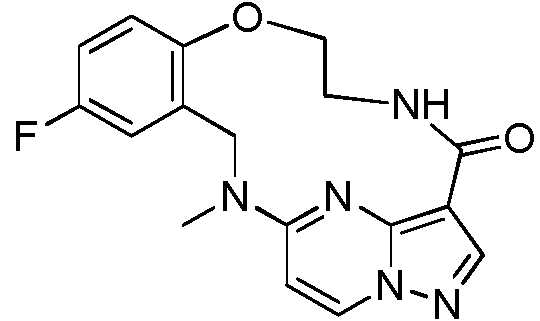
o una sal farmacéuticamente aceptable de los mismos.or a pharmaceutically acceptable salt thereof.
En determinadas realizaciones, el compuesto de Fórmula (I) o (I-A) es un compuesto que tiene la fórmulaIn certain embodiments, the compound of Formula (I) or (I-A) is a compound having the formula

o una sal farmacéuticamente aceptable de los mismos.or a pharmaceutically acceptable salt thereof.
En determinadas realizaciones, el compuesto de Fórmula (I) o (I-A) es un compuesto de la fórmulaIn certain embodiments, the compound of Formula (I) or (I-A) is a compound of the formula

o una sal farmacéuticamente aceptable de los mismos.or a pharmaceutically acceptable salt thereof.
En determinadas realizaciones, el compuesto de Fórmula (I) o (I-A) es un compuesto que tiene la fórmulaIn certain embodiments, the compound of Formula (I) or (I-A) is a compound having the formula

o una sal farmacéuticamente aceptable de los mismos.or a pharmaceutically acceptable salt thereof.
En determinadas realizaciones, el compuesto de Fórmula (I) o (I-A) es un compuesto que tiene la fórmulaIn certain embodiments, the compound of Formula (I) or (I-A) is a compound having the formula

o una sal farmacéuticamente aceptable de los mismos.or a pharmaceutically acceptable salt thereof.
En determinadas realizaciones, el compuesto de Fórmula (I) o (I-A) es un compuesto que tiene la fórmulaIn certain embodiments, the compound of Formula (I) or (I-A) is a compound having the formula

o una sal farmacéuticamente aceptable de los mismos.or a pharmaceutically acceptable salt thereof.
En un aspecto adicional, la invención se refiere a una forma cristalina de la base libre del compuesto de fórmulaIn a further aspect, the invention relates to a crystalline form of the free base of the compound of formula

que tiene un patrón de difracción de rayos X de polvo sustancialmente igual al de la Fig. XX. En algunas realizaciones, la forma polimórfica cristalina 1 de la base libre del compuesto de fórmulahaving an X-ray powder diffraction pattern substantially the same as Fig. XX. In some embodiments, the crystalline polymorphic form 1 of the free base of the compound of formula

en donde el patrón de difracción de rayos X de polvo tiene un pico en el ángulo de difracción (20) de 21,94. En algunas realizaciones, la forma polimórfica 1 de la base libre del compuesto de la fórmulawhere the X-ray powder diffraction pattern has a peak at diffraction angle (20) of 21.94. In some embodiments, the free base polymorphic form 1 of the compound of the formula

en donde el patrón de difracción de rayos X de polvo tiene picos en ángulos de difracción (20) de 21,94 y 23,96. En algunas realizaciones, la forma polimórfica 1 de la base libre del compuesto de la fórmulawhere the X-ray powder diffraction pattern has peaks at diffraction angles (20) of 21.94 and 23.96. In some embodiments, the free base polymorphic form 1 of the compound of the formula

en donde el patrón de difracción de rayos X de polvo tiene picos en ángulos de difracción (20) de 21,94, 23,96 y 19,64. En un aspecto adicional, la invención se refiere a una composición farmacéutica que comprende al menos un compuesto de Fórmula (I) o (I-A) o una sal farmacéuticamente aceptable del mismo. Las composiciones farmacéuticas de acuerdo con la invención pueden comprender además un excipiente farmacéuticamente aceptable. La invención es también un compuesto de Fórmula (I) o (I-A) o una sal farmacéuticamente aceptable del mismo para su uso como un medicamento.where the X-ray powder diffraction pattern has peaks at diffraction angles (20) of 21.94, 23.96 and 19.64. In a further aspect, the invention relates to a pharmaceutical composition comprising at least one compound of Formula (I) or (I-A) or a pharmaceutically acceptable salt thereof. Pharmaceutical compositions according to the invention may further comprise a pharmaceutically acceptable excipient. The invention is also a compound of Formula (I) or (I-A) or a pharmaceutically acceptable salt thereof for use as a medicament.
En otro aspecto, la memoria descriptiva desvela un método para tratar cáncer, dolor, enfermedades neurológicas, enfermedades autoinmunitarias o inflamación que comprende administrar a un sujeto que necesite dicho tratamiento una cantidad eficaz de al menos un compuesto de Fórmula (I) o (I-A) o una sal farmacéuticamente aceptable del mismo.In another aspect, the specification discloses a method of treating cancer, pain, neurological diseases, autoimmune diseases or inflammation comprising administering to a subject in need of such treatment an effective amount of at least one compound of Formula (I) or (I-A) or a pharmaceutically acceptable salt thereof.
En otro aspecto, la memoria descriptiva desvela el uso de un compuesto de Fórmula (I) o (I-A) en la preparación de un medicamento para el tratamiento de tales enfermedades y afecciones médicas y el uso de tales compuestos y sales para el tratamiento de tales enfermedades y afecciones médicas.In another aspect, the specification discloses the use of a compound of Formula (I) or (I-A) in the preparation of a medicament for the treatment of such diseases and medical conditions and the use of such compounds and salts for the treatment of such diseases and medical conditions.
En otro aspecto más, la memoria descriptiva desvela un método para inhibir proteína o tirosina quinasas, incluyendo una o más de MET, ALK, ROS1, AXL, TRK y JAK, que comprende poner en contacto una célula que comprende una o más de tales quinasas con una cantidad eficaz de al menos un compuesto de Fórmula (I) o (I-A) o una sal del mismo, y/o con al menos una composición farmacéutica de la invención, en donde la puesta en contacto es in vitro, ex vivo o in vivo. In yet another aspect, the specification discloses a method of inhibiting protein or tyrosine kinases, including one or more of MET, ALK, ROS1, AXL, TRK, and JAK, comprising contacting a cell comprising one or more of such kinases with an effective amount of at least one compound of Formula (I) or (IA) or a salt thereof, and/or with at least one pharmaceutical composition of the invention, wherein the contact is in vitro, ex vivo or in vivo.
Las realizaciones, características y ventajas adicionales de la invención resultarán evidentes a partir de la siguiente descripción detallada y a través de la práctica de la invención.Additional embodiments, features, and advantages of the invention will become apparent from the following detailed description and through practice of the invention.
Descripción de los dibujosDescription of the drawings
La Fig. 1 muestra un patrón de difracción de rayos X de polvo de la forma polimorfa cristalina 1 de la base libre de 11-fluoro-14-metil-6,7,13,14-tetrahidro-1,15-etenopirazolo[4,3-f][1,4,8,10]benzoxatriazaciclo-tridecin-4(5H)-ona (Ejemplo 20). Fig. 1 shows an X-ray powder diffraction pattern of crystalline polymorph Form 1 of the free base of 11-fluoro-14-methyl-6,7,13,14-tetrahydro-1,15-ethenopyrazolo[4 ,3-f][1,4,8,10]benzoxatriazacyclo-tridezine-4(5H)-one (Example 20).
La Fig. 2 muestra un termograma de calorimetría diferencial de barrido de la forma polimorfa cristalina 1 de la base libre de 11-fluoro-14-metil-6,7,13,14-tetrahidro-1,15-etenopirazolo[4,3-f][1,4,8,10]benzoxatriazacido-tridecin-4(5H)-ona (Ejemplo 20).Fig. 2 shows a differential scanning calorimetry thermogram of the crystalline polymorph form 1 of the free base of 11-fluoro-14-methyl-6,7,13,14-tetrahydro-1,15-ethenopyrazolo[4,3 -f][1,4,8,10]benzoxatriazacido-tridezin-4(5H)-one (Example 20).
Descripción detalladaDetailed description
A menos que definan de otro modo, todos los términos técnicos y científicos usados en el presente documento tienen el mismo significado que el que entiende comúnmente un experto habitual en la materia a la cual pertenece la presente invención. Como se usa en el presente documento y en las reivindicaciones adjuntas, las formas singulares "un" o "una", "uno/una", y "el/la" incluyen los referentes en plural a menos que el contexto indique claramente lo contrario. Se observa además que las reivindicaciones pueden redactarse para excluir cualquier elemento opcional. Así pues, esta afirmación pretende servir como fundamento para el uso de dicha terminología excluyente tal como "solamente", "solo" y similares en relación con la cita de los elementos de las reivindicaciones o para el uso de una limitación "negativa". Unless otherwise defined, all technical and scientific terms used herein have the same meaning as is commonly understood by an ordinary person skilled in the art to which the present invention pertains. As used herein and in the appended claims, the singular forms "a", "one", and "the" include plural referents unless the context clearly indicates otherwise. . It is further noted that the claims may be drafted to exclude any optional elements. Thus, this statement is intended to serve as a basis for the use of such exclusive terminology such as "only", "only" and the like in connection with the citation of the claim elements or for the use of a "negative" limitation.
Como se usa en el presente documento, las expresiones "que incluye", "que contiene" y "que comprende" se usan en su sentido abierto, no limitante.As used herein, the terms "including", "containing" and "comprising" are used in their open, non-limiting sense.
Para proporcionar una descripción más concisa, algunas de las expresiones cuantitativas dadas en el presente documento no están calificadas con el término "aproximadamente". Se entiende que, se use o no explícitamente el término "aproximadamente", cada cantidad dada en el presente documento está destinada a referirse al valor dado real y también, a la aproximación a dicho valor dado que se deduciría razonablemente en base a la habilidad ordinaria en la materia, incluyendo equivalentes y aproximaciones debidas a las condiciones experimentales y/o de medición para dicho valor dado. Siempre que se dé un rendimiento en forma de porcentaje, dicho rendimiento se refiere a una masa de la entidad para la que se da el rendimiento con respecto a la cantidad máxima de la misma entidad que podría obtenerse en las condiciones estequiométricas particulares. Las concentraciones que se dan en forma de porcentajes se refieren a relaciones de masa, a menos que se indique de otro modo.To provide a more concise description, some of the quantitative expressions given in this document are not qualified with the term "approximately". It is understood that, whether or not the term "approximately" is used explicitly, each quantity given herein is intended to refer to the actual given value and also, to the approximation to such given value that would be reasonably deduced based on ordinary skill. in the art, including equivalents and approximations due to experimental and/or measurement conditions for said given value. Whenever a yield is given as a percentage, such yield refers to a mass of the entity for which the yield is given relative to the maximum amount of the same entity that could be obtained under the particular stoichiometric conditions. Concentrations given as percentages refer to mass ratios, unless otherwise indicated.
A menos que definan de otro modo, todos los términos técnicos y científicos usados en el presente documento tienen el mismo significado que el entendido comúnmente por un experto en la materia a la cual pertenece la presente invención. Aunque cualquier método y material similar o equivalente a los descritos en el presente documento también puede usarse en la práctica o pruebas de la presente invención, a continuación se describen los métodos y materiales preferidos. Excepto que se indique de otro modo, los métodos y técnicas de las presentes realizaciones se realizan generalmente de acuerdo con métodos convencionales bien conocidos en la materia y como se describe en diversas referencias generales y más específicas que se citan y se analizan a lo largo de la presente memoria descriptiva. Véase, por ejemplo, Loudon, Organic Chemistry, cuarta edición, Nueva York: Oxford University Press, 2002, pág. 360 361, 1084-1085; Smith y March, March's Advanced Organic Chemistry: Reactions, Mechanisms, and Structure, quinta edición, Wiley-Interscience, 2001.Unless otherwise defined, all technical and scientific terms used in this document have the same meaning as that commonly understood by a person skilled in the art to which the present invention pertains. Although any methods and materials similar or equivalent to those described herein may also be used in the practice or testing of the present invention, the preferred methods and materials are described below. Except as otherwise indicated, the methods and techniques of the present embodiments are generally performed in accordance with conventional methods well known in the art and as described in various general and more specific references that are cited and discussed throughout. the present specification. See, for example, Loudon, Organic Chemistry, Fourth Edition, New York: Oxford University Press, 2002, p. 360 361, 1084-1085; Smith and March, March's Advanced Organic Chemistry: Reactions, Mechanisms, and Structure, Fifth Edition, Wiley-Interscience, 2001.
La nomenclatura química para los compuestos descritos en el presente documento habitualmente se ha obtenido usando ACD/Name 2014 (ACD/Labs) o ChemBioDraw Ultra 13.0 (Perkin Elmer) disponibles comercialmente.Chemical nomenclature for compounds described herein has typically been derived using commercially available ACD/Name 2014 (ACD/Labs) or ChemBioDraw Ultra 13.0 (Perkin Elmer).
DEFINICIONES QUÍMICASCHEMICAL DEFINITIONS
El término "alquilo" se refiere a un grupo alquilo de cadena lineal o ramificada que tiene de 1 a 12 átomos de carbono en la cadena. Los ejemplos de grupos alquilo incluyen metilo (Me), etilo (Et), n-propilo, isopropilo, butilo, isobutilo, secbutilo, ferc-butilo (tBu), pentilo, isopentilo, ferc-pentilo, hexilo, isohexilo, y grupos que a la luz del experto en la técnica y las enseñanzas proporcionadas en el presente documento se considerarían equivalentes a uno cualquiera de los ejemplos anteriores.The term "alkyl" refers to a straight or branched chain alkyl group having from 1 to 12 carbon atoms in the chain. Examples of alkyl groups include methyl (Me), ethyl (Et), n-propyl, isopropyl, butyl, isobutyl, secbutyl, ferc-butyl (tBu), pentyl, isopentyl, ferric-pentyl, hexyl, isohexyl, and groups that in light of the person skilled in the art and the teachings provided herein would be considered equivalent to any one of the above examples.
El término "alquenilo" se refiere a un grupo hidrocarburo de cadena lineal o ramificada que tiene de 2 a 12 átomos de carbono en la cadena y que tiene uno o más enlaces dobles. Ejemplos de grupos alquenilo incluyen etenilo (o vinilo), alilo y but-3-en-1-ilo. Incluidos dentro de este término están los isómeros cis y trans y sus mezclas.The term "alkenyl" refers to a straight or branched chain hydrocarbon group having from 2 to 12 carbon atoms in the chain and having one or more double bonds. Examples of alkenyl groups include ethenyl (or vinyl), allyl, and but-3-en-1-yl. Included within this term are the cis and trans isomers and their mixtures.
El término "alquinilo" se refiere a un grupo hidrocarburo de cadena lineal o ramificada que tiene de 2 a 12 átomos de carbono en la cadena y que tiene uno o más enlaces triples. Los ejemplos de grupos alquinilo incluyen acetilenilo (-C=CH) y propargilo (-CH2C=CH).The term "alkynyl" refers to a straight or branched chain hydrocarbon group having from 2 to 12 carbon atoms in the chain and having one or more triple bonds. Examples of alkynyl groups include acetylenyl (-C=CH) and propargyl (-CH 2 C=CH).
El término "cicloalquilo" se refiere a un carbociclo monocíclico o policíclico, saturado o parcialmente saturado, que tiene de 3 a 12 átomos en el anillo. Los carbociclos policíclicos incluyen sistemas policíclicos condensados, puenteados y espiro. Los ejemplos ilustrativos de grupos cicloalquilo incluyen las siguientes entidades, en forma de restos correctamente unidos: The term "cycloalkyl" refers to a saturated or partially saturated monocyclic or polycyclic carbocycle having from 3 to 12 ring atoms. Polycyclic carbocycles include fused, bridged, and spiro polycyclic systems. Illustrative examples of cycloalkyl groups include the following entities, in the form of correctly linked moieties:
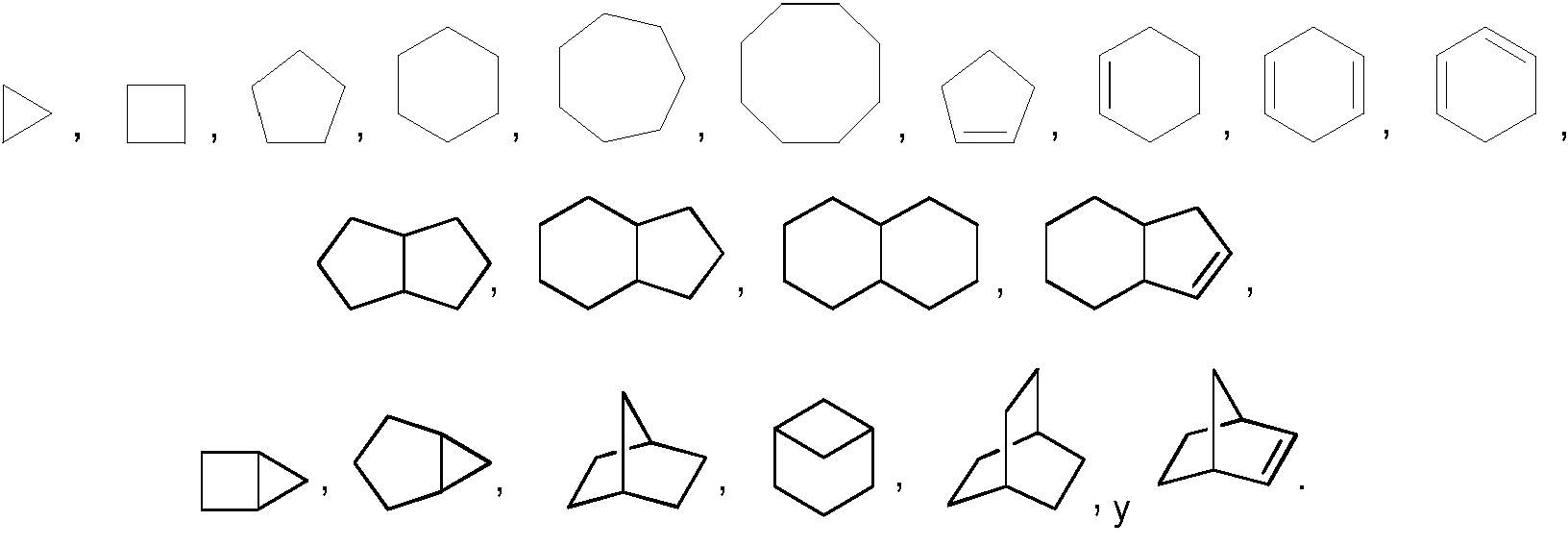
El término "halógeno" representa cloro, flúor, bromo o yodo. El término "halo" representa cloro, flúor, bromo o yodo. The term "halogen" represents chlorine, fluorine, bromine or iodine. The term "halo" represents chloro, fluoro, bromo or iodo.
El término "haloalquilo" se refiere a un grupo alquilo con uno o más sustituyentes halo, o uno, dos o tres sustituyentes halo. Los ejemplos de grupos haloalquilo incluyen -CF3, -(CH2 )F, -CHF2 , -CH2Br, -CH2CF3 y -CH2CH2F.The term "haloalkyl" refers to an alkyl group with one or more halo substituents, or one, two, or three halo substituents. Examples of haloalkyl groups include -CF 3 , -(CH 2 )F, -CHF 2 , -CH 2 Br, -CH 2 CF 3 , and -CH 2 CH 2 F.
El término "arilo" se refiere a grupos monocíclicos o policíclicos de anillos condensados totalmente de carbono de 6 a 14 átomos de carbono (C6-C14) que tienen un sistema de electrones pi completamente conjugado. Arilo incluye grupos monocíclicos o policíclicos de anillos condensados de 6 a 10 átomos de carbono (por ejemplo, "arilo C6-10"). Ejemplos de grupos arilo son fenilo, naftalenilo y antracenilo. El grupo arilo puede estar sustituido como se describe anteriormente por alquilo o sin sustituir. Los grupos de sustituyentes también incluyen los descritos en otra parte de esta descripción en relación con el arilo.The term "aryl" refers to all-carbon fused ring monocyclic or polycyclic groups of 6 to 14 carbon atoms (C 6 -C 14 ) having a fully conjugated pi electron system. Aryl includes monocyclic or fused ring polycyclic groups of 6 to 10 carbon atoms (eg, "C 6-10 aryl"). Examples of aryl groups are phenyl, naphthalenyl, and anthracenyl. The aryl group may be substituted as described above by alkyl or unsubstituted. Substituent groups also include those described elsewhere in this description in relation to aryl.
El término "heterocicloalquilo" se refiere a una estructura de anillo monocíclico o policíclico que está saturada o parcialmente saturada y tiene de 3 a 12 átomos en el anillo, con 1 a 5 de los átomos en el anillo seleccionados de nitrógeno, oxígeno y azufre. Los sistemas de anillos policíclicos incluyen sistemas condensados, puenteados y espiro. La estructura del anillo puede contener opcionalmente hasta dos grupos oxo en miembros del anillo de carbono o azufre. Los ejemplos ilustrativos de grupos heterocicloalquilo incluyen las siguientes entidades, en forma de restos correctamente unidos:The term "heterocycloalkyl" refers to a monocyclic or polycyclic ring structure that is saturated or partially saturated and has from 3 to 12 ring atoms, with 1 to 5 of the ring atoms selected from nitrogen, oxygen, and sulfur. Polycyclic ring systems include fused, bridged, and spiro systems. The ring structure may optionally contain up to two oxo groups on carbon or sulfur ring members. Illustrative examples of heterocycloalkyl groups include the following entities, in the form of correctly linked moieties:

El término "heteroarilo" se refiere a un heterociclo aromático monocíclico, bicíclico condensado o policíclico condensado (estructura de anillo que tiene átomos de anillo o miembros seleccionados entre átomos de carbono y hasta cuatro heteroátomos seleccionados entre nitrógeno, oxígeno y azufre) que tiene de 3 a 12 anillos. átomos por heterociclo. Los ejemplos ilustrativos de grupos heteroarilo incluyen las siguientes entidades, en forma de restos apropiadamente unidos: The term "heteroaryl" refers to a monocyclic, fused bicyclic, or fused polycyclic aromatic heterocycle (ring structure having ring atoms or members selected from carbon atoms and up to four heteroatoms selected from nitrogen, oxygen, and sulfur) having from 3 to 12 rings. atoms per heterocycle. Illustrative examples of heteroaryl groups include the following entities, in the form of appropriately linked moieties:

Un heteroarilo "monocídico" es un heterociclo aromático de cinco o seis miembros. Un heteroarilo de cinco miembros contiene hasta cuatro átomos anulares heteroátomos, en donde (a) un átomo anular es oxígeno y azufre y cero, uno o dos átomos anulares es nitrógeno, o (b) cero átomos anulares son oxígeno o azufre y hasta cuatro átomos del anillo son nitrógeno. En algunas realizaciones, un heteroarilo de cinco miembros es furano, tiofeno, pirrol, oxazol, isoxazol, tiazol, isotiazol, pirazol, imidazol, oxadiazol, tiadiazol, triazol o tetrazol. Un heteroarilo de seis miembros contiene uno o dos átomos de nitrógeno en el anillo. En algunas realizaciones, un heteroarilo de seis miembros es piridina, pirazina, pirimidina, piridazina o triazina. Un "heteroarilo bicíclico" es un sistema bicíclico fusionado que comprende un anillo de heteroarilo fusionado con un fenilo u otro anillo de heteroarilo.A "monocidic" heteroaryl is a five- or six-membered aromatic heterocycle. A five-membered heteroaryl contains up to four heteroatom ring atoms, where (a) one ring atom is oxygen and sulfur and zero, one, or two ring atoms is nitrogen, or (b) zero ring atoms are oxygen or sulfur and up to four atoms of the ring are nitrogen. In some embodiments, a five-membered heteroaryl is furan, thiophene, pyrrole, oxazole, isoxazole, thiazole, isothiazole, pyrazole, imidazole, oxadiazole, thiadiazole, triazole, or tetrazole. A six-membered heteroaryl contains one or two nitrogen ring atoms. In some embodiments, a six-membered heteroaryl is pyridine, pyrazine, pyrimidine, pyridazine, or triazine. A "bicyclic heteroaryl" is a fused bicyclic system comprising a heteroaryl ring fused to a phenyl or other heteroaryl ring.
El término "oxo" representa un oxígeno carbonílico. Por ejemplo, un ciclopentilo sustituido con oxo es ciclopentanona. The term "oxo" represents a carbonyl oxygen. For example, an oxo-substituted cyclopentyl is cyclopentanone.
El término "sustituido" significa que el grupo o resto especificado lleva uno o más sustituyentes. La expresión "no sustituido" significa que el grupo especificado no lleva sustituyentes. Cuando el término "sustituido" se usa para describir un sistema estructural, la sustitución está destinada a ocurrir en cualquier posición permitida por valencia en el sistema. En algunas realizaciones, "sustituido" significa que el grupo o resto especificado lleva uno, dos o tres sustituyentes. En otras realizaciones, "sustituido" significa que el grupo o resto especificado lleva uno o dos sustituyentes. En otras realizaciones más, "sustituido" significa que el grupo o resto especificado lleva un sustituyente. The term "substituted" means that the specified group or moiety bears one or more substituents. The term "unsubstituted" means that the specified group bears no substituents. When the term "substituted" is used to describe a structural system, the substitution is intended to occur at any valence-allowed position in the system. In some embodiments, "substituted" means that the specified group or moiety bears one, two, or three substituents. In other embodiments, "substituted" means that the specified group or moiety bears one or two substituents. In still other embodiments, "substituted" means that the specified group or moiety bears a substituent.
Cualquier fórmula representada en el presente documento pretende representar un compuesto de esa fórmula estructural, así como ciertas variaciones o formas. Por ejemplo, una fórmula dada en el presente documento pretende incluir una forma racémica o uno o más isómeros enantioméricos, diastereoméricos o geométricos o una mezcla de los mismos. Adicionalmente, cualquier fórmula dada en el presente documento pretender referirse también a un hidrato, solvato o polimorfo de dicho compuesto o una mezcla de los mismos.Any formula represented herein is intended to represent a compound of that structural formula, as well as certain variations or forms. For example, a formula given herein is intended to include a racemic form or one or more enantiomeric, diastereomeric or geometric isomers or a mixture thereof. Additionally, any formula given herein is intended to refer also to a hydrate, solvate or polymorph of said compound or a mixture thereof.
Cualquier fórmula dada en el presente documento también pretende representar formas no marcadas, así como formas marcadas isotópicamente de los compuestos. Los compuestos marcados isotópicamente tienen estructuras representadas por las fórmulas dadas en el presente documento, excepto por que uno o más átomos están reemplazados por un átomo que tiene una masa atómica o número másico seleccionado. Los ejemplos de isótopos que pueden incorporarse en los compuestos de la invención incluyen isótopos de hidrógeno, carbono, nitrógeno, oxígeno, fósforo, flúor, cloro y yodo, tales como 2H, 3H, 11C, 13C, 14C, 15N, 18O, 17O, 31P, 32P, 35S, 18F, 36Cl y 125I, respectivamente. Dichos compuestos marcados isotópicamente son útiles en estudios metabólicos (preferentemente con 14C), estudios de cinética de reacción (con, por ejemplo 2H o 3H), técnicas de detección o formación de imágenes [tales como la tomografía por emisión de positrones (PET) o la tomografía de emisión monofotónica (SPECT)], incluyendo ensayos de distribución en tejidos de sustrato o de fármaco, o en el tratamiento radioactivo de pacientes. Además, la sustitución con isótopos más pesados tales como deuterio (es decir, 2H) puede proporcionar ciertas ventajas terapéuticas resultantes de una mayor estabilidad metabólica, por ejemplo, una semivida in vivo aumentada o unos requisitos de dosis reducidos. Los compuestos marcados isotópicamente de la presente invención y los profármacos de los mismos generalmente pueden prepararse realizando los procedimientos que se desvelan en los esquemas o en los ejemplos y preparaciones que se describen a continuación sustituyendo un reactivo no marcado isotópicamente por un reactivo marcado isotópicamente fácilmente disponible. Any formula given herein is also intended to represent unlabeled forms, as well as isotopically labeled forms of the compounds. Isotopically labeled compounds have structures represented by the formulas given herein, except that one or more atoms are replaced by an atom having a selected atomic mass or mass number. Examples of isotopes that can be incorporated into the compounds of the invention include isotopes of hydrogen, carbon, nitrogen, oxygen, phosphorus, fluorine, chlorine, and iodine, such as 2H, 3H, 11C, 13C, 14C, 15N, 18O, 17O, 31P, 32P, 35S, 18F, 36Cl and 125I, respectively. Said isotopically labeled compounds are useful in metabolic studies (preferably with 14C), reaction kinetics studies (with, for example, 2H or 3H), detection or imaging techniques [such as positron emission tomography (PET) or single photon emission tomography (SPECT)], including drug or substrate tissue distribution assays, or in the radioactive treatment of patients. In addition, substitution with heavier isotopes such as deuterium (ie, 2H) may provide certain therapeutic advantages resulting from increased metabolic stability, eg, increased in vivo half-life or reduced dose requirements. The isotopically labeled compounds of the present invention and prodrugs thereof can generally be prepared by performing the procedures disclosed in the schemes or in the examples and preparations described below by substituting a readily available isotopically labeled reagent for a non-isotopically labeled reagent. .
La nomenclatura "(ATOM)i-j" con j > i, cuando se aplica en el presente documento a una clase de sustituyentes, se refiere a realizaciones de esta invención para las cuales todos y cada uno del número de átomos miembros, de i a j incluyendo i y j, se realiza de forma independiente. A modo de ejemplo, el término C1-3 se refiere independientemente a realizaciones que tienen un miembro de carbono (C1 ), realizaciones que tienen dos miembros de carbono (C2) y realizaciones que tienen tres miembros de carbono (C3).The nomenclature "(ATOM)ij" with j > i, when applied herein to a class of substituents, refers to embodiments of this invention for which each and every number of member atoms, of iaj including i and j , is done independently. By way of example, the term C 1-3 refers independently to embodiments having one carbon (C 1 ) member, embodiments having two carbon (C 2 ) members, and embodiments having three carbon (C 3 ) members. .
Cualquier disustituyente al que se hace referencia en el presente documento pretende abarcar las diversas posibilidades de unión cuando se permite más de una de tales posibilidades. Por ejemplo, la referencia al disustituyente -A-B-, en donde A t B, se refiere en el presente documento a dicho disustituyente con A unido a un primer miembro sustituido y B unido a un segundo miembro sustituido y también se refiere a dicho disustituyente con A unido al segundo miembro sustituido y B unido al primer miembro sustituido.Any substituents referred to herein are intended to encompass the various possibilities of binding when more than one such possibility is allowed. For example, reference to the substituent -A-B-, where A t B, refers herein to such a substituent with A attached to a first substituted member and B attached to a second substituted member and also refers to such a substituent with A attached to the second substituted member and B attached to the first substituted member.
La invención también incluye sales farmacéuticamente aceptables de los compuestos representados por la Fórmula (I) o (I-A), preferentemente de los descritos anteriormente y de los compuestos específicos ejemplificados en el presente documento, y composiciones farmacéuticas que comprenden tales sales, y métodos para usar tales sales. The invention also includes pharmaceutically acceptable salts of the compounds represented by Formula (I) or (I-A), preferably those described above and the specific compounds exemplified herein, and pharmaceutical compositions comprising such salts, and methods of using them. such salts.
Una "sal farmacéuticamente aceptable" pretende significar una sal de un ácido o base libre de un compuesto representado en el presente documento que es no tóxico, biológicamente tolerable, o de otro modo biológicamente adecuado para la administración al sujeto. Véase, en general, S. M. Berge, et al., "Pharmaceutical Salts", J. Pharm. Sci., 1977, 6 6 , 1-19. Las sales farmacéuticamente aceptables preferidas son aquellas que son farmacológicamente eficaces y adecuadas para el contacto con los tejidos de sujetos sin indebida toxicidad, irritación o respuesta alérgica. Un compuesto descrito en el presente documento puede poseer un grupo suficientemente ácido, un grupo suficientemente básico, ambos tipos de grupos funcionales o más de uno de cada tipo y reaccionar en consecuencia con diversas bases inorgánicas u orgánicas y ácidos inorgánicos y orgánicos, para formar una sal farmacéuticamente aceptable.A "pharmaceutically acceptable salt" is intended to mean a free acid or base salt of a compound depicted herein that is non-toxic, biologically tolerable, or otherwise biologically suitable for administration to the subject. See generally SM Berge, et al., "Pharmaceutical Salts", J. Pharm. Sci., 1977, 66 , 1-19. Preferred pharmaceutically acceptable salts are those that are pharmacologically effective and suitable for contact with the tissues of subjects without undue toxicity, irritation, or allergic response. A compound described herein may possess a sufficiently acidic group, a sufficiently basic group, both types of functional groups, or more than one of each type, and react accordingly with various inorganic or organic bases, and inorganic and organic acids, to form a pharmaceutically acceptable salt.
Los ejemplos de sales farmacéuticamente aceptables incluyen sulfatos, pirosulfatos, bisulfatos, sulfitos, bisulfitos, fosfatos, monohidrogenofosfatos, dihidrogenofosfatos, metafosfatos, pirofosfatos, cloruros, bromuros, yoduros, acetatos, propionatos, decanoatos, caprilatos, acrilatos, formiatos, isobutiratos, caproatos, heptanoatos, propiolatos, oxalatos, malonatos, succinatos, suberatos, sebacatos, fumaratos, maleatos, butina-1,4-dioatos, hexin-1,6-dioatos, benzoatos, clorobenzoatos, metilbenzoatos, dinitrobenzoatos, hidroxibenzoatos, metoxibenzoatos, ftalatos, sulfonatos, metilsulfonatos, propilsulfonatos, besilatos, xilenosulfonatos, naftaleno-1 -sulfonatos, naftaleno-2 -sulfonatos, fenilacetatos, fenilpropionatos, fenilbutiratos, citratos, lactatos, Y-hidroxibutiratos, glicolatos, tartratos y mandelatos. Se encuentran listas de otras sales farmacéuticamente aceptables adecuadas en Remington' s Pharmaceutical Sciences, 17a edición, Mack Publishing Company, Easton, Pa., 1985.Examples of pharmaceutically acceptable salts include sulfates, pyrosulfates, bisulfates, sulfites, bisulfites, phosphates, monohydrogen phosphates, dihydrogen phosphates, metaphosphates, pyrophosphates, chlorides, bromides, iodides, acetates, propionates, decanoates, caprylates, acrylates, formates, isobutyrates, caproates, heptanoates , propiolates, oxalates, malonates, succinates, suberates, sebacates, fumarates, maleates, butyne-1,4-dioates, hexin-1,6-dioates, benzoates, chlorobenzoates, methylbenzoates, dinitrobenzoates, hydroxybenzoates, methoxybenzoates, phthalates, sulfonates, methylsulfonates , propylsulfonates, besylates, xylenesulfonates, naphthalene- 1 -sulfonates, naphthalene- 2 -sulfonates, phenylacetates, phenylpropionates, phenylbutyrates, citrates, lactates, Y-hydroxybutyrates, glycolates, tartrates, and mandelates. Lists of other suitable pharmaceutically acceptable salts are found in Remington's Pharmaceutical Sciences, 17th Edition, Mack Publishing Company, Easton, Pa., 1985.
Para un compuesto de Fórmula (I) o (I-A) que contiene un nitrógeno básico, se puede preparar una sal farmacéuticamente aceptable mediante cualquier método adecuado disponible en la materia, por ejemplo, tratamiento de la base libre con un ácido inorgánico, tales como ácido clorhídrico, ácido bromhídrico, ácido sulfúrico, ácido sulfámico, ácido nítrico, ácido bórico y ácido fosfórico, o con un ácido orgánico, tal como ácido acético, ácido fenilacético, ácido propiónico, ácido esteárico, ácido láctico, ácido ascórbico, ácido maleico, ácido hidroximaleico, ácido isetiónico, ácido succínico, ácido valérico, ácido fumárico, ácido malónico, ácido pirúvico, ácido oxálico, ácido glicólico, ácido salicílico, ácido oleico, ácido palmítico, ácido láurico, un ácido piranosidílico, tal como ácido glucurónico o ácido galacturónico, un alfa-hidroxi ácido, tal como ácido mandélico, ácido cítrico o ácido tartárico, un aminoácido, tal como ácido aspártico o ácido glutámico, un ácido aromático, tal como ácido benzoico, ácido 2 -acetoxibenzoico, ácido naftoico o ácido cinnámico, un ácido sulfónico, tal como ácido laurilsulfónico, ácido p-toluenosulfónico, ácido metanosulfónico o ácido etanosulfónico, o cualquier mezcla compatible de ácidos tales como los que se dan en el presente documento como ejemplos, y cualquier otro ácido y mezcla de los mismos que se consideren equivalentes o sustitutos aceptables a la luz del nivel ordinario de experiencia en esta tecnología.For a compound of Formula (I) or (IA) containing a basic nitrogen, a pharmaceutically acceptable salt may be prepared by any suitable method available in the art, for example, treatment of the free base with an inorganic acid, such as hydrochloric acid, hydrobromic acid, sulfuric acid, sulfamic acid, nitric acid, boric acid and phosphoric acid, or with an organic acid such as acetic acid, phenylacetic acid, propionic acid, stearic acid, lactic acid, ascorbic acid, maleic acid, hydroxymaleic acid, isethionic acid, succinic acid, valeric acid, fumaric acid, malonic acid, pyruvic acid, oxalic acid, glycolic acid, salicylic acid, oleic acid, palmitic acid, lauric acid, a pyranosidylic acid, such as glucuronic acid or galacturonic acid, an alpha-hydroxy acid, such as mandelic acid, citric acid or tartaric acid, an amino acid, such as aspartic acid or glutamic acid, an aromatic acid, such as benzoic acid, 2 -acetoxybenzoic acid, naphthoic acid, or cinnamic acid, a sulfonic acid, such as laurylsulfonic acid, p-toluenesulfonic acid, methanesulfonic acid, or ethanesulfonic acid, or any compatible mixture of acids such as those given herein as examples, and any other acids and mixtures thereof that are considered acceptable equivalents or substitutes in light of ordinary level of expertise in this technology.
La memoria descriptiva también desvela profármacos farmacéuticamente aceptables de los compuestos de Fórmula (I) o (I-A), y métodos de tratamiento que emplean dichos profármacos farmacéuticamente aceptables. El término "profármaco" significa un precursor de un compuesto designado que, después de la administración a un sujeto, produce el compuesto in vivo mediante un proceso químico o fisiológico tal como solvólisis o escisión enzimática, o en condiciones fisiológicas (por ejemplo, un profármaco al ser llevado a pH fisiológico se convierte en el compuesto de Fórmula (I) o (I-A)). Un "profármaco farmacéuticamente aceptable" es un profármaco que es no tóxico, biológicamente tolerable y de otro modo biológicamente adecuado para su administración al sujeto. Se describen procedimientos a modo de ilustración para la selección y preparación de derivados de profármaco adecuados, por ejemplo, en "Design of Prodrugs", ed. H. Bundgaard, Elsevier, 1985.The specification also discloses pharmaceutically acceptable prodrugs of the compounds of Formula (I) or (IA), and methods of treatment employing such pharmaceutically acceptable prodrugs. The term "prodrug" means a precursor of a designated compound that, after administration to a subject, produces the compound in vivo by a chemical or physiological process such as solvolysis or enzymatic cleavage, or under physiological conditions (for example, a prodrug when brought to physiological pH it becomes the compound of Formula (I) or (IA)). A "pharmaceutically acceptable prodrug" is a prodrug that is non-toxic, biologically tolerable, and otherwise biologically suitable for administration to the subject. Illustrative procedures for the selection and preparation of suitable prodrug derivatives are described, for example, in "Design of Prodrugs", ed. H. Bundgaard, Elsevier, 1985.
La memoria descriptiva también desvela metabolitos farmacéuticamente activos de compuestos de Fórmula (I) o (I-A), y usos de tales metabolitos en los métodos descritos en el presente documento. Un "metabolito farmacéuticamente activo" significa un producto farmacológicamente activo del metabolismo en el cuerpo de un compuesto de Fórmula (I) o (I-A) o una sal del mismo. Los profármacos y metabolitos activos de un compuesto pueden determinarse usando técnicas de rutina conocidas o disponibles en la técnica. Véase, por ejemplo, Bertolini et al., J. Med. Chem. 1997, 40, 2011-2016; Shan et al., J. Pharm. Sci. 1997, 86 (7), 765-767; Bagshawe, Drug Dev. Res. 1995, 34, 220-230; Bodor, Adv. Drug Res. 1984, 13, 255-331; Bundgaard, Design of Prodrugs (Elsevier Press, 1985); y Larsen, Design and Application of Prodrugs, Drug Design and Development (Krogsgaard-Larsen et al., eds., Harwood Academic Publishers, 1991).The specification also discloses pharmaceutically active metabolites of compounds of Formula (I) or (IA), and uses of such metabolites in the methods described herein. A "pharmaceutically active metabolite" means a pharmacologically active product of metabolism in the body of a compound of Formula (I) or (IA) or a salt thereof. The prodrugs and active metabolites of a compound can be determined using routine techniques known or available in the art. See, for example, Bertolini et al., J. Med. Chem. 1997, 40, 2011-2016; Shan et al., J. Pharm. Sci. 1997, 86(7), 765-767; Bagshawe, Drug Dev. Res. 1995, 34, 220-230; Bodor, Adv. Drug Res. 1984, 13, 255-331; Bundgaard, Design of Prodrugs (Elsevier Press, 1985); and Larsen, Design and Application of Prodrugs, Drug Design and Development (Krogsgaard-Larsen et al., eds., Harwood Academic Publishers, 1991).
REALIZACIONES REPRESENTATIVASREPRESENTATIVE EMBODIMENTS
En algunas realizaciones de Fórmula (I-A), el Anillo A' es arilo o heteroarilo monocíclico y el Anillo B' es heteroarilo bicíclico. En otras realizaciones, El Anillo A' es heteroarilo bicíclico y el Anillo B' es arilo o heteroarilo monocíclico. En algunas realizaciones, el Anillo A' es fenilo o un heteroarilo de 6 miembros. En otras realizaciones, el Anillo B' es un heteroarilo biciclico que contiene 1,2 o 3 átomos de nitrógeno en el anillo. En otras realizaciones, el Anillo A' es fenilo o piridilo.In some embodiments of Formula (I-A), Ring A' is monocyclic aryl or heteroaryl and Ring B' is bicyclic heteroaryl. In other embodiments, Ring A' is bicyclic heteroaryl and Ring B' is monocyclic aryl or heteroaryl. In some embodiments, Ring A' is phenyl or a 6-membered heteroaryl. In other embodiments, Ring B' is a bicyclic heteroaryl containing 1,2 or 3 ring nitrogen atoms. In other embodiments, Ring A' is phenyl or pyridyl.
En otras realizaciones más, el Anillo A' es fenilo. En otras realizaciones más, el Anillo A' sustituido con -(R3')p' esIn still other embodiments, Ring A' is phenyl. In still other embodiments, Ring A' substituted with -(R3')p' is

En otras realizaciones más, el Anillo A' sustituido con -(R3')p' esIn still other embodiments, Ring A' substituted with -(R3')p' is

En algunas realizaciones, e Anillo B' es:In some embodiments, e Ring B' is:

en donde Z1-Z7 son como se definen como se describen en el presente documento. En otras realizaciones más, e Anillo B' es:where Z1-Z7 are as defined as described herein. In still other embodiments, e Ring B' is:

en donde Z1-7 se definen de otro modo como se describen en el presente documento. En otras realizaciones más, e Anillo B' es:wherein Z1-7 are otherwise defined as described herein. In still other embodiments, e Ring B' is:


En otras realizaciones más, 

En otras realizaciones de Fórmula (I-A), el Anillo A' es un grupo heteroarilo bicíclico, y es:In other embodiments of Formula (I-A), Ring A' is a bicyclic heteroaryl group, and is:
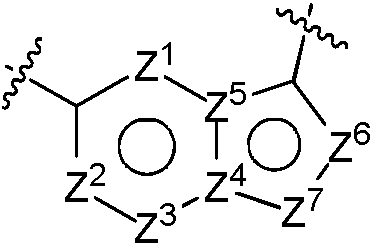
en donde Z1-Z7 son como se definen como se describen en el presente documento. En otras realizaciones más, el Anillo A' es:where Z1-Z7 are as defined as described herein. In still other embodiments, Ring A' is:

en donde Z1-7 se definen de otro modo como se describen en el presente documento. En otras realizaciones más, el Anillo A' es:wherein Z1-7 are otherwise defined as described herein. In still other embodiments, Ring A' is:


En otras realizaciones más, el Anillo A' esIn still other embodiments, Ring A' is

En otras realizaciones más, el Anillo A' esIn still other embodiments, Ring A' is

En algunas realizaciones, el Anillo B' es el arilo o heteroarilo monocíclico. En otras realizaciones, el Anillo B' es fenilo. En otras realizaciones, el Anillo B' es piridilo.In some embodiments, Ring B' is monocyclic aryl or heteroaryl. In other embodiments, Ring B' is phenyl. In other embodiments, Ring B' is pyridyl.
En algunas realizaciones, cada R3' es independientemente deuterio, flúor, cloro, bromo, metilo, etilo, propilo, isopropilo, metoxi, etoxi, isopropoxi, -CN, -CF3, -NH2 , -NH(alquilo C1-4), -N(alquilo C-m )2 , -CO2alquilo C1-4 , -CO2H, -NHC(O)alquilo C1-4 , -SO2alquilo C1-4, -C(O)NH2 , -C(O)NH(alquilo C1-4), -C(O)N(alquilo C1-4)2, ciclopropilo, ciclobutilo, ciclopentilo, ciclohexilo, pirrolidinilo, piperidinilo, piperazinilo, morfolinilo o tiomorfolinilo. En otras realizaciones más, cada R3' es independientemente flúor, cloro, bromo, metilo, etilo, propilo, isopropilo, metoxi, etoxi, isopropoxi, -CN o -CF3. En otras realizaciones más, cada R3' es flúor o cloro.In some embodiments, each R3' is independently deuterium, fluoro, chloro, bromo, methyl, ethyl, propyl, isopropyl, methoxy, ethoxy, isopropoxy, -CN, -CF 3 , -NH 2 , -NH(C 1-4 alkyl ), -N(C- m alkyl) 2 , -CO 2 C 1-4 alkyl, -CO 2 H, -NHC(O)C 1-4 alkyl, -SO 2 C 1-4 alkyl, -C(O )NH 2 , -C(O)NH(C 1-4 alkyl), -C(O)N(C 1-4 alkyl)2, cyclopropyl, cyclobutyl, cyclopentyl, cyclohexyl, pyrrolidinyl, piperidinyl, piperazinyl, morpholinyl or thiomorpholinyl. In still other embodiments, each R3' is independently fluoro, chloro, bromo, methyl, ethyl, propyl, isopropyl, methoxy, ethoxy, isopropoxy, -CN or -CF 3 . In still other embodiments, each R3' is fluoro or chloro.
En algunas realizaciones, R7' es H, deuterio, metilo, etilo, propilo, isopropilo, ciclopropilo, ciclobutilo, ciclopentilo, pirrolidinilo, furanilo, tiofuranilo, piperidinilo, piperazinilo, morfolinilo, fenilo o heteroarilo monocíclico, cada uno sustituido o sin sustituir como en la Fórmula (I-A). En otras realizaciones, R7' es H o es metilo, etilo, propilo, isopropilo o ciclopropilo, cada uno sin sustituir o sustituido como en la Fórmula (I-A). En otras realizaciones más, R7' es H o es metilo o etilo, cada uno sin sustituir o sustituido con halógeno, -OH, -Oalquilo C1-4 , -NH2 , -NH(alquilo C1-4), -N(alquilo C1-4)2, -CO2H, -CO2alquilo C1-4, -CONH2 , cicloalquilo o heterocicloalquilo monocíclico. En otras realizaciones más, R7' es H, metilo, hidroxietilo, -CH2CONH2 o 3-pirrolidinilmetilo. En otras realizaciones más, R7' es H o metilo.In some embodiments, R7' is H, deuterium, methyl, ethyl, propyl, isopropyl, cyclopropyl, cyclobutyl, cyclopentyl, pyrrolidinyl, furanyl, thiofuranyl, piperidinyl, piperazinyl, morpholinyl, phenyl, or monocyclic heteroaryl, each substituted or unsubstituted as in Formula (IA). In other embodiments, R7' is H or is methyl, ethyl, propyl, isopropyl, or cyclopropyl, each unsubstituted or substituted as in Formula (IA). In still other embodiments, R7' is H or is methyl or ethyl, each unsubstituted or substituted with halogen, -OH, -OC 1-4 alkyl, -NH 2 , -NH(C 1-4 alkyl), -N (C1-4 alkyl)2, -CO 2 H, -CO 2 C 1-4 alkyl, -CONH 2 , monocyclic cycloalkyl or heterocycloalkyl. In still other embodiments, R7' is H, methyl, hydroxyethyl, -CH 2 CONH 2 , or 3-pyrrolidinylmethyl. In still other embodiments, R7' is H or methyl.
En algunas realizaciones, R1' y R2' son cada uno independientemente H, deuterio, metilo, etilo, propilo, isopropilo, ciclopropilo, ciclobutilo, ciclopentilo, pirrolidinilo, furanilo, tiofuranilo, piperidinilo, piperazinilo, morfolinilo, fenilo o heteroarilo monocíclico, cada uno sustituido o sin sustituir como en la Fórmula (I-A). En otras realizaciones, R1' es H. En otras realizaciones más, R2' es deuterio, metilo, etilo, propilo, isopropilo, ciclopropilo, ciclobutilo, ciclopentilo, pirrolidinilo, furanilo, tiofuranilo, piperidinilo, piperazinilo, morfolinilo, fenilo o heteroarilo monocíclico, cada uno sustituido o sin sustituir como en la Fórmula (I-A). En otras realizaciones más, R2' es H o es metilo o etilo, cada uno sin sustituir o sustituido con halógeno, -OH, -Oalquilo C1-4 , -NH2, -NH(alquilo C1-4), -N(alquilo C1-4)2, -CO2H, -CO2alquilo C1-4 , -CONH2 , cicloalquilo o heterocicloalquilo monocíclico. En otras realizaciones más, R2' es H, metilo, fluorometilo, hidroximetilo o ciclopropilo. En otras realizaciones más, R2' es H. En otras realizaciones más, R2' es metilo.In some embodiments, R1' and R2' are each independently H, deuterium, methyl, ethyl, propyl, isopropyl, cyclopropyl, cyclobutyl, cyclopentyl, pyrrolidinyl, furanyl, thiofuranyl, piperidinyl, piperazinyl, morpholinyl, phenyl, or monocyclic heteroaryl, each substituted or unsubstituted as in Formula (IA). In other embodiments, R1' is H. In still other embodiments, R2' is deuterium, methyl, ethyl, propyl, isopropyl, cyclopropyl, cyclobutyl, cyclopentyl, pyrrolidinyl, furanyl, thiofuranyl, piperidinyl, piperazinyl, morpholinyl, phenyl, or monocyclic heteroaryl, each substituted or unsubstituted as in Formula (IA). In still other embodiments, R2' is H or is methyl or ethyl, each unsubstituted or substituted with halogen, -OH, -OC 1-4 alkyl, -NH 2 , -NH(C 1-4 alkyl), -N (C1-4 alkyl)2, -CO 2 H, -CO 2 C 1-4 alkyl, -CONH 2 , monocyclic cycloalkyl or heterocycloalkyl. In still other embodiments, R2' is H, methyl, fluoromethyl, hydroxymethyl, or cyclopropyl. In still other embodiments, R2' is H. In still other embodiments, R2' is methyl.
En algunas realizaciones, cada Rk' es independientemente H, metilo, etilo, propilo, isopropilo o ciclopropilo. En otras realizaciones, cada Rk' es independientemente H o metilo.In some embodiments, each Rk' is independently H, methyl, ethyl, propyl, isopropyl, or cyclopropyl. In other embodiments, each Rk' is independently H or methyl.
En algunas realizaciones, cada L1 y L2 es independientemente -CH2- o -CH(metil)-, -CH(metilo sustituido)-, -CH(ciclopropil C3-6)-, -CH(OH)-, -O-, -NH-, -N(alquil C1-4)-, -N(ciclopropil C3-6)-, -S-, -S(O)- o -SO2-. En algunas realizaciones, -(L1)n'- es -CH2-O-, -CH(alquil C1-4)-O- o -CH(cicloalquil C3-6)-O-. En otras realizaciones, -(L1)n'- es -CH(H u alquil C1-4 opcionalmente sustituido)-N(H o alquil C1-4 opcionalmente sustituido)-, -CH(CO2alquilo C1-4 o C(O)N(H o alquil C1-4)2)-N(H o alquilo C1-4 opcionalmente sustituido). En otras realizaciones más, -(L1)n'- es-CH2S(O)0-2-. En otras realizaciones, -(L1)n'- es -SO2-N(H o alquilo C1-4). En algunas realizaciones, -(L1)n'- es -(CH2)3-. En algunas realizaciones, -(L1)n'- es -(CH2)2-. En algunas realizaciones, -(L1)n'- es -CH(CH3)CH2-.In some embodiments, each L1 and L2 is independently -CH 2 - or -CH(methyl)-, -CH(substituted methyl)-, -CH(C 3-6 cyclopropyl)-, -CH(OH)-, -O -, -NH-, -N(C 1-4 alkyl)-, -N(C 3-6 cyclopropyl)-, -S-, -S(O)- or -SO 2 -. In some embodiments, -(L1)n'- is -CH 2 -O-, -CH(C1-4 alkyl)-O- or -CH(C3-6 cycloalkyl)-O-. In other embodiments, -(L1)n'- is -CH(H or optionally substituted C 1-4 alkyl)-N(H or optionally substituted C 1-4 alkyl)-, -CH(CO 2 C 1-4 alkyl or C(O)N(H or C1-4 alkyl)2)-N(H or optionally substituted C 1-4 alkyl). In still other embodiments, -(L1)n'- is -CH 2 S(O) 0-2 -. In other embodiments, -(L1)n'- is -SO 2 -N(H or C 1-4 alkyl). In some embodiments, -(L1)n'- is -(CH2)3-. In some embodiments, -(L1)n'- is -(CH 2 ) 2 -. In some embodiments, -(L1)n'- is -CH(CH3)CH2-.
En algunas realizaciones, -(L2)m es -O-(C(R1')(R2'))2-3-. En otras realizaciones, -(L2)m es -O-(CH2)2-3-. En otras realizaciones, -(L2)m es -N(Rk')-(C(R1')(R2'))2-3-. En otras realizaciones, -(L2)m es -N(H o alquil C1-4)-(CH2)2-3-. En otras realizaciones, -(L2)m es -S-(C(R1')(R2'))2-3-. En otras realizaciones, -(L2)m es -SO2-(C(R1')(r 2'))2-3-. En otras realizaciones más, -(L2)m' es -SO2-N(Rk')-(C(R1')(R2'))2-. En otras realizaciones más, -(L2)m es -(C(R1')(R2'))3-.In some embodiments, -(L2)m is -O-(C(R1')(R2'))2-3-. In other embodiments, -(L2)m is -O-(CH2)2-3-. In other embodiments, -(L2)m is -N(Rk')-(C(R1')(R2'))2-3-. In other embodiments, -(L2)m is -N(H or C1-4 alkyl)-(CH2)2-3-. In other embodiments, -(L2)m is -S-(C(R1')(R2'))2-3-. In other embodiments, -(L2)m is -SO2-(C(R1')( r 2'))2-3-. In others Further embodiments, -(L2)m' is -SO 2 -N(Rk')-(C(R1')(R2')) 2 -. In still other embodiments, -(L2)m is -(C(R1')(R2'))3-.
En algunas realizaciones, m' es 3. En otras realizaciones, m' es 4. En otras realizaciones más, m' es 5. En algunas realizaciones, n' es 2. En otras realizaciones, n' es 3. En otras realizaciones más, n' es 4. En algunas realizaciones, p' es 0, 1 o 2. En otras realizaciones, p' es 1 o 2. En algunas realizaciones, q' es 0. En otras realizaciones, q' es 1. En otras realizaciones más, q' es 2.In some embodiments, m' is 3. In other embodiments, m' is 4. In still other embodiments, m' is 5. In some embodiments, n' is 2. In other embodiments, n' is 3. In still other embodiments , n' is 4. In some embodiments, p' is 0, 1, or 2. In other embodiments, p' is 1 or 2. In some embodiments, q' is 0. In other embodiments, q' is 1. In other further realizations, q' is 2 .
En algunas realizaciones de Fórmula (I-A) son compuestos de Fórmula (I) o sales farmacéuticamente aceptables de los mismos. En otras realizaciones, compuestos de Fórmula (I-A) son compuestos de Fórmula (I), en donde cada variable se define independientemente como se indica a continuación para la Fórmula (I). En algunas realizaciones, las variables de la fórmula (I-A) se asignan a la fórmula (I) de la siguiente manera: A' es A; B' es B; R1' es R1; R2' es R2; R3' es R3; R4' es R4; R7' es R7; Ra'-Rf' y R''-Rk' se asignan a Ra-Rf y R'-Rk, respectivamente; y L1 y L2 son -Y-(C(R5)(R6))m- y -C((R1)(R2))n-X-, respectivamente.In some embodiments of Formula (I-A) are compounds of Formula (I) or pharmaceutically acceptable salts thereof. In other embodiments, compounds of Formula (I-A) are compounds of Formula (I), where each variable is independently defined as indicated below for Formula (I). In some embodiments, the variables of formula (I-A) are assigned to formula (I) as follows: A' is A; B' is B; R1' is R1; R2' is R2; R3' is R3; R4' is R4; R7' is R7; Ra'-Rf' and R''-Rk' map to Ra-Rf and R'-Rk, respectively; and L1 and L2 are -Y-(C(R5)(R6))m- and -C((R1)(R2))n-X-, respectively.
En algunas realizaciones de Fórmula (I), el Anillo A es fenilo o un heteroarilo de 6 miembros. En otras realizaciones, el Anillo A es fenilo o piridilo. En otras realizaciones más, el anillo A es fenilo. En otras realizaciones más, el Anillo A sustituido con -(R3)p esIn some embodiments of Formula (I), Ring A is phenyl or a 6- membered heteroaryl. In other embodiments, Ring A is phenyl or pyridyl. In still other embodiments, ring A is phenyl. In still other embodiments, Ring A substituted with -(R3)p is

En otras realizaciones más, el Anillo A sustituido con -(R3)p esIn still other embodiments, Ring A substituted with -(R3)p is

En algunas realizaciones, cada R3 es independientemente deuterio, flúor, cloro, bromo, metilo, etilo, propilo, isopropilo, metoxi, etoxi, isopropoxi, -CN, -CF3, -NH2 , -NH(alquilo C1-4), -N(alquilo C1-4)2, -CO2alquilo C1-4 , -CO2H, -NHC(O)alquilo C1-4 , -SO2alquilo C1-4, -C(O)NH2 , -C(O)NH(alquilo C1-4), -C(O)N(alquilo ^ -4)2 , ciclopropilo, ciclobutilo, ciclopentilo, ciclohexilo, pirrolidinilo, piperidinilo, piperazinilo, morfolinilo o tiomorfolinilo. En otras realizaciones más, cada R3 es independientemente flúor, cloro, bromo, metilo, etilo, propilo, isopropilo, metoxi, etoxi, isopropoxi, -CN o -CF3. En otras realizaciones más, cada R3 es flúor o cloro.In some embodiments, each R3 is independently deuterium, fluoro, chloro, bromo, methyl, ethyl, propyl, isopropyl, methoxy, ethoxy, isopropoxy, -CN, -CF 3 , -NH 2 , -NH(C 1-4 alkyl) , -N(C1-4 alkyl)2, -CO 2 C 1-4 alkyl, -CO 2 H, -NHC(O)C 1-4 alkyl, -SO 2 C 1-4 alkyl, -C(O) NH 2 , -C(O)NH(C 1-4 alkyl), -C(O)N(^- 4 alkyl) 2 , cyclopropyl, cyclobutyl, cyclopentyl, cyclohexyl, pyrrolidinyl, piperidinyl, piperazinyl, morpholinyl or thiomorpholinyl. In still other embodiments, each R3 is independently fluoro, chloro, bromo, methyl, ethyl, propyl, isopropyl, methoxy, ethoxy, isopropoxy, -CN, or -CF 3 . In still other embodiments, each R3 is fluoro or chloro.
En otras realizaciones más, el Anillo A sustituido con -(R3)p esIn still other embodiments, Ring A substituted with -(R3)p is

donde R3a y R3b son cada uno independientemente H, flúor, o cloro y M es CH o N. En algunas realizaciones, R3a es flúor.where R3a and R3b are each independently H, fluorine, or chlorine and M is CH or N. In some embodiments, R3a is fluorine.
En algunas realizaciones, p es 1 o 2. En otras realizaciones, p es cero. En otras realizaciones más, p es 1. En otras realizaciones más, p es 2.In some embodiments, p is 1 or 2. In other embodiments, p is zero. In still other embodiments, p is 1. In still other embodiments, p is 2 .
En algunas realizaciones, el Anillo B es un heteroarilo bicíclico. En otras realizaciones, el Anillo B es un heteroarilo bicíclico de 9 miembros.In some embodiments, Ring B is a bicyclic heteroaryl. In other embodiments, Ring B is a 9-membered bicyclic heteroaryl.
En algunas realizaciones, cada R4 es independientemente deuterio, flúor, cloro, bromo, metilo, etilo, propilo, isopropilo, metoxi, etoxi, isopropoxi, -CN, -CF3, -NH2 , -NH(alquilo C1-4), -N(alquilo C1-4)2, -CO2alquilo C1-4 , -CO2H, -NHC(O)alquilo C1-4 , -SO2alquilo C1-4, -C(O)NH2 , -C(O)NH(alquilo C1-4), -C(O)N(alquilo ^ .4)2 , ciclopropilo, ciclobutilo, ciclopentilo, ciclohexilo, pirrolidinilo, piperidinilo, piperazinilo, morfolinilo o tiomorfolinilo. En otras realizaciones más, cada R4 es independientemente flúor, cloro, bromo, metilo, etilo, propilo, isopropilo, metoxi, etoxi, isopropoxi, -CN o -CF3.In some embodiments, each R4 is independently deuterium, fluoro, chloro, bromo, methyl, ethyl, propyl, isopropyl, methoxy, ethoxy, isopropoxy, -CN, -CF 3 , -NH 2 , -NH(C 1-4 alkyl) , -N(C1-4 alkyl)2, -CO 2 C 1-4 alkyl, -CO 2 H, -NHC(O)C 1-4 alkyl, -SO 2 C 1-4 alkyl, -C(O) NH 2 , -C(O)NH(C 1-4 alkyl), -C(O)N(^ .4 alkyl) 2 , cyclopropyl, cyclobutyl, cyclopentyl, cyclohexyl, pyrrolidinyl, piperidinyl, piperazinyl, morpholinyl or thiomorpholinyl. In still other embodiments, each R4 is independently fluoro, chloro, bromo, methyl, ethyl, propyl, isopropyl, methoxy, ethoxy, isopropoxy, -CN or -CF 3 .
En otras realizaciones, el Anillo B sustituido con -(R4)q es: In other embodiments, Ring B substituted with -(R4)q is:

en donde Z1, Z2, Z3 y Z6 son cada uno independientemente -C(RX)- o N;where Z1, Z2, Z3 and Z6 are each independently -C(RX)- or N;
en donde cada RX es independientemente H, deuterio, halógeno, alquilo C1-4, -O-alquilo C1-4 , -OH, -NH2 , -NHalquilo C1-4 , -NH-fenilo, -NH-heteroarilo, CN o -CF3;where each RX is independently H, deuterium, halogen, C 1-4 alkyl, -O-C 1-4 alkyl, -OH, -NH 2 , -NHC 1-4 alkyl, -NH-phenyl, -NH-heteroaryl , CN or -CF 3 ;
Z4 y Z5 son cada uno independientemente -C- o -N-; yZ4 and Z5 are each independently -C- or -N-; and
Z7 es -CH-, -N- o -NH-;Z7 is -CH-, -N- or -NH-;
En otras realizaciones:In other embodiments:
(a) Z1, Z4 y Z7 son cada uno -N-;(a) Z1, Z4 and Z7 are each -N-;
(b) Z1, Z5 y Z7 son cada uno -N-;(b) Z1, Z5 and Z7 are each -N-;
(c) Z1 y Z3 son cada uno -N- y Z7 es -NH-;(c) Z1 and Z3 are each -N- and Z7 is -NH-;
(d) Z3 es -N- y Z7 es -NH-;(d) Z3 is -N- and Z7 is -NH-;
(e) Z3 y Z6 son cada uno -N- y Z7 es -NH-;(e) Z3 and Z6 are each -N- and Z7 is -NH-;
(f) Z2, Z4 y Z7 son cada uno -N-;(f) Z2, Z4 and Z7 are each -N-;
(g) Z1, Z2, Z4 y Z7 son cada uno -N-;(g) Z1, Z2, Z4 and Z7 are each -N-;
(h) Z1, Z3 y Z4 son cada uno -N-;(h) Z1, Z3 and Z4 are each -N-;
(i) Z3 y Z4 son cada uno -N-;(i) Z3 and Z4 are each -N-;
(j) Z1, Z2, Z5 y Z7 son cada uno -N-;(j) Z1, Z2, Z5 and Z7 are each -N-;
(k) Z2, Z5 y Z7 son cada uno -N-;(k) Z2, Z5 and Z7 are each -N-;
(l) Z3 y Z5 son cada uno -N-;(l) Z3 and Z5 are each -N-;
(m) Z3, Z5 y Z6 son cada uno -N-;(m) Z3, Z5 and Z6 are each -N-;
(n) Z1, Z5, Z6 y Z7 son cada uno -N-;(n) Z1, Z5, Z6 and Z7 are each -N-;
(o) Z2, Z5, Z6 y Z7 son cada uno -N-; o(o) Z2, Z5, Z6 and Z7 are each -N-; either
(p) Z1, Z3 y Z6 son cada uno -N- y Z7 es -NH-.(p) Z1, Z3 and Z6 are each -N- and Z7 is -NH-.
En otras realizaciones más de (a)-(p), cada átomo del anillo Z que no está definido expresamente es independientemente -C- o -C(RX)-(consistentemente con la definición de tal átomo del anillo). En otras realizaciones más, Z3 es -N-. En otra realización, Z7 es -N- o -NH-. En otras realizaciones más, Z3 es -N- y Z7 es -N- o -NH-. En otras realizaciones más, el Anillo B sustituido con -(R4)q es:In still other embodiments of (a)-(p), each ring atom Z that is not expressly defined is independently -C- or -C(RX)- (consistent with the definition of such ring atom). In still other embodiments, Z3 is -N-. In another embodiment, Z7 is -N- or -NH-. In still other embodiments, Z3 is -N- and Z7 is -N- or -NH-. In still other embodiments, Ring B substituted with -(R4)q is:

en donde Z1-7 se definen de otro modo como anteriormente.where Z1-7 are otherwise defined as above.
En otras realizaciones más, el Anillo B sustituido con -(R4)q es:In still other embodiments, Ring B substituted with -(R4)q is:


En otras realizaciones más, el Anillo B sustituido con -(R4)q esIn still other embodiments, Ring B substituted with -(R4)q is

En otras realizaciones más, el Anillo B sustituido con -(R4)q esIn still other embodiments, Ring B substituted with -(R4)q is

En algunas realizaciones, q es 0. En otras realizaciones, q es 1.In some embodiments, q is 0. In other embodiments, q is 1.
En algunas realizaciones, R1 y R2 son cada uno independientemente H, deuterio, metilo, etilo, propilo, isopropilo, ciclopropilo, ciclobutilo, ciclopentilo, pirrolidinilo, furanilo, tiofuranilo, piperidinilo, piperazinilo, morfolinilo, fenilo o heteroarilo monocíclico, cada uno sustituido o sin sustituir como en la Fórmula (I). En otras realizaciones, R1 es H. En otras realizaciones más, R2 es deuterio, metilo, etilo, propilo, isopropilo, ciclopropilo, ciclobutilo, ciclopentilo, pirrolidinilo, furanilo, tiofuranilo, piperidinilo, piperazinilo, morfolinilo, fenilo o heteroarilo monocíclico, cada uno sustituido o sin sustituir como en la Fórmula (I). En otras realizaciones más, R2 es H o es metilo o etilo, cada uno sin sustituir o sustituido con halógeno, -OH, -Oalquilo C1-4, -NH2 , -NH(alquilo C1-4), -N(alquilo C1-4)2, -CO2H, -CO2alquilo C1-4 , -CONH2 , cicloalquilo o heterocicloalquilo monocíclico. En otras realizaciones más, R2 es H, metilo, fluorometilo, hidroximetilo o ciclopropilo. En otras realizaciones más, R2 es H. En otras realizaciones más, R2 es metilo. En otras realizaciones más, R1 es H y R2 no es H y está en la configuración estereoquímica que se muestra a continuación:In some embodiments, R1 and R2 are each independently H, deuterium, methyl, ethyl, propyl, isopropyl, cyclopropyl, cyclobutyl, cyclopentyl, pyrrolidinyl, furanyl, thiofuranyl, piperidinyl, piperazinyl, morpholinyl, phenyl, or monocyclic heteroaryl, each substituted or without substitution as in Formula (I). In other embodiments, R1 is H. In still other embodiments, R2 is deuterium, methyl, ethyl, propyl, isopropyl, cyclopropyl, cyclobutyl, cyclopentyl, pyrrolidinyl, furanyl, thiofuranyl, piperidinyl, piperazinyl, morpholinyl, phenyl, or monocyclic heteroaryl, each substituted or unsubstituted as in Formula (I). In still other embodiments, R2 is H or is methyl or ethyl, each unsubstituted or substituted with halogen, -OH, -OC 1-4 alkyl, -NH 2 , -NH(C 1-4 alkyl), -N( C1-4)2 alkyl, -CO 2 H, -CO 2 C 1-4 alkyl, -CONH 2 , cycloalkyl or monocyclic heterocycloalkyl. In still other embodiments, R2 is H, methyl, fluoromethyl, hydroxymethyl, or cyclopropyl. In still other embodiments, R2 is H. In still other embodiments, R2 is methyl. In still other embodiments, R1 is H and R2 is not H and is in the stereochemical configuration shown below:

En otras realizaciones más, R1 y R2 se toman juntos para formar un cicloalquilo C3-6. En otras realizaciones, R1 y R2 se toman juntos para formar un heterocicloalquilo de 5 o 6 miembros, opcionalmente sustituido con alquilo C1-4. En algunas realizaciones, n es 1 o 2. En otras realizaciones más, n es 1.In still other embodiments, R1 and R2 are taken together to form C 3-6 cycloalkyl. In other embodiments, R1 and R2 are taken together to form a 5- or 6- membered heterocycloalkyl, optionally substituted with C1-4alkyl . In some embodiments, n is 1 or 2. In still other embodiments, n is 1.
En algunas realizaciones, R5 y R6 son cada uno independientemente H, deuterio, metilo, etilo, propilo, isopropilo, ciclopropilo, ciclobutilo, ciclopentilo, pirrolidinilo, furanilo, tiofuranilo, piperidinilo, piperazinilo, morfolinilo, fenilo o heteroarilo monocíclico, cada uno sustituido o sin sustituir como en la Fórmula (I). En otras realizaciones, cada R5 es H. En otras realizaciones más, cada R6 es independientemente H o es metilo, etilo o ciclopropilo, cada uno sustituido o sin sustituir como en la Fórmula (I). En otras realizaciones más, cada R6 es independientemente H o metilo, sin sustituir o sustituido con -OH. En otras realizaciones más, cada R6 es H o metilo. En otras realizaciones más, R5 y R6 se toman juntos para formar un cicloalquilo C3-6. En otras realizaciones, R5 y R6 se toman juntos para formar un heterocicloalquilo de 5 o 6 miembros, opcionalmente sustituido con alquilo C1-4.In some embodiments, R5 and R6 are each independently H, deuterium, methyl, ethyl, propyl, isopropyl, cyclopropyl, cyclobutyl, cyclopentyl, pyrrolidinyl, furanyl, thiofuranyl, piperidinyl, piperazinyl, morpholinyl, phenyl, or monocyclic heteroaryl, each substituted or unsubstituted as in Formula (I). In other embodiments, each R5 is H. In still other embodiments, each R6 is independently H or is methyl, ethyl, or cyclopropyl, each substituted or unsubstituted as in Formula (I). In still other embodiments, each R6 is independently H or methyl, unsubstituted or substituted with -OH. In still other embodiments, each R6 is H or methyl. In still other embodiments, R5 and R6 are taken together to form C 3-6 cycloalkyl. In other embodiments, R5 and R6 are taken together to form a 5- or 6-membered heterocycloalkyl, optionally substituted with C 1-4 alkyl.
En algunas realizaciones, m es 2 o 3. En otras realizaciones, m es 2.In some embodiments, m is 2 or 3. In other embodiments, m is 2.
En algunas realizaciones, R7 es H, deuterio, metilo, etilo, propilo, isopropilo, ciclopropilo, ciclobutilo, ciclopentilo, pirrolidinilo, furanilo, tiofuranilo, piperidinilo, piperazinilo, morfolinilo, fenilo o heteroarilo monocíclico, cada uno sustituido o sin sustituir como en la Fórmula (I). En otras realizaciones, R7 es H o es metilo, etilo, propilo, isopropilo o ciclopropilo, cada uno sin sustituir o sustituido como en la Fórmula (I). En otras realizaciones más, R7 es H o es metilo o etilo, cada uno sin sustituir o sustituido con halógeno, -OH, -Oalquilo C1-4, -NH2 , -NH(alquilo C1-4), -N(alquilo C1-4)2, -CO2H, -CO2alquilo C1-4 , -CONH2 , cicloalquilo o heterocicloalquilo monocíclico. En otras realizaciones más, R7 es H, metilo, hidroxietilo, -CH2CONH2 o 3-pirrolidinilmetilo. En otras realizaciones más, R7 es H o metilo.In some embodiments, R7 is H, deuterium, methyl, ethyl, propyl, isopropyl, cyclopropyl, cyclobutyl, cyclopentyl, pyrrolidinyl, furanyl, thiofuranyl, piperidinyl, piperazinyl, morpholinyl, phenyl, or monocyclic heteroaryl, each substituted or unsubstituted as in Fig. Formula (I). In other embodiments, R7 is H or is methyl, ethyl, propyl, isopropyl, or cyclopropyl, each unsubstituted or substituted as in Formula (I). In still other embodiments, R7 is H or is methyl or ethyl, each unsubstituted or substituted with halogen, -OH, -OC 1-4 alkyl, -NH 2 , -NH(C 1-4 alkyl), -N( C1-4)2 alkyl, -CO 2 H, -CO 2 C 1-4 alkyl, -CONH 2 , cycloalkyl or monocyclic heterocycloalkyl. In still other embodiments, R7 is H, methyl, hydroxyethyl, -CH 2 CONH 2 , or 3-pyrrolidinylmethyl. In still other embodiments, R7 is H or methyl.
En algunas realizaciones, cada uno de X e Y es independientemente -O- o -N(Rk)-. En algunas realizaciones, X es -O- o -N(Rk)-. En algunas realizaciones, Y es -O-. En algunas realizaciones, cada Rk es independientemente H, metilo, etilo, propilo, isopropilo o ciclopropilo. En otras realizaciones, cada Rk es independientemente H o metilo.In some embodiments, each of X and Y is independently -O- or -N(Rk)-. In some embodiments, X is -O- or -N(Rk)-. In some embodiments, Y is -O-. In some embodiments, each Rk is independently H, methyl, ethyl, propyl, isopropyl, or cyclopropyl. In other embodiments, each Rk is independently H or methyl.
En algunas realizaciones, los compuestos de Fórmula (I) o (I-A) son compuestos de Fórmula (II):In some embodiments, compounds of Formula (I) or (I-A) are compounds of Formula (II):

en donde M, R3, q, R2, X, R7 y Z1-7 son cada uno como se define en cualquiera de las diversas formas enumeradas anteriormente;wherein M, R3, q, R2, X, R7, and Z1-7 are each as defined in any of the various ways listed above;
R5a, R5b, R6a y R6b son cada uno R5 y R6 tal como se definen en cualquiera de las diversas formas enumeradas anteriormente;R5a, R5b, R6a and R6b are each R5 and R6 as defined in any of the various ways listed above;
o una sal farmacéuticamente aceptable de los mismos.or a pharmaceutically acceptable salt thereof.
En algunas realizaciones, los compuestos de Fórmula (I) o (I-A) son compuestos de Fórmula (III):In some embodiments, compounds of Formula (I) or (I-A) are compounds of Formula (III):

en dondewhere
M es CH o N;M is CH or N;
R3a y R3b son cada uno independientemente H, flúor, cloro, bromo, metilo, etilo, propilo, isopropilo, metoxi, etoxi, isopropoxi, -CN o -CF3;R3a and R3b are each independently H, fluoro, chloro, bromo, methyl, ethyl, propyl, isopropyl, methoxy, ethoxy, isopropoxy, -CN or -CF3;
R2a es H o es metilo o etilo, cada uno sin sustituir o sustituido con halógeno, -OH, -Oalquilo C1-4, -NH2 , -NH(alquilo C1-4), -N(alquilo C1-4)2, -CO2H, -CO2alquilo C1-4 , -CONH2 , cicloalquilo o heterocicloalquilo monocicloalquilo;R2a is H or is methyl or ethyl, each unsubstituted or substituted by halogen, -OH, -OC 1-4 alkyl, -NH 2 , -NH(C 1-4 alkyl), -N(C 1-4 alkyl) 2, -CO 2 H, -CO 2 C 1-4 alkyl, -CONH 2 , cycloalkyl or heterocycloalkyl monocycloalkyl;
X1 es O o -N(CH3)-;X1 is O or -N(CH3)-;
R5a, R6a, R5b y R6b son cada uno independientemente H o metilo o etilo, cada uno sin sustituir o sustituido con halógeno, -OH, -Oalquilo C1-4, -NH2 , -NH(alquilo C1-4), -N(alquilo Ci-4)2, -CO2H, -CO2alquilo C1-4, -CONH2 , -CONH(alquilo C1-4), -CON(alquilo Ci-4)2, cicloalquilo o heterocicloalquilo monocicloalquilo;R5a, R6a, R5b and R6b are each independently H or methyl or ethyl, each unsubstituted or substituted with halogen, -OH, -OC 1-4 alkyl, -NH 2 , -NH(C 1-4 alkyl), -N(Ci-4 alkyl)2, -CO 2 H, -CO 2 C 1-4 alkyl, -CONH 2 , -CONH(C 1-4 alkyl), -CON(Ci-4 alkyl)2, cycloalkyl or heterocycloalkyl monocycloalkyl;
R7a es H o es metilo o etilo, cada uno sin sustituir o sustituido con halógeno, -OH, -Oalquilo C1-4, -NH2 , -NH(alquilo C1-4), -N(alquilo C1-4)2, -CO2H, -CO2alquilo C1-4 , -CONH2 , -CONH(alquilo C1-4), -CON(alquilo C1-4)2, cicloalquilo o heterocicloalquilo monocicloalquilo;R7a is H or is methyl or ethyl, each unsubstituted or substituted by halogen, -OH, -OC 1-4 alkyl, -NH 2 , -NH(C 1-4 alkyl), -N(C 1-4 alkyl) 2, -CO 2 H, -CO 2 C 1-4 alkyl, -CONH 2 , -CONH(C 1-4 alkyl), -CON(C 1-4 alkyl)2, cycloalkyl or heterocycloalkyl monocycloalkyl;
Z1-7 son cada uno como se define en cualquiera de las diversas formas enumeradas anteriormente;Z1-7 are each as defined in any of the various ways listed above;
o una sal farmacéuticamente aceptable de los mismos.or a pharmaceutically acceptable salt thereof.
En algunas realizaciones de Fórmula (III), M es CH.In some embodiments of Formula (III), M is CH.
En otras realizaciones, R3a y R3b son cada uno independientemente H, flúor o cloro. En otras realizaciones más, R3a es H o flúor. En otras realizaciones más, R3a es flúor. En otras realizaciones más, R3b es H o cloro.In other embodiments, R3a and R3b are each independently H, fluoro, or chloro. In still other embodiments, R3a is H or fluorine. In still other embodiments, R3a is fluoro. In still other embodiments, R3b is H or chloro.
En algunas realizaciones de Fórmula (III), R2a es H, metilo, fluorometilo o ciclopropilo.In some embodiments of Formula (III), R2a is H, methyl, fluoromethyl, or cyclopropyl.
En algunas realizaciones de Fórmula (III), X1 es O. En otras realizaciones, X es -N(CH3)-.In some embodiments of Formula (III), X1 is O. In other embodiments, X is -N(CH3)-.
En algunas realizaciones, R7a es H, metilo, hidroxietilo, -CH2CONH2 o 3-pirrolidinilmetilo. En otras realizaciones, R7a es H o metilo.In some embodiments, R7a is H, methyl, hydroxyethyl, -CH 2 CONH 2 , or 3-pyrrolidinylmethyl. In other embodiments, R7a is H or methyl.
En algunas realizaciones, los compuestos de Fórmula (I) o (I-A) son compuestos de Fórmula (IV):In some embodiments, compounds of Formula (I) or (I-A) are compounds of Formula (IV):

en dondewhere
M es CH o N;M is CH or N;
X1 y X1' son independientemente -C(R1a)(R2a)-, -S-, -S(O)-, -S(O)2-, -O- o -N(Rk')-;X1 and X1' are independently -C(R1a)(R2a)-, -S-, -S(O)-, -S(O) 2 -, -O- or -N(Rk')-;
cada R1a y R2a es independientemente H, deuterio, alquilo C1-6, cicloalquilo C3-6, arilo C6-10, -C(O)ORa', -C(O)NRa'Rb', -NRa'Rb', -SRa', -S(O)Ra', -S(O)NRa', -S(O)2Ra', -S(O)2NRa' u -ORa' en donde cada átomo de hidrógeno en el alquilo C1-6 está de manera independiente opcionalmente sustituido con deuterio, halógeno, -OH, -Oalquilo C1-4 , -NH2 , -NH(alquilo C1-4), -N(alquilo C1-4)2, NHC(O)alquilo C1-4 , -N(alquil C1-4)C(O)alquilo C1-4 , -NHC(O)NHalquilo C1-4 , -N(alquil C1-4)C(O)NHalquilo C1-4 , NHC(O)N(alquilo C1-4)2, -N(alquil C1-4)C(O)N(alquilo C1-4)2 , -NHC(O)Oalquilo C1-4 , -N(alquil C1-4)C(O)Oalquilo C1-4 , -CO2H, -CO2alquilo C1-4 , -CONH2 , -CONH(alquilo C1-4), -CON(alquilo C1-4)2, -Salquilo C1-4, -S(O)alquilo C1-4 , -S(O)2alquilo C1-4, -S(O)NH(alquilo C1-4), -S(O)2NH(alquilo C1 -4), -S(O)N(alquilo C1-4)2, -S(O)2N(alquilo C1-4)2, cicloalquilo C3-6 o heterocicloalquilo de 3 a 7 miembros;each R1a and R2a is independently H, deuterium, C1-6alkyl , C3-6cycloalkyl, C6-10aryl , -C(O) ORa ', -C(O)NRa'Rb', -NRa'Rb ', -SRa', -S(O)Ra', -S(O)NRa', -S(O) 2 Ra', -S(O) 2 NRa' or -ORa' where each hydrogen atom in C 1-6 alkyl is independently optionally substituted with deuterium, halogen, -OH, -OC 1-4 alkyl, -NH 2 , -NH(C 1-4 alkyl), -N(C 1-4 alkyl)2 , NHC(O)C 1-4 alkyl , -N(C 1-4 alkyl)C(O)C 1-4 alkyl , -NHC(O)NHC 1-4 alkyl , -N(C 1-4 alkyl)C( O)NHC 1-4 alkyl , NHC(O)N(C 1-4 alkyl)2, -N(C 1-4 alkyl)C(O)N(C 1-4 alkyl) 2 , -NHC(O)OC alkyl 1-4 , -N(C1-4 alkyl)C(O)OC 1-4 alkyl, -CO 2 H, -CO 2 C 1-4 alkyl, -CONH 2 , -CONH(C 1-4 alkyl), -CON(C1-4 alkyl)2, -C 1-4 alkyl, -S(O)C 1-4 alkyl, -S(O) 2 C 1-4 alkyl, -S(O)NH(C 1 alkyl -4 ), -S(O) 2 NH(C 1-4 alkyl), -S(O)N(C 1-4 alkyl)2, -S(O) 2 N(C 1-4 alkyl )2, C cycloalkyl 3-6 or 3-7 membered heterocycloalkyl;
R3a y R3b son cada uno independientemente H, deuterio, flúor, cloro, bromo, metilo, etilo, propilo, isopropilo, metoxi, etoxi, isopropoxi, -CN o -CF3;R3a and R3b are each independently H, deuterium, fluoro, chloro, bromo, methyl, ethyl, propyl, isopropyl, methoxy, ethoxy, isopropoxy, -CN or -CF 3 ;
R7a es H, alquilo C1-6 o heterocicloalquilo de 3 a 7 miembros, en donde cada átomo de hidrógeno en el alquilo C1-6 o heterocicloalquilo de 3 a 7 miembros está de manera independiente opcionalmente sustituido con deuterio, halógeno, -CN, -OH, -Oalquilo C1-4 , -NH2 , -NH(alquilo C1-4), -N(alquilo C1-4)2, -CO2H, -CO2alquilo C1-4 , -CONH2 , -CONH(alquilo C1-4), -CON(alquilo C1-4)2, cicloalquilo o heterocicloalquilo monocicloalquilo;R7a is H, C 1-6 alkyl or 3 to 7 membered heterocycloalkyl, wherein each hydrogen atom in the C 1-6 alkyl or 3 to 7 membered heterocycloalkyl is independently optionally substituted with deuterium, halogen, -CN , -OH, -OC 1-4 alkyl, -NH 2 , -NH(C 1-4 alkyl), -N(C 1-4 alkyl)2, -CO 2 H, -CO 2 C 1-4 alkyl, - CONH 2 , -CONH(C 1-4 alkyl), -CON(C 1-4 alkyl)2, cycloalkyl or heterocycloalkyl monocycloalkyl;
cada Rk' es independientemente H, deuterio, alquilo C1-6, alquenilo C2-6, alquinilo C2-6, cicloalquilo C3-6, heterocicloalquilo de 3 a 7 miembros, arilo C6-10 o heteroarilo mono o bicíclico; en donde cada átomo de hidrógeno en el alquilo C1-6, alquenilo C2-6, alquinilo C2-6, cicloalquilo C3-6, heterocicloalquilo de 3 a 7 miembros, arilo C6-10 o heteroarilo mono o bicíclico en Rk' está de manera independiente opcionalmente sustituido con deuterio, halógeno, alquilo C1-6, haloalquilo C1-6 u -ORa';each Rk' is independently H, deuterium, C 1-6 alkyl, C 2-6 alkenyl, C 2-6 alkynyl, C 3-6 cycloalkyl, 3- to 7-membered heterocycloalkyl, C 6-10 aryl, or mono or bicyclic heteroaryl ; wherein each hydrogen atom in the C 1-6 alkyl, C 2-6 alkenyl, C 2-6 alkynyl , C 3-6 cycloalkyl, 3- to 7-membered heterocycloalkyl, C 6-10 aryl or mono or bicyclic heteroaryl in Rk' is independently optionally substituted with deuterium, halogen, C 1-6 alkyl, haloC 1-6 alkyl or -ORa';
en donde cada Ra' y Rb' es independientemente H, deuterio, alquilo C1-6, alquenilo C2-6, alquinilo C2-6, cicloalquilo C3-6, heterocicloalquilo de 3 a 7 miembros, arilo C6-10 o heteroarilo;wherein each Ra' and Rb' is independently H, deuterium, C 1-6 alkyl, C 2-6 alkenyl, C 2-6 alkynyl, C 3-6 cycloalkyl, 3- to 7-membered heterocycloalkyl, C 6-10 aryl or heteroaryl;
cada Z1, Z2, Z3, Z4, Z5, Z6 o Z7 es independientemente N, NH o C(RX), en donde cada RX cuando está presente es independientemente H, deuterio, halógeno, alquilo C1-4 , -O-alquilo C1-4 , -OH, -NH2 , -NH(alquilo C1-4), -NH(fenilo), -NH(heteroarilo), CN o -CF3, con la condición de que al menos uno de Z1, Z2, Z3, Z4, Z5, Z6 o Z7 es N o NH; y m' es 2 o 3;each Z1, Z2, Z3, Z4, Z5, Z6 or Z7 is independently N, NH or C(RX), where each RX when present is independently H, deuterium, halogen, C 1-4 alkyl, -O-alkyl C 1-4 , -OH, -NH 2 , -NH(C 1-4 alkyl), -NH(phenyl), -NH(heteroaryl), CN or -CF 3 , provided that at least one of Z1 , Z2, Z3, Z4, Z5, Z6 or Z7 is N or NH; and m' is 2 or 3;
o una sal farmacéuticamente aceptable de los mismos. or a pharmaceutically acceptable salt thereof.
En algunas realizaciones, Z1, Z4 y Z7 son N y Z2, Z3, Z5 y Z6 son C(RX), en donde cada RX cuando está presente es H.In some embodiments, Z1, Z4, and Z7 are N and Z2, Z3, Z5, and Z6 are C(RX), where each RX when present is H.
En algunas realizaciones, Z1 y Z3 son N, Z7 es NH y Z2, Z4, Z5 y Z6 son C(RX), en donde cada RX cuando está presente es H. En algunas realizaciones, Z1, Z3 y Z6 son N, Z7 es NH y Z2, Z4 y Z5 son C(RX), en donde cada RX cuando está presente es H. En algunas realizaciones, Z3 es N, Z7 es NH y Z1, Z2, Z4, Z5 y Z6 son C(RX), en donde cada RX cuando está presente es H. En algunas realizaciones, Z3 y Z6 son N, Z7 es NH y Z1, Z2, Z4 y Z5 son C(RX), en donde cada RX cuando está presente es H. En algunas realizaciones, Z2, Z4 y Z7 son N y Z1, Z3, Z5 y Z6 son C(RX), en donde cada RX cuando está presente es H. En algunas realizaciones, Z1, Z5 y Z7 son N y Z2, Z3, Z4 y Z6 son C(RX), en donde cada RX cuando está presente es H. En algunas realizaciones, Z1, Z2, Z4 y Z7 son N y Z3, Z5 y Z6 son C(RX), en donde cada RX cuando está presente es H. En algunas realizaciones, Z1, Z2, Z5 y Z7 son N y Z3, Z4 y Z6 son C(RX), en donde cada RX cuando está presente es H. En algunas realizaciones, Z3, Z5 y Z6 son N y Z1, Z2, Z4 y Z7 son C(RX), en donde cada RX cuando está presente es H. En algunas realizaciones, Z1, Z5, Z6 y Z7 son N y Z2, Z3 y Z4 son C(RX), en donde cada RX cuando está presente es H. En algunas realizaciones, Z1, Z2 y Z4 son N y Z3, Z5, Z6 y Z7 son C(RX), en donde cada RX cuando está presente es H. En algunas realizaciones, Z1, Z3 y Z4 son N y Z2, Z5, Z6 y Z7 son C(RX), en donde cada RX cuando está presente es H. En algunas realizaciones, Z3 y Z4 son N y Z1, Z2, Z5, Z6 y Z7 son C(RX), en donde cada RX cuando está presente es H. En algunas realizaciones, Z2, Z5 y Z7 son N y Z1, Z3, Z4 y Z6 son C(RX), en donde cada RX cuando está presente es H. En algunas realizaciones, Z3 y Z5 son N y Z1, Z2, Z4, Z6 y Z7 son C(RX), en donde cada RX cuando está presente es H. En algunas realizaciones, Z2, Z5, Z6 y Z7 son N y Z1, Z3 y Z4 son C(RX), en donde cada RX cuando está presente es H.In some embodiments, Z1 and Z3 are N, Z7 is NH, and Z2, Z4, Z5, and Z6 are C(RX), where each RX when present is H. In some embodiments, Z1, Z3, and Z6 are N, Z7 is NH and Z2, Z4 and Z5 are C(RX), where each RX when present is H. In some embodiments, Z3 is N, Z7 is NH and Z1, Z2, Z4, Z5 and Z6 are C(RX) , where each RX when present is H. In some embodiments, Z3 and Z6 are N, Z7 is NH, and Z1, Z2, Z4, and Z5 are C(RX), where each RX when present is H. In some Z2, Z4 and Z7 are N and Z1, Z3, Z5 and Z6 are C(RX), where each RX when present is H. In some embodiments, Z1, Z5 and Z7 are N and Z2, Z3, Z4 and Z6 are C(RX), where each RX when present is H. In some embodiments, Z1, Z2, Z4, and Z7 are N and Z3, Z5, and Z6 are C(RX), where each RX when present is H. In some embodiments, Z1, Z2, Z5, and Z7 are N and Z3, Z4, and Z6 are C(RX), where each RX when present is H. In some embodiments, Z3, Z5, and Z6 are N and Z1, Z2, Z4 and Z7 are C(RX), where each RX when present is H. In some embodiments, Z1, Z5, Z6 and Z7 are N and Z2, Z3 and Z4 are C(RX), where each RX when present is H. In some embodiments, Z1, Z2, and Z4 are N and Z3, Z5, Z6, and Z7 are C(RX), where each RX when present is H. In some embodiments, Z1 , Z3 and Z4 are N and Z2, Z5, Z6 and Z7 are C(RX), where each RX when present is H. In some embodiments, Z3 and Z4 are N and Z1, Z2, Z5, Z6 and Z7 are C(RX), where each RX when present is H. In some embodiments, Z2, Z5 and Z7 are N and Z1, Z3, Z4 and Z6 are C(RX), where each RX when present is H. In some embodiments, Z3 and Z5 are N and Z1, Z2, Z4, Z6, and Z7 are C(RX), where each RX when present is H. In some embodiments, Z2, Z5, Z6, and Z7 are N and Z1 , Z3 and Z4 are C(RX), where each RX when present is H.
En algunas realizaciones, Rk' se selecciona entre el grupo que consiste en H, metilo, etilo, propilo, iso-propilo, ciclopropilo, 2-hidroxietilo, 2-hidroxi-2-metil-propilo y N-metil-pirrol-3-ilo. En algunas realizaciones, M es Ch . En algunas realizaciones, M es CH, Z1, Z4 y Z7 son N y Z2, Z3, Z5 y Z6 son C(RX), en donde cada RX cuando está presente es H. En algunas realizaciones, M es CH, Z1, Z4 y Z7 son N, Z2, Z3, Z5 y Z6 son C(RX), en donde cada RX cuando está presente es H y X1 es -N(Rk')-. En algunas realizaciones, M es CH, Z1, Z4 y Z7 son N, Z2, Z3, Z5 donde cada RX cuando está presente es H, X1 es -N(Rk')- y X1' es -O-. En algunas realizaciones, M es CH, Z1, Z4 y Z7 son N, Z2, Z3, Z5 y Z6 son C(RX), en donde cada RX cuando está presente es H, X1 es -C(R1a)(R2a)- y X1' es -O-.In some embodiments, Rk' is selected from the group consisting of H, methyl, ethyl, propyl, iso-propyl, cyclopropyl, 2-hydroxyethyl, 2-hydroxy-2-methyl-propyl, and N-methyl-pyrrole-3- ilo. In some embodiments, M is C h . In some embodiments, M is CH, Z1, Z4, and Z7 are N, and Z2, Z3, Z5, and Z6 are C(RX), where each RX when present is H. In some embodiments, M is CH, Z1, Z4 and Z7 are N, Z2, Z3, Z5 and Z6 are C(RX), where each RX when present is H and X1 is -N(Rk')-. In some embodiments, M is CH, Z1, Z4 and Z7 are N, Z2, Z3, Z5 where each RX when present is H, X1 is -N(Rk')- and X1' is -O-. In some embodiments, M is CH, Z1, Z4 and Z7 are N, Z2, Z3, Z5 and Z6 are C(RX), where each RX when present is H, X1 is -C(R1a)(R2a)- and X1' is -O-.
En algunas realizaciones, los compuestos de Fórmula (I) o (I-A) son compuestos de Fórmula (V):In some embodiments, compounds of Formula (I) or (I-A) are compounds of Formula (V):

en dondewhere
M es CH o N;M is CH or N;
X1 y X1' son independientemente -C(R1a)(R2a)-, -S-, -S(O)-, -S(O)2-, -O- o -N(Rk')-;X1 and X1' are independently -C(R1a)(R2a)-, -S-, -S(O)-, -S(O) 2 -, -O- or -N(Rk')-;
cada R1a y R2a es independientemente H, deuterio, alquilo C1-6, cicloalquilo C3-6, arilo C6-10, -C(O)ORa', -C(O)NRa'Rb', -NRa'Rb', -SRa', -S(O)Ra', -S(O)NRa', -S(O)2Ra', -S(O)2NRa' u -ORa' en donde cada átomo de hidrógeno en el alquilo C1-6 está de manera independiente opcionalmente sustituido con deuterio, halógeno, -OH, -Oalquiloeach R1a and R2a is independently H, deuterium, C1-6alkyl , C3-6cycloalkyl, C6-10aryl , -C(O)ORa', -C(O)NRa'Rb', -NRa'Rb ', -SRa', -S(O)Ra', -S(O)NRa', -S(O) 2 Ra', -S(O) 2 NRa' or -ORa' where each hydrogen atom in C 1-6 alkyl is independently optionally substituted with deuterium, halogen, -OH, -Oalkyl
C1-4 , -NH2 , -NH(alquilo C1-4), -N(alquilo C1-4)2, NHC(O)alquilo C1-4 , -N(alquil C1-4)C(O)alquilo C1-4 , -NHC(O)NHalquilo C1-4, -N(alquil C1-4)C(O)NHalquilo C1-4, NHC(O)N(alquilo C1-4)2, -N(alquil C1-4)C(O)N(alquilo C1 -4)2 , -NHC(O)Oalquilo C1-4 , -N(alquil C1-4)C(O)Oalquilo C1-4 , -CO2H, -CO2alquilo C1-4 , -CONH2 , -CONH(alquilo C1-4), -CON(alquilo C1-4)2, -Salquilo C1-4, -S(O)alquilo C1-4 , -S(O)2alquilo C1-4, -S(O)NH(alquilo C1-4), -S(O)2NH(alquilo C1 -4), -S(O)N(alquilo C1-4)2, -S(O)2N(alquilo C1-4)2, cicloalquilo C3-6 o heterocicloalquilo de 3 a 7 miembros;C 1-4 , -NH 2 , -NH(C 1-4 alkyl), -N(C 1-4 alkyl)2, NHC(O)C 1-4 alkyl, -N(C 1-4 alkyl)C(O ) C1-4alkyl , -NHC(O)NHC1-4alkyl, -N(C1-4alkyl)C(O)NHC1-4alkyl, NHC(O)N(C1-4alkyl)2, -N( C1-4alkyl)C(O)N( C1-4alkyl ) 2 , -NHC (O) OC1-4alkyl , -N( C1-4alkyl )C(O)OC1-4alkyl, -CO 2 H, -CO 2 C 1-4 alkyl, -CONH 2 , -CONH(C 1-4 alkyl), -CON(C 1-4 alkyl)2, -C 1-4 alkyl, -S(O)C alkyl 1-4 , -S(O) 2 C 1-4 alkyl, -S(O)NH(C 1-4 alkyl), -S(O) 2 NH(C 1-4 alkyl ), -S(O) N(C1-4alkyl)2, -S(O) 2N (C1-4alkyl)2, C3-6cycloalkyl or 3-7 membered heterocycloalkyl;
R3a y R3b son cada uno independientemente H, flúor, cloro, bromo, metilo, etilo, propilo, isopropilo, metoxi, etoxi, isopropoxi, -CN o -CF3;R3a and R3b are each independently H, fluoro, chloro, bromo, methyl, ethyl, propyl, isopropyl, methoxy, ethoxy, isopropoxy, -CN or -CF3;
R7a es H, alquilo C1-6 o heterocicloalquilo de 3 a 7 miembros, en donde cada átomo de hidrógeno en el alquilo C1-6 o heterocicloalquilo de 3 a 7 miembros está de manera independiente opcionalmente sustituido con halógeno, -OH, -Oalquilo C1-4 , -NH2 , -NH(alquilo C1-4), -N(alquilo C1-4)2, -CO2H, -CO2alquilo C1-4 , -CONH2 , -CONH(alquilo C1 -4), -CON(alquilo C1-4)2, cicloalquilo o heterocicloalquilo monocicloalquilo;R7a is H, C 1-6 alkyl or 3 to 7 membered heterocycloalkyl, wherein each hydrogen atom in the C 1-6 alkyl or 3 to 7 membered heterocycloalkyl is independently optionally substituted with halogen, -OH, - OC 1-4 alkyl, -NH 2 , -NH(C 1-4 alkyl), -N(C 1-4 alkyl)2, -CO 2 H, -CO 2 C 1-4 alkyl, -CONH 2 , -CONH (C 1-4 alkyl), -CON(C 1-4 alkyl)2, cycloalkyl or heterocycloalkyl monocycloalkyl;
cada Rk' es independientemente H, deuterio, alquilo C1-6, alquenilo C2-6, alquinilo C2-6, cicloalquilo C3-6, heterocicloalquilo de 3 a 7 miembros, arilo C6-10 o heteroarilo mono o bicíclico; en donde cada átomo de hidrógeno en el alquilo C1-6, alquenilo C2-6, alquinilo C2-6, cicloalquilo C3-6, heterocicloalquilo de 3 a 7 miembros, arilo C6-10 o heteroarilo mono o bicíclico en Rk' está de manera independiente opcionalmente sustituido con deuterio, halógeno, alquilo C1-6, haloalquilo C1-6 u -ORa';each Rk' is independently H, deuterium, C 1-6 alkyl, C 2-6 alkenyl, C 2-6 alkynyl, C 3-6 cycloalkyl, 3- to 7-membered heterocycloalkyl, C 6-10 aryl, or mono or bicyclic heteroaryl ; wherein each hydrogen atom in the C 1-6 alkyl, C 2-6 alkenyl, C 2-6 alkynyl , C 3-6 cycloalkyl, 3- to 7-membered heterocycloalkyl, C 6-10 aryl or mono or bicyclic heteroaryl in Rk' is independently optionally substituted with deuterium, halogen, C 1-6 alkyl, haloC 1-6 alkyl or -ORa';
en donde cada Ra' y Rb' es independientemente H, deuterio, alquilo C1-6, alquenilo C2-6, alquinilo C2-6, cicloalquilo C3-6, heterocicloalquilo de 3 a 7 miembros, arilo C6-10 o heteroarilo;wherein each Ra' and Rb' is independently H, deuterium, C 1-6 alkyl, C 2-6 alkenyl, C 2-6 alkynyl, cycloalkyl C 3-6 , 3-7 membered heterocycloalkyl, C 6-10 aryl or heteroaryl;
cada Z1, Z2, Z3, Z4, Z5, Z6 o Z7 es independientemente N, NH o C(RX), en donde cada RX cuando está presente es independientemente H, deuterio, halógeno, alquilo C1-4, -O-alquilo C1-4 , -OH, -NH2 , -NH(alquilo C1-4), -NH(fenilo), -NH(heteroarilo), CN o -CF3 , con la condición de que al menos uno de Z1, Z2, Z3, Z4, Z5, Z6 o Z7 es N o NH; yeach Z1, Z2, Z3, Z4, Z5, Z6 or Z7 is independently N, NH or C(RX), where each RX when present is independently H, deuterium, halogen, C 1-4 alkyl, -O-alkyl C 1-4 , -OH, -NH 2 , -NH(C 1-4 alkyl), -NH(phenyl), -NH(heteroaryl), CN or -CF 3 , provided that at least one of Z1 , Z2, Z3, Z4, Z5, Z6 or Z7 is N or NH; and
m' es 2 o 3;m' is 2 or 3;
o una sal farmacéuticamente aceptable de los mismos.or a pharmaceutically acceptable salt thereof.
En algunas realizaciones, Z1, Z4 y Z7 son N y Z2, Z3, Z5 y Z6 son C(RX), en donde cada RX cuando está presente es H.In some embodiments, Z1, Z4, and Z7 are N and Z2, Z3, Z5, and Z6 are C(RX), where each RX when present is H.
En algunas realizaciones, Z1 y Z3 son N, Z7 es NH y Z2, Z4, Z5 y Z6 son C(RX), en donde cada RX cuando está presente es H. En algunas realizaciones, Z1, Z3 y Z6 son N, Z7 es NH y Z2, Z4 y Z5 son C(RX), en donde cada RX cuando está presente es H. En algunas realizaciones, Z3 es N, Z7 es NH y Z1, Z2, Z4, Z5 y Z6 son C(RX), en donde cada RX cuando está presente es H. En algunas realizaciones, Z3 y Z6 son N, Z7 es NH y Z1, Z2, Z4 y Z5 son C(RX), en donde cada RX cuando está presente es H. En algunas realizaciones, Z2, Z4 y Z7 son N y Z1, Z3, Z5 y Z6 son c (rx), en donde cada RX cuando está presente es H. En algunas realizaciones, Z1, Z5 y Z7 son N y Z2, Z3, Z4 y Z6 son C(RX), en donde cada RX cuando está presente es H. En algunas realizaciones, Z1, Z2, Z4 y Z7 son N y Z3, Z5 y Z6 son C(RX), en donde cada RX cuando está presente es H. En algunas realizaciones, Z1, Z2, Z5 y Z7 son N y Z3, Z4 y Z6 son C(RX), en donde cada RX cuando está presente es H. En algunas realizaciones, Z3, Z5 y Z6 son N y Z1, Z2, Z4 y Z7 son C(RX), en donde cada RX cuando está presente es H. En algunas realizaciones, Z1, Z5, Z6 y Z7 son N y Z2, Z3 y Z4 son C(RX), en donde cada RX cuando está presente es H. En algunas realizaciones, Z1, Z2 y Z4 son N y Z3, Z5, Z6 y Z7 son C(RX), en donde cada RX cuando está presente es H. En algunas realizaciones, Z1, Z3 y Z4 son N y Z2, Z5, Z6 y Z7 son C(RX), en donde cada RX cuando está presente es H. En algunas realizaciones, Z3 y Z4 son N y Z1, Z2, Z5, Z6 y Z7 son C(RX), en donde cada RX cuando está presente es H. En algunas realizaciones, Z2, Z5 y Z7 son N y Z1, Z3, Z4 y Z6 son C(RX), en donde cada RX cuando está presente es H. En algunas realizaciones, Z3 y Z5 son N y Z1, Z2, Z4, Z6 y Z7 son C(RX), en donde cada RX cuando está presente es H. En algunas realizaciones, Z2, Z5, Z6 y Z7 son N y Z1, Z3 y Z4 son C(RX), en donde cada RX cuando está presente es H.In some embodiments, Z1 and Z3 are N, Z7 is NH, and Z2, Z4, Z5, and Z6 are C(RX), where each RX when present is H. In some embodiments, Z1, Z3, and Z6 are N, Z7 is NH and Z2, Z4 and Z5 are C(RX), where each RX when present is H. In some embodiments, Z3 is N, Z7 is NH and Z1, Z2, Z4, Z5 and Z6 are C(RX) , where each RX when present is H. In some embodiments, Z3 and Z6 are N, Z7 is NH, and Z1, Z2, Z4, and Z5 are C(RX), where each RX when present is H. In some In embodiments, Z2, Z4, and Z7 are N and Z1, Z3, Z5, and Z6 are c ( rx ), where each RX when present is H. In some embodiments, Z1, Z5, and Z7 are N, and Z2, Z3, Z4 and Z6 are C(RX), where each RX when present is H. In some embodiments, Z1, Z2, Z4, and Z7 are N and Z3, Z5, and Z6 are C(RX), where each RX when present is H. In some embodiments, Z1, Z2, Z5, and Z7 are N and Z3, Z4, and Z6 are C(RX), where each RX when present is H. In some embodiments, Z3, Z5, and Z6 are on N and Z1, Z2, Z4 and Z7 are C(RX), where each RX when present is H. In some embodiments, Z1, Z5, Z6 and Z7 are N and Z2, Z3 and Z4 are C(RX) , where each RX when present is H. In some embodiments, Z1, Z2, and Z4 are N and Z3, Z5, Z6, and Z7 are C(RX), where each RX when present is H. In some embodiments, Z1, Z3 and Z4 are N and Z2, Z5, Z6 and Z7 are C(RX), where each RX when present is H. In some embodiments, Z3 and Z4 are N and Z1, Z2, Z5, Z6 and Z7 are C(RX), where each RX when present is H. In some embodiments, Z2, Z5, and Z7 are N and Z1, Z3, Z4, and Z6 are C(RX), where each RX when present is H In some embodiments, Z3 and Z5 are N and Z1, Z2, Z4, Z6, and Z7 are C(RX), where each RX when present is H. In some embodiments, Z2, Z5, Z6, and Z7 are N and Z1, Z3, and Z4 are C(RX), where each RX when present is H.
En algunas realizaciones, Rk' se selecciona entre el grupo que consiste en H, metilo, etilo, propilo, iso-propilo, ciclopropilo, 2 -hidroxietilo, 2 -hidroxi-2 -metil-propilo y N-metil-pirrol-3-ilo. En algunas realizaciones, M es Ch . En algunas realizaciones, M es CH, Z1, Z4 y Z7 son N y Z2, Z3, Z5 y Z6 son C(RX), en donde cad es H. En algunas realizaciones, M es CH, Z1, Z4 y Z7 son N, Z2, Z3, Z5 y Z6 presente es H y X1 es -N(Rk')-. En algunas realizaciones, M es CH, Z1, Z4 y Z7 son N, Z2, Z3, Z5 y Z6 son C(RX), en donde cada RX cuando está presente es H, X1 es -N(Rk')- y X1' es -O-. En algunas realizaciones, M es CH, Z1, Z4 y Z7 son N, Z2, Z3, Z5 y Z6 son C(RX), en donde cada RX cuando está presente es H, X1 es -C(R1a)(R2a)- y X1' es -O-.In some embodiments, Rk' is selected from the group consisting of H, methyl, ethyl, propyl, iso-propyl, cyclopropyl, 2 -hydroxyethyl, 2- hydroxy- 2 -methyl-propyl, and N-methyl-pyrrole-3- ilo. In some embodiments, M is C h . In some embodiments, M is CH, Z1, Z4, and Z7 are N, and Z2, Z3, Z5, and Z6 are C(RX), where ch is H. In some embodiments, M is CH, Z1, Z4, and Z7 are N , Z2, Z3, Z5 and Z6 present is H and X1 is -N(Rk')-. In some embodiments, M is CH, Z1, Z4 and Z7 are N, Z2, Z3, Z5 and Z6 are C(RX), where each RX when present is H, X1 is -N(Rk')- and X1 'it's-. In some embodiments, M is CH, Z1, Z4 and Z7 are N, Z2, Z3, Z5 and Z6 are C(RX), where each RX when present is H, X1 is -C(R1a)(R2a)- and X1' is -O-.
En algunas realizaciones, los compuestos de Fórmula (I) o (I-A) son compuestos seleccionados entre el grupo que consiste enIn some embodiments, the compounds of Formula (I) or (I-A) are compounds selected from the group consisting of


en dondewhere
M es CH o N;M is CH or N;
X1 y X1' son independientemente -C(R1a)(R2a)-, -S-, -S(O)-, -S(O)2-, -O- o -N(Rk')-; cada R1a y R2a es independientemente H, deuterio, alquilo C 1-6, cicloalquilo C3-6, arilo C6-10, -C(O)ORa', -C(O)NRa'Rb', -NRa'Rb', -SRa', -S(O)Ra', -S(O)NRa', -S(O)2Ra', -S(O)2NRa' u -ORa' en donde cada átomo de hidrógeno en el alquilo C 1-6 está de manera independiente opcionalmente sustituido con deuterio, halógeno, -OH, -Oalquilo C 1-4, -NH2 , -NH(alquilo C1-4), -N(alquilo C1-4)2, NHC(O)alquilo C1-4 , -N(alquil C1-4)C(O)alquilo C1-4 , -NHC(O)NHalquilo C1-4, -N(alquil C1-4)C(O)NHalquilo C1-4, NHC(O)N(alquilo C1-4)2, -N(alquil C1-4)C(O)N(alquilo C1-4)2, -NHC(O)Oalquilo C1-4, -N(alquil C1-4)C(O)Oalquilo C1-4 , -CO2H, -CO2alquilo C1-4 , -CONH2 , -CONH(alquilo C1-4), -CON(alquilo C1-4)2, -Salquilo C1-4, -S(O)alquilo C1-4, -S(O)2alquilo C1-4, -S(O)NH(alquilo C1-4), -S(O)2NH(alquilo C1-4), -S(O)N(alquilo C1-4)2, -S(O)2N(alquilo C1-4)2, cicloalquilo C3-6 o heterocicloalquilo de 3 a 7 miembros; R3a y R3b son cada uno independientemente H, flúor, cloro, bromo, metilo, etilo, propilo, isopropilo, metoxi, etoxi, isopropoxi, -CN o -CF3 ; R7a es H, alquilo C1-6 o heterocicloalquilo de 3 a 7 miembros, en donde cada átomo de hidrógeno en el alquilo C1-6 o heterocicloalquilo de 3 a 7 miembros está de manera independiente opcionalmente sustituido con halógeno, -OH, -Oalquilo C1-4, -NH2 , -NH(alquilo C1-4), -N(alquilo C1-4)2, -CO2H, -CO2alquilo C1-4 , -CONH2 , -CONH(alquilo C1-4), -CON(alquilo C1-4)2, cicloalquilo o heterocicloalquilo monocicloalquilo;X1 and X1' are independently -C(R1a)(R2a)-, -S-, -S(O)-, -S(O) 2 -, -O- or -N(Rk')-; each R1a and R2a is independently H, deuterium, C1-6alkyl , C3-6cycloalkyl, C6-10aryl , -C(O) ORa ', -C(O)NRa'Rb', -NRa'Rb ', -SRa', -S(O)Ra', -S(O)NRa', -S(O) 2 Ra', -S(O) 2 NRa' or -ORa' where each hydrogen atom in C 1-6 alkyl is independently optionally substituted with deuterium, halogen, -OH, -OC 1-4 alkyl , -NH 2 , -NH(C 1-4 alkyl), -N(C 1-4 alkyl)2 , NHC(O)C 1-4 alkyl , -N(C 1-4 alkyl)C(O)C 1-4 alkyl , -NHC(O)NHC 1-4 alkyl , -N(C 1-4 alkyl)C (O)NHC 1-4 alkyl, NHC(O)N(C 1-4 alkyl)2, -N(C 1-4 alkyl)C(O)N(C 1-4 alkyl)2, -NHC(O)OC alkyl 1-4 , -N(C1-4 alkyl)C(O)OC 1-4 alkyl, -CO 2 H, -CO 2 C 1-4 alkyl, -CONH 2 , -CONH(C 1-4 alkyl), -CON(C1-4 alkyl)2, -C 1-4 alkyl, -S(O)C 1-4 alkyl, -S(O) 2 C 1-4 alkyl, -S(O)NH(C 1 alkyl -4 ), -S(O) 2 NH(C 1-4 alkyl), -S(O)N(C 1-4 alkyl)2, -S(O) 2 N(C 1-4 alkyl)2, C cycloalkyl 3-6 or 3-7 membered heterocycloalkyl; R3a and R3b are each independently H, fluoro, chloro, bromo, methyl, ethyl, propyl, isopropyl, methoxy, ethoxy, isopropoxy, -CN or -CF 3 ; R7a is H, C 1-6 alkyl or 3 to 7 membered heterocycloalkyl, wherein each hydrogen atom in the C 1-6 alkyl or 3 to 7 membered heterocycloalkyl is independently optionally substituted with halogen, -OH, - OC 1-4 alkyl, -NH 2 , -NH(C 1-4 alkyl), -N(C 1-4 alkyl)2, -CO 2 H, -CO 2 C 1-4 alkyl, -CONH 2 , -CONH (C 1-4 alkyl), -CON(C 1-4 alkyl)2, cycloalkyl or heterocycloalkyl monocycloalkyl;
cada Rk' es independientemente H, deuterio, alquilo C 1-6 , alquenilo C2-6, alquinilo C2-6, cicloalquilo C3-6, heterocicloalquilo de 3 a 7 miembros, arilo C6-10 o heteroarilo mono o bicíclico; en donde cada átomo de hidrógeno en el alquilo C1-6 , alquenilo C2-6, alquinilo C2-6, cicloalquilo C3-6, heterocicloalquilo de 3 a 7 miembros, arilo C6-10 o heteroarilo mono o bicíclico en Rk' está de manera independiente opcionalmente sustituido con deuterio, halógeno, alquilo C1-6 , haloalquilo C1-6 u -ORa';each Rk' is independently H, deuterium, C 1-6 alkyl, C 2-6 alkenyl, C 2-6 alkynyl, C 3-6 cycloalkyl, 3- to 7-membered heterocycloalkyl, C 6-10 aryl, or mono or bicyclic heteroaryl ; wherein each hydrogen atom in the C 1-6 alkyl, C 2-6 alkenyl, C 2-6 alkynyl , C 3-6 cycloalkyl, 3- to 7-membered heterocycloalkyl, C 6-10 aryl or mono or bicyclic heteroaryl in Rk' is independently optionally substituted with deuterium, halogen, C 1-6 alkyl, haloC 1-6 alkyl or -ORa';
en donde cada Ra' y Rb' es independientemente H, deuterio, alquilo C 1-6 , alquenilo C2-6, alquinilo C2-6, cicloalquilo C3-6, heterocicloalquilo de 3 a 7 miembros, arilo C6-10 o heteroarilo;wherein each Ra' and Rb' is independently H, deuterium, C 1-6 alkyl, C 2-6 alkenyl, C 2-6 alkynyl, C 3-6 cycloalkyl, 3- to 7-membered heterocycloalkyl, C 6-10 aryl or heteroaryl;
cada Z1, Z2, Z3, Z4, Z5, Z6 o Z7 es independientemente N, NH o C(RX), en donde cada RX cuando está presente es independientemente H, deuterio, halógeno, alquilo C1-4 , -O-alquilo C1-4, -OH, -NH2 , -NH(alquilo C1-4), -NH(fenilo), -NH(heteroarilo), CN o -CF3 , con la condición de que al menos uno de Z1, Z2, Z3, Z4, Z5, Z6 o Z7 es N o NH; y m' es 2 o 3;each Z1, Z2, Z3, Z4, Z5, Z6 or Z7 is independently N, NH or C(RX), where each RX when present is independently H, deuterium, halogen, C 1-4 alkyl, -O-alkyl C 1-4 , -OH, -NH 2 , -NH(C 1-4 alkyl), -NH(phenyl), -NH(heteroaryl), CN or -CF 3 , provided that at least one of Z1 , Z2, Z3, Z4, Z5, Z6 or Z7 is N or NH; and m' is 2 or 3;
o una sal farmacéuticamente aceptable de los mismos.or a pharmaceutically acceptable salt thereof.
En algunas realizaciones, Z1, Z4 y Z7 son N y Z2, Z3, Z5 y Z6 son C(RX), en donde cada RX cuando está presente es H. En algunas realizaciones, Z1 y Z3 son N, Z7 es NH y Z2, Z4, Z5 y Z6 son C(RX), en donde cada RX cuando está presente es H. En algunas realizaciones, Z1, Z3 y Z6 son N, Z7 es NH y Z2, Z4 y Z5 son C(RX), en donde cada RX cuando está presente es H. En algunas realizaciones, Z3 es N, Z7 es NH y Z1, Z2, Z4, Z5 y Z6 son C(RX), en donde cada RX cuando está presente es H. En algunas realizaciones, Z3 y Z6 son N, Z7 es NH y Z1, Z2, Z4 y Z5 son C(RX), en donde cada RX cuando está presente es H. En algunas realizaciones, Z2, Z4 y Z7 son N y Z1, Z3, Z5 y Z6 son C(RX), en donde cada RX cuando está presente es H. En algunas real izaciones, Z1, Z5 y Z7 son N y Z2, Z3, Z4y Z6 son C(RX), en donde cada RX cuando está presente es H. En algunas real izaciones, Z1, Z2, Z4 y Z7 son N y Z3, Z5y Z6 son C(RX), en donde cada RX cuando está presente es H. En algunas real izaciones, Z1, Z2, Z5 y Z7 son N y Z3, Z4y Z6 son C(RX), en donde cada RX cuando está presente es H. En algunas real izaciones, Z3, Z5 y Z6 son N y Z1, Z2, Z4 y Z7 son C(RX), en donde cada RX cuando está presente es H. En algunas real izaciones, Z1, Z5, Z6 y Z7 son N y Z2, Z3y Z4 son C(RX), en donde cada RX cuando está presente es H. En algunas real izaciones, Z1, Z2 y Z4 son N y Z3, Z5, Z6y Z7 son C(RX), en donde cada RX cuando está presente es H. En algunas real izaciones, Z1, Z3 y Z4 son N y Z2, Z5, Z6y Z7 son C(RX), en donde cada RX cuando está presente es H. En algunas real izaciones, Z3 y Z4 son N y Z1, Z2, Z5, Z6 y Z7 son C(RX), en donde cada RX cuando está presente es H. En algunas real izaciones, Z2, Z5 y Z7 son N y Z1, Z3, Z4y Z6 son C(RX), en donde cada RX cuando está presente es H. En algunas real izaciones, Z3 y Z5 son N y Z1, Z2, Z4, Z6 y Z7 son C(RX), en donde cada RX cuando está presente es H. En algunas real izaciones, Z2, Z5, Z6 y Z7 son N y Z1, Z3 y Z4 son C(RX), en donde cada RX cuando está presente es H.In some embodiments, Z1, Z4, and Z7 are N and Z2, Z3, Z5, and Z6 are C(RX), where each RX when present is H. In some embodiments, Z1 and Z3 are N, Z7 is NH, and Z2 , Z4, Z5, and Z6 are C(RX), where each RX when present is H. In some embodiments, Z1, Z3, and Z6 are N, Z7 is NH, and Z2, Z4, and Z5 are C(RX), in where each RX when present is H. In some embodiments, Z3 is N, Z7 is NH, and Z1, Z2, Z4, Z5, and Z6 are C(RX), where each RX when present is H. In some embodiments, Z3 and Z6 are N, Z7 is NH, and Z1, Z2, Z4, and Z5 are C(RX), where each RX when present is H. In some embodiments, Z2, Z4, and Z7 are N, and Z1, Z3, Z5 and Z6 are C(RX), where each RX when present is H. In some embodiments, Z1, Z5, and Z7 are N and Z2, Z3, Z4 , and Z6 are C(RX), where each RX when present is H. In some embodiments, Z1, Z2 , Z4 and Z7 are N and Z3, Z5 and Z6 are C(RX), where each RX when present is H. In some embodiments, Z1, Z2, Z5 and Z7 are N and Z3, Z4 and Z6 are C( RX), where each RX when present is H. In some embodiments, Z3, Z5, and Z6 are N and Z1, Z2, Z4, and Z7 are C(RX), where each RX when present is H. In In some embodiments, Z1, Z5, Z6, and Z7 are N and Z2, Z3, and Z4 are C(RX), where each RX when present is H. In some embodiments, Z1, Z2, and Z4 are N, and Z3, Z5 , Z6, and Z7 are C(RX), where each RX when present is H. In some embodiments, Z1, Z3, and Z4 are N, and Z2, Z5, Z6, and Z7 are C(RX), where each RX when present is H. In some embodiments, Z3 and Z4 are N and Z1, Z2, Z5, Z6, and Z7 are C(RX), where each RX when present is H. In some embodiments, Z2, Z5 and Z7 are N and Z1, Z3, Z4 and Z6 are C(RX), where each RX when present is H. In some embodiments, Z3 and Z5 are N and Z1, Z2, Z4, Z6 and Z7 are C (RX), where each RX when present is H. In some embodiments, Z2, Z5, Z6, and Z7 are N and Z1, Z3, and Z4 are C(RX), where each RX when present is H.
En algunas realizaciones, Rk' se selecciona entre el grupo que consiste en H, metilo, etilo, propilo, iso-propilo, ciclopropilo, 2-hidroxietilo, 2-hidroxi-2-metil-propilo y N-metil-pirrol-3-ilo. En algunas realizaciones, M es CH. En algunas realizaciones, M es CH, Z1, Z4 y Z7 son N y Z2, Z3, Z5 y Z6 son C(RX), en donde cada RX cuando está presente es H. En algunas realizaciones, M es CH, Z1, Z4 y Z7 son N, Z2, Z3, Z5 y Z6 son C(RX), en donde cada RX cuando está presente es H y X1 es -N(Rk')-. En algunas realizaciones, M es CH, Z1, Z4 y Z7 son N, Z2, Z3, Z5 y Z6 son C(RX), en donde cada RX cuando está presente es H, X1 es -N(Rk')- y X1' es -O-. En algunas realizaciones, M es CH, Z1, Z4 y Z7 son N, Z2, Z3, Z5 y Z6 son C(RX), en donde cada RX cuando está presente es H, X1 es -C(R1a)(R2a)- y X1' es -O-.In some embodiments, Rk' is selected from the group consisting of H, methyl, ethyl, propyl, iso-propyl, cyclopropyl, 2-hydroxyethyl, 2-hydroxy-2-methyl-propyl, and N-methyl-pyrrole-3- ilo. In some embodiments, M is CH. In some embodiments, M is CH, Z1, Z4, and Z7 are N, and Z2, Z3, Z5, and Z6 are C(RX), where each RX when present is H. In some embodiments, M is CH, Z1, Z4 and Z7 are N, Z2, Z3, Z5 and Z6 are C(RX), where each RX when present is H and X1 is -N(Rk')-. In some embodiments, M is CH, Z1, Z4 and Z7 are N, Z2, Z3, Z5 and Z6 are C(RX), where each RX when present is H, X1 is -N(Rk')- and X1 ' it's-. In some embodiments, M is CH, Z1, Z4 and Z7 are N, Z2, Z3, Z5 and Z6 are C(RX), where each RX when present is H, X1 is -C(R1a)(R2a)- and X1' is -O-.
En otras realizaciones, el compuesto de Fórmula (I) o (I-A) se selecciona entre el grupo que consiste en (13R)-5,13-dimetil-6,7-dihidro-13H-1, 15-etenopirazolo[4,3-f][1,10,4,8]benzodioxadiazaciclotridecin-4(5H)-ona; 5,13-dimetil-6,7-dihidro-13H-1,15-etenopirazolo[4,3-f][1,10,4,8]benzodioxadiazaciclotridecin-4(5H)-ona; (13R)-11-fluoro-5,13-dimetil-6.7- dihidro-13H-1,15-etenopirazolo[4,3-f][1,10,4,8]benzodioxadiazaciclotridecin-4(5H)-ona; 11-fluoro-5,13-dimetil-6,7-dihidro-13H-1,15-etenopirazolo[4,3-f][1,10,4,8]benzodioxadiazaciclotridecin-4(5H)-ona; (13R)-12-cloro-11-fluoro-5,13-dimetil-6,7-dihidro-13H-1,15-etenopirazolo[4,3-f][1, 10,4,8]benzodioxadiazaciclotridecin-4(5H)-ona; 12-cloro-11-fluoro-5.13- dimetil-6,7-dihidro-13H-1,15-etenopirazolo[4,3-f][1,10,4,8]benzodioxadiazaciclotridecin-4(5H)-ona; (13R)-12-cloro-11-fluoro-5-(2-hidroxietil)-13-irietil-6,7-dihidro-13H-1,15-etenopirazolo[4,3-f][1,10,4,8]benzodioxadiazaciclotridecin-4(5H)-ona; 12-cloro-11-fluoro-5-(2-hidroxietil)-13-iT ietil-6,7-dihidro-13H-1,15-etenopirazolo[4,3-f][1,10,4,8]benzodioxadiazaciclotridecin-4(5H)-ona; 2-[(13R)-12-cloro-11-fluoro-13-irietil-4-oxo-6,7-dihidro-13H-1,15-etenopirazolo[4,3-f][1,10,4,8]benzodioxadiazaciclotridecin-5(4H)-il]acetamida; 2-[12-cloro-11-fluoro-13-metil-4-oxo-6,7-dihidro-13H-1,15-etenopirazolo[4,3-f][1,10,4,8]benzodioxadiazaciclotridecin-5(4H)-il]acetamida; (13R)-12-cloro-11-fluoro-13-ir ietil-5-(pirrolidin-2-iliT ietil)-6,7-dihidro-13H-1,15-etenopirazolo[4,3-f][1,10,4,8]benzodioxadiazaciclotridecin-4(5H)-ona; 12-cloro-11-fluoro-13-metil-5-(pirrolidin-2-ilmetil)-6,7-dihidro-13H-1.15- etenopirazolo[4,3-f][1,10,4,8]benzodioxadiazaciclotridecin-4(5H)-ona; (13R)-12-cloro-11-fluoro-7-(hidroximetil)-5.13- dimetil-6,7-dihidro-31H-1,15-etenopirazolo[4,3-f][1,10,4,8]benzodioxadiazaciclotridecin-4(5H)-ona; 12-cloro-11-fluoro-7-(hidroximetil)-5,13-dimetil-6,7-dihidro-13H-1, 15-etenopirazolo[4,3-f][1, 10,4,8]benzodioxadiazaciclotridecin-4(5H)-ona; (13S)-11-fluoro-13-(fluorometil)-5-iT ietil-6,7-dihidro-13H-1,15-etenopirazolo[4,3-f][1,10,4,8]benzodioxadiazaciclotridecin-4(5H)-ona; 11-fluoro-13-(fluorometil)-5-metil-6,7-dihidro-13H-1,15-etenopirazolo[4,3-f][1,10,4,8]benzodioxadiazaciclotridecin-4(5H)-ona; (13R)-13-ciclopropil-11-fluoro-5-metil-6,7-dihidro-13H-1,15-etenopirazolo[4,3-f][1,10,4,8]benzodioxadiazaciclotridecin-4(5H)-ona; 13-ciclopropil-11-fluoro-5-metil-6,7-dihidro-13H-1,15-etenopirazolo[4,3-f][1,10,4,8]benzodioxadiazaciclotridecin-4(5H)-ona; (13R)-11-fluoro-13-metil-6,7-dihidro-13H-1,15-etenopirazolo[4,3-f][1,10,4,8]benzodioxadiazaciclotridecin-4(5H)-ona; 11-fluoro-13-metil-6.7- dihidro-13H-1,15-etenopirazolo[4,3-f][1,10,4,8]benzodioxadiazaciclotridecin-4(5H)-ona; (13R)-12-cloro-11-fluoro-13-metil-6,7-dihidro-13H-1,15-etenopirazolo[4,3-f][1,10,4,8]benzodioxadiazaciclotridecin-4(5H)-ona; 12-cloro-11-fluoro-13-metil-6,7-dihidro-13H-1,15-etenopirazolo[4,3-f][1,10,4,8]benzodioxadiazaciclotridecin-4(5H)-ona; 12-cloro-11-fluoro-6-metil-6,7-dihidro-13H-1,15-etenopirazolo[4,3-f][1,10,4,8]benzodioxadiazaciclotridecin-4(5H)-ona; 12-cloro-11-fluoro-7-metil-6,7-dihidro-13H-1,15-etenopirazolo[4,3-f][1,10,4,8]benzodioxadiazaciclotridecin-4(5H)-ona; (8R)-9-cloro-10-fluoro-8-metil-15,16-dihidro-8H-3,6-etenoimidazo[5,1-f][1,10,4,7,8]benzodioxatriazaciclotridecin-17(14H)-ona; 9-cloro-10-fluoro-8-metil-15,16-dihidro-8H-3,6-etenoimidazo[5,1-f][1,10,4,7,8]benzodioxatriazaciclotridecin-17(14H)-ona; (7R)-8-cloro-9-fluoro-7-metil-14,15-dihidro-2H,7H-3,5-(azenometeno)pirrolo[3,4-f][1,10,4,8]benzodioxadiazaciclotridecin-16(13H)-ona; 8-cloro-9-fluoro-7-metil-14,15-dihidro-2H,7H-3,5-(azenometeno)pirrolo[3,4-f][1,10,4,8]benzodioxadiazaciclotridecin-16(13H)-ona; (5R)-3-fluoro-5-metil-14,15-dihidro-5H,10H-9,7-(azenometeno)pirido[2,3-k]pirrolo[3,4-d][1,10,3,7]dioxadiazaciclotridecin-12(13H)-ona; 3-fluoro-5-metil-14.15- dihidro-5H,10H-9,7-(azenometeno)pirido[2,3-k]pirrolo[3,4-d][1,10,3,7]dioxadiazaciclotridecin-12(13H)-ona; (5R)-3-fluoro-5,16-dimetil-13,14,15,16-tetrahidro-5H-9,7-(azenometeno)pirido[2,3-k]pirrolo[3,4-d][1,3,7,10]oxatriazaciclotridecin-12(10H)-ona; 3-fluoro-5,16-dimetil-13,14,15,16-tetrahidro-5H-9,7-(azenometeno)pirido[2,3-k]pirrolo[3,4-d][1,3,7,10]oxatriazaciclotridecin-12(10H)-ona; (13R)-12-cloro-11-fluoro-5,13-dimetil-6,7-dihidro-2H,13H-1,15-(azenometeno)pirrolo[3,4-f][1,10,4]benzodioxazaciclotridecin-4(5H)-ona; 12-cloro-11-fluoro-5,13-dimetil-6,7-dihidro-2H,13H-1,15-(azenometeno)pirrolo[3,4-f][1,10,4]benzodioxazaciclotridecin-4(5H)-ona; (7R)-8-cloro-9-fluoro-7,15-dimetil-14,15-dihidro-2H,7H-3,5-(azenometeno)pirazolo[3,4-f][1,10,4]benzodioxazaciclotridecin-16(13H)-ona; 8-cloro-9-fluoro-7,15-dimetil-14,15-dihidro-2H,7H-3,5-(azenometeno)pirazolo[3,4-f][1,10,4]benzodioxazaciclotridecin-16(13H)-ona; 11-fluoro-14-metil-6,7,13,14-tetrahidro-1.15- etenopirazolo[4,3-f][1,4,8,10]benzoxatriazaciclotridecin-4(5H)-ona; (13R)-12-cloro-11-fluoro-13,14-dimetil-6,7,13,14-tetrahidro-1,15-etenopirazolo[4,3-f][1,4,8,10]benzoxatriazaciclotridecin-4(5H)-ona; 12-cloro-11-fluoro-13,14dimetil-6,7,13,14-tetrahidro-1,15-etenopirazolo[4,3-f][1,4,8,10]benzoxatriazacidotridecin-4(5H)-ona; 12-cloro-11-fluoro-5,14-dimetil-6,7,13,14-tetrahidro-15,1-(azenometeno)pirazolo[4,3-f][1,4,10]benzoxadiazacidotridecin-4(5H)-ona; 12-cloro-11-fluoro-14-metil-6,7,13,14-tetrahidro-15,1-(azenoiTieteno)pirazolo[4,3-f][1,4,8,10]benzoxatriazacidotridecin-4(5H)-ona; 12-doro-11-fluoro-14-metil-6,7,13,14-tetrahidro-1,15-(azenometeno)pirrolo[3,2-f][1,4,8,10]benzoxatriazacidotridecin-4(5H)-ona; 12-doro-11-fluoro-14-metil-6,7,13,14-tetrahidro-1,15-(azenometeno)pirrolo[3,2-f][1,4,10]benzoxadiazaddotridedn-4(5H)-ona; 9-cloro-10-fluoro-7-metil-7.8.15.16- tetrahidro-3,6-etenoimidazo[5,1-f][1,4,7,8,10]benzoxatetraazaddotridedn-17(14H)-ona; 9-doro-10-fluoro-7-metil-7,8,15,16-tetrahidro-6,3-(azenometeno)imidazo[5,1-f][1,4,7,8,10]benzoxatetraazacidotridecin-17(14H)-ona; 9-cloro-10-fluoro-7-metil-7,8,15,16-tetrahidro-6,3-(azenometeno)iiTiidazo[5,1-f][1,4,7,10]benzoxatriazaddotndedn-17(14H)-ona; 9-doro-10-fluoro-7-metil-7,8,15,16-tetrahidro-3,6-(azenoiTieteno)pin'olo[2,1-f][1,4,7,10]benzoxatriazacidotridecin-17(14H)-ona; 9-cloro-10-fluoro-7-metil-7,8,15,16-tetrahidro-3,6-(azenometeno)imidazo[2,1-f][1,4,7,10]benzoxatriazacidotridecin-17(14H)-ona; 9-doro-10-fluoro-7-metil-7,8,15,16-tetrahidro-3,6-eteno[1,2,4]triazolo[3,4-f][1,4,7,8,10]benzoxatetraazacidotridecin-17(14H)-ona; 9-doro-10-fluoro-7-metil-7,8,15,16-tetrahidro-6,3-(azenometeno)[1,2,4]triazolo[3,4-f][1,4,7,10]benzoxatriazacidotridecin-17(14H)-ona; 8 -doro-9-fluoro-6-metil-6,7,14,15-tetrahidro-2H-3,5-(azenometeno)pirrolo[3,4-f][1,4,8,10]benzoxatriazacidotridecin-16(13H)-ona; 8-doro-9-fluoro-6-metil-6.7.14.15-tetrahidro-2H-3,5-(azenoiTieteno)pirazolo[3,4-f][1,4,8,10]benzoxatriazacidotridecin-16(13H)-ona; 8-doro-9-fluoro-6-metil-6,7,14,15-tetrahidro-2H-3,5-(azenometeno)pirazolo[3,4-f][1,4,10]benzoxadiazacidotridecin-16(13H)-ona; 12-doro-11-fluoro-5,14-dimetil-6.7.13.14- tetrahidro-2H-1,15-(azenometeno)pirrolo[3,4-f][1,4,10]benzoxadiazacidotridecin-4(5H)-ona; (8R)-10-fluoro-8.16- dimetil-15,16-dihidro-8H-3,6-etenoiiriidazo[5,1-f][1,10,4,7,8]benzodioxatriazaddotndedn-17(14H)-ona; 10-fluoro-8,16-dimetil-15,16-dihidro-8H-3,6-etenoimidazo[5,1-f][1,l0,4,7,8]benzodioxatriazacidotridecin-17(14H)-ona;In other embodiments, the compound of Formula (I) or (IA) is selected from the group consisting of (13R)-5,13-dimethyl-6,7-dihydro-13H-1,15-ethenopyrazolo[4,3 -f][1,10,4,8]benzodioxadiazacyclotridezin-4(5H)-one; 5,13-dimethyl-6,7-dihydro-13H-1,15-ethenopyrazolo[4,3-f][1,10,4,8]benzodioxadiazacyclotridezin-4(5H)-one; (13R)-11-fluoro-5,13-dimethyl-6,7-dihydro-13H-1,15-ethenopyrazolo[4,3-f][1,10,4,8]benzodioxadiazacyclotridezine-4(5H)-one; 11-fluoro-5,13-dimethyl-6,7-dihydro-13H-1,15-ethenopyrazolo[4,3-f][1,10,4,8]benzodioxadiazacyclotridezine-4(5H)-one; (13R)-12-chloro-11-fluoro-5,13-dimethyl-6,7-dihydro-13H-1,15-ethenopyrazolo[4,3-f][1,10,4,8]benzodioxadiazacyclotridezine-4 (5H)-one; 12-chloro-11-fluoro-5.13-dimethyl-6,7-dihydro-13H-1,15-ethenopyrazolo[4,3-f][1,10,4,8]benzodioxadiazacyclotridezine-4(5H)-one; (13R)-12-chloro-11-fluoro-5-(2-hydroxyethyl)-13-iriethyl-6,7-dihydro-13H-1,15-ethenopyrazolo[4,3-f][1,10,4 ,8]benzodioxadiazacyclotridezine-4(5H)-one; 12-chloro-11-fluoro-5-(2-hydroxyethyl)-13- iT i ethyl-6,7-dihydro-13H-1,15-ethenopyrazolo[4,3-f][1,10,4,8 ]benzodioxadiazacyclotridezin-4(5H)-one; 2-[(13R)-12-chloro-11-fluoro-13-iriethyl-4-oxo-6,7-dihydro-13H-1,15-ethenopyrazolo[4,3-f][1,10,4, 8]benzodioxadiazacyclotridezin-5(4H)-yl]acetamide; 2-[12-chloro-11-fluoro-13-methyl-4-oxo-6,7-dihydro-13H-1,15-ethenopyrazolo[4,3-f][1,10,4,8]benzodioxadiazacyclotridezine- 5(4H)-yl]acetamide; (13R)-12-chloro-11-fluoro-13- ir i ethyl-5-(pyrrolidin-2-yl iT i ethyl)-6,7-dihydro-13H-1,15-ethenopyrazolo[4,3-f ][1,10,4,8]benzodioxadiazacyclotridezin-4(5H)-one; 12-chloro-11-fluoro-13-methyl-5-(pyrrolidin-2-ylmethyl)-6,7-dihydro-13H-1.15-ethenopyrazolo[4,3-f][1,10,4,8]benzodioxadiazacyclotridezine -4(5H)-one; (13R)-12-chloro-11-fluoro-7-(hydroxymethyl)-5.13-dimethyl-6,7-dihydro-31H-1,15-ethenopyrazolo[4,3-f][1,10,4,8 ]benzodioxadiazacyclotridezin-4(5H)-one; 12-chloro-11-fluoro-7-(hydroxymethyl)-5,13-dimethyl-6,7-dihydro-13H-1, 15-ethenopyrazolo[4,3-f][1, 10,4,8]benzodioxadiazacyclotridecin -4(5H)-one; (13S)-11-fluoro-13-(fluoromethyl)-5- iT i ethyl-6,7-dihydro-13H-1,15-ethenopyrazolo[4,3-f][1,10,4,8]benzodioxadiazacyclotridezine -4(5H)-one; 11-fluoro-13-(fluoromethyl)-5-methyl-6,7-dihydro-13H-1,15-ethenopyrazolo[4,3-f][1,10,4,8]benzodioxadiazacyclotridezine-4(5H)- one; (13R)-13-cyclopropyl-11-fluoro-5-methyl-6,7-dihydro-13H-1,15-ethenopyrazolo[4,3-f][1,10,4,8]benzodioxadiazacyclotridezine-4(5H )-one; 13-cyclopropyl-11-fluoro-5-methyl-6,7-dihydro-13H-1,15-ethenopyrazolo[4,3-f][1,10,4,8]benzodioxadiazacyclotridezin-4(5H)-one; (13R)-11-fluoro-13-methyl-6,7-dihydro-13H-1,15-ethenopyrazolo[4,3-f][1,10,4,8]benzodioxadiazacyclotridezine-4(5H)-one; 11-fluoro-13-methyl-6,7-dihydro-13H-1,15-ethenopyrazolo[4,3-f][1,10,4,8]benzodioxadiazacyclotridezine-4(5H)-one; (13R)-12-chloro-11-fluoro-13-methyl-6,7-dihydro-13H-1,15-ethenopyrazolo[4,3-f][1,10,4,8]benzodioxadiazacyclotridezine-4(5H )-one; 12-chloro-11-fluoro-13-methyl-6,7-dihydro-13H-1,15-ethenopyrazolo[4,3-f][1,10,4,8]benzodioxadiazacyclotridezin-4(5H)-one; 12-chloro-11-fluoro-6-methyl-6,7-dihydro-13H-1,15-ethenopyrazolo[4,3-f][1,10,4,8]benzodioxadiazacyclotridezin-4(5H)-one; 12-chloro-11-fluoro-7-methyl-6,7-dihydro-13H-1,15-ethenopyrazolo[4,3-f][1,10,4,8]benzodioxadiazacyclotridezin-4(5H)-one; (8R)-9-chloro-10-fluoro-8-methyl-15,16-dihydro-8H-3,6-ethenoimidazo[5,1-f][1,10,4,7,8]benzodioxatriazacyclotridezine-17 (14H)-one; 9-chloro-10-fluoro-8-methyl-15,16-dihydro-8H-3,6-ethenoimidazo[5,1-f][1,10,4,7,8]benzodioxatriazacyclotridezine-17(14H)- one; (7R)-8-chloro-9-fluoro-7-methyl-14,15-dihydro-2H,7H-3,5-(azenomethene)pyrrolo[3,4-f][1,10,4,8] benzodioxadiazacyclotridezin-16(13H)-one; 8-chloro-9-fluoro-7-methyl-14,15-dihydro-2H,7H-3,5-(azenomethene)pyrrolo[3,4-f][1,10,4,8]benzodioxadiazacyclotridezine-16( 13H)-one; (5R)-3-fluoro-5-methyl-14,15-dihydro-5H,10H-9,7-(azenomethene)pyrido[2,3-k]pyrrolo[3,4-d][1,10, 3,7]dioxadiazacyclotridezine-12(13H)-one; 3-fluoro-5-methyl-14.15-dihydro-5H,10H-9,7-(azenomethene)pyrido[2,3-k]pyrrolo[3,4-d][1,10,3,7]dioxadiazacyclotridezine- 12(13H)-one; (5R)-3-fluoro-5,16-dimethyl-13,14,15,16-tetrahydro-5H-9,7-(azenomethene)pyrido[2,3-k]pyrrolo[3,4-d][ 1,3,7,10]oxatriazacyclotridezine-12(10H)-one; 3-fluoro-5,16-dimethyl-13,14,15,16-tetrahydro-5H-9,7-(azenomethene)pyrido[2,3-k]pyrrolo[3,4-d][1,3, 7,10]oxatriazacyclotridezine-12(10H)-one; (13R)-12-chloro-11-fluoro-5,13-dimethyl-6,7-dihydro-2H,13H-1,15-(azenomethene)pyrrolo[3,4-f][1,10,4] benzodioxazacyclotridezin-4(5H)-one; 12-chloro-11-fluoro-5,13-dimethyl-6,7-dihydro-2H,13H-1,15-(azenomethene)pyrrolo[3,4-f][1,10,4]benzodioxazacyclotridezine-4( 5H)-one; (7R)-8-chloro-9-fluoro-7,15-dimethyl-14,15-dihydro-2H,7H-3,5-(azenomethene)pyrazolo[3,4-f][1,10,4] benzodioxazacyclotridezine-16(13H)-one; 8-chloro-9-fluoro-7,15-dimethyl-14,15-dihydro-2H,7H-3,5-(azenomethene)pyrazolo[3,4-f][1,10,4]benzodioxazacyclotridezine-16( 13H)-one; 11-fluoro-14-methyl-6,7,13,14-tetrahydro-1,15-ethenopyrazolo[4,3-f][1,4,8,10]benzoxatriazacyclotridezine-4(5H)-one; (13R)-12-chloro-11-fluoro-13,14-dimethyl-6,7,13,14-tetrahydro-1,15-ethenopyrazolo[4,3-f][1,4,8,10]benzoxatriazacyclotridezine -4(5H)-one; 12-chloro-11-fluoro-13,14dimethyl-6,7,13,14-tetrahydro-1,15-ethenopyrazolo[4,3-f][1,4,8,10]benzoxatriazacidotridezine-4(5H)- one; 12-chloro-11-fluoro-5,14-dimethyl-6,7,13,14-tetrahydro-15,1-(azenomethene)pyrazolo[4,3-f][1,4,10]benzoxadiazacidotridezine-4( 5H)-one; 12-chloro-11-fluoro-14-methyl-6,7,13,14-tetrahydro-15,1-(azenoiTietheno)pyrazolo[4,3-f][1,4,8,10]benzoxatriazacidotridezine-4( 5H)-one; 12-doro-11-fluoro-14-methyl-6,7,13,14-tetrahydro-1,15-(azenomethene)pyrrolo[3,2-f][1,4,8,10]benzoxatriazacidotridezine-4( 5H)-one; 12-doro-11-fluoro-14-methyl-6,7,13,14-tetrahydro-1,15-(azenomethene)pyrrolo[3,2-f][1,4,10]benzoxadiazaddotridedn-4(5H) -one; 9-chloro-10-fluoro-7-methyl-7.8.15.16-tetrahydro-3,6-ethenoimidazo[5,1-f][1,4,7,8,10]benzoxatetraazaddotridedn-17(14H)-one; 9-doro-10-fluoro-7-methyl-7,8,15,16-tetrahydro-6,3-(azenomethene)imidazo[5,1-f][1,4,7,8,10]benzoxatetraazacidotridezine- 17(14H)-one; 9-chloro-10-fluoro-7-methyl-7,8,15,16-tetrahydro-6,3-(azenomethene)iiTiidazo[5,1-f][1,4,7,10]benzoxatriazaddotndedn-17( 14H)-one; 9-doro-10-fluoro-7-methyl-7,8,15,16-tetrahydro-3,6-(azenoiTieteno)pin'olo[2,1-f][1,4,7,10]benzoxatriazacidotridezine- 17(14H)-one; 9-chloro-10-fluoro-7-methyl-7,8,15,16-tetrahydro-3,6-(azenomethene)imidazo[2,1-f][1,4,7,10]benzoxatriazacidotridezine-17( 14H)-one; 9-doro-10-fluoro-7-methyl-7,8,15,16-tetrahydro-3,6-etheno[1,2,4]triazolo[3,4-f][1,4,7,8 ,10]benzoxatetraazidatridezine-17(14H)-one; 9-doro-10-fluoro-7-methyl-7,8,15,16-tetrahydro-6,3-(azenomethene)[1,2,4]triazolo[3,4-f][1,4,7 ,10]benzoxatriazacidotridezine-17(14H)-one; 8 -doro-9-fluoro-6-methyl-6,7,14,15-tetrahydro-2H-3,5-(azenomethene)pyrrolo[3,4-f][1,4,8,10]benzoxatriazacidotridezine- 16(13H)-one; 8-doro-9-fluoro-6-methyl-6.7.14.15-tetrahydro-2H-3,5-(azenoiTieteno)pyrazolo[3,4-f][1,4,8,10]benzoxatriazacidotridezine-16(13H) -one; 8-doro-9-fluoro-6-methyl-6,7,14,15-tetrahydro-2H-3,5-(azenomethene)pyrazolo[3,4-f][1,4,10]benzoxadiazacidotridezine-16( 13H)-one; 12-doro-11-fluoro-5,14-dimethyl-6.7.13.14-tetrahydro-2H-1,15-(azenomethene)pyrrolo[3,4-f][1,4,10]benzoxadiazacidotridezine-4(5H) -one; (8R)-10-fluoro-8.16-dimethyl-15,16-dihydro-8H-3,6-ethenoiiriidazo[5,1-f][1,10,4,7,8]benzodioxatriazaddotndedn-17(14H)- one; 10-fluoro-8,16-dimethyl-15,16-dihydro-8H-3,6-ethenoimidazo[5,1-f][1,10,4,7,8]benzodioxatriazacidotridezin-17(14H)-one;
(7R)-9-fluoro-7,15-dimetil-14,15-dihidro-2H,7H-3,5-(azenometeno)pirrolo[3,4-f][1,10,4,8]benzodioxadiazacidotridecinl6(13H)-ona; y 9-fluoro-7,15-diiTietil-14,15-dihidro-2H,7H-3,5-(azenoiTieteno)pirrolo[3,4-f][1,10,4,8]benzodioxadiazacidotridecin-16(13H)-ona; o una sal farmacéuticamente aceptable de los mismos.(7R)-9-fluoro-7,15-dimethyl-14,15-dihydro-2H,7H-3,5-(azenomethene)pyrrolo[3,4-f][1,10,4,8]benzodioxadiazacidotridezin16( 13H)-one; and 9-fluoro-7,15-diiThiethyl-14,15-dihydro-2H,7H-3,5-(azenoiThietheno)pyrrolo[3,4-f][1,10,4,8]benzodioxadiazacidotridezine-16(13H )-one; or a pharmaceutically acceptable salt thereof.
En otras realizaciones, el compuesto de Fórmula (I) o (I-A) se selecciona entre el grupo que consiste en 12-cloro-11-fluoro-14-metil-6,7,13,14-tetrahidro-1,15-etenopirazolo[4,3-f][1,4,8,10]benzoxatnazaddotndedn-4(5H)-ona; 11-fluoro-3.14- dimetil-6,7,13,14-tetrahidro-1,15-etenopirazolo[4,3-f][1,4,8,10]benzoxatriazaciclotridecin-4(5H)-ona; 10-fluoro-8-metil-15,16-dihidro-8H-3,6-etenoimidazo[5,1-f][1,10,4,7,8]benzodioxatriazaciclotridecin-17(14H)-ona; 10-fluoro-7-metil-7,8,15,16-tetrahidro-3,6-etenoiiTiidazo[5,1-f][1,4,7,8,10]benzoxatetraazaddotndedn-17(14H)-ona; 14-etil-11-fluoro-6,7,13,14-tetrahidro-1,15-etenopirazolo[4,3-f][1,4,8,10]benzoxatriazaciclotridecin-4(5H)-ona; 11-fluoro-14-propil-6,7,13,14-tetrahidro-1,15-etenopirazolo[4,3-f] [1,4,8,10]benzoxatriazaciclotridecin-4(5H)-ona; 11-fluoro-14-(propan-2-il)-6,7,13,14-tetrahidro-1,15-etenopirazolo[4,3-f][1,4,8,10]benzoxatriazaciclotridecin-4(5H)-ona; 14-ciclopropil-11-fluoro-6,7,13,14-tetrahidro-1,15-etenopirazolo[4,3-f][1,4,8,10]benzoxatriazaciclotridecin-4(5H)-ona; 11-fluoro-14-(2-hidroxietil)-6,7,13,14-tetrahidro-1,15-etenopirazolo[4,3-f][1,4,8,10]benzoxatriazaciclotridecin-4(5H)-ona;In other embodiments, the compound of Formula (I) or (I-A) is selected from the group consisting of 12-chloro-11-fluoro-14-methyl-6,7,13,14-tetrahydro-1,15-ethenopyrazolo [4,3-f][1,4,8,10]benzoxatnazaddotndedn-4(5H)-one; 11-fluoro-3.14-dimethyl-6,7,13,14-tetrahydro-1,15-ethenopyrazolo[4,3-f][1,4,8,10]benzoxatriazacyclotridezin-4(5H)-one; 10-fluoro-8-methyl-15,16-dihydro-8H-3,6-ethenoimidazo[5,1-f][1,10,4,7,8]benzodioxatriazacyclotridezine-17(14H)-one; 10-fluoro-7-methyl-7,8,15,16-tetrahydro-3,6-ethenoiiTiidazo[5,1-f][1,4,7,8,10]benzoxatetraazaddotndedn-17(14H)-one; 14-ethyl-11-fluoro-6,7,13,14-tetrahydro-1,15-ethenopyrazolo[4,3-f][1,4,8,10]benzoxatriazacyclotridezin-4(5H)-one; 11-fluoro-14-propyl-6,7,13,14-tetrahydro-1,15-ethenopyrazolo[4,3-f][1,4,8,10]benzoxatriazacyclotridezine-4(5H)-one; 11-fluoro-14-(propan-2-yl)-6,7,13,14-tetrahydro-1,15-ethenopyrazolo[4,3-f][1,4,8,10]benzoxatriazacyclotridezine-4(5H )-one; 14-cyclopropyl-11-fluoro-6,7,13,14-tetrahydro-1,15-ethenopyrazolo[4,3-f][1,4,8,10]benzoxatriazacyclotridezin-4(5H)-one; 11-fluoro-14-(2-hydroxyethyl)-6,7,13,14-tetrahydro-1,15-ethenopyrazolo[4,3-f][1,4,8,10]benzoxatriazacyclotridezine-4(5H)- one;
11-fluoro-6,14-dimetil-6,7,13,14-tetrahidro-1,15-etenopirazolo[4,3-f][1,4,8,10]benzoxatriazaciclotridecin-4(5H)-ona;11-fluoro-6,14-dimethyl-6,7,13,14-tetrahydro-1,15-ethenopyrazolo[4,3-f][1,4,8,10]benzoxatriazacyclotridezin-4(5H)-one;
14-metil-6,7,13,14-tetrahidro-1,15-etenopirazolo[4,3-f][1,4,8,10]benzoxatriazaciclotridecin-4(5H)-ona; 11-fluoro-6.7.13.14- tetrahidro-1,15-etenopirazolo[4,3-f][1,4,8,10]benzoxatriazaciclotridecin-4(5H)-ona; 11-fluoro-13-metil-6.7.13.14- tetrahidro-1,15-etenopirazolo[4,3-f][1,4,8,10]benzoxatriazaciclotridecin-4(5H)-ona; (13R)-11-fluoro-13-metil-6.7.13.14- tetrahidro-1,15-etenopirazolo[4,3-f][1,4,8,10]benzoxatriazaddotndedn-4(5H)-ona; 12-doro-11-fluoro-13-metil-6,7,13,14-tetrahidro-1,15-etenopirazolo[4,3-f][1,4,8,10]benzoxatriazaciclotridecin-4(5H)-ona; 11-fluoro-14-metil-4-oxo-4,5,6,7,13,14-hexahidro-1,15-etenopirazolo[4,3-f][1,4,8,10]benzoxatriazaciclotridecine-7-carboxamida; 11-fluoro-7-(hidroximetil)-14-metil-6,7,13,14-tetrahidro-1,15-etenopirazolo[4,3-f][1,4,8,10]benzoxatriazaciclotridecin-4(5H)-ona; 11-fluoro-13-metil-4-oxo-4,5,6,7,13,14-hexahidro-1,15-etenopirazolo[4,3-f][1,4,8,10]benzoxatriazaciclotridecine-7-carboxamida; 11-fluoro-7-(hidroximetil)-13-metil-6,7,13,14-tetrahidro-1,15-etenopirazolo[4,3-f][1,4,8,10]benzoxatriazaciclotridecin-4(5H)-ona; 11-fluoro-4-oxo-4,5,6,7,13,14-hexahidro-1,15-etenopirazolo[4,3-f][1,4,8,10]benzoxatriazaciclotridecine-7-carboxamida; 11-fluoro-7-(hidroximetil)-6,7,13,14-tetrahidro-1,15-etenopirazolo[4,3-f][1,4,8,10]benzoxatriazaciclotridecin-4(5H)-ona; 11-fluoro-4-oxo-4,5,6,7,13,14-hexahidro-1,15-etenopirazolo[4,3-f] [1,4,8,10]benzoxatriazaciclotridecine-13-carboxilato de metilo; 11-fluoro-4-oxo-4.5.6.7.13.14- hexahidro-1,15-etenopirazolo[4,3-f][1,4,8,10]benzoxatriazaciclotridecine-13-carboxamida; 11-fluoro-14-metil-6,7,13,14-tetrahidro-1,15-etenopirazolo[4,3-f]pirido[3,2-l][1,4,8,10]oxatriazaciclotridecin-4(5H)-ona; 11-fluoro-13-metil-6,7,13,14-tetrahidro-1,15-etenopirazolo[4,3-f]pirido[3,2-l][1,4,8,10]oxatriazaciclotridecin-4(5H)-ona; 11-fluoro-13-(propan-2-il)-6,7,13,14-tetrahidro-1,15-etenopirazolo[4,3-f]pirido[3,2-l][1,4,8,10]oxatriazaciclotridecin-4(5H)-ona; 13-ciclopropil-11 -fluoro-6,7,13,14-tetrahidro-1, 15-etenopirazolo[4,3-f]pirido[3,2-l][1,4,8,10]oxatriazaciclotridecin-4(5H)-ona; 13-ciclopropil-11-fluoro-6,7,13,14-tetrahidro-1,15-etenopirazolo[4,3-f][1,4,8,10]benzoxatriazaciclotridecin-4(5H)-ona; 11-fluoro-13-(propan-2-il)-6,7,13,14-tetrahidro-1,15-etenopirazolo[4,3-f][1,4,8,10]benzoxatriazaciclotridecin-4(5H)-ona; 11-fluoro-6,7-dihidro-13H-1,15-etenopirazolo[4,3-f][1,10,4,8]benzoxatiadiazacidotndedn-4(5H)-ona; 14,14.dióxido de 11-fluoro-6,7-dihidro-13H-1,15-etenopirazolo[4,3-f][1,10,4,8]benzoxatiadiazacidotndedn-4(5H)-ona; 6,7-dihidro-13H-1,15-etenopirazolo[4,3-f][10,1,4,8]benzoxatiadiazaciclotridecin-4(5H)-ona; 14-metil-6,7,13,14-tetrahidro-1,15-etenopirazolo[4,3-f][1,4,8,10]benzotiatriazaciclotridecin-4(5H)-ona; 13-metil-6,7,13,14-tetrahidro-1,15-etenopirazolo[4,3-f][1,4,8,10]benzotiatriazaciclotridecin-4(5H)-ona; 13,13-dióxido de 11-fluoro-6,7-dihidro-5H-1,15-etenopirazolo[3,4-e][11,1,2,4,8]benzoxatiatriazaciclotridecin-4(14H)-ona; 13,13-dióxido de 11-fluoro-14-metil-6,7-dihidro-5H-1,15-etenopirazolo[3,4-e][11,1,2,4,8]benzoxatiatriazaciclotridecin-4(14H)-ona; 12-fluoro-15-metil-5.6.7.8.14.15- hexahidro-4H-1,16-etenopirazolo[4,3-g][1,5,9,11]benzoxatriazaciclotetradecin-4-ona; 12-fluoro-14-metil-5.6.7.8.14.15- hexahidro-4H-1,16-etenopirazolo[4,3-g][1,5,9,11]benzoxatriazaciclotetradecin-4-ona; (14R)-12-fluoro-14-metil-5,6,7,8,14,15-hexahidro-4H-1,16-etenopirazolo[4,3-g][1,5,9,11]benzoxatriazaddotetradedn-4-ona; 11-fluoro7.14- dimetil-4,5,6,7,13,14-hexahidro-8H-1,15-etenopirazolo[3,4-e][2,4,10]benzotriazacidotridecin-8-ona; 11-fluoro-7.14- dimetil-6,7,13,14-tetrahidro-1,15-etenopirazolo[3,4-e][7,2,4,l0]benzoxatriazacidotridecin-8(5H)-ona; 11-fluoro-7.14- dimetil-4,5,6,7,13,14-hexahidro-8H-1,15-etenopirazolo[3,4-e] [2,4,7,10]benzotetraazaddotridedn-8-ona; 11-fluoro-4,7,14-trimetil-4,5,6,7,13,14-hexahidro-8H-1, 15-etenopirazolo[3,4-e][2,4,7,10]benzotetraazacidotridecin-8-ona;14-methyl-6,7,13,14-tetrahydro-1,15-ethenopyrazolo[4,3-f][1,4,8,10]benzoxatriazacyclotridezin-4(5H)-one; 11-fluoro-6.7.13.14-tetrahydro-1,15-ethenopyrazolo[4,3-f][1,4,8,10]benzoxatriazacyclotridezin-4(5H)-one; 11-fluoro-13-methyl-6.7.13.14-tetrahydro-1,15-ethenopyrazolo[4,3-f][1,4,8,10]benzoxatriazacyclotridezine-4(5H)-one; (13R)-11-fluoro-13-methyl-6.7.13.14-tetrahydro-1,15-ethenopyrazolo[4,3-f][1,4,8,10]benzoxatriazaddotndedn-4(5H)-one; 12-doro-11-fluoro-13-methyl-6,7,13,14-tetrahydro-1,15-ethenopyrazolo[4,3-f][1,4,8,10]benzoxatriazacyclotridezine-4(5H)- one; 11-fluoro-14-methyl-4-oxo-4,5,6,7,13,14-hexahydro-1,15-ethenopyrazolo[4,3-f][1,4,8,10]benzoxatriazacyclotridecine-7 -carboxamide; 11-fluoro-7-(hydroxymethyl)-14-methyl-6,7,13,14-tetrahydro-1,15-ethenopyrazolo[4,3-f][1,4,8,10]benzoxatriazacyclotridezine-4(5H )-one; 11-fluoro-13-methyl-4-oxo-4,5,6,7,13,14-hexahydro-1,15-ethenopyrazolo[4,3-f][1,4,8,10]benzoxatriazacyclotridecine-7 -carboxamide; 11-fluoro-7-(hydroxymethyl)-13-methyl-6,7,13,14-tetrahydro-1,15-ethenopyrazolo[4,3-f][1,4,8,10]benzoxatriazacyclotridezine-4(5H )-one; 11-fluoro-4-oxo-4,5,6,7,13,14-hexahydro-1,15-ethenopyrazolo[4,3-f][1,4,8,10]benzoxatriazacyclotridecine-7-carboxamide; 11-fluoro-7-(hydroxymethyl)-6,7,13,14-tetrahydro-1,15-ethenopyrazolo[4,3-f][1,4,8,10]benzoxatriazacyclotridezin-4(5H)-one; Methyl 11-fluoro-4-oxo-4,5,6,7,13,14-hexahydro-1,15-ethenopyrazolo[4,3-f][1,4,8,10]benzoxatriazacyclotridecine-13-carboxylate ; 11-fluoro-4-oxo-4.5.6.7.13.14-hexahydro-1,15-ethenopyrazolo[4,3-f][1,4,8,10]benzoxatriazacyclotridecine-13-carboxamide; 11-fluoro-14-methyl-6,7,13,14-tetrahydro-1,15-ethenopyrazolo[4,3-f]pyrido[3,2-l][1,4,8,10]oxatriazacyclotridezine-4 (5H)-one; 11-fluoro-13-methyl-6,7,13,14-tetrahydro-1,15-ethenopyrazolo[4,3-f]pyrido[3,2-l][1,4,8,10]oxatriazacyclotridezine-4 (5H)-one; 11-fluoro-13-(propan-2-yl)-6,7,13,14-tetrahydro-1,15-ethenopyrazolo[4,3-f]pyrido[3,2-l][1,4,8 ,10]oxatriazacyclotridezine-4(5H)-one; 13-cyclopropyl-11-fluoro-6,7,13,14-tetrahydro-1,15-ethenopyrazolo[4,3-f]pyrido[3,2-l][1,4,8,10]oxatriazacyclotridezine-4 (5H)-one; 13-cyclopropyl-11-fluoro-6,7,13,14-tetrahydro-1,15-ethenopyrazolo[4,3-f][1,4,8,10]benzoxatriazacyclotridezin-4(5H)-one; 11-fluoro-13-(propan-2-yl)-6,7,13,14-tetrahydro-1,15-ethenopyrazolo[4,3-f][1,4,8,10]benzoxatriazacyclotridezine-4(5H )-one; 11-fluoro-6,7-dihydro-13H-1,15-ethenopyrazolo[4,3-f][1,10,4,8]benzoxathiadiazacidotndedn-4(5H)-one; 11-Fluoro-6,7-dihydro-13H-1,15-ethenopyrazolo[4,3-f][1,10,4,8]benzoxathiadiazacidotndedn-4(5H)-one 14,14.dioxide; 6,7-dihydro-13H-1,15-ethenopyrazolo[4,3-f][10,1,4,8]benzoxathiadiazacyclotridezine-4(5H)-one; 14-methyl-6,7,13,14-tetrahydro-1,15-ethenopyrazolo[4,3-f][1,4,8,10]benzothiatriazacyclotridezin-4(5H)-one; 13-methyl-6,7,13,14-tetrahydro-1,15-ethenopyrazolo[4,3-f][1,4,8,10]benzothiatriazacyclotridezin-4(5H)-one; 11-Fluoro-6,7-dihydro-5H-1,15-ethenopyrazolo[3,4-e][11,1,2,4,8]benzoxathiatriazacyclotridezine-4(14H)-one 13,13-dioxide; 11-Fluoro-14-methyl-6,7-dihydro-5H-1,15-ethenopyrazolo[3,4-e][11,1,2,4,8]benzoxathiatriazacyclotridezine-4(14H) 13,13-dioxide )-one; 12-fluoro-15-methyl-5.6.7.8.14.15-hexahydro-4H-1,16-ethenopyrazolo[4,3-g][1,5,9,11]benzoxatriazacyclotetradecin-4-one; 12-fluoro-14-methyl-5.6.7.8.14.15-hexahydro-4H-1,16-ethenopyrazolo[4,3-g][1,5,9,11]benzoxatriazacyclotetradezin-4-one; (14R)-12-fluoro-14-methyl-5,6,7,8,14,15-hexahydro-4H-1,16-ethenopyrazolo[4,3-g][1,5,9,11]benzoxatriazaddotetradedn -4-one; 11-fluoro7.14-dimethyl-4,5,6,7,13,14-hexahydro-8H-1,15-ethenopyrazolo[3,4-e][2,4,10]benzotriazacidotridezin-8-one; 11-fluoro-7.14-dimethyl-6,7,13,14-tetrahydro-1,15-ethenopyrazolo[3,4-e][7,2,4,10]benzoxatriazacidotridezin-8(5H)-one; 11-Fluoro-7.14-dimethyl-4,5,6,7,13,14-hexahydro-8H-1,15-ethenopyrazolo[3,4-e][2,4,7,10]benzotetraazaddotridedn-8-one ; 11-Fluoro-4,7,14-trimethyl-4,5,6,7,13,14-hexahydro-8H-1, 15-ethenopyrazolo[3,4-e][2,4,7,10]benzotetraazacidotridezine -8-one;
11-fluoro-7,14-dimetil-6,7,13,14-tetrahidro-1,15-etenopirazolo[3,4-e][7,2,4,l0]benzotiatriazacidotridecin-8(5H)-ona;11-fluoro-7,14-dimethyl-6,7,13,14-tetrahydro-1,15-ethenopyrazolo[3,4-e][7,2,4,10]benzothiatriazidotridezin-8(5H)-one;
4,4-dióxido de 11-fluoro-7,14-dimetil-6,7,13,14-tetrahidro-1,15-etenopirazolo[3,4-e] [7,2,4,10]benzotiatriazacidotridecin-8(5H)-ona; y 4,4-dióxido de 12-fluoro-8,15-dimetil-5.6.7.8.14.15-hexahidro-9H-1.16- etenopirazolo[3,4-e][7,2,4,8,11]benzotiatetraazacidotetradecin-9-ona; o una sal farmacéuticamente aceptable de los mismos.11-Fluoro-7,14-dimethyl-6,7,13,14-tetrahydro-1,15-ethenopyrazolo[3,4-e][7,2,4,10]benzothiatriazacidotridezine-8-4,4-dioxide (5H)-one; and 12-fluoro-8,15-dimethyl-5.6.7.8.14.15-hexahydro-9H-1.16-ethenopyrazolo[3,4-e][7,2,4,8,11]benzothiatetraazazidotetradezine-4,4-dioxide 9-one; or a pharmaceutically acceptable salt thereof.
En otras realizaciones, el compuesto de Fórmula (I) o (I-A) se selecciona entre el grupo que consiste en 11-cloro-13-metil-6,7,13,14-tetrahidro-1,15-etenopirazolo[4,3-f][1,4,8,10]benzoxatnazaciclotridecin-4(5H)-ona; 13-etil-11-fluoro-6,7,13, 14-tetrahidro-1,15-etenopirazolo[4,3-/][1,4,8,10]benzoxatnazaciclotridecin-4(5H)-ona; 13-ciclobutil-11 -fluoro-6.7.13.14- tetrahidro-1,15-etenopirazolo[4,3/][1,4,8,10]benzoxatnazaciclotridecin-4(5H)-ona; 11-fluoro-14-metil(6 ,6 ,7 ,7 -2H4)-6,7,13,14-tetrahidro-1,15-etenopirazolo[4,3-f][1,4,8,10]benzoxatnazaciclotridecin-4(5H)-ona; 11-fluoro-13-fenil-6,7,13,14-tetrahidro-1,15-etenopirazolo[4,3/][1,4,8,10]benzoxatriazaciclotridecin-4(5H)-ona; 13-(ciclopropilmetil)-11-fluoro-6,7,13,14-tetrahidro-1,15-etenopirazolo[4,3-f][1,4,8,10]benzoxatriazaciclotridecin-4(5H)-ona; (7R,14R)-12-fluoro-7-hidroxi-14-metil-5,6,7,8,14,15-hexahidro-4H-1,16-etenopirazolo[4,3-g][1,5,9,11]benzoxatriazaciclotetradecin-4-ona; (7S,14R)-12-fluoro-7-hidroxi-14-metil-5,6,7,8,14,15-hexahidro-4H-1.16- etenopirazolo[4,3-g][1,5,9,11]benzoxatriazaciclotetradecin-4-ona; (7R,13R)-11-fluoro-7,13-dimetil-6,7,13,14-tetrahidro-1,15-etenopirazolo[4,3/][1,4,8,10]benzoxatnazaciclotridecin-4(5H)-ona; (7S,13R)-11-fluoro-7,13-dimetil-6.7.13.14- tetrahidro-1,15-etenopirazolo[4,3-/][1,4,8,10]benzoxatriazaciclotndecin-4(5H)-ona; (7R)-11-fluoro-7,14-dimetil-6,7,13,14-tetrahidro-1,15-etenopirazolo[4,3-f][1,4,8,10]benzoxatriazaciclotridecin-4(5H)-ona; (6R)-11-fluoro-6.14- dimetil-6,7,13,14-tetrahidro-1,15-etenopirazolo[4,3-/][1,4,8,10]benzoxatriazaciclotndecin-4(5H)-ona; 12-fluoro-7-hidroxi-15-metil-5,6,7,8,14,15-hexahidro-4H-1,16-etenopirazolo[4,3-g] [1,5,9,11]benzoxatriazaciclotetradecin-4-ona;In other embodiments, the compound of Formula (I) or (IA) is selected from the group consisting of 11-chloro-13-methyl-6,7,13,14-tetrahydro-1,15-ethenopyrazolo[4,3 -f][1,4,8,10]benzoxatnazacyclotridezin-4(5H)-one; 13-ethyl-11-fluoro-6,7,13,14-tetrahydro-1,15-ethenopyrazolo[4,3-/][1,4,8,10]benzoxatnazacyclotridezin-4(5H)-one; 13-cyclobutyl-11-fluoro-6.7.13.14-tetrahydro-1,15-ethenopyrazolo[4,3/][1,4,8,10]benzoxatnazacyclotridezin-4(5H)-one; 11-fluoro-14-methyl( 6 , 6 , 7 , 7 -2H4)-6,7,13,14-tetrahydro-1,15-ethenopyrazolo[4,3-f][1,4,8,10] benzoxatnazacyclotridezin-4(5H)-one; 11-fluoro-13-phenyl-6,7,13,14-tetrahydro-1,15-ethenopyrazolo[4,3/][1,4,8,10]benzoxatriazacyclotridezine-4(5H)-one; 13-(Cyclopropylmethyl)-11-fluoro-6,7,13,14-tetrahydro-1,15-ethenopyrazolo[4,3-f][1,4,8,10]benzoxatriazacyclotridezin-4(5H)-one; (7R,14R)-12-fluoro-7-hydroxy-14-methyl-5,6,7,8,14,15-hexahydro-4H-1,16-ethenopyrazolo[4,3-g][1,5 ,9,11]benzoxatriazacyclotetradecin-4-one; (7S,14R)-12-fluoro-7-hydroxy-14-methyl-5,6,7,8,14,15-hexahydro-4H-1.16-ethenopyrazolo[4,3-g][1,5,9 ,11]benzoxatriazacyclotetradecin-4-one; (7R,13R)-11-fluoro-7,13-dimethyl-6,7,13,14-tetrahydro-1,15-ethenopyrazolo[4,3/][1,4,8,10]benzoxatnazacyclotridezine-4( 5H)-one; (7S,13R)-11-fluoro-7,13-dimethyl-6.7.13.14-tetrahydro-1,15-ethenopyrazolo[4,3-/][1,4,8,10]benzoxatriazacyclotendecyn-4(5H)- one; (7R)-11-fluoro-7,14-dimethyl-6,7,13,14-tetrahydro-1,15-ethenopyrazolo[4,3-f][1,4,8,10]benzoxatriazacyclotridezine-4(5H )-one; (6R)-11-fluoro-6.14-dimethyl-6,7,13,14-tetrahydro-1,15-ethenopyrazolo[4,3-/][1,4,8,10]benzoxatriazacyclotendecyn-4(5H)- one; 12-fluoro-7-hydroxy-15-methyl-5,6,7,8,14,15-hexahydro-4H-1,16-ethenopyrazolo[4,3-g][1,5,9,11]benzoxatriazacyclotetradezine -4-one;
(7S)-11-fluoro-7,14-dimetil-6,7,13,14-tetrahidro-1,15-etenopirazolo[4,3-f][1,4,8,10]benzoxatriazaciclotridecin-4(5H)-ona; 11-fluoro-13-(hidroximetil)-6,7,13,14-tetrahidro-1,15-etenopirazolo[4,3-f][1,4,8,10]benzoxatriazaciclotridecin-4(5H)-ona; 12-fluoro-14-(hidroximetil)-5,6,7,8,14,15-hexahidro-4H-1,16-etenopirazolo[4,3-g][1,5,9,11]benzoxatriazaciclotetradecin-4-ona; 11-fluoro-13,14-dimetil-6,7,13,14-tetrahidro-1,15-etenopirazolo[4,3-f] [1,4,8,10]benzoxatnazaciclotridecin-4(5H)-ona; 11-fluoro-14-(2-hidroxi-2-metilpropil)-6,7,13,14-tetrahidro-1,15-etenopirazolo[4,3-f][1,4,8,10]benzoxatriazaciclotridecin-4(5H)-ona; 12-fluoro-5,6,7,8,14,15-hexahidro-4H-1,16-etenopirazolo[4,3-g][1,5,9]benzoxadiazaciclotetradecin-4-ona; 11-fluoro-14-metil-6,7,13,14-tetrahidro-1,15-etenopirazolo[4,3-f][1,4,8,10]benzotiatnazaciclotridecin-4(5H)-ona; 11-fluoro-14-(1 -metilpirrolidin-3-il)-6,7,13,14-tetrahidro-1,15-etenopirazolo[4,3-/][1,4,8,10]benzoxatriazaciclotridecin-4(5H)-ona; 8 -óxido de 11-fluoro-14-metil-6.7.13.14- tetrahidro-1,15-etenopirazolo[4,3-/][1,4,8,10]benzotiatriazaciclotndecin-4(5H)-ona; 8 ,8 -dióxido de 11-fluoro-14-metil-6,7,13,14-tetrahidro-1,15-etenopirazolo[4,3-f][1,4,8,10]benzotiatriazaciclotridecin-4(5H)-ona; (7S)-11-fluoro-7-metil-6,7,13,14-tetrahidro-1,15-etenopirazolo[4,3-f] [1,4,8]benzoxadiazaciclotridecin-4(5H)-ona; (6S,13R)-11-fluoro-6.13- dimetil-6,7,13,14-tetrahidro-1,15-etenopirazolo[4,3-/][1,4,8,10]benzoxatriazaciclotiidecin-4(5H)-ona; (6R,13R)-11- fluoro-6,13-dimetil-6,7,13,14-tetrahidro-1,15-etenopirazolo[4,3-/][1,4,8,10]benzoxatriazaciclotridecin-4(5H)-ona;(7S)-11-fluoro-7,14-dimethyl-6,7,13,14-tetrahydro-1,15-ethenopyrazolo[4,3-f][1,4,8,10]benzoxatriazacyclotridezine-4(5H )-one; 11-fluoro-13-(hydroxymethyl)-6,7,13,14-tetrahydro-1,15-ethenopyrazolo[4,3-f][1,4,8,10]benzoxatriazacyclotridezin-4(5H)-one; 12-fluoro-14-(hydroxymethyl)-5,6,7,8,14,15-hexahydro-4H-1,16-ethenopyrazolo[4,3-g][1,5,9,11]benzoxatriazacyclotetradezine-4 -one; 11-fluoro-13,14-dimethyl-6,7,13,14-tetrahydro-1,15-ethenopyrazolo[4,3-f][1,4,8,10]benzoxatnazacyclotridezin-4(5H)-one; 11-fluoro-14-(2-hydroxy-2-methylpropyl)-6,7,13,14-tetrahydro-1,15-ethenopyrazolo[4,3-f][1,4,8,10]benzoxatriazacyclotridezine-4 (5H)-one; 12-fluoro-5,6,7,8,14,15-hexahydro-4H-1,16-ethenopyrazolo[4,3-g][1,5,9]benzoxadiazacyclotetradezin-4-one; 11-fluoro-14-methyl-6,7,13,14-tetrahydro-1,15-ethenopyrazolo[4,3-f][1,4,8,10]benzothiatnazacyclotridezine-4(5H)-one; 11-fluoro-14-(1-methylpyrrolidin-3-yl)-6,7,13,14-tetrahydro-1,15-ethenopyrazolo[4,3-/][1,4,8,10]benzoxatriazacyclotridezin-4 (5H)-one; 11-Fluoro-14-methyl-6.7.13.14-tetrahydro-1,15-ethenopyrazolo[4,3-/][1,4,8,10]benzothiatriazacyclothindecin-4(5H)-one 8-oxide ; 11 -Fluoro- 14 -methyl-6,7,13,14-tetrahydro-1,15-ethenopyrazolo[4,3-f][1,4,8,10]benzothiatriazacyclotridezine-4(5H) 8,8-dioxide )-one; (7S)-11-fluoro-7-methyl-6,7,13,14-tetrahydro-1,15-ethenopyrazolo[4,3-f][1,4,8]benzoxadiazacyclotridezine-4(5H)-one; (6S,13R)-11-fluoro-6.13-dimethyl-6,7,13,14-tetrahydro-1,15-ethenopyrazolo[4,3-/][1,4,8,10]benzoxatriazacyclothiidecin-4(5H )-one; (6R,13R)-11-fluoro-6,13-dimethyl-6,7,13,14-tetrahydro-1,15-ethenopyrazolo[4,3-/][1,4,8,10]benzoxatriazacyclotridezine-4 (5H)-one;
(7S,13S)-11-fluoro-13-(hidroximetil)-7-metil-6,7,13,14-tetrahidro-1,15-etenopirazolo[4,3-f][1,4,8,10]benzoxatnazaciclotridecin-4(5H)-ona; y 11-fluoro-6,7-dihidro-13H-1,15-etenopirazolo[4,3-f][1,10,4,8]benzoxatiadiazaciclotridecin-4(5H)-ona; o una sal farmacéuticamente aceptable de los mismos.(7S,13S)-11-fluoro-13-(hydroxymethyl)-7-methyl-6,7,13,14-tetrahydro-1,15-ethenopyrazolo[4,3-f][1,4,8,10 ]benzoxatnazacyclotridezine-4(5H)-one; and 11-fluoro-6,7-dihydro-13H-1,15-ethenopyrazolo[4,3-f][1,10,4,8]benzoxathiadiazacyclotridezin-4(5H)-one; or a pharmaceutically acceptable salt thereof.
En otras realizaciones, el compuesto de Fórmula (I) o (I-A) se selecciona entre el grupo que consiste en (13R)-5,13-dimetil-6,7-dihidro-13H-1,15-etenopirazolo[4,3-f][1,10,4,8]benzodioxadiazaciclotridecin-4(5H)-ona; (13R)-11-fluoro-5.13- dimetil-6,7-dihidro-13H-1,15-etenopirazolo[4,3-f][1,10,4,8]benzodioxadiazaciclotridecin-4(5H)-ona; (13R)-12-cloro-11-fluoro-5,13-dimetil-6,7-dihidro-13H-1,15-etenopirazolo[4,3-f][1, 10,4,8]benzodioxadiazaciclotridecin-4(5H)-ona; (13R)-12-cloro-11-fluoro-5-(2-hidroxietil)-13-metil-6,7-dihidro-13H-1,15-etenopirazolo[4,3-f][1,10,4,8]benzodioxadiazaciclotridecin-4(5H)-ona; 2-[(13R)-12-cloro-11-fluoro-13-metil-4-oxo-6,7-dihidro-13H-1, 15-etenopirazolo[4,3-f][1, 10,4,8]benzodioxadiazaciclotridecin-5(4H)-il]acetamida; (13R)-12-cloro-11-fluoro-13-metil-5-(pirrolidin-2-ilmetil)-6,7-dihidro-13H-1,15-etenopirazolo[4,3-f][1,10,4,8]benzodioxadiazaciclotridecin-4(5H)-ona; (13R)-12- cloro-11-fluoro-7-(hidroximetil)-5,13-dimetil-6,7-dihidro-13H-1,15-etenopirazolo[4,3-f][1,10,4,8]benzodioxadiazaciclotridecin-4(5H)-ona; (13S)-11-fluoro-13-(fluorometil)-5-metil-6,7-dihidro-13H-1,15-etenopirazolo[4,3-f][1,10,4,8]benzodioxadiazaciclotridecin-4(5H)-ona; (13R)-13-ciclopropil-11-fluoro-5-metil-6,7-dihidro-13H-1,15-etenopirazolo[4,3-f][1,10,4,8]benzodioxadiazaciclotridecin-4(5H)-ona; (13R)-11-fluoro-13-metil-6,7-dihidro-13H-1,15-etenopirazolo[4,3-f][1,10,4,8]benzodioxadiazaciclotridecin-4(5H)-ona; (13R)-12-cloro-11-fluoro-13-metil-6,7-dihidro-13H-1,15-etenopirazolo[4,3-f][1,10,4,8]benzodioxadiazaciclotridecin-4(5H)-ona; (8R)-9-cloro-10-fluoro-8-metil-15,16-dihidro-8H-3,6-etenoimidazo[5,1-f][1,10,4,7,8]benzodioxatriazaciclotridecin-17(14H)-ona; (7R)-8-cloro-9-fluoro-7-metil-14,15-dihidro-2H,7H-3,5-(azenometeno)pirrolo[3,4-f][1,10,4,8]benzodioxadiazaciclotridecin-16(13H)-ona; (5R)-3-fluoro-5-metil-14,15-dihidro-5H,10H-9,7-(azenometeno)pirido[2,3-k]pirrolo[3,4-d][1,10,3,7]dioxadiazaciclotridecin-12(13H)-ona; (5R)-3-fluoro-5,16-dimetil-13,14,15,16-tetrahidro-5H-9,7-(azenometeno)pirido[2,3-k]pirrolo[3,4-d][1,3,7,10]oxatriazaciclotridecin-12(10H)-ona; (13R)-12-cloro-11-fluoro-5,13-dimetil-6,7-dihidro-2H,13H-1, 15-(azenometeno)pirrolo[3,4-f][1,10,4]benzodioxazaciclotridecin-4(5H)-ona; (7R)-8-cloro-9-fluoro-7,15-dimetil-14,15-dihidro-2H,7H-3,5-(azenometeno)pirazolo[3,4-f][1,10,4]benzodioxazaciclotridecin-16(13H)-ona; (13R)-12-cloro-11-fluoro-13,14-dimetil-6,7,13,14-tetrahidro-1,15-etenopirazolo[4,3-f][1,4,8,10]benzoxatriazaciclotridecin-4(5H)-ona; (8R)-10-fluoro-8,16-dimetil-15,16-dihidro-8H-3,6-etenoimidazo[5,1f] [1,10,4,7,8]benzodioxatriazacidotridecin-17(14H)-ona; (7R)-9-fluoro-7,15-dimetil-14,15-d¡h¡dro-2H,7H-3,5-(azenometeno)pirrolo[3,4-f][1,10,4,8]benzodioxadiazacidotridecin-16(13H)-ona; (13R)-11-fluoro-13-met¡l-6,7,13,14-tetrah¡dro-1,15-etenop¡razolo[4,3-/][1,4,8,10]benzoxatr¡azaddotr¡dedn-4(5H)-ona; (14R)-12-fluoro-14-met¡l-5,6,7,8,14,15-hexah¡dro-4H-1,16-etenop¡razolo[4,3-g][1,5,9,11]benzoxatr¡azac¡dotetradedn-4-ona; (7R,14R)-12-fluoro-7-h¡drox¡-14-met¡l-5,6,7,8,14,15-hexah¡dro-4H-1,16-etenop¡razolo[4,3-g][1,5,9,11]benzoxatr¡azaddotetradedn-4-ona; (7S,14R)-12-fluoro-7-h¡drox¡-14-met¡l-5,6,7,8,14,15-hexah¡dro-4H-1,16-etenop¡razolo[4,3-g] [1,5,9,11]benzoxatr¡azac¡clotetradec¡n-4-ona; (7R,13R)-11-fluoro-7,13-d¡met¡l-6,7,13,14-tetrah¡dro-1,15-etenop¡razolo[4,3-t][1,4,8,10]benzoxatr¡azaddotr¡dedn-4(5H)-ona; (7S,13R)-11-fluoro-7,13-d¡met¡l-6,7,13,14-tetrah¡dro-1,15-etenop¡razolo[4,3-/][1,4,8,10]benzoxatr¡azaddotr¡dedn-4(5H)-ona; (7R)-11-fluoro-7,14-d¡metíl-6,7,13,14-tetrah¡dro-1,15-etenop¡razolo[4,3-/][1,4,8,10]benzoxatr¡azaddotndedn-4(5H)-ona; (6R)-11-fluoro-6,14-d¡met¡l-6,7,13,14-tetrah¡dro-1,15-etenop¡razolo[4,3-t][1,4,8,10]benzoxatr¡azaddotr¡dedn-4(5H)-ona; (7S)-11-fluoro-7,14-d¡met¡l-6,7,13,14-tetrah¡dro-1,15-etenop¡razolo[4,3-/][1,4,8,10]benzoxatr¡azaddotndedn-4(5H)-ona; (7S)-11-fluoro-7-met¡l-6,7,13,14-tetrah¡dro-1,15-etenop¡razolo[4,3-/][1,4,8]benzoxad¡azaddotr¡dedn-4(5H)-ona; (6S,13R)-11-fluoro-6,13-d¡met¡l-6,7,13,14-tetrah¡dro-1,15-etenop¡razolo[4,3-t][1,4,8,10]benzoxatr¡azaddotr¡dedn-4(5H)-ona; (6R,13R)-11-fluoro-6,13-d¡met¡l-6,7,13,14-tetrah¡dro-1,15-etenop¡razolo[4,3-/][1,4,8,10]benzoxatr¡azaddotr¡dedn-4(5H)-ona; y (7S,13S)-11-fluoro-13-(h¡drox¡met¡l)-7-met¡l-6,7,13,14-tetrah¡dro-1,15-etenop¡razolo[4,3-t][1,4,8,10]benzoxatr¡azaddotr¡dedn-4(5H)-ona; o una sal farmacéut¡camente aceptable de los m¡smos.In other embodiments, the compound of Formula (I) or (IA) is selected from the group consisting of (13R)-5,13-dimethyl-6,7-dihydro-13H-1,15-ethenopyrazolo[4,3 -f][1,10,4,8]benzodioxadiazacyclotridezin-4(5H)-one; (13R)-11-fluoro-5,13-dimethyl-6,7-dihydro-13H-1,15-ethenopyrazolo[4,3-f][1,10,4,8]benzodioxadiazacyclotridezine-4(5H)-one; (13R)-12-chloro-11-fluoro-5,13-dimethyl-6,7-dihydro-13H-1,15-ethenopyrazolo[4,3-f][1,10,4,8]benzodioxadiazacyclotridezine-4 (5H)-one; (13R)-12-chloro-11-fluoro-5-(2-hydroxyethyl)-13-methyl-6,7-dihydro-13H-1,15-ethenopyrazolo[4,3-f][1,10,4 ,8]benzodioxadiazacyclotridezine-4(5H)-one; 2-[(13R)-12-chloro-11-fluoro-13-methyl-4-oxo-6,7-dihydro-13H-1, 15-ethenopyrazolo[4,3-f][1, 10,4, 8]benzodioxadiazacyclotridezin-5(4H)-yl]acetamide; (13R)-12-chloro-11-fluoro-13-methyl-5-(pyrrolidin-2-ylmethyl)-6,7-dihydro-13H-1,15-ethenopyrazolo[4,3-f][1,10 ,4,8]benzodioxadiazacyclotridezine-4(5H)-one; (13R)-12-chloro-11-fluoro-7-(hydroxymethyl)-5,13-dimethyl-6,7-dihydro-13H-1,15-ethenopyrazolo[4,3-f][1,10,4 ,8]benzodioxadiazacyclotridezine-4(5H)-one; (13S)-11-fluoro-13-(fluoromethyl)-5-methyl-6,7-dihydro-13H-1,15-ethenopyrazolo[4,3-f][1,10,4,8]benzodioxadiazacyclotridezine-4 (5H)-one; (13R)-13-cyclopropyl-11-fluoro-5-methyl-6,7-dihydro-13H-1,15-ethenopyrazolo[4,3-f][1,10,4,8]benzodioxadiazacyclotridezine-4(5H )-one; (13R)-11-fluoro-13-methyl-6,7-dihydro-13H-1,15-ethenopyrazolo[4,3-f][1,10,4,8]benzodioxadiazacyclotridezine-4(5H)-one; (13R)-12-chloro-11-fluoro-13-methyl-6,7-dihydro-13H-1,15-ethenopyrazolo[4,3-f][1,10,4,8]benzodioxadiazacyclotridezine-4(5H )-one; (8R)-9-chloro-10-fluoro-8-methyl-15,16-dihydro-8H-3,6-ethenoimidazo[5,1-f][1,10,4,7,8]benzodioxatriazacyclotridezine-17 (14H)-one; (7R)-8-chloro-9-fluoro-7-methyl-14,15-dihydro-2H,7H-3,5-(azenomethene)pyrrolo[3,4-f][1,10,4,8] benzodioxadiazacyclotridezin-16(13H)-one; (5R)-3-fluoro-5-methyl-14,15-dihydro-5H,10H-9,7-(azenomethene)pyrido[2,3-k]pyrrolo[3,4-d][1,10, 3,7]dioxadiazacyclotridezine-12(13H)-one; (5R)-3-fluoro-5,16-dimethyl-13,14,15,16-tetrahydro-5H-9,7-(azenomethene)pyrido[2,3-k]pyrrolo[3,4-d][ 1,3,7,10]oxatriazacyclotridezine-12(10H)-one; (13R)-12-chloro-11-fluoro-5,13-dimethyl-6,7-dihydro-2H,13H-1,15-(azenomethene)pyrrolo[3,4-f][1,10,4] benzodioxazacyclotridezin-4(5H)-one; (7R)-8-chloro-9-fluoro-7,15-dimethyl-14,15-dihydro-2H,7H-3,5-(azenomethene)pyrazolo[3,4-f][1,10,4] benzodioxazacyclotridezine-16(13H)-one; (13R)-12-chloro-11-fluoro-13,14-dimethyl-6,7,13,14-tetrahydro-1,15-ethenopyrazolo[4,3-f][1,4,8,10]benzoxatriazacyclotridezine -4(5H)-one; (8R)-10-fluoro-8,16-dimethyl-15,16-dihydro-8H-3,6-ethenoimidazo[5,1f][1,10,4,7,8]benzodioxatriazacidotridezine-17(14H)- one; (7R)-9-fluoro-7,15-dimethyl-14,15-d¡h¡dro-2H,7H-3,5-(azenomethene)pyrrolo[3,4-f][1,10,4, 8]benzodioxadiazacidotridezin-16(13H)-one; (13R)-11-fluoro-13-methyl-6,7,13,14-tetrahydro-1,15-ethenoprazolo[4,3-/][1,4,8,10]benzoxatr ¡azaddotr¡dedn-4(5H)-one; (14R)-12-fluoro-14-methyl-5,6,7,8,14,15-hexahydro-4H-1,16-ethenoprazolo[4,3-g][1,5 ,9,11]benzoxatr¡azac¡dotetradedn-4-one; (7R,14R)-12-fluoro-7-h¡drox¡-14-methyl-5,6,7,8,14,15-hexa¡dro-4H-1,16-ethenop¡razolo[4 ,3-g][1,5,9,11]benzoxatr¡azaddotetradedn-4-one; (7S,14R)-12-fluoro-7-h¡drox¡-14-methyl-5,6,7,8,14,15-hexa¡dro-4H-1,16-ethenop¡razolo[4 ,3-g] [1,5,9,11]benzoxatr¡azac¡clotetradec¡n-4-one; (7R,13R)-11-fluoro-7,13-dimethyl-6,7,13,14-tetrahydro-1,15-ethenoprazolo[4,3-t][1,4 ,8,10]benzoxatr¡azaddotr¡dedn-4(5H)-one; (7S,13R)-11-fluoro-7,13-dimethyl-6,7,13,14-tetrahydro-1,15-ethenoprazolo[4,3-/][1,4 ,8,10]benzoxatr¡azaddotr¡dedn-4(5H)-one; (7R)-11-fluoro-7,14-dimethyl-6,7,13,14-tetrahydro-1,15-ethenoparazolo[4,3-/][1,4,8,10 ]benzoxatriazaddotndedn-4(5H)-one; (6R)-11-fluoro-6,14-dimethyl-6,7,13,14-tetrahydro-1,15-ethenoprazolo[4,3-t][1,4,8 ,10]benzoxatr¡azaddotr¡dedn-4(5H)-one; (7S)-11-fluoro-7,14-dimethyl-6,7,13,14-tetrahydro-1,15-ethenoprazolo[4,3-/][1,4,8 ,10]benzoxatriazaddotndedn-4(5H)-one; (7S)-11-fluoro-7-methyl-6,7,13,14-tetrahydro-1,15-ethenoprazolo[4,3-/][1,4,8]benzoxad¡azaddotr ¡dedn-4(5H)-one; (6S,13R)-11-fluoro-6,13-dimethyl-6,7,13,14-tetrahydro-1,15-ethenoprazolo[4,3-t][1,4 ,8,10]benzoxatr¡azaddotr¡dedn-4(5H)-one; (6R,13R)-11-fluoro-6,13-dimethyl-6,7,13,14-tetrahydro-1,15-ethenoprazolo[4,3-/][1,4 ,8,10]benzoxatr¡azaddotr¡dedn-4(5H)-one; and (7S,13S)-11-fluoro-13-(hydroxymethyl)-7-methyl-6,7,13,14-tetrahydro-1,15-ethenoprazolo[4 ,3-t][1,4,8,10]benzoxatr¡azaddotr¡dedn-4(5H)-one; or a pharmaceutically acceptable salt thereof.
Los s¡gu¡entes representan real¡zac¡ones ¡lustrat¡vas de compuestos de Fórmula (I) o (I-A) (los compuestos son según la ¡nvenc¡ón en la med¡da en que se ¡ncluyen en la Fórmula (VII) como se def¡ne en la re¡v¡nd¡cac¡ón 1), es dec¡r, los ejemplos 75-83, 76-1, 90, 91, 96, 99 y 103 no forman parte de la ¡nvenc¡ón:The following represent illustrative embodiments of compounds of Formula (I) or (I-A) (compounds are according to the invention to the extent that they are included in Formula (VII) as defined in claim 1), that is, examples 75-83, 76-1, 90, 91, 96, 99 and 103 are not part of the invention:

(continuación)(continuation)

(continuación)(continuation)

(continuación)(continuation)

(continuación)(continuation)

(continuación)(continuation)

(continuación)(continuation)

(continuación)(continuation)

(continuación)(continuation)

(continuación)(continuation)

(continuación)(continuation)
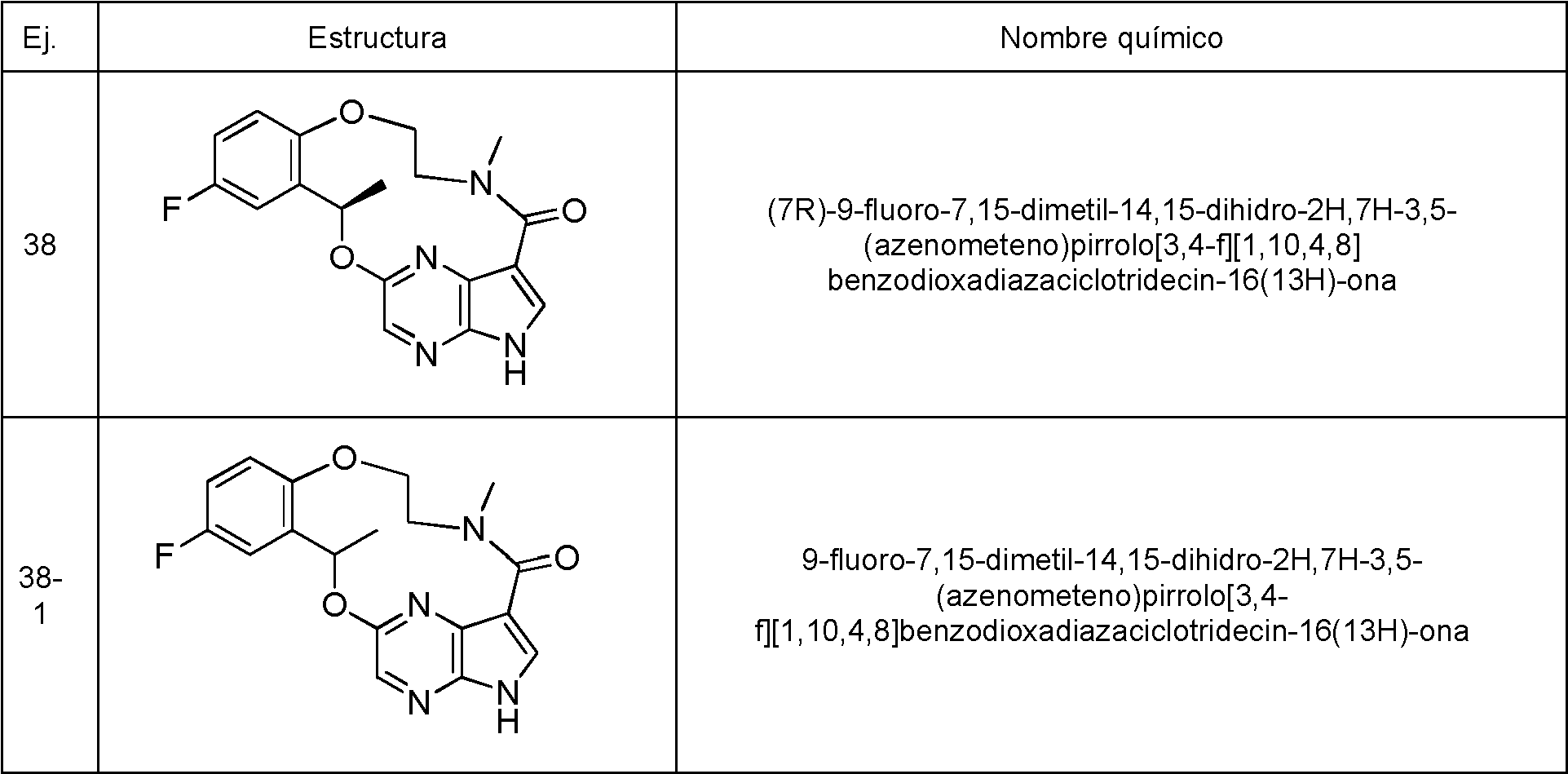
y sales farmacéuticamente aceptables de los mismos.and pharmaceutically acceptable salts thereof.
Lo siguiente representa realizaciones ilustrativas de compuestos de Fórmula (I) o (I-A):The following represent illustrative embodiments of compounds of Formula (I) or (I-A):

(continuación)(continuation)

(continuación)(continuation)

(continuación)(continuation)

(continuación)(continuation)

(continuación)(continuation)

(continuación)(continuation)

(continuación)(continuation)

(continuación)(continuation)

(continuación)(continuation)

y sales farmacéuticamente aceptables de los mismos.and pharmaceutically acceptable salts thereof.
Lo siguiente representa realizaciones ilustrativas de compuestos de Fórmula (I) o (I-A):The following represent illustrative embodiments of compounds of Formula (I) or (I-A):
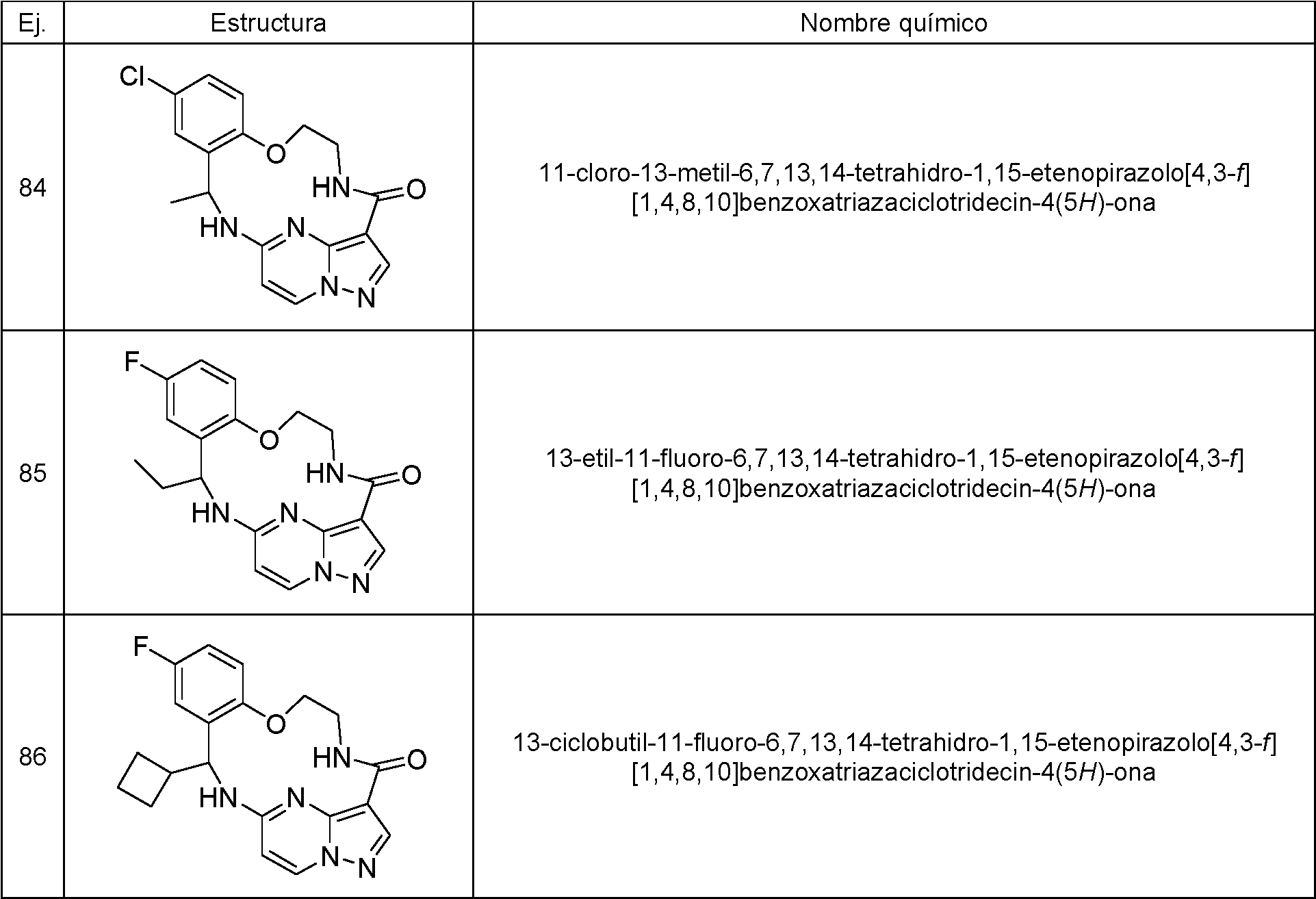
(continuación)(continuation)

(continuación)(continuation)

(continuación)(continuation)

(continuación)(continuation)

(continuación)(continuation)

y sales farmacéuticamente aceptables de los mismos.and pharmaceutically acceptable salts thereof.
Los expertos en la materia reconocerán que las especies enumeradas o ilustradas en el presente documento no son exhaustivas y que también se pueden seleccionar otras especies dentro del alcance de estos términos definidos. Those skilled in the art will recognize that the species listed or illustrated herein are not exhaustive and that other species within the scope of these defined terms may also be selected.
COMPOSICIONES FARMACÉUTICASPHARMACEUTICAL COMPOSITIONS
Con fines de tratamiento, las composiciones farmacéuticas que comprenden los compuestos descritos en el presente documento pueden comprender además uno o más excipientes farmacéuticamente aceptables. Un excipiente farmacéuticamente aceptable es una sustancia que no es tóxica y, de otra manera, biológicamente adecuada para la administración a un sujeto. Dichos excipientes facilitan la administración de los compuestos descritos en el presente documento y son compatibles con el principio activo. Algunos ejemplos de excipientes farmacéuticamente aceptables incluyen estabilizantes, lubricantes, tensioactivos, diluyentes, antioxidantes, aglutinantes, agentes colorantes, agentes de carga, emulsionantes o agentes modificadores del sabor. En realizaciones preferidas, las composiciones farmacéuticas de acuerdo con la invención son composiciones estériles. Las composiciones farmacéuticas pueden prepararse usando técnicas de composición conocidas o que estén disponibles para los expertos en la materia. For treatment purposes, pharmaceutical compositions comprising the compounds described herein may further comprise one or more pharmaceutically acceptable excipients. A pharmaceutically acceptable carrier is a substance that is non-toxic and otherwise biologically suitable for administration to a subject. Said excipients facilitate the administration of the compounds described in the present document and are compatible with the active principle. Some examples of pharmaceutically acceptable excipients include stabilizers, lubricants, surfactants, diluents, antioxidants, binders, coloring agents, bulking agents, emulsifiers, or flavor modifying agents. In preferred embodiments, the pharmaceutical compositions according to the invention are sterile compositions. Pharmaceutical compositions can be prepared using compounding techniques known or available to those skilled in the art.
Las composiciones estériles también están contempladas por la invención, incluyendo las composiciones que están de acuerdo con las regulaciones nacionales y locales que rigen dichas composiciones.Sterile compositions are also contemplated by the invention, including compositions that are in accordance with national and local regulations governing such compositions.
Las composiciones farmacéuticas y los compuestos descritos en el presente documento pueden formularse como soluciones, emulsiones, suspensiones o dispersiones en disolventes o vehículos farmacéuticos adecuados o como píldoras, comprimidos, pastillas para chupar, supositorios, bolsitas, grageas, gránulos, polvos, polvos para reconstitución o cápsulas junto con vehículos sólidos de acuerdo con métodos convencionales conocidos en la materia para la preparación de diversas formas farmacéuticas. Las composiciones farmacéuticas de la invención pueden administrarse por una vía de administración adecuada, tales como las vías oral, parenteral, rectal, nasal, tópica, ocular o por inhalación. Preferentemente, las composiciones se formulan para administración intravenosa u oral.The pharmaceutical compositions and compounds described herein may be formulated as solutions, emulsions, suspensions or dispersions in suitable pharmaceutical carriers or solvents or as pills, tablets, lozenges, suppositories, sachets, dragees, granules, powders, powders for reconstitution or capsules together with solid carriers according to conventional methods known in the art for the preparation of various dosage forms. The pharmaceutical compositions of the invention can be administered by a suitable route of administration, such as the oral, parenteral, rectal, nasal, topical, ocular or inhalation routes. Preferably, the compositions are formulated for intravenous or oral administration.
Para la administración oral, los compuestos de la invención pueden proporcionarse en una forma sólida, tales como un comprimido o una cápsula, o como una solución, una emulsión o una suspensión. Para preparar las composiciones orales, los compuestos de la invención pueden formularse para producir una dosificación de, por ejemplo, de aproximadamente 0,1 mg a 1 g al día o de aproximadamente 1 mg a 50 mg al día o de aproximadamente 50 a 250 mg al día o de aproximadamente 250 mg a 1 g al día. Los comprimidos orales pueden incluir el principio o principios activos mezclados con excipientes farmacéuticamente aceptables compatibles tales como diluyentes, agentes disgregantes, agentes aglutinantes, agentes lubricantes, agentes edulcorantes, agentes aromatizantes, agentes colorantes y agentes conservantes. Las cargas inertes adecuadas incluyen carbonato sódico y cálcico, fosfato sódico y cálcico, lactosa, almidón, azúcar, glucosa, metilcelulosa, estearato magnésico, manitol y sorbitol. Los excipientes orales líquidos ilustrativos incluyen etanol, glicerol y agua. Almidón, polivinilpirrolidona (PVP), almidón glicolato sódico, celulosa microcristalina y ácido algínico son agentes disgregantes ilustrativos. Los agentes aglutinantes pueden incluir almidón y gelatina. El agente lubricante, si está presente, puede ser estearato magnésico, ácido esteárico o talco. Si se desea, los comprimidos pueden recubrirse con un material tal como monoestearato de glicerilo o diestearato de glicerilo para retrasar la absorción en el tracto gastrointestinal o pueden recubrirse con un recubrimiento entérico. For oral administration, the compounds of the invention may be provided in a solid form, such as a tablet or capsule, or as a solution, emulsion or suspension. To prepare oral compositions, the compounds of the invention may be formulated to produce a dosage of, for example, from about 0.1 mg to 1 g per day or from about 1 mg to 50 mg per day or from about 50 to 250 mg. daily or approximately 250 mg to 1 g daily. Oral tablets may include the active ingredient(s) in admixture with compatible pharmaceutically acceptable excipients such as diluents, disintegrating agents, binding agents, lubricating agents, sweetening agents, flavoring agents, coloring agents, and preserving agents. Suitable inert fillers include sodium and calcium carbonate, sodium and calcium phosphate, lactose, starch, sugar, glucose, methyl cellulose, magnesium stearate, mannitol and sorbitol. Illustrative liquid oral carriers include ethanol, glycerol, and water. Starch, polyvinylpyrrolidone (PVP), sodium starch glycolate, microcrystalline cellulose, and alginic acid are illustrative disintegrating agents. Binding agents may include starch and gelatin. The lubricating agent, if present, can be magnesium stearate, stearic acid or talc. If desired, the tablets may be coated with a material such as glyceryl monostearate or glyceryl distearate to delay absorption in the gastrointestinal tract, or may be coated with an enteric coating.
Las cápsulas para administración oral incluyen cápsulas de gelatina dura y blanda. Para preparar cápsulas de gelatina dura, el principio o principios activos pueden mezclarse con un diluyente sólido, semi-sólido o líquido. Las cápsulas de gelatina blanda pueden prepararse mezclando el principio activo con agua, un aceite, tal como aceite de cacahuete o aceite de oliva, parafina líquida, una mezcla de mono y diglicéridos de ácidos grasos de cadena corta, polietilenglicol 400 o propilenglicol.Capsules for oral administration include hard and soft gelatin capsules. To prepare hard gelatin capsules, the active ingredient(s) may be mixed with a solid, semi-solid or liquid diluent. Soft gelatin capsules can be prepared by mixing the active ingredient with water, an oil, such as peanut oil or olive oil, liquid paraffin, a mixture of mono- and diglycerides of short-chain fatty acids, polyethylene glycol 400, or propylene glycol.
Los líquidos para administración oral pueden estar en forma de suspensiones, soluciones, emulsiones o jarabes o pueden liofilizarse o presentarse como un producto seco para su reconstitución con agua u otro vehículo adecuado antes de su uso. Dichas composiciones líquidas pueden contener opcionalmente: excipientes farmacéuticamente aceptables tales como agentes de suspensión (por ejemplo, sorbitol, metilcelulosa, alginato sódico, gelatina, hidroxietilcelulosa, carboximetilcelulosa y gel de estearato de aluminio); vehículos no acuosos, por ejemplo, aceite (por ejemplo, aceite de almendra o aceite de coco fraccionado), propilenglicol, alcohol etílico o agua; conservantes (por ejemplo, p-hidroxibenzoato de metilo o de propilo o ácido sórbico); agentes humectantes tales como lecitina; y, si se desea, agentes aromatizantes o colorantes.Liquids for oral administration may be in the form of suspensions, solutions, emulsions, or syrups or may be lyophilized or presented as a dry product for reconstitution with water or other suitable vehicle prior to use. Such liquid compositions may optionally contain: pharmaceutically acceptable excipients such as suspending agents (eg sorbitol, methyl cellulose, sodium alginate, gelatin, hydroxyethyl cellulose, carboxymethyl cellulose and aluminum stearate gel); non-aqueous vehicles, eg oil (eg almond oil or fractionated coconut oil), propylene glycol, ethyl alcohol or water; preservatives (for example, methyl or propyl p-hydroxybenzoate or sorbic acid); wetting agents such as lecithin; and, if desired, flavoring or coloring agents.
Para uso parenteral, incluyendo vías intravenosa, intramuscular, intraperitoneal, intranasal o subcutánea, los agentes de la invención pueden proporcionarse en soluciones o suspensiones acuosas estériles, tamponadas a un pH e isotonicidad apropiados o en un aceite parenteralmente aceptable. Los vehículos acuosos adecuados incluyen solución de Ringer y cloruro sódico isotónico. Dichas formas pueden presentarse en forma de dosis unitarias tales como ampollas o dispositivos de inyección desechables, en formas multidosis tales como viales de los que se puede extraer la dosis apropiada o en una forma sólida o preconcentrada que puede usarse para preparar una formulación inyectable. Las dosis para infusión ilustrativas varían de aproximadamente 1 a 1000 pg/kg/minuto de sustancia mezclados con un vehículo farmacéutico durante un periodo de tiempo que varía de varios minutos a varios días. For parenteral use, including intravenous, intramuscular, intraperitoneal, intranasal or subcutaneous routes, the agents of the invention may be provided in sterile, aqueous solutions or suspensions, buffered to an appropriate pH and isotonicity or in a parenterally acceptable oil. Suitable aqueous vehicles include Ringer's solution and isotonic sodium chloride. Such forms may be in unit dose form such as ampoules or disposable injection devices, in multidose forms such as vials from which the appropriate dose can be withdrawn, or in a solid or pre-concentrated form that can be used to prepare an injectable formulation. Illustrative infusion doses range from about 1 to 1000 pg/kg/minute of substance mixed with a pharmaceutical carrier for a period of time ranging from several minutes to several days.
Para la administración nasal, inhalada u oral, las composiciones farmacéuticas de la invención pueden administrarse usando, por ejemplo, una formulación de pulverización que también contiene un vehículo adecuado. Las composiciones de la invención pueden formularse para administración rectal como un supositorio.For nasal, inhaled or oral administration, the pharmaceutical compositions of the invention may be administered using, for example, a spray formulation also containing a suitable carrier. The compositions of the invention may be formulated for rectal administration as a suppository.
Para aplicaciones tópicas, los compuestos de la presente invención se formulan preferentemente como cremas o pomadas o un vehículo similar adecuado para administración tópica. Para la administración tópica, los compuestos de la invención pueden mezclarse con un vehículo farmacéutico a una concentración de aproximadamente el 0,1 % a aproximadamente el 10 % de fármaco a vehículo. Otro modo de administración de los agentes de la invención puede utilizar una formulación de parche para efectuar la administración transdérmica.For topical applications, the compounds of the present invention are preferably formulated as creams or ointments or a similar vehicle suitable for topical administration. For topical administration, the compounds of the invention may be mixed with a pharmaceutical carrier at a concentration of from about 0.1% to about 10% drug to carrier. Another mode of administration of the agents of the invention may use a patch formulation to effect transdermal administration.
Como se usa en el presente documento, los términos "tratar" o "tratamiento" abarcan tanto el tratamiento "preventivo" como el "curativo". El tratamiento "preventivo" pretende indicar un aplazamiento del desarrollo de una enfermedad, un síntoma de una enfermedad o afección médica, suprimiendo los síntomas que puedan aparecer o reduciendo el riesgo de aparición o recaída de una enfermedad o síntoma. Tratamiento "curativo" incluye reducir la gravedad de o suprimir el empeoramiento de una enfermedad, síntoma o afección existente. Por lo tanto, el tratamiento incluye aliviar o prevenir el empeoramiento de los síntomas de la enfermedad existente, prevenir la aparición de síntomas adicionales, mejorar o prevenir las causas sistémicas subyacentes de los síntomas, inhibir el trastorno o la enfermedad, por ejemplo, detener el desarrollo del trastorno o enfermedad, aliviar el trastorno o la enfermedad, provocar la regresión del trastorno o enfermedad, aliviar una afección causada por la enfermedad o trastorno o detener los síntomas de la enfermedad o trastorno.As used herein, the terms "treat" or "treatment" encompass both "preventive" and "curative" treatment. "Preventive" treatment is intended to indicate a postponement of the development of a disease, a symptom of a disease or medical condition, suppressing the symptoms that may appear or reducing the risk of occurrence or relapse of a disease or symptom. "Curative" treatment includes reducing the severity of or suppressing the worsening of an existing disease, symptom, or condition. Therefore, treatment includes relieving or preventing the worsening of symptoms of the existing disease, preventing the appearance of additional symptoms, ameliorating or preventing the underlying systemic causes of the symptoms, inhibiting the disorder or disease, for example, stopping the development of the disorder or disease, alleviate the disorder or disease, cause regression of the disorder or disease, alleviate a condition caused by the disease or disorder, or arrest the symptoms of the disease or disorder.
El término "sujeto" se refiere a un paciente mamífero que necesita dicho tratamiento, tal como un ser humano.The term "subject" refers to a mammalian patient in need of such treatment, such as a human.
Las enfermedades ilustrativas incluyen cáncer, dolor, enfermedades neurológicas, enfermedades autoinmunitarias e inflamación. El cáncer incluye, por ejemplo, cáncer de pulmón, cáncer de colon, cáncer de mama, cáncer de próstata, carcinoma hepatocelular, carcinoma de células renales, cánceres gástricos y esofagogástricos, glioblastoma, cánceres de cabeza y cuello, tumores miofibroblásticos inflamatorios y linfoma anaplásico de células macrocíticas. El dolor incluye, por ejemplo, dolor procedente de cualquier fuente o etiología, incluyendo el dolor por cáncer, dolor procedente de tratamiento quimioterapéutico, dolor de nervios, dolor procedente de lesión u otras fuentes. Las enfermedades autoinmunitarias incluyen, por ejemplo, artritis reumatoide, síndrome de Sjogren, diabetes tipo I y lupus. Las enfermedades neurológicas ilustrativas incluyen enfermedad de Alzheimer, enfermedad de Parkinson, esclerosis lateral amiotrófica y enfermedad de Huntington. Las enfermedades inflamatorias ilustrativas incluyen aterosclerosis, alergia e inflamación por infección o lesión.Illustrative diseases include cancer, pain, neurological diseases, autoimmune diseases, and inflammation. Cancer includes, for example, lung cancer, colon cancer, breast cancer, prostate cancer, hepatocellular carcinoma, renal cell carcinoma, gastric and esophagogastric cancers, glioblastoma, head and neck cancers, inflammatory myofibroblastic tumors, and anaplastic lymphoma. of macrocytic cells. Pain includes, for example, pain from any source or etiology, including cancer pain, pain from chemotherapeutic treatment, nerve pain, pain from injury, or other sources. Autoimmune diseases include, for example, rheumatoid arthritis, Sjogren's syndrome, type I diabetes, and lupus. Illustrative neurological diseases include Alzheimer's disease, Parkinson's disease, amyotrophic lateral sclerosis, and Huntington's disease. Illustrative inflammatory diseases include atherosclerosis, allergy, and inflammation from infection or injury.
En un aspecto, los compuestos y composiciones farmacéuticas de la invención se dirigen específicamente a tirosina quinasas receptoras, en particular, MET, ALK, AXL, TRK y JAK. Por lo tanto, estos compuestos y composiciones farmacéuticas pueden usarse para prevenir, revertir, ralentizar o inhibir la actividad de una o más de estas quinasas. En realizaciones preferidas, los compuestos para su uso en métodos de tratamiento se dirigen a cáncer. En otras realizaciones, los compuestos para su uso en los métodos son para tratar el cáncer de pulmón o el cáncer de pulmón de células no microcíticas. In one aspect, the compounds and pharmaceutical compositions of the invention specifically target receptor tyrosine kinases, in particular, MET, ALK, AXL, TRK, and JAK. Therefore, these compounds and pharmaceutical compositions can be used to prevent, reverse, slow down, or inhibit the activity of one or more of these kinases. In preferred embodiments, the compounds for use in methods of treatment are directed to cancer. In other embodiments, the compounds for use in the methods are for treating lung cancer or non-small cell lung cancer.
En los métodos inhibitorios desvelados en el presente documento, una "cantidad eficaz" significa una cantidad suficiente para inhibir la proteína diana. Dicha modulación diana se puede llevar a cabo por métodos analíticos rutinarios tales como los descritos a continuación. Dicha modulación es útil en una diversidad de configuraciones, incluyendo ensayos in vitro. En dichos métodos, la célula es preferentemente una célula de cáncer con señalización anormal debido a sobrerregulación de MET, ALK, AXL, TRK y/o JAK.In the inhibitory methods disclosed herein, an "effective amount" means an amount sufficient to inhibit the target protein. Said target modulation can be carried out by routine analytical methods such as those described below. Such modulation is useful in a variety of settings, including in vitro assays. In such methods, the cell is preferably a cancer cell with abnormal signaling due to upregulation of MET, ALK, AXL, TRK, and/or JAK.
En los compuestos para su uso en métodos de tratamiento de acuerdo con la invención, una "cantidad eficaz" significa una cantidad o dosis suficiente para producir generalmente el beneficio terapéutico deseado en sujetos que necesitan dicho tratamiento. Las cantidades o dosis eficaces de los compuestos de la invención pueden determinarse mediante métodos de rutina, tales como modelado, escalada de dosis o ensayos clínicos, teniendo en cuenta factores rutinarios, por ejemplo, el modo o vía de administración o suministro del fármaco, la farmacocinética del agente, la gravedad y el transcurso de la enfermedad, el estado de salud del sujeto, la condición y el peso y el criterio del médico tratante. Una dosis a modo de ejemplo está en el intervalo de aproximadamente desde aproximadamente 0,1 mg a 1 g al día o de aproximadamente 1 mg a 50 mg al día o de aproximadamente 50 a 250 mg al día o de aproximadamente 250 mg a 1 g diarios. La dosificación total puede administrarse en unidades de dosificación únicas o divididas (por ejemplo, BID, TID, QID).In compounds for use in methods of treatment according to the invention, an "effective amount" means an amount or dose sufficient to generally produce the desired therapeutic benefit in subjects in need of such treatment. Effective amounts or doses of the compounds of the invention may be determined by routine methods, such as modeling, dose escalation, or clinical trials, taking into account routine factors, for example, the mode or route of drug administration or delivery, the pharmacokinetics of the agent, the severity and course of the disease, the subject's health status, condition and weight, and the judgment of the treating physician. An exemplary dose is in the range of from about 0.1 mg to 1 g per day or from about 1 mg to 50 mg per day or from about 50 to 250 mg per day or from about 250 mg to 1 g diaries. The total dosage can be administered in single or divided dosage units (eg, BID, TID, QID).
Una vez se ha producido la mejoría de la enfermedad del paciente, la dosis puede ajustarse para tratamiento preventivo o de mantenimiento. Por ejemplo, la dosis o la frecuencia de administración, o ambas, pueden reducirse en función de los síntomas, a un nivel al cual el efecto terapéutico o profiláctico deseado se mantiene. Por supuesto, si los síntomas se han aliviado a un nivel apropiado, el tratamiento puede cesar. Los pacientes pueden, sin embargo, requerir tratamiento intermitente a largo plazo tras cualquier reaparición de los síntomas. Los pacientes también pueden requerir tratamiento crónico a largo plazo.Once improvement in the patient's condition has occurred, the dose can be adjusted for preventive or maintenance treatment. For example, the dose or the frequency of administration, or both, can be reduced depending on the symptoms, to a level at which the desired therapeutic or prophylactic effect is maintained. Of course, if the symptoms have been alleviated to an appropriate level, the treatment can be stopped. Patients may, however, require intermittent long-term treatment after any recurrence of symptoms. Patients may also require long-term chronic treatment.
COMBINACIONES DE FÁRMACOSDRUG COMBINATIONS
Los compuestos de la invención descritos en el presente documento pueden usarse en composiciones farmacéuticas o métodos junto con uno o más de otros principios activos en el tratamiento de las enfermedades y trastornos descritos en el presente documento. Otros principios activos adicionales incluyen otros productos terapéuticos o sustancias que mitigan los efectos secundarios de las terapias para las enfermedades diana previstas. Estas combinaciones pueden servir para aumentar la eficacia, mejorar otros síntomas de la enfermedad, disminuir uno o más efectos secundarios o disminuir la dosis requerida de un compuesto de la invención. Los principios activos adicionales pueden administrarse en una composición farmacéutica separada de un compuesto de la presente invención o pueden incluirse con un compuesto de la presente invención en una única composición farmacéutica. Los principios activos adicionales pueden administrarse simultáneamente con, antes de o después de la administración de un compuesto de la presente invención.The compounds of the invention described herein can be used in pharmaceutical compositions or methods together with one or more other active ingredients in the treatment of the diseases and disorders described herein. Other additional active ingredients include other therapeutics or substances that mitigate the side effects of therapies for the intended target diseases. These combinations may serve to increase efficacy, ameliorate other symptoms of the disease, decrease one or more side effects, or decrease the required dose of a compound of the invention. Additional active ingredients may be administered in a separate pharmaceutical composition from a compound of the present invention or may be included with a compound of the present invention in a single pharmaceutical composition. Additional active ingredients may be administered simultaneously with, before, or after administration of a compound of the present invention.
Los agentes de combinación que incluyen principios activos adicionales son aquello que se sabe o se descubre que son eficaces para tratar las enfermedades y trastornos descrito en el presente documento, incluyendo aquellos activos contra otra diana asociada a la enfermedad. Por ejemplo, las composiciones y formulaciones de la invención, así como compuestos para su uso en métodos de tratamiento, pueden comprender además otros fármacos o productos farmacéuticos, por ejemplo, otros principios activos útiles para tratar o paliativos para las enfermedades diana o síntomas o afecciones relacionados. Para indicaciones de cáncer, tales agentes adicionales incluyen inhibidores de quinasa, tales como inhibidores de EGFR (por ejemplo, erlotinib, gefitinib), inhibidores de Raf (por ejemplo, vemurafenib), inhibidores de VEGFR (por ejemplo, sunitinib), agentes de quimioterapia convencional tales como agentes alquilantes, antimetabolitos, antibióticos antitumorales, inhibidores de la topoisomerasa, fármacos de platino, inhibidores mitóticos, anticuerpos, terapias con hormonas o corticoesteroides. Para indicaciones de dolor, las sustancias adecuadas para combinación incluyen antiinflamatorios tales como AINE. Las composiciones farmacéuticas de la invención pueden comprender adicionalmente uno o más de tales principios activos y los compuestos para su uso en los métodos de tratamiento pueden comprender adicionalmente administrar una cantidad eficaz de uno o más de tales principios activos.Combination agents that include additional active ingredients are those known or found to be effective in treating the diseases and disorders described herein, including those active against another disease-associated target. For example, the compositions and formulations of the invention, as well as compounds for use in methods of treatment, may further comprise other drugs or pharmaceuticals, for example, other active ingredients useful for treating or palliating the target diseases or symptoms or conditions. related. For cancer indications, such additional agents include kinase inhibitors such as EGFR inhibitors (eg erlotinib, gefitinib), Raf inhibitors (eg vemurafenib), VEGFR inhibitors (eg sunitinib), chemotherapy agents conventional such as alkylating agents, antimetabolites, antitumor antibiotics, topoisomerase inhibitors, platinum drugs, mitotic inhibitors, antibodies, hormone or corticosteroid therapies. For pain indications, suitable substances for combination include anti-inflammatories such as NSAIDs. Pharmaceutical compositions of the invention may further comprise one or more such active ingredients and compounds for use in methods of treatment may further comprise administering an effective amount of one or more such active ingredients.
SÍNTESIS QUÍMICACHEMICAL SYNTHESIS
Ahora se describirán entidades químicas ejemplares útiles en compuestos para uso en métodos de la invención con referencia a esquemas sintéticos ilustrativos para su preparación general y los ejemplos específicos que siguen. Los expertos reconocerán que, para obtener los diversos compuestos del presente documento, los materiales de partida pueden seleccionarse adecuadamente de manera que los sustituyentes finalmente deseados se llevarán a través del esquema de reacción con o sin protección, según sea apropiado, para producir el producto deseado. Como alternativa, puede ser necesario o deseable emplear, en lugar del sustituyente finalmente deseado, un grupo adecuado que pueda usarse a través del esquema de reacción y reemplazarse según sea apropiado con el sustituyente deseado. Además, un experto en la materia reconocerá que las transformaciones mostradas en los esquemas siguientes se pueden realizar en cualquier orden que sea compatible con la funcionalidad de los grupos pendientes particulares. Cada una de las reacciones representadas en los esquemas generales se realiza preferentemente a una temperatura de aproximadamente 0 °C a la temperatura de reflujo del disolvente orgánico utilizado. Salvo que se indique de otro modo, las variables son como se definieron anteriormente en referencia a la Fórmula (I). Los compuestos marcados isotópicamente como se describen en el presente documento se preparan de acuerdo con los métodos descritos a continuación, usando materiales de partida adecuadamente marcados. Tales materiales están generalmente disponibles de proveedores comerciales de reactivos químicos radiomarcados.Exemplary chemical entities useful in compounds for use in methods of the invention will now be described with reference to illustrative synthetic schemes for their general preparation and the specific examples that follow. Those skilled in the art will recognize that, in order to obtain the various compounds herein, the starting materials can be suitably selected such that the ultimately desired substituents will be carried through the reaction scheme with or without protection, as appropriate, to produce the desired product. . Alternatively, it may be necessary or desirable to employ, in place of the ultimately desired substituent, a suitable group that can be used throughout the reaction scheme and replaced as appropriate with the desired substituent. Furthermore, one of ordinary skill in the art will recognize that the transformations shown in the following schemes can be performed in any order that is compatible with the functionality of the particular pendant groups. Each of the reactions represented in the general schemes is preferably carried out at a temperature of approximately 0 °C to the reflux temperature of the organic solvent used. Unless otherwise indicated, variables are as defined above with reference to Formula (I). Labeled Compounds isotopically as described herein are prepared according to the methods described below, using appropriately labeled starting materials. Such materials are generally available from commercial suppliers of radiolabeled chemical reagents.
Método general A:General method A:

Se apreciará que los compuestos de fórmula A o A-1 pueden prepararse de acuerdo con el Método general A usados materiales de partida e intermedios apropiadamente funcionalizados.It will be appreciated that compounds of formula A or A-1 can be prepared according to General Method A using appropriately functionalized starting materials and intermediates.
Etapa 1. A una solución de un compuesto A-1 apropiadamente funcionalizado (~1,00 equiv.), en donde RA y RB son grupos compatibles con las condiciones de reacción descritas en el presente documento y Nu es un grupo nucleofílico tal como un anión o un grupo capaz de formar un nucleófilo, tal como un haluro, en un reactivo capaz de promover la composición de A-1 y A-2, tal como un ácido (por ejemplo, TfOH (0,6 M)) o un haluro de alquilo (por ejemplo, n-BuLi) se puede añadir A-2, en donde RC es un grupo compatible con las condiciones de reacción descritas en el presente documento y X2 es, por ejemplo, un grupo saliente (~1,00 equiv.) a una temperatura apropiada (por ejemplo, 0 °C). La mezcla se puede agitar a una temperatura adecuada (por ejemplo, 60 °C) hasta que se complete la reacción. Después, la reacción se puede devolver a la temperatura ambiente y la mezcla de reacción se puede apagar, neutralizar, lavar, extraer, secar y/o concentrar al vacío según sea necesario para dar A-3.Step 1. To a solution of an appropriately functionalized compound A-1 (~1.00 equiv.), where RA and RB are groups compatible with the reaction conditions described herein and Nu is a nucleophilic group such as a anion or a group capable of forming a nucleophile, such as a halide, in a reagent capable of promoting the composition of A-1 and A-2, such as an acid (for example, TfOH (0.6 M)) or a alkyl halide (for example, n-BuLi) A-2 can be added, where RC is a group compatible with the reaction conditions described herein and X2 is, for example, a leaving group (~1.00 equiv.) at an appropriate temperature (for example, 0 °C). The mixture can be stirred at a suitable temperature (eg 60°C) until the reaction is complete. The reaction can then be returned to room temperature and the reaction mixture can be quenched, neutralized, washed, extracted, dried and/or concentrated in vacuo as necessary to give A-3 .
Etapa 2. Una mezcla de A-3, en donde RA, RB y RC son grupos compatibles con las condiciones de reacción descritas en el presente documento (en algunas realizaciones ejemplares descritas en el presente documento, A-3 puede ser un aldehído o cetona comercialmente disponible, o A-3 puede prepararse a partir de la etapa 1, ~1,00 equiv.) y la amina A-4 comercialmente disponible, en donde Rc es un grupo compatible con las condiciones de reacción descritas en el presente documento, (~1,50 equiv.) en un disolvente apropiado (por ejemplo, metanol (0,5 M)) se puede agitar a una temperatura apropiada (por ejemplo, temperatura ambiente) durante un período de tiempo apropiado o hasta que se complete la formación de imina por TLC o CL-EM. A la solución de reacción, se le puede añadir un agente reductor (por ejemplo, NaBH4 (~2,00 equiv.)) en porciones. La mezcla se puede agitar a una temperatura apropiada (por ejemplo, temperatura ambiente) hasta que la TLC o la CL-EM muestren que se ha completado la reducción. La reacción se puede interrumpir, lavar, extraer, secar o concentrar al vacío si es necesario para proporcionar A-5. Step 2. A mixture of A-3 , wherein RA, RB, and RC are groups compatible with the reaction conditions described herein (in some exemplary embodiments described herein, A-3 may be an aldehyde or ketone commercially available, or A-3 can be prepared from step 1, ~1.00 equiv.) and the commercially available amine A-4 , where R c is a group compatible with the reaction conditions described herein , (~1.50 equiv.) in an appropriate solvent (eg methanol (0.5 M)) can be stirred at an appropriate temperature (eg room temperature) for an appropriate period of time or until complete imine formation by TLC or LC-MS. To the reaction solution, a reducing agent (eg, NaBH4 (~2.00 equiv.)) may be added in portions. The mixture can be stirred at an appropriate temperature (eg, room temperature) until TLC or LC-MS shows reduction to be complete. The reaction can be stopped, washed, extracted, dried, or concentrated in vacuo if necessary to provide A-5 .
Etapa 3. Una mezcla de un A-5 preparado o disponible comercialmente, en donde RA, RB y RC son grupos compatibles con las condiciones de reacción descritas en el presente documento (~1 equiv.), 5-cloropirazolo[1,5-a]pirimidina-3 de etilo disponible comercialmente -carboxilato (A-6, ~1 equiv.) y una base adecuada (por ejemplo, diisopropiletilamina (~5 equiv.)) en un disolvente adecuado (por ejemplo, butanol (0,4 M)) se pueden agitar a una temperatura adecuada (por ejemplo, 110 °C) ) durante un período de tiempo determinado o hasta que se demuestre que la reacción se ha completado. La reacción se puede devolver a temperatura ambiente y diluir con agua según sea necesario. La mezcla se puede extraer, lavar, secar, concentrar a presión reducida y/o purificar mediante métodos cromatográficos según sea necesario para proporcionar A.Step 3. A mixture of a commercially available or prepared A-5 , where RA, RB, and RC are groups compatible with the reaction conditions described herein (~1 equiv.), 5-chloropyrazolo[1,5- commercially available ethyl a]pyrimidine-3-carboxylate (A-6, ~1 equiv.) and a suitable base (for example, diisopropylethylamine (~5 equiv.)) in a suitable solvent (for example, butanol (0.4 M)) can be stirred at a suitable temperature (for example, 110 °C) ) for a given period of time or until the reaction is shown to be complete. The reaction can be returned to room temperature and diluted with water as necessary. The mixture can be extracted, washed, dried, concentrated under reduced pressure, and/or purified by chromatographic methods as necessary to provide A .
En algunas realizaciones ejemplares, el Método general A se puede llevar a cabo de la siguiente manera: In some exemplary embodiments, General Method A can be carried out as follows:

Etapa 1. A una solución de A-1 (1,00 equiv.) en TfOH (0,6 M), se le puede añadir A-2 (1,00 equiv.) a 0 °C. La mezcla se puede agitar a 60 °C durante 4 horas o hasta que la reacción se complete. Después del enfriamiento a temperatura ambiente, la mezcla de reacción se puede verter en hielo-agua (p/p = 1/1), se neutraliza con NaHCO3 a pH ~ 9, y se extrae con EtOAc tres veces según sea necesario. Las capas orgánicas combinadas se pueden lavar con salmuera, secar sobre Na2SO4 anhidro según sea necesario y concentrar para dar A-3. Step 1. To a solution of A-1 (1.00 equiv.) in TfOH (0.6 M), A-2 (1.00 equiv.) can be added at 0 °C. The mixture can be stirred at 60 °C for 4 hours or until the reaction is complete. After cooling to room temperature, the reaction mixture can be poured into ice-water (w/w = 1/1), neutralized with NaHCO3 to pH ~9, and extracted with EtOAc three times as needed. The combined organic layers can be washed with brine, dried over anhydrous Na2SO4 as necessary, and concentrated to give A-3.
Etapa 2. Una mezcla de A-3 (aldehído o cetona disponible en el mercado, o preparada a partir de la etapa 1, 1,00 equiv.) y la amina A-4 disponible en el mercado (1,50 equiv.) en metanol (0,5 M) se puede agitar a temperatura ambiente durante 2 horas o hasta que se demuestre que la formación de imina está completa mediante la TLC o la CL-EM. A la solución de reacción, se le puede añadir NaBH4 (2,00 equiv.) en porciones. La mezcla se puede agitar a temperatura ambiente hasta que la TLC o la CL-EM muestren que se ha completado la reducción. La reacción se puede interrumpir con agua y extraerse tres veces con diclorometano según sea necesario. La fase orgánica combinada se puede lavar con salmuera, secarse con Na2SO4 anhidro, filtrarse y concentrarse al vacío para proporcionar A-5. Step 2. A mixture of A-3 (commercially available aldehyde or ketone, or prepared from step 1, 1.00 equiv.) and commercially available amine A-4 (1.50 equiv.) in methanol (0.5 M) can be stirred at room temperature for 2 hours or until imine formation is shown to be complete by TLC or LC-MS. To the reaction solution, NaBH4 (2.00 equiv.) can be added in portions. The mixture can be stirred at room temperature until TLC or LC-MS shows complete reduction. The reaction can be quenched with water and extracted three times with dichloromethane as necessary. The combined organic phase can be washed with brine, dried over anhydrous Na2SO4, filtered, and concentrated in vacuo to provide A-5.
Etapa 3. El preparado o comercialmente disponible A-5 (1 equiv.), 5-cloropirazolo[1,5-a]pirimidina-3-carboxilato de etilo (A-6, 1 equiv.) y diisopropiletilamina (5 equiv.) en butanol (0,4 M) se puede calentar a 110 °C durante 30 minutos o hasta que se demuestre que la reacción se ha completado. La reacción se puede enfriar y diluirse con agua. La mezcla se puede extraer con diclorometano cuatro veces (según sea necesario) y los extractos combinados se pueden secar sobre sulfato sódico anhidro. Después de la filtración, la mezcla se puede concentrar a presión reducida y el residuo se puede purificar por cromatografía ultrarrápida para proporcionar A. Step 3. The prepared or commercially available A-5 (1 equiv.), ethyl 5-chloropyrazolo[1,5-a]pyrimidine-3-carboxylate ( A-6 , 1 equiv.) and diisopropylethylamine (5 equiv.) in butanol (0.4 M) can be heated at 110 °C for 30 minutes or until reaction is shown to be complete. The reaction can be cooled and diluted with water. The mixture can be extracted with dichloromethane four times (as necessary) and the combined extracts dried over anhydrous sodium sulfate. After filtration, the mixture can be concentrated under reduced pressure and the residue can be purified by flash chromatography to give A.
Método general alternativo A:Alternate General Method A:

Etapa de acoplamiento 1. La mezcla de un AA-1 apropiadamente funcionalizado (-1,00 equiv.), un reactivo de acoplamiento de vinilo apropiadamente funcionalizado (~1,00-1,50 equiv.) y un catalizador de paladio (~0,05 equiv.) en condiciones de reacción apropiadas puede calentarse a una temperatura apropiada (por ejemplo, -90 °C) durante un período de tiempo adecuado en atmósfera inerte hasta que la TLC indique que el material de partida se ha consumido por completo. La mezcla de reacción se puede verter en H2O según sea necesario. La mezcla se puede extraer y la fase orgánica se puede lavar, secar, concentrar y purificar mediante cromatografía en columna de gel de sílice según sea necesario para proporcionar AA-2.Coupling Step 1. The mixture of an appropriately functionalized AA-1 (-1.00 equiv.), an appropriately functionalized vinyl coupling reagent (~1.00-1.50 equiv.), and a palladium catalyst (~ 0.05 equiv.) under appropriate reaction conditions can be heated to an appropriate temperature (e.g. -90 °C) for a suitable period of time under an inert atmosphere until TLC indicates that the starting material has been completely consumed . The reaction mixture can be poured into H 2 O as needed. The mixture can be extracted and the organic phase washed, dried, concentrated and purified by column chromatography on silica gel as necessary to provide AA-2 .
Etapa de acoplamiento 2. La mezcla de un compuesto del tipo AA-2 (-1,00 equiv.), 5-cloropirazolo[1,5-a]pirimidina-3-carboxilato de etilo (A-6, ~1,00 equiv.) y un catalizador de paladio en condiciones apropiadas las condiciones de reacción se pueden calentar a una temperatura adecuada (por ejemplo, 120 °C) durante un período de tiempo adecuado en atmósfera inerte hasta que la TLC indique que el material de partida se ha consumido por completo. La mezcla de reacción se puede verter en H2O según sea necesario. La mezcla se puede extraer y la fase orgánica se puede lavar, secar, concentrar y purificar mediante cromatografía en columna de gel de sílice según sea necesario para proporcionar AA-3.Coupling step 2. The mixture of a compound of the type AA-2 (-1.00 equiv.), ethyl 5-chloropyrazolo[1,5-a]pyrimidine-3-carboxylate ( A-6 , ~1.00 equiv.) and a palladium catalyst under appropriate conditions The reaction conditions can be heated to a suitable temperature (for example, 120 °C) for a suitable period of time under an inert atmosphere until TLC indicates that the starting material has dissolved. has completely consumed. The reaction mixture can be poured into H 2 O as needed. The mixture can be extracted and the organic phase washed, dried, concentrated and purified by column chromatography on silica gel as necessary to provide AA-3 .
Etapa 3. A una mezcla de AA-3 (~1,00 equiv.) y 4-metilbencenosulfonhidrazida (en exceso molar) en un disolvente adecuado, se le puede añadir una base adecuada (en exceso molar) a una temperatura adecuada en atmósfera inerte. La mezcla se puede calentar a una temperatura adecuada (por ejemplo, 65 °C) y agitar durante un período de tiempo adecuado hasta que la TLC indique que la reacción se ha completado. La mezcla se puede enfriar y concentrar a presión reducida según sea necesario. La mezcla de reacción concentrada se puede diluir con agua según sea necesario y extraerse. La fase orgánica combinada se puede lavar, secar, filtrar, concentrar al vacío y purificar para proporcionar AA-4.Step 3. To a mixture of AA-3 (~1.00 equiv.) and 4-methylbenzenesulfonhydrazide (in molar excess) in a suitable solvent, a suitable base (in molar excess) can be added at a suitable temperature in atmosphere inert. The mixture can be heated to a suitable temperature (eg, 65°C) and stirred for a suitable period of time until TLC indicates completion of the reaction. The mixture can be cooled and concentrated under reduced pressure as necessary. The concentrated reaction mixture can be diluted with water as necessary and extracted. The combined organic phase can be washed, dried, filtered, concentrated in vacuo and purified to provide AA-4 .
Método general B:General method B:

Etapa 1. Una solución de aldehído B-1 (~1,0 equiv.) en donde RA y RB son grupos compatibles con las condiciones de reacción descritas en el presente documento, B-2 (-1,0 equiv.) en donde X1 es un grupo saliente y PG es un grupo protector, una base adecuada (en exceso molar) y un catalizador en un disolvente adecuado se puede calentar y agitar durante un período de tiempo apropiado hasta que se completa la reacción. Se puede añadir B-2 adicional y aplicar más calor según sea necesario. La mezcla se puede enfriar a temperatura ambiente y diluirse con agua según sea necesario. La mezcla se puede extraer y los extractos combinados se pueden lavar, secar y concentrar a presión reducida según sea necesario. El producto de reacción en bruto se puede purificar mediante cromatografía ultrarrápida para proporcionar B-3.Step 1. An aldehyde solution B-1 (~1.0 equiv.) where RA and RB are groups compatible with the reaction conditions described herein, B-2 (-1.0 equiv.) where X1 is a leaving group and PG is a protecting group, a suitable base (in molar excess) and a catalyst in a suitable solvent can be heated and stirred for an appropriate period of time until the reaction is complete. Additional B-2 can be added and more heat applied as needed. The mixture can be cooled to room temperature and diluted with water as needed. The mixture can be extracted and the combined extracts can be washed, dried and concentrated under reduced pressure as necessary. The crude reaction product can be purified by flash chromatography to provide B-3 .
Etapa 2. El aldehído B-3 (-1,0 equiv.) y una amina apropiadamente funcionalizada (~2,0-4,0 equiv.) en donde RC es un grupo compatible con las condiciones de reacción descritas en el presente documento en un disolvente apropiado se pueden calentar y agitar durante una cantidad de tiempo apropiada. La mezcla se puede enfriar a temperatura ambiente y se puede añadir un agente reductor adecuado (-1,0 equiv.). La mezcla se puede agitar durante un período de tiempo adecuado y después apagarse mediante la adición de agua según sea necesario. La mezcla se puede extraer con un disolvente orgánico apropiado y los extractos combinados se pueden lavar, secar y concentrar a presión reducida según sea necesario. El producto de reacción en bruto se puede purificar mediante cromatografía ultrarrápida según sea necesario para proporcionar B-4.Step 2. The aldehyde B-3 (-1.0 equiv.) and an appropriately functionalized amine (~2.0-4.0 equiv.) where RC is a group compatible with the reaction conditions described herein. in an appropriate solvent can be heated and stirred for an appropriate amount of time. The mixture can be cooled to room temperature and a suitable reducing agent (-1.0 equiv) can be added. The mixture can be stirred for a suitable period of time and then quenched by the addition of water as necessary. The mixture can be extracted with an appropriate organic solvent and the combined extracts can be washed, dried and concentrated under reduced pressure as necessary. The crude reaction product can be purified by flash chromatography as necessary to provide B-4 .
Etapa 3. El compuesto B-4 (-1,0 equiv.), 5-cloropirazolo[1,5-a]pirimidina-3-carboxilato de etilo (A-6, ~1,0 equiv.) y una base adecuada (en exceso molar) en un disolvente adecuado se pueden calentar durante un tiempo adecuado. La reacción se puede enfriar y diluir con agua según sea necesario. La mezcla se puede extraer con un disolvente orgánico adecuado y los extractos combinados se pueden secar y concentrar a presión reducida según sea necesario. El producto de reacción en bruto se puede purificar mediante cromatografía ultrarrápida para proporcionar B1. Step 3. Compound B-4 (-1.0 equiv.), ethyl 5-chloropyrazolo[1,5-a]pyrimidine-3-carboxylate ( A-6 , ~1.0 equiv.), and a suitable base (in molar excess) in a suitable solvent can be heated for a suitable time. The reaction can be cooled and diluted with water as necessary. The mixture can be extracted with a suitable organic solvent and the combined extracts can be dried and concentrated under reduced pressure as necessary. The crude reaction product can be purified by flash chromatography to provide B1 .
En algunas realizaciones ejemplares, el Método general B se puede llevar a cabo de la siguiente manera:In some exemplary embodiments, General Method B can be carried out as follows:

Etapa 1. Una solución de aldehído B-1 (~1,0 equiv.) en donde RA y RB son grupos compatibles con las condiciones de reacción descritas en el presente documento, B-2 (~1,0 equiv.) en donde X1 es un grupo saliente y PG es un grupo protector, carbonato potásico (en exceso molar) y yoduro de potasio (cantidad catalítica) en DMF se puede calentar a 60 °C y agitar durante ~15 horas. Se puede agregar cloruro B-2 adicional y se puede aplicar más calentamiento a 80 °C según sea necesario hasta que se demuestre que la reacción está completa. La mezcla se puede enfriar a temperatura ambiente y diluirse mediante la adición de agua (250 ml) según sea necesario. La mezcla se puede extraer con acetato de etilo (3 x 300 ml) y los extractos combinados se pueden lavar con agua (200 ml) y salmuera (100 ml), se pueden secar con sulfato sódico y concentrar a presión reducida según sea necesario. El producto de reacción en bruto se puede purificar mediante cromatografía ultrarrápida para proporcionar B-3.Step 1. An aldehyde solution B-1 (~1.0 equiv.) where RA and RB are groups compatible with the reaction conditions described herein, B-2 (~1.0 equiv.) where X1 is a leaving group and PG is a protecting group, potassium carbonate (in molar excess) and potassium iodide (catalytic amount) in DMF can be heated to 60 °C and stirred for ~15 hours. Additional B-2 chloride can be added and further heating to 80°C applied as needed until the reaction is shown to be complete. The mixture can be cooled to room temperature and diluted by the addition of water (250 ml) as required. The mixture can be extracted with ethyl acetate (3 x 300ml) and the combined extracts washed with water (200ml) and brine (100ml), dried over sodium sulphate and concentrated under reduced pressure as necessary. The crude reaction product can be purified by flash chromatography to provide B-3 .
Etapa 2. El aldehído B-3 (~1,0 equiv.) y la metilamina (~2,5 equiv.) en metanol se pueden calentar a 60 °C y agitar durante ~1 hora. La mezcla se puede enfriar a temperatura ambiente y se puede añadir borohidruro sódico (~1,0 equiv.). La mezcla se puede agitar durante ~30 minutos y después inactivarse mediante la adición de agua (200 ml) según sea necesario. La mezcla se puede extraer con diclorometano y los extractos combinados se pueden lavar con salmuera (50 ml), se pueden secar con sulfato sódico y concentrar a presión reducida según sea necesario. El producto de reacción en bruto se puede purificar mediante cromatografía ultrarrápida para proporcionar B-4.Step 2. Aldehyde B-3 (~1.0 equiv.) and methylamine (~2.5 equiv.) in methanol can be heated to 60 °C and stirred for ~1 hour. The mixture can be cooled to room temperature and sodium borohydride (~1.0 equiv) can be added. The mixture can be stirred for ~30 minutes and then quenched by addition of water (200 mL) as needed. The mixture can be extracted with dichloromethane and the combined extracts washed with brine (50 mL), dried over sodium sulfate, and concentrated under reduced pressure as necessary. The crude reaction product can be purified by flash chromatography to provide B-4 .
Etapa 3. La amina B-4 (~1,0 equiv.), 5-cloropirazolo[1,5-a]pirimidina-3-carboxilato de etilo (A-6, ~1,0 equiv.) y la base de Hunig (en exceso molar) en butanol se pueden calentar a 110 °C durante ~25 minutos. La reacción se puede enfriar y diluir con agua (250 ml). La mezcla se puede extraer con diclorometano y los extractos combinados se pueden secar con sulfato sódico según sea necesario. La mezcla se puede concentrar a presión reducida según sea necesario. El producto de reacción en bruto se puede purificar mediante cromatografía ultrarrápida para proporcionar B. Step 3. The amine B-4 (~1.0 equiv.), ethyl 5-chloropyrazolo[1,5-a]pyrimidine-3-carboxylate ( A-6 , ~1.0 equiv.) and the base of Hunig (in molar excess) in butanol can be heated at 110 °C for ~25 minutes. The reaction can be cooled and diluted with water (250 mL). The mixture can be extracted with dichloromethane and the combined extracts dried over sodium sulfate as necessary. The mixture can be concentrated under reduced pressure as necessary. The crude reaction product can be purified by flash chromatography to provide B .
Método general Cgeneral method C


Etapa 1. A una solución de C-1 (~1,0 equiv.) en donde RA, RB, RC, RD y RE son grupos compatibles con las condiciones de reacción descritas en el presente documento, X1AlkNHPG (~1,5-2,0 equiv.) en donde X1 es un grupo saliente, Alk es un grupo alquilo adecuadamente funcionalizado y PG es un grupo protector en un disolvente adecuado se puede añadir una base adecuada (~3,0 equiv.). La mezcla se puede calentar a una temperatura adecuada durante un período de tiempo adecuado en una atmósfera inerte hasta que la CL-EM muestre la conversión completa del material de partida en el producto. La mezcla se puede enfriar a temperatura ambiente, diluirse con agua y extraerse con un disolvente orgánico adecuado según sea necesario. Los extractos orgánicos combinados se pueden lavar con agua y salmuera, secar sobre Na2SO4 y concentrar según sea necesario. El residuo resultante se puede purificar mediante cromatografía en columna de gel de sílice según sea necesario para proporcionar C-2.Step 1. To a solution of C-1 (~1.0 equiv.) where RA, RB, RC, RD, and RE are groups compatible with the reaction conditions described herein, X1AlkNHPG (~1.5- 2.0 equiv) where X1 is a leaving group, Alk is a suitably functionalized alkyl group and PG is a protecting group in a suitable solvent a suitable base (~3.0 equiv) can be added. The mixture can be heated at a suitable temperature for a suitable period of time under an inert atmosphere until LC-MS shows complete conversion of starting material to product. The mixture can be cooled to room temperature, diluted with water, and extracted with a suitable organic solvent as necessary. The combined organic extracts can be washed with water and brine, dried over Na2SO4, and concentrated as necessary. The resulting residue can be purified by silica gel column chromatography as necessary to provide C-2 .
Etapa 2. A una solución de C-2 (1 equiv.) en donde RA, RC, RD y RE son grupos compatibles con las condiciones de reacción descritas en el presente documento, Alk es un grupo alquilo adecuadamente funcionalizado y PG es un grupo protector en un disolvente adecuado al que se puede añadir una base adecuada (en exceso molar). La solución se puede calentar a una temperatura adecuada durante un período de tiempo adecuado. La reacción se puede neutralizar con un ácido adecuado a pH <5 y la mezcla de reacción se puede extraer con un disolvente orgánico adecuado. Los compuestos orgánicos combinados se pueden lavar y secar según sea necesario. La mezcla de productos de reacción en bruto se puede filtrar, concentrar a presión reducida y secar a alto vacío según sea necesario para proporcionar C-3.Step 2. To a solution of C-2 (1 equiv.) where RA, RC, RD, and RE are groups compatible with the reaction conditions described herein, Alk is a suitably functionalized alkyl group, and PG is a group protectant in a suitable solvent to which may be added a suitable base (in molar excess). The solution can be heated to a suitable temperature for a suitable period of time. The reaction can be quenched with a suitable acid to pH <5 and the reaction mixture can be extracted with a suitable organic solvent. The combined organic compounds can be washed and dried as necessary. The crude reaction product mixture can be filtered, concentrated under reduced pressure, and dried under high vacuum as necessary to provide C-3 .
Etapa 3. A una solución de C-3 (~1,0 equiv.) en un disolvente orgánico adecuado, se le puede añadir un ácido adecuado (~4 equiv.) a una temperatura adecuada (por ejemplo, 0 °C). La mezcla de reacción se puede agitar a una temperatura adecuada durante un período de tiempo adecuado hasta que se demuestre que la reacción se ha completado mediante CL-EM. El producto en bruto se puede filtrar, lavar y secar a alto vacío para proporcionar un C-4.Step 3. To a solution of C-3 (~1.0 equiv.) in a suitable organic solvent, a suitable acid (~4 equiv.) can be added at a suitable temperature (eg 0 °C). The reaction mixture can be stirred at a suitable temperature for a suitable period of time until the reaction is shown to be complete by LC-MS. The crude product can be filtered, washed, and dried under high vacuum to provide a C-4 .
Etapa 4a. A una solución de C-4 (~1,0 equiv.) en un disolvente adecuado se le puede añadir una base adecuada (en exceso molar). La solución se puede enfriar en un baño de agua con hielo y se puede agregar un agente de acoplamiento adecuado (~ 1,5 equiv.) para producir un éster activado. La solución se puede calentar a temperatura ambiente lentamente y agitarse hasta que se demuestre que el material de partida se convierte en el producto deseado mediante CL-EM. La mezcla se puede diluir con agua y extraer con un disolvente orgánico adecuado según sea necesario. Los extractos orgánicos combinados se pueden lavar, secar y concentrar a presión reducida según sea necesario. El residuo resultante se puede purificar por cromatografía en columna de gel de sílice para proporcionar C. Stage 4a. To a solution of C-4 (~1.0 equiv.) in a suitable solvent, a suitable base (in molar excess) can be added. The solution can be cooled in an ice-water bath and a suitable coupling agent (~1.5 equiv) added to produce an activated ester. The solution can be warmed to room temperature slowly and stirred until the starting material is shown to be converted to the desired product by LC-MS. The mixture can be diluted with water and extracted with a suitable organic solvent as necessary. The combined organic extracts can be washed, dried, and concentrated under reduced pressure as necessary. The resulting residue can be purified by column chromatography on silica gel to give C .
En algunas realizaciones ejemplares, el Método general C se puede llevar a cabo de la siguiente manera: In some exemplary embodiments, General Method C can be carried out as follows:

Etapa 1. A una solución de C-1 (~1,0 equiv.), en donde RA, RB, RC, RD y RE son grupos compatibles con las condiciones de reacción descritas en el presente documento, X1AlkNHPG (-1,5-2,0 equiv.), en donde X1 es un grupo saliente, Alk es un grupo alquilo adecuadamente funcionalizado y PG es un grupo protector en DMF (0,5 M) al que se puede añadir K2CO3 (~3,0 equiv.). La mezcla se puede calentar a ~80 °C durante ~2 horas o hasta que la CL-EM muestre la conversión completa del material de partida en el producto. La mezcla se puede enfriar a temperatura ambiente, diluirse con agua según sea necesario y extraerse tres veces con EtOAc según sea necesario. Las capas orgánicas combinadas se pueden lavar con agua y salmuera, se pueden secar sobre Na2SO4 y concentrar según sea necesario. El residuo resultante se puede purificar mediante cromatografía en columna de gel de sílice eluyendo con EtOAc/Hexano (5-100 %, 10 CV) para proporcionar C-2.Step 1. To a solution of C-1 (~1.0 equiv.), where RA, RB, RC, RD, and RE are groups compatible with the reaction conditions described herein, X1AlkNHPG (-1.5 -2.0 equiv.), where X1 is a leaving group, Alk is a suitably functionalized alkyl group, and PG is a protecting group in DMF (0.5 M) to which K 2 CO 3 (~3, 0 eq.). The mixture can be heated to ~80 °C for ~2 hours or until LC-MS shows complete conversion of starting material to product. The mixture can be cooled to room temperature, diluted with water as necessary, and extracted three times with EtOAc as necessary. The combined organic layers can be washed with water and brine, dried over Na2SO4, and concentrated as necessary. The resulting residue can be purified by column chromatography on silica gel eluting with EtOAc/Hexane (5-100%, 10 CV) to give C-2 .
Etapa 2. A una solución de C-2 (~1 equiv.) en metanol/THF/H2O (3:1:1, 0,2 M), se le puede añadir LiOH.H2O (~5,0 equiv.). La solución se puede calentar a ~70 °C durante ~2 horas. La reacción se puede neutralizar a ~0 °C con solución ac. de HCl (2 M) a pH<5 y se extrajo cuatro veces con CH2Ch según sea necesario. Los extractos orgánicos combinados se pueden lavar con salmuera y se pueden secar sobre Na2SO4 según sea necesario. La mezcla de productos en bruto se puede filtrar, concentrar a presión reducida y secar a alto vacío según sea necesario para proporcionar C-3.Step 2. To a solution of C-2 (~1 equiv.) in methanol/THF/H2O (3:1:1, 0.2 M), LiOH.H 2 O (~5.0 equiv. .). The solution can be heated to ~70 °C for ~2 hours. The reaction can be quenched at ~0 °C with aq. of HCl (2 M) to pH<5 and extracted four times with CH 2 Ch as necessary. The combined organic extracts can be washed with brine and dried over Na2SO4 as necessary. The crude product mixture can be filtered, concentrated under reduced pressure, and dried under high vacuum as necessary to provide C-3 .
Etapa 3. A una solución de C-3 (~1,0 equiv.) en CH2Ch (0,25 M) se le puede añadir HCl en dioxano (4 M, ~4 equiv.) a -0 °C. La reacción se puede agitar y dejar que se caliente de 0 °C a temperatura ambiente durante unas 27 horas o hasta que se demuestre que la reacción se ha completado mediante CL-EM. La mezcla de reacción resultante se puede filtrar, lavar con CH2Cl2 y secar a alto vacío según sea necesario para proporcionar C-4.Step 3. To a solution of C-3 (~1.0 equiv.) in CH 2 Ch (0.25 M) can be added HCl in dioxane (4 M, ~4 equiv.) at -0 °C. The reaction can be stirred and allowed to warm from 0 °C to room temperature for about 27 hours or until the reaction is shown to be complete by LC-MS. The resulting reaction mixture can be filtered, washed with CH 2 Cl 2 , and dried under high vacuum as necessary to provide C-4 .
Etapa 4a. Ciclación con HATU. A una solución de C-4 (~1,0 equiv.) en ~10 ml de DMF (-0,005 M) se le puede añadir DIPEA (~5,0 equiv.). La solución se puede enfriar en un baño de agua con hielo y se puede añadir HATU (~ 1,5 equiv.). Se puede dejar que la solución alcance la temperatura ambiente y agitarse hasta que la CL-EM muestre la conversión completa del material de partida en el producto deseado. La mezcla se puede diluir con agua y extraer tres veces con EtOAc según sea necesario. Los extractos orgánicos combinados se pueden lavar con agua y salmuera, secar sobre Na2SO4 y concentrar a presión reducida según sea necesario. El residuo resultante se puede purificar mediante cromatografía en columna de gel de sílice (MeOH al 0-5 %/DCM) para proporcionar C.Stage 4a. Cycling with HATU. To a solution of C-4 (~1.0 equiv.) in ~10 mL of DMF (-0.005 M) DIPEA (~5.0 equiv.) can be added. The solution can be cooled in an ice-water bath and HATU (~1.5 equiv) can be added. The solution can be allowed to come to room temperature and stirred until LC-MS shows complete conversion of the starting material to the desired product. The mixture can be diluted with water and extracted three times with EtOAc as needed. The combined organic extracts can be washed with water and brine, dried over Na2SO4, and concentrated under reduced pressure as necessary. The resulting residue can be purified by column chromatography on silica gel (0-5% MeOH/DCM) to provide C.
Etapa 4b. Ciclación con FDPP. A una solución de DIPEA (~5 equiv.) en DMF/CH2Cl2 (3:1, ~0,005 M) se le puede añadir C-4 (~1,00 equiv.). Después de que C-4 se disuelva por completo, se puede añadir difenilfosfinato de pentafluorofenilo (FDPP, ~1,05 equiv.). Se puede dejar que el acoplamiento se agite durante 30 minutos o hasta que se demuestre que la reacción se ha completado mediante CL-EM. La solución de reacción se puede diluir con CH2Ch, lavarse tres veces con agua, Na2CO3 acuoso (2 M) y salmuera, puede secarse sobre Na2SO4 según sea necesario. Después de la filtración y concentración a presión reducida, el residuo se puede purificar mediante cromatografía en columna de gel de sílice eluyendo con MeOH/CH2Cl2 (0-5 %) para proporcionar C.Stage 4b. Cyclization with FDPP. To a solution of DIPEA (~5 equiv.) in DMF/CH 2 Cl 2 (3:1, ~0.005 M) C-4 (~1.00 equiv.) can be added. After C-4 is completely dissolved, pentafluorophenyl diphenylphosphinate (FDPP, ~1.05 equiv.) can be added. The coupling can be allowed to stir for 30 minutes or until the reaction is shown to be complete by LC-MS. The reaction solution can be diluted with CH 2 Ch, washed three times with water, aqueous Na2CO3 (2M), and brine, dried over Na2SO4 as necessary. After filtration and concentration under reduced pressure, the residue can be purified by chromatography on silica gel column eluting with MeOH/CH 2 Cl 2 (0-5%) to give C.
Ejemplosexamples
Los siguientes ejemplos se ofrecen para ilustrar la invención. Un experto en la materia reconocerá que las siguientes reacciones y esquemas sintéticos pueden modificarse mediante la elección de materiales de partida y reactivos adecuados para acceder a otros compuestos de Fórmula (I) o (I-A). Estos compuestos entran dentro de la invención en la medida en que están incluidos en la Fórmula (VII) como se define en la reivindicación 1. Los grupos heteroaromáticos bicíclicos con funcionalidad adecuada para su uso en los métodos de síntesis están disponibles comercialmente.The following examples are offered to illustrate the invention. One of skill in the art will recognize that the following reactions and synthetic schemes can be modified by the choice of suitable starting materials and reagents to access other compounds of Formula (I) or (I-A). These compounds fall within the invention insofar as they are included in Formula (VII) as defined in claim 1. Bicyclic heteroaromatic groups with suitable functionality for use in synthetic methods are commercially available.
Abreviaturas Los ejemplos descritos en el presente documento usan materiales, que incluyen los descritos por las abreviaturas siguientes conocidas por los expertos en la materia:Abbreviations The examples described herein use materials, including those described by the following abbreviations known to those skilled in the art:

Ejemplo A6Example A6

Etapa 1. A una solución de 5-fluoro-2-hidroxibenzaldehído (500,00 mg, 3,57 mmol, 1,00 equiv.) en MeOH (20,00 ml), se le añadió 1-metilpirrolidin-3-amina (357,43 mg, 3,57 mmol, 1,00 equiv.) en una porción a 16 °C en atmósfera de N2. La mezcla se agitó a 16 °C durante 10 horas en atmósfera de N2. Después, se añadió NaBH4 (270,00 mg, 7,14 mmol, 2,00 equiv.) y la mezcla se agitó a 16 °C durante 6 horas en atmósfera de N2. La TLC (DCM:MeOH=15:1) mostró que la reacción se había completado. La mezcla de reacción se concentró a presión reducida para retirar MeOH. El residuo se diluyó con agua (50 ml) y se extrajo con DCM (20 mlx3). Las capas orgánicas combinadas se lavaron con salmuera(50 ml), se secaron sobre Na2SO4, se filtraron y se concentraron a presión reducida para dar A6-5 (350,00 mg, 1,56 mmol, rendimiento del 43,71%) en forma de un sólido de color amarillo. RMN 1H (300 Mhz , DMSO-d6) 86,94 (dd, J = 2,7, 9,3 Hz, 1H), 6,86 (dt, J = 3,0, 8,6 Hz, 1H), 6,67 (dd, J = 4,7, 8,7 Hz, 1H), 3,71 (s, 2H), 3,24 - 3,09 (m, 1H), 2,58 (dd, J = 7,1, 8,8 Hz, 1H), 2,48 - 2,32 (m, 2H), 2,30 - 2,17 (m, 4H), 2,05 - 1,82 (m, 1H), 1,60 - 1,43 (m, 1H). Step 1. To a solution of 5-fluoro-2-hydroxybenzaldehyde (500.00 mg, 3.57 mmol, 1.00 equiv.) in MeOH (20.00 mL), 1-methylpyrrolidin-3-amine was added (357.43 mg, 3.57 mmol, 1.00 equiv.) in one portion at 16 °C under N 2 . The mixture was stirred at 16 °C for 10 hours under a N 2 atmosphere. Then NaBH4 (270.00 mg, 7.14 mmol, 2.00 equiv) was added and the mixture was stirred at 16 °C for 6 hours under N 2 . TLC (DCM:MeOH=15:1) showed the reaction to be complete. The reaction mixture was concentrated under reduced pressure to remove MeOH. The residue was diluted with water (50ml) and extracted with DCM (20mlx3). The combined organic layers were washed with brine (50 mL), dried over Na2SO4, filtered, and concentrated under reduced pressure to give A6-5 (350.00 mg, 1.56 mmol, 43.71% yield) in form a yellow solid. 1H NMR (300 MHz , DMSO-d6) 86.94 (dd, J = 2.7, 9.3 Hz, 1H), 6.86 (dt, J = 3.0, 8.6 Hz, 1H) , 6.67 (dd, J = 4.7, 8.7 Hz, 1H), 3.71 (s, 2H), 3.24 - 3.09 (m, 1H), 2.58 (dd, J = 7.1, 8.8 Hz, 1H), 2.48 - 2.32 (m, 2H), 2.30 - 2.17 (m, 4H), 2.05 - 1.82 (m, 1H ), 1.60-1.43 (m, 1H).
Etapa 2. A una solución de A6-5 (300,00 mg, 1,34 mmol, 1,00 equiv.) y 5-cloropirazolo[1,5-a]pirimidin-3-carboxilato de etilo (302,34 mg, 1,34 mmol, 1,00 equiv.) en n-BuOH (40,00 ml), se le añadió DIPEA(1,04 g, 8,04 mmol, 6,00 equiv.) a 16 °C en atmósfera de N2. La mezcla se agitó a 120 °C durante 2 horas. La TLC (PE:EtOAc =1:1) mostró que la reacción se había completado. La mezcla se vertió en agua (50 ml) y se extrajo por DCM (50 mlX3). La mezcla se purificó por PLC prep. para dar la sal del ácido fórmico A6 (290,00 mg, 701,43 umol, rendimiento del 52,35%) en forma de un sólido de color blanco.Step 2. To a solution of A6-5 (300.00 mg, 1.34 mmol, 1.00 equiv.) and ethyl 5-chloropyrazolo[1,5-a]pyrimidine-3-carboxylate (302.34 mg , 1.34 mmol, 1.00 equiv.) in n-BuOH (40.00 mL), DIPEA (1.04 g, 8.04 mmol, 6.00 equiv.) was added at 16 °C under atmosphere of N 2 . The mixture was stirred at 120 °C for 2 hours. TLC (PE:EtOAc =1:1) showed the reaction to be complete. The mixture was poured into water (50ml) and extracted by DCM (50mlX3). The mixture was purified by PLC prep. to give the formic acid salt A6 (290.00 mg, 701.43 umol, 52.35% yield) as a white solid.
Ejemplo A8Example A8

A una solución de 5-cloropirazolo[1,5-a]pirimidin-3-carboxilato de etilo (1,25 g, 5,54 mmol) y sal HCl de (R)-2-(1-aminoetil)-4-fluorofenol (comprada en NetChem, Inc.) en EtOH (15,83 ml), se le añadió base de Hunig (3,58 g, 27,70 mmol) y se calentó a 70 °C durante 1,5 horas. La reacción se sometió a evaporación rotatoria a sequedad, se suspendió en agua y se extrajo con DCM (5 x 50 ml). Los extractos combinados se secaron con Na2SO4 y se concentraron a presión reducida. La cromatografía ultrarrápida (sistema ISCO, sílice (40 g), 0-5 % de metanol en diclorometano) proporcionó A8 (1,89 g, 5,49 mmol, 99 % de rendimiento).To a solution of ethyl 5-chloropyrazolo[1,5-a]pyrimidine-3-carboxylate (1.25 g, 5.54 mmol) and (R)-2-(1-aminoethyl)-4- HCl salt fluorophenol (purchased from NetChem, Inc.) in EtOH (15.83 mL), added Hunig's base (3.58 g, 27.70 mmol) and heated at 70 °C for 1.5 hours. The reaction was rotary evaporated to dryness, slurried in water and extracted with DCM (5 x 50 mL). The combined extracts were dried over Na2SO4 and concentrated under reduced pressure. Flash chromatography (ISCO system, silica (40 g), 0-5% methanol in dichloromethane) provided A8 (1.89 g, 5.49 mmol, 99% yield).
Ejemplo A9Example A9

Etapa 1. A una solución de 4-fluorofenol (2,00 g, 17,84 mmol, 1,00 equiv.) en TfOH (30,00 ml), se le añadió cloruro de propanoílo (1,65 g, 17,84 mmol, 1,00 equiv.) a 0 °C. La mezcla se agitó a 60 °C durante 4 horas. La TLC mostró que la reacción se había completado. La mezcla se enfrió a 25 °C, se vertió en hielo-agua (p/p = 1/1) (120 ml), se neutralizó con NaHCO3 para lograr un pH ~ 9, y se extrajo con EtOAc (120 mlx3). Las capas orgánicas combinadas se lavaron con salmuera (50 ml), se secaron con Na2SO4 anhidro y se concentraron para dar A9-3 (1,80 g, 10,70 mmol, rendimiento del 59,98%) en forma de un aceite incoloro. RMN 1H (400 MHz, CDCb) 812,09 (s, 1H), 7,45 (dd, J = 3,0, 9.0 Hz, 1H), 7,26 - 7,20 (m, 1H), 6,97 (dd, J = 4,5, 9,0 Hz, 1H), 3,02 (c, J = 7,3 Hz, 2H), 1,27 (t, J = 7,2 Hz, 3H). Step 1. To a solution of 4-fluorophenol (2.00 g, 17.84 mmol, 1.00 equiv.) in TfOH (30.00 mL), propanoyl chloride (1.65 g, 17, 84 mmol, 1.00 equiv.) at 0 °C. The mixture was stirred at 60 °C for 4 hours. TLC showed the reaction to be complete. The mixture was cooled to 25 °C, poured into ice-water (w/w = 1/1) (120 mL), neutralized with NaHCO3 to achieve pH ~9, and extracted with EtOAc (120 mLx3). The combined organic layers were washed with brine (50 mL), dried over anhydrous Na2SO4, and concentrated to give A9-3 (1.80 g, 10.70 mmol, 59.98% yield) as a colorless oil. . 1H NMR (400 MHz, CDCb) 812.09 (s, 1H), 7.45 (dd, J =3.0, 9.0 Hz, 1H), 7.26-7.20 (m, 1H), 6, 97 (dd, J =4.5, 9.0Hz, 1H), 3.02 (c, J =7.3Hz, 2H), 1.27 (t, J =7.2Hz, 3H).
Etapa 2. Se burbujeó amoniaco gaseoso en MeOH (20 ml) a -78 °C durante 10 minutos. Se añadió A9-3 (1,00 g, 5,95 mmol, 1,00 equiv.) a la solución y se agitó a 25 °C durante 1 h. A la mezcla de reacción se le añadió Ti(i-PrO)4 (1,63 g, 7,14 mmol, 1,20 equiv.) y la mezcla se agitó durante 1 h más. Después, se añadió NaBH4 (449,93 mg, 11,89 mmol, 2.00 equiv.). La mezcla se agitó a 25 °C durante 12horas. La TLC mostró que el material de partida se había consumido por completo. El residuo se vertió en agua (50 ml) y se agitó durante 30 min. La mezcla se filtró y el filtrado se ajustó con HCl (1 M) a pH ~ 1 y se extrajo con EtOAc (50 mlX2). Se añadió bicarbonato sódico a la fase acuosa para ajustar a pH ~ 9 y se extrajo con DCM (50 mlx2). Las capas orgánicas combinadas se lavaron con salmuera saturada (50 ml), se secaron con Na2SO4 anhidro, se filtraron y se concentraron al vacío para proporcionar A9-5 (310,00 mg, 1,83 mmol, rendimiento del 30,79%) en forma de un sólido de color amarillo. RMN 1H (400 MHz, CDCb) 86,86 (dt, J = 3,0, 8,4 Hz, 1H), 6,79 - 6,74 (m, 1H), 6,67 (dd, J = 2,9, 8,9 Hz, 1H), 3,98 (t, J = 7,0 Hz, 1H), 1,92 - 1,81 (m, 1H), 1,80 - 1,68 (m, 1H), 0,95 (t, J = 7,4 Hz, 3H).Step 2. Gaseous ammonia was bubbled into MeOH (20 mL) at -78 °C for 10 minutes. A9-3 (1.00 g, 5.95 mmol, 1.00 equiv.) was added to the solution and stirred at 25 °C for 1 h. To the reaction mixture was added Ti(i-PrO)4 (1.63 g, 7.14 mmol, 1.20 equiv.) and the mixture was stirred for a further 1 h. Then NaBH4 (449.93 mg, 11.89 mmol, 2.00 equiv) was added. The mixture was stirred at 25 °C for 12 hours. TLC showed that the starting material was completely consumed. The residue was poured into water (50 ml) and stirred for 30 min. The mixture was filtered and the filtrate was adjusted with HCl (1M) to pH ~1 and extracted with EtOAc (50mlX2). Sodium bicarbonate was added to the aqueous phase to adjust to pH ~ 9 and extracted with DCM (50 mlx2). The combined organic layers were washed with saturated brine (50 mL), dried with anhydrous Na2SO4, filtered, and concentrated in vacuo to provide A9-5 (310.00 mg, 1.83 mmol, 30.79% yield). in the form of a yellow solid. 1H NMR (400 MHz, CDCb) 86.86 (dt, J = 3.0, 8.4 Hz, 1H), 6.79 - 6.74 (m, 1H), 6.67 (dd, J = 2.9, 8.9 Hz, 1H), 3.98 (t, J = 7.0 Hz , 1H), 1.92-1.81 (m, 1H), 1.80-1.68 (m, 1H), 0.95 (t, J =7.4 Hz, 3H).
Etapa 3. A9-5 se acopló con 5-doropirazolo[1,5-a]pirimidin-3-carboxilato de etilo en presencia de DIPEA en n-BuOH para proporcionar A9 como se describe en el Método general A.Step 3. A9-5 was coupled with ethyl 5-doropyrazolo[1,5-a]pyrimidine-3-carboxylate in the presence of DIPEA in n-BuOH to give A9 as described in General Method A.
Ejemplo A13-5: Preparación de 2-(1-am¡no-2-cicloprop¡let¡l)-4-fluorofenolExample A13-5: Preparation of 2-(1-am¡no-2-cycloprop¡let¡l)-4-fluorophenol

Etapa 1. A una mezcla de ácido 2-ciclopropilacético (4,47 g, 44,60 mmol, 1,00 equiv.) en DCM (150,00 ml), se le añadió CDI (7,96 g, 49,10 mmol, 1,10 equiv.) en una porción a 25 °C en atmósfera de N2. La mezcla se agitó a 25 °C durante 1 h. Después, se añadió clorhidrato de N-metoximatanamina (4,79 g, 49,06 mmol, 1,10 equiv.). La mezcla se agitó a 25 °C durante otras 12 horas. La reacción se interrumpió con ácido clorhídrico acuoso 1 N (50 ml) y se separó en capas. La capa acuosa se extrajo con DCM (30 mlx2). La capa orgánica combinada se lavó con carbonato sódico acuoso saturado al 50% (50 ml) y salmuera saturada (30 ml), se secó con Na2SO4 anhidro, se filtró y se concentró al vacío para proporcionar 2-ciclopropil-W-metoxi-W-metilacetamida (6,00 g, 41,91 mmol, rendimiento del 93,96%) en forma de un aceite. RMN 1H (400 MHz, CDCb) 53,65 (s, 1H), 3,18 (s, 1H), 2,33 (d, J = 6,8 Hz, 2H), 1,13 - 1,02 (m, 1H), 0,57 - 0,49 (m, 2H), 0,19 - 0,11 (m, 2H).Step 1. To a mixture of 2-cyclopropylacetic acid (4.47 g, 44.60 mmol, 1.00 equiv) in DCM (150.00 mL), CDI (7.96 g, 49.10 mmol, 1.10 equiv.) in one portion at 25 °C under N 2 atmosphere. The mixture was stirred at 25 °C for 1 h. Then N-methoxytanamine hydrochloride (4.79 g, 49.06 mmol, 1.10 equiv) was added. The mixture was stirred at 25 °C for another 12 hours. The reaction was quenched with 1N aqueous hydrochloric acid (50 mL) and separated into layers. The aqueous layer was extracted with DCM (30 mlx2). The combined organic layer was washed with 50% saturated aqueous sodium carbonate (50 mL) and saturated brine (30 mL), dried over anhydrous Na2SO4, filtered, and concentrated in vacuo to provide 2-cyclopropyl-W-methoxy-W -methylacetamide (6.00 g, 41.91 mmol, 93.96% yield) as an oil. 1H NMR (400 MHz, CDCb) 53.65 (s, 1H), 3.18 (s, 1H), 2.33 (d, J = 6.8 Hz, 2H), 1.13-1.02 ( m, 1H), 0.57-0.49 (m, 2H), 0.19-0.11 (m, 2H).
Etapa 2. A una mezcla de 2-ciclopropil-W-metoxi-W-metilacetamida (6,00 g, 29,27 mmol, 1,00 equiv.) en THF (100,00 ml), se le añadió n-BuLi (2,5 M, 12,88 ml, 1,10 equiv.) gota a gota a -78 °C en atmósfera de N2. La mezcla se agitó a -78 °C durante 10 min. Y después, la mezcla se trató con 2-bromo-4-fluoro-1-metoxibenceno (4,19 g, 29,27 mmol, 1,00 equiv.) en THF (20 ml) durante un periodo de 20 min. Después de agitar a -78 °C durante 1 h, la mezcla se dejó calentar a 25 °C y se agitó durante una hora más. La TLC mostró que la reacción se había completado. La mezcla se vertió en una solución acuosa al 10% de HCl (100 ml) y se agitó durante 10 min. La fase acuosa se extrajo con acetato de etilo (300 mlx3). La fase orgánica combinada se lavó con salmuera (200 ml), se secó sobre Na2SO4 anhidro, se filtró y se concentró al vacío. El residuo se purificó por cromatografía sobre gel de sílice (Éter de petróleo/Acetato de etilo = 50/1, 10/1) para proporcionar 2-ciclopropil-1-(5-fluoro-2-metoxifenil)etan-1-ona (2,4 g, rendimiento del 39,38%) en forma de un aceite incoloro. RMN 1H (400 MHz, CDCb) 57,42 (dd, J = 3,3, 8,8 Hz, 1H), 7,15 (ddd, J = 3,3, 7,5, 9,0 Hz, 1H), 6,91 (dd, J = 4,0, 9,0 Hz, 1H), 3,91 - 3,85 (m, 3H), 2,89 (d, J = 6,8 Hz, 2H), 1,18 - 1,05 (m, 1H), 0,61 - 0,50 (m, 2H), 0,20 - 0,09 (m, 2H).Step 2. To a mixture of 2-cyclopropyl-W-methoxy-W-methylacetamide (6.00 g, 29.27 mmol, 1.00 equiv) in THF (100.00 mL), n-BuLi was added (2.5 M, 12.88 mL, 1.10 equiv.) dropwise at -78 °C under N 2 . The mixture was stirred at -78 °C for 10 min. And then the mixture was treated with 2-bromo-4-fluoro-1-methoxybenzene (4.19 g, 29.27 mmol, 1.00 equiv) in THF (20 mL) over a period of 20 min. After stirring at -78 °C for 1 h, the mixture was allowed to warm to 25 °C and stirred for an additional hour. TLC showed the reaction to be complete. The mixture was poured into 10% aqueous HCl solution (100 mL) and stirred for 10 min. The aqueous phase was extracted with ethyl acetate (300 mlx3). The combined organic phase was washed with brine (200 mL), dried over anhydrous Na2SO4, filtered, and concentrated in vacuo. The residue was purified by silica gel chromatography (Petroleum ether/Ethyl acetate = 50/1, 10/1) to give 2-cyclopropyl-1-(5-fluoro-2-methoxyphenyl)ethan-1-one ( 2.4 g, 39.38% yield) as a colorless oil. 1H NMR (400 MHz, CDCb) 57.42 (dd, J = 3.3, 8.8 Hz, 1H), 7.15 (ddd, J = 3.3, 7.5, 9.0 Hz, 1H ), 6.91 (dd, J = 4.0, 9.0 Hz, 1H), 3.91 - 3.85 (m, 3H), 2.89 (d, J = 6.8 Hz, 2H) , 1.18-1.05 (m, 1H), 0.61-0.50 (m, 2H), 0.20-0.09 (m, 2H).
Etapa 3. A una solución de 2-ciclopropil-1-(5-fluoro-2-metoxifenil)etan-1-ona (500,00 mg, 2,40 mmol, 1,00 equiv.) en DCM (10,00 ml), se le añadió BCb (1 M, 3,00 ml, 1,25 equiv.) gota a gota a -78 °C en atmósfera de N2. La mezcla se agitó a-78 °C durante 2 h. La TLC mostró que la reacción se había completado. La mezcla se calentó a 25 °C y se vertió en hielo-agua (p/p = 1/1) (10 ml) y se agitó durante 10 min. La fase acuosa se extrajo con acetato de etilo (30 mlx3). La fase orgánica combinada se lavó con salmuera saturada (30 ml), se secó sobre Na2SO4 anhidro, se filtró y se concentró al vacío para proporcionar 2-ciclopropil-1-(5-fluoro-2-hidroxifenil)etan-1-ona (430,00 mg, 2,21 mmol, rendimiento del 92,3%) en forma de un aceite. RMN 1H (400 MHz, CDCb) 5 12,12 (s, 1H), 7,40 (dd, J = 3,0, 8,8 Hz, 1H), 7,24 (ddd, J = 3,0, 7,8, 9,0 Hz, 1H), 6,98 (dd, J = 4,5, 9,3 Hz, 1H), 2,88 (d, J = 6,8 Hz, 2H), 1,23 - 1,11 (m, 1H), 0,70 - 0,63 (m, 2H), 0,25 (c, J = 5,0 Hz, 2H).Step 3. To a solution of 2-cyclopropyl-1-(5-fluoro-2-methoxyphenyl)ethan-1-one (500.00 mg, 2.40 mmol, 1.00 equiv.) in DCM (10.00 mL), BCb (1 M, 3.00 mL, 1.25 equiv.) was added dropwise at -78 °C under N 2 . The mixture was stirred at -78 °C for 2 h. TLC showed the reaction to be complete. The mixture was heated to 25 °C and poured into ice-water (w/w = 1/1) (10 mL) and stirred for 10 min. The aqueous phase was extracted with ethyl acetate (30 mlx3). The combined organic phase was washed with saturated brine (30 mL), dried over anhydrous Na2SO4, filtered, and concentrated in vacuo to give 2-cyclopropyl-1-(5-fluoro-2-hydroxyphenyl)ethan-1-one ( 430.00 mg, 2.21 mmol, 92.3% yield) as an oil. 1H NMR (400 MHz, CDCb) 12.12 (s, 1H), 7.40 (dd, J = 3.0, 8.8 Hz, 1H), 7.24 (ddd, J = 3.0, 7.8, 9.0 Hz, 1H), 6.98 (dd, J = 4.5, 9.3 Hz, 1H), 2.88 (d, J = 6.8 Hz, 2H), 1, 23-1.11 (m, 1H), 0.70-0.63 (m, 2H), 0.25 (c, J =5.0 Hz, 2H).
Etapa 4. A una solución de 2-ciclopropil-1-(5-fluoro-2-hidroxifenil)etan-1-ona (400,00 mg, 1,92 mmol, 1,00 equiv.) en MeOH (20,00 ml), se le añadieron NH2OH.HCl (160,18 mg, 2,31 mmol, 1,20 equiv.) y AcONa (189,09 mg, 2,31 mmol, 1,20 equiv.) a 25 °C en atmósfera de N2 durante 12 horas. La TLC (Éter de petróleo/Acetato de etilo = 3/1) mostró que el material de partida se había consumido completamente. La reacción se interrumpió con agua y después se extrajo con DCM (30 mlx3). La fase orgánica combinada se lavó con salmuera (30 ml), se secó sobre Na2SO4 anhidro, se filtró y se concentró al vacío para dar el producto puro, 2-ciclopropil-1-(5-fluoro-2-hidroxifenil)etan-1-ona oxima (400,00 mg, 1,79 mmol, rendimiento del 93,32%) en forma de un sólido de color blanco. El sólido se usó durante la siguiente etapa sin purificación adicional.Step 4. To a solution of 2-cyclopropyl-1-(5-fluoro-2-hydroxyphenyl)ethan-1-one (400.00 mg, 1.92 mmol, 1.00 equiv.) in MeOH (20.00 mL), NH 2 OH.HCl (160.18 mg, 2.31 mmol, 1.20 equiv.) and AcONa (189.09 mg, 2.31 mmol, 1.20 equiv.) were added at 25° C in a N 2 atmosphere for 12 hours. TLC (Petroleum ether/Ethyl acetate = 3/1) showed that the starting material was completely consumed. The reaction was quenched with water and then extracted with DCM (30mlx3). The combined organic phase was washed with brine (30 mL), dried over anhydrous Na2SO4, filtered, and concentrated in vacuo to give the pure product, 2-cyclopropyl-1-(5-fluoro-2-hydroxyphenyl)ethan-1. -one oxime (400.00 mg, 1.79 mmol, 93.32% yield) as a white solid. The solid was used during the following step without further purification.
Etapa 5. A una solución de 2-ciclopropil-1-(5-fluoro-2-hidroxifenil)etan-1-ona oxima (260,00 mg, 1,16 mmol, 1,00 equiv.) en MeOH/HCl (10,00 ml, 4 n ), se le añadió Pd-C (10%, 100 mg) en atmósfera de N2. Después la suspensión se desgasificó al vacío y se purgó varias veces con H2. La mezcla se agitó en atmósfera de H2 (0,34 Mpa (50 psi)) a 50 °C durante 12 horas. La CL-EM mostró que el material de partida se había consumido completamente. La mezcla de reacción se filtró y el filtrado se concentró para dar 2-(1-amino-2-ciclopropiletil)-4-fluorofenol (200,00 mg, 955,75 umol, rendimiento del 82,39%) en forma de un sólido de color blanco. r Mn 1H (400 MHz, DMsO-cfe) 8 10,44 - 9,82 (m, 1H), 8,52 (s a, 2H), 7,36 (dd, J = 2,8, 9,5 Hz, 1H), 7,07-6,93 (m, 2H), 4,49 (d, J = 5,5 Hz, 1H), 1,82-1,72 (m, 2H), 0,67 - 0,55 (m, 1H), 0,43 - 0,28 (m, 2H), 0,12-0,06 (m, 1H), (-0,03)-(-0,09) (m, 1H).Step 5. To a solution of 2-cyclopropyl-1-(5-fluoro-2-hydroxyphenyl)ethan-1-one oxime (260.00 mg, 1.16 mmol, 1.00 equiv.) in MeOH/HCl ( 10.00 mL, 4 n ), Pd-C (10%, 100 mg) was added under N 2 . The suspension was then degassed in vacuo and purged several times with H 2 . The mixture was stirred under H 2 (0.34 MPa (50 psi)) at 50°C for 12 hours. LC-MS showed that the starting material was completely consumed. The reaction mixture was filtered and the filtrate was concentrated to give 2-(1-amino-2-cyclopropylethyl)-4-fluorophenol (200.00 mg, 955.75 umol, 82.39% yield) as a white solid. r Mn 1H (400 MHz, DMsO-cfe) 8 10.44 - 9.82 (m, 1H), 8.52 (sa, 2H), 7.36 (dd, J = 2.8, 9.5 Hz , 1H), 7.07-6.93 (m, 2H), 4.49 (d, J = 5.5 Hz, 1H), 1.82-1.72 (m, 2H), 0.67 - 0.55 (m, 1H), 0.43 - 0.28 (m, 2H), 0.12-0.06 (m, 1H), (-0.03)-(-0.09) (m , 1 HOUR).
Ejemplo A14-5: Preparación de 2-(amino(fenil)metil)-4-fluorofenolExample A14-5: Preparation of 2-(amino(phenyl)methyl)-4-fluorophenol

Etapa 1. A una solución de A14-3 (2,00 g, 9,25 mmol, 1,00 equiv.) y AcOK (1,10 g, 11,20 mmol, 1,20 equiv.) en etanol (30,00 ml), se le añadió NH2OH.HCl (642,80 mg, 9,25 mmol, 1,00 equiv.) en una porción a 25 °C en atmósfera de N2. La mezcla se agitó a 25 °C durante 30 min, después se calentó a 90 °C y se agitó durante 5 horas La TLC mostró que la reacción se había completado. La mezcla se concentró y se añadió agua (50 ml). La mezcla se extrajo con acetato de etilo (50 mlx3). La fase orgánica combinada se lavó con salmuera (50 ml), se secó sobre Na2SO4 anhidro, se filtró y se concentró para dar (5-fluoro-2-hidroxifenil)(fenil)metanona oxima (1,50 g, 6,49 mmol, rendimiento del 70,13%) en forma de un sólido de color amarillo. RMN 1H (400 MHz, CDCb) 87,50 - 7,37 (m, 5H), 7,19 - 7,07 (m, 2H), 6,71 (dd, J = 2,9, 8,9 Hz, 1H).Step 1. To a solution of A14-3 (2.00 g, 9.25 mmol, 1.00 equiv.) and AcOK (1.10 g, 11.20 mmol, 1.20 equiv.) in ethanol (30 0.00 mL), NH 2 OH.HCl (642.80 mg, 9.25 mmol, 1.00 equiv.) was added in one portion at 25 °C under N 2 . The mixture was stirred at 25 °C for 30 min, then heated to 90 °C and stirred for 5 hours. TLC showed the reaction to be complete. The mixture was concentrated and water (50 ml) was added. The mixture was extracted with ethyl acetate (50 mlx3). The combined organic phase was washed with brine (50 mL), dried over anhydrous Na2SO4, filtered, and concentrated to give (5-fluoro-2-hydroxyphenyl)(phenyl)methanone oxime (1.50 g, 6.49 mmol , 70.13% yield) as a yellow solid. 1H NMR (400 MHz, CDCb) 87.50 - 7.37 (m, 5H), 7.19 - 7.07 (m, 2H), 6.71 (dd, J = 2.9, 8.9 Hz , 1 HOUR).
Etapa 2. A una mezcla de (5-fluoro-2-hidroxifenil)(fenil)metanona oxima (900,00 mg, 4,18 mmol, 1,00 equiv.) y polvo de Zn (1,09 g, 16,73 mmol, 4 equiv.) en THF (10,00 ml), se le añadió NH4Cl (2,24 g, 41,82 mmol, 10,00 equiv.) en una porción a 25 °C en atmósfera de N2. La mezcla se agitó a 25 °C durante 30 min, después se calentó a 60 °C y se agitó durante 15 horas. La mezcla se concentró y se añadió agua (100 ml) seguido de la extracción con acetato de etilo (50 mlx3). Las capas orgánicas combinadas se lavaron con salmuera, se secaron sobre Na2SO4 anhidro, se filtraron y se concentraron para dar A14-5 (630,00 mg, 2,90 mmol, rendimiento del 69,38%) en forma de un sólido de color amarillo. RMN 1H (400 MHz, CDCla) 87,42 (d, J = 7,5 Hz, 2H), 7,33 (t, J = 7,5 Hz, 2H), 7,27 - 7,20 (m, 1H), 6,93 - 6,80 (m, 2H), 6,70 (dd, J = 4,9, 8,7 Hz, 1H), 5,28 (s, 1H).Step 2. To a mixture of (5-fluoro-2-hydroxyphenyl)(phenyl)methanone oxime (900.00 mg, 4.18 mmol, 1.00 equiv.) and Zn powder (1.09 g, 16, 73 mmol, 4 equiv) in THF (10.00 mL), NH4Cl (2.24 g, 41.82 mmol, 10.00 equiv) was added in one portion at 25 °C under N 2 . The mixture was stirred at 25 °C for 30 min, then warmed to 60 °C and stirred for 15 hours. The mixture was concentrated and water (100ml) was added followed by extraction with ethyl acetate (50mlx3). The combined organic layers were washed with brine, dried over anhydrous Na2SO4, filtered, and concentrated to give A14-5 (630.00 mg, 2.90 mmol, 69.38% yield) as a colored solid. yellow. 1H NMR (400 MHz, CDCla) 87.42 (d, J = 7.5 Hz, 2H), 7.33 (t, J = 7.5 Hz, 2H), 7.27-7.20 (m, 1H), 6.93-6.80 (m, 2H), 6.70 (dd, J =4.9, 8.7 Hz, 1H), 5.28 (s, 1H).
Ejemplo A17Example A17

Etapa 1. A una solución de 5-((2-bromo-5-fluorobencil)(metil)amino)pirazolo[1,5-a]pirimidin-3-carboxilato de etilo (preparado de acuerdo con el Método general A) (300,00 mg, 0,736 mmol, 1,00 equiv.), 2-metilpropano-2-tiol (166,10 mg, 1,84 mmol, 2,50 equiv.), Pd2(dba)3 (84,72 mg, 0,147 mmol, 0,20 equiv.) en dioxano (8,00 ml), se le añadieron XantPhos (127,87 mg, 0,221 mmol, 0,30 equiv.) y K2CO3 (101,81 mg, 0,736 mmol, 1,00 equiv.). La mezcla se desgasificó y se calentó a 120 °C durante 24 horas en atmósfera de N2. La TLC (Éter de petróleo/Acetato de etilo = 1/1) mostró que el material de partida se había consumido completamente. La mezcla de reacción se vertió en H2O (20 ml) y se extrajo con acetato de etilo (50 mlx3). La fase orgánica se lavó con salmuera (30 ml), se secó sobre Na2SO4 anhidro, se concentró y se purificó por a cromatografía en columna sobre gel de sílice (éter de petróleo/Acetato de etilo = 2:1 a 1:1) para dar 5-((2-(terc-butiltio)-5-fluorobencil)(metil)amino)pirazolo[1,5-a]pirimidin-3-carboxilato de etilo (200,00 mg, 0,48 mmol, rendimiento del 65,18%) en forma de un sólido de color amarillo. RMN 1H (400 MHz, CDCb) 88,34 (s, 1H), 8,29 (s a, 1H), 7,60 (dd, J = 5,9, 8,4 Hz, 1H), 7,00 (t, J = 7,7 Hz, 1H), 6,29 (s a, 2H), 5,00 (s a, 2H), 4,37 (d, J = 6,8 Hz, 2H), 3,41 (s a, 3H), 1,36-1,20 (m, 12H).Step 1. To a solution of ethyl 5-((2-bromo-5-fluorobenzyl)(methyl)amino)pyrazolo[1,5-a]pyrimidine-3-carboxylate (prepared according to General Method A) ( 300.00 mg, 0.736 mmol, 1.00 equiv.), 2-methylpropane-2-thiol (166.10 mg, 1.84 mmol, 2.50 equiv.), Pd2(dba)3 (84.72 mg , 0.147 mmol, 0.20 equiv.) in dioxane (8.00 mL), XantPhos (127.87 mg, 0.221 mmol, 0.30 equiv.) and K2CO3 (101.81 mg, 0.736 mmol, 1 ,00 equiv.). The mixture was degassed and heated at 120°C for 24 hours under N 2 . TLC (Petroleum Ether/Ethyl Acetate = 1/1) showed that the starting material was completely consumed. The reaction mixture was poured into H 2 O (20ml) and extracted with ethyl acetate (50mlx3). The organic phase was washed with brine (30 mL), dried over anhydrous Na2SO4, concentrated, and purified by silica gel column chromatography (petroleum ether/ethyl acetate = 2:1 to 1:1) to give give ethyl 5-((2-(tert-butylthio)-5-fluorobenzyl)(methyl)amino)pyrazolo[1,5-a]pyrimidine-3-carboxylate (200.00 mg, 0.48 mmol, yield of 65.18%) as a yellow solid. 1H NMR (400 MHz, CDCb) 88.34 (s, 1H), 8.29 (sa, 1H), 7.60 (dd, J = 5.9, 8.4 Hz, 1H), 7.00 ( t, J = 7.7 Hz, 1H), 6.29 (bs, 2H), 5.00 (bs, 2H), 4.37 (d, J= 6.8 Hz, 2H), 3.41 (bs, 3H), 1.36-1.20 (m, 12H).
Etapa 2. A una solución de 5-((2-(terc-butiltio)-5-fluorobencil)(metil)amino)pirazolo[1,5-a]pirimidin-3-carboxilato de etilo (300,00 mg, 0,720 mmol, 1,00 equiv.) en DCM (8,00 ml), se le añadió gota a gota BBr3 (902,21 mg, 3,60 mmol, 5,00 equiv.) a 0 °C en atmósfera de N2. La mezcla se agitó a 0 °C durante 2,5 horas. La TLC (Éter de petróleo:Acetato de etilo = 1:1) mostró que la reacción se había completado. La mezcla se vertió en agua (20 ml). La fase acuosa se extrajo con diclorometano (50 mlx3). La fase orgánica combinada se lavó con salmuera (30 ml), se secó con Na2SO4 anhidro, se filtró y se concentró al vacío. El residuo se purificó por HPLC prep. (Columna: Phenomenex Synergi C18 150*30 mm*4 um y Condición: HCl al 0,05%-ACN) y se liofilizó para proporcionar sal de HCl A17 (38,00 mg, 0,098 mmol, rendimiento del 13,61%) en forma de un sólido de color blanco.Step 2. To a solution of ethyl 5-((2-(tert-butylthio)-5-fluorobenzyl)(methyl)amino)pyrazolo[1,5-a]pyrimidine-3-carboxylate (300.00 mg, 0.720 mmol, 1.00 equiv.) in DCM (8.00 mL), BBr 3 (902.21 mg, 3.60 mmol, 5.00 equiv.) was added dropwise at 0 °C under N atmosphere. 2 . The mixture was stirred at 0 °C for 2.5 hours. TLC (Petroleum ether:Ethyl acetate = 1:1) showed the reaction to be complete. The mixture was poured into water (20 ml). The aqueous phase was extracted with dichloromethane (50 mlx3). The combined organic phase was washed with brine (30 mL), dried over anhydrous Na 2 SO 4 , filtered, and concentrated in vacuo. The residue was purified by prep HPLC. (Column: Phenomenex Synergi C18 150*30 mm*4 um and Condition: 0.05% HCl-ACN) and lyophilized to give A17 HCl salt (38.00 mg, 0.098 mmol, 13.61% yield) in the form of a white solid.
Ejemplo A18Example A18

Etapa 1. La mezcla de 2-bromo-4-fluorofenol (10,00 g, 52,36 mmol, 1,00 equiv.), sal trifluoro(vinil)-boranopotásico (9,84 g, 66,50 mmol, 1,27 equiv.), Cs2CO3 (51,18 g, 157,08 mmol, 3,00 equiv.) y Pd(PPh3)2Cl2 (1,84 g, 2,62 mmol, 0,05 equiv.) en THF (90,00 ml) y H2O (10,00 ml) se desgasificó y después se calentó a 90 °C durante 12 horas en atmósfera de N2. La TLC (éter de petróleo/acetato de etilo = 10/1) mostró que el material de partida se había consumido completamente. La mezcla de reacción se vertió en H2O (100 ml). La mezcla se extrajo con acetato de etilo (300 mlx3). La fase orgánica se lavó con salmuera saturada (200 ml), se secó sobre Na2SO4 anhidro, se concentró y se purificó con una cromatografía en columna sobre gel de sílice (eluída por EtOAc/Éter de petróleo = 1/30) para proporcionar 4-fluoro-2-vinilfenol (3,50 g, 25,34 mmol, rendimiento del 48,39 %) en forma de un aceite incoloro. RMN 1H (400 MHz, CDCh) 57,12 (dd, J = 3,0, 9,5 Hz, 1H), 6,89 - 6,81 (m, 1H), 6,79 - 6,73 (m, 1H), 5,75 (d, J = 17,6 Hz, 1H), 5,64 (s, 1H), 5,39 (d, J = 11,3 Hz, 1H).Step 1. The mixture of 2-bromo-4-fluorophenol (10.00 g, 52.36 mmol, 1.00 equiv.), trifluoro(vinyl)-boranopotassium salt (9.84 g, 66.50 mmol, 1 .27 equiv.), Cs 2 CO 3 (51.18 g, 157.08 mmol, 3.00 equiv.), and Pd(PPh 3 ) 2 Cl 2 (1.84 g, 2.62 mmol, 0.05 equiv.) in THF (90.00 mL) and H 2 O (10.00 mL) was degassed and then heated at 90 °C for 12 hours under N 2 . TLC (petroleum ether/ethyl acetate = 10/1) showed that the starting material was completely consumed. The reaction mixture was poured into H 2 O (100 mL). The mixture was extracted with ethyl acetate (300 ml x 3). The organic phase was washed with saturated brine (200 mL), dried over anhydrous Na 2 SO 4 , concentrated, and purified with silica gel column chromatography (eluted by EtOAc/Petroleum ether = 1/30) to give provide 4-fluoro-2-vinylphenol (3.50 g, 25.34 mmol, 48.39% yield) as a colorless oil. 1H NMR (400 MHz, CDCh) 57.12 (dd, J = 3.0, 9.5 Hz, 1H), 6.89-6.81 (m, 1H), 6.79-6.73 (m , 1H), 5.75 (d, J = 17.6 Hz, 1H), 5.64 (s, 1H), 5.39 (d, J = 11.3 Hz, 1H).
Etapa 2. La mezcla de 4-fluoro-2-vinilfenol (1,95 g, 14,12 mmol, 1,00 equiv.), TBSC1 (6,38 g, 42,35 mmol, 3,00 equiv.) y 1 H-imidazol (5,77 g, 84,70 mmol, 6,00 equiv.) en DCM (20,00 ml) se agitó a 20 °C durante 5 horas en atmósfera de N2. La TLC (Éter de petróleo/Acetato de etilo = 10/1) mostró que el material de partida se había consumido completamente. La mezcla de reacción se vertió en H2O (30 ml). La mezcla se extrajo con diclorometano (50 mlx3). La fase orgánica se lavó con salmuera (50 ml), se secó sobre Na2SO4 anhidro, se concentró y se purificó por a cromatografía en columna sobre gel de sílice eluyendo con éter de petróleo para proporcionar tri-butil(4-fluoro-2-vinilbencil)silano (2,30 g, 9,11 mmol, rendimiento del 64,54 %) en forma de un aceite incoloro.Step 2. The mixture of 4-fluoro-2-vinylphenol (1.95 g, 14.12 mmol, 1.00 equiv.), TBSC1 (6.38 g, 42.35 mmol, 3.00 equiv.), and 1H-imidazole (5.77 g, 84.70 mmol, 6.00 equiv.) in DCM (20.00 mL) was stirred at 20 °C for 5 hours under N 2 . TLC (Petroleum Ether/Ethyl Acetate = 10/1) showed that the starting material was completely consumed. The reaction mixture was poured into H 2 O (30 mL). The mixture was extracted with dichloromethane (50 mlx3). The organic phase was washed with brine (50 mL), dried over anhydrous Na 2 SO 4 , concentrated, and purified by column chromatography on silica gel eluting with petroleum ether to give tri-butyl(4-fluoro- 2-vinylbenzyl)silane (2.30 g, 9.11 mmol, 64.54% yield) as a colorless oil.
Etapa 3. La mezcla de tri-butil(4-fluoro-2-vinilbencil)silano (2,30 g, 9,11 mmol, 1,00 equiv.), 5-cloropirazolo[1,5-a]pirimidin-3-carboxilato de etilo (2,06 g, 9,11 mmol, 1,00 equiv.), Pd(PhCN)2Cl2 (118,20 mg, 0,455,63 mmol, 0,05 equiv.) y tris-o-tolilfosfano (277,36 mg, 0,911 mmol, 0,10 equiv.), DIPEA (7,07 g, 54,68 mmol, 6,00 equiv.) en DMF (25,00 ml) se desgasificó y después se calentó a 120 °C durante 24 horas en atmósfera de N2. La TLC (Éter de petróleo/Acetato de etilo = 1/1) mostró que el material de partida se había consumido completamente. La mezcla de reacción se vertió en H2O (30 ml). La mezcla se extrajo con acetato de etilo (100 mlx3). La fase orgánica se lavó con salmuera saturada (30 ml), se secó sobre Na2SO4 anhidro, se concentró y se purificó por a cromatografía en columna sobre gel de sílice (EtOAc:éter de petróleo = 1:3) para proporcionar (E)-5-(5-fluoro-2-hidroxistiril)pirazolo[1,5-a]pirimidin-3-carboxilato de etilo (1,00 g, 2,26 mmol, rendimiento del 24,86%) en forma de un sólido de color blanco. RMN 1H (400 MHz, CDCh) 59,29 (s a, 1H), 8,50 (d, J = 7,0 Hz, 1H), 8,28 (s a, 1H), 7,84 (d, J = 16,6 Hz, 1H), 7,20 -7,04 (m, 3H), 6,69 (d, J = 5,8 Hz, 2H), 4,20 (c, J = 6,9 Hz, 2H), 1,30 - 1,19 (m, 3H).Step 3. The mixture of tri-butyl(4-fluoro-2-vinylbenzyl)silane (2.30 g, 9.11 mmol, 1.00 equiv.), 5-chloropyrazolo[1,5-a]pyrimidin-3 -ethyl carboxylate (2.06 g, 9.11 mmol, 1.00 equiv.), Pd(PhCN) 2 Cl 2 (118.20 mg, 0.455.63 mmol, 0.05 equiv.), and tris-o -tolylphosphane (277.36 mg, 0.911 mmol, 0.10 equiv), DIPEA (7.07 g, 54.68 mmol, 6.00 equiv) in DMF (25.00 mL) was degassed and then heated at 120 °C for 24 hours in a N 2 atmosphere. TLC (Petroleum Ether/Ethyl Acetate = 1/1) showed that the starting material was completely consumed. The reaction mixture was poured into H 2 O (30 mL). The mixture was extracted with ethyl acetate (100 mlx3). The organic phase was washed with saturated brine (30 mL), dried over anhydrous Na 2 SO 4 , concentrated, and purified by silica gel column chromatography (EtOAc:petroleum ether = 1:3) to give ( E)-5-(5-fluoro-2-hydroxystyryl)pyrazolo[1,5-a]pyrimidine-3-carboxylate ethyl (1.00 g, 2.26 mmol, 24.86% yield) as a white solid. 1H NMR (400 MHz, CDCh) 59.29 (bs, 1H), 8.50 (d, J = 7.0 Hz, 1H), 8.28 (bs, 1H), 7.84 (d, J = 16.6 Hz, 1H), 7.20 -7.04 (m, 3H), 6.69 (d, J = 5.8 Hz, 2H), 4.20 (c, J = 6.9 Hz, 2H), 1.30-1.19 (m, 3H).
Etapa 4. A una mezcla de (E)-5-(5-fluoro-2-hidroxistiril)pirazolo[1,5-a]pirimidin-3-carboxilato de etilo (378,22 mg, 1,04 mmol, 1,00 equiv.) y 4-metilbencenosulfonohidrazida (3,29 g, 17,68 mmol, 17,00 equiv.) en THF (4,00 ml), se le añadió NaOAc (1,71 g, 20,80 mmol, 20,00 equiv.) en una porción a 20 °C en atmósfera de N2. Después, la mezcla se calentó a 65 °C y se agitó durante 12 horas. La TLC mostró que la reacción se había completado. La mezcla se enfrió a 20 °C y se concentró a presión reducida a 45 °C. Se añadió agua (100 ml) al residuo. La fase acuosa se extrajo con acetato de etilo (300 mlx2). La fase orgánica combinada se lavó con salmuera saturada (50 ml), se secó con Na2SO4 anhidro, se filtró, se concentró al vacío y se purificó por HPLC prep. (Columna: Phenomenex Synergi Max-RP 250*50 mm*10 um, FA al 0,225%-ACN) para proporcionar A18 (120,00 mg, 0,347 mmol, rendimiento del 33,42%) en forma de un sólido de color blanco.Step 4. To a mixture of ethyl (E)-5-(5-fluoro-2-hydroxystyryl)pyrazolo[1,5-a]pyrimidine-3-carboxylate (378.22 mg, 1.04 mmol, 1, 00 equiv) and 4-methylbenzenesulfonohydrazide (3.29 g, 17.68 mmol, 17.00 equiv) in THF (4.00 mL), NaOAc (1.71 g, 20.80 mmol, 20 .00 equiv.) in a portion at 20 °C in a N 2 atmosphere. The mixture was then heated to 65°C and stirred for 12 hours. TLC showed the reaction to be complete. The mixture was cooled to 20 °C and concentrated under reduced pressure at 45 °C. Water (100 ml) was added to the residue. The aqueous phase was extracted with acetate of ethyl (300 mlx2). The combined organic phase was washed with saturated brine (50 mL), dried over anhydrous Na2SO4, filtered, concentrated in vacuo and purified by prep HPLC. (Column: Phenomenex Synergi Max-RP 250*50 mm*10 um, 0.225% FA-ACN) to provide A18 (120.00 mg, 0.347 mmol, 33.42% yield) as a white solid .
Ejemplo A20Example A20

A una mezcla de 4-fluoro-2-metilaminometil-fenol (305,2 mg, 1,97 mmol) y éster etílico del ácido 6-cloro-imidazo[1,2-b]piridazin-3-carboxílico (230 mg, 1,02 mmol) en DMSO (5 ml), se le añadió KF (180 mg, 3,01 mmol). La mezcla de reacción se agitó a 120 °C durante 18 horas en una atmósfera de nitrógeno. Después, la solución se enfrió a temperatura ambiente, se diluyó con agua (20 ml) y se extrajo con EtOAc (3 x 50 ml). Además, las capas orgánicas combinadas se lavaron con agua (3 x 50 ml) y salmuera (50 ml), se secaron sobre Na2SO4 y se concentraron. Después, el residuo se purificó mediante una columna de gel de sílice eluyendo con EtOAc/hexano (0-50%, 10 CV) para proporcionar el producto deseado en forma de un sólido de color blanco (240 mg, 69%).To a mixture of 4-fluoro-2-methylaminomethyl-phenol (305.2 mg, 1.97 mmol) and 6-chloro-imidazo[1,2-b]pyridazine-3-carboxylic acid ethyl ester (230 mg, 1.02 mmol) in DMSO (5 mL), KF (180 mg, 3.01 mmol) was added. The reaction mixture was stirred at 120 °C for 18 hours under a nitrogen atmosphere. The solution was then cooled to room temperature, diluted with water (20ml) and extracted with EtOAc (3 x 50ml). Additionally, the combined organic layers were washed with water (3 x 50 mL) and brine (50 mL), dried over Na2SO4, and concentrated. The residue was then purified via a silica gel column eluting with EtOAc/hexane (0-50%, 10 CV) to provide the desired product as a white solid (240 mg, 69%).
Ejemplo A22Example A22

A21-1 se preparó de acuerdo con el Método general A. A una solución de A22-1 (150 mg, 0,387 mmol) en etanol (2 ml), se le añadió HCl 4 M en dioxano (2 ml) y la solución de reacción se calentó a 75 °C durante 2 horas Los disolventes se evaporaron y el residuo se neutralizó con Et3N y se purificó en un cartucho de gel de sílice eluyendo con metanol/CH2Cl2 (0-12,5%) para proporcionar A22 (144 mg, 100%).A21-1 was prepared according to General Method A. To a solution of A22-1 (150 mg, 0.387 mmol) in ethanol (2 mL), 4M HCl in dioxane (2 mL) was added and the solution of reaction was heated at 75 °C for 2 hours. The solvents were evaporated and the residue was neutralized with Et3N and purified on a silica gel cartridge eluting with methanol/CH 2 Cl 2 (0-12.5%) to give A22 (144mg, 100%).
Ejemplo A23Example A23

Etapa 1. A una mezcla de (5-fluoro-2-metoxifenil)metanotiol (496,1 mg, 2,88 mmol) y éster etílico del ácido 6-cloroimidazo[1,2-b]piridazin-3-carboxílico (650,0 mg, 2,88 mmol) en etanol (14,4 ml), se le añadió DIPEA (1,12 g, 8,64 mmol). La mezcla de reacción se agitó a 80 °C durante 1 hora. La solución se enfrió a temperatura ambiente, se diluyó con agua (50 ml) y se extrajo con DCM (3 x 50 ml). Los extractos combinados se secaron sobre Na2SO4 y se concentraron a presión reducida. El residuo se purificó con cromatografía ultrarrápida (sistema ISCO, sílice (120 g) eluyendo con EtOAc/hexano (0-50%) para proporcionar A23-2 (560 mg, rendimiento del 54%). A23-2 precipitó de la columna durante la purificación.Step 1. To a mixture of (5-fluoro-2-methoxyphenyl)methanethiol (496.1 mg, 2.88 mmol) and 6-chloroimidazo[1,2-b]pyridazine-3-carboxylic acid ethyl ester (650 0.0 mg, 2.88 mmol) in ethanol (14.4 mL), DIPEA (1.12 g, 8.64 mmol) was added. The reaction mixture was stirred at 80 °C for 1 hour. The solution was cooled to room temperature, diluted with water (50ml) and extracted with DCM (3 x 50ml). The combined extracts were dried over Na2SO4 and concentrated under reduced pressure. The residue was purified with flash chromatography (ISCO system, silica (120 g) eluting with EtOAc/hexane (0-50%) to give A23-2 (560 mg, 54% yield). A23-2 precipitated from the column for the purification.
Etapa 2. A una solución de A23-2 ( 498,7 mg, 1,38 mmol) en metanol (100 ml), se le añadió HCl 4 M en dioxano (10 ml) y la solución de reacción se calentó a 75 °C durante 2 horas Los disolventes se evaporaron y el residuo se neutralizó con Et3N y se purificó en un cartucho de gel de sílice eluyendo con metanol/CH2Ch (0-12,5%) para proporcionar A23 (470 mg, 98%). Step 2. To a solution of A23-2 (498.7 mg, 1.38 mmol) in methanol (100 mL), 4M HCl in dioxane (10 mL) was added and the reaction solution was heated to 75° C for 2 hours. The solvents were evaporated and the residue was neutralized with Et3N and purified on a silica gel cartridge eluting with methanol/CH 2 Ch (0-12.5%) to give A23 (470 mg, 98%). .
A1-A24 se prepararon de acuerdo con el Método general A y los métodos descritos en el presente documento.A1-A24 were prepared according to General Method A and the methods described herein.
),),

(continuación)(continuation)
0 (s a,0 (yes to,
(d, J (d, J
), 6,13), 6.13

(continuación)(continuation)
), 6,12), 6.12

(continuación)(continuation)

(continuación)(continuation)

(continuación)(continuation)

Ejemplo B7Example B7

Etapa 1. A una mezcla de 1-(5-fluoro-2-hidroxi-fenil)-etanona (773 mg, 5,0 mmol) y éster ferc-butílico del ácido (2-cloro-etil)-carbámico (1,80 g, 10,0 mmol) en DMF (20 ml), se le añadieron KI (2,0 mg, 0,012 mmol) y Cs2CO3 (3,26 g, 10,0 mmol). La mezcla se agitó a 80 °C durante una noche. Después, la mezcla se enfrió a temperatura ambiente, se diluyó con EtOAc y se lavó con NaOH 1 N (5 x 10 ml) hasta que la CLEM no mostró ningún pico de 1-(5-fluoro-2-hidroxi-fenil)-etanona. La capa orgánica se secó sobre Na2SO4 y se concentró. Después, el residuo se purificó mediante una columna de gel de sílice eluyendo con EtOAc/hexano (0-30%, 10 CV) para proporcionar el producto deseado B7-2 en forma de un sólido de color amarillento (1,1 g, 73,8%): CLEM (IEN) m/z 320,3 (M+Na)+.Step 1. To a mixture of 1-(5-fluoro-2-hydroxy-phenyl)-ethanone (773 mg, 5.0 mmol) and (2-chloro-ethyl)-carbamic acid (1, 80 g, 10.0 mmol) in DMF (20 mL), KI (2.0 mg, 0.012 mmol) and Cs2CO3 (3.26 g, 10.0 mmol) were added. The mixture was stirred at 80 °C overnight. The mixture was then cooled to room temperature, diluted with EtOAc and washed with 1N NaOH (5 x 10 mL) until LCMS showed no 1-(5-fluoro-2-hydroxy-phenyl)-peak. ethanone. The organic layer was dried over Na2SO4 and concentrated. The residue was then purified via a silica gel column eluting with EtOAc/hexane (0-30%, 10 CV) to provide the desired product B7-2 as a yellowish solid (1.1 g, 73 .8%): LCMS (SIEN) m/z 320.3 (M+Na)+.
Etapa 2. A una solución de B7-2 (1,0 g, 3,36 mmol) en MeOH (10 ml), se le añadió NaBH4 (640 mg, 16,8 mmol) en porciones. La mezcla se agitó a temperatura ambiente durante 2 h hasta que no quedó material de partida por CLEM. La solución después se diluyó con agua (50 ml) y se extrajo con DCM (3 x 20 ml). Las capas de DCM combinadas se secaron sobre Na2SO4 y se concentraron. El residuo se purificó mediante una columna de gel de sílice eluyendo con EtOAc/hexano (0-50%, 10 CV) para proporcionar el producto deseado B7-3 en forma de un sólido de color amarillo pálido (0,75 g, 75%). CL-EM (IEN) m/z 322,3 (M+Na)+; RMN 1H (500 MHz, Cloroformo-d) 67,11 (dd, J = 9,2, 3,4 Hz, 1H), 6,89 (ddd, J = 9,0, 7,9, 3,2 Hz, 1H), 6,77 (dd, J = 8,9, 4,4 Hz, 1H), 5,09 (c, J = 6,6 Hz, 1H), 4,92 (d, J = 4,4 Hz, 1H), 4,03 (t, J = 5,2 Hz, 2H), 3,62 - 3,50 (m, 2H), 1,49 (d, J = 6,4 Hz, 3H), 1,45 (s, 9H).Step 2. To a solution of B7-2 (1.0 g, 3.36 mmol) in MeOH (10 mL), NaBH4 (640 mg, 16.8 mmol) was added portionwise. The mixture was stirred at room temperature for 2 h until no starting material remained by LCMS. The solution was then diluted with water (50ml) and extracted with DCM (3 x 20ml). The combined DCM layers were dried over Na2SO4 and concentrated. The residue was purified by column of silica gel eluting with EtOAc/hexane (0-50%, 10 CV) to provide the desired product B7-3 as a pale yellow solid (0.75 g, 75% ). LC-MS (IEN) m/z 322.3 (M+Na)+; 1H NMR (500 MHz, Chloroform-d) 67.11 (dd, J = 9.2, 3.4 Hz, 1H), 6.89 (ddd, J = 9.0, 7.9, 3.2 Hz , 1H), 6.77 (dd, J = 8.9, 4.4 Hz, 1H), 5.09 (c, J = 6.6 Hz, 1H), 4.92 (d, J = 4, 4 Hz, 1H), 4.03 (t, J = 5.2 Hz, 2H), 3.62 - 3.50 (m, 2H), 1.49 (d, J = 6.4 Hz, 3H) , 1.45 (s, 9H).
Etapa 3: A una solución de B7-3 (600 mg, 2,0 mmol) y éster ferc-butílico del ácido {2-[4-fluoro-2-(1-hidroxi-etil)-fenoxi]-etil}-carbámico (450 mg, 2,0 mmol) en THF seco (40,0 ml) a -78 °C, se le añadió NaH (60%, 80 mg, 2,0 mmol) en una porción. La suspensión se agitó a -78 °C durante 4 h y se dejó calentar a 0 °C y se agitó durante 4 h adicionales. Después, la mezcla se puso en el congelador a -20 °C durante una noche. La CL-Em mostró una buena conversión al producto deseado. Después, la mezcla se inactivó con una mezcla de hielo y HCl 1 N y se extrajo con EtOAc (3 x 20 ml). La capa orgánica se secó sobre Na2SO4, se concentró y se purificó dos veces para proporcionar el producto deseado B7 en forma de un sólido de color amarillo (240 mg, 25%):Step 3: To a solution of B7-3 (600 mg, 2.0 mmol) and {2-[4-fluoro-2-(1-hydroxy-ethyl)-phenoxy]-ethyl}-acid ferrt-butyl ester carbamic acid (450 mg, 2.0 mmol) in dry THF (40.0 mL) at -78 °C, NaH (60%, 80 mg, 2.0 mmol) was added in one portion. The suspension was stirred at -78 °C for 4 h and was allowed to warm to 0 °C and stirred for an additional 4 h. The mixture was then placed in the freezer at -20 °C overnight. LC-Em showed good conversion to the desired product. The mixture was then quenched with ice-1N HCl and extracted with EtOAc (3 x 20 mL). The organic layer was dried over Na2SO4, concentrated and purified twice to provide the desired product B7 as a yellow solid (240 mg, 25%):
B1-B7 se prepararon de acuerdo con el Método general B y los métodos descritos en el presente documento. B1-B7 were prepared according to General Method B and the methods described herein.

(continuación)(continuation)

Ejemplos 2 y 2-1.Examples 2 and 2-1.

Síntesis A:Synthesis A:
El Ejemplo 2 se puede preparar como se muestra en el siguiente esquema, comenzando con materiales de partida racémicos o enantioméricamente enriquecidos: Example 2 can be prepared as shown in the following scheme, starting with racemic or enantiomerically enriched starting materials:

Etapa 1. A una mezcla de los compuestos 2A (1 equiv.) y 2B (1,2 equiv.) en DMF anhidra (0,2 M), se le añadió CS2CO3 (1,5 equiv.) y la reacción se calentó en un baño de aceite a 80 °C en atmósfera de nitrógeno durante una noche. La mezcla se enfría, se vertió en agua y se extrajo con EtOAc tres veces. Las capas orgánicas combinadas se lavaron con agua cinco veces, se lavaron con salmuera y se secaron sobre Na2SO4. Después de la condensación, el residuo se purifica en una columna ultrarrápida eluyendo con EtOAc/hexanos para proporcionar el compuesto 2C.Step 1. To a mixture of compounds 2A (1 equiv.) and 2B (1.2 equiv.) in anhydrous DMF (0.2 M), CS 2 CO 3 (1.5 equiv.) was added and the reaction was heated in an 80 °C oil bath under nitrogen atmosphere overnight. The mixture is cooled, poured into water, and extracted with EtOAc three times. The combined organic layers were washed with water five times, washed with brine, and dried over Na 2 SO 4 . After condensation, the residue is purified on a flash column eluting with EtOAc/hexanes to give compound 2C.
Etapa 2. A una solución del compuesto 2C (1 equiv.) en THF anhidro (0,2 M), se le añadió NaH (1,2 equiv.). La mezcla de reacción se agitó a temperatura ambiente durante 0,5 horas. A la mezcla, se le añadió el compuesto 2D y la reacción se calentó a reflujo en una atmósfera de nitrógeno durante una noche. La reacción se enfrió a temperatura ambiente y se diluyó con una porción de agua (1/3 del volumen de THF) y NaOH (3 equiv.). La mezcla se agitó y se calentó a 70 °C durante 2 horas o hasta que el éster se hidrolizó completamente al ácido correspondiente. Después de un periodo de refrigeración, la capa orgánica se separó y la capa acuosa se neutralizó a pH~5. El precipitado resultante se filtró, se lavó con agua tres veces y se secó al vacío para proporcionar el compuesto 2E, que se usó sin purificación adicional.Step 2. To a solution of compound 2C (1 equiv.) in anhydrous THF (0.2 M), NaH (1.2 equiv.) was added. The reaction mixture was stirred at room temperature for 0.5 hour. To the mixture, compound 2D was added, and the reaction was refluxed under a nitrogen atmosphere overnight. The reaction was cooled to room temperature and diluted with a portion of water (1/3 volume of THF) and NaOH (3 equiv). The mixture was stirred and heated at 70 °C for 2 hours or until the ester was completely hydrolyzed to the corresponding acid. After a cooling period, the organic layer was separated and the aqueous layer was neutralized to pH~5. The resulting precipitate was filtered, washed with water three times, and dried in vacuo to provide compound 2E, which was used without further purification.
Etapa 3. A una solución del compuesto 2E (1 equiv.) en CH2Cl2 (0,2 M), se le añadió HCl 4 M/dioxano (10 equiv.) y la mezcla se agitó hasta que el compuesto 2E se convirtió completamente en el compuesto 2F. La mezcla se concentró, y el residuo se purificó por HPLC preparativa de fase inversa para proporcionar el compuesto 2F.Step 3. To a solution of compound 2E (1 equiv.) in CH 2 Cl 2 (0.2 M), 4M HCl/dioxane (10 equiv.) was added and the mixture was stirred until compound 2E was completely converted to the 2F compound. The mixture was concentrated, and the residue was purified by reverse phase preparative HPLC to provide compound 2F.
Etapa 4. Una solución del compuesto 2F (1 equiv.) y DIPEA (10 equiv.) en DMF (0,2 M) se añadió gota a gota a una solución de HATU (1,4 equivalente) en DMF (0,1 M) a 0 °C. Después de que se completase la adición, la mezcla se agitó a 0 °C durante unos 30 min adicionales. Se añadió agua y la mezcla se extrajo con EtOAc tres veces. Las capas orgánicas combinadas se lavaron dos veces con NaHCO3 saturado, después con salmuera, se secaron sobre Na2SO4 y se concentraron. El residuo se purifica sobre una columna de gel de sílice eluyendo con EtOAc/Hexanos para proporcionar el Ejemplo 2. Step 4. A solution of compound 2F (1 equiv) and DIPEA (10 equiv) in DMF (0.2 M) was added dropwise to a solution of HATU (1.4 equiv) in DMF (0.1 M) at 0°C. After the addition was complete, the mixture was stirred at 0 °C for an additional 30 min. Water was added and the mixture was extracted with EtOAc three times. The combined organic layers were washed twice with saturated NaHCO3, then brine, dried over Na2SO4, and concentrated. The residue is purified on a silica gel column eluting with EtOAc/Hexanes to give Example 2.
Síntesis B:Synthesis B:
Los Ejemplos 2 y 2-1 también se pueden preparar de acuerdo con el siguiente esquema, usando materiales de partida racémicos o enantioméricamente enriquecidos:Examples 2 and 2-1 can also be prepared according to the following scheme, using racemic or enantiomerically enriched starting materials:

Etapa 1. El compuesto 2C se hizo reaccionar con el compuesto 2G en las condiciones descritas en la Síntesis A, Etapa 2, para proporcionar el compuesto 2H.Step 1. Compound 2C was reacted with compound 2G under the conditions described in Synthesis A, Step 2, to provide compound 2H.
Etapa 2. El compuesto 2H se convirtió en el compuesto 21 en las condiciones descritas en la Síntesis A, Etapa 3. Etapa 3. A una solución del compuesto 21 (1 equiv.) y DIPEA (2 equiv.) en tolueno (0,01 M), se le añadió Pd(P-tBu3)2 (1 equiv.). La mezcla de reacción se calentó a 100 °C a 0,4 MPa (4 bar) de CO durante una noche y después se concentró. El residuo se purificó sobre una columna de gel de sílice eluyendo con EtOAc/hexanos para proporcionar el Ejemplo 2.Step 2. Compound 2H was converted to compound 21 under the conditions described in Synthesis A, Step 3. Step 3. To a solution of compound 21 (1 equiv.) and DIPEA (2 equiv.) in toluene (0. 01 M), Pd(P-tBu3)2 (1 equiv.) was added. The reaction mixture was heated at 100 °C under 0.4 MPa (4 bar) CO overnight and then concentrated. The residue was purified on a silica gel column eluting with EtOAc/hexanes to give Example 2.
Ejemplos 10 y 10-1.Examples 10 and 10-1.

Los Ejemplos 10 y 10-1 se pueden preparar como se muestra en el siguiente esquema usando materiales de partida racémicos o enantioméricamente enriquecidos: Examples 10 and 10-1 can be prepared as shown in the following scheme using racemic or enantiomerically enriched starting materials:

NaH/THF NH2NH2 reflujo 

10E 10F 10E 10F
HATU/DIPEAHATU/DIPEA
DMF/0 °C 
Etapa 1. El compuesto 10C se preparó a partir de los compuestos 10A y 10B usando el método descrito en el Ejemplo 2, Síntesis A, Etapa 1.Step 1. Compound 10C was prepared from compounds 10A and 10B using the method described in Example 2, Synthesis A, Step 1.
Etapa 2. El compuesto 10E se preparó a partir de los compuestos 10C y 10D usando el método descrito en el Ejemplo 2, Síntesis A, Etapa 2.Step 2. Compound 10E was prepared from compounds 10C and 10D using the method described in Example 2, Synthesis A, Step 2.
Etapa 3. Una mezcla del compuesto 10E (1 equiv.) y NH2-NH2 (10 equiv.) en metanol (0,2 M) se calentó a reflujo hasta que el compuesto 10E se convirtió completamente en el compuesto 10F. La mezcla se concentró y el residuo se purificó en una HPLC preparativa de fase inversa para proporcionar el compuesto 10F.Step 3. A mixture of compound 10E (1 equiv) and NH 2 -NH 2 (10 equiv) in methanol (0.2M) was heated under reflux until 10E was completely converted to 10F. The mixture was concentrated and the residue was purified on reverse phase preparative HPLC to provide compound 10F.
Etapa 4. El compuesto 10F se convirtió en el Ejemplo 10 de acuerdo con el método descrito para el Ejemplo 2, Síntesis A, Etapa 4.Step 4. Compound 10F was converted to Example 10 according to the method described for Example 2, Synthesis A, Step 4.
Ejemplo 11-1Example 11-1

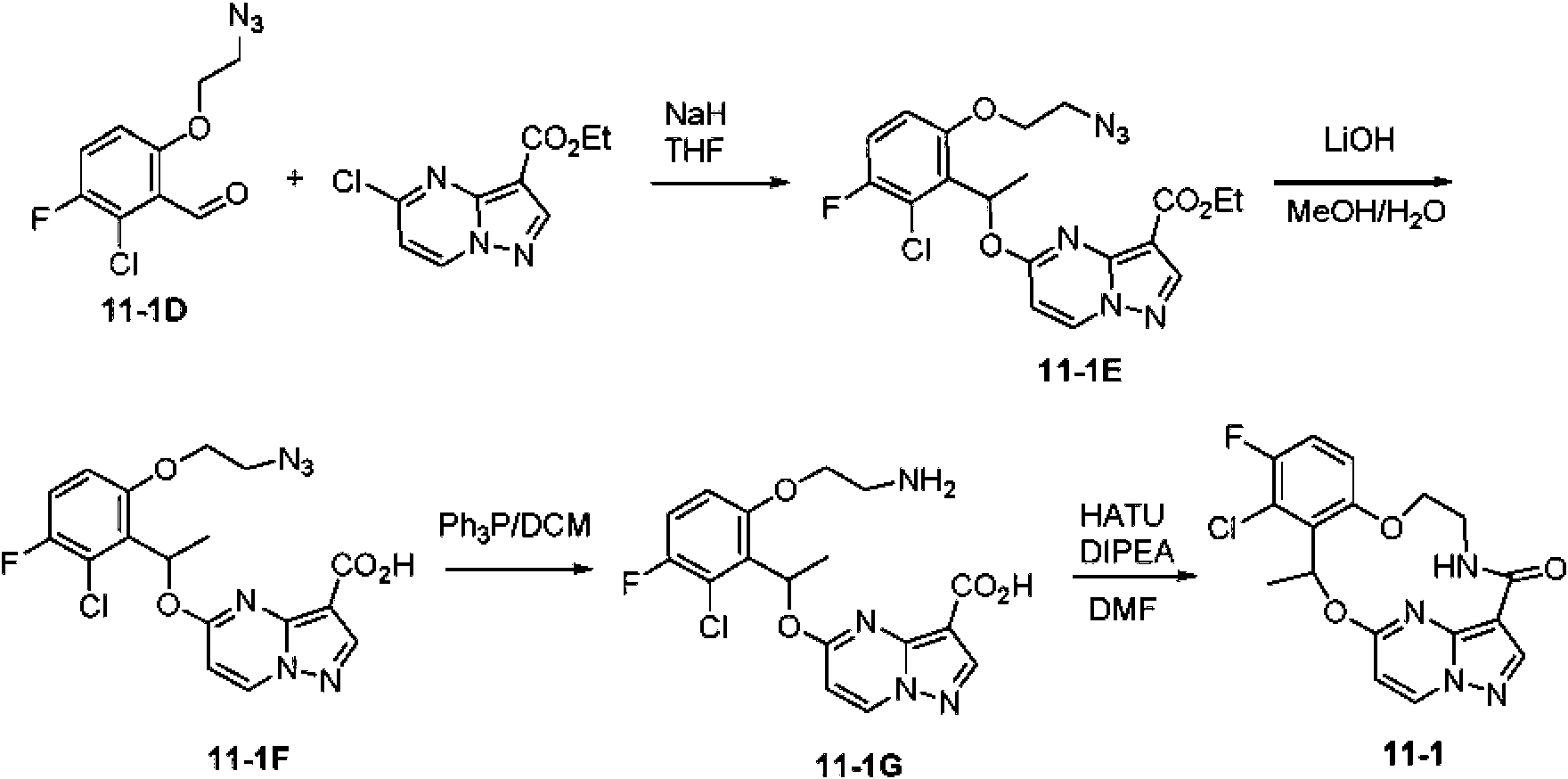
Etapa 1: A una solución de 2-cloro-3-fluoro-6-hidroxi-benzaldehído (175 mg, 1,0 mmol), bis-tos etilenglicol (740 mg, 2,0 mmol) en ACN (5 ml), se le añadieron K2CO3 (276 mg, 2,0 mmol) y KI (2 mg). La mezcla de reacción se agitó a 120 °C durante 24 horas. El sólido se retiró por filtración y el filtrado se concentró y se purificó por cromatografía en columna para proporcionar el producto deseado 11-1B en forma de un sólido de color blanco. El material se usó directamente en la etapa siguiente.Step 1: To a solution of 2-chloro-3-fluoro-6-hydroxy-benzaldehyde (175 mg, 1.0 mmol), bis-tos ethylene glycol (740 mg, 2.0 mmol) in ACN (5 mL), K 2 CO 3 (276 mg, 2.0 mmol) and KI (2 mg) were added. The reaction mixture was stirred at 120 °C for 24 hours. The solid was filtered off and the filtrate was concentrated and purified by column chromatography to provide the desired product 11-1B as a white solid. The material was used directly in the next stage.
Etapa 2: A una solución de 11-1B (373 mg, 1 mmol) en ACN (5 ml), se le añadió NaN3 (650 mg, 10 mmol) y la mezcla se agitó a 120 °C durante 24 horas. El sólido se retiró por filtración y el residuo se concentró y se purificó por cromatografía en columna para proporcionar 11-1C en forma de un sólido de color blanco (200 mg, 82%). RMN 1H (500 MHz, Cloroformo-d) 610,49 (d, J = 1,1 Hz, 1H), 7,31 (dd, J = 9,2, 8,2 Hz, 1H), 6,88 (dd, J = 9,2, 3,7 Hz, 1H), 4,21 (dd, J = 5,4, 4,5 Hz, 2H), 3,67 (dd, J = 5,4, 4,5 Hz, 2H).Step 2: To a solution of 11-1B (373 mg, 1 mmol) in ACN (5 mL), NaN3 (650 mg, 10 mmol) was added and the mixture was stirred at 120 °C for 24 hours. The solid was filtered off and the residue was concentrated and purified by column chromatography to provide 11-1C as a white solid (200 mg, 82%). 1H NMR (500 MHz, Chloroform-d) 610.49 (d, J = 1.1 Hz, 1H), 7.31 (dd, J = 9.2, 8.2 Hz, 1H), 6.88 ( dd, J = 9.2, 3.7 Hz, 1H), 4.21 (dd, J = 5.4, 4.5 Hz, 2H), 3.67 (dd, J = 5.4, 4, 5hz, 2H).
Etapa 3: A una solución de 11-1C (100 mg, 0,41 mmol) en THF anhidro (5 ml) a -78 °C, se le añadió bromuro de metil magnesio (1 N en Et2O, 0,82 ml, 0,82 mmol). La mezcla se dejó calentar a temperatura ambiente y se agitó durante 2 horas hasta que la TLC no mostró material de partida presente. Después, la solución se enfrió a 0 °C y se inactivó NH4OAc ac. sat. y se extrajo con EtOAc (20 ml x 3). El orgánico combinado se secó sobre Na2SO4 y se concentró. El residuo 11-1D se usó directamente en la siguiente etapa. RMN 1H (500 MHz, Cloroformo-d) 66,97 (dd, J = 9,2, 8,3 Hz, 1H), 6,77 (dd, J = 9,1,4,1 Hz, 1H), 5,27 (c, J = 6,7 Hz, 1H), 4,34 - 4,29 (m, 1H), 4,22 - 4,16 (m, 1H), 4,04 - 3,98 (m, 1H), 3,95 - 3,88 (m, 2H), 1,51 (d, J = 6,7 Hz, 3H).Step 3: To a solution of 11-1C (100 mg, 0.41 mmol) in anhydrous THF (5 mL) at -78 °C, added methyl magnesium bromide (1 N in Et 2 O, 0.82 ml, 0.82mmol). The mixture was allowed to warm to room temperature and stirred for 2 hours until TLC showed no starting material present. The solution was then cooled to 0 °C and aq. NH4OAc was quenched. sat. and extracted with EtOAc (20 mL x 3). The combined organic was dried over Na2SO4 and concentrated. The residue 11-1D was used directly in the next step. 1H NMR (500 MHz, Chloroform-d) 66.97 (dd, J = 9.2, 8.3 Hz, 1H), 6.77 (dd, J = 9.1,4.1 Hz, 1H), 5.27 (c, J = 6.7 Hz, 1H), 4.34 - 4.29 (m, 1H), 4.22 - 4.16 (m, 1H), 4.04 - 3.98 ( m, 1H), 3.95-3.88 (m, 2H), 1.51 (d, J =6.7 Hz, 3H).
Etapa 4: A una solución de éster etílico del ácido 5-cloro-pirazolo[1,5-a]pirimidin-3-carboxílico (100 mg, 0,44 mmol) y 11-1D (110 mg, 0,41 mmol) en THF anhidro (5,0 ml) a - 78 °C, se le añadió NaH (60%, 17 mg, 0,44 mmol). La mezcla se dejó calentar a ta y se agitó durante 8 horas hasta que se formó una buena cantidad del producto deseado. Después, la mezcla se diluyó con agua/hielo y se extrajo con DCM (3x20 ml). La capa orgánica se secó sobre Na2SO4, se concentró y se purificó por cromatografía en columna sobre gel de sílice para proporcionar 11-1E en forma de un líquido de color amarillo (20 mg, 0,045 mmol, 6%), el cual se usó directamente en la siguiente etapa.Step 4: To a solution of 5-chloro-pyrazolo[1,5-a]pyrimidine-3-carboxylic acid ethyl ester (100 mg, 0.44 mmol) and 11-1D (110 mg, 0.41 mmol) in anhydrous THF (5.0 mL) at -78 °C, NaH (60%, 17 mg, 0.44 mmol) was added. The mixture was allowed to warm to rt and stirred for 8 hours until a good amount of the desired product had formed. The mixture was then diluted with ice/water and extracted with DCM (3x20ml). The organic layer was dried over Na2SO4, concentrated, and purified by silica gel column chromatography to give 11-1E as a yellow liquid (20 mg, 0.045 mmol, 6%), which was used directly. in the next stage.
Etapa 5: A una solución de 11-1E (20 mg, 0,045 mmol) en MeOH (1 ml), se le añadió LiOH (16 mg, 0,38 mmol) seguido de 1 ml de H2O. La mezcla se dejó en agitación a 60 °C durante 4 horas hasta que la CLEM y la TLC mostraron que la reacción se había completado. La solución se enfrió a ta, se concentró parcialmente y se acidificó mediante HCl 1 N hasta pH 2-3. La mezcla acuosa se extrajo con DCM (3x10 ml). La capa orgánica se secó sobre Na2SO4 y se concentró. El residuo 11-1F se usó directamente en la siguiente etapa.Step 5: To a solution of 11-1E (20 mg, 0.045 mmol) in MeOH (1 mL), LiOH (16 mg, 0.38 mmol) was added followed by 1 mL H 2 O. The mixture was left stirring at 60 °C for 4 hours until LCMS and TLC showed the reaction to be complete. The solution was cooled to rt, partially concentrated, and acidified with 1N HCl to pH 2-3. The aqueous mixture was extracted with DCM (3x10 ml). The organic layer was dried over Na2SO4 and concentrated. The residue 11-1F was used directly in the next step.
Etapa 6: A una solución de 11-1F (20 mg, 0,045 mmol) en DCM (5 ml), se le añadió PPh3 (24 mg, 0,09 mmol). La solución se agitó durante 1 h hasta que la TLC mostró una conversión completa del material de partida al producto deseado. Después, la mezcla se usó directamente en la siguiente etapa sin caracterización adicional. 11-1G EM IEN+ m/z 417,7 (M+Na)+.Step 6: To a solution of 11-1F (20 mg, 0.045 mmol) in DCM (5 mL), PPh3 (24 mg, 0.09 mmol) was added. The solution was stirred for 1 h until TLC showed complete conversion of the starting material to the desired product. The mixture was then used directly in the next step without further characterization. 11-1G SIEN+ MS m/z 417.7 (M+Na)+.
Etapa 7: A una solución de 11-1G obtenida a partir de la etapa previa en DMF (10 ml), se le añadió DIPEA (0,20 ml, 1,15 mmol). La solución se enfrió con un baño de hielo seco/acetona y se añadió HATU (40,0 mg, 0,11 mmol). La solución se dejó calentar a ta lentamente y la CLEM mostró una transformación transparente del material de partida en el producto deseado. Después, la mezcla se diluyó con agua (50 ml) y se extrajo con EtOAc (3 x 50 ml). La capa orgánica combinada se lavó con agua (3 x 50 ml) y salmuera (50 ml) y se secó sobre Na2SO4. El disolvente se retiró y el residuo resultante se purificó por cromatografía en columna de sílice (MeOH al 0-5%/DCM) proporcionó el producto deseado en forma de un sólido de color blanco (2,6 mg, rendimiento del 20%).Step 7: To a solution of 11-1G obtained from the previous step in DMF (10 mL), DIPEA (0.20 mL, 1.15 mmol) was added. The solution was cooled with a dry ice/acetone bath and HATU (40.0 mg, 0.11 mmol) was added. The solution was allowed to warm to rt slowly and LCMS showed a clear transformation of the starting material to the desired product. The mixture was then diluted with water (50ml) and extracted with EtOAc (3 x 50ml). The combined organic layer was washed with water (3 x 50ml) and brine (50ml) and dried over Na2SO4. The solvent was removed and the resulting residue was purified by column chromatography on silica (0-5% MeOH/DCM) to give the product desired as a white solid (2.6 mg, 20% yield).
Ejemplos 14 y 14-1.Examples 14 and 14-1.

Los Ejemplos 14 y 14-1 se pueden preparar de acuerdo con el siguiente esquema usando materiales de partida racémicos o enantioméricamente enriquecidos:Examples 14 and 14-1 can be prepared according to the following scheme using racemic or enantiomerically enriched starting materials:

Etapa 1. A una mezcla de los compuestos 14A (1 equiv.) y 14B (1,2 equiv.) en DMF anhidra (0,2 M), se le añadió Cs2COa (1,5 equiv.) y la reacción se calentó en un baño de aceite a 80 °C en atmósfera de nitrógeno durante una noche. La mezcla se enfría, se vertió en agua y se extrajo con EtOAc tres veces. Las capas orgánicas combinadas se lavaron con agua cinco veces, se lavaron con salmuera y se secaron sobre Na2SO4. Después de la condensación, el residuo se purificó sobre una columna ultrarrápida de gel de sílice eluyendo con EtOAc/Hexanos para proporcionar 14C.Step 1. To a mixture of compounds 14A (1 equiv.) and 14B (1.2 equiv.) in anhydrous DMF (0.2 M), Cs 2 COa (1.5 equiv.) was added and the reaction it was heated in an oil bath at 80 °C under a nitrogen atmosphere overnight. The mixture is cooled, poured into water, and extracted with EtOAc three times. The combined organic layers were washed with water five times, washed with brine, and dried over Na2SO4. After condensation, the residue was purified on a silica gel flash column eluting with EtOAc/Hexanes to give 14C.
Etapa 2. A una solución enfriada (-78 °C) de 14C (1 equiv.) en THF anhidro (0,2 M), se le añadió MeMgBr (3 equiv, 3 M en éter dietílico). La reacción se agitó durante 2 h de -78 °C a 0 °C y se interrumpió con NH4Cl acuoso saturado y después se extrajo con EtOAc (2x). Los orgánicos se secaron sobre MgSO4, se filtraron y se concentraron. Este residuo se purificó mediante una cromatografía en columna sobre gel de sílice eluyendo con EtOAc/Hexanos para proporcionar 14D.Step 2. To a cooled (-78 °C) solution of 14C (1 equiv) in anhydrous THF (0.2 M), MeMgBr (3 equiv, 3 M in diethyl ether) was added. The reaction was stirred for 2 h at -78 °C to 0 °C and quenched with saturated aq. NH4Cl, then extracted with EtOAc (2x). The organics were dried over MgSO4, filtered, and concentrated. This residue was purified by silica gel column chromatography eluting with EtOAc/Hexanes to give 14D.
Etapa 3. A una solución del compuesto 14D (1 equiv.) en THF anhidro (0,2 M), se le añadió NaH (1,2 equiv.). La mezcla de reacción se agitó a temperatura ambiente durante 0,5 horas. A la mezcla se le añadió 14E y la reacción se calentó a reflujo en una atmósfera de nitrógeno durante una noche. La reacción se enfrió a temperatura ambiente y después se vertió en agua. El producto se extrajo con EtOAc tres veces. Los orgánicos combinados se lavaron con salmuera, se secaron sobre Na2SO4, y se concentraron. El residuo se purificó con una columna de gel de sílice eluyendo con EtOAc/Hexanos para proporcionar el producto 14F.Step 3. To a solution of compound 14D (1 equiv.) in anhydrous THF (0.2 M), NaH (1.2 equiv.) was added. The reaction mixture was stirred at room temperature for 0.5 hour. To the mixture was added 14E and the reaction was refluxed under nitrogen overnight. The reaction was cooled to room temperature and then poured into water. The product was extracted with EtOAc three times. The combined organics were washed with brine, dried over Na2SO4, and concentrated. The residue was purified on a silica gel column eluting with EtOAc/Hexanes to give product 14F.
Etapa 4. A una solución del compuesto 14F (1 equiv.) en CH2Cb (0,2 M), se le añadió HCl 4 M/dioxano (10 equiv.) y la mezcla se agitó hasta que todo el 14F se convirtió en 14G. Después de la concentración, el residuo se purificó en una HPLC preparativa de fase inversa para proporcionar 14G.Step 4. To a solution of compound 14F (1 equiv.) in CH 2 Cb (0.2 M), 4M HCl/dioxane (10 equiv.) was added and the mixture was stirred until all of the 14F was converted to 14G. After concentration, the residue was purified on reverse phase preparative HPLC to give 14G.
Etapa 5. A una solución de 14G (1 equiv.) y DIPEA (2 equiv.) en tolueno (0,01 M), se le añadió Pd(P-t-Bu3)2 (1 equiv.). La mezcla de reacción se calentó a 100 °C a 0,4 MPa (4 bar) de CO durante una noche y después se concentró. El residuo se purificó sobre una columna de gel de sílice eluyendo con EtOAc/hexanos para proporcionar 14.Step 5. To a solution of 14G (1 equiv.) and DIPEA (2 equiv.) in toluene (0.01 M), Pd(P-t-Bu3)2 (1 equiv.) was added. The reaction mixture was heated at 100 °C under 0.4 MPa (4 bar) CO overnight and then concentrated. The residue was purified on a silica gel column eluting with EtOAc/hexanes to give 14.
Ejemplos 15 y 15-1.Examples 15 and 15-1.

Los Ejemplos 15 y 15-1 se pueden preparar de acuerdo con el siguiente esquema usando materiales de partida racémicos o enantioméricamente enriquecidos:Examples 15 and 15-1 can be prepared according to the following scheme using racemic or enantiomerically enriched starting materials:

Etapa 1. A una suspensión de 15A (1,0 equiv.) en THF (0,15 M), se le añadió una solución de NaOH acuoso 2,0 M (3 equiv.). La mezcla de reacción homogénea se agitó durante una noche, y después, los orgánicos se retiraron a presión reducida. El residuo acuoso se llevó a pH~4 con HCl acuoso 1,0 M. El precipitado resultante se recogió por filtración y se aclaró con H2O para proporcionar un sólido del 15B. El filtrado se extrajo con EtOAc (2x) y los orgánicos se concentraron a presión reducida para proporcionar una porción adicional de 15B.Step 1. To a suspension of 15A (1.0 equiv.) in THF (0.15 M), 2.0 M aqueous NaOH solution (3 equiv.) was added. The homogeneous reaction mixture was stirred overnight, and then the organics were removed under reduced pressure. The aqueous residue was brought to pH~4 with 1.0 M aqueous HCl. The resulting precipitate was collected by filtration and rinsed with H 2 O to give a solid of 15B. The filtrate was extracted with EtOAc (2x) and the organics concentrated under reduced pressure to provide an additional portion of 15B.
Etapa 2. Se preparó una solución madre de reactivo de Jones (2,67 M) mediante la adición cuidadosa de H2SO4 concentrado (2,3 ml) a CrO3 (2,67 g) y después diluyéndola hasta 10 ml con H2O. A una suspensión de 15B (1,0 equiv.) en acetona (0,067 M), se le añadió lentamente reactivo de Jones (1,2 equiv.). La mezcla de reacción se agitó durante 15 min y después se inactivó con i-PrOH y se filtró a través de una capa de tierra de diatomeas, aclarando con acetona. El filtrado se concentró para proporcionar 15C que se usó sin purificación adicional. Step 2. A stock solution of Jones reagent (2.67 M) was prepared by carefully adding concentrated H 2 SO 4 (2.3 mL) to CrO3 (2.67 g) and then diluting to 10 mL with H 2 O. To a suspension of 15B (1.0 equiv.) in acetone (0.067 M), Jones' reagent (1.2 equiv.) was added slowly. The reaction mixture was stirred for 15 min, then quenched with i-PrOH and filtered through a pad of diatomaceous earth, rinsing with acetone. The filtrate was concentrated to provide 15C which was used without further purification.
Etapa 4. A una solución de 15C (1,0 equiv.) en DMF (0,40 M) a 0 °C, se le añadió NaH (al 60% en aceite mineral, 1,5 equiv.). La mezcla de reacción se agitó a temperatura ambiente durante 30 min, y después, se volvió a enfriar a 0 °C y se añadió lentamente cloruro de 2-(trimetilsilil)etoximetilo (4,3 ml, 1,2 equiv.). La mezcla de reacción se calentó a temperatura ambiente, se agitó durante 1 h y después, se inactivó con H2O y se extrajo con EtOAc (3x). Los orgánicos combinados se lavaron con H2O (3x) y salmuera, y después se secaron sobre MgSO4 y se concentraron. El residuo se purifica mediante una cromatografía ultrarrápida sobre gel de sílice eluyendo con EtOAc al 20-30%/hexanos para dar 15D.Step 4. To a solution of 15C (1.0 equiv.) in DMF (0.40 M) at 0 °C, NaH (60% in mineral oil, 1.5 equiv.) was added. The reaction mixture was stirred at room temperature for 30 min, then cooled back to 0 °C and 2-(trimethylsilyl)ethoxymethyl chloride (4.3 mL, 1.2 equiv) was added slowly. The reaction mixture was warmed to room temperature, stirred for 1h, then quenched with H 2 O and extracted with EtOAc (3x). The combined organics were washed with H 2 O (3x) and brine, then dried over MgSO4 and concentrated. The residue is purified by flash chromatography on silica gel eluting with 20-30% EtOAc/hexanes to give 15D.
Etapa 5. A una mezcla de reacción del 14D (1,0 equiv.), yoduro de cobre (I) (0,05 equiv.), 8-hidroxiquinolina (0,1 equiv.) y fosfato potásico tribásico (2,0 equiv.) en DMF (0,2 M) en una atmósfera de nitrógeno, se le añadió 15D (1,2 equiv.) y la mezcla de reacción se calentó a 120 °C durante 24 h. La mezcla de reacción se enfrió a temperatura ambiente y después se diluyó con EtOAc. La mezcla se filtró a través de una capa de tierra de diatomeas y el filtrado se evaporó al vacío. El residuo en bruto se purifica sobre una columna de gel de sílice eluyendo con EtOAC/Hexanos para dar 15E.Step 5. To a reaction mixture of 14D (1.0 equiv.), copper(I) iodide (0.05 equiv.), 8-hydroxyquinoline (0.1 equiv.) and potassium phosphate tribasic (2.0 equiv.) in DMF (0.2 M) under a nitrogen atmosphere, 15D (1.2 equiv.) was added and the reaction mixture was heated at 120 °C for 24 h. The reaction mixture was cooled to room temperature and then diluted with EtOAc. The mixture was filtered through a pad of diatomaceous earth and the filtrate was evaporated in vacuo. The crude residue is purified on a silica gel column eluting with EtOAC/Hexanes to give 15E.
Etapa 6. Una suspensión a 0 °C de 15E (1,0 equiv.) en 1,4-dioxano (0,062 M) y agua (1/3 de THF) se trató con ácido sulfámico (6,0 equiv.). Una solución de clorito sódico (1,3 equiv.) y dihidrogenofosfato potásico (12 equiv.) en agua (1,2 M) se añadió a través de un embudo de goteo durante 20 min. Después de que la adición se completase, el baño de hielo se retiró y la mezcla de reacción se agitó a temperatura ambiente durante 3 h. Se añadió THF y la mezcla de reacción se agitó a temperatura ambiente durante unas 3 h adicionales. La mezcla de reacción se diluyó con agua y se extrajo con EtOAc (2x). Las capas orgánicas combinadas se lavaron con agua y salmuera y después se secaron sobre Na2SO4, se filtraron y se concentraron. El residuo se trituró con acetato de etilo/hexanos para proporcionar 15F. Step 6. A 0 °C suspension of 15E (1.0 equiv) in 1,4-dioxane (0.062 M) and water (1/3 THF) was treated with sulfamic acid (6.0 equiv). A solution of sodium chlorite (1.3 equiv.) and potassium dihydrogen phosphate (12 equiv.) in water (1.2 M) was added via dropping funnel over 20 min. After the addition was complete, the ice bath was removed and the reaction mixture was stirred at room temperature for 3 h. THF was added and the reaction mixture was stirred at room temperature for a further 3 h. The reaction mixture was diluted with water and extracted with EtOAc (2x). The combined organic layers were washed with water and brine, then dried over Na2SO4, filtered, and concentrated. The residue was triturated with ethyl acetate/hexanes to provide 15F.
Etapa 7. A una solución del compuesto 15F (1 equiv.) en CH2Cl2 (0,2 M), se le añadió HCl 4 M/dioxano (10 equiv.) y la mezcla se agitó hasta que todo el 15F se convirtió en 15G. Después de la concentración, el residuo se purificó en una HPLC preparativa de fase inversa para proporcionar 15G.Step 7. To a solution of compound 15F (1 equiv.) in CH 2 Cl 2 (0.2 M), 4M HCl/dioxane (10 equiv.) was added and the mixture was stirred until all 15F was removed. became 15G. After concentration, the residue was purified on reverse phase preparative HPLC to give 15G.
Etapa 8. Una solución del compuesto 15G (1 equiv.) y DIPEA (10 equiv.) en DMF (0,2 M) se añadió gota a gota a una solución de HATU (1,4 equiv.) en DMF (0,1 M) a 0 °C. Después de que se completase la adición, la mezcla se agitó a 0 °C durante unos 30 min adicionales. Se añadió agua y la mezcla se extrajo con EtOAc tres veces. Los orgánicos combinados se lavaron dos veces con NaHCO3 saturado, salmuera, se secaron sobre Na2SO4 y se evaporaron. El residuo se purificó con una columna de gel de sílice eluyendo con EtOAc/Hexanos para proporcionar 15.Step 8. A solution of compound 15G (1 equiv.) and DIPEA (10 equiv.) in DMF (0.2 M) was added dropwise to a solution of HATU (1.4 equiv.) in DMF (0. 1M) at 0°C. After the addition was complete, the mixture was stirred at 0 °C for an additional 30 min. Water was added and the mixture was extracted with EtOAc three times. The combined organics were washed twice with saturated NaHCO3, brine, dried over Na2SO4, and evaporated. The residue was purified on a silica gel column eluting with EtOAc/Hexanes to give 15.
Ejemplos 18 y 18-1.Examples 18 and 18-1.

Los Ejemplos 18 y 18-1 se pueden preparar de acuerdo con el siguiente esquema usando materiales de partida racémicos o enantioméricamente enriquecidos: Examples 18 and 18-1 can be prepared according to the following scheme using racemic or enantiomerically enriched starting materials:

Etapa 1. A una mezcla de reacción del 14D (1,0 equiv.), 18A (1,2 equiv.) y yoduro de cobre (I) (0,05 equiv.) en DMF (0,2 M) en una atmósfera de nitrógeno, se le añadió NaH (3,0 equiv.). La mezcla de reacción se calentó a 120 °C durante 24 h, y después se enfrió a temperatura ambiente y se diluyó con EtOAc. La mezcla se filtró a través de una capa de tierra de diatomeas y el filtrado se evaporó al vacío. El residuo en bruto se purifica sobre una columna de gel de sílice eluyendo con EtOAc/Hexanos para dar 18B.Step 1. To a reaction mixture of 14D (1.0 equiv.), 18A (1.2 equiv.) and copper(I) iodide (0.05 equiv.) in DMF (0.2 M) in a nitrogen atmosphere, NaH (3.0 equiv.) was added. The reaction mixture was heated at 120 °C for 24 h, then cooled to room temperature and diluted with EtOAc. The mixture was filtered through a pad of diatomaceous earth and the filtrate was evaporated in vacuo. The crude residue is purified on a silica gel column eluting with EtOAc/Hexanes to give 18B.
Etapa 2. A una mezcla de reacción del 18B (1,0 equiv.) en DMF (0,2 M), se le añadieron KOH (2 equiv.) e I2 (1,1 equiv.). La mezcla de reacción se agitó a temperatura ambiente durante 1 h, y después se inactivó con NaHSO3 y se extrajo con EtOAc. Los orgánicos combinados se lavaron dos veces con NaHCO3 saturado, salmuera, se secaron sobre Na2SO4 y se evaporaron. El residuo se purificó con una columna de gel de sílice eluyendo con EtOAc/Hexanos para proporcionar 18C.Step 2. To a reaction mixture of 18B (1.0 equiv.) in DMF (0.2 M), KOH (2 equiv.) and I 2 (1.1 equiv.) were added. The reaction mixture was stirred at room temperature for 1 h, then quenched with NaHSO3 and extracted with EtOAc. The combined organics were washed twice with saturated NaHCO3, brine, dried over Na2SO4, and evaporated. The residue was purified on a silica gel column eluting with EtOAc/Hexanes to give 18C.
Etapa 3. A una solución del compuesto 18C (1 equiv.) en CH2Cb (0,2 M), se le añadió HCl 4 M/dioxano (10 equiv.) y la mezcla se agitó hasta que todo el 18C se convirtió en 18D. Después de la concentración, el residuo se purificó en una HPLC preparativa de fase inversa para proporcionar 18D.Step 3. To a solution of compound 18C (1 equiv.) in CH 2 Cb (0.2 M), 4M HCl/dioxane (10 equiv.) was added and the mixture was stirred until all 18C was converted. in 18D. After concentration, the residue was purified on reverse phase preparative HPLC to give 18D.
Etapa 4. A una solución de 18D (1 equiv.) y DIPEA (2 equiv.) en tolueno (0,01 M), se le añadió Pd(P-t-Bu3)2 (1 equiv.). La mezcla de reacción se calentó a 100 °C a 0,4 MPa (4 bar) de CO durante una noche y después se concentró. El residuo se purificó sobre una columna de gel de sílice eluyendo con EtOAc/hexanos para proporcionar 18.Step 4. To a solution of 18D (1 equiv.) and DIPEA (2 equiv.) in toluene (0.01 M), Pd(P-t-Bu3)2 (1 equiv.) was added. The reaction mixture was heated at 100 °C under 0.4 MPa (4 bar) CO overnight and then concentrated. The residue was purified on a silica gel column eluting with EtOAc/hexanes to give 18.
Ejemplo 20.Example 20.

El Ejemplo 20 se preparó de acuerdo con el siguiente esquema: Example 20 was prepared according to the following scheme:

Etapa 1. (2-(4-Fluoro-2-formilfenoxi)etil)carbamato de tere-butilo (20C). Una solución de aldehido 20A (1,5 g, 11 mmol), cloruro 20B (2,1 g, 12 mmol), carbonato potásico (7,4 g, 54 mmol) y yoduro potásico (36 mg, 0,2 mmol) en DMF (11 ml) se calentaron a 60 °C y se agitó durante 15 horas. Cloruro 20B adicional (1,0 g, 6 mmol) y calentamiento adicional a 80 °C durante 5 horas completaron la reacción. La mezcla se enfrió a temperatura ambiente y se diluyó mediante la adición de agua (250 ml). La mezcla se extrajo con acetato de etilo (3 x 300 ml) y los extractos combinados se lavaron con agua (200 ml) y salmuera (100 ml), se secaron con sulfato sódico y se concentraron a presión reducida. La cromatografía ultrarrápida (sistema ISCO, sílice, acetato de etilo al 0-20% en hexano) proporcionó 20C (3,0 g, 99%) en forma de un aceite viscoso. LRESIMS m/z 306,1 [M+Na]+, calc. para CuH18F1N1Na1O4306,1.Step 1. tert-butyl (2-(4-Fluoro-2-formylphenoxy)ethyl)carbamate (20C). A solution of aldehyde 20A (1.5 g, 11 mmol), chloride 20B (2.1 g, 12 mmol), potassium carbonate (7.4 g, 54 mmol), and potassium iodide (36 mg, 0.2 mmol) in DMF (11 mL) were heated to 60 °C and stirred for 15 hours. Additional chloride 20B (1.0 g, 6 mmol) and additional heating at 80 °C for 5 hours completed the reaction. The mixture was cooled to room temperature and diluted by the addition of water (250 ml). The mixture was extracted with ethyl acetate (3 x 300ml) and the combined extracts washed with water (200ml) and brine (100ml), dried over sodium sulphate and concentrated under reduced pressure. Flash chromatography (ISCO system, silica, 0-20% ethyl acetate in hexane) provided 20C (3.0 g, 99%) as a viscous oil. LRESIMS m/z 306.1 [M+Na]+, calc. for CuH18F1N1Na1O4306.1.
Etapa 2. (2-(4-Fluoro-2-((metilamino)metil)fenoxi)etil)carbamato de tere-butilo (20D). Se calentaron el aldehído 20C (2,5 g, 8,8 mmol) y metilamina (0,69 g, 22 mmol) en metanol (88 ml) a 60 °C y se agitaron durante 1 hora. La mezcla se enfrió a temperatura ambiente y se añadió borohidruro sódico (0,33 g, 8,8 mmol). La mezcla se agitó durante 30 minutos, después se inactivó mediante la adición de agua (200 ml). La mezcla se extrajo con diclorometano (4 x 100 ml) y los extractos combinados se secaron con salmuera (50 ml), sulfato sódico y se concentraron a presión reducida. La cromatografía ultrarrápida (sistema ISCO, sílice, 0-100% de (metanol al 10% en acetato de etilo) en hexano) proporcionó el compuesto del título (2,1 g, 80%) en forma de un gel. LRESIMS m/z 299,2 [M+H]+, calc. para C15H24F1 N2O3299,2.Step 2. tert-butyl (2-(4-Fluoro-2-((methylamino)methyl)phenoxy)ethyl)carbamate (20D). 20C aldehyde (2.5 g, 8.8 mmol) and methylamine (0.69 g, 22 mmol) in methanol (88 mL) were heated to 60 °C and stirred for 1 hour. The mixture was cooled to room temperature and sodium borohydride (0.33 g, 8.8 mmol) was added. The mixture was stirred for 30 minutes, then quenched by the addition of water (200 ml). The mixture was extracted with dichloromethane (4 x 100ml) and the combined extracts dried with brine (50ml), sodium sulphate and concentrated under reduced pressure. Flash chromatography (ISCO system, silica, 0-100% (10% methanol in ethyl acetate) in hexane) provided the title compound (2.1 g, 80%) as a gel. LRESIMS m/z 299.2 [M+H]+, calc. for C 15 H 24 F 1 N 2 O 3 299.2.
Etapa 3. 5-((2-(2-((tere-Butoxicarbonil)amino)etoxi)-5-fluorobencil)(metil)amino)pirazolo[1,5-a]pirimidin-3-carboxilato de etilo (20F). Se calentaron la amina 20D (2,1 g, 7,0 mmol), éster 20E (1,59 g, 7,0 mmol) y base de Hunig (7,0 ml, 5,2 g, 40 mmol) en butanol (17 ml) a 110 °C durante 25 minutos. La reacción se enfrió y se diluyó con agua (250 ml). La mezcla se extrajo con diclorometano (4 x 100 ml) y los extractos combinados se secaron con sulfato sódico. La mezcla se concentró a presión reducida. La cromatografía ultrarrápida (sistema ISCO, sílice, acetato de etilo al 20-100% en hexano) proporcionó el compuesto del título (2,1 g, 75%) en forma de un sólido. LRESIMS m/z 488,3 [M+H]+, calc. para C24H31F1 N5O5488,2. Step 3. Ethyl 5-((2-(2-((tere-Butoxycarbonyl)amino)ethoxy)-5-fluorobenzyl)(methyl)amino)pyrazolo[1,5-a]pyrimidine-3-carboxylate (20F) . The amine 20D (2.1 g, 7.0 mmol), ester 20E (1.59 g, 7.0 mmol) and Hunig's base (7.0 mL, 5.2 g, 40 mmol) were heated in butanol. (17 mL) at 110 °C for 25 minutes. The reaction was cooled and diluted with water (250ml). The mixture was extracted with dichloromethane (4 x 100ml) and the combined extracts dried over sodium sulphate. The mixture was concentrated under reduced pressure. Flash chromatography (ISCO system, silica, 20-100% ethyl acetate in hexane) provided the title compound (2.1 g, 75%) as a solid. LRESIMS m/z 488.3 [M+H]+, calc. for C 24 H 31 F 1 N 5 O 5 488.2.
Etapa 4. Ácido 5-((2-(2-((terc-butoxicarbonil)amino)etoxi)-5-fluorobencil)(metil)amino)pirazolo[1,5-a]pirimidin-3-carboxílico (20G). Se añadió hidróxido sódico (40 ml, 2 M en agua) a una solución agitada de éster 20F (2,1 g, 4,3 mmol) en tetrahidrofurano:metanol (3:2, 100 ml) a temperatura ambiente. La reacción se calentó a 60 °C y se agitó durante 6,5 horas. La mezcla se enfrió a 0 °C y se acidificó con ácido clorhídrico (45 ml, 2 M en agua), después se diluyó con agua (100 ml). La mezcla se extrajo con acetato de etilo (4 x 150 ml) y los extractos combinados se secaron con salmuera (50 ml) y sulfato sódico. La mezcla se concentró a presión reducida para proporcionar el compuesto del título (1,92 g, 97%) en forma de un sólido. LRESIMS m/z 460,2 [M+H]+, calc. para C22H27F1 N5O5460,2.Step 4. 5-((2-(2-((tert-Butoxycarbonyl)amino)ethoxy)-5-fluorobenzyl)(methyl)amino)pyrazolo[1,5-a]pyrimidine-3-carboxylic acid (20G). Sodium hydroxide (40 mL, 2M in water) was added to a stirred solution of ester 20F (2.1 g, 4.3 mmol) in tetrahydrofuran:methanol (3:2, 100 mL) at room temperature. The reaction was warmed to 60 °C and stirred for 6.5 hours. The mixture was cooled to 0 °C and acidified with hydrochloric acid (45 mL, 2M in water), then diluted with water (100 mL). The mixture was extracted with ethyl acetate (4 x 150ml) and the combined extracts dried with brine (50ml) and sodium sulphate. The mixture was concentrated under reduced pressure to provide the title compound (1.92 g, 97%) as a solid. LRESIMS m/z 460.2 [M+H]+, calc. for C 22 H 27 F 1 N 5 O 5 460.2.
Etapa 5. Ácido 5-((2-(2-aminoetoxi)-5-fluorobencil)(metil)amino)pirazolo[1,5-a]pirimidin-3-carboxílico (20H). Se añadió ácido clorhídrico (5 ml, 4 M en dioxano) a una solución agitada de ácido carboxílico 20G (1,92 g, 4,2 mmol) en diclorometano (25 ml) a temperatura ambiente. La reacción se agitó durante 2 horas, después se concentró a presión reducida para proporcionar el compuesto del título en forma de un sólido. LRESIMS m/z 360,2 [M+H]+, calc. para C17H10F1 N5O3360,2.Step 5. 5-((2-(2-aminoethoxy)-5-fluorobenzyl)(methyl)amino)pyrazolo[1,5-a]pyrimidine-3-carboxylic acid (20H). Hydrochloric acid (5 mL, 4M in dioxane) was added to a stirred solution of carboxylic acid 20G (1.92 g, 4.2 mmol) in dichloromethane (25 mL) at room temperature. The reaction was stirred for 2 hours, then concentrated under reduced pressure to provide the title compound as a solid. LRESIMS m/z 360.2 [M+H]+, calc. for C 17 H 10 F 1 N 5 O 3 360.2.
Etapa 6. En una atmósfera de argón, se añadió HATU (1,67 g, 4,4 mmol) a una solución agitada de ácido carboxílico 2 0 H (1,50 g, 4,2 mmol) y base de Hunig (7,28 ml, 5,40 g, 41,8 mmol) en DMF:diclorometano (5:1, 60 ml) a -78 °C. La reacción se calentó lentamente a temperatura ambiente y se agitó durante 3 horas, después se interrumpió con agua (300 ml). La mezcla se extrajo con acetato de etilo (3 x 100 ml), después diclorometano (2 x 100 ml) y los extractos combinados se secaron con salmuera (50 ml) y sulfato sódico. La mezcla se concentró a presión reducida. La cromatografía ultrarrápida (sistema ISCO, sílice, metanol al 1-4% en diclorometano) seguido de recristalización en acetato de etilo/metanol proporcionó el Ejemplo 20 (0,98 g, 68%, 2 etapas) en forma de un sólido. LRESIMS m/z 342,2 [M+H]+, calc. para C17 H17 F1 N5O2342,1; RMN 1H (500 MHz, DMSO-d6) 89,43 (dd, J = 6,9, 2,7 Hz, 1 H), 8,76 (d, J = 7,9 Hz, 1H), 8,10 (s, 1 H), 7,19 - 7,25 (m, 1 H), 7,03 - 7,07 (m, 2 H), 6,72 (d, J = 7,9 Hz, 1H), 5,64 (dd, J = 14,9, 1,5 Hz, 1 H), 4,48 (dt, J = 10,2, 4,3 Hz, 1 H), 4,04 - 4,10 (m, 2 H), 3,81 - 3,87 (m, 1 H), 3,58 (s, 3 H), 3,38 - 3,46 (m, 1 H). Step 6. Under argon atmosphere, HATU (1.67 g, 4.4 mmol) was added to a stirred solution of 20H carboxylic acid (1.50 g, 4.2 mmol) and Hunig's base (7 0.28 mL, 5.40 g, 41.8 mmol) in DMF:dichloromethane (5:1, 60 mL) at -78 °C. The reaction slowly warmed to room temperature and stirred for 3 hours, then quenched with water (300 mL). The mixture was extracted with ethyl acetate (3 x 100ml), then dichloromethane (2 x 100ml) and the combined extracts dried with brine (50ml) and sodium sulphate. The mixture was concentrated under reduced pressure. Flash chromatography (ISCO system, silica, 1-4% methanol in dichloromethane) followed by recrystallization from ethyl acetate/methanol provided Example 20 (0.98 g, 68%, 2 steps) as a solid. LRESIMS m/z 342.2 [M+H]+, calc. for C 17 H 17 F 1 N 5 O 2 342.1; 1H NMR (500 MHz, DMSO-d6) 89.43 (dd, J = 6.9, 2.7 Hz, 1H), 8.76 (d, J = 7.9 Hz, 1H), 8.10 (s, 1H), 7.19 - 7.25 (m, 1H), 7.03 - 7.07 (m, 2H), 6.72 (d, J = 7.9 Hz, 1H) , 5.64 (dd, J = 14.9, 1.5 Hz, 1 H), 4.48 (dt, J = 10.2, 4.3 Hz, 1 H), 4.04 - 4.10 (m, 2H), 3.81-3.87 (m, 1H), 3.58 (s, 3H), 3.38-3.46 (m, 1H).
Síntesis alternativa del Ejemplo 20:Alternative synthesis of Example 20:
El Ejemplo 20 también se puede preparar mediante la siguiente ruta alternativa:Example 20 can also be prepared by the following alternative route:

k2c o 3, DMFk2c or 3, DMF

80 °C80°C
96%96%

Etapa 1. 5-Oxo-4H-pirazolo[1,5-a]pirimidin-3-carboxilato de etilo (20J). A una mezcla de 20I (150,00 g, 1,08 mmol) y (E)-3-etoxiprop-2-enoato de etilo (292,16 g, 2,03 mol) en DMF (3,2 l), se le añadió CS2CO3 (656,77 g, 2,02 mol) en una porción a 20 °C en atmósfera de N2. La mezcla se agitó a 110 °C durante 6 horas. La mezcla se enfrió a 20 °C y se filtró a través de una capa de tierra de diatomeas. La torta de filtro se lavó con acetato de etilo (3x30 ml). El filtrado se añadió a H2O (2 l) y se acidificó con HOAc a pH=4. El precipitado resultante se filtró para proporcionar 20J (173,00 g, 834,98 mmol, rendimiento del 86,36%) en forma de un sólido de color blanco. RMN 1H (400 MHz, DMSO-d6) 8 8,54 (d, J = 7,91 Hz, 1H), 8,12 (s, 1H), 6,13 (d, J = 7,91 Hz, 1H), 4,27 (c, J = 7,11 Hz, 2H), 1,28 (t, J = 7,09 Hz, 3H).Step 1. Ethyl 5-Oxo-4H-pyrazolo[1,5-a]pyrimidine-3-carboxylate (20J). To a mixture of 20I (150.00 g, 1.08 mmol) and Ethyl (E)-3-ethoxyprop-2-enoate (292.16 g, 2.03 mol) in DMF (3.2 L), added CS 2 CO 3 (656.77 g, 2.02 mol ) in a portion at 20 °C in an N 2 atmosphere. The mixture was stirred at 110 °C for 6 hours. The mixture was cooled to 20 °C and filtered through a pad of diatomaceous earth. The filter cake was washed with ethyl acetate (3x30ml). The filtrate was added to H 2 O (2 L) and acidified with HOAc to pH=4. The resulting precipitate was filtered to provide 20J (173.00 g, 834.98 mmol, 86.36% yield) as a white solid. 1H NMR (400 MHz, DMSO-d6) 8 8.54 (d, J = 7.91 Hz, 1H), 8.12 (s, 1H), 6.13 (d, J = 7.91 Hz, 1H ), 4.27 (c, J = 7.11 Hz, 2H), 1.28 (t, J = 7.09 Hz, 3H).
Etapa 2. 5-Cloropirazolo[1,5-a]pirimidin-3-carboxilato (20K). A una mezcla de 20J (158,00 g, 762,59 mmol) en MeCN (1,6 l), se le añadió POCl3 (584,64 g, 3,81 mol) a 20 °C en atmósfera de N2. La mezcla se agitó a 100 °C durante 2 horas. La mezcla se enfrió a 20 °C y se vertió en hielo-agua (5000 ml) en porciones a 0 °C y se agitó durante 20 min. El precipitado se filtró y se secó para proporcionar 20K (110,00 g, 487,52 mmol, rendimiento del 63,93%) en forma de un sólido de color blanco. RMN 1H (400 MHz, DMSO-d6) 8 9,33 (d, J = 7,28 Hz, 1H), 8 ,66 (s, 1H), 7,41 (d, J = 7,15 Hz, 1H), 4,31 (c, J = 7,15 Hz, 2H), 1,32 (t, J = 7,09 Hz, 3H).Step 2. 5-Chloropyrazolo[1,5-a]pyrimidine-3-carboxylate (20K). To a mixture of 20J (158.00 g, 762.59 mmol) in MeCN (1.6 L), POCl3 (584.64 g, 3.81 mol) was added at 20 °C under N 2 . The mixture was stirred at 100 °C for 2 hours. The mixture was cooled to 20 °C and poured into ice-water (5000 ml) in portions at 0 °C and stirred for 20 min. The precipitate was filtered and dried to provide 20K (110.00 g, 487.52 mmol, 63.93% yield) as a white solid. 1H NMR (400 MHz, DMSO-d6) 8 9.33 (d, J = 7.28 Hz, 1H), 8 .66 (s, 1H), 7.41 (d, J = 7.15 Hz, 1H ), 4.31 (c, J = 7.15 Hz, 2H), 1.32 (t, J = 7.09 Hz, 3H).
Etapa 3. 4-Fluoro-2-metilaminometil-fenol (20M). A una solución de 20L (5,00 g, 35,69 mmol, 1,00 equiv.) en MeOH (50,00 ml), se le añadió metanamina acuosa (8 ,8 ml, 71,38 mmol, 25%, 2,00 equiv.) en una porción a 25 °C en atmósfera de N2. La mezcla se agitó a 25 °C durante 3 horas, después se añadió en porciones NaBH4 (2,70 g, 71,38 mmol, 2,00 equiv.). Y la mezcla se agitó a 25 °C durante otras 9 horas. La TLC mostró que la reacción se había completado. La mezcla se concentró a presión reducida a 45 °C. El residuo se vertió en agua (50 ml). La fase acuosa se extrajo con diclorometano (3 x 200 ml) y la fase orgánica combinada se lavó con salmuera (200 ml), se secó sobre Na2SO4 anhidro, se filtró y se concentró al vacío para proporcionar 20M (5,10 g, 32,87 mmol, rendimiento del 92,09%) en forma de un sólido incoloro. RMN 1H (400 MHz, CDCla) 8 6 ,86 (dt, J = 3,0, 8,7 Hz, 1H), 6,78 - 6,69 (m, 2H), 3,93 (s, 2H), 2,48 (s, 3H).Step 3. 4-Fluoro-2-methylaminomethyl-phenol (20M). To a solution of 20L (5.00 g, 35.69 mmol, 1.00 equiv.) in MeOH (50.00 mL), aqueous methanamine ( 8.8 mL, 71.38 mmol, 25%, 2.00 equiv.) in one portion at 25 °C in a N 2 atmosphere. The mixture was stirred at 25 °C for 3 hours, then NaBH4 (2.70 g, 71.38 mmol, 2.00 equiv) was added portionwise. And the mixture was stirred at 25 °C for another 9 hours. TLC showed the reaction to be complete. The mixture was concentrated under reduced pressure at 45 °C. The residue was poured into water (50 ml). The aqueous phase was extracted with dichloromethane (3 x 200 mL) and the combined organic phase was washed with brine (200 mL), dried over anhydrous Na2SO4, filtered, and concentrated in vacuo to provide 20M (5.10 g, 32 0.87 mmol, 92.09% yield) as a colorless solid. 1H NMR (400 MHz, CDCla) 8 6.86 (dt, J = 3.0, 8.7 Hz, 1H), 6.78 - 6.69 (m, 2H), 3.93 (s, 2H) , 2.48 (s, 3H).
Etapa 4. Éster etílico del ácido 5-[(5-fluoro-2-hidroxi-bencil)-metil-amino]-pirazolo[1,5-a]pirimidin-3-carboxílico (Al). A una suspensión de 20M (33,70 g, 217,17 mmol, 1,00 equiv.) y 20K (49,00 g, 217,17 mmol, 1,00 equiv.) en n-BuOH (740,00 ml), se le añadió DIPEA (159,98 g, 1,24 mol, 5,70 equiv.). La mezcla de reacción se agitó a 120 °C durante 2 horas en una atmósfera de nitrógeno. La TLC mostró la finalización de la reacción. La solución se enfrió a 25 °C y después se retiró el disolvente. El residuo se diluyó con agua (500 ml) y se extrajo con diclorometano (3 x 500 ml). Los extractos orgánicos combinados se lavaron con salmuera (300 ml), se secaron sobre Na2SO4 anhidro y se concentraron al vacío. El residuo se trituró por EtOAc(100 ml) para dar A1 (60,00 g, 174,25 mmol, rendimiento del 80,24%) en forma de un sólido de color blanco. RMN 1H (500 MHz, Cloroformo-d) 8 9,71 (s, 1H), 8,32 (d, J = 7,9 Hz, 1H), 8,30 (s, 1H), 6,98 - 6,87 (m, 3H), 6,37 (d, J = 7,9 Hz, 1H), 4,82 (s, 2H), 4,42 (c, J = 7,1 Hz, 2H), 3,21 (s, 3H), 1,39 (t, J = 7,1 Hz, 3H).Step 4. 5-[(5-Fluoro-2-hydroxy-benzyl)-methyl-amino]-pyrazolo[1,5-a]pyrimidine-3-carboxylic acid ethyl ester (Al). To a suspension of 20M (33.70 g, 217.17 mmol, 1.00 equiv.) and 20K (49.00 g, 217.17 mmol, 1.00 equiv.) in n-BuOH (740.00 mL ), DIPEA (159.98 g, 1.24 mol, 5.70 equiv.) was added. The reaction mixture was stirred at 120 °C for 2 hours under a nitrogen atmosphere. TLC showed completion of the reaction. The solution was cooled to 25 °C and then the solvent was removed. The residue was diluted with water (500ml) and extracted with dichloromethane (3 x 500ml). The combined organic extracts were washed with brine (300 mL), dried over anhydrous Na2SO4, and concentrated in vacuo. The residue was triturated by EtOAc (100 mL) to give A1 (60.00 g, 174.25 mmol, 80.24% yield) as a white solid. 1H NMR (500 MHz, Chloroform-d) 8 9.71 (s, 1H), 8.32 (d, J = 7.9 Hz, 1H), 8.30 (s, 1H), 6.98-6 .87 (m, 3H), 6.37 (d, J = 7.9 Hz, 1H), 4.82 (s, 2H), 4.42 (c, J = 7.1 Hz, 2H), 3 .21 (s, 3H), 1.39 (t, J = 7.1 Hz, 3H).
Etapa 5. Éster etílico del ácido 5-{[2-(2-ferc-butoxicarbonilamino-etoxi)-5-fluoro-bencil]-metil-amino}-pirazolo[1,5-a]pirimidin-3-carboxílico (B1). A una solución de A1 (102,85 g, 298,6 mmol, 1 equiv.), éster ferc-butílico del ácido (2-cloro-etil)-carbámico (56,33 g, 313,5 mmol, 1,05 equiv.) en DMF (854 ml), se le añadió K2CO3 (206,41 g, 1493 mmol, 5,0 equiv.). La mezcla se calentó a 80 °C durante 20 horas con una conversión de ~85% del material de partida al producto mediante CL-EM. Se añadieron porciones adicionales de éster ferc-butílico del ácido (2-cloro-etil)-carbámico (5,633 g, 31,35 mmol, 0 , 1 equiv.) y K2CO3 (41,282 g, 298,6 mmol, 1 equiv.) al matraz de reacción. La reacción se continuó a 80 °C durante un adicional de 21 horas. Después, la mezcla se enfrió a temperatura ambiente, se inactivó con agua (1000 ml) y se extrajo con EtOAc (3 x 900 ml). Después, los extractos orgánicos combinados se lavaron con agua (3 x 700 ml) y salmuera (500 ml), se secaron sobre Na2SO4 y se concentraron. El residuo resultante se purificó mediante una columna de gel de sílice eluyendo con EtOAc/Hexano (0-70% para proporcionar B1 en forma de un sólido de color blanco (128,74 g, rendimiento del 96,7%). CL-EM (IEN) m/z 510,1 (M+Na)+; RMN 1H (500 MHz, Cloroformo-d) 8 8,30 (s, 1H), 8,26 (s, 1H), 6,92 (td, J = 8 ,6 , 3,3 Hz, 1H), 6,83 - 6,76 (m, 1H), 6,31 (s, 1H), 4,93 (s, 2H), 4 , 5 1 - 4 , 4 4 (m, 1H), 4,36 (c, J = 7,2 Hz, 2H), 4,03 (t, J = 4,9 Hz, 2H), 3,69 - 3,63 (m, 1H), 3,51 (s, 2H), 3,30 (s, 2H), 1,44 (s, 9H), 1,41 - 1,35 (t, J = 7,2 Hz, 3H).Step 5. 5-{[2-(2-Ferc-butoxycarbonylamino-ethoxy)-5-fluoro-benzyl]-methyl-amino}-pyrazolo[1,5-a]pyrimidine-3-carboxylic acid ethyl ester (B1 ). To a solution of A1 (102.85 g, 298.6 mmol, 1 equiv.), (2-chloro-ethyl)-carbamic acid ferrt-butyl ester (56.33 g, 313.5 mmol, 1.05 equiv.) in DMF (854 mL), K 2 CO 3 (206.41 g, 1493 mmol, 5.0 equiv.) was added. The mixture was heated at 80 °C for 20 hours with ~85% conversion of starting material to product by LC-MS. Additional portions of (2-chloro-ethyl)-carbamic acid ferc-butyl ester (5.633 g, 31.35 mmol, 0.1 equiv.) and K 2 CO 3 (41.282 g, 298.6 mmol, 1 equiv.) were added. equiv.) to the reaction flask. The reaction was continued at 80 °C for an additional 21 hours. The mixture was then cooled to room temperature, quenched with water (1000ml) and extracted with EtOAc (3 x 900ml). The combined organic extracts were then washed with water (3 x 700ml) and brine (500ml), dried over Na2SO4 and concentrated. The resulting residue was purified via a silica gel column eluting with EtOAc/Hexane (0-70% to give B1 as a white solid (128.74 g, 96.7% yield). LC-MS (ISN) m/z 510.1 (M+Na)+;1H NMR (500 MHz, Chloroform-d) 8 8.30 (s, 1H), 8.26 (s, 1H), 6.92 (td , J = 8 , 6 , 3.3 Hz, 1H), 6.83 - 6.76 (m, 1H), 6.31 (s, 1H), 4.93 (s, 2H), 4 , 5 1 - 4 , 4 4 (m, 1H), 4.36 (c, J = 7.2 Hz, 2H), 4.03 (t, J = 4.9 Hz, 2H), 3.69 - 3.63 (m, 1H), 3.51 (s, 2H), 3.30 (s, 2H), 1.44 (s, 9H), 1.41 - 1.35 (t, J = 7.2 Hz, 3H).
Etapa 6. 11-Fluoro-14-metil-6,7,13,14-tetrahidro-1,15-etenopirazolo[4,3-f][1,4,8,10]benzoxatriazaciclotridecin-4(5H)-ona (20). A una solución de B1 (128,74 g, 264,07 mmol, 1 equiv.) en metanol (750 ml) y THF (250 ml), se le añadió LOH-H2O (55,40 g, 1320 mmol, 5,0 equiv.) en H2O (250 ml). La solución transparente se calentó a 70 °C durante 2 horas. La reacción se neutralizó a 0 °C con HCl ac. ( 2 M, 250 ml) a pH<5 y después se extrajo con CH2Cl2 (1x1000 ml, 3x500 ml). Los orgánicos combinados se lavaron con salmuera (300 ml) y se secaron sobre Na2SO4. Después de la filtración, evaporación y secado a alto vacío, se obtuvo un precipitado de color blanco (126,47 g, 275,25 mmol, rendimiento del 104%). A una solución del ácido (121,30 g, 264 mmol) en CH2Cl2 (996 ml), se le añadió HCl en dioxano (4 M, 204 ml) a 0 °C. Se mantuvo agitando de 0 °C a temperatura ambiente durante 27 horas hasta que la de-Boc se completó mediante CL-EM. El sólido de color blanco se filtró, se lavó con DCM (400 ml) y se secó a alto vacío para proporcionar un sólido de color blanco de la sal 3HCl amina (123,55 gramos) que se usó directamente sin purificación adicional. A una solución de DIPEA (169,4 g, 228 ml, 1310 mmol) en DMF (3,7 l) y CH2Cl2 (1,0 l), se le añadió la sal HCl de amina ácida (22,92 g, 49,0 mmol, 1,00 equiv.). Después de que la sal sólida se disolviese completamente, se añadió difenilfosfinato de pentafluorofenilo (f Dp P) en CH2Cl2 (1,1 M, 19,76 g, 51,44 mmol, 1,05 equiv.). El acoplamiento se completó en 30 minutos mediante CL-EM, y después se añadieron las segundas porciones de la sal y FDPP siguiendo el mismo procedimiento que la primera porción. La adición de la sal seguida de FDPP se repitió cada 30 minutos y se controló mediante CL-EM para cada ciclo de adición. Se añadieron en porciones un total de la sal (123,55 g, 264 mmol, 1,00 equiv.) y FDPP (106,44 g, 277 mmol, 1,05 equiv.) al matraz de reacción. La solución de reacción se concentró hasta un volumen de ~ 500 ml y se formó un lote de precipitado. El producto sólido 20 se filtró y se lavó con DMF (50 mlx3). El filtrado se vertió en agua (2 l) y se retiró por precipitación un producto adicional. El producto sólido se filtró y se lavó con agua (100 mlx3). El producto sólido combinado se secó, y se volvió a disolver en metanol al 10% en diclorometano (1,5 l) y después se añadió acetato de etilo (1 l). La solución se condensó hasta ~ 500 ml y se formó un lote de sólido de color blanco. Después de la filtración y el secado a alto vacío, se obtuvo un compuesto sólido de color blanco 20 (74,58 g, rendimiento del 83 %).Stage 6 . 11-Fluoro-14-methyl-6,7,13,14-tetrahydro-1,15-ethenopyrazolo[4,3-f][1,4,8,10]benzoxatriazacyclotridezin-4(5H)-one (20) . To a solution of B1 (128.74 g, 264.07 mmol, 1 equiv.) in methanol (750 mL) and THF (250 mL), LOH-H 2 O (55.40 g, 1320 mmol, 5.0 equiv.) in H 2 O (250 mL). The clear solution was heated at 70 °C for 2 hours. The reaction was quenched at 0 °C with aq. HCl. (2M , 250ml) at pH<5 and then extracted with CH 2 Cl 2 (1x1000ml, 3x500ml). The combined organics were washed with brine (300 mL) and dried over Na2SO4. After filtration, evaporation and drying under high vacuum, a white precipitate was obtained (126.47 g, 275.25 mmol, 104% yield). To a solution of the acid (121.30 g, 264 mmol) in CH 2 Cl 2 (996 mL), HCl in dioxane (4 M, 204 mL) was added at 0 °C. It was kept stirring from 0 °C to room temperature for 27 hours until the de-Boc was complete by LC-MS. The white solid was filtered, washed with DCM (400 mL) and dried under high vacuum to give a white solid of the 3HCl amine salt (123.55 grams) which was used directly without further purification. To a solution of DIPEA (169.4 g, 228 mL, 1310 mmol) in DMF (3.7 L) and CH 2 Cl 2 (1.0 L), the acid amine HCl salt (22.92 g, 49.0 mmol, 1.00 equiv.). After the solid salt dissolved completely, pentafluorophenyl diphenylphosphinate ( f D p P) in CH 2 Cl 2 (1.1 M, 19.76 g, 51.44 mmol, 1.05 equiv) was added. Coupling was complete in 30 minutes by LC-MS, and then the second portions of the salt and FDPP were added following the same procedure as the first portion. Addition of salt followed by FDPP was repeated every 30 minutes and monitored by LC-MS for each addition cycle. A total of the salt (123.55 g, 264 mmol, 1.00 equiv.) and FDPP (106.44 g, 277 mmol, 1.05 equiv.) to the reaction flask. The reaction solution was concentrated to a volume of ~500 mL and a batch of precipitate formed. The solid product 20 was filtered and washed with DMF (50 mlx3). The filtrate was poured into water (2 L) and additional product precipitated out. The solid product was filtered and washed with water (100 mlx3). The combined solid product was dried, and redissolved in 10% methanol in dichloromethane (1.5L) and then ethyl acetate (1L) was added. The solution condensed to ~500 mL and a batch of white solid formed. After filtration and drying under high vacuum, a white solid compound 20 (74.58 g, 83% yield) was obtained.
Difracción de rayos X en polvo (PXRD) del Ejemplo 20.Powder X-ray diffraction (PXRD) of Example 20.
Se transfirió una muestra del Ejemplo 20, forma cristalina polimórfica 1, a una placa de fondo cero para el análisis PXRD. Los datos de PXRD se obtuvieron utilizando un difractómetro de rayos X Bruker D8 de acuerdo con los procedimientos recomendados por el fabricante. Parámetros para barrido: intervalo 2-theta: 4,5 a 39,1 grados; tamaño de etapa: 0,02 grados; tiempo de parada: 1 segundos; tiempo de análisis: 180 segundos.A sample of Example 20, polymorphic crystalline form 1, was transferred to a zero bottom plate for PXRD analysis. PXRD data was obtained using a Bruker D8 X-ray diffractometer according to the manufacturer's recommended procedures. Parameters for sweep: 2-theta range: 4.5 to 39.1 degrees; step size: 0.02 degrees; stop time: 1 seconds; analysis time: 180 seconds.
Los picos de difracción se miden normalmente con un error de ±0,1 grados (20).Diffraction peaks are typically measured to within ±0.1 degrees (20).
Los resultados se muestran en la Fig. 1. Los datos se resumen en la Tabla 1.The results are shown in Fig. 1. The data is summarized in Table 1.
Tabla 1Table 1

Calorimetría diferencial de barrido (DSC) del Ejemplo 20.Differential scanning calorimetry (DSC) of Example 20.
Las mediciones de DSC, que se muestran en la Fig. 2, se llevaron a cabo usando un calorímetro de barrido diferencial de Seiko modelo SSC/5200. Una muestra de 7,92 mg del Ejemplo 20, forma polimórfica cristalina 1, se calibró a 36 °C y después se elevó a 380 °C a una velocidad de 10 °C/min. La muestra del Ejemplo 20, forma polimórfica cristalina 1, mostró un punto de fusión de 298,9 °C.DSC measurements, shown in Fig. 2, were carried out using a Seiko model SSC/5200 differential scanning calorimeter. A 7.92 mg sample of Example 20, crystal polymorph Form 1, was calibrated at 36°C and then raised to 380°C at a rate of 10°C/min. The sample from Example 20, crystalline polymorph Form 1, exhibited a melting point of 298.9°C.
Ejemplo 26.Example 26.
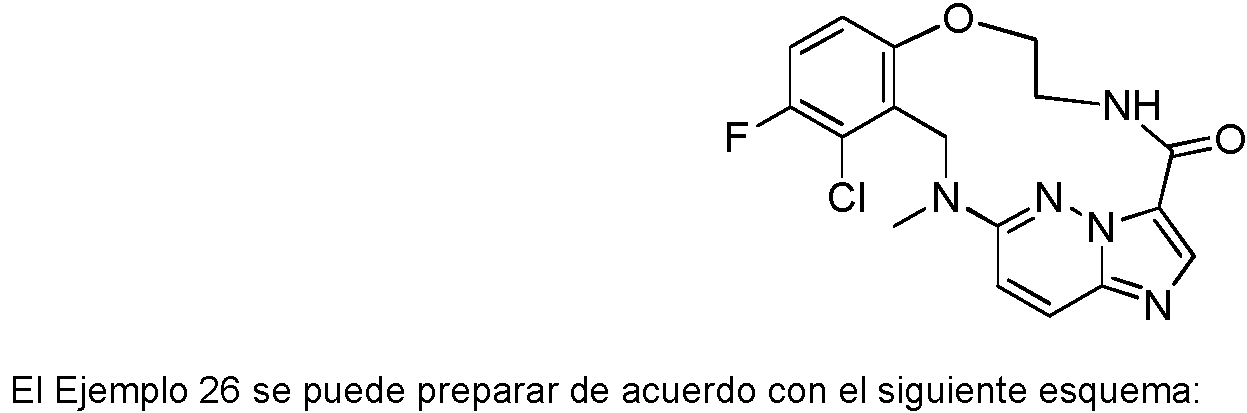

Etapa 1. Se añadió isopropóxido de titanio (IV) (1,3 equiv.) a una solución comercialmente disponible de metilamina en metanol (2 M, 3 equiv.) seguido de la adición del aldehido de partida 14C (1,0 equiv.). La mezcla de reacción se agitó a temperatura ambiente durante 5 h, después de lo cual se añadió borohidruro sódico (1,0 equiv.) y la mezcla resultante se agita adicionalmente durante otro período de 2 h. Después, la reacción se interrumpió mediante la adición de agua, el precipitado inorgánico resultante se filtró y se lavó con EtOAc. La capa orgánica se separó y la parte acuosa se extrajo adicionalmente con EtOAc (x2). Los extractos combinados se secaron (K2CO3) y se concentraron al vacío para dar 26A.Step 1. Titanium(IV) isopropoxide (1.3 equiv.) was added to a commercially available solution of methylamine in methanol (2M, 3 equiv.) followed by addition of the starting 14C aldehyde (1.0 equiv. ). The reaction mixture was stirred at room temperature for 5h, after which sodium borohydride (1.0 equiv) was added and the resulting mixture stirred further for another 2h period. After the reaction was quenched by adding water, the resulting inorganic precipitate was filtered and washed with EtOAc. The organic layer was separated and the aqueous part was further extracted with EtOAc (x2). The combined extracts were dried (K 2 CO 3 ) and concentrated in vacuo to give 26A.
Etapa 2. Una mezcla del compuesto 26A (1 equiv.) y DIPEA (2 equiv.) en n-BuOH (0,2 M) se calentó a 120 °C durante una noche, se enfrió a temperatura ambiente y después se concentró. El residuo se purifica con una columna de gel de sílice eluyendo con EtOAc/Hexanos para proporcionar el producto 26B.Step 2. A mixture of compound 26A (1 equiv.) and DIPEA (2 equiv.) in n-BuOH (0.2M) was heated at 120 °C overnight, cooled to room temperature, and then concentrated. The residue is purified on a silica gel column eluting with EtOAc/Hexanes to give product 26B.
Etapa 3. A una solución del compuesto 26B (1 equiv.) en CH2Cl2 (0,2 M), se le añadió HCl 4 M/dioxano (10 equiv.) y la mezcla se agitó hasta que todo el 26B se convirtió en 26C. Después de la concentración, el residuo se purificó en una HPLC preparativa de fase inversa para proporcionar 26C.Step 3. To a solution of compound 26B (1 equiv.) in CH 2 Cl 2 (0.2 M), 4M HCl/dioxane (10 equiv.) was added and the mixture was stirred until all 26B was removed. became 26C. After concentration, the residue was purified on reverse phase preparative HPLC to give 26C.
Etapa 4. A una solución de 26C (1 equiv.) y DIPEA (2 equiv.) en tolueno (0,01 M), se le añadió Pd(P-t-Bu3)2 (1 equiv.). La mezcla de reacción se calentó a 100 °C a 0,4 MPa (4 bar) de CO durante una noche y después se concentró. El residuo se purificó sobre una columna de gel de sílice eluyendo con EtOAc/hexanos para proporcionar 26.Step 4. To a solution of 26C (1 equiv.) and DIPEA (2 equiv.) in toluene (0.01 M), Pd(Pt-Bu 3 ) 2 (1 equiv.) was added. The reaction mixture was heated at 100 °C under 0.4 MPa (4 bar) CO overnight and then concentrated. The residue was purified on a silica gel column eluting with EtOAc/hexanes to give 26.
Ejemplos 37 y 37-1.Examples 37 and 37-1.

Los Ejemplos 37 y 37-1 se pueden preparar de acuerdo con el siguiente esquema a partir de materiales de partida racémicos o enantioméricamente enriquecidos: Examples 37 and 37-1 can be prepared according to the following scheme from racemic or enantiomerically enriched starting materials:

Etapa 1. El compuesto 37B se preparó a partir del compuesto 2C y el compuesto 37A usando el método descrito para el Ejemplo 2, Síntesis A, Etapa 2.Step 1. Compound 37B was prepared from compound 2C and compound 37A using the method described for Example 2, Synthesis A, Step 2.
Etapa 2. El compuesto 37C se preparó a partir del compuesto 37B usando el método descrito en el Ejemplo 2, Síntesis A, Etapa 3.Step 2. Compound 37C was prepared from compound 37B using the method described in Example 2, Synthesis A, Step 3.
Etapa 3. El Ejemplo 37 se preparó a partir del compuesto 37C usando el método descrito en el Ejemplo 2, Síntesis A, Etapa 4.Step 3. Example 37 was prepared from compound 37C using the method described in Example 2, Synthesis A, Step 4.
Ejemplos 38 y 38-1.Examples 38 and 38-1.

Los Ejemplos 38 y 38-1 se pueden preparar de acuerdo con el siguiente esquema a partir de materiales de partida racémicos o enantioméricamente enriquecidos: Examples 38 and 38-1 can be prepared according to the following scheme from racemic or enantiomerically enriched starting materials:

Etapa 1. El compuesto 38B se preparó a partir de los compuestos 2C y 38A como se describe en el Ejemplo 2, Síntesis A, Etapa 2.Step 1. Compound 38B was prepared from compounds 2C and 38A as described in Example 2, Synthesis A, Step 2.
Etapa 2. El compuesto 38C se preparó a partir del compuesto 38B usando el método descrito en el Ejemplo 2, Síntesis A, Etapa 3.Step 2. Compound 38C was prepared from compound 38B using the method described in Example 2, Synthesis A, Step 3.
Etapa 3. El Ejemplo 38 se preparó a partir del compuesto 38C usando el método descrito en el Ejemplo 2, Síntesis B, Etapa 4.Step 3. Example 38 was prepared from compound 38C using the method described in Example 2, Synthesis B, Step 4.
Ejemplo 39.Example 39.
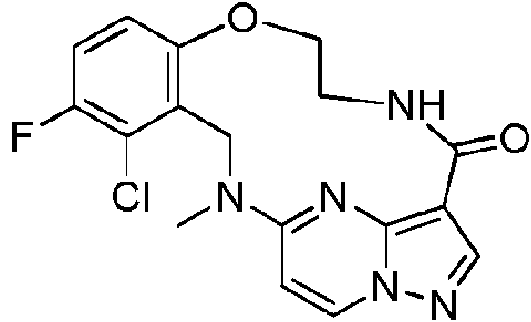
El Ejemplo 39 se preparó de acuerdo con los siguientes esquemas:Example 39 was prepared according to the following schemes:


Etapa 1. Éster ferc-butílico del ácido 2-(3-doro-4-fluoro-2-formil-fenoxi)-etil]-carbámico (39B). A una solución de 2-cloro-3-fluoro-6-hidroxi-benzaldehído (39A, 53 mg, 0,3 mmol) y éster ferc-butílico del ácido (2-cloro-etil)-carbámico (135 mg, 0,75 mmol) en DMF (5 ml), se le añadieron KI (2,0 mg, 0,012 mmol) y K2CO3 (105 mg, 0,75 mmol). La mezcla se sometió a microondas a 100 °C durante 2 h. Después, la mezcla se diluyó con agua (20 ml) y se extrajo con EtOAc (3x20 ml). Las capas orgánicas combinadas se lavaron con agua (3x20 ml) y salmuera (20 ml), se secaron sobre Na2SO4 y se concentraron para proporcionar 39B. El residuo en bruto se usó directamente en la siguiente etapa. CL-EM: (IEN) m/z 340,3 (M+Na)+.Step 1. 2-(3-Doro-4-fluoro-2-formyl-phenoxy)-ethyl]-carbamic acid ferc-butyl ester (39B). To a solution of 2-chloro-3-fluoro-6-hydroxy-benzaldehyde (39A, 53 mg, 0.3 mmol) and (2-chloro-ethyl)-carbamic acid ferc-butyl ester (135 mg, 0. 75 mmol) in DMF (5 mL), KI (2.0 mg, 0.012 mmol) and K 2 CO 3 (105 mg, 0.75 mmol) were added. The mixture was microwaved at 100 °C for 2 h. The mixture was then diluted with water (20ml) and extracted with EtOAc (3x20ml). The combined organic layers were washed with water (3x20ml) and brine (20ml), dried over Na2SO4 and concentrated to provide 39B. The crude residue was used directly in the next step. LC-MS: (IEN) m/z 340.3 (M+Na)+.
Etapa 2. Éster ferc-butílico del ácido {[2-(3-cloro-4-fluoro-2-metilaminometil-fenoxi)-etil]-carbámico (39C). A una solución de 39B (95,4 mg, 0,3 mmol) en MeOH (3 ml), se le añadió clorhidrato de metilamina (50,7 mg, 0,75 mmol). La mezcla se agitó a 60 °C durante 30 min. Después, la solución se enfrió a temperatura ambiente y se añadió NaBH4 (11,1 mg, 0,3 mmol). La mezcla se agitó a temperatura ambiente durante 2 h. La solución después se diluyó con agua (50 ml) y se extrajo con DCM (3 x 20 ml). Las capas orgánicas combinadas se secaron sobre Na2SO4 y se concentraron para proporcionar 39C. El residuo en bruto se usó directamente en la siguiente etapa. CL-EM: (IEN) m/z 333,3 (M+H)+. Step 2. {[2-(3-Chloro-4-fluoro-2-methylaminomethyl-phenoxy)-ethyl]-carbamic acid ferc-butyl ester (39C). To a solution of 39B (95.4 mg, 0.3 mmol) in MeOH (3 mL), methylamine hydrochloride (50.7 mg, 0.75 mmol) was added. The mixture was stirred at 60 °C for 30 min. The solution was then cooled to room temperature and NaBH4 (11.1 mg, 0.3 mmol) was added. The mixture was stirred at room temperature for 2h. The solution was then diluted with water (50ml) and extracted with DCM (3 x 20ml). The combined organic layers were dried over Na2SO4 and concentrated to provide 39C. The crude residue was used directly in the next step. LC-MS: (IEN) m/z 333.3 (M+H)+.
Etapa 3. Éster etílico del ácido 5-{[6-(2-ferc-butoxicarbonilamino-etoxi)-2-cloro-3-fluoro-bencil]-metil-amino}-pirazolo[1,5-a]pirimidin-3-carboxílico (39D). A una solución de 20K (67,5 mg, 0,3 mmol) y 39C (99,9 mg, 0,3 mmol) en n-BuOH (2,0 ml), se le añadió DIEA (1,0 ml). La mezcla se calentó en microondas a 150 °C durante 2 horas. Después, la mezcla se diluyó con agua y se extrajo con DCM (3x20 ml). La capa orgánica se secó sobre Na2SO4, se concentró y se purificó por cromatografía en columna sobre gel de sílice para proporcionar 17 en forma de un líquido de color amarillo. CL-EM: (IEN) m/z 522,5 (M+H)+.Step 3. 5-{[6-(2-Ferc-Butoxycarbonylamino-ethoxy)-2-chloro-3-fluoro-benzyl]-methyl-amino}-pyrazolo[1,5-a]pyrimidin-3-acid ethyl ester -carboxylic (39D). To a solution of 20K (67.5 mg, 0.3 mmol) and 39C (99.9 mg, 0.3 mmol) in n-BuOH (2.0 mL), DIEA (1.0 mL) was added. . The mixture was heated in the microwave at 150 °C for 2 hours. The mixture was then diluted with water and extracted with DCM (3x20ml). The organic layer was dried over Na2SO4, concentrated and purified by silica gel column chromatography to give 17 as a yellow liquid. LC-MS: (IEN) m/z 522.5 (M+H)+.
Etapa 4. Ácido 5-{[6-(2-ferc-butoxicarbonilamino-etoxi)-2-cloro-3-fluoro-bencil]-metil-amino}-pirazolo[1,5-a]pirimidin-3-carboxílico (39E). A una solución de 39D (40 mg, 0,0776 mmol) en MeOH (1 ml), se le añadieron LiOH (16 mg, 0,38 mmol) y H2O (1 ml). La mezcla se agitó a 60 °C durante 4 h. La solución se enfrió a temperatura ambiente, se concentró parcialmente y se acidificó mediante HCl acuoso (1 N) hasta pH 2-3. La mezcla acuosa se extrajo con DCM (3x10 ml). La capa orgánica se secó sobre Na2SO4 y se concentró para proporcionar 39E. El residuo en bruto se usó directamente en la siguiente etapa. CL-EM: (IEN) m/z 494,3 (M+H)+.Step 4. 5-{[6-(2-ferc-Butoxycarbonylamino-ethoxy)-2-chloro-3-fluoro-benzyl]-methyl-amino}-pyrazolo[1,5-a]pyrimidine-3-carboxylic acid ( 39E). To a solution of 39D (40 mg, 0.0776 mmol) in MeOH (1 mL), LiOH (16 mg, 0.38 mmol) and H 2 O (1 mL) were added. The mixture was stirred at 60 °C for 4 h. The solution was cooled to room temperature, partially concentrated, and acidified by aqueous HCl (1N) to pH 2-3. The aqueous mixture was extracted with DCM (3x10 ml). The organic layer was dried over Na2SO4 and concentrated to provide 39E. The crude residue was used directly in the next step. LC-MS: (IEN) m/z 494.3 (M+H)+.
Etapa 5. Ácido 5-{[6-(2-amino-etoxi)-2-cloro-3-fluoro-bencil]-metil-amino}-pirazolo[1,5-a]pirimidin-3-carboxílico (39F). Step 5. 5-{[6-(2-Amino-ethoxy)-2-chloro-3-fluoro-benzyl]-methyl-amino}-pyrazolo[1,5-a]pyrimidine-3-carboxylic acid (39F) .
A una solución de 39E (40 mg, 0,0776 mmol) en DCM (2 ml), se le añadió TFA (0,4 ml). La solución se agitó durante 1 h. El disolvente se retiró en un evaporador rotatorio. El residuo se volvió a disolver con DCM y se volvió a concentrar (3x) para proporcionar 39F en forma de un sólido similar a una espuma. CL-EM: (IEN) m/z 393,5 (M+H)+.To a solution of 39E (40 mg, 0.0776 mmol) in DCM (2 mL), TFA (0.4 mL) was added. The solution was stirred for 1h. The solvent was removed on a rotary evaporator. The residue was redissolved with DCM and reconcentrated (3x) to provide 39F as a foam-like solid. LC-MS: (IEN) m/z 393.5 (M+H)+.
Etapa 6. A una solución de 39F (36 mg, 0,078 mmol) en 10 ml de DCM, se le añadió DIEA (0,20 ml, 1,15 mmol). La solución se enfrió con un baño de hielo seco/acetona y se añadió HATU (40,0 mg, 0,11 mmol). La solución se dejó calentar a temperatura ambiente lentamente. La mezcla se diluyó con agua (50 ml) y se extrajo con EtOAc (3 x 50 ml). La capa orgánica combinada se lavó con agua (3 x 50 ml) y salmuera (50 ml), se secó sobre Na2SO4 y se concentró. El residuo resultante se purificó mediante una columna de sílice (MeOH al 0-5%/DCM) proporcionó el Ejemplo 39 en forma de un sólido de color blanco (6,2 mg, 23,4%). CL-EM (IEN) m/z 376,5 (M+H)+. EMN 1H (500 MHz, cloroformod) 69,51 (s, 1H), 8,40 - 8,33 (m, 2H), 7,03 (ddd, J = 8,9, 8,0, 0,7 Hz, 1H), 6,78 (dd, J = 9,3, 4,2 Hz, 1H), 6,40 (d, J = 7,9 Hz, 1H), 5,97 (dd, J = 15,0, 2,1 Hz, 1H), 4,49 - 4,43(m, 1H), 4,31 (ddd, J = 10,9, 6,4, 4,5 Hz, 1H), 4,12 - 4,03 (m, 1H), 3,91 (d, J = 14,9 Hz, 1H), 3,72 - 3,63 (m, 1H), 3,56 (s, 3H).Step 6. To a solution of 39F (36mg, 0.078mmol) in 10ml DCM, DIEA (0.20ml, 1.15mmol) was added. The solution was cooled with a dry ice/acetone bath and HATU (40.0 mg, 0.11 mmol) was added. The solution was allowed to warm to room temperature slowly. The mixture was diluted with water (50ml) and extracted with EtOAc (3 x 50ml). The combined organic layer was washed with water (3 x 50ml) and brine (50ml), dried over Na2SO4 and concentrated. The resulting residue was purified via a silica column (0-5% MeOH/DCM) to give Example 39 as a white solid (6.2 mg, 23.4%). LC-MS (IEN) m/z 376.5 (M+H)+. 1H-EMN (500 MHz, chloroformod) 69.51 (s, 1H), 8.40-8.33 (m, 2H), 7.03 (ddd, J = 8.9, 8.0, 0.7 Hz , 1H), 6.78 (dd, J = 9.3, 4.2 Hz, 1H), 6.40 (d, J = 7.9 Hz, 1H), 5.97 (dd, J = 15, 0, 2.1 Hz, 1H), 4.49 - 4.43(m, 1H), 4.31 (ddd, J = 10.9, 6.4, 4.5 Hz, 1H), 4.12 - 4.03 (m, 1H), 3.91 (d, J = 14.9 Hz, 1H), 3.72 - 3.63 (m, 1H), 3.56 (s, 3H).
Ejemplo 40.Example 40.

El Ejemplo 40 se preparó como se muestra en el siguiente esquema:Example 40 was prepared as shown in the following scheme:

Etapa 1. Ácido 5-[(5-fluoro-2-hidroxi-bencil)-metil-amino]-2-metil-pirazolo[1,5-a]pirimidin-3-carboxílico (40B). A una solución de 19A (75 mg, 0,14 mmol) en MeOH (2 ml), se le añadieron LiOH (60 mg, 1,4 mmol) y H2O (2 ml). La mezcla se agitó a 60 °C durante 4 h. La solución se enfrió a temperatura ambiente, se concentró parcialmente y se acidificó mediante HCl acuoso (1 N) hasta pH 2-3. La suspensión resultante se extrajo con EtOAc (3 x 20 ml). La capa orgánica se secó sobre Na2SO4 y se concentró para proporcionar 40A. CL-EM (IEN) m/z 331,6 (M+H)+.Step 1. 5-[(5-Fluoro-2-hydroxy-benzyl)-methyl-amino]-2-methyl-pyrazolo[1,5-a]pyrimidine-3-carboxylic acid (40B). To a solution of 19A (75 mg, 0.14 mmol) in MeOH (2 mL), LiOH (60 mg, 1.4 mmol) and H 2 O (2 mL) were added. The mixture was stirred at 60 °C for 4 h. The solution was cooled to room temperature, partially concentrated, and acidified by aqueous HCl (1N) to pH 2-3. The resulting suspension was extracted with EtOAc (3 x 20 mL). The organic layer was dried over Na2SO4 and concentrated to provide 40A. LC-MS (IEN) m/z 331.6 (M+H)+.
Etapa 2. (2-Hidroxi-etil)-amida del ácido 5-[(5-fluoro-2-hidroxi-bencil)-metil-amino]-2-metil-pirazolo[1,5-a]pirimidin-3-carboxílico (40B). A una solución de 40A (140 mg, 0,42 mmol) y 2-amino-etanol (244 mg, 4 mmol) en d Cm (5 ml) a 0 °C, se le añadieron DIEA (0,20 ml, 1,15 mmol) y HATU (380,0 mg, 1,0 mmol). La solución se dejó calentar a temperatura ambiente lentamente. Después, la mezcla se diluyó con agua (25 ml) y se extrajo con EtOAc (3 x 25 ml). Las capas orgánicas combinadas se lavaron con HCl (1 N, 3 x 20 ml) y salmuera (50 ml), se secaron sobre Na2SO4 y se concentraron. El residuo resultante se purificó mediante una columna de gel de sílice eluyendo con MeOH al 0-5%/DCM (10 CV) proporcionó 40B en forma de un sólido de color blanco (74 mg, 47%). CL-EM (IEN) m/z 374,3 (M+H)+. Step 2. 5-[(5-fluoro-2-hydroxy-benzyl)-methyl-amino]-2-methyl-pyrazolo[1,5-a]pyrimidin-3- acid (2-hydroxy-ethyl)-amide carboxylic (40B). To a solution of 40A (140 mg, 0.42 mmol) and 2-amino-ethanol (244 mg, 4 mmol) in d Cm (5 mL) at 0 °C, DIEA (0.20 mL, 1 0.15 mmol) and HATU (380.0 mg, 1.0 mmol). The solution was allowed to warm to room temperature slowly. The mixture was then diluted with water (25ml) and extracted with EtOAc (3 x 25ml). The combined organic layers were washed with HCl (1N, 3 x 20 mL) and brine (50 mL), dried over Na2SO4, and concentrated. The resulting residue was purified via a silica gel column eluting with 0-5% MeOH/DCM (10 CV) to provide 40B as a white solid (74 mg, 47%). LC-MS (IEN) m/z 374.3 (M+H)+.
Etapa 3. A una solución de 40B (74 mg, 0,2 mmol) en THF (3 ml) y DCM (3 ml) a 0 °C, se le añadieron PPh3 (131 mg, 0,5 mmol) y azodicarboxilato de di-ferc-butilo (DTAD) (115 mg, 0,5 mmol). La mezcla se dejó calentar a temperatura ambiente y se agitó durante 4 h adicionales. El disolvente se retiró y el residuo se purificó mediante una columna de gel de sílice eluyendo con MeOH al 0-10%/DCM (10 CV), seguido de TLC preparativa para proporcionar el Ejemplo 40 en forma de un sólido de color blanco (15 mg). CL-e M (IEN) m/z 356,5 (M+H)+; Rm N 1H (500 MHz, cloroformo-d) 6 8,12 (d, J = 7,7 Hz, 1H), 6,93 (ddd, J = 9,0, 3,1, 0,9 Hz, 1H), 6,78 (ddd, J = 9,0, 7,3, 3,0 Hz, 1H), 6,71 (dd, J = 9,1, 4,5 Hz, 1H), 6,28 (d, J = 7,7 Hz, 1H), 5,77 (dd, J = 15,2, 1,7 Hz, 1H), 4,38 - 4,33 (m, 1H), 3,98 (s, 1H), 3,91 (d, J = 1,4 Hz, 1H), 3,78 (dd, J = 15,1, 0,9 Hz, 1H), 3,45 (s, 3H), 3,43 - 3,36 (m, 1H), 2,45 (s, 3H).Step 3. To a solution of 40B (74 mg, 0.2 mmol) in THF (3 mL) and DCM (3 mL) at 0 °C, PPh3 (131 mg, 0.5 mmol) and sodium azodicarboxylate were added. di-ferc-butyl (DTAD) (115 mg, 0.5 mmol). The mixture was allowed to warm to room temperature and stirred for a further 4h. The solvent was removed and the residue was purified via a silica gel column eluting with 0-10% MeOH/DCM (10 CV), followed by preparative TLC to give Example 40 as a white solid (15 mg). LC- e M (IEN) m/z 356.5 (M+H)+; R m N 1H (500 MHz, chloroform-d) 6 8.12 (d, J = 7.7 Hz, 1H), 6.93 (ddd, J = 9.0, 3.1, 0.9 Hz, 1H), 6.78 (ddd, J = 9.0, 7.3, 3.0 Hz, 1H), 6.71 (dd, J = 9.1, 4.5 Hz, 1H), 6.28 (d, J = 7.7 Hz, 1H), 5.77 (dd, J = 15.2, 1.7 Hz, 1H), 4.38 - 4.33 (m, 1H), 3.98 ( s, 1H), 3.91 (d, J = 1.4 Hz, 1H), 3.78 (dd, J = 15.1, 0.9 Hz, 1H), 3.45 (s, 3H), 3.43-3.36 (m, 1H), 2.45 (s, 3H).
Ejemplo 41.Example 41.

El Ejemplo 41 se preparó usando el método mostrado en el siguiente esquema:Example 41 was prepared using the method shown in the following scheme:

Etapa 1. Éster ferc-butílico del ácido [2-(2-acetil-4-fluoro-fenoxi)-etil]-carbámico (41B). A una mezcla de 1-(5-fluoro-2-hidroxi-fenil)-etanona (41A, 773 mg, 5,0 mmol) y éster ferc-butílico del ácido (2-cloroetil)-carbámico (1,80 g, 10,0 mmol) en DMF (20 ml), se le añadieron KI (2,0 mg, 0,012 mmol) y CS2CO3 (3,26 g, 10,0 mmol). La mezcla se agitó a 80 °C durante una noche. Después, la mezcla se enfrió a temperatura ambiente, se diluyó con EtOAc y se lavó con NaOH 1 N (5 x 10 ml) hasta que la CLEM no mostró ningún pico de 1-(5-fluoro-2-hidroxi-fenil)-etanona. La capa orgánica se secó sobre Na2SO4 y se concentró. Después, el residuo se purificó mediante una columna de gel de sílice eluyendo con EtOAc/hexano (0-30%, 10 CV) para proporcionar el producto deseado 41B en forma de un sólido de color amarillo (1,1 g, 73,8%). CL-EM (IEN) m/z 320,3 (M+Na)+.Step 1. [2-(2-Acetyl-4-fluoro-phenoxy)-ethyl]-carbamic acid ferrt-butyl ester (41B). To a mixture of 1-(5-fluoro-2-hydroxy-phenyl)-ethanone (41A, 773 mg, 5.0 mmol) and (2-chloroethyl)-carbamic acid ferrt-butyl ester (1.80 g, 10.0 mmol) in DMF (20 mL), KI (2.0 mg, 0.012 mmol) and CS 2 CO 3 (3.26 g, 10.0 mmol) were added. The mixture was stirred at 80 °C overnight. The mixture was then cooled to room temperature, diluted with EtOAc and washed with 1N NaOH (5 x 10 mL) until LCMS showed no 1-(5-fluoro-2-hydroxy-phenyl)-peak. ethanone. The organic layer was dried over Na2SO4 and concentrated. The residue was then purified via a silica gel column eluting with EtOAc/hexane (0-30%, 10 CV) to provide the desired product 41B as a yellow solid (1.1 g, 73.8 %). LC-MS (IEN) m/z 320.3 (M+Na)+.
Etapa 2. (2-(4-Fluoro-2-(1-hidroxietil)fenoxi)etil)carbamato de ferc-butilo (41C). A una solución de 41B (1,0 g, 3,36 mmol) en MeOH (10 ml), se le añadió NaBH4 (640 mg, 16,8 mmol) en porciones. La mezcla se agitó a temperatura ambiente durante 2 h. La solución después se diluyó con agua (50 ml) y se extrajo con DCM (3 x 20 ml). Las capas de DCM combinadas se secaron sobre Na2SO4 y se concentraron. El residuo se purificó mediante una columna de gel de sílice eluyendo con EtOAc/hexano (0-50%, 10 CV) para proporcionar el producto deseado en forma de un sólido de color amarillo pálido (0,75 g, 75%). CL-EM (IEN) m/z 322,3 (M+Na)+; RMN 1H (500 MHz, cloroformo-d) 67,11 (dd, J = 9,2, 3,4 Hz, 1H), 6,89 (ddd, J = 9,0, 7,9, 3,2 Hz, 1H), 6,77 (dd, J = 8,9, 4,4 Hz, 1H), 5,09 (c, J = 6,6 Hz, 1H), 4,92 (d, J = 4,4 Hz, 1H), 4,03 (t, J = 5,2 Hz, 2H), 3,62 - 3,50 (m, 2H), 1,49 (d, J = 6,4 Hz, 3H), 1,45 (s, 9H).Step 2. Fert-butyl (2-(4-Fluoro-2-(1-hydroxyethyl)phenoxy)ethyl)carbamate (41C). To a solution of 41B (1.0 g, 3.36 mmol) in MeOH (10 mL), NaBH4 (640 mg, 16.8 mmol) was added portionwise. The mixture was stirred at room temperature for 2h. The solution was then diluted with water (50ml) and extracted with DCM (3 x 20ml). The combined DCM layers were dried over Na2SO4 and concentrated. The residue was purified by column of silica gel eluting with EtOAc/hexane (0-50%, 10 CV) to provide the desired product as a pale yellow solid (0.75 g, 75%). LC-MS (IEN) m/z 322.3 (M+Na)+; 1H NMR (500 MHz, chloroform-d) 67.11 (dd, J = 9.2, 3.4 Hz, 1H), 6.89 (ddd, J = 9.0, 7.9, 3.2 Hz , 1H), 6.77 (dd, J = 8.9, 4.4 Hz, 1H), 5.09 (c, J = 6.6 Hz, 1H), 4.92 (d, J = 4, 4 Hz, 1H), 4.03 (t, J = 5.2 Hz, 2H), 3.62 - 3.50 (m, 2H), 1.49 (d, J = 6.4 Hz, 3H) , 1.45 (s, 9H).
Etapa 3. Éster etílico del ácido 6-{1-[2-(2-ferc-butoxicarbonilamino-etoxi)-5-fluoro-fenil]-etoxil-imidazo[1,2-b]piridazin-3-carboxílico (41D). A una solución de 41C (600 mg, 2,0 mmol) y éster ferc-butílico del ácido {2-[4-fluoro-2-(1-hidroxietil)-fenoxi]-etil}-carbámico (450 mg, 2,0 mmol) en THF seco (40,0 ml) a -78 °C, se le añadió NaH (60%, 80 mg, 2,0 mmol) en porciones. La suspensión se agitó a -78 °C durante 4 h y se dejó calentar a 0 °C y se agitó durante 4 h adicionales. Después, la mezcla se puso en el congelador a -20 °C durante una noche. Después, la mezcla se inactivó con una mezcla de hielo y HCl 1 N y se extrajo con EtOAc (3 x 20 ml). La capa orgánica se secó sobre Na2SO4, se concentró y se purificó dos veces para proporcionar el producto deseado en forma de un sólido de color amarillo (240 mg, 25%). CL-EM (IEN) m/z 511,6 (M+Na)+; RMN 1H (500 MHz, cloroformo-d) 88,16 (s, 1H), 7,90 (d, J = 9,7 Hz, 1H), 7,16 (dd, J = 9,0, 3,2 Hz, 1H), 0,95 (d, J = 9,5 Hz, 1H), 6,90 - 6,88 (m, 1H), 6,81 - 6,78 (m, 1H), 6,68 (c, J = 6,2 Hz, 1H), 5,84 - 5,68 (m, 1H), 4,38 (c, J = 7,2 Hz, 2H), 4,15 - 4,09 (m, 2H), 3,60 - 3,52 (m, 2H), 1,65 (d, J = 6,4 Hz, 3H), 1,38 (d, J = 7,2 Hz, 3H), 1,35 (s, 9H).Step 3. 6-{1-[2-(2-Ferc-Butoxycarbonylamino-ethoxy)-5-fluoro-phenyl]-ethoxyl-imidazo[1,2-b]pyridazine-3-carboxylic acid ethyl ester (41D) . To a solution of 41C (600 mg, 2.0 mmol) and {2-[4-fluoro-2-(1-hydroxyethyl)-phenoxy]-ethyl}-carbamic acid ferrt-butyl ester (450 mg, 2, 0 mmol) in dry THF (40.0 mL) at -78 °C, NaH (60%, 80 mg, 2.0 mmol) was added portionwise. The suspension was stirred at -78 °C for 4 h and allowed to warm to 0 °C and stirred for 4 h. additional. The mixture was then placed in the freezer at -20 °C overnight. The mixture was then quenched with ice-1N HCl and extracted with EtOAc (3 x 20 mL). The organic layer was dried over Na2SO4, concentrated, and purified twice to provide the desired product as a yellow solid (240 mg, 25%). LC-MS (IEN) m/z 511.6 (M+Na)+; 1H NMR (500 MHz, chloroform-d) 88.16 (s, 1H), 7.90 (d, J = 9.7 Hz, 1H), 7.16 (dd, J = 9.0, 3.2 Hz, 1H), 0.95 (d, J = 9.5 Hz, 1H), 6.90 - 6.88 (m, 1H), 6.81 - 6.78 (m, 1H), 6.68 (c, J = 6.2 Hz, 1H), 5.84 - 5.68 (m, 1H), 4.38 (c, J = 7.2 Hz, 2H), 4.15 - 4.09 ( m, 2H), 3.60 - 3.52 (m, 2H), 1.65 (d, J = 6.4 Hz, 3H), 1.38 (d, J = 7.2 Hz, 3H), 1.35 (s, 9H).
Etapa 4. El compuesto 41D se convirtió en el Ejemplo 41 usando métodos análogos a los descritos en el presente documento. EM: 343,2 (M+H)+; RMN 1H (500 MHz, Cloroformo-d) 89,82 (d, J = 7,0 Hz, 1H), 8,27 (s, 1H), 8,09 (d, J = 9,5 Hz, 1H), 7,18 (dd, J = 8,9, 3,2 Hz, 1H), 7,01 - 6,94 (m, 2H), 6,83 (dd, J = 9,0, 4,3 Hz, 1H), 6,60 - 6,53 (m, 1H), 4,63 - 4,52 (m, 1H), 4,27 - 4,16 (m, 1H), 4,16-4,04 (m, 1H), 3,70 - 3,56 (m, 1H), 1,70 (d, J = 6,4 Hz, 3H)Step 4. Compound 41D was converted to Example 41 using methods analogous to those described herein. MS: 343.2 (M+H)+; 1H NMR (500 MHz, Chloroform-d) 89.82 (d, J = 7.0 Hz, 1H), 8.27 (s, 1H), 8.09 (d, J = 9.5 Hz, 1H) , 7.18 (dd, J = 8.9, 3.2 Hz, 1H), 7.01 - 6.94 (m, 2H), 6.83 (dd, J = 9.0, 4.3 Hz , 1H), 6.60 - 6.53 (m, 1H), 4.63 - 4.52 (m, 1H), 4.27 - 4.16 (m, 1H), 4.16-4.04 (m, 1H), 3.70 - 3.56 (m, 1H), 1.70 (d, J = 6.4 Hz, 3H)
Ejemplo 42.Example 42.

El Ejemplo 42 se preparó usando los métodos mostrados en el siguiente esquema:Example 42 was prepared using the methods shown in the following scheme:

Etapa 1. Éster etílico del ácido 6-[(5-fluoro-2-hidroxi-bencil)-metil-amino]-imidazo[1,2-b]piridazin-3-carboxílico (42B). A una mezcla de 4-fluoro-2-metilaminometil-fenol (20L, 305,2 mg, 1,97 mmol) y éster etílico del ácido 6-cloroimidazo[1,2-b]piridazin-3-carboxílico (42A, 230 mg, 1,02 mmol) en DMSO (5 ml), se le añadió KF (180 mg, 3,01 mmol). La mezcla de reacción se agitó a 120 °C durante 18 horas en una atmósfera de nitrógeno. Después, la solución se enfrió a temperatura ambiente, se diluyó con agua (20 ml) y se extrajo con EtOAc (3 x 50 ml). Además, las capas orgánicas combinadas se lavaron con agua (3 x 50 ml) y salmuera (50 ml), se secaron sobre Na2SO4 y se concentraron. Después, el residuo se purificó mediante una columna de gel de sílice eluyendo con EtOAc/hexano (0-50%, 10 CV) para proporcionar el producto deseado en forma de un sólido de color blanco (240 mg, 69%). CL-EM (IEN) m/z 345,2 (M+H)+; RMN 1H (500 MHz, cloroformo-d) 88,61 (s, 1H), 8,17 (s, 1H), 7,91 (d, J = 10,0 Hz, 1H), 7,00-6,86 (m, 4H), 4,78 (s, 2H), 4,47 (cd, J = 7,2, 0,5 Hz, 2H), 3,17 (s, 3H), 1,41 (td, J = 7,1,0,5 Hz, 3H).Step 1. 6-[(5-Fluoro-2-hydroxy-benzyl)-methyl-amino]-imidazo[1,2-b]pyridazine-3-carboxylic acid ethyl ester (42B). To a mixture of 4-fluoro-2-methylaminomethyl-phenol (20L, 305.2 mg, 1.97 mmol) and 6-chloroimidazo[1,2-b]pyridazine-3-carboxylic acid ethyl ester (42A, 230 mg, 1.02 mmol) in DMSO (5 mL), KF (180 mg, 3.01 mmol) was added. The reaction mixture was stirred at 120 °C for 18 hours under a nitrogen atmosphere. The solution was then cooled to room temperature, diluted with water (20ml) and extracted with EtOAc (3 x 50ml). Additionally, the combined organic layers were washed with water (3 x 50 mL) and brine (50 mL), dried over Na2SO4, and concentrated. The residue was then purified via a silica gel column eluting with EtOAc/hexane (0-50%, 10 CV) to provide the desired product as a white solid (240 mg, 69%). LC-MS (IEN) m/z 345.2 (M+H)+; 1H NMR (500 MHz, chloroform-d) 88.61 (s, 1H), 8.17 (s, 1H), 7.91 (d, J = 10.0 Hz, 1H), 7.00-6, 86 (m, 4H), 4.78 (s, 2H), 4.47 (cd, J = 7.2, 0.5 Hz, 2H), 3.17 (s, 3H), 1.41 (td , J = 7.1,0.5Hz, 3H).
Etapa 2. Éster etílico del ácido 6-{[2-(2-terc-butoxicarbonilamino-etoxi)-5-fluoro-bencil]-metil-amino}-imidazo[1,2-b]piridazin-3-carboxílico (42C). A una solución de éster etílico del ácido 6-[(5-fluoro-2-hidroxi-bencil)-metil-amino]-imidazo[1,2-b]piridazin-3-carboxílico (2B, 200 mg, 0,58 mmol) y éster terc-butílico del ácido (2-cloro-etil)-carbámico (209 mg, 1,16 mmol) en DMF (5 ml), se le añadieron K2CO3 (200 mg, 1,45 mmol) y KI (2,0 mg, 0,012 mmol). La mezcla se calentó a 90 °C durante 4 h en una atmósfera de nitrógeno. Después, la mezcla se diluyó con agua (20 ml) y se extrajo con EtOAc (3 x 10 ml). Después, las capas orgánicas combinadas se lavaron con agua (3 x 5 ml) y salmuera (2 x 5 ml). La capa orgánica se secó sobre Na2SO4 y se concentró. El residuo resultante se purificó mediante una columna de gel de sílice eluyendo con EtOAc/hexano (0-100%, 10 CV) para proporcionar 42C en forma de un sólido de color blanco (203 mg, 76%). CL-EM (IEN) m/z 510,1 (M+Na)+; RMN 1H (500 MHz, Cloroformo-d) 8 (ppm) 8,16 (s, 1H), 7,85 (d, J = 9,9 Hz, 1H), 7,00 (dd, J = 8,9, 3,2 Hz, 1H), 6,95 - 6,87 (m, 2H), 6,80 (dd, J = 8,9, 4,3 Hz, 1H), 4,95 (s, 1H), 4,74 (s, 2H), 4,41 (c, J = 7,2 Hz, 2H), 4,04 (t, J = 5,2 Hz, 2H), 3,56 - 3,50 (m, 2H), 3,26 (s, 3H), 1,43 (s, 9H), 1,40 (t, J = 7,2 Hz, 3H).Step 2. 6-{[2-(2-tert-Butoxycarbonylamino-ethoxy)-5-fluoro-benzyl]-methyl-amino}-imidazo[1,2-b]pyridazine-3-carboxylic acid ethyl ester (42C ). To a solution of 6-[(5-fluoro-2-hydroxy-benzyl)-methyl-amino]-imidazo[1,2-b]pyridazine-3-carboxylic acid ethyl ester (2B, 200 mg, 0.58 mmol) and (2-chloro-ethyl)-carbamic acid tert-butyl ester (209 mg, 1.16 mmol) in DMF (5 mL), K 2 CO 3 (200 mg, 1.45 mmol) was added. and KI (2.0mg, 0.012mmol). The mixture was heated at 90 °C for 4 h under a nitrogen atmosphere. The mixture was then diluted with water (20ml) and extracted with EtOAc (3 x 10ml). The combined organic layers were then washed with water (3 x 5 ml) and brine (2 x 5 ml). The organic layer was dried over Na2SO4 and concentrated. The resulting residue was purified by column of silica gel eluting with EtOAc/hexane (0-100%, 10 CV) to give 42C as a white solid (203 mg, 76%). LC-MS (IEN) m/z 510.1 (M+Na)+; 1H NMR (500 MHz, Chloroform-d) 8 (ppm) 8.16 (s, 1H), 7.85 (d, J = 9.9 Hz, 1H), 7.00 (dd, J = 8.9 , 3.2 Hz, 1H), 6.95 - 6.87 (m, 2H), 6.80 (dd, J = 8.9, 4.3 Hz, 1H), 4.95 (s, 1H), 4.74 (s, 2H), 4.41 (c, J = 7.2 Hz, 2H), 4.04 (t, J = 5.2 Hz, 2H), 3.56 - 3, 50 (m, 2H), 3.26 (s, 3H), 1.43 (s, 9H), 1.40 (t, J =7.2 Hz, 3H).
Etapa 3. El compuesto 42C se convirtió en el Ejemplo 42 usando métodos análogos a los descritos en el presente documento. EM: 342,5 (M+H)+; RMN 1H (500 MHz, cloroformo-d) 810,01 (d, J = 6,9 Hz, 1H), 8,17 (s, 1H), 8,04 (d, J = 10,0 Hz, 1H), 7,07 - 7,04 (m, 1H), 7,00 (d, J = 10,0 Hz, 1H), 6,96 - 6,92 (m, 1H), 6,84 (dd, J = 9,1, 4,5 Hz, 1H), 5,69 (dd, J = 15,8, 1,6 Hz, 1H), 4,55 (dt, J = 9,9, 3,7 Hz, 1H), 4,20 - 4,09 (m, 2H), 3,98 (dd, J = 15,9, 1,0 Hz, 1H), 3,66 - 3,62 (m, 1H), 3,61 (s, 3H).Step 3. Compound 42C was converted to Example 42 using methods analogous to those described herein. MS: 342.5 (M+H)+; 1H NMR (500 MHz, chloroform-d) 810.01 (d, J = 6.9 Hz, 1H), 8.17 (s, 1H), 8.04 (d, J = 10.0 Hz, 1H) , 7.07 - 7.04 (m, 1H), 7.00 (d, J = 10.0 Hz, 1H), 6.96 - 6.92 (m, 1H), 6.84 (dd, J = 9.1, 4.5 Hz, 1H), 5.69 (dd, J = 15.8, 1.6 Hz, 1H), 4.55 (dt, J = 9.9, 3.7 Hz, 1H), 4.20 - 4.09 (m, 2H), 3.98 (dd, J = 15.9, 1.0 Hz, 1H), 3.66 - 3.62 (m, 1H), 3 .61 (s, 3H).
Ejemplo 51-1Example 51-1

Etapa 1 A una solución de A8 (399,4 mg, 1,16 mmol) y (2-cloroetil)carbamato de tere-butilo (260,5 mg, 1,45 mmol) en DMF (5,8 ml), se le añadió K2CO3 (801,6 mg, 5,80 mmol) y se calentó a 80 °C con agitación durante 6 horas. La reacción se enfrió a temperatura ambiente y se diluyó con DCM (3 ml), se filtró a través de un filtro de jeringa y se concentró a presión reducida. La cromatografía ultrarrápida (sistema ISCO, sílice (12 g), 0-70 % de acetato de etilo en hexano) proporcionó 51-1A (407,4 mg, 0,836 mmol, 72 % de rendimiento).Step 1 To a solution of A8 (399.4 mg, 1.16 mmol) and tert-butyl (2-chloroethyl)carbamate (260.5 mg, 1.45 mmol) in DMF (5.8 mL), add added K 2 CO 3 (801.6 mg, 5.80 mmol) and heated at 80 °C with stirring for 6 hours. The reaction was cooled to room temperature and diluted with DCM (3 mL), filtered through a syringe filter, and concentrated under reduced pressure. Flash chromatography (ISCO system, silica (12 g), 0-70% ethyl acetate in hexane) provided 51-1A (407.4 mg, 0.836 mmol, 72% yield).
Etapa 2. A una solución de 51-1A (407,4 mg, 0,836 mmol) en MeOH (6 ml) y THF (4 ml), se le añadió una solución acuosa de LiOH (2 M, 4,0 ml) a temperatura ambiente. La solución de reacción se calentó a 70 °C durante 2 horas. El matraz de reacción se enfrió a temperatura ambiente, se diluyó con agua y metanol, y después, se inactivó con una solución acuosa de HCl (2 M, 4 ml) a pH <5. La mezcla se extrajo con DCM (3x5 ml), se secó con Na2SO4, se concentró a presión reducida y se secó a alto vacío durante una noche. A una solución del producto ácido en DCM (6 ml), se le añadió HCl 4 M en 1,4-dioxano (2,97 ml). La mezcla se agitó a temperatura ambiente durante 3 horas, y después se concentró a presión reducida y se secó a alto vacío. A una solución del producto de-Boc y FDPP (352,9 mg, 0,918 mmol) en d Mf (21 ml), se le añadió base de Hunig (539,5 mg, 0,327 mmol) a temperatura ambiente. La mezcla se agitó durante 2,5 horas, y después, se interrumpió la reacción con una solución 2 M de Na2CO3 (21 ml). La mezcla se agitó durante 15 min y después se extrajo con DCM (4 x 10 ml). Los extractos combinados se secaron con Na2SO4 y se concentraron a presión reducida. El residuo se purificó con cromatografía ultrarrápida (sistema ISCO, sílice (12 g), metanol al 0-11,25% en diclorometano) para proporcionar 51-1 (164,0 mg, 0,480 mmol, rendimiento del 57,55% durante tres etapas).Step 2. To a solution of 51-1A (407.4 mg, 0.836 mmol) in MeOH (6 mL) and THF (4 mL), aqueous LiOH solution (2 M, 4.0 mL) was added to room temperature. The reaction solution was heated at 70 °C for 2 hours. The reaction flask was cooled to room temperature, diluted with water and methanol, and then quenched with aqueous HCl solution (2M, 4 mL) to pH <5. The mixture was extracted with DCM (3x5 mL), dried over Na2SO4, concentrated under reduced pressure, and dried under high vacuum overnight. To a solution of the acidic product in DCM (6 mL), 4M HCl in 1,4-dioxane (2.97 mL) was added. The mixture was stirred at room temperature for 3 hours, then concentrated under reduced pressure and dried under high vacuum. To a solution of the product de-Boc and FDPP (352.9 mg, 0.918 mmol) in dMf (21 mL), Hunig's base (539.5 mg, 0.327 mmol) was added at room temperature. The mixture was stirred for 2.5 hours, then quenched with 2M Na2CO3 solution (21 mL). The mixture was stirred for 15 min and then extracted with DCM (4 x 10 ml). The combined extracts were dried over Na2SO4 and concentrated under reduced pressure. The residue was purified with flash chromatography (ISCO system, silica (12 g), 0-11.25% methanol in dichloromethane) to give 51-1 (164.0 mg, 0.480 mmol, 57.55% yield for three stages).
Ejemplo 53.Example 53.

El Ejemplo 53 se preparó usando los métodos mostrados en el siguiente esquema:Example 53 was prepared using the methods shown in the following scheme:


Etapa 1. Ácido 5-[1-(5-fluoro-2-hidroxi-fenil)-etilamino]-pirazolo[1,5-a]pirimidin-3-carboxílico (53A). A una solución de éster etílico del ácido 5-[(5-fluoro-2-hidroxi-bencil)-metil-amino]-pirazolo[1,5-a]pirimidin-3-carboxílico (20 M, 300 mg, 0,87 mmol) en MeOH (5 ml), se le añadió LiOH (420 mg, 10 mmol), seguido de 5 ml de H2O. La mezcla se dejó en agitación a 60 °C durante 4 h. La solución se enfrió a temperatura ambiente, se concentró parcialmente y se acidificó con HCl 1 N hasta pH 2-3. La suspensión resultante se extrajo con EtOAc (3 x 20 ml). Las capas orgánicas combinadas se secaron sobre Na2SO4 y se concentraron. El residuo se usó directamente en la siguiente etapa. CLEM (IEN+) m/z 317.4 (M+H)+.Step 1. 5-[1-(5-Fluoro-2-hydroxy-phenyl)-ethylamino]-pyrazolo[1,5-a]pyrimidine-3-carboxylic acid (53A). To a solution of 5-[(5-fluoro-2-hydroxy-benzyl)-methyl-amino]-pyrazolo[1,5-a]pyrimidine-3-carboxylic acid ethyl ester (20 M, 300 mg, 0. 87 mmol) in MeOH (5 mL), LiOH (420 mg, 10 mmol) was added, followed by 5 mL H 2 O. The mixture was allowed to stir at 60 °C for 4 h. The solution was cooled to room temperature, partially concentrated, and acidified with 1N HCl to pH 2-3. The resulting suspension was extracted with EtOAc (3 x 20 mL). The combined organic layers were dried over Na2SO4 and concentrated. The residue was used directly in the next stage. LCMS (IEN+) m/z 317.4 (M+H)+.
Etapa 2. Éster metílico del ácido3-({5-[(5-fluoro-2-hidroxi-bencil)-metil-amino]-pirazolo[1,5-a]pirimidin-3-carbonil}-amino)-2-hidroxi-propiónico (53B). A una solución de 53A (80 mg, 0,25 mmol) y clorhidrato del éster metílico del ácido 3-amino-2-hidroxi-propiónico (70 mg, 0,5 mmol) en DCM (5 ml) a 0 °C, se le añadió DIPEA (1,0 ml, 5,7 mmol), seguido de HATU (140,0 mg, 0,5 mmol). La solución se dejó calentar a temperatura ambiente lentamente. La mezcla se diluyó con agua (25 ml) y se extrajo con EtOAc (3 x 25 ml). Las capas orgánicas combinadas se lavaron con HCl 1 N (3 x 20 ml) y salmuera (50 ml) y se secaron sobre Na2SO4. El disolvente se retiró y el sólido resultante de color blanco se usó directamente en la siguiente etapa. CL-EM (IEN+) m/z 418,4 (M+H)+.Step 2. 3-({5-[(5-Fluoro-2-hydroxy-benzyl)-methyl-amino]-pyrazolo[1,5-a]pyrimidine-3-carbonyl}-amino)-2- acid methyl ester hydroxy-propionic (53B). To a solution of 53A (80 mg, 0.25 mmol) and 3-amino-2-hydroxy-propionic acid methyl ester hydrochloride (70 mg, 0.5 mmol) in DCM (5 mL) at 0 °C, DIPEA (1.0 mL, 5.7 mmol) was added, followed by HATU (140.0 mg, 0.5 mmol). The solution was allowed to warm to room temperature slowly. The mixture was diluted with water (25ml) and extracted with EtOAc (3 x 25ml). The combined organic layers were washed with 1N HCl (3 x 20 mL) and brine (50 mL) and dried over Na2SO4. The solvent was removed and the resulting white solid was used directly in the next step. LC-MS (IEN+) m/z 418.4 (M+H)+.
Etapa 3. 11-Fluoro-14-metil-4-oxo-4,5,6,7,13,14-hexahidro-1,15-etenopirazolo[4,3-f][1,4,8,10]benzoxatriazaciclotridecin-7-carboxilato de metilo (53C). A una solución de 53B (83 mg, 0,2 mmol) en DCM (5 ml), se le añadió PPh3 (263 mg,1,0 mmol), seguido de CBr4 (332 mg, 1,0 mmol). La mezcla se agitó a temperatura ambiente durante una noche. El disolvente se retiró y el residuo se volvió a disolver en DMF (5 ml), seguido de la adición de K2CO3 (116,8 mg, 0,84 mmol). Después, la mezcla se agitó a 80 °C hasta la formación completa del producto deseado. Después, la mezcla se diluyó con EtOAc y se lavó con agua. La capa orgánica se secó sobre Na2SO4 y se concentró. El residuo se purificó mediante columna de sílice (0-10%, MeOH/DCM) para proporcionar 53C en forma de un sólido de color blanco (40 mg). CL-EM (IEN+ ) m/z 400,2 (M+H)+.Step 3. 11-Fluoro-14-methyl-4-oxo-4,5,6,7,13,14-hexahydro-1,15-ethenopyrazolo[4,3-f][1,4,8,10] Methyl benzoxatriazacyclotridezine-7-carboxylate (53C). To a solution of 53B (83 mg, 0.2 mmol) in DCM (5 mL), PPh3 (263 mg, 1.0 mmol) was added, followed by CBr4 (332 mg, 1.0 mmol). The mixture was stirred at room temperature overnight. The solvent was removed and the residue redissolved in DMF (5 mL), followed by the addition of K 2 CO 3 (116.8 mg, 0.84 mmol). The mixture was then stirred at 80 °C until complete formation of the desired product. The mixture was then diluted with EtOAc and washed with water. The organic layer was dried over Na2SO4 and concentrated. The residue was purified by column of silica (0-10%, MeOH/DCM) to give 53C as a white solid (40mg). LC-MS (IEN+ ) m/z 400.2 (M+H)+.
Etapa 4. A 53C (20 mg, 0,05 mmol), se le añadió NH3 en una solución de MeOH (7 N, 2 ml). La mezcla se agitó a 60 °C durante una noche. El disolvente se retiró y el residuo se purificó mediante columna de sílice (0-10%, MeOH/DCM) para proporcionar el Ejemplo 53 en forma de un sólido de color blanquecino (8 mg). CL-EM (IEN+) m/z 385.5 (M+H)+; RMN 1H (300 MHz, Cloroformo-d) 58,41 (s, 1H), 8,34 (d, J = 7,9 Hz, 1H), 8,17 (s, 1H), 6,99 - 6,92 (m, 2H), 6,77 (dd, J = 6,2, 3,5 Hz, 1H), 6,38 (d, J = 7,9 Hz, 1H), 5,63 - 5,44 (m, 2H), 5,09 (dd, J = 11,0, 8,4 Hz, 1H), 4,38 (dd, J = 14,7, 11,0 Hz, 1H), 4,28-4,17 (m, 1H), 4,17 - 4,07 (m, 2H), 3,22 (s, 3H).Step 4. To 53C (20 mg, 0.05 mmol), NH 3 in MeOH solution (7 N, 2 mL) was added. The mixture was stirred at 60 °C overnight. The solvent was removed and the residue was purified by column of silica (0-10%, MeOH/DCM) to give Example 53 as an off-white solid (8mg). LC-MS (IEN+) m/z 385.5 (M+H)+; 1H NMR (300 MHz, Chloroform-d) 58.41 (s, 1H), 8.34 (d, J = 7.9 Hz, 1H), 8.17 (s, 1H), 6.99-6, 92 (m, 2H), 6.77 (dd, J = 6.2, 3.5 Hz, 1H), 6.38 (d, J = 7.9 Hz, 1H), 5.63 - 5.44 (m, 2H), 5.09 (dd, J = 11.0, 8.4 Hz, 1H), 4.38 (dd, J = 14.7, 11.0 Hz, 1H), 4.28- 4.17 (m, 1H), 4.17-4.07 (m, 2H), 3.22 (s, 3H).
Ejemplo 54.Example 54.


A una solución del compuesto 53C (20 mg, 0,05 mmol) en MeOH (2 ml), se le añadió NaBH4 (19 mg, 0,5 mmol) en porciones. La mezcla se agitó durante 4 h. El disolvente se retiró y el residuo se purificó mediante columna de sílice (0-10%, MeOH/DCM) para proporcionar el producto deseado en forma de un sólido de color blanco (8 mg). CL-EM (IEN+) m/z 372,5 (M+H)+; RMN 1H (300 MHz, Cloroformo-d) 88,39 (s, 1H), 8,32 (d, J = 7,9 Hz, 1H), 7,01 - 6,85 (m, 3H), 6,35 (d, J = 8,0 Hz, 1H), 5,55 - 5,43 (m, 1H), 4,92 - 4,82 (m, 1H), 4,09 - 3,98 (m, 2H), 3,80 - 3,70 (m, 3H), 3,23 (s, 3H).To a solution of compound 53C (20 mg, 0.05 mmol) in MeOH (2 mL), NaBH4 (19 mg, 0.5 mmol) was added portionwise. The mixture was stirred for 4h. The solvent was removed and the residue was purified by column of silica (0-10%, MeOH/DCM) to give the desired product as a white solid (8mg). LC-MS (IEN+) m/z 372.5 (M+H)+; 1H NMR (300 MHz, Chloroform-d) 88.39 (s, 1H), 8.32 (d, J = 7.9 Hz, 1H), 7.01-6.85 (m, 3H), 6, 35 (d, J = 8.0 Hz, 1H), 5.55 - 5.43 (m, 1H), 4.92 - 4.82 (m, 1H), 4.09 - 3.98 (m, 2H), 3.80-3.70 (m, 3H), 3.23 (s, 3H).
Ejemplo 93.Example 93.

Etapa 1. A una solución de (R)-(2-hidroxipropil)carbamato de ferc-butilo (1,00 g, 5,71 mmol) y cloruro de tosilo (1,14 g, 6,00 mmol) en DCM (29 ml), se le añadió trietilamina (1,44 g, 14,28 mmol y la mezcla se agitó a temp. ambiente durante 48 hora. La solución de reacción se concentró a presión reducida y el residuo se purificó con cromatografía ultrarrápida (sistema ISCO, sílice (40 g), acetato de etilo al 0-20% en hexano) para proporcionar 4-metilbencenosulfonato de (R)-1-((ferc-butoxicarbonil)amino)propan-2-ilo (1,12 g, 3,40 mmol, rendimiento del 59,54%). Step 1. To a solution of (R)-(2-hydroxypropyl)ferc-butylcarbamate (1.00 g, 5.71 mmol) and tosyl chloride (1.14 g, 6.00 mmol) in DCM ( 29 mL), triethylamine (1.44 g, 14.28 mmol) was added and the mixture was stirred at room temp for 48 hours. The reaction solution was concentrated under reduced pressure and the residue was purified with flash chromatography (flash system). ISCO, silica (40 g), 0-20% ethyl acetate in hexane) to give (R)-1-((ferc-butoxycarbonyl)amino)propan-2-yl-4-methylbenzenesulfonate (1.12 g, 3.40 mmol, 59.54% yield).
Etapa 2. A una solución de A8 (100,00 mg, 0,290 mmol) y 4-metilbencenosulfonato de (R)-1-((terc-butoxicarbonil)amino)propan-2-ilo (143,50 mg, 0,436 mmol) en DMF (1,45 ml), se le añadió K2CO3 (200,7 mg, 1,45 mmol) y se calentó a 80 °C con agitación durante 16 hora. La reacción se enfrió a temperatura ambiente y se diluyó con DCM (3 ml), se filtró a través de un filtro de jeringa y se concentró a presión reducida. La cromatografía ultrarrápida (sistema ISCO, sílice (12 g), acetato de etilo al 0-60% en hexano) proporcionó 93A (32,90 mg, 0,0656 mmol, rendimiento del 22,59%).Step 2. To a solution of A8 (100.00 mg, 0.290 mmol) and ( R )-1- (( tert -Butoxycarbonyl)amino)propan-2-yl 4-methylbenzenesulfonate (143.50 mg, 0.436 mmol) in DMF (1.45 mL), K 2 CO 3 (200.7 mg, 1.45 mmol) was added and heated at 80 °C with stirring for 16 hours. The reaction was cooled to room temperature and diluted with DCM (3 mL), filtered through a syringe filter, and concentrated under reduced pressure. Flash chromatography (ISCO system, silica (12 g), 0-60% ethyl acetate in hexane) provided 93A (32.90 mg, 0.0656 mmol, 22.59% yield).
Etapa 3. A una solución de 93A (32,90 mg, 0,0656 mmol) en MeOH (3 ml) y THF (2 ml), se le añadió una solución acuosa de LiOH (2 M, 2 ml) a temperatura ambiente. La solución de reacción se calentó a 70 °C durante 2 horas. El matraz de reacción se enfrió a temperatura ambiente, se diluyó con agua y metanol y después se inactivó con una solución acuosa de HCl (2 M, 2 ml) a pH <5. La mezcla se extrajo con DCM (3x5 ml), se secó con Na2SO4, se concentró a presión reducida y se secó a alto vacío durante una noche. A una solución del producto ácido en DCM (4 ml), se le añadió HCl 4 M en 1,4-dioxano (2,0 ml). La mezcla se agitó a temperatura ambiente durante 3 horas, y después se concentró a presión reducida y se secó a alto vacío. A una solución del producto de-Boc y FDPP (27,62 mg, 0,0719 mmol) en DMF (1,6 ml), se le añadió base de Hunig (42,23 mg, 0,327 mmol) a temperatura ambiente. La mezcla se agitó durante 2,5 horas, y después, se interrumpió la reacción con una solución 2 M de Na2CO3 (2 ml). La mezcla se agitó durante 15 min, después se extrajo con DCM (4 x 10 ml). Los extractos combinados se secaron con Na2SO4 y se concentraron a presión reducida. El residuo se purificó con cromatografía ultrarrápida (sistema ISCO, sílice (12 g), metanol al 0-10% en diclorometano) para proporcionar 93 (10,1 mg, 0,0284 mmol, rendimiento del 43,49% durante tres etapas).Step 3. To a solution of 93A (32.90 mg, 0.0656 mmol) in MeOH (3 mL) and THF (2 mL), aqueous LiOH solution (2 M, 2 mL) was added at room temperature . The reaction solution was heated at 70 °C for 2 hours. The reaction flask was cooled to room temperature, diluted with water and methanol, and then quenched with aqueous HCl solution (2M, 2 mL) to pH <5. The mixture was extracted with DCM (3x5 mL), dried over Na2SO4, concentrated under reduced pressure, and dried under high vacuum overnight. To a solution of the acidic product in DCM (4 mL), 4M HCl in 1,4-dioxane (2.0 mL) was added. The mixture was stirred at room temperature for 3 hours, and then concentrated under reduced pressure and dried under high vacuum. To a solution of the product de-Boc and FDPP (27.62 mg, 0.0719 mmol) in DMF (1.6 mL), Hunig's base (42.23 mg, 0.327 mmol) was added at room temperature. The mixture was stirred for 2.5 hours, then quenched with 2M Na2CO3 solution (2 mL). The mixture was stirred for 15 min, then extracted with DCM (4 x 10 mL). The combined extracts were dried over Na2SO4 and concentrated under reduced pressure. The residue was purified with flash chromatography (ISCO system, silica (12 g), 0-10% methanol in dichloromethane) to provide 93 (10.1 mg, 0.0284 mmol, 43.49% yield over 3 steps) .
Ejemplos 104, 106 y 107Examples 104, 106 and 107

Etapa 1. A una solución de A17-HCl (38 mg, 0,096 mmol) y (2-cloroetil)carbamato de ferc-butilo (12,9 mg, 0,072 mmol) en DMF (0,5 ml), se le añadió K2CO3 (33,1 mg, 0,24 mmol) y se calentó a 80 °C con agitación durante 1,5 hora. La reacción se enfrió a temperatura ambiente y se diluyó con DCM (3 ml), se filtró a través de un filtro de jeringa y se concentró a presión reducida. La cromatografía ultrarrápida (sistema ISCO, sílice (12 g), acetato de etilo al 0-60% en hexano) proporcionó 104A (20,8 mg, 0,0413 mmol, rendimiento del 86,3 %).Step 1. To a solution of A17-HCl (38 mg, 0.096 mmol) and ferc-butyl (2-chloroethyl)carbamate (12.9 mg, 0.072 mmol) in DMF (0.5 mL), K was added 2 CO 3 (33.1 mg, 0.24 mmol) and heated at 80 °C with stirring for 1.5 hours. The reaction was cooled to room temperature and diluted with DCM (3 mL), filtered through a syringe filter, and concentrated under reduced pressure. Flash chromatography (ISCO system, silica (12 g), 0-60% ethyl acetate in hexane) provided 104A (20.8 mg, 0.0413 mmol, 86.3% yield).
Etapa 2. 104 se preparó de acuerdo con el Método general C a partir del 104A en forma de un sólido de color blanco. Step 2. 104 was prepared according to General Method C from 104A as a white solid.
Etapa 3. A una solución de 104 (4,6 mg, 0,0129 mmol) en DCM (0,3 ml), se le añadió 3-clorobenzoperoxoato de metilo (2,2 mg, 0,0129 mmol) y la reacción se agitó durante 20 minutos seguido de la adición de una solución saturada de NaHCO3 (3 ml) y la extracción con DCM (4 x 4 ml). Los extractos combinados se secaron con Na2SO4 y se concentraron a presión reducida. La cromatografía ultrarrápida (sistema ISCO, sílice (12 g), metanol al 0-12,5% en diclorometano) proporcionó 106 (0,5 mg, rendimiento del 10,4%) y 107 (1,7 mg, rendimiento del 33,9%).Step 3. To a solution of 104 (4.6 mg, 0.0129 mmol) in DCM (0.3 mL), methyl 3-chlorobenzoperoxoate (2.2 mg, 0.0129 mmol) was added and the reaction stirred for 20 min followed by addition of saturated NaHCO3 solution (3 mL) and extraction with DCM (4 x 4 mL). The combined extracts were dried over Na2SO4 and concentrated under reduced pressure. Flash chromatography (ISCO system, silica (12 g), 0-12.5% methanol in dichloromethane) provided 106 (0.5 mg, 10.4% yield) and 107 (1.7 mg, 33% yield). .9%).
Los siguientes ejemplos se prepararon usando métodos análogos a los descritos en el presente documento, especialmente los Métodos generales A, B y C como se describen en el presente documento.The following examples were prepared using methods analogous to those described herein, especially General Methods A, B and C as described herein.

continuacióncontinuation

continuacióncontinuation

continuacióncontinuation

continuacióncontinuation

Se preparan ejemplos adicionales usando métodos análogos a los descritos anteriormente.Additional examples are prepared using methods analogous to those described above.
Ejemplo biológico 1: Ensayos bioquímicos de quinasa.Biological Example 1: Biochemical kinase assays.
La inhibición de la enzima MET/ALK/AXL/TRK puede medirse mediante el ensayo fluorométrico continuo Omnia (Invitrogen Inc.). Las reacciones se llevan a cabo en volúmenes de 50 pl en placas de 96 pocillos a 30 °C. Las mezclas contienen dominio quinasa diana recombinante humana 1 nM, péptido fosfoaceptor 2 pM, compuesto de prueba (11 dosis, diluciones en serie de 3 veces, DMSO final al 2 %) o solo DMSO, DTT 0,2 mM y MgCb 10 mM en Hepes 20 mM, pH 7,5 y las reacciones se inician mediante la adición de ATP (concentración final de 100 pM) después de una preincubación de 20 min. Las velocidades iniciales de formación de fosfopéptidos se miden durante 20 min usando un lector de microplacas Tecan Safire con configuraciones de longitud de onda de 360 nm para excitación y 485 nm para emisión. Los valores de Ki se calculan ajustando los datos a la ecuación para la inhibición competitiva utilizando el método de regresión no lineal (GraphPad Prism, GraphPad Software, San Diego, CA).Inhibition of the MET/ALK/AXL/TRK enzyme can be measured by the Omnia Continuous Fluorometric Assay (Invitrogen Inc.). Reactions are carried out in 50 µl volumes in 96-well plates at 30°C. Mixtures contain 1 nM human recombinant target domain kinase, 2 pM phosphoacceptor peptide, test compound (11 doses, 3-fold serial dilutions, final 2% DMSO) or DMSO alone, 0.2 mM DTT, and 10 mM MgCb in 20 mM Hepes, pH 7.5 and reactions are started by addition of ATP (100 pM final concentration) after a 20 min pre-incubation. Initial rates of phosphopeptide formation are measured over 20 min using a Tecan Safire microplate reader with wavelength settings of 360 nm for excitation and 485 nm for emission. Ki values are calculated by fitting the data to the equation for competitive inhibition using the non-linear regression method (GraphPad Prism, GraphPad Software, San Diego, CA).
Ejemplo biológico 2: Ensayos ELISA de fosforilación de quinasa celularBiological Example 2: Cellular Kinase Phosphorylation ELISA Assays
Los experimentos se realizan basándose en los procedimientos descritos en la publicación (Christensen, J. et al., "Cytoreductive antitumor activity of PF-2341066, a novel inhibitor of anaplastic lymphoma kinase and c-Met, in experimental models of anaplastic large-cell lymphoma", Mol. Cancer Ther. 2007, 6 (12): 3314-3322.) Todos los experimentos se realizan en condiciones estándar (37 °C y CO2 al 5 %). Los valores de CI50 se calculan ajustando la curva de concentración/respuesta usando un método de cuatro parámetros basado en Microsoft Excel. Las células se siembran en placas de 96 pocillos en medio suplementado con suero fetal bovino (FBS) al 10 % y se transfieren a medio sin suero [con albúmina de suero bovino (BSA) al 0,04 %] después de 24 h. En experimentos que investigan la fosforilación RTK dependiente de ligando, se añaden los factores de crecimiento correspondientes durante un máximo de 20 min. Después de la incubación de las células con un inhibidor durante 1 h y/o ligandos apropiados durante los tiempos designados, las células se lavan una vez con HBSS suplementado con 1 mmol/l de Na3VO4, y se generan lisados de proteínas a partir de células. Posteriormente, la fosforilación de proteína quinasas seleccionadas se evalúa mediante un método ELISA de tipo sándwich usando anticuerpos de captura específicos para recubrir placas de 96 pocillos y un anticuerpo de detección específico para restos de tirosina fosforilados. Las placas recubiertas con anticuerpos (a) se incuban en presencia de lisados de proteínas a 4 °C durante la noche, (b) se lavan siete veces en Tween 20 al 1 % en PBS, (c) se incuban en un anticuerpo anti-fosfotirosina total (PY-20) conjugado con peroxidasa de rábano picante (1:500) durante 30 min, (d) se lavan siete veces de nuevo, (e) se incuban en sustrato de peroxidasa de 3,3,5,5-tetrametilbencidina (Bio-Rad) para iniciar una reacción colorimétrica que se detiene añadiendo H2SO4 0,09 N y (f) se midió la absorbancia en 450 nm usando un espectrofotómetro. Las líneas celulares que se usan para quinasas individuales incluyen A549 para MET, Karpas 299 para ALK, 293-AXL para AXL, PAET RKA para TRKA y PAE-TRKB para TRKB.The experiments are carried out based on the procedures described in the publication (Christensen, J. et al., "Cytoreductive antitumor activity of PF-2341066, a novel inhibitor of anaplastic lymphoma kinase and c-Met, in experimental models of anaplastic large-cell lymphoma", Mol. Cancer Ther. 2007, 6 (12): 3314-3322.) All experiments are performed under standard conditions (37 °C and 5% CO 2 ). IC 50 values are calculated by fitting the concentration/response curve using a four parameter method based on Microsoft Excel. Cells are seeded in 96-well plates in medium supplemented with 10% fetal bovine serum (FBS) and transferred to serum-free medium [with 0.04% bovine serum albumin (BSA)] after 24 h. In experiments investigating ligand-dependent RTK phosphorylation, the corresponding growth factors are added for a maximum of 20 min. After incubation of cells with an inhibitor for 1 h and/or appropriate ligands for designated times, cells are washed once with HBSS supplemented with 1 mmol/L Na3VO4, and protein lysates are generated from cells. Subsequently, phosphorylation of selected protein kinases is assessed by a sandwich ELISA method using capture antibodies specific for coating 96-well plates and a detection antibody specific for phosphorylated tyrosine residues. Antibody-coated plates are (a) incubated in the presence of protein lysates at 4 °C overnight, (b) washed seven times in 1% Tween 20 in PBS, (c) incubated in anti-antibody antibody. total phosphotyrosine (PY-20) conjugated to horseradish peroxidase (1:500) for 30 min, (d) washed seven times again, (e) incubated in 3,3,5,5-peroxidase substrate tetramethylbenzidine (Bio-Rad) to initiate a colorimetric reaction which is stopped by adding 0.09 N H 2 SO 4 and (f) absorbance at 450 nm was measured using a spectrophotometer. Cell lines used for Individual kinases include A549 for MET, Karpas 299 for ALK, 293-AXL for AXL, PAET RKA for TRKA, and PAE-TRKB for TRKB.
Ejemplo biológico 3: Ensayos de unión a quinasa.Biological Example 3: Kinase binding assays.
Los ensayos de unión a quinasa se realizaron en DiscoverRx usando el protocolo KINOMEscan Kd general (Fabian, M. A. et al., "A small molecule-kinase interaction map for clinical kinase inhibitors", Nat. Biotechnol. 2005, 23(3):329-36). Para la mayoría de los ensayos, se prepararon cepas del fago T7 de quinasa marcada en un hospedador E. coli derivado de la cepa BL21. Se cultivó E. coli hasta la fase logarítmica y se infectó con el fago T7 y se incubó con agitación a 32 °C hasta la lisis. Los lisados se centrifugaron y se filtraron para eliminar los desechos celulares. Las quinasas restantes se produjeron en células HEK-293 y posteriormente se marcaron con ADN para la detección mediante qPCR. Se trataron microesferas magnéticas recubiertas con estreptavidina con ligandos biotinilados de molécula pequeña durante 30 minutos a temperatura ambiente para generar resinas de afinidad para ensayos de quinasa. Las perlas con ligando se bloquearon con exceso de biotina y se lavaron con tampón de bloqueo (SeaBlock (Pierce), BSA al 1 %, Tween 20 al 0,05 %, DTT 1 mM) para eliminar el ligando no unido y reducir la unión de fagos inespecífica. Las reacciones de unión se ensamblaron combinando quinasas, perlas de afinidad con ligando y compuestos de prueba en tampón de unión 1x (SeaBlock al 20 %, PBS 0,17x, Tween 20 al 0,05 %, DTT 6 mM). Todas las reacciones se realizaron en placas de poliestireno de 96 pocillos en un volumen final de 0,135 ml. Las placas de ensayo se incubaron a temperatura ambiente con agitación durante 1 hora y las perlas de afinidad se lavaron con tampón de lavado (PBS 1x, Tween 20 al 0,05 %). Las perlas después se volvieron a suspender en tampón de elución (PBS 1x, Tween 20 al 0,05 %, ligando de afinidad no biotinilado 0,5 pM) y se incubaron a temperatura ambiente con agitación durante 30 minutos. La concentración de quinasa en las fracciones eluidas se midió mediante qPCR. Los resultados de los compuestos probados en este ensayo se presentan en la Tabla 2. Con este método, el Ejemplo 20 también tuvo una afinidad de unión con la quinasa PLK4 (Kd 2,9 nM).Kinase binding assays were performed on DiscoverRx using the general KINOMEscan Kd protocol ( Fabian, MA et al., "A small molecule-kinase interaction map for clinical kinase inhibitors", Nat. Biotechnol. 2005, 23(3):329 -36). For most assays, kinase-tagged T7 phage strains were prepared in an E. coli host derived from strain BL21. E. coli was grown to log phase and infected with T7 phage and incubated with shaking at 32°C until lysis. Lysates were spun down and filtered to remove cell debris. The remaining kinases were produced in HEK-293 cells and subsequently labeled with DNA for detection by qPCR. Streptavidin-coated magnetic beads were treated with small molecule biotinylated ligands for 30 minutes at room temperature to generate affinity resins for kinase assays. Ligand-bearing beads were blocked with excess biotin and washed with blocking buffer (SeaBlock (Pierce), 1% BSA, 0.05% Tween 20, 1 mM DTT) to remove unbound ligand and reduce binding. nonspecific phage. Binding reactions were assembled by combining kinases, ligand affinity beads, and test compounds in 1x binding buffer (20% SeaBlock, 0.17x PBS, 0.05% Tween 20, 6 mM DTT). All reactions were performed in 96-well polystyrene plates in a final volume of 0.135 ml. The assay plates were incubated at room temperature with shaking for 1 hour and the affinity beads were washed with wash buffer (1x PBS, 0.05% Tween 20). The beads were then resuspended in elution buffer (1x PBS, 0.05% Tween 20, 0.5 pM non-biotinylated affinity ligand) and incubated at room temperature with shaking for 30 minutes. The kinase concentration in the eluted fractions was measured by qPCR. The results of the compounds tested in this assay are presented in Table 2. Using this method, Example 20 also had binding affinity for PLK4 kinase (Kd 2.9 nM).
Tabla 2.Table 2.

Ejemplo biológico 4: Ensayo de proliferación celular Ba/F3.Biological Example 4: Ba/F3 cell proliferation assay.
Los ensayos de proliferación celular TRKA Ba/F3 se realizaron mediante ACD (Advanced Cellular Dynamics). Las líneas celulares Ba/F3 se mantuvieron en medios de cultivo RPMI-1640 que contenían suero bovino fetal al 10 % y antibióticos. Se recogieron las células en fase de crecimiento logarítmico y se distribuyeron 5.000 células en cada pocillo de una placa de 384 pocillos en 50 pl de medio de crecimiento. Se añadieron cincuenta nanolitros del compuesto diluido a los pocillos apropiados, por duplicado, y las células se cultivaron durante 48 horas a 37 °C en una incubadora de CO2 al 5 %. La viabilidad se determinó añadiendo 15 pl de CellTiter-Glo y midiendo la luminiscencia, que se informa como unidades relativas de luz (RLU) medidas en recuentos por segundo. Los datos (RLU) para cada compuesto se normalizaron a la respuesta máxima promedio obtenida en presencia de vehículo (DMSO) solo. Estos datos se usaron para derivar el porcentaje de inhibición (100 - % de respuesta máxima) y el promedio de dos puntos de datos/concentración se usó para calcular el valor de CI50 (concentración que provoca una inhibición de la mitad de la máxima de la supervivencia celular) a través de un análisis de regresión no lineal utilizando el software GraphPad Prism (GraphPad, Inc., San Diego, CA). Con este método, el Ejemplo 20 inhibió la proliferación celular de células TRKA Ba/F3 con una CI50 de 3,0 nM. Los datos de los compuestos probados en este ensayo se presentan en la Tabla 3. TRKA Ba/F3 cell proliferation assays were performed using ACD (Advanced Cellular Dynamics). Ba/F3 cell lines were maintained in RPMI-1640 culture media containing 10% fetal bovine serum and antibiotics. Cells in logarithmic growth phase were harvested and 5,000 cells were distributed to each well of a 384-well plate in 50 µl of growth medium. Fifty nanoliters of the diluted compound were added to the appropriate wells, in duplicate, and the cells were cultured for 48 hours at 37°C in a 5% CO 2 incubator. Viability was determined by adding 15 ul of CellTiter-Glo and measuring luminescence, which is reported as relative light units (RLU) measured in counts per second. Data (RLU) for each compound were normalized to the average maximal response obtained in the presence of vehicle (DMSO) alone. These data were used to derive percent inhibition (100 - % maximal response) and the average of two data points/concentration was used to calculate the IC50 value (concentration causing half maximal inhibition of the concentration). cell survival) through nonlinear regression analysis using GraphPad Prism software (GraphPad, Inc., San Diego, CA). Using this method, Example 20 inhibited cell proliferation of TRKA Ba/F3 cells with an IC 50 of 3.0 nM. Data for the compounds tested in this assay are presented in Table 3.
Ejemplo biológico 5: Ensayo de proliferación celular y creación de líneas celulares estables EML4-ALK Ba/F3.Biological Example 5: Cell proliferation assay and creation of stable cell lines EML4-ALK Ba/F3.
El gen EML4-ALK de tipo silvestre (variante 1) se sintetizó en GenScript y se clonó en el plásmido pCDH-CMV-MCS-EF1-Puro (System Biosciences, Inc). La línea celular de tipo silvestre Ba/F3-EML4-ALK se generó infectando células Ba/F3 con lentivirus que contenían EML4-ALK de tipo silvestre. Las líneas celulares estables se seleccionaron mediante tratamiento con puromicina, seguido de la retirada de IL-3. Se sembraron 5000 células en una placa blanca de 384 pocillos durante la noche antes del tratamiento con el compuesto. La proliferación celular se midió usando el ensayo de detección de ATP basado en luciferasa CellTiter-Glo (Promega) siguiendo el protocolo de los fabricantes después de 48 horas de incubación de diversas concentraciones de compuesto. Las determinaciones de CI50 se realizaron usando el programa informático Graph-Pad Prism (GraphPad, Inc., San Diego, CA.). Los datos de los compuestos probados en este ensayo se presentan en la Tabla 3.The wild-type EML4-ALK gene (variant 1) was synthesized in GenScript and cloned into plasmid pCDH-CMV-MCS-EF1-Puro (System Biosciences, Inc). The Ba/F3-EML4-ALK wild-type cell line was generated by infecting Ba/F3 cells with lentiviruses containing wild-type EML4-ALK. Stable cell lines were selected by puromycin treatment, followed by IL-3 withdrawal. 5000 cells were seeded in a white 384-well plate overnight prior to compound treatment. Cell proliferation was measured using the CellTiter-Glo luciferase-based ATP detection assay (Promega) following the manufacturers protocol after 48 hours of incubation of various concentrations of compound. IC 50 determinations were made using Graph-Pad Prism software (GraphPad, Inc., San Diego, CA.). Data for the compounds tested in this assay are presented in Table 3.
Ejemplo biológico 6: Ensayos de proliferación celular.Biological Example 6: Cell proliferation assays.
Las células de las líneas celulares colorrectales KM 12 (que albergan el gen de fusión TPM3-TRKA endógeno) se cultivaron en medio DMEM, suplementado con suero fetal bovino al 10 % y 100 U/ml de penicilina/estreptomicina. Se sembraron 5000 células en una placa blanca de 384 pocillos durante 24 horas antes del tratamiento con los compuestos. La proliferación celular se midió usando el ensayo de detección de ATP basado en luciferasa CellTiter-Glo (Promega) siguiendo el protocolo de los fabricantes después de 72 horas de incubación. Las determinaciones de CI50 se realizaron usando el programa informático GraphPad Prism (GraphPad, Inc., San Diego, CA).Cells from the KM 12 colorectal cell lines (harboring the endogenous TPM3-TRKA fusion gene) were cultured in DMEM medium, supplemented with 10% fetal calf serum and 100 U/ml penicillin/streptomycin. 5000 cells were seeded in a 384-well white plate for 24 hours prior to treatment with compounds. Cell proliferation was measured using the CellTiter-Glo luciferase-based ATP detection assay (Promega) following the manufacturers protocol after 72 hours of incubation. IC 50 determinations were made using GraphPad Prism software (GraphPad, Inc., San Diego, CA).
Como alternativa: Las células de la línea celular colorrectal KM12 (que albergan el gen de fusión TPM3-TRKA endógeno) se cultivaron en medio DMEM, suplementado con suero fetal bovino al 10 % y 100 U/ml de penicilina/estreptomicina. Se cultivaron células de la línea celular de trombocitemia esencial SET-2 (que albergan la mutación puntual JAK2 V618F endógena) o la línea celular de linfoma de células T Karpas-299 (que albergan el gen de fusión NPM-ALK endógeno) en medio RPMI, suplementado con suero fetal bovino al 10 % y 100 U/ml de penicilina/estreptomicina. Se sembraron 5000 células en una placa blanca de 384 pocillos durante 24 horas antes del tratamiento con los compuestos. La proliferación celular se midió usando el ensayo de detección de ATP basado en luciferasa CellTiter-Glo (Promega) siguiendo el protocolo de los fabricantes después de 72 horas de incubación. Las determinaciones de CI50 se realizaron usando el programa informático GraphPad Prism (GraphPad, Inc., San Diego, CA).Alternatively: Cells from the KM12 colorectal cell line (harboring the endogenous TPM3-TRKA fusion gene) were cultured in DMEM medium, supplemented with 10% fetal calf serum and 100 U/ml penicillin/streptomycin. Cells of the essential thrombocythemia cell line SET-2 (harboring the endogenous JAK2 V618F point mutation) or the T-cell lymphoma cell line Karpas-299 (harboring the endogenous NPM-ALK fusion gene) were cultured in RPMI medium. , supplemented with 10% fetal bovine serum and 100 U/ml penicillin/streptomycin. 5000 cells were seeded in a 384-well white plate for 24 hours prior to treatment with compounds. Cell proliferation was measured using the CellTiter-Glo luciferase-based ATP detection assay (Promega) following the manufacturers protocol after 72 hours of incubation. IC 50 determinations were made using GraphPad Prism software (GraphPad, Inc., San Diego, CA).
Los datos de los compuestos probados en estos ensayos se presentan en la Tabla 3.Data for the compounds tested in these assays are presented in Table 3.
Tabla 3Table 3

continuacióncontinuation

Ejemplo biológico 7: Estudios de mecanismo de acción celular-TRKA y ensayos de fosforilación de dianas de señal posterior.Biological Example 7: TRKA-cellular action mechanism studies and downstream signal target phosphorylation assays.
Las células de las líneas celulares colorrectales KM 12 (que albergan el gen de fusión TPM3-TRKA endógeno) se cultivaron en medio DMEM, suplementado con suero fetal bovino al 10 % y 100 U/ml de penicilina/estreptomicina. Se sembró un millón de células en una placa de 6 pocillos durante 24 horas antes del tratamiento con los compuestos. Las células se lavaron con 1xPBS y se recogieron después de 5 horas de tratamiento y se lisaron en tampón RIPA (Tris 50 mM, pH 7,4, NaCl 150 mM, NP-40 al 1 %, desoxicolato al 0,5 %, SDS al 0,1 %) suplementado con EDTA 10 mM, inhibidores de proteasa y fosfatasa Halt (Thermo Scientific). Los lisados de proteínas (20 |jg) se resolvieron en geles prefabricados Bolt Bis-Tris al 4-12 % con tampón de ejecución MES (Life Technologies), se transfirieron a membranas de nitrocelulosa utilizando Trans-Blot Turbo Transfer System (Bio-Rad) y se detectaron con anticuerpos dirigidos a TRK A fosforilado (Cell Signaling Technology), Y496, y 680, y 681, clon C50F3; dilución 1:1000), TRK A total (Santa Cruz Biotechnology, sc-11; clon C-14, dilución 1:2000), AKT fosforilada (Cell signaling, S473, D9E, N.° 9271; dilución 1:5000), AKT total (Cell Signaling Technology, 40D4; dilución 1:2000), ERK fosforilado (Cell Signaling Technology, Thr 202/204, D13.14.4E, N.° 4370; dilución 1:2000), ERK total (Cell Signaling Technology; dilución 1:1000) y tubulina (Sigma, T4026, dilución 1:5000). Los anticuerpos se incubaron normalmente durante la noche a 4 °C con agitación suave, seguido de lavados e incubación con los anticuerpos secundarios conjugados con HRP apropiados. Las membranas se expusieron a sustrato quimioluminiscente durante 5 min a temperatura ambiente (SuperSignal West Femto, Thermo Scientific). Las imágenes se obtuvieron con un C-Digit Imaging System (LI-COR Biosciences). La densidad relativa de las bandas se obtuvo directamente a través de Image Studio Digits de LICOR. Los valores de concentración semiinhibidora (CI50) se calcularon usando un análisis de regresión no lineal a través del programa informático GraphPad Prism (GraphPad, Inc., San Diego, CA). Con este método, el Ejemplo 20 inhibió la autofosforilación de TPM3-TRKA con una CI50 de 1,07 nM y la fosforilación de sus objetivos de señalización aguas abajo AKT y ERK con CI50de 2,80 nM y 2,00 nM, respectivamente, en células KM12.Cells from the KM 12 colorectal cell lines (harboring the endogenous TPM3-TRKA fusion gene) were cultured in DMEM medium, supplemented with 10% fetal calf serum and 100 U/ml penicillin/streptomycin. One million cells were seeded in a 6-well plate for 24 hours prior to treatment with compounds. Cells were washed with 1xPBS and harvested after 5 hours of treatment and lysed in RIPA buffer (50 mM Tris pH 7.4, 150 mM NaCl, 1% NP-40, 0.5% deoxycholate, SDS 0.1%) supplemented with 10 mM EDTA, Halt protease and phosphatase inhibitors (Thermo Scientific). Protein lysates (20 |jg) were resolved on 4-12% Bolt Bis-Tris precast gels with MES running buffer (Life Technologies), transferred to nitrocellulose membranes using Trans-Blot Turbo Transfer System (Bio-Rad ) and detected with antibodies directed to phosphorylated TRK A (Cell Signaling Technology), Y496, and 680, and 681, clone C50F3; 1:1000 dilution), total TRK A (Santa Cruz Biotechnology, sc-11; clone C-14, 1:2000 dilution), phosphorylated AKT (Cell signaling, S473, D9E, #9271; 1:5000 dilution), Total AKT (Cell Signaling Technology, 40D4; 1:2000 dilution), Phosphorylated ERK (Cell Signaling Technology, Thr 202/204, D13.14.4E, #4370; 1:2000 dilution), Total ERK (Cell Signaling Technology; 1:1000 dilution) and tubulin (Sigma, T4026, 1:5000 dilution). Antibodies were normally incubated overnight at 4°C with gentle shaking, followed by washings and incubation with the appropriate HRP-conjugated secondary antibodies. Membranes were exposed to chemiluminescent substrate for 5 min at room temperature (SuperSignal West Femto, Thermo Scientific). Images were obtained with a C-Digit Imaging System (LI-COR Biosciences). The relative density of the bands was obtained directly through LICOR's Image Studio Digits. Half-inhibitory concentration (IC 50 ) values were calculated using nonlinear regression analysis through GraphPad Prism software (GraphPad, Inc., San Diego, CA). Using this method, Example 20 inhibited the autophosphorylation of TPM3-TRKA with an IC50 of 1.07 nM and the phosphorylation of its downstream signaling targets AKT and ERK with IC50 of 2.80 nM and 2.00 nM, respectively, in KM12 cells.
Ejemplo biológico 8: Ensayos de actividad caspasa.Biological Example 8: Caspase activity assays.
Las células KM12 se mantuvieron en medio DMEM suplementado con suero bovino fetal al 10 % y antibióticos. Se sembraron 500.000 células en una placa de 12 pocillos y se introdujeron diversas concentraciones de compuestos durante 72 horas. Para el tratamiento con estaurosporina, Se añadieron 500 nM de STS en un tiempo de 60 horas y una incubación de 12 horas como control positivo. Todas las células se recogieron y se lavaron con 1xPBS dos veces y después se lisaron en un tampón de lisis (HEPES 20 mM, NaCl 150 mM, KCl 10 mM, EDTA 5 mM, NP40 al 1 %) suplementado con inhibidores de proteasa y fosfatasa Halt (Thermo Scientific). Para ensayos de caspasa, se incubaron aproximadamente 20 |jl (20 |jg) de lisado celular con 20 |jl de reactivo caspase3 glo (Promega), midiendo la actividad enzimática por la liberación de luminiscencia después de 20 min de incubación a 37 °C. Para la transferencia western, los lisados celulares se hirvieron y se analizaron mediante SDS-PAGE/inmunotransferencia usando PARP o anticuerpos de actina. Con este método, El Ejemplo 20 indujo la apoptosis de las células KM 12. KM12 cells were maintained in DMEM medium supplemented with 10% fetal bovine serum and antibiotics. 500,000 cells were seeded in a 12-well plate and various concentrations of compounds were introduced for 72 hours. For staurosporine treatment, 500 nM STS was added at a 60 hour time and 12 hour incubation as a positive control. All cells were harvested and washed with 1xPBS twice and then lysed in lysis buffer (20 mM HEPES, 150 mM NaCl, 10 mM KCl, 5 mM EDTA, 1% NP40). supplemented with Halt protease and phosphatase inhibitors (Thermo Scientific). For caspase assays, approximately 20 |jl (20 |g) of cell lysate were incubated with 20 |jl of caspase3 glo reagent (Promega), measuring enzyme activity by luminescence release after 20 min incubation at 37 °C. . For western blotting, cell lysates were boiled and analyzed by SDS-PAGE/immunoblotting using PARP or actin antibodies. With this method, Example 20 induced apoptosis of KM 12 cells.
Claims (14)


Applications Claiming Priority (3)
| Application Number | Priority Date | Filing Date | Title |
|---|---|---|---|
| US201461931506P | 2014-01-24 | 2014-01-24 | |
| US201462049326P | 2014-09-11 | 2014-09-11 | |
| US201562106301P | 2015-01-22 | 2015-01-22 |
Publications (1)
| Publication Number | Publication Date |
|---|---|
| ES2933350T3 true ES2933350T3 (en) | 2023-02-06 |
Family
ID=53682127
Family Applications (3)
| Application Number | Title | Priority Date | Filing Date |
|---|---|---|---|
| ES19169041T Active ES2933350T3 (en) | 2014-01-24 | 2015-01-23 | Diaryl macrocycles as modulators of protein kinases |
| ES19212110T Active ES2976459T3 (en) | 2014-01-24 | 2015-01-23 | Diaryl macrocycles as protein kinase modulators |
| ES15740510T Active ES2735729T3 (en) | 2014-01-24 | 2015-01-23 | Diaryl macrocycles as protein kinase modulators |
Family Applications After (2)
| Application Number | Title | Priority Date | Filing Date |
|---|---|---|---|
| ES19212110T Active ES2976459T3 (en) | 2014-01-24 | 2015-01-23 | Diaryl macrocycles as protein kinase modulators |
| ES15740510T Active ES2735729T3 (en) | 2014-01-24 | 2015-01-23 | Diaryl macrocycles as protein kinase modulators |
Country Status (35)
| Country | Link |
|---|---|
| US (7) | US9714258B2 (en) |
| EP (6) | EP3636650A1 (en) |
| JP (5) | JP6490713B2 (en) |
| KR (1) | KR102402179B1 (en) |
| CN (3) | CN110317213B (en) |
| AP (1) | AP2016009383A0 (en) |
| AU (2) | AU2015209239C1 (en) |
| CA (1) | CA2936079C (en) |
| CL (1) | CL2016001876A1 (en) |
| CY (3) | CY1121850T1 (en) |
| DK (3) | DK3636649T3 (en) |
| EA (2) | EA031863B1 (en) |
| ES (3) | ES2933350T3 (en) |
| FI (2) | FI3636649T3 (en) |
| FR (1) | FR25C1013I2 (en) |
| HR (3) | HRP20240503T1 (en) |
| HU (4) | HUE060554T2 (en) |
| IL (2) | IL246860B (en) |
| LT (4) | LT3097107T (en) |
| MX (2) | MX392904B (en) |
| MY (1) | MY193524A (en) |
| NL (1) | NL301322I2 (en) |
| NO (1) | NO2025015I1 (en) |
| NZ (2) | NZ722375A (en) |
| PE (1) | PE20160931A1 (en) |
| PH (1) | PH12016501463A1 (en) |
| PL (3) | PL3636649T3 (en) |
| PT (3) | PT3572416T (en) |
| RS (3) | RS63829B1 (en) |
| SG (2) | SG11201605929RA (en) |
| SI (3) | SI3097107T1 (en) |
| SM (3) | SMT202300008T1 (en) |
| UA (1) | UA121206C2 (en) |
| WO (1) | WO2015112806A2 (en) |
| ZA (2) | ZA201604654B (en) |
Families Citing this family (95)
| Publication number | Priority date | Publication date | Assignee | Title |
|---|---|---|---|---|
| WO2010033941A1 (en) | 2008-09-22 | 2010-03-25 | Array Biopharma Inc. | Substituted imidazo[1,2b]pyridazine compounds as trk kinase inhibitors |
| MY169791A (en) | 2008-10-22 | 2019-05-15 | Array Biopharma Inc | Substituted pyrazolo [1,5-a] pyrimidine compounds as trk kinase inhibitors |
| AR077468A1 (en) | 2009-07-09 | 2011-08-31 | Array Biopharma Inc | PIRAZOLO COMPOUNDS (1,5-A) PYRIMIDINE SUBSTITUTED AS TRK-QUINASA INHIBITORS |
| ME03376B (en) | 2010-05-20 | 2020-01-20 | Array Biopharma Inc | MACROCYCLIC COMPOUNDS AS TRK KINAZE INHIBITORS |
| ES2933350T3 (en) | 2014-01-24 | 2023-02-06 | Turning Point Therapeutics Inc | Diaryl macrocycles as modulators of protein kinases |
| CN113354649B (en) | 2014-11-16 | 2024-12-10 | 阵列生物制药公司 | A new crystal form |
| US10758525B2 (en) | 2015-01-22 | 2020-09-01 | MyoKardia, Inc. | 4-methylsulfonyl-substituted piperidine urea compounds |
| HK1253093A1 (en) | 2015-06-01 | 2019-06-06 | Loxo Oncology Inc. | Methods of diagnosing and treating cancer |
| AU2016287568B2 (en) | 2015-07-02 | 2020-08-20 | Turning Point Therapeutics, Inc. | Chiral diaryl macrocycles as modulators of protein kinases |
| RU2765181C2 (en) | 2015-07-06 | 2022-01-26 | Тёрнинг Поинт Терапьютикс, Инк. | Polymorphic form of diaryl macrocycle |
| BR112018000808A2 (en) | 2015-07-16 | 2018-09-04 | Array Biopharma Inc | substituted pyrazolo [1,5-a] pyridine compounds as retinase inhibitors |
| PT3733187T (en) | 2015-07-21 | 2024-11-08 | Turning Point Therapeutics Inc | Chiral diaryl macrocycle and use thereof in the treatment of cancer |
| EP3368039A1 (en) | 2015-10-26 | 2018-09-05 | The Regents of The University of Colorado, A Body Corporate | Point mutations in trk inhibitor-resistant cancer and methods relating to the same |
| WO2017106505A1 (en) * | 2015-12-15 | 2017-06-22 | University Of South Florida | Gas5 binding compounds, formulations, and uses thereof |
| AU2017246547B2 (en) | 2016-04-04 | 2023-02-23 | Loxo Oncology, Inc. | Methods of treating pediatric cancers |
| FI3439662T3 (en) | 2016-04-04 | 2024-09-04 | Loxo Oncology Inc | Liquid formulations of (s)-n-(5-((r)-2-(2,5-difluorophenyl)-pyrrolidin-1-yl)-pyrazolo[1,5-a]pyrimidin-3-yl)-3-hydroxypyrrolidine-1-carboxamide |
| US10045991B2 (en) | 2016-04-04 | 2018-08-14 | Loxo Oncology, Inc. | Methods of treating pediatric cancers |
| EP3458456B1 (en) | 2016-05-18 | 2020-11-25 | Loxo Oncology Inc. | Preparation of (s)-n-(5-((r)-2-(2,5-difluorophenyl)pyrrolidin-1-yl)pyrazolo[1,5-a]pyrimidin-3-yl)-3-hydroxypyrrolidine-1-carboxamide |
| US10689400B2 (en) * | 2016-07-28 | 2020-06-23 | Turning Point Therapeutics, Inc. | Macrocycle kinase inhibitors |
| TWI704148B (en) | 2016-10-10 | 2020-09-11 | 美商亞雷生物製藥股份有限公司 | Substituted pyrazolo[1,5-a]pyridine compounds as ret kinase inhibitors |
| TWI752098B (en) | 2016-10-10 | 2022-01-11 | 美商亞雷生物製藥股份有限公司 | Substituted pyrazolo[1,5-a]pyridine compounds as ret kinase inhibitors |
| JOP20190092A1 (en) | 2016-10-26 | 2019-04-25 | Array Biopharma Inc | PROCESS FOR THE PREPARATION OF PYRAZOLO[1,5-a]PYRIMIDINES AND SALTS THEREOF |
| WO2018136663A1 (en) | 2017-01-18 | 2018-07-26 | Array Biopharma, Inc. | Ret inhibitors |
| WO2018136661A1 (en) | 2017-01-18 | 2018-07-26 | Andrews Steven W | SUBSTITUTED PYRAZOLO[1,5-a]PYRAZINE COMPOUNDS AS RET KINASE INHIBITORS |
| TWI808958B (en) * | 2017-01-25 | 2023-07-21 | 美商特普醫葯公司 | Combination therapy involving diaryl macrocyclic compounds |
| JOP20190213A1 (en) | 2017-03-16 | 2019-09-16 | Array Biopharma Inc | Macrocyclic compounds as ros1 kinase inhibitors |
| CN107586796B (en) * | 2017-07-20 | 2021-08-06 | 暨明医药科技(苏州)有限公司 | Synthesis method of (R) -2- (1-aminoethyl) -4-fluorophenol |
| CN111182903A (en) * | 2017-07-28 | 2020-05-19 | 特普医药公司 | Macrocyclic compounds and their uses |
| TWI791053B (en) | 2017-10-10 | 2023-02-01 | 美商亞雷生物製藥股份有限公司 | Crystalline forms of 6-(2-hydroxy-2-methylpropoxy)-4-(6-(6-((6-methoxypyridin-3-yl)methyl)-3,6-diazabicyclo[3.1.1]heptan-3-yl)pyridin-3-yl)pyrazolo[1,5-a]pyridine-3-carbonitrile and pharmaceutical composition thereof |
| TWI876442B (en) | 2017-10-10 | 2025-03-11 | 美商絡速藥業公司 | Formulations of 6-(2-hydroxy-2-methylpropoxy)-4-(6-(6-((6-methoxypyridin-3-yl)methyl)-3,6-diazabicyclo[3.1.1]heptan-3-yl)pyridin-3-yl)pyrazolo[1,5-a]pyridine-3-carbonitrile |
| WO2019084285A1 (en) | 2017-10-26 | 2019-05-02 | Qian Zhao | Formulations of a macrocyclic trk kinase inhibitor |
| CN109516999B (en) * | 2017-11-01 | 2021-08-17 | 郑州泰基鸿诺医药股份有限公司 | Compounds useful as protein kinase modulators and uses thereof |
| AU2018364938B2 (en) * | 2017-11-10 | 2021-11-11 | Angex Pharmaceutical, Inc. | Macrocyclic compounds as TRK kinase inhibitors and uses thereof |
| LT3728271T (en) | 2017-12-19 | 2022-12-12 | Turning Point Therapeutics, Inc. | Macrocyclic compounds for treating diseases |
| US20210087206A1 (en) | 2017-12-19 | 2021-03-25 | Turning Point Therapeutics, Inc. | Macrocyclic kinase inhibitors and their use |
| EP3730492A4 (en) * | 2017-12-22 | 2021-08-11 | Shenzhen TargetRx, Inc. | COMPOUND PYRAZOLO [1,5-A] PYRIMIDINE SUBSTITUTE, PHARMACEUTICAL COMPOSITION AND ASSOCIATED USE |
| US11472802B2 (en) | 2018-01-18 | 2022-10-18 | Array Biopharma Inc. | Substituted pyrazolyl[4,3-c]pyridine compounds as RET kinase inhibitors |
| EP3740490A1 (en) | 2018-01-18 | 2020-11-25 | Array Biopharma, Inc. | Substituted pyrazolo[3,4-d]pyrimidine compounds as ret kinase inhibitors |
| JP7060694B2 (en) | 2018-01-18 | 2022-04-26 | アレイ バイオファーマ インコーポレイテッド | Substituted pyrolo [2,3-D] pyrimidine compounds as RET kinase inhibitors |
| US11345703B2 (en) | 2018-01-23 | 2022-05-31 | Shenzhen Targetrx, Inc. | Substituted pyrazolo[1,5-a]pyrimidine macrocyclic compound |
| TW201932472A (en) * | 2018-01-30 | 2019-08-16 | 大陸商上海吉倍生物技術有限公司 | Compound having macrocyclic molecular structure and use thereof |
| CN110156813B (en) * | 2018-02-13 | 2023-07-25 | 北京诺诚健华医药科技有限公司 | Heterocyclic compounds as TRK inhibitors |
| WO2019184955A1 (en) * | 2018-03-28 | 2019-10-03 | Fochon Pharmaceuticals, Ltd. | Macrocyclic compounds as trk kinases inhibitors |
| WO2019191659A1 (en) | 2018-03-29 | 2019-10-03 | Loxo Oncology, Inc. | Treatment of trk-associated cancers |
| WO2019201131A1 (en) * | 2018-04-16 | 2019-10-24 | 深圳市塔吉瑞生物医药有限公司 | Di(hetero)aryl macrocyclic compound for inhibiting protein kinase activity |
| CN111902417B (en) * | 2018-04-25 | 2023-07-28 | 北京普祺医药科技股份有限公司 | Diaryl macrocyclic compound, pharmaceutical composition and application thereof |
| WO2019210835A1 (en) * | 2018-05-04 | 2019-11-07 | 正大天晴药业集团股份有限公司 | Diaryl macrocyclic compound as protein kinase modulator |
| CN110627812B (en) | 2018-06-25 | 2022-10-11 | 北京诺诚健华医药科技有限公司 | Heterocyclic compounds as TRK inhibitors |
| CN117285467A (en) | 2018-07-31 | 2023-12-26 | 罗索肿瘤学公司 | Spray-dried dispersions and formulations |
| CN112996794A (en) | 2018-09-10 | 2021-06-18 | 阿雷生物药品公司 | Fused heterocyclic compounds as RET kinase inhibitors |
| CN110950889B (en) * | 2018-09-27 | 2022-04-05 | 北京赛林泰医药技术有限公司 | Multi-target kinase inhibitor and preparation method and application thereof |
| EP3858834A4 (en) * | 2018-09-29 | 2022-06-22 | Shandong Luye Pharmaceutical Co., Ltd. | Pyrazolopyrimidine derivative as selective trk inhibitor |
| JP7631193B2 (en) | 2018-10-22 | 2025-02-18 | アルミス インコーポレイテッド | TYK2 INHIBITORS AND USES THEREOF |
| WO2020094112A1 (en) * | 2018-11-09 | 2020-05-14 | 山东轩竹医药科技有限公司 | Macrocyclic tyrosine kinase inhibitor and uses thereof |
| CN111171049B (en) * | 2018-11-09 | 2021-06-04 | 山东轩竹医药科技有限公司 | Tyrosine kinase inhibitors and uses thereof |
| US12157741B2 (en) * | 2018-11-19 | 2024-12-03 | Dana-Farber Cancer Institute, Inc. | Macrocyclic inhibitors of DYRK1A |
| EP3898626A1 (en) | 2018-12-19 | 2021-10-27 | Array Biopharma, Inc. | Substituted pyrazolo[1,5-a]pyridine compounds as inhibitors of fgfr tyrosine kinases |
| US12351571B2 (en) | 2018-12-19 | 2025-07-08 | Array Biopharma Inc. | Substituted quinoxaline compounds as inhibitors of FGFR tyrosine kinases |
| CN111592541B (en) * | 2019-02-21 | 2021-09-10 | 山东轩竹医药科技有限公司 | Macrocyclic kinase inhibitors and uses thereof |
| CA3132632A1 (en) * | 2019-03-11 | 2020-09-17 | Esker Therapeutics, Inc. | Tyk2 inhibitors and uses thereof |
| CA3134814A1 (en) * | 2019-03-26 | 2020-10-01 | Ventyx Biosciences, Inc. | Tyk2 pseudokinase ligands |
| WO2020233645A1 (en) * | 2019-05-21 | 2020-11-26 | 浙江海正药业股份有限公司 | Macrolide derivatives, preparation method and application thereof |
| WO2020257169A1 (en) * | 2019-06-19 | 2020-12-24 | Turning Point Therapeutics, Inc. | Polymorphs of a macrocyclic kinase inhibitor |
| WO2020257165A1 (en) * | 2019-06-19 | 2020-12-24 | Turning Point Therapeutics, Inc. | Macrocycles for use in treating disease |
| WO2020257189A1 (en) * | 2019-06-19 | 2020-12-24 | Turning Point Therapeutics, Inc. | Macrocycles for treating disease |
| MA56505A (en) * | 2019-06-21 | 2022-04-27 | Janssen Pharmaceutica Nv | MACROCYCLIC MCL-1 INHIBITORS |
| CN112110938B (en) * | 2019-06-21 | 2021-11-09 | 成都海博为药业有限公司 | Compound as protein kinase inhibitor and preparation method and application thereof |
| CN114127061A (en) | 2019-07-16 | 2022-03-01 | 迈奥卡迪亚公司 | Polymorphic forms of (R) -4- (1- ((3- (difluoromethyl) -1-methyl-1H-pyrazol-4-yl) sulfonyl) -1-fluoroethyl) -N- (isoxazol-3-yl) piperidine-1-carboxamide |
| WO2021027503A1 (en) * | 2019-08-12 | 2021-02-18 | 罗欣药业(上海)有限公司 | Tricyclic compound, preparation method therefor, and intermediate and use thereof |
| CN114423762B (en) * | 2019-09-30 | 2024-03-29 | 浙江海正药业股份有限公司 | Macrocyclic derivative and preparation method and application thereof |
| BR112022010278A2 (en) * | 2019-11-27 | 2022-10-04 | Turning Point Therapeutics Inc | COMBINED THERAPY INVOLVING MACROCYCLIC DIARIL COMPOUNDS |
| MX2022006366A (en) | 2019-11-27 | 2022-06-22 | Turning Point Therapeutics Inc | Combination therapy involving diaryl macrocyclic compounds. |
| US11634433B2 (en) * | 2019-12-03 | 2023-04-25 | Turning Point Therapeutics, Inc. | Macrocycles for use in treating disease |
| US20230101747A1 (en) | 2019-12-06 | 2023-03-30 | Schrödinger, Inc. | Cyclic compounds and methods of using same |
| IL294214B2 (en) | 2019-12-27 | 2026-04-01 | Schrodinger Inc | Cyclic compounds and methods of using same |
| CN113045587A (en) * | 2019-12-27 | 2021-06-29 | 成都倍特药业股份有限公司 | Crystal form of macrocyclic compound and preparation method thereof |
| CN113135938B (en) * | 2020-01-19 | 2022-06-14 | 山东轩竹医药科技有限公司 | Substituted macrocyclic tyrosine kinase inhibitors and uses thereof |
| EP4114530A4 (en) * | 2020-03-02 | 2024-04-17 | Turning Point Therapeutics, Inc. | Therapeutic uses of macrocyclic compounds |
| JP7741100B2 (en) | 2020-05-04 | 2025-09-17 | アムジェン インコーポレイテッド | Heterocyclic compounds as trigger receptor 2 agonists expressed on myeloid cells and methods of use |
| JP7495035B2 (en) * | 2020-05-08 | 2024-06-04 | シュエンジュウ バイオファーマシューティカル カンパニー リミテッド | Crystalline forms of macrocyclic tyrosine kinase inhibitors and methods for their preparation |
| EP4163283A1 (en) * | 2020-06-04 | 2023-04-12 | Scinnohub Pharmaceutical Co., Ltd | Compound having macrocyclic structure and use thereof |
| EP4178958A4 (en) * | 2020-07-10 | 2024-12-11 | Blossomhill Therapeutics, Inc. | Macrocycles and their use |
| CN116490507A (en) | 2020-09-10 | 2023-07-25 | 薛定谔公司 | Heterocyclic inclusion condensed CDC7 kinase inhibitors for the treatment of cancer |
| EP4284804A1 (en) | 2021-01-26 | 2023-12-06 | Schrödinger, Inc. | Tricyclic compounds useful in the treatment of cancer, autoimmune and inflammatory disorders |
| WO2022182845A1 (en) * | 2021-02-25 | 2022-09-01 | Blossomhill Therapeutics, Inc. | Macrocycles and their use |
| TW202300150A (en) | 2021-03-18 | 2023-01-01 | 美商薛定諤公司 | Cyclic compounds and methods of using same |
| CN113754657B (en) * | 2021-09-22 | 2023-01-17 | 广州白云山医药集团股份有限公司白云山制药总厂 | Crystal form of macrocyclic compound, preparation method and application thereof |
| CN116063326B (en) * | 2021-11-02 | 2025-08-05 | 赛诺哈勃药业(成都)有限公司 | Amino-containing macrocyclic compounds as protein kinase modulators |
| CN116514813A (en) * | 2021-12-31 | 2023-08-01 | 轩竹生物科技股份有限公司 | Preparation method of tyrosine kinase inhibitor and intermediate thereof |
| AU2023204770A1 (en) * | 2022-01-05 | 2024-07-18 | Blossomhill Therapeutics, Inc. | Macrocyclic compounds and use as kinase inhibitors |
| CN115746023B (en) * | 2022-10-27 | 2024-08-09 | 复旦大学 | Heterocyclic macrocyclic compound containing indazole structure as protein kinase inhibitor and preparation method thereof |
| WO2025059027A1 (en) | 2023-09-11 | 2025-03-20 | Schrödinger, Inc. | Cyclopenta[e]pyrazolo[1,5-a]pyrimidine derivatives as malt1 inhibitors |
| CN121399134A (en) * | 2023-10-10 | 2026-01-23 | 上海翊维康医药有限责任公司 | Novel type I topoisomerase inhibitors, process for their preparation and their use |
| WO2025217347A2 (en) | 2024-04-11 | 2025-10-16 | Bristol-Myers Squibb Company | Process of preparing repotrectinib |
| WO2025235733A1 (en) * | 2024-05-09 | 2025-11-13 | Blossomhill Therapeutics, Inc. | Bis-bicycloheteroaryl macrocycles and their use |
Family Cites Families (62)
| Publication number | Priority date | Publication date | Assignee | Title |
|---|---|---|---|---|
| US4838925A (en) | 1986-04-25 | 1989-06-13 | E. I. Du Pont De Nemours And Company | Heterocyclic acyl sulfonamides |
| EP0281841B1 (en) | 1987-03-07 | 1990-11-14 | Bayer Ag | Process for preparation of 5-amino-4,6-dihalogenopyridines |
| ATE195935T1 (en) | 1993-03-25 | 2000-09-15 | Upjohn Co | FORMYL- OR CYANO-SUBSTITUTED INDOLE DERIVATIVES WITH DOPAMINERGIC EFFECTS |
| PT657458E (en) | 1993-12-07 | 2002-02-28 | Lilly Co Eli | PROTEIN INHIBITORS CINASE C |
| FR2746309B1 (en) | 1996-03-22 | 1998-04-17 | Oreal | COMPOSITION FOR DYEING KERATIN FIBERS CONTAINING PYRAZOLOPYRIMIDINEOXO; THEIR USE FOR DYEING AS COUPLER, DYEING PROCESSES |
| RS49779B (en) | 1998-01-12 | 2008-06-05 | Glaxo Group Limited, | BICYCLIC HETEROAROMATIC COMPOUNDS AS PROTEIN TYROSINE KINASE INHIBITORS |
| FR2793791B1 (en) | 1999-05-19 | 2002-01-25 | Univ Paris 7 Denis Diderot | NOVEL INHIBITOR COMPOUNDS SPECIFIC TO A2 PHOSPHOLIPASES |
| JP4180365B2 (en) | 2000-07-31 | 2008-11-12 | エフ.ホフマン−ラ ロシュ アーゲー | Piperazine derivatives |
| ATE301661T1 (en) | 2000-12-08 | 2005-08-15 | Ortho Mcneil Pharm Inc | MACROHETEROCYCLIC COMPOUNDS AS KINASE INHIBITORS |
| JP2004532834A (en) | 2001-03-23 | 2004-10-28 | イーライ・リリー・アンド・カンパニー | Non-imidazole arylalkylamine compounds that are histamine H3 receptor antagonists, their production and therapeutic use |
| US7550470B2 (en) | 2002-12-11 | 2009-06-23 | Merck & Co. Inc. | Substituted pyrazolo[1,5-A]pyrimidines as tyrosine kinase inhibitors |
| US7970766B1 (en) | 2007-07-23 | 2011-06-28 | Google Inc. | Entity type assignment |
| KR20110073500A (en) * | 2008-09-08 | 2011-06-29 | 메르크 파텐트 게엠베하 | Macrocyclic Pyrimidines As Aurora Kinase Inhibitors |
| WO2010033941A1 (en) | 2008-09-22 | 2010-03-25 | Array Biopharma Inc. | Substituted imidazo[1,2b]pyridazine compounds as trk kinase inhibitors |
| MY169791A (en) | 2008-10-22 | 2019-05-15 | Array Biopharma Inc | Substituted pyrazolo [1,5-a] pyrimidine compounds as trk kinase inhibitors |
| EP2348860B1 (en) | 2008-10-31 | 2015-05-27 | Genentech, Inc. | Pyrazolopyrimidine jak inhibitor compounds and methods |
| WO2010063487A1 (en) | 2008-12-05 | 2010-06-10 | Merz Pharma Gmbh & Co. Kgaa | Pyrazolopyrimidines, a process for their preparation and their use as medicine |
| WO2010086040A1 (en) | 2009-01-29 | 2010-08-05 | Biomarin Iga, Ltd. | Pyrazolo-pyrimidines for treatment of duchenne muscular dystrophy |
| AR077468A1 (en) | 2009-07-09 | 2011-08-31 | Array Biopharma Inc | PIRAZOLO COMPOUNDS (1,5-A) PYRIMIDINE SUBSTITUTED AS TRK-QUINASA INHIBITORS |
| US20110029480A1 (en) * | 2009-08-03 | 2011-02-03 | IntelliCubes, Inc. | Method of Compiling Multiple Data Sources into One Dataset |
| ES2446720T3 (en) | 2009-10-13 | 2014-03-10 | Elanco Animal Health Ireland Limited | Macrocyclic Integrase Inhibitors |
| WO2011071716A1 (en) | 2009-12-07 | 2011-06-16 | Boehringer Ingelheim International Gmbh | Heterocyclic compounds containing an indole core |
| WO2011071725A1 (en) | 2009-12-07 | 2011-06-16 | Boehringer Ingelheim International Gmbh | Heterocyclic compounds containing a pyrrolopyridine or benzimidazole core |
| SA111320200B1 (en) | 2010-02-17 | 2014-02-16 | ديبيوفارم اس ايه | Bicyclic Compounds and their Uses as Dual C-SRC / JAK Inhibitors |
| ME03376B (en) | 2010-05-20 | 2020-01-20 | Array Biopharma Inc | MACROCYCLIC COMPOUNDS AS TRK KINAZE INHIBITORS |
| UY33597A (en) | 2010-09-09 | 2012-04-30 | Irm Llc | COMPOUNDS AND COMPOSITIONS AS INHIBITORS OF THE TRK |
| WO2012034095A1 (en) | 2010-09-09 | 2012-03-15 | Irm Llc | Compounds and compositions as trk inhibitors |
| WO2012075393A2 (en) | 2010-12-02 | 2012-06-07 | President And Fellows Of Harvard College | Activators of proteasomal degradation and uses thereof |
| EP2508607A1 (en) * | 2011-04-07 | 2012-10-10 | Helmholtz-Zentrum für Infektionsforschung GmbH | Medicament for liver regeneration and for treatment of liver failure |
| WO2013001310A1 (en) | 2011-06-30 | 2013-01-03 | Centro Nacional De Investigaciones Oncológicas (Cnio) | Macrocyclic compounds and their use as cdk8 inhibitors |
| BR112014003802A2 (en) * | 2011-08-19 | 2017-06-13 | Merck Sharp & Dohme | compound, compound pharmaceutical composition, use of a compound, method for making a compound, and preparation of a medicament |
| WO2013045701A2 (en) | 2011-09-29 | 2013-04-04 | L'oreal | Dyeing process using a composition comprising a glycosyl iridoid compound and a nucleophile or an amino or thio polymer, composition and devices therefor |
| WO2013045702A2 (en) | 2011-09-29 | 2013-04-04 | L'oreal | Dye composition comprising a non-glycosyl iridoid compound and a specific nucleophile or an amino or thio polymer, dyeing process, and device therefor |
| BR112014007622A2 (en) | 2011-09-30 | 2017-04-04 | Oncodesign Sa | macrocyclic flt3 kinase inhibitors |
| GB2495134B (en) | 2011-09-30 | 2014-06-11 | Tridonic Uk Ltd | Power supply apparatus |
| JP6073343B2 (en) | 2011-10-20 | 2017-02-01 | グラクソスミスクライン・リミテッド・ライアビリティ・カンパニーGlaxoSmithKline LLC | Substituted bicyclic azaheterocycles and analogs as sirtuin regulators |
| DK2822953T5 (en) | 2012-03-06 | 2017-09-11 | Pfizer | Macrocyclic derivatives for the treatment of proliferative diseases |
| WO2013134219A1 (en) * | 2012-03-09 | 2013-09-12 | Lexicon Pharmaceuticals, Inc. | Imidazo [1, 2 - b] pyridazine - based compounds, compositions comprising them, and uses thereof |
| CN104302649B (en) | 2012-03-09 | 2017-06-23 | 莱西肯医药有限公司 | Compound based on pyrazolo [1,5 a] pyrimidine, comprising their compositions and its application method |
| EP2645540A1 (en) | 2012-03-28 | 2013-10-02 | Siemens Aktiengesellschaft | Corona shielding material for an electric machine |
| GB201205669D0 (en) | 2012-03-30 | 2012-05-16 | Agency Science Tech & Res | Bicyclic heterocyclic derivatives as mnk2 and mnk2 modulators and uses thereof |
| JP2016506921A (en) | 2013-01-30 | 2016-03-07 | バイエル ファーマ アクチエンゲゼルシャフト | Amino-substituted isothiazole |
| WO2014173928A1 (en) | 2013-04-23 | 2014-10-30 | Lek Pharmaceuticals D.D. | Novel synthetic process to 8-chloro-1-methyl-benzo[d]azepine, novel intermediates and the production thereof |
| JPWO2015012328A1 (en) | 2013-07-24 | 2017-03-02 | 武田薬品工業株式会社 | Heterocyclic compounds |
| WO2015073267A1 (en) | 2013-11-15 | 2015-05-21 | Calitor Sciences, Llc | Substituted heteroaryl compounds and methods of use |
| ES2933350T3 (en) | 2014-01-24 | 2023-02-06 | Turning Point Therapeutics Inc | Diaryl macrocycles as modulators of protein kinases |
| WO2016070241A1 (en) | 2014-11-03 | 2016-05-12 | Ctxt Pty Ltd | Triazine compounds, compositions and synthesis |
| CA2971024C (en) | 2014-12-15 | 2023-09-26 | Handok Inc. | Fused ring heteroaryl compounds and their use as trk inhibitors |
| JP6800158B2 (en) | 2015-02-20 | 2020-12-16 | ライジェル ファーマシューティカルズ, インコーポレイテッド | GDF-8 inhibitor |
| US10155765B2 (en) | 2015-03-12 | 2018-12-18 | Merck Sharp & Dohme Corp. | Carboxamide inhibitors of IRAK4 activity |
| US10329294B2 (en) | 2015-03-12 | 2019-06-25 | Merck Sharp & Dohme Corp. | Pyrazolopyrimidine inhibitors of IRAK4 activity |
| BR112017023764A2 (en) | 2015-05-05 | 2018-07-31 | Bayer Pharma AG | starch substituted cyclohexane derivatives |
| US10894131B2 (en) | 2015-06-29 | 2021-01-19 | Q-Core Medical Ltd. | Methods circuits devices assemblies systems and associated computer executable code for sensing and analyzing fluid characteristics within a conduit of a medical device and air bubbles |
| AU2016287568B2 (en) | 2015-07-02 | 2020-08-20 | Turning Point Therapeutics, Inc. | Chiral diaryl macrocycles as modulators of protein kinases |
| RU2765181C2 (en) | 2015-07-06 | 2022-01-26 | Тёрнинг Поинт Терапьютикс, Инк. | Polymorphic form of diaryl macrocycle |
| PT3733187T (en) | 2015-07-21 | 2024-11-08 | Turning Point Therapeutics Inc | Chiral diaryl macrocycle and use thereof in the treatment of cancer |
| EP3368039A1 (en) | 2015-10-26 | 2018-09-05 | The Regents of The University of Colorado, A Body Corporate | Point mutations in trk inhibitor-resistant cancer and methods relating to the same |
| US11596639B2 (en) | 2016-03-04 | 2023-03-07 | Vanderbilt University | Substituted indole Mcl-1 inhibitors |
| US10689400B2 (en) | 2016-07-28 | 2020-06-23 | Turning Point Therapeutics, Inc. | Macrocycle kinase inhibitors |
| JP2020533269A (en) | 2016-12-14 | 2020-11-19 | デベロップメント センター フォー バイオテクノロジー | Antibody-drug conjugates and their use |
| TWI808958B (en) | 2017-01-25 | 2023-07-21 | 美商特普醫葯公司 | Combination therapy involving diaryl macrocyclic compounds |
| CN111182903A (en) | 2017-07-28 | 2020-05-19 | 特普医药公司 | Macrocyclic compounds and their uses |
-
2015
- 2015-01-23 ES ES19169041T patent/ES2933350T3/en active Active
- 2015-01-23 SG SG11201605929RA patent/SG11201605929RA/en unknown
- 2015-01-23 SM SM20230008T patent/SMT202300008T1/en unknown
- 2015-01-23 SI SI201530810T patent/SI3097107T1/en unknown
- 2015-01-23 PE PE2016000959A patent/PE20160931A1/en unknown
- 2015-01-23 CA CA2936079A patent/CA2936079C/en active Active
- 2015-01-23 ES ES19212110T patent/ES2976459T3/en active Active
- 2015-01-23 LT LTEP15740510.1T patent/LT3097107T/en unknown
- 2015-01-23 MY MYPI2016001385A patent/MY193524A/en unknown
- 2015-01-23 DK DK19212110.1T patent/DK3636649T3/en active
- 2015-01-23 HU HUE19169041A patent/HUE060554T2/en unknown
- 2015-01-23 SM SM20190388T patent/SMT201900388T1/en unknown
- 2015-01-23 EP EP19212126.7A patent/EP3636650A1/en not_active Withdrawn
- 2015-01-23 PL PL19212110.1T patent/PL3636649T3/en unknown
- 2015-01-23 US US15/113,583 patent/US9714258B2/en not_active Ceased
- 2015-01-23 CN CN201910549014.1A patent/CN110317213B/en active Active
- 2015-01-23 RS RS20221161A patent/RS63829B1/en unknown
- 2015-01-23 ES ES15740510T patent/ES2735729T3/en active Active
- 2015-01-23 LT LTEP19169041.1T patent/LT3572416T/en unknown
- 2015-01-23 NZ NZ722375A patent/NZ722375A/en unknown
- 2015-01-23 HU HUE19212110A patent/HUE066590T2/en unknown
- 2015-01-23 EP EP19212110.1A patent/EP3636649B1/en active Active
- 2015-01-23 WO PCT/US2015/012597 patent/WO2015112806A2/en not_active Ceased
- 2015-01-23 JP JP2016566857A patent/JP6490713B2/en active Active
- 2015-01-23 EA EA201691492A patent/EA031863B1/en active IP Right Revival
- 2015-01-23 NZ NZ761094A patent/NZ761094A/en unknown
- 2015-01-23 HR HRP20240503TT patent/HRP20240503T1/en unknown
- 2015-01-23 PT PT191690411T patent/PT3572416T/en unknown
- 2015-01-23 SI SI201531994T patent/SI3636649T1/en unknown
- 2015-01-23 EP EP19169041.1A patent/EP3572416B1/en active Active
- 2015-01-23 HR HRP20191283TT patent/HRP20191283T1/en unknown
- 2015-01-23 RS RS20240447A patent/RS65417B1/en unknown
- 2015-01-23 EP EP19212106.9A patent/EP3636648A1/en not_active Withdrawn
- 2015-01-23 SG SG10202000191YA patent/SG10202000191YA/en unknown
- 2015-01-23 KR KR1020167020188A patent/KR102402179B1/en active Active
- 2015-01-23 PL PL15740510T patent/PL3097107T3/en unknown
- 2015-01-23 UA UAA201608991A patent/UA121206C2/en unknown
- 2015-01-23 AU AU2015209239A patent/AU2015209239C1/en active Active
- 2015-01-23 MX MX2020001360A patent/MX392904B/en unknown
- 2015-01-23 SI SI201531908T patent/SI3572416T1/en unknown
- 2015-01-23 EP EP15740510.1A patent/EP3097107B1/en active Active
- 2015-01-23 LT LTEP19212110.1T patent/LT3636649T/en unknown
- 2015-01-23 MX MX2016009588A patent/MX2016009588A/en active IP Right Grant
- 2015-01-23 SM SM20240175T patent/SMT202400175T1/en unknown
- 2015-01-23 EP EP23220719.1A patent/EP4338739A3/en active Pending
- 2015-01-23 PT PT192121101T patent/PT3636649T/en unknown
- 2015-01-23 DK DK15740510.1T patent/DK3097107T3/en active
- 2015-01-23 PL PL19169041.1T patent/PL3572416T3/en unknown
- 2015-01-23 HU HUE15740510A patent/HUE045208T2/en unknown
- 2015-01-23 CN CN201580005705.5A patent/CN106170289B/en active Active
- 2015-01-23 HR HRP20221518TT patent/HRP20221518T1/en unknown
- 2015-01-23 US US18/147,888 patent/USRE50634E1/en active Active
- 2015-01-23 RS RS20190900A patent/RS59059B1/en unknown
- 2015-01-23 DK DK19169041.1T patent/DK3572416T3/en active
- 2015-01-23 AP AP2016009383A patent/AP2016009383A0/en unknown
- 2015-01-23 CN CN201910549748.XA patent/CN110317214B/en active Active
- 2015-01-23 EA EA201892241A patent/EA201892241A1/en unknown
- 2015-01-23 PT PT15740510T patent/PT3097107T/en unknown
- 2015-01-23 FI FIEP19212110.1T patent/FI3636649T3/en active
-
2016
- 2016-07-07 ZA ZA2016/04654A patent/ZA201604654B/en unknown
- 2016-07-20 IL IL246860A patent/IL246860B/en active IP Right Grant
- 2016-07-22 CL CL2016001876A patent/CL2016001876A1/en unknown
- 2016-07-25 PH PH12016501463A patent/PH12016501463A1/en unknown
-
2017
- 2017-05-31 US US15/609,962 patent/US10246466B2/en active Active
-
2018
- 2018-11-29 US US16/204,566 patent/US10618912B2/en active Active
-
2019
- 2019-02-27 JP JP2019034652A patent/JP2019104748A/en not_active Withdrawn
- 2019-07-17 CY CY20191100764T patent/CY1121850T1/en unknown
- 2019-08-21 IL IL268820A patent/IL268820B/en unknown
- 2019-12-10 AU AU2019279951A patent/AU2019279951B2/en active Active
-
2020
- 2020-02-21 US US16/797,866 patent/US20200216465A1/en not_active Abandoned
- 2020-07-06 ZA ZA2020/04100A patent/ZA202004100B/en unknown
-
2021
- 2021-01-07 JP JP2021001588A patent/JP2021063121A/en active Pending
- 2021-09-27 US US17/485,942 patent/US20220112213A1/en not_active Abandoned
-
2022
- 2022-07-08 JP JP2022110613A patent/JP7356546B2/en active Active
- 2022-12-19 CY CY20221100793T patent/CY1125786T1/en unknown
-
2023
- 2023-07-28 US US18/227,561 patent/US12404281B2/en active Active
- 2023-09-22 JP JP2023158350A patent/JP2023179539A/en not_active Ceased
-
2025
- 2025-03-10 CY CY2025009C patent/CY2025009I1/en unknown
- 2025-03-12 NL NL301322C patent/NL301322I2/en unknown
- 2025-03-13 NO NO2025015C patent/NO2025015I1/en unknown
- 2025-03-20 HU HUS2500016C patent/HUS2500016I1/en unknown
- 2025-03-20 FI FIC20250015C patent/FIC20250015I1/en unknown
- 2025-04-08 LT LTPA2025513C patent/LTPA2025513I1/lt unknown
- 2025-04-09 FR FR25C1013C patent/FR25C1013I2/en active Active
Also Published As
Similar Documents
| Publication | Publication Date | Title |
|---|---|---|
| ES2933350T3 (en) | Diaryl macrocycles as modulators of protein kinases | |
| TWI736134B (en) | Diaryl macrocycles as modulators of protein kinases | |
| HK40109104A (en) | Diaryl macrocycles as modulators of protein kinases | |
| HK40028407A (en) | Diaryl macrocycles as modulators of protein kinases | |
| BR112016017101B1 (en) | DIARYL MACROCYCLES COMPOUNDS AS MODULATORS OF PROTEIN KINASES AND THEIR PHARMACEUTICAL COMPOSITION | |
| HK1231407B (en) | Diaryl macrocycles as modulators of protein kinases | |
| EA041662B1 (en) | METHOD FOR PROTEIN-OR TYROSINE KINASE INHIBITION IN CELL USING DIARYL MACROCYCLIC COMPOUND |