ES2935183T3 - 4-Substituted phenyl-1,3,5-triazine derivatives as modulators of TRK receptors - Google Patents
4-Substituted phenyl-1,3,5-triazine derivatives as modulators of TRK receptors Download PDFInfo
- Publication number
- ES2935183T3 ES2935183T3 ES19739692T ES19739692T ES2935183T3 ES 2935183 T3 ES2935183 T3 ES 2935183T3 ES 19739692 T ES19739692 T ES 19739692T ES 19739692 T ES19739692 T ES 19739692T ES 2935183 T3 ES2935183 T3 ES 2935183T3
- Authority
- ES
- Spain
- Prior art keywords
- groups
- optionally substituted
- methyl
- fluoro
- disease
- Prior art date
- Legal status (The legal status is an assumption and is not a legal conclusion. Google has not performed a legal analysis and makes no representation as to the accuracy of the status listed.)
- Active
Links
- -1 4-Substituted phenyl-1,3,5-triazine Chemical class 0.000 title claims description 135
- 101000596894 Homo sapiens High affinity nerve growth factor receptor Proteins 0.000 title description 2
- 150000001875 compounds Chemical class 0.000 claims abstract description 338
- 208000037265 diseases, disorders, signs and symptoms Diseases 0.000 claims abstract description 119
- 201000010099 disease Diseases 0.000 claims abstract description 81
- 238000011282 treatment Methods 0.000 claims abstract description 72
- 108010025020 Nerve Growth Factor Proteins 0.000 claims abstract description 62
- 230000011664 signaling Effects 0.000 claims abstract description 56
- 208000024827 Alzheimer disease Diseases 0.000 claims abstract description 55
- 102000007072 Nerve Growth Factors Human genes 0.000 claims abstract description 47
- 230000001228 trophic effect Effects 0.000 claims abstract description 37
- 125000001153 fluoro group Chemical group F* 0.000 claims description 115
- 125000002496 methyl group Chemical group [H]C([H])([H])* 0.000 claims description 89
- 125000000217 alkyl group Chemical group 0.000 claims description 63
- 125000001997 phenyl group Chemical group [H]C1=C([H])C([H])=C(*)C([H])=C1[H] 0.000 claims description 63
- 150000003839 salts Chemical class 0.000 claims description 52
- 238000000034 method Methods 0.000 claims description 48
- 125000004178 (C1-C4) alkyl group Chemical group 0.000 claims description 39
- 208000035475 disorder Diseases 0.000 claims description 38
- 208000018737 Parkinson disease Diseases 0.000 claims description 37
- 206010012289 Dementia Diseases 0.000 claims description 36
- 125000003226 pyrazolyl group Chemical group 0.000 claims description 36
- 208000010877 cognitive disease Diseases 0.000 claims description 34
- 230000002265 prevention Effects 0.000 claims description 34
- 206010010774 Constipation Diseases 0.000 claims description 33
- 125000001309 chloro group Chemical group Cl* 0.000 claims description 30
- 125000001495 ethyl group Chemical group [H]C([H])([H])C([H])([H])* 0.000 claims description 30
- 125000001072 heteroaryl group Chemical group 0.000 claims description 30
- 230000001771 impaired effect Effects 0.000 claims description 29
- 239000008194 pharmaceutical composition Substances 0.000 claims description 27
- 239000003814 drug Substances 0.000 claims description 26
- 125000003545 alkoxy group Chemical group 0.000 claims description 25
- 125000000623 heterocyclic group Chemical group 0.000 claims description 25
- 125000006163 5-membered heteroaryl group Chemical group 0.000 claims description 24
- 125000004353 pyrazol-1-yl group Chemical group [H]C1=NN(*)C([H])=C1[H] 0.000 claims description 24
- 208000001145 Metabolic Syndrome Diseases 0.000 claims description 23
- 208000008589 Obesity Diseases 0.000 claims description 23
- 201000000690 abdominal obesity-metabolic syndrome Diseases 0.000 claims description 23
- 125000004093 cyano group Chemical group *C#N 0.000 claims description 23
- 235000020824 obesity Nutrition 0.000 claims description 23
- 125000000229 (C1-C4)alkoxy group Chemical group 0.000 claims description 22
- 229910052736 halogen Inorganic materials 0.000 claims description 22
- 208000006289 Rett Syndrome Diseases 0.000 claims description 21
- 125000002962 imidazol-1-yl group Chemical group [*]N1C([H])=NC([H])=C1[H] 0.000 claims description 21
- 230000001095 motoneuron effect Effects 0.000 claims description 21
- 125000004429 atom Chemical group 0.000 claims description 20
- 125000001246 bromo group Chemical group Br* 0.000 claims description 20
- 206010012601 diabetes mellitus Diseases 0.000 claims description 20
- 125000000168 pyrrolyl group Chemical group 0.000 claims description 20
- 150000002367 halogens Chemical class 0.000 claims description 19
- 125000002883 imidazolyl group Chemical group 0.000 claims description 19
- 125000004076 pyridyl group Chemical group 0.000 claims description 19
- 125000001425 triazolyl group Chemical group 0.000 claims description 19
- 208000027089 Parkinsonian disease Diseases 0.000 claims description 17
- 125000000956 methoxy group Chemical group [H]C([H])([H])O* 0.000 claims description 17
- 125000000876 trifluoromethoxy group Chemical group FC(F)(F)O* 0.000 claims description 17
- 125000001462 1-pyrrolyl group Chemical group [*]N1C([H])=C([H])C([H])=C1[H] 0.000 claims description 16
- 208000032131 Diabetic Neuropathies Diseases 0.000 claims description 16
- 125000000335 thiazolyl group Chemical group 0.000 claims description 16
- 125000006570 (C5-C6) heteroaryl group Chemical group 0.000 claims description 15
- 201000011240 Frontotemporal dementia Diseases 0.000 claims description 15
- 208000001132 Osteoporosis Diseases 0.000 claims description 15
- VMVZGGPZNHFGKS-UHFFFAOYSA-N ethyl n-(oxomethylidene)carbamate Chemical compound CCOC(=O)N=C=O VMVZGGPZNHFGKS-UHFFFAOYSA-N 0.000 claims description 15
- 208000030533 eye disease Diseases 0.000 claims description 15
- 125000005843 halogen group Chemical group 0.000 claims description 15
- 208000009829 Lewy Body Disease Diseases 0.000 claims description 14
- 201000002832 Lewy body dementia Diseases 0.000 claims description 14
- 230000008569 process Effects 0.000 claims description 14
- 125000003831 tetrazolyl group Chemical group 0.000 claims description 14
- 229940124597 therapeutic agent Drugs 0.000 claims description 14
- 125000000499 benzofuranyl group Chemical group O1C(=CC2=C1C=CC=C2)* 0.000 claims description 13
- 125000003037 imidazol-2-yl group Chemical group [H]N1C([*])=NC([H])=C1[H] 0.000 claims description 13
- 125000000336 imidazol-5-yl group Chemical group [H]N1C([H])=NC([H])=C1[*] 0.000 claims description 13
- 125000001041 indolyl group Chemical group 0.000 claims description 13
- 239000000546 pharmaceutical excipient Substances 0.000 claims description 13
- 238000002360 preparation method Methods 0.000 claims description 13
- 125000001544 thienyl group Chemical group 0.000 claims description 13
- 201000004569 Blindness Diseases 0.000 claims description 12
- 208000019901 Anxiety disease Diseases 0.000 claims description 11
- 206010021143 Hypoxia Diseases 0.000 claims description 11
- 208000006011 Stroke Diseases 0.000 claims description 11
- 208000034799 Tauopathies Diseases 0.000 claims description 11
- 206010043248 Tendon rupture Diseases 0.000 claims description 11
- 125000002947 alkylene group Chemical group 0.000 claims description 11
- 230000036506 anxiety Effects 0.000 claims description 11
- 208000029028 brain injury Diseases 0.000 claims description 11
- 208000016354 hearing loss disease Diseases 0.000 claims description 11
- 125000005842 heteroatom Chemical group 0.000 claims description 11
- 208000028867 ischemia Diseases 0.000 claims description 11
- 201000006417 multiple sclerosis Diseases 0.000 claims description 11
- 125000002098 pyridazinyl group Chemical group 0.000 claims description 11
- 208000010693 Charcot-Marie-Tooth Disease Diseases 0.000 claims description 10
- 208000023105 Huntington disease Diseases 0.000 claims description 10
- 208000030886 Traumatic Brain injury Diseases 0.000 claims description 10
- 208000018631 connective tissue disease Diseases 0.000 claims description 10
- 208000027061 mild cognitive impairment Diseases 0.000 claims description 10
- 208000020431 spinal cord injury Diseases 0.000 claims description 10
- 230000009529 traumatic brain injury Effects 0.000 claims description 10
- 206010011878 Deafness Diseases 0.000 claims description 9
- 208000000609 Pick Disease of the Brain Diseases 0.000 claims description 9
- 239000002671 adjuvant Substances 0.000 claims description 9
- 239000003085 diluting agent Substances 0.000 claims description 9
- 230000010370 hearing loss Effects 0.000 claims description 9
- 231100000888 hearing loss Toxicity 0.000 claims description 9
- 125000000714 pyrimidinyl group Chemical group 0.000 claims description 9
- 239000002253 acid Substances 0.000 claims description 8
- 201000007960 WAGR syndrome Diseases 0.000 claims description 7
- 230000007954 hypoxia Effects 0.000 claims description 7
- 125000000040 m-tolyl group Chemical group [H]C1=C([H])C(*)=C([H])C(=C1[H])C([H])([H])[H] 0.000 claims description 7
- 125000001037 p-tolyl group Chemical group [H]C1=C([H])C(=C([H])C([H])=C1*)C([H])([H])[H] 0.000 claims description 7
- 125000003626 1,2,4-triazol-1-yl group Chemical group [*]N1N=C([H])N=C1[H] 0.000 claims description 6
- 208000010412 Glaucoma Diseases 0.000 claims description 6
- 230000006378 damage Effects 0.000 claims description 6
- 230000004064 dysfunction Effects 0.000 claims description 6
- 208000014674 injury Diseases 0.000 claims description 6
- 206010069732 neurotrophic keratopathy Diseases 0.000 claims description 6
- 125000004306 triazinyl group Chemical group 0.000 claims description 6
- 208000030814 Eating disease Diseases 0.000 claims description 5
- 208000019454 Feeding and Eating disease Diseases 0.000 claims description 5
- 208000007014 Retinitis pigmentosa Diseases 0.000 claims description 5
- 208000027418 Wounds and injury Diseases 0.000 claims description 5
- 235000014632 disordered eating Nutrition 0.000 claims description 5
- 230000004406 elevated intraocular pressure Effects 0.000 claims description 5
- 125000006273 (C1-C3) alkyl group Chemical group 0.000 claims description 4
- 206010002653 Anosmia Diseases 0.000 claims description 4
- 206010003591 Ataxia Diseases 0.000 claims description 4
- 206010008874 Chronic Fatigue Syndrome Diseases 0.000 claims description 4
- 208000003556 Dry Eye Syndromes Diseases 0.000 claims description 4
- 208000001914 Fragile X syndrome Diseases 0.000 claims description 4
- 208000011688 Generalised anxiety disease Diseases 0.000 claims description 4
- 208000028389 Nerve injury Diseases 0.000 claims description 4
- 208000021384 Obsessive-Compulsive disease Diseases 0.000 claims description 4
- 208000029078 coronary artery disease Diseases 0.000 claims description 4
- 208000029364 generalized anxiety disease Diseases 0.000 claims description 4
- 125000004356 hydroxy functional group Chemical group O* 0.000 claims description 4
- 230000001146 hypoxic effect Effects 0.000 claims description 4
- 230000004410 intraocular pressure Effects 0.000 claims description 4
- 230000007659 motor function Effects 0.000 claims description 4
- 208000029766 myalgic encephalomeyelitis/chronic fatigue syndrome Diseases 0.000 claims description 4
- 230000008764 nerve damage Effects 0.000 claims description 4
- 208000008795 neuromyelitis optica Diseases 0.000 claims description 4
- 208000001797 obstructive sleep apnea Diseases 0.000 claims description 4
- 210000002475 olfactory pathway Anatomy 0.000 claims description 4
- 229910052760 oxygen Inorganic materials 0.000 claims description 4
- 208000028173 post-traumatic stress disease Diseases 0.000 claims description 4
- 201000002859 sleep apnea Diseases 0.000 claims description 4
- 229910052717 sulfur Inorganic materials 0.000 claims description 4
- 230000017423 tissue regeneration Effects 0.000 claims description 4
- 125000006274 (C1-C3)alkoxy group Chemical group 0.000 claims description 3
- 239000013066 combination product Substances 0.000 claims description 3
- 229940127555 combination product Drugs 0.000 claims description 3
- LMBFAGIMSUYTBN-MPZNNTNKSA-N teixobactin Chemical compound C([C@H](C(=O)N[C@@H]([C@@H](C)CC)C(=O)N[C@@H](CO)C(=O)N[C@H](CCC(N)=O)C(=O)N[C@H]([C@@H](C)CC)C(=O)N[C@@H]([C@@H](C)CC)C(=O)N[C@@H](CO)C(=O)N[C@H]1C(N[C@@H](C)C(=O)N[C@@H](C[C@@H]2NC(=N)NC2)C(=O)N[C@H](C(=O)O[C@H]1C)[C@@H](C)CC)=O)NC)C1=CC=CC=C1 LMBFAGIMSUYTBN-MPZNNTNKSA-N 0.000 claims description 3
- USPQGSLCSUSZFA-UHFFFAOYSA-N 1-(3-methylphenyl)-3-[4-phenoxy-3-(pyrazol-1-ylmethyl)phenyl]-1,3,5-triazinane-2,4,6-trione Chemical compound C=1N(N=CC=1)CC1=C(OC2=CC=CC=C2)C=CC(N2C(=O)NC(=O)N(C2=O)C2=CC=CC(C)=C2)=C1 USPQGSLCSUSZFA-UHFFFAOYSA-N 0.000 claims description 2
- CUAHCQLIBGVRBA-UHFFFAOYSA-N 1-[3-(1H-imidazol-2-ylmethoxy)-4-phenoxyphenyl]-3-(3-methylphenyl)-1,3,5-triazinane-2,4,6-trione Chemical compound C=1NC(=NC=1)COC1=C(OC2=CC=CC=C2)C=CC(N2C(=O)NC(=O)N(C2=O)C2=CC=CC(C)=C2)=C1 CUAHCQLIBGVRBA-UHFFFAOYSA-N 0.000 claims description 2
- NRFAHLSXMNUHPC-UHFFFAOYSA-N 1-[3-(1H-imidazol-5-ylmethoxy)-4-phenoxyphenyl]-3-(3-methylphenyl)-1,3,5-triazinane-2,4,6-trione Chemical compound C=1NC(=CN=1)COC1=C(OC2=CC=CC=C2)C=CC(N2C(=O)NC(=O)N(C2=O)C2=CC=CC(C)=C2)=C1 NRFAHLSXMNUHPC-UHFFFAOYSA-N 0.000 claims description 2
- CQJJXUXNSYKFHP-UHFFFAOYSA-N 1-[3-(imidazol-1-ylmethyl)-4-phenoxyphenyl]-3-(4-methoxyphenyl)-1,3,5-triazinane-2,4,6-trione Chemical compound C=1N(C=CN=1)CC1=C(OC2=CC=CC=C2)C=CC(N2C(=O)NC(=O)N(C2=O)C2=CC=C(OC)C=C2)=C1 CQJJXUXNSYKFHP-UHFFFAOYSA-N 0.000 claims description 2
- HRSNJQDFWWOWDZ-UHFFFAOYSA-N 1-[3-(imidazol-1-ylmethyl)-4-phenoxyphenyl]-3-phenyl-1,3,5-triazinane-2,4,6-trione Chemical compound N1(C=NC=C1)CC=1C=C(C=CC=1OC1=CC=CC=C1)N1C(N(C(NC1=O)=O)C1=CC=CC=C1)=O HRSNJQDFWWOWDZ-UHFFFAOYSA-N 0.000 claims description 2
- MHRFHKLSJHQLEJ-UHFFFAOYSA-N 1-[3-[(1-ethylpyrazol-4-yl)methyl]-4-phenoxyphenyl]-3-phenyl-1,3,5-triazinane-2,4,6-trione Chemical compound C(C)N1N=CC(=C1)CC=1C=C(C=CC=1OC1=CC=CC=C1)N1C(N(C(NC1=O)=O)C1=CC=CC=C1)=O MHRFHKLSJHQLEJ-UHFFFAOYSA-N 0.000 claims description 2
- UXUIPEUVVIPUAZ-UHFFFAOYSA-N 1-[3-[(4-ethylpyrazol-1-yl)methyl]-4-phenoxyphenyl]-3-(3-methylphenyl)-1,3,5-triazinane-2,4,6-trione Chemical compound C(C)C=1C=NN(C=1)CC=1C=C(C=CC=1OC1=CC=CC=C1)N1C(N(C(NC1=O)=O)C1=CC(=CC=C1)C)=O UXUIPEUVVIPUAZ-UHFFFAOYSA-N 0.000 claims description 2
- WNJCHHFPZKIZCA-UHFFFAOYSA-N 1-[3-[(4-ethylpyrazol-1-yl)methyl]-4-phenoxyphenyl]-3-phenyl-1,3,5-triazinane-2,4,6-trione Chemical compound C(C)C=1C=NN(C=1)CC=1C=C(C=CC=1OC1=CC=CC=C1)N1C(N(C(NC1=O)=O)C1=CC=CC=C1)=O WNJCHHFPZKIZCA-UHFFFAOYSA-N 0.000 claims description 2
- HBCCFDWBAPVQDO-UHFFFAOYSA-N 1-[3-[(4-fluoropyrazol-1-yl)methyl]-4-phenoxyphenyl]-3-(3-methylphenyl)-1,3,5-triazinane-2,4,6-trione Chemical compound FC=1C=NN(C=1)CC=1C=C(C=CC=1OC1=CC=CC=C1)N1C(N(C(NC1=O)=O)C1=CC(=CC=C1)C)=O HBCCFDWBAPVQDO-UHFFFAOYSA-N 0.000 claims description 2
- AXXSGYLDABJVJT-UHFFFAOYSA-N 1-[3-[(4-methylimidazol-1-yl)methyl]-4-phenoxyphenyl]-3-(3-methylphenyl)-1,3,5-triazinane-2,4,6-trione Chemical compound CC=1N=CN(C=1)CC=1C=C(C=CC=1OC1=CC=CC=C1)N1C(N(C(NC1=O)=O)C1=CC(=CC=C1)C)=O AXXSGYLDABJVJT-UHFFFAOYSA-N 0.000 claims description 2
- CIGXRYZOSNICGE-UHFFFAOYSA-N 1-[3-[(5-methylimidazol-1-yl)methyl]-4-phenoxyphenyl]-3-(3-methylphenyl)-1,3,5-triazinane-2,4,6-trione Chemical compound CC1=CN=CN1CC=1C=C(C=CC=1OC1=CC=CC=C1)N1C(N(C(NC1=O)=O)C1=CC(=CC=C1)C)=O CIGXRYZOSNICGE-UHFFFAOYSA-N 0.000 claims description 2
- JHKMYLLMMBBDKE-UHFFFAOYSA-N 1-[4-phenoxy-3-(1,2,4-triazol-1-ylmethyl)phenyl]-3-phenyl-1,3,5-triazinane-2,4,6-trione Chemical compound O(C1=CC=CC=C1)C1=C(C=C(C=C1)N1C(N(C(NC1=O)=O)C1=CC=CC=C1)=O)CN1N=CN=C1 JHKMYLLMMBBDKE-UHFFFAOYSA-N 0.000 claims description 2
- XDEFQYLLZMGLKN-UHFFFAOYSA-N 1-[4-phenoxy-3-(pyrazol-1-ylmethyl)phenyl]-3-phenyl-1,3,5-triazinane-2,4,6-trione Chemical compound O(C1=CC=CC=C1)C1=C(C=C(C=C1)N1C(N(C(NC1=O)=O)C1=CC=CC=C1)=O)CN1N=CC=C1 XDEFQYLLZMGLKN-UHFFFAOYSA-N 0.000 claims description 2
- 206010066131 Congenital central hypoventilation syndrome Diseases 0.000 claims description 2
- 229910052739 hydrogen Inorganic materials 0.000 claims description 2
- 125000000325 methylidene group Chemical group [H]C([H])=* 0.000 claims description 2
- 125000003373 pyrazinyl group Chemical group 0.000 claims description 2
- 101100485158 Salmonella typhimurium (strain LT2 / SGSC1412 / ATCC 700720) wzzE gene Proteins 0.000 claims 2
- 101150089110 metN gene Proteins 0.000 claims 2
- JJDNQLAPHDJWFS-UHFFFAOYSA-N 1-(3-methylphenyl)-3-[3-(2-oxo-2-pyrazol-1-ylethoxy)-4-phenoxyphenyl]-1,3,5-triazinane-2,4,6-trione Chemical compound CC=1C=C(C=CC=1)N1C(N(C(NC1=O)=O)C1=CC(=C(C=C1)OC1=CC=CC=C1)OCC(N1N=CC=C1)=O)=O JJDNQLAPHDJWFS-UHFFFAOYSA-N 0.000 claims 1
- NFTSSKBOHVTYGA-UHFFFAOYSA-N 1-[3-[(4-fluoroimidazol-1-yl)methyl]-4-phenoxyphenyl]-3-(3-methylphenyl)-1,3,5-triazinane-2,4,6-trione Chemical compound FC=1N=CN(C=1)CC=1C=C(C=CC=1OC1=CC=CC=C1)N1C(N(C(NC1=O)=O)C1=CC(=CC=C1)C)=O NFTSSKBOHVTYGA-UHFFFAOYSA-N 0.000 claims 1
- MCGWGLDGKHMQGB-UHFFFAOYSA-N 1-[3-[(4-fluoropyrazol-1-yl)methyl]-4-phenoxyphenyl]-3-phenyl-1,3,5-triazinane-2,4,6-trione Chemical compound FC=1C=NN(C=1)CC=1C=C(C=CC=1OC1=CC=CC=C1)N1C(N(C(NC1=O)=O)C1=CC=CC=C1)=O MCGWGLDGKHMQGB-UHFFFAOYSA-N 0.000 claims 1
- IYFFSVLCAWSOHY-UHFFFAOYSA-N 1-[3-[[4-(difluoromethyl)imidazol-1-yl]methyl]-4-phenoxyphenyl]-3-(3-methylphenyl)-1,3,5-triazinane-2,4,6-trione Chemical compound FC(C=1N=CN(C=1)CC=1C=C(C=CC=1OC1=CC=CC=C1)N1C(N(C(NC1=O)=O)C1=CC(=CC=C1)C)=O)F IYFFSVLCAWSOHY-UHFFFAOYSA-N 0.000 claims 1
- RZVAJINKPMORJF-UHFFFAOYSA-N Acetaminophen Chemical compound CC(=O)NC1=CC=C(O)C=C1 RZVAJINKPMORJF-UHFFFAOYSA-N 0.000 claims 1
- 229940005483 opioid analgesics Drugs 0.000 claims 1
- XEKOWRVHYACXOJ-UHFFFAOYSA-N Ethyl acetate Chemical compound CCOC(C)=O XEKOWRVHYACXOJ-UHFFFAOYSA-N 0.000 description 173
- 239000011541 reaction mixture Substances 0.000 description 144
- WEVYAHXRMPXWCK-UHFFFAOYSA-N Acetonitrile Chemical compound CC#N WEVYAHXRMPXWCK-UHFFFAOYSA-N 0.000 description 99
- IJGRMHOSHXDMSA-UHFFFAOYSA-N Atomic nitrogen Chemical group N#N IJGRMHOSHXDMSA-UHFFFAOYSA-N 0.000 description 98
- YMWUJEATGCHHMB-UHFFFAOYSA-N Dichloromethane Chemical compound ClCCl YMWUJEATGCHHMB-UHFFFAOYSA-N 0.000 description 90
- 239000000203 mixture Substances 0.000 description 87
- 239000002904 solvent Substances 0.000 description 79
- VLKZOEOYAKHREP-UHFFFAOYSA-N n-Hexane Chemical compound CCCCCC VLKZOEOYAKHREP-UHFFFAOYSA-N 0.000 description 74
- 230000002829 reductive effect Effects 0.000 description 74
- OKKJLVBELUTLKV-UHFFFAOYSA-N Methanol Chemical compound OC OKKJLVBELUTLKV-UHFFFAOYSA-N 0.000 description 66
- 235000019439 ethyl acetate Nutrition 0.000 description 63
- 239000000543 intermediate Substances 0.000 description 62
- XLYOFNOQVPJJNP-UHFFFAOYSA-N water Substances O XLYOFNOQVPJJNP-UHFFFAOYSA-N 0.000 description 59
- 239000012043 crude product Substances 0.000 description 51
- 229910052757 nitrogen Inorganic materials 0.000 description 51
- PMZURENOXWZQFD-UHFFFAOYSA-L Sodium Sulfate Chemical compound [Na+].[Na+].[O-]S([O-])(=O)=O PMZURENOXWZQFD-UHFFFAOYSA-L 0.000 description 48
- IAZDPXIOMUYVGZ-WFGJKAKNSA-N Dimethyl sulfoxide Chemical compound [2H]C([2H])([2H])S(=O)C([2H])([2H])[2H] IAZDPXIOMUYVGZ-WFGJKAKNSA-N 0.000 description 44
- 229910052938 sodium sulfate Inorganic materials 0.000 description 43
- 235000011152 sodium sulphate Nutrition 0.000 description 43
- 108090000715 Brain-derived neurotrophic factor Proteins 0.000 description 41
- 239000013067 intermediate product Substances 0.000 description 41
- 238000000524 positive electrospray ionisation mass spectrometry Methods 0.000 description 41
- 102100037597 Brain-derived neurotrophic factor Human genes 0.000 description 40
- 229940077737 brain-derived neurotrophic factor Drugs 0.000 description 40
- 239000012044 organic layer Substances 0.000 description 40
- 238000005160 1H NMR spectroscopy Methods 0.000 description 39
- BDAGIHXWWSANSR-UHFFFAOYSA-N methanoic acid Natural products OC=O BDAGIHXWWSANSR-UHFFFAOYSA-N 0.000 description 36
- 239000012267 brine Substances 0.000 description 31
- 238000006243 chemical reaction Methods 0.000 description 31
- HPALAKNZSZLMCH-UHFFFAOYSA-M sodium;chloride;hydrate Chemical compound O.[Na+].[Cl-] HPALAKNZSZLMCH-UHFFFAOYSA-M 0.000 description 31
- BWHMMNNQKKPAPP-UHFFFAOYSA-L potassium carbonate Chemical compound [K+].[K+].[O-]C([O-])=O BWHMMNNQKKPAPP-UHFFFAOYSA-L 0.000 description 30
- QGZKDVFQNNGYKY-UHFFFAOYSA-N Ammonia Chemical compound N QGZKDVFQNNGYKY-UHFFFAOYSA-N 0.000 description 28
- VYPSYNLAJGMNEJ-UHFFFAOYSA-N Silicium dioxide Chemical compound O=[Si]=O VYPSYNLAJGMNEJ-UHFFFAOYSA-N 0.000 description 28
- 239000000047 product Substances 0.000 description 25
- 238000004949 mass spectrometry Methods 0.000 description 24
- 125000004122 cyclic group Chemical group 0.000 description 23
- ZMANZCXQSJIPKH-UHFFFAOYSA-N Triethylamine Chemical compound CCN(CC)CC ZMANZCXQSJIPKH-UHFFFAOYSA-N 0.000 description 22
- QARVLSVVCXYDNA-UHFFFAOYSA-N bromobenzene Chemical compound BrC1=CC=CC=C1 QARVLSVVCXYDNA-UHFFFAOYSA-N 0.000 description 22
- 239000003795 chemical substances by application Substances 0.000 description 21
- 101150111783 NTRK1 gene Proteins 0.000 description 20
- UIIMBOGNXHQVGW-UHFFFAOYSA-M Sodium bicarbonate Chemical compound [Na+].OC([O-])=O UIIMBOGNXHQVGW-UHFFFAOYSA-M 0.000 description 20
- 239000000243 solution Substances 0.000 description 20
- 101150056950 Ntrk2 gene Proteins 0.000 description 19
- OSWFIVFLDKOXQC-UHFFFAOYSA-N 4-(3-methoxyphenyl)aniline Chemical compound COC1=CC=CC(C=2C=CC(N)=CC=2)=C1 OSWFIVFLDKOXQC-UHFFFAOYSA-N 0.000 description 18
- LFQSCWFLJHTTHZ-UHFFFAOYSA-N Ethanol Chemical compound CCO LFQSCWFLJHTTHZ-UHFFFAOYSA-N 0.000 description 18
- 238000004440 column chromatography Methods 0.000 description 18
- 235000019253 formic acid Nutrition 0.000 description 18
- 102000005962 receptors Human genes 0.000 description 18
- 108020003175 receptors Proteins 0.000 description 18
- 201000000980 schizophrenia Diseases 0.000 description 18
- 239000000741 silica gel Substances 0.000 description 18
- 229910002027 silica gel Inorganic materials 0.000 description 18
- 125000001424 substituent group Chemical group 0.000 description 17
- 230000000694 effects Effects 0.000 description 16
- 238000002953 preparative HPLC Methods 0.000 description 16
- 125000002023 trifluoromethyl group Chemical group FC(F)(F)* 0.000 description 16
- 102000015336 Nerve Growth Factor Human genes 0.000 description 15
- 229940053128 nerve growth factor Drugs 0.000 description 15
- 229910000027 potassium carbonate Inorganic materials 0.000 description 15
- 125000003118 aryl group Chemical group 0.000 description 14
- 201000002212 progressive supranuclear palsy Diseases 0.000 description 14
- 238000004809 thin layer chromatography Methods 0.000 description 14
- 208000011990 Corticobasal Degeneration Diseases 0.000 description 13
- 238000009472 formulation Methods 0.000 description 13
- 210000005036 nerve Anatomy 0.000 description 13
- 235000015320 potassium carbonate Nutrition 0.000 description 13
- 230000009286 beneficial effect Effects 0.000 description 12
- RAXXELZNTBOGNW-UHFFFAOYSA-N imidazole Natural products C1=CNC=N1 RAXXELZNTBOGNW-UHFFFAOYSA-N 0.000 description 12
- 101150117329 NTRK3 gene Proteins 0.000 description 11
- KDLHZDBZIXYQEI-UHFFFAOYSA-N palladium Substances [Pd] KDLHZDBZIXYQEI-UHFFFAOYSA-N 0.000 description 11
- 238000000746 purification Methods 0.000 description 11
- 108091008598 receptor tyrosine kinases Proteins 0.000 description 11
- 239000002585 base Substances 0.000 description 10
- 238000003818 flash chromatography Methods 0.000 description 10
- 230000002068 genetic effect Effects 0.000 description 10
- 102000027426 receptor tyrosine kinases Human genes 0.000 description 10
- 229910000030 sodium bicarbonate Inorganic materials 0.000 description 10
- 235000017557 sodium bicarbonate Nutrition 0.000 description 10
- 206010002026 amyotrophic lateral sclerosis Diseases 0.000 description 9
- 125000002619 bicyclic group Chemical group 0.000 description 9
- 239000005457 ice water Substances 0.000 description 9
- 239000003446 ligand Substances 0.000 description 9
- 230000035772 mutation Effects 0.000 description 9
- 230000000144 pharmacologic effect Effects 0.000 description 9
- 238000002054 transplantation Methods 0.000 description 9
- 101150035467 BDNF gene Proteins 0.000 description 8
- 102100023593 Fibroblast growth factor receptor 1 Human genes 0.000 description 8
- 101710182386 Fibroblast growth factor receptor 1 Proteins 0.000 description 8
- 101001034652 Homo sapiens Insulin-like growth factor 1 receptor Proteins 0.000 description 8
- 102100039688 Insulin-like growth factor 1 receptor Human genes 0.000 description 8
- 210000004556 brain Anatomy 0.000 description 8
- 125000004432 carbon atom Chemical group C* 0.000 description 8
- 229910000069 nitrogen hydride Inorganic materials 0.000 description 8
- 239000007787 solid Substances 0.000 description 8
- 125000004523 tetrazol-1-yl group Chemical group N1(N=NN=C1)* 0.000 description 8
- ZEOWTGPWHLSLOG-UHFFFAOYSA-N Cc1ccc(cc1-c1ccc2c(n[nH]c2c1)-c1cnn(c1)C1CC1)C(=O)Nc1cccc(c1)C(F)(F)F Chemical compound Cc1ccc(cc1-c1ccc2c(n[nH]c2c1)-c1cnn(c1)C1CC1)C(=O)Nc1cccc(c1)C(F)(F)F ZEOWTGPWHLSLOG-UHFFFAOYSA-N 0.000 description 7
- VEXZGXHMUGYJMC-UHFFFAOYSA-N Hydrochloric acid Chemical compound Cl VEXZGXHMUGYJMC-UHFFFAOYSA-N 0.000 description 7
- 208000002193 Pain Diseases 0.000 description 7
- 208000010886 Peripheral nerve injury Diseases 0.000 description 7
- 206010036631 Presenile dementia Diseases 0.000 description 7
- 239000000556 agonist Substances 0.000 description 7
- 238000003556 assay Methods 0.000 description 7
- 210000004027 cell Anatomy 0.000 description 7
- 230000019771 cognition Effects 0.000 description 7
- 239000000706 filtrate Substances 0.000 description 7
- 230000001965 increasing effect Effects 0.000 description 7
- 239000010410 layer Substances 0.000 description 7
- 230000009467 reduction Effects 0.000 description 7
- 238000003786 synthesis reaction Methods 0.000 description 7
- 102000013498 tau Proteins Human genes 0.000 description 7
- 108010026424 tau Proteins Proteins 0.000 description 7
- WFDIJRYMOXRFFG-UHFFFAOYSA-N Acetic anhydride Chemical compound CC(=O)OC(C)=O WFDIJRYMOXRFFG-UHFFFAOYSA-N 0.000 description 6
- ATRRKUHOCOJYRX-UHFFFAOYSA-N Ammonium bicarbonate Chemical compound [NH4+].OC([O-])=O ATRRKUHOCOJYRX-UHFFFAOYSA-N 0.000 description 6
- 229910000013 Ammonium bicarbonate Inorganic materials 0.000 description 6
- 208000016192 Demyelinating disease Diseases 0.000 description 6
- 206010039966 Senile dementia Diseases 0.000 description 6
- 102000035181 adaptor proteins Human genes 0.000 description 6
- 108091005764 adaptor proteins Proteins 0.000 description 6
- 229910021529 ammonia Inorganic materials 0.000 description 6
- 235000012538 ammonium bicarbonate Nutrition 0.000 description 6
- 239000001099 ammonium carbonate Substances 0.000 description 6
- 230000003247 decreasing effect Effects 0.000 description 6
- 230000003412 degenerative effect Effects 0.000 description 6
- 206010015037 epilepsy Diseases 0.000 description 6
- 230000015654 memory Effects 0.000 description 6
- 210000002569 neuron Anatomy 0.000 description 6
- 230000008929 regeneration Effects 0.000 description 6
- 238000011069 regeneration method Methods 0.000 description 6
- 229910000104 sodium hydride Inorganic materials 0.000 description 6
- 238000012360 testing method Methods 0.000 description 6
- FYSNRJHAOHDILO-UHFFFAOYSA-N thionyl chloride Chemical compound ClS(Cl)=O FYSNRJHAOHDILO-UHFFFAOYSA-N 0.000 description 6
- 230000000472 traumatic effect Effects 0.000 description 6
- 230000002792 vascular Effects 0.000 description 6
- PFKFTWBEEFSNDU-UHFFFAOYSA-N 1,1'-Carbonyldiimidazole Substances C1=CN=CN1C(=O)N1C=CN=C1 PFKFTWBEEFSNDU-UHFFFAOYSA-N 0.000 description 5
- CGVLIAHKQBNAOM-UHFFFAOYSA-N 1-[3-(chloromethyl)-4-phenoxyphenyl]-3-(3-methylphenyl)-1,3,5-triazinane-2,4,6-trione Chemical compound ClCC=1C=C(C=CC=1OC1=CC=CC=C1)N1C(N(C(NC1=O)=O)C1=CC(=CC=C1)C)=O CGVLIAHKQBNAOM-UHFFFAOYSA-N 0.000 description 5
- 125000004105 2-pyridyl group Chemical group N1=C([*])C([H])=C([H])C([H])=C1[H] 0.000 description 5
- 125000003349 3-pyridyl group Chemical group N1=C([H])C([*])=C([H])C([H])=C1[H] 0.000 description 5
- 125000000339 4-pyridyl group Chemical group N1=C([H])C([H])=C([*])C([H])=C1[H] 0.000 description 5
- 238000005481 NMR spectroscopy Methods 0.000 description 5
- 108010032605 Nerve Growth Factor Receptors Proteins 0.000 description 5
- 102000007339 Nerve Growth Factor Receptors Human genes 0.000 description 5
- 108090000742 Neurotrophin 3 Proteins 0.000 description 5
- 208000022873 Ocular disease Diseases 0.000 description 5
- 208000030053 Opioid-Induced Constipation Diseases 0.000 description 5
- WTKZEGDFNFYCGP-UHFFFAOYSA-N Pyrazole Chemical compound C=1C=NNC=1 WTKZEGDFNFYCGP-UHFFFAOYSA-N 0.000 description 5
- OIRDTQYFTABQOQ-KQYNXXCUSA-N adenosine Chemical compound C1=NC=2C(N)=NC=NC=2N1[C@@H]1O[C@H](CO)[C@@H](O)[C@H]1O OIRDTQYFTABQOQ-KQYNXXCUSA-N 0.000 description 5
- 108010005774 beta-Galactosidase Proteins 0.000 description 5
- 230000015572 biosynthetic process Effects 0.000 description 5
- 238000004587 chromatography analysis Methods 0.000 description 5
- 238000007796 conventional method Methods 0.000 description 5
- 125000000753 cycloalkyl group Chemical group 0.000 description 5
- 125000001028 difluoromethyl group Chemical group [H]C(F)(F)* 0.000 description 5
- 230000006806 disease prevention Effects 0.000 description 5
- VUWZPRWSIVNGKG-UHFFFAOYSA-N fluoromethane Chemical compound F[CH2] VUWZPRWSIVNGKG-UHFFFAOYSA-N 0.000 description 5
- 125000004216 fluoromethyl group Chemical group [H]C([H])(F)* 0.000 description 5
- 239000007789 gas Substances 0.000 description 5
- 238000004128 high performance liquid chromatography Methods 0.000 description 5
- 238000004519 manufacturing process Methods 0.000 description 5
- 125000004433 nitrogen atom Chemical group N* 0.000 description 5
- DGTNSSLYPYDJGL-UHFFFAOYSA-N phenyl isocyanate Chemical compound O=C=NC1=CC=CC=C1 DGTNSSLYPYDJGL-UHFFFAOYSA-N 0.000 description 5
- 230000026731 phosphorylation Effects 0.000 description 5
- 238000006366 phosphorylation reaction Methods 0.000 description 5
- 125000006239 protecting group Chemical group 0.000 description 5
- 108090000623 proteins and genes Proteins 0.000 description 5
- 238000010992 reflux Methods 0.000 description 5
- 239000007858 starting material Substances 0.000 description 5
- 230000004083 survival effect Effects 0.000 description 5
- 230000008685 targeting Effects 0.000 description 5
- FWPIDFUJEMBDLS-UHFFFAOYSA-L tin(II) chloride dihydrate Chemical compound O.O.Cl[Sn]Cl FWPIDFUJEMBDLS-UHFFFAOYSA-L 0.000 description 5
- UCPYLLCMEDAXFR-UHFFFAOYSA-N triphosgene Chemical compound ClC(Cl)(Cl)OC(=O)OC(Cl)(Cl)Cl UCPYLLCMEDAXFR-UHFFFAOYSA-N 0.000 description 5
- OCINXEZVIIVXFU-UHFFFAOYSA-N 1-methyl-3-[3-methyl-4-[4-(trifluoromethylthio)phenoxy]phenyl]-1,3,5-triazinane-2,4,6-trione Chemical compound CC1=CC(N2C(N(C)C(=O)NC2=O)=O)=CC=C1OC1=CC=C(SC(F)(F)F)C=C1 OCINXEZVIIVXFU-UHFFFAOYSA-N 0.000 description 4
- JJYPMNFTHPTTDI-UHFFFAOYSA-N 3-methylaniline Chemical compound CC1=CC=CC(N)=C1 JJYPMNFTHPTTDI-UHFFFAOYSA-N 0.000 description 4
- 108700028369 Alleles Proteins 0.000 description 4
- CJLHTKGWEUGORV-UHFFFAOYSA-N Artemin Chemical compound C1CC2(C)C(O)CCC(=C)C2(O)C2C1C(C)C(=O)O2 CJLHTKGWEUGORV-UHFFFAOYSA-N 0.000 description 4
- 102100026189 Beta-galactosidase Human genes 0.000 description 4
- 208000012902 Nervous system disease Diseases 0.000 description 4
- OFBQJSOFQDEBGM-UHFFFAOYSA-N Pentane Chemical compound CCCCC OFBQJSOFQDEBGM-UHFFFAOYSA-N 0.000 description 4
- KZSNJWFQEVHDMF-UHFFFAOYSA-N Valine Natural products CC(C)C(N)C(O)=O KZSNJWFQEVHDMF-UHFFFAOYSA-N 0.000 description 4
- 239000000969 carrier Substances 0.000 description 4
- MVPPADPHJFYWMZ-UHFFFAOYSA-N chlorobenzene Chemical compound ClC1=CC=CC=C1 MVPPADPHJFYWMZ-UHFFFAOYSA-N 0.000 description 4
- 230000001713 cholinergic effect Effects 0.000 description 4
- 238000012217 deletion Methods 0.000 description 4
- 230000037430 deletion Effects 0.000 description 4
- 125000002147 dimethylamino group Chemical group [H]C([H])([H])N(*)C([H])([H])[H] 0.000 description 4
- 239000003480 eluent Substances 0.000 description 4
- 238000002474 experimental method Methods 0.000 description 4
- 238000001914 filtration Methods 0.000 description 4
- 230000006870 function Effects 0.000 description 4
- 230000000971 hippocampal effect Effects 0.000 description 4
- 230000006872 improvement Effects 0.000 description 4
- 125000001786 isothiazolyl group Chemical group 0.000 description 4
- 125000000842 isoxazolyl group Chemical group 0.000 description 4
- 230000013016 learning Effects 0.000 description 4
- 230000001404 mediated effect Effects 0.000 description 4
- 125000001360 methionine group Chemical group N[C@@H](CCSC)C(=O)* 0.000 description 4
- 230000001537 neural effect Effects 0.000 description 4
- 125000001715 oxadiazolyl group Chemical group 0.000 description 4
- 125000002971 oxazolyl group Chemical group 0.000 description 4
- 108090000765 processed proteins & peptides Proteins 0.000 description 4
- 239000000651 prodrug Substances 0.000 description 4
- 229940002612 prodrug Drugs 0.000 description 4
- 125000002206 pyridazin-3-yl group Chemical group [H]C1=C([H])C([H])=C(*)N=N1 0.000 description 4
- 238000003756 stirring Methods 0.000 description 4
- 238000006467 substitution reaction Methods 0.000 description 4
- 208000024891 symptom Diseases 0.000 description 4
- 238000002560 therapeutic procedure Methods 0.000 description 4
- 125000001113 thiadiazolyl group Chemical group 0.000 description 4
- 125000003944 tolyl group Chemical group 0.000 description 4
- QLRUXCXWKIHWFP-UHFFFAOYSA-N 1-(3-hydroxy-4-phenoxyphenyl)-3-(3-methylphenyl)-1,3,5-triazinane-2,4,6-trione Chemical compound OC=1C=C(C=CC=1OC1=CC=CC=C1)N1C(N(C(NC1=O)=O)C1=CC(=CC=C1)C)=O QLRUXCXWKIHWFP-UHFFFAOYSA-N 0.000 description 3
- AAOWBHHSJCRBRN-UHFFFAOYSA-N 1-(3-hydroxy-4-phenoxyphenyl)-3-(3-methylphenyl)urea Chemical compound OC=1C=C(C=CC=1OC1=CC=CC=C1)NC(NC1=CC(=CC=C1)C)=O AAOWBHHSJCRBRN-UHFFFAOYSA-N 0.000 description 3
- YWRZMBTZBSTEKG-UHFFFAOYSA-N 1-[3-(chloromethyl)-4-phenoxyphenyl]-3-phenyl-1,3,5-triazinane-2,4,6-trione Chemical compound ClCC=1C=C(C=CC=1OC1=CC=CC=C1)N1C(N(C(NC1=O)=O)C1=CC=CC=C1)=O YWRZMBTZBSTEKG-UHFFFAOYSA-N 0.000 description 3
- UIZUXKLHWGHJPH-UHFFFAOYSA-N 2-(bromomethyl)-4-nitro-1-phenoxybenzene Chemical compound [O-][N+](=O)c1ccc(Oc2ccccc2)c(CBr)c1 UIZUXKLHWGHJPH-UHFFFAOYSA-N 0.000 description 3
- 125000000175 2-thienyl group Chemical group S1C([*])=C([H])C([H])=C1[H] 0.000 description 3
- 125000001541 3-thienyl group Chemical group S1C([H])=C([*])C([H])=C1[H] 0.000 description 3
- QTBSBXVTEAMEQO-UHFFFAOYSA-N Acetic acid Chemical compound CC(O)=O QTBSBXVTEAMEQO-UHFFFAOYSA-N 0.000 description 3
- USFZMSVCRYTOJT-UHFFFAOYSA-N Ammonium acetate Chemical compound N.CC(O)=O USFZMSVCRYTOJT-UHFFFAOYSA-N 0.000 description 3
- 239000005695 Ammonium acetate Substances 0.000 description 3
- 102000013455 Amyloid beta-Peptides Human genes 0.000 description 3
- 108010090849 Amyloid beta-Peptides Proteins 0.000 description 3
- 201000001320 Atherosclerosis Diseases 0.000 description 3
- UHOVQNZJYSORNB-UHFFFAOYSA-N Benzene Chemical compound C1=CC=CC=C1 UHOVQNZJYSORNB-UHFFFAOYSA-N 0.000 description 3
- 208000020925 Bipolar disease Diseases 0.000 description 3
- SJRJJKPEHAURKC-UHFFFAOYSA-N N-Methylmorpholine Chemical compound CN1CCOCC1 SJRJJKPEHAURKC-UHFFFAOYSA-N 0.000 description 3
- 208000025966 Neurological disease Diseases 0.000 description 3
- HEMHJVSKTPXQMS-UHFFFAOYSA-M Sodium hydroxide Chemical compound [OH-].[Na+] HEMHJVSKTPXQMS-UHFFFAOYSA-M 0.000 description 3
- YXFVVABEGXRONW-UHFFFAOYSA-N Toluene Chemical compound CC1=CC=CC=C1 YXFVVABEGXRONW-UHFFFAOYSA-N 0.000 description 3
- 230000009471 action Effects 0.000 description 3
- 230000004913 activation Effects 0.000 description 3
- 235000019257 ammonium acetate Nutrition 0.000 description 3
- 229940043376 ammonium acetate Drugs 0.000 description 3
- 239000000935 antidepressant agent Substances 0.000 description 3
- 230000008901 benefit Effects 0.000 description 3
- 125000004533 benzofuran-5-yl group Chemical group O1C=CC2=C1C=CC(=C2)* 0.000 description 3
- 230000037396 body weight Effects 0.000 description 3
- 239000002775 capsule Substances 0.000 description 3
- 230000003197 catalytic effect Effects 0.000 description 3
- 210000001175 cerebrospinal fluid Anatomy 0.000 description 3
- 239000003153 chemical reaction reagent Substances 0.000 description 3
- 210000002932 cholinergic neuron Anatomy 0.000 description 3
- 239000000544 cholinesterase inhibitor Substances 0.000 description 3
- 238000003776 cleavage reaction Methods 0.000 description 3
- 230000003920 cognitive function Effects 0.000 description 3
- 230000007423 decrease Effects 0.000 description 3
- 239000002552 dosage form Substances 0.000 description 3
- 125000000524 functional group Chemical group 0.000 description 3
- 230000014509 gene expression Effects 0.000 description 3
- 210000001320 hippocampus Anatomy 0.000 description 3
- 230000001976 improved effect Effects 0.000 description 3
- 125000004531 indol-5-yl group Chemical group [H]N1C([H])=C([H])C2=C([H])C(*)=C([H])C([H])=C12 0.000 description 3
- 230000003933 intellectual function Effects 0.000 description 3
- 238000002955 isolation Methods 0.000 description 3
- 239000007788 liquid Substances 0.000 description 3
- 238000012423 maintenance Methods 0.000 description 3
- 230000007246 mechanism Effects 0.000 description 3
- 125000001624 naphthyl group Chemical group 0.000 description 3
- 230000004770 neurodegeneration Effects 0.000 description 3
- 208000015122 neurodegenerative disease Diseases 0.000 description 3
- 230000000926 neurological effect Effects 0.000 description 3
- 230000000324 neuroprotective effect Effects 0.000 description 3
- 239000012299 nitrogen atmosphere Substances 0.000 description 3
- 125000003261 o-tolyl group Chemical group [H]C1=C([H])C(*)=C(C([H])=C1[H])C([H])([H])[H] 0.000 description 3
- 238000007911 parenteral administration Methods 0.000 description 3
- 125000003367 polycyclic group Chemical group 0.000 description 3
- NLKNQRATVPKPDG-UHFFFAOYSA-M potassium iodide Chemical compound [K+].[I-] NLKNQRATVPKPDG-UHFFFAOYSA-M 0.000 description 3
- 230000003389 potentiating effect Effects 0.000 description 3
- 210000004129 prosencephalon Anatomy 0.000 description 3
- 125000004289 pyrazol-3-yl group Chemical group [H]N1N=C(*)C([H])=C1[H] 0.000 description 3
- 125000004497 pyrazol-5-yl group Chemical group N1N=CC=C1* 0.000 description 3
- 238000004007 reversed phase HPLC Methods 0.000 description 3
- 230000007017 scission Effects 0.000 description 3
- 238000000926 separation method Methods 0.000 description 3
- 239000011734 sodium Substances 0.000 description 3
- 210000000130 stem cell Anatomy 0.000 description 3
- 239000000126 substance Substances 0.000 description 3
- 239000000829 suppository Substances 0.000 description 3
- 239000000725 suspension Substances 0.000 description 3
- 210000000225 synapse Anatomy 0.000 description 3
- 208000011580 syndromic disease Diseases 0.000 description 3
- 125000000437 thiazol-2-yl group Chemical group [H]C1=C([H])N=C(*)S1 0.000 description 3
- 125000004495 thiazol-4-yl group Chemical group S1C=NC(=C1)* 0.000 description 3
- 125000004496 thiazol-5-yl group Chemical group S1C=NC=C1* 0.000 description 3
- 108010064884 trkA Receptor Proteins 0.000 description 3
- 102000015533 trkA Receptor Human genes 0.000 description 3
- 102000015534 trkB Receptor Human genes 0.000 description 3
- 108010064880 trkB Receptor Proteins 0.000 description 3
- 239000003981 vehicle Substances 0.000 description 3
- KDCLNGXDWFXVBW-UHFFFAOYSA-N (1-ethylpyrazol-4-yl)-(5-nitro-2-phenoxyphenyl)methanol Chemical compound C(C)N1N=CC(=C1)C(O)C1=C(C=CC(=C1)[N+](=O)[O-])OC1=CC=CC=C1 KDCLNGXDWFXVBW-UHFFFAOYSA-N 0.000 description 2
- SUNOCBMAOHKDTF-UHFFFAOYSA-N (5-amino-2-phenoxyphenyl)methanol Chemical compound NC=1C=CC(=C(C=1)CO)OC1=CC=CC=C1 SUNOCBMAOHKDTF-UHFFFAOYSA-N 0.000 description 2
- RYHBNJHYFVUHQT-UHFFFAOYSA-N 1,4-Dioxane Chemical compound C1COCCO1 RYHBNJHYFVUHQT-UHFFFAOYSA-N 0.000 description 2
- MMMQRUASGOVQEY-UHFFFAOYSA-N 1-(2-fluoro-5-nitrophenyl)-4-methylimidazole Chemical compound FC1=C(C=C(C=C1)[N+](=O)[O-])N1C=NC(=C1)C MMMQRUASGOVQEY-UHFFFAOYSA-N 0.000 description 2
- CPGFZRJUWNXFTJ-UHFFFAOYSA-N 1-(3-methylphenyl)-3-(4-phenoxy-3-phenylmethoxyphenyl)-1,3,5-triazinane-2,4,6-trione Chemical compound C(C1=CC=CC=C1)OC=1C=C(C=CC=1OC1=CC=CC=C1)N1C(N(C(NC1=O)=O)C1=CC(=CC=C1)C)=O CPGFZRJUWNXFTJ-UHFFFAOYSA-N 0.000 description 2
- UJIMGEBRYZSQCO-UHFFFAOYSA-N 1-(3-methylphenyl)-3-(4-phenoxy-3-phenylmethoxyphenyl)urea Chemical compound C(C1=CC=CC=C1)OC=1C=C(C=CC=1OC1=CC=CC=C1)NC(NC1=CC(=CC=C1)C)=O UJIMGEBRYZSQCO-UHFFFAOYSA-N 0.000 description 2
- OYXWZWIIMVNAKH-UHFFFAOYSA-N 1-[(5-nitro-2-phenoxyphenyl)methyl]imidazole Chemical compound C=1N(C=CN=1)CC1=C(OC2=CC=CC=C2)C=CC(N(=O)=O)=C1 OYXWZWIIMVNAKH-UHFFFAOYSA-N 0.000 description 2
- OCFDXJCUZALXLP-UHFFFAOYSA-N 1-[(5-nitro-2-phenoxyphenyl)methyl]pyrazole Chemical compound C=1N(N=CC=1)CC1=C(OC2=CC=CC=C2)C=CC(N(=O)=O)=C1 OCFDXJCUZALXLP-UHFFFAOYSA-N 0.000 description 2
- QNZBZXHTGRIRSV-UHFFFAOYSA-N 1-[(5-nitro-2-phenylphenyl)methyl]pyrazole Chemical compound N1(C=CC=N1)CC1=C(C2=CC=CC=C2)C=CC(N(=O)=O)=C1 QNZBZXHTGRIRSV-UHFFFAOYSA-N 0.000 description 2
- DZKCFILRQOFIKJ-UHFFFAOYSA-N 1-[3-(chloromethyl)-4-phenoxyphenyl]-3-(4-methoxyphenyl)-1,3,5-triazinane-2,4,6-trione Chemical compound ClCC=1C=C(C=CC=1OC1=CC=CC=C1)N1C(N(C(NC1=O)=O)C1=CC=C(C=C1)OC)=O DZKCFILRQOFIKJ-UHFFFAOYSA-N 0.000 description 2
- LVSZRYXZXSERPK-UHFFFAOYSA-N 1-[3-(chloromethyl)-4-phenoxyphenyl]-3-(4-methoxyphenyl)urea Chemical compound ClCC=1C=C(C=CC=1OC1=CC=CC=C1)NC(NC1=CC=C(C=C1)OC)=O LVSZRYXZXSERPK-UHFFFAOYSA-N 0.000 description 2
- VOPZVSJFPVTNDC-UHFFFAOYSA-N 1-[3-(hydroxymethyl)-4-phenoxyphenyl]-3-(3-methylphenyl)urea Chemical compound OCC=1C=C(C=CC=1OC1=CC=CC=C1)NC(NC1=CC(=CC=C1)C)=O VOPZVSJFPVTNDC-UHFFFAOYSA-N 0.000 description 2
- AREVMGPKZNEPOF-UHFFFAOYSA-N 1-[3-(hydroxymethyl)-4-phenoxyphenyl]-3-(4-methoxyphenyl)urea Chemical compound OCC=1C=C(C=CC=1OC1=CC=CC=C1)NC(NC1=CC=C(C=C1)OC)=O AREVMGPKZNEPOF-UHFFFAOYSA-N 0.000 description 2
- YBIJPZGDXNNBHO-UHFFFAOYSA-N 1-[3-(hydroxymethyl)-4-phenoxyphenyl]-3-phenylurea Chemical compound OCC=1C=C(C=CC=1OC1=CC=CC=C1)NC(NC1=CC=CC=C1)=O YBIJPZGDXNNBHO-UHFFFAOYSA-N 0.000 description 2
- VNSVQJIDTLOQJI-UHFFFAOYSA-N 1-[3-(imidazol-1-ylmethyl)-4-phenoxyphenyl]-3-phenylurea Chemical compound N1(C=NC=C1)CC=1C=C(C=CC=1OC1=CC=CC=C1)NC(=O)NC1=CC=CC=C1 VNSVQJIDTLOQJI-UHFFFAOYSA-N 0.000 description 2
- BVWNFDDTRJYAQE-UHFFFAOYSA-N 1-[4-(4-ethylphenoxy)-3-(pyrazol-1-ylmethyl)phenyl]-3-methylurea Chemical compound C1=CN(N=C1)CC1=C(OC2=CC=C(CC)C=C2)C=CC(NC(=O)NC)=C1 BVWNFDDTRJYAQE-UHFFFAOYSA-N 0.000 description 2
- PQWDXKISMQMOSZ-UHFFFAOYSA-N 1-[4-(4-fluorophenoxy)-3-(imidazol-1-ylmethyl)phenyl]-3-(3-methylphenyl)urea Chemical compound FC1=CC=C(OC2=C(C=C(C=C2)NC(NC2=CC(=CC=C2)C)=O)CN2C=NC=C2)C=C1 PQWDXKISMQMOSZ-UHFFFAOYSA-N 0.000 description 2
- OPFNJWQBZWXRBW-UHFFFAOYSA-N 1-[4-phenoxy-3-(pyrazol-1-ylmethyl)phenyl]-3-phenylurea Chemical compound C=1N(N=CC=1)CC1=C(OC2=CC=CC=C2)C=CC(NC(=O)NC2=CC=CC=C2)=C1 OPFNJWQBZWXRBW-UHFFFAOYSA-N 0.000 description 2
- YXKXVHRVQHXSON-UHFFFAOYSA-N 1-[5-[3-(4-methylimidazol-1-yl)-4-phenoxyphenyl]-1-(3-methylphenyl)-4-methylsulfanyl-6-oxo-1,3,5-triazin-2-ylidene]-3-(3-methylphenyl)urea Chemical compound CC=1N=CN(C=1)C=1C=C(C=CC=1OC1=CC=CC=C1)N1C(=NC(N(C1=O)C1=CC(=CC=C1)C)=NC(NC1=CC(=CC=C1)C)=O)SC YXKXVHRVQHXSON-UHFFFAOYSA-N 0.000 description 2
- RCXHONXQCRKMBJ-UHFFFAOYSA-N 1-[[2-(4-ethylphenoxy)-5-nitrophenyl]methyl]pyrazole Chemical compound C1=CN(N=C1)CC1=C(OC2=CC=C(C=C2)CC)C=CC(N(=O)=O)=C1 RCXHONXQCRKMBJ-UHFFFAOYSA-N 0.000 description 2
- HPFHSTIWDMQQFE-UHFFFAOYSA-N 1-[[2-(4-fluorophenoxy)-5-nitrophenyl]methyl]imidazole Chemical compound FC1=CC=C(OC2=C(C=C(C=C2)[N+](=O)[O-])CN2C=NC=C2)C=C1 HPFHSTIWDMQQFE-UHFFFAOYSA-N 0.000 description 2
- IBTZSBWOOFITOB-UHFFFAOYSA-N 1-ethyl-4-[(5-nitro-2-phenoxyphenyl)methyl]pyrazole Chemical compound C(C)N1N=CC(=C1)CC1=C(C=CC(=C1)[N+](=O)[O-])OC1=CC=CC=C1 IBTZSBWOOFITOB-UHFFFAOYSA-N 0.000 description 2
- CPPGZWWUPFWALU-UHFFFAOYSA-N 1-isocyanato-3-methylbenzene Chemical compound CC1=CC=CC(N=C=O)=C1 CPPGZWWUPFWALU-UHFFFAOYSA-N 0.000 description 2
- OBSBJXBUSFXWST-UHFFFAOYSA-N 1-methyl-3-[4-phenyl-3-(pyrazol-1-ylmethyl)phenyl]urea Chemical compound N1(C=CC=N1)CC1=C(C2=CC=CC=C2)C=CC(NC(=O)NC)=C1 OBSBJXBUSFXWST-UHFFFAOYSA-N 0.000 description 2
- HZAXFHJVJLSVMW-UHFFFAOYSA-N 2-Aminoethan-1-ol Chemical compound NCCO HZAXFHJVJLSVMW-UHFFFAOYSA-N 0.000 description 2
- FHQJATCRBWUVMR-UHFFFAOYSA-N 3-(4-methylimidazol-1-yl)-4-phenoxyaniline Chemical compound CC=1N=CN(C=1)C=1C=C(N)C=CC=1OC1=CC=CC=C1 FHQJATCRBWUVMR-UHFFFAOYSA-N 0.000 description 2
- IGABOHNRILHWCV-UHFFFAOYSA-N 3-(imidazol-1-ylmethyl)-4-phenoxyaniline Chemical compound C=1N(C=CN=1)CC1=C(OC2=CC=CC=C2)C=CC(N)=C1 IGABOHNRILHWCV-UHFFFAOYSA-N 0.000 description 2
- OICDWCBJAVNUEV-UHFFFAOYSA-N 4-(4-ethylphenoxy)-3-(pyrazol-1-ylmethyl)aniline Chemical compound C=1N(N=CC=1)CC1=C(OC2=CC=C(C=C2)CC)C=CC(N)=C1 OICDWCBJAVNUEV-UHFFFAOYSA-N 0.000 description 2
- FKUBGKGKYBBNQX-UHFFFAOYSA-N 4-(4-fluorophenoxy)-3-(imidazol-1-ylmethyl)aniline Chemical compound FC1=CC=C(OC2=C(C=C(N)C=C2)CN2C=NC=C2)C=C1 FKUBGKGKYBBNQX-UHFFFAOYSA-N 0.000 description 2
- RYXJXPHWRBWEEB-UHFFFAOYSA-N 4-fluoro-1h-pyrazole Chemical compound FC=1C=NNC=1 RYXJXPHWRBWEEB-UHFFFAOYSA-N 0.000 description 2
- DGISYKUBKBBTKI-UHFFFAOYSA-N 4-methyl-1-(5-nitro-2-phenoxyphenyl)imidazole Chemical compound CC=1N=CN(C=1)C1=C(C=CC(=C1)[N+](=O)[O-])OC1=CC=CC=C1 DGISYKUBKBBTKI-UHFFFAOYSA-N 0.000 description 2
- XLSZMDLNRCVEIJ-UHFFFAOYSA-N 4-methylimidazole Chemical compound CC1=CNC=N1 XLSZMDLNRCVEIJ-UHFFFAOYSA-N 0.000 description 2
- RHSDEYUSKBUVRA-UHFFFAOYSA-N 4-phenoxy-3-(pyrazol-1-ylmethyl)aniline Chemical compound N1(C=CC=N1)CC1=C(OC2=CC=CC=C2)C=CC(N)=C1 RHSDEYUSKBUVRA-UHFFFAOYSA-N 0.000 description 2
- COCYGNDCWFKTMF-UHFFFAOYSA-N 7,8-dihydroxyflavone Chemical compound OC=1C(O)=CC=C(C(C=2)=O)C=1OC=2C1=CC=CC=C1 COCYGNDCWFKTMF-UHFFFAOYSA-N 0.000 description 2
- 102000012440 Acetylcholinesterase Human genes 0.000 description 2
- 108010022752 Acetylcholinesterase Proteins 0.000 description 2
- NLXLAEXVIDQMFP-UHFFFAOYSA-N Ammonia chloride Chemical compound [NH4+].[Cl-] NLXLAEXVIDQMFP-UHFFFAOYSA-N 0.000 description 2
- 208000000103 Anorexia Nervosa Diseases 0.000 description 2
- XKRFYHLGVUSROY-UHFFFAOYSA-N Argon Chemical compound [Ar] XKRFYHLGVUSROY-UHFFFAOYSA-N 0.000 description 2
- 102100026376 Artemin Human genes 0.000 description 2
- 101710205806 Artemin Proteins 0.000 description 2
- CIWBSHSKHKDKBQ-JLAZNSOCSA-N Ascorbic acid Chemical compound OC[C@H](O)[C@H]1OC(=O)C(O)=C1O CIWBSHSKHKDKBQ-JLAZNSOCSA-N 0.000 description 2
- AICFSEFWOGSBES-UHFFFAOYSA-N C(C)N1N=CC(=C1)CC=1C=C(N)C=CC=1OC1=CC=CC=C1 Chemical compound C(C)N1N=CC(=C1)CC=1C=C(N)C=CC=1OC1=CC=CC=C1 AICFSEFWOGSBES-UHFFFAOYSA-N 0.000 description 2
- 239000002126 C01EB10 - Adenosine Substances 0.000 description 2
- 101100477498 Caenorhabditis elegans shc-1 gene Proteins 0.000 description 2
- 108010058699 Choline O-acetyltransferase Proteins 0.000 description 2
- 102100023460 Choline O-acetyltransferase Human genes 0.000 description 2
- 108020004705 Codon Proteins 0.000 description 2
- 102000018233 Fibroblast Growth Factor Human genes 0.000 description 2
- 108050007372 Fibroblast Growth Factor Proteins 0.000 description 2
- ZHNUHDYFZUAESO-UHFFFAOYSA-N Formamide Chemical compound NC=O ZHNUHDYFZUAESO-UHFFFAOYSA-N 0.000 description 2
- 102000034615 Glial cell line-derived neurotrophic factor Human genes 0.000 description 2
- 108091010837 Glial cell line-derived neurotrophic factor Proteins 0.000 description 2
- 102000003745 Hepatocyte Growth Factor Human genes 0.000 description 2
- 108090000100 Hepatocyte Growth Factor Proteins 0.000 description 2
- 241000282412 Homo Species 0.000 description 2
- 206010021133 Hypoventilation Diseases 0.000 description 2
- KZSNJWFQEVHDMF-BYPYZUCNSA-N L-valine Chemical compound CC(C)[C@H](N)C(O)=O KZSNJWFQEVHDMF-BYPYZUCNSA-N 0.000 description 2
- 239000012448 Lithium borohydride Substances 0.000 description 2
- WMFOQBRAJBCJND-UHFFFAOYSA-M Lithium hydroxide Chemical compound [Li+].[OH-] WMFOQBRAJBCJND-UHFFFAOYSA-M 0.000 description 2
- 208000001089 Multiple system atrophy Diseases 0.000 description 2
- 241000699670 Mus sp. Species 0.000 description 2
- FECVQPJDRUMVIX-UHFFFAOYSA-N NC(C=C1)=CC(CN2N=CN=C2)=C1OC1=CC=CC=C1 Chemical compound NC(C=C1)=CC(CN2N=CN=C2)=C1OC1=CC=CC=C1 FECVQPJDRUMVIX-UHFFFAOYSA-N 0.000 description 2
- 102000004230 Neurotrophin 3 Human genes 0.000 description 2
- 108090000099 Neurotrophin-4 Proteins 0.000 description 2
- 102100021584 Neurturin Human genes 0.000 description 2
- 108010015406 Neurturin Proteins 0.000 description 2
- TZNRLMJSTIWTNK-UHFFFAOYSA-N O=C(NC1=CC=CC=C1)NC(C=C1)=CC(CN2N=CN=C2)=C1OC1=CC=CC=C1 Chemical compound O=C(NC1=CC=CC=C1)NC(C=C1)=CC(CN2N=CN=C2)=C1OC1=CC=CC=C1 TZNRLMJSTIWTNK-UHFFFAOYSA-N 0.000 description 2
- 108091007960 PI3Ks Proteins 0.000 description 2
- 102100036660 Persephin Human genes 0.000 description 2
- ISWSIDIOOBJBQZ-UHFFFAOYSA-N Phenol Chemical compound OC1=CC=CC=C1 ISWSIDIOOBJBQZ-UHFFFAOYSA-N 0.000 description 2
- YGYAWVDWMABLBF-UHFFFAOYSA-N Phosgene Chemical compound ClC(Cl)=O YGYAWVDWMABLBF-UHFFFAOYSA-N 0.000 description 2
- 102000003993 Phosphatidylinositol 3-kinases Human genes 0.000 description 2
- 108090000430 Phosphatidylinositol 3-kinases Proteins 0.000 description 2
- 102000004160 Phosphoric Monoester Hydrolases Human genes 0.000 description 2
- 108090000608 Phosphoric Monoester Hydrolases Proteins 0.000 description 2
- 201000010769 Prader-Willi syndrome Diseases 0.000 description 2
- 208000032319 Primary lateral sclerosis Diseases 0.000 description 2
- JUJWROOIHBZHMG-UHFFFAOYSA-N Pyridine Chemical compound C1=CC=NC=C1 JUJWROOIHBZHMG-UHFFFAOYSA-N 0.000 description 2
- 108091005682 Receptor kinases Proteins 0.000 description 2
- 206010046298 Upper motor neurone lesion Diseases 0.000 description 2
- 201000004810 Vascular dementia Diseases 0.000 description 2
- 229940022698 acetylcholinesterase Drugs 0.000 description 2
- 239000004480 active ingredient Substances 0.000 description 2
- 229960005305 adenosine Drugs 0.000 description 2
- 102000003802 alpha-Synuclein Human genes 0.000 description 2
- 108090000185 alpha-Synuclein Proteins 0.000 description 2
- 230000019552 anatomical structure morphogenesis Effects 0.000 description 2
- 229940121363 anti-inflammatory agent Drugs 0.000 description 2
- 239000002260 anti-inflammatory agent Substances 0.000 description 2
- 239000012298 atmosphere Substances 0.000 description 2
- 239000003693 atypical antipsychotic agent Substances 0.000 description 2
- 125000002393 azetidinyl group Chemical group 0.000 description 2
- 239000002439 beta secretase inhibitor Substances 0.000 description 2
- 230000005587 bubbling Effects 0.000 description 2
- 229910052799 carbon Inorganic materials 0.000 description 2
- 210000003169 central nervous system Anatomy 0.000 description 2
- 230000006999 cognitive decline Effects 0.000 description 2
- 230000001149 cognitive effect Effects 0.000 description 2
- 238000002648 combination therapy Methods 0.000 description 2
- 238000011443 conventional therapy Methods 0.000 description 2
- 230000001054 cortical effect Effects 0.000 description 2
- 150000001923 cyclic compounds Chemical class 0.000 description 2
- 125000000000 cycloalkoxy group Chemical group 0.000 description 2
- 230000000994 depressogenic effect Effects 0.000 description 2
- 238000010511 deprotection reaction Methods 0.000 description 2
- IJKVHSBPTUYDLN-UHFFFAOYSA-N dihydroxy(oxo)silane Chemical compound O[Si](O)=O IJKVHSBPTUYDLN-UHFFFAOYSA-N 0.000 description 2
- 208000037765 diseases and disorders Diseases 0.000 description 2
- VYFYYTLLBUKUHU-UHFFFAOYSA-N dopamine Chemical compound NCCC1=CC=C(O)C(O)=C1 VYFYYTLLBUKUHU-UHFFFAOYSA-N 0.000 description 2
- 238000000132 electrospray ionisation Methods 0.000 description 2
- 230000002708 enhancing effect Effects 0.000 description 2
- KIZYGRMVMJOKDR-UHFFFAOYSA-N ethyl 2-[5-[(3-methylphenyl)carbamoylamino]-2-phenoxyphenoxy]acetate Chemical compound CC=1C=C(C=CC=1)NC(=O)NC=1C=CC(=C(OCC(=O)OCC)C=1)OC1=CC=CC=C1 KIZYGRMVMJOKDR-UHFFFAOYSA-N 0.000 description 2
- DFZFBFFRVPCOCI-UHFFFAOYSA-N ethyl 2-[5-[3-(3-methylphenyl)-2,4,6-trioxo-1,3,5-triazinan-1-yl]-2-phenoxyphenoxy]acetate Chemical compound CC=1C=C(C=CC=1)N1C(N(C(NC1=O)=O)C=1C=CC(=C(OCC(=O)OCC)C=1)OC1=CC=CC=C1)=O DFZFBFFRVPCOCI-UHFFFAOYSA-N 0.000 description 2
- 238000001640 fractional crystallisation Methods 0.000 description 2
- 239000012458 free base Substances 0.000 description 2
- 230000005176 gastrointestinal motility Effects 0.000 description 2
- 230000012010 growth Effects 0.000 description 2
- 238000010438 heat treatment Methods 0.000 description 2
- 208000008675 hereditary spastic paraplegia Diseases 0.000 description 2
- 125000004435 hydrogen atom Chemical group [H]* 0.000 description 2
- 125000002632 imidazolidinyl group Chemical group 0.000 description 2
- 238000011534 incubation Methods 0.000 description 2
- 208000015181 infectious disease Diseases 0.000 description 2
- 239000003112 inhibitor Substances 0.000 description 2
- 239000007924 injection Substances 0.000 description 2
- 238000002347 injection Methods 0.000 description 2
- 230000008991 intestinal motility Effects 0.000 description 2
- 125000001449 isopropyl group Chemical group [H]C([H])([H])C([H])(*)C([H])([H])[H] 0.000 description 2
- 238000005304 joining Methods 0.000 description 2
- 201000010901 lateral sclerosis Diseases 0.000 description 2
- 238000004895 liquid chromatography mass spectrometry Methods 0.000 description 2
- 230000027928 long-term synaptic potentiation Effects 0.000 description 2
- 229930182817 methionine Natural products 0.000 description 2
- GNXCIXIOUAHPHZ-UHFFFAOYSA-N methyl 2-phenoxy-5-(phenylcarbamoylamino)benzoate Chemical compound C=1C=C(OC=2C=CC=CC=2)C(C(=O)OC)=CC=1NC(=O)NC1=CC=CC=C1 GNXCIXIOUAHPHZ-UHFFFAOYSA-N 0.000 description 2
- MOPOSIOGNAMBRR-UHFFFAOYSA-N methyl 5-[(3-methylphenyl)carbamoylamino]-2-phenoxybenzoate Chemical compound CC=1C=C(C=CC=1)NC(=O)NC=1C=CC(=C(C(=O)OC)C=1)OC1=CC=CC=C1 MOPOSIOGNAMBRR-UHFFFAOYSA-N 0.000 description 2
- MHAZEXGQGPSXRT-UHFFFAOYSA-N methyl 5-amino-2-phenoxybenzoate Chemical compound COC(=O)C1=CC(N)=CC=C1OC1=CC=CC=C1 MHAZEXGQGPSXRT-UHFFFAOYSA-N 0.000 description 2
- SYKHXGRVHCRBFT-UHFFFAOYSA-N methyl N-cyano-N'-[3-(4-methylimidazol-1-yl)-4-phenoxyphenyl]carbamimidothioate Chemical compound C(#N)NC(=NC1=CC(=C(C=C1)OC1=CC=CC=C1)N1C=NC(=C1)C)SC SYKHXGRVHCRBFT-UHFFFAOYSA-N 0.000 description 2
- QPJVMBTYPHYUOC-UHFFFAOYSA-N methyl benzoate Chemical compound COC(=O)C1=CC=CC=C1 QPJVMBTYPHYUOC-UHFFFAOYSA-N 0.000 description 2
- 230000000897 modulatory effect Effects 0.000 description 2
- 125000002950 monocyclic group Chemical group 0.000 description 2
- 125000002757 morpholinyl group Chemical group 0.000 description 2
- 230000004899 motility Effects 0.000 description 2
- 208000005264 motor neuron disease Diseases 0.000 description 2
- YQKWGXFWPKUHBW-UHFFFAOYSA-N n-(2-fluoro-5-nitrophenyl)formamide Chemical compound [O-][N+](=O)C1=CC=C(F)C(NC=O)=C1 YQKWGXFWPKUHBW-UHFFFAOYSA-N 0.000 description 2
- GRRYSIXDUIAUGY-UHFFFAOYSA-N n-methylcarbamoyl chloride Chemical compound CNC(Cl)=O GRRYSIXDUIAUGY-UHFFFAOYSA-N 0.000 description 2
- 210000000653 nervous system Anatomy 0.000 description 2
- 210000001178 neural stem cell Anatomy 0.000 description 2
- 230000004112 neuroprotection Effects 0.000 description 2
- 239000003900 neurotrophic factor Substances 0.000 description 2
- 229940032018 neurotrophin 3 Drugs 0.000 description 2
- 125000003566 oxetanyl group Chemical group 0.000 description 2
- TWNQGVIAIRXVLR-UHFFFAOYSA-N oxo(oxoalumanyloxy)alumane Chemical compound O=[Al]O[Al]=O TWNQGVIAIRXVLR-UHFFFAOYSA-N 0.000 description 2
- 230000036961 partial effect Effects 0.000 description 2
- 230000001575 pathological effect Effects 0.000 description 2
- 230000007170 pathology Effects 0.000 description 2
- 230000008447 perception Effects 0.000 description 2
- 108010070453 persephin Proteins 0.000 description 2
- 125000004193 piperazinyl group Chemical group 0.000 description 2
- 125000003386 piperidinyl group Chemical group 0.000 description 2
- 230000002980 postoperative effect Effects 0.000 description 2
- 229910052700 potassium Inorganic materials 0.000 description 2
- 235000011181 potassium carbonates Nutrition 0.000 description 2
- 239000002244 precipitate Substances 0.000 description 2
- 102000004196 processed proteins & peptides Human genes 0.000 description 2
- 201000002241 progressive bulbar palsy Diseases 0.000 description 2
- 201000008752 progressive muscular atrophy Diseases 0.000 description 2
- 238000011321 prophylaxis Methods 0.000 description 2
- 125000001436 propyl group Chemical group [H]C([*])([H])C([H])([H])C([H])([H])[H] 0.000 description 2
- 102000004169 proteins and genes Human genes 0.000 description 2
- 125000004526 pyridazin-2-yl group Chemical group N1N(C=CC=C1)* 0.000 description 2
- 125000004940 pyridazin-4-yl group Chemical group N1=NC=C(C=C1)* 0.000 description 2
- 125000004941 pyridazin-5-yl group Chemical group N1=NC=CC(=C1)* 0.000 description 2
- 125000004942 pyridazin-6-yl group Chemical group N1=NC=CC=C1* 0.000 description 2
- 125000000246 pyrimidin-2-yl group Chemical group [H]C1=NC(*)=NC([H])=C1[H] 0.000 description 2
- 125000004527 pyrimidin-4-yl group Chemical group N1=CN=C(C=C1)* 0.000 description 2
- 125000000719 pyrrolidinyl group Chemical group 0.000 description 2
- 230000002441 reversible effect Effects 0.000 description 2
- YGSDEFSMJLZEOE-UHFFFAOYSA-M salicylate Chemical compound OC1=CC=CC=C1C([O-])=O YGSDEFSMJLZEOE-UHFFFAOYSA-M 0.000 description 2
- 150000003384 small molecules Chemical class 0.000 description 2
- 229910052708 sodium Inorganic materials 0.000 description 2
- 208000002320 spinal muscular atrophy Diseases 0.000 description 2
- 239000000758 substrate Substances 0.000 description 2
- 230000003956 synaptic plasticity Effects 0.000 description 2
- 230000001225 therapeutic effect Effects 0.000 description 2
- 229960000898 toltrazuril Drugs 0.000 description 2
- 238000011200 topical administration Methods 0.000 description 2
- VZCYOOQTPOCHFL-UHFFFAOYSA-N trans-butenedioic acid Natural products OC(=O)C=CC(O)=O VZCYOOQTPOCHFL-UHFFFAOYSA-N 0.000 description 2
- 230000009466 transformation Effects 0.000 description 2
- 238000000844 transformation Methods 0.000 description 2
- AQRLNPVMDITEJU-UHFFFAOYSA-N triethylsilane Chemical compound CC[SiH](CC)CC AQRLNPVMDITEJU-UHFFFAOYSA-N 0.000 description 2
- 239000004474 valine Substances 0.000 description 2
- MIAKOEWBCMPCQR-YBXAARCKSA-N (2s,3r,4s,5r,6r)-2-(4-aminophenoxy)-6-(hydroxymethyl)oxane-3,4,5-triol Chemical compound C1=CC(N)=CC=C1O[C@H]1[C@H](O)[C@@H](O)[C@@H](O)[C@@H](CO)O1 MIAKOEWBCMPCQR-YBXAARCKSA-N 0.000 description 1
- VHNYOQKVZQVBLC-RTCGXNAVSA-N (4r,7e,9as)-7-[[3-methoxy-4-(4-methylimidazol-1-yl)phenyl]methylidene]-4-(3,4,5-trifluorophenyl)-1,3,4,8,9,9a-hexahydropyrido[2,1-c][1,4]oxazin-6-one Chemical compound C1([C@@H]2COC[C@@H]3CC\C(C(N32)=O)=C/C=2C=C(C(=CC=2)N2C=C(C)N=C2)OC)=CC(F)=C(F)C(F)=C1 VHNYOQKVZQVBLC-RTCGXNAVSA-N 0.000 description 1
- FTJULKDBHGTYLM-UHFFFAOYSA-N (5-nitro-2-phenoxyphenyl)methanol Chemical compound OCC1=CC([N+]([O-])=O)=CC=C1OC1=CC=CC=C1 FTJULKDBHGTYLM-UHFFFAOYSA-N 0.000 description 1
- AFENDNXGAFYKQO-VKHMYHEASA-N (S)-2-hydroxybutyric acid Chemical compound CC[C@H](O)C(O)=O AFENDNXGAFYKQO-VKHMYHEASA-N 0.000 description 1
- UWYVPFMHMJIBHE-OWOJBTEDSA-N (e)-2-hydroxybut-2-enedioic acid Chemical compound OC(=O)\C=C(\O)C(O)=O UWYVPFMHMJIBHE-OWOJBTEDSA-N 0.000 description 1
- 125000004607 1,2,3,4-tetrahydroquinolinyl group Chemical group N1(CCCC2=CC=CC=C12)* 0.000 description 1
- JYEUMXHLPRZUAT-UHFFFAOYSA-N 1,2,3-triazine Chemical compound C1=CN=NN=C1 JYEUMXHLPRZUAT-UHFFFAOYSA-N 0.000 description 1
- 125000001399 1,2,3-triazolyl group Chemical group N1N=NC(=C1)* 0.000 description 1
- 125000001376 1,2,4-triazolyl group Chemical group N1N=C(N=C1)* 0.000 description 1
- NWUYHJFMYQTDRP-UHFFFAOYSA-N 1,2-bis(ethenyl)benzene;1-ethenyl-2-ethylbenzene;styrene Chemical compound C=CC1=CC=CC=C1.CCC1=CC=CC=C1C=C.C=CC1=CC=CC=C1C=C NWUYHJFMYQTDRP-UHFFFAOYSA-N 0.000 description 1
- IGERFAHWSHDDHX-UHFFFAOYSA-N 1,3-dioxanyl Chemical group [CH]1OCCCO1 IGERFAHWSHDDHX-UHFFFAOYSA-N 0.000 description 1
- JPRPJUMQRZTTED-UHFFFAOYSA-N 1,3-dioxolanyl Chemical group [CH]1OCCO1 JPRPJUMQRZTTED-UHFFFAOYSA-N 0.000 description 1
- FLOJNXXFMHCMMR-UHFFFAOYSA-N 1,3-dithiolanyl Chemical group [CH]1SCCS1 FLOJNXXFMHCMMR-UHFFFAOYSA-N 0.000 description 1
- 125000005940 1,4-dioxanyl group Chemical group 0.000 description 1
- HKDFRDIIELOLTJ-UHFFFAOYSA-N 1,4-dithianyl Chemical group [CH]1CSCCS1 HKDFRDIIELOLTJ-UHFFFAOYSA-N 0.000 description 1
- ASOKPJOREAFHNY-UHFFFAOYSA-N 1-Hydroxybenzotriazole Chemical compound C1=CC=C2N(O)N=NC2=C1 ASOKPJOREAFHNY-UHFFFAOYSA-N 0.000 description 1
- XQFMXUKPUWDHOG-UHFFFAOYSA-N 1-[3-(4-methylimidazol-1-yl)-4-phenoxyphenyl]-3-(3-methylphenyl)-1,3,5-triazinane-2,4,6-trione Chemical compound N=1C(=CN(C=1)C1=C(OC2=CC=CC=C2)C=CC(N2C(=O)NC(=O)N(C2=O)C2=CC=CC(C)=C2)=C1)C XQFMXUKPUWDHOG-UHFFFAOYSA-N 0.000 description 1
- UOUFSUYKLJSNNM-UHFFFAOYSA-N 1-[3-(chloromethyl)-4-phenoxyphenyl]-3-(3-methylphenyl)urea Chemical compound ClCC=1C=C(C=CC=1OC1=CC=CC=C1)NC(NC1=CC(=CC=C1)C)=O UOUFSUYKLJSNNM-UHFFFAOYSA-N 0.000 description 1
- NCSRNXGTRPXOOO-UHFFFAOYSA-N 1-[3-(chloromethyl)-4-phenoxyphenyl]-3-phenylurea Chemical compound ClCC=1C=C(C=CC=1OC1=CC=CC=C1)NC(NC1=CC=CC=C1)=O NCSRNXGTRPXOOO-UHFFFAOYSA-N 0.000 description 1
- MATQYORSAHORSS-UHFFFAOYSA-N 1-[3-(imidazol-1-ylmethyl)-4-phenoxyphenyl]-3-(3-methylphenyl)-1,3,5-triazinane-2,4,6-trione Chemical compound C=1N(C=CN=1)CC1=C(OC2=CC=CC=C2)C=CC(N2C(=O)NC(=O)N(C2=O)C2=CC=CC(C)=C2)=C1 MATQYORSAHORSS-UHFFFAOYSA-N 0.000 description 1
- GJWWJCVYUWECEB-UHFFFAOYSA-N 1-[3-[(1-ethylpyrazol-4-yl)methyl]-4-phenoxyphenyl]-3-phenylurea Chemical compound C(C)N1N=CC(=C1)CC=1C=C(C=CC=1OC1=CC=CC=C1)NC(NC1=CC=CC=C1)=O GJWWJCVYUWECEB-UHFFFAOYSA-N 0.000 description 1
- OSCXEQPBXJAEPZ-UHFFFAOYSA-N 1-[4-(4-ethylphenoxy)-3-(pyrazol-1-ylmethyl)phenyl]-3-methyl-1,3,5-triazinane-2,4,6-trione Chemical compound C(C)C1=CC=C(OC2=C(C=C(C=C2)N2C(N(C(NC2=O)=O)C)=O)CN2N=CC=C2)C=C1 OSCXEQPBXJAEPZ-UHFFFAOYSA-N 0.000 description 1
- WLXGQMVCYPUOLM-UHFFFAOYSA-N 1-hydroxyethanesulfonic acid Chemical compound CC(O)S(O)(=O)=O WLXGQMVCYPUOLM-UHFFFAOYSA-N 0.000 description 1
- 125000004214 1-pyrrolidinyl group Chemical group [H]C1([H])N(*)C([H])([H])C([H])([H])C1([H])[H] 0.000 description 1
- HCSBTDBGTNZOAB-UHFFFAOYSA-N 2,3-dinitrobenzoic acid Chemical compound OC(=O)C1=CC=CC([N+]([O-])=O)=C1[N+]([O-])=O HCSBTDBGTNZOAB-UHFFFAOYSA-N 0.000 description 1
- ZIIUUSVHCHPIQD-UHFFFAOYSA-N 2,4,6-trimethyl-N-[3-(trifluoromethyl)phenyl]benzenesulfonamide Chemical compound CC1=CC(C)=CC(C)=C1S(=O)(=O)NC1=CC=CC(C(F)(F)F)=C1 ZIIUUSVHCHPIQD-UHFFFAOYSA-N 0.000 description 1
- HWLIOOSQBXQNRG-UHFFFAOYSA-N 2-(bromomethyl)-1-(4-ethylphenoxy)-4-nitrobenzene Chemical compound CCc1ccc(Oc2ccc(cc2CBr)[N+]([O-])=O)cc1 HWLIOOSQBXQNRG-UHFFFAOYSA-N 0.000 description 1
- UKISYSJPGXZVRO-UHFFFAOYSA-N 2-(bromomethyl)-1-(4-fluorophenoxy)-4-nitrobenzene Chemical compound [O-][N+](=O)c1ccc(Oc2ccc(F)cc2)c(CBr)c1 UKISYSJPGXZVRO-UHFFFAOYSA-N 0.000 description 1
- NJEKNMVWNDFCSH-UHFFFAOYSA-N 2-(bromomethyl)-1h-imidazole;hydrobromide Chemical compound Br.BrCC1=NC=CN1 NJEKNMVWNDFCSH-UHFFFAOYSA-N 0.000 description 1
- SEJGUDPANOBNKI-UHFFFAOYSA-N 2-(bromomethyl)-4-nitro-1-phenylbenzene Chemical group BrCC1=C(C=CC(=C1)[N+](=O)[O-])C1=CC=CC=C1 SEJGUDPANOBNKI-UHFFFAOYSA-N 0.000 description 1
- KQCCIFJFIWIAPH-UHFFFAOYSA-N 2-[5-[3-(3-methylphenyl)-2,4,6-trioxo-1,3,5-triazinan-1-yl]-2-phenoxyphenoxy]acetic acid Chemical compound CC=1C=C(C=CC=1)N1C(N(C(NC1=O)=O)C=1C=CC(=C(OCC(=O)O)C=1)OC1=CC=CC=C1)=O KQCCIFJFIWIAPH-UHFFFAOYSA-N 0.000 description 1
- JUSXLWAFYVKNLT-UHFFFAOYSA-M 2-bromobenzenesulfonate Chemical compound [O-]S(=O)(=O)C1=CC=CC=C1Br JUSXLWAFYVKNLT-UHFFFAOYSA-M 0.000 description 1
- KJVBJICWGQIMOZ-UHFFFAOYSA-N 2-fluoro-5-nitroaniline Chemical compound NC1=CC([N+]([O-])=O)=CC=C1F KJVBJICWGQIMOZ-UHFFFAOYSA-N 0.000 description 1
- 229940080296 2-naphthalenesulfonate Drugs 0.000 description 1
- RXELBMYKBFKHSM-UHFFFAOYSA-N 2-phenyl-1,3,5-triazine Chemical class C1=CC=CC=C1C1=NC=NC=N1 RXELBMYKBFKHSM-UHFFFAOYSA-N 0.000 description 1
- FPQQSJJWHUJYPU-UHFFFAOYSA-N 3-(dimethylamino)propyliminomethylidene-ethylazanium;chloride Chemical compound Cl.CCN=C=NCCCN(C)C FPQQSJJWHUJYPU-UHFFFAOYSA-N 0.000 description 1
- 238000011825 3xTg-AD mouse Methods 0.000 description 1
- IPMSARLBJARXSC-UHFFFAOYSA-N 4-bromo-1-ethylpyrazole Chemical compound CCN1C=C(Br)C=N1 IPMSARLBJARXSC-UHFFFAOYSA-N 0.000 description 1
- IHNXHUNMFYXQCG-UHFFFAOYSA-N 4-ethyl-1h-pyrazole Chemical compound CCC=1C=NNC=1 IHNXHUNMFYXQCG-UHFFFAOYSA-N 0.000 description 1
- OYZDZSFOZWZABM-UHFFFAOYSA-N 4-phenyl-3-(pyrazol-1-ylmethyl)aniline Chemical compound N1(C=CC=N1)CC1=C(C2=CC=CC=C2)C=CC(N)=C1 OYZDZSFOZWZABM-UHFFFAOYSA-N 0.000 description 1
- OBKXEAXTFZPCHS-UHFFFAOYSA-N 4-phenylbutyric acid Chemical compound OC(=O)CCCC1=CC=CC=C1 OBKXEAXTFZPCHS-UHFFFAOYSA-N 0.000 description 1
- NSPMIYGKQJPBQR-UHFFFAOYSA-N 4H-1,2,4-triazole Chemical compound C=1N=CNN=1 NSPMIYGKQJPBQR-UHFFFAOYSA-N 0.000 description 1
- 125000002373 5 membered heterocyclic group Chemical group 0.000 description 1
- HCGYTFXTHWTYFK-UHFFFAOYSA-N 5-(chloromethyl)-1h-imidazole Chemical compound ClCC1=CN=CN1 HCGYTFXTHWTYFK-UHFFFAOYSA-N 0.000 description 1
- TTZNPYSLZLYZLZ-UHFFFAOYSA-N 5-amino-2-phenoxyphenol Chemical compound OC1=CC(N)=CC=C1OC1=CC=CC=C1 TTZNPYSLZLYZLZ-UHFFFAOYSA-N 0.000 description 1
- HWUPTWDARIVICI-UHFFFAOYSA-N 5-fluoro-1h-imidazole Chemical compound FC1=CN=CN1 HWUPTWDARIVICI-UHFFFAOYSA-N 0.000 description 1
- UILWHYLTBYVYOU-UHFFFAOYSA-N 5-nitro-2-phenoxybenzaldehyde Chemical compound O=CC1=CC([N+](=O)[O-])=CC=C1OC1=CC=CC=C1 UILWHYLTBYVYOU-UHFFFAOYSA-N 0.000 description 1
- 125000004070 6 membered heterocyclic group Chemical group 0.000 description 1
- WWGFXSLWIRYIBP-UHFFFAOYSA-N 7,8-dihydroxy-4H-chromen-4-one Natural products O1C=CC(=O)C=2C1=C(O)C(O)=CC=2 WWGFXSLWIRYIBP-UHFFFAOYSA-N 0.000 description 1
- HBAQYPYDRFILMT-UHFFFAOYSA-N 8-[3-(1-cyclopropylpyrazol-4-yl)-1H-pyrazolo[4,3-d]pyrimidin-5-yl]-3-methyl-3,8-diazabicyclo[3.2.1]octan-2-one Chemical class C1(CC1)N1N=CC(=C1)C1=NNC2=C1N=C(N=C2)N1C2C(N(CC1CC2)C)=O HBAQYPYDRFILMT-UHFFFAOYSA-N 0.000 description 1
- 208000030507 AIDS Diseases 0.000 description 1
- QTBSBXVTEAMEQO-UHFFFAOYSA-M Acetate Chemical compound CC([O-])=O QTBSBXVTEAMEQO-UHFFFAOYSA-M 0.000 description 1
- NIXOWILDQLNWCW-UHFFFAOYSA-M Acrylate Chemical compound [O-]C(=O)C=C NIXOWILDQLNWCW-UHFFFAOYSA-M 0.000 description 1
- 241001209435 Actus Species 0.000 description 1
- 208000000044 Amnesia Diseases 0.000 description 1
- 208000037259 Amyloid Plaque Diseases 0.000 description 1
- 102000002659 Amyloid Precursor Protein Secretases Human genes 0.000 description 1
- 108010043324 Amyloid Precursor Protein Secretases Proteins 0.000 description 1
- 206010003694 Atrophy Diseases 0.000 description 1
- LSNNMFCWUKXFEE-UHFFFAOYSA-M Bisulfite Chemical compound OS([O-])=O LSNNMFCWUKXFEE-UHFFFAOYSA-M 0.000 description 1
- 206010006100 Bradykinesia Diseases 0.000 description 1
- 206010006550 Bulimia nervosa Diseases 0.000 description 1
- 125000000041 C6-C10 aryl group Chemical group 0.000 description 1
- JGLMVXWAHNTPRF-CMDGGOBGSA-N CCN1N=C(C)C=C1C(=O)NC1=NC2=CC(=CC(OC)=C2N1C\C=C\CN1C(NC(=O)C2=CC(C)=NN2CC)=NC2=CC(=CC(OCCCN3CCOCC3)=C12)C(N)=O)C(N)=O Chemical compound CCN1N=C(C)C=C1C(=O)NC1=NC2=CC(=CC(OC)=C2N1C\C=C\CN1C(NC(=O)C2=CC(C)=NN2CC)=NC2=CC(=CC(OCCCN3CCOCC3)=C12)C(N)=O)C(N)=O JGLMVXWAHNTPRF-CMDGGOBGSA-N 0.000 description 1
- 101100516040 Caenorhabditis elegans nra-2 gene Proteins 0.000 description 1
- OKTJSMMVPCPJKN-UHFFFAOYSA-N Carbon Chemical compound [C] OKTJSMMVPCPJKN-UHFFFAOYSA-N 0.000 description 1
- 208000009846 Central Nervous System Protozoal Infections Diseases 0.000 description 1
- VEXZGXHMUGYJMC-UHFFFAOYSA-M Chloride anion Chemical compound [Cl-] VEXZGXHMUGYJMC-UHFFFAOYSA-M 0.000 description 1
- KRKNYBCHXYNGOX-UHFFFAOYSA-K Citrate Chemical compound [O-]C(=O)CC(O)(CC([O-])=O)C([O-])=O KRKNYBCHXYNGOX-UHFFFAOYSA-K 0.000 description 1
- AEMOLEFTQBMNLQ-AQKNRBDQSA-N D-glucopyranuronic acid Chemical compound OC1O[C@H](C(O)=O)[C@@H](O)[C@H](O)[C@H]1O AEMOLEFTQBMNLQ-AQKNRBDQSA-N 0.000 description 1
- YZCKVEUIGOORGS-OUBTZVSYSA-N Deuterium Chemical compound [2H] YZCKVEUIGOORGS-OUBTZVSYSA-N 0.000 description 1
- FEWJPZIEWOKRBE-JCYAYHJZSA-N Dextrotartaric acid Chemical compound OC(=O)[C@H](O)[C@@H](O)C(O)=O FEWJPZIEWOKRBE-JCYAYHJZSA-N 0.000 description 1
- 206010012735 Diarrhoea Diseases 0.000 description 1
- 102000050554 Eph Family Receptors Human genes 0.000 description 1
- 108091008815 Eph receptors Proteins 0.000 description 1
- 108010055334 EphB2 Receptor Proteins 0.000 description 1
- 102100031968 Ephrin type-B receptor 2 Human genes 0.000 description 1
- 241000283073 Equus caballus Species 0.000 description 1
- BDAGIHXWWSANSR-UHFFFAOYSA-M Formate Chemical compound [O-]C=O BDAGIHXWWSANSR-UHFFFAOYSA-M 0.000 description 1
- VZCYOOQTPOCHFL-OWOJBTEDSA-N Fumaric acid Chemical compound OC(=O)\C=C\C(O)=O VZCYOOQTPOCHFL-OWOJBTEDSA-N 0.000 description 1
- WQZGKKKJIJFFOK-GASJEMHNSA-N Glucose Natural products OC[C@H]1OC(O)[C@H](O)[C@@H](O)[C@@H]1O WQZGKKKJIJFFOK-GASJEMHNSA-N 0.000 description 1
- AEMRFAOFKBGASW-UHFFFAOYSA-M Glycolate Chemical compound OCC([O-])=O AEMRFAOFKBGASW-UHFFFAOYSA-M 0.000 description 1
- 206010019196 Head injury Diseases 0.000 description 1
- 102100035108 High affinity nerve growth factor receptor Human genes 0.000 description 1
- 206010020710 Hyperphagia Diseases 0.000 description 1
- 208000006083 Hypokinesia Diseases 0.000 description 1
- 108090000723 Insulin-Like Growth Factor I Proteins 0.000 description 1
- 102000004218 Insulin-Like Growth Factor I Human genes 0.000 description 1
- 206010023076 Isosporiasis Diseases 0.000 description 1
- WTDRDQBEARUVNC-LURJTMIESA-N L-DOPA Chemical compound OC(=O)[C@@H](N)CC1=CC=C(O)C(O)=C1 WTDRDQBEARUVNC-LURJTMIESA-N 0.000 description 1
- WTDRDQBEARUVNC-UHFFFAOYSA-N L-Dopa Natural products OC(=O)C(N)CC1=CC=C(O)C(O)=C1 WTDRDQBEARUVNC-UHFFFAOYSA-N 0.000 description 1
- WHUUTDBJXJRKMK-VKHMYHEASA-N L-glutamic acid Chemical compound OC(=O)[C@@H](N)CCC(O)=O WHUUTDBJXJRKMK-VKHMYHEASA-N 0.000 description 1
- KDXKERNSBIXSRK-YFKPBYRVSA-N L-lysine Chemical compound NCCCC[C@H](N)C(O)=O KDXKERNSBIXSRK-YFKPBYRVSA-N 0.000 description 1
- FFEARJCKVFRZRR-BYPYZUCNSA-N L-methionine Chemical compound CSCC[C@H](N)C(O)=O FFEARJCKVFRZRR-BYPYZUCNSA-N 0.000 description 1
- OUYCCCASQSFEME-QMMMGPOBSA-N L-tyrosine Chemical compound OC(=O)[C@@H](N)CC1=CC=C(O)C=C1 OUYCCCASQSFEME-QMMMGPOBSA-N 0.000 description 1
- JVTAAEKCZFNVCJ-UHFFFAOYSA-M Lactate Chemical compound CC(O)C([O-])=O JVTAAEKCZFNVCJ-UHFFFAOYSA-M 0.000 description 1
- 239000004472 Lysine Substances 0.000 description 1
- KDXKERNSBIXSRK-UHFFFAOYSA-N Lysine Natural products NCCCCC(N)C(O)=O KDXKERNSBIXSRK-UHFFFAOYSA-N 0.000 description 1
- OFOBLEOULBTSOW-UHFFFAOYSA-L Malonate Chemical compound [O-]C(=O)CC([O-])=O OFOBLEOULBTSOW-UHFFFAOYSA-L 0.000 description 1
- 241000124008 Mammalia Species 0.000 description 1
- 208000026139 Memory disease Diseases 0.000 description 1
- 241001465754 Metazoa Species 0.000 description 1
- 208000026072 Motor neurone disease Diseases 0.000 description 1
- UHVRLBICVMSNAH-UHFFFAOYSA-N N-(2-fluoro-5-nitrophenyl)-N-(2-oxopropyl)formamide Chemical compound FC1=C(C=C(C=C1)[N+](=O)[O-])N(C=O)CC(C)=O UHVRLBICVMSNAH-UHFFFAOYSA-N 0.000 description 1
- QIAFMBKCNZACKA-UHFFFAOYSA-N N-benzoylglycine Chemical compound OC(=O)CNC(=O)C1=CC=CC=C1 QIAFMBKCNZACKA-UHFFFAOYSA-N 0.000 description 1
- 102000003683 Neurotrophin-4 Human genes 0.000 description 1
- 102100033857 Neurotrophin-4 Human genes 0.000 description 1
- PVNIIMVLHYAWGP-UHFFFAOYSA-N Niacin Chemical compound OC(=O)C1=CC=CN=C1 PVNIIMVLHYAWGP-UHFFFAOYSA-N 0.000 description 1
- 102000016979 Other receptors Human genes 0.000 description 1
- MUBZPKHOEPUJKR-UHFFFAOYSA-N Oxalic acid Chemical compound OC(=O)C(O)=O MUBZPKHOEPUJKR-UHFFFAOYSA-N 0.000 description 1
- 229910019142 PO4 Inorganic materials 0.000 description 1
- 206010034010 Parkinsonism Diseases 0.000 description 1
- NBIIXXVUZAFLBC-UHFFFAOYSA-L Phosphate ion(2-) Chemical compound OP([O-])([O-])=O NBIIXXVUZAFLBC-UHFFFAOYSA-L 0.000 description 1
- 102000015439 Phospholipases Human genes 0.000 description 1
- 108010064785 Phospholipases Proteins 0.000 description 1
- 108091000080 Phosphotransferase Proteins 0.000 description 1
- 208000026301 Postoperative Cognitive Complications Diseases 0.000 description 1
- 208000005107 Premature Birth Diseases 0.000 description 1
- XBDQKXXYIPTUBI-UHFFFAOYSA-M Propionate Chemical compound CCC([O-])=O XBDQKXXYIPTUBI-UHFFFAOYSA-M 0.000 description 1
- 102000002727 Protein Tyrosine Phosphatase Human genes 0.000 description 1
- 102100022340 SHC-transforming protein 1 Human genes 0.000 description 1
- KEAYESYHFKHZAL-UHFFFAOYSA-N Sodium Chemical compound [Na] KEAYESYHFKHZAL-UHFFFAOYSA-N 0.000 description 1
- VMHLLURERBWHNL-UHFFFAOYSA-M Sodium acetate Chemical compound [Na+].CC([O-])=O VMHLLURERBWHNL-UHFFFAOYSA-M 0.000 description 1
- 102100032889 Sortilin Human genes 0.000 description 1
- QAOWNCQODCNURD-UHFFFAOYSA-L Sulfate Chemical compound [O-]S([O-])(=O)=O QAOWNCQODCNURD-UHFFFAOYSA-L 0.000 description 1
- NINIDFKCEFEMDL-UHFFFAOYSA-N Sulfur Chemical group [S] NINIDFKCEFEMDL-UHFFFAOYSA-N 0.000 description 1
- LSNNMFCWUKXFEE-UHFFFAOYSA-N Sulfurous acid Chemical compound OS(O)=O LSNNMFCWUKXFEE-UHFFFAOYSA-N 0.000 description 1
- 208000025371 Taste disease Diseases 0.000 description 1
- 208000026062 Tissue disease Diseases 0.000 description 1
- 201000005485 Toxoplasmosis Diseases 0.000 description 1
- 108010040625 Transforming Protein 1 Src Homology 2 Domain-Containing Proteins 0.000 description 1
- 206010044565 Tremor Diseases 0.000 description 1
- GSEJCLTVZPLZKY-UHFFFAOYSA-N Triethanolamine Chemical compound OCCN(CCO)CCO GSEJCLTVZPLZKY-UHFFFAOYSA-N 0.000 description 1
- DTQVDTLACAAQTR-UHFFFAOYSA-M Trifluoroacetate Chemical compound [O-]C(=O)C(F)(F)F DTQVDTLACAAQTR-UHFFFAOYSA-M 0.000 description 1
- DTQVDTLACAAQTR-UHFFFAOYSA-N Trifluoroacetic acid Chemical compound OC(=O)C(F)(F)F DTQVDTLACAAQTR-UHFFFAOYSA-N 0.000 description 1
- 102000005937 Tropomyosin Human genes 0.000 description 1
- 108010030743 Tropomyosin Proteins 0.000 description 1
- 102100033001 Tyrosine-protein phosphatase non-receptor type 1 Human genes 0.000 description 1
- 101710128896 Tyrosine-protein phosphatase non-receptor type 1 Proteins 0.000 description 1
- ZZXDRXVIRVJQBT-UHFFFAOYSA-M Xylenesulfonate Chemical compound CC1=CC=CC(S([O-])(=O)=O)=C1C ZZXDRXVIRVJQBT-UHFFFAOYSA-M 0.000 description 1
- VOUDTVRGPAGHGA-SQIPALKSSA-N [(1r,4br,5r,6ar,10ar,10br,12ar)-1-(furan-3-yl)-4b,7,7,10a,12a-pentamethyl-3,8-dioxo-5,6,6a,10b,11,12-hexahydro-1h-naphtho[2,1-f]isochromen-5-yl] acetate Chemical compound C=1([C@H]2[C@]3(C)CC[C@@H]4[C@@]5(C)C=CC(=O)C(C)(C)[C@@H]5C[C@H]([C@]4(C3=CC(=O)O2)C)OC(=O)C)C=COC=1 VOUDTVRGPAGHGA-SQIPALKSSA-N 0.000 description 1
- FGDJFMCKKOJOQE-UHFFFAOYSA-N [O-][N+](C(C=C1)=CC(CN2N=CN=C2)=C1OC1=CC=CC=C1)=O Chemical compound [O-][N+](C(C=C1)=CC(CN2N=CN=C2)=C1OC1=CC=CC=C1)=O FGDJFMCKKOJOQE-UHFFFAOYSA-N 0.000 description 1
- IPBVNPXQWQGGJP-UHFFFAOYSA-N acetic acid phenyl ester Natural products CC(=O)OC1=CC=CC=C1 IPBVNPXQWQGGJP-UHFFFAOYSA-N 0.000 description 1
- 150000007513 acids Chemical class 0.000 description 1
- 230000003213 activating effect Effects 0.000 description 1
- 230000010933 acylation Effects 0.000 description 1
- 238000005917 acylation reaction Methods 0.000 description 1
- 239000000654 additive Substances 0.000 description 1
- 230000002411 adverse Effects 0.000 description 1
- 229910052783 alkali metal Inorganic materials 0.000 description 1
- 150000001340 alkali metals Chemical class 0.000 description 1
- 125000004183 alkoxy alkyl group Chemical group 0.000 description 1
- 230000029936 alkylation Effects 0.000 description 1
- 238000005804 alkylation reaction Methods 0.000 description 1
- VREFGVBLTWBCJP-UHFFFAOYSA-N alprazolam Chemical compound C12=CC(Cl)=CC=C2N2C(C)=NN=C2CN=C1C1=CC=CC=C1 VREFGVBLTWBCJP-UHFFFAOYSA-N 0.000 description 1
- WNROFYMDJYEPJX-UHFFFAOYSA-K aluminium hydroxide Chemical compound [OH-].[OH-].[OH-].[Al+3] WNROFYMDJYEPJX-UHFFFAOYSA-K 0.000 description 1
- 230000007792 alzheimer disease pathology Effects 0.000 description 1
- 150000001412 amines Chemical class 0.000 description 1
- KRMDCWKBEZIMAB-UHFFFAOYSA-N amitriptyline Chemical compound C1CC2=CC=CC=C2C(=CCCN(C)C)C2=CC=CC=C21 KRMDCWKBEZIMAB-UHFFFAOYSA-N 0.000 description 1
- 229960000836 amitriptyline Drugs 0.000 description 1
- 235000019270 ammonium chloride Nutrition 0.000 description 1
- 238000004458 analytical method Methods 0.000 description 1
- 230000007131 anti Alzheimer effect Effects 0.000 description 1
- 230000003178 anti-diabetic effect Effects 0.000 description 1
- 239000000883 anti-obesity agent Substances 0.000 description 1
- 230000000842 anti-protozoal effect Effects 0.000 description 1
- 229940005513 antidepressants Drugs 0.000 description 1
- 229940125708 antidiabetic agent Drugs 0.000 description 1
- 239000003472 antidiabetic agent Substances 0.000 description 1
- 229940125710 antiobesity agent Drugs 0.000 description 1
- 229940125688 antiparkinson agent Drugs 0.000 description 1
- 239000003904 antiprotozoal agent Substances 0.000 description 1
- 239000007864 aqueous solution Substances 0.000 description 1
- 229910052786 argon Inorganic materials 0.000 description 1
- 125000006615 aromatic heterocyclic group Chemical group 0.000 description 1
- 229940072107 ascorbate Drugs 0.000 description 1
- 235000010323 ascorbic acid Nutrition 0.000 description 1
- 239000011668 ascorbic acid Substances 0.000 description 1
- QVGXLLKOCUKJST-UHFFFAOYSA-N atomic oxygen Chemical group [O] QVGXLLKOCUKJST-UHFFFAOYSA-N 0.000 description 1
- 230000037444 atrophy Effects 0.000 description 1
- 230000035578 autophosphorylation Effects 0.000 description 1
- 230000003376 axonal effect Effects 0.000 description 1
- 125000005334 azaindolyl group Chemical group N1N=C(C2=CC=CC=C12)* 0.000 description 1
- 125000003725 azepanyl group Chemical group 0.000 description 1
- 125000004566 azetidin-1-yl group Chemical group N1(CCC1)* 0.000 description 1
- 125000004069 aziridinyl group Chemical group 0.000 description 1
- 229940077388 benzenesulfonate Drugs 0.000 description 1
- SRSXLGNVWSONIS-UHFFFAOYSA-M benzenesulfonate Chemical compound [O-]S(=O)(=O)C1=CC=CC=C1 SRSXLGNVWSONIS-UHFFFAOYSA-M 0.000 description 1
- 125000003785 benzimidazolyl group Chemical group N1=C(NC2=C1C=CC=C2)* 0.000 description 1
- WPYMKLBDIGXBTP-UHFFFAOYSA-N benzoic acid Chemical compound OC(=O)C1=CC=CC=C1 WPYMKLBDIGXBTP-UHFFFAOYSA-N 0.000 description 1
- 125000001164 benzothiazolyl group Chemical group S1C(=NC2=C1C=CC=C2)* 0.000 description 1
- 125000004196 benzothienyl group Chemical group S1C(=CC2=C1C=CC=C2)* 0.000 description 1
- 125000003354 benzotriazolyl group Chemical group N1N=NC2=C1C=CC=C2* 0.000 description 1
- 125000004541 benzoxazolyl group Chemical group O1C(=NC2=C1C=CC=C2)* 0.000 description 1
- AGEZXYOZHKGVCM-UHFFFAOYSA-N benzyl bromide Chemical compound BrCC1=CC=CC=C1 AGEZXYOZHKGVCM-UHFFFAOYSA-N 0.000 description 1
- WQZGKKKJIJFFOK-VFUOTHLCSA-N beta-D-glucose Chemical compound OC[C@H]1O[C@@H](O)[C@H](O)[C@@H](O)[C@@H]1O WQZGKKKJIJFFOK-VFUOTHLCSA-N 0.000 description 1
- 238000001574 biopsy Methods 0.000 description 1
- IULFXBLVJIPESI-UHFFFAOYSA-N bis(methylsulfanyl)methylidenecyanamide Chemical compound CSC(SC)=NC#N IULFXBLVJIPESI-UHFFFAOYSA-N 0.000 description 1
- 230000008499 blood brain barrier function Effects 0.000 description 1
- 210000001218 blood-brain barrier Anatomy 0.000 description 1
- 150000003842 bromide salts Chemical class 0.000 description 1
- 239000006172 buffering agent Substances 0.000 description 1
- 230000003139 buffering effect Effects 0.000 description 1
- 125000002837 carbocyclic group Chemical group 0.000 description 1
- 150000001721 carbon Chemical group 0.000 description 1
- CREMABGTGYGIQB-UHFFFAOYSA-N carbon carbon Chemical compound C.C CREMABGTGYGIQB-UHFFFAOYSA-N 0.000 description 1
- 239000011203 carbon fibre reinforced carbon Substances 0.000 description 1
- 230000005961 cardioprotection Effects 0.000 description 1
- 239000003054 catalyst Substances 0.000 description 1
- 230000001413 cellular effect Effects 0.000 description 1
- 208000015114 central nervous system disease Diseases 0.000 description 1
- 210000003710 cerebral cortex Anatomy 0.000 description 1
- 239000003638 chemical reducing agent Substances 0.000 description 1
- 239000012069 chiral reagent Substances 0.000 description 1
- 239000003467 chloride channel stimulating agent Substances 0.000 description 1
- JOYKCMAPFCSKNO-UHFFFAOYSA-N chloro benzenesulfonate Chemical compound ClOS(=O)(=O)C1=CC=CC=C1 JOYKCMAPFCSKNO-UHFFFAOYSA-N 0.000 description 1
- KVSASDOGYIBWTA-UHFFFAOYSA-N chloro benzoate Chemical compound ClOC(=O)C1=CC=CC=C1 KVSASDOGYIBWTA-UHFFFAOYSA-N 0.000 description 1
- BULLHNJGPPOUOX-UHFFFAOYSA-N chloroacetone Chemical compound CC(=O)CCl BULLHNJGPPOUOX-UHFFFAOYSA-N 0.000 description 1
- 210000000349 chromosome Anatomy 0.000 description 1
- 230000001684 chronic effect Effects 0.000 description 1
- 229940114081 cinnamate Drugs 0.000 description 1
- 229940001468 citrate Drugs 0.000 description 1
- 230000003930 cognitive ability Effects 0.000 description 1
- 230000037410 cognitive enhancement Effects 0.000 description 1
- 230000037411 cognitive enhancing Effects 0.000 description 1
- 210000001072 colon Anatomy 0.000 description 1
- 230000000112 colonic effect Effects 0.000 description 1
- 239000002131 composite material Substances 0.000 description 1
- 210000002808 connective tissue Anatomy 0.000 description 1
- 238000001816 cooling Methods 0.000 description 1
- 239000006184 cosolvent Substances 0.000 description 1
- 230000008878 coupling Effects 0.000 description 1
- 238000010168 coupling process Methods 0.000 description 1
- 238000005859 coupling reaction Methods 0.000 description 1
- 239000006071 cream Substances 0.000 description 1
- 125000006165 cyclic alkyl group Chemical group 0.000 description 1
- 125000000113 cyclohexyl group Chemical group [H]C1([H])C([H])([H])C([H])([H])C([H])(*)C([H])([H])C1([H])[H] 0.000 description 1
- 125000002933 cyclohexyloxy group Chemical group C1(CCCCC1)O* 0.000 description 1
- 125000001511 cyclopentyl group Chemical group [H]C1([H])C([H])([H])C([H])([H])C([H])(*)C1([H])[H] 0.000 description 1
- 125000001559 cyclopropyl group Chemical group [H]C1([H])C([H])([H])C1([H])* 0.000 description 1
- 125000004186 cyclopropylmethyl group Chemical group [H]C([H])(*)C1([H])C([H])([H])C1([H])[H] 0.000 description 1
- 201000008167 cystoisosporiasis Diseases 0.000 description 1
- 230000020335 dealkylation Effects 0.000 description 1
- 238000006900 dealkylation reaction Methods 0.000 description 1
- GHVNFZFCNZKVNT-UHFFFAOYSA-M decanoate Chemical compound CCCCCCCCCC([O-])=O GHVNFZFCNZKVNT-UHFFFAOYSA-M 0.000 description 1
- GHVNFZFCNZKVNT-UHFFFAOYSA-N decanoic acid Chemical compound CCCCCCCCCC(O)=O GHVNFZFCNZKVNT-UHFFFAOYSA-N 0.000 description 1
- 230000006735 deficit Effects 0.000 description 1
- 238000006356 dehydrogenation reaction Methods 0.000 description 1
- 230000001419 dependent effect Effects 0.000 description 1
- 230000007267 depressive like behavior Effects 0.000 description 1
- 238000001212 derivatisation Methods 0.000 description 1
- 238000013461 design Methods 0.000 description 1
- 239000003599 detergent Substances 0.000 description 1
- 239000011903 deuterated solvents Substances 0.000 description 1
- 229910052805 deuterium Inorganic materials 0.000 description 1
- 238000011161 development Methods 0.000 description 1
- 230000018109 developmental process Effects 0.000 description 1
- 125000005959 diazepanyl group Chemical group 0.000 description 1
- 230000037213 diet Effects 0.000 description 1
- 235000005911 diet Nutrition 0.000 description 1
- ZBCBWPMODOFKDW-UHFFFAOYSA-N diethanolamine Chemical compound OCCNCCO ZBCBWPMODOFKDW-UHFFFAOYSA-N 0.000 description 1
- 125000005436 dihydrobenzothiophenyl group Chemical group S1C(CC2=C1C=CC=C2)* 0.000 description 1
- NBIIXXVUZAFLBC-UHFFFAOYSA-M dihydrogenphosphate Chemical compound OP(O)([O-])=O NBIIXXVUZAFLBC-UHFFFAOYSA-M 0.000 description 1
- 125000005043 dihydropyranyl group Chemical group O1C(CCC=C1)* 0.000 description 1
- 125000004655 dihydropyridinyl group Chemical group N1(CC=CC=C1)* 0.000 description 1
- 125000005054 dihydropyrrolyl group Chemical group [H]C1=C([H])C([H])([H])C([H])([H])N1* 0.000 description 1
- 238000006471 dimerization reaction Methods 0.000 description 1
- 125000000532 dioxanyl group Chemical group 0.000 description 1
- 125000005879 dioxolanyl group Chemical group 0.000 description 1
- XPPKVPWEQAFLFU-UHFFFAOYSA-J diphosphate(4-) Chemical compound [O-]P([O-])(=O)OP([O-])([O-])=O XPPKVPWEQAFLFU-UHFFFAOYSA-J 0.000 description 1
- 235000011180 diphosphates Nutrition 0.000 description 1
- 125000005883 dithianyl group Chemical group 0.000 description 1
- 125000005411 dithiolanyl group Chemical group S1SC(CC1)* 0.000 description 1
- 229960003638 dopamine Drugs 0.000 description 1
- 229940079593 drug Drugs 0.000 description 1
- 229940000406 drug candidate Drugs 0.000 description 1
- 239000003937 drug carrier Substances 0.000 description 1
- 238000007876 drug discovery Methods 0.000 description 1
- 208000025688 early-onset autosomal dominant Alzheimer disease Diseases 0.000 description 1
- 238000003174 enzyme fragment complementation Methods 0.000 description 1
- 238000006345 epimerization reaction Methods 0.000 description 1
- 230000001073 episodic memory Effects 0.000 description 1
- 230000032050 esterification Effects 0.000 description 1
- 238000005886 esterification reaction Methods 0.000 description 1
- CCIVGXIOQKPBKL-UHFFFAOYSA-M ethanesulfonate Chemical compound CCS([O-])(=O)=O CCIVGXIOQKPBKL-UHFFFAOYSA-M 0.000 description 1
- 238000006266 etherification reaction Methods 0.000 description 1
- 125000001301 ethoxy group Chemical group [H]C([H])([H])C([H])([H])O* 0.000 description 1
- PQJJJMRNHATNKG-UHFFFAOYSA-N ethyl bromoacetate Chemical compound CCOC(=O)CBr PQJJJMRNHATNKG-UHFFFAOYSA-N 0.000 description 1
- 208000015756 familial Alzheimer disease Diseases 0.000 description 1
- RWTNPBWLLIMQHL-UHFFFAOYSA-N fexofenadine Chemical group C1=CC(C(C)(C(O)=O)C)=CC=C1C(O)CCCN1CCC(C(O)(C=2C=CC=CC=2)C=2C=CC=CC=2)CC1 RWTNPBWLLIMQHL-UHFFFAOYSA-N 0.000 description 1
- 239000006260 foam Substances 0.000 description 1
- 238000004108 freeze drying Methods 0.000 description 1
- 229940050411 fumarate Drugs 0.000 description 1
- 125000004612 furopyridinyl group Chemical group O1C(=CC2=C1C=CC=N2)* 0.000 description 1
- 125000002541 furyl group Chemical group 0.000 description 1
- 108020001507 fusion proteins Proteins 0.000 description 1
- 102000037865 fusion proteins Human genes 0.000 description 1
- NFVXKLYWFCNBCO-RRZNCOCZSA-N gambogic amide Chemical compound C([C@@H]1[C@]2([C@@](C3=O)(C\C=C(\C)C(N)=O)OC1(C)C)O1)[C@H]3C=C2C(=O)C2=C1C(CC=C(C)C)=C1O[C@@](CCC=C(C)C)(C)C=CC1=C2O NFVXKLYWFCNBCO-RRZNCOCZSA-N 0.000 description 1
- 239000000499 gel Substances 0.000 description 1
- 238000007429 general method Methods 0.000 description 1
- 230000007614 genetic variation Effects 0.000 description 1
- 239000008103 glucose Substances 0.000 description 1
- 230000004153 glucose metabolism Effects 0.000 description 1
- 229940097042 glucuronate Drugs 0.000 description 1
- 229930195712 glutamate Natural products 0.000 description 1
- 229940049906 glutamate Drugs 0.000 description 1
- 239000008187 granular material Substances 0.000 description 1
- 208000035474 group of disease Diseases 0.000 description 1
- 230000026030 halogenation Effects 0.000 description 1
- 238000005658 halogenation reaction Methods 0.000 description 1
- 150000002390 heteroarenes Chemical class 0.000 description 1
- 125000004366 heterocycloalkenyl group Chemical group 0.000 description 1
- 125000000592 heterocycloalkyl group Chemical group 0.000 description 1
- FUZZWVXGSFPDMH-UHFFFAOYSA-M hexanoate Chemical compound CCCCCC([O-])=O FUZZWVXGSFPDMH-UHFFFAOYSA-M 0.000 description 1
- 230000008801 hippocampal function Effects 0.000 description 1
- 230000009808 hippocampal neurogenesis Effects 0.000 description 1
- 230000013632 homeostatic process Effects 0.000 description 1
- 239000005556 hormone Substances 0.000 description 1
- 229940088597 hormone Drugs 0.000 description 1
- 150000004677 hydrates Chemical class 0.000 description 1
- 239000001257 hydrogen Substances 0.000 description 1
- XMBWDFGMSWQBCA-UHFFFAOYSA-N hydrogen iodide Chemical compound I XMBWDFGMSWQBCA-UHFFFAOYSA-N 0.000 description 1
- QAOWNCQODCNURD-UHFFFAOYSA-M hydrogensulfate Chemical compound OS([O-])(=O)=O QAOWNCQODCNURD-UHFFFAOYSA-M 0.000 description 1
- 230000007062 hydrolysis Effects 0.000 description 1
- 238000006460 hydrolysis reaction Methods 0.000 description 1
- NPZTUJOABDZTLV-UHFFFAOYSA-N hydroxybenzotriazole Substances O=C1C=CC=C2NNN=C12 NPZTUJOABDZTLV-UHFFFAOYSA-N 0.000 description 1
- 125000004282 imidazolidin-2-yl group Chemical group [H]N1C([H])([H])C([H])([H])N([H])C1([H])* 0.000 description 1
- 125000002636 imidazolinyl group Chemical group 0.000 description 1
- 238000000338 in vitro Methods 0.000 description 1
- 238000001727 in vivo Methods 0.000 description 1
- 125000003392 indanyl group Chemical group C1(CCC2=CC=CC=C12)* 0.000 description 1
- 125000003453 indazolyl group Chemical group N1N=C(C2=C1C=CC=C2)* 0.000 description 1
- 125000003387 indolinyl group Chemical group N1(CCC2=CC=CC=C12)* 0.000 description 1
- 238000001802 infusion Methods 0.000 description 1
- 230000002401 inhibitory effect Effects 0.000 description 1
- 230000030214 innervation Effects 0.000 description 1
- 150000007529 inorganic bases Chemical class 0.000 description 1
- 230000002608 insulinlike Effects 0.000 description 1
- UEXQBEVWFZKHNB-UHFFFAOYSA-N intermediate 29 Natural products C1=CC(N)=CC=C1NC1=NC=CC=N1 UEXQBEVWFZKHNB-UHFFFAOYSA-N 0.000 description 1
- 230000003834 intracellular effect Effects 0.000 description 1
- 238000000185 intracerebroventricular administration Methods 0.000 description 1
- 238000007918 intramuscular administration Methods 0.000 description 1
- 238000007912 intraperitoneal administration Methods 0.000 description 1
- 238000007913 intrathecal administration Methods 0.000 description 1
- 238000001990 intravenous administration Methods 0.000 description 1
- 239000003456 ion exchange resin Substances 0.000 description 1
- 229920003303 ion-exchange polymer Polymers 0.000 description 1
- 150000002500 ions Chemical class 0.000 description 1
- KQNPFQTWMSNSAP-UHFFFAOYSA-N isobutyric acid Chemical compound CC(C)C(O)=O KQNPFQTWMSNSAP-UHFFFAOYSA-N 0.000 description 1
- TWBYWOBDOCUKOW-UHFFFAOYSA-M isonicotinate Chemical compound [O-]C(=O)C1=CC=NC=C1 TWBYWOBDOCUKOW-UHFFFAOYSA-M 0.000 description 1
- 125000002183 isoquinolinyl group Chemical group C1(=NC=CC2=CC=CC=C12)* 0.000 description 1
- ZLTPDFXIESTBQG-UHFFFAOYSA-N isothiazole Chemical compound C=1C=NSC=1 ZLTPDFXIESTBQG-UHFFFAOYSA-N 0.000 description 1
- 125000004628 isothiazolidinyl group Chemical group S1N(CCC1)* 0.000 description 1
- 230000003907 kidney function Effects 0.000 description 1
- 229940001447 lactate Drugs 0.000 description 1
- 239000008141 laxative Substances 0.000 description 1
- 229940125722 laxative agent Drugs 0.000 description 1
- 231100001231 less toxic Toxicity 0.000 description 1
- 125000005647 linker group Chemical group 0.000 description 1
- 230000037356 lipid metabolism Effects 0.000 description 1
- DLEDOFVPSDKWEF-UHFFFAOYSA-N lithium butane Chemical compound [Li+].CCC[CH2-] DLEDOFVPSDKWEF-UHFFFAOYSA-N 0.000 description 1
- 230000003908 liver function Effects 0.000 description 1
- RDOIQAHITMMDAJ-UHFFFAOYSA-N loperamide Chemical compound C=1C=CC=CC=1C(C=1C=CC=CC=1)(C(=O)N(C)C)CCN(CC1)CCC1(O)C1=CC=C(Cl)C=C1 RDOIQAHITMMDAJ-UHFFFAOYSA-N 0.000 description 1
- 229960001571 loperamide Drugs 0.000 description 1
- 238000004020 luminiscence type Methods 0.000 description 1
- 230000014759 maintenance of location Effects 0.000 description 1
- 229940049920 malate Drugs 0.000 description 1
- VZCYOOQTPOCHFL-UPHRSURJSA-N maleic acid Chemical compound OC(=O)\C=C/C(O)=O VZCYOOQTPOCHFL-UPHRSURJSA-N 0.000 description 1
- BJEPYKJPYRNKOW-UHFFFAOYSA-N malic acid Chemical compound OC(=O)C(O)CC(O)=O BJEPYKJPYRNKOW-UHFFFAOYSA-N 0.000 description 1
- IWYDHOAUDWTVEP-UHFFFAOYSA-M mandelate Chemical compound [O-]C(=O)C(O)C1=CC=CC=C1 IWYDHOAUDWTVEP-UHFFFAOYSA-M 0.000 description 1
- 239000000463 material Substances 0.000 description 1
- 230000008897 memory decline Effects 0.000 description 1
- 230000006984 memory degeneration Effects 0.000 description 1
- 230000006883 memory enhancing effect Effects 0.000 description 1
- 208000023060 memory loss Diseases 0.000 description 1
- 230000006996 mental state Effects 0.000 description 1
- 108020004999 messenger RNA Proteins 0.000 description 1
- 229910052751 metal Inorganic materials 0.000 description 1
- 239000002184 metal Substances 0.000 description 1
- 150000002739 metals Chemical class 0.000 description 1
- 125000005341 metaphosphate group Chemical group 0.000 description 1
- 150000002742 methionines Chemical class 0.000 description 1
- 125000004184 methoxymethyl group Chemical group [H]C([H])([H])OC([H])([H])* 0.000 description 1
- IZYBEMGNIUSSAX-UHFFFAOYSA-N methyl benzenecarboperoxoate Chemical compound COOC(=O)C1=CC=CC=C1 IZYBEMGNIUSSAX-UHFFFAOYSA-N 0.000 description 1
- 229940095102 methyl benzoate Drugs 0.000 description 1
- 239000000693 micelle Substances 0.000 description 1
- 230000003278 mimic effect Effects 0.000 description 1
- 238000002156 mixing Methods 0.000 description 1
- 208000001022 morbid obesity Diseases 0.000 description 1
- 125000004573 morpholin-4-yl group Chemical group N1(CCOCC1)* 0.000 description 1
- 230000004660 morphological change Effects 0.000 description 1
- MZRVEZGGRBJDDB-UHFFFAOYSA-N n-Butyllithium Substances [Li]CCCC MZRVEZGGRBJDDB-UHFFFAOYSA-N 0.000 description 1
- XTEGVFVZDVNBPF-UHFFFAOYSA-L naphthalene-1,5-disulfonate(2-) Chemical compound C1=CC=C2C(S(=O)(=O)[O-])=CC=CC2=C1S([O-])(=O)=O XTEGVFVZDVNBPF-UHFFFAOYSA-L 0.000 description 1
- PSZYNBSKGUBXEH-UHFFFAOYSA-M naphthalene-1-sulfonate Chemical compound C1=CC=C2C(S(=O)(=O)[O-])=CC=CC2=C1 PSZYNBSKGUBXEH-UHFFFAOYSA-M 0.000 description 1
- KVBGVZZKJNLNJU-UHFFFAOYSA-M naphthalene-2-sulfonate Chemical compound C1=CC=CC2=CC(S(=O)(=O)[O-])=CC=C21 KVBGVZZKJNLNJU-UHFFFAOYSA-M 0.000 description 1
- 229930014626 natural product Natural products 0.000 description 1
- 210000004498 neuroglial cell Anatomy 0.000 description 1
- 230000014511 neuron projection development Effects 0.000 description 1
- 230000003955 neuronal function Effects 0.000 description 1
- 230000006776 neuronal homeostasis Effects 0.000 description 1
- 230000007996 neuronal plasticity Effects 0.000 description 1
- 230000002981 neuropathic effect Effects 0.000 description 1
- 201000001119 neuropathy Diseases 0.000 description 1
- 230000007823 neuropathy Effects 0.000 description 1
- 230000003557 neuropsychological effect Effects 0.000 description 1
- 229940097998 neurotrophin 4 Drugs 0.000 description 1
- 230000007935 neutral effect Effects 0.000 description 1
- 235000001968 nicotinic acid Nutrition 0.000 description 1
- 239000011664 nicotinic acid Substances 0.000 description 1
- 150000002823 nitrates Chemical class 0.000 description 1
- 238000006396 nitration reaction Methods 0.000 description 1
- 238000000655 nuclear magnetic resonance spectrum Methods 0.000 description 1
- 239000002773 nucleotide Substances 0.000 description 1
- 125000003729 nucleotide group Chemical group 0.000 description 1
- QIQXTHQIDYTFRH-UHFFFAOYSA-N octadecanoic acid Chemical compound CCCCCCCCCCCCCCCCCC(O)=O QIQXTHQIDYTFRH-UHFFFAOYSA-N 0.000 description 1
- WWZKQHOCKIZLMA-UHFFFAOYSA-M octanoate Chemical compound CCCCCCCC([O-])=O WWZKQHOCKIZLMA-UHFFFAOYSA-M 0.000 description 1
- 239000003921 oil Substances 0.000 description 1
- 230000003287 optical effect Effects 0.000 description 1
- 150000007530 organic bases Chemical class 0.000 description 1
- 239000003960 organic solvent Substances 0.000 description 1
- 125000006299 oxetan-3-yl group Chemical group [H]C1([H])OC([H])([H])C1([H])* 0.000 description 1
- 230000003647 oxidation Effects 0.000 description 1
- 238000007254 oxidation reaction Methods 0.000 description 1
- 125000000466 oxiranyl group Chemical group 0.000 description 1
- 239000001301 oxygen Substances 0.000 description 1
- BHAAPTBBJKJZER-UHFFFAOYSA-N p-anisidine Chemical compound COC1=CC=C(N)C=C1 BHAAPTBBJKJZER-UHFFFAOYSA-N 0.000 description 1
- 239000003002 pH adjusting agent Substances 0.000 description 1
- 230000037361 pathway Effects 0.000 description 1
- 239000000816 peptidomimetic Substances 0.000 description 1
- 208000027232 peripheral nervous system disease Diseases 0.000 description 1
- 208000033808 peripheral neuropathy Diseases 0.000 description 1
- 239000008177 pharmaceutical agent Substances 0.000 description 1
- DYUMLJSJISTVPV-UHFFFAOYSA-N phenyl propanoate Chemical compound CCC(=O)OC1=CC=CC=C1 DYUMLJSJISTVPV-UHFFFAOYSA-N 0.000 description 1
- 229940049953 phenylacetate Drugs 0.000 description 1
- WLJVXDMOQOGPHL-UHFFFAOYSA-N phenylacetic acid Chemical compound OC(=O)CC1=CC=CC=C1 WLJVXDMOQOGPHL-UHFFFAOYSA-N 0.000 description 1
- 229950009215 phenylbutanoic acid Drugs 0.000 description 1
- NBIIXXVUZAFLBC-UHFFFAOYSA-K phosphate Chemical compound [O-]P([O-])([O-])=O NBIIXXVUZAFLBC-UHFFFAOYSA-K 0.000 description 1
- 239000010452 phosphate Substances 0.000 description 1
- 102000020233 phosphotransferase Human genes 0.000 description 1
- XNGIFLGASWRNHJ-UHFFFAOYSA-L phthalate(2-) Chemical compound [O-]C(=O)C1=CC=CC=C1C([O-])=O XNGIFLGASWRNHJ-UHFFFAOYSA-L 0.000 description 1
- 238000000053 physical method Methods 0.000 description 1
- 125000004194 piperazin-1-yl group Chemical group [H]N1C([H])([H])C([H])([H])N(*)C([H])([H])C1([H])[H] 0.000 description 1
- 230000001144 postural effect Effects 0.000 description 1
- 239000000843 powder Substances 0.000 description 1
- 230000003449 preventive effect Effects 0.000 description 1
- 230000001737 promoting effect Effects 0.000 description 1
- KCXFHTAICRTXLI-UHFFFAOYSA-N propane-1-sulfonic acid Chemical compound CCCS(O)(=O)=O KCXFHTAICRTXLI-UHFFFAOYSA-N 0.000 description 1
- UORVCLMRJXCDCP-UHFFFAOYSA-M propynoate Chemical compound [O-]C(=O)C#C UORVCLMRJXCDCP-UHFFFAOYSA-M 0.000 description 1
- 230000004224 protection Effects 0.000 description 1
- 108020000494 protein-tyrosine phosphatase Proteins 0.000 description 1
- 201000000196 pseudobulbar palsy Diseases 0.000 description 1
- 230000002685 pulmonary effect Effects 0.000 description 1
- 239000003379 purinergic P1 receptor agonist Substances 0.000 description 1
- 125000000561 purinyl group Chemical group N1=C(N=C2N=CNC2=C1)* 0.000 description 1
- 125000004309 pyranyl group Chemical group O1C(C=CC=C1)* 0.000 description 1
- 125000003072 pyrazolidinyl group Chemical group 0.000 description 1
- UMJSCPRVCHMLSP-UHFFFAOYSA-N pyridine Natural products COC1=CC=CN=C1 UMJSCPRVCHMLSP-UHFFFAOYSA-N 0.000 description 1
- 125000001422 pyrrolinyl group Chemical group 0.000 description 1
- 125000002294 quinazolinyl group Chemical group N1=C(N=CC2=CC=CC=C12)* 0.000 description 1
- 125000002943 quinolinyl group Chemical group N1=C(C=CC2=CC=CC=C12)* 0.000 description 1
- 125000004621 quinuclidinyl group Chemical group N12C(CC(CC1)CC2)* 0.000 description 1
- 230000006340 racemization Effects 0.000 description 1
- 230000005855 radiation Effects 0.000 description 1
- 238000011084 recovery Methods 0.000 description 1
- 230000007115 recruitment Effects 0.000 description 1
- 238000006722 reduction reaction Methods 0.000 description 1
- 230000001105 regulatory effect Effects 0.000 description 1
- 239000013557 residual solvent Substances 0.000 description 1
- 230000004044 response Effects 0.000 description 1
- 125000006413 ring segment Chemical group 0.000 description 1
- 102200143520 rs6265 Human genes 0.000 description 1
- 229960001860 salicylate Drugs 0.000 description 1
- 239000000523 sample Substances 0.000 description 1
- 229920006395 saturated elastomer Polymers 0.000 description 1
- 238000012216 screening Methods 0.000 description 1
- 229940116351 sebacate Drugs 0.000 description 1
- CXMXRPHRNRROMY-UHFFFAOYSA-L sebacate(2-) Chemical compound [O-]C(=O)CCCCCCCCC([O-])=O CXMXRPHRNRROMY-UHFFFAOYSA-L 0.000 description 1
- 239000000952 serotonin receptor agonist Substances 0.000 description 1
- 210000002966 serum Anatomy 0.000 description 1
- 230000019491 signal transduction Effects 0.000 description 1
- 238000011125 single therapy Methods 0.000 description 1
- 239000001632 sodium acetate Substances 0.000 description 1
- 235000017281 sodium acetate Nutrition 0.000 description 1
- 239000012312 sodium hydride Substances 0.000 description 1
- 239000007962 solid dispersion Substances 0.000 description 1
- 239000012265 solid product Substances 0.000 description 1
- 239000012453 solvate Substances 0.000 description 1
- 239000011877 solvent mixture Substances 0.000 description 1
- 241000894007 species Species 0.000 description 1
- 238000001228 spectrum Methods 0.000 description 1
- 210000000278 spinal cord Anatomy 0.000 description 1
- 150000003413 spiro compounds Chemical class 0.000 description 1
- 239000003381 stabilizer Substances 0.000 description 1
- 239000008174 sterile solution Substances 0.000 description 1
- 230000004936 stimulating effect Effects 0.000 description 1
- 238000007920 subcutaneous administration Methods 0.000 description 1
- TYFQFVWCELRYAO-UHFFFAOYSA-L suberate(2-) Chemical compound [O-]C(=O)CCCCCCC([O-])=O TYFQFVWCELRYAO-UHFFFAOYSA-L 0.000 description 1
- KDYFGRWQOYBRFD-UHFFFAOYSA-L succinate(2-) Chemical compound [O-]C(=O)CCC([O-])=O KDYFGRWQOYBRFD-UHFFFAOYSA-L 0.000 description 1
- 150000008054 sulfonate salts Chemical class 0.000 description 1
- 239000011593 sulfur Chemical group 0.000 description 1
- 238000001356 surgical procedure Methods 0.000 description 1
- 230000000946 synaptic effect Effects 0.000 description 1
- 239000003826 tablet Substances 0.000 description 1
- 229940095064 tartrate Drugs 0.000 description 1
- 238000003419 tautomerization reaction Methods 0.000 description 1
- 230000002123 temporal effect Effects 0.000 description 1
- KKEYFWRCBNTPAC-UHFFFAOYSA-L terephthalate(2-) Chemical compound [O-]C(=O)C1=CC=C(C([O-])=O)C=C1 KKEYFWRCBNTPAC-UHFFFAOYSA-L 0.000 description 1
- 125000003718 tetrahydrofuranyl group Chemical group 0.000 description 1
- 125000001412 tetrahydropyranyl group Chemical group 0.000 description 1
- 125000004853 tetrahydropyridinyl group Chemical group N1(CCCC=C1)* 0.000 description 1
- 125000004632 tetrahydrothiopyranyl group Chemical group S1C(CCCC1)* 0.000 description 1
- 125000002053 thietanyl group Chemical group 0.000 description 1
- 125000001730 thiiranyl group Chemical group 0.000 description 1
- 125000001166 thiolanyl group Chemical group 0.000 description 1
- 125000004568 thiomorpholinyl group Chemical group 0.000 description 1
- 210000001519 tissue Anatomy 0.000 description 1
- 230000000699 topical effect Effects 0.000 description 1
- WBYWAXJHAXSJNI-VOTSOKGWSA-M trans-cinnamate Chemical compound [O-]C(=O)\C=C\C1=CC=CC=C1 WBYWAXJHAXSJNI-VOTSOKGWSA-M 0.000 description 1
- 230000008733 trauma Effects 0.000 description 1
- LENZDBCJOHFCAS-UHFFFAOYSA-N tris Chemical compound OCC(N)(CO)CO LENZDBCJOHFCAS-UHFFFAOYSA-N 0.000 description 1
- 238000001665 trituration Methods 0.000 description 1
- 102000047459 trkC Receptor Human genes 0.000 description 1
- 108010064892 trkC Receptor Proteins 0.000 description 1
- 229960000281 trometamol Drugs 0.000 description 1
- OUYCCCASQSFEME-UHFFFAOYSA-N tyrosine Natural products OC(=O)C(N)CC1=CC=C(O)C=C1 OUYCCCASQSFEME-UHFFFAOYSA-N 0.000 description 1
- 238000002211 ultraviolet spectrum Methods 0.000 description 1
- 235000012431 wafers Nutrition 0.000 description 1
- 238000005406 washing Methods 0.000 description 1
- 239000003643 water by type Substances 0.000 description 1
- 239000000080 wetting agent Substances 0.000 description 1
- 230000029663 wound healing Effects 0.000 description 1
- 229940071104 xylenesulfonate Drugs 0.000 description 1
- 229940124648 γ-Secretase Modulator Drugs 0.000 description 1
Classifications
-
- C—CHEMISTRY; METALLURGY
- C07—ORGANIC CHEMISTRY
- C07D—HETEROCYCLIC COMPOUNDS
- C07D403/00—Heterocyclic compounds containing two or more hetero rings, having nitrogen atoms as the only ring hetero atoms, not provided for by group C07D401/00
- C07D403/02—Heterocyclic compounds containing two or more hetero rings, having nitrogen atoms as the only ring hetero atoms, not provided for by group C07D401/00 containing two hetero rings
- C07D403/10—Heterocyclic compounds containing two or more hetero rings, having nitrogen atoms as the only ring hetero atoms, not provided for by group C07D401/00 containing two hetero rings linked by a carbon chain containing aromatic rings
-
- A—HUMAN NECESSITIES
- A61—MEDICAL OR VETERINARY SCIENCE; HYGIENE
- A61K—PREPARATIONS FOR MEDICAL, DENTAL OR TOILETRY PURPOSES
- A61K31/00—Medicinal preparations containing organic active ingredients
- A61K31/33—Heterocyclic compounds
- A61K31/395—Heterocyclic compounds having nitrogen as a ring hetero atom, e.g. guanethidine or rifamycins
- A61K31/53—Heterocyclic compounds having nitrogen as a ring hetero atom, e.g. guanethidine or rifamycins having six-membered rings with three nitrogens as the only ring hetero atoms, e.g. chlorazanil, melamine
-
- A—HUMAN NECESSITIES
- A61—MEDICAL OR VETERINARY SCIENCE; HYGIENE
- A61K—PREPARATIONS FOR MEDICAL, DENTAL OR TOILETRY PURPOSES
- A61K45/00—Medicinal preparations containing active ingredients not provided for in groups A61K31/00 - A61K41/00
- A61K45/06—Mixtures of active ingredients without chemical characterisation, e.g. antiphlogistics and cardiaca
-
- A—HUMAN NECESSITIES
- A61—MEDICAL OR VETERINARY SCIENCE; HYGIENE
- A61P—SPECIFIC THERAPEUTIC ACTIVITY OF CHEMICAL COMPOUNDS OR MEDICINAL PREPARATIONS
- A61P25/00—Drugs for disorders of the nervous system
- A61P25/28—Drugs for disorders of the nervous system for treating neurodegenerative disorders of the central nervous system, e.g. nootropic agents, cognition enhancers, drugs for treating Alzheimer's disease or other forms of dementia
-
- C—CHEMISTRY; METALLURGY
- C07—ORGANIC CHEMISTRY
- C07D—HETEROCYCLIC COMPOUNDS
- C07D403/00—Heterocyclic compounds containing two or more hetero rings, having nitrogen atoms as the only ring hetero atoms, not provided for by group C07D401/00
- C07D403/02—Heterocyclic compounds containing two or more hetero rings, having nitrogen atoms as the only ring hetero atoms, not provided for by group C07D401/00 containing two hetero rings
- C07D403/12—Heterocyclic compounds containing two or more hetero rings, having nitrogen atoms as the only ring hetero atoms, not provided for by group C07D401/00 containing two hetero rings linked by a chain containing hetero atoms as chain links
Landscapes
- Chemical & Material Sciences (AREA)
- Organic Chemistry (AREA)
- Health & Medical Sciences (AREA)
- Veterinary Medicine (AREA)
- Medicinal Chemistry (AREA)
- Pharmacology & Pharmacy (AREA)
- Life Sciences & Earth Sciences (AREA)
- Animal Behavior & Ethology (AREA)
- General Health & Medical Sciences (AREA)
- Public Health (AREA)
- Neurology (AREA)
- Engineering & Computer Science (AREA)
- Bioinformatics & Cheminformatics (AREA)
- Biomedical Technology (AREA)
- Neurosurgery (AREA)
- Epidemiology (AREA)
- Hospice & Palliative Care (AREA)
- Psychiatry (AREA)
- Chemical Kinetics & Catalysis (AREA)
- General Chemical & Material Sciences (AREA)
- Nuclear Medicine, Radiotherapy & Molecular Imaging (AREA)
- Pharmaceuticals Containing Other Organic And Inorganic Compounds (AREA)
- Plural Heterocyclic Compounds (AREA)
Abstract
Se proporciona un compuesto de fórmula (I), en la que R1, R2, R3, Q1, Q2, Q3, X, A y n son como se definen en el presente documento, cuyos compuestos son útiles en el tratamiento de enfermedades caracterizadas por señalización alterada de neurotrofinas y /u otros factores tróficos, tales como la enfermedad de Alzheimer y similares. (Traducción automática con Google Translate, sin valor legal)A compound of formula (I) is provided, wherein R1, R2, R3, Q1, Q2, Q3, X, A and n are as defined herein, which compounds are useful in the treatment of diseases characterized by signaling altered neurotrophins and/or other trophic factors, such as Alzheimer's disease and the like. (Automatic translation with Google Translate, without legal value)
Description
DESCRIPCIÓNDESCRIPTION
Derivados de fenil-1,3,5-triazina 4-sustituidos como moduladores de los receptores TRK4-Substituted phenyl-1,3,5-triazine derivatives as modulators of TRK receptors
Campo de la invenciónfield of invention
Esta invención se refiere a compuestos farmacéuticamente activos novedosos, a composiciones farmacéuticas que comprenden dichos compuestos, así como a su uso farmacéutico. En particular, la invención se refiere al uso de estos compuestos y composiciones en métodos para el tratamiento y/o prevención de enfermedades caracterizadas por la señalización alterada de las neurotrofinas y/u otros factores tróficos.This invention relates to novel pharmaceutically active compounds, to pharmaceutical compositions comprising such compounds, as well as their pharmaceutical use. In particular, the invention relates to the use of these compounds and compositions in methods for the treatment and/or prevention of diseases characterized by altered neurotrophin signaling and/or other trophic factors.
Antecedentes de la invenciónBackground of the invention
La indicación o análisis de un documento aparentemente publicado previamente en la presente memoria descriptiva no debe considerarse necesariamente un reconocimiento de que el documento forma parte del estado de la técnica o es del conocimiento común general.The citation or discussion of a document apparently previously published in this specification should not necessarily be taken as an acknowledgment that the document forms part of the prior art or is of general common knowledge.
El factor de crecimiento nervioso (NGF), el factor neurotrófico derivado del cerebro (BDNF), la neurotrofina 3 (NT-3) y la neurotrofina 4/5 pertenecen todos a la familia de proteínas neurotrofinas. Estas hormonas actúan a través de una clase de tirosina cinasas receptoras llamadas receptor de tropomiosina cinasa (Trk). La unión del ligando a las Trk inicia la dimerización del receptor y la autofosforilación del dominio cinasa, lo que activa la actividad cinasa del receptor. Esto da como resultado una mayor fosforilación del receptor en las Tyr490, Tyr751 y Tyr785 de la TrkA (o sus restos equivalentes en otros receptores Trk). Esta fosforilación conduce a sitios de unión de adaptadores que acoplan el receptor a la proteína adaptadora SHC 1 (SHC-1), la fosfoinositida 3 cinasa (PI3K) y la fosfolipasa Cy1 (PLCyI). El acoplamiento de proteínas adaptadoras al receptor inicia varios acontecimientos celulares distintos que conducen a, por ejemplo, el crecimiento de neuritas y la elongación axonal. Estos receptores, y sus rutas de señalización, desempeñan un papel fundamental en muchos procesos clave en el cerebro, por ejemplo, en la neurogénesis del hipocampo, la plasticidad sináptica y la potenciación a largo plazo, un mecanismo propuesto para la formación de la memoria a nivel de la sinapsis. La señalización estimulada por NGF/T rkA y BDNF/T rkB también es necesaria para la supervivencia y la morfogénesis de las neuronas.Nerve growth factor (NGF), brain-derived neurotrophic factor (BDNF), neurotrophin 3 (NT-3), and neurotrophin 4/5 all belong to the neurotrophin family of proteins. These hormones act through a class of receptor tyrosine kinases called tropomyosin receptor kinase (Trk). Ligand binding to Trks initiates receptor dimerization and autophosphorylation of the kinase domain, which activates receptor kinase activity. This results in increased receptor phosphorylation at TrkA Tyr490, Tyr751 and Tyr785 (or their equivalent residues in other Trk receptors). This phosphorylation leads to adapter binding sites that couple the receptor to adapter protein SHC 1 (SHC-1), phosphoinositide 3 kinase (PI3K), and phospholipase Cy1 (PLC and I). The coupling of adapter proteins to the receptor initiates a number of different cellular events leading to, for example, neurite outgrowth and axonal elongation. These receptors, and their signaling pathways, play critical roles in many key processes in the brain, for example, in hippocampal neurogenesis, synaptic plasticity, and long-term potentiation, a proposed mechanism for memory formation through synapse level. Signaling stimulated by NGF/T rkA and BDNF/T rkB is also required for the survival and morphogenesis of neurons.
Además de la activación de los receptores Trk por la unión del ligando clásico, existen acontecimientos independientes de ligando que pueden regular la señalización de las neurotrofinas.In addition to activation of Trk receptors by classical ligand binding, there are ligand-independent events that can regulate neurotrophin signaling.
El equilibrio entre la actividad de la tirosina cinasa receptora y la actividad de las tirosina fosfatasas regula de manera compleja los niveles de receptor fosforilado. Por tanto, las proteínas tirosina fosfatasas tales como PTP-1B u otras fosfatasas pueden aumentar la señalización de las neurotrofinas y regular la actividad temporal y espacial del receptor Trk, así como las tirosina cinasas receptoras.The balance between receptor tyrosine kinase activity and tyrosine phosphatases activity regulates the levels of phosphorylated receptor in a complex manner. Thus, protein tyrosine phosphatases such as PTP-1B or other phosphatases can increase neurotrophin signaling and regulate temporal and spatial activity of the Trk receptor, as well as receptor tyrosine kinases.
Además, la adenosina y los agonistas de adenosina pueden participar en la fosforilación de los receptores Trk, a través de un mecanismo que precisa al receptor de adenosina 2A (A2A). Esta fosforilación de los receptores Trk es independiente de la unión del ligando, lo que sugiere que la modulación de la señalización del receptor Trk puede lograrse mediante varios mecanismos distintos.In addition, adenosine and adenosine agonists may participate in the phosphorylation of Trk receptors, through a mechanism that requires the adenosine 2A (A2A) receptor. This phosphorylation of Trk receptors is independent of ligand binding, suggesting that modulation of Trk receptor signaling can be achieved by several different mechanisms.
La pérdida de sinapsis y una disminución en el volumen del hipocampo son características patológicas de la enfermedad de Alzheimer en el cerebro y varios estudios sugieren que la pérdida de sinapsis es el mejor indicador neuroanatómico del deterioro cognitivo en la enfermedad. Las neuronas colinérgicas del prosencéfalo basal (NCPB) son una subpoblación de neuronas que parecen ser particularmente vulnerables a la patología de la EA. La atrofia disfuncional de estas neuronas, lo que a su vez da como resultado una pérdida grave de la inervación cortical y del hipocampo, puede ser el origen del mal funcionamiento del sistema colinérgico en la EA (Bartus RT Exp Neurol 2000;163:495-529). Los déficits colinérgicos corticales graves en la enfermedad también incluyen una pérdida de actividad de colina acetiltransferasa (ChAT) y acetilcolinesterasa (AChE). El sistema colinérgico del prosencéfalo basal depende del NGF y las neuronas colinérgicas del prosencéfalo basal son el principal grupo celular que expresa el receptor para el NGF, es decir, TrkA. Aunque el papel del NGF en la supervivencia y función de las neuronas colinérgicas está bien establecido, los estudios también han demostrado efectos neuroprotectores/neurorreparador mediados por este sistema, por ejemplo, que las proyecciones colinérgicas axotomizadas en animales pueden ser rescatadas mediante la activación de TrkA (Lucidi-Phillipi CA, Neuron., 1996, 16(3):653-663).Loss of synapses and a decrease in hippocampal volume are pathologic features of Alzheimer's disease in the brain, and several studies suggest that loss of synapses is the best neuroanatomical indicator of cognitive decline in the disease. Cholinergic neurons of the basal forebrain (NCPB) are a subpopulation of neurons that appear to be particularly vulnerable to AD pathology. Dysfunctional atrophy of these neurons, which in turn results in severe loss of hippocampal and cortical innervation, may be the source of the malfunctioning of the cholinergic system in AD (Bartus RT Exp Neurol 2000;163:495- 529). Severe cortical cholinergic deficits in the disease also include a loss of choline acetyltransferase (ChAT) and acetylcholinesterase (AChE) activity. The basal forebrain cholinergic system is dependent on NGF, and basal forebrain cholinergic neurons are the major cell group that expresses the receptor for NGF, ie, TrkA. Although the role of NGF in the survival and function of cholinergic neurons is well established, studies have also shown neuroprotective/neuroreparative effects mediated by this system, for example, that axotomized cholinergic projections in animals can be rescued by TrkA activation. (Lucidi-Phillipi CA, Neuron., 1996, 16(3):653-663).
Un cambio morfológico temprano en el cerebro de pacientes con EA es una disminución del volumen del hipocampo. Se ha demostrado previamente que la señalización estimulada por BDNF/TrkB es necesaria para la supervivencia y la morfogénesis de las neuronas, especialmente del hipocampo. Además, está extensamente aceptado que el BDNF desempeña un papel fundamental en la plasticidad neuronal y la potenciación a largo plazo (PLP). De hecho, cada vez hay más pruebas experimentales de que el aumento de la señalización del BDNF podría mejorar las funciones intelectuales en la EA. El trasplante de células madre en el cerebro de un modelo de ratón transgénico triple de EA, que expresa patología amiloide y tau, es decir, las principales características neuropatológicas de la EA, da como resultado funciones intelectuales mejoradas (Blurton-Jones M, PNAS, 2009. 106(32): pág. 13594-13599). Este efecto está mediado por el BDNF, ya que los estudios de ganancia de función muestran que el BDNF recombinante imita los efectos beneficiosos del trasplante de células madre neurales (CMN). Adicionalmente, los estudios de pérdida de función muestran que la reducción del BDNF procedente de CMN no mejora las funciones intelectuales ni restablece la densidad sináptica del hipocampo.An early morphological change in the brain of AD patients is a decreased volume of the hippocampus. Signaling stimulated by BDNF/TrkB has previously been shown to be necessary for the survival and morphogenesis of neurons, especially those of the hippocampus. Furthermore, it is widely accepted that BDNF plays a critical role in neuronal plasticity and long-term potentiation (PLP). In fact, there is increasing experimental evidence that increased BDNF signaling could improve intellectual functions in AD. Transplantation of stem cells into the brain of a triple transgenic mouse model of AD, which expresses amyloid and tau pathology, i.e., the main neuropathological features of AD, results in improved intellectual functions (Blurton-Jones M, PNAS, 2009. 106(32): pp. 13594-13599). This effect it is mediated by BDNF, as gain-of-function studies show that recombinant BDNF mimics the beneficial effects of neural stem cell (NSC) transplantation. Additionally, loss-of-function studies show that reduction of BDNF from CMN does not improve intellectual functions or restore hippocampal synaptic density.
Dados los potentes efectos neuroprotectores y neurorreparadores de los sistemas TrkA/NGF y TrkB/BDNF, los moduladores positivos de molécula pequeña de la señalización de neurotrofinas podrían ser beneficiosos en el tratamiento de una serie de enfermedades con neurodegeneración, que incluyen, pero sin limitación, enfermedad de Alzheimer, demencia con cuerpos de Lewy, demencia frontotemporal, demencia por SIDA, enfermedad de Huntington, esclerosis lateral amiotrófica y otras enfermedades de las motoneuronas, síndrome de Rett, epilepsia, enfermedad de Parkinson y otros trastornos parkinsonianos. Los moduladores también se pueden utilizar en el tratamiento de enfermedades en las que la potenciación de la regeneración nerviosa es beneficiosa, tales como enfermedades desmielinizantes que incluyen, pero sin limitación, la esclerosis múltiple. Los moduladores también podrían usarse para la neuroprotección antes o después de una lesión tal como una lesión de la médula espinal, ictus, hipoxia, isquemia, lesión cerebral, incluida el traumatismo craneoencefálico. Además, se cree que el importante papel de estos sistemas de neurotrofinas en la plasticidad sináptica participan en procesos de aprendizaje y de memoria, e indica que los moduladores también podrían usarse en trastornos en los que la función cognitiva está afectada, incluido, pero sin limitación, deterioro cognitivo leve, trastornos de demencia (incluida la demencia de origen mixto vascular y degenerativo, demencia presenil, demencia senil y demencia asociada a la enfermedad de Parkinson, parálisis supranuclear progresiva o degeneración corticobasal) y disfunción cognitiva en la esquizofrenia.Given the potent neuroprotective and neuroreparative effects of the TrkA/NGF and TrkB/BDNF systems, small molecule positive modulators of neurotrophin signaling could be beneficial in the treatment of a number of neurodegenerative diseases, including, but not limited to, Alzheimer's disease, Lewy body dementia, frontotemporal dementia, AIDS dementia, Huntington's disease, amyotrophic lateral sclerosis and other motor neuron diseases, Rett syndrome, epilepsy, Parkinson's disease and other parkinsonian disorders. The modulators may also be used in the treatment of diseases where the enhancement of nerve regeneration is beneficial, such as demyelinating diseases including, but not limited to, multiple sclerosis. The modulators could also be used for neuroprotection before or after injury such as spinal cord injury, stroke, hypoxia, ischemia, brain injury including head trauma. Furthermore, the important role of these neurotrophin systems in synaptic plasticity is believed to be involved in learning and memory processes, and indicates that the modulators could also be used in disorders where cognitive function is impaired, including but not limited to , mild cognitive impairment, dementia disorders (including dementia of mixed vascular and degenerative origin, presenile dementia, senile dementia, and dementia associated with Parkinson's disease, progressive supranuclear palsy, or corticobasal degeneration), and cognitive dysfunction in schizophrenia.
Datos recientes también han indicado que los sistemas NGF/TrkA y BDNF/TrkB pueden funcionar como metabotrofinas, es decir, estar implicados en el mantenimiento de la homeostasis cardiometabólica (metabolismo de la glucosa y los lípidos, así como el equilibrio energético, la cardioprotección y la cicatrización de heridas) (Chaldakov G, Arch. Ital. Biol. junio de 2011 149(2):257-63). De hecho, se ha demostrado que las mutaciones en los genes que codifican el BDNF y su receptor TrkB conducen a una obesidad grave en seres humanos (Yeo, GS. et al. Nat. Neurosci. 2004, 7, 1187-1189). Por lo tanto, indicaciones tales como la ateroesclerosis, la obesidad, la diabetes y el síndrome metabólico, también podrían beneficiarse de las terapias dirigidas a NGF/TrkA y BDNF/T rkB.Recent data have also indicated that the NGF/TrkA and BDNF/TrkB systems may function as metabotrophins, that is, be involved in the maintenance of cardiometabolic homeostasis (glucose and lipid metabolism, as well as energy balance, cardioprotection, and wound healing) (Chaldakov G, Arch. Ital. Biol. 2011 Jun 149(2):257-63). Indeed, mutations in the genes encoding BDNF and its receptor TrkB have been shown to lead to severe obesity in humans (Yeo, GS. et al. Nat. Neurosci. 2004, 7, 1187-1189). Therefore, indications such as atherosclerosis, obesity, diabetes, and metabolic syndrome, could also benefit from therapies targeting NGF/TrkA and BDNF/TrkB.
Otra área de interés en lo que respecta a la señalización de neurotrofinas son los trastornos neuropsiquiátricos (Castrén E et al., Neurobiol Dis. 15 julio de 2016, 30169-3). Los estudios, por ejemplo, han demostrado claramente que los pacientes deprimidos tienen niveles séricos reducidos de BDNF, que se restablecen después de una recuperación satisfactoria (Shimizu et al., 2003, Sen et al., 2008). Además, varios estudios han demostrado que el tratamiento crónico con diversos fármacos antidepresivos aumenta los niveles de proteína y de ARNm de BDNF en la corteza cerebral y el hipocampo (Calabrese et al., Psychopharmacology, 2011, 215, pág. 267-275). Además, se ha demostrado que la administración local de BDNF en el cerebro reduce el comportamiento similar a la depresión e imita los efectos de los antidepresivos (Hoshaw et al., Brain Res., 2005, 1037, pág. 204-208). Notablemente, el papel del BDNF no parece estar restringido a la depresión; también se lo ha implicado en otros trastornos, tales como la ansiedad y la esquizofrenia (Castrén E., Handb. Exp. Pharmacol., 2014, 220, pág. 461-479). Estos datos sugieren que las terapias dirigidas a los sistemas de neurotrofinas, por ejemplo, NGF/TrkA y BDNF/TrkB, podrían tener un efecto terapéutico en varios trastornos neuropsiquiátricos, incluido, pero sin limitación, depresión, esquizofrenia y ansiedad.Another area of interest regarding neurotrophin signaling is neuropsychiatric disorders (Castrén E et al., Neurobiol Dis. Jul 15, 2016, 30169-3). Studies, for example, have clearly shown that depressed patients have reduced serum BDNF levels, which restore after successful recovery (Shimizu et al., 2003, Sen et al., 2008). In addition, several studies have shown that chronic treatment with various antidepressant drugs increases BDNF mRNA and protein levels in the cerebral cortex and hippocampus (Calabrese et al., Psychopharmacology, 2011, 215, pp 267-275). In addition, local administration of BDNF to the brain has been shown to reduce depression-like behavior and mimic the effects of antidepressants (Hoshaw et al., Brain Res., 2005, 1037, pp 204-208). Notably, the role of BDNF does not appear to be restricted to depression; it has also been implicated in other disorders, such as anxiety and schizophrenia (Castrén E., Handb. Exp. Pharmacol., 2014, 220, pp. 461-479). These data suggest that therapies targeting neurotrophin systems, eg, NGF/TrkA and BDNF/TrkB, could have a therapeutic effect in various neuropsychiatric disorders, including, but not limited to, depression, schizophrenia, and anxiety.
Además, se ha demostrado que tanto BDNF como NT3 estimulan la movilidad gastrointestinal, aceleran el tiempo de tránsito colónico y alivian el estreñimiento en seres humanos (Coulie B., et al., Gastroenterology, 2000, 119(1), 41 50). Además, se ha descubierto que los niveles de BDNF en biopsias de colon de pacientes con estreñimiento de tránsito lento están reducidos en comparación con los controles sanos (Chen et al., Acta. Physiol., 2014, 212(3), 226-238). Adicionalmente, uno de los acontecimientos adversos observados en un gran ensayo clínico de fase 3 con >1.000 pacientes con el trastorno neurológico esclerosis lateral amiotrófica en tratamiento con BDNF recombinante fue el aumento de la movilidad intestinal, la diarrea y el alivio del estreñimiento (Neurología, 1999, 52(7), 1427). También se hizo una observación similar en un ensayo clínico más pequeño de BDNF en pacientes con neuropatía diabética (Wellmer A. et al., J. Peripher. Nerv. Syst., 2001, 6(4), 204-210). Los modelos preclínicos también han sugerido que BDNF y NT3 pueden desempeñar un papel en la regulación de la movilidad gastrointestinal. Los ratones heterocigóticos BDNF /- presentan una disminución de la frecuencia de las heces y un aumento del tiempo de tránsito gastrointestinal total, demostrando que niveles más bajos de BDNF reducen la movilidad gastrointestinal. El BDNF también alivió el estreñimiento inducido por loperamida en ratones (Chen et al., Acta. Physiol., 2014, 212(3), 226-238). Por consiguiente, se cree que las neurotrofinas y sus receptores pueden desempeñar un papel importante en el mantenimiento de la movilidad normal y, por tanto, la modulación de la señalización de las neurotrofinas podría representar una estrategia prometedora para mejorar la movilidad intestinal en pacientes que padecen estreñimiento.Furthermore, both BDNF and NT3 have been shown to stimulate gastrointestinal motility, accelerate colonic transit time, and alleviate constipation in humans (Coulie B., et al., Gastroenterology, 2000, 119(1), 41-50). In addition, BDNF levels in colon biopsies from patients with slow transit constipation have been found to be reduced compared to healthy controls (Chen et al., Acta. Physiol., 2014, 212(3), 226-238 ). Additionally, one of the adverse events observed in a large phase 3 clinical trial with >1,000 patients with the neurological disorder amyotrophic lateral sclerosis treated with recombinant BDNF was increased intestinal motility, diarrhea, and relief of constipation (Neurology, 1999, 52(7), 1427). A similar observation was also made in a smaller clinical trial of BDNF in patients with diabetic neuropathy (Wellmer A. et al., J. Peripher. Nerv. Syst., 2001, 6(4), 204-210). Preclinical models have also suggested that BDNF and NT3 may play a role in regulating gastrointestinal motility. BDNF /- heterozygous mice show decreased stool frequency and increased total GI transit time, demonstrating that lower BDNF levels reduce GI motility. BDNF also alleviated loperamide-induced constipation in mice (Chen et al., Acta. Physiol., 2014, 212(3), 226-238). Therefore, it is believed that neurotrophins and their receptors may play an important role in the maintenance of normal motility and, therefore, modulation of neurotrophin signaling could represent a promising strategy to improve intestinal motility in patients suffering from constipation.
El hallazgo de que NGF y BDNF desempeñan papeles importantes en la homeostasis neuronal en combinación con su efecto neuroprotector y neurorreparador hace que estas rutas sean muy adecuadas como candidatas para la intervención farmacológica para el tratamiento de enfermedades del sistema nervioso central y del sistema nervioso periférico. Sin embargo, BDNF y NGF en sí mismos no son candidatos ideales a fármacos debido a sus propiedades farmacocinéticas, las dificultades en la administración y su capacidad limitada para cruzar la barrera hematoencefálica. Esto ha conducido a varios intentos de identificar péptidos, péptidos ciclados, peptidomiméticos, agonistas de molécula pequeña o moduladores selectivos de NGF o BDNF. Se ha demostrado que varios productos naturales, tales como la amida gambógica (y análogos de la misma), la desoxigedunina y la 7,8-dihidroxiflavona, actúan como agonistas de TrkA o TrkB. Además, también se ha demostrado que el depresor tricíclico amitriptilina es un agonista de TrkA y TrkB. Sin embargo, actualmente no hay ningún agonista específico de TrkA o TrkB que haya llegado al mercado. Por lo tanto, existe una necesidad insatisfecha en la técnica de compuestos de molécula pequeña que tengan la capacidad de estimular o modular los receptores TrkA y/o TrkB, en combinación con TrkC, FGFR1 y/o IGF1R, y opcionalmente otras tirosina cinasas receptoras, para el tratamiento de trastornos tanto neurológicos como no neurológicos. Todavía existe la necesidad de compuestos que tengan una potencia mejorada y una selectividad mejorada para el receptor TrkA y/o TrkB.The finding that NGF and BDNF play important roles in neuronal homeostasis in combination with their neuroprotective and neuroreparative effect makes these pathways highly suitable as candidates for pharmacological intervention for the treatment of central nervous system and peripheral nervous system diseases. However, BDNF and NGF themselves are not ideal drug candidates due to their properties. pharmacokinetics, difficulties in administration and their limited ability to cross the blood-brain barrier. This has led to various attempts to identify peptides, cyclized peptides, peptidomimetics, small molecule agonists, or selective modulators of NGF or BDNF. Several natural products, such as gambogic amide (and analogues thereof), deoxygedunin, and 7,8-dihydroxyflavone, have been shown to act as TrkA or TrkB agonists. In addition, the tricyclic depressant amitriptyline has also been shown to be an agonist of TrkA and TrkB. However, there is currently no specific TrkA or TrkB agonist that has reached the market. Therefore, there is an unmet need in the art for small molecule compounds that have the ability to stimulate or modulate TrkA and/or TrkB receptors, in combination with TrkC, FGFR1 and/or IGF1R, and optionally other receptor tyrosine kinases, for the treatment of both neurological and non-neurological disorders. A need still exists for compounds having improved potency and improved selectivity for the TrkA and/or TrkB receptor.
La producción de BDNF puede verse afectada por un polimorfismo dentro del gen BDNF (rs6265) que provoca una sustitución de valina (Val) a metionina (Met) en el codón 66 (Val66Met). Este polimorfismo se encuentra en aproximadamente el 30 % de las personas de raza blanca y hasta el 70 % en las poblaciones asiáticas. La presencia de uno o dos alelos de Met se asocia con una menor producción de BDNF en un sujeto. Esta menor producción de BDNF puede conducir a un mayor deterioro cognitivo y una disminución del volumen del hipocampo.BDNF production may be affected by a polymorphism within the BDNF gene (rs6265) that causes a valine (Val) to methionine (Met) substitution at codon 66 (Val66Met). This polymorphism is found in approximately 30% of Caucasians and up to 70% in Asian populations. The presence of one or two Met alleles is associated with decreased BDNF production in a subject. This decreased production of BDNF can lead to further cognitive decline and decreased hippocampal volume.
Un estudio de Boots et al. (Neurology, 2017, 88, 1-9) demostró que los sujetos que padecen la enfermedad de Alzheimer esporádica que portan el alelo BDNF Met experimentan una disminución más pronunciada en la memoria episódica y la función ejecutiva que los no portadores. Además, se ha observado un deterioro de la memoria y una disminución de la función del hipocampo en pacientes con Val66Met con enfermedad de Alzheimer familiar. (Lim et al., Brain, 2016, 139(10), 2766-2777). El mismo estudio también demostró un aumento de proteína tau y proteína tau fosforilada en el líquido cefalorraquídeo en este grupo de pacientes. La disminución de la memoria en sujetos con enfermedad de Alzheimer preclínica o clínica se vio agravada por una mayor carga de placa amiloide, lo que sugiere que es posible tratar la enfermedad de Alzheimer en diversas etapas de la enfermedad potenciando los efectos del BDNF en pacientes con el polimorfismo Val66Met. Dicho tratamiento puede conducir a la neuroprotección y al aumento de la función cognitiva.A study by Boots et al. (Neurology, 2017, 88, 1-9) demonstrated that subjects with sporadic Alzheimer's disease who carry the BDNF Met allele experience a more pronounced decline in episodic memory and executive function than non-carriers. In addition, impaired memory and decreased hippocampal function have been observed in Val66Met patients with familial Alzheimer's disease. (Lim et al., Brain, 2016, 139(10), 2766-2777). The same study also demonstrated an increase in tau protein and phosphorylated tau protein in the cerebrospinal fluid in this group of patients. Memory decline in subjects with preclinical or clinical Alzheimer's disease was compounded by increased amyloid plaque burden, suggesting that it is possible to treat Alzheimer's disease at various stages of the disease by potentiating the effects of BDNF in patients with the Val66Met polymorphism. Such treatment can lead to neuroprotection and increased cognitive function.
En general, por tanto, sigue existiendo la necesidad de compuestos alternativos y/o más eficaces que sean útiles en el tratamiento y/o la prevención de enfermedades caracterizadas por la señalización alterada de las neurotrofinas y/u otros factores tróficos, y en particular enfermedades neurodegenerativas tales como la enfermedad de Alzheimer. El toltrazurilo (1-metil-3-(3-metil-4-{4-[(trifluorometil)sulfanil]fenoxi}fenil)-1,3,5-triazinano-2,4,6-triona; Baycox®) es un compuesto antiprotozoario a base de triacina que se utiliza en medicina veterinaria para tratar infecciones por coccidios, tal como la isosporiasis, toxoplasmosis, neosporosis y meningoencefalitis protozoaria equina.In general, therefore, there remains a need for alternative and/or more effective compounds that are useful in the treatment and/or prevention of diseases characterized by altered signaling of neurotrophins and/or other trophic factors, and in particular diseases neurodegenerative diseases such as Alzheimer's disease. Toltrazuril (1-methyl-3-(3-methyl-4-{4-[(trifluoromethyl)sulfanyl]phenoxy}phenyl)-1,3,5-triazinane-2,4,6-trione; Baycox®) is a triazine-based antiprotozoal compound used in veterinary medicine to treat coccidial infections such as isosporiasis, toxoplasmosis, neosporosis, and equine protozoal meningoencephalitis.
Un estudio reciente de Suzuki et al. (FEBS Open Bio 2016, 6461-468), informó que el toltrazuril inhibe la unión de oligómeros de p-amiloide al receptor de efrina tipo B 2 (EphB2; un receptor que desempeña un papel en las funciones de memoria y aprendizaje) en un 30 %. Sin embargo, debido a la falta de selectividad por este receptor, no se seleccionó para estudios adicionales como un posible compuesto candidato para el tratamiento de la enfermedad de Alzheimer.A recent study by Suzuki et al. (FEBS Open Bio 2016, 6461-468), reported that toltrazuril inhibits the binding of p-amyloid oligomers to the ephrin receptor type B 2 (EphB2; a receptor that plays a role in memory and learning functions) in a 30%. However, due to the lack of selectivity for this receptor, it was not selected for further study as a potential candidate compound for the treatment of Alzheimer's disease.
Otros derivados de fenil-1,3,5-triacina se divulgan para un uso similar en medicina veterinaria en varios documentos de patente antiguos, tales como los documentos Us 3.933.814, SE 402 103, DE 3408768 A1, EP 0081 142 A2 y 279 219 A1. No hay ninguna sugerencia de que cualquiera de los compuestos que se divulgan en cualquiera de estos documentos se puedan utilizar para tratar a pacientes humanos de por sí y ciertamente no de que los compuestos puedan ser útiles en el tratamiento y/o la prevención de enfermedades caracterizadas por la señalización alterada de las neurotrofinas y/u de otros factores tróficos, tales como la enfermedad de Alzheimer. Ahora se ha descubierto sorprendentemente que determinados derivados de fenil-1,3,5-triacina sustituidos en 4 son moduladores positivos de los receptores Trk (incluyendo TrkA, TrkB y TrkC) y tirosina cinasas receptoras tales como IGF1R y/o FGFR1, y por tanto tienen propiedades que los hacen útiles para el tratamiento de enfermedades caracterizadas por la señalización alterada de las neurotrofinas y/u de otros factores tróficos, tales como la enfermedad de Alzheimer. Como resultado de su modo de acción, se cree que los compuestos son particularmente adecuados como agentes terapéuticos para su uso en trastornos tales como la enfermedad de Alzheimer, por ejemplo, en pacientes que tienen la mutación Val66Met en el gen del factor neurotrófico derivado del cerebro (BDNF).Other phenyl-1,3,5-triazine derivatives are disclosed for similar use in veterinary medicine in various old patent documents, such as U s 3,933,814, SE 402 103, DE 3408768 A1, EP 0081 142 A2 and 279 219 A1. There is no suggestion that any of the compounds disclosed in any of these documents may be used to treat human patients per se and certainly not that the compounds may be useful in the treatment and/or prevention of diseases characterized by altered signaling of neurotrophins and/or other trophic factors, such as Alzheimer's disease. It has now surprisingly been discovered that certain 4-substituted phenyl-1,3,5-triazine derivatives are positive modulators of Trk receptors (including TrkA, TrkB and TrkC) and receptor tyrosine kinases such as IGF1R and/or FGFR1, and therefore both have properties that make them useful for the treatment of diseases characterized by altered signaling of neurotrophins and/or other trophic factors, such as Alzheimer's disease. As a result of their mode of action, the compounds are believed to be particularly suitable as therapeutic agents for use in disorders such as Alzheimer's disease, for example, in patients carrying the Val66Met mutation in the brain-derived neurotrophic factor gene. (BDNF).
Descripción detallada de la invenciónDetailed description of the invention
De acuerdo con un aspecto de la invención, se proporciona un compuesto de fórmula I According to one aspect of the invention there is provided a compound of formula I

en donde:where:
R1 representa metilo; fenilo opcionalmente sustituido con uno o más grupos seleccionados entre halógeno, -CN, -C(O)NRa1Ra2, -NRa3Ra4, un grupo heteroarilo de 5 miembros, alquilo C1-4, alcoxi C1-4, alcoxi C1-4-alquilo C1.4 o metilendioxi, en donde los últimos cuatro grupos están opcionalmente sustituidos con uno o más grupos fluoro; o un grupo heteroarilo de 5-9 miembros opcionalmente sustituido con uno o más grupos seleccionados entre halógeno, -CN, alquilo C1-4, alcoxi C^alcoxi C1-4-alquilo o fenilo C1-4, cuyos últimos cuatro grupos están opcionalmente sustituidos con uno o más grupos fluoro;R1 represents methyl; phenyl optionally substituted with one or more groups selected from halogen, -CN, -C(O)NRa1Ra2, -NRa3Ra4, a 5-membered heteroaryl group, C1-4 alkyl, C1-4 alkoxy, C1-4 alkoxy-C1 alkyl. 4 or methylenedioxy, where the last four groups are optionally substituted with one or more fluoro groups; or a 5-9 membered heteroaryl group optionally substituted with one or more groups selected from halogen, -CN, C1-4 alkyl, C^alkoxyC1-4 alkoxy-C1-4 alkyl or phenyl, the last four groups of which are optionally substituted with one or more fluoro groups;
R2 representa halógeno, hidroxi, ciano, -C(O)NRa5Ra6, alquilo C1-4, alcoxi C1-4 o alcoxi C1-4-alquilo C1-4, en donde los últimos tres grupos están opcionalmente sustituidos con uno o más grupos fluoro;R2 represents halogen, hydroxy, cyano, -C(O)NRa5Ra6, C1-4alkyl, C1-4alkoxy or C1-4alkoxyC1-4alkyl, wherein the last three groups are optionally substituted with one or more fluoro groups. ;
n representa 0 , 1 o 2n represents 0 , 1 or 2
cada uno de Q1, Q2 y Q3 representa -C(R4)- o -N-, en donde un máximo de dos de Q1 a Q3 representa -N-;each of Q1, Q2 and Q3 represents -C(R4)- or -N-, wherein a maximum of two of Q1 to Q3 represent -N-;
R4 representa H, halógeno, -CN, -NRa7Ra8, alquilo C1.4, alcoxi C1.4 o alcoxi C1-4-alquilo C1.4, cuyos últimos tres grupos están opcionalmente sustituidos con uno o más grupos fluoro;R4 represents H, halogen, -CN, -NRa7Ra8, C1.4alkyl, C1.4alkoxy or C1-4alkoxyC1.4alkyl, the last three groups of which are optionally substituted with one or more fluoro groups;
X representa -C(R5)(R6)-, -O-, -S-, -N(R7)- o un enlace directo;X represents -C(R5)(R6)-, -O-, -S-, -N(R7)- or a direct bond;
cada uno de R5, R6 y R7 independientemente representa H o alquilo C1-2;R5, R6 and R7 each independently represent H or C1-2 alkyl;
A representa un enlace directo, -O-, alquileno C1-2, -alquilen C1.2O-, -Oalquilen C1-2-, -N(H)alquilen C1.2- o -alquilen C1-2N(H)-, cuyos últimos cinco grupos están opcionalmente sustituidos con uno o más grupos halo, alquilo C1-2 u =O;A represents a direct bond, -O-, C1-2alkylene, -C1.2Oalkylene-, -OC1-2alkylene-, -N(H)C1.2alkylene- or -C1-2alkyleneN(H)-, whose last five groups are optionally substituted with one or more halo, C1-2 alkyl or =O groups;
R3 representa un grupo heteroarilo de 5-6 miembros, opcionalmente sustituido con uno o más grupos seleccionados entre halo, -CN, -NRa9Ra10, -C(O)NRa11Ra12, alquilo C1-4, alcoxi C1.4 o alcoxi C1-4-alquilo C1.4, cuyos últimos tres grupos están opcionalmente sustituidos con uno o más grupos fluoro;R3 represents a 5-6 membered heteroaryl group, optionally substituted with one or more groups selected from halo, -CN, -NRa9Ra10, -C(O)NRa11Ra12, C1-4alkyl, C1.4alkoxy or C1-4alkoxy- C1.4alkyl, the last three groups of which are optionally substituted with one or more fluoro groups;
cada uno de R , Ra2, Ra3, Ra4, Ra5, Ra6, Ra7, Ra8, Ra9, Rai0, Ra" y Ra'2 independientemente representa H o alquilo C1-4, cuyos grupos alquilo C1.4 están opcionalmente sustituidos con uno o más grupos fluoro; oR, Ra2, Ra3, Ra4, Ra5, Ra6, Ra7, Ra8, Ra9, Rai0, Ra" and Ra'2 each independently represents H or C1-4 alkyl, which C1-4 alkyl groups are optionally substituted with one or more fluoro groups; or
Ra1 y Ra2, Ra3 y Ra4, Ra5 y Ra6, Ra7 y Ra8, Ra9 y Ra10 y Ra11 y Ra12 independientemente pueden unirse para formar, junto con el átomo al cual están unidos, un anillo heterociclilo de 4 a 6 miembros, cuyo anillo heterociclilo opcionalmente contiene un heteroátomo más seleccionado entre N, O y S.Ra1 and Ra2, Ra3 and Ra4, Ra5 and Ra6, Ra7 and Ra8, Ra9 and Ra10, and Ra11 and Ra12 can independently join together to form, together with the atom to which they are attached, a 4- to 6-membered heterocyclyl ring, which heterocyclyl ring optionally contains one more heteroatom selected from N, O and S.
o una sal farmacéuticamente aceptable del mismo,or a pharmaceutically acceptable salt thereof,
cuyos compuestos (que incluyen las sales farmacéuticamente aceptables) se pueden denominar en el presente documento "compuestos de la invención".which compounds (including pharmaceutically acceptable salts) may be referred to herein as "compounds of the invention".
Para evitar cualquier duda, el experto entenderá que las referencias del presente documento a compuestos particulares de la invención (tal como el primer aspecto de la invención, es decir, que se refieren a compuestos de fórmula I como se definen en el primer aspecto de la invención) incluirán referencias a todas las realizaciones y características particulares de los mismos, cuyas realizaciones y características particulares se pueden coger juntas para formar otras realizaciones y características de la invención.For the avoidance of doubt, the skilled artisan will understand that references herein to particular compounds of the invention (such as the first aspect of the invention, i.e. referring to compounds of formula I as defined in the first aspect of the invention) invention) shall include references to all particular embodiments and features thereof, which particular embodiments and features may be taken together to form other embodiments and features of the invention.
A menos que se indique de otro modo, todos los términos técnicos y específicos usados en el presente documento tendrán su significado común tal como lo entiende un experto en la materia a la que pertenece esta invención.Unless otherwise indicated, all technical and specific terms used herein will have their common meaning as understood by a person skilled in the art to which this invention pertains.
Las sales farmacéuticamente aceptables incluyen sales de adición de ácido y sales de adición de base. Dichas sales se pueden formar por medios convencionales, por ejemplo por reacción de una forma de ácido libre o base libre de un compuesto de la invención con uno o más equivalentes de un ácido o una base apropiados, opcionalmente en un disolvente o en un medio en el que la sal no es soluble, seguido de la eliminación de dicho disolvente o dicho medio, usando técnicas convencionales (por ejemplo, al vacío, por liofilizado o por filtración). También se pueden preparar las sales usando técnicas conocidas por los expertos en la materia, tales como por intercambio de un contraión de un compuesto de la invención en forma de sal con otro contraión, por ejemplo, usando una resina de intercambio iónico adecuada.Pharmaceutically acceptable salts include acid addition salts and basic addition salts. Such salts may be formed by conventional means, for example by reacting a free acid or free base form of a compound of the invention with one or more equivalents of an appropriate acid or base, optionally in a solvent or in a medium in which the salt is not soluble, followed by removal of said solvent or said medium, using conventional techniques (eg, in vacuo, by lyophilization or by filtration). Salts can also be prepared using techniques known to those skilled in the art, such as by exchanging a counterion of a compound of the invention in salt form with another counterion, for example using a suitable ion exchange resin.
Las sales de adición de ácido particulares que se pueden mencionar incluyen las formadas mediante reacción con los ácidos correspondientes, así, protonando el compuesto de la invención, para formar sales carboxilato (por ejemplo, sales formiato, acetato, trifluoroacetato, propionato, isobutirato, heptanoato, decanoato, caprato, caprilato, estearato, acrilato, caproato, propiolato, ascorbato, citrato, glucuronato, glutamato, glicolato, a-hidroxibutirato, lactato, tartrato, fenilacetato, mandelato, fenilpropionato, fenilbutirato, benzoato, clorobenzoato, metilbenzoato, hidroxibenzoato, metoxibenzoato, dinitrobenzoato, oacetoxi-benzoato, salicilato, nicotinato, isonicotinato, cinamato, oxalato, malonato, succinato, suberato, sebacato, fumarato, malato, maleato, hidroximaleato, hipurato, ftalato o tereftalato), sales haluro (por ejemplo, sales cloruro, bromuro o yoduro), sales sulfonato (por ejemplo, sales bencenosulfonato, metil-, bromo- o cloro-bencenosulfonato, xilenosulfonato, metanosulfonato, etanosulfonato, propanosulfonato, hidroxi-etanosulfonato, 1- o 2-naftaleno-sulfonato o 1,5-naftaleno-disulfonato) o sales sulfato, pirosulfato, bisulfato, sulfito, bisulfito, fosfato, monohidrogenofosfato, dihidrogenofosfato, metafosfato, pirofosfato o nitrato y similares.Particular acid addition salts which may be mentioned include those formed by reacting with the corresponding acids, thus protonating the compound of the invention, to form carboxylate salts (for example, formate, acetate, trifluoroacetate, propionate, isobutyrate, heptanoate salts). , decanoate, caprate, caprylate, stearate, acrylate, caproate, propiolate, ascorbate, citrate, glucuronate, glutamate, glycolate, a-hydroxybutyrate, lactate, tartrate, phenylacetate, mandelate, phenylpropionate, phenylbutyrate, benzoate, chlorobenzoate, methylbenzoate, hydroxybenzoate, methoxybenzoate , dinitrobenzoate, oacetoxybenzoate, salicylate, nicotinate, isonicotinate, cinnamate, oxalate, malonate, succinate, suberate, sebacate, fumarate, malate, maleate, hydroxymaleate, hippurate, phthalate or terephthalate), halide salts (for example, chloride, bromide salts or iodide), sulfonate salts (for example, benzenesulfonate, methyl-, bromo- or chloro-benzenesulfonate, xylenesulfonate, methanesulfonate salts). lfonate, ethanesulfonate, propanesulfonate, hydroxy-ethanesulfonate, 1- or 2-naphthalene-sulfonate or 1,5-naphthalene-disulfonate) or sulfate, pyrosulfate, bisulfate, sulfite, bisulfite, phosphate, monohydrogenphosphate, dihydrogenphosphate, metaphosphate, pyrophosphate or nitrate salts and the like.
Las sales de adición de base particulares que se pueden mencionar incluyen las sales formadas mediante reacción con las bases correspondientes, eliminando así un protón de los compuestos de la invención, para formar sales con metales alcalinos (tales como sales de Na y K), metales alcalinotérreos (tales como sales de Mg y Ca), bases orgánicas (tales como etanolamina, dietanolamina, trietanolamina, trometamina y lisina) y bases inorgánicas (tales como amoniaco e hidróxido de aluminio). Más particularmente, las sales de adición de base que se pueden mencionar incluyen sales de Mg, Ca y, más particularmente, de K y Na.Particular base addition salts which may be mentioned include those salts formed by reacting with the corresponding bases, thus removing a proton from the compounds of the invention, to form salts with alkali metals (such as Na and K salts), metals alkaline earths (such as Mg and Ca salts), organic bases (such as ethanolamine, diethanolamine, triethanolamine, tromethamine and lysine) and inorganic bases (such as ammonia and aluminum hydroxide). More particularly, the base addition salts that may be mentioned include salts of Mg, Ca and, more particularly, of K and Na.
Las sales más particulares que se pueden mencionar incluyen las tales de Na.More particular salts that may be mentioned include those of Na.
Para evitar cualquier duda, los compuestos de la invención pueden existir en forma de sólidos y por lo tanto, el alcance de la invención incluye todas las formas amorfas, cristalinas y parcialmente cristalinas de los mismos y también pueden existir en forma de aceites. Cuando los compuestos de la invención existen en formas cristalinas y parcialmente cristalinas, dichas formas pueden incluir solvatos, que están incluidos en el alcance de la invención. Para evitar cualquier duda, los compuestos de la invención también pueden existir en solución (es decir en solución en un disolvente adecuado). Por ejemplo, los compuestos de la invención pueden existir en solución acuosa, en cuyo caso los compuestos de la invención pueden existir en forma de hidratos de los mismos.For the avoidance of doubt, the compounds of the invention may exist in the form of solids and therefore the scope of the invention includes all amorphous, crystalline and partially crystalline forms thereof and may also exist in the form of oils. When the compounds of the invention exist in crystalline and partially crystalline forms, such forms may include solvates, which are included within the scope of the invention. For the avoidance of doubt, the compounds of the invention may also exist in solution (ie in solution in a suitable solvent). For example, the compounds of the invention may exist in aqueous solution, in which case the compounds of the invention may exist as hydrates thereof.
Los compuestos de la invención también pueden presentar tautomerismo. Todas las formas tautoméricas y sus mezclas están incluidas dentro del alcance de la invención (en particular aquellas con estabilidad suficiente para permitir su aislamiento).Compounds of the invention may also exhibit tautomerism. All tautomeric forms and their mixtures are included within the scope of the invention (particularly those with sufficient stability to allow their isolation).
Los compuestos de la invención pueden contener también uno o más átomos de carbono asimétricos y pueden presentar por lo tanto óptica y/o diastereoisomerismo (es decir están presentes en formas enantioméricas o diastereoméricas). Los diaestereoisómeros se pueden separar usando técnicas convencionales, por ejemplo cromatografía o cristalización fraccionada. Los diferentes estereoisómeros (es decir enantiómeros) se pueden aislar mediante separación de una mezcla, racémica o de otro tipo, de los compuestos usando técnicas convencionales, por ejemplo cristalización fraccionada o HPLC. Como alternativa, el enantiómero o diastereómero deseado se puede obtener a partir de materiales de partida ópticamente apropiados en condiciones que no provocan racemización o epimerización (es decir un método "chiral pool"), por reacción del material de partida apropiado con un "auxiliar quiral", el cual se puede eliminar posteriormente en una etapa adecuada, por derivación (es decir una resolución, que incluye una resolución dinámica; por ejemplo, con un ácido homoquiral seguido de separación de los derivaos diastereoméricos por medios convencionales tales como cromatografía) o por reacción con un reactivo quiral apropiado o catalizador quiral, todos los cuales, métodos y procesos, se pueden realizar en condiciones conocidas por el experto. Salvo que se especifique de otro modo, todos los estereoisómeros y mezclas de los mismos están incluidos dentro del alcance de la invención.The compounds of the invention may also contain one or more asymmetric carbon atoms and may therefore exhibit optical and/or diastereoisomerism (ie they are present in enantiomeric or diastereomeric forms). Diastereoisomers can be separated using conventional techniques, for example chromatography or fractional crystallization. The different stereoisomers (ie enantiomers) can be isolated by separating a mixture, racemic or otherwise, of the compounds using conventional techniques, eg fractional crystallization or HPLC. Alternatively, the desired enantiomer or diastereomer can be obtained from optically appropriate starting materials under conditions that do not cause racemization or epimerization (i.e., a "chiral pool" method), by reacting the appropriate starting material with a "chiral auxiliary". ", which can be subsequently removed at a suitable step, by derivatization (i.e. resolution, including dynamic resolution; for example, with a homochiral acid followed by separation of the diastereomeric derivatives by conventional means such as chromatography) or by reaction with an appropriate chiral reagent or chiral catalyst, all of which, methods and processes, can be carried out under conditions known to the skilled person. Unless otherwise specified, all stereoisomers and mixtures thereof are included within the scope of the invention.
Para evitar cualquier duda, el experto comprenderá que cuando en el presente documento se representa un grupo particular como que está unido a un sistema anular a través de un enlace flotante (es decir, un enlace que no se muestra unido a un átomo particular dentro del anillo), el grupo pertinente puede estar unido a cualquier átomo adecuado dentro del sistema anular pertinente (es decir el anillo en el que acaba el enlace flotante).For the avoidance of doubt, the skilled artisan will understand that where a particular group is represented herein as being attached to a ring system via a floating bond (i.e., a bond not shown attached to a particular atom within the ring), the relevant group may be attached to any suitable atom within the relevant ring system (ie the ring on which the floating bond terminates).
Salvo que se especifique de otro modo, los grupos alquilo Ci-z (donde z es el límite superior del intervalo) definidos en el presente documento pueden ser de cadena lineal o, cuando hay un número suficiente (es decir un mínimo de dos o tres, según sea apropiado) de átomos de carbono, ser de cadena ramificada y/o cíclicos (formando así un grupo cicloalquilo C3-z). Cuando hay un número suficiente (es decir, un mínimo de cuatro) de átomos de carbono, dichos grupos también pueden ser en parte cíclicos (formando así un grupo cicloalquilo C4-z parcial). Por ejemplo, los grupos cicloalquilo que se pueden mencionar incluyen ciclopropilo, ciclopentilo y ciclohexilo. De forma similar, los grupos alquilo parcialmente cíclicos (que también se pueden denominar grupos "parcialmente cicloalquilo") que se pueden mencionar incluyen ciclopropilmetilo. Cuando hay un número suficiente de átomos de carbono, dichos grupos también pueden ser multicíclicos (por ejemplo, bicíclicos o tricíclicos) y/o espirocíclicos. Para evitar cualquier duda, los grupos alquilo particulares que se pueden mencionar incluyen grupos alquilo de cadena lineal (es decir no ramificados y/o cíclicos).Unless otherwise specified, the Ci-z (where z is the upper range limit) alkyl groups defined herein may be straight-chain or, when there are a sufficient number (i.e., a minimum of two or three , as appropriate) of carbon atoms, be branched chain and/or cyclic (thus forming a C3-z cycloalkyl group). When there are a sufficient number (ie, a minimum of four) of carbon atoms, such groups may also be partly cyclic (thus forming a partial C4-z cycloalkyl group). For example, the cycloalkyl groups that may be mentioned include cyclopropyl, cyclopentyl and cyclohexyl. Similarly, partially cyclic alkyl groups (which may also be referred to as "partially cycloalkyl" groups) that may be mentioned include cyclopropylmethyl. When there are a sufficient number of carbon atoms, such groups may also be multicyclic (eg, bicyclic or tricyclic) and/or spirocyclic. For the avoidance of doubt, particular alkyl groups that may be mentioned include straight chain (ie unbranched and/or cyclic) alkyl groups.
Salvo que se especifique de otro modo, los grupos alcoxi C-i-z (es decir grupo -Oalquilo C z) (done z es el límite superior del intervalo) definidos en el presente documento pueden ser de cadena lineal o, cuando hay un número suficiente (es decir un mínimo de dos o tres, según sea apropiado) de átomos de carbono, ser de cadena ramificada y/o cíclicos (formando así un grupo -Ocicloalcoxi C3-z). Cuando hay un número suficiente (es decir, un mínimo de cuatro) de átomos de carbono, dichos grupos también pueden ser en parte cíclicos (formando así un grupo -Ocicloalcoxi C4-z parcial). Por ejemplo, los grupos cicloalquiloxi que se pueden mencionar incluyen ciclopropoxi, ciclopentoxi y ciclohexoxi. De forma similar, los grupos alcoxi parcialmente cíclicos (que también se pueden denominar grupos "parcialmente cicloalcoxi") que se pueden mencionar incluyen ciclopropilmetoxi. Cuando hay un número suficiente de átomos de carbono, dichos grupos también pueden ser multicíclicos (por ejemplo, bicíclicos o tricíclicos) y/o espirocíclicos. Para evitar cualquier duda, los grupos alquiloxi particulares que se pueden mencionar incluyen grupos alcoxi de cadena lineal (es decir no ramificados y/o cíclicos).Unless otherwise specified, the C-i-z alkoxy groups (i.e. -OC z alkyl group) (where z is the upper limit of the range) defined herein may be straight chain or, when there are a sufficient number (i.e. say a minimum of two or three, as appropriate) carbon atoms, be branched chain and/or cyclic (thus forming a -OcycloalkoxyC3-z group). When there are a sufficient number (ie, a minimum of four) of carbon atoms, such groups may also be partly cyclic (thus forming a partial -OcycloalkoxyC4-z group). For example, cycloalkyloxy groups that may be mentioned include cyclopropoxy, cyclopentoxy, and cyclohexoxy. Similarly, partially cyclic alkoxy groups (which may also be referred to as "partially cycloalkoxy" groups) that may be mentioned include cyclopropylmethoxy. When there are a sufficient number of carbon atoms, such groups may also be multicyclic (eg, bicyclic or tricyclic) and/or spirocyclic. For the avoidance of doubt, particular alkyloxy groups that may be mentioned include straight chain (ie unbranched and/or cyclic) alkoxy groups.
Para evitar cualquier duda, las referencias a grupos alcoxi Ci-z-alquilo Ci-z indica un grupo alcoxialquilo (es decir grupos -alquil Ci-z -O-alquilo Ci-z) tales como grupos metoximetilo. Como para los grupos alquilo y alcoxi, a menos que se indique de otro modo, dichos grupos pueden ser de cadena lineal o, cuando hay un número suficiente de átomos de carbono, ser de cadena lineal, cíclicos y/o parcialmente cíclicos.For the avoidance of doubt, references to Ci-z alkoxy-Ci-z alkyl groups indicate an alkoxyalkyl group (ie -Ci-z alkyl-O-Ci-z alkyl groups) such as methoxymethyl groups. As for alkyl and alkoxy groups, unless otherwise indicated, such groups may be straight chain or, when there are a sufficient number of carbon atoms, straight chain, cyclic and/or partially cyclic.
Para evitar cualquier duda, los grupos alquilo como se describen en el presente documento también pueden actuar como grupos enlazadores (es decir, grupos que unen dos o más partes del compuesto como se describe), en cuyo caso dichos grupos se pueden denominar grupos "alquileno".For the avoidance of doubt, alkyl groups as described herein may also act as linking groups (i.e., groups that join two or more parts of the compound as described), in which case such groups may be referred to as "alkylene" groups. ".
Como se usa en el presente documento, el término heterociclilo se puede referir a grupos heterocíclicos no aromáticos, monocíclicos y policíclicos (por ejemplo, bicíclicos) (grupos que pueden, cuando contienen un número suficiente de átomos, ser también puenteados) en los que al menos uno (por ejemplo, de uno a cuatro) de los átomos en el sistema anular es distinto de carbono (es decir, un heteroátomo) y en los que el número total de átomos en el sistema anular está entre tres y doce (por ejemplo, entre cinco y diez, tal como entre tres y ocho; por ejemplo, formando un grupo heterocíclico de 5 o 6 miembros). Además, dichos grupos heterociclilo pueden ser saturados, formando un heterocicloalquilo o insaturados que contienen uno o más dobles y/o triples enlaces carbono-carbono o, cuando sea posible, carbono-heteroátomo o heteroátomo-heteroátomo, formando, por ejemplo, un heterocicloalquenilo C2-z (por ejemplo, C4-z) (donde z es el límite superior del intervalo) o un grupo heterocicloalquinilo C7-z.As used herein, the term "heterocyclyl" can refer to non-aromatic, monocyclic, and polycyclic (e.g., bicyclic) heterocyclic groups (groups which may, when containing a sufficient number of atoms, also be bridged) in which at least one (for example, one to four) of the atoms in the ring system is other than carbon (i.e., a heteroatom) and where the total number of atoms in the ring system is between three and twelve (for example, , between five and ten, such as between three and eight; for example, forming a 5- or 6-membered heterocyclic group). In addition, said heterocyclyl groups can be saturated, forming a heterocycloalkyl or unsaturated containing one or more carbon-carbon double and/or triple bonds or, when possible, carbon-heteroatom or heteroatom-heteroatom, forming, for example, a C2 heterocycloalkenyl -z (eg, C4-z) (where z is the upper limit of the range) or a C7-z heterocycloalkynyl group.
Para evitar cualquier duda, el experto comprenderá que los grupos heterociclilo que pueden formar parte de los compuestos de la invención son los que se obtienen químicamente, como saben los expertos en la materia. Los expertos en la materia conocerán bien diferentes grupos heterociclilo, tales como 7-azabiciclo-[2.2.1]heptanilo, 6-azabiciclo[3.1.1]heptanilo, 6-azabiciclo[3.2.1]-octanilo, 8-azabiciclo[3.2.1]octanilo, aziridinilo, azetidinilo, 2,3-dihidroisotiazolilo, dihidropiranilo, dihidropiridinilo, dihidropirrolilo (que incluye 2,5-dihidropirrolilo), dioxolanilo (que incluye 1,3-dioxolanilo), dioxanilo (que incluye 1,3-dioxanilo y 1,4-dioxanilo), ditianilo (que incluye 1,4-ditianilo), ditiolanilo (que incluye 1,3-ditiolanilo), imidazolidinilo, imidazolinilo, isotiazolidinilo, morfolinilo, 7-oxabiciclo[2.2.1]heptanilo, 6-oxabiciclo[3.2.1]-octanilo, oxetanilo, oxiranilo, piperazinilo, piperidinilo, piranilo, pirazolidinilo, pirrolidinonilo, pirrolidinilo, pirrolinilo, quinuclidinilo, sulfolanilo, 3-sulfolenilo, tetrahidropiranilo, tetrahidrofurilo, tetrahidropiridinilo (tal como 1,2,3,4-tetrahidropiridinilo y 1,2,3,6-tetrahidropiridinilo), tietanilo, tiiranilo, tiolanilo, tetrahidrotiopiranilo, tiomorfolinilo, tritianilo (que incluye 1,3,5-tritianilo), tropanilo y similares.For the avoidance of any doubt, the expert will understand that the heterocyclyl groups that can form part of the compounds of the invention are those that are obtained chemically, as is known to those skilled in the art. Different heterocyclyl groups will be well known to those skilled in the art, such as 7-azabicyclo[2.2.1]heptanyl, 6-azabicyclo[3.1.1]heptanyl, 6-azabicyclo[3.2.1]-octanyl, 8-azabicyclo[3.2 .1]octanyl, aziridinyl, azetidinyl, 2,3-dihydroisothiazolyl, dihydropyranyl, dihydropyridinyl, dihydropyrrolyl (including 2,5-dihydropyrrolyl), dioxolanyl (including 1,3-dioxolanyl), dioxanyl (including 1,3-dioxanyl and 1,4-dioxanyl), dithianyl (including 1,4-dithianyl), dithiolanyl (including 1,3-dithiolanyl), imidazolidinyl, imidazolinyl, isothiazolidinyl, morpholinyl, 7-oxabicyclo[2.2.1]heptanyl, 6- oxabicyclo[3.2.1]-octanyl, oxetanyl, oxiranyl, piperazinyl, piperidinyl, pyranyl, pyrazolidinyl, pyrrolidinonyl, pyrrolidinyl, pyrrolinyl, quinuclidinyl, sulfolanyl, 3-sulfolenyl, tetrahydropyranyl, tetrahydrofuryl, tetrahydropyridinyl (such as 1,2,3,4 -tetrahydropyridinyl and 1,2,3,6-tetrahydropyridinyl), thietanyl, thiiranyl, thiolanyl, tetrahydrothiopyranyl, thiomorpholinyl, tritianyl (including 1,3,5-trithianyl), tropanyl, and the like.
Los sustituyentes en los grupos heterocíclicos pueden, cuando sea apropiado, ubicarse en cualquier átomo del sistema anular incluyendo un heteroátomo. Además, en el caso en el que el sustituyente es otro compuesto cíclico, entonces el compuesto cíclico se puede unir a través de un átomo individual del grupo heterociclilo, formando un compuesto espirocíclico. El punto de unión de los grupos heterociclilo puede ser a través de cualquier átomo adecuado en el sistema anular, incluyendo (cuando sea apropiado) otro heteroátomo (tal como un átomo de nitrógeno) o un átomo en cualquier anillo carbocíclico condensado que puede estar presente como parte del sistema anular. Los grupos heterociclilo también pueden estar en las formas N- o S-oxidadas, como saben los expertos en la materia.Substituents on heterocyclic groups may, where appropriate, be located on any atom in the ring system including a heteroatom. Furthermore, in the case where the substituent is another cyclic compound, then the cyclic compound can be attached through a single atom of the heterocyclyl group, forming a spirocyclic compound. The point of attachment of the heterocyclyl groups may be via any suitable atom in the ring system, including (where appropriate) another heteroatom (such as a nitrogen atom) or an atom in any fused carbocyclic ring that may be present as part of the ring system. Heterocyclyl groups can also be in the N- or S-oxidized forms, as is known to those skilled in the art.
Cada vez que se mencionan en el presente documento, los grupos heterociclilo particulares que se pueden mencionar incluyen grupos heterociclilo de 4 a 8 miembros (por ejemplo, un grupo heterociclilo de 4 a 6 miembros, tal como un grupo heterociclilo de 5 o 6 miembros).Whenever mentioned herein, particular heterocyclyl groups that may be mentioned include 4- to 8-membered heterocyclyl groups (for example, a 4- to 6-membered heterocyclyl group, such as a 5- or 6-membered heterocyclyl group). .
Para evitar cualquier duda, las referencia a grupos policíclicos (por ejemplo, bicíclicos o tricíclicos) (por ejemplo cuando se emplean en el contexto de grupos heterociclilo o cicloalquilo (por ejemplo, heterociclilo)) se referirán a sistemas anulares en donde se requerirían al menos dos escisiones para convertir dichos anillos en una cadena no cíclica (es decir, lineal o ramificada), correspondiente el número mínimo de dichas escisiones con el número definido de anillos (por ejemplo, el término bicíclico puede indicar que se necesitan un mínimo de dos escisiones para convertir los anillos en una cadena lineal). Para evitar cualquier duda, el término bicíclico (por ejemplo, cuando se emplea en el contexto de grupos alquilo) se puede referir a grupos en los que el segundo anillo de un sistema de dos anillos se forma entre dos átomos adyacentes del primer anillo, a grupos en los que dos átomos no adyacentes se unen mediante un grupo alquilo (el cual, cuando une dos restos, se puede denominar alquileno) (que opcionalmente contiene uno o más heteroátomos), estos últimos grupos se pueden denominar puenteados, o a grupos en los que el segundo anillo está unido a un átomo individual, estos últimos grupos se pueden denominar compuestos espiro. Los grupos heterociclilo particulares que se pueden mencionar incluyen piperidinilo (por ejemplo, piperidin-1-ilo), octahidro-1H-isoindolilo (por ejemplo, octahidro-1H-isoindol-2-ilo), azetidinilo (por ejemplo, azetidin-1-ilo), oxetanilo (por ejemplo, oxetan-3-ilo), morfolinilo (por ejemplo, morfolin-4-ilo), piperazinilo (por ejemplo, piperazin-1ilo o piperazin-4-ilo), azepanilo (por ejemplo, azepan-1-ilo), imidazolidinilo (por ejemplo, imidazolidin-2-ilo), pirrolidinilo (por ejemplo, pirrolidin-1ilo) y diazepanilo (por ejemplo, 1,4-diazepan-1-ilo).For the avoidance of doubt, references to polycyclic (eg, bicyclic or tricyclic) groups (eg, when used in the context of heterocyclyl or cycloalkyl (eg, heterocyclyl) groups) shall refer to ring systems where at least two cleavages would be required to convert said rings into a non-cyclic (i.e., linear or branched) chain, the minimum number of such cleavages corresponding to the defined number of rings (for example, the term bicyclic may indicate that a minimum of two cleavages are needed to convert the rings into a linear chain). For the avoidance of doubt, the term bicyclic (for example, when used in the context of alkyl groups) may refer to groups in which the second ring of a two-ring system is formed between two adjacent first ring atoms, a groups in which two non-adjacent atoms are joined by an alkyl group (which, when joining two moieties, may be referred to as alkylene) (optionally containing one or more heteroatoms), the latter groups may be referred to as bridged, or to groups in which Since the second ring is attached to a single atom, these latter groups can be called spiro compounds. Particular heterocyclyl groups that may be mentioned include piperidinyl (eg piperidin-1-yl), octahydro-1H-isoindolyl (eg octahydro-1H-isoindol-2-yl), azetidinyl (eg azetidin-1- yl), oxetanyl (for example, oxetan-3-yl), morpholinyl (for example, morpholin-4-yl), piperazinyl (for example, piperazin-1-yl or piperazin-4-yl), azepanyl (for example, azepan- 1-yl), imidazolidinyl (eg imidazolidin-2-yl), pyrrolidinyl (eg pyrrolidin-1-yl) and diazepanyl (eg 1,4-diazepan-1-yl).
Como se puede usar en el presente documento, el término arilo se puede referir a grupos aromáticos C6-14 (por ejemplo, C6-10). Dichos grupos pueden ser monocíclicos o bicíclicos y, cuando son bicíclicos, pueden ser parcial o totalmente aromáticos. Los grupos arilo C6-10 que se pueden mencionar incluyen fenilo, naftilo, 1,2,3,4-tetrahidronaftilo, indanilo y similares (por ejemplo, fenilo, naftilo y similares). Para evitar cualquier duda, el punto de unión de los sustituyentes en los grupos arilo puede ser a través de cualquier átomo de carbono adecuado del sistema anular.As may be used herein, the term "aryl" may refer to C6-14 (eg, C6-10) aromatic groups. Said groups may be monocyclic or bicyclic and, when bicyclic, may be partially or wholly aromatic. C6-10 aryl groups that may be mentioned include phenyl, naphthyl, 1,2,3,4-tetrahydronaphthyl, indanyl, and the like (for example, phenyl, naphthyl, and the like). For the avoidance of doubt, the point of attachment of the substituents on the aryl groups may be through any suitable carbon atom of the ring system.
Para evitar cualquier duda, el experto comprenderá que los grupos arilo que pueden formar parte de los compuestos de la invención son aquellos que se obtienen químicamente, como saben los expertos en la materia. Los grupos arilo particulares que se pueden mencionar incluyen fenilo y naftilo, tal como fenilo.For the avoidance of any doubt, the expert will understand that the aryl groups that can form part of the compounds of the invention are those that are obtained chemically, as is known to those skilled in the art. Particular aryl groups that may be mentioned include phenyl and naphthyl, such as phenyl.
Como se puede usar en el presente documento, las referencias a grupos heteroarilo (que también se pueden denominar heteroaromáticos) se pueden referir a grupos heteroaromáticos de 5 a 14 (por ejemplo, de 5 a 10) miembros que contienen uno o más heteroátomos (tal como uno o más heteroátomos seleccionados entre oxígeno, nitrógeno y/o azufre). Dichos grupos heteroarilo pueden comprender uno, dos o tres anillos, de los cuales al menos uno es aromático. Los sustituyentes en los grupos heteroarilo/heteroaromáticos pueden, cuando sea apropiado, ubicarse en cualquier átomo adecuado del sistema anular, incluyendo un heteroátomo (por ejemplo, en un átomo de N adecuado).As may be used herein, references to heteroaryl groups (which may also be referred to as heteroaromatics) may refer to 5 to 14 (e.g., 5 to 10) membered heteroaromatic groups that contain one or more heteroatoms (such as one or more heteroatoms selected from oxygen, nitrogen and/or sulfur). Said heteroaryl groups may comprise one, two or three rings, at least one of which is aromatic. Substituents on heteroaryl/heteroaromatic groups may, where appropriate, be located on any suitable atom of the ring system, including a heteroatom (eg, on a suitable N atom).
El punto de unión de los grupos heteroarilo/heteroaromáticos puede ser a través de cualquier átomo en el sistema anular incluyendo (cuando sea apropiado) un heteroátomo. Los grupos heteroarilo/heteroaromáticos bicíclicos pueden comprender un anillo de benceno condensado a uno o más de otros anillos heterocíclicos aromáticos o no aromáticos, en cuyo caso, el punto de unión al grupo heteroarilo/heteroaromático policíclico puede ser a través de cualquier anillo incluyendo el anillo de benceno o el anillo heteroarilo/heteroaromático o heterociclilo.The point of attachment of the heteroaryl/heteroaromatic groups may be through any atom in the ring system including (where appropriate) a heteroatom. Bicyclic heteroaryl/heteroaromatic groups may comprise a benzene ring fused to one or more other aromatic or non-aromatic heterocyclic rings, in which case the point of attachment to the polycyclic heteroaryl/heteroaromatic group may be through any ring including the ring of benzene or the heteroaryl/heteroaromatic or heterocyclyl ring.
Para evitar cualquier duda, el experto comprenderá que los grupos heteroarilo que pueden formar parte de los compuestos de la invención son aquellos que se obtienen químicamente, como saben los expertos en la materia. Los expertos en la materia conocen bien diferentes grupos heteroarilo, tales como piridinilo, pirrolilo, furanilo, tiofenilo, oxadiazolilo, tiadiazolilo, tiazolilo, oxazolilo, pirazolilo, triazolilo, tetrazolilo, isoxazolilo, isotiazolilo, imidazolilo, imidazopirimidinilo, imidazotiazolilo, tienotiofenilo, pirimidinilo, furopiridinilo, indolilo, azaindolilo, pirazinilo, pirazolopirimidinilo, indazolilo, pirimidinilo, quinolinilo, isoquinolinilo, quinazolinilo, benzofuranilo, benzotiofenilo, benzoimidazolilo, benzoxazolilo, benzotiazolilo, benzotriazolilo y purinilo.For the avoidance of any doubt, the expert will understand that the heteroaryl groups that can form part of the compounds of the invention are those that are obtained chemically, as is known to those skilled in the art. Different heteroaryl groups are well known to those skilled in the art, such as pyridinyl, pyrrolyl, furanyl, thiophenyl, oxadiazolyl, thiadiazolyl, thiazolyl, oxazolyl, pyrazolyl, triazolyl, tetrazolyl, isoxazolyl, isothiazolyl, imidazolyl, imidazopyrimidinyl, imidazothiazolyl, thienotiophenyl, pyrimidinyl, furopyridinyl , indolyl, azaindolyl, pyrazinyl, pyrazolopyrimidinyl, indazolyl, pyrimidinyl, quinolinyl, isoquinolinyl, quinazolinyl, benzofuranyl, benzothiophenyl, benzimidazolyl, benzoxazolyl, benzothiazolyl, benzotriazolyl, and purinyl.
Para evitar cualquier duda, los óxidos de los grupos heteroarilo/heteroaromáticos también están incluidos dentro del alcance de la invención (por ejemplo, el W-óxido).For the avoidance of doubt, oxides of heteroaryl/heteroaromatic groups are also included within the scope of the invention (for example, the W-oxide).
Como se ha indicado anteriormente, heteroarilo incluye los grupos policíclicos (por ejemplo, bicíclicos) en los que un anillo es aromático (y el otro puede o no ser aromático). Por lo tanto, otros grupos heteroarilo que se pueden mencionar incluyen grupos tales como benzo[1,3]dioxolilo, benzo[1,4]dioxinilo, dihidrobenzo[d]isotiazol, 3,4-dihidrobenz[1,4]oxazinilo, dihidrobenzotiofenilo, indolinilo, 5H,6H,7H-pirrolo[1,2-6]pirimidinilo, 1,2,3,4-tetrahidroquinolinilo, tiocromanilo y similares.As noted above, heteroaryl includes polycyclic (eg, bicyclic) groups in which one ring is aromatic (and the other may or may not be aromatic). Therefore, other heteroaryl groups that may be mentioned include groups such as benzo[1,3]dioxolyl, benzo[1,4]dioxinyl, dihydrobenzo[d]isothiazole, 3,4-dihydrobenz[1,4]oxazinyl, dihydrobenzothiophenyl , indolinyl, 5H,6H,7H-pyrrolo[1,2-6]pyrimidinyl, 1,2,3,4-tetrahydroquinolinyl, thiochromanyl and the like.
Para evitar cualquier duda, cuando se representa un anillo como que tiene un círculo en su interior, su presencia indicará que el anillo pertinente es aromático. Como alternativa, se pueden representar los grupos aromáticos como grupos cíclicos que incluyen un número adecuado de dobles enlaces para permitir la aromaticidad.For the avoidance of doubt, when a ring is represented as having a circle within it, its presence will indicate that the relevant ring is aromatic. Alternatively, aromatic groups can be represented as cyclic groups that include a suitable number of double bonds to allow for aromaticity.
La presente invención incluye también compuestos marcados isotópicamente de la presente invención que son idénticos a los mencionados en el presente documento, salvo por el hecho de que uno o más átomos se reemplazan por un átomo que tiene una masa atómica o número másico diferente de la masa atómica o número másico que se encuentra normalmente en la naturaleza (o el que se encuentra con mayor abundancia en la naturaleza). Todos los isótopos de cualquier átomo o elemento particular como se menciona en el presente documento están contemplados dentro del alcance de los compuestos de la invención. Por lo tanto, los compuestos de la invención también incluyen compuestos deuterados, es decir, compuestos de la invención en los que uno o más átomos de hidrógeno se reemplazan por el isótopo del hidrógeno, deuterio.The present invention also includes isotopically labeled compounds of the present invention that are identical to those mentioned herein, except that one or more atoms are replaced by an atom having a different atomic mass or mass number from the mass atomic or mass number normally found in nature (or that found in the greatest abundance in nature). All the isotopes of any particular atom or element as mentioned herein are contemplated within the scope of the compounds of the invention. Therefore, compounds of the invention also include deuterated compounds, ie, compounds of the invention in which one or more hydrogen atoms are replaced by the isotope of hydrogen, deuterium.
Para evitar cualquier duda, en los casos en los que la identidad de dos o más sustituyente en un compuesto de la invención puede ser la misma, las identidades reales de los respectivos sustituyentes no son en modo alguno interdependientes. Por ejemplo, en la situación en la que están presentes dos o más grupos R4, esos grupos R4 pueden ser iguales o diferentes. De forma similar, cuando están presentes dos o más grupos R4 y cada uno representa alquilo C-i-2 opcionalmente sustituido con uno o más grupos fluoro, estos grupos también pueden ser iguales o diferentes.For the avoidance of doubt, in cases where the identity of two or more substituents in a compound of the invention may be the same, the actual identities of the respective substituents are in no way interdependent. For example, in the situation where two or more R4 groups are present, those R4 groups may be the same or different. Similarly, when two or more R4 groups are present and each represents C-i-2 alkyl optionally substituted with one or more fluoro groups, these groups may also be the same or different.
Para evitar aún más cualquier duda, cuando se especifica que un sustituyente está a su vez opcionalmente sustituido con uno o más sustituyentes (por ejemplo, alquilo C1-3 opcionalmente sustituido con uno o más grupos fluoro), estos sustituyentes, cuando sea posible, se pueden colocar en los mismos o en otros átomos. Dichos sustituyentes opcionales pueden estar presentes en cualquier número adecuado de los mismos (por ejemplo, el grupo pertinente puede estar sustituido con uno o más de dichos sustituyentes, tal como uno de dichos sustituyentes).For the further avoidance of doubt, when a substituent is specified to be optionally substituted by one or more substituents (for example, C1-3 alkyl optionally substituted by one or more fluoro groups), these substituents, where possible, are They can be placed on the same or on other atoms. Said optional substituents may be present in any suitable number thereof (for example, the relevant group may be substituted with one or more of said substituents, such as one of said substituents).
Para evitar cualquier duda, cuando en el presente documento los grupos se denominan como que están opcionalmente sustituidos, se contempla de forma específica que dichos sustituyentes opcionales pueden no estar presentes (es decir, se pueden eliminar las referencia a dichos sustituyentes opcionales), en cuyo caso el grupo opcionalmente sustituido se puede denominar como que no está sustituido.For the avoidance of doubt, when groups are referred to herein as being optionally substituted, it is specifically contemplated that such optional substituents may not be present (i.e., references to such optional substituents may be removed), in which case the optionally substituted group can be referred to as being unsubstituted.
Para evitar cualquier duda, el experto comprenderá que los compuestos de la invención que son el objeto de esta invención incluyen aquellos que se pueden obtener, es decir, aquellos que se pueden obtener de forma estable. Es decir, los compuestos de la invención incluyen aquellos que son suficientemente fuertes para sobrevivir a aislamiento, por ejemplo de una mezcla de reacción, hasta un grado útil de pureza.For the avoidance of doubt, the skilled person will understand that the compounds of the invention that are the subject of this invention include those that can be obtained, that is, those that can be obtained in a stable manner. That is, the compounds of the invention include those that are strong enough to survive isolation, for example from a reaction mixture, to a useful degree of purity.
Los compuestos de la invención que se pueden mencionar incluyen aquellos en los que R1 representa metilo; fenilo opcionalmente sustituido con uno o más (por ejemplo, uno) grupos seleccionados entre halógeno, -CN, -C(O)NRa1Ra2 -NRa3Ra4, un grupo heteroarilo de 5 miembros (por ejemplo, pirrolilo o pirazolilo), alquilo C1-4, alcoxi C1-4, alcoxi C1-4-alquilo C1-4 o metilendioxi, en donde los últimos cuatro grupos están opcionalmente sustituidos con uno o más (por ejemplo uno) grupos fluoro; o un grupo heteroarilo de 5-9 miembros (por ejemplo, tiofenilo, pirazolilo, tiazolilo, piridinilo, benzofuranilo o indolilo) opcionalmente sustituido con uno o más (por ejemplo, uno) grupos seleccionados entre halógeno, -CN, alquilo C1-4, alcoxi C1-4, alcoxi C1-4-alquilo C1-4 o fenilo, cuyos últimos cuatro grupos están opcionalmente sustituidos con uno o más grupos fluoro, en donde R' a1 nRa2 Ra3 y Ra4 son como se definen en el presente documento,Compounds of the invention which may be mentioned include those in which R1 represents methyl; phenyl optionally substituted with one or more (eg, one) groups selected from halogen, -CN, -C(O)NRa1Ra2 -NRa3Ra4, a 5-membered heteroaryl group (eg, pyrrolyl or pyrazolyl), C1-4alkyl, C1-4alkoxy, C1-4alkoxyC1-4alkyl or methylenedioxy, wherein the last four groups are optionally substituted with one or more (eg one) fluoro groups; or a 5-9 membered heteroaryl group (eg, thiophenyl, pyrazolyl, thiazolyl, pyridinyl, benzofuranyl, or indolyl) optionally substituted with one or more (eg, one) groups selected from halogen, -CN, C1-4alkyl, C1-4 alkoxy, C1-4 alkoxyC1-4 alkyl or phenyl, the last four groups of which are optionally substituted with one or more fluoro groups, wherein R' a1 nRa2 Ra3 and Ra4 are as defined herein,
Los compuestos de la invención que se pueden mencionar incluyen aquellos en los que R1 representa fenilo opcionalmente sustituido con uno o más (por ejemplo, uno) grupos seleccionados entre halógeno, -CN, -C(O)NRa1Ra2, -NRa3Ra4, un grupo heteroarilo de 5 miembros (por ejemplo, pirrolilo o pirazolilo), alquilo C1-4, alcoxi C1-4, alcoxi C1-4-alquilo C1-4 o metilendioxi, en donde los últimos cuatro grupos están opcionalmente sustituidos con uno o más (por ejemplo, uno) grupos fluoro; o un grupo heteroarilo de 5-9 miembros (por ejemplo, tiofenilo, pirazolilo, tiazolilo, piridinilo, benzofuranilo o indolilo) opcionalmente sustituido con uno o más (por ejemplo, uno) grupos seleccionados entre halógeno, -CN, alquilo C1-4, alcoxi C1-4, alcoxi C1-4-alquilo C1-4 o fenilo, cuyos últimos cuatro grupos están opcionalmente sustituidos con uno o más grupos fluoro, en donde R , R , R y R son como se definen en el presente documento.Compounds of the invention which may be mentioned include those in which R1 represents phenyl optionally substituted with one or more (for example, one) groups selected from halogen, -CN, -C(O)NRa1Ra2, -NRa3Ra4, a heteroaryl group 5-membered (for example, pyrrolyl or pyrazolyl), C1-4 alkyl, C1-4 alkoxy, C1-4 alkoxy-C1-4 alkyl or methylenedioxy, where the last four groups are optionally substituted with one or more (for example , a) fluoro groups; or a 5-9 membered heteroaryl group (eg, thiophenyl, pyrazolyl, thiazolyl, pyridinyl, benzofuranyl, or indolyl) optionally substituted with one or more (eg, one) groups selected from halogen, -CN, C1-4alkyl, C 1-4 alkoxy, C 1-4 alkoxy-C 1-4 alkyl or phenyl, the last four groups of which are optionally substituted with one or more fluoro groups, where R , R , R and R are as defined herein.
Los compuestos de la invención que se pueden mencionar incluyen aquellos en los que R1 representa metilo; fenilo opcionalmente sustituido con uno o más (por ejemplo, uno) grupos seleccionados entre halógeno, -CN, -C(O)NRa1Ra2, -NRa3Ra4, alquilo C1-4, alcoxi C1-4, alcoxi C1-4-alquilo C1-4 o metilendioxi, en donde los últimos cuatro grupos están opcionalmente sustituidos con uno o más (por ejemplo, uno) grupos fluoro; o un grupo heteroarilo de 5 9 miembros (por ejemplo, tiofenilo, pirazolilo, tiazolilo, piridinilo, benzofuranilo o indolilo) opcionalmente sustituido con uno o más (por ejemplo, uno) grupos seleccionados entre halógeno, -CN, alquilo C1-4, alcoxi C1-4 o fenilo, cuyos últimos tres grupos están opcionalmente sustituidos con uno o más (por ejemplo, uno) grupos fluoro, en donde Ra1, Ra2, Ra3 y Ra4 son como se definen en el presente documento.Compounds of the invention which may be mentioned include those in which R1 represents methyl; phenyl optionally substituted with one or more (eg, one) groups selected from halogen, -CN, -C(O)NRa1Ra2, -NRa3Ra4, C1-4alkyl, C1-4alkoxy, C1-4alkoxyC1-4alkyl or methylenedioxy, where the last four groups are optionally substituted with one or more (eg one) fluoro groups; or a 5-9 membered heteroaryl group (eg, thiophenyl, pyrazolyl, thiazolyl, pyridinyl, benzofuranyl, or indolyl) optionally substituted with one or more (eg, one) groups selected from halogen, -CN, C1-4alkyl, alkoxy C1-4 or phenyl, the last three groups of which are optionally substituted with one or more (eg, one) fluoro groups, where Ra1, Ra2, Ra3 and Ra4 are as defined herein.
Los compuestos de la invención que se pueden mencionar incluyen aquellos en los que R1 representa fenilo opcionalmente sustituido con uno o más (por ejemplo, uno) grupos seleccionados entre halógeno, -CN, -C(O)NRa1Ra2, -NRa3Ra4, alquilo C1-4, alcoxi C1-4, alcoxi C1-4-alquilo C1-4 o metilendioxi, en donde los últimos cuatro grupos están opcionalmente sustituidos con uno o más (por ejemplo, uno) grupos fluoro; o un grupo heteroarilo de 5 9 miembros (por ejemplo, tiofenilo, pirazolilo, tiazolilo, piridinilo, benzofuranilo o indolilo) opcionalmente sustituido con uno o más (por ejemplo, uno) grupos seleccionados entre halógeno, -CN, alquilo C1-4, alcoxi C1-4 o fenilo, cuyos últimos tres grupos están opcionalmente sustituidos con uno o más (por ejemplo, uno) grupos fluoro, en donde Ra1, Ra2, Ra3 y Ra4 son como se definen en el presente documento. Compounds of the invention that may be mentioned include those in which R1 represents phenyl optionally substituted with one or more (for example, one) groups selected from halogen, -CN, -C(O)NRa1Ra2, -NRa3Ra4, C1-alkyl- 4, C1-4 alkoxy, C1-4 alkoxyC1-4 alkyl or methylenedioxy, wherein the last four groups are optionally substituted with one or more (eg one) fluoro groups; or a 5-9 membered heteroaryl group (eg, thiophenyl, pyrazolyl, thiazolyl, pyridinyl, benzofuranyl, or indolyl) optionally substituted with one or more (eg, one) groups selected from halogen, -CN, C1-4alkyl, alkoxy C1-4 or phenyl, the last three groups of which are optionally substituted with one or more (eg, one) fluoro groups, where Ra1, Ra2, Ra3 and Ra4 are as defined herein.
Los compuestos de la invención que se pueden mencionar incluyen aquellos en los que R1 representa metilo; o, preferentemente, fenilo opcionalmente sustituido con uno o más (por ejemplo, uno) grupos seleccionados entre halógeno, -CN, -C(O)NRa1Ra2, -NRa3Ra4, alquilo C1-4, alcoxi C1-4, alcoxi C1-4-alquilo C1-4 o metilendioxi, en donde los últimos cuatro grupos están opcionalmente sustituidos con uno o más (por ejemplo, uno) grupos fluoro.Compounds of the invention which may be mentioned include those in which R1 represents methyl; or, preferably, phenyl optionally substituted with one or more (eg, one) groups selected from halogen, -CN, -C(O)NRa1Ra2, -NRa3Ra4, C1-4alkyl, C1-4alkoxy, C1-4alkoxy- C1-4alkyl or methylenedioxy, wherein the last four groups are optionally substituted with one or more (eg, one) fluoro groups.
Los compuestos de la invención que se pueden mencionar incluyen aquellos en los que R1 representa metilo; fenilo opcionalmente sustituido con uno o más (por ejemplo, uno) grupos seleccionados entre halógeno, alquilo C1-4, alcoxi C1-4 o metilendioxi, en donde los últimos tres grupos están opcionalmente sustituidos con uno o más (por ejemplo, uno) grupos fluoro; o un grupo heteroarilo de 5-9 miembros opcionalmente sustituido por uno o más (por ejemplo, uno) grupos seleccionados entre alquilo C1-4, alcoxi C1-4 y fenilo, cada uno de dichos grupos está opcionalmente sustituido con uno o más grupos fluoro.Compounds of the invention which may be mentioned include those in which R1 represents methyl; phenyl optionally substituted with one or more (eg, one) groups selected from halogen, C1-4alkyl, C1-4alkoxy, or methylenedioxy, wherein the last three groups are optionally substituted with one or more (eg, one) groups fluoro; or a 5-9 membered heteroaryl group optionally substituted by one or more (for example, one) groups selected from C1-4 alkyl, C1-4 alkoxy, and phenyl, each of which is optionally substituted by one or more fluoro groups .
Los compuestos de la invención que se pueden mencionar incluyen aquellos en los que R1 representa metilo; fenilo opcionalmente sustituido con uno o más (por ejemplo, uno) grupos seleccionados entre fluoro, cloro, bromo, alquilo C1-2, alcoxi C1-2, en donde los últimos dos grupos están opcionalmente sustituidos con uno o más (por ejemplo, uno) grupos fluoro, tiofenilo, tiazolilo, pirazolilo, piridinilo, benzofuranilo o indolilo cada uno de los cuales está opcionalmente sustituido con uno o más grupos seleccionados entre alquilo C1-2, alcoxi C1-2 y fenilo cada uno de los cuales puede estar opcionalmente sustituido con uno o más (por ejemplo, uno) grupos fluoro.Compounds of the invention which may be mentioned include those in which R1 represents methyl; phenyl optionally substituted with one or more (eg, one) groups selected from fluoro, chloro, bromo, C1-2alkyl, C1-2alkoxy, wherein the latter two groups are optionally substituted with one or more (eg, one ) fluoro, thiophenyl, thiazolyl, pyrazolyl, pyridinyl, benzofuranyl or indolyl groups each of which is optionally substituted with one or more groups selected from C1-2alkyl, C1-2alkoxy and phenyl each of which may be optionally substituted with one or more (eg, one) fluoro groups.
Los compuestos de la invención que se pueden mencionar incluyen aquellos en los que R1 representa metilo; fenilo opcionalmente sustituido con uno o más (por ejemplo, uno) grupos seleccionados entre fluoro, cloro, bromo, alquilo C1-2, alcoxi C1-2, en donde los últimos dos grupos están opcionalmente sustituidos con uno o más (por ejemplo, uno) grupos fluoro; tiofenilo, tiazolilo, pirazolilo o piridinilo cada uno de los cuales está opcionalmente sustituido con uno o más grupos seleccionados entre alquilo C1-2 (por ejemplo, metilo), alcoxi C1-2 (por ejemplo, metoxi) y fenilo; benzofuranilo o indolilo cada uno de los cuales está opcionalmente sustituido con uno o más grupos seleccionados entre alquilo C1-2 (por ejemplo, metilo) y alcoxi C1-2 (por ejemplo, metoxi).Compounds of the invention which may be mentioned include those in which R1 represents methyl; phenyl optionally substituted with one or more (eg, one) groups selected from fluoro, chloro, bromo, C1-2alkyl, C1-2alkoxy, wherein the latter two groups are optionally substituted with one or more (eg, one ) fluoro groups; thiophenyl, thiazolyl, pyrazolyl or pyridinyl each of which is optionally substituted with one or more groups selected from C1-2alkyl (eg methyl), C1-2alkoxy (eg methoxy) and phenyl; benzofuranyl or indolyl each of which is optionally substituted with one or more groups selected from C1-2alkyl (eg methyl) and C1-2alkoxy (eg methoxy).
Los compuestos de la invención que se pueden mencionar incluyen aquellos en los que R1 representa metilo; fenilo opcionalmente sustituido con uno o más (por ejemplo, uno) grupos seleccionados entre fluoro, cloro, bromo, alquilo C1-2, alcoxi C1-2, en donde los últimos dos grupos están opcionalmente sustituidos con uno o más F (por ejemplo, no sustituidos); tiofenilo opcionalmente sustituido con uno o más (por ejemplo, uno) grupos metilo; pirazolilo opcionalmente sustituido con uno o más (por ejemplo, uno) grupos metilo o fenilo; tiazolilo, piridinilo, benzofuranilo o indolilo.Compounds of the invention which may be mentioned include those in which R1 represents methyl; phenyl optionally substituted with one or more (eg, one) groups selected from fluoro, chloro, bromo, C1-2alkyl, C1-2alkoxy, wherein the latter two groups are optionally substituted with one or more F (eg, not substituted); thiophenyl optionally substituted with one or more (eg one) methyl groups; pyrazolyl optionally substituted with one or more (eg one) methyl or phenyl groups; thiazolyl, pyridinyl, benzofuranyl or indolyl.
Otros compuestos de la invención que se pueden mencionar incluyen aquellos en los que R1 representa metilo; fenilo opcionalmente sustituido con uno o más (por ejemplo, uno) grupos seleccionados entre fluoro, cloro, metilo, etilo, metoxi, etoxi, -CF3, -OCF3 o metilendioxi; tiofenilo opcionalmente sustituido con uno o más (por ejemplo, uno) grupo metilo (por ejemplo, tiofen-2-ilo, tiofen-3-ilo o 5-metiltiofen-2-ilo); pirazolilo opcionalmente sustituido con uno o más (por ejemplo, uno) grupos metilo o fenilo (por ejemplo, pirazol-3-ilo, pirazol-4-ilo, pirazol-5-ilo o, en particular, 1-fenilpirazol-4-ilo); tiazolilo (por ejemplo, tiazol-2-ilo, tiazol-4-ilo o tiazol-5-ilo); piridinilo (por ejemplo, piridin-2-ilo, piridin-3-ilo o piridin-4-ilo); benzofuranilo (por ejemplo, benzofuran-5-ilo; benzofuran-4-ilo) o indolilo (por ejemplo, indol-5-ilo o indol-4-ilo).Other compounds of the invention that may be mentioned include those in which R1 represents methyl; phenyl optionally substituted with one or more (eg, one) groups selected from fluoro, chloro, methyl, ethyl, methoxy, ethoxy, -CF3, -OCF3, or methylenedioxy; thiophenyl optionally substituted with one or more (eg, one) methyl group (eg, thiophen-2-yl, thiophen-3-yl, or 5-methylthiophen-2-yl); pyrazolyl optionally substituted with one or more (for example, one) methyl or phenyl groups (for example, pyrazol-3-yl, pyrazol-4-yl, pyrazol-5-yl or, in particular, 1-phenylpyrazol-4-yl ); thiazolyl (eg thiazol-2-yl, thiazol-4-yl or thiazol-5-yl); pyridinyl (eg, pyridin-2-yl, pyridin-3-yl, or pyridin-4-yl); benzofuranyl (eg benzofuran-5-yl; benzofuran-4-yl) or indolyl (eg indol-5-yl or indol-4-yl).
Otros compuestos de la invención que se pueden mencionar incluyen aquellos en los que R1 representa fenilo opcionalmente sustituido con uno o más (por ejemplo, uno) grupos seleccionados entre fluoro, cloro, metilo, etilo, metoxi, etoxi, -CF3, -OCF3 o metilendioxi; tiofenilo opcionalmente sustituido con uno o más (por ejemplo, uno) grupo metilo (por ejemplo, tiofen-2-ilo, tiofen-3-ilo o 5-metiltiofen-2-ilo); pirazolilo opcionalmente sustituido con uno o más (por ejemplo, uno) grupos metilo o fenilo (por ejemplo, pirazol-3-ilo, pirazol-4-ilo, pirazol-5-ilo o, en particular, 1-fenilpirazol-4-ilo); tiazolilo (por ejemplo, tiazol-2-ilo, tiazol-4-ilo o tiazol-5-ilo); piridinilo (por ejemplo, piridin-2-ilo, piridin-3-ilo o piridin-4-ilo); benzofuranilo (por ejemplo, benzofuran-5-ilo; benzofuran-4-ilo) o indolilo (por ejemplo, indol-5-ilo o indol-4-ilo).Other compounds of the invention that may be mentioned include those in which R1 represents phenyl optionally substituted with one or more (for example, one) groups selected from fluoro, chloro, methyl, ethyl, methoxy, ethoxy, -CF3, -OCF3 or methylenedioxy; thiophenyl optionally substituted with one or more (eg, one) methyl group (eg, thiophen-2-yl, thiophen-3-yl, or 5-methylthiophen-2-yl); pyrazolyl optionally substituted with one or more (for example, one) methyl or phenyl groups (for example, pyrazol-3-yl, pyrazol-4-yl, pyrazol-5-yl or, in particular, 1-phenylpyrazol-4-yl ); thiazolyl (eg thiazol-2-yl, thiazol-4-yl or thiazol-5-yl); pyridinyl (eg, pyridin-2-yl, pyridin-3-yl, or pyridin-4-yl); benzofuranyl (eg benzofuran-5-yl; benzofuran-4-yl) or indolyl (eg indol-5-yl or indol-4-yl).
Los compuestos de la invención que se pueden mencionar incluyen aquellos en los que R1 representa metilo o fenilo opcionalmente sustituido con un grupo seleccionado entre metilo, metoxi, cloro, fluoro y -OCF3 y metilendioxi.Compounds of the invention which may be mentioned include those in which R1 represents methyl or phenyl optionally substituted with a group selected from methyl, methoxy, chloro, fluoro and -OCF3 and methylenedioxy.
Los compuestos de la invención que se pueden mencionar incluyen aquellos en los que R1 representa fenilo opcionalmente sustituido con un grupo seleccionado entre metilo, metoxi, cloro, fluoro y -OCF3 y metilendioxi.Compounds of the invention which may be mentioned include those in which R1 represents phenyl optionally substituted with a group selected from methyl, methoxy, chloro, fluoro and -OCF3 and methylenedioxy.
Otros compuestos de la invención que se pueden mencionar incluyen aquellos en los que R1 representa metilo, fenilo o tolilo (o-tolilo, p-tolilo o, preferentemente, m-tolilo).Other compounds of the invention which may be mentioned include those in which R 1 represents methyl, phenyl or tolyl (o-tolyl, p-tolyl or, preferably, m-tolyl).
Para evitar cualquier duda, se puede entender que las expresiones o-tolilo, m-tolilo y p-tolilo se refieren a los grupos 2-metilfenilo, 3-metilfenilo y 4-metilfenilo, respectivamente.For the avoidance of doubt, the terms o-tolyl, m-tolyl and p-tolyl can be understood to refer to the groups 2-methylphenyl, 3-methylphenyl and 4-methylphenyl, respectively.
Otros compuestos de la invención que se pueden mencionar incluyen aquellos en los que R1 representa metilo, fenilo, m-tolilo o p-tolilo. Other compounds of the invention that may be mentioned include those in which R 1 represents methyl, phenyl, m-tolyl or p-tolyl.
Otros compuestos de la invención que se pueden mencionar incluyen aquellos en los que R1 representa metilo, fenilo o p-tolilo.Other compounds of the invention that may be mentioned include those in which R 1 represents methyl, phenyl or p-tolyl.
Otros compuestos que se pueden mencionar incluyen aquellos en los que R1 representa fenilo o tolilo (por ejemplo, m-tolilo).Other compounds that may be mentioned include those in which R 1 represents phenyl or tolyl (eg m-tolyl).
Otros compuestos de la invención que se pueden mencionar incluyen aquellos en los que R1 representa metilo o fenilo (en particular fenilo).Other compounds of the invention that may be mentioned include those in which R 1 represents methyl or phenyl (in particular phenyl).
Otros compuestos que se pueden mencionar incluyen aquellos en los que R1 representa m-tolilo.Other compounds that may be mentioned include those in which R1 represents m-tolyl.
Los compuestos de la invención que se pueden mencionar incluyen aquellos en los que R2 representa halógeno; hidroxi; ciano; alquilo C1-4 o alcoxi C1-4, en donde cada grupo alquilo o grupo alcoxi está opcionalmente sustituido con uno o más (por ejemplo, uno) grupos fluoro.Compounds of the invention that may be mentioned include those in which R2 represents halogen; hydroxy; cyano; C1-4alkyl or C1-4alkoxy, wherein each alkyl group or alkoxy group is optionally substituted with one or more (eg, one) fluoro groups.
Los compuestos de la invención que se pueden mencionar incluyen aquellos en los que R2 representa fluoro, cloro, bromo, hidroxi, alquilo C1-3 o alcoxi C1-3, en donde los últimos dos grupos están cada uno opcionalmente sustituido con uno o más grupos fluoro (por ejemplo, metilo, etilo, propilo, iso-propilo, -CF3, -CHF2, -CH2F, -CH2CF3, -CH2CH2CF3, -OMe, -OEt, -OPr, -O/Pr, -OCF3, -OCHF2, -OCH2F, -OCH2CF3, -OCH2CH2CF3).Compounds of the invention that may be mentioned include those in which R2 represents fluoro, chloro, bromo, hydroxy, C1-3 alkyl or C1-3 alkoxy, where the latter two groups are each optionally substituted with one or more groups. fluoro (e.g. methyl, ethyl, propyl, iso-propyl, -CF3, -CHF2, -CH2F, -CH2CF3, -CH2CH2CF3, -OMe, -OEt, -OPr, -O/Pr, -OCF3, -OCHF2, -OCH2F, -OCH2CF3, -OCH2CH2CF3).
Los compuestos de la invención que se pueden mencionar incluyen aquellos en los que R2 representa fluoro, alquilo C1-2 o alcoxi C1-2 cada uno de dichos grupos está opcionalmente sustituido con uno o más grupos fluoro (por ejemplo, metilo, etilo, -CF3, -CHF2, -CH2F, -CH2CF3, -OMe, -OEt, -OCF3, -OCHF2, -OCH2F, -OCH2CF3).Compounds of the invention which may be mentioned include those in which R2 represents fluoro, C1-2 alkyl or C1-2 alkoxy each of said groups being optionally substituted by one or more fluoro groups (for example, methyl, ethyl, - CF3, -CHF2, -CH2F, -CH2CF3, -OMe, -OEt, -OCF3, -OCHF2, -OCH2F, -OCH2CF3).
Los compuestos de la invención que se pueden mencionar incluyen aquellos en los que R2 representa alquilo C1-2 o alcoxi C1-2 cada uno de dichos grupos está opcionalmente sustituido con uno o más grupos fluoro (por ejemplo, metilo, etilo, -CF3, -CHF2, -CH2F, -CH2CF3, -OMe, -OEt, -OCF3, -OCHF2, -OCH2F, -OCH2CF3).Compounds of the invention which may be mentioned include those in which R2 represents C1-2 alkyl or C1-2 alkoxy each of said groups being optionally substituted by one or more fluoro groups (for example, methyl, ethyl, -CF3, -CHF2, -CH2F, -CH2CF3, -OMe, -OEt, -OCF3, -OCHF2, -OCH2F, -OCH2CF3).
Los compuestos de la invención que se pueden mencionar incluyen aquellos en los que R2 representa fluoro, cloro o alquilo C1-2 (metilo o, en particular, etilo).Compounds of the invention which may be mentioned include those in which R2 represents fluoro, chloro or C1-2alkyl (methyl or, in particular, ethyl).
Los compuestos de la invención que se pueden mencionar incluyen aquellos en los que R2 representa fluoro o etilo. Los compuestos de la invención que se pueden mencionar incluyen aquellos en los que n representa 0 o 1 (en particular 0).Compounds of the invention which may be mentioned include those in which R2 represents fluoro or ethyl. Compounds of the invention that may be mentioned include those in which n represents 0 or 1 (in particular 0).
Los compuestos de la invención que se pueden mencionar incluyen aquellos en los que n representa 1 y R2 está en la posición para (es decir, posición 4) con respecto al punto de unión del anillo fenilo al grupo X.Compounds of the invention which may be mentioned include those in which n represents 1 and R2 is in the para position (ie position 4) with respect to the point of attachment of the phenyl ring to the X group.
Los compuestos de la invención que se pueden mencionar incluyen aquellos en los que n representa 1, R2 representa alquilo C1-2 (por ejemplo, metilo o, en particular, etilo) o fluoro y R2 está en la posición para (es decir, posición 4) con respecto al punto de unión del anillo fenilo al grupo X.Compounds of the invention which may be mentioned include those in which n represents 1, R2 represents C1-2alkyl (for example, methyl or, in particular, ethyl) or fluoro, and R2 is in the para position (i.e., position 4) with respect to the point of attachment of the phenyl ring to the X group.
Los compuestos de la invención que se pueden mencionar incluyen aquellos en los que n representa 1, R2 representa alquilo C1-2 (por ejemplo, metilo o, en particular etilo) y R2 está en la posición para (es decir, posición 4) con respecto al punto de unión del anillo fenilo al grupo X.Compounds of the invention which may be mentioned include those in which n represents 1, R2 represents C1-2 alkyl (for example methyl or, in particular ethyl) and R2 is in the para position (i.e. 4 position) with with respect to the point of attachment of the phenyl ring to the X group.
Los compuestos de la invención que se pueden mencionar incluyen aquellos en los que uno de Q1, Q2 y Q3 representa -N- y los otros representan -C(R4)-. En particular, Q3 puede representar -N- y cada uno de Q1 y Q2 representa -C(R4)-.Compounds of the invention which may be mentioned include those in which one of Q1, Q2 and Q3 represents -N- and the others represent -C(R4)-. In particular, Q3 can represent -N- and Q1 and Q2 each represent -C(R4)-.
Los compuestos de la invención que se pueden mencionar incluyen aquellos en los que cada uno de Q1, Q2 y Q3 representa -C(R4)-.Compounds of the invention which may be mentioned include those in which Q1, Q2 and Q3 each represent -C(R4)-.
Los compuestos de la invención que se pueden mencionar incluyen aquellos en los que cada grupo R4 representa independientemente H, cloro, bromo, alquilo C1-2 (por ejemplo, metilo) o alcoxi C1-2 (por ejemplo, metoxi), cuyos últimos dos grupos están opcionalmente sustituidos con uno o más grupos fluoro (por ejemplo, metilo, etilo, -CF3, -CHF2, CH2F, -CH2CF3-Ometilo, -Oetilo, -OCF3, -OCHF2, -OCH2F o -OCH2CF3 (en particular metilo u -Ometilo)). Otros compuestos de la invención que se pueden mencionar incluyen aquellos en los que un grupo R4 representa cloro, bromo, alquilo C1-2 o alcoxi C1-2, cuyos últimos dos grupos están opcionalmente sustituidos con uno o más grupos fluoro (por ejemplo, metilo, etilo, -CF3, -CHF2, CH2F, -CH2CF3-Ometilo, -Oetilo, -OCF3, -OCHF2, -OCH2F u -OCH2CF3 (en particular metilo u -Ometilo)) y el resto de grupos R4 representan H.Compounds of the invention which may be mentioned include those in which each R4 group independently represents H, chloro, bromo, C1-2 alkyl (for example, methyl) or C1-2 alkoxy (for example, methoxy), the latter two of which groups are optionally substituted with one or more fluoro groups (for example, methyl, ethyl, -CF3, -CHF2, CH2F, -CH2CF3-Omethyl, -Oethyl, -OCF3, -OCHF2, -OCH2F or -OCH2CF3 (particularly methyl or -Omethyl)). Other compounds of the invention which may be mentioned include those in which a group R4 represents chloro, bromo, C1-2 alkyl or C1-2 alkoxy, the last two groups of which are optionally substituted by one or more fluoro groups (for example, methyl , ethyl, -CF3, -CHF2, CH2F, -CH2CF3-Omethyl, -Oethyl, -OCF3, -OCHF2, -OCH2F or -OCH2CF3 (in particular methyl or -Omethyl)) and the remaining R4 groups represent H.
Otros compuestos de la invención incluyen aquellos en los que cada grupo R4 representa H (es decir Q1, Q2 y Q3 independientemente representan -N- o -CH-, en donde un máximo de dos (por ejemplo, uno) de Q1 a Q3 puede representar -N-).Other compounds of the invention include those in which each R4 group represents H (i.e. Q1, Q2 and Q3 independently represent -N- or -CH-, where a maximum of two (for example, one) of Q1 to Q3 may represent -N-).
Otros compuestos de la invención que se pueden mencionar incluyen aquellos en los que cada uno de Q1, Q2 y Q3 representa -CH-.Other compounds of the invention that may be mentioned include those in which Q1, Q2 and Q3 each represent -CH-.
Los compuestos de la invención que se pueden mencionar incluyen aquellos en los que A representa un enlace directo, -O-, alquileno C1-2, -metilenO-, -Ometilen-, -N(H)metilen- o -metilenN(H)-, cuyos últimos cinco grupos están opcionalmente sustituidos con uno o más halo o grupos alquilo C1-2.Compounds of the invention which may be mentioned include those in which A represents a direct bond, -O-, C1-2 alkylene, -methyleneO-, -Omethylene-, -N(H)methylene- or -methyleneN(H) -, whose last five groups are optionally substituted with one or more halo or C1-2 alkyl groups.
Los compuestos de la invención que se pueden mencionar incluyen aquellos en los que A representa -O- o alquileno Ci_2, -metilenO-, -Ometilen-, -N(H)metilen- o -metilenN(H)-, cuyos últimos cinco grupos están opcionalmente sustituidos con uno o más cloro, fluoro (por ejemplo, fluoro) o grupos alquilo C1-2 (por ejemplo, metilo). (por ejemplo, alquileno C1-2 opcionalmente sustituido con uno o más grupos fluoro).Compounds of the invention which may be mentioned include those in which A represents -O- or C1_2-alkylene, -methyleneO-, -Omethylene-, -N(H)methylene- or -methyleneN(H)-, the last five groups of which they are optionally substituted with one or more chloro, fluoro (eg fluoro) or C1-2 alkyl (eg methyl) groups. (eg C1-2 alkylene optionally substituted with one or more fluoro groups).
Otros compuestos de la invención que se pueden mencionar incluyen aquellos en los que A representa -O- o alquileno C1-2, -metilenO-, -Ometilen-, cuyos últimos tres grupos están opcionalmente sustituidos con uno o más fluoro de grupos alquilo C1-2 (por ejemplo, grupos metilo).Other compounds of the invention which may be mentioned include those in which A represents -O- or C1-2 alkylene, -methyleneO-, -Omethylene-, the last three groups of which are optionally substituted with one or more C1- alkyl fluoro groups. 2 (for example, methyl groups).
Cuando A representa un grupo asimétrico (tal como -Ometilen- o -metilenN(H)-) puede entenderse que el lado izquierdo del grupo está unido al anillo que contiene de Q1 a Q3 y el lado derecho del grupo está unido a R3 Otros compuestos de la invención que se pueden mencionar incluyen aquellos en los que A representa un enlace directo, -O-, alquileno C1-2, -alquilen C1-2O-, -Oalquilen C1-2-, -N(H)alquileno C1-2- o -alquilen C1-2N(H)-, cuyos últimos cinco grupos están opcionalmente sustituidos con uno o más halo, alquilo C1-2 o grupos.When A represents an asymmetric group (such as -Omethylene- or -methyleneN(H)-) it can be understood that the left side of the group is attached to the ring containing Q1 to Q3 and the right side of the group is attached to R3 Other compounds of the invention which may be mentioned include those in which A represents a direct bond, -O-, C1-2 alkylene, -C1-2 alkyleneO-, -OC1-2 alkylene-, -N(H)C1-2 alkylene - or -C1-2alkyleneN(H)-, the last five groups of which are optionally substituted with one or more halo, C1-2alkyl or groups.
Otros compuestos de la invención que se pueden mencionar incluyen aquellos en los que A representa un enlace directo, -CH2-, -OCH2- u -OCH2C(O)-, cuyos últimos tres grupos están opcionalmente sustituidos con uno o más grupos fluoro (por ejemplo, sin sustituir).Other compounds of the invention which may be mentioned include those in which A represents a direct bond, -CH2-, -OCH2- or -OCH2C(O)-, the last three groups of which are optionally substituted with one or more fluoro groups (for example, without substitution).
Otros compuestos de la invención que se pueden mencionar incluyen aquellos en los que A representa un enlace directo, -CH2- u -OCH2- cuyos últimos dos grupos están opcionalmente sustituidos con uno o más grupos fluoro (por ejemplo, sin sustituir).Other compounds of the invention that may be mentioned include those in which A represents a direct bond, -CH2- or -OCH2- whose last two groups are optionally substituted with one or more fluoro groups (eg, unsubstituted).
Otros compuestos de la invención que se pueden mencionar incluyen aquellos en los que A representa -O- o alquileno C1-2 opcionalmente sustituido con uno o más grupos fluoro.Other compounds of the invention which may be mentioned include those in which A represents -O- or C1-2 alkylene optionally substituted by one or more fluoro groups.
Otros compuestos de la invención que se pueden mencionar incluyen aquellos en los que A representa metileno opcionalmente sustituido con uno o más F (es decir -CF2-, -CHF- o, en particular, -CH2-).Other compounds of the invention which may be mentioned include those in which A represents methylene optionally substituted with one or more F (ie -CF2-, -CHF- or, in particular, -CH2-).
Los compuestos de la invención que se pueden mencionar incluyen aquellos en los que R3 representa un grupo heteroarilo de 5-6 miembros (por ejemplo, piridinilo, piridazinilo, pirimidinilo, piridazinilo, triazinilo, pirrolilo, pirazolilo, imidazolilo, triazolilo, tetrazolilo, oxazolilo, tiazolilo, isoxazolilo, isotiazolilo, oxadiazolilo o tiadiazolilo) opcionalmente sustituido con uno o más (por ejemplo, uno) grupos seleccionados entre halo, -CN, -NRa9Ra10, -C(O)NRa11Ra12, alquilo C1-4, alcoxi C1-4 o cuyos últimos dos grupos están opcionalmente sustituidos con uno o más grupos fluoro, en donde R , R , R y R son como se definen en el presente documento.Compounds of the invention which may be mentioned include those in which R3 represents a 5-6 membered heteroaryl group (for example, pyridinyl, pyridazinyl, pyrimidinyl, pyridazinyl, triazinyl, pyrrolyl, pyrazolyl, imidazolyl, triazolyl, tetrazolyl, oxazolyl, thiazolyl, isoxazolyl, isothiazolyl, oxadiazolyl, or thiadiazolyl) optionally substituted with one or more (eg, one) groups selected from halo, -CN, -NRa9Ra10, -C(O)NRa11Ra12, C1-4alkyl, C1-4alkoxy, or which last two groups are optionally substituted with one or more fluoro groups, where R , R , R and R are as defined herein.
Los compuestos de la invención que se pueden mencionar incluyen aquellos en los que R3 representa un grupo heteroarilo de 5 miembros (por ejemplo, pirrolilo (por ejemplo, pirrol-1-ilo), pirazolilo (por ejemplo, pirazol-1-ilo, pirazol-4-ilo), imidazolilo (por ejemplo, imidazol-1-ilo, imidazol-2-ilo o imidazol-5-ilo), triazolilo (por ejemplo, triazol-1-ilo) o tetrazolilo (por ejemplo, tetrazol-1-ilo)) opcionalmente sustituido con uno o más (por ejemplo, uno) grupos seleccionados entre halo, -CN, -NRa9Ra10, -C(O)NRa11Ra12, alquilo C1-4, alcoxi C1-4 o cuyos últimos dos grupos están opcionalmente sustituidos con uno o más grupos fluoro, en donde Ra9, Ra10, Ra11 y Ra12 son como se definen en el presente documento.Compounds of the invention which may be mentioned include those in which R3 represents a 5-membered heteroaryl group (for example, pyrrolyl (for example, pyrrol-1-yl), pyrazolyl (for example, pyrazol-1-yl, pyrazol-1-yl), -4-yl), imidazolyl (for example, imidazol-1-yl, imidazol-2-yl, or imidazol-5-yl), triazolyl (for example, triazol-1-yl), or tetrazolyl (for example, tetrazol-1-yl -yl)) optionally substituted with one or more (eg, one) groups selected from halo, -CN, -NRa9Ra10, -C(O)NRa11Ra12, C1-4alkyl, C1-4alkoxy or whose last two groups are optionally substituted with one or more fluoro groups, wherein Ra9, Ra10, Ra11 and Ra12 are as defined herein.
Los compuestos de la invención que se pueden mencionar incluyen aquellos en los que R3 representa un grupo heteroarilo de 5 miembros (por ejemplo, pirrolilo (por ejemplo, pirrol-1-ilo), pirazolilo (por ejemplo, pirazol-1-ilo, pirazol-4-ilo), imidazolilo (por ejemplo, imidazol-1-ilo, imidazol-2-ilo, imidazol-5-ilo), triazolilo (por ejemplo, triazol-1-ilo)) opcionalmente sustituido con uno o más (por ejemplo, uno) grupos seleccionados entre halo, -CN, -NRa9Ra10, -C(O)NRa11Ra12, alquilo C1-4, alcoxi C1-4 o cuyos últimos dos grupos están opcionalmente sustituidos con uno o más grupos fluoro, en donde Ra9, Ra10, Ra11 y Ra12 son como se definen en el presente documento.Compounds of the invention which may be mentioned include those in which R3 represents a 5-membered heteroaryl group (for example, pyrrolyl (for example, pyrrol-1-yl), pyrazolyl (for example, pyrazol-1-yl, pyrazol-1-yl), -4-yl), imidazolyl (eg, imidazol-1-yl, imidazol-2-yl, imidazol-5-yl), triazolyl (eg, triazol-1-yl)) optionally substituted with one or more (for example, one) groups selected from halo, -CN, -NRa9Ra10, -C(O)NRa11Ra12, C1-4 alkyl, C1-4 alkoxy or whose last two groups are optionally substituted with one or more fluoro groups, wherein Ra9, Ra10, Ra11 and Ra12 are as defined herein.
Los compuestos de la invención que se pueden mencionar incluyen aquellos en los que R3 representa un grupo heteroarilo de 5-6 miembros, opcionalmente sustituido con uno o más (por ejemplo, uno) grupos seleccionados entre halo, alquilo C1-4, alcoxi C1-4 o -N(alquil C1-4)(alquilo C1-4), cuyos últimos tres grupos están opcionalmente sustituidos con uno o más grupos fluoro. Compounds of the invention which may be mentioned include those in which R3 represents a 5-6 membered heteroaryl group, optionally substituted with one or more (for example, one) groups selected from halo, C1-4alkyl, C1-alkoxy 4 or -N(C1-4alkyl)(C1-4alkyl), the last three groups of which are optionally substituted with one or more fluoro groups.
Los compuestos de la invención que se pueden mencionar incluyen aquellos en los que R3 representa un grupo heteroarilo de 5-6 miembros que comprenden al menos un átomo de nitrógeno (por ejemplo, de uno a tres átomos de nitrógeno, tal como uno o dos átomos de nitrógeno).Compounds of the invention which may be mentioned include those in which R3 represents a 5-6 membered heteroaryl group comprising at least one nitrogen atom (for example, one to three nitrogen atoms, such as one or two nitrogen atoms). of nitrogen).
Los compuestos de la invención que se pueden mencionar incluyen aquellos en los que R3 representa un grupo heteroarilo de 5-6 miembros seleccionados entre piridinilo, piridazinilo, pirimidinilo, piridazinilo, triazinilo, pirrolilo, pirazolilo, imidazolilo, triazolilo (por ejemplo, triazol-1-ilo), tetrazolilo, oxazolilo, tiazolilo, isoxazolilo, isotiazolilo, oxadiazolilo y tiadiazolilo, en donde cada grupo heteroarilo de 5-6 miembros está opcionalmente sustituido con uno o más (por ejemplo, uno) fluoro, cloro, bromo, grupos alquilo C1-2 (por ejemplo, metilo), grupos alcoxi C1-2 (por ejemplo, metoxi) o -N(alquil C1-2)(alquilo C1-2) (por ejemplo, -NMe2), cuyos últimos tres grupos están opcionalmente sustituidos con uno o más grupos fluoro.Compounds of the invention which may be mentioned include those in which R3 represents a 5-6 membered heteroaryl group selected from pyridinyl, pyridazinyl, pyrimidinyl, pyridazinyl, triazinyl, pyrrolyl, pyrazolyl, imidazolyl, triazolyl (for example, triazol-1 -yl), tetrazolyl, oxazolyl, thiazolyl, isoxazolyl, isothiazolyl, oxadiazolyl and thiadiazolyl, wherein each 5-6 membered heteroaryl group is optionally substituted with one or more (for example, one) fluoro, chloro, bromo, C1 alkyl groups -2 (eg methyl), C1-2 alkoxy (eg methoxy) or -N(C1-2 alkyl)(C1-2 alkyl) (eg -NMe2) groups, the last three groups of which are optionally substituted with one or more fluoro groups.
Los compuestos de la invención que se pueden mencionar incluyen aquellos en los que R3 representa un grupo heteroarilo de 5-6 miembros seleccionados entre piridinilo, piridazinilo, pirimidinilo, piridazinilo, triazinilo, pirrolilo, pirazolilo, imidazolilo, triazolilo (por ejemplo, triazol-1-ilo), tetrazolilo, oxazolilo, tiazolilo, isoxazolilo, isotiazolilo, oxadiazolilo y tiadiazolilo, en donde cada grupo heteroarilo de 5-6 miembros está opcionalmente sustituido con uno o más (por ejemplo, uno) fluoro, cloro, bromo, grupos alquilo C1-2 (por ejemplo, metilo), grupos alcoxi C1-2 (por ejemplo, metoxi) o -N(alquil C1-2)(alquilo C1-2) (por ejemplo, -NMe2).Compounds of the invention which may be mentioned include those in which R3 represents a 5-6 membered heteroaryl group selected from pyridinyl, pyridazinyl, pyrimidinyl, pyridazinyl, triazinyl, pyrrolyl, pyrazolyl, imidazolyl, triazolyl (for example, triazol-1 -yl), tetrazolyl, oxazolyl, thiazolyl, isoxazolyl, isothiazolyl, oxadiazolyl and thiadiazolyl, wherein each 5-6 membered heteroaryl group is optionally substituted with one or more (for example, one) fluoro, chloro, bromo, C1 alkyl groups -2 (eg methyl), C1-2 alkoxy (eg methoxy) or -N(C1-2 alkyl)(C1-2 alkyl) (eg -NMe2) groups.
Los compuestos de la invención que se pueden mencionar incluyen aquellos en los que R3 representa un grupo heteroarilo de 5-6 miembros seleccionados entre piridinilo (por ejemplo, piridin-2-ilo, piridin-3-ilo o piridin-4-ilo), piridazinilo (por ejemplo, piridazin-3-ilo, piridazin-4-ilo, piridazin-5-ilo o piridazin-6-ilo), pirimidinilo (por ejemplo, pirimidin-2-ilo, pirimidin-4-ilo o pirimidin-5-ilo), piridazinilo (por ejemplo, piridazin-2-ilo o piridazin-3-ilo), triazinilo (.por ejemplo triazin-2-ilo), pirrolilo (por ejemplo, pirrol-1-ilo), pirazolilo (por ejemplo, pirazol-1-ilo, pirazol-4-ilo), imidazolilo (por ejemplo, imidazol-1-ilo, imidazol-2-ilo, imidazol-5-ilo), triazolilo (por ejemplo, triazol-1-ilo), tetrazolilo (por ejemplo, tetrazol-1-ilo), en donde cada grupo heteroarilo de 5-6 miembros está opcionalmente sustituido con uno o más (por ejemplo, uno) fluoro, cloro, bromo, grupos alquilo C1-2 (por ejemplo, metilo), grupos alcoxi C1-2 (por ejemplo, metoxi) o -N(alquil C1-2)(alquilo C1-2) (por ejemplo, -NMe2), cuyos últimos tres grupos están opcionalmente sustituidos con uno o más grupos fluoro.Compounds of the invention which may be mentioned include those in which R3 represents a 5-6 membered heteroaryl group selected from pyridinyl (for example, pyridin-2-yl, pyridin-3-yl or pyridin-4-yl), pyridazinyl (for example, pyridazin-3-yl, pyridazin-4-yl, pyridazin-5-yl, or pyridazin-6-yl), pyrimidinyl (for example, pyrimidin-2-yl, pyrimidin-4-yl, or pyrimidin-5-yl -yl), pyridazinyl (eg pyridazin-2-yl or pyridazin-3-yl), triazinyl (eg triazin-2-yl), pyrrolyl (eg pyrrol-1-yl), pyrazolyl (eg , pyrazol-1-yl, pyrazol-4-yl), imidazolyl (eg, imidazol-1-yl, imidazol-2-yl, imidazol-5-yl), triazolyl (eg, triazol-1-yl), tetrazolyl (eg, tetrazol-1-yl), wherein each 5-6 membered heteroaryl group is optionally substituted with one or more (eg, one) fluoro, chloro, bromo, C1-2 alkyl groups (eg, methyl), C1-2alkoxy (e.g. methoxy) or -N(C1-2alkyl)(alk C1-2uyl) (eg, -NMe2), the last three groups of which are optionally substituted with one or more fluoro groups.
Los compuestos de la invención que se pueden mencionar incluyen aquellos en los que R3 representa un grupo heteroarilo de 5-6 miembros seleccionados entre piridinilo (por ejemplo, piridin-2-ilo, piridin-3-ilo o piridin-4-ilo), piridazinilo (por ejemplo, piridazin-3-ilo, piridazin-4-ilo, piridazin-5-ilo o piridazin-6-ilo), pirimidinilo (por ejemplo, pirimidin-2-ilo, pirimidin-4-ilo o pirimidin-5-ilo), piridazinilo (por ejemplo, piridazin-2-ilo o piridazin-3-ilo), triazinilo (.por ejemplo triazin-2-ilo), pirrolilo (por ejemplo, pirrol-1-ilo), pirazolilo (por ejemplo, pirazol-1-ilo), imidazolilo (por ejemplo, imidazol-1-ilo), triazolilo (por ejemplo, triazol-1-ilo), tetrazolilo (por ejemplo, tetrazol-1-ilo), en donde cada grupo heteroarilo de 5-6 miembros está opcionalmente sustituido con uno o más (por ejemplo, uno) fluoro, cloro, bromo, grupos alquilo C1-2 (por ejemplo, metilo), grupos alcoxi C1-2 (por ejemplo, metoxi) o -N(alquil C1-2)(alquilo C1-2) (por ejemplo, -NMe2).Compounds of the invention which may be mentioned include those in which R3 represents a 5-6 membered heteroaryl group selected from pyridinyl (for example, pyridin-2-yl, pyridin-3-yl or pyridin-4-yl), pyridazinyl (for example, pyridazin-3-yl, pyridazin-4-yl, pyridazin-5-yl, or pyridazin-6-yl), pyrimidinyl (for example, pyrimidin-2-yl, pyrimidin-4-yl, or pyrimidin-5-yl -yl), pyridazinyl (eg pyridazin-2-yl or pyridazin-3-yl), triazinyl (eg triazin-2-yl), pyrrolyl (eg pyrrol-1-yl), pyrazolyl (eg , pyrazol-1-yl), imidazolyl (for example, imidazol-1-yl), triazolyl (for example, triazol-1-yl), tetrazolyl (for example, tetrazol-1-yl), wherein each heteroaryl group of 5-6 membered is optionally substituted with one or more (eg one) fluoro, chloro, bromo, C1-2 alkyl groups (eg methyl), C1-2 alkoxy groups (eg methoxy) or -N( C1-2alkyl)(C1-2alkyl) (eg -NMe2).
Los compuestos de la invención que se pueden mencionar incluyen aquellos en los que R3 representa un grupo heteroarilo de 5 miembros seleccionado entre pirrolilo (por ejemplo, pirrol-1-ilo), pirazolilo (por ejemplo, pirazol-1-ilo, pirazol-4-ilo), imidazolilo (por ejemplo, imidazol-1-ilo, imidazol-2-ilo o imidazol-5-ilo), triazolilo (por ejemplo, triazol-1-ilo), tetrazolilo (por ejemplo, tetrazol-1-ilo), en donde cada grupo heteroarilo de 5 miembros está opcionalmente sustituido con uno o más (por ejemplo, uno) fluoro, cloro, bromo o grupos alquilo C1-2 (por ejemplo, metilo), cuyos grupos alquilo C1-2 están opcionalmente sustituidos con uno o más grupos fluoro.Compounds of the invention which may be mentioned include those in which R3 represents a 5-membered heteroaryl group selected from pyrrolyl (for example, pyrrol-1-yl), pyrazolyl (for example, pyrazol-1-yl, pyrazol-4-yl, -yl), imidazolyl (for example, imidazol-1-yl, imidazol-2-yl or imidazol-5-yl), triazolyl (for example, triazol-1-yl), tetrazolyl (for example, tetrazol-1-yl ), wherein each 5-membered heteroaryl group is optionally substituted with one or more (for example, one) fluoro, chloro, bromo, or C1-2 alkyl (for example, methyl) groups, which C1-2 alkyl groups are optionally substituted with one or more fluoro groups.
Los compuestos de la invención que se pueden mencionar incluyen aquellos en los que R3 representa un grupo heteroarilo de 5 miembros seleccionado entre pirrolilo (por ejemplo, pirrol-1-ilo), pirazolilo (por ejemplo, pirazol-1-ilo), imidazolilo (por ejemplo, imidazol-1-ilo), triazolilo (por ejemplo, triazol-1-ilo), tetrazolilo (por ejemplo, tetrazol-1-ilo), en donde cada grupo heteroarilo de 5 miembros está opcionalmente sustituido con uno o más (por ejemplo, uno) fluoro, cloro, bromo o grupos alquilo C1-2 (por ejemplo, metilo).Compounds of the invention which may be mentioned include those in which R3 represents a 5-membered heteroaryl group selected from pyrrolyl (for example, pyrrol-1-yl), pyrazolyl (for example, pyrazol-1-yl), imidazolyl ( for example, imidazol-1-yl), triazolyl (for example, triazol-1-yl), tetrazolyl (for example, tetrazol-1-yl), wherein each 5-membered heteroaryl group is optionally substituted with one or more ( eg one) fluoro, chloro, bromo or C1-2 alkyl (eg methyl) groups.
Otros compuestos de la invención que se pueden mencionar incluyen aquellos en los que R3 representa un grupo heteroarilo de 5 miembros seleccionado entre pirrolilo (por ejemplo, pirrol-1-ilo), pirazolilo (por ejemplo, pirazol-1-ilo, pirazol-4-ilo), imidazolilo (por ejemplo, imidazol-1-ilo, imidazol-2-ilo, imidazol-5-ilo), triazolilo (por ejemplo, triazol-1-ilo), tetrazolilo (por ejemplo, tetrazol-1-ilo), en donde cada grupo heteroarilo de 5 miembros está opcionalmente sustituido con uno o más (por ejemplo, uno) grupos fluoro, metilo o etilo, en donde cada grupo metilo o etilo está opcionalmente sustituido con uno o más F (por ejemplo, -CF3, -CF2H, -CFH2 o -CH2CF3).Other compounds of the invention which may be mentioned include those in which R3 represents a 5-membered heteroaryl group selected from pyrrolyl (for example, pyrrol-1-yl), pyrazolyl (for example, pyrazol-1-yl, pyrazol-4-yl, -yl), imidazolyl (for example, imidazol-1-yl, imidazol-2-yl, imidazol-5-yl), triazolyl (for example, triazol-1-yl), tetrazolyl (for example, tetrazol-1-yl ), wherein each 5-membered heteroaryl group is optionally substituted with one or more (eg, one) fluoro, methyl, or ethyl groups, wherein each methyl or ethyl group is optionally substituted with one or more F (eg, - CF3, -CF2H, -CFH2 or -CH2CF3).
Otros compuestos de la invención que se pueden mencionar incluyen aquellos en los que R3 representa un grupo heteroarilo de 5 miembros seleccionado entre pirrolilo (por ejemplo, pirrol-1-ilo), pirazolilo (por ejemplo, pirazol-1-ilo, pirazol-4-ilo), imidazolilo (por ejemplo, imidazol-1-ilo, imidazol-2-ilo, imidazol-5-ilo), triazolilo (por ejemplo, triazol-1-ilo), en donde cada grupo heteroarilo de 5 miembros está opcionalmente sustituido con uno o más (por ejemplo, uno) grupos fluoro, metilo o etilo, en donde cada grupo metilo o etilo está opcionalmente sustituido con uno o más F (por ejemplo, -CF3, -CF2H, -CFH2 o -CH2CF3). Other compounds of the invention which may be mentioned include those in which R3 represents a 5-membered heteroaryl group selected from pyrrolyl (for example, pyrrol-1-yl), pyrazolyl (for example, pyrazol-1-yl, pyrazol-4-yl, -yl), imidazolyl (for example, imidazol-1-yl, imidazol-2-yl, imidazol-5-yl), triazolyl (for example, triazol-1-yl), wherein each 5-membered heteroaryl group is optionally substituted with one or more (eg, one) fluoro, methyl, or ethyl groups, wherein each methyl or ethyl group is optionally substituted with one or more F (eg, -CF3, -CF2H, -CFH2, or -CH2CF3).
Otros compuestos de la invención que se pueden mencionar incluyen aquellos en los que R3 representa un grupo heteroarilo de 5 miembros seleccionado entre pirrolilo (por ejemplo, pirrol-1-ilo), pirazolilo (por ejemplo, pirazol-1-ilo), imidazolilo (por ejemplo, imidazol-1-ilo), triazolilo (por ejemplo, triazol-1-ilo), tetrazolilo (por ejemplo, tetrazol-1-ilo). Para evitar cualquier duda, las expresiones pirrol-1-ilo, pirazol-1-ilo, pirazol-4-ilo, imidazol-1-ilo, imidazol-2-ilo, imidazol-5-ilo y tetrazol-1-ilo, respectivamente, se refieren a los siguientes sustituyentesOther compounds of the invention which may be mentioned include those in which R3 represents a 5-membered heteroaryl group selected from pyrrolyl (for example, pyrrol-1-yl), pyrazolyl (for example, pyrazol-1-yl), imidazolyl ( eg imidazol-1-yl), triazolyl (eg triazol-1-yl), tetrazolyl (eg tetrazol-1-yl). For the avoidance of doubt, the terms pyrrol-1-yl, pyrazol-1-yl, pyrazol-4-yl, imidazol-1-yl, imidazol-2-yl, imidazol-5-yl, and tetrazol-1-yl, respectively , refer to the following substituents

en donde JWU indica el punto de unión al resto de la molécula.where JWU indicates the point of attachment to the rest of the molecule.
El término triazolilo se puede referir a un sustituyente 1,2,4-triazol o un sustituyente 1,2,3-triazol (por ejemplo, un sustituyente 1,2,4-triazol). De forma similar, el término triazol-1-ilo se puede referir a un sustituyente 1,2,4-triazol-1-ilo o un 1,2,3-triazol-1-ilo como se muestra a continuaciónThe term "triazolyl" can refer to a 1,2,4-triazole substituent or a 1,2,3-triazole substituent (eg, a 1,2,4-triazole substituent). Similarly, the term triazol-1-yl can refer to a 1,2,4-triazol-1-yl or a 1,2,3-triazol-1-yl substituent as shown below


en donde JWV indica el punto de unión al resto de la molécula.where JWV indicates the point of attachment to the rest of the molecule.
Otros compuestos de la invención que se pueden mencionar incluyen aquellos en los que R3 representa pirrol-1-ilo, pirazol-1-ilo, pirazol-4-ilo, imidazol-1-ilo, imidazol-2-ilo, imidazol-5-ilo o 1,2,4-triazol-1-ilo, en donde cada grupo heteroarilo de 5 miembros está opcionalmente sustituido con uno o más grupos fluoro, metilo, o etilo, cuyos últimos dos grupos están opcionalmente sustituidos con uno o más grupos fluoro (por ejemplo, -CF3, -CF2H, -CFH2 o -CH2CF3).Other compounds of the invention which may be mentioned include those in which R3 represents pyrrol-1-yl, pyrazol-1-yl, pyrazol-4-yl, imidazol-1-yl, imidazol-2-yl, imidazol-5- yl or 1,2,4-triazol-1-yl, wherein each 5-membered heteroaryl group is optionally substituted with one or more fluoro, methyl, or ethyl groups, which last two groups are optionally substituted with one or more fluoro groups (eg, -CF3, -CF2H, -CFH2, or -CH2CF3).
Otros compuestos de la invención que se pueden mencionar incluyen aquellos en los que R3 representa pirrol-1-ilo, pirazol-1-ilo, pirazol-4-ilo, 4-etilpirazol-1-ilo, 4-fluoropirazol-1-ilo, 1 -etilpirazol-4-ilo, imidazol-1-ilo, imidazol-2-ilo, imidazol-5-ilo, 4-metilimidazol-1-ilo, 5-metilimidazol-4-ilo, 4-fluoroimidazol-1-ilo, 4-difluorometilimidazol-1-ilo o 1,2,4-triazol-1-ilo.Other compounds of the invention which may be mentioned include those in which R3 represents pyrrol-1-yl, pyrazol-1-yl, pyrazol-4-yl, 4-ethylpyrazol-1-yl, 4-fluoropyrazol-1-yl, 1-ethylpyrazol-4-yl, imidazol-1-yl, imidazol-2-yl, imidazol-5-yl, 4-methylimidazol-1-yl, 5-methylimidazol-4-yl, 4-fluoroimidazol-1-yl, 4-difluoromethylimidazol-1-yl or 1,2,4-triazol-1-yl.
Otros compuestos de la invención que se pueden mencionar incluyen aquellos en los que R3 representa pirazol-1-ilo o imidazol-1-ilo, cada uno de los cuales está opcionalmente sustituido con uno (por ejemplo, uno) o más grupos fluoro (por ejemplo, 4-fluoropirazol-1-ilo, 4-fluoroimidazol-1-ilo)Other compounds of the invention which may be mentioned include those in which R3 represents pyrazol-1-yl or imidazol-1-yl, each of which is optionally substituted with one (for example, one) or more fluoro groups (for example, 4-fluoropyrazol-1-yl, 4-fluoroimidazol-1-yl)
Otros compuestos de la invención que se pueden mencionar incluyen aquellos en los que R3 representa pirazol-1-ilo, imidazol-1-ilo o 1,2,4-triazol-1-ilo.Other compounds of the invention which may be mentioned include those in which R3 represents pyrazol-1-yl, imidazol-1-yl or 1,2,4-triazol-1-yl.
Otros compuestos de la invención que se pueden mencionar incluyen aquellos en los que R3 representa pirazolilo (por ejemplo, pirazol-4-ilo o, preferentemente, pirazol-1-ilo), cuyos grupos pirazolilo están opcionalmente sustituidos con uno o más (por ejemplo, uno) grupos fluoro.Other compounds of the invention which may be mentioned include those in which R3 represents pyrazolyl (for example, pyrazol-4-yl or, preferably, pyrazol-1-yl), whose pyrazolyl groups are optionally substituted by one or more (for example , a) fluoro groups.
Los compuestos de la invención que se pueden mencionar incluyen aquellos en los que X representa -CH2-, -NH-, -O-, -S- o un enlace directo.Compounds of the invention which may be mentioned include those in which X represents -CH2-, -NH-, -O-, -S- or a direct bond.
Los compuestos de la invención que se pueden mencionar incluyen aquellos en los que X representa -CH2-, -NH-, -O- o un enlace directo.Compounds of the invention which may be mentioned include those in which X represents -CH2-, -NH-, -O- or a direct bond.
Los compuestos de la invención que se pueden mencionar incluyen aquellos en los que X representa -O-, -S- o un enlace directo.Compounds of the invention which may be mentioned include those in which X represents -O-, -S- or a direct bond.
Otros compuestos de la invención que se pueden mencionar incluyen aquellos en los que X representa -O- o un enlace directo (en particular -O-).Other compounds of the invention which may be mentioned include those in which X represents -O- or a direct link (in particular -O-).
Los compuestos de la invención que se pueden mencionar incluyen aquellos en los que, cuando X representa -C(R5)R6-, cada uno de R5 y R6 independientemente representa H o metilo (es decir X representa -C(CH3)2-, -c (c H3)H-o, en particular, -CH2-).Compounds of the invention which may be mentioned include those in which, when X represents -C(R5)R6-, R5 and R6 each independently represent H or methyl (ie X represents -C(CH3)2-, -c (c H3)H-o, in particular, -CH2-).
Los compuestos de la invención que se pueden mencionar incluyen aquellos en los que, cuando X representa -N(R7)-, R7 representa metilo o H (es decir X representa -N(CH3)- o en particular -NH-).Compounds of the invention which may be mentioned include those in which, when X represents -N(R7)-, R7 represents methyl or H (ie X represents -N(CH3)- or in particular -NH-).
Los compuestos de la invención que se pueden mencionar incluyen aquellos en los que cada uno de Ra1, Ra2, Ra3, Ra4, Ra5, Ra6, Ra7, Ra8, Ra9, Ra10, Ra11 y Ra12 independientemente representa H o alquilo C1-2, cuyos grupos alquilo C1-2 están opcionalmente sustituidos con uno o más grupos fluoro; oCompounds of the invention which may be mentioned include those in which Ra1, Ra2, Ra3, Ra4, Ra5, Ra6, Ra7, Ra8, Ra9, Ra10, Ra11 and Ra12 each independently represents H or C1-2 alkyl, which C1-2 alkyl groups are optionally substituted with one or more fluoro groups; either
Ra1 y Ra2, Ra3 y Ra4 Ra5 y Ra6, Ra7 y Ra8, Ra9 y Ra10 y Ra11 y R independientemente pueden unirse para formar, junto con el átomo al cual están unidos, un anillo heterociclilo de 4 a 7 miembros, cuyo anillo heterociclilo opcionalmente contiene un heteroátomo más seleccionado entre N, O y S (por ejemplo, N u O).Ra1 and Ra2, Ra3 and Ra4 Ra5 and Ra6, Ra7 and Ra8, Ra9 and Ra10 and Ra11 and R can independently join together to form, together with the atom to which they are attached, a 4- to 7-membered heterocyclyl ring, which heterocyclyl ring optionally contains one more heteroatom selected from N, O, and S (eg, N or O).
Otros compuestos de la invención que se pueden mencionar incluyen aquellos en los que cada uno de Ra1, Ra2, Ra3, Ra4, Ra5, Ra6, Ra7, Ra8, Ra9, Ra10, Ra11 y Ra12 independientemente representa H o alquilo C1-2, cuyos grupos alquilo C1-2 están opcionalmente sustituidos con uno o más grupos fluoro.Other compounds of the invention which may be mentioned include those in which Ra1, Ra2, Ra3, Ra4, Ra5, Ra6, Ra7, Ra8, Ra9, Ra10, Ra11 and Ra12 each independently represents H or C1-2 alkyl, which C1-2 alkyl groups are optionally substituted with one or more fluoro groups.
Los compuestos particulares de la invención que se pueden mencionar incluyen aquellos en los que:Particular compounds of the invention that may be mentioned include those in which:
R1 representa metilo; fenilo opcionalmente sustituido con uno o más (por ejemplo, uno) grupos seleccionados entre fluoro, cloro, bromo, alquilo C1-2, alcoxi C1-2, en donde los últimos dos grupos están opcionalmente sustituidos con uno o más (por ejemplo, uno) grupos fluoro; tiofenilo, tiazolilo, pirazolilo, piridinilo, benzofuranilo o indolilo cada uno de los cuales está opcionalmente sustituido con uno o más grupos seleccionados entre alquilo Ci_2, alcoxi C1-2 y fenilo cada uno de los cuales puede estar opcionalmente sustituido con uno o más (por ejemplo, uno) grupos fluoro;R1 represents methyl; phenyl optionally substituted with one or more (eg, one) groups selected from fluoro, chloro, bromo, C1-2alkyl, C1-2alkoxy, wherein the latter two groups are optionally substituted with one or more (eg, one ) fluoro groups; thiophenyl, thiazolyl, pyrazolyl, pyridinyl, benzofuranyl or indolyl each of which is optionally substituted with one or more groups selected from C1-2alkyl, C1-2alkoxy and phenyl each of which may be optionally substituted with one or more (for example, one) fluoro groups;
R2 representa fluoro, cloro, bromo, hidroxi, alquilo C1-3 o alcoxi C1-3, en donde los últimos dos grupos están cada uno opcionalmente sustituido con uno o más grupos fluoro (por ejemplo, metilo, etilo, propilo, iso-propilo, -CF3, -CHF2, -CH2F, -CH2CF3, -CH2CH2CF3, -OMe, -OEt, -OPr, -O/Pr, -OCF3, -OCHF2, -OCH2F, -OCH2CF3, -OCH2CH2CF3);R2 represents fluoro, chloro, bromo, hydroxy, C1-3 alkyl or C1-3 alkoxy, where the last two groups are each optionally substituted with one or more fluoro groups (for example, methyl, ethyl, propyl, iso-propyl , -CF3, -CHF2, -CH2F, -CH2CF3, -CH2CH2CF3, -OMe, -OEt, -OPr, -O/Pr, -OCF3, -OCHF2, -OCH2F, -OCH2CF3, -OCH2CH2CF3);
n representa 0 o 1 (en particular 0) y, cuando n representa 1, R2 se ubica preferentemente en la posición para (es decir, posición 4) con respecto al punto de unión del anillo fenilo al grupo X;n represents 0 or 1 (in particular 0) and, when n represents 1, R2 is preferably located in the para position (ie position 4) with respect to the point of attachment of the phenyl ring to the X group;
cada uno de Q1, Q2 y Q3 representa -C(R4)-;each of Q1, Q2 and Q3 represents -C(R4)-;
Cada grupo R4 representa independientemente H, cloro, bromo, alquilo C1-2 (por ejemplo, metilo) o alcoxi C1-2 (por ejemplo, metoxi), cuyos últimos dos grupos están opcionalmente sustituidos con uno o más grupos fluoro (por ejemplo, metilo, etilo, -CF3, -CHF2, CH2F, -CH2CF3-Ometilo, -Oetilo, -OCF3, -OCHF2, -OCH2F u -OCH2CF3 (en particular metilo u -Ometilo));Each R4 group independently represents H, chloro, bromo, C1-2 alkyl (for example, methyl) or C1-2 alkoxy (for example, methoxy), the last two groups of which are optionally substituted with one or more fluoro groups (for example, methyl, ethyl, -CF3, -CHF2, CH2F, -CH2CF3-Omethyl, -Oethyl, -OCF3, -OCHF2, -OCH2F or -OCH2CF3 (particularly methyl or -Omethyl));
A representa -O- o alquileno C1-2, -metilenO-, -Ometilen-, cuyos últimos tres grupos están opcionalmente sustituidos con uno o más fluoro de grupos alquilo C1-2 (por ejemplo, grupos metilo);A represents -O- or C1-2alkylene, -methyleneO-, -Omethylene-, the last three groups of which are optionally substituted by one or more C1-2alkyl fluoro groups (eg methyl groups);
R3 representa un grupo heteroarilo de 5 miembros seleccionado entre pirrolilo (por ejemplo, pirrol-1-ilo), pirazolilo (por ejemplo, pirazol-1-ilo), imidazolilo (por ejemplo, imidazol-1-ilo), triazolilo (por ejemplo, triazol-1-ilo), tetrazolilo (por ejemplo, tetrazol-1-ilo), en donde cada grupo heteroarilo de 5 miembros está opcionalmente sustituido con uno o más (por ejemplo, uno) fluoro, cloro, bromo o grupos alquilo C1-2 (por ejemplo, metilo);R3 represents a 5-membered heteroaryl group selected from pyrrolyl (eg pyrrol-1-yl), pyrazolyl (eg pyrazol-1-yl), imidazolyl (eg imidazol-1-yl), triazolyl (eg , triazol-1-yl), tetrazolyl (eg, tetrazol-1-yl), wherein each 5-membered heteroaryl group is optionally substituted with one or more (eg, one) fluoro, chloro, bromo, or C1 alkyl groups -2 (eg methyl);
X representa -CH2-, -NH-, -O-, -S- o un enlace directo.X represents -CH2-, -NH-, -O-, -S- or a direct bond.
Otros compuestos de la invención que se pueden mencionar incluyen aquellos en los que:Other compounds of the invention that may be mentioned include those in which:
R1 representa metilo; fenilo opcionalmente sustituido con uno o más (por ejemplo, uno) grupos seleccionados entre fluoro, cloro, metilo, etilo, metoxi, etoxi, -CF3, -OCF3 o metilendioxi; tiofenilo opcionalmente sustituido con uno o más (por ejemplo, uno) grupo metilo (por ejemplo, tiofen-2-ilo, tiofen-3-ilo o 5-metiltiofen-2-ilo); pirazolilo opcionalmente sustituido con uno o más (por ejemplo, uno) grupos metilo o fenilo (por ejemplo, pirazol-3-ilo, pirazol-4-ilo, pirazol-5-ilo o, en particular, 1 -fenilpirazol-4-ilo); tiazolilo (por ejemplo, tiazol-2-ilo, tiazol-4-ilo o tiazol-5-ilo); piridinilo (por ejemplo, piridin-2-ilo, piridin-3-ilo o piridin-4-ilo); benzofuranilo (por ejemplo, benzofuran-5-ilo; benzofuran-4-ilo) o indolilo (por ejemplo, indol-5-ilo o indol-4-ilo);R1 represents methyl; phenyl optionally substituted with one or more (eg, one) groups selected from fluoro, chloro, methyl, ethyl, methoxy, ethoxy, -CF3, -OCF3, or methylenedioxy; thiophenyl optionally substituted with one or more (eg, one) methyl group (eg, thiophen-2-yl, thiophen-3-yl, or 5-methylthiophen-2-yl); pyrazolyl optionally substituted with one or more (for example, one) methyl or phenyl groups (for example, pyrazol-3-yl, pyrazol-4-yl, pyrazol-5-yl or, in particular, 1-phenylpyrazol-4-yl ); thiazolyl (eg thiazol-2-yl, thiazol-4-yl or thiazol-5-yl); pyridinyl (eg, pyridin-2-yl, pyridin-3-yl, or pyridin-4-yl); benzofuranyl (eg benzofuran-5-yl; benzofuran-4-yl) or indolyl (eg indol-5-yl or indol-4-yl);
R2 representa alquilo C1-2 o alcoxi C1-2 cada uno de dichos grupos está opcionalmente sustituido con uno o más grupos fluoro (por ejemplo, metilo, etilo, -CF3, -CHF2, -CH2F, -CH2CF3, -OMe, -OEt, -OCF3, -OCHF2, -OCH2F, -OCH2CF3);R2 represents C1-2 alkyl or C1-2 alkoxy each of said groups is optionally substituted with one or more fluoro groups (eg, methyl, ethyl, -CF3, -CHF2, -CH2F, -CH2CF3, -OMe, -OEt, -OCF3, -OCHF2, -OCH2F, -OCH2CF3);
n representa 0 o 1 (en particular 0) y, cuando n representa 1, R2 se ubica preferentemente en la posición para (es decir, posición 4) con respecto al punto de unión del anillo fenilo al grupo X;n represents 0 or 1 (in particular 0) and, when n represents 1, R2 is preferably located in the para position (ie position 4) with respect to the point of attachment of the phenyl ring to the X group;
uno de Q1, Q2 y Q3 representa -N- y los otros representan -C(R4)-; o cada uno de Q1, Q2 y Q3 representa -C(R4)-; un grupo R4 representa cloro, bromo, alquilo C1-2 o alcoxi C1-2, cuyos últimos dos grupos están opcionalmente sustituidos con uno o más grupos fluoro (por ejemplo, metilo, etilo, -CF3, -CHF2, CH2F, -CH2CF3-Ometilo, -Oetilo, -OCF3, -OCHF2, -OCH2F u -OCH2CF3 (en particular metilo u -Ometilo)) y el resto de grupos R4 representa H; o todos los grupos R4 representan H;one of Q1, Q2 and Q3 represents -N- and the others represent -C(R4)-; or each of Q1, Q2 and Q3 represents -C(R4)-; a group R4 represents chloro, bromo, C1-2 alkyl or C1-2 alkoxy, the last two groups of which are optionally substituted with one or more fluoro groups (for example, methyl, ethyl, -CF3, -CHF2, CH2F, -CH2CF3- Omethyl, -Oethyl, -OCF3, -OCHF2, -OCH2F or -OCH2CF3 (in particular methyl or -Omethyl)) and the remaining groups R4 represent H; or all R4 groups represent H;
A representa un enlace directo, -CH2-, -OCH2- u -OCH2C(O)-, cuyos últimos tres grupos están opcionalmente sustituidos con uno o más grupos fluoro (por ejemplo, sin sustituir);A represents a direct bond, -CH2-, -OCH2- or -OCH2C(O)-, the last three groups of which are optionally substituted with one or more fluoro groups (eg, unsubstituted);
R3 representa un grupo heteroarilo de 5 miembros seleccionado entre pirrolilo (por ejemplo, pirrol-1-ilo), pirazolilo (por ejemplo, pirazol-1-ilo, pirazol-4-ilo), imidazolilo (por ejemplo, imidazol-1-ilo, imidazol-2-ilo, imidazol-5-ilo), triazolilo (por ejemplo, triazol-1-ilo), en donde cada grupo heteroarilo de 5 miembros está opcionalmente sustituido con uno o más (por ejemplo, uno) grupos fluoro, metilo o etilo, en donde cada grupo metilo o etilo está opcionalmente sustituido con uno o más F (por ejemplo, -CF3, -CF2H, -CFH2 o -CH2CF3);R3 represents a 5-membered heteroaryl group selected from pyrrolyl (eg pyrrol-1-yl), pyrazolyl (eg pyrazol-1-yl, pyrazol-4-yl), imidazolyl (eg imidazol-1-yl , imidazol-2-yl, imidazol-5-yl), triazolyl (eg, triazol-1-yl), wherein each 5-membered heteroaryl group is optionally substituted with one or more (eg, one) fluoro groups, methyl or ethyl, wherein each methyl or ethyl group is optionally substituted with one or more F (eg, -CF3, -CF2H, -CFH2, or -CH2CF3);
X representa -O-, -S- o un enlace directo.X represents -O-, -S- or a direct bond.
Otros compuestos de la invención que se pueden mencionar incluyen aquellos en los que;Other compounds of the invention that may be mentioned include those in which;
R1 representa metilo; o, preferentemente, fenilo opcionalmente sustituido con un grupo seleccionado entre metilo, metoxi, cloro, fluoro y -OCF3 y metilendioxi;R1 represents methyl; or, preferably, phenyl optionally substituted with a group selected from methyl, methoxy, chloro, fluoro and -OCF3 and methylenedioxy;
R2 representa fluoro, cloro o alquilo C1-2 (metilo o, en particular, etilo);R2 represents fluoro, chloro or C1-2 alkyl (methyl or, in particular, ethyl);
n representa 0 o 1 (en particular 0) y, cuando n representa 1, R2 se ubica preferentemente en la posición para (es decir, posición 4) con respecto al punto de unión del anillo fenilo al grupo X;n represents 0 or 1 (in particular 0) and, when n represents 1, R2 is preferably located in the para position (ie position 4) with respect to the point of attachment of the phenyl ring to the X group;
cada uno de Q1, Q2 y Q3 representa -C(R4)-;each of Q1, Q2 and Q3 represents -C(R4)-;
un grupo R4 representa cloro, bromo, alquilo C1-2 o alcoxi C1-2, cuyos últimos dos grupos están opcionalmente sustituidos con uno o más grupos fluoro (por ejemplo, metilo, etilo, -CF3, -CHF2, CH2F, -CH2CF3-Ometilo, -Oetilo, -OCF3, -OCHF2, -OCH2F u -OCH2CF3 (en particular metilo u -Ometilo)) y el resto de grupos R4 representa H; o, preferentemente, todos los grupos R4 representan H;a group R4 represents chloro, bromo, C1-2 alkyl or C1-2 alkoxy, the last two groups of which are optionally substituted with one or more fluoro groups (for example, methyl, ethyl, -CF3, -CHF2, CH2F, -CH2CF3- Omethyl, -Oethyl, -OCF3, -OCHF2, -OCH2F or -OCH2CF3 (in particular methyl or -Omethyl)) and the remaining groups R4 represent H; or, preferably, all R4 groups represent H;
A representa un enlace directo, -CH2- u -OCH2- cuyos últimos dos grupos están opcionalmente sustituidos con uno o más grupos fluoro (por ejemplo, sin sustituir);A represents a direct bond, -CH2- or -OCH2- whose last two groups are optionally substituted with one or more fluoro groups (eg, unsubstituted);
R3 representa un grupo heteroarilo de 5 miembros seleccionado entre pirrolilo (por ejemplo, pirrol-1-ilo), pirazolilo (por ejemplo, pirazol-1-ilo, pirazol-4-ilo), imidazolilo (por ejemplo, imidazol-1-ilo, imidazol-2-ilo, imidazol-5-ilo), triazolilo (por ejemplo, triazol-1-ilo) (preferentemente pirazolilo (por ejemplo, pirazol-1-ilo, pirazol-4-ilo) o imidazolilo (por ejemplo, imidazol-1-ilo, imidazol-2-ilo, imidazol-5-ilo), más preferentemente pirazolilo (por ejemplo, pirazol-1-ilo)), en donde cada grupo heteroarilo de 5 miembros está opcionalmente sustituido con uno o más (por ejemplo, uno) grupos fluoro, metilo o etilo, en donde cada grupo metilo o etilo está opcionalmente sustituido con uno o más F (por ejemplo, metilo, etilo, -CF3, -CF2H, -CFH2 o -CH2CF3);R3 represents a 5-membered heteroaryl group selected from pyrrolyl (eg pyrrol-1-yl), pyrazolyl (eg pyrazol-1-yl, pyrazol-4-yl), imidazolyl (eg imidazol-1-yl , imidazol-2-yl, imidazol-5-yl), triazolyl (eg triazol-1-yl) (preferably pyrazolyl (eg pyrazol-1-yl, pyrazol-4-yl) or imidazolyl (eg imidazol-1-yl, imidazol-2-yl, imidazol-5-yl), more preferably pyrazolyl (for example, pyrazol-1-yl)), wherein each 5-membered heteroaryl group is optionally substituted with one or more ( for example, a) fluoro, methyl, or ethyl groups, wherein each methyl or ethyl group is optionally substituted with one or more F (eg, methyl, ethyl, -CF3, -CF2H, -CFH2, or -CH2CF3);
X representa -O- o un enlace directo (en particular -O-).X represents -O- or a direct bond (in particular -O-).
Usos médicosmedical uses
Como se indica en el presente documento, los compuestos de la invención y, por lo tanto, las composiciones y kits que los comprenden, son útiles como productos farmacéuticos.As indicated herein, the compounds of the invention, and therefore the compositions and kits comprising them, are useful as pharmaceuticals.
Aunque los compuestos de la invención pueden tener actividad farmacológica como tales, puede haber o se pueden preparar algunos derivados farmacéuticamente aceptables (por ejemplo, protegidos) de los compuestos de la invención que no poseen dicha actividad, pero que se pueden administrar por vía parenteral u oral y, tras esto, metabolizarse en el cuerpo para formar los compuestos de la invención. Dichos compuestos (que pueden poseer alguna actividad farmacológica, siempre que dicha actividad sea apreciablemente inferior que la de los compuestos activos en los que se metabolizan) se pueden describir por tanto como "profármacos" de los compuestos de la invención. Although the compounds of the invention may have pharmacological activity as such, there may be or may be prepared some pharmaceutically acceptable (eg, protected) derivatives of the compounds of the invention which do not possess such activity, but which can be administered parenterally or orally and thereafter metabolized in the body to form the compounds of the invention. Such compounds (which may possess some pharmacological activity, provided such activity is appreciably less than that of the active compounds into which they are metabolized) can therefore be described as "prodrugs" of the compounds of the invention.
Como se usa en el presente documento, las referencias a los profármacos incluirán los compuestos que forman un compuesto de la invención, en una cantidad detectable en un experimento, en un tiempo predeterminado, después de administración enteral (por ejemplo, oral) o parenteral. Todos los profármacos de los compuestos de la invención están incluidos dentro del alcance de la invención.As used herein, references to prodrugs shall include compounds that form a compound of the invention, in an amount detectable in an experiment, at a predetermined time, after enteral (eg, oral) or parenteral administration. All prodrugs of the compounds of the invention are included within the scope of the invention.
Por otra parte, algunos compuestos de la invención pueden tener nula o mínima actividad farmacológica como tales, pero se pueden administrar por vía parenteral u oral y, posteriormente, metabolizarse en el cuerpo para formar los compuestos de la invención que poseen actividad farmacológica como tales. Dichos compuestos (que también incluyen los compuestos que pueden poseer alguna actividad farmacológica, pero esa actividad es apreciablemente inferior a la de los compuestos activos de la invención en los cuales se metabolizan), también se pueden describir como "profármacos".On the other hand, some compounds of the invention may have no or minimal pharmacological activity as such, but can be administered parenterally or orally and subsequently metabolized in the body to form the compounds of the invention that possess pharmacological activity as such. Such compounds (which also include compounds that may possess some pharmacological activity, but that activity is appreciably less than that of the active compounds of the invention into which they are metabolized), may also be described as "prodrugs".
Para evitar cualquier duda, los compuestos de la invención son por tanto útiles debido a que poseen actividad farmacológica y/o se metabolizan en el cuerpo después de su administración oral o parenteral para formar los compuestos que posee actividad farmacológica.For the avoidance of doubt, the compounds of the invention are therefore useful because they possess pharmacological activity and/or are metabolized in the body after oral or parenteral administration to form the compounds possessing pharmacological activity.
Como se describe en el presente documento, los compuestos de la invención pueden ser particularmente útiles en el tratamiento de enfermedades caracterizadas por la señalización alterada de las neurotrofinas y/u de otros factores tróficos. Por su modo de acción, los compuestos de la invención pueden tener una utilidad particular en el tratamiento de tales enfermedades en pacientes con la mutación Val66Met en el gen del BDNF.As described herein, the compounds of the invention may be particularly useful in the treatment of diseases characterized by altered signaling of neurotrophins and/or other trophic factors. Due to their mode of action, the compounds of the invention may have particular utility in the treatment of such diseases in patients with the Val66Met mutation in the BDNF gene.
Los compuestos de la invención también pueden tener una utilidad particular en el tratamiento de enfermedades caracterizadas por la señalización alterada de las neurotrofinas y/u de otros factores tróficos en pacientes que tienen otras variaciones genéticas, incluyendo eliminaciones, que afecten directa o indirectamente al gen del BDNF. Por ejemplo, los compuestos de la invención pueden tener una utilidad particular en el tratamiento de enfermedades en pacientes que tienen el alelo C menor de rs12291063, que se sabe que está asociado con una expresión más baja del BDNF, y/o en pacientes que tienen las deleciones asociadas con el síndrome WAGR, tal como las deleciones en el cromosoma 11.The compounds of the invention may also have particular utility in the treatment of diseases characterized by altered signaling of neurotrophins and/or other trophic factors in patients who have other genetic variations, including deletions, that directly or indirectly affect the gene of the invention. BDNF. For example, the compounds of the invention may have particular utility in the treatment of diseases in patients who have the minor C allele of rs12291063, which is known to be associated with lower BDNF expression, and/or in patients who have deletions associated with WAGR syndrome, such as deletions on chromosome 11.
Por consiguiente, en realizaciones particulares de la invención, se proporcionan los compuestos de la invención para su uso en el tratamiento de las enfermedades descritas en el presente documento en un paciente que tiene la mutación Val66Met en el gen del BDNF, y/o en un paciente que tiene el alelo C menor de rs12291063, y/o en un paciente que tiene las deleciones genéticas asociadas con el síndrome WAGR.Accordingly, in particular embodiments of the invention, compounds of the invention are provided for use in treating the diseases described herein in a patient having the Val66Met mutation in the BDNF gene, and/or in a patient having the minor C allele of rs12291063, and/or in a patient having the genetic deletions associated with WAGR syndrome.
El experto en la materia entenderá que factores tróficos se refieren a una clase de moléculas que favorecen el crecimiento y mantenimiento de los tejidos celulares. Se puede entender que neurotrofinas se refieren a una clase de moléculas asociadas con el estímulo del crecimiento y la supervivencia de las neuronas, que también se denominan factores neurotróficos. Los ejemplos de neurotrofinas incluyen a NGF, BDNF, NT3 y NT4/5. Otros factores tróficos incluyen el factor insulínico (IGF-1), los factores de crecimiento de fibroblastos (los FGF), el factor de crecimiento de hepatocitos (HGF) y los factores neurotróficos derivados de línea de gliocitos tales como el factor neurotrófico derivado de gliocitos (GDNF), Neurturina (NRTN), artemina (ARTN) y persefina (PSPN).The person skilled in the art will understand that trophic factors refer to a class of molecules that favor the growth and maintenance of cell tissues. Neurotrophins can be understood to refer to a class of molecules associated with stimulating the growth and survival of neurons, which are also called neurotrophic factors. Examples of neurotrophins include NGF, BDNF, NT3, and NT4/5. Other trophic factors include insulin-like factor-1 (IGF-1), fibroblast growth factors (FGFs), hepatocyte growth factor (HGF), and glial cell lineage-derived neurotrophic factors such as glial cell-derived neurotrophic factor. (GDNF), Neurturin (NRTN), Artemin (ARTN), and Persephin (PSPN).
Como se usa en el presente documento, la expresión enfermedades caracterizadas por la señalización alterada de las neurotrofinas y de otros factores tróficos puede entenderse que indica enfermedades y trastornos que implican una señalización reducida de factores tróficos, tales como los enumerados anteriormente. Dichos trastornos pueden tratarse mediante la modulación positiva de los receptores de neurotrofinas, tales como TrKA, TrKB y TrkC y/o su señalización, y de tirosina quinasas receptoras tales como FGFR1 e IGF1R y/o su señalización, y/o la modulación positiva de otros receptores de factores tróficos.As used herein, the term "diseases characterized by impaired signaling of neurotrophins and other trophic factors" can be understood to indicate diseases and disorders involving reduced signaling of trophic factors, such as those listed above. Such disorders can be treated by positive modulation of neurotrophin receptors, such as TrKA, TrKB, and TrkC, and/or their signaling, and receptor tyrosine kinases, such as FGFR1 and IGF1R, and/or their signaling, and/or positive modulation of other receptors for trophic factors.
Mutación Val66Met en el gen del BDNF se refiere a un polimorfismo de un solo nucleótido común en el gen del factor neurotrófico derivado del cerebro (BDNF), dando como resultado una sustitución de metionina (Met) por valina (Val) en el codón 66 (Val66Met).Val66Met mutation in the BDNF gene refers to a common single nucleotide polymorphism in the brain-derived neurotrophic factor (BDNF) gene, resulting in a substitution of methionine (Met) for valine (Val) at codon 66 ( Val66Met).
El experto comprenderá que las referencias al tratamiento de una afección particular (o, de forma similar, a tratar esa afección) tomarán su significado normal en el campo de la medicina. En particular, los términos se pueden referir a lograr una reducción en la gravedad y/o la frecuencia de aparición de uno o más síntomas clínicos asociados con la afección, según determine un médico que está atendiendo a un paciente que tiene o es susceptible a dichos síntomas. Por ejemplo, en el caso de la enfermedad de Alzheimer, el término se puede referir a lograr una mejora en la cognición del paciente que se está tratando.The skilled artisan will understand that references to the treatment of a particular condition (or, similarly, to treating that condition) will take their normal meaning in the field of medicine. In particular, the terms may refer to achieving a reduction in the severity and/or frequency of occurrence of one or more clinical symptoms associated with the condition, as determined by a physician caring for a patient who has or is susceptible to such symptoms. symptoms. For example, in the case of Alzheimer's disease, the term may refer to achieving an improvement in the cognition of the patient being treated.
Como se usa en el presente documento, el término prevención (y, de forma similar, prevenir) incluirán las referencias a la profilaxis de la enfermedad o el trastorno (y viceversa). Por lo tanto, las referencias a la prevención también son referencias a la profilaxis y viceversa. En particular, dichos términos se pueden referir a conseguir una reducción (por ejemplo, al menos una reducción del 10 %, tal como al menos una reducción del 20 %, 30 % o 40 %, por ejemplo al menos una reducción del 50 %) en la probabilidad de que el paciente (o el sujeto sano) desarrolle la afección (que se puede entender que significa que la afección del paciente cambia de modo que un médico diagnostica que el paciente tiene, por ejemplo requiere tratamiento para, la enfermedad o trastorno pertinente).As used herein, the term "prevention" (and similarly "prevent") shall include references to prophylaxis of the disease or disorder (and vice versa). Therefore, references to prevention are also references to prophylaxis and vice versa. In particular, such terms may refer to achieving a reduction (for example, at least a 10% reduction, such as at least a 20%, 30% or 40% reduction, for example at least a 50% reduction). in the probability that the patient (or healthy subject) will develop the condition (which can be understood to mean that the patient's condition changes such that a physician diagnoses that the patient has, for example requires treatment for, the relevant disease or disorder).
Como se usa en el presente documento, las referencias a un paciente (o a pacientes) se referirán a un sujeto vivo que se está tratando, que incluye pacientes mamíferos (por ejemplo, un ser humano).As used herein, references to a patient (or patients) will refer to a living subject being treated, including mammalian patients (eg, a human).
Para evitar cualquier duda, el experto comprenderá que dicho tratamiento o prevención se realizará en un paciente (o sujeto) que lo necesita. Los expertos en la materia pueden determinar la necesidad de un paciente (o sujeto) de dicho tratamiento o prevención usando técnicas rutinarias.For the avoidance of doubt, the skilled person will understand that said treatment or prevention will be performed on a patient (or subject) in need thereof. Those skilled in the art can determine a patient's (or subject's) need for such treatment or prevention using routine techniques.
Como se usa en el presente documento, los términos enfermedad y trastorno (y, de forma similar, los términos afección, dolencia, problema médico y similares) se pueden usar de manera intercambiable.As used herein, the terms "disease" and "disorder" (and, similarly, the terms "condition, ailment, medical problem, and the like") may be used interchangeably.
Los compuestos de la invención son moduladores de los receptores de neurotrofinas, tales como TrkA, TrkB, TrkC y/o su señalización y tirosina cinasas receptoras, tales como FGFR1 y IGF1R y/o su señalización. Se cree que los compuestos tienen potencia mejorada para la modulación de los receptores de neurotrofinas, tales como TrkA, TrkB, TrkC y/o su señalización y tirosina cinasas receptoras, tales como FGFR1 y IGF1R y/o su señalización. Se cree que los compuestos de la invención podrían tener un potencial reducido para los efectos secundarios asociados con los agonistas convencionales para T rkA y T rkB.The compounds of the invention are modulators of neurotrophin receptors, such as TrkA, TrkB, TrkC and/or their signaling, and receptor tyrosine kinases, such as FGFR1 and IGF1R and/or their signaling. The compounds are believed to have enhanced potency for the modulation of neurotrophin receptors, such as TrkA, TrkB, TrkC and/or their signaling, and receptor tyrosine kinases, such as FGFR1 and IGF1R and/or their signaling. It is believed that the compounds of the invention might have reduced potential for side effects associated with conventional agonists for T rkA and T rkB.
Otra indicación incluye ajustes en los que existe el objetivo de potenciar la plasticidad del sistema nervioso, tal como durante la rehabilitación o adquisición de una nueva habilidad física o intelectual aprendida. Además, también incluye facilitar de la supervivencia de células madre o neuronales o no neuronales o promover la función neuronal al tratar una célula madre o neuronal o no neuronal con un compuesto de la invención que tiene la capacidad de tener un efecto modulador positivo, ya sea directa o indirectamente, en la señalización mediada por los receptores TrkA, TrkB y TrkC, opcionalmente junto con un efecto modulador, ya sea directa o indirectamente, sobre la señalización mediada por tirosina cinasas receptoras tales como receptor IGF1R y/o FGFR1.Another indication includes settings where there is an objective of enhancing the plasticity of the nervous system, such as during rehabilitation or acquisition of a new learned physical or intellectual skill. In addition, it also includes facilitating the survival of neuronal or non-neuronal stem cells or promoting neuronal function by treating a neuronal or non-neuronal stem cell with a compound of the invention that has the ability to have a positive modulatory effect, either directly or indirectly, on signaling mediated by TrkA, TrkB and TrkC receptors, optionally together with a modulatory effect, either directly or indirectly, on signaling mediated by receptor tyrosine kinases such as IGF1R and/or FGFR1 receptor.
La invención se refiere a los compuestos de la invención y sales farmacéuticamente aceptables de los mismos, como se han definido anteriormente, para su uso en medicina (por ejemplo, medicina humana). Sin estar vinculado a teoría con respecto al modo de acción de los compuestos definidos anteriormente, se cree que los compuestos se pueden usar para tratar y/o prevenir las enfermedades mencionadas en el presente documento.The invention relates to the compounds of the invention and pharmaceutically acceptable salts thereof, as defined above, for use in medicine (eg human medicine). Without being bound by theory regarding the mode of action of the compounds defined above, it is believed that the compounds can be used to treat and/or prevent the diseases mentioned herein.
En realizaciones particulares, las enfermedades que se pueden tratar mediante los compuestos de la invención incluyen la enfermedad de Alzheimer, depresión, enfermedad de Parkinson, otros trastornos parkinsonianos y/u otras tauopatías, demencia por cuerpos de Lewy, esclerosis múltiple, enfermedad de Huntington, deterioro cognitivo leve, lesiones cerebrales (que incluyen lesiones cerebrales traumáticas), accidente cerebrovascular, otros trastornos de demencia, enfermedades neuromotoras, enfermedad de Pick, daño de la médula espinal, lesión por isquemia hipóxica, disfunción cognitiva, enfermedad de las arterias coronarias, obesidad, síndrome metabólico, diabetes, enfermedad de Charcot-Marie-Tooth, neuropatía diabética (que incluye complicaciones de la misma tales como osteoporosis, trastornos dolorosos del tejido conjuntivo y rupturas de tendones), regeneración de tejidos, función motora, lesión nerviosa, pérdida de audición, ceguera, enfermedades oculares posteriores, enfermedad del ojo seco, queratitis neurotrófica, glaucoma, presión intraocular elevada (IOP), retinitis pigmentosa, trastornos de estrés postraumático, síndrome de WAGR, enfermedades del tracto olfativo, pérdida de olfato, disfunción olfativa, ansiedad, síndrome del cromosoma X frágil, síndrome de hipoventilación central congénita, trastorno obsesivo compulsivo, trastorno de ansiedad generalizada, trastornos de la alimentación, trastorno bipolar, síndrome de fatiga crónica, neuromielitis óptica, síndrome de Rett, ataxia de Friedrich, síndrome de apnea-hipopnea obstructiva del sueño y estreñimiento (que incluye, en particular, estreñimiento en la enfermedad de Parkinson, estreñimiento de tránsito lento y estreñimiento inducido por opioides).In particular embodiments, diseases that can be treated by the compounds of the invention include Alzheimer's disease, depression, Parkinson's disease, other parkinsonian disorders and/or other tauopathies, Lewy body dementia, multiple sclerosis, Huntington's disease, mild cognitive impairment, brain injury (including traumatic brain injury), stroke, other dementia disorders, neuromotor diseases, Pick's disease, spinal cord injury, hypoxic ischemia injury, cognitive dysfunction, coronary artery disease, obesity , metabolic syndrome, diabetes, Charcot-Marie-Tooth disease, diabetic neuropathy (including complications thereof such as osteoporosis, painful connective tissue disorders, and tendon ruptures), tissue regeneration, motor function, nerve injury, loss of hearing, blindness, posterior eye diseases, eye disease dry, neurotrophic keratitis, glaucoma, elevated intraocular pressure (IOP), retinitis pigmentosa, post-traumatic stress disorder, WAGR syndrome, olfactory tract diseases, loss of smell, olfactory dysfunction, anxiety, fragile X syndrome, central hypoventilation syndrome obsessive-compulsive disorder, generalized anxiety disorder, eating disorders, bipolar disorder, chronic fatigue syndrome, neuromyelitis optica, Rett syndrome, Friedrich ataxia, obstructive sleep apnea-hypopnea syndrome, and constipation (including, in constipation in Parkinson's disease, slow-transit constipation, and opioid-induced constipation).
En realizaciones particulares, las enfermedades que se pueden tratar mediante los compuestos de la invención incluyen la enfermedad de Alzheimer, depresión, enfermedad de Parkinson, otros trastornos parkinsonianos y/u otras tauopatías, demencia por cuerpos de Lewy, esclerosis múltiple, enfermedad de Huntington, deterioro cognitivo leve, lesiones cerebrales (que incluyen lesiones cerebrales traumáticas), accidente cerebrovascular, otros trastornos de demencia, enfermedades neuromotoras, enfermedad de Pick, daño de la médula espinal, lesión por isquemia hipóxica, disfunción cognitiva, enfermedad de las arterias coronarias, obesidad, síndrome metabólico, diabetes, enfermedad de Charcot-Marie-Tooth, neuropatía diabética (que incluye complicaciones de la misma tales como osteoporosis (osteoporosis inducida por diabetes), trastornos dolorosos del tejido conjuntivo y rupturas de tendones), regeneración de tejidos, función motora, lesión nerviosa, pérdida auditiva (que incluye pérdida auditiva genética o adquirida), ceguera, enfermedades oculares posteriores, enfermedades oculares anteriores, enfermedad del ojo seco, queratitis neurotrófica, glaucoma, presión intraocular elevada (IOP), retinitis pigmentosa, trastornos de estrés postraumático, síndrome de WAGR, síndrome de Prader-Willi, enfermedades del tracto olfativo, pérdida de olfato, disfunción olfativa, ansiedad, síndrome del cromosoma X frágil, síndrome de hipoventilación central congénita, trastorno obsesivo compulsivo, trastorno de ansiedad generalizada, trastornos de la alimentación, trastorno bipolar, síndrome de fatiga crónica, neuromielitis óptica, síndrome de Rett, ataxia de Friedrich, síndrome de apnea-hipopnea obstructiva del sueño y estreñimiento (que incluye, en particular, estreñimiento en la enfermedad de Parkinson, estreñimiento de tránsito lento y estreñimiento inducido por opioides). In particular embodiments, diseases that can be treated by the compounds of the invention include Alzheimer's disease, depression, Parkinson's disease, other parkinsonian disorders and/or other tauopathies, Lewy body dementia, multiple sclerosis, Huntington's disease, mild cognitive impairment, brain injury (including traumatic brain injury), stroke, other dementia disorders, neuromotor diseases, Pick's disease, spinal cord injury, hypoxic ischemia injury, cognitive dysfunction, coronary artery disease, obesity , metabolic syndrome, diabetes, Charcot-Marie-Tooth disease, diabetic neuropathy (including complications thereof such as osteoporosis (diabetes-induced osteoporosis), painful connective tissue disorders, and tendon ruptures), tissue regeneration, motor function , nerve injury, hearing loss (including hearing loss genetic or acquired), blindness, posterior eye disease, anterior eye disease, dry eye disease, neurotrophic keratitis, glaucoma, elevated intraocular pressure (IOP), retinitis pigmentosa, post-traumatic stress disorder, WAGR syndrome, Prader-Willi syndrome, olfactory tract diseases, loss of smell, olfactory dysfunction, anxiety, fragile X syndrome, congenital central hypoventilation syndrome, obsessive-compulsive disorder, generalized anxiety disorder, eating disorders, bipolar disorder, chronic fatigue syndrome, neuromyelitis optica , Rett's syndrome, Friedrich's ataxia, obstructive sleep apnea-hypopnea syndrome, and constipation (including, in particular, constipation in Parkinson's disease, slow-transit constipation, and opioid-induced constipation).
En realizaciones particulares, las enfermedades que se pueden tratar mediante los compuestos de la invención incluyen la enfermedad de Alzheimer, depresión, enfermedad de Parkinson, otros trastornos parkinsonianos y/u otras tauopatías, demencia por cuerpos de Lewy, esclerosis múltiple, enfermedad de Huntington, deterioro cognitivo leve, lesiones cerebrales (que incluyen lesiones cerebrales traumáticas), accidente cerebrovascular, otros trastornos de demencia, enfermedades neuromotoras, enfermedad de Pick, daño de la médula espinal, lesión por isquemia hipóxica, disfunción cognitiva, enfermedad de las arterias coronarias, obesidad, síndrome metabólico, diabetes, enfermedad de Charcot-Marie-Tooth, neuropatía diabética (que incluye complicaciones de la misma tales como osteoporosis, trastornos dolorosos del tejido conjuntivo y rupturas de tendones), regeneración de tejidos, función motora, lesión nerviosa, pérdida de audición, ceguera, enfermedades oculares posteriores, enfermedad del ojo seco, queratitis neurotrófica, glaucoma, presión intraocular elevada (IOP), retinitis pigmentosa, trastornos de estrés postraumático, síndrome de WAGR, enfermedades del tracto olfativo, pérdida de olfato, disfunción olfativa, ansiedad, síndrome del cromosoma X frágil, síndrome de hipoventilación central congénita, trastorno obsesivo compulsivo, trastorno de ansiedad generalizada, trastornos de la alimentación, trastorno bipolar, síndrome de fatiga crónica, neuromielitis óptica, síndrome de Rett, ataxia de Friedrich y síndrome de apnea-hipopnea obstructiva del sueño. Como se usa en el presente documento, la expresión "otros trastornos parkinsonianos" se puede entender que se refiere a trastornos que tienen síntomas similares a la enfermedad de Parkinson, tales como bradicinesia, temblores e inestabilidad postural. Los ejemplos de dichos trastornos incluyen parálisis supranuclear progresiva (PSP), atrofia multisistémica (MSA) y degeneración corticobasal (CBD).In particular embodiments, diseases that can be treated by the compounds of the invention include Alzheimer's disease, depression, Parkinson's disease, other parkinsonian disorders and/or other tauopathies, Lewy body dementia, multiple sclerosis, Huntington's disease, mild cognitive impairment, brain injury (including traumatic brain injury), stroke, other dementia disorders, neuromotor diseases, Pick's disease, spinal cord injury, hypoxic ischemia injury, cognitive dysfunction, coronary artery disease, obesity , metabolic syndrome, diabetes, Charcot-Marie-Tooth disease, diabetic neuropathy (including complications thereof such as osteoporosis, painful connective tissue disorders, and tendon ruptures), tissue regeneration, motor function, nerve injury, loss of hearing, blindness, posterior eye diseases, eye disease dry, neurotrophic keratitis, glaucoma, elevated intraocular pressure (IOP), retinitis pigmentosa, post-traumatic stress disorder, WAGR syndrome, olfactory tract diseases, loss of smell, olfactory dysfunction, anxiety, fragile X syndrome, central hypoventilation syndrome obsessive compulsive disorder, generalized anxiety disorder, eating disorders, bipolar disorder, chronic fatigue syndrome, neuromyelitis optica, Rett syndrome, Friedrich ataxia, and obstructive sleep apnea-hypopnea syndrome. As used herein, the term "other parkinsonian disorders" can be understood to refer to disorders that have symptoms similar to Parkinson's disease, such as bradykinesia, tremors, and postural instability. Examples of such disorders include progressive supranuclear palsy (PSP), multiple system atrophy (MSA), and corticobasal degeneration (CBD).
La expresión "otras tauopatías" se puede entender que se refiere a enfermedades neurodegenerativas distintas a enfermedad de Alzheimer que están asociadas con el plegado incorrecto patológico de la proteína tau en el cerebro. Los ejemplos de dichos trastornos incluyen tauopatía primaria senil, parálisis supranuclear progresiva, enfermedad de Pick, degeneración corticobasal y parkinsonismo posencefálico. El experto comprenderá que algunos trastornos tales como parálisis supranuclear progresiva se pueden describir tanto como trastorno parkinsoniano como tauopatía.The term "other tauopathies" can be understood to refer to neurodegenerative diseases other than Alzheimer's disease that are associated with the pathological misfolding of the tau protein in the brain. Examples of such disorders include senile primary tauopathy, progressive supranuclear palsy, Pick's disease, corticobasal degeneration, and postencephalic parkinsonism. It will be understood by the skilled artisan that some disorders such as progressive supranuclear palsy can be described as both a parkinsonian disorder and a tauopathy.
Se puede comprender que la expresión "otros trastornos de demencia" incluyen demencia vascular, demencia vascular mixta, demencia incidente, demencia posoperatoria, demencia presenil, demencia asociada con la enfermedad de Parkinson y demencia debida a infección con VIH. La parálisis supranuclear progresiva y la degeneración corticobasal también se pueden clasificar como trastornos de demencia.The term "other dementia disorders" can be understood to include vascular dementia, mixed vascular dementia, incident dementia, postoperative dementia, presenile dementia, dementia associated with Parkinson's disease, and dementia due to infection with HIV. Progressive supranuclear palsy and corticobasal degeneration can also be classified as dementing disorders.
Las enfermedades neuromotoras incluyen esclerosis lateral amiotrófica (ELA), paraplejia espástica hereditaria (HSP), esclerosis lateral primaria (PLS), atrofia muscular progresiva (PMA), parálisis bulbar progresiva (PBP) y parálisis pseudobulbar.Neuromotor diseases include amyotrophic lateral sclerosis (ALS), hereditary spastic paraplegia (HSP), primary lateral sclerosis (PLS), progressive muscular atrophy (PMA), progressive bulbar palsy (PBP), and pseudobulbar palsy.
Se puede entender que disfunción cognitiva se refiere a capacidad cognitiva reducida en un paciente, que incluye capacidad de aprendizaje reducida, pérdida de memoria, percepción y resolución de problemas. La disfunción cognitiva está asociada con un conjunto de afecciones, tales como enfermedad de Alzheimer, enfermedad de Parkinson, parálisis supranuclear progresiva, degeneración corticobasal y esquizofrenia. Por consiguiente, en realizaciones particulares, se pueden usar los compuestos de la invención en el tratamiento de disfunción cognitiva en la enfermedad de Alzheimer, enfermedad de Parkinson, parálisis supranuclear progresiva, degeneración corticobasal o esquizofrenia. La disfunción cognitiva también incluye disfunción cognitiva posoperatoria y cognición deteriorada asociada con parto prematuro.Cognitive dysfunction can be understood to refer to reduced cognitive ability in a patient, including reduced learning ability, memory loss, perception, and problem solving. Cognitive dysfunction is associated with a host of conditions, such as Alzheimer's disease, Parkinson's disease, progressive supranuclear palsy, corticobasal degeneration, and schizophrenia. Accordingly, in particular embodiments, the compounds of the invention may be used in the treatment of cognitive dysfunction in Alzheimer's disease, Parkinson's disease, progressive supranuclear palsy, corticobasal degeneration, or schizophrenia. Cognitive dysfunction also includes postoperative cognitive dysfunction and impaired cognition associated with preterm birth.
De forma similar, en otras realizaciones particulares, los compuestos de la invención se pueden usar para mejorar la cognición en un paciente con enfermedad de Alzheimer, enfermedad de Parkinson, parálisis supranuclear progresiva, degeneración corticobasal o esquizofrenia. Como se usa en el presente documento, la expresión "mejorar la cognición" se puede comprender que indica mejorar el aprendizaje, la memoria, la percepción y/o la habilidad para resolver problemas, en un paciente. Mejorar la cognición también se puede referir a ralentizar o detener la velocidad de deterioro en la cognición de un paciente que sufre disfunción cognitiva (por ejemplo, asociada con los trastornos indicados anteriormente).Similarly, in other particular embodiments, the compounds of the invention can be used to improve cognition in a patient with Alzheimer's disease, Parkinson's disease, progressive supranuclear palsy, corticobasal degeneration, or schizophrenia. As used herein, the term "improve cognition" can be understood to mean improve learning, memory, perception, and/or problem-solving ability, in a patient. Improving cognition can also refer to slowing or stopping the rate of decline in cognition in a patient suffering from cognitive dysfunction (eg, associated with the disorders noted above).
La función cognitiva se puede valorar usando pruebas convencionales conocidas por el experto en la materia. Los ejemplos de dichas pruebas incluyen la prueba de subescala cognitiva de la escala de evaluación de la enfermedad de Alzheimer (ADAS-COG), el mini examen del estado mental (MMSE), la valoración clínica de demencia (CDR) la valoración clínica de demencia-suma de casillas (CDR-SB), el estudio cooperativo de la enfermedad de Alzheimer -compuesto cognitivo preclínico de Alzheimer (ADCS-PACC) y la prueba de batería repetible para la evaluación del estado neuropsicológico (RBANS).Cognitive function can be assessed using standard tests known to the person skilled in the art. Examples of such tests include the Alzheimer's Disease Assessment Scale Cognitive Subscale Test (ADAS-COG), the Mini Mental State Examination (MMSE), the Clinical Assessment of Dementia (CDR), the Clinical Assessment of Dementia -Sum of Boxes (CDR-SB), the Alzheimer's Disease Cooperative Study -Alzheimer's Preclinical Cognitive Composite (ADCS-PACC), and the Repeatable Battery Test for Assessment of Neuropsychological Status (RBANS).
Como se usa en el presente documento, se puede entender que "trastornos alimenticios" incluyen hiperfagia, anorexia nerviosa, anorexia nerviosa restrictiva y bulimia nerviosa.As used herein, "eating disorders" can be understood to include hyperphagia, anorexia nervosa, restrictive anorexia nervosa, and bulimia nervosa.
De acuerdo con un aspecto más de la invención, se proporcionan los compuestos de la invención o una sal farmacéuticamente aceptable de los mismos, para su uso en el tratamiento y/o prevención de una o más enfermedades seleccionadas entre el grupo que comprende o contiene la enfermedad de Alzheimer, demencia por cuerpos de Lewy, demencia frontotemporal, demencia por VIH, enfermedad de Huntington, esclerosis lateral amiotrófica y otras enfermedades neuromotoras, síndrome de Rett, epilepsia, enfermedad de Parkinson y otros trastornos parkinsonianos, trastornos en los que la mejora de la regeneración de los nervios es beneficiosa, tales como las enfermedades desmielinizantes, que incluyen esclerosis múltiple, daño de la médula espinal, accidente cerebrovascular, hipoxia, isquemia, lesión cerebral, que incluye lesión cerebral traumática, deterioro cognitivo leve, trastornos de demencia (que incluyen demencia de origen mixto vascular y degenerativo, demencia presenil, demencia senil y demencia asociada con la enfermedad de Parkinson, parálisis supranuclear progresiva o degeneración corticobasal) y disfunción cognitiva en esquizofrenia, obesidad, diabetes y síndrome metabólico, neuropatía diabética, que incluye trastornos asociados tales como osteoporosis, trastornos dolorosos del tejido conjuntivo y rupturas de tendones, enfermedad de Charcot Marie Tooth y sus variantes, trasplante de nervios y sus complicaciones, enfermedades neuromotoras, lesión del nervio periférico, pérdida auditiva genética, adquirida o traumática, ceguera y enfermedades oculares posteriores, depresión, obesidad, síndrome metabólico, dolor, depresión, esquizofrenia, ansiedad y estreñimiento, en particular, estreñimiento en la enfermedad de Parkinson, estreñimiento de tránsito lento y estreñimiento inducido por opioides.According to a further aspect of the invention, there is provided the compounds of the invention or a pharmaceutically acceptable salt thereof, for use in the treatment and/or prevention of one or more diseases selected from the group comprising or containing Alzheimer's disease, Lewy body dementia, frontotemporal dementia, HIV dementia, Huntington's disease, amyotrophic lateral sclerosis and other neuromotor diseases, Rett syndrome, epilepsy, Parkinson's disease and others parkinsonian disorders, disorders in which enhancement of nerve regeneration is beneficial, such as demyelinating diseases, including multiple sclerosis, spinal cord injury, stroke, hypoxia, ischemia, brain injury, including traumatic brain injury , mild cognitive impairment, dementia disorders (including dementia of mixed vascular and degenerative origin, presenile dementia, senile dementia, and dementia associated with Parkinson's disease, progressive supranuclear palsy, or corticobasal degeneration), and cognitive dysfunction in schizophrenia, obesity, diabetes, and metabolic syndrome, diab neuropathy ethics, which includes associated disorders such as osteoporosis, painful connective tissue disorders and tendon ruptures, Charcot Marie Tooth disease and its variants, nerve transplantation and its complications, neuromotor diseases, peripheral nerve injury, genetic, acquired or trauma, blindness and subsequent eye disease, depression, obesity, metabolic syndrome, pain, depression, schizophrenia, anxiety and constipation, in particular, constipation in Parkinson's disease, slow transit constipation and opioid-induced constipation.
De acuerdo con un aspecto más de la invención, se proporcionan los compuestos de la invención o una sal farmacéuticamente aceptable de los mismos, para su uso en el tratamiento y/o prevención de una o más enfermedades seleccionadas entre el grupo que comprende o contiene la enfermedad de Alzheimer, demencia por cuerpos de Lewy, demencia frontotemporal, demencia por VIH, enfermedad de Huntington, esclerosis lateral amiotrófica y otras enfermedades neuromotoras, síndrome de Rett, epilepsia, enfermedad de Parkinson y otros trastornos parkinsonianos, trastornos en los que la mejora de la regeneración de los nervios es beneficiosa, tales como las enfermedades desmielinizantes, que incluyen esclerosis múltiple, daño de la médula espinal, accidente cerebrovascular, hipoxia, isquemia, lesión cerebral, que incluye lesión cerebral traumática, deterioro cognitivo leve, trastornos de demencia (que incluyen demencia de origen mixto vascular y degenerativo, demencia presenil, demencia senil y demencia asociada con la enfermedad de Parkinson, parálisis supranuclear progresiva o degeneración corticobasal) y disfunción cognitiva en esquizofrenia, obesidad, diabetes y síndrome metabólico, neuropatía diabética, que incluye trastornos asociados tales como osteoporosis, (osteoporosis inducida por diabetes), trastornos dolorosos del tejido conjuntivo y rupturas de tendones, enfermedad de Charcot Marie Tooth y sus variantes, trasplante de nervios y sus complicaciones, enfermedades neuromotoras, lesión del nervio periférico, pérdida auditiva genética, adquirida o traumática, ceguera y enfermedades oculares posteriores, enfermedades oculares anteriores, depresión, obesidad, síndrome metabólico, dolor, depresión, esquizofrenia, ansiedad y estreñimiento, en particular, estreñimiento en la enfermedad de Parkinson, estreñimiento de tránsito lento y estreñimiento inducido por opioides.According to a further aspect of the invention, the compounds of the invention or a pharmaceutically acceptable salt thereof are provided, for use in the treatment and/or prevention of one or more diseases selected from the group comprising or containing the Alzheimer's disease, Lewy body dementia, frontotemporal dementia, HIV dementia, Huntington's disease, amyotrophic lateral sclerosis and other neuromotor diseases, Rett syndrome, epilepsy, Parkinson's disease and other parkinsonian disorders, disorders in which improvement of nerve regeneration is beneficial, such as demyelinating diseases, including multiple sclerosis, spinal cord injury, stroke, hypoxia, ischemia, brain injury, including traumatic brain injury, mild cognitive impairment, dementia disorders (including They include dementia of mixed vascular and degenerative origin, presenile dementia, senile dementia, and dementia. ai associated with Parkinson's disease, progressive supranuclear palsy or corticobasal degeneration) and cognitive dysfunction in schizophrenia, obesity, diabetes and metabolic syndrome, diabetic neuropathy, including associated disorders such as osteoporosis, (diabetes-induced osteoporosis), painful tissue disorders connective tissue and tendon ruptures, Charcot Marie Tooth disease and its variants, nerve transplantation and its complications, neuromotor diseases, peripheral nerve injury, genetic, acquired or traumatic hearing loss, blindness and subsequent eye diseases, anterior eye diseases, depression, obesity, metabolic syndrome, pain, depression, schizophrenia, anxiety, and constipation, in particular, constipation in Parkinson's disease, slow-transit constipation, and opioid-induced constipation.
De acuerdo con un aspecto más de la invención, se proporcionan los compuestos de la invención o una sal farmacéuticamente aceptable de los mismos, para su uso en el tratamiento y/o prevención de una o más enfermedades seleccionadas entre el grupo que comprende o contiene la enfermedad de Alzheimer, demencia por cuerpos de Lewy, demencia frontotemporal, demencia por VIH, enfermedad de Huntington, esclerosis lateral amiotrófica y otras enfermedades neuromotoras, síndrome de Rett, epilepsia, enfermedad de Parkinson y otros trastornos parkinsonianos, trastornos en los que la mejora de la regeneración de los nervios es beneficiosa, tales como las enfermedades desmielinizantes, que incluyen esclerosis múltiple, daño de la médula espinal, accidente cerebrovascular, hipoxia, isquemia, lesión cerebral, que incluye lesión cerebral traumática, deterioro cognitivo leve, trastornos de demencia (que incluyen demencia de origen mixto vascular y degenerativo, demencia presenil, demencia senil y demencia asociada con la enfermedad de Parkinson, parálisis supranuclear progresiva o degeneración corticobasal) y disfunción cognitiva en esquizofrenia, obesidad, diabetes y síndrome metabólico, neuropatía diabética, que incluye trastornos asociados tales como osteoporosis, trastornos dolorosos del tejido conjuntivo y rupturas de tendones, enfermedad de Charcot Marie Tooth y sus variantes, trasplante de nervios y sus complicaciones, enfermedades neuromotoras, lesión del nervio periférico, pérdida auditiva genética, adquirida o traumática, ceguera y enfermedades oculares posteriores, depresión, obesidad, síndrome metabólico, dolor, depresión, esquizofrenia y ansiedad.According to a further aspect of the invention, the compounds of the invention or a pharmaceutically acceptable salt thereof are provided, for use in the treatment and/or prevention of one or more diseases selected from the group comprising or containing the Alzheimer's disease, Lewy body dementia, frontotemporal dementia, HIV dementia, Huntington's disease, amyotrophic lateral sclerosis and other neuromotor diseases, Rett syndrome, epilepsy, Parkinson's disease and other parkinsonian disorders, disorders in which improvement of nerve regeneration is beneficial, such as demyelinating diseases, including multiple sclerosis, spinal cord injury, stroke, hypoxia, ischemia, brain injury, including traumatic brain injury, mild cognitive impairment, dementia disorders (including They include dementia of mixed vascular and degenerative origin, presenile dementia, senile dementia, and dementia. ai associated with Parkinson's disease, progressive supranuclear palsy or corticobasal degeneration) and cognitive dysfunction in schizophrenia, obesity, diabetes and metabolic syndrome, diabetic neuropathy, including associated disorders such as osteoporosis, painful connective tissue disorders and tendon ruptures, disease Charcot Marie Tooth and its variants, nerve transplantation and its complications, neuromotor diseases, peripheral nerve injury, genetic, acquired or traumatic hearing loss, blindness and subsequent eye diseases, depression, obesity, metabolic syndrome, pain, depression, schizophrenia and anxiety.
En más realizaciones particulares, la enfermedad caracterizada por señalización deteriorada de las neurotrofinas y/u otros factores tróficos se selecciona entre el grupo que consiste en enfermedad de Alzheimer, enfermedad de Parkinson, otras enfermedades parkinsonianas, otras tauopatías, demencia por cuerpos de Lewy, enfermedades neuromotoras, enfermedad de Pick, obesidad, síndrome metabólico, diabetes, neuropatía diabética, estreñimiento y síndrome de Rett.In more particular embodiments, the disease characterized by impaired signaling of neurotrophins and/or other trophic factors is selected from the group consisting of Alzheimer's disease, Parkinson's disease, other parkinsonian diseases, other tauopathies, Lewy body dementia, diseases neuromotor disorders, Pick's disease, obesity, metabolic syndrome, diabetes, diabetic neuropathy, constipation, and Rett syndrome.
En más realizaciones particulares, la enfermedad caracterizada por señalización deteriorada de las neurotrofinas y/u otros factores tróficos se selecciona entre el grupo que consiste en enfermedad de Alzheimer, enfermedad de Parkinson, otras enfermedades parkinsonianas, otras tauopatías, demencia por cuerpos de Lewy, enfermedades neuromotoras, enfermedad de Pick, obesidad, síndrome metabólico, diabetes, neuropatía diabética y síndrome de Rett.In more particular embodiments, the disease characterized by impaired signaling of neurotrophins and/or other trophic factors is selected from the group consisting of Alzheimer's disease, Parkinson's disease, other parkinsonian diseases, other tauopathies, Lewy body dementia, diseases Neuromotor disorders, Pick's disease, obesity, metabolic syndrome, diabetes, diabetic neuropathy, and Rett syndrome.
En más realizaciones particulares, la enfermedad caracterizada por señalización deteriorada de las neurotrofinas y/u otros factores tróficos se selecciona entre el grupo que consiste en enfermedad de Alzheimer, enfermedad de Parkinson, otras enfermedades parkinsonianas, otras tauopatías, demencia por cuerpos de Lewy, enfermedades neuromotoras, enfermedad de Pick, obesidad, síndrome metabólico, diabetes y síndrome de Rett. El tratamiento de este grupo de trastornos puede ser particularmente eficaz en pacientes que tienen la mutación Val66Met en el gen BDNF.In more particular embodiments, the disease characterized by impaired signaling of neurotrophins and/or other trophic factors is selected from the group consisting of Alzheimer's disease, Alzheimer's disease, Parkinson's, other parkinsonian diseases, other tauopathies, Lewy body dementia, neuromotor diseases, Pick's disease, obesity, metabolic syndrome, diabetes, and Rett syndrome. Treatment of this group of disorders may be particularly effective in patients who have the Val66Met mutation in the BDNF gene.
En otras realizaciones particulares más, la enfermedad caracterizada por señalización deteriorada de las neurotrofinas y/u otros factores tróficos es un trastorno ocular.In yet other particular embodiments, the disease characterized by impaired signaling of neurotrophins and/or other trophic factors is an ocular disorder.
En otras realizaciones particulares más, la enfermedad caracterizada por señalización deteriorada de las neurotrofinas y/u otros factores tróficos es un trastorno ocular seleccionado entre el grupo que consiste en ceguera, enfermedades oculares posteriores, enfermedades oculares anteriores, enfermedad del ojo seco, queratitis neurotrófica, glaucoma, presión intraocular elevada y retinitis pigmentosa. Más particularmente, el trastorno ocular se selecciona entre el grupo que consiste en enfermedad del ojo seco, queratitis neurotrófica y glaucoma.In yet other particular embodiments, the disease characterized by impaired signaling of neurotrophins and/or other trophic factors is an ocular disorder selected from the group consisting of blindness, posterior ocular diseases, anterior ocular diseases, dry eye disease, neurotrophic keratitis, glaucoma, elevated intraocular pressure, and retinitis pigmentosa. More particularly, the ocular disorder is selected from the group consisting of dry eye disease, neurotrophic keratitis, and glaucoma.
En otras realizaciones particulares más, la enfermedad caracterizada por señalización deteriorada de las neurotrofinas y/u otros factores tróficos se selecciona entre el grupo que consiste en enfermedad de Alzheimer, enfermedad de Parkinson, disfunción cognitiva, depresión, neuropatía diabética, estreñimiento y síndrome de Rett. En otras realizaciones particulares más, la enfermedad caracterizada por señalización deteriorada de las neurotrofinas y/u otros factores tróficos se selecciona entre el grupo que consiste en enfermedad de Alzheimer, enfermedad de Parkinson, disfunción cognitiva, depresión, neuropatía diabética y síndrome de Rett.In yet other particular embodiments, the disease characterized by impaired signaling of neurotrophins and/or other trophic factors is selected from the group consisting of Alzheimer's disease, Parkinson's disease, cognitive dysfunction, depression, diabetic neuropathy, constipation, and Rett syndrome. . In yet other particular embodiments, the disease characterized by impaired signaling of neurotrophins and/or other trophic factors is selected from the group consisting of Alzheimer's disease, Parkinson's disease, cognitive dysfunction, depression, diabetic neuropathy, and Rett syndrome.
En otras realizaciones particulares más, la enfermedad caracterizada por señalización deteriorada de las neurotrofinas y/u otros factores tróficos se selecciona entre el grupo que consiste en enfermedad de Alzheimer, enfermedad de Parkinson, disfunción cognitiva, depresión y síndrome de Rett.In yet other particular embodiments, the disease characterized by impaired signaling of neurotrophins and/or other trophic factors is selected from the group consisting of Alzheimer's disease, Parkinson's disease, cognitive dysfunction, depression, and Rett syndrome.
Una realización más de la invención se refiere a un compuesto de la invención o una sal farmacéuticamente aceptable del mismo, para su uso en el tratamiento y/o prevención de la enfermedad de Alzheimer, demencia por cuerpos de Lewy, demencia frontotemporal, demencia por VIH, enfermedad de Huntington, esclerosis lateral amiotrófica y otras enfermedades neuromotoras, síndrome de Rett, epilepsia, enfermedad de Parkinson y/u otros trastornos parkinsonianos.A further embodiment of the invention refers to a compound of the invention or a pharmaceutically acceptable salt thereof, for use in the treatment and/or prevention of Alzheimer's disease, Lewy body dementia, frontotemporal dementia, HIV dementia , Huntington's disease, amyotrophic lateral sclerosis and other neuromotor diseases, Rett syndrome, epilepsy, Parkinson's disease and/or other parkinsonian disorders.
Una realización más de la invención se refiere a un compuesto de la invención o una sal farmacéuticamente aceptable del mismo, para su uso en el tratamiento y/o prevención de la enfermedad de Alzheimer, enfermedad de Parkinson, disfunción cognitiva en esquizofrenia, síndrome de Rett y/o depresión.A further embodiment of the invention refers to a compound of the invention or a pharmaceutically acceptable salt thereof, for use in the treatment and/or prevention of Alzheimer's disease, Parkinson's disease, cognitive dysfunction in schizophrenia, Rett syndrome. and/or depression.
Una realización más de la invención se refiere a un compuesto de la invención o una sal farmacéuticamente aceptable del mismo, para su uso en el tratamiento y/o prevención de la enfermedad de Alzheimer.A further embodiment of the invention relates to a compound of the invention or a pharmaceutically acceptable salt thereof, for use in the treatment and/or prevention of Alzheimer's disease.
Una realización más de la invención se refiere a un compuesto de la invención o una sal farmacéuticamente aceptable del mismo, para su uso en el tratamiento y/o prevención de depresión.A further embodiment of the invention relates to a compound of the invention or a pharmaceutically acceptable salt thereof, for use in the treatment and/or prevention of depression.
Una realización más de la invención se refiere a un compuesto de la invención o una sal farmacéuticamente aceptable del mismo, para su uso en el tratamiento y/o prevención de una enfermedad donde la mejora de la regeneración de los nervios es beneficiosa, tales como las enfermedades desmielinizantes.A further embodiment of the invention relates to a compound of the invention or a pharmaceutically acceptable salt thereof, for use in the treatment and/or prevention of a disease where improvement of nerve regeneration is beneficial, such as demyelinating diseases.
Una realización más de la invención se refiere a un compuesto de la invención o una sal farmacéuticamente aceptable del mismo, para su uso en el tratamiento y/o prevención de la esclerosis múltiple.A further embodiment of the invention relates to a compound of the invention or a pharmaceutically acceptable salt thereof, for use in the treatment and/or prevention of multiple sclerosis.
Una realización más de la invención se refiere a un compuesto de la invención o una sal farmacéuticamente aceptable del mismo, para su uso en el tratamiento y/o prevención del síndrome de Rett.A further embodiment of the invention relates to a compound of the invention or a pharmaceutically acceptable salt thereof, for use in the treatment and/or prevention of Rett syndrome.
Una realización más de la invención se refiere a un compuesto de la invención o una sal farmacéuticamente aceptable del mismo, para su uso en el tratamiento y/o prevención del daño de la médula espinal, accidente cerebrovascular, hipoxia, isquemia y/o lesión cerebral, que incluye lesión cerebral traumática.A further embodiment of the invention relates to a compound of the invention or a pharmaceutically acceptable salt thereof, for use in the treatment and/or prevention of spinal cord damage, stroke, hypoxia, ischemia and/or brain injury. , which includes traumatic brain injury.
Una realización más de la invención se refiere a un compuesto de la invención o una sal farmacéuticamente aceptable del mismo, para su uso en el tratamiento y/o prevención del deterioro cognitivo leve, trastornos de demencia (que incluyen demencia de origen mixto vascular y degenerativo, demencia presenil, demencia senil y demencia asociada con la enfermedad de Parkinson, parálisis supranuclear progresiva, degeneración corticobasal, demencia posoperatoria) y/o disfunción cognitiva en esquizofrenia.A further embodiment of the invention relates to a compound of the invention or a pharmaceutically acceptable salt thereof, for use in the treatment and/or prevention of mild cognitive impairment, dementia disorders (including dementia of mixed vascular and degenerative origin). , presenile dementia, senile dementia and dementia associated with Parkinson's disease, progressive supranuclear palsy, corticobasal degeneration, postoperative dementia) and/or cognitive dysfunction in schizophrenia.
Una realización más de la invención se refiere a un compuesto de la invención o una sal farmacéuticamente aceptable del mismo, para su uso en el tratamiento y/o prevención de aterosclerosis, obesidad, diabetes y síndrome metabólico, neuropatía diabética que incluye las complicaciones de la misma tales como osteoporosis, trastornos dolorosos del tejido conjuntivo y rupturas de tendones, enfermedad de Charcot Marie Tooth y sus variantes, trasplante de nervios y sus complicaciones, osteoporosis inducida por diabetes, enfermedades neuromotoras, lesión del nervio periférico, pérdida auditiva genética, adquirida o traumática, ceguera y enfermedades oculares posteriores, depresión, obesidad, síndrome metabólico, síndrome de WAGR, síndrome de Prader Willi y/o dolor. Una realización más de la invención se refiere a un compuesto de la invención o una sal farmacéuticamente aceptable del mismo, para su uso en el tratamiento y/o prevención de aterosclerosis, obesidad, diabetes y síndrome metabólico, neuropatía diabética que incluye las complicaciones de la misma tales como osteoporosis, trastornos dolorosos del tejido conjuntivo y rupturas de tendones, enfermedad de Charcot Marie Tooth y sus variantes, trasplante de nervios y sus complicaciones, enfermedades neuromotoras, lesión del nervio periférico, pérdida auditiva genética, adquirida o traumática, ceguera y enfermedades oculares posteriores, depresión, obesidad, síndrome metabólico y/o dolor.A further embodiment of the invention relates to a compound of the invention or a pharmaceutically acceptable salt thereof, for use in the treatment and/or prevention of atherosclerosis, obesity, diabetes and metabolic syndrome, diabetic neuropathy including the complications of such as osteoporosis, painful connective tissue disorders and tendon ruptures, Charcot Marie Tooth disease and its variants, nerve transplantation and its complications, diabetes-induced osteoporosis, neuromotor diseases, peripheral nerve injury, genetic, acquired, or traumatic hearing loss, blindness and subsequent eye disease, depression, obesity, metabolic syndrome, WAGR syndrome, Prader Willi syndrome, and / or pain. A further embodiment of the invention relates to a compound of the invention or a pharmaceutically acceptable salt thereof, for use in the treatment and/or prevention of atherosclerosis, obesity, diabetes and metabolic syndrome, diabetic neuropathy including the complications of such as osteoporosis, painful connective tissue disorders and tendon ruptures, Charcot Marie Tooth disease and its variants, nerve transplantation and its complications, neuromotor diseases, peripheral nerve injury, genetic, acquired or traumatic hearing loss, blindness and diseases posterior ocular, depression, obesity, metabolic syndrome and/or pain.
Una realización más de la invención se refiere a un compuesto de la invención o una sal farmacéuticamente aceptable del mismo, para su uso en el tratamiento y/o prevención de depresión, esquizofrenia y/o ansiedad.A further embodiment of the invention relates to a compound of the invention or a pharmaceutically acceptable salt thereof, for use in the treatment and/or prevention of depression, schizophrenia and/or anxiety.
Otra realización se refiere a un uso de un compuesto de la invención o una sal farmacéuticamente aceptable del mismo, para el tratamiento y/o prevención de una enfermedad en la que los moduladores de los receptores de neurotrofinas, tales como TrkA, TrkB, TrkC y/o su señalización y tirosina cinasas receptoras, tales como FGFR1 y IGF1R y/o su señalización son beneficiosos, tal como para el tratamiento y/o prevención de enfermedades tanto no neurológicas como neurológicas, que incluyen una o más de las afecciones mencionadas en el presente documento anteriormente.Another embodiment relates to a use of a compound of the invention or a pharmaceutically acceptable salt thereof, for the treatment and/or prevention of a disease in which modulators of neurotrophin receptors, such as TrkA, TrkB, TrkC and /or their signaling and receptor tyrosine kinases, such as FGFR1 and IGF1R and/or their signaling are beneficial, such as for the treatment and/or prevention of both non-neurological and neurological diseases, including one or more of the conditions mentioned in the present document above.
La invención también se refiere al uso de un compuesto de la invención en un método para tratar, prevenir o reducir el riesgo de una enfermedad en la que los moduladores de los receptores de neurotrofinas, tales como TrkA, TrkB, TrkC y/o su señalización y tirosina cinasas receptoras, tales como FGFR1 y IGF1R y/o su señalización, son beneficiosos, tal como en el tratamiento y/o prevención de enfermedades tanto no neurológicas como neurológicas. Una realización se refiere al uso de un compuesto de la invención (por ejemplo en la fabricación de un medicamento farmacéutico) para su uso en un método para tratar, prevenir o reducir el riesgo de, una o más de las enfermedades mencionadas en el presente documento anteriormente, que comprende administrar a un mamífero, tal como un ser humano, que lo necesita, una cantidad terapéuticamente eficaz de un compuesto de la invención o una sal farmacéuticamente aceptable del mismo.The invention also relates to the use of a compound of the invention in a method of treating, preventing or reducing the risk of a disease in which modulators of neurotrophin receptors, such as TrkA, TrkB, TrkC and/or their signaling and receptor tyrosine kinases, such as FGFR1 and IGF1R and/or their signaling, are beneficial, such as in the treatment and/or prevention of both non-neurological and neurological diseases. One embodiment relates to the use of a compound of the invention (for example in the manufacture of a pharmaceutical medicament) for use in a method of treating, preventing, or reducing the risk of, one or more of the diseases mentioned herein. above, comprising administering to a mammal, such as a human, in need thereof, a therapeutically effective amount of a compound of the invention or a pharmaceutically acceptable salt thereof.
Otra realización se refiere a dicho uso de un compuesto de la invención en un método para tratar, prevenir o reducir el riesgo de la enfermedad de Alzheimer, demencia por cuerpos de Lewy, demencia frontotemporal, demencia por VIH, enfermedad de Huntington, esclerosis lateral amiotrófica y otras enfermedades neuromotoras, síndrome de Rett, epilepsia, enfermedad de Parkinson y/u otros trastornos parkinsonianos.Another embodiment relates to said use of a compound of the invention in a method of treating, preventing, or reducing the risk of Alzheimer's disease, Lewy body dementia, frontotemporal dementia, HIV dementia, Huntington's disease, amyotrophic lateral sclerosis. and other neuromotor diseases, Rett syndrome, epilepsy, Parkinson's disease and/or other parkinsonian disorders.
Una realización más se refiere a dicho uso de un compuesto de la invención en un método para tratar, prevenir o reducir el riesgo de la enfermedad de Alzheimer, enfermedad de Parkinson, disfunción cognitiva en esquizofrenia, síndrome de Rett y/o depresión.A further embodiment relates to said use of a compound of the invention in a method of treating, preventing or reducing the risk of Alzheimer's disease, Parkinson's disease, cognitive dysfunction in schizophrenia, Rett syndrome and/or depression.
Una realización más se refiere a dicho uso de un compuesto de la invención en un método para tratar, prevenir o reducir el riesgo de una enfermedad donde la mejora de la regeneración de los nervios es beneficiosa, tal como las enfermedades desmielinizantes, tales como esclerosis múltiple.A further embodiment relates to said use of a compound of the invention in a method of treating, preventing or reducing the risk of a disease where enhancement of nerve regeneration is beneficial, such as demyelinating diseases, such as multiple sclerosis. .
Una realización más se refiere a dicho uso de un compuesto de la invención en un método para tratar, prevenir o reducir el riesgo de daño de la médula espinal, accidente cerebrovascular, hipoxia, isquemia y/o lesión cerebral, que incluye lesión cerebral traumática.A further embodiment relates to said use of a compound of the invention in a method of treating, preventing, or reducing the risk of spinal cord injury, stroke, hypoxia, ischemia, and/or brain injury, including traumatic brain injury.
Una realización más se refiere a dicho uso de un compuesto de la invención en un método para tratar o prevenir el estreñimiento, en particular el estreñimiento en la enfermedad de Parkinson, estreñimiento de tránsito lento y estreñimiento inducido por opioides.A further embodiment relates to said use of a compound of the invention in a method of treating or preventing constipation, in particular Parkinson's disease constipation, slow transit constipation and opioid induced constipation.
Otra realización se refiere a dicho uso de un compuesto de la invención en un método para tratar, prevenir o reducir el riesgo de deterioro cognitivo leve, trastornos de demencia (que incluyen demencia de origen mixto vascular y degenerativo, demencia presenil, demencia senil y demencia asociada con la enfermedad de Parkinson, parálisis supranuclear progresiva o degeneración corticobasal) y/o disfunción cognitiva en la esquizofrenia.Another embodiment relates to said use of a compound of the invention in a method of treating, preventing, or reducing the risk of mild cognitive impairment, dementia disorders (including dementia of mixed vascular and degenerative origin, presenile dementia, senile dementia, and dementia associated with Parkinson's disease, progressive supranuclear palsy or corticobasal degeneration) and/or cognitive dysfunction in schizophrenia.
Una realización más se refiere a dicho uso de un compuesto de la invención en un método para tratar, obesidad, diabetes y síndrome metabólico, neuropatía diabética que incluye las complicaciones de la misma tales como osteoporosis, trastornos dolorosos del tejido conjuntivo y rupturas de tendones, enfermedad de Charcot Marie Tooth y sus variantes, trasplante de nervios y sus complicaciones, osteoporosis inducida por diabetes, enfermedad neuromotora, lesión del nervio periférico, pérdida auditiva genética, adquirida o traumática, ceguera y enfermedades oculares posteriores, depresión, obesidad, síndrome metabólico y/o dolor. A further embodiment relates to said use of a compound of the invention in a method of treating obesity, diabetes and metabolic syndrome, diabetic neuropathy including the complications thereof such as osteoporosis, painful connective tissue disorders and tendon ruptures, Charcot Marie Tooth disease and its variants, nerve transplantation and its complications, diabetes-induced osteoporosis, neuromotor disease, peripheral nerve injury, genetic, acquired, or traumatic hearing loss, blindness and subsequent eye disease, depression, obesity, metabolic syndrome, and / or pain.
Una realización más se refiere a dicho uso de un compuesto de la invención en un método para tratar, obesidad, diabetes y síndrome metabólico, neuropatía diabética que incluye las complicaciones de la misma tales como osteoporosis, trastornos dolorosos del tejido conjuntivo y rupturas de tendones, enfermedad de Charcot Marie Tooth y sus variantes, trasplante de nervios y sus complicaciones, enfermedad neuromotora, lesión del nervio periférico, pérdida auditiva genética, adquirida o traumática, ceguera y enfermedades oculares posteriores, depresión, obesidad, síndrome metabólico y/o dolor.A further embodiment relates to said use of a compound of the invention in a method of treating obesity, diabetes and metabolic syndrome, diabetic neuropathy including the complications thereof such as osteoporosis, painful connective tissue disorders and tendon ruptures, Charcot Marie Tooth disease and its variants, nerve transplantation and its complications, neuromotor disease, peripheral nerve injury, genetic, acquired, or traumatic hearing loss, blindness and subsequent eye disease, depression, obesity, metabolic syndrome, and/or pain.
Otra realización más se refiere a dicho uso de un compuesto de la invención en un método para tratar, prevenir o reducir el riesgo de depresión, esquizofrenia y/o ansiedad.Yet another embodiment relates to said use of a compound of the invention in a method of treating, preventing or reducing the risk of depression, schizophrenia and/or anxiety.
Como se ha descrito anteriormente, el tratamiento de los trastornos descritos en el presente documento con los compuestos de la invención puede ser particularmente eficaz en pacientes con la mutación Val66Met en el gen BDNF. Por consiguiente, en realizaciones particulares, el tratamiento de los trastornos caracterizados por señalización deteriorada de las neurotrofinas y/u otros factores tróficos como se ha definido en el presente documento (que incluyen las diferentes realizaciones descritas en el presente documento) es en un paciente con la mutación Val66Met en el gen BDNF.As described above, treatment of the disorders described herein with the compounds of the invention may be particularly effective in patients with the Val66Met mutation in the BDNF gene. Accordingly, in particular embodiments, treatment of disorders characterized by impaired signaling of neurotrophins and/or other trophic factors as defined herein (including the different embodiments described herein) is in a patient with the Val66Met mutation in the BDNF gene.
Cualquier referencia a los métodos de tratamiento mediante terapia en esta descripción es para interpretarse como referencia a los compuestos, composiciones farmacéuticas y medicamentos de la presente invención para su uso en esos métodos.Any reference to methods of treatment by therapy in this disclosure is to be construed as referring to the compounds, pharmaceutical compositions, and medicaments of the present invention for use in those methods.
Composiciones farmacéuticaspharmaceutical compositions
Como se describe en el presente documento, los compuestos de la invención son útiles como productos farmacéuticos. Dichos compuestos se pueden administrar solos o se pueden administrar mediante composiciones/formulaciones farmacéuticas conocidas.As described herein, the compounds of the invention are useful as pharmaceuticals. Said compounds can be administered alone or they can be administered by means of known pharmaceutical compositions/formulations.
En un aspecto más de la invención, se proporciona una composición farmacéutica que comprende un compuesto de la invención o una sal farmacéuticamente aceptable del mismo y un excipiente farmacéuticamente aceptable, tal como un adyuvante farmacéuticamente aceptable, diluyente o vehículo, para su uso en el tratamiento de una enfermedad caracterizada por señalización deteriorada de las neurotrofinas y/u otros factores tróficos (que incluyen las distintas enfermedades y trastornos indicados en el presente documento), opcionalmente, en un paciente con la mutación Val66Met en el gen BDNF.In a further aspect of the invention, there is provided a pharmaceutical composition comprising a compound of the invention or a pharmaceutically acceptable salt thereof and a pharmaceutically acceptable excipient, such as a pharmaceutically acceptable adjuvant, diluent or carrier, for use in the treatment from a disease characterized by impaired neurotrophin signaling and/or other trophic factors (including the various diseases and disorders listed herein), optionally, in a patient with the Val66Met mutation in the BDNF gene.
Como se usa en el presente documento, la expresión excipientes farmacéuticamente aceptables incluye las referencias a vehículos, adyuvantes, portadores, diluyentes, agentes de ajuste del pH y tamponadores, agentes ajustadores de tonicidad, estabilizantes, agentes humectantes y similares. En particular, dichos excipientes pueden incluir adyuvantes, diluyentes o vehículos.As used herein, the term "pharmaceutically acceptable excipients" includes references to vehicles, adjuvants, carriers, diluents, buffering and pH adjusting agents, tonicity adjusting agents, stabilizers, wetting agents, and the like. In particular, such excipients may include adjuvants, diluents, or carriers.
El experto comprenderá que los compuestos de la invención pueden actuar de forma sistémica y/o local (es decir, en un lugar particular) y pueden, por lo tanto, administrarse en consecuencia usando técnicas adecuadas conocidas por los expertos en la materia.The skilled person will understand that the compounds of the invention may act systemically and/or locally (ie at a particular site) and may therefore be administered accordingly using suitable techniques known to those skilled in the art.
El experto comprenderá que los compuestos y composiciones como se describen en el presente documento normalmente se administrarán por vía oral, intravenosa, subcutánea, bucal, rectal, dérmica, nasal, traqueal, bronquial, sublingual, intranasal, tópica (que incluye administración a los ojos), mediante otra vía parenteral o por inhalación, en una forma de dosificación farmacéuticamente aceptable.It will be understood by the skilled person that the compounds and compositions as described herein will typically be administered orally, intravenously, subcutaneously, buccally, rectally, dermally, nasally, tracheally, bronchially, sublingually, intranasally, topically (including administration to the eyes ), by another parenteral route or by inhalation, in a pharmaceutically acceptable dosage form.
Los procedimientos convencionales para la selección y preparación de formulaciones farmacéuticas adecuadas se describen en, por ejemplo, "Pharmaceuticals - The Science of Dosage Form Designs", M. E. Aulton, Churchill Livingstone, 1988. Para preparar las composiciones farmacéuticas a partir de los compuestos de la invención, los vehículos farmacéuticamente aceptables inertes pueden ser sólidos o líquidos. Las preparaciones en forma sólida incluyen polvos, comprimidos, gránulos dispersables, cápsulas, obleas y supositorios.Conventional procedures for the selection and preparation of suitable pharmaceutical formulations are described in, for example, "Pharmaceuticals - The Science of Dosage Form Designs", M. E. Aulton, Churchill Livingstone, 1988. To prepare pharmaceutical compositions from compounds of the invention, inert pharmaceutically acceptable carriers can be solid or liquid. Solid form preparations include powders, tablets, dispersible granules, capsules, wafers, and suppositories.
Las composiciones farmacéuticas como se describen en el presente documento incluirán formulaciones en forma de comprimidos, cápsulas o elixires para administración oral, supositorios para administración rectal, soluciones o suspensiones estériles para administración parenteral o intramuscular y similares. Como alternativa, en particular cuando dichos compuestos de la invención actúan localmente, las composiciones farmacéuticas se pueden formular para administración tópica. En particular, los compuestos se pueden formular para administración local al SNC, por ejemplo, en forma de fluido cerebroespinal artificial (CSF).Pharmaceutical compositions as described herein will include formulations in the form of tablets, capsules or elixirs for oral administration, suppositories for rectal administration, sterile solutions or suspensions for parenteral or intramuscular administration and the like. Alternatively, particularly when said compounds of the invention act locally, the pharmaceutical compositions may be formulated for topical administration. In particular, the compounds can be formulated for local administration to the CNS, for example, in the form of artificial cerebrospinal fluid (CSF).
Por lo tanto, en realizaciones particulares, la composición farmacéutica se proporciona en una forma de dosificación farmacéuticamente aceptable, que incluye comprimidos o cápsulas, formas líquidas para tomar por vía oral o por inyección, supositorios, cremas, geles, espumas, inhalantes (por ejemplo, para aplicar por vía intranasal) o formas adecuadas para administración tópica. Para evitar cualquier duda, en dichas realizaciones, los compuestos de la invención se pueden presentar en forma de un sólido (por ejemplo, una dispersión sólida), líquido (por ejemplo, en solución) o en otras formas, tales como en forma de micelas.Thus, in particular embodiments, the pharmaceutical composition is provided in a pharmaceutically acceptable dosage form, including tablets or capsules, liquid forms to be taken orally or by injection, suppositories, creams, gels, foams, inhalants (for example , to apply intranasally) or forms suitable for topical administration. For the avoidance of doubt, in such embodiments, the compounds of the invention may be in the form of a solid (for example, a solid dispersion), liquid (for example, in solution) or in other forms, such as in the form of micelles.
Por lo tanto, los compuestos de la presente invención y las composiciones que los comprenden, se pueden administrar por vía oral, parenteral, bucal, vaginal, rectal, por inhalación, por insuflación, sublingual, intramuscular, subcutánea, tópica (que incluye administración a los ojos), intranasal, intraperitoneal, intratorácica, intravenosa, epidural, intratecal, intracerebroventricular y mediante inyección en las articulaciones.Thus, the compounds of the present invention and the compositions comprising them can be administered orally, parenterally, buccally, vaginally, rectally, by inhalation, by insufflation, sublingually, intramuscularly, subcutaneously, topically (including administration to eyes), intranasal, intraperitoneal, intrathoracic, intravenous, epidural, intrathecal, intracerebroventricular, and by injection into the joints.
Dependiendo del modo de administración, las composiciones farmacéuticas preferentemente comprenderán del 0,05 al 99 % en peso (porcentaje en peso), más preferentemente del 0,05 al 80 % en peso, aún más preferentemente del 0,10 al 70 % en peso e incluso más preferentemente del 0,10 al 50 % en peso, de un compuesto de la invención (calculado como una forma no de sal), todos los porcentajes en peso están basados en la composición total.Depending on the mode of administration, the pharmaceutical compositions will preferably comprise from 0.05 to 99% by weight (weight percentage), more preferably from 0.05 to 80% by weight, even more preferably from 0.10 to 70% by weight. and even more preferably from 0.10 to 50% by weight, of a compound of the invention (calculated as a non-salt form), all percentages by weight are based on total composition.
Dependiendo de, por ejemplo. la potencia y las características físicas del compuesto de la invención (es decir, el principio activo), las formulaciones farmacéuticas que se pueden mencionar incluyen aquellas en las que el principio activo está presente en una cantidad que es al menos el 1 % (o al menos el 10 %, al menos el 30 % o al menos el 50 %) en peso. Es decir, la proporción de principio activo a los otros componentes (es decir, la adición de adyuvante, diluyente y vehículo) de la composición farmacéutica es al menos 1:99 (o al menos 10:90, al menos 30:70 o al menos 50:50) en peso.Depending on eg. the potency and the physical characteristics of the compound of the invention (that is, the active principle), pharmaceutical formulations that may be mentioned include those in which the active principle is present in an amount that is at least 1% (or at least 1%). less 10%, at least 30% or at least 50%) by weight. That is, the ratio of active principle to the other components (that is, the addition of adjuvant, diluent and vehicle) of the pharmaceutical composition is at least 1:99 (or at least 10:90, at least 30:70 or at minus 50:50) by weight.
La cantidad del compuesto a administrar variará para el paciente que se está tratando y variará de aproximadamente 100 ng/kg de peso corporal a 100 mg/kg de peso corporal al día. Por ejemplo, los expertos en la materia pueden determinar con facilidad las dosis a partir de este divulgación y el conocimiento en la materia. Por lo tanto, el experto en la materia puede determinar con facilidad la cantidad de compuesto y los aditivos, vehículos y/o portados opcionales de las composiciones y a administrar en los usos o métodos de la invención.The amount of the compound to be administered will vary for the patient being treated and will range from about 100 ng/kg of body weight to 100 mg/kg of body weight per day. For example, doses can be readily determined by those skilled in the art from this disclosure and knowledge in the art. Therefore, the person skilled in the art can easily determine the amount of compound and the optional additives, vehicles and/or carriers of the compositions and to be administered in the uses or methods of the invention.
Más particularmente, el experto comprenderá que los compuestos de la invención se pueden administrar (por ejemplo, como las formulaciones según se han descrito anteriormente en el presente documento) a dosis variables, siendo las dosis adecuadas determinadas con facilidad por un experto en la materia. Las dosis orales, pulmonares y tópicas (y dosis subcutáneas, aunque estas dosis pueden ser relativamente inferiores) pueden variar de entre aproximadamente 0,01 pg/kg de peso corporal al día (pg/kg/día) a aproximadamente 14 mg/kg/día, preferentemente de aproximadamente 0,01 pg/kg/día a aproximadamente 10 mg/kg/día y más preferentemente de aproximadamente 0,1 pg/kg/día a aproximadamente 5,0 mg/kg/día. Por ejemplo, cuando se administra por vía oral, el tratamiento con dichos compuestos puede comprender la administración de una formulación que habitualmente contiene de entre aproximadamente 0,01 pg a aproximadamente 1000 mg, por ejemplo de entre aproximadamente 0,1 pg a aproximadamente 500 mg, o de entre 1 pg a aproximadamente 100 mg (por ejemplo, de aproximadamente 20 pg a aproximadamente 80 mg), del principio o principios activos. Cuando se administra por vía intravenosa, las dosis más preferidas variarán de aproximadamente 0,001 a aproximadamente 10 pg/kg/hora durante una infusión constante. Ventajosamente, el tratamiento puede comprender la administración de dichos compuestos y composiciones en una única dosis diaria o la dosis diaria total se puede administrar en dosis divididas de dos, tres o cuatro veces al día (por ejemplo, dos veces al día con respecto a las dosis descritas en el presente documento, tales como una dosis de 1 mg, 5 mg, 10 mg, 25 mg, 50 mg, 100 mg o 200 mg dos veces al día).More particularly, one of skill will understand that the compounds of the invention may be administered (eg, as formulations as described herein above) at varying doses, suitable doses being readily determined by one of ordinary skill in the art. Oral, pulmonary, and topical doses (and subcutaneous doses, although these doses may be relatively lower) can range from approximately 0.01 pg/kg body weight per day (pg/kg/day) to approximately 14 mg/kg/day. day, preferably from about 0.01 pg/kg/day to about 10 mg/kg/day and more preferably from about 0.1 pg/kg/day to about 5.0 mg/kg/day. For example, when administered orally, treatment with such compounds may comprise administration of a formulation usually containing from about 0.01 pg to about 1000 mg, for example from about 0.1 pg to about 500 mg. , or from 1 pg to about 100 mg (eg, from about 20 pg to about 80 mg), of the active ingredient(s). When administered intravenously, the most preferred doses will range from about 0.001 to about 10 pg/kg/hr during a constant infusion. Advantageously, the treatment may comprise the administration of said compounds and compositions in a single daily dose or the total daily dose may be administered in divided doses of two, three or four times a day (for example, twice a day with respect to the doses described herein, such as a dose of 1 mg, 5 mg, 10 mg, 25 mg, 50 mg, 100 mg or 200 mg twice daily).
Para evitar cualquier duda, el experto (por ejemplo, el medico) será capaz de determinar la dosis real que será más adecuada para un paciente individual, que es probable que varíe según la vía de administración, el tipo de formulación, el tipo y la gravedad de la afección que se va a tratar, otra mediación que puede estar tomando el paciente, así como la especie, edad, peso, tamaño, sexo, dieta, función renal, función hepática, estado físico general, factores genéticos y respuesta del paciente particular a tratar. Aunque las dosis mencionadas anteriormente son a modo de ejemplo del caso promedio, puede haber, por supuesto, casos individuales donde se necesiten dosis mayores o menores y dichas dosis están dentro del alcance de la invención.For the avoidance of doubt, the skilled person (eg, physician) will be able to determine the actual dose that will be most suitable for an individual patient, which is likely to vary depending on the route of administration, the type of formulation, the type, and the severity of the condition to be treated, other medication the patient may be taking, as well as the species, age, weight, size, sex, diet, kidney function, liver function, general physical condition, genetic factors, and patient response particular to treat. Although the aforementioned doses are exemplary of the average case, there may of course be individual cases where higher or lower doses are needed and such doses are within the scope of the invention.
Por lo tanto, en un aspecto más de la invención, se proporciona un uso de una composición farmacéutica, como se han definido anteriormente, en terapia o para el tratamiento y/o prevención de una enfermedad caracterizada por señalización deteriorada de las neurotrofinas y/u otros factores tróficos.Therefore, in a further aspect of the invention, there is provided a use of a pharmaceutical composition, as defined above, in therapy or for the treatment and/or prevention of a disease characterized by impaired neurotrophin signaling and/or other trophic factors.
Combinaciones y kits de partesCombinations and kits of parts
El tratamiento y/o prevención de enfermedades del sistema nervioso y las patologías definidas en el presente documento puede comprender la administración de un compuesto de la invención como una única terapia o puede implicar, además del compuesto de la invención, tratamiento conjunto con terapia convencional de valor para tratar uno o más estados patológicos a los que se hace referencia en el presente documento. Dicha terapia convencional puede incluir uno o más agentes tales como inhibidores de la acetil colinesterasa, agentes antiinflamatorios, agentes potenciadores de la memoria y/o la cognición, agentes antipsicóticos atípicos, agonistas de dopamina y/o L-DOPA. Dicho tratamiento y/o prevención conjunto se puede lograr mediante la dosificación simultánea, secuencial o separada de los compuestos individuales de la invención u otros agentes del tratamiento y/o prevención. Dichos productos de combinación emplean los compuestos o las sales farmacéuticamente aceptables de los mismos, de la invención.The treatment and/or prevention of diseases of the nervous system and the pathologies defined herein may comprise the administration of a compound of the invention as a single therapy or may involve, in addition to the compound of the invention, joint treatment with conventional therapy of value for treating one or more disease states referred to herein. Such conventional therapy may include one or more agents such as acetylcholinesterase inhibitors, anti-inflammatory agents, memory and/or cognition enhancing agents, atypical antipsychotic agents, dopamine and/or L-DOPA agonists. Said joint treatment and/or prevention can be achieved by simultaneous, sequential or separate dosing of the individual compounds of the invention or other agents of treatment and/or prevention. Said combination products employ the compounds or pharmaceutically acceptable salts thereof, of the invention.
Por consiguiente, el experto comprenderá que el tratamiento con los compuestos de la invención puede comprender además (es decir se puede combinar con) otro u otros tratamientos o métodos preventivos para la misma afección. En particular, el tratamiento con los compuestos de la invención se puede combinar con medios para el tratamiento de enfermedades caracterizadas por la señalización deteriorada de las neurotrofinas y/u otros factores tróficos (tales como enfermedad de Alzheimer, enfermedad de Parkinson, disfunción cognitiva y depresión como se describen en el presente documento, por ejemplo enfermedad de Alzheimer) tal como tratamiento con uno o más de otros agentes terapéuticos que es útil en el tratamiento de las diferentes enfermedades caracterizadas por señalización deteriorada de las neurotrofinas y/u otros factores tróficos descritos en el presente documento, y/o uno o más métodos físicos usados en el tratamiento (tal como tratamiento por cirugía), como saben los expertos en la materia.Accordingly, the skilled person will understand that treatment with the compounds of the invention may further comprise (ie may be combined with) one or more other treatments or preventive methods for the same condition. In particular, treatment with the compounds of the invention can be combined with means for the treatment of diseases characterized by impaired signaling of neurotrophins and/or other trophic factors (such as Alzheimer's disease, Parkinson's disease, cognitive dysfunction and depression). as described herein, for example Alzheimer's disease) such as treatment with one or more other therapeutic agents which is useful in the treatment of the various diseases characterized by impaired signaling of neurotrophins and/or other trophic factors described in herein, and/or one or more physical methods used in treatment (such as treatment by surgery), as known to those skilled in the art.
Como se describe en el presente documento, los compuestos de la invención también se pueden combinar con uno o más de otros (es decir diferentes) agentes terapéuticos (es decir agentes que no son compuestos de la invención) que son útiles para tratar y/o prevenir enfermedades caracterizadas por señalización deteriorada de las neurotrofinas y/u otros factores tróficos. Dichos productos de combinación que se proporcionan para la administración de un compuesto de la invención junto con uno o más de otros agentes terapéuticos se pueden presentar bien como formulaciones separadas, en donde al menos una de estas formulaciones comprende un compuesto de la invención y al menos una comprende el otro agente terapéutico o puede presentarse (es decir, formularse) como una preparación combinada (es decir, presentarse en forma de una única formulación que incluye un compuesto de la invención y el uno o más de otros agentes terapéuticos).As described herein, the compounds of the invention may also be combined with one or more other (ie different) therapeutic agents (ie agents that are not compounds of the invention) that are useful for treating and/or prevent diseases characterized by impaired signaling of neurotrophins and/or other trophic factors. Such combination products that are provided for the administration of a compound of the invention together with one or more other therapeutic agents may be presented either as separate formulations, wherein at least one of these formulations comprises a compound of the invention and at least one comprises the other therapeutic agent or may be presented (ie, formulated) as a combination preparation (ie, presented as a single formulation that includes a compound of the invention and the one or more other therapeutic agents).
Por lo tanto, de acuerdo con un aspecto más de la invención, se proporciona un producto de combinación que comprende:Therefore, according to a further aspect of the invention, there is provided a combination product comprising:
(I) un compuesto de la invención como se ha definido en este presente documento anteriormente o una sal farmacéuticamente aceptable del mismo; y(I) a compound of the invention as defined herein above or a pharmaceutically acceptable salt thereof; and
(II) uno o más de otros agentes terapéuticos que son útiles en el tratamiento o prevención de una enfermedad caracterizada por señalización deteriorada de las neurotrofinas y/u otros factores tróficos,(II) one or more other therapeutic agents that are useful in the treatment or prevention of a disease characterized by impaired neurotrophin signaling and/or other trophic factors,
en donde cada uno de los componentes (I) y (II) se formula mezclado, opcionalmente con un excipiente farmacéuticamente aceptable, tal como un adyuvante, diluyente o vehículo farmacéuticamente aceptable.wherein each of components (I) and (II) is formulated in admixture, optionally with a pharmaceutically acceptable excipient, such as a pharmaceutically acceptable adjuvant, diluent or carrier.
De acuerdo con un aspecto más de la invención se proporcionar una composición farmacéutica que comprende un compuesto de la invención como se ha definido anteriormente en el presente documento o una sal farmacéuticamente aceptable del mismo y uno o más de otros agentes terapéuticos que son útiles en el tratamiento o prevención de una enfermedad caracterizada por señalización deteriorada de las neurotrofinas y/u otros factores tróficos, formulados juntos en una mezcla, opcionalmente con un excipiente farmacéuticamente aceptable, tal como un adyuvante, diluyente o vehículo farmacéuticamente aceptable.According to a further aspect of the invention there is provided a pharmaceutical composition comprising a compound of the invention as defined herein above or a pharmaceutically acceptable salt thereof and one or more other therapeutic agents that are useful in the treatment or prevention of a disease characterized by impaired signaling of neurotrophins and/or other trophic factors, formulated together in a mixture, optionally with a pharmaceutically acceptable excipient, such as a pharmaceutically acceptable adjuvant, diluent or carrier.
De acuerdo con un aspecto más de la invención, se proporciona un kit de partes que comprende:According to a further aspect of the invention, a kit of parts is provided comprising:
(a) una composición farmacéutica que comprende un compuesto de la invención como se ha definido anteriormente en el presente documento o una sal farmacéuticamente aceptable del mismo, formulada en una mezcla, opcionalmente con un excipiente farmacéuticamente aceptable, tal como un adyuvante, diluyente o vehículo farmacéuticamente aceptable; y(a) a pharmaceutical composition comprising a compound of the invention as defined herein above or a pharmaceutically acceptable salt thereof, formulated in a mixture, optionally with a pharmaceutically acceptable excipient, such as an adjuvant, diluent or carrier pharmaceutically acceptable; and
(b) una composición farmacéutica que comprende uno o más de otros agentes farmacéuticos que son útiles en el tratamiento o prevención de una enfermedad caracterizada por señalización deteriorada de las neurotrofinas y/u otros factores tróficos, formulada en una mezcla, opcionalmente con un excipiente farmacéuticamente aceptable, tal como un adyuvante, diluyente o vehículo farmacéuticamente aceptable,(b) a pharmaceutical composition comprising one or more other pharmaceutical agents that are useful in the treatment or prevention of a disease characterized by impaired signaling of neurotrophins and/or other trophic factors, formulated in a mixture, optionally with a pharmaceutically acceptable excipient. acceptable, such as a pharmaceutically acceptable adjuvant, diluent or carrier,
cuyos componentes (a) y (b) se proporcionan cada uno en una forma que es adecuada para su administración junto con el otro.which components (a) and (b) are each provided in a form that is suitable for administration together with the other.
Con respecto al kit de partes como se describe en el presente documento, por "administración junto con" (y de forma similar "administrado junto con") se incluye que las formulaciones respectivas se administran de forma secuencial, por separado o simultáneamente, como parte de una intervención médica dirigida al tratamiento de la afección relevante.With respect to the kit of parts as described herein, by "administration together with" (and similarly "administered together with") it is included that the respective formulations are administered sequentially, separately or simultaneously, as part of a medical intervention directed at the treatment of the relevant condition.
Por lo tanto, en relación con la presente invención, la expresión "administración junto con" (y de forma similar "administrado junto con") incluye que dos de los principios activos se administran (opcionalmente de manera repetida) juntos o lo suficientemente cercanos en el tiempo, para hacer posible un efecto beneficioso para el paciente, que es mayor, durante el transcurso del tratamiento y/o prevención de la afección pertinente, que si cada agente se administrara (opcionalmente de manera repetida) solo, en ausencia del otro componente, durante el mismo transcurso del tratamiento y/o prevención. La determinación de si una combinación proporciona un efecto beneficioso mayor con respecto al, y durante el transcurso de, tratamiento o prevención de una afección particular dependerá de la afección a tratar o prevenir, pero se puede conseguir de manera rutinaria por el experto.Therefore, in connection with the present invention, the term "administration together with" (and similarly "administered together with") includes that two of the active ingredients are administered (optionally repeatedly) together or close enough in the time, to enable a beneficial effect for the patient, which is greater, during the course of treatment and/or prevention of the relevant condition, than if each agent were administered (optionally repeatedly) alone, in the absence of the other component , during the same course of treatment and/or prevention. The determination of whether a combination provides a greater beneficial effect with respect to, and during the course of, treatment or prevention of a particular condition It will depend on the condition to be treated or prevented, but it can be achieved routinely by the expert.
Además, en el contexto de la presente invención, la expresión "junto con" incluye que una u otra de las dos formulaciones se puede administrar (opcionalmente de manera repetida) antes que, después y/o al mismo tiempo que, la administración del otro componente. Cuando se usa en este contexto, las expresiones "administrado de manera simultánea" y "administrado al mismo tiempo que" incluyen los casos en los que las dosis individuales del compuesto de la invención y el compuesto adicional para el tratamiento de una enfermedad caracterizada por señalización deteriorada de las neurotrofinas y/u otros factores tróficos o las sales farmacéuticamente aceptables de los mismos, se administran dentro de las 48 horas (por ejemplo, dentro de las 24 horas, 12 horas, 6 horas, 3 horas, 2 horas, 1 hora, 45 minutos, 30 minutos, 20 minutos o 10 minutos) de cada una de las otras.Furthermore, in the context of the present invention, the expression "along with" includes that one or the other of the two formulations can be administered (optionally repeatedly) before, after and/or at the same time as the administration of the other. component. When used in this context, the terms "administered simultaneously" and "administered at the same time as" include cases in which individual doses of the compound of the invention and the additional compound for the treatment of a disease characterized by signaling impaired neurotrophins and/or other trophic factors or pharmaceutically acceptable salts thereof, are administered within 48 hours (for example, within 24 hours, 12 hours, 6 hours, 3 hours, 2 hours, 1 hour , 45 minutes, 30 minutes, 20 minutes or 10 minutes) of each other.
Otros agentes terapéuticos útiles en el tratamiento o prevención de las enfermedades caracterizadas por señalización deteriorada de las neurotrofinas y/u otros factores tróficos serán bien conocidos por los expertos en la materia. Por ejemplo, dichos otros agentes terapéuticos pueden incluir: inhibidores de la acetil colinesterasa, agentes antiinflamatorios, agentes de potenciación cognitiva, agentes de potenciación de la memoria y agentes antipsicóticos atípicos, agentes antidepresivos, agentes contra el Alzheimer, inhibidores de la betasecretasa, moduladores de la gamma-secretasa, agentes modificadores de la función tau, inhibidores de la producción de beta-amiloide, anticuerpos dirigidos al beta-amiloide, anticuerpos dirigidos a tau, anticuerpos dirigidos a alfa-sinucleína, agentes contra el Parkinson, antes antidiabéticos, agentes contra la esclerosis múltiple, agentes contra la obesidad, agentes usados para tratar la disfunción auditiva, agentes usados para tratar una enfermedad ocular, agentes usados para tratar la disfunción olfativa, agentes usados para tratar la disfunción gustativa, agentes anti Huntington, agentes contra el síndrome de Rett, agentes contra accidentes cerebrovasculares,. Los agentes terapéuticos particulares que se pueden mencionar incluyen inhibidores de la acetil colinesterasa, agentes contra el Alzheimer, agentes contra el Parkinson, agentes de potenciación cognitiva, anticuerpos dirigidos al beta-amiloide, anticuerpos dirigidos a tau, anticuerpos dirigidos a alfa-sinucleína, inhibidores de beta-secretasa y moduladores de gamma-secretasa, agentes contra el estreñimiento (tal como laxantes, agonistas de la serotonina y activadores de los canales de cloro).Other therapeutic agents useful in the treatment or prevention of diseases characterized by impaired signaling of neurotrophins and/or other trophic factors will be well known to those skilled in the art. For example, such other therapeutic agents may include: acetylcholinesterase inhibitors, anti-inflammatory agents, cognitive-enhancing agents, memory-enhancing agents, and atypical antipsychotic agents, antidepressant agents, anti-Alzheimer's agents, beta-secretase inhibitors, modulators of gamma-secretase, tau function-modifying agents, inhibitors of beta-amyloid production, antibodies targeting beta-amyloid, antibodies targeting tau, antibodies targeting alpha-synuclein, anti-Parkinson's agents, formerly antidiabetics, anti-diabetic agents multiple sclerosis, anti-obesity agents, agents used to treat hearing dysfunction, agents used to treat eye disease, agents used to treat olfactory dysfunction, agents used to treat taste dysfunction, anti-Huntington's agents, anti-Huntington's syndrome agents Rett, Stroke Agents,. Particular therapeutic agents that may be mentioned include acetylcholinesterase inhibitors, Alzheimer's agents, Parkinson's agents, cognitive enhancement agents, antibodies directed to beta-amyloid, antibodies directed to tau, antibodies directed to alpha-synuclein, inhibitors beta-secretase inhibitors and gamma-secretase modulators, anti-constipation agents (such as laxatives, serotonin agonists and chloride channel activators).
Preparación de las composicionesPreparation of the compositions
Las composiciones/formulaciones farmacéuticas, productos de combinación y kits como se describen en el presente documento se pueden preparar de acuerdo con la práctica farmacéutica habitual y/o aceptada.Pharmaceutical compositions/formulations, combination products and kits as described herein can be prepared in accordance with standard and/or accepted pharmaceutical practice.
Por lo tanto, en un aspecto más de la invención se proporciona un proceso para la preparación de una composición/formulación farmacéutica, como se ha definido anteriormente en el presente documento, cuyo proceso comprende unir un compuesto de la invención, como se ha definido anteriormente en el presente documento, con uno o más excipientes farmacéuticamente aceptables.Therefore, in a further aspect of the invention there is provided a process for the preparation of a pharmaceutical composition/formulation, as defined herein above, which process comprises binding a compound of the invention, as defined above herein, with one or more pharmaceutically acceptable excipients.
En otros aspectos de la invención, se proporciona un proceso para la preparación de un producto de combinación o un kit de partes como se ha definido anteriormente en el presente documento, cuyo proceso comprende unir un compuesto de la invención, como se ha definido anteriormente en el presente documento, con el otro agente terapéutico que es útil en el tratamiento de la enfermedad o trastorno pertinente y al menos un excipiente farmacéuticamente aceptable.In other aspects of the invention, there is provided a process for the preparation of a combination product or kit of parts as defined herein above, which process comprises joining a compound of the invention, as defined in above herein, with the other therapeutic agent that is useful in the treatment of the relevant disease or disorder and at least one pharmaceutically acceptable excipient.
Como se usa en el presente documento, las referencias a unir significarán que los dos componentes se vuelven adecuados para su administración puestos en conjunto.As used herein, references to join shall mean that the two components become suitable for administration when put together.
Por lo tanto, con respecto al proceso para la preparación de un kit de partes como se ha definido anteriormente en el presente documento, mezclando los dos componentes "en conjunto", se incluye que los dos componentes del kit de partes se pueden:Therefore, with respect to the process for the preparation of a kit of parts as defined herein above, mixing the two components "together", it is included that the two components of the kit of parts can be:
(i) proporcionar como formulaciones separadas (es decir, independientemente entre sí), que se unen posteriormente para su uso en conjunto con la otra en terapia de combinación; o(i) provide as separate formulations (ie, independently of each other), which are subsequently joined together for use in conjunction with each other in combination therapy; either
(ii) envasarse y presentarse juntos como componentes separados de un "paquete de combinación" para su uso en conjunto con el otro en terapia de combinación.(ii) be packaged and presented together as separate components of a "combination pack" for use in conjunction with each other in combination therapy.
Preparación de los compuestos de la invenciónPreparation of the compounds of the invention
Los compuestos de la invención como se describen en el presente documento se pueden preparar en forma de base libre o en forma de una sal farmacéuticamente aceptable de acuerdo con las técnicas que conocen bien los expertos en la materia, tal como las descritas en los ejemplos proporcionados a continuación en el presente documento. De acuerdo con un aspecto más de la invención se proporciona un proceso para la preparación de un compuesto de la invención, que comprende la etapa de hacer reaccionar de un compuesto de fórmula II, The compounds of the invention as described herein can be prepared in free base form or in the form of a pharmaceutically acceptable salt according to techniques well known to those skilled in the art, such as those described in the examples provided. below in this document. According to a further aspect of the invention there is provided a process for the preparation of a compound of the invention, comprising the step of reacting a compound of formula II,

en donde R 1 , 2 R , R 3 , Q 1 , Q 2 , Q 3 , A, X y n son como se han definido anteriormente en el presente documento, con isocianato de etoxicarbonilo.wherein R 1 , 2 R , R 3 , Q 1 , Q 2 , Q 3 , A, X and n are as defined herein above, with ethoxycarbonyl isocyanate.
Esta reacción se puede realizar por ejemplo:This reaction can be carried out for example:
a. en un recipiente para microondas cerrado herméticamente en un disolvente adecuado (tal como tolueno o bromobenceno), a una temperatura de reacción adecuada (por ejemplo, entre temperatura ambiente y temperatura de reflujo); oto. in a sealed microwave container in a suitable solvent (such as toluene or bromobenzene), at a suitable reaction temperature (eg, between room temperature and reflux temperature); either
b. tratando primero el compuesto de fórmula II con una base adecuada, tal como hidruro sódico, a una temperatura de reacción adecuada (por ejemplo, entre 0 °C y temperatura ambiente) durante entre aproximadamente 1 y aproximadamente 60 minutos en un disolvente adecuado, tal como DMF, seguido de la adición del isocianato de etoxicarbonilo a aproximadamente el mismo, con agitación, durante un tiempo adecuado, tal como entre aproximadamente 1 y aproximadamente 60 minutos.b. by first treating the compound of formula II with a suitable base, such as sodium hydride, at a suitable reaction temperature (for example, between 0 °C and room temperature) for between about 1 and about 60 minutes in a suitable solvent, such as DMF, followed by addition of the ethoxycarbonyl isocyanate thereto, with stirring, for a suitable time, such as from about 1 to about 60 minutes.
Los compuestos de fórmula II se pueden obtener haciendo reaccionar un compuesto de fórmula III,Compounds of formula II can be obtained by reacting a compound of formula III,

en donde R 2 , R 3 , Q 1 , Q 2 , Q 3 , A, X y n son como se han definido anteriormente en el presente documento, con cualquiera de:where R 2 , R 3 , Q 1 , Q 2 , Q 3 , A, X and n are as defined herein above, with any of:
a. un compuesto de fórmula IV,to. a compound of formula IV,
R1-N=C=O (IV)R1-N=C=O (IV)
en donde R es como se ha definido anteriormente en el presente documento; owhere R is as defined hereinabove; either
b. un compuesto de fórmula V,b. a compound of formula V,
R1-N(H)C(O)CI (V)R1-N(H)C(O)CI(V)
en donde R es como se ha definido anteriormente en el presente documento, por ejemplo (en ambos casos) en presencia de una base adecuada, tal como TEA, en un disolvente adecuado, tal como DCM, THF o, piridina, a una temperatura de reacción adecuada (por ejemplo entre temperatura ambiente y temperatura de reflujo).wherein R is as defined herein above, for example (in both cases) in the presence of a suitable base, such as TEA, in a suitable solvent, such as DCM, THF or, pyridine, at a temperature of suitable reaction (for example between room temperature and reflux temperature).
Como alternativa, los compuestos de fórmula II se pueden obtener haciendo reaccionar un compuesto de fórmula VI,Alternatively, compounds of formula II can be obtained by reacting a compound of formula VI,

en donde R 2 , R 3 , Q 1 , Q 2 , Q 3 , X, A y n son como se han definido anteriormente en el presente documento, con una amina de fórmula VII,wherein R 2 , R 3 , Q 1 , Q 2 , Q 3 , X, A and n are as defined herein above, with an amine of formula VII,
R1-NH2 (VII) R1-NH2 (VII)
en donde R1 es como se ha definido anteriormente en el presente documento, por ejemplo en presencia de una base adecuada, tal como TEA, en un disolvente adecuado, tal como THF y a una temperatura de reacción adecuada (por ejemplo, entre temperatura ambiente y temperatura de reflujo).wherein R1 is as defined herein above, for example in the presence of a suitable base, such as TEA, in a suitable solvent, such as THF, and at a suitable reaction temperature (for example, between room temperature and room temperature). reflux).
Como alternativa, los compuestos de fórmula II se pueden preparar haciendo reaccionar un compuesto de fórmula III como se ha definido anteriormente en el presente documento con trifosgeno o fosgeno en presencia de una base adecuada, tal como NaHCO3 o TEA, en un disolvente adecuado, tal como DCM y a una temperatura de reacción adecuada (por ejemplo, entre 0 °C y temperatura ambiente). Después de un periodo de tiempo adecuado, tal como entre aproximadamente 1 y aproximadamente 6 horas, se puede añadir un compuesto de fórmula VII, junto con una cantidad adicional de una base adecuada (por ejemplo, la mencionada anteriormente), cuya mezcla de reacción de deja después reaccionar a una temperatura adecuada, tal como temperatura ambiente, durante un periodo de tiempo adecuado, tal como entre aproximadamente 1 y aproximadamente 24 horas. Como alternativa, la secuencia de esta reacción se puede alterar haciendo reaccionar primero un compuesto de fórmula IV con trifosgeno o fosgeno, seguido de la adición del compuesto de fórmula VII, en sustancialmente las mismas condiciones de reacción que se han descrito anteriormente.Alternatively, compounds of formula II may be prepared by reacting a compound of formula III as defined herein above with triphosgene or phosgene in the presence of a suitable base, such as NaHCO3 or TEA, in a suitable solvent, such as DCM and at a suitable reaction temperature (for example, between 0 °C and room temperature). After a suitable period of time, such as between about 1 and about 6 hours, a compound of formula VII may be added, together with a further amount of a suitable base (for example, that mentioned above), the reaction mixture of which it is then allowed to react at a suitable temperature, such as room temperature, for a suitable period of time, such as between about 1 and about 24 hours. Alternatively, the sequence of this reaction can be altered by first reacting a compound of formula IV with triphosgene or phosgene, followed by the addition of the compound of formula VII, under substantially the same reaction conditions as described above.
Los compuestos de fórmula III se pueden obtener reduciendo un compuesto de fórmula VIII,Compounds of formula III can be obtained by reducing a compound of formula VIII,

en donde R2, R3, Q1, Q2, Q3, X, A y n son como se han definido anteriormente en el presente documento, en presencia de un agente reductor adecuado tal como SnCl2.2H2O, por ejemplo en presencia de HCI, o usando Pd/C en presencia de H2(g). Esta reacción se puede realizar en un disolvente adecuado, tal como etanol y a una temperatura adecuada (por ejemplo entre temperatura ambiente y temperatura de reflujo).wherein R2, R3, Q1, Q2, Q3, X, A and n are as defined herein above, in the presence of a suitable reducing agent such as SnCl2.2H2O, for example in the presence of HCI, or using Pd /C in the presence of H2(g). This reaction can be carried out in a suitable solvent, such as ethanol and at a suitable temperature (eg between room temperature and reflux temperature).
En una realización más de la invención, se proporciona un proceso para la preparación de un compuesto de la invención a partir de un compuesto de fórmula IX,In a further embodiment of the invention, there is provided a process for the preparation of a compound of the invention from a compound of formula IX,

en donde R , R , R , Q , Q , Q , X, A y n son como se han definido anteriormente en el presente documento, en particular, en donde R1 representa un grupo fenilo o heteroarilo como se ha definido en el presente documento (más en particular en donde R1 representa fenilo o tolilo), en presencia de un ácido adecuado (tal como HCI (por ejemplo, HCI 2 M)) y opcionalmente un codisolvente orgánico (por ejemplo, 1,4-dioxano) y a una temperatura adecuada (por ejemplo a entre temperatura ambiente y temperatura de reflujo).wherein R , R , R , Q , Q , Q , X, A and n are as defined herein above, in particular, wherein R 1 represents a phenyl or heteroaryl group as defined herein ( more particularly where R1 represents phenyl or tolyl), in the presence of a suitable acid (such as HCl (eg 2M HCl)) and optionally an organic cosolvent (eg 1,4-dioxane) and at a suitable temperature (eg at between room temperature and reflux temperature).
Los compuestos de fórmula IX se pueden obtener haciendo reaccionar un compuesto de fórmula XCompounds of formula IX can be obtained by reacting a compound of formula X

en donde en donde R2, R3, Q1, Q2, Q3, X, A y n son como se han definido anteriormente en el presente documento, en particular en donde R1 representa un grupo fenilo o heteroarilo como se ha definido en el presente documento (más en particular en donde R1 representa fenilo o tolilo), con un exceso (por ejemplo, 2 equivalentes) de un compuesto de fórmula XI,wherein where R2, R3, Q1, Q2, Q3, X, A and n are as defined herein above, in particular where R1 represents a phenyl or heteroaryl group as defined herein (more in particular where R1 represents phenyl or tolyl), with an excess (for example, 2 equivalents) of a compound of formula XI,
R1-N=C=O (XI)R1-N=C=O (XI)
en donde R1 es como se ha definido anteriormente en el presente documento, en particular en donde R1 representa un grupo arilo o heteroarilo como se ha definido en el presente documento (más en particular en donde R1 representa fenilo), en presencia de una base adecuada (por ejemplo, trietilamina), un disolvente adecuado (por ejemplo, acetonitrilo) y un reactivo adecuado (por ejemplo, 1,1'-carbonildiimidazol (CDI)) a una temperatura adecuada (por ejemplo, temperatura ambiente).wherein R1 is as defined herein above, in particular wherein R1 represents an aryl or heteroaryl group as defined herein (more particularly where R1 represents phenyl), in the presence of a suitable base (eg triethylamine), a suitable solvent (eg acetonitrile) and a suitable reagent (eg 1,1'-carbonyldiimidazole (CDI)) at a suitable temperature (eg room temperature).
Los compuestos de fórmulas IV, V, VI, VII, VIII y XI están disponibles en el mercado, se conocen en la bibliografía o se pueden obtener bien por analogía con los procesos descritos en el presente documento o mediante procedimientos de síntesis convencionales, de acuerdo con técnicas convencionales, a partir de materiales de partida disponibles, usando reactivos y condiciones de reacción apropiados. A este respecto, el experto puede consultar, entre otros, "Comprehensive Organic Synthesis" de B. M. Trost e I. Fleming, Pergamon Press, 1991. Otras referencia que se pueden emplear incluyen "Heterociclic Chemistry" de J. A. Joule, K. Mills y G. F. Smith, 3a edición, publicado por Chapman & Hall, "Comprehensive Heterociclic Chemistry II" de A. R. Katritzky, C. W. Rees y E. F. V. Scriven, Pergamon Press, 1996 y "Science of Synthesis", volúmenes 9-17 (Hetarenes and Related Ring Systems), Georg Thieme Verlag, 2006.Compounds of formulas IV, V, VI, VII, VIII and XI are commercially available, known in the literature or can be obtained either by analogy with the processes described herein or by conventional synthetic procedures, according to with conventional techniques, from available starting materials, using appropriate reagents and reaction conditions. In this regard, the expert may consult, inter alia, "Comprehensive Organic Synthesis" by B. M. Trost and I. Fleming, Pergamon Press, 1991. Other references that may be used include "Heterocyclic Chemistry" by J. A. Joule, K. Mills and G. F. Smith, 3rd Edition, published by Chapman & Hall, "Comprehensive Heterocyclic Chemistry II" by A. R. Katritzky, C. W. Rees and E. F. V. Scriven, Pergamon Press, 1996 and "Science of Synthesis", Volumes 9-17 (Hetarenes and Related Ring Systems), Georg Thieme Verlag, 2006.
El experto en la materia entenderá que los sustituyentes tal como se definen en el presente documento y sustituyentes en el mismo, se pueden modificar una o más veces, después de o durante los procesos descritos anteriormente para la preparación de los compuestos de la invención mediante métodos que conocen bien los expertos en la materia. Los ejemplos de dichos métodos incluyen sustituciones, reducciones, oxidaciones, deshidrogenaciones, alquilaciones, desalquilaciones, acilaciones, hidrólisis, esterificaciones, eterificaciones, halogenaciones y nitraciones. Los grupos precursores se pueden cambiar a un grupo diferente o a los grupos definidos en la fórmula I, en cualquier momento durante la secuencia de reacción. El experto puede consultar en "Comprehensive Organic Functional Group Transformations" de A. R. Katritzky, O. Meth-Cohn y C. W. Rees, Pergamon Press, 1995 y/o "Comprehensive Organic Transformations" de R. C. Larock, Wiley-VCH, 1999.The person skilled in the art will understand that the substituents as defined herein and substituents therein, can be modified one or more times, after or during the processes described above for the preparation of the compounds of the invention by methods well known to those skilled in the art. Examples of such methods include substitutions, reductions, oxidations, dehydrogenations, alkylations, dealkylations, acylations, hydrolysis, esterifications, etherifications, halogenations, and nitrations. The parent groups can be changed to a different group, or to the groups defined in formula I, at any time during the reaction sequence. The expert may consult "Comprehensive Organic Functional Group Transformations" by A. R. Katritzky, O. Meth-Cohn and C. W. Rees, Pergamon Press, 1995 and/or "Comprehensive Organic Transformations" by R. C. Larock, Wiley-VCH, 1999.
Los compuestos de la invención se pueden aislar de sus mezclas de reacción y, si fuera necesario, purificar usando técnicas convencionales como saben los expertos en la materia. Por lo tanto, los procesos para la preparación de compuestos de la invención como se describen en el presente documento pueden incluir, como etapa final, aislamiento y opcionalmente purificación del compuesto de la invención.Compounds of the invention can be isolated from their reaction mixtures and, if necessary, purified using conventional techniques as is known to those skilled in the art. Therefore, processes for the preparation of compounds of the invention as described herein may include, as a final step, isolation and optionally purification of the compound of the invention.
Los expertos en la materia apreciarán que, en los procesos descritos anterior y posteriormente en el presente documento, los grupos funcionales de los compuestos intermedios pueden necesitar protegerse mediante grupos protectores. La protección y desprotección de los grupos funcionales se puede realizar antes o después de una reacción en los esquemas mencionados anteriormente.Those skilled in the art will appreciate that, in the processes described above and below herein, the functional groups of intermediate compounds may need to be protected by protecting groups. The protection and deprotection of functional groups can be performed before or after a reaction in the aforementioned schemes.
Los grupos protectores se pueden aplicar y eliminar de acuerdo con técnicas que conocen bien los expertos en la materia y como se describen en el presente documento a continuación. Por ejemplo, los compuestos/productos intermedios protegidos descritos en el presente documento se pueden convertir químicamente en compuestos no protegidos usando técnicas de desprotección habituales. El tipo de química implicada dictará la necesidad y el tipo, de grupos protectores, así como la secuencia para llevar a cabo la síntesis. El uso de grupos protectores se describe completamente en " Protective Groups in Organic Synthesis", 3a edición, T. W. Greene y P. G. M. Wutz, Wiley-Interscience (1999).Protecting groups can be applied and removed according to techniques well known to those skilled in the art and as described herein below. For example, the protected compounds/intermediates described herein can be chemically converted to unprotected compounds using standard deprotection techniques. The type of chemistry involved will dictate the need, and type, of protecting groups, as well as the sequence for carrying out the synthesis. The use of protecting groups is fully described in "Protective Groups in Organic Synthesis", 3rd Edition, T.W. Greene and P.G.M. Wutz, Wiley-Interscience (1999).
Cuando se usa en el presente documento en relación con un valor específico (tal como una cantidad), el término "aproximadamente" (o expresiones similares, tales como "de manera aproximada") se entenderá que indica que dichos valores pueden variar hasta un 10 % (en particular, hasta un 5 %, tal como hasta un 1 %) del valor definido. Se contempla que, en cada caso, dichos términos se pueden sustituir por la notación "±10 %" o similares (o indicando una variación de una cantidad específica calculada basándose en el valor pertinente). También se contempla que, en cada caso, dichos términos se pueden eliminar.When used herein in connection with a specific value (such as an amount), the term "about" (or similar expressions, such as "approximately") shall be understood to indicate that such values may vary by up to 10 % (in particular, up to 5%, such as up to 1%) of the defined value. It is contemplated that, in each case, such terms may be replaced by the notation "±10%" or the like (or indicating a variation from a specific amount calculated based on the relevant value). It is also contemplated that, in each case, such terms may be deleted.
Los compuestos de la invención pueden tener la ventaja de que pueden ser más eficaces que, ser menos tóxicos que, ser de actuación más larga que, ser más potentes que, producir menos efectos secundarios que, ser más fáciles de absorber que y/o tener mejor perfil farmacocinético (por ejemplo, mayor biodisponiblidad oral y/o menor eliminación) que y/o tener otras propiedades farmacológicas, físicas o químicas útiles sobre los compuestos conocidos en la técnica anterior, ya sea para su uso en las indicaciones anteriormente mencionadas o de otro modo. En particular, los compuestos de la invención pueden tener la ventaja de ser más eficaces y/o mostrar propiedades ventajosas in vivo. Compounds of the invention may have the advantage that they may be more effective than, less toxic than, longer acting than, more potent than, fewer side effects than, easier to absorb than, and/or have better pharmacokinetic profile (eg, higher oral bioavailability and/or lower clearance) than and/or have other useful pharmacological, physical or chemical properties over compounds known in the prior art, either for use in the aforementioned indications or for another way. In particular, the compounds of the invention may have the advantage of being more effective and/or showing advantageous properties in vivo.
Ejemplosexamples
La presente invención se describirá con más detalle por referencia a los ejemplos siguientes, que no pretenden limitar el alcance de la invención.The present invention will be described in more detail by reference to the following examples, which are not intended to limit the scope of the invention.
Procedimientos experimentalesexperimental procedures
Los materiales de partida y productos intermedios usados en la síntesis de los compuestos descritos en el presente documento están disponibles en el mercado o se pueden preparar por los métodos descritos en el presente documento o por métodos conocidos en la materia.Starting materials and intermediates used in the synthesis of the compounds described herein are commercially available or can be prepared by the methods described herein or by methods known in the art.
Los experimentos generalmente se llevaron a cabo en atmósfera inerte (nitrógeno o argón), en particular en los casos en los que se usaron reactivos o productos intermedios sensibles al oxígeno o a la humedad.Experiments were generally carried out under an inert atmosphere (nitrogen or argon), particularly in cases where oxygen- or moisture-sensitive reagents or intermediates were used.
Los datos de espectrometría de masas se indican para cromatografía líquida-espectrometría de masas (LC-MS) usando ionización por electropulverización. Los desplazamientos químicos para los datos de RMN se expresan en partes por millón (ppm, 8) con referencia a los picos residuales del disolvente deuterado usado.Mass spectrometry data is reported for liquid chromatography-mass spectrometry (LC-MS) using electrospray ionization. Chemical shifts for NMR data are expressed in parts per million (ppm, 8) with reference to the residual peaks of the deuterated solvent used.
Para las síntesis que se refieren a los procedimientos generales, las condiciones de reacción (tales como duración de la reacción o temperatura) pueden variar. En general, las reacciones se siguieron por cromatografía de capa fina o LC-MS y se sometieron a procesamiento cuando fue apropiado. Las purificaciones pueden variar entre experimentos: en general, los disolventes y las proporciones de disolventes para los eluyentes/gradientes se seleccionan para proporcionar un Fr y/o tiempo de retención apropiados.For syntheses referring to general procedures, reaction conditions (such as reaction duration or temperature) may vary. In general, reactions were followed by thin layer chromatography or LC-MS and processed where appropriate. Purifications may vary between experiments: in general, solvents and solvent to eluent/gradient ratios are selected to provide an appropriate Rf and/or retention time.
Métodos generalesgeneral methods
Todos los disolventes eran de calidad analítica y para las reacciones se usaron de manera rutinaria disolventes anhidros disponibles en el mercado. Los materiales de partida usados estaban disponibles en proveedores comerciales o se prepararon de acuerdo con los procedimientos de la bibliografía, Temperatura ambiente se refiere a 20-25 °C. Las composiciones de mezclas de disolventes se dan en forma de porcentajes de volumen o proporciones de volumen.All solvents were of analytical grade and commercially available anhydrous solvents were routinely used for the reactions. Starting materials used were available from commercial suppliers or prepared according to literature procedures, Room temperature refers to 20-25°C. Solvent mixture compositions are given as volume percentages or volume ratios.
Se llevó a cabo calentamiento con microondas en un reactor de microondas convencional que producía radiación continua a 2450 MHz. Se entiende que se pueden usar microondas para el calentamiento de las mezclas de reacción. Habitualmente, se usó un Anton paar microwave synthesizer 300 como sintetizador de microondas.Microwave heating was carried out in a conventional microwave reactor producing continuous radiation at 2450 MHz. It is understood that microwaves can be used for heating the reaction mixtures. Typically, an Anton paar microwave synthesizer 300 was used as the microwave synthesizer.
La cromatografía de capa fina (TLC) se realizó sobre placas de TLC de Merck (Gel de Sílice 60 F254) y las manchas se visualizaron con UV. Normalmente se usó TLC para controlar la progresión de la reacción y los disolventes usados fueron, por ejemplo: acetato de etilo o acetonitrilo o DCM con 1-10 % de MeOH, acetato de etilo con 0-95 % de hexano. Se realizó cromatografía en columna ultrarrápida en fase directa ("cromatografía ultrarrápida"/ "cromatografía en columna") de manera manual sobre gel de sílice 60 de Merck (0,040-0,063 mm) u óxido de aluminio básico o óxido de aluminio neutro o, de manera automática usando un sistema ISCO Combiflash® Companion™ usando columnas ultrarrápidas de fase normal RediSep™ ("Combiflash") usando el sistema disolvente indicado.Thin layer chromatography (TLC) was performed on Merck TLC plates (Silica Gel 60 F254) and spots visualized with UV. TLC was usually used to monitor the progress of the reaction and the solvents used were, for example: ethyl acetate or acetonitrile or DCM with 1-10% MeOH, ethyl acetate with 0-95% hexane. Direct phase flash column chromatography ("flash chromatography"/"column chromatography") was performed manually on Merck silica gel 60 (0.040-0.063 mm) or basic aluminum oxide or neutral aluminum oxide or, of automatically using an ISCO Combiflash® Companion™ system using RediSep™ normal phase flash columns ("Combiflash") using the indicated solvent system.
Los espectros de RMN se registraron en un espectrómetro de RMN de 400 MHz (Bruker 400 MHz Avance-III) equipado con una sonda de configuración adecuada. Los espectros se registraron a temperatura ambiente a menos que se indique otra cosa. Los campos químicos se dan en ppm hacia abajo y hacia arriba a partir de TMS (0,00 ppm). Las señales de referencia siguientes se usaron en las RMN 1H: TMS d 0,00 o la señal de disolvente residual de DMSO-d682,49, CDCh 87,25 (a menos que se indique otra cosa). Las multiplicidades de resonancia se indican con s, d, t, c, m, dd, tt, dt a y app para singlete, doblete, triplete, cuadruplete, doblete de dobletes, triplete de tripletes, doblete de tripletes, multiplete, ancho y aparente, respectivamente. En algunos casos solamente se indican las señales de diagnóstico.NMR spectra were recorded on a 400 MHz NMR spectrometer (Bruker 400 MHz Advance-III) equipped with an appropriately configured probe. Spectra were recorded at room temperature unless otherwise indicated. Chemical fields are given in ppm down and up from TMS (0.00 ppm). The following reference signals were used in 1H NMR: TMS d 0.00 or residual solvent signal of DMSO-d682.49, CDCh 87.25 (unless otherwise stated). Resonance multiplicities are indicated by s, d, t, c, m, dd, tt, dt a, and app for singlet, doublet, triplet, quadruplet, doublet of doublets, triplet of triplets, doublet of triplets, multiplet, broad, and apparent , respectively. In some cases only diagnostic signals are indicated.
La cromatografía líquida de presión elevada (HPLC) se realizó en una columna de fase inversa (RP). Se aplicó un gradiente usando por ejemplo, fase móvil A (acetato de amonio 5 mM ácido fórmico al 0,1 % en agua) y B (ácido fórmico al 0,1 % en acetonitrilo) o A (NH3 al 0,1 % en agua) y B (NH3 al 0,1 % en acetonitrilo) o A (acetato de amonio 10 mM en agua) y B (acetonitrilo).High pressure liquid chromatography (HPLC) was performed on a reverse phase (RP) column. A gradient was applied using, for example, mobile phase A (5 mM ammonium acetate 0.1% formic acid in water) and B (0.1% formic acid in acetonitrile) or A (0.1% NH3 in water) and B (0.1% NH3 in acetonitrile) or A (10 mM ammonium acetate in water) and B (acetonitrile).
Las columnas de fase inversa usadas fueron por ejemplo: BEH C18 (50*2,1 mm), 1,7 pm; X-Bridge C18 (50*4,6 mm), 3,5 pm; X-Bridge/YMCC18 (150*4,6 mm), 5 pm; BEH C18 (50*2,1 mm), 1,7 pm; X-Bridge C8 (250*19) mm, 5 pm. El caudal usado fue por ejemplo 0,55 ml/min o 1,00 ml/minThe reverse phase columns used were for example: BEH C18 (50*2.1 mm), 1.7 pm; X-Bridge C18 (50*4.6mm), 3.5pm; X-Bridge/YMCC18 (150*4.6mm), 5 pm; BEH C18 (50*2.1mm), 1.7 pm; X-Bridge C8 (250*19)mm, 5 pm. The flow rate used was for example 0.55 ml/min or 1.00 ml/min
El análisis por espectrometría de masas (MS) se realizó en modo de ion positivo y/o negativo usando ionización por electropulverización (ESI+/-).Mass spectrometry (MS) analysis was performed in positive and/or negative ion mode using electrospray ionization (ESI+/-).
La cromatografía por HPLC preparativa se llevó a cabo en un módulo de separación Waters e2695 con un detector PDA Detector o un Shimadzu LC-20AP con un detector de UV. Columna; X-BRIDGE C18, 150*4,6 mm, 5 pm o X-Bridge C18 (250*19 mm) 5 pm o GEMINI C18 (250*21,2 mm) 5 pm o Sunfire C18(150*19 mm), 5 micrómetros o XBridge C18(150*19 mm), 5 micrómetros o Ymc Actus Triart C18(150*20 mm), 5 micrómetros o Kromasil Eternity C18 (250*21,2 mm), 5 micrómetros. El caudal usado fue, por ejemplo, 10-15 ml/min. Los espectros de UV habitualmente se registraron a 202 nm y entre 214 y 260 nm Lambda máx.Preparative HPLC chromatography was carried out on a Waters e2695 separation module with a PDA Detector or a Shimadzu LC-20AP with a UV detector. Column; X-BRIDGE C18, 150*4.6mm, 5pm or X-Bridge C18(250*19mm) 5pm or GEMINI C18(250*21.2mm) 5pm or Sunfire C18(150*19mm), 5 micrometers or XBridge C18(150*19 mm), 5 microns or Ymc Actus Triart C18(150*20 mm), 5 microns or Kromasil Eternity C18 (250*21.2 mm), 5 microns. The flow rate used was, for example, 10-15 ml/min. UV spectra were usually recorded at 202 nm and between 214 and 260 nm Lambda max.
Se aplicó un gradiente usando, por ejemplo, la fase móvil A (NH3 al 0,1 % en agua) y B (NH3 al 0,1 % en acetonitrilo); A (TFA al 0,1 % en agua) y B (acetonitrilo); A (bicarbonato de amonio 5 mM amoniaco al 0,05 % en agua) y B (acetonitrilo); A (bicarbonato de amonio 5 mM) y B (acetonitrilo) para separación LC a un caudal de 1 ml/min.A gradient was applied using, for example, mobile phase A (0.1% NH3 in water) and B (0.1% NH3 in acetonitrile); A (0.1% TFA in water) and B (acetonitrile); A (5 mM ammonium bicarbonate 0.05% ammonia in water) and B (acetonitrile); A (5 mM ammonium bicarbonate) and B (acetonitrile) for LC separation at a flow rate of 1 mL/min.
Se realizó cromatografía líquida de presión elevada (HPLC) en una columna de fase directa. Se aplicó un gradiente lineal de caudal isocrático usando, por ejemplo, fase A (hexano) y B (XX)High pressure liquid chromatography (HPLC) was performed on a direct phase column. A linear isocratic flow rate gradient was applied using, for example, phase A (hexane) and B (XX)
Los compuestos se han nombrado usando CDD vault de Collaborative Drug Discovery Inc. Burlingame CA, EE. UU. o ChemDoodle 8.1.0/9.02 de iChe mlabs LLC, EE. UU. o ACD/ChemSketch 2012 (14.01) de Advanced Chemistry Development (ACD/labs) Ontario, Canadá. En el caso de inconsistencias entre un nombre de un compuesto y la fórmula estructural del mismo compuesto, es la fórmula estructural la que es decisiva para la estructura molecular del compuesto.Compounds have been named using CDD vault from Collaborative Drug Discovery Inc. Burlingame CA, USA or ChemDoodle 8.1.0/9.02 from iChe mlabs LLC, USA or ACD/ChemSketch 2012 (14.01) from Advanced Chemistry Development ( ACD/labs) Ontario, Canada. In the case of inconsistencies between a name of a compound and the structural formula of the same compound, it is the structural formula that is decisive for the molecular structure of the compound.
En el caso de que hubiera una discrepancia entre la nomenclatura y cualquier compuesto representado gráficamente, entonces es el último el que predomina (a menos que se contradiga por cualquier detalle experimental que se pueda dar o a menos que esté claro a partir del contexto).In the event that there is a discrepancy between the nomenclature and any compound represented graphically, then it is the latter that predominates (unless contradicted by any experimental detail that can be given or unless it is clear from the context).
Producto intermedio 1intermediate product 1
1-(5-nitro-2-fenoxibencil)-1H-pirazol1-(5-nitro-2-phenoxybenzyl)-1H-pyrazole

En un RBF previamente equipado con un agitador magnético y balón de nitrógeno se recogió pirazol (0,24 g, 3,5 mmol) y acetonitrilo. La solución resultante se enfrió a 0 °C y se añadió K2CO3 (0,49 g, 3,5 mmol) y la mezcla de reacción se agitó durante 10 min. Se añadió 2-(bromometil)-4-nitro-1-fenoxibenceno (disponible en el mercado, 0,50 g, 1,6 mmol) gota a gota a la mezcla de reacción y se agitó a temperatura ambiente durante 16 h. El disolvente se evaporó y mezcla de reacción se inactivó con agua con hielo (30 ml) y el producto se extrajo con acetato de etilo (3 * 30 ml). La capa orgánica combinada se lavó con salmuera (20 ml). La capa orgánica se secó sobre sulfato sódico y el disolvente se eliminó a presión reducida. El producto en bruto se purificó por cromatografía en columna usando gel de sílice (60-120 mesh) y acetato de etilo al 7 % en hexanos como eluyente para obtener 0,40 g (83 %) del compuesto del título. RMN Y (400 MHz, DMSO-de) 58,16 (dd, J = 8 ,8 , 2,8 Hz, 1H), 7,91 (d, J = 1,6 Hz, 1H), 7,84 (d, J = 2,4 Hz, 1H), 7,56-7,49 (m, 3H), 7,32 (t, J = 7,2 Hz, 1H), 7,15 (d, J = 7,6 Hz, 2H), 6,86 (d, J = 9,2 Hz, 1H), 6,34 (t, J = 2,0 Hz, 1H), 5,58 (s, 2H); MS (ES+) m/z 296 [M+H]+.Pyrazole (0.24 g, 3.5 mmol) and acetonitrile were collected in an RBF previously equipped with a magnetic stirrer and nitrogen balloon. The resulting solution was cooled to 0 °C and K2CO3 (0.49 g, 3.5 mmol) was added and the reaction mixture stirred for 10 min. 2-(Bromomethyl)-4-nitro-1-phenoxybenzene (commercially available, 0.50 g, 1.6 mmol) was added dropwise to the reaction mixture and stirred at room temperature for 16 h. The solvent was evaporated and the reaction mixture was quenched with ice water (30ml) and the product was extracted with ethyl acetate (3*30ml). The combined organic layer was washed with brine (20 ml). The organic layer was dried over sodium sulfate and the solvent was removed under reduced pressure. The crude product was purified by column chromatography using silica gel (60-120 mesh) and 7% ethyl acetate in hexanes as eluant to obtain 0.40 g (83%) of the title compound. Y NMR (400 MHz, DMSO-de) 58.16 (dd, J = 8.8 , 2.8 Hz, 1H), 7.91 (d, J = 1.6 Hz, 1H), 7.84 ( d, J = 2.4 Hz, 1H), 7.56-7.49 (m, 3H), 7.32 (t, J = 7.2 Hz, 1H), 7.15 (d, J = 7 0.6 Hz, 2H), 6.86 (d, J = 9.2 Hz, 1H), 6.34 (t, J = 2.0 Hz, 1H), 5.58 (s, 2H); MS (ES+) m/z 296 [M+H]+.
Producto intermedio 2intermediate product 2
4-fenoxi-3-(1H-pirazol-1-ilmetil)anilina4-phenoxy-3-(1H-pyrazol-1-ylmethyl)aniline

En un RBF previamente equipado con un agitador magnético y balón de nitrógeno se recogió 1-(5-nitro-2-fenoxibencil)-1H-pirazol (producto intermedio 1, 0,250 g, 12 mmol) y metanol (10 ml). Se añadió Pd al 10 %/C (50 % húmedo) (0,05 g) a la solución en agitación en atmósfera de N2. La mezcla se agitó durante 3 h en atmósfera de H2 (g). La mezcla de reacción se filtró a través de un lecho de celite, se lavó con metanol y el disolvente se eliminó a presión reducida para obtener 0,210 g (93 % de rendimiento) del compuesto del título. Rm N 1H (400 MHz, DMSO-de): 57,61 (d, J = 2,0 Hz, 1H), 7,43 (d, J = 1,2 Hz, 1H), 7,31 (t, J = 7,6 Hz, 2H), 7,02 (t, J = 7,6 Hz, 1H), 6,85 (d, J = 8,0 Hz, 2H), 6,71 (d, J = 8,8 Hz, 1H), 6,52 (dd, J = 8,4, 2,8 Hz, 1H), 6,25-6,22 (m, 2H), 5,11 (s, 2H), 5,05 (s, 2H); MS (ES+) m/z 266 [M+H]+.1-(5-Nitro-2-phenoxybenzyl)-1H-pyrazole (intermediate 1, 0.250 g, 12 mmol) and methanol (10 mL) were collected in an RBF previously equipped with a magnetic stirrer and nitrogen balloon. 10% Pd/C (50% wet) (0.05 g) was added to the stirring solution under N2. The mixture was stirred for 3h under H2(g). The reaction mixture was filtered through a pad of celite, washed with methanol and the solvent removed under reduced pressure to obtain 0.210 g (93% yield) of the title compound. Rm N 1H (400 MHz, DMSO-de): 57.61 (d, J = 2.0 Hz, 1H), 7.43 (d, J = 1.2 Hz, 1H), 7.31 (t, J = 7.6 Hz, 2H), 7.02 (t, J = 7.6 Hz, 1H), 6.85 (d, J = 8.0 Hz, 2H), 6.71 (d, J = 8.8 Hz, 1H), 6.52 (dd, J = 8.4, 2.8 Hz, 1H), 6.25-6.22 (m, 2H), 5.11 (s, 2H), 5.05 (s, 2H); MS (ES+) m/z 266 [M+H]+.
Producto intermedio 3intermediate product 3
1-[4-fenoxi-3-(1H-pirazol-1-ilmetil)fenil]-3-fenilurea 1-[4-phenoxy-3-(1H-pyrazol-1-ylmethyl)phenyl]-3-phenylurea

En un RBF previamente equipado con un agitador magnético se recogió 4-fenoxi-3-(1H-pirazol-1-ilmetil)anilina (producto intermedio 2, 0,21 g, 0,7 mmol) y TEA (0,22 ml) en DCM (2 ml) y la mezcla se enfrió a 0 °C. A la mezcla, se le añadió isocianato de fenilo (0,11 g, 0,9 mmol) y se dejó que la mezcla de reacción alcanzara 25 °C y se agitó durante 16 h. La mezcla de reacción se inactivó con agua con hielo (10 ml). El producto se extrajo con DCM (3 * 20 ml) y la capa orgánica combinada se lavó con salmuera (10 ml), se secó sobre sulfato sódico y el disolvente se evaporó a presión reducida. El producto en bruto se purificó por cromatografía en columna sobre gel de sílice (100 200 mesh) usando acetato de etilo al 12 % en hexanos como eluyente para obtener 0,16 g (52 % de rendimiento) del compuesto del título. RMN 1H (400 MHz, DMSO-da) 58,70 (s, 1H), 8,58 (s, 1H), 7,72 (d, J = 2,0 Hz, 1H), 7,52-7,32 (m, 6H), 7,27 (t, J = 7,6 Hz, 2H), 7,12-7,05 (m, 2H), 6,98-6,88 (m, 4H), 6,26 (t, J = 2,0 Hz, 1H), 5,30 (s, 2H); MS (ES+) m/z 385 [M+H]+.4-phenoxy-3-(1H-pyrazol-1-ylmethyl)aniline (intermediate 2, 0.21 g, 0.7 mmol) and TEA (0.22 mL) were collected in an RBF previously equipped with a magnetic stirrer. in DCM (2 mL) and the mixture cooled to 0 °C. To the mixture, phenyl isocyanate (0.11 g, 0.9 mmol) was added and the reaction mixture was allowed to reach 25 °C and stirred for 16 h. The reaction mixture was quenched with ice water (10 mL). The product was extracted with DCM (3*20ml) and the combined organic layer was washed with brine (10ml), dried over sodium sulphate and the solvent was evaporated under reduced pressure. The crude product was purified by column chromatography on silica gel (100-200 mesh) using 12% ethyl acetate in hexanes as eluant to obtain 0.16 g (52% yield) of the title compound. 1H NMR (400 MHz, DMSO-da) 58.70 (s, 1H), 8.58 (s, 1H), 7.72 (d, J =2.0 Hz, 1H), 7.52-7, 32 (m, 6H), 7.27 (t, J = 7.6 Hz, 2H), 7.12-7.05 (m, 2H), 6.98-6.88 (m, 4H), 6 .26 (t, J = 2.0 Hz, 1H), 5.30 (s, 2H); MS (ES+) m/z 385 [M+H]+.
Producto intermedio 4intermediate product 4
1-(5-nitro-2-fenoxibencil)-1 H-imidazol1-(5-nitro-2-phenoxybenzyl)-1H-imidazole

En un RBF previamente equipado con un agitador magnético y balón de nitrógeno se recogió imidazol (0,09 g, 1,4 mmol) y acetonitrilo (12 ml). La mezcla se enfrió a 0 °C y se añadió K2CO3 (0,19 g, 1,4 mmol) y la mezcla de reacción se agitó durante 10 min. Se añadió 2-(bromometil)-4-nitro-1-fenoxibenceno (disponible en el mercado, 0,20 g, 0,6 mmol) gota a gota a la mezcla de reacción y se agitó a temperatura ambiente durante 16 h. El disolvente se evaporó a presión reducida y la mezcla de reacción en bruto se inactivó con agua con hielo (20 ml). El producto se extrajo con acetato de etilo (3 * 20 ml). La capa orgánica combinada se lavó con salmuera (20 ml). La capa orgánica se secó sobre sulfato sódico y el disolvente se eliminó a presión reducida. El producto en bruto se purificó por cromatografía en columna usando gel de sílice (100 -200 mesh) y acetato de etilo al 80 % en hexanos como eluyente para obtener 0,19 g (99 %) del compuesto del título. RMN 1H (400 MHz, DMSO-cfe): 58,18 (dd, J = 9,2, 2,8 Hz, 1H), 8,10 (d, J = 2,8 Hz, 1H), 7,80 (s, 1H), 7,52 (t, J = 7,6 Hz, 2H), 7,34 (t, J = 7,2 Hz, 1H), 7,27 (s, 1H), 7,15 (d, J = 7,6 Hz, 2H), 6,96 (s, 1H), 6,86 (d, J = 9,2 Hz, 1H), 5,44 (s, 2H); MS (ES+) m/z 296 [M+H]+.Imidazole (0.09 g, 1.4 mmol) and acetonitrile (12 mL) were collected in an RBF previously equipped with a magnetic stirrer and nitrogen balloon. The mixture was cooled to 0 °C and K2CO3 (0.19 g, 1.4 mmol) was added and the reaction mixture stirred for 10 min. 2-(Bromomethyl)-4-nitro-1-phenoxybenzene (commercially available, 0.20 g, 0.6 mmol) was added dropwise to the reaction mixture and stirred at room temperature for 16 h. The solvent was evaporated under reduced pressure and the crude reaction mixture was quenched with ice-water (20 mL). The product was extracted with ethyl acetate (3*20ml). The combined organic layer was washed with brine (20 ml). The organic layer was dried over sodium sulfate and the solvent was removed under reduced pressure. The crude product was purified by column chromatography using silica gel (100-200 mesh) and 80% ethyl acetate in hexanes as eluant to obtain 0.19 g (99%) of the title compound. 1H NMR (400 MHz, DMSO-cfe): 58.18 (dd, J = 9.2, 2.8 Hz, 1H), 8.10 (d, J = 2.8 Hz, 1H), 7.80 (s, 1H), 7.52 (t, J = 7.6 Hz, 2H), 7.34 (t, J = 7.2 Hz, 1H), 7.27 (s, 1H), 7.15 (d, J = 7.6 Hz, 2H), 6.96 (s, 1H), 6.86 (d, J = 9.2 Hz, 1H), 5.44 (s, 2H); MS (ES+) m/z 296 [M+H]+.
Producto intermedio 5intermediate product 5
3-(1H-imidazol-1-ilmetil)-4-fenoxianilina3-(1H-imidazol-1-ylmethyl)-4-phenoxyaniline

En un RBF previamente equipado con un agitador magnético se recogió 1-(5-nitro-2-fenoxibencil)-1 H-imidazol (producto intermedio 4, 0,17 g, 0,5 mmol) y SnCl2.2H2O (0,51 g, 2,3 mmol) en etanol (1,7 ml) y la mezcla se enfrió a 0 °C. Se añadió HCI 35 % ac. (0,17 ml) y la mezcla de reacción se calentó a 50 °C y se agitó durante 5 h. La mezcla de reacción se diluyó con acetato de etilo (30 ml) y se basificó con amoniaco para mantener un pH de 7-8. Los precipitados se eliminaron por filtración a través de un lecho de Celite® y el lecho se lavó con acetato de etilo (2 * 20 ml). El filtrado combinado se lavó con agua (3 * 15 ml) y salmuera (15 ml), se secó sobre sulfato sódico y el disolvente se eliminó a presión reducida para obtener 0,15 g (98 % de rendimiento) del compuesto del título. RMN 1H (400 MHz, DMSO-cC6) 57,59 (s, 1H), 7,32 (t, J = 7,6 Hz, 2H), 7,04-7,01 (m, 2H), 6,87-6,84 (m, 3H), 6,73 (d, J = 8,4 Hz, 1H), 6,54 (dd, J = 8,4, 2,8 Hz, 1H), 6,34 (d, J = 2,8 Hz, 1H), 5,10 (s, 2H), 4,98 (s, 2H); MS (ES+) m/z 266 [M+H]+.In an RBF previously equipped with a magnetic stirrer, 1-(5-nitro-2-phenoxybenzyl)-1H-imidazole (intermediate 4, 0.17 g, 0.5 mmol) and SnCl2.2H2O (0.51 g, 2.3 mmol) in ethanol (1.7 mL) and the mixture cooled to 0 °C. HCl 35% aq. (0.17 mL) and the reaction mixture was warmed to 50 °C and stirred for 5 h. The reaction mixture was diluted with ethyl acetate (30 mL) and basified with ammonia to maintain pH 7-8. The precipitates were filtered off through a pad of Celite® and the pad was washed with ethyl acetate (2*20ml). The combined filtrate was washed with water (3*15ml) and brine (15ml), dried over sodium sulfate and the solvent was removed under reduced pressure to obtain 0.15g (98% yield) of the title compound. 1H NMR (400 MHz, DMSO-cC6) 57.59 (s, 1H), 7.32 (t, J = 7.6 Hz, 2H), 7.04-7.01 (m, 2H), 6, 87-6.84 (m, 3H), 6.73 (d, J = 8.4 Hz, 1H), 6.54 (dd, J = 8.4, 2.8 Hz, 1H), 6.34 (d, J = 2.8 Hz, 1H), 5.10 (s, 2H), 4.98 (s, 2H); MS (ES+) m/z 266 [M+H]+.
Producto intermedio 6intermediate product 6
1-[3-(1H-imidazol-1-ilmetil)-4-fenoxifenil]-3-fenilurea 1-[3-(1H-imidazol-1-ylmethyl)-4-phenoxyphenyl]-3-phenylurea

En un RBF previamente equipado con un agitador magnético se recogió 3-(1H-imidazol-1-ilmetil)-4-fenoxianilina (producto intermedio 5, 0,15 g, 0,5 mmol) y TEA (0,15 ml, 1,1 mmol) en DCM (1,5 ml) y la mezcla se enfrió a 0 °C.3-(1H-imidazol-1-ylmethyl)-4-phenoxyaniline (intermediate 5, 0.15 g, 0.5 mmol) and TEA (0.15 mL, 1 0.1 mmol) in DCM (1.5 mL) and the mixture cooled to 0 °C.
Se añadió isocianato de fenilo (0,08 g, 0,6 mmol) y se dejó que la mezcla de reacción alcanzara los 25 °C y se agitó durante 16 h. La mezcla de reacción se inactivó con una mezcla de agua con hielo (10 ml). El producto se extrajo con DCM (3 * 20 ml) y la capa orgánica combinada se lavó con salmuera (10 ml, se secó sobre sulfato sódico y el disolvente se eliminó a presión reducida. El producto en bruto se purificó por cromatografía en columna sobre gel de sílice (100-200 mesh) usando acetato de etilo al 90 % en hexanos como eluyente para obtener 0,2 g (92 % de rendimiento) del compuesto del título. MS (ES+) m/z 385 [M+H]+.Phenyl isocyanate (0.08 g, 0.6 mmol) was added and the reaction mixture was allowed to warm to 25 °C and stirred for 16 h. The reaction mixture was quenched with ice-water mixture (10 mL). The product was extracted with DCM (3*20ml) and the combined organic layer was washed with brine (10ml, dried over sodium sulphate and the solvent removed under reduced pressure. The crude product was purified by column chromatography on silica gel (100-200 mesh) using 90% ethyl acetate in hexanes as eluant to obtain 0.2 g (92% yield) of the title compound MS (ES+) m/z 385 [M+H] +.
Producto intermedio 7intermediate product 7
1-(5--2-fenoxibencil)-1H-1,2,4-triazol1-(5--2-phenoxybenzyl)-1H-1,2,4-triazole
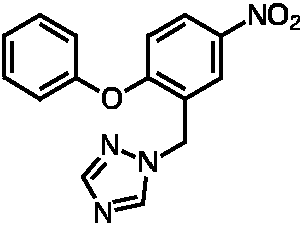
En un RBF previamente equipado con un agitador magnético y balón de nitrógeno se recogió 1,2,4-triazol (0,53 g, 7,7 mmol) en DMF (12 ml). La solución se enfrió a 0 °C y se añadió NaH (95 %, 0,18 g, 7,7 mmol) en porciones. La mezcla de reacción se agitó a 0 °C durante 1 h. Se añadió 2-(bromometil)-4-nitro-1-fenoxibenceno (disponible en el mercado, 1,2 g, 3,8 mmol) se añadió gota a gota a la mezcla de reacción a 0 °C y la mezcla de reacción se agitó a temperatura ambiente durante 30 min. El disolvente se evaporó a presión reducida y la mezcla de reacción se inactivó con agua con hielo (30 ml) y el producto se extrajo con acetato de etilo (3 * 30 ml). La capa orgánica combinada se lavó con salmuera (20 ml), se secó sobre sulfato sódico y el disolvente se eliminó a presión reducida.1,2,4-Triazole (0.53 g, 7.7 mmol) was taken up in DMF (12 mL) in an RBF previously equipped with a magnetic stirrer and nitrogen balloon. The solution was cooled to 0 °C and NaH (95%, 0.18 g, 7.7 mmol) was added portionwise. The reaction mixture was stirred at 0 °C for 1 h. 2-(Bromomethyl)-4-nitro-1-phenoxybenzene (commercially available, 1.2 g, 3.8 mmol) was added dropwise to the reaction mixture at 0 °C and the reaction mixture stirred at room temperature for 30 min. The solvent was evaporated under reduced pressure and the reaction mixture was quenched with ice-water (30ml) and the product was extracted with ethyl acetate (3*30ml). The combined organic layer was washed with brine (20 mL), dried over sodium sulfate, and the solvent was removed under reduced pressure.
El producto en bruto se purificó por cromatografía en columna Combi-flash y acetato de etilo al 50 % en hexanos como eluyente para obtener 0,570 g (49 % de rendimiento) del compuesto del título. RMN 1H (400 MHz, DMSO-d6):The crude product was purified by Combi-flash column chromatography and 50% ethyl acetate in hexanes as eluant to obtain 0.570 g (49% yield) of the title compound. 1H NMR (400 MHz, DMSO-d6):
5 8,70 (s, 1H), 8,22-7,19 (m, 2H), 8,05 (s, 1H), 7,51 (t, J = 8,0 Hz, 2H), 7,33 (t, J = 7,6 Hz, 1H), 7,11 (d, J = 8,0 Hz, 2H), 6,87 (d, J = 9,2 Hz, 1H), 5,68 (s, 2H); MS (ES+) m/z 297 [M+H]+5 8.70 (s, 1H), 8.22-7.19 (m, 2H), 8.05 (s, 1H), 7.51 (t, J = 8.0 Hz, 2H), 7, 33 (t, J = 7.6 Hz, 1H), 7.11 (d, J = 8.0 Hz, 2H), 6.87 (d, J = 9.2 Hz, 1H), 5.68 ( s, 2H); MS (ES+) m/z 297 [M+H]+
Producto intermedio 8intermediate product 8
4-fenoxi-3-(1H-1,2,4-triazol-1-ilmetil)anilina4-phenoxy-3-(1H-1,2,4-triazol-1-ylmethyl)aniline

En un RBF previamente equipado con un agitador magnético y balón de nitrógeno se recogió 1-(5-nitro-2-fenoxibencil)-1H-1,2,4-triazol (producto intermedio 7, 0,54 g, 1,8 mmol) y SnCl2.2H2O (1,64 g, 7,2 mmol) en etanol (5,4 ml) y la mezcla se enfrió a 0 °C. Se añadió HCI ac. al 35 % (0,54 ml) y la mezcla de reacción se agitó a 70 °C durante 3 h. La mezcla de reacción se diluyó con acetato de etilo (25 ml) y se basificó con amoniaco ac. para mantener un pH de 7-8. La mezcla se filtró a través de un lecho de Celite® y el lecho se lavó con acetato de etilo (2 * 25 ml). El filtrado combinado se lavó con agua (3 * 25 ml) seguido de lavado con salmuera (25 ml), se secó sobre sulfato sódico y el disolvente se eliminó a presión reducida para obtener 0,430 g (88 % de rendimiento) del compuesto del título. RMN 1H (400 MHz, DMSO-cfe): 58,43 (s, 1H), 7,95 (s, 1H), 7,31 (t, J = 7,6 Hz, 2H), 7,02 (t, J = 7,2 Hz, 1H), 6,83 (d, J = 8,0 Hz, 2H), 6,72 (d, J = 8,8 Hz, 1H), 6,56 (dd, J = 8,8, 2,4 Hz, 1H), 6,36 (d, J = 2,0 Hz, 1H), 5,21 (s, 2H), 5,12 (s, 2H); MS (ES+) m/z 267 [M+H]+1-(5-Nitro-2-phenoxybenzyl)-1H-1,2,4-triazole (intermediate 7, 0.54 g, 1.8 mmol) was collected in an RBF previously equipped with a magnetic stirrer and nitrogen balloon. ) and SnCl2.2H2O (1.64 g, 7.2 mmol) in ethanol (5.4 mL) and the mixture cooled to 0 °C. HCI aq. 35% (0.54 mL) and the reaction mixture was stirred at 70 °C for 3 h. The reaction mixture was diluted with ethyl acetate (25 mL) and made basic with aq. ammonia. to maintain a pH of 7-8. The mixture was filtered through a pad of Celite® and the pad was washed with ethyl acetate (2*25ml). The combined filtrate was washed with water (3*25ml) followed by washing with brine (25ml), dried over sodium sulfate and the solvent removed under reduced pressure to obtain 0.430g (88% yield) of the title compound . 1H NMR (400 MHz, DMSO-cfe): 58.43 (s, 1H), 7.95 (s, 1H), 7.31 (t, J = 7.6 Hz, 2H), 7.02 (t , J = 7.2 Hz, 1H), 6.83 (d, J = 8.0 Hz, 2H), 6.72 (d, J = 8.8 Hz, 1H), 6.56 (dd, J = 8.8, 2.4 Hz, 1H), 6.36 (d, J = 2.0 Hz, 1H), 5.21 (s, 2H), 5.12 (s, 2H); MS (ES+) m/z 267 [M+H]+
Producto intermedio 9intermediate product 9
1-[4-fenoxi-3-(1H-1,2,4-triazol-1-ilmetil)fenil]-3-fenilurea 1-[4-phenoxy-3-(1H-1,2,4-triazol-1-ylmethyl)phenyl]-3-phenylurea

En un RBF previamente equipado con un agitador magnético se recogió 4-fenoxi-3-(1H-1,2,4-triazol-1-ilmetil)anilina (producto intermedio 8, 0,28 g, 1,0 mmol) y TEA (0,29 ml, 2,1 mmol) en DCM (2,8 ml) y la mezcla se enfrió a 0 °C. Se añadió isocianato de fenilo (0,12 g, 1,0 mmol) y se dejó que la mezcla de reacción alcanzara los 25 °C y se agitó durante 16 h. Los precipitados sólidos obtenidos se eliminaron por filtración y se lavaron con n-pentano (30 ml) para producir 0,300 g, (74 % de rendimiento) del compuesto del título. RMN 1H (400 MHz, DMSO-d6): 58,74 (s, 1H), 8,61 (s, 1H), 8,53 (s, 1H), 7,99 (s, 1H), 7,48-7,43 (m, 3H), 7,37 (t, J = 8,0 Hz, 2H), 7,28 (t, J = 8,0 Hz, 3H), 7,11 (t, J = 7,4 Hz, 1H), 6,98 (t, J = 7,4 Hz, 1H), 6,92-6,89 (m, 3H), 5,40 (s, 2H); MS (ES+) m/z 386 [M+H]+4-phenoxy-3-(1H-1,2,4-triazol-1-ylmethyl)aniline (intermediate 8, 0.28 g, 1.0 mmol) and TEA were collected in an RBF previously equipped with a magnetic stirrer. (0.29 mL, 2.1 mmol) in DCM (2.8 mL) and the mixture cooled to 0 °C. Phenyl isocyanate (0.12 g, 1.0 mmol) was added and the reaction mixture was allowed to warm to 25 °C and stirred for 16 h. The obtained solid precipitates were filtered off and washed with n-pentane (30 ml) to give 0.300 g, (74% yield) of the title compound. 1H NMR (400 MHz, DMSO-d6): 58.74 (s, 1H), 8.61 (s, 1H), 8.53 (s, 1H), 7.99 (s, 1H), 7.48 -7.43 (m, 3H), 7.37 (t, J = 8.0 Hz, 2H), 7.28 (t, J = 8.0 Hz, 3H), 7.11 (t, J = 7.4 Hz, 1H), 6.98 (t, J =7.4 Hz, 1H), 6.92-6.89 (m, 3H), 5.40 (s, 2H); MS (ES+) m/z 386 [M+H]+
Producto intermedio 10intermediate product 10
1-[2-(4-etilfenoxi)-5-nitrobencil]-1H-pirazol1-[2-(4-ethylphenoxy)-5-nitrobenzyl]-1H-pyrazole

En un RBF previamente equipado con un agitador magnético y balón de nitrógeno se recogió pirazol (0,36 g, 5,3 mmol) en DMF (6 ml). La solución se enfrió a 0 °C y se añadió NaH (60 %, 0,19 g, 5,3 mmol) en porciones y la mezcla de reacción se agitó durante 1 h. Se añadió 2-(bromometil)-1-(4-etilfenoxi)-4-nitrobenceno (disponible en el mercado, 0,90 g, 2,6 mmol) en DMF (3 ml) gota a gota a la mezcla de reacción a 0 °C y la mezcla de reacción se agitó a TA durante 30 min. La mezcla de reacción se inactivó con agua con hielo (20 ml) y el producto se extrajo con acetato de etilo (3 * 20 ml). La capa orgánica combinada se lavó con salmuera (20 ml), se secó sobre sulfato sódico y el disolvente se evaporó a presión reducida. El producto en bruto se purificó por cromatografía en columna Combiflash y acetato de etilo al 8 % en hexanos como eluyente para obtener 0,710 g (82 % de rendimiento) del compuesto del título. RMN 1H (400 MHz, DMSO-d6): 58,16 (dd, J = 9,2, 2,8 Hz, 1H), 7,92 (d, J = 2,0 Hz, 1H), 7,84 (d, J = 2,8 Hz, 1H), 7,57 (d, J = 1,2 Hz, 1H), 7,36 (d, J = 8,4 Hz, 2H), 7,08 (d, J = 8,4 Hz, 2H), 6,84 (d, J = 8,8 Hz, 1H), 6,35 (t, J = 2,1 Hz, 1H), 5,58 (s, 2H), 2,66 (c, J = 7,6 Hz, 2H), 1,22 (t, J = 7,6 Hz, 3H); MS (ES+) m/z 324 [M+H]+ Producto intermedio 11 Pyrazole (0.36 g, 5.3 mmol) was taken up in DMF (6 mL) in an RBF previously equipped with a magnetic stirrer and nitrogen balloon. The solution was cooled to 0 °C and NaH (60%, 0.19 g, 5.3 mmol) was added portionwise and the reaction mixture stirred for 1 h. 2-(Bromomethyl)-1-(4-ethylphenoxy)-4-nitrobenzene (commercially available, 0.90 g, 2.6 mmol) in DMF (3 mL) was added dropwise to the reaction mixture at 0 °C and the reaction mixture was stirred at RT for 30 min. The reaction mixture was quenched with ice-water (20ml) and the product was extracted with ethyl acetate (3*20ml). The combined organic layer was washed with brine (20 mL), dried over sodium sulfate, and the solvent was evaporated under reduced pressure. The crude product was purified by Combiflash column chromatography and 8% ethyl acetate in hexanes as eluent to obtain 0.710 g (82% yield) of the title compound. 1H NMR (400 MHz, DMSO-d6): 58.16 (dd, J = 9.2, 2.8 Hz, 1H), 7.92 (d, J = 2.0 Hz, 1H), 7.84 (d, J = 2.8 Hz, 1H), 7.57 (d, J = 1.2 Hz, 1H), 7.36 (d, J = 8.4 Hz, 2H), 7.08 (d , J = 8.4 Hz, 2H), 6.84 (d, J = 8.8 Hz, 1H), 6.35 (t, J = 2.1 Hz, 1H), 5.58 (s, 2H ), 2.66 (c, J = 7.6 Hz, 2H), 1.22 (t, J = 7.6 Hz, 3H); MS (ES+) m/z 324 [M+H]+ Intermediate 11
4-(4-etilfenoxi)-3-(1H-pirazol-1-ilmetil)anilina4-(4-ethylphenoxy)-3-(1H-pyrazol-1-ylmethyl)aniline

En un RBF previamente equipado con un agitador magnético se recogió 1-[2-(4-etilfenoxi)-5-nitrobencil]-1H-pirazol (producto intermedio 10, 0,70 g, 2,1 mmol) y SnCl2.2H2O (1,95 g, 8,6 mmol) en etanol (7,0 ml) y la mezcla se enfrió a 0 °C. Se añadió HCI ac. al 35 % (0,70 ml) y la mezcla de reacción se agitó a 70 °C durante 3 h. La mezcla de reacción se diluyó con acetato de etilo (20 ml) y se basificó con amoniaco para mantener un pH de 7-8. La mezcla se filtró a través de un lecho de celite y se lavó con acetato de etilo (2 * 20 ml). El filtrado se lavó con agua (3 * 20 ml), seguido de salmuera (25 ml), se secó sobre sulfato sódico y el disolvente se eliminó a presión reducida para obtener 0,55 g (86 % de rendimiento) del compuesto del título. RMN 1H (400 MHz, DMSO-cfe): 57,63 (d, J = 2,0 Hz, 1H), 7,45 (d, J = 1,2 Hz, 1H), 7,16 (d, J = 8,4 Hz, 2H), 6,79 (d, J = 8,8 Hz, 2H), 6,70 (d, J = 8,4 Hz, 1H), 6,52 (dd, J = 8,4, 2,8 Hz, 1H), 6,25 (d, J = 2,0 Hz, 2H), 5,13 (s, 2H), 5,04 (s, 2H), 2,59 (c, J = 7,6 Hz, 2H), 1,16 (t, J = 7,6 Hz, 3H). MS (ES+) m/z 294 [M+H]+1-[2-(4-ethylphenoxy)-5-nitrobenzyl]-1H-pyrazole (intermediate 10, 0.70 g, 2.1 mmol) and SnCl2.2H2O ( 1.95 g, 8.6 mmol) in ethanol (7.0 mL) and the mixture cooled to 0 °C. HCI aq. 35% (0.70 mL) and the reaction mixture was stirred at 70 °C for 3 h. The reaction mixture was diluted with ethyl acetate (20 mL) and basified with ammonia to maintain pH 7-8. The mixture was filtered through a pad of celite and washed with ethyl acetate (2*20ml). The filtrate was washed with water (3*20ml), followed by brine (25ml), dried over sodium sulphate and the solvent removed under reduced pressure to obtain 0.55g (86% yield) of the title compound. . 1H NMR (400 MHz, DMSO-cfe): 57.63 (d, J = 2.0 Hz, 1H), 7.45 (d, J = 1.2 Hz, 1H), 7.16 (d, J = 8.4 Hz, 2H), 6.79 (d, J = 8.8 Hz, 2H), 6.70 (d, J = 8.4 Hz, 1H), 6.52 (dd, J = 8 .4, 2.8 Hz, 1H), 6.25 (d, J = 2.0 Hz, 2H), 5.13 (s, 2H), 5.04 (s, 2H), 2.59 (c , J = 7.6 Hz, 2H), 1.16 (t, J = 7.6 Hz, 3H). MS (ES+) m/z 294 [M+H]+
Producto intermedio 12intermediate product 12
1-[4-(4-etilfenoxi)-3-(1H-pirazol-1-ilmetil)fenil]-3-metilurea 1-[4-(4-ethylphenoxy)-3-(1H-pyrazol-1-ylmethyl)phenyl]-3-methylurea

En un RBF de 25 ml previamente equipado con un agitador magnético y balón de nitrógeno se recogió 4-(4-etilfenoxi)-3-(1H-pirazol-1-ilmetil)anilina (producto intermedio 11, 0,50 g, 1,7 mmol) y TEA (0,71 ml, 5,1 mmol) en DCM (5,0 ml) y la mezcla se enfrió a 0 °C. Se añadió cloruro de metilaminoformilo (0,25 g, 2,7 mmol) y se dejó que la mezcla de reacción alcanzara los 25 °C y se agitó durante 16 h. El disolvente se evaporó y la mezcla de reacción se inactivó con agua con hielo (20 ml) y se extrajo con acetato de etilo (3 * 20 ml). La capa orgánica combinada se lavó con salmuera (20 ml), se secó sobre sulfato sódico y el disolvente se eliminó a presión reducida. El producto en bruto se purificó por cromatografía en columna Combi-flash y acetato de etilo al 35 % en hexanos como eluyente para obtener 0,300 g (50 % de rendimiento) del compuesto del título. RMN 1H (400 MHz, DMSO-cfe): 58,51 (s, 1H), 7,70 (d, J = 1,6 Hz, 1H), 7,47 (d, J = 1,2 Hz, 1H) 7,43 (dd, J = 8,8, 2,4 Hz, 1H), 7,20 (m, 2H), 7,02 (d, J = 2,0 Hz, 1H), 6,85-6,80 (m, 3H), 6,27 (s, 1H), 5,92 (d, J = 4,4 Hz, 1H), 5,27 (s, 2H), 2,63 (s, 3H), 2,59 (c, J = 7,6 Hz, 2H), 1,18 (t, J = 7,6 Hz, 3H); MS (ES+) m/z 351 [M+H]+4-(4-ethylphenoxy)-3-(1H-pyrazol-1-ylmethyl)aniline (intermediate 11, 0.50 g, 1, 7 mmol) and TEA (0.71 mL, 5.1 mmol) in DCM (5.0 mL) and the mixture cooled to 0 °C. Methylaminoformyl chloride (0.25 g, 2.7 mmol) was added and the reaction mixture was allowed to warm to 25 °C and stirred for 16 h. The solvent was evaporated and the reaction mixture was quenched with ice water (20ml) and extracted with ethyl acetate (3*20ml). The combined organic layer was washed with brine (20 mL), dried over sodium sulfate, and the solvent was removed under reduced pressure. The crude product was purified by Combi-flash column chromatography and 35% ethyl acetate in hexanes as eluant to obtain 0.300 g (50% yield) of the title compound. 1H NMR (400 MHz, DMSO-cfe): 58.51 (s, 1H), 7.70 (d, J = 1.6 Hz, 1H), 7.47 (d, J = 1.2 Hz, 1H ) 7.43 (dd, J = 8.8, 2.4 Hz, 1H), 7.20 (m, 2H), 7.02 (d, J = 2.0 Hz, 1H), 6.85- 6.80 (m, 3H), 6.27 (s, 1H), 5.92 (d, J = 4.4 Hz, 1H), 5.27 (s, 2H), 2.63 (s, 3H ), 2.59 (c, J = 7.6 Hz, 2H), 1.18 (t, J = 7.6 Hz, 3H); MS (ES+) m/z 351 [M+H]+
Producto intermedio 13intermediate product 13
1-[(4-nitrobifenil-2-il)metil]-1H-pirazol1-[(4-nitrobiphenyl-2-yl)methyl]-1H-pyrazole

En un RBF de 50 ml previamente equipado con un agitador magnético y balón de nitrógeno, se añadió pirazol (0,60 g, 8,8 mmol) en DMF (10 ml). La solución se enfrió a 0 °C y se añadió NaH (60 %, 0,32 g, 8,8 mmol) en porciones y la mezcla de reacción se agitó durante 1 h. Se añadió 2-(bromometil)-4-nitrobifenilo (lihama, T.; Fu, J. M.; Bourguignon, M.; Snieckus, V. Synthesis (1989), 3, 184-8) (1,30 g, 4,4 mmol) en DMF (3 ml) gota a gota a la mezcla de reacción a 0 °C y se agitó a TA durante 30 min. La mezcla de reacción se inactivó con agua con hielo (30 ml) y el producto se extrajo con acetato de etilo (3 * 30 ml). La capa orgánica combinada se lavó con salmuera (20 ml), se secó sobre sulfato sódico y el disolvente se evaporó a presión reducida. El producto en bruto se purificó por cromatografía en columna Combi-flash usando acetato de etilo al 50 % en hexanos como eluyente para obtener 1,1 g (88 % de rendimiento) del compuesto del título. RMN 1H (400 MHz, DMSO-d6): 58,22 (dd, J = 8,5, 2,5 Hz, 1H), 7,75 (dd, J = 10,7, 2,4 Hz, 2H), 7,59-7,48 (m, 7H), 6,31 (s, 1H), 5,44 (s, 2H).In a 50 mL RBF pre-fitted with a magnetic stirrer and nitrogen balloon, pyrazole (0.60 g, 8.8 mmol) in DMF (10 mL) was added. The solution was cooled to 0 °C and NaH (60%, 0.32 g, 8.8 mmol) was added portionwise and the reaction mixture stirred for 1 h. 2-(Bromomethyl)-4-nitrobiphenyl (Lihama, T.; Fu, JM; Bourguignon, M.; Snieckus, V. Synthesis (1989), 3, 184-8) (1.30 g, 4.4 mmol) in DMF (3 mL) was added dropwise to the reaction mixture at 0 °C and stirred at RT for 30 min. The reaction mixture was quenched with ice-water (30ml) and the product was extracted with ethyl acetate (3*30ml). The combined organic layer was washed with brine (20 mL), dried over sodium sulfate, and the solvent was evaporated under reduced pressure. The crude product was purified by Combi-flash column chromatography using 50% ethyl acetate in hexanes as eluant to obtain 1.1 g (88% yield) of the title compound. 1H NMR (400 MHz, DMSO-d6): 58.22 (dd, J = 8.5, 2.5 Hz, 1H), 7.75 (dd, J = 10.7, 2.4 Hz, 2H) , 7.59-7.48 (m, 7H), 6.31 (s, 1H), 5.44 (s, 2H).
Producto intermedio 14intermediate product 14
2-(1H-pirazol-1-ilmetil)bifenil-4-amina2-(1H-pyrazol-1-ylmethyl)biphenyl-4-amine

1-[(4-nitrobifenil-2-il)metil]-1H-pirazol (producto intermedio 8, 1,10 g, 3,9 mmol) y SnCl2,2H2O (3,55 g, 15,7 mmol) en etanol (11,0 ml) se añadieron a un r Bf , previamente equipado con un agitador magnético y balón de nitrógeno y la mezcla se enfrió a 0 °C. A la suspensión resultante, se le añadió HCl ac. al 35 % (1,10 ml) y la mezcla de reacción se agitó a 70 °C durante 3 h. La mezcla de reacción se diluyó con acetato de etilo (25 ml) y se basificó con amoniaco ac. para mantener un pH de 7-8. La mezcla se filtró a través de un lecho de celite y se lavó con acetato de etilo (2 * 25 ml). El filtrado se lavó con agua (3 * 25 ml) y salmuera (25 ml), se secó sobre sulfato sódico y el disolvente se evaporó a presión reducida para obtener 1,2 g del compuesto del título. RMN 1H (400 MHz, DMSO-cfe): 57,55 (d, J = 2,2 Hz, 1H), 7,45-7,30 (m, 6H), 6,96 (d, J = 8,2 Hz, 1H), 6,57 (dd, J = 8,2, 2,4 Hz, 1H), 6,25 (d, J = 2,0 Hz, 2H), 5,19 (s, 2H), 5,17 (s, 2H); MS (ES+) m/z 250 [M+H]+1-[(4-nitrobiphenyl-2-yl)methyl]-1H-pyrazole (intermediate 8, 1.10 g, 3.9 mmol) and SnCl2.2H2O (3.55 g, 15.7 mmol) in ethanol (11.0 mL) were added to a rBf , previously equipped with a magnetic stirrer and nitrogen balloon, and the mixture was cooled to 0 °C. To the resulting suspension, aq. HCl was added. 35% (1.10 mL) and the reaction mixture was stirred at 70 °C for 3 h. The reaction mixture was diluted with ethyl acetate (25 mL) and made basic with aq. ammonia. to maintain a pH of 7-8. The mixture was filtered through a pad of celite and washed with ethyl acetate (2*25ml). The filtrate was washed with water (3*25ml) and brine (25ml), dried over sodium sulfate and the solvent was evaporated under reduced pressure to obtain 1.2g of the title compound. 1H NMR (400 MHz, DMSO-cfe): 57.55 (d, J = 2.2 Hz, 1H), 7.45-7.30 (m, 6H), 6.96 (d, J = 8, 2 Hz, 1H), 6.57 (dd, J = 8.2, 2.4 Hz, 1H), 6.25 (d, J = 2.0 Hz, 2H), 5.19 (s, 2H) , 5.17 (s, 2H); MS (ES+) m/z 250 [M+H]+
Producto intermedio 15intermediate product 15
1-metil-3-[2-(1H-pirazol-1-ilmetil)bifenil-4-il]urea 1-methyl-3-[2-(1H-pyrazol-1-ylmethyl)biphenyl-4-yl]urea

En un RBF previamente equipado con un agitador magnético y balón de nitrógeno se recogió (producto intermedio 9, 0,50 g, 2 mmol) y TEA (0,84 ml, 6 mmol) en DCM (5 ml) y la mezcla se enfrió a 0 °C. Se añadió cloruro de metilaminoformilo (0,28 g, 3 mmol) y se dejó que la mezcla de reacción resultante alcanzara los 25 °C y se agitó durante 16 h. El disolvente se evaporó y la mezcla de reacción se inactivó con agua con hielo (20 ml) y el producto se extrajo con acetato de etilo (3 * 20 ml). La capa orgánica combinada se lavó con salmuera (20 ml), se secó sobre sulfato sódico y el disolvente se eliminó a presión reducida. El producto en bruto se purificó por cromatografía en columna Combi-flash usando acetato de etilo al 40 % en hexanos como eluyente para obtener 0,250 g (40 % de rendimiento) del compuesto del título. RMN 1H (400 MHz, DMSO-d6): 58,58 (s, 1H), 7,58-7,53 (m, 2H), 7,47-7,36 (m, 6H), 7,15 (d, J = 8,4 Hz, 1H), 6,94 (d, J = 1,6 Hz, 1H), 6,25 (t, J = 2,0 Hz, 1H), 5,96 (c, J = 4,8 Hz, 1H), 5,24 (s, 2H), 2,63 (d, J = 4,6 Hz, 3H); MS (ES+) m/z 307 [M+H]+(Intermediate 9, 0.50 g, 2 mmol) and TEA (0.84 mL, 6 mmol) in DCM (5 mL) were taken up in an RBF previously equipped with a magnetic stirrer and nitrogen balloon and the mixture was cooled. at 0°C. Methylaminoformyl chloride (0.28 g, 3 mmol) was added and the resulting reaction mixture was allowed to warm to 25 °C and stirred for 16 h. The solvent was evaporated and the reaction mixture was quenched with ice water (20ml) and the product was extracted with ethyl acetate (3*20ml). The combined organic layer was washed with brine (20 mL), dried over sodium sulfate, and the solvent was removed under reduced pressure. The crude product was purified by Combi-flash column chromatography using 40% ethyl acetate in hexanes as eluant to obtain 0.250 g (40% yield) of the title compound. 1H NMR (400 MHz, DMSO-d6): 58.58 (s, 1H), 7.58-7.53 (m, 2H), 7.47-7.36 (m, 6H), 7.15 ( d, J = 8.4 Hz, 1H), 6.94 (d, J = 1.6 Hz, 1H), 6.25 (t, J = 2.0 Hz, 1H), 5.96 (c, J = 4.8 Hz, 1H), 5.24 (s, 2H), 2.63 (d, J = 4.6 Hz, 3H); MS (ES+) m/z 307 [M+H]+
Producto intermedio 16intermediate product 16
5-{[(3-metilfenil)carbamoil]amino}-2-fenoxibenzoato de metiloMethyl 5-{[(3-methylphenyl)carbamoyl]amino}-2-phenoxybenzoate

A un RBF previamente equipado con un agitador magnético y balón de nitrógeno se le añadió, 3-metilanilina (1,35 g, 12,6 mmol), NaHCO3 (3,17 g, 37,8 mmol) y DCM (17 ml). La mezcla se enfrió a 0 °C y se añadió trifosgeno (1,23 g, 4,1 mmol) y la mezcla de reacción se agitó durante 2 h a 0 °C. Se añadieron 5-amino-2-fenoxibenzoato de metilo (disponible en el mercado, 3,08 g, 12,6 mmol) y NaHCO3(3,17 g, 37,8 mmol) a la mezcla de reacción. Se dejó que la mezcla de reacción alcanzara los 25 °C y se agitó durante 2 h. La mezcla de reacción se inactivó con agua (50 ml) y el producto se extrajo con DCM (3 * 50 ml). La capa orgánica combinada se lavó con salmuera (50 ml), se secó sobre sulfato sódico y el disolvente se eliminó a presión reducida y el producto en bruto se purificó por cromatografía en columna usando gel de sílice (60-120 mesh) y acetato de etilo al 30 % en hexanos como eluyente para obtener 4,5 g (94 % de rendimiento) del compuesto del título. MS (ES+) m/z 377 [M+H]+To an RBF previously equipped with a magnetic stirrer and nitrogen balloon, 3-methylaniline (1.35 g, 12.6 mmol), NaHCO3 (3.17 g, 37.8 mmol) and DCM (17 mL) were added. . The mixture was cooled to 0 °C and triphosgene (1.23 g, 4.1 mmol) was added and the reaction mixture stirred for 2 h at 0 °C. Methyl 5-amino-2-phenoxybenzoate (commercially available, 3.08 g, 12.6 mmol) and NaHCO3 (3.17 g, 37.8 mmol) were added to the reaction mixture. The reaction mixture was allowed to reach 25 °C and stirred for 2 h. The reaction mixture was quenched with water (50ml) and the product was extracted with DCM (3*50ml). The combined organic layer was washed with brine (50 mL), dried over sodium sulfate, and the solvent was removed under reduced pressure and the crude product was purified by column chromatography using silica gel (60-120 mesh) and sodium acetate. 30% ethyl in hexanes as eluant to obtain 4.5 g (94% yield) of the title compound. MS (ES+) m/z 377 [M+H]+
Producto intermedio 17intermediate product 17
3-[3-(hidroximetil)-4-fenoxifenil]-1-(3-metilfenil)urea3-[3-(hydroxymethyl)-4-phenoxyphenyl]-1-(3-methylphenyl)urea

A un RBF previamente equipado con un agitador magnético y balón de nitrógeno se le añadió 5-{[(3-metilfenil)carbamoil]amino}-2-fenoxibenzoato de metilo (producto intermedio 16, 4,50 g, 11,9 mmol) en THF (45 ml) y la mezcla se enfrió a 0 °C. Se añadió LiBH4 (1,56 g, 71,7 mmol) en porciones a 0 °C. Se dejó que la mezcla de reacción alcanzara la temperatura ambiente y se agitó durante 4 h. La mezcla de reacción se inactivó con agua (50 ml) y el producto se extrajo con acetato de etilo (3 * 50 ml), se secó sobre sulfato sódico y el disolvente se eliminó a presión reducida. El producto en bruto se trituró con DCM (2 * 15 ml) y el producto sólido se recogió por filtración para producir 3,9 g (93 %) del compuesto del título. RMN 1H (400 MHz, DMSO-de): 58,76 (s, 1H), 8,57 (s, 1H), 7,64 (s, 1H), 7,35-7,40 (m, 4H), 7,33-7,15 (m, 2H), 7,05-7,06 (m, 1H), 6,81-6,79 (m, 4H), 5,21 (d, J = 4,80 Hz, 1H), 4,45 (d, J = 4,80 Hz, 2H), 2,30 (s, 3H). MS (ES+) m/z 349 [M+H]+To an RBF previously equipped with a magnetic stirrer and nitrogen balloon was added methyl 5-{[(3-methylphenyl)carbamoyl]amino}-2-phenoxybenzoate (intermediate 16, 4.50 g, 11.9 mmol) in THF (45 mL) and the mixture cooled to 0 °C. LiBH4 (1.56 g, 71.7 mmol) was added portionwise at 0 °C. The reaction mixture was allowed to come to room temperature and stirred for 4 h. The reaction mixture was quenched with water (50ml) and the product was extracted with ethyl acetate (3*50ml), dried over sodium sulphate and the solvent removed under reduced pressure. The crude product was triturated with DCM (2*15ml) and the solid product was collected by filtration to give 3.9g (93%) of the title compound. 1H NMR (400 MHz, DMSO-de): 58.76 (s, 1H), 8.57 (s, 1H), 7.64 (s, 1H), 7.35-7.40 (m, 4H) , 7.33-7.15 (m, 2H), 7.05-7.06 (m, 1H), 6.81-6.79 (m, 4H), 5.21 (d, J = 4, 80hz, 1H), 4.45 (d, J = 4.80 Hz, 2H), 2.30 (s, 3H). MS (ES+) m/z 349 [M+H]+
Producto intermedio 18intermediate product 18
3-[3-(dorometil)-4-fenoxifenil]-1-(3-metilfenil)urea3-[3-(doromethyl)-4-phenoxyphenyl]-1-(3-methylphenyl)urea

A un RBF previamente equipado con un agitador magnético y balón de nitrógeno se le añadió 3-[3-(hidroximetil)-4-fenoxifenil]-1-(3-metilfenil)urea (producto intermedio 17, 3,80 g, 10,9 mmol) en diclorometano (38 ml). Se añadió una cantidad catalítica de DMF (0,5 ml) y la mezcla se enfrió a 0 °C y se agitó durante 10 min a 0 °C. Se añadió cloruro de tionilo (2,59 g, 21,8 mmol) gota a gota y se dejó que la mezcla de reacción resultante alcanzara la temperatura ambiente y se agitó durante 2 h. La mezcla de reacción se inactivó con agua (30 ml) y la capa acuosa se extrajo con diclorometano (3 * 30 ml). La capa orgánica combinada se secó sobre sulfato sódico y el disolvente se eliminó a presión reducida. El producto en bruto se purificó por cromatografía en columna usando gel de sílice (100-200 mesh) y hexanos puros como eluyente para obtener 3,0 g (74 % de rendimiento) del compuesto del título. MS (ES+) m/z 367 [M+H]+To an RBF previously equipped with a magnetic stirrer and nitrogen balloon was added 3-[3-(hydroxymethyl)-4-phenoxyphenyl]-1-(3-methylphenyl)urea (intermediate 17, 3.80 g, 10, 9 mmol) in dichloromethane (38 mL). A catalytic amount of DMF (0.5 mL) was added and the mixture was cooled to 0 °C and stirred for 10 min at 0 °C. Thionyl chloride (2.59 g, 21.8 mmol) was added dropwise and the resulting reaction mixture was allowed to warm to room temperature and stirred for 2 h. The reaction mixture was quenched with water (30ml) and the aqueous layer was extracted with dichloromethane (3*30ml). The combined organic layer was dried over sodium sulfate and the solvent was removed under reduced pressure. The crude product was purified by column chromatography using silica gel (100-200 mesh) and neat hexanes as eluant to obtain 3.0 g (74% yield) of the title compound. MS (ES+) m/z 367 [M+H]+
Producto intermedio 19intermediate product 19
1-[3-(clorometil)-4-fenoxifenil]-3-(3-metilfenil)-1,3,5-triazinan-2,4,6-triona1-[3-(chloromethyl)-4-phenoxyphenyl]-3-(3-methylphenyl)-1,3,5-triazinan-2,4,6-trione

A un recipiente para microondas previamente equipado con un agitador magnético y balón de nitrógeno se le añadió 3-[3-(clorometil)-4-fenoxifenil]-1-(3-metilfenil)urea (producto intermedio 18, 1,00 g, 2,3 mmol) en bromobenceno (10 ml) y la mezcla se enfrió a 0 °C. Se añadió isocianato de etoxi carbonilo (0,53 g, 4,5 mmol) y se dejó que la mezcla de reacción resultante alcanzara los 25 °C y se calentó a 150 °C durante 3 h en un Anton par microwave synthesizer-300. La mezcla de reacción se inactivó con agua (10 ml) y la capa acuosa se extrajo con acetato de etilo (2 * 30 ml). La capa orgánica combinada se secó sobre sulfato sódico y el disolvente se eliminó a presión reducida. El producto en bruto se purificó por cromatografía Combi-flash y acetato de etilo al 20 % en hexanos como eluyente para obtener 0,53 g del compuesto del título en bruto que se usó en la etapa siguiente sin más purificación. MS (ES-) m/z 434 [M-H]-Producto intermedio 20 3-[3-(chloromethyl)-4-phenoxyphenyl]-1-(3-methylphenyl)urea (intermediate 18, 1.00 g, 2.3 mmol) in bromobenzene (10 mL) and the mixture cooled to 0 °C. Ethoxy carbonyl isocyanate (0.53 g, 4.5 mmol) was added and the resulting reaction mixture was allowed to reach 25 °C and heated at 150 °C for 3 h in an Anton par microwave synthesizer-300. The reaction mixture was quenched with water (10ml) and the aqueous layer was extracted with ethyl acetate (2*30ml). The combined organic layer was dried over sodium sulfate and the solvent was removed under reduced pressure. The crude product was purified by Combi-flash chromatography and 20% ethyl acetate in hexanes as eluant to obtain 0.53 g of crude title compound which was used in the next step without further purification. MS (ES-) m/z 434 [MH]- Intermediate 20
(5-amino-2-fenoxifenil)metanol(5-amino-2-phenoxyphenyl)methanol

A un RBF previamente equipado con un agitador magnético y balón de nitrógeno se le añadió (5-nitro-2-fenoxifenil)metanol (disponible en el mercado, 5,0 g, 20,4 mmol) en metanol (50 ml). Se añadió paladio sobre carbono (10 % (50 % húmedo), 1,0 g) en atmósfera de N2 y la mezcla se agitó en atmósfera de H2 (gas) durante 4,5 h. La mezcla de reacción se filtró a través de un lecho de celite y se lavó con metanol. El filtrado combinado se evaporó a presión reducida para producir 4,1 g (93 % de rendimiento) del compuesto del título. RMN H (400 MHz, DMSO-d6): 57,27 (t, J = 8,00 Hz, 2H), 6,96 (t, J = 7,20 Hz, 1H), 6,77 (d, J = 7,60 Hz, 3H), 6,65 (d, J = 8,40 Hz, 1H), 6,45 (dd, J = 2,40, 8,40 Hz, 1H), 5,01-4,98 (m, 3H), 4,29 (d, J = 5,60 Hz, 2H); MS (ES+) m/z 216 [M+H]+ Producto intermedio 21 To an RBF previously equipped with a magnetic stirrer and nitrogen balloon was added (5-nitro-2-phenoxyphenyl)methanol (commercially available, 5.0 g, 20.4 mmol) in methanol (50 mL). Palladium on carbon (10% (50% wet), 1.0 g) was added under N2 and the mixture was stirred under H2 (gas) for 4.5 h. The reaction mixture was filtered through a pad of celite and washed with methanol. The combined filtrate was evaporated under reduced pressure to give 4.1 g (93% yield) of the title compound. H NMR (400 MHz, DMSO-d6): 57.27 (t, J = 8.00 Hz, 2H), 6.96 (t, J = 7.20 Hz, 1H), 6.77 (d, J = 7.60 Hz, 3H), 6.65 (d, J = 8.40 Hz, 1H), 6.45 (dd, J = 2.40, 8.40 Hz, 1H), 5.01-4 .98 (m, 3H), 4.29 (d, J = 5.60 Hz, 2H); MS (ES+) m/z 216 [M+H]+ intermediate product 21
3-[3-(hidroximetil)-4-fenoxifenil]-1-(4-metoxifenil)urea3-[3-(hydroxymethyl)-4-phenoxyphenyl]-1-(4-methoxyphenyl)urea

A un RBF previamente equipado con un agitador magnético y balón de nitrógeno se le añadió (5-amino-2-fenoxifenil)metanol (producto intermedio 20, 1,00 g, 4,65 mmol), NaHCO3 (1,17 g, 13,95 mmol) y diclorometano (30 ml). La mezcla de reacción se enfrió a 0 °C y se añadió trifosgeno (0,413 g, 1,395 mmol) y la mezcla de reacción se agitó durante 2 h a 0 °C. Se añadieron 4-metoxi-anilina (0,572 g, 4,65 mmol) y NaHCO3 (1,17 g, 13,95 mmol) y se dejó que la mezcla de reacción alcanzara la temperatura ambiente y se agitó durante 4 h. La mezcla de reacción se inactivó con agua (50 ml) y el producto se extrajo con diclorometano (3 * 50 ml). La capa orgánica combinada se lavó con salmuera (100 ml), se secó sobre sulfato sódico y el disolvente se eliminó a presión reducida. El producto en bruto se trituró con n-pentano para producir 2,1 g del compuesto del título. MS (ES+) m/z 365 [M+H]+ Producto intermedio 22 To an RBF previously equipped with a magnetic stirrer and nitrogen balloon was added (5-amino-2-phenoxyphenyl)methanol (intermediate 20, 1.00 g, 4.65 mmol), NaHCO3 (1.17 g, 13 0.95 mmol) and dichloromethane (30 mL). The reaction mixture was cooled to 0 °C and triphosgene (0.413 g, 1.395 mmol) was added and the reaction mixture stirred for 2 h at 0 °C. 4-Methoxy-aniline (0.572 g, 4.65 mmol) and NaHCO3 (1.17 g, 13.95 mmol) were added and the reaction mixture was allowed to warm to room temperature and stirred for 4 h. The reaction mixture was quenched with water (50ml) and the product was extracted with dichloromethane (3*50ml). The combined organic layer was washed with brine (100 mL), dried over sodium sulfate, and the solvent was removed under reduced pressure. The crude product was triturated with n-pentane to give 2.1 g of the title compound. MS (ES+) m/z 365 [M+H]+ Intermediate 22
3-[3-(clorometil)-4-fenoxifenil]-1-(4-metoxifenil)urea3-[3-(chloromethyl)-4-phenoxyphenyl]-1-(4-methoxyphenyl)urea

En un RBF previamente equipado con un agitador magnético y balón de nitrógeno se añadió 3-[3-(hidroximetil)-4-fenoxifenil]-1-(4-metoxifenil)urea (producto intermedio 21, 2,1 g, 5,76 mmol) en diclorometano (21 ml). Se añadió una cantidad catalítica de DMF (0,5 ml) y la mezcla se enfrió a 0 °C y se agitó durante 10 min. Se añadió cloruro de tionilo (0,83 ml, 1,15 mmol) gota a gota y la mezcla de reacción resultante se agitó durante 2 h a 25 °C. La mezcla de reacción se inactivó con agua (30 ml) y la capa acuosa se extrajo con diclorometano (3 x 30 ml). La capa orgánica combinada se secó sobre sulfato sódico y el disolvente se eliminó a presión reducida. El residuo se purificó por cromatografía en columna usando gel de sílice (100-200 mesh) y acetato de etilo al 9 % en hexano como eluyente para obtener 1,0 g del compuesto del título en bruto que se usó en la etapa siguiente sin más purificación. MS (ES+) m/z 383 [M+H]+In an RBF previously equipped with a magnetic stirrer and nitrogen balloon was added 3-[3-(hydroxymethyl)-4-phenoxyphenyl]-1-(4-methoxyphenyl)urea (intermediate 21, 2.1 g, 5.76 mmol) in dichloromethane (21 mL). A catalytic amount of DMF (0.5 mL) was added and the mixture was cooled to 0 °C and stirred for 10 min. Thionyl chloride (0.83 mL, 1.15 mmol) was added dropwise and the resulting reaction mixture was stirred for 2 h at 25 °C. The reaction mixture was quenched with water (30ml) and the aqueous layer was extracted with dichloromethane (3 x 30ml). The combined organic layer was dried over sodium sulfate and the solvent was removed under reduced pressure. The residue was purified by column chromatography using silica gel (100-200 mesh) and 9% ethyl acetate in hexane as eluant to obtain 1.0 g of crude title compound which was used in the next step without further ado. purification. MS (ES+) m/z 383 [M+H]+
Producto intermedio 23intermediate product 23
1-[3-(clorometil)-4-fenoxifenil]-3-(4-metoxifenil)-1,3,5-triazinan-2,4,6-triona1-[3-(chloromethyl)-4-phenoxyphenyl]-3-(4-methoxyphenyl)-1,3,5-triazinan-2,4,6-trione

A un recipiente para microondas previamente equipado con un agitador magnético y balón de nitrógeno se le añadió 3-[3-(clorometil)-4-fenoxifenil]-1-(4-metoxifenil)urea (producto intermedio 22, 0,500 g, 1,3 mmol) en bromobenceno (5 ml). Se añadió isocianato de etoxi carbonilo (0,603 g, 5,23 mmol) y la mezcla de reacción resultante se calentó a 150 °C durante 3 h en un Anton par microwave synthesizer-300. El disolvente se eliminó a presión reducida y el residuo se purificó por cromatografía en columna usando gel de sílice (100-200 mesh) y acetato de etilo al 75 % en hexano como eluyente para obtener 0,1 g del compuesto del título en bruto que se usó en la etapa siguiente sin más purificación. MS (ES-) m/z 450 [M-H]"3-[3-(chloromethyl)-4-phenoxyphenyl]-1-(4-methoxyphenyl)urea (intermediate 22, 0.500 g, 1, 3 mmol) in bromobenzene (5 mL). Ethoxy carbonyl isocyanate (0.603 g, 5.23 mmol) was added and the resulting reaction mixture was heated to 150 °C for 3 h in an Anton par microwave synthesizer-300. The solvent was removed under reduced pressure and the residue was purified by column chromatography using silica gel (100-200 mesh) and 75% ethyl acetate in hexane as eluant to obtain 0.1 g of crude title compound which used in the next step without further purification. MS (ES-) m/z 450 [MH]"
Producto intermedio 24intermediate product 24
1-{[2-(4-fluorofenoxi)-5-nitrofenil]metil}-1H-imidazol1-{[2-(4-fluorophenoxy)-5-nitrophenyl]methyl}-1H-imidazole

A un RBF previamente equipado con un agitador magnético y balón de nitrógeno se le añadió imidazol (0,50 g, 7,4 mmol) en ACN (33 ml) y la mezcla se enfrió a 0 °C. Se añadió K2CO3 (1,02 g, 7,4 mmol) y la mezcla de reacción se agitó durante 10 min a 0 °C. Se añadió 2-(bromometil)-1-(4-fluorofenoxi)-4-nitrobenceno (disponible en el mercado, 1,1 g, 3,3 mmol)) y se dejó que la mezcla de reacción alcanzara la temperatura ambiente y se agitó durante 3 h. La mezcla de reacción se inactivó con agua (10 ml) y la capa acuosa se extrajo con acetato de etilo (2 * 20 ml). La capa orgánica combinada se secó sobre sulfato sódico y el disolvente se eliminó a presión reducida. El producto en bruto se purificó por cromatografía Combi-flash usando MeOH al 8 % en diclorometano como eluyente para producir 0,810 g (76 % de rendimiento) del compuesto del título. RMN 1H (400 MHz, DMSO-d6: 58,17 (dd, J = 2,80, 8,8 Hz, 1H), 8,09 (d, J = 2,80 Hz, 1H), 7,79 (s, 1H), 7,36 (t, J = 8,80 Hz, 2H), 7,27 (s, 1H), 7,22-7,18 (m, 2H), 6,95 (s, 1H), 6,86 (d, J = 8,80 Hz, 1H), 5,43 (s, 2H); MS (ES+) m/z 315 [M+H]+Imidazole (0.50 g, 7.4 mmol) in ACN (33 mL) was added to an RBF previously equipped with a magnetic stirrer and nitrogen balloon, and the mixture was cooled to 0 °C. K2CO3 (1.02 g, 7.4 mmol) was added and the reaction mixture was stirred for 10 min at 0 °C. 2-(Bromomethyl)-1-(4-fluorophenoxy)-4-nitrobenzene (commercially available, 1.1 g, 3.3 mmol)) was added and the reaction mixture was allowed to warm to room temperature and quenched. stirred for 3 h. The reaction mixture was quenched with water (10ml) and the aqueous layer was extracted with ethyl acetate (2*20ml). The combined organic layer was dried over sodium sulfate and the solvent was removed under reduced pressure. The crude product was purified by Combi-flash chromatography using 8% MeOH in dichloromethane as eluent to give 0.810 g (76% yield) of the title compound. 1H NMR (400 MHz, DMSO-d6: 58.17 (dd, J = 2.80, 8.8 Hz, 1H), 8.09 (d, J = 2.80 Hz, 1H), 7.79 ( s, 1H), 7.36 (t, J = 8.80 Hz, 2H), 7.27 (s, 1H), 7.22-7.18 (m, 2H), 6.95 (s, 1H ), 6.86 (d, J = 8.80 Hz, 1H), 5.43 (s, 2H), MS (ES+) m/z 315 [M+H]+
Producto intermedio 25intermediate product 25
4-(4-fluorofenoxi)-3-[(1H-imidazol-1-il)metil]anilina4-(4-fluorophenoxy)-3-[(1H-imidazol-1-yl)methyl]aniline

A un RBF previamente equipado con un agitador magnético y balón de nitrógeno se le añadió 1-{[2-(4-fluorofenoxi)-5-nitrofenil]metil}-1H-imidazol (producto intermedio 24, 0,81 g, 2,5 mmol) en metanol (8,1 ml). Se añadió Pd/C (10 %, (50 % húmedo), 0,08 g) en atmósfera de N2 y la mezcla se agitó con burbujeo de H2 (gas). Tras completarse la reacción, la mezcla de reacción se filtró a través de un lecho de celite y J se lavó con metanol. El 1 disolvente se eliminó a presión reducida para producir 0,73 g (99 % de rendimiento) del compuesto del título. RMN H (400 MHz, DMSO-cfe): 57,58 (s, 1H), 7,14 (t, J = 8,8 Hz, 2H), 7,05 (s, 1H), 6,87-6,84 (m, 3H), 6,70 (d, J = 8,80 Hz, 1H), 6,52 (dd, J = 2,40, 8,80 Hz, 1H), 6,33 (d, J = 2,40 Hz, 1H), 5,09 (s, 2H), 4,98 (s, 2H); MS (ES+) m/z 284 [M+H]+To an RBF previously equipped with a magnetic stirrer and nitrogen balloon was added 1-{[2-(4-fluorophenoxy)-5-nitrophenyl]methyl}-1H-imidazole (intermediate 24, 0.81 g, 2, 5 mmol) in methanol (8.1 mL). Pd/C (10%, (50% wet), 0.08 g) was added under N2 and the mixture was stirred with H2 (gas) bubbling. After completion of the reaction, the reaction mixture was filtered through a pad of celite and J was washed with methanol. The 1 solvent was removed under reduced pressure to give 0.73 g (99% yield) of the title compound. H NMR (400 MHz, DMSO-cfe): 57.58 (s, 1H), 7.14 (t, J = 8.8 Hz, 2H), 7.05 (s, 1H), 6.87-6 .84 (m, 3H), 6.70 (d, J = 8.80 Hz, 1H), 6.52 (dd, J = 2.40, 8.80 Hz, 1H), 6.33 (d, J = 2.40 Hz, 1H), 5.09 (s, 2H), 4.98 (s, 2H); MS (ES+) m/z 284 [M+H]+
Producto intermedio 26intermediate product 26
3-[4-(4-fluorofenoxi)-3-[(1H-imidazol-1-il)metil]fenil]-1-(3-metilfenil)urea3-[4-(4-fluorophenoxy)-3-[(1H-imidazol-1-yl)methyl]phenyl]-1-(3-methylphenyl)urea

A un recipiente previamente equipado con un agitador magnético y balón de nitrógeno se le añadió 4-(4-fluorofenoxi)-3-[(1H-imidazol-1-il)metil]anilina (producto intermedio 25, 0,73 g, 2,5 mmol) NaHCO3 (0,63 g, 7,5 mmol) y diclorometano (7,3 ml). La mezcla se enfrió a 0 °C y se añadió trifosgeno (0,22 g, 0,7 mmol) y la mezcla de reacción se agitó durante 2 h. Se añadieron 3-metil-anilina (0,27 g, 2,5 mmol) y NaHCO3 (0,63 g, 7,5 mmol) y se dejó que la mezcla de reacción alcanzara la temperatura ambiente y se agitó durante 3 h. La mezcla de reacción se diluyó con agua (25 ml) y se extrajo con acetato de etilo (3 x 20 ml). La capa orgánica combinada se secó sobre sulfato sódico y el disolvente se eliminó a presión reducida. El producto en bruto se purificó por cromatografía en columna usando gel de sílice (100-200 mesh) y acetato de etilo al 30 % en hexanos como eluyente para obtener 0,43 g (40 % de rendimiento) del compuesto del título. RMN 1H (400 MHz, DMSO-da): 59,35 (s, 1H), 9,19 (s, 2H), 7,71-7,63 (m, 3H), 7,53 (d, J = 2,0 Hz, 1H), 7,30-7,14 (m, 5H), 6,97-6,94 (m, 2H), 6,9 (d, J = 8,80 Hz, 1H), 6,80 (d, J = 7,20 Hz, 1H), 5,45 (s, 2H), 2,34 (s, 3H). MS (ES+) m/z 417 [M+H]+To a vessel previously equipped with a magnetic stirrer and nitrogen balloon was added 4-(4-fluorophenoxy)-3-[(1H-imidazol-1-yl)methyl]aniline (intermediate 25, 0.73 g, 2 0.5 mmol) NaHCO3 (0.63 g, 7.5 mmol) and dichloromethane (7.3 mL). The mixture was cooled to 0 °C and triphosgene (0.22 g, 0.7 mmol) was added and the reaction mixture stirred for 2 h. 3-Methylaniline (0.27 g, 2.5 mmol) and NaHCO3 (0.63 g, 7.5 mmol) were added and the reaction mixture was allowed to warm to room temperature and stirred for 3 h. The reaction mixture was diluted with water (25ml) and extracted with ethyl acetate (3 x 20ml). The combined organic layer was dried over sodium sulfate and the solvent was removed under reduced pressure. The crude product was purified by chromatography on column using silica gel (100-200 mesh) and 30 % ethyl acetate in hexanes as eluant to obtain 0.43 g (40% yield) of the title compound. 1H NMR (400 MHz, DMSO-da): 59.35 (s, 1H), 9.19 (s, 2H), 7.71-7.63 (m, 3H), 7.53 (d, J = 2.0 Hz, 1H), 7.30-7.14 (m, 5H), 6.97-6.94 (m, 2H), 6.9 (d, J = 8.80 Hz, 1H), 6.80 (d, J = 7.20 Hz, 1H), 5.45 (s, 2H), 2.34 (s, 3H). MS (ES+) m/z 417 [M+H]+
Producto intermedio 27Intermediate product 27
3-(3-hidroxi-4-fenoxifenil)-1-(3-metilfenil)urea3-(3-hydroxy-4-phenoxyphenyl)-1-(3-methylphenyl)urea

A un RBF previamente equipado con un agitador magnético y balón de nitrógeno se le añadió 5-amino-2-fenoxifenol (disponible en el mercado, 2,0 g, 9,9 mmol) en DMF (20 ml) y la mezcla se enfrió a 0 °C. Se añadió NaHCO3 (2,49 g, 29,7 mmol) y la mezcla resultante se agitó durante 20. Se añadió 3-metil-fenilisocianato (1,32 g, 9,9 mmol) y la mezcla de reacción se agitó a temperatura ambiente durante 4 h. La mezcla de reacción se inactivó con agua (500 ml) y el producto se extrajo con EtOAc (3 * 100 ml). La capa orgánica combinada se lavó con salmuera (100 ml), se secó sobre sulfato sódico y el disolvente se eliminó a presión reducida. El producto en bruto se trituró con diclorometano y hexano para obtener 3,5 g del compuesto del título. MS (ES+) m/z 335 [M+H]+To an RBF previously equipped with a magnetic stirrer and nitrogen balloon was added 5-amino-2-phenoxyphenol (commercially available, 2.0 g, 9.9 mmol) in DMF (20 mL) and the mixture was cooled. at 0°C. NaHCO3 (2.49 g, 29.7 mmol) was added and the resulting mixture was stirred for 20. 3-Methyl-phenylisocyanate (1.32 g, 9.9 mmol) was added and the reaction mixture was stirred at room temperature. environment for 4 h. The reaction mixture was quenched with water (500ml) and the product was extracted with EtOAc (3*100ml). The combined organic layer was washed with brine (100 mL), dried over sodium sulfate, and the solvent was removed under reduced pressure. The crude product was triturated with dichloromethane and hexane to obtain 3.5 g of the title compound. MS (ES+) m/z 335 [M+H]+
Producto intermedio 28intermediate product 28
3-[3-(benciloxi)-4-fenoxifenil]-1-(3-metilfenil)urea3-[3-(benzyloxy)-4-phenoxyphenyl]-1-(3-methylphenyl)urea

A un RBF previamente equipado con un agitador magnético y balón de nitrógeno se le añadió 3-(3-hidroxi-4-fenoxifenil)-1-(3-metilfenil)urea (producto intermedio 27, 3,5 g, 10,47 mmol) y K2CO3 (2,17 g, 15,70 mmol) en DMF (35 ml) y la mezcla se enfrió a 0 °C. Se añadió bromuro de bencilo (2,15 g, 12,57 mmol) y se dejó que la mezcla de reacción alcanzara los 25 °C y se agitó durante 16 h. La mezcla de reacción se inactivó con agua (150 ml) y el producto se extrajo con EtOAc (3 * 100 ml). La capa orgánica combinada se lavó con salmuera (100 ml), se secó sobre sulfato sódico y el disolvente se eliminó a presión reducida. El producto en bruto se purificó por cromatografía en columna usando gel de sílice (100-200 mesh) y acetato de etilo al 30 % en hexano como eluyente para obtener 3,8 g (cuantitativo) del compuesto del título. MS (ES+) m/z 425 [M+H]+To an RBF previously equipped with a magnetic stirrer and nitrogen balloon was added 3-(3-hydroxy-4-phenoxyphenyl)-1-(3-methylphenyl)urea (intermediate 27, 3.5 g, 10.47 mmol ) and K2CO3 (2.17 g, 15.70 mmol) in DMF (35 mL) and the mixture cooled to 0 °C. Benzyl bromide (2.15 g, 12.57 mmol) was added and the reaction mixture was allowed to warm to 25 °C and stirred for 16 h. The reaction mixture was quenched with water (150ml) and the product was extracted with EtOAc (3*100ml). The combined organic layer was washed with brine (100 mL), dried over sodium sulfate, and the solvent was removed under reduced pressure. The crude product was purified by column chromatography using silica gel (100-200 mesh) and 30% ethyl acetate in hexane as eluent to obtain 3.8 g (quantitative) of the title compound. MS (ES+) m/z 425 [M+H]+
Producto intermedio 29intermediate product 29
1-[3-(benciloxi)-4-fenoxifenil]-3-(3-metilfenil)-1,3,5-triazinane-2,4,6-triona1-[3-(benzyloxy)-4-phenoxyphenyl]-3-(3-methylphenyl)-1,3,5-triazinane-2,4,6-trione

A un recipiente para microondas previamente equipado con un agitador magnético y balón de nitrógeno se le añadió 3-[3-(benciloxi)-4-fenoxifenil]-1-(3-metilfenil)urea (producto intermedio 28, 1,0 g, 2,35 mmol) en clorobenceno (10 ml). Se añadió isocianato de etoxi carbonilo (1,08 g, 9,4 mmol) y la mezcla de reacción se calentó a 130 °C durante 16 h. El disolvente se evaporó a presión reducida para obtener el producto en bruto. El producto en bruto se purificó por cromatografía en columna usando gel de sílice (100-200 mesh) y acetato de etilo al 50 % en hexanos como eluyente para obtener 1,2 g del compuesto del título. MS (ES-) m/z 492 [M-H]-Producto intermedio 30 3-[3-(benzyloxy)-4-phenoxyphenyl]-1-(3-methylphenyl)urea (intermediate 28, 1.0 g, 2.35 mmol) in chlorobenzene (10 mL). Ethoxy carbonyl isocyanate (1.08 g, 9.4 mmol) was added and the reaction mixture was heated at 130 °C for 16 h. The solvent was evaporated under reduced pressure to obtain the crude product. The crude product was purified by column chromatography using silica gel (100-200 mesh) and 50% ethyl acetate in hexanes as eluant to obtain 1.2 g of the title compound. MS (ES-) m/z 492 [MH]- Intermediate 30
1-(3-hidroxi-4-fenoxifenil)-3-(3-metilfenil)-1,3,5-triazinan-2,4,6-triona1-(3-hydroxy-4-phenoxyphenyl)-3-(3-methylphenyl)-1,3,5-triazinan-2,4,6-trione

A un RBF previamente equipado con un agitador magnético y balón de nitrógeno se le añadió 1-[3-(benciloxi)-4-fenoxifenil]-3-(3-metilfenil)-1,3,5-triazinan-2,4,6-triona (producto intermedio 29, 1,2 g, 2,43 mmol) en metanol (12 ml). Se añadió Pd/C (10 % (50 % húmedo), 0,24 g) en atmósfera de N2. La mezcla se agitó en atmósfera de H2 (gas). Tras completarse la reacción, la mezcla de reacción se filtró a través de un lecho de celite, se lavó con metanol y el disolvente se eliminó a presión reducida para obtener 0,271 g (27 % de rendimiento) de producto. MS (ES+) m/z 404 [M+H]+To an RBF previously equipped with a magnetic stirrer and nitrogen balloon was added 1-[3-(benzyloxy)-4-phenoxyphenyl]-3-(3-methylphenyl)-1,3,5-triazinan-2,4, 6-trione (intermediate 29, 1.2 g, 2.43 mmol) in methanol (12 mL). Pd/C (10% (50% wet), 0.24 g) was added under N2 atmosphere. The mixture was stirred under an atmosphere of H2 (gas). After completion of the reaction, the reaction mixture was filtered through a pad of celite, washed with methanol, and the solvent removed under reduced pressure to obtain 0.271 g (27% yield) of product. MS (ES+) m/z 404 [M+H]+
Producto intermedio 31intermediate product 31
1-(2-fluoro-5-nitrofenil)-4-metil-1H-imidazol1-(2-fluoro-5-nitrophenyl)-4-methyl-1H-imidazole

A un RBF previamente equipado con un agitador magnético y balón de nitrógeno se le añadió ácido fórmico (46,0 g, 480 mmol) y se enfrió a 0 °C. Se añadió anhídrido acético (12,42 g, 121 mmol) gota a gota a 0 °C y la mezcla se agitó durante 30 min. En otro RBF previamente equipado con un agitador magnético y balón de nitrógeno se disolvió 2-fluoro-5-nitroanilina (5,0 g, 32,0 mmol) en THF (50 ml) y la solución se enfrió a 0 °C. A esta mezcla, se le añadió la mezcla de reacción anterior de ácido fórmico/anhídrido acético a 0 °C. Se dejó que la mezcla de reacción resultante alcanzara la temperatura ambiente y se agitó a 60 °C durante 16 h. La mezcla de reacción se inactivó con agua (100 ml) y el producto se extrajo con EtOAc (3 * 100 ml). La capa orgánica combinada se lavó con salmuera (75 ml), se secó sobre sulfato sódico y el disolvente se eliminó a presión reducida para obtener 9,01 g de 2-fluoro-1-(formilamino)-5-nitrobenceno en bruto. Este 2-fluoro-1-(formilamino)-5-nitrobenceno en bruto (8,2 g, 44,5 mmol) se añadió a un RBF previamente equipado con un agitador magnético y balón de nitrógeno junto con 1-cloro-2-propanona (10,3 g, 111,3 mmol), carbonato de potasio (21,55 g, 155,8 mmol) y yoduro de potasio (0,702 g, 4,2 mmol) en DMF (82 ml) a temperatura ambiente. La mezcla de reacción resultante se agitó durante 16 horas a temperatura ambiente. La mezcla de reacción se inactivó con agua (250 ml) y el producto se extrajo con EtOAc (3 * 150 ml). La capa orgánica combinada se lavó con salmuera (100 ml), se secó sobre sulfato sódico y el disolvente se eliminó a presión reducida para obtener 6,2 g de N-(2-fluoro-5-nitrofenil)-N-(2-oxopropil)formamida en bruto. Esta N-(2-fluoro-5-nitrofenil)-N-(2-oxopropil)formamida en bruto (6,0 g, 24,9 mmol) se añadió a un RBF previamente equipado con un agitador magnético y balón de nitrógeno junto con acetato amónico (9,6 g, 124,9 mmol) en ácido acético (60 ml) y la mezcla se calentó a 130 °C durante 2 h. La mezcla de reacción se inactivó con agua (100 ml) y se añadió solución acuosa al 50 % de NaOH hasta que el pH fue básico. La capa acuosa se extrajo con EtOAc (3 * 75 ml). Las capas orgánicas combinada se lavaron con salmuera (100 ml), se secaron sobre sulfato sódico y el disolvente se eliminó a presión reducida. El producto en bruto se purificó por cromatografía en columna usando gel de sílice (100-200 mesh) y acetato de etilo al 45 % en hexanos como eluyente para obtener 2,0 g (28 % de rendimiento) del compuesto del título. RMN 1H (400 MHz, DMSO-d6: S 8,51 (dd, J = 2,80, 6,80 Hz, 1H), 8,31-8,32 (m, 1H), 8,08 (s, 1H), 7,80 (t, J = 9,60 Hz, 1H), 7,43 (s, 1H), 2,20 (s, 3H).Formic acid (46.0 g, 480 mmol) was added to an RBF previously equipped with a magnetic stirrer and nitrogen balloon and cooled to 0 °C. Acetic anhydride (12.42 g, 121 mmol) was added dropwise at 0 °C and the mixture was stirred for 30 min. In another RBF previously equipped with a magnetic stirrer and nitrogen balloon, 2-fluoro-5-nitroaniline (5.0 g, 32.0 mmol) was dissolved in THF (50 mL) and the solution cooled to 0 °C. To this mixture, the above formic acid/acetic anhydride reaction mixture was added at 0 °C. The resulting reaction mixture was allowed to come to room temperature and stirred at 60 °C for 16 h. The reaction mixture was quenched with water (100ml) and the product was extracted with EtOAc (3*100ml). The combined organic layer was washed with brine (75 mL), dried over sodium sulfate, and the solvent was removed under reduced pressure to obtain 9.01 g of crude 2-fluoro-1-(formylamino)-5-nitrobenzene. This crude 2-fluoro-1-(formylamino)-5-nitrobenzene (8.2 g, 44.5 mmol) was added to an RBF previously equipped with a magnetic stirrer and nitrogen balloon along with 1-chloro-2- propanone (10.3 g, 111.3 mmol), potassium carbonate (21.55 g, 155.8 mmol) and potassium iodide (0.702 g, 4.2 mmol) in DMF (82 mL) at room temperature. The resulting reaction mixture was stirred for 16 hours at room temperature. The reaction mixture was quenched with water (250ml) and the product was extracted with EtOAc (3*150ml). The combined organic layer was washed with brine (100 mL), dried over sodium sulfate, and the solvent was removed under reduced pressure to obtain 6.2 g of N-(2-fluoro-5-nitrophenyl)-N-(2- crude oxopropyl)formamide. This crude N-(2-fluoro-5-nitrophenyl)-N-(2-oxopropyl)formamide (6.0 g, 24.9 mmol) was added to an RBF previously equipped with a magnetic stirrer and nitrogen balloon along with with ammonium acetate (9.6 g, 124.9 mmol) in acetic acid (60 mL) and the mixture heated at 130 °C for 2 h. The reaction mixture was quenched with water (100 mL) and 50% aqueous NaOH solution was added until the pH was basic. The aqueous layer was extracted with EtOAc (3*75ml). The combined organic layers were washed with brine (100 mL), dried over sodium sulfate, and the solvent removed under reduced pressure. The crude product was purified by column chromatography using silica gel (100-200 mesh) and 45% ethyl acetate in hexanes as eluant to obtain 2.0 g (28% yield) of the title compound. 1H NMR (400 MHz, DMSO-d6: S 8.51 (dd, J = 2.80, 6.80 Hz, 1H), 8.31-8.32 (m, 1H), 8.08 (s, 1H), 7.80 (t, J=9.60 Hz, 1H), 7.43 (s, 1H), 2.20 (s, 3H).
Producto intermedio 32intermediate product 32
4-metil-1-(5-nitro-2-fenoxifenil)-1H-imidazol 4-methyl-1-(5-nitro-2-phenoxyphenyl)-1H-imidazole

A un recipiente para microondas previamente equipado con un agitador magnético y balón de nitrógeno se le añadió fenol (0,850 g, 9,0 mmol) y carbonato potásico (2,49 g, 18,0 mmol) en DMF (15 ml) y se agitó durante 30 min. a temperatura ambiente. Se añadió una solución de 1-(2-fluoro-5-nitrofenil)-4-metil-1H-imidazol (producto intermedio 31, 2,0 g, 9,0 mmol) en DMF (5 ml) gota a gota y la mezcla de reacción se calentó a 100 °C durante 16 h. La mezcla de reacción se inactivó con agua (100 ml) y se extrajo con EtOAc (2 * 150 ml). La capa orgánica combinada se lavó con salmuera (100 ml), se secó sobre sulfato sódico y el disolvente se eliminó a presión reducida. El producto en bruto se purificó por cromatografía en columna usando gel de sílice (100-200 mesh) y acetato de etilo al 50 % en hexanos como eluyente para producir 1,64 g (61 % de rendimiento) del compuesto del título. MS (ES+) m/z 296 [M+H]+Phenol (0.850 g, 9.0 mmol) and potassium carbonate (2.49 g, 18.0 mmol) in DMF (15 mL) were added to a microwave vessel pre-fitted with a magnetic stirrer and nitrogen balloon and were added. stirred for 30 min. at room temperature. A solution of 1-(2-fluoro-5-nitrophenyl)-4-methyl-1H-imidazole (intermediate 31, 2.0 g, 9.0 mmol) in DMF (5 mL) was added dropwise and the reaction mixture was heated at 100 °C for 16 h. The reaction mixture was quenched with water (100ml) and extracted with EtOAc (2*150ml). The combined organic layer was washed with brine (100 mL), dried over sodium sulfate, and the solvent was removed under reduced pressure. The crude product was purified by column chromatography using silica gel (100-200 mesh) and 50% ethyl acetate in hexanes as eluant to give 1.64 g (61% yield) of the title compound. MS (ES+) m/z 296 [M+H]+
Producto intermedio 33Intermediate product 33
3-(4-metil-1H-imidazol-1-il)-4-fenoxianilina3-(4-methyl-1H-imidazol-1-yl)-4-phenoxyaniline

En un RBF de 100 ml previamente equipado con un agitador magnético y balón de nitrógeno se recogió 4-metil-1-(5-nitro-2-fenoxifenil)-1H-imidazol (producto intermedio 32, 1,6 g, 5,4 mmol) en metanol (60 ml). Se añadió Pd/C (10 % (50 % húmedo), 0,6 g) en atmósfera de N2. La suspensión se agitó con burbujeo de H2 (gas). Se confirmó que la reacción se había completado mediante TLC usando DCM:MeOH (9:1) como fase móvil. La TLC se visualizó usando luz UV. Tras completarse la reacción, la mezcla de reacción se filtró a través de un lecho de celite y se lavó con metanol. El filtrado combinado se concentró a presión reducida para producir 1,034 g (71 % de rendimiento) del compuesto del título. MS (ES+) m/z 266 [M+H]+4-Methyl-1-(5-nitro-2-phenoxyphenyl)-1H-imidazole (intermediate 32, 1.6 g, 5.4 mmol) in methanol (60 mL). Pd/C (10% (50% wet), 0.6 g) was added under N2 atmosphere. The suspension was stirred with bubbling with H2 (gas). The reaction was confirmed to be complete by TLC using DCM:MeOH (9:1) as the mobile phase. TLC was visualized using UV light. After the completion of the reaction, the reaction mixture was filtered through a pad of celite and washed with methanol. The combined filtrate was concentrated under reduced pressure to give 1.034 g (71% yield) of the title compound. MS (ES+) m/z 266 [M+H]+
Producto intermedio 34intermediate product 34
N-ciano-N'-[3-(4-metil-1H-imidazol-1-il)-4-fenoxifenil](metilsulfanil)metanimidamidaN-cyano-N'-[3-(4-methyl-1H-imidazol-1-yl)-4-phenoxyphenyl](methylsulfanyl)methanimidamide

En un recipiente para microondas previamente equipado con un agitador magnético y balón de nitrógeno se añadió 3-(4-metil-1H-imidazol-1-il)-4-fenoxianilina (producto intermedio 33, 0,4 g, 1,508 mmol) en etanol (6 ml). A esta solución se le añadió [bis(metilsulfanil)metiliden](ciano)amina (0,22, 1,508 mmol) a temperatura ambiente. La mezcla de reacción se calentó a 80 °C durante 2 días. Se confirmó que la reacción se había completado mediante TLC usando DCM:MeOH (9:1) como fase móvil. La TLC se visualizó usando luz UV. Tras completarse la reacción, la mezcla de reacción se enfrió a temperatura ambiente y el disolvente se evaporó a presión reducida. El producto en bruto se purificó por cromatografía Combi-flash usando MeOH al 8 % en DCM como eluyente para obtener 0,2 g (36 %) del compuesto del título. MS (ES+) m/z 364 [M+H]+3-(4-Methyl-1H-imidazol-1-yl)-4-phenoxyaniline (intermediate 33, 0.4 g, 1.508 mmol) was added in a microwave oven pre-fitted with a magnetic stirrer and nitrogen balloon. ethanol (6ml). To this solution was added [bis(methylsulfanyl)methylidene](cyano)amine (0.22, 1.508 mmol) at room temperature. The reaction mixture was heated at 80 °C for 2 days. The reaction was confirmed to be complete by TLC using DCM:MeOH (9:1) as the mobile phase. TLC was visualized using UV light. After the completion of the reaction, the reaction mixture was cooled to room temperature and the solvent was evaporated under reduced pressure. The crude product was purified by Combi-flash chromatography using 8% MeOH in DCM as eluant to obtain 0.2 g (36%) of the title compound. MS (ES+) m/z 364 [M+H]+
Producto intermedio 35intermediate product 35
3-[5-[3-(4-metil-1H-imidazol-1-il)-4-fenoxifenil]-1-(3-metilfenil)-4-(metilsulfanil)-6-oxo-1,2,5,6-tetrahidro-1,3,5-triazin-2-iliden]-1-(3-metilfenil)urea 3-[5-[3-(4-methyl-1H-imidazol-1-yl)-4-phenoxyphenyl]-1-(3-methylphenyl)-4-(methylsulfanyl)-6-oxo-1,2,5 ,6-tetrahydro-1,3,5-triazin-2-ylidene]-1-(3-methylphenyl)urea

A un RBF previamente equipado con un agitador magnético y balón de nitrógeno se le añadió N-ciano-N'-[3-(4-metil-1H-imidazol-1-il)-4-fenoxifenil](metilsulfanil)metanimidamida (producto intermedio 34, 0,180 g, 0,49 mmol) y 3-metilfenilisocianato (0,131 g, 0,99 mmol) en DCM (6,0 ml). A la mezcla de reacción, se le añadió trietilamina (0,501 g, 4,95 mmol) seguido de la adición de CDI (1,1'-carbonildiimidazol, 0,400 g, 2,47 mmol). La mezcla de reacción se agitó a temperatura ambiente durante 6 h. Se confirmó que la reacción se había completado mediante TLC usando DCM:MeOH (9,5:0,5) como fase móvil. La TLC se visualizó usando luz UV. Tras completarse la reacción, la mezcla de reacción se inactivó con agua (30 ml) y se extrajo con diclorometano (2 * 50 ml). La capa orgánica combinada se lavó con salmuera (30 ml), se secó sobre sulfato sódico y el disolvente se eliminó a presión reducida para obtener 0,140 g de producto en bruto que se usó en la etapa siguiente sin más purificación. MS (ES+) m/z 630 [M+H]+ Producto intermedio 36 N-cyano-N'-[3-(4-methyl-1H-imidazol-1-yl)-4-phenoxyphenyl](methylsulfanyl)methanimidamide (product intermediate 34, 0.180 g, 0.49 mmol) and 3-methylphenylisocyanate (0.131 g, 0.99 mmol) in DCM (6.0 mL). To the reaction mixture, triethylamine (0.501 g, 4.95 mmol) was added followed by the addition of CDI (1,1'-carbonyldiimidazole, 0.400 g, 2.47 mmol). The reaction mixture was stirred at room temperature for 6h. The reaction was confirmed to be complete by TLC using DCM:MeOH (9.5:0.5) as the mobile phase. TLC was visualized using UV light. After the completion of the reaction, the reaction mixture was quenched with water (30 ml) and extracted with dichloromethane (2*50 ml). The combined organic layer was washed with brine (30ml), dried over sodium sulfate and the solvent removed under reduced pressure to obtain 0.140g of crude product which was used in the next step without further purification. MS (ES+) m/z 630 [M+H]+ Intermediate 36
2-fenoxi-5-[(fenilcarbamoil)amino]benzoato de metiloMethyl 2-phenoxy-5-[(phenylcarbamoyl)amino]benzoate

En un RBF previamente equipado con un agitador magnético y balón de nitrógeno se recogió 5-amino-2-fenoxibenzoato de metilo (disponible en el mercado, 9 g, 37 mmol), NaHCO3 (4,65 g, 0,555 mmol) y DMF (50 ml). La mezcla de reacción se enfrió a 0 °C, a esto se le añadió fenilisocianato (4,05 ml, 37 mmol) gota a gota y la mezcla de reacción se agitó durante 1 h a temperatura ambiente. La mezcla de reacción se inactivó con agua (100 ml) y el producto se extrajo con EtOAc (2 * 100 ml). La capa orgánica combinada se lavó con salmuera (150 ml), se secó sobre sulfato sódico y se evaporó a presión reducida. El producto en bruto se purificó por cromatografía en columna usando gel de sílice (60-120 mesh) y acetato de etilo al 40 % en hexano como eluyente para obtener 9 g (67 %) del compuesto del título. RMN 1H (400 MHz, DMSO-d6): 58,91 (s, 1H), 8,69 (s, 1H), 8,06 (s, 1H), 7,60 (d, J = 8,80 Hz, 1H), 7,45-7,47 (m, 2H), 7,34-7,26 (m, 4H), 7,06-7,05 (m, 2H), 6,98 (t, J = 6,80 Hz, 1H), 6,87 (m, 2H), 3,69 (s, 3H). MS (ES+) m/z 366 [M+H]+Methyl 5-amino-2-phenoxybenzoate (commercially available, 9 g, 37 mmol), NaHCO3 (4.65 g, 0.555 mmol) and DMF ( 50 ml). The reaction mixture was cooled to 0 °C, to this was added phenylisocyanate (4.05 mL, 37 mmol) dropwise, and the reaction mixture was stirred for 1 h at room temperature. The reaction mixture was quenched with water (100ml) and the product was extracted with EtOAc (2*100ml). The combined organic layer was washed with brine (150 mL), dried over sodium sulfate, and evaporated under reduced pressure. The crude product was purified by column chromatography using silica gel (60-120 mesh) and 40% ethyl acetate in hexane as eluant to obtain 9 g (67%) of the title compound. 1H NMR (400 MHz, DMSO-d6): 58.91 (s, 1H), 8.69 (s, 1H), 8.06 (s, 1H), 7.60 (d, J = 8.80 Hz , 1H), 7.45-7.47 (m, 2H), 7.34-7.26 (m, 4H), 7.06-7.05 (m, 2H), 6.98 (t, J = 6.80 Hz, 1H), 6.87 (m, 2H), 3.69 (s, 3H). MS (ES+) m/z 366 [M+H]+
Producto intermedio 37Intermediate product 37
3-[3-(hidroximetil)-4-fenoxifenil]-1-fenilurea3-[3-(hydroxymethyl)-4-phenoxyphenyl]-1-phenylurea

En un RBF previamente equipado con un agitador magnético y balón de nitrógeno se recogió 2-fenoxi-5-[(fenilcarbamoil)amino]benzoato de metilo (producto intermedio 36, 9 g, 24,8 mmol) en THF (90 ml) y la mezcla se enfrió a 0 °C. A la mezcla de reacción se le añadió LiBH4 (4,33 g, 198,9 mmol) en porciones (4 porciones) a 0 °C. Se dejó que la mezcla de reacción alcanzara la temperatura ambiente y se agitó a temperatura ambiente durante 16 h. La mezcla de reacción se inactivó con agua (100 ml) y el producto se extrajo con EtOAc (3 * 100 ml). La capa orgánica combinada se secó sobre sulfato sódico y se evaporó a presión reducida. El producto en bruto se trituró con EtOAc al 10 % en hexano (2 * 50 ml) y el sólido se recogió por filtración para obtener 8,1 g (97 %) del compuesto del título. RMN 1H (400 MHz, DMSO-d6): 58,73 (s, 1H), 8,60 (s, 1H), 7,61 (s, 1H), 7,46 (d, J = 8,0 Hz, 2H), 7,40 (d, J = 8,8 Hz, 1H), 7,34-7,25 (m, 4H), 7,04 (t, J = 6,8 Hz, 1H), 6,97-6,96 (m, 1H), 6,87 (m, 3H), 5,20 (s, 1H), 4,43 (m, 2H). MS (ES+) m/z 333 [M+H]+Methyl 2-phenoxy-5-[(phenylcarbamoyl)amino]benzoate (intermediate 36.9 g, 24.8 mmol) was taken up in an RBF previously equipped with a magnetic stirrer and nitrogen balloon in THF (90 mL) and the mixture was cooled to 0 °C. To the reaction mixture, LiBH4 (4.33 g, 198.9 mmol) was added portionwise (4 portions) at 0 °C. The reaction mixture was allowed to come to room temperature and was stirred at room temperature for 16 h. The reaction mixture was quenched with water (100ml) and the product was extracted with EtOAc (3*100ml). The combined organic layer was dried over sodium sulfate and evaporated under reduced pressure. The crude product was triturated with 10% EtOAc in hexane (2*50ml) and the solid collected by filtration to obtain 8.1g (97%) of the title compound. 1H NMR (400 MHz, DMSO-d6): 58.73 (s, 1H), 8.60 (s, 1H), 7.61 (s, 1H), 7.46 (d, J = 8.0 Hz , 2H), 7.40 (d, J = 8.8 Hz, 1H), 7.34-7.25 (m, 4H), 7.04 (t, J = 6.8 Hz, 1H), 6, 97-6.96 (m, 1H), 6.87 (m, 3H), 5.20 (s, 1H), 4.43 (m, 2H). MS (ES+) m/z 333 [M+H]+
Producto intermedio 38intermediate product 38
3-[3-(dorometil)-4-fenoxifenil]-1-fenilurea3-[3-(doromethyl)-4-phenoxyphenyl]-1-phenylurea

En un RBF previamente equipado con un agitador magnético y balón de nitrógeno se recogió 3-[3-(hidroximetil)-4-fenoxifenil]-1-fenilurea (producto intermedio 37, 7,0 g, 20,9 mmol) en DCM (70 ml). Se añadió una cantidad catalítica de DMF (0,2 ml) y la mezcla se enfrió a 0 °C y la mezcla se agitó durante 10 min a 0 °C. Se añadió cloruro de tionilo (3 ml, 41,9 mmol) gota a gota y se dejó que la mezcla de reacción resultante alcanzara la temperatura ambiente con agitación durante 2 h. La mezcla de reacción se inactivó con agua (70 ml) y la capa ac. se extrajo con DCM (3 x 70 ml). La capa orgánica combinada se secó sobre sulfato sódico y se evaporó a presión reducida y el material obtenido se purificó por trituración usando hexano para producir 7 g del compuesto del título en bruto, que se usó en la etapa siguiente sin más purificación. RMN 1H (400 MHz, DMSO-d6): 58,76 (s, 1H), 8,68 (s, 1H), 7,71 (s, 1H), 7,44-7,28 (m, 7H), 7,10 (s, 1H), 6,96-6,87 (m, 4H), 4,70 (s, 2H). MS (ES+) m/z 353 [M+H]+3-[3-(Hydroxymethyl)-4-phenoxyphenyl]-1-phenylurea (intermediate 37, 7.0 g, 20.9 mmol) was collected in DCM ( 70 ml). A catalytic amount of DMF (0.2 mL) was added and the mixture was cooled to 0 °C and the mixture was stirred for 10 min at 0 °C. Thionyl chloride (3 mL, 41.9 mmol) was added dropwise and the resulting reaction mixture was allowed to warm to room temperature with stirring for 2 h. The reaction mixture was quenched with water (70 mL) and the aq. extracted with DCM (3 x 70 ml). The combined organic layer was dried over sodium sulfate and evaporated under reduced pressure and the obtained material was purified by trituration using hexane to yield 7 g of the crude title compound, which was used in the next step without further purification. 1H NMR (400 MHz, DMSO-d6): 58.76 (s, 1H), 8.68 (s, 1H), 7.71 (s, 1H), 7.44-7.28 (m, 7H) , 7.10 (s, 1H), 6.96-6.87 (m, 4H), 4.70 (s, 2H). MS (ES+) m/z 353 [M+H]+
Producto intermedio 39intermediate product 39
1-[3-(clorometil)-4-fenoxifenil]-3-fenil-1,3,5-triazinan-2,4,6-triona1-[3-(chloromethyl)-4-phenoxyphenyl]-3-phenyl-1,3,5-triazinan-2,4,6-trione

En un vial cerrado herméticamente previamente equipado con un agitador magnético y balón de nitrógeno se recogió 3-[3-(clorometil)-4-fenoxifenil]-1-fenilurea (producto intermedio 38, 3 g, 8,5 mmol) en bromobenceno (30 ml). Se añadió isocianato de etoxi carbonilo (2,93 g, 25,5 mmol) y la mezcla de reacción resultante se calentó a 150 °C durante 16 h. El disolvente se eliminó a presión reducida y el producto en bruto se purificó por cromatografía Combiflash usando gel de sílice (230-400 mesh) y acetato de etilo al 40 % en hexano como eluyente para obtener 0,6 g del compuesto del título en bruto que se usó sin más purificación en la etapa siguiente. MS (ES-) m/z 420 [M-H]-.Take up 3-[3-(chloromethyl)-4-phenoxyphenyl]-1-phenylurea (intermediate 38.3 g, 8.5 mmol) in bromobenzene ( 30 ml). Ethoxy carbonyl isocyanate (2.93 g, 25.5 mmol) was added and the resulting reaction mixture was heated at 150 °C for 16 h. The solvent was removed under reduced pressure and the crude product was purified by Combiflash chromatography using silica gel (230-400 mesh) and 40% ethyl acetate in hexane as eluant to obtain 0.6 g of the crude title compound. which was used without further purification in the next step. MS (ES-) m/z 420 [M-H]-.
Producto intermedio 40intermediate product 40
(1-etil-1H-pirazol-4-il)(5-nitro-2-fenoxifenil)metanol(1-ethyl-1H-pyrazol-4-yl)(5-nitro-2-phenoxyphenyl)methanol

En un RBF previamente equipado con un agitador magnético y balón de nitrógeno se recogió 4-bromo-1-etil-1H-pirazol (2,15 g, 12,33 mmol) en THF (15 ml) y la mezcla se enfrió a -78 °C. Se añadió n-BuLi (2,5 M en THF, 22,4 ml, 13,56 mmol) gota a gota a la mezcla de reacción y se agitó a la misma temperatura durante 2 h. Se disolvió 5-nitro-2-fenoxibenzaldehído (disponible en el mercado, 3,0 g 12,33 mmol) en THF (5 ml) y la solución se añadió gota a gota en la mezcla de reacción a -78 °C. La mezcla de reacción se agitó a -78 °C durante 2 h y después se dejó que alcanzara la temperatura ambiente y se agitó durante 12 h. La mezcla de reacción se inactivó con solución de cloruro de amonio (50 ml) y se extrajo con EtOAc (2 * 100 ml). La capa orgánica combinada se lavó con salmuera (100 ml) y se secó sobre sulfato sódico y el disolvente se eliminó a presión reducida para obtener 2 g del compuesto del título en bruto, que se usó en la etapa siguiente sin más purificación. MS (ES+) m/z 340 [M+H]+ Producto intermedio 41 4-Bromo-1-ethyl-1H-pyrazole (2.15 g, 12.33 mmol) was taken up in THF (15 mL) in an RBF previously equipped with a magnetic stirrer and nitrogen balloon and the mixture was cooled to - 78°C. n-BuLi (2.5M in THF, 22.4 mL, 13.56 mmol) was added dropwise to the reaction mixture and stirred at the same temperature for 2 h. 5-Nitro-2-phenoxybenzaldehyde (commercially available, 3.0 g 12.33 mmol) was dissolved in THF (5 mL) and the solution was added dropwise into the reaction mixture at -78 °C. The reaction mixture was stirred at -78 °C for 2 h, then allowed to warm to room temperature and stirred for 12 h. The reaction mixture was quenched with ammonium chloride solution (50ml) and extracted with EtOAc (2*100ml). The combined organic layer was washed with brine (100 mL) and dried over sodium sulfate, and the solvent was removed under reduced pressure to obtain 2 g of the compound. of the crude title, which was used in the next step without further purification. MS (ES+) m/z 340 [M+H]+ Intermediate 41
1-etil-4-[(5-nitro-2-fenoxifenil)metil]-1H-pirazol1-ethyl-4-[(5-nitro-2-phenoxyphenyl)methyl]-1H-pyrazole

En un RBF previamente equipado con un agitador magnético y balón de nitrógeno se recogió (1-etil-1H-pirazol-4-il)(5-nitro-2-fenoxifenil)metanol (producto intermedio 40, 2,0 g, 5,9 mmol) en DCM (20 ml) y la mezcla se enfrió a 0 °C. Se añadió trietil silano (4,657 g, 40 mmol) seguido de la adición de TFA 18,15 g, 159,2 mmol) a 0 °C. Se dejó que la mezcla de reacción alcanzara la temperatura ambiente y se agitó durante 3 h. La mezcla de reacción se inactivó con agua (30 ml) y se extrajo con DCM (3 * 30 ml). La capa orgánica combinada se lavó con salmuera (30 ml), se secó sobre sulfato sódico y el disolvente se eliminó a presión reducida. El producto en bruto se purificó por cromatografía en columna usando gel de sílice (60-120 mesh) y acetato de etilo al 30 % en hexanos como eluyente para obtener 1 g del compuesto del título. RMN 1H (400 MHz, DMSO-d6): 58,18 (d, J = 2,40 Hz, 1H), 8,08 (dd, J = 2,80, 9,00 Hz, 1H), 7,59 (s, 1H), 7,49 (m, 2H), 7,32-7,26 (m, 2H), 7,12 (m, 2H), 6,84 (d, J = 8,80 Hz, 1H), 4,06 (m, 2H), 3,67 (s, 2H), 1,31 (m, 3H); MS (ES+) m/z 324 [M+H]+In an RBF previously equipped with a magnetic stirrer and nitrogen balloon was collected (1-ethyl-1H-pyrazol-4-yl)(5-nitro-2-phenoxyphenyl)methanol (intermediate 40, 2.0 g, 5, 9 mmol) in DCM (20 mL) and the mixture cooled to 0 °C. Triethyl silane (4.657 g, 40 mmol) was added followed by the addition of TFA 18.15 g, 159.2 mmol) at 0 °C. The reaction mixture was allowed to come to room temperature and stirred for 3h. The reaction mixture was quenched with water (30ml) and extracted with DCM (3*30ml). The combined organic layer was washed with brine (30 mL), dried over sodium sulfate, and the solvent was removed under reduced pressure. The crude product was purified by column chromatography using silica gel (60-120 mesh) and 30% ethyl acetate in hexanes as eluant to obtain 1 g of the title compound. 1H NMR (400 MHz, DMSO-d6): 58.18 (d, J = 2.40 Hz, 1H), 8.08 (dd, J = 2.80, 9.00 Hz, 1H), 7.59 (s, 1H), 7.49 (m, 2H), 7.32-7.26 (m, 2H), 7.12 (m, 2H), 6.84 (d, J = 8.80 Hz, 1H), 4.06 (m, 2H), 3.67 (s, 2H), 1.31 (m, 3H); MS (ES+) m/z 324 [M+H]+
Producto intermedio 42intermediate product 42
3-[(1-etil-1H-pirazol-4-il)metil]-4-fenoxianilina3-[(1-ethyl-1H-pyrazol-4-yl)methyl]-4-phenoxyaniline

En un RBF previamente equipado con un agitador magnético y balón de nitrógeno se recogió 1-etil-4-[(5-nitro-2-fenoxifenil)metil]-1H-pirazol (producto intermedio 41, 1,0 g, 3,0 mmol) en metanol (10 ml). A la mezcla se le añadió Pd al 10 %/C (50 % húmedo, 0,2 g) en atmósfera de N2. La mezcla se agitó durante 5 h con burbujeo de H2 (gas). La mezcla de reacción se filtró a través de un lecho de celite y el lecho se lavó con metanol (10 ml) y el filtrado combinado se concentró a presión reducida para obtener 0,9 g (99 %) del compuesto del título. MS (ES+) m/z 294 [M+H]+In an RBF previously equipped with a magnetic stirrer and nitrogen balloon, 1-ethyl-4-[(5-nitro-2-phenoxyphenyl)methyl]-1H-pyrazole (intermediate 41, 1.0 g, 3.0 mmol) in methanol (10 mL). To the mixture was added 10% Pd/C (50% wet, 0.2 g) under N2 atmosphere. The mixture was stirred for 5 h with sparging of H2 (gas). The reaction mixture was filtered through a pad of celite and the pad was washed with methanol (10 mL) and the combined filtrate was concentrated under reduced pressure to obtain 0.9 g (99%) of the title compound. MS (ES+) m/z 294 [M+H]+
Producto intermedio 43Intermediate product 43
3-{3-[(1-etil-1H-pirazol-4-il)metil]-4-fenoxifenil}-1-fenilurea3-{3-[(1-ethyl-1H-pyrazol-4-yl)methyl]-4-phenoxyphenyl}-1-phenylurea

En un RBF previamente equipado con un agitador magnético y balón de nitrógeno se recogió 3-[(1-etil-1 H-pirazol-4-il)metil]-4-fenoxianilina (producto intermedio 42, 0,40 g, 1,36 mmol) y NaHCO3 (0,343 g, 4,08 mmol) en DMF (4 ml). La mezcla se enfrió a 0 °C y se añadió isocianato de fenilo (0,162 g, 1,36 mmol) gota a gota. Se dejó que la mezcla de reacción alcanzara la temperatura ambiente y se agitó durante 2 h. La mezcla de reacción se inactivó con agua (30 ml) y la capa ac. se extrajo con EtOAc (3 * 30 ml). La capa orgánica combinada se lavó con salmuera (20 ml), la capa orgánica se secó sobre sulfato sódico y el disolvente se eliminó a presión reducida. El producto en bruto se trituró con DCM al 20 % en hexanos (2 * 10 ml) y el sólido se recogió por filtración para obtener 0,3 g (53 %) del compuesto del título. MS (ES+) m/z 413 [M+H]+ 3-[(1-ethyl-1H-pyrazol-4-yl)methyl]-4-phenoxyaniline (intermediate 42, 0.40 g, 1, 36 mmol) and NaHCO3 (0.343 g, 4.08 mmol) in DMF (4 mL). The mixture was cooled to 0 °C and phenyl isocyanate (0.162 g, 1.36 mmol) was added dropwise. The reaction mixture was allowed to come to room temperature and stirred for 2h. The reaction mixture was quenched with water (30 mL) and the aq. extracted with EtOAc (3*30ml). The combined organic layer was washed with brine (20 mL), the organic layer dried over sodium sulfate, and the solvent removed under reduced pressure. The crude product was triturated with 20% DCM in hexanes (2*10ml) and the solid was collected by filtration to obtain 0.3g (53%) of the title compound. MS (ES+) m/z 413 [M+H]+
Producto intermedio 44intermediate product 44
2-(5-{[(3-metilfenil)carbamoil]amino}-2-fenoxifenoxi)acetato de etiloEthyl 2-(5-{[(3-methylphenyl)carbamoyl]amino}-2-phenoxyphenoxy)acetate

En un RBF previamente equipado con un agitador magnético y balón de nitrógeno se recogió 3-(3-hidroxi-4-fenoxifenil)-1-(3-metilfenil)urea (producto intermedio 27, 3,00 g, 8,97 mmol) y K2CO3 (1,85 g, 13,46 mmol) en DMF (30 ml) y la mezcla se enfrió a 0 °C. A la mezcla de reacción se le añadió BrCH2COOEt (2,24 g, 13,46 mmol) y la mezcla de reacción resultante se agitó durante 16 h a temperatura ambiente. La mezcla de reacción se diluyó con agua enfriada con hielo (100 ml) y se extrajo con EtOAc (3 * 50 ml). La capa orgánica combinada se lavó con salmuera (100 ml), se secó sobre sulfato sódico y el disolvente se eliminó a presión reducida. El producto en bruto se purificó por cromatografía en columna usando gel de sílice (60-120 mesh) y acetato de etilo al 20 % en hexano como eluyente para obtener 3,5 g del compuesto del título. MS (ES+) m/z 421 [M+H]+3-(3-Hydroxy-4-phenoxyphenyl)-1-(3-methylphenyl)urea (intermediate 27, 3.00 g, 8.97 mmol) was collected in an RBF previously equipped with a magnetic stirrer and nitrogen balloon. and K2CO3 (1.85 g, 13.46 mmol) in DMF (30 mL) and the mixture cooled to 0 °C. To the reaction mixture was added BrCH2COOEt (2.24 g, 13.46 mmol) and the resulting reaction mixture was stirred for 16 h at room temperature. The reaction mixture was diluted with ice-cold water (100ml) and extracted with EtOAc (3*50ml). The combined organic layer was washed with brine (100 mL), dried over sodium sulfate, and the solvent was removed under reduced pressure. The crude product was purified by column chromatography using silica gel (60-120 mesh) and 20% ethyl acetate in hexane as eluant to obtain 3.5 g of the title compound. MS (ES+) m/z 421 [M+H]+
Producto intermedio 45intermediate product 45
2-{5-[3-(3-metilfenil)-2,4,6-trioxo-1,3,5-triazinan-1-il]-2-fenoxifenoxi}acetato de etiloEthyl 2-{5-[3-(3-methylphenyl)-2,4,6-trioxo-1,3,5-triazinan-1-yl]-2-phenoxyphenoxy}acetate

En un tubo cerrado herméticamente previamente equipado con un agitador magnético y balón de nitrógeno se recogió 2-(5-{[(3-metilfenil)carbamoil]amino}-2-fenoxifenoxi)acetato de etilo (producto intermedio 44, 3,50 g, 8,32 mmol) en clorobenceno (35 ml) y la mezcla se enfrió a 0 °C. Se añadió isocianato de etoxi carbonilo (3,83 g, 33,3 mmol) gota a gota y se dejó que la mezcla de reacción resultante alcanzara la temperatura ambiente y se calentó a 150 °C durante 16 h. El disolvente se eliminó a presión reducida y el producto en bruto se purificó por cromatografía en columna usando gel de sílice (100-200 mesh) y acetato de etilo al 70 % en hexanos como eluyente para obtener 1,071 g del compuesto del título en bruto, que se usó en la etapa siguiente sin más purificación. MS (ES-) m/z 488 [M-H]".Ethyl 2-(5-{[(3-methylphenyl)carbamoyl]amino}-2-phenoxyphenoxy)acetate (intermediate 44, 3.50 g) was collected in a hermetically sealed tube previously equipped with a magnetic stirrer and nitrogen balloon. , 8.32 mmol) in chlorobenzene (35 mL) and the mixture cooled to 0 °C. Ethoxy carbonyl isocyanate (3.83 g, 33.3 mmol) was added dropwise and the resulting reaction mixture was allowed to warm to room temperature and heated at 150 °C for 16 h. The solvent was removed under reduced pressure and the crude product was purified by column chromatography using silica gel (100-200 mesh) and 70% ethyl acetate in hexanes as eluant to obtain 1.071 g of the crude title compound, which was used in the next step without further purification. MS (ES-) m/z 488 [M-H]".
Producto intermedio 46intermediate product 46
Ácido 2-{5-[3-(3-metilfenil)-2,4,6-trioxo-1,3,5-triazinan-1-il]-2-fenoxifenoxi}acético2-{5-[3-(3-methylphenyl)-2,4,6-trioxo-1,3,5-triazinan-1-yl]-2-phenoxyphenoxy}acetic acid

En un RBF previamente equipado con un agitador magnético se recogió 2-{5-[3-(3-metilfenil)-2,4,6-trioxo-1,3,5 triazinan-1-il]-2-fenoxifenoxi}acetato de etilo (producto intermedio 45, 1,0 g) en THF:H2O (8 ml:2 ml). Se añadió LiOH (1,85 g, 13,4 mmol) y la mezcla de reacción resultante se agitó durante 1 h a TA. La mezcla de reacción se concentró a presión reducida y la masa en bruto se diluyó con agua (5 ml) y se extrajo con EtOAc (2 * 10 ml). La capa acuosa se acidificó usando HCl 1 M a pH-3-4 y después se extrajo otra vez con EtOAc (3 * 20 ml). La capa orgánica combinada se secó sobre sulfato sódico y el disolvente se eliminó a presión reducida. El producto en bruto se trituró con DCM y hexano para obtener los 0,8 g del compuesto del título. MS (ES-) m/z 460 [M-H]-.In a RBF previously equipped with a magnetic stirrer, the Ethyl 2-{5-[3-(3-methylphenyl)-2,4,6-trioxo-1,3,5-triazinan-1-yl]-2-phenoxyphenoxy}acetate (intermediate 45, 1.0 g ) in THF:H2O (8 mL:2 mL). LiOH (1.85 g, 13.4 mmol) was added and the resulting reaction mixture was stirred for 1 h at RT. The reaction mixture was concentrated under reduced pressure and the crude mass was diluted with water (5ml) and extracted with EtOAc (2*10ml). The aqueous layer was acidified using 1M HCl to pH-3-4 and then extracted again with EtOAc (3*20ml). The combined organic layer was dried over sodium sulfate and the solvent was removed under reduced pressure. The crude product was triturated with DCM and hexane to obtain the 0.8 g of the title compound. MS (ES-) m/z 460 [MH]-.
Ejemplo 1Example 1
1-{4-fenoxi-3-[(1H-pirazol-1-il)metil]fenil}-3-fenil-1,3,5-triazinan-2,4,6-triona1-{4-phenoxy-3-[(1H-pyrazol-1-yl)methyl]phenyl}-3-phenyl-1,3,5-triazinan-2,4,6-trione

En un tubo para microondas previamente equipado con un agitador magnético se recogió 1-[4-fenoxi-3-(1H-pirazol-1-ilmetil)fenil]-3-fenilurea (producto intermedio 3, 0,15 g, 0,3 mmol) y bromobenceno (1,5 ml). La solución se enfrió a 0 °C y se añadió isocianato de etoxi carbonilo (0,17 g, 1,5 mmol) y la mezcla de reacción se calentó a 150 °C durante 3 h en un sintetizador de microondas. El disolvente se evaporó a presión reducida y el producto en bruto se purificó por HPLC preparativa (40-100 % de acetonitrilo en agua [ácido fórmico al 0,1 %] como fase móvil) para producir 0,015 g (8 % de rendimiento) del compuesto del título. RMN 1H (400 MHz, DMSO-da) 511,99 (s, 1H), 7,78 (d, J = 2,0 Hz, 1H), 7,48-7,35 (m, 8H), 7,30 (dd, J = 8,8, 2,4 Hz, 1H), 7,21 (t, J = 7,6 Hz, 1H), 7,09-7,05 (m, 3H), 6,88 (d, J = 8,4 Hz, 1H), 6,28 (t, J = 2,0 Hz, 1H), 5,43 (s, 2H); MS (ES-) m/z 452 [M-H]-.1-[4-phenoxy-3-(1H-pyrazol-1-ylmethyl)phenyl]-3-phenylurea (intermediate 3, 0.15 g, 0.3 mmol) and bromobenzene (1.5 mL). The solution was cooled to 0 °C and ethoxycarbonyl isocyanate (0.17 g, 1.5 mmol) was added and the reaction mixture was heated at 150 °C for 3 h in a microwave synthesizer. The solvent was evaporated under reduced pressure and the crude product was purified by preparative HPLC (40-100% acetonitrile in water [0.1% formic acid] as mobile phase) to give 0.015 g (8% yield) of the title compound. 1H NMR (400 MHz, DMSO-da) 511.99 (s, 1H), 7.78 (d, J = 2.0 Hz, 1H), 7.48-7.35 (m, 8H), 7, 30 (dd, J = 8.8, 2.4 Hz, 1H), 7.21 (t, J = 7.6 Hz, 1H), 7.09-7.05 (m, 3H), 6.88 (d, J = 8.4 Hz, 1H), 6.28 (t, J = 2.0 Hz, 1H), 5.43 (s, 2H); MS (ES-) m/z 452 [MH]-.
Ejemplo 2Example 2
1-{3-[(1H-imidazol-1-il)metil]-4-fenoxifenil}-3-fenil-1,3,5-triazinan-2,4,6-triona1-{3-[(1H-imidazol-1-yl)methyl]-4-phenoxyphenyl}-3-phenyl-1,3,5-triazinan-2,4,6-trione

En un recipiente para microondas previamente equipado con un agitador magnético se recogió 1-[3-(1H-imidazol-1-ilmetil)-4-fenoxifenil]-3-fenilurea (producto intermedio 6, 0,18 g, 0,4 mmol) y bromobenceno (1,8 ml). La solución se enfrió a 0 °C y se añadió isocianato de etoxi carbonilo (0,21 g, 1,8 mmol). La mezcla de reacción se calentó a 150 °C durante 3 h en un sintetizador de microondas. El disolvente se evaporó a presión reducida y el producto en bruto se purificó por HPLC preparativa (0-100 % de acetonitrilo en agua [ácido fórmico al 0,1 %] como fase móvil) para producir 0,038 g (17 % de rendimiento) del compuesto del título. r Mn 1H (400 MHz, DMSO-da) 512,16 (s, 1H), 8,17 (s, 1H), 7,71 (s, 1H), 7,49-7,31 (m, 7H), 7,25-7,16 (m, 3H), 7,09 (d, J = 7,6 Hz, 2H), 6,93-6,88 (m, 2H), 5,32 (s, 2H); MS (ES-) m/z 452 [M-H]-.1-[3-(1H-imidazol-1-ylmethyl)-4-phenoxyphenyl]-3-phenylurea (intermediate 6, 0.18 g, 0.4 mmol) was collected in a microwave vessel pre-fitted with a magnetic stirrer. ) and bromobenzene (1.8 mL). The solution was cooled to 0 °C and ethoxy carbonyl isocyanate (0.21 g, 1.8 mmol) was added. The reaction mixture was heated at 150 °C for 3 h in a microwave synthesizer. The solvent was evaporated under reduced pressure and the crude product was purified by preparative HPLC (0-100% acetonitrile in water [0.1% formic acid] as mobile phase) to give 0.038 g (17% yield) of the title compound. r M n 1H (400 MHz, DMSO-da) 512.16 (s, 1H), 8.17 (s, 1H), 7.71 (s, 1H), 7.49-7.31 (m, 7H ), 7.25-7.16 (m, 3H), 7.09 (d, J = 7.6 Hz, 2H), 6.93-6.88 (m, 2H), 5.32 (s, 2H); MS (ES-) m/z 452 [MH]-.
Ejemplo 3Example 3
1-{4-fenoxi-3-[(1H-1,2,4-triazol-1-il)metil]fenil}-3-fenil-1,3,5-triazinan-2,4,6-triona1-{4-phenoxy-3-[(1H-1,2,4-triazol-1-yl)methyl]phenyl}-3-phenyl-1,3,5-triazinan-2,4,6-trione

En un tubo para microondas previamente equipado con un agitador magnético y balón de nitrógeno se recogió 1-[4-fenoxi-3-(1H-1,2,4-triazol-1-ilmetil)fenil]-3-fenilurea (producto intermedio 9, 0,30 g, 0,7 mmol) en bromobenceno (6,0 ml). La solución se enfrió a 0 °C y se añadió isocianato de etoxi carbonilo (0,35 g, 3,1 mmol) a la mezcla de reacción. La mezcla de reacción se calentó a 150 °C durante 3 h en un sintetizador de microondas. El disolvente se evaporó a presión reducida para obtener el producto en bruto que se purificó por HPLC preparativa (25-100 % de acetonitrilo en agua [ácido fórmico al 0,1 %] como fase móvil) para producir 0,022 g (8 % de rendimiento) del compuesto del título. RMN 1H (400 MHz, DIVISOR): 512,01 (s, 1H), 8,62 (s, 1H), 8,01 (s, 1H), 7,48-7,32 (m, 8H), 7,25-7,23 (m, 2H), 7,05 (d, J = 7,6 Hz, 2H), 6,88 (d, J = 8,8, 1H), 5,52 (s, 2H); MS (ES-) m/z 453 [M-H]-Ejemplo 4 1-[4-phenoxy-3-(1H-1,2,4-triazol-1-ylmethyl)phenyl]-3-phenylurea (intermediate 9, 0.30 g, 0.7 mmol) in bromobenzene (6.0 mL). The solution was cooled to 0 °C and ethoxycarbonyl isocyanate (0.35 g, 3.1 mmol) was added to the reaction mixture. The reaction mixture was heated at 150 °C for 3 h in a microwave synthesizer. The solvent was evaporated under reduced pressure to give the crude product which was purified by preparative HPLC (25-100% acetonitrile in water [0.1% formic acid] as mobile phase) to give 0.022 g (8% yield ) of the title compound. 1H NMR (400 MHz, DIVIDER): 512.01 (s, 1H), 8.62 (s, 1H), 8.01 (s, 1H), 7.48-7.32 (m, 8H), 7 .25-7.23 (m, 2H), 7.05 (d, J = 7.6 Hz, 2H), 6.88 (d, J = 8.8, 1H), 5.52 (s, 2H ); MS (ES-) m/z 453 [MH]- Example 4
1-[4-(4-etilfenoxi)-3-[(1H-pirazol-1-il)metil]fenil]-3-metil-1,3,5-triazinan-2,4,6-triona1-[4-(4-ethylphenoxy)-3-[(1H-pyrazol-1-yl)methyl]phenyl]-3-methyl-1,3,5-triazinan-2,4,6-trione

En un tubo para microondas previamente equipado con un agitador magnético y balón de nitrógeno se recogió 1-[4-(4-etilfenoxi)-3-(1H-pirazol-1-ilmetil)fenil]-3-metilurea (producto intermedio 12, 0,30 g, 0,8 mmol) en bromobenceno (3,0 ml). La solución se enfrió a 0 °C y se añadió isocianato de etoxi carbonilo (0,39 g, 3,4 mmol), se dejó que la mezcla de reacción alcanzara la temperatura ambiente y se calentó a 150 °C durante 3 h en un sintetizador de microondas. El disolvente se evaporó a presión reducida y el producto en bruto se purificó por HPLC preparativa (usando 40-100 % de acetonitrilo en agua [ácido fórmico al 0,1 %] como fase móvil) para producir 0,135 g (37 % de rendimiento) del compuesto del título, RMN 1H (400 MHz, DMSO-d6): 511,80 (s, 1H), 7,80 (d, J = 2,0 Hz, 1H), 7,49 (d, J = 1,2 Hz, 1H), 7,30 (d, J = 8,2 Hz, 2H), 7,22 (dd, J = 8,7, 2,6 Hz, 1H), 7,12 (d, J = 8,4 Hz, 3H), 6,83 (d, J = 8,8 Hz, 1H), 6,29 (s, 1H), 5,43 (s, 2H), 3,12 (s, 3H), 2,63 (c, J = 7,6 Hz, 2H), 1,21 (t, J = 7,6 Hz, 3H); MS (ES-) m/z 418 [M-H]‘.1-[4-(4-ethylphenoxy)-3-(1H-pyrazol-1-ylmethyl)phenyl]-3-methylurea (intermediate 12, 0.30 g, 0.8 mmol) in bromobenzene (3.0 mL). The solution was cooled to 0 °C and ethoxycarbonyl isocyanate (0.39 g, 3.4 mmol) was added, the reaction mixture was allowed to warm to room temperature and heated at 150 °C for 3 h in a microwave synthesizer. The solvent was evaporated under reduced pressure and the crude product was purified by preparative HPLC (using 40-100% acetonitrile in water [0.1% formic acid] as the mobile phase) to give 0.135 g (37% yield). of the title compound, 1H NMR (400 MHz, DMSO-d6): 511.80 (s, 1H), 7.80 (d, J = 2.0 Hz, 1H), 7.49 (d, J = 1 .2 Hz, 1H), 7.30 (d, J = 8.2 Hz, 2H), 7.22 (dd, J = 8.7, 2.6 Hz, 1H), 7.12 (d, J = 8.4 Hz, 3H), 6.83 (d, J = 8.8 Hz, 1H), 6.29 (s, 1H), 5.43 (s, 2H), 3.12 (s, 3H ), 2.63 (c, J = 7.6 Hz, 2H), 1.21 (t, J = 7.6 Hz, 3H); MS (ES-) m/z 418 [MH]'.
Ejemplo 5Example 5
1 -metil-3-{2-[(1 /-/-pirazol-1 -il)metil]-[1,1 ’-bifenil]-4-il}-1,3,5-triazinan-2,4,6-triona1-methyl-3-{2-[(1 /-/-pyrazol-1-yl)methyl]-[1,1'-biphenyl]-4-yl}-1,3,5-triazinan-2,4 ,6-trione

En un tubo para microondas, previamente equipado con un agitador magnético y balón de nitrógeno, se añadió 1-metil-3-[2-(1H- pirazol-1-ilmetil)bifenil-4-il]urea (producto intermedio 10, 0,25 g, 0,8 mmol) en bromobenceno. La solución se enfrió a 0 °C y se añadió isocianato de etoxi carbonilo (0,37 g, 3,2 mmol) y se dejó que la mezcla de reacción resultante alcanzara la temperatura ambiente y se calentó a 150 °C durante 3 h en un sintetizador de microondas. El disolvente se eliminó a presión reducida y el producto en bruto se purificó por RP-HPLC preparativa (acetonitrilo al 25-100 % en agua [ácido fórmico al 0,1 %]) para producir 0,08 g (26 % de rendimiento) del compuesto del título. RMN 1H (400 MHz, DMSO-cfe): 511,83 (s, 1H), 7,59-7,46 (m, 7H), 7,43-7,33 (m, 2H), 7,00 (s, 1H), 6,25 (s, 1H), 5,32 (s, 2H), 3,14 (s, 3H); MS (ES-) m/z 374 [M-H]-Ejemplo 6 In a microwave tube, previously equipped with a magnetic stirrer and nitrogen balloon, 1-methyl-3-[2-(1H-pyrazol-1-ylmethyl)biphenyl-4-yl]urea (intermediate product 10.0 0.25 g, 0.8 mmol) in bromobenzene. The solution was cooled to 0 °C and ethoxycarbonyl isocyanate (0.37 g, 3.2 mmol) was added and the resulting reaction mixture was allowed to warm to room temperature and heated at 150 °C for 3 h in a microwave synthesizer. The solvent was removed under reduced pressure and the crude product was purified by preparative RP-HPLC (25-100% acetonitrile in water [0.1% formic acid]) to yield 0.08 g (26% yield). of the title compound. 1H NMR (400 MHz, DMSO-cfe): 511.83 (s, 1H), 7.59-7.46 (m, 7H), 7.43-7.33 (m, 2H), 7.00 ( s, 1H), 6.25 (s, 1H), 5.32 (s, 2H), 3.14 (s, 3H); MS (ES-) m/z 374 [MH]- Example 6
1-{3-[(1H-imidazol-1-il)metil]-4-fenoxifenil}-3-(3-metilfenil)-1,3,5-triazinan-2,4,6-triona1-{3-[(1H-imidazol-1-yl)methyl]-4-phenoxyphenyl}-3-(3-methylphenyl)-1,3,5-triazinan-2,4,6-trione

A un recipiente para microondas previamente equipado con un agitador magnético y balón de nitrógeno se le añadió imidazol (0,044 g, 0,65 mmol) en acetonitrilo (2 ml) y la mezcla se enfrió a 0 °C. Se añadió K2CO3 (0,089 g, 0,65 mmol) y mezcla de reacción se agitó durante 20 min a 0 °C. Se añadió 1-[3-(clorometil)-4-fenoxifenil]-3-(3-metilfenil)-1,3,5-triazinan-2,4,6-triona (producto intermedio 19, 0,130 g, 0,29 mmol) y se dejó que la mezcla de reacción resultante alcanzara la temperatura ambiente y después se calentó a 50 °C durante 6 h. La mezcla de reacción se inactivó con agua (10 ml) y la capa ac. se extrajo con acetato de etilo (2 * 20 ml). La capa orgánica combinada se secó sobre sulfato sódico y el disolvente se eliminó a presión reducida. El producto en bruto se purificó por HPLC preparativa (acetonitrilo al 15-100 % en agua [ácido fórmico al 0,1 %]) para producir 0,006 g (4 % de rendimiento) del compuesto del título. RMN 1H (400 MHz, DIVISOR): 512,04 (s, 1H), 7,71 (s, 1H), 7,49-7,42 (m, 2H), 7,37-7,28 (m, 2H), 7,25-7,19 (m, 2H), 7,18-7,11 (m, 4H), 7,10-7,04 (m, 2H), 6,92 (s, 1H), 6,87 (d, J = 8,4 Hz, 1H), 5,31 (s, 2H), 2,33 (s, 3H); MS (ES-) m/z 466 [M-H]-Imidazole (0.044 g, 0.65 mmol) in acetonitrile (2 mL) was added to a microwave vessel pre-fitted with a magnetic stirrer and nitrogen balloon and the mixture was cooled to 0 °C. K2CO3 (0.089 g, 0.65 mmol) was added and the reaction mixture was stirred for 20 min at 0 °C. Added 1-[3-(chloromethyl)-4-phenoxyphenyl]-3-(3-methylphenyl)-1,3,5-triazinan-2,4,6-trione (intermediate 19, 0.130 g, 0.29 mmol) and the resulting reaction mixture was allowed to reach room temperature and then heated at 50 °C for 6 h. The reaction mixture was quenched with water (10 mL) and the aq. extracted with ethyl acetate (2*20ml). The combined organic layer was dried over sodium sulfate and the solvent was removed under reduced pressure. The crude product was purified by preparative HPLC (15-100% acetonitrile in water [0.1% formic acid]) to give 0.006 g (4% yield) of the title compound. 1H NMR (400 MHz, DIVIDER): 512.04 (s, 1H), 7.71 (s, 1H), 7.49-7.42 (m, 2H), 7.37-7.28 (m, 2H), 7.25-7.19 (m, 2H), 7.18-7.11 (m, 4H), 7.10-7.04 (m, 2H), 6.92 (s, 1H) , 6.87 (d, J = 8.4 Hz, 1H), 5.31 (s, 2H), 2.33 (s, 3H); MS (ES-) m/z 466 [M-H]-
Ejemplo 7Example 7
1-{3-[(1H-imidazol-1-il)metil]-4-fenoxifenil}-3-(4-metoxifenil)-1,3,5-triazinan-2,4,6-triona1-{3-[(1H-imidazol-1-yl)methyl]-4-phenoxyphenyl}-3-(4-methoxyphenyl)-1,3,5-triazinan-2,4,6-trione

En un recipiente para microondas previamente equipado con un agitador magnético y balón de nitrógeno se añadió imidazol (0,033 g, 0,48 mmol) en acetonitrilo (1 ml) y la mezcla se enfrió a 0 °C. Se añadió K2CO3 (0,067 g, 0,48 mmol) y la mezcla de reacción se agitó durante 10 min a 0 °C. Se añadió 1-[3-(clorometil)-4-fenoxifenil]-3-(4-metoxifenil)-1,3,5-triazinan-2,4,6-triona (producto intermedio 23, 0,100 g, 0,22 mmol) y se dejó que la mezcla de reacción resultante alcanzara la temperatura ambiente y después se calentó a 50 °C durante 12 h. La mezcla de reacción se inactivó con agua (10 ml) y se extrajo con acetato de etilo (3 * 10 ml). La capa orgánica combinada se lavó con salmuera (20 ml), se secó sobre sulfato sódico y el disolvente se eliminó a presión reducida. El producto en bruto se purificó por HPLC preparativa (acetonitrilo al 15-100 % en agua [ácido fórmico al 0,1 %]) para producir 0,011 g (10 % de rendimiento) del compuesto del título. RMN 1H (400 MHz, DMSO-cfe): 511,93 (s, 1H), 7,72 (s, 1H), 7,53 7,45 (m, 2H), 7,35-7,21 (m, 4H), 7,20-7,15 (m, 2H), 7,14-7,05 (m, 2H), 7,03-6,97 (m, 2H), 6,93 (s, 1H), 6,88 (d, J = 8,80 Hz, 1H), 5,31 (s, 2H), 3,36 (s, 3H); MS (ES-) m/z 482 [M-H]‘Imidazole (0.033 g, 0.48 mmol) in acetonitrile (1 mL) was added to a microwave vessel pre-fitted with a magnetic stirrer and nitrogen flask and the mixture cooled to 0 °C. K2CO3 (0.067 g, 0.48 mmol) was added and the reaction mixture was stirred for 10 min at 0 °C. Added 1-[3-(chloromethyl)-4-phenoxyphenyl]-3-(4-methoxyphenyl)-1,3,5-triazinan-2,4,6-trione (intermediate 23, 0.100 g, 0.22 mmol) and the resulting reaction mixture was allowed to warm to room temperature and then heated at 50 °C for 12 h. The reaction mixture was quenched with water (10ml) and extracted with ethyl acetate (3*10ml). The combined organic layer was washed with brine (20 mL), dried over sodium sulfate, and the solvent was removed under reduced pressure. The crude product was purified by preparative HPLC (15-100% acetonitrile in water [0.1% formic acid]) to give 0.011 g (10% yield) of the title compound. 1H NMR (400 MHz, DMSO-cfe): 511.93 (s, 1H), 7.72 (s, 1H), 7.53-7.45 (m, 2H), 7.35-7.21 (m , 4H), 7.20-7.15 (m, 2H), 7.14-7.05 (m, 2H), 7.03-6.97 (m, 2H), 6.93 (s, 1H ), 6.88 (d, J = 8.80 Hz, 1H), 5.31 (s, 2H), 3.36 (s, 3H); MS (ES-) m/z 482 [M-H]‘
Ejemplo 8Example 8
1 -[4-(4-fluorofenoxi)-3-[(1 H-imidazol-1 -il)metil]fenil]-3-(3-metilfenil)-1,3,5-triazinan-2,4,6-triona1-[4-(4-fluorophenoxy)-3-[(1H-imidazol-1-yl)methyl]phenyl]-3-(3-methylphenyl)-1,3,5-triazinan-2,4,6 -triona

A un recipiente para microondas previamente equipado con un agitador magnético y balón de nitrógeno se le añadió 3-[4-(4-fluorofenoxi)-3-[(1H-imidazol-1-il)metil]fenil]-1-(3-metilfenil)urea (producto intermedio 26, 0,43, 1,0 mmol) en bromobenceno (4,3 ml) y la mezcla se enfrió a 0 °C. Se añadió isocianato de etoxi carbonilo (0,47 g, 4,1 mmol) y se dejó que la mezcla de reacción alcanzara los 25 °C y después se calentó a 150 °C durante 3 h en un Anton par microwave synthesizer-300. La mezcla de reacción se inactivó con agua (10 ml) y la capa acuosa se extrajo con acetato de etilo (30 ml), el disolvente orgánico se secó sobre sulfato sódico y el disolvente se eliminó a presión reducida. El producto en bruto se purificó por HPLC preparativa (acetonitrilo al 5-100 % en agua [ácido fórmico al 0,1 %]) para producir 0,06 g (1,2 % de rendimiento) del compuesto del título. RMN 1H (400 MHz, DMSO-d6): 512,02 (s, 1H), 7,72 (s, 1H), 7,38-7,29 (m, 4H), 7,25 (d, J = 7,60 Hz, 1H), 7,20-7,12 (m, 6H), 6,93 (s, 1H), 6,86 (d, J = 8,40 Hz, 1H), 5,33 (s, 2H), 2,34 (s, 3H); MS (ES-) m/z 486 [M-H] 3-[4-(4-fluorophenoxy)-3-[(1H-imidazol-1-yl)methyl]phenyl]-1-(3 -methylphenyl)urea (intermediate 26, 0.43, 1.0 mmol) in bromobenzene (4.3 mL) and the mixture cooled to 0 °C. Ethoxy carbonyl isocyanate (0.47 g, 4.1 mmol) was added and the reaction mixture was allowed to reach 25 °C and then heated at 150 °C for 3 h in an Anton par microwave synthesizer-300. The reaction mixture was quenched with water (10 ml) and the aqueous layer was extracted with ethyl acetate (30 ml), the organic solvent was dried over sodium sulphate and the solvent was removed under reduced pressure. The crude product was purified by preparative HPLC (5-100% acetonitrile in water [0.1% formic acid]) to give 0.06 g (1.2% yield) of the title compound. 1H NMR (400 MHz, DMSO-d6): 512.02 (s, 1H), 7.72 (s, 1H), 7.38-7.29 (m, 4H), 7.25 (d, J = 7.60 Hz, 1H), 7.20-7.12 (m, 6H), 6.93 (s, 1H), 6.86 (d, J = 8.40 Hz, 1H), 5.33 ( s, 2H), 2.34 (s, 3H); MS(ES-)m/z 486 [MH]
Ejemplo 9Example 9
1-{3-[(1H-imidazol-2-il)metoxi]-4-fenoxifenil}-3-(3-metilfenil)-1,3,5-triazinan-2,4,6-triona1-{3-[(1H-imidazol-2-yl)methoxy]-4-phenoxyphenyl}-3-(3-methylphenyl)-1,3,5-triazinan-2,4,6-trione

A un recipiente previamente equipado con un agitador magnético y balón de nitrógeno se le añadió 1-(3-hidroxi-4-fenoxifenil)-3-(3-metilfenil)-1,3,5-triazinan-2,4,6-triona (producto intermedio 30, 0,070 g, 0,17 mmol) en DMF (0,7 ml) y la mezcla se enfrió a 0 °C. Se añadió K2CO3 (0,035 g, 0,25 mmol) y la mezcla se agitó durante 1 h a 0 °C. Se añadió bromhidrato de 2-(bromometil)-1H-imidazol (0,033 g, 0,13 mmol) en porciones y se dejó que la mezcla de reacción alcanzara la temperatura ambiente y se agitó durante 16 h. La mezcla de reacción se inactivó con agua (10 ml) y el producto se extrajo con EtOAc (3 * 10 ml). La capa orgánica combinada se lavó con salmuera (10 ml), se secó sobre sulfato sódico y el disolvente se eliminó a presión reducida. El producto en bruto se purificó por HPLC preparativa (acetonitrilo al 35-100 % en agua [bicarbonato de amonio 5 mM NH3 al 0,1 %]) para producir 0,005 g (5 %) del compuesto del título, producto obtenido en bruto. RMN 1H (400 MHz, DMSO-d6): 511,92 (s, 1H), 9,95 (s, 1H), 7,40-7,31 (m, 3H), 7,27 (d, J = 7,60 Hz, 1H), 7,23-7,17 (m, 2H), 7,11-6,99 (m, 4H), 6,92-6,81 (m, 4H), 5,03 (s, 2H), 2,35 (s, 3H); MS (ES+) m/z 484 [M+H]+To a vessel previously equipped with a magnetic stirrer and nitrogen balloon, 1-(3-hydroxy-4-phenoxyphenyl)-3-(3-methylphenyl)-1,3,5-triazinan-2,4,6- trione (intermediate 30, 0.070 g, 0.17 mmol) in DMF (0.7 mL) and the mixture cooled to 0 °C. K2CO3 (0.035 g, 0.25 mmol) was added and the mixture was stirred for 1 h at 0 °C. 2-(Bromomethyl)-1H-imidazole hydrobromide (0.033 g, 0.13 mmol) was added portionwise and the reaction mixture was allowed to warm to room temperature and stirred for 16 h. The reaction mixture was quenched with water (10ml) and the product was extracted with EtOAc (3*10ml). The combined organic layer was washed with brine (10 mL), dried over sodium sulfate, and the solvent was removed under reduced pressure. The crude product was purified by preparative HPLC (35-100% acetonitrile in water [5 mM ammonium bicarbonate 0.1% NH3]) to give 0.005 g (5%) of the title compound, crude product. 1H NMR (400 MHz, DMSO-d6): 511.92 (s, 1H), 9.95 (s, 1H), 7.40-7.31 (m, 3H), 7.27 (d, J = 7.60 Hz, 1H), 7.23-7.17 (m, 2H), 7.11-6.99 (m, 4H), 6.92-6.81 (m, 4H), 5.03 (s, 2H), 2.35 (s, 3H); MS (ES+) m/z 484 [M+H]+
Ejemplo 10Example 10
1-{3-[(1H-imidazol-5-il)metoxi]-4-fenoxifenil}-3-(3-metilfenil)-1,3,5-triazinan-2,4,6-triona1-{3-[(1H-imidazol-5-yl)methoxy]-4-phenoxyphenyl}-3-(3-methylphenyl)-1,3,5-triazinan-2,4,6-trione

A un recipiente previamente equipado con un agitador magnético y balón de nitrógeno se le añadió 1-(3-hidroxi-4-fenoxifenil)-3-(3-metilfenil)-1,3,5-triazinan-2,4,6-triona (producto intermedio 30, 0,070 g, 0,17 mmol) en DMF (0,7 ml) y la mezcla se enfrió a 0 °C. Se añadió K2CO3 (0,035 g, 0,26 mmol) y la mezcla se agitó durante 1 h a 0 °C. Se añadió 5-(clorometil)-1H-imidazol (0,026 g, 0,13 mmol) en porciones y se dejó que la mezcla de reacción alcanzara la temperatura ambiente y se agitó durante 16 h. La mezcla de reacción se inactivó con agua (10 ml) y el producto se extrajo con EtOAc (3 * 10 ml). La capa orgánica combinada se lavó con salmuera (10 ml), se secó sobre sulfato sódico y el disolvente se eliminó a presión reducida. El producto en bruto se purificó por HPLC preparativa (acetonitrilo al 15-100 % en agua [ácido fórmico al 0,1 %]) para producir 0,004 g (4 % de rendimiento) del compuesto del título. RMN 1H (400 MHz, DMSO-cfe): 511,97 (s, 1H), 9,89 (s, 1H), 7,56 (s, 1H), 7,38-7,31 (m, 3H), 7,29-7,18 (m, 3H), 7,12 (s, 1H), 7,09-6,96 (m, 3H), 6,93-6,70 (m, 3H), 4,91 (s, 2H), 2,34 (s, 3H). MS (ES+) m/z 484 [M+H]+ Ejemplo 11 To a vessel previously equipped with a magnetic stirrer and nitrogen balloon, 1-(3-hydroxy-4-phenoxyphenyl)-3-(3-methylphenyl)-1,3,5-triazinan-2,4,6- trione (intermediate 30, 0.070 g, 0.17 mmol) in DMF (0.7 mL) and the mixture cooled to 0 °C. K2CO3 (0.035 g, 0.26 mmol) was added and the mixture was stirred for 1 h at 0 °C. 5-(Chloromethyl)-1H-imidazole (0.026 g, 0.13 mmol) was added portionwise and the reaction mixture was allowed to warm to room temperature and stirred for 16 h. The reaction mixture was quenched with water (10ml) and the product was extracted with EtOAc (3*10ml). The combined organic layer was washed with brine (10 mL), dried over sodium sulfate, and the solvent was removed under reduced pressure. The crude product was purified by preparative HPLC (15-100% acetonitrile in water [0.1% formic acid]) to give 0.004 g (4% yield) of the title compound. 1H NMR (400 MHz, DMSO-cfe): 511.97 (s, 1H), 9.89 (s, 1H), 7.56 (s, 1H), 7.38-7.31 (m, 3H) , 7.29-7.18 (m, 3H), 7.12 (s, 1H), 7.09-6.96 (m, 3H), 6.93-6.70 (m, 3H), 4 .91 (s, 2H), 2.34 (s, 3H). MS (ES+) m/z 484 [M+H]+ Example 11
1-{3-[(4-metil-1H-imidazol-1-il)metil]-4-fenoxifenil}-3-(3-metilfenil)-1,3,5-triazinan-2,4,6-triona 1-{3-[(5-metil-1H-imidazol-1-il)metil]-4-fenoxifenil}-3-(3-metilfenil)-1,3,5-triazinan-2,4,6-triona 1-{3-[(4-methyl-1H-imidazol-1-yl)methyl]-4-phenoxyphenyl}-3-(3-methylphenyl)-1,3,5-triazinan-2,4,6-trione 1-{3-[(5-methyl-1H-imidazol-1-yl)methyl]-4-phenoxyphenyl}-3-(3-methylphenyl)-1,3,5-triazinan-2,4,6-trione

A un recipiente para microondas de 10 ml previamente equipado con un agitador magnético y balón de nitrógeno se le añadió 4-metil-1H-imidazol (0,04 g, 0,5 mmol) en acetonitrilo (1,0 ml) y la mezcla se enfrió a 0 °C. Se añadió K2CO3 (0,07 g, 0,5 mmol) y la mezcla se agitó durante 10 min a 0 °C. Se añadió 1-[3-(clorometil)-4-fenoxifenil]-3-(3-metilfenil)-1,3,5-triazinan-2,4,6-triona (producto intermedio 19, 0,10 g, 0,2 mmol) y se dejó que la mezcla de reacción resultante alcanzara la temperatura ambiente y después se calentó a 50 °C y se agitó durante 3 h. El disolvente se eliminó a presión reducida y el producto en bruto se trituró con diclorometano:MeOH (9:1) (2 * 1 ml) y el sólido obtenido se purificó por HPLC preparativa (acetonitrilo al 5-100 % en agua [ácido fórmico al 0,1 %]) para producir 0,0035 g (3 % de rendimiento) de una mezcla de los dos compuestos del título en una proporción aproximada de 2:1. RMN 1H (400 MHz, DMSO-d6): 512,04 (s, 1H), 7,63 (s, 1H), 7,52-7,43 (m, 2H), 7,34-7,22 (m, 5H), 7,20-7,12 (m, 2H), 7,11-7,05 (m, 2H), 6,98-6,84 (m, 2H), 5,25 (s, 1,3H), 5,23 (s, 0,7H), 2,34 (s, 2H), 2,08 (s, 1H); MS (ES-) m/z 480 [M-H]-Ejemplo 12 4-Methyl-1H-imidazole (0.04 g, 0.5 mmol) in acetonitrile (1.0 mL) was added to a 10 mL microwave vessel pre-fitted with a magnetic stirrer and nitrogen balloon and the mixture cooled to 0 °C. K2CO3 (0.07 g, 0.5 mmol) was added and the mixture was stirred for 10 min at 0 °C. Added 1-[3-(chloromethyl)-4-phenoxyphenyl]-3-(3-methylphenyl)-1,3,5-triazinan-2,4,6-trione (intermediate 19, 0.10 g, 0 0.2 mmol) and the resulting reaction mixture was allowed to warm to room temperature and then heated to 50 °C and stirred for 3 h. The solvent was removed under reduced pressure and the crude product was triturated with dichloromethane:MeOH (9:1) (2*1 mL) and the obtained solid was purified by preparative HPLC (5-100% acetonitrile in water [formic acid 0.1%]) to produce 0.0035 g (3% yield) of a mixture of the two title compounds in an approximate 2:1 ratio. 1H NMR (400 MHz, DMSO-d6): 512.04 (s, 1H), 7.63 (s, 1H), 7.52-7.43 (m, 2H), 7.34-7.22 ( m, 5H), 7.20-7.12 (m, 2H), 7.11-7.05 (m, 2H), 6.98-6.84 (m, 2H), 5.25 (s, 1.3H), 5.23 (s, 0.7H), 2.34 (s, 2H), 2.08 (s, 1H); MS (ES-) m/z 480 [MH]- Example 12
1-{3-[(4-fluoro-1H-imidazol-1-il)metil]-4-fenoxifenil}-3-(3-metilfenil)-1,3,5-triazinan-2,4,6-trion1-{3-[(4-fluoro-1H-imidazol-1-yl)methyl]-4-phenoxyphenyl}-3-(3-methylphenyl)-1,3,5-triazinan-2,4,6-thrion

En un recipiente para microondas previamente equipado con un agitador magnético y balón de nitrógeno se recogió 4-fluoro-1H-imidazol (0,0325 g, 0,4 mmol) en acetonitrilo (1 ml) y la mezcla se enfrió a 0 °C. Se añadió K2CO3 (0,0653 g, 0,5 mmol) y la mezcla se agitó durante 10 min a 0 °C. Se añadió 1-[3-(clorometil)-4-fenoxifenil]-3-(3-metilfenil)-1,3,5-triazinan-2,4,6-triona (producto intermedio 19, 0,1 g, 0,2 mmol) y se dejó que la mezcla de reacción alcanzara la temperatura ambiente y después se calentó a 50 °C y se agitó durante 3 h. El disolvente se eliminó a presión reducida para obtener el producto en bruto, que se purificó por HPLC preparativa (acetonitrilo al 35-100 % en agua [ácido fórmico al 0,1 %]) para producir 0,003 g (2,7 % de rendimiento) del compuesto del título. RMN 1H (400 MHz, DMSO-d6): 512,01 (s, 1H), 7,49-7,45 (m, 3H), 7,37-7,31 (m, 2H), 7,26-7,22 (m, 3H), 7,20-7,13 (m, 2H), 7,12 7,05 (m, 2H), 6,89 (d, J = 8,8 Hz, 1H), 6,85 (d, J = 8,4 Hz, 1H), 5,27 (s, 2H), 2,34 (s, 3H); MS (ES+) m/z 486 [M+H]+ Ejemplo 13 4-Fluoro-1H-imidazole (0.0325 g, 0.4 mmol) was taken up in acetonitrile (1 mL) in a microwave vessel pre-fitted with a magnetic stirrer and nitrogen balloon and the mixture was cooled to 0 °C. . K2CO3 (0.0653 g, 0.5 mmol) was added and the mixture was stirred for 10 min at 0 °C. Added 1-[3-(chloromethyl)-4-phenoxyphenyl]-3-(3-methylphenyl)-1,3,5-triazinan-2,4,6-trione (intermediate 19, 0.1 g, 0 0.2 mmol) and the reaction mixture was allowed to warm to room temperature and then warmed to 50 °C and stirred for 3 h. The solvent was removed under reduced pressure to give the crude product, which was purified by preparative HPLC (35-100% acetonitrile in water [0.1% formic acid]) to give 0.003 g (2.7% yield). ) of the title compound. 1H NMR (400 MHz, DMSO-d6): 512.01 (s, 1H), 7.49-7.45 (m, 3H), 7.37-7.31 (m, 2H), 7.26- 7.22 (m, 3H), 7.20-7.13 (m, 2H), 7.12 7.05 (m, 2H), 6.89 (d, J = 8.8 Hz, 1H), 6.85 (d, J = 8.4 Hz, 1H), 5.27 (s, 2H), 2.34 (s, 3H); MS (ES+) m/z 486 [M+H]+ Example 13
1 -[3-(4-metil-1 H-i midazol-1 -il)-4-fenoxifenil]-3-(3-metilfenil)-1,3,5-triazinan-2,4,6-triona1 -[3-(4-methyl-1 H -i midazol-1 -yl)-4-phenoxyphenyl]-3-(3-methylphenyl)-1,3,5-triazinan-2,4,6-trione

A un RBF previamente equipado con un agitador magnético y balón de nitrógeno se le añadió 3-[5-[3-(4-metil-1H-imidazol-1-il)-4-fenoxifenil]-1-(3-metilfenil)-4-(metilsulfanil)-6-oxo-1,2,5,6-tetrahidro-1,3,5-triazin-2-iliden]-1-(3-metilfenil)urea (producto intermedio 35, 0,130 g, 0,20 mmol) en 1,4-dioxano (3,12 ml). A esta solución se le añadió HCl ac. 2 M (2,4 ml) y la mezcla de reacción se calentó a 100 °C y se agitó durante 2 h. Se confirmó que la reacción se había completado mediante TLC usando DCM:MeOH (9:1) como fase móvil. La TLC se visualizó usando luz UV. To an RBF previously equipped with a magnetic stirrer and nitrogen balloon was added 3-[5-[3-(4-methyl-1H-imidazol-1-yl)-4-phenoxyphenyl]-1-(3-methylphenyl) -4-(methylsulfanyl)-6-oxo-1,2,5,6-tetrahydro-1,3,5-triazin-2-ylidene]-1-(3-methylphenyl)urea (intermediate 35, 0.130 g, 0.20 mmol) in 1,4-dioxane (3.12 mL). To this solution was added aq. HCl. 2 M (2.4 mL) and the reaction mixture was heated to 100 °C and stirred for 2 h. The reaction was confirmed to be complete by TLC using DCM:MeOH (9:1) as the mobile phase. TLC was visualized using UV light.
Tras completarse la reacción, se dejó que la mezcla de reacción alcanzara la temperatura ambiente y se inactivó con agua enfriada con hielo (10 ml) y se extrajo con diclorometano (2 * 20 ml). La capa orgánica combinada se lavó con salmuera (20 ml), se secó sobre sulfato sódico y el disolvente se eliminó a presión reducida. El producto en bruto se purificó por HPLC preparativa (acetonitrilo al 25-100 % en agua [ácido fórmico al 0,1 %]) para producir 0,033 g del compuesto del título. RMN 1H (400 MHz, DMSO-da: 5 12,1 (s, 1H), 7,99 (s, 1H), 7,64 (s, 1H), 7,43-7,343 (m, 4H), 7,25-7,06 (m, 8H), 2,33 (s, 3H), 2,144 (s, 3H). MS (ES-) m/z 466 [M-H]-Ejemplo 14 After the completion of the reaction, the reaction mixture was allowed to reach room temperature and was quenched with ice-cold water (10 ml) and extracted with dichloromethane (2*20 ml). The combined organic layer was washed with brine (20 mL), dried over sodium sulfate, and the solvent was removed under reduced pressure. The crude product was purified by preparative HPLC (25-100% acetonitrile in water [0.1% formic acid]) to give 0.033 g of the title compound. 1H NMR (400 MHz, DMSO-da: 12.1 (s, 1H), 7.99 (s, 1H), 7.64 (s, 1H), 7.43-7.343 (m, 4H), 7 0.25-7.06 (m, 8H), 2.33 (s, 3H), 2.144 (s, 3H) MS (ES-) m/z 466 [MH]- Example 14
1-{3-[(4-fluoro-1H-pirazoM-il)metil]-4-fenoxifenil}-3-feniM,3,5-triazinan-2,4,6-triona1-{3-[(4-fluoro-1H-pyrazoM-yl)methyl]-4-phenoxyphenyl}-3-pheniM,3,5-triazinan-2,4,6-trione

En un tubo cerrado herméticamente previamente equipado con un agitador magnético y balón de nitrógeno se recogió 4-fluoro-1H-pirazol (0,048 g, 0,56 mmol) en DMF (2 ml) y la mezcla se enfrió a 0 °C. Se añadió NaH (60 %, 0,022 g, 0,56 mmol) a 0 °C y la mezcla de reacción se agitó durante 20 min a 0 °C. Se añadió 1-[3-(clorometil)-4-fenoxifenil]-3-fenil-1,3,5-triazinan-2,4,6-triona (producto intermedio 39, 0,2 g, 0,47 mmol) y se dejó que la mezcla de reacción resultante alcanzara la temperatura ambiente. Después se calentó a 50 °C durante 16 h. La mezcla de reacción se inactivó con agua (2 ml), el disolvente se eliminó a presión reducida y el producto en bruto se purificó por HPLC preparativa (acetonitrilo al 20-100 % en agua [ácido fórmico al 0,1 %]) para producir 0,025 g (11 %) del compuesto del título. RMN 1H (400 MHz, DMSO-d6): 511,98 (s, 1H), 7,92 (d, J = 4,40 Hz, 1H), 7,51 (d, J = 4,40 Hz, 1H), 7,48-7,39 (m, 5H), 7,38-7,33 (m, 2H), 7,30 (dd, J = 2,00, 8,40 Hz, 1H), 7,21 (t, J = 7,20 Hz, 1H), 7,10 (d, J = 2,00 Hz, 1H), 7,08-7,03 (m, 2H), 6,87 (d, J = 8,40 Hz, 1H), 5,34 (s, 2H); MS (ES-) m/z 470 [M-H]-Ejemplo 15 4-Fluoro-1H-pyrazole (0.048 g, 0.56 mmol) was taken up in DMF (2 mL) in a sealed tube previously equipped with a magnetic stirrer and nitrogen balloon and the mixture was cooled to 0 °C. NaH (60%, 0.022 g, 0.56 mmol) was added at 0 °C and the reaction mixture was stirred for 20 min at 0 °C. 1-[3-(chloromethyl)-4-phenoxyphenyl]-3-phenyl-1,3,5-triazinan-2,4,6-trione (intermediate 39, 0.2 g, 0.47 mmol) was added and the resulting reaction mixture was allowed to reach room temperature. It was then heated at 50 °C for 16 h. The reaction mixture was quenched with water (2 mL), the solvent removed under reduced pressure and the crude product purified by preparative HPLC (20-100% acetonitrile in water [0.1% formic acid]) to give yield 0.025 g (11%) of the title compound. 1H NMR (400 MHz, DMSO-d6): 511.98 (s, 1H), 7.92 (d, J = 4.40 Hz, 1H), 7.51 (d, J = 4.40 Hz, 1H ), 7.48-7.39 (m, 5H), 7.38-7.33 (m, 2H), 7.30 (dd, J = 2.00, 8.40 Hz, 1H), 7, 21 (t, J = 7.20 Hz, 1H), 7.10 (d, J = 2.00 Hz, 1H), 7.08-7.03 (m, 2H), 6.87 (d, J = 8.40Hz, 1H), 5.34 (s, 2H); MS (ES-) m/z 470 [MH]- Example 15
1-{3-[(4-fluoro-1H-pirazol-1-il)metil]-4-fenoxifenil}-3-(3-metilfenil)-1,3,5-triazinan-2,4,6-triona1-{3-[(4-fluoro-1H-pyrazol-1-yl)methyl]-4-phenoxyphenyl}-3-(3-methylphenyl)-1,3,5-triazinan-2,4,6-trione

En un tubo cerrado herméticamente previamente equipado con un agitador magnético y balón de nitrógeno se recogió 1-[3-(clorometil)-4-fenoxifenil]-3-(3-metilfenil)-1,3,5-triazinan-2,4,6-triona (producto intermedio 19, 0,240 g, 0,5 mmol) en ACN y se enfrió a 0 °C. A esto se le añadió K2CO3 (0,152 g, 1,1 mmol) y la mezcla se agitó durante 10 min a 0 °C. Se añadió 4-fluoro-1H-pirazol (0,056 g, 0,6 mmol) y se dejó que la mezcla de reacción resultante alcanzara la temperatura ambiente y después se calentó a 50 °C durante 2 h. La mezcla de reacción se inactivó con agua (10 ml) y la capa ac. se extrajo con acetato de etilo (3 * 10 ml). La capa orgánica combinada se secó sobre sulfato sódico y el disolvente se eliminó a presión reducida. El producto en bruto se purificó por cromatografía en columna ultrarrápida usando MeOH al 4 % en DCM como eluyente para obtener 0,014 g (5 %) del compuesto del título. RMN 1H (400 MHz, DMSO-d6): 512,03 (s, 1H), 7,92 (d, J = 4,40 Hz, 1H), 7,51 (d, J = 4,00 Hz, 1H), 7,47-7,41 (m, 2H), 7,35-7,27 (m, 2H), 7,23-7,18 (m, 2H), 7,14-7,09 (m, 3H), 7,08-7,02 (m, 2H), 6,86 (d, J = 8,80 Hz, 1H), 5,34 (s, 2H), 2,32 (s, 3H). MS (ES-) m/z 484 [M-H]-Ejemplo 16 1-[3-(chloromethyl)-4-phenoxyphenyl]-3-(3-methylphenyl)-1,3,5-triazinan-2,4 was collected in a hermetically sealed tube previously equipped with a magnetic stirrer and nitrogen balloon. ,6-trione (intermediate 19, 0.240 g, 0.5 mmol) in ACN and cooled to 0 °C. To this was added K2CO3 (0.152 g, 1.1 mmol) and the mixture was stirred for 10 min at 0 °C. 4-Fluoro-1H-pyrazole (0.056 g, 0.6 mmol) was added and the resulting reaction mixture was allowed to warm to room temperature and then heated at 50 °C for 2 h. The reaction mixture was quenched with water (10 mL) and the aq. extracted with ethyl acetate (3*10ml). The combined organic layer was dried over sodium sulfate and the solvent was removed under reduced pressure. The crude product was purified by flash column chromatography using 4% MeOH in DCM as eluant to obtain 0.014 g (5%) of the title compound. 1H NMR (400 MHz, DMSO-d6): 512.03 (s, 1H), 7.92 (d, J = 4.40 Hz, 1H), 7.51 (d, J = 4.00 Hz, 1H ), 7.47-7.41 (m, 2H), 7.35-7.27 (m, 2H), 7.23-7.18 (m, 2H), 7.14-7.09 (m , 3H), 7.08-7.02 (m, 2H), 6.86 (d, J = 8.80 Hz, 1H), 5.34 (s, 2H), 2.32 (s, 3H) . MS (ES-) m/z 484 [MH]- Example 16
1-{3-[(1-etil-1H-pirazol-4-il)metil]-4-fenoxifenil}-3-fenil-1,3,5-triazinan-2,4,6-triona 1-{3-[(1-ethyl-1H-pyrazol-4-yl)methyl]-4-phenoxyphenyl}-3-phenyl-1,3,5-triazinan-2,4,6-trione
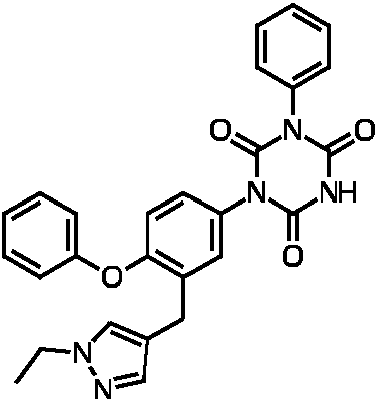
En un recipiente para microondas previamente equipado con un agitador magnético y balón de nitrógeno se recogió 3-{3-[(1-etil-1H-pirazol-4-il)metil]-4-fenoxifenM}-1-fenilurea (producto intermedio 43, 0,250 g, 0,60 mmol) en bromobenceno (2,5 ml) y la mezcla se enfrió a 0 °C. Se añadió isocianato de etoxi carbonilo (0,279 g, 2,42 mmol) gota a gota y se dejó que la mezcla de reacción resultante alcanzara la temperatura ambiente y se calentó a 150 °C durante 3 h en un Anton paar microwave synthesizer-300. El disolvente se eliminó a presión reducida y el producto en bruto se purificó por HPLC preparativa (acetonitrilo al 20-100 % en agua [bicarbonato de amonio 5 mM NH3 al 0,1 %]) para producir 0,030 g (10 %) del compuesto del título. RMN 1H (400 MHz, DMSO-d6): 511,85 (s, 1H), 7,49 7,34 (m, 8H), 7,27 (s, 1H), 7,22-7,12 (m, 3H), 7,02-6,97 (m, 2H), 6,90 (d, J = 8,40 Hz, 1H), 4,01 (c, J = 7,20 Hz, 2H), 3,76 (s, 2H), 1,29 (t, J = 7,20 Hz, 3H); MS (ES-) m/z 480 [M-H]-3-{3-[(1-ethyl-1H-pyrazol-4-yl)methyl]-4-phenoxyphenM}-1-phenylurea (intermediate 43, 0.250 g, 0.60 mmol) in bromobenzene (2.5 mL) and the mixture cooled to 0 °C. Ethoxy carbonyl isocyanate (0.279 g, 2.42 mmol) was added dropwise and the resulting reaction mixture was allowed to warm to room temperature and heated at 150 °C for 3 h in an Anton paar microwave synthesizer-300. The solvent was removed under reduced pressure and the crude product was purified by preparative HPLC (20-100% acetonitrile in water [5 mM ammonium bicarbonate 0.1% NH3]) to yield 0.030 g (10%) of the compound of the title. 1H NMR (400 MHz, DMSO-d6): 511.85 (s, 1H), 7.49-7.34 (m, 8H), 7.27 (s, 1H), 7.22-7.12 (m , 3H), 7.02-6.97 (m, 2H), 6.90 (d, J = 8.40 Hz, 1H), 4.01 (c, J = 7.20 Hz, 2H), 3 .76 (s, 2H), 1.29 (t, J = 7.20 Hz, 3H); MS (ES-) m/z 480 [M-H]-
Ejemplo 17Example 17
1-(3-metilfenil)-3-{3-[2-oxo-2-(1H-pirazol-1-il)etoxi]-4-fenoxifenil}-1,3,5-triazinan-2,4,6-triona1-(3-methylphenyl)-3-{3-[2-oxo-2-(1H-pyrazol-1-yl)ethoxy]-4-phenoxyphenyl}-1,3,5-triazinan-2,4,6 -triona
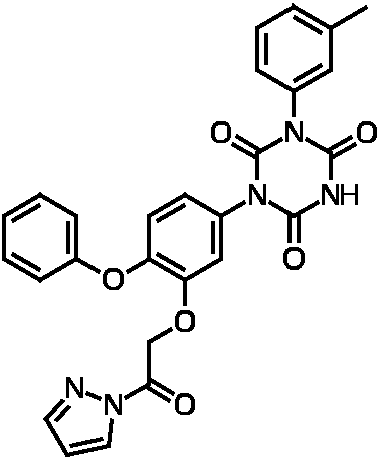
En un recipiente previamente equipado con un agitador magnético y balón de nitrógeno se recogió el producto intermedio 46, 0,10 g, 0,216 mmol) y pirazol (0,017 g, 0,26 mmol) en DMF (1 ml). A la mezcla se le añadió EdC.HCI (clorhidrato de N-(3-dimetilaminopropil)-N'-etilcarbodiimida, 0,083 g, 0,43 mmol) y la mezcla de reacción resultante se agitó durante 2 h a temperatura ambiente. Después de esto, se añadieron HOBt (1-hidroxibenzotriazol, 0,058 g, 0,43 mmol) y N-metilmorfolina (0,065 g, 0,65 mmol) y se agitó durante 1 h a temperatura ambiente. Se confirmó que la reacción se había completado mediante TLC usando DCM:MeOH (9:1) como fase móvil. La TLC se visualizó usando luz UV. Tras completarse la reacción, la mezcla de reacción se mantuvo en condiciones de enfriamiento y se purificó mediante purificación por HPLC preparativa (acetonitrilo al 30-100 % en agua [ácido fórmico al 0,1 %]) para producir 0,022 g (19 %) del compuesto del título. RMN 1H (400 MHz, DMSO-cfe): 511,99 (s, 1H), 8,46 (d, J = 2,4 Hz, 1H), 7,95 (s, 1H), 7,39-7,33 (m, 3H), 7,30 (s, 1H), 7,24 (d, J = 7,60 Hz, 1H), 7,14-7,07 (m, 4H), 7,03-6,99 (m, 3H), 6,67 (s, 1H), 5,58 (s, 2H), 2,34 (s, 3H); ); MS (ES-) m/z 510 [M-H]‘Intermediate 46 (0.10 g, 0.216 mmol) and pyrazole (0.017 g, 0.26 mmol) in DMF (1 mL) were taken up in a vessel previously equipped with a magnetic stirrer and nitrogen balloon. To the mixture was added E d C.HCl (N-(3-dimethylaminopropyl)-N'-ethylcarbodiimide hydrochloride, 0.083 g, 0.43 mmol) and the resulting reaction mixture was stirred for 2 h at room temperature. Following this, HOBt (1-hydroxybenzotriazole, 0.058 g, 0.43 mmol) and N-methylmorpholine (0.065 g, 0.65 mmol) were added and stirred for 1 h at room temperature. The reaction was confirmed to be complete by TLC using DCM:MeOH (9:1) as the mobile phase. TLC was visualized using UV light. After the completion of the reaction, the reaction mixture was kept under cooling conditions and purified by preparative HPLC purification (30-100% acetonitrile in water [0.1% formic acid]) to yield 0.022 g (19%). of the title compound. 1H NMR (400 MHz, DMSO-cfe): 511.99 (s, 1H), 8.46 (d, J = 2.4 Hz, 1H), 7.95 (s, 1H), 7.39-7 .33 (m, 3H), 7.30 (s, 1H), 7.24 (d, J = 7.60 Hz, 1H), 7.14-7.07 (m, 4H), 7.03- 6.99 (m, 3H), 6.67 (s, 1H), 5.58 (s, 2H), 2.34 (s, 3H); ); MS (ES-) m/z 510 [MH]'
Ejemplo 18Example 18
1-(3-metilfenil)-3-{4-fenoxi-3-[(1H-pirazol-1-il)metil]fenil}-1,3,5-triazinan-2,4,6-triona1-(3-methylphenyl)-3-{4-phenoxy-3-[(1H-pyrazol-1-yl)methyl]phenyl}-1,3,5-triazinan-2,4,6-trione
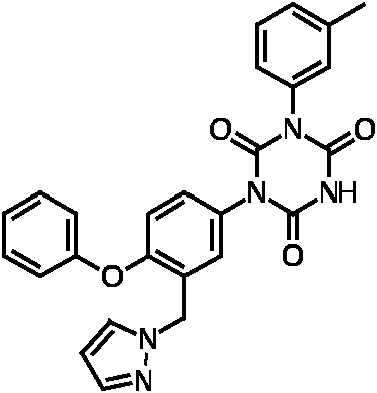
En un tubo cerrado herméticamente previamente equipado con un agitador magnético y balón de nitrógeno se recogió pirazol (0,093 g, 1,3 mmol) en ACN (5,0 ml) y la mezcla se enfrió a 0 °C. Se añadió K2CO3 (0,317 g, 2,3 mmol) y mezcla de reacción se agitó durante 10 min a 0 °C. Después de esto, se añadió 1-[3-(clorometil)-4 fenoxifenil]-3-(3-metilfenil)-1,3,5-triazinan-2,4,6-triona (producto intermedio 19, 0,50 g, 1,1 mmol) y se dejó que la mezcla de reacción resultante alcanzara la temperatura ambiente y después se calentó a 50 °C con agitación durante 3 h. El disolvente se eliminó a presión reducida para obtener el producto en bruto que se purificó usando RP-HPLC ((acetonitrilo al 15-100 % en agua [bicarbonato de amonio 5 mM NH3 al 0,1 %]) para producir 0,022 g (4 %) del compuesto del título. RMN 1H (400 MHz, DMSO-d6): 5 11,57 (s, 1H), 8,83 (s, 1H), 7,76 (s, 1H), 7,46-42 (m, 3H), 7,31-7,29 (m, 1H), 7,24-7,19 (m, 3H), 7,10-7,03 (m, 4H), 6,86 (d, J = 8,40 Hz, 1H), 6,27 (s, 1H), 5,41 (s, 2H), 2,33 (s, 3H); MS (ES-) m/z 465 [M-H]-Ejemplo 19 Pyrazole (0.093 g, 1.3 mmol) was taken up in ACN (5.0 mL) in a sealed tube previously equipped with a magnetic stirrer and nitrogen balloon and the mixture was cooled to 0 °C. K2CO3 (0.317 g, 2.3 mmol) was added and the reaction mixture was stirred for 10 min at 0 °C. After this, added 1-[3-(chloromethyl)-4-phenoxyphenyl]-3-(3-methylphenyl)-1,3,5-triazinan-2,4,6-trione (intermediate 19, 0.50 g, 1.1 mmol ) and the resulting reaction mixture was allowed to reach room temperature and then heated to 50 °C with stirring for 3 h. The solvent was removed under reduced pressure to give crude product which was purified using RP-HPLC ((15-100% acetonitrile in water [5 mM ammonium bicarbonate 0.1% NH3]) to yield 0.022 g (4 %) of title compound 1H NMR (400 MHz, DMSO-d6): 11.57 (s, 1H), 8.83 (s, 1H), 7.76 (s, 1H), 7.46- 42 (m, 3H), 7.31-7.29 (m, 1H), 7.24-7.19 (m, 3H), 7.10-7.03 (m, 4H), 6.86 ( d, J = 8.40 Hz, 1H), 6.27 (s, 1H), 5.41 (s, 2H), 2.33 (s, 3H), MS (ES-) m/z 465 [MH ]- Example 19
1-{3-[(4-etil-1H-pirazol-1-il)metil]-4-fenoxifenil}-3-fenil-1,3,5-triazinan-2,4,6-triona1-{3-[(4-ethyl-1H-pyrazol-1-yl)methyl]-4-phenoxyphenyl}-3-phenyl-1,3,5-triazinan-2,4,6-trione

En un tubo cerrado herméticamente previamente equipado con un agitador magnético y balón de nitrógeno se recogió 4-etil-1 H-pirazol (0,081 g, 0,8 mmol) en DMF (3 ml) y se enfrió a 0 °C. Se añadió NaH (60 %, 0,022 g, 0,8 mmol) a 0 °C y la mezcla de reacción se agitó durante 20 min a 0 °C. Se añadió 1-[3-(clorometil)-4-fenoxifenil]-3-fenil-1,3,5-triazinan-2,4,6-triona (producto intermedio 39, 0,3 g, 0,7 mmol) a la mezcla de reacción y se dejó que la mezcla de reacción resultante alcanzara la temperatura ambiente y después se calentó a 50 °C durante 16 h. La mezcla de reacción se inactivó con agua (2 ml) y se concentró a presión reducida. El producto en bruto se purificó por RP-HPLC preparativa ((acetonitrilo al 10-100 % en agua [bicarbonato de amonio 5 mM NH3 al 0,1 %]) para producir 0,015 g (4 %) del compuesto del título. RMN 1H (400 MHz, DMSO-d6): 5 11,96 (s, 1H), 7,55-7,35 (m, 8H), 7,33-7,10 (m, 4H), 7,03 (m, 2H), 6,88 (d, J = 8,40 Hz, 1H), 5,33 (s, 2H), 2,40-2,38 (m, 2H), 1,09 (t, J = 7,20 Hz, 3H). MS (ES-) m/z 480 [M-H]-Los siguientes compuestos se preparan siguiendo procedimientos análogos a los descritos anteriormente.4-Ethyl-1H-pyrazole (0.081 g, 0.8 mmol) was taken up in DMF (3 mL) in a sealed tube previously equipped with a magnetic stirrer and nitrogen balloon and cooled to 0 °C. NaH (60%, 0.022 g, 0.8 mmol) was added at 0 °C and the reaction mixture was stirred for 20 min at 0 °C. 1-[3-(chloromethyl)-4-phenoxyphenyl]-3-phenyl-1,3,5-triazinan-2,4,6-trione (intermediate 39, 0.3 g, 0.7 mmol) was added to the reaction mixture and the resulting reaction mixture was allowed to reach room temperature and then heated at 50 °C for 16 h. The reaction mixture was quenched with water (2 mL) and concentrated under reduced pressure. The crude product was purified by preparative RP-HPLC ((10-100% acetonitrile in water [5 mM ammonium bicarbonate 0.1% NH3])) to yield 0.015 g (4%) of the title compound.1H NMR (400 MHz, DMSO-d6): 5 11.96 (s, 1H), 7.55-7.35 (m, 8H), 7.33-7.10 (m, 4H), 7.03 (m , 2H), 6.88 (d, J = 8.40 Hz, 1H), 5.33 (s, 2H), 2.40-2.38 (m, 2H), 1.09 (t, J = 7.20 Hz, 3H) MS (ES-) m/z 480 [M-H]- The following compounds are prepared following procedures analogous to those described above.
Ejemplo 20Example 20
1-{3-[(4-etil-1H-pirazol-1-il)metil]-4-fenoxifenil}-3-(3-metilfenil)-1,3,5-triazinan-2,4,6-triona1-{3-[(4-ethyl-1H-pyrazol-1-yl)methyl]-4-phenoxyphenyl}-3-(3-methylphenyl)-1,3,5-triazinan-2,4,6-trione
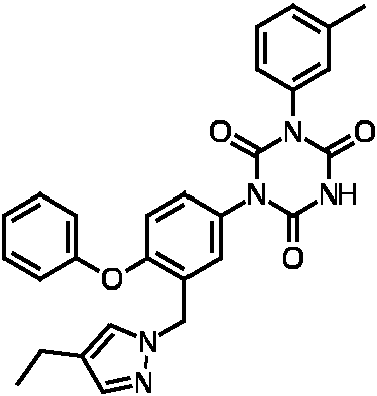
Ejemplo 21Example 21
1-(3-{[4-(difluorometil)-1 H-imidazol-1 -il]metil}-4-fenoxifenil -3- 3-metilfenil)-1,3,5-triazinan-2,4,6-triona1-(3-{[4-(difluoromethyl)-1H-imidazol-1-yl]methyl}-4-phenoxyphenyl-3- 3-methylphenyl)-1,3,5-triazinan-2,4,6- triona

Ejemplos biológicosbiological examples
Ensayo in vitro in vitro test
Se ha utilizado un cribado de alto rendimiento basado en células para identificar moduladores positivos de TrkA, TrkB y TrkC. EL cribado implica el uso de un ensayo basado en células que sobreexpresan TrkA, TrkB o TrkC. El fin del ensayo es identificar compuestos que modulan la señalización de las neurotrofinas (Forsell et al 2012). El ensayo se puede usar en un modo inhibidor usando una alta concentración de ligando, en un modo modulador usando una concentración intermedia y en un modo agonista usando una baja concentración de ligando.A cell-based high-throughput screen has been used to identify positive modulators of TrkA, TrkB, and TrkC. Screening involves the use of an assay based on cells that overexpress TrkA, TrkB or TrkC. The purpose of the assay is to identify compounds that modulate neurotrophin signaling (Forsell et al 2012). The assay can be used in an inhibitory mode using a high concentration of ligand, in a modulatory mode using an intermediate concentration, and in an agonist mode using a low concentration of ligand.
El ensayo utiliza la técnica complementación de fragmentos enzimáticos (EFC, del inglés Enzyme Fragment Complementaron), que es un ensayo basado en la proximidad. En resumen, las células utilizadas en este ensayo sobreexpresan dos proteínas de fusión, es decir, el receptor, que puede ser uno de TrkA, TrkB o TrkC fusionado con un pequeño péptido de beta-galactosidasa y una proteína adaptadora, es decir, SHC1 (o cualquier otra proteína adaptadora de Trk) fusionada con la mayor parte de la beta-galactosidasa. La unión del ligando al receptor induce la fosforilación del dominio intracelular y, por tanto, el reclutamiento de la proteína adaptadora en el receptor. La proximidad entre el pequeño péptido activador en el receptor y la mayor parte de la beta-galactosidasa en la proteína adaptadora conduce a una enzima beta-galactosidasa activa. La activación del receptor se cuantifica midiendo la cantidad de beta-galactosidasa activa por su conversión de un sustrato no luminiscente en un producto luminiscente. The assay uses the Enzyme Fragment Complementation (EFC ) technique, which is a proximity-based assay. In summary, the cells used in this assay overexpress two fusion proteins, i.e., the receptor, which can be one of TrkA, TrkB, or TrkC fused with a small peptide of beta-galactosidase and an adapter protein, i.e., SHC1 ( or any other Trk adapter protein) fused to the bulk of beta-galactosidase. Binding of the ligand to the receptor induces phosphorylation of the intracellular domain and thus recruitment of the adapter protein to the receptor. The proximity between the small activating peptide on the receptor and the bulk of the beta-galactosidase on the adapter protein leads to an active beta-galactosidase enzyme. Receptor activation is quantified by measuring the amount of beta-galactosidase activated by its conversion of a non-luminescent substrate to a luminescent product.
Se sembraron células U2OS que sobreexpresaban TrkA, TrkB o TrkC en placas de 96 o 384 pocillos y se incubaron durante una noche. Al día siguiente, el compuesto de prueba se premezcló con el ligando (NGF) y la mezcla de ligando y compuesto se añade luego a las células para producir una concentración final de ligando de 10 ng/ml. Después de 3 horas de incubación a temperatura ambiente, la incubación se detiene mediante la adición de una mezcla de sustrato de beta-galactosidasa que contiene detergentes. La mezcla de sustrato se incuba durante 60 minutos a temperatura ambiente. A continuación, se lee la luminiscencia mediante el uso de un lector de placas. U2OS cells overexpressing TrkA, TrkB or TrkC were seeded in 96- or 384-well plates and incubated overnight. The next day, the test compound is premixed with the ligand (NGF) and the ligand-compound mixture is then added to the cells to produce a final ligand concentration of 10 ng/ml. After 3 hours of incubation at room temperature, the incubation is stopped by the addition of a beta-galactosidase substrate mixture containing detergents. The substrate mixture is incubated for 60 minutes at room temperature. The luminescence is then read using a plate reader.
ResultadosResults
Los datos de estos ensayos para compuestos representativos se muestran a continuación en la Tabla. La potencia se expresa como CE50 (|j M) para los receptores individuales. Los datos indican que se prevé que los compuestos de la invención posean propiedades terapéuticas útiles.Data from these assays for representative compounds are shown in the Table below. Power is expressed as EC50 ( | j M) for individual receptors. The data indicates that the compounds of the invention are expected to possess useful therapeutic properties.

Claims (16)


Applications Claiming Priority (2)
| Application Number | Priority Date | Filing Date | Title |
|---|---|---|---|
| GBGB1810668.2A GB201810668D0 (en) | 2018-06-28 | 2018-06-28 | New compounds |
| PCT/GB2019/051853 WO2020002950A1 (en) | 2018-06-28 | 2019-06-28 | 4-substituted phenyl-1,3,5-triazine derivatives as modulators of trk receptors |
Publications (1)
| Publication Number | Publication Date |
|---|---|
| ES2935183T3 true ES2935183T3 (en) | 2023-03-02 |
Family
ID=63143731
Family Applications (1)
| Application Number | Title | Priority Date | Filing Date |
|---|---|---|---|
| ES19739692T Active ES2935183T3 (en) | 2018-06-28 | 2019-06-28 | 4-Substituted phenyl-1,3,5-triazine derivatives as modulators of TRK receptors |
Country Status (10)
| Country | Link |
|---|---|
| US (1) | US11840524B2 (en) |
| EP (1) | EP3814335B1 (en) |
| JP (1) | JP7510358B2 (en) |
| KR (1) | KR20210024531A (en) |
| CN (1) | CN112513032B (en) |
| BR (1) | BR112020026619A2 (en) |
| CA (1) | CA3104237A1 (en) |
| ES (1) | ES2935183T3 (en) |
| GB (1) | GB201810668D0 (en) |
| WO (1) | WO2020002950A1 (en) |
Families Citing this family (4)
| Publication number | Priority date | Publication date | Assignee | Title |
|---|---|---|---|---|
| MX2020008816A (en) | 2018-02-26 | 2020-09-28 | AlzeCure Pharma AB | Triazine derivatives for treating diseases relating to neurotrophins. |
| GB201912404D0 (en) * | 2019-08-29 | 2019-10-16 | AlzeCure Pharma AB | New compounds |
| CA3180846A1 (en) * | 2020-06-03 | 2021-12-09 | Dana-Farber Cancer Institute, Inc. | Inhibitors of transcriptional enhanced associate domain (tead) and uses thereof |
| WO2025232990A1 (en) | 2024-05-09 | 2025-11-13 | AlzeCure Pharma AB | Triazinone derivatives for use in the treatment of inflammation |
Family Cites Families (42)
| Publication number | Priority date | Publication date | Assignee | Title |
|---|---|---|---|---|
| DE2246109A1 (en) | 1972-09-20 | 1974-03-28 | Bayer Ag | 1- (4-PHENOXY-PHENYL) -1,3,5-TRIAZINE DERIVATIVES, A METHOD FOR THEIR MANUFACTURE AND THEIR USE AS A MEDICINAL PRODUCT |
| DE2313721A1 (en) | 1973-03-20 | 1974-10-03 | Bayer Ag | NEW 1-PHENYL-SUBSTITUTED 1,3,5TRIAZINE, THE METHOD FOR THEIR MANUFACTURING AND THEIR USE AS A MEDICINAL PRODUCT |
| DE2413722C3 (en) | 1974-03-21 | 1982-04-08 | Bayer Ag, 5090 Leverkusen | New 1- (4-phenoxyphenyl) -1,3,5-triazine derivatives, a process for their preparation and their use as pharmaceuticals |
| DE2718799A1 (en) | 1977-04-27 | 1978-11-09 | Bayer Ag | 1- (4-PHENOXY-PHENYL) -1,3,5-TRIAZINE DERIVATIVES, THE METHOD FOR THEIR MANUFACTURING AND THEIR USE AS A MEDICINAL PRODUCT AND GROWTH PROMOTER |
| DE3271848D1 (en) | 1981-12-03 | 1986-07-31 | Basf Ag | 1,3,5-triazinones, process for their preparation and their use in combating undesired plant growth |
| DE3314739A1 (en) | 1983-04-23 | 1984-10-25 | Bayer Ag, 5090 Leverkusen | 1- (4- (4- (FLUORALKYLMETHYLTHIO- OR -SULFINYL- OR -SULFONYL-) PHENOXY) PHENYL) -1,3,5-TRIAZINE-2,4,6 (1H, 3H, 5H) -TRIONE, PROCEDURE TO THEIR PRODUCTION AND USE AS COCCIDIOS |
| DE3408768A1 (en) | 1984-03-09 | 1985-09-12 | Bayer Ag, 5090 Leverkusen | IMMUNTIMULATING AGENTS |
| DE3516632A1 (en) | 1985-05-09 | 1986-11-13 | Bayer Ag, 5090 Leverkusen | METHOD FOR PRODUCING 1,3,5-TRIAZINTRIONS |
| DE3516631A1 (en) | 1985-05-09 | 1986-11-13 | Bayer Ag, 5090 Leverkusen | Process for the preparation of 3-methyl-1,3,5-triazinetriones |
| DE3703105A1 (en) | 1987-02-03 | 1988-08-11 | Bayer Ag | MEDICINE AGAINST PROTOCOES IN INSECTS |
| DE3810080A1 (en) | 1988-03-25 | 1989-10-05 | Bayer Ag | TRISUBSTITUTED 1,3,5-TRIAZINE-2,4,6-TRIONE |
| DE3814323A1 (en) | 1988-04-28 | 1989-11-09 | Hoechst Ag | WATER-SOLUBLE PREPARATIONS BY COCCIDIOSTATICA |
| US4933341A (en) | 1988-10-08 | 1990-06-12 | Bayer Aktiengesellschaft | Substituted 1,3,5-triazinetriones, for use against parasitic protozoa |
| DE4000624A1 (en) | 1990-01-11 | 1991-07-18 | Bayer Ag | New tri:substd.-1,3,5-triazine-2,4,6-tri:one derivs. - for use as fungicides in plant protection |
| DE4329096A1 (en) | 1993-08-30 | 1995-03-02 | Bayer Ag | Heterocyclylbenzoheterocycles |
| US5604180A (en) | 1995-06-02 | 1997-02-18 | Crews, Jr.; Alvin D. | 3-(3-aryloxyphenyl)-1 (substituted methyl)-s-triazine-2,4,6-oxo or thiotrione herbicidal agents |
| US5519133A (en) | 1995-06-02 | 1996-05-21 | American Cyanamid Co. | 3-(3-aryloxyphenyl)-1-(substituted methyl)-s-triazine-2,4,6-oxo or thiotrione herbicidal agents |
| CZ146296A3 (en) | 1995-06-02 | 1997-04-16 | American Cyanamid Co | 3-(3-aryloxyphenyl)-1-(substituted methyl)-s-triazine-2,4,6-oxo or thiotriones, process of their preparation and herbicidal agents |
| US5726126A (en) * | 1995-06-02 | 1998-03-10 | American Cyanamid Company | 1-(3-heterocyclyphenyl)-S-triazine-2,6,6-oxo or thiotrione herbicidal agents |
| US5679791A (en) | 1996-07-25 | 1997-10-21 | American Cyanamid Company | 1-(3-heterocyclylphenyl)-s-triazine-2,4,6-oxo or thiotrione herbicidal agents |
| AU766542B2 (en) | 1998-10-08 | 2003-10-16 | New Ace Research Company | Novel compositions and methods for prevention and treatment of protozoal disease |
| CN1331595A (en) | 1998-12-22 | 2002-01-16 | 美国拜尔公司 | Triazine compounds for treating diseases due to sarcosystis, neospora and toxoplasma |
| DE19937500A1 (en) | 1999-08-09 | 2001-02-15 | Bayer Ag | Substituted heterocyclylbenzofurans |
| DE19958388A1 (en) | 1999-12-03 | 2001-06-07 | Bayer Ag | Triazinone compounds for the treatment of infestations with parasitic protozoa-related diseases |
| US6444615B1 (en) | 2000-04-18 | 2002-09-03 | Dow Agrosciences Llc | Herbicidal imidazolidinetrione and thioxo-imidazolidinediones |
| DE10034800A1 (en) | 2000-07-18 | 2002-01-31 | Bayer Ag | Substituted benzo nitrogen heterocycles |
| DE10040110A1 (en) | 2000-08-17 | 2002-02-28 | Bayer Ag | Use of triazinetrione sulfoxides to combat coccidioses |
| DE10040174A1 (en) | 2000-08-17 | 2002-02-28 | Bayer Ag | Use of triazinetrione sulfones to combat coccidioses |
| AU2002324586B2 (en) | 2001-08-02 | 2008-04-24 | Neurocrine Biosciences, Inc. | 1,3,5-triazine-2,4,6-triones, preparation and use as gonadotropin-releasing hormone receptor antagonists |
| US6861523B2 (en) | 2002-02-08 | 2005-03-01 | Torrey Pines Institute For Molecular Studies | 1,3,5- trisubstituted-1,3,5-triazine-2,4,6-trione compounds and libraries |
| WO2003101980A1 (en) | 2002-05-30 | 2003-12-11 | Solvay Pharmaceuticals B.V. | 1,3,5-triazine derivatives as ligands for human adenosine-a3 receptors |
| WO2004007499A1 (en) | 2002-07-15 | 2004-01-22 | Janssen Pharmaceutica N.V. | 3-furanyl analogs of toxoflavine as kinase inhibitors |
| DE102006038292A1 (en) | 2006-08-16 | 2008-02-21 | Bayer Healthcare Ag | Transdermal use of triazines to combat coccidial infections |
| WO2008148008A1 (en) * | 2007-05-23 | 2008-12-04 | Emory University | High throughput bioassay for identifying selective trka receptor agonists, and gambogic amide, a selective trka agonist with neuroprotective activity |
| US20120004310A1 (en) | 2010-05-28 | 2012-01-05 | Longo Frank M | Non-peptide bdnf neurotrophin mimetics |
| CN105209427B (en) * | 2013-03-15 | 2018-05-25 | 特罗菲克斯制药股份有限公司 | Non-peptide BDNF neurotrophins analogies |
| KR101861942B1 (en) | 2014-01-20 | 2018-06-29 | 에프. 호프만-라 로슈 아게 | N-phenyl-lactam derivatives capable of stimulating neurogenesis and their use in the treatment of neurological disorders |
| EP3229611B1 (en) | 2014-12-10 | 2025-03-26 | Mars, Incorporated | Compounds that modulate fatty acid receptor activity and pet food products containing the same |
| JP2020502225A (en) | 2016-12-21 | 2020-01-23 | アルゼキュア ファーマ アーべー | Triazinetrione derivatives and their use as modulators of the neurotrophin receptor and receptor tyrosine kinase. |
| MX2020008816A (en) | 2018-02-26 | 2020-09-28 | AlzeCure Pharma AB | Triazine derivatives for treating diseases relating to neurotrophins. |
| GB201810669D0 (en) | 2018-06-28 | 2018-08-15 | Stiftelsen Alzecure | New compounds |
| GB201912404D0 (en) | 2019-08-29 | 2019-10-16 | AlzeCure Pharma AB | New compounds |
-
2018
- 2018-06-28 GB GBGB1810668.2A patent/GB201810668D0/en not_active Ceased
-
2019
- 2019-06-28 EP EP19739692.2A patent/EP3814335B1/en active Active
- 2019-06-28 JP JP2020570716A patent/JP7510358B2/en active Active
- 2019-06-28 ES ES19739692T patent/ES2935183T3/en active Active
- 2019-06-28 KR KR1020217000575A patent/KR20210024531A/en active Pending
- 2019-06-28 CA CA3104237A patent/CA3104237A1/en active Pending
- 2019-06-28 CN CN201980045116.8A patent/CN112513032B/en active Active
- 2019-06-28 WO PCT/GB2019/051853 patent/WO2020002950A1/en not_active Ceased
- 2019-06-28 US US17/255,642 patent/US11840524B2/en active Active
- 2019-06-28 BR BR112020026619-1A patent/BR112020026619A2/en not_active Application Discontinuation
Also Published As
| Publication number | Publication date |
|---|---|
| JP7510358B2 (en) | 2024-07-03 |
| EP3814335B1 (en) | 2022-11-09 |
| US20210371402A1 (en) | 2021-12-02 |
| KR20210024531A (en) | 2021-03-05 |
| EP3814335A1 (en) | 2021-05-05 |
| WO2020002950A1 (en) | 2020-01-02 |
| BR112020026619A2 (en) | 2021-03-30 |
| GB201810668D0 (en) | 2018-08-15 |
| CN112513032A (en) | 2021-03-16 |
| US11840524B2 (en) | 2023-12-12 |
| CA3104237A1 (en) | 2020-01-02 |
| JP2021529168A (en) | 2021-10-28 |
| CN112513032B (en) | 2024-07-02 |
Similar Documents
| Publication | Publication Date | Title |
|---|---|---|
| US12209071B2 (en) | Triazine derivatives for treating diseases relating to neurotrophins | |
| ES2935183T3 (en) | 4-Substituted phenyl-1,3,5-triazine derivatives as modulators of TRK receptors | |
| US20220324819A1 (en) | Triazine derivatives for treating diseases relating to neurotrophins | |
| US20210261513A1 (en) | 4-substituted phenyl-1,3,5-triazine derivatives as modulators of trk receptors | |
| RU2816837C2 (en) | Triazine derivatives for treating diseases associated with neurotrophins | |
| US9663464B2 (en) | Carbazole derivatives acting on 5-HT7 receptor | |
| HK40033844B (en) | Triazine derivatives for treating diseases relating to neurotrophins | |
| HK40033844A (en) | Triazine derivatives for treating diseases relating to neurotrophins |