ES2936864T3 - Pyrimidinosulfamide derivative and method of preparation and medical application thereof - Google Patents
Pyrimidinosulfamide derivative and method of preparation and medical application thereof Download PDFInfo
- Publication number
- ES2936864T3 ES2936864T3 ES18881280T ES18881280T ES2936864T3 ES 2936864 T3 ES2936864 T3 ES 2936864T3 ES 18881280 T ES18881280 T ES 18881280T ES 18881280 T ES18881280 T ES 18881280T ES 2936864 T3 ES2936864 T3 ES 2936864T3
- Authority
- ES
- Spain
- Prior art keywords
- compound
- mmol
- added
- room temperature
- alkyl
- Prior art date
- Legal status (The legal status is an assumption and is not a legal conclusion. Google has not performed a legal analysis and makes no representation as to the accuracy of the status listed.)
- Active
Links
- 238000002360 preparation method Methods 0.000 title abstract description 5
- 238000000034 method Methods 0.000 title description 14
- 150000001875 compounds Chemical class 0.000 claims abstract description 403
- 239000000203 mixture Substances 0.000 claims abstract description 132
- 229940044551 receptor antagonist Drugs 0.000 claims abstract description 9
- 239000002464 receptor antagonist Substances 0.000 claims abstract description 9
- -1 C1-4alkylO-C1-4alkyl Chemical group 0.000 claims description 89
- 125000000217 alkyl group Chemical group 0.000 claims description 34
- 150000003839 salts Chemical class 0.000 claims description 32
- 125000005842 heteroatom Chemical group 0.000 claims description 26
- 125000000592 heterocycloalkyl group Chemical group 0.000 claims description 20
- 229910052739 hydrogen Inorganic materials 0.000 claims description 19
- 229910052794 bromium Inorganic materials 0.000 claims description 14
- 229910052801 chlorine Inorganic materials 0.000 claims description 14
- 229910052740 iodine Inorganic materials 0.000 claims description 14
- 229910052731 fluorine Inorganic materials 0.000 claims description 13
- 125000003718 tetrahydrofuranyl group Chemical group 0.000 claims description 7
- 125000006716 (C1-C6) heteroalkyl group Chemical group 0.000 claims description 6
- 125000006570 (C5-C6) heteroaryl group Chemical group 0.000 claims description 6
- 125000002883 imidazolyl group Chemical group 0.000 claims description 6
- 125000003226 pyrazolyl group Chemical group 0.000 claims description 6
- 125000000719 pyrrolidinyl group Chemical group 0.000 claims description 6
- 125000000335 thiazolyl group Chemical group 0.000 claims description 6
- 125000005958 tetrahydrothienyl group Chemical group 0.000 claims description 5
- JPRPJUMQRZTTED-UHFFFAOYSA-N 1,3-dioxolanyl Chemical group [CH]1OCCO1 JPRPJUMQRZTTED-UHFFFAOYSA-N 0.000 claims description 4
- 206010020772 Hypertension Diseases 0.000 claims description 4
- 206010064911 Pulmonary arterial hypertension Diseases 0.000 claims description 4
- 125000001995 cyclobutyl group Chemical group [H]C1([H])C([H])([H])C([H])(*)C1([H])[H] 0.000 claims description 4
- 125000004178 (C1-C4) alkyl group Chemical group 0.000 claims description 3
- 125000005913 (C3-C6) cycloalkyl group Chemical group 0.000 claims description 3
- 208000007342 Diabetic Nephropathies Diseases 0.000 claims description 3
- 208000007530 Essential hypertension Diseases 0.000 claims description 3
- 239000004480 active ingredient Substances 0.000 claims description 3
- 125000006430 alkyl cyclopropyl group Chemical group 0.000 claims description 3
- 208000033679 diabetic kidney disease Diseases 0.000 claims description 3
- 208000001286 intracranial vasospasm Diseases 0.000 claims description 3
- 125000002023 trifluoromethyl group Chemical group FC(F)(F)* 0.000 claims description 3
- JNCMHMUGTWEVOZ-UHFFFAOYSA-N F[CH]F Chemical compound F[CH]F JNCMHMUGTWEVOZ-UHFFFAOYSA-N 0.000 claims description 2
- 108010081348 HRT1 protein Hairy Proteins 0.000 claims description 2
- 102100021881 Hairy/enhancer-of-split related with YRPW motif protein 1 Human genes 0.000 claims description 2
- VUWZPRWSIVNGKG-UHFFFAOYSA-N fluoromethane Chemical compound F[CH2] VUWZPRWSIVNGKG-UHFFFAOYSA-N 0.000 claims description 2
- 239000008194 pharmaceutical composition Substances 0.000 claims description 2
- 125000006273 (C1-C3) alkyl group Chemical group 0.000 claims 4
- 125000004169 (C1-C6) alkyl group Chemical group 0.000 claims 3
- 239000003814 drug Substances 0.000 abstract description 17
- 229940079593 drug Drugs 0.000 abstract description 12
- 201000010099 disease Diseases 0.000 abstract description 6
- 208000037265 diseases, disorders, signs and symptoms Diseases 0.000 abstract description 6
- GZRPWFCHDLJSDX-UHFFFAOYSA-N pyrimidine;sulfamide Chemical class NS(N)(=O)=O.C1=CN=CN=C1 GZRPWFCHDLJSDX-UHFFFAOYSA-N 0.000 abstract 1
- XEKOWRVHYACXOJ-UHFFFAOYSA-N Ethyl acetate Chemical compound CCOC(C)=O XEKOWRVHYACXOJ-UHFFFAOYSA-N 0.000 description 395
- YMWUJEATGCHHMB-UHFFFAOYSA-N Dichloromethane Chemical compound ClCCl YMWUJEATGCHHMB-UHFFFAOYSA-N 0.000 description 203
- 239000011541 reaction mixture Substances 0.000 description 153
- 235000019439 ethyl acetate Nutrition 0.000 description 132
- 239000000243 solution Substances 0.000 description 131
- 238000006243 chemical reaction Methods 0.000 description 123
- 239000002904 solvent Substances 0.000 description 118
- RTZKZFJDLAIYFH-UHFFFAOYSA-N Diethyl ether Chemical compound CCOCC RTZKZFJDLAIYFH-UHFFFAOYSA-N 0.000 description 104
- 239000012074 organic phase Substances 0.000 description 98
- 238000003786 synthesis reaction Methods 0.000 description 93
- 230000015572 biosynthetic process Effects 0.000 description 92
- PMZURENOXWZQFD-UHFFFAOYSA-L Sodium Sulfate Chemical compound [Na+].[Na+].[O-]S([O-])(=O)=O PMZURENOXWZQFD-UHFFFAOYSA-L 0.000 description 91
- 239000012299 nitrogen atmosphere Substances 0.000 description 88
- 239000000706 filtrate Substances 0.000 description 83
- XLYOFNOQVPJJNP-UHFFFAOYSA-N water Substances O XLYOFNOQVPJJNP-UHFFFAOYSA-N 0.000 description 83
- VEXZGXHMUGYJMC-UHFFFAOYSA-N Hydrochloric acid Chemical compound Cl VEXZGXHMUGYJMC-UHFFFAOYSA-N 0.000 description 80
- HPALAKNZSZLMCH-UHFFFAOYSA-M sodium;chloride;hydrate Chemical compound O.[Na+].[Cl-] HPALAKNZSZLMCH-UHFFFAOYSA-M 0.000 description 78
- 238000005160 1H NMR spectroscopy Methods 0.000 description 72
- IAZDPXIOMUYVGZ-UHFFFAOYSA-N Dimethylsulphoxide Chemical compound CS(C)=O IAZDPXIOMUYVGZ-UHFFFAOYSA-N 0.000 description 69
- 239000007787 solid Substances 0.000 description 61
- LYCAIKOWRPUZTN-UHFFFAOYSA-N Ethylene glycol Chemical compound OCCO LYCAIKOWRPUZTN-UHFFFAOYSA-N 0.000 description 57
- ZMANZCXQSJIPKH-UHFFFAOYSA-N Triethylamine Chemical compound CCN(CC)CC ZMANZCXQSJIPKH-UHFFFAOYSA-N 0.000 description 54
- 239000003480 eluent Substances 0.000 description 54
- 239000003208 petroleum Substances 0.000 description 52
- XTHFKEDIFFGKHM-UHFFFAOYSA-N Dimethoxyethane Chemical compound COCCOC XTHFKEDIFFGKHM-UHFFFAOYSA-N 0.000 description 42
- OKKJLVBELUTLKV-UHFFFAOYSA-N Methanol Chemical compound OC OKKJLVBELUTLKV-UHFFFAOYSA-N 0.000 description 42
- 238000004440 column chromatography Methods 0.000 description 41
- LPNYRYFBWFDTMA-UHFFFAOYSA-N potassium tert-butoxide Chemical compound [K+].CC(C)(C)[O-] LPNYRYFBWFDTMA-UHFFFAOYSA-N 0.000 description 38
- WYURNTSHIVDZCO-UHFFFAOYSA-N Tetrahydrofuran Chemical compound C1CCOC1 WYURNTSHIVDZCO-UHFFFAOYSA-N 0.000 description 30
- IJGRMHOSHXDMSA-UHFFFAOYSA-N Atomic nitrogen Chemical compound N#N IJGRMHOSHXDMSA-UHFFFAOYSA-N 0.000 description 29
- 238000012360 testing method Methods 0.000 description 29
- 239000000872 buffer Substances 0.000 description 24
- 229910052757 nitrogen Inorganic materials 0.000 description 24
- 239000012634 fragment Substances 0.000 description 22
- 108050009340 Endothelin Proteins 0.000 description 21
- 102000002045 Endothelin Human genes 0.000 description 21
- 230000000694 effects Effects 0.000 description 21
- 125000001424 substituent group Chemical group 0.000 description 21
- ZMXDDKWLCZADIW-UHFFFAOYSA-N N,N-Dimethylformamide Chemical compound CN(C)C=O ZMXDDKWLCZADIW-UHFFFAOYSA-N 0.000 description 20
- 238000005481 NMR spectroscopy Methods 0.000 description 20
- 229910052799 carbon Inorganic materials 0.000 description 20
- 210000004027 cell Anatomy 0.000 description 19
- BKLHHTTZTSYHBV-UHFFFAOYSA-N 5-bromo-4,6-dichloropyrimidine Chemical compound ClC1=NC=NC(Cl)=C1Br BKLHHTTZTSYHBV-UHFFFAOYSA-N 0.000 description 18
- NXQGGXCHGDYOHB-UHFFFAOYSA-L cyclopenta-1,4-dien-1-yl(diphenyl)phosphane;dichloropalladium;iron(2+) Chemical compound [Fe+2].Cl[Pd]Cl.[CH-]1C=CC(P(C=2C=CC=CC=2)C=2C=CC=CC=2)=C1.[CH-]1C=CC(P(C=2C=CC=CC=2)C=2C=CC=CC=2)=C1 NXQGGXCHGDYOHB-UHFFFAOYSA-L 0.000 description 18
- ZUBDGKVDJUIMQQ-UBFCDGJISA-N endothelin-1 Chemical compound C([C@@H](C(=O)N[C@@H](CC(C)C)C(=O)N[C@@H](CC(O)=O)C(=O)N[C@@H]([C@@H](C)CC)C(=O)N[C@@H]([C@@H](C)CC)C(=O)N[C@@H](CC=1C2=CC=CC=C2NC=1)C(O)=O)NC(=O)[C@H]1NC(=O)[C@H](CC=2C=CC=CC=2)NC(=O)[C@@H](CC=2C=CC(O)=CC=2)NC(=O)[C@H](C(C)C)NC(=O)[C@H]2CSSC[C@@H](C(N[C@H](CO)C(=O)N[C@@H](CO)C(=O)N[C@H](CC(C)C)C(=O)N[C@@H](CCSC)C(=O)N[C@H](CC(O)=O)C(=O)N[C@@H](CCCCN)C(=O)N[C@@H](CCC(O)=O)C(=O)N2)=O)NC(=O)[C@@H](CO)NC(=O)[C@H](N)CSSC1)C1=CNC=N1 ZUBDGKVDJUIMQQ-UBFCDGJISA-N 0.000 description 17
- 125000003118 aryl group Chemical group 0.000 description 16
- WEVYAHXRMPXWCK-UHFFFAOYSA-N Acetonitrile Chemical compound CC#N WEVYAHXRMPXWCK-UHFFFAOYSA-N 0.000 description 15
- 239000012043 crude product Substances 0.000 description 15
- 102000005962 receptors Human genes 0.000 description 15
- 108020003175 receptors Proteins 0.000 description 15
- 125000004429 atom Chemical group 0.000 description 14
- YLQBMQCUIZJEEH-UHFFFAOYSA-N tetrahydrofuran Natural products C=1C=COC=1 YLQBMQCUIZJEEH-UHFFFAOYSA-N 0.000 description 14
- 239000007788 liquid Substances 0.000 description 13
- 239000003921 oil Substances 0.000 description 13
- 101800004490 Endothelin-1 Proteins 0.000 description 12
- 102400000686 Endothelin-1 Human genes 0.000 description 12
- 230000002401 inhibitory effect Effects 0.000 description 11
- QTBSBXVTEAMEQO-UHFFFAOYSA-N Acetic acid Chemical compound CC(O)=O QTBSBXVTEAMEQO-UHFFFAOYSA-N 0.000 description 10
- MWUXSHHQAYIFBG-UHFFFAOYSA-N Nitric oxide Chemical compound O=[N] MWUXSHHQAYIFBG-UHFFFAOYSA-N 0.000 description 10
- 239000008346 aqueous phase Substances 0.000 description 10
- 125000004432 carbon atom Chemical group C* 0.000 description 10
- 230000006698 induction Effects 0.000 description 10
- JGCMEBMXRHSZKX-UHFFFAOYSA-N macitentan Chemical compound C=1C=C(Br)C=CC=1C=1C(NS(=O)(=O)NCCC)=NC=NC=1OCCOC1=NC=C(Br)C=N1 JGCMEBMXRHSZKX-UHFFFAOYSA-N 0.000 description 10
- 229960001039 macitentan Drugs 0.000 description 10
- SCVFZCLFOSHCOH-UHFFFAOYSA-M potassium acetate Chemical compound [K+].CC([O-])=O SCVFZCLFOSHCOH-UHFFFAOYSA-M 0.000 description 10
- BWHMMNNQKKPAPP-UHFFFAOYSA-L potassium carbonate Chemical compound [K+].[K+].[O-]C([O-])=O BWHMMNNQKKPAPP-UHFFFAOYSA-L 0.000 description 10
- 125000006239 protecting group Chemical group 0.000 description 10
- 241000282472 Canis lupus familiaris Species 0.000 description 9
- 108010044467 Isoenzymes Proteins 0.000 description 9
- 239000002253 acid Substances 0.000 description 9
- 238000002474 experimental method Methods 0.000 description 9
- 125000000623 heterocyclic group Chemical group 0.000 description 9
- 125000001183 hydrocarbyl group Chemical group 0.000 description 9
- 239000005457 ice water Substances 0.000 description 9
- 229910052760 oxygen Inorganic materials 0.000 description 9
- 239000013641 positive control Substances 0.000 description 9
- 238000004237 preparative chromatography Methods 0.000 description 9
- 229910052717 sulfur Inorganic materials 0.000 description 9
- DTQVDTLACAAQTR-UHFFFAOYSA-N trifluoroacetic acid Substances OC(=O)C(F)(F)F DTQVDTLACAAQTR-UHFFFAOYSA-N 0.000 description 9
- OKTJSMMVPCPJKN-UHFFFAOYSA-N Carbon Chemical compound [C] OKTJSMMVPCPJKN-UHFFFAOYSA-N 0.000 description 8
- 108010081668 Cytochrome P-450 CYP3A Proteins 0.000 description 8
- 102000000804 Pregnane X Receptor Human genes 0.000 description 8
- 108010001511 Pregnane X Receptor Proteins 0.000 description 8
- 241000700159 Rattus Species 0.000 description 8
- 230000003042 antagnostic effect Effects 0.000 description 8
- 239000002585 base Substances 0.000 description 8
- 239000003153 chemical reaction reagent Substances 0.000 description 8
- 239000000460 chlorine Substances 0.000 description 8
- 125000001072 heteroaryl group Chemical group 0.000 description 8
- 238000004895 liquid chromatography mass spectrometry Methods 0.000 description 8
- 125000004433 nitrogen atom Chemical group N* 0.000 description 8
- RYHBNJHYFVUHQT-UHFFFAOYSA-N 1,4-Dioxane Chemical compound C1COCCO1 RYHBNJHYFVUHQT-UHFFFAOYSA-N 0.000 description 7
- 239000012981 Hank's balanced salt solution Substances 0.000 description 7
- 230000010100 anticoagulation Effects 0.000 description 7
- 239000003833 bile salt Substances 0.000 description 7
- 239000012230 colorless oil Substances 0.000 description 7
- 238000001514 detection method Methods 0.000 description 7
- 125000000524 functional group Chemical group 0.000 description 7
- 238000001294 liquid chromatography-tandem mass spectrometry Methods 0.000 description 7
- 239000000523 sample Substances 0.000 description 7
- JOXIMZWYDAKGHI-UHFFFAOYSA-N toluene-4-sulfonic acid Chemical compound CC1=CC=C(S(O)(=O)=O)C=C1 JOXIMZWYDAKGHI-UHFFFAOYSA-N 0.000 description 7
- NLXLAEXVIDQMFP-UHFFFAOYSA-N Ammonia chloride Chemical class [NH4+].[Cl-] NLXLAEXVIDQMFP-UHFFFAOYSA-N 0.000 description 6
- 102000004328 Cytochrome P-450 CYP3A Human genes 0.000 description 6
- KFZMGEQAYNKOFK-UHFFFAOYSA-N Isopropanol Chemical compound CC(C)O KFZMGEQAYNKOFK-UHFFFAOYSA-N 0.000 description 6
- KDLHZDBZIXYQEI-UHFFFAOYSA-N Palladium Chemical compound [Pd] KDLHZDBZIXYQEI-UHFFFAOYSA-N 0.000 description 6
- KEAYESYHFKHZAL-UHFFFAOYSA-N Sodium Chemical compound [Na] KEAYESYHFKHZAL-UHFFFAOYSA-N 0.000 description 6
- HEDRZPFGACZZDS-MICDWDOJSA-N Trichloro(2H)methane Chemical compound [2H]C(Cl)(Cl)Cl HEDRZPFGACZZDS-MICDWDOJSA-N 0.000 description 6
- 239000012298 atmosphere Substances 0.000 description 6
- 239000001257 hydrogen Substances 0.000 description 6
- 230000005764 inhibitory process Effects 0.000 description 6
- 230000001404 mediated effect Effects 0.000 description 6
- 229920006395 saturated elastomer Polymers 0.000 description 6
- 239000012312 sodium hydride Substances 0.000 description 6
- 229910000104 sodium hydride Inorganic materials 0.000 description 6
- 125000004434 sulfur atom Chemical group 0.000 description 6
- XPGIBDJXEVAVTO-UHFFFAOYSA-N 5-bromo-2-chloropyrimidine Chemical compound ClC1=NC=C(Br)C=N1 XPGIBDJXEVAVTO-UHFFFAOYSA-N 0.000 description 5
- LFQSCWFLJHTTHZ-UHFFFAOYSA-N Ethanol Chemical compound CCO LFQSCWFLJHTTHZ-UHFFFAOYSA-N 0.000 description 5
- UFHFLCQGNIYNRP-UHFFFAOYSA-N Hydrogen Chemical compound [H][H] UFHFLCQGNIYNRP-UHFFFAOYSA-N 0.000 description 5
- IPWKHHSGDUIRAH-UHFFFAOYSA-N bis(pinacolato)diboron Chemical compound O1C(C)(C)C(C)(C)OB1B1OC(C)(C)C(C)(C)O1 IPWKHHSGDUIRAH-UHFFFAOYSA-N 0.000 description 5
- 150000001721 carbon Chemical group 0.000 description 5
- 238000004587 chromatography analysis Methods 0.000 description 5
- 125000000753 cycloalkyl group Chemical group 0.000 description 5
- 238000000338 in vitro Methods 0.000 description 5
- 239000000463 material Substances 0.000 description 5
- 125000002496 methyl group Chemical group [H]C([H])([H])* 0.000 description 5
- 230000003228 microsomal effect Effects 0.000 description 5
- 125000001997 phenyl group Chemical group [H]C1=C([H])C([H])=C(*)C([H])=C1[H] 0.000 description 5
- 235000011056 potassium acetate Nutrition 0.000 description 5
- 229910000027 potassium carbonate Inorganic materials 0.000 description 5
- 125000002924 primary amino group Chemical group [H]N([H])* 0.000 description 5
- 125000004076 pyridyl group Chemical group 0.000 description 5
- 238000001308 synthesis method Methods 0.000 description 5
- 210000001519 tissue Anatomy 0.000 description 5
- JKMHFZQWWAIEOD-UHFFFAOYSA-N 2-[4-(2-hydroxyethyl)piperazin-1-yl]ethanesulfonic acid Chemical compound OCC[NH+]1CCN(CCS([O-])(=O)=O)CC1 JKMHFZQWWAIEOD-UHFFFAOYSA-N 0.000 description 4
- 102000002004 Cytochrome P-450 Enzyme System Human genes 0.000 description 4
- 108010015742 Cytochrome P-450 Enzyme System Proteins 0.000 description 4
- JGFZNNIVVJXRND-UHFFFAOYSA-N N,N-Diisopropylethylamine (DIPEA) Chemical compound CCN(C(C)C)C(C)C JGFZNNIVVJXRND-UHFFFAOYSA-N 0.000 description 4
- JRNVZBWKYDBUCA-UHFFFAOYSA-N N-chlorosuccinimide Chemical compound ClN1C(=O)CCC1=O JRNVZBWKYDBUCA-UHFFFAOYSA-N 0.000 description 4
- 230000002378 acidificating effect Effects 0.000 description 4
- 125000003545 alkoxy group Chemical group 0.000 description 4
- 239000008280 blood Substances 0.000 description 4
- 210000004369 blood Anatomy 0.000 description 4
- 125000004122 cyclic group Chemical group 0.000 description 4
- 231100000673 dose–response relationship Toxicity 0.000 description 4
- 125000001495 ethyl group Chemical group [H]C([H])([H])C([H])([H])* 0.000 description 4
- 125000004404 heteroalkyl group Chemical group 0.000 description 4
- 125000004356 hydroxy functional group Chemical group O* 0.000 description 4
- 239000001301 oxygen Substances 0.000 description 4
- 125000004430 oxygen atom Chemical group O* 0.000 description 4
- 239000012071 phase Substances 0.000 description 4
- 125000003386 piperidinyl group Chemical group 0.000 description 4
- 238000002953 preparative HPLC Methods 0.000 description 4
- 239000011734 sodium Substances 0.000 description 4
- 238000012453 sprague-dawley rat model Methods 0.000 description 4
- 239000000758 substrate Substances 0.000 description 4
- 238000012546 transfer Methods 0.000 description 4
- HBAQYPYDRFILMT-UHFFFAOYSA-N 8-[3-(1-cyclopropylpyrazol-4-yl)-1H-pyrazolo[4,3-d]pyrimidin-5-yl]-3-methyl-3,8-diazabicyclo[3.2.1]octan-2-one Chemical class C1(CC1)N1N=CC(=C1)C1=NNC2=C1N=C(N=C2)N1C2C(N(CC1CC2)C)=O HBAQYPYDRFILMT-UHFFFAOYSA-N 0.000 description 3
- QGJOPFRUJISHPQ-UHFFFAOYSA-N Carbon disulfide Chemical compound S=C=S QGJOPFRUJISHPQ-UHFFFAOYSA-N 0.000 description 3
- IGXWBGJHJZYPQS-SSDOTTSWSA-N D-Luciferin Chemical compound OC(=O)[C@H]1CSC(C=2SC3=CC=C(O)C=C3N=2)=N1 IGXWBGJHJZYPQS-SSDOTTSWSA-N 0.000 description 3
- CYCGRDQQIOGCKX-UHFFFAOYSA-N Dehydro-luciferin Natural products OC(=O)C1=CSC(C=2SC3=CC(O)=CC=C3N=2)=N1 CYCGRDQQIOGCKX-UHFFFAOYSA-N 0.000 description 3
- 239000006144 Dulbecco’s modified Eagle's medium Substances 0.000 description 3
- 102000004190 Enzymes Human genes 0.000 description 3
- 108090000790 Enzymes Proteins 0.000 description 3
- BJGNCJDXODQBOB-UHFFFAOYSA-N Fivefly Luciferin Natural products OC(=O)C1CSC(C=2SC3=CC(O)=CC=C3N=2)=N1 BJGNCJDXODQBOB-UHFFFAOYSA-N 0.000 description 3
- 108060001084 Luciferase Proteins 0.000 description 3
- 239000005089 Luciferase Substances 0.000 description 3
- DDWFXDSYGUXRAY-UHFFFAOYSA-N Luciferin Natural products CCc1c(C)c(CC2NC(=O)C(=C2C=C)C)[nH]c1Cc3[nH]c4C(=C5/NC(CC(=O)O)C(C)C5CC(=O)O)CC(=O)c4c3C DDWFXDSYGUXRAY-UHFFFAOYSA-N 0.000 description 3
- 241001465754 Metazoa Species 0.000 description 3
- AFVFQIVMOAPDHO-UHFFFAOYSA-N Methanesulfonic acid Chemical compound CS(O)(=O)=O AFVFQIVMOAPDHO-UHFFFAOYSA-N 0.000 description 3
- OFOBLEOULBTSOW-UHFFFAOYSA-N Propanedioic acid Natural products OC(=O)CC(O)=O OFOBLEOULBTSOW-UHFFFAOYSA-N 0.000 description 3
- NINIDFKCEFEMDL-UHFFFAOYSA-N Sulfur Chemical compound [S] NINIDFKCEFEMDL-UHFFFAOYSA-N 0.000 description 3
- WBWWGRHZICKQGZ-UHFFFAOYSA-N Taurocholic acid Natural products OC1CC2CC(O)CCC2(C)C2C1C1CCC(C(CCC(=O)NCCS(O)(=O)=O)C)C1(C)C(O)C2 WBWWGRHZICKQGZ-UHFFFAOYSA-N 0.000 description 3
- YXFVVABEGXRONW-UHFFFAOYSA-N Toluene Chemical compound CC1=CC=CC=C1 YXFVVABEGXRONW-UHFFFAOYSA-N 0.000 description 3
- DTQVDTLACAAQTR-UHFFFAOYSA-M Trifluoroacetate Chemical compound [O-]C(=O)C(F)(F)F DTQVDTLACAAQTR-UHFFFAOYSA-M 0.000 description 3
- 125000003342 alkenyl group Chemical group 0.000 description 3
- 125000000304 alkynyl group Chemical group 0.000 description 3
- 239000005557 antagonist Substances 0.000 description 3
- 238000003556 assay Methods 0.000 description 3
- QVGXLLKOCUKJST-UHFFFAOYSA-N atomic oxygen Chemical group [O] QVGXLLKOCUKJST-UHFFFAOYSA-N 0.000 description 3
- 125000001797 benzyl group Chemical group [H]C1=C([H])C([H])=C(C([H])=C1[H])C([H])([H])* 0.000 description 3
- 125000002619 bicyclic group Chemical group 0.000 description 3
- 229910052796 boron Inorganic materials 0.000 description 3
- GDTBXPJZTBHREO-UHFFFAOYSA-N bromine Chemical compound BrBr GDTBXPJZTBHREO-UHFFFAOYSA-N 0.000 description 3
- KRKNYBCHXYNGOX-UHFFFAOYSA-N citric acid Chemical compound OC(=O)CC(O)(C(O)=O)CC(O)=O KRKNYBCHXYNGOX-UHFFFAOYSA-N 0.000 description 3
- HPNMFZURTQLUMO-UHFFFAOYSA-N diethylamine Chemical compound CCNCC HPNMFZURTQLUMO-UHFFFAOYSA-N 0.000 description 3
- 238000010790 dilution Methods 0.000 description 3
- 239000012895 dilution Substances 0.000 description 3
- 230000002496 gastric effect Effects 0.000 description 3
- 230000002440 hepatic effect Effects 0.000 description 3
- 238000011534 incubation Methods 0.000 description 3
- 125000005647 linker group Chemical group 0.000 description 3
- ZCSHNCUQKCANBX-UHFFFAOYSA-N lithium diisopropylamide Chemical compound [Li+].CC(C)[N-]C(C)C ZCSHNCUQKCANBX-UHFFFAOYSA-N 0.000 description 3
- 239000002609 medium Substances 0.000 description 3
- 125000000325 methylidene group Chemical group [H]C([H])=* 0.000 description 3
- 239000011259 mixed solution Substances 0.000 description 3
- 125000002950 monocyclic group Chemical group 0.000 description 3
- 125000004108 n-butyl group Chemical group [H]C([H])([H])C([H])([H])C([H])([H])C([H])([H])* 0.000 description 3
- 230000007935 neutral effect Effects 0.000 description 3
- 229910052763 palladium Inorganic materials 0.000 description 3
- 125000000561 purinyl group Chemical group N1=C(N=C2N=CNC2=C1)* 0.000 description 3
- 125000003373 pyrazinyl group Chemical group 0.000 description 3
- 230000004044 response Effects 0.000 description 3
- 238000000926 separation method Methods 0.000 description 3
- 239000000126 substance Substances 0.000 description 3
- 238000006467 substitution reaction Methods 0.000 description 3
- WBWWGRHZICKQGZ-GIHLXUJPSA-N taurocholic acid Chemical compound C([C@@H]1C[C@H]2O)[C@@H](O)CC[C@]1(C)[C@@H]1[C@@H]2[C@@H]2CC[C@@H]([C@@H](CCC(=O)NCCS(O)(=O)=O)C)[C@@]2(C)[C@H](O)C1 WBWWGRHZICKQGZ-GIHLXUJPSA-N 0.000 description 3
- 125000000999 tert-butyl group Chemical group [H]C([H])([H])C(*)(C([H])([H])[H])C([H])([H])[H] 0.000 description 3
- FYSNRJHAOHDILO-UHFFFAOYSA-N thionyl chloride Chemical compound ClS(Cl)=O FYSNRJHAOHDILO-UHFFFAOYSA-N 0.000 description 3
- 238000004293 19F NMR spectroscopy Methods 0.000 description 2
- NHQDETIJWKXCTC-UHFFFAOYSA-N 3-chloroperbenzoic acid Chemical compound OOC(=O)C1=CC=CC(Cl)=C1 NHQDETIJWKXCTC-UHFFFAOYSA-N 0.000 description 2
- ZCYVEMRRCGMTRW-UHFFFAOYSA-N 7553-56-2 Chemical group [I] ZCYVEMRRCGMTRW-UHFFFAOYSA-N 0.000 description 2
- 239000004215 Carbon black (E152) Substances 0.000 description 2
- CURLTUGMZLYLDI-UHFFFAOYSA-N Carbon dioxide Chemical compound O=C=O CURLTUGMZLYLDI-UHFFFAOYSA-N 0.000 description 2
- 206010007559 Cardiac failure congestive Diseases 0.000 description 2
- 108010000543 Cytochrome P-450 CYP2C9 Proteins 0.000 description 2
- 102100029358 Cytochrome P450 2C9 Human genes 0.000 description 2
- 102100039205 Cytochrome P450 3A4 Human genes 0.000 description 2
- LCGLNKUTAGEVQW-UHFFFAOYSA-N Dimethyl ether Chemical compound COC LCGLNKUTAGEVQW-UHFFFAOYSA-N 0.000 description 2
- 108050001739 Endothelin receptor Proteins 0.000 description 2
- 102000010180 Endothelin receptor Human genes 0.000 description 2
- 229940118365 Endothelin receptor antagonist Drugs 0.000 description 2
- 102100040611 Endothelin receptor type B Human genes 0.000 description 2
- 102100029110 Endothelin-2 Human genes 0.000 description 2
- 108090000387 Endothelin-2 Proteins 0.000 description 2
- 102100029109 Endothelin-3 Human genes 0.000 description 2
- 108010072844 Endothelin-3 Proteins 0.000 description 2
- OUVXYXNWSVIOSJ-UHFFFAOYSA-N Fluo-4 Chemical compound CC1=CC=C(N(CC(O)=O)CC(O)=O)C(OCCOC=2C(=CC=C(C=2)C2=C3C=C(F)C(=O)C=C3OC3=CC(O)=C(F)C=C32)N(CC(O)=O)CC(O)=O)=C1 OUVXYXNWSVIOSJ-UHFFFAOYSA-N 0.000 description 2
- VZCYOOQTPOCHFL-OWOJBTEDSA-N Fumaric acid Chemical compound OC(=O)\C=C\C(O)=O VZCYOOQTPOCHFL-OWOJBTEDSA-N 0.000 description 2
- 206010019280 Heart failures Diseases 0.000 description 2
- 206010019851 Hepatotoxicity Diseases 0.000 description 2
- DGAQECJNVWCQMB-PUAWFVPOSA-M Ilexoside XXIX Chemical compound C[C@@H]1CC[C@@]2(CC[C@@]3(C(=CC[C@H]4[C@]3(CC[C@@H]5[C@@]4(CC[C@@H](C5(C)C)OS(=O)(=O)[O-])C)C)[C@@H]2[C@]1(C)O)C)C(=O)O[C@H]6[C@@H]([C@H]([C@@H]([C@H](O6)CO)O)O)O.[Na+] DGAQECJNVWCQMB-PUAWFVPOSA-M 0.000 description 2
- 208000007920 Neurogenic Inflammation Diseases 0.000 description 2
- NBIIXXVUZAFLBC-UHFFFAOYSA-N Phosphoric acid Chemical compound OP(O)(O)=O NBIIXXVUZAFLBC-UHFFFAOYSA-N 0.000 description 2
- 108010029485 Protein Isoforms Proteins 0.000 description 2
- 102000001708 Protein Isoforms Human genes 0.000 description 2
- 208000001647 Renal Insufficiency Diseases 0.000 description 2
- UIIMBOGNXHQVGW-UHFFFAOYSA-M Sodium bicarbonate Chemical compound [Na+].OC([O-])=O UIIMBOGNXHQVGW-UHFFFAOYSA-M 0.000 description 2
- 229930006000 Sucrose Natural products 0.000 description 2
- CZMRCDWAGMRECN-UGDNZRGBSA-N Sucrose Chemical compound O[C@H]1[C@H](O)[C@@H](CO)O[C@@]1(CO)O[C@@H]1[C@H](O)[C@@H](O)[C@H](O)[C@@H](CO)O1 CZMRCDWAGMRECN-UGDNZRGBSA-N 0.000 description 2
- DKGAVHZHDRPRBM-UHFFFAOYSA-N Tert-Butanol Chemical compound CC(C)(C)O DKGAVHZHDRPRBM-UHFFFAOYSA-N 0.000 description 2
- 125000002777 acetyl group Chemical group [H]C([H])([H])C(*)=O 0.000 description 2
- YRKCREAYFQTBPV-UHFFFAOYSA-N acetylacetone Chemical compound CC(=O)CC(C)=O YRKCREAYFQTBPV-UHFFFAOYSA-N 0.000 description 2
- 230000009471 action Effects 0.000 description 2
- 125000002252 acyl group Chemical group 0.000 description 2
- 125000006242 amine protecting group Chemical group 0.000 description 2
- 150000001412 amines Chemical class 0.000 description 2
- 235000012538 ammonium bicarbonate Nutrition 0.000 description 2
- 125000003710 aryl alkyl group Chemical group 0.000 description 2
- 125000005002 aryl methyl group Chemical group 0.000 description 2
- 125000003785 benzimidazolyl group Chemical group N1=C(NC2=C1C=CC=C2)* 0.000 description 2
- WPYMKLBDIGXBTP-UHFFFAOYSA-N benzoic acid Chemical compound OC(=O)C1=CC=CC=C1 WPYMKLBDIGXBTP-UHFFFAOYSA-N 0.000 description 2
- 125000001164 benzothiazolyl group Chemical group S1C(=NC2=C1C=CC=C2)* 0.000 description 2
- 230000000903 blocking effect Effects 0.000 description 2
- 125000001589 carboacyl group Chemical group 0.000 description 2
- PFKFTWBEEFSNDU-UHFFFAOYSA-N carbonyldiimidazole Chemical compound C1=CN=CN1C(=O)N1C=CN=C1 PFKFTWBEEFSNDU-UHFFFAOYSA-N 0.000 description 2
- 230000008859 change Effects 0.000 description 2
- JQXXHWHPUNPDRT-YOPQJBRCSA-N chembl1332716 Chemical compound O([C@](C1=O)(C)O\C=C/[C@@H]([C@H]([C@@H](OC(C)=O)[C@H](C)[C@H](O)[C@H](C)[C@@H](O)[C@@H](C)/C=C\C=C(C)/C(=O)NC=2C(O)=C3C(O)=C4C)C)OC)C4=C1C3=C(O)C=2\C=N\N1CCN(C)CC1 JQXXHWHPUNPDRT-YOPQJBRCSA-N 0.000 description 2
- 125000000392 cycloalkenyl group Chemical group 0.000 description 2
- 125000000113 cyclohexyl group Chemical group [H]C1([H])C([H])([H])C([H])([H])C([H])(*)C([H])([H])C1([H])[H] 0.000 description 2
- 230000001086 cytosolic effect Effects 0.000 description 2
- IEJIGPNLZYLLBP-UHFFFAOYSA-N dimethyl carbonate Chemical compound COC(=O)OC IEJIGPNLZYLLBP-UHFFFAOYSA-N 0.000 description 2
- XBDQKXXYIPTUBI-UHFFFAOYSA-N dimethylselenoniopropionate Natural products CCC(O)=O XBDQKXXYIPTUBI-UHFFFAOYSA-N 0.000 description 2
- ZUOUZKKEUPVFJK-UHFFFAOYSA-N diphenyl Chemical compound C1=CC=CC=C1C1=CC=CC=C1 ZUOUZKKEUPVFJK-UHFFFAOYSA-N 0.000 description 2
- 230000009977 dual effect Effects 0.000 description 2
- 239000002308 endothelin receptor antagonist Substances 0.000 description 2
- 239000000066 endothelium dependent relaxing factor Substances 0.000 description 2
- 238000011156 evaluation Methods 0.000 description 2
- 239000012526 feed medium Substances 0.000 description 2
- 239000012065 filter cake Substances 0.000 description 2
- 239000007850 fluorescent dye Substances 0.000 description 2
- 230000005714 functional activity Effects 0.000 description 2
- 125000002541 furyl group Chemical group 0.000 description 2
- 238000003304 gavage Methods 0.000 description 2
- 125000001188 haloalkyl group Chemical group 0.000 description 2
- 230000007686 hepatotoxicity Effects 0.000 description 2
- 231100000304 hepatotoxicity Toxicity 0.000 description 2
- 125000004366 heterocycloalkenyl group Chemical group 0.000 description 2
- 229930195733 hydrocarbon Natural products 0.000 description 2
- 125000004435 hydrogen atom Chemical group [H]* 0.000 description 2
- 125000002632 imidazolidinyl group Chemical group 0.000 description 2
- 125000001041 indolyl group Chemical group 0.000 description 2
- 239000012442 inert solvent Substances 0.000 description 2
- 238000001990 intravenous administration Methods 0.000 description 2
- 238000010253 intravenous injection Methods 0.000 description 2
- 150000002500 ions Chemical group 0.000 description 2
- 125000000959 isobutyl group Chemical group [H]C([H])([H])C([H])(C([H])([H])[H])C([H])([H])* 0.000 description 2
- KQNPFQTWMSNSAP-UHFFFAOYSA-N isobutyric acid Chemical compound CC(C)C(O)=O KQNPFQTWMSNSAP-UHFFFAOYSA-N 0.000 description 2
- 238000006317 isomerization reaction Methods 0.000 description 2
- 125000001449 isopropyl group Chemical group [H]C([H])([H])C([H])(*)C([H])([H])[H] 0.000 description 2
- 125000000842 isoxazolyl group Chemical group 0.000 description 2
- 201000006370 kidney failure Diseases 0.000 description 2
- JVTAAEKCZFNVCJ-UHFFFAOYSA-N lactic acid Chemical compound CC(O)C(O)=O JVTAAEKCZFNVCJ-UHFFFAOYSA-N 0.000 description 2
- 210000004185 liver Anatomy 0.000 description 2
- 210000001853 liver microsome Anatomy 0.000 description 2
- 210000003712 lysosome Anatomy 0.000 description 2
- 239000011777 magnesium Substances 0.000 description 2
- 230000014759 maintenance of location Effects 0.000 description 2
- 238000004519 manufacturing process Methods 0.000 description 2
- 239000012528 membrane Substances 0.000 description 2
- 125000002757 morpholinyl group Chemical group 0.000 description 2
- 125000004123 n-propyl group Chemical group [H]C([H])([H])C([H])([H])C([H])([H])* 0.000 description 2
- 125000001624 naphthyl group Chemical group 0.000 description 2
- 210000000056 organ Anatomy 0.000 description 2
- 125000001181 organosilyl group Chemical group [SiH3]* 0.000 description 2
- 125000002971 oxazolyl group Chemical group 0.000 description 2
- 230000002093 peripheral effect Effects 0.000 description 2
- XNGIFLGASWRNHJ-UHFFFAOYSA-N phthalic acid Chemical compound OC(=O)C1=CC=CC=C1C(O)=O XNGIFLGASWRNHJ-UHFFFAOYSA-N 0.000 description 2
- 125000004193 piperazinyl group Chemical group 0.000 description 2
- DBABZHXKTCFAPX-UHFFFAOYSA-N probenecid Chemical compound CCCN(CCC)S(=O)(=O)C1=CC=C(C(O)=O)C=C1 DBABZHXKTCFAPX-UHFFFAOYSA-N 0.000 description 2
- 229960003081 probenecid Drugs 0.000 description 2
- WGYKZJWCGVVSQN-UHFFFAOYSA-N propylamine Chemical compound CCCN WGYKZJWCGVVSQN-UHFFFAOYSA-N 0.000 description 2
- KAQKFAOMNZTLHT-OZUDYXHBSA-N prostaglandin I2 Chemical compound O1\C(=C/CCCC(O)=O)C[C@@H]2[C@@H](/C=C/[C@@H](O)CCCCC)[C@H](O)C[C@@H]21 KAQKFAOMNZTLHT-OZUDYXHBSA-N 0.000 description 2
- 125000003072 pyrazolidinyl group Chemical group 0.000 description 2
- 125000000714 pyrimidinyl group Chemical group 0.000 description 2
- 125000000168 pyrrolyl group Chemical group 0.000 description 2
- 125000001567 quinoxalinyl group Chemical group N1=C(C=NC2=CC=CC=C12)* 0.000 description 2
- 230000002285 radioactive effect Effects 0.000 description 2
- 229960001225 rifampicin Drugs 0.000 description 2
- 125000002914 sec-butyl group Chemical group [H]C([H])([H])C([H])([H])C([H])(*)C([H])([H])[H] 0.000 description 2
- 238000007086 side reaction Methods 0.000 description 2
- 229910052708 sodium Inorganic materials 0.000 description 2
- 238000010561 standard procedure Methods 0.000 description 2
- TYFQFVWCELRYAO-UHFFFAOYSA-N suberic acid Chemical compound OC(=O)CCCCCCC(O)=O TYFQFVWCELRYAO-UHFFFAOYSA-N 0.000 description 2
- 239000005720 sucrose Substances 0.000 description 2
- XOAAWQZATWQOTB-UHFFFAOYSA-N taurine Chemical compound NCCS(O)(=O)=O XOAAWQZATWQOTB-UHFFFAOYSA-N 0.000 description 2
- DYHSDKLCOJIUFX-UHFFFAOYSA-N tert-butoxycarbonyl anhydride Chemical compound CC(C)(C)OC(=O)OC(=O)OC(C)(C)C DYHSDKLCOJIUFX-UHFFFAOYSA-N 0.000 description 2
- ILMRJRBKQSSXGY-UHFFFAOYSA-N tert-butyl(dimethyl)silicon Chemical compound C[Si](C)C(C)(C)C ILMRJRBKQSSXGY-UHFFFAOYSA-N 0.000 description 2
- 125000001981 tert-butyldimethylsilyl group Chemical group [H]C([H])([H])[Si]([H])(C([H])([H])[H])[*]C(C([H])([H])[H])(C([H])([H])[H])C([H])([H])[H] 0.000 description 2
- 125000005931 tert-butyloxycarbonyl group Chemical group [H]C([H])([H])C(OC(*)=O)(C([H])([H])[H])C([H])([H])[H] 0.000 description 2
- VEPTXBCIDSFGBF-UHFFFAOYSA-M tetrabutylazanium;fluoride;trihydrate Chemical compound O.O.O.[F-].CCCC[N+](CCCC)(CCCC)CCCC VEPTXBCIDSFGBF-UHFFFAOYSA-M 0.000 description 2
- 125000001544 thienyl group Chemical group 0.000 description 2
- VZCYOOQTPOCHFL-UHFFFAOYSA-N trans-butenedioic acid Natural products OC(=O)C=CC(O)=O VZCYOOQTPOCHFL-UHFFFAOYSA-N 0.000 description 2
- LWIHDJKSTIGBAC-UHFFFAOYSA-K tripotassium phosphate Chemical compound [K+].[K+].[K+].[O-]P([O-])([O-])=O LWIHDJKSTIGBAC-UHFFFAOYSA-K 0.000 description 2
- 239000005526 vasoconstrictor agent Substances 0.000 description 2
- 210000003462 vein Anatomy 0.000 description 2
- QBYIENPQHBMVBV-HFEGYEGKSA-N (2R)-2-hydroxy-2-phenylacetic acid Chemical compound O[C@@H](C(O)=O)c1ccccc1.O[C@@H](C(O)=O)c1ccccc1 QBYIENPQHBMVBV-HFEGYEGKSA-N 0.000 description 1
- DYLIWHYUXAJDOJ-OWOJBTEDSA-N (e)-4-(6-aminopurin-9-yl)but-2-en-1-ol Chemical compound NC1=NC=NC2=C1N=CN2C\C=C\CO DYLIWHYUXAJDOJ-OWOJBTEDSA-N 0.000 description 1
- 125000003088 (fluoren-9-ylmethoxy)carbonyl group Chemical group 0.000 description 1
- AVQQQNCBBIEMEU-UHFFFAOYSA-N 1,1,3,3-tetramethylurea Chemical compound CN(C)C(=O)N(C)C AVQQQNCBBIEMEU-UHFFFAOYSA-N 0.000 description 1
- 125000004502 1,2,3-oxadiazolyl group Chemical group 0.000 description 1
- 125000004511 1,2,3-thiadiazolyl group Chemical group 0.000 description 1
- 125000004504 1,2,4-oxadiazolyl group Chemical group 0.000 description 1
- 125000004514 1,2,4-thiadiazolyl group Chemical group 0.000 description 1
- 125000004506 1,2,5-oxadiazolyl group Chemical group 0.000 description 1
- 125000004517 1,2,5-thiadiazolyl group Chemical group 0.000 description 1
- 125000001781 1,3,4-oxadiazolyl group Chemical group 0.000 description 1
- 125000004520 1,3,4-thiadiazolyl group Chemical group 0.000 description 1
- 125000001637 1-naphthyl group Chemical group [H]C1=C([H])C([H])=C2C(*)=C([H])C([H])=C([H])C2=C1[H] 0.000 description 1
- 125000001462 1-pyrrolyl group Chemical group [*]N1C([H])=C([H])C([H])=C1[H] 0.000 description 1
- WJFKNYWRSNBZNX-UHFFFAOYSA-N 10H-phenothiazine Chemical compound C1=CC=C2NC3=CC=CC=C3SC2=C1 WJFKNYWRSNBZNX-UHFFFAOYSA-N 0.000 description 1
- 125000005955 1H-indazolyl group Chemical group 0.000 description 1
- UTQNKKSJPHTPBS-UHFFFAOYSA-N 2,2,2-trichloroethanone Chemical group ClC(Cl)(Cl)[C]=O UTQNKKSJPHTPBS-UHFFFAOYSA-N 0.000 description 1
- KIPSRYDSZQRPEA-UHFFFAOYSA-N 2,2,2-trifluoroethanamine Chemical compound NCC(F)(F)F KIPSRYDSZQRPEA-UHFFFAOYSA-N 0.000 description 1
- 125000004206 2,2,2-trifluoroethyl group Chemical group [H]C([H])(*)C(F)(F)F 0.000 description 1
- VEPOHXYIFQMVHW-XOZOLZJESA-N 2,3-dihydroxybutanedioic acid (2S,3S)-3,4-dimethyl-2-phenylmorpholine Chemical compound OC(C(O)C(O)=O)C(O)=O.C[C@H]1[C@@H](OCCN1C)c1ccccc1 VEPOHXYIFQMVHW-XOZOLZJESA-N 0.000 description 1
- IZOVVFPEDIYGKF-UHFFFAOYSA-N 2-(5-bromopyrimidin-2-yl)oxyethanol Chemical compound OCCOC1=NC=C(Br)C=N1 IZOVVFPEDIYGKF-UHFFFAOYSA-N 0.000 description 1
- WZIMSXIXZTUBSO-UHFFFAOYSA-N 2-[[bis(carboxymethyl)amino]methyl-(carboxymethyl)amino]acetic acid Chemical compound OC(=O)CN(CC(O)=O)CN(CC(O)=O)CC(O)=O WZIMSXIXZTUBSO-UHFFFAOYSA-N 0.000 description 1
- 125000004174 2-benzimidazolyl group Chemical group [H]N1C(*)=NC2=C([H])C([H])=C([H])C([H])=C12 0.000 description 1
- BPGIOCZAQDIBPI-UHFFFAOYSA-N 2-ethoxyethanamine Chemical compound CCOCCN BPGIOCZAQDIBPI-UHFFFAOYSA-N 0.000 description 1
- GRCLBOGXTPXNPL-UHFFFAOYSA-N 2-fluoropyridine-3-carboxamide Chemical compound NC(=O)C1=CC=CN=C1F GRCLBOGXTPXNPL-UHFFFAOYSA-N 0.000 description 1
- 125000002941 2-furyl group Chemical group O1C([*])=C([H])C([H])=C1[H] 0.000 description 1
- ASUDFOJKTJLAIK-UHFFFAOYSA-N 2-methoxyethanamine Chemical compound COCCN ASUDFOJKTJLAIK-UHFFFAOYSA-N 0.000 description 1
- 125000001622 2-naphthyl group Chemical group [H]C1=C([H])C([H])=C2C([H])=C(*)C([H])=C([H])C2=C1[H] 0.000 description 1
- HPJALMWOZYIZGE-UHFFFAOYSA-N 2-oxa-6-azaspiro[3.3]heptane Chemical compound C1NCC11COC1 HPJALMWOZYIZGE-UHFFFAOYSA-N 0.000 description 1
- 125000000094 2-phenylethyl group Chemical group [H]C1=C([H])C([H])=C(C([H])=C1[H])C([H])([H])C([H])([H])* 0.000 description 1
- 125000003903 2-propenyl group Chemical group [H]C([*])([H])C([H])=C([H])[H] 0.000 description 1
- HMWXCSCBUXKXSA-UHFFFAOYSA-N 2-propoxyethanamine Chemical compound CCCOCCN HMWXCSCBUXKXSA-UHFFFAOYSA-N 0.000 description 1
- 125000004105 2-pyridyl group Chemical group N1=C([*])C([H])=C([H])C([H])=C1[H] 0.000 description 1
- 125000000389 2-pyrrolyl group Chemical group [H]N1C([*])=C([H])C([H])=C1[H] 0.000 description 1
- 125000000175 2-thienyl group Chemical group S1C([*])=C([H])C([H])=C1[H] 0.000 description 1
- HGWUUOXXAIISDB-UHFFFAOYSA-N 3-azabicyclo[3.1.0]hexane Chemical compound C1NCC2CC21 HGWUUOXXAIISDB-UHFFFAOYSA-N 0.000 description 1
- BMYNFMYTOJXKLE-UHFFFAOYSA-N 3-azaniumyl-2-hydroxypropanoate Chemical compound NCC(O)C(O)=O BMYNFMYTOJXKLE-UHFFFAOYSA-N 0.000 description 1
- 125000000474 3-butynyl group Chemical group [H]C#CC([H])([H])C([H])([H])* 0.000 description 1
- 125000003682 3-furyl group Chemical group O1C([H])=C([*])C([H])=C1[H] 0.000 description 1
- FAXDZWQIWUSWJH-UHFFFAOYSA-N 3-methoxypropan-1-amine Chemical compound COCCCN FAXDZWQIWUSWJH-UHFFFAOYSA-N 0.000 description 1
- 125000003349 3-pyridyl group Chemical group N1=C([H])C([*])=C([H])C([H])=C1[H] 0.000 description 1
- 125000001397 3-pyrrolyl group Chemical group [H]N1C([H])=C([*])C([H])=C1[H] 0.000 description 1
- 125000001541 3-thienyl group Chemical group S1C([H])=C([*])C([H])=C1[H] 0.000 description 1
- PXACTUVBBMDKRW-UHFFFAOYSA-N 4-bromobenzenesulfonic acid Chemical compound OS(=O)(=O)C1=CC=C(Br)C=C1 PXACTUVBBMDKRW-UHFFFAOYSA-N 0.000 description 1
- POILWHVDKZOXJZ-UHFFFAOYSA-N 4-hydroxypent-3-en-2-one Chemical compound CC(O)=CC(C)=O POILWHVDKZOXJZ-UHFFFAOYSA-N 0.000 description 1
- 125000005986 4-piperidonyl group Chemical group 0.000 description 1
- 125000000339 4-pyridyl group Chemical group N1=C([H])C([H])=C([*])C([H])=C1[H] 0.000 description 1
- KDDQRKBRJSGMQE-UHFFFAOYSA-N 4-thiazolyl Chemical group [C]1=CSC=N1 KDDQRKBRJSGMQE-UHFFFAOYSA-N 0.000 description 1
- 125000002471 4H-quinolizinyl group Chemical group C=1(C=CCN2C=CC=CC12)* 0.000 description 1
- CWDWFSXUQODZGW-UHFFFAOYSA-N 5-thiazolyl Chemical group [C]1=CN=CS1 CWDWFSXUQODZGW-UHFFFAOYSA-N 0.000 description 1
- QTBSBXVTEAMEQO-UHFFFAOYSA-M Acetate Chemical compound CC([O-])=O QTBSBXVTEAMEQO-UHFFFAOYSA-M 0.000 description 1
- QGZKDVFQNNGYKY-UHFFFAOYSA-O Ammonium Chemical compound [NH4+] QGZKDVFQNNGYKY-UHFFFAOYSA-O 0.000 description 1
- 239000004475 Arginine Substances 0.000 description 1
- 201000001320 Atherosclerosis Diseases 0.000 description 1
- KHBQMWCZKVMBLN-UHFFFAOYSA-N Benzenesulfonamide Chemical compound NS(=O)(=O)C1=CC=CC=C1 KHBQMWCZKVMBLN-UHFFFAOYSA-N 0.000 description 1
- 239000005711 Benzoic acid Substances 0.000 description 1
- BVKZGUZCCUSVTD-UHFFFAOYSA-M Bicarbonate Chemical compound OC([O-])=O BVKZGUZCCUSVTD-UHFFFAOYSA-M 0.000 description 1
- ZOXJGFHDIHLPTG-UHFFFAOYSA-N Boron Chemical compound [B] ZOXJGFHDIHLPTG-UHFFFAOYSA-N 0.000 description 1
- WKBOTKDWSSQWDR-UHFFFAOYSA-N Bromine atom Chemical compound [Br] WKBOTKDWSSQWDR-UHFFFAOYSA-N 0.000 description 1
- OYPRJOBELJOOCE-UHFFFAOYSA-N Calcium Chemical compound [Ca] OYPRJOBELJOOCE-UHFFFAOYSA-N 0.000 description 1
- KXDHJXZQYSOELW-UHFFFAOYSA-M Carbamate Chemical compound NC([O-])=O KXDHJXZQYSOELW-UHFFFAOYSA-M 0.000 description 1
- KZBUYRJDOAKODT-UHFFFAOYSA-N Chlorine Chemical compound ClCl KZBUYRJDOAKODT-UHFFFAOYSA-N 0.000 description 1
- ZAMOUSCENKQFHK-UHFFFAOYSA-N Chlorine atom Chemical compound [Cl] ZAMOUSCENKQFHK-UHFFFAOYSA-N 0.000 description 1
- 101000862089 Clarkia lewisii Glucose-6-phosphate isomerase, cytosolic 1A Proteins 0.000 description 1
- 108010074922 Cytochrome P-450 CYP1A2 Proteins 0.000 description 1
- 108010026925 Cytochrome P-450 CYP2C19 Proteins 0.000 description 1
- 108010001237 Cytochrome P-450 CYP2D6 Proteins 0.000 description 1
- 102100026533 Cytochrome P450 1A2 Human genes 0.000 description 1
- 102100029363 Cytochrome P450 2C19 Human genes 0.000 description 1
- 102100021704 Cytochrome P450 2D6 Human genes 0.000 description 1
- 108090000695 Cytokines Proteins 0.000 description 1
- 102000004127 Cytokines Human genes 0.000 description 1
- AEMOLEFTQBMNLQ-AQKNRBDQSA-N D-glucopyranuronic acid Chemical compound OC1O[C@H](C(O)=O)[C@@H](O)[C@H](O)[C@H]1O AEMOLEFTQBMNLQ-AQKNRBDQSA-N 0.000 description 1
- FEWJPZIEWOKRBE-JCYAYHJZSA-N Dextrotartaric acid Chemical compound OC(=O)[C@H](O)[C@@H](O)C(O)=O FEWJPZIEWOKRBE-JCYAYHJZSA-N 0.000 description 1
- UFHFLCQGNIYNRP-VVKOMZTBSA-N Dideuterium Chemical compound [2H][2H] UFHFLCQGNIYNRP-VVKOMZTBSA-N 0.000 description 1
- KCXVZYZYPLLWCC-UHFFFAOYSA-N EDTA Chemical compound OC(=O)CN(CC(O)=O)CCN(CC(O)=O)CC(O)=O KCXVZYZYPLLWCC-UHFFFAOYSA-N 0.000 description 1
- 206010016654 Fibrosis Diseases 0.000 description 1
- PXGOKWXKJXAPGV-UHFFFAOYSA-N Fluorine Chemical compound FF PXGOKWXKJXAPGV-UHFFFAOYSA-N 0.000 description 1
- 108090000045 G-Protein-Coupled Receptors Proteins 0.000 description 1
- 102000003688 G-Protein-Coupled Receptors Human genes 0.000 description 1
- 230000005526 G1 to G0 transition Effects 0.000 description 1
- IAJILQKETJEXLJ-UHFFFAOYSA-N Galacturonsaeure Natural products O=CC(O)C(O)C(O)C(O)C(O)=O IAJILQKETJEXLJ-UHFFFAOYSA-N 0.000 description 1
- 239000007821 HATU Substances 0.000 description 1
- 239000007995 HEPES buffer Substances 0.000 description 1
- 229910004373 HOAc Inorganic materials 0.000 description 1
- 101000603877 Homo sapiens Nuclear receptor subfamily 1 group I member 2 Proteins 0.000 description 1
- OAKJQQAXSVQMHS-UHFFFAOYSA-N Hydrazine Chemical compound NN OAKJQQAXSVQMHS-UHFFFAOYSA-N 0.000 description 1
- 206010020751 Hypersensitivity Diseases 0.000 description 1
- 206010020880 Hypertrophy Diseases 0.000 description 1
- 206010061218 Inflammation Diseases 0.000 description 1
- 239000005909 Kieselgur Substances 0.000 description 1
- 208000019695 Migraine disease Diseases 0.000 description 1
- 229910017906 NH3H2O Inorganic materials 0.000 description 1
- GRYLNZFGIOXLOG-UHFFFAOYSA-N Nitric acid Chemical compound O[N+]([O-])=O GRYLNZFGIOXLOG-UHFFFAOYSA-N 0.000 description 1
- PCNDJXKNXGMECE-UHFFFAOYSA-N Phenazine Natural products C1=CC=CC2=NC3=CC=CC=C3N=C21 PCNDJXKNXGMECE-UHFFFAOYSA-N 0.000 description 1
- NBIIXXVUZAFLBC-UHFFFAOYSA-L Phosphate ion(2-) Chemical compound OP([O-])([O-])=O NBIIXXVUZAFLBC-UHFFFAOYSA-L 0.000 description 1
- ZLMJMSJWJFRBEC-UHFFFAOYSA-N Potassium Chemical compound [K] ZLMJMSJWJFRBEC-UHFFFAOYSA-N 0.000 description 1
- JUJWROOIHBZHMG-UHFFFAOYSA-N Pyridine Chemical group C1=CC=NC=C1 JUJWROOIHBZHMG-UHFFFAOYSA-N 0.000 description 1
- IWYDHOAUDWTVEP-UHFFFAOYSA-N R-2-phenyl-2-hydroxyacetic acid Natural products OC(=O)C(O)C1=CC=CC=C1 IWYDHOAUDWTVEP-UHFFFAOYSA-N 0.000 description 1
- 206010040047 Sepsis Diseases 0.000 description 1
- VYPSYNLAJGMNEJ-UHFFFAOYSA-N Silicium dioxide Chemical compound O=[Si]=O VYPSYNLAJGMNEJ-UHFFFAOYSA-N 0.000 description 1
- XUIMIQQOPSSXEZ-UHFFFAOYSA-N Silicon Chemical compound [Si] XUIMIQQOPSSXEZ-UHFFFAOYSA-N 0.000 description 1
- VMHLLURERBWHNL-UHFFFAOYSA-M Sodium acetate Chemical compound [Na+].CC([O-])=O VMHLLURERBWHNL-UHFFFAOYSA-M 0.000 description 1
- 208000032851 Subarachnoid Hemorrhage Diseases 0.000 description 1
- KDYFGRWQOYBRFD-UHFFFAOYSA-N Succinic acid Natural products OC(=O)CCC(O)=O KDYFGRWQOYBRFD-UHFFFAOYSA-N 0.000 description 1
- FEWJPZIEWOKRBE-UHFFFAOYSA-N Tartaric acid Natural products [H+].[H+].[O-]C(=O)C(O)C(O)C([O-])=O FEWJPZIEWOKRBE-UHFFFAOYSA-N 0.000 description 1
- 239000007983 Tris buffer Substances 0.000 description 1
- YZCKVEUIGOORGS-NJFSPNSNSA-N Tritium Chemical compound [3H] YZCKVEUIGOORGS-NJFSPNSNSA-N 0.000 description 1
- PNDPGZBMCMUPRI-XXSWNUTMSA-N [125I][125I] Chemical compound [125I][125I] PNDPGZBMCMUPRI-XXSWNUTMSA-N 0.000 description 1
- QUWBSOKSBWAQER-UHFFFAOYSA-N [C].O=C=O Chemical compound [C].O=C=O QUWBSOKSBWAQER-UHFFFAOYSA-N 0.000 description 1
- CKUAXEQHGKSLHN-UHFFFAOYSA-N [C].[N] Chemical group [C].[N] CKUAXEQHGKSLHN-UHFFFAOYSA-N 0.000 description 1
- 238000010521 absorption reaction Methods 0.000 description 1
- XPOLVIIHTDKJRY-UHFFFAOYSA-N acetic acid;methanimidamide Chemical compound NC=N.CC(O)=O XPOLVIIHTDKJRY-UHFFFAOYSA-N 0.000 description 1
- 125000003668 acetyloxy group Chemical group [H]C([H])([H])C(=O)O[*] 0.000 description 1
- 125000000641 acridinyl group Chemical group C1(=CC=CC2=NC3=CC=CC=C3C=C12)* 0.000 description 1
- 230000004913 activation Effects 0.000 description 1
- 206010000891 acute myocardial infarction Diseases 0.000 description 1
- 125000004423 acyloxy group Chemical group 0.000 description 1
- 210000004100 adrenal gland Anatomy 0.000 description 1
- 230000002411 adverse Effects 0.000 description 1
- 125000004453 alkoxycarbonyl group Chemical group 0.000 description 1
- 125000003282 alkyl amino group Chemical group 0.000 description 1
- 125000004414 alkyl thio group Chemical group 0.000 description 1
- 208000030961 allergic reaction Diseases 0.000 description 1
- HSFWRNGVRCDJHI-UHFFFAOYSA-N alpha-acetylene Natural products C#C HSFWRNGVRCDJHI-UHFFFAOYSA-N 0.000 description 1
- XAGFODPZIPBFFR-UHFFFAOYSA-N aluminium Chemical compound [Al] XAGFODPZIPBFFR-UHFFFAOYSA-N 0.000 description 1
- 229910052782 aluminium Inorganic materials 0.000 description 1
- 229910000147 aluminium phosphate Inorganic materials 0.000 description 1
- 125000000539 amino acid group Chemical group 0.000 description 1
- 150000001413 amino acids Chemical class 0.000 description 1
- 235000019270 ammonium chloride Nutrition 0.000 description 1
- 238000004458 analytical method Methods 0.000 description 1
- 230000006907 apoptotic process Effects 0.000 description 1
- ODKSFYDXXFIFQN-UHFFFAOYSA-N arginine Natural products OC(=O)C(N)CCCNC(N)=N ODKSFYDXXFIFQN-UHFFFAOYSA-N 0.000 description 1
- 125000006615 aromatic heterocyclic group Chemical group 0.000 description 1
- 210000001367 artery Anatomy 0.000 description 1
- 125000005101 aryl methoxy carbonyl group Chemical group 0.000 description 1
- 125000005110 aryl thio group Chemical group 0.000 description 1
- 125000004104 aryloxy group Chemical group 0.000 description 1
- 208000006673 asthma Diseases 0.000 description 1
- 238000011914 asymmetric synthesis Methods 0.000 description 1
- 125000002393 azetidinyl group Chemical group 0.000 description 1
- 125000004931 azocinyl group Chemical group N1=C(C=CC=CC=C1)* 0.000 description 1
- 229910052788 barium Inorganic materials 0.000 description 1
- DSAJWYNOEDNPEQ-UHFFFAOYSA-N barium atom Chemical compound [Ba] DSAJWYNOEDNPEQ-UHFFFAOYSA-N 0.000 description 1
- 230000008901 benefit Effects 0.000 description 1
- SRSXLGNVWSONIS-UHFFFAOYSA-N benzenesulfonic acid Chemical compound OS(=O)(=O)C1=CC=CC=C1 SRSXLGNVWSONIS-UHFFFAOYSA-N 0.000 description 1
- 229940092714 benzenesulfonic acid Drugs 0.000 description 1
- 125000004604 benzisothiazolyl group Chemical group S1N=C(C2=C1C=CC=C2)* 0.000 description 1
- 125000004603 benzisoxazolyl group Chemical group O1N=C(C2=C1C=CC=C2)* 0.000 description 1
- 125000000499 benzofuranyl group Chemical group O1C(=CC2=C1C=CC=C2)* 0.000 description 1
- 235000010233 benzoic acid Nutrition 0.000 description 1
- 125000003354 benzotriazolyl group Chemical group N1N=NC2=C1C=CC=C2* 0.000 description 1
- 125000004935 benzoxazolinyl group Chemical group O1C(=NC2=C1C=CC=C2)* 0.000 description 1
- 125000004541 benzoxazolyl group Chemical group O1C(=NC2=C1C=CC=C2)* 0.000 description 1
- 125000001584 benzyloxycarbonyl group Chemical group C(=O)(OCC1=CC=CC=C1)* 0.000 description 1
- 125000002618 bicyclic heterocycle group Chemical group 0.000 description 1
- 239000004305 biphenyl Substances 0.000 description 1
- 235000010290 biphenyl Nutrition 0.000 description 1
- 125000000319 biphenyl-4-yl group Chemical group [H]C1=C([H])C([H])=C([H])C([H])=C1C1=C([H])C([H])=C([*])C([H])=C1[H] 0.000 description 1
- 230000036772 blood pressure Effects 0.000 description 1
- 210000004204 blood vessel Anatomy 0.000 description 1
- 239000012267 brine Substances 0.000 description 1
- HQABUPZFAYXKJW-UHFFFAOYSA-N butan-1-amine Chemical compound CCCCN HQABUPZFAYXKJW-UHFFFAOYSA-N 0.000 description 1
- KDYFGRWQOYBRFD-NUQCWPJISA-N butanedioic acid Chemical compound O[14C](=O)CC[14C](O)=O KDYFGRWQOYBRFD-NUQCWPJISA-N 0.000 description 1
- 125000004369 butenyl group Chemical group C(=CCC)* 0.000 description 1
- 125000000484 butyl group Chemical group [H]C([*])([H])C([H])([H])C([H])([H])C([H])([H])[H] 0.000 description 1
- 239000011575 calcium Substances 0.000 description 1
- 229910052791 calcium Inorganic materials 0.000 description 1
- 238000004364 calculation method Methods 0.000 description 1
- 125000000609 carbazolyl group Chemical group C1(=CC=CC=2C3=CC=CC=C3NC12)* 0.000 description 1
- 229910002092 carbon dioxide Inorganic materials 0.000 description 1
- BVKZGUZCCUSVTD-UHFFFAOYSA-N carbonic acid Chemical compound OC(O)=O BVKZGUZCCUSVTD-UHFFFAOYSA-N 0.000 description 1
- 125000003178 carboxy group Chemical group [H]OC(*)=O 0.000 description 1
- 230000001413 cellular effect Effects 0.000 description 1
- 238000012512 characterization method Methods 0.000 description 1
- 239000007810 chemical reaction solvent Substances 0.000 description 1
- 210000004978 chinese hamster ovary cell Anatomy 0.000 description 1
- 239000012069 chiral reagent Substances 0.000 description 1
- QZHPTGXQGDFGEN-UHFFFAOYSA-N chromene Chemical compound C1=CC=C2C=C[CH]OC2=C1 QZHPTGXQGDFGEN-UHFFFAOYSA-N 0.000 description 1
- 238000003776 cleavage reaction Methods 0.000 description 1
- 230000007012 clinical effect Effects 0.000 description 1
- 230000008602 contraction Effects 0.000 description 1
- 238000007796 conventional method Methods 0.000 description 1
- KZZKOVLJUKWSKX-UHFFFAOYSA-N cyclobutanamine Chemical compound NC1CCC1 KZZKOVLJUKWSKX-UHFFFAOYSA-N 0.000 description 1
- JVZOVVGVPJVLSL-UHFFFAOYSA-N cyclobutylmethanamine;hydron;chloride Chemical compound Cl.NCC1CCC1 JVZOVVGVPJVLSL-UHFFFAOYSA-N 0.000 description 1
- 125000000582 cycloheptyl group Chemical group [H]C1([H])C([H])([H])C([H])([H])C([H])([H])C([H])(*)C([H])([H])C1([H])[H] 0.000 description 1
- NLUNLVTVUDIHFE-UHFFFAOYSA-N cyclooctylcyclooctane Chemical compound C1CCCCCCC1C1CCCCCCC1 NLUNLVTVUDIHFE-UHFFFAOYSA-N 0.000 description 1
- 125000001511 cyclopentyl group Chemical group [H]C1([H])C([H])([H])C([H])([H])C([H])(*)C1([H])[H] 0.000 description 1
- 125000001559 cyclopropyl group Chemical group [H]C1([H])C([H])([H])C1([H])* 0.000 description 1
- IGSKHXTUVXSOMB-UHFFFAOYSA-N cyclopropylmethanamine Chemical compound NCC1CC1 IGSKHXTUVXSOMB-UHFFFAOYSA-N 0.000 description 1
- 125000004186 cyclopropylmethyl group Chemical group [H]C([H])(*)C1([H])C([H])([H])C1([H])[H] 0.000 description 1
- 125000004856 decahydroquinolinyl group Chemical group N1(CCCC2CCCCC12)* 0.000 description 1
- HQWPLXHWEZZGKY-UHFFFAOYSA-N diethylzinc Chemical compound CC[Zn]CC HQWPLXHWEZZGKY-UHFFFAOYSA-N 0.000 description 1
- NBIIXXVUZAFLBC-UHFFFAOYSA-M dihydrogenphosphate Chemical compound OP(O)([O-])=O NBIIXXVUZAFLBC-UHFFFAOYSA-M 0.000 description 1
- NZZFYRREKKOMAT-UHFFFAOYSA-N diiodomethane Chemical compound ICI NZZFYRREKKOMAT-UHFFFAOYSA-N 0.000 description 1
- 125000000532 dioxanyl group Chemical group 0.000 description 1
- ZZVUWRFHKOJYTH-UHFFFAOYSA-N diphenhydramine Chemical group C=1C=CC=CC=1C(OCCN(C)C)C1=CC=CC=C1 ZZVUWRFHKOJYTH-UHFFFAOYSA-N 0.000 description 1
- 125000005982 diphenylmethyl group Chemical group [H]C1=C([H])C([H])=C(C([H])=C1[H])C([H])(*)C1=C([H])C([H])=C([H])C([H])=C1[H] 0.000 description 1
- 238000009826 distribution Methods 0.000 description 1
- 125000005883 dithianyl group Chemical group 0.000 description 1
- 239000002552 dosage form Substances 0.000 description 1
- 239000003937 drug carrier Substances 0.000 description 1
- 210000002889 endothelial cell Anatomy 0.000 description 1
- 108010074630 endothelin-3 receptor Proteins 0.000 description 1
- 210000003989 endothelium vascular Anatomy 0.000 description 1
- 230000002255 enzymatic effect Effects 0.000 description 1
- 229960001123 epoprostenol Drugs 0.000 description 1
- 150000002148 esters Chemical class 0.000 description 1
- XWBDWHCCBGMXKG-UHFFFAOYSA-N ethanamine;hydron;chloride Chemical compound Cl.CCN XWBDWHCCBGMXKG-UHFFFAOYSA-N 0.000 description 1
- VFRSADQPWYCXDG-LEUCUCNGSA-N ethyl (2s,5s)-5-methylpyrrolidine-2-carboxylate;2,2,2-trifluoroacetic acid Chemical compound OC(=O)C(F)(F)F.CCOC(=O)[C@@H]1CC[C@H](C)N1 VFRSADQPWYCXDG-LEUCUCNGSA-N 0.000 description 1
- 125000002534 ethynyl group Chemical group [H]C#C* 0.000 description 1
- 230000005284 excitation Effects 0.000 description 1
- 230000004761 fibrosis Effects 0.000 description 1
- 238000001914 filtration Methods 0.000 description 1
- 239000011737 fluorine Substances 0.000 description 1
- 201000005206 focal segmental glomerulosclerosis Diseases 0.000 description 1
- 231100000854 focal segmental glomerulosclerosis Toxicity 0.000 description 1
- 125000002485 formyl group Chemical group [H]C(*)=O 0.000 description 1
- 239000012458 free base Substances 0.000 description 1
- 239000001530 fumaric acid Substances 0.000 description 1
- 125000003838 furazanyl group Chemical group 0.000 description 1
- 229910052732 germanium Inorganic materials 0.000 description 1
- GNPVGFCGXDBREM-UHFFFAOYSA-N germanium atom Chemical compound [Ge] GNPVGFCGXDBREM-UHFFFAOYSA-N 0.000 description 1
- 229960004580 glibenclamide Drugs 0.000 description 1
- 229940097043 glucuronic acid Drugs 0.000 description 1
- ZNNLBTZKUZBEKO-UHFFFAOYSA-N glyburide Chemical compound COC1=CC=C(Cl)C=C1C(=O)NCCC1=CC=C(S(=O)(=O)NC(=O)NC2CCCCC2)C=C1 ZNNLBTZKUZBEKO-UHFFFAOYSA-N 0.000 description 1
- 229910052736 halogen Inorganic materials 0.000 description 1
- 125000005843 halogen group Chemical group 0.000 description 1
- 150000002367 halogens Chemical class 0.000 description 1
- 210000002216 heart Anatomy 0.000 description 1
- 150000002391 heterocyclic compounds Chemical class 0.000 description 1
- 239000005556 hormone Substances 0.000 description 1
- 229940088597 hormone Drugs 0.000 description 1
- 102000046617 human NR1I2 Human genes 0.000 description 1
- 150000002431 hydrogen Chemical class 0.000 description 1
- XMBWDFGMSWQBCA-UHFFFAOYSA-N hydrogen iodide Chemical compound I XMBWDFGMSWQBCA-UHFFFAOYSA-N 0.000 description 1
- QAOWNCQODCNURD-UHFFFAOYSA-M hydrogensulfate Chemical compound OS([O-])(=O)=O QAOWNCQODCNURD-UHFFFAOYSA-M 0.000 description 1
- 229940071870 hydroiodic acid Drugs 0.000 description 1
- 230000002209 hydrophobic effect Effects 0.000 description 1
- 125000002636 imidazolinyl group Chemical group 0.000 description 1
- 125000004926 indolenyl group Chemical group 0.000 description 1
- 125000003387 indolinyl group Chemical group N1(CCC2=CC=CC=C12)* 0.000 description 1
- 125000003406 indolizinyl group Chemical group C=1(C=CN2C=CC=CC12)* 0.000 description 1
- 230000004054 inflammatory process Effects 0.000 description 1
- 238000001802 infusion Methods 0.000 description 1
- 239000011630 iodine Substances 0.000 description 1
- 229940044173 iodine-125 Drugs 0.000 description 1
- 230000007794 irritation Effects 0.000 description 1
- 125000001977 isobenzofuranyl group Chemical group C=1(OC=C2C=CC=CC12)* 0.000 description 1
- 125000004594 isoindolinyl group Chemical group C1(NCC2=CC=CC=C12)* 0.000 description 1
- 125000000904 isoindolyl group Chemical group C=1(NC=C2C=CC=CC12)* 0.000 description 1
- 125000001972 isopentyl group Chemical group [H]C([H])([H])C([H])(C([H])([H])[H])C([H])([H])C([H])([H])* 0.000 description 1
- 125000002183 isoquinolinyl group Chemical group C1(=NC=CC2=CC=CC=C12)* 0.000 description 1
- 125000005956 isoquinolyl group Chemical group 0.000 description 1
- 125000004628 isothiazolidinyl group Chemical group S1N(CCC1)* 0.000 description 1
- 125000001786 isothiazolyl group Chemical group 0.000 description 1
- 230000000155 isotopic effect Effects 0.000 description 1
- 125000003965 isoxazolidinyl group Chemical group 0.000 description 1
- 150000002576 ketones Chemical class 0.000 description 1
- 210000003734 kidney Anatomy 0.000 description 1
- 239000004310 lactic acid Substances 0.000 description 1
- 235000014655 lactic acid Nutrition 0.000 description 1
- 238000012417 linear regression Methods 0.000 description 1
- 238000004020 luminiscence type Methods 0.000 description 1
- 210000004072 lung Anatomy 0.000 description 1
- 159000000003 magnesium salts Chemical class 0.000 description 1
- VZCYOOQTPOCHFL-UPHRSURJSA-N maleic acid Chemical compound OC(=O)\C=C/C(O)=O VZCYOOQTPOCHFL-UPHRSURJSA-N 0.000 description 1
- 239000011976 maleic acid Substances 0.000 description 1
- 229960002510 mandelic acid Drugs 0.000 description 1
- 238000002844 melting Methods 0.000 description 1
- 230000008018 melting Effects 0.000 description 1
- 239000002207 metabolite Substances 0.000 description 1
- 229940098779 methanesulfonic acid Drugs 0.000 description 1
- OKKJLVBELUTLKV-VMNATFBRSA-N methanol-d1 Chemical compound [2H]OC OKKJLVBELUTLKV-VMNATFBRSA-N 0.000 description 1
- HRDXJKGNWSUIBT-UHFFFAOYSA-N methoxybenzene Chemical group [CH2]OC1=CC=CC=C1 HRDXJKGNWSUIBT-UHFFFAOYSA-N 0.000 description 1
- LSEFCHWGJNHZNT-UHFFFAOYSA-M methyl(triphenyl)phosphanium;bromide Chemical compound [Br-].C=1C=CC=CC=1[P+](C=1C=CC=CC=1)(C)C1=CC=CC=C1 LSEFCHWGJNHZNT-UHFFFAOYSA-M 0.000 description 1
- 206010027599 migraine Diseases 0.000 description 1
- 238000013508 migration Methods 0.000 description 1
- 230000005012 migration Effects 0.000 description 1
- 150000007522 mineralic acids Chemical class 0.000 description 1
- 125000006682 monohaloalkyl group Chemical group 0.000 description 1
- 125000004572 morpholin-3-yl group Chemical group N1C(COCC1)* 0.000 description 1
- 125000004573 morpholin-4-yl group Chemical group N1(CCOCC1)* 0.000 description 1
- 210000002464 muscle smooth vascular Anatomy 0.000 description 1
- 208000010125 myocardial infarction Diseases 0.000 description 1
- RLKHFSNWQCZBDC-UHFFFAOYSA-N n-(benzenesulfonyl)-n-fluorobenzenesulfonamide Chemical compound C=1C=CC=CC=1S(=O)(=O)N(F)S(=O)(=O)C1=CC=CC=C1 RLKHFSNWQCZBDC-UHFFFAOYSA-N 0.000 description 1
- 125000003136 n-heptyl group Chemical group [H]C([H])([H])C([H])([H])C([H])([H])C([H])([H])C([H])([H])C([H])([H])C([H])([H])* 0.000 description 1
- 125000001280 n-hexyl group Chemical group C(CCCCC)* 0.000 description 1
- 125000000740 n-pentyl group Chemical group [H]C([H])([H])C([H])([H])C([H])([H])C([H])([H])C([H])([H])* 0.000 description 1
- 125000004593 naphthyridinyl group Chemical group N1=C(C=CC2=CC=CN=C12)* 0.000 description 1
- 125000001971 neopentyl group Chemical group [H]C([*])([H])C(C([H])([H])[H])(C([H])([H])[H])C([H])([H])[H] 0.000 description 1
- 210000002569 neuron Anatomy 0.000 description 1
- 239000002858 neurotransmitter agent Substances 0.000 description 1
- 229910017604 nitric acid Inorganic materials 0.000 description 1
- QJGQUHMNIGDVPM-UHFFFAOYSA-N nitrogen group Chemical group [N] QJGQUHMNIGDVPM-UHFFFAOYSA-N 0.000 description 1
- 231100000252 nontoxic Toxicity 0.000 description 1
- 230000003000 nontoxic effect Effects 0.000 description 1
- 125000005593 norbornanyl group Chemical group 0.000 description 1
- 125000004930 octahydroisoquinolinyl group Chemical group C1(NCCC2CCCC=C12)* 0.000 description 1
- 230000003287 optical effect Effects 0.000 description 1
- 238000003305 oral gavage Methods 0.000 description 1
- 150000007524 organic acids Chemical class 0.000 description 1
- 239000003960 organic solvent Substances 0.000 description 1
- 125000001715 oxadiazolyl group Chemical group 0.000 description 1
- IPBPLHNLRKRLPJ-UHFFFAOYSA-N oxan-4-ylmethanamine Chemical compound NCC1CCOCC1 IPBPLHNLRKRLPJ-UHFFFAOYSA-N 0.000 description 1
- 125000000160 oxazolidinyl group Chemical group 0.000 description 1
- 125000003551 oxepanyl group Chemical group 0.000 description 1
- 125000003566 oxetanyl group Chemical group 0.000 description 1
- YNOGYQAEJGADFJ-UHFFFAOYSA-N oxolan-2-ylmethanamine Chemical compound NCC1CCCO1 YNOGYQAEJGADFJ-UHFFFAOYSA-N 0.000 description 1
- PIBWKRNGBLPSSY-UHFFFAOYSA-L palladium(II) chloride Chemical compound Cl[Pd]Cl PIBWKRNGBLPSSY-UHFFFAOYSA-L 0.000 description 1
- 125000006340 pentafluoro ethyl group Chemical group FC(F)(F)C(F)(F)* 0.000 description 1
- 125000001147 pentyl group Chemical group C(CCCC)* 0.000 description 1
- 125000004934 phenanthridinyl group Chemical group C1(=CC=CC2=NC=C3C=CC=CC3=C12)* 0.000 description 1
- 125000004625 phenanthrolinyl group Chemical group N1=C(C=CC2=CC=C3C=CC=NC3=C12)* 0.000 description 1
- 229950000688 phenothiazine Drugs 0.000 description 1
- UYWQUFXKFGHYNT-UHFFFAOYSA-N phenylmethyl ester of formic acid Natural products O=COCC1=CC=CC=C1 UYWQUFXKFGHYNT-UHFFFAOYSA-N 0.000 description 1
- XHXFXVLFKHQFAL-UHFFFAOYSA-N phosphoryl trichloride Chemical compound ClP(Cl)(Cl)=O XHXFXVLFKHQFAL-UHFFFAOYSA-N 0.000 description 1
- 125000004592 phthalazinyl group Chemical group C1(=NN=CC2=CC=CC=C12)* 0.000 description 1
- 230000001766 physiological effect Effects 0.000 description 1
- 125000000587 piperidin-1-yl group Chemical group [H]C1([H])N(*)C([H])([H])C([H])([H])C([H])([H])C1([H])[H] 0.000 description 1
- 125000004483 piperidin-3-yl group Chemical group N1CC(CCC1)* 0.000 description 1
- 125000004928 piperidonyl group Chemical group 0.000 description 1
- 229960005235 piperonyl butoxide Drugs 0.000 description 1
- 125000004591 piperonyl group Chemical group C(C1=CC=2OCOC2C=C1)* 0.000 description 1
- 125000006684 polyhaloalkyl group Polymers 0.000 description 1
- 239000011591 potassium Substances 0.000 description 1
- 229910052700 potassium Inorganic materials 0.000 description 1
- 229910000160 potassium phosphate Inorganic materials 0.000 description 1
- 235000011009 potassium phosphates Nutrition 0.000 description 1
- 238000001556 precipitation Methods 0.000 description 1
- 230000007015 preclinical effect Effects 0.000 description 1
- 230000008569 process Effects 0.000 description 1
- 102000004196 processed proteins & peptides Human genes 0.000 description 1
- 108090000765 processed proteins & peptides Proteins 0.000 description 1
- 239000000047 product Substances 0.000 description 1
- 230000035755 proliferation Effects 0.000 description 1
- VVWRJUBEIPHGQF-MDZDMXLPSA-N propan-2-yl (ne)-n-propan-2-yloxycarbonyliminocarbamate Chemical compound CC(C)OC(=O)\N=N\C(=O)OC(C)C VVWRJUBEIPHGQF-MDZDMXLPSA-N 0.000 description 1
- VVWRJUBEIPHGQF-UHFFFAOYSA-N propan-2-yl n-propan-2-yloxycarbonyliminocarbamate Chemical compound CC(C)OC(=O)N=NC(=O)OC(C)C VVWRJUBEIPHGQF-UHFFFAOYSA-N 0.000 description 1
- 235000019260 propionic acid Nutrition 0.000 description 1
- 125000001436 propyl group Chemical group [H]C([*])([H])C([H])([H])C([H])([H])[H] 0.000 description 1
- 108090000623 proteins and genes Proteins 0.000 description 1
- 125000001042 pteridinyl group Chemical group N1=C(N=CC2=NC=CN=C12)* 0.000 description 1
- 125000004309 pyranyl group Chemical group O1C(C=CC=C1)* 0.000 description 1
- 125000002755 pyrazolinyl group Chemical group 0.000 description 1
- 125000002098 pyridazinyl group Chemical group 0.000 description 1
- 125000005344 pyridylmethyl group Chemical group [H]C1=C([H])C([H])=C([H])C(=N1)C([H])([H])* 0.000 description 1
- 125000002294 quinazolinyl group Chemical group N1=C(N=CC2=CC=CC=C12)* 0.000 description 1
- IUVKMZGDUIUOCP-BTNSXGMBSA-N quinbolone Chemical compound O([C@H]1CC[C@H]2[C@H]3[C@@H]([C@]4(C=CC(=O)C=C4CC3)C)CC[C@@]21C)C1=CCCC1 IUVKMZGDUIUOCP-BTNSXGMBSA-N 0.000 description 1
- 125000002943 quinolinyl group Chemical group N1=C(C=CC2=CC=CC=C12)* 0.000 description 1
- 125000005493 quinolyl group Chemical group 0.000 description 1
- 125000004621 quinuclidinyl group Chemical group N12C(CC(CC1)CC2)* 0.000 description 1
- 230000006340 racemization Effects 0.000 description 1
- 238000007634 remodeling Methods 0.000 description 1
- 229930195734 saturated hydrocarbon Natural products 0.000 description 1
- 230000007017 scission Effects 0.000 description 1
- 230000035945 sensitivity Effects 0.000 description 1
- 229910052710 silicon Inorganic materials 0.000 description 1
- 239000010703 silicon Substances 0.000 description 1
- 238000004088 simulation Methods 0.000 description 1
- 210000000329 smooth muscle myocyte Anatomy 0.000 description 1
- 239000001632 sodium acetate Substances 0.000 description 1
- 235000017281 sodium acetate Nutrition 0.000 description 1
- 229910000030 sodium bicarbonate Inorganic materials 0.000 description 1
- 235000017557 sodium bicarbonate Nutrition 0.000 description 1
- BEOOHQFXGBMRKU-UHFFFAOYSA-N sodium cyanoborohydride Chemical compound [Na+].[B-]C#N BEOOHQFXGBMRKU-UHFFFAOYSA-N 0.000 description 1
- 239000012086 standard solution Substances 0.000 description 1
- 125000000446 sulfanediyl group Chemical group *S* 0.000 description 1
- 125000001273 sulfonato group Chemical group [O-]S(*)(=O)=O 0.000 description 1
- 239000011593 sulfur Substances 0.000 description 1
- 238000004808 supercritical fluid chromatography Methods 0.000 description 1
- 239000000725 suspension Substances 0.000 description 1
- 238000010189 synthetic method Methods 0.000 description 1
- 239000011975 tartaric acid Substances 0.000 description 1
- 235000002906 tartaric acid Nutrition 0.000 description 1
- 229960003080 taurine Drugs 0.000 description 1
- 238000003419 tautomerization reaction Methods 0.000 description 1
- ISIJQEHRDSCQIU-UHFFFAOYSA-N tert-butyl 2,7-diazaspiro[4.5]decane-7-carboxylate Chemical compound C1N(C(=O)OC(C)(C)C)CCCC11CNCC1 ISIJQEHRDSCQIU-UHFFFAOYSA-N 0.000 description 1
- DZLFLBLQUQXARW-UHFFFAOYSA-N tetrabutylammonium Chemical compound CCCC[N+](CCCC)(CCCC)CCCC DZLFLBLQUQXARW-UHFFFAOYSA-N 0.000 description 1
- 125000004192 tetrahydrofuran-2-yl group Chemical group [H]C1([H])OC([H])(*)C([H])([H])C1([H])[H] 0.000 description 1
- 125000003039 tetrahydroisoquinolinyl group Chemical group C1(NCCC2=CC=CC=C12)* 0.000 description 1
- 125000001412 tetrahydropyranyl group Chemical group 0.000 description 1
- 125000000147 tetrahydroquinolinyl group Chemical group N1(CCCC2=CC=CC=C12)* 0.000 description 1
- 125000003831 tetrazolyl group Chemical group 0.000 description 1
- 229940124597 therapeutic agent Drugs 0.000 description 1
- 125000004627 thianthrenyl group Chemical group C1(=CC=CC=2SC3=CC=CC=C3SC12)* 0.000 description 1
- 125000002053 thietanyl group Chemical group 0.000 description 1
- 125000004001 thioalkyl group Chemical group 0.000 description 1
- 238000004448 titration Methods 0.000 description 1
- 231100000419 toxicity Toxicity 0.000 description 1
- 230000001988 toxicity Effects 0.000 description 1
- 230000009466 transformation Effects 0.000 description 1
- 125000004306 triazinyl group Chemical group 0.000 description 1
- 125000003866 trichloromethyl group Chemical group ClC(Cl)(Cl)* 0.000 description 1
- ITMCEJHCFYSIIV-UHFFFAOYSA-M triflate Chemical compound [O-]S(=O)(=O)C(F)(F)F ITMCEJHCFYSIIV-UHFFFAOYSA-M 0.000 description 1
- 125000004044 trifluoroacetyl group Chemical group FC(C(=O)*)(F)F 0.000 description 1
- 229910052722 tritium Inorganic materials 0.000 description 1
- 125000002221 trityl group Chemical group [H]C1=C([H])C([H])=C([H])C([H])=C1C([*])(C1=C(C(=C(C(=C1[H])[H])[H])[H])[H])C1=C([H])C([H])=C([H])C([H])=C1[H] 0.000 description 1
- 125000004417 unsaturated alkyl group Chemical group 0.000 description 1
- 230000002792 vascular Effects 0.000 description 1
- 108010080213 vascular factor Proteins 0.000 description 1
- 230000025102 vascular smooth muscle contraction Effects 0.000 description 1
- 230000024883 vasodilation Effects 0.000 description 1
- 125000000391 vinyl group Chemical group [H]C([*])=C([H])[H] 0.000 description 1
- 229920002554 vinyl polymer Polymers 0.000 description 1
- 239000012224 working solution Substances 0.000 description 1
- 125000001834 xanthenyl group Chemical group C1=CC=CC=2OC3=CC=CC=C3C(C12)* 0.000 description 1
Classifications
-
- C—CHEMISTRY; METALLURGY
- C07—ORGANIC CHEMISTRY
- C07D—HETEROCYCLIC COMPOUNDS
- C07D407/00—Heterocyclic compounds containing two or more hetero rings, at least one ring having oxygen atoms as the only ring hetero atoms, not provided for by group C07D405/00
- C07D407/14—Heterocyclic compounds containing two or more hetero rings, at least one ring having oxygen atoms as the only ring hetero atoms, not provided for by group C07D405/00 containing three or more hetero rings
-
- C—CHEMISTRY; METALLURGY
- C07—ORGANIC CHEMISTRY
- C07D—HETEROCYCLIC COMPOUNDS
- C07D405/00—Heterocyclic compounds containing both one or more hetero rings having oxygen atoms as the only ring hetero atoms, and one or more rings having nitrogen as the only ring hetero atom
- C07D405/14—Heterocyclic compounds containing both one or more hetero rings having oxygen atoms as the only ring hetero atoms, and one or more rings having nitrogen as the only ring hetero atom containing three or more hetero rings
-
- A—HUMAN NECESSITIES
- A61—MEDICAL OR VETERINARY SCIENCE; HYGIENE
- A61K—PREPARATIONS FOR MEDICAL, DENTAL OR TOILETRY PURPOSES
- A61K31/00—Medicinal preparations containing organic active ingredients
- A61K31/33—Heterocyclic compounds
- A61K31/395—Heterocyclic compounds having nitrogen as a ring hetero atom, e.g. guanethidine or rifamycins
- A61K31/495—Heterocyclic compounds having nitrogen as a ring hetero atom, e.g. guanethidine or rifamycins having six-membered rings with two or more nitrogen atoms as the only ring heteroatoms, e.g. piperazine or tetrazines
- A61K31/505—Pyrimidines; Hydrogenated pyrimidines, e.g. trimethoprim
- A61K31/506—Pyrimidines; Hydrogenated pyrimidines, e.g. trimethoprim not condensed and containing further heterocyclic rings
-
- A—HUMAN NECESSITIES
- A61—MEDICAL OR VETERINARY SCIENCE; HYGIENE
- A61P—SPECIFIC THERAPEUTIC ACTIVITY OF CHEMICAL COMPOUNDS OR MEDICINAL PREPARATIONS
- A61P9/00—Drugs for disorders of the cardiovascular system
- A61P9/12—Antihypertensives
-
- C—CHEMISTRY; METALLURGY
- C07—ORGANIC CHEMISTRY
- C07D—HETEROCYCLIC COMPOUNDS
- C07D417/00—Heterocyclic compounds containing two or more hetero rings, at least one ring having nitrogen and sulfur atoms as the only ring hetero atoms, not provided for by group C07D415/00
- C07D417/14—Heterocyclic compounds containing two or more hetero rings, at least one ring having nitrogen and sulfur atoms as the only ring hetero atoms, not provided for by group C07D415/00 containing three or more hetero rings
-
- C—CHEMISTRY; METALLURGY
- C07—ORGANIC CHEMISTRY
- C07D—HETEROCYCLIC COMPOUNDS
- C07D471/00—Heterocyclic compounds containing nitrogen atoms as the only ring hetero atoms in the condensed system, at least one ring being a six-membered ring with one nitrogen atom, not provided for by groups C07D451/00 - C07D463/00
- C07D471/02—Heterocyclic compounds containing nitrogen atoms as the only ring hetero atoms in the condensed system, at least one ring being a six-membered ring with one nitrogen atom, not provided for by groups C07D451/00 - C07D463/00 in which the condensed system contains two hetero rings
- C07D471/04—Ortho-condensed systems
-
- C—CHEMISTRY; METALLURGY
- C07—ORGANIC CHEMISTRY
- C07D—HETEROCYCLIC COMPOUNDS
- C07D491/00—Heterocyclic compounds containing in the condensed ring system both one or more rings having oxygen atoms as the only ring hetero atoms and one or more rings having nitrogen atoms as the only ring hetero atoms, not provided for by groups C07D451/00 - C07D459/00, C07D463/00, C07D477/00 or C07D489/00
- C07D491/02—Heterocyclic compounds containing in the condensed ring system both one or more rings having oxygen atoms as the only ring hetero atoms and one or more rings having nitrogen atoms as the only ring hetero atoms, not provided for by groups C07D451/00 - C07D459/00, C07D463/00, C07D477/00 or C07D489/00 in which the condensed system contains two hetero rings
- C07D491/10—Spiro-condensed systems
- C07D491/107—Spiro-condensed systems with only one oxygen atom as ring hetero atom in the oxygen-containing ring
Landscapes
- Chemical & Material Sciences (AREA)
- Organic Chemistry (AREA)
- Health & Medical Sciences (AREA)
- Pharmacology & Pharmacy (AREA)
- Veterinary Medicine (AREA)
- Public Health (AREA)
- General Health & Medical Sciences (AREA)
- Animal Behavior & Ethology (AREA)
- Life Sciences & Earth Sciences (AREA)
- Medicinal Chemistry (AREA)
- Cardiology (AREA)
- Nuclear Medicine, Radiotherapy & Molecular Imaging (AREA)
- General Chemical & Material Sciences (AREA)
- Chemical Kinetics & Catalysis (AREA)
- Heart & Thoracic Surgery (AREA)
- Bioinformatics & Cheminformatics (AREA)
- Engineering & Computer Science (AREA)
- Epidemiology (AREA)
- Pharmaceuticals Containing Other Organic And Inorganic Compounds (AREA)
- Nitrogen Condensed Heterocyclic Rings (AREA)
- Plural Heterocyclic Compounds (AREA)
Abstract
Se describen una serie de compuestos de pirimidina sulfamida y aplicaciones de los mismos en la preparación de un fármaco para una enfermedad relacionada con un antagonista del receptor ETA. En particular, se describe un compuesto derivado representado por la fórmula (I) o un tautómero o una composición farmacéuticamente aceptable del mismo. (Traducción automática con Google Translate, sin valor legal)A series of pyrimidine sulfamide compounds and applications thereof in the preparation of a drug for a disease related to an ETA receptor antagonist are described. In particular, a derivative compound represented by the formula (I) or a tautomer or a pharmaceutically acceptable composition thereof is described. (Automatic translation with Google Translate, without legal value)
Description
DESCRIPCIÓNDESCRIPTION
Derivado de pirimidinosulfamida y método de preparación y aplicación médica del mismoPyrimidinosulfamide derivative and method of preparation and medical application thereof
Referencia a la solicitud relacionadaReference to related request
La presente solicitud reivindica la siguiente prioridad:This application claims the following priority:
Documento CN201711168111.3, fecha de presentación 21 de noviembre de 2017.Document CN201711168111.3, filing date November 21, 2017.
Campo de la invenciónfield of invention
La presente divulgación se relaciona con una clase de compuestos derivados de pirimidinosulfamida y su uso en la fabricación de un medicamento para una enfermedad relacionada con el antagonista de receptores ETa. Específicamente, se divulga un compuesto derivado de fórmula (I), uno de sus tautómeros o una de sus composiciones farmacéuticamente aceptables.The present disclosure relates to a class of pyrimidinosulfamide derivative compounds and their use in the manufacture of a medicament for an ETa receptor antagonist related disease. Specifically, a derivative compound of formula (I), a tautomer thereof or a pharmaceutically acceptable composition thereof is disclosed.
Técnica anteriorprior art
La endotelina (ET) es una familia de péptidos isómeros que contienen 21 aminoácidos, todos los cuales tienen un extremo C hidrófobo que consiste en 6 residuos de aminoácido idénticos y 2 enlaces disulfuro intracatenarios. Hay tres isoformas de endotelina codificadas por diferentes genes en el cuerpo humano, a saber, ET-1, ET-2 y ET-3. Entre ellas, ET-1 tiene la actividad vasoconstrictora más fuerte, siendo las venas de 3 a 10 veces más altas que las arterias, que es la principal isoforma que causa la enfermedad. ET-1 es el tipo más abundante de la familia de las endotelinas y también tiene la función más importante. Se expresa principalmente en el endotelio vascular y también se distribuye en tejidos no vasculares como el corazón, riñón, pulmón, glándula suprarrenal y otros órganos.Endothelin (ET) is a family of isomeric peptides containing 21 amino acids, all of which have a hydrophobic C-terminus consisting of 6 identical amino acid residues and 2 intrachain disulfide bonds. There are three endothelin isoforms encoded by different genes in the human body, namely ET-1, ET-2 and ET-3. Among them, ET-1 has the strongest vasoconstrictor activity, with veins being 3 to 10 times higher than arteries, which is the main disease-causing isoform. ET-1 is the most abundant type of the endothelin family and also has the most important function. It is mainly expressed in the vascular endothelium and is also distributed in non-vascular tissues such as the heart, kidney, lung, adrenal gland, and other organs.
La ET no solo funciona como un factor vascular que modula la presión arterial, sino también como una hormona que induce muchas progresiones (como la proliferación, la apoptosis y la migración) celulares que conducen a la hipertrofia, remodelación, fibrosis e inflamación de los tejidos. Los niveles de ET-1 en plasma y tejido aumentarán en diversas enfermedades tales como hipertensión arterial pulmonar, hipertensión, septicemia, aterosclerosis, infarto agudo de miocardio, insuficiencia cardiaca congestiva, migraña, asma y similares. Por lo tanto, los antagonistas de los receptores de endotelina se investigan ampliamente como agentes terapéuticos con mucho potencial.ET functions not only as a vascular factor that modulates blood pressure, but also as a hormone that induces many cellular progressions (such as proliferation, apoptosis, and migration) leading to tissue hypertrophy, remodeling, fibrosis, and inflammation. . Plasma and tissue ET-1 levels will increase in various diseases such as pulmonary arterial hypertension, hypertension, sepsis, atherosclerosis, acute myocardial infarction, congestive heart failure, migraine, asthma and the like. Therefore, endothelin receptor antagonists are widely investigated as therapeutic agents with great potential.
Los receptores de endotelina pertenecen a los receptores acoplados a proteína G, que principalmente tienen tres tipos: ETa, ETb y ETc . Tienen diferentes distribuciones en diferentes tejidos y órganos, tienen diferentes afinidades por los tres subtipos de endotelina y tienen una gran diferencia en los efectos fisiológicos. Los receptores ETA de endotelina se distribuyen principalmente en las células del músculo liso y se unen selectivamente a ET-1 y median en la contracción del músculo liso vascular. Los receptores ETb de endotelina se dividen en dos subtipos, a saber, ETb1 y ETb2, donde el primero se distribuye en las células endoteliales y media en la liberación del factor relajante derivado del endotelio (EDRF), la prostaciclina (PGI2) y el óxido nítrico (NO), provocando así vasodilatación, mientras que el segundo se localiza en el músculo liso vascular, el efecto es el mismo que el del receptor ETa para mediar directamente en la contracción de vasos sanguíneos venosos y la afinidad del receptor ETb de endotelina para ET-1, ET-2 y ET-3 es similar. El receptor ETc es un receptor selectivo de ET-3, distribuido principalmente en las células neuronales, y funciona como un neurotransmisor. ET-1 actúa principalmente a través de los receptores ETa y ETb. El antagonista del receptor de la endotelina se puede dividir en el antagonista de receptores ETa, el antagonista de receptores ETb y el antagonista doble de ETa/ETb, de los cuales se han demostrado los efectos preclínicos y/o clínicos en una variedad de enfermedades tales como hemorragia subaracnoidea, insuficiencia cardíaca, hipertensión arterial pulmonar, hipertensión primaria, hipertensión refractaria, inflamación neurogénica, nefropatía diabética, glomeruloesclerosis focal y segmentaria, insuficiencia renal, inflamación neurogénica, vasoespasmo cerebral después de insuficiencia renal e infarto de miocardio y similares. Los antagonistas de receptores ETA altamente selectivos inhiben el fuerte efecto vasoconstrictor de la ET-1, al tiempo que evitan alguna respuesta adversa de los antagonistas dobles de receptores ETa/ETb no selectivos, lo que reduce los efectos secundarios clínicos.Endothelin receptors belong to the G protein-coupled receptors, which mainly have three types: ETa, ETb and ETc. They have different distributions in different tissues and organs, have different affinities for the three endothelin subtypes, and have vastly different physiological effects. ETA endothelin receptors are distributed primarily on smooth muscle cells and selectively bind ET-1 and mediate vascular smooth muscle contraction. Endothelin ET b receptors are divided into two subtypes, namely ET b 1 and ET b 2 , where the former is distributed in endothelial cells and mediates the release of endothelium-derived relaxing factor (EDRF), prostacyclin (PGI2). and nitric oxide (NO), thus causing vasodilation, while the latter localizes to vascular smooth muscle, the effect is the same as that of ETa receptor to directly mediate venous blood vessel contraction and ETb receptor affinity of endothelin for ET-1, ET-2 and ET-3 is similar. The ET c receptor is a selective ET-3 receptor, distributed mainly in neuronal cells, and functions as a neurotransmitter. ET-1 acts primarily through the ETa and ETb receptors. The endothelin receptor antagonist can be divided into ETα receptor antagonist, ETβ receptor antagonist, and dual ETα / ETβ antagonist, of which preclinical and/or clinical effects have been demonstrated in a variety of diseases such as subarachnoid hemorrhage, heart failure, pulmonary arterial hypertension, primary hypertension, refractory hypertension, neurogenic inflammation, diabetic nephropathy, focal segmental glomerulosclerosis, renal failure, neurogenic inflammation, cerebral vasospasm after renal failure and myocardial infarction and the like . Highly selective ETA receptor antagonists inhibit the strong vasoconstrictor effect of ET-1 while avoiding some adverse response from nonselective dual ETα / ETβ receptor antagonists, thereby reducing clinical side effects.
La patente WO02/053557 divulga un compuesto, macitentán, que puede usarse para tratar enfermedades asociadas con la acción de la endotelina.WO02/053557 discloses a compound, macitentan, which can be used to treat diseases associated with endothelin action.

Contenido de la presente invenciónContent of the present invention
La presente divulgación proporciona un compuesto de fórmula (I), uno de sus isómeros geométricos o estereoisómeros o una de sus sales farmacéuticamente aceptables,The present disclosure provides a compound of formula (I), one of its geometric or stereoisomers or one of its pharmaceutically acceptable salts,

dondewhere
R1 se selecciona de H, F, Cl, Br, I, OH y NH2 ;R 1 is selected from H, F, Cl, Br, I, OH and NH 2 ;
R2 se selecciona de H y alquilo C1-3, donde el alquilo C1-3 está opcionalmente sustituido con uno, dos o tres R;R 2 is selected from H and C 1-3 alkyl, where C 1-3 alkyl is optionally substituted with one, two or three R's;
R3 se selecciona de H, alquilo C1-6, heteroalquilo C1-6, -alquil(C1-3)-cicloalquilo(C3-6), cicloalquilo C3-6 y -alquil(C1-3)-heterocicloalquilo(de 3-7 miembros), donde el alquilo C1-6, heteroalquilo C1-6, -alquil(C1-3)-cicloalquilo(C3-6), cicloalquilo C3-6 o -alquil(C1-3)-heterocicloalquilo(de 3-7 miembros) está opcionalmente sustituido con uno, dos o tres R;R 3 is selected from H, C 1-6 alkyl, C 1-6 heteroalkyl, -C 1-3 alkyl -C 3-6 cycloalkyl, C 3-6 cycloalkyl and -C 1-3 alkyl -heterocycloalkyl(3-7 membered), where C 1-6 alkyl, heteroC 1-6 alkyl, -alkyl(C 1-3 )-cycloalkyl(C 3-6 ), cycloC 3-6 alkyl or -alkyl( C 1-3 )-heterocycloalkyl(3-7 membered) is optionally substituted with one, two or three R's;
o R2 y R3 están conectados para formar un anillo de 3-8 miembros opcionalmente sustituido con uno, dos o tres R; el anillo B se selecciona de heterocicloalquilo de 3-7 miembros y heteroarilo de 5-6 miembros, el heterocicloalquilo de 3-7 miembros o el heteroarilo de 5-6 miembros está opcionalmente sustituido con uno, dos o tres R;or R 2 and R 3 are connected to form a 3-8 membered ring optionally substituted with one, two or three R's; ring B is selected from 3-7 membered heterocycloalkyl and 5-6 membered heteroaryl, the 3-7 membered heterocycloalkyl or 5-6 membered heteroaryl is optionally substituted with one, two or three R's;
R se selecciona independientemente de H, F, Cl, Br, I, OH, NH2 , CN, alquilo C1-6 y heteroalquilo C1-6, donde el alquilo C1-6 o heteroalquilo C1-6 está opcionalmente sustituido con uno, dos o tres R';R is independently selected from H, F, Cl, Br, I, OH, NH 2 , CN, C 1-6 alkyl, and C 1-6 heteroalkyl, where C 1-6 alkyl or C 1-6 heteroalkyl is optionally substituted with one, two or three R';
R' se selecciona independientemente de F, Cl, Br, I, OH, NH2 , CN, Me, CH2F, CHF2 , CF3 y Et;R' is independently selected from F, Cl, Br, I, OH, NH 2 , CN, Me, CH 2 F, CHF 2 , CF 3 and Et;
cada uno del heteroalquilo C1-6, heterocicloalquilo de 3-7 miembros y heteroarilo de 5-6 miembros contiene uno, dos, tres o cuatro heteroátomos o grupos de heteroátomos seleccionados independientemente de N, -O-, -S-, -NH-, -S(=O)2- y -S(=O)-.C 1-6 heteroalkyl, 3-7 membered heterocycloalkyl and 5-6 membered heteroaryl each contain one, two, three or four heteroatoms or groups of heteroatoms independently selected from N, -O-, -S-, -NH -, -S(=O) 2 - and -S(=O)-.
En algunas realizaciones de la presente divulgación, R se selecciona de H, F, Cl, Br, I, OH, NH2 , CN, alquilo C1-3, alquil(C1-3)-S(=O)2- y alquil(C1-3)-O-, donde el alquilo C1-3, alquil(C1-3)-S(=O)2- o alquil(C1-3)-O- está opcionalmente sustituido con uno, dos o tres R', y otras variables son como se definen en la presente divulgación.In some embodiments of the present disclosure, R is selected from H, F, Cl, Br, I, OH, NH 2 , CN, C 1-3 alkyl, (C 1-3 )alkyl-S(=O) 2 - and C 1-3 alkyl-O-, where C 1-3 alkyl, C 1-3 alkyl-S(=O) 2 - or C 1-3 alkyl-O- is optionally substituted with one, two or three R', and other variables are as defined herein.
En algunas realizaciones de la presente divulgación, R se selecciona de H, F, Cl, Br, I, OH, NH2, CN, Me, Et,In some embodiments of the present disclosure, R is selected from H, F, Cl, Br, I, OH, NH2, CN, Me, Et,
OII o w or II or w
,.S1>,.S 1 >
y , , o o está opcionalmente sustituido con uno, dos o tres R', y otras variables son como se definen en la presente divulgación. and , , oo is optionally substituted with one, two or three R', and other variables are as defined herein.
En algunas realizaciones de la presente divulgación, R se selecciona de H, F, Cl, Br, I, OH, NH2, CN, Me, CH2F, CHF2,In some embodiments of the present disclosure, R is selected from H, F, Cl, Br, I, OH, NH2, CN, Me, CH2F, CHF2,
OEITHER
' 1' 1
C F 3 , Et, y O y otras variables son como se definen en la presente divulgación. En algunas realizaciones de la presente divulgación, R2 se selecciona de H y Me, y otras variables son como se definen en la presente divulgación. CF 3 , Et, and O and other variables are as defined herein. In some embodiments of the present disclosure, R2 is selected from H and Me, and other variables are as defined in the present disclosure.
En algunas realizaciones de la presente divulgación, R3 se selecciona de H, alquilo C1-4, alquil(C1-4)-O-alquilo(C1-4), ciclobutilo, -alquil(C1-3)-ciclobutilo, -alquil(C1-3)-ciclopropilo, -alquil(C1-3)-tetrahidrofuranilo y -alquil(C1-3)-tetrahidropiranilo, donde el alquilo C1-4, alquil(C1-4)-O-alquilo(C1-4), ciclobutilo, -alquil(C1-3)-ciclobutilo, -alquil(C1-3)-ciclopropilo, -alquil(C1-3)-tetrahidrofuranilo o -alquil(C1-3)-tetrahidropiranilo está opcionalmente sustituido con uno, dos o tres R, y otras variables son como se definen en la presente divulgación.In some embodiments herein, R 3 is selected from H, C 1-4 alkyl, C 1-4 alkyl-O-C 1-4 alkyl, cyclobutyl, -C 1-3 alkyl- cyclobutyl, -C 1-3 alkyl-cyclopropyl, -C 1-3 alkyl-tetrahydrofuranyl and -C 1-3 alkyl-tetrahydropyranyl, where C 1-4 alkyl, (C 1-4 )alkyl -O-C 1-4 alkyl, cyclobutyl, -C 1-3 alkyl-cyclobutyl, -C 1-3 alkyl-cyclopropyl, -C 1-3 alkyl-tetrahydrofuranyl or -C 1-3 alkyl 1-3 )-tetrahydropyranyl is optionally substituted with one, two, or three R's, and other variables are as defined herein.
En algunas realizaciones de la presente divulgación, R3 se selecciona de H, Me, Et,In some embodiments of the present disclosure, R3 is selected from H, Me, Et,


opcionalmente sustituido con uno, dos o tres R, y otras variables son como se definen en la presente divulgación. En al unas realizaciones de la presente divul ación, R3 se selecciona de H, Me, Et,optionally substituted with one, two, or three R's, and other variables are as defined herein. In some embodiments of the present disclosure, R3 is selected from H, Me, Et,


divulgación.divulgation.
En algunas realizaciones de la presente divulgación, R2 y R3 están conectados para formar un heterocicloalquilo de 6 8 miembros opcionalmente sustituido con uno, dos o tres R.In some embodiments of the present disclosure, R2 and R3 are connected to form a 6-8 membered heterocycloalkyl optionally substituted with one, two, or three R's.
R 2 v n . R 3R 2 v n . R3
En al unas realizaciones de la presente divul ación, la unidad estructural se selecciona deIn some embodiments of the present disclosure, the structural unit is selected from

otras variables son como se definen en la presente divulgación.other variables are as defined herein.
FVN' R3FVN'R3
En al unas realizaciones de la presente divulgación, la unidad estructural se selecciona deIn some embodiments of the present disclosure, the structural unit is selected from

En algunas realizaciones de la presente divulgación, el anillo B se selecciona de tetrahidrofuranilo, tetrahidrotienilo, 1,3-dioxolanilo, pirrolidinilo, tiazolilo, pirazolilo e imidazolilo, donde el tetrahidrofuranilo, tetrahidrotienilo, 1,3-dioxolanilo, pirrolidinilo, tiazolilo, pirazolilo o imidazolilo está opcionalmente sustituido con uno, dos o tres R, y otras variables son como se definen en la presente divulgación.In some embodiments of the present disclosure, ring B is selected from tetrahydrofuranyl, tetrahydrothienyl, 1,3-dioxolanyl, pyrrolidinyl, thiazolyl, pyrazolyl, and imidazolyl, where the tetrahydrofuranyl, tetrahydrothienyl, 1,3-dioxolanyl, pyrrolidinyl, thiazolyl, pyrazolyl, or imidazolyl is optionally substituted with one, two, or three R's, and other variables are as defined herein.
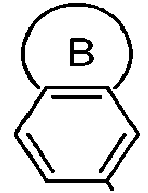
En al unas realizaciones de la presente divulgación, la unidad estructural \ se selecciona deIn some embodiments of the present disclosure, the structural unit \ is selected from

Se pueden obtener otras realizaciones de la presente divulgación mediante la combinación arbitraria de variables. En algunas realizaciones de la presente divulgación, el compuesto, su geometría o estereoisómero o su sal farmacéuticamente aceptable se selecciona de Other embodiments of the present disclosure can be obtained through the arbitrary combination of variables. In some embodiments of the present disclosure, the compound, its geometry or stereoisomer, or its pharmaceutically acceptable salt is selected from

donde, R, Ri o R2 es como se define en la presente divulgación.where, R, Ri or R2 is as defined herein.
La presente divulgación también proporciona un compuesto, su isómero geométrico o estereoisómero o su sal farmacéuticamente aceptable, que se selecciona deThe present disclosure also provides a compound, its geometric or stereoisomer or its pharmaceutically acceptable salt, which is selected from


En algunas realizaciones de la presente divulgación, el compuesto, su isómero geométrico o estereoisómero o su sal farmacéuticamente aceptable se selecciona deIn some embodiments of the present disclosure, the compound, its geometric or stereoisomer, or its pharmaceutically acceptable salt is selected from

La divulgación también proporciona una composición farmacéutica, que comprende una cantidad terapéuticamente eficaz del compuesto o su sal farmacéuticamente aceptable como ingrediente activo, y un vehículo farmacéuticamente aceptable.The disclosure also provides a pharmaceutical composition, comprising a therapeutically effective amount of the compound or its pharmaceutically acceptable salt as an active ingredient, and a pharmaceutically acceptable carrier. acceptable.
La presente divulgación también proporciona un uso del compuesto o sus sales farmacéuticamente aceptables o las composiciones en la fabricación de un medicamento relacionado con antagonistas de receptores ETa .The present disclosure also provides a use of the compound or its pharmaceutically acceptable salts or compositions in the manufacture of a medicament related to ETα receptor antagonists.
En algunas realizaciones de la presente divulgación, el medicamento relacionado con el antagonista de receptores ETa es un medicamento para indicaciones tales como hipertensión arterial pulmonar, hipertensión primaria, hipertensión refractaria, nefropatía diabética y vasoespasmo intracraneal.In some embodiments of the present disclosure, the ET α receptor antagonist-related medicament is a medicament for indications such as pulmonary arterial hypertension, primary hypertension, refractory hypertension, diabetic nephropathy, and intracranial vasospasm.
Definición y descripciónDefinition and description
A menos que se indique lo contrario, los siguientes términos, cuando se usan en las descripciones y las reivindicaciones de la presente divulgación, tienen los siguientes significados. Un término o expresión específicos no deben considerarse indefinidos o poco claros en ausencia de una definición particular, sino que debe entenderse en el sentido ordinario. Cuando aparece un nombre comercial en este documento, se pretende hacer referencia a su correspondiente producto o ingrediente activo del mismo. El término "farmacéuticamente aceptable" se usa en este documento en relación con aquellos compuestos, materiales, composiciones y/o formas de dosificación que son adecuados para usar en contacto con tejidos humanos y animales dentro del alcance del juicio médico confiable, sin toxicidad, irritación, reacción alérgica u otros problemas o complicaciones excesivos, de acuerdo con una relación riesgo/beneficio razonable.Unless otherwise indicated, the following terms, when used in the descriptions and claims of this disclosure, have the following meanings. A specific term or expression should not be considered indefinite or unclear in the absence of a particular definition, but should be understood in the ordinary sense. Where a trade name appears in this document, it is intended to refer to its corresponding product or active ingredient thereof. The term "pharmaceutically acceptable" is used herein in relation to those compounds, materials, compositions, and/or dosage forms that are suitable for use in contact with human and animal tissues within the scope of reliable medical judgment, without toxicity, irritation , allergic reaction, or other excessive problems or complications, based on a reasonable risk/benefit ratio.
El término "sal farmacéuticamente aceptable" se refiere a una sal del compuesto de la presente divulgación que se prepara haciendo reaccionar el compuesto que tiene un sustituyente específico de la presente divulgación con un ácido o base relativamente atóxicos. Cuando el compuesto de la presente divulgación contiene un grupo funcional relativamente ácido, se puede obtener una sal por adición de base poniendo en contacto la forma neutra del compuesto con una cantidad suficiente de base en una solución pura o un disolvente inerte adecuado. La sal por adición de base farmacéuticamente aceptable incluye una sal de sodio, potasio, calcio, amonio, amina orgánica o magnesio o sales similares. Cuando el compuesto de la presente divulgación contiene un grupo funcional relativamente básico, se puede obtener una sal por adición de ácido poniendo en contacto la forma neutra del compuesto con una cantidad suficiente de ácido en una solución pura o un disolvente inerte adecuado. Ejemplos de la sal por adición de ácido farmacéuticamente aceptable incluyen una sal de ácido inorgánico, en la que el ácido inorgánico incluye, por ejemplo, ácido clorhídrico, ácido bromhídrico, ácido nítrico, ácido carbónico, bicarbonato, ácido fosfórico, monohidrogenofosfato, dihidrogenofosfato, ácido sulfúrico, hidrogenosulfato, ácido yodhídrico, ácido fosforoso y similares; y una sal de ácido orgánico, en la que el ácido orgánico incluye, por ejemplo, ácido acético, ácido propiónico, ácido isobutírico, ácido maleico, ácido malónico, ácido benzoico, ácido succínico, ácido subérico, ácido fumárico, ácido láctico, ácido mandélico, ácido ftálico, ácido bencenosulfónico, ácido p-toluenosulfónico, ácido cítrico, ácido tartárico y ácido metanosulfónico, y similares; y una sal de aminoácido (como arginina y similares), y una sal de un ácido orgánico como ácido glucurónico y similares. Ciertos compuestos específicos de la presente divulgación que contienen grupos funcionales tanto básicos como ácidos pueden convertirse en cualquier sal por adición de base o ácido. The term "pharmaceutically acceptable salt" refers to a salt of the compound of the present disclosure that is prepared by reacting the compound having a specific substituent of the present disclosure with a relatively non-toxic acid or base. When the compound of the present disclosure contains a relatively acidic functional group, a base addition salt can be obtained by contacting the neutral form of the compound with a sufficient amount of base in a pure solution or a suitable inert solvent. The pharmaceutically acceptable basal addition salt includes a sodium, potassium, calcium, ammonium, organic amine or magnesium salt or the like. When the compound of the present disclosure contains a relatively basic functional group, an acid addition salt can be obtained by contacting the neutral form of the compound with a sufficient amount of acid in a pure solution or a suitable inert solvent. Examples of the pharmaceutically acceptable acid addition salt include an inorganic acid salt, wherein the inorganic acid includes, for example, hydrochloric acid, hydrobromic acid, nitric acid, carbonic acid, bicarbonate, phosphoric acid, monohydrogen phosphate, dihydrogen phosphate, acid sulfuric, hydrogen sulfate, hydroiodic acid, phosphorous acid and the like; and an organic acid salt, wherein the organic acid includes, for example, acetic acid, propionic acid, isobutyric acid, maleic acid, malonic acid, benzoic acid, succinic acid, suberic acid, fumaric acid, lactic acid, mandelic acid , phthalic acid, benzenesulfonic acid, p-toluenesulfonic acid, citric acid, tartaric acid, and methanesulfonic acid, and the like; and an amino acid salt (such as arginine and the like), and an organic acid salt such as glucuronic acid and the like. Certain specific compounds of the present disclosure that contain both basic and acidic functional groups can be converted to either base or acid addition salt.
La sal farmacéuticamente aceptable de la presente divulgación se puede preparar a partir del compuesto original que contiene un resto ácido o básico mediante un método químico convencional. Generalmente, esta sal se puede preparar haciendo reaccionar la forma de ácido o base libre del compuesto con una cantidad estequiométrica de una base o ácido apropiados en agua o un disolvente orgánico o una de sus mezclas.The pharmaceutically acceptable salt of the present disclosure can be prepared from the parent compound containing an acidic or basic moiety by a conventional chemical method. Generally, this salt can be prepared by reacting the free base or acid form of the compound with a stoichiometric amount of an appropriate base or acid in water or an organic solvent or a mixture thereof.
El compuesto de la presente divulgación puede tener una forma geométrica o estereoisómera específica. La presente divulgación contempla todos estos compuestos, incluidos el isómero cis y trans, el enantiómero (-) y (+), el enantiómero (R) y (S), el diastereoisómero, el isómero (D), el isómero (L) y la mezcla racémica y otras mezclas, por ejemplo, una mezcla enriquecida en enantiómero o diastereoisómero, todos los cuales están incluidos dentro del alcance de la presente divulgación. El sustituyente, como alquilo, puede tener un átomo de carbono asimétrico adicional. Todos estos isómeros y sus mezclas están incluidos dentro del alcance de la presente divulgación.The compound of the present disclosure may have a specific geometric or stereoisomeric shape. This disclosure contemplates all of these compounds, including the cis and trans isomer, (-) and (+) enantiomer, (R) and (S) enantiomer, diastereoisomer, (D) isomer, (L) isomer, and the racemic mixture and other mixtures, eg, an enantiomeric or diastereomer-enriched mixture, all of which are included within the scope of the present disclosure. The substituent, such as alkyl, may have an additional asymmetric carbon atom. All these isomers and their mixtures are included within the scope of the present disclosure.
A menos que se especifique lo contrario, el término "enantiómero" o "isómero óptico" se refiere a estereoisómeros que son imágenes especulares entre sí.Unless otherwise specified, the term "enantiomer" or "optical isomer" refers to stereoisomers that are mirror images of each other.
A menos que se especifique lo contrario, el término "isómero cis-trans" o "isómero geométrico" está provocado por la incapacidad para girar libremente de un enlace doble o un enlace simple de átomos de carbono en el anillo.Unless otherwise specified, the term " cis-trans isomer" or "geometric isomer" is caused by the inability of a double bond or a single bond of carbon atoms in the ring to rotate freely.
A menos que se especifique lo contrario, el término "diastereoisómero" se refiere a estereoisómeros en los que las moléculas tienen dos o más centros quirales y no son imágenes especulares entre sí.Unless otherwise specified, the term "diastereomer" refers to stereoisomers in which the molecules have two or more chiral centers and are not mirror images of each other.
A menos que se especifique lo contrario, "(D)"o "(+)" significa dextrorrotación, "(L)" o "(-)" significa levorrotación, "(DL)" o "(±)" significa racemización.Unless otherwise specified, " ( D )" or "(+)" means dextrorotation, "(L)" or "(-)" means levorotation, "(DL)" or "(±)" means racemization.
A menos que se especifique lo contrario, la configuración absoluta de un centro estereogénico está representada por Unless otherwise specified, the absolute configuration of a stereogenic center is represented by
un enlace sólido en cuña( y un enlace discontinuo en cuña ( X y la configuración relativa de un centro a wedge solid bond( and a wedge discontinuous bond( X and the relative configuration of a center
estereogénico está representada por un enlace sólido lineal K ) V un enlace discontinuo lineal )• Una línea
ondulada r " ) ) representa un enlace sólido en cuña ( ' ) o un enlace discontinuo en cuña (
enlace sólido lineal ( - O o un enlace discontinuo lineal (*' )•linear solid bond ( - O or a linear dashed bond (*' )•
A menos que se indique lo contrario, los términos "tautómero" o "forma tautómera" se refieren al hecho de que los diferentes isómeros funcionales están en equilibrio dinámico a temperatura ambiente y pueden convertirse rápidamente entre sí. Si los tautómeros son posibles (como en solución), se puede lograr el equilibrio químico de los isómeros. Por ejemplo, los tautómeros protónicos (también conocidos como tautómeros prototrópicos) incluyen interconversiones por transferencia de protones, como la isomerización ceto-enol y la isomerización imina-enamina. El tautómero de valencia incluye la transformación mutua de algunos electrones de enlace. Un ejemplo específico de tautomerización ceto-enol es la interconversión entre dos tautómeros de pentano-2,4-diona y 4-hidroxipent-3-en-2-ona.Unless otherwise indicated, the terms "tautomer" or "tautomeric form" refer to the fact that the different functional isomers are in dynamic equilibrium at room temperature and can be rapidly converted to each other. If tautomers are possible (as in solution), chemical equilibrium of the isomers can be achieved. For example, protonic tautomers (also known as prototropic tautomers) include proton transfer interconversions, such as keto-enol isomerization and imine-enamine isomerization. The valence tautomer includes the mutual transformation of some bonding electrons. A specific example of keto-enol tautomerization is the interconversion between two tautomers of pentane-2,4-dione and 4-hydroxypent-3-en-2-one.
A menos que se especifique lo contrario, los términos "enriquecido en un isómero", "enriquecido isómeramente", "enriquecido en un enantiómero" o "enriquecido enantiómeramente" se refieren a que el contenido de uno de los isómeros o enantiómeros es inferior al 100%, y el contenido del isómero o enantiómero es 60% o más, o 70% o más, u 80% o más, o 90% o más, o 95% o más, o 96% o más, o 97% o más, o 98% o más más, o 99% o más, o 99,5% o más, o 99,6% o más, o 99,7% o más, o 99,8% o más, o 99,9% o más.Unless otherwise specified, the terms "isomerically enriched", "isomerically enriched", "enantiomerically enriched" or "enantiomerically enriched" mean that the content of one of the isomers or enantiomers is less than 100 %, and the content of the isomer or enantiomer is 60% or more, or 70% or more, or 80% or more, or 90% or more, or 95% or more, or 96% or more, or 97% or more , or 98% or more, or 99% or more, or 99.5% or more, or 99.6% or more, or 99.7% or more, or 99.8% or more, or 99.9 % or more.
A menos que se especifique lo contrario, los términos "exceso de isómero" o "exceso de enantiómero" se refieren a la diferencia entre los porcentajes relativos de los dos isómeros o enantiómeros. Por ejemplo, cuando el contenido de uno de los isómeros o enantiómeros es del 90% y el otro es del 10%, entonces el exceso de isómero o enantiómero (valor de ee) es del 80%.Unless otherwise specified, the terms "isomer excess" or "enantiomeric excess" refer to the difference between the relative percentages of the two isomers or enantiomers. For example, when the content of one of the isomers or enantiomers is 90% and the other is 10%, then the excess of the isomer or enantiomer (ee value) is 80%.
Se puede preparar un isómero (R) y (S) o D y L ópticamente activo usando síntesis quiral o reactivos quirales u otras técnicas convencionales. Si se va a obtener un tipo de enantiómero de cierto compuesto de la presente divulgación, el enantiómero deseado puro se puede obtener mediante síntesis asimétrica o acción derivada del auxiliar quiral seguido de la separación de la mezcla diastereoisómera resultante y la escisión del grupo auxiliar. Alternativamente, cuando la molécula contiene un grupo funcional básico (como amino) o un grupo funcional ácido (como carboxilo). El compuesto reacciona con un ácido o una base ópticamente activos apropiados para formar una sal del isómero diastereoisómero que a continuación se somete a resolución diastereoisómera a través del método convencional en la técnica para dar el enantiómero puro. Además, el enantiómero y el diastereoisómero generalmente se aíslan mediante cromatografía que usa una fase estacionaria quiral y, opcionalmente, se combina con un método derivado químico (como carbamato generado a partir de amina). El compuesto de la presente divulgación puede contener una proporción no natural de isótopo atómico en uno o más de uno de los átomos que constituyen el compuesto. Por ejemplo, el compuesto se puede radiomarcar con un isótopo radiactivo, como tritio (3H), yodo-125 (125I) o C-14 (14C). Para otro ejemplo, el hidrógeno puede ser reemplazado por hidrógeno pesado para formar un fármaco deuterado, y el enlace compuesto por bario y carbono es más fuerte que el enlace compuesto por hidrógeno y carbono comunes. En comparación con los fármacos no deuterados, los fármacos deuterados tienen efectos secundarios reducidos y mayor estabilidad del fármaco, mejoran la eficacia y prolongan la semivida biológica del fármaco. Todas las variaciones isotópicas del compuesto de la presente divulgación, radiactivas o no, están incluidas dentro del alcance de la presente divulgación.An optically active (R) and (S) or D and L isomer can be prepared using chiral synthesis or chiral reagents or other conventional techniques. If one type of enantiomer of a certain compound of the present disclosure is to be obtained, the desired pure enantiomer can be obtained by asymmetric synthesis or derivative action of the chiral auxiliary followed by separation of the resulting diastereomeric mixture and cleavage of the auxiliary group. Alternatively, when the molecule contains a basic functional group (such as amino) or an acidic functional group (such as carboxyl). The compound is reacted with an appropriate optically active acid or base to form a salt of the diastereomeric isomer which is then subjected to diastereomeric resolution via the method conventional in the art to give the pure enantiomer. Furthermore, the enantiomer and diastereoisomer are generally isolated by chromatography using a chiral stationary phase and optionally combined with a chemical derivative method (such as carbamate generated from amine). The compound of the present disclosure may contain an unnatural atomic isotope ratio in one or more than one of the atoms constituting the compound. For example, the compound can be radiolabeled with a radioactive isotope, such as tritium (3H), iodine-125 (125I), or C-14 (14C). For another example, hydrogen can be replaced by heavy hydrogen to form a deuterated drug, and the bond made up of barium and carbon is stronger than the bond made up of ordinary hydrogen and carbon. Compared with non-deuterated drugs, deuterated drugs have reduced side effects and increased drug stability, improve efficacy, and prolong the biological half-life of the drug. All isotopic variations of the compound of the present disclosure, radioactive or not, are included within the scope of the present disclosure.
"Opcional" u "opcionalmente" significa que el evento o condición posterior puede producirse pero no es un requisito, que el término incluye el caso en el que el evento o la condición se produce y el caso en el que el evento o la condición no se produce."Optional" or "optionally" means that the subsequent event or condition may occur but is not required, that the term includes the case in which the event or condition occurs and the case in which the event or condition does not occur. it is produced.
El término "sustituido" significa que uno o más átomos de hidrógeno en un átomo específico están sustituidos con el sustituyente, incluidas las variantes deuteradas e hidrogenadas, siempre que la valencia del átomo específico sea normal y el compuesto sustituido sea estable. Cuando el sustituyente es un oxígeno (es decir, =O), significa que se sustituyen dos átomos de hidrógeno. Las posiciones en un anillo aromático no se pueden sustituir con una cetona. El término "opcionalmente sustituido" significa que un átomo puede estar sustituido o no con un sustituyente, a menos que se especifique lo contrario. El tipo y el número del sustituyente pueden ser arbitrarios siempre que se puedan lograr químicamente.The term "substituted" means that one or more hydrogen atoms on a specified atom are substituted with the substituent, including deuterated and hydrogenated variants, provided that the valency of the specified atom is normal and the substituted compound is stable. When the substituent is an oxygen (ie, =O), it means that two hydrogen atoms are replaced. Positions on an aromatic ring cannot be substituted with a ketone. The term "optionally substituted" means that an atom may or may not be substituted with a substituent, unless otherwise specified. The type and number of the substituent can be arbitrary as long as they can be achieved chemically.
Cuando cualquier variable (como R) aparece en la constitución o estructura del compuesto más de una vez, la definición de la variable en cada aparición es independiente. Así, por ejemplo, si un grupo está sustituido con 0-2 R, el grupo puede estar opcionalmente sustituido con hasta dos R, donde la definición de R en cada aparición es independiente. Por otra parte, solo se permite una combinación del sustituyente y/o su variante cuando la combinación dé como resultado un compuesto estable.When any variable (such as R) occurs in the constitution or structure of the compound more than once, the definition of the variable at each occurrence is independent. Thus, for example, if a group is substituted with 0-2 R, the group may be optionally substituted with up to two R's, where the definition of R at each occurrence is independent. On the other hand, a combination of the substituent and/or its variant is only allowed when the combination results in a stable compound.
Cuando el número de un grupo de ligazón es 0, como -(CRR)ü-, significa que el grupo de ligazón es un enlace simple. When the number of a linking group is 0, such as -(CRR)ü-, it means that the linking group is a single bond.
Cuando una de las variables se selecciona de un enlace simple, significa que los dos grupos ligados por el enlace simple están conectados directamente. Por ejemplo, cuando L en A-L-Z representa un enlace simple, la estructura de A-L-Z es en realidad A-Z.When one of the variables is selected from a single bond, it means that the two groups bound by the single bond are directly connected. For example, when L in A-L-Z represents a single bond, the structure of A-L-Z is actually A-Z.
Cuando un sustituyente está vacante, significa que el sustituyente no existe. Por ejemplo, cuando X está vacante en A-X, la estructura de A-X es en realidad A. Cuando no se indica por qué átomo están unidos los sustituyentes enumerados al grupo sustituido, dicho sustituyente puede estar enlazado a través de cualquiera de sus átomos, por ejemplo, el grupo piridilo como sustituyente puede estar enlazado al grupo sustituido a través de uno cualquiera de los átomos de carbono del anillo de piridina. Cuando el grupo de ligazón enumerado no indica la dirección de ligazón, laWhen a substituent is vacant, it means that the substituent does not exist. For example, when X is vacant in AX, the structure of AX is actually A. When the atom the substituents are attached to is not indicated enumerated to the substituted group, said substituent may be bonded through any of its atoms, for example, the pyridyl group as a substituent may be bonded to the substituted group through any one of the carbon atoms of the pyridine ring. When the listed binding group does not indicate the binding direction, the
dirección de ligazón es arbitraria, por ejemplo, el grupo de ligazón L contenido
entonces -MW- puede ligar el anillo A y el anillo B para formar
el orden de lectura de izquierda a derecha, y formar
A menos que se especifique lo contrario, el término "hetero" representa un heteroátomo o un grupo heteroatómico (por ejemplo, un grupo atómico que contiene un heteroátomo), incluido el átomo excepto el carbono (C) y el hidrógeno (H) y el grupo atómico que contiene el heteroátomo, por ejemplo, incluido oxígeno (O), nitrógeno (N), azufre (S), silicio (Si), germanio (Ge), aluminio (Al), boro (B), -O-, -S-, =O, =S, -C(=O)O-, -C(=O)-, -C(=S)-, -S(=O), -S(=O)2-, y el grupo que consiste en -C(=O)N(H)-, -N(H)-, -C(=NH)-, -S(=O)2N(H)- y -S(=O)N(H)-, cada uno de los cuales está opcionalmente sustituido.Unless otherwise specified, the term "hetero" represents a heteroatom or heteroatomic group (for example, an atomic group containing a heteroatom), including the atom except carbon (C) and hydrogen (H) and the atomic group containing the heteroatom, for example, including oxygen (O), nitrogen (N), sulfur (S), silicon (Si), germanium (Ge), aluminum (Al), boron (B), -O-, -S-, =O, =S, -C(=O)O-, -C(=O)-, -C(=S)-, -S(=O), -S(=O) 2 - , and the group consisting of -C(=O)N(H)-, -N(H)-, -C(=NH)-, -S(=O) 2 N(H)- and -S( =O)N(H)-, each of which is optionally substituted.
A menos que se especifique lo contrario, el término "anillo" se refiere a un cicloalquilo, heterocicloalquilo, cicloalquenilo, heterocicloalquenilo, cicloalquinilo, heterocicloalquinilo, arilo o heteroarilo sustituido o no sustituido. El llamado anillo incluye un anillo simple, un anillo doble, un anillo en espiral, un anillo condensado o un anillo con puente. El número de átomos en el anillo generalmente se define como el número de miembros del anillo, por ejemplo, un "anillo de 5 a 7 miembros" significa que de 5 a 7 átomos están dispuestos en un anillo. A menos que se especifique lo contrario, el anillo contiene opcionalmente de 1 a 3 heteroátomos. Por lo tanto, un "anillo de 5 a 7 miembros" incluye, por ejemplo, fenilo, piridinilo y piperidinilo; por otra parte, el término "anillo de heterocicloalquilo de 5 a 7 miembros" incluye piridilo y piperidinilo, pero excluye fenilo. El término "anillo" también incluye un sistema de anillos que contiene al menos un anillo, en el que cada anillo cumple independientemente la definición.Unless otherwise specified, the term "ring" refers to a substituted or unsubstituted cycloalkyl, heterocycloalkyl, cycloalkenyl, heterocycloalkenyl, cycloalkynyl, heterocycloalkynyl, aryl or heteroaryl. The so-called ring includes a simple ring, a double ring, a spiral ring, a condensed ring or a bridged ring. The number of atoms in the ring is generally defined as the number of ring members, for example, a "5 to 7 membered ring" means that 5 to 7 atoms are arranged in a ring. Unless otherwise specified, the ring optionally contains 1 to 3 heteroatoms. Thus, a "5 to 7 membered ring" includes, for example, phenyl, pyridinyl, and piperidinyl; on the other hand, the term "5 to 7 membered heterocycloalkyl ring" includes pyridyl and piperidinyl, but excludes phenyl. The term "ring" also includes a ring system containing at least one ring, each ring independently meeting the definition.
A menos que se especifique lo contrario, el término "heterociclo" se refiere a un anillo monocíclico, bicíclico o tricíclico estable que contiene un heteroátomo o un grupo de heteroátomos, que puede ser saturado, parcialmente insaturado o insaturado (aromático) y puede contener átomos de carbono y uno, dos, tres o cuatro heteroátomos de anillo seleccionados independientemente de N, O y S, donde cualquiera de los heterociclos puede estar condensado a un anillo de benceno para formar un anillo bicíclico. Los heteroátomos nitrógeno y azufre opcionalmente pueden estar oxidados (es decir, NO y S(O)p, p es 1 o 2). El átomo de nitrógeno puede estar sustituido o no sustituido (es decir, N o NR, donde R es H u otros sustituyentes ya definidos en este documento). El heterociclo puede estar enlazado al grupo colgante de cualquier heteroátomo o átomo de carbono para formar una estructura estable. Si el compuesto resultante es estable, el heterociclo descrito en este documento puede tener una sustitución en una posición de carbono o nitrógeno. El átomo de nitrógeno en el heterociclo está opcionalmente cuaternizado. En una realización preferida, cuando el número total de átomos de S y O del heterociclo es superior a 1, los heteroátomos no son adyacentes entre sí. En otra realización preferida. El número total de átomos de S y O del heterociclo no es más de 1. Como se usa en el presente documento, el término "grupo heterocíclico aromático" o "heteroarilo" se refiere a un anillo aromático heterocíclico monocíclico o bicíclico de 5, 6 o 7 miembros o bicíclico de 7, 8, 9 o 10 miembros estable que contiene átomos de carbono y uno, dos, tres o cuatro heteroátomos en el anillo seleccionados independientemente de N, O y S. El átomo de nitrógeno puede estar sustituido o no sustituido (es decir, N o NR, donde R es H u otros sustituyentes ya definidos en este documento). Los heteroátomos nitrógeno y azufre pueden opcionalmente estar oxidados (es decir, NO y S(O)p , p es 1 o 2). Vale la pena señalar que el número total de átomos de S y O de un heterociclo aromático no es más de uno. El anillo con puente también se incluye en la definición del heterociclo. Un anillo con puente se forma cuando uno o más de un átomo (es decir, C, O, N o S) liga dos átomos de carbono o nitrógeno no adyacentes. Un anillo con puente preferido incluye, pero no se limita a, un átomo de carbono. Dos átomos de carbono, un átomo de nitrógeno, dos átomos de nitrógeno y un grupo carbono-nitrógeno. Vale la pena señalar que un puente siempre convierte un anillo monocíclico en un anillo tricíclico. En un anillo con puente, el sustituyente en el anillo también puede estar presente en el puente.Unless otherwise specified, the term "heterocycle" refers to a stable monocyclic, bicyclic, or tricyclic ring containing one heteroatom or group of heteroatoms, which may be saturated, partially unsaturated, or unsaturated (aromatic) and may contain atoms carbon and one, two, three, or four ring heteroatoms independently selected from N, O, and S, where any of the heterocycles may be fused to a benzene ring to form a bicyclic ring. The nitrogen and sulfur heteroatoms may optionally be oxidized (ie, NO and S(O)p, p is 1 or 2). The nitrogen atom may be substituted or unsubstituted (ie, N or NR, where R is H or other substituents as defined herein). The heterocycle can be attached to the pendant group of any heteroatom or carbon atom to form a stable structure. If the resulting compound is stable, the heterocycle described herein may have a substitution at a carbon or nitrogen position. The nitrogen atom in the heterocycle is optionally quaternized. In a preferred embodiment, when the total number of S and O atoms in the heterocycle is greater than 1, the heteroatoms are not adjacent to each other. In another preferred embodiment. The total number of S and O atoms of the heterocycle is not more than 1. As used herein, the term "aromatic heterocyclic group" or "heteroaryl" refers to a 5,6 monocyclic or bicyclic heterocyclic aromatic ring. or 7-membered or stable 7-, 8-, 9-, or 10-membered bicyclic containing carbon atoms and one, two, three, or four ring heteroatoms independently selected from N, O, and S. The nitrogen atom may be substituted or unsubstituted substituted (ie, N or NR, where R is H or other substituents already defined herein). The nitrogen and sulfur heteroatoms may optionally be oxidized (ie, NO and S(O) p , p is 1 or 2). It is worth noting that the total number of S and O atoms in an aromatic heterocycle is not more than one. The bridged ring is also included in the definition of the heterocycle. A bridged ring is formed when one or more than one atom (ie, C, O, N, or S) links two non-adjacent carbon or nitrogen atoms. A preferred bridged ring includes, but is not limited to, a carbon atom. Two carbon atoms, one nitrogen atom, two nitrogen atoms, and one carbon-nitrogen group. It's worth noting that a bridge always converts a monocyclic ring to a tricyclic ring. In a bridged ring, the substituent on the ring may also be present on the bridge.
Ejemplos del compuesto heterocíclico incluyen, pero no se limitan a: acridinilo, azocinilo, bencimidazolilo, benzofuranilo, benzomercaptofuranilo, benzomercaptofenilo, benzoxazolilo, benzoxazolinilo, benzotiazolilo, benzotriazolilo, benzotetrazolilo, benzoisoxazolilo, benzoisotiazolilo, benzoimidazolinilo, carbazolilo, 4aH-carbazolilo, carbolinilo, cromanilo, cromeno, cinolinilo decahidroquinolinilo, 2H,6H-1,5,2-ditiazinilo, dihidrofuro[2,3-£>]tetrahidrofuranilo, furanilo, furazanilo, imidazolidinilo, imidazolinilo, imidazolilo, 1 H-indazolilo, indolenilo, indolinilo, indolizinilo, indolilo, 3H-indolilo, isobenzofuranilo, isoindolilo, isoindolinilo, isoquinolinilo, isotiazolilo, isoxazolilo, metilendioxifenilo, morfolinilo, naftiridinilo, octahidroisoquinolinilo, oxadiazolilo, 1,2,3-oxadiazolilo, 1,2,4-oxadiazolilo, 1,2,5-oxadiazolilo, 1,3,4-oxadiazolilo, oxazolidinilo, oxazolilo, hidroxindolilo, pirimidinilo, fenantridinilo, fenantrolinilo, fenazina, fenotiazina, benzoxantinilo, fenoloxazinilo, ftalazinilo, piperazinilo, piperidinilo, piperidonilo, 4-piperidonilo, piperonilo, pteridinilo, purinilo, piranilo, pirazinilo, pirazolidinilo, pirazolinilo, pirazolilo, piridazinilo, piridoxazolilo, piridoimidazolilo, piridotiazolilo, piridinilo, pirrolidinilo, pirrolinilo, 2H-pirrolilo, pirrolilo, quinazolinilo, quinolinilo, 4H-quinolizinilo, quinoxalinilo, quinuclidinilo, tetrahidrofuranilo, tetrahidroisoquinolinilo, tetrahidroquinolinilo, tetrazolilo, 6H-1,2,5-tiadiazinilo, 1,2,3-tiadiazolilo, 1,2,4-tiadiazolilo, 1,2,5-tiadiazolilo, 1,3,4-tiadiazolilo, tiantrenilo, tiazolilo, isotiazoliltienilo, tienoxazolilo , tienotiazolilo, tienoimidazolilo, tienilo, triazinilo, 1H-1,2,3-triazolilo, 2H-1,2,4-triazolilo, 1H-1,2,4-triazolilo, 4H-1,2,4-triazolilo y xantenilo. También se incluyen compuestos de anillos condensados y compuestos tipo espiro.Examples of the heterocyclic compound include, but are not limited to: acridinyl, azocinyl, benzimidazolyl, benzofuranyl, benzomercaptofuranyl, benzomercaptophenyl, benzoxazolyl, benzoxazolinyl, benzothiazolyl, benzotriazolyl, benzetrazolyl, benzisoxazolyl, benzisothiazolyl, benzimidazolinyl, carbazolyl, 4aH-carbolinibazolyl, cromanninibazolyl chromene, cinlinyl decahydroquinolinyl, 2H,6H-1,5,2-dithiazinyl, dihydrofuro[2,3-£>]tetrahydrofuranyl, furanyl, furazanyl, imidazolidinyl, imidazolinyl, imidazolyl, 1H-indazolyl, indolenyl, indolinyl, indolizinyl, indolyl , 3H-indolyl, isobenzofuranyl, isoindolyl, isoindolinyl, isoquinolinyl, isothiazolyl, isoxazolyl, methylenedioxyphenyl, morpholinyl, naphthyridinyl, octahydroisoquinolinyl, oxadiazolyl, 1,2,3-oxadiazolyl, 1,2,4-oxadiazolyl, 1,2,5-oxadiazolyl , 1,3,4-oxadiazolyl, oxazolidinyl, oxazolyl, hydroxyindolyl, pyrimidinyl, phenanthridinyl, phenanthrolinyl, phenazine, phenothiazine, benzoxanthinyl, phenoloxazinyl, phthalazinyl, piperazinyl, piperidinyl, piperidonyl, 4-piperidonyl, piperonyl, pteridinyl, purinyl, pyranyl, pyrazinyl, pyrazolidinyl, pyrazolinyl, pyrazolyl, pyridazinyl, pyridoxazolyl, pyridoimidazolyl, pyridothiazolyl, pyrrolidinyl, pyridinyl, pyridinyl 2H-pyrrolyl, pyrrolyl, quinazolinyl, quinolinyl, 4H-quinolizinyl, quinoxalinyl, quinuclidinyl, tetrahydrofuranyl, tetrahydroisoquinolinyl, tetrahydroquinolinyl, tetrazolyl, 6H-1,2,5-thiadiazinyl, 1,2,3-thiadiazolyl, 1,2,4- thiadiazolyl, 1,2,5-thiadiazolyl, 1,3,4-thiadiazolyl, thianthrenyl, thiazolyl, isothiazolylthienyl, thienoxazolyl, thienotiazolyl, thienoimidazolyl, thienyl, triazinyl, 1H-1,2,3-triazolyl, 2H-1,2, 4-triazolyl, 1H-1,2,4-triazolyl, 4H-1,2,4-triazolyl and xanthenyl. Also included are fused ring compounds and spiro-type compounds.
A menos que se especifique lo contrario, el término "hidrocarbilo" o sus hipónimos (p. ej., alquilo, alquenilo, alquinilo y arilo, etc.), por sí mismo o como parte de otro sustituyente, se refiere a un radical hidrocarbonado lineal, de cadena ramificada o cíclico o cualquiera de sus combinaciones, pueden estar completamente saturados (p. ej., alquilo), mono o poliinsaturados (p. ej., alquenilo, alquinilo y arilo), pueden estar mono, di o polisustituidos, pueden ser monovalentes (p. ej., metilo), divalentes (por ejemplo, metileno) o multivalentes (por ejemplo, metenilo), también pueden incluir un grupo divalente o multivalente, tiener un número específico de átomos de carbono (por ejemplo, C1-C12 indica de 1 a 12 átomos de carbono, C1-12 se selecciona de C1, C2 , C3 , C4 , C5, C6 , C7 , C8 , C9 , C10, C11 y C12; C3-12 se selecciona de C3 , C4 , C5 , C6 , C7 , C8 , C9 , C10, C11 y C12). El término "hidrocarbilo" incluye, pero no se limita a, hidrocarbilo alifático e hidrocarbilo aromático, el hidrocarbilo alifático incluye hidrocarbilo lineal y cíclico, incluye específicamente, pero no se limita a, alquilo, alquenilo y alquinilo. El hidrocarbilo aromático incluye, pero no se limita a, hidrocarbilo aromático de 6-12 miembros como fenilo, naftilo y similares. En algunas realizaciones, el término "hidrocarbilo" se refiere a un grupo lineal o ramificado o una de sus combinaciones que puede estar completamente saturado, mono o poliinsaturado y puede incluir un grupo divalente o multivalente. Ejemplos del grupo hidrocarbilo saturado incluyen, pero no se limitan a, metilo, etilo, n-propilo, isopropilo, n-butilo, terc-butilo, isobutilo, sec-butilo, ciclohexilo, (ciclohexil)metilo, ciclopropilmetilo y el homólogo o isómero de n-amilo, n-hexilo, n-heptilo, n-octilo y otros grupos atómicos. El hidrocarbilo insaturado tiene uno o más de un doble o triple enlace. Ejemplos del alquilo insaturado incluyen, pero no se limitan a, vinilo, 2-propenilo, butenilo, crotilo, 2-isopentenilo, 2-(butadienilo), 2,4-pentadienilo, 3-(1,4-pentadienilo), etinilo, 1- y 3-propinilo, 3-butinilo y más homólogos e isómeros superiores.Unless otherwise specified, the term "hydrocarbyl" or its hyponyms (eg, alkyl, alkenyl, alkynyl, and aryl, etc.), by itself or as part of another substituent, refers to a hydrocarbon radical linear, branched-chain, or cyclic, or any combination thereof, may be fully saturated (eg, alkyl), mono- or polyunsaturated (eg, alkenyl, alkynyl, and aryl), may be mono-, di-, or polysubstituted, can be monovalent (eg, methyl), divalent (eg, methylene), or multivalent (eg, methenyl), can also include a divalent or multivalent group, have a specific number of carbon atoms (eg, C 1 -C 12 indicates 1 to 12 carbon atoms, C 1-12 is selected from C 1 , C 2 , C 3 , C 4 , C 5 , C 6 , C 7 , C 8 , C 9 , C 10 , C 11 and C 12 ; C 3-12 is selected from C 3 , C 4 , C 5 , C 6 , C 7 , C 8 , C 9 , C 10 , C 11 and C 12 ). The term "hydrocarbyl" includes, but is not limited to, aliphatic hydrocarbyl and aromatic hydrocarbyl, aliphatic hydrocarbyl includes linear and cyclic hydrocarbyl, specifically includes, but is not limited to, alkyl, alkenyl, and alkynyl. Aromatic hydrocarbyl includes, but is not limited to, 6-12 membered aromatic hydrocarbyl such as phenyl, naphthyl, and the like. In some embodiments, the term "hydrocarbyl" refers to a linear or branched group or a combination thereof that may be fully saturated, mono- or polyunsaturated, and may include a divalent or multivalent group. Examples of the saturated hydrocarbyl group include, but are not limited to, methyl, ethyl, n-propyl, isopropyl, n-butyl, tert-butyl, isobutyl, sec-butyl, cyclohexyl, (cyclohexyl)methyl, cyclopropylmethyl, and the homologue or isomer. n-amyl, n-hexyl, n-heptyl, n-octyl and other atomic groups. The unsaturated hydrocarbyl has one or more than one double or triple bond. Examples of the unsaturated alkyl include, but are not limited to, vinyl, 2-propenyl, butenyl, crotyl, 2-isopentenyl, 2-(butadienyl), 2,4-pentadienyl, 3-(1,4-pentadienyl), ethynyl, 1- and 3-propynyl, 3-butynyl and more homologues and higher isomers.
A menos que se especifique lo contrario, el término "heterohidrocarbilo" o sus hipónimos (tales como heteroalquilo, heteroalquenilo, heteroalquinilo y heteroarilo, etc.), por sí mismo o como parte de otro sustituyente, se refiere a un grupo hidrocarbonado lineal, ramificado o cíclico estable o cualquiera de sus combinaciones, que tiene un número específico de átomos de carbono y al menos un heteroátomo. En algunas realizaciones, el término "heteroalquilo" por sí mismo o en combinación con otro término se refiere a un radical hidrocarbonado de cadena lineal o ramificado estable o una de sus combinaciones que tiene un número específico de átomos de carbono y al menos un heteroátomo. En una realización específica, un heteroátomo se selecciona de B, O, N y S, donde los átomos de nitrógeno y azufre están opcionalmente oxidados y el átomo de nitrógeno está opcionalmente cuaternizado. El heteroátomo o grupo de heteroátomos puede ubicarse en cualquier posición interior de un heterohidrocarbilo, incluida la posición en la que el hidrocarbilo se une a la parte restante de la molécula. Pero los términos "alcoxi", "alquilamino" y "alquiltio" (o tioalquilo) se utilizan en el sentido convencional y se refieren a un grupo alquilo conectado a la ICtante de la molécula a través de un átomo de oxígeno, un amino o un átomo de azufre, respectivamente. Ejemplos incluyen, pero no se limitan a, -CH2-CH2-O-CH3 , -CH2-CH2-NH-CH3 , -CH2-CH2-N(CH3)-CH3 , -CH2-S-CH2-CH3 , - CH2-CH2 , -S(O)-CH3 , -CH2-CH2-S(O)2-CH3 , -CH=CH-O-CH3 , -CH2-CH=N-OCH3 y -CH=CH-N(CH3)-CH3. Pueden estar presentes hasta dos heteroátomos consecutivos, como -CH2-NH-OCH3.Unless otherwise specified, the term "heterohydrocarbyl" or its hyponyms (such as heteroalkyl, heteroalkenyl, heteroalkynyl, and heteroaryl, etc.), by itself or as part of another substituent, refers to a linear, branched hydrocarbon group or stable cyclic or any combination thereof, having a specific number of carbon atoms and at least one heteroatom. In some embodiments, the term "heteroalkyl" by itself or in combination with another term refers to a stable branched or straight chain hydrocarbon radical or a combination thereof having a specific number of carbon atoms and at least one heteroatom. In a specific embodiment, a heteroatom is selected from B, O, N, and S, where the nitrogen and sulfur atoms are optionally oxidized and the nitrogen atom is optionally quaternized. The heteroatom or group of heteroatoms can be located at any interior position of a heterohydrocarbyl, including the position where the hydrocarbyl is attached to the remainder of the molecule. But the terms "alkoxy", "alkylamino" and "alkylthio" (or thioalkyl) are used in the conventional sense and refer to an alkyl group connected to the ICtant of the molecule through an oxygen atom, an amino or a sulfur atom, respectively. Examples include, but are not limited to, -CH 2 -CH 2 -O-CH 3 , -CH 2 -CH 2 -NH-CH 3 , -CH 2 -CH 2 -N(CH 3 )-CH 3 , - CH 2 -S-CH 2 -CH 3 , -CH 2 -CH 2 , -S(O)-CH 3 , -CH 2 -CH 2 -S(O) 2 -CH 3 , -CH=CH-O- CH 3 , -CH 2 -CH=N-OCH 3 and -CH=CH-N(CH 3 )-CH 3 . Up to two consecutive heteroatoms may be present, such as -CH 2 -NH-OCH 3 .
A menos que se especifique lo contrario, el término "ciclohidrocarbilo", "heterociclohidrocarbilo" o sus hipónimos (tales como arilo, heteroarilo, cicloalquilo, heterocicloalquilo, cicloalquenilo, heterocicloalquenilo, cicloalquinilo, heterocicloalquinilo, etc.) por sí mismos o en combinación con otro término se refiere a "hidrocarbilo” o "heterohidrocarbilo" ciclados. Además, para heterohidrocarbilo o heterociclohidrocarbilo (p. ej., heteroalquilo y heterocicloalquilo), un heteroátomo puede ocupar la posición en la que el heterociclo se une a la posición restante de la molécula. Ejemplos del cicloalquilo incluyen, pero no se limitan a, ciclopentilo, ciclohexilo, 1-ciclohexenilo, 3-ciclohexenilo, cicloheptilo y similares. Ejemplos no limitativos de heterocicloalquilo incluyen 1 -(1,2,5,6-tetrahidropiridilo), 1 -piperidinilo, 2-piperidinilo, 3-piperidinilo, 4-morfolinilo, 3-morfolinilo, tetrahidrofuran-2-ilo, tetrahidrofurano-3-ilo, tetrahidrotiofen-2-ilo, tetrahidrotiofen-3-ilo, 1 -piperazinilo y 2-piperazinilo.Unless otherwise specified, the term "cyclohydrocarbyl", "heterocyclohydrocarbyl" or their hyponyms (such as aryl, heteroaryl, cycloalkyl, heterocycloalkyl, cycloalkenyl, heterocycloalkenyl, cycloalkynyl, heterocycloalkynyl, etc.) by themselves or in combination with another term refers to cyclized "hydrocarbyl" or "heterohydrocarbyl". In addition, for heterohydrocarbyl or heterocyclohydrocarbyl (eg, heteroalkyl and heterocycloalkyl), a heteroatom may occupy the position where the heterocycle is attached to the remaining position in the molecule Examples of cycloalkyl include, but are not limited to, cyclopentyl, cyclohexyl, 1-cyclohexenyl, 3-cyclohexenyl, cycloheptyl, and the like Non-limiting examples of heterocycloalkyl include 1-(1,2,5,6-tetrahydropyridyl), 1- piperidinyl, 2-piperidinyl, 3-piperidinyl, 4-morpholinyl, 3-morpholinyl, tetrahydrofuran-2-yl, tetrahydrofuran-3-yl, tetrahydrothiophen-2-yl, tetrahydrothiophen-3-yl, 1-piperazinyl and 2-piperazinyl.
A menos que se especifique lo contrario, el término "heterocicloalquilo" por sí mismo o en combinación con otros términos indica un "heteroalquilo" ciclado y, además, con respecto al "heterocicloalquilo", el heteroátomo puede ocupar la posición de unión del grupo heterocicloalquilo al resto de la molécula. En algunas realizaciones, el heterocicloalquilo es heterocicloalquilo de 4-6 miembros; en otras realizaciones, el heterocicloalquilo es un heterocicloalcano de 5-6 miembros. Ejemplos de grupos heterocicloalquilo incluyen, pero no se limitan a, azetidinilo, oxetanilo, tietanilo, pirrolidinilo, pirazolidinilo, imidazolidinilo, tetrahidrotienilo, tetrahidrofuranilo, tetrahidropiranilo, piperidinilo, piperazinilo, morfolinilo, dioxanilo, ditianilo, isoxazolidinilo, isotiazolidinilo, 1,2-oxazinilo, 1,2-tiazinilo, hexahidropiridazinilo, homopiperazinilo, homopiperidinilo u oxepanilo.Unless otherwise specified, the term "heterocycloalkyl" by itself or in combination with other terms indicates a cyclized "heteroalkyl" and, furthermore, with respect to "heterocycloalkyl", the heteroatom may occupy the bonding position of the heterocycloalkyl group. to the rest of the molecule. In some embodiments, the heterocycloalkyl is 4-6 membered heterocycloalkyl; in other embodiments, the heterocycloalkyl is a 5-6 membered heterocycloalkane. Examples of heterocycloalkyl groups include, but are not limited to, azetidinyl, oxetanyl, thietanyl, pyrrolidinyl, pyrazolidinyl, imidazolidinyl, tetrahydrothienyl, tetrahydrofuranyl, tetrahydropyranyl, piperidinyl, piperazinyl, morpholinyl, dioxanyl, dithianyl, isoxazolidinyl, isothiazolidinyl, 1,2-oxazinyl, 1,2-thiazinyl, hexahydropyridazinyl, homopiperazinyl, homopiperidinyl or oxepanyl.
A menos que se especifique lo contrario, el término "alquilo" se refiere a un grupo hidrocarbonado saturado de cadena lineal o ramificado, que puede estar monosustituido (p. ej., -CH2 F) o polisustituido (p. ej., -CF3), puede ser monovalente (por ejemplo, metilo), divalente (por ejemplo, metileno) o multivalente (por ejemplo, metenilo). Ejemplos de alquilo incluyen metilo (Me), etilo (Et), propilo (como n-propilo e isopropilo), butilo (como n-butilo, isobutilo, s-butilo, t-butilo), pentilo (como n-pentilo, isopentilo, neopentilo) y similares.Unless otherwise specified, the term "alkyl" refers to a straight or branched chain saturated hydrocarbon group, which may be monosubstituted (eg, -CH 2 F) or polysubstituted (eg, - CF 3 ), can be monovalent (eg methyl), divalent (eg methylene) or multivalent (eg methenyl). Examples of alkyl include methyl (Me), ethyl (Et), propyl (as n-propyl and isopropyl), butyl (as n-butyl, isobutyl, s-butyl, t-butyl), pentyl (such as n-pentyl, isopentyl, neopentyl) and the like.
A menos que se especifique lo contrario, cicloalquilo incluye cualquier hidrocarbilo cíclico o policíclico estable, y cualquier átomo de carbono está saturado, puede estar monosustituido o polisustituido y puede ser monovalente, divalente o multivalente. Ejemplos de cicloalquilo incluyen, pero no se limitan a, ciclopropilo, norbornanilo, [2.2.2]biciclooctano, [4.4.0]biciclodecanilo y similares.Unless otherwise specified, cycloalkyl includes any stable cyclic or polycyclic hydrocarbyl, and any carbon atom is saturated, may be mono- or polysubstituted, and may be monovalent, divalent, or multivalent. Examples of cycloalkyl include, but are not limited to, cyclopropyl, norbornanyl, [2.2.2]bicyclooctane, [4.4.0]bicyclodecanyl, and the like.
A menos que se especifique lo contrario, el término "halo" o "halógeno" por sí mismo o como parte de otro sustituyente se refiere a un átomo de flúor, cloro, bromo o yodo. Por otra parte, el término "haloalquilo" pretende incluir monohaloalquilo y polihaloalquilo. Por ejemplo, el término "halo-alquilo(C1-C4)" incluye, pero no se limita a, trifluorometilo, 2,2,2-trifluoroetilo, 4-clorobutilo, 3-bromopropilo y similares. Ejemplos de haloalquilo incluyen, pero no se limitan a, trifluorometilo, triclorometilo, pentafluoroetilo y pentacloroetilo. .Unless otherwise specified, the term "halo" or "halogen" by itself or as part of another substituent refers to a fluorine, chlorine, bromine, or iodine atom. On the other hand, the term "haloalkyl" is intended to include monohaloalkyl and polyhaloalkyl. For example, the term "halo-(C 1 -C 4 )alkyl" includes, but is not limited to, trifluoromethyl, 2,2,2-trifluoroethyl, 4-chlorobutyl, 3-bromopropyl, and the like. Examples of haloalkyl include, but are not limited to, trifluoromethyl, trichloromethyl, pentafluoroethyl, and pentachloroethyl. .
El término "alcoxi" representa cualquier alquilo definido anteriormente que tiene un número específico de átomos de carbono unidos por un puente de oxígeno. A menos que se especifique lo contrario, alcoxi C1-6 incluye alcoxi C1, C2 , C3 , C4 , C5 y C6. Ejemplos de alcoxi incluyen, pero no se limitan a, metoxi, etoxi, n-propoxi, isopropoxi, n-butoxi, sec-butoxi, terc-butoxi, n-pentiloxi y s-pentoxi.The term "alkoxy" represents any alkyl defined above having a specific number of carbon atoms linked by an oxygen bridge. Unless otherwise specified, C 1-6 alkoxy includes C 1 , C 2 , C 3 , C 4 , C 5 and C 6 alkoxy. Examples of alkoxy include, but are not limited to, methoxy, ethoxy, n-propoxy, isopropoxy, n-butoxy, sec- butoxy, tert-butoxy, n-pentyloxy, and s-pentoxy.
A menos que se especifique lo contrario, el término "arilo" se refiere a un sustituyente aromático poliinsaturado, puede estar mono-, di- o polisustituido, puede ser monovalente, divalente o multivalente, puede ser un solo anillo o un anillo múltiple (por ejemplo, de uno a tres anillos, en los que al menos un anillo es aromático), que están condensados entre sí o conectados covalentemente. El término "heteroarilo" se refiere a un arilo (o anillo) que contiene de uno a cuatro heteroátomos. En un ejemplo ilustrativo, el heteroátomo se selecciona de B, O, N y S, donde los átomos de nitrógeno y azufre están opcionalmente oxidados y el átomo de nitrógeno está opcionalmente cuaternizado. Un heteroarilo puede unirse a la parte restante de una molécula a través de un heteroátomo. Ejemplos no limitativos de arilo o heteroarilo incluyen fenilo, naftilo, bifenilo, pirrolilo, pirazolilo, imidazolilo, pirazinilo, oxazolilo, feniloxazolilo, isoxazolilo, tiazolilo, furanilo, tienilo, piridilo, pirimidinilo, benzotiazolilo, purinilo, bencimidazolilo, indolilo, isoquinolilo, quinoxalinilo, quinolilo, 1 -naftilo, 2-naftilo, 4-bifenilo, 1 -pirrolilo, 2-pirrolilo, 3-pirrolilo, 3-pirazolilo, 2-imidazolilo, 4-imidazolilo, pirazinilo, 2-oxazolilo, 4-oxazolilo, 2-fenil-4-oxazolilo, 5-oxazolilo, 3-isoxazolilo, 4-isoxazolilo, 5-isoxazolilo, 2-tiazolilo, 4-tiazolilo, 5-tiazolilo, 2-furilo, 3-furilo, 2-tienilo, 3-tienilo, 2-piridilo, 3-piridilo, 4-piridilo, 2-pirimidilo, 4-pirimidilo, 5-benzotiazolilo, purinilo, 2-bencimidazolilo, 5-indolilo, 1 -isoquinolilo, 5-isoquinolilo, 2-quinoxalinilo, 5-quinoxalinilo, 3-quinolilo y 6-quinolilo. El sustituyente de cualquiera de los sistemas de anillo arílico y heteroarílico se selecciona del sustituyente aceptable descrito a continuación.Unless otherwise specified, the term "aryl" refers to a polyunsaturated aromatic substituent, may be mono-, di-, or polysubstituted, may be monovalent, divalent, or multivalent, may be a single ring or a multiple ring (for example, from one to three rings, in which at least one ring is aromatic), which are fused together or covalently connected. The term "heteroaryl" refers to an aryl (or ring) containing one to four heteroatoms. In an illustrative example, the heteroatom is selected from B, O, N, and S, where the nitrogen and sulfur atoms are optionally oxidized and the nitrogen atom is optionally quaternized. A heteroaryl can be attached to the remaining part of a molecule through a heteroatom. Non-limiting examples of aryl or heteroaryl include phenyl, naphthyl, biphenyl, pyrrolyl, pyrazolyl, imidazolyl, pyrazinyl, oxazolyl, phenyloxazolyl, isoxazolyl, thiazolyl, furanyl, thienyl, pyridyl, pyrimidinyl, benzothiazolyl, purinyl, benzimidazolyl, indolyl, isoquinolyl, quinoxalinyl, quinolyl, 1-naphthyl, 2-naphthyl, 4-biphenyl, 1-pyrrolyl, 2-pyrrolyl, 3-pyrrolyl, 3-pyrazolyl, 2-imidazolyl, 4-imidazolyl, pyrazinyl, 2-oxazolyl, 4-oxazolyl, 2- phenyl-4-oxazolyl, 5-oxazolyl, 3-isoxazolyl, 4-isoxazolyl, 5-isoxazolyl, 2-thiazolyl, 4-thiazolyl, 5-thiazolyl, 2-furyl, 3-furyl, 2-thienyl, 3-thienyl, 2-pyridyl, 3-pyridyl, 4-pyridyl, 2-pyrimidyl, 4-pyrimidyl, 5-benzothiazolyl, purinyl, 2-benzimidazolyl, 5-indolyl, 1-isoquinolyl, 5-isoquinolyl, 2-quinoxalinyl, 5-quinoxalinyl, 3-quinolyl and 6-quinolyl. The substituent on any of the aryl and heteroaryl ring systems is selected from the acceptable substituent described below.
A menos que se especifique lo contrario, cuando el arilo se combina con otros términos (como ariloxi, ariltio, arilalquilo), el arilo incluye el anillo arílico y heteroarílico como se definió anteriormente. Así, el término "aralquilo" pretende incluir el grupo (p. ej., bencilo, fenetilo, piridilmetilo, etc.) en el que un arilo está unido a un alquilo, incluido un alquilo en el que el átomo de carbono (p. ej., metileno) ha sido reemplazado por un átomo tal como oxígeno, por ejemplo, fenoximetilo, 2-piridiloxi, 3-(1-naftiloxi)propilo y similares.Unless otherwise specified, when aryl is combined with other terms (such as aryloxy, arylthio, arylalkyl), aryl includes aryl and heteroaryl ring as defined above. Thus, the term "aralkyl" is intended to include the group (eg, benzyl, phenethyl, pyridylmethyl, etc.) in which an aryl is attached to an alkyl, including an alkyl in which the carbon atom (eg. eg, methylene) has been replaced by an atom such as oxygen, eg, phenoxymethyl, 2-pyridyloxy, 3-(1-naphthyloxy)propyl, and the like.
El término "grupo saliente" se refiere a un grupo funcional o átomo que puede ser reemplazado por otro grupo funcional o átomo a través de una reacción de sustitución (tal como una reacción de sustitución por afinidad). Por ejemplo, grupos salientes representativos incluyen triflato; cloro, bromo y yodo; grupo sulfonato, como mesilato, tosilato, p-bromobencenosulfonato, p-toluenosulfonatos y similares; aciloxi, tal como acetoxi, trifluoroacetoxi y similares.The term "leaving group" refers to a functional group or atom that can be replaced by another functional group or atom through a substitution reaction (such as an affinity substitution reaction). For example, representative leaving groups include triflate; chlorine, bromine and iodine; sulfonate group, such as mesylate, tosylate, p- bromobenzenesulfonate, p-toluenesulfonates and the like; acyloxy, such as acetoxy, trifluoroacetoxy, and the like.
El término "grupo protector" incluye, pero no se limita a, "grupo protector de amino", "grupo protector de hidroxi" o "grupo protector de tio". El término "grupo protector de amino" se refiere a un grupo protector adecuado para bloquear la reacción secundaria en el nitrógeno de un amino. Grupos protectores de amino representativos incluyen, pero no se limitan a: formilo; acilo, tal como alcanoílo (por ejemplo, acetilo, tricloroacetilo o trifluoroacetilo); alcoxicarbonilo, como terc-butoxicarbonilo (Boc); arilmetoxicarbonilo como benciloxicarbonilo (Cbz) y 9-fluorenilmetoxicarbonilo (Fmoc); arilmetilo como bencilo (Bn), tritilo (Tr), 1,1-bis-(4'-metoxifenil)metilo; sililo como trimetilsililo (TMS) y terc-butildimetilsililo (TBS) y similares. El término "grupo protector de hidroxi" se refiere a un grupo protector adecuado para bloquear la reacción secundaria en un hidroxi. Grupos protectores de hidroxi representativos incluyen, pero no se limitan a: alquilo como metilo, etilo y terc-butilo; acilo como alcanoílo (p. ej., acetilo); arilmetilo como bencilo (Bn), p-metoxibencilo (PMB), 9-fluorenilmetilo (Fm) y difenilmetilo (benzhidrilo, DPM); sililo como trimetilsililo (TMS) y terc-butildimetilsililo (TBS) y similares.The term "protecting group" includes, but is not limited to, "amino protecting group", "hydroxy protecting group" or "thio protecting group". The term "amino protecting group" refers to a protecting group suitable for blocking the side reaction at the amino nitrogen. Representative amino protecting groups include, but are not limited to: formyl; acyl, such as alkanoyl (eg acetyl, trichloroacetyl or trifluoroacetyl); alkoxycarbonyl, such as tert-butoxycarbonyl (Boc); arylmethoxycarbonyl such as benzyloxycarbonyl (Cbz) and 9-fluorenylmethoxycarbonyl (Fmoc); arylmethyl such as benzyl (Bn), trityl (Tr), 1,1-bis-(4'-methoxyphenyl)methyl; silyl such as trimethylsilyl (TMS) and tert- butyldimethylsilyl (TBS) and the like. The term "hydroxy protecting group" refers to a protecting group suitable for blocking the side reaction at a hydroxy. Representative hydroxy protecting groups include, but are not limited to: alkyl such as methyl, ethyl, and tert-butyl; acyl such as alkanoyl (eg, acetyl); arylmethyl such as benzyl (Bn), p- methoxybenzyl (PMB), 9-fluorenylmethyl (Fm) and diphenylmethyl (benzhydryl, DPM); silyl such as trimethylsilyl (TMS) and tert- butyldimethylsilyl (TBS) and the like.
El compuesto de la presente divulgación se puede preparar mediante una variedad de métodos sintéticos bien conocidos por los expertos en la técnica, incluida la siguiente realización enumerativa, la realización formada por la siguiente realización enumerativa en combinación con otros métodos de síntesis química y el reemplazo equivalente bien conocido por los expertos en la técnica. La realización preferida incluye, pero no se limita a, la realización de la presente divulgación.The compound of the present disclosure can be prepared by a variety of synthetic methods well known to those skilled in the art, including the following enumerative embodiment, the embodiment formed by the following enumerative embodiment in combination with other chemical synthesis methods, and equivalent replacement well known to those skilled in the art. The preferred embodiment includes, but is not limited to, the embodiment of the present disclosure.
Los compuestos de la presente divulgación pueden tener diversos usos o indicaciones, incluidos, pero no limitados a, los usos o indicaciones específicos enumerados en la presente solicitud.The compounds of the present disclosure may have various uses or indications, including, but not limited to, the specific uses or indications listed in the present application.
El disolvente utilizado en la presente divulgación está disponible comercialmente. La presente divulgación emplea las siguientes abreviaturas: ac significa agua; HATU significa 0-(7-azabenzotriazol-1-il)-W,W,W',W-hexafluorofosfato de tetrametiluronio; EDC significa hicrocloruro de W-(3-dimetilaminopropil)-W-etilcarbodiimida; m-CPBA significa ácido 3-cloroperoxibenzoico; eq significa equivalente; CDI significa carbonildiimidazol; DCM significa diclorometano; PE significa éter de petróleo; DIAD significa azodicarboxilato de diisopropilo; DMF significa W,W-dimetilformamida; DMSO significa dimetilsulfóxido; EtOAc significa ésteres de ácido acético; EtOH significa etanol; MeOH significa metanol; CBz significa benciloxicarbonilo, que es un grupo protector de amina; BOC significa terc-butoxicarbonilo, que es un grupo protector de amina; HOAc significa ácido acético; NaCNBH3 significa cianoborohidruro de sodio; Ta representa la temperatura ambiente; O/N significa durante la noche; THF significa tetrahidrofurano; Boc2O representa dicarbonato de di-terc-butilo; TFA significa ácido trifluoroacético; DIPEA significa diisopropiletilamina; SOCl2 significa cloruro de tionilo; CS2 significa disulfuro de carbono; TsOH significa ácido p-toluenosulfónico; NFSI significa W-fluoro-W-(fenilsulfonil)bencenosulfonamida; NCS significa 1-cloropirrolidina-2,5-diona; n-Bu4NF significa tetrabutilamonio; iPrOH representa 2-propanol; pf significa punto de fusión; LDA significa diisopropilaminolitio; DEA significa dietilamina; ACN significa acetonitrilo.The solvent used in the present disclosure is commercially available. The present disclosure employs the following abbreviations: ac means water; HATU means 0-(7-azabenzotriazol-1-yl)-W,W,W',W-hexafluorophosphate of tetramethyluronium; EDC means W-(3-dimethylaminopropyl)-W-ethylcarbodiimide hydrochloride; m-CPBA means 3-chloroperoxybenzoic acid; eq means equivalent; CDI means carbonyldiimidazole; DCM means dichloromethane; PE stands for petroleum ether; DIAD means diisopropyl azodicarboxylate; DMF means W,W-dimethylformamide; DMSO means dimethyl sulfoxide; EtOAc means esters of acetic acid; EtOH means ethanol; MeOH means methanol; CBz means benzyloxycarbonyl, which is an amine protecting group; BOC means tert-butoxycarbonyl, which is an amine protecting group; HOAc means acetic acid; NaCNBH 3 means sodium cyanoborohydride; Ta represents the ambient temperature; O/N means overnight; THF means tetrahydrofuran; Boc 2 O represents di-tert-butyl dicarbonate; TFA stands for trifluoroacetic acid; DIPEA means diisopropylethylamine; SOCl 2 means thionyl chloride; CS 2 means carbon disulfide; TsOH means p-toluenesulfonic acid; NFSI means W-fluoro-W-(phenylsulfonyl)benzenesulfonamide; NCS means 1-chloropyrrolidine-2,5-dione; n-Bu 4 NF means tetrabutylammonium; iPrOH represents 2-propanol; mp means melting point; LDA means diisopropylaminolithium; DEA stands for diethylamine; ACN stands for acetonitrile.
Los compuestos se nombran manualmente o mediante el programa ChemDraw® , los compuestos disponibles comercialmente utilizan sus nombres del directorio de proveedores.Compounds are named manually or using the ChemDraw ® program, commercially available compounds use their supplier directory names.
Efectos técnicos: todos los compuestos de la presente divulgación exhiben una actividad antagonista muy alta contra receptores ETa humanos in vitro, y la selectividad para ETa/ETb es más de 10000 veces; los compuestos de la divulgación son superiores al compuesto de control macitentán en experimentos de caracterización de la inducción mediada por PXR de la expresión de CYP3A. Al caracterizar los experimentos del efecto inhibidor sobre 5 isoenzimas principales del citocromo P450 microsómico hepático humano, los compuestos de la presente divulgación son superiores al macitentán; el efecto inhibidor de los compuestos de la presente divulgación sobre las bombas de exportación de sales biliares es mucho más débil que el macitentán, lo que reduce significativamente el riesgo de desarrollar hepatotoxicidad. Los compuestos de la presente divulgación tienen buenas propiedades farmacocinéticas tanto en ratas SD como en perros beagle. Technical effects : All the compounds of the present disclosure exhibit very high antagonistic activity against human ETa receptors in vitro, and the selectivity for ETa/ETb is more than 10000-fold; the compounds of the disclosure are superior to the control compound macitentan in experiments characterizing PXR-mediated induction of CYP3A expression. By characterizing the experiments of the inhibitory effect on 5 major isoenzymes of human liver microsomal cytochrome P450, the compounds of the present disclosure are superior to macitentan; the inhibitory effect of the compounds of the present disclosure on bile salt export pumps is much weaker than macitentan, which significantly reduces the risk of developing hepatotoxicity. The compounds of the present disclosure have good pharmacokinetic properties in both SD rats and beagle dogs.
Descripción detallada de la realización preferidaDetailed description of the preferred embodiment
Los siguientes ejemplos ilustran adicionalmente la presente divulgación, pero la presente divulgación no se limita a ellos. La presente divulgación se ha descrito en detalle en el texto, y también se han divulgado sus realizaciones específicas, para un experto en la técnica, es obvio modificar y mejorar las realizaciones de la presente divulgación dentro del alcance de la presente divulgación.The following examples further illustrate the present disclosure, but the present disclosure is not limited thereto. The present disclosure has been described in detail in the text, and its specific embodiments have also been disclosed, for a person skilled in the art, it is obvious to modify and improve the embodiments of the present disclosure within the scope of the present disclosure.
Realización de referencia 1: fragmento BB-1Reference Embodiment 1: Fragment BB-1

Etapa 1: Síntesis del compuesto BB-1-2 Step 1: Synthesis of compound BB-1-2
A temperatura ambiente, se disolvió el compuesto BB-1-1 (30,00 g, 211,97 mmol, 18,40 ml) en diclorometano (200 ml), a continuación la mezcla se enfrió hasta 0°C, se añadió lentamente gota a gota (el tiempo de goteo fue de aproximadamente 1 hora) una solución de terc-butanol (15,71 g, 211,97 mmol, 20,40 ml) en diclorometano (100 ml) y la mezcla de reacción se calentó hasta temperatura ambiente y se agitó durante 1 hora. El compuesto BB-1-2 buscado (producto bruto) se retuvo en el disolvente de reacción diclorometano y se utilizó directamente en la siguiente reacción. At room temperature, compound BB-1-1 (30.00 g, 211.97 mmol, 18.40 mL) was dissolved in dichloromethane (200 mL), then the mixture was cooled to 0°C, slowly added a solution of tert-butanol (15.71 g, 211.97 mmol, 20.40 mL) in dichloromethane (100 mL) was dropwise (dropping time about 1 hour) and the reaction mixture was heated to room temperature and stirred for 1 hour. The target compound BB-1-2 (crude product) was taken up in the reaction solvent dichloromethane and used directly in the next reaction.
Etapa 2: Síntesis del compuesto BB-1-3 Step 2: Synthesis of compound BB-1-3
A temperatura ambiente, se disolvieron el compuesto 2,2,2-trifluoroetilamina (8,00 g, 80,77 mmol, 6,35 ml) y trietilamina (24,52 g, 242,30 mmol, 33,59 ml) en diclorometano (100,00 ml), a continuación la mezcla se enfrió hasta 0°C, y se añadió gota a gota lentamente (el tiempo de goteo fue de aproximadamente 1 hora) una solución del compuesto BB-1-2 (80,77 mmol, producto bruto) en diclorometano, y la mezcla de reacción se calentó hasta temperatura ambiente y se agitó durante 14 horas. Una vez completada la reacción, se eliminó el disolvente a presión reducida, se añadió agua (150 ml) al residuo, se extrajo con diclorometano (100 ml) y se descartó la fase orgánica. La fase acuosa se ajustó hasta un pH de 5-6 con ácido clorhídrico diluido 1 M y se extrajo con acetato de etilo (100 ml x 3). Las fases orgánicas se combinaron, se secaron sobre sulfato de sodio anhidro, se filtraron y el disolvente se eliminó a presión reducida para obtener el compuesto BB-1-3 buscado (sólido blanco, 15,00 g, producto bruto). RMN 1H (400 MHz, DMSO_afe) 5: 3,55 (q, j=9,8 Hz, 2H), 1,37 (s, 9H).At room temperature, the compound 2,2,2-trifluoroethylamine (8.00 g, 80.77 mmol, 6.35 mL) and triethylamine (24.52 g, 242.30 mmol, 33.59 mL) were dissolved in dichloromethane (100.00 mL), then the mixture was cooled to 0°C, and a solution of compound BB-1-2 (80.77 mmol, crude) in dichloromethane, and the reaction mixture was warmed to room temperature and stirred for 14 hours. After the completion of the reaction, the solvent was removed under reduced pressure, water (150 ml) was added to the residue, it was extracted with dichloromethane (100 ml) and the organic phase was discarded. The aqueous phase was adjusted to pH 5-6 with 1M dilute hydrochloric acid and extracted with ethyl acetate (100ml x 3). The organic phases were combined, dried over anhydrous sodium sulfate, filtered, and the solvent was removed under reduced pressure to obtain the target compound BB-1-3 (white solid, 15.00 g, crude product). 1H NMR (400 MHz, DMSO_afe) 5: 3.55 (q, j=9.8 Hz, 2H), 1.37 (s, 9H).
Etapa 3: Síntesis del compuesto BB-1-4 Step 3: Synthesis of compound BB-1-4
A temperatura ambiente, se añadió el compuesto BB-1-3 (15,00 g, 53,91 mmol) a agua (150,00 ml) y la mezcla de reacción se calentó hasta 110°C y se agitó durante 1 hora. Una vez completada la reacción, la mezcla de reacción se enfrió hasta temperatura ambiente y se extrajo con acetato de etilo (100 ml x 3). Las fases orgánicas se combinaron, se lavaron con salmuera (100 ml), se secaron sobre sulfato de sodio anhidro, se filtraron y el disolvente del filtrado se eliminó a presión reducida para obtener el compuesto BB-1-4 buscado (sólido amarillo, 7,50 g, producto bruto). RMN 1H (400 MHz, DMSO_afe) 5: 7,51 (t, j=7,0 Hz, 1H), 6,83 (s, 2H), 3,69-3,54 (m, 2H). RMN 19F (400 MHz, DMSO_de) 5: -70,81 (s, 3F).At room temperature, compound BB-1-3 (15.00 g, 53.91 mmol) was added to water (150.00 mL) and the reaction mixture heated to 110°C and stirred for 1 hour. After the completion of the reaction, the reaction mixture was cooled to room temperature and extracted with ethyl acetate (100 ml x 3). The organic phases were combined, washed with brine (100 mL), dried over anhydrous sodium sulfate, filtered, and the solvent in the filtrate was removed under reduced pressure to obtain the target compound BB-1-4 (yellow solid, 7 0.50 g, crude product). 1H NMR (400 MHz, DMSO_afe) 5: 7.51 (t, j=7.0 Hz, 1H), 6.83 (s, 2H), 3.69-3.54 (m, 2H). 19F NMR (400 MHz, DMSO_de) 5: -70.81 (s, 3F).
Etapa 4: Síntesis del compuesto BB-1-5 Step 4: Synthesis of compound BB-1-5
A temperatura ambiente, se disolviero el compuesto BB-1-4 (1,56 g, 8,78 mmol) y terc-butóxido de potasio (1,97 g, 17,55 mmol) en dimetilsulfóxido (80,00 ml) y la mezcla de reacción se agitó durante 1 hora en atmósfera de nitrógeno a temperatura ambiente. A continuación, se añadió 5-bromo-4,6-dicloropirimidina (2,00 g, 8,78 mmol) a la mezcla de reacción y la mezcla de reacción se agitó adicionalmente a temperatura ambiente durante 10 horas. Una vez completada la reacción, se añadió agua (100 ml), el pH se ajustó hasta 5-6 con ácido clorhídrico diluido 1 M y la mezcla se extrajo con acetato de etilo (50 ml x 3). Las fases orgánicas se combinaron, se lavaron con agua (50 ml x 2), se secaron sobre sulfato de sodio anhidro, se filtraron y el disolvente del filtrado se eliminó a presión reducida. El residuo se separó mediante cromatografía en columna (eluyente: éter de petróleo/acetato de etilo = 10/1-4/1, relación en volumen) para obtener el compuesto BB-1-5 buscado (sólido amarillo, 1,90 g, rendimiento: 58,56%). RMN 1H (400 MHz, DMSO_afe) 5: 8,60 (s, 1H), 7,51 (t, j=7,0 Hz, 1H), 6,83 (s, 1H), 3,84 (q, j=9,6 Hz, 2H).At room temperature, compound BB-1-4 (1.56 g, 8.78 mmol) and potassium tert-butoxide (1.97 g, 17.55 mmol) were dissolved in dimethyl sulfoxide (80.00 mL) and The reaction mixture was stirred for 1 hour under a nitrogen atmosphere at room temperature. Then, 5-bromo-4,6-dichloropyrimidine (2.00 g, 8.78 mmol) was added to the reaction mixture, and the reaction mixture was further stirred at room temperature for 10 hours. After the reaction was complete, water (100ml) was added, the pH adjusted to 5-6 with 1M dilute hydrochloric acid and the mixture was extracted with ethyl acetate (50ml x 3). The organic phases were combined, washed with water (50 ml x 2), dried over anhydrous sodium sulfate, filtered and the solvent in the filtrate was removed under reduced pressure. The residue was separated by column chromatography (eluent: petroleum ether/ethyl acetate = 10/1-4/1, volume ratio) to obtain the target compound BB-1-5 (yellow solid, 1.90 g, yield: 58.56%). 1H NMR (400 MHz, DMSO_afe) 5: 8.60 (s, 1H), 7.51 (t, j=7.0 Hz, 1H), 6.83 (s, 1H), 3.84 (q, j=9.6Hz, 2H).
Etapa 5: Síntesis del compuesto BB-1 Step 5: Synthesis of compound BB-1
A temperatura ambiente, se añadió terc-butóxido de potasio (1,73 g, 15,42 mmol) a etilenglicol (52,68 g, 848,46 mmol, 47,46 ml) y éter dimetílico de etilenglicol (10 ml) y la mezcla de reacción se calentó hasta 40°C en atmósfera de nitrógeno y se agitó durante 0,5 horas, se añadió una solución de compuesto BB-1-5 (1,90 g, 5,14 mmol) en éter dimetílico de etilenglicol (20 ml) a la solución y la mezcla de reacción se calentó hasta 100°C y se agitó durante 16 horas en atmósfera de nitrógeno. Una vez completada la reacción, la solución de reacción se enfrió hasta temperatura ambiente, se añadió agua (100 ml), el pH se ajustó hasta 5-6 con ácido clorhídrico diluido 2 M, a continuación la mezcla se extrajo con acetato de etilo (60 ml x 3). Las fases orgánicas se combinaron, se secaron sobre sulfato de sodio anhidro, se filtraron y el disolvente del filtrado se eliminó a presión reducida. El residuo se separó mediante cromatografía en columna (eluyente: éter de petróleo/acetato de etilo = 8/1 -3/1, relación en volumen) para obtener el compuesto BB-1 buscado (sólido amarillo, 1,55 g, rendimiento: 76,31%). MS-ESI m/z: 394,7 [M+H]+, 396,7 [M+H+2]+. RMN 1H (400 MHz, CDCL) 5: 8,33 (s, 1H), 6,04 (s, 1H), 4,53 (t, j=4,4 Hz, 2H), 3,93 (t, j=4,4 Hz, 2H), 3,67 (q, j=8,6 Hz, 2H). RMN 19F (400 MHz, CDCh) 5: -71,87 (s, 3F).At room temperature, potassium tert-butoxide (1.73 g, 15.42 mmol) was added to ethylene glycol (52.68 g, 848.46 mmol, 47.46 mL) and ethylene glycol dimethyl ether (10 mL) and the reaction mixture was heated to 40°C under a nitrogen atmosphere and stirred for 0.5 hour, a solution of compound BB-1-5 (1.90 g, 5.14 mmol) in ethylene glycol dimethyl ether was added (20 mL) to solution and the reaction mixture was heated to 100°C and stirred for 16 hours under a nitrogen atmosphere. After the completion of the reaction, the reaction solution was cooled to room temperature, water (100 mL) was added, the pH was adjusted to 5-6 with 2M dilute hydrochloric acid, then the mixture was extracted with ethyl acetate ( 60ml x 3). The organic phases were combined, dried over anhydrous sodium sulfate, filtered, and the solvent in the filtrate was removed under reduced pressure. The residue was separated by column chromatography (eluent: petroleum ether/ethyl acetate = 8/1 -3/1, volume ratio) to obtain the target compound BB-1 (yellow solid, 1.55 g, yield: 76.31%). MS-ESI m/z: 394.7 [M+H]+, 396.7 [M+H+2]+. 1H NMR (400 MHz, CDCL) 5: 8.33 (s, 1H), 6.04 (s, 1H), 4.53 (t, j=4.4 Hz, 2H), 3.93 (t, j=4.4Hz , 2H), 3.67 (q, j=8.6Hz, 2H). 19F NMR (400 MHz, CDCh) 5: -71.87 (s, 3F).
Realización de referencia 2: fragmento BB-2Reference Realization 2: BB-2 Fragment

Ruta sintética:Synthetic route:

Etapa 1: Síntesis del compuesto BB-2-1 Step 1: Synthesis of compound BB-2-1
A temperatura ambiente, se añadieron hidrocloruro de etilamina (5,00 g, 61,32 mmol) y trietilamina (18,61 g, 183,96 mmol, 25,49 ml) a diclorometano (100,00 ml), a continuación la mezcla de reacción se enfrió hasta 0°C y se añadió gota a gota lentamente (el tiempo de goteo fue de aproximadamente 1 hora) una solución del compuesto BB-1-2 (61,32 mmol, producto bruto) en diclorometano y la mezcla de reacción se calentó hasta temperatura ambiente y se agitó durante 16 horas. Una vez completada la reacción, se eliminó el disolvente a presión reducida. Se añadió agua (150 ml) al residuo, se extrajo con diclorometano (100 ml) y se descartó la fase orgánica. La fase acuosa se ajustó hasta un pH de 5-6 con ácido clorhídrico diluido 1 M y se extrajo con acetato de etilo (100 ml x 3). Las fases orgánicas se combinaron, se secaron sobre sulfato de sodio anhidro, se filtraron y a continuación se eliminó el disolvente a presión reducida para obtener el compuesto BB-2-1 buscado (sólido blanco, 6,00 g, producto bruto). RMN 1H (400 MHz, CDCh) 5: 5,07 (t, j=5,6 Hz, 1H), 3,13-3,01 (m, 2H), 1,43 (s, 9H), 1,16 (t, j=7,3 Hz, 3H).At room temperature, ethylamine hydrochloride (5.00 g, 61.32 mmol) and triethylamine (18.61 g, 183.96 mmol, 25.49 mL) were added to dichloromethane (100.00 mL), then the The reaction mixture was cooled to 0 °C and a solution of compound BB-1-2 (61.32 mmol, crude product) in dichloromethane was added dropwise slowly (dropping time was about 1 hour) and the mixture reaction was warmed to room temperature and stirred for 16 hours. After the reaction was complete, the solvent was removed under reduced pressure. Water (150 ml) was added to the residue, extracted with dichloromethane (100 ml) and the organic phase discarded. The aqueous phase was adjusted to pH 5-6 with 1M dilute hydrochloric acid and extracted with ethyl acetate (100ml x 3). The organic phases were combined, dried over anhydrous sodium sulfate, filtered, and then the solvent was removed under reduced pressure to obtain the target compound BB-2-1 (white solid, 6.00 g, crude product). 1H NMR (400 MHz, CDCh) 5: 5.07 (t, j=5.6 Hz, 1H), 3.13-3.01 (m, 2H), 1.43 (s, 9H), 1, 16 (t, j=7.3Hz, 3H).
Etapa 2: Síntesis del compuesto BB-2-2 Step 2: Synthesis of the compound BB-2-2
A temperatura ambiente, se añadió el compuesto BB-2-1 (7,02 g, 31,30 mmol) a agua (200,00 ml) y la mezcla de reacción se calentó hasta 110°C y se agitó durante 1 hora. Una vez completada la reacción, la mezcla de reacción se enfrió hasta temperatura ambiente y se extrajo con acetato de etilo (100 ml x 3). Las fases orgánicas se combinaron, se lavaron con salmuera saturada (50 ml), se secaron sobre sulfato de sodio anhidro, se filtraron y el disolvente del filtrado se eliminó a presión reducida para obtener el compuesto BB-2-2 buscado (aceite amarillo, 2,87 g, producto bruto). RMN 1H (400 MHz, CDCh) 5: 4,80 (s, 2H), 4,57 (s, 1H), 3,23-3,14 (m, 2H), 1,24 (t, j=7,3 Hz, 3H).At room temperature, compound BB-2-1 (7.02 g, 31.30 mmol) was added to water (200.00 mL) and the reaction mixture heated to 110°C and stirred for 1 hour. After the completion of the reaction, the reaction mixture was cooled to room temperature and extracted with ethyl acetate (100 ml x 3). The organic phases were combined, washed with saturated brine (50 mL), dried over anhydrous sodium sulfate, filtered, and the solvent in the filtrate was removed under reduced pressure to obtain the target compound BB-2-2 (yellow oil, 2.87 g, crude product). 1H NMR (400 MHz, CDCh) 5: 4.80 (s, 2H), 4.57 (s, 1H), 3.23-3.14 (m, 2H), 1.24 (t, j=7 .3Hz, 3H).
Etapa 3: Síntesis del compuesto BB-2-3 Step 3: Synthesis of compound BB-2-3
A temperatura ambiente, se añadieron el compuesto BB-2-2 (2,87 g, 23,12 mmol) y terc-butóxido de potasio (5,19 g, 46,24 mmol) a dimetilsulfóxido (80,00 ml), a continuación se añadió 5-bromo-4,6-dicloropirimidina (5,27 g, 23,12 mmol) a la mezcla de reacción y la mezcla de reacción se agitó a temperatura ambiente durante 10 horas en atmósfera de nitrógeno. Una vez completada la reacción, se añadió agua (150 ml), el pH se ajustó hasta 5-6 con ácido clorhídrico diluido 1 M y la solución se extrajo con acetato de etilo (100 ml x 3). Las fases orgánicas se combinaron, se lavaron con agua (50 ml x 2), se secaron sobre sulfato de sodio anhidro, se filtraron y el disolvente del filtrado se eliminó a presión reducida. El residuo se separó mediante cromatografía en columna (eluyente: éter de petróleo/acetato de etilo = 10/1-4/1, relación en volumen) para obtener el compuesto BB-2-3 buscado (sólido amarillo, 2,40 g, rendimiento: 32,89%). RMN 1H (400 MHz, DMSO_afe) 5: 8,59 (s, 1H), 2,96 (q, j=7,1 Hz, 2H), 1,02 (t, j=7,0 Hz, 3H).At room temperature, compound BB-2-2 (2.87 g, 23.12 mmol) and potassium tert-butoxide (5.19 g, 46.24 mmol) were added to dimethyl sulfoxide (80.00 mL), then 5-bromo-4,6-dichloropyrimidine (5.27 g, 23.12 mmol) was added to the reaction mixture, and the reaction mixture was stirred at room temperature for 10 hours under a nitrogen atmosphere. After the reaction was complete, water (150ml) was added, the pH adjusted to 5-6 with 1M dilute hydrochloric acid and the solution was extracted with ethyl acetate (100ml x 3). The organic phases were combined, washed with water (50 ml x 2), dried over anhydrous sodium sulfate, filtered and the solvent in the filtrate was removed under reduced pressure. The residue was separated by column chromatography (eluent: petroleum ether/ethyl acetate = 10/1-4/1, volume ratio) to obtain the target compound BB-2-3 (yellow solid, 2.40 g, yield: 32.89%). 1H NMR (400 MHz, DMSO_afe) 5: 8.59 (s, 1H), 2.96 (q, j=7.1 Hz, 2H), 1.02 (t, j=7.0 Hz, 3H) .
Etapa 4: Síntesis del compuesto BB-2 Step 4: Synthesis of compound BB-2
A temperatura ambiente, se añadió terc-butóxido de potasio (1,50 g, 13,41 mmol) a una solución mixta de etilenglicol (33,30 g, 536,49 mmol, 30,00 ml) y éter dimetílico de etilenglicol (10 ml), la mezcla de reacción se calentó hasta 40°C y se agitó durante 0,5 horas en atmósfera de nitrógeno, a continuación se añadió una solución del compuesto BB-2-3 (1,41 g, 4,47 mmol) en éter dimetílico de etilenglicol (20 ml) a la solución en una porción, y la mezcla de reacción se calentó hasta 100°C y se agitó durante 16 horas. Una vez completada la reacción, la mezcla de reacción se enfrió hasta temperatura ambiente, se añadió agua (100 ml), el pH se ajustó hasta 5-6 con ácido clorhídrico diluido 2 M y a continuación la mezcla se extrajo con acetato de etilo (60 ml x 3). Las fases orgánicas se combinaron, se secaron sobre sulfato de sodio anhidro, se filtraron y el disolvente del filtrado se eliminó a presión reducida. El residuo se separó mediante cromatografía en columna (eluyente: éter de petróleo/acetato de etilo = 8/1-3/1, relación en volumen) para obtener el compuesto BB-2 buscado (sólido amarillo, 1,36 g, rendimiento: 87,21%). MS-ESI m/z: 340,7 [M+H]+, 342,7 [M+H+2]+. RMN 1H (400 MHz, CDCh) 5: 8,38 (s, 1H), 7,66 (s, 1H), 5,54 (t, j=5,9 Hz, 1H), 4,60 (t, j=4,8 Hz, 2H), 4,00 (t, j=4,0 Hz, 2H), 3,19-3,03 (m, 2H), 2,45 (s ancho, 1H), 1,21 (t, j=7,2 Hz, 3H). At room temperature, potassium tert-butoxide (1.50 g, 13.41 mmol) was added to a mixed solution of ethylene glycol (33.30 g, 536.49 mmol, 30.00 mL) and ethylene glycol dimethyl ether ( 10 mL), the reaction mixture was heated to 40°C and stirred for 0.5 hours under a nitrogen atmosphere, then a solution of compound BB-2-3 (1.41 g, 4.47 mmol) was added ) in ethylene glycol dimethyl ether (20 mL) to solution in one portion, and the reaction mixture was heated to 100°C and stirred for 16 hours. After the completion of the reaction, the reaction mixture was cooled to room temperature, water (100 mL) was added, the pH was adjusted to 5-6 with 2M dilute hydrochloric acid, and then the mixture was extracted with ethyl acetate (60 ml x 3). The organic phases were combined, dried over anhydrous sodium sulfate, filtered, and the solvent in the filtrate was removed under reduced pressure. The residue was separated by column chromatography (eluent: petroleum ether/ethyl acetate = 8/1-3/1, volume ratio) to obtain the target compound BB-2 (yellow solid, 1.36 g, yield: 87.21%). MS-ESI m/z: 340.7 [M+H]+, 342.7 [M+H+2]+. 1H NMR (400 MHz, CDCh) 5: 8.38 (s, 1H), 7.66 (s, 1H), 5.54 (t, j=5.9 Hz, 1H), 4.60 (t, j=4.8 Hz, 2H), 4.00 (t, j=4.0 Hz, 2H), 3.19-3.03 (m, 2H), 2.45 (broad s, 1H), 1 .21 (t, j=7.2Hz, 3H).
Realización de referencia 3: fragmento BB-3Reference Realization 3: Fragment BB-3

Etapa 1: Síntesis del compuesto BB-3-1 Step 1: Synthesis of compound BB-3-1
A temperatura ambiente, se disolvieron n-propilamina (7,61 g, 128,70 mmol, 10,57 ml) y trietilamina (14,21 g, 140,40 mmol, 19,47 ml) en diclorometano (100,00 ml), a continuación la mezcla se enfrió hasta 0°C, a continuación se añadió lentamente una solución del compuesto BB-1-2 (117,00 mmol, producto bruto) en diclorometano a la solución de reacción (el tiempo de goteo fue de aproximadamente 0,5 horas) y la mezcla de reacción se agitó a temperatura ambiente durante 18 horas en atmósfera de nitrógeno. Una vez completada la reacción, se añadió agua (200 ml) y la mezcla se extrajo con diclorometano (200 ml x 2). Las fases orgánicas se combinaron, se lavaron con ácido clorhídrico diluido 1 M (50 ml) y salmuera saturada (200 ml), se secaron sobre sulfato de sodio anhidro, se filtraron y el disolvente del filtrado se eliminó a presión reducida para obtener el compuesto BB-3-1 buscado (sólido blanco, 21,00 g, rendimiento: 75,32%). RMN 1H (400 MHz, CDCh) 5: 2,93 (t, j=7,0 Hz, 2H), 1,58-1,48 (m, 2H), 1,46-1,37 (s, 9H), 0,88 (t, j=7,4 Hz, 3H).At room temperature, n-propylamine (7.61 g, 128.70 mmol, 10.57 mL) and triethylamine (14.21 g, 140.40 mmol, 19.47 mL) were dissolved in dichloromethane (100.00 mL ), then the mixture was cooled to 0 °C, then a solution of compound BB-1-2 (117.00 mmol, crude product) in dichloromethane was slowly added to the reaction solution (dropping time was about 0.5 hours) and the reaction mixture was stirred at room temperature for 18 hours under a nitrogen atmosphere. After the reaction was complete, water (200 ml) was added and the mixture was extracted with dichloromethane (200 ml x 2). The organic phases were combined, washed with 1M dilute hydrochloric acid (50 mL) and saturated brine (200 mL), dried over anhydrous sodium sulfate, filtered, and the solvent in the filtrate was removed under reduced pressure to obtain the compound BB-3-1 sought (white solid, 21.00 g, yield: 75.32%). 1H NMR (400 MHz, CDCh) 5: 2.93 (t, j=7.0 Hz, 2H), 1.58-1.48 (m, 2H), 1.46-1.37 (s, 9H ), 0.88 (t, j=7.4Hz, 3H).
Etapa 2: Síntesis del compuesto BB-3-2 Step 2: Synthesis of compound BB-3-2
A temperatura ambiente, se añadió el compuesto BB-3-1 (20,00 g, 83,93 mmol) a agua (100,00 ml) y la mezcla de reacción se calentó hasta 100°C y se agitó durante 1 hora en atmósfera de nitrógeno. Una vez completada la reacción, la solución de reacción se enfrió hasta temperatura ambiente y se extrajo con acetato de etilo (100 ml x 3). Las fases orgánicas se combinaron, se lavaron con salmuera saturada (100 ml), se secaron sobre sulfato de sodio anhidro, se filtraron y el disolvente se eliminó a presión reducida para obtener el compuesto BB-3-2 buscado (aceite incoloro, 10,00 g, rendimiento: 86,22%). RMN 1H (400 MHz, DMSO_afe) 5: 6,44 (s, 2H), 2,88-2,78 (m, 2H), 1,52-1,43 (m, 2H), 0,87 (t, j=7,5 Hz, 3H).At room temperature, compound BB-3-1 (20.00 g, 83.93 mmol) was added to water (100.00 mL) and the reaction mixture was heated to 100°C and stirred for 1 hour under nitrogen atmosphere. After the completion of the reaction, the reaction solution was cooled to room temperature and extracted with ethyl acetate (100 ml x 3). The organic phases were combined, washed with saturated brine (100 mL), dried over anhydrous sodium sulfate, filtered, and the solvent removed under reduced pressure to obtain the target compound BB-3-2 (colorless oil, 10, 00 g, yield: 86.22%). 1H NMR (400 MHz, DMSO_afe) 5: 6.44 (s, 2H), 2.88-2.78 (m, 2H), 1.52-1.43 (m, 2H), 0.87 (t , j=7.5Hz, 3H).
Etapa 3: Síntesis del compuesto BB-3-3 Step 3: Synthesis of compound BB-3-3
A temperatura ambiente, se disolvió el compuesto BB-3-2 (18,19 g, 131,66 mmol) en dimetilsulfóxido (300,00 ml), a continuación se añadió terc-butóxido de potasio (19,70 g, 175,54 mmol) y la mezcla de reacción se agitó a temperatura ambiente durante 0,5 horas. A continuación, se añadió 5-bromo-4,6-dicloropirimidina (20,00 g, 87,77 mmol) a la solución de reacción y la mezcla de reacción se agitó adicionalmente a temperatura ambiente durante 48 horas. Una vez completada la reacción, se añadió salmuera saturada (1000 ml), el pH se ajustó hasta 4-5 con ácido clorhídrico diluido al 10% y la mezcla se extrajo con acetato de etilo (500 ml x 3). Las fases orgánicas se combinaron, se secaron sobre sulfato de sodio anhidro, se filtraron y el disolvente del filtrado se eliminó a presión reducida. El residuo se separó mediante cromatografía en columna (eluyente: éter de petróleo/acetato de etilo = 10/1-1/1, relación en volumen) para obtener el compuesto BB-3-3 buscado (sólido blanco, 15,00 g, rendimiento: 51,85%). RMN 1H (400 MHz, CDCh) 5: 8,58 (s, 1H), 7,84 (s, 1H), 5,52-5,54 (m, 1 H), 3,07 (q, j=6,8 Hz, 2H), 1,59-1,64 (m, 2H), 0,96 (t, j=7,2 Hz, 3H).At room temperature, compound BB-3-2 (18.19 g, 131.66 mmol) was dissolved in dimethyl sulfoxide (300.00 mL), then potassium tert-butoxide (19.70 g, 175, 54 mmol) and the reaction mixture was stirred at room temperature for 0.5 hours. Then, 5-bromo-4,6-dichloropyrimidine (20.00 g, 87.77 mmol) was added to the reaction solution, and the reaction mixture was further stirred at room temperature for 48 hours. After the reaction was complete, saturated brine (1000 ml) was added, the pH adjusted to 4-5 with 10% dilute hydrochloric acid, and the mixture was extracted with ethyl acetate (500 ml x 3). The organic phases were combined, dried over anhydrous sodium sulfate, filtered, and the solvent in the filtrate was removed under reduced pressure. The residue was separated by column chromatography (eluent: petroleum ether/ethyl acetate = 10/1-1/1, volume ratio) to obtain the target compound BB-3-3 (white solid, 15.00 g, yield: 51.85%). 1H NMR (400 MHz, CDCh) 5: 8.58 (s, 1H), 7.84 (s, 1H), 5.52-5.54 (m, 1H), 3.07 (q, j= 6.8Hz, 2H), 1.59-1.64 (m, 2H), 0.96 (t, j=7.2Hz, 3H).
Etapa 4: Síntesis del compuesto BB-3 Step 4: Synthesis of compound BB-3
A temperatura ambiente, se añadió terc-butóxido de potasio (10,21 g, 91,02 mmol) a etilenglicol (56,50 g, 910,19 mmol) y la mezcla de reacción se calentó hasta 40°C y se agitó durante 0,5 horas en atmósfera de nitrógeno. A continuación, se añadió una solución del compuesto BB-3-3 (15,00 g, 45,51 mmol) en éter dimetílico de etilenglicol (50,00 ml) a la solución y la mezcla de reacción se calentó hasta 100°C y se agitó durante 48 horas en atmósfera de nitrógeno. Una vez completada la reacción, la mezcla se enfrió hasta temperatura ambiente, se añadió agua (200 ml), el pH se ajustó hasta 4 con ácido clorhídrico diluido 1 M y la mezcla se extrajo con acetato de etilo (200 ml x 3). Las fases orgánicas se combinaron, se lavaron con salmuera saturada (200 ml), se secaron sobre sulfato de sodio anhidro y se filtraron, el disolvente del filtrado se eliminó a presión reducida y el residuo se separó mediante cromatografía en columna (eluyente: éter de petróleo/acetato de etilo) = 10/1-1/1, relación de volumen) para obtener el compuesto BB-3 buscado (sólido amarillo, 7,10 g, rendimiento: 40,13%). MS-ESI m/z: 354,8 [M+H]+, 356,8 [M+H+2]+ . RMN 1H (400 MHz, CDCl3) 5: 8,39 (s, 1H), 7,68 (s, 1H), 5,59-5,62 (m, 1H), 4,83-4,75 (m, 2H), 4,02-4,00 (m, 2H), 3,04 (q, j=6,8 Hz, 2H), 2,05 (s ancho, 1 H) 1,63-1,57 (m, 2H), 0,95 (t, j=7,2 Hz, 3H).At room temperature, potassium tert-butoxide (10.21 g, 91.02 mmol) was added to ethylene glycol (56.50 g, 910.19 mmol) and the reaction mixture was warmed to 40°C and stirred for 0.5 hours in a nitrogen atmosphere. Next, a solution of compound BB-3-3 (15.00 g, 45.51 mmol) in ethylene glycol dimethyl ether was added. (50.00 mL) to solution and the reaction mixture was heated to 100°C and stirred for 48 hours under a nitrogen atmosphere. After the reaction was complete, the mixture was cooled to room temperature, water (200ml) was added, the pH adjusted to 4 with 1M dilute hydrochloric acid and the mixture was extracted with ethyl acetate (200ml x 3). The organic phases were combined, washed with saturated brine (200 mL), dried over anhydrous sodium sulfate and filtered, the solvent in the filtrate was removed under reduced pressure and the residue was separated by column chromatography (eluent: ether of petroleum/ethyl acetate) = 10/1-1/1, volume ratio) to obtain the intended compound BB-3 (yellow solid, 7.10 g, yield: 40.13%). MS-ESI m/z: 354.8 [M+H] + , 356.8 [M+H+2] + . 1 H NMR (400 MHz, CDCl 3 ) 5: 8.39 (s, 1H), 7.68 (s, 1H), 5.59-5.62 (m, 1H), 4.83-4.75 (m, 2H), 4.02-4.00 (m, 2H), 3.04 (q, j=6.8 Hz, 2H), 2.05 (broad s, 1H) 1.63-1 .57 (m, 2H), 0.95 (t, j=7.2Hz, 3H).
Realización de referencia 4: fragmento BB-4Reference Realization 4: BB-4 Fragment

A temperatura ambiente, se disolvieron el compuesto 2-metoxietilamina (2,00 g, 26,63 mmol, 2,33 ml) y trietilamina (5,39 g, 53,26 mmol, 7,38 ml) en diclorometano (100,00 ml) y a continuación la mezcla de reacción se enfrió hasta 0°C, se añadió lentamente una solución del compuesto BB-1-2 (26,63 mmol, producto bruto) en diclorometano a la solución de reacción (el tiempo de goteo fue de aproximadamente 0,5 horas) y la mezcla de reacción se calentó hasta temperatura ambiente y se agitó durante 15 horas. Una vez completada la reacción, se eliminó el disolvente a presión reducida y se añadió agua (100 ml) al residuo, se ajustó el pH hasta 5 con ácido clorhídrico 1 M y se extrajo la mezcla con acetato de etilo (100 ml x 3 ). Las fases orgánicas se combinaron, se lavaron con salmuera saturada (100 ml), se secaron sobre sulfato de sodio anhidro, se filtraron y el disolvente del filtrado se eliminó a presión reducida para obtener el compuesto BB-4-1 buscado (sólido blanco, 6,00 g, rendimiento: 88,59%). RMN 1H (400 MHz, CDCh) 5: 7,37 (s, 1H), 5,50 (s ancho, 1H), 3,53 (t, j=5,0 Hz, 2H), 3,40 (s, 3H), 3,26 (d, j=4,8 Hz, 2H), 1,51 (s, 9H).At room temperature, the compound 2-methoxyethylamine (2.00 g, 26.63 mmol, 2.33 mL) and triethylamine (5.39 g, 53.26 mmol, 7.38 mL) were dissolved in dichloromethane (100, 00 mL) and after the reaction mixture was cooled to 0 °C, a solution of compound BB-1-2 (26.63 mmol, crude product) in dichloromethane was slowly added to the reaction solution (dropping time was about 0.5 hours) and the reaction mixture was warmed to room temperature and stirred for 15 hours. After the completion of the reaction, the solvent was removed under reduced pressure and water (100 ml) was added to the residue, the pH was adjusted to 5 with 1M hydrochloric acid, and the mixture was extracted with ethyl acetate (100 ml x 3). . The organic phases were combined, washed with saturated brine (100 mL), dried over anhydrous sodium sulfate, filtered, and the solvent in the filtrate was removed under reduced pressure to obtain the target compound BB-4-1 (white solid, 6.00 g, yield: 88.59%). 1H NMR (400 MHz, CDCh) 5: 7.37 (s, 1H), 5.50 (broad s, 1H), 3.53 (t, j=5.0 Hz, 2H), 3.40 (s , 3H), 3.26 (d, j=4.8 Hz, 2H), 1.51 (s, 9H).
Etapa 2: Síntesis del compuesto BB-4-2 Step 2: Synthesis of compound BB-4-2
A temperatura ambiente, se añadió el compuesto BB-4-1 (6,00 g, 23,59 mmol) a agua (100,00 ml) y la mezcla de reacción se calentó hasta 100°C y se agitó durante 1 hora. Una vez completada la reacción, la mezcla se enfrió hasta temperatura ambiente y se extrajo con acetato de etilo (100 ml x 3). Las fases orgánicas se combinaron, se lavaron con salmuera saturada (100 ml), se secaron sobre sulfato de sodio anhidro, se filtraron y el disolvente del filtrado se eliminó a presión reducida para obtener el compuesto BB-4-2 buscado (sólido amarillo, 2,00 g, rendimiento: 54,99%). RMN 1H (400 MHz, CDCh) 5: 5,52 (s ancho, 2H), 3,58-3,48 (m, 2H), 3,41-3,19 (m, 5H).At room temperature, compound BB-4-1 (6.00 g, 23.59 mmol) was added to water (100.00 mL) and the reaction mixture was heated to 100°C and stirred for 1 hour. After the completion of the reaction, the mixture was cooled to room temperature and extracted with ethyl acetate (100 ml x 3). The organic phases were combined, washed with saturated brine (100 mL), dried over anhydrous sodium sulfate, filtered, and the solvent in the filtrate was removed under reduced pressure to obtain the target compound BB-4-2 (yellow solid, 2.00 g, yield: 54.99%). 1H NMR (400 MHz, CDCh) 5: 5.52 (bs, 2H), 3.58-3.48 (m, 2H), 3.41-3.19 (m, 5H).
Etapa 3: Síntesis del compuesto BB-4-3 Step 3: Synthesis of compound BB-4-3
A temperatura ambiente, se añadieron el compuesto BB-4-2 (1,12 g, 7,24 mmol) y terc-butóxido de potasio (2,22 g, 19,75 mmol) a dimetilsulfóxido (20,00 ml) y la mezcla de reacción se agitó a temperatura ambiente durante 0,5 horas, a continuación se añadió 5-bromo-4,6-dicloropirimidina (1,50 g, 6,58 mmol) a la solución de reacción y la mezcla de reacción se agitó adicionalmente a temperatura ambiente durante 6 horas. Una vez completada la reacción, se añadió agua (100 ml), el pH se ajustó hasta 6 con ácido clorhídrico diluido 1 M y la mezcla se extrajo con acetato de etilo (100 ml x 3). Las fases orgánicas se combinaron, se lavaron con salmuera saturada (100 ml), se secaron sobre sulfato de sodio anhidro, se filtraron y el disolvente del filtrado se eliminó a presión reducida. El residuo se separó mediante cromatografía en columna (eluyente: diclorometano/metanol = 30/1, relación en volumen) para obtener el compuesto BB-4-3 buscado (sólido amarillo, 1,40 g, rendimiento: 61,56%). RMN 1H (400 MHz, CDCL) 5: 8,57 (s, 1H), 7,89 (s ancho, 1 H), 5,99 (s ancho, 1 H), 3,36 (br d, j=2,3 Hz, 2H), 3,32-3,20 (m, 5H).At room temperature, compound BB-4-2 (1.12 g, 7.24 mmol) and potassium tert-butoxide (2.22 g, 19.75 mmol) were added to dimethyl sulfoxide (20.00 mL) and The reaction mixture was stirred at room temperature for 0.5 hours, then 5-bromo-4,6-dichloropyrimidine (1.50 g, 6.58 mmol) was added to the reaction solution, and the reaction mixture was further stirred at room temperature for 6 hours. After the reaction was complete, water (100 mL) was added, the pH adjusted to 6 with 1 M dilute hydrochloric acid, and the mixture was extracted with ethyl acetate (100 ml x 3). The organic phases were combined, washed with saturated brine (100 mL), dried over anhydrous sodium sulfate, filtered, and the solvent in the filtrate was removed under reduced pressure. The residue was separated by column chromatography (eluent: dichloromethane/methanol = 30/1, volume ratio) to obtain the intended compound BB-4-3 (yellow solid, 1.40 g, yield: 61.56%). 1H NMR (400 MHz, CDC L ) 5: 8.57 (s, 1H), 7.89 (bs, 1H), 5.99 (bs, 1H), 3.36 (br d, j =2.3Hz, 2H), 3.32-3.20 (m, 5H).
Etapa 4: Síntesis del compuesto BB-4 Step 4: Synthesis of compound BB-4
A temperatura ambiente, se añadió terc-butóxido de potasio (1,36 g, 12,15 mmol) a etilenglicol (22,20 g, 357,66 mmol, 20,00 ml), la mezcla de reacción se calentó hasta 40°C y se agitó durante 0,5 horas, y a continuación se añadió la solución del compuesto BB-43 (1,40 g, 4,05 mmol) en éter dimetílico de etilenglicol (10,00 ml) a la solución y la mezcla de reacción se calentó hasta 110°C y se agitó durante 12 horas. Una vez completada la reacción, la mezcla se enfrió hasta temperatura ambiente, se añadió agua (50 ml), el pH se ajustó hasta 3 con ácido clorhídrico diluido 1 M y la mezcla se extrajo con acetato de etilo (50 ml x 3). Las fases orgánicas se combinaron, se lavaron con salmuera saturada (50 ml), se secaron sobre sulfato de sodio anhidro, se filtraron y el disolvente del filtrado se eliminó a presión reducida. El residuo se separó mediante cromatografía en columna (eluyente: cloruro de metileno/metanol = 20/1, relación en volumen) para obtener el compuesto BB-4 buscado (sólido amarillo, 1,20 g, rendimiento: 76,63%). MS-ESI m/z: 370,8 [M+H]+, 372,8 [M+H]+. RMN 1H (400 MHz, CDCL) 5: 8,39 (s, 1H), 7,64 (s ancho, 1H), 6,03-5,94 (m, 1H), 4,65-4,54 (m, 2H), 3,99 (d, j=3,0 Hz, 2H), 3,49 (t, j=5,0 Hz, 2H), 3,33-3,19 (m, 5H), 2,39 (t, j=5,3 Hz, 1H).At room temperature, potassium tert-butoxide (1.36 g, 12.15 mmol) was added to ethylene glycol (22.20 g, 357.66 mmol, 20.00 mL), the reaction mixture warmed to 40° C and stirred for 0.5 hours, and then the solution of compound BB-43 (1.40 g, 4.05 mmol) in ethylene glycol dimethyl ether (10.00 mL) was added to the solution and the mixture of reaction was heated to 110°C and stirred for 12 hours. After the reaction was complete, the mixture was cooled to room temperature, water (50 ml) was added, the pH adjusted to 3 with 1M dilute hydrochloric acid and the mixture was extracted with ethyl acetate (50 ml x 3). The organic phases were combined, washed with saturated brine (50 mL), dried over anhydrous sodium sulfate, filtered, and the solvent in the filtrate was removed under reduced pressure. The residue was separated by column chromatography (eluent: methylene chloride/methanol = 20/1, volume ratio) to obtain the intended compound BB-4 (yellow solid, 1.20 g, yield: 76.63%). MS-ESI m/z: 370.8 [M+H]+, 372.8 [M+H]+. 1H NMR (400 MHz, CDC L ) 5: 8.39 (s, 1H), 7.64 (bs, 1H), 6.03-5.94 (m, 1H), 4.65-4.54 (m, 2H), 3.99 (d, j=3.0 Hz, 2H), 3.49 (t, j=5.0 Hz, 2H), 3.33-3.19 (m, 5H) , 2.39 (t, j=5.3Hz, 1H).
Realización de referencia 5: fragmento BB-5Reference Realization 5: Fragment BB-5

Etapa 1: Síntesis del compuesto BB-5-1 Step 1: Synthesis of compound BB-5-1
A temperatura ambiente, se disolvieron el compuesto 2-etoxietilamina (5,00 g, 56,09 mmol) y trietilamina (11,35 g, 112,18 mmol, 15,55 ml) en diclorometano (50,00 ml) en atmósfera de nitrógeno, la mezcla se enfrió hasta 0°C y a continuación se añadió gota a gota una solución del compuesto BB-1-2 (56,09 mmol, producto bruto) en diclorometano a la solución de reacción y la mezcla de reacción se agitó a temperatura ambiente durante 12 horas en atmósfera de nitrógeno. Una vez completada la reacción, se añadió agua (80 ml) y la mezcla se extrajo con diclorometano (80 ml x 2). Las fases orgánicas se combinaron, se lavaron con ácido clorhídrico diluido 1 M (50 ml) y salmuera saturada (200 ml), se secaron sobre sulfato de sodio anhidro, se filtraron y el disolvente se eliminó a presión reducida para obtener el compuesto BB-5-1 buscado (sólido blanco, 11,00 g, rendimiento: 73,09%). RMN 1H (400 MHz, CDCL) 5: 7,41 (s, 1H), 5,43 (t, j=5,7 Hz, 1H), 3,50 (t, j=5,0 Hz, 2H), 3,46-3,40 (m, 2H), 3,19 (q, J=5,5 Hz, 2H), 1,44 (s, 9H), 1,14 (t, j=7,0 Hz, 3H).At room temperature, the compound 2-ethoxyethylamine (5.00 g, 56.09 mmol) and triethylamine (11.35 g, 112.18 mmol, 15.55 mL) were dissolved in dichloromethane (50.00 mL) under atmosphere under nitrogen, the mixture was cooled to 0 °C, and then a solution of compound BB-1-2 (56.09 mmol, crude) in dichloromethane was added dropwise to the reaction solution, and the reaction mixture was stirred. at room temperature for 12 hours under a nitrogen atmosphere. After the reaction was complete, water (80 ml) was added and the mixture was extracted with dichloromethane (80 ml x 2). The organic phases were combined, washed with 1M dilute hydrochloric acid (50 mL) and saturated brine (200 mL), dried over anhydrous sodium sulfate, filtered, and the solvent removed under reduced pressure to obtain compound BB- 5-1 wanted (white solid, 11.00 g, yield: 73.09%). 1H NMR (400 MHz, CDC L ) 5: 7.41 (s, 1H), 5.43 (t, j=5.7 Hz, 1H), 3.50 (t, j=5.0 Hz, 2H ), 3.46-3.40 (m, 2H), 3.19 (q, J=5.5 Hz, 2H), 1.44 (s, 9H), 1.14 (t, j=7, 0Hz, 3H).
Etapa 2: Síntesis del compuesto BB-5-2 Step 2: Synthesis of compound BB-5-2
A temperatura ambiente, se añadió el compuesto BB-5-1 (10,00 g, 37,27 mmol) a agua (100,00 ml) y la mezcla de reacción se calentó hasta 100°C y se agitó durante 12 horas. Una vez completada la reacción, la mezcla se enfrió hasta temperatura ambiente y se extrajo con acetato de etilo (80 ml x 3). Las fases orgánicas se combinaron, se lavaron con salmuera saturada (100 ml x 2), se secaron sobre sulfato de sodio anhidro, se filtraron y el disolvente se eliminó a presión reducida para obtener el compuesto BB-5-2 buscado (sólido blanco, 5,20 g, rendimiento: 82,95%). RMN 1H (400 MHz, CDCh) ó: 5,02 (t, j=5,8 Hz, 1H), 5,00-4,88 (m, 2H), 3,63-3,57 (m, 2H), 3,55 (d, j=7,0 Hz, 2H), 3,33 (d, j=5,0 Hz, 2H), 1,22 (t, j=6,2 Hz, 3H).At room temperature, compound BB-5-1 (10.00 g, 37.27 mmol) was added to water (100.00 mL) and the reaction mixture was heated to 100°C and stirred for 12 hours. After the completion of the reaction, the mixture was cooled to room temperature and extracted with ethyl acetate (80 ml x 3). The organic phases were combined, washed with saturated brine (100 mL x 2), dried over anhydrous sodium sulfate, filtered, and the solvent removed under reduced pressure to obtain the target compound BB-5-2 (white solid, 5.20 g, yield: 82.95%). 1H NMR (400 MHz, CDCh) or: 5.02 (t, j=5.8 Hz, 1H), 5.00-4.88 (m, 2H), 3.63-3.57 (m, 2H ), 3.55 (d, j=7.0 Hz, 2H), 3.33 (d, j=5.0 Hz, 2H), 1.22 (t, j=6.2 Hz, 3H).
Etapa 3: Síntesis del compuesto BB-5-3 Step 3: Synthesis of compound BB-5-3
A temperatura ambiente, se añadieron el compuesto BB-5-2 (5,00 g, 29,72 mmol) y terc-butóxido de potasio (10,01 g, 89,17 mmol) a dimetilsulfóxido (50,00 ml) y la mezcla de reacción se calentó hasta 35°C y se agitó durante 0,5 horas, a continuación se añadió 5-bromo-4,6-dicloropirimidina (6,77 g, 29,72 mmol) a la solución de reacción y la mezcla de reacción se agitó adicionalmente a 35°C durante 12 horas. Una vez completada la reacción, se añadió ácido clorhídrico (0,5 M, 50 ml) y la mezcla se extrajo con acetato de etilo (50 ml x 3). Las fases orgánicas se combinaron, se lavaron con salmuera saturada (100 ml x 2), se secaron sobre sulfato de sodio anhidro, se filtraron y el disolvente del filtrado se eliminó a presión reducida. El residuo se separó mediante cromatografía en columna (eluyente: éter de petróleo/acetato de etilo = 10/1-3/1, relación en volumen) para obtener el compuesto BB-5-3 buscado (sólido amarillo claro, 2,10 g, rendimiento: 16,76%). MS-ESI m/z: 358,9 [M+H]+, 360,8 [M+H+2]+. RMN 1H (400 MHz, CDCL) ó: 8,49 (s, 1H), 7,82 (s, 1H), 5,99 (t, J=5,5 Hz, 1H), 3,47-3,43 (m, 2H), 3,34 (d, j=7,0 Hz, 2H), 3,18 (d, j=4,7 Hz, 2H), 1,05 (t, j=6,9 Hz, 3H).At room temperature, compound BB-5-2 (5.00 g, 29.72 mmol) and potassium tert-butoxide (10.01 g, 89.17 mmol) were added to dimethyl sulfoxide (50.00 mL) and The reaction mixture was heated to 35°C and stirred for 0.5 hours, then 5-bromo-4,6-dichloropyrimidine (6.77 g, 29.72 mmol) was added to the reaction solution and the reaction mixture was further stirred at 35°C for 12 hours. After the reaction was complete, hydrochloric acid (0.5M, 50ml) was added and the mixture was extracted with ethyl acetate (50ml x 3). The organic phases were combined, washed with saturated brine (100 mL x 2), dried over anhydrous sodium sulfate, filtered, and the solvent in the filtrate was removed under reduced pressure. The residue was separated by column chromatography (eluent: petroleum ether/ethyl acetate = 10/1-3/1, volume ratio) to obtain the target compound BB-5-3 (light yellow solid, 2.10 g , yield: 16.76%). MS-ESI m/z: 358.9 [M+H]+, 360.8 [M+H+2]+. 1H NMR (400 MHz, CDCL) or: 8.49 (s, 1H), 7.82 (s, 1H), 5.99 (t, J=5.5 Hz, 1H), 3.47-3, 43 (m, 2H), 3.34 (d, j=7.0 Hz, 2H), 3.18 (d, j=4.7 Hz, 2H), 1.05 (t, j=6.9 Hz, 3H).
Etapa 4: Síntesis del compuesto BB-5 Step 4: Synthesis of compound BB-5
A temperatura ambiente, se añadió terc-butóxido de potasio (1,87 g, 16,68 mmol) a etilenglicol (33,30 g, 536,49 mmol, 30,00 ml), la mezcla de reacción se calentó hasta 40°C y se agitó durante 0,5 horas en atmósfera de nitrógeno, a continuación se añadió una solución del compuesto BB-5-3 (2,00 g, 5,56 mmol) en éter dimetílico de etilenglicol (20,00 ml) a la solución y la mezcla de reacción se calentó hasta 110°C y se agitó durante 12 horas en atmósfera de nitrógeno. Una vez completada la reacción, la mezcla se enfrió hasta temperatura ambiente, se añadió ácido clorhídrico (0,5 M, 50 ml) y la mezcla se extrajo con acetato de etilo (50 ml x 3). Las fases orgánicas se combinaron, se lavaron con salmuera saturada (100 ml x 2), se secaron sobre sulfato de sodio anhidro, se filtraron y el disolvente del filtrado se eliminó a presión reducida. El residuo se separó mediante cromatografía en columna (eluyente: éter de petróleo/acetato de etilo = 10/1-1/1, relación en volumen) para obtener el compuesto BB-5 buscado (sólido amarillo claro, 1,30 g, rendimiento: 60,69%). RMN 1H (400 MHz, CDCh) ó: 8,38 (s, 1H), 7,67 (s ancho, 1H), 6,09 (d, j=5,0 Hz, 1H), 4,72-4,52 (m, 2H), 4,00 (s ancho, 2H), 3,62-3,50 (m, 2H), 3,47-3,36 (m, 2H), 3,31-3,20 (m, 2H), 2,46 (s ancho, 1H), 1,21-1,05 (m, 3H).At room temperature, potassium tert-butoxide (1.87 g, 16.68 mmol) was added to ethylene glycol (33.30 g, 536.49 mmol, 30.00 mL), the reaction mixture warmed to 40° C and stirred for 0.5 hours under a nitrogen atmosphere, then a solution of compound BB-5-3 (2.00 g, 5.56 mmol) in ethylene glycol dimethyl ether (20.00 mL) was added to the solution and reaction mixture was heated to 110°C and stirred for 12 hours under a nitrogen atmosphere. After the reaction was complete, the mixture was cooled to room temperature, hydrochloric acid (0.5M, 50ml) was added and the mixture was extracted with ethyl acetate (50ml x 3). The organic phases were combined, washed with saturated brine (100 mL x 2), dried over anhydrous sodium sulfate, filtered, and the solvent in the filtrate was removed under reduced pressure. The residue was separated by column chromatography (eluent: petroleum ether/ethyl acetate = 10/1-1/1, volume ratio) to obtain the target compound BB-5 (light yellow solid, 1.30 g, yield : 60.69%). 1H NMR (400 MHz, CDCh) or: 8.38 (s, 1H), 7.67 (broad s, 1H), 6.09 (d, j=5.0 Hz, 1H), 4.72-4 .52 (m, 2H), 4.00 (broad s, 2H), 3.62-3.50 (m, 2H), 3.47-3.36 (m, 2H), 3.31-3, 20 (m, 2H), 2.46 (broad s, 1H), 1.21-1.05 (m, 3H).
Realización de referencia 6: fragmento BB-6Reference Realization 6: Fragment BB-6

A temperatura ambiente, se disolvieron el compuesto 2-n-propoxietilamina (5,00 g, 48,47 mmol) y trietilamina (9,81 g, 96,94 mmol, 13,44 ml) en diclorometano (50,00 ml), la mezcla de reacción se enfrió hasta 0°C en atmósfera de nitrógeno y a continuación se añadió gota a gota lentamente una solución del compuesto BB-1-2 (48,47 mmol, producto bruto) en diclorometano a la solución de reacción y la mezcla de reacción se calentó hasta temperatura ambiente y se agitó durante 12 horas. Una vez completada la reacción, se añadió agua (80 ml) y la mezcla se extrajo con diclorometano (80 ml x 2). Las fases orgánicas se combinaron, se lavaron con ácido clorhídrico diluido 1 M (50 ml) y salmuera saturada (200 ml), se secaron sobre sulfato de sodio anhidro, se filtraron y el disolvente se eliminó a presión reducida para obtener el compuesto BB-6-1 buscado (sólido blanco, 11,00 g, rendimiento: 80,37%).At room temperature, the compound 2-n-propoxyethylamine (5.00 g, 48.47 mmol) and triethylamine (9.81 g, 96.94 mmol, 13.44 mL) were dissolved in dichloromethane (50.00 mL). , the reaction mixture was cooled to 0°C under an atmosphere of nitrogen, and then a solution of compound BB-1-2 (48.47 mmol, crude product) in dichloromethane was slowly added dropwise to the reaction solution, and the reaction mixture was warmed to room temperature and stirred for 12 hours. . After the reaction was complete, water (80 ml) was added and the mixture was extracted with dichloromethane (80 ml x 2). The organic phases were combined, washed with 1M dilute hydrochloric acid (50 mL) and saturated brine (200 mL), dried over anhydrous sodium sulfate, filtered, and the solvent removed under reduced pressure to obtain compound BB- 6-1 wanted (white solid, 11.00 g, yield: 80.37%).
Etapa 2: Síntesis del compuesto BB-6-2 Step 2: Synthesis of the compound BB-6-2
A temperatura ambiente, se añadió el compuesto BB-6-1 (11,00 g, 38,96 mmol) a agua (100,00 ml) y la mezcla de reacción se calentó hasta 100°C y se agitó durante 2 horas. Una vez completada la reacción, la mezcla se enfrió hasta temperatura ambiente y se extrajo con acetato de etilo (80 ml x 3). Las fases orgánicas se combinaron, se lavaron con salmuera saturada (100 ml x 2), se secaron sobre sulfato de sodio anhidro, se filtraron y el disolvente se eliminó a presión reducida para obtener el compuesto BB-6-2 buscado (sólido blanco, 5,60 g, rendimiento: 78,87%). RMN 1H (400 MHz, CDCta) 5: 5,01-4,96 (m, 1H), 4,90 (s ancho, 2H), 3,58-3,66 (m, 2H), 3,41-3,47 (m, 2H), 3,34 (d, J=4,5 Hz, 2H), 1,55-1,68 (m, 2H), 0,90-0,96 (m, 3H).At room temperature, compound BB-6-1 (11.00 g, 38.96 mmol) was added to water (100.00 mL) and the reaction mixture heated to 100°C and stirred for 2 hours. After the completion of the reaction, the mixture was cooled to room temperature and extracted with ethyl acetate (80 ml x 3). The organic phases were combined, washed with saturated brine (100 mL x 2), dried over anhydrous sodium sulfate, filtered, and the solvent removed under reduced pressure to obtain the target compound BB-6-2 (white solid, 5.60 g, yield: 78.87%). 1H NMR (400 MHz, CDCta) 5: 5.01-4.96 (m, 1H), 4.90 (bs, 2H), 3.58-3.66 (m, 2H), 3.41- 3.47 (m, 2H), 3.34 (d, J=4.5 Hz, 2H), 1.55-1.68 (m, 2H), 0.90-0.96 (m, 3H) .
Etapa 3: Síntesis del compuesto BB-6-3 Step 3: Synthesis of compound BB-6-3
A temperatura ambiente, se añadieron el compuesto BB-6-2 (5,00 g, 27,44 mmol) y terc-butóxido de potasio (9,24 g, 82,32 mmol) a dimetilsulfóxido (50,00 ml) y la mezcla de reacción se calentó hasta 35°C y se agitó durante 0,5 horas, a continuación se añadió 5-bromo-4,6-dicloropirimidina (6,25 g, 27,44 mmol) a la solución de reacción y la mezcla de reacción se agitó adicionalmente a 35°C durante 12 horas. Una vez completada la reacción, se añadió ácido clorhídrico (0,5 M, 50 ml) y la mezcla se extrajo con acetato de etilo (50 ml x 3). Las fases orgánicas se combinaron, se lavaron con salmuera saturada (100 ml x 2), se secaron sobre sulfato de sodio anhidro, se filtraron y el disolvente del filtrado se eliminó a presión reducida. El residuo se separó mediante cromatografía en columna (eluyente: éter de petróleo/acetato de etilo = 10/1 -3/1, relación en volumen) para obtener el compuesto BB-6-3 buscado (sólido amarillo claro, 2,00 g, rendimiento: 18,15%). MS-ESI m/z: 372,8 [M+H]+, 374,8 [M+H+2]+. RMN 1H (400 MHz, CDCh) 5: 8,48 (s, 1 H), 7,77 (s, 1H), 5,96 (t, j=5,6 Hz, 1H), 3,43-3,47 (m, 2H), 3,24 (t, j=6,6 Hz, 2H), 3,18 (d, j=4,7 Hz, 2H), 1,43 (d, j=7,2 Hz, 2H), 0,81 (t, j=7,4 Hz, 3H).At room temperature, compound BB-6-2 (5.00 g, 27.44 mmol) and potassium tert-butoxide (9.24 g, 82.32 mmol) were added to dimethyl sulfoxide (50.00 mL) and the reaction mixture was heated to 35°C and stirred for 0.5 hours, then 5-bromo-4,6-dichloropyrimidine (6.25 g, 27.44 mmol) was added to the reaction solution and the reaction mixture was further stirred at 35°C for 12 hours. After the reaction was complete, hydrochloric acid (0.5M, 50ml) was added and the mixture was extracted with ethyl acetate (50ml x 3). The organic phases were combined, washed with saturated brine (100 mL x 2), dried over anhydrous sodium sulfate, filtered, and the solvent in the filtrate was removed under reduced pressure. The residue was separated by column chromatography (eluent: petroleum ether/ethyl acetate = 10/1 -3/1, volume ratio) to obtain the target compound BB-6-3 (light yellow solid, 2.00 g , yield: 18.15%). MS-ESI m/z: 372.8 [M+H]+, 374.8 [M+H+2]+. 1H NMR (400 MHz, CDCh) 5: 8.48 (s, 1H), 7.77 (s, 1H), 5.96 (t, j=5.6 Hz, 1H), 3.43-3 .47 (m, 2H), 3.24 (t, j=6.6 Hz, 2H), 3.18 (d, j=4.7 Hz, 2H), 1.43 (d, j=7, 2Hz, 2H), 0.81 (t, j=7.4Hz, 3H).
Etapa 4: Síntesis del compuesto BB-6 Step 4: Synthesis of compound BB-6
A temperatura ambiente, se añadió terc-butóxido de potasio (1,80 g, 16,06 mmol) a etilenglicol (33,30 g, 536,49 mmol, 30,00 ml), la mezcla de reacción se calentó hasta 40°C y se agitó durante 0,5 horas en atmósfera de nitrógeno, a continuación se añadió una solución del compuesto BB-6-3 (2,00 g, 5,35 mmol) en éter dimetílico de etilenglicol (20,00 ml) a la solución y la mezcla de reacción se calentó hasta 110°C y se agitó durante 12 horas en atmósfera de nitrógeno. Una vez completada la reacción, la mezcla se enfrió hasta temperatura ambiente, se añadió ácido clorhídrico (0,5 M, 30 ml) y la mezcla se extrajo con acetato de etilo (50 ml x 3). Las fases orgánicas se combinaron, se lavaron con salmuera saturada (100 ml x 2), se secaron sobre sulfato de sodio anhidro, se filtraron y el disolvente del filtrado se eliminó a presión reducida. El residuo se separó mediante cromatografía en columna (eluyente: éter de petróleo/acetato de etilo = 10/1-1/1, relación en volumen) para obtener el compuesto BB-6 buscado (sólido amarillo claro, 1,20 g, rendimiento: 56,18%). RMN 1H (400 MHz, CDCta) 5: 8,39 (s, 1H), 7,67 (s, 1H), 6,08 (t, j=5,7 Hz, 1H), 4,56-4,65 (m, 2H), 3,97-4,03 (m, 2H), 3,52-3,57 (m, 2H), 3,33 (t, J=6,6 Hz, 2H), 3,24 (q, J=5,5 Hz, 2H), 2,44 (s ancho, 1H), 1,44-1,59 (m, 2H), 0,90 (t, j=7,4Hz, 3H).At room temperature, potassium tert-butoxide (1.80 g, 16.06 mmol) was added to ethylene glycol (33.30 g, 536.49 mmol, 30.00 mL), the reaction mixture warmed to 40° C and stirred for 0.5 hours under a nitrogen atmosphere, then a solution of compound BB-6-3 (2.00 g, 5.35 mmol) in ethylene glycol dimethyl ether (20.00 mL) was added to the solution and reaction mixture was heated to 110°C and stirred for 12 hours under a nitrogen atmosphere. After the reaction was complete, the mixture was cooled to room temperature, hydrochloric acid (0.5M, 30ml) was added and the mixture was extracted with ethyl acetate (50ml x 3). The organic phases were combined, washed with saturated brine (100 mL x 2), dried over anhydrous sodium sulfate, filtered, and the solvent in the filtrate was removed under reduced pressure. The residue was separated by column chromatography (eluent: petroleum ether/ethyl acetate = 10/1-1/1, volume ratio) to obtain the target compound BB-6 (light yellow solid, 1.20 g, yield : 56.18%). 1H NMR (400 MHz, CDCta) 5: 8.39 (s, 1H), 7.67 (s, 1H), 6.08 (t, j=5.7 Hz, 1H), 4.56-4, 65 (m, 2H), 3.97-4.03 (m, 2H), 3.52-3.57 (m, 2H), 3.33 (t, J=6.6 Hz, 2H), 3 .24 (q, J=5.5 Hz, 2H), 2.44 (broad s, 1H), 1.44-1.59 (m, 2H), 0.90 (t, j=7.4Hz, 3H).
Realización de referencia 7: fragmento BB-7Reference Realization 7: Fragment BB-7

Ruta sintética:Synthetic route:

Etapa 1: Síntesis del compuesto BB-7-1 Step 1: Synthesis of compound BB-7-1
A temperatura ambiente, se disolvieron n-butilamina (2,83 g, 38,64 mmol, 3,82 ml) y trietilamina (3,91 g, 38,64 mmol, 5,36 ml) en diclorometano (100 ml) y la mezcla de reacción se enfrió hasta 0°C, a continuación una solución del compuesto BB-1-2 (46,37 mmol, producto bruto) en diclorometano se añadió gota a gota lentamente a la solución de reacción (el tiempo de goteo fue de aproximadamente 0,5 horas) y la mezcla de reacción se calentó hasta temperatura ambiente y se agitó durante 16 horas. Una vez completada la reacción, se eliminó el disolvente a presión reducida. Se añadió diclorometano (200 ml) al residuo y se lavó con ácido clorhídrico diluido 1 M (80 ml) y agua (100 ml x 2), respectivamente. La fase orgánica se secó sobre sulfato de sodio anhidro, se filtró y el disolvente se eliminó a presión reducida para obtener el compuesto BB-7-1 buscado (sólido blanco, 3,00 g, rendimiento: 30,77%). RMN 1H (400 MHz, CDCl3) 5: 2,98 (q, j=8,0 Hz, 2H), 1,47 (t, j=4,0 Hz 2H), 1,24-1,38 (m, 11 H), 0,86 (t, j=4,0 Hz, 3H).At room temperature, n-butylamine (2.83 g, 38.64 mmol, 3.82 mL) and triethylamine (3.91 g, 38.64 mmol, 5.36 mL) were dissolved in dichloromethane (100 mL) and the reaction mixture was cooled to 0 °C, then a solution of compound BB-1-2 (46.37 mmol, crude product) in dichloromethane was slowly added dropwise to the reaction solution (dropping time was about 0.5 hours) and the reaction mixture was warmed to room temperature and stirred for 16 hours. After the reaction was complete, the solvent was removed under reduced pressure. Dichloromethane (200 ml) was added to the residue and washed with 1M dilute hydrochloric acid (80 ml) and water (100 ml x 2), respectively. The organic phase was dried over anhydrous sodium sulfate, filtered, and the solvent was removed under reduced pressure to obtain the intended compound BB-7-1 (white solid, 3.00 g, yield: 30.77%). 1 H NMR (400 MHz, CDCl 3 ) 5: 2.98 (q, j=8.0 Hz, 2H), 1.47 (t, j=4.0 Hz 2H), 1.24-1.38 (m, 11H), 0.86 (t, j=4.0Hz, 3H).
Etapa 2: Síntesis del compuesto BB-7-2 Step 2: Synthesis of the compound BB-7-2
A temperatura ambiente, se añadió el compuesto BB-7-1 (3,00 g, 11,89 mmol) a agua (150,00 ml) y la mezcla de reacción se calentó hasta 110°C y se agitó durante 0,5 horas. Una vez completada la reacción, la mezcla se enfrió hasta temperatura ambiente y se extrajo con diclorometano (50 ml). La fase orgánica se descartó y la fase acuosa se extrajo con acetato de etilo (100 ml x 3). A continuación, las fases orgánicas se combinaron, se secaron sobre sulfato de sodio anhidro, se filtraron y el disolvente se eliminó a presión reducida para obtener el compuesto BB-7-2 buscado (aceite incoloro, 1,10 g, rendimiento: 60,78%). RMN 1H (400 MHz, CDCh) 5: 3,06 (q, j=8,0 Hz, 2H), 1,46-1,54 (m, 2H), 1,32 (s, 2H), 0,87 (t, j=8,0 Hz, 3H).At room temperature, compound BB-7-1 (3.00 g, 11.89 mmol) was added to water (150.00 mL) and the reaction mixture was heated to 110°C and stirred for 0.5 hours. After the reaction was complete, the mixture was cooled to room temperature and extracted with dichloromethane (50 ml). The organic phase was discarded and the aqueous phase was extracted with ethyl acetate (100 ml x 3). The organic phases were then combined, dried over anhydrous sodium sulfate, filtered, and the solvent was removed under reduced pressure to obtain the intended compound BB-7-2 (colorless oil, 1.10 g, yield: 60, 78%). 1 H NMR (400 MHz, CDCh) 5: 3.06 (q, j=8.0 Hz, 2H), 1.46-1.54 (m, 2H), 1.32 (s, 2H), 0 .87 (t, j=8.0Hz, 3H).
Etapa 3: Síntesis del compuesto BB-7-3 Step 3: Synthesis of compound BB-7-3
A temperatura ambiente, se disolvió el compuesto BB-7-2 (1,10 g, 7,23 mmol) en dimetilsulfóxido (50,00 ml), a continuación se disolvió terc-butóxido de potasio (1,22 g, 10,85 mmol), la mezcla de reacción se agitó a temperatura ambiente durante 0,5 horas en atmósfera de nitrógeno. A continuación, se añadió 5-bromo-4,6-dicloropirimidina (1,98 g, 8,68 mmol) a la solución de reacción y la mezcla de reacción se agitó adicionalmente durante 3 horas a temperatura ambiente bajo protección con nitrógeno. Una vez completada la reacción, se añadió salmuera saturada (50 ml), el pH se ajustó hasta 4-5 con ácido clorhídrico diluido al 10% y la mezcla se extrajo con acetato de etilo (80 ml). Las fases orgánicas se combinaron, se lavaron con agua (50 ml x 2), se secaron sobre sulfato de sodio anhidro, se filtraron y el disolvente del filtrado se eliminó a presión reducida. El residuo se separó mediante cromatografía en columna (eluyente: éter de petróleo/acetato de etilo = 10/1-1/1, relación en volumen) para obtener el compuesto BB-7-3 buscado (sólido blanco, 350,00 mg, rendimiento: 9,58%). MS-ESI m/z: 342,7 [M+H]+, 344,7 [M+H+2]+ . RMN 1H (400 MHz, CDCh) 5: 8,49 (s, 1H), 7,74 (s, 1H), 5,41 (t, j=6,0 Hz, 1H), 3,00 (q, j=7,2 Hz, 2H), 1,47 (q, j=7,6 Hz, 2H), 1,28 -1,32 (m, 2H), 0,84 (t, j=7,2 Hz, 3H).At room temperature, compound BB-7-2 (1.10 g, 7.23 mmol) was dissolved in dimethyl sulfoxide (50.00 mL), then potassium tert-butoxide (1.22 g, 10, 85 mmol), the reaction mixture was stirred at room temperature for 0.5 hour under a nitrogen atmosphere. Then, 5-bromo-4,6-dichloropyrimidine (1.98 g, 8.68 mmol) was added to the reaction solution, and the reaction mixture was further stirred for 3 hours at room temperature under nitrogen protection. After the reaction was complete, saturated brine (50 ml) was added, the pH adjusted to 4-5 with 10% dilute hydrochloric acid and the mixture was extracted with ethyl acetate (80 ml). The organic phases were combined, washed with water (50 ml x 2), dried over anhydrous sodium sulfate, filtered and the solvent in the filtrate was removed under reduced pressure. The residue was separated by column chromatography (eluent: petroleum ether/ethyl acetate = 10/1-1/1, volume ratio) to obtain the target compound BB-7-3 (white solid, 350.00 mg, yield: 9.58%). MS-ESI m/z: 342.7 [M+H] + , 344.7 [M+H+2] + . 1 H NMR (400 MHz, CDCh) 5: 8.49 (s, 1H), 7.74 (s, 1H), 5.41 (t, j=6.0 Hz, 1H), 3.00 (q , j=7.2 Hz, 2H), 1.47 (q, j=7.6 Hz, 2H), 1.28 -1.32 (m, 2H), 0.84 (t, j=7, 2hz, 3H).
Etapa 4: Síntesis del compuesto BB-7 Step 4: Synthesis of compound BB-7
A temperatura ambiente, se añadió terc-butóxido potásico (343,36 mg, 3,06 mmol) a etilenglicol (3,17 g, 51,00 mmol, 2,85 ml), la mezcla de reacción se calentó hasta 40°C y se agitó durante 0,5 horas en atmósfera de nitrógeno, a continuación se añadió una solución del compuesto BB-7-3 (350,00 mg, 1,02 mmol) en éter dimetílico de etilenglicol (20,00 ml) a la solución en una porción, y la mezcla de reacción se calentó hasta 110°C y se agitó durante 15 horas en atmósfera de nitrógeno. Una vez completada la reacción, la mezcla se enfrió hasta temperatura ambiente, se añadió agua helada (50 ml), se ajustó hasta pH 4 con ácido clorhídrico diluido 1 M y se extrajo con acetato de etilo (20 ml x 3). Las fases orgánicas se combinaron, se lavaron con salmuera saturada (50 ml), se secaron sobre sulfato de sodio anhidro, se filtraron y el disolvente del filtrado se eliminó a presión reducida. El residuo se separó mediante cromatografía preparativa (eluyente: diclorometano/metanol = 20/1, relación en volumen) para obtener el compuesto BB-7 buscado (sólido amarillo, 300,00 mg, rendimiento: 79,66%). RMN 1H (400 MHz, CDCh) 5: 8,30 (s, 1H), 7,54 (s, 1H), 5,44 (t, j=6,0 Hz, 1H), 4,52 (t, j=4,8 Hz, 2H), 3,92 (q, j=3,2 Hz, 2H), 2,98 (q, j=6,8 Hz, 2H), 2,31 (t, j=6,0 Hz, 1 H), 1,45 (q, j=8,0 Hz, 2H), 1,26-1,32 (m, 2H), 0,83 (t, j=7,2 Hz, 3H).At room temperature, potassium tert-butoxide (343.36 mg, 3.06 mmol) was added to ethylene glycol (3.17 g, 51.00 mmol, 2.85 mL), the reaction mixture warmed to 40°C and stirred for 0.5 hours under a nitrogen atmosphere, then a solution of compound BB-7-3 (350.00 mg, 1.02 mmol) in ethylene glycol dimethyl ether (20.00 mL) was added to the solution in one portion, and the reaction mixture was heated to 110°C and stirred for 15 hours under a nitrogen atmosphere. After the reaction was complete, the mixture was cooled to room temperature, ice water (50 ml) was added, adjusted to pH 4 with 1M dilute hydrochloric acid and extracted with ethyl acetate (20 ml x 3). The organic phases were combined, washed with saturated brine (50 mL), dried over anhydrous sodium sulfate, filtered, and the solvent in the filtrate was removed under reduced pressure. The residue was separated by preparative chromatography (eluent: dichloromethane/methanol = 20/1, volume ratio) to obtain the intended compound BB-7 (yellow solid, 300.00 mg, yield: 79.66%). 1H NMR (400 MHz, CDCh) 5: 8.30 (s, 1H), 7.54 (s, 1H), 5.44 (t, j=6.0Hz, 1H), 4.52 (t, j=4.8Hz, 2H), 3.92 (q, j=3.2Hz, 2H) , 2.98 (q, j=6.8Hz, 2H), 2.31 (t, j=6.0Hz, 1H), 1.45 (q, j=8.0Hz, 2H), 1.26-1.32 (m, 2H), 0.83 (t, j=7.2Hz, 3H).
Realización de referencia 8: fragmento BB-8Reference Realization 8: BB-8 Fragment

A temperatura ambiente, se disolvieron ciclobutilamina (5,00 g, 70,30 mmol, 6,02 ml) y trietilamina (8,54 g, 84,36 mmol, 11,70 ml) en diclorometano (100,00 ml) y la mezcla de reacción se enfrió hasta 0°C, a continuación se añadió gota a gota una solución del compuesto BB-1-2 (84,36 mmol, producto bruto) en diclorometano a la solución de reacción (el tiempo de goteo fue de aproximadamente 0,5 horas) y la mezcla de reacción se calentó hasta temperatura ambiente y se agitó durante 15 horas. Una vez completada la reacción, la mezcla se extrajo con agua (100 ml x 3). Las fases acuosas se combinaron, se ajustaron hasta pH 5 con ácido clorhídrico diluido 1 M y se extrajeron con acetato de etilo (100 ml x 3). Las fases orgánicas se combinaron, se lavaron con salmuera saturada (100 ml), se secaron sobre sulfato de sodio anhidro, se filtraron y el disolvente del filtrado se eliminó a presión reducida para obtener el compuesto BB-8-1 buscado (sólido blanco, 12,00 g, rendimiento: 68,19%). RMN 1H (400 MHz, CDCh) 5: 5,35 (d, j=9,8 Hz, 1H), 3,94 3,84 (m, 1H), 3,15 (d, j=7,3 Hz, 1 H), 2,38-2,30 (m, 2H), 2,03-1,90 (m, 2H), 1,77-1,61 (m, 2H), 1,50 (s, 9H).At room temperature, cyclobutylamine (5.00 g, 70.30 mmol, 6.02 mL) and triethylamine (8.54 g, 84.36 mmol, 11.70 mL) were dissolved in dichloromethane (100.00 mL) and the reaction mixture was cooled to 0 °C, then a solution of compound BB-1-2 (84.36 mmol, crude) in dichloromethane was added dropwise to the reaction solution (dropping time was about 0.5 hours) and the reaction mixture was warmed to room temperature and stirred for 15 hours. After the completion of the reaction, the mixture was extracted with water (100 ml x 3). The aqueous phases were combined, adjusted to pH 5 with 1M dilute hydrochloric acid and extracted with ethyl acetate (100ml x 3). The organic phases were combined, washed with saturated brine (100 mL), dried over anhydrous sodium sulfate, filtered, and the solvent in the filtrate was removed under reduced pressure to obtain the target compound BB-8-1 (white solid, 12.00 g, yield: 68.19%). 1 H NMR (400 MHz, CDCh) 5: 5.35 (d, j=9.8 Hz, 1H), 3.94 3.84 (m, 1H), 3.15 (d, j=7.3 Hz, 1H), 2.38-2.30 (m, 2H), 2.03-1.90 (m, 2H), 1.77-1.61 (m, 2H), 1.50 (s , 9H).
Etapa 2: Síntesis del compuesto BB-8-2 Step 2: Synthesis of the compound BB-8-2
A temperatura ambiente, se añadió el compuesto BB-8-1 (5,00 g, 19,98 mmol) a agua (100,00 ml) y la mezcla de reacción se calentó hasta 100°C y se agitó durante 1 hora. Una vez completada la reacción, la mezcla se enfrió hasta temperatura ambiente y se extrajo con acetato de etilo (100 ml x 3). Las fases orgánicas se combinaron, se lavaron con salmuera saturada (100 ml), se secaron sobre sulfato de sodio anhidro, se filtraron y el disolvente del filtrado se eliminó a presión reducida para obtener el compuesto BB-8-2 buscado (sólido blanco, 2,90 g, rendimiento: 96,63%). RMN 1H (400 MHz, CDCl3) 5: 4,72-4,48 (m, 2H), 4,07-3,81 (m, 1H), 2,47-2,25 (m, 2H), 2,04-1,90 (m, 2H), 1,83-1,65 (m, 2H).At room temperature, compound BB-8-1 (5.00 g, 19.98 mmol) was added to water (100.00 mL) and the reaction mixture was heated to 100°C and stirred for 1 hour. After the completion of the reaction, the mixture was cooled to room temperature and extracted with ethyl acetate (100 ml x 3). The organic phases were combined, washed with saturated brine (100 mL), dried over anhydrous sodium sulfate, filtered, and the solvent in the filtrate was removed under reduced pressure to obtain the target compound BB-8-2 (white solid, 2.90 g, yield: 96.63%). 1 H NMR (400 MHz, CDCl 3 ) 5: 4.72-4.48 (m, 2H), 4.07-3.81 (m, 1H), 2.47-2.25 (m, 2H) , 2.04-1.90 (m, 2H), 1.83-1.65 (m, 2H).
Etapa 3: Síntesis del compuesto BB-8-3 Step 3: Synthesis of compound BB-8-3
A temperatura ambiente, se añadieron el compuesto BB-8-2 (2,90 g, 19,31 mmol) y terc-butóxido de potasio (4,33 g, 38,62 mmol) a dimetilsulfóxido (80,00 ml) y la mezcla de reacción se agitó a temperatura ambiente durante 0,5 horas, a continuación se añadió 5-bromo-4,6-dicloropirimidina (3,52 g, 15,45 mmol) a la solución de reacción y la mezcla de reacción se agitó adicionalmente a temperatura ambiente durante 15 horas. Una vez completada la reacción, se añadió agua (150 ml), el pH se ajustó hasta 6 con ácido clorhídrico diluido 1 M y la mezcla se extrajo con acetato de etilo (200 ml x 3). Las fases orgánicas se combinaron, se lavaron con salmuera saturada (200 ml), se secaron sobre sulfato de sodio anhidro, se filtraron y el disolvente del filtrado se eliminó a presión reducida. El residuo se separó mediante cromatografía en columna (eluyente: éter de petróleo/acetato de etilo = 10/1 -3/1, relación en volumen) para obtener el compuesto BB-8-3 buscado (sólido amarillo, 2,50 g, rendimiento: 37,90%). RMN 1H (400 MHz, CDCh) 5: 8,59 (s, 1H), 7,82 (s, 1H), 5,71 (d, j=8,5 Hz, 1H), 4,10-3,74 (m, 1H), 2,30-2,17 (m, 2H), 1,94-1,79 (m, 2H), 1,74-1,58 (m, 2H). Etapa 4: Síntesis del compuesto BB-8 At room temperature, compound BB-8-2 (2.90 g, 19.31 mmol) and potassium tert-butoxide (4.33 g, 38.62 mmol) were added to dimethyl sulfoxide (80.00 mL) and The reaction mixture was stirred at room temperature for 0.5 hours, then 5-bromo-4,6-dichloropyrimidine (3.52 g, 15.45 mmol) was added to the reaction solution, and the reaction mixture was further stirred at room temperature for 15 hours. After the reaction was complete, water (150ml) was added, the pH adjusted to 6 with 1M dilute hydrochloric acid and the mixture was extracted with ethyl acetate (200ml x 3). The organic phases were combined, washed with saturated brine (200 mL), dried over anhydrous sodium sulfate, filtered, and the solvent in the filtrate was removed under reduced pressure. The residue was separated by column chromatography (eluent: petroleum ether/ethyl acetate = 10/1 -3/1, volume ratio) to obtain the target compound BB-8-3 (yellow solid, 2.50 g, yield: 37.90%). 1 H NMR (400 MHz, CDCh) 5: 8.59 (s, 1H), 7.82 (s, 1H), 5.71 (d, j=8.5 Hz, 1H), 4.10-3 .74 (m, 1H), 2.30-2.17 (m, 2H), 1.94-1.79 (m, 2H), 1.74-1.58 (m, 2H). Step 4: Synthesis of the BB-8 compound
A temperatura ambiente, se añadió terc-butóxido de potasio (2,46 g, 21,96 mmol) a etilenglicol (22,20 g, 357,66 mmol, 20,00 ml), la mezcla de reacción se calentó hasta 40°C y se agitó durante 0,5 horas en atmósfera de nitrógeno, a continuación se añadió una solución del compuesto BB-8-3 (2,50 g, 7,32 mmol) en éter dimetílico de etilenglicol (80,00 ml) a la solución y la mezcla de reacción se calentó hasta 110°C y se agitó durante 15 horas en atmósfera de nitrógeno. Una vez completada la reacción, la mezcla se enfrió hasta temperatura ambiente, se añadió agua (200 ml), se ajustó hasta pH 4 con ácido clorhídrico diluido 1 M y se extrajo con acetato de etilo (200 ml x 3). Las fases orgánicas se combinaron, se lavaron con salmuera saturada (200 ml), se secaron sobre sulfato de sodio anhidro, se filtraron y el disolvente del filtrado se eliminó a presión reducida. El residuo se separó mediante cromatografía en columna (eluyente: éter de petróleo/acetato de etilo = 5/1-1/1, relación en volumen) para obtener el compuesto BB-8 buscado (sólido amarillo, 1,1 g, rendimiento: 40,92%). RMN 1H (400 MHz, CDCh) 5: 8,41 (s, 1H), 7,62 (s, 1H), 5,72 (br d, y=8,8 Hz, 1H), 4,81 -4,42 (m, 2H), 4,03-3,96 (m, 2H), 3,96-3,87 (m, 1H), 2,31 -2,16 (m, 2H), 1,93-1,79 (m, 2H) ), 1,73-1,61 (m, 2H).At room temperature, potassium tert-butoxide (2.46 g, 21.96 mmol) was added to ethylene glycol (22.20 g, 357.66 mmol, 20.00 mL), the reaction mixture warmed to 40° C and stirred for 0.5 hours under a nitrogen atmosphere, at A solution of compound BB-8-3 (2.50 g, 7.32 mmol) in ethylene glycol dimethyl ether (80.00 mL) was then added to the solution and the reaction mixture was heated to 110°C and quenched. stirred for 15 hours under a nitrogen atmosphere. After the reaction was complete, the mixture was cooled to room temperature, water (200 ml) added, adjusted to pH 4 with 1M dilute hydrochloric acid and extracted with ethyl acetate (200 ml x 3). The organic phases were combined, washed with saturated brine (200 mL), dried over anhydrous sodium sulfate, filtered, and the solvent in the filtrate was removed under reduced pressure. The residue was separated by column chromatography (eluent: petroleum ether/ethyl acetate = 5/1-1/1, volume ratio) to obtain the target compound BB-8 (yellow solid, 1.1 g, yield: 40.92%). 1H NMR (400 MHz, CDCh) 5: 8.41 (s, 1H), 7.62 (s, 1H), 5.72 (br d, y=8.8 Hz, 1H), 4.81 -4 .42 (m, 2H), 4.03-3.96 (m, 2H), 3.96-3.87 (m, 1H), 2.31 -2.16 (m, 2H), 1.93 -1.79 (m, 2H) ), 1.73-1.61 (m, 2H).
Realización de referencia 9: fragmento BB-9Reference Realization 9: BB-9 Fragment

A temperatura ambiente, se disolvieron ciclopropilmetilamina (5,00 g, 70,30 mmol) y trietilamina (14,23 g, 140,60 mmol, 19,49 ml) en diclorometano (100,00 ml), la mezcla de reacción se enfrió hasta 0°C y a continuación se añadió una solución del compuesto BB-1-2 (70,30 mmol, producto bruto) en diclorometano (tiempo de goteo de aproximadamente 0,5 horas), la mezcla de reacción se calentó hasta temperatura ambiente y se agitó durante 15 horas en atmósfera de nitrógeno. Una vez completada la reacción, se eliminó el disolvente a presión reducida y se añadió agua (100 ml) al residuo, se ajustó hasta pH 5 con ácido clorhídrico diluido 1 M y se extrajo con acetato de etilo (100 ml x 3). Las fases orgánicas se combinaron, se lavaron con salmuera saturada (100 ml), se secaron sobre sulfato de sodio anhidro, se filtraron y el disolvente del filtrado se eliminó a presión reducida para obtener el compuesto BB-9-1 buscado (sólido blanco, 11,00 g, rendimiento: 62,51%). RMN 1H (400 MHz, CDCh) 5: 2,94 (dd, y=4,0, 6,8 Hz, 2H), 1,53-1,44 (m, 9H), 1,11-0,94 (m, 1H), 0,64-0,52 (m, 2H), 0,30-0,12 (m, 2H).At room temperature, cyclopropylmethylamine (5.00 g, 70.30 mmol) and triethylamine (14.23 g, 140.60 mmol, 19.49 mL) were dissolved in dichloromethane (100.00 mL), the reaction mixture was cooled to 0 °C and then a solution of compound BB-1-2 (70.30 mmol, crude) in dichloromethane was added (dropping time about 0.5 hours), the reaction mixture was warmed to room temperature and stirred for 15 hours under a nitrogen atmosphere. After the completion of the reaction, the solvent was removed under reduced pressure and water (100 ml) was added to the residue, adjusted to pH 5 with 1M dilute hydrochloric acid and extracted with ethyl acetate (100 ml x 3). The organic phases were combined, washed with saturated brine (100 mL), dried over anhydrous sodium sulfate, filtered, and the solvent in the filtrate was removed under reduced pressure to obtain the target compound BB-9-1 (white solid, 11.00 g, yield: 62.51%). 1H NMR (400 MHz, CDCh) 5: 2.94 (dd, y=4.0, 6.8 Hz, 2H), 1.53-1.44 (m, 9H), 1.11-0.94 (m, 1H), 0.64-0.52 (m, 2H), 0.30-0.12 (m, 2H).
Etapa 2: Síntesis del compuesto BB-9-2 Step 2: Synthesis of compound BB-9-2
A temperatura ambiente, se añadió el compuesto BB-9-1 (10,00 g, 39,95 mmol) a agua (100,00 ml) y la mezcla de reacción se calentó hasta 100°C y se agitó durante 1 hora. Una vez completada la reacción, la mezcla se enfrió hasta temperatura ambiente y se extrajo con acetato de etilo (100 ml x 3). Las fases orgánicas se combinaron, se lavaron con salmuera saturada (100 ml), se secaron sobre sulfato de sodio anhidro, se filtraron y el disolvente del filtrado se eliminó a presión reducida para obtener el compuesto BB-9-2 buscado (sólido blanco, 5,00 g, rendimiento: 83,33%). RMN 1H (400 MHz, CDCh) 5: 4,64-4,54 (m, 2H), 3,64 (s ancho, 1H), 3,03-2,86 (m, 2H), 1,16-0,98 (m, 1H), 0,63-0,42 (m, 2H), 0,29-0,10 (m, 2H).At room temperature, compound BB-9-1 (10.00 g, 39.95 mmol) was added to water (100.00 mL) and the reaction mixture heated to 100°C and stirred for 1 hour. After the completion of the reaction, the mixture was cooled to room temperature and extracted with ethyl acetate (100 ml x 3). The organic phases were combined, washed with saturated brine (100 mL), dried over anhydrous sodium sulfate, filtered, and the solvent in the filtrate was removed under reduced pressure to obtain the target compound BB-9-2 (white solid, 5.00 g, yield: 83.33%). 1H NMR (400 MHz, CDCh) 5: 4.64-4.54 (m, 2H), 3.64 (bs, 1H), 3.03-2.86 (m, 2H), 1.16- 0.98 (m, 1H), 0.63-0.42 (m, 2H), 0.29-0.10 (m, 2H).
Etapa 3: Síntesis del compuesto BB-9-3 Step 3: Synthesis of compound BB-9-3
A temperatura ambiente, se añadieron el compuesto BB-9-2 (4,94 g, 32,91 mmol) y terc-butóxido de potasio (4,92 g, 43,88 mmol) a dimetilsulfóxido (80,00 ml), la mezcla de reacción se agitó a temperatura ambiente durante 0,5 horas en atmósfera de nitrógeno, a continuación se añadió 5-bromo-4,6-dicloropirimidina (5,00 g, 21,94 mmol) y la mezcla de reacción se agitó a temperatura ambiente durante 15 horas en atmósfera de nitrógeno. Una vez completada la reacción, se añadió agua (100 ml), el pH se ajustó hasta 6 con ácido clorhídrico diluido 1 M y la mezcla se extrajo con acetato de etilo (200 ml x 3). Las fases orgánicas se combinaron, se lavaron con salmuera saturada (200 ml), se secaron sobre sulfato de sodio anhidro, se filtraron y el disolvente del filtrado se eliminó a presión reducida. El residuo se separó mediante cromatografía en columna (eluyente: éter de petróleo/acetato de etilo = 10/1-3/1, relación en volumen) para obtener el compuesto BB-9-3 buscado (sólido blanco, 5,00 g, rendimiento: 66,71%). RMN 1H (400 MHz, CDCl3) ó: 8,57 (s, 1H), 7,80 (s ancho, 1 H), 5,63 (t, j=5,4 Hz, 1H), 2,96 (t, j=6,7 Hz, 2H), 1,09-0,86 (m, 1 H), 0,62-0,39 (m, 2H), 0,26-0,03 (m, 2H).At room temperature, compound BB-9-2 (4.94 g, 32.91 mmol) and potassium tert-butoxide (4.92 g, 43.88 mmol) were added to dimethyl sulfoxide (80.00 mL), The reaction mixture was stirred at room temperature for 0.5 hours under a nitrogen atmosphere, then 5-bromo-4,6-dichloropyrimidine (5.00 g, 21.94 mmol) was added and the reaction mixture stirred. at room temperature for 15 hours under a nitrogen atmosphere. After the reaction was complete, water (100ml) was added, the pH adjusted to 6 with 1M dilute hydrochloric acid and the mixture was extracted with ethyl acetate (200ml x 3). The organic phases were combined, washed with saturated brine (200 mL), dried over anhydrous sodium sulfate, filtered, and the solvent in the filtrate was removed under reduced pressure. The residue was separated by column chromatography (eluent: petroleum ether/ethyl acetate = 10/1-3/1, volume ratio) to obtain the target compound BB-9-3 (white solid, 5.00 g, yield: 66.71%). 1H NMR (400 MHz, CDCl3) or: 8.57 (s, 1H), 7.80 (bs, 1H), 5.63 (t, j=5.4 Hz, 1H), 2.96 ( t, j=6.7 Hz, 2H), 1.09-0.86 (m, 1H), 0.62-0.39 (m, 2H), 0.26-0.03 (m, 2H ).
Etapa 4: Síntesis del compuesto BB-9 Step 4: Synthesis of the BB-9 compound
A temperatura ambiente, se añadió terc-butóxido de potasio (4,93 g, 43,91 mmol) a etilenglicol (22,20 g, 357,66 mmol, 20,00 ml), la mezcla de reacción se calentó hasta 40°C y se agitó durante 0,5 horas, y a continuación se añadió una solución del compuesto BB-9-3 (5,00 g, 14,64 mmol) en éter dimetílico de etilenglicol (80,00 ml) a la mezcla y la mezcla de reacción se calentó hasta 110°C y se agitó durante 15 horas. Una vez completada la reacción, la mezcla se enfrió hasta temperatura ambiente, se añadió agua (200 ml), se ajustó el pH hasta 3 con ácido clorhídrico diluido 1 M y se extrajo con acetato de etilo (200 ml x 3). Las fases orgánicas se combinaron, se lavaron con salmuera saturada (50 ml), se secaron sobre sulfato de sodio anhidro, se filtraron y el disolvente del filtrado se eliminó a presión reducida. El residuo se separó mediante cromatografía en columna (eluyente: éter de petróleo/acetato de etilo = 5/1-1/1, relación en volumen) para obtener el compuesto BB-9 buscado (aceite amarillo, 3,50 g, rendimiento: 65,10%). RMN 1H (400 MHz, CDCh): 8,45-8,29 (m, 1H), 7,68 (s ancho, 1 H), 5,74 (t, j=5,5 Hz, 1H), 4,73-4,52 (m, 2H), 4,04-3,93 (m, 2H), 2,93 (t, j=6,5 Hz, 2H), 2,04 (s, 1H), 1,11-0,78 (m, 1H), 0,62-0,41 (m, 2H), 0,14 (q, j=5,0 Hz, 2H).At room temperature, potassium tert-butoxide (4.93 g, 43.91 mmol) was added to ethylene glycol (22.20 g, 357.66 mmol, 20.00 mL), the reaction mixture warmed to 40° C and stirred for 0.5 hours, and then a solution of compound BB-9-3 (5.00 g, 14.64 mmol) in ethylene glycol dimethyl ether (80.00 mL) was added to the mixture and the reaction mixture was heated to 110°C and stirred for 15 hours. After the reaction was complete, the mixture was cooled to room temperature, water (200 ml) added, the pH adjusted to 3 with 1M dilute hydrochloric acid and extracted with ethyl acetate (200 ml x 3). The organic phases were combined, washed with saturated brine (50 mL), dried over anhydrous sodium sulfate, filtered, and the solvent in the filtrate was removed under reduced pressure. The residue was separated by column chromatography (eluent: petroleum ether/ethyl acetate = 5/1-1/1, volume ratio) to obtain the target compound BB-9 (yellow oil, 3.50 g, yield: 65.10%). 1H NMR (400 MHz, CDCh): 8.45-8.29 (m, 1H), 7.68 (bs, 1H), 5.74 (t, j=5.5 Hz, 1H), 4 .73-4.52 (m, 2H), 4.04-3.93 (m, 2H), 2.93 (t, j=6.5 Hz, 2H), 2.04 (s, 1H), 1.11-0.78 (m, 1H), 0.62-0.41 (m, 2H), 0.14 (q, j=5.0 Hz, 2H).
Realización de referencia 10: fragmento BB-10Reference Realization 10: BB-10 Fragment
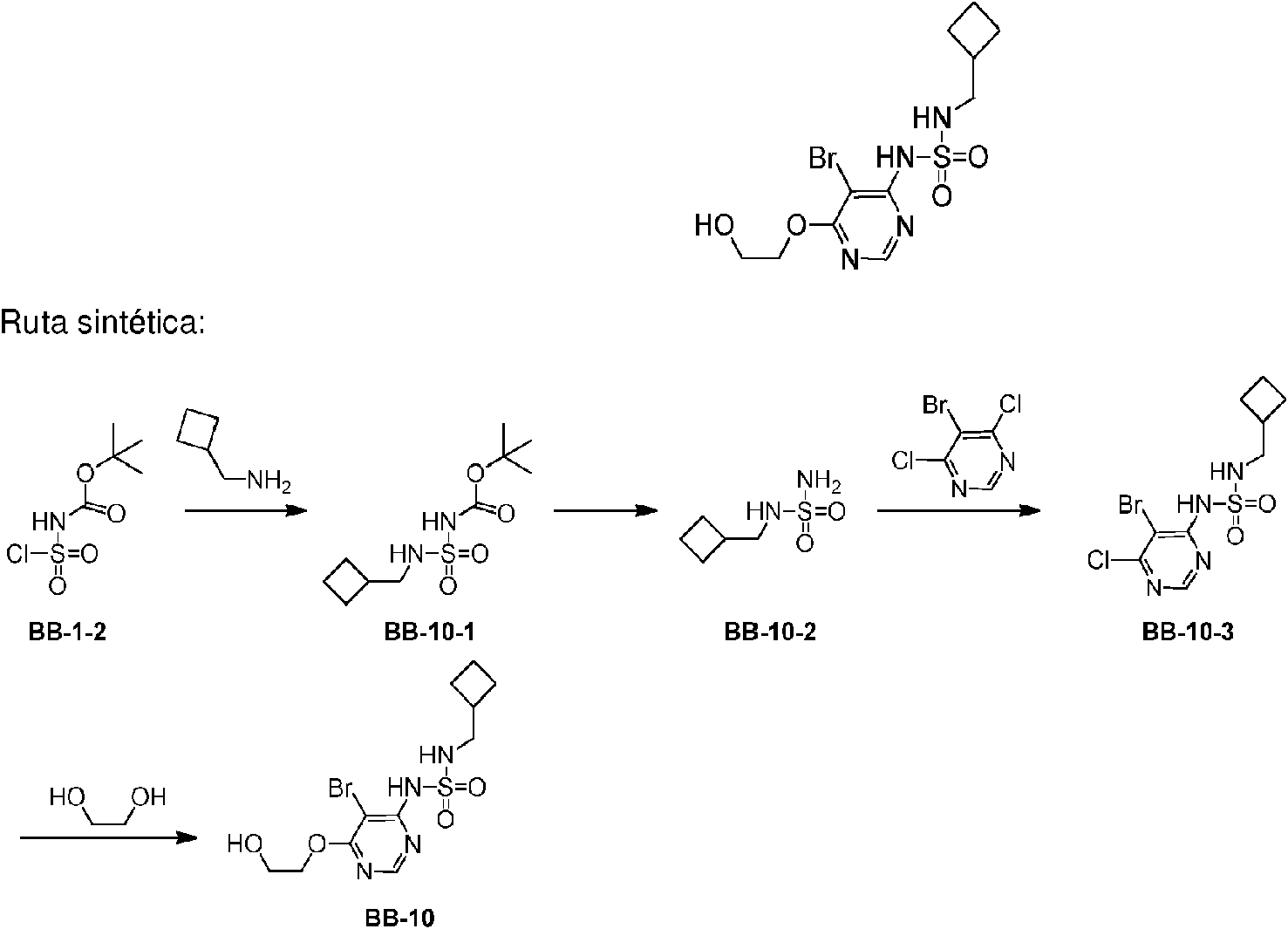
Etapa 1: Síntesis del compuesto BB-10-1 Step 1: Synthesis of compound BB-10-1
A 0°C, se añadieron hidrocloruro de ciclobutilmetilamina (5,00 g, 41,12 mmol), trietilamina (10,40 g, 102,80 mmol, 14,25 ml) y diclorometano (50,00 ml) a una solución del compuesto BB-1-2 (41,12 mmol, producto bruto) en diclorometano, y la mezcla de reacción se calentó hasta temperatura ambiente y se agitó durante 18 horas en atmósfera de nitrógeno. Una vez completada la reacción, se añadió agua (60 ml) y la mezcla se extrajo con diclorometano (60 ml x 2). Las fases orgánicas se combinaron, se lavaron con ácido clorhídrico diluido 1 M (50 ml) y salmuera saturada (100 ml), se secaron sobre sulfato de sodio anhidro, se filtraron y el disolvente del filtrado se eliminó a presión reducida para obtener el compuesto BB-10-1 buscado (sólido amarillo, 7,20 g, rendimiento: 66,24%). At 0°C, cyclobutylmethylamine hydrochloride (5.00 g, 41.12 mmol), triethylamine (10.40 g, 102.80 mmol, 14.25 mL) and dichloromethane (50.00 mL) were added to a solution of compound BB-1-2 (41.12 mmol, crude) in dichloromethane, and the reaction mixture was warmed to room temperature and stirred for 18 hours under a nitrogen atmosphere. After the reaction was complete, water (60 ml) was added and the mixture was extracted with dichloromethane (60 ml x 2). The organic phases were combined, washed with 1M dilute hydrochloric acid (50 mL) and saturated brine (100 mL), dried over anhydrous sodium sulfate, filtered, and the solvent in the filtrate was removed under reduced pressure to obtain the compound BB-10-1 sought (yellow solid, 7.20 g, yield: 66.24%).
Etapa 2: Síntesis del compuesto BB-10-2 Step 2: Synthesis of the compound BB-10-2
A temperatura ambiente, se añadió el compuesto BB-10-1 (7,00 g, 26,48 mmol) a agua (100,00 ml) y la mezcla de reacción se calentó hasta 110°C y se agitó durante 2 horas. Una vez completada la reacción, la mezcla se enfrió hasta temperatura ambiente y se extrajo con acetato de etilo (100 ml x 3). Las fases orgánicas se combinaron, se lavaron con salmuera saturada (200 ml), se secaron sobre sulfato de sodio anhidro, se filtraron y el disolvente del filtrado se eliminó a presión reducida para obtener el compuesto BB-10-2 buscado (aceite incoloro, 3,80 g, rendimiento: 87,38%). RMN 1H (400 MHz, CDCh) 5: 5,10-4,92 (m, 2H), 3,15-3,10 (m, 2H), 2,54-2,50 (m, 1H), 2,07-2,04 (m, 2H), 1,90-1,88 (m, 2H), 1,88-1,69 (m, 2H). At room temperature, compound BB-10-1 (7.00 g, 26.48 mmol) was added to water (100.00 mL) and the reaction mixture heated to 110°C and stirred for 2 hours. After the completion of the reaction, the mixture was cooled to room temperature and extracted with ethyl acetate (100 ml x 3). The organic phases were combined, washed with saturated brine (200 mL), dried over anhydrous sodium sulfate, filtered, and the solvent in the filtrate was removed under reduced pressure to obtain the target compound BB-10-2 (colorless oil, 3.80 g, yield: 87.38%). 1H NMR (400 MHz, CDCh) 5: 5.10-4.92 (m, 2H), 3.15-3.10 (m, 2H), 2.54-2.50 (m, 1H), 2 0.07-2.04 (m, 2H), 1.90-1.88 (m, 2H), 1.88-1.69 (m, 2H).
Etapa 3: Síntesis del compuesto BB-10-3 Step 3: Synthesis of the compound BB-10-3
A temperatura ambiente, se añadió terc-butóxido de potasio (3,14 g, 28,00 mmol) a una solución del compuesto BB-10-2 (2,30 g, 14,00 mmol) en dimetilsulfóxido (40,00 ml), la mezcla de reacción se agitó a temperatura ambiente durante 0,5 horas en atmósfera de nitrógeno, a continuación se añadió 5-bromo-4,6-dicloropirimidina (3,19 g, 14,00 mmol) y la mezcla de reacción se agitó a temperatura ambiente durante 15 horas en atmósfera de nitrógeno. Una vez completada la reacción, se añadió agua (80 ml), el pH se ajustó hasta 4 con ácido clorhídrico diluido 1 M y la mezcla se extrajo con acetato de etilo (40 ml x 3). Las fases orgánicas se combinaron, se lavaron con salmuera saturada (40 ml), se secaron sobre sulfato de sodio anhidro, se filtraron y el disolvente se eliminó a presión reducida. El residuo se separó mediante cromatografía en columna (eluyente: éter de petróleo/acetato de etilo = 1/1, relación en volumen) para obtener el compuesto BB-10-3 buscado (sólido amarillo, 3,10 g, rendimiento: 62,29%). RMN 1H (400 MHz, CDCta) 5: 8,49 (s, 1H), 7,79 (s, 1 H), 5,45 (t, j=6,0 Hz, 1H), 3,03-2,98 (m, 2H), 2,53-2,33 (m, 1 H), 2,04-1,98 (m, 2H), 1,84-1,78 (m, 2H), 1,63-1,57 (m, 2H) ).At room temperature, potassium tert-butoxide (3.14 g, 28.00 mmol) was added to a solution of compound BB-10-2 (2.30 g, 14.00 mmol) in dimethyl sulfoxide (40.00 mL ), the reaction mixture was stirred at room temperature for 0.5 hours under a nitrogen atmosphere, then 5-bromo-4,6-dichloropyrimidine (3.19 g, 14.00 mmol) was added and the reaction mixture it was stirred at room temperature for 15 hours under a nitrogen atmosphere. After the reaction was complete, water (80 ml) was added, the pH adjusted to 4 with 1M dilute hydrochloric acid and the mixture was extracted with ethyl acetate (40 ml x 3). The organic phases were combined, washed with saturated brine (40 mL), dried over anhydrous sodium sulfate, filtered, and the solvent removed under reduced pressure. The residue was separated by column chromatography (eluent: petroleum ether/ethyl acetate = 1/1, volume ratio) to obtain the intended compound BB-10-3 (yellow solid, 3.10 g, yield: 62, 29%). 1H NMR (400 MHz, CDCta) 5: 8.49 (s, 1H), 7.79 (s, 1H), 5.45 (t, j=6.0 Hz, 1H), 3.03-2 .98 (m, 2H), 2.53-2.33 (m, 1H), 2.04-1.98 (m, 2H), 1.84-1.78 (m, 2H), 1, 63-1.57 (m, 2H) ).
Etapa 4: Síntesis del compuesto BB-10 Step 4: Synthesis of compound BB-10
A temperatura ambiente, se añadió terc-butóxido de potasio (1,89 g, 16,88 mmol) a etilenglicol (15,79 g, 254,55 mmol, 14,23 ml), la mezcla de reacción se calentó hasta 40°C y se agitó durante 0,5 horas en atmósfera de nitrógeno, a continuación se añadió una solución del compuesto BB-10-3 (3,00 g, 8,44 mmol) en éter dimetílico de etilenglicol (30,00 ml) a la mezcla y la mezcla de reacción se calentó hasta 120°C y se agitó durante 15 horas en atmósfera de nitrógeno. Una vez completada la reacción, se añadió agua (60 ml), el pH se ajustó hasta 4 con ácido clorhídrico diluido 1 M y la mezcla se extrajo con acetato de etilo (50 ml x 3). Las fases orgánicas se combinaron, se lavaron con salmuera saturada (30 ml), se secaron sobre sulfato de sodio anhidro, se filtraron y el disolvente del filtrado se eliminó a presión reducida. El residuo se separó mediante cromatografía en columna (eluyente: éter de petróleo/acetato de etilo = 1/2, relación en volumen) para obtener el compuesto BB-10 buscado (aceite amarillo, 2,50 g, rendimiento: 77,73%). RMN 1H (400 MHz, CDCh) 5: 8,39 (s, 1H), 7,65 (s ancho, 1H), 5,52 (t, j=6,0 Hz, 1H), 4,71-4,49 (m, 2H), 4,02 (br d, j=3,8 Hz, 2H), 3,12-3,01 (m, 2H), 2,60-2,47 (m, 1 H), 2,43 (s ancho, 1 H), 2,09-2,01 (m, 2H), 1,98-1,77 (m, 2H) , 1,74-1,64 (m, 2H).At room temperature, potassium tert-butoxide (1.89 g, 16.88 mmol) was added to ethylene glycol (15.79 g, 254.55 mmol, 14.23 mL), the reaction mixture warmed to 40° C and stirred for 0.5 hours under a nitrogen atmosphere, then a solution of compound BB-10-3 (3.00 g, 8.44 mmol) in ethylene glycol dimethyl ether (30.00 mL) was added to the mixture and the reaction mixture was heated to 120°C and stirred for 15 hours under a nitrogen atmosphere. After the reaction was complete, water (60 ml) was added, the pH adjusted to 4 with 1M dilute hydrochloric acid and the mixture was extracted with ethyl acetate (50 ml x 3). The organic phases were combined, washed with saturated brine (30 mL), dried over anhydrous sodium sulfate, filtered, and the solvent in the filtrate was removed under reduced pressure. The residue was separated by column chromatography (eluent: petroleum ether/ethyl acetate = 1/2, volume ratio) to obtain the target compound BB-10 (yellow oil, 2.50 g, yield: 77.73% ). 1H NMR (400 MHz, CDCh) 5: 8.39 (s, 1H), 7.65 (broad s, 1H), 5.52 (t, j=6.0 Hz, 1H), 4.71-4 .49 (m, 2H), 4.02 (br d, j=3.8 Hz, 2H), 3.12-3.01 (m, 2H), 2.60-2.47 (m, 1H ), 2.43 (broad s, 1H), 2.09-2.01 (m, 2H), 1.98-1.77 (m, 2H), 1.74-1.64 (m, 2H ).
Realización de referencia 11: fragmento BB-11Reference Realization 11: Fragment BB-11

Etapa 1: Síntesis del compuesto BB-11-1 Step 1: Synthesis of the compound BB-11-1
A 0°C, se añadió lentamente gota a gota una solución del compuesto BB-1-2 (78,00 milimoles, producto bruto) en diclorometano a una solución de 3-metoxipropilamina (6,95 g, 78,00 milimoles, 7,99 ml) y trietilamina (15,79 g, 156,00 milimoles, 21,63 ml) en diclorometano (50,00 ml) (el tiempo de goteo fue aproximadamente 0,5 horas) y la mezcla de reacción se calentó hasta temperatura ambiente y se agitó durante 18 horas. Una vez completada la reacción, se añadió agua (200 ml) y la mezcla se extrajo con diclorometano (150 ml x 2). Las fases orgánicas se combinaron, se lavaron con ácido clorhídrico diluido 1 M (50 ml) y salmuera saturada (200 ml), respectivamente, se secaron sobre sulfato de sodio anhidro, se filtraron y el disolvente del filtrado se eliminó a presión reducida para obtener el compuesto BB-11-1 buscado (sólido blanco, 16,00 g, rendimiento: 76,45%). RMN 1H (400 MHz, CDCI3) ó: 3,42 (t, j=5,8 Hz, 2H), 3,28 (s, 3H), 3,15-3,04 (m, 2H), 1,91-1,64 (m, 2H), 1,43 (s, 9H).At 0°C, a solution of compound BB-1-2 (78.00 mmol, crude) in dichloromethane was slowly added dropwise to a solution of 3-methoxypropylamine (6.95 g, 78.00 mmol, 7 0.99 mL) and triethylamine (15.79 g, 156.00 mmol, 21.63 mL) in dichloromethane (50.00 mL) (dropping time was approximately 0.5 hours) and the reaction mixture was heated to room temperature and stirred for 18 hours. After the reaction was complete, water (200 ml) was added and the mixture was extracted with dichloromethane (150 ml x 2). The organic phases were combined, washed with 1 M dilute hydrochloric acid (50 mL) and saturated brine (200 mL), respectively, dried over anhydrous sodium sulfate, filtered, and the solvent from the filtrate was removed under reduced pressure to obtain the compound BB-11-1 sought (white solid, 16.00 g, yield: 76.45%). 1 H NMR (400 MHz, CDCI 3 ) or: 3.42 (t, j=5.8 Hz, 2H), 3.28 (s, 3H), 3.15-3.04 (m, 2H), 1.91-1.64 (m, 2H), 1.43 (s, 9H).
Etapa 2: Síntesis del compuesto BB-11-2 Step 2: Synthesis of the compound BB-11-2
A temperatura ambiente, se añadió el compuesto BB-11-1 (16,00 g, 59,63 mmol) a agua (100,00 ml) y la mezcla de reacción se calentó hasta 100°C y se agitó durante 1 hora. Una vez completada la reacción, la mezcla se enfrió hasta temperatura ambiente y se extrajo con acetato de etilo (100 ml x 3). Las fases orgánicas se combinaron, se lavaron con salmuera saturada (100 ml), se secaron sobre sulfato de sodio anhidro, se filtraron y el disolvente del filtrado se eliminó a presión reducida para obtener el compuesto BB-11-2 buscado (aceite incoloro, 8,50 g, rendimiento: 84,74%). RMN 1H (400 MHz, DMSO _o6) 5: 6,49-6,38 (m, 3H), 3,37-3,32 (m, 2H), 3,23-3,19 (m, 3H), 2,96-2,82 (m, 2H), 1,73-1,63 (m, 2H). At room temperature, compound BB-11-1 (16.00 g, 59.63 mmol) was added to water (100.00 mL) and the reaction mixture was heated to 100°C and stirred for 1 hour. After the completion of the reaction, the mixture was cooled to room temperature and extracted with ethyl acetate (100 ml x 3). The organic phases were combined, washed with saturated brine (100 mL), dried over anhydrous sodium sulfate, filtered, and the solvent in the filtrate was removed under reduced pressure to obtain the target compound BB-11-2 (colorless oil, 8.50 g, yield: 84.74%). 1 H NMR (400 MHz, DMSO _o 6 ) 5: 6.49-6.38 (m, 3H), 3.37-3.32 (m, 2H), 3.23-3.19 (m, 3H ), 2.96-2.82 (m, 2H), 1.73-1.63 (m, 2H).
Etapa 3: Síntesis del compuesto BB-11-3 Step 3: Synthesis of the compound BB-11-3
A temperatura ambiente, se añadió terc-butóxido de potasio (2,67 g, 23,78 mmol) a una solución del compuesto BB-11-2 (2,00 g, 11,89 mmol) en dimetilsulfóxido (10,00 ml), la mezcla de reacción se agitó a temperatura ambiente durante 0,5 horas en atmósfera de nitrógeno, a continuación se añadió 5-bromo-4,6-dicloropirimidina (2,71 g, 11,89 mmol) y la mezcla de reacción se agitó a temperatura ambiente durante 15 horas en atmósfera de nitrógeno. Una vez completada la reacción, se añadió agua (60 ml), el pH se ajustó hasta 4 con ácido clorhídrico diluido 0,5 M y la mezcla se extrajo con acetato de etilo (30 ml x 3). Las fases orgánicas se combinaron, se lavaron con salmuera saturada (30 ml), se secaron sobre sulfato de sodio anhidro, se filtraron y el disolvente del filtrado se eliminó a presión reducida. El residuo se separó mediante cromatografía en columna (eluyente: éter de petróleo/acetato de etilo = 1/1, relación en volumen) para obtener el compuesto BB-11-3 buscado (sólido blanco, 3,30 g, rendimiento: 77,21%). RMN 1H (400 MHz, DMSO _de) 5: 8,59 (s, 1H), 3,29-3,25 (m, 2H), 3,16 (s, 3H), 2,96 (t, j=6,9 Hz, 2H), 1,70-1,62 (m, 2H).At room temperature, potassium tert-butoxide (2.67 g, 23.78 mmol) was added to a solution of compound BB-11-2 (2.00 g, 11.89 mmol) in dimethyl sulfoxide (10.00 mL ), the reaction mixture was stirred at room temperature for 0.5 hours under a nitrogen atmosphere, then 5-bromo-4,6-dichloropyrimidine (2.71 g, 11.89 mmol) was added and the reaction mixture it was stirred at room temperature for 15 hours under a nitrogen atmosphere. After the reaction was complete, water (60 ml) was added, the pH adjusted to 4 with dilute 0.5M hydrochloric acid and the mixture was extracted with ethyl acetate (30 ml x 3). The organic phases were combined, washed with saturated brine (30 mL), dried over anhydrous sodium sulfate, filtered, and the solvent in the filtrate was removed under reduced pressure. The residue was separated by column chromatography (eluent: petroleum ether/ethyl acetate = 1/1, volume ratio) to obtain the intended compound BB-11-3 (white solid, 3.30 g, yield: 77, twenty-one%). 1 H NMR (400 MHz, DMSO _d e ) 5: 8.59 (s, 1H), 3.29-3.25 (m, 2H), 3.16 (s, 3H), 2.96 (t, j=6.9Hz, 2H), 1.70-1.62 (m, 2H).
Etapa 4: Síntesis del compuesto BB-11 Step 4: Synthesis of compound BB-11
A temperatura ambiente, se añadió terc-butóxido de potasio (2,06 g, 18,35 mmol) a etilenglicol (30,24 g, 487,25 mmol, 27,25 ml), la mezcla de reacción se calentó hasta 40°C y se agitó durante 0,5 horas en atmósfera de nitrógeno, a continuación se añadió una solución del compuesto BB-11-3 (3,30 g, 9,18 mmol) en éter dimetílico de etilenglicol (10,00 ml) a la mezcla y la mezcla de reacción se calentó hasta 110°C y se agitó durante 24 horas en atmósfera de nitrógeno. Una vez completada la reacción, la mezcla se enfrió hasta temperatura ambiente, se añadió agua (60 ml), se ajustó el pH hasta 4 con ácido clorhídrico diluido 1 M y se extrajo con acetato de etilo (30 ml x 3). Las fases orgánicas se combinaron, se lavaron con salmuera saturada (30 ml), se secaron sobre sulfato de sodio anhidro, se filtraron y el disolvente del filtrado se eliminó a presión reducida. El residuo se separó mediante cromatografía en columna (eluyente: éter de petróleo/acetato de etilo = 1/2, relación en volumen) para obtener el compuesto BB-11 buscado (aceite amarillo, 2,20 g, rendimiento: 61,34%). RMN 1H (400 MHz, CDCl3) 5: 8,51-8,08 (m, 1H), 7,65 (s, 1H), 6,10 (t, j=5,9 Hz, 1H), 4,67-4,45 (m, 2H), 4,01 (d, j=3,8 Hz, 2H), 3,53-3,39 (m, 2H), 3,34 (s, 3H), 3,26-3,13 (m, 2H), 2,46 (s ancho, 1 H), 1,85 (q, j=6,0 Hz, 2H).At room temperature, potassium tert-butoxide (2.06 g, 18.35 mmol) was added to ethylene glycol (30.24 g, 487.25 mmol, 27.25 mL), the reaction mixture warmed to 40° C and stirred for 0.5 hours under a nitrogen atmosphere, then a solution of compound BB-11-3 (3.30 g, 9.18 mmol) in ethylene glycol dimethyl ether (10.00 mL) was added to the mixture and the reaction mixture was heated to 110°C and stirred for 24 hours under a nitrogen atmosphere. After the reaction was complete, the mixture was cooled to room temperature, water (60 mL) was added, the pH adjusted to 4 with 1M dilute hydrochloric acid, and extracted with ethyl acetate (30 mL x 3). The organic phases were combined, washed with saturated brine (30 mL), dried over anhydrous sodium sulfate, filtered, and the solvent in the filtrate was removed under reduced pressure. The residue was separated by column chromatography (eluent: petroleum ether/ethyl acetate = 1/2, volume ratio) to obtain the target compound BB-11 (yellow oil, 2.20 g, yield: 61.34% ). 1 H NMR (400 MHz, CDCl 3 ) 5: 8.51-8.08 (m, 1H), 7.65 (s, 1H), 6.10 (t, j=5.9 Hz, 1H), 4.67-4.45 (m, 2H), 4.01 (d, j=3.8 Hz, 2H), 3.53-3.39 (m, 2H), 3.34 (s, 3H) , 3.26-3.13 (m, 2H), 2.46 (broad s, 1H), 1.85 (q, j=6.0 Hz, 2H).
Realización de referencia 12: fragmento BB-12Reference Realization 12: BB-12 Fragment

Etapa 1: Síntesis del compuesto BB-12-1 Step 1: Synthesis of the compound BB-12-1
A 0°C, se añadió lentamente una solución del compuesto BB-1-2 (74,19 mmol, producto bruto) en diclorometano a una solución de 3-etoxipropil-1 -amina (7,65 g, 74,19 mmol, 8,90 ml) y trietilamina (22,52 g, 222,58 mmol, 30,85 ml) en diclorometano (40,00 ml) (el tiempo de goteo fue de aproximadamente 1 hora) y la mezcla de reacción se calentó hasta temperatura ambiente y se agitó durante 14 horas en atmósfera de nitrógeno. Una vez completada la reacción, se eliminó el disolvente a presión reducida y se añadió agua (200 ml) al residuo y se extrajo con diclorometano (100 ml). La fase orgánica se descartó y la fase acuosa se ajustó hasta un pH de 5-6 con ácido clorhídrico diluido 1 M, a continuación la fase acuosa se extrajo con acetato de etilo (100 ml x 3). Las fases orgánicas se combinaron, se secaron sobre sulfato de sodio anhidro, se filtraron y el disolvente del filtrado se eliminó a presión reducida para obtener el compuesto BB-12-1 buscado (sólido amarillo, 17,00 g, producto bruto). RMN 1H (400 MHz, DMSO_afe) ó: 10,80 (s, 1H), 7,51 (t, 7=5,8 Hz, 1 H), 3,40-3,37 (m, 2H), 2,93 (q, 7=6,4 Hz, 2H), 2,51 (s, 2H), 1,74-1,61 (m, 2H), 1,43 (s, 9H), 1,10 (t, 7=6,8 Hz, 3H).At 0°C, a solution of compound BB-1-2 (74.19 mmol, crude) in dichloromethane was slowly added to a solution of 3-ethoxypropyl-1-amine (7.65 g, 74.19 mmol, 8.90 mL) and triethylamine (22.52 g, 222.58 mmol, 30.85 mL) in dichloromethane (40.00 mL) (dropping time was ca. 1 hour) and the reaction mixture was heated to room temperature and stirred for 14 hours under a nitrogen atmosphere. After the completion of the reaction, the solvent was removed under reduced pressure and water (200 ml) was added to the residue and extracted with dichloromethane (100 ml). The organic phase was discarded and the aqueous phase adjusted to pH 5-6 with 1M dilute hydrochloric acid, then the aqueous phase was extracted with ethyl acetate (100ml x 3). The organic phases were combined, dried over anhydrous sodium sulfate, filtered, and the solvent in the filtrate was removed under reduced pressure to obtain the target compound BB-12-1 (yellow solid, 17.00 g, crude product). 1H NMR (400 MHz, DMSO_afe) or : 10.80 (s, 1H), 7.51 (t, 7=5.8 Hz, 1H), 3.40-3.37 (m, 2H), 2 .93 (q, 7=6.4 Hz, 2H), 2.51 (s, 2H), 1.74-1.61 (m, 2H), 1.43 (s, 9H), 1.10 ( t, 7=6.8Hz, 3H).
Etapa 2: Síntesis del compuesto BB-12-2 Step 2: Synthesis of the compound BB-12-2
A temperatura ambiente, se añadió el compuesto BB-12-1 (17,00 g, 60,21 mmol) a agua (100,00 ml) y la mezcla de reacción se calentó hasta 110°C y se agitó durante 1 hora. Una vez completada la reacción, la mezcla se enfrió hasta temperatura ambiente y se extrajo con acetato de etilo (100 ml x 3). Las fases orgánicas se combinaron, se lavaron con salmuera saturada (100 ml), se secaron sobre sulfato de sodio anhidro y se filtraron, y el disolvente del filtrado se eliminó a presión reducida para obtener el compuesto BB-12-2 buscado (aceite amarillo, 9,00 g, producto bruto). RMN 1H (400 MHz, DMSO _d6) ó: 6,46 (s, 2H), 6,41 (t, 7=6,2 Hz, 1H), 3,43-3,37 (m, 4H), 2,90 (q, 7=6,4 Hz, 2H), 1,75-1,60 (m, 2H), 1,10 (t, 7=7,0 Hz, 3H).At room temperature, compound BB-12-1 (17.00 g, 60.21 mmol) was added to water (100.00 mL) and the reaction mixture heated to 110°C and stirred for 1 hour. After the completion of the reaction, the mixture was cooled to room temperature and extracted with ethyl acetate (100 ml x 3). The organic phases were combined, washed with saturated brine (100 mL), dried over anhydrous sodium sulfate, and filtered, and the solvent in the filtrate was removed under reduced pressure to obtain the target compound BB-12-2 (yellow oil , 9.00 g, crude product). 1H NMR (400 MHz, DMSO _d6) or: 6.46 (s, 2H), 6.41 (t, 7=6.2 Hz, 1H), 3.43-3.37 (m, 4H), 2 .90 (q, 7=6.4Hz, 2H), 1.75-1.60 (m, 2H), 1.10 (t, 7=7.0Hz, 3H).
Etapa 3: Síntesis del compuesto BB-12-3 Step 3: Synthesis of the compound BB-12-3
A temperatura ambiente, se añadieron el compuesto BB-12-2 (1,60 g, 8,78 mmol) y terc-butóxido de potasio (1,97 g, 17,55 mmol) a dimetilsulfóxido (20,00 ml), la mezcla de reacción se agitó a temperatura ambiente durante 1 hora en atmósfera de nitrógeno, se añadió 5-bromo-4,6-dicloropirimidina (2,00 g, 8,78 mmol) y la mezcla de reacción se agitó a temperatura ambiente durante 11 horas en atmósfera de nitrógeno. Una vez completada la reacción, se añadió agua (100 ml), el pH se ajustó hasta 5-6 con ácido clorhídrico diluido 1 M y la mezcla se extrajo con acetato de etilo (50 ml x 3). Las fases orgánicas se combinaron, se lavaron con agua (50 ml x 2), se secaron sobre sulfato de sodio anhidro, se filtraron y el disolvente del filtrado se eliminó a presión reducida. El residuo se separó mediante cromatografía en columna (eluyente: éter de petróleo/acetato de etilo = 10/1 -4/1, relación en volumen) para obtener el compuesto BB-12-3 buscado (sólido amarillo, 1,30 g, rendimiento: 39,64%). RMN 1H (400 MHz, Dm So _afe) ó: 8,59 (s, 1 h ), 3,34-3,29 (m, 4H), 2,98 (t, 7=6,8 Hz, 2H), 1,69-1,61 (m, 2H), 1,06 (t, 7=6,8 Hz, 3H).At room temperature, compound BB-12-2 (1.60 g, 8.78 mmol) and potassium tert-butoxide (1.97 g, 17.55 mmol) were added to dimethyl sulfoxide (20.00 mL), The reaction mixture was stirred at room temperature for 1 hour under a nitrogen atmosphere, 5-bromo-4,6-dichloropyrimidine (2.00 g, 8.78 mmol) was added and the reaction mixture was stirred at room temperature for 11 hours in a nitrogen atmosphere. After the reaction was complete, water (100ml) was added, the pH adjusted to 5-6 with 1M dilute hydrochloric acid and the mixture was extracted with ethyl acetate (50ml x 3). The organic phases were combined, washed with water (50 ml x 2), dried over anhydrous sodium sulfate, filtered and the solvent in the filtrate was removed under reduced pressure. The residue was separated by column chromatography (eluent: petroleum ether/ethyl acetate = 10/1 -4/1, volume ratio) to obtain the target compound BB-12-3 (yellow solid, 1.30 g, yield: 39.64%). 1H NMR (400 MHz, Dm So _afe) or: 8.59 (s, 1h), 3.34-3.29 (m, 4H), 2.98 (t, 7=6.8 Hz, 2H) , 1.69-1.61 (m, 2H), 1.06 (t, 7=6.8 Hz, 3H).
Etapa 4: Síntesis del compuesto BB-12 Step 4: Synthesis of compound BB-12
A temperatura ambiente, se añadió terc-butóxido de potasio (1,17 g, 10,44 mmol) a una solución mixta de etilenglicol (35,63 g, 574,20 mmol, 32,10 ml) y éter dimetílico de etilenglicol (10,00 ml), la mezcla de reacción se calentó hasta 40°C y se agitó durante 0,5 horas en atmósfera de nitrógeno, a continuación se añadió una solución del compuesto BB-12-3 (1,30 g, 3,48 mmol) en éter dimetílico de etilenglicol (20,00 ml) a la mezcla en una porción, y la mezcla de reacción se calentó hasta 100°C y se agitó durante 15 horas en atmósfera de nitrógeno. Una vez completada la reacción, la mezcla se enfrió hasta temperatura ambiente, se añadió agua (100 ml), se ajustó hasta un pH de 5-6 con ácido clorhídrico diluido 2 M y se extrajo con acetato de etilo (60 ml x 3). Las fases orgánicas se combinaron, se secaron sobre sulfato de sodio anhidro, se filtraron y el disolvente del filtrado se eliminó a presión reducida. El residuo se separó mediante cromatografía en columna (eluyente: éter de petróleo/acetato de etilo = 3/1-1/3, relación en volumen) para obtener el compuesto BB-12 buscado (sólido blanco, 1,10 g, rendimiento: 79,17%). MS-ESI m/z: 398,9 [M+H]+, 400,9 [M+H+2]+. RMN 1H (400 MHz, CDCh) ó: 8,29 (s, 1H), 7,56 (s, 1H), 6,02 (t, 7=6,0 Hz, 1H), 4,52 (t, 7=4,6 Hz, 2H), 3,99-3,87 (m, 2H), 3,46-3,31 (m, 4H), 3,11 (q, 7=6,4 Hz, 2H), 2,38 (t, 7=6,0 Hz, 1H), 1,80-1,71 (m, 2H), 1,14 (t, 7=7,0 Hz, 3H).At room temperature, potassium tert-butoxide (1.17 g, 10.44 mmol) was added to a mixed solution of ethylene glycol (35.63 g, 574.20 mmol, 32.10 mL) and ethylene glycol dimethyl ether ( 10.00 mL), the reaction mixture was heated to 40°C and stirred for 0.5 hours under a nitrogen atmosphere, then a solution of compound BB-12-3 (1.30 g, 3, 48 mmol) in ethylene glycol dimethyl ether (20.00 mL) to the mixture in one portion, and the reaction mixture was heated to 100°C and stirred for 15 hours under a nitrogen atmosphere. After the reaction was complete, the mixture was cooled to room temperature, water (100ml) added, adjusted to pH 5-6 with 2M dilute hydrochloric acid and extracted with ethyl acetate (60ml x 3). . The organic phases were combined, dried over anhydrous sodium sulfate, filtered, and the solvent in the filtrate was removed under reduced pressure. The residue was separated by column chromatography (eluent: petroleum ether/ethyl acetate = 3/1-1/3, volume ratio) to obtain the target compound BB-12 (white solid, 1.10 g, yield: 79.17%). MS-ESI m/z: 398.9 [M+H]+, 400.9 [M+H+2]+. 1H NMR (400 MHz, CDCh) or : 8.29 (s, 1H), 7.56 (s, 1H), 6.02 (t, 7=6.0 Hz, 1H), 4.52 (t, 7=4.6 Hz, 2H), 3.99-3.87 (m, 2H), 3.46-3.31 (m, 4H), 3.11 (q, 7=6.4 Hz, 2H ), 2.38 (t, 7=6.0 Hz, 1H), 1.80-1.71 (m, 2H), 1.14 (t, 7=7.0 Hz, 3H).
Realización de referencia 13: fragmento BB-13Reference Realization 13: Fragment BB-13

Ruta sintética:Synthetic route:

Etapa 1: Síntesis del compuesto BB-13-1 Step 1: Synthesis of the compound BB-13-1
A 0°C, se añadió lentamente una solución del compuesto BB-1-2 (49,43 milimoles, producto bruto) en diclorometano a una solución de 2-tetrahidrofurfurilamina (5,00 g, 49,43 milimoles, 5,10 ml) y trietilamina (10,00 g, 98,86 milimoles, 13,70 ml) en diclorometano (50,00 ml) (el tiempo de goteo fue de aproximadamente 0,5 horas) y la mezcla de reacción se calentó hasta temperatura ambiente y se agitó durante 18 horas en atmósfera de nitrógeno. Una vez completada la reacción, se añadió agua (100 ml) y la mezcla se extrajo con diclorometano (90 ml x 2). Las fases orgánicas se combinaron, se lavaron con ácido clorhídrico diluido 1 M (50 ml) y salmuera saturada (200 ml), respectivamente, se secaron sobre sulfato de sodio anhidro, se filtraron y el disolvente del filtrado se eliminó a presión reducida para obtener el compuesto BB-13-1 buscado (sólido blanco, 8,30 g, rendimiento: 59,90%). RMN 1H (400 MHz, CDCh) 5: 5,75 (d, j=4,8Hz, 1H), 4,02 (dd, j=3,9, 6,7 Hz, 1 H), 3,88-3,64 (m, 2H), 3,30-2,83 (m, 2H), 2,06-1,76 (m, 3H), 1,71-1,18 (m, 10H). At 0°C, a solution of compound BB-1-2 (49.43 mmol, crude) in dichloromethane was slowly added to a solution of 2-tetrahydrofurfurylamine (5.00 g, 49.43 mmol, 5.10 mL ) and triethylamine (10.00 g, 98.86 mmol, 13.70 mL) in dichloromethane (50.00 mL) (dropping time was approximately 0.5 hours) and the reaction mixture was warmed to room temperature. and stirred for 18 hours under a nitrogen atmosphere. After the reaction was complete, water (100 ml) was added and the mixture was extracted with dichloromethane (90 ml x 2). The organic phases were combined, washed with 1 M dilute hydrochloric acid (50 mL) and saturated brine (200 mL), respectively, dried over anhydrous sodium sulfate, filtered, and the solvent from the filtrate was removed under reduced pressure to obtain the sought compound BB-13-1 (white solid, 8.30 g, yield: 59.90%). 1H NMR (400 MHz, CDCh) 5: 5.75 (d, j=4.8Hz, 1H), 4.02 (dd, j=3.9, 6.7 Hz, 1H), 3.88- 3.64 (m, 2H), 3.30-2.83 (m, 2H), 2.06-1.76 (m, 3H), 1.71-1.18 (m, 10H).
Etapa 2: Síntesis del compuesto BB-13-2 Step 2: Synthesis of the compound BB-13-2
A temperatura ambiente, se añadió el compuesto BB-13-1 (8,00 g, 28,54 mmol) a agua (100,00 ml) y la mezcla de reacción se calentó hasta 110°C y se agitó durante 2 horas en atmósfera de nitrógeno. Una vez completada la reacción, la mezcla se enfrió hasta temperatura ambiente y se extrajo con acetato de etilo (100 ml x 3). Las fases orgánicas se combinaron, se lavaron con salmuera saturada (200 ml), se secaron sobre sulfato de sodio anhidro, se filtraron y el disolvente del filtrado se eliminó a presión reducida para obtener el compuesto BB-13-2 buscado (aceite incoloro, 4,90 g, rendimiento: 95,27%). RMN 1H (400 MHz, CDCh) 5: 5,18-5,01 (m, 1H), 4,07-3,91 (m, 1H), 3,86-3,61 (m, 2H), 3,27 2,90 (m, 2H), 1,96-1,74 (m, 3H), 1,62-1,41 (m, 1 H).At room temperature, compound BB-13-1 (8.00 g, 28.54 mmol) was added to water (100.00 mL) and the reaction mixture was heated to 110°C and stirred for 2 hours under nitrogen atmosphere. After the completion of the reaction, the mixture was cooled to room temperature and extracted with ethyl acetate (100 ml x 3). The organic phases were combined, washed with saturated brine (200 mL), dried over anhydrous sodium sulfate, filtered, and the solvent in the filtrate was removed under reduced pressure to obtain the target compound BB-13-2 (colorless oil, 4.90 g, yield: 95.27%). 1H NMR (400 MHz, CDCh) 5: 5.18-5.01 (m, 1H), 4.07-3.91 (m, 1H), 3.86-3.61 (m, 2H), 3 .27 2.90 (m, 2H), 1.96-1.74 (m, 3H), 1.62-1.41 (m, 1H).
Etapa 3: Síntesis del compuesto BB-13-3 Step 3: Synthesis of the compound BB-13-3
A temperatura ambiente, se añadió terc-butóxido de potasio (3,86 g, 34,40 mmol) a una solución del compuesto BB-13-2 (3,10 g, 17,20 mmol) en dimetilsulfóxido (20,00 ml), la mezcla de reacción se agitó a temperatura ambiente durante 0,5 horas en atmósfera de nitrógeno, a continuación se añadió 5-bromo-4,6-dicloropirimidina (3,92 g, 17,20 mmol) y la mezcla de reacción se agitó a temperatura ambiente durante 15 horas en atmósfera de nitrógeno. Una vez completada la reacción, se añadió agua (60 ml), el pH se ajustó hasta 4 con ácido clorhídrico diluido 1 M y la mezcla se extrajo con acetato de etilo (30 ml x 3). Las fases orgánicas se combinaron, se lavaron con salmuera saturada (30 ml), se secaron sobre sulfato de sodio anhidro, se filtraron y el disolvente del filtrado se eliminó a presión reducida. El residuo se separó mediante cromatografía en columna (eluyente: éter de petróleo/acetato de etilo = 1/1, relación en volumen) para obtener el compuesto BB-13-3 buscado (sólido amarillo, 2,10 g, rendimiento: 32,85%). RMN 1H (400 MHz, CDCh) 5: 8,65-8,36 (m, 1H), 8,08-7,70 (m, 1H), 5,99-5,80 (m, 1H), 4,08-3,90 (m, 1H), 3,82-3,55 (m, 2H), 3,25 3,13 (m, 1H), 3,04-2,89 (m, 1H), 1,98-1,72 (m, 3H), 1,60-1,44 (m, 1H).At room temperature, potassium tert-butoxide (3.86 g, 34.40 mmol) was added to a solution of compound BB-13-2 (3.10 g, 17.20 mmol) in dimethyl sulfoxide (20.00 mL ), the reaction mixture was stirred at room temperature for 0.5 hours under a nitrogen atmosphere, then 5-bromo-4,6-dichloropyrimidine (3.92 g, 17.20 mmol) was added and the reaction mixture it was stirred at room temperature for 15 hours under a nitrogen atmosphere. After the reaction was complete, water (60ml) was added, the pH adjusted to 4 with 1M dilute hydrochloric acid and the mixture was extracted with ethyl acetate (30ml x 3). The organic phases were combined, washed with saturated brine (30 mL), dried over anhydrous sodium sulfate, filtered, and the solvent in the filtrate was removed under reduced pressure. The residue was separated by column chromatography (eluent: petroleum ether/ethyl acetate = 1/1, volume ratio) to obtain the target compound BB-13-3 (yellow solid, 2.10 g, yield: 32, 85%). 1H NMR (400 MHz, CDCh) 5: 8.65-8.36 (m, 1H), 8.08-7.70 (m, 1H), 5.99-5.80 (m, 1H), 4 .08-3.90 (m, 1H), 3.82-3.55 (m, 2H), 3.25 3.13 (m, 1H), 3.04-2.89 (m, 1H), 1.98-1.72 (m, 3H), 1.60-1.44 (m, 1H).
Etapa 4: Síntesis del compuesto BB-13 Step 4: Synthesis of compound BB-13
A temperatura ambiente, se añadió terc-butóxido de potasio (1,27 g, 11,30 mmol) a etilenglicol (10,58 g, 170,40 mmol, 9,53 ml), la mezcla de reacción se calentó hasta 40°C y se agitó durante 0,5 horas en atmósfera de nitrógeno, a continuación se añadió una solución de compuesto BB-13-3 (2,10 g, 5,65 mmol) en éter dimetílico de etilenglicol (30,00 ml) a la mezcla y la mezcla de reacción se calentó hasta 120°C y se agitó durante 15 horas en atmósfera de nitrógeno. Una vez completada la reacción, la mezcla se enfrió hasta temperatura ambiente, se añadió agua (60 ml), se ajustó hasta pH 4 con ácido clorhídrico diluido 1 M y se extrajo con acetato de etilo (50 ml x 3). Las fases orgánicas se combinaron, se lavaron con salmuera saturada (50 ml), se secaron sobre sulfato de sodio anhidro, se filtraron y el disolvente del filtrado se eliminó a presión reducida. El residuo se separó mediante cromatografía en columna (eluyente: éter de petróleo/acetato de etilo = 1/2, relación en volumen) para obtener el compuesto BB-13 buscado (aceite amarillo, 1,80 g, rendimiento: 78,35%). MS-ESI m/z: 396,8 [M+H]+, 398,8 [M+H+2]+. At room temperature, potassium tert-butoxide (1.27 g, 11.30 mmol) was added to ethylene glycol (10.58 g, 170.40 mmol, 9.53 mL), the reaction mixture warmed to 40° C and stirred for 0.5 hours under a nitrogen atmosphere, then a solution of compound BB-13-3 (2.10 g, 5.65 mmol) in ethylene glycol dimethyl ether (30.00 mL) was added to the mixture and the reaction mixture was heated to 120°C and stirred for 15 hours under a nitrogen atmosphere. After the reaction was complete, the mixture was cooled to room temperature, water (60 mL) was added, adjusted to pH 4 with 1M dilute hydrochloric acid, and extracted with ethyl acetate (50 mL x 3). The organic phases were combined, washed with saturated brine (50 mL), dried over anhydrous sodium sulfate, filtered, and the solvent in the filtrate was removed under reduced pressure. The residue was separated by column chromatography (eluent: petroleum ether/ethyl acetate = 1/2, volume ratio) to obtain the target compound BB-13 (yellow oil, 1.80 g, yield: 78.35% ). MS-ESI m/z: 396.8 [M+H]+, 398.8 [M+H+2]+.
Realización de referencia 14: fragmento BB-14Reference Realization 14: Fragment BB-14

A 0°C, se añadió una solución del compuesto BB-1-2 (43,41 mmol, producto bruto) en diclorometano a una solución de 4-(aminometil)tetrahidro-2H-pirano (5,00 g, 43,41 mmol) y trietilamina (8,79 g, 86,82 mmol, 12,04 ml) en diclorometano (50,00 ml), la mezcla de reacción se calentó hasta temperatura ambiente y se agitó durante 12 horas en atmósfera de nitrógeno. Una vez completada la reacción, se añadió agua (80 ml) y la mezcla se extrajo con diclorometano (80 ml x 2). Las fases orgánicas se combinaron, se lavaron con ácido clorhídrico diluido 1 M (50 ml) y salmuera saturada (200 ml), respectivamente, se secaron sobre sulfato de sodio anhidro, se filtraron y el disolvente del filtrado se eliminó a presión reducida para obtener el compuesto BB-14-1 buscado (aceite blanquecino, 5,20 g, rendimiento: 40,69%).At 0°C, a solution of compound BB-1-2 (43.41 mmol, crude product) in dichloromethane was added to a solution of 4-(aminomethyl)tetrahydro-2H-pyran (5.00 g, 43.41 mmol) and triethylamine (8.79 g, 86.82 mmol, 12.04 mL) in dichloromethane (50.00 mL), the reaction mixture was warmed to room temperature and stirred for 12 hours under a nitrogen atmosphere. After the reaction was complete, water (80 ml) was added and the mixture was extracted with dichloromethane (80 ml x 2). The organic phases were combined, washed with 1 M dilute hydrochloric acid (50 mL) and saturated brine (200 mL), respectively, dried over anhydrous sodium sulfate, filtered, and the solvent from the filtrate was removed under reduced pressure to obtain the sought compound BB-14-1 (off-white oil, 5.20 g, yield: 40.69%).
Etapa 2: Síntesis del compuesto BB-14-2 Step 2: Synthesis of the compound BB-14-2
A temperatura ambiente, se añadió el compuesto BB-14-1 (5,00 g, 16,99 mmol) a agua (100,00 ml) y la mezcla de reacción se calentó hasta 100°C y se agitó durante 12 horas. Una vez completada la reacción, la mezcla se enfrió hasta temperatura ambiente y se extrajo con acetato de etilo (80 ml x 2). Las fases orgánicas se combinaron, se lavaron con salmuera saturada (100 ml x 2), se secaron sobre sulfato de sodio anhidro, se filtraron y el disolvente del filtrado se eliminó a presión reducida para obtener el compuesto BB-14-2 buscado (aceite amarillo claro, 1,70 g, rendimiento: 51,51%).At room temperature, compound BB-14-1 (5.00 g, 16.99 mmol) was added to water (100.00 mL) and the reaction mixture was heated to 100°C and stirred for 12 hours. After the completion of the reaction, the mixture was cooled to room temperature and extracted with ethyl acetate (80 ml x 2). The organic phases were combined, washed with saturated brine (100 mL x 2), dried over anhydrous sodium sulfate, filtered, and the solvent in the filtrate was removed under reduced pressure to obtain the target compound BB-14-2 (oil light yellow, 1.70 g, yield: 51.51%).
Etapa 3: Síntesis del compuesto BB-14-3 Step 3: Synthesis of the compound BB-14-3
A 35°C, una mezcla del compuesto BB-14-2 (1,70 g, 8,75 mmol) y terc-butóxido de potasio (2,95 g, 26,25 mmol) en dimetilsulfóxido (50,00 ml) se agitó durante 0,5 horas, a continuación se añadió 5-bromo-4,6-dicloropirimidina (1,99 g, 8,75 mmol), la mezcla de reacción se agitó a 35°C durante 12 horas. Una vez completada la reacción, se añadió a la mezcla ácido clorhídrico diluido 0,5 M (50 ml) y se extrajo con acetato de etilo (50 ml x 3). Las fases orgánicas se combinaron, se lavaron con salmuera saturada (100 ml x 2), se secaron sobre sulfato de sodio anhidro, se filtraron y el disolvente del filtrado se eliminó a presión reducida. El residuo se separó mediante cromatografía en columna (eluyente: éter de petróleo/acetato de etilo = 10/1-1/1, relación en volumen) para obtener el compuesto BB-14-3 buscado (sólido amarillo, 1,20 g, rendimiento: 12,80%). MS-ESI m/z: 384,8 [M+H]+, 386,8 [M+H+2]+.At 35°C, a mixture of compound BB-14-2 (1.70 g, 8.75 mmol) and potassium tert-butoxide (2.95 g, 26.25 mmol) in dimethyl sulfoxide (50.00 mL) stirred for 0.5 hour, then 5-bromo-4,6-dichloropyrimidine (1.99 g, 8.75 mmol) was added, the reaction mixture stirred at 35°C for 12 hours. After the completion of the reaction, 0.5M dilute hydrochloric acid (50 ml) was added to the mixture, and it was extracted with ethyl acetate (50 ml x 3). The organic phases were combined, washed with saturated brine (100 mL x 2), dried over anhydrous sodium sulfate, filtered, and the solvent in the filtrate was removed under reduced pressure. The residue was separated by column chromatography (eluent: petroleum ether/ethyl acetate = 10/1-1/1, volume ratio) to obtain the target compound BB-14-3 (yellow solid, 1.20 g, yield: 12.80%). MS-ESI m/z: 384.8 [M+H]+, 386.8 [M+H+2]+.
Etapa 4: Síntesis del compuesto BB-14 Step 4: Synthesis of compound BB-14
A temperatura ambiente, se añadió terc-butóxido de potasio (1,05 g, 9,33 mmol) a etilenglicol (33,30 g, 536,49 mmol, 30,00 ml), la mezcla de reacción se calentó hasta 40°C y se agitó durante 0,5 horas en atmósfera de nitrógeno, a continuación se añadió una solución del compuesto BB-14-3 (1,20 g, 3,11 mmol) en éter dimetílico de etilenglicol (20,00 ml) a la mezcla y la mezcla de reacción se calentó hasta 110°C y se agitó durante 12 horas en atmósfera de nitrógeno. Una vez completada la reacción, la mezcla se enfrió hasta temperatura ambiente, se añadió ácido clorhídrico diluido 0,5 M (30 ml) y se extrajo con acetato de etilo (50 ml x 3). Las fases orgánicas se combinaron, se lavaron con salmuera saturada (100 ml x 2), se secaron sobre sulfato de sodio anhidro, se filtraron y el disolvente del filtrado se eliminó a presión reducida. El residuo se separó mediante cromatografía en columna (eluyente: éter de petróleo/acetato de etilo = 10/1-0/1, relación en volumen) para obtener el compuesto BB-14 buscado (sólido amarillo claro, 200,00 mg, rendimiento: 14,59%). MS-ESI m/z: 410,9 [M+H]+, 412,9 [M+H+2]+. RMN 1H (400 MHz, CDCh) 5: 8,38 (s, 1H), 7,62 (s ancho, 1H), 5,65 (t, j=6,5 Hz, 1H), 4,60 (t, j=4,8 Hz, 2H), 4,05-3,89 (m, 4H), 3,38 (t, j=10,8 Hz, 2H), 2,93 (t, j=6,5 Hz, 2H), 1,86-1,75 (m, 1H), 1,71 -1,61 (m, 2H), 1,31 -1,22 (m, 2H).At room temperature, potassium tert-butoxide (1.05 g, 9.33 mmol) was added to ethylene glycol (33.30 g, 536.49 mmol, 30.00 mL), the reaction mixture warmed to 40° C and stirred for 0.5 hours under a nitrogen atmosphere, then a solution of compound BB-14-3 (1.20 g, 3.11 mmol) in ethylene glycol dimethyl ether (20.00 mL) was added to the mixture and the reaction mixture was heated to 110°C and stirred for 12 hours under a nitrogen. After the completion of the reaction, the mixture was cooled to room temperature, 0.5M dilute hydrochloric acid (30ml) was added, and it was extracted with ethyl acetate (50ml x 3). The organic phases were combined, washed with saturated brine (100 mL x 2), dried over anhydrous sodium sulfate, filtered, and the solvent in the filtrate was removed under reduced pressure. The residue was separated by column chromatography (eluent: petroleum ether/ethyl acetate = 10/1-0/1, volume ratio) to obtain the target compound BB-14 (light yellow solid, 200.00 mg, yield : 14.59%). MS-ESI m/z: 410.9 [M+H]+, 412.9 [M+H+2]+. 1H NMR (400 MHz, CDCh) 5: 8.38 (s, 1H), 7.62 (broad s, 1H), 5.65 (t, j=6.5 Hz, 1H), 4.60 (t , j=4.8 Hz, 2H), 4.05-3.89 (m, 4H), 3.38 (t, j=1 0.8 Hz, 2H), 2.93 (t, j=6 0.5 Hz, 2H), 1.86-1.75 (m, 1H), 1.71 -1.61 (m, 2H), 1.31 -1.22 (m, 2H).
Realización de referencia 15: fragmento BB-15Reference Realization 15: BB-15 Fragment

Etapa 1: Síntesis del compuesto BB-15-1 Step 1: Synthesis of compound BB-15-1
A 0°C, se añadió lentamente gota a gota una solución del compuesto BB-1-2 (31,32 milimoles, producto bruto) en diclorometano a una solución mixta de hidrocloruro de 2-aminoetilmetilsulfona (5,00 g, 31,32 milimoles) y trietilamina (6,34 g, 62,64 milimoles, 8,68 ml) en diclorometano (50,00 ml) (el tiempo de goteo fue de aproximadamente 0,5 horas) y la mezcla de reacción se calentó hasta temperatura ambiente y se agitó durante 18 horas en atmósfera de nitrógeno. Una vez completada la reacción, se añadió agua (100 ml) y la mezcla se extrajo con diclorometano (100 ml x 2). Las fases orgánicas se combinaron, se lavaron con ácido clorhídrico diluido 1 M (50 ml) y salmuera saturada (80 ml), respectivamente, se secaron sobre sulfato de sodio anhidro, se filtraron y el disolvente del filtrado se eliminó a presión reducida para obtener el compuesto BB-15-1 buscado (sólido blanco 5,00 g, rendimiento: 52,81%). RMN 1H (400 MHz, DMSO_afe) 5: 11,04 (s, 1H), 7,83 (s ancho, 1 H), 3,44 (s ancho, 2H), 3,35-3,30 (m, 2H), 3,02 (s, 3H), 1,44 (s, 9H). At 0°C, a solution of compound BB-1-2 (31.32 mmol, crude product) in dichloromethane was slowly added dropwise to a mixed solution of 2-aminoethylmethylsulfone hydrochloride (5.00 g, 31.32 mmol) and triethylamine (6.34 g, 62.64 mmol, 8.68 mL) in dichloromethane (50.00 mL) (dropping time was approximately 0.5 hours) and the reaction mixture was warmed to room temperature. room and stirred for 18 hours under a nitrogen atmosphere. After the reaction was complete, water (100 ml) was added and the mixture was extracted with dichloromethane (100 ml x 2). The organic phases were combined, washed with 1 M dilute hydrochloric acid (50 mL) and saturated brine (80 mL), respectively, dried over anhydrous sodium sulfate, filtered, and the solvent from the filtrate was removed under reduced pressure to obtain the sought compound BB-15-1 (white solid 5.00 g, yield: 52.81%). 1H NMR (400 MHz, DMSO_afe) 5: 11.04 (s, 1H), 7.83 (bs, 1H), 3.44 (bs, 2H), 3.35-3.30 (m, 2H), 3.02 (s, 3H), 1.44 (s, 9H).
Etapa 2: Síntesis del compuesto BB-15-2 Step 2: Synthesis of the compound BB-15-2
A temperatura ambiente, se añadió el compuesto BB-15-1 (4,80 g, 15,87 mmol) a agua (100,00 ml) y la mezcla de reacción se calentó hasta 110°C y se agitó durante 2 horas en atmósfera de nitrógeno. Una vez completada la reacción, la mezcla se enfrió hasta temperatura ambiente, se extrajo con acetato de etilo (100 ml), la fase orgánica se descartó y la fase acuosa se concentró a presión reducida para obtener el compuesto BB-15-2 buscado (aceite incoloro, 2,10 g, rendimiento: 65,43%). RMN 1H (400 MHz, MeOD) 5: 3,55-3,47 (m, 2H), 3,41-3,35 (m, 2H), 3,06-3,02 (s, 3H). At room temperature, compound BB-15-1 (4.80 g, 15.87 mmol) was added to water (100.00 mL) and the reaction mixture was heated to 110°C and stirred for 2 hours under nitrogen atmosphere. After the completion of the reaction, the mixture was cooled to room temperature, extracted with ethyl acetate (100 ml), the organic phase was discarded, and the aqueous phase was concentrated under reduced pressure to obtain the sought compound BB-15-2 ( colorless oil, 2.10 g, yield: 65.43%). 1H NMR (400 MHz, MeOD) 5: 3.55-3.47 (m, 2H), 3.41-3.35 (m, 2H), 3.06-3.02 (s, 3H).
Etapa 3: Síntesis del compuesto BB-15-3 Step 3: Synthesis of compound BB-15-3
A temperatura ambiente, se añadió terc-butóxido de potasio (2,22 g, 19,78 mmol) a una solución del compuesto BB-15-2 (2,00 g, 9,89 mmol) en dimetilsulfóxido (20,00 ml), la mezcla de reacción se agitó a temperatura ambiente durante 0,5 horas en atmósfera de nitrógeno, a continuación se añadió 5-bromo-4,6-dicloropirimidina (2,25 g, 9,89 mmol) y la mezcla de reacción se agitó durante 15 horas a temperatura ambiente en atmósfera de nitrógeno. Una vez completada la reacción, se añadió agua (60 ml), el pH se ajustó hasta 4 con ácido clorhídrico diluido 1 M y la mezcla se extrajo con acetato de etilo (30 ml x 3). Las fases orgánicas se combinaron, se lavaron con salmuera saturada (30 ml), se secaron sobre sulfato de sodio anhidro, se filtraron y el disolvente del filtrado se eliminó a presión reducida. El residuo se separó mediante cromatografía en columna (eluyente: éter de petróleo/acetato de etilo = 1/1, relación en volumen) para obtener el compuesto BB-15-3 buscado (sólido amarillo, 1,80 g, rendimiento: 43,98%). MS-ESI m/z: 392,8 [M+H]+, 394,8 [M+H+2]+ . RMN 1H (400 MHz, CDCI3) 5: 8,60 (s, 1H), 6,36 (s ancho, 1H), 3,66 (q, j=6,0 Hz, 2H), 3,46-3,25 (m, 2H), 3,09-2,82 (m, 3H).At room temperature, potassium tert-butoxide (2.22 g, 19.78 mmol) was added to a solution of compound BB-15-2 (2.00 g, 9.89 mmol) in dimethyl sulfoxide (20.00 mL ), the reaction mixture was stirred at room temperature for 0.5 hours under a nitrogen atmosphere, then 5-bromo-4,6-dichloropyrimidine (2.25 g, 9.89 mmol) was added and the reaction mixture it was stirred for 15 hours at room temperature under a nitrogen atmosphere. After the reaction was complete, water (60ml) was added, the pH adjusted to 4 with 1M dilute hydrochloric acid and the mixture was extracted with ethyl acetate (30ml x 3). The organic phases were combined, washed with saturated brine (30 mL), dried over anhydrous sodium sulfate, filtered, and the solvent in the filtrate was removed under reduced pressure. The residue was separated by column chromatography (eluent: petroleum ether/ethyl acetate=1/1, volume ratio) to obtain the target compound BB-15-3 (yellow solid, 1.80 g, yield: 43, 98%). MS-ESI m/z: 392.8 [M+H]+, 394.8 [M+H+2] + . 1 H NMR (400 MHz, CDCI 3 ) 5: 8.60 (s, 1H), 6.36 (bs, 1H), 3.66 (q, j=6.0 Hz, 2H), 3.46 -3.25 (m, 2H), 3.09-2.82 (m, 3H).
Etapa 4: Síntesis del compuesto BB-15 Step 4: Synthesis of compound BB-15
En atmósfera de nitrógeno y a 40°C, una mezcla de etilenglicol (4,28 g, 68,95 mmol, 3,86 ml) y terc-butóxido de potasio (513,07 mg, 4,57 mmol) se agitó durante 0,5 horas y a continuación se añadió una solución del compuesto BB-15-3 (0,9 g, 2,29 mmol) en éter dimetílico de etilenglicol (30,00 ml) a la mezcla y la mezcla de reacción se calentó hasta 60°C y se agitó durante 3 horas en atmósfera de nitrógeno. Una vez completada la reacción, la mezcla se enfrió hasta temperatura ambiente, se añadió agua (60 ml), se ajustó hasta pH 4 con ácido clorhídrico diluido 1 M y se extrajo con acetato de etilo (50 ml x 3). Las fases orgánicas se combinaron, se lavaron con salmuera saturada (50 ml), se secaron sobre sulfato de sodio anhidro, se filtraron y el disolvente del filtrado se eliminó a presión reducida. El residuo se separó mediante cromatografía en columna (eluyente: éter de petróleo/acetato de etilo = 1/2, relación en volumen) para obtener el compuesto BB-15 buscado (aceite amarillo claro, 327,27 mg, rendimiento: 33,40%). MS-ESI m/z: 440,9 [M+Na]+ , 442,9 [M+Na+2]+ .Under a nitrogen atmosphere and at 40°C, a mixture of ethylene glycol (4.28 g, 68.95 mmol, 3.86 mL) and potassium tert-butoxide (513.07 mg, 4.57 mmol) was stirred for 0 0.5 hours, and then a solution of compound BB-15-3 (0.9 g, 2.29 mmol) in ethylene glycol dimethyl ether (30.00 mL) was added to the mixture, and the reaction mixture was heated to 60 °C and stirred for 3 hours under a nitrogen atmosphere. After the reaction was complete, the mixture was cooled to room temperature, water (60 mL) was added, adjusted to pH 4 with 1M dilute hydrochloric acid, and extracted with ethyl acetate (50 mL x 3). The organic phases were combined, washed with saturated brine (50 mL), dried over anhydrous sodium sulfate, filtered, and the solvent in the filtrate was removed under reduced pressure. The residue was separated by column chromatography (eluent: petroleum ether/ethyl acetate = 1/2, volume ratio) to obtain the target compound BB-15 (light yellow oil, 327.27 mg, yield: 33.40 %). MS-ESI m/z: 440.9 [M+Na] + , 442.9 [M+Na+2] + .
Realización de referencia 16: fragmento BB-16Reference Realization 16: Fragment BB-16

A 0-5°C, se añadió lentamente gota a gota una solución del compuesto BB-1-2 (9,19 milimoles, producto bruto) en diclorometano a una solución de 3-azabiciclo[3.1.0]hexano en hidrocloruro (900,00 mg, 7,53 milimoles) y trietilamina (2,28 g, 22,58 milimoles) en diclorometano (10 ml) (el tiempo de goteo fue de aproximadamente 1 hora) y la mezcla de reacción se calentó hasta temperatura ambiente y se agitó durante 16 horas en atmósfera de nitrógeno. Una vez completada la reacción, se eliminó el disolvente a presión reducida y se añadió agua (20 ml) al residuo, se ajustó hasta un pH de 4-5 con ácido clorhídrico diluido 1 M y se extrajo con acetato de etilo (25 ml x 4 ). Las fases orgánicas se combinaron, se lavaron con salmuera saturada (100 ml), se secaron sobre sulfato de sodio anhidro, se filtraron y el disolvente del filtrado se eliminó a presión reducida para obtener el compuesto BB-16-1 buscado (sólido blanco, 1,90 g, rendimiento: 96,19%). RMN 1H (400 MHz, CDCta) 5: 3,56-3,68 (m, 4H), 1,55-1,59 (m, 2H), 1,51 (s, 9H), 0,69-0,74 (m, 1 H), 0,41-0,45 (m, 1H).At 0-5°C, a solution of compound BB-1-2 (9.19 mmol, crude) in dichloromethane was slowly added dropwise to a solution of 3-azabicyclo[3.1.0]hexane in hydrochloride (900 00 mg, 7.53 mmol) and triethylamine (2.28 g, 22.58 mmol) in dichloromethane (10 mL) (dropping time was approximately 1 hour) and the reaction mixture was warmed to room temperature and it was stirred for 16 hours under a nitrogen atmosphere. After the completion of the reaction, the solvent was removed under reduced pressure and water (20 ml) was added to the residue, adjusted to pH 4-5 with 1M dilute hydrochloric acid and extracted with ethyl acetate (25 ml x 4 ). The organic phases were combined, washed with saturated brine (100 mL), dried over anhydrous sodium sulfate, filtered, and the solvent in the filtrate was removed under reduced pressure to obtain the target compound BB-16-1 (white solid, 1.90 g, yield: 96.19%). 1H NMR (400 MHz, CDCta) 5: 3.56-3.68 (m, 4H), 1.55-1.59 (m, 2H), 1.51 (s, 9H), 0.69-0 .74 (m, 1H), 0.41-0.45 (m, 1H).
Etapa 2: Síntesis del compuesto BB-16-2 Step 2: Synthesis of the compound BB-16-2
A temperatura ambiente, se añadió ácido trifluoroacético (3,30 g, 28,96 mmol) a una solución del compuesto BB-16-1 (1,90 g, 7,24 mmol) en diclorometano (10,00 ml) en una porción, la mezcla de reacción se agitó a temperatura ambiente durante 16 horas en atmósfera de nitrógeno. Una vez completada la reacción, el disolvente de la mezcla de reacción se eliminó a presión reducida para obtener el compuesto BB-16-2 buscado (sólido blanquecino, 1,44 g, rendimiento: 72,00%, sal de trifluoroacetato). RMN 1H (400 MHz, CDCta) 5: 3,28-3,36 (m, 4H), 1,54-1,59 (m, 2H), 0,61-0,69 (m, 1 H), 0,44-0,58 (m, 1H).At room temperature, trifluoroacetic acid (3.30 g, 28.96 mmol) was added to a solution of compound BB-16-1 (1.90 g, 7.24 mmol) in dichloromethane (10.00 mL) in a portion, the reaction mixture was stirred at room temperature for 16 hours under a nitrogen atmosphere. After the completion of the reaction, the solvent in the reaction mixture was removed under reduced pressure to obtain the target compound BB-16-2 (off-white solid, 1.44 g, yield: 72.00%, trifluoroacetate salt). 1H NMR (400 MHz, CDCta) 5: 3.28-3.36 (m, 4H), 1.54-1.59 (m, 2H), 0.61-0.69 (m, 1H), 0.44-0.58 (m, 1H).
Etapa 3: Síntesis del compuesto BB-16-3 Step 3: Synthesis of the compound BB-16-3
A temperatura ambiente, se añadió terc-butóxido de potasio (1,75 g, 15,63 mmol) a una mezcla de la sal de trifluoroacetato del compuesto BB-16-2 (1,44 g, 5,21 mmol) en dimetilsulfóxido (30,00 ml) en una porción, la mezcla de reacción se agitó a temperatura ambiente durante 0,5 horas en atmósfera de nitrógeno, a continuación se añadió 5-bromo-4,6-dicloropirimidina (1,42 g, 6,25 mmol) a la mezcla, la mezcla de reacción se agitó durante 16 horas a temperatura ambiente en atmósfera de nitrógeno. Una vez completada la reacción, se añadió agua helada (60 ml), el pH se ajustó hasta 4-5 con ácido clorhídrico diluido 4 M y la mezcla se extrajo con acetato de etilo (100 ml x 3). Las fases orgánicas se combinaron, se lavaron con salmuera saturada (200 ml), se secaron sobre sulfato de sodio anhidro y se filtraron, el disolvente del filtrado se eliminó a presión reducida y el residuo se separó mediante cromatografía en columna (eluyente: éter de petróleo/acetato de etilo). = 10/1-1/1, relación de volumen) para obtener el compuesto BB-16-3 buscado (sólido marrón, 1,40 g, rendimiento: 74,14%). RMN 1H (400 MHz, CDCh) ó: 8,59 (s, 1H), 7,80 (s ancho, 1H), 3,73-3,79 (m, 2H), 3,66-3,72 (m, 2H), 1,58-1,62 (m, 2H), 0,69-0,76 (m , 1 H), 0,33 (q, y=4,3 Hz, 1H).At room temperature, potassium tert-butoxide (1.75 g, 15.63 mmol) was added to a mixture of the salt of Compound BB-16-2 trifluoroacetate (1.44 g, 5.21 mmol) in dimethyl sulfoxide (30.00 mL) in one portion, the reaction mixture was stirred at room temperature for 0.5 hour under nitrogen, then 5-bromo-4,6-dichloropyrimidine (1.42 g, 6.25 mmol) was added to the mixture, the reaction mixture was stirred for 16 hours at room temperature under nitrogen. After the reaction was complete, ice water (60ml) was added, the pH adjusted to 4-5 with 4M dilute hydrochloric acid and the mixture was extracted with ethyl acetate (100ml x 3). The organic phases were combined, washed with saturated brine (200 mL), dried over anhydrous sodium sulfate and filtered, the solvent in the filtrate was removed under reduced pressure and the residue was separated by column chromatography (eluent: ether of petroleum/ethyl acetate). = 10/1-1/1, volume ratio) to obtain the desired compound BB-16-3 (brown solid, 1.40 g, yield: 74.14%). 1H NMR (400 MHz, CDCh) or: 8.59 (s, 1H), 7.80 (broad s, 1H), 3.73-3.79 (m, 2H), 3.66-3.72 ( m, 2H), 1.58-1.62 (m, 2H), 0.69-0.76 (m, 1H), 0.33 (q, y=4.3 Hz, 1H).
Etapa 4: Síntesis del compuesto BB-16 Step 4: Synthesis of compound BB-16
A temperatura ambiente, se añadió terc-butóxido de potasio (760,78 mg, 6,78 mmol) a etilenglicol (22,20 g, 357,67 mmol), la mezcla de reacción se calentó hasta 40°C y se agitó durante 0,5 horas en atmósfera de nitrógeno, y a continuación se añadió una solución del compuesto BB-16-3 (799,18 mg, 2,26 mmol) en éter dimetílico de etilenglicol (10,00 ml) a la mezcla y la mezcla de reacción se calentó hasta 110°C y se agitó durante 39 horas en atmósfera de nitrógeno. Una vez completada la reacción, la mezcla se enfrió hasta temperatura ambiente y el disolvente se eliminó a presión reducida. Se añadió agua helada (60 ml) al residuo, se ajustó hasta un pH de 4-5 con ácido clorhídrico diluido 1 M y se extrajo con acetato de etilo (60 ml x 2). Las fases orgánicas se combinaron, se lavaron con salmuera saturada (120 ml), se secaron sobre sulfato de sodio anhidro, se filtraron y el disolvente del filtrado se eliminó a presión reducida. El residuo se separó mediante cromatografía preparativa (eluyente: éter de petróleo/acetato de etilo = 1/1, relación en volumen) para obtener el compuesto BB-16 buscado (sólido amarillo, 520,00 mg, rendimiento: 59,45%). RMN 1H (400 MHz, CDCl3) 5: 8,38 (s, 1H), 7,63 (s ancho, 1H), 4,55-4,61 (m, 2H), 3,94-4,02 (m, 2H), 3,69-3,74 (m, 2H), 3,64-3,69 (m , 2H), 2,48 (s ancho, 1 H), 1,49-1,58 (m, 2H), 0,62-0,71 (m, 1H), 0,30-0,37 (m, 1 H).At room temperature, potassium tert-butoxide (760.78 mg, 6.78 mmol) was added to ethylene glycol (22.20 g, 357.67 mmol), the reaction mixture was warmed to 40°C and stirred for 0.5 hours under a nitrogen atmosphere, and then a solution of compound BB-16-3 (799.18 mg, 2.26 mmol) in ethylene glycol dimethyl ether (10.00 mL) was added to the mixture and the mixture The reaction mixture was heated to 110°C and stirred for 39 hours under a nitrogen atmosphere. After the reaction was complete, the mixture was cooled to room temperature and the solvent was removed under reduced pressure. Ice water (60ml) was added to the residue, adjusted to pH 4-5 with 1M dilute hydrochloric acid and extracted with ethyl acetate (60ml x 2). The organic phases were combined, washed with saturated brine (120 mL), dried over anhydrous sodium sulfate, filtered, and the solvent in the filtrate was removed under reduced pressure. The residue was separated by preparative chromatography (eluent: petroleum ether/ethyl acetate = 1/1, volume ratio) to obtain the target compound BB-16 (yellow solid, 520.00 mg, yield: 59.45%). . 1H NMR (400 MHz, CDCl3) 5: 8.38 (s, 1H), 7.63 (bs, 1H), 4.55-4.61 (m, 2H), 3.94-4.02 ( m, 2H), 3.69-3.74 (m, 2H), 3.64-3.69 (m , 2H), 2.48 (broad s, 1 H), 1.49-1.58 ( m, 2H), 0.62-0.71 (m, 1H), 0.30-0.37 (m, 1H).
Realización de referencia 17: fragmento BB-17Reference Realization 17: Fragment BB-17

Etapa 1: Síntesis del compuesto BB-17-1 Step 1: Synthesis of compound BB-17-1
A 0°C, se añadió gota a gota una solución del compuesto BB-1-2 (12,39 mmol, producto bruto) en diclorometano a una solución de 2-oxa-6-azaespiro[3,3]heptano (1,17 g, 11,80 mmol) y trietilamina (3,58 g, 35,40 mmol) en diclorometano (10 ml) (tiempo de goteo aproximadamente 1 hora), la mezcla de reacción se calentó hasta temperatura ambiente y se agitó durante 16 horas. Una vez completada la reacción, se eliminó el disolvente a presión reducida, se añadió agua al residuo (20 ml), se ajustó el pH hasta 4-5 con ácido clorhídrico diluido 5 M y se extrajo con acetato de etilo (25 ml x 3). Las fases orgánicas se combinaron, se lavaron con salmuera saturada (100 ml), se secaron sobre sulfato de sodio anhidro, se filtraron y el disolvente se eliminó a presión reducida para obtener el compuesto BB-17-1 buscado (sólido blanco, 1,70 g, rendimiento: 51,76%). RMN 1H (400 MHz, CDCh) 5: 7,07 (s ancho, 1H), 4,79 (s, 4H); 4,34 (s, 4H), 1,52 (s, 9H). At 0°C, a solution of compound BB-1-2 (12.39 mmol, crude product) in dichloromethane was added dropwise to a solution of 2-oxa-6-azaspiro[3.3]heptane (1, 17 g, 11.80 mmol) and triethylamine (3.58 g, 35.40 mmol) in dichloromethane (10 mL) (dropping time about 1 hour), the reaction mixture was warmed to room temperature and stirred for 16 hours. After the completion of the reaction, the solvent was removed under reduced pressure, water (20 ml) was added to the residue, the pH was adjusted to 4-5 with 5M dilute hydrochloric acid and extracted with ethyl acetate (25 ml x 3 ). The organic phases were combined, washed with saturated brine (100 mL), dried over anhydrous sodium sulfate, filtered, and the solvent removed under reduced pressure to obtain the target compound BB-17-1 (white solid, 1, 70 g, yield: 51.76%). 1H NMR (400 MHz, CDCh) 5: 7.07 (bs, 1H), 4.79 (s, 4H); 4.34 (s, 4H), 1.52 (s, 9H).
E ta p a 2 : S ín te s is d e l c o m p u e s to Step 2: Synthesis of the compound BB-17-2BB-17-2
A temperatura ambiente, se añadió el compuesto BB-17-1 (1,70 g, 6,11 mmol) a agua (10,00 ml) y la mezcla de reacción se calentó hasta 100°C y se agitó durante 1 hora. Una vez completada la reacción, la mezcla se enfrió hasta temperatura ambiente y se extrajo con acetato de etilo (10 ml x 3). Las fases orgánicas se combinaron, se lavaron con salmuera saturada (30 ml), se secaron sobre sulfato de sodio anhidro, se filtraron y el disolvente del filtrado se eliminó a presión reducida para obtener el compuesto BB-17-2 buscado (sólido blanco, 920,00 mg, rendimiento: 84,49%). RMN 1H (400 MHz, CDCta) 5: 4,78 (s, 4H), 4,39 (s ancho, 2H), 4,04 (s, 4H).At room temperature, compound BB-17-1 (1.70 g, 6.11 mmol) was added to water (10.00 mL) and the reaction mixture heated to 100°C and stirred for 1 hour. After the completion of the reaction, the mixture was cooled to room temperature and extracted with ethyl acetate (10 ml x 3). The organic phases were combined, washed with saturated brine (30 mL), dried over anhydrous sodium sulfate, filtered, and the solvent in the filtrate was removed under reduced pressure to obtain the target compound BB-17-2 (white solid, 920.00 mg, yield: 84.49%). 1H NMR (400 MHz, CDCta) 5: 4.78 (s, 4H), 4.39 (bs, 2H), 4.04 (s, 4H).
Etapa 3: Síntesis del compuesto BB-17-3 Step 3: Synthesis of the compound BB-17-3
A temperatura ambiente, el compuesto BB-17-2 (920,00 mg, 5,16 mmol) y terc-butóxido de potasio (1,50 g, 13,37 mmol) se añadieron a dimetilsulfóxido (15,00 ml) y la mezcla de reacción se agitó a temperatura ambiente durante 0,5 horas. A continuación, se añadió a la mezcla 5-bromo-4,6-dicloropirimidina (1,41 g, 6,19 mmol) y la mezcla de reacción se agitó a temperatura ambiente durante 18 horas. Una vez completada la reacción, se añadió agua helada (40 ml), el pH se ajustó hasta 4-5 con ácido clorhídrico diluido 4 M y la mezcla se extrajo con acetato de etilo (40 ml x 3). Las fases orgánicas se combinaron, se lavaron con salmuera saturada (120 ml), se secaron sobre sulfato de sodio anhidro, se filtraron y el disolvente del filtrado se eliminó a presión reducida. El residuo se separó mediante una placa de cromatografía preparativa (eluyente: diclorometano/metanol = 10/1, relación en volumen) para obtener el compuesto BB-17-3 buscado (sólido marrón, 430,00 mg, rendimiento: 16,43%). MS-ESI m/z: 368,8 [M+H]+, 370,8 [M+H+2]+. Etapa 4: Síntesis del compuesto BB-17 At room temperature, compound BB-17-2 (920.00 mg, 5.16 mmol) and potassium tert-butoxide (1.50 g, 13.37 mmol) were added to dimethyl sulfoxide (15.00 mL) and the reaction mixture was stirred at room temperature for 0.5 hour. Then, 5-bromo-4,6-dichloropyrimidine (1.41 g, 6.19 mmol) was added to the mixture, and the reaction mixture was stirred at room temperature for 18 hours. After the reaction was complete, ice water (40ml) was added, the pH adjusted to 4-5 with 4M dilute hydrochloric acid and the mixture was extracted with ethyl acetate (40ml x 3). The organic phases were combined, washed with saturated brine (120 mL), dried over anhydrous sodium sulfate, filtered, and the solvent in the filtrate was removed under reduced pressure. The residue was separated by preparative plate chromatography (eluent: dichloromethane/methanol = 10/1, volume ratio) to obtain the target compound BB-17-3 (brown solid, 430.00 mg, yield: 16.43% ). MS-ESI m/z: 368.8 [M+H]+, 370.8 [M+H+2]+. Step 4: Synthesis of compound BB-17
A temperatura ambiente, se añadió terc-butóxido de potasio (390,49 mg, 3,48 mmol) a etilenglicol (15,23 g, 245,36 mmol), la mezcla de reacción se calentó hasta 40°C y se agitó durante 0,5 horas en atmósfera de nitrógeno, y a continuación, se añadió lentamente gota a gota una solución del compuesto BB-17-3 (430,00 mg, 1,16 mmol) en éter dimetílico de etilenglicol (10,00 ml) a la mezcla y la mezcla de reacción se calentó hasta 110°C y se agitó durante 48 horas en atmósfera de nitrógeno. Una vez completada la reacción, la mezcla se enfrió hasta temperatura ambiente y el disolvente se eliminó a presión reducida. Se añadió agua helada (30 ml) al residuo, se ajustó el pH hasta 4-5 con ácido clorhídrico diluido 1 M y se extrajo con acetato de etilo (30 ml x 4). Las fases orgánicas se combinaron, se lavaron con salmuera saturada (120 ml), se secaron sobre sulfato de sodio anhidro, se filtraron y el disolvente del filtrado se eliminó a presión reducida. El residuo se separó mediante cromatografía preparativa (eluyente: diclorometano/metanol = 10/1, relación de volumen) para obtener el compuesto BB-17 buscado (sólido amarillo, 150,00 mg, rendimiento: 30,86%). MS-ESI m/z: 417,0 [M+Na]+, 417,0 [M+Na+2]+.At room temperature, potassium tert-butoxide (390.49 mg, 3.48 mmol) was added to ethylene glycol (15.23 g, 245.36 mmol), the reaction mixture was warmed to 40°C and stirred for 0.5 hours under a nitrogen atmosphere, and then a solution of compound BB-17-3 (430.00 mg, 1.16 mmol) in ethylene glycol dimethyl ether (10.00 mL) was slowly added dropwise to the mixture and the reaction mixture was heated to 110°C and stirred for 48 hours under a nitrogen atmosphere. After the reaction was complete, the mixture was cooled to room temperature and the solvent was removed under reduced pressure. Ice water (30ml) was added to the residue, the pH adjusted to 4-5 with 1M dilute hydrochloric acid and extracted with ethyl acetate (30ml x 4). The organic phases were combined, washed with saturated brine (120 mL), dried over anhydrous sodium sulfate, filtered, and the solvent in the filtrate was removed under reduced pressure. The residue was separated by preparative chromatography (eluent: dichloromethane/methanol = 10/1, volume ratio) to obtain the target compound BB-17 (yellow solid, 150.00 mg, yield: 30.86%). MS-ESI m/z: 417.0 [M+Na]+, 417.0 [M+Na+2]+.
Realización de referencia 18: fragmento BB-18Reference Realization 18: Fragment BB-18

Ruta sintética:Synthetic route:

A 0°C, se añadió gota a gota una solución de terc-butóxido de potasio (7,22 g, 64,31 mmol) en tetrahidrofurano (50 ml) a una suspensión de bromuro de metiltrifenilfosfonio (22,97 g, 64,31 mmol) en tetrahidrofurano (100 ml), la mezcla de reacción se calentó hasta temperatura ambiente y se agitó durante 1 hora en atmósfera de nitrógeno, a continuación la mezcla de reacción se enfrió hasta 0°C, y se añadió una solución del compuesto BB-18-1 (10,00 g, 42,87 mmol) en tetrahidrofurano (50 ml) en una porción. La mezcla de reacción se calentó hasta temperatura ambiente y se agitó durante 64 horas en atmósfera de nitrógeno. Una vez completada la reacción, se añadieron secuencialmente agua (50 ml) y éter de petróleo (50 ml), y se separó el líquido. La fase acuosa se extrajo con éter de petróleo (50 ml x 2). Las fases orgánicas se combinaron, se lavaron con salmuera saturada (150 ml), se secaron sobre sulfato de sodio anhidro, se filtraron y el disolvente del filtrado se eliminó a presión reducida. El residuo se separó mediante cromatografía en columna (eluyente: éter de petróleo/acetato de etilo = 1/0-10/1, relación en volumen) para obtener el compuesto BB-18-2 buscado (aceite incoloro, 5,20 g, rendimiento: 48,56%). MS-ESI m/z: 232,0 [M+H]+. RMN 1H (400 MHz, CDCh) 5: 7,40-7,29 (m, 5H), 5,15 (s, 2H), 4,76 (s, 2H), 3,51 (t, j=5,8 Hz, 4H), 2,19 (t, j=5,8 Hz, 4H).At 0°C, a solution of potassium tert-butoxide (7.22 g, 64.31 mmol) in tetrahydrofuran (50 mL) was added dropwise to a suspension of methyltriphenylphosphonium bromide (22.97 g, 64, 31 mmol) in tetrahydrofuran (100 mL), the reaction mixture was warmed to room temperature and stirred for 1 hour under a nitrogen atmosphere, then the reaction mixture was cooled to 0 °C, and a solution of the compound was added BB-18-1 (10.00 g, 42.87 mmol) in tetrahydrofuran (50 mL) in one portion. The reaction mixture was warmed to room temperature and stirred for 64 hours under a nitrogen atmosphere. After the completion of the reaction, water (50 ml) and petroleum ether (50 ml) were added sequentially, and the liquid was separated. The aqueous phase was extracted with petroleum ether (50 ml x 2). The organic phases were combined, washed with saturated brine (150 mL), dried over anhydrous sodium sulfate, filtered, and the solvent in the filtrate was removed under reduced pressure. The residue was separated by column chromatography (eluent: petroleum ether/ethyl acetate = 1/0-10/1, volume ratio) to obtain the target compound BB-18-2 (colorless oil, 5.20 g, yield: 48.56%). MS-ESI m/z: 232.0 [M+H]+. 1H NMR (400 MHz, CDCh) 5: 7.40-7.29 (m, 5H), 5.15 (s, 2H), 4.76 (s, 2H), 3.51 (t, j=5 .8Hz, 4H), 2.19 (t, j=5.8Hz, 4H).
Etapa 2: Síntesis del compuesto BB-18-3 Step 2: Synthesis of the compound BB-18-3
A -40°C, se añadió gota a gota una solución de ácido trifluoroacético (10,25 g, 89,92 mmol) en diclorometano (10 ml) a una solución de dietilcinc (1 M, 89,92 ml) en diclorometano (50 ml), la mezcla de reacción se agitó a -40°C durante 0,5 horas en atmósfera de nitrógeno y a continuación se añadió una solución de diyodometano (24,08 g, 89,92 mmol) en diclorometano (10 ml) a la mezcla, la mezcla de reacción se agitó a -40°C durante 0,5 horas en atmósfera de nitrógeno. A continuación, se añadió una solución del compuesto BB-18-2 (5,20 g, 22,48 mmol) en diclorometano (10 ml), la mezcla de reacción se calentó hasta temperatura ambiente y se agitó durante 16 horas en atmósfera de nitrógeno. Una vez completada la reacción, se añadieron diclorometano (30 ml) y solución acuosa saturada de bicarbonato de sodio (80 ml) y se agitó durante 5 minutos, seguido de precipitación, filtración y separación del líquido. La fase orgánica se lavó con salmuera saturada (100 ml), se secó sobre sulfato de sodio anhidro, se filtró, el disolvente del filtrado se eliminó a presión reducida y el residuo se separó mediante cromatografía en columna (eluyente: éter de petróleo/acetato de etilo = 100/1-10/1, relación de volumen) para obtener un aceite amarillo, que se separó nuevamente por HPLC preparativa para obtener el compuesto BB-18-3 buscado (aceite amarillo claro, 4,00 g, rendimiento: 47,46%). MS-ESI m/z: 246,0 [M+H]+. RMN 1H (400 MHz, CDCh) 5: 7,40-7,29 (m, 5H), 5,15 (s, 2H), 3,57 3,47 (m, 4H), 1,35 (s ancho, 4H), 0,34 (s, 4H).At -40°C, a solution of trifluoroacetic acid (10.25 g, 89.92 mmol) in dichloromethane (10 mL) was added dropwise to a solution of diethylzinc (1 M, 89.92 mL) in dichloromethane ( 50 mL), the reaction mixture was stirred at -40°C for 0.5 hours under a nitrogen atmosphere, and then a solution of diiodomethane (24.08 g, 89.92 mmol) in dichloromethane (10 mL) was added to the mixture, the reaction mixture was stirred at -40°C for 0.5 hour under nitrogen. Next, a solution of compound BB-18-2 (5.20 g, 22.48 mmol) in dichloromethane (10 mL) was added, the reaction mixture was warmed to room temperature and stirred for 16 hours under a room atmosphere. nitrogen. After the completion of the reaction, dichloromethane (30 ml) and saturated aqueous sodium bicarbonate solution (80 ml) were added and stirred for 5 minutes, followed by precipitation, filtration and separation of the liquid. The organic phase was washed with saturated brine (100 mL), dried over anhydrous sodium sulfate, filtered, the solvent in the filtrate was removed under reduced pressure, and the residue was separated by column chromatography (eluent: petroleum ether/acetate = 100/1-10/1, volume ratio) to obtain a yellow oil, which was again separated by preparative HPLC to obtain the target compound BB-18-3 (light yellow oil, 4.00 g, yield: 47.46%). MS-ESI m/z: 246.0 [M+H]+. 1H NMR (400 MHz, CDCh) 5: 7.40-7.29 (m, 5H), 5.15 (s, 2H), 3.57-3.47 (m, 4H), 1.35 (broad s , 4H), 0.34 (s, 4H).
Etapa 3: Síntesis del compuesto BB-18-4 Step 3: Synthesis of the compound BB-18-4
A temperatura ambiente, se añadió paladio sobre carbono húmedo (150,00 mg, pureza: 10%) a una solución del compuesto BB-18-3 (1,50 g, 6,11 mmol) en tetrahidrofurano (15,00 ml) y la mezcla de reacción se hizo reaccionar en una atmósfera de hidrógeno (3,5 MPa) y se agitó a temperatura ambiente durante 40 horas. Una vez completada la reacción, la mezcla de reacción se filtró, seguido de la adición de ácido clorhídrico/acetato de etilo (4 M, 10 ml), se agitó durante 15 minutos y se concentró a presión reducida para obtener el compuesto BB-18-4 (sólido amarillo, 900,00 mg, rendimiento: 99,76%, hidrocloruro). RMN 1H (400 MHz, DMSO_de) 5: 9,13 (s ancho, 2H), 3,02 (s ancho, 4H), 1,54 (t, j=5,0 Hz, 4H), 0,37 (s, 4H). At room temperature, palladium on wet carbon (150.00 mg, purity: 10%) was added to a solution of compound BB-18-3 (1.50 g, 6.11 mmol) in tetrahydrofuran (15.00 mL). and the reaction mixture was reacted under an atmosphere of hydrogen (3.5 MPa) and stirred at room temperature for 40 hours. After the completion of the reaction, the reaction mixture was filtered, followed by the addition of hydrochloric acid/ethyl acetate (4M, 10ml), stirred for 15 minutes, and concentrated under reduced pressure to obtain compound BB-18. -4 (yellow solid, 900.00 mg, yield: 99.76%, hydrochloride). 1H NMR (400 MHz, DMSO_de) 5: 9.13 (bs, 2H), 3.02 (bs, 4H), 1.54 (t, j=5.0 Hz, 4H), 0.37 ( s, 4H).
E ta p a 4 : S ín te s is d e l c o m p u e s to Step 4: Synthesis of the compound BB-18-5BB-18-5
A 0°C, se añadió gota a gota una solución del compuesto BB-18-4 (1,20 g, 8,13 mmol, hidrocloruro) en diclorometano (20 ml) a una solución del compuesto BB-1-2 (8,54 mmol, producto bruto) en diclorometano y una mezcla de diclorometano (10 ml) y trietilamina (3,29 g, 32,52 mmol) (el tiempo de goteo fue de aproximadamente 1 hora). La mezcla de reacción se calentó hasta temperatura ambiente y se agitó durante 16 horas en atmósfera de nitrógeno. Una vez completada la reacción, el disolvente se eliminó a presión reducida y se añadió agua (20 ml) al residuo, se ajustó hasta un pH de 4-5 con ácido clorhídrico diluido 4 M (10 ml) y se extrajo con acetato de etilo ( 25 ml x 4). Las fases orgánicas se combinaron, se lavaron con salmuera saturada (100 ml), se secaron sobre sulfato de sodio anhidro, se filtraron y el disolvente del filtrado se eliminó a presión reducida para obtener el compuesto BB-18-5 (sólido amarillo claro, 1,32 g, rendimiento: 55,91%). RMN 1H (400 MHz, CDCta) 5: 7,05 (s ancho, 1H), 3,47-3,40 (m, 4H), 1,52 (s, 9H), 1,50-1,47 (m, 4H), 0,38 (s, 4H).At 0°C, a solution of compound BB-18-4 (1.20 g, 8.13 mmol, hydrochloride) in dichloromethane (20 mL) was added dropwise to a solution of compound BB-1-2 (8 0.54 mmol, crude) in dichloromethane and a mixture of dichloromethane (10 mL) and triethylamine (3.29 g, 32.52 mmol) (dropping time ca. 1 hour). The reaction mixture was warmed to room temperature and stirred for 16 hours under a nitrogen atmosphere. After the reaction was complete, the solvent was removed under reduced pressure and water (20 ml) was added to the residue, adjusted to pH 4-5 with 4M dilute hydrochloric acid (10 ml) and extracted with ethyl acetate. (25ml x 4). The organic phases were combined, washed with saturated brine (100 mL), dried over anhydrous sodium sulfate, filtered, and the solvent in the filtrate was removed under reduced pressure to obtain compound BB-18-5 (light yellow solid, 1.32 g, yield: 55.91%). 1H NMR (400 MHz, CDCta) 5: 7.05 (bs, 1H), 3.47-3.40 (m, 4H), 1.52 (s, 9H), 1.50-1.47 ( m, 4H), 0.38 (s, 4H).
Etapa 5: Síntesis del compuesto BB-18-6 Step 5: Synthesis of the compound BB-18-6
A temperatura ambiente, se añadió ácido trifluoroacético (1,53 g, 13,42 mmol) a una solución del compuesto BB-19-5 (580,00 mg, 2,00 mmol) en diclorometano (3,00 ml) en una porción, la mezcla de reacción se agitó a temperatura ambiente durante 16 horas en atmósfera de nitrógeno. Una vez completada la reacción, se eliminó el disolvente a presión reducida para obtener el compuesto BB-18-6 (sólido amarillo claro, 600,00 mg, rendimiento: 98,50%, trifluoroacetato). RMN 1H (400 MHz, CDCta)5: 3,23 (t, j=5,5 Hz, 4H), 1,50 (t, j=5,5 Hz, 4H), 0,36 (s, 4H).At room temperature, trifluoroacetic acid (1.53 g, 13.42 mmol) was added to a solution of compound BB-19-5 (580.00 mg, 2.00 mmol) in dichloromethane (3.00 mL) in a portion, the reaction mixture was stirred at room temperature for 16 hours under a nitrogen atmosphere. After the completion of the reaction, the solvent was removed under reduced pressure to obtain compound BB-18-6 (light yellow solid, 600.00 mg, yield: 98.50%, trifluoroacetate). 1H NMR (400 MHz, CDCta)5: 3.23 (t, j=5.5 Hz, 4H), 1.50 (t, j=5.5 Hz, 4H), 0.36 (s, 4H) .
Etapa 6: Síntesis del compuesto BB-18-7 Step 6: Synthesis of the compound BB-18-7
A temperatura ambiente, se añadió terc-butóxido de potasio (1,39 g, 12,42 mmol) a una solución del compuesto BB-18-6 (1,26 g, 4,14 mmol, trifluoroacetato) en dimetilsulfóxido (10,00 ml) en una porción, la mezcla de reacción se agitó a temperatura ambiente durante 0,5 horas en atmósfera de nitrógeno, a continuación se añadió 5-bromo-4,6-dicloropirimidina (1,04 g, 4,55 mmol) a la mezcla de reacción, la mezcla de reacción se agitó durante 20 horas a temperatura ambiente en atmósfera de nitrógeno. Una vez completada la reacción, se añadió agua helada (20 ml), el pH se ajustó hasta 4-5 con ácido clorhídrico diluido 1 M y la mezcla se extrajo con acetato de etilo (30 ml x 3). Las fases orgánicas se combinaron, se lavaron con salmuera saturada (120 ml), se secaron sobre sulfato de sodio anhidro, se filtraron y el disolvente se eliminó a presión reducida. El residuo se separó mediante una placa de cromatografía (eluyente: éter de petróleo/acetato de etilo = 1/1, relación en volumen) para obtener el compuesto BB-18-7 (aceite amarillo, 600,00 mg, rendimiento: 35,86%). RMN 1H (400 MHz, CDCh) 5: 8,53 (s, 1H), 4,40 (s ancho, 1H), 3,20-3,28 (m, 4H), 1,49-1,55 (m, 4H), 0,35 (s, 4H).At room temperature, potassium tert-butoxide (1.39 g, 12.42 mmol) was added to a solution of compound BB-18-6 (1.26 g, 4.14 mmol, trifluoroacetate) in dimethylsulfoxide (10, 00 mL) in one portion, the reaction mixture was stirred at room temperature for 0.5 hour under a nitrogen atmosphere, then 5-bromo-4,6-dichloropyrimidine (1.04 g, 4.55 mmol) was added. to the reaction mixture, the reaction mixture was stirred for 20 hours at room temperature under a nitrogen atmosphere. After the reaction was complete, ice water (20ml) was added, the pH adjusted to 4-5 with 1M dilute hydrochloric acid and the mixture was extracted with ethyl acetate (30ml x 3). The organic phases were combined, washed with saturated brine (120 mL), dried over anhydrous sodium sulfate, filtered, and the solvent removed under reduced pressure. The residue was separated by plate chromatography (eluent: petroleum ether/ethyl acetate = 1/1, volume ratio) to obtain compound BB-18-7 (yellow oil, 600.00 mg, yield: 35, 86%). 1H NMR (400 MHz, CDCh) 5: 8.53 (s, 1H), 4.40 (broad s, 1H), 3.20-3.28 (m, 4H), 1.49-1.55 ( m, 4H), 0.35 (s, 4H).
Etapa 7: Síntesis del compuesto BB-18 Step 7: Synthesis of compound BB-18
A temperatura ambiente, se añadió terc-butóxido de potasio (353,46 mg, 3,15 mmol) a una solución de etilenglicol (16,03 g, 258,27 mmol) en éter dimetílico de etilenglicol (3,00 ml) y la mezcla de reacción se calentó hasta 40°C y se agitó durante 0,5 horas en atmósfera de nitrógeno, a continuación se añadió una solución del compuesto BB-18-7 (400,00 mg, 1,05 mmol) en éter dimetílico de etilenglicol (5,00 ml) a la solución de reacción y la mezcla de reacción se calentó hasta 110°C y se agitó durante 40 horas en atmósfera de nitrógeno. Una vez completada la reacción, la mezcla se enfrió hasta temperatura ambiente y el disolvente se eliminó a presión reducida. Se añadió agua helada (30 ml) al residuo, se ajustó hasta un pH de 5-6 con ácido clorhídrico diluido 1 M y se extrajo con acetato de etilo (30 ml x 3). Las fases orgánicas se combinaron, se lavaron con salmuera saturada (100 ml), se secaron sobre sulfato de sodio anhidro, se filtraron y el disolvente del filtrado se eliminó a presión reducida. El residuo se separó mediante cromatografía (eluyente: acetato de etilo/éter de petróleo = relación en volumen 1/1) para obtener el compuesto BB-18 (aceite amarillo, 180,00 mg, rendimiento: 42,09%). RMN 1H (400 MHz, CDCh) 5: 8,37 (s, 1H), 4,61-4,56 (m, 2H), 4,01 -3,97 (m, 2H), 3,54-3,47 (m, 4H), 1,52-1,45 (m, 4H), 0,36-0,31 ( m, 4H).At room temperature, potassium tert-butoxide (353.46 mg, 3.15 mmol) was added to a solution of ethylene glycol (16.03 g, 258.27 mmol) in ethylene glycol dimethyl ether (3.00 mL) and the reaction mixture was heated to 40°C and stirred for 0.5 hours under a nitrogen atmosphere, then a solution of compound BB-18-7 (400.00 mg, 1.05 mmol) in dimethyl ether was added of ethylene glycol (5.00 ml) to the reaction solution and the reaction mixture was heated to 110°C and stirred for 40 hours under a nitrogen atmosphere. After the reaction was complete, the mixture was cooled to room temperature and the solvent was removed under reduced pressure. Ice water (30ml) was added to the residue, adjusted to pH 5-6 with 1M dilute hydrochloric acid and extracted with ethyl acetate (30ml x 3). The organic phases were combined, washed with saturated brine (100 mL), dried over anhydrous sodium sulfate, filtered, and the solvent in the filtrate was removed under reduced pressure. The residue was separated by chromatography (eluent: ethyl acetate/petroleum ether = volume ratio 1/1) to obtain compound BB-18 (yellow oil, 180.00 mg, yield: 42.09%). 1H NMR (400 MHz, CDCh) 5: 8.37 (s, 1H), 4.61-4.56 (m, 2H), 4.01-3.97 (m, 2H), 3.54-3 .47 (m, 4H), 1.52-1.45 (m, 4H), 0.36-0.31 (m, 4H).
Realización 1: WX001Realization 1: WX001
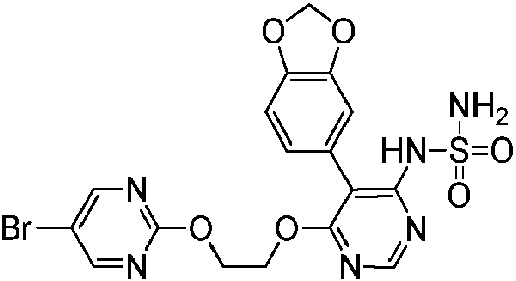
Ruta sintética:Synthetic route:

Etapa 1: Síntesis del compuesto WX001-2Step 1: Synthesis of compound WX001-2
A 0°C, se añadió lentamente gota a gota diclorosulfóxido (58,11 g, 488,46 mmol, 35,43 ml) a una solución del compuesto WX001-1 (80 g, 444,06 mmol) en metanol (400 ml) (el tiempo de goteo fue de aproximadamente 0,5 horas) y la mezcla de reacción se calentó hasta temperatura ambiente y se agitó durante 10 horas en atmósfera de nitrógeno. Una vez completada la reacción, se eliminó el disolvente a presión reducida y se añadió agua (300 ml) al residuo y se extrajo con acetato de etilo (300 ml x 3). Las fases orgánicas se combinaron, se lavaron con salmuera saturada (300 ml), se secaron sobre sulfato de sodio anhidro y se filtraron, y el disolvente del filtrado se eliminó a presión reducida para obtener el compuesto WX001-2. RMN 1H (400 MHz, CDCh) 5: 6,80-6,71 (m, 3H), 5,94 (s, 2H), 3,70 (s, 3H), 3,55 (s, 2H).At 0°C, dichlorosulfoxide (58.11 g, 488.46 mmol, 35.43 mL) was slowly added dropwise to a solution of compound WX001-1 (80 g, 444.06 mmol) in methanol (400 mL ) (dropping time was about 0.5 hours) and the reaction mixture was warmed to room temperature and stirred for 10 hours under a nitrogen atmosphere. After the completion of the reaction, the solvent was removed under reduced pressure and water (300 ml) was added to the residue and extracted with ethyl acetate (300 ml x 3). The organic phases were combined, washed with saturated brine (300 mL), dried over anhydrous sodium sulfate, and filtered, and the solvent in the filtrate was removed under reduced pressure to obtain WX001-2. 1H NMR (400 MHz, CDCh) 5: 6.80-6.71 (m, 3H), 5.94 (s, 2H), 3.70 (s, 3H), 3.55 (s, 2H).
Etapa 2: Síntesis del compuesto WX001-3 Step 2: Synthesis of compound WX001-3
A 0°C, se añadió gota a gota lentamente una solución del compuesto WX001-2 (35 g, 180,24 mmol) en carbonato de dimetilo (118,51 g, 1,32 mol, 110,76 ml) a una solución mixta de hidruro de sodio (10,81 g, 270,36 mmol, pureza: 60%) en carbonato de dimetilo (118,51 g, 1,32 mol , 110,76 ml) (el tiempo de goteo es de aproximadamente 1 hora), la mezcla de reacción se calentó hasta temperatura ambiente y se agitó durante 15 horas en atmósfera de nitrógeno. Una vez completada la reacción, se añadió agua helada (500 ml) y la mezcla se extrajo con acetato de etilo (300 ml x 3). Las fases orgánicas se combinaron, se lavaron con salmuera saturada (300 ml), se secaron sobre sulfato de sodio anhidro, se filtraron y el disolvente del filtrado se eliminó a presión reducida. El residuo se separó mediante cromatografía en columna (eluyente: éter de petróleo/acetato de etilo = 10/1 -5/1, relación en volumen) para obtener el compuesto WX001-3. RMN 1H (400 MHz, CDCh) 5: 7,00-6,93 (m, 1H), 6,85-6,77 (m, 2H), 5,98 (s, 2H), 4,58 (s, 1H), 3,78 (s, 6H).At 0°C, a solution of compound WX001-2 (35 g, 180.24 mmol) in dimethyl carbonate (118.51 g, 1.32 mol, 110.76 mL) was slowly added dropwise to a solution sodium hydride (10.81 g, 270.36 mmol, purity: 60%) in dimethyl carbonate (118.51 g, 1.32 mol, 110.76 mL) (dropping time is about 1 hour), the reaction mixture was warmed to room temperature and stirred for 15 hours under a nitrogen atmosphere. After the reaction was complete, ice water (500 ml) was added and the mixture was extracted with ethyl acetate (300 ml x 3). The organic phases were combined, washed with saturated brine (300 mL), dried over anhydrous sodium sulfate, filtered, and the solvent in the filtrate was removed under reduced pressure. The residue was separated by column chromatography (eluent: petroleum ether/ethyl acetate = 10/1 -5/1, volume ratio) to obtain compound WX001-3. 1H NMR (400 MHz, CDCh) 5: 7.00-6.93 (m, 1H), 6.85-6.77 (m, 2H), 5.98 (s, 2H), 4.58 (s , 1H), 3.78 (s, 6H).
Etapa 3: Síntesis del compuesto WX001-4 Step 3: Synthesis of compound WX001-4
A 0°C, se añadió en porciones un bloque de sodio (10,94 g, 475,78 mmol) a metanol anhidro (150 ml), la mezcla de reacción se agitó a temperatura ambiente durante 0,5 horas en atmósfera de nitrógeno y a continuación se añadió una solución del compuesto WX001-3 (40 g, 158,59 mmol) en metanol (100 ml) a la solución de reacción. La mezcla de reacción se calentó hasta temperatura ambiente y se agitó durante 15 horas en atmósfera de nitrógeno, a continuación se añadió acetato de formamidina (19,81 g, 190,31 mmol) a la solución de reacción en una porción y la mezcla de reacción se agitó adicionalmente a temperatura ambiente durante 15 horas en atmósfera de nitrógeno. Una vez completada la reacción, se eliminó el disolvente a presión reducida y se añadió al residuo ácido clorhídrico diluido 2 M (200 ml) y se agitó a temperatura ambiente durante 30 minutos, durante los cuales precipitó una gran cantidad de sólido blanco. La mezcla de reacción se filtró, la torta de filtración se lavó con metanol (50 ml x 2) y la torta de filtración se recogió y se secó al vacío para obtener el compuesto WX001-4. At 0°C, a sodium block (10.94 g, 475.78 mmol) was added portionwise to anhydrous methanol (150 mL), the reaction mixture was stirred at room temperature for 0.5 hour under nitrogen. and then a solution of compound WX001-3 (40 g, 158.59 mmol) in methanol (100 mL) was added to the reaction solution. The reaction mixture was warmed to room temperature and stirred for 15 hours under a nitrogen atmosphere, then formamidine acetate (19.81 g, 190.31 mmol) was added to the reaction solution in one portion and the reaction mixture reaction was further stirred at room temperature for 15 hours under a nitrogen atmosphere. After the completion of the reaction, the solvent was removed under reduced pressure, and 2M dilute hydrochloric acid (200 mL) was added to the residue and stirred at room temperature for 30 minutes, during which a large amount of white solid precipitated. The reaction mixture was filtered, the filter cake was washed with methanol (50 ml x 2), and the filter cake was collected and dried in vacuo to obtain compound WX001-4.
Etapa 4: Síntesis del compuesto WX001-5 Step 4: Synthesis of compound WX001-5
A temperatura ambiente, se añadió el compuesto WX001-4 (24 g, 103,36 mmol) a oxicloruro de fósforo (594,00 g, 3,87 mol, 360,00 ml) y la mezcla de reacción se calentó hasta 90°C y se agitó durante 5 horas en atmósfera de nitrógeno. Una vez completada la reacción, la mezcla se enfrió hasta temperatura ambiente, la solución de reacción se vertió lentamente en agua helada (1000 ml) y se agitó a temperatura ambiente durante 0,5 horas y a continuación se extrajo con acetato de etilo (1000 ml x 3). Las fases orgánicas se combinaron, se lavaron con salmuera saturada (1000 ml), se secaron sobre sulfato de sodio anhidro, se filtraron y el disolvente del filtrado se eliminó a presión reducida. El residuo se separó mediante cromatografía en columna (eluyente: éter de petróleo/acetato de etilo = 10/1, relación en volumen) para obtener el compuesto WX001-5. RMN 1H (400 MHz, CDCh) 5: 8,78 (s, 1H), 6,96 (d, j=8,3 Hz, 1H), 6,78 (dd, j=2,5, 4,0 Hz, 2H), 6,09 (s, 2H). At room temperature, compound WX001-4 (24 g, 103.36 mmol) was added to phosphorous oxychloride (594.00 g, 3.87 mol, 360.00 mL) and the reaction mixture was heated to 90° C and stirred for 5 hours under a nitrogen atmosphere. After the completion of the reaction, the mixture was cooled to room temperature, the reaction solution was slowly poured into ice water (1000 ml) and stirred at room temperature for 0.5 hours, and then extracted with ethyl acetate (1000 ml x 3). The organic phases were combined, washed with saturated brine (1000 mL), dried over anhydrous sodium sulfate, filtered, and the solvent in the filtrate was removed under reduced pressure. The residue was separated by column chromatography (eluent: petroleum ether/ethyl acetate = 10/1, volume ratio) to obtain compound WX001-5. 1H NMR (400 MHz, CDCh) 5: 8.78 (s, 1H), 6.96 (d, j=8.3 Hz, 1H), 6.78 (dd, j=2.5, 4.0 Hz, 2H), 6.09 (s, 2H).
E ta p a 5 : S ín te s is d e l c o m p u e s to Step 5: Synthesis of the compound WX001-6WX001-6
A temperatura ambiente, se disolvieron el compuesto 2-(5-bromopirimidin-2-il)oxietanol (8,06 g, 36,79 mmol) y el compuesto WX001-5 (11 g, 40,88 mmol) en tolueno (100 ml), a continuación la mezcla se enfrió hasta 0°C, se añadió terc-butóxido de potasio (9,17 g, 81,76 mmol) en porciones y la mezcla de reacción se agitó a 0°C durante 0,5 horas en atmósfera de nitrógeno. Una vez completada la reacción, se añadió ácido clorhídrico diluido 0,5 M (100 ml) a la solución de reacción y la mezcla se extrajo con acetato de etilo (100 ml x 3). Las fases orgánicas se combinaron, se lavaron con salmuera saturada (100 ml), se secaron sobre sulfato de sodio anhidro, se filtraron y el disolvente del filtrado se eliminó a presión reducida. El residuo se separó mediante cromatografía en columna (eluyente: éter de petróleo/acetato de etilo = 5/1, relación en volumen) para obtener el compuesto WX001-6. RMN 1H (400 MHz, CDCh) 5: 8,54-8,48 (m, 3H), 6,86-6,74 (m, 3H), 6,02 (s, 2H), 4,80-4,74 (m, 2H), 4,73-4,64 (m, 2H).At room temperature, compound 2-(5-bromopyrimidin-2-yl)oxyethanol (8.06 g, 36.79 mmol) and compound WX001-5 (11 g, 40.88 mmol) were dissolved in toluene (100 mL), then the mixture was cooled to 0°C, potassium tert-butoxide (9.17 g, 81.76 mmol) was added portionwise and the reaction mixture was stirred at 0°C for 0.5 hour. in a nitrogen atmosphere. After the completion of the reaction, 0.5M dilute hydrochloric acid (100 ml) was added to the reaction solution, and the mixture was extracted with ethyl acetate (100 ml x 3). The organic phases were combined, washed with saturated brine (100 mL), dried over anhydrous sodium sulfate, filtered, and the solvent in the filtrate was removed under reduced pressure. The residue was separated by column chromatography (eluent: petroleum ether/ethyl acetate = 5/1, volume ratio) to obtain compound WX001-6. 1H NMR (400 MHz, CDCh) 5: 8.54-8.48 (m, 3H), 6.86-6.74 (m, 3H), 6.02 (s, 2H), 4.80-4 .74 (m, 2H), 4.73-4.64 (m, 2H).
Etapa 6: Síntesis del compuesto WX001 Step 6: Synthesis of compound WX001
A temperatura ambiente, se disolvieron el compuesto sulfamida (1,52 g, 15,83 mmol) y el compuesto WX001-6 (6,5 g, 14,39 mmol) en dimetilsulfóxido (100 ml) y a continuación se añadieron en una porción carbonato de potasio (5,97 g, 43,17 mmol) y trihidrato de fluoruro de tetrabutilamonio (9,08 g, 28,78 mmol). La mezcla de reacción se calentó hasta 70°C y se agitó durante 5 horas en atmósfera de nitrógeno. Una vez completada la reacción, la mezcla se enfrió hasta temperatura ambiente, se añadieron ácido clorhídrico diluido 0,5 M (100 ml) y agua (500 ml) y se extrajo con acetato de etilo (400 ml x 3). Las fases orgánicas se combinaron, se lavaron con salmuera saturada (500 ml), se secaron sobre sulfato de sodio anhidro, se filtraron y el disolvente del filtrado se eliminó a presión reducida. El residuo se separó mediante cromatografía en columna (eluyente: éter de petróleo/acetato de etilo = 3/1, a continuación diclorometano/acetato de etilo = 5/1, relación en volumen) para obtener el compuesto WX001 buscado. MS-ESI m/z: 510,8 [M+H]+, 512,8 [M+H+2]+. RMN 1H (400 MHz, DMSO_de) 5: 9,29 (s, 1H), 8,72 (s, 2H), 8,46 (s, 1H), 7,21 (s, 2H), 6,91 (d, J=7,8 Hz, 1 H), 6,76-6,61 (m, 2H ), 6,05 (s, 2H), 4,69-4,62 (m, 2H), 4,62-4,54 (m, 2H).At room temperature, sulfamide compound (1.52 g, 15.83 mmol) and WX001-6 compound (6.5 g, 14.39 mmol) were dissolved in dimethyl sulfoxide (100 mL) and then added in one portion. potassium carbonate (5.97 g, 43.17 mmol) and tetrabutylammonium fluoride trihydrate (9.08 g, 28.78 mmol). The reaction mixture was heated to 70°C and stirred for 5 hours under a nitrogen atmosphere. After the completion of the reaction, the mixture was cooled to room temperature, 0.5M dilute hydrochloric acid (100ml) and water (500ml) were added and extracted with ethyl acetate (400ml x 3). The organic phases were combined, washed with saturated brine (500 mL), dried over anhydrous sodium sulfate, filtered, and the solvent in the filtrate was removed under reduced pressure. The residue was separated by column chromatography (eluent: petroleum ether/ethyl acetate=3/1, then dichloromethane/ethyl acetate=5/1, volume ratio) to obtain the target compound WX001 . MS-ESI m/z: 510.8 [M+H]+, 512.8 [M+H+2]+. 1H NMR (400 MHz, DMSO_de) 5: 9.29 (s, 1H), 8.72 (s, 2H), 8.46 (s, 1H), 7.21 (s, 2H), 6.91 ( d, J=7.8 Hz, 1H), 6.76-6.61 (m, 2H ), 6.05 (s, 2H), 4.69-4.62 (m, 2H), 4, 62-4.54 (m, 2H).
Realización 2: WX002Realization 2: WX002

Etapa 1: Síntesis del compuesto WX002-2 Step 1: Synthesis of compound WX002-2
A temperatura ambiente, se añadieron el compuesto WX002-1 (8,00 g, 37,37 mmol), bis(pinacolato)diboro (11,39 g, 44,84 mmol) y acetato de potasio (7,33 g, 74,74 mmol) a 1,4-dioxano (100,00 ml), a continuación se añadió [1,1'-bis(difenilfosfino)ferroceno]dicloropaladio (II) (5,47 g, 7,47 mmol). La mezcla de reacción se calentó hasta 100°C y se agitó durante 10 horas en atmósfera de nitrógeno. Una vez completada la reacción, la mezcla se enfrió hasta temperatura ambiente, se filtró y el disolvente del filtrado se eliminó a presión reducida. Se añadió agua (100 ml) al residuo y se extrajo con acetato de etilo (100 ml x 3). Las fases orgánicas se combinaron, se lavaron con salmuera saturada (50 ml), se secaron sobre sulfato de sodio anhidro, se filtraron y el disolvente del filtrado se eliminó a presión reducida. El residuo se separó mediante cromatografía en columna (eluyente: éter de petróleo/acetato de etilo = 20/1, relación en volumen) para obtener el compuesto WX002-2 buscado. RMN 1H (400 MHz, CDCh) 5: 8,92 (s, 1H), 8,51 (s, 1H), 7,89 (d, j=8,0 Hz, 1 H), 7,78 (d, j=8,0 Hz, 1H), 1,30 (s, 12H). At room temperature, compound WX002-1 (8.00 g, 37.37 mmol), bis(pinacolato)diboron (11.39 g, 44.84 mmol) and potassium acetate (7.33 g, 74 mmol) were added. 0.74 mmol) to 1,4-dioxane (100.00 mL), then [1,1'-bis(diphenylphosphino)ferrocene]dichloropalladium(II) (5.47 g, 7.47 mmol) was added. The reaction mixture was heated to 100°C and stirred for 10 hours under a nitrogen atmosphere. After the completion of the reaction, the mixture was cooled to room temperature, filtered, and the solvent in the filtrate was removed under reduced pressure. Water (100ml) was added to the residue and extracted with ethyl acetate (100ml x 3). The organic phases were combined, washed with saturated brine (50 mL), dried over anhydrous sodium sulfate, filtered, and the solvent in the filtrate was removed under reduced pressure. The residue was separated by column chromatography (eluent: petroleum ether/ethyl acetate = 20/1, volume ratio) to obtain the target compound WX002-2 . 1H NMR (400 MHz, CDCh) 5: 8.92 (s, 1H), 8.51 (s, 1H), 7.89 (d, j=8.0 Hz, 1H), 7.78 (d , j=8.0Hz, 1H), 1.30 (s, 12H).
E ta p a 2 : S ín te s is d e l c o m p u e s to Step 2: Synthesis of the compound WX002-3WX002-3
A temperatura ambiente, se añadieron el compuesto BB-2 (250,00 mg, 732,75 pmol) y el compuesto WX002-2 (287,04 mg, 1,10 mmol) a 1,4-dioxano (15,00 ml), a continuación se añadió una solución de carbonato de potasio (303,82 mg, 2,20 mmol) en agua (5,00 ml). La mezcla de reacción se agitó a temperatura ambiente durante 0,5 horas en atmósfera de nitrógeno y a continuación se añadió [1,1'-bis(difenilfosfino)ferroceno]dicloropaladio(II) (160,85 mg, 219,83 pmol) a la mezcla. La mezcla de reacción se calentó hasta 80°C y se agitó durante 11 horas en atmósfera de nitrógeno. Una vez completada la reacción, la mezcla se enfrió hasta temperatura ambiente, se añadió agua (100 ml), se extrajo con acetato de etilo (20 ml x 1) y se descartó la fase orgánica. La fase acuosa se ajustó hasta un pH de 5-6 con ácido clorhídrico diluido 3 M y se extrajo con acetato de etilo (20 ml x 3). Las fases orgánicas se combinaron, se secaron sobre sulfato de sodio anhidro, se filtraron y el disolvente del filtrado se eliminó a presión reducida. El residuo se separó mediante cromatografía en columna (eluyente: éter de petróleo/acetato de etilo = 10/1-1/1, relación en volumen) para obtener el compuesto WX002-3 buscado. MS-ESI m/z: 395,9 [M+H]+. RMN 1H (400 MHz, CDCh) ó: 9,01 (s, 1H), 8,47 (s, 1H), 8,05 (s, 1 H), 8,02 (s, 1H), 7,31 (d, j=8,3 Hz, 1 H), 7,06 (s, 1H), 5,52 (t, j=6,0 Hz, 1H), 4,44 (t, j=4,4 Hz, 2H), 3,77 (s, 2H), 3,08-2,98 (m, 2H), 2,58 (s ancho, 1H), 1,15 (t, j=7,2 Hz, 3 H).At room temperature, compound BB-2 (250.00 mg, 732.75 pmol) and compound WX002-2 (287.04 mg, 1.10 mmol) were added to 1,4-dioxane (15.00 mL ), then a solution of potassium carbonate (303.82 mg, 2.20 mmol) in water (5.00 mL) was added. The reaction mixture was stirred at room temperature for 0.5 hours under a nitrogen atmosphere, and then [1,1'-bis(diphenylphosphino)ferrocene]dichloropalladium(II) (160.85 mg, 219.83 pmol) was added to mix. The reaction mixture was heated to 80°C and stirred for 11 hours under a nitrogen atmosphere. After the reaction was complete, the mixture was cooled to room temperature, water (100 ml) added, extracted with ethyl acetate (20 ml x 1) and the organic phase discarded. The aqueous phase was adjusted to pH 5-6 with 3M dilute hydrochloric acid and extracted with ethyl acetate (20ml x 3). The organic phases were combined, dried over anhydrous sodium sulfate, filtered, and the solvent in the filtrate was removed under reduced pressure. The residue was separated by column chromatography (eluent: petroleum ether/ethyl acetate = 10/1-1/1, volume ratio) to obtain the target compound WX002-3 . MS-ESI m/z: 395.9 [M+H]+. 1H NMR (400 MHz, CDCh) or: 9.01 (s, 1H), 8.47 (s, 1H), 8.05 (s, 1H), 8.02 (s, 1H), 7.31 (d, j=8.3 Hz, 1H), 7.06 (s, 1H), 5.52 (t, j=6.0 Hz, 1H), 4.44 (t, j=4.4 Hz, 2H), 3.77 (s, 2H), 3.08-2.98 (m, 2H), 2.58 (broad s, 1H), 1.15 (t, j=7.2 Hz, 3H).
Etapa 3: Síntesis del compuesto WX002 Step 3: Synthesis of compound WX002
A temperatura ambiente, se añadió hidruro de sodio (194,20 mg, 4,86 mmol, pureza: 60%) a tetrahidrofurano anhidro (20,00 ml), a continuación se añadió una solución del compuesto WX002-3 (240,00 mg, 606,89 pmol) en N,N-dimetilformamida anhidra (1 ml) y se añadió una solución de 5-bromo-2-cloropirimidina (234,78 mg, 1,21 mmol) en tetrahidrofurano anhidro (1 ml), la mezcla de reacción se calentó hasta 70°C y se agitó durante 2 horas en atmósfera de nitrógeno. Una vez completada la reacción, la mezcla se enfrió hasta temperatura ambiente, se añadió una solución saturada de cloruro de amonio (30 ml), se ajustó hasta un pH de 4-5 con ácido clorhídrico diluido 1 M y se extrajo con acetato de etilo (20 ml x 3). Las fases orgánicas se combinaron, se lavaron con salmuera saturada (50 ml), se secaron sobre sulfato de sodio anhidro, se filtraron y el disolvente del filtrado se eliminó a presión reducida. El residuo se separó mediante HPLC preparativa (fase móvil: acetonitrilo/agua; sistema básico: NH4HCO3 y NH3-H2Ü) para obtener el compuesto WX002 buscado. MS-ESI m/z: 552,0 [M+H]+, 554,0 [M+H+2]+. RMN 1H (400 MHz, CDCh) 5: 9,08 (s, 1H), 8,52 (s, 1H), 8,43 (s, 2H), 8,04 (d, j=2,0 Hz, 2H), 7,34 (dd, j=8,5, 1,3 Hz, 1H), 6,87 (s ancho, 1H), 5,58 (s, 1H), 4,74 (t, j=4,4 Hz, 2H), 4,62 (t, j=4,4 Hz, 2H), 3,15-3,02 (m, 2H), 1,21 (t, j=7,3 Hz, 3H).At room temperature, sodium hydride (194.20 mg, 4.86 mmol, purity: 60%) was added to anhydrous tetrahydrofuran (20.00 mL), then a solution of compound WX002-3 (240.00 mg, 606.89 pmol) in anhydrous N,N- dimethylformamide (1 mL) and a solution of 5-bromo-2-chloropyrimidine (234.78 mg, 1.21 mmol) in anhydrous tetrahydrofuran (1 mL) was added, the reaction mixture was heated to 70°C and stirred for 2 hours under a nitrogen atmosphere. After the reaction was complete, the mixture was cooled to room temperature, saturated ammonium chloride solution (30 mL) was added, adjusted to pH 4-5 with 1 M dilute hydrochloric acid, and extracted with ethyl acetate. (20ml x 3). The organic phases were combined, washed with saturated brine (50 mL), dried over anhydrous sodium sulfate, filtered, and the solvent in the filtrate was removed under reduced pressure. The residue was separated by preparative HPLC (mobile phase: acetonitrile/water; basic system: NH4HCO3 and NH3-H20) to obtain the target compound WX002 . MS-ESI m/z: 552.0 [M+H]+, 554.0 [M+H+2]+. 1H NMR (400 MHz, CDCh) 5: 9.08 (s, 1H), 8.52 (s, 1H), 8.43 (s, 2H), 8.04 (d, j=2.0 Hz, 2H), 7.34 (dd, j=8.5, 1.3 Hz, 1H), 6.87 (broad s, 1H), 5.58 (s, 1H), 4.74 (t, j= 4.4 Hz, 2H), 4.62 (t, j=4.4 Hz, 2H), 3.15-3.02 (m, 2H), 1.21 (t, j=7.3 Hz, 3H).
Refiriéndose al método de síntesis de la realización 2 (BB-2 en la etapa 2 se reemplazó por la estructura correspondiente del fragmento 2), se sintetizaron las realizaciones de la tabla 1.Referring to the synthesis method of Embodiment 2 (BB-2 in step 2 was replaced by the corresponding structure of Fragment 2), the embodiments in Table 1 were synthesized.
Tabla 1: Fórmula estructural de las realizaciones 3-7 Table 1: Structural Formula of Embodiments 3-7

Los datos de LCMS y RMN H de cada realización se muestran en la tabla 2. The LCMS and H NMR data for each run are shown in Table 2.
T a b la 2 : D a to s d e R M N y L C M S d e la s T a b le 2: N MRI and L C M S D a ta s of the s realizaciones 3-7realizations 3-7

Realización 8: WX008Realization 8: WX008

Etapa 1: Síntesis del compuesto WX008-2 Step 1: Synthesis of compound WX008-2
A temperatura ambiente, se añadieron el compuesto WX008-1 (3,00 g, 14,92 mmol), bis(pinacolato)diboro (7,58 g, 29,84 mmol) y acetato de potasio (4,39 g, 44,76 mmol) a 1,4-dioxano (30,00 ml), a continuación se añadió [1,1'-bis(difenilfosfino)ferroceno]dicloropaladio (II) (3,28 g, 4,48 mmol). La mezcla de reacción se calentó hasta 80°C y se agitó durante 16 horas en atmósfera de nitrógeno. Una vez completada la reacción, la mezcla se enfrió hasta temperatura ambiente, se filtró y el disolvente del filtrado se eliminó a presión reducida. Se añadió agua (30 ml) al residuo y se extrajo con acetato de etilo (20 ml x 3). Las fases orgánicas se combinaron, se secaron sobre sulfato de sodio anhidro, se filtraron, el disolvente del filtrado se eliminó a presión reducida y el residuo se separó mediante cromatografía en columna (eluyente: éter de petróleo/acetato de etilo = 1/0-100/1, relación en volumen) para obtener el compuesto WX008-2 buscado. RMN 1H (400 MHz, CDCis) 5:7,38 (dd, j=7,8, 0,8 Hz, 1H), 7,26 (s, 1H), 6,85 (d, j=7,8 Hz, 1H), 5,97 (s, 2H), 1,35 (s, 12H).At room temperature, compound WX008-1 (3.00 g, 14.92 mmol), bis(pinacolato)diboron (7.58 g, 29.84 mmol) and potassium acetate (4.39 g, 44 mmol) were added. 0.76 mmol) to 1,4-dioxane (30.00 mL), then [1,1'-bis(diphenylphosphino)ferrocene]dichloropalladium(II) (3.28 g, 4.48 mmol) was added. The reaction mixture was heated to 80°C and stirred for 16 hours under a nitrogen atmosphere. After the completion of the reaction, the mixture was cooled to room temperature, filtered, and the solvent in the filtrate was removed under reduced pressure. Water (30 ml) was added to the residue and it was extracted with ethyl acetate (20 ml x 3). The organic phases were combined, dried over anhydrous sodium sulfate, filtered, the solvent in the filtrate was removed under reduced pressure and the residue was separated by column chromatography (eluent: petroleum ether/ethyl acetate = 1/0- 100/1, ratio by volume) to obtain the compound WX008-2 sought. 1H NMR (400 MHz, CDCis) 5:7.38 (dd, j=7.8, 0.8 Hz, 1H), 7.26 (s, 1H), 6.85 (d, j=7.8 Hz, 1H), 5.97 (s, 2H), 1.35 (s, 12H).
Etapa 2: Síntesis del compuesto WX008-3 Step 2: Synthesis of compound WX008-3
A temperatura ambiente, se añadieron el compuesto BB-3 (300,00 mg, 844,57 pmol), el compuesto WX008-2 (419,04 mg, 1,69 mmol) y fosfato de potasio (537,83 mg, 2,53 mmol) a N,N-dimetilformamida (20,00 ml), a continuación se añadió [1,1'-bis(difenilfosfino)ferroceno]dicloropaladio (II) (185,39 mg, 253,37 pmol). La mezcla de reacción se calentó hasta 80°C y se agitó durante 16 horas en atmósfera de nitrógeno. Una vez completada la reacción, la mezcla se enfrió hasta temperatura ambiente, se añadió agua (100 ml), se extrajo con acetato de etilo (20 ml x 1) y se descartó la fase orgánica. La fase acuosa se ajustó hasta un pH de 5-6 con ácido clorhídrico diluido 3 M y se extrajo con acetato de etilo (20 ml x 3). Las fases orgánicas se combinaron, se secaron sobre sulfato de sodio anhidro, se filtraron y el disolvente del filtrado se eliminó a presión reducida. El residuo se separó mediante una placa de cromatografía preparativa (eluyente: éter de petróleo/acetato de etilo = 1/2, relación en volumen) para obtener el compuesto WX008-3 buscado. MS-ESI m/z: 397,0 [M+H]+.At room temperature, compound BB-3 (300.00 mg, 844.57 pmol), compound WX008-2 (419.04 mg, 1.69 mmol), and potassium phosphate (537.83 mg, 2 0.53 mmol) to N,N-dimethylformamide (20.00 mL), then [1,1'-bis(diphenylphosphino)ferrocene]dichloropalladium(II) (185.39 mg, 253.37 pmol) was added. The reaction mixture was heated to 80°C and stirred for 16 hours under a nitrogen atmosphere. After the reaction was complete, the mixture was cooled to room temperature, water (100 ml) added, extracted with ethyl acetate (20 ml x 1) and the organic phase discarded. The aqueous phase was adjusted to pH 5-6 with 3M dilute hydrochloric acid and extracted with ethyl acetate (20ml x 3). The organic phases were combined, dried over anhydrous sodium sulfate, filtered, and the solvent in the filtrate was removed under reduced pressure. The residue was separated by preparative plate chromatography (eluent: petroleum ether/ethyl acetate = 1/2, volume ratio) to obtain the target compound WX008-3 . MS-ESI m/z: 397.0 [M+H]+.
Etapa 3: Síntesis del compuesto WX008 Step 3: Synthesis of compound WX008
A temperatura ambiente, se añadió hidruro de sodio (145,30 mg, 3,63 mmol, pureza: 60%) a tetrahidrofurano anhidro (20 ml), a continuación se añadió una solución del compuesto WX008-3 (180,00 mg, 454,06 pmol) en N,N-dimetilformamida anhidra (1 ml) y se añadió a esto una solución de 5-bromo-2-cloropirimidina (175,66 mg, 908,13 pmol) en tetrahidrofurano anhidro (1 ml). La mezcla de reacción se calentó hasta 70°C y se agitó durante 2 horas en atmósfera de nitrógeno. Una vez completada la reacción, la mezcla se enfrió hasta temperatura ambiente, se añadió una solución saturada de cloruro de amonio (30 ml), se ajustó hasta un pH de 4-5 con ácido clorhídrico diluido 1 M y se extrajo con acetato de etilo (20 ml x 3). . Las fases orgánicas se combinaron, se lavaron con salmuera saturada (50 ml), se secaron sobre sulfato de sodio anhidro, se filtraron y el disolvente del filtrado se eliminó a presión reducida. El residuo se separó mediante HPLC preparativa (fase móvil: acetonitrilo/agua; sistema neutro) para obtener el compuesto WX008 buscado. MS-ESI m/z: 552,8 [M+H]+, 554,8 [M+H+2]+. RMN 1H (400 MHz, CDCb) 5: 8,49 (s, 2H), 8,43 (s, 1H), 6,87 (d, j=8,3 Hz, 1 H), 6,73-6,68 (m, 2H), 6,03 (s, 2H), 5,61 (t, j=6,2 Hz, 1 H), 4,73 (q, j=5,0 Hz, 2H), 4,64 (t, j=4,8 Hz, 2H), 2,96 (q, j=6,8 Hz, 2H), 1,64-1,57 (m, 2H), 0,94 (t, j=7,4 Hz, 3H).At room temperature, sodium hydride (145.30 mg, 3.63 mmol, purity: 60%) was added to anhydrous tetrahydrofuran (20 mL), then a solution of compound WX008-3 (180.00 mg, 454.06 pmol) in anhydrous N,N- dimethylformamide (1 mL) and to this was added a solution of 5-bromo-2-chloropyrimidine (175.66 mg, 908.13 pmol) in anhydrous tetrahydrofuran (1 mL). The reaction mixture was heated to 70°C and stirred for 2 hours under a nitrogen atmosphere. After the reaction was complete, the mixture was cooled to room temperature, saturated ammonium chloride solution (30 mL) was added, adjusted to pH 4-5 with 1 M dilute hydrochloric acid, and extracted with ethyl acetate. (20ml x 3). . The organic phases were combined, washed with saturated brine (50 mL), dried over anhydrous sodium sulfate, filtered, and the solvent in the filtrate was removed under reduced pressure. The residue was separated by preparative HPLC (mobile phase: acetonitrile/water; neutral system) to obtain the target compound WX008 . MS-ESI m/z: 552.8 [M+H]+, 554.8 [M+H+2]+. 1H NMR (400 MHz, CDCb) 5: 8.49 (s, 2H), 8.43 (s, 1H), 6.87 (d, j=8.3 Hz, 1H), 6.73-6 .68 (m, 2H), 6.03 (s, 2H), 5.61 (t, j=6.2 Hz, 1H), 4.73 (q, j=5.0 Hz, 2H), 4.64 (t, j=4.8 Hz, 2H), 2.96 (q, j=6.8 Hz, 2H), 1.64-1.57 (m, 2H), 0.94 (t , j=7.4Hz, 3H).
Refiriéndose al método de síntesis de la realización 8 (BB-3 en la etapa 2 se reemplazó por la estructura correspondiente del fragmento 2), se sintetizaron las realizaciones de la tabla 3.Referring to the synthesis method of Embodiment 8 (BB-3 in step 2 was replaced by the corresponding structure of Fragment 2), the embodiments in Table 3 were synthesized.
Tabla 3: Fórmula estructural de las realizaciones 9-22 Table 3: Structural Formula of Embodiments 9-22


Los datos de LCMS y RMN H de cada realización se muestran en la tabla 4. The LCMS and H NMR data for each run are shown in Table 4.
T a b la 4 : D a to s d e R M N y L C M S d e la s T a b le 4: N MRI and L C M S D a ta s of the s realizaciones 9-22realizations 9-22


Realización 23 y Realización 24: WX023 y WX024Embodiment 23 and Embodiment 24: WX023 and WX024

El compuesto WX021 (500,00 mg, 839,74 pmol) se resolvió mediante cromatografía de fluidos supercríticos (condiciones de separación, columna: chiralpak AD-350 * 4,6 mm de DI, 3 pm; fase móvil: A: dióxido de carbono; B: isopropanol (dietilamina al 0,05%), 40%; temperatura de la columna: 40°C; longitud de onda: 220 nm) para obtener la muestra con un tiempo de retención de 1,149 min como WX023 (% ee: 100%) y la muestra con un tiempo de retención de 3,199 min como WX024 (% ee: 100%).Compound WX021 (500.00 mg, 839.74 pmol) was resolved by supercritical fluid chromatography (separation conditions, column: chiralpak AD-350 * 4.6 mm ID, 3 pm; mobile phase: A: carbon dioxide carbon; B: isopropanol (0.05% diethylamine), 40%; column temperature: 40°C; wavelength: 220 nm) to obtain the sample with a retention time of 1.149 min as WX023 (% ee : 100%) and the sample with a retention time of 3.199 min as WX024 (% ee: 100%).
Realización 25: WX025Realization 25: WX025

Ruta sintética:Synthetic route:

Etapa 1: Síntesis del compuesto WX025-2 Step 1: Synthesis of compound WX025-2
A temperatura ambiente, se añadieron el compuesto WX025-1 (400,00 mg, 2,03 mmol), bis(pinacolato)diboro (618,60 mg, 2,44 mmol), acetato de potasio (597,72 mg, 6,09 mmol) y [1,1'-bis(difenilfosfino)ferroceno]dicloropaladio(II) (297,09 mg, 406,03 pmol) a dioxano (20,00 ml), la mezcla de reacción se calentó hasta 100°C y se agitó durante 15 horas en atmósfera de nitrógeno. Una vez completada la reacción, la mezcla se enfrió hasta temperatura ambiente, el disolvente se eliminó a presión reducida y se añadió agua (100 ml) al residuo y se extrajo con acetato de etilo (100 ml x 3). Las fases orgánicas se combinaron, se lavaron con salmuera saturada (50 ml), se secaron sobre sulfato de sodio anhidro, se filtraron y el disolvente del filtrado se eliminó a presión reducida. El residuo se separó mediante cromatografía en columna (eluyente: éter de petróleo/acetato de etilo = relación de volumen 1/1) para obtener el compuesto WX025-2 buscado. RMN 1H (400 MHz, CDCh) 5: 8,70 (s, 1H), 7,99-7,98 (m, 1H), 7,51 (d, j=8,8 Hz, 1H), 7,37 (d, j=8,8 Hz, 1H), 6,48 (s, 1H), 1,36 (s, 12H).At room temperature, compound WX025-1 (400.00 mg, 2.03 mmol), bis(pinacolato)diboron (618.60 mg, 2.44 mmol), potassium acetate (597.72 mg, 6 0.09 mmol) and [1,1'-bis(diphenylphosphino)ferrocene]dichloropalladium(II) (297.09 mg, 406.03 pmol) to dioxane (20.00 mL), the reaction mixture was heated to 100° C and stirred for 15 hours under a nitrogen atmosphere. After the completion of the reaction, the mixture was cooled to room temperature, the solvent was removed under reduced pressure, and water (100 ml) was added to the residue and extracted with ethyl acetate (100 ml x 3). The organic phases were combined, washed with saturated brine (50 mL), dried over anhydrous sodium sulfate, filtered, and the solvent in the filtrate was removed under reduced pressure. The residue was separated by column chromatography (eluent: petroleum ether/ethyl acetate = volume ratio 1/1) to obtain the target compound WX025-2 . 1H NMR (400 MHz, CDCh) 5: 8.70 (s, 1H), 7.99-7.98 (m, 1H), 7.51 (d, j=8.8 Hz, 1H), 7, 37 (d, j=8.8 Hz, 1H), 6.48 (s, 1H), 1.36 (s, 12H).
Etapa 2: Síntesis del compuesto WX025-3 Step 2: Synthesis of compound WX025-3
A temperatura ambiente, se añadieron el compuesto BB-3 (300,00 mg, 844,57 pmol), el compuesto WX025-2 (309,24 mg, 1,27 mmol), [1,1'-bis(difenilfosfino)ferroceno] dicloropaladio(II) (123,59 mg, 168,91 pmol) y carbonato de potasio (350,18 mg, 2,53 mmol) a una mezcla de dioxano (20,00 ml) y agua (2,00 ml) y la mezcla de reacción se calentó hasta 80°C y se agitó durante 10 horas en atmósfera de nitrógeno. Una vez completada la reacción, la mezcla se enfrió hasta temperatura ambiente, se añadió agua (100 ml), se ajustó hasta pH 5 con ácido clorhídrico diluido 1 M y se extrajo con acetato de etilo (50 ml x 3). Las fases orgánicas se combinaron, se lavaron con salmuera saturada (50 ml), se secaron sobre sulfato de sodio anhidro, se filtraron y el disolvente del filtrado se eliminó a presión reducida. El residuo se sometió a cromatografía preparativa (eluyente: éter de petróleo/acetato de etilo = 1/2, relación en volumen) para obtener el compuesto WX025-3 buscado. MS-ESI m/z: 393,0 [M+H]+.At room temperature, compound BB-3 (300.00 mg, 844.57 pmol), compound WX025-2 (309.24 mg, 1.27 mmol), [1,1'-bis(diphenylphosphino) ferrocene] dichloropalladium(II) (123.59 mg, 168.91 pmol) and potassium carbonate (350.18 mg, 2.53 mmol) to a mixture of dioxane (20.00 mL) and water (2.00 mL ) and the reaction mixture was heated to 80°C and stirred for 10 hours under a nitrogen atmosphere. After the reaction was complete, the mixture was cooled to room temperature, water (100 mL) was added, adjusted to pH 5 with 1M dilute hydrochloric acid, and extracted with ethyl acetate (50 mL x 3). The organic phases were combined, washed with saturated brine (50 mL), dried over anhydrous sodium sulfate, filtered, and the solvent in the filtrate was removed under reduced pressure. The residue was subjected to preparative chromatography (eluent: petroleum ether/ethyl acetate = 1/2, volume ratio) to obtain the target compound WX025-3 . MS-ESI m/z: 393.0 [M+H]+.
Etapa 3: Síntesis del compuesto WX025 Step 3: Synthesis of compound WX025
A temperatura ambiente, se añadieron una solución del compuesto WX025-3 (180,00 mg, 346,76 pmol) en N,N-dimetilformamida (2 ml) y una solución de 5-bromo-2-cloropirimidina (67,07 mg, 346,76 pmol) en tetrahidrofurano (1 ml) a una mezcla de hidruro de sodio (83,08 mg, 2,08 mmol, pureza: 60%) en tetrahidrofurano anhidro (20 ml) en una porción. La mezcla de reacción se calentó hasta 70°C y se agitó durante 2 horas en atmósfera de nitrógeno. Una vez completada la reacción, la mezcla se enfrió hasta temperatura ambiente, se añadió una solución saturada de cloruro de amonio (50 ml), se ajustó hasta un pH de 4-5 con ácido clorhídrico diluido 1 M y se extrajo con acetato de etilo (50 ml x 3). . Las fases orgánicas se combinaron, se lavaron con salmuera saturada (50 ml), se secaron sobre sulfato de sodio anhidro, se filtraron y el disolvente del filtrado se eliminó a presión reducida. El residuo se separó mediante HPLC preparativa (fase móvil: acetonitrilo/agua; sistema básico: NH4HCO3 y NH3H2O) para obtener el compuesto WX025 buscado. MS-ESI m/z: 549,0 [M+H]+, 551,0 [M+H+2]+. RMN 1H (400 MHz, CDCh) 5: 8,53 (s, 1H), 8,46-8,44 (m, 3H), 8,03 (s, 1H), 7,62 (d, j=9,2 Hz, 1H), 6,98 (d, j=9,2 Hz, 1H), 6,62 (s, 1H), 5,64 (s, 1 H), 4,78-4,76 (m, 2H), 4,67 4,65 (m, 2H), 3,02-3,00 (m, 2H), 1,65-1,63 (m, 2H), 0,99 (t,j=7,2 Hz, 3H).At room temperature, a solution of compound WX025-3 (180.00 mg, 346.76 pmol) in N,N- dimethylformamide (2 mL) and a solution of 5-bromo-2-chloropyrimidine (67.07 mg) were added. , 346.76 pmol) in tetrahydrofuran (1 mL) to a mixture of sodium hydride (83.08 mg, 2.08 mmol, purity: 60%) in anhydrous tetrahydrofuran (20 mL) in one portion. The reaction mixture was heated to 70°C and stirred for 2 hours under a nitrogen atmosphere. After the reaction was complete, the mixture was cooled to room temperature, saturated ammonium chloride solution (50 mL) was added, adjusted to pH 4-5 with 1 M dilute hydrochloric acid, and extracted with ethyl acetate. (50ml x 3). . The organic phases were combined, washed with saturated brine (50 mL), dried over anhydrous sodium sulfate, filtered, and the solvent in the filtrate was removed under reduced pressure. The residue was separated by preparative HPLC (mobile phase: acetonitrile/water; basic system: NH4HCO3 and NH3H2O) to obtain the target compound WX025 . MS-ESI m/z: 549.0 [M+H]+, 551.0 [M+H+2]+. 1H NMR (400 MHz, CDCh) 5: 8.53 (s, 1H), 8.46-8.44 (m, 3H), 8.03 (s, 1H), 7.62 (d, j=9 .2 Hz, 1H), 6.98 (d, j=9.2 Hz, 1H), 6.62 (s, 1H), 5.64 (s, 1H), 4.78-4.76 ( m, 2H), 4.67 4.65 (m, 2H), 3.02-3.00 (m, 2H), 1.65-1.63 (m, 2H), 0.99 (t,j =7.2Hz, 3H).
Refiriéndose al método de síntesis de la realización 25 (BB-3 en la etapa 2 se reemplazó por la estructura correspondiente del fragmento 2), se sintetizaron las realizaciones de la tabla 5. Referring to the synthesis method of embodiment 25 (BB-3 in step 2 was replaced by the corresponding structure of fragment 2), the embodiments in Table 5 were synthesized.
T a b la 5 : F ó rm u la e s tru c tu ra s d e la s T a b le 5: F o rmula s tru c tu re s of the realizaciones 26-27realizations 26-27

Los datos de LCMS y RMN H de cada realización se muestran en la tabla 6.The LCMS and H NMR data for each run are shown in Table 6.
Tabla 6 : Datos de RMN y LCMS de las realizaciones 26-27 Table 6: NMR and LCMS data of runs 26-27

Realización 28: WX028Realization 28: WX028

Etapa 1: Síntesis del compuesto WX028-2 Step 1: Synthesis of compound WX028-2
A temperatura ambiente, se añadieron el compuesto WX028-1 (2,00 g, 10,15 mmol), bis(pinacolato)diboro (3,87 g, 15,23 mmol) y acetato de potasio (2,99 g, 30,45 mmol) a acetonitrilo (30,00 ml), a continuación se añadió [1,1'-bis(difenilfosfino)ferroceno]dicloropaladio (II) (1,11 g, 1,52 mmol). La mezcla de reacción se calentó hasta 60°C y se agitó durante 16 horas en atmósfera de nitrógeno. Una vez completada la reacción, la mezcla se enfrió hasta temperatura ambiente y el disolvente se eliminó a presión reducida. Se añadió agua (20 ml) al residuo y se extrajo con acetato de etilo (20 ml x 3). Las fases orgánicas se combinaron, se lavaron con salmuera saturada (80 ml), se secaron sobre sulfato de sodio anhidro, se filtraron y el disolvente del filtrado se eliminó a presión reducida. El residuo se separó mediante cromatografía preparativa (eluyente: éter de petróleo) para obtener el compuesto WX028-2 buscado. RMN 1H (400 MHz, CDCla) 5: 7,99 (s, 1H), 7,72-7,69 (m, 1H), 7,69 (d, j=2,0 Hz, 1H), 7,64-7,61 (m, 1H), 6,80 (d, j=1,2 Hz, 1H), 1,39 (s, 12H).At room temperature, compound WX028-1 (2.00 g, 10.15 mmol), bis(pinacolato)diboron (3.87 g, 15.23 mmol) and potassium acetate (2.99 g, 30 0.45 mmol) to acetonitrile (30.00 mL), then [1,1'-bis(diphenylphosphino)ferrocene]dichloropalladium(II) (1.11 g, 1.52 mmol) was added. The reaction mixture was heated to 60°C and stirred for 16 hours under a nitrogen atmosphere. After the reaction was complete, the mixture was cooled to room temperature and the solvent was removed under reduced pressure. Water (20 ml) was added to the residue and it was extracted with ethyl acetate (20 ml x 3). The organic phases were combined, washed with saturated brine (80 mL), dried over anhydrous sodium sulfate, filtered, and the solvent in the filtrate was removed under reduced pressure. The residue was separated by preparative chromatography (eluent: petroleum ether) to obtain the target compound WX028-2 . 1H NMR (400 MHz, CDCla) 5: 7.99 (s, 1H), 7.72-7.69 (m, 1H), 7.69 (d, j=2.0 Hz, 1H), 7, 64-7.61 (m, 1H), 6.80 (d, j=1.2 Hz, 1H), 1.39 (s, 12H).
Etapa 2: Síntesis del compuesto WX028-3 Step 2: Synthesis of compound WX028-3
A temperatura ambiente, se añadió paladio sobre carbono húmedo (50,00 mg, pureza: 10%) a una solución del compuesto WX028-2 (1,50 g, 6,15 mmol) en metanol (30,00 ml) y la mezcla de reacción se agitó durante 16 horas a temperatura ambiente en atmósfera de hidrógeno (1,05 kg/cm2 [15 psi]). Una vez completada la reacción, la mezcla de reacción se filtró y el disolvente del filtrado se eliminó a presión reducida para obtener el compuesto WX028-3 buscado. RMN 1H (400 MHz, CDCla) 5: 7,32 (d, j=7,0 Hz, 1H), 7,21 (m, 2H), 4,55 (t, j=8,5 Hz, 2H), 3,22 (t, j=8,5 Hz, 2H), 1,34 (s, 12H).At room temperature, palladium on wet carbon (50.00 mg, purity: 10%) was added to a solution of compound WX028-2 (1.50 g, 6.15 mmol) in methanol (30.00 mL) and the The reaction mixture was stirred for 16 hours at room temperature under an atmosphere of hydrogen (1.05 kg/cm 2 [15 psi]). After the completion of the reaction, the reaction mixture was filtered, and the solvent in the filtrate was removed under reduced pressure to obtain the target compound WX028-3 . 1H NMR (400 MHz, CDCla) 5: 7.32 (d, j=7.0 Hz, 1H), 7.21 (m, 2H), 4.55 (t, j=8.5 Hz, 2H) , 3.22 (t, j=8.5 Hz, 2H), 1.34 (s, 12H).
Etapa 3: Síntesis del compuesto WX028-4 Step 3: Synthesis of compound WX028-4
A temperatura ambiente, se añadieron una solución de carbonato de potasio (254,51 mg, 1,84 mmol) en agua (2,00 ml) y [(bis(1-adamantil)-N-n-butilfosfina]-2-(2-aminobifenil)]dicloropaladio (40,00 mg) a una solución del compuesto BB-18 (250,00 mg, 613,83 pmol) y el compuesto WX028-3 (226,60 mg, 920,74 pmol) en dioxano (20,00 ml). La mezcla de reacción se calentó hasta 60°C y se agitó durante 16 horas en atmósfera de nitrógeno. Una vez completada la reacción, la mezcla se enfrió hasta temperatura ambiente y el disolvente se eliminó a presión reducida. A continuación, se añadió agua (15 ml) a la mezcla, se ajustó hasta un pH de 4-5 con ácido clorhídrico diluido 1 M y se extrajo con acetato de etilo (20 ml x 3). Las fases orgánicas se combinaron, se lavaron con salmuera saturada (60 ml), se secaron sobre sulfato de sodio anhidro, se filtraron y el disolvente del filtrado se eliminó a presión reducida. El residuo se separó mediante cromatografía preparativa (eluyente: éter de petróleo/acetato de etilo = 1/1, relación en volumen) para obtener el compuesto WX028-4 buscado. MS-ESI m/z: 447,2 [M+H]+.At room temperature, a solution of potassium carbonate (254.51 mg, 1.84 mmol) in water (2.00 mL) and [(bis(1-adamantyl)-Nn-butylphosphine]-2-(2 -aminobiphenyl)]dichloropalladium (40.00 mg) to a solution of compound BB-18 (250.00 mg, 613.83 pmol) and compound WX028-3 (226.60 mg, 920.74 pmol) in dioxane ( 20.00 mL).The reaction mixture was heated to 60°C and stirred for 16 hours under a nitrogen atmosphere.After the completion of the reaction, the mixture was cooled to room temperature and the solvent was removed under reduced pressure.A Water (15ml) was then added to the mixture, adjusted to pH 4-5 with 1M dilute hydrochloric acid and extracted with ethyl acetate (20ml x 3).The organic phases were combined, washed with saturated brine (60 ml), dried over anhydrous sodium sulfate, filtered, and the solvent in the filtrate was removed under reduced pressure.The residue was separated by preparative chromatography (eluent: petroleum ether/ethyl acetate = 1/1 , volume ratio) to obtain the desired compound WX028-4 . MS-ESI m/z: 447.2 [M+H]+.
Etapa 4: Síntesis del compuesto WX028 Step 4: Synthesis of compound WX028
A temperatura ambiente, se añadieron una solución del compuesto WX028-4 (220,00 mg, 492,70 pmol) en N,N-dimetilformamida y 5-bromo-2-cloropirimidina (190,61 mg, 985,40 pmol) a una mezcla de hidruro de sodio (300,00 mg, 7,50 mmol, pureza: 60%) en tetrahidrofurano anhidro (15,00 ml) en una porción. La mezcla de reacción se calentó hasta 75°C y se agitó durante 1,5 horas en atmósfera de nitrógeno. Una vez completada la reacción, la solución se enfrió hasta temperatura ambiente, se añadió solución saturada de cloruro de amonio (20 ml), se ajustó hasta un pH de 4-5 con ácido clorhídrico diluido 1 M y se extrajo con acetato de etilo (30 ml x 3). Las fases orgánicas se combinaron, se lavaron con salmuera saturada (100 ml), se secaron sobre sulfato de sodio anhidro, se filtraron y el disolvente del filtrado se eliminó a presión reducida. El residuo se separó mediante cromatografía preparativa (eluyente: éter de petróleo/acetato de etilo = 1/ 1, relación en volumen) para obtener el compuesto WX028 buscado. MS-ESI m/z: 603,1 [M+H]+, 605,1 [M+H+2]+. RMN 1H (400 MHz, CDCh) 5: 8,48 (s, 2H), 8,46 (s, 1H), 7,23 (d, j=7,5 Hz, 1H), 6,99 (s, 1H), 6,69 (d, j=7,5 Hz, 1H), 6,63 (s, 1H), 4,74-4,70 (m, 2H), 4,66-4,64 (m, 2H), 4,63-4,59 (m, 2H), 3,49-3,44 (m, 4H), 3,25 (t, j=8,5 Hz, 2H), 1,48-1,44 (m, 4H), 0,34 (s, 4H).At room temperature, a solution of compound WX028-4 (220.00 mg, 492.70 pmol) in N,N- dimethylformamide and 5-bromo-2-chloropyrimidine (190.61 mg, 985.40 pmol) were added to a mixture of sodium hydride (300.00 mg, 7.50 mmol, purity: 60%) in anhydrous tetrahydrofuran (15.00 mL) in one portion. The reaction mixture was heated to 75°C and stirred for 1.5 hours under a nitrogen atmosphere. After the reaction was complete, the solution was cooled to room temperature, saturated ammonium chloride solution (20 mL) was added, adjusted to pH 4-5 with 1 M dilute hydrochloric acid, and extracted with ethyl acetate ( 30ml x 3). The organic phases were combined, washed with saturated brine (100 mL), dried over anhydrous sodium sulfate, filtered, and the solvent in the filtrate was removed under reduced pressure. The residue was separated by preparative chromatography (eluent: petroleum ether/ethyl acetate = 1/1, volume ratio) to obtain the target compound WX028 . MS-ESI m/z: 603.1 [M+H]+, 605.1 [M+H+2]+. 1H NMR (400 MHz, CDCh) 5: 8.48 (s, 2H), 8.46 (s, 1H), 7.23 (d, j=7.5 Hz, 1H), 6.99 (s, 1H), 6.69 (d, j=7.5 Hz, 1H), 6.63 (s, 1H), 4.74-4.70 (m, 2H), 4.66-4.64 (m , 2H), 4.63-4.59 (m, 2H), 3.49-3.44 (m, 4H), 3.25 (t, j=8.5 Hz, 2H), 1.48- 1.44 (m, 4H), 0.34 (s, 4H).
Refiriéndose al método de síntesis de la realización 28 (BB-18 en el etapa 3 se reemplazó por la estructura correspondiente del fragmento 2), se sintetizaron las realizaciones de la tabla 7. Referring to the synthesis method of embodiment 28 (BB-18 in step 3 was replaced by the corresponding structure of fragment 2), the embodiments in Table 7 were synthesized.
T a b la 7 : F ó rm u la e s tru c tu ra l d e la s T a b le 7: S truc tural formula of the realizaciones 29-32realizations 29-32

Los datos de LCMS y RMN H de cada realización se muestran en la tabla 8.The LCMS and H NMR data for each run are shown in Table 8.
Tabla 8 : Datos de RMN y LCMS de las realizaciones 29-32 Table 8: NMR and LCMS data of runs 29-32

Realización 33: WX033Realization 33: WX033

Ruta sintética:Synthetic route:

A temperatura ambiente, se añadieron el compuesto WX033-1 (2,50 g, 12,69 mmol), bis(pinacolato)diboro (6,44 g, 25,38 mmol) y acetato de potasio (3,74 g, 38,07 mmol) a W,W-dimetilformamida (20,00 ml), a continuación se añadió [1,1'-bis(difenilfosfino)ferroceno]dicloropaladio(II) (1,86 g, 2,54 mmol). La mezcla de reacción se calentó hasta 90°C y se agitó durante 12 horas en atmósfera de nitrógeno. Una vez completada la reacción, la mezcla se enfrió hasta temperatura ambiente, se añadió agua (100 ml) y se extrajo con acetato de etilo (100 ml x 3). Las fases orgánicas se combinaron, se lavaron con salmuera saturada (100 ml), se secaron sobre sulfato de sodio anhidro, se filtraron y el disolvente del filtrado se eliminó a presión reducida. El residuo se separó mediante cromatografía en columna (eluyente: éter de petróleo/acetato de etilo = 30/1-20/1, relación en volumen) para obtener el compuesto WX033-2 buscado. RMN 1H (400 MHz, CDCh) 5:8,14 (s, 1H), 7,79 (d, j=8,3 Hz, 1H), 7,64 (d, j=2,0 Hz, 1H), 7,53 (d, j=8,3 Hz, 1H), 6,79 (d, j=1 ,5 Hz, 1 H), 1,39 (s, 12H).At room temperature, compound WX033-1 (2.50 g, 12.69 mmol), bis(pinacolato)diboron (6.44 g, 25.38 mmol) and potassium acetate (3.74 g, 38 mmol) were added. 0.07 mmol) to W,W-dimethylformamide (20.00 mL), then [1,1'-bis(diphenylphosphino)ferrocene]dichloropalladium(II) (1.86 g, 2.54 mmol) was added. The reaction mixture was heated to 90°C and stirred for 12 hours under a nitrogen atmosphere. After the reaction was complete, the mixture was cooled to room temperature, water (100 ml) was added, and it was extracted with ethyl acetate (100 ml x 3). The organic phases were combined, washed with saturated brine (100 mL), dried over anhydrous sodium sulfate, filtered, and the solvent in the filtrate was removed under reduced pressure. The residue was separated by column chromatography (eluent: petroleum ether/ethyl acetate = 30/1-20/1, volume ratio) to obtain the target compound WX033-2. 1H NMR (400 MHz, CDCh) 5:8.14 (s, 1H), 7.79 (d, j=8.3 Hz, 1H), 7.64 (d, j=2.0 Hz, 1H) , 7.53 (d, j=8.3 Hz, 1H), 6.79 (d, j= 1.5 Hz, 1H), 1.39 (s, 12H).
Etapa 2: Síntesis del compuesto WX033-3Step 2: Synthesis of compound WX033-3
A temperatura ambiente, el compuesto WX033-2 (500,00 mg, 2,05 mmol) se disolvió en metanol (30,00 ml), a continuación se añadió paladio sobre carbono húmedo (200,00 mg, pureza: 10%) y la mezcla de reacción se calentó hasta 40°C y se agitó durante 48 horas bajo atmósfera de hidrógeno (1,05 kg/cm2 [15 psi]). Una vez completada la reacción, la mezcla se enfrió hasta temperatura ambiente, se filtró a través de tierra de diatomeas y el disolvente del filtrado se eliminó a presión reducida para obtener el compuesto WX033-3 buscado. RMN 1H (400 MHz, CDCh) 5: 7,62 (s, 1H), 7,60-7,50 (m, 1H), 6,78-6,77 (m,1 H), 4,60-4,56 (t, j=8,8 Hz, 2H), 3,22-3,17 (t, j=8,8 Hz, 2H), 1,33(s, 12H). At room temperature, compound WX033-2 (500.00 mg, 2.05 mmol) was dissolved in methanol (30.00 mL), then palladium on wet carbon (200.00 mg, purity: 10%) was added. and the reaction mixture was heated to 40°C and stirred for 48 hours under an atmosphere of hydrogen (1.05 kg/cm 2 [15 psi]). After the completion of the reaction, the mixture was cooled to room temperature, filtered through diatomaceous earth, and the solvent in the filtrate was removed under reduced pressure to obtain the target compound WX033-3. 1H NMR (400 MHz, CDCh) 5: 7.62 (s, 1H), 7.60-7.50 (m, 1H), 6.78-6.77 (m, 1H), 4.60- 4.56 (t, j=8.8Hz, 2H), 3.22-3.17 (t, j=8.8Hz, 2H), 1.33(s, 12H).
Etapa 3: Síntesis del compuesto WX033-4Step 3: Synthesis of compound WX033-4
A temperatura ambiente, se añadieron el compuesto BB-3 (500,00 mg, 703,81 pmol), el compuesto WX033-3 (259,82 mg, producto bruto), carbonato de potasio (291,82 mg, 2,11 mmol) y [1,1'-bis(difenilfosfino)ferroceno]dicloropaladio(II) (103,00 mg, 140,76 pmol) a una mezcla de dioxano (20,00 ml) y agua (2,00 ml). La mezcla de reacción se calentó hasta 80°C y se agitó durante 10 horas en atmósfera de nitrógeno. Una vez completada la reacción, la mezcla se enfrió hasta temperatura ambiente y el disolvente se eliminó a presión reducida. Se añadió agua (100 ml) al residuo, se ajustó hasta pH 5 con ácido clorhídrico diluido 1 M y se extrajo con acetato de etilo (50 ml x 3). Las fases orgánicas se combinaron, se lavaron con salmuera saturada (50 ml), se secaron sobre sulfato de sodio anhidro, se filtraron y el disolvente del filtrado se eliminó a presión reducida. El residuo se separó mediante cromatografía preparativa (eluyente: éter de petróleo/acetato de etilo = 1/1, relación en volumen) para obtener el compuesto WX033-4 buscado. MS-ESI m/z: 395,0 [M+H]+.At room temperature, compound BB-3 (500.00 mg, 703.81 pmol), compound WX033-3 (259.82 mg, crude), potassium carbonate (291.82 mg, 2.11 pmol) were added. mmol) and [1,1'-bis(diphenylphosphino)ferrocene]dichloropalladium(II) (103.00 mg, 140.76 pmol) to a mixture of dioxane (20.00 mL) and water (2.00 mL). The reaction mixture was heated to 80°C and stirred for 10 hours under a nitrogen atmosphere. After the reaction was complete, the mixture was cooled to room temperature and the solvent was removed under reduced pressure. Water (100ml) was added to the residue, adjusted to pH 5 with 1M dilute hydrochloric acid and extracted with ethyl acetate (50ml x 3). The organic phases were combined, washed with saturated brine (50 mL), dried over anhydrous sodium sulfate, filtered, and the solvent in the filtrate was removed under reduced pressure. The residue was separated by preparative chromatography (eluent: petroleum ether/ethyl acetate = 1/1, volume ratio) to obtain the target compound WX033-4. MS-ESI m/z: 395.0 [M+H]+.
Etapa 4: Síntesis del compuesto WX033Step 4: Synthesis of compound WX033
A temperatura ambiente, se añadieron secuencialmente una solución del compuesto WX033-4 (140,00 mg, 314,28 pmol) en W,W-dimetilformamida (2,00 ml) y una solución de 5-bromo-2-cloropirimidina (121,58 mg, 628,56 pmol) en tetrahidrofurano (1 ml) a una solución de hidruro de sodio (75,43 mg, 1,89 mmol, pureza: 60%) en tetrahidrofurano anhidro (20,00 ml) en una porción. La mezcla de reacción se calentó hasta 70°C y se agitó durante 2 horas en atmósfera de nitrógeno. Una vez completada la reacción, la mezcla se enfrió hasta temperatura ambiente, se añadió una solución acuosa saturada de cloruro de amonio (50 ml), se ajustó hasta un pH de 4-5 con ácido clorhídrico diluido 1 M y se extrajo con acetato de etilo (50 ml x 3). Las fases orgánicas se combinaron, se lavaron con salmuera saturada (50 ml), se secaron sobre sulfato de sodio anhidro, se filtraron y el disolvente del filtrado se eliminó a presión reducida. El residuo se separó mediante cromatografía preparativa (eluyente: éter de petróleo/acetato de etilo = 1/1, relación en volumen) para obtener el compuesto WX033 buscado. MS-ESI m/z: 551,1 [M+H]+, 553,1 [M+H+2]+. RMN 1H (400 MHz, CDCl3) 5: 8,50 (s, 2H), 8,43 (s, 1H), 7,07 (s, 1 H), 7,01 -6,97 (m, 2H), 6,83-6,78 (m, 1 H), 5,65 (s, 1 H), 4,73-4,71 (m, 2H), 4,65-4,61 (m, 4H), 3,25-3,20 (m, 2H), 2,98-2,93 (m, 2H), 1,60-1,56 (m, 2H), 0,96 (t, j=7,6Hz, 3H). At room temperature, a solution of compound WX033-4 (140.00 mg, 314.28 pmol) in W,W-dimethylformamide (2.00 mL) and a solution of 5-bromo-2-chloropyrimidine (121 0.58 mg, 628.56 pmol) in tetrahydrofuran (1 mL) to a solution of sodium hydride (75.43 mg, 1.89 mmol, purity: 60%) in anhydrous tetrahydrofuran (20.00 mL) in one portion . The reaction mixture was heated to 70°C and stirred for 2 hours under a nitrogen atmosphere. After the completion of the reaction, the mixture was cooled to room temperature, saturated aqueous ammonium chloride solution (50 mL) was added, adjusted to pH 4-5 with 1 M dilute hydrochloric acid, and extracted with sodium acetate. ethyl (50ml x 3). The organic phases were combined, washed with saturated brine (50 mL), dried over anhydrous sodium sulfate, filtered, and the solvent in the filtrate was removed under reduced pressure. The residue was separated by preparative chromatography (eluent: petroleum ether/ethyl acetate = 1/1, volume ratio) to obtain the target compound WX033. MS-ESI m/z: 551.1 [M+H]+, 553.1 [M+H+2]+. 1H NMR (400 MHz, CDCl3) 5: 8.50 (s, 2H), 8.43 (s, 1H), 7.07 (s, 1H), 7.01-6.97 (m, 2H) , 6.83-6.78 (m, 1H), 5.65 (s, 1H), 4.73-4.71 (m, 2H), 4.65-4.61 (m, 4H) , 3.25-3.20 (m, 2H), 2.98-2.93 (m, 2H), 1.60-1.56 (m, 2H), 0.96 (t, j=7, 6Hz, 3H).
Refiriéndose al método de síntesis de la realización 33 (BB-3 en la etapa 3 se reemplazó por el fragmento 2), se sintetizó la realización de la tabla 9.Referring to the synthesis method of embodiment 33 (BB-3 in step 3 was replaced by fragment 2), the embodiment of Table 9 was synthesized.
Tabla 9: Fórmula estructural de la realización 34 Table 9: Structural formula of embodiment 34

Los datos de LCMS y RMN H de la realización se muestran en la tabla 10.The LCMS and H NMR data of the run are shown in Table 10.
Tabla 10: Datos de RMN y LCMS de la realización 34 Table 10: NMR and LCMS data from run 34

Realización experimental 1: Prueba in vitro del efecto antagonista contra receptor ETa humano Propósito experimental:Experimental embodiment 1: In vitro test of the antagonistic effect against human ET receptor Experimental purpose:
La actividad antagonista de los compuestos contra receptores ETa humanos expresados endógenamente en células SK-N-MC se evaluó midiendo el efecto de los compuestos sobre los cambios en la señal de iones Ca2+ citoplásmicos inducida por antagonistas de receptores ETA humanos usando métodos de detección de fluorescencia. La actividad funcional del efecto antagonista sobre receptores ETa se probó en Eurofins-Cerep SA según procedimientos estándar actuales. Protocolo experimental: The antagonistic activity of the compounds against human ET receptors endogenously expressed in SK-N-MC cells was assessed by measuring the effect of the compounds on changes in cytoplasmic Ca 2+ ion signal induced by antagonists of human ET receptors using detection methods. fluorescence. The functional activity of the antagonistic effect on ET α receptors was tested at Eurofins-Cerep SA according to current standard procedures. experimental protocol:
1. Las células se suspendieron en solución de medio de Eagle con modificación de Dulbecco (DMEM, Invitrogen) complementado con FCSd al 1%, a continuación se distribuyeron en una placa de 384 pocillos (100 pl/pocillo) a una densidad de 5x10345células/pocillo;1. Cells were suspended in Dulbecco's Modified Eagle's Medium (DMEM, Invitrogen) solution supplemented with 1% dFCS, then distributed in a 384-well plate (100 µl/well) at a density of 5x10345 cells/ well;
2. Se mezcló probenecid en solución salina equilibrada de Hank (HBSS, Invitrogen) complementada con ácido 4-(2-hidroxietil)piperazin-1 -etanosulfónico 20 mM (Hepes, Invitrogen) (pH 7,4) con sonda fluorescente (Fluo4 NW, Invitrogen), la mezcla se añadió a cada pocillo, a continuación se equilibró con células a 37°C durante 60 minutos y a continuación se equilibró con células a 22°C durante 15 minutos;2. Probenecid was mixed in Hank's balanced salt solution (HBSS, Invitrogen) supplemented with 20 mM 4-(2-hydroxyethyl)piperazine-1 -ethanesulfonic acid (Hepes, Invitrogen) (pH 7.4) with fluorescent probe (Fluo4 NW , Invitrogen), the mixture was added to each well, then equilibrated with cells at 37°C for 60 minutes, then equilibrated with cells at 22°C for 15 minutes;
3. La placa de prueba se colocó en un lector de microplacas (CellLux, PerkinElmer), se añadió una solución de DMSO o tampón de HBSS con una concentración apropiada del compuesto de prueba y el control positivo, y se añadió endotelina-1 1 nM o tampón de HBSS (control de base) después de 5 minutos, y a continuación se midió el cambio en la intensidad de fluorescencia proporcional a la concentración de iones Ca2+ de lisosomas celulares libres;3. The test plate was placed in a microplate reader (CellLux, PerkinElmer), DMSO solution or HBSS buffer with an appropriate concentration of test compound and positive control was added, and 1 nM endothelin-1 was added. or HBSS buffer (base control) after 5 minutes, and then the change in fluorescence intensity proportional to the Ca2+ ion concentration of free cell lysosomes was measured;
4. Los resultados se mostraron como el porcentaje de inhibición de la respuesta de control a endotelina-1 1 nM; 5. El control positivo estándar fue BQ-123, se probaron varias concentraciones en cada experimento. Los datos se analizaron usando Prism para generar una curva de respuesta a la concentración, y se calcularon los valores de IC50 de los compuestos.4. Results were shown as percent inhibition of control response to 1 nM endothelin-1; 5. The standard positive control was BQ-123, various concentrations were tested in each experiment. Data was analyzed using Prism to generate a concentration response curve, and IC50 values of compounds were calculated.
Realización experimental 2: Prueba in vitro de efectos antagonistas contra receptor ETa humano Propósito experimental:Experimental embodiment 2: In vitro test of antagonistic effects against human ET receptor Experimental purpose:
La actividad antagonista del compuesto frente a receptores ETb humanos expresados en células CHO transfectadas se evaluó midiendo el efecto del compuesto sobre los cambios en la señal de iones Ca2+ citoplásmicos inducida por antagonistas de receptores ETb humanos. La actividad funcional del efecto sobre receptores ETB se probó en Eurofins-Cerep SA según los procedimientos estándar actuales. The antagonistic activity of the compound against human ETb receptors expressed in transfected CHO cells was assessed by measuring the effect of the compound on changes in cytoplasmic Ca2+ ion signal induced by antagonists of human ETb receptors. The functional activity of the effect on ETB receptors was tested at Eurofins-Cerep SA according to current standard procedures.
Protocolo experimental:experimental protocol:
1. Las células se suspendieron en tampón de DMEM (Invitrogen) y a continuación se distribuyeron en una placa de 384 pocillos (100 pl/pocillo) a una densidad de 3x10⁴ células/pocillo;1. Cells were suspended in DMEM buffer (Invitrogen) and then distributed in a 384-well plate (100 pl/well) at a density of 3x10⁴ cells/well;
2. Se mezcló probenecid en tampón de HBSS (Invitrogen) complementado con Hepes 20 mM (Invitrogen) (pH 7,4) con sonda fluorescente (Fluo4 NW, Invitrogen), la mezcla se añadió a cada pocillo y a continuación se equilibró con células a 37°C durante 60 minutos y a continuación se equilibró con células a 22°C durante 15 minutos;2. Probenecid in HBSS buffer (Invitrogen) supplemented with 20 mM Hepes (Invitrogen) (pH 7.4) was mixed with fluorescent probe (Fluo4 NW, Invitrogen), the mixture was added to each well and then equilibrated with cells a 37°C for 60 minutes and then equilibrated with cells at 22°C for 15 minutes;
3. La placa de prueba se colocó en un lector de microplacas (CellLux, PerkinElmer), se añadió una solución de DMSO o tampón de HBSS con una concentración apropiada del compuesto de prueba y el control positivo, y se añadió endotelina-1 0,3 nM o tampón de HBSS (control de base) después de 5 minutos, y a continuación se midió el cambio en la intensidad de fluorescencia proporcional a la concentración de iones Ca2+ de lisosomas celulares libres;3. The test plate was placed in a microplate reader (CellLux, PerkinElmer), DMSO solution or HBSS buffer with an appropriate concentration of test compound and positive control was added, and endothelin-1 0 was added, 3 nM or HBSS buffer (base control) after 5 min, and then the change in fluorescence intensity proportional to the Ca 2+ ion concentration of free cell lysosomes was measured;
4. Los resultados se mostraron como el porcentaje de inhibición de la respuesta de control a endotelina-1 0,3 nM; 5. El control positivo estándar fue BQ-788, se probaron varias concentraciones en cada experimento. Los datos se analizaron usando Prism para generar una curva de respuesta a la concentración, y se calcularon los valores de IC50 de los compuestos.4. Results were shown as percent inhibition of control response to 0.3 nM endothelin-1; 5. The standard positive control was BQ-788, various concentrations were tested in each experiment. Data was analyzed using Prism to generate a concentration response curve, and IC50 values of compounds were calculated.
Tabla 11: Actividad antagonista in vitro de los compuestos de la presente divulgación frente a receptores ETa y ETb humanos y su selectividad para ETBTable 11: In vitro antagonistic activity of the compounds of the present disclosure against human ET a and ET b receptors and their selectivity for ETB

Conclusión:Conclusion:
Todos los compuestos de la presente divulgación exhiben una actividad antagonista muy alta contra receptores ETa humanos in vitro. La selectividad de los compuestos de la presente divulgación para ETa y ETb es de más de 10000 veces.All compounds of the present disclosure exhibit very high antagonistic activity against human ETa receptors in vitro. The selectivity of the compounds of the present disclosure for ET a and ET b is more than 10000 fold.
Realización experimental 3: Ensayo del receptor X de pregnano (PXR) humanoExperimental Run 3: Human Pregnane X Receptor (PXR) Assay
Propósito experimental:Test purpose:
Se evaluó el efecto de los compuestos sobre la inducción de la expresión de CYP3A mediada por PXR. The effect of compounds on PXR-mediated induction of CYP3A expression was evaluated.
Materiales y dispositivos experimentales:Experimental materials and devices:

Protocolo experimental:experimental protocol:
1. Las células DPX2 se descongelaron en condiciones estériles.1. DPX2 cells were thawed under sterile conditions.
2. La solución de células DPX2 se distribuyó en una placa de 96 pocillos (100 pl/pocillo) y la placa se colocó en una incubadora de CO2 al 5%/37°C durante la noche.2. The DPX2 cell solution was dispensed into a 96-well plate (100 µl/well) and the plate was placed in a 5% CO2/37°C incubator overnight.
3. El medio de alimentación cuantitativo se descongeló en un baño de agua a 37°C. El control positivo rifampicina se descongeló a temperatura ambiente. Se prepararon una serie de compuestos de prueba y diluciones de control positivo en medio de alimentación cuantitativo. Las células se aspiraron cuidadosamente de cada pocillo sin alterar las células durante la aspiración y se descartó el medio. Se transfirieron 100 pl de cada concentración de compuesto de prueba a pocillos premarcados. El funcionamiento del grupo de control positivo y del grupo en blanco fue el mismo. La placa se volvió a colocar en la incubadora durante 24 horas de exposición.3. Quantitative feed medium was thawed in a 37°C water bath. The rifampicin positive control was thawed at room temperature. A series of test compounds and positive control dilutions in quantitative feeding medium were prepared. Cells were carefully aspirated from each well without disturbing the cells during aspiration and the medium was discarded. 100 µL of each concentration of test compound was transferred to pre-labeled wells. The performance of the positive control group and the blank group was the same. The plate was returned to the incubator for 24 hours of exposure.
4. Prueba de actividad enzimática:4. Enzyme activity test:
(1) Se añadieron 7 pl de Luciferin-IPA a 7 pl de medio de alimentación cuantitativo, la mezcla se mezcló por inversión y se vertió en un depósito de reactivo Luciferin-IPA.(1) 7 µl Luciferin-IPA was added to 7 µl quantitative feed medium, the mixture was mixed by inversion and poured into a Luciferin-IPA reagent reservoir.
(2) Se sacó la placa de 96 pocillos de la incubadora y se aspiró cuidadosamente el medio de cada pocillo. Se añadieron 50 pl del reactivo Luciferin-IPA a cada pocillo y la placa celular se volvió a colocar en la incubadora durante 60 minutos.(2) The 96-well plate was removed from the incubator and the medium in each well was carefully aspirated. 50 µL of Luciferin-IPA reagent was added to each well and the cell plate was returned to the incubator for 60 minutes.
(3) Durante la incubación, el tampón P450-Glo se vertió en el reactivo de detección de luciferina y la mezcla se mezcló por inversión.(3) During the incubation, the P450-Glo buffer was poured into the luciferin detection reagent and the mixture was mixed by inversion.
(4) Se sacó la placa de 96 pocillos de la incubadora y se transfirieron 40 pl de solución de cada pocillo a la placa blanca de 96 pocillos correspondiente, y la posición correspondiente de cada pocillo coincidía con la placa celular original.(4) The 96-well plate was taken out of the incubator, and 40 µL of solution from each well was transferred to the corresponding 96-well white plate, and the corresponding position of each well matched the original cell plate.
(5) Después de transferir la solución P450-Glo™ a la placa de réplica, se transfirieron 10 ml de tampón de titulación celular (tampón de CTF) a un tubo cónico estéril de 15 ml, seguido de la adición de 5 pl de reactivo CellTiter-Fluor™, y la mezcla se mezcló por inversión.(5) After transferring the P450-Glo™ solution to the replica plate, 10 ml of cell titration buffer (CTF buffer) was transferred to a sterile 15 ml conical tube, followed by the addition of 5 pl of reagent. CellTiter-Fluor™, and the mixture was mixed by inversion.
(6) Se utilizó un pipeteador de líquidos de múltiples canales, se añadieron suavemente 100 pl de CellTiter-Fluor™ a la placa de 96 pocillos donde se cultivaron originalmente las células y, a continuación, se volvió a colocar la placa celular en la incubadora durante 60 minutos.(6) Using a multi-channel liquid pipettor, 100 µL of CellTiter-Fluor™ was gently added to the 96-well plate where the cells were originally grown, then the cell plate was returned to the incubator. for 60 minutes.
(7) A cada pocillo de la placa de réplica se le añadieron 40 pl de reactivo de detección de luciferina/tampón P450-Glo, se agitó y se incubó durante 20 minutos a temperatura ambiente.(7) 40 µl of Luciferin Detection Reagent/P450-Glo buffer was added to each well of the replica plate, vortexed and incubated for 20 min at room temperature.
(8) Después de la incubación con el reactivo de detección de luciferina durante 20 minutos, se usó un fotómetro (ajustado de 1 a 5 segundos. Tiempo de lectura) para medir la luminiscencia de cada pocillo de la placa blanca de 96 pocillos. Debe usarse un ajuste de ganancia relativamente alto.(8) After incubation with the luciferin detection reagent for 20 minutes, a photometer (set from 1 to 5 seconds. Reading time) was used to measure the luminescence of each well of the 96-well white plate. A relatively high gain setting should be used.
(9) Se añadió tampón de detección de luciferasa ONE-Glo™ al reactivo de detección ONE-Glo™ y la mezcla se mezcló por inversión.(9) ONE-Glo™ Luciferase Detection Buffer was added to the ONE-Glo™ Detection Reagent and the mixture was mixed by inversion.
(10) Después de incubar durante 60 minutos a 37°C, se sacó de la incubadora la placa original de 96 pocillos. El lector se ajustó al modo de fluorescencia, la longitud de onda de excitación se ajustó a 380-400 nm, la longitud de onda de emisión se ajustó a 505 nm y se midió la intensidad de fluorescencia de cada pocillo.(10) After incubating for 60 minutes at 37°C, the original 96-well plate was removed from the incubator. The reader was set to fluorescence mode, the excitation wavelength was set to 380-400 nm, the emission wavelength was set to 505 nm, and the fluorescence intensity of each well was measured.
(11) Se sacó la placa celular del lector enzimático y se añadieron 100 pl de reactivo de detección ONE-Glo™ a cada pocillo. La mezcla se mezcló agitando las placas y se incubó a temperatura ambiente durante 5 minutos. (12) El lector enzimático se ajustó a 5 segundos para la preagitación y 5 segundos para la lectura de pocillos, y se midió la intensidad de fluorescencia en cada orificio. Deben utilizarse ajustes altos de ganancia (sensibilidad) del instrumento.(11) The cell plate was removed from the enzyme reader and 100 µL of ONE-Glo™ Detection Reagent was added to each well. The mixture was mixed by shaking the plates and incubated at room temperature for 5 minutes. (12) The enzyme reader was set to 5 seconds for pre-shaking and 5 seconds for reading wells, and fluorescence intensity was measured in each hole. High gain (sensitivity) settings of the instrument should be used.
5. El efecto de activación del fármaco sobre PXR se reflejó por la inducción en número de veces, es decir, la inducción en número de veces de cada grupo = valor de actividad de luciferasa del grupo de tratamiento con fármaco/valor de actividad de luciferasa del grupo de control de disolvente, y la inducción en número de veces se usó para predecir el efecto de inducción sobre CYP3A4.5. The activation effect of the drug on PXR was reflected by the fold induction, that is, the fold induction of each group = luciferase activity value of the drug treatment group / luciferase activity value from the solvent control group, and the fold induction was used to predict the effect of induction on CYP3A4.
El control positivo fue rifampicina, se probaron seis concentraciones en cada experimento. Los datos se analizaron usando Prism para generar una curva de respuesta a la concentración y se calculó el valor de EC50 del compuesto.The positive control was rifampicin, six concentrations were tested in each experiment. The data was analyzed using Prism to generate a concentration response curve and the EC50 value of the compound was calculated.
Resultados experimentales:Experimental results:
Los resultados de la prueba se muestran en la tabla 12.The test results are shown in Table 12.
Tabla 12: Resultados del efecto de inducción del compuesto de la presente divulgación sobre la expresión de CYP3A mediada por PXRTable 12: Results of the induction effect of the compound of the present disclosure on the expression of CYP3A mediated by PXR

* Error de cálculo de la curva de simulación* Simulation curve calculation error
Conclusión:Conclusion:
El compuesto WX013 de la presente divulgación tiene un efecto de inducción relativamente débil sobre la expresión de CYP3A mediada por PXR, y el compuesto macitentán tiene un efecto de inducción relativamente fuerte sobre la expresión de CYP3A mediada por PXR. Por lo tanto, en el experimento de caracterización de la inducción de la expresión de CYP3A mediada por PXR, WX013 es superior a macitentán.The compound WX013 of the present disclosure has a relatively weak induction effect on PXR-mediated CYP3A expression, and the compound macitentan has a relatively strong induction effect on PXR-mediated CYP3A expression. Therefore, in the experiment characterizing the PXR-mediated induction of CYP3A expression, WX013 is superior to macitentan.
Realización experimental 4: Ensayo de inhibición de isoenzimas del citocromo P450 microsómico hepático humanoExperimental Embodiment 4: Human Hepatic Microsomal Cytochrome P450 Isoenzyme Inhibition Assay
Propósito experimental:Test purpose:
El propósito del ensayo fue evaluar la actividad inhibidora de las muestras contra isoenzima del citocromo P450 microsómico hepático humano (CYP1A2, CYP2C9, CYP2C19, CYP2D6 y CYP3A4) utilizando el sustrato de sonda de 5 en 1 de la isoenzima CYP.The purpose of the assay was to evaluate the inhibitory activity of the samples against human liver microsomal cytochrome P450 isoenzyme (CYP1A2, CYP2C9, CYP2C19, CYP2D6 and CYP3A4) using the CYP isoenzyme 5-in-1 probe substrate.
Protocolo experimental:experimental protocol:
Se adquirieron microsomas hepáticos humanos (HLM) mixtos de Corning Inc. (Steuben, Nueva York, EE. UU.) y se almacenaron por debajo de -80°C antes de su uso. La solución de trabajo del compuesto de prueba que se ha diluido en concentraciones en serie se añadió a un sistema de incubación que contenía microsomas hepáticos humanos, sustratos de sonda y cofactores del sistema circulatorio, y se usó un control que contenía disolvente sin el compuesto de prueba como control de la actividad enzimática (100%). La concentración del metabolito producido por el sustrato de sonda en la muestra se determinó usando un método de cromatografía de líquidos-espectrometría de masas en tándem (LC-MS/MS). Se realizó un análisis de regresión no lineal sobre el porcentaje medio de actividad frente a la concentración de los sujetos usando SigmaPlot (V.11). El valor de IC50 se calculó mediante una ecuación logarítmica inversa de tres parámetros o cuatro parámetros.Mixed human liver microsomes (HLM) were purchased from Corning Inc. (Steuben, New York, USA) and stored below -80°C prior to use. The test compound working solution that has been serially diluted was added to an incubation system containing human liver microsomes, probe substrates, and circulatory system cofactors, and a solvent-containing control without test compound was used. test as control of enzymatic activity (100%). The concentration of the metabolite produced by the probe substrate in the sample was determined using a liquid chromatography-tandem mass spectrometry (LC-MS/MS) method. A non-linear regression analysis was performed on the mean percentage of activity against the concentration of the subjects using SigmaPlot (V.11). The IC50 value was calculated using a three-parameter or four-parameter inverse logarithmic equation.
Resultados experimentales:Experimental results:
Los resultados de la prueba se mostraban en la tabla 13.The test results were shown in Table 13.
Tabla 13: Resultados de la inhibición de los compuestos de la presente divulgación sobre la isoenzima del citocromo P450 microsómico hepático humanoTable 13: Results of the inhibition of the compounds of the present disclosure on the human hepatic microsomal cytochrome P450 isoenzyme

Conclusión:Conclusion:
Los compuestos WX005, WX013 y WX025 de la presente divulgación tienen efectos inhibidores muy débiles sobre cinco isoenzimas principales de CYP. El macitentán tiene efectos inhibidores débiles sobre cuatro isoenzimas principales de CYP, y los efectos inhibidores sobre las isoenzimas CYP2C9 son moderados. Por lo tanto, WX005, WX013 y WX025 eran superiores al macitentán en el experimento de caracterización sobre la inhibición de cinco isoenzimas principales de la citocina microsómica hepática humana P450.Compounds WX005, WX013 and WX025 of the present disclosure have very weak inhibitory effects on five major CYP isoenzymes. Macitentan has weak inhibitory effects on four major CYP isoenzymes, and moderate inhibitory effects on CYP2C9 isoenzymes. Therefore, WX005, WX013 and WX025 were superior to macitentan in the characterization experiment on inhibition of five major isoenzymes of the human hepatic microsomal cytokine P450.
Realización experimental 5: Prueba de inhibición del compuesto sobre la bomba de transferencia de sales biliares (BSEP)Experimental Embodiment 5: Compound Inhibition Test on Bile Salt Transfer Pump (BSEP)
Propósito experimental:Test purpose:
Este experimento evalúa si el compuesto de prueba tiene un efecto inhibidor durante el proceso de transporte de la bomba de transferencia de sales biliares (BSEP) usando LC/MS/MS para detectar la capacidad de absorción de la bomba de transferencia de sales biliares (BSEP) al sustrato taurina TCA.This experiment evaluates whether the test compound has an inhibitory effect during the transport process of the bile salt transfer pump (BSEP) using LC/MS/MS to detect the absorption capacity of the bile salt transfer pump (BSEP). ) to the taurine TCA substrate.
Materiales experimentales:Experimental materials:
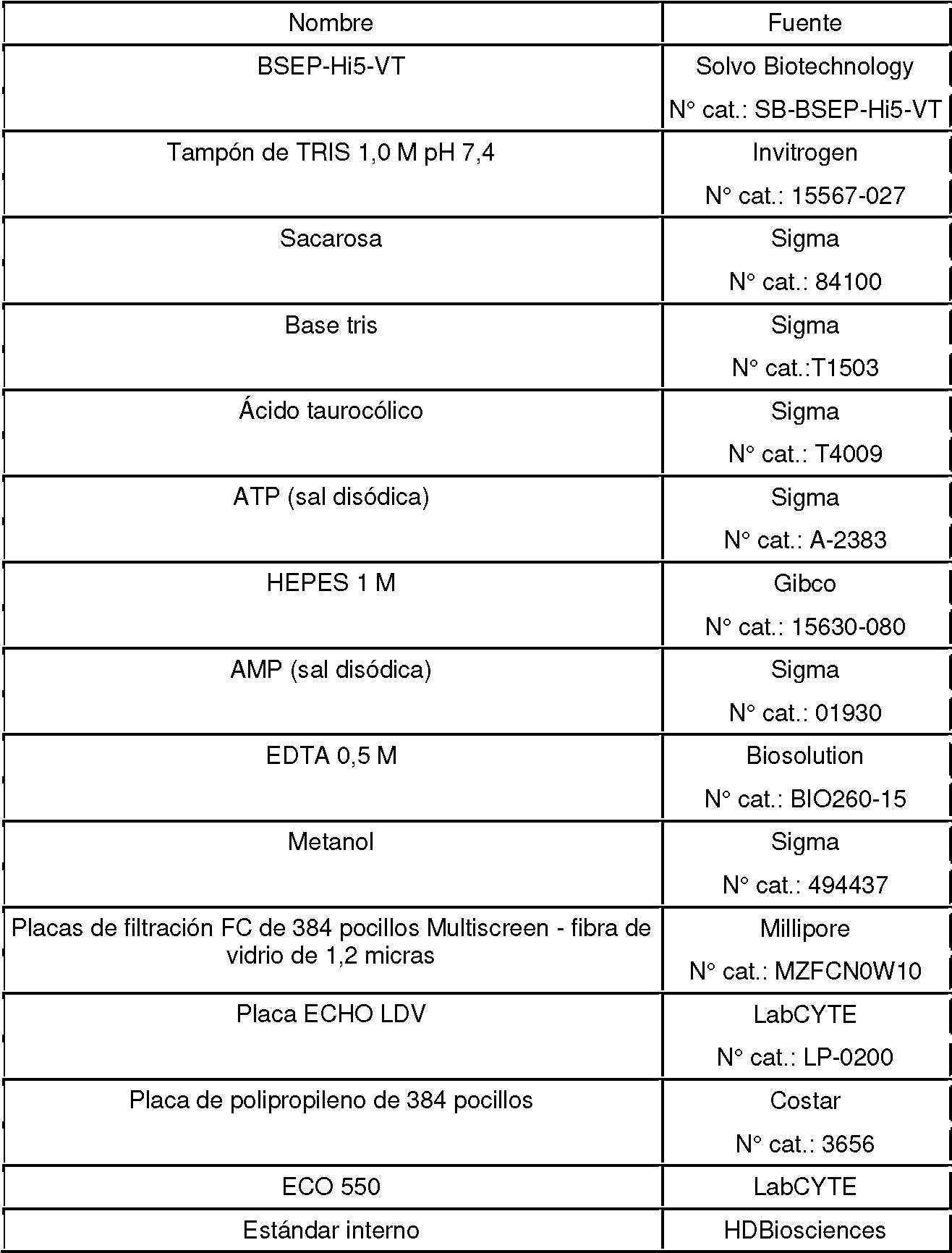
Preparación de la solución:Preparation of the solution:
1. Tampón A:1. Buffer A:
HEPES 50 mM pH 7,4, KNO3100 mM, Mg(NO3)210 mM, sacarosa 50 mM. 50 mM HEPES pH 7.4, KNO3100 mM, Mg(NO3) 210 mM, 50 mM sucrose.
2. Tampón B:2. Buffer B:
TRIS 10 mM pH 7,4, KNO3100 mM, Mg(NO3)210 mM, sacarosa 50 mM.10mM TRIS pH 7.4, KNO3100mM, Mg(NO3)210mM, 50mM sucrose.
3. Tampón de ATP:3. ATP buffer:
Preparado con tampón A, ATP 8,16 mM y ácido taurocólico 4,08 pM estaban contenidos en 12 ml de tampón A.Prepared with buffer A, 8.16 mM ATP and 4.08 pM taurocholic acid were contained in 12 ml of buffer A.
4. Búfer de AMP:4. AMP buffer:
Preparado con tampón A, AMP 8,16 mM, ácido taurocólico 4,08 pM, 12 ml de tampón A estaban contenidos en el tampón A.Prepared with buffer A, 8.16 mM AMP, 4.08 pM taurocholic acid, 12 ml of buffer A was contained in buffer A.
5. Solución vesicular de BSEP-Hi5-VT:5. BSEP-Hi5-VT Vesicular Solution:
Se preparó una solución que contenía 5 pg/pl de BSEP-Hi5-VT con tampón A.A solution containing 5 pg/pl of BSEP-Hi5-VT was prepared with buffer A.
Preparación de la muestra:Sample preparation:
1. El compuesto se diluyó hasta 100 mM con DMSO; a continuación se diluyó en serie 3 veces para una dilución de 11 puntos; la concentración mínima fue de 0,169 pM.1. Compound was diluted to 100 mM with DMSO; it was then serially diluted 3-fold for an 11-point dilution; the minimum concentration was 0.169 pM.
2. La referencia positiva gliburida se diluyó hasta 20 mM con DMSO; a continuación se diluyó dos veces en serie para una dilución de 11 puntos; la concentración mínima fue de 19,5 pM.2. The glyburide positive control was diluted to 20 mM with DMSO; it was then serially diluted twice for an 11-point dilution; the minimum concentration was 19.5 pM.
Protocolo experimental:experimental protocol:
1. Se transfirieron 0,3 pl de una solución del compuesto en DMSO o una solución de DMSO diluida a los pocillos correspondientes de la placa del compuesto usando ECHO, respectivamente.1. 0.3 µl of a DMSO compound solution or a dilute DMSO solution was transferred to the corresponding wells of the compound plate using ECHO, respectively.
2. Se añadieron 14,7 pl de tampón de ATP al compuesto y a los pocillos correspondientes de cero por ciento de efecto (ZPE), respectivamente.2. 14.7 µL of ATP buffer was added to the compound and corresponding zero percent effect (ZPE) wells, respectively.
3. Se añadieron 14,7 pl de tampón de AMP a los pocillos correspondientes de 100% de efecto (HPE), respectivamente.3. 14.7 µl of AMP buffer was added to the corresponding 100% effect (HPE) wells, respectively.
4. La placa se agitó durante 10 minutos a 25°C.4. The plate was shaken for 10 minutes at 25°C.
5. Se añadieron 15 pl de solución vesicular de BSEP-Hl5-VT a todos los pocillos, respectivamente, y la placa se agitó durante otros 40 minutos a 25°C.5. 15 µL of BSEP-HI5-VT vesicular solution was added to all wells, respectively, and the plate was shaken for another 40 minutes at 25°C.
6. Se añadieron inmediatamente 5 pl de una solución de ácido etilendiaminotetraacético (EDTA) 0,5 M a todos los pocillos, seguido de la adición de 65 pl de tampón B y se completó toda la reacción.6. 5 µl of 0.5 M ethylenediaminetetraacetic acid (EDTA) solution was immediately added to all wells, followed by the addition of 65 µl of buffer B and the entire reaction was completed.
7. Se transfirieron 95 pl de líquido a la placa de filtración desde la placa de compuestos al final de la reacción usando un instrumento.7. 95 µl of liquid was transferred to the filter plate from the compound plate at the end of the reaction using an instrument.
8. Después de colocar la placa de recepción de líquido debajo de la placa de filtración, se eliminó el líquido usando una centrífuga y se descartó el líquido de la placa de recepción.8. After placing the liquid receiving plate under the filter plate, the liquid was removed using a centrifuge and the liquid on the receiving plate was discarded.
9. Se añadieron 90 pl de tampón B a la placa de filtración. Después de colocar la placa de recepción de líquido debajo de la placa de filtración, se eliminó el líquido usando una centrífuga y la placa de recepción de líquido se descartó y la placa de filtración se lavó tres veces en total.9. 90 µL of buffer B was added to the filter plate. After placing the liquid receiving plate under the filter plate, the liquid was removed using a centrifuge and the liquid receiving plate was discarded and the filter plate was washed three times in total.
10. La placa de filtración se secó durante la noche.10. The filter plate was dried overnight.
11. Al día siguiente, se añadieron a la placa de filtración 80 pl de solución de metanol/agua (80/20, relación en volumen).11. The next day, 80 pl of methanol/water solution (80/20, volume ratio) was added to the filter plate.
12. La placa se agitó durante 15 minutos después de unir la placa de filtración a la membrana.12. The plate was shaken for 15 minutes after attaching the filter plate to the membrane.
13. Se colocó una nueva placa de recepción de líquido debajo de la placa de filtración y la placa de filtración se centrifugó durante 5 minutos y todos los líquidos de la placa de filtración se filtraron a la placa de recepción. 14. Se añadieron 15 pl de solución de estándar interno a cada pocillo en la placa de recepción de líquido y la placa se selló con una membrana.13. A new liquid receiving plate was placed under the filter plate and the filter plate was spun for 5 minutes and all the liquids in the filter plate were filtered to the receiving plate. 14. 15 µl of internal standard solution was added to each well in the liquid receiving plate and the plate was sealed with a membrane.
15. El contenido de ácido taurocólico en la placa de recepción se detectó usando LC/MS/MS.15. The taurocholic acid content in the receiving plate was detected using LC/MS/MS.
Se probaron varias concentraciones en cada experimento. Los datos se analizaron usando Prism para generar una curva de respuesta a la concentración, y se calcularon los valores de IC50 de los compuestos. Various concentrations were tested in each experiment. Data was analyzed using Prism to generate a concentration response curve, and IC50 values of compounds were calculated.
Resultados experimentales:Experimental results:
Los resultados experimentales se muestran en la tabla 14.The experimental results are shown in table 14.
Tabla 14: Efecto inhibidor del compuesto de la presente divulgación sobre la bomba de transporte de sales biliaresTable 14: Inhibitory effect of the compound of the present disclosure on the bile salt transport pump
(BSEP)(BSEP)

Conclusión:Conclusion:
El efecto inhibidor del compuesto WX013 de la presente divulgación sobre la bomba de transporte de sales biliares (BSEP) fue extremadamente débil, pero el efecto inhibidor del macitentán fue fuerte. Por lo tanto, el efecto inhibidor de WX013 sobre la bomba de transporte de sales biliares fue mucho más débil que el del macitentán, lo que reducía significativamente el riesgo de desarrollar hepatotoxicidad.The inhibitory effect of the compound WX013 of the present disclosure on the bile salt transport pump (BSEP) was extremely weak, but the inhibitory effect of macitentan was strong. Therefore, the inhibitory effect of WX013 on the bile salt transport pump was much weaker than that of macitentan, significantly reducing the risk of developing hepatotoxicity.
Realización experimental 6: Evaluación de la farmacocinética de los compuestos en ratasExperimental Embodiment 6: Evaluation of the Pharmacokinetics of the Compounds in Rats
Propósito experimental:Test purpose:
Se seleccionaron ratas SD macho como animales de prueba en este estudio, y se midió cuantitativamente la concentración de fármaco en el plasma de las ratas en diferentes momentos mediante inyección intravenosa o administración gástrica oral del compuesto de prueba usando el método de LC/MS/MS para evaluar las características farmacocinéticas de los compuestos de prueba en ratas.Male SD rats were selected as test animals in this study, and drug concentration in the plasma of the rats was quantitatively measured at different times by intravenous injection or oral gastric administration of the test compound using the LC/MS/MS method. to evaluate the pharmacokinetic characteristics of test compounds in rats.
Materiales experimentales:Experimental materials:
Ratas Sprague Dawley (SD) (macho, 200-300 g, 7-10 semanas de edad, Beijing Viton Lihua o Shanghai Slake). Sprague Dawley (SD) rats (male, 200-300 g, 7-10 weeks old, Beijing Viton Lihua or Shanghai Slake).
Protocolo experimental:experimental protocol:
Se inyectó una solución transparente del compuesto de prueba en ratas SD a través de la vena caudal (ayuno durante la noche), o se administró por vía oral por sonda (ayuno durante la noche). Para la administración intravenosa, se recogieron 200 pl de sangre yugular mediante venopunción a las 0 horas (antes de la dosificación) y a las 0,0833, 0,25, 0,5, 1, 2, 4, 6, 8 y 24 horas después de la dosificación, que a continuación se colocaron en un tubo de anticoagulación complementado con EDTA-K2 (Suzuki Healthcare Medical Co., Ltd.). La mezcla del tubo de anticoagulación se sometió a turbulencia para mezclar a fondo a 4°C y a continuación se centrifugó a 13000 rpm durante 10 minutos para recoger el plasma. Para la administración por sonda oral, se recogieron 200 pl de sangre yugular mediante venopunción a las 0 horas (antes de la dosificación) y a las 0,5, 1, 2, 4, 6, 8 y 24 horas después de la dosificación, que a continuación se colocaron en un tubo de anticoagulación complementado con EDTA-K2 (Suzuki Healthcare Medical Co., Ltd.). La mezcla del tubo de anticoagulación se sometió a turbulencia para mezclar a fondo y a continuación se centrifugó a 13000 rpm durante 10 minutos para recoger el plasma. La concentración de fármaco en plasma se midió mediante el método de LC/MS/MS, y los parámetros farmacocinéticos relacionados se calcularon usando el programa de farmacocinética WinNonlin™ Versión 6.3 (Pharsight, Paul View, CA) en el método trapezoidal logarítmico lineal de modelo no compartimentado.A clear solution of test compound was injected into SD rats via tail vein (overnight fast), or administered orally by gavage (overnight fast). For intravenous administration, 200 µL of jugular blood was collected by venipuncture at 0 hours (before dosing) and at 0.0833, 0.25, 0.5, 1, 2, 4, 6, 8, and 24 hours. after dosing, which were then placed in an anticoagulation tube supplemented with EDTA-K2 (Suzuki Healthcare Medical Co., Ltd.). The mixture in the anticoagulation tube was vortexed to mix thoroughly at 4°C and then centrifuged at 13000 rpm for 10 minutes to collect plasma. For administration by oral gavage, 200 µl of jugular blood was collected by venipuncture at 0 hours (prior to dosing) and at 0.5, 1, 2, 4, 6, 8, and 24 hours after dosing, which they were then placed in an anticoagulation tube supplemented with K2-EDTA (Suzuki Healthcare Medical Co., Ltd.). The mixture in the anticoagulation tube was vortexed to mix thoroughly and then centrifuged at 13,000 rpm for 10 minutes to collect plasma. Plasma drug concentration was measured by the LC/MS/MS method, and related pharmacokinetic parameters were calculated using the WinNonlin™ Version 6.3 pharmacokinetics program (Pharsight, Paul View, CA) in the log-linear trapezoidal model method. not compartmentalized.
Resultados experimentales:Experimental results:
Los resultados experimentales se muestran en la tabla 15.The experimental results are shown in table 15.
Tabla 15: Parámetros farmacocinéticos de los compuestos de la divulgación en ratasTable 15: Pharmacokinetic parameters of the compounds of the disclosure in rats
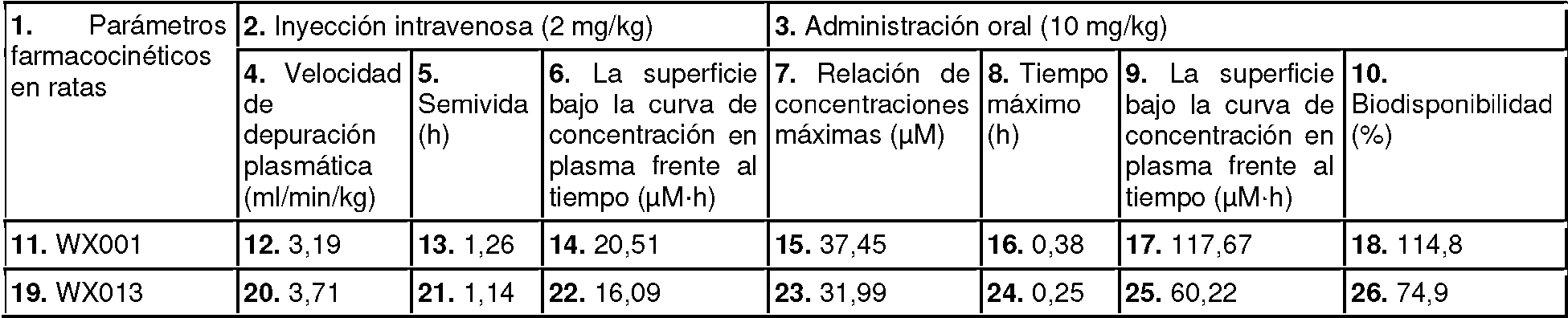
Conclusión:Conclusion:
Los compuestos WX001 y WX013 de la presente divulgación tienen una velocidad de depuración plasmática baja (< 5 ml/min/kg) y una alta biodisponibilidad oral (> 70%) en ratas.Compounds WX001 and WX013 of the present disclosure have a low plasma clearance rate (< 5 ml/min/kg) and a high oral bioavailability (>70%) in rats.
Realización experimental 7: Evaluación de la farmacocinética de compuestos en perros beagle Experimental Embodiment 7: Evaluation of the Pharmacokinetics of Compounds in Beagle Dogs
Propósito experimental:Test purpose:
Se seleccionaron perros beagle macho como los animales probados en este estudio, y se midió cuantitativamente la concentración de fármaco en plasma de los perros beagle en diferentes momentos a través de inyección intravenosa o administración gástrica por perfusión oral de los compuestos de prueba usando el método de LC/Ms /MS para evaluar las características farmacocinéticas de los compuestos de prueba en los perros beagle. Male beagle dogs were selected as the test animals in this study, and the plasma drug concentration of the beagle dogs was quantitatively measured at different times through intravenous injection or gastric administration by oral infusion of the test compounds using the method of LC/M s /MS to assess the pharmacokinetic characteristics of test compounds in beagle dogs.
Materiales experimentales:Experimental materials:
Perro beagle (macho, 6-15 kg, más de 6 meses de edad, Beijing Marshall Biotechnology Co., Ltd.).Beagle dog (male, 6-15 kg, over 6 months old, Beijing Marshall Biotechnology Co., Ltd.).
Protocolo experimental:experimental protocol:
Una solución transparente del compuesto de prueba se inyectó por vía intravenosa en perros beagle (ayuno durante la noche), o se administró por vía oral a perros beagle por sonda (ayuno durante la noche). Para la administración intravenosa, se recogieron 500 gl de sangre de los vasos periféricos a las 0 horas (antes de la dosificación) y a las 0. 0833, 0,25, 0,5, 1, 2, 4, 6, 8 y 24 horas después de la dosificación, que a continuación se introdujeron en un tubo de anticoagulación complementado con EDTA-K2 (Suzuki Healthcare Medical Co., Ltd.). Para la administración gástrica oral, se recogieron 500 gl de sangre de los vasos periféricos a las 0 horas (antes de la dosificación) y a las 0,25, 0,5, 1, 2, 4, 6, 8 y 24 horas después de la dosificación, que a continuación se introdujeron en un tubo de anticoagulación complementado con EDTA-K2. La mezcla en el tubo de anticoagulación se sometió a turbulencia para mezclar a fondo y a continuación se centrifugó a 13000 rpm durante 10 minutos para recoger el plasma. La concentración de fármaco en plasma se midió mediante el método de LC/MS/MS, y los parámetros farmacocinéticos relacionados se calcularon usando el programa de farmacocinética WinNonlin™ Versión 6.3 (Pharsight, Paul View, CA) en el método trapezoidal logarítmico lineal con modelo no compartimentado.A clear solution of the test compound was intravenously injected into beagle dogs (overnight fast), or orally administered to beagle dogs by gavage (overnight fast). For intravenous administration, 500 ml of blood was collected from the peripheral vessels at 0 hours (before dosing) and at 0.0833, 0.25, 0.5, 1, 2, 4, 6, 8, and 24 hours after dosing, which were then placed in an anticoagulation tube supplemented with EDTA-K2 (Suzuki Healthcare Medical Co., Ltd.). For oral gastric administration, 500 ml of blood was collected from peripheral vessels at 0 hours (before dosing) and at 0.25, 0.5, 1, 2, 4, 6, 8, and 24 hours after dosing. the dosage, which were then introduced into an anticoagulation tube supplemented with EDTA-K2. The mixture in the anticoagulation tube was vortexed to mix thoroughly and then centrifuged at 13,000 rpm for 10 minutes to collect plasma. Plasma drug concentration was measured by LC/MS/MS method, and related pharmacokinetic parameters were calculated using WinNonlin™ Version 6.3 pharmacokinetics program (Pharsight, Paul View, CA) in log-linear trapezoidal method with model not compartmentalized.
Resultados experimentales:Experimental results:
Los resultados experimentales se muestran en la tabla 16.The experimental results are shown in table 16.
Tabla 16: Parámetros farmacocinéticos de los compuestos de la presente divulgación en perros beagle Table 16: Pharmacokinetic parameters of the compounds of the present disclosure in beagle dogs

Conclusión:Conclusion:
Los compuestos WX001 y WX013 de la presente divulgación tienen una baja velocidad de depuración plasmática (< 5 ml/min/kg) y una alta biodisponibilidad oral (> 50%) en perros beagle. Compounds WX001 and WX013 of the present disclosure have a low plasma clearance rate (<5 mL/min/kg) and high oral bioavailability (>50%) in beagle dogs.
Claims (15)
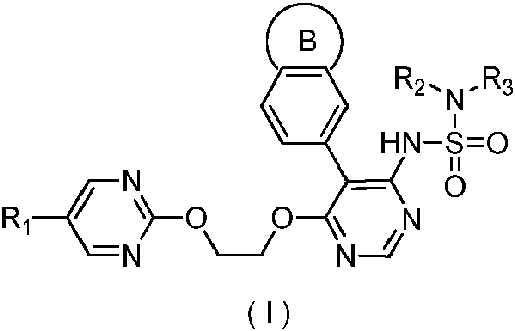


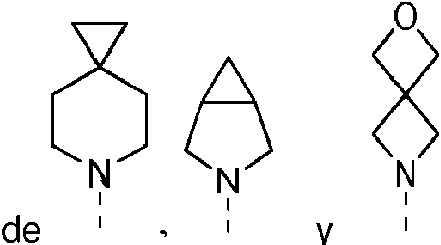


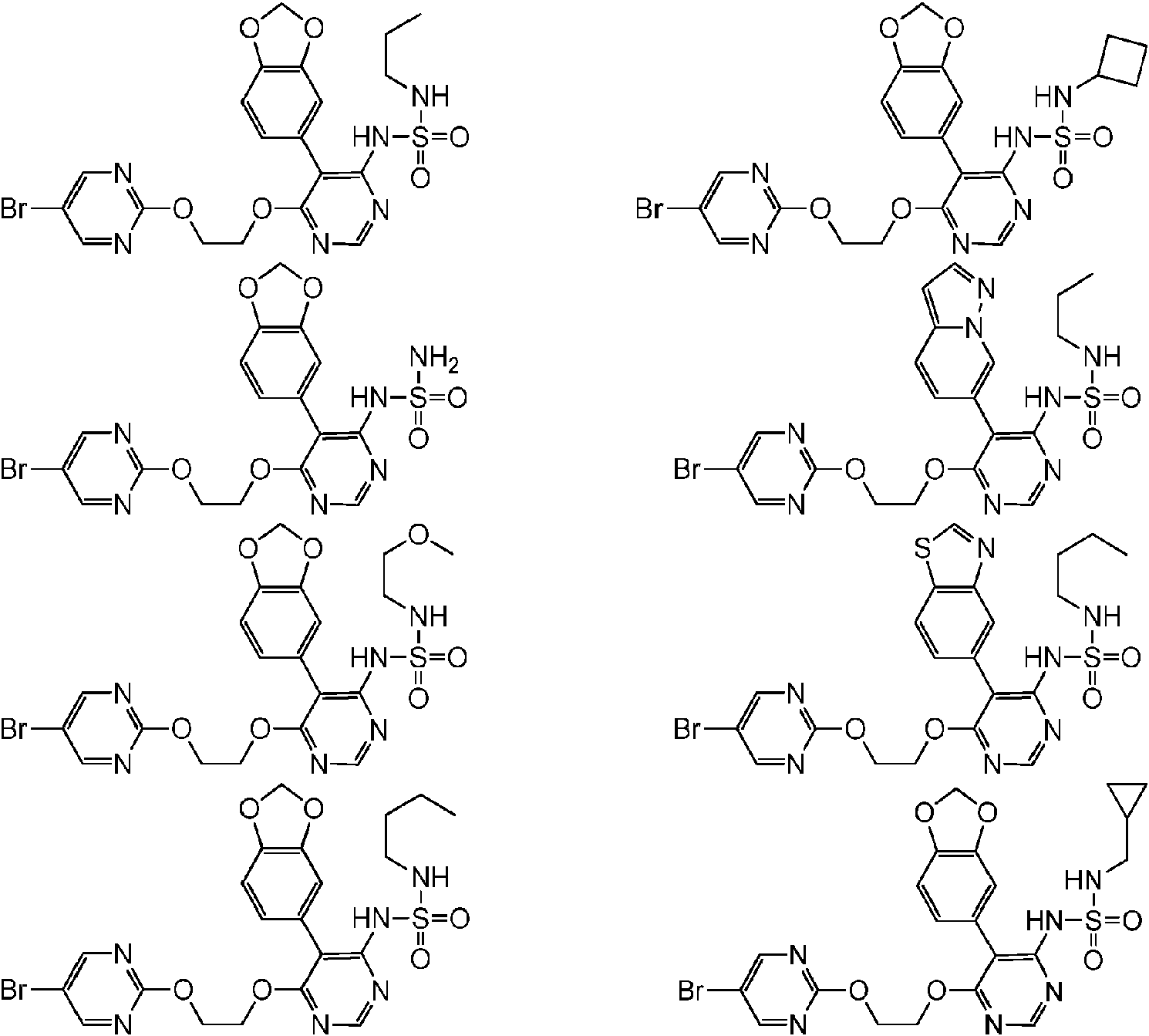


Applications Claiming Priority (2)
| Application Number | Priority Date | Filing Date | Title |
|---|---|---|---|
| CN201711168111 | 2017-11-21 | ||
| PCT/CN2018/116196 WO2019101039A1 (en) | 2017-11-21 | 2018-11-19 | Pyrimidine sulfamide derivative and preparation method and medical application thereof |
Publications (1)
| Publication Number | Publication Date |
|---|---|
| ES2936864T3 true ES2936864T3 (en) | 2023-03-22 |
Family
ID=66630436
Family Applications (1)
| Application Number | Title | Priority Date | Filing Date |
|---|---|---|---|
| ES18881280T Active ES2936864T3 (en) | 2017-11-21 | 2018-11-19 | Pyrimidinosulfamide derivative and method of preparation and medical application thereof |
Country Status (19)
| Country | Link |
|---|---|
| US (1) | US11319305B2 (en) |
| EP (1) | EP3719013B1 (en) |
| JP (1) | JP7245832B2 (en) |
| CN (1) | CN111479808B (en) |
| AU (1) | AU2018372752B2 (en) |
| BR (1) | BR112020010149A8 (en) |
| DK (1) | DK3719013T3 (en) |
| ES (1) | ES2936864T3 (en) |
| FI (1) | FI3719013T3 (en) |
| HR (1) | HRP20230318T1 (en) |
| HU (1) | HUE061515T2 (en) |
| IL (1) | IL274773B2 (en) |
| LT (1) | LT3719013T (en) |
| PL (1) | PL3719013T3 (en) |
| PT (1) | PT3719013T (en) |
| RS (1) | RS64040B1 (en) |
| SI (1) | SI3719013T1 (en) |
| SM (1) | SMT202300100T1 (en) |
| WO (1) | WO2019101039A1 (en) |
Families Citing this family (3)
| Publication number | Priority date | Publication date | Assignee | Title |
|---|---|---|---|---|
| CN109232546B (en) * | 2018-09-25 | 2020-09-04 | 中国人民解放军总医院 | Medicinal use of a pyrimidine sulfonamide derivative |
| EP3974421B1 (en) * | 2019-05-22 | 2024-09-11 | Wuxi Biocity Biopharmaceutics Co., Ltd. | Crystal form of pyrimidine sulfonamide compound and preparation method therefor |
| CN120271660B (en) * | 2025-06-09 | 2025-08-19 | 杭州肽佳生物科技有限公司 | A method for preparing a highly effective and selective antagonist BQ-788 |
Family Cites Families (6)
| Publication number | Priority date | Publication date | Assignee | Title |
|---|---|---|---|---|
| CA2315614C (en) * | 1999-07-29 | 2004-11-02 | Pfizer Inc. | Pyrazoles |
| CA2348847A1 (en) | 2000-05-31 | 2001-11-30 | Pfizer Inc. | New isoxazole-sulfonamide endothelin antagonists |
| JP3490959B2 (en) | 2000-07-11 | 2004-01-26 | 三洋電機株式会社 | Light receiving element and light receiving module |
| AU2002227984B8 (en) * | 2000-12-18 | 2007-01-04 | Actelion Pharmaceuticals Ltd. | Novel sulfamides and their use as endothelin receptor antagonists |
| CA2507334C (en) | 2002-12-02 | 2013-05-07 | Actelion Pharmaceuticals Ltd. | Pyrimidine-sulfamides and their use as endothelian receptor antagonist |
| TW200628467A (en) | 2004-11-11 | 2006-08-16 | Actelion Pharmaceuticals Ltd | Novel sulfamides |
-
2018
- 2018-11-19 PL PL18881280.4T patent/PL3719013T3/en unknown
- 2018-11-19 WO PCT/CN2018/116196 patent/WO2019101039A1/en not_active Ceased
- 2018-11-19 CN CN201880074739.3A patent/CN111479808B/en active Active
- 2018-11-19 HU HUE18881280A patent/HUE061515T2/en unknown
- 2018-11-19 RS RS20230197A patent/RS64040B1/en unknown
- 2018-11-19 PT PT188812804T patent/PT3719013T/en unknown
- 2018-11-19 SI SI201830884T patent/SI3719013T1/en unknown
- 2018-11-19 LT LTEPPCT/CN2018/116196T patent/LT3719013T/en unknown
- 2018-11-19 JP JP2020528076A patent/JP7245832B2/en active Active
- 2018-11-19 BR BR112020010149A patent/BR112020010149A8/en active Search and Examination
- 2018-11-19 SM SM20230100T patent/SMT202300100T1/en unknown
- 2018-11-19 EP EP18881280.4A patent/EP3719013B1/en active Active
- 2018-11-19 FI FIEP18881280.4T patent/FI3719013T3/en active
- 2018-11-19 HR HRP20230318TT patent/HRP20230318T1/en unknown
- 2018-11-19 DK DK18881280.4T patent/DK3719013T3/en active
- 2018-11-19 ES ES18881280T patent/ES2936864T3/en active Active
- 2018-11-19 US US16/764,654 patent/US11319305B2/en active Active
- 2018-11-19 AU AU2018372752A patent/AU2018372752B2/en active Active
-
2020
- 2020-05-19 IL IL274773A patent/IL274773B2/en unknown
Also Published As
| Publication number | Publication date |
|---|---|
| RS64040B1 (en) | 2023-04-28 |
| AU2018372752A1 (en) | 2020-07-02 |
| BR112020010149A2 (en) | 2020-11-10 |
| SI3719013T1 (en) | 2023-05-31 |
| AU2018372752B2 (en) | 2023-02-02 |
| EP3719013B1 (en) | 2023-01-04 |
| SMT202300100T1 (en) | 2023-05-12 |
| DK3719013T3 (en) | 2023-04-03 |
| IL274773A (en) | 2020-07-30 |
| EP3719013A1 (en) | 2020-10-07 |
| CN111479808A (en) | 2020-07-31 |
| WO2019101039A1 (en) | 2019-05-31 |
| CA3083019A1 (en) | 2019-05-31 |
| HRP20230318T1 (en) | 2023-05-12 |
| PL3719013T3 (en) | 2023-05-08 |
| BR112020010149A8 (en) | 2023-01-17 |
| RU2020119900A3 (en) | 2021-12-23 |
| PT3719013T (en) | 2023-02-01 |
| IL274773B2 (en) | 2023-08-01 |
| HUE061515T2 (en) | 2023-07-28 |
| US20200283425A1 (en) | 2020-09-10 |
| JP7245832B2 (en) | 2023-03-24 |
| IL274773B1 (en) | 2023-04-01 |
| JP2021504330A (en) | 2021-02-15 |
| CN111479808B (en) | 2023-02-24 |
| US11319305B2 (en) | 2022-05-03 |
| FI3719013T3 (en) | 2023-04-03 |
| EP3719013A4 (en) | 2021-04-21 |
| RU2020119900A (en) | 2021-12-23 |
| LT3719013T (en) | 2023-05-10 |
Similar Documents
| Publication | Publication Date | Title |
|---|---|---|
| CN112638380B (en) | CRBN ligand | |
| ES2969284T3 (en) | Pyridone-pyrimidine derivative that acts as an inhibitor of mutein krasg12c | |
| ES2953512T3 (en) | Amine-substituted aryl or heteroaryl compounds as inhibitors of EHMT1 and EHMT2 | |
| ES2688868T3 (en) | Anti-cancer pyridopyrazines through the inhibition of FGFR kinases | |
| KR20250070059A (en) | Novel tetraheterocyclic compounds | |
| EP3533787B1 (en) | Pyridone compound as c-met inhibitor | |
| ES2621461T3 (en) | Pyrazolylquinoxaline Kinase Inhibitors | |
| ES2666155T3 (en) | P2X7 modulators | |
| AU2022217353B2 (en) | Pyridopyrimidinone derivative, preparation method therefor, and use thereof | |
| PT2552909E (en) | 4-aminopyrimidine derivatives and their as as adenosine a2a receptor antagonists | |
| ES2936864T3 (en) | Pyrimidinosulfamide derivative and method of preparation and medical application thereof | |
| AU2024200781A1 (en) | Substituted fused bi- or tri-heterocyclic compounds as ehmt2 inhibitors | |
| JP2025521737A (en) | Tricyclic compounds and uses thereof | |
| ES2926518T3 (en) | Pyrazolopyridinone compounds | |
| US20220185811A1 (en) | Fgfr4 kinase inhibitor and preparation method therefor and use thereof | |
| ES2954453T3 (en) | Pyrimidine compounds and methods using the same | |
| BR112020010004A2 (en) | pyrazolopyridinone compounds | |
| US20250361241A1 (en) | Hpk1 inhibitor and medical use thereof | |
| RU2773844C2 (en) | Pyrimidine sulfamide derivative and its production method, and medical use | |
| RU2773844C9 (en) | Pyrimidine sulfamide derivative and its production method, and medical use | |
| CA3083019C (en) | Pyrimidine sulfamide derivative and preparation method and medical application | |
| RU2827549C2 (en) | Thienopyridinone compounds | |
| HK40037152B (en) | Pyrazolopyridinone compounds | |
| CN111362928A (en) | 2, 4-diaminopyrimidine derivatives |