ES2940065T3 - Sweetener of natural origin with a taste profile that mimics sugar with fruity flavors with a sweetening capacity of up to 20 times compared to sugar - Google Patents
Sweetener of natural origin with a taste profile that mimics sugar with fruity flavors with a sweetening capacity of up to 20 times compared to sugar Download PDFInfo
- Publication number
- ES2940065T3 ES2940065T3 ES19832729T ES19832729T ES2940065T3 ES 2940065 T3 ES2940065 T3 ES 2940065T3 ES 19832729 T ES19832729 T ES 19832729T ES 19832729 T ES19832729 T ES 19832729T ES 2940065 T3 ES2940065 T3 ES 2940065T3
- Authority
- ES
- Spain
- Prior art keywords
- sweetener
- sugar
- weight
- natural origin
- thaumatin
- Prior art date
- Legal status (The legal status is an assumption and is not a legal conclusion. Google has not performed a legal analysis and makes no representation as to the accuracy of the status listed.)
- Active
Links
Classifications
-
- A—HUMAN NECESSITIES
- A23—FOODS OR FOODSTUFFS; TREATMENT THEREOF, NOT COVERED BY OTHER CLASSES
- A23L—FOODS, FOODSTUFFS OR NON-ALCOHOLIC BEVERAGES, NOT OTHERWISE PROVIDED FOR; PREPARATION OR TREATMENT THEREOF
- A23L27/00—Spices; Flavouring agents or condiments; Artificial sweetening agents; Table salts; Dietetic salt substitutes; Preparation or treatment thereof
- A23L27/10—Natural spices, flavouring agents or condiments; Extracts thereof
-
- A—HUMAN NECESSITIES
- A23—FOODS OR FOODSTUFFS; TREATMENT THEREOF, NOT COVERED BY OTHER CLASSES
- A23L—FOODS, FOODSTUFFS OR NON-ALCOHOLIC BEVERAGES, NOT OTHERWISE PROVIDED FOR; PREPARATION OR TREATMENT THEREOF
- A23L2/00—Non-alcoholic beverages; Dry compositions or concentrates therefor; Preparation or treatment thereof
- A23L2/52—Adding ingredients
-
- A—HUMAN NECESSITIES
- A23—FOODS OR FOODSTUFFS; TREATMENT THEREOF, NOT COVERED BY OTHER CLASSES
- A23L—FOODS, FOODSTUFFS OR NON-ALCOHOLIC BEVERAGES, NOT OTHERWISE PROVIDED FOR; PREPARATION OR TREATMENT THEREOF
- A23L2/00—Non-alcoholic beverages; Dry compositions or concentrates therefor; Preparation or treatment thereof
- A23L2/52—Adding ingredients
- A23L2/60—Sweeteners
-
- A—HUMAN NECESSITIES
- A23—FOODS OR FOODSTUFFS; TREATMENT THEREOF, NOT COVERED BY OTHER CLASSES
- A23L—FOODS, FOODSTUFFS OR NON-ALCOHOLIC BEVERAGES, NOT OTHERWISE PROVIDED FOR; PREPARATION OR TREATMENT THEREOF
- A23L27/00—Spices; Flavouring agents or condiments; Artificial sweetening agents; Table salts; Dietetic salt substitutes; Preparation or treatment thereof
- A23L27/30—Artificial sweetening agents
-
- A—HUMAN NECESSITIES
- A23—FOODS OR FOODSTUFFS; TREATMENT THEREOF, NOT COVERED BY OTHER CLASSES
- A23L—FOODS, FOODSTUFFS OR NON-ALCOHOLIC BEVERAGES, NOT OTHERWISE PROVIDED FOR; PREPARATION OR TREATMENT THEREOF
- A23L27/00—Spices; Flavouring agents or condiments; Artificial sweetening agents; Table salts; Dietetic salt substitutes; Preparation or treatment thereof
- A23L27/30—Artificial sweetening agents
- A23L27/31—Artificial sweetening agents containing amino acids, nucleotides, peptides or derivatives
-
- A—HUMAN NECESSITIES
- A23—FOODS OR FOODSTUFFS; TREATMENT THEREOF, NOT COVERED BY OTHER CLASSES
- A23L—FOODS, FOODSTUFFS OR NON-ALCOHOLIC BEVERAGES, NOT OTHERWISE PROVIDED FOR; PREPARATION OR TREATMENT THEREOF
- A23L27/00—Spices; Flavouring agents or condiments; Artificial sweetening agents; Table salts; Dietetic salt substitutes; Preparation or treatment thereof
- A23L27/30—Artificial sweetening agents
- A23L27/33—Artificial sweetening agents containing sugars or derivatives
- A23L27/36—Terpene glycosides
-
- A—HUMAN NECESSITIES
- A23—FOODS OR FOODSTUFFS; TREATMENT THEREOF, NOT COVERED BY OTHER CLASSES
- A23L—FOODS, FOODSTUFFS OR NON-ALCOHOLIC BEVERAGES, NOT OTHERWISE PROVIDED FOR; PREPARATION OR TREATMENT THEREOF
- A23L27/00—Spices; Flavouring agents or condiments; Artificial sweetening agents; Table salts; Dietetic salt substitutes; Preparation or treatment thereof
- A23L27/88—Taste or flavour enhancing agents
-
- A—HUMAN NECESSITIES
- A23—FOODS OR FOODSTUFFS; TREATMENT THEREOF, NOT COVERED BY OTHER CLASSES
- A23L—FOODS, FOODSTUFFS OR NON-ALCOHOLIC BEVERAGES, NOT OTHERWISE PROVIDED FOR; PREPARATION OR TREATMENT THEREOF
- A23L33/00—Modifying nutritive qualities of foods; Dietetic products; Preparation or treatment thereof
- A23L33/10—Modifying nutritive qualities of foods; Dietetic products; Preparation or treatment thereof using additives
-
- A—HUMAN NECESSITIES
- A23—FOODS OR FOODSTUFFS; TREATMENT THEREOF, NOT COVERED BY OTHER CLASSES
- A23L—FOODS, FOODSTUFFS OR NON-ALCOHOLIC BEVERAGES, NOT OTHERWISE PROVIDED FOR; PREPARATION OR TREATMENT THEREOF
- A23L33/00—Modifying nutritive qualities of foods; Dietetic products; Preparation or treatment thereof
- A23L33/20—Reducing nutritive value; Dietetic products with reduced nutritive value
-
- A—HUMAN NECESSITIES
- A23—FOODS OR FOODSTUFFS; TREATMENT THEREOF, NOT COVERED BY OTHER CLASSES
- A23L—FOODS, FOODSTUFFS OR NON-ALCOHOLIC BEVERAGES, NOT OTHERWISE PROVIDED FOR; PREPARATION OR TREATMENT THEREOF
- A23L7/00—Cereal-derived products; Malt products; Preparation or treatment thereof
- A23L7/20—Malt products
-
- A—HUMAN NECESSITIES
- A23—FOODS OR FOODSTUFFS; TREATMENT THEREOF, NOT COVERED BY OTHER CLASSES
- A23V—INDEXING SCHEME RELATING TO FOODS, FOODSTUFFS OR NON-ALCOHOLIC BEVERAGES AND LACTIC OR PROPIONIC ACID BACTERIA USED IN FOODSTUFFS OR FOOD PREPARATION
- A23V2002/00—Food compositions, function of food ingredients or processes for food or foodstuffs
-
- A—HUMAN NECESSITIES
- A23—FOODS OR FOODSTUFFS; TREATMENT THEREOF, NOT COVERED BY OTHER CLASSES
- A23V—INDEXING SCHEME RELATING TO FOODS, FOODSTUFFS OR NON-ALCOHOLIC BEVERAGES AND LACTIC OR PROPIONIC ACID BACTERIA USED IN FOODSTUFFS OR FOOD PREPARATION
- A23V2250/00—Food ingredients
- A23V2250/24—Non-sugar sweeteners
- A23V2250/258—Rebaudioside
-
- A—HUMAN NECESSITIES
- A23—FOODS OR FOODSTUFFS; TREATMENT THEREOF, NOT COVERED BY OTHER CLASSES
- A23V—INDEXING SCHEME RELATING TO FOODS, FOODSTUFFS OR NON-ALCOHOLIC BEVERAGES AND LACTIC OR PROPIONIC ACID BACTERIA USED IN FOODSTUFFS OR FOOD PREPARATION
- A23V2250/00—Food ingredients
- A23V2250/24—Non-sugar sweeteners
- A23V2250/266—Thaumatine, talin
Landscapes
- Life Sciences & Earth Sciences (AREA)
- Health & Medical Sciences (AREA)
- Nutrition Science (AREA)
- Chemical & Material Sciences (AREA)
- Engineering & Computer Science (AREA)
- Food Science & Technology (AREA)
- Polymers & Plastics (AREA)
- Proteomics, Peptides & Aminoacids (AREA)
- Mycology (AREA)
- Seasonings (AREA)
Abstract
Edulcorante que imita al azúcar en su perfil completo: plenitud, retrogusto, gusto dulce, intensidad del sabor dulce y similares. El edulcorante consiste en una combinación funcional y sinérgica de tres componentes: mosto, taumatina y estevioglucósido que forman el perfil de sabor completo del edulcorante de origen natural con bajo valor energético y alta capacidad edulcorante. (Traducción automática con Google Translate, sin valor legal)Sweetener that mimics sugar in its entire profile: fullness, aftertaste, sweet taste, sweet flavor intensity, and the like. The sweetener consists of a functional and synergistic combination of three components: wort, thaumatin and stevioglycoside that form the full flavor profile of the natural origin sweetener with low energy value and high sweetening capacity. (Automatic translation with Google Translate, without legal value)
Description
d e s c r ip c ió ndescription
Edulcorante de origen natural con perfil gustativo que imite al azúcar con sabores afrutados con capacidad edulcorante de hasta 20 veces comparado con el azúcarSweetener of natural origin with a taste profile that mimics sugar with fruity flavors with a sweetening capacity of up to 20 times compared to sugar
Campo de la tecnologíatechnology field
Edulcorantes de origen naturalSweeteners of natural origin
Estado de la técnicastate of the art
Los sacáridos se encuentran en casi cualquier tipo de alimento, pero solo algunos de ellos, los azúcares, tienen un sabor dulce. Los monosacáridos, los azúcares más simples de todos, consisten en una sola unidad de azúcar. Este grupo contiene azúcares como la glucosa (azúcar de uva) y la fructosa (azúcar de frutas). Si los sacáridos contienen de dos a diez unidades de azúcar, se denominan oligosacáridos. Además, la sacarosa conocida como azúcar de remolacha o de caña pertenece a este grupo, es un disacárido que contiene una molécula de glucosa y una molécula de fructosa. Otros disacáridos son la maltosa (azúcar de malta) y la lactosa (azúcar de la leche). Los polisacáridos son azúcares con más de diez unidades de azúcar, y no tienen el sabor dulce y no sirven como fuente instantánea de energía en comparación con los azúcares simples; sin embargo, forman reservas de energía para nuestro cuerpo. Saccharides are found in almost any type of food, but only some of them, the sugars, taste sweet. Monosaccharides, the simplest of all sugars, consist of a single sugar unit. This group contains sugars such as glucose (grape sugar) and fructose (fruit sugar). If the saccharides contain from two to ten sugar units, they are called oligosaccharides. Also, sucrose known as beet or cane sugar belongs to this group, it is a disaccharide that contains one glucose molecule and one fructose molecule. Other disaccharides are maltose (malt sugar) and lactose (milk sugar). Polysaccharides are sugars with more than ten sugar units, and they don't taste sweet and don't serve as an instant source of energy compared to simple sugars; however, they form energy reserves for our body.
El primer edulcorante artificial, así como la mayoría de los demás, fue descubierto por casualidad. Ocurrió en 1879 gracias a los químicos Rems y Fahlberg, quienes originalmente sintetizaban otras sustancias. La sacarina que se originó como subproducto, pasó al tentempié de uno de ellos y lo endulzó. De esta manera comenzaron a sintetizar esta sustancia. Los ciclamatos y el aspartamo se sintetizaron en una oportunidad similar en 1937 y 1965, respectivamente.The first artificial sweetener, like most others, was discovered by accident. It happened in 1879 thanks to the chemists Rems and Fahlberg, who originally synthesized other substances. The saccharin that originated as a by-product passed into the snack of one of them and sweetened it. In this way they began to synthesize this substance. Cyclamates and aspartame were synthesized at a similar time in 1937 and 1965, respectively.
Para que una sustancia pueda ser añadida a la lista de edulcorantes sustitutos, debe servir para sustituir azúcares para la elaboración de alimentos con menor contenido energético, alimentos protectores contra la caries dental o alimentos sin azúcares añadidos. También pueden servir como sustituto de los azúcares en los casos en que esta sustitución permita mejorar la vida de los alimentos o producir alimentos destinados a una nutrición especial. Los edulcorantes sustitutos no se pueden utilizar en la nutrición de lactantes y bebés.For a substance to be added to the list of substitute sweeteners, it must be used to replace sugars for the preparation of foods with lower energy content, foods that protect against dental caries, or foods without added sugars. They can also serve as a substitute for sugars in cases where this substitution allows to improve the shelf life of food or to produce foods intended for special nutrition. Substitute sweeteners cannot be used in infant and infant nutrition.
Materiales edulcorantes comunesCommon Sweetener Materials
El azúcar de remolacha y de caña es un disacárido llamado sacarosa que es una sustancia cristalina con sabor dulce que es común en la naturaleza y que es un producto importante del metabolismo de las partes verdes de todas las plantas. En el país de los autores de la invención, la sacarosa se obtiene a través del procesamiento industrial de la remolacha azucarera que contiene en promedio 17% de sacarosa, y a nivel mundial la sacarosa se produce también a partir de la caña de azúcar.Beet and cane sugar is a disaccharide called sucrose, which is a sweet-tasting crystalline substance that is common in nature and is an important product of the metabolism of the green parts of all plants. In the country of the authors of the invention, sucrose is obtained through the industrial processing of sugar beets, which contain an average of 17% sucrose, and worldwide, sucrose is also produced from sugar cane.
En el pasado, la gente usaba la miel para endulzar los alimentos. No solo se usaba para dar sabor a los platos, sino que a menudo se buscaba por sus efectos curativos. La miel es un producto apícola que contiene en promedio 40% de fructosa, 30% de glucosa, 1% de sacarosa y 9% de otros azúcares; el resto es agua y cenizas. La miel es una fuente rápida de energía pero también de vitaminas, principalmente vitaminas B y C, y sustancias minerales.In the past, people used honey to sweeten food. It was not only used to flavor dishes, but was often sought after for its healing effects. Honey is a bee product that contains an average of 40% fructose, 30% glucose, 1% sucrose and 9% other sugars; the rest is water and ashes. Honey is a quick source of energy but also of vitamins, mainly vitamins B and C, and mineral substances.
Mientras que el habitante medio de la República Checa consume alrededor de 0,8 kg de miel al año, el consumo medio anual de azúcar es de unos 36 kg por persona.While the average inhabitant of the Czech Republic consumes about 0.8 kg of honey per year, the average annual consumption of sugar is about 36 kg per person.
Jarabe de arce - se obtiene concentrando savia de arce azucarero (Acer saccharum) o arce plateado (Acer saccharinum) cuya savia contiene dos veces más azúcar (7%). Ambos árboles frondosos proceden de Canadá. La producción de un solo litro de jarabe de arce requiere unos 40 litros de savia. La sustancia dulce principal es la sacarosa, otros azúcares están presentes en menor cantidad.Maple syrup - is obtained by concentrating sap of sugar maple (Acer saccharum) or silver maple (Acer saccharinum) whose sap contains twice as much sugar (7%). Both leafy trees come from Canada. The production of a single liter of maple syrup requires about 40 liters of sap. The main sweet substance is sucrose, other sugars are present in smaller amounts.
El mosto es una mezcla de proteínas, sustancias minerales y azúcares inferiores que se obtienen a través de la digestión hidrolítica de la malta en el horneado y tostado de la malta y posterior maceración a temperatura elevada. Los diferentes tipos de mosto difieren en la cantidad relativa de azúcares, sobre todo debido a la diferente forma e intensidad del tratamiento térmico en el horneado y tostado de la malta cuando la concentración de sacáridos reductores aumenta notablemente debido a la actividad amilolítica residual. Los sacáridos entran en reacciones ligadas al pardeamiento no enzimático a la temperatura final del horneado donde se producen sustancias aromáticas y de sabor, lo que produce notables diferencias entre los tipos de mosto. El mosto ligero contiene 3% de glucosa, 0,4% de fructosa, 4% de sacarosa, 43% de maltosa y 7% de maltotriosa. Por otro lado, por ejemplo, el mosto de caramelo contiene 5% de glucosa, 0,2% de fructosa, 3% de sacarosa, 20% de maltosa y 6% de maltotriosa.The wort is a mixture of proteins, mineral substances and lower sugars that are obtained through the hydrolytic digestion of the malt in the baking and roasting of the malt and subsequent mashing at elevated temperature. The different types of wort differ in the relative amount of sugars, mainly due to the different form and intensity of the heat treatment in the baking and roasting of the malt when the concentration of reducing saccharides increases markedly due to residual amylolytic activity. The saccharides enter into reactions linked to non-enzymatic browning at the final temperature of baking where aromatic and flavor substances are produced, which produces notable differences between the types of must. The light wort contains 3% glucose, 0.4% fructose, 4% sucrose, 43% maltose and 7% maltotriose. On the other hand, for example, caramel must contains 5% glucose, 0.2% fructose, 3% sucrose, 20% maltose and 6% maltotriose.
El mosto líquido con 80% de materia seca, o mosto seco con 98% de materia seca, contiene sobre todo maltosa (50-56% en el líquido y 55-62% en extracto seco de malta) y glucosa (8-10% en el concentrado y 9-11% en mosto seco), de 4 a 7% de proteínas y de 1 a 1,2% de sustancias minerales. Estos datos muestran que el mosto contiene 58-66% de azúcares en el mosto concentrado y 64-73% de azúcares en el mosto seco, como mínimo. Liquid wort with 80% dry matter, or dry wort with 98% dry matter, contains mainly maltose (50-56% in the liquid and 55-62% in dry malt extract) and glucose (8-10% in the concentrate and 9-11% in dry must), from 4 to 7% protein and from 1 to 1.2% mineral substances. These data show that the must contains 58-66% sugars in the concentrated must and 64-73% sugars in the dry must, as a minimum.
La capacidad edulcorante relativa del mosto es de un tercio (según el cálculo basado en la composición de sacáridos) a la mitad (según algunas fuentes de Internet) en comparación con el azúcar. Esto significa que se necesita 2-3 veces la cantidad de mosto para lograr el mismo dulzor en comparación con el azúcar. Debido a la capacidad edulcorante y la energía contenida en el mosto, no puede considerarse un edulcorante no nutritivo.The relative sweetening capacity of the must is one third (according to the calculation based on the saccharide composition) to one half (according to some internet sources) compared to sugar. This means that it takes 2-3 times the amount of wort to achieve the same sweetness compared to sugar. Due to the sweetening capacity and the energy contained in the must, it cannot be considered a non-nutritive sweetener.
Edulcorantes sustitutosSubstitute Sweeteners
También se pueden usar edulcorantes sustitutos para proporcionar sabor dulce a los alimentos. Pertenecen a los llamados aditivos (sustancias e) que están fijadas en las normas del Reglamento del Parlamento Europeo y del Consejo N° 1333/2008, en su versión modificada.Substitute sweeteners can also be used to impart a sweet flavor to foods. They belong to the so-called additives (e substances) that are established in the regulations of the Regulation of the European Parliament and of the Council No. 1333/2008, in its modified version.
Los edulcorantes sustitutos pueden ser naturales o sintéticos (llamados también artificiales), pero el significado de estas palabras puede ser engañoso. "Algunos edulcorantes, por ejemplo el sorbitol, aparecen en la naturaleza, pero se producen de forma sintética para aplicaciones industriales. Estos edulcorantes se denominan idénticos a los naturales".Substitute sweeteners can be natural or synthetic (also called artificial), but the meaning of these words can be misleading. "Some sweeteners, for example sorbitol, occur in nature but are produced synthetically for industrial applications. These sweeteners are called nature identical."
Vale la pena mencionar que los productores de alimentos evitan el término "sustituto" y no se puede encontrar en las etiquetas. "Solo se permite el uso del término edulcorantes para sustancias utilizadas como sustitutos del azúcar. Según los productores de alimentos que contienen estos edulcorantes, el término sustituto es discriminatorio y recuerda a un sucedáneo y no a un producto de calidad A. Por lo tanto, se puede encontrar únicamente el término "edulcorante" completado con un código E o nombre químico del edulcorante en el envase del alimento", ha explicado el profesor Dostálová.It is worth mentioning that the term "substitute" is avoided by food manufacturers and cannot be found on labels. "The use of the term sweeteners is only allowed for substances used as sugar substitutes. According to the producers of foods containing these sweeteners, the term substitute is discriminatory and is reminiscent of a substitute and not of an A-grade product. Therefore, you can only find the term "sweetener" completed with an E code or chemical name of the sweetener on the food packaging," explained Professor Dostálová.
De acuerdo con la orden del Ministerio de Salud checo N° 4/2008 Coll., y el Reglamento de la Comisión (UE) N° 1129/2011, están permitidos 17 edulcorantes sustitutos en total en la República Checa. Estos se pueden clasificar según su valor nutricional en energéticos (de volumen) y no energéticos (no nutritivos). El primer grupo consiste en sustancias de capacidad edulcorante similar a la sacarosa, por lo que se utiliza una cantidad similar para edulcorar como en el caso del azúcar clásico. En el caso de los edulcorantes no nutritivos, son sustancias de sabor muy intenso, y una pequeña cantidad de ellos es capaz de sustituir una gran cantidad de azúcar. Encontrará una descripción general de la capacidad edulcorante de varios edulcorantes junto con sus nombres comerciales y símbolos E en la tabla, y las propiedades de los edulcorantes seleccionados en la siguiente parte.According to the order of the Czech Ministry of Health No. 4/2008 Coll., and Commission Regulation (EU) No. 1129/2011, a total of 17 substitute sweeteners are allowed in the Czech Republic. These can be classified according to their nutritional value into energy (volume) and non-energy (non-nutritive). The first group consists of substances with a sweetening capacity similar to sucrose, which is why a similar amount is used to sweeten as in the case of classic sugar. In the case of non-nutritive sweeteners, they are substances with a very intense flavor, and a small amount of them is capable of replacing a large amount of sugar. You will find an overview of the sweetening capacity of various sweeteners together with their trade names and E symbols in the table, and the properties of selected sweeteners in the next part.
El acesulfamo K, también conocido como acesulfamo de potasio, es un edulcorante sintético con el código E 950. El acesulfamo es aproximadamente 200 veces más dulce que la sacarosa y tiene un sabor ligeramente amargo desagradable. Se utiliza principalmente en la producción de aguas minerales, postres y yogures edulcorados. No se metaboliza en el cuerpo humano y se secreta sin cambios. Los nombres comerciales del edulcorante son Sunett, SweetOne, NutriNova, Supra-Sweet y DiaVita.Acesulfame K, also known as acesulfame potassium, is a synthetic sweetener code E 950. Acesulfame is approximately 200 times sweeter than sucrose and has an unpleasant slightly bitter taste. It is mainly used in the production of mineral waters, desserts and sweetened yoghurts. It is not metabolized in the human body and is secreted unchanged. Trade names for the sweetener are Sunett, SweetOne, NutriNova, Supra-Sweet, and DiaVita.
El aspartamo (E 951) pertenece a los edulcorantes sintéticos más famosos. Es unas 200 veces más dulce que la sacarosa y, en comparación con algunos otros edulcorantes, no tiene casi sabor desagradable. Los resultados de los estudios que investigan la seguridad para la salud difieren particularmente en el caso de este edulcorante, pero la EFSA aún no ha confirmado la nocividad del aspartamo. Se sabe, sin embargo, que la fenilalanina se encuentra entre sus metabolitos, y las personas que sufren fenilcetonuria no deben consumir fenilalanina. Por tanto, la presencia de fenilalanina debe indicarse en el envase del producto que contiene aspartamo. El aspartamo se utiliza principalmente como sustituto del azúcar en bebidas no nutritivas, refrescos, chicles y en algunos productos lácteos. Los productos tóxicos aumentan en el tratamiento térmico como el horneado, etc. Se comercializa con los nombres comerciales Nutra-Sweet, Canderel, Equal, Fansweet e Irbis.Aspartame (E 951) belongs to the most famous synthetic sweeteners. It is about 200 times sweeter than sucrose and, compared to some other sweeteners, has almost no unpleasant taste. The results of studies investigating the safety for health differ particularly in the case of this sweetener, but the EFSA has not yet confirmed the harmfulness of aspartame. It is known, however, that phenylalanine is among its metabolites, and people suffering from phenylketonuria should not consume phenylalanine. Therefore, the presence of phenylalanine must be indicated on the packaging of the product containing aspartame. Aspartame is used primarily as a sugar substitute in non-nutritive beverages, soft drinks, chewing gum, and some dairy products. Toxic products increase in heat treatment such as baking, etc. It is marketed under the trade names Nutra-Sweet, Canderel, Equal, Fansweet, and Irbis.
En checo, la sacarina (E 954) también se conoce como cukerin. Es unas 500 veces más dulce que la sacarosa y es uno de los edulcorantes más baratos. Si se usa, se combina principalmente con otros edulcorantes porque tiene un sabor amargo desagradable. Se utiliza en la elaboración de alimentos dietéticos por ser un edulcorante totalmente acalórico, también se añade a los chicles, dentífricos y enjuagues bucales. La sacarina se comercializa con los nombres comerciales SugarSweet, Sweet-Twin, Daimant, Sweet'NLow, Sualin y Dianer.In Czech, saccharin (E 954) is also known as cukerin. It is about 500 times sweeter than sucrose and is one of the cheapest sweeteners. If used, it is mostly combined with other sweeteners because it has an unpleasant bitter taste. It is used in the preparation of diet foods because it is a totally caloric sweetener, it is also added to chewing gum, toothpaste and mouthwash. Saccharin is marketed under the trade names SugarSweet, Sweet-Twin, Daimant, Sweet'NLow, Sualin, and Dianer.
La taumatina (E 957) es una sustancia proteica no nutritiva aislada del fruto del arbusto Thaumatococcus daniellii que crece en África occidental. La taumatina es hasta 3000 veces más dulce que la sacarosa. Se utiliza para endulzar productos congelados, caramelos, mermeladas, chicles, refrescos, yogures y otros alimentos. Los nombres comerciales son Talin y AmCaSuctin. La taumatina se obtiene mediante la extracción en agua (pH 2,5 a 4) de los ovarios de la fruta. Contiene principalmente las proteínas taumatina I y taumatina II, y una pequeña cantidad de componentes vegetales provenientes de la materia original. La taumatina en la fruta se genera en respuesta a un ataque a la planta por patógenos viroides. El sabor dulce de la taumatina difiere notablemente del sabor dulce del azúcar, se desarrolla muy lentamente, pero la sensación dura mucho y recuerda al sabor desagradable después del regaliz en dosis altas. La taumatina se usa con frecuencia por su capacidad para modificar (amplificar) el sabor de otras sustancias. La taumatina es una sustancia completamente natural, se metaboliza como cualquier otra proteína dietética en el cuerpo. Debido al alto efecto edulcorante, se utiliza en pequeñas dosis. La aportación de energía de esta cantidad es insignificante. Es altamente soluble en agua, térmicamente estable incluso en condiciones ácidas. Thaumatin (E 957) is a non-nutritive protein substance isolated from the fruit of the Thaumatococcus daniellii shrub that grows in West Africa. Thaumatin is up to 3,000 times sweeter than sucrose. It is used to sweeten frozen products, candies, jams, chewing gum, soft drinks, yogurts and other foods. Trade names are Talin and AmCaSuctin. Thaumatin is obtained by extraction in water (pH 2.5 to 4) of the ovaries of the fruit. It mainly contains the proteins thaumatin I and thaumatin II, and a small amount of plant components from the original material. Thaumatin in the fruit is generated in response to an attack on the plant by viroid pathogens. The sweet taste of thaumatin differs markedly from the sweet taste of sugar, it develops very slowly, but the sensation lasts a long time and is reminiscent of the unpleasant aftertaste of licorice in high doses. Thaumatin is often used for its ability to modify (amplify) the taste of other substances. Thaumatin is a completely natural substance, it is metabolized like any other dietary protein in the body. Due to the high sweetening effect, it is used in small doses. The energy input of this amount is negligible. It is highly soluble in water, thermally stable even under acidic conditions.
Los glucósidos de esteviol (E 960) son la sustancia añadida más recientemente a la lista de edulcorantes sustitutos. E 960 se usa para endulzar bebidas, por ejemplo, también se añade a la pasta de dientes. Los nombres comerciales son, por ejemplo, Rebiana, Truvia y PureVia. Se obtiene de las hojas de la planta Stevia rebaudiana y no se metaboliza en el cuerpo humano. Stevia rebaudiana Bertoni, la estevia, una planta tropical de flores blancas originaria de América del Sur y Central, también se denomina estevia de azúcar u hoja dulce. Es casi acalórico, apto también para diabéticos, y no contribuye a la formación de caries dental. Se obtiene un grupo de glucósidos dulces de la planta entera, a excepción de la raíz. El componente principal es el esteviósido, que es hasta 300 veces más dulce que la sacarosa. El extracto de estevia es un artículo común en las tiendas y se puede utilizar como sustituto del azúcar de remolacha. La materia seca de las hojas contiene hasta 15% de glucósidos de esteviol, en la siguiente composición: esteviósido - 4 a 13%, rebaudiósido A - 2 a 4%, rebaudiósido C - 1 a 2%, dulcósido A - 0,4 a 0,7%. Además, hay rebaudiósidos B, D, E y F, y esteviolbiósido, pero están representados en cantidades muy pequeñas o insignificantes.Steviol glycosides (E 960) are the most recently added substance to the list of substitute sweeteners. E 960 is used to sweeten drinks, for example, it is also added to toothpaste. Trade names are, for example, Rebiana, Truvia and PureVia. It is obtained from the leaves of the Stevia rebaudiana plant and is not metabolized in the human body. Stevia rebaudiana Bertoni, the stevia, a white-flowered tropical plant native to South and Central America, is also called sugar or sweet-leaf stevia. It is almost caloric, also suitable for diabetics, and does not contribute to the formation of dental caries. A group of sweet glycosides is obtained from the entire plant, with the exception of the root. The main component is stevioside, which is up to 300 times sweeter than sucrose. Stevia extract is a common item in stores and can be used as a substitute for beet sugar. The dry matter of the leaves contains up to 15% steviol glycosides, in the following composition: stevioside - 4 to 13%, rebaudioside A - 2 to 4%, rebaudioside C - 1 to 2%, dulcoside A - 0.4 to 0.7% In addition, there are rebaudiosides B, D, E, and F, and steviolbioside, but they are represented in very small or negligible amounts.

El edulcorante más reciente es el mogrósido V, un extracto aislado de Luo-Han-Guo (Siraitia grosvenorii, fruta del monje). Ahora se encuentra en proceso de aprobación como aditivo alimentario y deberá obtener su código E. El mogrósido V tiene una capacidad edulcorante aproximadamente 250 veces mayor que el azúcar. (“The biosynthetic pathway of the nonsugar, high-intensity sweetener mogroside V from Siraitia grosvenorii”, Maxim Itkin, Rachel Davidovich-Rikanati, Shahar Cohen, Vitaly Portnoy, Adi Doron-Faigenboim, Elad Oren, Shiri Freilich, Galil Tzuri, Nadine Baranes, Shmuel Shen, Marina Petreikov, Rotem Sertchook, Shifra Ben-Dor, Hugo Gottlieb, Alvaro Hernandez, David R. Nelson, Harry S. Paris, Yaakov Tadmor, Yosef Burger, Efraim Lewinsohn, Nurit Katzir y Arthur Schaffer, PNAS 22 de noviembre de 2016 113 (47) E7619-E7628, 7 de noviembre de 2016)The most recent sweetener is mogroside V, an isolated extract of Luo-Han-Guo (Siraitia grosvenorii, monk fruit). It is now in the process of being approved as a food additive and will need to get its E code. Mogroside V has a sweetening capacity approximately 250 times greater than sugar. (“The biosynthetic pathway of the nonsugar, high-intensity sweetener mogroside V from Siraitia grosvenorii”, Maxim Itkin, Rachel Davidovich-Rikanati, Shahar Cohen, Vitaly Portnoy, Adi Doron-Faigenboim, Elad Oren, Shiri Freilich, Galil Tzuri, Nadine Baranes , Shmuel Shen, Marina Petreikov, Rotem Sertchook, Shifra Ben-Dor, Hugo Gottlieb, Alvaro Hernandez, David R. Nelson, Harry S. Paris, Yaakov Tadmor, Yosef Burger, Efraim Lewinsohn, Nurit Katzir and Arthur Schaffer, PNAS November 22 2016 113 (47) E7619-E7628, November 7, 2016)
El xilitol (E 967) es un edulcorante que contiene un tercio menos de calorías en comparación con la sacarosa. En la industria alimentaria, no solo se utiliza como edulcorante, sino también como estabilizante, humectante o agente de carga. Crea una sensación de frescor en la boca y no causa caries dental, por lo que se utiliza, por ejemplo, en la producción de chicles, caramelos, hielo, pastillas o pasta de dientes. Antiguamente, el xilitol se producía de la madera de abedul, actualmente se obtiene del maíz, la frambuesa y la ciruela. Si su cantidad en los alimentos supera el 10%, el envase deberá presentar que “un consumo excesivo puede causar efecto purgante”. Los nombres comerciales son Puritol y Xyli-Smart.Xylitol (E 967) is a sweetener that contains one third fewer calories compared to sucrose. In the food industry, it is not only used as a sweetener, but also as a stabilizer, humectant or bulking agent. It creates a sensation of freshness in the mouth and does not cause dental caries, which is why it is used, for example, in the production of chewing gum, candies, ice, lozenges or toothpaste. In the past, xylitol was produced from birch wood, currently it is obtained from corn, raspberry and plum. If its amount in food exceeds 10%, the packaging must state that "excessive consumption can cause a purgative effect." Trade names are Puritol and Xyli-Smart.
La sucralosa (E 955) es un edulcorante sustituto que se distingue por el hecho de que tiene una capacidad edulcorante aproximadamente 500-600 veces mayor que la sacarosa. También pertenece a los edulcorantes sustitutivos térmicamente más estables, pero también es el más caro. La sucralosa se utiliza en la producción de caramelos, barritas de desayuno y refrescos. El nombre comercial es Splenda.Sucralose (E 955) is a substitute sweetener distinguished by the fact that it has a sweetening capacity approximately 500-600 times greater than sucrose. It also belongs to the most thermally stable substitute sweeteners, but it is also the most expensive. Sucralose is used in the production of candies, breakfast bars, and soft drinks. The trade name is Splenda.
El neotamo (E 961) es un edulcorante sustituto no calórico que es hasta 13.000 veces más dulce que la sacarosa. El sabor dulce del neotamo se percibe en los receptores mucho más tiempo. Las propiedades de este edulcorante se usan en la elaboración de postres, helados y caramelos.Neotame (E 961) is a non-caloric substitute sweetener that is up to 13,000 times sweeter than sucrose. The sweet taste of neotame is perceived in receptors much longer. The properties of this sweetener are used in the preparation of desserts, ice creams and candies.
Los alimentos de bajo valor energético son los alimentos que no contienen más de 40 kcal (170 kJ)/100 g en el caso de alimentos de consistencia sólida o más de 20 kcal (80 kJ)/100 ml en el caso de líquidos. En el caso de los edulcorantes de mesa, se utiliza el límite de 4 kcal (17 kJ) por ración, con propiedades dulces correspondientes a 6 g de sacarosa (aproximadamente 1 cucharadita de sacarosa).Low-energy foods are foods that do not contain more than 40 kcal (170 kJ)/100 g in the case of solid foods or more than 20 kcal (80 kJ)/100 ml in the case of liquids. For tabletop sweeteners, the limit of 4 kcal (17 kJ) per serving is used, with sweet properties corresponding to 6 g of sucrose (approximately 1 teaspoon of sucrose).
El documento de patente US 20120164083 ha descrito potenciadores del dulzor que incluyen rebaudiósido A y/o D combinados principalmente con sacarosa. US 20120164083 has described sweetness enhancers including rebaudioside A and/or D combined mainly with sucrose.
El documento XP055675482 (obtenido de www.qnpd.com. N° de acceso a la base de datos 2873263) describe una composición edulcorante en polvo de origen natural con perfil gustativo que imita el azúcar con 10 veces mayor capacidad edulcorante en comparación con el azúcar. que comprende taumatina y estevia como principales compuestos edulcorantes.Document XP055675482 (obtained from www.qnpd.com. Database access number 2873263) describes a powdered sweetener composition of natural origin with a taste profile that mimics sugar with 10 times greater sweetening capacity compared to sugar . comprising thaumatin and stevia as main sweetener compounds.
El documento de patente WO 2015/132974 A1 describe una bebida con sabor a cerveza no fermentada que contiene 10 q/l o más de dextrina no digerible y tiene un valor de pH de 3.0-4.0. Esta bebida tiene un sabor a cerveza bien equilibrado. es decir. una "sensación rica al pasar por la garganta" y un "regusto crujiente".WO 2015/132974 A1 describes a non-fermented beer-flavored beverage containing 10 q/l or more of indigestible dextrin and having a pH value of 3.0-4.0. This drink has a well-balanced beer flavor. that is to say. a "rich sensation going down the throat" and a "crunchy aftertaste".
El documento de patente WO 2017/089444 A1 proporciona un método para mejorar el perfil de sabor de un glucósido de terpeno glucosilado (GTG) formando una mezcla que comprende glucósidos de esteviol glicosilados en la que se reduce el número medio de unidades de glucosa del GTG en la mezcla de GTG de cereales.WO 2017/089444 A1 provides a method for improving the flavor profile of a glycosylated terpene glycoside (GTG) by forming a mixture comprising glycosylated steviol glycosides in which the average number of glucose units of the GTG is reduced in the GTG mixture of cereals.
El documento de C. Green: "Thaumatin: A Natural Flavor Ingredient" En: "Low-Calories Sweeteners: Present and Future", 1 de enero de 1999 (1999-01-01). KARGER. Basel. XP055675118. ISBN: 978-3-8055-6938-5 vol. 85. páginas 129-132. DOI: 10.1159/000059716 describe una proteína dulce taumatina y su potencial para usar en varios campos de alimentos como modificador del sabor.C. Green paper: "Thaumatin: A Natural Flavor Ingredient" In: "Low-Calories Sweeteners: Present and Future", January 1, 1999 (1999-01-01). KARGER. Basel. XP055675118. ISBN: 978-3-8055-6938-5 vol. 85. pages 129-132. DOI: 10.1159/000059716 describes a sweet protein thaumatin and its potential for use in various food fields as a flavor modifier.
El documento de patente US 2012/157553 A1 también se dirige a modificadores del sabor. en concreto. al uso de uno o más polimorfos de rebaudiósido C. o estereoisómeros de los mismos. para potenciar el sabor dulce de un saborizante. tal como glucósido de esteviol glucosilado. rebaudiósido A. glicirricina amoniacal. neohesperidina dihidrocalcona o taumatina.US 2012/157553 A1 is also directed to flavor modifiers. specific. to the use of one or more polymorphs of rebaudioside C. or stereoisomers thereof. to enhance the sweet taste of a flavoring. such as glycosylated steviol glycoside. rebaudioside A. ammoniacal glycyrrhizin. neohesperidin dihydrochalcone or thaumatin.
El documento de patente EP2215914 A1 proporciona una técnica para mejorar el dulzor del extracto de estevia. Se puede obtener una composición que tiene una excelente calidad de dulzor combinando rebaudiósido A. que es el principal componente de dulzor del extracto de estevia. con mogrósido V. que es el principal componente de dulzor del extracto de siraitia grosvenorii. en una proporción en peso de 95:5 a 60:40.The patent document EP2215914 A1 provides a technique to improve the sweetness of stevia extract. A composition having excellent sweetness quality can be obtained by combining rebaudioside A. which is the main sweetness component of stevia extract. with mogroside V. which is the main sweetness component of the siraitia grosvenorii extract. in a weight ratio of 95:5 to 60:40.
Edulcorantes no nutritivos permitidos en la UE24.25Non-nutritive sweeteners allowed in the EU24.25

a La capacidad edulcorante relativa puede diferir según el tipo de bebida o alimento; b mg/día.kg de peso corporal a The relative sweetening capacity may differ depending on the type of beverage or food; b mg/day.kg of body weight
Edulcorantes de volumen permitidos en la UEVolume sweeteners allowed in the EU
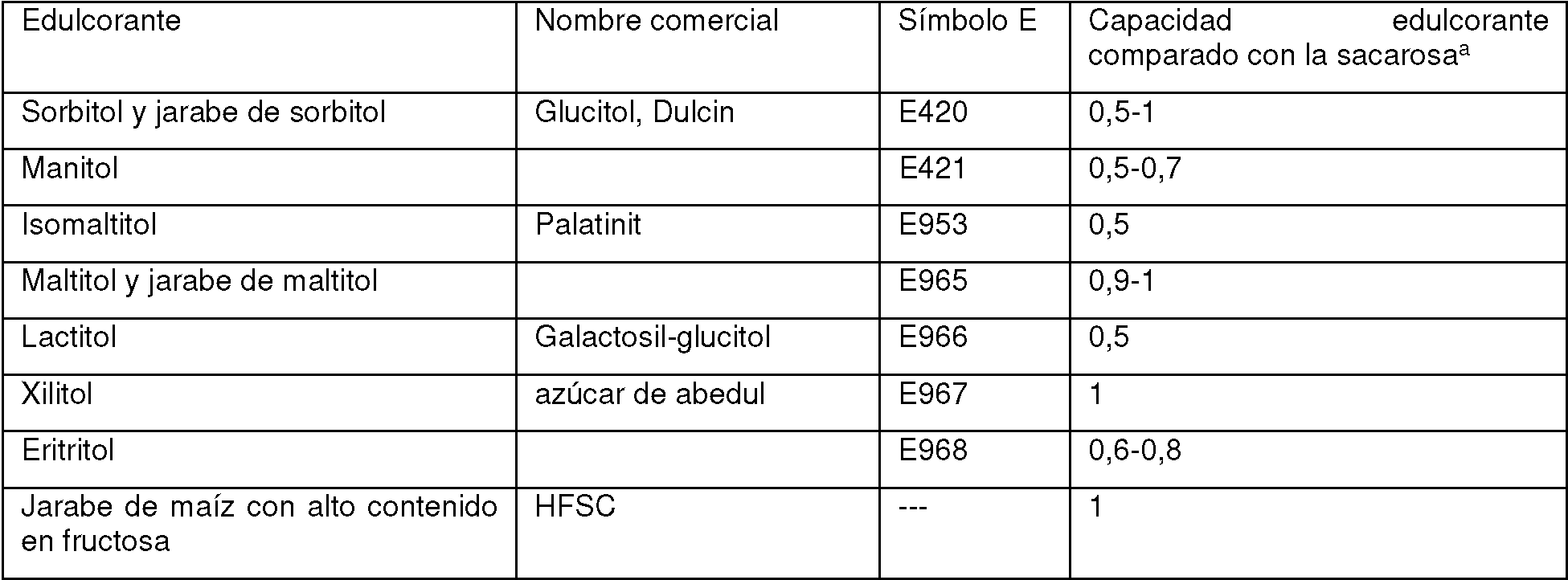
a La capacidad edulcorante relativa puede diferir según el tipo de bebida o alimento (Náhradní sladidla, Copíková J., Moravcová J., Wimmer Z., Chem. Listy 107, 867-874 (2013))a The relative sweetening capacity may differ depending on the type of beverage or food (Náhradní sladidla, Copíková J., Moravcová J., Wimmer Z., Chem. Listy 107, 867-874 (2013))
Propiedades características de los edulcorantesCharacteristic properties of sweeteners

a El sirope de agave después de la hidrólisis de azúcares más complejos en el jugo de agave (Agave tequilana, A. salmiana, piña) contiene principalmente de 56 a 92% de D-fructosa y 8-20% de D-glucosa. b El sirope de sorgo contiene normalmente 46% de sacarosa, 16% de D-glucosa y 13% de D-fructosa, pero también un 3% de grasa, 10% de proteínas y 2,5% de minerales. c HSH es hidrolizado de almidón hidrogenado con alto contenido de sorbitol y maltitol. d El jarabe de arce de la savia de arce contiene principalmente sacarosa. e El azúcar de coco de la savia de coco contiene principalmente sacarosa con adición de D-fructosa y D-glucosa. f El sirope de arroz integral es un producto fermentado y concentrado de arroz hervido que contiene 45% de maltosa, 3% de D-glucosa y 52% de maltotriosa. g El jarabe de malta de cebada se produce a partir de cebada germinada (malta) y contiene 65% de maltosa, 30% de sacáridos más complejos y 3% de proteína. h El jarabe dorado es el nombre comercial del producto concentrado después de la hidrólisis de la sacarosa, la llamada miel artificial. i En el caso de los jarabes, la capacidad edulcorante se recalcula respecto a la materia seca. j Con respecto al contenido de una cucharadita rasa (unos 4 g); se aplican unidades comunes utilizadas en la industria alimentaria; la conversión aproximada a unidades del SI es 1 [cal/cuchara] ~ 1 [J/g].a Agave syrup after hydrolysis of more complex sugars in agave juice (Agave tequilana, A. salmiana, pineapple) mainly contains 56-92% D-fructose and 8-20% D-glucose. b Sorghum syrup normally contains 46% sucrose, 16% D-glucose and 13% D-fructose, but also 3% fat, 10% protein and 2.5% minerals. c MSM is hydrogenated starch hydrolyzate with high sorbitol and maltitol content. d Maple syrup from maple sap contains mainly sucrose. e Coconut sugar from coconut sap contains mainly sucrose with the addition of D-fructose and D-glucose. f Brown rice syrup is a concentrated, fermented product of boiled rice that contains 45% maltose, 3% D-glucose, and 52% maltotriose. g Barley malt syrup is produced from sprouted barley (malt) and contains 65% maltose, 30% more complex saccharides and 3% protein. h Golden syrup is the trade name of the concentrated product after hydrolysis of sucrose, the so-called artificial honey. i In the case of syrups, the sweetening capacity is recalculated with respect to dry matter. j Regarding the content of a level teaspoon (about 4 g); common units used in the food industry apply; the approximate conversion to SI units is 1 [cal/spoon] ~ 1 [J/g].
(Náhradní sladidla, Copíková J., Moravcová J., Wimmer Z., Chem. Listy 107, 867-874 (2013))(Náhradní sladidla, Copíková J., Moravcová J., Wimmer Z., Chem. Listy 107, 867-874 (2013))
Descripción de la invenciónDescription of the invention
Se creó un nuevo edulcorante de origen natural que imita el sabor del azúcar de remolacha o de caña clásico, pero con un valor energético hasta un 90% inferior. Además, el sabor del edulcorante tiene una gran cantidad de matices y sabor afrutado que los consumidores prefieren frente al azúcar de caña clásico. Por tanto, es una opción adecuada frente al azúcar de remolacha o de caña clásico, supera en muchos aspectos los parámetros cualitativos del azúcar, su valor calórico e índice glucémico. Los autores de la invención lograron encontrar una combinación de componentes con proporciones cualitativas y cuantitativas adecuadas donde este nuevo edulcorante hace frente a la calidad del azúcar, pero tiene baja carga glucémica y bajo valor energético. Un tercio de todos los evaluadores prefirieron el edulcorante al azúcar de caña en una prueba sensorial. La capacidad edulcorante del edulcorante tiene una intensidad de 1 a 20 según proporciones entre los componentes. Por lo tanto, tiene un rendimiento edulcorante hasta 20 veces mayor que el azúcar común, que consiste en sacarosa. El valor energético del edulcorante con la misma capacidad edulcorante que el azúcar se reduce en hasta más de 90% cuando el valor energético de 1 g de edulcorante con capacidad edulcorante de 10 es de aproximadamente 13 kJ. Una ración de edulcorante que endulza el alimento o bebida tanto como una cucharada de azúcar con 102 kJ, tiene un valor energético de 8 kJ que equivale al 8% de la energía del azúcar con el mismo rendimiento edulcorante o capacidad edulcorante. Un beneficio importante del edulcorante es su base natural y su sabor afrutado natural. Tanto consumidores como expertos han evaluado en una prueba sensorial el edulcorante y un tercio de los evaluadores lo ha valorado como preferente frente al azúcar de caña. Fueron el sabor afrutado y el gusto agradable lo que se evaluaron positivo. Los resultados muestran que el edulcorante tiene una muy buena posición entre los edulcorantes en general porque tiene un valor energético muy bajo y un sabor muy agradable sin muchos sabores desagradables. A new sweetener of natural origin was created that imitates the taste of classic beet or cane sugar, but with an energy value up to 90% lower. Additionally, the flavor of the sweetener has a lot of nuances and fruitiness that consumers prefer over classic cane sugar. Therefore, it is a suitable option compared to classic beet or cane sugar, it exceeds in many aspects the qualitative parameters of sugar, its caloric value and glycemic index. The inventors managed to find a combination of components with suitable qualitative and quantitative proportions where this new sweetener copes with the quality of sugar, but has low glycemic load and low energy value. One third of all testers preferred the sweetener to cane sugar in a sensory test. The sweetening capacity of the sweetener has an intensity of 1 to 20 depending on the proportions between the components. Therefore, it has a sweetening performance up to 20 times higher than common sugar, which consists of sucrose. The energy value of sweetener with the same sweetening capacity as sugar is reduced by up to more than 90% when the energy value of 1 g of sweetener with sweetening capacity of 10 is approximately 13 kJ. A serving of sweetener that sweetens the food or drink as much as one tablespoon of sugar with 102 kJ, has an energy value of 8 kJ, which is equivalent to 8% of the energy of sugar with the same sweetening yield or sweetening capacity. A major benefit of the sweetener is its natural base and its natural fruity flavor. Both consumers and experts have evaluated the sweetener in a sensory test and a third of the evaluators have valued it as preferable to cane sugar. It was the fruity taste and the pleasant taste that were evaluated positive. The results show that the sweetener has a very good position among sweeteners in general because it has a very low energy value and a very pleasant taste without many off-flavors.
El edulcorante sugerido imita el azúcar en todo su perfil sensorial, sobre todo en su plenitud, regusto y similares. El edulcorante se forma mediante la combinación funcional y sinérgica de al menos tres componentes: mosto, taumatina y glucósido de esteviol que generan el perfil completo de sabor del edulcorante de origen natural con bajo valor energético y alta capacidad edulcorante. Cada uno de los componentes tiene su función única en el edulcorante. Es ventajoso utilizar el edulcorante en una mezcla con otras sustancias de carácter dulce o no dulce, cuando el edulcorante puede completarse con otros edulcorantes o azúcar de remolacha o de caña o su mezcla. El edulcorante también se puede mezclar con componentes no edulcorantes, por ejemplo fibra y se puede diluir adecuadamente y se pueden añadir algunos agentes conservantes y similares.The suggested sweetener mimics sugar throughout its sensory profile, especially its fullness, aftertaste, and the like. The sweetener is formed by the functional and synergistic combination of at least three components: wort, thaumatin and steviol glycoside that generate the full flavor profile of the sweetener of natural origin with low energy value and high sweetening capacity. Each of the components has its unique function in the sweetener. It is advantageous to use the sweetener in a mixture with other sweet or non-sweet substances, when the sweetener can be supplemented with other sweeteners or beet or cane sugar or their mixture. The sweetener can also be mixed with non-sweetener components, for example fiber and can be suitably diluted and some preservatives and the like added.
El rebaudiósido proporciona principalmente la capacidad edulcorante. Su sabor es marcadamente dulce pero carece de otras características sensoriales del azúcar. La taumatina, incluso a muy baja concentración (aproximadamente 0,5 mg/l en una bebida que contiene aproximadamente 18 g de mosto de cebada y 0,290 g de rebaudiósido D), produce un redondeo del sabor dulce del rebaudiósido D a costa de una ligera disminución de la intensidad del sabor dulce y esto no es un defecto. La propia taumatina es casi insípida en esta concentración si se compara con el agua potable. El último componente es el mosto seco. Proporciona la plenitud del edulcorante, proporciona la plenitud del sabor y se aproxima al edulcorante azúcar y aporta también un poco de la dulzura resultante.Rebaudioside primarily provides the sweetening capacity. Its flavor is markedly sweet but lacks other sensory characteristics of sugar. Thaumatin, even at very low concentrations (approximately 0.5 mg/L in a beverage containing approximately 18 g barley wort and 0.290 g rebaudioside D), produces a rounding of the sweet taste of rebaudioside D at the cost of a slight decrease in the intensity of the sweet taste and this is not a defect. Thaumatin itself is almost tasteless at this concentration when compared to drinking water. The last component is the dry must. It provides the fullness of the sweetener, it provides the fullness of the flavor and is close to sugar sweetener and also provides some of the resulting sweetness.
El resultado es el edulcorante con capacidad edulcorante equivalente al azúcar o superior, con un sabor dulce redondo y con plenitud, como el que suele aportar el azúcar en los jarabes.The result is a sweetener with a sweetening capacity equivalent to or higher than sugar, with a round and full sweet flavor, like the one that sugar usually provides in syrups.
El edulcorante básico consiste en una mezcla de mosto, taumatina y rebaudiósido. El mosto habitualmente utilizado es mosto concentrado con 40% en peso de materia seca, como mínimo. Es ventajoso si se usa al menos mosto concentrado al 80% en peso o mosto seco al 98% en peso. Es ventajoso que el mosto sea de cebada, pero también se puede utilizar el mosto de otras plantas. Es ventajoso si el rebaudiósido, por tanto uno de los componentes del extracto de estevia, se usa en forma de rebaudiósido D.The basic sweetener consists of a mixture of wort, thaumatin and rebaudioside. The must usually used is concentrated must with at least 40% by weight of dry matter. It is advantageous if at least 80% by weight concentrated must or 98% by weight dry must is used. It is advantageous if the must is made from barley, but the must of other plants can also be used. It is advantageous if rebaudioside, thus one of the components of the stevia extract, is used in the form of rebaudioside D.
Se descubrió que se produce sinergia entre los componentes del edulcorante mediante el aumento de la capacidad edulcorante lo que permite una mayor disminución de la cantidad de taumatina y, por lo tanto, una disminución de la fijación del sabor dulce y una disminución del decaimiento del sabor dulce.Synergy between the sweetener components was found to occur by increasing sweetening capacity allowing for a further decrease in the amount of thaumatin and therefore a decrease in sweet taste fixation and a decrease in flavor decay. sweet.
El edulcorante contiene al menos tres componentes con una proporción relativa de 95% en peso de mosto, como mínimo, y hasta 99,9% en peso de mosto, 0,01% en peso de rebaudiósido, como mínimo, y hasta 5% en peso de rebaudiósido, y 0,0004% en peso de taumatina, como mínimo, y hasta 0,32% en peso de taumatina.The sweetener contains at least three components with a relative proportion of at least 95% by weight of must, and up to 99.9% by weight of must, 0.01% by weight of rebaudioside, at least, and up to 5% in rebaudioside, and at least 0.0004 wt% thaumatin, and up to 0.32 wt% thaumatin.
Es ventajoso que el edulcorante contenga de 97 a 99% en peso de mosto, de 0,1 a 3% en peso de rebaudiósido y de 0,004 a 0,005% en peso de taumatina. Esto corresponde a la capacidad edulcorante de 1 a 10.It is advantageous if the sweetener contains 97 to 99% by weight of wort, 0.1 to 3% by weight of rebaudioside and 0.004 to 0.005% by weight of thaumatin. This corresponds to the sweetening capacity from 1 to 10.
Es ventajoso si se añade ciclodextrina a la mezcla base de tres componentes para redondear más y homogeneizar el sabor, concretamente en la cantidad de 0,04 a 0,1% en peso, como mínimo. Es ventajoso que la cantidad de ciclodextrina sea 10 veces mayor que la de taumatina.It is advantageous if cyclodextrin is added to the three-component base mix to further round and homogenize the taste, namely in the amount of at least 0.04 to 0.1% by weight. It is advantageous if the amount of cyclodextrin is 10 times that of thaumatin.
Dentro de los límites dados, el índice glucémico del edulcorante depende únicamente del mosto, y casi no cambia en ninguna combinación posible de los componentes y se mantiene en 40-42.Within the given limits, the glycemic index of the sweetener depends solely on the wort, and almost does not change in any possible combination of the components and remains at 40-42.
Se crearon modificaciones del edulcorante con la proporción óptima de componentes con diversas intensidades de capacidad edulcorante por peso de edulcorante. Una de las opciones es la capacidad edulcorante por peso de 1, para la situación en la que es necesario endulzar con la misma cantidad de edulcorante que de azúcar para lograr el mismo rendimiento edulcorante, cuando la proporción en peso de los componentes mosto al 80% en peso : taumatina : rebaudiósido D es 99,93 : 0,00084 : 0,0624.Sweetener modifications were created with the optimal ratio of components with various strengths of sweetening capacity per weight of sweetener. One of the options is the sweetening capacity per weight of 1, for the situation in which it is necessary to sweeten with the same amount of sweetener as sugar to achieve the same sweetening yield, when the weight ratio of the components must be 80% by weight: thaumatin: rebaudioside D is 99.93: 0.00084: 0.0624.
En la preparación de un edulcorante con una capacidad edulcorante 3,5 veces mayor en comparación con el azúcar, la proporción en peso de los componentes mosto al 80% en peso : taumatina : rebaudiósido D es 99,23 : 0,0046 : 0,76. En la preparación de un edulcorante con 8,3 veces la capacidad edulcorante en comparación con el azúcar, por lo tanto la capacidad edulcorante es 8,3, la proporción en peso de los componentes mosto al 80% en peso : taumatina : rebaudiósido D es 97,87 : 0,0046 : 2,12. En la preparación de un edulcorante con 8,3 veces la capacidad edulcorante, por lo tanto capacidad edulcorante calculada esperada de 4,7 veces, la proporción en peso de los componentes mosto al 98% en peso: taumatina : rebaudiósido D es esta: 97,47 : 0,0043 : 2,52.In the preparation of a sweetener with a sweetening capacity 3.5 times greater compared to sugar, the weight ratio of the components 80% wort by weight : thaumatin : rebaudioside D is 99.23 : 0.0046 : 0, 76. In the preparation of a sweetener with 8.3 times the sweetening capacity compared to sugar, therefore the sweetening capacity is 8.3, the weight ratio of the components 80% by weight must : thaumatin : rebaudioside D is 97.87: 0.0046: 2.12. In the preparation of a sweetener with 8.3 times the sweetening capacity, therefore calculated expected sweetening capacity of 4.7 times, the weight ratio of the components must 98% by weight: thaumatin : rebaudioside D is this: 97 .47 : 0.0043 : 2.52.
Es ventajoso preparar una mezcla de 10,6 g de mosto al 80% en peso, 0,0005 g de taumatina y 0,23 g de rebaudiósido D. Esto significa que la proporción en peso en materia seca es de 8,48 g de mosto al 100% en peso, de 0,0005 g de taumatina y de 0,23 g de rebaudiósido D.It is advantageous to prepare a mixture of 10.6 g of 80% by weight must, 0.0005 g of thaumatin and 0.23 g of rebaudioside D. This means that the dry matter weight ratio is 8.48 g of must at 100% by weight, 0.0005 g of thaumatin and 0.23 g of rebaudioside D.
Una prueba sensorial de dilución del edulcorante encontró que la capacidad edulcorante real del edulcorante es aproximadamente dos veces mayor que la capacidad edulcorante calculada esperada del edulcorante que se ha determinado como la suma de las capacidades edulcorantes de los componentes según sus dosis. Diez evaluadores sensoriales expertos han evaluado la prueba, han evaluado la capacidad edulcorante de una solución de azúcar y la capacidad edulcorante de una solución del edulcorante. Se compararon concentraciones de 20 g/l de azúcar y 4 g/l de edulcorante. En el modelo, la solución de edulcorante se diluyó en tres concentraciones para compararla con la solución de azúcar. La concentración de las soluciones de edulcorantes frente a las soluciones de azúcar fue en dilución 3x en una relación 1:15, en dilución 2x en una relación 1:10 y en dilución 1,5x en una relación 1:7,5. En la dilución a una concentración de edulcorante 10 veces menor en comparación con el azúcar, la capacidad edulcorante de ambas soluciones se evaluó como igual en el 20% de los casos y en la dilución a una concentración de edulcorante 7,5 veces menor en comparación con el azúcar, la capacidad edulcorante se evaluó como igual en el 40% de los casos. Los detalles se dan en la siguiente tabla:A sweetener dilution sensory test found that the actual sweetening capacity of the sweetener is approximately two times greater than the calculated expected sweetening capacity of the sweetener which has been determined as the sum of the sweetening capacities of the components according to their doses. Ten expert sensory evaluators have evaluated the test, they have evaluated the sweetening capacity of a sugar solution and the sweetening capacity of a sweetener solution. Concentrations of 20 g/l of sugar and 4 g/l of sweetener were compared. In the model, the sweetener solution was diluted in three concentrations to compare it with the sugar solution. The concentration of sweetener solutions versus sugar solutions was 3x dilution at a 1:15 ratio, 2x dilution at a 1:10 ratio, and 1.5x dilution at a 1:7.5 ratio. In the dilution to a 10 times lower sweetener concentration compared to sugar, the sweetening capacity of both solutions was evaluated as equal in 20% of the cases and in the dilution to a 7.5 times lower sweetener concentration compared with sugar, the sweetening capacity was evaluated as equal in 40% of the cases. Details are given in the following table:

Este análisis muestra que se produce sinergia entre los componentes presentes en el edulcorante formado y que aumenta la capacidad edulcorante esperada. Así la solución con concentración de 2 g/l parecía ser igual a la solución de azúcar con concentración de 20 g/l en el 20% los casos y la mayor capacidad edulcorante del edulcorante frente al azúcar estaba en una relación 3:5. La solución de edulcorante con concentración de 2,7 g/l parecía ser igual a la solución de azúcar con concentración de 20 g/l en el 40% de los casos y la mayor capacidad edulcorante del edulcorante frente al azúcar estaba en una relación 4:2. Así se pasó al límite detectable de estas finas diferencias en la capacidad edulcorante. El valor del promedio ponderado de la capacidad edulcorante determinada del edulcorante de estos dos resultados asciende a 8,33 con la capacidad edulcorante calculada de 4,7, y esto muestra que la capacidad edulcorante real es incluso 1,77 veces mayor.This analysis shows that synergy occurs between the components present in the sweetener formed and that the expected sweetening capacity increases. Thus, the solution with a concentration of 2 g/l seemed to be equal to the sugar solution with a concentration of 20 g/l in 20% of the cases and the greater sweetening capacity of the sweetener compared to sugar was in a 3:5 ratio. The sweetener solution with a concentration of 2.7 g/l seemed to be equal to the sugar solution with a concentration of 20 g/l in 40% of the cases and the greater sweetening capacity of the sweetener compared to sugar was in a ratio 4 :2. Thus, the detectable limit of these fine differences in sweetening capacity was reached. The weighted average value of the determined sweetening capacity of the sweetener from these two results amounts to 8.33 with the calculated sweetening capacity of 4.7, and this shows that the actual sweetening capacity is even 1.77 times higher.
Para una capacidad edulcorante de 10 en una relación de los componentes dada en peso de mosto en forma seca: glucósido de esteviol : taumatina 97,47: 2,5: 0,043, el edulcorante tiene un valor energético 10 veces menor que el azúcar, pero una proporción relativamente alta de mosto proporciona un perfil de sabor completo del edulcorante. Los resultados detallados se presentan en la Fig. 7.For a sweetening capacity of 10 in a ratio of the components given by weight of must in dry form: steviol glycoside: thaumatin 97.47: 2.5: 0.043, the sweetener has an energy value 10 times less than sugar, but a relatively high proportion of wort provides a full flavor profile of the sweetener. The detailed results are presented in Fig. 7.
Además, se analizó el perfil sensorial del edulcorante y se comparó nuevamente con el azúcar de caña. Se encontró que el edulcorante ha reemplazado relativamente bien al azúcar en lo que respecta a la plenitud del sabor. Además, contiene matices ácidos que mejoran el atractivo del edulcorante. El sabor amargo desagradable que aparece con frecuencia en los edulcorantes sustitutos, no es muy evidentes en el edulcorante y no es necesario enmascararlo con otros aditivos habituales. La intensidad del sabor dulce se ha evaluado como muy similar, la intensidad del regusto disminuyó posteriormente mediante la disminución de la cantidad de taumatina.In addition, the sensory profile of the sweetener was analyzed and again compared with cane sugar. Sweetener was found to have replaced sugar relatively well in terms of fullness of flavor. In addition, it contains acid undertones that enhance the sweetener's appeal. The unpleasant bitter taste that often occurs in substitute sweeteners is not very apparent in the sweetener and does not need to be masked by other common additives. The intensity of the sweet taste has been evaluated as very similar, the intensity of the aftertaste was subsequently decreased by decreasing the amount of thaumatin.
Además, se determinó la relación entre la cantidad de mosto y la cantidad de rebaudiósido para valores de capacidad edulcorante de 0,3 a 0,5 del mosto y de 200 a 300 del rebaudiósido. Se encontró que la capacidad edulcorante aumenta linealmente con la disminución de la relación en peso del mosto y el aumento del rebaudiósido de 100 a 97 partes de mosto y 0,06 a 2,5 partes de rebaudiósido. La parte pendiente es la taumatina.In addition, the relationship between the amount of must and the amount of rebaudioside was determined for sweetening capacity values of 0.3 to 0.5 for the must and 200 to 300 for the rebaudioside. The sweetening capacity was found to increase linearly with decreasing wort weight ratio and increasing rebaudioside from 100 to 97 parts wort and 0.06 to 2.5 parts rebaudioside. The pending part is thaumatin.
El edulcorante se prepara mediante una mezcla perfecta de sus componentes, y el mosto se usa ligeramente concentrado donde se espesa hasta una solución fuertemente viscosa después de que se añaden y disuelven el rebaudiósido y la taumatina, o la solución formada se seca hasta polvo o se usa mosto seco donde todos los componentes están sueltos y solo se mezclan. De esta manera, las mezclas formadas se pueden hacer instantáneas, lo que aumenta su solubilidad en medio acuoso y su volumen aumenta aproximadamente al doble, la densidad del polvo disminuye respectivamente.The sweetener is prepared by a thorough mixing of its components, and the wort is used slightly concentrated where it thickens to a highly viscous solution after rebaudioside and thaumatin are added and dissolved, or the solution formed is dried to a powder or use dry wort where all the components are loose and just mixed together. In this way, the formed mixtures can be made instantaneous, which increases their solubility in aqueous medium and their volume increases approximately twice, the density of the powder decreases respectively.
Resumen de Ios dibujos presentadosSummary of the drawings presented
Figura 1: Descripción general de la composición cuantitativa de edulcorantes preparados con capacidad edulcorante variableFigure 1: Overview of the quantitative composition of prepared sweeteners with variable sweetening capacity
Figura 1A: Descripción general de la composición cuantitativa del edulcorante preparado 1Figure 1A: General description of the quantitative composition of the prepared sweetener 1
Figura 1B: Descripción general de la composición cuantitativa del edulcorante preparado 2Figure 1B: General description of the quantitative composition of the sweetener prepared 2
Figura 1C: Descripción general de la composición cuantitativa del edulcorante preparado 3Figure 1C: General description of the quantitative composition of the sweetener prepared 3
Figura 1D: Descripción general de la composición cuantitativa del edulcorante preparado 4Figure 1D: General description of the quantitative composition of the sweetener prepared 4
Figura 1E: Descripción general de la composición cuantitativa del edulcorante preparado 5 Figure 1E: General description of the quantitative composition of the sweetener prepared 5
Figura 1F: Descripción general de la composición cuantitativa del edulcorante preparado 6 Figura 1G: Descripción general de la composición cuantitativa del edulcorante preparado 7Figure 1F: General description of the quantitative composition of the prepared sweetener 6 Figure 1G: General description of the quantitative composition of the prepared sweetener 7
Figura 1H: Descripción general de la composición cuantitativa del edulcorante preparado 8Figure 1H: General description of the quantitative composition of the sweetener prepared 8
Figura 1I: Descripción general de la composición cuantitativa del edulcorante preparado 9Figure 1I: General description of the quantitative composition of the sweetener prepared 9
Figura 2: Resultados de la prueba de preferencia de la solución de edulcorante y solución de azúcar de caña por paresFigure 2: Results of the preference test of the sweetener solution and cane sugar solution in pairs
Figura 3: Resultados de la prueba de dilución para determinar la capacidad edulcorante del edulcorante Figura 4: Resultados para determinar el perfil sensorial del edulcorante en comparación con el azúcar Figura 5: Gráfico de perfiles sensoriales de edulcorante y azúcarFigure 3: Results of the dilution test to determine the sweetening capacity of the sweetener Figure 4: Results to determine the sensory profile of the sweetener in comparison with sugar Figure 5: Graph of sensory profiles of sweetener and sugar
Figura 6: Datos detallados para determinar la capacidad edulcorante del edulcoranteFigure 6: Detailed data to determine the sweetening capacity of the sweetener
Figura 7: Proporciones de componentes de los edulcorantes preparados y sus valores energéticos en comparación con el azúcar para la misma capacidad edulcoranteFigure 7: Component proportions of prepared sweeteners and their energy values compared to sugar for the same sweetening capacity
Figura 8: Gráfico de proporciones de componentes de los edulcorantes preparados y su efecto sobre la capacidad edulcoranteFigure 8: Graph of component proportions of prepared sweeteners and their effect on sweetening capacity
Figura 9: Gráfico del efecto de la relación de mosto y rebaudiósido D sobre la capacidad edulcorante Ejemplos de ejecución de la invención Figure 9: Graph of the effect of the ratio of must and rebaudioside D on the sweetening capacity Examples of execution of the invention
Ejemplo 1 Preparación de mosto al 42% en pesoExample 1 Preparation of must at 42% by weight
Se preparó mosto al 12% en peso de 16 kg de malta y 100 litros de agua.12% by weight wort was prepared from 16 kg of malt and 100 liters of water.
El mosto de cebada se molió en una máquina trituradora, se vertió en un recipiente de ebullición con agua calentada a 36°C. El agua con lechada de la molienda se calentó con agua caliente a 51°C. Después de la elaboración, 1/3 se transfirió a un tanque de filtrado calentado y el residuo se siguió machacando. Después de la sacarificación, el machacado comenzó a hervir y se transfirió por etapas al tanque de filtrado a 78°C. Luego, los componentes sólidos de la malta extraída (granos extraídos) en el mosto obtenido se separaron por filtración del mosto claro. Los granos extraídos se humedecieron con agua caliente y esta parte se mezcló nuevamente con mosto. El procedimiento se repitió dos veces, los extractos de mosto obtenidos se mezclaron. El 12% en peso del mosto obtenido se evaporó ligeramente en un dispositivo de evaporación al vacío hasta una concentración de 42% en peso.The barley wort was ground in a grinding machine, poured into a boiling pot with water heated to 36°C. The slurry water from the milling was heated with hot water at 51°C. After work-up, 1/3 was transferred to a heated lauter tank and the residue was further pounded. After saccharification, the mash came to a boil and was transferred in stages to the percolating tank at 78°C. Then, the solid components of the extracted malt (extracted grains) in the obtained wort were separated by filtration from the clear wort. The extracted grains were moistened with hot water and this part was mixed again with the must. The procedure was repeated twice, the obtained must extracts were mixed. 12% by weight of the obtained must was slightly evaporated in a vacuum evaporation device to a concentration of 42% by weight.
Ejemplo 2a Edulcorante seco - tablaExample 2a Dry sweetener - table
230 g de rebaudiósido D y 50 g de taumatina al 1% en peso dispersada en fibra se disolvieron en 20,2 kg de solución de mosto al 42% en peso. Una vez disueltos los componentes, la solución obtenida se secó en una máquina de secado por atomización a una temperatura de aproximadamente 170°C y el mosto del secado instantáneo se enfría a la salida a una temperatura de aproximadamente 100°C. Después de secar, la mezcla obtenida se instantaneiza en una cámara de aglomeración donde la mezcla obtenida se humedeció con vapor o aire con una humedad relativa de 60% en peso a una temperatura de 55°C hasta 98% en peso de materia seca.230 g of rebaudioside D and 50 g of 1% by weight thaumatin dispersed in fiber were dissolved in 20.2 kg of 42% by weight wort solution. After the components have been dissolved, the obtained solution is dried in a spray-drying machine at a temperature of about 170°C and the flash-dry wort is cooled at the outlet to a temperature of about 100°C. After drying, the obtained mixture is instantized in an agglomeration chamber where the obtained mixture was humidified with steam or air with a relative humidity of 60% by weight at a temperature of 55°C to 98% by weight of dry matter.
Ejemplo 2b Edulcorante líquidoExample 2b Liquid sweetener
230 g de rebaudiósido D y 50 g de taumatina al 1% en peso dispersada en fibra se disolvieron en 20,2 kg de solución de mosto al 42% en peso. Una vez disueltos los componentes, la solución obtenida se concentró en un dispositivo de evaporación al vacío hasta 80% en peso de materia seca.230 g of rebaudioside D and 50 g of 1% by weight thaumatin dispersed in fiber were dissolved in 20.2 kg of 42% by weight wort solution. Once the components were dissolved, the solution obtained was concentrated in a vacuum evaporation device to 80% by weight of dry matter.
Ejemplo 3 - 1. Edulcorante - líquido, capacidad edulcorante 8,3Example 3 - 1. Sweetener - liquid, sweetening capacity 8.3
Se mezclaron 20,2 g de solución al 42% en peso de mosto concentrado con 2,123 g de rebaudiósido D y 0,0046 g de taumatina, la mezcla se homogeneizó durante 2 horas. Se preparó un edulcorante con una capacidad edulcorante calculada de 4,7 y una capacidad edulcorante determinada sensorialmente de 8,3.20.2 g of 42% by weight solution of concentrated wort were mixed with 2.123 g of rebaudioside D and 0.0046 g of thaumatin, the mixture was homogenized for 2 hours. A sweetener with a calculated sweetener power of 4.7 and a sensory determined sweetener power of 8.3 was prepared.
Ejemplo 4 - 2. Edulcorante - seco, capacidad edulcorante 10Example 4 - 2. Sweetener - dry, sweetening capacity 10
Se mezclaron 11,2 g de mosto seco al 98% en peso con 0,289 g de rebaudiósido D y 0,0005 g de taumatina. El edulcorante preparado tenía una capacidad edulcorante calculada de 5,5 y una capacidad edulcorante determinada sensorialmente de 10. 11.2 g of 98% by weight dry must were mixed with 0.289 g of rebaudioside D and 0.0005 g of thaumatin. The sweetener prepared had a calculated sweetener power of 5.5 and a sensory determined sweetener power of 10.
Ejemplo 5 - 3. Edulcorante - líquido, capacidad edulcorante 8,3, sabor redondoExample 5 - 3. Sweetener - liquid, sweetening capacity 8.3, round flavor
Se mezclaron 15,03 g de solución de mosto concentrado al 42% en peso con 0,169 g de rebaudiósido D y 0,00036 g de taumatina, la mezcla se homogeneizó durante 2 horas. A continuación, la mezcla homogeneizada se concentró en un dispositivo de evaporación al vacío hasta una solución con 80% en peso de mosto. Se preparó un edulcorante con una capacidad edulcorante calculada de 4,7 y una capacidad edulcorante determinada sensorialmente de 8,3. El edulcorante se usó para pruebas sensoriales en las que se encontró que se producía un mayor redondeo y equilibrio del sabor en comparación con el tercer edulcorante del Ejemplo 5.15.03 g of 42% by weight concentrated wort solution were mixed with 0.169 g of rebaudioside D and 0.00036 g of thaumatin, the mixture was homogenized for 2 hours. The homogenized mixture was then concentrated in a vacuum evaporator to a solution containing 80% by weight of wort. A sweetener with a calculated sweetener power of 4.7 and a sensory determined sweetener power of 8.3 was prepared. The sweetener was used for sensory testing in which it was found to produce greater rounding and balance of flavor compared to the third sweetener of Example 5.
Ejemplo 5.1 - 3.1. Edulcorante - líquido, capacidad edulcorante 8,3Example 5.1 - 3.1. Sweetener - liquid, sweetener capacity 8.3
Se mezclaron 15,03 g de solución de mosto concentrado al 42% en peso con 0,169 g de rebaudiósido D, 0,00036 g de taumatina y 0,0036 g de ciclodextrina, la mezcla se homogeneizó durante 2 horas. A continuación, la mezcla homogeneizada se concentró en un dispositivo de evaporación al vacío hasta una solución con 80% en peso de mosto. Se preparó un edulcorante con una capacidad edulcorante calculada de 4,7 y una capacidad edulcorante determinada sensorialmente de 8,3. Este edulcorante se utilizó para pruebas sensoriales.15.03 g of 42% by weight concentrated wort solution were mixed with 0.169 g of rebaudioside D, 0.00036 g of thaumatin and 0.0036 g of cyclodextrin, and the mixture was homogenized for 2 hours. The homogenized mixture was then concentrated in a vacuum evaporator to a solution containing 80% by weight of wort. A sweetener with a calculated sweetener power of 4.7 and a sensory determined sweetener power of 8.3 was prepared. This sweetener was used for sensory tests.
Ejemplo 6 - 4. Edulcorante - líquido, capacidad edulcorante 1,3Example 6 - 4. Sweetener - liquid, sweetening capacity 1.3
Se mezclaron 122 g de solución de mosto concentrado al 42% en peso con 0,08 g de rebaudiósido D y 0,0033 g de taumatina, la mezcla se homogeneizó durante 20 minutos. A continuación, la mezcla homogeneizada se concentró en un dispositivo de evaporación al vacío hasta una solución con 80% en peso de mosto. Se preparó un edulcorante con una capacidad edulcorante calculada de 0,74 y una capacidad edulcorante determinada sensorialmente de 1,3. Ejemplo 7 - 5. Edulcorante - seco, capacidad edulcorante 3,5122 g of 42% by weight concentrated wort solution were mixed with 0.08 g of rebaudioside D and 0.0033 g of thaumatin, the mixture was homogenized for 20 minutes. The homogenized mixture was then concentrated in a vacuum evaporator to a solution containing 80% by weight of wort. A sweetener with a calculated sweetness capacity of 0.74 and a sensory determined sweetness capacity of 1.3 was prepared. Example 7 - 5. Sweetener - dry, sweetening capacity 3.5
Se mezclaron 34,4 g de mosto seco al 98% en peso con 0,262 g de rebaudiósido D y 0,00158 g de taumatina. El edulcorante preparado tenía una capacidad edulcorante calculada de 2 y una capacidad edulcorante determinada sensorialmente de 3,6.34.4 g of 98% by weight dry must were mixed with 0.262 g of rebaudioside D and 0.00158 g of thaumatin. The sweetener prepared had a calculated sweetness capacity of 2 and a sensory determined sweetness capacity of 3.6.
Ejemplo 8 - 6. Edulcorante - líquido, capacidad edulcorante 8Example 8 - 6. Sweetener - liquid, sweetening capacity 8
Se mezclaron 14,9 g de solución de mosto concentrado al 42% en peso con 0,17 g de rebaudiósido D y 0,000036 g de taumatina, la mezcla se homogeneizó durante 1 hora. A continuación, la mezcla homogeneizada se concentró en un dispositivo de evaporación al vacío hasta una solución con 80% en peso de mosto. Se preparó un edulcorante con una capacidad edulcorante calculada de 4,6 y una capacidad edulcorante determinada sensorialmente de 8,1.14.9 g of 42% by weight concentrated wort solution were mixed with 0.17 g of rebaudioside D and 0.000036 g of thaumatin, the mixture was homogenized for 1 hour. The homogenized mixture was then concentrated in a vacuum evaporator to a solution containing 80% by weight of wort. A sweetener with a calculated sweetener power of 4.6 and a sensory determined sweetener power of 8.1 was prepared.
Ejemplo 9 - 7. Edulcorante - líquido, capacidad edulcorante 0,85Example 9 - 7. Sweetener - liquid, sweetening capacity 0.85
Se mezclaron 122 g de solución de mosto concentrado al 42% en peso con 0,04 g de rebaudiósido D y 0,00054 g de taumatina, la mezcla se homogeneizó durante 20 minutos. A continuación, la mezcla homogeneizada se llevó a un dispositivo de evaporación al vacío hasta una solución con 80% en peso de mosto. Se preparó un edulcorante con una capacidad edulcorante calculada de 0,48 y una capacidad edulcorante determinada sensorialmente de 0,85. Ejemplo 10 - 8. Edulcorante - líquido, capacidad edulcorante 17,7122 g of 42% by weight concentrated wort solution were mixed with 0.04 g of rebaudioside D and 0.00054 g of thaumatin, the mixture was homogenized for 20 minutes. Next, the homogenized mixture was taken to a vacuum evaporation device until it was a solution with 80% by weight of must. A sweetener with a calculated sweetness capacity of 0.48 and a sensory determined sweetness capacity of 0.85 was prepared. Example 10 - 8. Sweetener - liquid, sweetening capacity 17.7
Se mezclaron 0,9 g de mosto seco al 98% en peso con 0,045 g de rebaudiósido D y 0,000041 g de taumatina. El edulcorante preparado tenía una capacidad edulcorante calculada de 10 y una capacidad edulcorante determinada sensorialmente de 17,7.0.9 g of 98% by weight dry must were mixed with 0.045 g of rebaudioside D and 0.000041 g of thaumatin. The sweetener prepared had a calculated sweetness capacity of 10 and a sensory determined sweetness capacity of 17.7.
Ejemplo 11 - 9. Edulcorante - líquido, capacidad edulcorante 5Example 11 - 9. Sweetener - liquid, sweetening capacity 5
Se mezclaron 15,03 g de solución de mosto concentrado al 42% en peso con 0,169 g de rebaudiósido D y 0,00036 g de taumatina, la mezcla se homogeneizó durante 2 horas. Se preparó un edulcorante con una capacidad edulcorante calculada de 2,4 y una capacidad edulcorante determinada sensorialmente de 5,1.15.03 g of 42% by weight concentrated wort solution were mixed with 0.169 g of rebaudioside D and 0.00036 g of thaumatin, the mixture was homogenized for 2 hours. A sweetener with a calculated sweetener power of 2.4 and a sensory determined sweetener power of 5.1 was prepared.
Ejemplo 12 - Evaluación sensorialExample 12 - Sensory evaluation
Las muestras se evaluaron en el laboratorio sensorial ligado a VSCHT Praha (Universidad de Química y Tecnología de Praga) con 12 salas que están equipadas de acuerdo con la norma internacional pertinente ISO 8589. El enfoque en todos los análisis sensoriales estuvo en línea con las normas internacionales ISO. Los evaluadores se seleccionaron, entrenaron y controlaron de acuerdo con la norma internacional ISO 8586 y la norma CSN ISO 5496 Análisis sensorial - Metodología - Iniciación en problemas y entrenamiento de evaluadores en la detección y distinción de olores.The samples were evaluated in the sensory laboratory linked to VSCHT Praha (Prague University of Chemistry and Technology) with 12 rooms that are equipped in accordance with the relevant international standard ISO 8589. The approach in all sensory analyzes was in line with the standards international ISO. The evaluators were selected, trained and controlled in accordance with the international norm ISO 8586 and the CSN ISO 5496 norm Sensory analysis - Methodology - Initiation in problems and training of evaluators in the detection and distinction of odors.
Ejemplo 13 - Prueba de preferenciaExample 13 - Preference test
Se prepararon soluciones acuosas de edulcorante (8 g/100 ml) y del patrón (2 g/100 ml). Se constituyó un panel sensorial de consumidores, con 41 miembros. Las muestras se evaluaron en recipientes de degustación y estos se marcaron con un código de cuatro dígitos (tomados de tablas de números aleatorios) para fines de evaluación sensorial. A los evaluadores se les dio primero la solución de patrón. Después de la degustación, se les presentó la solución con edulcorante. Los evaluadores deben elegir cuál de las muestras probadas tiene un sabor más agradable para ellos y por qué. El resultado se da en la tabla:Aqueous solutions of sweetener (8 g/100 ml) and standard (2 g/100 ml) were prepared. A consumer sensory panel was constituted, with 41 members. The samples were evaluated in tasting containers and these were marked with a four-digit code (taken from random number tables) for sensory evaluation purposes. The evaluators were first given the standard solution. After the tasting, they were presented with the solution with sweetener. Evaluators must choose which of the tested samples tastes most pleasant to them and why. The result is given in the table:
Evaluación de preferenciasPreference evaluation
Muestra Número de Razones para la preferenciaShow Number of Reasons for preference
preferenciaspreferences
edulcorante 13 Sabor más marcado y más dulce (3x), más dulce (2x), más marcado (5x), más matices en el sabor (1x), sabor afrutado (2x)sweetener 13 Stronger and sweeter flavor (3x), sweeter (2x), stronger (5x), more nuanced flavor (1x), fruity (2x)
patrón 28 Sabor más agradable (7x), sabor más natural (4x), no contiene sabor desagradable (11 x), no contiene sabor amargo desagradable (2x), no contiene sabor subácido desagradable (2x), no contiene sabor metálico desagradable (1x), no tiene regusto de dulce (1x)pattern 28 More pleasant taste (7x), more natural taste (4x), does not contain unpleasant taste (11 x), does not contain unpleasant bitter taste (2x), does not contain unpleasant subacid taste (2x), does not contain unpleasant metallic taste (1x ), has no sweet aftertaste (1x)
Ejemplo 14 - Determinación del perfil sensorialExample 14 - Determination of the sensory profile
Las pruebas se realizaron con un panel sensorial de 10 consumidores.The tests were carried out with a sensory panel of 10 consumers.
Se prepararon soluciones acuosas de edulcorante (x g/100 ml) y de patrón (2 g/100 ml). A los evaluadores primero se les dio la solución del patrón. Después de la degustación, se les presentó la solución con edulcorante. La evaluación se realizó en un método de perfil donde se evaluó la agradabilidad o intensidad de los descriptores usando escalas gráficas no estructuradas de 100 mm de longitud. El resultado se da en la Tabla 2 y en la Figura 1.Aqueous solutions of sweetener (x g/100 ml) and standard (2 g/100 ml) were prepared. Testers were first given the pattern solution. After the tasting, they were presented with the solution with sweetener. The evaluation was carried out in a profile method where the pleasantness or intensity of the descriptors was evaluated using unstructured graphic scales of 100 mm length. The result is given in Table 2 and Figure 1.
Los descriptores de evaluación fueron los siguientes:The evaluation descriptors were the following:
Agradabilidad del sabor dulce (0 desagradable - 100 muy agradable)Sweet taste pleasantness (0 unpleasant - 100 very pleasant)
Intensidad del sabor dulce (0 imperceptible - 100 muy fuerte)Sweet taste intensity (0 imperceptible - 100 very strong)
Intensidad del sabor ácido (0 imperceptible - 100 muy fuerte)Acid taste intensity (0 imperceptible - 100 very strong)
Intensidad del sabor amargo (0 imperceptible - 100 muy fuerte)Intensity of bitter taste (0 imperceptible - 100 very strong)
Intensidad del sabor metálico (0 imperceptible - 100 muy fuerte)Metallic taste intensity (0 imperceptible - 100 very strong)
Intensidad del sabor desagradable (0 imperceptible - 100 muy fuerte)Intensity of unpleasant taste (0 imperceptible - 100 very strong)
Agradabilidad del regusto (0 desagradable - 100 muy agradable)Pleasantness of the aftertaste (0 unpleasant - 100 very pleasant)
Intensidad del regusto (0 imperceptible - 100 muy fuerte)Aftertaste intensity (0 imperceptible - 100 very strong)

Ejemplo 15 - Prueba de dilución, para determinar la capacidad edulcoranteExample 15 - Dilution test, to determine the sweetening capacity
Se prepararon la solución acuosa básica del edulcorante (8 g/2 l) y del patrón (2 g/100 ml). La solución básica del edulcorante posteriormente se diluyó con agua en una relación solución básica : agua 2:1 (v/v), además 1:1 (v/v) y 1:2 (v/v). Las muestras se prepararon en recipientes de degustación codificados. La comparación de sabores se realizó mediante una prueba por pares. Se comparó el sabor dulce. A los evaluadores se les dio primero la solución del patrón. Después de la degustación, se les presentó la solución con edulcorante. El resultado se da en la siguiente tabla. The basic aqueous solution of the sweetener (8 g/2 l) and the standard (2 g/100 ml) were prepared. The basic solution of the sweetener was subsequently diluted with water in a basic solution: water ratio 2:1 (v/v), also 1:1 (v/v) and 1:2 (v/v). Samples were prepared in coded tasting containers. The comparison of flavors was carried out by means of a paired test. The sweet taste was compared. Testers were first given the standard solution. After the tasting, they were presented with the solution with sweetener. The result is given in the following table.
ado como 
Aplicabilidad en la IndustriaIndustry Applicability
El edulcorante se puede utilizar en la industria alimentaria para el endulzado o endulzado final de alimentos y bebidas o como edulcorante de mesa. The sweetener can be used in the food industry for the sweetening or final sweetening of foods and beverages or as a tabletop sweetener.
Claims (15)
Applications Claiming Priority (2)
| Application Number | Priority Date | Filing Date | Title |
|---|---|---|---|
| CZ2018-709A CZ2018709A3 (en) | 2018-12-17 | 2018-12-17 | Sweetener of natural origin imitating sugar-like taste with fruity tones with up to 20 times sweetness compared to sugar |
| PCT/IB2019/060471 WO2020128704A1 (en) | 2018-12-17 | 2019-12-05 | Sweetener of natural origin with gustatory profile that imitates sugar with fruity flavours with up to 20times sweetening capacity as compared with sugar |
Publications (1)
| Publication Number | Publication Date |
|---|---|
| ES2940065T3 true ES2940065T3 (en) | 2023-05-03 |
Family
ID=69143620
Family Applications (1)
| Application Number | Title | Priority Date | Filing Date |
|---|---|---|---|
| ES19832729T Active ES2940065T3 (en) | 2018-12-17 | 2019-12-05 | Sweetener of natural origin with a taste profile that mimics sugar with fruity flavors with a sweetening capacity of up to 20 times compared to sugar |
Country Status (11)
| Country | Link |
|---|---|
| US (1) | US20220142215A1 (en) |
| EP (1) | EP3897192B1 (en) |
| CZ (1) | CZ2018709A3 (en) |
| DK (1) | DK3897192T3 (en) |
| ES (1) | ES2940065T3 (en) |
| FI (1) | FI3897192T3 (en) |
| HR (1) | HRP20230386T1 (en) |
| HU (1) | HUE061536T2 (en) |
| PL (1) | PL3897192T3 (en) |
| PT (1) | PT3897192T (en) |
| WO (1) | WO2020128704A1 (en) |
Families Citing this family (1)
| Publication number | Priority date | Publication date | Assignee | Title |
|---|---|---|---|---|
| US20240349768A1 (en) * | 2021-08-20 | 2024-10-24 | Nomad Bioscience Gmbh | Sweetener blend comprising thaumatin and one or more rebaudioside |
Family Cites Families (15)
| Publication number | Priority date | Publication date | Assignee | Title |
|---|---|---|---|---|
| US5415885A (en) * | 1994-03-25 | 1995-05-16 | The Sweetenbetter Company | Product and process of making a nutritious malt containing soft drink |
| DE102005035888A1 (en) * | 2005-07-30 | 2007-02-01 | Maltagen Forschung Gmbh | New transgenic cereal plants that express the sweetener thaumatin, also related nucleic acid, protein, vectors and malted or milled products for use in foods |
| KR101374346B1 (en) * | 2005-11-23 | 2014-03-14 | 더 코카콜라 컴파니 | Natural high-potency sweetener compositions with improved temporal profile and/or flavor profile, methods for their formulation, and uses |
| CN101854814B (en) * | 2007-11-12 | 2013-07-31 | 三荣源有限公司 | Method for Improving the Sweetness of Stevia Extract |
| CA2710629C (en) * | 2007-12-27 | 2016-06-21 | Mcneil Nutritionals, Llc | Synergistic sweetening compositions |
| SG178376A1 (en) | 2009-09-04 | 2012-03-29 | Redpoint Bio Corp | Sweetness enhancers including rebaudioside a or d |
| US8524785B2 (en) * | 2009-09-04 | 2013-09-03 | International Flavors And Fragrances Inc. | Methods for using rebaudioside C as a flavor enhancer |
| CA2821116C (en) * | 2010-12-13 | 2021-01-19 | Ting Liu Carlson | Glycoside blends |
| MX341180B (en) * | 2011-01-28 | 2016-08-09 | Tate & Lyle Ingredients Americas Llc | Stevia blends containing rebaudioside b. |
| EP3915394A1 (en) * | 2011-06-20 | 2021-12-01 | PureCircle USA Inc. | Stevia composition |
| WO2013133903A1 (en) * | 2012-03-05 | 2013-09-12 | Aerodesigns, Inc. | Particles for aerosolizing apparatus |
| CN105828635B (en) * | 2014-03-07 | 2020-01-14 | 朝日啤酒株式会社 | Unfermented beer-flavored beverage containing indigestible dextrin |
| JP6997084B2 (en) * | 2015-11-24 | 2022-02-03 | フイルメニツヒ ソシエテ アノニム | Glucosylated terpene glycosides |
| JP7082457B2 (en) * | 2016-03-03 | 2022-06-08 | 三栄源エフ・エフ・アイ株式会社 | High-sweetness sweetener taste improving agent and taste improving method |
| US20180116266A1 (en) * | 2016-11-02 | 2018-05-03 | Sweet Green Fields, Llc | Compositions comprising mogrosides, steviol glycosides and glycosylated derivatives thereof and methods of enhancing the mouthfeel or sweetness of consumables |
-
2018
- 2018-12-17 CZ CZ2018-709A patent/CZ2018709A3/en not_active IP Right Cessation
-
2019
- 2019-12-05 EP EP19832729.8A patent/EP3897192B1/en active Active
- 2019-12-05 WO PCT/IB2019/060471 patent/WO2020128704A1/en not_active Ceased
- 2019-12-05 DK DK19832729.8T patent/DK3897192T3/en active
- 2019-12-05 PL PL19832729.8T patent/PL3897192T3/en unknown
- 2019-12-05 FI FIEP19832729.8T patent/FI3897192T3/en active
- 2019-12-05 US US17/415,660 patent/US20220142215A1/en not_active Abandoned
- 2019-12-05 HR HRP20230386TT patent/HRP20230386T1/en unknown
- 2019-12-05 PT PT198327298T patent/PT3897192T/en unknown
- 2019-12-05 ES ES19832729T patent/ES2940065T3/en active Active
- 2019-12-05 HU HUE19832729A patent/HUE061536T2/en unknown
Also Published As
| Publication number | Publication date |
|---|---|
| EP3897192A1 (en) | 2021-10-27 |
| HRP20230386T1 (en) | 2023-06-23 |
| EP3897192B1 (en) | 2023-01-25 |
| CZ308160B6 (en) | 2020-01-29 |
| FI3897192T3 (en) | 2023-04-25 |
| US20220142215A1 (en) | 2022-05-12 |
| PT3897192T (en) | 2023-03-13 |
| HUE061536T2 (en) | 2023-07-28 |
| WO2020128704A1 (en) | 2020-06-25 |
| PL3897192T3 (en) | 2023-05-22 |
| DK3897192T3 (en) | 2023-04-17 |
| CZ2018709A3 (en) | 2020-01-29 |
Similar Documents
| Publication | Publication Date | Title |
|---|---|---|
| RU2640831C2 (en) | Compositions and food products | |
| AU2017200081B2 (en) | Rebaudioside sweetener compositions and food products sweetened with same | |
| CN104602543B (en) | Sweetener compositions comprising rebaudioside B | |
| ES2817049T5 (en) | Stevia extract containing selected steviol glycosides as a taste, flavor and sweetness profile modifier | |
| ES2717011T3 (en) | Sweeteners of rebaudioside D and carbonated cola drink sweetened with rebaudioside D | |
| AU2010331939B2 (en) | Protein recovery beverage | |
| RU2525725C1 (en) | Mixtures of electrolytes, providing less expressed salty taste | |
| ES2435436T3 (en) | Naturally sweetened juice beverage products containing beta-glucan | |
| US20120183648A1 (en) | Sweetener composition | |
| US20130344217A1 (en) | Sweetener Compositions and Methods of Making Same | |
| EP2154996B1 (en) | Natural sweetener composition | |
| CN105307513A (en) | Improved sweetener | |
| TW202002807A (en) | A sweet composition that can also produce a sweet reaction in addition to the sweet receptor (T1R2/T1R3) | |
| CN109259175A (en) | Sweetener and preparation method thereof | |
| CN106072422A (en) | Mogroside sugar substitute suitable for diabetics and preparation method thereof | |
| EP3897192B1 (en) | Sweetener of natural origin with gustatory profile that imitates sugar with fruity flavours with up to 20times sweetening capacity as compared with sugar | |
| CN107536008A (en) | Steviol glycoside compound sweetener | |
| Wani et al. | Sugar substitutes and artificial sweeteners | |
| CN118870986A (en) | Oral composition with enhanced sweetness | |
| ES2687028T3 (en) | Composition comprising steviol and maltose glycoside | |
| CN116669568A (en) | Sweet taste enhancing oral compositions | |
| RU2575042C2 (en) | Sweeteners based on rebaudioside d and food products sweetened with rebaudioside d | |
| Cox | Not so Sweet |