ES2950965T3 - Janus kinase (JAK) family inhibitor, preparation thereof and applications thereof - Google Patents
Janus kinase (JAK) family inhibitor, preparation thereof and applications thereof Download PDFInfo
- Publication number
- ES2950965T3 ES2950965T3 ES20749430T ES20749430T ES2950965T3 ES 2950965 T3 ES2950965 T3 ES 2950965T3 ES 20749430 T ES20749430 T ES 20749430T ES 20749430 T ES20749430 T ES 20749430T ES 2950965 T3 ES2950965 T3 ES 2950965T3
- Authority
- ES
- Spain
- Prior art keywords
- optionally substituted
- alkyl
- amino
- cycloalkyl
- independently selected
- Prior art date
- Legal status (The legal status is an assumption and is not a legal conclusion. Google has not performed a legal analysis and makes no representation as to the accuracy of the status listed.)
- Active
Links
- 238000002360 preparation method Methods 0.000 title claims abstract description 13
- 108010024121 Janus Kinases Proteins 0.000 title claims abstract description 12
- 102000015617 Janus Kinases Human genes 0.000 title claims abstract description 12
- 239000003112 inhibitor Substances 0.000 title description 5
- 150000001875 compounds Chemical class 0.000 claims abstract description 78
- 239000003814 drug Substances 0.000 claims abstract description 17
- 208000037265 diseases, disorders, signs and symptoms Diseases 0.000 claims abstract description 14
- 201000010099 disease Diseases 0.000 claims abstract description 13
- 239000008194 pharmaceutical composition Substances 0.000 claims abstract description 9
- 125000000217 alkyl group Chemical group 0.000 claims description 62
- -1 cyano, amino, sulfhydryl Chemical group 0.000 claims description 55
- 125000006552 (C3-C8) cycloalkyl group Chemical group 0.000 claims description 47
- 229910020008 S(O) Inorganic materials 0.000 claims description 40
- 125000002887 hydroxy group Chemical group [H]O* 0.000 claims description 40
- 229910052736 halogen Inorganic materials 0.000 claims description 35
- 150000002367 halogens Chemical class 0.000 claims description 35
- 125000000623 heterocyclic group Chemical group 0.000 claims description 33
- 125000001424 substituent group Chemical group 0.000 claims description 31
- YZCKVEUIGOORGS-OUBTZVSYSA-N Deuterium Chemical compound [2H] YZCKVEUIGOORGS-OUBTZVSYSA-N 0.000 claims description 26
- 229910052805 deuterium Inorganic materials 0.000 claims description 26
- 125000003545 alkoxy group Chemical group 0.000 claims description 23
- 125000001313 C5-C10 heteroaryl group Chemical group 0.000 claims description 22
- 125000000041 C6-C10 aryl group Chemical group 0.000 claims description 21
- 125000001495 ethyl group Chemical group [H]C([H])([H])C([H])([H])* 0.000 claims description 21
- 125000002496 methyl group Chemical group [H]C([H])([H])* 0.000 claims description 21
- 125000002924 primary amino group Chemical group [H]N([H])* 0.000 claims description 20
- 125000004093 cyano group Chemical group *C#N 0.000 claims description 16
- 206010028980 Neoplasm Diseases 0.000 claims description 14
- 150000003839 salts Chemical class 0.000 claims description 14
- 239000007788 liquid Substances 0.000 claims description 13
- 125000000449 nitro group Chemical group [O-][N+](*)=O 0.000 claims description 12
- 201000011510 cancer Diseases 0.000 claims description 9
- 239000000843 powder Substances 0.000 claims description 9
- 208000023275 Autoimmune disease Diseases 0.000 claims description 7
- 208000011231 Crohn disease Diseases 0.000 claims description 7
- 201000004681 Psoriasis Diseases 0.000 claims description 7
- 125000000753 cycloalkyl group Chemical group 0.000 claims description 7
- 125000001559 cyclopropyl group Chemical group [H]C1([H])C([H])([H])C1([H])* 0.000 claims description 7
- 208000026935 allergic disease Diseases 0.000 claims description 6
- 125000001436 propyl group Chemical group [H]C([*])([H])C([H])([H])C([H])([H])[H] 0.000 claims description 6
- 125000004648 C2-C8 alkenyl group Chemical group 0.000 claims description 5
- 125000004649 C2-C8 alkynyl group Chemical group 0.000 claims description 5
- 229910052801 chlorine Inorganic materials 0.000 claims description 5
- 229910052731 fluorine Inorganic materials 0.000 claims description 5
- 125000002883 imidazolyl group Chemical group 0.000 claims description 5
- 208000032839 leukemia Diseases 0.000 claims description 5
- 125000004108 n-butyl group Chemical group [H]C([H])([H])C([H])([H])C([H])([H])C([H])([H])* 0.000 claims description 5
- 125000002971 oxazolyl group Chemical group 0.000 claims description 5
- 125000001997 phenyl group Chemical group [H]C1=C([H])C([H])=C(*)C([H])=C1[H] 0.000 claims description 5
- 125000003226 pyrazolyl group Chemical group 0.000 claims description 5
- 125000004076 pyridyl group Chemical group 0.000 claims description 5
- 201000000596 systemic lupus erythematosus Diseases 0.000 claims description 5
- 208000000453 Skin Neoplasms Diseases 0.000 claims description 4
- 201000005787 hematologic cancer Diseases 0.000 claims description 4
- 208000024200 hematopoietic and lymphoid system neoplasm Diseases 0.000 claims description 4
- 206010039073 rheumatoid arthritis Diseases 0.000 claims description 4
- 201000000849 skin cancer Diseases 0.000 claims description 4
- 208000017520 skin disease Diseases 0.000 claims description 4
- 125000000335 thiazolyl group Chemical group 0.000 claims description 4
- 230000003612 virological effect Effects 0.000 claims description 4
- 206010009900 Colitis ulcerative Diseases 0.000 claims description 3
- 206010025323 Lymphomas Diseases 0.000 claims description 3
- 206010052779 Transplant rejections Diseases 0.000 claims description 3
- 201000006704 Ulcerative Colitis Diseases 0.000 claims description 3
- 208000004631 alopecia areata Diseases 0.000 claims description 3
- 208000006673 asthma Diseases 0.000 claims description 3
- 208000026278 immune system disease Diseases 0.000 claims description 3
- 201000006417 multiple sclerosis Diseases 0.000 claims description 3
- 208000024827 Alzheimer disease Diseases 0.000 claims description 2
- 208000003950 B-cell lymphoma Diseases 0.000 claims description 2
- 206010006187 Breast cancer Diseases 0.000 claims description 2
- 208000026310 Breast neoplasm Diseases 0.000 claims description 2
- 201000006082 Chickenpox Diseases 0.000 claims description 2
- 206010012438 Dermatitis atopic Diseases 0.000 claims description 2
- 208000002249 Diabetes Complications Diseases 0.000 claims description 2
- 206010012655 Diabetic complications Diseases 0.000 claims description 2
- 208000010201 Exanthema Diseases 0.000 claims description 2
- 208000009329 Graft vs Host Disease Diseases 0.000 claims description 2
- 208000005176 Hepatitis C Diseases 0.000 claims description 2
- 208000007514 Herpes zoster Diseases 0.000 claims description 2
- 208000003456 Juvenile Arthritis Diseases 0.000 claims description 2
- 206010059176 Juvenile idiopathic arthritis Diseases 0.000 claims description 2
- 208000008839 Kidney Neoplasms Diseases 0.000 claims description 2
- 206010058467 Lung neoplasm malignant Diseases 0.000 claims description 2
- 206010061902 Pancreatic neoplasm Diseases 0.000 claims description 2
- 208000008601 Polycythemia Diseases 0.000 claims description 2
- 206010060862 Prostate cancer Diseases 0.000 claims description 2
- 208000000236 Prostatic Neoplasms Diseases 0.000 claims description 2
- 206010038389 Renal cancer Diseases 0.000 claims description 2
- 208000005718 Stomach Neoplasms Diseases 0.000 claims description 2
- 208000031673 T-Cell Cutaneous Lymphoma Diseases 0.000 claims description 2
- 208000005485 Thrombocytosis Diseases 0.000 claims description 2
- 206010046980 Varicella Diseases 0.000 claims description 2
- 241000700605 Viruses Species 0.000 claims description 2
- 201000008937 atopic dermatitis Diseases 0.000 claims description 2
- 208000010928 autoimmune thyroid disease Diseases 0.000 claims description 2
- 239000002775 capsule Substances 0.000 claims description 2
- 201000007241 cutaneous T cell lymphoma Diseases 0.000 claims description 2
- 206010012601 diabetes mellitus Diseases 0.000 claims description 2
- 239000003937 drug carrier Substances 0.000 claims description 2
- 201000005884 exanthem Diseases 0.000 claims description 2
- 206010017758 gastric cancer Diseases 0.000 claims description 2
- 208000005017 glioblastoma Diseases 0.000 claims description 2
- 208000024908 graft versus host disease Diseases 0.000 claims description 2
- 239000008187 granular material Substances 0.000 claims description 2
- 208000002672 hepatitis B Diseases 0.000 claims description 2
- 210000000987 immune system Anatomy 0.000 claims description 2
- 238000002347 injection Methods 0.000 claims description 2
- 239000007924 injection Substances 0.000 claims description 2
- 201000010982 kidney cancer Diseases 0.000 claims description 2
- 201000007270 liver cancer Diseases 0.000 claims description 2
- 208000014018 liver neoplasm Diseases 0.000 claims description 2
- 201000005202 lung cancer Diseases 0.000 claims description 2
- 208000020816 lung neoplasm Diseases 0.000 claims description 2
- 208000015486 malignant pancreatic neoplasm Diseases 0.000 claims description 2
- 230000001404 mediated effect Effects 0.000 claims description 2
- 201000001441 melanoma Diseases 0.000 claims description 2
- 125000000956 methoxy group Chemical group [H]C([H])([H])O* 0.000 claims description 2
- 201000005962 mycosis fungoides Diseases 0.000 claims description 2
- 206010028537 myelofibrosis Diseases 0.000 claims description 2
- 239000002674 ointment Substances 0.000 claims description 2
- 210000000056 organ Anatomy 0.000 claims description 2
- 201000002528 pancreatic cancer Diseases 0.000 claims description 2
- 208000008443 pancreatic carcinoma Diseases 0.000 claims description 2
- 239000006187 pill Substances 0.000 claims description 2
- 208000025638 primary cutaneous T-cell non-Hodgkin lymphoma Diseases 0.000 claims description 2
- 206010037844 rash Diseases 0.000 claims description 2
- 206010039083 rhinitis Diseases 0.000 claims description 2
- 201000011549 stomach cancer Diseases 0.000 claims description 2
- 239000000829 suppository Substances 0.000 claims description 2
- 239000006188 syrup Substances 0.000 claims description 2
- 235000020357 syrup Nutrition 0.000 claims description 2
- 239000003826 tablet Substances 0.000 claims description 2
- 208000013077 thyroid gland carcinoma Diseases 0.000 claims description 2
- 208000005494 xerophthalmia Diseases 0.000 claims description 2
- MVXVYAKCVDQRLW-UHFFFAOYSA-N 1h-pyrrolo[2,3-b]pyridine Chemical class C1=CN=C2NC=CC2=C1 MVXVYAKCVDQRLW-UHFFFAOYSA-N 0.000 abstract description 4
- 208000027866 inflammatory disease Diseases 0.000 abstract description 3
- 102000004022 Protein-Tyrosine Kinases Human genes 0.000 abstract description 2
- 108090000412 Protein-Tyrosine Kinases Proteins 0.000 abstract description 2
- 230000002265 prevention Effects 0.000 abstract 1
- OKKJLVBELUTLKV-UHFFFAOYSA-N Methanol Chemical compound OC OKKJLVBELUTLKV-UHFFFAOYSA-N 0.000 description 136
- 238000006243 chemical reaction Methods 0.000 description 112
- 230000015572 biosynthetic process Effects 0.000 description 80
- 238000003786 synthesis reaction Methods 0.000 description 77
- XEKOWRVHYACXOJ-UHFFFAOYSA-N Ethyl acetate Chemical compound CCOC(C)=O XEKOWRVHYACXOJ-UHFFFAOYSA-N 0.000 description 63
- QTBSBXVTEAMEQO-UHFFFAOYSA-N Acetic acid Chemical compound CC(O)=O QTBSBXVTEAMEQO-UHFFFAOYSA-N 0.000 description 62
- YMWUJEATGCHHMB-UHFFFAOYSA-N Dichloromethane Chemical compound ClCCl YMWUJEATGCHHMB-UHFFFAOYSA-N 0.000 description 56
- XLYOFNOQVPJJNP-UHFFFAOYSA-N water Chemical compound O XLYOFNOQVPJJNP-UHFFFAOYSA-N 0.000 description 48
- 230000002829 reductive effect Effects 0.000 description 41
- 238000003756 stirring Methods 0.000 description 38
- 239000000243 solution Substances 0.000 description 33
- VEXZGXHMUGYJMC-UHFFFAOYSA-N Hydrochloric acid Chemical compound Cl VEXZGXHMUGYJMC-UHFFFAOYSA-N 0.000 description 30
- 241000700159 Rattus Species 0.000 description 29
- 239000007787 solid Substances 0.000 description 29
- 229960000583 acetic acid Drugs 0.000 description 28
- 239000012074 organic phase Substances 0.000 description 26
- LPXPTNMVRIOKMN-UHFFFAOYSA-M sodium nitrite Chemical compound [Na+].[O-]N=O LPXPTNMVRIOKMN-UHFFFAOYSA-M 0.000 description 26
- 238000005160 1H NMR spectroscopy Methods 0.000 description 24
- UFHFLCQGNIYNRP-UHFFFAOYSA-N Hydrogen Chemical compound [H][H] UFHFLCQGNIYNRP-UHFFFAOYSA-N 0.000 description 23
- 238000005481 NMR spectroscopy Methods 0.000 description 23
- 229910052739 hydrogen Inorganic materials 0.000 description 23
- 239000001257 hydrogen Substances 0.000 description 23
- 239000012362 glacial acetic acid Substances 0.000 description 22
- HPALAKNZSZLMCH-UHFFFAOYSA-M sodium;chloride;hydrate Chemical class O.[Na+].[Cl-] HPALAKNZSZLMCH-UHFFFAOYSA-M 0.000 description 22
- ZMANZCXQSJIPKH-UHFFFAOYSA-N Triethylamine Chemical compound CCN(CC)CC ZMANZCXQSJIPKH-UHFFFAOYSA-N 0.000 description 21
- 238000000034 method Methods 0.000 description 20
- ZMXDDKWLCZADIW-UHFFFAOYSA-N N,N-Dimethylformamide Chemical compound CN(C)C=O ZMXDDKWLCZADIW-UHFFFAOYSA-N 0.000 description 19
- CDBYLPFSWZWCQE-UHFFFAOYSA-L Sodium Carbonate Chemical compound [Na+].[Na+].[O-]C([O-])=O CDBYLPFSWZWCQE-UHFFFAOYSA-L 0.000 description 19
- 210000001072 colon Anatomy 0.000 description 19
- IJGRMHOSHXDMSA-UHFFFAOYSA-N Atomic nitrogen Chemical compound N#N IJGRMHOSHXDMSA-UHFFFAOYSA-N 0.000 description 18
- 238000004440 column chromatography Methods 0.000 description 18
- 239000012046 mixed solvent Substances 0.000 description 18
- LFQSCWFLJHTTHZ-UHFFFAOYSA-N Ethanol Chemical compound CCO LFQSCWFLJHTTHZ-UHFFFAOYSA-N 0.000 description 17
- 239000000706 filtrate Substances 0.000 description 17
- 239000007864 aqueous solution Substances 0.000 description 15
- 239000012065 filter cake Substances 0.000 description 14
- 235000010288 sodium nitrite Nutrition 0.000 description 13
- YUXIBTJKHLUKBD-UHFFFAOYSA-N Dibutyl succinate Chemical compound CCCCOC(=O)CCC(=O)OCCCC YUXIBTJKHLUKBD-UHFFFAOYSA-N 0.000 description 12
- IAZDPXIOMUYVGZ-WFGJKAKNSA-N Dimethyl sulfoxide Chemical compound [2H]C([2H])([2H])S(=O)C([2H])([2H])[2H] IAZDPXIOMUYVGZ-WFGJKAKNSA-N 0.000 description 12
- LRHPLDYGYMQRHN-UHFFFAOYSA-N N-Butanol Chemical compound CCCCO LRHPLDYGYMQRHN-UHFFFAOYSA-N 0.000 description 12
- PMZURENOXWZQFD-UHFFFAOYSA-L Sodium Sulfate Chemical compound [Na+].[Na+].[O-]S([O-])(=O)=O PMZURENOXWZQFD-UHFFFAOYSA-L 0.000 description 12
- 229940079593 drug Drugs 0.000 description 12
- 230000000694 effects Effects 0.000 description 12
- 239000002904 solvent Substances 0.000 description 12
- IAZDPXIOMUYVGZ-UHFFFAOYSA-N Dimethylsulphoxide Chemical compound CS(C)=O IAZDPXIOMUYVGZ-UHFFFAOYSA-N 0.000 description 10
- 101000997835 Homo sapiens Tyrosine-protein kinase JAK1 Proteins 0.000 description 10
- 102000042838 JAK family Human genes 0.000 description 10
- 108091082332 JAK family Proteins 0.000 description 10
- 239000004698 Polyethylene Substances 0.000 description 10
- 102100033438 Tyrosine-protein kinase JAK1 Human genes 0.000 description 10
- 241000699670 Mus sp. Species 0.000 description 9
- 229910052757 nitrogen Inorganic materials 0.000 description 9
- 229910000029 sodium carbonate Inorganic materials 0.000 description 9
- 239000000126 substance Substances 0.000 description 9
- 238000012360 testing method Methods 0.000 description 9
- 239000011701 zinc Substances 0.000 description 9
- 125000004432 carbon atom Chemical group C* 0.000 description 8
- 238000011534 incubation Methods 0.000 description 8
- 230000002401 inhibitory effect Effects 0.000 description 8
- NMRPBPVERJPACX-UHFFFAOYSA-N octan-3-ol Chemical compound CCCCCC(O)CC NMRPBPVERJPACX-UHFFFAOYSA-N 0.000 description 8
- 102000004127 Cytokines Human genes 0.000 description 7
- 108090000695 Cytokines Proteins 0.000 description 7
- 101000997832 Homo sapiens Tyrosine-protein kinase JAK2 Proteins 0.000 description 7
- 108091000080 Phosphotransferase Proteins 0.000 description 7
- 102100033444 Tyrosine-protein kinase JAK2 Human genes 0.000 description 7
- 229920003045 dextran sodium sulfate Polymers 0.000 description 7
- 102000020233 phosphotransferase Human genes 0.000 description 7
- 102000005962 receptors Human genes 0.000 description 7
- 108020003175 receptors Proteins 0.000 description 7
- LATZVDXOTDYECD-UFTFXDLESA-N 2,3-dihydroxybutanedioic acid (3S,4R)-3-ethyl-4-(1,5,7,10-tetrazatricyclo[7.3.0.02,6]dodeca-2(6),3,7,9,11-pentaen-12-yl)-N-(2,2,2-trifluoroethyl)pyrrolidine-1-carboxamide tetrahydrate Chemical compound O.O.O.O.OC(C(O)C(O)=O)C(O)=O.CC[C@@H]1CN(C[C@@H]1c1cnc2cnc3[nH]ccc3n12)C(=O)NCC(F)(F)F LATZVDXOTDYECD-UFTFXDLESA-N 0.000 description 6
- 208000004232 Enteritis Diseases 0.000 description 6
- 101000934996 Homo sapiens Tyrosine-protein kinase JAK3 Proteins 0.000 description 6
- HEMHJVSKTPXQMS-UHFFFAOYSA-M Sodium hydroxide Chemical compound [OH-].[Na+] HEMHJVSKTPXQMS-UHFFFAOYSA-M 0.000 description 6
- 239000012317 TBTU Substances 0.000 description 6
- 102100025387 Tyrosine-protein kinase JAK3 Human genes 0.000 description 6
- CLZISMQKJZCZDN-UHFFFAOYSA-N [benzotriazol-1-yloxy(dimethylamino)methylidene]-dimethylazanium Chemical compound C1=CC=C2N(OC(N(C)C)=[N+](C)C)N=NC2=C1 CLZISMQKJZCZDN-UHFFFAOYSA-N 0.000 description 6
- KQIADDMXRMTWHZ-UHFFFAOYSA-N chloro-tri(propan-2-yl)silane Chemical compound CC(C)[Si](Cl)(C(C)C)C(C)C KQIADDMXRMTWHZ-UHFFFAOYSA-N 0.000 description 6
- 238000001704 evaporation Methods 0.000 description 6
- 230000008020 evaporation Effects 0.000 description 6
- 108090000623 proteins and genes Proteins 0.000 description 6
- QQNZJGGGKMBUQW-RGMNGODLSA-N (3S)-1-amino-N-(2,2-difluoroethyl)piperidine-3-carboxamide hydrochloride Chemical compound C1C[C@@H](CN(C1)N)C(=O)NCC(F)F.Cl QQNZJGGGKMBUQW-RGMNGODLSA-N 0.000 description 5
- VQUZOZOEDPTJRR-UHFFFAOYSA-N 4-chloro-1h-pyrrolo[2,3-b]pyridine-5-carboxamide Chemical compound NC(=O)C1=CN=C2NC=CC2=C1Cl VQUZOZOEDPTJRR-UHFFFAOYSA-N 0.000 description 5
- IKHGUXGNUITLKF-UHFFFAOYSA-N Acetaldehyde Chemical compound CC=O IKHGUXGNUITLKF-UHFFFAOYSA-N 0.000 description 5
- VYPSYNLAJGMNEJ-UHFFFAOYSA-N Silicium dioxide Chemical compound O=[Si]=O VYPSYNLAJGMNEJ-UHFFFAOYSA-N 0.000 description 5
- 239000004012 Tofacitinib Substances 0.000 description 5
- HCHKCACWOHOZIP-UHFFFAOYSA-N Zinc Chemical compound [Zn] HCHKCACWOHOZIP-UHFFFAOYSA-N 0.000 description 5
- 239000002253 acid Substances 0.000 description 5
- 230000003110 anti-inflammatory effect Effects 0.000 description 5
- 239000008346 aqueous phase Substances 0.000 description 5
- 210000004369 blood Anatomy 0.000 description 5
- 239000008280 blood Substances 0.000 description 5
- 239000012043 crude product Substances 0.000 description 5
- 210000001853 liver microsome Anatomy 0.000 description 5
- 239000000741 silica gel Substances 0.000 description 5
- 229910002027 silica gel Inorganic materials 0.000 description 5
- 229960001350 tofacitinib Drugs 0.000 description 5
- UJLAWZDWDVHWOW-YPMHNXCESA-N tofacitinib Chemical compound C[C@@H]1CCN(C(=O)CC#N)C[C@@H]1N(C)C1=NC=NC2=C1C=CN2 UJLAWZDWDVHWOW-YPMHNXCESA-N 0.000 description 5
- RTZKZFJDLAIYFH-UHFFFAOYSA-N Diethyl ether Chemical compound CCOCC RTZKZFJDLAIYFH-UHFFFAOYSA-N 0.000 description 4
- 101000844245 Homo sapiens Non-receptor tyrosine-protein kinase TYK2 Proteins 0.000 description 4
- 229940122245 Janus kinase inhibitor Drugs 0.000 description 4
- 206010023799 Large intestinal ulcer Diseases 0.000 description 4
- 241001465754 Metazoa Species 0.000 description 4
- BAVYZALUXZFZLV-UHFFFAOYSA-N Methylamine Chemical compound NC BAVYZALUXZFZLV-UHFFFAOYSA-N 0.000 description 4
- 102100032028 Non-receptor tyrosine-protein kinase TYK2 Human genes 0.000 description 4
- 125000003342 alkenyl group Chemical group 0.000 description 4
- 125000000304 alkynyl group Chemical group 0.000 description 4
- 229910052799 carbon Inorganic materials 0.000 description 4
- 230000009266 disease activity Effects 0.000 description 4
- 238000004090 dissolution Methods 0.000 description 4
- 238000002474 experimental method Methods 0.000 description 4
- 230000002550 fecal effect Effects 0.000 description 4
- 230000005764 inhibitory process Effects 0.000 description 4
- 239000000203 mixture Substances 0.000 description 4
- 239000000047 product Substances 0.000 description 4
- 229920006395 saturated elastomer Polymers 0.000 description 4
- 125000001493 tyrosinyl group Chemical class [H]OC1=C([H])C([H])=C(C([H])=C1[H])C([H])([H])C([H])(N([H])[H])C(*)=O 0.000 description 4
- QEJAQKLVSMNFNZ-LURJTMIESA-N (3S)-1-amino-N-(2,2-difluoroethyl)piperidine-3-carboxamide Chemical compound C1C[C@@H](CN(C1)N)C(=O)NCC(F)F QEJAQKLVSMNFNZ-LURJTMIESA-N 0.000 description 3
- VZAXKIRRRQKKMC-UHFFFAOYSA-N 4-(3-oxa-8-azabicyclo[3.2.1]octan-8-ylamino)-1H-pyrrolo[2,3-b]pyridine-5-carboxamide Chemical compound C1CC2COCC1N2NC3=C4C=CNC4=NC=C3C(=O)N VZAXKIRRRQKKMC-UHFFFAOYSA-N 0.000 description 3
- NLXLAEXVIDQMFP-UHFFFAOYSA-N Ammonia chloride Chemical class [NH4+].[Cl-] NLXLAEXVIDQMFP-UHFFFAOYSA-N 0.000 description 3
- 208000022559 Inflammatory bowel disease Diseases 0.000 description 3
- 108090001005 Interleukin-6 Proteins 0.000 description 3
- 230000002159 abnormal effect Effects 0.000 description 3
- 125000003118 aryl group Chemical group 0.000 description 3
- 230000004071 biological effect Effects 0.000 description 3
- PFKFTWBEEFSNDU-UHFFFAOYSA-N carbonyldiimidazole Chemical compound C1=CN=CN1C(=O)N1C=CN=C1 PFKFTWBEEFSNDU-UHFFFAOYSA-N 0.000 description 3
- 150000003857 carboxamides Chemical class 0.000 description 3
- 239000000460 chlorine Substances 0.000 description 3
- KRKNYBCHXYNGOX-UHFFFAOYSA-N citric acid Chemical compound OC(=O)CC(O)(C(O)=O)CC(O)=O KRKNYBCHXYNGOX-UHFFFAOYSA-N 0.000 description 3
- UZUODNWWWUQRIR-UHFFFAOYSA-L disodium;3-aminonaphthalene-1,5-disulfonate Chemical compound [Na+].[Na+].C1=CC=C(S([O-])(=O)=O)C2=CC(N)=CC(S([O-])(=O)=O)=C21 UZUODNWWWUQRIR-UHFFFAOYSA-L 0.000 description 3
- 125000001072 heteroaryl group Chemical group 0.000 description 3
- 230000002503 metabolic effect Effects 0.000 description 3
- TVMXDCGIABBOFY-UHFFFAOYSA-N octane Chemical compound CCCCCCCC TVMXDCGIABBOFY-UHFFFAOYSA-N 0.000 description 3
- 230000026731 phosphorylation Effects 0.000 description 3
- 238000006366 phosphorylation reaction Methods 0.000 description 3
- 102000004169 proteins and genes Human genes 0.000 description 3
- 210000000664 rectum Anatomy 0.000 description 3
- 125000006413 ring segment Chemical group 0.000 description 3
- 230000019491 signal transduction Effects 0.000 description 3
- 238000006467 substitution reaction Methods 0.000 description 3
- 239000000758 substrate Substances 0.000 description 3
- QQNZJGGGKMBUQW-FYZOBXCZSA-N (3R)-1-amino-N-(2,2-difluoroethyl)piperidine-3-carboxamide hydrochloride Chemical compound C1C[C@H](CN(C1)N)C(=O)NCC(F)F.Cl QQNZJGGGKMBUQW-FYZOBXCZSA-N 0.000 description 2
- NXILIHONWRXHFA-QMMMGPOBSA-N (3s)-1-[(2-methylpropan-2-yl)oxycarbonyl]piperidine-3-carboxylic acid Chemical compound CC(C)(C)OC(=O)N1CCC[C@H](C(O)=O)C1 NXILIHONWRXHFA-QMMMGPOBSA-N 0.000 description 2
- RJRGXVXOJYPFEH-UHFFFAOYSA-N 1-amino-N-(2,2,2-trifluoroethyl)piperidine-4-carboxamide hydrochloride Chemical compound C1CN(CCC1C(=O)NCC(F)(F)F)N.Cl RJRGXVXOJYPFEH-UHFFFAOYSA-N 0.000 description 2
- VQWUOHJMAIJTMP-UHFFFAOYSA-N 1-nitroso-N-(2,2,2-trifluoroethyl)pyrrole-3-carboxamide Chemical compound C1=CN(C=C1C(=O)NCC(F)(F)F)N=O VQWUOHJMAIJTMP-UHFFFAOYSA-N 0.000 description 2
- GQMYQEAXTITUAE-UHFFFAOYSA-N 1H-indole-5-carboxamide Chemical compound NC(=O)C1=CC=C2NC=CC2=C1 GQMYQEAXTITUAE-UHFFFAOYSA-N 0.000 description 2
- JKMHFZQWWAIEOD-UHFFFAOYSA-N 2-[4-(2-hydroxyethyl)piperazin-1-yl]ethanesulfonic acid Chemical compound OCC[NH+]1CCN(CCS([O-])(=O)=O)CC1 JKMHFZQWWAIEOD-UHFFFAOYSA-N 0.000 description 2
- DRGHSQKBZCLJBG-UHFFFAOYSA-N 3-oxa-8-azabicyclo[3.2.1]octan-8-amine Chemical compound C1OCC2CCC1N2N DRGHSQKBZCLJBG-UHFFFAOYSA-N 0.000 description 2
- LDYOPMDQLORICX-UHFFFAOYSA-N 8-amino-2,8-diazaspiro[4.5]decan-1-one hydrochloride Chemical compound C1CNC(=O)C12CCN(CC2)N.Cl LDYOPMDQLORICX-UHFFFAOYSA-N 0.000 description 2
- HNVPYOWLIBHBFW-UHFFFAOYSA-N 8-nitroso-2,8-diazaspiro[4.5]decan-1-one Chemical compound C1CNC(=O)C12CCN(CC2)N=O HNVPYOWLIBHBFW-UHFFFAOYSA-N 0.000 description 2
- UBPGPZJMURGTKP-UHFFFAOYSA-N 8-nitroso-3-oxa-8-azabicyclo[3.2.1]octane Chemical compound C1CC2COCC1N2N=O UBPGPZJMURGTKP-UHFFFAOYSA-N 0.000 description 2
- VHUUQVKOLVNVRT-UHFFFAOYSA-N Ammonium hydroxide Chemical compound [NH4+].[OH-] VHUUQVKOLVNVRT-UHFFFAOYSA-N 0.000 description 2
- 108091003079 Bovine Serum Albumin Proteins 0.000 description 2
- 102000003951 Erythropoietin Human genes 0.000 description 2
- 108090000394 Erythropoietin Proteins 0.000 description 2
- 101000617830 Homo sapiens Sterol O-acyltransferase 1 Proteins 0.000 description 2
- 206010020751 Hypersensitivity Diseases 0.000 description 2
- 206010061218 Inflammation Diseases 0.000 description 2
- 229940116839 Janus kinase 1 inhibitor Drugs 0.000 description 2
- 102000007330 LDL Lipoproteins Human genes 0.000 description 2
- 108010007622 LDL Lipoproteins Proteins 0.000 description 2
- 241000699666 Mus <mouse, genus> Species 0.000 description 2
- DFPAKSUCGFBDDF-UHFFFAOYSA-N Nicotinamide Chemical compound NC(=O)C1=CC=CN=C1 DFPAKSUCGFBDDF-UHFFFAOYSA-N 0.000 description 2
- 241000219061 Rheum Species 0.000 description 2
- UIIMBOGNXHQVGW-UHFFFAOYSA-M Sodium bicarbonate Chemical compound [Na+].OC([O-])=O UIIMBOGNXHQVGW-UHFFFAOYSA-M 0.000 description 2
- 102100021993 Sterol O-acyltransferase 1 Human genes 0.000 description 2
- 101000697584 Streptomyces lavendulae Streptothricin acetyltransferase Proteins 0.000 description 2
- 208000025865 Ulcer Diseases 0.000 description 2
- YSVZGWAJIHWNQK-UHFFFAOYSA-N [3-(hydroxymethyl)-2-bicyclo[2.2.1]heptanyl]methanol Chemical compound C1CC2C(CO)C(CO)C1C2 YSVZGWAJIHWNQK-UHFFFAOYSA-N 0.000 description 2
- 230000007815 allergy Effects 0.000 description 2
- QGZKDVFQNNGYKY-UHFFFAOYSA-N ammonia Natural products N QGZKDVFQNNGYKY-UHFFFAOYSA-N 0.000 description 2
- 235000011114 ammonium hydroxide Nutrition 0.000 description 2
- 238000010171 animal model Methods 0.000 description 2
- 210000000436 anus Anatomy 0.000 description 2
- 206010003246 arthritis Diseases 0.000 description 2
- 125000004429 atom Chemical group 0.000 description 2
- QVGXLLKOCUKJST-UHFFFAOYSA-N atomic oxygen Chemical compound [O] QVGXLLKOCUKJST-UHFFFAOYSA-N 0.000 description 2
- 229940098773 bovine serum albumin Drugs 0.000 description 2
- 239000000872 buffer Substances 0.000 description 2
- 239000011203 carbon fibre reinforced carbon Substances 0.000 description 2
- 210000004027 cell Anatomy 0.000 description 2
- 239000003153 chemical reaction reagent Substances 0.000 description 2
- 125000004122 cyclic group Chemical group 0.000 description 2
- 238000001514 detection method Methods 0.000 description 2
- VHJLVAABSRFDPM-QWWZWVQMSA-N dithiothreitol Chemical compound SC[C@@H](O)[C@H](O)CS VHJLVAABSRFDPM-QWWZWVQMSA-N 0.000 description 2
- 229940105423 erythropoietin Drugs 0.000 description 2
- 238000000605 extraction Methods 0.000 description 2
- 210000003608 fece Anatomy 0.000 description 2
- 238000001914 filtration Methods 0.000 description 2
- 125000005842 heteroatom Chemical group 0.000 description 2
- 125000001183 hydrocarbyl group Chemical group 0.000 description 2
- ZTUJDPKOHPKRMO-UHFFFAOYSA-N hydron;2,2,2-trifluoroethanamine;chloride Chemical compound Cl.NCC(F)(F)F ZTUJDPKOHPKRMO-UHFFFAOYSA-N 0.000 description 2
- 208000015181 infectious disease Diseases 0.000 description 2
- 230000004054 inflammatory process Effects 0.000 description 2
- 239000013067 intermediate product Substances 0.000 description 2
- 150000002500 ions Chemical class 0.000 description 2
- 230000000670 limiting effect Effects 0.000 description 2
- 239000000463 material Substances 0.000 description 2
- 125000002950 monocyclic group Chemical group 0.000 description 2
- 238000010172 mouse model Methods 0.000 description 2
- 229910052760 oxygen Inorganic materials 0.000 description 2
- 239000001301 oxygen Substances 0.000 description 2
- 239000003208 petroleum Substances 0.000 description 2
- OXCMYAYHXIHQOA-UHFFFAOYSA-N potassium;[2-butyl-5-chloro-3-[[4-[2-(1,2,4-triaza-3-azanidacyclopenta-1,4-dien-5-yl)phenyl]phenyl]methyl]imidazol-4-yl]methanol Chemical compound [K+].CCCCC1=NC(Cl)=C(CO)N1CC1=CC=C(C=2C(=CC=CC=2)C2=N[N-]N=N2)C=C1 OXCMYAYHXIHQOA-UHFFFAOYSA-N 0.000 description 2
- WGYKZJWCGVVSQN-UHFFFAOYSA-N propylamine Chemical compound CCCN WGYKZJWCGVVSQN-UHFFFAOYSA-N 0.000 description 2
- 239000008213 purified water Substances 0.000 description 2
- DOYOPBSXEIZLRE-UHFFFAOYSA-N pyrrole-3-carboxylic acid Chemical compound OC(=O)C=1C=CNC=1 DOYOPBSXEIZLRE-UHFFFAOYSA-N 0.000 description 2
- 239000011535 reaction buffer Substances 0.000 description 2
- 238000005070 sampling Methods 0.000 description 2
- 230000011664 signaling Effects 0.000 description 2
- 238000010898 silica gel chromatography Methods 0.000 description 2
- 239000008247 solid mixture Substances 0.000 description 2
- 238000007619 statistical method Methods 0.000 description 2
- WYURNTSHIVDZCO-UHFFFAOYSA-N tetrahydrofuran Substances C1CCOC1 WYURNTSHIVDZCO-UHFFFAOYSA-N 0.000 description 2
- 210000001519 tissue Anatomy 0.000 description 2
- 238000013518 transcription Methods 0.000 description 2
- 230000035897 transcription Effects 0.000 description 2
- 231100000397 ulcer Toxicity 0.000 description 2
- 230000004580 weight loss Effects 0.000 description 2
- GKIRPKYJQBWNGO-QPLCGJKRSA-N zuclomifene Chemical compound C1=CC(OCCN(CC)CC)=CC=C1C(\C=1C=CC=CC=1)=C(/Cl)C1=CC=CC=C1 GKIRPKYJQBWNGO-QPLCGJKRSA-N 0.000 description 2
- QLLLYGDNIRBVLA-LURJTMIESA-N (3S)-N-(2,2-difluoroethyl)-1-nitrosopiperidine-3-carboxamide Chemical compound C1C[C@@H](CN(C1)N=O)C(=O)NCC(F)F QLLLYGDNIRBVLA-LURJTMIESA-N 0.000 description 1
- FWORLLJFVOOEGV-ZETCQYMHSA-N (3S)-N-(3,3-difluorocyclobutyl)-1-nitrosopiperidine-3-carboxamide Chemical compound C1C[C@@H](CN(C1)N=O)C(=O)NC2CC(C2)(F)F FWORLLJFVOOEGV-ZETCQYMHSA-N 0.000 description 1
- AEQXZZHDJNRGKA-FJXQXJEOSA-N (3S)-N-(3,3-difluorocyclobutyl)-1-nitrosopiperidine-3-carboxamide hydrochloride Chemical compound C1C[C@@H](CN(C1)N=O)C(=O)NC2CC(C2)(F)F.Cl AEQXZZHDJNRGKA-FJXQXJEOSA-N 0.000 description 1
- XUBCOQGKVQHCDH-FJXQXJEOSA-N (3S)-N-(3,3-difluorocyclobutyl)piperidine-3-carboxamide hydrochloride Chemical compound C1C[C@@H](CNC1)C(=O)NC2CC(C2)(F)F.Cl XUBCOQGKVQHCDH-FJXQXJEOSA-N 0.000 description 1
- NXILIHONWRXHFA-MRVPVSSYSA-N (3r)-1-[(2-methylpropan-2-yl)oxycarbonyl]piperidine-3-carboxylic acid Chemical compound CC(C)(C)OC(=O)N1CCC[C@@H](C(O)=O)C1 NXILIHONWRXHFA-MRVPVSSYSA-N 0.000 description 1
- HSMLARVFJADZQS-UHFFFAOYSA-N (4-chloropyrrolo[2,3-b]pyridin-1-yl)-tri(propan-2-yl)silane Chemical compound C1=CN=C2N([Si](C(C)C)(C(C)C)C(C)C)C=CC2=C1Cl HSMLARVFJADZQS-UHFFFAOYSA-N 0.000 description 1
- XJLSEXAGTJCILF-RXMQYKEDSA-N (R)-nipecotic acid zwitterion Chemical compound OC(=O)[C@@H]1CCCNC1 XJLSEXAGTJCILF-RXMQYKEDSA-N 0.000 description 1
- LZDKZFUFMNSQCJ-UHFFFAOYSA-N 1,2-diethoxyethane Chemical compound CCOCCOCC LZDKZFUFMNSQCJ-UHFFFAOYSA-N 0.000 description 1
- 125000005918 1,2-dimethylbutyl group Chemical group 0.000 description 1
- RYHBNJHYFVUHQT-UHFFFAOYSA-N 1,4-Dioxane Chemical compound C1COCCO1 RYHBNJHYFVUHQT-UHFFFAOYSA-N 0.000 description 1
- REFCYMTXUSPOOM-UHFFFAOYSA-N 1-[(2-methylpropan-2-yl)oxycarbonyl]pyrrole-3-carboxylic acid Chemical compound CC(C)(C)OC(=O)N1C=CC(C(O)=O)=C1 REFCYMTXUSPOOM-UHFFFAOYSA-N 0.000 description 1
- FKKVKSTYCGTCBI-UHFFFAOYSA-N 1-amino-N-(2,2,2-trifluoroethyl)pyrrole-3-carboxamide hydrochloride Chemical compound C1=CN(C=C1C(=O)NCC(F)(F)F)N.Cl FKKVKSTYCGTCBI-UHFFFAOYSA-N 0.000 description 1
- 125000004973 1-butenyl group Chemical group C(=CCC)* 0.000 description 1
- 125000004972 1-butynyl group Chemical group [H]C([H])([H])C([H])([H])C#C* 0.000 description 1
- CMCBDXRRFKYBDG-UHFFFAOYSA-N 1-dodecoxydodecane Chemical compound CCCCCCCCCCCCOCCCCCCCCCCCC CMCBDXRRFKYBDG-UHFFFAOYSA-N 0.000 description 1
- IDXXWKMPSVSYAY-UHFFFAOYSA-N 1-nitroso-N-(2,2,2-trifluoroethyl)piperidine-4-carboxamide Chemical compound C1CN(CCC1C(=O)NCC(F)(F)F)N=O IDXXWKMPSVSYAY-UHFFFAOYSA-N 0.000 description 1
- 125000006017 1-propenyl group Chemical group 0.000 description 1
- 125000000530 1-propynyl group Chemical group [H]C([H])([H])C#C* 0.000 description 1
- 125000004778 2,2-difluoroethyl group Chemical group [H]C([H])(*)C([H])(F)F 0.000 description 1
- 125000003562 2,2-dimethylpentyl group Chemical group [H]C([H])([H])C([H])([H])C([H])([H])C(C([H])([H])[H])(C([H])([H])[H])C([H])([H])* 0.000 description 1
- 125000003660 2,3-dimethylpentyl group Chemical group [H]C([H])([H])C([H])([H])C([H])(C([H])([H])[H])C([H])(C([H])([H])[H])C([H])([H])* 0.000 description 1
- 125000003764 2,4-dimethylpentyl group Chemical group [H]C([H])([H])C([H])(C([H])([H])[H])C([H])([H])C([H])(C([H])([H])[H])C([H])([H])* 0.000 description 1
- HHIOFHJYOIVJJK-UHFFFAOYSA-N 2,8-diazaspiro[4.5]decan-1-one Chemical compound O=C1NCCC11CCNCC1 HHIOFHJYOIVJJK-UHFFFAOYSA-N 0.000 description 1
- YNTJKQDWYXUTLZ-UHFFFAOYSA-N 2-(3-chlorophenoxy)propanoic acid Chemical compound OC(=O)C(C)OC1=CC=CC(Cl)=C1 YNTJKQDWYXUTLZ-UHFFFAOYSA-N 0.000 description 1
- XFKYKTBPRBZDFG-UHFFFAOYSA-N 2-aminoacetonitrile;hydrochloride Chemical compound Cl.NCC#N XFKYKTBPRBZDFG-UHFFFAOYSA-N 0.000 description 1
- 125000004974 2-butenyl group Chemical group C(C=CC)* 0.000 description 1
- 125000000069 2-butynyl group Chemical group [H]C([H])([H])C#CC([H])([H])* 0.000 description 1
- SVDDJQGVOFZBNX-UHFFFAOYSA-N 2-chloroethyl carbonochloridate Chemical compound ClCCOC(Cl)=O SVDDJQGVOFZBNX-UHFFFAOYSA-N 0.000 description 1
- 125000006176 2-ethylbutyl group Chemical group [H]C([H])([H])C([H])([H])C([H])(C([H])([H])*)C([H])([H])C([H])([H])[H] 0.000 description 1
- 125000004493 2-methylbut-1-yl group Chemical group CC(C*)CC 0.000 description 1
- 125000003229 2-methylhexyl group Chemical group [H]C([H])([H])C([H])([H])C([H])([H])C([H])([H])C([H])(C([H])([H])[H])C([H])([H])* 0.000 description 1
- 125000005916 2-methylpentyl group Chemical group 0.000 description 1
- 125000003903 2-propenyl group Chemical group [H]C([*])([H])C([H])=C([H])[H] 0.000 description 1
- 125000001494 2-propynyl group Chemical group [H]C#CC([H])([H])* 0.000 description 1
- 125000004336 3,3-dimethylpentyl group Chemical group [H]C([H])([H])C([H])([H])C(C([H])([H])[H])(C([H])([H])[H])C([H])([H])C([H])([H])* 0.000 description 1
- JZVXLLNKARSSBL-UHFFFAOYSA-N 3,8-diazabicyclo[3.2.1]octane-3-carboxylic acid Chemical compound C1N(C(=O)O)CC2CCC1N2 JZVXLLNKARSSBL-UHFFFAOYSA-N 0.000 description 1
- 125000004975 3-butenyl group Chemical group C(CC=C)* 0.000 description 1
- 125000000474 3-butynyl group Chemical group [H]C#CC([H])([H])C([H])([H])* 0.000 description 1
- 125000004337 3-ethylpentyl group Chemical group [H]C([H])([H])C([H])([H])C([H])(C([H])([H])C([H])([H])[H])C([H])([H])C([H])([H])* 0.000 description 1
- 125000003542 3-methylbutan-2-yl group Chemical group [H]C([H])([H])C([H])(*)C([H])(C([H])([H])[H])C([H])([H])[H] 0.000 description 1
- 125000003469 3-methylhexyl group Chemical group [H]C([H])([H])C([H])([H])C([H])([H])C([H])(C([H])([H])[H])C([H])([H])C([H])([H])* 0.000 description 1
- 125000005917 3-methylpentyl group Chemical group 0.000 description 1
- QCOHPFLNQAVPJE-UHFFFAOYSA-N 3-oxa-8-azabicyclo[3.2.1]octane;hydrochloride Chemical compound Cl.C1OCC2CCC1N2 QCOHPFLNQAVPJE-UHFFFAOYSA-N 0.000 description 1
- ACNTWBBWEZIOAS-UHFFFAOYSA-N 4-chloro-n-methyl-1h-pyrrolo[2,3-b]pyridine-5-carboxamide Chemical compound CNC(=O)C1=CN=C2NC=CC2=C1Cl ACNTWBBWEZIOAS-UHFFFAOYSA-N 0.000 description 1
- CHFRCFJNVXSJNY-UHFFFAOYSA-N 6-methyl-1-nitroso-N-(2,2,2-trifluoroethyl)piperidine-3-carboxamide Chemical compound CC1CCC(CN1N=O)C(=O)NCC(F)(F)F CHFRCFJNVXSJNY-UHFFFAOYSA-N 0.000 description 1
- ZCYVEMRRCGMTRW-UHFFFAOYSA-N 7553-56-2 Chemical compound [I] ZCYVEMRRCGMTRW-UHFFFAOYSA-N 0.000 description 1
- WEVYAHXRMPXWCK-UHFFFAOYSA-N Acetonitrile Chemical compound CC#N WEVYAHXRMPXWCK-UHFFFAOYSA-N 0.000 description 1
- 206010003497 Asphyxia Diseases 0.000 description 1
- WKBOTKDWSSQWDR-UHFFFAOYSA-N Bromine atom Chemical compound [Br] WKBOTKDWSSQWDR-UHFFFAOYSA-N 0.000 description 1
- ZAMOUSCENKQFHK-UHFFFAOYSA-N Chlorine atom Chemical compound [Cl] ZAMOUSCENKQFHK-UHFFFAOYSA-N 0.000 description 1
- HTJDQJBWANPRPF-UHFFFAOYSA-N Cyclopropylamine Chemical compound NC1CC1 HTJDQJBWANPRPF-UHFFFAOYSA-N 0.000 description 1
- PXGOKWXKJXAPGV-UHFFFAOYSA-N Fluorine Chemical compound FF PXGOKWXKJXAPGV-UHFFFAOYSA-N 0.000 description 1
- 108700039691 Genetic Promoter Regions Proteins 0.000 description 1
- DGAQECJNVWCQMB-PUAWFVPOSA-M Ilexoside XXIX Chemical compound C[C@@H]1CC[C@@]2(CC[C@@]3(C(=CC[C@H]4[C@]3(CC[C@@H]5[C@@]4(CC[C@@H](C5(C)C)OS(=O)(=O)[O-])C)C)[C@@H]2[C@]1(C)O)C)C(=O)O[C@H]6[C@@H]([C@H]([C@@H]([C@H](O6)CO)O)O)O.[Na+] DGAQECJNVWCQMB-PUAWFVPOSA-M 0.000 description 1
- 102000007438 Interferon alpha-beta Receptor Human genes 0.000 description 1
- 108010086140 Interferon alpha-beta Receptor Proteins 0.000 description 1
- 102000006992 Interferon-alpha Human genes 0.000 description 1
- 108010047761 Interferon-alpha Proteins 0.000 description 1
- 108090000174 Interleukin-10 Proteins 0.000 description 1
- 108010065805 Interleukin-12 Proteins 0.000 description 1
- 102000004560 Interleukin-12 Receptors Human genes 0.000 description 1
- 108010017515 Interleukin-12 Receptors Proteins 0.000 description 1
- 102000003812 Interleukin-15 Human genes 0.000 description 1
- 108090000172 Interleukin-15 Proteins 0.000 description 1
- 108010002350 Interleukin-2 Proteins 0.000 description 1
- 102000000588 Interleukin-2 Human genes 0.000 description 1
- 102100030703 Interleukin-22 Human genes 0.000 description 1
- 108010065637 Interleukin-23 Proteins 0.000 description 1
- 102100036672 Interleukin-23 receptor Human genes 0.000 description 1
- 101710195550 Interleukin-23 receptor Proteins 0.000 description 1
- 102000004388 Interleukin-4 Human genes 0.000 description 1
- 108090000978 Interleukin-4 Proteins 0.000 description 1
- 108010002586 Interleukin-7 Proteins 0.000 description 1
- 102000000704 Interleukin-7 Human genes 0.000 description 1
- 108010002335 Interleukin-9 Proteins 0.000 description 1
- 102000000585 Interleukin-9 Human genes 0.000 description 1
- PIWKPBJCKXDKJR-UHFFFAOYSA-N Isoflurane Chemical compound FC(F)OC(Cl)C(F)(F)F PIWKPBJCKXDKJR-UHFFFAOYSA-N 0.000 description 1
- 229940121730 Janus kinase 2 inhibitor Drugs 0.000 description 1
- TWRXJAOTZQYOKJ-UHFFFAOYSA-L Magnesium chloride Chemical compound [Mg+2].[Cl-].[Cl-] TWRXJAOTZQYOKJ-UHFFFAOYSA-L 0.000 description 1
- ZRYWUVJLMHKBPI-UHFFFAOYSA-N N-(2,2,2-trifluoroethyl)-1H-pyrrole-3-carboxamide hydrochloride Chemical compound C1=CNC=C1C(=O)NCC(F)(F)F.Cl ZRYWUVJLMHKBPI-UHFFFAOYSA-N 0.000 description 1
- MZRVEZGGRBJDDB-UHFFFAOYSA-N N-Butyllithium Chemical compound [Li]CCCC MZRVEZGGRBJDDB-UHFFFAOYSA-N 0.000 description 1
- XJLXINKUBYWONI-NNYOXOHSSA-N NADP zwitterion Chemical compound NC(=O)C1=CC=C[N+]([C@H]2[C@@H]([C@H](O)[C@@H](COP([O-])(=O)OP(O)(=O)OC[C@@H]3[C@H]([C@@H](OP(O)(O)=O)[C@@H](O3)N3C4=NC=NC(N)=C4N=C3)O)O2)O)=C1 XJLXINKUBYWONI-NNYOXOHSSA-N 0.000 description 1
- IOVCWXUNBOPUCH-UHFFFAOYSA-M Nitrite anion Chemical compound [O-]N=O IOVCWXUNBOPUCH-UHFFFAOYSA-M 0.000 description 1
- 208000008589 Obesity Diseases 0.000 description 1
- 239000002202 Polyethylene glycol Substances 0.000 description 1
- 241000700157 Rattus norvegicus Species 0.000 description 1
- 208000025747 Rheumatic disease Diseases 0.000 description 1
- 102000014400 SH2 domains Human genes 0.000 description 1
- 108050003452 SH2 domains Proteins 0.000 description 1
- 240000005499 Sasa Species 0.000 description 1
- NINIDFKCEFEMDL-UHFFFAOYSA-N Sulfur Chemical group [S] NINIDFKCEFEMDL-UHFFFAOYSA-N 0.000 description 1
- JLRGJRBPOGGCBT-UHFFFAOYSA-N Tolbutamide Chemical compound CCCCNC(=O)NS(=O)(=O)C1=CC=C(C)C=C1 JLRGJRBPOGGCBT-UHFFFAOYSA-N 0.000 description 1
- 102000000887 Transcription factor STAT Human genes 0.000 description 1
- 108050007918 Transcription factor STAT Proteins 0.000 description 1
- 229940123371 Tyrosine kinase 2 inhibitor Drugs 0.000 description 1
- 210000001015 abdomen Anatomy 0.000 description 1
- 230000005856 abnormality Effects 0.000 description 1
- 238000010521 absorption reaction Methods 0.000 description 1
- 230000004913 activation Effects 0.000 description 1
- 239000012190 activator Substances 0.000 description 1
- 239000004480 active ingredient Substances 0.000 description 1
- 229960002964 adalimumab Drugs 0.000 description 1
- 125000001931 aliphatic group Chemical group 0.000 description 1
- 230000000735 allogeneic effect Effects 0.000 description 1
- HSFWRNGVRCDJHI-UHFFFAOYSA-N alpha-acetylene Natural products C#C HSFWRNGVRCDJHI-UHFFFAOYSA-N 0.000 description 1
- 206010002026 amyotrophic lateral sclerosis Diseases 0.000 description 1
- 208000007502 anemia Diseases 0.000 description 1
- 239000002260 anti-inflammatory agent Substances 0.000 description 1
- 229940124599 anti-inflammatory drug Drugs 0.000 description 1
- 229950000971 baricitinib Drugs 0.000 description 1
- XUZMWHLSFXCVMG-UHFFFAOYSA-N baricitinib Chemical compound C1N(S(=O)(=O)CC)CC1(CC#N)N1N=CC(C=2C=3C=CNC=3N=CN=2)=C1 XUZMWHLSFXCVMG-UHFFFAOYSA-N 0.000 description 1
- 125000002619 bicyclic group Chemical group 0.000 description 1
- 208000027503 bloody stool Diseases 0.000 description 1
- GDTBXPJZTBHREO-UHFFFAOYSA-N bromine Substances BrBr GDTBXPJZTBHREO-UHFFFAOYSA-N 0.000 description 1
- 229910052794 bromium Inorganic materials 0.000 description 1
- 239000007853 buffer solution Substances 0.000 description 1
- 210000004899 c-terminal region Anatomy 0.000 description 1
- 230000024245 cell differentiation Effects 0.000 description 1
- 210000003855 cell nucleus Anatomy 0.000 description 1
- 238000007796 conventional method Methods 0.000 description 1
- 230000016396 cytokine production Effects 0.000 description 1
- 102000003675 cytokine receptors Human genes 0.000 description 1
- 108010057085 cytokine receptors Proteins 0.000 description 1
- 230000002354 daily effect Effects 0.000 description 1
- DEZRYPDIMOWBDS-UHFFFAOYSA-N dcm dichloromethane Chemical compound ClCCl.ClCCl DEZRYPDIMOWBDS-UHFFFAOYSA-N 0.000 description 1
- 238000010511 deprotection reaction Methods 0.000 description 1
- 238000011161 development Methods 0.000 description 1
- 230000018109 developmental process Effects 0.000 description 1
- 238000010790 dilution Methods 0.000 description 1
- 239000012895 dilution Substances 0.000 description 1
- 239000000539 dimer Substances 0.000 description 1
- 238000006471 dimerization reaction Methods 0.000 description 1
- 208000035475 disorder Diseases 0.000 description 1
- 238000005516 engineering process Methods 0.000 description 1
- 210000003743 erythrocyte Anatomy 0.000 description 1
- XIWBSOUNZWSFKU-ZETCQYMHSA-N ethyl (3s)-piperidine-3-carboxylate Chemical compound CCOC(=O)[C@H]1CCCNC1 XIWBSOUNZWSFKU-ZETCQYMHSA-N 0.000 description 1
- SFNALCNOMXIBKG-UHFFFAOYSA-N ethylene glycol monododecyl ether Chemical compound CCCCCCCCCCCCOCCO SFNALCNOMXIBKG-UHFFFAOYSA-N 0.000 description 1
- 125000002534 ethynyl group Chemical group [H]C#C* 0.000 description 1
- 238000011156 evaluation Methods 0.000 description 1
- 230000003203 everyday effect Effects 0.000 description 1
- 239000011737 fluorine Substances 0.000 description 1
- 235000012631 food intake Nutrition 0.000 description 1
- 238000009472 formulation Methods 0.000 description 1
- 125000002541 furyl group Chemical group 0.000 description 1
- 150000002303 glucose derivatives Chemical class 0.000 description 1
- 208000035861 hematochezia Diseases 0.000 description 1
- 229940048921 humira Drugs 0.000 description 1
- 239000005457 ice water Substances 0.000 description 1
- 230000028993 immune response Effects 0.000 description 1
- 230000004957 immunoregulator effect Effects 0.000 description 1
- 239000012535 impurity Substances 0.000 description 1
- 238000000338 in vitro Methods 0.000 description 1
- 238000001727 in vivo Methods 0.000 description 1
- 229910017053 inorganic salt Inorganic materials 0.000 description 1
- 108010074108 interleukin-21 Proteins 0.000 description 1
- 230000000968 intestinal effect Effects 0.000 description 1
- 230000004068 intracellular signaling Effects 0.000 description 1
- 229910052740 iodine Inorganic materials 0.000 description 1
- 239000011630 iodine Substances 0.000 description 1
- 238000005342 ion exchange Methods 0.000 description 1
- 230000007794 irritation Effects 0.000 description 1
- 125000000959 isobutyl group Chemical group [H]C([H])([H])C([H])(C([H])([H])[H])C([H])([H])* 0.000 description 1
- 229960002725 isoflurane Drugs 0.000 description 1
- 125000004491 isohexyl group Chemical group C(CCC(C)C)* 0.000 description 1
- 125000001972 isopentyl group Chemical group [H]C([H])([H])C([H])(C([H])([H])[H])C([H])([H])C([H])([H])* 0.000 description 1
- 125000001449 isopropyl group Chemical group [H]C([H])([H])C([H])(*)C([H])([H])[H] 0.000 description 1
- 230000000155 isotopic effect Effects 0.000 description 1
- 238000003674 kinase activity assay Methods 0.000 description 1
- 230000037356 lipid metabolism Effects 0.000 description 1
- 150000002632 lipids Chemical class 0.000 description 1
- WGOPGODQLGJZGL-UHFFFAOYSA-N lithium;butane Chemical compound [Li+].CC[CH-]C WGOPGODQLGJZGL-UHFFFAOYSA-N 0.000 description 1
- 210000004185 liver Anatomy 0.000 description 1
- 210000004698 lymphocyte Anatomy 0.000 description 1
- 230000036210 malignancy Effects 0.000 description 1
- BCVXHSPFUWZLGQ-UHFFFAOYSA-N mecn acetonitrile Chemical compound CC#N.CC#N BCVXHSPFUWZLGQ-UHFFFAOYSA-N 0.000 description 1
- 230000003340 mental effect Effects 0.000 description 1
- KBOPZPXVLCULAV-UHFFFAOYSA-N mesalamine Chemical compound NC1=CC=C(O)C(C(O)=O)=C1 KBOPZPXVLCULAV-UHFFFAOYSA-N 0.000 description 1
- 229960004963 mesalazine Drugs 0.000 description 1
- 239000011259 mixed solution Substances 0.000 description 1
- 125000002757 morpholinyl group Chemical group 0.000 description 1
- 125000003136 n-heptyl group Chemical group [H]C([H])([H])C([H])([H])C([H])([H])C([H])([H])C([H])([H])C([H])([H])C([H])([H])* 0.000 description 1
- 125000001280 n-hexyl group Chemical group C(CCCCC)* 0.000 description 1
- OHDXDNUPVVYWOV-UHFFFAOYSA-N n-methyl-1-(2-naphthalen-1-ylsulfanylphenyl)methanamine Chemical compound CNCC1=CC=CC=C1SC1=CC=CC2=CC=CC=C12 OHDXDNUPVVYWOV-UHFFFAOYSA-N 0.000 description 1
- 125000000740 n-pentyl group Chemical group [H]C([H])([H])C([H])([H])C([H])([H])C([H])([H])C([H])([H])* 0.000 description 1
- 125000004123 n-propyl group Chemical group [H]C([H])([H])C([H])([H])C([H])([H])* 0.000 description 1
- 125000001624 naphthyl group Chemical group 0.000 description 1
- 239000013642 negative control Substances 0.000 description 1
- 125000001971 neopentyl group Chemical group [H]C([*])([H])C(C([H])([H])[H])(C([H])([H])[H])C([H])([H])[H] 0.000 description 1
- 230000007935 neutral effect Effects 0.000 description 1
- 235000005152 nicotinamide Nutrition 0.000 description 1
- 239000011570 nicotinamide Substances 0.000 description 1
- BVOCPVIXARZNQN-UHFFFAOYSA-N nipecotamide Chemical compound NC(=O)C1CCCNC1 BVOCPVIXARZNQN-UHFFFAOYSA-N 0.000 description 1
- 235000020824 obesity Nutrition 0.000 description 1
- ZHVULPDNOFUIML-UHFFFAOYSA-N octane;hydrochloride Chemical compound Cl.CCCCCCCC ZHVULPDNOFUIML-UHFFFAOYSA-N 0.000 description 1
- 239000003960 organic solvent Substances 0.000 description 1
- 239000012188 paraffin wax Substances 0.000 description 1
- 230000007170 pathology Effects 0.000 description 1
- 230000037361 pathway Effects 0.000 description 1
- 125000003538 pentan-3-yl group Chemical group [H]C([H])([H])C([H])([H])C([H])(*)C([H])([H])C([H])([H])[H] 0.000 description 1
- 239000000546 pharmaceutical excipient Substances 0.000 description 1
- 239000012071 phase Substances 0.000 description 1
- DCWXELXMIBXGTH-QMMMGPOBSA-N phosphonotyrosine Chemical group OC(=O)[C@@H](N)CC1=CC=C(OP(O)(O)=O)C=C1 DCWXELXMIBXGTH-QMMMGPOBSA-N 0.000 description 1
- 125000004193 piperazinyl group Chemical group 0.000 description 1
- XGTXRLSQNMCHPG-UHFFFAOYSA-N piperidine-3-carboxamide;hydrochloride Chemical compound Cl.NC(=O)C1CCCNC1 XGTXRLSQNMCHPG-UHFFFAOYSA-N 0.000 description 1
- 125000005936 piperidyl group Chemical group 0.000 description 1
- 125000003367 polycyclic group Chemical group 0.000 description 1
- 229920001223 polyethylene glycol Polymers 0.000 description 1
- 239000013641 positive control Substances 0.000 description 1
- 238000012545 processing Methods 0.000 description 1
- 229940002612 prodrug Drugs 0.000 description 1
- 239000000651 prodrug Substances 0.000 description 1
- SSOLNOMRVKKSON-UHFFFAOYSA-N proguanil Chemical compound CC(C)\N=C(/N)N=C(N)NC1=CC=C(Cl)C=C1 SSOLNOMRVKKSON-UHFFFAOYSA-N 0.000 description 1
- 230000001737 promoting effect Effects 0.000 description 1
- 125000003373 pyrazinyl group Chemical group 0.000 description 1
- 125000000714 pyrimidinyl group Chemical group 0.000 description 1
- 125000000719 pyrrolidinyl group Chemical group 0.000 description 1
- 125000000168 pyrrolyl group Chemical group 0.000 description 1
- 238000011552 rat model Methods 0.000 description 1
- 239000002994 raw material Substances 0.000 description 1
- 238000010992 reflux Methods 0.000 description 1
- 230000037425 regulation of transcription Effects 0.000 description 1
- 230000001105 regulatory effect Effects 0.000 description 1
- 238000011160 research Methods 0.000 description 1
- 230000002441 reversible effect Effects 0.000 description 1
- 238000002390 rotary evaporation Methods 0.000 description 1
- 125000002914 sec-butyl group Chemical group [H]C([H])([H])C([H])([H])C([H])(*)C([H])([H])[H] 0.000 description 1
- 210000002966 serum Anatomy 0.000 description 1
- 239000011734 sodium Substances 0.000 description 1
- 229910052708 sodium Inorganic materials 0.000 description 1
- 229910000030 sodium bicarbonate Inorganic materials 0.000 description 1
- 235000017557 sodium bicarbonate Nutrition 0.000 description 1
- CMZUMMUJMWNLFH-UHFFFAOYSA-N sodium metavanadate Chemical compound [Na+].[O-][V](=O)=O CMZUMMUJMWNLFH-UHFFFAOYSA-N 0.000 description 1
- 241000894007 species Species 0.000 description 1
- 125000000475 sulfinyl group Chemical group [*:2]S([*:1])=O 0.000 description 1
- 239000006228 supernatant Substances 0.000 description 1
- 239000013589 supplement Substances 0.000 description 1
- 239000000725 suspension Substances 0.000 description 1
- 238000012353 t test Methods 0.000 description 1
- 125000005931 tert-butyloxycarbonyl group Chemical group [H]C([H])([H])C(OC(*)=O)(C([H])([H])[H])C([H])([H])[H] 0.000 description 1
- 125000001973 tert-pentyl group Chemical group [H]C([H])([H])C([H])([H])C(*)(C([H])([H])[H])C([H])([H])[H] 0.000 description 1
- WHRNULOCNSKMGB-UHFFFAOYSA-N tetrahydrofuran thf Chemical compound C1CCOC1.C1CCOC1 WHRNULOCNSKMGB-UHFFFAOYSA-N 0.000 description 1
- 125000003831 tetrazolyl group Chemical group 0.000 description 1
- 230000001225 therapeutic effect Effects 0.000 description 1
- 125000001544 thienyl group Chemical group 0.000 description 1
- 125000004568 thiomorpholinyl group Chemical group 0.000 description 1
- 229960003989 tocilizumab Drugs 0.000 description 1
- 229960005371 tolbutamide Drugs 0.000 description 1
- 230000026683 transduction Effects 0.000 description 1
- 238000010361 transduction Methods 0.000 description 1
- 238000002054 transplantation Methods 0.000 description 1
- 210000003384 transverse colon Anatomy 0.000 description 1
- 125000000391 vinyl group Chemical group [H]C([*])=C([H])[H] 0.000 description 1
- 229920002554 vinyl polymer Polymers 0.000 description 1
- 229910000166 zirconium phosphate Inorganic materials 0.000 description 1
Classifications
-
- C—CHEMISTRY; METALLURGY
- C07—ORGANIC CHEMISTRY
- C07D—HETEROCYCLIC COMPOUNDS
- C07D471/00—Heterocyclic compounds containing nitrogen atoms as the only ring hetero atoms in the condensed system, at least one ring being a six-membered ring with one nitrogen atom, not provided for by groups C07D451/00 - C07D463/00
- C07D471/02—Heterocyclic compounds containing nitrogen atoms as the only ring hetero atoms in the condensed system, at least one ring being a six-membered ring with one nitrogen atom, not provided for by groups C07D451/00 - C07D463/00 in which the condensed system contains two hetero rings
- C07D471/04—Ortho-condensed systems
-
- A—HUMAN NECESSITIES
- A61—MEDICAL OR VETERINARY SCIENCE; HYGIENE
- A61P—SPECIFIC THERAPEUTIC ACTIVITY OF CHEMICAL COMPOUNDS OR MEDICINAL PREPARATIONS
- A61P29/00—Non-central analgesic, antipyretic or antiinflammatory agents, e.g. antirheumatic agents; Non-steroidal antiinflammatory drugs [NSAID]
-
- A—HUMAN NECESSITIES
- A61—MEDICAL OR VETERINARY SCIENCE; HYGIENE
- A61K—PREPARATIONS FOR MEDICAL, DENTAL OR TOILETRY PURPOSES
- A61K31/00—Medicinal preparations containing organic active ingredients
- A61K31/33—Heterocyclic compounds
- A61K31/395—Heterocyclic compounds having nitrogen as a ring hetero atom, e.g. guanethidine or rifamycins
- A61K31/435—Heterocyclic compounds having nitrogen as a ring hetero atom, e.g. guanethidine or rifamycins having six-membered rings with one nitrogen as the only ring hetero atom
- A61K31/4353—Heterocyclic compounds having nitrogen as a ring hetero atom, e.g. guanethidine or rifamycins having six-membered rings with one nitrogen as the only ring hetero atom ortho- or peri-condensed with heterocyclic ring systems
- A61K31/437—Heterocyclic compounds having nitrogen as a ring hetero atom, e.g. guanethidine or rifamycins having six-membered rings with one nitrogen as the only ring hetero atom ortho- or peri-condensed with heterocyclic ring systems the heterocyclic ring system containing a five-membered ring having nitrogen as a ring hetero atom, e.g. indolizine, beta-carboline
-
- A—HUMAN NECESSITIES
- A61—MEDICAL OR VETERINARY SCIENCE; HYGIENE
- A61K—PREPARATIONS FOR MEDICAL, DENTAL OR TOILETRY PURPOSES
- A61K31/00—Medicinal preparations containing organic active ingredients
- A61K31/33—Heterocyclic compounds
- A61K31/395—Heterocyclic compounds having nitrogen as a ring hetero atom, e.g. guanethidine or rifamycins
- A61K31/435—Heterocyclic compounds having nitrogen as a ring hetero atom, e.g. guanethidine or rifamycins having six-membered rings with one nitrogen as the only ring hetero atom
- A61K31/44—Non condensed pyridines; Hydrogenated derivatives thereof
- A61K31/445—Non condensed piperidines, e.g. piperocaine
- A61K31/4523—Non condensed piperidines, e.g. piperocaine containing further heterocyclic ring systems
- A61K31/4545—Non condensed piperidines, e.g. piperocaine containing further heterocyclic ring systems containing a six-membered ring with nitrogen as a ring hetero atom, e.g. pipamperone, anabasine
-
- A—HUMAN NECESSITIES
- A61—MEDICAL OR VETERINARY SCIENCE; HYGIENE
- A61P—SPECIFIC THERAPEUTIC ACTIVITY OF CHEMICAL COMPOUNDS OR MEDICINAL PREPARATIONS
- A61P1/00—Drugs for disorders of the alimentary tract or the digestive system
-
- A—HUMAN NECESSITIES
- A61—MEDICAL OR VETERINARY SCIENCE; HYGIENE
- A61P—SPECIFIC THERAPEUTIC ACTIVITY OF CHEMICAL COMPOUNDS OR MEDICINAL PREPARATIONS
- A61P11/00—Drugs for disorders of the respiratory system
- A61P11/02—Nasal agents, e.g. decongestants
-
- A—HUMAN NECESSITIES
- A61—MEDICAL OR VETERINARY SCIENCE; HYGIENE
- A61P—SPECIFIC THERAPEUTIC ACTIVITY OF CHEMICAL COMPOUNDS OR MEDICINAL PREPARATIONS
- A61P11/00—Drugs for disorders of the respiratory system
- A61P11/06—Antiasthmatics
-
- A—HUMAN NECESSITIES
- A61—MEDICAL OR VETERINARY SCIENCE; HYGIENE
- A61P—SPECIFIC THERAPEUTIC ACTIVITY OF CHEMICAL COMPOUNDS OR MEDICINAL PREPARATIONS
- A61P17/00—Drugs for dermatological disorders
-
- A—HUMAN NECESSITIES
- A61—MEDICAL OR VETERINARY SCIENCE; HYGIENE
- A61P—SPECIFIC THERAPEUTIC ACTIVITY OF CHEMICAL COMPOUNDS OR MEDICINAL PREPARATIONS
- A61P17/00—Drugs for dermatological disorders
- A61P17/06—Antipsoriatics
-
- A—HUMAN NECESSITIES
- A61—MEDICAL OR VETERINARY SCIENCE; HYGIENE
- A61P—SPECIFIC THERAPEUTIC ACTIVITY OF CHEMICAL COMPOUNDS OR MEDICINAL PREPARATIONS
- A61P19/00—Drugs for skeletal disorders
- A61P19/02—Drugs for skeletal disorders for joint disorders, e.g. arthritis, arthrosis
-
- A—HUMAN NECESSITIES
- A61—MEDICAL OR VETERINARY SCIENCE; HYGIENE
- A61P—SPECIFIC THERAPEUTIC ACTIVITY OF CHEMICAL COMPOUNDS OR MEDICINAL PREPARATIONS
- A61P25/00—Drugs for disorders of the nervous system
-
- A—HUMAN NECESSITIES
- A61—MEDICAL OR VETERINARY SCIENCE; HYGIENE
- A61P—SPECIFIC THERAPEUTIC ACTIVITY OF CHEMICAL COMPOUNDS OR MEDICINAL PREPARATIONS
- A61P25/00—Drugs for disorders of the nervous system
- A61P25/28—Drugs for disorders of the nervous system for treating neurodegenerative disorders of the central nervous system, e.g. nootropic agents, cognition enhancers, drugs for treating Alzheimer's disease or other forms of dementia
-
- A—HUMAN NECESSITIES
- A61—MEDICAL OR VETERINARY SCIENCE; HYGIENE
- A61P—SPECIFIC THERAPEUTIC ACTIVITY OF CHEMICAL COMPOUNDS OR MEDICINAL PREPARATIONS
- A61P27/00—Drugs for disorders of the senses
- A61P27/02—Ophthalmic agents
-
- A—HUMAN NECESSITIES
- A61—MEDICAL OR VETERINARY SCIENCE; HYGIENE
- A61P—SPECIFIC THERAPEUTIC ACTIVITY OF CHEMICAL COMPOUNDS OR MEDICINAL PREPARATIONS
- A61P3/00—Drugs for disorders of the metabolism
- A61P3/08—Drugs for disorders of the metabolism for glucose homeostasis
- A61P3/10—Drugs for disorders of the metabolism for glucose homeostasis for hyperglycaemia, e.g. antidiabetics
-
- A—HUMAN NECESSITIES
- A61—MEDICAL OR VETERINARY SCIENCE; HYGIENE
- A61P—SPECIFIC THERAPEUTIC ACTIVITY OF CHEMICAL COMPOUNDS OR MEDICINAL PREPARATIONS
- A61P31/00—Antiinfectives, i.e. antibiotics, antiseptics, chemotherapeutics
- A61P31/12—Antivirals
-
- A—HUMAN NECESSITIES
- A61—MEDICAL OR VETERINARY SCIENCE; HYGIENE
- A61P—SPECIFIC THERAPEUTIC ACTIVITY OF CHEMICAL COMPOUNDS OR MEDICINAL PREPARATIONS
- A61P31/00—Antiinfectives, i.e. antibiotics, antiseptics, chemotherapeutics
- A61P31/12—Antivirals
- A61P31/20—Antivirals for DNA viruses
-
- A—HUMAN NECESSITIES
- A61—MEDICAL OR VETERINARY SCIENCE; HYGIENE
- A61P—SPECIFIC THERAPEUTIC ACTIVITY OF CHEMICAL COMPOUNDS OR MEDICINAL PREPARATIONS
- A61P31/00—Antiinfectives, i.e. antibiotics, antiseptics, chemotherapeutics
- A61P31/12—Antivirals
- A61P31/20—Antivirals for DNA viruses
- A61P31/22—Antivirals for DNA viruses for herpes viruses
-
- A—HUMAN NECESSITIES
- A61—MEDICAL OR VETERINARY SCIENCE; HYGIENE
- A61P—SPECIFIC THERAPEUTIC ACTIVITY OF CHEMICAL COMPOUNDS OR MEDICINAL PREPARATIONS
- A61P35/00—Antineoplastic agents
-
- A—HUMAN NECESSITIES
- A61—MEDICAL OR VETERINARY SCIENCE; HYGIENE
- A61P—SPECIFIC THERAPEUTIC ACTIVITY OF CHEMICAL COMPOUNDS OR MEDICINAL PREPARATIONS
- A61P35/00—Antineoplastic agents
- A61P35/02—Antineoplastic agents specific for leukemia
-
- A—HUMAN NECESSITIES
- A61—MEDICAL OR VETERINARY SCIENCE; HYGIENE
- A61P—SPECIFIC THERAPEUTIC ACTIVITY OF CHEMICAL COMPOUNDS OR MEDICINAL PREPARATIONS
- A61P37/00—Drugs for immunological or allergic disorders
-
- A—HUMAN NECESSITIES
- A61—MEDICAL OR VETERINARY SCIENCE; HYGIENE
- A61P—SPECIFIC THERAPEUTIC ACTIVITY OF CHEMICAL COMPOUNDS OR MEDICINAL PREPARATIONS
- A61P37/00—Drugs for immunological or allergic disorders
- A61P37/02—Immunomodulators
-
- A—HUMAN NECESSITIES
- A61—MEDICAL OR VETERINARY SCIENCE; HYGIENE
- A61P—SPECIFIC THERAPEUTIC ACTIVITY OF CHEMICAL COMPOUNDS OR MEDICINAL PREPARATIONS
- A61P37/00—Drugs for immunological or allergic disorders
- A61P37/02—Immunomodulators
- A61P37/06—Immunosuppressants, e.g. drugs for graft rejection
-
- A—HUMAN NECESSITIES
- A61—MEDICAL OR VETERINARY SCIENCE; HYGIENE
- A61P—SPECIFIC THERAPEUTIC ACTIVITY OF CHEMICAL COMPOUNDS OR MEDICINAL PREPARATIONS
- A61P7/00—Drugs for disorders of the blood or the extracellular fluid
-
- A—HUMAN NECESSITIES
- A61—MEDICAL OR VETERINARY SCIENCE; HYGIENE
- A61P—SPECIFIC THERAPEUTIC ACTIVITY OF CHEMICAL COMPOUNDS OR MEDICINAL PREPARATIONS
- A61P7/00—Drugs for disorders of the blood or the extracellular fluid
- A61P7/02—Antithrombotic agents; Anticoagulants; Platelet aggregation inhibitors
-
- A—HUMAN NECESSITIES
- A61—MEDICAL OR VETERINARY SCIENCE; HYGIENE
- A61P—SPECIFIC THERAPEUTIC ACTIVITY OF CHEMICAL COMPOUNDS OR MEDICINAL PREPARATIONS
- A61P9/00—Drugs for disorders of the cardiovascular system
- A61P9/10—Drugs for disorders of the cardiovascular system for treating ischaemic or atherosclerotic diseases, e.g. antianginal drugs, coronary vasodilators, drugs for myocardial infarction, retinopathy, cerebrovascula insufficiency, renal arteriosclerosis
-
- C—CHEMISTRY; METALLURGY
- C07—ORGANIC CHEMISTRY
- C07D—HETEROCYCLIC COMPOUNDS
- C07D471/00—Heterocyclic compounds containing nitrogen atoms as the only ring hetero atoms in the condensed system, at least one ring being a six-membered ring with one nitrogen atom, not provided for by groups C07D451/00 - C07D463/00
- C07D471/02—Heterocyclic compounds containing nitrogen atoms as the only ring hetero atoms in the condensed system, at least one ring being a six-membered ring with one nitrogen atom, not provided for by groups C07D451/00 - C07D463/00 in which the condensed system contains two hetero rings
- C07D471/08—Bridged systems
-
- C—CHEMISTRY; METALLURGY
- C07—ORGANIC CHEMISTRY
- C07D—HETEROCYCLIC COMPOUNDS
- C07D471/00—Heterocyclic compounds containing nitrogen atoms as the only ring hetero atoms in the condensed system, at least one ring being a six-membered ring with one nitrogen atom, not provided for by groups C07D451/00 - C07D463/00
- C07D471/02—Heterocyclic compounds containing nitrogen atoms as the only ring hetero atoms in the condensed system, at least one ring being a six-membered ring with one nitrogen atom, not provided for by groups C07D451/00 - C07D463/00 in which the condensed system contains two hetero rings
- C07D471/10—Spiro-condensed systems
-
- C—CHEMISTRY; METALLURGY
- C07—ORGANIC CHEMISTRY
- C07D—HETEROCYCLIC COMPOUNDS
- C07D487/00—Heterocyclic compounds containing nitrogen atoms as the only ring hetero atoms in the condensed system, not provided for by groups C07D451/00 - C07D477/00
- C07D487/02—Heterocyclic compounds containing nitrogen atoms as the only ring hetero atoms in the condensed system, not provided for by groups C07D451/00 - C07D477/00 in which the condensed system contains two hetero rings
- C07D487/04—Ortho-condensed systems
-
- C—CHEMISTRY; METALLURGY
- C07—ORGANIC CHEMISTRY
- C07D—HETEROCYCLIC COMPOUNDS
- C07D487/00—Heterocyclic compounds containing nitrogen atoms as the only ring hetero atoms in the condensed system, not provided for by groups C07D451/00 - C07D477/00
- C07D487/02—Heterocyclic compounds containing nitrogen atoms as the only ring hetero atoms in the condensed system, not provided for by groups C07D451/00 - C07D477/00 in which the condensed system contains two hetero rings
- C07D487/10—Spiro-condensed systems
-
- C—CHEMISTRY; METALLURGY
- C07—ORGANIC CHEMISTRY
- C07D—HETEROCYCLIC COMPOUNDS
- C07D498/00—Heterocyclic compounds containing in the condensed system at least one hetero ring having nitrogen and oxygen atoms as the only ring hetero atoms
- C07D498/02—Heterocyclic compounds containing in the condensed system at least one hetero ring having nitrogen and oxygen atoms as the only ring hetero atoms in which the condensed system contains two hetero rings
- C07D498/08—Bridged systems
-
- C—CHEMISTRY; METALLURGY
- C07—ORGANIC CHEMISTRY
- C07D—HETEROCYCLIC COMPOUNDS
- C07D519/00—Heterocyclic compounds containing more than one system of two or more relevant hetero rings condensed among themselves or condensed with a common carbocyclic ring system not provided for in groups C07D453/00 or C07D455/00
Landscapes
- Health & Medical Sciences (AREA)
- Chemical & Material Sciences (AREA)
- Organic Chemistry (AREA)
- Life Sciences & Earth Sciences (AREA)
- Veterinary Medicine (AREA)
- Public Health (AREA)
- General Health & Medical Sciences (AREA)
- Animal Behavior & Ethology (AREA)
- Pharmacology & Pharmacy (AREA)
- Medicinal Chemistry (AREA)
- Nuclear Medicine, Radiotherapy & Molecular Imaging (AREA)
- General Chemical & Material Sciences (AREA)
- Chemical Kinetics & Catalysis (AREA)
- Engineering & Computer Science (AREA)
- Bioinformatics & Cheminformatics (AREA)
- Immunology (AREA)
- Virology (AREA)
- Diabetes (AREA)
- Transplantation (AREA)
- Hematology (AREA)
- Oncology (AREA)
- Rheumatology (AREA)
- Communicable Diseases (AREA)
- Neurosurgery (AREA)
- Pulmonology (AREA)
- Neurology (AREA)
- Biomedical Technology (AREA)
- Epidemiology (AREA)
- Pain & Pain Management (AREA)
- Dermatology (AREA)
- Biotechnology (AREA)
- Molecular Biology (AREA)
- Urology & Nephrology (AREA)
- Psychiatry (AREA)
- Cardiology (AREA)
- Vascular Medicine (AREA)
- Ophthalmology & Optometry (AREA)
- Physical Education & Sports Medicine (AREA)
- Hospice & Palliative Care (AREA)
- Orthopedic Medicine & Surgery (AREA)
Abstract
Un derivado de 7-azaindol que tiene la estructura de fórmula (I), una composición farmacéutica que contiene el compuesto de fórmula (I), y usos del compuesto en la preparación de un medicamento para prevenir o tratar enfermedades relacionadas con la familia Janus quinasa (JAK), específicamente , usos en la prevención o el tratamiento de enfermedades inflamatorias relacionadas con la proteína tirosina quinasa. (Traducción automática con Google Translate, sin valor legal)A 7-azaindole derivative having the structure of formula (I), a pharmaceutical composition containing the compound of formula (I), and uses of the compound in the preparation of a medicament for preventing or treating diseases related to the Janus kinase (JAK) family, specifically, uses in the prevention or treatment of inflammatory diseases related to protein tyrosine kinase. (Automatic translation with Google Translate, no legal value)
Description
DESCRIPCIÓNDESCRIPTION
Inhibidor de la familia de cinasas Janus (JAK), preparación del mismo y aplicaciones del mismoJanus kinase (JAK) family inhibitor, preparation thereof and applications thereof
Campo técnicoTechnical field
La presente solicitud se refiere al campo de tecnología médica y, en particular, a un derivado de 7-azaindol y a usos del mismo en la preparación de un medicamento antiinflamatorio.The present application relates to the field of medical technology and, in particular, to a 7-azaindole derivative and uses thereof in the preparation of an anti-inflammatory drug.
Antecedentes de la técnicaBackground of the technique
La cinasa Janus (JAK) es una clase de tirosina cinasas, que incluye cuatro miembros: JAK1, JAK2, JAK3 y TYK2. Las JAK desempeñan un papel importante en el proceso de señalización de una variedad de citocinas, y Junto con su transductor de señales y activador de transcripción (STAT) aguas abajo, median en la regulación de la transcripción y la expresión de genes intranucleares mediante receptores de citocinas.Janus kinase (JAK) is a class of tyrosine kinases, which includes four members: JAK1, JAK2, JAK3, and TYK2. JAKs play an important role in the signaling process of a variety of cytokines, and together with their downstream signal transducer and activator of transcription (STAT), they mediate the regulation of transcription and expression of intranuclear genes through receptors. cytokines.
La citocina se une a su receptor, dando como resultado la dimerización de la molécula receptora, y las JAK acopladas con el receptor están cerca entre sí y se activan a través de la fosforilación de residuos de tirosina interactivos. Las JAK activadas catalizan la fosforilación de residuos de tirosina del propio receptor, formando sitios correspondientes para la unión de STAT al complejo receptor. Las STAT se unen a través de sus dominios SH2 a los residuos de fosfotirosina en la molécula receptora, y la fosforilación de sus residuos de tirosina C-terminales se logra bajo el efecto de las JAK. Dos moléculas de STAT fosforiladas interaccionan entre sí para formar dímeros homólogos/heterólogos, lo que deja a las moléculas receptoras en el núcleo celular, se unen a una región promotora de un gen diana y regulan la transcripción y la expresión del gen (J. Biol Chem. 2007, 282, 20059).The cytokine binds to its receptor, resulting in dimerization of the receptor molecule, and the receptor-engaged JAKs are close to each other and activated through phosphorylation of interacting tyrosine residues. Activated JAKs catalyze the phosphorylation of tyrosine residues of the receptor itself, forming corresponding sites for STAT binding to the receptor complex. STATs bind through their SH2 domains to phosphotyrosine residues on the receptor molecule, and phosphorylation of their C-terminal tyrosine residues is achieved under the effect of JAKs. Two phosphorylated STAT molecules interact with each other to form homologous/heterologous dimers, leaving the receptor molecules in the cell nucleus, binding to a promoter region of a target gene, and regulating transcription and expression of the gene (J. Biol Chem. 2007, 282, 20059).
El sistema JAK/STAT es el sistema de señalización intracelular más importante para las citocinas en células inmunocompetentes; y aproximadamente 40 citocinas pueden señalizar a través de combinaciones de 4 JAK y 7 STAT (Immunol Rev. 2009, 228, 273). JAK3 puede unirse específicamente a la cadena y común (Fcy) del receptor de citocinas, mientras que JAK1 se une a la cadena beta, y ambas se activan por las citocinas IL-2, IL-4, IL-7, IL-9, IL-15 e IL-21 (Immunol. Rev. 2009, 228, 273). Algunas citocinas relacionadas con la inflamación importantes, tales como IL-6, sólo señalizan a través de JAK1 (EMBO J. 1995, 14, 1421), y ya se ha demostrado que un anticuerpo monoclonal contra IL-6, tal como tocilizumab, es un medicamento eficaz para tratar la artritis reumatoide (Arthritis Rheum. 2006, 54, 2817). Por tanto, JAK1 es una diana antiinflamatoria ideal. JAK2 desempeña un papel importante en la ruta de señalización de la eritropoyetina (EPO), incluyendo el fomento de la diferenciación de glóbulos rojos y la activación de STAT. Además, JAK2 también está asociada con la ruta de metabolismo de lípidos (Obesity. 2008, 16, 492). JAK1, JAK2 y TYK2 existen ampliamente en diversos tejidos y células, mientras que JAK3 se halla principalmente en linfocitos, y una inhibición excesiva puede aumentar el riesgo de infección. La producción anómala de citocinas y la señalización anómala de citocinas no sólo están asociadas con diversas enfermedades inmunológicas y enfermedades inflamatorias tales como enfermedades autoinmunitarias y alergia, sino que también están estrechamente relacionadas con múltiples enfermedades con diferentes patologías tales como el cáncer. Las modulaciones de muchas respuestas inmunitarias anómalas, tales como enfermedades autoinmunitarias incluyendo alergia, asma, rechazo de trasplante (alogénico), artritis reumatoide, esclerosis lateral amiotrófica y esclerosis múltiple, trastornos mielodisplásicos y neoplasias malignas hemáticas incluyendo leucemia y linfoma, están todos ellos asociados con la ruta de señalización de JAK/STAT. The JAK/STAT system is the most important intracellular signaling system for cytokines in immunocompetent cells; and approximately 40 cytokines can signal through combinations of 4 JAKs and 7 STATs (Immunol Rev. 2009, 228, 273). JAK3 can specifically bind to the common y chain (Fcy) of the cytokine receptor, while JAK1 binds to the beta chain, and both are activated by the cytokines IL-2, IL-4, IL-7, IL-9, IL-15 and IL-21 (Immunol. Rev. 2009, 228, 273). Some important inflammation-related cytokines, such as IL-6, only signal through JAK1 (EMBO J. 1995, 14, 1421), and a monoclonal antibody against IL-6, such as tocilizumab, has already been shown to be an effective medicine to treat rheumatoid arthritis (Arthritis Rheum. 2006, 54, 2817). Therefore, JAK1 is an ideal anti-inflammatory target. JAK2 plays an important role in the erythropoietin (EPO) signaling pathway, including promoting red blood cell differentiation and STAT activation. Furthermore, JAK2 is also associated with the lipid metabolism pathway (Obesity. 2008, 16, 492). JAK1, JAK2 and TYK2 exist widely in various tissues and cells, while JAK3 is mainly found in lymphocytes, and excessive inhibition may increase the risk of infection. Abnormal cytokine production and abnormal cytokine signaling are not only associated with various immunological diseases and inflammatory diseases such as autoimmune diseases and allergy, but are also closely related to multiple diseases with different pathologies such as cancer. Modulations of many abnormal immune responses, such as autoimmune diseases including allergy, asthma, (allogeneic) transplant rejection, rheumatoid arthritis, amyotrophic lateral sclerosis and multiple sclerosis, myelodysplastic disorders, and blood malignancies including leukemia and lymphoma, are all associated with the JAK/STAT signaling pathway.
El tofatinib es el primer inhibidor de JAK oral comercializado. Sin embargo, como inhibidor de pan-JAK, presenta una escasa selectividad e inhibe a JAK1 así como a JAK2 y JAK3, y muestra grandes efectos secundarios clínicos, incluyendo anemia e infección, afectando de ese modo a la dosificación clínica y a la eficacia final (Transplantation. 2005, 79, 791; Annals of the Rheumatic Diseases. 2016, 75, 1133 ). El baricitinib, un inhibidor de JAK1/JAK2, muestra un efecto antiinflamatorio mejor que Humira (adalimumab) en ensayos clínicos, pero conduce a un efecto secundario significativo de aumento de los lípidos en sangre (Ann Rheum Dis. 2018, 77, 988) y, por tanto, sólo está aprobado por la FDA para comercializarse como versión de dosis baja. ABT-494, un inhibidor de JAK1 selectivo, también muestra un excelente efecto antiinflamatorio en ensayos clínicos, pero todavía tiene un riesgo clínico de aumento de la lipoproteína de baja densidad (LDL) (Arthritis & Rheumatology.Tofatinib is the first oral JAK inhibitor to be marketed. However, as a pan-JAK inhibitor, it has poor selectivity and inhibits JAK1 as well as JAK2 and JAK3, and shows major clinical side effects, including anemia and infection, thereby affecting clinical dosing and final efficacy ( Transplantation. 2005, 79, 791; Annals of the Rheumatic Diseases. 2016, 75, 1133). Baricitinib, a JAK1/JAK2 inhibitor, shows a better anti-inflammatory effect than Humira (adalimumab) in clinical trials, but leads to a significant side effect of increasing blood lipids (Ann Rheum Dis. 2018, 77, 988) and , therefore, it is only approved by the FDA to be marketed as a low-dose version. ABT-494, a selective JAK1 inhibitor, also shows excellent anti-inflammatory effect in clinical trials, but still has a clinical risk of increased low-density lipoprotein (LDL) (Arthritis & Rheumatology.
2016, 68, 2857). Como resultado, el desarrollo de un inhibidor de JAK con mejor selectividad todavía tiene una significación clínica importante.2016, 68, 2857). As a result, the development of a JAK inhibitor with better selectivity still has important clinical significance.
Tyk2 también es un miembro de la familia JAK. Como sitio inmunorregulador importante, participa en la transducción de las rutas de señalización de IFN-a, IL-6, IL-10, IL-12 e IL-23, y puede fosforilar las proteínas STAT aguas abajo de IL-12, IL-23 y receptor de interferón tipo I y transducir una señal de inflamación. Los factores antiinflamatorios anteriormente mencionados están asociados con múltiples enfermedades autoinmunitarias, incluyendo lupus eritematoso sistémico (LES), psoriasis (POS) y enfermedad inflamatoria intestinal (Eli). Por tanto, Tyk2 también es una diana importante para tratar enfermedades inflamatorias. Varios inhibidores de Tyk2 han avanzado ahora a la investigación en ensayo clínico de lupus eritematoso sistémico, psoriasis, enfermedad inflamatoria intestinal y alopecia areata (J. Med. Chem. 2018, 61, 8597; J. Med. Chem., 2018, 61, 8594).Tyk2 is also a member of the JAK family. As an important immunoregulatory site, it participates in the transduction of IFN-α, IL-6, IL-10, IL-12, and IL-23 signaling pathways, and can phosphorylate STAT proteins downstream of IL-12, IL- 23 and type I interferon receptor and transduce an inflammation signal. The aforementioned anti-inflammatory factors are associated with multiple autoimmune diseases, including systemic lupus erythematosus (SLE), psoriasis (POS), and inflammatory bowel disease (IBD). Therefore, Tyk2 is also an important target for treating inflammatory diseases. Several Tyk2 inhibitors have now advanced to clinical trial research in systemic lupus erythematosus, psoriasis, inflammatory bowel disease, and alopecia areata (J. Med. Chem. 2018, 61, 8597; J. Med. Chem., 2018, 61, 8594).
Los documentos W02018169700 y W02016116025 dan a conocer compuestos de inhibidores de JAK, pero el compuesto de la presente invención tiene estructuras diferentes y tiene una mejor actividad inhibidora global en JAK1 que los compuestos en las patentes W02018169700 y Wo 2016116025. Documents W02018169700 and W02016116025 disclose JAK inhibitor compounds, but the compound of the present invention has different structures and has better overall inhibitory activity on JAK1 than the compounds in W02018169700 and Wo 2016116025.
Sumario de la invenciónSummary of the invention
Un objetivo de la presente invención es proporcionar un inhibidor de la familia de JAK de 7-azaindol.An object of the present invention is to provide an inhibitor of the 7-azaindole JAK family.
Otro objetivo de la presente invención es proporcionar usos de un inhibidor de la familia de JAK de alta selectividad en la preparación de un medicamento para prevenir o tratar enfermedades relacionadas con la familia de JAK. Para lograr los objetivos anteriormente mencionados, la presente invención proporciona la siguiente solución técnica:Another object of the present invention is to provide uses of a highly selectivity JAK family inhibitor in the preparation of a medicament for preventing or treating JAK family related diseases. To achieve the aforementioned objectives, the present invention provides the following technical solution:
El compuesto de fórmula (I) de la presente invención, un estereoisómero del mismo o una sal farmacéuticamente aceptable del mismo:The compound of formula (I) of the present invention, a stereoisomer thereof or a pharmaceutically acceptable salt thereof:

en la que el anillo A se selecciona de heterociclilo de 4-12 miembros opcionalmente sustituido o heteroarilo de 5 10 miembros;wherein ring A is selected from optionally substituted 4-12 membered heterocyclyl or 5-10 membered heteroaryl;
R1 se selecciona de H, hidroxilo, alquilo C í-Cs opcionalmente sustituido, cicloalquilo C3-Cs, alquenilo C2-Cs, alquinilo C2-Cs, heterociclilo de 4-12 miembros, arilo de 6-10 miembros o heteroarilo de 5-10 miembros;R1 is selected from H, hydroxyl, optionally substituted C1 -Cs alkyl, C3 - Cs cycloalkyl, C2 -Cs alkenyl , C2-Cs alkynyl , 4-12 membered heterocyclyl, 6-10 membered aryl. members or 5-10 membered heteroaryl;
R2 se selecciona de ciano, -C=ONR6R7, -C=ONR6NR7R8, -C=ONHOR6, -S(O)mR8, -S(O)m-NHR8 o -C=OOR6; L se selecciona de amino, -NR6C=0-, -NR6C=ONR10-, -C=ONR10-, -C=0NR60-, -C=ONR6NR10-, -NR6S(O)m-, -S(O)mNR6-, -NR6S(O)mNR7-, -S(O)m-, -C=0- o -C=00-; o L está ausente;R2 is selected from cyano, -C=ONR6R7, -C=ONR6NR7R8, -C=ONHOR6, -S(O)mR8, -S(O)m-NHR8 or -C=OOR6; L is selected from amino, -NR6C=0-, -NR6C=ONR10-, -C=ONR10-, -C=0NR60-, -C=ONR6NR10-, -NR6S(O) m -, -S(O) m NR6-, -NR6S(O) m NR7-, -S(O) m -, -C=0- or -C=00-; or L is absent;
R3 se selecciona de H, alquilo Cí-Cs opcionalmente sustituido, cicloalquilo C3-C8 o C=OR6;R3 is selected from H, optionally substituted Ci-Cs alkyl, C 3 -C 8 cycloalkyl or C=OR6;
R4 y R5 se seleccionan cada uno independientemente de H, deuterio, halógeno, ciano, nitro, alquilo Cí-Cs opcionalmente sustituido, cicloalquilo C3-C8 , arilo de 6-10 miembros o heteroarilo de 5-10 miembros;R4 and R5 are each independently selected from H, deuterium, halogen, cyano, nitro, optionally substituted C í -C s alkyl, C 3 -C 8 cycloalkyl, 6-10 membered aryl or 5-10 membered heteroaryl;
R6, R7 y R10 se seleccionan cada uno independientemente de H, alquilo C1-C8 opcionalmente sustituido o cicloalquilo C3-C8 ;R6, R7 and R10 are each independently selected from H, optionally substituted C1 - C8 alkyl or C3 - C8 cycloalkyl;
o, R10 tomado con N y R1 al que se une pueden formar un heterociclilo de 4-12 miembros opcionalmente sustituido;or, R10 taken with N and R1 to which it is attached can form an optionally substituted 4-12 membered heterocyclyl;
en el que los grupos sustituyentes en el anillo A y R1 se seleccionan cada uno independientemente de uno o más de halógeno, hidroxilo, ciano, amino, sulfhidrilo, nitro, alquilo C1-C8 , alcoxilo C1-C8 , cicloalquilo C3-C8 , heterociclilo de 4-12 miembros, arilo de 6-10 miembros, heteroarilo de 5-10 miembros, -(CH2)nC=OOR8, -OC=OR8, -C=OR8, -c =o n r 8r 9, -n h c =o r 8, -n r 8r9, -o c =o n r 8r9, -n h c =o n r 8r 9, -s (O)mR8, -s (O)m-n h r 8, -n h c =o o r 8 o -NHS(O)mR8;wherein the substituent groups on ring A and R1 are each independently selected from one or more of halogen, hydroxyl, cyano, amino, sulfhydryl, nitro, C 1 -C 8 alkyl, C 1 -C 8 alkoxy, C cycloalkyl 3 -C 8 , 4-12 membered heterocyclyl, 6-10 membered aryl, 5-10 membered heteroaryl, -(CH 2 )nC=OOR8, -OC=OR8, -C=OR8, - c = onr 8 r 9, - nhc = or 8, - nr 8 r 9, - oc = onr 8 r 9, - nhc = onr 8 r 9, - s (O) m R8, - s (O) m - nhr 8, - nhc = oor 8 o -NHS(O)mR8;
m se selecciona de 1 ó 2;m is selected from 1 or 2;
n se selecciona de 1,2, 3, 4 ó 5;n is selected from 1,2, 3, 4 or 5;
R8 y R9 se seleccionan cada uno independientemente de H, alquilo Cí-Cs opcionalmente sustituido o cicloalquilo C3-C8 ; yR8 and R9 are each independently selected from H, optionally substituted Ci-Cs alkyl or C 3 -C 8 cycloalkyl; and
los grupos sustituyentes en los R3, R4, R5, R6, R7, R8, R9 y R10 se seleccionan cada uno independientemente de uno o más de deuterio, halógeno, hidroxilo, ciano, amino, sulfhidrilo, nitro, alquilo C1-C8 , alcoxilo C1-C8 o cicloalquilo C3-C8. The substituent groups on R3, R4, R5, R6, R7 , R8 , R9 and R10 are each independently selected from one or more of deuterium, halogen, hydroxyl, cyano, amino, sulfhydryl, nitro, C1 - alkyl. C 8 , C 1 -C 8 alkoxyl or C 3 -C 8 cycloalkyl.
En algunas realizaciones de la presente invención, el anillo A se selecciona de heterocidilo de 4-12 miembros opdonalmente sustituido;In some embodiments of the present invention, ring A is selected from optionally substituted 4-12 membered heterocidyl;
R1 se selecciona de H, hidroxilo, alquilo CÍ-Cs opcionalmente sustituido, cicloalquilo C3-C8 , alquenilo C2-C8 , alquinilo C2-C8 , heterociclilo de 4-12 miembros, arilo de 6-10 miembros o heteroarilo de 5-10 miembros;R1 is selected from H, hydroxyl, optionally substituted CCI-Cs alkyl, C 3 -C 8 cycloalkyl, C 2 -C 8 alkenyl, C 2 -C 8 alkynyl, 4-12 membered heterocyclyl, 6-10 membered aryl or 5-10 membered heteroaryl;
R2 se selecciona de ciano o -C=ONR6R7;R2 is selected from cyano or -C=ONR6R7;
L se selecciona de amino, -NR6C=0-, -NR6C=ONR10-, -C=ONR10-, -C=0NR60-, -C=ONR6NR10-, -NR6S(O)m-, -S(O)mNR6-, -NR6S(O)mNR7-, -S(O)m-, -C=0- o -C=00-; o L está ausente;L is selected from amino, -NR6C=0-, -NR6C=ONR10-, -C=ONR10-, -C=0NR60-, -C=ONR6NR10-, -NR6S(O) m -, -S(O)mNR6 -, -NR6S(O)mNR7-, -S(O)m-, -C=0- or -C=00-; or L is absent;
R3 se selecciona de H, alquilo CÍ-Cs opcionalmente sustituido, cicloalquilo C3-C8 o -C=OR6;R3 is selected from H, optionally substituted C1-Cs alkyl, C3 - C8 cycloalkyl or -C=OR6;
R4 y R5 se seleccionan cada uno independientemente de H, deuterio, halógeno, ciano, nitro, alquilo CÍ-Cs opcionalmente sustituido o cicloalquilo C3-C8 ;R4 and R5 are each independently selected from H, deuterium, halogen, cyano, nitro, optionally substituted C1-Cs alkyl or C3 - C8 cycloalkyl;
R6, R7 y R10 se seleccionan cada uno independientemente de H, alquilo CÍ-Cs opcionalmente sustituido o cicloalquilo C3-C8 ;R6, R7 and R10 are each independently selected from H, optionally substituted C1-Cs alkyl or C3 - C8 cycloalkyl;
o, R10 tomado con N y R1 al que se une pueden formar un heterociclilo de 4-12 miembros opcionalmente sustituido; or , R10 taken with N and R1 to which it is attached can form an optionally substituted 4-12 membered heterocyclyl;
en el que los grupos sustituyentes en el anillo A y R1 se seleccionan cada uno independientemente de uno o más de halógeno, hidroxilo, ciano, amino, C1-C8 alquilo, C1-C8 alcoxílo, C3-C8 cicloalquilo, heterociclilo de 4-12 miembros, arilo de 6-10 miembros, heteroarilo de 5-10 miembros, -C=ONR8R9, -NHC=OR8, -NR8R9, -OC=ONR8R9, -NHC=ONR8R9, -S(O)mR8, -S(O)m-NHR8, -NHC=OOR8 o -NHS(O)mR8;wherein the substituent groups on ring A and R1 are each independently selected from one or more of halogen, hydroxyl, cyano, amino, C 1 -C 8 alkyl, C 1 -C 8 alkoxyl, C 3 -C 8 cycloalkyl , 4-12 membered heterocyclyl, 6-10 membered aryl, 5-10 membered heteroaryl, -C=ONR8R9, -NHC=OR8, -NR8R9, -OC=ONR8R9, -NHC=ONR8R9, -S(O) mR8, -S(O)m-NHR8, -NHC=OOR8 or -NHS(O)mR8;
m se selecciona de 1 ó 2;m is selected from 1 or 2;
R8 y R9 se seleccionan cada uno independientemente de H, alquilo CÍ-Cs opcionalmente sustituido o C3-C8 cicloalquilo; yR8 and R9 are each independently selected from H, optionally substituted C1-Cs alkyl or C3 - C8 cycloalkyl; and
los grupos sustituyentes en los R3, R4, R5, R6, R7, R8, R9 y R10 se seleccionan cada uno independientemente de uno o más de deuterio, halógeno, hidroxilo, ciano, amino, C1-C8 alquilo, C1-C8 alcoxílo o C3-C8 cicloalquilo.The substituent groups on R3, R4, R5, R6, R7 , R8 , R9 and R10 are each independently selected from one or more of deuterium, halogen, hydroxyl, cyano, amino, C 1 -C 8 alkyl, C 1 -C 8 alkoxyl or C 3 -C 8 cycloalkyl.
En algunas realizaciones de la presente invención, el anillo A se selecciona de heterociclilo de 4-12 miembros opcionalmente sustituido;In some embodiments of the present invention, ring A is selected from optionally substituted 4-12 membered heterocyclyl;
R1 se selecciona de H, hidroxilo, alquilo CÍ-Cs opcionalmente sustituido, C3-C8 cicloalquilo, C2-C8 alquenilo, C2-C8 alquinilo, heterociclilo de 4-12 miembros, arilo de 6-10 miembros o heteroarilo de 5-10 miembros;R1 is selected from H, hydroxyl, optionally substituted C-C alkyl, C 3 -C 8 cycloalkyl, C 2 -C 8 alkenyl, C 2 -C 8 alkynyl, 4-12 membered heterocyclyl, 6-10 membered aryl or 5-10 membered heteroaryl;
R2 se selecciona de ciano o -C=ONR6R7;R2 is selected from cyano or -C=ONR6R7;
L se selecciona de amino, -NR6C=0-, -NR6C=ONR10-, -C=ONR10-, -C=ONR60-, -C=ONR6NR10-, -NR6S(O)m-, -S(O)mNR6-, -NR6S(O)mNR7-, -S(O)m-, -C=0- o -C=00-; o L está ausente;L is selected from amino, -NR6C=0-, -NR6C=ONR10-, -C=ONR10-, -C=ONR60-, -C=ONR6NR10-, -NR6S(O)m-, -S(O) m NR6-, -NR6S(O) m NR7-, -S(O) m -, -C=0- or -C=00-; or L is absent;
R3 se selecciona de H o metilo;R3 is selected from H or methyl;
R4 y R5 se seleccionan cada uno independientemente de H, deuterio, halógeno, ciano, nitro, alquilo CÍ-Cs opcionalmente sustituido o C3-C8 cicloalquilo;R4 and R5 are each independently selected from H, deuterium, halogen, cyano, nitro, optionally substituted C-C s alkyl or C 3 -C 8 cycloalkyl;
R6, R7 y R10 se seleccionan cada uno independientemente de H, alquilo CÍ-Cs opcionalmente sustituido o C3-C8 cicloalquilo;R6, R7 and R10 are each independently selected from H, optionally substituted C1- Cs alkyl or C3 - C8 cycloalkyl;
o, R10 tomado con N y R1 al que se une pueden formar un heterociclilo de 4-12 miembros opcionalmente sustituido;or, R10 taken with N and R1 to which it is attached can form an optionally substituted 4-12 membered heterocyclyl;
en el que los grupos sustituyentes en el anillo A y R1 se seleccionan cada uno independientemente de uno o más de halógeno, hidroxilo, ciano, amino, alquilo C1-C8 , alcoxílo C1-C8 , cicloalquilo C3-C8 , heterociclilo de 4-12 miembros, arilo de 6-10 miembros, heteroarilo de 5-10 miembros, -C=ONR8R9, -NHC=OR8, -NR8R9, -OC=ONR8R9, -NHC=ONR8R9, -S(O)mR8, -S(O)m-NHR8, -NHC=OOR8 o -NHS(O)mR8;wherein the substituent groups on ring A and R1 are each independently selected from one or more of halogen, hydroxyl, cyano, amino, C 1 -C 8 alkyl, C 1 -C 8 alkoxy, C 3 -C 8 cycloalkyl , 4-12 membered heterocyclyl, 6-10 membered aryl, 5-10 membered heteroaryl, -C=ONR8R9, -NHC=OR8, -NR8R9, -OC=ONR8R9, -NHC=ONR8R9, -S(O) mR8, -S(O)m-NHR8, -NHC=OOR8 or -NHS(O)mR8;
m se selecciona de 1 ó 2;m is selected from 1 or 2;
R8 y R9 se seleccionan cada uno independientemente de H, alquilo CÍ-Cs opcionalmente sustituido o cicloalquilo C3-C8 ; y R8 and R9 are each independently selected from H, optionally substituted C-C alkyl or C 3 -C 8 cycloalkyl; and
Ios grupos sustituyentes en Ios R4, R5, R6, R7, R8, R9 y R10 se seleccionan cada uno independientemente de uno o más de deuterio, halógeno, hidroxilo, ciano, amino, alquilo Cí-Cs, alcoxilo Cí-Cs o cicloalquilo C3-C8.The substituent groups on R4, R5, R6, R7 , R8 , R9 and R10 are each independently selected from one or more of deuterium, halogen, hydroxyl, cyano, amino, C í -C s alkyl, C í alkoxy -C so C 3 -C 8 cycloalkyl.
En algunas realizaciones de la presente invención, el anillo A se selecciona de Ios siguientes grupos opcionalmente sustituidos:In some embodiments of the present invention, ring A is selected from the following optionally substituted groups:
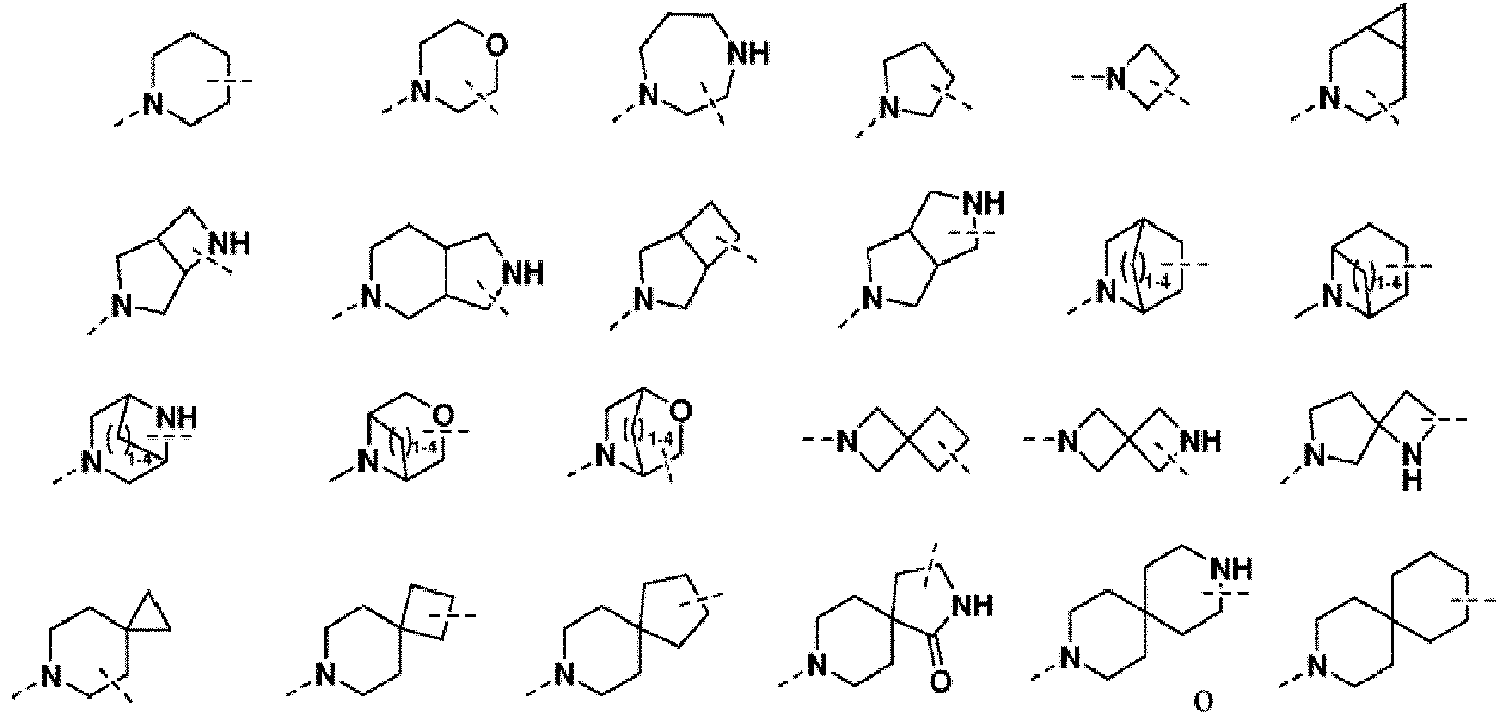
R1 se selecciona de H, hidroxilo, alquilo C í-Cs opcionalmente sustituido, cicloalquilo C3-C8 , heterociclilo de 4-12 miembros, arilo de 6-10 miembros o heteroarilo de 5-10 miembros;R1 is selected from H, hydroxyl, optionally substituted C1- Cs alkyl , C3 - C8 cycloalkyl, 4-12 membered heterocyclyl, 6-10 membered aryl or 5-10 membered heteroaryl;
R2 se selecciona de ciano o -C=ONR6R7;R2 is selected from cyano or -C=ONR6R7;
L se selecciona de amino, -NR6C=0-, -NR6C=ONR10-, -C=ONR10-, -C=0NR60-, -C=ONR6NR10-, -NR6S(O)m-, -S(O)mNR6-, -NR6S(O)mNR7-, -S(O)m-, -C=0- o -C=00-;L is selected from amino, -NR6C=0-, -NR6C=ONR10-, -C=ONR10-, -C=0NR60-, -C=ONR6NR10-, -NR6S(O) m -, -S(O) m NR6-, -NR6S(O) m NR7-, -S(O) m -, -C=0- or -C=00-;
o L está ausente;or L is absent;
R3 se selecciona de H o metilo;R3 is selected from H or methyl;
R4 y R5 se seleccionan cada uno independientemente de H, deuterio, halógeno, ciano, nitro, alquilo C1-C8 opcionalmente sustituido o cicloalquilo C3-C8 ;R4 and R5 are each independently selected from H, deuterium, halogen, cyano, nitro, optionally substituted C 1 -C 8 alkyl or C 3 -C 8 cycloalkyl;
R6, R7 y R10 se seleccionan cada uno independientemente de H, alquilo Cí-Cs opcionalmente sustituido o cicloalquilo C3-C8 ;R6, R7 and R10 are each independently selected from H, optionally substituted C1 -Cs alkyl or C3 - C8 cycloalkyl;
o, R10 tomado con N y R1 al que se une pueden formar un heterociclilo de 4-12 miembros opcionalmente sustituido; y or , R10 taken with N and R1 to which it is attached can form an optionally substituted 4-12 membered heterocyclyl; and
m se selecciona de 1 ó 2;m is selected from 1 or 2;
en el que Ios grupos sustituyentes en el anillo A y R1 se seleccionan cada uno independientemente de uno o más de halógeno, hidroxilo, ciano, amino, alquilo C1-C8 , alcoxilo C1-C8 , cicloalquilo C3-C8 , heterociclilo de 4-12 miembros, arilo de 6-10 miembros, heteroarilo de 5-10 miembros, -C=ONR8R9, -NHC=OR8, -NR8R9, -OC=ONR8R9, -NHC=ONR8R9, -S(O)mR8, -S(O)m-NHR8, -NHC=OOR8 o -NHS(O)mR8;wherein the substituent groups on ring A and R1 are each independently selected from one or more of halogen, hydroxyl, cyano, amino, C 1 -C 8 alkyl, C 1 -C 8 alkoxy, C 3 -C cycloalkyl 8 , 4-12 membered heterocyclyl, 6-10 membered aryl, 5-10 membered heteroaryl, -C=ONR8R9, -NHC=OR8, -NR8R9, -OC=ONR8R9, -NHC=ONR8R9, -S(O )mR8, -S(O)m-NHR8, -NHC=OOR8 or -NHS(O)mR8;
R8 y R9 se seleccionan cada uno independientemente de H, alquilo Cí-Cs opcionalmente sustituido o cicloalquilo C3-C8 ; yR8 and R9 are each independently selected from H, optionally substituted Ci-Cs alkyl or C 3 -C 8 cycloalkyl; and
Ios grupos sustituyentes en Ios R4, R5, R6, R7, R8, R9 y R10 se seleccionan cada uno independientemente de uno o más de deuterio, halógeno, hidroxilo, ciano, amino, alquilo C1-C8 , alcoxilo C1-C8 o cicloalquilo C3-C8. The substituent groups on R4 , R5, R6, R7 , R8 , R9 and R10 are each independently selected from one or more of deuterium, halogen, hydroxyl, cyano, amino, C1 - C8 alkyl, alkoxy C 1 -C 8 or C 3 -C 8 cycloalkyl.
En algunas realizaciones de la presente invención, el anillo A se selecciona de Ios siguientes grupos opcionalmente sustituidos:In some embodiments of the present invention, ring A is selected from the following optionally substituted groups:


R1 se selecciona de H, hidroxilo, metilo opcionalmente sustituido, etilo, propilo, ciclopropilo, n-butilo, tere-butilo, ddobutilo, fenilo, piridinilo, imidazolilo, pirazolilo, oxazolilo, tiazolilo oR1 is selected from H, hydroxyl, optionally substituted methyl, ethyl, propyl, cyclopropyl, n-butyl, tere-butyl, ddobutyl, phenyl, pyridinyl, imidazolyl, pyrazolyl, oxazolyl, thiazolyl or

R2 se selecciona de eiano o -C=ONR6R7;R2 is selected from Eian or -C=ONR6R7;
L se selecciona de amino, -NR6C=0-, -NR6C=ONR10-, -C=ONR10-, -C=0NR60-, -C=ONR6NR10-, -NR6S(O)m-, -S(O)mNR6-, -NR6S(O)mNR7-, -S(O)m-, -C=0- o -C=00-;L is selected from amino, -NR6C=0-, -NR6C=ONR10-, -C=ONR10-, -C=0NR60-, -C=ONR6NR10-, -NR6S(O) m -, -S(O) m NR6-, -NR6S(O) m NR7-, -S(O) m -, -C=0- or -C=00-;
o L está ausente;or L is absent;
R3 se selecciona de H o metilo;R3 is selected from H or methyl;
R4 y R5 se seleccionan cada uno independientemente de H, deuterio, halógeno o eiano;R4 and R5 are each independently selected from H, deuterium, halogen or eian;
R6, R7 y R10 se seleccionan cada uno independientemente de H, alquilo C i -C8 opeionalmente sustituido o cieloalquilo C3-C8 ;R6, R 7 and R10 are each independently selected from H, optionally substituted C i -C 8 alkyl or sky C 3 -C 8 alkyl;
o, R10 tomado con N y R1 al que se une pueden formar un heterocielilo de 4-12 miembros opeionalmente sustituido; yor, R10 taken with N and R1 to which it is attached can form an optionally substituted 4-12 membered heterocyelyl; and
m se selecciona de 1 ó 2;m is selected from 1 or 2;
en el que los grupos sustituyentes en el anillo A y R1 se seleccionan cada uno independientemente de uno o más de halógeno, hidroxilo, eiano, amino, alquilo C1-C8 , alcoxilo C1-C8 , cieloalquilo C3-C8 , heterocielilo de 4-12 miembros, arilo de 6-10 miembros o heteroarilo de 5-10 miembros;wherein the substituent groups on ring A and R1 are each independently selected from one or more of halogen, hydroxyl, eyan, amino, C 1 -C 8 alkyl, C 1 -C 8 alkoxy, C 3 -C 8 skyalkyl , 4-12 membered heterocyelyl, 6-10 membered aryl or 5-10 membered heteroaryl;
los grupos sustituyentes en los R6, R7 y R10 se seleccionan cada uno independientemente de uno o más de deuterio, halógeno, hidroxilo, eiano, amino, alquilo C1-C8 , alcoxilo C1-C8 o cieloalquilo C3-C8.The substituent groups on R6, R7 and R10 are each independently selected from one or more of deuterium, halogen, hydroxyl, eyan, amino, C 1 -C 8 alkyl, C 1 -C 8 alkoxy or C 3 -C skyalkyl. 8 .
En algunas realizaciones de la presente invención, el anillo A se selecciona de los siguientes grupos opeionalmente sustituidos:In some embodiments of the present invention, ring A is selected from the following optionally substituted groups:


R1 se selecciona de H, hidroxilo, metilo opcionalmente sustituido, etilo, propilo, ciclopropilo, n-butilo, tere-butilo, ddobutilo, fenilo, piridinilo, imidazolilo, pirazolilo, oxazolilo, tiazolilo oR1 is selected from H, hydroxyl, optionally substituted methyl, ethyl, propyl, cyclopropyl, n-butyl, tere-butyl, ddobutyl, phenyl, pyridinyl, imidazolyl, pyrazolyl, oxazolyl, thiazolyl or

R2 se selecciona de eiano o -C=ONR6R7;R2 is selected from Eian or -C=ONR6R7;
L se selecciona de amino, -NR6C=0-, -C=ONR10-, -S(O)m-, -C=0- o -C=00-;L is selected from amino, -NR6C=0-, -C=ONR10-, -S(O) m -, -C=0- or -C=00-;
o L está ausente; or L is absent;
R3 se selecciona de H o metilo;R3 is selected from H or methyl;
R4 y R5 se seleccionan cada uno independientemente de H, deuterio, F, Cl o eiano;R4 and R5 are each selected independently of H, deuterium, F, Cl or eian;
R6, R7 y R10 se seleccionan cada uno independientemente de H, alquilo C i -C8 opeionalmente sustituido o cieloalquilo C3-C8 ;R6, R 7 and R10 are each independently selected from H, optionally substituted C i -C 8 alkyl or sky C 3 -C 8 alkyl;
o, R10 tomado con N y R1 al que se une pueden formar un heterocielilo de 4-12 miembros opeionalmente sustituido; y or , R10 taken with N and R1 to which it is attached can form an optionally substituted 4-12 membered heterocyelyl; and
m se selecciona de 1 ó 2;m is selected from 1 or 2;
en el que los grupos sustituyentes en el anillo A y R1 se seleccionan cada uno independientemente de uno o más de halógeno, hidroxilo, eiano, amino, alquilo C1-C4 o alcoxilo C1-C4 ;wherein the substituent groups on ring A and R 1 are each independently selected from one or more of halogen, hydroxyl, eyan, amino, C 1 -C 4 alkyl or C 1 -C 4 alkoxy;
los grupos sustituyentes en los R6, R7 y R10 se seleccionan cada uno independientemente de uno o más de deuterio, halógeno, hidroxilo, eiano o amino.The substituent groups on R6, R7 and R10 are each independently selected from one or more of deuterium, halogen, hydroxyl, eyan or amino.
En algunas realizaciones de la presente invención, el anillo A se selecciona de los siguientes grupos opeionalmente sustituidos:In some embodiments of the present invention, ring A is selected from the following optionally substituted groups:

oeither
R1 se selecciona de H, hidroxilo, metilo opeionalmente sustituido, etilo, propilo, ciclopropilo, tere-butilo, cielobutilo oR1 is selected from H, hydroxyl, optionally substituted methyl, ethyl, propyl, cyclopropyl, tere-butyl, skybutyl or

R2 se selecciona de eiano o -C=ONR6R7;R2 is selected from Eian or -C=ONR6R7;
R6 y R7 se seleccionan de H, metilo o metilo deuterado;R6 and R7 are selected from H, methyl or deuterated methyl;
L se selecciona de -C=ONR10-, -S(O)m-, -C=0- o -C=00-;L is selected from -C=ONR10-, -S(O)m-, -C=0- or -C=00-;
o L está ausente; or L is absent;
R3 se selecciona de H o metilo;R3 is selected from H or methyl;
R4 y R5 se seleccionan cada uno independientemente de H o deuterio;R4 and R5 are each selected independently of H or deuterium;
R10 es H;yR10 is H;y
m se selecciona de 1 ó 2;m is selected from 1 or 2;
en el que los grupos sustituyentes en el anillo A y R1 se seleccionan cada uno independientemente de uno o más de F, Cl, hidroxilo, ciano, amino, metilo o metoxilo.wherein the substituent groups on ring A and R1 are each independently selected from one or more of F, Cl, hydroxyl, cyano, amino, methyl or methoxy.
En algunas realizaciones de la presente invención, el compuesto es un compuesto tal como se muestra a continuación o una sal farmacéuticamente aceptable del mismo:In some embodiments of the present invention, the compound is a compound as shown below or a pharmaceutically acceptable salt thereof:


Preferiblemente, el compuesto de la presente invención es un compuesto mostrado a continuación o una sal farmacéuticamente aceptable del mismo:Preferably, the compound of the present invention is a compound shown below or a pharmaceutically acceptable salt thereof:


Otro aspecto de la presente invención proporciona un método para preparar el compuesto de fórmula (I), un estereoisómero del mismo o una sal farmacéuticamente aceptable del mismo, que incluye las siguientes etapas:Another aspect of the present invention provides a method for preparing the compound of formula (I), a stereoisomer thereof or a pharmaceutically acceptable salt thereof, including the following steps:

en el que A, L, R1, R2, R3, R4 y R5 son tal como se definen en el compuesto de fórmula (I) anteriormente mencionado.wherein A, L, R1, R2, R3, R4 and R5 are as defined in the compound of formula (I) mentioned above.
La presente invención también proporciona una composición farmacéutica, que incluye el compuesto de fórmula (I), un estereoisómero del mismo o una sal farmacéuticamente aceptable del mismo, y un portador farmacéuticamente aceptable.The present invention also provides a pharmaceutical composition, including the compound of formula (I), a stereoisomer thereof or a pharmaceutically acceptable salt thereof, and a carrier pharmaceutically acceptable.
Preferiblemente, la composición farmacéutica se selecciona de cápsula, polvo, comprimido, gránulo, pastilla, inyección, Jarabe, líquido oral, inhalatorio, pomada, supositorio, o parche,Preferably, the pharmaceutical composition is selected from capsule, powder, tablet, granule, pill, injection, syrup, oral liquid, inhalation, ointment, suppository, or patch,
Otro aspecto de la presente invención proporciona usos del compuesto de fórmula (I) o un tautómero, mesómero, racemato, enantiómero, diastereoisómero del mismo, y una mezcla de los mismos, y una sal farmacéuticamente aceptable, o de una composición farmacéutica que incluye el mismo, en la preparación un medicamento para prevenir o tratar enfermedades mediadas por la familia de JAK. Las enfermedades incluyen una enfermedad del sistema inmunitario, una enfermedad autoinmunitaria, una enfermedad cutánea, una enfermedad alérgica, una enfermedad viral, diabetes mellitus tipo I y complicaciones diabéticas, enfermedad de Alzheimer, xeroftalmia, mielofibrosis, trombocitemia, policitemia, leucemia y cáncer. La enfermedad del sistema inmunitario es rechazo de trasplante de órgano tal como rechazo de aloinJerto o enfermedad de injerto contra huésped; la enfermedad autoinmunitaria se selecciona de lupus eritematoso sistémico, esclerosis múltiple, artritis reumatoide, artritis Juvenil, psoriasis, colitis ulcerosa, enfermedad de Crohn y enfermedad autoinmunitaria de la tiroides; la enfermedad cutánea se selecciona de psoriasis, exantema, alopecia areata y dermatitis atópica; la enfermedad alérgica se selecciona de asma y rinitis; la enfermedad viral se selecciona de hepatitis B, hepatitis C, varicela y virus del herpes zóster; el cáncer se selecciona de tumor sólido, cáncer hemático y cáncer cutáneo, en el que el tumor sólido se selecciona de cáncer de próstata, cáncer renal, cáncer de hígado, cáncer de páncreas, cáncer gástrico, cáncer de mama, cáncer de pulmón, cáncer de cabeza y cuello, cáncer de tiroides, glioblastoma y melanoma, el cáncer hemático se selecciona de linfoma y leucemia, y el cáncer cutáneo se selecciona de linfoma cutáneo de células T y linfoma cutáneo de células B.Another aspect of the present invention provides uses of the compound of formula (I) or a tautomer, mesomer, racemate, enantiomer, diastereoisomer thereof, and a mixture thereof, and a pharmaceutically acceptable salt, or of a pharmaceutical composition that includes the same, in the preparation of a medicine to prevent or treat diseases mediated by the JAK family. The diseases include a disease of the immune system, an autoimmune disease, a skin disease, an allergic disease, a viral disease, diabetes mellitus type I and diabetic complications, Alzheimer's disease, xerophthalmia, myelofibrosis, thrombocythemia, polycythemia, leukemia and cancer. Immune system disease is organ transplant rejection such as allograft rejection or graft-versus-host disease; the autoimmune disease is selected from systemic lupus erythematosus, multiple sclerosis, rheumatoid arthritis, juvenile arthritis, psoriasis, ulcerative colitis, Crohn's disease and autoimmune thyroid disease; the skin disease is selected from psoriasis, rash, alopecia areata and atopic dermatitis; allergic disease is selected from asthma and rhinitis; the viral disease is selected from hepatitis B, hepatitis C, chickenpox and herpes zoster virus; the cancer is selected from solid tumor, blood cancer and skin cancer, wherein the solid tumor is selected from prostate cancer, kidney cancer, liver cancer, pancreatic cancer, gastric cancer, breast cancer, lung cancer, cancer head and neck cancer, thyroid cancer, glioblastoma and melanoma, blood cancer is selected from lymphoma and leukemia, and skin cancer is selected from cutaneous T-cell lymphoma and cutaneous B-cell lymphoma.
A menos que se indique lo contrario, los términos usados en la memoria descriptiva y las reivindicaciones tienen los siguientes significados.Unless otherwise indicated, the terms used in the specification and claims have the following meanings.
“Arilo” en la presente invención se refiere a un grupo monocíclico o bicíclico completamente de carbonos; y “arilo de 6-10 miembros” se refiere a arilo completamente de carbonos que contiene 6-10 átomos de carbono, tal como fenilo y naftilo. El anillo de arilo puede condensarse con un anillo de heteroarilo, heterociclilo o cicloalquilo, en el que el anillo unido a la estructura parental es el anillo de arilo.“Aryl” in the present invention refers to an all-carbon monocyclic or bicyclic group; and “6-10 membered aryl” refers to all-carbon aryl containing 6-10 carbon atoms, such as phenyl and naphthyl. The aryl ring may be fused to a heteroaryl, heterocyclyl or cycloalkyl ring, wherein the ring attached to the parent structure is the aryl ring.
“Heteroarilo” en la presente invención se refiere a un sistema heteroaromático que contiene 1-4 heteroátomos, incluyendo los heteroátomos de nitrógeno, oxígeno y azufre, incluyendo, pero sin limitarse a, furanilo, tiofenilo, piridinilo, pirrolilo, pirazolilo, N-alquilpirrolilo, pirimidinilo, pirazinilo, imidazolilo, tetrazolilo, oxazolilo,“Heteroaryl” in the present invention refers to a heteroaromatic system containing 1-4 heteroatoms, including nitrogen, oxygen and sulfur heteroatoms, including, but not limited to, furanyl, thiophenyl, pyridinyl, pyrrolyl, pyrazolyl, N-alkylpyrrolyl. , pyrimidinyl, pyrazinyl, imidazolyl, tetrazolyl, oxazolyl,

etc.etc
“Alquilo CÍ-Cs” en la presente invención se refiere a alquilo lineal y alquilo ramificado que contiene 1-8 átomos de carbono. Alquilo se refiere a un grupo de hidrocarburo alifático saturado, tal como metilo, etilo, n-propilo, isopropilo, n-butilo, isobutilo, tere-butilo, sec-butilo, n-pentilo, 1, 1 -dimetilpropilo, 1,2-dimetilpropilo, 2,2-dimetilpropilo, 1-etilpropilo, 2-metilbutilo, 3-metilbutilo, n-hexilo, 1 -etil-2-metilpropilo, 1, 1,2-trimetilpropilo, 1,1-dimetilbutilo, 1,2-dimetilbutilo, 2,2-dimetilbutilo, 1,3-dimetilbutilo, 2-etilbutilo, 2-metilpentilo, 3-metilpentilo, 4-metilpentilo, 2,3-dimetilbutilo, n-heptilo, 2-metilhexilo, 3-metilhexilo, 4-metilhexilo, 5-metilhexilo, 2,3-dimetilpentilo, 2,4-dimetilpentilo, 2,2-dimetilpentilo, 3,3-dimetilpentilo, 2-etilpentilo, 3-etilpentilo, n-oetilo, 2,3-dimetilhexilo, 2,4-dimetilhexilo, 2,5-dimetilhexilo, 2,2-dimetilhexilo, 3,3-dimetilhexilo, 4,4-dimetilhexilo, 2-etilhexilo, 3-etilhexilo, 4-etilhexilo, 2-metil-2-etilpentilo, 2-metil-3-etilpentilo, o diversos isómeros ramificados de los mismos, etc.“CI-Cs alkyl” in the present invention refers to linear alkyl and branched alkyl containing 1-8 carbon atoms. Alkyl refers to a saturated aliphatic hydrocarbon group, such as methyl, ethyl, n-propyl, isopropyl, n-butyl, isobutyl, tere-butyl, sec-butyl, n-pentyl, 1, 1-dimethylpropyl, 1, 2-dimethylpropyl, 2,2-dimethylpropyl, 1-ethylpropyl, 2-methylbutyl, 3-methylbutyl, n-hexyl, 1-ethyl-2-methylpropyl, 1, 1,2-trimethylpropyl, 1,1-dimethylbutyl, 1, 2-dimethylbutyl, 2,2-dimethylbutyl, 1,3-dimethylbutyl, 2-ethylbutyl, 2-methylpentyl, 3-methylpentyl, 4-methylpentyl, 2,3-dimethylbutyl, n-heptyl, 2-methylhexyl, 3-methylhexyl, 4-methylhexyl, 5-methylhexyl, 2,3-dimethylpentyl, 2,4-dimethylpentyl, 2,2-dimethylpentyl, 3,3-dimethylpentyl, 2-ethylpentyl, 3-ethylpentyl, n-oethyl, 2,3-dimethylhexyl, 2,4-dimethylhexyl, 2,5-dimethylhexyl, 2,2-dimethylhexyl, 3,3-dimethylhexyl, 4,4-dimethylhexyl, 2-ethylhexyl, 3-ethylhexyl, 4-ethylhexyl, 2-methyl-2-ethylpentyl, 2-methyl-3-ethylpentyl, or various branched isomers thereof, etc.
“Cicloalquilo” en la presente invención se refiere a un grupo sustituyente de hidrocarburo monocíclico saturado; y “cicloalquilo C3-Cs” se refiere a cicloalquilo monocíclico que contiene 3-8 átomos de carbono, por ejemplo, los ejemplos no limitativos de cicloalquilo monocíclico incluyen ciclopropilo, eielobutilo, eielopentilo, eielohexilo, eieloheptilo, cielooetilo, etc.“Cycloalkyl” in the present invention refers to a saturated monocyclic hydrocarbon substituent group; and "C 3 -Cs cycloalkyl" refers to monocyclic cycloalkyl containing 3-8 carbon atoms, for example, non-limiting examples of monocyclic cycloalkyl include cyclopropyl, ielobutyl, ielopentyl, ielohexyl, ieloheptyl, cielooethyl, etc.
“Alquenilo” en la presente invención se refiere al alquilo tal como se definió anteriormente y que consiste en al menos dos átomos de carbono y al menos un doble enlace carbono-carbono; y “alquenilo C2-Cs” se refiere a alquenilo lineal o ramificado que contiene 2-8 átomos de carbono, tal como vinilo, 1-propenilo, 2-propenilo, 1-butenilo, 2-butenilo o 3-butenilo, etc.“Alkenyl” in the present invention refers to alkyl as defined above and consisting of at least two carbon atoms and at least one carbon-carbon double bond; and “C 2 -C s alkenyl” refers to linear or branched alkenyl containing 2-8 carbon atoms, such as vinyl, 1-propenyl, 2-propenyl, 1-butenyl, 2-butenyl or 3-butenyl, etc. .
“Alquinilo” en la presente invención se refiere al alquilo tal como se definió anteriormente y que consiste en al menos dos átomos de carbono y al menos un triple enlace carbono-carbono; y “alquinilo C2-Cs” se refiere a alquinilo lineal o ramificado que contiene 2-8 átomos de carbono, tal como etinilo, 1-propinilo, 2-propinilo, 1-butinilo, 2-butinilo o 3-butinilo, etc. “Alkynyl” in the present invention refers to alkyl as defined above and consisting of at least two carbon atoms and at least one carbon-carbon triple bond; and “C 2 -Cs alkynyl” refers to linear or branched alkynyl containing 2-8 carbon atoms, such as ethynyl, 1-propynyl, 2-propynyl, 1-butynyl, 2-butynyl or 3-butynyl, etc.
Cuando el enlace “---” de un grupo sustituyente se une a una posición definida, la sustitución del grupo sustituyente se produce en esta posición.When the “---” bond of a substituent group is attached to a defined position, substitution of the substituent group occurs at this position.
Cuando el enlace “---” de un grupo sustituyente se une de manera cruzada entre dos átomos en un anillo, tal grupo sustituyente puede unirse a cualquier átomo en el anillo, lo que indica que la sustitución del grupo sustituyente puede producirse en cualquier posición en el anillo. Por ejemplo, una unidad estructuralWhen the “---” bond of a substituent group is cross-linked between two atoms in a ring, such a substituent group can bond to any atom in the ring, indicating that substitution of the substituent group can occur at any position. in the ring. For example, a structural unit

indica que la sustitución puede tener lugar en cualquier posición en el ciciohexilo.indicates that the substitution can take place at any position on the cyciohexyl.
“Heterociclilo” en la presente invención se refiere a un grupo sustituyente de hidrocarburo cíclico, monocíclico o policíclico, saturado o parcialmente insaturado, en el que uno o más átomos de anillo se seleccionan de los heteroátomos de nitrógeno, oxígeno o S(O)m, pero sin incluir las partes de anillo de -O-O-, -O-S- o -S-S-, y los demás átomos de anillo son carbonos. “Heterociclilo de 4-12 miembros” se refiere a ciclilo que contiene 4-12 átomos de anillo. Los ejemplos no limitativos de heterociclilo monocíclico incluyen pirrolidinilo, piperidilo, piperazinilo, morfolinilo, tiomorfolinilo, homopiperazinilo, etc., y heterociclilo policíclico incluye el heterociclilo de un anillo en espiral, un anillo condensado y un anillo en puente, incluyendo, pero sin limitarse a, las siguientes estructuras:“Heterocyclyl” in the present invention refers to a saturated or partially unsaturated cyclic, monocyclic or polycyclic hydrocarbon substituent group, in which one or more ring atoms are selected from the heteroatoms of nitrogen, oxygen or S(O)m. , but not including the ring parts of -OO-, -OS- or -SS-, and the other ring atoms are carbons. “4-12 membered heterocyclyl” refers to cyclyl containing 4-12 ring atoms. Non-limiting examples of monocyclic heterocyclyl include pyrrolidinyl, piperidyl, piperazinyl, morpholinyl, thiomorpholinyl, homopiperazinyl, etc., and polycyclic heterocyclyl includes the heterocyclyl of a coiled ring, a fused ring and a bridged ring, including, but not limited to , the following structures:

“Alcoxilo” en la presente invención se refiere a -O-(alquilo), en el que el alquilo es tal como se definió anteriormente. “Alcoxilo Ci -C8” se refiere a un alquiloxilo que contiene 1-8 átomos de carbono, cuyos ejemplos no limitativos incluyen metoxilo, etoxilo, propoxilo, butoxilo, etc.“Alkoxyl” in the present invention refers to -O-(alkyl), wherein alkyl is as defined above. “Ci-C 8 alkoxy” refers to an alkyloxy containing 1-8 carbon atoms, non-limiting examples of which include methoxy, ethoxy, propoxy, butoxy, etc.
“Halógeno” se refiere a flúor, cloro, bromo o yodo. “Halogen” refers to fluorine, chlorine, bromine or iodine.
“Composición farmacéutica” representa una mezcla que incluye uno o más compuestos descritos en el presente documento, o una sal fisiológica y farmacéuticamente aceptable o un profármaco de los mismos, y otros componentes químicos, así como otros componentes tales como un portador y excipiente fisiológica y farmacéuticamente aceptable. La composición farmacéutica tiene como objetivo fomentar la administración a organismos y facilitar la absorción de los principios activos para ejercer la actividad biológica.“Pharmaceutical composition” represents a mixture that includes one or more compounds described herein, or a physiological and pharmaceutically acceptable salt or prodrug thereof, and other chemical components, as well as other components such as a physiological and pharmaceutical carrier and excipient. pharmaceutically acceptable. The pharmaceutical composition aims to promote administration to organisms and facilitate the absorption of the active ingredients to exert biological activity.
“Portador” se refiere a un material que no provoca irritación obvia al organismo ni elimina la actividad biológica ni las propiedades del compuesto dado.“Carrier” refers to a material that does not cause obvious irritation to the organism or eliminate the biological activity or properties of the given compound.
En las etapas de preparación de la presente invención, las abreviaturas de los reactivos usados representan respectivamente:In the preparation steps of the present invention, the abbreviations of the reagents used respectively represent:
DMF W,N-dimetilformamidaDMF W,N-dimethylformamide
THF tetrahidrofuranoTHF tetrahydrofuran
PE éter de petróleoPE petroleum ether
EA acetato de etiloEA ethyl acetate
CDI 1,1-carbonildiimidazolCDI 1,1-carbonyldiimidazole
TBTU tetrafluoroborato de 0-(benzotriazol-1-il)-N,N,N’,N’-tetrametiluronioTBTU 0-(benzotriazol-1-yl)-N,N,N’,N’-tetramethyluronium tetrafluoroborate
DCM diclorometanoDCM dichloromethane
Boc terc-butoxicarbonilo Boc tert-butoxycarbonyl
TIPSCI triisopropilclorosilanoTIPSCI triisopropylchlorosilane
MeCN acetonitriloMeCN acetonitrile
TFA ácido tifluoroacéticoTFA tifluoroacetic acid
Breve descripción de los dibujosBrief description of the drawings
Figura 1. Resonancia magnética nuclear de hidrógeno de un compuesto del ejemplo 1;Figure 1. Hydrogen nuclear magnetic resonance of a compound of example 1;
Figura 2. Resonancia magnética nuclear de hidrógeno de un compuesto del ejemplo 2;Figure 2. Hydrogen nuclear magnetic resonance of a compound of example 2;
Figura 3. Resonancia magnética nuclear de hidrógeno de un compuesto del ejemplo 3;Figure 3. Hydrogen nuclear magnetic resonance of a compound of example 3;
Figura 4. Resonancia magnética nuclear de hidrógeno de un compuesto del ejemplo 4;Figure 4. Hydrogen nuclear magnetic resonance of a compound of example 4;
Figura 5. Resonancia magnética nuclear de hidrógeno de un compuesto del ejemplo 5;Figure 5. Hydrogen nuclear magnetic resonance of a compound of example 5;
Figura 6. Resonancia magnética nuclear de hidrógeno de un compuesto del ejemplo 6;Figure 6. Hydrogen nuclear magnetic resonance of a compound of example 6;
Figura 7. Resonancia magnética nuclear de hidrógeno de un compuesto del ejemplo 7;Figure 7. Hydrogen nuclear magnetic resonance of a compound of example 7;
Figura 8. Resonancia magnética nuclear de hidrógeno de un compuesto del ejemplo 8;Figure 8. Hydrogen nuclear magnetic resonance of a compound of example 8;
Figura 9. Resonancia magnética nuclear de hidrógeno de un compuesto del ejemplo 9;Figure 9. Hydrogen nuclear magnetic resonance of a compound of example 9;
Figura 10. Resonancia magnética nuclear de hidrógeno de un compuesto del ejemplo 10;Figure 10. Hydrogen nuclear magnetic resonance of a compound of example 10;
Figura 11. Resonancia magnética nuclear de hidrógeno de un compuesto del ejemplo 11;Figure 11. Hydrogen nuclear magnetic resonance of a compound of example 11;
Figura 12. Resonancia magnética nuclear de hidrógeno de un compuesto del ejemplo 12;Figure 12. Hydrogen nuclear magnetic resonance of a compound of example 12;
Figura 13. Resonancia magnética nuclear de hidrógeno de un compuesto del ejemplo 13;Figure 13. Hydrogen nuclear magnetic resonance of a compound of example 13;
Figura 14. Resonancia magnética nuclear de hidrógeno de un compuesto del ejemplo 14;Figure 14. Hydrogen nuclear magnetic resonance of a compound of example 14;
Figura 15. Resonancia magnética nuclear de hidrógeno de un compuesto del ejemplo 15; Figure 15. Hydrogen nuclear magnetic resonance of a compound of example 15;
Figura 16. Resonancia magnética nuclear de hidrógeno de un compuesto del ejemplo 16;Figure 16. Hydrogen nuclear magnetic resonance of a compound of example 16;
Figura 17. Resonancia magnética nuclear de hidrógeno de un compuesto del ejemplo 17;Figure 17. Hydrogen nuclear magnetic resonance of a compound of example 17;
Figura 18. Resonancia magnética nuclear de hidrógeno de un compuesto del ejemplo 18;Figure 18. Hydrogen nuclear magnetic resonance of a compound of example 18;
Figura 19. Resonancia magnética nuclear de hidrógeno de un compuesto del ejemplo 19;Figure 19. Hydrogen nuclear magnetic resonance of a compound of example 19;
Figura 20. Resonancia magnética nuclear de hidrógeno de un compuesto del ejemplo 20;Figure 20. Hydrogen nuclear magnetic resonance of a compound of example 20;
Figura 21. Resonancia magnética nuclear de hidrógeno de un compuesto del ejemplo 21;Figure 21. Hydrogen nuclear magnetic resonance of a compound of example 21;
Figura 22. Resonancia magnética nuclear de hidrógeno de un compuesto del ejemplo 22;Figure 22. Hydrogen nuclear magnetic resonance of a compound of example 22;
Figura 23. Resonancia magnética nuclear de hidrógeno de un compuesto del ejemplo 23;Figure 23. Hydrogen nuclear magnetic resonance of a compound of example 23;
Figura 24. Resultados de puntuación del índice de actividad de enfermedad (DAI) en un modelo de enteritis inducida por DSS de ratón;Figure 24. Disease activity index (DAI) scoring results in a mouse DSS-induced enteritis model;
Figura 25. Resultados de la influencia en la razón peso-longitud de colon en un modelo de enfermedad de Crohn inducida por DNBS de rata;Figure 25. Results of the influence on the colon weight-length ratio in a rat DNBS-induced Crohn's disease model;
Figura 26. Área de úlcera de colon de rata en un modelo de enfermedad de Crohn inducida por DNBS de rata; Figura 27. Imágenes de colon de ratas en el grupo G1;Figure 26. Rat colon ulcer area in a rat DNBS-induced Crohn's disease model; Figure 27. Colon images of rats in group G1;
Figura 28. Imágenes de colon de ratas en el grupo G2;Figure 28. Colon images of rats in group G2;
Figura 29. Imágenes de colon de ratas en el grupo G3;Figure 29. Colon images of rats in group G3;
Figura 30. Imágenes de colon de ratas en el grupo G4;Figure 30. Colon images of rats in group G4;
Figura 31. Imágenes de colon de ratas en el grupo G5;Figure 31. Colon images of rats in group G5;
Figura 32. Imágenes de colon de ratas en el grupo G6; yFigure 32. Colon images of rats in group G6; and
Figura 33. Comparación de las imágenes de colon desde lejos de ratas en los grupos G1-G6.Figure 33. Comparison of distant colon images of rats in groups G1-G6.
Descripción detallada de las realizacionesDetailed description of the embodiments
A continuación se describe la presente invención con referencia a ejemplos específicos. Los expertos en la técnica entenderán que estos ejemplos sólo se usan para describir la presente invención, y no limitan el alcance de la presente invención en modo alguno.The present invention is described below with reference to specific examples. Those skilled in the art will understand that these examples are only used to describe the present invention, and do not limit the scope of the present invention in any way.
Todos los métodos experimentales en los siguientes ejemplos, a menos que se especifique lo contrario, son métodos convencionales. A menos que se indique específicamente, los materiales reactivos y las materias primas medicinales usados en los ejemplos a continuación son productos disponibles comercialmente.All experimental methods in the following examples, unless otherwise specified, are conventional methods. Unless specifically indicated, the reagent materials and medicinal raw materials used in the examples below are commercially available products.
Ejemplo 1Example 1
Síntesis de (S)-4-(3-(2,2,2-thfluoroetilcarbamoil)piperidin-1-amino)-1H-7-azaindol-5-carboxarnidaSynthesis of (S)-4-(3-(2,2,2-thfluoroethylcarbamoyl)piperidin-1-amino)-1H-7-azaindole-5-carboxarnide

Etapa 1: síntesis de 4-cloro-1-(triisopropilsilil)-7-azaindol Step 1: synthesis of 4-chloro-1-(triisopropylsilyl)-7-azaindole

Se disolvió 4-doro-7-azaindol (100,00 g, 655,39 mmol) en DMF (1,2 I) a temperatura ambiente, y se enfrió hasta 0 °C en un baño de hielo. Se añadió NaH (39,47 g, 983,09 mmol) en lotes y se agitó durante 1 hora a 0 °C después de completarse la adición. Se añadió gota a gota triisopropilclorosilano (190,80 g, 983,09 mmol, TIPSCI para abreviar) y se calentó hasta temperatura ambiente. Se continuó la reacción durante 2 horas. Se vertió la reacción en 2 I de agua helada, y se extrajo con éter de petróleo (1 I x2). Se combinaron las fases orgánicas, se lavaron con salmuera saturada (1 I x3), se concentraron a presión reducida hasta sequedad, y se sometieron a cromatografía en columna (PE:EA=1:0) para obtener 197,50 g de un líquido transparente incoloro, con un rendimiento del 97 %.4-Doro-7-azaindole (100.00 g, 655.39 mmol) was dissolved in DMF (1.2 I) at room temperature and cooled to 0 °C in an ice bath. NaH (39.47 g, 983.09 mmol) was added in batches and stirred for 1 hour at 0 °C after the addition was complete. Triisopropylchlorosilane (190.80 g, 983.09 mmol, TIPSCI for short) was added dropwise and warmed to room temperature. The reaction was continued for 2 hours. The reaction was poured into 2 I of ice water, and extracted with petroleum ether (1 I x 2). The organic phases were combined, washed with saturated brine (1 I x3), concentrated under reduced pressure to dryness, and subjected to column chromatography (PE:EA=1:0) to obtain 197.50 g of a liquid colorless transparent, with a yield of 97%.
Etapa 2: síntesis de 4-cIoro-1-(triisopropilsilil)-7-azaindoI-5-carboxilato de etiloStep 2: synthesis of ethyl 4-cIoro-1-(triisopropylsilyl)-7-azaindoI-5-carboxylate

Se disolvió 4-cIoro-1-(triisopropilsilil)-7-azaindoI (20,00 g, 64,74 mmol) en THF (100 ml) en un matraz de cuatro bocas, y se enfrió hasta -75 °C. Se añadió gota a gota sec-butilo-litio (l00 ml, 129,48 mmol, Sec.BuLi) y se agitó durante 1 hora a -75 °C después de completarse la adición. Se añadió cloroformiato de cloroetilo (17,80 g, 129,48 mmol), y se continuó la reacción durante 1 hora a -75 °C después de completarse la adición. Se vertió la reacción en una disolución saturada de cloruro de amonio. Se separaron las fases. Se extrajo la fase acuosa mediante la adición de acetato de etilo (100 ml). Se combinaron las fases orgánicas, se lavaron con salmuera saturada, se secaron con sulfato de sodio anhidro, se filtraron, se concentraron, y se sometieron a cromatografía en columna (PE:EA=1:0-10:1) para obtener 23,15 g de un líquido de color amarillo claro, con un rendimiento del 94 %.4-cIoro-1-(triisopropylsilyl)-7-azaindoI (20.00 g, 64.74 mmol) was dissolved in THF (100 mL) in a four-necked flask, and cooled to -75 °C. sec-butyllithium (100 ml, 129.48 mmol, Sec.BuLi) was added dropwise and stirred for 1 hour at -75°C after the addition was complete. Chloroethyl chloroformate (17.80 g, 129.48 mmol) was added, and the reaction was continued for 1 hour at -75 °C after the addition was complete. The reaction was poured into a saturated ammonium chloride solution. The phases were separated. The aqueous phase was extracted by adding ethyl acetate (100 ml). The organic phases were combined, washed with saturated brine, dried with anhydrous sodium sulfate, filtered, concentrated, and subjected to column chromatography (PE:EA=1:0-10:1) to obtain 23. 15 g of a light yellow liquid, with a yield of 94%.
Etapa 3: síntesis de ácido 4-cIoro-7-azaindoI-5-carboxíIicoStage 3: synthesis of 4-cIoro-7-azaindoI-5-carboxylic acid

Se añadió 4-cIoro-1-(triisopropilsilil)-7-azaindoI-5-carboxilato de etilo (12,94 g, 33,96 mmol) a un matraz de una boca a temperatura ambiente. Se añadieron etanol (200 ml) e hidróxido de sodio al 10 % (100 ml), y se continuó la reacción durante 2 horas a 60 °C después de completarse la adición. Se eliminó por evaporación el etanol a presión reducida. Se ajustó la fase acuosa con ácido clorhídrico diluido 1 N hasta pH = 4 en un baño de hielo. Se precipitó y filtró una gran cantidad de sólido de color blanco, y se secó la torta de filtración para obtener 8,60 g de un sólido de color blanco, con un rendimiento del 77 %.Ethyl 4-cIoro-1-(triisopropylsilyl)-7-azaindoI-5-carboxylate (12.94 g, 33.96 mmol) was added to a one-neck flask at room temperature. Ethanol (200 mL) and 10% sodium hydroxide (100 mL) were added, and the reaction was continued for 2 hours at 60 °C after the addition was complete. The ethanol was removed by evaporation under reduced pressure. The aqueous phase was adjusted with 1 N dilute hydrochloric acid to pH = 4 in an ice bath. A large amount of white solid was precipitated and filtered, and the filter cake was dried to obtain 8.60 g of white solid, with a yield of 77%.
Etapa 4: síntesis de 4-cIoro-7-azaindoI-5-carboxamidaStep 4: synthesis of 4-cIoro-7-azaindoI-5-carboxamide

Se añadió ácido 4-cIoro-7-azaindoI-5-carboxíIico (7,00 g, 35,60 mmol) a un matraz de cuatro bocas, se añadieron 100 ml de DMF, y se añadió carbonildiimidazol (8,72 g, 53,41 mmol, Cd I) con agitación. Se llevó a cabo agitación durante 1,5 horas a temperatura ambiente. Se añadió gota a gota agua amoniacal (9,34 g, 142,40 mmol) a 0 °C. Se calentó de manera natural hasta temperatura ambiente, y se hizo reaccionar con agitación durante 2 horas. Se añadieron 100 ml de EA a la reacción y se precipitó una gran cantidad de sólido de color blanco, y se filtró después de dejar en reposo. Se lavó la torta de filtración con agua y se secó para obtener 5,34 g de un sólido de color gris, con un rendimiento del 76 %. 4-CIoro-7-azaindoI-5-carboxylic acid (7.00 g, 35.60 mmol) was added to a four-necked flask, 100 mL of DMF was added, and carbonyldiimidazole (8.72 g, 53 mmol) was added. .41 mmol, Cd I) with stirring. Stirring was carried out for 1.5 hours at room temperature. Ammoniacal water (9.34 g, 142.40 mmol) was added dropwise at 0 °C. It was warmed naturally to room temperature, and reacted with stirring for 2 hours. 100 ml of EA was added to the reaction and a large amount of white solid was precipitated, and filtered after standing. The filter cake was washed with water and dried to obtain 5.34 g of a gray solid, with a yield of 76%.
Etapa 5: síntesis de (S)-1-nitrosop¡perid¡n-3-carbox¡lato de etiloStep 5: synthesis of ethyl (S)-1-nitrosoperidin-3-carboxylate

Se añadió (S)-3-piperid¡ncarbox¡lato de etilo (10,00 g, 0,064 mol) a una disolución mixta de ácido acético glacial (100 ml) y agua (40 ml) a temperatura ambiente, y se enfrió hasta 0 °C, Luego, se añadieron gota a gota 20 ml de una disolución acuosa con nitrito de sodio disuelto (8,78 g, 0,13 mol). La reacción continuó con agitación durante 1 h a 0 °C y durante otras 2 h a temperatura ambiente. Se añadieron 200 ml de agua a la reacción, y se realizó extracción con acetato de etilo (200 ml x3). Se combinaron las fases orgánicas, se lavaron con salmuera saturada, se concentraron a presión reducida, y se aplicaron directamente a la siguiente etapa.Ethyl (S)-3-piperidinecarboxylate (10.00 g, 0.064 mol) was added to a mixed solution of glacial acetic acid (100 ml) and water (40 ml) at room temperature, and cooled to 0 °C, Then, 20 ml of an aqueous solution with dissolved sodium nitrite (8.78 g, 0.13 mol) was added dropwise. The reaction continued with stirring for 1 h at 0 °C and for another 2 h at room temperature. 200 ml of water was added to the reaction, and extraction was carried out with ethyl acetate (200 ml x3). The organic phases were combined, washed with saturated brine, concentrated under reduced pressure, and applied directly to the next step.
Etapa 6: síntesis de clorhidrato de (S)-1-am¡nop¡perid¡n-3-carbox¡lato de etiloStep 6: Synthesis of ethyl (S)-1-am¡nop¡peridín-3-carboxylate hydrochloride

Se disolvió (S)-1-nitrosopiper¡d¡n-3-carbox¡lato de etilo (11,83 g, 0,064 mol) en metanol (100 ml). Se añadió polvo de Zn (10,40 g, 0,16 mol) y se enfrió hasta -5 °C. Se añadió lentamente y gota a gota ácido acético glacial (50 ml), y después de completarse la adición, la reacción continuó con agitación durante 0,5 h a 0 °C y durante otras 2 h a temperatura ambiente. Se filtró la reacción, se enjuagó la torta de filtración con 100 ml de metanol, y se evaporó el filtrado hasta sequedad. Se añadió una disolución de ácido clorhídrico en etanol al residuo y se agitó durante 0,5 h. Se retiró el disolvente mediante evaporación para obtener 13,27 g de una sustancia oleaginosa de color amarillo. El rendimiento de los productos en bruto de las 5 y 6 fue del 100 %.Ethyl (S)-1-nitrosopiperdine-3-carboxylate (11.83 g, 0.064 mol) was dissolved in methanol (100 ml). Zn powder (10.40 g, 0.16 mol) was added and cooled to -5 °C. Glacial acetic acid (50 mL) was added slowly dropwise, and after the addition was complete, the reaction was continued with stirring for 0.5 h at 0 °C and for another 2 h at room temperature. The reaction was filtered, the filter cake was rinsed with 100 ml of methanol, and the filtrate was evaporated to dryness. A solution of hydrochloric acid in ethanol was added to the residue and stirred for 0.5 h. The solvent was removed by evaporation to obtain 13.27 g of a yellow oily substance. The raw product yield of 5 and 6 was 100%.
Etapa 7: síntesis de (S)-1-(5-formamido-1H-7-aza¡ndol-4-am¡no)p¡per¡din-3-carbox¡lato de etiloStep 7: synthesis of ethyl (S)-1-(5-formamido-1H-7-azandole-4-amino)peridine-3-carboxylate
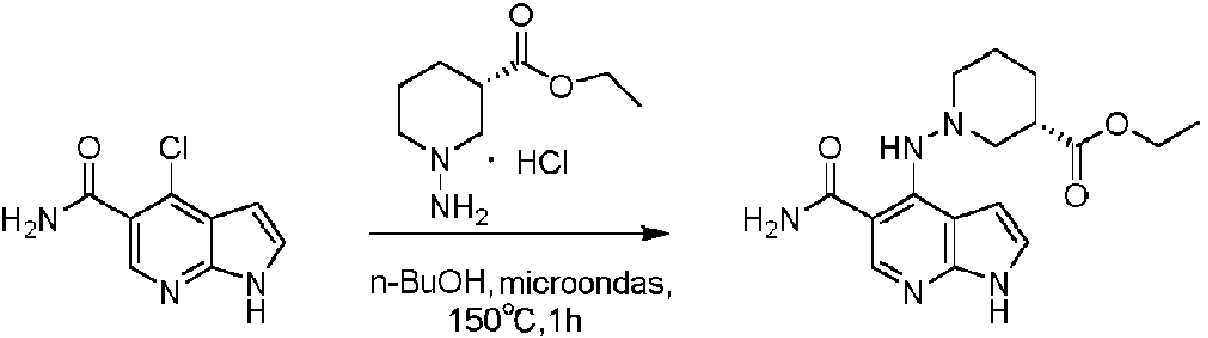
Se añadieron 4-cloro-7-azaindol-5-carboxamida (1,00 g, 5,12 mmol) y clorhidrato de (S)-1-aminopiper¡d¡n-3-carboxilato de etilo (2,14 g, 10,24 mmol) a un tubo de microondas, se añadieron 20 ml de alcohol n-butílico, y la reacción de microondas continuó durante 1 h a 150 °C. Se evaporó la reacción a presión reducida hasta sequedad, y se sometió a cromatografía en columna (sistema de diclorometano/metanol) para obtener 0,80 g de un producto en bruto similar a un gel de color amarillo claro, con un rendimiento del 47,3 %. 1H-RMN (300 MHz , DMSO-d6) S 11,40 (s, 1H), 9,97 (s, 1H), 8,38 (s, 1H), 8,19 (s, 1H), 7,79 (s, 1H), 7,07 (s, 1H), 6,98 (s, 1H), 4,06 (q, J = 7,0 Hz , 2H), 3,17 (d, J = 56,4 Hz ,3H), 2,88 - 2,64 (m, 2H), 2,38 (s, 1H), 2,07 - 1,59 (m, 3H), 1,22 - 0,93 (m, 3H). EM (ESI) m/z: 332 [M+H]+.4-Chloro-7-azaindole-5-carboxamide (1.00 g, 5.12 mmol) and ethyl (S)-1-aminopiperdine-3-carboxylate hydrochloride (2.14 g, 5.12 mmol) were added. 10.24 mmol) to a microwave tube, 20 ml of n-butyl alcohol was added, and the microwave reaction continued for 1 h at 150 °C. The reaction was evaporated under reduced pressure to dryness, and subjected to column chromatography (dichloromethane/methanol system) to obtain 0.80 g of a light yellow gel-like crude product, in a yield of 47. 3 %. 1H-NMR (300 MHz, DMSO-d6) S 11.40 (s, 1H), 9.97 (s, 1H), 8.38 (s, 1H), 8.19 (s, 1H), 7, 79 (s, 1H), 7.07 (s, 1H), 6.98 (s, 1H), 4.06 (q, J = 7.0 H z , 2H), 3.17 (d, J = 56.4 H z ,3H), 2.88 - 2.64 (m, 2H), 2.38 ( s , 1H), 2.07 - 1.59 (m, 3H), 1.22 - 0, 93 (m, 3H). EM (ESI) m/z: 332 [M+H]+.
Etapa 8: síntesis de ácido (S)-1-(5-formamido-1H-7-aza¡ndol-4-am¡no)p¡per¡d¡n-3-carboxílicoStep 8: synthesis of (S)-1-(5-formamido-1H-7-aza¡ndole-4-am¡no)p¡períd¡n-3-carboxylic acid

Se disolvió (S)-1-(5-formamido-1H-7-aza¡ndol-4-am¡no)p¡per¡din-3-carbox¡lato de etilo (0,70 g, 2,11 mmol) en metanol a temperatura ambiente, se añadió gota a gota una disolución de NaOH 3 N, y se continuó la reacción durante 3 h a 23 °C. Se retiró el disolvente orgánico mediante evaporación, se ajustó la fase acuosa usando ácido clorhídrico diluido 1 N hasta aproximadamente pH = 4, y se evaporó a presión reducida hasta sequedad. Se disolvió el sólido residual mediante la adición de metanol, se retiró la sal inorgánica mediante filtración, y se retiró el metanol mediante evaporación para obtener 0,52 g de un sólido de color amarillo claro, con un rendimiento del 81,3 %.Ethyl (S)-1-(5-formamido-1H-7-azaindol-4-amino)peridine-3-carboxylate (0.70 g, 2.11 mmol) was dissolved ) in methanol at room temperature, a 3 N NaOH solution was added dropwise, and the reaction was continued for 3 h at 23 °C. The organic solvent was removed by evaporation, the aqueous phase was adjusted using 1N dilute hydrochloric acid to approximately pH = 4, and evaporated under reduced pressure to dryness. The residual solid was dissolved by adding methanol, the inorganic salt was removed by filtration, and the methanol was removed by evaporation to obtain 0.52 g of a light yellow solid, with a performance of 81.3%.
Etapa 9: síntesis de (S)-4-(3-(2,2,2-trifluoroetilcarbamoil)piperidin-1-amino)-1H-7-azaindol-5-carboxamidaStep 9: synthesis of (S)-4-(3-(2,2,2-trifluoroethylcarbamoyl)piperidin-1-amino)-1H-7-azaindole-5-carboxamide

Se añadieron ácido (S)-1-(5-formamido-1H-7-azaindol-4-amino) piperidin-3-carboxílico (0,25 g, 0,82 mmol), clorhidrato de 2,2,2-trifluoroetanamina (0,17 g, 1,23 mmol) y tetrafluoroborato de 0-(benzotriazol-1-il)-N,N,N’,N’-tetrametiluronio (0,40 g, 1,23 mmol, TBTU) a un matraz de una boca, se añadieron 5 ml de DMF, y se añadió trietilamina (0,48 g, 4,75 mmol) después de la agitación. Después de completarse la adición, se llevó a cabo agitación durante la noche a temperatura ambiente. Se añadieron 10 ml de agua a la reacción, y se extrajo la reacción con un disolvente mixto de DCM:MeOH=5:1 (10 ml x5). Se combinaron las fases orgánicas, se lavaron con salmuera saturada, se evaporaron a presión reducida hasta sequedad, y se sometieron a cromatografía en columna (sistema de diclorometano/metanol) para obtener 0,022 g de un sólido de color amarillo claro, con un rendimiento del 10 %. 1H-RMN (400 MHz , DMSO-cfe) 811,42 (s a, 1H), 9,95 (s a, 1H), 8,59 (s a, 1H), 8,37 (s, 1H), 8,15(s, 1H), 7,78 (s a, 1H), 7,04 (m, 2H), 3,87 (s a, 2H), 3,11 (m, 2H), 2,71 (m, 1H), 2,37 (m, 2H), 1,82 (m, 2H), 1,67 (m, 1H), 1,34 (m, 1H). EM (ESI) m/z: 385 [M+H]+.(S)-1-(5-formamido-1H-7-azaindol-4-amino) piperidine-3-carboxylic acid (0.25 g, 0.82 mmol), 2,2,2-trifluoroethanamine hydrochloride were added (0.17 g, 1.23 mmol) and 0-(benzotriazol-1-yl)-N,N,N',N'-tetramethyluronium tetrafluoroborate (0.40 g, 1.23 mmol, TBTU) at a one-necked flask, 5 ml of DMF was added, and triethylamine (0.48 g, 4.75 mmol) was added after stirring. After the addition was complete, stirring was carried out overnight at room temperature. 10 ml of water was added to the reaction, and the reaction was extracted with a mixed solvent of DCM:MeOH=5:1 (10 ml x5). The organic phases were combined, washed with saturated brine, evaporated under reduced pressure to dryness, and subjected to column chromatography (dichloromethane/methanol system) to obtain 0.022 g of a light yellow solid, in a yield of 10%. 1H-NMR (400 MHz, DMSO-cfe) 811.42 (sa, 1H), 9.95 (sa, 1H), 8.59 (sa, 1H), 8.37 (s, 1H), 8.15 (s, 1H), 7.78 (sa, 1H), 7.04 (m, 2H), 3.87 (sa, 2H), 3.11 (m, 2H), 2.71 (m, 1H) , 2.37 (m, 2H), 1.82 (m, 2H), 1.67 (m, 1H), 1.34 (m, 1H). EM (ESI) m/z: 385 [M+H]+.
Ejemplo 2Example 2
Síntesis de (S)-4-(3-(2,2-difluoroetilcarbamoil)piperidin-1-amino)-1 H-7-azaindol-5-carboxamidaSynthesis of (S)-4-(3-(2,2-difluoroethylcarbamoyl)piperidin-1-amino)-1 H-7-azaindole-5-carboxamide

Etapa 1: síntesis de (S)-3-((2,2-difluoroetil)carbamoil)piperidin-1-carboxilato de tere-butiloStep 1: synthesis of tere-butyl (S)-3-((2,2-difluoroethyl)carbamoyl)piperidine-1-carboxylate

Se disolvió ácido (S)-1-(terc-butoxicarbonil)piperidin-3-carboxílieo (15,00 g, 65,40 mmol) en DCM (400 ml) a temperatura ambiente, se añadieron trietilamina (16,50 g, 163,50 mmol) y TBTU (25,20 g, 78,50 mol), y se continuó la reacción durante 1 h. Luego, se transfirió la reacción a un baño de hielo, y se añadió lentamente y gota a gota clorhidrato de 2,2-difluoroetilamina (10,00 g, 85,00 mmol) a 0 °C. Después de completarse la adición, se llevó a cabo agitación durante 1 h a 0 °C, y se continuó la reacción durante 5 horas a temperatura ambiente y se detuvo. Se concentró la reacción, se diluyó con agua (200 ml), y se extrajo tres veces con acetato de etilo (150 ml). Se combinaron las fases orgánicas, se lavaron tres veces con 100 ml de salmuera saturada, se concentraron, y se sometieron a cromatografía en columna (sistema de PE/EA) para obtener 16,06 g de un líquido transparente incoloro, con un rendimiento del 84 %. EM (ESI) m/z: 237,1 [M+H-56]+.(S)-1-(tert-butoxycarbonyl)piperidine-3-carboxylic acid (15.00 g, 65.40 mmol) was dissolved in DCM (400 mL) at room temperature, triethylamine (16.50 g, 163 .50 mmol) and TBTU (25.20 g, 78.50 mol), and the reaction was continued for 1 h. The reaction was then transferred to an ice bath, and 2,2-difluoroethylamine hydrochloride (10.00 g, 85.00 mmol) was added slowly dropwise at 0 °C. After the addition was complete, stirring was carried out for 1 h at 0 °C, and the reaction was continued for 5 h at room temperature and stopped. The reaction was concentrated, diluted with water (200 ml), and extracted three times with ethyl acetate (150 ml). The organic phases were combined, washed three times with 100 ml of saturated brine, concentrated, and subjected to column chromatography (PE/EA system) to obtain 16.06 g of a clear colorless liquid, in a yield of 84%. MS (ESI) m/z: 237.1 [M+H-56]+.
Etapa 2: síntesis de clorhidrato de (S)-N-(2,2-difluoroetil)piperidin-3-earboxamidaStep 2: synthesis of (S)-N-(2,2-difluoroethyl)piperidin-3-earboxamide hydrochloride

Se disolvió (S)-3-((2,2-difluoroetil)earbamoil)piperidin-1-earboxilato de tere-butilo (16,06 g, 54,94 mmol) en etanol (150 ml), se añadió lentamente y gota a gota HCl al 35 %/EtOH (30 ml) a temperatura normal, y se continuó la reacción durante 3 horas y se detuvo. Se eliminó por evaporación el disolvente a presión reducida para obtener 11,43 g de un sólido de color blanco, con un rendimiento del 91 %. EM (ESI) m/z: 193,1 [M+H]+.Tere-butyl (S)-3-((2,2-difluoroethyl)earbamoyl)piperidin-1-earboxylate (16.06 g, 54.94 mmol) was dissolved in ethanol (150 mL), added slowly and dropped. 35% HCl/EtOH (30 mL) was dropped at normal temperature, and the reaction was continued for 3 hours and stopped. The solvent was removed by evaporation under reduced pressure to obtain 11.43 g of a white solid, with a yield of 91%. MS (ESI) m/z: 193.1 [M+H]+.
Etapa 3: síntesis de (S)-N-(2,2-difluoroetil)-1-nitrosopiperidin-3-carboxamidaStep 3: synthesis of (S)-N-(2,2-difluoroethyl)-1-nitrosopiperidine-3-carboxamide
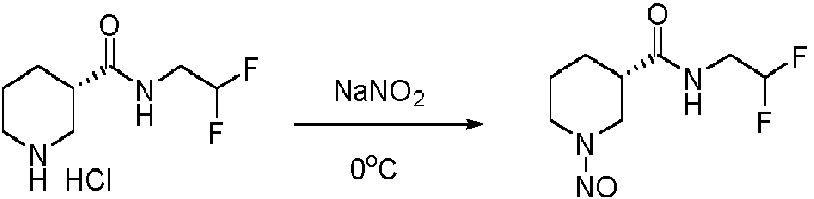
Se disolvió clorhidrato de (S)-N-(2,2-diíluoroetil)piperidin-3-carboxamida (11,43 g, 49,98 mmol) en ácido acético (100 ml) a temperatura ambiente, se añadieron lentamente 50 ml de una disolución acuosa con nitrito de sodio disuelto (4,49 g, 65,00 mmol) a 0 °C. Después de completarse la adición gota a gota, se continuó la reacción durante 1 hora a 0 °C, y luego se continuó durante la noche at temperatura normal. Después de completarse la reacción, a la reacción se le añadió agua (100 ml), y se extrajo tres veces con acetato de etilo (8o ml). Se combinaron las fases orgánicas, se lavaron con disolución acuosa saturada (80 ml) de carbonato de sodio, se secaron con sulfato de sodio anhidro, y se concentraron. Se sometió el producto a cromatografía en columna (PE/EA) usando gel de sílice para obtener 9,80 g de un sólido de color blanco, con un rendimiento del 89 %. EM (ESI) m/z: 222,1 [M+H]+.(S)-N-(2,2-diyluoroethyl)piperidine-3-carboxamide hydrochloride (11.43 g, 49.98 mmol) was dissolved in acetic acid (100 ml) at room temperature, 50 ml of an aqueous solution with dissolved sodium nitrite (4.49 g, 65.00 mmol) at 0 °C. After completion of the dropwise addition, the reaction was continued for 1 hour at 0°C, and then continued overnight at normal temperature. After completion of the reaction, water (100 ml) was added to the reaction, and it was extracted three times with ethyl acetate (80 ml). The organic phases were combined, washed with saturated aqueous sodium carbonate solution (80 mL), dried over anhydrous sodium sulfate, and concentrated. The product was subjected to column chromatography (PE/EA) using silica gel to obtain 9.80 g of a white solid, with a yield of 89%. MS (ESI) m/z: 222.1 [M+H]+.
Etapa 4: síntesis de clorhidrato de (S)-1-amino-N-(2,2-difluoroetil)piperidin-3-carboxamidaStep 4: synthesis of (S)-1-amino-N-(2,2-difluoroethyl)piperidine-3-carboxamide hydrochloride

Se disolvió (S)-N-(2,2-difluoroetil)-1-nitrosopiperidin-3-carboxarnida (9,80 g, 44,30 mmol) en metanol (40 ml), y se añadió lentamente polvo de zinc (8,70 g, i 32,90 mmol) a temperatura ambiente, y se enfrió hasta -20 °C y se agitó durante 10 minutos bajo protección de nitrógeno. Se añadió lentamente y gota a gota ácido acético (50 ml) a -20 °C, y se continuó la reacción durante 2 horas bajo protección de nitrógeno y se detuvo. Se añadió una disolución de ácido clorhídrico en acetato de etilo y se agitó durante 1 hora para la formación de sal. Se evaporó la reacción a presión reducida hasta sequedad, y se almacenó. Se filtró la reacción, y se sometió el filtrado a cromatografía en columna (DCM/MeOH) directamente usando gel de sílice para obtener 8,60 g de un sólido de color blanco. Al sólido de color blanco se le añadió una disolución de ácido clorhídrico en acetato de etilo, y se agitó durante 1 hora para la formación de sal. Se evaporó a presión reducida hasta sequedad, y se almacenó. EM (ESI) m/z: 208,1 [M+H]+.(S)-N-(2,2-difluoroethyl)-1-nitrosopiperidine-3-carboxarnide (9.80 g, 44.30 mmol) was dissolved in methanol (40 mL), and zinc powder (8 .70 g, i 32.90 mmol) at room temperature, and cooled to -20 °C and stirred for 10 minutes under nitrogen protection. Acetic acid (50 mL) was added slowly dropwise at −20 °C, and the reaction was continued for 2 hours under nitrogen protection and stopped. A solution of hydrochloric acid in ethyl acetate was added and stirred for 1 hour for salt formation. The reaction was evaporated under reduced pressure to dryness and stored. The reaction was filtered, and the filtrate was subjected to column chromatography (DCM/MeOH) directly using silica gel to obtain 8.60 g of a white solid. A solution of hydrochloric acid in ethyl acetate was added to the white solid, and it was stirred for 1 hour to form salt. It was evaporated under reduced pressure to dryness, and stored. MS (ESI) m/z: 208.1 [M+H]+.
Etapa 5: síntesis de (S)-4-(3-(2,2-difluoroetilcarbamoil)piperidin-1-amino)-1H-7-azaindol-5-carboxamidaStep 5: synthesis of (S)-4-(3-(2,2-difluoroethylcarbamoyl)piperidin-1-amino)-1H-7-azaindole-5-carboxamide

Se añadieron 4-cloro-7-azaindol-5-carboxamida (0,10 g, 0,51 mmol) y clorhidrato de (S)-1-amino-N-(2,2-difluoroetil)piperidin-3-carboxamida (0,25 g, 1,02 mmol) a un tubo de microondas, se añadieron 2 ml de alcohol nbutílico, y la reacción de microondas continuó durante 1 h a 150 °C. Se filtró la reacción, y se sometió el filtrado a evaporación rotatoria hasta sequedad, y se sometió a cromatografía en columna (sistema de diclorometano/metanol) para obtener 0,014 g de un sólido de color amarillo claro, con un rendimiento del 7,5 %.4-Chloro-7-azaindole-5-carboxamide (0.10 g, 0.51 mmol) and (S)-1-amino-N-(2,2-difluoroethyl)piperidine-3-carboxamide hydrochloride ( 0.25 g, 1.02 mmol) to a microwave tube, 2 ml of n-butyl alcohol was added, and the microwave reaction continued for 1 h at 150 °C. The reaction was filtered, and the filtrate was rotary evaporated to dryness, and subjected to column chromatography (dichloromethane/methanol system) to obtain 0.014 g of a light yellow solid, in a yield of 7.5%. .
1H-RMN (400 MHz , DMSO-d6) 811,41 (s a, 1H), 9,93 (s a, 1H), 8,37 (s, 1H), 8,32 (s a, 1H), 7,81 (s a, 1H), 7,04 (m, 3H), 5,96 (t, J = 57,5 Hz , 1H), 3,44 (m, 2H), 3,12 (m, 2H), 2,68 (m, 1H), 2,33 (m, 2H), 1,78 (m, 2H), 1,65 (m, 1H), 1,32 (m, 1H). EM (ESI) m/z: 367 [M+H]+.1H-NMR (400 MH z , DMSO-d6) 811.41 ( s a, 1H), 9.93 ( s a, 1H), 8.37 ( s a, 1H), 8.32 ( s a, 1H) , 7.81 ( s a, 1H), 7.04 (m, 3H), 5.96 (t, J = 57.5 Hz , 1H), 3.44 (m, 2H), 3.12 (m , 2H), 2.68 (m, 1H), 2.33 (m, 2H), 1.78 (m, 2H), 1.65 (m, 1H), 1.32 (m, 1H). MS (ESI) m/z: 367 [M+H]+.
Ejemplo 3Example 3
Síntesis de (R)-4-(3-(2,2,2-trifluoroetilcarbamoil)piperidin-1-amino)-1 H-7-azaindol-5-carboxamida Synthesis of (R)-4-(3-(2,2,2-trifluoroethylcarbamoyl)piperidin-1-amino)-1 H-7-azaindole-5-carboxamide

Se sintetizó un producto intermedio, clorhidrato de (R)-1-am¡no-N-(2,2,2-tr¡fluoroet¡l)piper¡d¡n-3-carboxam¡da, con referencia al método de preparación del producto intermedio clorhidrato de (S)-1-amino-N-(2,2-difluoroetil)piperidin-3-carboxamida en el ejemplo 2, reemplazando el ácido (S)-1-(terc-butoxicarbonil)piperidin-3-carboxílico en la etapa 1 del ejemplo 2 por ácido (R)-1-(terc-butoxicarbonil)piperidin-3-carboxílico, y reemplazando el clorhidrato de 2,2-difluoroetilamina por clorhidrato de trifluoroetilamina.An intermediate product, (R)-1-amino-N-(2,2,2-trifluoroethyl)piperiden-3-carboxamide hydrochloride, was synthesized with reference to the method of Preparation of (S)-1-amino-N-(2,2-difluoroethyl)piperidine-3-carboxamide hydrochloride intermediate in Example 2, replacing (S)-1-(tert-butoxycarbonyl)piperidine-3 acid -carboxylic acid in step 1 of example 2 with (R)-1-(tert-butoxycarbonyl)piperidine-3-carboxylic acid, and replacing 2,2-difluoroethylamine hydrochloride with trifluoroethylamine hydrochloride.
Se añadieron 4-cloro-7-azaindol-5-carboxamida (0,10 g, 0,51 mmol) y clorhidrato de (R)-1-amino-N-(2,2,2-trifluoroetil)piperidin-3-carboxamida (0,27 g, 1,02 mmol) a un tubo de microondas, se añadieron 2 ml de alcohol n-butílico, y la reacción de microondas continuó durante 1 h a 150 °C. Se filtró la reacción, y se sometió el filtrado a evaporación rotatoria hasta sequedad, y se sometió a cromatografía en columna (sistema de diclorometano/metanol) para obtener 0,015 g de un polvo sólido de color amarillo claro, con un rendimiento del 7,6 %. 1H-RMN (400 MHz , DMSO-tá) S 11,41 (s a, 1H), 9,94 (s a, 1H), 8,60 (s a, 1H), 8,37 (s, 1H), 8,15 (s a, 1H), 7,82 (s a, 1H), 7,04 (m, 2H), 3,88 (s a, 2H), 3,10 (m, 2H), 2,71 (m, 1H), 2,38 (m, 2H), 1,82 (m, 2H), 1,67 (m, 1H), 1,37 (m, 1H). EM (ESI) m/z: 385 [M+H]+.4-Chloro-7-azaindole-5-carboxamide (0.10 g, 0.51 mmol) and (R)-1-amino-N-(2,2,2-trifluoroethyl)piperidin-3-hydrochloride were added. carboxamide (0.27 g, 1.02 mmol) to a microwave tube, 2 mL of n-butyl alcohol was added, and the microwave reaction continued for 1 h at 150 °C. The reaction was filtered, and the filtrate was rotary evaporated to dryness, and subjected to column chromatography (dichloromethane/methanol system) to obtain 0.015 g of a light yellow solid powder, with a yield of 7.6 %. 1H-NMR (400 MH z , DMSO-tá) S 11.41 ( s a, 1H), 9.94 ( s a, 1H), 8.60 ( s a, 1H), 8.37 ( s , 1H ), 8.15 ( s a, 1H), 7.82 (sa, 1H), 7.04 (m, 2H), 3.88 (sa, 2H), 3.10 (m, 2H), 2, 71 (m, 1H), 2.38 (m, 2H), 1.82 (m, 2H), 1.67 (m, 1H), 1.37 (m, 1H). EM (ESI) m/z: 385 [M+H]+.
Ejemplo 4Example 4
Síntesis de (R)-4-(3-(2,2-difluoroetilcarbamoil)piperidin-1 -amino)-1 H-7-azaindol-5-carboxamidaSynthesis of (R)-4-(3-(2,2-difluoroethylcarbamoyl)piperidin-1 -amino)-1 H-7-azaindole-5-carboxamide

Se sintetizó clorhidrato de (R)-1-amino-N-(2,2-difluoroetil)piperidin-3-carboxamida con referencia al método de preparación de (S)-1-amino-N-(2,2-difluoroetil)piperidin-3-carboxamida en el ejemplo 2, reemplazando el ácido (S)-1-(terc-butoxicarbonil)piperidin-3-carboxílico en la etapa 1 del ejemplo 2 por ácido (R)-1-(tercbutoxicarbonil)piperidin-3-carboxílico.(R)-1-amino-N-(2,2-difluoroethyl)piperidine-3-carboxamide hydrochloride was synthesized with reference to the preparation method of (S)-1-amino-N-(2,2-difluoroethyl) piperidine-3-carboxamide in example 2, replacing (S)-1-(tert-butoxycarbonyl)piperidine-3-carboxylic acid in step 1 of example 2 with (R)-1-(tert-butoxycarbonyl)piperidine-3 acid -carboxylic.
Se añadieron 4-cloro-7-azaindol-5-carboxamida (0,10 g, 0,51 mmol) y clorhidrato de (R)-1-amino-N-(2,2-difluoroetil)piperidin-3-carboxamida (0,25 g, 1,02 mmol) a un tubo de microondas, se añadieron 2 ml de alcohol nbutílico, y la reacción de microondas continuó durante 1 h a 150 °C. Se filtró la reacción, y se sometió el filtrado a evaporación rotatoria hasta sequedad, y se sometió a cromatografía en columna (sistema de diclorometano/metanol) para obtener 0,035 g de un polvo sólido de color amarillo claro, con un rendimiento del 18,7 %. 1H-RMN (400 MHz , DMSO-da) S 11,42 (s a, 1H), 9,94 (s a, 1H), 8,38 (s, 1H), 8,32 (s a, 1H), 7,82 (s a, 1H), 7,08 (m, 3H), 5,97 (t, J = 57,5 Hz , 1H), 3,46 (s a, 2H), 3,12 (m, 2H), 2,68 (m, 1H), 2,37 (m, 2H), 1,80 (m, 2H), 1,67 (m, 1H), 1,34 (m, 1H). EM (ESI) m/z: 367 [M+H]+.4-Chloro-7-azaindole-5-carboxamide (0.10 g, 0.51 mmol) and (R)-1-amino-N-(2,2-difluoroethyl)piperidine-3-carboxamide hydrochloride ( 0.25 g, 1.02 mmol) to a microwave tube, 2 ml of n-butyl alcohol was added, and the microwave reaction continued for 1 h at 150 °C. The reaction was filtered, and the filtrate was rotary evaporated to dryness, and subjected to column chromatography (dichloromethane/methanol system) to obtain 0.035 g of a light yellow solid powder, with a yield of 18.7 %. 1H-NMR (400 MH z , DMSO-da) S 11.42 ( s a, 1H), 9.94 ( s a, 1H), 8.38 ( s , 1H), 8.32 ( s a, 1H ), 7.82 ( s a, 1H), 7.08 ( m, 3H), 5.97 ( t, J = 57.5 H z , 1H), 3.46 ( s a, 2H), 3, 12 (m, 2H), 2.68 (m, 1H), 2.37 (m, 2H), 1.80 (m, 2H), 1.67 (m, 1H), 1.34 (m, 1H). MS (ESI) m/z: 367 [M+H]+.
Ejemplo 5Example 5
Síntesis de (S)-4-(3-(n-propilcarbamo¡l)p¡perid¡n-1 -amino)-1 H-7-azaindol-5-carboxamidaSynthesis of (S)-4-(3-(n-propylcarbamo¡l)p¡peridín-1-amino)-1 H-7-azaindole-5-carboxamide

Se añadieron ácido (S)-1-(5-formamido-1H-7-aza¡ndol-4-am¡no)p¡per¡d¡n-3-carboxílico (0,25 g, 0,82 mmol), n-propilamina (0,058 g, 1,00 mmol) y tetrafluoroborato de 0-(benzotriazol-1-¡l)-N,N,N’,N’-tetramet¡luronio (0,39 g, 1,23 mmol, t Bt U) a un matraz de una boca, se añadieron 5 ml de DMF, y se añadió trietilamina (0,25 g, 2,46 mmol) después de aumentar la agitación. Después de completarse la adición, la reacción continuó con agitación durante 16 h a temperatura ambiente. Se evaporó directamente la reacción hasta sequedad a presión reducida y se sometió a cromatografía en columna (sistema de diclorometano/metanol) para obtener 48 mg de un sólido de color amarillo claro, con un rendimiento del 17 %. 1H-RMN (300 MHz , DMSO-d6) 811,44 (s a, 1H), 9,97 (s a, 1H), 8,38 (s, 1H), 7,85 (s a, 2H), 7,05 (m, 3H), 3,11 (m, 2H), 2,98 (m, 2H), 2,60 (m, 1H), 2,30 (m, 2H), 1,72 (m, 3H), 1,38(m, 3H), 0,81 (t, J = 7,4 Hz , 3H). EM (ESI) m/z: 345 [M+H]+.(S)-1-(5-formamido-1H-7-aza¡ndole-4-am¡no)p¡perídin-3-carboxylic acid (0.25 g, 0.82 mmol) was added , n-propylamine (0.058 g, 1.00 mmol) and 0-(benzotriazol-1-¡l)-N,N,N',N'-tetramethyluronium tetrafluoroborate (0.39 g, 1.23 mmol , t Bt U) to a one-neck flask, 5 ml of DMF was added, and triethylamine (0.25 g, 2.46 mmol) was added after increasing stirring. After the addition was complete, the reaction continued with stirring for 16 h at room temperature. The reaction was directly evaporated to dryness under reduced pressure and subjected to column chromatography (dichloromethane/methanol system) to obtain 48 mg of a light yellow solid, in a yield of 17%. 1H-NMR (300 MH z , DMSO-d6) 8 11.44 ( s a, 1H), 9.97 (sa, 1H), 8.38 (s, 1H), 7.85 (sa, 2H), 7.05 (m, 3H), 3.11 (m, 2H), 2.98 (m, 2H), 2.60 (m, 1H), 2.30 (m, 2H), 1.72 (m , 3H), 1.38(m, 3H), 0.81 (t, J = 7.4 Hz , 3H). EM (ESI) m/z: 345 [M+H]+.
Ejemplo 6Example 6
Síntesis de (S)-4-(3-(cicloprop¡lcarbamo¡l)p¡per¡d¡n-1-am¡no)-1 H-7-azaindol-5-carboxamidaSynthesis of (S)-4-(3-(cycloprop¡lcarbamo¡l)p¡perídin-1-amino)-1 H-7-azaindole-5-carboxamide

Se añadieron ácido (S)-1-(5-formamido-1H-7-aza¡ndol-4-am¡no)p¡per¡d¡n-3-carboxílico (0,16 g, 0,53 mmol), ciclopropilamina (0,036 g, 0,63 mmol) y tetrafluoroborato de 0-(benzotriazol-1-il)-N,N,N’,N’-tetramet¡luron¡o (0,25 g, 0,80 mmol, TBTU) a un matraz de una boca, se añadieron 5 ml de DMF, y se añadió trietilamina (0,16 g, 1,59 mmol) después de aumentar la agitación. Después de completarse la adición, la reacción continuó con agitación durante 16 h a temperatura ambiente. Se evaporó directamente la reacción hasta sequedad a presión reducida y se sometió a cromatografía en columna (sistema de diclorometano/metanol) para obtener 45 mg de un sólido de color amarillo claro, con un rendimiento del 25 %. 1H-RMN (300 MHz , DMSO-d6) 811,52 (s a, 1H), 10,03 (s a, 1H), 8,39 (s, 1H), 7,93 (s a, 2H), 7,09 (m, 2H), 7,01 (m, 1H), 3,09 (m, 2H), 2,59 (m, 2H), 2,33 (m, 2H), 1,80 (m, 2H), 1,65 (m, 1H), 1,36 (m, 1H), 0,56 (dt, J = 4,6, 2,7 Hz , 2H), 0,36 (dt, J = 4,6, 2,7 Hz , 2H). EM (ESI) m/z: 343 [M+H]+.(S)-1-(5-formamido-1H-7-aza¡ndole-4-amino)p¡perid¡n-3-carboxylic acid (0.16 g, 0.53 mmol) was added , cyclopropylamine (0.036 g, 0.63 mmol) and 0-(benzotriazol-1-yl)-N,N,N',N'-tetramethyluronium tetrafluoroborate (0.25 g, 0.80 mmol, TBTU) to a one-neck flask, 5 ml of DMF was added, and triethylamine (0.16 g, 1.59 mmol) was added after increasing stirring. After the addition was complete, the reaction continued with stirring for 16 h at room temperature. The reaction was directly evaporated to dryness under reduced pressure and subjected to column chromatography (dichloromethane/methanol system) to obtain 45 mg of a light yellow solid, in a yield of 25%. 1H-NMR (300 MHz, DMSO-d6) 8 11.52 (sa, 1H), 10.03 ( s a, 1H), 8.39 ( s , 1H), 7.93 ( s a, 2H), 7.09 (m, 2H), 7.01 (m, 1H), 3.09 (m, 2H), 2.59 (m, 2H), 2.33 (m, 2H), 1.80 (m , 2H), 1.65 (m, 1H), 1.36 (m, 1H), 0.56 (dt, J = 4.6, 2.7 H z , 2H), 0.36 (dt, J = 4.6, 2.7Hz , 2H). MS (ESI) m/z: 343 [M+H]+.
Ejemplo 7Example 7
Síntesis de (S)-4-(3-(cianoet¡lcarbamo¡l)p¡per¡d¡n-1-am¡no)-1H-7-aza¡ndol-5-carboxam¡da Synthesis of (S)-4-(3-(cyanoethylcarbamoyl)piperidin-1-amino)-1H-7-azandole-5-carboxamide

Se añadieron ácido (S)-1-(5-formamido-1H-7-aza¡ndol-4-am¡no)p¡per¡d¡n-3-carboxílico (0,25 g, 0,82 mmol), clorhidrato de aminoacetonitrilo (0,093 g, 1,00 mmol) y tetrafluoroborato de 0-(benzotriazol-1-il)-N,N,N’,N’-tetrametiluronio (0,39 g, 1,23 mmol, TBTU) a un matraz de una boca, se añadieron 5 ml de DMF, y se añadió trietilamina (0,25 g, 2,46 mmol) después de aumentar la agitación. Después de completarse la adición, la reacción continuó con agitación durante 16 h a temperatura ambiente. Se evaporó directamente la reacción hasta sequedad a presión reducida y se sometió a cromatografía en columna (sistema de diclorometano/metanol) para obtener 43 mg de un sólido de color amarillo claro, con un rendimiento del 15 %. 1H-RMN (300 MHz , DMSO-cÍ6) S 11,50 (s a, 1H), 10,01 (s a, 1H), 8,67 (s a, 1H), 8,38 (s, 1H), 7,84 (s a, 1H), 7,05 (m, 3H), 4,11 (s a, 2H), 3,18 (m, 2H), 2,66 (m, 1H), 2,38 (m, 2H), 1,77 (m, 3H), 1,30 (m, 1H). EM (ESI) m/z: 342 [M+H]+.(S)-1-(5-formamido-1H-7-aza¡ndole-4-am¡no)p¡perídin-3-carboxylic acid (0.25 g, 0.82 mmol) was added , aminoacetonitrile hydrochloride (0.093 g, 1.00 mmol) and 0-(benzotriazol-1-yl)-N,N,N',N'-tetramethyluronium tetrafluoroborate (0.39 g, 1.23 mmol, TBTU) To a one-neck flask, 5 ml of DMF was added, and triethylamine (0.25 g, 2.46 mmol) was added after increasing stirring. After the addition was complete, the reaction continued with stirring for 16 h at room temperature. The reaction was directly evaporated to dryness under reduced pressure and subjected to column chromatography (dichloromethane/methanol system) to obtain 43 mg of a light yellow solid, in a yield of 15%. 1H-NMR (300 MH z , DMSO- c Í6) S 11.50 ( s a, 1H), 10.01 ( s a, 1H), 8.67 ( s a, 1H), 8.38 ( s , 1H), 7.84 ( s a, 1H), 7.05 (m, 3H), 4.11 ( s a, 2H), 3.18 (m, 2H), 2.66 (m, 1H), 2.38 (m, 2H), 1.77 (m, 3H), 1.30 (m, 1H). MS (ESI) m/z: 342 [M+H]+.
Ejemplo 8Example 8
(S)-1-(5-formamido-1 H-7-azaindol-4-am¡no)p¡perid¡n-3-carbox¡lato de etiloEthyl (S)-1-(5-formamido-1 H-7-azaindol-4-amino)peridin-3-carboxylate

(S)-1-(5-formamido-1H-7-aza¡ndol-4-am¡no)p¡per¡din-3-carbox¡lato de etilo es un producto intermedio obtenido en la etapa 7 del ejemplo 1. 1H-RMN (300 MHz , DMSO-de) S 11,40 (s a, 1H), 9,97 (s a, 1H), 8,38 (s, 1H), 8,19 (s a, 1H), 7,79 (s a, 1H), 7,07 (s a, 1H), 6,98 (s a, 1H), 4,06 (q, J = 7,0 Hz , 2H), 3,18 (m, 2H), 2,78 (m, 1H), 2,38 (m, 2H), 1,79 (m, 3H), 1,30 (m, 1H), 1,15(t, J = 4,0 Hz , 3H). EM (ESI) m/z: 332 [M+H]+.Ethyl (S)-1-(5-formamido-1H-7-azaíndol-4-amino)peridine-3-carboxylate is an intermediate product obtained in step 7 of example 1 1H-NMR (300 MHz, DMSO-de) S 11.40 (sa, 1H), 9.97 (sa, 1H), 8.38 (s, 1H), 8.19 (sa, 1H), 7 .79 (sa, 1H), 7.07 (sa, 1H), 6.98 (sa, 1H), 4.06 (q, J = 7.0 Hz, 2H), 3.18 (m, 2H) , 2.78 (m, 1H), 2.38 (m, 2H), 1.79 (m, 3H), 1.30 (m, 1H), 1.15(t, J = 4.0 Hz , 3H). EM (ESI) m/z: 332 [M+H]+.
Ejemplo 9Example 9
Síntesis de 4-(3-(2,2,2-trifluoroetilcarbamo¡l)p¡rrol-1 -amino)-1 H-7-azaindol-5-carboxamidaSynthesis of 4-(3-(2,2,2-trifluoroethylcarbamol)pyrrole-1-amino)-1 H-7-azaindole-5-carboxamide

Etapa 1: síntesis de ácido 1-terc-butoxicarbonil-p¡rrol-3-carboxíl¡coStage 1: synthesis of 1-tert-butoxycarbonyl-pyrrole-3-carboxylic acid

Se disolvió ácido 3-pirrolcarboxílico (1,00 g, 8,68 mmol) en un disolvente mixto de 10 ml de THF y 5 ml de agua a temperatura ambiente. Se añadió bicarbonato de sodio (2,18 g, 0,026 mol) y se enfrió hasta 0 °C, y se añadió gota a gota (Boc)2O (2,08 g, 9,55 mmol). Se completó la adición, la reacción continuó a temperatura ambiente durante 2 h. Se añadieron 100 ml de EA a la reacción para la extracción y la retirada de impurezas. Se ajustó la fase acuosa con una disolución de ácido cítrico hasta pH = 4, se extrajo mediante la adición de DCM, se secó con sulfato de sodio anhidro, y se concentró para obtener 1,64 g de un sólido de color blanco, con un rendimiento del 88 %.3-Pyrrolecarboxylic acid (1.00 g, 8.68 mmol) was dissolved in a mixed solvent of 10 mL THF and 5 mL water at room temperature. Sodium bicarbonate (2.18 g, 0.026 mol) was added and cooled to 0 °C, and (Boc) 2 O (2.08 g, 9.55 mmol) was added dropwise. The addition was complete, the reaction continued at room temperature for 2 h. 100 ml of EA was added to the reaction for extraction and removal of impurities. The aqueous phase was adjusted with a citric acid solution to pH = 4, extracted by adding DCM, dried with anhydrous sodium sulfate, and concentrated to obtain 1.64 g of a white solid, with a performance of 88%.
Etapa 2: síntesis de 1-terc-butox¡carbonil-p¡rrol-3-(2,2,2-tr¡fluoroet¡l)carboxam¡daStage 2: synthesis of 1-tert-butoxycarbonyl-pyrrole-3-(2,2,2-trifluoroethyl)carboxamide

Se añadió ácido l-terc-butoxicarbonil-pirrol-3-carboxílico (1,64 g, 7,62 mmol) a 20 ml de DMF a temperatura ambiente. Se añadieron secuencialmente tetrafluoroborato de 0-(benzotr¡azoM-¡l)-N,N,N’,N’-tetramet¡luronio (3,67 g, 11,43 mmol, TBTU), clorhidrato de 2,2,2-trifluoroetanamina (1,24 g, 9,15 mmol) y trietilamina (2,31 g, 0,023 mol), y la reacción continuó con agitación durante 16 h a temperatura ambiente. Se vertió la reacción en 50 ml de agua, y se extrajo mediante la adición de 30 ml de DCM. Se extrajo adicionalmente la fase acuosa dos veces con DCM. Se combinaron las fases orgánicas, se lavaron con salmuera saturada, se secaron con sulfato de sodio anhidro, se evaporaron a presión reducida hasta sequedad, y se sometieron a cromatografía en columna sobre gel de sílice (PE:EA=1:1) para obtener 1,90 g de una sustancia oleaginosa de color amarillo claro, con un rendimiento del 84 %.l-tert-butoxycarbonyl-pyrrole-3-carboxylic acid (1.64 g, 7.62 mmol) was added to 20 mL of DMF at room temperature. 0-(Benzotr¡azoM-¡l)-N,N,N',N'-tetramethyluronium tetrafluoroborate (3.67 g, 11.43 mmol, TBTU), 2,2,2 hydrochloride were added sequentially -trifluoroethanamine (1.24 g, 9.15 mmol) and triethylamine (2.31 g, 0.023 mol), and the reaction continued with stirring for 16 h at room temperature. The reaction was poured into 50 ml of water, and extracted by adding 30 ml of DCM. The aqueous phase was further extracted twice with DCM. The organic phases were combined, washed with saturated brine, dried with anhydrous sodium sulfate, evaporated under reduced pressure to dryness, and subjected to column chromatography on silica gel (PE:EA=1:1) to obtain 1.90 g of a light yellow oily substance, with a yield of 84%.
Etapa 3: síntesis de clorhidrato de N-(2,2,2-trifluoroetil)p¡rrol-3-carboxam¡daStage 3: synthesis of N-(2,2,2-trifluoroethyl)pyrrole-3-carboxamide hydrochloride

Se disolvió 1-terc-butoxicarbon¡l-p¡rrol-3-(2,2,2-trifluoroet¡l)carboxam¡da (1,90 g, 6,42 mmol) en una disolución de ácido clorhídrico en acetato de etilo (20 ml), y la reacción continuó con agitación durante 16 h a temperatura ambiente. Se evaporó directamente la reacción a presión reducida para retirar el disolvente, para obtener 1,45 g de una sustancia oleaginosa viscosa y espesa, con un rendimiento de producto en bruto del 100 %.1-tert-butoxycarbonyl-pyrrole-3-(2,2,2-trifluoroethyl)carboxamide (1.90 g, 6.42 mmol) was dissolved in a solution of hydrochloric acid in ethyl acetate ( 20 ml), and the reaction continued with stirring for 16 h at room temperature. The reaction was directly evaporated under reduced pressure to remove the solvent, to obtain 1.45 g of a thick viscous oily substance, with a crude product yield of 100%.
Etapa 4: síntesis de 1-nitroso-N-(2,2,2-trifluoroet¡l)p¡rrol-3-carboxam¡daStep 4: synthesis of 1-nitroso-N-(2,2,2-trifluoroethyl)pyrrole-3-carboxamide

Se añadió clorhidrato de N-(2,2,2-trifluoroet¡l)p¡perid¡n-3-carboxam¡da (1,45 g, 6,23 mmol) a un disolvente mixto de 20 ml de ácido acético glacial y 5 ml de agua y se enfrió hasta 0 °C, y se añadieron gota a gota 5 ml de una disolución acuosa preparada a partir de nitrito de sodio (0,65 g, 9,35 mmol). La reacción continuó con agitación durante 1 h a 0 °C y luego durante 2 h a temperatura ambiente. A la reacción se le añadió agua, y se extrajo tres veces con acetato de etilo. Se combinaron las fases orgánicas, se lavaron con salmuera saturada, y se evaporaron a presión reducida hasta sequedad, para obtener 1,25 g de un líquido de color amarillo claro que se aplicó directamente a la siguiente etapa de reacción, con un rendimiento de producto en bruto del 95 %.N-(2,2,2-trifluoroethyl)pyridine-3-carboxamide hydrochloride (1.45 g, 6.23 mmol) was added to a mixed solvent of 20 ml of glacial acetic acid. and 5 ml of water and cooled to 0 °C, and 5 ml of an aqueous solution prepared from sodium nitrite (0.65 g, 9.35 mmol) was added dropwise. The reaction continued with stirring for 1 h at 0 °C and then for 2 h at room temperature. Water was added to the reaction, and it was extracted three times with ethyl acetate. The organic phases were combined, washed with saturated brine, and evaporated under reduced pressure to dryness, to obtain 1.25 g of a light yellow liquid that was applied directly to the next reaction step, with a yield of product 95% raw.
Etapa 5: síntesis de clorhidrato de 1-amino-N-(2,2,2-trifluoroet¡l)p¡rrol-3-carboxam¡daStep 5: synthesis of 1-amino-N-(2,2,2-trifluoroethyl)pyrrole-3-carboxamide hydrochloride

Se disolvió 1-nitroso-N-(2,2,2-trifluoroet¡l)p¡rrol-3-carboxam¡da (1,25 g, 5,90 mmol) en 20 ml de metanol, se añadió Zn (1,15 g, 0,018 mol) y se enfrió hasta -5 °C, y se añadió lentamente y gota a gota ácido acético glacial (10 ml). Después de completarse la adición, se llevó a cabo agitación durante 0,5 h a 0 °C. Se calentó de manera natural hasta temperatura ambiente, y se hizo reaccionar durante 2 h. Se filtró la reacción, se enjuagó la torta de filtración con metanol, y se evaporó el filtrado hasta sequedad a presión reducida. Se añadieron 5o ml de agua al residuo, y se ajustó la disolución con carbonato de sodio hasta pH 9, y se extrajo cinco veces con un disolvente mixto de DCM/MeOH (5:1). Se combinaron las fases orgánicas, se lavaron una vez con salmuera saturada, y luego se secaron con sulfato de sodio anhidro, se filtraron, y se concentraron para obtener un líquido de color amarillo claro. Se añadió una disolución de ácido clorhídrico en acetato de etilo y se agitó durante 1 h para la formación de sal, y se sometió el disolvente a evaporación rotatoria hasta sequedad, para obtener 1,50 g de una sustancia oleaginosa de color amarillo claro, con un rendimiento del 100 %.1-Nitroso-N-(2,2,2-trifluoroethyl)pyrrole-3-carboxamide (1.25 g, 5.90 mmol) was dissolved in 20 ml of methanol, Zn (1 .15 g, 0.018 mol) and cooled to -5 °C, and glacial acetic acid (10 ml) was added slowly and dropwise. After the addition was complete, stirring was carried out for 0.5 h at 0 °C. It was warmed naturally to room temperature, and reacted for 2 h. The reaction was filtered, the filter cake was rinsed with methanol, and the filtrate was evaporated to dryness under reduced pressure. 50 ml of water was added to the residue, and the solution was adjusted with sodium carbonate to pH 9, and extracted five times with a mixed solvent of DCM/MeOH (5:1). The organic phases were combined, washed once with saturated brine, and then they were dried with anhydrous sodium sulfate, filtered, and concentrated to obtain a light yellow liquid. A solution of hydrochloric acid in ethyl acetate was added and stirred for 1 h for salt formation, and the solvent was subjected to rotary evaporation to dryness, to obtain 1.50 g of a light yellow oleaginous substance, with 100% performance.
Etapa 6: síntesis de 4-(3-(2,2,2-trifluoroetilcarbamoN)pirrol-1-amino)-1H-7-azaindol-5-carboxamidaStep 6: synthesis of 4-(3-(2,2,2-trifluoroethylcarbamoN)pyrrole-1-amino)-1H-7-azaindole-5-carboxamide
Se preparó 4-(3-(2,2,2-tñfluoroetilcarbamoN)pirroM-amino)-1H-7-azaindol-5-carboxamida con referencia al método en la etapa 5 del ejemplo 2, reemplazando el clorhidrato de (S)-1-amino-N-(2,2-difluoroetil)piperidin-3-carboxamida por clorhidrato de 1-amino-N-(2,2,2-trifluoroetil)piperidin-3-carboxamida. 1H-RMN (300 MHz , DMSO-de) 811,40 (s a, 1H), 9,97 (s a, 1H), 8,62 (s a, 1H), 8,36 (s, 1H), 7,77 (s a, 1H), 7,04 (m, 3H), 3,95 (m, 2H), 3,23 -3,02 (m, 3H), 2,69 (m, 2H), 2,07 (m, 2H). EM (ESI) m/z: 371 [M+H]+.4-(3-(2,2,2-tnfluoroethylcarbamoN)pyrroM-amino)-1H-7-azaindole-5-carboxamide was prepared with reference to the method in step 5 of example 2, replacing the hydrochloride of (S)- 1-amino-N-(2,2-difluoroethyl)piperidine-3-carboxamide for 1-amino-N-(2,2,2-trifluoroethyl)piperidine-3-carboxamide hydrochloride. 1H-NMR (300 MH z , DMSO-de) 811.40 ( s a, 1H), 9.97 ( s a, 1H), 8.62 ( s a, 1H), 8.36 ( s a , 1H) , 7.77 ( s a, 1H), 7.04 (m, 3H), 3.95 (m, 2H), 3.23 -3.02 (m, 3H), 2.69 (m, 2H) , 2.07 (m, 2H). MS (ESI) m/z: 371 [M+H]+.
Ejemplo 10Example 10
Síntesis de 4-((3-oxa-8-azabiciclo[3.2.1]octan-8-il)amino)-1H-7-azaindol-5-carboxamidaSynthesis of 4-((3-oxa-8-azabicyclo[3.2.1]octan-8-yl)amino)-1H-7-azaindole-5-carboxamide

Etapa 1: síntesis de 8-nitroso-3-oxa-8-azabiciclo[3.2.1]octanoStage 1: synthesis of 8-nitroso-3-oxa-8-azabicyclo[3.2.1]octane

Se disolvió clorhidrato de 3-oxa-8-azabiciclo[3.2.1]octano (0,30 g, 2,00 mmol) en 6 ml de ácido acético a temperatura ambiente, y se añadieron lentamente 3 ml de una disolución acuosa con nitrito de sodio disuelto (0,21 g, 0,30 mmol) a 0 °C. Después de completarse la adición gota a gota, se continuó la reacción durante 1 hora a 0 °C y luego se continuó durante la noche a temperatura normal. Después de completarse la reacción, a la reacción se le añadieron 15 ml de agua, y se extrajo tres veces con 15 ml de acetato de etilo. Se combinaron las fases orgánicas, se lavaron con una disolución acuosa saturada de carbonato de sodio, se secaron con sulfato de sodio anhidro, se concentraron, y se sometieron a cromatografía en columna sobre gel de sílice (PE/EA) para obtener 0,24 g de un sólido de color amarillo, con un rendimiento del 85 %. EM (ESI) m/z: 143 [M+H]+.3-oxa-8-azabicyclo[3.2.1]octane hydrochloride (0.30 g, 2.00 mmol) was dissolved in 6 ml of acetic acid at room temperature, and 3 ml of an aqueous solution with nitrite was slowly added of dissolved sodium (0.21 g, 0.30 mmol) at 0 °C. After completion of dropwise addition, the reaction was continued for 1 hour at 0 °C and then continued overnight at normal temperature. After completion of the reaction, 15 ml of water was added to the reaction, and it was extracted three times with 15 ml of ethyl acetate. The organic phases were combined, washed with a saturated aqueous sodium carbonate solution, dried with anhydrous sodium sulfate, concentrated, and subjected to silica gel column chromatography (PE/EA) to obtain 0.24 g of a yellow solid, with a yield of 85%. MS (ESI) m/z: 143 [M+H]+.
Etapa 2: síntesis de 3-oxa-8-azabiciclo[3.2.1]octan-8-aminaStep 2: synthesis of 3-oxa-8-azabicyclo[3.2.1]octan-8-amine

Se disolvió 8-nitroso-3-oxa-8-azabiciclo[3.2.1]octano (0,24 g, 1,69 mmol) en 4 ml de metanol, y se añadió lentamente polvo de zinc (0,33 g, 5,06 mmol) a temperatura ambiente, y se enfrió hasta -20 °C y se agitó durante 10 minutos bajo protección de nitrógeno. Se añadieron lentamente y gota a gota 4 ml de ácido acético a -20 °C, y la reacción continuó con agitación durante 2 h. Se filtró la reacción, y se evaporó directamente el filtrado hasta sequedad, y se sometió a cromatografía en columna sobre gel de sílice (DCM/MeOH) para obtener 0,20 g de una mezcla de aceite-sólido de color blanco, con un rendimiento del 93 %. EM (ESI) m/z: 129 [M+H]+.8-Nitroso-3-oxa-8-azabicyclo[3.2.1]octane (0.24 g, 1.69 mmol) was dissolved in 4 mL of methanol, and zinc powder (0.33 g, 5 .06 mmol) at room temperature, and cooled to -20 °C and stirred for 10 minutes under nitrogen protection. 4 mL of acetic acid was added slowly dropwise at −20 °C, and the reaction continued with stirring for 2 h. The reaction was filtered, and the filtrate was directly evaporated to dryness, and subjected to column chromatography on silica gel (DCM/MeOH) to obtain 0.20 g of a white oil-solid mixture, with a yield of 93%. EM (ESI) m/z: 129 [M+H]+.
Etapa 3: síntesis de 4-((3-oxa-8-azabiciclo[3.2.1]octan-8-il)amino)-1H-7-azaindol-5-carboxamidaStep 3: synthesis of 4-((3-oxa-8-azabicyclo[3.2.1]octan-8-yl)amino)-1H-7-azaindole-5-carboxamide
Se preparó 4-((3-oxa-8-azabiciclo[3.2.1]octan-8-il)amino)-1H-7-azaindol-5-carboxamida con referencia al método en la etapa 5 del ejemplo 2, reemplazando el clorhidrato de (S)-1-amino-N-(2,2-difluoroetil)piperidin-3-carboxamida por 3-oxa-8-azabiciclo[3.2.1]octan-8-amina.4-((3-oxa-8-azabicyclo[3.2.1]octan-8-yl)amino)-1H-7-azaindol-5-carboxamide was prepared with reference to the method in step 5 of example 2, replacing the (S)-1-amino-N-(2,2-difluoroethyl)piperidine-3-carboxamide hydrochloride by 3-oxa-8-azabicyclo[3.2.1]octan-8-amine.
1H-RMN (300 MHz , DMSO-de) 811,41 (s a, 1H), 10,44 (s a, 1H), 8,38 (s, 1H), 8,33 (s a, 1H), 7,23 (s a, 1H), 7,06 (m, 2H), 3,77 (d, J = 10,7 Hz , 2H), 3,57 (d, J = 10,6 Hz , 2H), 3,27 (m, 2H), 1,94 (q, J = 10,5, 9,2 Hz , 4H). EM (ESI) m/z:288 [M+H]+.1H-NMR (300 MH z , DMSO-de) 811.41 ( s a, 1H), 10.44 ( s a, 1H), 8.38 ( s a , 1H), 8.33 ( s a, 1H) , 7.23 ( s a, 1H), 7.06 (m, 2H), 3.77 (d, J = 10.7 Hz , 2H), 3.57 (d, J = 10.6 Hz , 2H ), 3.27 (m, 2H), 1.94 (q, J = 10.5, 9.2 Hz , 4H). EM (ESI) m/z:288 [M+H]+.
Ejemplo 11Example 11
Síntesis de 4-((3-hidroxil-8-azab¡ddo[3.2.1]octan-8-¡l)am¡no)-1 H-7-azaindol-5-carboxamidaSynthesis of 4-((3-hydroxyl-8-azabíddo[3.2.1]octan-8-íl)amino)-1 H-7-azaindole-5-carboxamide

Etapa 1: síntesis de (1R,3R,5S)-8-nitroso-8-azabiciclo[3.2.1]octan-3-olStep 1: synthesis of (1R,3R,5S)-8-nitroso-8-azabicyclo[3.2.1]octan-3-ol

Se disolvió clorhidrato (1R,3R,5S)-8-azab¡c¡do[3.2.1]octan-3-ol (0,50 g, 3,94 mmol) en ácido acético (10 ml) a temperatura ambiente, se añadieron lentamente 5 ml de una disolución acuosa con nitrito de sodio disuelto (0,54 g, 7,88 mmol) a 0 °C. Después de completarse la adición gota a gota, se continuó la reacción durante 1 hora a 0 °C y luego se continuó durante la noche a temperatura normal. Después de completarse la reacción, a la reacción se le añadió agua (15 ml), y se extrajo tres veces con acetato de etilo (15 ml). Se combinaron las fases orgánicas, se lavaron con una disolución acuosa saturada (20 ml) de carbonato de sodio, se secaron con sulfato de sodio anhidro, se concentraron, y se sometieron a cromatografía en columna sobre gel de sílice (PE/EA) para obtener 0,59 g de un sólido de color amarillo, con un rendimiento del 96 %. EM (ESI) m/z: 157,1 [M+H]+.(1R,3R,5S)-8-azabicid[3.2.1]octan-3-ol hydrochloride (0.50 g, 3.94 mmol) was dissolved in acetic acid (10 ml) at room temperature, 5 ml of an aqueous solution with dissolved sodium nitrite (0.54 g, 7.88 mmol) was slowly added at 0 °C. After completion of dropwise addition, the reaction was continued for 1 hour at 0 °C and then continued overnight at normal temperature. After completion of the reaction, water (15 ml) was added to the reaction, and it was extracted three times with ethyl acetate (15 ml). The organic phases were combined, washed with a saturated aqueous solution (20 ml) of sodium carbonate, dried with anhydrous sodium sulfate, concentrated, and subjected to column chromatography on silica gel (PE/EA) to obtain 0.59 g of a yellow solid, with a yield of 96%. MS (ESI) m/z: 157.1 [M+H]+.
Etapa 2: síntesis de (1R,3R,5S)-8-am¡no-8-azabic¡clo[3.2.1]octan-3-olStage 2: synthesis of (1R,3R,5S)-8-amino-8-azabicyl[3.2.1]octan-3-ol

Se disolvió (1R,3R,5S)-8-n¡troso-8-azabic¡clo[3.2.1]octan-3-ol (0,51 g, 3,27 mmol) en metanol (6 ml), y se añadió lentamente polvo de zinc (0,64 g, 9,81 mmol) a temperatura ambiente, y se enfrió hasta -20 °C y se agitó durante 10 minutos bajo protección de nitrógeno. Se añadió lentamente y gota a gota ácido acético (8 ml) a -20 °C, y se continuó la reacción durante 2 horas a 0 °C bajo protección de nitrógeno y se terminó. Se filtró la reacción, y se ajustó el filtrado con carbonato de sodio hasta pH 8, se concentró, y se sometió a cromatografía en columna sobre gel de sílice (DCM/MeOH) para obtener 0,57 g de una mezcla de aceite-sólido de color blanco, con un rendimiento mayor del 100 %. e M (ESI) m/z: 143,1 [M+H]+.(1R,3R,5S)-8-nítroso-8-azabicíclo[3.2.1]octan-3-ol (0.51 g, 3.27 mmol) was dissolved in methanol (6 ml), and Zinc powder (0.64 g, 9.81 mmol) was added slowly at room temperature, and cooled to -20 °C and stirred for 10 minutes under nitrogen protection. Acetic acid (8 mL) was added slowly dropwise at −20 °C, and the reaction was continued for 2 hours at 0 °C under nitrogen protection and terminated. The reaction was filtered, and the filtrate was adjusted with sodium carbonate to pH 8, concentrated, and subjected to silica gel column chromatography (DCM/MeOH) to obtain 0.57 g of an oil-solid mixture. white in color, with a performance greater than 100%. e M (ESI) m/z: 143.1 [M+H]+.
Etapa 3: síntesis de ((3-h¡drox¡l-8-azab¡c¡clo[3.2.1]octan-8-¡l)am¡no)-1H-7-aza¡ndol-5-carboxam¡daStep 3: synthesis of ((3-hydroxyl-8-azabicyclo[3.2.1]octan-8-l)amino)-1H-7-azabindole-5-carboxam gives
Se preparó ((3-h¡drox¡l-8-azab¡c¡clo[3.2.1]octan-8-¡l)am¡no)-1H-7-aza¡ndol-5-carboxam¡da con referencia al método en la etapa 5 del ejemplo 2, reemplazando el clorhidrato de (S)-1-am¡no-N-(2,2-d¡fluoroet¡l)p¡perid¡n-3-carboxamida por (lR,3R,5S)-8-am¡no-8-azabic¡clo[3.2.1]octan-3-ol.((3-hydroxyl-8-azabicyclo[3.2.1]octan-8-l)amino)-1H-7-azandole-5-carboxamide was prepared with reference to the method in step 5 of example 2, replacing (S)-1-amino-N-(2,2-difluoroethyl)píperidín-3-carboxamide hydrochloride with (lR ,3R,5S)-8-amino-8-azabicyl[3.2.1]octan-3-ol.
1H-RMN (400 MHz , m e ta n o ^ ) 88,31 (s, 1H), 7,71 (s a, 1H), 7,34 (d, J = 3,5 Hz , 1H), 7,08 (s a, 2H), 3,40 (t, J = 3,6 Hz , 1H), 2,37 - 2,31 (m, 2H), 2,25 - 2,10 (m, 3H), 2,05 (dd, J = 12,3, 6,4 Hz , 1H), 1,94 (d, J = 3,5 Hz , 1H), 1,91 (m, 1H), 1,61 (t, J = 13,1 Hz , 2H). EM (ESI) m/z:302 [M+H]+.1H-NMR (400 MHz, target ^) 88.31 (s, 1H), 7.71 (sa, 1H), 7.34 (d, J = 3.5 Hz, 1H), 7.08 ( sa, 2H), 3.40 (t, J = 3.6 Hz , 1H), 2.37 - 2.31 (m, 2H), 2.25 - 2.10 (m, 3H), 2.05 (dd, J = 12.3, 6.4 Hz, 1H), 1.94 (d, J = 3.5 Hz, 1H), 1.91 (m, 1H), 1.61 (t, J = 13.1 Hz, 2H). EM (ESI) m/z:302 [M+H]+.
Ejemplo 12Example 12
Síntesis de 4-(N-Boc-5-amino-hexahidrop¡rrolo[3,4-c]p¡rrol-2(1 H))-1 H-7-azaindol-5-carboxamida Synthesis of 4-(N-Boc-5-amino-hexahydropyrrolo[3,4-c]pyrrole-2(1 H))-1 H-7-azaindole-5-carboxamide

Etapa 1: síntesis de N-Boc-5-nitroso-hexah¡drop¡rrolo[3,4-c]p¡rrol-2(1H)Stage 1: synthesis of N-Boc-5-nitroso-hexahídropírrolo[3,4-c]pyrrole-2(1H)

Se añadió N-Boc-hexahidropirrolo[3,4-c]pirrol-2(1H) (2,12 g, 10 mmol) a un disolvente mixto de 20 ml de ácido acético glacial y 5 ml de agua, y se enfrió hasta 0 °C, y se añadieron gota a gota 5 ml de una disolución acuosa con nitrito de sodio disuelto (1,03 g, 15 mmol). Se llevó a cabo la agitación durante 1 h a 0 °C, y luego se calentó de manera natural la reacción hasta temperatura ambiente, y se hizo reaccionar durante 2 h. A la reacción se le añadió agua, y se extrajo tres veces con acetato de etilo. Se combinaron las fases orgánicas, y se lavaron con salmuera saturada para obtener 2,41 g de un sólido de color blanco, que se evaporó a presión reducida hasta sequedad y se aplicó directamente a la siguiente etapa.N-Boc-hexahydropyrrolo[3,4-c]pyrrole-2(1H) (2.12 g, 10 mmol) was added to a mixed solvent of 20 ml of glacial acetic acid and 5 ml of water, and cooled until 0 °C, and 5 ml of an aqueous solution with dissolved sodium nitrite (1.03 g, 15 mmol) was added dropwise. Stirring was carried out for 1 h at 0 °C, and then the reaction was naturally warmed to room temperature, and reacted for 2 h. Water was added to the reaction, and it was extracted three times with ethyl acetate. The organic phases were combined and washed with saturated brine to obtain 2.41 g of a white solid, which was evaporated under reduced pressure to dryness and applied directly to the next step.
Etapa 2: síntesis de N-Boc-5-amino-hexahidrop¡rrolo[3,4-c]p¡rrol-2(1H)Stage 2: synthesis of N-Boc-5-amino-hexahydrorolo[3,4-c]pyrrole-2(1H)

Se disolvió N-Boc-5-nitroso-hexahidrop¡rrolo[3,4-c]p¡rrol-2(1H) (2,41 g, 10 mmol) en 20 ml de metanol, se añadió Zn (1,95 g, 0,03 mol) y se enfrió hasta -5 °C, y se añadieron lentamente y gota a gota 10 ml de ácido acético glacial. Después de completarse la adición, se llevó a cabo agitación durante 0,5 h a 0 °C, y se calentó de manera natural la reacción hasta temperatura ambiente y se hizo reaccionar durante 2 h. Se filtró la reacción, se enjuagó la torta de filtración con metanol, y se evaporó el filtrado hasta sequedad a presión reducida. Se añadieron 50 ml de agua para la disolución. Luego, se ajustó la disolución con carbonato de sodio hasta pH 9, y se extrajo cinco veces con un disolvente mixto de DCM/MeOH (5:1). Se combinaron las fases orgánicas, se lavaron con salmuera saturada, se secaron con sulfato de sodio anhidro, y se evaporaron para retirar el disolvente, para obtener 1,76 g de un sólido de color blanco, con un rendimiento del 81,8 %.N-Boc-5-nitroso-hexahydropyrrolo[3,4-c]pyrrole-2(1H) (2.41 g, 10 mmol) was dissolved in 20 ml of methanol, Zn (1.95 g, 0.03 mol) and cooled to -5 °C, and 10 ml of glacial acetic acid was slowly added dropwise. After the addition was complete, stirring was carried out for 0.5 h at 0 °C, and the reaction was naturally warmed to room temperature and reacted for 2 h. The reaction was filtered, the filter cake was rinsed with methanol, and the filtrate was evaporated to dryness under reduced pressure. 50 ml of water was added for dissolution. Then, the solution was adjusted with sodium carbonate to pH 9, and extracted five times with a mixed solvent of DCM/MeOH (5:1). The organic phases were combined, washed with saturated brine, dried with anhydrous sodium sulfate, and evaporated to remove the solvent, to obtain 1.76 g of a white solid, in a yield of 81.8%.
Etapa 3: síntesis de 4-(N-Boc-5-amino-hexah¡drop¡rrolo[3,4-c]pirrol-2(1H))-1H-7-aza¡ndol-5-carboxam¡da Se preparó 4-(N-Boc-5-amino-hexah¡drop¡rrolo[3,4-c]pirrol-2(1H))-1H-7-aza¡ndol-5-carboxam¡da con referencia al método en la etapa 5 del ejemplo 2, reemplazando el clorhidrato de (S)-1-amino-N-(2,2-difluoroet¡l)p¡perid¡n-3-carboxamida por N-Boc-5-amino-hexahidrop¡rrolo[3,4-c]p¡rrol-2(1 H).Step 3: synthesis of 4-(N-Boc-5-amino-hexahídropírrolo[3,4-c]pyrrole-2(1H))-1H-7-azaíndole-5-carboxamide Se prepared 4-(N-Boc-5-amino-hexahídropírrolo[3,4-c]pyrrole-2(1H))-1H-7-azaíndole-5-carboxamide with reference to the method in Step 5 of Example 2, replacing (S)-1-amino-N-(2,2-difluoroethyl)pyridin-3-carboxamide hydrochloride with N-Boc-5-amino-hexahydrop! rrolo[3,4-c]p¡rrole-2(1 H).
1H-RMN (400 MHz , DMSO-de) 8 11,38 (s a, 1H), 9,86 (s a, 1H), 8,36 (s, 1H), 7,78 (s a, 1H), 7,15 - 6,58 (m, 3H), 3,57 (m, 2H), 3,09 (m, 2H), 2,88 - 2,51 (m, 4H), 1,45 (s, 9H), 1,18 (m, 1H), 0,77 (m, 1H). EM (ESI) m/z: 387 [M+H]+.1H-NMR (400 MHz, DMSO-de) 8 11.38 (sa, 1H), 9.86 (sa, 1H), 8.36 (s, 1H), 7.78 (sa, 1H), 7, 15 - 6.58 (m, 3H), 3.57 (m, 2H), 3.09 (m, 2H), 2.88 - 2.51 (m, 4H), 1.45 (s, 9H) , 1.18 (m, 1H), 0.77 (m, 1H). MS (ESI) m/z: 387 [M+H]+.
Ejemplo 13Example 13
Síntesis de 4-(5-acetilhexahidrop¡rrolo[3,4-c]p¡rrol-2(1 H))-1 H-7-azaindol-5-carboxamida Synthesis of 4-(5-acetylhexahydropyrrolo[3,4-c]pyrrole-2(1 H))-1 H-7-azaindole-5-carboxamide

Etapa 1: síntesis de 1-(5-nitrosohexah¡drop¡rrolo[3,4-c]p¡rrol-2(1H)-il)etan-1-onaStep 1: synthesis of 1-(5-nitrosohexahídropírrolo[3,4-c]pyrrol-2(1H)-yl)ethan-1-one

Se añadió clorhidrato 1-(hexahidropirrolo[3,4-c]p¡rrol-2(1H)-¡l)etan-1-ona (1,50 g, 7,87 mmol) a un disolvente mixto de 20 ml de ácido acético glacial y 5 ml de agua, y se enfrió hasta 0 °C, y se añadieron gota a gota 5 ml de una disolución acuosa con nitrito de sodio disuelto (0,81 g, 11,80 mmol). Se llevó a cabo la agitación durante 1 h a 0 °C, y se calentó de manera natural la reacción hasta temperatura ambiente y se hizo reaccionar durante 2 h. A la reacción se le añadió agua, y se extrajo tres veces con acetato de etilo. Se combinaron las fases orgánicas, se lavaron con salmuera saturada y se evaporaron a presión reducida para retirar el disolvente, para obtener 1,44 g de un líquido de color amarillo claro que se aplicó directamente a la siguiente etapa, con un rendimiento del 100 %.1-(hexahydropyrrolo[3,4-c]pyrrol-2(1H)-l)ethan-1-one hydrochloride (1.50 g, 7.87 mmol) was added to a mixed solvent of 20 ml glacial acetic acid and 5 ml of water, and cooled to 0 °C, and 5 ml of an aqueous solution with dissolved sodium nitrite (0.81 g, 11.80 mmol) was added dropwise. Stirring was carried out for 1 h at 0 °C, and the reaction was naturally warmed to room temperature and reacted for 2 h. Water was added to the reaction, and it was extracted three times with ethyl acetate. The organic phases were combined, washed with saturated brine and evaporated under reduced pressure to remove the solvent, to obtain 1.44 g of a light yellow liquid that was applied directly to the next step, with a yield of 100%. .
Etapa 2: síntesis de clorhidrato de 1-(5-aminohexahidrop¡rrolo[3,4-c]p¡rrol-2(1H)-¡l)etan-1-onaStep 2: synthesis of 1-(5-aminohexahydropyrrolo[3,4-c]pyrrole-2(1H)-¡l)ethan-1-one hydrochloride

Se disolvió 1-(5-nitrosohexahidrop¡rrolo[3,4-c]p¡rrol-2(1H)-¡l)etan-1-ona (1,44 g, 7,87 mmol) en 20 ml de metanol, se añadió polvo de Zn (1,53 g, 0,023 mol) y se enfrió hasta -5 °C, y se añadió lentamente y gota a gota ácido acético glacial (10 ml). Después de completarse la adición, se llevó a cabo la agitación durante 0,5 h a 0 °C, y se calentó de manera natural la reacción hasta temperatura ambiente, y se hizo reaccionar durante 2 h. Se filtró la reacción, se enjuagó la torta de filtración con metanol y se evaporó el filtrado hasta sequedad a presión reducida. Se disolvió el residuo mediante la adición de 50 ml de agua, y se ajustó la disolución con carbonato de sodio hasta pH 9, y se extrajo cinco veces con un disolvente mixto de DCM/MeOH (5:1). Se combinaron las fases orgánicas, se lavaron con salmuera saturada, se secaron con sulfato de sodio anhidro y se evaporaron a presión reducida para retirar el disolvente, para obtener un líquido de color amarillo claro, al que se le añadió una disolución de ácido clorhídrico en acetato de etilo, y se agitó durante 0,5 h para la formación de sal. Se realizó evaporación para retirar el disolvente, para obtener 2,00 g de una sustancia oleaginosa de color amarillo claro, con un rendimiento de producto en bruto del 100 %.1-(5-nitrosohexahydropyrrolo[3,4-c]pyrrol-2(1H)-íl)ethan-1-one (1.44 g, 7.87 mmol) was dissolved in 20 ml of methanol , Zn powder (1.53 g, 0.023 mol) was added and cooled to -5 °C, and glacial acetic acid (10 ml) was added slowly and dropwise. After the addition was complete, stirring was carried out for 0.5 h at 0 °C, and the reaction was naturally warmed to room temperature, and reacted for 2 h. The reaction was filtered, the filter cake was rinsed with methanol, and the filtrate was evaporated to dryness under reduced pressure. The residue was dissolved by adding 50 ml of water, and the solution was adjusted with sodium carbonate to pH 9, and extracted five times with a mixed solvent of DCM/MeOH (5:1). The organic phases were combined, washed with saturated brine, dried with anhydrous sodium sulfate and evaporated under reduced pressure to remove the solvent, to obtain a light yellow liquid, to which a solution of hydrochloric acid in ethyl acetate, and stirred for 0.5 h for salt formation. Evaporation was performed to remove the solvent, to obtain 2.00 g of a light yellow oily substance, with a crude product yield of 100%.
Etapa 3: síntesis de 4-(5-acetilhexah¡drop¡rrolo[3,4-c]pirrol-2(1H))-1H-7-aza¡ndol-5-carboxam¡daStep 3: synthesis of 4-(5-acetylhexahídropírrolo[3,4-c]pyrrole-2(1H))-1H-7-azaíndole-5-carboxamide
Se preparó 4-(5-acetilhexah¡drop¡rrolo[3,4-c]pirrol-2(1H))-1H-7-aza¡ndol-5-carboxam¡da con referencia al método en la etapa 5 del ejemplo 2, reemplazando el clorhidrato de (S)-1-amino-N-(2,2-d¡fluoroet¡l)p¡perid¡n-3-carboxamida por clorhidrato de 1-(5-ami-nohexahidrop¡rrolo[3,4-c]p¡rrol-2(lH)-¡l)etan-1-ona.14-(5-acetylhexahídropírrolo[3,4-c]pyrrole-2(1H))-1H-7-azaíndole-5-carboxamide was prepared with reference to the method in step 5 of the example 2, replacing (S)-1-amino-N-(2,2-difluoroethyl)pyridine-3-carboxamide hydrochloride with 1-(5-ami-nohexahydrochloro[hydrochloride] 3,4-c]pyrrole-2(lH)-l)ethan-1-one.1
1H-RMN (400 MHz , DMSO-de) 811,40 (s a, 1H), 9,85 (s a, 1H), 8,36 (s, 1H), 7,88 (s a, 1H), 7,12 (s a, 1H), 7,03 (s a, 1H), 6,85 (s a, 1H), 3,67 (m, 2H), 3,14 - 2,62 (m, 6H), 2,00 (s, 3H), 1,28 (m, 1H), 0,86 (m, 1H). EM (ESI) m/z: 329 [M+H]+.1H-NMR (400 MHz, DMSO-de) 811.40 (sa, 1H), 9.85 (sa, 1H), 8.36 (s, 1H), 7.88 (sa, 1H), 7.12 (sa, 1H), 7.03 (sa, 1H), 6.85 (sa, 1H), 3.67 (m, 2H), 3.14 - 2.62 (m, 6H), 2.00 ( s, 3H), 1.28 (m, 1H), 0.86 (m, 1H). MS (ESI) m/z: 329 [M+H]+.
Ejemplo 14Example 14
Síntesis de 4-(1-ceto-2,8-diazaespiro[4,5]decan-8-am¡no)-1H-7-aza¡ndol-5-carboxam¡da Synthesis of 4-(1-keto-2,8-diazaspiro[4,5]decane-8-amino)-1H-7-azaindole-5-carboxamide

Etapa 1: síntesis de 8-nitroso-2,8-diazaespiro[4,5]decan-1-onaStep 1: synthesis of 8-nitroso-2,8-diazaspiro[4,5]decan-1-one

Se añadió 2,8-diazaespiro[4,5]decan-1-ona (2,08 g, 20 mmol) a un disolvente mixto de 20 ml de ácido acético glacial y 5 ml de agua y se enfrió hasta 0 °C, y se añadieron gota a gota 10 ml de una disolución acuosa con nitrito de sodio disuelto (2,07 g, 30 mmol). Se llevó a cabo la agitación durante 1 h a 0 °C, y se calentó de manera natural la reacción hasta temperatura ambiente, y se hizo reaccionar durante 2 h. A la reacción se le añadió agua, y se extrajo tres veces con acetato de etilo. Se combinaron las fases orgánicas, se lavaron con salmuera saturada, y se evaporaron a presión reducida hasta sequedad, para obtener 2,47 g de un producto en bruto, que se aplicó directamente a la siguiente etapa de reacción.2,8-Diazaspiro[4.5]decan-1-one (2.08 g, 20 mmol) was added to a mixed solvent of 20 ml of glacial acetic acid and 5 ml of water and cooled to 0 °C, and 10 ml of an aqueous solution with dissolved sodium nitrite (2.07 g, 30 mmol) was added dropwise. Stirring was carried out for 1 h at 0 °C, and the reaction was naturally warmed to room temperature and reacted for 2 h. Water was added to the reaction, and it was extracted three times with ethyl acetate. The organic phases were combined, washed with saturated brine, and evaporated under reduced pressure to dryness to obtain 2.47 g of crude product, which was applied directly to the next reaction step.
Etapa 2: síntesis de clorhidrato de 8-amino-2,8-diazaespiro[4,5]decan-1-onaStage 2: synthesis of 8-amino-2,8-diazaspiro[4,5]decan-1-one hydrochloride

Se disolvió 8-nitroso-2,8-diazaespiro[4,5]decan-1-ona (2,47 g, 20 mmol) en 20 ml de metanol, se añadió Zn (3,90 g, 0,06 mol) y se enfrió hasta -5 °C, y se añadieron lentamente y gota a gota 10 ml de ácido acético glacial. Se completó la adición, se llevó a cabo agitación durante 0,5 h a 0 °C, y se calentó de manera natural la reacción hasta temperatura ambiente y se hizo reaccionar durante 2 h. Se filtró la reacción, se enjuagó la torta de filtración con metanol, y se evaporó el filtrado hasta sequedad a presión reducida. Se añadió una disolución de ácido clorhídrico en etanol y se agitó durante 0,5 h, y se eliminó por evaporación el disolvente a presión reducida. Luego, se formó una suspensión con acetato de etilo, y se filtró, y se secó la torta de filtración para obtener 2,12 g de un sólido de color amarillo claro, con un rendimiento del 93 %.8-Nitroso-2,8-diazaspiro[4.5]decan-1-one (2.47 g, 20 mmol) was dissolved in 20 ml of methanol, Zn (3.90 g, 0.06 mol) was added. and cooled to -5 °C, and 10 ml of glacial acetic acid was added slowly and dropwise. The addition was completed, stirring was carried out for 0.5 h at 0 °C, and the reaction was naturally warmed to room temperature and reacted for 2 h. The reaction was filtered, the filter cake was rinsed with methanol, and the filtrate was evaporated to dryness under reduced pressure. A solution of hydrochloric acid in ethanol was added and stirred for 0.5 h, and the solvent was evaporated off under reduced pressure. Then, a suspension was formed with ethyl acetate, and filtered, and the filter cake was dried to obtain 2.12 g of a light yellow solid, with a yield of 93%.
Etapa 3: síntesis de 4-(1-ceto-2,8-diazaespiro[4,5]decan-8-amino)-1H-7-azaindol-5-carboxamidaStep 3: synthesis of 4-(1-keto-2,8-diazaspiro[4,5]decane-8-amino)-1H-7-azaindole-5-carboxamide
Se preparó 4-(1-ceto-2,8-diazaespiro[4,5]decan-8-amino)-1H-7-azaindol-5-carboxamida con referencia al método en la etapa 5 del ejemplo 2, reemplazando el clorhidrato de (S)-1-amino-N-(2,2-difluoroetil)piperidin-3-carboxamida por clorhidrato de 8-amino-2,8-diazaespiro[4,5]decan-1-ona.14-(1-keto-2,8-diazaspiro[4,5]decan-8-amino)-1H-7-azaindole-5-carboxamide was prepared with reference to the method in step 5 of example 2, replacing the hydrochloride from (S)-1-amino-N-(2,2-difluoroethyl)piperidine-3-carboxamide to 8-amino-2,8-diazaspiro[4,5]decan-1-one hydrochloride.1
1H-RMN (400 MHz , DMSO-c(6) 8 11,39 (s a, 1H), 9,92 (s a, 1H), 8,37 (s, 1H), 7,64 (s a, 2H), 7,05 (m, 3H), 3,53 (m, 2H), 3,19 (m, 2H), 3,05 (m, 2H), 1,97 (m, 2H), 1,91 (m, 2H), 1,49 (m, 2H). EM (ESI) m/z: 329 [M+H]+.1H-NMR (400 MH z , DMSO- c (6) 8 11.39 ( s a, 1H), 9.92 ( s a, 1H), 8.37 ( s , 1H), 7.64 ( s a , 2H), 7.05 (m, 3H), 3.53 (m, 2H), 3.19 (m, 2H), 3.05 (m, 2H), 1.97 (m, 2H), 1 .91 (m, 2H), 1.49 (m, 2H).MS (ESI) m/z: 329 [M+H]+.
Ejemplo 15Example 15
Síntesis de 4-(8-(ciclopropilcarbonil)-3,8-diazabiciclo[3.2.1]octano-3-amino)-1H-7-azaindol-5-carboxamida Synthesis of 4-(8-(cyclopropylcarbonyl)-3,8-diazabicyclo[3.2.1]octane-3-amino)-1H-7-azaindole-5-carboxamide

Etapa 1: síntesis de 8-c¡cloprop¡lcarbon¡l-3-n¡troso-3,8-d¡azab¡c¡clo[3.2.1]-octanoStage 1: synthesis of 8-cycloprop¡lcarbon¡l-3-nítroso-3,8-diazab¡cyclo[3.2.1]-octane

Se añadió clorhidrato de 8-ddopropilcarbonil-3,8-d¡azab¡ddo[3.2.1]octano (1,11 g, 5,00 mmol) a un disolvente mixto de 20 ml de ácido acético glacial y 5 ml de agua y se enfrió hasta 0 °C, y se añadieron gota a gota 5 ml de una disolución acuosa con nitrito de sodio disuelto (0,53 g, 7,68 mmol). Se llevó a cabo la agitación durante 1 h a 0 °C, y se calentó de manera natural la reacción hasta temperatura ambiente, y se hizo reaccionar durante 2 h. A la reacción se le añadió agua, y se extrajo tres veces con acetato de etilo. Se combinaron las fases orgánicas, se lavaron con salmuera saturada y se evaporaron a presión reducida para retirar el disolvente, para obtener 1,04 g de un líquido de color amarillo claro, que se aplicó directamente a la siguiente etapa de reacción.8-Ddopropylcarbonyl-3,8-diazab¡ddo[3.2.1]octane hydrochloride (1.11 g, 5.00 mmol) was added to a mixed solvent of 20 ml of glacial acetic acid and 5 ml of water. and cooled to 0 °C, and 5 ml of an aqueous solution with dissolved sodium nitrite (0.53 g, 7.68 mmol) was added dropwise. Stirring was carried out for 1 h at 0 °C, and the reaction was naturally warmed to room temperature and reacted for 2 h. Water was added to the reaction, and it was extracted three times with ethyl acetate. The organic phases were combined, washed with saturated brine and evaporated under reduced pressure to remove the solvent, to obtain 1.04 g of a light yellow liquid, which was applied directly to the next reaction step.
Etapa 2: síntesis de 8-c¡cloprop¡lcarbon¡l-3-am¡no-3,8-d¡azab¡c¡clo[3.2.1]-octanoStage 2: synthesis of 8-cycloprop¡lcarbon¡l-3-amino-3,8-d¡azab¡cyclo[3.2.1]-octane

Se disolvió 8-c¡cloprop¡lcarbon¡l-3-n¡troso-3,8-d¡azab¡c¡clo[3.2.1]octano (1,04 g, 5,00 mmol) en 20 ml de metanol a temperatura ambiente, se añadió polvo de zinc (1,00 g, 15,00 mmol) y se enfrió hasta -5 °C, y se añadieron lentamente y gota a gota 10 ml de ácido acético glacial. Después de completarse la adición, se llevó a cabo la agitación durante 0,5 h a 0 °C, y se calentó de manera natural la reacción hasta temperatura ambiente, y se hizo reaccionar durante 2 h. Se filtró la reacción, se enjuagó la torta de filtración con metanol, y se recogió el filtrado, y se evaporó a presión reducida hasta sequedad. Se añadieron 50 ml de agua para la disolución. Se ajustó la disolución hasta pH 9 con una disolución acuosa de carbonato de sodio, y se extrajo cinco veces con un disolvente mixto de DCM/MeOH (5:1). Se combinaron las fases orgánicas, se lavaron con salmuera saturada, se secaron con sulfato de sodio anhidro, y se evaporaron a presión reducida para retirar el disolvente, para obtener 0,98 g de una sustancia oleaginosa de color amarillo claro.8-C¡c¡cloprop¡lcarbon¡l-3-nítroso-3,8-diazab¡cyclo[3.2.1]octane (1.04 g, 5.00 mmol) was dissolved in 20 ml of methanol at room temperature, zinc powder (1.00 g, 15.00 mmol) was added and cooled to -5 °C, and 10 ml of glacial acetic acid was slowly added dropwise. After the addition was complete, stirring was carried out for 0.5 h at 0 °C, and the reaction was naturally warmed to room temperature, and reacted for 2 h. The reaction was filtered, the filter cake was rinsed with methanol, and the filtrate was collected and evaporated under reduced pressure to dryness. 50 ml of water was added for dissolution. The solution was adjusted to pH 9 with an aqueous sodium carbonate solution, and extracted five times with a mixed solvent of DCM/MeOH (5:1). The organic phases were combined, washed with saturated brine, dried with anhydrous sodium sulfate, and evaporated under reduced pressure to remove the solvent, to obtain 0.98 g of a light yellow oily substance.
Etapa 3: síntesis de 4-(8-(c¡cloprop¡lcarbon¡l)-3,8-d¡azab¡c¡clo[3.2.1]octano-3-am¡no)-1H-7-aza¡ndol-5-carboxamidaStage 3: synthesis of 4-(8-(cycloprop¡lcarbon¡l)-3,8-d¡azab¡cyclo[3.2.1]octane-3-amino)-1H-7-aza indol-5-carboxamide
Se preparó 4-(8-(c¡cloprop¡lcarbon¡l)-3,8-d¡azab¡c¡clo[3.2.1]octano-3-am¡no)-1 H-7-azaindol-5-carboxamida con referencia al método en la etapa 5 del ejemplo 2, reemplazando el clorhidrato de (S)-1-amino-N-(2,2-difluoroet¡l)p¡perid¡n-3-carboxam¡da por 8-c¡cloprop¡lcarbon¡l-3-am¡no-3,8-d¡azab¡c¡clo[3.2.1]octano.4-(8-(cycloprop¡lcarbon¡l)-3,8-diazab¡cyclo[3.2.1]octane-3-amino)-1 H-7-azaindole-5 was prepared -carboxamide with reference to the method in step 5 of example 2, replacing (S)-1-amino-N-(2,2-difluoroethyl)peridín-3-carboxamide hydrochloride by 8 -cycloprop¡lcarbon¡l-3-amino-3,8-d¡azab¡cyclo[3.2.1]octane.
1H-RMN (400 MHz , DMSO-de) 811,44 (s a, 1H), 10,47 (s a, 1H), 8,40 (s, 1H), 7,83 (s a, 1H), 7,23 (s a, 1H), 7,10 (m, 2H), 4,20 (d, J = 12,6 Hz , 1H), 4,10 (d, J = 13,9 Hz , 1H), 3,54 (d, J = 13,3 Hz , 1H), 3,43 (m, 2H), 2,98 (d, J = 13,7 Hz , 1H), 1,96 (m, 3H), 1,72 (m, 1H), 1,58 (m, 1H), 0,76 (m, 4H). EM (ESI) m/z: 355 [M+H]+.1H-NMR (400 MH z , DMSO-de) 811.44 ( s a, 1H), 10.47 ( s a, 1H), 8.40 ( s a , 1H), 7.83 ( s a, 1H) , 7.23 ( s a, 1H), 7.10 (m, 2H), 4.20 (d, J = 12.6 Hz , 1H), 4.10 (d, J = 13.9 Hz , 1H ), 3.54 (d, J = 13.3 Hz , 1H), 3.43 (m, 2H), 2.98 (d, J = 13.7 H z , 1H), 1.96 (m, 3H), 1.72 (m, 1H), 1.58 (m, 1H), 0.76 (m, 4H). EM (ESI) m/z: 355 [M+H]+.
Ejemplo 16Example 16
Síntesis de 4-(2-metil-5-(2,2,2-tr¡fluoroet¡lcarbamo¡l)p¡per¡d¡n-1-amino)-1 H-7-azaindol-5-carboxamida Synthesis of 4-(2-methyl-5-(2,2,2-trifluoroethylcarbamoyl)piperidin-1-amino)-1 H-7-azaindole-5-carboxamide

Etapa 1: síntesis de 6-met¡M-nitroso-N-(2,2,2-tr¡fluoroet¡l)p¡per¡d¡n-3-carboxam¡daStep 1: synthesis of 6-meth¡M-nitroso-N-(2,2,2-trifluoroethyl)p¡perid¡n-3-carboxamide

Se añadió 6-metil-N-(2,2,2-tr¡fluoroet¡l)p¡per¡din-3-carboxam¡da (2,24 g, 10,00 mmol) a un disolvente mixto de 20 ml de ácido acético glacial y 10 ml de agua y se enfrió hasta 0 °C, y se añadieron gota a gota 10 ml de una disolución acuosa con nitrito de sodio disuelto (1,03 g, 15,00 mmol). Se llevó a cabo la agitación durante 1 h a 0 °C, y se calentó de manera natural la reacción hasta temperatura ambiente, y se hizo reaccionar durante 1 h. A la reacción se le añadió agua, y se extrajo tres veces con DCM. Se combinaron las fases orgánicas, se lavaron con salmuera saturada, y se evaporaron hasta sequedad a presión reducida, para obtener 2,53 g de un sólido de color amarillo claro, que se aplicó directamente a la siguiente etapa de reacción.6-Methyl-N-(2,2,2-trifluoroethyl)piperdine-3-carboxamide (2.24 g, 10.00 mmol) was added to a 20 mL mixed solvent. of glacial acetic acid and 10 ml of water and cooled to 0 °C, and 10 ml of an aqueous solution with dissolved sodium nitrite (1.03 g, 15.00 mmol) was added dropwise. Stirring was carried out for 1 h at 0 °C, and the reaction was naturally warmed to room temperature and reacted for 1 h. Water was added to the reaction, and it was extracted three times with DCM. The organic phases were combined, washed with saturated brine, and evaporated to dryness under reduced pressure to obtain 2.53 g of a light yellow solid, which was applied directly to the next reaction step.
Etapa 2: síntesis de 6-met¡l-1-am¡no-N-(2,2,2-tr¡fluoroetil)p¡per¡d¡n-3-carboxam¡daStep 2: synthesis of 6-methyl-1-amino-N-(2,2,2-trifluoroethyl)peridin-3-carboxamide

Se disolvió 6-metil-1-n¡troso-N-(2,2,2-tr¡fluoroet¡l)p¡per¡d¡n-3-carboxamida (2,53 g, 10,00 mmol) en 20 ml de metanol a temperatura ambiente, se añadió polvo de zinc (2,40 g, 40,00 mmol) y se enfrió hasta -5 °C, y se añadieron lentamente y gota a gota 10 ml de ácido acético glacial. Después de completarse la adición, se llevó a cabo la agitación durante 0,5 h a 0 °C, y se calentó de manera natural la reacción hasta temperatura ambiente, y se hizo reaccionar durante 2 h. Se filtró la reacción, se enjuagó la torta de filtración con metanol y se evaporó el filtrado hasta sequedad a presión reducida. Se añadieron 50 ml de agua para la disolución. Se ajustó la disolución con carbonato de sodio hasta pH 9, y se extrajo cinco veces con un disolvente mixto de DCM/MeOH (5:1). Se combinaron las fases orgánicas, se lavaron con salmuera saturada, se secaron con sulfato de sodio anhidro, y se evaporaron hasta sequedad a presión reducida, para obtener 2,11 g de una sustancia oleaginosa de color amarillo claro, con un rendimiento del 88 %.6-methyl-1-nítroso-N-(2,2,2-trifluoroethyl)piperidín-3-carboxamide (2.53 g, 10.00 mmol) was dissolved in To 20 ml of methanol at room temperature, zinc powder (2.40 g, 40.00 mmol) was added and cooled to -5 °C, and 10 ml of glacial acetic acid was added slowly and dropwise. After the addition was complete, stirring was carried out for 0.5 h at 0 °C, and the reaction was naturally warmed to room temperature, and reacted for 2 h. The reaction was filtered, the filter cake was rinsed with methanol, and the filtrate was evaporated to dryness under reduced pressure. 50 ml of water was added for dissolution. The solution was adjusted with sodium carbonate to pH 9, and extracted five times with a mixed solvent of DCM/MeOH (5:1). The organic phases were combined, washed with saturated brine, dried with anhydrous sodium sulfate, and evaporated to dryness under reduced pressure to obtain 2.11 g of a light yellow oily substance, in a yield of 88%. .
Etapa 3: síntesis de 4-(2-met¡l-5-(2,2,2-trifluoroet¡lcarbamo¡l)p¡per¡d¡n-1-am¡no)-1H-7-aza¡ndol-5-carboxam¡da Se preparó 4-(2-metil-5-(2,2,2-tr¡fluoroet¡lcarbamo¡l)p¡perid¡n-1 -amino)-1 H-7-azaindol-5-carboxamida con referencia al método en la etapa 5 del ejemplo 2, reemplazando el clorhidrato de (S)-1-amino-N-(2,2-difluoroet¡l)p¡perid¡n-3-carboxam¡da por 6-metil-1-am¡no-N-(2,2,2-tr¡fluoroet¡l)p¡per¡d¡n-3-carboxamida.Step 3: synthesis of 4-(2-methyl-5-(2,2,2-trifluoroethylcarbamoyl)piperidin-1-amino)-1H-7-aza! ndole-5-carboxamide 4-(2-methyl-5-(2,2,2-trifluoroethylcarbamoyl)pyridin-1-amino)-1 H-7-azaindole was prepared -5-carboxamide with reference to the method in step 5 of example 2, replacing (S)-1-amino-N-(2,2-difluoroethyl)pyridin-3-carboxamide hydrochloride by 6-methyl-1-amino-N-(2,2,2-trifluoroethyl)peridine-3-carboxamide.
1H-RMN (400 MHz , m e ta n o ^ ) 88,34 (s, 1H), 7,24 (d, J = 3,4 Hz , 1H), 7,06 (d, J = 3,4 Hz , 1H), 3,89 (m, 2H), 3,28 (m, 1H), 2,83 (m, 1H), 2,66 (m, 1H), 2,52 (m, 1H), 2,29 - 2,00 (m, 1H), 1,94 (m, 1H), 1,60 (m, 2H), 1,11 (d, J = 6,1 Hz , 3H). EM (ESI) m/z: 399 [M+H]+.1H-NMR (400 MH z , meta no ^ ) 88.34 ( s , 1H), 7.24 (d, J = 3.4 H z , 1H), 7.06 (d, J = 3.4 H z , 1H), 3.89 (m, 2H), 3.28 (m, 1H), 2.83 (m, 1H), 2.66 (m, 1H), 2.52 (m, 1H) , 2.29 - 2.00 (m, 1H), 1.94 (m, 1H), 1.60 (m, 2H), 1.11 (d, J = 6.1 H z , 3H). MS (ESI) m/z: 399 [M+H]+.
Ejemplo 17Example 17
Síntesis de 4-(8-(2,2,2-tr¡fluoroet¡lcarbamo¡l)-3,8-d¡azab¡ciclo[3.2.1]octano-3-am¡no)-1H-7-aza¡ndol-5-carboxam¡daSynthesis of 4-(8-(2,2,2-trifluoroethylcarbamol)-3,8-diazabicyclo[3.2.1]octane-3-amino)-1H-7- azaindol-5-carboxamide

Etapa 1: síntesis de 3-nitroso-N-(2,2,2-tr¡fluoroet¡l)-3,8-d¡azab¡c¡clo[3.2.1]-octano-8-carboxamida Stage 1: synthesis of 3-nitroso-N-(2,2,2-trifluoroethyl)-3,8-diazab¡cyclo[3.2.1]-octane-8-carboxamide

Se añadió clorhidrato de N-(2,2,2-trifluoroet¡l)-3,8-d¡azab¡ádo[3.2.1]octano-8-carboxam¡da (3,51 g, 10,00 mmol) a un disolvente mixto de 40 ml de ácido acético glacial y 10 ml de agua y se enfrió hasta 0 °C, y se añadieron gota a gota 10 ml de una disolución acuosa con nitrito de sodio disuelto (1,04 g, 15,00 mmol). Se llevó a cabo la agitación durante 1 h a 0 °C, y se calentó de manera natural la reacción hasta temperatura ambiente, y se hizo reaccionar durante 1 h. A la reacción se le añadió agua, y se extrajo tres veces con DCM. Se combinaron las fases orgánicas, se lavaron con salmuera saturada, y se evaporaron hasta sequedad a presión reducida, para obtener 2,66 g de un sólido de color amarillo claro, que se aplicó directamente a la siguiente etapa de reacción. Etapa 2: síntesis de 3-amino-N-(2,2,2-tr¡fluoroet¡l)-3,8-d¡azab¡c¡clo[3.2.1]-octano-8-carboxamidaN-(2,2,2-trifluoroethyl)-3,8-diazab¡ato[3.2.1]octane-8-carboxamide hydrochloride (3.51 g, 10.00 mmol) was added. to a mixed solvent of 40 ml of glacial acetic acid and 10 ml of water and cooled to 0 °C, and 10 ml of an aqueous solution with dissolved sodium nitrite (1.04 g, 15.00 mmol). Stirring was carried out for 1 h at 0 °C, and the reaction was naturally warmed to room temperature and reacted for 1 h. Water was added to the reaction, and it was extracted three times with DCM. The organic phases were combined, washed with saturated brine, and evaporated to dryness under reduced pressure to obtain 2.66 g of a light yellow solid, which was applied directly to the next reaction step. Step 2: synthesis of 3-amino-N-(2,2,2-trifluoroethyl)-3,8-diazab¡cyclo[3.2.1]-octane-8-carboxamide

Se disolvió 3-nitroso-N-(2,2,2-tr¡fluoroet¡l)-3,8-d¡azab¡c¡clo[3.2.1]octano-8-carboxamida (2,66 g, 10,00 mmol) en 20 ml de metanol a temperatura ambiente, se añadió Zn (2,64 g, 40,00 mol) y se enfrió hasta -5 °C, y se añadió lentamente y gota a gota ácido acético glacial (10 ml). Después de completarse la adición, se llevó a cabo agitación durante 0,5 h a 0 °C, y se calentó de manera natural la reacción hasta temperatura ambiente, y se hizo reaccionar durante 16 h. Se filtró la reacción, se enjuagó la torta de filtración con metanol, y se evaporó el filtrado hasta sequedad a presión reducida. Se añadieron 50 ml de agua para la disolución. Se ajustó la disolución con carbonato de sodio hasta pH 9, y se extrajo cinco veces con un disolvente mixto de DCM/MeOH (5:1). Se combinaron las fases orgánicas, se lavaron con salmuera saturada, se secaron con sulfato de sodio anhidro, y se evaporaron hasta sequedad a presión reducida, para obtener 2,41 g de una sustancia oleaginosa de color amarillo claro, con un rendimiento del 95 %.3-Nitroso-N-(2,2,2-trifluoroethyl)-3,8-diazab¡cyclo[3.2.1]octane-8-carboxamide (2.66 g, 10) was dissolved .00 mmol) in 20 ml of methanol at room temperature, Zn (2.64 g, 40.00 mol) was added and cooled to -5 °C, and glacial acetic acid (10 ml ). After the addition was complete, stirring was carried out for 0.5 h at 0 °C, and the reaction was naturally warmed to room temperature, and reacted for 16 h. The reaction was filtered, the filter cake was rinsed with methanol, and the filtrate was evaporated to dryness under reduced pressure. 50 ml of water was added for dissolution. The solution was adjusted with sodium carbonate to pH 9, and extracted five times with a mixed solvent of DCM/MeOH (5:1). The organic phases were combined, washed with saturated brine, dried with anhydrous sodium sulfate, and evaporated to dryness under reduced pressure to obtain 2.41 g of a light yellow oily substance in a yield of 95%. .
Etapa 3: síntesis de 4-(8-(2,2,2-tr¡fluoroet¡lcarbamo¡l)-3,8-d¡azab¡c¡clo[3.2.1]-oetano-3-am¡no)-1H-7-aza¡ndol-5-carboxamidaStage 3: synthesis of 4-(8-(2,2,2-trifluoroethylcarbamoyl)-3,8-diazab¡cyclo[3.2.1]-oethane-3-amino )-1H-7-azandole-5-carboxamide
Se preparó 4-(8-(2,2,2-tr¡fluoroetilcarbamo¡l)-3,8-d¡azab¡c¡clo[3.2.1]octano-3-am¡no)-1H-7-aza¡ndol-5-carboxam¡da con referencia al método en la etapa 5 del ejemplo 2, reemplazando el clorhidrato de (S)-1-amino-N-(2,2-difluoroet¡l)p¡perid¡n-3-carboxam¡da por 3-am¡no-N-(2,2,2-tr¡fluoroet¡l)-3,8-d¡azab¡c¡clo[3.2.1]oetano-8-carboxamida.14-(8-(2,2,2-trifluoroethylcarbamoyl)-3,8-diazab¡cyclo[3.2.1]octane-3-amino)-1H-7- was prepared azaíndole-5-carboxamide with reference to the method in step 5 of example 2, replacing (S)-1-amino-N-(2,2-difluoroethyl)píperidín-hydrochloride 3-carboxamide by 3-amino-N-(2,2,2-trifluoroethyl)-3,8-diazab¡cyclo[3.2.1]oethane-8-carboxamide. 1
1H-RMN (400 MHz , m e ta n o ^ ) 88,35 (s, 1H), 7,38 (d, J = 3,5 Hz , 1H), 7,10 (d, J = 3,5 Hz , 1H), 3,92 (m, 2H), 3,89 - 3,81 (m, 2H), 3,51 (m, 2H), 3,40 (m, 2H), 2,21 (m, 2H), 1,83 (m, 2H). EM (ESI) m/z: 412 [M+H]+.1H-NMR (400 MHz, target ^) 88.35 (s, 1H), 7.38 (d, J = 3.5 Hz, 1H), 7.10 (d, J = 3.5 Hz, 1H), 3.92 (m, 2H), 3.89 - 3.81 (m, 2H), 3.51 (m, 2H), 3.40 (m, 2H), 2.21 (m, 2H) ), 1.83 (m, 2H). EM (ESI) m/z: 412 [M+H]+.
Ejemplo 18Example 18
Síntesis de 4-(8-(2,2,2-tr¡fluoroacet¡l)-3,8-d¡azab¡ciclo[3.2.1]octano-3-am¡no)-1H-7-aza¡ndol-5-carboxam¡daSynthesis of 4-(8-(2,2,2-trifluoroacetyl)-3,8-diazabicyclo[3.2.1]octane-3-amino)-1H-7-aza indol-5-carboxamide

Etapa 1: síntesis de 8-n¡troso-3,8-diazab¡c¡clo[3.2.1]octano-3-carbox¡lato de tere-butilo Step 1: synthesis of tere-butyl 8-nítroso-3,8-diazab¡cyclo[3.2.1]octane-3-carboxylate

Se añadió 8-Boc-3,8-d¡azab¡e¡clo[3.2.1]octano (1,06 g, 5,00 mmol) a un disolvente mixto de 20 ml de ácido acético glacial y 5 mi de agua y se enfrió hasta 0 °C, y luego se añadieron gota a gota 10 ml de una disolución acuosa con nitrito de sodio disuelto (0,52 g, 15,00 mmol). Se llevó a cabo la agitación durante 1 h a 0 °C, y se calentó de manera natural la reacción hasta temperatura ambiente, y se hizo reaccionar durante 2 h. A la reacción se le añadió agua, y se extrajo tres veces con acetato de etilo. Se combinaron las fases orgánicas, se lavaron con salmuera saturada, se evaporaron hasta sequedad a presión reducida, para obtener 1,21 g de un producto en bruto, que se aplicó directamente a la siguiente etapa.8-Boc-3,8-diazab¡e¡clo[3.2.1]octane (1.06 g, 5.00 mmol) was added to a mixed solvent of 20 ml of glacial acetic acid and 5 ml of water and cooled to 0 °C, and then 10 ml of an aqueous solution with dissolved sodium nitrite (0.52 g, 15.00 mmol) was added dropwise. Stirring was carried out for 1 h at 0 °C, and the reaction was naturally warmed to room temperature and reacted for 2 h. Water was added to the reaction, and it was extracted three times with ethyl acetate. The organic phases were combined, washed with saturated brine, evaporated to dryness under reduced pressure, to obtain 1.21 g of a crude product, which was applied directly to the next step.
Etapa 2: síntesis de 8-am¡no-3,8-d¡azab¡ciclo[3.2.1]octano-3-carbox¡lato de tere-butiloStep 2: synthesis of tere-butyl 8-amino-3,8-diazabicyclo[3.2.1]octane-3-carboxylate

Se disolvió 8-n¡troso-3,8-d¡azab¡ciclo[3.2.1]octano-3-carbox¡lato de tere-butilo (1,21 g, 5,00 mmol) en un matraz de cuatro bocas que contenía 20 ml de metanol, se añadió polvo de Zn (1,30 g, 20,00 mol) y se enfrió hasta -5 °C, y se añadieron lentamente y gota a gota 10 ml de ácido acético glacial. Después de completarse la adición, se llevó a cabo agitación durante 0,5 h a 0 °C, y se calentó de manera natural la reacción hasta temperatura ambiente, y se hizo reaccionar durante 2 h. Se filtró la reacción, se enjuagó la torta de filtración con metanol, y se evaporó el filtrado a presión reducida para retirar el disolvente, para obtener 1,14 g de un líquido viscoso y espeso de color amarillo claro, con un rendimiento del 99 %.Tere-butyl 8-nítroso-3,8-diazabicyclo[3.2.1]octane-3-carboxylate (1.21 g, 5.00 mmol) was dissolved in a four-necked flask. containing 20 ml of methanol, Zn powder (1.30 g, 20.00 mol) was added and cooled to -5 °C, and 10 ml of glacial acetic acid was added slowly and dropwise. After the addition was complete, stirring was carried out for 0.5 h at 0 °C, and the reaction was naturally warmed to room temperature, and reacted for 2 h. The reaction was filtered, the filter cake was rinsed with methanol, and the filtrate was evaporated under reduced pressure to remove the solvent, to obtain 1.14 g of a thick, viscous light yellow liquid, in a yield of 99%. .
Etapa 3: síntesis de 4-(8-(2,2,2-tr¡fluoroacet¡l)-3,8-d¡azab¡c¡clo[3.2.1]octano-3-am¡no)-1H-7-aza¡ndol-5-earboxamidaStep 3: synthesis of 4-(8-(2,2,2-trifluoroacetyl)-3,8-diazab¡cyclo[3.2.1]octane-3-amino)-1H -7-azandole-5-earboxamide
Con referencia al método en la etapa 7 del ejemplo 1, se reemplazó el clorhidrato de (S)-1-am¡nop¡perid¡n-3-earboxilato de etilo en la etapa 7 del ejemplo 1 por 8-am¡no-3,8-d¡azab¡ciclo[3.2.1]octano-3-carbox¡lato de terebutilo, y luego se realizaron desproteceión y aeilación para obtener 4-(8-(2,2,2-trifluoroacetil)-3,8-d¡azab¡ciclo[3.2.1]octano-3-am¡no)-1 H-7-azaindol-5-earboxam¡da.1Referring to the method in step 7 of example 1, ethyl (S)-1-aminoperidin-3-earboxylate hydrochloride in step 7 of example 1 was replaced by 8-amino- terebutyl 3,8-diazabicyclo[3.2.1]octane-3-carboxylate, and then deprotection and aeylation were performed to obtain 4-(8-(2,2,2-trifluoroacetyl)-3, 8-d¡azab¡cyclo[3.2.1]octane-3-am¡no)-1 H-7-azaindol-5-earboxam¡da.1
1H-RMN (400 MHz , metanol-^) 88,53 (s, 1H), 7,38 (d, J = 3,5 Hz , 1H), 7,32 (d, J = 1,8 Hz , 1H), 4,25 (m, 2H), 3,42 (m, 2H), 3,14 (m, 2H), 2,47 (m, 2H), 2,30 (m, 2H). EM (ESI) m/z: 383 [M+H]+.1H-NMR (400 MH z , methanol-^) 88.53 ( s , 1H), 7.38 (d, J = 3.5 H z , 1H), 7.32 (d, J = 1.8 H z , 1H), 4.25 (m, 2H), 3.42 (m, 2H), 3.14 (m, 2H), 2.47 (m, 2H), 2.30 (m, 2H). MS (ESI) m/z: 383 [M+H]+.
Ejemplo 19Example 19
Síntesis de 4-(4-(2,2,2-tr¡fluoroet¡learbamo¡l)p¡per¡d¡n-1-am¡no)-1 H-7-azaindol-5-earboxam¡daSynthesis of 4-(4-(2,2,2-trifluoroethylearbamoyl)pryperdin-1-amino)-1 H-7-azaindol-5-earboxamide

Etapa 1: síntesis de 1-n¡troso-N-(2,2,2-tr¡fluoroet¡l)p¡per¡d¡n-4-earboxam¡daStage 1: synthesis of 1-nítroso-N-(2,2,2-trifluoroethyl)píperídin-4-earboxamide

Se añadió clorhidrato de N-(2,2,2-tr¡fluoroet¡l)p¡per¡d¡n-4-earboxam¡da (2,10 g, 10,00 mmol) a un disolvente mixto de 20 ml de ácido acético glacial y 5 ml de agua y se enfrió hasta 0 °C, y luego se añadieron gota a gota 5 ml de una disolución acuosa con nitrito de sodio disuelto (1,04 g, 15,00 mmol). Se llevó a cabo la agitación durante 1 h a 0 °C, y se calentó de manera natural la reacción hasta temperatura ambiente, y se hizo reaccionar durante 2 h. A la reacción se le añadió agua, y se extrajo tres veces con acetato de etilo. Se combinaron las fases orgánicas, se lavaron con salmuera saturada, y se evaporaron hasta sequedad a presión reducida, para obtener 2,39 g de un sólido de color amarillo claro, que se aplicó directamente a la siguiente etapa de reacción.N-(2,2,2-trifluoroethyl)piperidin-4-earboxamide hydrochloride (2.10 g, 10.00 mmol) was added to a mixed solvent of 20 ml of glacial acetic acid and 5 ml of water and cooled to 0 °C, and then 5 ml of an aqueous solution with dissolved sodium nitrite (1.04 g, 15.00 mmol) was added dropwise. Stirring was carried out for 1 h at 0 °C, and the reaction was naturally warmed to room temperature and reacted for 2 h. Water was added to the reaction, and it was extracted three times with ethyl acetate. The organic phases were combined, washed with saturated brine, and evaporated to dryness under reduced pressure to obtain 2.39 g of a light yellow solid, which was applied directly to the next reaction step.
Etapa 2: síntesis de 1-amino-N-(2,2,2-trifluoroetil)piperidin-4-carboxamida-clorhidratoStep 2: synthesis of 1-amino-N-(2,2,2-trifluoroethyl)piperidine-4-carboxamide-hydrochloride

Se disolvió 1-nitroso-N-(2,2,2-trifluoroetil)piperidin-4-carboxamida (2,39 g, 10,00 mmol) en 20 ml de metanol, se añadió polvo de Zn (2,64 g, 40,00 mol) y se enfrió hasta -5 °C, y se añadieron lentamente y gota a gota 10 ml de ácido acético glacial. Después de completarse la adición, se llevó a cabo agitación durante 0,5 h a 0 °C, y se calentó de manera natural la reacción hasta temperatura ambiente, y se hizo reaccionar durante 2 h. Se filtró la reacción, se enjuagó la torta de filtración con metanol y se evaporó el filtrado hasta sequedad a presión reducida. Se añadieron 10 ml de una disolución de ácido clorhídrico en etanol al residuo, y se agitó durante 10 min. Se evaporó hasta sequedad a presión reducida, para obtener 2,61 g de un líquido viscoso y espeso de color amarillo claro, con un rendimiento del 100 %.1-Nitroso-N-(2,2,2-trifluoroethyl)piperidine-4-carboxamide (2.39 g, 10.00 mmol) was dissolved in 20 ml of methanol, Zn powder (2.64 g, 40.00 mol) and cooled to -5 °C, and 10 ml of glacial acetic acid was added slowly and dropwise. After the addition was complete, stirring was carried out for 0.5 h at 0 °C, and the reaction was naturally warmed to room temperature, and reacted for 2 h. The reaction was filtered, the filter cake was rinsed with methanol, and the filtrate was evaporated to dryness under reduced pressure. 10 ml of a solution of hydrochloric acid in ethanol was added to the residue, and it was stirred for 10 min. It was evaporated to dryness under reduced pressure to obtain 2.61 g of a thick, viscous light yellow liquid, with a yield of 100%.
Etapa 3: síntesis de 4-(4-(2,2,2-trifluoroetilcarbamoil)piperidin-1-amino)-1H-7-azaindol-5-carboxamidaStep 3: synthesis of 4-(4-(2,2,2-trifluoroethylcarbamoyl)piperidin-1-amino)-1H-7-azaindole-5-carboxamide
Se preparó 4-(4-(2,2,2-trifluoroetilcarbamoil)piperidin-1-amino)-1H-7-azaindol-5-carbox amida con referencia al método en la etapa 5 del ejemplo 2, reemplazando el clorhidrato de (S)-1-amino-N-(2,2-difluoroetil)piperidin-3-carboxamida por clorhidrato de 1-amino-N-(2,2,2-trifluoroetil)piperidin-4-carboxamida.4-(4-(2,2,2-trifluoroethylcarbamoyl)piperidin-1-amino)-1H-7-azaindol-5-carboxamide was prepared with reference to the method in step 5 of example 2, replacing the hydrochloride of ( S)-1-amino-N-(2,2-difluoroethyl)piperidine-3-carboxamide for 1-amino-N-(2,2,2-trifluoroethyl)piperidine-4-carboxamide hydrochloride.
1H-RMN (400 MHz , DMSO-da) 811,41 (s a, 1H), 9,95 (s a, 1H), 8,59 (s a, 1H), 8,37 (s, 1H), 7,83 (s a, 1H), 7,08 7,03 (m, 3H),3,88 (s a, 2H), 3,10 (m, 2H), 2,71 (m, 1H), 2,42 (m, 2H), 1,80 (m, 2H), 1,69 (m, 1H), 1,36 (m, 1H). EM (ESI) m/z: 385 [M+H]+.1H-NMR (400 MH z , DMSO-da) 811.41 ( s a, 1H), 9.95 ( s a, 1H), 8.59 ( s a, 1H), 8.37 ( s a , 1H) , 7.83 ( s a, 1H), 7.08 7.03 (m, 3H),3.88 ( s a, 2H), 3.10 (m, 2H), 2.71 (m, 1H) , 2.42 (m, 2H), 1.80 (m, 2H), 1.69 (m, 1H), 1.36 (m, 1H). EM (ESI) m/z: 385 [M+H]+.
Ejemplo 20Example 20
Síntesis de (S)-4-(3-(3,3-difluorociclobutilcarbamoil)piperidin-1-amino)-1H-7-azaindol-5-carboxamidaSynthesis of (S)-4-(3-(3,3-difluorocyclobutylcarbamoyl)piperidin-1-amino)-1H-7-azaindole-5-carboxamide

Etapa 1: síntesis de (S)-N-(3,3-difluorociclobutil)-1-nitrosopiperidin-3-carboxamidaStep 1: synthesis of (S)-N-(3,3-difluorocyclobutyl)-1-nitrosopiperidine-3-carboxamide

Se añadió clorhidrato de (S)-N-(3,3-difluorociclobutil)piperidin-3-carboxamida (2,18 g, 10,00 mmol) a un disolvente mixto de 20 ml de ácido acético glacial y 5 ml de agua y se enfrió hasta 0 °C, y luego se añadieron gota a gota 5 ml de una disolución acuosa con nitrito de sodio disuelto (1,04 g, 15,00 mmol). Se llevó a cabo la agitación durante 1 h a 0 °C, y se calentó de manera natural la reacción hasta temperatura ambiente, y se hizo reaccionar durante 2 h. A la reacción se le añadió agua, y se extrajo tres veces con acetato de etilo. Se combinaron las fases orgánicas, se lavaron con salmuera saturada, y se evaporaron hasta sequedad a presión reducida, para obtener 2,47 g de un sólido de color amarillo claro que se aplicó directamente a la siguiente etapa de reacción, con un rendimiento del 100 %.(S)-N-(3,3-difluorocyclobutyl)piperidine-3-carboxamide hydrochloride (2.18 g, 10.00 mmol) was added to a mixed solvent of 20 ml of glacial acetic acid and 5 ml of water and It was cooled to 0 °C, and then 5 ml of an aqueous solution with dissolved sodium nitrite (1.04 g, 15.00 mmol) was added dropwise. Stirring was carried out for 1 h at 0 °C, and the reaction was naturally warmed to room temperature and reacted for 2 h. Water was added to the reaction, and it was extracted three times with ethyl acetate. The organic phases were combined, washed with saturated brine, and evaporated to dryness under reduced pressure, to obtain 2.47 g of a light yellow solid that was applied directly to the next reaction step, with a yield of 100 %.
Etapa 2: síntesis de clorhidrato de (S)-N-(3,3-difluorociclobutil)-1-nitrosopiperidin-3-carboxamida Step 2: Synthesis of (S)-N-(3,3-difluorocyclobutyl)-1-nitrosopiperidine-3-carboxamide hydrochloride

Se disolvió 1-nitroso-N-(2,2,2-tr¡fluoroet¡l)p¡per¡d¡n-4-carboxam¡da (2,47 g, 10,00 mmol) en 20 ml de metanol, se añadió polvo de Zn (2,64 g, 40,00 mol) y se enfrió hasta -5 °C, y se añadieron lentamente y gota a gota 10 ml de ácido acético glacial. Después de completarse la adición, se llevó a cabo agitación durante 0,5 h a 0 °C, y se calentó de manera natural la reacción hasta temperatura ambiente, y se hizo reaccionar durante 2 h. Se filtró la reacción, se enjuagó la torta de filtración con metanol y se evaporó el filtrado hasta sequedad a presión reducida. Se añadieron 10 ml de una disolución de ácido clorhídrico en etanol al residuo, y se agitó durante 10 min. Se evaporó hasta sequedad a presión reducida, para obtener 2,69 g de un líquido viscoso y espeso de color amarillo claro, con un rendimiento del 100 %.1-Nitroso-N-(2,2,2-trifluoroethyl)piperdin-4-carboxamide (2.47 g, 10.00 mmol) was dissolved in 20 ml of methanol , Zn powder (2.64 g, 40.00 mol) was added and cooled to -5 °C, and 10 ml of glacial acetic acid was added slowly and dropwise. After the addition was complete, stirring was carried out for 0.5 h at 0 °C, and the reaction was naturally warmed to room temperature, and reacted for 2 h. The reaction was filtered, the filter cake was rinsed with methanol, and the filtrate was evaporated to dryness under reduced pressure. 10 ml of a solution of hydrochloric acid in ethanol was added to the residue, and it was stirred for 10 min. It was evaporated to dryness under reduced pressure to obtain 2.69 g of a thick, viscous light yellow liquid in a yield of 100%.
Etapa 3: síntesis de (S)-4-(3-(3,3-d¡fluoroc¡clobut¡lcarbamoil)p¡per¡d¡n-1-am¡no)-1H-7-aza¡ndol-5-carboxam¡da Se preparó (S)-4-(3-(3,3-d¡fluoroc¡clobutilcarbamo¡l)p¡per¡d¡n-1 -amino)-1 H-7-azaindol-5-carboxamida con referencia al método en la etapa 5 del ejemplo 2, reemplazando el clorhidrato de (S)-1-amino-N-(2,2-difluoroet¡l)p¡per¡d¡n-3-carboxamida por clorhidrato de (S)-N-(3,3-d¡fluoroc¡cIobut¡I)-1-nitrosop¡per¡d¡n-3-carboxamida.Step 3: synthesis of (S)-4-(3-(3,3-difluoroc¡clobut¡lcarbamoyl)p¡perid¡n-1-am¡no)-1H-7-aza¡ndole- 5-carboxamide Prepared (S)-4-(3-(3,3-difluoroc¡clobutylcarbamol)p¡perid¡n-1-amino)-1 H-7-azaindole-5 -carboxamide with reference to the method in step 5 of example 2, replacing (S)-1-amino-N-(2,2-difluoroethyl)p¡perídin-3-carboxamide hydrochloride with hydrochloride of (S)-N-(3,3-difluoroc¡cIobut¡I)-1-nitrosop¡perídin-3-carboxamide.
1H-RMN (400 MHz , m e ta n o ^ ) 88,32 (s, 1H), 7,18 (s a, 1H), 7,07 (d, J = 2,4 Hz , 1H), 4,12 (m, 1H), 2,90 (m, 2H), 2,74 (m, 1H), 2,54 (m, 4H), 2,22 (t, J = 7,3 Hz , 1H), 2,06 (m, 1H), 1,86 (m, 3H), 1,62 (m, 1H). EM (ESI) m/z: 393 [M+H]+.1H-NMR (400 MH z , meta no ^ ) 88.32 ( s , 1H), 7.18 ( s a, 1H), 7.07 (d, J = 2.4 H z , 1H), 4 .12 (m, 1H), 2.90 (m, 2H), 2.74 (m, 1H), 2.54 (m, 4H), 2.22 (t, J = 7.3 Hz, 1H) , 2.06 (m, 1H), 1.86 (m, 3H), 1.62 (m, 1H). MS (ESI) m/z: 393 [M+H]+.
Ejemplo 21Example 21
Síntesis de (S)-1-(5-ciano-1H-7-aza¡ndol-4-am¡no)p¡per¡d¡n-3- carboxilato de etiloSynthesis of ethyl (S)-1-(5-cyano-1H-7-aza¡ndole-4-am¡no)p¡perídin-3-carboxylate

Etapa 1: síntesis de 4-cloro-1-(tr¡¡sopropils¡l¡l)-1 H-pirrolo[2,3-b]p¡r¡d¡n-5-carbon¡tr¡loStep 1: synthesis of 4-chloro-1-(tr¡sopropyls¡l¡l)-1 H-pyrrolo[2,3-b]pyr¡din-5-carbon¡trilo

Se disolvió 4-cloro-1H-p¡rrolo[2,3-b]p¡rid¡n-5-carbon¡tr¡lo (1,00 g, 5,60 mmol) en DMF (10 mi) bajo protección de nitrógeno, se añadió NaH (0,27 g, 11,20 mmol) a 0 °C, y la reacción continuó con agitación durante 20 min. Se añadió gota a gota triisopropilclorosilano (1,60 g, 8,40 mmol, TIPSCI), y se continuó la reacción durante 16 h a temperatura ambiente y se terminó. Se diluyó mediante la adición de agua, se extrajo con EA, y se combinaron las fases orgánicas, se secaron, se concentraron, y se purificaron a través de cromatografía en columna (sistema de EA/PE) para obtener 1,77 g de un sólido de color blanco, con un rendimiento del 95 %.4-Chloro-1H-pyrrolo[2,3-b]pyridín-5-carbonítrilo (1.00 g, 5.60 mmol) was dissolved in DMF (10 ml) under protection of nitrogen, NaH (0.27 g, 11.20 mmol) was added at 0 °C, and the reaction continued with stirring for 20 min. Triisopropylchlorosilane (1.60 g, 8.40 mmol, TIPSCI) was added dropwise, and the reaction was continued for 16 h at room temperature and terminated. It was diluted by adding water, extracted with EA, and the organic phases were combined, dried, concentrated, and purified through column chromatography (EA/PE system) to obtain 1.77 g of a white solid, with a yield of 95%.
Etapa 2: síntesis de (S)-1-(5-ciano-1H-7-aza¡ndoI-4-am¡no)p¡per¡d¡n-3-carboxilato de etiloStep 2: synthesis of ethyl (S)-1-(5-cyano-1H-7-aza¡ndoI-4-am¡no)p¡perid¡n-3-carboxylate

Se disolvió 4-cioro-1 -(tr¡¡soprop¡Is¡I¡I)-1 H-pirroIo[2,3-b]p¡r¡d¡n-5-carbon¡tr¡Io (0,90 g, 2,69 mmol) en 1,4-dioxano (15 mi), se añadieron lentamente trietilamina (0,68 g, 6,72 mmol) y clorhidrato de (S)-1-aminopiper¡d¡n-3-carboxilato de etilo (0,73 g, 3,50 mmol) a temperatura ambiente, se aumentó la temperatura hasta 100 °C bajo protección de nitrógeno, y se continuó la reacción durante 24 h. Se concentró la reacción, y se purificó a través de cromatografía en columna (sistema de EA/PE en columna directa; sistema de H2O (TFA al 0,1 %)/MeCN en columna inversa), para obtener 0,03 g de un sólido de color amarillo claro.4-cioro-1 -(tr¡soprop¡Is¡I¡I)-1 H-pyrroIo[2,3-b]p¡r¡d¡n-5-carbon¡tr¡Io was dissolved (0. 90 g, 2.69 mmol) in 1,4-dioxane (15 ml), triethylamine (0.68 g, 6.72 mmol) and (S)-1-aminopiper¡din-3 hydrochloride were slowly added. -ethyl carboxylate (0.73 g, 3.50 mmol) at room temperature, the temperature was increased to 100 °C under nitrogen protection, and the reaction was continued for 24 h. The reaction was concentrated, and purified through of column chromatography (EA/PE system in forward column; H 2 O (0.1% TFA)/MeCN system in reverse column), to obtain 0.03 g of a light yellow solid.
1H-RMN (300 MHz , DMSO-de) S 11,75 (s a, 1H), 8,62 (s a, 1H), 8,06 (s, 1H), 7,20 (s a, 1H), 6,76 (s a, 1H), 4,08 (q, J = 6,0 Hz , 2H), 3,21 (m, 1H), 3,05 (m, 1H), 2,81 (m, 1H), 2,66 (m, 2H), 1,99 (m, 1H), 1,75 (m, 2H), 1,32 (m, 1H), 1,17(t, J = 7,0 Hz , 3H). EM (ESI) m/z: 314 [M+H]+.1H-NMR (300 MHz, DMSO-de) S 11.75 (sa, 1H), 8.62 (sa, 1H), 8.06 (s, 1H), 7.20 (sa, 1H), 6, 76 (sa, 1H), 4.08 (q, J = 6.0 H z , 2H), 3.21 (m, 1H), 3.05 (m, 1H), 2.81 (m, 1H) , 2.66 (m, 2H), 1.99 (m, 1H), 1.75 (m, 2H), 1.32 (m, 1H), 1.17(t, J = 7.0 H z , 3H). EM (ESI) m/z: 314 [M+H]+.
Ejemplo 22Example 22
Síntesis de (S)-4-((3-((2,2-difluoroetil)carbamoil)piperidin-1-il)amino)-N-metil-1H-7-pirrolo[2,3-b]piridin-5-carboxamidaSynthesis of (S)-4-((3-((2,2-difluoroethyl)carbamoyl)piperidin-1-yl)amino)-N-methyl-1H-7-pyrrolo[2,3-b]pyridin-5 -carboxamide

Se sintetizó (S)-4-((3-((2,2-difluoroetil)carbamoil)piperidin-1-il)amino)-N-metil-1H-7-pirrolo[2,3-b]piridin-5-carboxamida con referencia al método de preparación del compuesto del ejemplo 1 y al método de preparación del compuesto del ejemplo 2, reemplazando la disolución acuosa de amoniaco en la etapa 4 del ejemplo 1 por una disolución de metilamina, y reemplazando la 4-cloro-7-azaindol-5-carboxamida en la etapa 5 del ejemplo 2 por 4-cloro-N-metil-1 H-pirrolo[2,3-b]piridin-5-carboxamida.(S)-4-((3-((2,2-difluoroethyl)carbamoyl)piperidin-1-yl)amino)-N-methyl-1H-7-pyrrolo[2,3-b]pyridin-5 was synthesized -carboxamide with reference to the method of preparation of the compound of example 1 and the method of preparation of the compound of example 2, replacing the aqueous ammonia solution in step 4 of example 1 with a methylamine solution, and replacing the 4-chloro- 7-azaindole-5-carboxamide in step 5 of example 2 by 4-chloro-N-methyl-1 H-pyrrolo[2,3-b]pyridine-5-carboxamide.
1H-RMN (400 MHz , DMSO-d6) S 11,48 (s a, 1H), 9,74 (s a, 1H), 8,31 (s a, 3H), 7,06 (d, J = 38,4 Hz , 2H), 5,97 (t, J = 56,0 Hz , 1H), 3,56 - 3,40 (m, 2H), 3,18 - 3,06 (m, 2H), 2,75 (d, J = 4,2 Hz , 3H), 2,68 (t, J = 10,9 Hz , 1H), 2,48 -2,30 (m, 2H), 1,80 (d, J = 12,4 Hz , 2H), 1,73 - 1,61 (m, 1H), 1,35 (m, 1H); EM (ESI) m/z: 381 [M+H]+.1H-NMR (400 MH z , DMSO-d6) S 11.48 ( s a, 1H), 9.74 ( s a, 1H), 8.31 ( s a, 3H), 7.06 ( d, J = 38.4 Hz , 2H), 5.97 (t, J = 56.0 Hz , 1H), 3.56 - 3.40 (m, 2H), 3.18 - 3.06 (m, 2H ), 2.75 (d, J = 4.2 Hz, 3H), 2.68 (t, J = 10.9 Hz, 1H), 2.48 -2.30 (m, 2H), 1.80 (d, J = 12.4 Hz, 2H), 1.73 - 1.61 (m, 1H), 1.35 (m, 1H); MS (ESI) m/z: 381 [M+H]+.
Ejemplo 23Example 23
Síntesis de (S)-4-((3-((2,2,2-trifluoroetil)carbamoil)piperidin-1-il)amino)-1 H-pirrolo[2,3-b]piridin-5-carboxilato de etiloSynthesis of (S)-4-((3-((2,2,2-trifluoroethyl)carbamoyl)piperidin-1-yl)amino)-1 H-pyrrolo[2,3-b]pyridine-5-carboxylate ethyl

Se sintetizó (S)-4-((3-((2,2,2-trifluoroetil)carbamoil)piperidin-1-il)amino)-1 H-pirrolo[2,3-b]piridin-5-carboxilato de etilo con referencia a los métodos de preparación de los compuestos del ejemplo 1 y del ejemplo 22, reemplazando la disolución acuosa de amoniaco en la etapa 4 del ejemplo 1 por una disolución de metilamina.(S)-4-((3-((2,2,2-trifluoroethyl)carbamoyl)piperidin-1-yl)amino)-1 H-pyrrolo[2,3-b]pyridine-5-carboxylate was synthesized ethyl with reference to the methods of preparation of the compounds of example 1 and example 22, replacing the aqueous ammonia solution in step 4 of example 1 with a methylamine solution.
1H-RMN (400 MHz , DMSO-d6) S 12,49 (s a, 1H), 10,53 (s a, 1H), 8,73 (s a, 1H), 8,63 (s a, 1H), 8,40 (s a, 1H), 7,33 (s a, 1H), 7,21 (s a, 1H), 3,89 (dd, J = 10,0, 6,7 Hz , 2H), 3,11 (dd, J = 24,0, 9,1 Hz , 2H), 2,80 (s, 3H), 2,67 (m, 3H), 1,85 (m, 2H), 1,69 (m, 1H), 1,38 (m, 1H); EM (ESI) m/z: 399 [M+H]+.1H-NMR (400 MHz, DMSO-d6) S 12.49 (s a, 1H), 10.53 (s a, 1H), 8.73 (s a, 1H), 8.63 (s a, 1H), 8, 40 (s a, 1H), 7.33 (s a, 1H), 7.21 (s a, 1H), 3.89 (dd, J = 10.0, 6.7 Hz , 2H), 3.11 (dd , J = 24.0, 9.1 Hz , 2H), 2.80 (s, 3H), 2.67 (m, 3H), 1.85 (m, 2H), 1.69 (m, 1H) , 1.38 (m, 1H); MS (ESI) m/z: 399 [M+H]+.
Ejemplo 24Example 24
Prueba de actividad de cinasaKinase activity assay
Este experimento adoptó un método de prueba isotópica de y33p-ATP para someter a prueba el efecto inhibidor de un compuesto sobre las cinasas Ja K1, JAK2, JAK3 y TYK2, y obtuvo una concentración inhibidora semimáxima CI50 del compuesto para inhibir la actividad de la cinasa.This experiment adopted a y33p-ATP isotopic testing method to test the inhibitory effect of a compound on kinases J to K1, JAK2, JAK3 and TYK2, and obtained a half-maximal inhibitory concentration IC 50 of the compound to inhibit the activity of the kinase.
Jiangsu Vcare Pharmatech Co., Ltd. preparó el tofacitinib (n.° de lote: 321-1-1688-37C), con referencia al método de la patente WO2014195978A2.Tofacitinib (batch no.: 321-1-1688-37C) was prepared by Jiangsu Vcare Pharmatech Co., Ltd. with reference to the patent method WO2014195978A2.
1. Tampón de reacción básico1. Basic reaction buffer
Tampón ácido 4-hidroxietilpiperazin-etanosulfónico 20 mM (Hepes, pH 7,5), cloruro de magnesio 10 mM (MgCl2), ácido etilenglicol dietil éter diaminotetraacético 1 mM (Eg Ta ), dodecil éter de polietilenglicol al 0,02 % (Brij35), albúmina sérica bovina (BSA) 0,02 mg/ml, vanadato de sodio 0,1 mM (Na3V04), ditiotreitol (DTT) 2 mM y dimetilsulfóxido (DMSO) al 1 %.20 mM 4-hydroxyethylpiperazin-ethanesulfonic acid buffer (Hepes, pH 7.5), 10 mM magnesium chloride (MgCl 2 ), 1 mM ethylene glycol diethyl ether diaminotetraacetic acid (Eg Ta), 0.02% polyethylene glycol dodecyl ether ( Brij35), 0.02 mg/ml bovine serum albumin (BSA), 0.1 mM sodium vanadate (Na3V04), 2 mM dithiothreitol (DTT) and 1% dimethyl sulfoxide (DMSO).
2. Formulación de compuestos2. Formulation of compounds
Se disuelve un compuesto con DMSO al 100 % hasta una concentración específica, y luego se somete a dilución en gradiente mediante un dispositivo de muestreo automático para obtener las muestras que van a someterse a prueba con diferentes concentraciones (disoluciones en DMSO).A compound is dissolved with 100% DMSO to a specific concentration, and then subjected to gradient dilution using an automatic sampling device to obtain samples to be tested at different concentrations (DMSO solutions).
3. Etapas de reacción3. Reaction stages
3.1. Diluir el sustrato de reacción con el tampón de reacción básico;3.1. Dilute the reaction substrate with the basic reaction buffer;
3.2. Añadir la cinasa a la disolución de sustrato, y mezclar bien suavemente;3.2. Add the kinase to the substrate solution, and mix well gently;
3.3. Añadir, mediante el sistema de muestreo automático, los compuestos diluidos en DMSO al 100 % con diferentes concentraciones a la disolución de cinasa, e incubar durante 20 min a temperatura ambiente; y 3.4. Añadir 33p-ATP (10 |iM, 10 |iCi/|il) a temperatura ambiente para iniciar la reacción de cinasa durante una duración de 2 h.3.3. Add, using the automatic sampling system, the compounds diluted in 100% DMSO with different concentrations to the kinase solution, and incubate for 20 min at room temperature; and 3.4. Add 33p-ATP (10 |iM, 10 |iCi/|il) at room temperature to initiate the kinase reaction for a duration of 2 h.
4. Detección4. Detection
Se retiraron el ATP sin reaccionar y el plasma de ADP generado por la reacción en la reacción mediante un sistema de filtración por intercambio iónico, y luego se detectó la cantidad de radiactividad del isótopo 33p en el sustrato.The unreacted ATP and ADP plasma generated by the reaction in the reaction were removed by an ion exchange filtration system, and then the amount of radioactivity of the 33p isotope in the substrate was detected.
5. Procesamiento de datos5. Data processing
Según la cantidad de radiactividad, se calcularon las actividades de cinasa en los sistemas a los que se les añadieron los inhibidores de diferentes concentraciones, para obtener los efectos inhibidores de los compuestos de diferentes concentraciones sobre la actividad de cinasa; y se realizó el ajuste con Graphpad Prism para obtener los valores de CI50 inhibidora de los compuestos.According to the amount of radioactivity, the kinase activities were calculated in the systems to which the inhibitors of different concentrations were added, to obtain the inhibitory effects of the compounds of different concentrations on the kinase activity; and the adjustment was performed with Graphpad Prism to obtain the inhibitory IC 50 values of the compounds.
Las actividades bioquímicas de los compuestos de la presente invención se midieron mediante la prueba anteriormente mencionada, y los valores de CI50 obtenidos se muestran en la tabla 1.The biochemical activities of the compounds of the present invention were measured by the aforementioned test, and the IC 50 values obtained are shown in Table 1.
Tabla 1Table 1
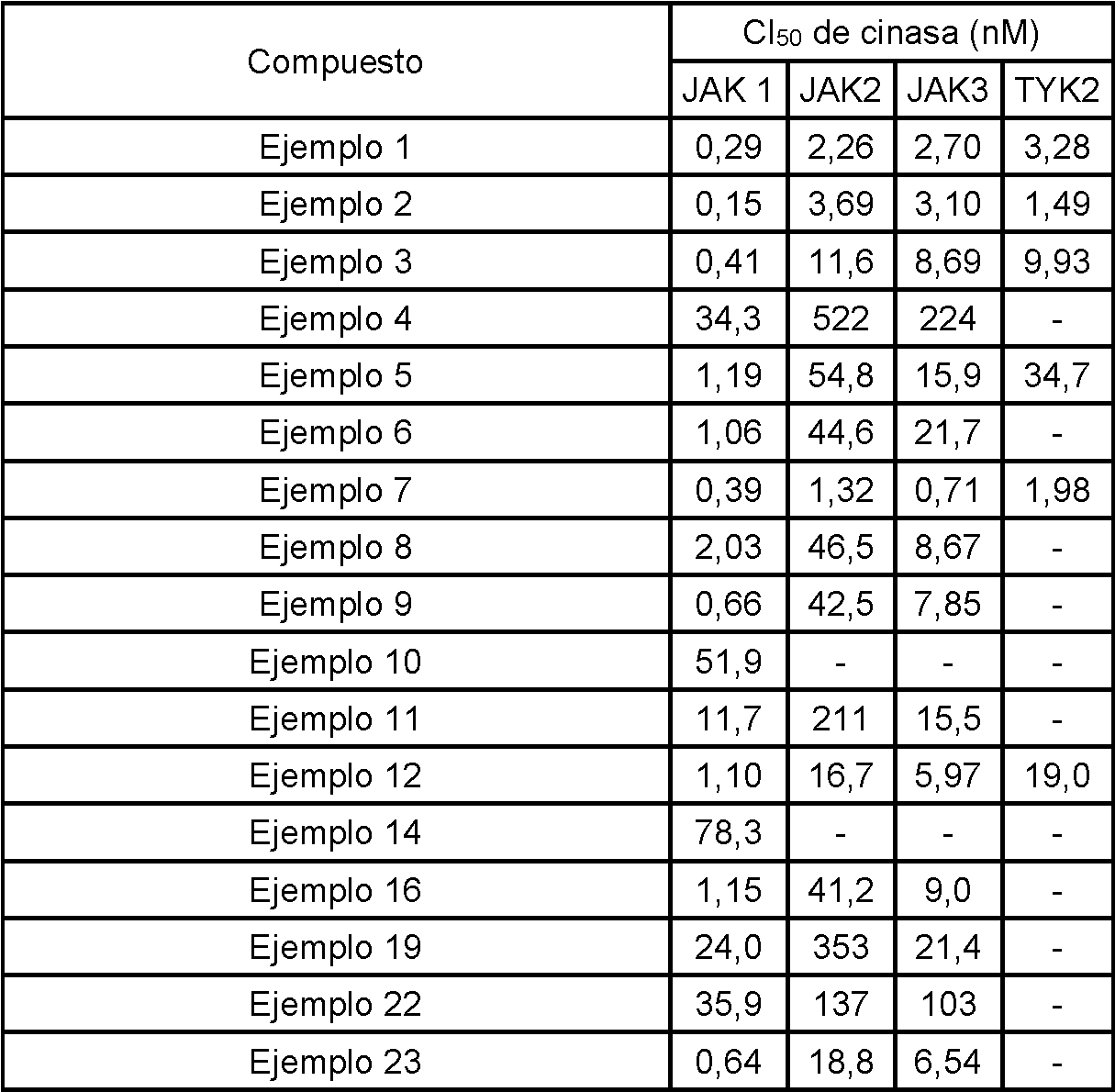

Los compuestos WX14 y WX15 se preparan con referencia a Ios métodos del ejemplo 12 y del ejemplo 13 de la patente W02016116025A1, que tienen las siguientes estructuras:The compounds WX14 and WX15 are prepared with reference to the methods of example 12 and example 13 of patent W02016116025A1, which have the following structures:

Conclusión: Ios compuestos del ejemplo 1, el ejemplo 2, el ejemplo 3, el ejemplo 7, el ejemplo 9 y el ejemplo 23 de la presente invención tienen una mayor actividad en la inhibición de la cinasa JAK1 que el control positivo de fármaco tofacitinib, y la mayoría de Ios compuestos tienen una selectividad más fuerte en la inhibición de la cinasa JAK1 que en la inhibición de las cinasas JAK2 y JAK3, teniendo de ese modo una mejor expectativa en cuanto a seguridad. Los compuestos de la presente invención también tienen una notable actividad inhibidora contra TYK2, con una actividad antiinflamatoria correspondiente.Conclusion: The compounds of example 1, example 2, example 3, example 7, example 9 and example 23 of the present invention have greater activity in inhibiting JAK1 kinase than the positive control drug tofacitinib, and most of the compounds have a stronger selectivity in the inhibition of the JAK1 kinase than in the inhibition of the JAK2 and JAK3 kinases, thus having a better expectation in terms of safety. The compounds of the present invention also have notable inhibitory activity against TYK2, with a corresponding anti-inflammatory activity.
Ejemplo 25Example 25
Prueba de microsoma hepáticoLiver microsome test
En un sistema de incubación con un volumen total de 250 |il, se formuló una disolución de incubación de microsomas hepáticos humanos que contenían proteína 0,5 mg/ml con un tampón PBS 50 mmol/l (pH=7,4). Antes de iniciar la incubación, se mezclaron 2,5 |il de un compuesto 100 μmol/l que va a someterse a prueba con 197,5 |il del tampón de incubación anterior, se incubaron previamente durante 5 min en un baño de agua a 37 0C, y luego se les añadieron 50 |il de una disolución de coenzima II reductora (5 mmol/l) que se incubó previamente del mismo modo durante 5 min para iniciar una reacción (en el sistema de reacción, el contenido de proteína de microsomas hepáticos de diversas especies era de 0,5 g/l, y la concentración final del compuesto que va a someterse a prueba era de 1 μmol/l), se incubaron en un baño de agua a 37 oc con agitación, y se sacaron a Ios 0, 5, 15, 30 y 60 min, respectivamente. Se añadieron inmediatamente 600 |il de una disolución en metanol de patrones internos positivos y negativos mixtos con Ios patrones internos tertenadina (patrón interno de iones positivos, 25 ng/ml) y tolbutamida (patrón interno de iones negativos, 50 ng/ml) para terminar la reacción. Se agitó la disolución de incubación después de la terminación durante 2 min y se centrifugó (4 oc, 16000 rpm) durante 10 min, y se tomó el sobrenadante para la detección por CL-Em /EM para analizar cuantitativamente la cantidad restante del fármaco parental (d Ms O=0,1 %).In an incubation system with a total volume of 250 μl, an incubation solution of human liver microsomes containing 0.5 mg/ml protein was formulated with a 50 mmol/l PBS buffer (pH=7.4). Before starting the incubation, 2.5 µl of a 100 μmol/l compound to be tested was mixed with 197.5 µl of the previous incubation buffer, pre-incubated for 5 min in a water bath at 37 0C, and then 50 μl of a reducing coenzyme II solution (5 mmol/l) that was previously incubated in the same way for 5 min was added to initiate a reaction (in the reaction system, the protein content of liver microsomes of various species was 0.5 g/L, and the final concentration of the compound to be tested was 1 μmol/L), they were incubated in a water bath at 37 °C with shaking, and they were taken out. at I os 0, 5, 15, 30 and 60 min, respectively. 600 µl of a methanol solution of mixed positive and negative internal standards with the internal standards tertenadine (positive ion internal standard, 25 ng/ml) and tolbutamide (negative ion internal standard, 50 ng/ml) were immediately added to finish the reaction. The incubation solution was shaken after termination for 2 min and centrifuged ( 4oc , 16000 rpm) for 10 min, and the supernatant was taken for detection by LC-Em/MS to quantitatively analyze the remaining amount of the parent drug. (d Ms O=0.1%).
La concentración del compuesto a una incubación de 0 min se consideró como el 100 %, y las concentraciones a otros puntos de tiempo de incubación se convirtieron en Ios porcentajes restantes. El logaritmo natural del porcentaje restante en cada punto de tiempo se sometió a regresión lineal frente al tiempo de incubación, y se calculó la pendiente k. Según la fórmula Ti /2 = -0,693/k, se calculó la semivida in vitro. Aclaramiento en microsomas hepáticos (CLint (|il/min/mg de proteína)=Ln (2)*1000/Ti /2 (min/conc. de proteína (mg/ml)).The concentration of the compound at a 0 min incubation was considered 100%, and the concentrations at other incubation time points were converted to the remaining percentages. The natural logarithm of the percentage remaining at each time point was linearly regressed against incubation time, and the slope k was calculated. According to the formula T i /2 = -0.693/k, the in vitro half-life was calculated. Clearance in liver microsomes (CLint (|il/min/mg protein)=Ln (2)*1000/T i /2 (min/protein conc. (mg/ml)).
Tabla 2Table 2

Conclusión: Ios compuestos del ejemplo 1 y el ejemplo 2 de la presente invención tienen una excelente actividad metabólica en el hígado; y en particular, el compuesto del ejemplo 2 es significativamente superior al fármaco positivo tofacitinib en cuanto a la semivida metabólica en microsomas hepáticos y, por tanto, tiene una mejor estabilidad metabólica in vivo. Conclusion: The compounds of example 1 and example 2 of the present invention have excellent metabolic activity in the liver; and in particular, the compound of example 2 is significantly superior to the drug Tofacitinib is positive for metabolic half-life in liver microsomes and therefore has better metabolic stability in vivo.
Ejemplo 26Example 26
Prueba de eficacia en modelo de ratón de colitis ulcerosa inducida por DSSEfficacy test in mouse model of DSS-induced ulcerative colitis
Se agruparon aleatoriamente ratones de 6-7 semanas de edad, 6 ratones por grupo. A los ratones en un grupo de control negativo se les proporcionó a voluntad agua purificada, y a los ratones en los demás grupos se les proporcionó a voluntad una disolución al 2 % de dextrano-sulfato de sodio (DSS), durante 7 días consecutivos. Durante el modelado, se administró el medicamento según los grupos, una vez al día durante 7 días (Ios grupos de tratamiento y Ios números de ratones pueden ajustarse según la situación específica). En el plazo de 8-10 días siguientes, se reemplazó el agua que contenía DSS por agua purificada, proporcionada a voluntad a Ios ratones. La administración normal continuó durante 3 días.Mice 6-7 weeks old were randomly grouped, 6 mice per group. Mice in a negative control group were given purified water ad libitum, and mice in the other groups were given a 2% solution of dextran-sodium sulfate (DSS) ad libitum, for 7 consecutive days. During modeling, the drug was administered according to the groups, once a day for 7 days (The treatment groups and the numbers of mice can be adjusted according to the specific situation). Within the next 8-10 days, the water containing DSS was replaced with purified water, provided ad libitum to the mice. Normal administration continued for 3 days.
Desde el primer día de administración, se observaron respectivamente las condiciones generales tales como el estado mental, el consumo de comida, el consumo de agua y las actividades de Ios ratones cada día, se pesaron Ios ratones cada día, y se recogieron heces de animales, se evaluaron en cuanto a sus rasgos y se sometieron a la prueba de sangre oculta en heces. Se evaluó exhaustivamente el índice de actividad de enfermedad (DAI) de Ios animales experimentales en el plazo de 1-10 días.From the first day of administration, the general conditions such as mental status, food consumption, water consumption and activities of the mice were respectively observed each day, the mice were weighed each day, and animal feces were collected. , were evaluated for their features and underwent fecal occult blood testing. The disease activity index (DAI) of the experimental animals was comprehensively evaluated within 1-10 days.
Tabla 3. Patrones de puntuación de DAITable 3. DAI scoring patterns

La puntuación se realizó según Ios patrones anteriormente mencionados. El índice de actividad de enfermedad (DAI) de cada ratón se obtuvo sumando las puntuaciones de pérdida de peso, rasgo de heces y condición de sangre oculta en heces, para evaluar la actividad de enfermedad. DAI = (puntuación de pérdida de peso puntuación de rasgo de heces puntuación de heces sanguinolentas)/3, que oscila entre 0 y 4.Scoring was carried out according to the aforementioned patterns. The disease activity index (DAI) of each mouse was obtained by summing the scores for weight loss, fecal trait, and fecal occult blood condition, to evaluate disease activity. DAI = (weight loss score stool trait score bloody stool score)/3, ranging from 0 to 4.
Los datos experimentales se procesaron estadísticamente, y todos Ios datos se expresaron como media ± DE o media ± EEM. Se usó el software SPSS13.0 para el análisis estadístico, y las diferencias entre Ios grupos se compararon con la prueba de la t (misma varianza) o la prueba de la t' (varianza distinta). Suponiendo que a=0,05, entonces P<0,05 indica que la diferencia es estadísticamente significativa.The experimental data were processed statistically, and all data were expressed as mean ± SD or mean ± SEM. SPSS13.0 software was used for statistical analysis, and differences between the groups were compared with the t test (same variance) or the t' test (different variance). Assuming that a=0.05, then P<0.05 indicates that the difference is statistically significant.
Resultados de puntuación de DAI: Ios compuestos del ejemplo 1 (para el grupo de 5 mg/kg, la puntuación de DAI el día 8 es de 2,8; para el grupo de 15 mg/kg, la puntuación de DAI el día 8 es de 2) y del ejemplo 2 (para el grupo de 5 mg/kg, la puntuación de DAI el día 8 es de 1,5) muestran una clara eficacia en el modelo de ratón de DSS, y son más fuertes en cuanto a eficacia en comparación con Ios fármacos positivos mesalazina (SASA) (para el grupo de 100 mg/kg, la puntuación de DAI el día 8 es de 3,5) y tofacitinib (para el grupo de 5 mg/kg, la puntuación de DAI el día 8 es de 3,5).DAI score results: The compounds of Example 1 (for the 5 mg/kg group, the DAI score on day 8 is 2.8; for the 15 mg/kg group, the DAI score on day 8 is 2) and example 2 (for the 5 mg/kg group, the DAI score on day 8 is 1.5) show clear efficacy in the mouse model of DSS, and are stronger in terms of Efficacy compared to the positive drugs mesalazine (SASA) (for the 100 mg/kg group, the DAI score on day 8 is 3.5) and tofacitinib (for the 5 mg/kg group, the DAI score on day 8 is 3.5) DAI on day 8 is 3.5).
Conclusión: Ios compuestos del ejemplo 1 y el ejemplo 2 de la presente invención, incluso a una dosis relativamente baja, muestran un efecto significativo en la inhibición de enteritis inducida por DSS en ratones, y tienen una potencia más fuerte que el fármaco de control positivo tofacitinib a la misma dosis.Conclusion: The compounds of Example 1 and Example 2 of the present invention, even at a relatively low dose, show a significant effect in inhibiting DSS-induced enteritis in mice, and have stronger potency than the control drug. positive tofacitinib at the same dose.
Ejemplo 27Example 27
Prueba de evaluación de la actividad terapéutica en modelo de rata de enfermedad de Crohn inducida por DNBS (ácido 2,4-dinitrobenecenosulfónico)Test for evaluation of therapeutic activity in a rat model of Crohn's disease induced by DNBS (2,4-dinitrobenenesulfonic acid)
Se alimentaron de manera adaptativa ratas Wistar macho de 4-5 semanas de edad durante 5 días, y dos días antes del experimento, se dividieron aleatoriamente en 6 grupos:4-5-week-old male Wistar rats were adaptively fed for 5 days, and two days before the experiment, they were randomly divided into 6 groups:
Grupo de control de blanco: G1 (normal), se seleccionaron 4 ratas normales y sólo se les administró etanol al 30 %, 10 ml/kg.Blank control group: G1 (normal), 4 normal rats were selected and only ethanol was administered to them. 30%, 10 ml/kg.
Se inyectaron 0,5 ml de DNBS 50 mg/ml (DNBS disuelto en etanol al 30 %) en el colon de las ratas para inducir enteritis en las ratas, para 40 ratas en total, Se seleccionaron ocho de ellas como grupo de modelo G2 (modelo), y se administraron a las 32 ratas restantes,0.5 ml of DNBS 50 mg/ml (DNBS dissolved in 30% ethanol) was injected into the colon of rats to induce enteritis in rats, for 40 rats in total, eight of them were selected as G2 model group. (model), and were administered to the remaining 32 rats,
Grupo de administración: a las ratas con enteritis inducida por DNBS se les administró ABT494 y el compuesto del ejemplo 2, respectivamente, y se dividieron en los grupos G3-G6, 8 ratas/grupo. G3: ABT494, 10 mg/kg-QD (quaque die, cada día); G4: ejemplo 2, 0,3 mg/kg-BID (bis in die, dos veces al día); G5: ejemplo 2, 1 mg/kg-BID; y G6: ejemplo 2, 3 mg/kg-BID.Administration group: Rats with DNBS-induced enteritis were administered ABT494 and the compound of Example 2, respectively, and divided into groups G3-G6, 8 rats/group. G3: ABT494, 10 mg/kg-QD ( quaque die, every day); G4: example 2, 0.3 mg/kg-BID ( bis in die, twice a day); G5: example 2, 1 mg/kg-BID; and G6: example 2, 3 mg/kg-BID.
Las ratas se mantuvieron en ayunas, pero se alimentaron con agua, durante 48 horas, y se usó una disolución de sales de glucosa al 5 % (10 ml/kg) como complemento energético para los animales experimentales durante el periodo de ayuno, una vez al día. El día del modelado experimental, se anestesiaron las ratas en ayunas con Choutet (25 mg/kg), y luego se inyectaron 0,5 ml de DNBS 50 mg/ml desde el ano hasta el ángulo cólico izquierdo de la rata (aproximadamente 8 cm hasta el ano) para inducir la enteritis en las ratas. Todas las ratas se mantuvieron en una posición con la cabeza hacia abajo durante 15 min hasta que se despertaron, para prevenir el reflujo de DNBS. Desde el día del modelado experimental, se administró medicamento durante 7 días.The rats were fasted, but fed with water, for 48 hours, and a solution of 5% glucose salts (10 ml/kg) was used as an energy supplement for the experimental animals during the fasting period, once up to date. On the day of experimental modeling, fasted rats were anesthetized with Choutet (25 mg/kg), and then 0.5 ml of 50 mg/ml DNBS was injected from the anus to the left colic flexure of the rat (approximately 8 cm to the anus) to induce enteritis in rats. All rats were kept in a head-down position for 15 min until they woke up, to prevent reflux of DNBS. From the day of experimental modeling, medication was administered for 7 days.
El fármaco positivo ABT494 se adquirió de Nanjing Xinmeihe Pharmaceutical Technology Co., Ltd. (n.° de lote: NNES190329), que tiene la siguiente estructura:The positive drug ABT494 was purchased from Nanjing Xinmeihe Pharmaceutical Technology Co., Ltd. (batch no.: NNES190329), which has the following structure:

Después del modelado de DNBS, se midieron y registraron los pesos de los animales cada día, se observaron las actividades diarias de los animales y se registraron las anomalías. Durante el experimento, se puntuó el estado de las heces de las ratas cada día. El día 7, se anestesiaron las ratas con isoflurano (al 3-5 %), se extrajo sangre a partir de la órbita, y se separó el suero y se almacenó a -80 °C. Todos los animales se sacrificaron mediante luxación cervical después de la asfixia por inhalación excesiva de CO2. Se cortó el abdomen, se extrajeron el colon y el recto y se disecaron longitudinalmente, y se puntuó el rasgo de heces en el colon y el recto. Se enjuagaron exhaustivamente el colon y el recto con PBS helada y luego se observó la superficie de úlcera. Se registraron la longitud y el peso y el área de úlcera del colon, se calculó la razón peso-longitud (razón peso de colon (g)/longitud (cm) x 100), y se tomó una imagen global. Todo el tejido intestinal se dividió longitudinalmente en dos partes, en la que una parte se fijó con PEA neutro al 4 % y se incrustó con parafina, y la muestra de colon restante se crioconservó a -80 °C.After DNBS modeling, the weights of the animals were measured and recorded each day, the daily activities of the animals were observed, and any abnormalities were recorded. During the experiment, the state of the rats' feces was scored each day. On day 7, rats were anesthetized with isoflurane (3-5%), blood was drawn from the orbit, and serum was separated and stored at −80°C. All animals were sacrificed by cervical dislocation after asphyxiation due to excessive CO 2 inhalation. The abdomen was cut, the colon and rectum were removed and dissected longitudinally, and fecal trait in the colon and rectum was scored. The colon and rectum were rinsed thoroughly with ice-cold PBS, and then the ulcer surface was observed. The length and weight and ulcer area of the colon were recorded, the weight-length ratio was calculated (colon weight (g)/length (cm) ratio x 100), and a global image was taken. The entire intestinal tissue was divided longitudinally into two parts, in which one part was fixed with 4% neutral PEA and embedded with paraffin, and the remaining colon sample was cryopreserved at −80°C.
Se usaron Excel y el software Graphpad para el análisis estadístico, y los resultados se expresaron como media ± DE. Se usó la prueba de la T bilateral para la comparación entre grupos. *p<0,05 indica que hay una diferencia estadística significativa entre el grupo de tratamiento con fármaco y el grupo de modelo, **p<0,01 indica que hay una diferencia estadística muy significativa entre el grupo de tratamiento con fármaco y el grupo de modelo, #p<0,05 indica que hay una diferencia estadística significativa entre el grupo de modelo y el grupo normal, y ##p<0,01 indica que hay una diferencia estadística muy significativa entre el grupo de modelo y el grupo normal. Excel and Graphpad software were used for statistical analysis, and the results were expressed as mean ± SD. The two-sided T test was used for comparison between groups. *p<0.05 indicates that there is a statistically significant difference between the drug treatment group and the model group, ** p <0.01 indicates that there is a highly significant statistical difference between the drug treatment group and the model group. model group, #p<0.05 indicates that there is a statistically significant difference between the model group and the normal group, and ##p<0.01 indicates that there is a highly significant statistical difference between the model group and the normal group. normal group.
Los resultados de la influencia de los compuestos sobre la razón peso-longitud de colon en el modelo de enfermedad de Crohn inducida por DNBS de rata se muestran en la figura 25, y las imágenes de colon se muestran en las figuras 27-33, en las que las razones de peso-longitud de colon de los grupos de tratamiento con fármaco G3: ABT494 10 mg/kg-QD, G4: ejemplo 2 0,3 mg/kg-BID, G5: ejemplo 2 1 mg/kg-BID y G6: ejemplo 2 3 mg/kg-BID son de 13,4±5,2, 10,5±3,9, i 0,0±1,9 y 10,5±2,0, respectivamente, que son todas más bajas que la razón de peso-longitud de colon (14,6±5,1) del grupo de modelo G2, y la comparación entre el grupo g 5 (ejemplo 2 1 mg/kg-BID) y el grupo de modelo G2 muestra una diferencia significativa (*p<0,05). The results of the influence of the compounds on the colon weight-length ratio in the rat DNBS-induced Crohn's disease model are shown in Figure 25, and the colon images are shown in Figures 27-33, in which the colon weight-length ratios of drug treatment groups G3: ABT494 10 mg/kg-QD, G4: example 2 0.3 mg/kg-BID, G5: example 2 1 mg/kg- BID and G6: example 2 3 mg/kg-BID are 13.4±5.2, 10.5±3.9, i 0.0±1.9 and 10.5±2.0, respectively, which are all lower than the colon weight-length ratio (14.6±5.1) of the model group G2, and the comparison between the group g 5 (example 2 1 mg/kg-BID) and the group model G2 shows a significant difference (* p < 0.05).
La influencia de los compuestos sobre el área de úlcera de colon en el modelo de enfermedad de Crohn inducida por DNBS de rata se muestra en la figura 26, en la que las áreas de úlcera de colon de rata de los grupos de tratamiento con fármaco G3: ABT494 10 mg/kg-QD, G4: ejemplo 20,3 mg/kg-BID, G5: ejemplo 2 1 mg/kg-BID y G6: ejemplo 23 mg/kg-BID son de 1,37±1,72, 0,83±1,00, 0,65±1,05 y 0,76±1,21, respectivamente, que son todas más bajas que el área de úlcera de colon de rata (1,54±2,00) del grupo de modelo g 2. The influence of the compounds on the colon ulcer area in the rat DNBS-induced Crohn's disease model is shown in Figure 26, in which the rat colon ulcer areas of the G3 drug treatment groups : ABT494 10 mg/kg-QD, G4: example 20.3 mg/kg-BID, G5: example 2 1 mg/kg-BID and G6: example 23 mg/kg-BID are 1.37±1.72 , 0.83±1.00, 0.65±1.05 and 0.76±1.21, respectively, which are all lower than the area of rat colon ulcer (1.54±2.00). of model group g 2.
Conclusión: el compuesto del ejemplo 2 de la presente Invención, Incluso a una dosis relativamente baja, muestra un efecto significativo en la Inhibición de enteritis Inducida por DNBS de las ratas. Conclusion: The compound of example 2 of the present invention, even at a relatively low dose, shows a significant effect on the inhibition of DNBS-induced enteritis of rats.
Claims (13)


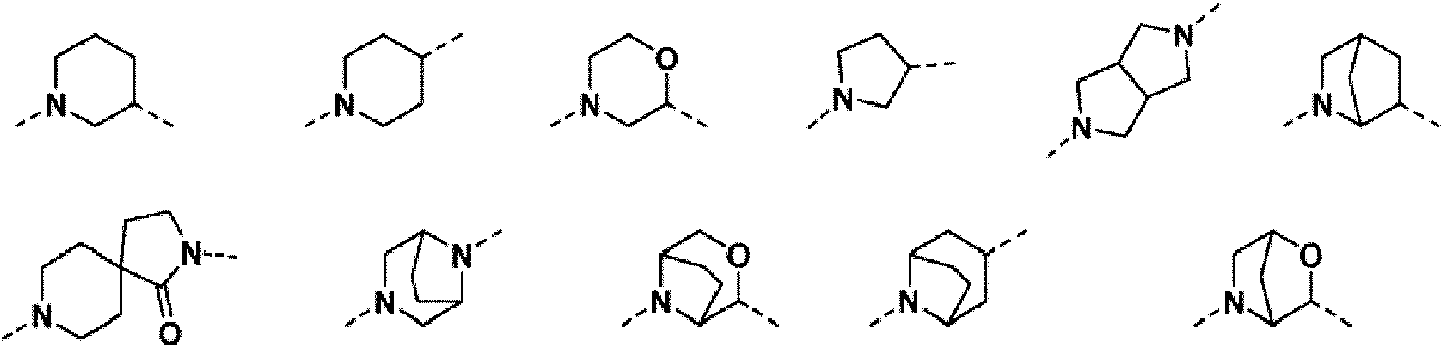


Applications Claiming Priority (3)
| Application Number | Priority Date | Filing Date | Title |
|---|---|---|---|
| CN201910106479 | 2019-02-02 | ||
| CN202010050671.4A CN111518096B (en) | 2019-02-02 | 2020-01-13 | Janus kinase JAK family inhibitor and preparation and application thereof |
| PCT/CN2020/072949 WO2020156271A1 (en) | 2019-02-02 | 2020-01-19 | Janus kinase (jak) family inhibitor, preparation of same, and applications thereof |
Publications (1)
| Publication Number | Publication Date |
|---|---|
| ES2950965T3 true ES2950965T3 (en) | 2023-10-17 |
Family
ID=71900526
Family Applications (1)
| Application Number | Title | Priority Date | Filing Date |
|---|---|---|---|
| ES20749430T Active ES2950965T3 (en) | 2019-02-02 | 2020-01-19 | Janus kinase (JAK) family inhibitor, preparation thereof and applications thereof |
Country Status (8)
| Country | Link |
|---|---|
| US (1) | US12304910B2 (en) |
| EP (1) | EP3919494B1 (en) |
| JP (2) | JP7344304B2 (en) |
| KR (1) | KR102770790B1 (en) |
| CN (1) | CN111518096B (en) |
| AU (1) | AU2020214895B2 (en) |
| CA (1) | CA3128421C (en) |
| ES (1) | ES2950965T3 (en) |
Families Citing this family (4)
| Publication number | Priority date | Publication date | Assignee | Title |
|---|---|---|---|---|
| CN111518096B (en) | 2019-02-02 | 2022-02-11 | 江苏威凯尔医药科技有限公司 | Janus kinase JAK family inhibitor and preparation and application thereof |
| CA3191607A1 (en) | 2020-09-08 | 2022-03-17 | Gilles Ouvry | Novel jak inhibitor compounds, method for synthesizing same and use thereof |
| WO2023029943A1 (en) * | 2021-09-03 | 2023-03-09 | 星药科技(北京)有限公司 | Aromatic heterocyclic compound, preparation method therefor and use thereof |
| CN118724900B (en) * | 2024-09-04 | 2025-01-28 | 浙江大学智能创新药物研究院 | 4-Amino-7-azaindole compounds, preparation method and application thereof |
Family Cites Families (9)
| Publication number | Priority date | Publication date | Assignee | Title |
|---|---|---|---|---|
| WO2007007919A2 (en) | 2005-07-14 | 2007-01-18 | Astellas Pharma Inc. | Heterocyclic janus kinase 3 inhibitors |
| WO2008144253A1 (en) * | 2007-05-14 | 2008-11-27 | Irm Llc | Protein kinase inhibitors and methods for using thereof |
| GB201201566D0 (en) | 2012-01-30 | 2012-03-14 | Vernalis R&D Ltd | New chemical compounds |
| EA036122B1 (en) | 2015-01-20 | 2020-09-30 | Уси Форчун Фармасьютикал Ко., Лтд | Jak inhibitor |
| ES2830446T3 (en) | 2015-12-11 | 2021-06-03 | Sichuan Kelun Biotech Biopharmaceutical Co Ltd | Azetidine derivative, method of preparation and use of the same |
| CN108570048B (en) * | 2017-03-10 | 2021-06-08 | 广东东阳光药业有限公司 | Substituted heteroaryl compounds, compositions and uses thereof |
| WO2018169700A1 (en) * | 2017-03-14 | 2018-09-20 | Sunshine Lake Pharma Co., Ltd. | Substituted heteroaryl compounds and methods of use |
| WO2020156271A1 (en) | 2019-02-02 | 2020-08-06 | 江苏威凯尔医药科技有限公司 | Janus kinase (jak) family inhibitor, preparation of same, and applications thereof |
| CN111518096B (en) | 2019-02-02 | 2022-02-11 | 江苏威凯尔医药科技有限公司 | Janus kinase JAK family inhibitor and preparation and application thereof |
-
2020
- 2020-01-13 CN CN202010050671.4A patent/CN111518096B/en active Active
- 2020-01-19 JP JP2021543350A patent/JP7344304B2/en active Active
- 2020-01-19 EP EP20749430.3A patent/EP3919494B1/en active Active
- 2020-01-19 KR KR1020217027137A patent/KR102770790B1/en active Active
- 2020-01-19 ES ES20749430T patent/ES2950965T3/en active Active
- 2020-01-19 US US17/425,844 patent/US12304910B2/en active Active
- 2020-01-19 AU AU2020214895A patent/AU2020214895B2/en active Active
- 2020-01-19 CA CA3128421A patent/CA3128421C/en active Active
-
2023
- 2023-05-30 JP JP2023088385A patent/JP7681059B2/en active Active
Also Published As
| Publication number | Publication date |
|---|---|
| AU2020214895A1 (en) | 2021-09-02 |
| JP7681059B2 (en) | 2025-05-21 |
| US12304910B2 (en) | 2025-05-20 |
| KR20210120052A (en) | 2021-10-06 |
| CA3128421A1 (en) | 2020-08-06 |
| CN111518096B (en) | 2022-02-11 |
| CA3128421C (en) | 2025-05-13 |
| EP3919494B1 (en) | 2023-05-24 |
| JP7344304B2 (en) | 2023-09-13 |
| CN111518096A (en) | 2020-08-11 |
| JP2022518556A (en) | 2022-03-15 |
| US20220177467A1 (en) | 2022-06-09 |
| EP3919494A1 (en) | 2021-12-08 |
| KR102770790B1 (en) | 2025-02-24 |
| JP2023113753A (en) | 2023-08-16 |
| AU2020214895B2 (en) | 2022-07-28 |
| EP3919494A4 (en) | 2022-08-03 |
Similar Documents
| Publication | Publication Date | Title |
|---|---|---|
| US20220380375A1 (en) | Substituted aromatic fused ring derivative and composition comprising same, and use thereof | |
| ES2950965T3 (en) | Janus kinase (JAK) family inhibitor, preparation thereof and applications thereof | |
| JP7299837B2 (en) | Compounds, compositions and methods of use | |
| ES2415863T3 (en) | Substituted heterocycles as Janus Kinase inhibitors | |
| ES2898069T3 (en) | N-(pyridin-2-yl)pyridinesulfonamide derivatives and their use in the treatment of disease | |
| KR20220092920A (en) | Helios small molecule degrading agent and method of use | |
| ES2798424T3 (en) | Triazolopyridine Compounds and Uses of These | |
| RS58679B1 (en) | Triazolopyrimidine compounds and uses thereof | |
| WO2020156271A1 (en) | Janus kinase (jak) family inhibitor, preparation of same, and applications thereof | |
| MX2011000834A (en) | Pyrazolopyridine kinase inhibitors. | |
| US12365685B2 (en) | Substituted fused aromatic ring derivative, composition and use thereof | |
| RS52838B (en) | PHENOXIMETHYL HETEROCYCLIC COMPOUNDS | |
| BR112021005750A2 (en) | fgfr4 inhibitor and its use | |
| EP4450503A1 (en) | Aromatic heterocyclic compounds, preparation method therefor and uses thereof | |
| WO2019218904A1 (en) | Unnatural amino acid derivative, preparation method therefor and use thereof | |
| US12215101B2 (en) | Pro drugs of PDE10 compounds | |
| CN114644633B (en) | Heterocyclic JAK inhibitors | |
| RU2811484C1 (en) | Substituted aromatic derivative with condensed rings and composition including it and their use | |
| US20250197411A1 (en) | Irak4 protacs | |
| BR112023018850B1 (en) | PDE10 COMPOUNDS, COMPOSITION AND USES OF THEM | |
| EA047652B1 (en) | PRODRUGS OF PDE10 COMPOUNDS | |
| WO2024227026A1 (en) | Heterocyclic compounds as parp1 inhibitors | |
| NZ618982A (en) | Azetidinyl phenyl, pyridyl or pyrazinyl carboxamide derivatives as jak inhibitors |