ES2951328T3 - Method for producing renewable base oil and renewable fuel components - Google Patents
Method for producing renewable base oil and renewable fuel components Download PDFInfo
- Publication number
- ES2951328T3 ES2951328T3 ES19906703T ES19906703T ES2951328T3 ES 2951328 T3 ES2951328 T3 ES 2951328T3 ES 19906703 T ES19906703 T ES 19906703T ES 19906703 T ES19906703 T ES 19906703T ES 2951328 T3 ES2951328 T3 ES 2951328T3
- Authority
- ES
- Spain
- Prior art keywords
- renewable
- fatty acid
- catalyst
- reaction
- base oil
- Prior art date
- Legal status (The legal status is an assumption and is not a legal conclusion. Google has not performed a legal analysis and makes no representation as to the accuracy of the status listed.)
- Active
Links
- 239000002199 base oil Substances 0.000 title claims abstract description 74
- 239000000446 fuel Substances 0.000 title claims abstract description 26
- 238000004519 manufacturing process Methods 0.000 title description 25
- 239000000194 fatty acid Substances 0.000 claims abstract description 94
- 235000014113 dietary fatty acids Nutrition 0.000 claims abstract description 93
- 229930195729 fatty acid Natural products 0.000 claims abstract description 93
- 150000004665 fatty acids Chemical class 0.000 claims abstract description 84
- PEDCQBHIVMGVHV-UHFFFAOYSA-N Glycerine Chemical compound OCC(O)CO PEDCQBHIVMGVHV-UHFFFAOYSA-N 0.000 claims abstract description 71
- 235000021588 free fatty acids Nutrition 0.000 claims abstract description 60
- 238000000034 method Methods 0.000 claims abstract description 60
- 125000005456 glyceride group Chemical group 0.000 claims abstract description 37
- 238000000926 separation method Methods 0.000 claims abstract description 25
- BDERNNFJNOPAEC-UHFFFAOYSA-N propan-1-ol Chemical class CCCO BDERNNFJNOPAEC-UHFFFAOYSA-N 0.000 claims abstract description 17
- 239000003054 catalyst Substances 0.000 claims description 61
- 238000006243 chemical reaction Methods 0.000 claims description 59
- 150000002576 ketones Chemical class 0.000 claims description 32
- 239000002994 raw material Substances 0.000 claims description 32
- 235000011187 glycerol Nutrition 0.000 claims description 27
- OKTJSMMVPCPJKN-UHFFFAOYSA-N Carbon Chemical group [C] OKTJSMMVPCPJKN-UHFFFAOYSA-N 0.000 claims description 23
- 238000004821 distillation Methods 0.000 claims description 17
- 239000003925 fat Substances 0.000 claims description 17
- 239000007789 gas Substances 0.000 claims description 17
- 235000019197 fats Nutrition 0.000 claims description 16
- VYPSYNLAJGMNEJ-UHFFFAOYSA-N Silicium dioxide Chemical compound O=[Si]=O VYPSYNLAJGMNEJ-UHFFFAOYSA-N 0.000 claims description 12
- 229910052799 carbon Inorganic materials 0.000 claims description 12
- -1 fatty acid glycerols Chemical class 0.000 claims description 12
- 239000003502 gasoline Substances 0.000 claims description 12
- 241001465754 Metazoa Species 0.000 claims description 11
- 229910044991 metal oxide Inorganic materials 0.000 claims description 11
- 150000004706 metal oxides Chemical group 0.000 claims description 11
- 229910052751 metal Inorganic materials 0.000 claims description 9
- 239000002184 metal Substances 0.000 claims description 9
- 235000019737 Animal fat Nutrition 0.000 claims description 8
- PNEYBMLMFCGWSK-UHFFFAOYSA-N aluminium oxide Inorganic materials [O-2].[O-2].[O-2].[Al+3].[Al+3] PNEYBMLMFCGWSK-UHFFFAOYSA-N 0.000 claims description 8
- 229910052697 platinum Inorganic materials 0.000 claims description 8
- UFHFLCQGNIYNRP-UHFFFAOYSA-N Hydrogen Chemical compound [H][H] UFHFLCQGNIYNRP-UHFFFAOYSA-N 0.000 claims description 7
- 239000001257 hydrogen Substances 0.000 claims description 7
- 229910052739 hydrogen Inorganic materials 0.000 claims description 7
- 239000003915 liquefied petroleum gas Substances 0.000 claims description 7
- 229910052759 nickel Inorganic materials 0.000 claims description 6
- 239000000377 silicon dioxide Substances 0.000 claims description 6
- NINIDFKCEFEMDL-UHFFFAOYSA-N Sulfur Chemical compound [S] NINIDFKCEFEMDL-UHFFFAOYSA-N 0.000 claims description 5
- 229910052749 magnesium Inorganic materials 0.000 claims description 5
- 229910052763 palladium Inorganic materials 0.000 claims description 5
- 229930195734 saturated hydrocarbon Natural products 0.000 claims description 5
- 229910052717 sulfur Inorganic materials 0.000 claims description 5
- 239000011593 sulfur Substances 0.000 claims description 5
- 239000002699 waste material Substances 0.000 claims description 5
- 229910052726 zirconium Inorganic materials 0.000 claims description 5
- 241000251468 Actinopterygii Species 0.000 claims description 4
- 239000007788 liquid Substances 0.000 claims description 4
- 229910052700 potassium Inorganic materials 0.000 claims description 4
- ULWHHBHJGPPBCO-UHFFFAOYSA-N propane-1,1-diol Chemical compound CCC(O)O ULWHHBHJGPPBCO-UHFFFAOYSA-N 0.000 claims description 4
- 235000015112 vegetable and seed oil Nutrition 0.000 claims description 4
- 239000008158 vegetable oil Substances 0.000 claims description 4
- 229910052791 calcium Inorganic materials 0.000 claims description 3
- 229940013317 fish oils Drugs 0.000 claims description 3
- 229910052748 manganese Inorganic materials 0.000 claims description 3
- 229910052703 rhodium Inorganic materials 0.000 claims description 3
- 229910052719 titanium Inorganic materials 0.000 claims description 3
- 239000001993 wax Substances 0.000 claims description 3
- 229910052727 yttrium Inorganic materials 0.000 claims description 3
- 239000010775 animal oil Substances 0.000 claims description 2
- 239000012164 animal wax Substances 0.000 claims description 2
- 229910052742 iron Inorganic materials 0.000 claims description 2
- 239000002808 molecular sieve Substances 0.000 claims description 2
- 229910052750 molybdenum Inorganic materials 0.000 claims description 2
- 229910052706 scandium Inorganic materials 0.000 claims description 2
- URGAHOPLAPQHLN-UHFFFAOYSA-N sodium aluminosilicate Chemical compound [Na+].[Al+3].[O-][Si]([O-])=O.[O-][Si]([O-])=O URGAHOPLAPQHLN-UHFFFAOYSA-N 0.000 claims description 2
- 229910052712 strontium Inorganic materials 0.000 claims description 2
- 229910052718 tin Inorganic materials 0.000 claims description 2
- 235000019871 vegetable fat Nutrition 0.000 claims description 2
- 239000012178 vegetable wax Substances 0.000 claims description 2
- 229910052725 zinc Inorganic materials 0.000 claims description 2
- 239000008186 active pharmaceutical agent Substances 0.000 claims 2
- GNFTZDOKVXKIBK-UHFFFAOYSA-N 3-(2-methoxyethoxy)benzohydrazide Chemical compound COCCOC1=CC=CC(C(=O)NN)=C1 GNFTZDOKVXKIBK-UHFFFAOYSA-N 0.000 claims 1
- FGUUSXIOTUKUDN-IBGZPJMESA-N C1(=CC=CC=C1)N1C2=C(NC([C@H](C1)NC=1OC(=NN=1)C1=CC=CC=C1)=O)C=CC=C2 Chemical compound C1(=CC=CC=C1)N1C2=C(NC([C@H](C1)NC=1OC(=NN=1)C1=CC=CC=C1)=O)C=CC=C2 FGUUSXIOTUKUDN-IBGZPJMESA-N 0.000 claims 1
- 229910052802 copper Inorganic materials 0.000 claims 1
- 239000012188 paraffin wax Substances 0.000 claims 1
- 238000007327 hydrogenolysis reaction Methods 0.000 abstract description 3
- 239000000047 product Substances 0.000 description 39
- 230000007062 hydrolysis Effects 0.000 description 23
- 238000006460 hydrolysis reaction Methods 0.000 description 23
- 238000006317 isomerization reaction Methods 0.000 description 23
- XLYOFNOQVPJJNP-UHFFFAOYSA-N water Substances O XLYOFNOQVPJJNP-UHFFFAOYSA-N 0.000 description 17
- 239000003921 oil Substances 0.000 description 13
- 235000019198 oils Nutrition 0.000 description 11
- 239000002253 acid Substances 0.000 description 9
- 238000005984 hydrogenation reaction Methods 0.000 description 9
- BASFCYQUMIYNBI-UHFFFAOYSA-N platinum Substances [Pt] BASFCYQUMIYNBI-UHFFFAOYSA-N 0.000 description 9
- 150000002430 hydrocarbons Chemical class 0.000 description 8
- 150000007513 acids Chemical class 0.000 description 7
- 229930195733 hydrocarbon Natural products 0.000 description 7
- 239000004215 Carbon black (E152) Substances 0.000 description 6
- 239000000314 lubricant Substances 0.000 description 6
- 239000000203 mixture Substances 0.000 description 6
- 238000005292 vacuum distillation Methods 0.000 description 6
- 150000001241 acetals Chemical class 0.000 description 5
- 150000001335 aliphatic alkanes Chemical class 0.000 description 5
- 150000001412 amines Chemical class 0.000 description 5
- QVGXLLKOCUKJST-UHFFFAOYSA-N atomic oxygen Chemical compound [O] QVGXLLKOCUKJST-UHFFFAOYSA-N 0.000 description 5
- 238000006392 deoxygenation reaction Methods 0.000 description 5
- 150000002081 enamines Chemical class 0.000 description 5
- 238000005194 fractionation Methods 0.000 description 5
- 150000002466 imines Chemical class 0.000 description 5
- 239000012535 impurity Substances 0.000 description 5
- 229910052760 oxygen Inorganic materials 0.000 description 5
- 239000001301 oxygen Substances 0.000 description 5
- 239000012071 phase Substances 0.000 description 5
- 150000003333 secondary alcohols Chemical class 0.000 description 5
- 150000003509 tertiary alcohols Chemical class 0.000 description 5
- CURLTUGMZLYLDI-UHFFFAOYSA-N Carbon dioxide Chemical compound O=C=O CURLTUGMZLYLDI-UHFFFAOYSA-N 0.000 description 4
- 235000019482 Palm oil Nutrition 0.000 description 4
- QAOWNCQODCNURD-UHFFFAOYSA-N Sulfuric acid Chemical compound OS(O)(=O)=O QAOWNCQODCNURD-UHFFFAOYSA-N 0.000 description 4
- 238000005336 cracking Methods 0.000 description 4
- 239000002540 palm oil Substances 0.000 description 4
- 239000000126 substance Substances 0.000 description 4
- LFQSCWFLJHTTHZ-UHFFFAOYSA-N Ethanol Chemical compound CCO LFQSCWFLJHTTHZ-UHFFFAOYSA-N 0.000 description 3
- HEMHJVSKTPXQMS-UHFFFAOYSA-M Sodium hydroxide Chemical compound [OH-].[Na+] HEMHJVSKTPXQMS-UHFFFAOYSA-M 0.000 description 3
- 238000009835 boiling Methods 0.000 description 3
- 239000006227 byproduct Substances 0.000 description 3
- 150000001735 carboxylic acids Chemical class 0.000 description 3
- 230000000052 comparative effect Effects 0.000 description 3
- 238000009826 distribution Methods 0.000 description 3
- 150000002148 esters Chemical class 0.000 description 3
- 238000000746 purification Methods 0.000 description 3
- 238000004064 recycling Methods 0.000 description 3
- 239000008346 aqueous phase Substances 0.000 description 2
- 230000009286 beneficial effect Effects 0.000 description 2
- 230000001588 bifunctional effect Effects 0.000 description 2
- 229910002092 carbon dioxide Inorganic materials 0.000 description 2
- 238000001816 cooling Methods 0.000 description 2
- 230000001419 dependent effect Effects 0.000 description 2
- 239000002283 diesel fuel Substances 0.000 description 2
- 235000013305 food Nutrition 0.000 description 2
- 150000002314 glycerols Chemical class 0.000 description 2
- 239000005431 greenhouse gas Substances 0.000 description 2
- 238000005461 lubrication Methods 0.000 description 2
- 235000013372 meat Nutrition 0.000 description 2
- 150000002739 metals Chemical class 0.000 description 2
- 238000002156 mixing Methods 0.000 description 2
- TVMXDCGIABBOFY-UHFFFAOYSA-N octane Chemical compound CCCCCCCC TVMXDCGIABBOFY-UHFFFAOYSA-N 0.000 description 2
- 239000003208 petroleum Substances 0.000 description 2
- IYDGMDWEHDFVQI-UHFFFAOYSA-N phosphoric acid;trioxotungsten Chemical compound O=[W](=O)=O.O=[W](=O)=O.O=[W](=O)=O.O=[W](=O)=O.O=[W](=O)=O.O=[W](=O)=O.O=[W](=O)=O.O=[W](=O)=O.O=[W](=O)=O.O=[W](=O)=O.O=[W](=O)=O.O=[W](=O)=O.OP(O)(O)=O IYDGMDWEHDFVQI-UHFFFAOYSA-N 0.000 description 2
- 150000003626 triacylglycerols Chemical class 0.000 description 2
- UFTFJSFQGQCHQW-UHFFFAOYSA-N triformin Chemical compound O=COCC(OC=O)COC=O UFTFJSFQGQCHQW-UHFFFAOYSA-N 0.000 description 2
- 229910052721 tungsten Inorganic materials 0.000 description 2
- 229910052684 Cerium Inorganic materials 0.000 description 1
- DGAQECJNVWCQMB-PUAWFVPOSA-M Ilexoside XXIX Chemical compound C[C@@H]1CC[C@@]2(CC[C@@]3(C(=CC[C@H]4[C@]3(CC[C@@H]5[C@@]4(CC[C@@H](C5(C)C)OS(=O)(=O)[O-])C)C)[C@@H]2[C@]1(C)O)C)C(=O)O[C@H]6[C@@H]([C@H]([C@@H]([C@H](O6)CO)O)O)O.[Na+] DGAQECJNVWCQMB-PUAWFVPOSA-M 0.000 description 1
- 229910003294 NiMo Inorganic materials 0.000 description 1
- QCWXUUIWCKQGHC-UHFFFAOYSA-N Zirconium Chemical compound [Zr] QCWXUUIWCKQGHC-UHFFFAOYSA-N 0.000 description 1
- 239000003377 acid catalyst Substances 0.000 description 1
- 230000002378 acidificating effect Effects 0.000 description 1
- 125000002252 acyl group Chemical group 0.000 description 1
- 239000000654 additive Substances 0.000 description 1
- 210000003486 adipose tissue brown Anatomy 0.000 description 1
- 125000005907 alkyl ester group Chemical group 0.000 description 1
- 239000011260 aqueous acid Substances 0.000 description 1
- 150000001491 aromatic compounds Chemical class 0.000 description 1
- 238000004061 bleaching Methods 0.000 description 1
- 238000009395 breeding Methods 0.000 description 1
- 230000001488 breeding effect Effects 0.000 description 1
- 239000001569 carbon dioxide Substances 0.000 description 1
- 239000011203 carbon fibre reinforced carbon Substances 0.000 description 1
- 239000012159 carrier gas Substances 0.000 description 1
- 230000015556 catabolic process Effects 0.000 description 1
- 230000003197 catalytic effect Effects 0.000 description 1
- 238000004517 catalytic hydrocracking Methods 0.000 description 1
- 239000007795 chemical reaction product Substances 0.000 description 1
- 239000003153 chemical reaction reagent Substances 0.000 description 1
- 238000003776 cleavage reaction Methods 0.000 description 1
- 230000001427 coherent effect Effects 0.000 description 1
- 230000000295 complement effect Effects 0.000 description 1
- 150000001875 compounds Chemical class 0.000 description 1
- 238000009833 condensation Methods 0.000 description 1
- 230000005494 condensation Effects 0.000 description 1
- 238000006482 condensation reaction Methods 0.000 description 1
- 238000007796 conventional method Methods 0.000 description 1
- 239000010779 crude oil Substances 0.000 description 1
- 238000006114 decarboxylation reaction Methods 0.000 description 1
- 230000003247 decreasing effect Effects 0.000 description 1
- 238000006731 degradation reaction Methods 0.000 description 1
- 238000004332 deodorization Methods 0.000 description 1
- 235000013601 eggs Nutrition 0.000 description 1
- 230000008030 elimination Effects 0.000 description 1
- 238000003379 elimination reaction Methods 0.000 description 1
- 229910001651 emery Inorganic materials 0.000 description 1
- 238000001704 evaporation Methods 0.000 description 1
- 230000008020 evaporation Effects 0.000 description 1
- 150000002191 fatty alcohols Chemical class 0.000 description 1
- 238000001914 filtration Methods 0.000 description 1
- 239000013505 freshwater Substances 0.000 description 1
- 125000000524 functional group Chemical group 0.000 description 1
- PCHJSUWPFVWCPO-UHFFFAOYSA-N gold Chemical compound [Au] PCHJSUWPFVWCPO-UHFFFAOYSA-N 0.000 description 1
- 229910052737 gold Inorganic materials 0.000 description 1
- 239000010931 gold Substances 0.000 description 1
- 150000002431 hydrogen Chemical class 0.000 description 1
- 125000002887 hydroxy group Chemical group [H]O* 0.000 description 1
- 229910052500 inorganic mineral Inorganic materials 0.000 description 1
- 239000000543 intermediate Substances 0.000 description 1
- 230000000155 isotopic effect Effects 0.000 description 1
- 229910052746 lanthanum Inorganic materials 0.000 description 1
- 239000010687 lubricating oil Substances 0.000 description 1
- 239000000463 material Substances 0.000 description 1
- 230000000813 microbial effect Effects 0.000 description 1
- 235000013336 milk Nutrition 0.000 description 1
- 239000008267 milk Substances 0.000 description 1
- 210000004080 milk Anatomy 0.000 description 1
- 239000011707 mineral Substances 0.000 description 1
- 229910000510 noble metal Inorganic materials 0.000 description 1
- 235000014593 oils and fats Nutrition 0.000 description 1
- 238000005457 optimization Methods 0.000 description 1
- 150000002894 organic compounds Chemical class 0.000 description 1
- 230000003647 oxidation Effects 0.000 description 1
- 238000007254 oxidation reaction Methods 0.000 description 1
- 230000000737 periodic effect Effects 0.000 description 1
- 239000002574 poison Substances 0.000 description 1
- 231100000614 poison Toxicity 0.000 description 1
- OTYBMLCTZGSZBG-UHFFFAOYSA-L potassium sulfate Chemical compound [K+].[K+].[O-]S([O-])(=O)=O OTYBMLCTZGSZBG-UHFFFAOYSA-L 0.000 description 1
- 229910052939 potassium sulfate Inorganic materials 0.000 description 1
- 235000011151 potassium sulphates Nutrition 0.000 description 1
- 238000002203 pretreatment Methods 0.000 description 1
- 230000005855 radiation Effects 0.000 description 1
- 239000011541 reaction mixture Substances 0.000 description 1
- 230000035484 reaction time Effects 0.000 description 1
- 230000009257 reactivity Effects 0.000 description 1
- 102220202301 rs76186865 Human genes 0.000 description 1
- 150000003839 salts Chemical class 0.000 description 1
- 230000007017 scission Effects 0.000 description 1
- 238000007086 side reaction Methods 0.000 description 1
- CGFYHILWFSGVJS-UHFFFAOYSA-N silicic acid;trioxotungsten Chemical compound O[Si](O)(O)O.O=[W]1(=O)O[W](=O)(=O)O[W](=O)(=O)O1.O=[W]1(=O)O[W](=O)(=O)O[W](=O)(=O)O1.O=[W]1(=O)O[W](=O)(=O)O[W](=O)(=O)O1.O=[W]1(=O)O[W](=O)(=O)O[W](=O)(=O)O1 CGFYHILWFSGVJS-UHFFFAOYSA-N 0.000 description 1
- 239000011734 sodium Substances 0.000 description 1
- 229910052938 sodium sulfate Inorganic materials 0.000 description 1
- 235000011152 sodium sulphate Nutrition 0.000 description 1
- 239000007858 starting material Substances 0.000 description 1
- 239000003760 tallow Substances 0.000 description 1
- 239000010913 used oil Substances 0.000 description 1
- 235000013311 vegetables Nutrition 0.000 description 1
- 238000005406 washing Methods 0.000 description 1
- 230000002087 whitening effect Effects 0.000 description 1
- 210000002268 wool Anatomy 0.000 description 1
Classifications
-
- C—CHEMISTRY; METALLURGY
- C10—PETROLEUM, GAS OR COKE INDUSTRIES; TECHNICAL GASES CONTAINING CARBON MONOXIDE; FUELS; LUBRICANTS; PEAT
- C10G—CRACKING HYDROCARBON OILS; PRODUCTION OF LIQUID HYDROCARBON MIXTURES, e.g. BY DESTRUCTIVE HYDROGENATION, OLIGOMERISATION, POLYMERISATION; RECOVERY OF HYDROCARBON OILS FROM OIL-SHALE, OIL-SAND, OR GASES; REFINING MIXTURES MAINLY CONSISTING OF HYDROCARBONS; REFORMING OF NAPHTHA; MINERAL WAXES
- C10G3/00—Production of liquid hydrocarbon mixtures from oxygen-containing organic materials, e.g. fatty oils, fatty acids
- C10G3/50—Production of liquid hydrocarbon mixtures from oxygen-containing organic materials, e.g. fatty oils, fatty acids in the presence of hydrogen, hydrogen donors or hydrogen generating compounds
-
- C—CHEMISTRY; METALLURGY
- C10—PETROLEUM, GAS OR COKE INDUSTRIES; TECHNICAL GASES CONTAINING CARBON MONOXIDE; FUELS; LUBRICANTS; PEAT
- C10G—CRACKING HYDROCARBON OILS; PRODUCTION OF LIQUID HYDROCARBON MIXTURES, e.g. BY DESTRUCTIVE HYDROGENATION, OLIGOMERISATION, POLYMERISATION; RECOVERY OF HYDROCARBON OILS FROM OIL-SHALE, OIL-SAND, OR GASES; REFINING MIXTURES MAINLY CONSISTING OF HYDROCARBONS; REFORMING OF NAPHTHA; MINERAL WAXES
- C10G45/00—Refining of hydrocarbon oils using hydrogen or hydrogen-generating compounds
- C10G45/02—Refining of hydrocarbon oils using hydrogen or hydrogen-generating compounds to eliminate hetero atoms without changing the skeleton of the hydrocarbon involved and without cracking into lower boiling hydrocarbons; Hydrofinishing
-
- C—CHEMISTRY; METALLURGY
- C10—PETROLEUM, GAS OR COKE INDUSTRIES; TECHNICAL GASES CONTAINING CARBON MONOXIDE; FUELS; LUBRICANTS; PEAT
- C10G—CRACKING HYDROCARBON OILS; PRODUCTION OF LIQUID HYDROCARBON MIXTURES, e.g. BY DESTRUCTIVE HYDROGENATION, OLIGOMERISATION, POLYMERISATION; RECOVERY OF HYDROCARBON OILS FROM OIL-SHALE, OIL-SAND, OR GASES; REFINING MIXTURES MAINLY CONSISTING OF HYDROCARBONS; REFORMING OF NAPHTHA; MINERAL WAXES
- C10G3/00—Production of liquid hydrocarbon mixtures from oxygen-containing organic materials, e.g. fatty oils, fatty acids
- C10G3/42—Catalytic treatment
- C10G3/44—Catalytic treatment characterised by the catalyst used
- C10G3/45—Catalytic treatment characterised by the catalyst used containing iron group metals or compounds thereof
- C10G3/46—Catalytic treatment characterised by the catalyst used containing iron group metals or compounds thereof in combination with chromium, molybdenum, tungsten metals or compounds thereof
-
- C—CHEMISTRY; METALLURGY
- C10—PETROLEUM, GAS OR COKE INDUSTRIES; TECHNICAL GASES CONTAINING CARBON MONOXIDE; FUELS; LUBRICANTS; PEAT
- C10G—CRACKING HYDROCARBON OILS; PRODUCTION OF LIQUID HYDROCARBON MIXTURES, e.g. BY DESTRUCTIVE HYDROGENATION, OLIGOMERISATION, POLYMERISATION; RECOVERY OF HYDROCARBON OILS FROM OIL-SHALE, OIL-SAND, OR GASES; REFINING MIXTURES MAINLY CONSISTING OF HYDROCARBONS; REFORMING OF NAPHTHA; MINERAL WAXES
- C10G3/00—Production of liquid hydrocarbon mixtures from oxygen-containing organic materials, e.g. fatty oils, fatty acids
- C10G3/42—Catalytic treatment
- C10G3/44—Catalytic treatment characterised by the catalyst used
- C10G3/47—Catalytic treatment characterised by the catalyst used containing platinum group metals or compounds thereof
-
- C—CHEMISTRY; METALLURGY
- C10—PETROLEUM, GAS OR COKE INDUSTRIES; TECHNICAL GASES CONTAINING CARBON MONOXIDE; FUELS; LUBRICANTS; PEAT
- C10G—CRACKING HYDROCARBON OILS; PRODUCTION OF LIQUID HYDROCARBON MIXTURES, e.g. BY DESTRUCTIVE HYDROGENATION, OLIGOMERISATION, POLYMERISATION; RECOVERY OF HYDROCARBON OILS FROM OIL-SHALE, OIL-SAND, OR GASES; REFINING MIXTURES MAINLY CONSISTING OF HYDROCARBONS; REFORMING OF NAPHTHA; MINERAL WAXES
- C10G3/00—Production of liquid hydrocarbon mixtures from oxygen-containing organic materials, e.g. fatty oils, fatty acids
- C10G3/42—Catalytic treatment
- C10G3/44—Catalytic treatment characterised by the catalyst used
- C10G3/48—Catalytic treatment characterised by the catalyst used further characterised by the catalyst support
-
- C—CHEMISTRY; METALLURGY
- C10—PETROLEUM, GAS OR COKE INDUSTRIES; TECHNICAL GASES CONTAINING CARBON MONOXIDE; FUELS; LUBRICANTS; PEAT
- C10M—LUBRICATING COMPOSITIONS; USE OF CHEMICAL SUBSTANCES EITHER ALONE OR AS LUBRICATING INGREDIENTS IN A LUBRICATING COMPOSITION
- C10M105/00—Lubricating compositions characterised by the base-material being a non-macromolecular organic compound
- C10M105/02—Well-defined hydrocarbons
- C10M105/04—Well-defined hydrocarbons aliphatic
-
- C—CHEMISTRY; METALLURGY
- C10—PETROLEUM, GAS OR COKE INDUSTRIES; TECHNICAL GASES CONTAINING CARBON MONOXIDE; FUELS; LUBRICANTS; PEAT
- C10G—CRACKING HYDROCARBON OILS; PRODUCTION OF LIQUID HYDROCARBON MIXTURES, e.g. BY DESTRUCTIVE HYDROGENATION, OLIGOMERISATION, POLYMERISATION; RECOVERY OF HYDROCARBON OILS FROM OIL-SHALE, OIL-SAND, OR GASES; REFINING MIXTURES MAINLY CONSISTING OF HYDROCARBONS; REFORMING OF NAPHTHA; MINERAL WAXES
- C10G2300/00—Aspects relating to hydrocarbon processing covered by groups C10G1/00 - C10G99/00
- C10G2300/10—Feedstock materials
- C10G2300/1003—Waste materials
-
- C—CHEMISTRY; METALLURGY
- C10—PETROLEUM, GAS OR COKE INDUSTRIES; TECHNICAL GASES CONTAINING CARBON MONOXIDE; FUELS; LUBRICANTS; PEAT
- C10G—CRACKING HYDROCARBON OILS; PRODUCTION OF LIQUID HYDROCARBON MIXTURES, e.g. BY DESTRUCTIVE HYDROGENATION, OLIGOMERISATION, POLYMERISATION; RECOVERY OF HYDROCARBON OILS FROM OIL-SHALE, OIL-SAND, OR GASES; REFINING MIXTURES MAINLY CONSISTING OF HYDROCARBONS; REFORMING OF NAPHTHA; MINERAL WAXES
- C10G2300/00—Aspects relating to hydrocarbon processing covered by groups C10G1/00 - C10G99/00
- C10G2300/10—Feedstock materials
- C10G2300/1011—Biomass
-
- C—CHEMISTRY; METALLURGY
- C10—PETROLEUM, GAS OR COKE INDUSTRIES; TECHNICAL GASES CONTAINING CARBON MONOXIDE; FUELS; LUBRICANTS; PEAT
- C10G—CRACKING HYDROCARBON OILS; PRODUCTION OF LIQUID HYDROCARBON MIXTURES, e.g. BY DESTRUCTIVE HYDROGENATION, OLIGOMERISATION, POLYMERISATION; RECOVERY OF HYDROCARBON OILS FROM OIL-SHALE, OIL-SAND, OR GASES; REFINING MIXTURES MAINLY CONSISTING OF HYDROCARBONS; REFORMING OF NAPHTHA; MINERAL WAXES
- C10G2300/00—Aspects relating to hydrocarbon processing covered by groups C10G1/00 - C10G99/00
- C10G2300/40—Characteristics of the process deviating from typical ways of processing
- C10G2300/4081—Recycling aspects
-
- C—CHEMISTRY; METALLURGY
- C10—PETROLEUM, GAS OR COKE INDUSTRIES; TECHNICAL GASES CONTAINING CARBON MONOXIDE; FUELS; LUBRICANTS; PEAT
- C10G—CRACKING HYDROCARBON OILS; PRODUCTION OF LIQUID HYDROCARBON MIXTURES, e.g. BY DESTRUCTIVE HYDROGENATION, OLIGOMERISATION, POLYMERISATION; RECOVERY OF HYDROCARBON OILS FROM OIL-SHALE, OIL-SAND, OR GASES; REFINING MIXTURES MAINLY CONSISTING OF HYDROCARBONS; REFORMING OF NAPHTHA; MINERAL WAXES
- C10G2400/00—Products obtained by processes covered by groups C10G9/00 - C10G69/14
- C10G2400/02—Gasoline
-
- C—CHEMISTRY; METALLURGY
- C10—PETROLEUM, GAS OR COKE INDUSTRIES; TECHNICAL GASES CONTAINING CARBON MONOXIDE; FUELS; LUBRICANTS; PEAT
- C10G—CRACKING HYDROCARBON OILS; PRODUCTION OF LIQUID HYDROCARBON MIXTURES, e.g. BY DESTRUCTIVE HYDROGENATION, OLIGOMERISATION, POLYMERISATION; RECOVERY OF HYDROCARBON OILS FROM OIL-SHALE, OIL-SAND, OR GASES; REFINING MIXTURES MAINLY CONSISTING OF HYDROCARBONS; REFORMING OF NAPHTHA; MINERAL WAXES
- C10G2400/00—Products obtained by processes covered by groups C10G9/00 - C10G69/14
- C10G2400/04—Diesel oil
-
- C—CHEMISTRY; METALLURGY
- C10—PETROLEUM, GAS OR COKE INDUSTRIES; TECHNICAL GASES CONTAINING CARBON MONOXIDE; FUELS; LUBRICANTS; PEAT
- C10G—CRACKING HYDROCARBON OILS; PRODUCTION OF LIQUID HYDROCARBON MIXTURES, e.g. BY DESTRUCTIVE HYDROGENATION, OLIGOMERISATION, POLYMERISATION; RECOVERY OF HYDROCARBON OILS FROM OIL-SHALE, OIL-SAND, OR GASES; REFINING MIXTURES MAINLY CONSISTING OF HYDROCARBONS; REFORMING OF NAPHTHA; MINERAL WAXES
- C10G2400/00—Products obtained by processes covered by groups C10G9/00 - C10G69/14
- C10G2400/08—Jet fuel
-
- C—CHEMISTRY; METALLURGY
- C10—PETROLEUM, GAS OR COKE INDUSTRIES; TECHNICAL GASES CONTAINING CARBON MONOXIDE; FUELS; LUBRICANTS; PEAT
- C10M—LUBRICATING COMPOSITIONS; USE OF CHEMICAL SUBSTANCES EITHER ALONE OR AS LUBRICATING INGREDIENTS IN A LUBRICATING COMPOSITION
- C10M2203/00—Organic non-macromolecular hydrocarbon compounds and hydrocarbon fractions as ingredients in lubricant compositions
- C10M2203/10—Petroleum or coal fractions, e.g. tars, solvents, bitumen
- C10M2203/102—Aliphatic fractions
- C10M2203/1025—Aliphatic fractions used as base material
-
- C—CHEMISTRY; METALLURGY
- C10—PETROLEUM, GAS OR COKE INDUSTRIES; TECHNICAL GASES CONTAINING CARBON MONOXIDE; FUELS; LUBRICANTS; PEAT
- C10N—INDEXING SCHEME ASSOCIATED WITH SUBCLASS C10M RELATING TO LUBRICATING COMPOSITIONS
- C10N2030/00—Specified physical or chemical properties which is improved by the additive characterising the lubricating composition, e.g. multifunctional additives
- C10N2030/64—Environmental friendly compositions
-
- C—CHEMISTRY; METALLURGY
- C10—PETROLEUM, GAS OR COKE INDUSTRIES; TECHNICAL GASES CONTAINING CARBON MONOXIDE; FUELS; LUBRICANTS; PEAT
- C10N—INDEXING SCHEME ASSOCIATED WITH SUBCLASS C10M RELATING TO LUBRICATING COMPOSITIONS
- C10N2060/00—Chemical after-treatment of the constituents of the lubricating composition
- C10N2060/02—Reduction, e.g. hydrogenation
-
- C—CHEMISTRY; METALLURGY
- C10—PETROLEUM, GAS OR COKE INDUSTRIES; TECHNICAL GASES CONTAINING CARBON MONOXIDE; FUELS; LUBRICANTS; PEAT
- C10N—INDEXING SCHEME ASSOCIATED WITH SUBCLASS C10M RELATING TO LUBRICATING COMPOSITIONS
- C10N2060/00—Chemical after-treatment of the constituents of the lubricating composition
- C10N2060/04—Oxidation, e.g. ozonisation
-
- Y—GENERAL TAGGING OF NEW TECHNOLOGICAL DEVELOPMENTS; GENERAL TAGGING OF CROSS-SECTIONAL TECHNOLOGIES SPANNING OVER SEVERAL SECTIONS OF THE IPC; TECHNICAL SUBJECTS COVERED BY FORMER USPC CROSS-REFERENCE ART COLLECTIONS [XRACs] AND DIGESTS
- Y02—TECHNOLOGIES OR APPLICATIONS FOR MITIGATION OR ADAPTATION AGAINST CLIMATE CHANGE
- Y02P—CLIMATE CHANGE MITIGATION TECHNOLOGIES IN THE PRODUCTION OR PROCESSING OF GOODS
- Y02P30/00—Technologies relating to oil refining and petrochemical industry
- Y02P30/20—Technologies relating to oil refining and petrochemical industry using bio-feedstock
Landscapes
- Chemical & Material Sciences (AREA)
- Oil, Petroleum & Natural Gas (AREA)
- Engineering & Computer Science (AREA)
- Chemical Kinetics & Catalysis (AREA)
- General Chemical & Material Sciences (AREA)
- Organic Chemistry (AREA)
- Organic Low-Molecular-Weight Compounds And Preparation Thereof (AREA)
- Production Of Liquid Hydrocarbon Mixture For Refining Petroleum (AREA)
- Fats And Perfumes (AREA)
- Liquid Carbonaceous Fuels (AREA)
- Accessory Devices And Overall Control Thereof (AREA)
Abstract
La presente invención se refiere a métodos para producir aceite base renovable y otros componentes valiosos de combustible renovable a partir de una materia prima de origen biológico que comprende ácidos grasos libres y glicéridos. La materia prima se separa primero en dos o más corrientes efluentes que comprenden una fracción de ácido graso y una fracción de glicérido. Los glicéridos se hidrolizan a ácidos grasos libres y glicerol, y los ácidos grasos así obtenidos se reciclan a la separación. Luego, los ácidos grasos se convierten en el aceite base mediante cetonización, hidrodesoxigenación e hidroisomerización. El glicerol se convierte en propanoles mediante hidrogenólisis selectiva. (Traducción automática con Google Translate, sin valor legal)The present invention relates to methods for producing renewable base oil and other valuable renewable fuel components from a biobased feedstock comprising free fatty acids and glycerides. The feedstock is first separated into two or more effluent streams comprising a fatty acid fraction and a glyceride fraction. The glycerides are hydrolyzed to free fatty acids and glycerol, and the fatty acids thus obtained are recycled to the separation. The fatty acids are then converted to the base oil through ketonization, hydrodeoxygenation, and hydroisomerization. Glycerol is converted to propanols by selective hydrogenolysis. (Automatic translation with Google Translate, without legal value)
Description
d e s c r ip c ió ndescription
Método para producir aceite base renovable y componentes de combustibles renovablesMethod for producing renewable base oil and renewable fuel components
CampoField
La presente invención se refiere a métodos para producir aceite base renovable y componentes de combustibles renovables, en particular, a métodos que usan materias primas de origen biológico que comprenden ácidos grasos libres y gliceroles de ácidos grasos.The present invention relates to methods for producing renewable base oil and renewable fuel components, in particular, to methods using feedstocks of biological origin comprising free fatty acids and fatty acid glycerols.
AntecedentesBackground
Los recursos renovables y las materias primas de base biológica presentan una alternativa sostenible a las fuentes petroquímicas. La materia prima se ha derivado, p. ej., de variedad de aceites vegetales, grasas animales, aceites usados reciclados e incluso aceites microbianos. Los aceites vegetales hidrotratados como el aceite de palma, sus derivados, la grasa animal y otros desechos o residuos han sido la principal materia prima que domina el mercado mundial de combustibles renovables.Renewable resources and bio-based feedstocks present a sustainable alternative to petrochemical sources. The raw material has been derived, e.g. e.g., a variety of vegetable oils, animal fats, recycled used oils and even microbial oils. Hydrotreated vegetable oils such as palm oil, its derivatives, animal fat and other waste or residues have been the main raw material that dominates the global renewable fuel market.
Además de los combustibles, las grasas y los aceites también se pueden procesar paso a paso en productos químicos renovables y aceites base renovables. Uno de estos procesos incluye la cetonización, que permite la eliminación de los grupos funcionales carboxílicos altamente reactivos al mismo tiempo que aumenta la longitud de la cadena de carbono. Las cetonas formadas son bloques de construcción para una mayor condensación, p. ej., hidrodesoxigenación, para obtener productos adecuados a las aplicaciones requeridas.In addition to fuels, fats and oils can also be processed step by step into renewable chemicals and renewable base oils. One of these processes includes ketonization, which allows the removal of highly reactive carboxylic functional groups while increasing carbon chain length. The ketones formed are building blocks for further condensation, e.g. e.g., hydrodeoxygenation, to obtain products suitable for the required applications.
El documento W02008/152200 A l divulga un método para producir aceites base que comprende someter una materia prima que comprende varias moléculas orgánicas que contienen oxígeno, incluyendo ácidos grasos libres y ésteres de ácidos grasos, a una reacción de condensación y posterior reacción de hidrodefuncionalización e isomerización. Document W02008/152200 A l discloses a method for producing base oils that comprises subjecting a raw material comprising various oxygen-containing organic molecules, including free fatty acids and fatty acid esters, to a condensation reaction and subsequent hydrodefunctionalization reaction and isomerization.
El documento W02007/068795 A l divulga un proceso para producir un nuevo tipo de aceite base de hidrocarburo de origen biológico de alta calidad. El proceso comprende etapas de cetonización, hidrodesoxigenación e isomerización. Como materia prima se utilizan preferentemente ácidos grasos y/o ésteres de ácidos grasos basados en materias primas biológicas.Document W02007/068795 A l discloses a process for producing a new type of high quality biobased hydrocarbon base oil. The process includes ketonization, hydrodeoxygenation and isomerization steps. Fatty acids and/or fatty acid esters based on biological raw materials are preferably used as raw materials.
El documento WO 2018/234189 divulga un método para producir aceite base renovable.Document WO 2018/234189 discloses a method for producing renewable base oil.
Sin embargo, todavía existe la necesidad de más métodos eficientes que puedan procesar materias primas biológicas de bajo valor en productos de alto valor.However, there is still a need for more efficient methods that can process low-value biological raw materials into high-value products.
SumarioSummary
A continuación, se presenta un sumario simplificado para proporcionar una comprensión básica de algunos aspectos de diversas realizaciones de la invención. El sumario no es una visión general extensa de la presente invención. No se pretende identificar los elementos clave/críticos de la invención ni delinear el alcance de la invención. El siguiente sumario presenta simplemente algunos conceptos de la invención de forma simplificada como preludio de una descripción más detallada de ejemplos de realización de la invención.A simplified summary is presented below to provide a basic understanding of some aspects of various embodiments of the invention. The summary is not an extensive overview of the present invention. It is not intended to identify the key/critical elements of the invention or to outline the scope of the invention. The following summary simply presents some concepts of the invention in a simplified form as a prelude to a more detailed description of embodiments of the invention.
Se ha observado en la presente invención que el rendimiento total de aceite base renovable o componentes de aceite base renovable y componentes de combustible renovable producidos a partir de una materia prima que comprende ácidos grasos libres y glicéridos puede incrementarse cuando la materia prima se separa primero en una corriente de ácidos grasos libres y en una corriente de glicéridos seguida de hidrólisis de los glicéridos en ácidos grasos libres y glicerol. Los ácidos grasos libres formados de este modo mediante hidrólisis pueden reciclarse y combinarse con una corriente de ácidos grasos libres previamente separada antes del procesamiento adicional.It has been observed in the present invention that the total yield of renewable base oil or renewable base oil components and renewable fuel components produced from a feedstock comprising free fatty acids and glycerides can be increased when the feedstock is first separated into a stream of free fatty acids and into a stream of glycerides followed by hydrolysis of the glycerides into free fatty acids and glycerol. The free fatty acids thus formed by hydrolysis can be recycled and combined with a previously separated free fatty acid stream before further processing.
En consecuencia, un objetivo de la presente invención es proporcionar un método para producir aceite base renovable que cumpla con las especificaciones de aceite base API Grupo III, con > 90 % en peso de hidrocarburos saturados, ≤ 0,03 % en peso de azufre y un índice de viscosidad de > 120, y componentes de combustibles renovables de una materia prima de origen biológico, comprendiendo el método las siguientes etapas:Accordingly, an objective of the present invention is to provide a method of producing renewable base oil that meets API Group III base oil specifications, with > 90 wt % saturated hydrocarbons, ≤ 0.03 wt % sulfur and a viscosity index of > 120, and renewable fuel components from a raw material of biological origin, the method comprising the following steps:
a) proporcionar una materia prima que comprende ácidos grasos libres y glicéridos, preferentemente procedente de materiales de desecho y residuos,a) providing a raw material comprising free fatty acids and glycerides, preferably from waste materials and residues,
b) separar la materia prima en al menos dos corrientes de efluentes que comprendanb) separate the raw material into at least two effluent streams comprising
(i) una primera corriente de efluente que comprende ácidos grasos libres, y(i) a first effluent stream comprising free fatty acids, and
(ii) una segunda corriente de efluente que comprende glicéridos,(ii) a second effluent stream comprising glycerides,
c) hidrolizar los glicéridos de la segunda corriente de efluente en ácidos grasos libres y glicerol, y c ) hydrolyze the glycerides of the second effluent stream into free fatty acids and glycerol, and
d) reciclar posteriormente los ácidos grasos libres obtenidos de la etapa c) a la etapa de separación b), en donde la primera corriente de efluente es un conjunto de primeras corrientes de efluentes que comprende (íii) una fracción de ácido graso en donde la longitud de la cadena de carbono es C12-C16,d) subsequently recycle the free fatty acids obtained from stage c ) to separation stage b), wherein the first effluent stream is a set of first effluent streams comprising (iii) a fatty acid fraction wherein the carbon chain length is C12-C16,
(ív) una fracción opcional de ácidos grasos en donde la longitud de la cadena de carbono es al menos C17, y (v) una fracción de ácido graso opcional en donde la longitud de la cadena de carbono es C11 o menos, e) someter al menos una parte o la totalidad de la (iii) fracción de ácidos grasos de la primera corriente de efluente a una reacción de cetonización a una temperatura en el intervalo de 100 a 500 °C, preferentemente de 300 a 400 °C, y a una presión en el intervalo de presión atmosférica a 10 MPa, preferentemente de 0,5 a 3 MPa, en presencia de un catalizador de cetonización para producir una corriente que contiene cetonas y(iv) an optional fatty acid fraction where the carbon chain length is at least C17, and ( v ) an optional fatty acid fraction where the carbon chain length is C11 or less, e) subject at least part or all of the (iii) fatty acid fraction of the first effluent stream to a ketonization reaction at a temperature in the range of 100 to 500 ° C, preferably 300 to 400 ° C, and to a pressure in the range of atmospheric pressure to 10 MPa, preferably 0.5 to 3 MPa, in the presence of a ketonization catalyst to produce a stream containing ketones and
f) someter al menos parte de la corriente que contiene cetona de la etapa e) a una reacción de hidrodesoxigenación y a una reacción de hidroisomerización, simultáneamente o en secuencia, para producir una corriente que contiene aceite base renovable.f) subjecting at least part of the ketone-containing stream from step e) to a hydrodeoxygenation reaction and a hydroisomerization reaction, simultaneously or in sequence, to produce a renewable base oil-containing stream.
Otro objetivo de la presente invención es aumentar el rendimiento del producto de aceite base renovable.Another objective of the present invention is to increase the yield of the renewable base oil product.
Otro objetivo más de la presente invención es aumentar el rendimiento de los componentes de combustibles renovables obtenidos mediante el proceso además del producto de aceite base renovable.Yet another objective of the present invention is to increase the performance of the renewable fuel components obtained by the process in addition to the renewable base oil product.
En las reivindicaciones dependientes adjuntas se describen varias realizaciones ilustrativas y no limitativas de la invención.Various illustrative and non-limiting embodiments of the invention are described in the attached dependent claims.
Las diversas realizaciones ejemplificativas y no limitativas de la invención, junto con sus objetivos adicionales y ventajas, se entenderán mejor a partir de la siguiente descripción de realizaciones ilustrativas y no limitativas específicas cuando se lean en relación con las figuras adjuntas.The various exemplary and non-limiting embodiments of the invention, together with their additional objectives and advantages, will be better understood from the following description of specific illustrative and non-limiting embodiments when read in connection with the accompanying figures.
Los verbos "comprender" e "incluir" se utilizan en este documento como limitaciones abiertas que ni excluyen ni requieren la existencia de características no enumeradas.The verbs "comprehend" and "include" are used in this document as open limitations that neither exclude nor require the existence of characteristics not listed.
Las características enumeradas en las reivindicaciones dependientes se pueden combinar libremente entre sí a menos que se indique explícitamente lo contrario. Asimismo, debe entenderse que el uso de "un" o "una", es decir, en singular, a lo largo de este documento, no excluye el plural.The features listed in the dependent claims may be freely combined with each other unless explicitly stated otherwise. Likewise, it should be understood that the use of "a" or "an", that is, in the singular, throughout this document, does not exclude the plural.
Breve descripción de las figurasBrief description of the figures
La figura 1 muestra las características principales del tratamiento combinado con glicerol y el proceso de producción de aceite base renovable de la presente invención.Figure 1 shows the main characteristics of the combined treatment with glycerol and the renewable base oil production process of the present invention.
La figura 2 muestra una descripción general esquemática no limitativa a modo de ejemplo de la producción de aceite base renovable a partir de destilado de ácido graso de aceite de palma (PFAD) de acuerdo con la presente invención. La figura 3 muestra una descripción general esquemática no limitativa a modo de ejemplo de la producción de aceite base renovable a partir de grasa animal de acuerdo con la presente invención.Figure 2 shows an exemplary non-limiting schematic overview of the production of renewable base oil from palm oil fatty acid distillate (PFAD) in accordance with the present invention. Figure 3 shows an exemplary non-limiting schematic overview of the production of renewable base oil from animal fat in accordance with the present invention.
DescripciónDescription
Los ejemplos específicos proporcionados en la siguiente descripción no deben interpretarse como limitantes del alcance y/o la aplicabilidad de las reivindicaciones adjuntas. Las listas y los grupos de ejemplos proporcionados en la descripción no son exhaustivos, a menos que se indique explícitamente lo contrario.The specific examples provided in the following description should not be construed as limiting the scope and/or applicability of the appended claims. The lists and groups of examples provided in the description are not exhaustive, unless explicitly stated otherwise.
Como se define aquí, el aceite base es un componente de aceite que es adecuado para su uso en la fabricación de lubricantes. El uso principal de los aceites base se da en la fabricación de lubricantes, de los cuales hay muchos miles de tipos. Los más conocidos son los lubricantes para automóviles, pero hay muchas más aplicaciones en las que se utilizan lubricantes, como el procesamiento de metales, algunos de los cuales son altamente especializados. Un litro de lubricante puede estar compuesto entre un 50 % y un 90 % por volumen de aceite base, el resto está compuesto por aditivos.As defined herein, base oil is an oil component that is suitable for use in the manufacture of lubricants. The primary use of base oils is in the manufacture of lubricants, of which there are many thousands of types. The best known are automotive lubricants, but there are many more applications where lubricants are used, such as metal processing, some of which are highly specialized. A liter of lubricant can be composed of between 50% and 90% by volume of base oil, the rest is made up of additives.
El Instituto Estadounidense del Petróleo (API, por sus siglas en inglés) divide los aceites base en cinco categorías principales, las cuales se muestran en la tabla 1. Los grupos l-lll son aceites base de petróleo de diferentes calidades. Tabla 1. Categorías de APIThe American Petroleum Institute (API) divides base oils into five main categories, which are shown in Table 1. Groups l-lll are petroleum base oils of different qualities. Table 1. API Categories

continuacióncontinuation

El API define las diferencias entre el Grupo II y III solo en términos del índice de viscosidad (VI), y los aceites base del Grupo III también se denominan aceites base de muy alta viscosidad (VHVI). Sin embargo, también las propiedades de fluidez en frío y el número de volatilidad de Noack son características importantes de los aceites base.The API defines the differences between Group II and III only in terms of viscosity index (VI), and Group III base oils are also called very high viscosity (VHVI) base oils. However, also the cold flow properties and the Noack volatility number are important characteristics of base oils.
La industria de lubricantes comúnmente amplía la terminología de grupo de la tabla 1 para incluir [Handbook on Automobile & Allied Products 2.a edición revisada, 2013, AJay Kr Gupta, 10 Lube Oil: página 117]:The lubricant industry commonly expands the group terminology in Table 1 to include [Handbook on Automobile & Allied Products 2nd Revised Edition, 2013, AJay Kr Gupta, 10 Lube Oil: page 117]:
Grupo l+: como los aceites base del grupo I, pero con un índice de viscosidad de 103-108Group l+: like group I base oils, but with a viscosity index of 103-108
Grupo II+: como los aceites base del grupo II, pero con un índice de viscosidad de 113-119Group II+: like group II base oils, but with a viscosity index of 113-119
Grupo MI+: como los aceites base del grupo III, pero con un índice de viscosidad de al menos 140.Group MI+: like group III base oils, but with a viscosity index of at least 140.
Como se define aquí, el aceite base renovable de la presente invención cumple al menos con las especificaciones de aceite base API Grupo III, con > 90 % en peso de hidrocarburos saturados, ≤ 0,03 % en peso de azufre y un índice de viscosidad de > 120 y, preferentemente, las especificaciones de aceite base API Grupo III+, con > 90 % en peso de hidrocarburos saturados, ≤ 0,03 % en peso de azufre y un índice de viscosidad de > 140. El grupo 111+ de aceite base tiene un rendimiento de lubricación claramente mejor en condiciones de frío y, al mismo tiempo, garantiza la lubricación en el motor caliente en comparación con el aceite base Grupo III.As defined herein, the renewable base oil of the present invention meets at least the API Group III base oil specifications, with > 90 wt % saturated hydrocarbons, ≤ 0.03 wt % sulfur and a viscosity index of > 120 and preferably API Group III+ base oil specifications, with > 90 wt% saturated hydrocarbons, ≤ 0.03 wt% sulfur and a viscosity index of > 140. Group 111+ oil base oil has significantly better lubrication performance in cold conditions and at the same time guarantees lubrication in a hot engine compared to Group III base oil.
Como se define con más detalle en el presente documento, la reacción de cetonización es una reacción que produce una cetona a través de una reacción química de dos compuestos, en particular, mediante una reacción entre los grupos acilo de dos ácidos grasos o de dos ésteres de ácidos grasos.As defined in more detail herein, the ketonization reaction is a reaction that produces a ketone through a chemical reaction of two compounds, in particular, through a reaction between the acyl groups of two fatty acids or two esters. of fatty acids.
Como se define en el presente documento, la desoxigenación es un método para la eliminación de oxígeno unido covalentemente de moléculas orgánicas. La desoxigenación incluye hidrodesoxigenación (HDO) en la que el oxígeno se elimina por hidrogenación.As defined herein, deoxygenation is a method for the removal of covalently bound oxygen from organic molecules. Deoxygenation includes hydrodeoxygenation (HDO) in which oxygen is removed by hydrogenation.
Como se define en el presente documento, la hidrogenación es un método para la saturación de dobles enlaces carbono-carbono por medio de hidrógeno molecular bajo la influencia de un catalizador.As defined herein, hydrogenation is a method for the saturation of carbon-carbon double bonds by means of molecular hydrogen under the influence of a catalyst.
Como se define en el presente documento, los ácidos grasos se refieren a ácidos carboxílicos de origen biológico, que tienen una longitud de cadena de carbono superior a C4, como C4-C28 (véase el libro IUPAC Gold book, PAC, 1995, 67, 1307 (Glossary o f class names o f organic compounds and reactivity intermediates based on structure (IUPAC Recommendations 1995) en la pág. 1335).As defined herein, fatty acids refer to carboxylic acids of biological origin, which have a carbon chain length greater than C4, such as C4-C28 (see IUPAC Gold book, PAC, 1995, 67, 1307 (Glossary o f class names o f organic compounds and reactivity intermediates based on structure (IUPAC Recommendations 1995) on p. 1335).
Como se define en el presente documento, los ésteres de ácidos grasos se refieren a triglicéridos, ésteres alquílicos de ácidos grasos, ésteres de ácidos grasos con alcoholes grasos y ceras naturales, siendo todos de origen biológico. Como se define en el presente documento, las grasas animales son un subproducto de toda la cadena cárnica. Las grasas animales no se producen como tales. Solo se producen en relación con la cría de animales para la producción de carne, huevos, leche o lana. Las grasas animales son un producto lateral, un producto complementario o un subproducto de la producción de otro producto animal [Alm, M, (2013) Animal fats, [en línea]. Disponible en http://lipidlibrary.aocs.org/OilsFats/content.cfm?ltemNumber=40320 [Consultado el 21/12/2018].As defined herein, fatty acid esters refer to triglycerides, alkyl esters of fatty acids, esters of fatty acids with fatty alcohols and natural waxes, all being of biological origin. As defined herein, animal fats are a byproduct of the entire meat chain. Animal fats are not produced as such. They are only produced in connection with the breeding of animals for the production of meat, eggs, milk or wool. Animal fats are a side product, a complementary product or a by-product of the production of another animal product [Alm, M, (2013) Animal fats, [online]. Available at http://lipidlibrary.aocs.org/OilsFats/content.cfm?ltemNumber=40320 [Accessed 12/21/2018].
Como se define en el presente documento, la materia prima es de origen biológico. Como se define más adelante en este documento, el contenido renovable de la materia prima de origen biológico se determina a partir de los materiales de partida, y se determina, además, en los productos por distribución isotópica que involucran 14C, 13C y/o 12C, como se describe en ASTM D6866 (2018).As defined herein, the raw material is of biological origin. As defined later in this document, the renewable content of the biobased raw material is determined from the starting materials, and is further determined in the products by isotopic distribution involving 14C, 13C and/or 12C , as described in ASTM D6866 (2018).
La figura 1 muestra las características principales del tratamiento combinado con glicerol y los procesos de producción de aceite base renovable de acuerdo con el método de la presente invención. En la figura 1, las flechas y los números de referencia representan flujos de productos y procesos, respectivamente.Figure 1 shows the main characteristics of the combined glycerol treatment and the renewable base oil production processes according to the method of the present invention. In Figure 1, arrows and reference numbers represent product and process flows, respectively.
En consecuencia, en la figura 1, una materia prima que comprende ácidos grasos libres (FFA) y glicéridos se somete a separación 11 en al menos dos corrientes de efluentes. La primera corriente de efluente comprende la mayor parte de los ácidos grasos, preferentemente al menos el 95 % en peso, y la segunda corriente de efluente comprende la mayor parte de los glicéridos, preferentemente al menos el 85 % en peso, más preferentemente al menos el 90 % en peso. Los glicéridos se someten a hidrólisis 12 para dar lugar a una corriente de glicerol y otra corriente de FFA. La corriente adicional de FFA se recicla de nuevo a la separación 11.Accordingly, in Figure 1, a feedstock comprising free fatty acids (FFA) and glycerides is subjected to separation 11 into at least two effluent streams. The first effluent stream comprises the majority of the fatty acids, preferably at least 95% by weight, and the second effluent stream comprises the majority of the glycerides, preferably at least 85% by weight, more preferably at least 90% by weight. The glycerides undergo hydrolysis 12 to give rise to a stream of glycerol and another stream of FFA. The Additional FFA stream is recycled back to separation 11.
De este modo, el reciclaje aumenta el rendimiento de los FFA disponibles para procesamiento posterior. La longitud de la cadena de carbono de los ácidos grasos libres es preferentemente de C8 a C24.In this way, recycling increases the yield of FFA available for further processing. The carbon chain length of the free fatty acids is preferably C8 to C24.
De acuerdo con una realización preferida, las corrientes de FFA combinadas, es decir, los FFA obtenidos directamente de la separación 11 junto con los obtenidos por hidrólisis 12 y reciclados de nuevo a la separación 11, se someten a cetonización, es decir, una reacción de cetonización 13 seguida de hidrodesoxigenación, es decir, una reacción de hidrodesoxigenación 14, e isomerización, es decir, una reacción de isomerización 15 para producir una corriente que contiene aceite base renovable, que se somete al fraccionamiento 16 para producir varios componentes de hidrocarburos renovables que comprenden aceite base renovable y gas licuado de petróleo (GLP) renovable, nafta renovable apta para su uso como componente de gasolina, diesel renovable y/o combustible de turbina de reacción renovable. La corriente de glicerol, a su vez, se somete a hidrogenación 17 para producir un alcohol, preferentemente propanol, es decir, propanol renovable, que puede combinarse con la nafta renovable obtenida de la cetonización FFA (como se muestra en la figura 1), aumentando así el rendimiento de los componentes de la gasolina, que pueden ser todos de origen biológico, es decir, gasolina renovable. De este modo, el método de la presente invención produce no solo el aceite base renovable, sino también cetonas renovables, n-parafinas renovables y parafinas ramificadas renovables que pueden aislarse del proceso cuando se desee.According to a preferred embodiment, the combined FFA streams, that is, the FFA obtained directly from separation 11 together with those obtained by hydrolysis 12 and recycled back to separation 11, are subjected to ketonization, that is, a reaction of ketonization 13 followed by hydrodeoxygenation, i.e., a hydrodeoxygenation reaction 14, and isomerization, i.e., an isomerization reaction 15 to produce a stream containing renewable base oil, which undergoes fractionation 16 to produce various renewable hydrocarbon components comprising renewable base oil and renewable liquefied petroleum gas (LPG), renewable naphtha suitable for use as a component of gasoline, renewable diesel and/or renewable reaction turbine fuel. The glycerol stream, in turn, is subjected to hydrogenation 17 to produce an alcohol, preferably propanol, i.e. renewable propanol, which can be combined with the renewable naphtha obtained from FFA ketonization (as shown in Figure 1), thus increasing the performance of gasoline components, which can all be of biological origin, that is, renewable gasoline. Thus, the method of the present invention produces not only the renewable base oil, but also renewable ketones, renewable n-paraffins and renewable branched paraffins that can be isolated from the process when desired.
Los ácidos grasos libres de la primera corriente de efluente comprenden normalmente ácidos grasos libres con longitudes de cadena de carbono variables.The free fatty acids of the first effluent stream typically comprise free fatty acids with varying carbon chain lengths.
El método de la invención se define en las reivindicaciones adjuntas.The method of the invention is defined in the attached claims.
La materia primaThe raw material
La materia prima adecuada para su uso en el método de acuerdo con la presente invención comprende ácidos grasos libres y glicéridos, preferentemente, de 2-98 %, preferentemente 5-90 % en peso de ácidos grasos libres y al menos 2 %, preferentemente al menos 5 % en peso de glicéridos. Las materias primas particularmente adecuadas para la producción de aceites base renovables son aquellas que contienen abundantemente ácidos grasos C16, preferentemente al menos 10% en peso de ácidos grasos C16, más preferentemente al menos 15% en peso de ácidos grasos C16.The raw material suitable for use in the method according to the present invention comprises free fatty acids and glycerides, preferably 2-98%, preferably 5-90% by weight of free fatty acids and at least 2%, preferably less 5% by weight of glycerides. Particularly suitable raw materials for the production of renewable base oils are those that abundantly contain C16 fatty acids, preferably at least 10% by weight of C16 fatty acids, more preferably at least 15% by weight of C16 fatty acids.
Varios aceites y grasas contienen cantidades significativas de ácidos grasos C16 (FA). Parte de los ácidos grasos ya están en forma de ácidos grasos libres (FFA), pero parte está unida a glicéridos, como C16FA que contienen glicéridos. Various oils and fats contain significant amounts of C16 fatty acids (FA). Some of the fatty acids are already in the form of free fatty acids (FFA), but some are bound to glycerides, such as C16FA containing glycerides.
La Tabla 2 enumera la disponibilidad de ácidos grasos libres C16 y C18, y las longitudes de cadena de carbono de ácidos grasos y la insaturación de grasas y aceites ilustrativos adecuados para su uso en el método de la presente invención (véase Distillation - Advances from modeling to applications, Cermak, S et al., Distillation o f Natural Fatty Acids and Their Chemical Derivatives; National Center for Agricultural Utilization Research, Agricultural Research Service, Departamento de agricultura de los Estados Unidos, EE. UU.). Table 2 lists the availability of C16 and C18 free fatty acids, and the fatty acid carbon chain lengths and unsaturation of illustrative fats and oils suitable for use in the method of the present invention (see Distillation - Advances from modeling to applications, Cermak, S et al., Distillation of Natural Fatty Acids and Their Chemical Derivatives; National Center for Agricultural Utilization Research, Agricultural Research Service, United States Department of Agriculture, USA).

La unidad estructural básica típica de Ios aceites vegetales y de pescado y las grasas animales es un triglicérido. El triglicérido es un éster de glicerol con tres moléculas de ácidos grasos que tienen la siguiente estructura:The typical basic structural unit of vegetable and fish oils and animal fats is a triglyceride. Triglyceride is a glycerol ester with three fatty acid molecules that have the following structure:
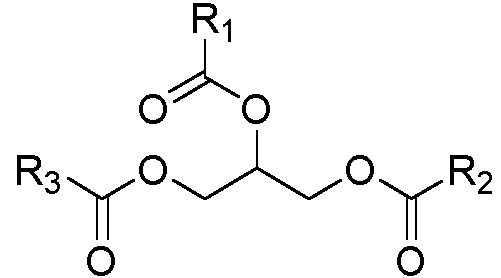
en donde Ri , R2 y R3 son iguales o diferentes y representan cadenas hidrocarbonadas C3-C27. La longitud de la cadena hidrocarbonada es normalmente de 16 carbonos (C16) y 18 carbonos (C18) cuando se encuentra en forma de ácidos grasos libres. Los números de carbono típicos de Ios ácidos grasos unidos a Ios otros dos grupos hidroxilo son uniformes, estando generalmente entre longitudes de cadena de carbono de C12 a C22.where R i , R2 and R3 are the same or different and represent C 3 -C27 hydrocarbon chains. The length of the hydrocarbon chain is normally 16 carbons (C16) and 18 carbons (C18) when found in the form of free fatty acids. The typical carbon numbers of the fatty acids attached to the other two hydroxyl groups are uniform, generally being between carbon chain lengths of C12 to C22.
Antes del procesamiento, la materia prima de origen biológico puede ser pretratada con métodos conocidos adecuados, como térmicamente, mecánicamente, por ejemplo, mediante fuerza cortante, químicamente, por ejemplo, con ácidos o bases, o físicamente con radiación, destilación, refrigeración o filtración. El propósito de Ios pretratamientos químicos y físicos es eliminar las impurezas que interfieren con el proceso o envenenan Ios catalizadores y reducir las reacciones secundarias no deseadas.Before processing, the raw material of biological origin may be pretreated with suitable known methods, such as thermally, mechanically, for example by shear force, chemically, for example, with acids or bases, or physically with radiation, distillation, cooling or filtration. . The purpose of chemical and physical pretreatments is to eliminate impurities that interfere with the process or poison the catalysts and reduce unwanted side reactions.
De este modo, las materias primas adecuadas para el método de la presente invención comprenden normalmente mono-, di- y/o triglicéridos y ácidos grasos libres. Las materias primas ilustrativas son las grasas vegetales, aceites vegetales, ceras vegetales, grasas animales, como la manteca de cerdo, el sebo, la grasa amarilla, la grasa marrón, aceites animales, ceras animales, grasas de pescado, aceites de pescado y ceras de pescado. Preferentemente, la materia prima se origina a partir de desechos y/o residuos de las materias primas ilustrativas mencionadas. Más preferentemente, Ios desechos y/o residuos proceden de productos producidos de forma sostenible, cuyas rutas de producción son trazables.Thus, raw materials suitable for the method of the present invention typically comprise mono-, di- and/or triglycerides and free fatty acids. Illustrative raw materials are vegetable fats, vegetable oils, vegetable waxes, animal fats, such as lard, tallow, yellow fat, brown fat, animal oils, animal waxes, fish fats, fish oils and waxes. of fish. Preferably, the raw material originates from waste and/or residue of the aforementioned illustrative raw materials. More preferably, the waste and/or residue comes from sustainably produced products, whose production routes are traceable.
Separación de Ios gliceroles de ácidos grasos y Ios ácidos grasos libresSeparation of the fatty acid glycerols and the free fatty acids
De acuerdo con las enseñanzas de la presente invención, Ios glicéridos se separan, preferentemente por destilación al vacío, de Ios ácidos grasos libres, proporcionando al menos dos corrientes de efluentes, en concreto, una primera corriente de efluente que comprende Ios ácidos grasos libres y una segunda corriente de efluente que comprende Ios glicéridos. La longitud de la cadena de carbono de Ios ácidos grasos libres es preferentemente de al menos el 90 % en peso de C8 a C24.In accordance with the teachings of the present invention, the glycerides are separated, preferably by vacuum distillation, from the free fatty acids, providing at least two effluent streams, specifically, a first effluent stream comprising the acids. free fats and a second effluent stream that comprises the glycerides. The length of the carbon chain of the free fatty acids is preferably at least 90% by weight from C8 to C24.
Los ácidos grasos libres de la primera corriente de efluente comprenden preferentemente fracciones de ácidos grasos con diferentes longitudes de cadena de carbono. Los ácidos grasos libres se separan en un conjunto de primeras corrientes de efluentes, es decir, en varias corrientes diferentes que comprenden al menos las corrientes, en donde (iii) la longitud de la cadena de carbono es C12-C16, en donde (ív) la longitud de la cadena de carbono es al menos C17, y a una corriente (v) en donde la longitud de la cadena de carbono es C11 o menos. The free fatty acids of the first effluent stream preferably comprise fatty acid fractions with different carbon chain lengths. The free fatty acids are separated into a set of first effluent streams, that is, into several different streams comprising at least the streams, where (iii) the length of the carbon chain is C12-C16, where ( iv ) the carbon chain length is at least C17, and at a current (v) where the carbon chain length is C11 or less.
La separación puede realizarse utilizando al menos una columna de destilación al vacío, preferentemente de dos a cuatro columnas, que puede estar en serie, dependiendo de la precisión necesaria para la separación y de la distribución de ácidos grasos de la materia prima, el tipo y la calidad de la materia prima.The separation can be carried out using at least one vacuum distillation column, preferably two to four columns, which can be in series, depending on the precision necessary for the separation and the distribution of fatty acids of the raw material, the type and the quality of the raw material.
De acuerdo con un ejemplo de realización, la separación produce un conjunto de primeras corrientes de efluentes que comprendenAccording to an exemplary embodiment, the separation produces a set of first effluent streams comprising
o una fracción de ácidos grasos en donde al menos el 90 % de Ios ácidos grasos tienen una longitud de cadena de carbono de C11 o menos, es decir, una corriente de efluente opcional (v) que hierve por debajo de 260 °C, preferentemente por debajo de 240 °C, a presión atmosférica.or a fatty acid fraction where at least 90% of the fatty acids have a carbon chain length of C11 or less, that is, an optional effluent stream ( v ) that boils below 260 ° C, preferably below 240 °C, at atmospheric pressure.
o una fracción de ácidos grasos en donde al menos el 90 % de Ios ácidos grasos tienen una longitud de cadena de carbono de C12 a C16, es decir, la corriente de efluente (iii) hierve en un intervalo de 260 °C a 360 °C, preferentemente en un intervalo de 298 °C a 352 °C, a presión atmosférica.or a fraction of fatty acids where at least 90% of the fatty acids have a carbon chain length of C12 to C16, that is, the effluent stream (iii) boils in a range of 260 ° C to 360 ° C, preferably in a range of 298 °C to 352 °C, at atmospheric pressure.
o una fracción de ácidos grasos en donde al menos el 90 % de Ios ácidos grasos tienen una cadena de carbono de C17 o más, es decir, una corriente de efluente opcional (ív) con un punto de ebullición superior a 360 °C, preferentemente por encima de 374 °C, a la presión atmosférica yor a fatty acid fraction where at least 90% of the fatty acids have a carbon chain of C17 or more, that is, an optional effluent stream ( iv ) with a boiling point greater than 360 ° C, preferably above 374 °C, at atmospheric pressure and
o una fracción que comprende Ios glicéridos, es decir, la segunda corriente de efluente, que es el fondo de destilación.or a fraction comprising the glycerides, that is, the second effluent stream, which is the distillation bottom.
Las temperaturas de destilación son normalmente las medidas a la salida de la(s) columna(s) de destilación. En el presente documento, las temperaturas de destilación se escalan matemáticamente a presiones atmosféricas. Distillation temperatures are normally those measured at the outlet of the distillation column(s). Herein, distillation temperatures are mathematically scaled to atmospheric pressures.
Las impurezas no volátiles en el fondo de destilación se pueden eliminar utilizando métodos convencionales, como desgomado y/o blanqueo. En una realización, puede haber una unidad de purificación separada después de retirar el segundo efluente de la separación.Non-volatile impurities in the distillation bottom can be removed using conventional methods, such as degumming and/or bleaching. In one embodiment, there may be a separate purification unit after removing the second effluent from separation.
La separación se puede realizar en un solo paso de destilación o en dos o tres o más pasos de destilación. La destilación purifica aún más las corrientes de destilado de metales y otras impurezas pesadas que residirán después de la destilación en la fracción inferior. Los ácidos grasos separados de los gliceroles por hidrólisis permanecen puros debido a las impurezas que quedan en la fase de glicerol. Cuando el exceso de agua se separa posteriormente de los gliceroles antes de la hidrogenólisis, las impurezas se eliminarán Junto con la fase acuosa.The separation can be carried out in a single distillation step or in two or three or more distillation steps. Distillation further purifies the distillate streams of metals and other heavy impurities that will reside after distillation in the bottom fraction. Fatty acids separated from glycerols by hydrolysis remain pure due to impurities remaining in the glycerol phase. When the excess water is subsequently separated from the glycerols before hydrogenolysis, the impurities will be removed along with the aqueous phase.
De acuerdo con una realización, el método comprende separar una fracción de ácido graso en donde la longitud de la cadena de carbono es C11 o menos. Esta fracción de ácidos grasos ligeros se puede utilizar para la producción de productos oleoquímicos. La eliminación de esta fracción es beneficiosa para la posterior reacción de cetonización. According to one embodiment, the method comprises separating a fatty acid fraction wherein the carbon chain length is C11 or less. This light fatty acid fraction can be used for the production of oleochemical products. The elimination of this fraction is beneficial for the subsequent ketonization reaction.
La viscosidad del aceite base se puede controlar mediante el ajuste de la distribución de ácidos grasos en el alimento. La corriente de efluente que comprende ácidos grasos con una longitud de cadena de carbono de C12 a C16 es una excelente alimentación para la producción de aceite base renovable. Esta selección proporciona un rendimiento de baja viscosidad y baja volatilidad al producto de aceite base.The viscosity of the base oil can be controlled by adjusting the distribution of fatty acids in the feed. The effluent stream comprising fatty acids with a carbon chain length of C12 to C16 is an excellent feed for renewable base oil production. This selection provides low viscosity, low volatility performance to the base oil product.
La corriente de efluente que comprende ácidos grasos en donde la longitud de la cadena de carbono es C17 o más también se puede usar como parte de la alimentación a cetonizar, o se puede cetonizar por separado para producir cetonas de cadena de carbono más larga y, por lo tanto, se usa para aumentar la viscosidad para aplicaciones de base de aceite de mayor viscosidad. Esta corriente de efluente puede procesarse, además, parcial o alternativamente, en oleoquímicos.The effluent stream comprising fatty acids where the carbon chain length is C17 or more can also be used as part of the feed to be ketonized, or can be ketonized separately to produce longer carbon chain ketones and, therefore, it is used to increase viscosity for higher viscosity oil base applications. This effluent stream can also be processed, partially or alternatively, into oleochemicals.
De acuerdo con una realización, al menos parte del primer vapor efluente (iii) se utiliza para la producción de productos oleoquímicos. Naturalmente, esto limita la disponibilidad de los ácidos grasos C12-C16 para la producción de aceite base renovable y componentes de combustible.According to one embodiment, at least part of the first effluent vapor (iii) is used for the production of oleochemicals. Naturally, this limits the availability of C12-C16 fatty acids for the production of renewable base oil and fuel components.
Preferentemente, los dobles enlaces presentes se hidrogenan antes de la cetonización.Preferably, the double bonds present are hydrogenated before ketonization.
Hidrólisis de glicéridosGlyceride hydrolysis
Los glicéridos que se han separado de los ácidos grasos libres se hidrolizan. La hidrólisis se puede realizar en una unidad de hidrólisis usando métodos conocidos, por ejemplo, como el proceso comercial Colgate - Emery de manera convencional (véase Bailey’s Industrial Oil & Fat producís; 6.a edición). La etapa de hidrólisis produce una corriente de ácidos grasos libres y una corriente de glicerol acuoso. Glycerides that have been separated from free fatty acids are hydrolyzed. Hydrolysis can be carried out in a hydrolysis unit using known methods, for example, such as the commercial Colgate-Emery process in a conventional manner (see Bailey's Industrial Oil & Fat products; 6th edition). The hydrolysis step produces a free fatty acid stream and an aqueous glycerol stream.
En una realización, los glicéridos separados se someten a purificación antes de entrar en la etapa de hidrólisis. Esta purificación puede incluir, p. ej., blanqueamiento y/o desodorización.In one embodiment, the separated glycerides undergo purification before entering the hydrolysis step. This purification may include e.g. e.g., whitening and/or deodorization.
De acuerdo con una realización ilustrativa, el aceite de palma purificado se alimenta desde el fondo de una columna de hidrólisis, y el agua se alimenta desde la parte superior de la columna. La alta temperatura, como aproximadamente 250 °C, y la alta presión, como aproximadamente 50 MPa, mejoran la solubilidad del agua en la fase de aceite donde tiene lugar la hidrólisis del aceite. El crudo pasa como una fase coherente de abajo hacia arriba a través de la torre de la columna de hidrólisis, mientras que el agua de división más pesada se desplaza hacia abajo como una fase dispersa a través de la mezcla de aceite y ácido graso. En la parte superior se obtiene la mezcla de ácido graso y agua arrastrada, mientras que en la parte inferior se recupera el agua dulce que contiene del 10 al 18 % de glicérido. Se necesitan aproximadamente dos horas de tiempo de reacción para alcanzar un grado de división de hasta el 99 %. Los ácidos grasos se descargan desde la parte superior de la columna de división a un evaporador, donde el agua arrastrada se separa o se evapora. El contenido de agua se elimina para evitar la oxidación y la degradación de los ácidos grasos. Luego, el vapor de agua se condensa y se recoge en el depósito de agua de alimentación.According to an illustrative embodiment, purified palm oil is fed from the bottom of a hydrolysis column, and water is fed from the top of the column. High temperature, such as about 250 °C, and high pressure, such as about 50 MPa, improve the solubility of water in the oil phase where oil hydrolysis takes place. The crude oil passes as a coherent phase from bottom to top through the hydrolysis column tower, while the heavier split water moves downward as a dispersed phase through the oil and fatty acid mixture. In the upper part, the mixture of fatty acid and entrained water is obtained, while in the lower part, fresh water containing 10 to 18% glyceride is recovered. Approximately two hours of reaction time are required to achieve a cleavage level of up to 99%. The fatty acids are discharged from the top of the splitting column to an evaporator, where the entrained water is separated or evaporated. The water content is removed to prevent oxidation and degradation of fatty acids. The water vapor is then condensed and collected in the feedwater tank.
De acuerdo con otra realización, los glicéridos son hidrolizados por base, como el hidróxido de sodio, de manera convencional (véase Bailey’s Industrial Oil & Fat producís; 6.a edición). El proceso produce glicerol y sales de ácidos grasos. Los ácidos grasos se liberan de las sales antes de su posterior procesamiento poniéndolos en contacto con ácidos minerales fuertes, como el ácido sulfúrico. El exceso de ácido sulfúrico y el sulfato de sodio o potasio formado se eliminan lavando con agua.According to another embodiment, the glycerides are hydrolyzed by base, such as sodium hydroxide, in a conventional manner (see Bailey's Industrial Oil & Fat Products; 6th Edition). The process produces glycerol and fatty acid salts. F atty acids are freed from salts before further processing by bringing them into contact with strong mineral acids, such as sulfuric acid. Excess sulfuric acid and sodium or potassium sulfate formed are removed by washing with water.
La unidad de hidrólisis comprende material de equipo que es adecuado para reactivos ácidos o corrosivos. Dado que el método de la presente invención incluye separar la parte principal de los ácidos grasos libres de la materia prima antes de la hidrólisis, el tamaño de la unidad de hidrólisis puede disminuir significativamente en comparación con un caso en el que la materia prima se hidroliza como tal antes de la separación. The hydrolysis unit comprises equipment material that is suitable for acidic or corrosive reagents. Since the method of the present invention includes separating the main part of the free fatty acids from the raw material before hydrolysis, the size of the hydrolysis unit can be significantly decreased compared to a case where the raw material is hydrolyzed. as such before separation.
CetonizaciónKetonization
La reacción de cetonización es una excelente reacción de desoxigenación cuando la desoxigenación, la estabilidad y la densidad de energía de los productos son los objetivos, como suele ser el caso en la producción de combustibles y aceites base. La cetonización elimina el 75 % mol del oxígeno unido a las moléculas de ácido carboxílico sin hidrógeno. Esto es muy importante para las aplicaciones de combustible que apuntan a la reducción de las emisiones de gases de efecto invernadero (GEI). Durante la reacción de cetonización, dos moléculas de ácidos grasos reaccionan juntas formando la cetona lineal correspondiente. Una molécula de CO2 y el agua se libera simultáneamente durante la reacción.The ketonization reaction is an excellent deoxygenation reaction when deoxygenation, stability and energy density of the products are the objectives, as is often the case in the production of fuels and base oils. Ketonization removes 75 mol % of the oxygen bound to the carboxylic acid molecules without hydrogen. This is very important for fuel applications that aim to reduce greenhouse gas (GHG) emissions. During the ketonization reaction, two fatty acid molecules react together forming the corresponding linear ketone. A molecule of CO 2 and water are released simultaneously during the reaction.
La reacción de cetonización se puede llevar a cabo con alta conversión, como el 95 %, o el 98 %, o incluso el 99,9 %, y con excelente selectivamente, como el 85 %, o el 92 %, o incluso el 95 %, razón por la cual el rendimiento del aceite base renovable puede ser casi teórico. Debido a la reacción de cetonización muy selectiva, solo se forman pocos o ningún hidrocarburo ligero, por lo tanto, el bio-CO2 recuperado de la reacción de cetonización puede ser muy puro, preferentemente al menos el 99 % por volumen, y puede usarse para diversas aplicaciones. Naturalmente, las cetonas producidas a partir de las fracciones de ácidos grasos libres obtenidas mediante el método de la presente invención también se pueden usar como productos químicos para diversas aplicaciones distintas de la producción de aceite base o componentes de combustibles.The ketonization reaction can be carried out with high conversion, such as 95%, or 98%, or even 99.9%, and with excellent selectively, such as 85%, or 92%, or even 95%. %, which is why the performance of renewable base oil can be almost theoretical. Due to the very selective ketonization reaction, only few or no light hydrocarbons are formed, therefore, the bio-CO 2 recovered from the ketonization reaction can be very pure, preferably at least 99% by volume, and can be used for various applications. Of course, the ketones produced from the free fatty acid fractions obtained by the method of the present invention can also be used as chemicals for various applications other than the production of base oil or fuel components.
Las condiciones de cetonización se especifican normalmente por la temperatura y la presión del reactor, el catalizador usado, la relación gas portador/alimentación y la velocidad espacial por hora en peso de la alimentación. Los intervalos seleccionados se pueden combinar según las necesidades en función de los parámetros a optimizar.Ketonization conditions are typically specified by the reactor temperature and pressure, the catalyst used, the carrier gas/feed ratio, and the hourly weight space velocity of the feed. The selected intervals can be combined as needed depending on the parameters to be optimized.
En la presente invención la reacción de cetonización se lleva a cabo a una temperatura de reacción que oscila entre 100 y 500 °C, preferentemente de 300 a 400 °C, más preferentemente de 330 a 370 °C, lo más preferentemente de 340 a 360 °C. El intervalo de presión es desde la presión atmosférica hasta 10MPa, preferentemente de 0,5 a 3,0 MPa, más preferentemente de 1,0 a 2,5 MPa, lo más preferentemente de 1,5 a 2,0 MPa, en presencia de un catalizador de cetonización. Un catalizador de cetonización adecuado comprende uno o más catalizadores de óxido metálico. El metal del catalizador de óxido metálico se selecciona preferentemente de uno o más de Ti, Mn, Mg, K, Ca, y un catalizador de óxido de metal que contiene Zr. Un catalizador preferible es el catalizador de óxido de metal que contiene Ti, lo más preferentemente un catalizador que contiene T O 2. La velocidad espacial por hora ponderada (WHSV) puede estar en el intervalo de O,25a3,Oh-1, preferentemente de O,5a2,Oh-1, más preferentemente de 1,0 a 1,5 h-1. La reacción de cetonización se puede realizar en presencia de un gas en el intervalo de una relación gas/alimentación (p/p) de O,1 a 1,5, preferentemente de 0,25 a 1,0, lo más preferentemente de 0,5 a 0,75, en donde la relación gas/alimentación (p/p) significa la masa de gas alimentada al reactor de cetonización por la masa de ácido graso de entrada de la alimentación líquida al reactor de cetonización. El gas se selecciona de uno o más de: CO2, H2, N2, CH4, H2O. Un gas particular es H2, que puede fluir ventajosamente a través del reactor hacia la siguiente fase que también requiere la presencia de hidrógeno, como HDO. El gas más preferido es el CO2, ya que este es el gas producto y puede reciclarse eficientemente de nuevo a la alimentación, y proporciona la reacción de cetonización más selectiva. In the present invention the ketonization reaction is carried out at a reaction temperature ranging from 100 to 500 °C, preferably from 300 to 400 °C, more preferably from 330 to 370 °C, most preferably from 340 to 360 °C. The pressure range is from atmospheric pressure to 10MPa, preferably 0.5 to 3.0 MPa, more preferably 1.0 to 2.5 MPa, most preferably 1.5 to 2.0 MPa, in the presence of a ketonization catalyst. A suitable ketonization catalyst comprises one or more metal oxide catalysts. The metal of the metal oxide catalyst is preferably selected from one or more of Ti, Mn, Mg, K, Ca, and a Zr-containing metal oxide catalyst. A preferable catalyst is the Ti-containing metal oxide catalyst, most preferably a TO 2-containing catalyst. The weighted hourly space velocity (WHSV) may be in the range of O.25a3.Oh-1, preferably O. ,5a2,Oh-1, more preferably 1.0 to 1.5 h-1. The ketonization reaction can be carried out in the presence of a gas in the range of a gas/feed ratio (w/w) of 0.1 to 1.5, preferably 0.25 to 1.0, most preferably 0. .5 to 0.75, where the gas/feed ratio (w/w) means the mass of gas fed to the ketonization reactor times the mass of input fatty acid of the liquid feed to the ketonization reactor. The gas is selected from one or more of: CO2 , H2 , N2 , CH4, H2O . A particular gas is H2 , which can advantageously flow through the reactor to the next phase which also requires the presence of hydrogen, like HDO. The most preferred gas is CO 2 , as this is the product gas and can be efficiently recycled back to the feed, and provides the most selective ketonization reaction.
De acuerdo con una realización, parte de las cetonas se convierte en productos oleoquímicos. De acuerdo con una realización ilustrativa, los productos oleoquímicos se seleccionan de un grupo que consiste en alcanos, aminas, iminas, enaminas, acétales, alcoholes secundarios y alcoholes terciarios. A continuación, se muestran ejemplos de reacciones no limitativas adecuadas para convertir cetonas en productos oleoquímicos.According to one embodiment, part of the ketones is converted to oleochemicals. According to an illustrative embodiment, the oleochemicals are selected from a group consisting of alkanes, amines, imines, enamines, acetals, secondary alcohols and tertiary alcohols. Below are examples of non-limiting reactions suitable for converting ketones to oleochemicals.

De acuerdo con una realización, parte de las cetonas derivadas de la fracción de ácido graso (iii) se convierte en productos oleoquímicos.According to one embodiment, part of the ketones derived from the fatty acid fraction (iii) is converted into oleochemical products.
De acuerdo con otra realización, la primera corriente de efluente comprende la fracción de ácidos grasos (ív), y al menos parte de la fracción de ácidos grasos (ív) se somete a una reacción de cetonización a una temperatura en el intervalo de 100 a 500 °C, preferentemente de 300 a 400 °C, y a una presión en el intervalo de presión atmosférica a 10 MPa, preferentemente de 0,5 a 3 MPa, en presencia de un catalizador de cetonización para producir una corriente que comprende cetonas derivadas de la (ív) fracción de ácidos grasos y convertir al menos parte de cetonas derivadas de la (ív) fracción de ácidos grasos en productos oleoquímicos. De acuerdo con otra realización, la primera corriente de efluente comprende la fracción de ácidos grasos (v), y al menos parte de la fracción de ácidos grasos (v) se somete a una reacción de cetonización a una temperatura en el intervalo de 100 a 500 °C, preferentemente de 300 a 400 °C, y a una presión en el intervalo de presión atmosférica a 10 MPa, preferentemente de 0,5 a 3 MPa, en presencia de un catalizador de cetonización para producir una corriente que comprende cetonas derivadas de la (v) fracción de ácidos grasos y convertir al menos parte de las cetonas derivadas de la (ív) fracción de ácidos grasos en productos oleoquímicos.According to another embodiment, the first effluent stream comprises the fatty acid fraction (iv), and at least part of the fatty acid fraction (iv) is subjected to a ketonization reaction at a temperature in the range of 100 to 500 °C, preferably 300 to 400 °C, and at a pressure in the range of atmospheric pressure to 10 MPa, preferably 0.5 to 3 MPa, in the presence of a ketonization catalyst to produce a stream comprising ketones derived from the ( iv ) fatty acid fraction and convert at least part of ketones derived from the (iv) fatty acid fraction into oleochemical products. According to another embodiment, the first effluent stream comprises the fatty acid fraction (v), and at least part of the fatty acid fraction (v) is subjected to a ketonization reaction at a temperature in the range of 100 to 500 °C, preferably 300 to 400 °C, and at a pressure in the range of atmospheric pressure to 10 MPa, preferably 0.5 to 3 MPa, in the presence of a ketonization catalyst to produce a stream comprising ketones derived from the ( v ) fatty acid fraction and convert at least part of the ketones derived from the ( iv ) fatty acid fraction into oleochemical products.
Hidrodesoxigenadón (HDO)Hydrodeoxygenation (HDO)
La hidrodesoxigenadón de las cetonas obtenidas puede llevarse a cabo como se representa, p. ej., en los documentos W02007068795A1, WO2016062868A1 o EP2155838B1, y utilizando un catalizador de hidrotratamiento convencional e hidrógeno.Hydrodeoxygenation of the ketones obtained can be carried out as shown, e.g. e.g., in documents W02007068795A1, WO2016062868A1 or EP2155838B1, and using a conventional hydrotreatment catalyst and hydrogen.
Cuando la conversión de ácidos grasos es alta 95-99 %, la desoxigenación de las cetonas se puede hacer en condiciones más suaves, como una temperatura de reacción especialmente más baja de aproximadamente 250 280 °C, en comparación con la de los ésteres o ácidos carboxílicos de unos 280-330 °C. La conversión de HDO y la selectividad de las cetonas que reaccionan a las n-parafinas correspondientes es alta, casi teórica y, por lo tanto, también el rendimiento de estas parafinas de la gama de aceites base es alto. Si aún quedan ácidos no convertidos de la etapa de cetonización en la alimentación, la descarboxilación de dichos ácidos grasos puede tener lugar produciendo CO2. Los ácidos grasos descarboxilados se pueden utilizar como componentes de baja emisión de GEI, en aplicaciones diésel renovables después de la isomerízación.When the conversion of fatty acids is high 95-99%, the deoxygenation of ketones can be done under milder conditions, such as an especially lower reaction temperature of about 250-280 °C, compared to that of esters or acids. carboxylic acids of about 280-330 °C. The conversion of HDO and the selectivity of the reacting ketones to the corresponding n-paraffins is high, almost theoretical, and therefore also the yield of these paraffins from the base oil range is high. If there are still unconverted acids from the ketonization step in the feed, decarboxylation of these fatty acids can take place producing CO 2 . Decarboxylated fatty acids can be used as low-GHG emissions components in renewable diesel applications after isomerization.
En una realización, la hidrodesoxigenadón tiene lugar en condiciones de reacción que comprenden una temperatura en el intervalo de 100a 500 °C, preferentemente de 250 a 400 °C, más preferentemente 280-350 °C, lo más preferentemente a una temperatura de 300-330 °C; y a una presión en el intervalo de presión atmosférica a 20 MPa, preferentemente de 0,2 a 8 MPa, más preferentemente de 3 a 6 MPa, lo más preferentemente de 4 a 5 MPa. Preferentemente, la WHSV está en el intervalo de 0 ,5 a 3 ,0 h '1, más preferentemente de 1,0 a 2,5 h'1, lo más preferentemente de 1,0 a2,0 h-1. Preferentemente, el flujo de H2 está en el intervalo de 350 a 900 nl H2/I de alimentación, más preferentemente de 350 a 750, lo más preferentemente de 350 a 500, en donde nl H2/I significa litros normales de hidrógeno por litro de alimentación al reactor HDO, en presencia de un catalizador de hidrodesoxigenadón. El catalizador de hidrodesoxigenadón se selecciona preferentemente de Pd, Pt, Ni, Co, Mo, Ru, Rh, W o cualquier combinación de los mismos, como CoMo, NíMo, NíW, CoNíMo sobre un soporte, en donde el soporte es preferentemente alúmina y/o sílice.In one embodiment, hydrodeoxygenation takes place under reaction conditions comprising a temperature in the range of 100 to 500°C, preferably 250 to 400°C, more preferably 280-350°C, most preferably at a temperature of 300-350°C. 330°C; and at a pressure in the range of atmospheric pressure to 20 MPa, preferably 0.2 to 8 MPa, more preferably 3 to 6 MPa, most preferably 4 to 5 MPa. Preferably, the WHSV is in the range of 0.5 to 3.0 h'1, more preferably 1.0 to 2.5 h'1, most preferably 1.0 to 2.0 h-1. Preferably, the H 2 flow rate is in the range of 350 to 900 nl H 2 /I of feed, more preferably 350 to 750, most preferably 350 to 500, where nl H 2 /I means normal liters of hydrogen per liter of feed to the HDO reactor, in the presence of a hydrodeoxygenation catalyst. The hydrodeoxygenation catalyst is preferably selected from Pd, Pt, Ni, C o , M o , R u , Rh, W or any combination thereof, such as C o M o , N í M o , N í W, C o N í M or on a support, where the support is preferably alumina and/or silica.
IsomerizadónIsomerization
La isomerízación se puede llevar a cabo en una unidad de hidroisomerización convencional, como la representada en los documentos w O2007068795A1, WO2016062868A1 o EP2155838B1. Se añade hidrógeno en la etapa de isomerízación.The isomerization can be carried out in a conventional hydroisomerization unit, such as that represented in documents w O 2 007068795A1, WO2016062868A1 or EP2155838B1. Hydrogen is added in the isomerization step.
Tanto la etapa de hidrotratamiento como la etapa de isomerízación pueden realizarse en el mismo reactor, e incluso en el mismo lecho del reactor. El catalizador de isomerízación puede ser un catalizador bifuncional de metal noble tal como un catalizador comercial que contiene Pt, por ejemplo, un catalizador Pt-SAPO o Pt-ZSM o, por ejemplo, un catalizador no noble, como NíW. Las etapas de hidrodesoxigenadón e hidroisomerización se pueden realizar en el mismo lecho de catalizador utilizando, p. ej., el catalizador NíW tanto en el hidrotratamiento como en la isomerízación. El catalizador de NíW puede resultar adicionalmente en más hidrocraqueo de productos diésel y nafta y puede ser un catalizador ventajoso si dichos productos también se desean junto con el producto de aceite base renovable.Both the hydrotreatment step and the isomerization step can be carried out in the same reactor, and even in the same reactor bed. The isomerization catalyst may be a bifunctional noble metal catalyst such as a commercial Pt-containing catalyst, for example, a Pt-SAPO or Pt-ZSM catalyst or, for example, a non-noble catalyst, such as NiW . The steps Hydrodeoxygenation and hydroisomerization can be performed in the same catalyst bed using, e.g. e.g., the NiW catalyst in both hydrotreatment and isomerization. The NiW catalyst may additionally result in further hydrocracking of diesel and naphtha products and may be an advantageous catalyst if such products are also desired along with the renewable base oil product.
La etapa de isomerízación se realiza normalmente a una temperatura de 200 a 450 °C, preferentemente de 250 a 400 °C, más preferentemente de 280 a 370 °C, lo más preferentemente de 300 a 350 °C. La presión es normalmente de 1a 15 MPa, preferentemente de 1 a 6 MPa, más preferentemente de 2 a 5 MPa, lo más preferentemente de 2,5 a 4,5 MPa. La WHSV es preferentemente de 0,5 a 3 1/h, más preferentemente de 0,5 a 2 1/h, lo más preferentemente de 0,5 a 11/h y el flujo de H2 es en litros H2/Iitro de alimentación, preferentemente de 100 a 800, más preferentemente de 200 a 650, lo más preferentemente de 350 a 500. Puede ser deseable reducir la severidad de la reacción de isomerízación para evitar o reducir la cantidad de craqueo del producto de aceite base renovable seleccionando combinaciones adecuadas de los valores de temperatura, presión de WHSV y flujo de H2 mencionados. The isomerization step is typically carried out at a temperature of 200 to 450°C, preferably 250 to 400°C, more preferably 280 to 370°C, most preferably 300 to 350°C. The pressure is usually 1 to 15 MPa, preferably 1 to 6 MPa, more preferably 2 to 5 MPa, most preferably 2.5 to 4.5 MPa. The WHSV is preferably 0.5 to 3 1/h, more preferably 0.5 to 2 1/h, most preferably 0.5 to 11/h and the H 2 flow is in liters H 2 /Iliter of feed, preferably from 100 to 800, more preferably from 200 to 650, most preferably from 350 to 500. It may be desirable to reduce the severity of the isomerization reaction to avoid or reduce the amount of cracking of the renewable base oil product by selecting combinations appropriate values of temperature, WHSV pressure and H 2 flow mentioned.
De acuerdo con una realización, el catalizador de hidroisomerización comprende un metal del Grupo VIII, preferentemente Pd, Pt o Ni y un tamiz molecular, opcionalmente sobre un soporte de alúmina y/o sílice.According to one embodiment, the hydroisomerization catalyst comprises a Group VIII metal, preferably Pd, Pt or Ni and a molecular sieve, optionally on an alumina and/or silica support.
Durante la isomerización, las n-parafinas se ramifican, es decir, forman i-parafinas. Preferentemente, las condiciones se eligen de manera que las ramificaciones estén ubicadas en o cerca de los extremos terminales de las moléculas y, por lo tanto, se mejoran las propiedades de flujo en frío del aceite base renovable o Ios combustibles renovables. During isomerization, n-paraffins branch, i.e., form i-paraffins. Preferably, the conditions are chosen so that the branches are located at or near the terminal ends of the molecules and, therefore, the cold flow properties of the renewable base oil or renewable fuels are improved.
Durante la hidroisomerización convencional de n-parafinas a componentes de combustible o a componentes de aceite base, puede presentarse algún agrietamiento. Por lo tanto, la selección del catalizador y la optimización de las condiciones de reacción son siempre importantes durante la etapa de isomerización. Debido al craqueo durante la isomerización de Ios componentes del aceite base, también se puede formar algo de diésel renovable y nafta. El componente diésel renovable así obtenido tiene excelentes propiedades de flujo en frío y puede usarse como combustible diésel de grado de invierno, es decir, 100 %, sin mezclarse con el destilado medio fósil.During conventional hydroisomerization of n-paraffins to fuel components or base oil components, some cracking may occur. Therefore, catalyst selection and optimization of reaction conditions are always important during the isomerization step. Due to cracking during isomerization of the base oil components, some renewable diesel and naphtha may also be formed. The renewable diesel component thus obtained has excellent cold flow properties and can be used as winter grade diesel fuel, i.e. 100%, without mixing with the fossil middle distillate.
Después de la isomerización, Ios productos pueden fraccionarse utilizando procesos de separación convencionales, especialmente el fraccionamiento por destilación al vacío, que puede separar la mezcla de productos que contienen aceite base renovable en gas licuado de petróleo (GLP) renovable que comprende componentes de hidrocarburos C3 y C4; nafta renovable apta para su uso como componente de gasolina; combustible diésel renovable y/o combustible de turbina de reacción renovable, es decir, combustible de aviación como HEFA o componentes HEFA+, componentes de aceite de transformador, como aceite de transformador con un punto de ebullición de 280-300 °C o, como alternativa, de 280-350 °C; y en aceite base renovable. Parte de estos productos finales fraccionados también se puede reciclar para la cetonización, para HDO o en unidades de isomerización para obtener beneficios adicionales del proceso, como control de calor o mejoras de selectividad.After isomerization, the products can be fractionated using conventional separation processes, especially vacuum distillation fractionation, which can separate the mixture of products containing renewable base oil into renewable liquefied petroleum gas (LPG) comprising hydrocarbon components. C3 and C4; renewable naphtha suitable for use as a gasoline component; renewable diesel fuel and/or renewable reaction turbine fuel, i.e. aviation fuel such as HEFA or HEFA+ components, transformer oil components, such as transformer oil with a boiling point of 280-300 °C or , alternatively , 280-350 °C; and in renewable base oil. Part of these fractionated end products can also be recycled for ketonization, for HDO, or in isomerization units for additional process benefits such as heat control or selectivity improvements.
Producción de propanol y propanodiolesProduction of propanol and propanediols
La corriente de glicerol obtenida de la hidrólisis se puede procesar posteriormente en valiosos componentes de combustible.The glycerol stream obtained from hydrolysis can be further processed into valuable fuel components.
De acuerdo con una realización, la corriente de glicerol se convierte en propanoles y/o propanodioles por hidrogenación selectiva.According to one embodiment, the glycerol stream is converted to propanols and/or propanediols by selective hydrogenation.
De acuerdo con una realización ilustrativa, la hidrogenólisis se realiza utilizando un catalizador adecuado para ello, como catalizadores de platino o catalizadores bifuncionales de ácido metálico que contienen platino y, opcionalmente, heteropoliácidos (HPA) como ácido silicotúngstico, ácido fosfotúngstico (PTA), ácido fosfomolíbdico o ácido silicomolíbdico; soportado sobre zirconio (Pt-HPA/Zr02) a la presión atmosférica normal o, preferentemente, a una sobrepresión. Un catalizador particular es Pt-PTA/Zr02. La reacción se lleva a cabo a temperatura elevada, normalmente a una temperatura de 150 a 350 °C, preferentemente de 150 a 270 °C bajo flujo de H2. La WHSV es normalmente de aproximadamente 11/h.According to an illustrative embodiment, the hydrogenolysis is carried out using a catalyst suitable therefor, such as platinum catalysts or bifunctional metal acid catalysts containing platinum and, optionally, heteropoly acids (HPA) such as silicotungstic acid, phosphotungstic acid (PTA), acid phosphomolybdic or silicolybdic acid; supported on zirconium (Pt-HPA/Zr02) at normal atmospheric pressure or , preferably, at an overpressure. A particular catalyst is Pt-PTA/Zr02. The reaction is carried out at elevated temperature, typically at a temperature of 150 to 350°C, preferably 150 to 270°C under flow of H 2 . WHSV is normally approximately 11/h.
Los propanoles se pueden separar de la mezcla de reacción que comprende agua, propanoles y propanodioles, p. ej., por destilación.The propanols can be separated from the reaction mixture comprising water, propanols and propanediols, e.g. e.g., by distillation.
Los propanoles producidos por el método de la presente invención pueden usarse como componentes de la gasolina aumentando así el rendimiento de Ios componentes adecuados para la gasolina obtenida únicamente por la ruta de cetonización. El aumento del rendimiento puede ser de varios porcentajes. El propanol tiene una volatilidad más baja que el etanol, que normalmente se usa como componente de la gasolina. De forma adicional, el propanol tiene un buen octanaje.The propanols produced by the method of the present invention can be used as gasoline components, thus increasing the yield of the components suitable for gasoline obtained solely by the ketonization route. The increase in performance can be several percentages. Propanol has a lower volatility than ethanol, which is typically used as a component of gasoline. Additionally, propanol has a good octane rating.
Este componente renovable de la gasolina podrá mezclarse con la nafta renovable obtenida de la producción de aceite base renovable, permitiendo así la producción de un combustible de hidrocarburo oxigenado totalmente renovable. En la actualidad, no hay productos de gasolina 100% renovables disponibles comercialmente, que tienen tanto el componente oxigenado que mejora las propiedades de emisión como el componente de hidrocarburo que proporciona una alta densidad de energía, de origen renovable. Es beneficiosa la mezcla de propanol con un componente de nafta renovable libre de aromáticos, pero de bajo octanaje procedente de la producción de aceite base renovable según la presente invención, porque el propanol puede mejorar el octanaje de la mezcla y la nafta renovable libre de aromáticos aumenta la densidad energética de la mezcla de combustible.This renewable component of gasoline can be mixed with renewable naphtha obtained from the production of renewable base oil, thus allowing the production of a completely renewable oxygenated hydrocarbon fuel. Currently, there are no 100% renewable gasoline products commercially available, which have both the oxygenated component that improves emission properties and the hydrocarbon component that provides high energy density, from renewable sources. Blending propanol with an aromatic-free, but low-octane renewable naphtha component from the production of renewable base oil according to the present invention is beneficial, because the propanol can improve the octane rating of the blend and the aromatic-free renewable naphtha increases the energy density of the fuel mixture.
La corriente que contiene aceite base desoxigenado e isomerizado o el aceite base renovable destilado puede tener un contenido de oxígeno de menos de 100 ppm, una viscosidad de 3 a 15 cSt a 100 °C, un índice de viscosidad superior a 120, preferentemente por encima de 140, como entre 140 y 170.The stream containing deoxygenated and isomerized base oil or the distilled renewable base oil may have an oxygen content of less than 100 ppm, a viscosity of 3 to 15 cSt at 100 ° C, a viscosity index greater than 120, preferably above 140, like between 140 and 170.
Por ejemplo, la corriente de aceite de base desoxigenada e isomerizada podrá destilarse para obtener el aceite de base renovable en una fracción que tenga un punto de ebullición superior a 380 °C, como más de 450 °C, por ejemplo, más de 460 °C o más, como 470 °C o más, como 480 °C o más o, por ejemplo, 500 °C o más. Por ejemplo, la destilación puede producir una o más fracciones de aceites base renovables, por ejemplo, por encima de 380 °C, por ejemplo, una fracción entre 380-450 °C y una fracción por encima de 450 °C. Durante la destilación de otras fracciones, también puede aislarse una fracción de nafta y/o una fracción de diésel. Estas fracciones son el resultado del craqueo durante las reacciones de hidrodesoxigenación e hidroisomerización, así como una cantidad muy pequeña de ácido graso libre no convertido de la etapa de cetonización.For example, the deoxygenated and isomerized base oil stream may be distilled to obtain the renewable base oil in a fraction having a boiling point greater than 380°C, such as greater than 450°C, for example, greater than 460°C. C or more, such as 470 °C or more, such as 480 °C or more or , for example, 500 °C or more. For example, distillation can produce one or more renewable base oil fractions, for example, above 380 °C, for example For example, a fraction between 380-450 °C and a fraction above 450 °C. During the distillation of other fractions, a naphtha fraction and/or a diesel fraction may also be isolated. These fractions are the result of cracking during the hydrodeoxygenation and hydroisomerization reactions, as well as a very small amount of unconverted free fatty acid from the ketonization step.
Otras etapas del proceso opcionalesOther optional process steps
Los dobles enlaces presentes en los ácidos grasos pueden hidrogenarse antes de la cetonización. La prehidrogenación (no mostrada en la figura 1) se realiza preferentemente a una temperatura de 90 a 300 °C, más preferentemente de 110a280 °C, lo más preferentemente de 120a260°C . La presión es preferentemente de 1,0 a 7,0 MPa, más preferentemente de 2,0 a 6 MPa, lo más preferentemente de 3 a 5 MPa. La WHSV es preferentemente de 0,25 a 3 1/h, más preferentemente de 0,5 a 2 1/h, lo más preferentemente de 1 a 1,5 1/h. El caudal de H2 es nl H/litro de alimentación es preferentemente de 100 a 500, más preferentemente de 150 a 450, lo más preferentemente de 200 a 400.The double bonds present in fatty acids can be hydrogenated before ketonization. The prehydrogenation (not shown in Figure 1) is preferably carried out at a temperature of 90 to 300 ° C, more preferably 110 to 280 ° C, most preferably 120 to 260 ° C. The pressure is preferably 1.0 to 7.0 MPa, more preferably 2.0 to 6 MPa, most preferably 3 to 5 MPa. The WHSV is preferably 0.25 to 3 1/h, more preferably 0.5 to 2 1/h, most preferably 1 to 1.5 1/h. The flow rate of H 2 is nl H/liter of feed is preferably 100 to 500, more preferably 150 to 450, most preferably 200 to 400.
Cuando la hidrodesoxigenación y la hidroisomerización tienen lugar en secuencia, puede haber una etapa de separación entre la hidrodesoxigenación y la isomerización, donde los gases se separan de los líquidos. Esto puede tener lugar en una etapa de separación a alta temperatura y alta presión, por ejemplo a una temperatura entre 300 350 °C, preferentemente 320-330 °C y una presión entre 3 MPa y 6 MPa, preferentemente entre 4 MPa y 5 MPa. La etapa de separación no se presenta en la figura 1.When hydrodeoxygenation and hydroisomerization take place in sequence, there may be a separation step between hydrodeoxygenation and isomerization, where gases are separated from liquids. This can take place in a high temperature and high pressure separation step, for example at a temperature between 300-350 °C, preferably 320-330 °C and a pressure between 3 MPa and 6 MPa, preferably between 4 MPa and 5 MPa . The separation stage is not presented in Figure 1.
Después de la hidroisomerización también puede haber una etapa de hidroacabado opcional, donde el producto se estabiliza realizando una etapa de hidrogenación adicional en presencia de un catalizador de hidrogenación, por ejemplo, NiMo sobre un soporte de alúmina. Sin embargo, también se pueden utilizar otros catalizadores de hidroacabado que contengan metales del Grupo VIII del sistema periódico de los elementos, p. ej., sobre un soporte de alúmina y/o sílice. El catalizador de hidroacabado es preferentemente un catalizador soportado con Pd, Pt o Ni, siendo el soporte alúmina y/o sílice. La etapa de hidroacabado es similar a la etapa de prehidrogenación con respecto a las condiciones de reacción. Sin embargo, en la etapa de hidroacabado, normalmente se utilizan presiones más altas y, hasta cierto punto, temperaturas más altas. Esto se debe a que el alimento está completamente desoxigenado en esta etapa en comparación con un posible paso de prehidrogenación de ácidos grasos antes de la cetonización. La etapa de hidroacabado está presente para estabilizar y decolorar el producto que, entre otras cosas, implica la hidrogenación de dobles enlaces o compuestos aromáticos que están presentes o se han formado durante las etapas anteriores, como durante la hidroisomerización. La etapa de hidroacabado se puede realizar a una temperatura inferior a 300 °C, como por debajo de 280 °C o por debajo de 260 °C. El hidroacabado también puede estar por encima de 180 °C, como por encima de 190 °C o por encima de 200 °C. La temperatura para el hidroacabado es preferentemente de 180 - 3o0 °C, más preferentemente 190 - 280 °C, lo más preferentemente 200 - 250 °C. La presión es preferentemente de 5-20 MPa, más preferentemente 10-18 MPa, lo más preferentemente 14-16 MPa. La WHSV es preferentemente 0,5 - 3,0 1/h, más preferentemente 0,75 - 2,5 1/h, lo más preferentemente 1,0 - 2,0 1/h. La etapa de hidroacabado no se presenta en la figura 1.After hydroisomerization there may also be an optional hydrofinishing step, where the product is stabilized by performing an additional hydrogenation step in the presence of a hydrogenation catalyst, for example, NiMo on an alumina support. However, other hydrofinishing catalysts containing metals from Group VIII of the periodic system of the elements can also be used, e.g. e.g., on an alumina and/or silica support. The hydrofinishing catalyst is preferably a catalyst supported with Pd, Pt or Ni, the support being alumina and/or silica. The hydrofinishing step is similar to the prehydrogenation step with respect to reaction conditions. However, in the hydrofinishing stage, higher pressures and, to some extent, higher temperatures are typically used. This is because the feed is completely deoxygenated at this stage compared to a possible fatty acid prehydrogenation step before ketonization. The hydrofinishing step is present to stabilize and decolorize the product which, among other things, involves the hydrogenation of double bonds or aromatic compounds that are present or have been formed during the previous steps, such as during hydroisomerization. The hydrofinishing step can be performed at a temperature below 300°C, such as below 280°C or below 260°C. Hydrofinishing can also be above 180°C, such as above 190°C or above 200°C. The temperature for hydrofinishing is preferably 180-30°C, more preferably 190-280°C, most preferably 200-250°C. The pressure is preferably 5-20 MPa, more preferably 10-18 MPa, most preferably 14-16 MPa. The WHSV is preferably 0.5 - 3.0 1/h, more preferably 0.75 - 2.5 1/h, most preferably 1.0 - 2.0 1/h. The hydrofinishing step is not presented in Figure 1.
Realizaciones ilustrativasIllustrative embodiments
Las figuras 2 y 3 muestran realizaciones ilustrativas del proceso de acuerdo con la presente invención para producir aceite base renovable y otros productos renovables valiosos a partir de destilado de ácido graso de aceite de palma (PFAD) y grasa animal, respectivamente. En las figuras, las etapas de reacción y las corrientes de efluentes están marcados con números de referencia y flechas/letras mayúsculas, respectivamente. En las figuras, los símbolos C16FA, C18FA+ y FA ligeros representan las primeras corrientes de efluentes (iii), (ív) y (v), respectivamente. Los rendimientos de cada etapa se presentan en las tablas 3 (PFAD como materia prima) y 4 (grasa animal como materia prima) en kton cuando se parte de 1000 kton de materia prima. También se proporcionan rendimientos comparativos para procesos comparativos realizados sin utilizar los ácidos grasos de los glicéridos (reciclado de ácidos grasos). Figures 2 and 3 show illustrative embodiments of the process according to the present invention for producing renewable base oil and other valuable renewable products from palm oil fatty acid distillate (PFAD) and animal fat, respectively. In the figures, reaction stages and effluent streams are marked with reference numbers and arrows/capital letters, respectively. In the figures, the symbols C16FA, C18FA+ and light FA represent the first effluent streams (iii), (iv) and (v), respectively. The yields of each stage are presented in tables 3 (PFAD as raw material) and 4 (animal fat as raw material) in kton when starting from 1000 kton of raw material. Comparative yields are also provided for comparative processes carried out without using the fatty acids of the glycerides (fatty acid recycling).
Uso de PFAD como alimentaciónUse of PFAD as food
En la realización representada en la figura 2, el PFAD A utilizado como alimento incluye un 88 % en peso de ácidos grasos libres y un 12 % en peso de glicéridos de ácidos grasos. Los ácidos grasos libres en PFAD son una mezcla casi 1:1 de C16FA y C18 de FA, respectivamente.In the embodiment depicted in Figure 2, the PFAD A used as feed includes 88% by weight of free fatty acids and 12% by weight of fatty acid glycerides. The free fatty acids in PFAD are a nearly 1:1 mixture of C16FA and C18FA, respectively.
Los glicéridos se separan de los ácidos grasos en una unidad de separación 21, que es una columna de destilación al vacío. 120 kton de glicéridos B se obtienen después de la separación, el resto son ácidos grasos libres.The glycerides are separated from the fatty acids in a separation unit 21, which is a vacuum distillation column. 120 kton of B glycerides are obtained after separation, the rest are free fatty acids.
Los glicéridos se someten a hidrólisis 22 con ácido acuoso dando lugar a una corriente acuosa de glicerol L y ácidos grasos libres C. La hidrólisis de los glicéridos presentes en PFAD produce 115 kton de ácidos grasos libres C de los cuales 53 kton son C16 de FA y 57 kton son C18 de FA. Dado que la hidrólisis añade agua (K, aprox. 6,4 % en peso, es decir, aproximadamente 7,7 ton) a los ácidos grasos libres y al glicerol producido, también se aumentan los pesos de estos productos. La hidrólisis de glicéridos que estaba presente en PFAD produce alrededor de 115 kton de ácidos grasos libres C, mientras que el glicerol L el rendimiento es de 12 kton. El glicerol se separa del agua por destilación. Glycerides undergo hydrolysis 22 with aqueous acid giving rise to an aqueous stream of glycerol L and free fatty acids C. Hydrolysis of the glycerides present in PFAD produces 115 kton of free fatty acids C of which 53 kton are C16 of FA and 57 kton are C18 of FA. Since hydrolysis adds water (K, ca. 6.4% by weight, i.e., ca. 7.7 tons) to the free fatty acids and glycerol produced, the weights of these products are also increased. Hydrolysis of glycerides that was present in PFAD produces about 115 kton of free fatty acids C, while glycerol L yield is 12 kton. Glycerol is separated from water by distillation.
Los ácidos grasos libres C de la hidrólisis se reciclan de vuelta a la unidad de separación 21 y se combinan con Ios ácidos grasos libres originalmente presentes en la alimentación. Los FFA combinados se fraccionan en la unidad de separación 21 mediante destilación al vacío. El fraccionamiento de Ios ácidos grasos se realiza preferentemente a una temperatura de 250 a 275 °C a una presión entre 1-5 MPa, como alrededor de 2 MPa. El fraccionamiento produce 460 kton C16FA D y 492 kton de C18FA+ E. The free fatty acids C from the hydrolysis are recycled back to separation unit 21 and combined with the free fatty acids originally present in the feed. The combined FFA are fractionated in separation unit 21 by vacuum distillation. The fractionation of the fatty acids is preferably carried out at a temperature of 250 to 275 °C at a pressure between 1-5 MPa, about 2 MPa. Fractionation produces 460 kton C16FA D and 492 kton C18FA+ E.
La fracción de C16FA D se somete a cetonización 23 en presencia de un catalizador de cetonización para dar la corriente de C16FA cetonizada G. El catalizador de cetonización es un catalizador de óxido metálico que contiene Ti. La reacción de cetonización se lleva a cabo a una temperatura de 340 a 360 °C y a una presión de 1,5 a 2 MPa. La WHSV es de 1 a 1,5 1/h. La reacción de cetonización se realiza en presencia de dióxido de carbono gaseoso con una relación gas/alimentación (p/p) de aproximadamente 0,5 a 0,75.The C16FA D fraction is subjected to ketonization 23 in the presence of a ketonization catalyst to give the ketonized C16FA stream G. The ketonization catalyst is a metal oxide catalyst containing Ti. The ketonization reaction is carried out at a temperature of 340 to 360 °C and a pressure of 1.5 to 2 MPa. The WHSV is 1 to 1.5 1/h. The ketonization reaction is carried out in the presence of gaseous carbon dioxide with a gas/feed ratio (w/w) of approximately 0.5 to 0.75.
La corriente de cetonas líquidas G obtenida de la reacción de cetonización se separa de Ios productos gaseosos y del agua mediante un tambor de evaporación. El CO2 y el agua se separan aún más por enfriamiento. La etapa de cetonización es muy selectivo y produce las cetonas de cadena larga deseadas con un alto rendimiento superior al 85 % en peso (el rendimiento teórico de cetonas es del 87,9 % en peso), además, el CO2 producido en la reacción es de alta pureza (>99 % en peso) después de la separación de las cetonas y el agua. El bio-CO2 así producido se recoge y se puede utilizar en diversas aplicaciones.The stream of liquid ketones G obtained from the ketonization reaction is separated from the gaseous products and water by means of an evaporation drum. CO 2 and water are further separated by cooling. The ketonization step is highly selective and produces the desired long-chain ketones with a high yield of over 85 wt% (theoretical ketone yield is 87.9 wt%), in addition, the CO 2 produced in the reaction It is of high purity (>99% by weight) after separation of ketones and water. The bio-CO 2 thus produced is collected and can be used in various applications.
La cetonización de C16FA procedente de 1000 kton de PFAD, utilizando el método de la presente invención, produjo 39,5 kton de bio-CO2. La fracción de C16FA alimentada a la cetonización produce 395,2 kton de cetona G.Ketonization of C16FA from 1000 kton of PFAD, using the method of the present invention, produced 39.5 kton of bio-CO 2 . The C16FA fraction fed to the ketonization produces 395.2 kton of ketone G.
El C16FA cetonizado G se somete tanto a una hidrodesoxigenación 24 como a una hidroisomerización 25. Las reacciones de hidrodesoxigenación e hidroisomerización se realizan en secuencia. El producto es una corriente de aceite base desoxigenada e isomerizada. I que comprende el aceite base renovable J.Ketonized C16FA G undergoes both 24-hydrodeoxygenation and 25-hydroisomerization. The hydrodeoxygenation and hydroisomerization reactions are performed in sequence. The product is a deoxygenated and isomerized base oil stream. I comprising the renewable base oil J.
La reacción de hidrodesoxigenación se realiza en presencia de un catalizador de hidrodesoxigenación, NÍMo, sobre un soporte de alúmina. la etapa de hidrodesoxigenación se realiza en un reactor de lecho fijo en condiciones de hidrodesoxigenación para proporcionar n-parafinas H. La temperatura en la hidrogenación es de 300 a 330 °C y la presión es de 4 a 5 MPa. La W h SV es convenientemente alrededor de 1-2 1/h, y el flujo de H2 es de 350-500 nl H2/I de alimentación.The hydrodeoxygenation reaction is carried out in the presence of a hydrodeoxygenation catalyst, NIMo, on an alumina support. The hydrodeoxygenation step is carried out in a fixed bed reactor under hydrodeoxygenation conditions to provide n-paraffins H. The temperature in hydrogenation is 300 to 330 °C and the pressure is 4 to 5 MPa. The W h SV is conveniently around 1-2 1/h, and the H 2 flow is 350-500 nl H 2 /I feed.
La hidrodesoxigenación de la alimentación cetonizada procedente de PFAD produjo 376,6 kton de n-parafinas. Hydrodeoxygenation of the ketonized feed from PFAD produced 376.6 kton of n-paraffins.
El producto de la etapa de hidrodesoxigenación H se somete a una etapa de isomerización en presencia de hidrógeno y un catalizador de isomerización. El catalizador de isomerización es un catalizador comercial que contiene Pt. La etapa de isomerización se realiza entre 300-350 °C, La presión está entre 2,5-4,5 MPa. La WHSV está entre 0,5-1 1/h, y el flujo de H2 está entre 350-500 n-litro H/litro de alimentación.The product of the hydrodeoxygenation step H is subjected to an isomerization step in the presence of hydrogen and an isomerization catalyst. The isomerization catalyst is a commercial catalyst containing Pt. The isomerization step is carried out between 300-350 °C, The pressure is between 2.5-4.5 MPa. The WHSV is between 0.5-1 1/h, and the H 2 flow is between 350-500 n-liter H/liter of feed.
La hidroisomerización de las n-parafinas hidrodesoxigenadas procedentes de la alimentación de PFAD produjo 301,3 kton de parafinas ramificadas.Hydroisomerization of hydrodeoxygenated n-paraffins from the PFAD feed produced 301.3 kton of branched paraffins.
La corriente de producto desoxigenado e isomerizado I obtenida comprende el aceite base renovable y Ios componentes de combustibles. El fraccionamiento 26 de Ios productos se realiza por destilación al vacío, que separa GLP renovable (gas licuado de petróleo; componentes de hidrocarburos C3 y C4), nafta renovable (componente gasolina), diésel renovable y/o combustible de turbina de reacción renovable y el aceite base renovable.The deoxygenated and isomerized product stream I obtained comprises the renewable base oil and the fuel components. Fractionation 26 of the products is carried out by vacuum distillation, which separates renewable LPG (liquefied petroleum gas; C3 and C4 hydrocarbon components), renewable naphtha (gasoline component), renewable diesel and/or renewable reaction turbine fuel and renewable base oil.
la etapa de separación 21 produce 120 kton de glicéridos B que se hidrolizan a ácidos grasos libres C y glicerol L. El glicerol producido se convierte en propanoles mediante hidrogenación selectiva 27 en la que Ios propanoles se preparan mediante conversión catalítica de glicerol a 200-300 °C en presencia de un catalizador de Zr02 modificado con Pt.The separation step 21 produces 120 kton of glycerides B that are hydrolyzed to free fatty acids C and glycerol L. The glycerol produced is converted to propanols by selective hydrogenation 27 in which the propanols are prepared by catalytic conversion of glycerol to 200-300 °C in the presence of a Pt-modified Zr02 catalyst.
El rendimiento de Ios propanoles M es de 8 kton cuando se usa PFAD como materia prima. Los propanoles se separan 28 de la fase acuosa y se pueden mezclar con la nafta renovable procedente de la ruta de cetonización.The yield of I os propanols M is 8 kton when PFAD is used as raw material. P ropanols are separated 28 from the aqueous phase and can be mixed with the renewable naphtha from the ketonization route.
La fracción C18FA+ E se puede utilizar para la producción de oleoquímicos o se puede cetonizar. Cuando está cetonizada, la fracción de C18FA+ E se puede mezclar con la fracción de C16FA D antes de la cetonización, o puede cetonizarse por separado y mezclarse con la corriente de cetonas G. La viscosidad del producto se puede ajustar cambiando la relación C18Fa +/C16FA en la reacción de cetonización. Cuando la fracción C18FA+ y la fracción C16FA se cetonizan por separado, las dos corrientes de cetonas formadas se pueden mezclar como se desee y procesar juntas adicionalmente como se desee.The C18FA+ E fraction can be used for the production of oleochemicals or can be ketonized. When ketonized, the C18FA+ E fraction can be mixed with the C16FA D fraction before ketonization, or can be ketonized separately and mixed with the ketone stream G. The viscosity of the product can be adjusted by changing the C18F to + ratio. /C16FA in the ketonization reaction. When the C18FA+ fraction and the C16FA fraction are ketonized separately, the two ketone streams formed can be mixed as desired and further processed together as desired.
Parte de la fracción C16FA cetonizada G puede convertirse en oleoquímicos como alcanos, aminas, iminas, enaminas, acétales, alcoholes secundarios y alcoholes terciarios. Part of the ketonized C16FA fraction G can be converted to oleochemicals such as alkanes, amines, imines, enamines, acetals, secondary alcohols, and tertiary alcohols.
Parte o toda la fracción C18FA+ E puede cetonizarse y convertirse en oleoquímicos como alcanos, aminas, iminas, enaminas, acétales, alcoholes secundarios y alcoholes terciarios.Part or all of the C18FA+ E fraction can be ketonized and converted to oleochemicals such as alkanes, amines, imines, enamines, acetals, secondary alcohols, and tertiary alcohols.
La fracción de FA ligeros F se puede convertir en oleoquímicos como alcanos, aminas, iminas, enaminas, acétales, alcoholes secundarios y alcoholes terciarios también después de la cetonización.The light FA fraction F can be converted to oleochemicals such as alkanes, amines, imines, enamines, acetals, secondary alcohols and tertiary alcohols also after ketonization.
Los rendimientos de los productos obtenidos de PFAD utilizando el método de la presente invención se recogen en la tabla 3. La tabla muestra además los rendimientos de un proceso comparativo, es decir, un proceso sin explotar los glicéridos presentes en la alimentación.The yields of the products obtained from PFAD using the method of the present invention are shown in Table 3. The table also shows the yields of a comparative process, that is, a process without exploiting the glycerides present in the feed.
Tabla 3.Table 3.

Uso de grasa animal como alimentación Use of animal fat as food
En la realización representada en la figura 3, se utiliza grasa animal como alimentación que contiene un 20 % en peso de ácidos grasos libres y un 80 % en peso de glicéridos de ácidos grasos. La alimentación con grasa animal incluye significativamente más ácidos grasos C18 que ácidos grasos C16 (60,6 % frente a 25,6 % en peso).In the embodiment shown in Figure 3, animal fat is used as feed containing 20% by weight of free fatty acids and 80% by weight of fatty acid glycerides. Animal fat feeding included significantly more C18 fatty acids than C16 fatty acids (60.6% vs. 25.6% by weight).
La alimentación se procesa de manera similar a como se describe para la alimentación PFAD. Los números de referencia, las flechas y las letras mayúsculas en la figura 3 son como se ha explicado anteriormente para la figura 2. Los rendimientos de los productos obtenidos a partir de alimentos grasos para animales utilizando el método de la presente invención se recogen en la tabla 4. La tabla muestra, además, los rendimientos cuando el proceso se realiza sin hacer uso de los FFA obtenidos de la hidrólisis y el reciclaje de glicéridos.The feed is processed in a similar manner as described for the PFAD feed. The reference numbers, arrows and capital letters in Figure 3 are as explained above for Figure 2. The yields of the products obtained from fatty animal feed using the method of the present invention are collected in table 4. The table also shows the yields when the process is carried out without using the FFA obtained from the hydrolysis and recycling of glycerides.
Tabla 4.Table 4.

Como se ve en las tablas 3 y 4, cuando los glicéridos se hidrolizan y los ácidos grasos libres así formados se reciclan al proceso, los rendimientos de varios productos útiles aumentan significativamente. Por ejemplo, el rendimiento del RBO C16FA se incrementó en un 476 %. Asimismo, la fracción de glicerol se puede procesar en un biopropanol de gran valor que se puede utilizar, p. ej., como componente de la gasolina.As seen in Tables 3 and 4, when glycerides are hydrolyzed and the free fatty acids thus formed are recycled to the process, the yields of several useful products increase significantly. For example, the performance of RBO C16FA increased by 476%. Furthermore, the glycerol fraction can be processed into a high-value biopropanol that can be used, e.g. e.g., as a component of gasoline.
De acuerdo con una realización, la reacción de hidroisomerización se realiza a una temperatura en el intervalo de 200 a 450 °C, preferentemente de 250 a 400 °C; una presión en el intervalo de 1 a 15 MPa, preferentemente de 1 a 6 MPa; preferentemente una WHSV en un intervalo de 0,5 a 3 h-1 y, preferentemente, un flujo de H2 de 100-800 nl H2/I de alimentación, en presencia de un catalizador de hidroisomerización.According to one embodiment, the hydroisomerization reaction is carried out at a temperature in the range of 200 to 450°C, preferably 250 to 400°C; a pressure in the range of 1 to 15 MPa, preferably 1 to 6 MPa; preferably a WHSV in a range of 0.5 to 3 h-1 and, preferably, an H 2 flow of 100-800 nl H 2 /I feed, in the presence of a hydroisomerization catalyst.
De acuerdo con una realización, la fracción de ácido graso ( ív) se convierte en productos oleoquímicos. According to one embodiment, the fatty acid fraction ( iv ) is converted to oleochemicals.
De acuerdo con otra realización, la fracción de ácido graso (v) se convierte en productos oleoquímicos.According to another embodiment, the fatty acid fraction ( v ) is converted to oleochemicals.
De acuerdo con otra realización, parte de la corriente que contiene cetona de la etapa e) se convierte en productos oleoquímicos.According to another embodiment, part of the ketone-containing stream from step e) is converted to oleochemicals.
De acuerdo con una realización, los oleoquímicos se seleccionan de un grupo que consiste en alcanos, aminas, iminas, enaminas, acétales, alcoholes secundarios y alcoholes terciarios.According to one embodiment, the oleochemicals are selected from a group consisting of alkanes, amines, imines, enamines, acetals, secondary alcohols and tertiary alcohols.
De acuerdo con una realización, el catalizador de cetonización es un catalizador de óxido metálico, y el metal del catalizador de óxido metálico se selecciona preferentemente de uno o más de Mg, K, Sc, y , La, Ce, Fe, Co, Ni, Cu, Zn, Sr, Y, Zr, Mo, Rh, Sn, Ti, Mn, Mg, Ca, Zr, más preferentemente un catalizador de óxido de metal que contiene Ti, lo más preferentemente un catalizador que contiene TÍO2.According to one embodiment, the ketonization catalyst is a metal oxide catalyst, and the metal of the metal oxide catalyst is preferably selected from one or more of Mg, K, Sc, Y, La, Ce, Fe, Co, Ni , Cu, Zn, Sr, Y, Zr, Mo, Rh, Sn, Ti, Mn, Mg, Ca, Zr, more preferably a metal oxide catalyst containing Ti, most preferably a catalyst containing TIO 2 .
De acuerdo con una realización, la reacción de cetonización se realiza en presencia de un gas en el intervalo de una relación (p/p) gas alimentación de 0,1-1,5, seleccionándose el gas de uno o más de: CO2, H2, N2, CH4, H2O, preferentemente CO2.According to one embodiment, the ketonization reaction is carried out in the presence of a gas in the range of a feed gas ratio (w/w) of 0.1-1.5, the gas being selected from one or more of: CO 2 , H 2 , N 2 , CH4, H 2 O, preferably CO 2 .
Los ejemplos específicos proporcionados en la descripción proporcionada anteriormente no deben interpretarse como limitantes del alcance y/o la aplicabilidad de las reivindicaciones adjuntas. The specific examples provided in the description provided above should not be construed as limiting the scope and/or applicability of the appended claims.
Claims (16)
Applications Claiming Priority (3)
| Application Number | Priority Date | Filing Date | Title |
|---|---|---|---|
| FI20186145A FI129457B (en) | 2018-12-31 | 2018-12-31 | Process for catalytic propanol production |
| FI20186144A FI128524B (en) | 2018-12-31 | 2018-12-31 | Method for producing renewable base oil and renewable fuel components |
| PCT/FI2019/050917 WO2020141256A1 (en) | 2018-12-31 | 2019-12-20 | Method for producing renewable base oil and renewable fuel components |
Publications (1)
| Publication Number | Publication Date |
|---|---|
| ES2951328T3 true ES2951328T3 (en) | 2023-10-19 |
Family
ID=71407156
Family Applications (1)
| Application Number | Title | Priority Date | Filing Date |
|---|---|---|---|
| ES19906703T Active ES2951328T3 (en) | 2018-12-31 | 2019-12-20 | Method for producing renewable base oil and renewable fuel components |
Country Status (11)
| Country | Link |
|---|---|
| US (1) | US11643606B2 (en) |
| EP (1) | EP3887483B1 (en) |
| JP (1) | JP7064055B2 (en) |
| KR (1) | KR102366831B1 (en) |
| CN (1) | CN113227326A (en) |
| CA (1) | CA3122907C (en) |
| ES (1) | ES2951328T3 (en) |
| MY (1) | MY194641A (en) |
| PL (1) | PL3887483T3 (en) |
| SG (1) | SG11202105568VA (en) |
| WO (1) | WO2020141256A1 (en) |
Families Citing this family (6)
| Publication number | Priority date | Publication date | Assignee | Title |
|---|---|---|---|---|
| WO2021094645A1 (en) | 2019-11-15 | 2021-05-20 | Neste Oyj | Production of paraffinic products |
| US20240021338A1 (en) * | 2020-11-11 | 2024-01-18 | Neste Oyj | Electrotechnical fluid and a method for manufacturing the same |
| KR20250078505A (en) * | 2022-09-29 | 2025-06-02 | 리뉴어블 에너지 그룹, 인크. | Hydrodeoxygenation of phenolic lipids and renewable hydrocarbon fuels produced therefrom |
| US12565423B2 (en) | 2023-01-26 | 2026-03-03 | Valero Services, Inc. | Process for producing hydrogen from natural gas |
| WO2025227113A1 (en) * | 2024-04-25 | 2025-10-30 | Bioveritas, Llc | Systems and methods for producing carboxylic acids and hydrocarbons |
| WO2026165254A1 (en) * | 2025-01-31 | 2026-08-06 | Chevron U.S.A. Inc. | Lipid hydroprocessing to produce renewable fuels and group iii lube oil |
Family Cites Families (28)
| Publication number | Priority date | Publication date | Assignee | Title |
|---|---|---|---|---|
| BE597438A (en) | 1959-11-27 | 1900-01-01 | ||
| FI100248B (en) | 1996-02-05 | 1997-10-31 | Fortum Oil Oy | Manufacture of middle distillate |
| DK1270734T3 (en) | 2001-06-21 | 2008-05-05 | T & T Oleochemie Gmbh | Process for enzymatic cleavage of oils and fats |
| HUE025942T2 (en) | 2005-07-04 | 2016-05-30 | Neste Oil Oyj | Process for the manufacture of diesel range hydrocarbons |
| PT3461875T (en) | 2005-12-12 | 2023-11-22 | Neste Oyj | Process for producing a hydrocarbon component |
| US7998339B2 (en) | 2005-12-12 | 2011-08-16 | Neste Oil Oyj | Process for producing a hydrocarbon component |
| US7897824B2 (en) | 2006-08-16 | 2011-03-01 | Energy & Environmental Research Center Foundation | Optimal energy pathway to renewable domestic and other fuels |
| FI119772B (en) | 2007-06-11 | 2009-03-13 | Neste Oil Oyj | Process for Preparation of Branched Hydrocarbon Compounds |
| FI121308B (en) | 2007-06-11 | 2010-09-30 | Neste Oil Oyj | Process for the production of branched hydrocarbons |
| EP2290045A1 (en) | 2009-07-27 | 2011-03-02 | Total Petrochemicals Research Feluy | A process for the production of bio-naphtha from complex mixtures of natural occurring fats and oils |
| EP2290034A1 (en) | 2009-07-27 | 2011-03-02 | Total Petrochemicals Research Feluy | Use of free fatty acids produced from bio-sourced oils and fats as the feedstock for a steamcracker |
| PL2809744T3 (en) | 2012-01-31 | 2016-10-31 | A method for production of hydrocarbons by increasing hydrocarbon chain length | |
| US8779208B2 (en) | 2012-05-18 | 2014-07-15 | Eastman Chemical Company | Process for reducing emissions of volatile organic compounds from the ketonization of carboxylic acids |
| WO2014099371A2 (en) | 2012-12-18 | 2014-06-26 | Exxonmobil Research And Engineering Company | Process for making saturated hydrocarbons from renewable feeds |
| US9365801B2 (en) | 2013-02-04 | 2016-06-14 | Technochem International, Inc. | Process of converting low and high free fatty acid containing oils into no free fatty acid containing oils |
| ES2958518T3 (en) | 2014-05-29 | 2024-02-09 | Eni Spa | Production process of a diesel hydrocarbon fraction from a renewable raw material |
| JP6796061B2 (en) | 2014-10-13 | 2020-12-02 | トタル リサーチ アンド テクノロジー フエリユイ | How to produce high value-added chemicals from biologically produced materials |
| EP3428247A1 (en) | 2014-10-24 | 2019-01-16 | Neste Oil Oyj | Method for ketonisation of biological material |
| US9314785B1 (en) | 2014-11-13 | 2016-04-19 | Chevron U.S.A. Inc. | Ketonization process using oxidative catalyst regeneration |
| HUE063740T2 (en) | 2015-01-28 | 2024-02-28 | Applied Res Associates Inc | Hydrothermal cleanup process |
| UA128198C2 (en) | 2016-07-25 | 2024-05-08 | Фордж Хайдрокарбонз Корпорейшн | METHODS OF OBTAINING HYDROCARBON COMPOSITIONS WITH A REDUCED ACID NUMBER AND ISOLATION OF SHORT-CHAIN FATTY ACIDS |
| FI128345B (en) | 2016-08-05 | 2020-03-31 | Neste Oyj | Process for purifying a feedstock |
| IT201700034590A1 (en) | 2017-03-29 | 2018-09-29 | Eni Spa | Integrated process for preparing components for fuels starting from glycerine |
| IT201700044195A1 (en) | 2017-04-21 | 2018-10-21 | Eni Spa | Fuel compositions comprising C3 alcohols |
| DK3642311T3 (en) * | 2017-06-19 | 2021-06-28 | Neste Oyj | Renewable base oil |
| CN107673952A (en) | 2017-09-26 | 2018-02-09 | 龙岩卓越生物基材料有限公司 | The method that 1,2 propane diols and normal propyl alcohol are prepared using biological glycerol |
| CN108325535B (en) | 2018-03-09 | 2020-12-01 | 华侨大学 | A kind of catalyst for preparing n-propanol by hydrogenolysis of glycerol and its preparation and use method |
| FI128570B (en) | 2018-12-31 | 2020-08-14 | Neste Oyj | Process for producing renewable products |
-
2019
- 2019-12-20 MY MYPI2021003648A patent/MY194641A/en unknown
- 2019-12-20 EP EP19906703.4A patent/EP3887483B1/en active Active
- 2019-12-20 US US17/419,958 patent/US11643606B2/en active Active
- 2019-12-20 WO PCT/FI2019/050917 patent/WO2020141256A1/en not_active Ceased
- 2019-12-20 JP JP2021538289A patent/JP7064055B2/en not_active Expired - Fee Related
- 2019-12-20 KR KR1020217020029A patent/KR102366831B1/en not_active Expired - Fee Related
- 2019-12-20 ES ES19906703T patent/ES2951328T3/en active Active
- 2019-12-20 CN CN201980083429.2A patent/CN113227326A/en active Pending
- 2019-12-20 SG SG11202105568VA patent/SG11202105568VA/en unknown
- 2019-12-20 PL PL19906703.4T patent/PL3887483T3/en unknown
- 2019-12-20 CA CA3122907A patent/CA3122907C/en active Active
Also Published As
| Publication number | Publication date |
|---|---|
| JP7064055B2 (en) | 2022-05-09 |
| MY194641A (en) | 2022-12-09 |
| CA3122907A1 (en) | 2020-07-09 |
| US20220081626A1 (en) | 2022-03-17 |
| KR20210089251A (en) | 2021-07-15 |
| JP2022508447A (en) | 2022-01-19 |
| EP3887483A4 (en) | 2022-06-29 |
| WO2020141256A1 (en) | 2020-07-09 |
| CN113227326A (en) | 2021-08-06 |
| PL3887483T3 (en) | 2024-01-22 |
| EP3887483C0 (en) | 2023-07-12 |
| KR102366831B1 (en) | 2022-02-23 |
| SG11202105568VA (en) | 2021-07-29 |
| US11643606B2 (en) | 2023-05-09 |
| EP3887483B1 (en) | 2023-07-12 |
| EP3887483A1 (en) | 2021-10-06 |
| CA3122907C (en) | 2023-01-03 |
Similar Documents
| Publication | Publication Date | Title |
|---|---|---|
| CA3122907C (en) | Method for producing renewable base oil and renewable fuel components using feedstocks of biological origin comprising free fatty acids and fatty acid glycerols | |
| CA3122217C (en) | Process for integrated production of renewable fuels and chemicals | |
| DK2809745T3 (en) | While making basisolie- and fuel components from renewable raw material | |
| ES2697648T3 (en) | Method for the ketonization of biological material | |
| ES2633846T3 (en) | Composition of renewable hydrocarbons | |
| FI129457B (en) | Process for catalytic propanol production | |
| US12378477B2 (en) | Method for producing renewable aviation fuel | |
| JP7403034B2 (en) | Renewable hydrocarbon composition with good cetane number and good low temperature properties | |
| FI130343B (en) | Process for the production of renewable gas, renewable naphtha and renewable aviation fuel | |
| FI128524B (en) | Method for producing renewable base oil and renewable fuel components | |
| FI20186146A1 (en) | Process for integrated production of renewable fuels and chemicals | |
| BR112021012885B1 (en) | PROCESS FOR CATALYTIC PRODUCTION OF PROPANOL |