ES2952939T3 - Novel derivatives of 3,5-disubstituted pyridine and 3,5-disubstituted pyridazine and pharmaceutical use thereof - Google Patents
Novel derivatives of 3,5-disubstituted pyridine and 3,5-disubstituted pyridazine and pharmaceutical use thereof Download PDFInfo
- Publication number
- ES2952939T3 ES2952939T3 ES19841934T ES19841934T ES2952939T3 ES 2952939 T3 ES2952939 T3 ES 2952939T3 ES 19841934 T ES19841934 T ES 19841934T ES 19841934 T ES19841934 T ES 19841934T ES 2952939 T3 ES2952939 T3 ES 2952939T3
- Authority
- ES
- Spain
- Prior art keywords
- compound
- methoxy
- mixture
- trans
- mmol
- Prior art date
- Legal status (The legal status is an assumption and is not a legal conclusion. Google has not performed a legal analysis and makes no representation as to the accuracy of the status listed.)
- Active
Links
Classifications
-
- A—HUMAN NECESSITIES
- A61—MEDICAL OR VETERINARY SCIENCE; HYGIENE
- A61P—SPECIFIC THERAPEUTIC ACTIVITY OF CHEMICAL COMPOUNDS OR MEDICINAL PREPARATIONS
- A61P3/00—Drugs for disorders of the metabolism
-
- C—CHEMISTRY; METALLURGY
- C07—ORGANIC CHEMISTRY
- C07D—HETEROCYCLIC COMPOUNDS
- C07D237/00—Heterocyclic compounds containing 1,2-diazine or hydrogenated 1,2-diazine rings
- C07D237/02—Heterocyclic compounds containing 1,2-diazine or hydrogenated 1,2-diazine rings not condensed with other rings
- C07D237/06—Heterocyclic compounds containing 1,2-diazine or hydrogenated 1,2-diazine rings not condensed with other rings having three double bonds between ring members or between ring members and non-ring members
- C07D237/10—Heterocyclic compounds containing 1,2-diazine or hydrogenated 1,2-diazine rings not condensed with other rings having three double bonds between ring members or between ring members and non-ring members with hetero atoms or with carbon atoms having three bonds to hetero atoms with at the most one bond to halogen, e.g. ester or nitrile radicals, directly attached to ring carbon atoms
- C07D237/14—Oxygen atoms
-
- A—HUMAN NECESSITIES
- A61—MEDICAL OR VETERINARY SCIENCE; HYGIENE
- A61K—PREPARATIONS FOR MEDICAL, DENTAL OR TOILETRY PURPOSES
- A61K31/00—Medicinal preparations containing organic active ingredients
- A61K31/33—Heterocyclic compounds
- A61K31/395—Heterocyclic compounds having nitrogen as a ring hetero atom, e.g. guanethidine or rifamycins
- A61K31/435—Heterocyclic compounds having nitrogen as a ring hetero atom, e.g. guanethidine or rifamycins having six-membered rings with one nitrogen as the only ring hetero atom
- A61K31/44—Non condensed pyridines; Hydrogenated derivatives thereof
- A61K31/4412—Non condensed pyridines; Hydrogenated derivatives thereof having oxo groups directly attached to the heterocyclic ring
-
- A—HUMAN NECESSITIES
- A61—MEDICAL OR VETERINARY SCIENCE; HYGIENE
- A61K—PREPARATIONS FOR MEDICAL, DENTAL OR TOILETRY PURPOSES
- A61K31/00—Medicinal preparations containing organic active ingredients
- A61K31/33—Heterocyclic compounds
- A61K31/395—Heterocyclic compounds having nitrogen as a ring hetero atom, e.g. guanethidine or rifamycins
- A61K31/435—Heterocyclic compounds having nitrogen as a ring hetero atom, e.g. guanethidine or rifamycins having six-membered rings with one nitrogen as the only ring hetero atom
- A61K31/44—Non condensed pyridines; Hydrogenated derivatives thereof
- A61K31/4418—Non condensed pyridines; Hydrogenated derivatives thereof having a carbocyclic group directly attached to the heterocyclic ring, e.g. cyproheptadine
-
- A—HUMAN NECESSITIES
- A61—MEDICAL OR VETERINARY SCIENCE; HYGIENE
- A61K—PREPARATIONS FOR MEDICAL, DENTAL OR TOILETRY PURPOSES
- A61K31/00—Medicinal preparations containing organic active ingredients
- A61K31/33—Heterocyclic compounds
- A61K31/395—Heterocyclic compounds having nitrogen as a ring hetero atom, e.g. guanethidine or rifamycins
- A61K31/435—Heterocyclic compounds having nitrogen as a ring hetero atom, e.g. guanethidine or rifamycins having six-membered rings with one nitrogen as the only ring hetero atom
- A61K31/44—Non condensed pyridines; Hydrogenated derivatives thereof
- A61K31/4427—Non condensed pyridines; Hydrogenated derivatives thereof containing further heterocyclic ring systems
- A61K31/4439—Non condensed pyridines; Hydrogenated derivatives thereof containing further heterocyclic ring systems containing a five-membered ring with nitrogen as a ring hetero atom, e.g. omeprazole
-
- A—HUMAN NECESSITIES
- A61—MEDICAL OR VETERINARY SCIENCE; HYGIENE
- A61K—PREPARATIONS FOR MEDICAL, DENTAL OR TOILETRY PURPOSES
- A61K31/00—Medicinal preparations containing organic active ingredients
- A61K31/33—Heterocyclic compounds
- A61K31/395—Heterocyclic compounds having nitrogen as a ring hetero atom, e.g. guanethidine or rifamycins
- A61K31/435—Heterocyclic compounds having nitrogen as a ring hetero atom, e.g. guanethidine or rifamycins having six-membered rings with one nitrogen as the only ring hetero atom
- A61K31/44—Non condensed pyridines; Hydrogenated derivatives thereof
- A61K31/4427—Non condensed pyridines; Hydrogenated derivatives thereof containing further heterocyclic ring systems
- A61K31/444—Non condensed pyridines; Hydrogenated derivatives thereof containing further heterocyclic ring systems containing a six-membered ring with nitrogen as a ring heteroatom, e.g. amrinone
-
- A—HUMAN NECESSITIES
- A61—MEDICAL OR VETERINARY SCIENCE; HYGIENE
- A61K—PREPARATIONS FOR MEDICAL, DENTAL OR TOILETRY PURPOSES
- A61K31/00—Medicinal preparations containing organic active ingredients
- A61K31/33—Heterocyclic compounds
- A61K31/395—Heterocyclic compounds having nitrogen as a ring hetero atom, e.g. guanethidine or rifamycins
- A61K31/435—Heterocyclic compounds having nitrogen as a ring hetero atom, e.g. guanethidine or rifamycins having six-membered rings with one nitrogen as the only ring hetero atom
- A61K31/44—Non condensed pyridines; Hydrogenated derivatives thereof
- A61K31/445—Non condensed piperidines, e.g. piperocaine
- A61K31/4523—Non condensed piperidines, e.g. piperocaine containing further heterocyclic ring systems
- A61K31/4545—Non condensed piperidines, e.g. piperocaine containing further heterocyclic ring systems containing a six-membered ring with nitrogen as a ring hetero atom, e.g. pipamperone, anabasine
-
- A—HUMAN NECESSITIES
- A61—MEDICAL OR VETERINARY SCIENCE; HYGIENE
- A61K—PREPARATIONS FOR MEDICAL, DENTAL OR TOILETRY PURPOSES
- A61K31/00—Medicinal preparations containing organic active ingredients
- A61K31/33—Heterocyclic compounds
- A61K31/395—Heterocyclic compounds having nitrogen as a ring hetero atom, e.g. guanethidine or rifamycins
- A61K31/435—Heterocyclic compounds having nitrogen as a ring hetero atom, e.g. guanethidine or rifamycins having six-membered rings with one nitrogen as the only ring hetero atom
- A61K31/47—Quinolines; Isoquinolines
- A61K31/4709—Non-condensed quinolines and containing further heterocyclic rings
-
- A—HUMAN NECESSITIES
- A61—MEDICAL OR VETERINARY SCIENCE; HYGIENE
- A61K—PREPARATIONS FOR MEDICAL, DENTAL OR TOILETRY PURPOSES
- A61K31/00—Medicinal preparations containing organic active ingredients
- A61K31/33—Heterocyclic compounds
- A61K31/395—Heterocyclic compounds having nitrogen as a ring hetero atom, e.g. guanethidine or rifamycins
- A61K31/495—Heterocyclic compounds having nitrogen as a ring hetero atom, e.g. guanethidine or rifamycins having six-membered rings with two or more nitrogen atoms as the only ring heteroatoms, e.g. piperazine or tetrazines
- A61K31/50—Pyridazines; Hydrogenated pyridazines
- A61K31/501—Pyridazines; Hydrogenated pyridazines not condensed and containing further heterocyclic rings
-
- A—HUMAN NECESSITIES
- A61—MEDICAL OR VETERINARY SCIENCE; HYGIENE
- A61K—PREPARATIONS FOR MEDICAL, DENTAL OR TOILETRY PURPOSES
- A61K31/00—Medicinal preparations containing organic active ingredients
- A61K31/33—Heterocyclic compounds
- A61K31/395—Heterocyclic compounds having nitrogen as a ring hetero atom, e.g. guanethidine or rifamycins
- A61K31/535—Heterocyclic compounds having nitrogen as a ring hetero atom, e.g. guanethidine or rifamycins having six-membered rings with at least one nitrogen and one oxygen as the ring hetero atoms, e.g. 1,2-oxazines
- A61K31/5375—1,4-Oxazines, e.g. morpholine
- A61K31/5377—1,4-Oxazines, e.g. morpholine not condensed and containing further heterocyclic rings, e.g. timolol
-
- A—HUMAN NECESSITIES
- A61—MEDICAL OR VETERINARY SCIENCE; HYGIENE
- A61K—PREPARATIONS FOR MEDICAL, DENTAL OR TOILETRY PURPOSES
- A61K31/00—Medicinal preparations containing organic active ingredients
- A61K31/33—Heterocyclic compounds
- A61K31/395—Heterocyclic compounds having nitrogen as a ring hetero atom, e.g. guanethidine or rifamycins
- A61K31/535—Heterocyclic compounds having nitrogen as a ring hetero atom, e.g. guanethidine or rifamycins having six-membered rings with at least one nitrogen and one oxygen as the ring hetero atoms, e.g. 1,2-oxazines
- A61K31/5375—1,4-Oxazines, e.g. morpholine
- A61K31/538—1,4-Oxazines, e.g. morpholine ortho- or peri-condensed with carbocyclic ring systems
-
- A—HUMAN NECESSITIES
- A61—MEDICAL OR VETERINARY SCIENCE; HYGIENE
- A61P—SPECIFIC THERAPEUTIC ACTIVITY OF CHEMICAL COMPOUNDS OR MEDICINAL PREPARATIONS
- A61P11/00—Drugs for disorders of the respiratory system
-
- A—HUMAN NECESSITIES
- A61—MEDICAL OR VETERINARY SCIENCE; HYGIENE
- A61P—SPECIFIC THERAPEUTIC ACTIVITY OF CHEMICAL COMPOUNDS OR MEDICINAL PREPARATIONS
- A61P13/00—Drugs for disorders of the urinary system
-
- A—HUMAN NECESSITIES
- A61—MEDICAL OR VETERINARY SCIENCE; HYGIENE
- A61P—SPECIFIC THERAPEUTIC ACTIVITY OF CHEMICAL COMPOUNDS OR MEDICINAL PREPARATIONS
- A61P13/00—Drugs for disorders of the urinary system
- A61P13/08—Drugs for disorders of the urinary system of the prostate
-
- A—HUMAN NECESSITIES
- A61—MEDICAL OR VETERINARY SCIENCE; HYGIENE
- A61P—SPECIFIC THERAPEUTIC ACTIVITY OF CHEMICAL COMPOUNDS OR MEDICINAL PREPARATIONS
- A61P17/00—Drugs for dermatological disorders
-
- A—HUMAN NECESSITIES
- A61—MEDICAL OR VETERINARY SCIENCE; HYGIENE
- A61P—SPECIFIC THERAPEUTIC ACTIVITY OF CHEMICAL COMPOUNDS OR MEDICINAL PREPARATIONS
- A61P19/00—Drugs for skeletal disorders
- A61P19/02—Drugs for skeletal disorders for joint disorders, e.g. arthritis, arthrosis
-
- A—HUMAN NECESSITIES
- A61—MEDICAL OR VETERINARY SCIENCE; HYGIENE
- A61P—SPECIFIC THERAPEUTIC ACTIVITY OF CHEMICAL COMPOUNDS OR MEDICINAL PREPARATIONS
- A61P25/00—Drugs for disorders of the nervous system
- A61P25/04—Centrally acting analgesics, e.g. opioids
-
- A—HUMAN NECESSITIES
- A61—MEDICAL OR VETERINARY SCIENCE; HYGIENE
- A61P—SPECIFIC THERAPEUTIC ACTIVITY OF CHEMICAL COMPOUNDS OR MEDICINAL PREPARATIONS
- A61P27/00—Drugs for disorders of the senses
-
- A—HUMAN NECESSITIES
- A61—MEDICAL OR VETERINARY SCIENCE; HYGIENE
- A61P—SPECIFIC THERAPEUTIC ACTIVITY OF CHEMICAL COMPOUNDS OR MEDICINAL PREPARATIONS
- A61P27/00—Drugs for disorders of the senses
- A61P27/02—Ophthalmic agents
-
- A—HUMAN NECESSITIES
- A61—MEDICAL OR VETERINARY SCIENCE; HYGIENE
- A61P—SPECIFIC THERAPEUTIC ACTIVITY OF CHEMICAL COMPOUNDS OR MEDICINAL PREPARATIONS
- A61P29/00—Non-central analgesic, antipyretic or antiinflammatory agents, e.g. antirheumatic agents; Non-steroidal antiinflammatory drugs [NSAID]
-
- A—HUMAN NECESSITIES
- A61—MEDICAL OR VETERINARY SCIENCE; HYGIENE
- A61P—SPECIFIC THERAPEUTIC ACTIVITY OF CHEMICAL COMPOUNDS OR MEDICINAL PREPARATIONS
- A61P3/00—Drugs for disorders of the metabolism
- A61P3/08—Drugs for disorders of the metabolism for glucose homeostasis
- A61P3/10—Drugs for disorders of the metabolism for glucose homeostasis for hyperglycaemia, e.g. antidiabetics
-
- A—HUMAN NECESSITIES
- A61—MEDICAL OR VETERINARY SCIENCE; HYGIENE
- A61P—SPECIFIC THERAPEUTIC ACTIVITY OF CHEMICAL COMPOUNDS OR MEDICINAL PREPARATIONS
- A61P35/00—Antineoplastic agents
-
- A—HUMAN NECESSITIES
- A61—MEDICAL OR VETERINARY SCIENCE; HYGIENE
- A61P—SPECIFIC THERAPEUTIC ACTIVITY OF CHEMICAL COMPOUNDS OR MEDICINAL PREPARATIONS
- A61P43/00—Drugs for specific purposes, not provided for in groups A61P1/00-A61P41/00
-
- A—HUMAN NECESSITIES
- A61—MEDICAL OR VETERINARY SCIENCE; HYGIENE
- A61P—SPECIFIC THERAPEUTIC ACTIVITY OF CHEMICAL COMPOUNDS OR MEDICINAL PREPARATIONS
- A61P9/00—Drugs for disorders of the cardiovascular system
- A61P9/10—Drugs for disorders of the cardiovascular system for treating ischaemic or atherosclerotic diseases, e.g. antianginal drugs, coronary vasodilators, drugs for myocardial infarction, retinopathy, cerebrovascula insufficiency, renal arteriosclerosis
-
- C—CHEMISTRY; METALLURGY
- C07—ORGANIC CHEMISTRY
- C07D—HETEROCYCLIC COMPOUNDS
- C07D213/00—Heterocyclic compounds containing six-membered rings, not condensed with other rings, with one nitrogen atom as the only ring hetero atom and three or more double bonds between ring members or between ring members and non-ring members
- C07D213/02—Heterocyclic compounds containing six-membered rings, not condensed with other rings, with one nitrogen atom as the only ring hetero atom and three or more double bonds between ring members or between ring members and non-ring members having three double bonds between ring members or between ring members and non-ring members
- C07D213/04—Heterocyclic compounds containing six-membered rings, not condensed with other rings, with one nitrogen atom as the only ring hetero atom and three or more double bonds between ring members or between ring members and non-ring members having three double bonds between ring members or between ring members and non-ring members having no bond between the ring nitrogen atom and a non-ring member or having only hydrogen or carbon atoms directly attached to the ring nitrogen atom
- C07D213/60—Heterocyclic compounds containing six-membered rings, not condensed with other rings, with one nitrogen atom as the only ring hetero atom and three or more double bonds between ring members or between ring members and non-ring members having three double bonds between ring members or between ring members and non-ring members having no bond between the ring nitrogen atom and a non-ring member or having only hydrogen or carbon atoms directly attached to the ring nitrogen atom with hetero atoms or with carbon atoms having three bonds to hetero atoms with at the most one bond to halogen, e.g. ester or nitrile radicals, directly attached to ring carbon atoms
- C07D213/62—Oxygen or sulfur atoms
- C07D213/63—One oxygen atom
- C07D213/65—One oxygen atom attached in position 3 or 5
-
- C—CHEMISTRY; METALLURGY
- C07—ORGANIC CHEMISTRY
- C07D—HETEROCYCLIC COMPOUNDS
- C07D213/00—Heterocyclic compounds containing six-membered rings, not condensed with other rings, with one nitrogen atom as the only ring hetero atom and three or more double bonds between ring members or between ring members and non-ring members
- C07D213/02—Heterocyclic compounds containing six-membered rings, not condensed with other rings, with one nitrogen atom as the only ring hetero atom and three or more double bonds between ring members or between ring members and non-ring members having three double bonds between ring members or between ring members and non-ring members
- C07D213/89—Heterocyclic compounds containing six-membered rings, not condensed with other rings, with one nitrogen atom as the only ring hetero atom and three or more double bonds between ring members or between ring members and non-ring members having three double bonds between ring members or between ring members and non-ring members with hetero atoms directly attached to the ring nitrogen atom
-
- C—CHEMISTRY; METALLURGY
- C07—ORGANIC CHEMISTRY
- C07D—HETEROCYCLIC COMPOUNDS
- C07D237/00—Heterocyclic compounds containing 1,2-diazine or hydrogenated 1,2-diazine rings
- C07D237/02—Heterocyclic compounds containing 1,2-diazine or hydrogenated 1,2-diazine rings not condensed with other rings
- C07D237/06—Heterocyclic compounds containing 1,2-diazine or hydrogenated 1,2-diazine rings not condensed with other rings having three double bonds between ring members or between ring members and non-ring members
- C07D237/08—Heterocyclic compounds containing 1,2-diazine or hydrogenated 1,2-diazine rings not condensed with other rings having three double bonds between ring members or between ring members and non-ring members with only hydrogen atoms, hydrocarbon or substituted hydrocarbon radicals, directly attached to ring carbon atoms
-
- C—CHEMISTRY; METALLURGY
- C07—ORGANIC CHEMISTRY
- C07D—HETEROCYCLIC COMPOUNDS
- C07D401/00—Heterocyclic compounds containing two or more hetero rings, having nitrogen atoms as the only ring hetero atoms, at least one ring being a six-membered ring with only one nitrogen atom
- C07D401/02—Heterocyclic compounds containing two or more hetero rings, having nitrogen atoms as the only ring hetero atoms, at least one ring being a six-membered ring with only one nitrogen atom containing two hetero rings
- C07D401/04—Heterocyclic compounds containing two or more hetero rings, having nitrogen atoms as the only ring hetero atoms, at least one ring being a six-membered ring with only one nitrogen atom containing two hetero rings directly linked by a ring-member-to-ring-member bond
-
- C—CHEMISTRY; METALLURGY
- C07—ORGANIC CHEMISTRY
- C07D—HETEROCYCLIC COMPOUNDS
- C07D401/00—Heterocyclic compounds containing two or more hetero rings, having nitrogen atoms as the only ring hetero atoms, at least one ring being a six-membered ring with only one nitrogen atom
- C07D401/14—Heterocyclic compounds containing two or more hetero rings, having nitrogen atoms as the only ring hetero atoms, at least one ring being a six-membered ring with only one nitrogen atom containing three or more hetero rings
-
- C—CHEMISTRY; METALLURGY
- C07—ORGANIC CHEMISTRY
- C07D—HETEROCYCLIC COMPOUNDS
- C07D413/00—Heterocyclic compounds containing two or more hetero rings, at least one ring having nitrogen and oxygen atoms as the only ring hetero atoms
- C07D413/02—Heterocyclic compounds containing two or more hetero rings, at least one ring having nitrogen and oxygen atoms as the only ring hetero atoms containing two hetero rings
- C07D413/04—Heterocyclic compounds containing two or more hetero rings, at least one ring having nitrogen and oxygen atoms as the only ring hetero atoms containing two hetero rings directly linked by a ring-member-to-ring-member bond
-
- C—CHEMISTRY; METALLURGY
- C07—ORGANIC CHEMISTRY
- C07D—HETEROCYCLIC COMPOUNDS
- C07D413/00—Heterocyclic compounds containing two or more hetero rings, at least one ring having nitrogen and oxygen atoms as the only ring hetero atoms
- C07D413/14—Heterocyclic compounds containing two or more hetero rings, at least one ring having nitrogen and oxygen atoms as the only ring hetero atoms containing three or more hetero rings
Landscapes
- Health & Medical Sciences (AREA)
- Chemical & Material Sciences (AREA)
- Organic Chemistry (AREA)
- Animal Behavior & Ethology (AREA)
- General Health & Medical Sciences (AREA)
- Veterinary Medicine (AREA)
- Public Health (AREA)
- Life Sciences & Earth Sciences (AREA)
- Medicinal Chemistry (AREA)
- Pharmacology & Pharmacy (AREA)
- Nuclear Medicine, Radiotherapy & Molecular Imaging (AREA)
- General Chemical & Material Sciences (AREA)
- Chemical Kinetics & Catalysis (AREA)
- Bioinformatics & Cheminformatics (AREA)
- Engineering & Computer Science (AREA)
- Epidemiology (AREA)
- Diabetes (AREA)
- Rheumatology (AREA)
- Pain & Pain Management (AREA)
- Urology & Nephrology (AREA)
- Hematology (AREA)
- Obesity (AREA)
- Orthopedic Medicine & Surgery (AREA)
- Dermatology (AREA)
- Physical Education & Sports Medicine (AREA)
- Immunology (AREA)
- Neurosurgery (AREA)
- Neurology (AREA)
- Biomedical Technology (AREA)
- Pulmonology (AREA)
- Heart & Thoracic Surgery (AREA)
- Vascular Medicine (AREA)
- Ophthalmology & Optometry (AREA)
- Cardiology (AREA)
- Emergency Medicine (AREA)
- Endocrinology (AREA)
- Pharmaceuticals Containing Other Organic And Inorganic Compounds (AREA)
- Pyridine Compounds (AREA)
- Plural Heterocyclic Compounds (AREA)
Abstract
La presente invención proporciona un compuesto que tiene una excelente actividad inhibidora de ATX y, por tanto, es útil para la profilaxis o el tratamiento de enfermedades asociadas con ATX. Un compuesto de ácido carboxílico que está representado por la fórmula general (1) o una sal farmacológicamente aceptable del mismo. (En la fórmula, los símbolos son los definidos en la descripción). (Traducción automática con Google Translate, sin valor legal)The present invention provides a compound that has excellent ATX inhibitory activity and is therefore useful for the prophylaxis or treatment of diseases associated with ATX. A carboxylic acid compound that is represented by the general formula (1) or a pharmacologically acceptable salt thereof. (In the formula, the symbols are those defined in the description). (Automatic translation with Google Translate, without legal value)
Description
DESCRIPCIÓNDESCRIPTION
Derivados novedosos de piridina 3,5-disustituida y piridazina 3,5-disustituida y uso farmacéutico de los mismos Novel derivatives of 3,5-disubstituted pyridine and 3,5-disubstituted pyridazine and pharmaceutical use thereof
Campo técnico de la invenciónTechnical field of the invention
La presente invención se refiere a derivados novedosos de piridina 3,5-disustituida y piridazina 3,5-disustituida o una sal farmacológicamente aceptable de los mismos, que tienen una acción inhibidora de autotaxina y son eficaces para la profilaxis o tratamiento de una enfermedad causada por autotaxina en mamíferos incluso el ser humano.The present invention relates to novel derivatives of 3,5-disubstituted pyridine and 3,5-disubstituted pyridazine or a pharmacologically acceptable salt thereof, which have an autotaxin inhibitory action and are effective for the prophylaxis or treatment of a disease caused by autotaxin in mammals including humans.
Antecedentes de la invenciónBackground of the invention
Autotaxina (en lo sucesivo indicada a veces como ATX) se aisló a partir de un sobrenadante de cultivo de la estirpe celular de melanoma maligno humano A2058 y se identificó como un factor de estimulación de migración celular. ATX también se denomina lisofosfolipasa D segregada (lisofosfolipasa D; en lo sucesivo indicada como lisoPLD) y ENPP2 (ectonucleótido pirofosfatasa/fosfodiesterasa 2) y principalmente logra una actividad de lisoPLD. Hidroliza a lisofosfatidilcolina (LPC) y produce ácido lisofosfatídico (en lo sucesivo indicado como LPA) que es un mediator lipídico que tiene diversas actividades fisiológicas.Autotaxin (hereinafter sometimes referred to as ATX) was isolated from a culture supernatant of the human malignant melanoma cell line A2058 and was identified as a cell migration-stimulating factor. ATX is also called secreted lysophospholipase D (lysophospholipase D; hereinafter referred to as lysoPLD) and ENPP2 (ectonucleotide pyrophosphatase/phosphodiesterase 2) and mainly achieves lysoPLD activity. It hydrolyzes lysophosphatidylcholine (LPC) and produces lysophosphatidic acid (hereinafter referred to as LPA), which is a lipid mediator that has various physiological activities.
LPA producido por ATX se une a un receptor acoplado a proteínas G (GPCR) y transmite señales de modo intracelular, mediante lo cual se muestran diversas acciones fisiológicas. Como receptor de LPA, se conocen 6 clases de subtipo de LPA1 a LPA6. Los subtipos de receptor de LPA se distribuyen en cualquier parte del cuerpo, en diferentes tejidos por localizar según los subtipos y diversos subtipos de receptor están implicados en las respectivas funciones biológicas según el tejido. El receptor de LPA se clasifica en dos subfamilias. LPA1 a LPA3 se clasifican en la familia génica de diferenciación endotelial (Edg). LPA4 a LPA6 son receptores de LPA de familia no Edg y son receptores similares a la familia de receptor purinérgico (documentos 1 y 2 que no son patente). LPA está implicado fisiológicamente (tanto en el mantenimiento de homeostasis como en patología) en una amplia diversidad de fenómenos vitales a través de estos receptores de LPA.LPA produced by ATX binds to a G protein-coupled receptor (GPCR) and transmits signals intracellularly, thereby displaying various physiological actions. As LPA receptor, 6 kinds of subtype from LPA1 to LPA6 are known. The LPA receptor subtypes are distributed anywhere in the body, in different tissues to be located according to the subtypes, and various receptor subtypes are involved in the respective biological functions depending on the tissue. The LPA receptor is classified into two subfamilies. LPA1 to LPA3 are classified into the endothelial differentiation (Edg) gene family. LPA4 to LPA6 are non-Edg family LPA receptors and are similar receptors to the purinergic receptor family (non-patent papers 1 and 2). LPA is physiologically involved (both in the maintenance of homeostasis and in pathology) in a wide diversity of vital phenomena through these LPA receptors.
Por otro lado, en relación con las enfermedades, ha quedado claro que la vía de mecanismo de señal intracelular por medio de los receptores de ATX y LPA está implicada en diversos carcinomas y enfermedades inflamatorias. Específicamente, está relacionada con diversas enfermedades que incluyen cáncer, tumor, neoplasia, diversos carcinomas tales como melanoma maligno, tumor cerebral, neuroblastoma, glioblastoma multiforme, linfoma de Hodgkin VEB positivo, glioblastoma, cáncer de pulmón de células no pequeñas, tumor de pulmón, tumor de mama, tumor de ovario, tumor de páncreas, neoplasia intraepitelial prostática, tumor de próstata, tumor de tiroides, linfoma folicular, tumor hepático, carcinoma de células renales, y similares, diversas fibrosis tales como fibrosis pulmonar, esclerodermia, fibrosis hepática, fibrosis renal, nefropatía diabética, aterosclerosis, y similares, diversas enfermedades inflamatorias tales como asma, EPOC, artritis reumatoide, artritis deformante, NASH, NAFLD, obesidad relacionada con diabetes tipo II, síndrome coronario agudo, enfermedad de intestino inflamatorio, enfermedad de Crohn, colitis ulcerosa, dolor neuropático, prurito, y similares, enfermedades oftálmicas tales como glaucoma, y similares, enfermedades urológicas tales como prostatomegalia, y similares, y otras (documentos 2-13 que no son patente). On the other hand, in relation to diseases, it has become clear that the intracellular signaling mechanism pathway through ATX and LPA receptors is involved in various carcinomas and inflammatory diseases. Specifically, it is related to various diseases including cancer, tumor, neoplasia, various carcinomas such as malignant melanoma, brain tumor, neuroblastoma, glioblastoma multiforme, EBV-positive Hodgkin lymphoma, glioblastoma, non-small cell lung cancer, lung tumor, breast tumor, ovarian tumor, pancreas tumor, prostatic intraepithelial neoplasia, prostate tumor, thyroid tumor, follicular lymphoma, liver tumor, renal cell carcinoma, and the like, various fibrosis such as pulmonary fibrosis, scleroderma, liver fibrosis, renal fibrosis, diabetic nephropathy, atherosclerosis, and the like, various inflammatory diseases such as asthma, COPD, rheumatoid arthritis, arthritis deformans, NASH, NAFLD, obesity related to type II diabetes, acute coronary syndrome, inflammatory bowel disease, Crohn's disease, ulcerative colitis, neuropathic pain, pruritus, and the like, ophthalmic diseases such as glaucoma, and the like, urological diseases such as prostatomegaly, and the like, and others (non-patent documents 2-13).
Además, ha quedado claro que la vía de mecanismo de señal intracelular por medio de los receptores de ATX y LPA está implicada en diversas enfermedades fibróticas.Furthermore, it has become clear that the intracellular signaling pathway via ATX and LPA receptors is involved in various fibrotic diseases.
En relación con la implicación en las enfermedades anteriormente mencionadas, se muestra que, con respecto a la fibrosis pulmonar, la concentración de LPA aumenta en el fluido de lavado alveolar de pacientes con fibrosis pulmonar idiopática y la concentración de ATX aumenta en el tejido pulmonar de modelo de fibrosis pulmonar inducida por bleomicina. Además, se ha mostrado que la evolución de fibrosis pulmonar inducida por bleomicina y la muerte se evitan de manera clara en ratones deficientes en LPA1 (documentos 14 y 15 que no son patente).In relation to the involvement in the aforementioned diseases, it is shown that, with respect to pulmonary fibrosis, the concentration of LPA increases in the alveolar lavage fluid of patients with idiopathic pulmonary fibrosis and the concentration of ATX increases in the lung tissue of bleomycin-induced pulmonary fibrosis model. Furthermore, it has been shown that the progression of bleomycin-induced pulmonary fibrosis and death is clearly prevented in LPA1-deficient mice (non-patent documents 14 and 15).
En cuanto a la fibrosis hepática, se ha demostrado que LPA promueve la contracción y proliferación de células hepáticas esteladas que desempeñan un papel clave en la fibrosis hepática, evitando de este modo la apoptosis, y la actividad sérica de autotaxina y los niveles de LPA en plasma se ven favorecidos, junto con la evolución de fibrosis hepática en pacientes con hepatitis C crónica (documentos 16-18 que no son patente).Regarding liver fibrosis, LPA has been shown to promote the contraction and proliferation of hepatic stellate cells that play a key role in liver fibrosis, thereby preventing apoptosis, and serum autotaxin activity and LPA levels in plasma are favored, along with the evolution of liver fibrosis in patients with chronic hepatitis C (documents 16-18 that are not patent).
En cuanto a la fibrosis renal, se ha demostrado que la producción de LPA y la expresión de LPA1 se ven favorecidas en un modelo de ligadura uretral lateral, el ratón deficiente en LPA1 muestra resistencia a la fibrosis, y los antagonistas del receptor de LPA evitan la evolución de la fibrosis (documento 19 que no es patente).Regarding renal fibrosis, it has been shown that LPA production and LPA1 expression are favored in a lateral urethral ligation model, the LPA1-deficient mouse shows resistance to fibrosis, and LPA receptor antagonists prevent the evolution of fibrosis (document 19 which is not patent).
En cuanto a la esclerodermia, la expresión de ATX se ve favorecida en la piel de pacientes con esclerodermia. En modelos de esclerodermia inducida por bleomicina, además, se ha demostrado que la expresión de ATX en la piel se ve favorecida, y los inhibidores de ATX evitan la producción de IL-6 y la infiltración de células CD3 positivo en la piel, y evitan la esclerosis cutánea y la producción de hidroxiprolina (documento 20 que no es patente).Regarding scleroderma, ATX expression is favored in the skin of patients with scleroderma. In bleomycin-induced scleroderma models, it has also been shown that the expression of ATX in the skin is favored, and ATX inhibitors prevent the production of IL-6 and the infiltration of CD3-positive cells in the skin, and prevent skin sclerosis and hydroxyproline production (non-patent document 20).
En cuanto al trastorno de descarga de orina en prostatomegalia, que es una de las enfermedades urológicas, se ha demostrado que la contracción uretral está provocada por la acción de LPA sobre el tracto urinario aislado de rata. Regarding the urine discharge disorder in prostatomegaly, which is one of the urological diseases, it has been shown that urethral contraction is caused by the action of LPA on the isolated urinary tract of rat.
Más aún, se ha demostrado que la presión uretral se puede reducir mediante la administración de un inhibidor de ATX a una rata (documento 21 que no es patente).Furthermore, it has been shown that urethral pressure can be reduced by administering an ATX inhibitor to a rat (non-patent document 21).
En cuanto a glaucoma, se ha demostrado el aumento de la concentración de ATX y concentración de LPA en humor acuoso de pacientes respectivos con glaucoma de presión intraocular normal, glaucoma de ángulo abierto primario, glaucoma de ángulo abierto secundario y glaucoma por exfoliación, y que la concentración de LPA, concentración de ATX y actividad de LisoPLD presentan una correlación positiva con la presión intraocular. Además, se ha demostrado que un inhibidor de ATX reduce la presión intraocular en un ensayo de presión intraocular de conejo (conejos holandeses) (documentos 22 y 23 que no son patente).Regarding glaucoma, the increase in ATX concentration and LPA concentration in aqueous humor of respective patients with normal intraocular pressure glaucoma, primary open angle glaucoma, secondary open angle glaucoma and exfoliation glaucoma has been demonstrated, and that LPA concentration, ATX concentration and LisoPLD activity present a positive correlation with intraocular pressure. Additionally, an ATX inhibitor has been shown to reduce intraocular pressure in a rabbit intraocular pressure assay (Dutch rabbits) (non-patent documents 22 and 23).
En cuanto al dolor neuropático, se ha demostrado que la administración espinal e intratecal de LPA a ratón induce una respuesta de hiperalgesia y alodinia (documento 24 que no es patente). Además, se ha demostrado que un inhibidor de ATX muestra una acción analgésica y una acción antialodínica en un modelo de rata de lesión por constricción crónica (CCI) (documento 25 que no es patente).Regarding neuropathic pain, it has been shown that spinal and intrathecal administration of LPA to mice induces a response of hyperalgesia and allodynia (non-patent document 24). Furthermore, an ATX inhibitor has been shown to exhibit analgesic action and antiallodynic action in a rat model of chronic constriction injury (CCI) (non-patent document 25).
En cuanto a EPOC, un inhibidor de ATX suprimió la expresión génica de CCL2, SSA3, TIMP1, SLC26A4, LCN2, MMP12 en pulmón en un modelo de EPOC de ratón expuesto a humo de cigarrillo (documentos 6 y 7 que no son patente).Regarding COPD, an ATX inhibitor suppressed the gene expression of CCL2, SSA3, TIMP1, SLC26A4, LCN 2 , MMP12 in lung in a mouse model of COPD exposed to cigarette smoke (non-patent papers 6 and 7). .
En cuanto a las enfermedades inflamatorias tales como NASH, NAFLD, y similares, se ha demostrado que la concentración sérica de ATX aumenta en pacientes con cirrosis, y la concentración sérica de ATX presenta una correlación positiva con la escala de Child-Pugh y la puntuación MELD (documento 26 que no es patente). En un modelo STAM-NASH de ratón para el cual se combina la administración de estreptozotocina (STZ) con una carga de dieta de alto contenido en grasas, además, un inhibidor de ATX mejoró la puntuación NAS mediante una acción antiinflamatoria y una acción supresora en hipertrofia con catéter balón de hepatocitos. También se demuestra que los inhibidores de ATX evitan la fibrosis hepática en un modelo de ratón NASH con dieta de alto contenido en grasa y deficiente en colina (CDAHFD) (documento 27 que no es patente).Regarding inflammatory diseases such as NASH, NAFLD, and the like, it has been shown that the serum concentration of ATX increases in patients with cirrhosis, and the serum concentration of ATX presents a positive correlation with the Child-Pugh scale and the MELD (non-patent document 26). In a mouse STAM-NASH model for which the administration of streptozotocin (STZ) is combined with a high-fat diet load, in addition, an ATX inhibitor improved the NAS score through an anti-inflammatory action and a suppressive action in Hepatocyte balloon catheter hypertrophy. It is also shown that ATX inhibitors prevent liver fibrosis in a choline-deficient high-fat diet (CDAHFD) NASH mouse model (non-patent paper 27).
En cuanto a artritis reumatoide, se ha demostrado que la concentración de ATX aumenta en sinoviocitos de tipo fibroblasto (SFC) de pacientes con artritis reumatoide (documento 28 que no es patente). También se demuestra que la concentración de ATX de sinovio aumenta (documento 5 que no es patente) en un modelo de artritis inducida por colágeno y los inhibidores de ATX mejoran la puntuación de patología articular (documento 29 que no es patente). En cuanto a la artritis deformante, se ha demostrado que la concentración de ATX aumenta en el líquido sinovial de pacientes con artritis deformante. También se demuestra que el Índice de Osteoartritis Western Ontario McMaster Universities (WOMAC) presenta una correlación positiva con la concentración de ATX de líquido sinovial (documento 30 que no es patente). Además, se ha demostrado que los inhibidores de ATX evitan el dolor en un modelo de artritis deformante inducida por monoyodoacetato (documento 31 que no es patente).Regarding rheumatoid arthritis, it has been shown that the concentration of ATX increases in fibroblast-like synoviocytes (CFS) from patients with rheumatoid arthritis (non-patent document 28). It is also shown that synovium ATX concentration increases (non-patent paper 5) in a model of collagen-induced arthritis and ATX inhibitors improve the joint pathology score (non-patent paper 29). Regarding arthritis deformans, it has been shown that the concentration of ATX increases in the synovial fluid of patients with arthritis deformans. It is also shown that the Western Ontario McMaster Universities Osteoarthritis Index (WOMAC) has a positive correlation with synovial fluid ATX concentration (non-patent document 30). Additionally, TXA inhibitors have been shown to prevent pain in a model of monoiodoacetate-induced deforming arthritis (non-patent paper 31).
Como inhibidores de ATX, se conocen un análogo lipídico particular (documento 32 que no es patente), un derivado de tetrahidrocarbolina (documento 1 que no es patente), un compuesto de 1 H-indol (documento de patente 2), un derivado de piperidina o piperazina (documento de patente 3), un derivado de piridazina (documento de patente 4) y derivados de 2-amino-piridina y 2-amino-pirimidina (documento de patente 5). Estos tienen estructuras diferentes a aquellas de los derivados de piridina 3,5-disustituida y piridazina 3,5-disustituida que son los compuestos de la presente invención.As ATX inhibitors, a particular lipid analogue (non-patent document 32), a tetrahydrocarboline derivative (non-patent document 1), a 1H-indole compound (patent document 2), a derivative of piperidine or piperazine (patent document 3), a pyridazine derivative (patent document 4) and derivatives of 2-amino-pyridine and 2-amino-pyrimidine (patent document 5). These have different structures than those of the 3,5-disubstituted pyridine and 3,5-disubstituted pyridazine derivatives that are the compounds of the present invention.
Listado de documentosList of documents
Documentos de patentePatent documents
Documento de patente 1 WO 2012/005227Patent document 1 WO 2012/005227
Documento de patente 2 WO 2012/024620Patent document 2 WO 2012/024620
Documento de patente 3 WO 2009/046841Patent document 3 WO 2009/046841
Documento de patente 4 WO 2013/061297Patent document 4 WO 2013/061297
Documento de patente 5 WO 2015/163435Patent document 5 WO 2015/163435
Documento de patente 6 WO 2014/139882Patent document 6 WO 2014/139882
Documento de patente 7 WO 2014/202458Patent document 7 WO 2014/202458
Documentos que no son patenteDocuments that are not patent
Documento 1 que no es patente Choi y col., Annu Rev Pharmacol Toxicol. 2010, 50:157-186Non-Patent Document 1 Choi et al., Annu Rev Pharmacol Toxicol. 2010, 50:157-186
Documento 2 que no es patente Houben y col., Cancer Metastasis Rev. 2011,30 (3-4):557-565 Non-patent document 2 Houben et al., Cancer Metastasis Rev. 2011,30 (3-4):557-565
Documento 3 que no es patente Benesch y col., FEBS Lett.2014; 588: 2712-2727Non-Patent Document 3 Benesch et al., FEBS Lett.2014; 588:2712-2727
Documento 4 que no es patente Inoue y col., Mol Pain. 2008; 4:6Non-Patent Document 4 Inoue et al., Mol Pain. 2008; 4:6
Documento 5 que no es patente Nikitopoulou y col., J Exp Med. 2012; 209(5):925-933Non-Patent Document 5 Nikitopoulou et al., J Exp Med. 2012; 209(5):925-933
Documento 6 que no es patente Siess y col., Proc Natl Acad Sci USA. 1999; 96(12):6931 -6936Non-Patent Document 6 Siess et al., Proc Natl Acad Sci USA. 1999; 96(12):6931 -6936
Documento 7 que no es patente Zhou y col., Cell Metab. 2011; 13(5):592-600Non-Patent Document 7 Zhou et al., Cell Metab. 2011; 13(5):592-600
Documento 8 que no es patente Im y col., Clinical Lipidology 2015; 10(2):177-190Non-Patent Document 8 Im et al., Clinical Lipidology 2015; 10(2):177-190
Documento 9 que no es patente Valdes-Rives y col., Mediators Inflamm. 2017; 2017:9173090Non-patent Document 9 Valdes-Rives et al., Mediators Inflamm. 2017; 2017:9173090
Documento 10 que no es patente D'Souza y col., Nutrients. 2018; 10(4):E399Non-patent document 10 D'Souza et al., Nutrients. 2018; 10(4):E399
Documento 11 que no es patente Kremer y col., Hepatology 2012; 56(4): 1391 -1400Non-patent document 11 Kremer et al., Hepatology 2012; 56(4): 1391 -1400
Documento 12 que no es patente Hegade y col., Frontline Gastroenterol. 2016; 7(3):158-166Non-Patent Document 12 Hegade et al., Frontline Gastroenterol. 2016; 7(3):158-166
Documento 13 que no es patente Chu y col., Int J Clin Exp Med. 2015; 8(10):17117-17122Non-Patent Document 13 Chu et al., Int J Clin Exp Med. 2015; 8(10):17117-17122
Documento 14 que no es patente Tager y col., Nat Med. 2008; 14(1) :45-54Non-patent document 14 Tager et al., Nat Med. 2008; 14(1):45-54
Documento 15 que no es patente Oikonomou y col., Am J Respir Cell Mol Biol. 2012; 47(5):566-574 Documento 16 que no es patente Ikeda y col., Biochem Biophys Res Commun. 1998; 248(2):436-440 Documento 17 que no es patente Yanase y col., Biochem Biophys Res Commun. 2000; 277(1):72-78 Documento 18 que no es patente Ikeda y col., Am J Physiol Gastrointest Liver Physiol. 2003; 285(5):G880-G886 Documento 19 que no es patente Pradere y col., J Am Soc Nephrol. 2007; 18(12):3110-3118Non-Patent Document 15 Oikonomou et al., Am J Respir Cell Mol Biol. 2012; 47(5):566-574 Non-Patent Document 16 Ikeda et al., Biochem Biophys Res Commun. 1998; 248(2):436-440 Non-Patent Document 17 Yanase et al., Biochem Biophys Res Commun. 2000; 277(1):72-78 Non-Patent Paper 18 Ikeda et al., Am J Physiol Gastrointest Liver Physiol. 2003; 285(5):G880-G886 Non-Patent Document 19 Pradere et al., J Am Soc Nephrol. 2007; 18(12):3110-3118
Documento 20 que no es patente Castelino y col., Arthritis Rheumatol. 2016; 68(12):2964-2974Non-Patent Document 20 Castelino et al., Arthritis Rheumatol. 2016; 68(12):2964-2974
Documento 21 que no es patente Saga y col., PLoS One 2014; 9(4):e93230Non-Patent Document 21 Saga et al., PLoS One 2014; 9(4):e93230
Documento 22 que no es patente Honjo y col., Invest Ophthalmol Vis Sci. 2018; 59(2):693-701Non-Patent Document 22 Honjo et al., Invest Ophthalmol Vis Sci. 2018; 59(2):693-701
Documento 23 que no es patente Iyer y col., PLoS One. 2012; 7(8):e42627Non-Patent Document 23 Iyer et al., PLoS One. 2012; 7(8):e42627
Documento 24 que no es patente Inoue y col., Nat Med. 2004; 10(7):712-718Non-Patent Document 24 Inoue et al., Nat Med. 2004; 10(7):712-718
Documento 25 que no es patente Kakiuchi y col., Mol Pain. 2011; 7:33Non-Patent Document 25 Kakiuchi et al., Mol Pain. 2011; 7:33
Documento 26 que no es patente Pleli, PLoS One. 2014; 9(7):e103532Non-patent document 26 Pleli, PLoS One. 2014; 9(7):e103532
Documento 27 que no es patente Bain, J Pharmacol Exp Ther. 2017; 360(1 ):1-13Non-Patent Document 27 Bain, J Pharmacol Exp Ther. 2017; 360(1):1-13
Documento 28 que no es patente Kehlen y col., Clin Exp Immunol.2001; 123(1): 147-154Non-Patent Document 28 Kehlen et al., Clin Exp Immunol.2001; 123(1): 147-154
Documento 29 que no es patente Nikitopoulou y col., PLoS One 2013; 8(7):e70941Non-Patent Document 29 Nikitopoulou et al., PLoS One 2013; 8(7):e70941
Documento 30 que no es patente Mabey y col., Clin Chim Acta. 2015; 44472-77Non-Patent Document 30 Mabey et al., Clin Chim Acta. 2015; 44472-77
Documento 31 que no es patente Thirunavukkarasu y col., Osteoarthritis Cartilage. 2017; 25(6):935-942 Documento 32 que no es patente Peng y col., Bioorganic & Medicinal Chemistry Letters 2007, 17:1634-1640 Sumario de la invención Non-patent Paper 31 Thirunavukkarasu et al., Osteoarthritis Cartilage. 2017; 25(6):935-942 Non-Patent Document 32 Peng et al., Bioorganic & Medicinal Chemistry Letters 2007, 17:1634-1640 Summary of the Invention
Problemas a solucionar por medio de la invenciónProblems to be solved through invention
La presente invención tiene como objetivo proporcionar un compuesto superior en una acción inhibidora de ATX y útil para la profilaxis o el tratamiento de una enfermedad relacionada con ATX.The present invention aims to provide a compound superior in ATX inhibitory action and useful for the prophylaxis or treatment of an ATX related disease.
Medios para solucionar los problemasMeans to solve the problems
Los inventores de la presente han llevado a cabo estudios precisos en un intento por solucionar los problemas anteriormente mencionados y han descubierto un compuesto que inhibe ATX y han encontrado que se puede proporcionar un fármaco profiláctico o terapéutico para una enfermedad relacionada con ATX, lo cual dio como resultado la terminación de la presente invención.The inventors herein have carried out precise studies in an attempt to solve the aforementioned problems and have discovered a compound that inhibits ATX and have found that it can be providing a prophylactic or therapeutic drug for an ATX-related disease, which resulted in the termination of the present invention.
Es decir, la esencia de la presente invención se refiere a los siguientes puntos [1 ]-[24], pero no se limita a los mismos.That is, the essence of the present invention refers to the following points [1]-[24], but is not limited to them.
[1] Un compuesto de ácido carboxílico representado por la siguiente fórmula (1) o una sal farmacológicamente aceptable del mismo (a veces abreviado como "Compuesto (1)" en la presente memoria descriptiva)[1] A carboxylic acid compound represented by the following formula (1) or a pharmacologically acceptable salt thereof (sometimes abbreviated as "Compound (1)" herein)

en la que, R 1 esin which R 1 is

1a .Ja, Ja1a .Ha, Ha
en la que X es -C(R )2-, en la que los símbolos plurales R son iguales o diferentes y cada uno es un átomo de hidrógeno, un átomo de halógeno, perfluoroalquilo de C1-C2 , perfluoroalcoxi C1-C2 o alquilo C1-C6 , o los símbolos 1a Jb Jb wherein _ _ _ C 2 or C 1 -C 6 alkyl, or the symbols 1a Jb Jb
plurales R se unen para formar 1,1-cicloalquileno C3-C6 o -NR -, en la que R es un átomo de hidrógeno o perfluoroalquilo C1-C2 , X1b y X1c son iguales o diferentes y cada uno es -O- o -CH2- siempre que X1b y X1c no sean 1cplural R join together to form 1,1-C 3 -C 6 cycloalkylene or -NR -, where R is a hydrogen atom or C 1 -C 2 perfluoroalkyl, X1b and X1c are the same or different and each is - O- or -CH 2 - as long as X1b and X1c are not 1c
simultáneamente -O-, R es un átomo de hidrógeno, átomo de halógeno, perfluoroalquilo C1-C2 , perfluoroalcoxi C1-C2 , alquilo C1-C6 o perfluoroalquiltio C1-C2 , R1d es un átomo de hidrógeno, átomo de halógeno o alquilo C1-C6 , y R1e es un átomo de hidrógeno, perfluoroalquilo C1-C2 o perfluoroalcoxi C1-C2 , X es -N= o -CH=,simultaneously -O-, R is a hydrogen atom, halogen atom, C 1 -C 2 perfluoroalkyl, C 1 -C 2 perfluoroalkoxy, C 1 -C 6 alkyl or C 1 -C 2 perfluoroalkylthio, R1d is a hydrogen atom , halogen atom or C 1 -C 6 alkyl, and R1e is a hydrogen atom, C 1 -C 2 perfluoroalkyl or C 1 -C 2 perfluoroalkoxy,
el anillo A esring A is

en la que X a es -N= o -CR a=, en la que R a es un átomo de hidrógeno, átomo de halógeno, alquilo C1-C6 o alcoxi C1-2b 2cwhere X a is -N= or -CR a=, where R a is a hydrogen atom, halogen atom, C 1 -C 6 alkyl or C 1 -2b 2c alkoxy
C6, R es un átomo de hidrógeno, átomo de halógeno, alquilo C1-C6 o alcoxi C1-C6 , R es un átomo de hidrógeno o 2b 2d 2d 2e alquilo C1-C6 , X es -O-, -NR -, en la que R es un átomo de hidrógeno o perfluoroalquilo C1-C2 o-CHR -, en la que R2e es un átomo de hidrógeno o alquilo C1-C6 , X2c es -(CH2V-, en la que n' es 0 o 1 u -O-, L es -(CHR3a)n-, en la que n 3aC 6 , R is a hydrogen atom, halogen atom, C 1 -C 6 alkyl or C 1 -C 6 alkoxy, R is a hydrogen atom or 2b 2d 2d 2e C 1 -C 6 alkyl, X is -O -, -NR -, where R is a hydrogen atom or C 1 -C 2 perfluoroalkyl or -CHR -, where R2e is a hydrogen atom or C 1 -C 6 alkyl, X2c is -(CH 2 V-, where n' is 0 or 1 or -O-, L is -(CHR3a)n-, where n 3a
es 0, 1,2 o 3, los símbolos plurales R son iguales o diferentes y cada uno es un átomo de hidrógeno o alquilo C1-C6 , -(CH2)m-O-(CH2)m'-, en la que m y m' son iguales o diferentes y cada uno es 0, 1 o 2, alquenileno C2-C3 ,is 0, 1,2 or 3, the plural symbols R are the same or different and each is a hydrogen atom or C 1 -C 6 alkyl, -(CH 2 )mO-(CH 2 )m'-, in the that m and m' are the same or different and each is 0, 1 or 2, C 2 -C 3 alkenylene,

3b 3c 3d en la que R y R son iguales o diferentes y cada uno es un átomo de hidrógeno o alquilo C1-C6 , R es un átomo de 3e3b 3c 3d in which R and R are the same or different and each is a hydrogen atom or C 1 -C 6 alkyl, R is an atom of 3e
hidrógeno, alcoxi C1-C6 , alquilo C1-C6 o perfluoroalquilo C1-C2 , R es un átomo de hidrógeno, alcoxi C1-C6 , alquilo C1-C6 o perfluoroalquilo C1-C2.hydrogen, C 1 -C 6 alkoxy, C 1 -C 6 alkyl or C 1 -C 2 perfluoroalkyl, R is a hydrogen atom, C 1 -C 6 alkoxy, C 1 -C 6 alkyl or C 1 -C 2 perfluoroalkyl .
[2] El compuesto de ácido carboxílico del punto [1] anteriormente mencionado, en el que R1 es[2] The carboxylic acid compound of point [1] mentioned above, in which R1 is

. v -1aa 1aa 1aa. v -1aa 1aa 1aa
en la que X es -C(R )2-, en la que los símbolos plurales R son iguales o diferentes y cada uno es un átomo de hidrógeno, perfluoroalquilo C1-C2 o alquilo C1-C6 , o los símbolos plurales R1aa se unen para formar 1,1-cicloalquileno C3-C6 , o -NR1ba-, en la que R a es un átomo de hidrógeno o perfluoroalquilo C1-C2 , R ca es perfluoroalquilo C1-C2 , wherein _ _ _ _ plurals R1aa join together to form 1,1-C 3 -C 6 cycloalkylene, or -NR1ba-, where R a is a hydrogen atom or C 1 -C 2 perfluoroalkyl, R ca is C 1 -C 2 perfluoroalkyl,
1 da1 day
perfluoroalcoxi C1-C2 o perfluoroalquiltio C1-C2 , y R es un átomo de halógeno o alquilo C1-C6 , o una sal farmacológicamente aceptable del mismo.C 1 -C 2 perfluoroalkoxy or C 1 -C 2 perfluoroalkylthio, and R is a halogen atom or C 1 -C 6 alkyl, or a pharmacologically acceptable salt thereof.
[3] El compuesto de ácido carboxílico del punto [1] o [2] anteriormente mencionado, en el que el anillo A es[3] The carboxylic acid compound of item [1] or [2] mentioned above, in which ring A is

c alquilo C1-C6 , y R es un átomo de hidrógeno o alquilo C1-C6 , o una sal farmacológicamente aceptable del mismo.c C 1 -C 6 alkyl, and R is a hydrogen atom or C 1 -C 6 alkyl, or a pharmacologically acceptable salt thereof.
[4] El compuesto de ácido carboxílico de cualquiera de los puntos [1] a [3] antes mencionados, en el que el anillo A es[4] The carboxylic acid compound of any of [1] to [3] above, wherein ring A is

2ac 2bc2ac 2bc
en la que R es un átomo de hidrógeno, alcoxi C1-C6 o alquilo C1-C6 , R es un átomo de hidrógeno, alcoxi C1-C6 o 2ccwhere R is a hydrogen atom, C 1 -C 6 alkoxy or C 1 -C 6 alkyl, R is a hydrogen atom, C 1 -C 6 alkoxy or 2cc
alquilo C1-C6 , y R es un átomo de hidrógeno o alquilo C1-C6 , o una sal farmacológicamente aceptable del mismo.C 1 -C 6 alkyl, and R is a hydrogen atom or C 1 -C 6 alkyl, or a pharmacologically acceptable salt thereof.
[5] El compuesto de ácido carboxílico de cualquiera de los puntos [1] a [4] anteriormente mencionados, en el que el anillo A es[5] The carboxylic acid compound of any of [1] to [4] above, wherein ring A is

en la que R2ad es un átomo de hidrógeno, alcoxi C1-C6 o alquilo C1-C6 , R2bd es un átomo de hidrógeno, alcoxi C1-C6 o 2cdwhere R2ad is a hydrogen atom, C 1 -C 6 alkoxy or C 1 -C 6 alkyl, R2bd is a hydrogen atom, C 1 -C 6 alkoxy or 2cd
alquilo C1-C6 , y R es un átomo de hidrógeno o alquilo C1-C6 , o una sal farmacológicamente aceptable del mismo. C 1 -C 6 alkyl, and R is a hydrogen atom or C 1 -C 6 alkyl, or a pharmacologically acceptable salt thereof.
[6] El compuesto de ácido carboxílico de cualquiera de los puntos [1 ] a [5] anteriormente mencionados, en el que L es -(CH2)n-, en la que n es 1 o 2 o[6] The carboxylic acid compound of any of [1] to [5] above, wherein L is -(CH 2 )n-, where n is 1 or 2 or

en la que R3ab y R3bb son iguales o diferentes y cada uno es un átomo de hidrógeno o alquilo C1-C6, o una sal farmacológicamente aceptable del mismo.wherein R3ab and R3bb are the same or different and each is a hydrogen atom or C1- C6 alkyl, or a pharmacologically acceptable salt thereof.
[7] El compuesto de ácido carboxílico de cualquiera de los puntos [1 ] a [6] anteriormente mencionados, en el que X es -N=, o una sal farmacológicamente aceptable del mismo.[7] The carboxylic acid compound of any of [1] to [6] above, wherein X is -N=, or a pharmacologically acceptable salt thereof.
[8] El compuesto de ácido carboxílico del punto [1] anteriormente mencionado, en el que el compuesto representado por la fórmula (1) es cualquiera de los siguientes, o una sal farmacológicamente aceptable de los mismos: ácido trans-2-[2-metoxi-5-(5-{[4-(trifluorometoxi)bencil]oxi}piridin-3-il)fenil]ciclopropancarboxílico,[8] The carboxylic acid compound of item [1] mentioned above, wherein the compound represented by formula (1) is any of the following, or a pharmacologically acceptable salt thereof: trans-2-[2 acid -methoxy-5-(5-{[4-(trifluoromethoxy)benzyl]oxy}pyridin-3-yl)phenyl]cyclopropanecarboxylic,
ácido trans-2-[2-metoxi-5-(6-{[4-(trifluorometoxi)bencil]oxi}piridazin-4-il)fenil]ciclopropancarboxílico,trans-2-[2-methoxy-5-(6-{[4-(trifluoromethoxy)benzyl]oxy}pyridazin-4-yl)phenyl]cyclopropanecarboxylic acid,
ácido (1S,2S)-2-[2-metoxi-5-(6-{[trans-4-(trifluorometil)ciclohexil]metoxi}piridazin-4-il)fenil]ciclopropancarboxílico, ácido (1 R,2R)-2-[2-metoxi-5-(6-{[trans-4-(trifluorometil)ciclohexil]metoxi}piridazin-4-il)fenil]ciclopropancarboxílico, ácido (1S,2S)-2-(5-metoxi-5'-{[4-(trifluorometoxi)bencil]oxi}-2,3'-bipiridin-6-il)ciclopropancarboxílico,(1S,2S)-2-[2-methoxy-5-(6-{[trans-4-(trifluoromethyl)cyclohexyl]methoxy}pyridazin-4-yl)phenyl]cyclopropanecarboxylic acid, (1R,2R)- 2-[2-methoxy-5-(6-{[trans-4-(trifluoromethyl)cyclohexyl]methoxy}pyridazin-4-yl)phenyl]cyclopropanecarboxylic acid, (1S,2S)-2-(5-methoxy-5 '-{[4-(trifluoromethoxy)benzyl]oxy}-2,3'-bipyridin-6-yl)cyclopropanecarboxylic,
ácido (1S,2S)-2-[3-metoxi-6-(6-{[4-(trifluorometoxi)bencil]oxi}piridazin-4-il)piridin-2-il]ciclopropancarboxílico, ácido (1S,2S)-2-[3-metoxi-6-(6-{[trans-4-(trifluorometil)ciclohexil]metoxi}piridazin-4-il)piridin-2-il]ciclopropancarboxílico,(1S,2S)-2-[3-methoxy-6-(6-{[4-(trifluoromethoxy)benzyl]oxy}pyridazin-4-yl)pyridin-2-yl]cyclopropanecarboxylic acid, (1S,2S) -2-[3-methoxy-6-(6-{[trans-4-(trifluoromethyl)cyclohexyl]methoxy}pyridazin-4-yl)pyridin-2-yl]cyclopropanecarboxylic,
ácido (1S,2S)-2-(5-{[4-(trifluorometoxi)bencil]oxi}-3,4'-bipiridin-2'-il)ciclopropancarboxílico,(1S,2S)-2-(5-{[4-(trifluoromethoxy)benzyl]oxy}-3,4'-bipyridin-2'-yl)cyclopropanecarboxylic acid,
ácido (1 R,2R)-2-(5-{[4-(trifluorometoxi)bencil]oxi}-3,4'-bipiridin-2'-il)ciclopropancarboxílico,(1R,2R)-2-(5-{[4-(trifluoromethoxy)benzyl]oxy}-3,4'-bipyridin-2'-yl)cyclopropanecarboxylic acid,
ácido (1S,2S)-2-(5-{[trans-4-(trifluorometil)ciclohexil]metoxi}-3,4'-bipiridin-2'-il)ciclopropancarboxílico,(1S,2S)-2-(5-{[trans-4-(trifluoromethyl)cyclohexyl]methoxy}-3,4'-bipyridin-2'-yl)cyclopropanecarboxylic acid,
ácido (1 R,2R)-2-(5-{[trans-4-(trifluorometil)ciclohexil]metoxi}-3,4'-bipiridin-2'-il)ciclopropancarboxílico,(1R,2R)-2-(5-{[trans-4-(trifluoromethyl)cyclohexyl]methoxy}-3,4'-bipyridin-2'-yl)cyclopropanecarboxylic acid,
ácido (1S,2S)-2-[4-(6-{[trans-4-(trifluorometil)ciclohexil]metoxi}piridazin-4-il)piridin-2-il]ciclopropancarboxílico, ácido (1 R,2R)-2-[4-(6-{[trans-4-(trifluorometil)ciclohexil]metoxi}piridazin-4-il)piridin-2-il]ciclopropancarboxílico, ácido (1S,2S)-2-(5'-{[trans-4-(trifluorometil)ciclohexil]metoxi}-2,3'-bipiridin-6-il)ciclopropancarboxílico,(1S,2S)-2-[4-(6-{[trans-4-(trifluoromethyl)cyclohexyl]methoxy}pyridazin-4-yl)pyridin-2-yl]cyclopropanecarboxylic acid, (1R,2R)- 2-[4-(6-{[trans-4-(trifluoromethyl)cyclohexyl]methoxy}pyridazin-4-yl)pyridin-2-yl]cyclopropanecarboxylic acid, (1S,2S)-2-(5'-{[ trans-4-(trifluoromethyl)cyclohexyl]methoxy}-2,3'-bipyridin-6-yl)cyclopropanecarboxylic,
ácido (1 R,2R)-2-(5'-{[trans-4-(trifluorometil)ciclohexil]metoxi}-2,3'-bipiridin-6-il)ciclopropancarboxílico,(1R,2R)-2-(5'-{[trans-4-(trifluoromethyl)cyclohexyl]methoxy}-2,3'-bipyridin-6-yl)cyclopropanecarboxylic acid,
ácido (1S,2S)-2-[3-metoxi-6-(6-{[trans-4-(trifluorometil)ciclohexil]metoxi}piridazin-4-il)piridin-2-il]-1-metilciclopropancarboxílico,(1S,2S)-2-[3-methoxy-6-(6-{[trans-4-(trifluoromethyl)cyclohexyl]methoxy}pyridazin-4-yl)pyridin-2-yl]-1-methylcyclopropanecarboxylic acid,
ácido (1 R,2R)-2-[3-metoxi-6-(6-{[trans-4-(trifluorometil)ciclohexil]metoxi}piridazin-4-il)piridin-2-il]-1-metilciclopropancarboxílico,(1R,2R)-2-[3-methoxy-6-(6-{[trans-4-(trifluoromethyl)cyclohexyl]methoxy}pyridazin-4-yl)pyridin-2-yl]-1-methylcyclopropanecarboxylic acid,
ácido (1S,2S)-2-[2-etoxi-5-(6-{[1-(2,2,2-trifluoroetil)piperidin-4-il]metoxi}piridazin-4-il)fenil]ciclopropancarboxílico, ácido 3-[(2S)-4-(5-{[4-(trifluorometoxi)bencil]oxi}piridin-3-il)morfolin-2-il]propanoico,(1S,2S)-2-[2-ethoxy-5-(6-{[1-(2,2,2-trifluoroethyl)piperidin-4-yl]methoxy}pyridazin-4-yl)phenyl]cyclopropanecarboxylic acid, 3-[(2S)-4-(5-{[4-(trifluoromethoxy)benzyl]oxy}pyridin-3-yl)morpholin-2-yl]propanoic acid,
ácido 3-[(2S)-4-(5-{[trans-4-(trifluorometil)ciclohexil]metoxi}piridin-3-il)morfolin-2-il]propanoico,3-[(2S)-4-(5-{[trans-4-(trifluoromethyl)cyclohexyl]methoxy}pyridin-3-yl)morpholin-2-yl]propanoic acid,
ácido 3-[(2S)-4-(5-{[3-fluoro-4-(trifluorometoxi)bencil]oxi}piridin-3-il)morfolin-2-il]propanoico,3-[(2S)-4-(5-{[3-fluoro-4-(trifluoromethoxy)benzyl]oxy}pyridin-3-yl)morpholin-2-yl]propanoic acid,
ácido 3-[(2S)-4-(5-{[2-fluoro-4-(trifluorometoxi)bencil]oxi}piridin-3-il)morfolin-2-il]propanoico,3-[(2S)-4-(5-{[2-fluoro-4-(trifluoromethoxy)benzyl]oxy}pyridin-3-yl)morpholin-2-yl]propanoic acid,
ácido 3-[(2S)-4-(5-{[2-metil-4-(trifluorometoxi)bencil]oxi}piridin-3-il)morfolin-2-il]propanoico,3-[(2S)-4-(5-{[2-methyl-4-(trifluoromethoxy)benzyl]oxy}pyridin-3-yl)morpholin-2-yl]propanoic acid,
ácido 3-[(2S)-4-(5-{[3-cloro-4-(trifluorometoxi)bencil]oxi}piridin-3-il)morfolin-2-il]propanoico,3-[(2S)-4-(5-{[3-chloro-4-(trifluoromethoxy)benzyl]oxy}pyridin-3-yl)morpholin-2-yl]propanoic acid,
ácido 3-[(2S,6R)-6-metil-4-(5-{[4-(trifluorometoxi)bencil]oxi}piridin-3-il)morfolin-2-il]propanoico,3-[(2S,6R)-6-methyl-4-(5-{[4-(trifluoromethoxy)benzyl]oxy}pyridin-3-yl)morpholin-2-yl]propanoic acid,
ácido (1S,2S)-2-[(2S)-4-(5-{[trans-4-(trifluorometil)ciclohexil]metoxi}piridin-3-il)morfolin-2-il]ciclopropancarboxílico, ácido (1 R,2R)-2-[(2S)-4-(5-{[trans-4-(trifluorometil)ciclohexil]metoxi}piridin-3-il)morfolin-2-il]ciclopropancarboxílico, (1S,2S)-2-[(2S)-4-(5-{[trans-4-(trifluoromethyl)cyclohexyl]methoxy}pyridin-3-yl)morpholin-2-yl]cyclopropanecarboxylic acid, (1 R,2R)-2-[(2S)-4-(5-{[trans-4-(trifluoromethyl)cyclohexyl]methoxy}pyridin-3-yl)morpholin-2-yl]cyclopropanecarboxylic acid,
ácido (1 R,2R)-2-[(2R)-4-(5-{[trans-4-(trifluorometil)ciclohexil]metoxi}piridin-3-il)morfolin-2-il]ciclopropancarboxílico, o (1 R,2R)-2-[(2R)-4-(5-{[trans-4-(trifluoromethyl)cyclohexyl]methoxy}pyridin-3-yl)morpholin-2-yl]cyclopropanecarboxylic acid, or
ácido (1S,2S)-2-[(2R)-4-(5-{[trans-4-(trifluorometil)ciclohexil]metoxi}piridin-3-il)morfolin-2-il]ciclopropancarboxílico.(1S,2S)-2-[(2R)-4-(5-{[trans-4-(trifluoromethyl)cyclohexyl]methoxy}pyridin-3-yl)morpholin-2-yl]cyclopropanecarboxylic acid.
[9] Una composición farmacéutica que comprende el compuesto de ácido carboxílico de cualquiera de los puntos anteriormente mencionados [1] a [8], o una sal farmacológicamente aceptable del mismo, y un vehículo farmacéuticamente aceptable.[9] A pharmaceutical composition comprising the carboxylic acid compound of any of the aforementioned items [1] to [8], or a pharmacologically acceptable salt thereof, and a pharmaceutically acceptable carrier.
[10] La composición farmacéutica del punto [9] anteriormente mencionado, que se usa como un inhibidor de autotaxina.[10] The pharmaceutical composition of the above-mentioned point [9], which is used as an autotaxin inhibitor.
[11] La composición farmacéutica del punto [9] anteriormente mencionado, que se usa para el tratamiento o profilaxis de una enfermedad relacionada con autotaxina.[11] The pharmaceutical composition of the above-mentioned point [9], which is used for the treatment or prophylaxis of an autotaxin-related disease.
[12] La composición farmacéutica del punto [11] anteriormente mencionado, en la que, la enfermedad relacionada con autotaxina es cáncer o tumor, enfermedad fibrótica, enfermedad inflamatoria, enfermedad oftálmica, enfermedad urológica, obesidad relacionada con diabetes tipo II o síndrome coronario agudo.[12] The pharmaceutical composition of the above-mentioned item [11], wherein, the autotaxin-related disease is cancer or tumor, fibrotic disease, inflammatory disease, ophthalmic disease, urological disease, obesity related to type II diabetes or acute coronary syndrome .
[13] La composición farmacéutica del punto [12] anteriormente mencionado, en la que el cáncer o tumor es melanoma maligno, tumor cerebral, neuroblastoma, glioblastoma multiforme, linfoma de Hodgkin VEB positivo, glioblastoma, cáncer de pulmón de células no pequeñas, tumor de pulmón, tumor de mama, tumor de ovario, tumor de páncreas, tumor intraepitelial de próstata, tumor de próstata, tumor de la glándula tiroides, linfoma folicular, tumor hepático o carcinoma de células renales.[13] The pharmaceutical composition of the above-mentioned item [12], wherein the cancer or tumor is malignant melanoma, brain tumor, neuroblastoma, glioblastoma multiforme, EBV-positive Hodgkin lymphoma, glioblastoma, non-small cell lung cancer, tumor lung, breast tumor, ovarian tumor, pancreas tumor, prostate intraepithelial tumor, prostate tumor, thyroid gland tumor, follicular lymphoma, liver tumor or renal cell carcinoma.
[14] La composición farmacéutica del punto [12] anteriormente mencionado, en la que, la enfermedad fibrótica es fibrosis pulmonar, esclerodermia, fibrosis hepática, fibrosis renal, nefropatía diabética o aterosclerosis.[14] The pharmaceutical composition of the aforementioned point [12], wherein, the fibrotic disease is pulmonary fibrosis, scleroderma, liver fibrosis, renal fibrosis, diabetic nephropathy or atherosclerosis.
[15] La composición farmacéutica del punto [14] anteriormente mencionado, en la que la enfermedad fibrótica es fibrosis pulmonar, esclerodermia, fibrosis hepática o fibrosis renal.[15] The pharmaceutical composition of the above-mentioned point [14], wherein the fibrotic disease is pulmonary fibrosis, scleroderma, liver fibrosis or kidney fibrosis.
[16] La composición farmacéutica del punto [12] anteriormente mencionado, en la que la enfermedad inflamatoria es asma, EPOC, artritis reumatoide, artritis deformante, NASH, NAFLD, enfermedad de intestino inflamatorio, enfermedad de Crohn, colitis ulcerosa, dolor neuropático o prurito.[16] The pharmaceutical composition of the above-mentioned item [12], wherein the inflammatory disease is asthma, COPD, rheumatoid arthritis, arthritis deformans, NASH, NAFLD, inflammatory bowel disease, Crohn's disease, ulcerative colitis, neuropathic pain or pruritus.
[17] La composición farmacéutica del punto [16] anteriormente mencionado, en la que la enfermedad inflamatoria es asma o EpOc .[17] The pharmaceutical composition of the above-mentioned point [16], wherein the inflammatory disease is asthma or E p O c .
[18] La composición farmacéutica del punto [16] anteriormente mencionado, en la que la enfermedad inflamatoria es artritis reumatoide o artritis deformante.[18] The pharmaceutical composition of the above-mentioned point [16], wherein the inflammatory disease is rheumatoid arthritis or arthritis deformans.
[19] La composición farmacéutica del punto [16] anteriormente mencionado, en la que la enfermedad inflamatoria es NASH o NAFLD.[19] The pharmaceutical composition of the aforementioned point [16], in which the inflammatory disease is NASH or NAFLD.
[20] La composición farmacéutica del punto [16] anteriormente mencionado, en la que la enfermedad inflamatoria es una enfermedad de intestino inflamatorio, enfermedad de Crohn o colitis ulcerosa.[20] The pharmaceutical composition of the above-mentioned point [16], wherein the inflammatory disease is an inflammatory bowel disease, Crohn's disease or ulcerative colitis.
[21] La composición farmacéutica del punto [16] anteriormente mencionado, en la que la enfermedad inflamatoria es dolor neuropático o prurito.[21] The pharmaceutical composition of the above-mentioned point [16], wherein the inflammatory disease is neuropathic pain or pruritus.
[22] La composición farmacéutica del punto [12] anteriormente mencionado, en la que el síndrome coronario agudo es angina de pecho o infarto de miocardio.[22] The pharmaceutical composition of the aforementioned point [12], in which the acute coronary syndrome is angina pectoris or myocardial infarction.
[23] La composición farmacéutica del punto anteriormente mencionado [12], en la que la enfermedad oftálmica es glaucoma.[23] The pharmaceutical composition of the aforementioned point [12], in which the ophthalmic disease is glaucoma.
[24] La composición farmacéutica del punto [12] anteriormente mencionado, en la que la enfermedad urológica es prostatomegalia.[24] The pharmaceutical composition of the aforementioned point [12], in which the urological disease is prostatomegaly.
[25] Un método para tratar o prevenir una enfermedad relacionada con autotaxina en un sujeto de ensayo que comprende administrar una cantidad eficaz del compuesto de ácido carboxílico de cualquiera de los puntos [1] a [8] anteriormente mencionados o una sal farmacológicamente aceptable del mismo al sujeto de ensayo.[25] A method of treating or preventing an autotaxin-related disease in a test subject comprising administering an effective amount of the carboxylic acid compound of any of the above-mentioned items [1] to [8] or a pharmacologically acceptable salt of the same to the test subject.
[26] El método del punto [25] antes mencionado, en el que la enfermedad relacionada con autotaxina es cáncer o tumor, una enfermedad fibrótica, enfermedad inflamatoria, enfermedad oftálmica, enfermedad urológica, obesidad relacionada con diabetes tipo II o síndrome coronario agudo. [26] The method of point [25] mentioned above, in which the autotaxin-related disease is cancer or tumor, a fibrotic disease, inflammatory disease, ophthalmic disease, urological disease, obesity related to type II diabetes or acute coronary syndrome.
[27] Uso del compuesto de ácido carboxílico de cualquiera de los puntos [1] a [8] anteriormente mencionados o una sal farmacológicamente aceptable del mismo en la producción de un agente para tratar o prevenir una enfermedad relacionada con autotaxina.[27] Use of the carboxylic acid compound of any of the above-mentioned items [1] to [8] or a pharmacologically acceptable salt thereof in the production of an agent for treating or preventing an autotaxin-related disease.
[28] El uso del punto [27] anteriormente mencionado, en el que la enfermedad relacionada con autotaxina es cáncer o tumor, una enfermedad fibrótica, enfermedad inflamatoria, enfermedad oftálmica, enfermedad urológica, obesidad relacionada con diabetes tipo II o síndrome coronario agudo.[28] The use of the aforementioned point [27], in which the autotaxin-related disease is cancer or tumor, a fibrotic disease, inflammatory disease, ophthalmic disease, urological disease, obesity related to type II diabetes or acute coronary syndrome.
Efecto de la invenciónEffect of the invention
El compuesto de la presente invención tiene una acción inhibidora de autotaxina superior y es útil como fármaco profiláctico o terapéutico para una enfermedad provocada por autotaxina, por ejemplo, cáncer, tumor, enfermedad fibrótica, enfermedad inflamatoria, enfermedad oftálmica, enfermedad urológica, obesidad relacionada con diabetesThe compound of the present invention has a superior autotaxin inhibitory action and is useful as a prophylactic or therapeutic drug for a disease caused by autotaxin, for example, cancer, tumor, fibrotic disease, inflammatory disease, ophthalmic disease, urological disease, obesity related diabetes
tipo II o síndrome coronario agudo.type II or acute coronary syndrome.
Breve descripción de los dibujosBrief description of the drawings
La Figura 1 es un gráfico que muestra el nivel de SP-D en plasma como resultado del Ejemplo Experimental 3.Figure 1 is a graph showing the level of SP-D in plasma as a result of Experimental Example 3.
La Figura 2 es un gráfico que muestra la cantidad de ARNm de Col1a1 en tejido pulmonar como resultado del Ejemplo Experimental 3.Figure 2 is a graph showing the amount of Col1a1 mRNA in lung tissue as a result of Experimental Example 3.
La Figura 3 es un gráfico que muestra la cantidad de ARNm de CTGF en tejido pulmonar como resultado del Ejemplo Experimental 3.Figure 3 is a graph showing the amount of CTGF mRNA in lung tissue as a result of Experimental Example 3.
La Figura 4 es un gráfico que muestra la cantidad de ARNm de IL-6 en tejido pulmonar como resultado del Ejemplo Experimental 3.Figure 4 is a graph showing the amount of IL-6 mRNA in lung tissue as a result of Experimental Example 3.
La Figura 5 es un gráfico que muestra la actividad de ATX en plasma como resultado del Ejemplo Experimental 3.Figure 5 is a graph showing ATX activity in plasma as a result of Experimental Example 3.
La Figura 6 es un gráfico que muestra la cantidad de LPA (18:2) en BALF como resultado del Ejemplo ExperimentalFigure 6 is a graph showing the amount of LPA (18:2) in BALF as a result of the Experimental Example
3.3.
La Figura 7 es un gráfico que muestra la acción del inhibidor de ATX sobre la presión intraocular de Macaca fascicularisFigure 7 is a graph showing the action of the ATX inhibitor on the intraocular pressure of Macaca fascicularis
por administración oral como resultado del Ejemplo Experimental 4.by oral administration as a result of Experimental Example 4.
La Figura 8 es un gráfico que muestra la acción del inhibidor de ATX sobre la presión intraocular de Macaca fascicularisFigure 8 is a graph showing the action of the ATX inhibitor on the intraocular pressure of Macaca fascicularis
por instilación como resultado del Ejemplo Experimental 4.by instillation as a result of Experimental Example 4.
Descripción de las realizacionesDescription of the achievements
La definición de cada grupo en la presente memoria descriptiva se puede combinar libremente a menos que se indiqueThe definition of each group herein can be freely combined unless indicated.
lo contrario de forma particular.the opposite in a particular way.
La definición de cada símbolo en la presente memoria descriptiva es la siguiente.The definition of each symbol in the present specification is as follows.
El alquilo Cr C6 para R1a, R1c, R1d, R2a, R2b, R2c, R2e, R3a, R3b, R3c, R3d, R3e, R1aa, _2ad _2bd _2cd _3bb _3bc . . . . . . . . . . . .... . . . _ ,The Cr C 6 alkyl for R1a, R1c, R1d, R2a, R2b, R2c, R2e, R3a, R3b, R3c, R3d, R3e, R1aa, _2ad _2bd _2cd _3bb _3bc . . . . . . . . . . . .... . . . _,
R , R , R , R o R es un grupo de hidrocarburo saturado de cadena lineal o ramificada que tiene 1 -6 átomosR, R, R, R or R is a straight-chain or branched-chain saturated hydrocarbon group having 1-6 atoms
de carbono. En particular, se prefiere el grupo que tiene 1-4 átomos de carbono (C1-C4). De manera específica, se pueden mencionar metilo, etilo, propilo, isopropilo, butilo, isobutilo, sec-butilo, terc-butilo, pentilo, hexilo y similares. En particular, se prefiere metilo, etilo, isopropilo o terc-butilo.carbon. In particular, the group having 1-4 carbon atoms (C1-C4) is preferred. Specifically, there can be mentioned methyl, ethyl, propyl, isopropyl, butyl, isobutyl, sec-butyl, tert-butyl, pentyl, hexyl and the like. In particular, methyl, ethyl, isopropyl or tert-butyl is preferred.
El átomo de halógeno para R1a, R1c, R1d, R2a, R2b o R1da es un átomo de flúor, átomo de cloro, átomo de bromo oThe halogen atom for R1a, R1c, R1d, R2a, R2b or R1da is a fluorine atom, chlorine atom, bromine atom or
átomo de yodo. En particular, se prefiere un átomo de flúor o átomo de cloro.iodine atom. In particular, a fluorine atom or chlorine atom is preferred.
1a 1b 1e 2d 3d1a 1b 1e 2d 3d
El perfluoroalquilo C1-C2 para R , R , R , R , R , R , R , R R1ba o R1ca es metilo o etilo sustituido con 1 a 5 átomos de flúor. De manera específica, es fluorometilo, difluorometilo, trifluorometilo, 2,2,2-trifluoroetilo, o similares.The C1-C2 perfluoroalkyl for R, R, R, R, R, R, R, R R1ba or R1ca is methyl or ethyl substituted with 1 to 5 fluorine atoms. Specifically, it is fluoromethyl, difluoromethyl, trifluoromethyl, 2,2,2-trifluoroethyl, or the like.
En particular, se prefiere trifluorometilo o 2,2,2-trifluoroetilo.In particular, trifluoromethyl or 2,2,2-trifluoroethyl is preferred.
El perfluoroalcoxi C1-C2 para R , R R1e o R1ca es un grupo monovalente en el que el perfluoroalquilo anteriormente mencionado está unido a un oxígeno y se puede mencionar un perfluoroalquil-O- que tiene 1-2 átomos de carbonoC1-C2 perfluoroalkoxy for R, RR1e or R1ca is a monovalent group in which the above-mentioned perfluoroalkyl is attached to an oxygen and one can mention a perfluoroalkyl-O- having 1-2 carbon atoms
(C1-C2). De manera específica, es fluorometoxi, difluorometoxi, trifluorometoxi, 2,2,2-trifluoroetoxi, o similares. En particular, se prefiere trifluorometoxi o 2,2,2-trifluoroetoxi.(C 1 -C 2 ). Specifically, it is fluoromethoxy, difluoromethoxy, trifluoromethoxy, 2,2,2-trifluoroethoxy, or the like. In particular, trifluoromethoxy or 2,2,2-trifluoroethoxy is preferred.
El 1,1-cicloalquileno C3-C6 para R1a o R1aa es 1,1-cicloalquileno que tiene 3-6 átomos de carbono tal como 1,1-ciclopropileno, 1,1 -ciclobutileno, 1,1-ciclopentileno, 1,1-ciclohexileno, o similares. C 3 -C 6 1,1-cycloalkylene for R1a or R1aa is 1,1-cycloalkylene having 3-6 carbon atoms such as 1,1-cyclopropylene, 1,1-cyclobutylene, 1,1-cyclopentylene, 1 ,1-cyclohexylene, or the like.
El perfluoroalquiltio C1-C2 para R1c o R1ca es un grupo monovalente en el que el perfluoroalquilo anteriormente mencionado está unido a azufre, y se puede mencionar perfluoroalquil-S- que tiene 1-2 átomos de carbono (C1-C2). De manera específica, es fluorometiltio, difluorometiltio, trifluorometiltio, 2,2,2-trifluoroetiltio, o similares. En particular, se prefiere trifluorometiltio o 2,2,2-trifluoroetiltio.C 1 -C 2 perfluoroalkylthio for R1c or R1ca is a monovalent group in which the above-mentioned perfluoroalkyl is linked to sulfur, and perfluoroalkyl-S- can be mentioned having 1-2 carbon atoms (C 1 -C 2 ) . Specifically, it is fluoromethylthio, difluoromethylthio, trifluoromethylthio, 2,2,2-trifluoroethylthio, or the like. In particular, trifluoromethylthio or 2,2,2-trifluoroethylthio is preferred.
2ab2ab
El alcoxi C1-C6 para R2a, R2b, R3d, R3e R R2bb, R2ac, R2bc, R2ad o R2bd es un grupo monovalente en el que el alquilo de C1-C6 para R a está unido a oxígeno y se puede mencionar alquil-O- de cadena lineal o cadena ramificada que tiene 1-6 átomos de carbono (C1-C6). De manera particular, se prefiere alquil-O- que tiene 1-4 átomos de carbono (C1-C4), y se prefiere alquil-O- que tiene 1-2 átomos de carbono (C1-C2). De manera específica, se pueden mencionar metoxi, etoxi, n-propoxi, i-propoxi, n-butoxi, t-butoxi, y similares. En particular, se prefiere metoxi o etoxi.The C 1 -C 6 alkoxy for R2a, R2b, R3d, R3e R R2bb, R2ac, R2bc, R2ad or R2bd is a monovalent group in which the C 1 -C 6 alkyl for R a is attached to oxygen and can be mention straight chain or branched chain alkyl-O- having 1-6 carbon atoms (C 1 -C 6 ). Particularly, alkyl-O- having 1-4 carbon atoms (C 1 -C 4 ) is preferred, and alkyl-O- having 1-2 carbon atoms (C 1 -C 2 ) is preferred. Specifically, methoxy, ethoxy, n-propoxy, i-propoxy, n-butoxy, t-butoxy, and the like can be mentioned. In particular, methoxy or ethoxy is preferred.
El alquenileno C2-C3 para L es un grupo de hidrocarburo divalente lineal que tiene 2-3 átomos de carbono (C2-C3) y que tiene al menos un enlace doble. De manera específica, se pueden mencionar vinileno o propenileno.C2-C 3 alkenylene for L is a linear divalent hydrocarbon group having 2-3 carbon atoms (C 2 -C 3 ) and having at least one double bond. Specifically, vinylene or propenylene can be mentioned.
La enfermedad relacionada con autotaxina incluye, por ejemplo, cáncer o tumor, enfermedades fibróticas, enfermedades inflamatorias, enfermedades oftálmicas, enfermedades urológicas, obesidad relacionada con diabetes tipo II y síndrome coronario agudo. Ejemplos de cáncer o tumor incluyen melanoma maligno, tumor cerebral, neuroblastoma, glioblastoma multiforme, linfoma de Hodgkin VEB positivo, glioblastoma, cáncer de pulmón de células no pequeñas, tumor de pulmón, tumor de mama, tumor de ovario, tumor de páncreas, tumor intraepitelial de próstata, tumor de próstata, tumor de la glándula tiroides, linfoma folicular, tumor hepático, carcinoma de células renales, y similares. Ejemplos de enfermedad fibrótica incluyen fibrosis pulmonar, esclerodermia, fibrosis hepática, fibrosis renal, nefropatía diabética, aterosclerosis, y similares, ejemplos de enfermedad inflamatoria incluyen asma, EPOC, artritis reumatoide, artritis deformante, NASH, NAFLD, síndrome coronario agudo, enfermedad de intestino inflamatorio, enfermedad de Crohn, colitis ulcerosa, dolor neuropático, prurito, y similares, ejemplos de enfermedad oftálmica incluyen glaucoma, y similares, y ejemplos de enfermedad urológica incluyen prostatomegalia, y similares, pero los ejemplos no están limitados a estos. Preferentemente, la enfermedad relacionada con autotaxina está seleccionada entre el grupo que consiste en enfermedades fibróticas tales como fibrosis pulmonar, esclerodermia, fibrosis hepática, fibrosis renal, y similares, enfermedades inflamatorias tales como asma, EPOC, artritis reumatoide, artritis deformante, NASH, NAFLD, dolor neuropático o prurito y similares, y enfermedades oftálmicas tales como glaucoma. Más preferentemente, la enfermedad relacionada con autotaxina está seleccionada entre el grupo que consiste en enfermedades fibróticas tales como fibrosis pulmonar, esclerodermia, fibrosis hepática, fibrosis renal, y similares. Autotaxin-related disease includes, for example, cancer or tumor, fibrotic diseases, inflammatory diseases, ophthalmic diseases, urological diseases, obesity related to type II diabetes and acute coronary syndrome. Examples of cancer or tumor include malignant melanoma, brain tumor, neuroblastoma, glioblastoma multiforme, EBV-positive Hodgkin lymphoma, glioblastoma, non-small cell lung cancer, lung tumor, breast tumor, ovarian tumor, pancreatic tumor, tumor prostate intraepithelial, prostate tumor, thyroid gland tumor, follicular lymphoma, liver tumor, renal cell carcinoma, and the like. Examples of fibrotic disease include pulmonary fibrosis, scleroderma, liver fibrosis, renal fibrosis, diabetic nephropathy, atherosclerosis, and the like, examples of inflammatory disease include asthma, COPD, rheumatoid arthritis, arthritis deformans, NASH, NAFLD, acute coronary syndrome, bowel disease inflammatory, Crohn's disease, ulcerative colitis, neuropathic pain, pruritus, and the like, examples of ophthalmic disease include glaucoma, and the like, and examples of urological disease include prostatomegaly, and the like, but the examples are not limited to these. Preferably, the autotaxin-related disease is selected from the group consisting of fibrotic diseases such as pulmonary fibrosis, scleroderma, liver fibrosis, renal fibrosis, and the like, inflammatory diseases such as asthma, COPD, rheumatoid arthritis, arthritis deformans, NASH, NAFLD , neuropathic pain or pruritus and the like, and ophthalmic diseases such as glaucoma. More preferably, the autotaxin-related disease is selected from the group consisting of fibrotic diseases such as pulmonary fibrosis, scleroderma, liver fibrosis, renal fibrosis, and the like.
R1 en la fórmula (1) es preferentemente cualquier grupo representado por la siguiente fórmula:R1 in formula (1) is preferably any group represented by the following formula:

ATO
en la que R es preferentemente un átomo de hidrógeno, perfluoroalquilo Ci-C2 o alquilo C B 1-C6 , más preferentemente, perfluoroalquilo C1-C2 o alquilo C1-C6 , R es preferentemente perfluoroalquilo C1-C2 , perfluoroalcoxi C1-C2 o Cwherein R is preferably a hydrogen atom, Ci-C2 perfluoroalkyl or CB 1 -C 6 alkyl, more preferably, C 1 -C 2 perfluoroalkyl or C 1 -C 6 alkyl, R is preferably C 1 -C 2 perfluoroalkyl, perfluoroalkoxy C 1 -C 2 or C
perfluoroalquiltio C1-C2 , más preferentemente perfluoroalquilo C1-C2 o perfluoroalcoxi C1-C2 , R es preferentemente un átomo de halógeno o alquilo C1-C6 , más preferentemente alquilo C1-C6.C 1 -C 2 perfluoroalkylthio, more preferably C 1 -C 2 perfluoroalkyl or C 1 -C 2 perfluoroalkoxy, R is preferably a halogen atom or C 1 -C 6 alkyl, more preferably C 1 -C 6 alkyl.
En otra realización de la presente invención, R1 en la fórmula (1) es preferentementeIn another embodiment of the present invention, R1 in formula (1) is preferably

hidrógeno, perfluoroalquilo C1-C2 o alquilo C1-C6 , o los símbolos plurales R1aa se unen para formar 1,1-cicloalquileno C3-C6 , o -NR1ba-, en la que R1ba es un átomo de hidrógeno o perfluoroalquilo C1-C2 , R1ca es perfluoroalquilo C1-C2 , perfluoroalcoxi C1-C2 o perfluoroalquiltio C1-C2 , y R es un átomo de halógeno o alquilo C1-C6.hydrogen, C 1 -C 2 perfluoroalkyl or C 1 -C 6 alkyl, or the plural symbols R1aa join to form 1,1-C 3 -C 6 cycloalkylene, or -NR1ba-, in which R1ba is a hydrogen atom or C 1 -C 2 perfluoroalkyl, R1ca is C 1 -C 2 perfluoroalkyl, C 1 -C 2 perfluoroalkoxy or C 1 -C 2 perfluoroalkylthio, and R is a halogen atom or C 1 -C 6 alkyl.
El siguiente sustituyente que contiene el anillo A en la fórmula (1) The following substituent containing ring A in formula (1)

es preferentemente cualquier grupo representado por la siguiente fórmula:It is preferably any group represented by the following formula:

en la que RD es preferentemente un átomo de hidrógeno, alcoxi C1-C6 o alquilo C1-C6 , más preferentemente un átomo de hidrógeno o alcoxi C1-C6 , RE es preferentemente un átomo de hidrógeno, alcoxi C1-C6 o alquilo C1-C6 , más preferentemente un átomo de hidrógeno o alcoxi C1-C6 , más preferentemente cualquier grupo representado por la siguiente fórmula:wherein RD is preferably a hydrogen atom, C 1 -C 6 alkoxy or C 1 -C 6 alkyl, more preferably a hydrogen atom or C 1 -C 6 alkoxy, RE is preferably a hydrogen atom, C 1 alkoxy -C 6 or C 1 -C 6 alkyl, more preferably a hydrogen atom or C 1 -C 6 alkoxy, more preferably any group represented by the following formula:

en la que RD y RE son como se han definido con anterioridad.in which RD and RE are as defined above.
En otra realización de la presente invención, el anillo A en la fórmula (1) es preferentementeIn another embodiment of the present invention, ring A in formula (1) is preferably

en la que R2ab es un átomo de hidrógeno, alcoxi C1-C6 o alquilo C1-C6 , R2bb es un átomo de hidrógeno, alcoxi C1-C6 o 2cbwhere R2ab is a hydrogen atom, C 1 -C 6 alkoxy or C 1 -C 6 alkyl, R2bb is a hydrogen atom, C 1 -C 6 alkoxy or 2cb
alquilo C1-C6 , y R es un átomo de hidrógeno o alquilo C1-C6 , más preferentementeC 1 -C 6 alkyl, and R is a hydrogen atom or C 1 -C 6 alkyl, more preferably

2ac 2bc2ac 2bc
en la que R es un átomo de hidrógeno, alcoxi C1-C6 o alquilo C1-C6 , R es un átomo de hidrógeno, alcoxi C1-C6 o 2ccwhere R is a hydrogen atom, C 1 -C 6 alkoxy or C 1 -C 6 alkyl, R is a hydrogen atom, C 1 -C 6 alkoxy or 2cc
alquilo C1-C6 , y R es un átomo de hidrógeno o alquilo C1-C6, más preferentementeC 1 -C 6 alkyl, and R is a hydrogen atom or C 1 -C 6 alkyl, more preferably

en la que R2ad es un átomo de hidrógeno, alcoxi C1-C6 o alquilo C1-C6 , R2bd es un átomo de hidrógeno, alcoxi C1-C6 o 2cdwhere R2ad is a hydrogen atom, C 1 -C 6 alkoxy or C 1 -C 6 alkyl, R2bd is a hydrogen atom, C 1 -C 6 alkoxy or 2cd
alquilo C1-C6 , y R es un átomo de hidrógeno o alquilo C1-C6.C 1 -C 6 alkyl, and R is a hydrogen atom or C1-C 6 alkyl.
En otra realización de la presente invención, X en la fórmula (1) es preferentemente -N=.In another embodiment of the present invention, X in formula (1) is preferably -N=.
L en la fórmula (1) es preferentemente -(CH2)n-, en la que n es 1 o 2 oL in formula (1) is preferably -(CH 2 )n-, where n is 1 or 2 or

3ab 3bb3ab 3bb
en la que R y R son iguales o diferentes y cada uno es un átomo de hidrógeno o alquilo C1-C6 , más preferentementewherein R and R are the same or different and each is a hydrogen atom or C 1 -C 6 alkyl, more preferably

3ab 3bb3ab 3bb
en la que R y R son como se ha definido con anterioridad.in which R and R are as defined above.
Los ejemplos preferidos del Compuesto (1) incluyen los siguientes compuestosPreferred examples of Compound (1) include the following compounds
Compuesto 1-ACompound 1-A
El Compuesto (1), en el que R1 esCompound (1), in which R1 is

hidrógeno, átomo de halógeno (por ejemplo, átomo de flúor), perfluoroalquilo de C1-C2 (por ejemplo, trifluorometilo) o 1ahydrogen, halogen atom (e.g. fluorine atom), C 1 -C 2 perfluoroalkyl (e.g. trifluoromethyl) or 1a
alquilo de C1-C6 (por ejemplo, metilo), o los símbolos plurales R se unen para formar 1,1 -cicloalquileno C3-C6 (por ejemplo, 1,1 -ciclopropileno, 1,1-ciclobutileno) o -NR1b-, en la que R1b es perfluoroalquilo C1-C2 (por ejemplo, trifluoroetilo), X1b y X1c son iguales o diferentes y cada uno es -O- o -CH2-(con la condición de que X1b y X1c no sean simultáneamente -O-), R es un átomo de hidrógeno, átomo de halógeno (por ejemplo, átomo de flúor, átomo de cloro), perfluoroalquilo C1-C2 (por ejemplo, trifluorometilo), perfluoroalcoxi C1-C2 (por ejemplo, trifluorometoxi) o perfluoroalquiltio C1-C2 (por ejemplo, trifluorometiltio), R1d es un átomo de hidrógeno, átomo de halógeno (por ejemplo,C 1 -C 6 alkylene (e.g., methyl), or the plural symbols R join together to form 1,1-C 3 -C 6 cycloalkylene (e.g. e.g., 1,1-cyclopropylene, 1,1-cyclobutylene) or -NR1b-, where R1b is C 1 -C 2 perfluoroalkyl (e.g., trifluoroethyl), X1b and X1c are the same or different and each is -O - or -CH 2 -(with the proviso that X1b and X1c are not simultaneously -O-), R is a hydrogen atom, halogen atom (for example, fluorine atom, chlorine atom), perfluoroalkyl C 1 - C 2 (e.g. trifluoromethyl), C 1 -C 2 perfluoroalkoxy (e.g. trifluoromethoxy) or C 1 -C 2 perfluoroalkylthio (e.g. trifluoromethylthio), R1d is a hydrogen atom, halogen atom (e.g.
1 e1e
átomo de flúor, átomo de cloro) o alquilo C1-C6 (por ejemplo, metilo), R es perfluoroalcoxi C1-C2 (por ejemplo, trifluorometoxi); X es -N= o -CH=; el anillo A esfluorine atom, chlorine atom) or C 1 -C 6 alkyl (for example, methyl), R is C 1 -C 2 perfluoroalkoxy (for example, trifluoromethoxy); X is -N= or -CH=; ring A is

2a 2a 2a 2b en la que X es -CR =, en la que R es un átomo de hidrógeno o alcoxi C1-C6 (por ejemplo, metoxi), R es un átomo 2c2a 2a 2a 2b where X is -CR =, where R is a hydrogen atom or C1-C 6 alkoxy (e.g. methoxy),
de hidrógeno o alcoxi C1-C6 (por ejemplo, metoxi, etoxi), R es un átomo de hidrógeno o alquilo C1-C6 (por ejemplo, metilo), X es -O-, -NR -, en la que R es perfluoroalquilo C1-C2 (por ejemplo, trifluoroetilo) o -CHR2e-, en la que R2e 2cof hydrogen or C 1 -C 6 alkoxy (e.g., methoxy, ethoxy), R is a hydrogen atom or C 1 -C 6 alkyl (e.g., methyl), that R is C 1 -C 2 perfluoroalkyl (e.g. trifluoroethyl) or -CHR2e-, where R2e 2c
es un átomo de hidrógeno, X es -(CH2)n'-, en la que n' es O o 1 u -O-;is a hydrogen atom, X is -(CH 2 )n'-, where n' is O or 1 or -O-;
3a 3a3a 3a
L es -(CHR )n-, en la que n es 0, 1,2 o 3, los símbolos plurales R son iguales o diferentes y cada uno es un átomo de hidrógeno o alquilo C1-C6 (por ejemplo, metilo), -(CH2)m-O-(CH2)m'-, en la que m y m' son cada uno 1, alquenileno C2-C3 (por ejemplo, vinileno, propenileno),L is -(CHR )n-, where n is 0, 1.2 or 3, the plural symbols R are the same or different and each is a hydrogen atom or C 1 -C 6 alkyl (e.g., methyl ), -(CH 2 )mO-(CH 2 )m'-, where m and m' are each 1, C 2 -C 3 alkenylene (e.g. vinylene, propenylene),

en la que R y R c son iguales o diferentes y cada uno es un átomo de hidrógeno o alquilo C1-C6 (por ejemplo, metilo), R3d es un átomo de hidrógeno, alcoxi C1-C6 (por ejemplo, metoxi), alquilo C1-C6 (por ejemplo, metilo) o perfluoroalquilo 3ewherein R and R c are the same or different and each is a hydrogen atom or C 1 -C 6 alkyl (e.g., methyl), R3d is a hydrogen atom, C 1 -C 6 alkoxy (e.g., methoxy), C 1 -C 6 alkyl (e.g. methyl) or perfluoroalkyl 3e
C1-C2 (por ejemplo, trifluorometilo), R es un átomo de hidrógeno o alcoxi C1-C6 (por ejemplo, metoxi).C 1 -C 2 (for example, trifluoromethyl), R is a hydrogen atom or C 1 -C 6 alkoxy (for example, methoxy).
Los ejemplos específicos de Compuesto (1) incluyen los compuestos mencionados a continuación de los Ejemplos 1 101, preferentemente,Specific examples of Compound (1) include the compounds mentioned below from Examples 1 101, preferably,
ácido trans-2-[2-metoxi-5-(5-{[4-(trifluorometoxi)bencil]oxi}piridin-3-il)fenil]ciclopropancarboxílico,trans-2-[2-methoxy-5-(5-{[4-(trifluoromethoxy)benzyl]oxy}pyridin-3-yl)phenyl]cyclopropanecarboxylic acid,
ácido trans-2-[2-metoxi-5-(6-{[4-(trifluorometoxi)bencil]oxi}piridazin-4-il)fenil]ciclopropancarboxílico,trans-2-[2-methoxy-5-(6-{[4-(trifluoromethoxy)benzyl]oxy}pyridazin-4-yl)phenyl]cyclopropanecarboxylic acid,
ácido trans-2-[2-metoxi-5-(6-{[trans-4-(trifluorometil)ciclohexil]metoxi}piridazin-4-il)fenil]ciclopropancarboxílico, ácido trans-2-(5-metoxi-5'-{[4-(trifluorometoxi)bencil]oxi}-2,3'-bipiridin-6-il)ciclopropancarboxílico,trans-2-[2-methoxy-5-(6-{[trans-4-(trifluoromethyl)cyclohexyl]methoxy}pyridazin-4-yl)phenyl]cyclopropanecarboxylic acid, trans-2-(5-methoxy-5' -{[4-(trifluoromethoxy)benzyl]oxy}-2,3'-bipyridin-6-yl)cyclopropanecarboxylic,
ácido trans-2-[3-metoxi-6-(6-{[4-(trifluorometoxi)bencil]oxi}piridazin-4-il)piridin-2-il]ciclopropancarboxílico, ácido trans-2-[3-metoxi-6-(6-{[trans-4-(trifluorometil)ciclohexil]metoxi}piridazin-4-il)piridin-2-il]ciclopropancarboxílico, ácido trans-2-(5-metoxi-5'-{[4-(trifluorometil)fenoxi]metil}-2,3'-bipiridin-6-il)ciclopropancarboxílico,trans-2-[3-methoxy-6-(6-{[4-(trifluoromethoxy)benzyl]oxy}pyridazin-4-yl)pyridin-2-yl]cyclopropanecarboxylic acid, trans-2-[3-methoxy- 6-(6-{[trans-4-(trifluoromethyl)cyclohexyl]methoxy}pyridazin-4-yl)pyridin-2-yl]cyclopropanecarboxylic acid, trans-2-(5-methoxy-5'-{[4-( trifluoromethyl)phenoxy]methyl}-2,3'-bipyridin-6-yl)cyclopropanecarboxylic,
ácido trans-2-(5-metoxi-5'-{2-[4-(trifluorometoxi)fenil]etil}-2,3'-bipiridin-6-il)ciclopropancarboxílico,trans-2-(5-methoxy-5'-{2-[4-(trifluoromethoxy)phenyl]ethyl}-2,3'-bipyridin-6-yl)cyclopropanecarboxylic acid,
ácido trans-2-(5-{[4-(trifluorometoxi)bencil]oxi}-3,4'-bipiridin-2'-il)ciclopropancarboxílico, trans-2-(5-{[4-(trifluoromethoxy)benzyl]oxy}-3,4'-bipyridin-2'-yl)cyclopropanecarboxylic acid,
ácido trans-2-(5-{[trans-4-(trifluorometil)ciclohexil]metoxi}-3,4'-bipiridin-2'-il)ciclopropancarboxílico, ácido trans-2-[4-(6-{[trans-4-(trifluorometil)ciclohexil]metoxi}piridazin-4-il)piridin-2-il]ciclopropancarboxílico, ácido trans-2-(5'-{[trans-4-(trifluorometil)ciclohexil]metoxi}-2,3'-bipiridin-6-il)ciclopropancarboxílico,trans-2-(5-{[trans-4-(trifluoromethyl)cyclohexyl]methoxy}-3,4'-bipyridin-2'-yl)cyclopropanecarboxylic acid, trans-2-[4-(6-{[trans -4-(trifluoromethyl)cyclohexyl]methoxy}pyridazin-4-yl)pyridin-2-yl]cyclopropanecarboxylic acid, trans-2-(5'-{[trans-4-(trifluoromethyl)cyclohexyl]methoxy}-2,3 '-bipyridin-6-yl)cyclopropanecarboxylic,
ácido trans-2-[3-metoxi-6-(6-{[trans-4-(trifluorometil)ciclohexil]metoxi}piridazin-4-il)piridin-2-il]-1-metilciclopropancarboxílico,trans-2-[3-methoxy-6-(6-{[trans-4-(trifluoromethyl)cyclohexyl]methoxy}pyridazin-4-yl)pyridin-2-yl]-1-methylcyclopropanecarboxylic acid,
ácido trans-2-[2-etoxi-5-(6-{[1-(2,2,2-trifluoroetil)piperidin-4-il]metoxi}piridazin-4-il)fenil]ciclopropancarboxílico, ácido 1-(5-{[trans-4-(trifluorometil)ciclohexil]metoxi}piridin-3-il)-2,3-dihidro-1 H-indol-5-carboxílico,trans-2-[2-ethoxy-5-(6-{[1-(2,2,2-trifluoroethyl)piperidin-4-yl]methoxy}pyridazin-4-yl)phenyl]cyclopropanecarboxylic acid, 1-( 5-{[trans-4-(trifluoromethyl)cyclohexyl]methoxy}pyridin-3-yl)-2,3-dihydro-1 H-indole-5-carboxylic,
ácido 1 -(5-{[1 -(2,2,2-trifluoroetil)piperidin-4-il]metoxi}piridin-3-il)-2,3-dihidro-1 H-indol-5-carboxílico,1 -(5-{[1 -(2,2,2-trifluoroethyl)piperidin-4-yl]methoxy}pyridin-3-yl)-2,3-dihydro-1 H-indole-5-carboxylic acid,
ácido 4-[4-(5-{[trans-4-(trifluorometil)ciclohexil]metoxi}piridin-3-il)morfolin-2-il]benzoico,4-[4-(5-{[trans-4-(trifluoromethyl)cyclohexyl]methoxy}pyridin-3-yl)morpholin-2-yl]benzoic acid,
ácido 3-[4-(5-{[trans-4-(trifluorometil)ciclohexil]metoxi}piridin-3-il)morfolin-2-il]benzoico,3-[4-(5-{[trans-4-(trifluoromethyl)cyclohexyl]methoxy}pyridin-3-yl)morpholin-2-yl]benzoic acid,
ácido 2-metoxi-4-[4-(5-{[trans-4-(trifluorometil)ciclohexil]metoxi}piridin-3-il)morfolin-2-il]benzoico,2-methoxy-4-[4-(5-{[trans-4-(trifluoromethyl)cyclohexyl]methoxy}pyridin-3-yl)morpholin-2-yl]benzoic acid,
ácido 3-[(2S)-4-(5-{[4-(trifluorometoxi)bencil]oxi}piridin-3-il)morfolin-2-il]propanoico,3-[(2S)-4-(5-{[4-(trifluoromethoxy)benzyl]oxy}pyridin-3-yl)morpholin-2-yl]propanoic acid,
ácido 3-[(2S)-4-(5-{[trans-4-(trifluorometil)ciclohexil]metoxi}piridin-3-il)morfolin-2-il]propanoico,3-[(2S)-4-(5-{[trans-4-(trifluoromethyl)cyclohexyl]methoxy}pyridin-3-yl)morpholin-2-yl]propanoic acid,
ácido 3-[(2S)-4-(5-{[4-(trifluorometil)bencil]oxi}piridin-3-il)morfolin-2-il]propanoico,3-[(2S)-4-(5-{[4-(trifluoromethyl)benzyl]oxy}pyridin-3-yl)morpholin-2-yl]propanoic acid,
ácido 3-[(2S)-4-(5-{[3-fluoro-4-(trifluorometoxi)bencil]oxi}piridin-3-il)morfolin-2-il]propanoico,3-[(2S)-4-(5-{[3-fluoro-4-(trifluoromethoxy)benzyl]oxy}pyridin-3-yl)morpholin-2-yl]propanoic acid,
ácido 3-[(2S)-4-(5-{[2-fluoro-4-(trifluorometoxi)bencil]oxi}piridin-3-il)morfolin-2-il]propanoico,3-[(2S)-4-(5-{[2-fluoro-4-(trifluoromethoxy)benzyl]oxy}pyridin-3-yl)morpholin-2-yl]propanoic acid,
ácido 3-[(2S)-4-(5-{[2-metil-4-(trifluorometoxi)bencil]oxi}piridin-3-il)morfolin-2-il]propanoico,3-[(2S)-4-(5-{[2-methyl-4-(trifluoromethoxy)benzyl]oxy}pyridin-3-yl)morpholin-2-yl]propanoic acid,
ácido 3-[(2S)-4-(5-{[3-cloro-4-(trifluorometoxi)bencil]oxi}piridin-3-il)morfolin-2-il]propanoico,3-[(2S)-4-(5-{[3-chloro-4-(trifluoromethoxy)benzyl]oxy}pyridin-3-yl)morpholin-2-yl]propanoic acid,
ácido 3-[(2S,6R)-6-metil-4-(5-{[4-(trifluorometoxi)bencil]oxi}piridin-3-il)morfolin-2-il]propanoico,3-[(2S,6R)-6-methyl-4-(5-{[4-(trifluoromethoxy)benzyl]oxy}pyridin-3-yl)morpholin-2-yl]propanoic acid,
ácido 3-[1-(2,2,2-trifluoroetil)-4-(5-{[4-(trifluorometoxi)bencil]oxi}piridin-3-il)piperazin-2-il]propanoico,3-[1-(2,2,2-trifluoroethyl)-4-(5-{[4-(trifluoromethoxy)benzyl]oxy}pyridin-3-yl)piperazin-2-yl]propanoic acid,
ácido [1-(5-{[4-(trifluorometoxi)bencil]oxi}piridin-3-il)piperidin-3-il]acético,[1-(5-{[4-(trifluoromethoxy)benzyl]oxy}pyridin-3-yl)piperidin-3-yl]acetic acid,
ácido 4-[1-(5-{[4-(trifluorometoxi)bencil]oxi}piridin-3-il)pirrolidin-2-il]butanoico,4-[1-(5-{[4-(trifluoromethoxy)benzyl]oxy}pyridin-3-yl)pyrrolidin-2-yl]butanoic acid,
ácido (1S,2S)-2-[(2S)-4-(5-{[trans-4-(trifluorometil)ciclohexil]metoxi}piridin-3-il)morfolin-2-il]ciclopropancarboxílico, ácido (1 R,2R)-2-[(2S)-4-(5-{[trans-4-(trifluorometil)ciclohexil]metoxi}piridin-3-il)morfolin-2-il]ciclopropancarboxílico, ácido (1 R,2R)-2-[(2R)-4-(5-{[trans-4-(trifluorometil)ciclohexil]metoxi}piridin-3-il)morfolin-2-il]ciclopropancarboxílico, o ácido (1S,2S)-2-[(2R)-4-(5-{[trans-4-(trifluorometil)ciclohexil]metoxi}piridin-3-il)morfolin-2-il]ciclopropancarboxílico, más preferentemente,(1S,2S)-2-[(2S)-4-(5-{[trans-4-(trifluoromethyl)cyclohexyl]methoxy}pyridin-3-yl)morpholin-2-yl]cyclopropanecarboxylic acid, (1 R ,2R)-2-[(2S)-4-(5-{[trans-4-(trifluoromethyl)cyclohexyl]methoxy}pyridin-3-yl)morpholin-2-yl]cyclopropanecarboxylic acid, (1 R,2R) -2-[(2R)-4-(5-{[trans-4-(trifluoromethyl)cyclohexyl]methoxy}pyridin-3-yl)morpholin-2-yl]cyclopropanecarboxylic acid, or (1S,2S)-2- [(2R)-4-(5-{[trans-4-(trifluoromethyl)cyclohexyl]methoxy}pyridin-3-yl)morpholin-2-yl]cyclopropanecarboxylic, more preferably,
ácido trans-2-[2-metoxi-5-(5-{[4-(trifluorometoxi)bencil]oxi}piridin-3-il)fenil]ciclopropancarboxílico,trans-2-[2-methoxy-5-(5-{[4-(trifluoromethoxy)benzyl]oxy}pyridin-3-yl)phenyl]cyclopropanecarboxylic acid,
ácido trans-2-[2-metoxi-5-(6-{[4-(trifluorometoxi)bencil]oxi}piridazin-4-il)fenil]ciclopropancarboxílico,trans-2-[2-methoxy-5-(6-{[4-(trifluoromethoxy)benzyl]oxy}pyridazin-4-yl)phenyl]cyclopropanecarboxylic acid,
ácido (1S,2S)-2-[2-metoxi-5-(6-{[trans-4-(trifluorometil)ciclohexil]metoxi}piridazin-4-il)fenil]ciclopropancarboxílico, ácido (1 R,2R)-2-[2-metoxi-5-(6-{[trans-4-(trifluorometil)ciclohexil]metoxi}piridazin-4-il)fenil]ciclopropancarboxílico, ácido (1S,2S)-2-(5-metoxi-5'-{[4-(trifluorometoxi)bencil]oxi}-2,3'-bipiridin-6-il)ciclopropancarboxílico,(1S,2S)-2-[2-methoxy-5-(6-{[trans-4-(trifluoromethyl)cyclohexyl]methoxy}pyridazin-4-yl)phenyl]cyclopropanecarboxylic acid, (1R,2R)- 2-[2-methoxy-5-(6-{[trans-4-(trifluoromethyl)cyclohexyl]methoxy}pyridazin-4-yl)phenyl]cyclopropanecarboxylic acid, (1S,2S)-2-(5-methoxy-5 '-{[4-(trifluoromethoxy)benzyl]oxy}-2,3'-bipyridin-6-yl)cyclopropanecarboxylic,
ácido (1S,2S)-2-[3-metoxi-6-(6-{[4-(trifluorometoxi)bencil]oxi}piridazin-4-il)piridin-2-il]ciclopropancarboxílico, ácido (1S,2S)-2-[3-metoxi-6-(6-{[trans-4-(trifluorometil)ciclohexil]metoxi}piridazin-4-il)piridin-2-il]ciclopropancarboxílico,(1S,2S)-2-[3-methoxy-6-(6-{[4-(trifluoromethoxy)benzyl]oxy}pyridazin-4-yl)pyridin-2-yl]cyclopropanecarboxylic acid, (1S,2S) -2-[3-methoxy-6-(6-{[trans-4-(trifluoromethyl)cyclohexyl]methoxy}pyridazin-4-yl)pyridin-2-yl]cyclopropanecarboxylic,
ácido (1S,2S)-2-(5-{[4-(trifluorometoxi)bencil]oxi}-3,4'-bipiridin-2'-il)ciclopropancarboxílico,(1S,2S)-2-(5-{[4-(trifluoromethoxy)benzyl]oxy}-3,4'-bipyridin-2'-yl)cyclopropanecarboxylic acid,
ácido (1 R,2R)-2-(5-{[4-(trifluorometoxi)bencil]oxi}-3,4'-bipiridin-2'-il)ciclopropancarboxílico,(1R,2R)-2-(5-{[4-(trifluoromethoxy)benzyl]oxy}-3,4'-bipyridin-2'-yl)cyclopropanecarboxylic acid,
ácido (1S,2S)-2-(5-{[trans-4-(trifluorometil)ciclohexil]metoxi}-3,4'-bipiridin-2'-il)ciclopropancarboxílico, (1S,2S)-2-(5-{[trans-4-(trifluoromethyl)cyclohexyl]methoxy}-3,4'-bipyridin-2'-yl)cyclopropanecarboxylic acid,
ácido (1 R,2R)-2-(5-{[trans-4-(trifluorometil)ciclohexil]metoxi}-3,4'-bipiridin-2'-il)ciclopropancarboxílico, ácido (1S,2S)-2-[4-(6-{[trans-4-(trifluorometil)ciclohexil]metoxi}piridazin-4-il)piridin-2-il]ciclopropancarboxílico, ácido (1 R,2R)-2-[4-(6-{[trans-4-(trifluorometil)ciclohexil]metoxi}piridazin-4-il)piridin-2-il]ciclopropancarboxílico, ácido (1S,2S)-2-(5'-{[trans-4-(trifluorometil)ciclohexil]metoxi}-2,3'-bipiridin-6-il)ciclopropancarboxílico,(1R,2R)-2-(5-{[trans-4-(trifluoromethyl)cyclohexyl]methoxy}-3,4'-bipyridin-2'-yl)cyclopropanecarboxylic acid, (1S,2S)-2- [4-(6-{[trans-4-(trifluoromethyl)cyclohexyl]methoxy}pyridazin-4-yl)pyridin-2-yl]cyclopropanecarboxylic acid, (1 R,2R)-2-[4-(6-{ [trans-4-(trifluoromethyl)cyclohexyl]methoxy}pyridazin-4-yl)pyridin-2-yl]cyclopropanecarboxylic acid, (1S,2S)-2-(5'-{[trans-4-(trifluoromethyl)cyclohexyl] methoxy}-2,3'-bipyridin-6-yl)cyclopropanecarboxylic,
ácido (1 R,2R)-2-(5'-{[trans-4-(trifluorometil)ciclohexil]metoxi}-2,3'-bipiridin-6-il)ciclopropancarboxílico,(1R,2R)-2-(5'-{[trans-4-(trifluoromethyl)cyclohexyl]methoxy}-2,3'-bipyridin-6-yl)cyclopropanecarboxylic acid,
ácido (1S,2S)-2-[3-metoxi-6-(6-{[trans-4-(trifluorometil)ciclohexil]metoxi}piridazin-4-il)piridin-2-il]-1-metilciclopropancarboxílico,(1S,2S)-2-[3-methoxy-6-(6-{[trans-4-(trifluoromethyl)cyclohexyl]methoxy}pyridazin-4-yl)pyridin-2-yl]-1-methylcyclopropanecarboxylic acid,
ácido (1 R,2R)-2-[3-metoxi-6-(6-{[trans-4-(trifluorometil)ciclohexil]metoxi}piridazin-4-il)piridin-2-il]-1-metilciclopropancarboxílico,(1R,2R)-2-[3-methoxy-6-(6-{[trans-4-(trifluoromethyl)cyclohexyl]methoxy}pyridazin-4-yl)pyridin-2-yl]-1-methylcyclopropanecarboxylic acid,
ácido (1S,2S)-2-[2-etoxi-5-(6-{[1-(2,2,2-trifluoroetil)piperidin-4-il]metoxi}piridazin-4-il)fenil]ciclopropancarboxílico, ácido 3-[(2S)-4-(5-{[4-(trifluorometoxi)bencil]oxi}piridin-3-il)morfolin-2-il]propanoico,(1S,2S)-2-[2-ethoxy-5-(6-{[1-(2,2,2-trifluoroethyl)piperidin-4-yl]methoxy}pyridazin-4-yl)phenyl]cyclopropanecarboxylic acid, 3-[(2S)-4-(5-{[4-(trifluoromethoxy)benzyl]oxy}pyridin-3-yl)morpholin-2-yl]propanoic acid,
ácido 3-[(2S)-4-(5-{[trans-4-(trifluorometil)ciclohexil]metoxi}piridin-3-il)morfolin-2-il]propanoico,3-[(2S)-4-(5-{[trans-4-(trifluoromethyl)cyclohexyl]methoxy}pyridin-3-yl)morpholin-2-yl]propanoic acid,
ácido 3-[(2S)-4-(5-{[3-fluoro-4-(trifluorometoxi)bencil]oxi}piridin-3-il)morfolin-2-il]propanoico,3-[(2S)-4-(5-{[3-fluoro-4-(trifluoromethoxy)benzyl]oxy}pyridin-3-yl)morpholin-2-yl]propanoic acid,
ácido 3-[(2S)-4-(5-{[2-fluoro-4-(trifluorometoxi)bencil]oxi}piridin-3-il)morfolin-2-il]propanoico,3-[(2S)-4-(5-{[2-fluoro-4-(trifluoromethoxy)benzyl]oxy}pyridin-3-yl)morpholin-2-yl]propanoic acid,
ácido 3-[(2S)-4-(5-{[2-metil-4-(trifluorometoxi)bencil]oxi}piridin-3-il)morfolin-2-il]propanoico,3-[(2S)-4-(5-{[2-methyl-4-(trifluoromethoxy)benzyl]oxy}pyridin-3-yl)morpholin-2-yl]propanoic acid,
ácido 3-[(2S)-4-(5-{[3-cloro-4-(trifluorometoxi)bencil]oxi}piridin-3-il)morfolin-2-il]propanoico,3-[(2S)-4-(5-{[3-chloro-4-(trifluoromethoxy)benzyl]oxy}pyridin-3-yl)morpholin-2-yl]propanoic acid,
ácido 3-[(2S,6R)-6-metil-4-(5-{[4-(trifluorometoxi)bencil]oxi}piridin-3-il)morfolin-2-il]propanoico,3-[(2S,6R)-6-methyl-4-(5-{[4-(trifluoromethoxy)benzyl]oxy}pyridin-3-yl)morpholin-2-yl]propanoic acid,
ácido (1S,2S)-2-[(2S)-4-(5-{[trans-4-(trifluorometil)ciclohexil]metoxi}piridin-3-il)morfolin-2-il]ciclopropancarboxílico, ácido (1 R,2R)-2-[(2S)-4-(5-{[trans-4-(trifluorometil)ciclohexil]metoxi}piridin-3-il)morfolin-2-il]ciclopropancarboxílico, ácido (1 R,2R)-2-[(2R)-4-(5-{[trans-4-(trifluorometil)ciclohexil]metoxi}piridin-3-il)morfolin-2-il]ciclopropancarboxílico, ácido (1S,2S)-2-[(2R)-4-(5-{[trans-4-(trifluorometil)ciclohexil]metoxi}piridin-3-il)morfolin-2-il]ciclopropancarboxílico, aún más preferentemente,(1S,2S)-2-[(2S)-4-(5-{[trans-4-(trifluoromethyl)cyclohexyl]methoxy}pyridin-3-yl)morpholin-2-yl]cyclopropanecarboxylic acid, (1 R ,2R)-2-[(2S)-4-(5-{[trans-4-(trifluoromethyl)cyclohexyl]methoxy}pyridin-3-yl)morpholin-2-yl]cyclopropanecarboxylic acid, (1 R,2R) -2-[(2R)-4-(5-{[trans-4-(trifluoromethyl)cyclohexyl]methoxy}pyridin-3-yl)morpholin-2-yl]cyclopropanecarboxylic acid, (1S,2S)-2-[ (2R)-4-(5-{[trans-4-(trifluoromethyl)cyclohexyl]methoxy}pyridin-3-yl)morpholin-2-yl]cyclopropanecarboxylic, even more preferably,
ácido trans-2-[2-metoxi-5-(5-{[4-(trifluorometoxi)bencil]oxi}piridin-3-il)fenil]ciclopropancarboxílico,trans-2-[2-methoxy-5-(5-{[4-(trifluoromethoxy)benzyl]oxy}pyridin-3-yl)phenyl]cyclopropanecarboxylic acid,
ácido trans-2-[2-metoxi-5-(6-{[4-(trifluorometoxi)bencil]oxi}piridazin-4-il)fenil]ciclopropancarboxílico,trans-2-[2-methoxy-5-(6-{[4-(trifluoromethoxy)benzyl]oxy}pyridazin-4-yl)phenyl]cyclopropanecarboxylic acid,
ácido (1S,2S)-2-[2-metoxi-5-(6-{[trans-4-(trifluorometil)ciclohexil]metoxi}piridazin-4-il)fenil]ciclopropancarboxílico, ácido (1 R,2R)-2-[2-metoxi-5-(6-{[trans-4-(trifluorometil)ciclohexil]metoxi}piridazin-4-il)fenil]ciclopropancarboxílico, ácido (1S,2S)-2-(5-metoxi-5'-{[4-(trifluorometoxi)bencil]oxi}-2,3'-bipiridin-6-il)ciclopropancarboxílico,(1S,2S)-2-[2-methoxy-5-(6-{[trans-4-(trifluoromethyl)cyclohexyl]methoxy}pyridazin-4-yl)phenyl]cyclopropanecarboxylic acid, (1R,2R)- 2-[2-methoxy-5-(6-{[trans-4-(trifluoromethyl)cyclohexyl]methoxy}pyridazin-4-yl)phenyl]cyclopropanecarboxylic acid, (1S,2S)-2-(5-methoxy-5 '-{[4-(trifluoromethoxy)benzyl]oxy}-2,3'-bipyridin-6-yl)cyclopropanecarboxylic,
ácido (1S,2S)-2-[3-metoxi-6-(6-{[4-(trifluorometoxi)bencil]oxi}piridazin-4-il)piridin-2il]ciclopropancarboxílico, ácido (1S,2S)-2-[3-metoxi-6-(6-{[trans-4-(trifluorometil)ciclohexil]metoxi}piridazin-4-il)piridin-2-il]ciclopropancarboxílico,(1S,2S)-2-[3-methoxy-6-(6-{[4-(trifluoromethoxy)benzyl]oxy}pyridazin-4-yl)pyridin-2yl]cyclopropanecarboxylic acid, (1S,2S)-2 -[3-methoxy-6-(6-{[trans-4-(trifluoromethyl)cyclohexyl]methoxy}pyridazin-4-yl)pyridin-2-yl]cyclopropanecarboxylic,
ácido (1S,2S)-2-(5-{[4-(trifluorometoxi)bencil]oxi}-3,4'-bipiridin-2'-il)ciclopropancarboxílico,(1S,2S)-2-(5-{[4-(trifluoromethoxy)benzyl]oxy}-3,4'-bipyridin-2'-yl)cyclopropanecarboxylic acid,
ácido (1 R,2R)-2-(5-{[4-(trifluorometoxi)bencil]oxi}-3,4'-bipiridin-2'-il)ciclopropancarboxílico,(1R,2R)-2-(5-{[4-(trifluoromethoxy)benzyl]oxy}-3,4'-bipyridin-2'-yl)cyclopropanecarboxylic acid,
ácido (1S,2S)-2-(5-{[trans-4-(trifluorometil)ciclohexil]metoxi}-3,4'-bipiridin-2'-il)ciclopropancarboxílico,(1S,2S)-2-(5-{[trans-4-(trifluoromethyl)cyclohexyl]methoxy}-3,4'-bipyridin-2'-yl)cyclopropanecarboxylic acid,
ácido (1 R,2R)-2-(5-{[trans-4-(trifluorometil)ciclohexil]metoxi}-3,4'-bipiridin-2'-il)ciclopropancarboxílico,(1R,2R)-2-(5-{[trans-4-(trifluoromethyl)cyclohexyl]methoxy}-3,4'-bipyridin-2'-yl)cyclopropanecarboxylic acid,
ácido (1S,2S)-2-[4-(6-{[trans-4-(trifluorometil)ciclohexil]metoxi}piridazin-4-il)piridin-2-il]ciclopropancarboxílico, ácido (1 R,2R)-2-[4-(6-{[trans-4-(trifluorometil)ciclohexil]metoxi}piridazin-4-il)piridin-2il]ciclopropancarboxílico, ácido (1S,2S)-2-(5'-{[trans-4-(trifluorometil)ciclohexil]metoxi}-2,3'-bipiridin-6-il)ciclopropancarboxílico,(1S,2S)-2-[4-(6-{[trans-4-(trifluoromethyl)cyclohexyl]methoxy}pyridazin-4-yl)pyridin-2-yl]cyclopropanecarboxylic acid, (1R,2R)- 2-[4-(6-{[trans-4-(trifluoromethyl)cyclohexyl]methoxy}pyridazin-4-yl)pyridin-2yl]cyclopropanecarboxylic acid, (1S,2S)-2-(5'-{[trans- 4-(trifluoromethyl)cyclohexyl]methoxy}-2,3'-bipyridin-6-yl)cyclopropanecarboxylic,
ácido (1 R,2R)-2-(5'-{[trans-4-(trifluorometil)ciclohexil]metoxi}-2,3'-bipiridin-6-il)ciclopropancarboxílico, (1R,2R)-2-(5'-{[trans-4-(trifluoromethyl)cyclohexyl]methoxy}-2,3'-bipyridin-6-yl)cyclopropanecarboxylic acid,
ácido (1S,2S)-2-[3-metoxi-6-(6-{[trans-4-(trifluorometil)ciclohexil]metoxi}piridazin-4-il)piridin-2-il]-1-metilciclopropancarboxílico,(1S,2S)-2-[3-methoxy-6-(6-{[trans-4-(trifluoromethyl)cyclohexyl]methoxy}pyridazin-4-yl)pyridin-2-yl]-1-methylcyclopropanecarboxylic acid,
ácido (1 R,2R)-2-[3-metoxi-6-(6-{[trans-4-(trifluorometil)ciclohexil]metoxi}piridazin-4-il)piridin-2-il]-1-metilciclopropancarboxílico, o(1R,2R)-2-[3-methoxy-6-(6-{[trans-4-(trifluoromethyl)cyclohexyl]methoxy}pyridazin-4-yl)pyridin-2-yl]-1-methylcyclopropanecarboxylic acid, either
ácido (1S,2S)-2-[2-etoxi-5-(6-{[1-(2,2,2-trifluoroetil)piperidin-4-il]metoxi}piridazin-4-il)fenil]ciclopropancarboxílico. (1S,2S)-2-[2-ethoxy-5-(6-{[1-(2,2,2-trifluoroethyl)piperidin-4-yl]methoxy}pyridazin-4-yl)phenyl]cyclopropanecarboxylic acid.
Profilaxis se refiere al acto de administrar el compuesto de la presente invención o una composición farmacéutica que contiene el compuesto a un individuo que no ha desarrollado un malestar, enfermedad o síntoma. Tratamiento se refiere al acto de administrar el compuesto de la presente invención o una composición farmacéutica que contiene el compuesto a un individuo que ya ha desarrollado un malestar, enfermedad o síntoma. Por tanto, el acto de administración a un individuo que ya ha desarrollado un malestar, enfermedad o síntoma, con el propósito de evitar la exacerbación del síntoma y similares o evitar crisis o recurrencia es una modalidad de tratamiento.Prophylaxis refers to the act of administering the compound of the present invention or a pharmaceutical composition containing the compound to an individual who has not developed an illness, disease or symptom. Treatment refers to the act of administering the compound of the present invention or a pharmaceutical composition containing the compound to an individual who has already developed a discomfort, disease or symptom. Therefore, the act of administration to an individual who has already developed a discomfort, disease or symptom, with the purpose of avoiding exacerbation of the symptom and the like or avoiding crisis or recurrence is a treatment modality.
Cuando el compuesto de la presente invención se usa como medicamento, el compuesto de la presente invención se puede administrar por vía oral o parenteral en forma de una composición o preparación farmacéutica (preparación oral, inyección y similares) obtenida mediante mezcla con un vehículo farmacéuticamente aceptable (excipiente, aglutinante, desintegrante, agente corrector, aromatizante, emulsionante, diluyente, agente de disolución y similares). La composición farmacéutica se puede formular según un método general.When the compound of the present invention is used as a medicament, the compound of the present invention can be administered orally or parenterally in the form of a pharmaceutical composition or preparation (oral preparation, injection and the like) obtained by mixing with a pharmaceutically acceptable carrier. (excipient, binder, disintegrant, corrective agent, flavoring, emulsifier, diluent, dissolving agent and the like). The pharmaceutical composition can be formulated according to a general method.
Ejemplos de preparación adecuada para administración oral incluyen comprimidos, cápsulas, polvos, gránulos finos, gránulos, líquidos, jarabes y similares. Ejemplos de preparación adecuada para administración parenteral incluyen inyección, transfusión por goteo, supositorio y similares. Excipiente, desintegrante, aglutinante, lubricante, agente de revestimiento, base y similares se pueden usar como aditivos para la preparación adecuada para administración oral. Cuando el compuesto de la presente invención se administra a un paciente que se somete a tratamiento, otros agentes apropiados y el compuesto de la presente invención se pueden usar en combinación para el tratamiento de la enfermedad deseada.Examples of preparation suitable for oral administration include tablets, capsules, powders, fine granules, granules, liquids, syrups and the like. Examples of preparation suitable for parenteral administration include injection, drip transfusion, suppository and the like. Excipient, disintegrant, binder, lubricant, coating agent, base and the like can be used as additives for the preparation suitable for oral administration. When the compound of the present invention is administered to a patient undergoing treatment, other appropriate agents and the compound of the present invention can be used in combination for the treatment of the desired disease.
La administración parenteral incluye inyección subcutánea, inyección intravenosa, inyección intramuscular, inyección intraperitoneal, método de goteo o administración tópica (administración transdérmica, administración transocular, administración pulmonar y bronquial, administración transnasal, administración rectal y similares) y otros.Parenteral administration includes subcutaneous injection, intravenous injection, intramuscular injection, intraperitoneal injection, drip method or topical administration (transdermal administration, transocular administration, pulmonary and bronchial administration, transnasal administration, rectal administration and the like) and others.
El compuesto de la presente invención se puede usar en combinación con otros medicamentos y similares en algunos casos. La pauta de administración del compuesto de la presente invención o una sal farmacológicamente aceptable del mismo o un solvato del mismo y un fármaco concomitante, no está limitado, y estos se pueden administrar simultáneamente o se pueden administrar en diferentes momentos al sujeto de administración. Además, el compuesto de la presente invención y el fármaco concomitante se pueden administrar en forma de dos tipos de preparaciones que contienen cada principio activo o en forma de una preparación única que contiene los dos principios activos. The compound of the present invention can be used in combination with other medications and the like in some cases. The schedule of administration of the compound of the present invention or a pharmacologically acceptable salt thereof or a solvate thereof and a concomitant drug is not limited, and these may be administered simultaneously or may be administered at different times to the subject of administration. Furthermore, the compound of the present invention and the concomitant drug can be administered in the form of two types of preparations containing each active ingredient or in the form of a single preparation containing the two active ingredients.
La dosis del compuesto de la presente invención se determina de acuerdo con la edad, peso corporal, estado de salud general, sexo, tiempo de administración, método de administración, tasa de eliminación, nivel del estado de enfermedad de los pacientes en tratamiento en ese momento, o teniendo en cuenta otros factores. La dosis diaria del compuesto de la presente invención varía dependiendo de la condición y peso corporal de los pacientes, tipo de compuesto, vía de administración y similares. Para administración parenteral, por ejemplo, se administra por vía subcutánea, intravenosa, intramuscular, transdérmica, transocular, pulmonar y bronquial, transnasal o intrarrectal a aproximadamente 0,0001-500 mg/persona/día y, para administración oral, se administra a aproximadamente 0,001 5000 mg/persona/día.The dose of the compound of the present invention is determined according to the age, body weight, general health status, sex, administration time, administration method, elimination rate, disease state level of the patients under treatment at that time. moment, or taking other factors into account. The daily dose of the compound of the present invention varies depending on the condition and body weight of the patients, type of compound, route of administration and the like. For parenteral administration, for example, it is administered subcutaneously, intravenously, intramuscularly, transdermally, transocularly, pulmonary and bronchial, transnasal or intrarectal at approximately 0.0001-500 mg/person/day and, for oral administration, it is administered at approximately 0.001 5000 mg/person/day.
El compuesto (1) de la presente invención se puede producir, por ejemplo, según los siguientes Métodos de Producción 1-29.The compound (1) of the present invention can be produced, for example, according to the following Production Methods 1-29.
Método de Producción 1 (cuando A es arilo o heteroarilo tal como fenilo, piridilo, o similares)Production Method 1 (when A is aryl or heteroaryl such as phenyl, pyridyl, or the like)
Esquema 1 Scheme 1

en la que R4 es alquilo, Xa y XB son átomos de halógeno, Q1 es borato, y otros símbolos son como se ha definido con anterioridad.wherein R4 is alkyl, Xa and XB are halogen atoms, Q1 is borate, and other symbols are as defined above.
[Etapa 1 a][Stage 1 a]
El compuesto (A2) se puede producir al hacer reaccionar el compuesto (A1) con bis(pinacolato)diborano en un disolvente en presencia de un complejo de metal de transición y una base. Como disolvente, se pueden usar de manera apropiada tolueno, benceno, xileno, tetrahidrofurano, 1,2-dimetoxietano, 1,4-dioxano, acetonitrilo, acetato de etilo, N,N-dimetilformamida, sulfóxido de dimetilo, N-metilpirrolidona, y similares.Compound (A2) can be produced by reacting compound (A1) with bis(pinacolato)diborane in a solvent in the presence of a transition metal complex and a base. As a solvent, toluene, benzene, xylene, tetrahydrofuran, 1,2-dimethoxyethane, 1,4-dioxane, acetonitrile, ethyl acetate, N,N-dimethylformamide, dimethyl sulfoxide, N-methylpyrrolidone, and Similar.
Como complejo de metal de transición, se usa un complejo de paladio con valencia 0 tal como tetraquis(trifenilfosfina)paladio (0), tris(dibencilidenacetona)dipaladio (0), bis(dibencilidenacetona)paladio (0), bis(tritercbutilfosfina)paladio (0) o bis(triciclohexilfosfina)paladio (0), o un complejo de paladio divalente tal como acetato de paladio (II), dicloruro de bis(trifenilfosfina)paladio (II), dicloruro de bis(tri-O-tolilfosfina)paladio (II), dicloruro de bis(triciclohexilfosfina)paladio (II), dicloruro de bis(benzonitrilo)paladio (II), dicloruro de bis(acetonitrilo)paladio (II), dicloruro de [1,1'-bis(difenilfosfino)ferroceno]paladio (II) o bis(di-terc-butil(4- dimetilaminofenil)fosfina)dicloropaladio (II).As a transition metal complex, a palladium complex with 0 valency such as tetrakis(triphenylphosphine)palladium (0), tris(dibenzylideneacetone)dipalladium (0), bis(dibenzylideneacetone)palladium (0), bis(tritertbutylphosphine)palladium is used. (0) or bis(tricyclohexylphosphine)palladium (0), or a divalent palladium complex such as palladium(II) acetate, bis(triphenylphosphine)palladium(II) dichloride, bis(tri-O-tolylphosphine)palladium dichloride (II), bis(tricyclohexylphosphine)palladium (II) dichloride, bis(benzonitrile)palladium (II) dichloride, bis(acetonitrile)palladium (II) dichloride, [1,1'-bis(diphenylphosphino)ferrocene dichloride ]palladium (II) or bis(di-tert-butyl(4-dimethylaminophenyl)phosphine)dichloropalladium (II).
Además, se puede añadir un ligando adecuado al complejo de metal de transición. Ejemplos de ligando adecuado incluyen tri-terc-butilfosfina, tri-ciclohexilfosfina, 1,1'-bis(difenilfosfino)ferroceno, (±)-2,2'-bis(difenilfosfino)-1,1'-binaftilo, tri(orto-tolil)fosfina, 1,2,3,4,5-pentafenil-1 '-(di-terc-butilfosfino)ferroceno, 4,5-bis(difenilfosfino)-9,9-dimetilxanteno, di(1-adamantil)-n-butilfosfina, (2-bifenil)di-terc-butilfosfina, (S)-1 -[(1 R)-2-(difenilfosfino)ferrocenil]etildiciclohexilfosfina, 2-diciclohexilfosfino-2',6'-diisopropoxibifenilo, 2-diciclohexilfosfino-2',6'-dimetoxibifenilo, 2-diciclohexilfosfino-2'-(N,N-dimetilamino)bifenilo, 2-diciclohexilfosfino-2',4',6'-triisopropilbifenilo, 2-diterc-butilfosfino-2',4',6'-triisopropil-1,1'-bifenilo, 2-(diciclohexilfosfino)-3,6-dimetoxi-2',4',6'-triisopropil-1,1 '-bifenilo y similares.Additionally, a suitable ligand can be added to the transition metal complex. Examples of suitable ligand include tri-tert-butylphosphine, tri-cyclohexylphosphine, 1,1'-bis(diphenylphosphino)ferrocene, (±)-2,2'-bis(diphenylphosphino)-1,1'-binaphthyl, tri(ortho -tolyl)phosphine, 1,2,3,4,5-pentaphenyl-1 '-(di-tert-butylphosphino)ferrocene, 4,5-bis(diphenylphosphino)-9,9-dimethylxanthene, di(1-adamantyl) -n-butylphosphine, (2-biphenyl)di-tert-butylphosphine, (S)-1 -[(1 R)-2-(diphenylphosphino)ferrocenyl]ethyldicyclohexylphosphine, 2-dicyclohexylphosphino-2',6'-diisopropoxybiphenyl, 2 -dicyclohexylphosphino-2',6'-dimethoxybiphenyl, 2-dicyclohexylphosphino-2'-(N,N-dimethylamino)biphenyl, 2-dicyclohexylphosphino-2',4',6'-triisopropylbiphenyl, 2-ditert-butylphosphino-2' ,4',6'-triisopropyl-1,1'-biphenyl, 2-(dicyclohexylphosphino)-3,6-dimethoxy-2',4',6'-triisopropyl-1,1'-biphenyl and the like.
Ejemplos de base incluyen hidrogenocarbonato de sodio, carbonato de sodio, carbonato de potasio, carbonato de cesio, acetato de sodio, acetato de potasio, fosfato tripotásico, hidrogenofosfato de dipotasio, dihidrogenofosfato de potasio y similares. La cantidad de complejo de metal de transición que se usa puede ser de 0,01-0,5 equivalentes, preferentemente, de 0,03-0,1 equivalentes, con respecto al compuesto (A1). La cantidad de base que se usa puede ser de 1-10 equivalentes, preferentemente, de 2-7 equivalentes, con respecto al compuesto (A1). En particular, se puede producir, preferentemente, mediante un método que usa condiciones de reacción tales como aquellas descritas en J. Org. Chem., 1995, 60, 7508-7510.Examples of base include sodium hydrogen carbonate, sodium carbonate, potassium carbonate, cesium carbonate, sodium acetate, potassium acetate, tripotassium phosphate, dipotassium hydrogen phosphate, potassium dihydrogen phosphate and the like. The amount of transition metal complex used may be 0.01-0.5 equivalents, preferably 0.03-0.1 equivalents, with respect to compound (A1). The amount of base used can be 1-10 equivalents, preferably 2-7 equivalents, with respect to compound (A1). In particular, it can preferably be produced by a method using reaction conditions such as those described in J. Org. Chem., 1995, 60, 7508-7510.
[Etapa 1 b][Stage 1b]
El compuesto (A4) se puede producir al hacer reaccionar el compuesto (A2) con el compuesto (A3) en un disolvente en presencia de un complejo de metal de transición y una base. Como disolvente, se puede usar de manera apropiada tolueno, benceno, xileno, tetrahidrofurano, 1,2-dimetoxietano, 1,4-dioxano, acetonitrilo, acetato de etilo, N,N-dimetilformamida, sulfóxido de dimetilo, N-metilpirrolidona, metanol, etanol, 2-propanol, alcohol terc-butílico, agua o un disolvente mixto. Como complejo de metal de transición, se usa un complejo de paladio con valencia 0 tal como tetraquis(trifenilfosfino)paladio (0), tris(dibencilidenacetona)dipaladio (0), bis(dibencilidenacetona)paladio (0), bis(triterc-butilfosfino)paladio (0) o bis(triciclohexilfosfino)paladio (0), o un complejo de paladio divalente tal como acetato de paladio (II), dicloruro de bis(trifenilfosfino)paladio (II), dicloruro de bis(tri-O-tolilfosfino)paladio (II), dicloruro de bis(triciclohexilfosfino)paladio (II), dicloruro de bis(benzonitrilo)paladio (II), dicloruro de bis(acetonitrilo)paladio (II), dicloruro de [1,1 '-bis(difenilfosfino)ferroceno]paladio (II) o bis(di-terc-butil(4-dimetilaminofenil)fosfino)dicloropaladio (II). Compound (A4) can be produced by reacting compound (A2) with compound (A3) in a solvent in the presence of a transition metal complex and a base. As a solvent, toluene, benzene, xylene, tetrahydrofuran, 1,2-dimethoxyethane, 1,4-dioxane, acetonitrile, ethyl acetate, N,N-dimethylformamide, dimethyl sulfoxide, N-methylpyrrolidone, methanol can be appropriately used. , ethanol, 2-propanol, tert-butyl alcohol, water or a mixed solvent. As a transition metal complex, a palladium complex with 0 valence is used such as tetrakis(triphenylphosphino)palladium (0), tris(dibenzylideneacetone)dipalladium (0), bis(dibenzylideneacetone)palladium (0), bis(tritert-butylphosphino )palladium(0) or bis(tricyclohexylphosphino)palladium(0), or a divalent palladium complex such as palladium(II) acetate, bis(triphenylphosphino)palladium(II) dichloride, bis(tri-O-tolylphosphine dichloride )palladium(II), bis(tricyclohexylphosphino)palladium(II) dichloride, bis(benzonitrile)palladium(II) dichloride, bis(acetonitrile)palladium(II) dichloride, [1,1'-bis(diphenylphosphino)dichloride )ferrocene]palladium (II) or bis(di-tert-butyl(4-dimethylaminophenyl)phosphino)dichloropalladium (II).
Además, se puede agregar un ligando adecuado al complejo de metal de transición. Ejemplos de ligando adecuado incluyen tri-terc-butilfosfina, tri-ciclohexilfosfina, 1,1'-bis(difenilfosfino)ferroceno, (±)-2,2'-bis(difenilfosfino)-1,1 '-binaftilo, tri(orto-tolil)fosfina, 1,2,3,4,5-pentafenil-1 '-(di-terc-butilfosfino)ferroceno, 4,5-bis(difenilfosfino)-9,9-dimetilxanteno, di(1-adamantil)-n-butilfosfina, (2-bifenil)di-terc-butilfosfina, (S)-1-[(1 R)-2 (difenilfosfino)ferrocenil]etildiciclohexilfosfina, 2-diciclohexilfosfino-2',6'-diisopropoxibifenilo, 2-diciclohexilfosfino-2',6'-dimetoxibifenilo, 2-diciclohexilfosfino-2'-(N,N-dimetilamino)bifenilo, 2-diciclohexilfosfino-2',4',6'-triisopropilbifenilo, 2-diterc-butilfosfino-2',4',6'-triisopropil-1,1'-bifenilo, 2-(diciclohexilfosfino)-3,6-dimetoxi-2',4',6'-triisopropil-1,1 '-bifenilo y similares.Additionally, a suitable ligand can be added to the transition metal complex. Examples of suitable ligand include tri-tert-butylphosphine, tri-cyclohexylphosphine, 1,1'-bis(diphenylphosphino)ferrocene, (±)-2,2'-bis(diphenylphosphino)-1,1'-binaphthyl, tri(ortho -tolyl)phosphine, 1,2,3,4,5-pentaphenyl-1 '-(di-tert-butylphosphino)ferrocene, 4,5-bis(diphenylphosphino)-9,9-dimethylxanthene, di(1-adamantyl) -n-butylphosphine, (2-biphenyl)di-tert-butylphosphine, (S)-1-[(1 R)-2(diphenylphosphino)ferrocenyl]ethyldicyclohexylphosphine, 2-dicyclohexylphosphino-2',6'-diisopropoxybiphenyl, 2-dicyclohexylphosphino-2',6'-dimethoxybiphenyl, 2-dicyclohexylphosphino-2'-(N,N-dimethylamino)biphenyl , 2-dicyclohexylphosphino-2',4',6'-triisopropylbiphenyl, 2-ditert-butylphosphino-2',4',6'-triisopropyl-1,1'-biphenyl, 2-(dicyclohexylphosphino)-3,6- dimethoxy-2',4',6'-triisopropyl-1,1'-biphenyl and the like.
Ejemplos de base incluyen carbonato de sodio, carbonato de potasio, carbonato de cesio, fosfato tripotásico, hidrogenofosfato de dipotasio y similares. La cantidad de complejo de metal de transición que se usa es de 0,01 0,5 equivalentes, preferentemente, 0,03-0,1 equivalentes, con respecto al compuesto (A3). La cantidad de base que se usa es de 1-10 equivalentes, preferentemente 2-7 equivalentes, con respecto al compuesto (A3). En particular, se puede producir preferentemente mediante un método que usa condiciones de reacción tales como aquellas descritas en Acc. Chem. Res., 2008, 41,1461-1473. Además, se puede producir preferentemente mediante un método que usa un precursor de catalizador de paladio que contiene un ligando adecuado tal como el que se describe en J. Am. Chem. Soc., 2010, 132, 14073-14075.Examples of base include sodium carbonate, potassium carbonate, cesium carbonate, tripotassium phosphate, dipotassium hydrogen phosphate and the like. The amount of transition metal complex used is 0.01-0.5 equivalents, preferably 0.03-0.1 equivalents, with respect to compound (A3). The amount of base used is 1-10 equivalents, preferably 2-7 equivalents, with respect to compound (A3). In particular, it can preferably be produced by a method that uses reaction conditions such as those described in Acc. Chem. Res., 2008, 41,1461-1473. Furthermore, it can preferably be produced by a method using a palladium catalyst precursor containing a suitable ligand such as that described in J. Am. Chem. Soc., 2010, 132, 14073-14075.
[Etapa 1c][Stage 1c]
El compuesto (A5) se puede producir al hidrolizar el compuesto (A4) mediante un método usado en general. Se puede producir al hidrolizar en disolución acuosa mixta adecuada en presencia de una base. Como disolvente, se puede usar preferentemente por ejemplo una disolución acuosa mixta de metanol, etanol, tetrahidrofurano, y similares. Como base, se pueden usar preferentemente hidróxido de litio, hidróxido de sodio e hidróxido de potasio.The compound (A5) can be produced by hydrolyzing the compound (A4) by a generally used method. It can be produced by hydrolyzing in suitable mixed aqueous solution in the presence of a base. As a solvent, for example, a mixed aqueous solution of methanol, ethanol, tetrahydrofuran, and the like can preferably be used. As a base, lithium hydroxide, sodium hydroxide and potassium hydroxide can preferably be used.
Método de Producción 2 (cuando A es arilo o heteroarilo tal como fenilo, piridilo, o similares)Production Method 2 (when A is aryl or heteroaryl such as phenyl, pyridyl, or the like)
Esquema 2Scheme 2

anterioridad.anteriority.
[Etapa 2a][Stage 2a]
El compuesto (B1) se puede producir al hacer reaccionar el compuesto (A3) con bis(pinacolato)diborano mediante un método similar a la [Etapa 1a].Compound (B1) can be produced by reacting compound (A3) with bis(pinacolato)diborane by a method similar to [Step 1a].
[Etapa 2b][Stage 2b]
El compuesto (A4) se puede producir al hacer reaccionar el compuesto (B1) con el compuesto (A1) mediante un método similar a la [Etapa 1b].Compound (A4) can be produced by reacting compound (B1) with compound (A1) by a method similar to [Step 1b].
Método de Producción 3 (cuando A es arilo o heteroarilo tal como fenilo, piridilo, o similares)Production Method 3 (when A is aryl or heteroaryl such as phenyl, pyridyl, or the like)
Esquema 3Scheme 3

en la que R4 *es alquilo, X8 es un átomo de halógeno, Q1 es borato, y otros símbolos son como se ha definido con anterioridad.where R4 * is alkyl, X8 is a halogen atom, Q1 is borate, and other symbols are as defined above.
[Etapa 3a] [Stage 3a]
El compuesto (C2) se puede producir al hacer reaccionar el compuesto (C1) con el compuesto (B1) mediante un método similar a la [Etapa 1b].Compound (C2) can be produced by reacting compound (C1) with compound (B1) by a method similar to [Step 1b].
[Etapa 3b][Stage 3b]
El compuesto (C4) se puede producir al hacer reaccionar el compuesto (C2) con el compuesto (C3) en un disolvente en presencia de un reactivo de Mitsunobu y un reactivo de fosfina. Ejemplos de reactivo de Mitsunobu incluyen azodicarboxilato de dietilo, azodicarboxilato de diisopropilo, azodicarboxilato de di-terc-butilo, 1,1'-(azodicarbonil)dipiperidina, azodicarboxilato de di-p-nitrobencilo, 1,1'-azobis(N,N'-diisopropilformamida), 1,6-dimetil-1,5,7-hexahidro-1,4,6,7-tetrazocin-2,5-diona, N,N,N',N'-tetrametilazodicarboxamida, azodicarboxilato de di-pclorobencilo, azodicarboxilato de di-2-metoxietilo y similares. Ejemplos de reactivo de fosfina incluyen trifenilfosfina, tri-n-butilfosfina, tri-n-octilfosfina, triciclohexilfosfina, difenil-2-piridilfosfina y similares. Cuando se usa un reactivo de Tsunoda tal como cianometilentributilfosforano, cianometilentrimetilfosforano y similares, esta reacción también procede preferentemente incluso en ausencia de un reactivo de fosfina. Ejemplos de disolvente incluyen tolueno, benceno, xileno, diclorometano, 1,2-dicloroetano, cloroformo, tetrahidrofurano, 1,2-dimetoxietano, 1,4-dioxano, éter dietílico, acetonitrilo, acetato de etilo, N,N- dimetilformamida, sulfóxido de dimetilo, N-metilpirrolidona y similares. Esta reacción transcurre preferentemente de -40 °C a 100 °C, preferentemente, de 0 °C a 70 °C.Compound (C4) can be produced by reacting compound (C2) with compound (C3) in a solvent in the presence of a Mitsunobu reagent and a phosphine reagent. Examples of Mitsunobu reagent include diethyl azodicarboxylate, diisopropyl azodicarboxylate, di-tert-butyl azodicarboxylate, 1,1'-(azodicarbonyl)dipiperidine, di-p-nitrobenzyl azodicarboxylate, 1,1'-azobis(N,N '-diisopropylformamide), 1,6-dimethyl-1,5,7-hexahydro-1,4,6,7-tetrazocin-2,5-dione, N,N,N',N'-tetramethylazodicarboxamide, di azodicarboxylate -pchlorobenzyl, di-2-methoxyethyl azodicarboxylate and the like. Examples of phosphine reagent include triphenylphosphine, tri-n-butylphosphine, tri-n-octylphosphine, tricyclohexylphosphine, diphenyl-2-pyridylphosphine and the like. When a Tsunoda reagent such as cyanomethylenetributylphosphorane, cyanomethylenetrimethylphosphorane and the like is used, this reaction also preferably proceeds even in the absence of a phosphine reagent. Examples of solvent include toluene, benzene, xylene, dichloromethane, 1,2-dichloroethane, chloroform, tetrahydrofuran, 1,2-dimethoxyethane, 1,4-dioxane, diethyl ether, acetonitrile, ethyl acetate, N,N-dimethylformamide, sulfoxide dimethyl, N-methylpyrrolidone and the like. This reaction preferably takes place from -40 °C to 100 °C, preferably from 0 °C to 70 °C.
[Etapa 3c][Stage 3c]
El compuesto (C5) se puede producir al hidrolizar el compuesto (C4) mediante un método similar a la [Etapa 1 c]. Compound (C5) can be produced by hydrolyzing compound (C4) by a method similar to [Step 1 c].
Método de Producción 4 (cuando A es arilo o heteroarilo tal como fenilo, piridilo, o similares)Production Method 4 (when A is aryl or heteroaryl such as phenyl, pyridyl, or the like)
Esquema 4Scheme 4

4 5 A B 14 5 A B 1
en la que R y R son alquilo, X y X son átomos de halógeno, Q es borato, y otros símbolos son como se ha definido con anterioridad.wherein R and R are alkyl, X and X are halogen atoms, Q is borate, and other symbols are as defined above.
[Etapa 4a][Stage 4a]
El compuesto (D2) se puede producir al hacer reaccionar el compuesto (D1) con el compuesto (B1) mediante un método similar a la [Etapa 1b].Compound (D2) can be produced by reacting compound (D1) with compound (B1) by a method similar to [Step 1b].
[Etapa 4b][Stage 4b]
El compuesto (D3) se puede producir al hacer reaccionar el compuesto (D2) en un disolvente en presencia de un complejo de metal de transición y una base bajo una atmósfera de monóxido de carbono. Ejemplos de disolvente incluyen disolventes de alcohol tales como metanol, etanol, 2-propanol, alcohol terc-butílico, y similares y también se puede usar un disolvente mixto con tolueno, benceno, xileno, tetrahidrofurano, 1,2-dimetoxietano, 1,4-dioxano, acetonitrilo, acetato de etilo, N,N-dimetilformamida, sulfóxido de dimetilo, N-metilpirrolidona. Como complejo de metal de transición, se usa un complejo de paladio con valencia 0 tal como tetraquis(trifenilfosfino)paladio (0), tris(dibencilidenacetona)dipaladio (0), bis(dibencilidenacetona)paladio (0), bis(tri-terc-butilfosfino)paladio (0) o bis(triciclohexilfosfino)paladio (0), o un complejo de paladio divalente tal como acetato de paladio (II), dicloruro de bis(trifenilfosfino)paladio (II), dicloruro de bis(tri-O-tolilfosfina)paladio (II), dicloruro de bis(triciclohexilfosfino)paladio (II), dicloruro de bis(benzonitrilo)paladio (II), dicloruro de bis(acetonitrilo)paladio (II), dicloruro de [1,1'-bis(difenilfosfino)ferroceno]paladio (II) o bis(di-terc-butil(4-dimetilaminofenil)fosfino)dicloropaladio (II). Compound (D3) can be produced by reacting compound (D2) in a solvent in the presence of a transition metal complex and a base under a carbon monoxide atmosphere. Examples of solvent include alcohol solvents such as methanol, ethanol, 2-propanol, tert-butyl alcohol, and the like, and a mixed solvent with toluene, benzene, xylene, tetrahydrofuran, 1,2-dimethoxyethane, 1,4 can also be used. -dioxane, acetonitrile, ethyl acetate, N,N-dimethylformamide, dimethyl sulfoxide, N-methylpyrrolidone. As a transition metal complex, a 0-valent palladium complex is used such as tetrakis(triphenylphosphino)palladium (0), tris(dibenzylideneacetone)dipalladium (0), bis(dibenzylideneacetone)palladium (0), bis(tri-tert -butylphosphino)palladium (0) or bis(tricyclohexylphosphino)palladium (0), or a divalent palladium complex such as palladium (II) acetate, bis(triphenylphosphino)palladium (II) dichloride, bis(tri-O) dichloride -tolylphosphine)palladium (II), bis(tricyclohexylphosphine)palladium (II) dichloride, bis(benzonitrile)palladium (II) dichloride, bis(acetonitrile)palladium (II) dichloride, [1,1'-bis dichloride (diphenylphosphino)ferrocene]palladium (II) or bis(di-tert-butyl(4-dimethylaminophenyl)phosphino)dichloropalladium (II).
Además, se puede añadir un ligando adecuado al complejo de metal de transición. Ejemplos de ligando adecuado incluyen tri-terc-butilfosfina, tri-ciclohexilfosfina, 1,1'-bis(difenilfosfino)ferroceno, (±)-2,2'-bis(difenilfosfino)-1,1 '-binaftilo, tri(orto-tolil)fosfina, 1,2,3,4,5-pentafenil-1 '-(di-terc-butilfosfino)ferroceno, 4,5-bis(difenilfosfino)-9,9-dimetilxanteno, di(1 -adamantil)-n-butilfosfina, (2-bifenil)di-terc-butilfosfina, (S)-1-[(1 R)-2-(difenilfosfino)ferrocenil]etildiciclohexilfosfina, 2-diciclohexilfosfino-2',6'-diisopropoxibifenilo, 2-diciclohexilfosfino-2',6'-dimetoxibifenilo, 2-diciclohexilfosfino-2'-(N,N-dimetilamino)bifenilo, 2-diciclohexilfosfino-2',4',6'-triisopropilbifenilo, 2-di-terc-butilfosfino-2',4',6'-triisopropil-1,1 '-bifenilo, 2-(diciclohexilfosfino)-3,6-dimetoxi-2',4',6'- triisopropil-1,1 '-bifenilo y similares. Ejemplos de base incluyen hidrogenocarbonato de sodio, carbonato de sodio, carbonato de potasio, carbonato de cesio, acetato de sodio, acetato de potasio, fosfato tripotásico, hidrogenofosfato de dipotasio, dihidrogenofosfato de potasio, trietilamina, diisopropiletilamina, 1,8-diazabiciclo[5.4.0]undeceno, 1,4- diazabiciclo[2.2.2]octano y similares. La cantidad de complejo de metal de transición que se usa es de 0,01-0,3 equivalentes, preferentemente, 0,03-0,1 equivalentes, con respecto al compuesto (D2). La cantidad de base que se usa es de 1-10 equivalentes, preferentemente 2-7 equivalentes, con respecto al compuesto (D2). En particular, se puede producir preferentemente mediante un método que usa condiciones de reacción tales como aquellas descritas en Organometallics, 2008, 27, 5402-5422.Additionally, a suitable ligand can be added to the transition metal complex. Examples of suitable ligand include tri-tert-butylphosphine, tri-cyclohexylphosphine, 1,1'-bis(diphenylphosphino)ferrocene, (±)-2,2'-bis(diphenylphosphino)-1,1'-binaphthyl, tri(ortho -tolyl)phosphine, 1,2,3,4,5-pentaphenyl-1 '-(di-tert-butylphosphino)ferrocene, 4,5-bis(diphenylphosphino)-9,9-dimethylxanthene, di(1 -adamantyl) -n-butylphosphine, (2-biphenyl)di-tert-butylphosphine, (S)-1-[(1 R)-2-(diphenylphosphino)ferrocenyl]ethyldicyclohexylphosphine, 2-dicyclohexylphosphino-2',6'-diisopropoxybiphenyl, 2 -dicyclohexylphosphino-2',6'-dimethoxybiphenyl, 2-dicyclohexylphosphino-2'-(N,N-dimethylamino)biphenyl, 2-dicyclohexylphosphino-2',4',6'-triisopropylbiphenyl, 2-di-tert-butylphosphino- 2',4',6'-triisopropyl-1,1'-biphenyl, 2-(dicyclohexylphosphino)-3,6-dimethoxy-2',4',6'-triisopropyl-1,1'-biphenyl and the like. Examples of base include sodium hydrogen carbonate, sodium carbonate, potassium carbonate, cesium carbonate, sodium acetate, potassium acetate, tripotassium phosphate, dipotassium hydrogen phosphate, potassium dihydrogen phosphate, triethylamine, diisopropylethylamine, 1,8-diazabicyclo[5.4 .0]undecene, 1,4-diazabicyclo[2.2.2]octane and the like. The amount of transition metal complex used is 0.01-0.3 equivalents, preferably 0.03-0.1 equivalents, with respect to compound (D2). The amount of base used is 1-10 equivalents, preferably 2-7 equivalents, with respect to compound (D2). In particular, it may preferably be produced by a method using reaction conditions such as those described in Organometallics, 2008, 27, 5402-5422.
[Etapa 4c][Stage 4c]
El compuesto (D4) se puede producir por tratamiento del compuesto (D3) con un agente reductor en un disolvente. Ejemplos de disolvente incluyen tolueno, benceno, xileno, diclorometano, 1,2-dicloroetano, tetrahidrofurano, 1,2-dimetoxietano, 1,4-dioxano, éter dietílico y similares, y se puede usar un disolvente mixto con un disolvente de alcohol tal como metanol, etanol, 2-propanol y similares. Como agente reductor, se usan borohidruro de sodio, borohidruro de litio, hidruro de litio y aluminio, hidruro de diisobutilaluminio y similares. Esta reacción transcurre preferentemente de -78 °C a 100 °C, preferentemente de 10 °C a temperatura ambiente.The compound (D4) can be produced by treating the compound (D3) with a reducing agent in a solvent. Examples of solvent include toluene, benzene, xylene, dichloromethane, 1,2-dichloroethane, tetrahydrofuran, 1,2-dimethoxyethane, 1,4-dioxane, diethyl ether and the like, and a mixed solvent with such an alcohol solvent can be used. such as methanol, ethanol, 2-propanol and the like. As a reducing agent, sodium borohydride, lithium borohydride, lithium aluminum hydride, diisobutylaluminum hydride and the like are used. This reaction preferably takes place from -78 °C to 100 °C, preferably from 10 °C to room temperature.
[Etapa 4d][Stage 4d]
El compuesto (D6) se puede producir al hacer reaccionar el compuesto (D4) con el compuesto (D5) en un disolvente en presencia de una base y en presencia o ausencia de un catalizador de transferencia de fase. Ejemplos de disolvente incluyen tolueno, benceno, xileno, tetrahidrofurano, 1,2-dimetoxietano, 1,4-dioxano, éter dietílico, acetona, acetonitrilo, N,N-dimetilformamida, sulfóxido de dimetilo y N-metilpirrolidona. Ejemplos de base incluyen carbonato de sodio, carbonato de potasio, carbonato de cesio, hidruro de sodio, terc-butóxido de sodio, terc-butóxido de potasio, bis(trimetilsilil)amida de litio, bis(trimetilsilil)amida de sodio, bis(trimetilsilil)amida de potasio, diisopropilamida de litio, butil-litio y similares. Ejemplos de catalizador de transferencia de fase incluyen sal de amonio cuaternario halogenado, éter de corona y similares. Esta reacción transcurre preferentemente de 0 °C a 200 °C, preferentemente de temperatura ambiente a 100 °C.Compound (D6) can be produced by reacting compound (D4) with compound (D5) in a solvent in the presence of a base and in the presence or absence of a phase transfer catalyst. Examples of solvent include toluene, benzene, xylene, tetrahydrofuran, 1,2-dimethoxyethane, 1,4-dioxane, diethyl ether, acetone, acetonitrile, N,N-dimethylformamide, dimethyl sulfoxide and N-methylpyrrolidone. Examples of base include sodium carbonate, potassium carbonate, cesium carbonate, sodium hydride, sodium tert-butoxide, potassium tert-butoxide, lithium bis(trimethylsilyl)amide, sodium bis(trimethylsilyl)amide, bis( Potassium trimethylsilyl)amide, lithium diisopropylamide, butyllithium and the like. Examples of phase transfer catalyst include halogenated quaternary ammonium salt, crown ether and the like. This reaction preferably takes place from 0 °C to 200 °C, preferably from room temperature to 100 °C.
[Etapa 4e][Stage 4e]
El compuesto (D7) se puede producir al hidrolizar el compuesto (D6) mediante un método similar a la [Etapa 1c] Método de Producción 5 (cuando A es arilo o heteroarilo tal como fenilo, piridilo, o similares)The compound (D7) can be produced by hydrolyzing the compound (D6) by a method similar to [Step 1c] Production Method 5 (when A is aryl or heteroaryl such as phenyl, pyridyl, or the like)
Esquema 5Scheme 5

4 B 14 B 1
en la que R es alquilo, X es un átomo de halógeno, Q es borato, y otros símbolos son como se ha definido con anterioridad.wherein R is alkyl, X is a halogen atom, Q is borate, and other symbols are as defined above.
[Etapa 5a][Stage 5a]
El compuesto (E2) se puede producir al hacer reaccionar el compuesto (E1) con el compuesto (B1) mediante un método similar a la [Etapa 1b]. Compound (E2) can be produced by reacting compound (E1) with compound (B1) by a method similar to [Step 1b].
[Etapa 5b][Stage 5b]
El compuesto (E3) se puede producir mediante una reacción de hidrogenación por contacto del compuesto (E2) en un disolvente en presencia de un catalizador de metal de transición bajo atmósfera de hidrógeno. Como disolvente, cualquier disolvente que no perturbe la reacción resulta adecuado y, por ejemplo, se pueden mencionar metanol, etanol, acetato de etilo, tetrahidrofurano y similares. Como catalizador de metal de transición, se usan paladio sobre carbono (Pd/C), hidróxido de paladio sobre carbono (Pd(OH)2/C), y similares. Esta reacción transcurre preferentemente de 0 °C a 100 °C, preferentemente a temperatura ambiente.The compound (E3) can be produced by a contact hydrogenation reaction of the compound (E2) in a solvent in the presence of a transition metal catalyst under a hydrogen atmosphere. As a solvent, any solvent that does not disturb the reaction is suitable, and for example, methanol, ethanol, ethyl acetate, tetrahydrofuran and the like can be mentioned. As a transition metal catalyst, palladium on carbon (Pd/C), palladium hydroxide on carbon (Pd(OH) 2 /C), and the like are used. This reaction preferably takes place from 0 °C to 100 °C, preferably at room temperature.
[Etapa 5c][Stage 5c]
El compuesto (E4) se puede producir al hidrolizar el compuesto (E3) mediante un método similar a la [Etapa 1c]. Método de Producción 6 (cuando A es arilo o heteroarilo tal como fenilo, piridilo o similares)The compound (E4) can be produced by hydrolyzing the compound (E3) by a method similar to [Step 1c]. Production Method 6 (when A is aryl or heteroaryl such as phenyl, pyridyl or the like)
Esquema 6Scheme 6

anterioridadanteriority
[Etapa 6a][Stage 6a]
El compuesto (F2) se puede producir al hacer reaccionar el compuesto (F1) con bis(pinacolato)diborano mediante un método similar a la [Etapa 1 a].The compound (F2) can be produced by reacting the compound (F1) with bis(pinacolato)diborane by a method similar to [Step 1 a].
[Etapa 6b][Stage 6b]
El compuesto (F3) se puede producir al hacer reaccionar el compuesto (F2) con el compuesto (A3) mediante un método similar a la [Etapa 1 b].Compound (F3) can be produced by reacting compound (F2) with compound (A3) by a method similar to [Step 1 b].
[Etapa 6c][Stage 6c]
El compuesto (E3) se puede producir al hacer reaccionar el compuesto (F3) mediante un método similar a la [Etapa 5b].The compound (E3) can be produced by reacting the compound (F3) by a method similar to [Step 5b].
Método de Producción 7 (cuando A es un grupo heterocíclico tal como morfolinilo, pirrolidinilo, indolinilo o similares) Esquema 7Production Method 7 (when A is a heterocyclic group such as morpholinyl, pyrrolidinyl, indolinyl or the like) Scheme 7

4 B4B
en la que R es alquilo, X es un atomo de halógeno, y otros símbolos son como se ha definido con anterioridad. [Etapa 7a]wherein R is alkyl, X is a halogen atom, and other symbols are as defined above. [Stage 7a]
El compuesto (G2) se puede producir al hacer reaccionar el compuesto (G1) con (A1) en un disolvente adecuado en presencia de un complejo de metal de transición y una base. Como disolvente, se puede usar de manera apropiada tolueno, benceno, xileno, tetrahidrofurano, 1,2-dimetoxietano, 1,4-dioxano, acetonitrilo, N,N-dimetilformamida, sulfóxido de dimetilo, N-metilpirrolidona, y similares. Como complejo de metal de transición, se usa un complejo de paladio con valencia 0 tal como tetraquis(trifenilfosfino)paladio (0), tris(dibencilidenacetona)dipaladio (0), bis(dibencilidenacetona)paladio (0), bis(tri-terc-butilfosfino)paladio (0) o bis(triciclohexilfosfino)paladio (0), o un complejo de paladio divalente tal como acetato de paladio (II), dicloruro de bis(trifenilfosfino)paladio (II), dicloruro de bis(tri-O-tolilfosfino)paladio (II), dicloruro de bis(triciclohexilfosfino)paladio (II), dicloruro de bis(benzonitrilo)paladio (II), dicloruro de bis(acetonitrilo)paladio (II), dicloruro de [1,1'-bis(difenilfosfino)ferroceno]paladio (II) o bis(di-terc-butil(4-dimetilaminofenil)fosfino)dicloropaladio (II). Además, se puede añadir un ligando adecuado al complejo de metal de transición. Ejemplos de ligando adecuado incluyen tri-terc-butilfosfina, tri-ciclohexilfosfina, 1,1'-bis(difenilfosfino)ferroceno, (±)-2,2'-bis(difenilfosfino)-1,1 '-binaftilo, tri(orto-tolil)fosfina, 1,2,3,4,5-pentafenil-1 '-(di-tercbutilfosfino)ferroceno, 4,5-bis(difenilfosfino)-9,9-dimetilxanteno, di(1 -adamantil)-n-butilfosfina, (2-bifenil)di-tercbutilfosfina, (S)-1-[(1R)-2-(difenilfosfino)ferrocenil]etildiciclohexilfosfina, 2-diciclohexilfosfino-2',6'-diisopropoxibifenilo, 2-diciclohexilfosfino-2',6'-dimetoxibifenilo, 2-diciclohexilfosfino-2'-(N,N-dimetilamino)bifenilo, 2-diciclohexilfosfino-2',4',6'-triisopropilbifenilo, 2-di-terc-butilfosfino-2',4',6'-triisopropil-1,1 '-bifenilo, 2-(diciclohexilfosfino)-3,6-dimetoxi-2',4',6'-triisopropil-1,1 '-bifenilo y similares.Compound (G2) can be produced by reacting compound (G1) with (A1) in a suitable solvent in the presence of a transition metal complex and a base. As a solvent, it can be used appropriately toluene, benzene, xylene, tetrahydrofuran, 1,2-dimethoxyethane, 1,4-dioxane, acetonitrile, N,N-dimethylformamide, dimethyl sulfoxide, N-methylpyrrolidone, and the like. As a transition metal complex, a 0-valent palladium complex is used such as tetrakis(triphenylphosphino)palladium (0), tris(dibenzylideneacetone)dipalladium (0), bis(dibenzylideneacetone)palladium (0), bis(tri-tert -butylphosphino)palladium (0) or bis(tricyclohexylphosphino)palladium (0), or a divalent palladium complex such as palladium (II) acetate, bis(triphenylphosphino)palladium (II) dichloride, bis(tri-O) dichloride -tolylphosphino)palladium (II), bis(tricyclohexylphosphino)palladium (II) dichloride, bis(benzonitrile)palladium (II) dichloride, bis(acetonitrile)palladium (II) dichloride, [1,1'-bis dichloride (diphenylphosphino)ferrocene]palladium (II) or bis(di-tert-butyl(4-dimethylaminophenyl)phosphino)dichloropalladium (II). Additionally, a suitable ligand can be added to the transition metal complex. Examples of suitable ligand include tri-tert-butylphosphine, tri-cyclohexylphosphine, 1,1'-bis(diphenylphosphino)ferrocene, (±)-2,2'-bis(diphenylphosphino)-1,1'-binaphthyl, tri(ortho -tolyl)phosphine, 1,2,3,4,5-pentaphenyl-1 '-(di-tert-butylphosphino)ferrocene, 4,5-bis(diphenylphosphino)-9,9-dimethylxanthene, di(1 -adamantyl)-n -butylphosphine, (2-biphenyl)di-tert-butylphosphine, (S)-1-[(1R)-2-(diphenylphosphino)ferrocenyl]ethyldicyclohexylphosphine, 2-dicyclohexylphosphino-2',6'-diisopropoxybiphenyl, 2-dicyclohexylphosphine-2',6'-dimethoxybiphenyl,2-dicyclohexylphosphino-2'-(N,N-dimethylamino)biphenyl,2-dicyclohexylphosphino-2',4',6'-triisopropylbiphenyl,2-di-tert-butylphosphino-2',4',6'-triisopropyl-1,1'-biphenyl,2-(dicyclohexylphosphino)-3,6-dimethoxy-2',4',6'-triisopropyl-1,1'-biphenyl and the like.
Ejemplos de base incluyen carbonato de sodio, carbonato de potasio, carbonato de cesio, terc-butóxido de litio, tercbutóxido de sodio, terc-butóxido de potasio, fosfato de tripotasio, bis(trimetilsilil)amida de litio, bis(trimetilsilil)amida de sodio, bis(trimetilsilil)amida de potasio, 1,8-diazabiciclo[5.4.0]undeceno, 1,4-diazabiciclo[2.2.2]octano, 7-metil-1,5,7-triazabiciclo[4.4.0]dec-5-eno y similares. La cantidad de complejo de metal de transición que se usa puede ser de 0,01 -0,5 equivalentes, preferentemente 0,03-0,1 equivalentes, con respecto al compuesto (A1). La cantidad de base que se usa puede ser de 1-10 equivalentes, preferentemente 2-5 equivalentes, con respecto al compuesto (A1). En particular, se puede producir preferentemente bajo condiciones de reacción tales como las descritas en Angew. Chem. Int. Ed., 2008, 47, 6338-6361. Además, se puede producir preferentemente mediante un método que usa un precursor de catalizador de paladio que contiene un ligando adecuado tal como el descrito en Chemical Science, 2013, 4, 916 920.Examples of base include sodium carbonate, potassium carbonate, cesium carbonate, lithium tert-butoxide, sodium tert-butoxide, potassium tert-butoxide, tripotassium phosphate, lithium bis(trimethylsilyl)amide, lithium bis(trimethylsilyl)amide. sodium, potassium bis(trimethylsilyl)amide, 1,8-diazabicyclo[5.4.0]undecene, 1,4-diazabicyclo[2.2.2]octane, 7-methyl-1,5,7-triazabicyclo[4.4.0] dec-5-ene and the like. The amount of transition metal complex used may be 0.01-0.5 equivalents, preferably 0.03-0.1 equivalents, with respect to compound (A1). The amount of base used can be 1-10 equivalents, preferably 2-5 equivalents, with respect to compound (A1). In particular, it can preferably be produced under reaction conditions such as those described in Angew. Chem. Int. Ed., 2008, 47, 6338-6361. Furthermore, it can preferably be produced by a method using a palladium catalyst precursor containing a suitable ligand such as that described in Chemical Science, 2013, 4, 916 920.
[Etapa 7b][Stage 7b]
El compuesto (G3) se puede producir al hidrolizar el compuesto (G2) mediante un método similar a la [Etapa 1c]. The compound (G3) can be produced by hydrolyzing the compound (G2) by a method similar to [Step 1c].
Método de Producción 8 (cuando A es un grupo heterocíclico tal como morfolinilo, pirrolidinilo, indolinilo, o similares) Production Method 8 (when A is a heterocyclic group such as morpholinyl, pyrrolidinyl, indolinyl, or the like)
Esquema 8Scheme 8

Bb
en la que X es un átomo de halógeno, y otros símbolos son como se ha definido con anterioridad.wherein X is a halogen atom, and other symbols are as defined above.
[Etapa 8a][Stage 8a]
El compuesto (H2) se puede producir al hacer reaccionar el compuesto (H1) con el compuesto (A1) mediante un método similar a la [Etapa 7a].The compound (H 2 ) can be produced by reacting the compound (H1) with the compound (A1) by a method similar to [Step 7a].
[Etapa 8b][Stage 8b]
El compuesto (G3) se puede producir al hidrolizar el compuesto (H2) en una disolución acuosa mixta adecuada en presencia de una base. Como disolvente, se puede usar preferentemente una disolución acuosa mixta de 1,4-dioxano, etilenglicol y similares. Como base, se pueden usar preferentemente hidróxido de litio, hidróxido de sodio e hidróxido de potasio. Esta reacción transcurre preferentemente de 0 °C a 200 °C, preferentemente de temperatura ambiente a 120 °C.The compound (G3) can be produced by hydrolyzing the compound (H 2 ) in a suitable mixed aqueous solution in the presence of a base. As a solvent, a mixed aqueous solution of 1,4-dioxane, ethylene glycol and the like can preferably be used. As a base, lithium hydroxide, sodium hydroxide and potassium hydroxide can preferably be used. This reaction preferably takes place from 0 °C to 200 °C, preferably from room temperature to 120 °C.
Método de Producción 9 (cuando A es un grupo heterocíclico tal como piperidinilo, piperazinilo, morfolinilo, o similares) Production Method 9 (when A is a heterocyclic group such as piperidinyl, piperazinyl, morpholinyl, or the like)
Esquema 9 Scheme 9

en la que R4 es alquilo, XB es un átomo de halógeno, y otros símbolos son como se ha definido con anterioridad. [Etapa 9a]wherein R4 is alkyl, XB is a halogen atom, and other symbols are as defined above. [Stage 9a]
El compuesto (I2) se puede producir al hacer reaccionar el compuesto (I1) con el compuesto (A1) mediante un método similar a la [Etapa 7a].Compound (I2) can be produced by reacting compound (I1) with compound (A1) by a method similar to [Step 7a].
[Etapa 9b][Stage 9b]
El compuesto (I3) se puede producir al hacer reaccionar el compuesto (I2) en un disolvente adecuado en presencia de 2 equivalentes de una base. Como disolvente, se pueden usar disolventes de alcohol tales como metanol, etanol y similares. Como base, se pueden usar hidróxido de litio, hidróxido de potasio, hidróxido de sodio y similares. Esta reacción transcurre preferentemente de 0 °C a 100 °C, preferentemente de 0 °C a temperatura ambiente.Compound (I3) can be produced by reacting compound (I2) in a suitable solvent in the presence of 2 equivalents of a base. As a solvent, alcohol solvents such as methanol, ethanol and the like can be used. As a base, lithium hydroxide, potassium hydroxide, sodium hydroxide and the like can be used. This reaction preferably takes place from 0 °C to 100 °C, preferably from 0 °C to room temperature.
[Etapa 9c][Stage 9c]
El compuesto (I4) se puede producir al hidrolizar el compuesto (I3) mediante un método similar a la [Etapa 1c]. Método de Producción 10 (cuando A es un grupo heterocíclico tal como piperidinilo, piperazinilo, morfolinilo o similares) Esquema 10The compound (I4) can be produced by hydrolyzing the compound (I3) by a method similar to [Step 1c]. Production Method 10 (when A is a heterocyclic group such as piperidinyl, piperazinyl, morpholinyl or the like) Scheme 10

como se ha definido con anterioridad.as previously defined.
[Etapa 10a][Stage 10a]
El compuesto (J2) se puede producir al hacer reaccionar el compuesto (J1) con el compuesto (I1) mediante un método similar a la [Etapa 7a].Compound (J2) can be produced by reacting compound (J1) with compound (I1) by a method similar to [Step 7a].
[Etapa 10b] [Stage 10b]
El compuesto (J3) se puede producir al hacer reaccionar el compuesto (J2) mediante un método similar a la [Etapa 9b]The compound (J3) can be produced by reacting the compound (J2) by a method similar to [Step 9b]
[Etapa 10c][Stage 10c]
El compuesto (J4) se puede producir al eliminar PG1 del compuesto (J3) mediante un método general.Compound (J4) can be produced by removing PG1 from compound (J3) by a general method.
[Etapa 10d][Stage 10d]
El compuesto (J5) se puede producir al hacer reaccionar el compuesto (J4) con el compuesto (C3) mediante un método similar a la [Etapa 3b].Compound (J5) can be produced by reacting compound (J4) with compound (C3) by a method similar to [Step 3b].
[Etapa 10e][Stage 10e]
El compuesto (J6) se puede producir al hidrolizar el compuesto (J5) mediante un método similar a la [Etapa 1 c]. Método de Producción 11 (cuando A es un grupo heterocíclico tal como piperidinilo, piperazinilo, morfolinilo, o similares)The compound (J6) can be produced by hydrolyzing the compound (J5) by a method similar to [Step 1 c]. Production Method 11 (when A is a heterocyclic group such as piperidinyl, piperazinyl, morpholinyl, or the like)
Esquema 11Scheme 11

4 5Four. Five
en el que R es alquilo, R es alquilo o arilo, y otros símbolos son como se ha definido con anterioridad.wherein R is alkyl, R is alkyl or aryl, and other symbols are as defined above.
[Etapa 11 a][Stage 11 a]
El compuesto (K3) se puede producir al hacer reaccionar el compuesto (K1) con el compuesto (K2) en un disolvente en presencia de una base. Ejemplos de disolvente incluyen tolueno, benceno, xileno, diclorometano, 1,2-dicloroetano, tetrahidrofurano, 1,2- dimetoxietano, 1,4-dioxano, acetona, acetonitrilo, N,N-dimetilformamida, sulfóxido de dimetilo, N-metilpirrolidona. Ejemplos de base incluyen hidrogenocarbonato de sodio, carbonato de sodio, carbonato de potasio, acetato de sodio, acetato de potasio, fosfato de tripotasio, hidrogenofosfato de dipotasio, dihidrogenofosfato de potasio, trietilamina, diisopropiletilamina, piridina, 4-dimetilaminopiridina y similares. Esta reacción transcurre preferentemente de -40 °C a 100 °C, preferentemente de 0 °C a temperatura ambiente.Compound (K3) can be produced by reacting compound (K1) with compound ( K2 ) in a solvent in the presence of a base. Examples of solvent include toluene, benzene, xylene, dichloromethane, 1,2-dichloroethane, tetrahydrofuran, 1,2-dimethoxyethane, 1,4-dioxane, acetone, acetonitrile, N,N-dimethylformamide, dimethyl sulfoxide, N-methylpyrrolidone. Examples of base include sodium hydrogen carbonate, sodium carbonate, potassium carbonate, sodium acetate, potassium acetate, tripotassium phosphate, dipotassium hydrogen phosphate, potassium dihydrogen phosphate, triethylamine, diisopropylethylamine, pyridine, 4-dimethylaminopyridine and the like. This reaction preferably takes place from -40 °C to 100 °C, preferably from 0 °C to room temperature.
[Etapa 11 b][Stage 11b]
El compuesto (K4) se puede producir al hacer reaccionar el compuesto (K3) con el compuesto (J4) en un disolvente en presencia de una base y en presencia o ausencia de un catalizador de transferencia de fase. Ejemplos de disolvente incluyen tolueno, benceno, xileno, tetrahidrofurano, 1,2-dimetoxietano, 1,4-dioxano, éter dietílico, acetona, acetonitrilo, N,N-dimetilformamida, sulfóxido de dimetilo y N-metilpirrolidona. Ejemplos de la base incluyen carbonato de sodio, carbonato de potasio, carbonato de cesio, hidruro de sodio, terc-butóxido de sodio, terc-butóxido de potasio, bis(trimetilsilil)amida de litio, bis(trimetilsilil)amida de sodio, bis(trimetilsilil)amida de potasio, butil-litio y similares. Ejemplos de catalizador de transferencia de fase incluyen sal de amonio cuaternario halogenado, éter de corona y similares. Esta reacción transcurre preferentemente de -40 °C a 120 °C, preferentemente de 0 °C a temperatura ambiente.Compound (K4) can be produced by reacting compound (K3) with compound (J4) in a solvent in the presence of a base and in the presence or absence of a phase transfer catalyst. Examples of solvent include toluene, benzene, xylene, tetrahydrofuran, 1,2-dimethoxyethane, 1,4-dioxane, diethyl ether, acetone, acetonitrile, N,N-dimethylformamide, dimethyl sulfoxide and N-methylpyrrolidone. Examples of the base include sodium carbonate, potassium carbonate, cesium carbonate, sodium hydride, sodium tert-butoxide, potassium tert-butoxide, lithium bis(trimethylsilyl)amide, sodium bis(trimethylsilyl)amide, bis Potassium (trimethylsilyl)amide, butyllithium and the like. Examples of phase transfer catalyst include halogenated quaternary ammonium salt, crown ether and the like. This reaction preferably takes place from -40 °C to 120 °C, preferably from 0 °C to room temperature.
[Etapa 11c][Stage 11c]
El compuesto (K5) se puede producir al hidrolizar el compuesto (K4) mediante un método similar a la [Etapa 1c]. Método de Producción 12 (cuando A es un grupo heterocíclico tal como piperidinilo, piperazinilo, morfolinilo, o similares) The compound (K5) can be produced by hydrolyzing the compound (K4) by a method similar to [Step 1c]. Production Method 12 (when A is a heterocyclic group such as piperidinyl, piperazinyl, morpholinyl, or the like)
Esquema 12Scheme 12

4 B4B
en el que R es alquilo, X es un atomo de halógeno, y otros símbolos son como se ha definido con anterioridad. [Etapa 12a]wherein R is alkyl, X is a halogen atom, and other symbols are as defined above. [Stage 12a]
El compuesto (L2) se puede producir al hacer reaccionar el compuesto (L1) con el compuesto (A1) mediante un método similar a la [Etapa 7a].Compound (L2) can be produced by reacting compound (L1) with compound (A1) by a method similar to [Step 7a].
[Etapa 12b][Stage 12b]
El compuesto (L3) se puede producir al hacer reaccionar el compuesto (L2) en un disolvente adecuado en presencia de una base y calentar en presencia de un ácido. Como disolvente, se pueden usar de manera apropiada disolventes de alcohol tales como metanol, etanol y similares. Como base, se pueden usar de manera apropiada hidróxido de litio, hidróxido de potasio, hidróxido de sodio y similares. Como ácido, se pueden usar de manera apropiada ácido acético, ácido clorhídrico, ácido sulfúrico y similares. Esta reacción transcurre preferentemente al hacer reaccionar en presencia de una base de 0 °C a temperatura ambiente y calentar de temperatura ambiente a 100 °C en presencia de ácido.Compound (L3) can be produced by reacting compound (L2) in a suitable solvent in the presence of a base and heating in the presence of an acid. As a solvent, alcohol solvents such as methanol, ethanol and the like can be appropriately used. As a base, lithium hydroxide, potassium hydroxide, sodium hydroxide and the like can be appropriately used. As an acid, acetic acid, hydrochloric acid, sulfuric acid and the like can be appropriately used. This reaction preferably occurs by reacting in the presence of a base at 0 °C at room temperature and heating from room temperature to 100 °C in the presence of acid.
Método de Producción 13 (cuando A es un grupo heterocíclico tal como morfolinilo, pirrolidinilo, indolinilo o similares) Esquema 13Production Method 13 (when A is a heterocyclic group such as morpholinyl, pyrrolidinyl, indolinyl or the like) Scheme 13

4 B4B
en el que R es alquilo, X es un átomo de halógeno, y otros símbolos son como se ha definido con anterioridad. [Etapa 13a]wherein R is alkyl, X is a halogen atom, and other symbols are as defined above. [Stage 13a]
El compuesto (M1) se puede producir al hacer reaccionar el compuesto (G1) con el compuesto (F1) mediante un método similar a la [Etapa 7a].Compound (M1) can be produced by reacting compound (G1) with compound (F1) by a method similar to [Step 7a].
[Etapa 13b][Stage 13b]
El compuesto (M2) se puede producir al hacer reaccionar el compuesto (M1) mediante un método similar a la [Etapa 5b].The compound (M2) can be produced by reacting the compound (M1) by a method similar to [Step 5b].
[Etapa 13c][Stage 13c]
El compuesto (M3) se puede producir al hidrolizar el compuesto (M2) mediante un método similar a la [Etapa 1c]. Método de Producción 14 (cuando A es un grupo heterocíclico tal como morfolinilo, pirrolidinilo, indolinilo o similares) Esquema 14The compound (M3) can be produced by hydrolyzing the compound (M2) by a method similar to [Step 1c]. Production Method 14 (when A is a heterocyclic group such as morpholinyl, pyrrolidinyl, indolinyl or the like) Scheme 14

4 B4B
en el que R es alquilo, X es un atomo de halógeno y otros símbolos son como se ha definido con anterioridad. [Etapa 14a]wherein R is alkyl, X is a halogen atom and other symbols are as defined above. [Stage 14a]
El compuesto (N2) se puede producir al hacer reaccionar el compuesto (N1) con el compuesto (A1) mediante un método similar a la [Etapa 7a].The compound (N 2 ) can be produced by reacting the compound (N1) with the compound (A1) by a method similar to [Step 7a].
[Etapa 14b][Stage 14b]
El compuesto (N3) se puede producir al hacer reaccionar el compuesto (N2) mediante un método similar a la [Etapa 5b].The compound (N3) can be produced by reacting the compound ( N2 ) by a method similar to [Step 5b].
[Etapa 14c][Stage 14c]
El compuesto (N4) se puede producir al hidrolizar el compuesto (N3) mediante un método similar a la [Etapa 1c]. Método de Producción 15 (cuando A es un grupo heterocíclico tal como morfolinilo, pirrolidinilo, indolinilo, o similares) Esquema 15The compound (N4) can be produced by hydrolyzing the compound (N3) by a method similar to [Step 1c]. Production Method 15 (when A is a heterocyclic group such as morpholinyl, pyrrolidinyl, indolinyl, or the like) Scheme 15

como se ha definido con anterioridad.as previously defined.
[Etapa 15a] [Stage 15a]
El compuesto (O2) se puede producir al hacer reaccionar el compuesto (O1) con el compuesto (A1) mediante un método similar a la [Etapa 7a].The compound (O 2 ) can be produced by reacting the compound (O1) with the compound (A1) by a method similar to [Step 7a].
[Etapa 15b][Stage 15b]
El compuesto (O3) se puede producir al eliminar PG1 del compuesto (O2) mediante un método general.The compound (O 3 ) can be produced by removing PG1 from the compound (O 2 ) by a general method.
[Etapa 15c][Stage 15c]
El compuesto (O5) se puede producir al hacer reaccionar el compuesto (O3) con el compuesto (O4) en un disolvente en presencia de una base y en presencia o ausencia de un catalizador de transferencia de fase. Ejemplos de disolvente incluyen tolueno, benceno, xileno, tetrahidrofurano, 1,2-dimetoxietano, 1,4-dioxano, acetona, acetonitrilo, N,N-dimetilformamida, sulfóxido de dimetilo y N-metilpirrolidona. Ejemplos de base incluyen carbonato de sodio, carbonato de potasio, carbonato de cesio, hidruro de sodio, terc-butóxido de sodio, terc-butóxido de potasio, bis(trimetilsilil)amida de litio, bis(trimetilsilil)amida de sodio, bis(trimetilsilil)amida de potasio, butil-litio y similares. Ejemplos de catalizador de transferencia de fase incluyen sal de amonio cuaternario halogenado, éter de corona y similares. Esta reacción transcurre preferentemente de -40 °C a 120 °C, preferentemente de 0 °C a temperatura ambiente.Compound (O5) can be produced by reacting compound (O 3 ) with compound (O 4 ) in a solvent in the presence of a base and in the presence or absence of a phase transfer catalyst. Examples of solvent include toluene, benzene, xylene, tetrahydrofuran, 1,2-dimethoxyethane, 1,4-dioxane, acetone, acetonitrile, N,N-dimethylformamide, dimethyl sulfoxide and N-methylpyrrolidone. Examples of base include sodium carbonate, potassium carbonate, cesium carbonate, sodium hydride, sodium tert-butoxide, potassium tert-butoxide, lithium bis(trimethylsilyl)amide, sodium bis(trimethylsilyl)amide, bis( potassium trimethylsilyl)amide, butyllithium and the like. Examples of phase transfer catalyst include halogenated quaternary ammonium salt, crown ether and the like. This reaction preferably takes place from -40 °C to 120 °C, preferably from 0 °C to room temperature.
[Etapa 15d][Stage 15d]
El compuesto (O6) se puede producir al hidrolizar el compuesto (O5) mediante un método similar a la [Etapa 1c]. Método de Producción 16 (cuando A es un grupo heterocíclico tal como morfolinilo, pirrolidinilo, indolinilo o similares) Esquema 16The compound (O6) can be produced by hydrolyzing the compound (O5) by a method similar to [Step 1c]. Production Method 16 (when A is a heterocyclic group such as morpholinyl, pyrrolidinyl, indolinyl or the like) Scheme 16

en el que R y R son alquilo, X y X son átomos de halógeno, y otros símbolos son como se ha definido con anterioridad.wherein R and R are alkyl, X and X are halogen atoms, and other symbols are as defined above.
[Etapa 16a][Stage 16a]
El compuesto (P2) se puede producir al hacer reaccionar el compuesto (P1) con el compuesto (A1) mediante un método similar a la [Etapa 7a].Compound (P2) can be produced by reacting compound (P1) with compound (A1) by a method similar to [Step 7a].
[Etapa 16b][Stage 16b]
El compuesto (P3) se puede producir al reducir el compuesto (P2) mediante un método similar a la [Etapa 4c]. [Etapa 16c]The compound (P3) can be produced by reducing the compound (P2) by a method similar to [Step 4c]. [Stage 16c]
El compuesto (O5) se puede producir al hacer reaccionar el compuesto (P3) con el compuesto (O4) mediante un método similar a la [Etapa 15c].Compound (O5) can be produced by reacting compound (P3) with compound ( O4 ) by a method similar to [Step 15c].
Método de Producción 17 (cuando A es un grupo heterocíclico tal como morfolinilo, pirrolidinilo, indolinilo o similares) Esquema 17 Production Method 17 (when A is a heterocyclic group such as morpholinyl, pyrrolidinyl, indolinyl or the like) Scheme 17

en el que R4 y R5 son alquilo, XB es un átomo de halógeno, PG1 es un grupo protector de hidroxilo, y otros símbolos son como se ha definido con anterioridad.wherein R4 and R5 are alkyl, XB is a halogen atom, PG1 is a hydroxyl protecting group, and other symbols are as defined above.
[Etapa 17a][Stage 17a]
El compuesto (Q2) se puede producir al hacer reaccionar el compuesto (Q1) con el compuesto (A1) mediante un método similar a la [Etapa 7a].Compound (Q2) can be produced by reacting compound (Q1) with compound (A1) by a method similar to [Step 7a].
[Etapa 17b][Stage 17b]
El compuesto (Q3) se puede producir al eliminar p G del compuesto (Q2) mediante un método general.The compound (Q3) can be produced by removing p G from the compound (Q2) by a general method.
[Etapa 17c][Stage 17c]
El compuesto (Q4) se puede producir al oxidar el alcohol primario del compuesto (Q3) para dar lugar a un aldehído mediante un método general. En particular, se puede producir preferentemente bajo condiciones de reacción de oxidación que usan sulfóxido de dimetilo tal como se describe en Tetrahedron, 1978, 34, 1651 -1660 o bajo condiciones de reacción de oxidación que usan radical libre de 2,2,6,6-tetrametil-1 -piperidiniloxi tal como se describe en Org. Synth., 1990, 69, 212-217, o bajo condiciones de reacción de oxidación que usan periodinano de Dess-Martin tal como se describe en J. Org. Chem., 1983, 48, 4155-4156 y similares.Compound (Q4) can be produced by oxidizing the primary alcohol of compound (Q3) to give an aldehyde by a general method. In particular, it can be produced preferably under oxidation reaction conditions using dimethyl sulfoxide as described in Tetrahedron, 1978, 34, 1651-1660 or under oxidation reaction conditions using 2,2,6 free radical, 6-tetramethyl-1-piperidinyloxy as described in Org. Synth., 1990, 69, 212-217, or under oxidation reaction conditions using Dess-Martin periodinane as described in J. Org. Chem., 1983, 48, 4155-4156 and the like.
[Etapa 17d][Stage 17d]
El compuesto (Q6) se puede producir al hacer reaccionar el compuesto (Q4) con reactivo de Wittig-Horner (Q5) en un disolvente en presencia de una base. Ejemplos de disolvente incluyen tolueno, benceno, xileno, tetrahidrofurano, 1,2-dimetoxietano, 1,4-dioxano, éter dietílico, N,N-dimetilformamida, sulfóxido de dimetilo, N-metilpirrolidona y similares. Ejemplos de base incluyen hidruro de sodio, terc-butóxido de litio, terc-butóxido de sodio, terc-butóxido de potasio, bis(trimetilsilil)amida de litio, bis(trimetilsilil)amida de sodio, bis(trimetilsilil)amida de potasio y similares. Esta reacción transcurre preferentemente de -20 °C a 100 °C, en especial de 0 °C a 60 °C.Compound (Q6) can be produced by reacting compound (Q4) with Wittig-Horner reagent (Q5) in a solvent in the presence of a base. Examples of solvent include toluene, benzene, xylene, tetrahydrofuran, 1,2-dimethoxyethane, 1,4-dioxane, diethyl ether, N,N-dimethylformamide, dimethyl sulfoxide, N-methylpyrrolidone and the like. Examples of base include sodium hydride, lithium tert-butoxide, sodium tert-butoxide, potassium tert-butoxide, lithium bis(trimethylsilyl)amide, sodium bis(trimethylsilyl)amide, potassium bis(trimethylsilyl)amide and Similar. This reaction preferably proceeds from -20 °C to 100 °C, especially from 0 °C to 60 °C.
[Etapa 17e][Stage 17e]
El compuesto (Q7) se puede producir al hidrolizar el compuesto (Q6) mediante un método similar a la [Etapa 1c]. Método de Producción 18 (cuando A es arilo o heteroarilo tal como fenilo, piridilo, o similares)The compound (Q7) can be produced by hydrolyzing the compound (Q6) by a method similar to [Step 1c]. Production Method 18 (when A is aryl or heteroaryl such as phenyl, pyridyl, or the like)
Esquema 18 Scheme 18

4 5 A B4 5 A B
en el que R y R son alquilo, X y X son atomos de halógeno, y otros símbolos son como se ha definido con anterioridad.wherein R and R are alkyl, X and X are halogen atoms, and other symbols are as defined above.
[Etapa 18a][Stage 18a]
El compuesto (R2) se puede producir al hacer reaccionar el compuesto (R1) con reactivo de Wittig-Horner (Q5) mediante un método similar a la [Etapa 17d].The compound (R2) can be produced by reacting the compound (R1) with Wittig-Horner reagent (Q5) by a method similar to [Step 17d].
[Etapa 18b][Stage 18b]
El compuesto (R4) se puede producir mediante una reacción de Corey-Chaikovsky del compuesto (R2) y el compuesto (R3). En particular, se puede producir preferentemente mediante un método que usa condiciones de reacción tales como las descritas en J. Am. Chem. 5oc., 1965, 87, 1353-1364.Compound (R4) can be produced by a Corey-Chaikovsky reaction of compound (R2) and compound (R3). In particular, it can preferably be produced by a method using reaction conditions such as those described in J. Am. Chem. 5oc., 1965, 87, 1353-1364.
Método de Producción 19 (cuando A es arilo o heteroarilo tal como fenilo, piridilo, o similares)Production Method 19 (when A is aryl or heteroaryl such as phenyl, pyridyl, or the like)
Esquema 19Scheme 19

en el que R4 y R5 son alquilo, XA y XB son átomos de halógeno, y otros símbolos son como se ha definido con anterioridad.wherein R4 and R5 are alkyl, XA and XB are halogen atoms, and other symbols are as defined above.
[Etapa 19a][Stage 19a]
El compuesto (S3) se puede producir al hacer reaccionar el compuesto (S1) con el compuesto (S2) en un disolvente en presencia de una base. Como disolvente, se pueden usar disolventes de éter tales como tetrahidrofurano. Como base, se pueden usar metales de alquilo tales como butil-litio, cloruro de isopropilmagnesio y similares. Esta reacción transcurre preferentemente de -78 °C a 100 °C, preferentemente de 0 °C a temperatura ambiente.Compound (S3) can be produced by reacting compound (S1) with compound (S2) in a solvent in the presence of a base. As a solvent, ether solvents such as tetrahydrofuran can be used. As a base, alkyl metals such as butyllithium, isopropylmagnesium chloride and the like can be used. This reaction preferably takes place from -78 °C to 100 °C, preferably from 0 °C to room temperature.
[Etapa 19b][Stage 19b]
El compuesto (S4) se puede producir por tratamiento del compuesto (S3) con un agente reductor en un disolvente. Como disolvente, se puede usar un disolvente mixto de disolventes de éter tales como tetrahidrofurano y disolventes de alcohol tales como metanol, etanol, 2-propanol y similares. Como agente reductor, se usan borohidruro de sodio y similares. Esta reacción transcurre preferentemente de -78 °C a 100 °C, preferentemente de -10 °C a temperatura ambiente. Además, se puede producir preferentemente una forma ópticamente activa mediante el uso de una reacción de transferencia de hidrógeno asimétrica de Noyori descrita en J. Am. Chem. 5oc., 1996, 118, 2521 -2522. The compound (S4) can be produced by treating the compound (S3) with a reducing agent in a solvent. As a solvent, a mixed solvent of ether solvents such as tetrahydrofuran and alcohol solvents such as methanol, ethanol, 2-propanol and the like can be used. As a reducing agent, sodium borohydride and the like are used. This reaction preferably takes place from -78 °C to 100 °C, preferably from -10 °C to room temperature. Furthermore, an optically active form can preferably be produced by using an asymmetric Noyori hydrogen transfer reaction described in J. Am. Chem. 5oc., 1996, 118, 2521-2522.
[Etapa 19c][Stage 19c]
El compuesto (S5) se puede producir al hacer reaccionar el compuesto (S4) en un disolvente en presencia de una base en presencia o ausencia de un catalizador de transferencia de fase. Ejemplos de disolvente incluyen tolueno, benceno, xileno, diclorometano, 1,2-dicloroetano, tetrahidrofurano, 1,2-dimetoxietano, 1,4-dioxano, éter dietílico, acetona, acetonitrilo, N,N-dimetilformamida, sulfóxido de dimetilo y N-metilpirrolidona. Ejemplos de base incluyen carbonato de sodio, carbonato de potasio, carbonato de cesio, hidruro de sodio, terc-butóxido de sodio, terc-butóxido de potasio, hexametildisilazida de litio, hexametildisilazida de sodio, hexametildisilazida de potasio, diisopropilamida de litio, hidróxido de litio, hidróxido de sodio, hidróxido de potasio y similares. Ejemplos de catalizador de transferencia de fase incluyen sal de amonio cuaternario halogenado, éter de corona y similares. Esta reacción transcurre preferentemente de -40 °C a 120 °C, preferentemente de 0°C a temperatura ambiente.Compound (S5) can be produced by reacting compound (S4) in a solvent in the presence of a base in the presence or absence of a phase transfer catalyst. Examples of solvent include toluene, benzene, xylene, dichloromethane, 1,2-dichloroethane, tetrahydrofuran, 1,2-dimethoxyethane, 1,4-dioxane, diethyl ether, acetone, acetonitrile, N,N-dimethylformamide, dimethyl sulfoxide and N -methylpyrrolidone. Examples of base include sodium carbonate, potassium carbonate, cesium carbonate, sodium hydride, sodium tert-butoxide, potassium tert-butoxide, lithium hexamethyldisilazide, sodium hexamethyldisilazide, potassium hexamethyldisilazide, lithium diisopropylamide, hydroxide lithium, sodium hydroxide, potassium hydroxide and the like. Examples of phase transfer catalyst include halogenated quaternary ammonium salt, crown ether and the like. This reaction preferably takes place from -40°C to 120°C, preferably from 0°C to room temperature.
[Etapa 19d][Stage 19d]
El compuesto (R4) se puede producir al hacer reaccionar el compuesto (S5) con reactivo de Wittig-Horner (Q5) en un disolvente en presencia de una base. Ejemplos de disolvente incluyen tolueno, benceno, xileno, tetrahidrofurano, 1,2-dimetoxietano, 1,4-dioxano, éter dietílico, N,N-dimetilformamida, sulfóxido de dimetilo, N-metilpirrolidona y similares. Ejemplos de base incluyen hidruro de sodio, terc-butóxido de litio, terc-butóxido de sodio, terc-butóxido de potasio, bis(trimetilsilil)amida de litio, bis(trimetilsilil)amida de sodio, bis(trimetilsilil)amida de potasio y similares. Esta reacción transcurre preferentemente de 0 °C a 120 °C, preferentemente de temperatura ambiente a 6 0 °C.Compound (R4) can be produced by reacting compound (S5) with Wittig-Horner reagent (Q5) in a solvent in the presence of a base. Examples of solvent include toluene, benzene, xylene, tetrahydrofuran, 1,2-dimethoxyethane, 1,4-dioxane, diethyl ether, N,N-dimethylformamide, dimethyl sulfoxide, N-methylpyrrolidone and the like. Examples of base include sodium hydride, lithium tert-butoxide, sodium tert-butoxide, potassium tert-butoxide, lithium bis(trimethylsilyl)amide, sodium bis(trimethylsilyl)amide, potassium bis(trimethylsilyl)amide and Similar. This reaction preferably takes place from 0 °C to 120 °C, preferably from room temperature to 6 0 °C.
Método de Producción 20 (cuando A es arilo o heteroarilo tal como fenilo, piridilo o similares)Production Method 20 (when A is aryl or heteroaryl such as phenyl, pyridyl or the like)
Esquema 20Scheme 20

4 5 A B4 5 A B
en el que R y R son alquilo, X y X son átomos de halógeno, y otros símbolos son como se ha definido con anterioridad.wherein R and R are alkyl, X and X are halogen atoms, and other symbols are as defined above.
[Etapa 20a][Stage 20a]
El compuesto (T2) se puede producir mediante una reacción de Corey- Chaikovsky del compuesto (T1) y compuesto (R3). En particular, se puede producir preferentemente mediante un método que usa condiciones de reacción tales como las descritas en J. Am. Chem. Soc., 1965, 87, 1353-1364.Compound (T2) can be produced by a Corey-Tchaikovsky reaction of compound (T1) and compound (R3). In particular, it can preferably be produced by a method using reaction conditions such as those described in J. Am. Chem. Soc., 1965, 87, 1353-1364.
[Etapa 20b][Stage 20b]
El compuesto (T3) se puede producir al hacer reaccionar el compuesto (T2) con reactivo de Wittig-Horner (Q5) mediante un método similar a la [Etapa 19d].Compound (T3) can be produced by reacting compound (T2) with Wittig-Horner reagent (Q5) by a method similar to [Step 19d].
Método de Producción 21 (cuando A es un grupo heterocíclico tal como morfolinilo o similares)Production Method 21 (when A is a heterocyclic group such as morpholinyl or the like)
Esquema 21 Scheme 21

4 S 24 S 2
en el que R es alquilo, R es alquilo o arilo, PG es un grupo protector de amino y otros símbolos son como se ha definido con anterioridad.wherein R is alkyl, R is alkyl or aryl, PG is an amino protecting group and other symbols are as defined above.
[Etapa 21a][Stage 21a]
El compuesto (T2) se puede producir al hacer reaccionar el compuesto (T1) con el compuesto (K2) mediante un método similar a la [Etapa 11 a].The compound (T2) can be produced by reacting the compound (T1) with the compound (K 2 ) by a method similar to [Step 11 a].
[Etapa 21 b][Stage 21b]
El compuesto (T4) se puede producir al hacer reaccionar el compuesto (T2) con el compuesto (T3) en un disolvente en presencia de una base. Ejemplos de disolvente incluyen tolueno, benceno, xileno, tetrahidrofurano, 1,2 dimetoxietano, 1,4-dioxano, éter dietílico, acetona, acetonitrilo, N,N-dimetilformamida, sulfóxido de dimetilo y N-metilpirrolidona. Ejemplos de base incluyen carbonato de sodio, carbonato de potasio, carbonato de cesio, hidruro de sodio, terc-butóxido de sodio, terc-butóxido de potasio, hexametildisilazida de litio, hexametildisilazida de sodio, hexametildisilazida de potasio, diisopropilamida de litio y similares. Para acelerar la reacción, también se pueden añadir yoduro de sodio, yoduro de potasio, yoduro de cesio y similares. Esta reacción transcurre, preferentemente, de 0 °C a 120 °C, preferentemente, de temperatura ambiente a 100 °C.Compound (T4) can be produced by reacting compound (T2) with compound (T3) in a solvent in the presence of a base. Examples of solvent include toluene, benzene, xylene, tetrahydrofuran, 1,2-dimethoxyethane, 1,4-dioxane, diethyl ether, acetone, acetonitrile, N,N-dimethylformamide, dimethyl sulfoxide and N-methylpyrrolidone. Examples of base include sodium carbonate, potassium carbonate, cesium carbonate, sodium hydride, sodium tert-butoxide, potassium tert-butoxide, lithium hexamethyldisilazide, sodium hexamethyldisilazide, potassium hexamethyldisilazide, lithium diisopropylamide and the like. To speed up the reaction, sodium iodide, potassium iodide, cesium iodide and the like can also be added. This reaction preferably takes place from 0 °C to 120 °C, preferably from room temperature to 100 °C.
[Etapa 21c][Stage 21c]
22
El compuesto (TS) se puede producir al eliminar PG del compuesto (T4) mediante un método general.Compound (TS) can be produced by removing PG from compound (T4) by a general method.
Método de Producción 22 (cuando A es un grupo heterocíclico tal como morfolinilo o similares)Production Method 22 (when A is a heterocyclic group such as morpholinyl or the like)
Esquema 22Scheme 22

4 5 1 24 5 1 2
en el que R y R son alquilo, PG es un grupo protector de hidroxilo, PG es un grupo protector de amino, y otros símbolos son como se ha definido con anterioridad. wherein R and R are alkyl, PG is a hydroxyl protecting group, PG is an amino protecting group, and other symbols are as defined above.
[Etapa 22a][Stage 22a]
El compuesto (U2) se puede producir al hacer reaccionar el compuesto (U1) mediante un método similar a la [Etapa 4c].The compound (U2) can be produced by reacting the compound (U1) by a method similar to [Step 4c].
[Etapa 22b][Stage 22b]
El compuesto (U3) se puede producir al proteger el grupo hidroxilo del compuesto (U2) con PG1 mediante un método general.Compound (U3) can be produced by protecting the hydroxyl group of compound (U2) with PG1 by a general method.
[Etapa 22c][Stage 22c]
El compuesto (U4) se puede producir mediante una reacción de Simmons-Smith del compuesto (U3). En particular, se puede producir, preferentemente, mediante un método que usa condiciones de reacción tales como las descritas en Tetrahedron Lett., 1966, 28, 3353-3354.Compound (U4) can be produced by a Simmons-Smith reaction of compound (U3). In particular, it can preferably be produced by a method using reaction conditions such as those described in Tetrahedron Lett., 1966, 28, 3353-3354.
[Etapa 22d][Stage 22d]
El compuesto (U5) se puede producir al eliminar PG1 del compuesto (U4) mediante un método general.Compound (U5) can be produced by removing PG1 from compound (U4) by a general method.
[Etapa 22e][Stage 22e]
El compuesto (U6) se puede producir al oxidar el alcohol primario del compuesto (U5) para dar ácido carboxílico mediante un método general. En particular, se puede producir, preferentemente, bajo condiciones de reacción de oxidación que usan radical libre de 2,2,6,6-tetrametil-1 -piperidiniloxi tales como las descritas en Org. Synth., 2005, 81, 195-203 o condiciones de reacción de oxidación que usan óxido de rutenio (IV) tales como las descritas en Tetrahedron, 1972, 28, 4259-4266.The compound (U6) can be produced by oxidizing the primary alcohol of the compound (U5) to give carboxylic acid by a general method. In particular, it can preferably be produced under oxidation reaction conditions using 2,2,6,6-tetramethyl-1-piperidinyloxy free radical such as those described in Org. Synth., 2005, 81, 195-203 or oxidation reaction conditions using ruthenium (IV) oxide such as those described in Tetrahedron, 1972, 28, 4259-4266.
[Etapa 22f][Stage 22f]
El compuesto (U7) se puede producir mediante un método general de conversión de ácido carboxílico en un éster tal como un método de reacción del compuesto (U6) con alcohol en presencia de un agente de condensación, un método de reacción del compuesto (U6) con un agente de alquilación en presencia de una base y similares.The compound (U7) can be produced by a general method of converting carboxylic acid to an ester such as a reaction method of compound (U6) with alcohol in the presence of a condensing agent, a reaction method of compound (U6) with an alkylating agent in the presence of a base and the like.
[Etapa 22g][Stage 22g]
22
El compuesto (U8) se puede producir al eliminar PG del compuesto (U7) mediante un método general.Compound (U8) can be produced by removing PG from compound (U7) by a general method.
Método de Producción 23 (cuando A es un grupo heterocíclico tal como morfolinilo o similares)Production Method 23 (when A is a heterocyclic group such as morpholinyl or the like)
Esquema 23Scheme 23

1 4 A 21 4 A 2
en el que Z es -N= o -CH=, R es alquilo, X es un átomo de halógeno, PG es un grupo protector de amino y otros símbolos son como se ha definido con anterioridad.wherein Z is -N= or -CH=, R is alkyl, X is a halogen atom, PG is an amino protecting group and other symbols are as defined above.
[Etapa 23a][Stage 23a]
El compuesto (V2) se puede producir al hacer reaccionar el compuesto (V1) con éster de ácido vinilborónico mediante un método similar a la [Etapa 1 b].Compound (V2) can be produced by reacting compound (V1) with vinylboronic acid ester by a method similar to [Step 1 b].
[Etapa 23b][Stage 23b]
El compuesto (V3) se puede producir al hacer reaccionar el compuesto (V2) con un reactivo de halogenación en un disolvente y tratar con una base. Como disolvente, se puede usar preferentemente una disolución acuosa mixta de tetrahidrofurano, 1,2-dimetoxietano, 1,4-dioxano, acetonitrilo, N,N-dimetilformamida, sulfóxido de dimetilo, N-metilpirrolidona, acetona, alcohol terc-butílico y similares. Ejemplos de reactivo de halogenación incluyen N-yodosuccinimida, N-bromosuccinimida y similares. Ejemplos de base incluyen carbonato de sodio, carbonato de potasio, carbonato de cesio, hidruro de sodio, terc-butóxido de litio, tercbutóxido de sodio, terc-butóxido de potasio, fosfato de tripotasio, hidróxido de litio, hidróxido de sodio, hidróxido de potasio y similares. Esta reacción transcurre, preferentemente, de -20 °C a 100 °C, preferentemente, de 0 °C a 60 °C.Compound (V3) can be produced by reacting compound (V2) with a halogenation reagent in a solvent and treating with a base. As a solvent, A mixed aqueous solution of tetrahydrofuran, 1,2-dimethoxyethane, 1,4-dioxane, acetonitrile, N,N-dimethylformamide, dimethyl sulfoxide, N-methylpyrrolidone, acetone, tert-butyl alcohol and the like can preferably be used. Examples of halogenation reagent include N-iodosuccinimide, N-bromosuccinimide and the like. Examples of base include sodium carbonate, potassium carbonate, cesium carbonate, sodium hydride, lithium tert-butoxide, sodium tert-butoxide, potassium tert-butoxide, tripotassium phosphate, lithium hydroxide, sodium hydroxide, potassium hydroxide potassium and the like. This reaction preferably takes place from -20 °C to 100 °C, preferably from 0 °C to 60 °C.
[Etapa 23c][Stage 23c]
El compuesto (V5) se puede producir al hacer reaccionar el compuesto (V3) con el compuesto (V4) en un disolvente en presencia o ausencia de una base. Ejemplos de disolvente incluyen tolueno, benceno, xileno, tetrahidrofurano, 1,2-dimetoxietano, 1,4-dioxano, éter dietílico, acetonitrilo, N,N-dimetilformamida, sulfóxido de dimetilo y N-metilpirrolidona. Ejemplos de base incluyen carbonato de sodio, carbonato de potasio, carbonato de cesio, hidruro de sodio, tercbutóxido de sodio, terc-butóxido de potasio, bis(trimetilsilil)amida de litio, bis(trimetilsilil)amida de sodio, bis(trimetilsilil)amida de potasio y similares. Esta reacción transcurre, preferentemente, de 0 °C a 180 °C, preferentemente, de temperatura ambiente a 100 °C.Compound (V5) can be produced by reacting compound (V3) with compound (V4) in a solvent in the presence or absence of a base. Examples of solvent include toluene, benzene, xylene, tetrahydrofuran, 1,2-dimethoxyethane, 1,4-dioxane, diethyl ether, acetonitrile, N,N-dimethylformamide, dimethyl sulfoxide and N-methylpyrrolidone. Examples of base include sodium carbonate, potassium carbonate, cesium carbonate, sodium hydride, sodium tert-butoxide, potassium tert-butoxide, lithium bis(trimethylsilyl)amide, sodium bis(trimethylsilyl)amide, bis(trimethylsilyl) potassium amide and the like. This reaction preferably takes place from 0°C to 180°C, preferably from room temperature to 100°C.
[Etapa 23d][Stage 23d]
El compuesto (V6) se puede producir al hacer reaccionar el compuesto (V5) en un disolvente en presencia de un reactivo de Mitsunobu y un reactivo de fosfina. Ejemplos de reactivo de Mitsunobu incluyen azodicarboxilato de dietilo, azodicarboxilato de diisopropilo, azodicarboxilato de di-terc-butilo, 1,1'-(azodicarbonil)dipiperidina, azodicarboxilato de di-p-nitrobencilo, 1,1'-azobis(N,N'-diisopropilformamida), 1,6-dimetil-1,5,7-hexahidro-1,4,6,7-tetrazocin-2,5-diona, N,N,N',N'-tetrametilazodicarboxamida, azodicarboxilato de di-p-clorobencilo, azodicarboxilato de di-2-metoxietilo y similares. Ejemplos de reactivo de fosfina incluyen trifenilfosfina, tri-n-butilfosfina, tri-n-octilfosfina, triciclohexilfosfina, difenil-2-piridilfosfina y similares. Cuando se usa un reactivo de Tsunoda tal como cianometilentributilfosforano, cianometilentrimetilfosforano y similares, esta reacción también transcurre preferentemente incluso en ausencia de un reactivo de fosfina. Ejemplos de disolvente incluyen tolueno, benceno, xileno, diclorometano, dicloroetano, cloroformo, tetrahidrofurano, 1,2-dimetoxietano, 1,4-dioxano, éter dietílico, acetonitrilo, acetato de etilo, N,N-dimetilformamida, sulfóxido de dimetilo, N-metilpirrolidona y similares. Esta reacción transcurre, preferentemente de -40 °C a 100 °C, preferentemente, de 0 °C a 70 °C.Compound (V6) can be produced by reacting compound (V5) in a solvent in the presence of a Mitsunobu reagent and a phosphine reagent. Examples of Mitsunobu reagent include diethyl azodicarboxylate, diisopropyl azodicarboxylate, di-tert-butyl azodicarboxylate, 1,1'-(azodicarbonyl)dipiperidine, di-p-nitrobenzyl azodicarboxylate, 1,1'-azobis(N,N '-diisopropylformamide), 1,6-dimethyl-1,5,7-hexahydro-1,4,6,7-tetrazocin-2,5-dione, N,N,N',N'-tetramethylazodicarboxamide, di azodicarboxylate -p-chlorobenzyl, di-2-methoxyethyl azodicarboxylate and the like. Examples of phosphine reagent include triphenylphosphine, tri-n-butylphosphine, tri-n-octylphosphine, tricyclohexylphosphine, diphenyl-2-pyridylphosphine and the like. When a Tsunoda reagent such as cyanomethylenetributylphosphorane, cyanomethylenetrimethylphosphorane and the like is used, this reaction also preferably proceeds even in the absence of a phosphine reagent. Examples of solvent include toluene, benzene, xylene, dichloromethane, dichloroethane, chloroform, tetrahydrofuran, 1,2-dimethoxyethane, 1,4-dioxane, diethyl ether, acetonitrile, ethyl acetate, N,N-dimethylformamide, dimethyl sulfoxide, N -methylpyrrolidone and the like. This reaction takes place, preferably from -40 °C to 100 °C, preferably from 0 °C to 70 °C.
[Etapa 23e][Stage 23e]
22
El compuesto (V7) se puede producir al eliminar PG del compuesto (V6) mediante un método general.Compound (V7) can be produced by removing PG from compound (V6) by a general method.
Método de Producción 24 (cuando A es un grupo heterocíclico tal como morfolinilo o similares)Production Method 24 (when A is a heterocyclic group such as morpholinyl or the like)
Esquema 24Scheme 24

4 5 24 5 2
en el que R y R son alquilo, PG es un grupo protector de amino, y otros símbolos son como se ha definido con anterioridad.wherein R and R are alkyl, PG is an amino protecting group, and other symbols are as defined above.
[Etapa 24a][Stage 24a]
El compuesto (W2) se puede producir al hacer reaccionar el compuesto (W1) mediante un método similar a la [Etapa 17c].The compound (W2) can be produced by reacting the compound (W1) by a method similar to [Step 17c].
[Etapa 24b] [Stage 24b]
El compuesto (W3) se puede producir al hacer reaccionar el compuesto (W2) con a reactivo de Wittig-Horner (QS) mediante un método similar a la [Etapa 17d].The compound (W3) can be produced by reacting the compound (W2) with a Wittig-Horner reagent (QS) by a method similar to [Step 17d].
[Etapa 24c][Stage 24c]
22
El compuesto (W4) se puede producir al eliminar PG del compuesto (W3) mediante un método general.Compound (W4) can be produced by removing PG from compound (W3) by a general method.
Método de Producción 25Production Method 25
Esquema 25Scheme 25

A BA B
en el que X y X son átomos de halógeno, el anillo B esin which X and X are halogen atoms, ring B is
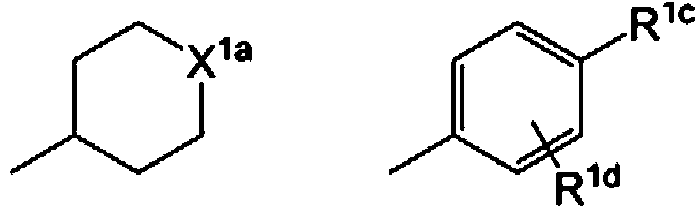
y otros símbolos son como se ha definido con anterioridad.and other symbols are as defined above.
[Etapa 25a][Stage 25a]
El compuesto (X3) se puede producir al hacer reaccionar el compuesto (X1) con el compuesto (X2) en un disolvente en presencia de una base y en presencia o ausencia de un catalizador de transferencia de fase. Ejemplos de disolvente incluyen tolueno, benceno, xileno, diclorometano, dicloroetano, cloroformo, tetrahidrofurano, 1,2-dimetoxietano, 1,4 dioxano, éter dietílico, acetona, acetonitrilo, N,N-dimetilformamida, sulfóxido de dimetilo, N-metilpirrolidona. Ejemplos de base incluyen carbonato de sodio, carbonato de potasio, carbonato de cesio, hidruro de sodio, terc-butóxido de sodio, terc-butóxido de potasio, bis(trimetilsilil)amida de litio, bis(trimetilsilil)amida de sodio, bis(trimetilsilil)amida de potasio, butil-litio y similares. Esta reacción transcurre, de forma particularmente preferida, usando hidruro de sodio, butil-litio. Ejemplos de catalizador de transferencia de fase incluyen sal de amonio cuaternario halogenado, éter de corona y similares. Esta reacción transcurre, preferentemente, de 0 °C a 120 °C, preferentemente, de temperatura ambiente a 60 °C.Compound (X3) can be produced by reacting compound (X1) with compound (X2) in a solvent in the presence of a base and in the presence or absence of a phase transfer catalyst. Examples of solvent include toluene, benzene, xylene, dichloromethane, dichloroethane, chloroform, tetrahydrofuran, 1,2-dimethoxyethane, 1,4 dioxane, diethyl ether, acetone, acetonitrile, N,N-dimethylformamide, dimethyl sulfoxide, N-methylpyrrolidone. Examples of base include sodium carbonate, potassium carbonate, cesium carbonate, sodium hydride, sodium tert-butoxide, potassium tert-butoxide, lithium bis(trimethylsilyl)amide, sodium bis(trimethylsilyl)amide, bis( potassium trimethylsilyl)amide, butyllithium and the like. This reaction takes place, particularly preferably, using sodium butyllithium hydride. Examples of phase transfer catalyst include halogenated quaternary ammonium salt, crown ether and the like. This reaction preferably takes place from 0°C to 120°C, preferably from room temperature to 60°C.
Método de Producción 26Production Method 26
Esquema 26Scheme 26

Bb
en el que X es un átomo de halógeno, el anillo B esin which X is a halogen atom, ring B is

y otros símbolos son como se definieron con anterioridad.and other symbols are as defined above.
[Etapa 26a] [Stage 26a]
El compuesto (Y1) se puede producir al hacer reaccionar el compuesto (X1) con el compuesto (C1) mediante un método similar a la [Etapa3b].Compound (Y1) can be produced by reacting compound (X1) with compound (C1) by a method similar to [Step3b].
Método de Producción 27Production Method 27
Esquema 27Scheme 27

A BA B
en el que X y X son átomos de halógeno, y otros símbolos son como se ha definido con anterioridad.wherein X and X are halogen atoms, and other symbols are as defined above.
[Etapa 27a][Stage 27a]
El (E1) se puede producir al hacer reaccionar el compuesto (Z1) con el compuesto (D1) en un disolvente en presencia o ausencia de una cantidad catalítica de yoduro de cobre en presencia de un complejo de metal de transición y una base. Como disolvente, se pueden usar de manera apropiada tolueno, benceno, xileno, tetrahidrofurano, 1,2-dimetoxietano, 1,4-dioxano, acetonitrilo, acetato de etilo, N,N-dimetilformamida, sulfóxido de dimetilo, N-metilpirrolidona y similares. Como complejo de metal de transición, se usa un complejo de paladio con valencia 0 tal como tetraquis(trifenilfosfina)paladio (0), tris(dibencilidenacetona)dipaladio (0), bis(dibencilidenacetona)paladio (0), bis(tri-terc-butilfosfina)paladio (0) o bis(triciclohexilfosfina)paladio (0), o un complejo de paladio divalente tal como acetato de paladio (II), dicloruro de bis(trifenilfosfina)paladio (II), dicloruro de bis(tri-O-tolilfosfina)paladio (II), dicloruro de bis(triciclohexilfosfina)paladio (II), dicloruro de bis(benzonitrilo)paladio (II), dicloruro de bis(acetonitrilo)paladio (II), dicloruro de [1,1 '-bis(difenilfosfino)ferroceno]paladio (II) o bis(di-terc-butil(4-dimetilaminofenil)fosfina)dicloropaladio (II). (E1) can be produced by reacting compound (Z1) with compound (D1) in a solvent in the presence or absence of a catalytic amount of copper iodide in the presence of a transition metal complex and a base. As a solvent, toluene, benzene, xylene, tetrahydrofuran, 1,2-dimethoxyethane, 1,4-dioxane, acetonitrile, ethyl acetate, N,N-dimethylformamide, dimethyl sulfoxide, N-methylpyrrolidone and the like can be appropriately used. . As a transition metal complex, a 0-valent palladium complex is used such as tetrakis(triphenylphosphine)palladium (0), tris(dibenzylideneacetone)dipalladium (0), bis(dibenzylideneacetone)palladium (0), bis(tri-tert -butylphosphine)palladium(0) or bis(tricyclohexylphosphine)palladium(0), or a divalent palladium complex such as palladium(II) acetate, bis(triphenylphosphine)palladium(II) dichloride, bis(tri-O) dichloride -tolylphosphine)palladium(II), bis(tricyclohexylphosphine)palladium(II) dichloride, bis(benzonitrile)palladium(II) dichloride, bis(acetonitrile)palladium(II) dichloride, [1,1'-bis dichloride (diphenylphosphino)ferrocene]palladium (II) or bis(di-tert-butyl(4-dimethylaminophenyl)phosphine)dichloropalladium (II).
Además, se puede añadir un ligando adecuado al complejo de metal de transición. Ejemplos de un ligando adecuado incluyen tri-terc-butilfosfina, tri-ciclohexilfosfina, 1,1'-bis(difenilfosfino)ferroceno, (±)-2,2'-bis(difenilfosfino)-1,1 binaftilo, tri(orto-tolil)fosfina, 1,2,3,4,5-pentafenil-1'-(di-terc-butilfosfino)ferroceno, 4,5-bis(difenilfosfino)-9,9-dimetilxanteno, di(1-adamantil)-n-butilfosfina, (2-bifenil)di-terc-butilfosfina, (S)-1-[(1 R)-2-(difenilfosfino)ferrocenil]etildiciclohexilfosfina, 2-diciclohexilfosfino-2',6'-diisopropoxibifenilo, 2-diciclohexilfosfino-2',6'-dimetoxibifenilo, 2-diciclohexilfosfino-2'-(N,N-dimetilamino)bifenilo, 2-diciclohexilfosfino-2',4',6'-triisopropilbifenilo, 2-diterc-butilfosfino-2',4',6'-triisopropil-1,1 '-bifenilo, 2-(diciclohexilfosfino)-3,6-dimetoxi-2',4',6'-triisopropil-1,1 '-bifenilo y similares. Ejemplos de base incluyen hidrogenocarbonato de sodio, carbonato de sodio, carbonato de potasio, carbonato de cesio, acetato de sodio, acetato de potasio, fosfato de tripotasio, hidrogenofosfato de dipotasio, dihidrogenofosfato de potasio, trietilamina, diisopropiletilamina, diisopropilamina y similares. La cantidad del complejo de metal de transición que se usa es de 0,01-0,5 equivalentes, preferentemente, de 0,03-0,1 equivalentes, con respecto al compuesto (Z1). La cantidad de base que se usada es de 1-10 equivalentes, preferentemente, de 2-7 equivalentes, con respecto al compuesto (Z1). En particular, se puede producir, preferentemente, mediante un método que usa condiciones de reacción tales como las descritas en J. 0rganomet. Chem., 2002, 653, 46-49.Additionally, a suitable ligand can be added to the transition metal complex. Examples of a suitable ligand include tri-tert-butylphosphine, tri-cyclohexylphosphine, 1,1'-bis(diphenylphosphino)ferrocene, (±)-2,2'-bis(diphenylphosphino)-1,1 binaphthyl, tri(ortho- tolyl)phosphine, 1,2,3,4,5-pentaphenyl-1'-(di-tert-butylphosphino)ferrocene, 4,5-bis(diphenylphosphino)-9,9-dimethylxanthene, di(1-adamantyl)- n-butylphosphine, (2-biphenyl)di-tert-butylphosphine, (S)-1-[(1 R)-2-(diphenylphosphino)ferrocenyl]ethyldicyclohexylphosphine, 2-dicyclohexylphosphino-2',6'-diisopropoxybiphenyl, 2- dicyclohexylphosphino-2',6'-dimethoxybiphenyl, 2-dicyclohexylphosphino-2'-(N,N-dimethylamino)biphenyl, 2-dicyclohexylphosphino-2',4',6'-triisopropylbiphenyl, 2-ditert-butylphosphino-2', 4',6'-triisopropyl-1,1'-biphenyl, 2-(dicyclohexylphosphino)-3,6-dimethoxy-2',4',6'-triisopropyl-1,1'-biphenyl and the like. Examples of base include sodium hydrogen carbonate, sodium carbonate, potassium carbonate, cesium carbonate, sodium acetate, potassium acetate, tripotassium phosphate, dipotassium hydrogen phosphate, potassium dihydrogen phosphate, triethylamine, diisopropylethylamine, diisopropylamine and the like. The amount of the transition metal complex used is 0.01-0.5 equivalents, preferably 0.03-0.1 equivalents, with respect to compound (Z1). The amount of base used is 1-10 equivalents, preferably 2-7 equivalents, with respect to compound (Z1). In particular, it can preferably be produced by a method using reaction conditions such as those described in J. 0rganomet. Chem., 2002, 653, 46-49.
Método de Producción 28Production Method 28
Esquema 28Scheme 28

A BA B
en el que X y X son átomos de halógeno, y otros símbolos son como se ha definido con anterioridad.wherein X and X are halogen atoms, and other symbols are as defined above.
[Etapa 28a] [Stage 28a]
El compuesto (F1) se puede producir al hacer reaccionar el compuesto (AA1) con el compuesto (AA2) en un disolvente en presencia de una base. Como disolvente, se pueden usar de manera apropiada disolventes de éter tales como tetrahidrofurano y disolventes de amida tales como N,N-dimetilformamida. Ejemplos de base incluyen hidruro de sodio, bis(trimetilsilil)amida de litio, bis(trimetilsilil)amida de sodio, bis(trimetilsilil)amida de potasio, butil-litio y similares. Esta reacción transcurre, preferentemente de -78 °C a 60 °C, preferentemente, de -10 °C a temperatura ambiente.Compound (F1) can be produced by reacting compound (AA1) with compound (AA2) in a solvent in the presence of a base. As a solvent, ether solvents such as tetrahydrofuran and amide solvents such as N,N-dimethylformamide can be appropriately used. Examples of base include sodium hydride, lithium bis(trimethylsilyl)amide, sodium bis(trimethylsilyl)amide, potassium bis(trimethylsilyl)amide, butyllithium and the like. This reaction takes place, preferably from -78 °C to 60 °C, preferably from -10 °C to room temperature.
Método de Producción 29Production Method 29
Esquema 29Scheme 29

Bb
en el que X es un átomo de halógeno, y otros símbolos son como se ha definido con anterioridad.wherein X is a halogen atom, and other symbols are as defined above.
[Etapa 29a][Stage 29a]
El compuesto (AB3) se puede producir al hacer reaccionar el compuesto (AB1) con el compuesto (AB2) mediante un método similar a la [Etapa 3b].The compound (AB3) can be produced by reacting the compound (AB1) with the compound (AB2) by a method similar to [Step 3b].
El compuesto obtenido de este modo de la presente invención se puede aislar y purificar por un medio de separación conocido per se, por ejemplo, concentración, concentración a presión reducida, extracción con disolvente, cristalización, recristalización, cromatografía y similares. Cuando el compuesto de la presente invención se obtiene en forma libre, se puede convertir en una sal objetivo mediante un método conocido per se o un método análogo al mismo. Cuando el compuesto se obtiene en forma de sal, se puede convertir en forma libre o en otra sal objetivo mediante un método conocido per se o un método análogo al mismo.The thus obtained compound of the present invention can be isolated and purified by a separation means known per se, for example, concentration, concentration under reduced pressure, solvent extraction, crystallization, recrystallization, chromatography and the like. When the compound of the present invention is obtained in free form, it can be converted into a target salt by a method known per se or a method analogous thereto. When the compound is obtained in salt form, it can be converted to free form or to another target salt by a method known per se or a method analogous thereto.
El compuesto de la presente invención tiene un grupo básico y un grupo ácido en la molécula. De esta manera, los ejemplos de sal farmacológicamente aceptable del mismo incluyen sal de metal, sal de amonio, sales con bases orgánicas, sales con ácidos inorgánicos, sales con ácidos orgánicos, sales con aminoácidos básicos, sales con aminoácidos ácidos y similares.The compound of the present invention has a basic group and an acidic group in the molecule. Thus, examples of pharmacologically acceptable salt thereof include metal salt, ammonium salt, salts with organic bases, salts with inorganic acids, salts with organic acids, salts with basic amino acids, salts with acidic amino acids and the like.
Los ejemplos preferidos de sal de metal incluyen sales de metal alcalino tales como sal de sodio, sal de potasio y similares; sales de metal alcalinotérreo tales como sal de calcio, sal de magnesio, sal de bario y similares; sal de aluminio y similares.Preferred examples of metal salt include alkali metal salts such as sodium salt, potassium salt and the like; alkaline earth metal salts such as calcium salt, magnesium salt, barium salt and the like; aluminum salt and the like.
Los ejemplos preferidos de sales con bases orgánicas incluyen sales con trimetilamina, trietilamina, piridina, picolina, 2,6-lutidina, etanolamina, dietanolamina, trietanolamina, ciclohexilamina, diciclohexilamina, N,N'-dibenciletilendiamina y similares.Preferred examples of salts with organic bases include salts with trimethylamine, triethylamine, pyridine, picoline, 2,6-lutidine, ethanolamine, diethanolamine, triethanolamine, cyclohexylamine, dicyclohexylamine, N,N'-dibenzylethylenediamine and the like.
Los ejemplos preferidos de sales con ácidos inorgánicos incluyen sales con ácido clorhídrico, ácido bromhídrico, ácido nítrico, ácido sulfúrico, ácido fosfórico y similares.Preferred examples of salts with inorganic acids include salts with hydrochloric acid, hydrobromic acid, nitric acid, sulfuric acid, phosphoric acid and the like.
Los ejemplos preferidos de sales con ácidos orgánicos incluyen sales con ácido fórmico, ácido acético, ácido trifluoroacético, ácido ftálico, ácido fumárico, ácido oxálico, ácido tartárico, ácido maleico, ácido cítrico, ácido succínico, ácido málico, ácido metanosulfónico, ácido bencenosulfónico, ácido p-toluenosulfónico y similares.Preferred examples of salts with organic acids include salts with formic acid, acetic acid, trifluoroacetic acid, phthalic acid, fumaric acid, oxalic acid, tartaric acid, maleic acid, citric acid, succinic acid, malic acid, methanesulfonic acid, benzenesulfonic acid, p-toluenesulfonic acid and the like.
Los ejemplos preferidos de sales con aminoácidos básicos incluyen sales con arginina, lisina, ornitina y similares. Los ejemplos preferidos de sales con aminoácido ácido incluyen sales con ácido aspártico, ácido glutámico y similares. El compuesto de la presente invención también abarca, además del Compuesto (1) anteriormente mencionado y una de una sal farmacológicamente aceptable del mismo, hidratos y solvatos del mismo.Preferred examples of salts with basic amino acids include salts with arginine, lysine, ornithine and the like. Preferred examples of acidic amino acid salts include salts with aspartic acid, glutamic acid and the like. The compound of the present invention also encompasses, in addition to the aforementioned Compound (1) and one of a pharmacologically acceptable salt thereof, hydrates and solvates thereof.
Cuando el compuesto de la presente invención tiene un isómero tal como un isómero óptico, estereoisómero, regioisómero, rotámero y similares, todos estos isómeros y mezclas quedan englobados por el compuesto de la presente invención. Por ejemplo, cuando el compuesto de la presente invención contiene un isómero óptico, el isómero óptico resuelto a partir de un racemato también queda englobado por el compuesto de la presente invención. Estos isómeros se pueden obtener como productos individuales respectivos mediante un método de síntesis, un método de separación (por ejemplo, concentración, extracción con disolvente, cromatografía en columna, recristalización) conocidos per se.When the compound of the present invention has an isomer such as an optical isomer, stereoisomer, regioisomer, rotamer and the like, all these isomers and mixtures are encompassed by the compound of the present invention. For example, when the compound of the present invention contains an optical isomer, the optical isomer resolved from a racemate is also encompassed by the compound of the present invention. These isomers can be obtained as respective individual products by a synthesis method, a method of separation (e.g., concentration, solvent extraction, column chromatography, recrystallization) known per se.
Además, se puede determinar el exceso enantiomérico (%ee) usando HPLC quiral frente a una sustancia normalizada. El exceso enantiomérico se puede calcular de la siguiente manera:Additionally, enantiomeric excess (%ee) can be determined using chiral HPLC against a standard substance. The enantiomeric excess can be calculated as follows:
[(moles de R-moles de S)/(moles de R+moles de S)]x100%[(moles of R-moles of S)/(moles of R+moles of S)]x100%
En la fórmula, moles de R y moles de S son fracciones molares de R y S en la mezcla tal como moles de R mol+moles de S =1. Alternativamente, el exceso enantiomérico también se puede calcular a partir de la rotación óptica específica del enantiómero deseado y la mezcla preparada de la siguiente manera:In the formula, moles of R and moles of S are mole fractions of R and S in the mixture such as moles of R mol+moles of S =1. Alternatively, the enantiomeric excess can also be calculated from the specific optical rotation of the desired enantiomer and the mixture prepared as follows:
ee=([a-Obs]/[a-max])x100%ee=([a-Obs]/[a-max])x100%
El compuesto de la presente invención puede ser un cristal, que queda englobado por el compuesto de la presente invención, tanto si tiene una forma cristalina individual como si es una mezcla de formas cristalinas. El cristal se puede producir mediante cristalización al aplicar un método de cristalización conocido per se. Además, el compuesto de la presente invención puede ser un cocristal o sal de cocristal farmacéuticamente aceptable. Tal como se usa en la presente memoria, el cocristal o la sal de cocristal hacen referencia a una sustancia cristalina que consiste en dos o más sólidos particulares a temperatura ambiente, en el que cada uno tiene diferentes propiedades físicas (por ejemplo, estructure, punto de fusión, calor de fusión, naturaleza higroscópica, estabilidad). El cocristal o sal de cocristal se pueden producir mediante un método de cocristalización conocido per se.The compound of the present invention may be a crystal, which is encompassed by the compound of the present invention, whether it has a single crystalline form or a mixture of crystalline forms. The crystal can be produced by crystallization by applying a crystallization method known per se. Furthermore, the compound of the present invention may be a pharmaceutically acceptable cocrystal or cocrystal salt. As used herein, cocrystal or cocrystal salt refers to a crystalline substance consisting of two or more particular solids at room temperature, each having different physical properties (e.g., structure, point of fusion, heat of fusion, hygroscopic nature, stability). The cocrystal or cocrystal salt can be produced by a cocrystallization method known per se.
2 3 13 14 15 352 3 13 14 15 35
Un compuesto marcado con un isótopo (por ejemplo, H, H, C, C, N, S), y similares también quedan englobados por el compuesto de la presente invención.A compound labeled with an isotope (for example, H, H, C, C, N, S), and the like are also encompassed by the compound of the present invention.
EjemplosExamples
La presente invención se explica con detalle a continuación haciendo referencia a los Ejemplos y los Ejemplos Experimentales, los cuales no se deben interpretar como limitantes.The present invention is explained in detail below with reference to the Examples and Experimental Examples, which should not be construed as limiting.
En los Ejemplos, se usan las siguientes abreviaturas.In the Examples, the following abbreviations are used.
Me: metiloMe: methyl
Et: etiloEt: ethyl
iPr: isopropiloiPr: isopropyl
tBu: terc-butilotBu: tert-butyl
Ph: feniloPh: phenyl
Bn: benciloBn: benzyl
Boc: terc-butoxicarboniloBoc: tert-butoxycarbonyl
TBDPS: terc-butildifenilsililoTBDPS: tert-butyldiphenylsilyl
Ms: metanosulfoniloMs: methanesulfonyl
Tf: trifluorometanosulfoniloTf: trifluoromethanesulfonyl
Ts: 4-toluenosulfoniloTs: 4-toluenesulfonyl
HPLC: cromatografía líquida de alto rendimientoHPLC: high performance liquid chromatography
Ejemplo 1Example 1
Ácido (1S,2S)-2-[2-metoxi-5-(6-{[trans-4-(trifluorometil)ciclohexil]metoxi}piridazin-4-il)fenil]ciclopropancarboxílico,(1S,2S)-2-[2-methoxy-5-(6-{[trans-4-(trifluoromethyl)cyclohexyl]methoxy}pyridazin-4-yl)phenyl]cyclopropanecarboxylic acid,
ácido (1 R,2R)-2-[2-metoxi-5-(6-{[trans-4-(trifluorometil)ciclohexil]metoxi}piridazin-4- il)fenil]ciclopropancarboxílico (1R,2R)-2-[2-methoxy-5-(6-{[trans-4-(trifluoromethyl)cyclohexyl]methoxy}pyridazin-4-yl)phenyl]cyclopropanecarboxylic acid

[Etapa a][Stage a]
A una disolución del compuesto 1 (200 mg, 679 gmol) obtenido en el Ejemplo de Referencia 44, Etapa a, y el compuesto 2 (508 mg, 1,36 mmol) obtenido en el Ejemplo de Referencia 1, Etapa c, en 1,4-dioxano (10 ml) se añadieron una disolución de carbonato de potasio (188 mg, 1,36 mmol) en agua (1,0 ml), tris(dibencilidenacetona)dipaladio (0) (62 mg, 68 gmol) y 2-diciclohex.ilfosfino-2',4',6'-triisopropilbifenilo (129 mg, 271 gmol), y se agitó la mezcla en una atmósfera de nitrógeno con calentamiento a reflujo durante la noche. La mezcla de reacción se dejó enfriar a temperatura ambiente, se diluyó con acetato de etilo y se filtró a través de celite. El filtrado se lavó con agua y disolución salina saturada, se secó sobre sulfato de sodio anhidro, se filtró y se concentró. El residuo se purificó mediante cromatografía de gel de sílice NH y cromatografía de gel de sílice para proporcionar el compuesto 3 (207 mg, 60,2 %). MS(ESI) m/z:507 (M+1)+.To a solution of compound 1 (200 mg, 679 gmol) obtained in Reference Example 44, Step a, and compound 2 (508 mg, 1.36 mmol) obtained in Reference Example 1, Step c, in 1 ,4-dioxane (10 ml), a solution of potassium carbonate (188 mg, 1.36 mmol) in water (1.0 ml), tris(dibenzylideneacetone)dipalladium (0) (62 mg, 68 gmol) and 2-dicyclohexylphosphino-2',4',6'-triisopropylbiphenyl (129 mg, 271 gmol), and the mixture was stirred under a nitrogen atmosphere with heating to reflux overnight. The reaction mixture was allowed to cool to room temperature, diluted with ethyl acetate and filtered through celite. The filtrate was washed with water and saturated saline, dried over anhydrous sodium sulfate, filtered and concentrated. The residue was purified by NH-silica gel chromatography and silica gel chromatography to provide compound 3 (207 mg, 60.2%). MS(ESI) m/z:507 (M+1)+.
[Etapa b][Stage b]
La resolución quiral del compuesto 3 (170 mg) mediante HPLC quiral (CHIRAL PAK IA, 30x250, éter metil tercbutílico:metanol:dietilamina = 95:5:0.1,20 ml/min) proporcionó el compuesto 3a (82,4 mg, 99,9 %ee, pico en el tiempo de retención de 17 min) y el compuesto 3b (81,1 mg, 99,3 %ee, pico en el tiempo de retención de 23 min).Chiral resolution of compound 3 (170 mg) by chiral HPLC (CHIRAL PAK IA, 30x250, methyl tert-butyl ether:methanol:diethylamine = 95:5:0.1.20 ml/min) gave compound 3a (82.4 mg, 99 .9%ee, peak at retention time 17 min) and compound 3b (81.1 mg, 99.3%ee, peak at retention time 23 min).
[Etapa c][Stage c]
A una disolución del compuesto 3a (82,4 mg, 160 gmol) en diclorometano (2,0 ml) se añadió ácido trifluoroacético (249 gl), y la mezcla se agitó a temperatura ambiente durante 4 h. La disolución de reacción se concentró a presión reducida, y el residuo se purificó mediante cromatografía de gel de sílice para proporcionar el compuesto 4a (54,3 mg, 74,1 %). Este enantiómero se usó como Ejemplo 1-1. MS(ESI) m/z:451 (M+1)+.To a solution of compound 3a (82.4 mg, 160 gmol) in dichloromethane (2.0 ml) was added trifluoroacetic acid (249 gl), and the mixture was stirred at room temperature for 4 h. The reaction solution was concentrated under reduced pressure, and the residue was purified by silica gel chromatography to provide compound 4a (54.3 mg, 74.1%). This enantiomer was used as Example 1-1. MS(ESI) m/z:451 (M+1)+.
[Etapa d][Stage d]
A una disolución de compuesto 3b (81,1 mg, 160 gmol) en diclorometano (2,0 ml) se añadió ácido trifluoroacético (245 gl), y la mezcla se agitó a temperatura ambiente durante 4 h. A la disolución de reacción se añadió además ácido trifluoroacético (122 gl), y la mezcla se agitó a temperatura ambiente durante 4 h. La disolución de reacción se concentró a presión reducida, y el residuo se purificó mediante cromatografía de gel de sílice para proporcionar el compuesto 4b (56,1 mg, 77,8 %). Este enantiómero se usó como Ejemplo 1-2. MS(ESI) m/z:451 (M+1)+.To a solution of compound 3b (81.1 mg, 160 gmol) in dichloromethane (2.0 ml) was added trifluoroacetic acid (245 gl), and the mixture was stirred at room temperature for 4 h. Trifluoroacetic acid (122 gl) was further added to the reaction solution, and the mixture was stirred at room temperature for 4 h. The reaction solution was concentrated under reduced pressure, and the residue was purified by silica gel chromatography to provide compound 4b (56.1 mg, 77.8%). This enantiomer was used as Example 1-2. MS(ESI) m/z:451 (M+1)+.
Ejemplo 2Example 2
Ácido trans-2-[2-metoxi-5-(5-{[4-(trifluorometoxi)bencil]oxi}piridin-3- il)fenil]ciclopropancarboxílico trans-2-[2-methoxy-5-(5-{[4-(trifluoromethoxy)benzyl]oxy}pyridin-3-yl)phenyl]cyclopropanecarboxylic acid

[Etapa a][Stage a]
A una disolución de compuesto 1 (2,37 g, 6,33 mmol) obtenido en el Ejemplo de Referencia 1, Etapa c, y el compuesto 2 (1,00 g, 5,75 mmol) en 1,4-dioxano (20 ml) se añadieron una disolución de fosfato de tripotasio (3,66 g, 17,2 mmol) en agua (2 ml) y bis(di-terc-butil(4-dimetilaminofenil)fosfina)dicloropaladio (II) (204 mg, 287 gmol), y la mezcla se agitó en atmósfera de nitrógeno bajo calentamiento a 80 °C durante la noche. La mezcla de reacción se neutralizó con ácido clorhídrico 1 M y se extrajo con acetato de etilo. La fase orgánica se lavó con disolución salina saturada, se secó sobre sulfato de sodio anhidro, se filtró y se concentró. El residuo se purificó mediante cromatografía de gel de sílice para proporcionar el compuesto 3 (894 mg, 45,6 %). MS(APcI)m/z:342 (M+1)+.To a solution of compound 1 (2.37 g, 6.33 mmol) obtained in Reference Example 1, Step c, and compound 2 (1.00 g, 5.75 mmol) in 1,4-dioxane ( 20 ml) a solution of tripotassium phosphate (3.66 g, 17.2 mmol) in water (2 ml) and bis(di-tert-butyl(4-dimethylaminophenyl)phosphine)dichloropalladium (II) (204 mg) were added. , 287 gmol), and the mixture was stirred under nitrogen atmosphere under heating at 80 °C overnight. The reaction mixture was neutralized with 1 M hydrochloric acid and extracted with ethyl acetate. The organic phase was washed with saturated saline, dried over anhydrous sodium sulfate, filtered and concentrated. The residue was purified by silica gel chromatography to provide compound 3 (894 mg, 45.6%). MS(APcI)m/z:342 (M+1)+.
[Etapa b][Stage b]
A una disolución de compuesto 3 (60,0 mg, 176 gmol) y compuesto 4 (64,0 gl, 439 gmol) en tetrahidrofurano (1,0 ml) se añadieron trifenilfosfina (115 mg, 439 gmol) y bis(2-metoxietil)azodicarboxilato (103 mg, 439 gmol), y la mezcla se agitó a temperatura ambiente durante 2 días. La mezcla de reacción se concentró a presión reducida y el residuo se purificó mediante cromatografía de gel de sílice para proporcionar el compuesto 5 (46,2 mg, 51,0 %). MS(ESI) m/z:516 (M+1)+.To a solution of compound 3 (60.0 mg, 176 gmol) and compound 4 (64.0 gl, 439 gmol) in tetrahydrofuran (1.0 ml) were added triphenylphosphine (115 mg, 439 gmol) and bis(2- methoxyethyl)azodicarboxylate (103 mg, 439 gmol), and the mixture was stirred at room temperature for 2 days. The reaction mixture was concentrated under reduced pressure and the residue was purified by silica gel chromatography to provide compound 5 (46.2 mg, 51.0%). MS(ESI) m/z:516 (M+1)+.
[Etapa c][Stage c]
A una disolución de compuesto 5 (44,0 mg, 85,4 gmol) en diclorometano (1,0 ml) se añadió ácido trifluoroacético (653 gl), y la mezcla se agitó a temperatura ambiente durante la noche. La disolución de reacción se concentró a presión reducida y el residuo se sometió a purificación por extracción de fase sólida usando una columna de resina de intercambio catiónico (Waters, PoraPak™, RxnCX) y se purificó mediante cromatografía de gel de sílice para proporcionar el compuesto 6 (23,9 mg, 61,0 %). MS(APCI)m/z:460 (M+1)+.To a solution of compound 5 (44.0 mg, 85.4 gmol) in dichloromethane (1.0 ml) was added trifluoroacetic acid (653 gl), and the mixture was stirred at room temperature overnight. The reaction solution was concentrated under reduced pressure and the residue was subjected to purification by solid phase extraction using a cation exchange resin column (Waters, PoraPak™, RxnCX) and purified by silica gel chromatography to provide the compound. 6 (23.9 mg, 61.0%). MS(APCI)m/z:460 (M+1)+.
Ejemplo 3Example 3
Ácido trans-2-[2-metoxi-5-(6-{[4-(trifluorometil)fenoxi]metil}piridazin-4- il)fenil]ciclopropancarboxílico trans-2-[2-methoxy-5-(6-{[4-(trifluoromethyl)phenoxy]methyl}pyridazin-4-yl)phenyl]cyclopropanecarboxylic acid

[Etapa a][Stage a]
A una disolución de compuesto 1 (1,26 g, 3,36 mmol) obtenido en el Ejemplo de Referencia 1, Etapa c, compuesto 2 (500 mg, 3,36 mmol) en tolueno (13 ml) se añadieron una disolución de fluoruro de potasio (487 mg, 8,39 mmol) en agua (3,4 ml), acetato de paladio (II) (37,7 mg, 168 gmol) y 1,2,3,4,5-pentafenil-1'-(di-terc-butilfosfino)ferroceno (119 mg, 168 gmol), y la mezcla se agitó en una atmósfera de nitrógeno bajo calentamiento a 70 °C durante 19 h. La mezcla de reacción se dejó enfriar a temperatura ambiente, se filtró a través de celite, y se lavó con acetato de etilo (50 ml). El filtrado se concentró a presión reducida, y el residuo se purificó mediante cromatografía de gel de sílice para proporcionar el compuesto 3 (398 mg, 32,9 %). MS(ESI) m/z:361,363 (M+1)+.To a solution of compound 1 (1.26 g, 3.36 mmol) obtained in Reference Example 1, Step c, compound 2 (500 mg, 3.36 mmol) in toluene (13 ml) was added a solution of potassium fluoride (487 mg, 8.39 mmol) in water (3.4 mL), palladium(II) acetate (37.7 mg, 168 gmol) and 1,2,3,4,5-pentaphenyl-1 '-(di-tert-butylphosphino)ferrocene (119 mg, 168 gmol), and the mixture was stirred in a nitrogen atmosphere under heating at 70 °C for 19 h. The reaction mixture was allowed to cool to room temperature, filtered through celite, and washed with ethyl acetate (50 mL). The filtrate was concentrated under reduced pressure, and the residue was purified by silica gel chromatography to provide compound 3 (398 mg, 32.9%). MS(ESI) m/z:361.363 (M+1)+.
[Etapa b][Stage b]
A una disolución mixta de compuesto 3 (370 mg, 1,03 mmol) en N,N-dimetilformamida (4,0 ml) y etanol (1,0 ml) se añadieron acetato de sodio (168 mg, 2,05 mmol) y dicloruro de [1,1'-bis(difenilfosfino)ferroceno]paladio (II) (83,7 mg, 103 gmol), y la mezcla se agitó en una atmósfera de monóxido de carbono bajo calentamiento a 90 °C durante 4 h. A la mezcla de reacción se añadieron además etanol (1,0 ml) y dicloruro de [1,1'- bis(difenilfosfino)ferroceno]paladio (II) (83,7 mg, 103 gmol), y la mezcla se agitó en una atmósfera de monóxido de carbono bajo calentamiento a 90 °C durante la noche. La mezcla de reacción se dejó enfriar a temperatura ambiente, se añadieron agua (30 ml) y acetato de etilo (30 ml), y la mezcla se filtró a través de celite. El filtrado se separó en fases, y la fase orgánica se lavó con agua (30 ml) y disolución salina saturada (30 ml), se secó sobre sulfato de sodio anhidro, se filtró y se concentró. El residuo se purificó mediante cromatografía de gel de sílice NH para proporcionar el compuesto 4 (98,3 mg, 24,1 %). MS(ESI) m/z:399 (M+1)+.To a mixed solution of compound 3 (370 mg, 1.03 mmol) in N,N-dimethylformamide (4.0 ml) and ethanol (1.0 ml) was added sodium acetate (168 mg, 2.05 mmol). and [1,1'-bis(diphenylphosphino)ferrocene]palladium(II) dichloride (83.7 mg, 103 gmol), and the mixture was stirred in a carbon monoxide atmosphere under heating at 90 °C for 4 h . Ethanol (1.0 ml) and [1,1'-bis(diphenylphosphino)ferrocene]palladium(II) dichloride (83.7 mg, 103 gmol) were further added to the reaction mixture, and the mixture was stirred in a carbon monoxide atmosphere under heating to 90 °C overnight. The reaction mixture was allowed to cool to room temperature, water (30 ml) and ethyl acetate (30 ml) were added, and the mixture was filtered through celite. The filtrate was separated into phases, and the organic phase was washed with water (30 ml) and saturated saline (30 ml), dried over anhydrous sodium sulfate, filtered and concentrated. The residue was purified by NH silica gel chromatography to provide compound 4 (98.3 mg, 24.1%). MS(ESI) m/z:399 (M+1)+.
[Etapa c][Stage c]
A una suspensión mixta de compuesto 4 (95,0 mg, 239 gmol) en etanol (3,0 ml) y tetrahidrofurano (0,50 ml) se añadió borohidruro de sodio (18,0 mg, 477 gmol) bajo enfriamiento con hielo y la mezcla se agitó durante 1,5 h mientras se calentaba a temperatura ambiente. Se añadió agua a la mezcla de reacción, y la mezcla se extrajo con cloroformo. La fase orgánica se secó sobre sulfato de sodio anhidro, se filtró y se concentró. El residuo se purificó mediante cromatografía de gel de sílice para proporcionar el compuesto 5 (45,5 mg, 53,5 %). MS(ESI) m/z:357 (M+1)+.To a mixed suspension of compound 4 (95.0 mg, 239 gmol) in ethanol (3.0 mL) and tetrahydrofuran (0.50 mL) was added sodium borohydride (18.0 mg, 477 gmol) under ice cooling. and the mixture was stirred for 1.5 h while warming to room temperature. Water was added to the reaction mixture, and the mixture was extracted with chloroform. The organic phase was dried over anhydrous sodium sulfate, filtered and concentrated. The residue was purified by silica gel chromatography to provide compound 5 (45.5 mg, 53.5%). MS(ESI) m/z:357 (M+1)+.
[Etapa d][Stage d]
A una disolución de compuesto 5 (68,6 mg, 160 gmol) y el compuesto 6 (66,3 mg, 404 gmol) en N,N-dimetilformamida (2,1 ml) se añadió hidruro de sodio (60 % en peso, 41,2 mg, 1,03 mmol) y la mezcla se agitó bajo calentamiento a 100 °C durante 2 h. La mezcla de reacción se dejó enfriar a temperatura ambiente, se añadió agua, y la mezcla se extrajo con acetato de etilo. La fase orgánica se lavó con agua y disolución salina saturada se secó sobre sulfato de sodio anhidro, se filtró y se concentró. El residuo se purificó mediante cromatografía de gel de sílice para proporcionar el compuesto 7 (14,6 mg, 28,9 %). MS(ESI) m/z:501 (M+1)+.To a solution of compound 5 (68.6 mg, 160 gmol) and compound 6 (66.3 mg, 404 gmol) in N,N-dimethylformamide (2.1 ml) was added sodium hydride (60% by weight , 41.2 mg, 1.03 mmol) and the mixture was stirred under heating at 100 °C for 2 h. The reaction mixture was allowed to cool to room temperature, water was added, and the mixture was extracted with ethyl acetate. The organic phase was washed with water and saturated saline solution dried over anhydrous sodium sulfate, filtered and concentrated. The residue was purified by silica gel chromatography to provide compound 7 (14.6 mg, 28.9%). MS(ESI) m/z:501 (M+1)+.
[Etapa e][Stage e]
A una disolución de compuesto 7 (14,6 mg, 29,2 gmol) en diclorometano (1,0 ml) se añadió ácido trifluoroacético (100 gl), y la mezcla se agitó a temperatura ambiente durante 5 h. La disolución de reacción se concentró a presión reducida, y el residuo se purificó mediante cromatografía de gel de sílice para proporcionar el compuesto 8 (11,2 mg, 86,4 %). MS(ESI) m/z:445 (M+1)+.To a solution of compound 7 (14.6 mg, 29.2 gmol) in dichloromethane (1.0 ml) was added trifluoroacetic acid (100 gl), and the mixture was stirred at room temperature for 5 h. The reaction solution was concentrated under reduced pressure, and the residue was purified by silica gel chromatography to provide compound 8 (11.2 mg, 86.4%). MS(ESI) m/z:445 (M+1)+.
Ejemplo 4Example 4
Ácido trans-2-[2-metoxi-5-(6-{2-[4-(trifluorometoxi)fenil]etil}piridazin-4- il)fenil]ciclopropancarboxílicotrans-2-[2-methoxy-5-(6-{2-[4-(trifluoromethoxy)phenyl]ethyl}pyridazin-4-yl)phenyl]cyclopropanecarboxylic acid
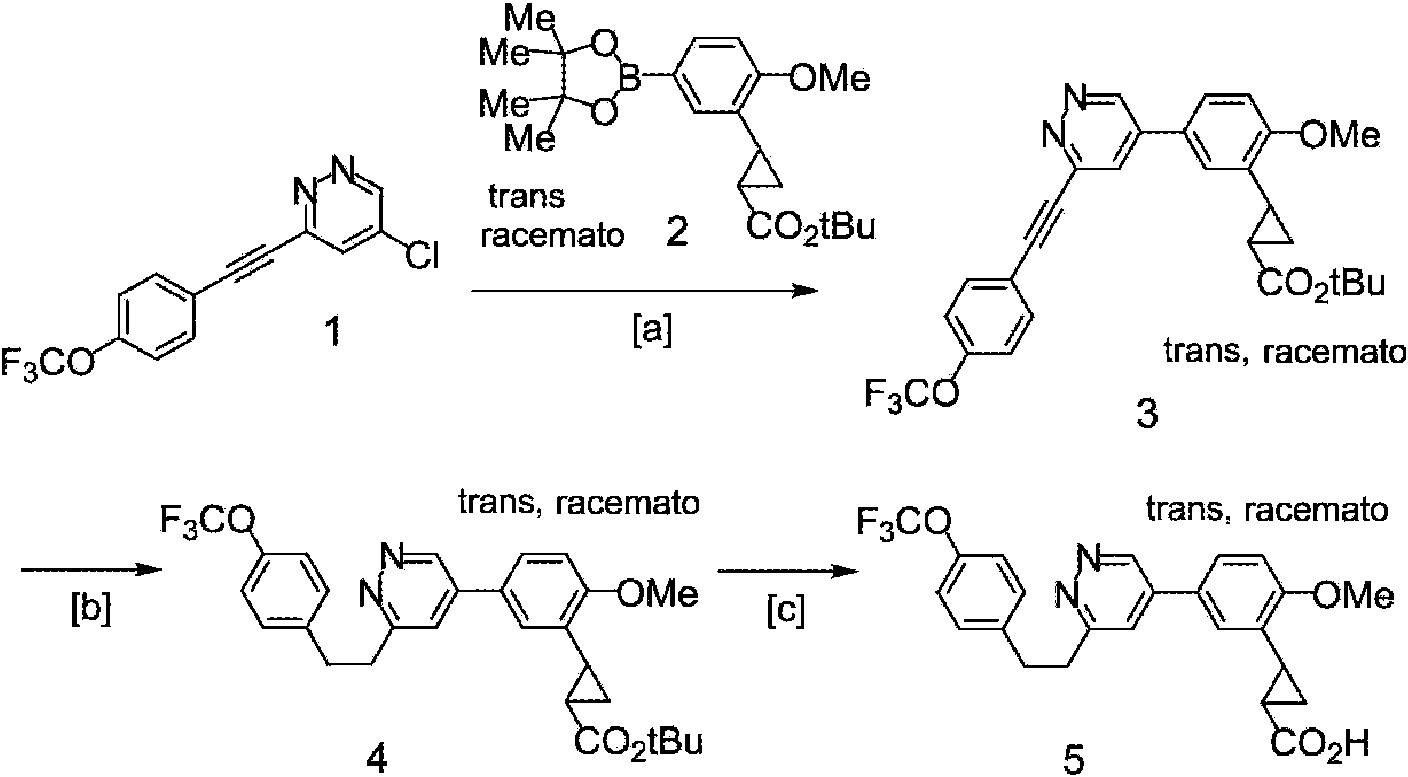
[Etapa a][Stage a]
A una disolución de compuesto 1 (80,0 mg, 268 μmol) obtenido en el Ejemplo de Referencia 46, Etapa a y compuesto 2 (201 mg, 536 μmol) obtenido en el Ejemplo de Referencia 1, Etapa c, en 1,4-dioxano (2,4 ml) se añadieron una disolución de carbonato de potasio (74,1 mg, 536 μmol) en agua (0,24 ml), tris(dibencilidenacetona)dipaladio (0) (25 mg, 27 μmol) y 2-diciclohexilfosfino-2',4',6'-triisopropilbifenilo (51,1 mg, 107 pmol), y la mezcla se agitó en una atmósfera de nitrógeno con calentamiento a reflujo durante la noche. La mezcla de reacción se dejó enfriar hasta temperatura ambiente y se purificó mediante cromatografía de gel de sílice NH para proporcionar el compuesto 3 (52,2 mg, 38,2 %). MS(ESI) m/z:511 (M+1)+.To a solution of compound 1 (80.0 mg, 268 μmol) obtained in Reference Example 46, Step a and compound 2 (201 mg, 536 μmol) obtained in Reference Example 1, Step c, in 1.4- dioxane (2.4 ml), a solution of potassium carbonate (74.1 mg, 536 μmol) in water (0.24 ml), tris(dibenzylideneacetone)dipalladium (0) (25 mg, 27 μmol) and 2 -dicyclohexylphosphino-2',4',6'-triisopropylbiphenyl (51.1 mg, 107 pmol), and the mixture was stirred under a nitrogen atmosphere with heating to reflux overnight. The reaction mixture was allowed to cool to room temperature and purified by NH silica gel chromatography to provide compound 3 (52.2 mg, 38.2%). MS(ESI) m/z:511 (M+1)+.
[Etapa b][Stage b]
A una disolución de compuesto 3 (50 mg, 98 μmol) en metanol (3,0 ml) se añadió 10%-paladio/carbono (10 mg), y la mezcla se agitó en una atmósfera de hidrógeno a temperatura ambiente durante la noche. La disolución de reacción se diluyó con cloroformo, se filtró a través de celite, y el filtrado se concentró a presión reducida. El residuo se disolvió en metanol (3,0 ml), se añadió 10%-paladio/carbono (10 mg) y la mezcla se agitó en una atmósfera de hidrógeno a temperatura ambiente durante la noche. La mezcla de reacción se diluyó con cloroformo y se filtró a través de celite. El filtrado se concentró a presión reducida para proporcionar el compuesto 4 (44 mg, 88 %). MS(ESI) m/z:515 (M+1)+.To a solution of compound 3 (50 mg, 98 μmol) in methanol (3.0 mL) was added 10%-palladium/carbon (10 mg), and the mixture was stirred under a hydrogen atmosphere at room temperature overnight. . The reaction solution was diluted with chloroform, filtered through celite, and the filtrate was concentrated under reduced pressure. The residue was dissolved in methanol (3.0 ml), 10%-palladium/carbon (10 mg) was added and the mixture was stirred under a hydrogen atmosphere at room temperature overnight. The reaction mixture was diluted with chloroform and filtered through celite. The filtrate was concentrated under reduced pressure to give compound 4 (44 mg, 88%). MS(ESI) m/z:515 (M+1)+.
[Etapa c][Stage c]
A una disolución de compuesto 4 (40 mg, 78 μmol) en diclorometano (1,6 ml) se añadió ácido trifluoroacético (0,80 ml), y la mezcla se agitó a temperatura ambiente durante 3 días. La disolución de reacción se purificó mediante cromatografía de gel de sílice para proporcionar el compuesto 5 (36 mg). MS(ESI) m/z:459 (M+1)+.To a solution of compound 4 (40 mg, 78 μmol) in dichloromethane (1.6 ml) was added trifluoroacetic acid (0.80 ml), and the mixture was stirred at room temperature for 3 days. The reaction solution was purified by silica gel chromatography to provide compound 5 (36 mg). MS(ESI) m/z:459 (M+1)+.
Ejemplo 5Example 5
Ácido (1S,2S)-2-[3-metoxi-6-(6-{[trans-4-(trifluorometil)ciclohexil]metoxi}piridazin-4-il)piridin-2-il]ciclopropancarboxílico (1S,2S)-2-[3-methoxy-6-(6-{[trans-4-(trifluoromethyl)cyclohexyl]methoxy}pyridazin-4-yl)pyridin-2-yl]cyclopropanecarboxylic acid

[Etapa a][Stage a]
A una disolución de compuesto 1 (1,81 g, 6,14 mmol) obtenido en el Ejemplo de Referencia 44, Etapa a, y bis(pinacolato)diborano (2,49 g, 9,82 mmol) en 1,4-dioxano (61 ml) se añadieron acetato de potasio (1,81 g, 18,4 mmol), tris(dibencilidenacetona)dipaladio (0) (337 mg, 368 pmol) y 2-diciclohexilfosfino-2',4',6'-triisopropilbifenilo (351 mg, 736 pmol), y la mezcla se agitó en atmósfera de nitrógeno bajo calentamiento a 100 °C durante 3 h. La mezcla de reacción se enfrió con hielo y el sólido resultante se diluyó con agua y se lavó con agua. El sólido obtenido se lavó con hexano para proporcionar el compuesto 2 (1,78 g, 75,2 %). MS(APcI)m/z:387 (M+1)+.To a solution of compound 1 (1.81 g, 6.14 mmol) obtained in Reference Example 44, Step a, and bis(pinacolato)diborane (2.49 g, 9.82 mmol) in 1,4- dioxane (61 ml), potassium acetate (1.81 g, 18.4 mmol), tris(dibenzylideneacetone)dipalladium (0) (337 mg, 368 pmol) and 2-dicyclohexylphosphino-2',4',6' were added. -triisopropylbiphenyl (351 mg, 736 pmol), and the mixture was stirred in a nitrogen atmosphere under heating at 100 °C for 3 h. The reaction mixture was cooled with ice and the resulting solid was diluted with water and washed with water. The solid obtained was washed with hexane to provide compound 2 (1.78 g, 75.2%). MS(APcI)m/z:387 (M+1)+.
[Etapa b][Stage b]
A una disolución de compuesto 3 (384 mg, 1,50 mmol) obtenido en el Ejemplo de Referencia 2, Etapa d, y el compuesto 2 (645 mg, 1,67 mmol) en tetrahidrofurano (15 ml) se añadieron una disolución de fosfato tripotásico (1,95 g, 9,19 mmol) en agua (3,0 ml) y precatalizador de cloruro de paladio X-Phos aminobifenilo (66 mg, 84 pmol), y la mezcla se agitó en atmósfera de nitrógeno bajo calentamiento a 80 °C durante 4 h. A la mezcla de reacción se añadió además un precatalizador de cloruro de paladio X-Phos aminobifenilo (65,7 mg, 83,5 pmol), y la mezcla se agitó en atmósfera de nitrógeno bajo calentamiento a 80 °C durante 2,5 h. La mezcla de reacción se dejó enfriar a temperatura ambiente, se añadió agua (25 ml), y la mezcla se extrajo con acetato de etilo. La fase orgánica se lavó con disolución salina saturada, se secó sobre sulfato de sodio anhidro, se filtró y se concentró. El residuo se purificó mediante cromatografía de gel de sílice NH para proporcionar el compuesto 4 (380 mg, 38,0 %). MS(ESI) m/z:480 (M+1)+.To a solution of compound 3 (384 mg, 1.50 mmol) obtained in Reference Example 2, Step d, and compound 2 (645 mg, 1.67 mmol) in tetrahydrofuran (15 ml) were added a solution of tripotassium phosphate (1.95 g, 9.19 mmol) in water (3.0 mL) and palladium X-Phos aminobiphenyl chloride precatalyst (66 mg, 84 pmol), and the mixture was stirred under nitrogen atmosphere under heating at 80 °C for 4 h. A precatalyst of palladium chloride . The reaction mixture was allowed to cool to room temperature, water (25 mL) was added, and the mixture was extracted with ethyl acetate. The organic phase was washed with saturated saline, dried over anhydrous sodium sulfate, filtered and concentrated. The residue was purified by NH silica gel chromatography to provide compound 4 (380 mg, 38.0%). MS(ESI) m/z:480 (M+1)+.
[Etapa c][Stage c]
A una disolución mixta del compuesto 4 (73,0 mg, 152 pmol) en tetrahidrofurano (2,0 ml) y metanol (2,0 ml) se añadió una disolución acuosa 4 M de hidróxido de sodio (0,50 ml, 2,0 mmol), y la mezcla se agitó a temperatura ambiente durante la noche. La mezcla de reacción se diluyó con agua (4 ml), se neutralizó con ácido clorhídrico 1 M (2 ml), y el sólido resultante se recogió mediante filtración y se lavó con agua para proporcionar el compuesto 5 (57,0 mg, 82,9 %). MS(ESI) m/z:452 (M+1)+.To a mixed solution of compound 4 (73.0 mg, 152 pmol) in tetrahydrofuran (2.0 ml) and methanol (2.0 ml) was added a 4 M aqueous solution of sodium hydroxide (0.50 ml, 2.0 ml). .0 mmol), and the mixture was stirred at room temperature overnight. The reaction mixture was diluted with water (4 mL), neutralized with 1 M hydrochloric acid (2 mL), and the resulting solid was collected by filtration and washed with water to provide compound 5 (57.0 mg, 82 .9%). MS(ESI) m/z:452 (M+1)+.
Ejemplo 6Example 6
Ácido (1S,2S)-2-(5-metoxi-5'-{2-[4-(trifluorometoxi)fenil]etil}-2,3'-bipiridin-6-il)ciclopropancarboxílico (1S,2S)-2-(5-methoxy-5'-{2-[4-(trifluoromethoxy)phenyl]ethyl}-2,3'-bipyridin-6-yl)cyclopropanecarboxylic acid

[Etapa a][Stage a]
A una disolución de compuesto 1 (600 mg, 1,74 mmol) obtenido en el Ejemplo de Referencia 45, Etapa b, y bis(pinacolato)diborano (487 mg, 1,92 mmol) en 1,4-dioxano (12 ml) se añadieron acetato de potasio (513 mg, 5,23 mmol) y dicloruro de [1,1'- bis(difenilfosfino)ferroceno]paladio (II) (64 mg, 87 pmol), y la mezcla se agitó en atmósfera de nitrógeno bajo calentamiento a 100 °C durante 6 h. La mezcla de reacción se dejó enfriar hasta temperatura ambiente, se añadió agua (40 ml) y la mezcla se extrajo dos veces con acetato de etilo (40 ml). La fase orgánica se lavó con agua (20 ml) y disolución salina saturada (20 ml), se secó sobre sulfato de sodio anhidro, se filtró y se concentró. El residuo se purificó mediante cromatografía en columna de gel de sílice para proporcionar el compuesto 2 (746 mg) en la forma de una mezcla cis/trans. MS(ESI) m/z:310 (M+1)+.To a solution of compound 1 (600 mg, 1.74 mmol) obtained in Reference Example 45, Step b, and bis(pinacolato)diborane (487 mg, 1.92 mmol) in 1,4-dioxane (12 ml ) potassium acetate (513 mg, 5.23 mmol) and [1,1'-bis(diphenylphosphino)ferrocene]palladium (II) dichloride (64 mg, 87 pmol) were added, and the mixture was stirred under an atmosphere of nitrogen under heating at 100 °C for 6 h. The reaction mixture was allowed to cool to room temperature, water (40 ml) was added and the mixture was extracted twice with ethyl acetate (40 ml). The organic phase was washed with water (20 ml) and saturated saline (20 ml), dried over anhydrous sodium sulfate, filtered and concentrated. The residue was purified by silica gel column chromatography to provide compound 2 (746 mg) as a cis/trans mixture. MS(ESI) m/z:310 (M+1)+.
[Etapa b][Stage b]
A una disolución de compuesto 3 (196 mg, 767 gmol) obtenido en el Ejemplo de Referencia 2, Etapa d, y compuesto 2 (300 mg, 767 gmol) en 1,4-dioxano (5.4 ml) se añadieron una disolución de fosfato tripotásico (488 mg, 2,30 mmol) en agua (0,60 ml) y bis(di-terc-butil(4-dimetilaminofenil)fosfina)dicloropaladio (II) (27 mg, 37 gmol), y la mezcla se agitó en atmósfera de nitrógeno bajo calentamiento a 100 °C durante 4 h. La mezcla de reacción se dejó enfriar a temperatura ambiente, se añadió agua, y la mezcla se extrajo con cloroformo. La fase orgánica se secó sobre sulfato de sodio anhidro, se filtró y se concentró. El residuo se purificó mediante cromatografía de gel de sílice y se sometió además a purificación por extracción de fase sólida usando la columna de resina de intercambio catiónico (Waters, PoraPak™, RxnCX) para proporcionar el compuesto 4 (125 mg, 33,7 %) y el compuesto 5 (75 mg, 20 %). MS(ESI) m/z:485 (M+1)+.To a solution of compound 3 (196 mg, 767 gmol) obtained in Reference Example 2, Step d, and compound 2 (300 mg, 767 gmol) in 1,4-dioxane (5.4 ml) were added a phosphate solution tripotassium (488 mg, 2.30 mmol) in water (0.60 ml) and bis(di-tert-butyl(4-dimethylaminophenyl)phosphine)dichloropalladium (II) (27 mg, 37 gmol), and the mixture was stirred in a nitrogen atmosphere under heating at 100 °C for 4 h. The reaction mixture was allowed to cool to room temperature, water was added, and the mixture was extracted with chloroform. The organic phase was dried over anhydrous sodium sulfate, filtered and concentrated. The residue was purified by silica gel chromatography and further subjected to solid phase extraction purification using cation exchange resin column (Waters, PoraPak™, RxnCX) to provide compound 4 (125 mg, 33.7%). ) and compound 5 (75 mg, 20%). MS(ESI) m/z:485 (M+1)+.
[Etapa c][Stage c]
A una disolución de compuesto 4 (120 mg, 248 gmol) en metanol (2,4 ml) se le añadió 10%-paladio/carbono (24 mg), y la mezcla se agitó en una atmósfera de hidrógeno a temperatura ambiente durante un día. La mezcla de reacción se filtró a través de celite, se lavó con cloroformo, y el filtrado se concentró a presión reducida. El residuo se purificó mediante cromatografía de gel de sílice para proporcionar el compuesto 6 (87,5 mg, 72,6 %). MS(APCI)m/z:487 (M+1)+. To a solution of compound 4 (120 mg, 248 gmol) in methanol (2.4 ml) was added 10%-palladium/carbon (24 mg), and the mixture was stirred in a hydrogen atmosphere at room temperature for a day. The reaction mixture was filtered through celite, washed with chloroform, and the filtrate was concentrated under reduced pressure. The residue was purified by silica gel chromatography to provide compound 6 (87.5 mg, 72.6%). MS(APCI)m/z:487 (M+1)+.
[Etapa d][Stage d]
A una disolución mixta de compuesto 6 (85,0 mg, 175 gmol) en tetrahidrofurano (1,7 ml) y metanol (1,7 ml) se le añadió una disolución acuosa 4 M de hidróxido de sodio (218 gl, 0,87 mmol), y la mezcla se agitó a temperatura ambiente durante la noche. La mezcla de reacción se neutralizó con ácido clorhídrico 1 M (0,88 ml) y se diluyó con agua (10 ml). El sólido resultante se recogió mediante filtración y se lavó con agua (15 ml). El sólido obtenido se lavó con acetato de etilo (5,0 ml) para proporcionar el compuesto 7 (42,5 mg, 53,1 %). MS(ESI) m/z:459 (M+1)+.To a mixed solution of compound 6 (85.0 mg, 175 gmol) in tetrahydrofuran (1.7 ml) and methanol (1.7 ml) was added a 4 M aqueous solution of sodium hydroxide (218 gl, 0. 87 mmol), and the mixture was stirred at room temperature overnight. The reaction mixture was neutralized with 1 M hydrochloric acid (0.88 ml) and diluted with water (10 ml). The resulting solid was collected by filtration and washed with water (15 ml). The obtained solid was washed with ethyl acetate (5.0 ml) to provide compound 7 (42.5 mg, 53.1%). MS(ESI) m/z:459 (M+1)+.
Ejemplo 7Example 7
Ácido (1S,2S)-2-[3-metoxi-6-(6-{[trans-4-(trifluorometil)ciclohexil]metoxi}piridazin-4-il)piridin-2-il]-1-metilciclopropancarboxílico(1S,2S)-2-[3-methoxy-6-(6-{[trans-4-(trifluoromethyl)cyclohexyl]methoxy}pyridazin-4-yl)pyridin-2-yl]-1-methylcyclopropanecarboxylic acid
ácido (1 R,2R)-2-[3-metoxi-6-(6-{[trans-4-(trifluorometil)ciclohexil]metoxi}piridazin-4-il)piridin-2-il]-1 -metilciclopropancarboxílico(1R,2R)-2-[3-methoxy-6-(6-{[trans-4-(trifluoromethyl)cyclohexyl]methoxy}pyridazin-4-yl)pyridin-2-yl]-1-methylcyclopropanecarboxylic acid

[Etapa a][Stage a]
A una disolución de compuesto 1 (200 mg, 440 gmol) obtenido en el Ejemplo 5, Etapa a, y compuesto 2 (119 mg, 440 gmol, Ejemplo de Referencia 5) en 1,4-dioxano (4,0 ml) se añadieron una disolución de fosfato tripotásico (93,4 mg, 440 gmol) en agua (0,40 ml), tris(dibencilidenacetona)dipaladio (0) (20 mg, 22 gmol) y triciclohexilfosfina (18,5 mg, 66 gmol), y la mezcla se agitó en atmósfera de nitrógeno bajo calentamiento a 105 °C durante 4 h. La mezcla de reacción se dejó enfriar a temperatura ambiente, se añadieron agua y acetato de etilo y la mezcla se filtró a través de celite. El filtrado se separó en fases, y la fase orgánica se lavó con disolución salina saturada, se secó sobre sulfato de sodio anhidro, se filtró y se concentró. El residuo se purificó mediante cromatografía de gel de sílice para proporcionar el compuesto 3 (35 mg, 16 %). MS(ESI) m/z:494 (M+1)+.To a solution of compound 1 (200 mg, 440 gmol) obtained in Example 5, Step a, and compound 2 (119 mg, 440 gmol, Reference Example 5) in 1,4-dioxane (4.0 ml) added a solution of tripotassium phosphate (93.4 mg, 440 gmol) in water (0.40 ml), tris(dibenzylideneacetone)dipalladium (0) (20 mg, 22 gmol) and tricyclohexylphosphine (18.5 mg, 66 gmol) , and the mixture was stirred under nitrogen atmosphere under heating at 105 °C for 4 h. The reaction mixture was allowed to cool to room temperature, water and ethyl acetate were added and the mixture was filtered through celite. The filtrate was separated into phases, and the organic phase was washed with saturated saline, dried over anhydrous sodium sulfate, filtered and concentrated. The residue was purified by silica gel chromatography to provide compound 3 (35 mg, 16%). MS(ESI) m/z:494 (M+1)+.
[Etapa b][Stage b]
La resolución quiral del compuesto 3 (35 mg) mediante HPLC quiral (CHIRAL PAK IF, 30x250, éter metil tercbutílico:metanol:dietilamina = 96:4:0.1, 20 ml/min) proporcionó el compuesto 3a (13 mg, 99,9 %ee, pico en el tiempo de retención de 15 min) y el compuesto 3b (13 mg, 99,3 %ee, pico en el tiempo de retención de 22 min).Chiral resolution of compound 3 (35 mg) by chiral HPLC (CHIRAL PAK IF, 30x250, methyl tert-butyl ether:methanol:diethylamine = 96:4:0.1, 20 ml/min) gave compound 3a (13 mg, 99.9 %ee, peak at 15 min retention time) and compound 3b (13 mg, 99.3 %ee, peak at 22 min retention time).
[Etapa c][Stage c]
A una disolución mixta de compuesto 3a (13 mg, 26 gmol) en tetrahidrofurano (1,0 ml) y metanol (0,50 ml) se añadió una disolución acuosa 2 M de hidróxido de sodio (0,50 ml, 1,0 mmol), y la mezcla se agitó a temperatura ambiente durante la noche. La disolución de reacción se neutralizó con ácido clorhídrico 0,5 M (2,1 ml) y se diluyó con agua (8 ml). El disolvente orgánico se evaporó de la mezcla de reacción a presión reducida, y el sólido resultante se recogió mediante filtración y se lavó con agua para proporcionar el compuesto 4a (11 mg, 90 %). Este enantiómero se usó como Ejemplo 7-1. MS(ESI)m/z:466 (M+1)+.To a mixed solution of compound 3a (13 mg, 26 gmol) in tetrahydrofuran (1.0 ml) and methanol (0.50 ml) was added a 2 M aqueous solution of sodium hydroxide (0.50 ml, 1.0 mmol), and the mixture was stirred at room temperature overnight. The reaction solution was neutralized with 0.5 M hydrochloric acid (2.1 ml) and diluted with water (8 ml). The organic solvent was evaporated from the reaction mixture under reduced pressure, and the resulting solid was collected by filtration and washed with water to provide compound 4a (11 mg, 90%). This enantiomer was used as Example 7-1. MS(ESI)m/z:466 (M+1)+.
[Etapa d][Stage d]
A una disolución mixta de compuesto 3b (13 mg, 26 gmol) en tetrahidrofurano (1,0 ml) y metanol (0,50 ml) se añadió una disolución acuosa 2 M de hidróxido de sodio (0,50 ml, 1,0 mmol), y la mezcla se agitó a temperatura ambiente durante la noche. La disolución de reacción se neutralizó con ácido clorhídrico 0,5 M (2,1 ml) y se diluyó con agua (8 ml). El disolvente orgánico se evaporó de la mezcla de reacción a presión reducida, y el sólido resultante se recogió mediante filtración y se lavó con agua para proporcionar el compuesto 4b (9,0 mg, 73 %). Este enantiómero se usó como Ejemplo 7-2. MS(ESI) m/z:466 (M+1)+.To a mixed solution of compound 3b (13 mg, 26 gmol) in tetrahydrofuran (1.0 ml) and methanol (0.50 ml) was added a 2 M aqueous solution of sodium hydroxide (0.50 ml, 1.0 mmol), and the mixture was stirred at room temperature overnight. The reaction solution was neutralized with 0.5 M hydrochloric acid (2.1 ml) and diluted with water (8 ml). The organic solvent was evaporated from the reaction mixture under reduced pressure, and the resulting solid was collected by filtration and washed with water to provide compound 4b (9.0 mg, 73%). This enantiomer was used as Example 7-2. MS(ESI) m/z:466 (M+1)+.
Ejemplo 8Example 8
Ácido (1S,2S)-2-(5'-{[trans-4-(trifluorometil)ciclohexil]metoxi}-2,3'-bipiridin-6- il)ciclopropancarboxílico(1S,2S)-2-(5'-{[trans-4-(trifluoromethyl)cyclohexyl]methoxy}-2,3'-bipyridin-6-yl)cyclopropanecarboxylic acid
ácido (1 R,2R)-2-(5'-{[trans-4-(trifluorometil)ciclohexil]metoxi}-2,3'-bipiridin-6-il)ciclopropancarboxílico(1R,2R)-2-(5'-{[trans-4-(trifluoromethyl)cyclohexyl]methoxy}-2,3'-bipyridin-6-yl)cyclopropanecarboxylic acid

[Etapa a][Stage a]
A una disolución de compuesto 1 (380 mg, 1,12 mmol) obtenido en el Ejemplo de Referencia 42, Etapa b, y bis(pinacolato)diborano (342 mg, 1,35 mmol) en sulfóxido de dimetilo (2,7 ml) se añadieron acetato de potasio (331 mg, 3,37 mmol) y dicloruro de [1,1'-bis(difenilfosfino)ferroceno]paladio (II) (41,1 mg, 56,2 gmol), y la mezcla se agitó en atmósfera de nitrógeno bajo calentamiento a 80 °C durante la noche. La mezcla de reacción se dejó enfriar a temperatura ambiente, se diluyó con acetato de etilo y se filtró a través de celite. El filtrado se lavó con agua y disolución salina saturada, se secó sobre sulfato de sodio anhidro, se filtró y se concentró a presión reducida para proporcionar el compuesto 2 (727 mg). MS(ESI) m/z:304 (M+1 de ácido borónico)+.To a solution of compound 1 (380 mg, 1.12 mmol) obtained in Reference Example 42, Step b, and bis(pinacolato)diborane (342 mg, 1.35 mmol) in dimethyl sulfoxide (2.7 ml ) potassium acetate (331 mg, 3.37 mmol) and [1,1'-bis(diphenylphosphino)ferrocene]palladium (II) dichloride (41.1 mg, 56.2 gmol) were added, and the mixture was stirred in a nitrogen atmosphere under heating at 80 °C overnight. The reaction mixture was allowed to cool to room temperature, diluted with ethyl acetate and filtered through celite. The filtrate was washed with water and saturated saline, dried over anhydrous sodium sulfate, filtered and concentrated under reduced pressure to give compound 2 (727 mg). MS(ESI) m/z:304 (M+1 boronic acid)+.
[Etapa b][Stage b]
A una disolución de compuesto 3 (180 mg, 666 gmol) obtenido en el Ejemplo de Referencia 3, Etapa b, y compuesto 2 (1,44 g, 2,02 mmol) en 1,4-dioxano (6,0 ml) se añadieron una disolución de fosfato tripotásico (424 mg, 2,00 mmol) en agua (1,2 ml) y bis(di-terc-butil(4-dimetilaminofenil)fosfina)dicloropaladio (II) (42 mg, 67 gmol), y la mezcla se agitó en atmósfera de nitrógeno bajo calentamiento a 105 °C durante 3 h. La mezcla de reacción se dejó enfriar a temperatura ambiente, se añadió agua, y la mezcla se extrajo con acetato de etilo. La fase orgánica se lavó con disolución salina saturada, se secó sobre sulfato de sodio anhidro, se filtró y se concentró. El residuo se purificó mediante cromatografía de gel de sílice y cromatografía de gel de sílice NH para proporcionar el compuesto 4 (400 mg, 100 %). MS(ESI) m/z:449 (M+1)+.To a solution of compound 3 (180 mg, 666 gmol) obtained in Reference Example 3, Step b, and compound 2 (1.44 g, 2.02 mmol) in 1,4-dioxane (6.0 ml) A solution of tripotassium phosphate (424 mg, 2.00 mmol) in water (1.2 ml) and bis(di-tert-butyl(4-dimethylaminophenyl)phosphine)dichloropalladium (II) (42 mg, 67 gmol) were added. , and the mixture was stirred under nitrogen atmosphere under heating at 105 °C for 3 h. The reaction mixture was allowed to cool to room temperature, water was added, and the mixture was extracted with ethyl acetate. The organic phase was washed with saturated saline solution, dried over anhydrous sodium sulfate, filtered and concentrated. The residue was purified by silica gel chromatography and NH silica gel chromatography to provide compound 4 (400 mg, 100%). MS(ESI) m/z:449 (M+1)+.
[Etapa c][Stage c]
La resolución quiral del compuesto 4 (400 mg) mediante HPLC quiral (CHIRAL PAK IF, 30x250, etanol:dietilamina = 100:0,1, 15 ml/min) proporcionó el compuesto 4a (119 mg, 99,8 %ee, pico en el tiempo de retención de 22 min) y el compuesto 4b (128 mg, 99,9 %ee, pico en el tiempo de retención de 18 min).Chiral resolution of compound 4 (400 mg) by chiral HPLC (CHIRAL PAK IF, 30x250, ethanol:diethylamine = 100:0.1, 15 ml/min) gave compound 4a (119 mg, 99.8%ee, peak at retention time of 22 min) and compound 4b (128 mg, 99.9%ee, peak at retention time of 18 min).
[Etapa d][Stage d]
A una disolución mixta de compuesto 4a (119 mg, 265 μmol) en tetrahidrofurano (3,0 ml) y metanol (1,5 ml) se añadió una disolución acuosa 2 M de hidróxido de sodio (1,5 ml, 3,0 mmol), y la mezcla se agitó a temperatura ambiente durante 3 h. La disolución de reacción se neutralizó con ácido clorhídrico 0,2 M (15 ml), y la mezcla se extrajo con acetato de etilo. La fase orgánica se lavó con disolución salina saturada, se secó sobre sulfato de sodio anhidro, se filtró y se concentró. El sólido resultante se lavó con éter dietílico-hexano para proporcionar el compuesto 5a (92,0 mg, 82,5 %). Este enantiómero se usó como Ejemplo 8-1. MS(ESI) m/z:421 (M+1)+.To a mixed solution of compound 4a (119 mg, 265 μmol) in tetrahydrofuran (3.0 ml) and methanol (1.5 ml) was added a 2 M aqueous solution of sodium hydroxide (1.5 ml, 3.0 mmol), and the mixture was stirred at room temperature for 3 h. The reaction solution was neutralized with 0.2 M hydrochloric acid (15 ml), and the mixture was extracted with ethyl acetate. The organic phase was washed with saturated saline, dried over anhydrous sodium sulfate, filtered and concentrated. The resulting solid was washed with diethyl ether-hexane to provide compound 5a (92.0 mg, 82.5%). This enantiomer was used as Example 8-1. MS(ESI) m/z:421 (M+1)+.
[Etapa e][Stage e]
A una disolución mixta de compuesto 4b (128 mg, 285 μmol) en tetrahidrofurano (3,0 ml) y metanol (1,5 ml) se añadió una disolución acuosa 2 M de hidróxido de sodio (1,5 ml, 3,0 mmol), y la mezcla se agitó a temperatura ambiente durante 3 h. La disolución de reacción se neutralizó con ácido clorhídrico 0,2 M (15 ml), y la mezcla se extrajo con acetato de etilo. La fase orgánica se lavó con disolución salina saturada, se secó sobre sulfato de sodio anhidro, se filtró y se concentró. El sólido resultante se lavó con éter dietílico-hexano para proporcionar el compuesto 5b (95,0 mg, 79,2 %). Este enantiómero se usó como Ejemplo 8-2. MS(ESI) m/z:421 (M+1)+.To a mixed solution of compound 4b (128 mg, 285 μmol) in tetrahydrofuran (3.0 ml) and methanol (1.5 ml) was added a 2 M aqueous solution of sodium hydroxide (1.5 ml, 3.0 mmol), and the mixture was stirred at room temperature for 3 h. The reaction solution was neutralized with 0.2 M hydrochloric acid (15 ml), and the mixture was extracted with ethyl acetate. The organic phase was washed with saturated saline, dried over anhydrous sodium sulfate, filtered and concentrated. The resulting solid was washed with diethyl ether-hexane to give compound 5b (95.0 mg, 79.2%). This enantiomer was used as Example 8-2. MS(ESI) m/z:421 (M+1)+.
Ejemplo 9Example 9
Ácido (1S,2S)-2-(5-{[trans-4-(trifluorometil)ciclohexil]metoxi}-3,4'-bipiridin-2'-il)ciclopropancarboxílico(1S,2S)-2-(5-{[trans-4-(trifluoromethyl)cyclohexyl]methoxy}-3,4'-bipyridin-2'-yl)cyclopropanecarboxylic acid
ácido (1 R,2R)-2-(5-{[trans-4-(trifluorometil)ciclohexil]metoxi}-3,4'-bipiridin-2'-il)ciclopropancarboxílico(1R,2R)-2-(5-{[trans-4-(trifluoromethyl)cyclohexyl]methoxy}-3,4'-bipyridin-2'-yl)cyclopropanecarboxylic acid

[Etapa a][Stage a]
A una disolución de compuesto 1 (719 mg, 1,11 mmol) obtenido en el Ejemplo 8, Etapa a, y compuesto 2 (200 mg, 740 pmol, Ejemplo de Referencia 6) en 1,4-dioxano (3,6 ml) se añadieron una disolución de fosfato tripotásico (472 mg, 2,22 mol) en agua (0,40 ml) y bis(di-terc-butil(4-dimetilaminofenil)fosfina)dicloropaladio (II) (52 mg, 74 pmol), y la mezcla se agitó en atmósfera de nitrógeno con calentamiento a reflujo durante 3 h. La mezcla de reacción se dejó enfriar a temperatura ambiente, se añadió agua, y la mezcla se extrajo con cloroformo. La fase orgánica se lavó con disolución salina saturada, se secó sobre sulfato de sodio anhidro, se filtró y se concentró. El residuo se purificó mediante cromatografía de gel de sílice NH y cromatografía de gel de sílice para proporcionar el compuesto 3 (115 mg, 34,5 %). MS(ESI) m/z:449 (M+1)+.To a solution of compound 1 (719 mg, 1.11 mmol) obtained in Example 8, Step a, and compound 2 (200 mg, 740 pmol, Reference Example 6) in 1,4-dioxane (3.6 ml ) a solution of tripotassium phosphate (472 mg, 2.22 mol) in water (0.40 ml) and bis(di-tert-butyl(4-dimethylaminophenyl)phosphine)dichloropalladium (II) (52 mg, 74 pmol) were added. ), and the mixture was stirred under a nitrogen atmosphere with heating to reflux for 3 h. The reaction mixture was allowed to cool to room temperature, water was added, and the mixture was extracted with chloroform. The organic phase was washed with saturated saline, dried over anhydrous sodium sulfate, filtered and concentrated. The residue was purified by NH-silica gel chromatography and silica gel chromatography to provide compound 3 (115 mg, 34.5%). MS(ESI) m/z:449 (M+1)+.
[Etapa b] [Stage b]
La resolución quiral del compuesto 3 (110 mg) mediante HPLC quiral (CHIRAL PAK IA, 30x250, metanol:tetrahidrofurano:dietilamina = 90:10:0.1,20 ml/min) proporcionó el compuesto 3a (54 mg, 99,9 %ee, pico en el tiempo de retención de 18 min) y el compuesto 3b (54 mg, 99,8 %ee, pico en el tiempo de retención de 13 min).Chiral resolution of compound 3 (110 mg) by chiral HPLC (CHIRAL PAK IA, 30x250, methanol:tetrahydrofuran:diethylamine = 90:10:0.1.20 ml/min) gave compound 3a (54 mg, 99.9%ee , peak at retention time 18 min) and compound 3b (54 mg, 99.8%ee, peak at retention time 13 min).
[Etapa c][Stage c]
A una disolución mixta de compuesto 3a (54 mg, 122 gmol) en tetrahidrofurano (2,0 ml) y metanol (1,0 ml) se añadió una disolución acuosa 2 M de hidróxido de sodio (1,0 ml, 2,0 mmol), y la mezcla se agitó a temperatura ambiente durante la noche. La disolución de reacción se neutralizó con ácido clorhídrico 1 M (2,2 ml), se diluyó con disolución salina saturada (10 ml), y se extrajo con cloroformo. La fase orgánica se lavó con disolución salina saturada, se secó sobre sulfato de sodio anhidro, se filtró y se concentró. El residuo se lavó con éter dietílico para proporcionar el compuesto 4a (28 mg, 54 %). Este enantiómero se usó como Ejemplo 9-1. MS(ESI) m/z:421 (M+1)+.To a mixed solution of compound 3a (54 mg, 122 gmol) in tetrahydrofuran (2.0 ml) and methanol (1.0 ml) was added a 2 M aqueous solution of sodium hydroxide (1.0 ml, 2.0 mmol), and the mixture was stirred at room temperature overnight. The reaction solution was neutralized with 1 M hydrochloric acid (2.2 ml), diluted with saturated saline (10 ml), and extracted with chloroform. The organic phase was washed with saturated saline, dried over anhydrous sodium sulfate, filtered and concentrated. The residue was washed with diethyl ether to give compound 4a (28 mg, 54%). This enantiomer was used as Example 9-1. MS(ESI) m/z:421 (M+1)+.
[Etapa d][Stage d]
A una disolución mixta de compuesto 3b (54 mg, 122 gmol) en tetrahidrofurano (2,0 ml) y metanol (1,0 ml) se añadió una disolución acuosa 2 M de hidróxido de sodio (1,0 ml, 2,0 mmol), y la mezcla se agitó a temperatura ambiente durante la noche. La disolución de reacción se neutralizó con ácido clorhídrico 1 M (2,0 ml) y se diluyó con agua (10 ml). El disolvente orgánico se evaporó de la mezcla de reacción a presión reducida y el sólido resultante se recogió mediante filtración y se lavó con agua para proporcionar el compuesto 4b (16 mg, 33 %). Este enantiómero se usó como Ejemplo 9-2. MS(ESI) m/z:421 (M+1)+.To a mixed solution of compound 3b (54 mg, 122 gmol) in tetrahydrofuran (2.0 ml) and methanol (1.0 ml) was added a 2 M aqueous solution of sodium hydroxide (1.0 ml, 2.0 mmol), and the mixture was stirred at room temperature overnight. The reaction solution was neutralized with 1 M hydrochloric acid (2.0 ml) and diluted with water (10 ml). The organic solvent was evaporated from the reaction mixture under reduced pressure and the resulting solid was collected by filtration and washed with water to provide compound 4b (16 mg, 33%). This enantiomer was used as Example 9-2. MS(ESI) m/z:421 (M+1)+.
Ejemplo 10Example 10
Ácido (1S,2S)-2-[4-(6-{[trans-4-(trifluorometil)ciclohexil]metoxi}piridazin-4-il)piridin-2-il]ciclopropancarboxílico ácido (1 R,2R)-2-[4-(6-{[trans-4-(trifluorometil)ciclohexil]metoxi}piridazin-4-il)piridin-2-il]ciclopropancarboxílico(1S,2S)-2-[4-(6-{[trans-4-(trifluoromethyl)cyclohexyl]methoxy}pyridazin-4-yl)pyridin-2-yl]cyclopropanecarboxylic acid (1R,2R)-2 -[4-(6-{[trans-4-(trifluoromethyl)cyclohexyl]methoxy}pyridazin-4-yl)pyridin-2-yl]cyclopropanecarboxylic

[Etapa a][Stage a]
El compuesto 3 se obtuvo a partir del compuesto 1 obtenido en el Ejemplo 5, Etapa a, y el compuesto 2 mediante un método similar al Ejemplo 7, Etapa a, MS(ESI) m/z:450 (M+1)+.Compound 3 was obtained from compound 1 obtained in Example 5, Step a, and compound 2 by a method similar to Example 7, Step a, MS(ESI) m/z:450 (M+1)+.
[Etapa b][Stage b]
La resolución quiral del compuesto 3 (30 mg) mediante HPLC quiral (CHIRAL PAK IF, 30x250, éter metil terc-butílico:2-propanol:dietilamina = 93:7:0.1,20 ml/min, separado después de un reciclado) proporcionó el compuesto 3a (9,0 mg, 99.9 %ee, pico en el tiempo de retención de 38 min) y el compuesto 3b (9,0 mg, 99,3 %ee, pico en el tiempo de retención de 58 min).Chiral resolution of compound 3 (30 mg) by chiral HPLC (CHIRAL PAK IF, 30x250, methyl tert-butyl ether:2-propanol:diethylamine = 93:7:0.1.20 ml/min, separated after recycling) gave compound 3a (9.0 mg, 99.9%ee, peak at retention time 38 min) and compound 3b (9.0 mg, 99.3%ee, peak at retention time 58 min).
[Etapa c] [Stage c]
El compuesto 4a se obtuvo a partir del compuesto 3a mediante un método similar al Ejemplo 7, Etapa c. Este enantiómero se usó como Ejemplo 10-1. MS(ESI) m/z:422 (M+1)+.Compound 4a was obtained from compound 3a by a method similar to Example 7, Step c. This enantiomer was used as Example 10-1. MS(ESI) m/z:422 (M+1)+.
[Etapa d][Stage d]
El compuesto 4b se obtuvo a partir del compuesto 3b mediante un método similar al Ejemplo 7, Etapa c. Este enantiómero se usó como Ejemplo 10-2. MS(ESI) m/z:422 (M+1)+.Compound 4b was obtained from compound 3b by a method similar to Example 7, Step c. This enantiomer was used as Example 10-2. MS(ESI) m/z:422 (M+1)+.
Ejemplo 11Example 11
Ácido (1S,2S)-2-(5-{[4-(trifluorometoxi)bencil]oxi}-3,4'-bipiridin-2'-il)ciclopropancarboxílico(1S,2S)-2-(5-{[4-(trifluoromethoxy)benzyl]oxy}-3,4'-bipyridin-2'-yl)cyclopropanecarboxylic acid
ácido (1 R,2R)-2-(5-{[4-(trifluorometoxi)bencil]oxi}-3,4'-bipiridin-2'-il)ciclopropancarboxílico(1R,2R)-2-(5-{[4-(trifluoromethoxy)benzyl]oxy}-3,4'-bipyridin-2'-yl)cyclopropanecarboxylic acid

[Etapa a][Stage a]
A una disolución de compuesto 1 (3,00 g, 8,62 mmol, Ejemplo de Referencia 49) y bis(pinacolato)diborano (2,85 g, 11,2 mmol) en 1,4-dioxano (30 ml) se añadieron acetato de potasio (2,11 g, 21,6 mmol) y dicloruro de [1,1'-bis(difenilfosfino)ferroceno]paladio (II) (352 mg, 431 pmol), y la mezcla se agitó en atmósfera de nitrógeno bajo calentamiento a 110 °C durante 3 h. La mezcla de reacción se dejó enfriar a temperatura ambiente, se diluyó con acetato de etilo y se filtró a través de celite. El filtrado se lavó con agua y disolución salina saturada, se secó sobre sulfato de sodio anhidro, se filtró y concentró a presión reducida para proporcionar el compuesto 2 (5,64 g). MS(ESI) m/z:314 (M+1 de ácido borónico)+.To a solution of compound 1 (3.00 g, 8.62 mmol, Reference Example 49) and bis(pinacolato)diborane (2.85 g, 11.2 mmol) in 1,4-dioxane (30 ml) Potassium acetate (2.11 g, 21.6 mmol) and [1,1'-bis(diphenylphosphino)ferrocene]palladium(II) dichloride (352 mg, 431 pmol) were added, and the mixture was stirred under a nitrogen under heating at 110 °C for 3 h. The reaction mixture was allowed to cool to room temperature, diluted with ethyl acetate and filtered through celite. The filtrate was washed with water and saturated saline, dried over anhydrous sodium sulfate, filtered and concentrated under reduced pressure to give compound 2 (5.64 g). MS(ESI) m/z:314 (M+1 boronic acid)+.
[Etapa b][Stage b]
El compuesto 4 se obtuvo a partir del compuesto 2 y compuesto 3 mediante un método similar al Ejemplo 9, Etapa a.Compound 4 was obtained from compound 2 and compound 3 by a method similar to Example 9, Step a.
MS(ESI) m/z:459 (M+1)+.MS(ESI) m/z:459 (M+1)+.
[Etapa c][Stage c]
El compuesto 5 se obtuvo a partir del compuesto 4 mediante un método similar al Ejemplo 7, Etapa c. MS(ESI) m/z:431 (M+1)+.Compound 5 was obtained from compound 4 by a method similar to Example 7, Step c. MS(ESI) m/z:431 (M+1)+.
[Etapa d][Stage d]
La resolución quiral del compuesto 5 (60 mg) mediante HPLC quiral (CHIRAL PAK IA, 30x250, etanol:ácido acético =100:0.1, 10 ml/min) proporcionó el compuesto 5a (25 mg, 99,9 %ee, pico en el tiempo de retención de 38 min) y el compuesto 5b (25 mg, 99,9 %ee, pico en el tiempo de retención de 23 min). El compuesto 5a se usó como Ejemplo 11-1 y compuesto 5b se usó como Ejemplo 11 -2.Chiral resolution of compound 5 (60 mg) by chiral HPLC (CHIRAL PAK IA, 30x250, ethanol:acetic acid =100:0.1, 10 ml/min) gave compound 5a (25 mg, 99.9%ee, peak at retention time of 38 min) and compound 5b (25 mg, 99.9%ee, peak retention time 23 min). Compound 5a was used as Example 11-1 and compound 5b was used as Example 11-2.
Ejemplo 11-1: MS(ESI) m/z:431 (M+1)+.Example 11-1: MS(ESI) m/z:431 (M+1)+.
Ejemplo 11-2: MS(ESI) m/z:431 (M+1)+.Example 11-2: MS(ESI) m/z:431 (M+1)+.
Ejemplo 12Example 12
Ácido 1-(5-{[trans-4-(trifluorometil)ciclohexil]metoxi}piridin-3-il)-2,3-dihidro-1 H-indol-5-carboxílico1-(5-{[trans-4-(trifluoromethyl)cyclohexyl]methoxy}pyridin-3-yl)-2,3-dihydro-1 H-indole-5-carboxylic acid
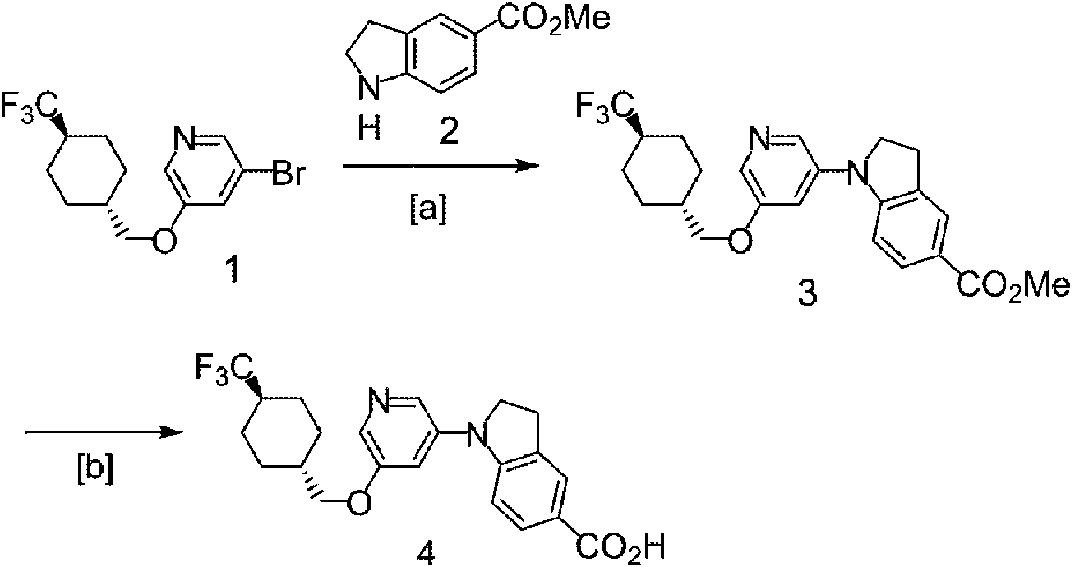
[Etapa a][Stage a]
A una disolución de compuesto 1 (100 mg, 296 gmol) obtenido en el Ejemplo de Referencia 42, Etapa b y compuesto 2 (78,6 mg, 444 gmol) en 1,4-dioxano (3,0 ml) se añadieron carbonato de cesio (289 mg, 887 gmol), acetato de paladio (Il) (3,3 mg, 15 gmol) y 2-diciclohexilfosfino-2',6'-diisopropoxibifenilo (14 mg, 30 gmol), y la mezcla se agitó en atmósfera de nitrógeno con calentamiento a reflujo durante 5 h. La mezcla de reacción se dejó enfriar a temperatura ambiente, se filtró a través de celite y el filtrado se concentró. El residuo se purificó mediante cromatografía de gel de sílice para proporcionar el compuesto 3 (109 mg, 84,9 %). MS(ESI) m/z:435 (M+1)+.To a solution of compound 1 (100 mg, 296 gmol) obtained in Reference Example 42, Step b and compound 2 (78.6 mg, 444 gmol) in 1,4-dioxane (3.0 ml) were added carbonate cesium (289 mg, 887 gmol), palladium (Il) acetate (3.3 mg, 15 gmol) and 2-dicyclohexylphosphino-2',6'-diisopropoxybiphenyl (14 mg, 30 gmol), and the mixture was stirred in nitrogen atmosphere with heating at reflux for 5 h. The reaction mixture was allowed to cool to room temperature, filtered through celite, and the filtrate was concentrated. The residue was purified by silica gel chromatography to provide compound 3 (109 mg, 84.9%). MS(ESI) m/z:435 (M+1)+.
[Etapa b][Stage b]
A una disolución mixta de compuesto 3 (109 mg, 251 gmol) en tetrahidrofurano (3 ml) y metanol (1,0 ml) se añadió una disolución acuosa 4 M de hidróxido de sodio (0,20 ml, 0,80 mmol), y la mezcla se agitó a temperatura ambiente durante 15 h y se agitó bajo calentamiento a 60 °C durante 4 h. La mezcla de reacción se dejó enfriar a temperatura ambiente, se neutralizó con ácido clorhídrico 1 M (0,8 ml), se añadió agua, y el sólido resultante se recogió mediante filtración y se lavó con disolución acuosa metanólica al 50 % para proporcionar el compuesto 4 (85,0 mg, 80,6 %). MS(ESI) m/z:421 (M+1)+.To a mixed solution of compound 3 (109 mg, 251 gmol) in tetrahydrofuran (3 ml) and methanol (1.0 ml) was added a 4 M aqueous solution of sodium hydroxide (0.20 ml, 0.80 mmol). , and the mixture was stirred at room temperature for 15 h and stirred under heating at 60 °C for 4 h. The reaction mixture was allowed to cool to room temperature, neutralized with 1 M hydrochloric acid (0.8 mL), water was added, and the resulting solid was collected by filtration and washed with 50% methanolic aqueous solution to give the compound 4 (85.0 mg, 80.6%). MS(ESI) m/z:421 (M+1)+.
Ejemplo 13Example 13
Ácido 3-[4-(5-{[trans-4-(trifluorometil)ciclohexil]metoxi}piridin-3-il)morfolin-2-il]benzoico3-[4-(5-{[trans-4-(trifluoromethyl)cyclohexyl]methoxy}pyridin-3-yl)morpholin-2-yl]benzoic acid

[Etapa a][Stage a]
Al compuesto 2 clorhidrato (133 mg, 591 gmol, Ejemplo de Referencia 15) se añadieron hidrogenocarbonato de sodio acuoso saturado y cloroformo y la mezcla se agitó. La fase orgánica se separó y se concentró a presión reducida. El residuo se disolvió en 1,4-dioxano (3,0 ml), se añadieron el compuesto 1 (100 mg, 296 gmol) obtenido en el Ejemplo de Referencia 42, Etapa b, carbonato de cesio (289 mg, 887 gmol), acetato de paladio (II) (3,3 mg, 15 gmol) y 2-diciclohexilfosfino-2',6'-diisopropoxibifenilo (14 mg, 30 gmol), y la mezcla se agitó en atmósfera de nitrógeno bajo calentamiento a 100 °C durante 3 h. La mezcla de reacción se dejó enfriar a temperatura ambiente, se filtró a través de celite, y el filtrado se concentró. El residuo se purificó mediante cromatografía de gel de sílice para proporcionar el compuesto 3 (100 mg, 75,9 %). MS(ESI) m/z:446 (M+1)+.To compound 2 hydrochloride (133 mg, 591 gmol, Reference Example 15), saturated aqueous sodium hydrogen carbonate and chloroform were added and the mixture was stirred. The organic phase was separated and concentrated under reduced pressure. The residue was dissolved in 1,4-dioxane (3.0 ml), compound 1 (100 mg, 296 gmol) obtained in Reference Example 42, Step b, cesium carbonate (289 mg, 887 gmol) was added. , palladium (II) acetate (3.3 mg, 15 gmol) and 2-dicyclohexylphosphino-2',6'-diisopropoxybiphenyl (14 mg, 30 gmol), and the mixture was stirred under low nitrogen atmosphere heating at 100 °C for 3 h. The reaction mixture was allowed to cool to room temperature, filtered through celite, and the filtrate was concentrated. The residue was purified by silica gel chromatography to provide compound 3 (100 mg, 75.9%). MS(ESI) m/z:446 (M+1)+.
[Etapa b][Stage b]
A una disolución de compuesto 3 (100 mg, 225 μmol) en etilenglicol (3,0 ml) se añadió hidróxido de potasio (85 % en peso, 74 mg, 1,1 mmol), y la mezcla se agitó bajo calentamiento a 150 °C durante 3,5 h. La disolución de reacción se dejó enfriar a temperatura ambiente, se neutralizó con ácido clorhídrico 1 M y se extrajo con cloroformo. La fase orgánica se lavó con disolución salina saturada, se secó sobre sulfato de sodio anhidro, se filtró y se concentró. El sólido resultante se lavó con acetato de etilo-hexano para proporcionar el compuesto 4 (80 mg, 76,7 %). MS(ESI) m/z:465 (M+1)+.To a solution of compound 3 (100 mg, 225 μmol) in ethylene glycol (3.0 ml) was added potassium hydroxide (85% by weight, 74 mg, 1.1 mmol), and the mixture was stirred under heating at 150 °C for 3.5 h. The reaction solution was allowed to cool to room temperature, neutralized with 1 M hydrochloric acid and extracted with chloroform. The organic phase was washed with saturated saline, dried over anhydrous sodium sulfate, filtered and concentrated. The resulting solid was washed with ethyl acetate-hexane to provide compound 4 (80 mg, 76.7%). MS(ESI) m/z:465 (M+1)+.
Ejemplo 14Example 14
Ácido 3-[(2S)-4-(5-{[4-(trifluorometoxi)bencil]oxi}piridin-3-il)morfolin-2-il]propanoico3-[(2S)-4-(5-{[4-(trifluoromethoxy)benzyl]oxy}pyridin-3-yl)morpholin-2-yl]propanoic acid

[Etapa a][Stage a]
A una disolución de compuesto 2 (1,39 g, 4,19 mmol) obtenido en el Ejemplo de Referencia 9, Etapa c y compuesto 1 (1,81 g, 5,45 mmol, Ejemplo de Referencia 49) en 1,4-dioxano (28 ml) se añadieron carbonato de cesio (3,42 g, 10,5 mmol), acetato de paladio (II) (141 mg, 629 pmol) y 2-diciclohexilfosfino-2',6'-diisopropoxibifenilo (587 mg, 1,26 mmol), y la mezcla se agitó en atmósfera de nitrógeno con calentamiento a reflujo durante 4 h. La mezcla de reacción se dejó enfriar a temperatura ambiente, se añadió agua, y la mezcla se extrajo con cloroformo. La fase orgánica se secó sobre sulfato de sodio anhidro, se filtró y se concentró. El residuo se purificó mediante cromatografía de gel de sílice para proporcionar el compuesto 3 (1,93 g, 76,4 %). MS(ESI) m/z:599 (M+1)+.To a solution of compound 2 (1.39 g, 4.19 mmol) obtained in Reference Example 9, Step c and compound 1 (1.81 g, 5.45 mmol, Reference Example 49) in 1,4- dioxane (28 ml), cesium carbonate (3.42 g, 10.5 mmol), palladium (II) acetate (141 mg, 629 pmol) and 2-dicyclohexylphosphino-2',6'-diisopropoxybiphenyl (587 mg) were added. , 1.26 mmol), and the mixture was stirred under nitrogen with heating to reflux for 4 h. The reaction mixture was allowed to cool to room temperature, water was added, and the mixture was extracted with chloroform. The organic phase was dried over anhydrous sodium sulfate, filtered and concentrated. The residue was purified by silica gel chromatography to provide compound 3 (1.93 g, 76.4%). MS(ESI) m/z:599 (M+1)+.
[Etapa b][Stage b]
A una disolución de compuesto 3 (1,93 g, 3,15 mmol) en etanol (39 ml) se añadió hidróxido de potasio (85 % en peso, 415 mg, 6,29 mmol), y la mezcla se agitó a temperatura ambiente durante 4 días. La disolución de reacción se neutralizó con ácido clorhídrico 1 M (6,29 ml), se añadió agua (100 ml) y la mezcla se extrajo con cloroformo (150 ml). La fase orgánica se secó sobre sulfato de sodio anhidro, se filtró y se concentró. El residuo se disolvió en tolueno (35 ml), se añadió diisopropiletilamina (545 μl, 3,15 mmol), y la mezcla se agitó con calentamiento a reflujo durante 2 h. La disolución de reacción se concentró a presión reducida, y el residuo se purificó mediante cromatografía de gel de sílice para proporcionar el compuesto 4 (1,34 g, 90,2 %). MS(ESI) m/z:455 (M+1)+.To a solution of compound 3 (1.93 g, 3.15 mmol) in ethanol (39 ml) was added potassium hydroxide (85% by weight, 415 mg, 6.29 mmol), and the mixture was stirred at temperature environment for 4 days. The reaction solution was neutralized with 1M hydrochloric acid (6.29 ml), water (100 ml) was added and the mixture was extracted with chloroform (150 ml). The organic phase was dried over anhydrous sodium sulfate, filtered and concentrated. The residue was dissolved in toluene (35 ml), diisopropylethylamine (545 μl, 3.15 mmol) was added, and the mixture was stirred with heating to reflux for 2 h. The reaction solution was concentrated under reduced pressure, and the residue was purified by silica gel chromatography to provide compound 4 (1.34 g, 90.2%). MS(ESI) m/z:455 (M+1)+.
[Etapa c][Stage c]
A una disolución mixta de compuesto 4 (1,34 g, 2,83 mmol) en tetrahidrofurano (8,0 ml) y metanol (2,7 ml) se añadió una disolución acuosa 4 M de hidróxido de sodio (2,83 ml, 11,3 mmol), y la mezcla se agitó a temperatura ambiente durante la noche. La disolución de reacción se neutralizó con una disolución acuosa al 10 % de ácido cítrico (25 ml), y el disolvente orgánico se evaporó a presión reducida. El residuo se dejó en reposo y el sólido resultante se recogió mediante filtración y se lavó con agua para proporcionar el compuesto 5 (1,13 g, 93,3 %). MS(ESI) m/z:427 (M+1)+ To a mixed solution of compound 4 (1.34 g, 2.83 mmol) in tetrahydrofuran (8.0 ml) and methanol (2.7 ml) was added a 4 M aqueous solution of sodium hydroxide (2.83 ml , 11.3 mmol), and the mixture was stirred at room temperature overnight. The reaction solution was neutralized with a 10% aqueous solution of citric acid (25 ml), and the organic solvent was evaporated under reduced pressure. The residue was allowed to stand and the resulting solid was collected by filtration and washed with water to provide compound 5 (1.13 g, 93.3%). MS(ESI) m/z:427 (M+1)+
Ejemplo 15Example 15
Ácido 3-[(2S)-4-(5-{[4-(trifluorometil)bencil]oxi}piridin-3-il)morfolin-2-il]propanoico 3-[(2S)-4-(5-{[4-(trifluoromethyl)benzyl]oxy}pyridin-3-yl)morpholin-2-yl]propanoic acid

[Etapa a][Stage a]
A una disolución de compuesto 1 (4,80 g, 11,6 mmol) obtenido en el Ejemplo de Referencia 9, Etapa c y compuesto 2 (4,09 g, 13,9 mmol) en 1,4-dioxano (120 ml) se añadieron carbonato de cesio (9,44 g, 29,0 mmol), acetato de paladio (II) (390 mg, 1,74 mmol) y 2-diciclohexilfosfino-2',6'-diisopropoxibifenilo (1,62 g, 3,48 mmol), y la mezcla se agitó en atmósfera de nitrógeno con calentamiento a reflujo durante 3 h. La mezcla de reacción se dejó enfriar a temperatura ambiente y se filtró a través de celite. El filtrado se lavó con agua y disolución salina saturada, se secó sobre sulfato de sodio anhidro, se filtró y se concentró. El residuo se purificó mediante cromatografía de gel de sílice para proporcionar el compuesto 3 (5,46 g, 86,5 %). MS(ESI) m/z:545 (M+1)+.To a solution of compound 1 (4.80 g, 11.6 mmol) obtained in Reference Example 9, Step c and compound 2 (4.09 g, 13.9 mmol) in 1,4-dioxane (120 ml) Cesium carbonate (9.44 g, 29.0 mmol), palladium (II) acetate (390 mg, 1.74 mmol) and 2-dicyclohexylphosphino-2',6'-diisopropoxybiphenyl (1.62 g, 3.48 mmol), and the mixture was stirred under nitrogen with heating to reflux for 3 h. The reaction mixture was allowed to cool to room temperature and filtered through celite. The filtrate was washed with water and saturated saline, dried over anhydrous sodium sulfate, filtered and concentrated. The residue was purified by silica gel chromatography to provide compound 3 (5.46 g, 86.5%). MS(ESI) m/z:545 (M+1)+.
[Etapa b][Stage b]
A una disolución de compuesto 3 (5,46 g, 10,0 mmol) en etanol (150 ml) se añadió hidróxido de potasio (85 % en peso, 1,32 g, 20,1 mmol), y la mezcla se agitó a temperatura ambiente durante 14 h. La disolución de reacción se concentró a presión reducida, y el residuo se disolvió en agua (500 ml), se neutralizó con ácido clorhídrico 1 M (20 ml) y se extrajo 6 veces con cloroformo (100 ml). La fase orgánica se secó sobre sulfato de sodio anhidro, se filtró y se concentró. El residuo se suspendió en tolueno (150 ml), se añadió diisopropiletilamina (1,62 ml, 9,36 mmol) y la mezcla se agitó con calentamiento a reflujo durante 1 h. La disolución de reacción se concentró a presión reducida, y el residuo se purificó mediante cromatografía de gel de sílice para proporcionar el compuesto 4 (2,88 g, 76,8 %). MS(ESI) m/z:401 (M+1)+.To a solution of compound 3 (5.46 g, 10.0 mmol) in ethanol (150 mL) was added potassium hydroxide (85% by weight, 1.32 g, 20.1 mmol), and the mixture was stirred. at room temperature for 14 h. The reaction solution was concentrated under reduced pressure, and the residue was dissolved in water (500 ml), neutralized with 1 M hydrochloric acid (20 ml) and extracted 6 times with chloroform (100 ml). The organic phase was dried over anhydrous sodium sulfate, filtered and concentrated. The residue was suspended in toluene (150 ml), diisopropylethylamine (1.62 ml, 9.36 mmol) was added and the mixture was stirred with heating to reflux for 1 h. The reaction solution was concentrated under reduced pressure, and the residue was purified by silica gel chromatography to provide compound 4 (2.88 g, 76.8%). MS(ESI) m/z:401 (M+1)+.
[Etapa c][Stage c]
A una disolución de compuesto 4 (2,88 g, 7,19 mmol) en diclorometano (150 ml) se añadió ácido trifluoroacético (10,0 ml), y la mezcla se agitó a temperatura ambiente durante la noche. La disolución de reacción se concentró a presión reducida, y el residuo se purificó mediante cromatografía de gel de sílice para proporcionar el compuesto 5 (1,33 g, 66,0 %). MS(ESI) m/z:281 (M+1)+.To a solution of compound 4 (2.88 g, 7.19 mmol) in dichloromethane (150 mL) was added trifluoroacetic acid (10.0 mL), and the mixture was stirred at room temperature overnight. The reaction solution was concentrated under reduced pressure, and the residue was purified by silica gel chromatography to provide compound 5 (1.33 g, 66.0%). MS(ESI) m/z:281 (M+1)+.
[Etapa d][Stage d]
A una disolución de compuesto 5 (80,0 mg, 285 μmol) y compuesto 6 (65,4 mg, 371 pmol) en tetrahidrofurano (2,4 ml) se añadieron tributilfosfina (75,1 mg, 371 pmol) y 1,1 '-(azodicarbonil)dipiperidina (93,6 mg, 371 pmol), y la mezcla se agitó a temperatura ambiente durante la noche. La suspensión de reacción se diluyó con tetrahidrofurano (6,0 ml) y hexano (12 ml), y el material insoluble se filtró y el filtrado se concentró. El residuo se purificó mediante cromatografía de gel de sílice y se sometió a purificación por extracción de fase sólida usando una columna de resina de intercambio catiónico (Waters, PoraPak™, RxnCX) para proporcionar el compuesto 7 (66,9 mg, 53,5 %). MS(ESI) m/z:439 (M+1)+.To a solution of compound 5 (80.0 mg, 285 μmol) and compound 6 (65.4 mg, 371 pmol) in tetrahydrofuran (2.4 ml) were added tributylphosphine (75.1 mg, 371 pmol) and 1, 1'-(azodicarbonyl)dipiperidine (93.6 mg, 371 pmol), and the mixture was stirred at room temperature overnight. The reaction suspension was diluted with tetrahydrofuran (6.0 ml) and hexane (12 ml), and the insoluble material was filtered and the filtrate was concentrated. The residue was purified by silica gel chromatography and subjected to solid phase extraction purification using a cation exchange resin column (Waters, PoraPak™, RxnCX) to provide compound 7 (66.9 mg, 53.5 %). MS(ESI) m/z:439 (M+1)+.
[Etapa e][Stage e]
A una disolución mixta de compuesto 7 (60,0 mg, 137 pmol) en tetrahidrofurano (1,8 ml) y metanol (1,8 ml) se añadió disolución acuosa 4 M de hidróxido de sodio (0,17 ml, 0,68 mmol,) y la mezcla se agitó a temperatura ambiente durante la noche. La disolución de reacción se neutralizó con ácido clorhídrico 1 M (0,78 ml) y se diluyó con agua (12 ml). El sólido resultante se recogió mediante filtración y se lavó con agua para proporcionar el compuesto 8 (46,3 mg, 82,4 %). MS(ESI) m/z:411 (M+1)+. To a mixed solution of compound 7 (60.0 mg, 137 pmol) in tetrahydrofuran (1.8 ml) and methanol (1.8 ml) was added 4 M aqueous sodium hydroxide solution (0.17 ml, 0. 68 mmol,) and the mixture was stirred at room temperature overnight. The reaction solution was neutralized with 1 M hydrochloric acid (0.78 ml) and diluted with water (12 ml). The resulting solid was collected by filtration and washed with water to provide compound 8 (46.3 mg, 82.4%). MS(ESI) m/z:411 (M+1)+.
Ejemplo 16Example 16
Ácido 3-[(2S)-4-(5-{[trans-4-(trifluorometil)ciclohexil]metoxi}piridin-3-il)morfolin-2- iljpropanoico3-[(2S)-4-(5-{[trans-4-(trifluoromethyl)cyclohexyl]methoxy}pyridin-3-yl)morpholin-2-yljpropanoic acid

[Etapa a][Stage a]
A una disolución de compuesto 1 (60,0 mg, 214 gmol) obtenido en el Ejemplo 15, Etapa c y compuesto 2 (72,0 mg, 214 gmol) obtenido en el Ejemplo de Referencia 48, Etapa a, en N,N-dimetilformamida (1,8 ml) se añadió carbonato de potasio (59,2 mg, 428 gmol), y la mezcla se agitó bajo calentamiento a 80 °C durante 5 h. La mezcla de reacción se dejó enfriar a temperatura ambiente, se diluyó con acetato de etilo, se lavó con agua y disolución salina saturada, se secó sobre sulfato de sodio anhidro, se filtró y se concentró. El residuo se purificó mediante cromatografía de gel de sílice para proporcionar el compuesto 3 (63,0 g, 66,2 %). MS(ESI) m/z:445 (M+1)+.To a solution of compound 1 (60.0 mg, 214 gmol) obtained in Example 15, Step c and compound 2 (72.0 mg, 214 gmol) obtained in Reference Example 48, Step a, in N,N- dimethylformamide (1.8 ml), potassium carbonate (59.2 mg, 428 gmol) was added, and the mixture was stirred under heating at 80 °C for 5 h. The reaction mixture was allowed to cool to room temperature, diluted with ethyl acetate, washed with water and saturated saline, dried over anhydrous sodium sulfate, filtered and concentrated. The residue was purified by silica gel chromatography to provide compound 3 (63.0 g, 66.2%). MS(ESI) m/z:445 (M+1)+.
[Etapa b][Stage b]
A una disolución mixta de compuesto 3 (60,0 mg, 135 gmol) en tetrahidrofurano (1,5 ml) y metanol (1,5 ml) se añadió disolución acuosa 4 M de hidróxido de sodio (0,17 ml, 0,68 mmol), y la mezcla se agitó a temperatura ambiente durante 2 días. La disolución de reacción se neutralizó con ácido clorhídrico 1 M (0,68 ml) y se diluyó con agua (20 ml). El sólido resultante se recogió mediante filtración y se lavó con agua para proporcionar el compuesto 4 (44,2 mg, 78,6 %). MS(ESI) m/z:417 (M+1)+.To a mixed solution of compound 3 (60.0 mg, 135 gmol) in tetrahydrofuran (1.5 ml) and methanol (1.5 ml) was added 4 M aqueous solution of sodium hydroxide (0.17 ml, 0. 68 mmol), and the mixture was stirred at room temperature for 2 days. The reaction solution was neutralized with 1 M hydrochloric acid (0.68 ml) and diluted with water (20 ml). The resulting solid was collected by filtration and washed with water to provide compound 4 (44.2 mg, 78.6%). MS(ESI) m/z:417 (M+1)+.
Ejemplo 17Example 17
Ácido 2-metil-3-[(2S)-4-(5-{[4-(trifluorometoxi)bencil]oxi}piridin-3-il)morfolin-2-il]propanoico2-Methyl-3-[(2S)-4-(5-{[4-(trifluoromethoxy)benzyl]oxy}pyridin-3-yl)morpholin-2-yl]propanoic acid
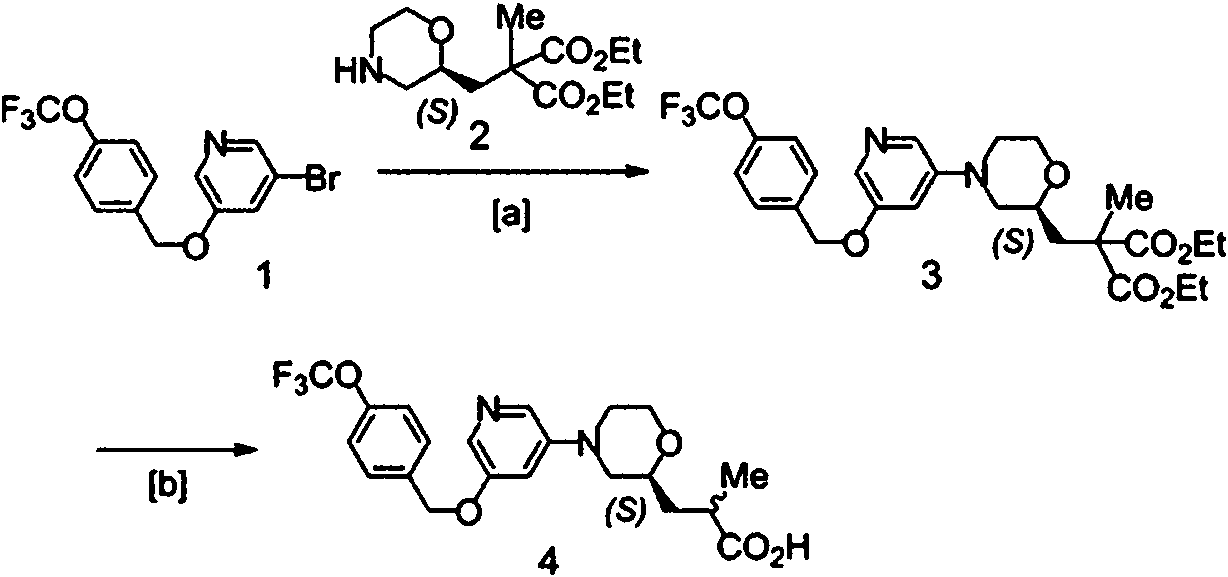
[Etapa a][Stage a]
A una disolución de compuesto 1 (270 mg, 775 gmol, Ejemplo de Referencia 49) y compuesto 2 (230 mg, 547 gmol, Ejemplo de Referencia 33) en 1,4-dioxano (5,0 ml) se añadieron carbonato de cesio (530 mg, 1,63 mmol), acetato de paladio (II) (12 mg, 55 gmol) y 2-diciclohexilfosfino-2',6'-diisopropoxibifenilo (51,0 mg, 109 gmol), y la mezcla se agitó en atmósfera de nitrógeno bajo calentamiento a 105 °C durante 7 h. La mezcla de reacción se dejó enfriar a temperatura ambiente, se añadió agua, y la mezcla se extrajo con acetato de etilo. La fase orgánica se lavó con disolución salina saturada, se secó sobre sulfato de sodio anhidro, se filtró y se concentró. El residuo se purificó mediante cromatografía de gel de sílice para proporcionar el compuesto 3 (300 mg, 87,2 %). MS(ESI) m/z:541 (M+1)+.To a solution of compound 1 (270 mg, 775 gmol, Reference Example 49) and compound 2 (230 mg, 547 gmol, Reference Example 33) in 1,4-dioxane (5.0 ml) were added cesium carbonate (530 mg, 1.63 mmol), palladium(II) acetate (12 mg, 55 gmol) and 2-dicyclohexylphosphino-2',6'-diisopropoxybiphenyl (51.0 mg, 109 gmol), and the mixture was stirred in a nitrogen atmosphere under heating at 105 °C for 7 h. The reaction mixture was allowed to cool to room temperature, water was added, and the mixture was extracted with ethyl acetate. The organic phase was washed with saturated saline, dried over anhydrous sodium sulfate, filtered and concentrated. The residue was purified by silica gel chromatography to provide compound 3 (300 mg, 87.2%). MS(ESI) m/z:541 (M+1)+.
[Etapa b] [Stage b]
A una disolución de compuesto 3 (100 mg, 160 gmol) en etanol (1,0 ml) se añadió una disolución acuosa 4 M de hidróxido de sodio (0,50 ml, 2,0 mmol), y la mezcla se agitó bajo calentamiento a 85 °C durante 2,5 h. La disolución de reacción se dejó enfriar a temperatura ambiente, se neutralizó con ácido acético (114 gl, 2,0 mmol) y se concentró a presión reducida. El residuo se disolvió en ácido acético (3,0 ml) y la mezcla se agitó bajo calentamiento a 125 °C durante 5,5 h. La disolución de reacción se dejó enfriar a temperatura ambiente y se sometió a purificación por extracción de fase sólida usando una columna de resina de intercambio catiónico (Waters, PoraPak™, RxnCX) para proporcionar el compuesto 4 (65,0 g, 92,5 %). MS(ESI) m/z:441 (M+1)+.To a solution of compound 3 (100 mg, 160 gmol) in ethanol (1.0 ml) was added a 4 M aqueous solution of sodium hydroxide (0.50 ml, 2.0 mmol), and the mixture was stirred under heating at 85 °C for 2.5 h. The reaction solution was allowed to cool to room temperature, neutralized with acetic acid (114 gl, 2.0 mmol) and concentrated under reduced pressure. The residue was dissolved in acetic acid (3.0 ml) and the mixture was stirred under heating at 125 °C for 5.5 h. The reaction solution was allowed to cool to room temperature and subjected to purification by solid phase extraction using a cation exchange resin column (Waters, PoraPak™, RxnCX) to provide compound 4 (65.0 g, 92.5 %). MS(ESI) m/z:441 (M+1)+.
Ejemplo 18Example 18
Ácido 3-[(2S)-4-(5-{2-[4-(trifluorometoxi)fenil]etil}piridin-3-il)morfolin-2-il]propanoico3-[(2S)-4-(5-{2-[4-(trifluoromethoxy)phenyl]ethyl}pyridin-3-yl)morpholin-2-yl]propanoic acid
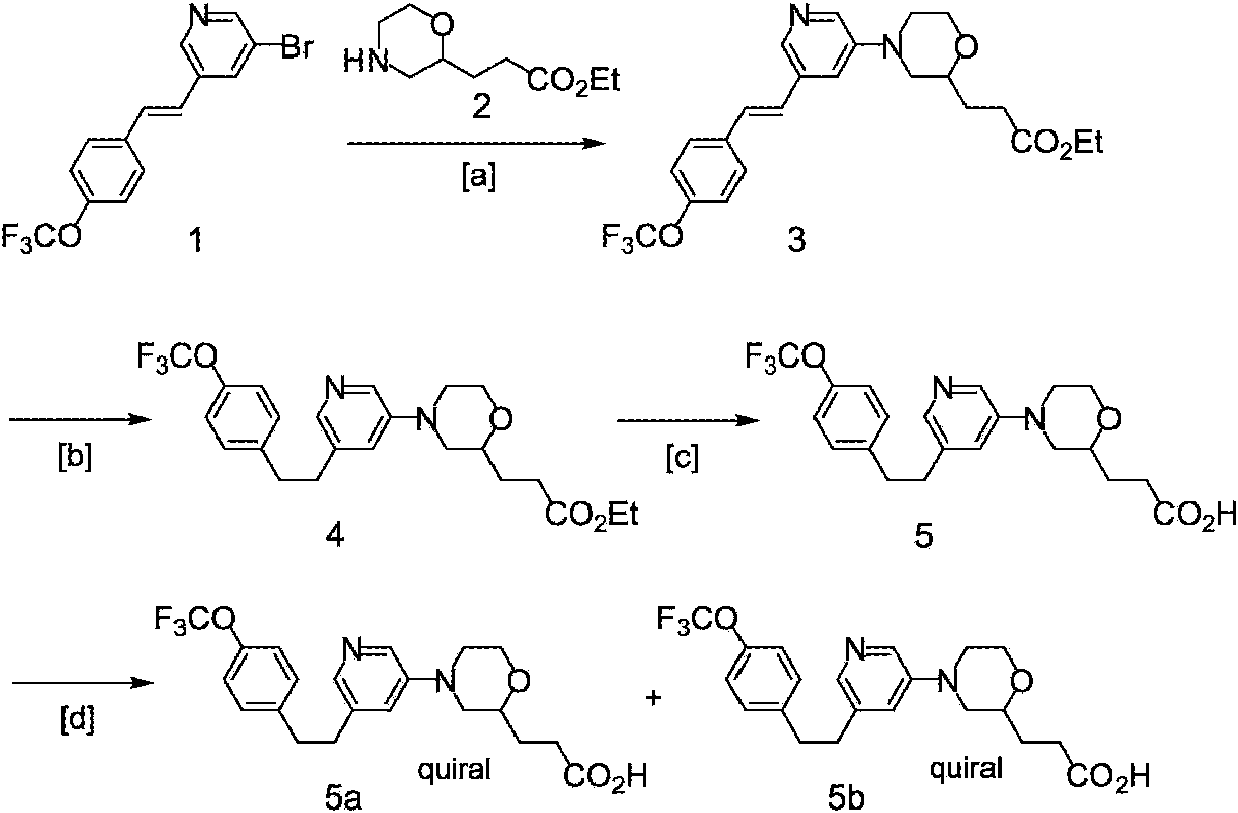
[Etapa a][Stage a]
A una disolución de compuesto 1 (190 mg, 552 gmol) obtenido en el Ejemplo de Referencia 45, Etapa b y compuesto 2 (50,0 mg, 267 gmol, Ejemplo de Referencia 39) en 1,4-dioxano (5,0 ml) se añadieron carbonato de cesio (220 mg, 675 gmol), acetato de paladio (II) (7,0 mg, 31 gmol) y 2-(diciclohexilfosfino)-3,6-dimetoxi-2',4',6'-triisopropil-1, 1 ’-bifenilo (25 mg, 54 gmol), y la mezcla se agitó en radiación con microondas con calentamiento a 160 °C durante 30 min. La mezcla de reacción se dejó enfriar a temperatura ambiente, se añadió agua y la mezcla se extrajo con acetato de etilo. La fase orgánica se lavó con disolución salina saturada, se secó sobre sulfato de sodio anhidro, se filtró y se concentró. El residuo se purificó mediante cromatografía de gel de sílice para proporcionar el compuesto 3 (155 mg). MS(ESI) m/z:451 (M+1)+.To a solution of compound 1 (190 mg, 552 gmol) obtained in Reference Example 45, Step b and compound 2 (50.0 mg, 267 gmol, Reference Example 39) in 1,4-dioxane (5.0 ml ) cesium carbonate (220 mg, 675 gmol), palladium (II) acetate (7.0 mg, 31 gmol) and 2-(dicyclohexylphosphino)-3,6-dimethoxy-2',4',6' were added -triisopropyl-1, 1 '-biphenyl (25 mg, 54 gmol), and the mixture was stirred under microwave irradiation with heating at 160 °C for 30 min. The reaction mixture was allowed to cool to room temperature, water was added and the mixture was extracted with ethyl acetate. The organic phase was washed with saturated saline, dried over anhydrous sodium sulfate, filtered and concentrated. The residue was purified by silica gel chromatography to provide compound 3 (155 mg). MS(ESI) m/z:451 (M+1)+.
[Etapa b][Stage b]
A una disolución de compuesto 3 (150 mg, 267 gmol) en etanol (6,0 ml) se añadió 10%-paladio/carbono (100 mg), y la mezcla se agitó en una atmósfera de hidrógeno a temperatura ambiente durante la noche. La mezcla de reacción se diluyó con cloroformo, se filtró a través de celite, y se lavó con cloroformo. El filtrado se concentró a presión reducida para proporcionar el compuesto 4 (135 mg). MS(eS i) m/z:453 (M+1)+.To a solution of compound 3 (150 mg, 267 gmol) in ethanol (6.0 mL) was added 10%-palladium/carbon (100 mg), and the mixture was stirred under a hydrogen atmosphere at room temperature overnight. . The reaction mixture was diluted with chloroform, filtered through celite, and washed with chloroform. The filtrate was concentrated under reduced pressure to give compound 4 (135 mg). MS(eS i) m/z:453 (M+1)+.
[Etapa c][Stage c]
A una disolución mixta de compuesto 4 (135 mg, 267 gmol) en tetrahidrofurano (3,0 ml) y metanol (1,5 ml) se le añadió una disolución acuosa 2 M de hidróxido de sodio (1,5 ml, 3,0 mmol), y la mezcla se agitó a temperatura ambiente durante 3 h. La disolución de reacción se neutralizó con ácido clorhídrico 0,5 M (6,5 ml) y se extrajo con cloroformo. La fase orgánica se lavó con disolución salina saturada, se secó sobre sulfato de sodio anhidro, se filtró y se concentró. El residuo se sometió a purificación por extracción de fase sólida usando una columna de resina de intercambio catiónico (Waters, PoraPak™, RxnCX) para proporcionar el compuesto 5 (70 mg, 61 %). MS(ESI) m/z:425 (M+1)+.To a mixed solution of compound 4 (135 mg, 267 gmol) in tetrahydrofuran (3.0 ml) and methanol (1.5 ml) was added a 2 M aqueous solution of sodium hydroxide (1.5 ml, 3.0 ml). 0 mmol), and the mixture was stirred at room temperature for 3 h. The reaction solution was neutralized with 0.5 M hydrochloric acid (6.5 ml) and extracted with chloroform. The organic phase was washed with saturated saline, dried over anhydrous sodium sulfate, filtered and concentrated. The residue was subjected to purification by solid phase extraction using a cation exchange resin column (Waters, PoraPak™, RxnCX) to provide compound 5 (70 mg, 61%). MS(ESI) m/z:425 (M+1)+.
[Etapa d][Stage d]
La resolución quiral del compuesto 5 (170 mg) mediante HPLC quiral (CHIRAL PAK IA, 30x250, hexano:metanol:tetrahidrofurano:ácido acético = 70:15:15:0,5, 20 ml/min) proporcionó el compuesto 5§ (28 mg, 99,8 %ee, pico en el tiempo de retención de 17 min) y el compuesto 5b (27 mg, 99,9 %ee, pico en el tiempo de retención de 13 min). El compuesto 5a se usó como Ejemplo 18-1 y el compuesto 5b se usó como Ejemplo 18-2.Chiral resolution of compound 5 (170 mg) by chiral HPLC (CHIRAL PAK IA, 30x250, hexane:methanol:tetrahydrofuran:acetic acid = 70:15:15:0.5, 20 ml/min) gave compound 5§ ( 28 mg, 99.8%ee, peak at retention time 17 min) and compound 5b (27 mg, 99.9%ee, peak at retention time 13 min). Compound 5a was used as Example 18-1 and compound 5b was used as Example 18-2.
Ejemplo 18-1: MS(ESI) m/z:425 (M+1)+. Example 18-1: MS(ESI) m/z:425 (M+1)+.
Ejemplo 18-2: MS(ESI) m/z:425 (M+1)+.Example 18-2: MS(ESI) m/z:425 (M+1)+.
Ejemplo 19Example 19
Ácido (1S,2S)-2-[(2S)-4-(5-{[trans-4-(trifluorometil)ddohexil]metoxi}piridm-3-il)morfolin-2-il]ddopropancarboxílico Ácido (1 R,2R)-2-[(2S)-4-(5-{[trans-4-(trifluorometil)ddohexil]metoxi}piridm-3il)morfolm-2-il]ddopropancarboxílico ácido (1 R,2R)-2-[(2R)-4-(5-{[trans-4-(trifluorometil)ciclohexil]metoxi}piridin-3-il)morfolin-2-il]ciclopropancarboxílico ácido (1S,2S)-2-[(2R)-4-(5-{[trans-4-(trifluorometil)ciclohexil]metoxi}piridin-3-il)morfolin-2-il]ciclopropancarboxílico(1S,2S)-2-[(2S)-4-(5-{[trans-4-(trifluoromethyl)ddohexyl]methoxy}pyridm-3-yl)morpholin-2-yl]ddopropanecarboxylic acid (1 R, 2R)-2-[(2S)-4-(5-{[trans-4-(trifluoromethyl)ddohexyl]methoxy}pyridm-3yl)morpholm-2-yl]ddopropanecarboxylic acid (1 R,2R)-2-[ (2R)-4-(5-{[trans-4-(trifluoromethyl)cyclohexyl]methoxy}pyridin-3-yl)morpholin-2-yl]cyclopropanecarboxylic acid (1S,2S)-2-[(2R)-4 -(5-{[trans-4-(trifluoromethyl)cyclohexyl]methoxy}pyridin-3-yl)morpholin-2-yl]cyclopropanecarboxylic

[Etapa a][Stage a]
A una disolución de compuesto 1 (463 mg, 1,37 mmol) obtenido en el Ejemplo de Referencia 42, Etapa b y compuesto 2a (140 mg, 702 gmol, diastereómero de 2b) obtenido en el Ejemplo de Referencia 10, Etapa f, en 1,4-dioxano (3,5 ml) se añadieron carbonato de cesio (558 mg, 1,71 mmol), acetato de paladio (II) (15 mg, 68 gmol) y 2-diciclohexilfosfino-2',6'-diisopropoxibifenilo (63,9 mg, 137 gmol), y la mezcla se agitó en atmósfera de nitrógeno bajo calentamiento a 110 °C durante 5 h. La mezcla de reacción se dejó enfriar a temperatura ambiente, se añadió agua y la mezcla se extrajo con acetato de etilo. La fase orgánica se lavó con disolución salina saturada, se secó sobre sulfato de sodio anhidro, se filtró y concentró. El residuo se purificó mediante cromatografía de gel de sílice para proporcionar el compuesto 3 (220 mg, 65,5 %). MS(ESI) m/z:457 (M+1)+.To a solution of compound 1 (463 mg, 1.37 mmol) obtained in Reference Example 42, Step b and compound 2a (140 mg, 702 gmol, diastereomer of 2b) obtained in Reference Example 10, Step f, in 1,4-dioxane (3.5 ml), cesium carbonate (558 mg, 1.71 mmol), palladium (II) acetate (15 mg, 68 gmol) and 2-dicyclohexylphosphino-2',6'- were added. diisopropoxybiphenyl (63.9 mg, 137 gmol), and the mixture was stirred under nitrogen atmosphere under heating at 110 °C for 5 h. The reaction mixture was allowed to cool to room temperature, water was added and the mixture was extracted with ethyl acetate. The organic phase was washed with saturated saline, dried over anhydrous sodium sulfate, filtered and concentrated. The residue was purified by silica gel chromatography to provide compound 3 (220 mg, 65.5%). MS(ESI) m/z:457 (M+1)+.
[Etapa b][Stage b]
La resolución quiral del compuesto 3 (220 mg) mediante HPLC quiral (CHIRAL PAK IA, 30x250, éter metil tercbutílico:etanol:dietilamina = 85:15:0,1, 20 ml/min) proporcionó el compuesto 3a (95 mg, 99,9 %ee, pico en el tiempo de retención de 12 min) y el compuesto 3b (65 mg, 99,3 %ee, pico en el tiempo de retención de 16 min).Chiral resolution of compound 3 (220 mg) by chiral HPLC (CHIRAL PAK IA, 30x250, methyl tert-butyl ether:ethanol:diethylamine = 85:15:0.1, 20 ml/min) gave compound 3a (95 mg, 99 .9%ee, peak at retention time 12 min) and compound 3b (65 mg, 99.3%ee, peak at retention time 16 min).
[Etapa c][Stage c]
A una disolución mixta de compuesto 3a (95 mg, 0,21 mmol) en tetrahidrofurano (2,0 ml) y metanol (1,0 ml) se añadió una disolución acuosa 2 M de hidróxido de sodio (1,0 ml, 2,0 mmol), y la mezcla se agitó a temperatura ambiente durante la noche. La disolución de reacción se neutralizó con ácido clorhídrico 1 M (2,1 ml), se añadió disolución salina saturada (10 ml), y la mezcla se extrajo con cloroformo. La fase orgánica se lavó con disolución salina saturada, se secó sobre sulfato de sodio anhidro, se filtró y concentró para proporcionar el compuesto 4a (90 mg, 94 %). Este enantiómero se usó como Ejemplo 19-1. MS(ESI) m/z:429 (M+1)+.To a mixed solution of compound 3a (95 mg, 0.21 mmol) in tetrahydrofuran (2.0 ml) and methanol (1.0 ml) was added a 2 M aqueous solution of sodium hydroxide (1.0 ml, 2 .0 mmol), and the mixture was stirred at room temperature overnight. The reaction solution was neutralized with 1M hydrochloric acid (2.1 ml), saturated saline (10 ml) was added, and the mixture was extracted with chloroform. The organic phase was washed with saturated saline, dried over anhydrous sodium sulfate, filtered and concentrated to give compound 4a (90 mg, 94%). This enantiomer was used as Example 19-1. MS(ESI) m/z:429 (M+1)+.
[Etapa d][Stage d]
A una disolución mixta de compuesto 3b (65 mg, 0,14 mmol) en tetrahidrofurano (2,0 ml) y metanol (1,0 ml) se añadió una disolución acuosa 2 M de hidróxido de sodio (1,0 ml, 2,0 mmol), y la mezcla se agitó a temperatura ambiente durante la noche. La disolución de reacción se neutralizó con ácido clorhídrico 1 M (2,1 ml), se añadió disolución salina saturada (10 ml), y la mezcla se extrajo con cloroformo. La fase orgánica se lavó con disolución salina saturada, se secó sobre sulfato de sodio anhidro, se filtró y concentró para proporcionar el compuesto 4b (55 mg, 90 %). Este enantiómero se usó como Ejemplo 19-2. MS(ESI) m/z:429 (M+1)+.To a mixed solution of compound 3b (65 mg, 0.14 mmol) in tetrahydrofuran (2.0 ml) and methanol (1.0 ml) was added a 2 M aqueous solution of sodium hydroxide (1.0 ml, 2 .0 mmol), and the mixture was stirred at room temperature overnight. The reaction solution was neutralized with 1M hydrochloric acid (2.1 ml), saturated saline (10 ml) was added, and the mixture was extracted with chloroform. The organic phase was washed with saturated saline, dried over anhydrous sodium sulfate, filtered and concentrated to give compound 4b (55 mg, 90%). This enantiomer was used as Example 19-2. MS(ESI) m/z:429 (M+1)+.
[Etapa e][Stage e]
A una disolución de compuesto 1 (543 mg, 1,61 mmol) obtenido en el Ejemplo de Referencia 42, Etapa b y compuesto 2b (160 mg, 803 gmol, diastereómero de 2a) obtenido en el Ejemplo de Referencia 10, Etapa g, en 1,4-dioxano (3,5 ml) se añadieron carbonato de cesio (654 mg, 2,01 mmol), acetato de paladio (II) (18 mg, 80 gmol) y 2-diciclohexilfosfino-2',6'-diisopropoxibifenilo (74,9 mg, 161 μmol), y la mezcla se agitó en atmósfera de nitrógeno bajo calentamiento a 110 °C durante 5 h. La mezcla de reacción se dejó enfriar a temperatura ambiente, se añadió agua y la mezcla se extrajo con acetato de etilo. La fase orgánica se lavó con disolución salina saturada, se secó sobre sulfato de sodio anhidro, se filtró y concentró. El residuo se purificó mediante cromatografía de gel de sílice para proporcionar el compuesto 5 (26 mg, 64,5 %). MS(ESI) m/z:457 (M+1)+.To a solution of compound 1 (543 mg, 1.61 mmol) obtained in Reference Example 42, Step b and compound 2b (160 mg, 803 gmol, diastereomer of 2a) obtained in Reference Example 10, Step g, in 1,4-dioxane (3.5 ml), cesium carbonate (654 mg, 2.01 mmol), palladium (II) acetate (18 mg, 80 gmol) and 2-dicyclohexylphosphino-2',6'- were added. diisopropoxybiphenyl (74.9 mg, 161 μmol), and the mixture was stirred under nitrogen atmosphere under heating at 110 °C for 5 h. The reaction mixture was allowed to cool to room temperature, water was added and the mixture was extracted with ethyl acetate. The organic phase was washed with saturated saline, dried over anhydrous sodium sulfate, filtered and concentrated. The residue was purified by silica gel chromatography to provide compound 5 (26 mg, 64.5%). MS(ESI) m/z:457 (M+1)+.
[Etapa f][Stage f]
La resolución quiral del compuesto 5 (260 mg) mediante HPLC quiral (CHIRAL PAK IC, 30x250, metanol:dietilamina = 100:0,1, 20 ml/min) proporcionó el compuesto 5a (186 mg, 99,8 %ee, pico en el tiempo de retención de 14 min) y el compuesto 5b (140 mg, 97,7 %ee, pico en el tiempo de retención de 19 min).Chiral resolution of compound 5 (260 mg) by chiral HPLC (CHIRAL PAK IC, 30x250, methanol:diethylamine = 100:0.1, 20 ml/min) gave compound 5a (186 mg, 99.8%ee, peak at retention time of 14 min) and compound 5b (140 mg, 97.7%ee, peak at retention time of 19 min).
[Etapa g][Stage g]
A una disolución mixta de compuesto 5a (186 mg) en tetrahidrofurano (2,4 ml) y metanol (1,2 ml) se añadió una disolución acuosa 2 M de hidróxido de sodio (1,2 ml, 2,4 mmol), y la mezcla se agitó a temperatura ambiente durante la noche. La disolución de reacción se neutralizó con ácido clorhídrico 1 M (2,5 ml), se añadió disolución salina saturada (10 ml), y la mezcla se extrajo con cloroformo. La fase orgánica se lavó con disolución salina saturada, se secó sobre sulfato de sodio anhidro, se filtró y concentró para proporcionar el compuesto 6a (125 mg). Este enantiómero se usó como Ejemplo 19-3. MS(ESI) m/z:429 (M+1)+.To a mixed solution of compound 5a (186 mg) in tetrahydrofuran (2.4 ml) and methanol (1.2 ml) was added a 2 M aqueous solution of sodium hydroxide (1.2 ml, 2.4 mmol), and the mixture was stirred at room temperature overnight. The reaction solution was neutralized with 1M hydrochloric acid (2.5 ml), saturated saline (10 ml) was added, and the mixture was extracted with chloroform. The organic phase was washed with saturated saline, dried over anhydrous sodium sulfate, filtered and concentrated to give compound 6a (125 mg). This enantiomer was used as Example 19-3. MS(ESI) m/z:429 (M+1)+.
[Etapa h][Stage h]
A una disolución mixta de compuesto 5b (140 mg) en tetrahidrofurano (2,4 ml) y metanol (1,2 ml) se añadió una disolución acuosa 2 M de hidróxido de sodio (1,2 ml, 2,4 mmol), y la mezcla se agitó a temperatura ambiente durante la noche. La disolución de reacción se neutralizó con ácido clorhídrico 1 M (2,5 ml), se añadió disolución salina saturada (10 ml), y la mezcla se extrajo con cloroformo. La fase orgánica se lavó con disolución salina saturada, se secó sobre sulfato de sodio anhidro, se filtró y concentró para proporcionar el compuesto 6b (83 mg). Este enantiómero se usó como Ejemplo 19-4. MS(ESI) m/z:429 (M+1)+. To a mixed solution of compound 5b (140 mg) in tetrahydrofuran (2.4 ml) and methanol (1.2 ml) was added a 2 M aqueous solution of sodium hydroxide (1.2 ml, 2.4 mmol), and the mixture was stirred at room temperature overnight. The reaction solution was neutralized with 1M hydrochloric acid (2.5 ml), saturated saline (10 ml) was added, and the mixture was extracted with chloroform. The organic phase was washed with saturated saline, dried over anhydrous sodium sulfate, filtered and concentrated to give compound 6b (83 mg). This enantiomer was used as Example 19-4. MS(ESI) m/z:429 (M+1)+.
Ejemplo 20Example 20
Ácido trans-1 -metil-2-[(2S)-4-(5-{[trans-4-(trifluorometil)ciclohexil]metoxi}piridin-3-il)morfolin-2-il]ciclopropancarboxílicotrans-1-methyl-2-[(2S)-4-(5-{[trans-4-(trifluoromethyl)cyclohexyl]methoxy}pyridin-3-yl)morpholin-2-yl]cyclopropanecarboxylic acid

[Etapa a][Stage a]
A una disolución de compuesto 1 (289 mg, 855 pmol) obtenido en el Ejemplo de Referencia 42, Etapa b y compuesto 2 (91,2 mg, 428 mol) obtenido en el Ejemplo de Referencia 11, Etapa g, en 1,4-dioxano (4,0 ml) se añadieron carbonato de cesio (348 mg, 1,07 mmol), acetato de paladio (II) (14 mg, 64 pmol) y 2-diciclohexilfosfino-2',6'-diisopropoxibifenilo (59,9 mg, 128 pmol), y la mezcla se agitó en una atmósfera de nitrógeno bajo calentamiento a 110 °C durante 8 h. La mezcla de reacción se dejó enfriar a temperatura ambiente, se añadió agua, y la mezcla se extrajo con acetato de etilo. La fase orgánica se lavó con disolución salina saturada, se secó sobre sulfato de sodio anhidro, se filtró y concentró. El residuo se purificó mediante cromatografía de gel de sílice NH y cromatografía de gel de sílice para proporcionar el compuesto 3 (130 mg, 60,7 %). MS(ESI) m/z:471 (M+1)+.To a solution of compound 1 (289 mg, 855 pmol) obtained in Reference Example 42, Step b and compound 2 (91.2 mg, 428 mol) obtained in Reference Example 11, Step g, in 1.4- dioxane (4.0 ml), cesium carbonate (348 mg, 1.07 mmol), palladium (II) acetate (14 mg, 64 pmol) and 2-dicyclohexylphosphino-2',6'-diisopropoxybiphenyl (59, 9 mg, 128 pmol), and the mixture was stirred in a nitrogen atmosphere under heating at 110 °C for 8 h. The reaction mixture was allowed to cool to room temperature, water was added, and the mixture was extracted with ethyl acetate. The organic phase was washed with saturated saline, dried over anhydrous sodium sulfate, filtered and concentrated. The residue was purified by NH-silica gel chromatography and silica gel chromatography to provide compound 3 (130 mg, 60.7%). MS(ESI) m/z:471 (M+1)+.
[Etapa b][Stage b]
A una disolución mixta de compuesto 3 (130 mg, 260 pmol) en tetrahidrofurano (1,3 ml) y metanol (1,3 ml) se añadió una disolución acuosa 4 M de hidróxido de sodio (1,3 ml), y la mezcla se agitó a temperatura ambiente durante 5 h. La disolución de reacción se diluyó con agua (7,0 ml) y se lavó con éter diisopropílico. La fase acuosa se neutralizó con ácido clorhídrico 4 M (1,35 ml), se añadió una disolución acuosa saturada de cloruro de amonio (5 ml), y la mezcla se extrajo con cloroformo. La fase orgánica se lavó con disolución salina saturada, se secó sobre sulfato de magnesio anhidro, se filtró y concentró para proporcionar el compuesto 4 (103 mg, 85,1 %). MS(ESI) m/z:443 (M+1)+.To a mixed solution of compound 3 (130 mg, 260 pmol) in tetrahydrofuran (1.3 ml) and methanol (1.3 ml) was added a 4 M aqueous solution of sodium hydroxide (1.3 ml), and the mixture was stirred at room temperature for 5 h. The reaction solution was diluted with water (7.0 ml) and washed with diisopropyl ether. The aqueous phase was neutralized with 4M hydrochloric acid (1.35 ml), a saturated aqueous ammonium chloride solution (5 ml) was added, and the mixture was extracted with chloroform. The organic phase was washed with saturated saline, dried over anhydrous magnesium sulfate, filtered and concentrated to give compound 4 (103 mg, 85.1%). MS(ESI) m/z:443 (M+1)+.
Ejemplo 21Example 21
Ácido {[(3S)-4-(5-{[4-(trifluorometoxi)bencil]oxi}piridin-3-il)morfolin-3-il]metoxi}acético{[(3S)-4-(5-{[4-(trifluoromethoxy)benzyl]oxy}pyridin-3-yl)morpholin-3-yl]methoxy}acetic acid

[Etapa a][Stage a]
A una disolución de compuesto 1 (368 mg, 1,06 mmol, Ejemplo de Referencia 49) y compuesto 2 (145 mg, 756 pmol, Ejemplo de Referencia 38) en 1,4-dioxano (4,0 ml) se añadieron terc-butóxido de sodio (182 mg, 1,89 mmol), acetato de paladio (II) (17 mg, 76 pmol) y 2-diciclohexilfosfino-2',6'-diisopropoxibifenilo (70,5 mg, 151 pmol), y la mezcla se agitó en atmósfera de nitrógeno bajo calentamiento a 105 °C durante 3 h. A la mezcla de reacción se añadieron además acetato de paladio (II) (17 mg, 76 gmol) y 2-diciclohexMfosfino-2',6'-diisopropoxibifenMo (70,5 mg, 151 gmol), y la mezcla se agitó en atmósfera de nitrógeno bajo calentamiento a 105 °C durante 3 h. La mezcla de reacción se dejó enfriar a temperatura ambiente, se añadieron agua y acetato de etilo y la mezcla se filtró a través de celite. El filtrado se separó en fases y la fase orgánica se lavó con disolución salina saturada, se secó sobre sulfato de sodio anhidro, se filtró y concentró. El residuo se purificó mediante cromatografía de gel de sílice para proporcionar el compuesto 3 (160 mg, 49,4%). MS(ESI) m/z:429 (M+1)+.To a solution of compound 1 (368 mg, 1.06 mmol, Reference Example 49) and compound 2 (145 mg, 756 pmol, Reference Example 38) in 1,4-dioxane (4.0 ml) were added tert -sodium butoxide (182 mg, 1.89 mmol), palladium (II) acetate (17 mg, 76 pmol) and 2-dicyclohexylphosphino-2',6'-diisopropoxybiphenyl (70.5 mg, 151 pmol), and The mixture was stirred under nitrogen atmosphere under heating at 105 °C for 3 h. To the reaction mixture were added further palladium(II) acetate (17 mg, 76 gmol) and 2-dicyclohexMfosfino-2',6'-diisopropoxybifenMo (70.5 mg, 151 gmol), and the mixture was stirred under nitrogen atmosphere under heating to 105° C for 3 hours. The reaction mixture was allowed to cool to room temperature, water and ethyl acetate were added and the mixture was filtered through celite. The filtrate was separated into phases and the organic phase was washed with saturated saline, dried over anhydrous sodium sulfate, filtered and concentrated. The residue was purified by silica gel chromatography to provide compound 3 (160 mg, 49.4%). MS(ESI) m/z:429 (M+1)+.
[Etapa b][Stage b]
A una disolución de compuesto 3 (155 mg, 362 gmol) en tetrahidrofurano (2,0 ml) se añadió ácido clorhídrico 6 M (2,0 ml, 12 mmol), y la mezcla se agitó a temperatura ambiente durante 10 h. La disolución de reacción se neutralizó con una disolución acuosa 2 M de hidróxido de sodio (5,0 ml), y se sometió a purificación por extracción de fase sólida usando una columna de resina de intercambio catiónico (Waters, PoraPak™, RxnCX) para proporcionar el compuesto 4 (70 mg, 50 %). MS(ESI) m/z:385 (M+1)+.To a solution of compound 3 (155 mg, 362 gmol) in tetrahydrofuran (2.0 ml) was added 6 M hydrochloric acid (2.0 ml, 12 mmol), and the mixture was stirred at room temperature for 10 h. The reaction solution was neutralized with a 2 M aqueous solution of sodium hydroxide (5.0 ml), and subjected to purification by solid phase extraction using a cation exchange resin column (Waters, PoraPak™, RxnCX) to provide compound 4 (70 mg, 50%). MS(ESI) m/z:385 (M+1)+.
[Etapa c][Stage c]
A una disolución de compuesto 4 (60 mg, 156 gmol) en N,N-dimetilformamida (1,0 ml) se añadió bajo enfriamiento con hielo hidruro de sodio (60 % en peso, 9,4 mg, 0,23 mmol), y la mezcla se agitó bajo enfriamiento con hielo durante 10 min. A la disolución de reacción se añadió gota a gota bajo enfriamiento con hielo una disolución de bromoacetato de terc-butilo (33 mg, 0,17 mmol) en N,N-dimetilformamida (0,50 ml), y la mezcla se agitó a temperatura ambiente durante 4 h. A la mezcla de reacción se añadió una disolución acuosa saturada de cloruro de amonio, y la mezcla se extrajo con acetato de etilo. La fase orgánica se lavó con disolución salina saturada, se secó sobre sulfato de sodio anhidro, se filtró y concentró. El residuo se purificó mediante cromatografía de gel de sílice para proporcionar el compuesto 5 (35 mg, 45 %). MS(ESI) m/z:499 (M+1)+.To a solution of compound 4 (60 mg, 156 gmol) in N,N-dimethylformamide (1.0 ml) sodium hydride (60% by weight, 9.4 mg, 0.23 mmol) was added under ice cooling. , and the mixture was stirred under ice cooling for 10 min. A solution of tert-butyl bromoacetate (33 mg, 0.17 mmol) in N,N-dimethylformamide (0.50 ml) was added dropwise to the reaction solution under ice cooling, and the mixture was stirred at room temperature for 4 h. A saturated aqueous solution of ammonium chloride was added to the reaction mixture, and the mixture was extracted with ethyl acetate. The organic phase was washed with saturated saline, dried over anhydrous sodium sulfate, filtered and concentrated. The residue was purified by silica gel chromatography to provide compound 5 (35 mg, 45%). MS(ESI) m/z:499 (M+1)+.
[Etapa d][Stage d]
A una disolución mixta de compuesto 5 (35 mg, 70 gmol) en tetrahidrofurano (1,0 ml) y metanol (0,50 ml) se añadió una disolución acuosa 4 M de hidróxido de sodio (0,50 ml, 2,0 mmol), y la mezcla se agitó a temperatura ambiente durante 3 h. La disolución de reacción se diluyó con agua (20 ml) y se lavó con éter diisopropílico-hexano. La fase acuosa se neutralizó con ácido clorhídrico 1 M (2,1 ml) y se extrajo con cloroformo. La fase orgánica se lavó con disolución salina saturada, se secó sobre sulfato de magnesio anhidro, se filtró y concentró para proporcionar el compuesto 6 (32 mg, 99 %). MS(ESI) m/z:443 (M+1)+.To a mixed solution of compound 5 (35 mg, 70 gmol) in tetrahydrofuran (1.0 ml) and methanol (0.50 ml) was added a 4 M aqueous solution of sodium hydroxide (0.50 ml, 2.0 mmol), and the mixture was stirred at room temperature for 3 h. The reaction solution was diluted with water (20 ml) and washed with diisopropyl ether-hexane. The aqueous phase was neutralized with 1 M hydrochloric acid (2.1 ml) and extracted with chloroform. The organic phase was washed with saturated saline, dried over anhydrous magnesium sulfate, filtered and concentrated to give compound 6 (32 mg, 99%). MS(ESI) m/z:443 (M+1)+.
Ejemplo 22Example 22
Ácido (2E)-4-[(3R)-4-(5-([4-(trifluorometoxi)bencil]oxi}piridin-3-il)mortolin-3-il]-2-butenoico(2E)-4-[(3R)-4-(5-([4-(trifluoromethoxy)benzyl]oxy}pyridin-3-yl)mortolin-3-yl]-2-butenoic acid

[Etapa a][Stage a]
A una disolución de compuesto 2 (594 mg, 3,39 mmol) obtenido en el Ejemplo de Referencia 12, Etapa c y compuesto 1 (1,42 g, 4,07 mmol, Ejemplo de Referencia 49) en 1,4-dioxano (30 ml) se añadieron carbonato de cesio (2,76 g, 8,48 mmol), acetato de paladio (II) (114 mg, 508 gmol) y 2-diciclohexilfosfino-2',6'-diisopropoxibifenilo (475 mg, 1,02 mmol), y la mezcla se agitó en atmósfera de nitrógeno con calentamiento a reflujo durante 4 h. La mezcla de reacción se dejó enfriar a temperatura ambiente, se diluyó con acetato de etilo (200 ml) y se filtró a través de celite. El filtrado se lavó con agua y disolución salina saturada, se secó sobre sulfato de sodio anhidro, se filtró y concentró. El residuo se purificó mediante cromatografía de gel de sílice para proporcionar el compuesto 3 (731 mg, 48,7 %). MS(ESI) m/z:443 (M+1)+.To a solution of compound 2 (594 mg, 3.39 mmol) obtained in Reference Example 12, Step c and compound 1 (1.42 g, 4.07 mmol, Reference Example 49) in 1,4-dioxane ( 30 ml) cesium carbonate (2.76 g, 8.48 mmol), palladium (II) acetate (114 mg, 508 gmol) and 2-dicyclohexylphosphino-2',6'-diisopropoxybiphenyl (475 mg, 1.02 mmol), and the mixture was stirred under nitrogen with heating at reflux for 4 h. The reaction mixture was allowed to cool to room temperature, diluted with ethyl acetate (200 mL) and filtered through celite. The filtrate was washed with water and saturated saline, dried over anhydrous sodium sulfate, filtered and concentrated. The residue was purified by silica gel chromatography to provide compound 3 (731 mg, 48.7%). MS(ESI) m/z:443 (M+1)+.
[Etapa b][Stage b]
A una disolución de compuesto 3 (731 mg, 1,65 mmol) en tetrahidrofurano (9,0 ml) se añadió ácido clorhídrico 6 M (9,0 ml, 54 mmol), y la mezcla se agitó a temperatura ambiente durante la noche. La disolución de reacción se neutralizó con una disolución acuosa 1 M de hidróxido de sodio y se extrajo con acetato de etilo (240 ml). La fase orgánica se lavó con disolución salina saturada, se secó sobre sulfato de sodio anhidro, se filtró y concentró. El residuo se purificó mediante cromatografía de gel de sílice para proporcionar el compuesto 4 (404 mg, 61,4 %). MS(ESI) m/z:399 (M+1)+.To a solution of compound 3 (731 mg, 1.65 mmol) in tetrahydrofuran (9.0 mL) was added 6 M hydrochloric acid (9.0 mL, 54 mmol), and the mixture was stirred at room temperature overnight. . The reaction solution was neutralized with 1 M aqueous sodium hydroxide solution and extracted with ethyl acetate (240 ml). The organic phase was washed with saturated saline, dried over anhydrous sodium sulfate, filtered and concentrated. The residue was purified by silica gel chromatography to provide compound 4 (404 mg, 61.4%). MS(ESI) m/z:399 (M+1)+.
[Etapa c][Stage c]
A una disolución mixta de compuesto 4 (404 mg, 1,01 mmol) en diclorometano (9,0 ml) y sulfóxido de dimetilo (3,0 ml) se añadieron trietilamina (705 gl, 5,07 mmol) y complejo de trióxido de azufre-piridina (526 mg, 3,04 mmol), y la mezcla se agitó a temperatura ambiente durante 6 h. A la disolución de reacción se añadió agua y la mezcla se extrajo con éter metil terc-butílico. La fase orgánica se lavó con agua y disolución salina saturada, se secó sobre sulfato de sodio anhidro, se filtró y concentró. El residuo se purificó mediante cromatografía de gel de sílice para proporcionar el compuesto 5 (334 mg, 83,1 %). MS(ESI) m/z:397 (M+1)+.To a mixed solution of compound 4 (404 mg, 1.01 mmol) in dichloromethane (9.0 ml) and dimethyl sulfoxide (3.0 ml) were added triethylamine (705 gl, 5.07 mmol) and trioxide complex. of sulfur-pyridine (526 mg, 3.04 mmol), and the mixture was stirred at room temperature for 6 h. Water was added to the reaction solution and the mixture was extracted with methyl tert-butyl ether. The organic phase was washed with water and saturated saline, dried over anhydrous sodium sulfate, filtered and concentrated. The residue was purified by silica gel chromatography to provide compound 5 (334 mg, 83.1%). MS(ESI) m/z:397 (M+1)+.
[Etapa d][Stage d]
A una disolución de dietilfosfonoacetato de etilo (682 mg, 3,04 mmol) en tetrahidrofurano (6,0 ml) se añadió bajo enfriamiento con hielo hidruro de sodio (60 % en peso, 101 mg, 2,54 mmol), y la mezcla se agitó bajo enfriamiento con hielo durante 20 min. A la disolución de reacción se añadió gota a gota bajo enfriamiento con hielo una disolución de compuesto 5 (334 mg, 843 gmol) en tetrahidrofurano (6,0 ml), y la mezcla se agitó mientras se calentaba a temperatura ambiente durante 1,5 h. A la disolución de reacción se añadió agua y la mezcla se extrajo con acetato de etilo. La fase orgánica se lavó con agua y disolución salina saturada, se secó sobre sulfato de sodio anhidro, se filtró y se concentró a presión reducida. El residuo se purificó mediante HPLC (Capcellpak C18 UG80, 30x250, 35 ml/min, disolución acuosa al 0,05 % de TFNdisolución al 0,05 % de TFA-acetonitrilo=35 % ^55 %, 15 min) para proporcionar el compuesto 6 (212 mg, 44,8 %). MS(ESI) m/z:467 (M+1)+.To a solution of ethyl diethylphosphonoacetate (682 mg, 3.04 mmol) in tetrahydrofuran (6.0 ml) was added under cooling with ice sodium hydride (60% by weight, 101 mg, 2.54 mmol), and the The mixture was stirred under ice cooling for 20 min. A solution of compound 5 (334 mg, 843 gmol) in tetrahydrofuran (6.0 mL) was added dropwise to the reaction solution under ice cooling, and the mixture was stirred while warming to room temperature for 1.5 h. Water was added to the reaction solution and the mixture was extracted with ethyl acetate. The organic phase was washed with water and saturated saline, dried over anhydrous sodium sulfate, filtered and concentrated under reduced pressure. The residue was purified by HPLC (Capcellpak C18 UG80, 30x250, 35 ml/min, 0.05% TF N aqueous solution 0.05% TFA-acetonitrile solution=35% ^55%, 15 min) to provide compound 6 (212 mg, 44.8%). MS(ESI) m/z:467 (M+1)+.
[Etapa e][Stage e]
A una disolución mixta de compuesto 6 (50,0 mg, 107 gmol) en tetrahidrofurano (1,0 ml) y metanol (0,5 ml) se añadió una disolución acuosa 4 M de hidróxido de sodio (0,5 ml, 2,0 mmol), y la mezcla se agitó a temperatura ambiente durante 60 h. La disolución de reacción se concentró a presión reducida, y el residuo se disolvió en agua (2 ml), y se neutralizó con ácido clorhídrico 1 M (2,0 ml). El sólido resultante se recogió mediante filtración y se lavó con agua para proporcionar el compuesto 7 (30,0 mg, 63,8 %). MS(ESI) m/z:439 (M+1)+.To a mixed solution of compound 6 (50.0 mg, 107 gmol) in tetrahydrofuran (1.0 ml) and methanol (0.5 ml) was added a 4 M aqueous solution of sodium hydroxide (0.5 ml, 2 .0 mmol), and the mixture was stirred at room temperature for 60 h. The reaction solution was concentrated under reduced pressure, and the residue was dissolved in water (2 ml), and neutralized with 1 M hydrochloric acid (2.0 ml). The resulting solid was collected by filtration and washed with water to provide compound 7 (30.0 mg, 63.8%). MS(ESI) m/z:439 (M+1)+.
[Etapa f][Stage f]
La resolución quiral del compuesto 7 (21 mg) mediante HPLC quiral (CHIRAL PAK IA, 30x250, hexano:etanol:tetrahidrofurano:ácido acético =60:30:10:0,1, 10 ml/min, separado después de 0,5 reciclado) proporcionó el compuesto 7a (4,1 mg, 99,8 %ee, pico en el tiempo de retención de 27 min) y el compuesto 7b (5,2 mg, 99,1 %ee, pico en el tiempo de retención de 17 min). El compuesto 7a se usó como Ejemplo 22-1 y el compuesto 7b se usó como Ejemplo 22-2.Chiral resolution of compound 7 (21 mg) by chiral HPLC (CHIRAL PAK IA, 30x250, hexane:ethanol:tetrahydrofuran:acetic acid =60:30:10:0.1, 10 ml/min, separated after 0.5 recycling) gave compound 7a (4.1 mg, 99.8%ee, peak at retention time 27 min) and compound 7b (5.2 mg, 99.1%ee, peak at retention time 17 min). Compound 7a was used as Example 22-1 and compound 7b was used as Example 22-2.
Ejemplo 22-1: MS(ESI) m/z:439 (M+1)+.Example 22-1: MS(ESI) m/z:439 (M+1)+.
Ejemplo 22-2: MS(ESI) m/z:439 (M+1)+.Example 22-2: MS(ESI) m/z:439 (M+1)+.
Ejemplo 23Example 23
Ácido 4-[1-(5-{[4-(trifluorometoxi)bencil]oxi}piridin-3-il)pirrolidin-2-il]butanoico 4-[1-(5-{[4-(trifluoromethoxy)benzyl]oxy}pyridin-3-yl)pyrrolidin-2-yl]butanoic acid

[Etapa a][Stage a]
A una disolución de compuesto 2 (197 mg, 1,08 mmol) obtenido en el Ejemplo de Referencia 14, Etapa c y compuesto 1 (250 mg, 718 gmol, Ejemplo de Referencia 49) en 1,4-dioxano (7,2 ml) se añadieron carbonato de cesio (702 mg, 2,16 mmol), acetato de paladio (II) (8,1 mg, 36 gmol) y 2-diciclohexilfosfino-2',6'-diisopropoxibifenilo (34 mg, 72 pmol), y la mezcla se agitó en atmósfera de nitrógeno bajo calentamiento a 100 °C durante 15 h. La mezcla de reacción se dejó enfriar a temperatura ambiente, se añadió agua, y la mezcla se extrajo con cloroformo. La fase orgánica se concentró a presión reducida, y el residuo se purificó mediante cromatografía de gel de sílice para proporcionar el compuesto 3 (138 mg, 42,7 %). MS(ESI) m/z:451 (M+1)+.To a solution of compound 2 (197 mg, 1.08 mmol) obtained in Reference Example 14, Step c and compound 1 (250 mg, 718 gmol, Reference Example 49) in 1,4-dioxane (7.2 ml ) cesium carbonate (702 mg, 2.16 mmol), palladium (II) acetate (8.1 mg, 36 gmol) and 2-dicyclohexylphosphino-2',6'-diisopropoxybiphenyl (34 mg, 72 pmol) were added. , and the mixture was stirred in a nitrogen atmosphere under heating at 100 °C for 15 h. The reaction mixture was allowed to cool to room temperature, water was added, and the mixture was extracted with chloroform. The organic phase was concentrated under reduced pressure, and the residue was purified by silica gel chromatography to provide compound 3 (138 mg, 42.7%). MS(ESI) m/z:451 (M+1)+.
[Etapa b][Stage b]
A una disolución de compuesto 3 (138 mg, 306 gmol) en etanol (2,0 ml) se añadió 10%-paladio/carbono (30 mg), y la mezcla se agitó en atmósfera de hidrógeno a temperatura ambiente durante 6 h. La mezcla de reacción se filtró a través de celite y el filtrado se concentró. El residuo se disolvió en etanol (2,0 ml), se añadió 10%-paladio/carbono (30 mg), y la mezcla se agitó en atmósfera de hidrógeno a temperatura ambiente durante 20 h. La mezcla de reacción se filtró a través de celite y el filtrado se concentró. El residuo se purificó mediante cromatografía de gel de sílice para proporcionar el compuesto 4 (97,0 mg, 70,0 %). MS(ESI) m/z:453 (M+1)+.To a solution of compound 3 (138 mg, 306 gmol) in ethanol (2.0 ml) was added 10%-palladium/carbon (30 mg), and the mixture was stirred under a hydrogen atmosphere at room temperature for 6 h. The reaction mixture was filtered through celite and the filtrate was concentrated. The residue was dissolved in ethanol (2.0 ml), 10%-palladium/carbon (30 mg) was added, and the mixture was stirred under hydrogen atmosphere at room temperature for 20 h. The reaction mixture was filtered through celite and the filtrate was concentrated. The residue was purified by silica gel chromatography to provide compound 4 (97.0 mg, 70.0%). MS(ESI) m/z:453 (M+1)+.
[Etapa c][Stage c]
A una disolución mixta de compuesto 4 (97,0 mg, 214 gmol) en tetrahidrofurano (1,0 ml) y metanol (1,0 ml) se añadió una disolución acuosa 4 M de hidróxido de sodio (0,11 ml, 0,44 mmol), y la mezcla se agitó a temperatura ambiente durante 2 h. La disolución de reacción se neutralizó con ácido clorhídrico 1 M (0,44 ml), y la mezcla se extrajo con cloroformo. La fase orgánica se concentró a presión reducida, y el residuo se purificó mediante cromatografía de gel de sílice para proporcionar el compuesto 5 (81,0 mg, 89,0 %). MS(ESI) m/z:425 (M+1)+.To a mixed solution of compound 4 (97.0 mg, 214 gmol) in tetrahydrofuran (1.0 ml) and methanol (1.0 ml) was added a 4 M aqueous solution of sodium hydroxide (0.11 ml, 0 .44 mmol), and the mixture was stirred at room temperature for 2 h. The reaction solution was neutralized with 1 M hydrochloric acid (0.44 ml), and the mixture was extracted with chloroform. The organic phase was concentrated under reduced pressure, and the residue was purified by silica gel chromatography to provide compound 5 (81.0 mg, 89.0%). MS(ESI) m/z:425 (M+1)+.
Ejemplo 24Example 24
Ácido {[(2R)-1-(5-{[4-(trifluorometoxi)bencil]oxi}piridin-3-il)pirrolidin-2-il]metoxi}acético{[(2R)-1-(5-{[4-(trifluoromethoxy)benzyl]oxy}pyridin-3-yl)pyrrolidin-2-yl]methoxy}acetic acid

[Etapa a][Stage a]
A una disolución del compuesto 1 (1,89 g, 5,43 mmol, Ejemplo de Referencia 49) y D-prolinato de terc-butilo (2,32 g, 13,5 mmol) en tolueno (20 ml) se añadieron terc-butóxido de sodio (1,04 g, 10,9 mmol), tris(dibencilidenacetona)dipaladio (0) (199 mg, 217 pmol) y 2,2'-bis(difenilfosfino)-1,1'-binaftaleno (270 mg, 434 pmol), y la mezcla se agitó en atmósfera de nitrógeno bajo calentamiento a 105 °C durante 2,5 h. La mezcla de reacción se dejó enfriar hasta temperatura ambiente, se añadieron disolución acuosa saturada de cloruro de amonio y agua, y la mezcla se extrajo con acetato de etilo. La fase orgánica se lavó con agua y disolución salina saturada, se secó sobre sulfato de sodio anhidro, se filtró y concentró. El residuo se purificó mediante cromatografía de gel de sílice para proporcionar el compuesto 2 (1.74 g, 67.4%). MS(ESI) m/z:439 (M+1)+.To a solution of compound 1 (1.89 g, 5.43 mmol, Reference Example 49) and tert-butyl D-prolinate (2.32 g, 13.5 mmol) in toluene (20 ml) were added tert -sodium butoxide (1.04 g, 10.9 mmol), tris(dibenzylideneacetone)dipalladium (0) (199 mg, 217 pmol) and 2,2'-bis(diphenylphosphino)-1,1'-binaphthalene (270 mg, 434 pmol), and the mixture was stirred under nitrogen atmosphere under heating at 105 °C for 2.5 h. The reaction mixture was allowed to cool to room temperature, saturated aqueous ammonium chloride solution and water were added, and the mixture was extracted with ethyl acetate. The organic phase was washed with water and saturated saline, dried over anhydrous sodium sulfate, filtered and concentrated. The residue was purified by silica gel chromatography to provide compound 2 (1.74 g, 67.4%). MS(ESI) m/z:439 (M+1)+.
[Etapa b][Stage b]
A una disolución de compuesto 2 (830 mg, 1,52 mmol) en tetrahidrofurano (15 ml) se añadió bajo enfriamiento con hielo hidruro de litio y aluminio (86,2 mg, 2,27 mmol), y la mezcla se agitó bajo enfriamiento con hielo durante 3 h. A la mezcla de reacción se añadió además bajo enfriamiento con hielo hidruro de litio y aluminio (57,5 mg, 1,52 mmol), y la mezcla se agitó bajo enfriamiento con hielo durante 5 h. A la mezcla de reacción se añadió gota a gota agua (0,15 ml) bajo enfriamiento con hielo y la mezcla se agitó a temperatura ambiente durante 15 min. A la suspensión de reacción se añadió disolución acuosa 4 M de hidróxido de sodio (0,15 ml), y la mezcla se agitó a temperatura ambiente durante 15 min. Se añadió agua (0,45 ml) y la mezcla se agitó a temperatura ambiente durante la noche. La suspensión de reacción se filtró a través de celite y se lavó con tetrahidrofurano (60 ml). El filtrado se concentró a presión reducida, y el residuo se purificó mediante cromatografía de gel de sílice para proporcionar el compuesto 3 (490 mg, 79,9 %). MS(ESI) m/z:369 (M+1 )+.To a solution of compound 2 (830 mg, 1.52 mmol) in tetrahydrofuran (15 ml) was added under cooling with ice lithium aluminum hydride (86.2 mg, 2.27 mmol), and the mixture was stirred under cooling with ice for 3 h. Lithium aluminum hydride (57.5 mg, 1.52 mmol) was further added to the reaction mixture under ice cooling, and the mixture was stirred under ice cooling for 5 h. Water (0.15 ml) was added dropwise to the reaction mixture under ice cooling and the mixture was stirred at room temperature for 15 min. 4 M aqueous sodium hydroxide solution (0.15 ml) was added to the reaction suspension, and the mixture was stirred at room temperature for 15 min. Water (0.45 ml) was added and the mixture was stirred at room temperature overnight. The reaction suspension was filtered through celite and washed with tetrahydrofuran (60 ml). The filtrate was concentrated under reduced pressure, and the residue was purified by silica gel chromatography to provide compound 3 (490 mg, 79.9%). MS(ESI) m/z:369 (M+1 )+.
[Etapa c][Stage c]
A una disolución de compuesto 3 (240 mg, 593 pmol) en sulfóxido de dimetilo (2,5 ml) se añadió bajo enfriamiento con hielo hidruro de sodio (60 % en peso, 30,8 mg, 771 pmol), y la mezcla se agitó bajo enfriamiento con hielo durante 20 min. A la disolución de reacción se añadió gota a gota bajo enfriamiento con hielo una disolución de bromoacetato de terc-butilo (127 mg, 652 pmol) en sulfóxido de dimetilo (0,50 ml), y la mezcla se agitó a temperatura ambiente durante 10 h. A la mezcla de reacción se añadieron una disolución acuosa saturada de cloruro de amonio y agua, y la mezcla se extrajo con acetato de etilo. La fase orgánica se lavó con agua y disolución salina saturada, se secó sobre sulfato de sodio anhidro, se filtró se concentró. El residuo se purificó mediante cromatografía de gel de sílice y cromatografía de gel de sílice NH para proporcionar el compuesto 4 (120 mg, 42,0 %). MS(ESI) m/z:483 (M+1 )+.To a solution of compound 3 (240 mg, 593 pmol) in dimethyl sulfoxide (2.5 ml) was added under cooling with ice sodium hydride (60% by weight, 30.8 mg, 771 pmol), and the mixture It was stirred under ice cooling for 20 min. A solution of tert-butyl bromoacetate (127 mg, 652 pmol) in dimethyl sulfoxide (0.50 ml) was added dropwise to the reaction solution under ice cooling, and the mixture was stirred at room temperature for 10 minutes. h. A saturated aqueous solution of ammonium chloride and water were added to the reaction mixture, and the mixture was extracted with ethyl acetate. The organic phase was washed with water and saturated saline, dried over anhydrous sodium sulfate, filtered and concentrated. The residue was purified by silica gel chromatography and NH silica gel chromatography to provide compound 4 (120 mg, 42.0%). MS(ESI) m/z:483 (M+1 )+.
[Etapa d][Stage d]
A una disolución de compuesto 4 (115 mg, 238 pmol) en diclorometano (3,0 ml) se añadió ácido trifluoroacético (1,0 ml), y la mezcla se agitó a temperatura ambiente durante 3,5 h. La disolución de reacción se concentró a presión reducida, y el residuo se sometió a purificación por extracción de fase sólida usando una columna de resina de intercambio catiónico (Waters, PoraPak™, RxnCX). El residuo se disolvió en tetrahidrofurano (2,0 ml) y metanol (1,0 ml), se añadió una disolución acuosa 2 M de hidróxido de sodio (1,0 ml, 2,0 mmol), y la mezcla se agitó a temperatura ambiente durante 1 h. La disolución de reacción se neutralizó con ácido clorhídrico 0,5 M (4,1 ml) y se extrajo con cloroformo. La fase orgánica se lavó con disolución salina saturada, se secó sobre sulfato de magnesio anhidro, se filtró y se concentró para proporcionar el compuesto 5 (95,0 mg, 93,5 %). MS(ESI) m/z:427 (M+1)+.To a solution of compound 4 (115 mg, 238 pmol) in dichloromethane (3.0 ml) was added trifluoroacetic acid (1.0 ml), and the mixture was stirred at room temperature for 3.5 h. The reaction solution was concentrated under reduced pressure, and the residue was subjected to purification by solid phase extraction using a cation exchange resin column (Waters, PoraPak™, RxnCX). The residue was dissolved in tetrahydrofuran (2.0 ml) and methanol (1.0 ml), a 2 M aqueous solution of sodium hydroxide (1.0 ml, 2.0 mmol) was added, and the mixture was stirred at room temperature for 1 h. The reaction solution was neutralized with 0.5 M hydrochloric acid (4.1 ml) and extracted with chloroform. The organic phase was washed with saturated saline, dried over anhydrous magnesium sulfate, filtered and concentrated to give compound 5 (95.0 mg, 93.5%). MS(ESI) m/z:427 (M+1)+.
Los siguientes compuestos se produjeron según los Métodos de Producción 1-6 y los Ejemplos 1-11The following compounds were produced according to Production Methods 1-6 and Examples 1-11
Tabla 1Table 1


Tabla 2Table 2

Los siguientes compuestos se produjeron según los Métodos de Producción 7-8 y los Ejemplos 12-13. The following compounds were produced according to Production Methods 7-8 and Examples 12-13.
Tabla 3Table 3

Tabla 4Table 4


Tabla 5Table 5


Tabla 6Table 6


Tabla 8Table 8

Los siguientes compuestos se produjeron según los Métodos de Producción 7, 9-11 y los Ejemplos 14-16. Tabla 9The following compounds were produced according to Production Methods 7, 9-11 and Examples 14-16. Table 9

Tabla 10Table 10

Tabla 11Table 11


Los siguientes compuestos se produjeron según los Métodos de Producción 7, 14-17 y los Ejemplos 19-24. Tabla 12The following compounds were produced according to Production Methods 7, 14-17 and Examples 19-24. Table 12


Tabla 13Table 13


Ejemplo de Referencia 1Reference Example 1

[Etapa a][Stage a]
A una disolución de dietilfosfonoacetato de terc-butilo (14,1 g, 55,8 mmol) en tetrahidrofurano (200 ml) se añadió gota a gota bajo enfriamiento con hielo una disolución 1 M de tetrahidrofurano (55,8 ml, 55,8 mmol) de terc-butóxido de potasio, y la mezcla se agitó durante 30 min. A la disolución de reacción se añadió gota a gota bajo enfriamiento con hielo una disolución de compuesto 1 (10,0 g, 46,5 mmol) en tetrahidrofurano (100 ml), y la mezcla se agitó bajo enfriamiento con hielo durante 3 h. A la disolución de reacción se añadieron ácido clorhídrico 1 M (55 ml) y agua (100 ml), y la mezcla se extrajo con acetato de etilo. La fase orgánica se lavó con agua y disolución salina saturada, se secó sobre sulfato de sodio anhidro, se filtró y concentró a presión reducida. El residuo se purificó mediante cromatografía de gel de sílice para proporcionar el compuesto 2 (14,8 g, 101 %). MS(APCI) m/z:257,259(M-tBu+1)+.To a solution of tert-butyl diethylphosphonoacetate (14.1 g, 55.8 mmol) in tetrahydrofuran (200 ml) was added dropwise under ice cooling a 1 M solution of tetrahydrofuran (55.8 ml, 55.8 mmol). mmol) of potassium tert-butoxide, and the mixture was stirred for 30 min. A solution of compound 1 (10.0 g, 46.5 mmol) in tetrahydrofuran (100 ml) was added dropwise to the reaction solution under ice cooling, and the mixture was stirred under ice cooling for 3 h. 1M hydrochloric acid (55 ml) and water (100 ml) were added to the reaction solution, and the mixture was extracted with ethyl acetate. The organic phase was washed with water and saturated saline, dried over anhydrous sodium sulfate, filtered and concentrated under reduced pressure. The residue was purified by silica gel chromatography to provide compound 2 (14.8 g, 101%). MS(APCI) m/z:257.259(M-tBu+1)+.
[Etapa b][Stage b]
A una disolución de terc-butóxido de potasio (1,75 g, 15,6 mmol) en sulfóxido de dimetilo (40 ml) se añadió yoduro de trimetilsulfoxonio (3,43 g, 15,6 mmol) y la mezcla se agitó durante 30 min. A la mezcla de reacción se añadió una disolución de compuesto 2 (4,07 g, 13,0 mmol) en sulfóxido de dimetilo (40 ml), y la mezcla se agitó a temperatura ambiente durante la noche. A la mezcla de reacción se añadieron una disolución acuosa saturada de cloruro de amonio y agua, y la mezcla se extrajo con acetato de etilo. La fase orgánica se lavó con agua y disolución salina saturada, se secó sobre sulfato de sodio anhidro, se filtró y concentró. El residuo se purificó mediante cromatografía de gel de sílice para proporcionar el compuesto 3 (2,77 g, 65,2 %). MS(APCI) m/z:327,329 (M+1)+.To a solution of potassium tert-butoxide (1.75 g, 15.6 mmol) in dimethyl sulfoxide (40 mL) was added trimethylsulfoxonium iodide (3.43 g, 15.6 mmol) and the mixture was stirred for 30 min. A solution of compound 2 (4.07 g, 13.0 mmol) in dimethyl sulfoxide (40 mL) was added to the reaction mixture, and the mixture was stirred at room temperature overnight. A saturated aqueous solution of ammonium chloride and water were added to the reaction mixture, and the mixture was extracted with ethyl acetate. The organic phase was washed with water and saturated saline, dried over anhydrous sodium sulfate, filtered and concentrated. The residue was purified by silica gel chromatography to provide compound 3 (2.77 g, 65.2%). MS(APCI) m/z:327.329 (M+1)+.
[Etapa c][Stage c]
A una disolución de compuesto 3 (2,72 g, 8,31 mmol) y bis(pinacolato)diborano (3,16 g, 12,5 mmol) en 1,4-dioxano (60 ml) se añadieron acetato de potasio (2,45 g, 24,9 mmol) y dicloruro de [1,1'-bis(difenilfosfino)ferroceno]paladio (II) (243 mg, 333 pmol), y la mezcla se agitó en atmósfera de nitrógeno bajo calentamiento a 80 °C durante la noche. La mezcla de reacción se dejó enfriar a temperatura ambiente y se filtró a través de celite. El filtrado se concentró a presión reducida, y el residuo se purificó mediante cromatografía de gel de sílice para proporcionar el compuesto 4 (3,38 g, 109 %). MS(APCI) m/z:319(M-tBu+1)+.Potassium acetate ( 2.45 g, 24.9 mmol) and [1,1'-bis(diphenylphosphino)ferrocene]palladium(II) dichloride (243 mg, 333 pmol), and the mixture was stirred under nitrogen atmosphere under heating to 80 °C overnight. The reaction mixture was allowed to cool to room temperature and filtered through celite. The filtrate was concentrated under reduced pressure, and the residue was purified by silica gel chromatography to provide compound 4 (3.38 g, 109%). MS(APCI) m/z:319(M-tBu+1)+.
Ejemplo de Referencia 2 Reference Example 2

[Etapa a][Stage a]
A una disolución de tetrahidrofurano 2 M (24,5 ml, 49,0 mmol) de cloruro de isopropilmagnesio en tetrahidrofurano (30 ml) se añadió gota a gota una disolución de compuesto 1 (12,0 g, 44,5 mmol) en tetrahidrofurano (30 ml) en atmósfera de nitrógeno a temperatura ambiente, y la mezcla se agitó durante 1 h. A la disolución de reacción además se añadió gota a gota una disolución de tetrahidrofurano (4,45 ml, 8,91 mmol) de cloruro de isopropilmagnesio 2 M, y la mezcla se agitó a temperatura ambiente durante 1 h. A la disolución de reacción se añadieron bajo enfriamiento con hielo una disolución de compuesto 2 (6,43 g, 46,8 mmol) en tetrahidrofurano (30 ml), y la mezcla se agitó durante 2 h y se agitó durante la noche mientras se calentaba a temperatura ambiente. A la mezcla de reacción se añadieron agua (40 ml) y una disolución acuosa saturada de cloruro de amonio (160 ml), y la mezcla se extrajo con acetato de etilo. La fase orgánica se lavó con disolución salina saturada, se secó sobre sulfato de sodio anhidro, se filtró y concentró. El residuo se lavó con cloroformo (50 ml)-hexano (100 ml) para proporcionar el compuesto 3 (5,84 g, 59,6 %). MS(ESI) m/z:220,222 (M+1)+.To a 2 M tetrahydrofuran solution (24.5 ml, 49.0 mmol) of isopropylmagnesium chloride in tetrahydrofuran (30 ml) was added dropwise a solution of compound 1 (12.0 g, 44.5 mmol) in tetrahydrofuran (30 ml) under nitrogen atmosphere at room temperature, and the mixture was stirred for 1 h. A 2 M isopropylmagnesium chloride tetrahydrofuran solution (4.45 ml, 8.91 mmol) was further added dropwise to the reaction solution, and the mixture was stirred at room temperature for 1 h. A solution of compound 2 (6.43 g, 46.8 mmol) in tetrahydrofuran (30 mL) was added to the reaction solution under ice cooling, and the mixture was stirred for 2 h and stirred overnight while warming. at room temperature. Water (40 ml) and a saturated aqueous ammonium chloride solution (160 ml) were added to the reaction mixture, and the mixture was extracted with ethyl acetate. The organic phase was washed with saturated saline, dried over anhydrous sodium sulfate, filtered and concentrated. The residue was washed with chloroform (50 ml)-hexane (100 ml) to give compound 3 (5.84 g, 59.6%). MS(ESI) m/z:220.222 (M+1)+.
[Etapa b][Stage b]
A una disolución de compuesto 3 (14,2 g, 64,5 mmol) y cloro[(1S,2S)-N-(2',6'-dimetilbencilsulfonil)-1,2-difeniletanodiamina](p-cimeno)rutenio(II) (777 mg, 1,29 mmol) en N-metilpirrolidona (129 ml) se añadió gota a gota una mezcla de ácido fórmico (12,2 ml, 323 mmol) y trietilamina (17,9 ml, 129 mmol) bajo enfriamiento con hielo, y la mezcla se agitó bajo enfriamiento con hielo durante 7 h. A la mezcla de reacción se añadió agua (700 ml) y la mezcla se extrajo con acetato de etilo (700 ml). La fase orgánica se lavó con hidrogenocarbonato de sodio acuoso saturado (390 ml), agua (520 ml) y disolución salina saturada (260 ml), se secó sobre sulfato de sodio anhidro, se filtró y concentró. El residuo se purificó mediante cromatografía de gel de sílice para proporcionar el compuesto 4 (14,5 g, 95,3 %ee). MS(ESI) m/z:222,224 (M+1)+.To a solution of compound 3 (14.2 g, 64.5 mmol) and chloro[(1S,2S)-N-(2',6'-dimethylbenzylsulfonyl)-1,2-diphenylethanediamine](p-cymene)ruthenium (II) (777 mg, 1.29 mmol) in N-methylpyrrolidone (129 ml) a mixture of formic acid (12.2 ml, 323 mmol) and triethylamine (17.9 ml, 129 mmol) was added dropwise. under ice cooling, and the mixture was stirred under ice cooling for 7 h. Water (700 ml) was added to the reaction mixture and the mixture was extracted with ethyl acetate (700 ml). The organic phase was washed with saturated aqueous sodium hydrogen carbonate (390 ml), water (520 ml) and saturated saline (260 ml), dried over anhydrous sodium sulfate, filtered and concentrated. The residue was purified by silica gel chromatography to provide compound 4 (14.5 g, 95.3%ee). MS(ESI) m/z:222.224 (M+1)+.
[Etapa c][Stage c]
A una disolución de compuesto 4 (14,5 g, 65,3 mmol) en éter dietílico (140 ml) se añadió una disolución de hidróxido de potasio (85 % en peso, 11,0 g, 166 mmol) en agua (140 ml), y la mezcla se agitó durante la noche. La suspensión de reacción se extrajo con acetato de etilo (280 ml), la fase orgánica se lavó con disolución salina saturada, se secó sobre sulfato de sodio anhidro, se filtró y concentró para proporcionar el compuesto 5 (11,78 g, 99,2 %, 90,1 %ee). MS(ESI) m/z:186,188 (M+1)+.To a solution of compound 4 (14.5 g, 65.3 mmol) in diethyl ether (140 ml) was added a solution of potassium hydroxide (85% by weight, 11.0 g, 166 mmol) in water (140 ml), and the mixture was stirred overnight. The reaction suspension was extracted with ethyl acetate (280 ml), the organic phase was washed with saturated saline, dried over anhydrous sodium sulfate, filtered and concentrated to give compound 5 (11.78 g, 99. 2%, 90.1%ee). MS(ESI) m/z:186.188 (M+1)+.
[Etapa d][Stage d]
A una disolución de compuesto 6 (28,9 ml, 146 mmol) en tetrahidrofurano (40 ml) se añadió gota a gota una disolución 1 M de tetrahidrofurano (127 ml, 127 mmol) de terc-butóxido de potasio, se añadió una disolución de compuesto 5 (11,8 g, 63,3 mmol) en tetrahidrofurano (19 ml), y la mezcla se agitó en atmósfera de nitrógeno con calentamiento a reflujo durante 1 día. La mezcla de reacción se dejó enfriar a temperatura ambiente, se añadió agua (740 ml), y el sólido resultante se recogió mediante filtración y se lavó con agua (185 ml). El sólido obtenido se recristalizó a partir de etanol (150 ml) para proporcionar el compuesto 7 (11,8 g, 73,2 %, 99,7 %ee). MS(ESI) m/z:256,258 (M+1)+. To a solution of compound 6 (28.9 ml, 146 mmol) in tetrahydrofuran (40 ml) a 1 M solution of tetrahydrofuran (127 ml, 127 mmol) of potassium tert-butoxide was added dropwise, a solution of compound 5 (11.8 g, 63.3 mmol) in tetrahydrofuran (19 ml), and the mixture was stirred under nitrogen with heating at reflux for 1 day. The reaction mixture was allowed to cool to room temperature, water (740 ml) was added, and the resulting solid was collected by filtration and washed with water (185 ml). The solid obtained was recrystallized from ethanol (150 ml) to provide compound 7 (11.8 g, 73.2%, 99.7%ee). MS(ESI) m/z:256.258 (M+1)+.
Ejemplo de Referencia 3 Reference Example 3

[Etapa a][Stage a]
Una suspensión de hidruro de sodio (60 % en peso, 421 mg, 10,5 mmol) en sulfóxido de dimetilo (35 ml) se agitó en atmósfera de nitrógeno bajo calentamiento a 60 °C durante 30 min. La disolución de reacción se dejó enfriar a temperatura ambiente, se añadió yoduro de trimetilsulfoxonio (2,70 g, 12,3 mmol), y la mezcla se agitó durante 30 min. A la disolución de reacción se añadió una disolución de compuesto 1 (1,63 g, 8,76 mmol) en sulfóxido de dimetilo (15 ml), y la mezcla se agitó a temperatura ambiente durante 2 h. A la mezcla de reacción se añadió agua (200 ml) y la mezcla se extrajo con éter metil terc-butílico. La fase orgánica se lavó con agua y disolución salina saturada, se secó sobre sulfato de sodio anhidro, se filtró y concentró. El residuo se purificó mediante cromatografía de gel de sílice para proporcionar el compuesto 2 (910 mg, 45,7 %). MS(ESI) m/z:200,202 (M+1)+.A suspension of sodium hydride (60 wt %, 421 mg, 10.5 mmol) in dimethyl sulfoxide (35 mL) was stirred under nitrogen atmosphere under heating at 60 °C for 30 min. The reaction solution was allowed to cool to room temperature, trimethylsulfoxonium iodide (2.70 g, 12.3 mmol) was added, and the mixture was stirred for 30 min. A solution of compound 1 (1.63 g, 8.76 mmol) in dimethyl sulfoxide (15 mL) was added to the reaction solution, and the mixture was stirred at room temperature for 2 h. Water (200 ml) was added to the reaction mixture and the mixture was extracted with methyl tert-butyl ether. The organic phase was washed with water and saturated saline, dried over anhydrous sodium sulfate, filtered and concentrated. The residue was purified by silica gel chromatography to provide compound 2 (910 mg, 45.7%). MS(ESI) m/z:200.202 (M+1)+.
[Etapa b][Stage b]
A una disolución de compuesto 3 (2,13 g, 9,50 mmol) en tetrahidrofurano (2,0 ml) se añadió gota a gota bajo enfriamiento con hielo una disolución 1 M en tetrahidrofurano (7,92 ml, 7,92 mmol) de terc-butóxido de potasio, se añadió el compuesto 2 (900 mg, 3,96 mmol) a la disolución de reacción y la mezcla se agitó en atmósfera de nitrógeno con calentamiento a reflujo durante 1 día. La mezcla de reacción se dejó enfriar a temperatura ambiente, se añadió agua (40 ml), y la mezcla se extrajo con acetato de etilo (50 ml). La fase orgánica se lavó con disolución salina saturada, se secó sobre sulfato de sodio anhidro, se filtró y se concentró. El residuo se purificó mediante cromatografía de gel de sílice para proporcionar el compuesto 4 (735 mg, 68,7 %). MS(ESI) m/z:270,272 (M+1)+.To a solution of compound 3 (2.13 g, 9.50 mmol) in tetrahydrofuran (2.0 ml), a 1 M solution in tetrahydrofuran (7.92 ml, 7.92 mmol) was added dropwise under ice cooling. ) of potassium tert-butoxide, compound 2 (900 mg, 3.96 mmol) was added to the reaction solution and the mixture was stirred under nitrogen atmosphere with heating at reflux for 1 day. The reaction mixture was allowed to cool to room temperature, water (40 ml) was added, and the mixture was extracted with ethyl acetate (50 ml). The organic phase was washed with saturated saline, dried over anhydrous sodium sulfate, filtered and concentrated. The residue was purified by silica gel chromatography to provide compound 4 (735 mg, 68.7%). MS(ESI) m/z:270.272 (M+1)+.
Los siguientes compuestos se produjeron según los Métodos de Producción 18-20 y los Ejemplos de Referencia 1 -3. Tabla 14The following compounds were produced according to Production Methods 18-20 and Reference Examples 1-3. Table 14

Ejemplo de Referencia 7 Reference Example 7

[Etapa a][Stage a]
A una disolución mixta de compuesto 1 (3,00 g, 12,2 mmol) y complejo de anhídrido vinilborónico-piridina (2,36 g, 9,79 mmol) en 1,2-dimetoxietano (122 ml) y agua (10 ml) se añadieron carbonato de potasio (3,38 g, 24,5 mmol) y tetraquis(trifenilfosfina)paladio (0) (354 mg, 306 gmol), y la mezcla se agitó en atmósfera de nitrógeno con calentamiento a reflujo durante 2 h. La mezcla de reacción se dejó enfriar a temperatura ambiente y se filtró a través de celite. El filtrado se concentró a presión reducida, y el residuo se purificó mediante cromatografía de gel de sílice para proporcionar el compuesto 2 (2,35 g, 99,9 %). MS(ESI) m/z:193 (M+1)+.To a mixed solution of compound 1 (3.00 g, 12.2 mmol) and vinylboronic anhydride-pyridine complex (2.36 g, 9.79 mmol) in 1,2-dimethoxyethane (122 ml) and water (10 ml), potassium carbonate (3.38 g, 24.5 mmol) and tetrakis(triphenylphosphine)palladium (0) (354 mg, 306 gmol) were added, and the mixture was stirred under nitrogen with heating to reflux for 2 h. The reaction mixture was allowed to cool to room temperature and filtered through celite. The filtrate was concentrated under reduced pressure, and the residue was purified by silica gel chromatography to provide compound 2 (2.35 g, 99.9%). MS(ESI) m/z:193 (M+1)+.
[Etapa b][Stage b]
A una disolución mixta de compuesto 2 (2,35 g, 12,2 mmol) en alcohol terc-butílico (30 ml) y agua (40 ml) se añadió N-bromosuccinimida (2,39 g, 13,4 mmol), y la mezcla se agitó bajo calentamiento a 45 °C durante 2,5 h. La disolución de reacción se dejó enfriar a temperatura ambiente, se añadió una disolución acuosa 4 M de hidróxido de sodio (23,06 ml, 12,2 ml), y la mezcla se agitó a temperatura ambiente durante 10 min. A la mezcla de reacción se añadió además una disolución acuosa 4 M de hidróxido de sodio (3,06 ml, 12,2 ml), y la mezcla se agitó a temperatura ambiente durante la noche. Se añadió agua a la mezcla de reacción, y la mezcla se extrajo con acetato de etilo. La fase orgánica se lavó con agua y disolución salina saturada, se secó sobre sulfato de magnesio anhidro, se filtró y concentró para proporcionar el compuesto 3 (2,48 g, 97,4 %). 1H-RMN (400 MHz, CDC^) : 2,76 (1H, m), 3,17 (1H, m), 3,88 (1H, m), 3,88 (3H, s), 3,91 (3H, s), 6,87 (1H, d, J=1,5Hz), 6,93 (1H, dd, J=8,2, 1,5Hz), 7,78(1H, d, J=8,2Hz).To a mixed solution of compound 2 (2.35 g, 12.2 mmol) in tert-butyl alcohol (30 ml) and water (40 ml) was added N-bromosuccinimide (2.39 g, 13.4 mmol), and the mixture was stirred under heating at 45 °C for 2.5 h. The reaction solution was allowed to cool to room temperature, a 4M aqueous sodium hydroxide solution (23.06 mL, 12.2 mL) was added, and the mixture was stirred at room temperature for 10 min. A 4M aqueous solution of sodium hydroxide (3.06 mL, 12.2 mL) was further added to the reaction mixture, and the mixture was stirred at room temperature overnight. Water was added to the reaction mixture, and the mixture was extracted with ethyl acetate. The organic phase was washed with water and saturated saline, dried over anhydrous magnesium sulfate, filtered and concentrated to give compound 3 (2.48 g, 97.4%). 1H-NMR (400 MHz, CDC^) : 2.76 (1H, m), 3.17 (1H, m), 3.88 (1H, m), 3.88 (3H, s), 3.91 (3H, s), 6.87 (1H, d, J=1.5Hz), 6.93 (1H, dd, J=8.2, 1.5Hz), 7.78(1H, d, J= 8.2Hz).
[Etapa c][Stage c]
A una disolución de compuesto 3 (2,48 g, 11,9 mmol) en 2-metil-2-butanol (60 ml) se añadió el compuesto 4 (1,89 g, 12,5 mmol), y la mezcla se agitó bajo calentamiento a 110 °C durante la noche. La disolución de reacción se concentró a presión reducida, y el residuo se purificó mediante cromatografía de gel de sílice para proporcionar el compuesto 5 (2,17 g, 50,7 %). MS(APCI)m/z:360 (M+1)+.To a solution of compound 3 (2.48 g, 11.9 mmol) in 2-methyl-2-butanol (60 ml) was added compound 4 (1.89 g, 12.5 mmol), and the mixture was stirred under heating at 110 °C overnight. The reaction solution was concentrated under reduced pressure, and the residue was purified by silica gel chromatography to provide compound 5 (2.17 g, 50.7%). MS(APCI)m/z:360 (M+1)+.
[Etapa d][Stage d]
A una disolución de compuesto 5 (2,17 g, 6,04 mmol) en tetrahidrofurano (60 ml) se añadieron tributilfosfina (2,23 ml, 9,06 mmol) y 1, 1 '-(azodicarbonil)dipiperidina (2,29 g, 9,06 mmol), y la mezcla se agitó a temperatura ambiente durante la noche. El material insoluble se filtró de la suspensión de reacción, el filtrado se concentró a presión reducida y el residuo se purificó mediante cromatografía de gel de sílice para proporcionar el compuesto 6 (1,18 g, 57,2 %). MS(APCI)m/z:342 (M+1)+.To a solution of compound 5 (2.17 g, 6.04 mmol) in tetrahydrofuran (60 mL) were added tributylphosphine (2.23 mL, 9.06 mmol) and 1,1'-(azodicarbonyl)dipiperidine (2. 29 g, 9.06 mmol), and the mixture was stirred at room temperature overnight. Insoluble material was filtered from the reaction suspension, the filtrate was concentrated under reduced pressure, and the residue was purified by silica gel chromatography to provide compound 6 (1.18 g, 57.2%). MS(APCI)m/z:342 (M+1)+.
[Etapa e][Stage e]
A una disolución de compuesto 6 (307 mg, 899 gmol) en metanol (45 ml) se añadió 10%-paladio/carbono (92 mg), y la mezcla se agitó en atmósfera de hidrógeno a temperatura ambiente durante la noche. La mezcla de reacción se filtró a través de celite, y el filtrado se concentró a presión reducida. El residuo se purificó mediante cromatografía de gel de sílice para proporcionar el compuesto 7 (187 mg, 82,8 %). MS(APCI)m/z:252 (M+1)+.To a solution of compound 6 (307 mg, 899 gmol) in methanol (45 ml) was added 10%-palladium/carbon (92 mg), and the mixture was stirred under a hydrogen atmosphere at room temperature overnight. The reaction mixture was filtered through celite, and the filtrate was concentrated under reduced pressure. The residue was purified by silica gel chromatography to provide compound 7 (187 mg, 82.8%). MS(APCI)m/z:252 (M+1)+.
Ejemplo de Referencia 8Reference Example 8

[Etapa a] [Stage a]
A una disolución mixta de compuesto 1 (400 mg, 1,77 mmol) en tetrahidrofurano (18 ml) y metanol (3,0 ml) se añadieron dicarbonato de di-terc-butilo (425 mg, 1,95 mmol) y trietilamina (377 gl, 2,65 mmol), y la mezcla se agitó a temperatura ambiente durante 15 h. La disolución de reacción se concentró a presión reducida, y se añadieron agua y acetato de etilo al residuo para la separación de fases. La fase orgánica se lavó con agua y disolución salina saturada, se secó sobre sulfato de sodio anhidro, se filtró y concentró. El residuo se purificó mediante cromatografía de gel de sílice para proporcionar el compuesto 2 (400 mg, 69,3 %).1H-RMN (400 MHz, C D Cy : 1,48 (9H, s), 1,96 (1H, m), 2,25 (1H, m), 3,22-3,44 (3H, m), 3,53-3,66 (1H, m), 3,75-3,85 (1H, m), 7,15-7,21 (2H, m), 7,36-7,38 (1H, d, J=7Hz), 7,38 (1H, s).To a mixed solution of compound 1 (400 mg, 1.77 mmol) in tetrahydrofuran (18 ml) and methanol (3.0 ml) were added di-tert-butyl dicarbonate (425 mg, 1.95 mmol) and triethylamine (377 gl, 2.65 mmol), and the mixture was stirred at room temperature for 15 h. The reaction solution was concentrated under reduced pressure, and water and ethyl acetate were added to the residue for phase separation. The organic phase was washed with water and saturated saline, dried over anhydrous sodium sulfate, filtered and concentrated. The residue was purified by silica gel chromatography to give compound 2 (400 mg, 69.3%). m), 2.25 (1H, m), 3.22-3.44 (3H, m), 3.53-3.66 (1H, m), 3.75-3.85 (1H, m) , 7.15-7.21 (2H, m), 7.36-7.38 (1H, d, J=7Hz), 7.38 (1H, s).
[Etapa b][Stage b]
A una disolución mixta de compuesto 2 (400 mg, 1,23 mmol) en N,N- dimetilformamida (5,0 ml) y etanol (15 ml) se añadieron acetato de sodio (168 mg, 2,05 mmol), dicloruro de [1,1'-bis(difenilfosfino)ferroceno]paladio (II) (289 mg, 354 gmol) y diisopropiletilamina (918 gl, 5,31 mmol), y la mezcla se agitó en atmósfera de monóxido de carbono bajo calentamiento a 70 °C durante 2 días. La mezcla de reacción se dejó enfriar a temperatura ambiente, se añadieron agua y acetato de etilo, y la mezcla se filtró a través de celite. El filtrado se separó en fases, y la fase orgánica se lavó con agua y disolución salina saturada, se secó sobre sulfato de sodio anhidro, se filtró y concentró. El residuo se purificó mediante cromatografía de gel de sílice para proporcionar el compuesto 3 (224 mg, 41,5 %).MS(ESI) m/z:250(M-tBu+1)+.To a mixed solution of compound 2 (400 mg, 1.23 mmol) in N,N-dimethylformamide (5.0 ml) and ethanol (15 ml) were added sodium acetate (168 mg, 2.05 mmol), dichloride of [1,1'-bis(diphenylphosphino)ferrocene]palladium (II) (289 mg, 354 gmol) and diisopropylethylamine (918 gl, 5.31 mmol), and the mixture was stirred in a carbon monoxide atmosphere under heating at 70 °C for 2 days. The reaction mixture was allowed to cool to room temperature, water and ethyl acetate were added, and the mixture was filtered through celite. The filtrate was separated into phases, and the organic phase was washed with water and saturated saline, dried over anhydrous sodium sulfate, filtered and concentrated. The residue was purified by silica gel chromatography to give compound 3 (224 mg, 41.5%).MS(ESI) m/z:250(M-tBu+1)+.
[Etapa c][Stage c]
A una disolución de compuesto 3 (224 mg, 724 gmol) en cloroformo (2,0 ml) se añadió ácido trifluoroacético (0,56 ml) y la mezcla se agitó a temperatura ambiente durante 2 h. La disolución de reacción se sometió a purificación por extracción de fase sólida usando una columna de resina de intercambio catiónico (Waters, PoraPak™, RxnCX) para proporcionar el compuesto 4 (142 mg, 94,3 %). MS(ESI) m/z:206 (M+1)+.To a solution of compound 3 (224 mg, 724 gmol) in chloroform (2.0 ml) was added trifluoroacetic acid (0.56 ml) and the mixture was stirred at room temperature for 2 h. The reaction solution was subjected to purification by solid phase extraction using a cation exchange resin column (Waters, PoraPak™, RxnCX) to provide compound 4 (142 mg, 94.3%). MS(ESI) m/z:206 (M+1)+.
Ejemplo de Referencia 9Reference Example 9

[Etapa a][Stage a]
A una disolución de compuesto 1 (20,0 g, 92,1 mmol) y trietilamina (16,6 ml, 120 mol) en diclorometano (180 ml) se añadió gota a gota una disolución de cloruro de mesilo (7,84 ml, 101 mmol) en diclorometano (8,0 ml) bajo enfriamiento con hielo, y la mezcla se agitó bajo enfriamiento con hielo durante 2 h. A la disolución de reacción se añadió agua (60 ml) bajo enfriamiento con hielo para la separación de fases. La fase orgánica se lavó con hidrogenocarbonato de sodio acuoso saturado (40 ml) y disolución salina saturada (60 ml), se secó sobre sulfato de sodio anhidro, se filtró y se concentró para proporcionar el compuesto 2 (30,3 g). MS(ESI) m/z:296 (M+1)+.To a solution of compound 1 (20.0 g, 92.1 mmol) and triethylamine (16.6 ml, 120 mol) in dichloromethane (180 ml) a solution of mesyl chloride (7.84 ml) was added dropwise , 101 mmol) in dichloromethane (8.0 ml) under ice cooling, and the mixture was stirred under ice cooling for 2 h. Water (60 ml) was added to the reaction solution under ice cooling for phase separation. The organic phase was washed with saturated aqueous sodium hydrogen carbonate (40 mL) and saturated saline (60 mL), dried over anhydrous sodium sulfate, filtered and concentrated to give compound 2 (30.3 g). MS(ESI) m/z:296 (M+1)+.
[Etapa b][Stage b]
A una disolución de compuesto 2 (30,3 g, 92,3 mmol) y compuesto 3 (39,2 ml, 185 mmol) en N-metilpirrolidona (230 ml) se añadieron carbonato de potasio (63,8 g, 462 mmol) y yoduro de sodio (4,15 g, 27,7 mmol), y la mezcla se agitó bajo calentamiento a 120 °C durante 3,5 h. La mezcla de reacción se dejó enfriar hasta temperatura ambiente, se añadió agua (500 ml) y la mezcla se extrajo con acetato de etilo (400 ml). La fase orgánica se lavó con agua (100 ml) y disolución salina saturada (50 ml), se secó sobre sulfato de sodio anhidro, se filtró y concentró. El residuo se purificó mediante cromatografía de gel de sílice para proporcionar el compuesto 4 (41,6 g, 90,4 %). MS(ESI) m/z:432 (M+1)+.To a solution of compound 2 (30.3 g, 92.3 mmol) and compound 3 (39.2 ml, 185 mmol) in N-methylpyrrolidone (230 ml) was added potassium carbonate (63.8 g, 462 mmol ) and sodium iodide (4.15 g, 27.7 mmol), and the mixture was stirred under heating at 120 °C for 3.5 h. The reaction mixture was allowed to cool to room temperature, water (500 ml) was added and the mixture was extracted with ethyl acetate (400 ml). The organic phase was washed with water (100 ml) and saturated saline (50 ml), dried over anhydrous sodium sulfate, filtered and concentrated. The residue was purified by silica gel chromatography to provide compound 4 (41.6 g, 90.4%). MS(ESI) m/z:432 (M+1)+.
[Etapa c][Stage c]
A una disolución de compuesto 4 (2,00 g, 4,17 mmol) en diclorometano (20 ml) se añadió ácido trifluoroacético (4,0 ml), y la mezcla se agitó a temperatura ambiente durante 1 h. A la disolución de reacción se añadió gota a gota hidrogenocarbonato de sodio acuoso saturado (100 ml) y la mezcla se extrajo 3 veces con cloroformo (50 ml). La fase orgánica se secó sobre sulfato de sodio anhidro, se filtró y concentró para proporcionar el compuesto 5 (1,40 g). MS(ESI) m/z:332 (M+1)+. To a solution of compound 4 (2.00 g, 4.17 mmol) in dichloromethane (20 mL) was added trifluoroacetic acid (4.0 mL), and the mixture was stirred at room temperature for 1 h. Saturated aqueous sodium hydrogencarbonate (100 ml) was added dropwise to the reaction solution and the mixture was extracted 3 times with chloroform (50 ml). The organic phase was dried over anhydrous sodium sulfate, filtered and concentrated to give compound 5 (1.40 g). MS(ESI) m/z:332 (M+1)+.
Ejemplo de Referencia 10Reference Example 10
[Etapa a][Stage a]
A una disolución mixta de compuesto 1 (5,00 g, 23,0 mmol) en diclorometano (60 ml) y sulfóxido de dimetilo (20 ml) se añadieron bajo enfriamiento con hielo trietilamina (19,2 ml, 138 mmol) y complejo de trióxido de azufre-piridina (11,0 g, 69,0 mmol), y la mezcla se agitó a temperatura ambiente durante 4 h. A la disolución de reacción se le añadió agua (60 ml), y la mezcla se extrajo con cloroformo (40 ml). La fase orgánica se lavó con hidrogenocarbonato de sodio acuoso saturado (30 ml) y disolución salina saturada (30 ml), se secó sobre sulfato de magnesio anhidro, se filtró y concentró. El residuo se disolvió en tetrahidrofurano (30 ml), se añadió gota a gota a una disolución de dietilfosfonoacetato de etilo (7,73 g, 34,5 mmol) e hidruro de sodio (60 % en peso, 1,20 g, 34,5 mmol) en tetrahidrofurano (30 ml) bajo enfriamiento con hielo y la mezcla se agitó mientras se calentaba a temperatura ambiente durante la noche. A la disolución de reacción se añadió agua (60 ml) y la mezcla se extrajo con acetato de etilo (60 ml). La fase orgánica se secó sobre sulfato de sodio anhidro, se filtró y concentró a presión reducida. El residuo se purificó mediante cromatografía de gel de sílice para proporcionar el compuesto 2 (2,92 g, 38,3 %). MS(ESI) m/z:286 (M+1)+.To a mixed solution of compound 1 (5.00 g, 23.0 mmol) in dichloromethane (60 ml) and dimethyl sulfoxide (20 ml) were added under ice cooling triethylamine (19.2 ml, 138 mmol) and complex of sulfur trioxide-pyridine (11.0 g, 69.0 mmol), and the mixture was stirred at room temperature for 4 h. Water (60 ml) was added to the reaction solution, and the mixture was extracted with chloroform (40 ml). The organic phase was washed with saturated aqueous sodium hydrogen carbonate (30 ml) and saturated saline (30 ml), dried over anhydrous magnesium sulfate, filtered and concentrated. The residue was dissolved in tetrahydrofuran (30 ml), added dropwise to a solution of ethyl diethylphosphonoacetate (7.73 g, 34.5 mmol) and sodium hydride (60% by weight, 1.20 g, 34 .5 mmol) in tetrahydrofuran (30 mL) under ice cooling and the mixture was stirred while warming to room temperature overnight. Water (60 ml) was added to the reaction solution and the mixture was extracted with ethyl acetate (60 ml). The organic phase was dried over anhydrous sodium sulfate, filtered and concentrated under reduced pressure. The residue was purified by silica gel chromatography to provide compound 2 (2.92 g, 38.3%). MS(ESI) m/z:286 (M+1)+.
[Etapa b][Stage b]
A una disolución de compuesto 2 (3,32 g, 10.2 mmol) en tetrahidrofurano (35 ml) se añadió gota a gota bajo enfriamiento con hielo una disolución 1 M en diclorometano (30,5 ml, 30,5 mmol) de hidruro de diisobutilaluminio, y la mezcla se agitó bajo enfriamiento con hielo durante 1,5 h. A la disolución de reacción se añadió gota a gota bajo enfriamiento con hielo una disolución acuosa saturada de sal de Rochelle (30 ml), y la mezcla se agitó a temperatura ambiente durante la noche y se extrajo 3 veces con acetato de etilo (30 ml). La fase orgánica se secó sobre sulfato de sodio anhidro, se filtró y concentró a presión reducida. El residuo se purificó mediante cromatografía de gel de sílice para proporcionar el compuesto 3 (1,55 g, 57,7 %). MS(ESI) m/z:188(M-tBu+1)+.To a solution of compound 2 (3.32 g, 10.2 mmol) in tetrahydrofuran (35 ml) was added dropwise under cooling with ice a 1 M solution in dichloromethane (30.5 ml, 30.5 mmol) of hydride. diisobutylaluminum, and the mixture was stirred under ice cooling for 1.5 h. A saturated aqueous solution of Rochelle salt (30 ml) was added dropwise to the reaction solution under ice cooling, and the mixture was stirred at room temperature overnight and extracted 3 times with ethyl acetate (30 ml). ). The organic phase was dried over anhydrous sodium sulfate, filtered and concentrated under reduced pressure. The residue was purified by silica gel chromatography to provide compound 3 (1.55 g, 57.7%). MS(ESI) m/z:188(M-tBu+1)+.
[Etapa c][Stage c]
A una disolución de compuesto 3 (780 mg, 2,94 mmol) en 1,2-dicloroetano (15 ml) se añadieron gota a gota bajo enfriamiento con hielo una disolución 1 M en tolueno (5,90 ml, 5,90 mmol) de dietilcinc y cloroyodometano (860 μl, 11,8 mmol), y la mezcla se agitó mientras se calentaba a temperatura ambiente durante 5 h. A la mezcla de reacción se añadieron una disolución acuosa saturada de cloruro de amonio (5,0 ml), una disolución acuosa saturada de sal de Rochelle (30 ml) y cloroformo (30 ml) y la mezcla se agitó a temperatura ambiente durante la noche y se extrajo dos veces con cloroformo (30 ml). La fase orgánica se lavó con disolución salina saturada, se secó sobre sulfato de sodio anhidro, se filtró y concentró. El residuo se purificó mediante cromatografía de gel de sílice para proporcionar el compuesto 4 (145 mg, 19 %) y el compuesto 5 (140 mg, 18 %). El compuesto 4 y el compuesto 5 son diastereoisómeros.To a solution of compound 3 (780 mg, 2.94 mmol) in 1,2-dichloroethane (15 ml), a 1 M solution in toluene (5.90 ml, 5.90 mmol) was added dropwise under ice cooling. ) of diethylzinc and chloroiodomethane (860 μl, 11.8 mmol), and the mixture was stirred while warming to room temperature for 5 h. A saturated aqueous solution of ammonium chloride (5.0 ml), a saturated aqueous solution of Rochelle salt (30 ml) and chloroform (30 ml) were added to the reaction mixture and the mixture was stirred at room temperature for overnight and extracted twice with chloroform (30 ml). The organic phase was washed with saturated saline, dried over anhydrous sodium sulfate, filtered and concentrated. The residue was purified by silica gel chromatography to provide compound 4 (145 mg, 19%) and compound 5 (140 mg, 18%). Compound 4 and compound 5 are diastereoisomers.
Compuesto 4: MS(ESI) m/z:258 (M+1)+.Compound 4: MS(ESI) m/z:258 (M+1)+.
Compuesto 5: MS(ESI) m/z:258 (M+1)+.Compound 5: MS(ESI) m/z:258 (M+1)+.
[Etapa d][Stage d]
A una disolución mixta de compuesto 4 (280 mg, 1,01 mmol) en acetonitrilo (6,0 ml) y tetracloruro de carbono (6,0 ml) se añadieron una disolución de peryodato de sodio (645 mg, 3,02 mmol) en agua (9,0 ml) e hidrato de óxido de rutenio (IV) (4,6 mg, 30 μmol), y la mezcla se agitó a temperatura ambiente durante 1 h. A la mezcla de reacción se añadió 2-propanol (3,0 ml), y la mezcla se agitó a temperatura ambiente durante 1 h y se filtró a través de celite. Al filtrado se añadió una disolución acuosa saturada de cloruro de amonio (9,0 ml) y la mezcla se extrajo 3 veces con cloroformo. La fase orgánica se lavó con disolución salina saturada, se secó sobre sulfato de sodio anhidro, se filtró y concentró. El residuo se disolvió en N,N-dimetilformamida (4,0 ml), se añadieron carbonato de potasio (443 mg, 3,21 mmol) y yodoetano (257 μl, 3,21 mmol), y la mezcla se agitó a temperatura ambiente durante 2 días. A la mezcla de reacción se añadió agua (20 ml), y la mezcla se extrajo con acetato de etilo (40 ml). La fase orgánica se lavó con disolución salina saturada, se secó sobre sulfato de sodio anhidro, se filtró y concentró a presión reducida. El residuo se purificó mediante cromatografía de gel de sílice para proporcionar el compuesto 6 (290 mg, 64,1 %). MS(ESI) m/z:300 (M+1)+.To a mixed solution of compound 4 (280 mg, 1.01 mmol) in acetonitrile (6.0 ml) and carbon tetrachloride (6.0 ml) was added a solution of sodium periodate (645 mg, 3.02 mmol ) in water (9.0 mL) and ruthenium(IV) oxide hydrate (4.6 mg, 30 μmol), and the mixture was stirred at room temperature for 1 h. 2-Propanol (3.0 mL) was added to the reaction mixture, and the mixture was stirred at room temperature for 1 h and filtered through celite. A saturated aqueous solution of ammonium chloride (9.0 ml) was added to the filtrate and the mixture was extracted 3 times with chloroform. The organic phase was washed with saturated saline, dried over anhydrous sodium sulfate, filtered and concentrated. The residue was dissolved in N,N-dimethylformamide (4.0 ml), potassium carbonate (443 mg, 3.21 mmol) and iodoethane (257 μl, 3.21 mmol) were added, and the mixture was stirred at room temperature. environment for 2 days. Water (20 ml) was added to the reaction mixture, and the mixture was extracted with ethyl acetate (40 ml). The organic phase was washed with saturated saline, dried over anhydrous sodium sulfate, filtered and concentrated under reduced pressure. The residue was purified by silica gel chromatography to provide compound 6 (290 mg, 64.1%). MS(ESI) m/z:300 (M+1)+.
[Etapa e][Stage e]
A una disolución mixta de compuesto 5 (260 mg, 900 μmol) en acetonitrilo (5,0 ml) y tetracloruro de carbono (5,0 ml) se añadieron una disolución de peryodato de sodio (578 mg, 2,70 mmol) en agua (7,5 ml) e hidrato de óxido de rutenio (IV) (4,1 mg, 27 μmol), y la mezcla se agitó a temperatura ambiente durante 1 h. A la mezcla de reacción se añadió 2-propanol (2,5 ml), y la mezcla se agitó a temperatura ambiente durante 1 h y se filtró a través de celite. Al filtrado se añadió una disolución acuosa saturada de cloruro de amonio (7,5 ml) y la mezcla se extrajo 3 veces con cloroformo. To a mixed solution of compound 5 (260 mg, 900 μmol) in acetonitrile (5.0 ml) and carbon tetrachloride (5.0 ml) was added a solution of sodium periodate (578 mg, 2.70 mmol) in water (7.5 mL) and ruthenium(IV) oxide hydrate (4.1 mg, 27 μmol), and the mixture was stirred at room temperature for 1 h. 2-Propanol (2.5 mL) was added to the reaction mixture, and the mixture was stirred at room temperature for 1 h and filtered through celite. A saturated aqueous solution of ammonium chloride (7.5 ml) was added to the filtrate and the mixture was extracted 3 times with chloroform.
La fase orgánica se lavó con disolución salina saturada, se secó sobre sulfato de sodio anhidro, se filtró y concentró. El residuo se disolvió en N,N-dimetilformamida (3,5 ml), se añadieron carbonato de potasio (377 mg, 2,73 mmol) y yodoetano (218 |ul, 2,73 mmol), y la mezcla se agitó a temperatura ambiente durante 4 días. A la mezcla de reacción se añadió agua (20 ml) y la mezcla se extrajo con acetato de etilo (40 ml). La fase orgánica se lavó con disolución salina saturada, se secó sobre sulfato de sodio anhidro, se filtró y concentró a presión reducida. El residuo se purificó mediante cromatografía de gel de sílice para proporcionar el compuesto 7 (210 mg, 77,2 %). MS(ESI) m/z:300 (M+1)+.The organic phase was washed with saturated saline, dried over anhydrous sodium sulfate, filtered and concentrated. The residue was dissolved in N,N-dimethylformamide (3.5 ml), potassium carbonate (377 mg, 2.73 mmol) and iodoethane (218 |ul, 2.73 mmol) were added, and the mixture was stirred at room temperature for 4 days. Water (20 ml) was added to the reaction mixture and the mixture was extracted with ethyl acetate (40 ml). The organic phase was washed with saturated saline, dried over anhydrous sodium sulfate, filtered and concentrated under reduced pressure. The residue was purified by silica gel chromatography to provide compound 7 (210 mg, 77.2%). MS(ESI) m/z:300 (M+1)+.
[Etapa f][Stage f]
A una disolución de compuesto 6 (205 mg, 685 gmol) en diclorometano (3,5 ml) se añadió ácido trifluoroacético (1,0 ml), y la mezcla se agitó a temperatura ambiente durante 3 h. La disolución de reacción se concentró a presión reducida, y el residuo se disolvió en cloroformo, se lavó con hidrogenocarbonato de sodio acuoso saturado y disolución salina saturada, se secó sobre sulfato de magnesio anhidro, se filtró y concentró para proporcionar el compuesto 8 (140 mg). 1H-RMN (400 MHz, CDCla)8: 1,01 (1H, m), 1,15(1 H, m), 1,25 (3H, t, J=7,2Hz), 1,50 (1H, m), 1,60 (1H, m), 2,68 (1H, m), 2,78 (1H, m), 2,85 (1H, m), 2,98 (1H, m), 3,09 (1H, m), 3,54 (1H, m), 3,85 (1H, m), 4,12 (2H, m). MS(ESI) m/z:200 (M+1)+.To a solution of compound 6 (205 mg, 685 gmol) in dichloromethane (3.5 ml) was added trifluoroacetic acid (1.0 ml), and the mixture was stirred at room temperature for 3 h. The reaction solution was concentrated under reduced pressure, and the residue was dissolved in chloroform, washed with saturated aqueous sodium hydrogen carbonate and saturated saline, dried over anhydrous magnesium sulfate, filtered and concentrated to provide compound 8 (140 mg). 1H-NMR (400 MHz, CDCla)8: 1.01 (1H, m), 1.15 (1H, m), 1.25 (3H, t, J=7.2Hz), 1.50 (1H , m), 1.60 (1H, m), 2.68 (1H, m), 2.78 (1H, m), 2.85 (1H, m), 2.98 (1H, m), 3 .09 (1H, m), 3.54 (1H, m), 3.85 (1H, m), 4.12 (2H, m). MS(ESI) m/z:200 (M+1)+.
[Etapa g][Stage g]
A una disolución de compuesto 7 (210 mg, 701 gmol) en diclorometano (3,5 ml) se añadió ácido trifluoroacético (1,0 ml), y la mezcla se agitó a temperatura ambiente durante 3 h. La disolución de reacción se concentró a presión reducida, y el residuo se disolvió en cloroformo, se lavó con hidrogenocarbonato de sodio acuoso saturado y disolución salina saturada, se secó sobre sulfato de magnesio anhidro, se filtró y concentró para proporcionar el compuesto 9 (160 mg). 1H-RMN (400 MHz, CDCla) §: 0,87(1H, m), 1,14 (1H, m), 1,25 (3H, t, J=7,2Hz), 1,50 (1H, m), 1,70 (1H, m), 2,71 (1H, m), 2,79 (1H, m), 2,86 (1H, m), 2,94-2,99 (2H, m), 3,54 (1H, m), 3,86 (1H, m), 4,11 (2H, m). MS(ESI) m/z:200 (M+1)+.To a solution of compound 7 (210 mg, 701 gmol) in dichloromethane (3.5 ml) was added trifluoroacetic acid (1.0 ml), and the mixture was stirred at room temperature for 3 h. The reaction solution was concentrated under reduced pressure, and the residue was dissolved in chloroform, washed with saturated aqueous sodium hydrogen carbonate and saturated saline, dried over anhydrous magnesium sulfate, filtered and concentrated to provide compound 9 (160 mg). 1H-NMR (400 MHz, CDCla) §: 0.87(1H, m), 1.14 (1H, m), 1.25 (3H, t, J=7.2Hz), 1.50 (1H, m), 1.70 (1H, m), 2.71 (1H, m), 2.79 (1H, m), 2.86 (1H, m), 2.94-2.99 (2H, m ), 3.54 (1H, m), 3.86 (1H, m), 4.11 (2H, m). MS(ESI) m/z:200 (M+1)+.
Ejemplo de Referencia 11Reference Example 11
[Etapa a][Stage a]
A una disolución de compuesto 1 (2,50 g, 11,5 mmol) y radical libre de 2,2,6,6-tetrametil-1 -piperidiniloxi (36,0 mg, 230 |umol) en diclorometano (35 ml) se añadieron gota a gota una disolución de bromuro de sodio (118 mg, 1,15 mmol) en agua (2,0 ml), hidrogenocarbonato de sodio acuoso saturado (5,5 ml) y disolución acuosa al 5 % de hipoclorito de sodio (17,1 ml, 11,5 mmol) durante 45 min bajo enfriamiento con hielo, y la mezcla se agitó bajo enfriamiento con hielo durante 30 min. A la mezcla de reacción se añadió disolución salina saturada (30 ml), y la mezcla se extrajo 3 veces con cloroformo (30 ml). La fase orgánica se lavó con hidrogenocarbonato de sodio acuoso saturado (30 ml) y disolución salina saturada (30 ml), se secó sobre sulfato de magnesio anhidro, se filtró y concentró. El residuo se disolvió en tetrahidrofurano (20 ml) y se añadió gota a gota a una disolución de dietilfosfonopropionato de etilo (3,47 g, 14,6 mmol) e hidruro de sodio (60 % en peso, 499 mg, 12,5 mmol) en tetrahidrofurano (20 ml) bajo enfriamiento con hielo y la mezcla se agitó mientras se calentaba a temperatura ambiente durante la noche. A la disolución de reacción se añadió agua (40 ml) y la mezcla se extrajo con acetato de etilo (80 ml). La fase orgánica se lavó con disolución salina saturada, se secó sobre sulfato de sodio anhidro, se filtró y concentró a presión reducida. El residuo se purificó mediante cromatografía de gel de sílice para proporcionar el compuesto 2 (1,74 g, 53,6 %). MS(ESI) m/z:300 (M+1)+.To a solution of compound 1 (2.50 g, 11.5 mmol) and 2,2,6,6-tetramethyl-1-piperidinyloxy free radical (36.0 mg, 230 |umol) in dichloromethane (35 ml) a solution of sodium bromide (118 mg, 1.15 mmol) in water (2.0 ml), saturated aqueous sodium hydrogen carbonate (5.5 ml) and 5% aqueous solution of sodium hypochlorite were added dropwise (17.1 ml, 11.5 mmol) for 45 min under ice cooling, and the mixture was stirred under ice cooling for 30 min. Saturated saline solution (30 ml) was added to the reaction mixture, and the mixture was extracted 3 times with chloroform (30 ml). The organic phase was washed with saturated aqueous sodium hydrogen carbonate (30 ml) and saturated saline (30 ml), dried over anhydrous magnesium sulfate, filtered and concentrated. The residue was dissolved in tetrahydrofuran (20 ml) and added dropwise to a solution of ethyl diethylphosphonopropionate (3.47 g, 14.6 mmol) and sodium hydride (60% by weight, 499 mg, 12.5 mmol) in tetrahydrofuran (20 mL) under ice cooling and the mixture was stirred while warming to room temperature overnight. Water (40 ml) was added to the reaction solution and the mixture was extracted with ethyl acetate (80 ml). The organic phase was washed with saturated saline, dried over anhydrous sodium sulfate, filtered and concentrated under reduced pressure. The residue was purified by silica gel chromatography to provide compound 2 (1.74 g, 53.6%). MS(ESI) m/z:300 (M+1)+.
[Etapa b][Stage b]
A una disolución de compuesto 2 (1,74 g, 5,81 mmol) en tetrahidrofurano (20 ml) se añadió gota a gota una disolución 1 M en diclorometano (20,3 ml, 20,3 mmol) de hidruro de diisobutilaluminio a -50 °C durante 40 min, y la mezcla se agitó durante 2 h mientras se calentaba hasta -30 °C. A la disolución de reacción se añadió gota a gota una mezcla de metanol (1,0 ml) y tetrahidrofurano (10 ml) a -30 °C, y la mezcla se agitó durante 1 h mientras se calentaba hasta -10 °C. A la disolución de reacción se añadió una disolución acuosa saturada de sal de Rochelle (10 ml) a -10 °C y la mezcla se agitó a temperatura ambiente durante la noche y se extrajo dos veces con acetato de etilo (40 ml). La fase orgánica se lavó con disolución salina saturada, se secó sobre sulfato de sodio anhidro, se filtró y concentró a presión reducida. El residuo se purificó mediante cromatografía de gel de sílice para proporcionar el compuesto 3 (950 mg, 58,4 %). MS(ESI) m/z:258 (M+1)+.To a solution of compound 2 (1.74 g, 5.81 mmol) in tetrahydrofuran (20 ml) was added dropwise a 1 M solution in dichloromethane (20.3 ml, 20.3 mmol) of diisobutylaluminum hydride at -50 °C for 40 min, and the mixture was stirred for 2 h while warming to -30 °C. A mixture of methanol (1.0 mL) and tetrahydrofuran (10 mL) was added dropwise to the reaction solution at −30 °C, and the mixture was stirred for 1 h while warming to −10 °C. A saturated aqueous solution of Rochelle salt (10 ml) was added to the reaction solution at -10 °C and the mixture was stirred at room temperature overnight and extracted twice with ethyl acetate (40 ml). The organic phase was washed with saturated saline, dried over anhydrous sodium sulfate, filtered and concentrated under reduced pressure. The residue was purified by silica gel chromatography to provide compound 3 (950 mg, 58.4%). MS(ESI) m/z:258 (M+1)+.
[Etapa c][Stage c]
A una disolución de compuesto 3 (950 mg, 3,40 mmol) en diclorometano (15 ml) se añadieron imidazol (694 mg, 10,2 mmol) y terc-butilclorodifenilsilano (1,32 ml, 5,10 mmol), y la mezcla se agitó a temperatura ambiente durante 9 h. A la disolución de reacción se añadió agua, y la mezcla se extrajo con cloroformo. La fase orgánica se lavó con disolución salina saturada, se secó sobre sulfato de sodio anhidro, se filtró y concentró a presión reducida. El residuo se purificó mediante cromatografía de gel de sílice para proporcionar el compuesto 4 (2,20 g).1H-RMN (400 MHz, cDC^S: 1,06 (9H, s), 1,48 (9H, s), 1,66 (3H, s), 2,71 (1H, m), 2,96 (1H, m), 3,57 (1H, m), 3,84-3,91 (3H, m), 4,05 (2H, s), 4,12 (1H, m), 5,52 (1H, d, J=8Hz), 7,35-7,44 (6H, m), 7,64-7,68 (4H, m).To a solution of compound 3 (950 mg, 3.40 mmol) in dichloromethane (15 ml) were added imidazole (694 mg, 10.2 mmol) and tert-butylchlorodiphenylsilane (1.32 ml, 5.10 mmol), and The mixture was stirred at room temperature for 9 h. Water was added to the reaction solution, and the mixture was extracted with chloroform. The organic phase was washed with saturated saline, dried over anhydrous sodium sulfate, filtered and concentrated under reduced pressure. The residue was purified by silica gel chromatography to give compound 4 (2.20 g). 1H-NMR (400 MHz, cDC^S: 1.06 (9H, s), 1.48 (9H, s), 1.66 (3H, s), 2.71 (1H, m), 2.96 (1H, m), 3.57 (1H, m) , 3.84-3.91 (3H, m), 4.05 (2H, s), 4.12 (1H, m), 5.52 (1H, d, J=8Hz), 7.35-7 .44 (6H, m), 7.64-7.68 (4H, m).
[Etapa d][Stage d]
A una disolución de compuesto 4 (2,20 g, 3,40 mmol) en 1,2-dicloroetano (35 ml) se añadieron gota a gota una disolución 1 M en tolueno (11,1 ml, 11,1 mmol) de dietilcinc y cloroyodometano (1,61 ml, 22,1 mmol) durante 45 min bajo enfriamiento con hielo, y la mezcla se agitó bajo enfriamiento con hielo durante 4 h. A la mezcla de reacción se añadieron una disolución acuosa saturada de cloruro de amonio (5,0 ml), una disolución acuosa saturada de sal de Rochelle (10 ml) y cloroformo (10 ml) y la mezcla se agitó a temperatura ambiente durante la noche y se extrajo dos veces con cloroformo (30 ml). La fase orgánica se lavó con una disolución acuosa saturada de sal de Rochelle (10 ml) y disolución salina saturada, se secó sobre sulfato de sodio anhidro, se filtró y concentró. El residuo se purificó mediante cromatografía de gel de sílice para proporcionar el compuesto 5 (1,35 g, 70,9 %). 1H-RMN (400 MHz, cDCla)8: 0,36(1 H, t, J=5Hz), 0,69-0,76(2H, m), 1,06(9H, s), 1,20(3H, s), 1,46(9H, s), 2,74(1H, m), 2,93(1H, m), 3,20(1H, m), 3,45-3,56(2H, m), 3,84-3,98(3H, m), 7,35-7,44(6H, m), 7,62-7,65(4H, m).To a solution of compound 4 (2.20 g, 3.40 mmol) in 1,2-dichloroethane (35 ml) was added dropwise a 1 M solution in toluene (11.1 ml, 11.1 mmol) of diethylzinc and chloroiodomethane (1.61 ml, 22.1 mmol) for 45 min under ice cooling, and the mixture was stirred under ice cooling for 4 h. A saturated aqueous solution of ammonium chloride (5.0 ml), a saturated aqueous solution of Rochelle salt (10 ml) and chloroform (10 ml) were added to the reaction mixture and the mixture was stirred at room temperature for overnight and extracted twice with chloroform (30 ml). The organic phase was washed with a saturated aqueous solution of Rochelle salt (10 ml) and saturated saline, dried over anhydrous sodium sulfate, filtered and concentrated. The residue was purified by silica gel chromatography to provide compound 5 (1.35 g, 70.9%). 1H-NMR (400 MHz, cDCla)8: 0.36(1 H, t, J=5Hz), 0.69-0.76(2H, m), 1.06(9H, s), 1.20 (3H, s), 1.46(9H, s), 2.74(1H, m), 2.93(1H, m), 3.20(1H, m), 3.45-3.56( 2H, m), 3.84-3.98(3H, m), 7.35-7.44(6H, m), 7.62-7.65(4H, m).
[Etapa e][Stage e]
A una disolución del compuesto 5 (1,35 g, 2,41 mmol) en tetrahidrofurano (8,0 ml) se añadió una disolución 1 M de tetrahidrofurano (4,82 ml, 4,82 mmol) de fluoruro de tetrabutilamonio, y la mezcla se agitó a temperatura ambiente durante la noche. A la disolución de reacción se añadió una disolución acuosa saturada de cloruro de amonio (10 ml), y la mezcla se extrajo con acetato de etilo. La fase orgánica se lavó con disolución salina saturada, se secó sobre sulfato de sodio anhidro, se filtró y concentró a presión reducida. El residuo se purificó mediante cromatografía de gel de sílice para proporcionar el compuesto 6 (720 mg, 94,7 %). MS(ESI) m/z:272 (M+1)+.To a solution of compound 5 (1.35 g, 2.41 mmol) in tetrahydrofuran (8.0 ml) was added a 1 M solution of tetrahydrofuran (4.82 ml, 4.82 mmol) of tetrabutylammonium fluoride, and The mixture was stirred at room temperature overnight. A saturated aqueous ammonium chloride solution (10 ml) was added to the reaction solution, and the mixture was extracted with ethyl acetate. The organic phase was washed with saturated saline, dried over anhydrous sodium sulfate, filtered and concentrated under reduced pressure. The residue was purified by silica gel chromatography to provide compound 6 (720 mg, 94.7%). MS(ESI) m/z:272 (M+1)+.
[Etapa f][Stage f]
A una disolución mixta de compuesto 6 (360 mg, 1,33 mmol) en acetonitrilo (8,0 ml) y tetracloruro de carbono (8,0 ml) se añadieron una disolución de peryodato de sodio (851 mg, 3,98 mmol) en agua (12 ml) e hidrato de óxido de rutenio (IV) (10 mg, 66 μmol), y la mezcla se agitó a temperatura ambiente durante 1,5 h. A la mezcla de reacción se añadió 2-propanol (4,0 ml), y la mezcla se agitó a temperatura ambiente durante 1 h y se filtró a través de celite. Al filtrado se añadieron una disolución acuosa saturada de cloruro de amonio (10 ml) y una disolución acuosa al 10 % de ácido cítrico (10 ml,) y la mezcla se extrajo 3 veces con cloroformo. La fase orgánica se lavó con disolución salina saturada, se secó sobre sulfato de sodio anhidro, se filtró y concentró. El residuo se disolvió en N,N-dimetilformamida (5,0 ml), se añadieron carbonato de potasio (564 mg, 3,95 mmol) y yodoetano (316 μl, 3,95 mmol), y la mezcla se agitó a temperatura ambiente durante 3 días. A la mezcla de reacción se añadió agua (30 ml) y la mezcla se extrajo con acetato de etilo. La fase orgánica se lavó con disolución salina saturada, se secó sobre sulfato de sodio anhidro, se filtró y concentró a presión reducida. El residuo se purificó mediante cromatografía de gel de sílice para proporcionar el compuesto 7 (270 mg, 62,8 %). MS(ESI) m/z:314 (M+1)+.To a mixed solution of compound 6 (360 mg, 1.33 mmol) in acetonitrile (8.0 ml) and carbon tetrachloride (8.0 ml) was added a solution of sodium periodate (851 mg, 3.98 mmol ) in water (12 mL) and ruthenium(IV) oxide hydrate (10 mg, 66 μmol), and the mixture was stirred at room temperature for 1.5 h. 2-Propanol (4.0 mL) was added to the reaction mixture, and the mixture was stirred at room temperature for 1 h and filtered through celite. A saturated aqueous solution of ammonium chloride (10 ml) and a 10% aqueous solution of citric acid (10 ml) were added to the filtrate and the mixture was extracted 3 times with chloroform. The organic phase was washed with saturated saline, dried over anhydrous sodium sulfate, filtered and concentrated. The residue was dissolved in N,N-dimethylformamide (5.0 ml), potassium carbonate (564 mg, 3.95 mmol) and iodoethane (316 μl, 3.95 mmol) were added, and the mixture was stirred at room temperature. environment for 3 days. Water (30 ml) was added to the reaction mixture and the mixture was extracted with ethyl acetate. The organic phase was washed with saturated saline, dried over anhydrous sodium sulfate, filtered and concentrated under reduced pressure. The residue was purified by silica gel chromatography to provide compound 7 (270 mg, 62.8%). MS(ESI) m/z:314 (M+1)+.
[Etapa g][Stage g]
A una disolución de compuesto 7 (270 mg, 827 μmol) en diclorometano (4,5 ml) se añadió ácido trifluoroacético (1,5 ml), y la mezcla se agitó a temperatura ambiente durante 8 h. La disolución de reacción se concentró a presión reducida, y el residuo se disolvió en cloroformo, se lavó con hidrogenocarbonato de sodio acuoso saturado y disolución salina saturada, se secó sobre sulfato de magnesio anhidro, se filtró y concentró para proporcionar el compuesto 8 (195 mg). MS(ESI) m/z:214 (M+1)+.To a solution of compound 7 (270 mg, 827 μmol) in dichloromethane (4.5 ml) was added trifluoroacetic acid (1.5 ml), and the mixture was stirred at room temperature for 8 h. The reaction solution was concentrated under reduced pressure, and the residue was dissolved in chloroform, washed with saturated aqueous sodium hydrogen carbonate and saturated saline, dried over anhydrous magnesium sulfate, filtered and concentrated to provide compound 8 (195 mg). MS(ESI) m/z:214 (M+1)+.
Ejemplo de Referencia 12Reference Example 12
[Etapa a][Stage a]
A una disolución del compuesto 1 (1,00 g, 4,08 mmol) en 1,2-dimetoxietano (6,0 ml) se añadieron 4-metilmorfolina (493 μl, 4,48 mmol) y cloroformiato de isobutilo (586 μl, 4,48 mmol) bajo enfriamiento con hielo, y la mezcla se agitó bajo enfriamiento con hielo durante 2 h. La suspensión de reacción se filtró, se añadieron borohidruro de sodio (231 mg, 6,12 mmol) y agua (3,0 ml) al filtrado bajo enfriamiento con hielo, y la mezcla se agitó bajo enfriamiento con hielo durante 2 h. A la disolución de reacción se añadió agua y la mezcla se extrajo con acetato de etilo. La fase orgánica se lavó con disolución salina saturada, se secó sobre sulfato de sodio anhidro, se filtró y concentró. El residuo se purificó mediante cromatografía de gel de sílice para proporcionar el compuesto 2 (836 mg, 88,7, %). MS(ESI) m/z:176(M-tBu+1)+.To a solution of compound 1 (1.00 g, 4.08 mmol) in 1,2-dimethoxyethane (6.0 ml) were added 4-methylmorpholine (493 μl, 4.48 mmol) and isobutyl chloroformate (586 μl , 4.48 mmol) under ice cooling, and the mixture was stirred under ice cooling for 2 h. The reaction suspension was filtered, sodium borohydride (231 mg, 6.12 mmol) and water (3.0 mL) were added to the filtrate under ice cooling, and the mixture was stirred under ice cooling for 2 h. Water was added to the reaction solution and the mixture was extracted with ethyl acetate. The organic phase was washed with saturated saline, dried over anhydrous sodium sulfate, filtered and concentrated. The residue was purified by silica gel chromatography to provide compound 2 (836 mg, 88.7.%). MS(ESI) m/z:176(M-tBu+1)+.
[Etapa b][Stage b]
A una disolución de compuesto 2 (836 mg, 3,61 mmol) en diclorometano (10 ml) se añadieron gota a gota bajo enfriamiento con hielo diisopropiletilamina (1,88 ml, 10,8 mmol) y éter clorometilmetílico (851 μl, 11,21 mmol), y la mezcla se agitó mientras se calentaba a temperatura ambiente durante la noche. La disolución de reacción se concentró a presión reducida, y el residuo se purificó mediante cromatografía de gel de sílice para proporcionar el compuesto 3 (926 mg, 93,1 %). MS(ESI) m/z:276 (M+1)+.To a solution of compound 2 (836 mg, 3.61 mmol) in dichloromethane (10 ml) were added dropwise under ice cooling, diisopropylethylamine (1.88 ml, 10.8 mmol) and chloromethylmethyl ether (851 μl, 11 .21 mmol), and the mixture was stirred while warming to room temperature overnight. The reaction solution is concentrated under reduced pressure, and the residue was purified by silica gel chromatography to provide compound 3 (926 mg, 93.1%). MS(ESI) m/z:276 (M+1)+.
[Etapa c][Stage c]
A una disolución de compuesto 3 (926 mg, 3,36 mmol) en diclorometano (20 ml) se añadió ácido trifluoroacético (2,6 ml), y la mezcla se agitó a temperatura ambiente durante 3 h. La disolución de reacción se neutralizó con una disolución acuosa 2 M de carbonato de potasio y se extrajo 3 veces con diclorometano (30 ml). La fase orgánica se lavó con disolución salina saturada, se secó sobre sulfato de sodio anhidro, se filtró y concentró para proporcionar el compuesto 4 (594 mg). MS(ESI) m/z:176 (M+1)+.To a solution of compound 3 (926 mg, 3.36 mmol) in dichloromethane (20 ml) was added trifluoroacetic acid (2.6 ml), and the mixture was stirred at room temperature for 3 h. The reaction solution was neutralized with a 2 M aqueous potassium carbonate solution and extracted 3 times with dichloromethane (30 ml). The organic phase was washed with saturated saline, dried over anhydrous sodium sulfate, filtered and concentrated to give compound 4 (594 mg). MS(ESI) m/z:176 (M+1)+.
Ejemplo de Referencia 13Reference Example 13
[Etapa a][Stage a]
A una disolución del compuesto 1 (400 mg, 1,73 mmol) en diclorometano (12 ml) se añadió bajo enfriamiento con hielo periodinano de Dess-Martin (1,10 g, 2,59 mmol), y la mezcla se agitó a temperatura ambiente durante 3 h. A la disolución de reacción se añadieron bajo enfriamiento con hielo hidrogenocarbonato de sodio acuoso saturado y una disolución acuosa saturada de sulfito de sodio, y la mezcla se extrajo con cloroformo. La fase orgánica se secó sobre sulfato de sodio anhidro, se filtró y concentró. El residuo se purificó mediante cromatografía de gel de sílice para proporcionar el compuesto 2 (399 mg). MS(ESI) m/z:174(M-tBu+1)+.To a solution of compound 1 (400 mg, 1.73 mmol) in dichloromethane (12 ml) was added under cooling with ice Dess-Martin periodinane (1.10 g, 2.59 mmol), and the mixture was stirred at room temperature for 3 h. Saturated aqueous sodium hydrogen carbonate and a saturated aqueous solution of sodium sulfite were added to the reaction solution under ice cooling, and the mixture was extracted with chloroform. The organic phase was dried over anhydrous sodium sulfate, filtered and concentrated. The residue was purified by silica gel chromatography to provide compound 2 (399 mg). MS(ESI) m/z:174(M-tBu+1)+.
[Etapa b][Stage b]
A una disolución de compuesto 2 (399 mg, 1,74 mmol) y dietilfosfonoacetato de etilo (587 mg, 2,62 mmol) en tetrahidrofurano (12,0 ml) se añadió bajo enfriamiento con hielo hidruro de sodio (60 % en peso, 90,7 mg, 2,27 mmol), y la mezcla se agitó durante 15 min. La mezcla se agitó mientras se calentaba a temperatura ambiente durante la noche. A la disolución de reacción se añadió disolución acuosa saturada de cloruro de amonio, y la mezcla se extrajo con cloroformo. La fase orgánica se secó sobre sulfato de sodio anhidro, se filtró y concentró. El residuo se purificó mediante cromatografía de gel de sílice para proporcionar el compuesto 3 (325 mg, 2,1 %). MS(ESI) m/z:244(M-tBu+1)+.To a solution of compound 2 (399 mg, 1.74 mmol) and ethyl diethylphosphonoacetate (587 mg, 2.62 mmol) in tetrahydrofuran (12.0 ml) sodium hydride (60% by weight) was added under cooling with ice , 90.7 mg, 2.27 mmol), and the mixture was stirred for 15 min. The mixture was stirred while warming to room temperature overnight. Saturated aqueous ammonium chloride solution was added to the reaction solution, and the mixture was extracted with chloroform. The organic phase was dried over anhydrous sodium sulfate, filtered and concentrated. The residue was purified by silica gel chromatography to provide compound 3 (325 mg, 2.1%). MS(ESI) m/z:244(M-tBu+1)+.
[Etapa c][Stage c]
A una disolución de compuesto 3 (320 mg, 1,07 mmol) en metanol (13 ml) se añadió 10%-paladio/carbono (64 mg), y la mezcla se agitó en atmósfera de hidrógeno a temperatura ambiente durante 2 h. La mezcla de reacción se diluyó con cloroformo (10 ml), se filtró a través de celite, y el filtrado se concentró a presión reducida para proporcionar el compuesto 4 (321 mg, 99,7 %). MS(ESI) m/z:302 (M+1)+.To a solution of compound 3 (320 mg, 1.07 mmol) in methanol (13 ml) was added 10%-palladium/carbon (64 mg), and the mixture was stirred under a hydrogen atmosphere at room temperature for 2 h. The reaction mixture was diluted with chloroform (10 mL), filtered through celite, and the filtrate was concentrated under reduced pressure to give compound 4 (321 mg, 99.7%). MS(ESI) m/z:302 (M+1)+.
[Etapa d][Stage d]
A una disolución de compuesto 4 (130 mg, 431 μmol) en diclorometano (2,6 ml) se añadió ácido trifluoroacético (0,26 ml), y la mezcla se agitó a temperatura ambiente durante la noche. La disolución de reacción se sometió a purificación por extracción de fase sólida usando una columna de resina de intercambio catiónico (Waters, PoraPak™, RxnCX) para proporcionar el compuesto 5 (81,6 mg, 94,0 %). MS(ESI) m/z:202 (M+1)+.To a solution of compound 4 (130 mg, 431 μmol) in dichloromethane (2.6 mL) was added trifluoroacetic acid (0.26 mL), and the mixture was stirred at room temperature overnight. The reaction solution was subjected to purification by solid phase extraction using a cation exchange resin column (Waters, PoraPak™, RxnCX) to provide compound 5 (81.6 mg, 94.0%). MS(ESI) m/z:202 (M+1)+.
Ejemplo de Referencia 14Reference Example 14

[Etapa a][Stage a]
A una disolución de compuesto 1 (450 mg, 2,09 mmol) en diclorometano (21 ml) se añadió bajo enfriamiento con hielo periodinano de Dess-Martin (1,33 g, 3,14 mmol), y la mezcla se agitó a temperatura ambiente durante 1,5 h. A la disolución de reacción se añadieron bajo enfriamiento con hielo hidrogenocarbonato de sodio acuoso saturado y una disolución acuosa saturada de sulfito de sodio, y la mezcla se extrajo con cloroformo. La fase orgánica se lavó con disolución salina saturada, se secó sobre sulfato de sodio anhidro, se filtró y concentró a presión reducida. El residuo se purificó mediante cromatografía de gel de sílice para proporcionar el compuesto 2 (295 mg, 66,2 %). MS(ESI) m/z:214 (M+1)+.To a solution of compound 1 (450 mg, 2.09 mmol) in dichloromethane (21 ml) was added under cooling with ice Dess-Martin periodinane (1.33 g, 3.14 mmol), and the mixture was stirred at room temperature for 1.5 h. Saturated aqueous sodium hydrogen carbonate and a saturated aqueous solution of sodium sulfite were added to the reaction solution under ice cooling, and the mixture was extracted with chloroform. The organic phase was washed with saturated saline, dried over anhydrous sodium sulfate, filtered and concentrated under reduced pressure. The residue was purified by silica gel chromatography to provide compound 2 (295 mg, 66.2%). MS(ESI) m/z:214 (M+1)+.
[Etapa b] [Stage b]
A una disolución de dietilfosfonoacetato de etilo (457 mg, 2,04 mmol) en tetrahidrofurano (14,0 ml) se añadió bajo enfriamiento con hielo hidruro de sodio (60 % en peso, 70,7 mg, 1,77 mmol), y la mezcla se agitó durante 15 min. A la disolución de reacción se añadió gota a gota bajo enfriamiento con hielo el compuesto 2 (290 mg, 1,36 mmol), y la mezcla se agitó bajo enfriamiento con hielo durante 1,5 h. A la disolución de reacción se añadió agua y la mezcla se extrajo con acetato de etilo. La fase orgánica se secó sobre sulfato de sodio anhidro, se filtró y se concentró para proporcionar el compuesto 3 (612 mg). MS(ESI) m/z:228(M-tBu+1)+.To a solution of ethyl diethylphosphonoacetate (457 mg, 2.04 mmol) in tetrahydrofuran (14.0 ml) was added under cooling with ice sodium hydride (60% by weight, 70.7 mg, 1.77 mmol), and the mixture was stirred for 15 min. Compound 2 (290 mg, 1.36 mmol) was added dropwise to the reaction solution under ice cooling, and the mixture was stirred under ice cooling for 1.5 h. Water was added to the reaction solution and the mixture was extracted with ethyl acetate. The organic phase was dried over anhydrous sodium sulfate, filtered and concentrated to give compound 3 (612 mg). MS(ESI) m/z:228(M-tBu+1)+.
[Etapa c][Stage c]
A una disolución de compuesto 3 (612 mg, 2,04 mmol) en cloroformo (1,0 ml) se añadió ácido trifluoroacético (1,0 ml), y la mezcla se agitó a temperatura ambiente durante 1 h. La disolución de reacción se sometió a purificación por extracción de fase sólida usando una columna de resina de intercambio catiónico (Waters, PoraPak™, RxnCX) para proporcionar el compuesto 4 (220 mg, 88,2 %). MS(ESI) m/z:184 (M+1)+.To a solution of compound 3 (612 mg, 2.04 mmol) in chloroform (1.0 ml) was added trifluoroacetic acid (1.0 ml), and the mixture was stirred at room temperature for 1 h. The reaction solution was subjected to purification by solid phase extraction using a cation exchange resin column (Waters, PoraPak™, RxnCX) to provide compound 4 (220 mg, 88.2%). MS(ESI) m/z:184 (M+1)+.
Los siguientes compuestos se produjeron según los Métodos de Producción 21-24 y los Ejemplos 7-14.The following compounds were produced according to Production Methods 21-24 and Examples 7-14.
Tabla 15Table 15


Tabla 16Table 16

Tabla 17

Ejemplo de Referencia 42Reference Example 42

[Etapa a][Stage a]
A una disolución de hidruro de litio y aluminio (2,90 g, 76,5 mmol) en tetrahidrofurano (150 ml) se añadieron bajo enfriamiento con hielo el compuesto 1 (10,0 g, 51,0 mmol), y la mezcla se agitó a temperatura ambiente durante 4 h. A la mezcla de reacción se añadió gota a gota bajo enfriamiento con hielo una disolución de agua (3,0 ml) en tetrahidrofurano (150 ml), y la mezcla se agitó a temperatura ambiente durante 45 min. A la suspensión de reacción se añadió una disolución acuosa 4 M de hidróxido de sodio (3,0 ml), y la mezcla se agitó a temperatura ambiente durante 30 min, se añadió agua (3,0 ml) y la mezcla se agitó a temperatura ambiente durante la noche. La suspensión de reacción se filtró a través de celite y se lavó con tetrahidrofurano (50 ml). El filtrado se concentró a presión reducida para proporcionar el compuesto 2 (8,70 g, 93,7 %). 1H-RMN (400 MHz, CDCl3)8 : 0,94-1,05 (2H, m), 1,27-1,38 (3H, m), 1,49 (1H, m), 1,90-2,01 (5H, m), 3,48 (2H, t, J=6 Hz).To a solution of lithium aluminum hydride (2.90 g, 76.5 mmol) in tetrahydrofuran (150 ml), compound 1 (10.0 g, 51.0 mmol) was added under ice cooling, and the mixture It was stirred at room temperature for 4 h. A solution of water (3.0 ml) in tetrahydrofuran (150 ml) was added dropwise to the reaction mixture under ice cooling, and the mixture was stirred at room temperature for 45 min. A 4M aqueous solution of sodium hydroxide (3.0 ml) was added to the reaction suspension, and the mixture was stirred at room temperature for 30 min, water (3.0 ml) was added and the mixture was stirred at room temperature overnight. The reaction suspension was filtered through celite and washed with tetrahydrofuran (50 ml). The filtrate was concentrated under reduced pressure to give compound 2 (8.70 g, 93.7%). 1 H-NMR (400 MHz, CDCl 3 ) 8 : 0.94-1.05 (2H, m), 1.27-1.38 (3H, m), 1.49 (1H, m), 1, 90-2.01 (5H, m), 3.48 (2H, t, J= 6 Hz).
[Etapa b][Stage b]
A una disolución de compuesto 2 (678 mg, 3,72 mmol) y compuesto 3 (540 mg, 3,10 mmol) en tetrahidrofurano (20 ml) se añadieron trifenilfosfina (1,22 g, 4,66 mmol) y azodicarboxilato de diisopropilo (941 mg, 4,66 mmol), y la mezcla se agitó a temperatura ambiente durante 1,5 h. La disolución de reacción se concentró a presión reducida, se añadió una disolución acuosa al 50 % de N,N-dimetilformamida al residuo y la mezcla se extrajo con heptano. La fase orgánica se lavó con una disolución acuosa al 50 % de N,N-dimetilformamida y disolución salina saturada, se secó sobre sulfato de sodio anhidro, se filtró y concentró a presión reducida. El residuo se purificó mediante cromatografía de gel de sílice para proporcionar el compuesto 4 (972 mg, 92,6 %). MS(ESI) m/z:338,340 (M+1)+To a solution of compound 2 (678 mg, 3.72 mmol) and compound 3 (540 mg, 3.10 mmol) in tetrahydrofuran (20 ml) were added triphenylphosphine (1.22 g, 4.66 mmol) and azodicarboxylate. diisopropyl (941 mg, 4.66 mmol), and the mixture was stirred at room temperature for 1.5 h. The reaction solution was concentrated under reduced pressure, a 50% aqueous solution of N,N-dimethylformamide was added to the residue, and the mixture was extracted with heptane. The organic phase was washed with a 50% aqueous solution of N,N-dimethylformamide and saturated saline, dried over anhydrous sodium sulfate, filtered and concentrated under reduced pressure. The residue was purified by silica gel chromatography to provide compound 4 (972 mg, 92.6%). MS(ESI) m/z:338,340 (M+1)+
Ejemplo de Referencia 43 Reference Example 43

[Etapa a][Stage a]
A una disolución del compuesto 1 (2,04 g, 9,48 mmol) y compuesto 2 (1,50 g, 8,62 mmol) en tetrahidrofurano (15 ml) se añadieron trifenilfosfina (2,71 g, 10,3 mmol) y azodicarboxilato de diisopropilo (2,18 g, 10,8 mmol), y la mezcla se agitó a temperatura ambiente durante 5 h. La disolución de reacción se concentró a presión reducida, y el residuo se purificó mediante cromatografía de gel de sílice para proporcionar el compuesto 3 (2,90 g, 90,6 %). MS(ESI) m/z:371,373 (M+1)+To a solution of compound 1 (2.04 g, 9.48 mmol) and compound 2 (1.50 g, 8.62 mmol) in tetrahydrofuran (15 ml) triphenylphosphine (2.71 g, 10.3 mmol) was added. ) and diisopropyl azodicarboxylate (2.18 g, 10.8 mmol), and the mixture was stirred at room temperature for 5 h. The reaction solution was concentrated under reduced pressure, and the residue was purified by silica gel chromatography to provide compound 3 (2.90 g, 90.6%). MS(ESI) m/z:371.373 (M+1)+
[Etapa b][Stage b]
A una disolución del compuesto 3 (2,90 g, 7,81 mmol) en acetato de etilo (10 ml) se añadió una disolución 4 M de acetato de etilo (19,5 ml, 78,0 mmol) de ácido clorhídrico, y la mezcla se agitó a temperatura ambiente durante 2 h. La mezcla de reacción se neutralizó con una disolución acuosa 2 M de hidróxido de sodio y se llevó a cabo separación de fases. La fase orgánica se lavó con disolución salina saturada, se secó sobre sulfato de sodio anhidro, se filtró y concentró a presión reducida para proporcionar el compuesto 4 (1,94 g, 91,5 %). MS(ESI) m/z:271,273 (M+1)+ To a solution of compound 3 (2.90 g, 7.81 mmol) in ethyl acetate (10 ml) was added a 4 M solution of ethyl acetate (19.5 ml, 78.0 mmol) of hydrochloric acid, and the mixture was stirred at room temperature for 2 h. The reaction mixture was neutralized with a 2 M aqueous sodium hydroxide solution and phase separation was carried out. The organic phase was washed with saturated saline, dried over anhydrous sodium sulfate, filtered and concentrated under reduced pressure to give compound 4 (1.94 g, 91.5%). MS(ESI) m/z:271.273 (M+1)+
[Etapa c][Stage c]
A una disolución mixta de compuesto 4 (1,29 g, 4,76 mmol) en N,N- dimetilformamida (15 ml) y diisopropiletilamina (1,65 ml, 9,52 mmol) se añadió el compuesto 5 (1,37 ml, 9,52 mmol), y la mezcla se agitó a temperatura ambiente durante 3 h. A la disolución de reacción se añadió agua y la mezcla se extrajo con acetato de etilo. La fase orgánica se lavó con disolución salina saturada, se secó sobre sulfato de sodio anhidro, se filtró y concentró. El residuo se purificó mediante cromatografía de gel de sílice para proporcionar el compuesto 6 (1,61 g, 95,5 %). MS(ESI) m/z:353,355 (M+1)+To a mixed solution of compound 4 (1.29 g, 4.76 mmol) in N,N-dimethylformamide (15 ml) and diisopropylethylamine (1.65 ml, 9.52 mmol) was added compound 5 (1.37 ml, 9.52 mmol), and the mixture was stirred at room temperature for 3 h. Water was added to the reaction solution and the mixture was extracted with ethyl acetate. The organic phase was washed with saturated saline, dried over anhydrous sodium sulfate, filtered and concentrated. The residue was purified by silica gel chromatography to provide compound 6 (1.61 g, 95.5%). MS(ESI) m/z:353.355 (M+1)+
Ejemplo de Referencia 44Reference Example 44

[Etapa a][Stage a]
A una disolución de compuesto 1 (12,6 g, 61,7 mmol) obtenido en el Ejemplo de Referencia 42, Etapa a, en tetrahidrofurano (225 ml) se añadió bajo enfriamiento con hielo hidruro de sodio (60 % en peso, 2,69 g, 67,3 mmol) en pequeñas partes, y la mezcla se agitó durante 30 min. A la disolución de reacción se añadió gota a gota bajo enfriamiento con hielo una disolución del compuesto 2 (8,35 g, 56,1 mmol) en tetrahidrofurano (30 ml), y la mezcla se agitó mientras se calentaba a temperatura ambiente durante la noche. A la disolución de reacción se añadió agua (150 ml) y la mezcla se extrajo con acetato de etilo (250 ml). La fase orgánica se lavó con disolución salina saturada, se secó sobre sulfato de sodio anhidro, se filtró y concentró a presión reducida. El residuo se purificó mediante cromatografía de gel de sílice para proporcionar el compuesto 3 (4,95 g, 30,0 %). MS(ESI) m/z:295,297 (M+1)+. To a solution of compound 1 (12.6 g, 61.7 mmol) obtained in Reference Example 42, Step a, in tetrahydrofuran (225 ml) was added under cooling with ice sodium hydride (60% by weight, 2 .69 g, 67.3 mmol) in small portions, and the mixture was stirred for 30 min. A solution of compound 2 (8.35 g, 56.1 mmol) in tetrahydrofuran (30 mL) was added dropwise to the reaction solution under ice cooling, and the mixture was stirred while warming to room temperature during the reaction. evening. Water (150 ml) was added to the reaction solution and the mixture was extracted with ethyl acetate (250 ml). The organic phase was washed with saturated saline, dried over anhydrous sodium sulfate, filtered and concentrated under reduced pressure. The residue was purified by silica gel chromatography to provide compound 3 (4.95 g, 30.0%). MS(ESI) m/z:295.297 (M+1)+.
Ejemplo de Referencia 45 Reference Example 45

[Etapa a][Stage a]
A una disolución del compuesto 1 (5,00 g, 19,6 mmol) en tolueno (100 ml) se añadió trifenilfosfina (5,66 g, 21,6 mmol), y la mezcla se agitó con calentamiento a reflujo durante 1 h. La mezcla de reacción se diluyó con tolueno (50 ml) y la mezcla se agitó aún más con calentamiento a reflujo durante 1 h. La mezcla de reacción se dejó enfriar hasta temperatura ambiente, se diluyó con hexano (150 ml) y el sólido resultante se recogió mediante filtración y se lavó con hexano (100 ml) para proporcionar el compuesto 2 (8,78 g, 86,6 %). MS(ESI) m/z:437.To a solution of compound 1 (5.00 g, 19.6 mmol) in toluene (100 mL) was added triphenylphosphine (5.66 g, 21.6 mmol), and the mixture was stirred with heating to reflux for 1 h. . The reaction mixture was diluted with toluene (50 mL) and the mixture was further stirred with heating at reflux for 1 h. The reaction mixture was allowed to cool to room temperature, diluted with hexane (150 mL) and the resulting solid was collected by filtration and washed with hexane (100 mL) to give compound 2 (8.78 g, 86.6 %). MS(ESI) m/z:437.
[Etapa b][Stage b]
A una disolución mixta de compuesto 2 (3,62 g, 6,99 mmol) en tetrahidrofurano (40 ml) y N,N-dimetilformamida (10 ml) se añadió bajo enfriamiento con hielo hidruro de sodio (60 % en peso, 155 mg, 6,45 mmol), y la mezcla se agitó bajo enfriamiento con hielo durante 30 min. A la disolución de reacción se añadió bajo enfriamiento con hielo el compuesto 3 (1,00 g, 5,38 mmol) en pequeñas partes, y la mezcla se agitó bajo enfriamiento con hielo durante 30 min. El material insoluble se filtró de la suspensión de reacción y se lavó con acetato de etilo (50 ml). El filtrado se diluyó con acetato de etilo (50 ml), se lavó con agua (100 ml) y disolución salina saturada (100 ml), se secó sobre sulfato de sodio anhidro, se filtró y concentró a presión reducida. El residuo se purificó mediante cromatografía de gel de sílice para proporcionar el compuesto 4 (864 mg, 46,7 %), el compuesto 5 (193 mg, 10,5 %) y el compuesto 6 (619 mg, 33,5 %) en forma de una mezcla cis/trans.To a mixed solution of compound 2 (3.62 g, 6.99 mmol) in tetrahydrofuran (40 ml) and N,N-dimethylformamide (10 ml) sodium hydride (60% by weight, 155 ml) was added under ice cooling. mg, 6.45 mmol), and the mixture was stirred under ice cooling for 30 min. Compound 3 (1.00 g, 5.38 mmol) was added to the reaction solution under ice cooling in small portions, and the mixture was stirred under ice cooling for 30 min. Insoluble material was filtered from the reaction suspension and washed with ethyl acetate (50 ml). The filtrate was diluted with ethyl acetate (50 ml), washed with water (100 ml) and saturated saline (100 ml), dried over anhydrous sodium sulfate, filtered and concentrated under reduced pressure. The residue was purified by silica gel chromatography to provide compound 4 (864 mg, 46.7%), compound 5 (193 mg, 10.5%) and compound 6 (619 mg, 33.5%). in the form of a cis/trans mixture.
Compuesto 4: MS(ESI) m/z:344,346 (M+1)+.Compound 4: MS(ESI) m/z:344.346 (M+1)+.
Compuesto 5: MS(ESI) m/z:344,346 (M+1)+.Compound 5: MS(ESI) m/z:344.346 (M+1)+.
Compuesto 6: MS(ESI) m/z:344,346 (M+1)+.Compound 6: MS(ESI) m/z:344.346 (M+1)+.
Ejemplo de Referencia 46Reference Example 46

[Etapa a][Stage a]
A una disolución mixta de compuesto 1 (200 mg, 1,34 mmol) y compuesto 2 (250 mg, 1,34 mmol) en N,N-dimetilformamida (4,0 ml) y trietilamina (2,0 ml) se añadieron dicloruro de bistrifenilfosfinapaladio (II) (94,2 mg, 134 μmol), trifenilfosfina (70,4 mg, 268 pmol) y yoduro de cobre (25,6 mg, 134 pmol), y la mezcla se agitó en atmósfera de nitrógeno bajo calentamiento a 50 °C durante 6 h. La mezcla de reacción se dejó enfriar hasta temperatura ambiente, se añadió agua (30 ml) y la mezcla se extrajo con acetato de etilo (50 ml). La fase orgánica se lavó con agua (30 ml) y disolución salina saturada (30 ml), se secó sobre sulfato de sodio anhidro, se filtró y concentró. El residuo se purificó mediante cromatografía de gel de sílice para proporcionar el compuesto 3 (160 mg, 40,0 %). MS(ESI) m/z:299,301 (M+1)+.To a mixed solution of compound 1 (200 mg, 1.34 mmol) and compound 2 (250 mg, 1.34 mmol) in N,N-dimethylformamide (4.0 ml) and triethylamine (2.0 ml) were added bistriphenylphosphinepalladium(II) dichloride (94.2 mg, 134 μmol), triphenylphosphine (70.4 mg, 268 pmol), and copper iodide (25.6 mg, 134 pmol), and the mixture was stirred under low nitrogen atmosphere. heating at 50 °C for 6 h. The reaction mixture was allowed to cool to room temperature, water (30 ml) was added and the mixture was extracted with ethyl acetate (50 ml). The organic phase was washed with water (30 ml) and saturated saline (30 ml), dried over anhydrous sodium sulfate, filtered and concentrated. The residue was purified by silica gel chromatography to provide compound 3 (160 mg, 40.0%). MS(ESI) m/z:299.301 (M+1)+.
Ejemplo de Referencia 47 Reference Example 47

[Etapa a][Stage a]
A una disolución de compuesto 1 (200 mg, 1,06 mmol) y compuesto 2 (224 mg, 1,38 mmol) en tetrahidrofurano (6,0 ml) se añadieron tributilfosfina (341 μl, 1,38 mmol) y 1,1 '-(azodicarbonil)dipiperidina (349 mg, 1,38 mmol) en pequeñas partes, y la mezcla se agitó a temperatura ambiente durante la noche. La suspensión de reacción se diluyó con hexano (6,0 ml), el material insoluble se filtró y el filtrado se concentró. El residuo se purificó mediante cromatografía de gel de sílice para proporcionar el compuesto 3 (324 mg, 91,8 %). MS(ESI) m/z:332,334 (M+1)+.To a solution of compound 1 (200 mg, 1.06 mmol) and compound 2 (224 mg, 1.38 mmol) in tetrahydrofuran (6.0 ml) were added tributylphosphine (341 μl, 1.38 mmol) and 1, 1'-(azodicarbonyl)dipiperidine (349 mg, 1.38 mmol) in small portions, and the mixture was stirred at room temperature overnight. The reaction suspension was diluted with hexane (6.0 ml), the insoluble material was filtered and the filtrate was concentrated. The residue was purified by silica gel chromatography to provide compound 3 (324 mg, 91.8%). MS(ESI) m/z:332.334 (M+1)+.
Ejemplo de Referencia 48Reference Example 48

[Etapa a][Stage a]
A una disolución de compuesto 1 (100 mg, 549 pmol) obtenido en el Ejemplo de Referencia 42, Etapa a, en diclorometano (2,0 ml) se añadieron piridina (133 μl, 1,65 mmol) y cloruro de p-toluensulfonilo (126 mg, 659 pmol), y la mezcla se agitó a temperatura ambiente durante 6 h. A la disolución de reacción se añadió además cloruro de ptoluensulfonilo (62,8 mg, 329 μmol), y la mezcla se agitó a temperatura ambiente durante la noche. La disolución de reacción se diluyó con acetato de etilo (20 ml), se lavó con ácido clorhídrico 1 M (10 ml) e hidrogenocarbonato de sodio acuoso saturado (10 ml), y se concentró a presión reducida para proporcionar el compuesto 2 (176 mg, 95,2 %).1H-RMN (400 MHz, CDCls)S: 0,92-1,03 (2H, m), 1,22-1,33 (2H, m), 1,68 (1H, m), 1,81 -1,86 (2H, m), 1,89-2,00 (3H, m), 2,46 (3H, s), 3,84 (2H, d, J=6,2Hz), 7,35 (2H, d, J=8,2Hz), 7,78 (2H, d, J=8,2Hz).To a solution of compound 1 (100 mg, 549 pmol) obtained in Reference Example 42, Step a, in dichloromethane (2.0 ml) were added pyridine (133 μl, 1.65 mmol) and p-toluenesulfonyl chloride. (126 mg, 659 pmol), and the mixture was stirred at room temperature for 6 h. Ptoluenesulfonyl chloride (62.8 mg, 329 μmol) was further added to the reaction solution, and the mixture was stirred at room temperature overnight. The reaction solution was diluted with ethyl acetate (20 mL), washed with 1 M hydrochloric acid (10 mL) and saturated aqueous sodium hydrogen carbonate (10 mL), and concentrated under reduced pressure to give compound 2 (176 mg, 95.2 %).1H-NMR (400 MHz, CDCls)S: 0.92-1.03 (2H, m), 1.22-1.33 (2H, m), 1.68 (1H , m), 1.81 -1.86 (2H, m), 1.89-2.00 (3H, m), 2.46 (3H, s), 3.84 (2H, d, J=6 ,2Hz), 7.35 (2H, d, J=8.2Hz), 7.78 (2H, d, J=8.2Hz).
Los siguientes compuestos se produjeron según los Métodos de Producción 25-29 y los Ejemplos 42-48.The following compounds were produced according to Production Methods 25-29 and Examples 42-48.
Tabla 18Table 18

Ejemplo Experimental 1:Experimental Example 1:
[Método de ensayo de inhibición enzimática][Enzyme inhibition test method]
Se dispensaron una mezcla (10 l) de sustrato y un grupo de reactivos de cuantificación de colina (200 M de LPC (1 Oleoil-sn-glicero-3-fosfocolina Sigma #L1881), reactivo Amplex UltraRed 25 M (Invitrogen), 0,1 U/ml de Peroxidasa (TOYOBO), 1 U/ml de colina oxidasa (TOYOBO)), preparada con tampón de ensayo (50 mM de Tris (pH 8,0), NaCl 140 mM, KCl 5 mM, CaCl2 1 mM, MgCl2 1 mM, Bs A al 0,1% (albúmina de suero bovino, SIGMA), Triton X-100 al 0,0025 %), enzima (0,4 ng/ l de ATX recombinante humano) (10 l), disolución que contiene compuesto (100 nl), en una placa de 384 pocillos, se incubaron a temperatura ambiente durante 1 h y se midió la fluorescencia (Ex. 525 nm/Em. 598 nm). Como patrón normalizado, se usó cloruro de colina. Se tomó un blanco exento de enzima como tasa inhibidora de un 100 %, y un control exento de inhibidor como tasa inhibidora de un 0 %, se calculó la tasa inhibidora, y se calculó el valor de CI50 a partir del porcentaje de la actividad inhibidora en cada concentración.A mixture (10 μl) of substrate and a group of choline quantification reagents (200 M LPC (1 Oleoyl-sn-glycero-3-phosphocholine Sigma #L1881), 25 M Amplex UltraRed reagent (Invitrogen), 0 .1 U/ml Peroxidase (TOYOBO), 1 U/ml Choline Oxidase (TOYOBO)), prepared with assay buffer (50 mM Tris (pH 8.0), 140 mM NaCl, 5 mM KCl, CaCl 2 1 mM, 1 mM MgCl 2 , 0.1% BsA (bovine serum albumin, SIGMA), Triton 0.0025%), enzyme (0.4 ng/ l human recombinant ATX) (10 l), solution containing compound (100 nl), in a 384-well plate, incubated at room temperature for 1 h and measured fluorescence (Ex. 525 nm/Em. 598 nm). Choline chloride was used as a normalized standard. An enzyme-free blank was taken as a 100% inhibitory rate, and an inhibitor-free control was taken as a 0% inhibitory rate, the inhibitory rate was calculated, and the IC50 value was calculated from the percentage of the inhibitory activity. at each concentration.
Ejemplo Experimental 2:Experimental Example 2:
[Medición de la actividad de ATX en plasma (ex vivo)][Measurement of ATX activity in plasma (ex vivo)]
Se administró una disolución de administración de compuesto preparada mediante pulverización en húmedo en un molino mezclador (tipo: MM400) durante 10 min y ajuste a una concentración concreta con disolución acuosa al 0,5 % de carboximetilcelulosa por vía oral, a una rata Wistar macho (de 5 semanas de edad cuando se utilizó) a 5 ml/kg. Se tomaron muestras de sangre de la vena cervical en el tiempo de 8 a 24 h después de la administración. La sangre se trató con heparina usando un microtubo de recogida de sangre Capiject (CJ-AL, TERUMO CORPORATION), y el plasma se separó mediante centrifugación (4 °C, 12,000 rpm, durante 2 min), y se conservó a -80 °C. Después del muestreo de sangre, las ratas se sacrificaron mediante exangüe de la vena cava caudal bajo anestesia por inhalación de isoflurano. La medición de actividad de ATX en plasma se evaluó usando la concentración de colina en plasma, que se liberó a partir de lisofosfatidilcolina (sustrato de ATX) por medio de actividad de lisofosfolipasa D de ATX, como índice. Se añade una cantidad igual de 2 veces el tampón de ensayo (Tris-HCl 200 mM pH 9,0, MgCl210 mM, NaCl 1 M, Triton X-100 al 0,1 %) al plasma (12 l) y se hace reaccionar a 37 °C durante 6 h. Se añadieron la mezcla de reacción (10 μl) después de la reacción durante 6 h y 45 μl de disolución de reactivo R1 (Tris-HCl 100 mM pH 8,0, TOOS 0,5 mM, 10 U/ml de peroxidasa, Triton X-100 al 0,1 %) y se mezclaron y se midió la absorbancia a 550-700 nm y se usó como valor previo. Como patrón normalizado, se usó cloruro de colina. Se diluyó cloruro de colina 1 mM con 2 veces de tampón de ensayo hasta en 7 etapas en una dilución en serie doble, se trató la disolución R1 de modo similar y se midió la absorbancia. Además, se añadieron 15 μl de disolución de reactivo R2 (Tris-HCl 100 mM pH 8,0, 4-aminoantipirina 1mM, 10 U/ml de colina oxidasa, Triton X-100 al 0,1 %), y la mezcla se hizo reaccionar a temperatura ambiente durante 10 min, y se midió la absorbancia a 550-700 nm. Se calculó la concentración de colina por tiempo de reacción a partir de la diferencia entre absorbancia después de la adición de disolución R2 y el valor previo medido antes de la adición de R2 y se usó como valor de actividad de ATX.A compound delivery solution prepared by wet spraying in a mixing mill (type: MM400) was administered for 10 min and adjusted to a specific concentration with 0.5% aqueous solution of carboxymethyl cellulose orally to a male Wistar rat. (5 weeks old when used) at 5 ml/kg. Blood samples were taken from the cervical vein between 8 and 24 h after administration. Blood was treated with heparin using a Capiject micro blood collection tube (CJ-AL, TERUMO CORPORATION), and plasma was separated by centrifugation (4 °C, 12,000 rpm, for 2 min), and stored at −80 ° c. After blood sampling, rats were sacrificed by exsanguination from the caudal vena cava under isoflurane inhalation anesthesia. Measurement of ATX activity in plasma was evaluated using plasma choline concentration, which was released from lysophosphatidylcholine (ATX substrate) via ATX lysophospholipase D activity, as an index. An equal amount of 2 times the assay buffer (200 mM Tris-HCl pH 9.0, 10 mM MgCl 2 , 1 M NaCl, 0.1% Triton react at 37 °C for 6 h. The reaction mixture (10 μl) was added after the reaction for 6 h and 45 μl of reagent solution R1 (100 mM Tris-HCl pH 8.0, 0.5 mM TOOS, 10 U/ml peroxidase, Triton -100 to 0.1%) and mixed and the absorbance at 550-700 nm was measured and used as a previous value. Choline chloride was used as a normalized standard. 1 mM choline chloride was diluted with 2-fold assay buffer in up to 7 steps in a two-fold serial dilution, the R1 solution was treated similarly, and the absorbance was measured. In addition, 15 μl of reagent solution R2 (100 mM Tris-HCl pH 8.0, 1 mM 4-aminoantipyrine, 10 U/ml choline oxidase, 0.1% Triton X-100) was added, and the mixture was added. reacted at room temperature for 10 min, and the absorbance was measured at 550-700 nm. The choline concentration per reaction time was calculated from the difference between absorbance after the addition of solution R2 and the previous value measured before the addition of R2 and was used as the ATX activity value.
Fórmula de cálculoCalculation formula
actividad inhibidora (%) = 100x{1-[concentración de colina (μM) de grupo de administración de sustancia de ensayo/concentración de colina (μM) de grupo de control de disolvente]}inhibitory activity (%) = 100x{1-[choline concentration (μM) of test substance administration group/choline concentration (μM) of solvent control group]}
Los resultados obtenidos en los Ejemplos Experimentales 1 y 2 se muestran en las siguientes Tablas.The results obtained in Experimental Examples 1 and 2 are shown in the following Tables.
Tabla 19Table 19

Tabla 20Table 20

Tabla 21 Table 21

Tabla 22 Table 22

Tabla 23Table 23

Ejemplo Experimental 3:Experimental Example 3:
[Consideración de la acción del inhibidor de ATX en modelo de fibrosis pulmonar inducida por bleomicina en ratones] [Consideration of the action of the ATX inhibitor in the bleomycin-induced pulmonary fibrosis model in mice]
Se evaluó la eficacia de un inhibidor de ATX (Ejemplo 5, en lo sucesivo mencionado como ejemplo 5 en las Figuras) en un modelo de fibrosis pulmonar inducida por bleomicina (BLM) usando, como índice, la variación de cada marcador de índice de fibrosis en plasma o BALF, o genes relacionados con fibrosis en el pulmón. Como resultado de ello, el inhibidor de ATX suprimió SP-D en plasma (Figura 1) y, con respecto a los genes en pulmón, mostró una acción supresora de la expresión en Col1a1 (Figura 2), CTGF (Figura 3), IL-6 (Figura 4). También suprimió la actividad de ATX en plasma por completo (Figura 5), y también mostró una acción supresora de la producción de LPA (C18:2) en BALF (Figura 6).The efficacy of an ATX inhibitor (Example 5, hereinafter referred to as Example 5 in the Figures) was evaluated in a bleomycin-induced pulmonary fibrosis (BLM) model using, as an index, the variation of each fibrosis index marker. in plasma or BALF, or genes related to fibrosis in the lung. As a result, the ATX inhibitor suppressed SP-D in plasma (Figure 1) and, with respect to genes in lung, showed a suppressive action on the expression in Col1a1 (Figure 2), CTGF (Figure 3), IL -6 (Figure 4). It also suppressed ATX activity in plasma completely (Figure 5), and also showed a suppressive action on LPA (C18:2) production in BALF (Figure 6).
Producción de modelo de fibrosis pulmonar inducida por bleomicinaProduction of bleomycin-induced pulmonary fibrosis model
Se agruparon ratones de 8 semanas en la constitución de grupos que se muestra en el Tabla 24 usando un método de simulación, de tal manera que el peso corporal se volviera uniforme antes del día anterior a la administración de bleomicina (SOP/STNRA-0003). Los ratones se anestesiaron con isoflurano, se les administró por vía intratraqueal 0,5 mg/ml de disolución de bleomicina a 50 μl/cabeza para producir un modelo de fibrosis pulmonar inducida por bleomicina (1,25 U/kg). En el grupo salino, se administró disolución fisiológica salina en vez de bleomicina. El inhibidor de ATX (Ejemplo 5) se administró por vía oral dos veces al día a partir del día de administración de bleomicina. Además, se midió el peso corporal una vez al día a partir del día del agrupamiento. 8-week-old mice were grouped in the group constitution shown in Table 24 using a simulation method, such that body weight became uniform before the day before bleomycin administration (SOP/ST N RA- 0003). Mice were anesthetized with isoflurane, intratracheally administered 0.5 mg/ml bleomycin solution at 50 μl/head to produce a bleomycin (1.25 U/kg)-induced pulmonary fibrosis model. In the saline group, physiological saline solution was administered instead of bleomycin. The ATX inhibitor (Example 5) was administered orally twice daily starting on the day of bleomycin administration. Additionally, body weight was measured once a day starting on the day of grouping.
Tabla 24Table 24

Método de preparación de inhibidor de ATXATX inhibitor preparation method
Se añadió un equivalente de una mezcla de NaOH 1N y disolución de CMC al 0,5 % (100 μl en total) con respecto al inhibidor de ATX (Ejemplo 5), se añadieron 10 perlas de circonia (^3 mm), y se pulverizaron usando un molino mezclador MM400 (frecuencia 28,01/min, tiempo de pulverización 10 min). Se añadió CMC al 0,5 % a 30 mg/ml para proporcionar una suspensión y la suspensión se sometió a tratamiento de ultrasonidos durante 10 min. El volumen de dosis de administración fue de 10 ml/kg y la cantidad de dosis de administración fue de 30 mg/kg. La administración se llevó a cabo dos veces al día y la administración inicial se llevó a cabo 30 min antes de la administración de BLM. An equivalent of a mixture of 1N NaOH and 0.5% CMC solution (100 μl in total) was added with respect to the ATX inhibitor (Example 5), 10 zirconia beads (^3 mm) were added, and pulverized using an MM400 mixing mill (frequency 28.01/min, pulverizing time 10 min). 0.5% CMC was added at 30 mg/mL to provide a suspension, and the suspension was sonicated for 10 min. The administration dose volume was 10 ml/kg and the administration dose amount was 30 mg/kg. Administration was carried out twice daily and the initial administration was carried out 30 min before BLM administration.
ReactivoReagent
Clorhidrato de bleomicina para inyección (BLM, nombre del producto: Bleo (5 mg/ampolla), fabricante: Nippon Kayaku Co., Ltd., número de fabricación: 250590, método de preparación: se disolvió BLM en disolución salina fisiológica a una concentración de 1 mg/ml y a continuación se diluyó con disolución salina fisiológica para preparar una disolución de 0,5 mg/ml, y se administró por vía intratraqueal a una tasa de 50 μl/cabeza.Bleomycin hydrochloride for injection (BLM, product name: Bleo (5 mg/ampoule), manufacturer: Nippon Kayaku Co., Ltd., manufacturing number: 250590, preparation method: BLM was dissolved in physiological saline at a concentration of 1 mg/ml and then diluted with physiological saline to prepare a solution of 0.5 mg/ml, and administered intratracheally at a rate of 50 μl/head.
Disolución salina fisiológica de Otsuka (Otsuka Pharmaceutical Co., Ltd., condición de conservación: conservación a temperatura ambiente).Otsuka Physiological Saline (Otsuka Pharmaceutical Co., Ltd., storage condition: storage at room temperature).
Estuche de Ensayo de Colágeno Soluble/Insoluble de Sircol (Biocolor, S1111).Sircol Soluble/Insoluble Collagen Assay Kit (Biocolor, S1111).
Estuche SP-D de rata/ratón "YAMASA" EIA (YAMASA CORPORATION, 80072)."YAMASA" EIA Rat/Mouse SP-D Case (YAMASA CORPORATION, 80072).
Animal de ensayoTest animal
Especie animal: ratón hembra C57BL/6J, proveedor: CHARLES RIVER LABORATORIES JAPAN, INC., número de animales utilizados: 10 por grupo (edad a la recepción: 7 semanas).Animal species: C57BL/6J female mouse, supplier: CHARLES RIVER LABORATORIES JAPAN, INC., number of animals used: 10 per group (age at receipt: 7 weeks).
Ambiente de crianzaParenting environment
Temperatura establecida (intervalo permitido): 23 °C (20-26 °C), humedad establecida (intervalo permitido): 55 % (de un 30 a un 70 %), contraste establecido: iluminación de 12 h (luz de 7:00 am-7:00 μm), agua, comida: ingesta libre. Set temperature (allowable range): 23°C (20-26°C), Set humidity (allowable range): 55% (30 to 70%), Set contrast: 12h illumination (7:00 light am-7:00 μm), water, food: free intake.
Toma de muestras y medición de cada índiceSampling and measurement of each index
A los 14 días de la administración de bleomicina, se recogieron plasma, BALF y tejido pulmonar. BALF se recuperó y se midió la concentración de LPA (18:2) en BALF (Figura 6). Después de recoger la sangre de la vena cava abdominal, la sangre se anticoaguló usando heparina y se centrifugó para recoger el plasma. A continuación, se midió la actividad de ATX (Figura 5) y SP-D (Figura 1) en el plasma. Además, se abrió el tórax y se recogió todo el tejido pulmonar, y se analizó la expresión génica de cada uno de Col1a1 (Figura 2), CTGF (Figura 3) e IL-6 (Figura 4) en el pulmón. Para el análisis de la expresión génica, se extrajo ARNm del tejido pulmonar usando TRIzol, se llevó a cabo transcripción inversa usando un estuche de Life Technologies, y se llevó a cabo qPCR usando una sonda Taqman.At 14 days after bleomycin administration, plasma, BALF, and lung tissue were collected. BALF was recovered and the concentration of LPA (18:2) in BALF was measured (Figure 6). After collecting blood from the abdominal vena cava, the blood was anticoagulated using heparin and centrifuged to collect plasma. Next, the activity of ATX (Figure 5) and SP-D (Figure 1) in plasma was measured. In addition, the chest was opened and all lung tissue was collected, and the gene expression of each of Col1a1 (Figure 2), CTGF (Figure 3), and IL-6 (Figure 4) in the lung was analyzed. For gene expression analysis, mRNA was extracted from lung tissue using TRIzol, reverse transcription was performed using a Life Technologies kit, and qPCR was performed using a Taqman probe.
Medición de concentración de LPA en BALFLPA concentration measurement in BALF
Se añadió una disolución de disolvente orgánico y LPA (17:0) a modo de sustancia de patrón interno al BALF recogido (200 μl), y se secó la mezcla hasta solidez a presión reducida a 35 °C. Se añadieron 50 μl de disolución acuosa de etanol al 50 % alresiduo después del secado y la disolución redisuelta se usó como muestra de análisis. La muestra de análisis se separó mediante una columna de fase inversa y se detectó LPA (18:2) mediante el sistema QTRAP6500 (ABSciex). Además, el patrón de referencia de síntesis de LPA (18:2) se añadió al tampón PBS utilizado para la recuperación de BALF y se comparó con la muestra de la curva analítica que se sometió a un pretratamiento similar, mediante lo cual se calculó la concentración de LPA (18:2) presente en BALF (Figura 6).A solution of organic solvent and LPA (17:0) was added as an internal standard substance to the collected BALF (200 μL), and the mixture was dried to solidity under reduced pressure at 35 °C. 50 μl of 50% ethanol aqueous solution was added to the residue after drying and the redissolved solution was used as analysis sample. The analysis sample was separated using a reversed-phase column and LPA (18:2) was detected using the QTRAP6500 system (ABSciex). Furthermore, the reference standard of LPA synthesis (18:2) was added to the PBS buffer used for BALF recovery and compared with the analytical curve sample that was subjected to a similar pretreatment, by which the concentration of LPA (18:2) present in BALF (Figure 6).
Medición de actividad de ATX en plasma Measurement of ATX activity in plasma
A través de la medición y cálculo a partir del plasma recogido mediante un método similar al Ejemplo Experimental 2, se obtuvo el valor de actividad de ATX (Figura 5).Through measurement and calculation from the plasma collected by a method similar to Experimental Example 2, the ATX activity value was obtained (Figure 5).
Análisis estadísticoStatistic analysis
Se analizaron la diferencia entre el grupo de disolución salina y el grupo de administración de BLM y la diferencia entre el grupo de administración de BLM y el grupo de administración de compuesto, mediante ensayo de t de Student, en el que el nivel de significación fue de un 5 % en ambos lados. El análisis estadístico se llevó a cabo con SAS.The difference between the saline solution group and the BLM administration group and the difference between the BLM administration group and the compound administration group were analyzed by Student's t test, in which the level of significance was 5% on both sides. Statistical analysis was carried out with SAS.
Ejemplo Experimental 4Experimental Example 4
[Estudio de acción de inhibidor de ATX sobre la presión intraocular de Macaca fascicularis][Study of action of ATX inhibitor on intraocular pressure of Macaca fascicularis]
Se evaluó la eficacia del inhibidor de ATX (Ejemplo 5, en lo sucesivo indicado como ejemplo 5 en las Figuras) para un modelo de alta presión intraocular inducida por láser de Macaca fascicularis, usando la acción de disminución de presión intraocular a modo de índice. Como resultado de ello, el inhibidor de ATX (Ejemplo 5) mostró una acción de disminución de presión intraocular estadísticamente significativa en las dos vías de administración, tanto en la administración oral individual del fármaco de ensayo (Figura 7) como en la administración de instilación única del fármaco de ensayo (Figura 8).The efficacy of the ATX inhibitor (Example 5, hereinafter referred to as example 5 in the Figures) was evaluated for a laser-induced high intraocular pressure model of Macaca fascicularis, using the intraocular pressure lowering action as an index. As a result, the ATX inhibitor (Example 5) showed a statistically significant intraocular pressure lowering action in both administration routes, both in the individual oral administration of the test drug (Figure 7) and in the instillation administration. unique to the test drug (Figure 8).
Producción de modelo de alta presión intraocular inducida por láser de Macaca fascicularisProduction of laser-induced high intraocular pressure model of Macaca fascicularis
Se irradió uniformemente un rayo láser verde a una longitud de onda de 532 nm a 360° alrededor de la malla trabecular, que es el paso excretor del humor acuoso, solo del ojo izquierdo, de manera que se indujo una elevada presión intraocular. El ojo derecho se mantuvo normal. Después de un período de aclimatación de 7 días, los animales se agruparon en la constitución de grupos que se muestra en el Tabla 25. La administración se llevó a cabo en un ensayo cruzado utilizando los animales de manera repetida para el inhibidor de ATX, el vehículo y la sustancia de control positivo tal como se muestra en el Tabla 26.A green laser beam at a wavelength of 532 nm was uniformly irradiated at 360° around the trabecular meshwork, which is the excretory passage of aqueous humor, only in the left eye, so that a high intraocular pressure was induced. The right eye remained normal. After a 7-day acclimatization period, the animals were grouped in the group constitution shown in Table 25. Administration was carried out in a crossover trial using the animals repeatedly for the ATX inhibitor, the vehicle and the positive control substance as shown in Table 26.
Tabla 25Table 25

*: Los animales se usaron de manera repetida.*: The animals were used repeatedly.
Sustancia de control positivo: disolución oftálmica GLANATEC al 0,4 % Positive control substance: 0.4% GLANATEC ophthalmic solution

Método de preparación de disolución de administración oral de inhibidor de ATXATX inhibitor oral administration solution preparation method
Se pesó la cantidad necesaria de inhibidor de ATX (Ejemplo 5), se transfirió a un mortero de ágata y se molió de forma ligera. Se añadieron varias gotas de vehículo oral (CMC- Na al 0,5 % p/v) gota a gota y se mezclaron con el inhibidor de ATX (Ejemplo 5). La adición gota a gota del vehículo oral a la mezcla y la mezcla se repitieron para producir una pasta. La pasta se transfirió a un vaso graduado y el vehículo oral se añadió al 60 % de la cantidad de preparación final. El vehículo (0,5 mol/l de NaOH que contenía CMC-Na al 0,5 % p/v) se añadió con agitación con un agitador (NaOH fue de 0,75 moles con respecto a 1 mol en el Ejemplo 5). Se añadió el vehículo oral para aumentar la cantidad y se confirmó que el pH no era mayor que 11,0 (valor medido: pH 10,55-10,88).The necessary amount of ATX inhibitor (Example 5) was weighed, transferred to an agate mortar and lightly ground. Several drops of oral vehicle (0.5% w/v CMC-Na) were added drop by drop and mixed with the ATX inhibitor (Example 5). Dropwise addition of the oral vehicle to the mixture and mixing were repeated to produce a paste. The paste was transferred to a graduated beaker and the oral vehicle was added to 60% of the final preparation amount. The vehicle (0.5 mol/l NaOH containing 0.5% w/v CMC-Na) was added with stirring with a stirrer (NaOH was 0.75 mol relative to 1 mol in Example 5). . The oral vehicle was added to increase the amount and the pH was confirmed to be no greater than 11.0 (measured value: pH 10.55-10.88).
Método de preparación de disolución de administración por instilación de inhibidor de ATXATX Inhibitor Instillation Administration Solution Preparation Method
Se mezcló una disolución mixta de ácido bórico/ácido fosfórico/ácido acético de 0,04 mol/l (307 ml) con una disolución acuosa de hidróxido de sodio de 0,2 mol/l (193 ml) (pH de aproximadamente 8,4), se ajustó el pH a 8,5 con 1 mol/l de ácido clorhídrico para preparar el tampón de Britton-Robinson (pH 8,5). Se disolvió Kolliphor EL al 5 % en lo anterior y la disolución resultante se usó como vehículo de administración por instilación (disolución de Kolliphor EL al 5 % p/v (pH 8,5)). Se midieron 4,5 mg de inhibidor de ATX (Ejemplo 5) en un matraz de medición de 10 ml, se añadió el vehículo de administración por instilación (9,6 ml) y la mezcla se sometió a tratamiento de ultrasonidos durante 30 minutos en una lavadora de ultrasonidos ajustada a aproximadamente 40 °C. Después de la confirmación de suspensión uniforme, el vehículo de administración por instilación se usó para llenar hasta la línea marcada del matraz de medición, y la mezcla se sometió a tratamiento de ultrasonidos durante 40 min de la misma manera que se ha descrito anteriormente, y la disolución completa se confirmó por observación visual. Cuando se formó la suspensión en este momento, el tratamiento por ultrasonidos continuó hasta disolución completa.A 0.04 mol/L mixed boric acid/phosphoric acid/acetic acid solution (307 ml) was mixed with a 0.2 mol/L aqueous sodium hydroxide solution (193 ml) (pH about 8. 4), the pH was adjusted to 8.5 with 1 mol/L hydrochloric acid to prepare Britton-Robinson buffer (pH 8.5). 5% Kolliphor EL was dissolved in the above and the resulting solution was used as an instillation administration vehicle (5% w/v Kolliphor EL solution (pH 8.5)). 4.5 mg of ATX inhibitor (Example 5) was measured into a 10 ml measuring flask, the administration vehicle was added by instillation (9.6 ml) and the mixture was sonicated for 30 minutes in an ultrasonic washing machine set to approximately 40°C. After confirmation of uniform suspension, the instillation administration vehicle was used to fill to the marked line of the measuring flask, and the mixture was sonicated for 40 min in the same manner as described above, and Complete dissolution was confirmed by visual observation. When the suspension was formed at this time, the ultrasonic treatment continued until complete dissolution.
ReactivosReagents
CMC-Na (Sigma-Aldrich Co. LLC)CMC-Na (Sigma-Aldrich Co. LLC)
Kolliphor EL (Sigma-Aldrich Co. LLC, C5156)Kolliphor EL (Sigma-Aldrich Co. LLC, C5156)
ácido bórico (Sigma-Aldrich Co. LLC, B6768)boric acid (Sigma-Aldrich Co. LLC, B6768)
ácido fosfórico (FUJIFILM Wako Pure ChemicalCorporation, 162-20492)phosphoric acid (FUJIFILM Wako Pure Chemical Corporation, 162-20492)
ácido acético(FUJIFILM Wako Pure Chemical Corporation, 017-00256)acetic acid(FUJIFILM Wako Pure Chemical Corporation, 017-00256)
agua para inyección (Otsuka Pharmaceutical Factory, Inc.)water for injection (Otsuka Pharmaceutical Factory, Inc.)
solución oftálmica de GLANATEC al 0,4 % (Kowa Company, Ltd.): sustancia de control positivoGLANATEC ophthalmic solution 0.4% (Kowa Company, Ltd.): positive control substance
Animal de ensayoTest animal
Especies animales: Macaca fascicularis machoAnimal species: Macaca fascicularis male
Proveedor: Shin Nippon Science Co., Ltd.Supplier: Shin Nippon Science Co., Ltd.
Número de animales utilizados: 10 (de 7 a 8 años de edad en el momento del inicio de la aclimatación) Ambiente de críaNumber of animals used: 10 (7 to 8 years of age at the start of acclimatization) Husbandry environment
Temperatura: medida: 25,4-27,5 °C, intervalo permitido 23-29 °CTemperature: measurement: 25.4-27.5 °C, permitted range 23-29 °C
Humedad: medida: 47-74 %, intervalo permitido 30-70 %Humidity: measurement: 47-74%, permitted range 30-70%
Frecuencia de ventilación: 15 veces/horaVentilation frequency: 15 times/hour
Iluminación: iluminación artificial durante 12 horas al día (iluminación de 07:00 a 19:00)Lighting: artificial lighting for 12 hours a day (lighting from 07:00 to 19:00)
Alimentación: se proporcionó alimento sólido (Purina Mills LLC, HF Primate J 12G 5K9J) aproximadamente 108 g (aproximadamente 12 g x 9) una vez al día, de 14:00 a 16:00, y el resto de la alimentación recogió antes de las 11:00 del día siguiente (antes de la administración en el caso de día de administración).Feeding: Solid food (Purina Mills LLC, HF Primate J 12G 5K9J) was provided approximately 108 g (approximately 12 g x 9) once a day from 2:00 p.m. to 4:00 p.m. 11:00 the next day (before administration in the case of administration day).
Agua potable: ingesta libre utilizando un sistema automático de suministro de aguaDrinking water: free intake using an automatic water supply system
Medición de la presión intraocularMeasurement of intraocular pressure
El animal se mantuvo bajo anestesia y se midió la presión intraocular tres veces utilizando un tonómetro de retroceso (TonoVet Tonometer TV01, Tiolat Oy). El valor adoptado fue el valor mediano de las tres mediciones. No se usó anestésico de superficie teniendo en consideración la irritación de la córnea debida a la administración frecuente de anestésico de superficie. The animal was kept under anesthesia and intraocular pressure was measured three times using a recoil tonometer (TonoVet Tonometer TV01, Tiolat Oy). The value adopted was the median value of the three measurements. No surface anesthetic was used considering the corneal irritation due to frequent administration of surface anesthetic.
Punto de medición de presión intraocularIntraocular pressure measurement point
Antes de la administración del compuesto, aproximadamente 1,2, 4, 8 y 24 h después de la administración (6 puntos en cada día de administración).Before administration of the compound, approximately 1,2, 4, 8 and 24 h after administration (6 points on each day of administration).
Análisis estadísticoStatistic analysis
En cuanto a la presión intraocular del ojo izquierdo (ojo con presión intraocular elevada), se calcularon el error medio y estándar del valor adoptado, el error medio y estándar de la tasa de cambio desde antes de cada administración, y el error medio y estándar de la cantidad de cambio desde el momento antes de cada administración, en cada instante de medición.Regarding the intraocular pressure of the left eye (eye with elevated intraocular pressure), the mean and standard error of the adopted value, the mean and standard error of the rate of change from before each administration, and the mean and standard error were calculated. of the amount of change from the moment before each administration, at each measurement instant.
Administración por instilaciónAdministration by instillation
1) Para examinar la presencia o ausencia del efecto en cada instante sobre la acción de disminución de presión intraocular después de la administración, se llevó a cabo un análisis de covarianza usando el individuo como variable, el grupo de administración como factor fijo, y la presión intraocular antes de la administración como covariable en cada instante después de la administración, y se llevó a cabo un ensayo de comparación entre el grupo de vehículo de instilación (administración por instilación), el grupo de sustancia de ensayo (administración por instilación) y el grupo de sustancia de control positivo (no se ajustó la multiplicidad).1) To examine the presence or absence of the effect at each time on the intraocular pressure lowering action after administration, an analysis of covariance was carried out using the individual as a variable, the administration group as a fixed factor, and the intraocular pressure before administration as a covariate at each time point after administration, and a comparison trial was carried out between the instillation vehicle group (instillation administration), the test substance group (instillation administration) and the positive control substance group (multiplicity was not adjusted).
2) En cuanto a la tasa de cambio y la cantidad de cambio de la presión intraocular desde el instante antes de cada administración, se llevó a cabo un análisis de varianza utilizando al individuo como variable y el grupo de administración y día de administración como factores fijos en cada instante después de la administración, y se llevó a cabo un ensayo de comparación entre el grupo de vehículo de instilación (administración por instilación), el grupo de sustancia de ensayo (administración por instilación) y el grupo de sustancia de control positivo.2) Regarding the rate of change and the amount of change of intraocular pressure from the moment before each administration, an analysis of variance was carried out using the individual as a variable and the administration group and day of administration as factors. fixed at each time after administration, and a comparison test was carried out between the instillation vehicle group (instillation administration), the test substance group (instillation administration) and the positive control substance group .
Administración oralOral administration
1) Para examinar la presencia o ausencia del efecto en cada instante sobre la acción de disminución de la presión intraocular después de la administración, se llevó a cabo un análisis de covarianza usando el individuo como variable, el grupo de administración como factor fijo y la presión intraocular antes de la administración como covariable en cada instante después de la administración, y se llevó a cabo un ensayo de comparación entre el grupo de vehículo oral (administración oral) y el grupo de sustancia de ensayo (administración oral).1) To examine the presence or absence of the effect at each time point on the intraocular pressure lowering action after administration, an analysis of covariance was carried out using the individual as a variable, the administration group as a fixed factor and the intraocular pressure before administration as a covariate at each time point after administration, and a comparison trial was carried out between the oral vehicle group (oral administration) and the test substance group (oral administration).
2) En cuanto a la tasa de cambio y la cantidad de cambio de la presión intraocular desde el instante antes de cada administración, se llevó a cabo un análisis de varianza utilizando el individuo como variable, y el grupo de administración y día de administración como factores fijos en cada instante después de la administración, y se llevó a cabo un ensayo de comparación entre el grupo de vehículo oral (administración oral) y el grupo de sustancia de ensayo (administración oral).2) Regarding the rate of change and the amount of change of intraocular pressure from the moment before each administration, an analysis of variance was carried out using the individual as a variable, and the administration group and administration day as fixed factors at each time point after administration, and a comparison test was carried out between the oral vehicle group (oral administration) and the test substance group (oral administration).
Se utilizó el Sistema SAS para Windows, Versión 9.3 (SAS Institute Inc.) para estos ensayos. El nivel de significación de los ensayos fue de un 5 % en ambos lados.The SAS System for Windows, Version 9.3 (SAS Institute Inc.) was used for these tests. The significance level of the tests was 5% on both sides.
Aplicabilidad industrialIndustrial applicability
El compuesto de la presente invención tiene una acción inhibidora superior de autotaxina y es útil como fármaco profiláctico o terapéutico para enfermedades causadas por autotaxina, por ejemplo, diversas enfermedades tales como cáncer o tumor (por ejemplo, melanoma maligno, tumor cerebral, neuroblastoma, glioblastoma multiforme, linfoma de Hodgkin VEB positivo, glioblastoma, cáncer de pulmón de células no pequeñas, tumor de pulmón, tumor de mama, tumor de ovario, tumor de páncreas, tumor intraepitelial de próstata, tumor de próstata, tumor de la glándula tiroides, linfoma folicular, tumor hepático, carcinoma de células renales, y similares), enfermedad fibrótica (por ejemplo, fibrosis pulmonar, esclerodermia, fibrosis hepática, fibrosis renal, nefropatía diabética, aterosclerosis, y similares), enfermedades inflamatorias (por ejemplo, asma, EPOC, artritis reumatoide, artritis deformante, NASH, NAFLD, obesidad relacionada con diabetes tipo II, síndrome coronario agudo, enfermedad de intestino inflamatorio, enfermedad de Crohn, colitis ulcerosa, dolor neuropático, prurito, y similares), enfermedades oftálmicas (por ejemplo, glaucoma, y similares), enfermedad urológica (por ejemplo, prostatomegalia, y similares), y otros.The compound of the present invention has superior autotaxin inhibitory action and is useful as a prophylactic or therapeutic drug for diseases caused by autotaxin, for example, various diseases such as cancer or tumor (for example, malignant melanoma, brain tumor, neuroblastoma, glioblastoma multiforme, EBV-positive Hodgkin lymphoma, glioblastoma, non-small cell lung cancer, lung tumor, breast tumor, ovarian tumor, pancreas tumor, prostate intraepithelial tumor, prostate tumor, thyroid gland tumor, lymphoma follicular disease, liver tumor, renal cell carcinoma, and the like), fibrotic disease (e.g., pulmonary fibrosis, scleroderma, liver fibrosis, renal fibrosis, diabetic nephropathy, atherosclerosis, and the like), inflammatory diseases (e.g., asthma, COPD, rheumatoid arthritis, arthritis deformans, NASH, NAFLD, obesity related to type II diabetes, acute coronary syndrome, inflammatory bowel disease, Crohn's disease, ulcerative colitis, neuropathic pain, pruritus, and the like), ophthalmic diseases (e.g., glaucoma, and the like), urological disease (for example, prostatomegaly, and the like), and others.
La presente solicitud se basa en la solicitud de patente N°. 2018-141254 presentada en Japón. The present application is based on patent application No. 2018-141254 filed in Japan.
Claims (10)


Applications Claiming Priority (2)
| Application Number | Priority Date | Filing Date | Title |
|---|---|---|---|
| JP2018141254 | 2018-07-27 | ||
| PCT/JP2019/029366 WO2020022470A1 (en) | 2018-07-27 | 2019-07-26 | Novel 3, 5-disubstituted pyridine and 3, 5-disubstituted pyridazine derivatives and pharmaceutical use of same |
Publications (1)
| Publication Number | Publication Date |
|---|---|
| ES2952939T3 true ES2952939T3 (en) | 2023-11-07 |
Family
ID=69181769
Family Applications (2)
| Application Number | Title | Priority Date | Filing Date |
|---|---|---|---|
| ES23164432T Active ES3012745T3 (en) | 2018-07-27 | 2019-07-26 | Novel 3,5-disubstituted pyridine and 3,5-disubstituted pyridazine derivatives and pharmaceutical use of same |
| ES19841934T Active ES2952939T3 (en) | 2018-07-27 | 2019-07-26 | Novel derivatives of 3,5-disubstituted pyridine and 3,5-disubstituted pyridazine and pharmaceutical use thereof |
Family Applications Before (1)
| Application Number | Title | Priority Date | Filing Date |
|---|---|---|---|
| ES23164432T Active ES3012745T3 (en) | 2018-07-27 | 2019-07-26 | Novel 3,5-disubstituted pyridine and 3,5-disubstituted pyridazine derivatives and pharmaceutical use of same |
Country Status (23)
| Country | Link |
|---|---|
| US (2) | US11958812B2 (en) |
| EP (3) | EP4219452B1 (en) |
| JP (3) | JP7440413B2 (en) |
| KR (1) | KR102806160B1 (en) |
| CN (1) | CN112469699B (en) |
| AR (1) | AR115852A1 (en) |
| AU (1) | AU2019311595B2 (en) |
| BR (1) | BR112020027051A2 (en) |
| CA (1) | CA3103648A1 (en) |
| DK (1) | DK3831812T3 (en) |
| ES (2) | ES3012745T3 (en) |
| FI (1) | FI3831812T3 (en) |
| HU (1) | HUE062356T2 (en) |
| IL (1) | IL279702B2 (en) |
| MX (1) | MX2021001034A (en) |
| MY (1) | MY209206A (en) |
| PH (1) | PH12021550061A1 (en) |
| PL (1) | PL3831812T3 (en) |
| PT (1) | PT3831812T (en) |
| SG (1) | SG11202012524YA (en) |
| TW (1) | TWI833781B (en) |
| WO (1) | WO2020022470A1 (en) |
| ZA (1) | ZA202100352B (en) |
Families Citing this family (10)
| Publication number | Priority date | Publication date | Assignee | Title |
|---|---|---|---|---|
| SG11202012524YA (en) * | 2018-07-27 | 2021-01-28 | Mitsubishi Tanabe Pharma Corp | Novel 3, 5-disubstituted pyridine and 3, 5-disubstituted pyridazine derivatives and pharmaceutical use of same |
| US12391667B2 (en) | 2019-07-22 | 2025-08-19 | Boehringer Ingelheim International Gmbh | N-methyl, n-(6-(methoxy)pyridazin-3-yl) amine derivatives as Autotaxin (ATX) modulators for the treatment of inflammatory airway or fibrotic diseases |
| US11485727B2 (en) * | 2019-07-22 | 2022-11-01 | Boehringer Ingelheim International Gmbh | N-methyl, n-(6-(methoxy)pyridazin-3-yl) amine derivatives as autotaxin (ATX) modulators |
| US11465982B2 (en) * | 2019-07-22 | 2022-10-11 | Boehringer Ingelheim International Gmbh | Pyridazines |
| JP7442130B2 (en) * | 2020-03-13 | 2024-03-04 | 国立大学法人 東京大学 | Method and test reagent for testing the disease type of glaucoma |
| CN113943275B (en) * | 2020-07-16 | 2025-07-15 | 武汉人福创新药物研发中心有限公司 | Pyrimidine compounds and uses thereof |
| WO2022026922A2 (en) * | 2020-07-31 | 2022-02-03 | Genentech, Inc. | Methods for treating exacerbations of inflammatory respiratory diseases |
| WO2023021328A1 (en) * | 2021-08-17 | 2023-02-23 | Bellus Health Cough Inc. | Preparation of a p2x3 antagonist |
| US20260034111A1 (en) | 2022-07-25 | 2026-02-05 | Cayman Chemical Company Incorporated | NOVEL HETEROCYCLES AS sPLA2-X INHIBITORS |
| CN118265696A (en) * | 2022-11-07 | 2024-06-28 | 深圳博瑞医药科技有限公司 | A kind of aryl carboxylic acid compound and its use in preparing Mrgpr X4 inhibitor |
Family Cites Families (14)
| Publication number | Priority date | Publication date | Assignee | Title |
|---|---|---|---|---|
| DE102007047737A1 (en) | 2007-10-05 | 2009-04-30 | Merck Patent Gmbh | Piperidine and piperazine derivatives |
| PL2592081T3 (en) | 2010-07-06 | 2017-07-31 | Ono Pharmaceutical Co., Ltd. | Tetrahydrocarboline derivative |
| EP2606031B1 (en) | 2010-08-20 | 2017-09-27 | Amira Pharmaceuticals, Inc. | Autotaxin inhibitors and uses thereof |
| US9353113B2 (en) | 2011-03-18 | 2016-05-31 | Ono Pharmaceutical Co., Ltd. | Tetrahydrocarboline derivative |
| EP3243815B1 (en) | 2011-10-28 | 2019-07-10 | Inhibitaxin Limited | Pyridazine derivatives useful in therapy |
| US9771326B2 (en) * | 2012-11-20 | 2017-09-26 | Biogen Ma Inc. | S1P and/or ATX modulating agents |
| WO2014139882A1 (en) * | 2013-03-14 | 2014-09-18 | Galapagos Nv | Compounds and pharmaceutical compositions thereof for the treatment of inflammatory disorders |
| CN105339370B (en) | 2013-06-19 | 2017-09-15 | 加拉帕戈斯股份有限公司 | Compound and and its pharmaceutical composition for treating diseases associated with inflammation |
| EP3135667A4 (en) * | 2014-04-24 | 2017-11-01 | Mitsubishi Tanabe Pharma Corporation | Novel 2-amino-pyridine and 2-amino-pyrimidine derivatives and medicinal use thereof |
| JP2016164154A (en) | 2015-02-26 | 2016-09-08 | 塩野義製薬株式会社 | Condensed pyrazole derivative unsubstituted at 7-position with inhibitory activity on autotaxin |
| JP6703778B2 (en) * | 2015-08-26 | 2020-06-03 | 塩野義製薬株式会社 | Fused carbonylaminoalkyl-substituted fused pyrazole derivative having autotaxin inhibitory activity |
| JP2017078039A (en) * | 2015-10-20 | 2017-04-27 | 田辺三菱製薬株式会社 | Pharmaceutical composition comprising novel 2-amino-pyridine or 2-amino-pyrimidine derivative as active ingredient |
| JP2018141254A (en) | 2017-02-28 | 2018-09-13 | 倉敷紡績株式会社 | Jacket |
| SG11202012524YA (en) * | 2018-07-27 | 2021-01-28 | Mitsubishi Tanabe Pharma Corp | Novel 3, 5-disubstituted pyridine and 3, 5-disubstituted pyridazine derivatives and pharmaceutical use of same |
-
2019
- 2019-07-26 SG SG11202012524YA patent/SG11202012524YA/en unknown
- 2019-07-26 EP EP23164432.9A patent/EP4219452B1/en active Active
- 2019-07-26 US US17/258,682 patent/US11958812B2/en active Active
- 2019-07-26 CN CN201980049820.0A patent/CN112469699B/en active Active
- 2019-07-26 KR KR1020217004752A patent/KR102806160B1/en active Active
- 2019-07-26 AR ARP190102112A patent/AR115852A1/en unknown
- 2019-07-26 EP EP19841934.3A patent/EP3831812B1/en active Active
- 2019-07-26 BR BR112020027051-2A patent/BR112020027051A2/en unknown
- 2019-07-26 JP JP2020532490A patent/JP7440413B2/en active Active
- 2019-07-26 IL IL279702A patent/IL279702B2/en unknown
- 2019-07-26 HU HUE19841934A patent/HUE062356T2/en unknown
- 2019-07-26 DK DK19841934.3T patent/DK3831812T3/en active
- 2019-07-26 FI FIEP19841934.3T patent/FI3831812T3/en active
- 2019-07-26 CA CA3103648A patent/CA3103648A1/en active Pending
- 2019-07-26 PL PL19841934.3T patent/PL3831812T3/en unknown
- 2019-07-26 PT PT198419343T patent/PT3831812T/en unknown
- 2019-07-26 ES ES23164432T patent/ES3012745T3/en active Active
- 2019-07-26 TW TW108126565A patent/TWI833781B/en active
- 2019-07-26 MX MX2021001034A patent/MX2021001034A/en unknown
- 2019-07-26 MY MYPI2020006883A patent/MY209206A/en unknown
- 2019-07-26 WO PCT/JP2019/029366 patent/WO2020022470A1/en not_active Ceased
- 2019-07-26 ES ES19841934T patent/ES2952939T3/en active Active
- 2019-07-26 AU AU2019311595A patent/AU2019311595B2/en active Active
- 2019-07-26 EP EP24223702.2A patent/EP4527464A3/en active Pending
-
2021
- 2021-01-06 PH PH12021550061A patent/PH12021550061A1/en unknown
- 2021-01-18 ZA ZA2021/00352A patent/ZA202100352B/en unknown
-
2024
- 2024-02-15 JP JP2024021488A patent/JP7703062B2/en active Active
- 2024-03-13 US US18/603,405 patent/US12404247B2/en active Active
-
2025
- 2025-06-24 JP JP2025106153A patent/JP7864228B2/en active Active
Also Published As
Similar Documents
| Publication | Publication Date | Title |
|---|---|---|
| ES3012745T3 (en) | Novel 3,5-disubstituted pyridine and 3,5-disubstituted pyridazine derivatives and pharmaceutical use of same | |
| ES2973500T3 (en) | Isoxazole compound as an FXR agonist and pharmaceutical compositions comprising it | |
| ES2981652T3 (en) | 1-(6-(methoxy)pyridazin-3-yl)cyclopropane-1-carboxamide derivatives as autotaxin (ATX) modulators for the treatment of inflammatory airway diseases | |
| ES2982742T3 (en) | N-methyl,N-(6-(methoxy)pyridazin-3-yl)amine derivatives as autotaxin (ATX) modulators for the treatment of inflammatory or fibrotic airway diseases | |
| WO2020156459A1 (en) | Pyrrolopyrimidine derivative and use thereof | |
| ES2955723T3 (en) | New pyridazines | |
| RU2799544C2 (en) | New derivatives of 3,5-disubstituted pyridine and 3,5-disubstituted pyridazine and their pharmaceutical use | |
| HK40096840A (en) | Novel 3,5-disubstituted pyridine and 3,5-disubstituted pyridazine derivatives and pharmaceutical use of same | |
| HK40046096B (en) | Novel 3, 5-disubstituted pyridine and 3, 5-disubstituted pyridazine derivatives and pharmaceutical use of same | |
| HK40046096A (en) | Novel 3, 5-disubstituted pyridine and 3, 5-disubstituted pyridazine derivatives and pharmaceutical use of same | |
| EA042646B1 (en) | PYRIDAZINES |