ES2953363T3 - Master mix to improve polyesters - Google Patents
Master mix to improve polyesters Download PDFInfo
- Publication number
- ES2953363T3 ES2953363T3 ES21170500T ES21170500T ES2953363T3 ES 2953363 T3 ES2953363 T3 ES 2953363T3 ES 21170500 T ES21170500 T ES 21170500T ES 21170500 T ES21170500 T ES 21170500T ES 2953363 T3 ES2953363 T3 ES 2953363T3
- Authority
- ES
- Spain
- Prior art keywords
- polyanhydride
- masterbatch
- secondary antioxidant
- butylphenyl
- melt
- Prior art date
- Legal status (The legal status is an assumption and is not a legal conclusion. Google has not performed a legal analysis and makes no representation as to the accuracy of the status listed.)
- Active
Links
Classifications
-
- C—CHEMISTRY; METALLURGY
- C08—ORGANIC MACROMOLECULAR COMPOUNDS; THEIR PREPARATION OR CHEMICAL WORKING-UP; COMPOSITIONS BASED THEREON
- C08J—WORKING-UP; GENERAL PROCESSES OF COMPOUNDING; AFTER-TREATMENT NOT COVERED BY SUBCLASSES C08B, C08C, C08F, C08G or C08H
- C08J3/00—Processes of treating or compounding macromolecular substances
- C08J3/20—Compounding polymers with additives, e.g. colouring
- C08J3/22—Compounding polymers with additives, e.g. colouring using masterbatch techniques
- C08J3/226—Compounding polymers with additives, e.g. colouring using masterbatch techniques using a polymer as a carrier
-
- B—PERFORMING OPERATIONS; TRANSPORTING
- B29—WORKING OF PLASTICS; WORKING OF SUBSTANCES IN A PLASTIC STATE IN GENERAL
- B29B—PREPARATION OR PRETREATMENT OF THE MATERIAL TO BE SHAPED; MAKING GRANULES OR PREFORMS; RECOVERY OF PLASTICS OR OTHER CONSTITUENTS OF WASTE MATERIAL CONTAINING PLASTICS
- B29B7/00—Mixing; Kneading
- B29B7/02—Mixing; Kneading non-continuous, with mechanical mixing or kneading devices, i.e. batch type
- B29B7/06—Mixing; Kneading non-continuous, with mechanical mixing or kneading devices, i.e. batch type with movable mixing or kneading devices
- B29B7/10—Mixing; Kneading non-continuous, with mechanical mixing or kneading devices, i.e. batch type with movable mixing or kneading devices rotary
-
- B—PERFORMING OPERATIONS; TRANSPORTING
- B29—WORKING OF PLASTICS; WORKING OF SUBSTANCES IN A PLASTIC STATE IN GENERAL
- B29B—PREPARATION OR PRETREATMENT OF THE MATERIAL TO BE SHAPED; MAKING GRANULES OR PREFORMS; RECOVERY OF PLASTICS OR OTHER CONSTITUENTS OF WASTE MATERIAL CONTAINING PLASTICS
- B29B7/00—Mixing; Kneading
- B29B7/30—Mixing; Kneading continuous, with mechanical mixing or kneading devices
- B29B7/34—Mixing; Kneading continuous, with mechanical mixing or kneading devices with movable mixing or kneading devices
- B29B7/38—Mixing; Kneading continuous, with mechanical mixing or kneading devices with movable mixing or kneading devices rotary
-
- C—CHEMISTRY; METALLURGY
- C08—ORGANIC MACROMOLECULAR COMPOUNDS; THEIR PREPARATION OR CHEMICAL WORKING-UP; COMPOSITIONS BASED THEREON
- C08J—WORKING-UP; GENERAL PROCESSES OF COMPOUNDING; AFTER-TREATMENT NOT COVERED BY SUBCLASSES C08B, C08C, C08F, C08G or C08H
- C08J3/00—Processes of treating or compounding macromolecular substances
- C08J3/20—Compounding polymers with additives, e.g. colouring
- C08J3/22—Compounding polymers with additives, e.g. colouring using masterbatch techniques
-
- C—CHEMISTRY; METALLURGY
- C08—ORGANIC MACROMOLECULAR COMPOUNDS; THEIR PREPARATION OR CHEMICAL WORKING-UP; COMPOSITIONS BASED THEREON
- C08K—Use of inorganic or non-macromolecular organic substances as compounding ingredients
- C08K5/00—Use of organic ingredients
- C08K5/0008—Organic ingredients according to more than one of the "one dot" groups of C08K5/01 - C08K5/59
- C08K5/005—Stabilisers against oxidation, heat, light, ozone
-
- C—CHEMISTRY; METALLURGY
- C08—ORGANIC MACROMOLECULAR COMPOUNDS; THEIR PREPARATION OR CHEMICAL WORKING-UP; COMPOSITIONS BASED THEREON
- C08K—Use of inorganic or non-macromolecular organic substances as compounding ingredients
- C08K5/00—Use of organic ingredients
- C08K5/04—Oxygen-containing compounds
- C08K5/15—Heterocyclic compounds having oxygen in the ring
- C08K5/151—Heterocyclic compounds having oxygen in the ring having one oxygen atom in the ring
- C08K5/1535—Five-membered rings
- C08K5/1539—Cyclic anhydrides
-
- C—CHEMISTRY; METALLURGY
- C08—ORGANIC MACROMOLECULAR COMPOUNDS; THEIR PREPARATION OR CHEMICAL WORKING-UP; COMPOSITIONS BASED THEREON
- C08K—Use of inorganic or non-macromolecular organic substances as compounding ingredients
- C08K5/00—Use of organic ingredients
- C08K5/49—Phosphorus-containing compounds
- C08K5/51—Phosphorus bound to oxygen
- C08K5/53—Phosphorus bound to oxygen bound to oxygen and to carbon only
- C08K5/5393—Phosphonous compounds, e.g. R—P(OR')2
-
- C—CHEMISTRY; METALLURGY
- C08—ORGANIC MACROMOLECULAR COMPOUNDS; THEIR PREPARATION OR CHEMICAL WORKING-UP; COMPOSITIONS BASED THEREON
- C08L—COMPOSITIONS OF MACROMOLECULAR COMPOUNDS
- C08L67/00—Compositions of polyesters obtained by reactions forming a carboxylic ester link in the main chain; Compositions of derivatives of such polymers
- C08L67/02—Polyesters derived from dicarboxylic acids and dihydroxy compounds
-
- C—CHEMISTRY; METALLURGY
- C09—DYES; PAINTS; POLISHES; NATURAL RESINS; ADHESIVES; COMPOSITIONS NOT OTHERWISE PROVIDED FOR; APPLICATIONS OF MATERIALS NOT OTHERWISE PROVIDED FOR
- C09K—MATERIALS FOR MISCELLANEOUS APPLICATIONS, NOT PROVIDED FOR ELSEWHERE
- C09K15/00—Anti-oxidant compositions; Compositions inhibiting chemical change
- C09K15/04—Anti-oxidant compositions; Compositions inhibiting chemical change containing organic compounds
- C09K15/32—Anti-oxidant compositions; Compositions inhibiting chemical change containing organic compounds containing two or more of boron, silicon, phosphorus, selenium, tellurium or a metal
- C09K15/322—Anti-oxidant compositions; Compositions inhibiting chemical change containing organic compounds containing two or more of boron, silicon, phosphorus, selenium, tellurium or a metal containing only phosphorus
-
- C—CHEMISTRY; METALLURGY
- C08—ORGANIC MACROMOLECULAR COMPOUNDS; THEIR PREPARATION OR CHEMICAL WORKING-UP; COMPOSITIONS BASED THEREON
- C08J—WORKING-UP; GENERAL PROCESSES OF COMPOUNDING; AFTER-TREATMENT NOT COVERED BY SUBCLASSES C08B, C08C, C08F, C08G or C08H
- C08J2367/00—Characterised by the use of polyesters obtained by reactions forming a carboxylic ester link in the main chain; Derivatives of such polymers
- C08J2367/02—Polyesters derived from dicarboxylic acids and dihydroxy compounds
-
- C—CHEMISTRY; METALLURGY
- C08—ORGANIC MACROMOLECULAR COMPOUNDS; THEIR PREPARATION OR CHEMICAL WORKING-UP; COMPOSITIONS BASED THEREON
- C08K—Use of inorganic or non-macromolecular organic substances as compounding ingredients
- C08K5/00—Use of organic ingredients
- C08K5/16—Nitrogen-containing compounds
- C08K5/34—Heterocyclic compounds having nitrogen in the ring
- C08K5/35—Heterocyclic compounds having nitrogen in the ring having also oxygen in the ring
- C08K5/353—Five-membered rings
-
- C—CHEMISTRY; METALLURGY
- C08—ORGANIC MACROMOLECULAR COMPOUNDS; THEIR PREPARATION OR CHEMICAL WORKING-UP; COMPOSITIONS BASED THEREON
- C08L—COMPOSITIONS OF MACROMOLECULAR COMPOUNDS
- C08L2310/00—Masterbatches
Landscapes
- Chemical & Material Sciences (AREA)
- Organic Chemistry (AREA)
- Health & Medical Sciences (AREA)
- Chemical Kinetics & Catalysis (AREA)
- Medicinal Chemistry (AREA)
- Polymers & Plastics (AREA)
- Engineering & Computer Science (AREA)
- Mechanical Engineering (AREA)
- Materials Engineering (AREA)
- Compositions Of Macromolecular Compounds (AREA)
- Processes Of Treating Macromolecular Substances (AREA)
Abstract
Un masterbatch para mejorar la reología en estado fundido de un poliéster termoplástico. La mezcla madre comprende un polianhídrido, un antioxidante secundario y al menos un vehículo termoplástico. En la mezcla maestra, la relación en peso del polianhídrido y el antioxidante secundario es de 5:1 a 1:5. (Traducción automática con Google Translate, sin valor legal)A masterbatch to improve the melt rheology of a thermoplastic polyester. The masterbatch comprises a polyanhydride, a secondary antioxidant and at least one thermoplastic carrier. In the masterbatch, the weight ratio of the polyanhydride and the secondary antioxidant is 5:1 to 1:5. (Automatic translation with Google Translate, without legal value)
Description
DESCRIPCIÓNDESCRIPTION
Mezcla madre para mejorar poliésteresMaster mix to improve polyesters
Campo de la invenciónfield of invention
La presente invención se refiere a una mezcla madre para mejorar la reología en estado fundido de un poliéster termoplástico. Además, se refiere a un procedimiento para mejorar la reología en estado fundido de un poliéster termoplástico.The present invention relates to a masterbatch for improving the melt rheology of a thermoplastic polyester. Furthermore, it relates to a process for improving the melt rheology of a thermoplastic polyester.
AntecedentesBackground
La renovación de poliésteres termoplásticos reciclados (es decir, valorización), más típicamente tereftalato de polietileno (PET), es de interés en la técnica, ya que de ese modo puede prescindirse de la necesidad de usar poliéster virgen. Además, mejorar las propiedades, tal como la reología en estado fundido, por ejemplo la viscosidad en estado fundido, de poliésteres termoplásticos - ya sea poliéster termoplástico virgen o reciclado -son de interés en aplicaciones tal como el moldeo por soplado de, por ejemplo, botellas, y en la espumación para proporcionar materiales básicos de construcción ligeros para estructuras tipo sándwich, por ejemplo para rotores de aerogeneradores. Además, los poliésteres reciclados renovados y los poliésteres vírgenes mejorados pueden procesarse mediante una serie de técnicas diferentes, que incluyen moldeo por inyección de paredes delgadas o gruesas, moldeo por inyección y compresión, moldeo por inyección y soplado, moldeo por inyección y estirado y soplado, moldeo por inyección rotacional, extrusión, moldeo por extrusión y soplado, extrusión de láminas, extrusión de películas, extrusión de películas moldeadas, extrusión de espumas, termoformado (por ejemplo, en películas, bandejas, películas sopladas, películas orientadas), y similares.The renewal of recycled thermoplastic polyesters (i.e., recovery), most typically polyethylene terephthalate (PET), is of interest in the art, since the need to use virgin polyester can thereby be dispensed with. Furthermore, improving the properties, such as melt rheology, for example melt viscosity, of thermoplastic polyesters - whether virgin or recycled thermoplastic polyester - are of interest in applications such as blow molding of, for example, bottles, and in foaming to provide lightweight basic construction materials for sandwich structures, for example for wind turbine rotors. Additionally, reclaimed recycled polyesters and upgraded virgin polyesters can be processed using a number of different techniques, including thin or thick wall injection molding, injection compression molding, injection blow molding, injection molding, and stretch blow molding. , rotational injection molding, extrusion, extrusion blow molding, sheet extrusion, film extrusion, molded film extrusion, foam extrusion, thermoforming (e.g., in films, trays, blown films, oriented films), and the like .
Los poliésteres termoplásticos tienen una ventana de procesamiento estrecha, por lo que normalmente requieren un equipo de procesamiento especializado. Esto está relacionado con la reología en estado fundido de los poliésteres termoplásticos. Los poliésteres termoplásticos tienen típicamente una viscosidad en estado fundido baja, una resistencia en estado fundido baja, y una elasticidad en estado fundido baja. Esto es una consecuencia del peso molecular alcanzable y la arquitectura molecular lineal, que está limitada por la viscosidad en estado fundido de los poliésteres producidos comercialmente en procedimientos en estado fundido. Para procedimientos por extrusión, por ejemplo extrusión de espuma de PET, la resistencia en estado fundido es un parámetro crítico. Thermoplastic polyesters have a narrow processing window, so they typically require specialized processing equipment. This is related to the melt rheology of thermoplastic polyesters. Thermoplastic polyesters typically have a low melt viscosity, a low melt strength, and a low melt elasticity. This is a consequence of the attainable molecular weight and linear molecular architecture, which is limited by the melt viscosity of polyesters commercially produced in melt processes. For extrusion processes, for example PET foam extrusion, melt strength is a critical parameter.
En resumen, sería deseable permitir reciclar poliésteres termoplásticos para uso en el mismo tipo de aplicación, y no solo para el infrarreciclado, es decir, su uso en aplicaciones menos exigentes. Además, también sería de interés permitir el uso de poliésteres termoplásticos en aplicaciones que normalmente requieren polímeros de mayor rendimiento, normalmente más caros. Por lo tanto, en la técnica se desean medios para mejorar los poliésteres termoplásticos.In summary, it would be desirable to allow thermoplastic polyesters to be recycled for use in the same type of application, and not only for under-recycling, that is, their use in less demanding applications. In addition, it would also be of interest to allow the use of thermoplastic polyesters in applications that normally require higher performance, usually more expensive polymers. Therefore, means for improving thermoplastic polyesters are desired in the art.
Como se da a conocer en el documento EP 2163577 B1, la renovación o mejora de las resinas de PET mediante el uso de extensores de cadena, tales como compuestos que comprenden dianhídridos tetracarboxílicos (por ejemplo, dianhídrido piromelítico - PMDA) se remonta por lo menos a la década de 1990. En tales procedimientos de renovación, el poliéster de bajo peso molecular se procesa por extrusión junto con anhídridos multifuncionales como extensor/ramificador de cadena. Se ha llegado a la conclusión de que la reacción de PET con dianhídridos, particularmente PMDA, puede ser eficaz para aumentar la viscosidad intrínseca.As disclosed in EP 2163577 B1, the renewal or improvement of PET resins through the use of chain extenders, such as compounds comprising tetracarboxylic dianhydrides (for example, pyromellitic dianhydride - PMDA) dates back at least to the 1990s. In such renewal procedures, low molecular weight polyester is processed by extrusion together with multifunctional anhydrides as chain extender/brancher. It has been concluded that the reaction of PET with dianhydrides, particularly PMDA, can be effective in increasing intrinsic viscosity.
Sin embargo, el aumento de la viscosidad de PET haciéndolo reaccionar con PMDA normalmente no es suficiente por sí solo, si se asegura una resistencia en estado fundido adecuada en el polímero para aplicaciones de interés, tales como moldeo por extrusión y soplado o extrusión de espumas. De este modo, el documento EP 2 163 577 B1 enseña la combinación de PMDA con aditivos adicionales, es decir, antioxidantes fenólicos estéricamente impedidos y una bisoxazolina, por ejemplo 1,3-fenil bisoxazolina o 1,4-fenil bisoxazolina, para proporcionar un concentrado, es decir, una mezcla madre, útil como agente extensor/ramificador de cadena. De manera similar, el uso de PMDA y una bisoxazolina en combinación con un compuesto polifuncional que comprende por lo menos dos grupos hidroxilo fenólicos sin impedimento estérico para alterar las características en estado fundido de un poliéster se ha descrito en el documento WO 2012/120148. Además, el uso combinado de 5-(3-fenilprop-2-inoil)isobenzofuran-1,3-diona (anhídrido feniletiniltrimelítico; PETA) y una bisoxazolina para mejorar la resistencia en estado fundido de un polímero termoplástico se ha descrito en el documento EP 3246349.However, increasing the viscosity of PET by reacting it with PMDA is typically not sufficient on its own if adequate melt strength is to be ensured in the polymer for applications of interest, such as extrusion blow molding or foam extrusion. . Thus, EP 2 163 577 B1 teaches the combination of PMDA with additional additives, i.e. sterically hindered phenolic antioxidants and a bisoxazoline, for example 1,3-phenyl bisoxazoline or 1,4-phenyl bisoxazoline, to provide a concentrate, i.e. a masterbatch, useful as a chain extender/branching agent. Similarly, the use of PMDA and a bisoxazoline in combination with a polyfunctional compound comprising at least two unhindered phenolic hydroxyl groups to alter the melt characteristics of a polyester has been described in WO 2012/120148. Furthermore, the combined use of 5-(3-phenylprop-2-inoyl)isobenzofuran-1,3-dione (phenylethynyltrimellitic anhydride; PETA) and a bisoxazoline to improve the melt strength of a thermoplastic polymer has been described in the paper EP 3246349.
El documento EP 2253659 divulga la composición y la preparación de un concentrado extensor de cadena para la producción de materiales celulares espumados de poliésteres aromáticos. El concentrado extensor de cadena se compone de un copolímero de etileno-acrilato, un termoplástico de alta temperatura y un compuesto multifuncional.Document EP 2253659 discloses the composition and preparation of a chain extender concentrate for the production of foamed cellular materials of aromatic polyesters. The chain extender concentrate is composed of an ethylene-acrylate copolymer, a high temperature thermoplastic and a multifunctional compound.
El documento WO 2004/101666 se refiere a mezclas madre útiles para modificar poliésteres termoplásticos, en particular a mezclas madre que comprenden agente de ramificación de poliol disperso y/o agentes de acoplamiento de cadena, tales como por ejemplo dianhídridos. WO 2004/101666 relates to masterbatches useful for modifying thermoplastic polyesters, in particular to masterbatches comprising dispersed polyol branching agent and/or chain coupling agents, such as for example dianhydrides.
Aunque se conocen en la técnica procedimientos para la modificación en estado fundido, y por lo tanto también unos medios para controlar los diversos parámetros de viscosidad, aún existe la necesidad de procedimientos adicionales y preferentemente mejorados para la modificación en estado fundido, mediante los cuales las propiedades de PET y los poliésteres relacionados pueden verse afectadas y adaptadas. Especialmente, sería de interés mejorar la reología en estado fundido de los poliésteres termoplásticos, por ejemplo aumentar la viscosidad en estado fundido, aumentar la resistencia en estado fundido y/o aumentar la elasticidad en estado fundido. Although procedures for melt modification, and therefore also means for controlling the various viscosity parameters, are known in the art, there is still a need for additional and preferably improved procedures for melt modification, by which the Properties of PET and related polyesters can be affected and adapted. Especially, it would be of interest to improve the melt rheology of thermoplastic polyesters, for example increasing melt viscosity, increasing melt strength and/or increasing melt elasticity.
SumarioSummary
En consecuencia, la presente invención busca mitigar, paliar, eliminar o eludir una o más de las deficiencias y desventajas identificadas anteriormente en la técnica por sí solas, o en cualquier combinación, al proporcionar una mezcla madre para mejorar la reología en estado fundido de los poliésteres termoplásticos, al aumentar la viscosidad en estado fundido, al aumentar la resistencia en estado fundido, y/o al aumentar la elasticidad en estado fundido. Si bien la mezcla madre se puede usar en diversos poliésteres termoplásticos, tales como tereftalato de polietileno (PET) o tereftalato de polibutileno (PBT), el poliéster termoplástico es típicamente tereftalato de polietileno (PET). Aparte de por lo menos un portador termoplástico, la mezcla madre comprende un polianhídrido, que es un dianhídrido tetracarboxílico, tal como dianhídrido piromelítico (PMDA), y un antioxidante secundario, que es un estabilizador a base de fósforo.Accordingly, the present invention seeks to mitigate, alleviate, eliminate or circumvent one or more of the deficiencies and disadvantages identified above in the art alone, or in any combination, by providing a masterbatch to improve the melt rheology of the thermoplastic polyesters, by increasing melt viscosity, by increasing melt strength, and/or by increasing melt elasticity. While the masterbatch can be used in various thermoplastic polyesters, such as polyethylene terephthalate (PET) or polybutylene terephthalate (PBT), the thermoplastic polyester is typically polyethylene terephthalate (PET). Apart from at least one thermoplastic carrier, the masterbatch comprises a polyanhydride, which is a tetracarboxylic dianhydride, such as pyromellitic dianhydride (PMDA), and a secondary antioxidant, which is a phosphorus-based stabilizer.
Como reconoce un experto, una mezcla madre es un aditivo sólido para plásticos utilizado para colorear plásticos (mezcla madre de color) o para conferir otras propiedades a los plásticos (mezcla madre de aditivo). La presente mezcla madre es una mezcla madre de aditivo. Una mezcla madre de aditivo es una mezcla concentrada de aditivo o aditivos y un portador. Normalmente, el o los aditivos se mezclan con un portador en un procedimiento de cizallamiento por calor, y posteriormente se enfrían y por ejemplo se cortan en forma granular.As one expert recognizes, a masterbatch is a solid additive for plastics used to color plastics (color masterbatch) or to impart other properties to plastics (additive masterbatch). The present masterbatch is an additive masterbatch. An additive masterbatch is a concentrated mixture of additive or additives and a carrier. Typically, the additive(s) are mixed with a carrier in a heat shear process, and subsequently cooled and, for example, cut into granular form.
El uso de antioxidantes secundarios en poliésteres termoplásticos se conoce en general en la técnica. Por lo general, se añaden en cantidades bajas como estabilizadores de procesamiento para evitar o limitar la degradación del poliéster termoplástico durante el procesamiento.The use of secondary antioxidants in thermoplastic polyesters is generally known in the art. They are typically added in low amounts as processing stabilizers to prevent or limit degradation of the thermoplastic polyester during processing.
Se ha descubierto inesperadamente que los antioxidantes secundarios que son estabilizadores a base de fósforo, tal como 4,4'-bifenililen-difosfonito de tetraquis-(2,4-diterc-butilfenilo) (también conocido como P-EPQ), además de actuar como estabilizador de procesamiento, puede actuar sinérgicamente con un polianhídrido, cuando se usa en cantidades de la misma magnitud que la cantidad de polianhídrido, para afectar aún más a la renovación del poliéster termoplástico proporcionado por el polianhídrido. La relación en peso del polianhídrido y el antioxidante secundario está en el intervalo comprendido entre 5:1 y 1:5. Parece que en relaciones más altas, el antioxidante secundario, además de la estabilización esperada del procesamiento y la degradación por lo tanto más lenta, proporciona un efecto sinérgico con el polianhídrido para mejorar la reología en estado fundido. El antioxidante secundario, cuando se usa en proporciones más altas con respecto al polianhídrido, no sólo afecta así a la degradación sino también las reacciones que mejoran la reología en estado fundido, tal como la extensión de cadena, la ramificación de cadena larga y/o la reticulación.It has been unexpectedly discovered that secondary antioxidants that are phosphorus-based stabilizers, such as tetrakis-(2,4-ditert-butylphenyl) 4,4'-biphenylylene-diphosphonite (also known as P-EPQ), in addition to acting As a processing stabilizer, it can act synergistically with a polyanhydride, when used in amounts of the same magnitude as the amount of polyanhydride, to further affect the renewal of the thermoplastic polyester provided by the polyanhydride. The weight ratio of the polyanhydride and the secondary antioxidant is in the range between 5:1 and 1:5. It appears that at higher ratios, the secondary antioxidant, in addition to the expected stabilization from processing and therefore slower degradation, provides a synergistic effect with the polyanhydride to improve melt rheology. The secondary antioxidant, when used in higher proportions relative to the polyanhydride, thus affects not only degradation but also reactions that improve melt rheology, such as chain extension, long chain branching and/or the reticulation.
Esto es contrario a lo informado en la técnica (véase el documento EP 2 163577 B1), que establece que cuando los estabilizadores térmicos organofosforados (que son antioxidantes secundarios) se usan como estabilizadores de procesamiento, deben usarse en cantidades bajas para evitar que el estabilizador térmico organofosforado interfiera con la reacción de mejora de la resistencia en estado fundido de otros aditivos.This is contrary to what is reported in the art (see EP 2 163577 B1), which states that when organophosphate heat stabilizers (which are secondary antioxidants) are used as processing stabilizers, they should be used in low amounts to prevent the stabilizer from organophosphate thermal additives interfere with the melt strength-enhancing reaction of other additives.
Según un aspecto, se proporciona así una mezcla madre que comprende un polianhídrido, un antioxidante secundario, y por lo menos un portador termoplástico. La relación en peso del polianhídrido y el antioxidante secundario es de entre 5:1 y 1:5, tal como entre 5:1 y 1:1, entre 1:1 y 1:5, entre 3:1 y 1:3, entre 3:1 y 1:1, entre 1:1 y 1:3, o entre 2:1 y 1:2.According to one aspect, a masterbatch is thus provided comprising a polyanhydride, a secondary antioxidant, and at least one thermoplastic carrier. The weight ratio of the polyanhydride and the secondary antioxidant is between 5:1 and 1:5, such as between 5:1 and 1:1, between 1:1 and 1:5, between 3:1 and 1:3, between 3:1 and 1:1, between 1:1 and 1:3, or between 2:1 and 1:2.
Como apreciarán los expertos, los antioxidantes secundarios son típicamente compuestos organofosforados, es decir, estabilizadores a base de fósforo. Por lo tanto, el antioxidante secundario puede ser un fosfonito, por ejemplo 4,4'-bifenililen-difosfonito de tetraquis-(2,4-diterc-butilfenilo), un fosfito, por ejemplo (fosfito de tris(2,4-di-tercbutilfenilo)) o difosfito de bis-(2,4-di-terc-butilfenol)pentaeritritol, o un fosfonato.As experts will appreciate, secondary antioxidants are typically organophosphate compounds, that is, phosphorus-based stabilizers. Therefore, the secondary antioxidant may be a phosphonite, for example tetrakis-(2,4-ditert-butylphenyl) 4,4'-biphenylylene-diphosphonite, a phosphite, for example (tris(2,4-diphosphite) -tert-butylphenyl)) or bis-(2,4-di-tert-butylphenyl)pentaerythritol diphosphite, or a phosphonate.
Como se reconoce en la técnica, los antioxidantes que comprenden fenoles estéricamente impedidos, tales como 3,3',3',5,5',5'-hexa-terc-butil-a,a',a'-(mesitilen-2,4,6-triil)tri-p-cresol y bis(((3,5-bis(1,1-dimetiletil)-4-hidroxifenil)metil)-etilfosfonato) de calcio, son antioxidantes primarios.As recognized in the art, antioxidants comprising sterically hindered phenols, such as 3,3',3',5,5',5'-hexa-tert-butyl-a,a',a'-(mesitylene- 2,4,6-triyl)tri-p-cresol and calcium bis(((3,5-bis(1,1-dimethylethyl)-4-hydroxyphenyl)methyl)-ethylphosphonate) are primary antioxidants.
Según una forma de realización, el antioxidante secundario es un fosfonito, tal como 4,4'-bifenililen-difosfonito de tetraquis-(2,4-diterc-butilfenilo), o 2,2'-etilidenbis(4,6-di-terc-butilfenil)fluorofosfonito, ya que se ha encontrado que los fosfonitos representan un tipo preferido de antioxidante secundario. Especialmente, el 4,4'-bifenililen-difosfonito de tetraquis-(2,4-diterc-butilfenilo) es un antioxidante secundario preferido. According to one embodiment, the secondary antioxidant is a phosphonite, such as tetrakis-(2,4-ditert-butylphenyl) 4,4'-biphenylylene-diphosphonite, or 2,2'-ethylidenebis(4,6-di- tert-butylphenyl)fluorophosphonite, since phosphonites have been found to represent a preferred type of secondary antioxidant. Especially, tetrakis-(2,4-ditert-butylphenyl) 4,4'-biphenylylene-diphosphonite is a preferred secondary antioxidant.
4,4'-bifenililen-difosfonito de tetraquis-(2,4-diterc-butilfenilo), también conocido como P-EPQ (o PEPQ) en la técnica, que es un compuesto organofosforado, es un antioxidante secundario de alto rendimiento a base de fósforo para polímeros orgánicos. Se sabe que reduce la degradación termooxidativa de los polímeros, es decir, actúa como estabilizador de procesamiento. Además, reduce el desarrollo de color no deseado (por ejemplo, amarillamiento) durante el procesamiento.Tetrakis-(2,4-ditert-butylphenyl) 4,4'-biphenylylene-diphosphonite, also known as P-EPQ (or PEPQ) in the art, which is an organophosphorus compound, is a high-performance secondary antioxidant based on of phosphorus for organic polymers. It is known to reduce thermo-oxidative degradation of polymers, that is, it acts as a processing stabilizer. Additionally, it reduces unwanted color development (e.g. yellowing) during processing.
El polianhídrido en la mezcla madre comprende dos restos de anhídrido carboxílico, tal como anhídrido maleico o anhídrido succínico. Normalmente, los restos de anhídrido se condensan en un anillo aromático, que puede ser el mismo anillo o dos anillos conectados. El ejemplo más típico de un polianhídrido presente en la mezcla madre es el dianhídrido piromelítico (PMDA). Sin embargo, también pueden usarse otros polianhídridos, tales como dianhídrido de ácido 3,3',4,4'-benzofenonatetracarboxílico (BTDa ).The polyanhydride in the masterbatch comprises two carboxylic anhydride moieties, such as maleic anhydride or succinic anhydride. Typically, the anhydride moieties condense into an aromatic ring, which may be the same ring or two connected rings. The most typical example of a polyanhydride present in the masterbatch is pyromellitic dianhydride (PMDA). However, other polyanhydrides can also be used, such as 3,3',4,4'-benzophenonatetracarboxylic acid dianhydride (BTDa).
Según una forma de realización, el polianhídrido se selecciona de entre el grupo que consiste en dianhídrido piromelítico, dianhídrido de benzofenona, dianhídrido de 2,2-bis(3,4-dicarboxifenil)propano, dianhídrido de ácido 3,3',4,4'-bifeniltetracarboxílico, dianhídrido de éter bis(3,4-dicarboxifenílico), dianhídrido de tioéter de bis(3,4-dicarboxifenílico), dianhídrido de biséter de bisfenol A, dianhídrido 2,2-bis(3,4-dicarboxilfenil)hexafluoropropano, dianhídrido de ácido 2,3,6,7-naftalenotetracarboxílico, dianhídrido de bis(3,4-dicarboxifenil)sulfona, dianhídrido de ácido 1,2,5,6-naftalenotetracarboxílico, dianhídrido de ácido 2,2',3,3'-bifeniltetracarboxílico, dianhídrido de biséter de hidroquinona, dianhídrido de sulfóxido de bis(3,4-dicarboxifenilo), dianhídrido de ácido 3,4,9,10-perilenotetracarboxílico, y mezclas de los mismos.According to one embodiment, the polyanhydride is selected from the group consisting of pyromellitic dianhydride, benzophenone dianhydride, 2,2-bis(3,4-dicarboxyphenyl)propane dianhydride, 3,3',4 acid dianhydride, 4'-biphenyltetracarboxylic, bis(3,4-dicarboxyphenyl ether dianhydride), bis(3,4-dicarboxyphenyl thioether dianhydride), bisphenol A bisether dianhydride, 2,2-bis(3,4-dicarboxylphenyl) dianhydride hexafluoropropane, 2,3,6,7-naphthalenetetracarboxylic acid dianhydride, bis(3,4-dicarboxyphenyl)sulfone dianhydride, 1,2,5,6-naphthalenetetracarboxylic acid dianhydride, 2,2',3-acid dianhydride, 3'-biphenyltetracarboxylic acid, hydroquinone bisether dianhydride, bis(3,4-dicarboxyphenyl sulfoxide dianhydride), 3,4,9,10-perylenetetracarboxylic acid dianhydride, and mixtures thereof.
Además del polianhídrido y el antioxidante secundario, la mezcla madre también comprende un portador termoplástico. Por lo general, el portador es el componente principal de la mezcla madre. La mezcla madre puede comprender así por lo menos 50 % en peso del portador, tal como entre 50 y 99 % en peso del portador. El contenido del portador en la mezcla madre puede ser por lo menos 70 % en peso, tal como en el intervalo comprendido entre 70 y 99 % en peso, tal como entre 80 y 95 % en peso.In addition to the polyanhydride and secondary antioxidant, the masterbatch also comprises a thermoplastic carrier. Typically, the carrier is the main component of the masterbatch. The masterbatch may thus comprise at least 50% by weight of the carrier, such as between 50 and 99% by weight of the carrier. The content of the carrier in the masterbatch may be at least 70% by weight, such as in the range between 70 and 99% by weight, such as between 80 and 95% by weight.
El portador se puede seleccionar de entre el grupo que consiste en poliolefinas, por ejemplo polietileno y/o polipropileno, copolímeros de etileno-acrilato (EMA, EBA, EEA), ceras termoplásticas, ceras de poliolefina, elastómeros de poliolefina, tal como Vistamaxx™ suministrado por ExxonMobil (un elastómero a base de propileno en un elastómero olefínico: por ejemplo propileno isotáctico con etileno distribuido aleatoriamente), plastómeros de poliolefina, tal como QUEO™ (copolímeros de alfa olefina) suministrados por Borealis, MAH-g-poliolefina (poliolefina injertada con anhídrido maleico), estirénicos, que incluyen, pero no se limitan a, estirénicos de copolímeros de MAH, ionómeros de poliolefina, tales como ionómeros de etileno (copolímeros de etileno y ácido acrílico parcialmente neutralizados con cationes metálicos, tales como sodio, zinc y litio), poliésteres, tal como tereftalato de polietileno (PET) y/o tereftalato de polibutileno (PBT), copolímeros de poliésteres, tales como copoliésteres (por ejemplo, PETG; ácido tereftálico/etilenglicol/ciclohexanodimetanol), elastómeros termoplásticos, tales como ésteres de poliéter (por ejemplo, un copolímero de bloques que comprende bloques de poliéster y bloques de poliéter), o polieteramidas (por ejemplo, un copolímero de bloques que comprende bloques de poliamida y bloques de poliéter). Otros ejemplos de portadores son policarbonato (PC), poliestireno (PS), acrilonitrilo-butadieno-estireno (ABS), etileno-acetato de vinilo (EVA). Además, el portador puede ser una mezcla de dos o más de dichos polímeros.The carrier may be selected from the group consisting of polyolefins, for example polyethylene and/or polypropylene, ethylene-acrylate copolymers (EMA, EBA, EEA), thermoplastic waxes, polyolefin waxes, polyolefin elastomers, such as Vistamaxx™ supplied by ExxonMobil (a propylene-based elastomer in an olefinic elastomer: for example isotactic propylene with randomly distributed ethylene), polyolefin plastomers, such as QUEO™ (alpha olefin copolymers) supplied by Borealis, MAH-g-polyolefin (polyolefin grafted with maleic anhydride), styrenics, including, but not limited to, styrenics of MAH copolymers, polyolefin ionomers, such as ethylene ionomers (copolymers of ethylene and acrylic acid partially neutralized with metal cations, such as sodium, zinc and lithium), polyesters, such as polyethylene terephthalate (PET) and/or polybutylene terephthalate (PBT), copolymers of polyesters, such as copolyesters (for example, PETG; terephthalic acid/ethylene glycol/cyclohexanedimethanol), thermoplastic elastomers, such as polyether esters (e.g., a block copolymer comprising polyester blocks and polyether blocks), or polyetheramides (e.g., a block copolymer comprising polyamide blocks and polyether blocks). Other examples of carriers are polycarbonate (PC), polystyrene (PS), acrylonitrile-butadiene-styrene (ABS), ethylene-vinyl acetate (EVA). Furthermore, the carrier may be a mixture of two or more of said polymers.
El portador se puede seleccionar de entre el grupo que consiste en poliolefinas, por ejemplo polietileno y/o polipropileno, copolímeros de etileno-acrilato (EMA, EBA, EEA), ceras termoplásticas, ceras de poliolefina, elastómeros de poliolefina, tal como Vistamaxx™ suministrado por ExxonMobil (un elastómero a base de propileno en un elastómero olefínico: por ejemplo propileno isotáctico con etileno distribuido aleatoriamente), plastómeros de poliolefina, tal como QUEO™ (copolímeros de alfa olefina) suministrados por Borealis, MAH-g-poliolefina (poliolefina injertada con anhídrido maleico), estirénicos, que incluyen, pero no se limitan a, estirénicos de copolímeros de MAH, ionómeros de poliolefina, tales como ionómeros de etileno (copolímeros de etileno y ácido acrílico parcialmente neutralizados con cationes metálicos, tales como sodio, zinc y litio), poliésteres, tales como tereftalato de polietileno (PET) y/o tereftalato de polibutileno (PBT), copolímeros de poliésteres, tales como copoliésteres (por ejemplo, PETG; ácido tereftálico/etilenglicol/ciclohexanodimetanol), elastómeros termoplásticos, tales como ésteres de poliéter (por ejemplo, un copolímero de bloques que comprende bloques de poliéster y bloques de poliéter), o polieteramidas (por ejemplo, un copolímero de bloques que comprende bloques de poliamida y bloques de poliéter), o una mezcla de dos o más de tales polímeros.The carrier may be selected from the group consisting of polyolefins, for example polyethylene and/or polypropylene, ethylene-acrylate copolymers (EMA, EBA, EEA), thermoplastic waxes, polyolefin waxes, polyolefin elastomers, such as Vistamaxx™ supplied by ExxonMobil (a propylene-based elastomer in an olefinic elastomer: for example isotactic propylene with randomly distributed ethylene), polyolefin plastomers, such as QUEO™ (alpha olefin copolymers) supplied by Borealis, MAH-g-polyolefin (polyolefin grafted with maleic anhydride), styrenics, including, but not limited to, styrenics of MAH copolymers, polyolefin ionomers, such as ethylene ionomers (copolymers of ethylene and acrylic acid partially neutralized with metal cations, such as sodium, zinc and lithium), polyesters, such as polyethylene terephthalate (PET) and/or polybutylene terephthalate (PBT), copolymers of polyesters, such as copolyesters (for example, PETG; terephthalic acid/ethylene glycol/cyclohexanedimethanol), thermoplastic elastomers, such as polyether esters (e.g., a block copolymer comprising polyester blocks and polyether blocks), or polyetheramides (e.g., a block copolymer comprising polyamide blocks and polyether blocks), or a mixture of two or more such polymers.
El portador puede ser, según una forma de realización, una poliolefina, por ejemplo polietileno y/o polipropileno, un copolímero de etileno-acrilato (EMA, EBA, EEA), una cera termoplástica, una cera de poliolefina, un elastómero de poliolefina, tal como Vistamaxx™ suministrado por ExxonMobil (un elastómero a base de propileno en un elastómero olefínico: por ejemplo propileno isotáctico etileno distribuido aleatoriamente), un plastómero de poliolefina, tal como QUEO™ (copolímeros de alfa olefina) suministrados por Borealis, una MAH-g-poliolefina (poliolefina injertada con anhídrido maleico), un estirénico, que incluye, pero no se limita a, estirénicos de copolímeros de MAH, un poliéster, tal como tereftalato de polietileno (PET) y/o tereftalato de polibutileno (PBT), un copoliéster (por ejemplo, PETG; ácido tereftálico/etilenglicol/ciclohexanodimetanol), o una mezcla de dos o más de tales polímeros. The carrier may be, according to one embodiment, a polyolefin, for example polyethylene and/or polypropylene, an ethylene-acrylate copolymer (EMA, EBA, EEA), a thermoplastic wax, a polyolefin wax, a polyolefin elastomer, such as Vistamaxx™ supplied by ExxonMobil (a propylene-based elastomer in an olefinic elastomer: for example isotactic propylene ethylene randomly distributed), a polyolefin plastomer, such as QUEO™ (alpha olefin copolymers) supplied by Borealis, a MAH- g-polyolefin (maleic anhydride grafted polyolefin), a styrenic, including, but not limited to, MAH copolymer styrenics, a polyester, such as polyethylene terephthalate (PET) and/or polybutylene terephthalate (PBT), a copolyester (for example, PETG; terephthalic acid/ethylene glycol/cyclohexanedimethanol), or a mixture of two or more such polymers.
El portador puede ser, según una forma de realización, una poliolefina, por ejemplo polietileno y/o polipropileno, un poliéster, tal como tereftalato de polietileno (PET) y/o tereftalato de polibutileno (p Bt ), un copoliéster, tal como PETG (ácido tereftálico/etilenglicol/ciclohexanodimetanol), un copolímero de bloques de poliéter-éster, un copolímero de etileno-acrilato (EMA, EBA, EEA), un plastómero de poliolefina, tal como QUEO™, o una mezcla de dos o más de tales polímeros.The carrier may be, according to one embodiment, a polyolefin, for example polyethylene and/or polypropylene, a polyester, such as polyethylene terephthalate (PET) and/or polybutylene terephthalate (pBt), a copolyester, such as PETG. (terephthalic acid/ethylene glycol/cyclohexanedimethanol), a polyether-ester block copolymer, an ethylene-acrylate copolymer (EMA, EBA, EEA), a polyolefin plastomer, such as QUEO™, or a mixture of two or more of such polymers.
Como se indicó aquí anteriormente, la relación en peso del polianhídrido y el antioxidante secundario en la mezcla madre puede estar en el intervalo de entre 5:1 y 1:5, tal como entre 5:1 y 1:1, entre 1:1 y 1:5, entre 3:1 y 1:3, entre 3:1 y 1:1, entre 1:1 y 1:3, o entre 2:1 y 1:2. Además, la mezcla madre comprende entre 0.05 y 20% en peso del polianhídrido. Normalmente, la mezcla madre comprende entre 0.1 y 15 % en peso del polianhídrido, tal como entre 1 y 10 % en peso del polianhídrido. De manera similar, la mezcla madre comprende entre 0.05 y 15 % en peso del antioxidante secundario. Típicamente, la mezcla madre comprende entre 0.1 y 10 % en peso del antioxidante secundario, tal como entre 1 y 5 % en peso del antioxidante secundario.As indicated hereinbefore, the weight ratio of the polyanhydride and the secondary antioxidant in the masterbatch may be in the range of between 5:1 and 1:5, such as between 5:1 and 1:1, between 1:1 and 1:5, between 3:1 and 1:3, between 3:1 and 1:1, between 1:1 and 1:3, or between 2:1 and 1:2. Furthermore, the masterbatch comprises between 0.05 and 20% by weight of the polyanhydride. Typically, the masterbatch comprises between 0.1 and 15% by weight of the polyanhydride, such as between 1 and 10% by weight of the polyanhydride. Similarly, the masterbatch comprises between 0.05 and 15% by weight of the secondary antioxidant. Typically, the masterbatch comprises between 0.1 and 10% by weight of the secondary antioxidant, such as between 1 and 5% by weight of the secondary antioxidant.
Aparte del polianhídrido y el antioxidante secundario, la mezcla madre puede comprender opcionalmente otros aditivos. Como ejemplo, la mezcla madre puede comprender una polioxazolina, típicamente una bisoxazolina, por ejemplo 1,3-fenileno-bis-oxazolina (1,3-PBO), o 1,4-fenileno-bis-oxazolina (1,4-PBO). Además, la mezcla madre puede comprender, además del antioxidante secundario, un antioxidante fenólico estéricamente impedido. En la técnica existen diversos antioxidantes fenólicos estéricamente impedidos conocidos. Según una forma de realización, la mezcla madre comprende además 4-((3,5-bis((4-hidroxi-3,5-diterc-butil-fenil)metil)-2,4,6-trimetilfenil)metil)-2,6-diterc-butil-fenol. Además, la mezcla madre puede comprender 5-(3-fenilprop-2-inoil)isobenzofuran-1,3-diona ((anhídrido feniletiniltrimelítico; PETA).Apart from the polyanhydride and the secondary antioxidant, the masterbatch may optionally comprise other additives. As an example, the masterbatch may comprise a polyoxazoline, typically a bisoxazoline, for example 1,3-phenylene-bis-oxazoline (1,3-PBO), or 1,4-phenylene-bis-oxazoline (1,4-PBO). ). Furthermore, the masterbatch may comprise, in addition to the secondary antioxidant, a sterically hindered phenolic antioxidant. There are several known sterically hindered phenolic antioxidants in the art. According to one embodiment, the masterbatch further comprises 4-((3,5-bis((4-hydroxy-3,5-ditert-butyl-phenyl)methyl)-2,4,6-trimethylphenyl)methyl)- 2,6-ditert-butyl-phenol. Additionally, the masterbatch may comprise 5-(3-phenylprop-2-inoyl)isobenzofuran-1,3-dione ((phenylethynyltrimellitic anhydride; PETA).

PETA - Anhídrido feniletiniltrimelítico (5-(3-fenilprop-2-inoil)isobenzofuran-1,3-diona) PETA - Phenylethynyltrimellitic anhydride (5-(3-phenylprop-2-inoyl)isobenzofuran-1,3-dione)
Según una forma de realización, la mezcla madre comprende una bisoxazolina y PETA.According to one embodiment, the masterbatch comprises a bisoxazoline and PETA.
La bisoxazolina a incluir opcionalmente en la mezcla madre puede ser un compuesto según la fórmula I,The bisoxazoline to be optionally included in the masterbatch may be a compound according to formula I,
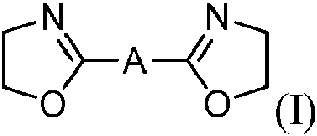
en la que "A” es un enlace, meta-fenileno o pa/a-fenileno. "A” también puede ser piridin-2,6-diílo, pero es menos preferido. Como ejemplo, la bisoxazolina se puede seleccionar del grupo que consiste en 1,3-bis(4,5-dihidrooxazol-2-il)benceno (1,3-PBO), 1,4-bis(4,5-dihidrooxazol-2-il)benceno (1,4-pBo), y 2,2’-bis-(2-oxazolina). 2,2’-(1,3-fenileno)bis(4,5-dihidrooxazol), también conocido como 1,3-fenileno-bis-oxazolina (1,3-PBO), o 1,3-bis(4,5-dihidrooxazol-2-il)benceno, representa una bisoxazolina preferida.wherein "A" is a bond, meta-phenylene or pa/a-phenylene. "A" can also be pyridin-2,6-diyl, but is less preferred. As an example, bisoxazoline can be selected from the group consisting of 1,3-bis(4,5-dihydrooxazol -2-yl)benzene (1,3-PBO), 1,4-bis(4,5-dihydrooxazol-2-yl)benzene (1,3-PBO), 2-yl)benzene (1,4- p B o ), and 2,2'-bis-(2-oxazoline). 2,2'-(1,3- phenylene)bis(4,5-dihydrooxazole), also known as 1,3-phenylene-bis-oxazoline (1,3-PBO), or 1,3-bis(4, 5-dihydrooxazol-2-yl)benzene represents a preferred bisoxazoline.
Además, la bisoxazolina se puede reemplazar por una bis-5,6-dihidro-4H-1,3-oxazina correspondiente, es decir, un compuesto que comprende por lo menos dos restos [5,6-dihidro-4H-1,3-oxazina], por ejemplo 1,3-bis(5,6-dihidro-4H-1,3-oxazin-2-il)benceno, 1,4-bis(5,6-dihidro-4H-1,3-oxazin-2-il)benceno, o 5,5’,6,6’-tetrahidro-4H,4’H-2,2’-bi(1,3-oxazina). Como reconoce el experto, las bis-5,6-dihidro-4H-1,3-oxazinas tienen en principio la misma reactividad que las correspondientes bisoxazolinas. De este modo, diversas bis-5,6-dihidro-4H-1,3-oxazinas también son útiles en el presente procedimiento. Según una forma de realización, la bis-5,6-dihidro-4H-1,3-oxazina es un compuesto según la fórmula II,Furthermore, bisoxazoline can be replaced by a corresponding bis-5,6-dihydro-4H-1,3-oxazine, i.e., a compound comprising at least two [5,6-dihydro-4H-1,3] residues. -oxazine], for example 1,3-bis(5,6-dihydro-4H-1,3-oxazin-2-yl)benzene, 1,4-bis(5,6-dihydro-4H-1,3- oxazin-2-yl)benzene, or 5,5',6,6'-tetrahydro-4H,4'H-2,2'-bi(1,3-oxazine). As recognized by the expert, bis-5,6-dihydro-4H-1,3-oxazines have in principle the same reactivity as the corresponding bisoxazolines. Thus, various bis-5,6-dihydro-4H-1,3-oxazines are also useful in the present process. According to one embodiment, bis-5,6-dihydro-4H-1,3-oxazine is a compound according to formula II,

en la que "B” es un enlace, meta-fenileno o pa/a-fenileno. "B” también puede ser piridin-2,6-diílo, pero es menos preferido.wherein "B" is a bond, meta-phenylene or pa/a-phenylene. "B" can also be pyridin-2,6-diyl, but is less preferred.
Otros aditivos que se pueden añadir a la mezcla madre incluyen, entre otros, policarbodiimida y desactivadores de metales. Other additives that can be added to the masterbatch include, but are not limited to, polycarbodiimide and metal deactivators.
Con respecto a mejorar aún más la estabilidad de la mezcla madre, ésta puede comprender, además del antioxidante secundario, tal como PEPQ, uno o más antioxidantes primarios y/o secundarios adicionales. Como ejemplo, puede comprender uno o más de entre:With respect to further improving the stability of the masterbatch, it may comprise, in addition to the secondary antioxidant, such as PEPQ, one or more additional primary and/or secondary antioxidants. As an example, it may include one or more of:
- Irganox 1330 (3,3',3',5,5',5'-hexa-terc-butil-a,a',a'-(mesitilen-2,4,6-triil)tri-p-cresol), vendido como Irganox 1330;- Irganox 1330 (3,3',3',5,5',5'-hexa-tert-butyl-a,a',a'-(mesitylene-2,4,6-triyl)tri-p-cresol ), sold as Irganox 1330;
- difosfato de bis-(2,4-di-terc-butilfenol)pentaeritritol, vendido como Irgafos 126, si el antioxidante secundario es 4,4'-bifenililen-difosfonito de tetraquis-(2,4-diterc-butilfenilo);- bis-(2,4-di-tert-butylphenol)pentaerythritol diphosphate, sold as Irgafos 126, if the secondary antioxidant is tetrakis-(2,4-ditert-butylphenyl) 4,4'-biphenylylene-diphosphonite;
- tetraquis(3-(3,5-di-terc-butil-4-hidroxifenil)propionato) de pentaeritritol, vendido como Irganox 1010;- pentaerythritol tetrakis(3-(3,5-di-tert-butyl-4-hydroxyphenyl)propionate), sold as Irganox 1010;
- bis(3-(3,5-di-terc-butil-4-hidroxifenil)propionato de hexametileno, vendido como Irganox 259; y- hexamethylene bis(3-(3,5-di-tert-butyl-4-hydroxyphenyl)propionate, sold as Irganox 259; and
- una mezcla (vendida como Irganox B 561) de fosfito de (tris(2,4-di-terc-butilfenilo)) y tetraquis(3-(3,5-di-tercbutil-4-hidroxifenil)propionato) de pentaeritritol, o las mezclas sinérgicas parecidas.- a mixture (sold as Irganox B 561) of pentaerythritol (tris(2,4-di-tert-butylphenyl)) phosphite and tetrakis(3-(3,5-di-tert-butyl-4-hydroxyphenyl)propionate), or similar synergistic mixtures.
Según una forma de realización, el polianhídrido y el antioxidante secundario se mezclan, por ejemplo se componen en el mismo portador. La relación en peso de polianhídrido al antioxidante secundario se fija en tal mezcla madre. Además, la combinación en el mismo portador asegura una distribución igual y uniforme del polianhídrido y el antioxidante secundario. Mientras que el polianhídrido y el antioxidante secundario normalmente se combinan en el portador, es decir, se mezclan en estado fundido con el portador, pueden, según algunas formas de realización, mezclarse en seco y mezclarse en frío con el portador. Tal mezcla seca puede compactarse o extruirse en frío.According to one embodiment, the polyanhydride and the secondary antioxidant are mixed, for example compounded into the same carrier. The weight ratio of polyanhydride to secondary antioxidant is fixed in such a masterbatch. Furthermore, the combination in the same carrier ensures an equal and uniform distribution of the polyanhydride and the secondary antioxidant. While the polyanhydride and secondary antioxidant are typically combined in the carrier, that is, melt blended with the carrier, they may, according to some embodiments, be dry blended and cold blended with the carrier. Such a dry mixture can be compacted or cold extruded.
Según una forma de realización alternativa, la mezcla madre comprende un primer portador que comprende el polianhídrido, y un segundo que comprende el antioxidante secundario. Según tal forma de realización, el polianhídrido se mezcla, por ejemplo se combina, en el primer portador, y el antioxidante secundario se mezcla, por ejemplo se combina, en el segundo portador. Se puede proporcionar una mezcla madre según una forma de realización de este tipo mezclando el primer portador y el segundo portador. Típicamente, el primer portador, que comprende el polianhídrido, y el segundo portador, que comprende el antioxidante secundario, se mezclan en estado sólido, es decir, se amasan o se mezclan en seco. Pueden mezclarse a temperatura ambiente (por ejemplo, a alrededor de 20 °C). Mediante el uso de un primer y un segundo portador, la relación en peso de polianhídrido con respecto al antioxidante secundario se puede ajustar fácilmente. Además, se puede evitar el riesgo de que el polianhídrido y el antioxidante secundario interactúen durante la fabricación de la mezcla madre. Para facilitar el uso de la mezcla madre, la mezcla seca del primer portador con el polianhídrido y el segundo con el antioxidante secundario puede compactarse, por ejemplo compactarse en polvo, o extruirse en frío, por lo que la mezcla madre puede proporcionarse en forma de pélets.According to an alternative embodiment, the masterbatch comprises a first carrier comprising the polyanhydride, and a second carrier comprising the secondary antioxidant. According to such an embodiment, the polyanhydride is mixed, for example combined, in the first carrier, and the secondary antioxidant is mixed, for example combined, in the second carrier. A masterbatch may be provided according to such an embodiment by mixing the first carrier and the second carrier. Typically, the first carrier, comprising the polyanhydride, and the second carrier, comprising the secondary antioxidant, are mixed in the solid state, that is, kneaded or dry mixed. They can be mixed at room temperature (e.g. around 20°C). By using a first and a second carrier, the weight ratio of polyanhydride to secondary antioxidant can be easily adjusted. Furthermore, the risk of the polyanhydride and the secondary antioxidant interacting during the manufacturing of the masterbatch can be avoided. To facilitate the use of the masterbatch, the dry mixture of the first carrier with the polyanhydride and the second with the secondary antioxidant can be compacted, for example compacted into powder, or cold extruded, whereby the masterbatch can be provided in the form of pellets.
Eventualmente, la mezcla madre se mezclará en estado fundido con un poliéster, tal como PET. Este mezclamiento se puede llevar a cabo en la producción de artículos. Sin embargo, aunque es menos preferido, ya que se requiere un procesamiento repetido, todavía se puede combinar un poliéster, tal como PET, con la mezcla madre. Tal compuesto puede entonces procesarse en el sitio, o en otro sitio, en un artículo. Si se premezcla el poliéster con la mezcla madre, se prefiere mezclarlos en estado sólido, es decir, mezclamiento en seco. Posteriormente, la premezcla se puede mezclar en estado fundido y procesarse. Así, una forma de realización se refiere a un poliéster termoplástico, tal como PET, mezclado con la presente mezcla madre.Eventually, the masterbatch will be melt blended with a polyester, such as PET. This mixing can be carried out in the production of articles. However, although less preferred, as repeated processing is required, a polyester, such as PET, can still be combined with the masterbatch. Such a compound can then be processed on site, or at another site, into an article. If polyester is premixed with the masterbatch, it is preferred to mix them in the solid state, that is, dry mixing. The premix can then be melt mixed and processed. Thus, one embodiment relates to a thermoplastic polyester, such as PET, blended with the present masterbatch.
Según un aspecto, se proporciona un artículo que comprende un tereftalato de polietileno (PET), cuyo poliéster se ha mezclado en estado fundido con la presente mezcla madre en la producción del artículo. El artículo puede ser una espuma, una botella, tal como una botella moldeada por soplado, o una bandeja, tal como una bandeja de espuma para uso en la industria alimentaria. Además, el artículo puede ser una película, una lámina o una fibra. Una aplicación típica de las espumas de PET renovado es como material de núcleo en rotores de aerogeneradores. Una película o una lámina de un PET renovado podría utilizarse posteriormente en envases de termoformado, por ejemplo tipos concha de almeja, bandejas, tazas, y similares.According to one aspect, an article is provided comprising a polyethylene terephthalate (PET), the polyester of which has been melt blended with the present masterbatch in the production of the article. The article may be a foam, a bottle, such as a blow molded bottle, or a tray, such as a foam tray for use in the food industry. Furthermore, the article may be a film, a sheet or a fiber. A typical application of renewed PET foams is as core material in wind turbine rotors. A film or sheet of a renewed PET could later be used in thermoforming containers, for example clamshell types, trays, cups, and the like.
Según otro aspecto, se proporciona el uso de un polianhídrido, que es un dianhídrido tetracarboxílico, y un antioxidante secundario, que es un estabilizador a base de fósforo, para mejorar la reología en estado fundido de un tereftalato de polietileno. El uso puede ser aumentar la viscosidad en estado fundido, la resistencia en estado fundido, y/o la elasticidad en estado fundido del poliéster termoplástico, tal como para por lo menos aumentar la resistencia en estado fundido. Como se indicó anteriormente en la presente memoria, el polianhídrido y el antioxidante secundario se usan en una relación en peso de entre 5:1 y 1:5, tal como entre 5:1 y 1:1, entre 1:1 y 1:5, entre 3:1 y 1:3, entre 3:1 y 1:1, entre 1:1 y 1:3, o entre 2:1 y 1:2. El poliéster a mejorar puede ser tereftalato de polietileno. Además, diversos aspectos descritos anteriormente en la presente memoria con respecto con la mezcla madre y sus constituyentes, son igualmente aplicables mutatis mutandis a tal uso. Así, el antioxidante secundario puede ser, por ejemplo, 4,4'-bifenililen-difosfonito de tetraquis-(2,4-diterc-butilfenilo). Además, el polianhídrido puede ser, por ejemplo, dianhídrido piromelítico (PMDA). According to another aspect, there is provided the use of a polyanhydride, which is a tetracarboxylic dianhydride, and a secondary antioxidant, which is a phosphorus-based stabilizer, to improve the melt rheology of a polyethylene terephthalate. The use may be to increase the melt viscosity, melt strength, and/or melt elasticity of the thermoplastic polyester, such as to at least increase the melt strength. As indicated hereinabove, the polyanhydride and the secondary antioxidant are used in a weight ratio of between 5:1 and 1:5, such as between 5:1 and 1:1, between 1:1 and 1: 5, between 3:1 and 1:3, between 3:1 and 1:1, between 1:1 and 1:3, or between 2:1 and 1:2. The polyester to be improved may be polyethylene terephthalate. Furthermore, various aspects described hereinabove with respect to the masterbatch and its constituents are equally applicable mutatis mutandis to such use. Thus, the secondary antioxidant may be, for example, tetrakis-(2,4-ditert-butylphenyl) 4,4'-biphenylylene-diphosphonite. Furthermore, the polyanhydride may be, for example, pyromellitic dianhydride (PMDA).
En tal uso, el polianhídrido se mezcla en estado fundido con el poliéster termoplástico en una cantidad de entre 0.05 y 0.5 % en peso, tal como entre 0.1 y 0.3 % en peso, con respecto al poliéster termoplástico, y/o con el antioxidante secundario en una cantidad de entre 0.05 y 0.5 % en peso, tal como 0.1 a 0.3% en peso, con respecto al poliéster termoplástico.In such use, the polyanhydride is melt blended with the thermoplastic polyester in an amount of between 0.05 and 0.5% by weight, such as between 0.1 and 0.3% by weight, with respect to the thermoplastic polyester, and/or with the secondary antioxidant. in an amount of between 0.05 and 0.5% by weight, such as 0.1 to 0.3% by weight, with respect to the thermoplastic polyester.
El poliéster termoplástico es tereftalato de polietileno (PET) o un copolímero de PET y otro polímero, tal como un copolímero de bloques, un copolímero aleatorio, o mezclas de los mismos.Thermoplastic polyester is polyethylene terephthalate (PET) or a copolymer of PET and another polymer, such as a block copolymer, a random copolymer, or mixtures thereof.
Según otro aspecto, se proporciona un procedimiento para mejorar la reología en estado fundido de un poliéster termoplástico, tal como aumentar la viscosidad en estado fundido, la resistencia en estado fundido, y/o la elasticidad en estado fundido del poliéster termoplástico, por ejemplo por lo menos aumentar la resistencia en estado fundido del poliéster termoplástico. El procedimiento comprende la etapa de mezclar en estado fundido un polianhídrido, que es un dianhídrido tetracarboxílico, y un antioxidante secundario, que es un estabilizador a base de fósforo, con el poliéster termoplástico. El mezclamiento en estado fundido se puede llevar a cabo en una extrusora de tornillo (por ejemplo, una extrusora de tornillo simple, dos tornillos, o doble tornillo). La relación en peso del polianhídrido y el antioxidante secundario es de entre 5:1 y 1:5, tal como entre 5:1 y 1:1, entre 1:1 y 1:5, entre 3:1 y 1:3, entre 3:1 y 1:1, entre 1:1 y 1:3, o entre 2:1 y 1:2.According to another aspect, a method is provided for improving the melt rheology of a thermoplastic polyester, such as increasing the melt viscosity, melt strength, and/or melt elasticity of the thermoplastic polyester, for example by at least increase the melt strength of the thermoplastic polyester. The process comprises the step of mixing in a molten state a polyanhydride, which is a tetracarboxylic dianhydride, and a secondary antioxidant, which is a phosphorus-based stabilizer, with the thermoplastic polyester. Melt mixing can be carried out in a screw extruder (for example, a single screw, two screw, or twin screw extruder). The weight ratio of the polyanhydride and the secondary antioxidant is between 5:1 and 1:5, such as between 5:1 and 1:1, between 1:1 and 1:5, between 3:1 and 1:3, between 3:1 and 1:1, between 1:1 and 1:3, or between 2:1 and 1:2.
Además, el polianhídrido se mezcla con el poliéster termoplástico en una cantidad de entre 0.05 y 0.5 % en peso, tal como entre 0.1 y 0.3 % en peso, con respecto al poliéster termoplástico, y/o con el antioxidante secundario en una cantidad de entre 0.05 y 0.5 % en peso, tal como entre 0.1 y 0.3 % en peso, con respecto al poliéster. Además, diversos aspectos divulgados anteriormente en la presente memoria con respecto a la mezcla madre y sus constituyentes, son igualmente aplicables mutatis mutandis a tal procedimiento. Así, el antioxidante secundario puede ser, por ejemplo, 4,4-bifenililen-difosfonito de tetraquis-(2,4-diterc-butilfenilo). Además, el polianhídrido puede ser, por ejemplo, dianhídrido piromelítico (PMDA).Furthermore, the polyanhydride is mixed with the thermoplastic polyester in an amount of between 0.05 and 0.5% by weight, such as between 0.1 and 0.3% by weight, with respect to the thermoplastic polyester, and/or with the secondary antioxidant in an amount between 0.05 and 0.5% by weight, such as between 0.1 and 0.3% by weight, with respect to polyester. Furthermore, various aspects previously disclosed herein with respect to the masterbatch and its constituents are equally applicable mutatis mutandis to such a process. Thus, the secondary antioxidant may be, for example, tetrakis-(2,4-ditert-butylphenyl) 4,4-biphenylylene-diphosphonite. Furthermore, the polyanhydride may be, for example, pyromellitic dianhydride (PMDA).
El poliéster termoplástico es tereftalato de polietileno (PET) o un copolímero de PET y otro polímero, tal como un copolímero de bloques, un copolímero aleatorio, o mezclas de los mismos.Thermoplastic polyester is polyethylene terephthalate (PET) or a copolymer of PET and another polymer, such as a block copolymer, a random copolymer, or mixtures thereof.
Una vez mezclado en estado fundido, la masa fundida resultante se puede procesar, extruir, y por ejemplo espumar o moldear por soplado. Por lo tanto, la masa fundida puede procesarse en un artículo, tal como una espuma, o un artículo moldeado por soplado, por ejemplo una botella. Como ya se ha descrito, dicha espuma puede usarse, por ejemplo, para bandejas, por ejemplo bandejas de alimentos, o como material central en material de construcción ligero, por ejemplo como material de núcleo en rotores de aerogeneradores. Además, la masa fundida se puede procesar en una película, una lámina, o una fibra. En la técnica, se ha descrito la renovación de PET usando PMDA y el procesamiento posterior en artículos, como se puede observar, entre otros, en el documento EP 2163577 B1. Además, la renovación por medio de extrusión reactiva se divulga en el documento EP 3246349.Once mixed in a molten state, the resulting melt can be processed, extruded, and for example foamed or blow molded. Therefore, the melt can be processed into an article, such as a foam, or a blow molded article, for example a bottle. As already described, such foam can be used, for example, for trays, for example food trays, or as a core material in lightweight construction material, for example as a core material in wind turbine rotors. Additionally, the melt can be processed into a film, a sheet, or a fiber. In the art, PET renewal using PMDA and subsequent processing in articles has been described, as can be seen, among others, in EP 2163577 B1. Furthermore, renewal by means of reactive extrusion is disclosed in EP 3246349.
Al mezclar en estado fundido el polianhídrido, el antioxidante secundario y el poliéster, la temperatura deberá exceder el punto de fusión del poliéster termoplástico, es decir, los componentes deben mezclarse en estado fundido. Sin embargo, para limitar la degradación inherente, la temperatura no deberá ser demasiado alta. Por lo tanto, la temperatura es típicamente menor que 350 °C. Según una forma de realización, la temperatura durante el mezclamiento en estado fundido es de entre 200 °C y 320 °C, tal como de entre 210 °C y 280 °C. Para PET, la temperatura durante el mezclamiento en estado fundido preferentemente no supera los 300 °C.When mixing the polyanhydride, secondary antioxidant and polyester in the melt state, the temperature must exceed the melting point of the thermoplastic polyester, that is, the components must be mixed in the molten state. However, to limit inherent degradation, the temperature should not be too high. Therefore, the temperature is typically less than 350 °C. According to one embodiment, the temperature during melt mixing is between 200°C and 320°C, such as between 210°C and 280°C. For PET, the temperature during melt mixing preferably does not exceed 300 °C.
Según una forma de realización, el procedimiento comprende además la etapa de espumar el poliéster termoplástico obtenido que tiene una resistencia en estado fundido mejorada. Según tal forma de realización, el procedimiento puede comprender además añadir un agente de soplado, tal como dióxido de carbono, nitrógeno, una cetona, formiato de metilo, un hidrofluorocarbono, un hidrocarburo, por ejemplo n-hexano, iso- o n-pentano, ciclopentano, o n-heptano, o una mezcla de gases de los mismos, un agente de expansión, y/o un agente espumante al poliéster termoplástico. Además, se pueden añadir otros aditivos al polímero termoplástico. Por lo tanto, también se puede añadir al poliéster termoplástico un agente nucleante, tal como talco, caolín, gel de sílice, tierra de diatomeas, wollastonita, zeolita, sales de carbonato, por ejemplo carbonato de sodio, sales de benzoato, por ejemplo benzoato de sodio, sales de biciclo[2.2.1]heptanodicarboxilato, por ejemplo sales de litio y sodio, sales de 12H-dibenzo[d,g][1,3,2]dioxafosfocina,2,3,8,10-tetraquis(1,1-dimetiletil)-6-hidroxi, -6-óxido, por ejemplo una sal de litio, o TiO2, un retardador de llama, tal como un compuesto halogenado, un compuesto carbonizante (como el que contiene fósforo), o liberador de agua, un plastificante, un lubricante, tal como un éster de un ácido graso, un modificador de impacto, un modificador de aislamiento, un pigmento, una carga, un antioxidante, un estabilizador UV, y/o un mejorador del color, y mezclarlo en estado fundido con ellos.According to one embodiment, the process further comprises the step of foaming the obtained thermoplastic polyester having improved melt strength. According to such an embodiment, the process may further comprise adding a blowing agent, such as carbon dioxide, nitrogen, a ketone, methyl formate, a hydrofluorocarbon, a hydrocarbon, for example n-hexane, iso- or n-pentane , cyclopentane, or n-heptane, or a gas mixture thereof, an expansion agent, and/or a foaming agent to the thermoplastic polyester. Additionally, other additives can be added to the thermoplastic polymer. Therefore, a nucleating agent, such as talc, kaolin, silica gel, diatomaceous earth, wollastonite, zeolite, carbonate salts, for example sodium carbonate, benzoate salts, for example benzoate, can also be added to the thermoplastic polyester. sodium, bicyclo[2.2.1]heptanedicarboxylate salts, for example lithium and sodium salts, 12H-dibenzo[d,g][1,3,2]dioxaphosphokine,2,3,8,10-tetrakis( 1,1-dimethylethyl)-6-hydroxy, -6-oxide, for example a lithium salt, or TiO 2 , a flame retardant, such as a halogenated compound, a carbonizing compound (such as containing phosphorus), or water releaser, a plasticizer, a lubricant, such as an ester of a fatty acid, an impact modifier, an insulation modifier, a pigment, a filler, an antioxidant, a UV stabilizer, and/or a color improver, and mix it in a molten state with them.
Como ya se ha descrito, el poliéster termoplástico con resistencia en estado fundido mejorada puede espumarse. Según una forma de realización alternativa, el poliéster termoplástico obtenido con resistencia en estado fundido mejorada se moldea, tal como moldeado por inyección, moldeado por soplado, o moldeado por inyección seguido de moldeado por estirado-soplado, en una etapa adicional. As already described, thermoplastic polyester with improved melt strength can be foamed. According to an alternative embodiment, the obtained thermoplastic polyester with improved melt strength is molded, such as injection molding, blow molding, or injection molding followed by stretch-blow molding, in a further step.
Según otro aspecto de la invención, se proporciona así un artículo obtenido por extrusión, moldeo por inyección, moldeo por soplado, espumación, y/o moldeo por estirado-soplado de una masa fundida de poliéster termoplástico mezclada con un polianhídrido, que es un dianhídrido tetracarboxílico, y un antioxidante secundario, que es un estabilizador a base de fósforo. Una forma de realización específica se refiere a una espuma de PET.According to another aspect of the invention, there is thus provided an article obtained by extrusion, injection molding, blow molding, foaming, and/or stretch-blow molding of a thermoplastic polyester melt mixed with a polyanhydride, which is a dianhydride. tetracarboxylic, and a secondary antioxidant, which is a phosphorus-based stabilizer. A specific embodiment relates to a PET foam.
Sin más elaboración, se cree que un experto en la técnica puede utilizar, usando la descripción anterior, la presente invención en toda su extensión. Las formas de realización específicas preferidas anteriores, por lo tanto, deben interpretarse como meramente ilustrativas y no limitativas de la exposición de ninguna manera.Without further elaboration, it is believed that one skilled in the art can utilize, using the foregoing description, the present invention to its full extent. The above specific preferred embodiments should therefore be construed as merely illustrative and not limiting the disclosure in any way.
Aunque la presente invención se ha descrito anteriormente con referencia a forma de realización específicas, no se pretende que se limite a la forma específica expuesta en la presente memoria. Más bien, la invención está limitada únicamente por las reivindicaciones adjuntas, y otras formas de realización distintas de las específicas anteriores son igualmente posibles dentro del alcance de estas reivindicaciones adjuntas, por ejemplo diferentes de las descritas anteriormente.Although the present invention has been described above with reference to specific embodiments, it is not intended to be limited to the specific form set forth herein. Rather, the invention is limited only by the appended claims, and other embodiments other than the specific ones above are equally possible within the scope of these appended claims, for example different from those described above.
En las reivindicaciones, el término “comprende/que comprende” no excluye la presencia de otros elementos o etapas. Además, aunque características individuales pueden incluirse en diferentes reivindicaciones, estas posiblemente pueden combinarse ventajosamente, y la inclusión en diferentes reivindicaciones no implica que una combinación de características no sea factible y/o ventajosa.In the claims, the term “comprises/comprising” does not exclude the presence of other elements or steps. Furthermore, although individual features may be included in different claims, these may possibly be combined advantageously, and inclusion in different claims does not imply that a combination of features is not feasible and/or advantageous.
Además, las referencias singulares no excluyen una pluralidad. Los términos “un”, “una”, “primero”, “segundo”, etc., no excluyen una pluralidad.Furthermore, singular references do not exclude plurality. The terms “a”, “an”, “first”, “second”, etc., do not exclude a plurality.
Parte experimentalexperimental part
Los siguientes ejemplos son meros ejemplos, y de ninguna manera deberán interpretarse como limitantes del alcance de la invención. Más bien, la invención está limitada únicamente por las reivindicaciones adjuntas.The following examples are merely examples, and should in no way be construed as limiting the scope of the invention. Rather, the invention is limited only by the appended claims.
AbreviaturasAbbreviations
PBO fenileno-bis-oxazolinaPBO phenylene-bis-oxazoline
PEPQ 4,4'-bifenililen-difosfonito de tetraquis-(2,4-diterc-butilfenilo)PEPQ 4,4'-biphenylylene-tetrakis-(2,4-ditert-butylphenyl)diphosphonite
PET tereftalato de polietilenoPET polyethylene terephthalate
PMDA dianhídrido piromelíticoPMDA pyromellitic dianhydride
SHP fenol estéricamente impedidoSHP sterically hindered phenol
PETA anhídrido feniletiniltrimelíticoPETA phenylethynyltrimellitic anhydride
DibujosDrawings
La figura 1 proporciona una comparación de SHP y PEPQ en la extrusión en estado fundido de PET, en términos de:Figure 1 provides a comparison of SHP and PEPQ in PET melt extrusion, in terms of:
a) la viscosidad compleja para un barrido de frecuencia a 270 °C (figura 1.1, figura 1.3, figura 1.5, y figura 17); ya) the complex viscosity for a frequency sweep at 270 °C (figure 1.1, figure 1.3, figure 1.5, and figure 17); and
b) el par en un micromezclador a lo largo del tiempo (figura 1.2, figura 1.4 y figura 1.6).b) the torque in a micromixer over time (figure 1.2, figure 1.4 and figure 1.6).
La figura 2 proporciona una comparación de PEPQ con otros antioxidantes secundarios en la extrusión en estado fundido de PET, en términos de:Figure 2 provides a comparison of PEPQ with other secondary antioxidants in PET melt extrusion, in terms of:
a) la viscosidad compleja para un barrido de frecuencia a 270 °C (figura 2.1 y figura 2.3); ya) the complex viscosity for a frequency sweep at 270 °C (figure 2.1 and figure 2.3); and
b) el par en un micromezclador a lo largo del tiempo (figura 2.2 y figura 2.4).b) the torque in a micromixer over time (figure 2.2 and figure 2.4).
La figura 3 proporciona una comparación de PEPQ para aumentar las dosis con respecto a PMDA en la extrusión en estado fundido de PET, en términos de:Figure 3 provides a comparison of PEPQ for increasing doses with respect to PMDA in PET melt extrusion, in terms of:
a) la viscosidad compleja para un barrido de frecuencia a 270 °C (figura 3.1); ya) the complex viscosity for a frequency sweep at 270 °C (figure 3.1); and
b) el par en un micromezclador a lo largo del tiempo (figura 3.2).b) the torque in a micromixer over time (figure 3.2).
La figura 4 proporciona una comparación de PEPQ y otro aditivo potenciador, es decir, PETA y PBO, en la extrusión en estado fundido de p Et , en términos de:Figure 4 provides a comparison of PEPQ and another enhancing additive, i.e., PETA and PBO, in the melt extrusion of pEt, in terms of:
a) la viscosidad compleja para un barrido de frecuencia a 270 °C (figura 4.1); ya) the complex viscosity for a frequency sweep at 270 °C (figure 4.1); and
b) el par en un micromezclador a lo largo del tiempo (figura 4.2). b) the torque in a micromixer over time (figure 4.2).
La figura 5 proporciona una comparación de PEPQ en dosis más bajas en la extrusión en estado fundido de PET, en términos de:Figure 5 provides a comparison of PEPQ at lower doses in PET melt extrusion, in terms of:
a) la viscosidad compleja para un barrido de frecuencia a 270 °C (figura 5.1); ya) the complex viscosity for a frequency sweep at 270 °C (figure 5.1); and
b) el par en un micromezclador a lo largo del tiempo (figura 5.2).b) the torque in a micromixer over time (figure 5.2).
Material y procedimientosMaterial and procedures
En los ejemplos, NeoPET 82 (IV=0.82 ± 0.02 dl/g; NEOGROUP) se modificó mediante extrusión reactiva en micromezclador (ThermoFisher Scientific Haake MiniLab II) en presencia de aditivos. Los aditivos fueron:In the examples, NeoPET 82 (IV=0.82 ± 0.02 dl/g; NEOGROUP) was modified by reactive extrusion in a micromixer (ThermoFisher Scientific Haake MiniLab II) in the presence of additives. The additives were:
- Irganox 1330 (3,3',3',5,5',5'-hexa-terc-butil-a,a',a'-(mesitilen-2,4,6-triil)tri-p-cresol) de BASF- Irganox 1330 (3,3',3',5,5',5'-hexa-tert-butyl-a,a',a'-(mesitylene-2,4,6-triyl)tri-p-cresol ) from BASF
- Irganox 1425 (también conocido como Irgamod 195), (bis(((3,5-bis(1,1-dimetiletil)-4-hidroxifenil)metil)-etilfosfonato) de calcio) de BASF- Irganox 1425 (also known as Irgamod 195), (calcium bis(((3,5-bis(1,1-dimethylethyl)-4-hydroxyphenyl)methyl)-ethylphosphonate) from BASF
- Irgafos 168 (fosfito de tris(2,4-di-terc-butilfenilo)) de BASF- Irgafos 168 (tris(2,4-di-tert-butylphenyl) phosphite) from BASF
- PEPQ (4,4'-bifenililen-difosfonito de tetraquis-(2,4-diterc-butilfenilo)) de Songwon; y- PEPQ (tetrakis-(2,4-ditert-butylphenyl) 4,4'-biphenylylene-diphosphonite) from Songwon; and
- PMDA (dianhídrido piromelítico) de Hope Chemicals- PMDA (pyromellitic dianhydride) from Hope Chemicals
La formulación de PET (secado a vacío durante 12 horas a 120 °C) y los aditivos se realizaron en un Haake MiniLab II (un micromezclador con circuito cerrado). La formulación se llevó a cabo a 270 °C y 60 rpm durante 20 minutos. El par se midió como una medida indicativa de la reticulación, la extensión de la cadena, y la ramificación, así como la estabilidad en estado fundido.PET formulation (vacuum drying for 12 hours at 120 °C) and additives were performed in a Haake MiniLab II (a closed-loop micromixer). The formulation was carried out at 270 °C and 60 rpm for 20 minutes. Torque was measured as an indicative measure of cross-linking, chain extension, and branching, as well as melt stability.
Después de 20 minutos de micromezclamiento, las muestras se tomaron directamente para la caracterización reológica con un reómetro rotacional Ares G2 de TA Instruments, con placa paralela de 25 mm (espacio de 1 mm) para un barrido de frecuencia a 270 °C y una deformación de 1 %.After 20 minutes of micromixing, samples were taken directly for rheological characterization with a TA Instruments Ares G2 rotational rheometer, with 25 mm parallel plate (1 mm gap) for a frequency sweep at 270 °C and a deformation of 1 %.
En total se realizaron 18 experimentos de esta manera. En la Tabla 1 siguiente, se proporciona una descripción general, con los aditivos en cada experimento proporcionados. Todas las cantidades se dan con respecto a PET en % en peso.In total 18 experiments were carried out in this way. An overview is provided in Table 1 below, with the additives in each experiment provided. All quantities are given with respect to PET in % by weight.
Tabla 1 - Sumario de ejemplosTable 1 - Summary of examples

ResultadosResults
Para permitir una comparación y sacar varias conclusiones, los ejemplos se agruparon en diferentes combinaciones.To allow a comparison and draw various conclusions, the examples were grouped in different combinations.
Comparación 1 - Rendimiento de antioxidantes secundarios frente a primarios, por ejemplo PEPQ frente a SHP. Comparison 1 - Performance of secondary vs primary antioxidants, for example PEPQ vs SHP.
En la primera comparación, se compararon PEPQ y los SHP (Irganox 1330 e Irganox 1425, respectivamente) en la Tabla 2 y en la figura 1.1 -1.7. En la tabla, se da a conocer el par máximo así como el par final después de 20 min. Además, se da la viscosidad compleja a 0,1, 1 y 100 Hz.In the first comparison, PEPQ and SHPs (Irganox 1330 and Irganox 1425, respectively) were compared in Table 2 and Figure 1.1 -1.7. The table shows the maximum torque as well as the final torque after 20 min. Additionally, the complex viscosity at 0.1, 1, and 100 Hz is given.
Tabla 2Table 2

Como se puede observar, el antioxidante secundario PEPQ se comporta igual de bien que los antioxidantes primarios Irganox 1330 e Irganox 1425, respectivamente, a la misma dosis en una relación 1:3 con respecto a PMDA (CE1, CE3 frente a IE1). Este hallazgo es contrario a los informes en la técnica (véase el documento EP 2 163577 B1) que afirman que si bien los antioxidantes secundarios podrían usarse para mejorar el rendimiento del antioxidante primario, la dosis debería ser baja, ya que de lo contrario pueden comprometer la reacción de mejora de la resistencia en estado fundido del poliéster con el antioxidante primario. El hallazgo de que mayores dosis de antioxidante secundario junto con PMDA mejoran la resistencia en estado fundido tan eficazmente como el antioxidante primario es muy sorprendente.As can be seen, the secondary antioxidant PEPQ behaves equally well as the primary antioxidants Irganox 1330 and Irganox 1425, respectively, at the same dose in a 1:3 ratio with respect to PMDA (CE1, CE3 vs. IE1). This finding is contrary to reports in the art (see EP 2 163577 B1) which state that while secondary antioxidants could be used to improve the performance of the primary antioxidant, the dose should be low, as otherwise they may compromise the reaction to improve the melt strength of polyester with the primary antioxidant. The finding that higher doses of secondary antioxidant together with PMDA improve melt strength as effectively as the primary antioxidant is very surprising.
Además, en relaciones más altas (por ejemplo, 1:1 frente a PMDA), el antioxidante secundario incluso supera al antioxidante primario y proporciona un mayor aumento de la viscosidad (IE2 frente a CE4, CE6).Furthermore, at higher ratios (e.g., 1:1 vs. PMDA), the secondary antioxidant even outperforms the primary antioxidant and provides a greater increase in viscosity (IE2 vs. CE4, CE6).
Está claro que el antioxidante primario y el antioxidante secundario PEPQ afirman su efecto por diferentes mecanismos, ya que el rendimiento del antioxidante secundario PEPQ se mejora aún más mediante la adición de un antioxidante primario tal como Irganox 1330, como se puede ver observar por la figura 1.5 y la figura 1.6, véase IE4. Además, PEPQ tiene el mayor efecto por molécula en comparación con los antioxidantes primarios Irganox 1330 y 1425, como se puede observar por la figura 1.7 (la viscosidad de Irganox 1330, CE1 y 4, se establecen como viscosidades de referencia).It is clear that the primary antioxidant and the secondary antioxidant PEPQ claim their effect by different mechanisms, since the performance of the secondary antioxidant PEPQ is further improved by the addition of a primary antioxidant such as Irganox 1330, as can be seen from the figure. 1.5 and figure 1.6, see IE4. Furthermore, PEPQ has the greatest effect per molecule compared to the primary antioxidants Irganox 1330 and 1425, as can be seen from Figure 1.7 (the viscosity of Irganox 1330, CE1 and 4, are set as reference viscosities).
Por lo tanto, podría concluirse que los antioxidantes secundarios representan un aditivo útil para combinar con un polianhídrido, por ejemplo PMDA, para mejorar las características en estado fundido de los poliésteres. Se sabe que las características en estado fundido de los poliésteres también son indicativas de las propiedades mecánicas a temperatura ambiente, ya que todas dependen del peso molecular del polímero.Therefore, it could be concluded that secondary antioxidants represent a useful additive to combine with a polyanhydride, for example PMDA, to improve the melt characteristics of polyesters. It is known that the melt characteristics of polyesters are also indicative of the mechanical properties at room temperature, since they all depend on the molecular weight of the polymer.
Comparación 2 - Rendimiento de diferentes antioxidantes secundariosComparison 2 - Performance of different secondary antioxidants
En la segunda comparación, se compararon diversos antioxidantes secundarios en la Tabla 3.1 y las figura 2.1 -2.4. En la tabla, se da a conocer el par máximo así como el par final. Además, se da la viscosidad compleja a 0.1, 1 y 100 Hz.In the second comparison, various secondary antioxidants were compared in Table 3.1 and Figures 2.1 -2.4. In the table, the maximum torque as well as the final torque is disclosed. Additionally, the complex viscosity at 0.1, 1, and 100 Hz is given.
Tabla 3.1Table 3.1

Como se puede observar, también otros antioxidantes secundarios actúan sinérgicamente con PMDA. Sin embargo, los fosfitos aparentemente no son eficaces como fosfonitos. Los fosfonitos, por ejemplo PEPQ, representan así un antioxidante secundario preferido en el contexto de la presente invención.As can be seen, other secondary antioxidants also act synergistically with PMDA. However, phosphites are apparently not effective as phosphonites. Phosphonites, for example PEPQ, thus represent a preferred secondary antioxidant in the context of the present invention.
Comparación 3 - Influencia de la relaciónComparison 3 - Influence of the relationship
En la tercera comparación, se comparan diversas relaciones de PMDA y PEPQ en la Tabla 4 y la figura 3.1 - 3.2. En la tabla, se da a conocer el par máximo así como el par final. Además, se da la viscosidad compleja a 0.1, 1 y 100 Hz.In the third comparison, various ratios of PMDA and PEPQ are compared in Table 4 and Figure 3.1 - 3.2. In the table, the maximum torque as well as the final torque is disclosed. Additionally, the complex viscosity at 0.1, 1, and 100 Hz is given.
Tabla 4Table 4

Diversas dosis relativas de PEPQ proporcionarán diferentes efectos. Parece que a relaciones más altas, se proporciona un mayor grado de ramificación (véase aumento del adelgazamiento por cizallamiento a relaciones más altas en la figura 3b). Mientras que el aumento de la relación de 3:1 a 1:1 proporciona un aumento general (IE1 frente a IE2), el cambio al aumentar aún más la relación de 3:3 a 3:5 (IE2 frente a IE3) es mucho menos impresionante. Por lo tanto, parece que se alcanza una meseta en algún lugar entre 3:3 y 3:5.Various relative doses of PEPQ will provide different effects. It appears that at higher ratios, a greater degree of branching is provided (see increased shear thinning at higher ratios in Figure 3b). While increasing the ratio from 3:1 to 1:1 provides an overall increase (IE1 vs IE2), the change by further increasing the ratio from 3:3 to 3:5 (IE2 vs IE3) is much less impressive. Therefore, it seems that a plateau is reached somewhere between 3:3 and 3:5.
Por lo menos para algunas aplicaciones, parece preferirse una relación de 1:1.At least for some applications, a 1:1 ratio appears to be preferred.
Comparación 4 - Influencia de otros aditivos potenciadores, por ejemplo PBO y PETAComparison 4 - Influence of other enhancing additives, e.g. PBO and PETA
En la cuarta comparación, la adición de aditivos mejoradores adicionales, es decir, PBO y PETA, se estudia en la Tabla 5 y la figura 4.1 - 4.2. En la tabla, se da a conocer el par máximo así como el par final. Además, se da la viscosidad compleja a 0.1, 1 y 100 Hz.In the fourth comparison, the addition of additional builder additives, i.e., PBO and PETA, is studied in Table 5 and Figure 4.1 - 4.2. In the table, the maximum torque as well as the final torque is disclosed. Additionally, the complex viscosity at 0.1, 1, and 100 Hz is given.
Tabla 5Table 5

De forma similar a cuando se combina con un fenol estéricamente impedido, PBO mejoró el rendimiento de PMDA en presencia de un antioxidante secundario. Dado que se ha concluido que el fenol estéricamente impedido interactúa con PMDA a través de otro mecanismo que los antioxidantes secundarios, esto no era de esperar. Se ha dado a conocer que PBO disminuye la resistencia en estado fundido de PMDA en ausencia de un fenol estéricamente impedido (véase el documento EP 2 163 577 B1). Además, PETA también actuó de manera sinérgica con PMDA. Cuando se combinaron PEPQ y PBO sin PMDA, no se observó ningún efecto, o se observó un efecto pequeño (datos no presentados).Similar to when combined with a sterically hindered phenol, PBO enhanced the performance of PMDA in the presence of a secondary antioxidant. Since it has been concluded that sterically hindered phenol interacts with PMDA through a mechanism other than secondary antioxidants, this was not expected. It has been reported that PBO decreases the melt strength of PMDA in the absence of a sterically hindered phenol (see EP 2 163 577 B1). Furthermore, PETA also acted synergistically with PMDA. When PEPQ and PBO without PMDA were combined, no or a small effect was observed (data not shown).
Sin embargo, el efecto de combinar PMDA con PEPQ y PETA es prometedor, ya que, cuando se combinan, la viscosidad en estado fundido se mejora enormemente en comparación con la combinación con PBO. Por lo tanto, ni la sinergia de PMDA, PBO o PETA se ve afectada por la adición de PEPQ; más bien, pueden mejorarse aún más.However, the effect of combining PMDA with PEPQ and PETA is promising, since when combined, the melt viscosity is greatly improved compared to the combination with PBO. Therefore, neither the synergy of PMDA, PBO, or PETA is affected by the addition of PEPQ; rather, they can be improved further.
Comparación 5 - Rendimiento a dosis más bajasComparison 5 - Performance at lower doses
En la quinta comparación, el rendimiento con dosis más bajas de PEPQ se compara en la Tabla 6 y la figura 5.1 -5.2. En la tabla, se da a conocer el par máximo así como el par final. Además, se da la viscosidad compleja a 0.1, 1 y 100 Hz. In the fifth comparison, performance at lower doses of PEPQ is compared in Table 6 and Figure 5.1 -5.2. In the table, the maximum torque as well as the final torque is disclosed. Additionally, the complex viscosity at 0.1, 1, and 100 Hz is given.
Tabla 6Table 6

Al añadir PEPQ, la dosis de PMDA podría reducirse al tiempo que mantiene aún el efecto sinérgico de PEPQ. Cabe señalar que a dosis más bajas, se observa la correspondiente dependencia de la relación PMDA:PEPQ. By adding PEPQ, the dose of PMDA could be reduced while still maintaining the synergistic effect of PEPQ. It should be noted that at lower doses, a corresponding dependence on the PMDA:PEPQ ratio is observed.
Claims (12)
Applications Claiming Priority (1)
| Application Number | Priority Date | Filing Date | Title |
|---|---|---|---|
| EP21170500.9A EP4083114B1 (en) | 2021-04-26 | 2021-04-26 | A masterbatch for upgrading polyesters |
Publications (1)
| Publication Number | Publication Date |
|---|---|
| ES2953363T3 true ES2953363T3 (en) | 2023-11-10 |
Family
ID=75914225
Family Applications (1)
| Application Number | Title | Priority Date | Filing Date |
|---|---|---|---|
| ES21170500T Active ES2953363T3 (en) | 2021-04-26 | 2021-04-26 | Master mix to improve polyesters |
Country Status (9)
| Country | Link |
|---|---|
| US (1) | US20240218131A1 (en) |
| EP (1) | EP4083114B1 (en) |
| KR (1) | KR20240001322A (en) |
| CN (1) | CN117203267A (en) |
| CA (1) | CA3217677A1 (en) |
| ES (1) | ES2953363T3 (en) |
| MX (1) | MX2023012656A (en) |
| PL (1) | PL4083114T3 (en) |
| WO (1) | WO2022229043A1 (en) |
Families Citing this family (3)
| Publication number | Priority date | Publication date | Assignee | Title |
|---|---|---|---|---|
| CN115716363B (en) * | 2022-11-26 | 2025-02-11 | 合肥乐凯科技产业有限公司 | A high temperature resistant polyester film and preparation method thereof |
| CN117126667B (en) * | 2023-08-17 | 2024-05-03 | 南京邮电大学 | Multi-mode optical probe based on conjugated polymer-rare earth nanomaterial and preparation method thereof |
| CN121699355A (en) * | 2026-02-24 | 2026-03-20 | 烟台南山学院 | An esterified crosslinked thermoplastic elastomer and its preparation method |
Family Cites Families (8)
| Publication number | Priority date | Publication date | Assignee | Title |
|---|---|---|---|---|
| IT1283590B1 (en) * | 1996-04-12 | 1998-04-22 | Sinco Eng Spa | POLYESTER RESINS WITH IMPROVED RHEOLOGICAL PROPERTIES (MG-18) |
| WO2004101666A2 (en) * | 2003-05-19 | 2004-11-25 | Polymers Australia Pty. Limited | Polyester masterbatch composition |
| PL2163577T3 (en) | 2008-09-15 | 2013-01-31 | Armacell Entpr Gmbh & Co Kg | Chain-extenders and foamed thermoplastic cellular materials obtained by reactive extrusion process and with help of said chain-extenders |
| EP2253659B1 (en) * | 2009-05-18 | 2014-10-15 | Armacell Enterprise GmbH & Co. KG | Preparation and application of chain-extending concentrates for polyester foaming process |
| ATE538163T1 (en) * | 2010-01-12 | 2012-01-15 | Armacell Enterprise Gmbh | HIGHLY CONCENTRATED MASTERBATCHES CONTAINING MULTIFUNCTIONAL COMPOUNDS FOR FOAMING POLYESTERS |
| CN103429636B (en) | 2011-03-10 | 2015-06-24 | 聂克斯姆化学有限公司 | Compositions for improving polyesters |
| JP6177672B2 (en) * | 2013-11-26 | 2017-08-09 | 株式会社Adeka | Masterbatch manufacturing method |
| EP3246349A1 (en) | 2017-05-24 | 2017-11-22 | Nexam Chemical AB | Process for increasing the melt strength of a thermoplastic polymer |
-
2021
- 2021-04-26 EP EP21170500.9A patent/EP4083114B1/en active Active
- 2021-04-26 PL PL21170500.9T patent/PL4083114T3/en unknown
- 2021-04-26 ES ES21170500T patent/ES2953363T3/en active Active
-
2022
- 2022-04-25 KR KR1020237040453A patent/KR20240001322A/en active Pending
- 2022-04-25 CN CN202280030970.9A patent/CN117203267A/en active Pending
- 2022-04-25 US US18/557,283 patent/US20240218131A1/en active Pending
- 2022-04-25 WO PCT/EP2022/060803 patent/WO2022229043A1/en not_active Ceased
- 2022-04-25 MX MX2023012656A patent/MX2023012656A/en unknown
- 2022-04-25 CA CA3217677A patent/CA3217677A1/en active Pending
Also Published As
| Publication number | Publication date |
|---|---|
| WO2022229043A1 (en) | 2022-11-03 |
| MX2023012656A (en) | 2023-11-07 |
| EP4083114B1 (en) | 2023-08-02 |
| US20240218131A1 (en) | 2024-07-04 |
| EP4083114C0 (en) | 2023-08-02 |
| KR20240001322A (en) | 2024-01-03 |
| PL4083114T3 (en) | 2023-12-27 |
| CN117203267A (en) | 2023-12-08 |
| CA3217677A1 (en) | 2022-11-03 |
| EP4083114A1 (en) | 2022-11-02 |
Similar Documents
| Publication | Publication Date | Title |
|---|---|---|
| ES2393223T3 (en) | Chain extender agents and thermoplastic cellular foamed materials obtained by a reactive extrusion process and with the help of such agents | |
| ES2953363T3 (en) | Master mix to improve polyesters | |
| KR101881930B1 (en) | Filler reinforced thermoplastic compositions with improved bonding strength | |
| CN101747605B (en) | A kind of fully biodegradable foam material and preparation method thereof | |
| US8304500B2 (en) | Polyglycolic acid resin particle composition and process for production thereof | |
| KR101669449B1 (en) | Preparation and application of chain-extending concentrates for polyester foaming process | |
| KR20170095303A (en) | Polymer composition with delayed crystallisation behaviour, additive composition influencing the crystallisation behaviour, method for reducing the crystallisation point and/or the crystallisation speed and also use of an additive composition | |
| CN101939380A (en) | Resin composition and molded article | |
| EP0057415A2 (en) | Polyester resin composition | |
| TW201211128A (en) | Flame retardant combinations for polyester elastomers and flame retarded extrusion or molding compositions therefrom | |
| JP5339857B2 (en) | Resin composition for foaming biodegradable flame retardant polyester, foam obtained therefrom, and molded product thereof | |
| CN112384568A (en) | Polyester resin composition and molded product thereof | |
| BRPI1100075A2 (en) | high concentration masterbatches comprised of multifunctional polyester expansion process compounds | |
| JP6721458B2 (en) | Flame-retardant masterbatch, flame-retardant resin composition and molded article | |
| JP2009030029A (en) | Polyester resin composition | |
| JP2007517124A (en) | Polyester molding composition and method for producing the same | |
| EP3250641B1 (en) | Foamed polycarbonate articles with improved impact and methods of making and uses thereof | |
| KR102339321B1 (en) | Masterbatch composition and manufacturing method of foam sheet using the same | |
| EP4265684A1 (en) | An improved flame retardant polyester | |
| TW202428765A (en) | Biodegradable resin composition and biodegradable article including same | |
| JPH0525259B2 (en) | ||
| JPH0649343A (en) | Polycarbonate resin composition | |
| KR102339308B1 (en) | Masterbatch composition and manufacturing method of foam sheet using the same | |
| JPS6366347B2 (en) | ||
| KR20250071540A (en) | Biodegradable Polyhydroxyalkanoate Complex Resin composition and Method of preparing the same |