ES2953829T3 - Preparation of Butadiene Telomerization Catalyst Precursor - Google Patents
Preparation of Butadiene Telomerization Catalyst Precursor Download PDFInfo
- Publication number
- ES2953829T3 ES2953829T3 ES20184969T ES20184969T ES2953829T3 ES 2953829 T3 ES2953829 T3 ES 2953829T3 ES 20184969 T ES20184969 T ES 20184969T ES 20184969 T ES20184969 T ES 20184969T ES 2953829 T3 ES2953829 T3 ES 2953829T3
- Authority
- ES
- Spain
- Prior art keywords
- catalyst precursor
- palladium
- telomerization
- weight percent
- mod
- Prior art date
- Legal status (The legal status is an assumption and is not a legal conclusion. Google has not performed a legal analysis and makes no representation as to the accuracy of the status listed.)
- Active
Links
- KAKZBPTYRLMSJV-UHFFFAOYSA-N Butadiene Chemical compound C=CC=C KAKZBPTYRLMSJV-UHFFFAOYSA-N 0.000 title claims abstract description 62
- 239000012018 catalyst precursor Substances 0.000 title claims abstract description 43
- 238000002360 preparation method Methods 0.000 title description 15
- OKKJLVBELUTLKV-UHFFFAOYSA-N Methanol Chemical compound OC OKKJLVBELUTLKV-UHFFFAOYSA-N 0.000 claims abstract description 142
- 239000003446 ligand Substances 0.000 claims abstract description 35
- XYFCBTPGUUZFHI-UHFFFAOYSA-N phosphine group Chemical group P XYFCBTPGUUZFHI-UHFFFAOYSA-N 0.000 claims abstract description 33
- -1 oxaadamantyl group Chemical group 0.000 claims abstract description 22
- JKDRQYIYVJVOPF-FDGPNNRMSA-L palladium(ii) acetylacetonate Chemical compound [Pd+2].C\C([O-])=C\C(C)=O.C\C([O-])=C\C(C)=O JKDRQYIYVJVOPF-FDGPNNRMSA-L 0.000 claims abstract description 17
- 229910000073 phosphorus hydride Inorganic materials 0.000 claims abstract description 17
- 239000002904 solvent Substances 0.000 claims abstract description 15
- 125000000217 alkyl group Chemical group 0.000 claims abstract description 14
- 125000003118 aryl group Chemical group 0.000 claims abstract description 11
- 125000005842 heteroatom Chemical group 0.000 claims abstract description 8
- 125000000623 heterocyclic group Chemical group 0.000 claims abstract description 7
- 238000004519 manufacturing process Methods 0.000 claims abstract description 7
- 125000003107 substituted aryl group Chemical group 0.000 claims abstract description 6
- 125000004432 carbon atom Chemical group C* 0.000 claims abstract description 5
- KDLHZDBZIXYQEI-UHFFFAOYSA-N Palladium Chemical compound [Pd] KDLHZDBZIXYQEI-UHFFFAOYSA-N 0.000 claims description 80
- MIJJHRIQVWIQGL-BQYQJAHWSA-N (6e)-8-methoxyocta-1,6-diene Chemical compound COC\C=C\CCCC=C MIJJHRIQVWIQGL-BQYQJAHWSA-N 0.000 claims description 57
- 229910052763 palladium Inorganic materials 0.000 claims description 26
- 238000000034 method Methods 0.000 claims description 23
- 230000008569 process Effects 0.000 claims description 21
- 239000011877 solvent mixture Substances 0.000 claims description 13
- 239000000203 mixture Substances 0.000 claims description 8
- AVVSJWUWBATQBX-UHFFFAOYSA-N 97739-46-3 Chemical compound O1C(C)(O2)CC3(C)OC2(C)CC1(C)P3C1=CC=CC=C1 AVVSJWUWBATQBX-UHFFFAOYSA-N 0.000 claims description 3
- 229910052751 metal Inorganic materials 0.000 claims description 3
- 239000002184 metal Substances 0.000 claims description 3
- 125000000956 methoxy group Chemical group [H]C([H])([H])O* 0.000 claims description 3
- HFTPNSJZRPBAAW-UHFFFAOYSA-N 8-(2-methoxyphenyl)-1,3,5,7-tetramethyl-2,4,6-trioxa-8-phosphatricyclo[3.3.1.13,7]decane Chemical compound COC1=CC=CC=C1P1C(O2)(C)CC3(C)OC2(C)CC1(C)O3 HFTPNSJZRPBAAW-UHFFFAOYSA-N 0.000 claims description 2
- HITROERJXNWVOI-SOFGYWHQSA-N (5e)-octa-1,5-diene Chemical compound CC\C=C\CCC=C HITROERJXNWVOI-SOFGYWHQSA-N 0.000 abstract 1
- 239000000243 solution Substances 0.000 description 49
- 239000012041 precatalyst Substances 0.000 description 48
- QTBSBXVTEAMEQO-UHFFFAOYSA-N Acetic acid Chemical compound CC(O)=O QTBSBXVTEAMEQO-UHFFFAOYSA-N 0.000 description 35
- 238000006243 chemical reaction Methods 0.000 description 32
- 239000003054 catalyst Substances 0.000 description 21
- 239000011550 stock solution Substances 0.000 description 21
- RIOQSEWOXXDEQQ-UHFFFAOYSA-N triphenylphosphine Chemical compound C1=CC=CC=C1P(C=1C=CC=CC=1)C1=CC=CC=C1 RIOQSEWOXXDEQQ-UHFFFAOYSA-N 0.000 description 20
- WQDUMFSSJAZKTM-UHFFFAOYSA-N Sodium methoxide Chemical compound [Na+].[O-]C WQDUMFSSJAZKTM-UHFFFAOYSA-N 0.000 description 18
- 230000015572 biosynthetic process Effects 0.000 description 9
- HOHLLOQHISHWBX-UHFFFAOYSA-N 1-methoxyocta-1,3-diene Chemical compound CCCCC=CC=COC HOHLLOQHISHWBX-UHFFFAOYSA-N 0.000 description 8
- KWKAKUADMBZCLK-UHFFFAOYSA-N 1-octene Chemical compound CCCCCCC=C KWKAKUADMBZCLK-UHFFFAOYSA-N 0.000 description 8
- 230000006698 induction Effects 0.000 description 8
- 230000008859 change Effects 0.000 description 7
- 238000003756 stirring Methods 0.000 description 7
- PEDCQBHIVMGVHV-UHFFFAOYSA-N Glycerine Chemical compound OCC(O)CO PEDCQBHIVMGVHV-UHFFFAOYSA-N 0.000 description 6
- WYURNTSHIVDZCO-UHFFFAOYSA-N Tetrahydrofuran Chemical compound C1CCOC1 WYURNTSHIVDZCO-UHFFFAOYSA-N 0.000 description 6
- 229960000583 acetic acid Drugs 0.000 description 6
- UAEPNZWRGJTJPN-UHFFFAOYSA-N methylcyclohexane Chemical compound CC1CCCCC1 UAEPNZWRGJTJPN-UHFFFAOYSA-N 0.000 description 6
- 239000007787 solid Substances 0.000 description 6
- 239000003921 oil Substances 0.000 description 5
- 238000001556 precipitation Methods 0.000 description 5
- 230000035484 reaction time Effects 0.000 description 5
- IJGRMHOSHXDMSA-UHFFFAOYSA-N Atomic nitrogen Chemical compound N#N IJGRMHOSHXDMSA-UHFFFAOYSA-N 0.000 description 4
- QVGXLLKOCUKJST-UHFFFAOYSA-N atomic oxygen Chemical group [O] QVGXLLKOCUKJST-UHFFFAOYSA-N 0.000 description 4
- 238000006555 catalytic reaction Methods 0.000 description 4
- 150000001875 compounds Chemical class 0.000 description 4
- 230000004048 modification Effects 0.000 description 4
- 238000012986 modification Methods 0.000 description 4
- TVMXDCGIABBOFY-UHFFFAOYSA-N n-Octanol Natural products CCCCCCCC TVMXDCGIABBOFY-UHFFFAOYSA-N 0.000 description 4
- 125000002524 organometallic group Chemical group 0.000 description 4
- 229910052760 oxygen Inorganic materials 0.000 description 4
- 239000001301 oxygen Substances 0.000 description 4
- 239000002243 precursor Substances 0.000 description 4
- XURMIWYINDMTRH-UHFFFAOYSA-N 3-methoxyocta-1,7-diene Chemical compound COC(C=C)CCCC=C XURMIWYINDMTRH-UHFFFAOYSA-N 0.000 description 3
- UHOVQNZJYSORNB-UHFFFAOYSA-N Benzene Chemical compound C1=CC=CC=C1 UHOVQNZJYSORNB-UHFFFAOYSA-N 0.000 description 3
- YMWUJEATGCHHMB-UHFFFAOYSA-N Dichloromethane Chemical compound ClCCl YMWUJEATGCHHMB-UHFFFAOYSA-N 0.000 description 3
- LYCAIKOWRPUZTN-UHFFFAOYSA-N Ethylene glycol Chemical compound OCCO LYCAIKOWRPUZTN-UHFFFAOYSA-N 0.000 description 3
- DNIAPMSPPWPWGF-UHFFFAOYSA-N Propylene glycol Chemical compound CC(O)CO DNIAPMSPPWPWGF-UHFFFAOYSA-N 0.000 description 3
- 125000003545 alkoxy group Chemical group 0.000 description 3
- 238000004458 analytical method Methods 0.000 description 3
- 230000008901 benefit Effects 0.000 description 3
- 230000000052 comparative effect Effects 0.000 description 3
- 230000000694 effects Effects 0.000 description 3
- LHGVFZTZFXWLCP-UHFFFAOYSA-N guaiacol Chemical compound COC1=CC=CC=C1O LHGVFZTZFXWLCP-UHFFFAOYSA-N 0.000 description 3
- 239000002244 precipitate Substances 0.000 description 3
- 239000000047 product Substances 0.000 description 3
- 230000009467 reduction Effects 0.000 description 3
- 125000001424 substituent group Chemical group 0.000 description 3
- YLQBMQCUIZJEEH-UHFFFAOYSA-N tetrahydrofuran Natural products C=1C=COC=1 YLQBMQCUIZJEEH-UHFFFAOYSA-N 0.000 description 3
- 238000012546 transfer Methods 0.000 description 3
- DNIAPMSPPWPWGF-GSVOUGTGSA-N (R)-(-)-Propylene glycol Chemical compound C[C@@H](O)CO DNIAPMSPPWPWGF-GSVOUGTGSA-N 0.000 description 2
- KBPLFHHGFOOTCA-UHFFFAOYSA-N 1-Octanol Chemical compound CCCCCCCCO KBPLFHHGFOOTCA-UHFFFAOYSA-N 0.000 description 2
- DURPTKYDGMDSBL-UHFFFAOYSA-N 1-butoxybutane Chemical compound CCCCOCCCC DURPTKYDGMDSBL-UHFFFAOYSA-N 0.000 description 2
- PETRWTHZSKVLRE-UHFFFAOYSA-N 2-Methoxy-4-methylphenol Chemical compound COC1=CC(C)=CC=C1O PETRWTHZSKVLRE-UHFFFAOYSA-N 0.000 description 2
- XKRFYHLGVUSROY-UHFFFAOYSA-N Argon Chemical compound [Ar] XKRFYHLGVUSROY-UHFFFAOYSA-N 0.000 description 2
- IAZDPXIOMUYVGZ-UHFFFAOYSA-N Dimethylsulphoxide Chemical compound CS(C)=O IAZDPXIOMUYVGZ-UHFFFAOYSA-N 0.000 description 2
- LFQSCWFLJHTTHZ-UHFFFAOYSA-N Ethanol Chemical compound CCO LFQSCWFLJHTTHZ-UHFFFAOYSA-N 0.000 description 2
- UFHFLCQGNIYNRP-UHFFFAOYSA-N Hydrogen Chemical compound [H][H] UFHFLCQGNIYNRP-UHFFFAOYSA-N 0.000 description 2
- QIGBRXMKCJKVMJ-UHFFFAOYSA-N Hydroquinone Chemical compound OC1=CC=C(O)C=C1 QIGBRXMKCJKVMJ-UHFFFAOYSA-N 0.000 description 2
- RRHGJUQNOFWUDK-UHFFFAOYSA-N Isoprene Chemical compound CC(=C)C=C RRHGJUQNOFWUDK-UHFFFAOYSA-N 0.000 description 2
- LRHPLDYGYMQRHN-UHFFFAOYSA-N N-Butanol Chemical compound CCCCO LRHPLDYGYMQRHN-UHFFFAOYSA-N 0.000 description 2
- 238000005481 NMR spectroscopy Methods 0.000 description 2
- XUIMIQQOPSSXEZ-UHFFFAOYSA-N Silicon Chemical compound [Si] XUIMIQQOPSSXEZ-UHFFFAOYSA-N 0.000 description 2
- NINIDFKCEFEMDL-UHFFFAOYSA-N Sulfur Chemical compound [S] NINIDFKCEFEMDL-UHFFFAOYSA-N 0.000 description 2
- 230000004913 activation Effects 0.000 description 2
- 150000001298 alcohols Chemical class 0.000 description 2
- 229910052784 alkaline earth metal Inorganic materials 0.000 description 2
- 125000002877 alkyl aryl group Chemical group 0.000 description 2
- 125000003277 amino group Chemical group 0.000 description 2
- 150000001491 aromatic compounds Chemical group 0.000 description 2
- 125000003710 aryl alkyl group Chemical group 0.000 description 2
- 125000002837 carbocyclic group Chemical group 0.000 description 2
- 230000003197 catalytic effect Effects 0.000 description 2
- YCIMNLLNPGFGHC-UHFFFAOYSA-N catechol Chemical compound OC1=CC=CC=C1O YCIMNLLNPGFGHC-UHFFFAOYSA-N 0.000 description 2
- 238000004090 dissolution Methods 0.000 description 2
- 238000002474 experimental method Methods 0.000 description 2
- 239000012847 fine chemical Substances 0.000 description 2
- 125000001475 halogen functional group Chemical group 0.000 description 2
- 239000001257 hydrogen Substances 0.000 description 2
- 229910052739 hydrogen Inorganic materials 0.000 description 2
- 238000005984 hydrogenation reaction Methods 0.000 description 2
- 239000000543 intermediate Substances 0.000 description 2
- 238000011068 loading method Methods 0.000 description 2
- GYNNXHKOJHMOHS-UHFFFAOYSA-N methyl-cycloheptane Natural products CC1CCCCCC1 GYNNXHKOJHMOHS-UHFFFAOYSA-N 0.000 description 2
- 229910052757 nitrogen Inorganic materials 0.000 description 2
- 125000001181 organosilyl group Chemical group [SiH3]* 0.000 description 2
- WXHIJDCHNDBCNY-UHFFFAOYSA-N palladium dihydride Chemical compound [PdH2] WXHIJDCHNDBCNY-UHFFFAOYSA-N 0.000 description 2
- 238000010926 purge Methods 0.000 description 2
- GHMLBKRAJCXXBS-UHFFFAOYSA-N resorcinol Chemical compound OC1=CC=CC(O)=C1 GHMLBKRAJCXXBS-UHFFFAOYSA-N 0.000 description 2
- 229910052710 silicon Inorganic materials 0.000 description 2
- 239000010703 silicon Substances 0.000 description 2
- 239000000126 substance Substances 0.000 description 2
- 239000011593 sulfur Substances 0.000 description 2
- 229910052717 sulfur Inorganic materials 0.000 description 2
- 238000003786 synthesis reaction Methods 0.000 description 2
- IIOSDXGZLBPOHD-UHFFFAOYSA-N tris(2-methoxyphenyl)phosphane Chemical compound COC1=CC=CC=C1P(C=1C(=CC=CC=1)OC)C1=CC=CC=C1OC IIOSDXGZLBPOHD-UHFFFAOYSA-N 0.000 description 2
- 230000000007 visual effect Effects 0.000 description 2
- XLYOFNOQVPJJNP-UHFFFAOYSA-N water Substances O XLYOFNOQVPJJNP-UHFFFAOYSA-N 0.000 description 2
- 125000006659 (C1-C20) hydrocarbyl group Chemical group 0.000 description 1
- LLVWLCAZSOLOTF-UHFFFAOYSA-N 1-methyl-4-[1,4,4-tris(4-methylphenyl)buta-1,3-dienyl]benzene Chemical compound C1=CC(C)=CC=C1C(C=1C=CC(C)=CC=1)=CC=C(C=1C=CC(C)=CC=1)C1=CC=C(C)C=C1 LLVWLCAZSOLOTF-UHFFFAOYSA-N 0.000 description 1
- KJCVRFUGPWSIIH-UHFFFAOYSA-N 1-naphthol Chemical compound C1=CC=C2C(O)=CC=CC2=C1 KJCVRFUGPWSIIH-UHFFFAOYSA-N 0.000 description 1
- HLYCTXRRGDDBOW-UHFFFAOYSA-N 2-methylpiperazine-1-carbodithioic acid Chemical compound CC1CNCCN1C(S)=S HLYCTXRRGDDBOW-UHFFFAOYSA-N 0.000 description 1
- ATVJXMYDOSMEPO-UHFFFAOYSA-N 3-prop-2-enoxyprop-1-ene Chemical compound C=CCOCC=C ATVJXMYDOSMEPO-UHFFFAOYSA-N 0.000 description 1
- 238000004679 31P NMR spectroscopy Methods 0.000 description 1
- WXNZTHHGJRFXKQ-UHFFFAOYSA-N 4-chlorophenol Chemical compound OC1=CC=C(Cl)C=C1 WXNZTHHGJRFXKQ-UHFFFAOYSA-N 0.000 description 1
- ISWSIDIOOBJBQZ-UHFFFAOYSA-N Phenol Chemical compound OC1=CC=CC=C1 ISWSIDIOOBJBQZ-UHFFFAOYSA-N 0.000 description 1
- 239000005922 Phosphane Substances 0.000 description 1
- OAICVXFJPJFONN-UHFFFAOYSA-N Phosphorus Chemical group [P] OAICVXFJPJFONN-UHFFFAOYSA-N 0.000 description 1
- 125000003158 alcohol group Chemical group 0.000 description 1
- 150000001335 aliphatic alkanes Chemical class 0.000 description 1
- 239000003513 alkali Substances 0.000 description 1
- 230000029936 alkylation Effects 0.000 description 1
- 238000005804 alkylation reaction Methods 0.000 description 1
- 150000001408 amides Chemical class 0.000 description 1
- 229910052786 argon Inorganic materials 0.000 description 1
- 239000003849 aromatic solvent Substances 0.000 description 1
- 150000005840 aryl radicals Chemical group 0.000 description 1
- 238000003556 assay Methods 0.000 description 1
- 125000004429 atom Chemical group 0.000 description 1
- SRSXLGNVWSONIS-UHFFFAOYSA-N benzenesulfonic acid Chemical compound OS(=O)(=O)C1=CC=CC=C1 SRSXLGNVWSONIS-UHFFFAOYSA-N 0.000 description 1
- 229940092714 benzenesulfonic acid Drugs 0.000 description 1
- 230000000903 blocking effect Effects 0.000 description 1
- 238000009529 body temperature measurement Methods 0.000 description 1
- 239000006227 byproduct Substances 0.000 description 1
- 239000003153 chemical reaction reagent Substances 0.000 description 1
- 230000009918 complex formation Effects 0.000 description 1
- 230000003247 decreasing effect Effects 0.000 description 1
- GPAYUJZHTULNBE-UHFFFAOYSA-N diphenylphosphine Chemical compound C=1C=CC=CC=1PC1=CC=CC=C1 GPAYUJZHTULNBE-UHFFFAOYSA-N 0.000 description 1
- 238000010494 dissociation reaction Methods 0.000 description 1
- 230000005593 dissociations Effects 0.000 description 1
- 230000008030 elimination Effects 0.000 description 1
- 238000003379 elimination reaction Methods 0.000 description 1
- RTZKZFJDLAIYFH-UHFFFAOYSA-N ether Substances CCOCC RTZKZFJDLAIYFH-UHFFFAOYSA-N 0.000 description 1
- 239000012530 fluid Substances 0.000 description 1
- 238000004817 gas chromatography Methods 0.000 description 1
- 239000012362 glacial acetic acid Substances 0.000 description 1
- 229960001867 guaiacol Drugs 0.000 description 1
- 229910052736 halogen Chemical group 0.000 description 1
- 150000002367 halogens Chemical group 0.000 description 1
- 239000012442 inert solvent Substances 0.000 description 1
- 230000005764 inhibitory process Effects 0.000 description 1
- 150000002576 ketones Chemical class 0.000 description 1
- 239000007788 liquid Substances 0.000 description 1
- 239000000463 material Substances 0.000 description 1
- 230000007246 mechanism Effects 0.000 description 1
- 230000007935 neutral effect Effects 0.000 description 1
- 239000012038 nucleophile Substances 0.000 description 1
- 230000003647 oxidation Effects 0.000 description 1
- 238000007254 oxidation reaction Methods 0.000 description 1
- 150000002940 palladium Chemical class 0.000 description 1
- MUJIDPITZJWBSW-UHFFFAOYSA-N palladium(2+) Chemical class [Pd+2] MUJIDPITZJWBSW-UHFFFAOYSA-N 0.000 description 1
- LXNAVEXFUKBNMK-UHFFFAOYSA-N palladium(II) acetate Substances [Pd].CC(O)=O.CC(O)=O LXNAVEXFUKBNMK-UHFFFAOYSA-N 0.000 description 1
- YJVFFLUZDVXJQI-UHFFFAOYSA-L palladium(ii) acetate Chemical compound [Pd+2].CC([O-])=O.CC([O-])=O YJVFFLUZDVXJQI-UHFFFAOYSA-L 0.000 description 1
- 150000002989 phenols Chemical class 0.000 description 1
- 229910000064 phosphane Inorganic materials 0.000 description 1
- 150000003003 phosphines Chemical group 0.000 description 1
- 229910052698 phosphorus Inorganic materials 0.000 description 1
- 239000011574 phosphorus Substances 0.000 description 1
- 239000002798 polar solvent Substances 0.000 description 1
- BDERNNFJNOPAEC-UHFFFAOYSA-N propan-1-ol Chemical compound CCCO BDERNNFJNOPAEC-UHFFFAOYSA-N 0.000 description 1
- 239000012048 reactive intermediate Substances 0.000 description 1
- 238000012552 review Methods 0.000 description 1
- 150000003839 salts Chemical class 0.000 description 1
- 238000005070 sampling Methods 0.000 description 1
- 239000007921 spray Substances 0.000 description 1
- 238000003860 storage Methods 0.000 description 1
- HXJUTPCZVOIRIF-UHFFFAOYSA-N sulfolane Chemical compound O=S1(=O)CCCC1 HXJUTPCZVOIRIF-UHFFFAOYSA-N 0.000 description 1
- 150000003509 tertiary alcohols Chemical class 0.000 description 1
- MYAJTCUQMQREFZ-UHFFFAOYSA-K tppts Chemical compound [Na+].[Na+].[Na+].[O-]S(=O)(=O)C1=CC=CC(P(C=2C=C(C=CC=2)S([O-])(=O)=O)C=2C=C(C=CC=2)S([O-])(=O)=O)=C1 MYAJTCUQMQREFZ-UHFFFAOYSA-K 0.000 description 1
- 230000009466 transformation Effects 0.000 description 1
- FIQMHBFVRAXMOP-UHFFFAOYSA-N triphenylphosphane oxide Chemical compound C=1C=CC=CC=1P(C=1C=CC=CC=1)(=O)C1=CC=CC=C1 FIQMHBFVRAXMOP-UHFFFAOYSA-N 0.000 description 1
- CPBULKRAMBDBGY-UHFFFAOYSA-N tris(5-chloro-2-methoxyphenyl)phosphane Chemical compound ClC=1C=CC(=C(C1)P(C1=C(C=CC(=C1)Cl)OC)C1=C(C=CC(=C1)Cl)OC)OC CPBULKRAMBDBGY-UHFFFAOYSA-N 0.000 description 1
- HRXKRNGNAMMEHJ-UHFFFAOYSA-K trisodium citrate Chemical compound [Na+].[Na+].[Na+].[O-]C(=O)CC(O)(CC([O-])=O)C([O-])=O HRXKRNGNAMMEHJ-UHFFFAOYSA-K 0.000 description 1
- 238000005303 weighing Methods 0.000 description 1
- 150000003739 xylenols Chemical class 0.000 description 1
Classifications
-
- B—PERFORMING OPERATIONS; TRANSPORTING
- B01—PHYSICAL OR CHEMICAL PROCESSES OR APPARATUS IN GENERAL
- B01J—CHEMICAL OR PHYSICAL PROCESSES, e.g. CATALYSIS OR COLLOID CHEMISTRY; THEIR RELEVANT APPARATUS
- B01J31/00—Catalysts comprising hydrides, coordination complexes or organic compounds
- B01J31/16—Catalysts comprising hydrides, coordination complexes or organic compounds containing coordination complexes
- B01J31/24—Phosphines, i.e. phosphorus bonded to only carbon atoms, or to both carbon and hydrogen atoms, including e.g. sp2-hybridised phosphorus compounds such as phosphabenzene, phosphole or anionic phospholide ligands
- B01J31/2404—Cyclic ligands, including e.g. non-condensed polycyclic ligands, the phosphine-P atom being a ring member or a substituent on the ring
- B01J31/2419—Cyclic ligands, including e.g. non-condensed polycyclic ligands, the phosphine-P atom being a ring member or a substituent on the ring comprising P as ring member
- B01J31/2438—Cyclic ligands, including e.g. non-condensed polycyclic ligands, the phosphine-P atom being a ring member or a substituent on the ring comprising P as ring member and further hetero atoms as ring members, excluding the positions adjacent to P
-
- C—CHEMISTRY; METALLURGY
- C07—ORGANIC CHEMISTRY
- C07F—ACYCLIC, CARBOCYCLIC OR HETEROCYCLIC COMPOUNDS CONTAINING ELEMENTS OTHER THAN CARBON, HYDROGEN, HALOGEN, OXYGEN, NITROGEN, SULFUR, SELENIUM OR TELLURIUM
- C07F15/00—Compounds containing elements of Groups 8, 9, 10 or 18 of the Periodic Table
- C07F15/0006—Compounds containing elements of Groups 8, 9, 10 or 18 of the Periodic Table compounds of the platinum group
- C07F15/006—Palladium compounds
-
- B—PERFORMING OPERATIONS; TRANSPORTING
- B01—PHYSICAL OR CHEMICAL PROCESSES OR APPARATUS IN GENERAL
- B01J—CHEMICAL OR PHYSICAL PROCESSES, e.g. CATALYSIS OR COLLOID CHEMISTRY; THEIR RELEVANT APPARATUS
- B01J31/00—Catalysts comprising hydrides, coordination complexes or organic compounds
- B01J31/16—Catalysts comprising hydrides, coordination complexes or organic compounds containing coordination complexes
- B01J31/24—Phosphines, i.e. phosphorus bonded to only carbon atoms, or to both carbon and hydrogen atoms, including e.g. sp2-hybridised phosphorus compounds such as phosphabenzene, phosphole or anionic phospholide ligands
- B01J31/2404—Cyclic ligands, including e.g. non-condensed polycyclic ligands, the phosphine-P atom being a ring member or a substituent on the ring
- B01J31/2442—Cyclic ligands, including e.g. non-condensed polycyclic ligands, the phosphine-P atom being a ring member or a substituent on the ring comprising condensed ring systems
- B01J31/2461—Cyclic ligands, including e.g. non-condensed polycyclic ligands, the phosphine-P atom being a ring member or a substituent on the ring comprising condensed ring systems and phosphine-P atoms as ring members in the condensed ring system or in a further ring
- B01J31/248—Bridged ring systems, e.g. 9-phosphabicyclononane
- B01J31/2485—Tricyclic systems, e.g. phosphaadamantanes and hetero analogues
-
- B—PERFORMING OPERATIONS; TRANSPORTING
- B01—PHYSICAL OR CHEMICAL PROCESSES OR APPARATUS IN GENERAL
- B01J—CHEMICAL OR PHYSICAL PROCESSES, e.g. CATALYSIS OR COLLOID CHEMISTRY; THEIR RELEVANT APPARATUS
- B01J31/00—Catalysts comprising hydrides, coordination complexes or organic compounds
- B01J31/16—Catalysts comprising hydrides, coordination complexes or organic compounds containing coordination complexes
- B01J31/24—Phosphines, i.e. phosphorus bonded to only carbon atoms, or to both carbon and hydrogen atoms, including e.g. sp2-hybridised phosphorus compounds such as phosphabenzene, phosphole or anionic phospholide ligands
- B01J31/2404—Cyclic ligands, including e.g. non-condensed polycyclic ligands, the phosphine-P atom being a ring member or a substituent on the ring
-
- C—CHEMISTRY; METALLURGY
- C07—ORGANIC CHEMISTRY
- C07C—ACYCLIC OR CARBOCYCLIC COMPOUNDS
- C07C2/00—Preparation of hydrocarbons from hydrocarbons containing a smaller number of carbon atoms
- C07C2/02—Preparation of hydrocarbons from hydrocarbons containing a smaller number of carbon atoms by addition between unsaturated hydrocarbons
- C07C2/04—Preparation of hydrocarbons from hydrocarbons containing a smaller number of carbon atoms by addition between unsaturated hydrocarbons by oligomerisation of well-defined unsaturated hydrocarbons without ring formation
- C07C2/38—Preparation of hydrocarbons from hydrocarbons containing a smaller number of carbon atoms by addition between unsaturated hydrocarbons by oligomerisation of well-defined unsaturated hydrocarbons without ring formation of dienes or alkynes
- C07C2/40—Preparation of hydrocarbons from hydrocarbons containing a smaller number of carbon atoms by addition between unsaturated hydrocarbons by oligomerisation of well-defined unsaturated hydrocarbons without ring formation of dienes or alkynes of conjugated dienes
- C07C2/403—Catalytic processes
- C07C2/406—Catalytic processes with hydrides or organic compounds
-
- B—PERFORMING OPERATIONS; TRANSPORTING
- B01—PHYSICAL OR CHEMICAL PROCESSES OR APPARATUS IN GENERAL
- B01J—CHEMICAL OR PHYSICAL PROCESSES, e.g. CATALYSIS OR COLLOID CHEMISTRY; THEIR RELEVANT APPARATUS
- B01J2231/00—Catalytic reactions performed with catalysts classified in B01J31/00
- B01J2231/20—Olefin oligomerisation or telomerisation
-
- B—PERFORMING OPERATIONS; TRANSPORTING
- B01—PHYSICAL OR CHEMICAL PROCESSES OR APPARATUS IN GENERAL
- B01J—CHEMICAL OR PHYSICAL PROCESSES, e.g. CATALYSIS OR COLLOID CHEMISTRY; THEIR RELEVANT APPARATUS
- B01J2531/00—Additional information regarding catalytic systems classified in B01J31/00
- B01J2531/02—Compositional aspects of complexes used, e.g. polynuclearity
- B01J2531/0238—Complexes comprising multidentate ligands, i.e. more than 2 ionic or coordinative bonds from the central metal to the ligand, the latter having at least two donor atoms, e.g. N, O, S, P
-
- B—PERFORMING OPERATIONS; TRANSPORTING
- B01—PHYSICAL OR CHEMICAL PROCESSES OR APPARATUS IN GENERAL
- B01J—CHEMICAL OR PHYSICAL PROCESSES, e.g. CATALYSIS OR COLLOID CHEMISTRY; THEIR RELEVANT APPARATUS
- B01J2531/00—Additional information regarding catalytic systems classified in B01J31/00
- B01J2531/80—Complexes comprising metals of Group VIII as the central metal
- B01J2531/82—Metals of the platinum group
- B01J2531/824—Palladium
-
- C—CHEMISTRY; METALLURGY
- C07—ORGANIC CHEMISTRY
- C07C—ACYCLIC OR CARBOCYCLIC COMPOUNDS
- C07C2531/00—Catalysts comprising hydrides, coordination complexes or organic compounds
- C07C2531/16—Catalysts comprising hydrides, coordination complexes or organic compounds containing coordination complexes
- C07C2531/24—Phosphines
Landscapes
- Chemical & Material Sciences (AREA)
- Organic Chemistry (AREA)
- Chemical Kinetics & Catalysis (AREA)
- Inorganic Chemistry (AREA)
- Engineering & Computer Science (AREA)
- Materials Engineering (AREA)
- Organic Low-Molecular-Weight Compounds And Preparation Thereof (AREA)
- Catalysts (AREA)
- Low-Molecular Organic Synthesis Reactions Using Catalysts (AREA)
- Addition Polymer Or Copolymer, Post-Treatments, Or Chemical Modifications (AREA)
- Transition And Organic Metals Composition Catalysts For Addition Polymerization (AREA)
Abstract
La invención se refiere a un proceso para preparar un precursor de catalizador de telomerización utilizado en la telomerización de butadieno que comprende disolver un equivalente de acetil acetonato de paladio y de uno a tres equivalentes de un ligando de fosfina terciaria en un disolvente que comprende metanol y, opcionalmente, 1-metoxi. -2,7-octadieno en condiciones suficientes para producir una solución precursora de catalizador en la que el ligando de fosfina terciaria se representa mediante fórmula como R1PR2 y en la que R1 es un resto arilo o un resto arilo sustituido o un grupo alquilo. resto o resto alquilo que contiene heteroátomo con 1 a 12 átomos de carbono, y R2 es independientemente un grupo oxaadamantilo heterocíclico. (Traducción automática con Google Translate, sin valor legal)The invention relates to a process for preparing a telomerization catalyst precursor used in the telomerization of butadiene comprising dissolving one equivalent of palladium acetyl acetonate and one to three equivalents of a tertiary phosphine ligand in a solvent comprising methanol and , optionally, 1-methoxy. -2,7-octadiene under conditions sufficient to produce a catalyst precursor solution in which the tertiary phosphine ligand is represented by formula as R1PR2 and in which R1 is an aryl moiety or a substituted aryl moiety or an alkyl group. moiety or heteroatom-containing alkyl moiety with 1 to 12 carbon atoms, and R2 is independently a heterocyclic oxaadamantyl group. (Automatic translation with Google Translate, without legal value)
Description
DESCRIPCIÓNDESCRIPTION
Preparación de precursor de catalizador de telomerización de butadienoPreparation of Butadiene Telomerization Catalyst Precursor
Campo de la invenciónfield of invention
La presente solicitud reivindica el beneficio de la solicitud provisional estadounidense n.° 61/915.781, presentada el 13 de diciembre de 2013.The present application claims the benefit of US Provisional Application No. 61/915,781, filed December 13, 2013.
Esta invención se refiere en general a la preparación de un precursor de catalizador de telomerización de butadieno. This invention relates generally to the preparation of a butadiene telomerization catalyst precursor.
La Patente de Estados Unidos (US) 8.558.030 B2 describe un proceso para telomerizar butadieno que incluye poner en contacto butadieno y un compuesto orgánico de hidroxilo representado por la fórmula ROH, donde R es un hidrocarbilo C1-C20 sustituido o no sustituido y el compuesto orgánico de hidroxilo no es glicerol en un fluido de reacción en presencia de un catalizador de paladio y un ligando de fosfina representado por la fórmula PAr3 , en donde cada Ar es independientemente un arilo sustituido o no sustituido que tiene un átomo de hidrógeno en al menos una posición orto, al menos dos grupos Ar son arilos sustituidos en orto-hidrocarbiloxilo. El ligando de fosfina tiene un total de 2, 3, 4, 5 o 6 hidrocarbiloxilos C1-C20 sustituidos o no sustituidos y, opcionalmente, dos sustituyentes adyacentes en un grupo Ar pueden unirse para formar un anillo de 5 a 7 miembros.United States Patent (US) 8,558,030 B2 describes a process for telomerizing butadiene that includes contacting butadiene and an organic hydroxyl compound represented by the formula ROH, where R is a substituted or unsubstituted C 1 -C 20 hydrocarbyl and the organic hydroxyl compound is not glycerol in a reaction fluid in the presence of a palladium catalyst and a phosphine ligand represented by the formula PAr 3 , wherein each Ar is independently a substituted or unsubstituted aryl having one atom of hydrogen in at least one ortho position, at least two Ar groups are ortho-hydrocarbyloxy substituted aryls. The phosphine ligand has a total of 2, 3, 4, 5 or 6 substituted or unsubstituted C 1 -C 20 hydrocarbyloxyls and, optionally, two adjacent substituents on an Ar group can be linked to form a 5- to 7-membered ring.
Un artículo titulado “ General Routes to alkyl phosphatrioxaadamantane ligands” (“ Rutas generales para ligandos de alquilfosfatrioxaadamantano” ) tomado de Organometallics, American Chemical Society 2008, 27, 3216-3224 se refiere a rutas para preparar ligandos de alquilfosfatrioxaadamantano.An article entitled “General Routes to alkyl phosphatrioxaadamantane ligands” taken from Organometallics, American Chemical Society 2008, 27, 3216-3224 refers to routes to prepare alkylphosphatrioxaadamantane ligands.
Un proceso típico para preparar un precursor de catalizador utilizado en la telomerización de butadieno para producir 1-octeno implica la disolución por lotes de un equivalente de acetilacetonato de paladio ([Pd(acac)2]) y dos equivalentes de una triarilfosfina (PArs) (por ejemplo, trifenilfosfina (TPP) o tris(5-cloro-2-metoxifenil)fosfina ( T C M P p ) ) en metanol. Este precursor se estabiliza con ácido acético que también se agrega durante la preparación de la solución de precatalizador, dando como resultado una sal que es soluble en metanol y en un estado de oxidación 2. En condiciones de reacción de telomerización, el precursor del catalizador que contiene paladio (Pd) (II) parece reducirse mediante un promotor de metóxido de sodio en metanol en presencia de 1,3-butadieno a un complejo de bisfosfina de paladio (0) designado como [Pd(PPh3)2]. La adición posterior de 1,3-butadieno da como resultado la formación de un complejo de (PPh3)1 o 2-Pd-(octadienilo). La reacción adicional con metanol conduce a la formación de 1-metoxi-2,7-octadieno (MOD-1) o 3-metoxi-1,7-octadieno (MOD-3). A bajas temperaturas, tales como aquellas en el intervalo de 25 ° centígrados (°C) a 60 °C, la reacción puede incluir un período de inducción debido a la reducción de las especies de Pd (II) a un complejo de Pd (0) activo. Esta reducción puede ocurrir más lentamente que la reacción de telomerización y, por lo tanto, da como resultado un periodo de inducción antes de que la reacción de telomerización alcance la velocidad máxima. Existe el deseo de reducir, preferiblemente reducir sustancialmente, y más preferiblemente eliminar, el período de inducción.A typical process for preparing a catalyst precursor used in the telomerization of butadiene to produce 1-octene involves the batch dissolution of one equivalent of palladium acetylacetonate ([Pd(acac) 2 ]) and two equivalents of a triarylphosphine (PArs). (e.g. triphenylphosphine (TPP) or tris(5-chloro-2-methoxyphenyl)phosphine (TCMP p)) in methanol. This precursor is stabilized with acetic acid which is also added during the preparation of the precatalyst solution, resulting in a salt that is soluble in methanol and in an oxidation state 2. Under telomerization reaction conditions, the catalyst precursor that contains palladium (Pd) (II) appears to be reduced by a sodium methoxide promoter in methanol in the presence of 1,3-butadiene to a palladium (0) bisphosphine complex designated as [Pd(PPh 3 ) 2 ]. Subsequent addition of 1,3-butadiene results in the formation of a (PPh 3 ) 1 or 2 -Pd-(octadienyl) complex. Further reaction with methanol leads to the formation of 1-methoxy-2,7-octadiene (MOD-1) or 3-methoxy-1,7-octadiene (MOD-3). At low temperatures, such as those in the range of 25°C (°C) to 60°C, the reaction may include an induction period due to the reduction of the Pd(II) species to a Pd(0) complex. ) asset. This reduction may occur more slowly than the telomerization reaction and therefore results in an induction period before the telomerization reaction reaches maximum rate. There is a desire to reduce, preferably substantially reduce, and more preferably eliminate, the induction period.
Hausoul y col. en “ Facile Access to Key Reactive Intermediates in the Pd/PR3-Calalyzed Telomerization of 1,3-Butadiene” , Angew. Chem. Int. Ed, 2010, 49, 7971-7975, señala que la telomerización de 1,3-dienos catalizada por Pd es una importante transformación atómica eficiente que proporciona una ruta económicamente atractiva para la producción de productos químicos Cs a granel tales como 1-octanol y 1-octeno. Hausoul informa sobre la preparación de complejos catalíticos que incluyen ligandos de fosfina tales como PPh3 (trifenilfosfina), TOMPP (tris(2-metoxifenil)fosfina) y TPPTS (sal trisódica de 3,3',3"-fosfinidinatris(ácido bencenosulfónico)). La preparación utiliza una mezcla de disolventes tal como una mezcla 1:1 en volumen de diclorometano y metanol.Hausoul et al. in “Facile Access to Key Reactive Intermediates in the Pd/PR3-Calalyzed Telomerization of 1,3-Butadiene”, Angew. Chem. Int. Ed, 2010, 49, 7971-7975, notes that Pd-catalyzed telomerization of 1,3-dienes is an important efficient atomic transformation that provides an economically attractive route for the production of bulk C s chemicals such such as 1-octanol and 1-octene. Hausoul reports on the preparation of catalytic complexes including phosphine ligands such as PPh 3 (triphenylphosphine), TOMPP (tris(2-methoxyphenyl)phosphine), and TPPTS (3,3',3"-phosphinidinatris(benzenesulfonic acid) trisodium salt). The preparation uses a mixture of solvents such as a 1:1 mixture by volume of dichloromethane and methanol.
Benn y col., en “ Intermediates in the Palladium-Catalyzed Reactions of 1,3-Dienes. 2. Preparation and Structure of (r|1,n3-Octadiendiyl)palladium Complexes” , Organometallics 1985, 4, 1945-1953, informa sobre la preparación de una serie de complejos de (n1,n3-octadiendiil)paladio, [Pd(L)(n1,n3-C8H12)] y [Pd(L) n1,n3-Me2C8H10)] haciendo reaccionar bis(n3-2-metilalil)paladio con ligandos donantes y butadieno o isopreno y tetrahidrofurano (THF) como disolvente. Benn et al., in “Intermediates in the Palladium-Catalyzed Reactions of 1,3-Dienes. 2. Preparation and Structure of (r|1,n3-Octadiendiyl)palladium Complexes”, Organometallics 1985, 4, 1945-1953, reports on the preparation of a series of (n 1 ,n 3 -octadiendiyl)palladium complexes, [ Pd(L)(n 1 ,n 3 -C 8 H 12 )] and [Pd(L) n 1 ,n 3 -Me 2 C 8 H 10 )] by reacting bis(n 3 -2-methylallyl)palladium with donor ligands and butadiene or isoprene and tetrahydrofuran (THF) as solvent.
Behr y col., en “ Octadienyl-Bridged Bimetallic Complexes of Palladium as Intermediates in Telomerization Reactions of Butadiene” , Organometallics 1986, 5, 514-518, analiza la preparación de los compuestos del título utilizando un disolvente tal como metanol, THF o benceno.Behr et al., in “Octadienyl-Bridged Bimetallic Complexes of Palladium as Intermediates in Telomerization Reactions of Butadiene”, Organometallics 1986, 5, 514-518, discusses the preparation of the title compounds using a solvent such as methanol, THF or benzene .
Hausoul y col., en “ Mechanistic Study of the Pd/TOMPP-Catalyzed Telomerization of 1,3-Butadiene with Biomass-Based Alcohols: On the Reversibility of Phosphine Alkylation” , ChemCatChem 2011, 3, 845-852, describe el ensayo de diversos sistemas catalizadores con énfasis en Pd/TOMPP (tris(2-metoxifenil)fosfina). -Hausoul et al., in “Mechanistic Study of the Pd/TOMPP-Catalyzed Telomerization of 1,3-Butadiene with Biomass-Based Alcohols: On the Reversibility of Phosphine Alkylation”, ChemCatChem 2011, 3, 845-852, describes the assay of various catalyst systems with emphasis on Pd/TOMPP (tris(2-methoxyphenyl)phosphine). -
Vollmüller y col., en “ Palladium-Catalyzed Reactions for the Synthesis of Fine Chemicals, 16, Highly Efficient Palladium-Catalyzed Telomerization of Butadiene with Methanol” , Adv. Synth. Catal. 2001, 343, N.° 1, páginas 29-33, detalla el uso de metanol en argón para preparar un precursor de catalizador a partir de trifenilfosfina y acetato de paladio (II).Vollmüller et al., in “Palladium-Catalyzed Reactions for the Synthesis of Fine Chemicals, 16, Highly Efficient Palladium-Catalyzed Telomerization of Butadiene with Methanol”, Adv. Synth. Catal. 2001, 343, No. 1, pages 29-33, details the use of methanol in argon to prepare a catalyst precursor from triphenylphosphine and palladium(II) acetate.
Jackstell y col., en “An Industrially Viable Catalyst System for Palladium-Catalyzed Telomerizations of 1,3-Butadiene with Alcohols” , Chem. Eur. J.2004, 10, 3891-3900, describe el uso de metanol en la preparación de precursores de catalizadores. Jackstell et al., in “An Industrially Viable Catalyst System for Palladium-Catalyzed Telomerizations of 1,3-Butadiene with Alcohols”, Chem. Eur. J.2004, 10, 3891-3900, describes the use of methanol in the preparation of catalyst precursors.
Vollmüller y col., en “ Palladium-Catalyzed Reactions for the Synthesis of Fine Chemicals, 14, Control of Chemo-and Regioselectivity in the Palladium-Catalyzed Telomerization of Butadiene with Methanol - Catalysis and Mechanism, 2000, 8, 1825-1832, utiliza complejos de mono(fosfano)paladio(0)-éter dialílico, Ar3P-Pd(CH2=CHCH2)2O, como catalizadores para dimerizar 1,3-dieno, concretamente butadieno, en presencia de un nucleófilo, en este caso metanol. MOD-1 es un producto primario, pero MOD-3 y otros materiales están presentes como subproductos. Vollmüller y col. establece que no es necesario activar el catalizador (p. ej., mediante disociación de ligandos, reducción, etc.) antes de entrar en el ciclo del catalizador, pero no analiza la estabilidad del precatalizador.Vollmüller et al., in “Palladium-Catalyzed Reactions for the Synthesis of Fine Chemicals, 14, Control of Chemo-and Regioselectivity in the Palladium-Catalyzed Telomerization of Butadiene with Methanol - Catalysis and Mechanism, 2000, 8, 1825-1832, uses mono(phosphane)palladium(0)-diallyl ether complexes, Ar 3 P-Pd(CH 2 =CHCH 2 ) 2 O, as catalysts to dimerize 1,3-diene, specifically butadiene, in the presence of a nucleophile, in this methanol case. MOD-1 is a primary product, but MOD-3 and other materials are present as byproducts. Vollmüller et al. states that it is not necessary to activate the catalyst (e.g., by ligand dissociation, reduction, etc.) before entering the catalyst cycle, but does not discuss the stability of the precatalyst.
Hausoul y col., en “ Mechanistic study of the Pd/TOMPP-Catalyzed Telomerization of 1,3-Butadiene: Influence of Aromatic Solvents on Bis-Phosphine Complex Formation and Regio Selectivity” , Organometallics, 2013, 32, páginas 5047-5057, informa sobre la telomerización catalizada por Pd/TOMPP de 1,3-butadieno con fenoles tales como pcresol, guayacol y creosol.Hausoul et al., in “Mechanistic study of the Pd/TOMPP-Catalyzed Telomerization of 1,3-Butadiene: Influence of Aromatic Solvents on Bis-Phosphine Complex Formation and Regio Selectivity”, Organometallics, 2013, 32, pages 5047-5057, reports the Pd/TOMPP-catalyzed telomerization of 1,3-butadiene with phenols such as pcresol, guaiacol, and creosol.
La memoria descriptiva de patente europea (EP) 0561 779 B1 (Bohley y col.) se refiere a un proceso para producir 1-octeno. El proceso comprende: i) hacer reaccionar 1,3-butadieno con un alcohol alifático primario (p. ej., metanol, etanol, propanol, butanol, etilenglicol, propilenglicol y glicerol) o un compuesto de hidroxilo aromático de fórmula R-H (p. ej., fenol, alcohol bencílico, cresoles, xilenoles, naftol, compuestos polihídricos tales como resorcinol, hidroquinona y pirocatecol, así como compuestos aromáticos sustituidos con alquilo, alcoxi y/o halógeno, tales como metoxifenol y p-clorofenol) en presencia de un catalizador de telomerización que comprende paladio y un compuesto ligando de fósforo terciario para formar un 2,7-octadieno 1 -sustituido de fórmula CH2=CH-CH2-CH2-CH2-CH=CH-CH2-R en la que R representa el residuo del alcohol alifático primario o del compuesto de hidroxi aromático; ii) someter el 2,7-octadieno 1 -sustituido a hidrogenación en presencia de un catalizador de hidrogenación para formar un octano 1 -sustituido de fórmula CH3-CH2-CH2-CH2-CH2-CH2-CH2-CH2-R; y iii) descomponer el octano 1 -sustituido en presencia de un catalizador adecuado para formar 1-octeno. Tanto los compuestos de paladio (II) como los complejos de paladio (0) pueden usarse como catalizador. Parece ser ventajoso un promotor de catalizador tal como una sal de metal alcalino o alcalinotérreo. El documento '779 enseña que cualquier disolvente que solubilice 1,3-butadieno, el compuesto que contiene hidrógeno activo y los componentes catalizador, ligando y promotor opcional puede usarse en el proceso. Son disolventes inertes adecuados (ciclo)-alcanos, compuestos aromáticos, un disolvente polar tal como un alcohol terciario, una amida, un compuesto de nitrilo, una cetona, un compuesto de éster, un compuesto de éter, dimetilsulfóxido, sulfolano y agua. Aunque la temperatura no es crítica, normalmente se encuentra entre la temperatura ambiente y 150 °C, preferiblemente entre 50 y 100 °C y más preferiblemente entre 70 y 100 °C. La presión no es crítica, pero generalmente se encuentra entre 1 y 40 bar, preferiblemente entre 5 y 30 bar y con la máxima preferencia entre 10 y 20 bar.European Patent Specification (EP) 0561 779 B1 (Bohley et al.) relates to a process for producing 1-octene. The process comprises: i) reacting 1,3-butadiene with a primary aliphatic alcohol (e.g., methanol, ethanol, propanol, butanol, ethylene glycol, propylene glycol and glycerol) or an aromatic hydroxyl compound of formula RH (e.g. e.g., phenol, benzyl alcohol, cresols, xylenols, naphthol, polyhydric compounds such as resorcinol, hydroquinone and pyrocatechol, as well as aromatic compounds substituted with alkyl, alkoxy and/or halogen, such as methoxyphenol and p-chlorophenol) in the presence of a telomerization catalyst comprising palladium and a tertiary phosphorus ligand compound to form a 1-substituted 2,7-octadiene of formula CH 2 =CH-CH 2 -CH 2 -CH 2 -CH=CH-CH 2 -R in the that R represents the residue of the primary aliphatic alcohol or the aromatic hydroxy compound; ii) subjecting the 1-substituted 2,7-octadiene to hydrogenation in the presence of a hydrogenation catalyst to form a 1-substituted octane of formula CH 3 -CH 2 -CH 2 -CH 2 -CH 2 -CH 2 -CH 2 -CH 2 -R; and iii) decompose the 1-substituted octane in the presence of a suitable catalyst to form 1-octene. Both palladium(II) compounds and palladium(0) complexes can be used as a catalyst. A catalyst promoter such as an alkali or alkaline earth metal salt appears to be advantageous. The '779 document teaches that any solvent that solubilizes 1,3-butadiene, the active hydrogen-containing compound, and the optional catalyst, ligand, and promoter components can be used in the process. Suitable inert solvents are (cyclo)alkanes, aromatic compounds, a polar solvent such as a tertiary alcohol, an amide, a nitrile compound, a ketone, an ester compound, an ether compound, dimethyl sulfoxide, sulfolane and water. Although the temperature is not critical, it is typically between room temperature and 150°C, preferably between 50 and 100°C and more preferably between 70 and 100°C. The pressure is not critical, but is generally between 1 and 40 bar, preferably between 5 and 30 bar and most preferably between 10 and 20 bar.
En algunos aspectos, esta invención es un proceso para preparar un precursor de catalizador de telomerización utilizado en la telomerización de butadieno que comprende disolver un equivalente de acetilacetonato de paladio y de uno a tres equivalentes de una fosfina en una mezcla de disolventes que comprende metanol y 1-metoxi- 2,7-octadieno en condiciones suficientes para producir una solución de precursor de catalizador que comprende un complejo de arilfosfina-paladio octadienilo representado formuladamente como [(ArnPR(3-n))xPdY] o como [(ArnPR(3-n))xPdY]+ en donde R es un resto alquilo o alquilo que contiene heteroátomos con 1 a 12 átomos de carbono, Ar es un resto arilo o un resto arilo sustituido, x = 1 o 2, n = 1, 2 o 3, e Y es un ligando derivado de metoxioctadieno y en donde los ligandos ilustrativos incluyen 1-metoxi-2,7-octadieno (MOD-1) cuando no hay carga u octadienilo cuando está presente una carga positiva. Sorprendentemente, el precursor del catalizador resultante de este proceso entra directamente en el ciclo catalítico de un reactor de telomerización sin ninguna etapa de activación o período de inducción. La eliminación de la etapa de activación equivale a aumentos en la conversión y la capacidad. Además, este precursor de catalizador es más estable que un precursor de catalizador preparado en ausencia de 1-metoxi-2,7-octadieno (MOD-1). En condiciones normales de almacenamiento del precatalizador (contenido de Pd del 0,1 % en peso al 1 % en peso, temperatura dentro de un intervalo de 0 °C a 100 °C, preferiblemente de 5 °C a 60 °C y presión dentro de un intervalo de 0 psig (0 KPa) a 30 psig (206,8 KPa), los complejos de Pd(II) se reducen lentamente a complejos de Pd(0) neutros tales como Pd(PPh3)3 o Pd(TCMPP)2(CH2=C{(C=O)Me}2. Estos complejos de Pd son sustancialmente menos solubles en metanol que el complejo de Pd formado inicialmente y pueden precipitar en las superficies de los equipos de proceso con los que entran en contacto, lo que lleva a la obstrucción. La adición de MOD-1 transmite un grado de resistencia a la formación de dichos complejos insolubles, mejorando de esta manera la operabilidad y la confiabilidad del proceso en relación con la preparación de precursor de catalizador con solo metanol como disolvente. In some aspects, this invention is a process for preparing a telomerization catalyst precursor used in the telomerization of butadiene comprising dissolving one equivalent of palladium acetylacetonate and one to three equivalents of a phosphine in a solvent mixture comprising methanol and 1-methoxy-2,7-octadiene under conditions sufficient to produce a catalyst precursor solution comprising an arylphosphine-palladium octadienyl complex formulatedly represented as [(Ar n PR (3-n) ) x PdY] or as [( Ar n PR (3-n) ) x PdY] + where R is an alkyl or alkyl radical containing heteroatoms with 1 to 12 carbon atoms, Ar is an aryl radical or a substituted aryl radical, x = 1 or 2, n = 1, 2 or 3, and Y is a ligand derived from methoxyoctadiene and wherein exemplary ligands include 1-methoxy-2,7-octadiene (MOD-1) when no charge is present or octadienyl when a positive charge is present. Surprisingly, the catalyst precursor resulting from this process enters directly into the catalytic cycle of a telomerization reactor without any activation step or induction period. Eliminating the activation stage equates to increases in conversion and capacity. Furthermore, this catalyst precursor is more stable than a catalyst precursor prepared in the absence of 1-methoxy-2,7-octadiene (MOD-1). Under normal storage conditions of the precatalyst (Pd content from 0.1 wt% to 1 wt%, temperature within a range of 0°C to 100°C, preferably 5°C to 60°C and pressure within From a range of 0 psig (0 KPa) to 30 psig (206.8 KPa), the Pd(II) complexes are slowly reduced to neutral Pd(0) complexes such as Pd(PPh 3 ) 3 or Pd(TCMPP ) 2 (CH 2 =C{(C=O)Me} 2 . These Pd complexes are substantially less soluble in methanol than the initially formed Pd complex and can precipitate on the surfaces of the process equipment with which they come into contact. contact, leading to clogging. The addition of MOD-1 conveys a degree of resistance to the formation of such insoluble complexes, thereby improving the operability and reliability of the process relative to the preparation of catalyst precursor with only methanol as solvent.
En algunos aspectos, esta invención es un proceso para preparar un precursor de catalizador de telomerización utilizado en la telomerización de butadieno que comprende disolver un equivalente de acetilacetonato de paladio y de uno a tres equivalentes, preferiblemente de uno a dos equivalentes, de un ligando de fosfina terciario en un disolvente que comprende metanol y, opcionalmente, 1-metoxi-2,7-octadieno en condiciones suficientes para producir una solución de precursor de catalizador en donde el ligando de fosfina terciario se representa formuladamente como R1PR2 y en donde R1 es un resto arilo o un resto arilo sustituido o un resto alquilo o un resto alquilo que contiene heteroátomos en donde el heteroátomo es oxígeno con 1 a 12 átomos de carbono, y R2 es independientemente un grupo oxaadamantilo heterocíclico.In some aspects, this invention is a process for preparing a telomerization catalyst precursor used in the telomerization of butadiene comprising dissolving one equivalent of palladium acetylacetonate and one to three equivalents, preferably one to two equivalents, of a ligand of tertiary phosphine in a solvent comprising methanol and, optionally, 1-methoxy-2,7-octadiene under conditions sufficient to produce a catalyst precursor solution wherein the tertiary phosphine ligand is formulatically represented as R 1 PR 2 and wherein R 1 is an aryl moiety or a substituted aryl moiety or an alkyl moiety or an alkyl moiety containing heteroatoms wherein the heteroatom is oxygen with 1 to 12 carbon atoms, and R 2 is independently a heterocyclic oxaadamantyl group.
Grupos oxaadamantilo heterocíclicos que contienen fosfina (PR2) se representan adecuadamente de forma esquemática como se muestra a continuación, en donde R1 es como se ha definido anteriormente: Heterocyclic oxaadamantyl groups containing phosphine (PR 2 ) are suitably represented schematically as shown below, where R 1 is as defined above:

Un ligando de oxaadamantilo heterocíclico ilustrativo es 1,3,5,7-tetrametil-6-fenil-2,4,8-trioxa-6-fosfaadamantano (TMPTPA): An illustrative heterocyclic oxaadamantyl ligand is 1,3,5,7-tetramethyl-6-phenyl-2,4,8-trioxa-6-phosphaadamantane (TMPTPA):
En algunos aspectos, las condiciones suficientes para producir una solución de precursor de catalizador incluyen una temperatura dentro de un intervalo de 0 grados centígrados (°C) a 100 °C, preferiblemente de 5 °C a 60 °C. In some aspects, conditions sufficient to produce a catalyst precursor solution include a temperature within a range of 0 degrees Celsius (°C) to 100°C, preferably 5°C to 60°C.
En algunos aspectos, el número de equivalentes de una fosfina es uno o dos.In some respects, the number of equivalents of a phosphine is one or two.
En algunos aspectos, la mezcla de disolventes tiene un contenido de 1-metoxi-2,7-octadieno dentro de un intervalo del 0,1 por ciento en peso (% en peso) al 50 % en peso, basándose en el peso total de la mezcla de disolventes. En aspectos relacionados, la mezcla de disolventes tiene un contenido de 1-metoxi-2,7-octadieno dentro de un intervalo del 10 % en peso al 25 % en peso, basándose en el peso total de la mezcla de disolventes.In some aspects, the solvent mixture has a content of 1-methoxy-2,7-octadiene within a range of 0.1 weight percent (wt%) to 50 wt%, based on the total weight of the solvent mixture. In related aspects, the solvent mixture has a 1-methoxy-2,7-octadiene content within a range of 10% by weight to 25% by weight, based on the total weight of the solvent mixture.
En algunos aspectos, la solución de precursor de catalizador tiene una concentración de paladio que varía del 0,02 % en peso al 2 % en peso, preferiblemente del 0,02 % en peso al 1,5 % en peso, más preferiblemente del 0,1 % en peso al 1 % en peso y aún más preferiblemente del 0,25 % en peso al 0,6 % en peso, como metal de paladio, basándose en el peso total de la solución de precursor de catalizador.In some aspects, the catalyst precursor solution has a concentration of palladium ranging from 0.02 wt% to 2 wt%, preferably 0.02 wt% to 1.5 wt%, more preferably 0 .1% by weight to 1% by weight and even more preferably from 0.25% by weight to 0.6% by weight, as palladium metal, based on the total weight of the catalyst precursor solution.
En algunos aspectos, las condiciones suficientes para producir el precursor mencionado anteriormente incluyen concentraciones de MOD-1 de 1 equivalente por paladio a 500 equivalentes por paladio, temperaturas que varían de 0 °C a 100 °C y tiempos de reacción que varían de 1 hora a 1000 horas. Como norma general, con un aumento en la temperatura o la concentración de MOD-1, o en ambos, la formación de precursor se vuelve más rápida. Se puede ajustar uno o ambos para proporcionar un tiempo conveniente para la conversión. En general, para operación comercial, es conveniente que el precursor se forme en 2-100 horas, aunque esto no es absolutamente necesario. Se pueden lograr tiempos de reacción de 100 horas o menos a temperaturas de 30 °C a 60 °C, con concentraciones de MOD-1 del 10 50 % en peso (aproximadamente 75-400 equivalentes molares basándose en paladio al 0,1 por ciento en peso). Los procesos de los diversos aspectos de esta invención tienen utilidad porque producen un precursor de catalizador que requiere poco, preferiblemente ningún, tiempo de inducción antes de entrar en la reacción de telomerización.In some aspects, conditions sufficient to produce the aforementioned precursor include MOD-1 concentrations of 1 equivalent per palladium to 500 equivalents per palladium, temperatures ranging from 0°C to 100°C, and reaction times ranging from 1 hour. to 1000 hours. As a general rule, with an increase in temperature or MOD-1 concentration, or both, precursor formation becomes faster. One or both can be adjusted to provide a convenient time for the conversion. In general, for commercial operation, it is desirable that the precursor be formed in 2-100 hours, although this is not absolutely necessary. Reaction times of 100 hours or less can be achieved at temperatures of 30°C to 60°C, with MOD-1 concentrations of 10-50% by weight (approximately 75-400 molar equivalents based on 0.1 percent palladium in weigh). The processes of the various aspects of this invention are useful in that they produce a catalyst precursor that requires little, preferably no, induction time before entering the telomerization reaction.
Los ligandos adecuados para usar en el proceso y en la fabricación del precursor de catalizador incluyen arilfosfinas terciarias, representadas de manera formulada como ArnPR(3-n), donde n = 1-3, y Ar se selecciona independientemente de un grupo que consiste en grupos aromáticos sustituidos o no sustituidos. Los sustituyentes ilustrativos para grupos aromáticos sustituidos incluyen grupos alquilo, arilo, alcarilo, aralquilo, alcoxi, halo, sililo y amino. Las arilfosfinas terciarias pueden estar fusionadas con otros anillos alifáticos o aromáticos carbocíclicos o heterocíclicos sustituidos o sustituidos. R se selecciona del grupo de alquilo sustituido o no sustituido y puede contener heteroátomos adicionales, tales como oxígeno, nitrógeno, silicio y azufre. En el caso de que n = 1, los grupos R pueden conectarse para formar anillos carbocíclicos o heterocíclicos o anillos policarbocíclicos o poliheterocíclicos. Además, los grupos R y Ar pueden conectarse para formar anillos.Suitable ligands for use in the process and in the manufacture of the catalyst precursor include tertiary arylphosphines, formulatedly represented as Ar n PR (3-n) , where n = 1-3, and Ar is independently selected from a group that It consists of substituted or unsubstituted aromatic groups. Illustrative substituents for substituted aromatic groups include alkyl, aryl, alkaryl, aralkyl, alkoxy, halo, silyl and amino groups. Tertiary arylphosphines may be fused to other substituted or substituted carbocyclic or heterocyclic aliphatic or aromatic rings. R is selected from the group of substituted or unsubstituted alkyl and may contain additional heteroatoms, such as oxygen, nitrogen, silicon and sulfur. In the case where n = 1, the R groups can connect to form carbocyclic or heterocyclic rings or polycarbocyclic or polyheterocyclic rings. Additionally, the R and Ar groups can connect to form rings.
Otros ligandos adecuados incluyen fosfinas terciarias representadas formuladamente como R1PR2 en donde R1 es un resto arilo o un resto arilo sustituido o un resto alquilo o un resto alquilo que contiene heteroátomos y R2 es independientemente un grupo oxaadamantilo heterocíclico. Los sustituyentes ilustrativos para grupos aromáticos sustituidos incluyen grupos alquilo, arilo, alcarilo, aralquilo, alcoxi, halo, sililo y amino. Cuando R1 es un grupo alquilo, los grupos adecuados incluyen grupos C1-C12 primarios, secundarios o terciarios (de uno a doce átomos de carbono), cada uno de los cuales puede contener un heteroátomo tal como oxígeno, nitrógeno, silicio y azufre. Al preparar soluciones de precursores de catalizadores, esos otros ligandos adecuados se benefician del uso de una mezcla de disolventes que contiene MOD-1, pero algunos de ellos reaccionan lo suficientemente rápido sin MOD-1 como para que su rendimiento sea aceptable. Other suitable ligands include tertiary phosphines formulated as R 1 PR 2 where R 1 is an aryl moiety or a substituted aryl moiety or an alkyl moiety or a heteroatom-containing alkyl moiety and R 2 is independently a heterocyclic oxaadamantyl group. Illustrative substituents for substituted aromatic groups include alkyl, aryl, alkaryl, aralkyl, alkoxy, halo, silyl and amino groups. When R 1 is an alkyl group, suitable groups include primary, secondary or tertiary C 1 -C 12 groups (one to twelve carbon atoms), each of which may contain a heteroatom such as oxygen, nitrogen, silicon and sulfur. When preparing catalyst precursor solutions, those other suitable ligands benefit from the use of a solvent mixture containing MOD-1, but some of them react quickly enough without MOD-1 that their performance is acceptable.
Preparar una solución de precursor de catalizador reuniendo, como mínimo, una fuente de Pd, preferiblemente acetilacetonato de paladio, uno o más equivalentes de un ligando de fosfina terciario, un alcanol, preferiblemente metanol, y metoxioctadieno, preferiblemente 1-metoxi-2,7 -octadieno, en condiciones suficientes para producir una cantidad de precursor de catalizador que contenga o comprenda paladio, ligando de arilfosfina terciario y un ligando derivado del metoxioctadieno y que puede representarse formuladamente como [(ArnPR(3-n))x PdY]0 o , donde n = 1 3, y x = 1 o 2, e Y es un ligando derivado de metoxioctadieno. En algunos aspectos de esta invención, el ligando Y puede ser octadienilo. Las condiciones incluyen las indicadas anteriormente.Prepare a catalyst precursor solution by bringing together at least one Pd source, preferably palladium acetylacetonate, one or more equivalents of a tertiary phosphine ligand, an alkanol, preferably methanol, and methoxyoctadiene, preferably 1-methoxy-2,7 -octadiene, under conditions sufficient to produce an amount of catalyst precursor containing or comprising palladium, tertiary arylphosphine ligand and a ligand derived from methoxyoctadiene and which may be formulatically represented as [(Ar n PR (3-n) ) x PdY] 0 o , where n = 1 3, and x = 1 o 2, and Y is a ligand derived from methoxyoctadiene. In some aspects of this invention, the Y ligand may be octadienyl. The conditions include those indicated above.
Al preparar la solución de precursor de catalizador, las cantidades adecuadas de metoxioctadieno varían de aproximadamente el 0,1 % en peso (aproximadamente 1 equivalente molar al 0,1 % en peso de paladio) al 50 % en peso (aproximadamente 400 equivalentes molares al 0,1 por ciento en peso de paladio), en cada caso el porcentaje en peso se basa en el peso total de la solución de precursor de catalizador. La mezcla de disolventes tiene un contenido de 1-metoxi-2,7-octadieno que está preferiblemente dentro de un intervalo del 10 por ciento en peso al 50 por ciento en peso, basándose en el peso total de la mezcla de disolventes. Como mínimo, la cantidad es suficiente para convertir al menos algunos de los componentes mínimos anteriores utilizados en la formación de la solución de precursor de catalizador en el precursor de catalizador, prefiriéndose una cantidad suficiente para convertir todos estos componentes en el precursor de catalizador. En este último caso, usar una cantidad de metoxioctadieno que sea al menos una cantidad estequiométrica molar equivalente a la cantidad de paladio. Por ejemplo, si el Pd constituye el 0,1 % en peso de la solución de catalizador, entonces el metoxioctadieno debe estar presente en una cantidad de al menos el 0,1 % en peso, basándose cada % en peso en el peso total de la solución de catalizador. Pueden usarse, y frecuentemente se usan, cantidades mayores de metoxioctadieno en relación con la cantidad de Pd para, entre otras cosas, conducir a la formación de precursores de catalizador modificados con MOD-1 a una velocidad más rápida que la que se puede lograr con cantidades estequiométricas molares equivalentes. Procedimiento Experimental General Para la conversión de unidades 1 galón = 3,78 litros y 1 bar = 100000 Pa.In preparing the catalyst precursor solution, suitable amounts of methoxyoctadiene range from about 0.1 weight % (about 1 molar equivalent to 0.1 weight % palladium) to 50 weight % (about 400 molar equivalents to 0.1 weight percent palladium), in each case the weight percentage is based on the total weight of the catalyst precursor solution. The solvent mixture has a content of 1-methoxy-2,7-octadiene which is preferably within a range of 10 weight percent to 50 weight percent, based on the total weight of the solvent mixture. At a minimum, the amount is sufficient to convert at least some of the above minimal components used in the formation of the catalyst precursor solution into the catalyst precursor, with an amount sufficient to convert all of these components into the catalyst precursor being preferred. In the latter case, use an amount of methoxyoctadiene that is at least a stoichiometric molar amount equivalent to the amount of palladium. For example, if Pd constitutes 0.1 wt% of the catalyst solution, then methoxyoctadiene must be present in an amount of at least 0.1 wt%, each wt% based on the total weight of the catalyst solution. Larger amounts of methoxyoctadiene relative to the amount of Pd can be, and frequently are, used to, among other things, lead to the formation of MOD-1 modified catalyst precursors at a faster rate than can be achieved with equivalent molar stoichiometric quantities. General Experimental Procedure For the conversion of units 1 gallon = 3.78 liters and 1 bar = 100,000 Pa.
En un procedimiento general para realizar la reacción de telomerización, colocar din-butil éter (patrón interno de GC) (Bu2O), metanol, disolvente de metilciclohexano (MeCy), una solución madre de precatalizador preparada como se detalla a continuación (1 mililitro (ml)) y 0,5 ml de una solución 0,01932 molar de metóxido de sodio (a veces denominado metilato de sodio) (NaOMe) en metanol en un frasco de Fischer-Porter. Salvo que se indique lo contrario, efectuar las reacciones con MeOH presente a un nivel 14 molar, ajustando los otros componentes (también conocidos como “ reactivos” ) en el frasco para tener en cuenta los cambios en la química de reacción. Sellar el frasco con una válvula equipada con una abertura de tabique. Fuera de una caja de guantes, destilar aproximadamente 5 ml de butadieno en una jeringa hermética a gases, determinando la cantidad real de butadieno en la jeringa pesando la jeringa antes y después de inyectar el butadieno en el frasco a través del tabique con la aguja de la jeringa colocada bajo la superficie del contenido del frasco. Colocar la botella que contiene butadieno en un baño de aceite precalentado (40 °C, 60 °C o 70 °C como se muestra a continuación) equipado con una barra agitadora magnética y dejar que el contenido de la botella reaccione durante un periodo de tiempo seleccionado (p. ej., 4 horas). Muestrear el contenido de la botella a los 30 minutos, 1 hora, 2 horas y 4 horas después de iniciar la reacción para desarrollar un perfil de conversión frente al tiempo y determinar si hay un período de inducción o no. Utilizar una aguja de 24 pulgadas (61 cm) equipada con una válvula hermética a gases para extraer las muestras del frasco para utilizarlas en el análisis de cromatografía de gases.In a general procedure to perform the telomerization reaction, place din-butyl ether (GC internal standard) (Bu 2 O), methanol, methylcyclohexane solvent (MeCy), a precatalyst stock solution prepared as detailed below (1 milliliter (ml)) and 0.5 ml of a 0.01932 molar solution of sodium methoxide (sometimes called sodium methylate) (NaOMe) in methanol in a Fischer-Porter flask. Unless otherwise noted, perform reactions with MeOH present at a 14 molar level, adjusting the other components (also known as “reagents”) in the flask to account for changes in reaction chemistry. Seal the jar with a valve fitted with a septum opening. Out of a glove box, distill approximately 5 ml of butadiene into a gas-tight syringe, determining the actual amount of butadiene in the syringe by weighing the syringe before and after injecting the butadiene into the vial through the septum with the needle. the syringe placed under the surface of the contents of the bottle. Place the bottle containing butadiene in a preheated oil bath (40°C, 60°C or 70°C as shown below) fitted with a magnetic stir bar and allow the contents of the bottle to react for a period of time. selected (e.g. 4 hours). Sample the contents of the bottle at 30 minutes, 1 hour, 2 hours, and 4 hours after starting the reaction to develop a conversion profile versus time and determine whether there is an induction period or not. Use a 24-inch (61 cm) needle equipped with a gas-tight valve to withdraw samples from the vial for use in gas chromatography analysis.
Ejemplo (Ej.) 1: Preparación de la solución madre de precatalizador de TCMPPExample (Ex.) 1: Preparation of TCMPP precatalyst stock solution
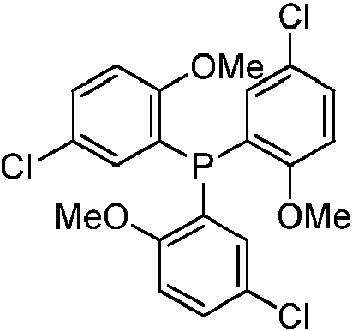
Utilizando una caja de guantes, disolver 0,0147 gramos (g) (0,0000483 moles) de acetilacetonato de paladio [(Pd(acac)2], 0,0440 g (0,0000966 mol) de ligando, 0,134 g (0,00096 mol) de MOD-1 y 0,25 ml de una solución madre de ácido acético (AcOH) en metanol (0,1932 M) en aproximadamente 24,75 ml de metanol hasta un volumen total de 25 ml y dejar la solución madre de precatalizador resultante en agitación a temperatura ambiente (nominalmente 25 °C) durante al menos tres días antes de su uso. El ligando se representa esquemáticamente como:Using a glove box, dissolve 0.0147 grams (g) (0.0000483 mol) of palladium acetylacetonate [(Pd(acac) 2 ], 0.0440 g (0.0000966 mol) of ligand, 0.134 g (0 .00096 mol) of MOD-1 and 0.25 ml of a stock solution of acetic acid (AcOH) in methanol (0.1932 M) in approximately 24.75 ml of methanol to a total volume of 25 ml and leaving the solution precatalyst stock resulting in stirring at room temperature (nominally 25 °C) for at least three days before use. The ligand is represented schematically as:
Ejemplo comparativo (Ej. C.) A:Comparative example (Ex. C.) A:
Preparar una solución madre de precatalizador como en el Ej. 1, pero omitir el MOD-1. Ej. 2:Prepare a precatalyst stock solution as in Ex. 1, but omit MOD-1. Ex. 2:
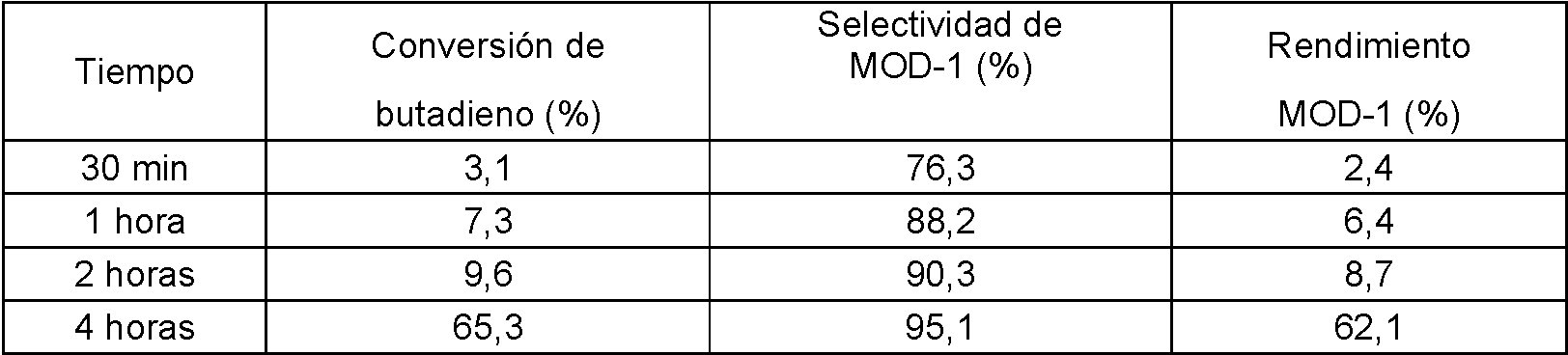
Llevar a cabo una reacción de telomerización a 40 °C utilizando la solución madre de precatalizador preparada en el Ej. 1. En la Tabla 1 a continuación se muestran los resultados analíticos.Carry out a telomerization reaction at 40 °C using the precatalyst stock solution prepared in Ex. 1. Table 1 below shows the analytical results.
Tabla 1Table 1

Ej. C. B: Ex. C. B:
Replicar el Ej. 2 pero con una alícuota de la solución madre de precatalizador preparada en el Ej. C. A. En la Tabla 2 a continuación se muestran los resultados analíticos.Replicate Ex. 2 but with an aliquot of the precatalyst stock solution prepared in Ex. C. A. Table 2 below shows the analytical results.
Tabla 2Table 2

Ej. C. C:Ex. C. C:
Replicar el Ej. 1 pero cambiar la cantidad de MOD-1 de 10 equivalentes a aproximadamente 1200 equivalentes por paladio y utilizar un equivalente molar de TCMPP por equivalente molar de Pd(acac)2.Replicate Ex. 1 but change the amount of MOD-1 from 10 equivalents to approximately 1200 equivalents per palladium and use one molar equivalent of TCMPP per molar equivalent of Pd(acac) 2 .
Ej. C. D: Replicar el Ej. 3, pero omitir el MOD-1. Ej. C. EEx. C. D: Reply Ex. 3, but omit MOD-1. Ex. C.E
Llevar a cabo una reacción de telomerización a 70 °C con una alícuota de la solución de precatalizador preparada en el Ej. C. C. En la Tabla 3 a continuación se muestran los resultados analíticos.Carry out a telomerization reaction at 70 °C with an aliquot of the precatalyst solution prepared in Ex. C. C. Table 3 below shows the analytical results.
Tabla 3Table 3

Ej. C. F:Ex. C. F:
Llevar a cabo una reacción de telomerización a 70 °C con una alícuota de la solución de precatalizador preparada en el Ej. C. D. En la siguiente Tabla 4 se muestran los resultados analíticos.Carry out a telomerization reaction at 70 °C with an aliquot of the precatalyst solution prepared in Ex. C. D. The following Table 4 shows the analytical results.
Tabla 4Table 4

Estos ejemplos comparativos se incluyen para demostrar las condiciones en las que la modificación con MOD-1 del precatalizador es ineficaz. En estos ejemplos, el precatalizador modificado con MOD-1 es menos eficaz y convierte menos butadieno que el contraejemplo no modificado. Es probable que exista una inhibición significativa de MOD-1 dentro de este régimen de más de 1000 equivalentes de MOD-1 a paladio.These comparative examples are included to demonstrate the conditions under which MOD-1 modification of the precatalyst is ineffective. In these examples, the MOD-1 modified precatalyst is less efficient and converts less butadiene than the unmodified counterexample. It is likely that there is significant inhibition of MOD-1 within this regimen of greater than 1000 MOD-1 equivalents to palladium.
Ej. 3:Ex. 3:
Replicar el Ej. 1, pero usar el ligando 1,3,5,7-tetrametil-6-fenil-2,4,8-trioxa-6-fosfaadamantano (TMPTPA) representado esquemáticamente a continuación en lugar de TCMPP. Replicate Ex. 1, but use the ligand 1,3,5,7-tetramethyl-6-phenyl-2,4,8-trioxa-6-phosphaadamantane (TMPTPA) shown schematically below instead of TCMPP.

Preparar dos soluciones madre de precatalizador a partir de esta solución:Prepare two precatalyst stock solutions from this solution:
Ej. 3.1:Ex. 3.1:
Para la primera solución madre de precatalizador, tomar 5 ml de la solución de 25 ml y añadir (0,0170 g, 0,000122 moles) de MOD-1 para obtener una solución madre de precatalizador.For the first precatalyst stock solution, take 5 ml of the 25 ml solution and add (0.0170 g, 0.000122 moles) of MOD-1 to obtain a precatalyst stock solution.
Ej. 3.2:Ex. 3.2:
Para la segunda solución madre de precatalizador, usar alícuotas de la solución madre del Ej. 3 tal como se prepararon. Ej. 4:For the second precatalyst stock solution, use aliquots of the stock solution from Ex. 3 as prepared. Ex. 4:
Llevar a cabo una reacción de telomerización a 40 °C utilizando una alícuota de la solución madre de precatalizador preparada en el Ej. 5.1. En la Tabla 5 a continuación se muestran los resultados analíticos.Carry out a telomerization reaction at 40 °C using an aliquot of the precatalyst stock solution prepared in Ex. 5.1. Table 5 below shows the analytical results.
Tabla 5Table 5

Ej. C. G:Ex. C. G:
Replicar el Ej. 4, pero usar una alícuota de la solución madre de precatalizador del Ej. 3.2. En la Tabla 6 a continuación se muestran los resultados analíticos.Reply Ex. 4, but use an aliquot of the precatalyst stock solution from Ex. 3.2. Table 6 below shows the analytical results.
Tabla 6Table 6

Ej. 5.Ex. 5.
Usar la solución madre de precatalizador del Ej. 3.1 pero cambiar el procedimiento general para incluir 1,0 ml de la solución madre de metóxido de sodio y 12 ml de metanol. Ejecutar la reacción de telomerización a 40 °C. En la Tabla 7 a continuación se muestran los resultados analíticos.Use the precatalyst stock solution from Ex. 3.1 but change the general procedure to include 1.0 mL of the sodium methoxide stock solution and 12 mL of methanol. Run the telomerization reaction at 40 °C. Table 7 below shows the analytical results.
Tabla 7Table 7


Ej. C. H:Ex. C. H:
Replicar el Ej. 5 pero usar la solución madre de precatalizador del Ej. 3.2. En la Tabla 8 a continuación se muestran los resultados analíticos.Replicate Ex. 5 but use the precatalyst stock solution from Ex. 3.2. Table 8 below shows the analytical results.
Tabla 8Table 8
Ej. 6:Ex. 6:
Replicar el Ej. 1, pero usar el ligando TMPTPA a la mitad de la concentración molar del ligando.Replicate Ex. 1, but use the TMPTPA ligand at half the molar concentration of the ligand.
Ej. C. I:Ex. C. I:
Replicar el Ej. 6 pero sin la adición de MOD-1.Replicate Ex. 6 but without the addition of MOD-1.
Ej. 7:Ex. 7:
Llevar a cabo una reacción de telomerización a 40 °C utilizando una alícuota de la solución madre de precatalizador del Ej. 6. En la Tabla 9 a continuación se muestran los resultados analíticos.Carry out a telomerization reaction at 40 °C using an aliquot of the precatalyst stock solution from Ex. 6. Table 9 below shows the analytical results.
Tabla 9Table 9

Ej. C. J:Ex. C.J:
Llevar a cabo una reacción de telomerización a 40 °C con una alícuota de la solución de precatalizador del Ej. C. I. En la siguiente Tabla 10 se muestran los resultados analíticos.Carry out a telomerization reaction at 40 °C with an aliquot of the precatalyst solution from Ex. C. I. The following Table 10 shows the analytical results.
Tabla 10Table 10

Ej. 8:Ex. 8:
Replicar el Ej. 1, pero cambiar el ligando a 1,3,5,7-tetrametil-6-(2-metoxifenil)-2,4,8-trioxa-6-fosfaadamantano (TMPTPA-OMe), representado esquemáticamente a continuación, cambiar la cantidad de equivalentes de MOD-1 a 10 y reducir los equivalentes molares de TMPTPA-OMe a la mitad (un equivalente por Pd): Replicate Ex. 1, but change the ligand to 1,3,5,7-tetramethyl-6-(2-methoxyphenyl)-2,4,8-trioxa-6-phosphaadamantane (TMPTPA-OMe), represented schematically below , change the number of MOD-1 equivalents to 10 and reduce the molar equivalents of TMPTPA-OMe by half (one equivalent per Pd):

Ej. C. K:Ex. C.K:
Replicar el Ej. 8, pero omitir el MOD-1.Replicate Ex. 8, but omit MOD-1.
Ej. 9:Ex. 9:
Llevar a cabo una reacción de telomerización a 40 °C con una alícuota de la solución de precatalizador preparada en el Ej. 8. En la Tabla 11 a continuación se muestran los resultados analíticos.Carry out a telomerization reaction at 40 °C with an aliquot of the precatalyst solution prepared in Ex. 8. Table 11 below shows the analytical results.
Tabla 11Table 11

Ej. C. L:Ex. C. L:
Llevar a cabo una reacción de telomerización a 40 °C con una alícuota de la solución de precatalizador preparada en el Ej. C. K. En la siguiente Tabla 12 se muestran los resultados analíticos.Carry out a telomerization reaction at 40 °C with an aliquot of the precatalyst solution prepared in Ex. C.K. The following Table 12 shows the analytical results.
Tabla 12Table 12

Ej. 10:Ex. 10:
Llevar a cabo una reacción de telomerización a 70 °C con una alícuota de la solución de precatalizador preparada en el Ej. 8. En la Tabla 13 a continuación se muestran los resultados analíticos.Carry out a telomerization reaction at 70 °C with an aliquot of the precatalyst solution prepared in Ex. 8. Table 13 below shows the analytical results.
Tabla 13Table 13

Ej. C. M:Ex. C. M:
Llevar a cabo una reacción de telomerización a 70 °C con una alícuota de la solución de precatalizador preparada en Ej. C. K. En la siguiente Tabla 14 se muestran los resultados analíticos.Carry out a telomerization reaction at 70 °C with an aliquot of the precatalyst solution prepared in Ex. C. K. The following Table 14 shows the analytical results.
Tabla 14Table 14


A partir de la revisión de los ejemplos y ejemplos comparativos anteriores, surgen varios puntos reseñables. En primer lugar, la adición de MOD-1 a metanol para crear una mezcla de disolventes da como resultado al menos una disminución sustancial en la duración y, en algunos casos, la eliminación de un período de inducción antes de que el precursor del catalizador esté listo para participar activamente en la telomerización. En segundo lugar, el uso de una mezcla de disolventes (metanol y MOD-1) en la preparación del precursor de catalizador de telomerización da como resultado un aumento en la conversión global de butadieno a una temperatura de reacción inferior a 70 °C en relación con la conversión obtenida con un precursor de catalizador de telomerización preparado en ausencia de MOD-1 (solo metanol) de al menos el 10 %. En tercer lugar, el precursor de catalizador de telomerización es estable porque no forma sólidos que precipitan de la solución en las condiciones establecidas en los ejemplos (Ej. 1-12), mientras que en las mismas condiciones, salvo por el uso de metanol en lugar de una mezcla de metanol y m OD-1, una cantidad visualmente perceptible de precursor de catalizador de telomerización precipita eficazmente de la solución. La estabilidad mejorada del precursor de catalizador de telomerización de la invención tiene un beneficio económico ya que se puede disminuir la cantidad de ligando usado en su preparación. From the review of the previous examples and comparative examples, several notable points emerge. First, the addition of MOD-1 to methanol to create a solvent mixture results in at least a substantial decrease in lifetime and, in some cases, the elimination of an induction period before the catalyst precursor is ready to actively participate in telomerization. Second, the use of a mixture of solvents (methanol and MOD-1) in the preparation of the telomerization catalyst precursor results in an increase in the overall conversion of butadiene at a reaction temperature below 70 °C relative to with the conversion obtained with a telomerization catalyst precursor prepared in the absence of MOD-1 (methanol only) of at least 10%. Third, the telomerization catalyst precursor is stable because it does not form solids that precipitate from solution under the conditions set forth in the examples (Ex. 1-12), while under the same conditions, except for the use of methanol in Instead of a mixture of methanol and m OD-1, a visually perceptible amount of telomerization catalyst precursor effectively precipitates from solution. The improved stability of the telomerization catalyst precursor of the invention has an economic benefit since the amount of ligand used in its preparation can be decreased.
Ej. 11: Preparación de catalizadores modificados con MOD-1Ex. 11: Preparation of catalysts modified with MOD-1
Usar un reactor de laboratorio de 1 galón para preparar la solución de precatalizador. Opere el reactor con una temperatura de punto de referencia de la camisa del reactor de 35 °C y una temperatura de punto de referencia del condensador de metanol de 5 °C. Cargar el reactor con 53,9 g de TCMPP y 17,9 g de Pd(acac)2 y después purgar el reactor con N2 a 0,5 scfh (14,2 litros/hora). Cargar el depósito de disolvente con 1480,5 g de metanol y rociar el depósito con N2. Transferir 419 g de metanol al reactor a 18 ml/min durante 30 min. Iniciar la agitación del contenido del reactor a 580 rpm. Transferir 838 g adicionales de metanol al reactor a 152 ml/min durante 7 min. Añadir solución acuosa de ácido acético (3,71 g de ácido acético 1,59 g de agua) al reactor con agitación continua. Añadir el metanol restante (223,5 g) al reactor a 151 ml/min durante 6 min, seguido de 493,5 g de MOD-1. Reducir la velocidad de purga del reactor de N2 a 0,15-0,25 scfh (4,3-7,1 litros/hora). La composición general del precatalizador se designa como: Relación molar de Pd/TCMPP/ácido acético de 1,00/2,01/1,04 y concentración de paladio del 0,31 % en peso. Dejar la solución de precatalizador en agitación a 35 °C durante 22 días a 580 rpm, tomando muestras de la solución de precatalizador los días 1, 8, 15 y 22 para evaluar la actividad de telomerización. La observación visual no muestra evidencia de precipitación de sólidos durante un período de 578 horas. Use a 1-gallon laboratory reactor to prepare the precatalyst solution. Operate the reactor with a reactor jacket set point temperature of 35 °C and a methanol condenser set point temperature of 5 °C. Charge the reactor with 53.9 g of TCMPP and 17.9 g of Pd(acac) 2 and then purge the reactor with N 2 at 0.5 scfh (14.2 liters/hour). Charge the solvent tank with 1480.5 g of methanol and spray the tank with N 2 . Transfer 419 g of methanol to the reactor at 18 ml/min for 30 min. Start stirring the reactor contents at 580 rpm. Transfer an additional 838 g of methanol to the reactor at 152 ml/min for 7 min. Add aqueous acetic acid solution (3.71 g acetic acid 1.59 g water) to the reactor with continuous stirring. Add the remaining methanol (223.5 g) to the reactor at 151 ml/min for 6 min, followed by 493.5 g of MOD-1. Reduce reactor purge rate from N 2 to 0.15-0.25 scfh (4.3-7.1 liters/hour). The general composition of the precatalyst is designated as: Pd/TCMPP/acetic acid molar ratio of 1.00/2.01/1.04 and palladium concentration of 0.31 wt%. Leave the precatalyst solution stirring at 35 °C for 22 days at 580 rpm, taking samples of the precatalyst solution on days 1, 8, 15 and 22 to evaluate telomerization activity. Visual observation shows no evidence of solids precipitation over a period of 578 hours.
Tomar muestras del contenido del reactor el día 1 usando jeringas herméticas a gases Pressure-lok™ y transferir las muestras a una caja de guantes mantenida a menos de 1 ppm de oxígeno. Determinar periódicamente la composición de dichas muestras por espectroscopía de P31 RMN (400 megahercios (MHz) a -40 °C durante un tiempo de adquisición de dos a cuatro horas, añadiendo aproximadamente un 10 % de D4-metanol como disolvente de bloqueo). Controlar la temperatura del contenido del reactor mediante un baño de disolvente calentado o mediante el acondicionador de aire de la caja de guantes. Realizar periódicamente mediciones de la temperatura durante la escala de tiempo de las reacciones para confirmar que la temperatura está controlada a ±1 °C. En algunos casos, añadir un patrón interno, óxido de trifenilfosfina, para poder determinar las concentraciones absolutas. Consultar la siguiente Tabla 15 para los datos de composición de P31 RMN.Sample reactor contents on day 1 using Pressure-lok™ gas-tight syringes and transfer samples to a glove box maintained at less than 1 ppm oxygen. Periodically determine the composition of these samples by P 31 NMR spectroscopy (400 megahertz (MHz) at -40 °C for an acquisition time of two to four hours, adding approximately 10% D 4 -methanol as a blocking solvent) . Control the temperature of the reactor contents using a heated solvent bath or using the glove box air conditioner. Periodically perform temperature measurements over the reaction time scale to confirm that the temperature is controlled to ±1°C. In some cases, add an internal standard, triphenylphosphine oxide, to determine absolute concentrations. Refer to the following Table 15 for P 31 NMR composition data.
Tabla 15Table 15

Este Ej. 11 (con adición de MOD-1) muestra que el precatalizador inicial se convierte en un catalizador modificado con MOD-1 durante unas 70 horas, después de lo cual no se producen más cambios significativos. No hay evidencia perceptible que muestre la formación de [Pd(TCMPP)2(CH2=C{(C=O)Me}2].This Ex. 11 (with addition of MOD-1) shows that the initial precatalyst is converted to a modified catalyst with MOD-1 for about 70 hours, after which no further significant changes occur. There is no discernible evidence showing the formation of [Pd(TCMPP) 2 (CH 2 =C{(C=O)Me} 2 ].
La siguiente Tabla 16 muestra la actividad del catalizador y la selectividad del catalizador modificado con MOD-1 en comparación con el rendimiento del catalizador de control que no se trató con MOD-1. Table 16 below shows the catalyst activity and selectivity of the MOD-1 modified catalyst compared to the performance of the control catalyst that was not treated with MOD-1.
Tabla 16Table 16
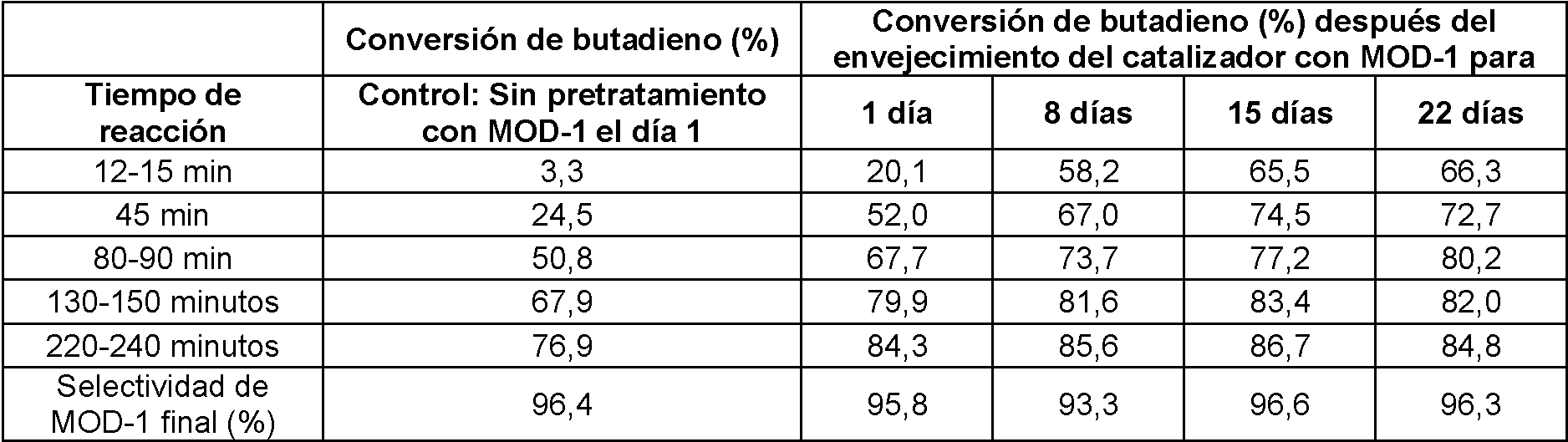
Estos datos muestran que el precatalizador se convierte en un nuevo complejo estable, [(ArnPR(3-n))x PdY], que muestra una actividad mejorada a 60 °C en la telomerización, con una disminución en el periodo de inducción. These data show that the precatalyst is converted to a new stable complex, [(Ar n PR (3-n) ) x PdY], which shows improved activity at 60 °C in telomerization, with a decrease in the induction period .
Ej. C. K-O: Precipitación de sólidos de soluciones de precatalizador no modificadasEx. C. K-O: Precipitation of solids from unmodified precatalyst solutions
Replicar el Ej. 11 con cambios en el complejo de paladio como se muestra en la Tabla 17 a continuación y eliminación de MOD-1. Un examen visual de las soluciones de catalizador muestra que los sólidos ([Pd(TCMPP)2(CH2=C{(C=O)Me}2) comienzan a precipitar de la solución a las 338 horas en el reactor de 1 galón a 20 °C con una concentración inicial de paladio de aproximadamente el 0,31 por ciento en peso. A una escala más pequeña en la caja de guantes y en condiciones similares, la precipitación de la solución comienza aproximadamente a las 310 horas (Ej. C. L). La siguiente Tabla 17 muestra los tiempos de precipitación del catalizador que no han sido modificados por la adición de MOD-1. Replicate Ex. 11 with changes to the palladium complex as shown in Table 17 below and removal of MOD-1. A visual examination of the catalyst solutions shows that solids ([Pd(TCMPP) 2 (CH 2 =C{(C=O)Me} 2 ) begin to precipitate from solution at 338 hours in the 1-gallon reactor at 20 °C with an initial palladium concentration of approximately 0.31 weight percent. On a smaller scale in the glove box and under similar conditions, precipitation of the solution begins at approximately 310 hours (e.g. C. L). The following Table 17 shows the precipitation times of the catalyst that have not been modified by the addition of MOD-1.
Tabla 17Table 17

El Ej. C. K-O muestra que, en ausencia de modificación con MOD-1, se produce la precipitación de sólidos, de modo que el precatalizador formado inicialmente se convierte en una especie nueva, en gran parte insoluble, [Pd(TCMPP)2(CH2=C{(C=O)Me}2]. Las especies insolubles pueden, a su vez, ensuciar el equipo de proceso.Ex. C. KO shows that, in the absence of modification with MOD-1, precipitation of solids occurs, so that the initially formed precatalyst is converted to a new, largely insoluble species, [Pd(TCMPP) 2 (CH 2 =C{(C=O)Me} 2 ]. Insoluble species can, in turn, foul process equipment.
Ej. C. P:Ex. C. P:
Añadir un 2 % en peso de [Pd(TCMPP)2(CH2=C{(C=O)Me}2 ] a una solución de precatalizador recién preparada y agitar durante media hora en una caja de guantes para permitir la disolución del sólido y lograr el equilibrio sólidolíquido. El análisis inmediato por P31 RMN muestra una concentración de complejo de paladio (0) en solución a temperatura ambiente (nominalmente 20 °C) del 0,08 % en peso.Add 2% by weight of [Pd(TCMPP) 2 (CH 2 =C{(C=O)Me} 2 ] to a freshly prepared precatalyst solution and stir for half an hour in a glove box to allow dissolution of the solid and achieve solid-liquid equilibrium. Immediate analysis by P31 NMR shows a concentration of palladium (0) complex in solution at room temperature (nominally 20 °C) of 0.08 wt%.
Ej. 12Ex. 12
En una caja de guantes, disolver el ácido acético glacial desgasificado (AcOH) (55,3 μl) en MeOH desgasificado hasta un volumen de 5 ml (AcOH 0,1932 M en MeOH) para formar una solución de AcOH. Disolver acetilacetonato de paladio (II) (Pd(acac)2) (0,0110 g, 0,0000362 moles), 2,3-(dihidrobenzofuran-7-il)difenilfosfina (DHBDPP, ilustrada a continuación) (0,0220 g, 0,0000724 moles) y 0,1875 ml de la solución de AcOH en 15,0 ml de MeOH y 3,6 ml de MOD-1 para formar una solución madre de precatalizador. Dejar la solución de precatalizador en agitación durante 6 días a 25 °C antes de usar. In a glove box, dissolve degassed glacial acetic acid (AcOH) (55.3 µL) in degassed MeOH to a volume of 5 mL (0.1932 M AcOH in MeOH) to form an AcOH solution. Dissolve palladium(II) acetylacetonate (Pd(acac) 2 ) (0.0110 g, 0.0000362 mol), 2,3-(dihydrobenzofuran-7-yl)diphenylphosphine (DHBDPP, illustrated below) (0.0220 g , 0.0000724 mol) and 0.1875 ml of the AcOH solution in 15.0 ml of MeOH and 3.6 ml of MOD-1 to form a precatalyst stock solution. Let the precatalyst solution stir for 6 days at 25°C before use.
Añadir dibutil éter (Bu2O, 5 ml), MeOH 12,8 M (10,96 ml), metilciclohexano desgasificado anhidro (MeCy, 1,6 ml), la solución madre de precatalizador (1 ml) y una porción de una solución de metóxido de sodio (NaOMe) (1,0 ml) en MeOH (0,01932 M) a una frasco Fisher-Porter. Sellar el frasco Fisher-Porter con una válvula equipada con una abertura de tabique.Add dibutyl ether (Bu 2 O, 5 mL), 12.8 M MeOH (10.96 mL), anhydrous degassed methylcyclohexane (MeCy, 1.6 mL), the precatalyst stock solution (1 mL), and a portion of a solution of sodium methoxide (NaOMe) (1.0 mL) in MeOH (0.01932 M) to a Fisher-Porter flask. Seal the Fisher-Porter bottle with a valve fitted with a septum opening.
Utilizar el Procedimiento Experimental General mencionado anteriormente, una temperatura de 40 °C, un tiempo de reacción de 4 horas y muestreo a los 30 minutos, 60 minutos, 120 minutos y 240 minutos seguido de análisis por GC para evaluar el rendimiento del precatalizador modificado con MOD-1. Consultar la siguiente Tabla 18 para obtener un resumen de dicho rendimiento.Use the General Experimental Procedure mentioned above, a temperature of 40 °C, a reaction time of 4 hours and sampling at 30 minutes, 60 minutes, 120 minutes and 240 minutes followed by analysis by GC to evaluate the performance of the MOD-1 modified precatalyst. See Table 18 below for a summary of that performance.

Ej. C. QEx. C. Q
Replicar el Ej. 12, pero eliminar la adición de MOD-1 y cambiar las cantidades de acetilacetonato de paladio (II) (Pd(acac)2) a 0,0980 g (0,00003217 mol), DHBDPP a 0,0196 g (0,00006441 mol) y solución de AcOH a 0,167 ml de AcOH en 16,5 ml de MeOH.Reply Ex. 12, but eliminate the addition of MOD-1 and change the amounts of palladium(II) acetylacetonate (Pd(acac) 2 ) to 0.0980 g (0.00003217 mol), DHBDPP to 0.0196 g (0.00006441 mol) and AcOH solution to 0.167 ml of AcOH in 16.5 ml of MeOH.
Ej. 13:Ex. 13:
Replicar el Ej. 12, pero cambiar la temperatura del baño de aceite a 60 °C.Reply Ex. 12, but change the temperature of the oil bath to 60 °C.
Ej. C. R:Ex. C. R:
Replicar el Ej. C. Q, pero cambiar la temperatura del baño de aceite a 60 °C.Replicate Ex. C. Q, but change the temperature of the oil bath to 60 °C.
Ej. 14:Ex. 14:
Replicar el Ej. 12, pero con los siguientes cambios: al preparar la solución de precatalizador, usar las siguientes cantidades: 0,0147 g (0,0000483 mol) de Pd(acac)2 , 0,250 ml de solución madre de AcOH, 20 ml de MeOH y 4,75 ml de MOD-1; sustituir trifenilfosfina (TPP, mostrada esquemáticamente a continuación) (0,0253 g, 0,0000965 moles) por DHBDPP; permitir que el precatalizador envejezca durante 7 días antes de usarlo; y, al cargar el frasco Fisher-Porter, usar 0,5 ml de una solución de metóxido de sodio en MeOH (0,01932 M) y 11,46 ml de MeOH.Reply Ex. 12, but with the following changes: when preparing the precatalyst solution, use the following quantities: 0.0147 g (0.0000483 mol) of Pd(acac) 2 , 0.250 ml of AcOH stock solution, 20 ml of MeOH and 4.75 ml of MOD-1; replace triphenylphosphine (TPP, shown schematically below) (0.0253 g, 0.0000965 mol) with DHBDPP; allow the precatalyst to age for 7 days before using it; and, when loading the Fisher-Porter bottle, use 0.5 ml of a solution of sodium methoxide in MeOH (0.01932 M) and 11.46 ml of MeOH.

Ej. C. S:Ex. C. S:
Replicar el Ej. 1, pero con los siguientes cambios: al preparar la solución de precatalizador, usar las siguientes cantidades: 0,0147 g (0,0000483 moles) de Pd(acac)2 , 0,250 ml de solución madre de AcOH y 24,75 ml de MeOH. Sustituir TPP (0,0253 g, 0,0000965 moles) por DHBDPP. Al cargar el frasco Fisher-Porter, usar 0,5 ml de una solución de metóxido de sodio en MeOH (0,01932 M) y 11,46 ml de MeOH.Replicate Ex. 1, but with the following changes: when preparing the precatalyst solution, use the following quantities: 0.0147 g (0.0000483 moles) of Pd(acac) 2 , 0.250 ml of AcOH stock solution and 24 .75 ml of MeOH. Replace TPP (0.0253 g, 0.0000965 mol) with DHBDPP. When loading the Fisher-Porter flask, use 0.5 ml of a solution of sodium methoxide in MeOH (0.01932 M) and 11.46 ml of MeOH.
Ej. 15:Ex. 15:
Replicar el Ej. 14, pero calentar el baño de aceite a 60 °C.Reply Ex. 14, but heat the oil bath to 60 °C.
Ej. C. T:Ex. C. T:
Replicar el Ej. C. S, pero calentar el baño de aceite a 60 °C.Replicate Ex. C. S, but heat the oil bath to 60 °C.
Tabla 18Table 18


Los datos de la Tabla 18 ilustran varios puntos. En primer lugar, la adición de MOD-1 a las soluciones de precatalizador de DHDDPP y TPP genera complejos catalíticamente competentes que dan como resultado una tasa inicial de conversión de butadieno mucho más rápida que las soluciones de precatalizador que no contienen MOD-1 (comparar los puntos temporales a los 30 min para todos los ejemplos de la Tabla 18). En segundo lugar, la adición de MOD-1 a las soluciones de precatalizador de DHDDPP y TPP da como resultado una mayor conversión general en productos después del tiempo de reacción de 4 horas. En tercer lugar, la modificación MOD-1 del precatalizador no afecta a la selectividad del proceso. Por lo tanto, la modificación de las soluciones de precatalizador de DHDDPP y TPP con MOD-1 finalmente da como resultado un mayor rendimiento del producto deseado para todos los casos demostrados. The data in Table 18 illustrates several points. First, the addition of MOD-1 to the DHDDPP and TPP precatalyst solutions generates catalytically competent complexes that result in a much faster initial rate of butadiene conversion than precatalyst solutions containing no MOD-1 (compare time points at 30 min for all examples in Table 18). Second, the addition of MOD-1 to the DHDDPP and TPP precatalyst solutions results in an overall higher conversion to products after the 4-h reaction time. Third, the MOD-1 modification of the precatalyst does not affect the selectivity of the process. Therefore, modification of the DHDDPP and TPP precatalyst solutions with MOD-1 ultimately results in higher yield of the desired product for all demonstrated cases.
Claims (11)

Applications Claiming Priority (1)
| Application Number | Priority Date | Filing Date | Title |
|---|---|---|---|
| US201361915781P | 2013-12-13 | 2013-12-13 |
Publications (1)
| Publication Number | Publication Date |
|---|---|
| ES2953829T3 true ES2953829T3 (en) | 2023-11-16 |
Family
ID=52347391
Family Applications (2)
| Application Number | Title | Priority Date | Filing Date |
|---|---|---|---|
| ES14827296T Active ES2836348T3 (en) | 2013-12-13 | 2014-12-04 | Preparation of a Butadiene Telomerization Catalyst Precursor |
| ES20184969T Active ES2953829T3 (en) | 2013-12-13 | 2014-12-04 | Preparation of Butadiene Telomerization Catalyst Precursor |
Family Applications Before (1)
| Application Number | Title | Priority Date | Filing Date |
|---|---|---|---|
| ES14827296T Active ES2836348T3 (en) | 2013-12-13 | 2014-12-04 | Preparation of a Butadiene Telomerization Catalyst Precursor |
Country Status (7)
| Country | Link |
|---|---|
| US (2) | US10569262B2 (en) |
| EP (2) | EP3741769B1 (en) |
| CN (1) | CN105813743B (en) |
| BR (1) | BR112016013233B1 (en) |
| CA (2) | CA3133814C (en) |
| ES (2) | ES2836348T3 (en) |
| WO (1) | WO2015088867A2 (en) |
Families Citing this family (3)
| Publication number | Priority date | Publication date | Assignee | Title |
|---|---|---|---|---|
| BR112016013233B1 (en) | 2013-12-13 | 2021-05-04 | Dow Global Technologies Llc | process for telomerization of butadiene |
| ES2736109T3 (en) | 2015-04-10 | 2019-12-26 | Dow Global Technologies Llc | Butadiene telomerization catalyst and preparation thereof |
| CN119912320B (en) * | 2025-01-23 | 2025-09-26 | 东华大学 | A method for preparing 1-methoxy-2,7-octadiene |
Family Cites Families (7)
| Publication number | Priority date | Publication date | Assignee | Title |
|---|---|---|---|---|
| AU7919182A (en) * | 1981-01-19 | 1982-07-29 | Goodyear Aerospace Corp. | Parking brake |
| IT1240737B (en) | 1990-04-02 | 1993-12-17 | Snam Progetti | CATALYTIC SYSTEM AND PROCEDURE FOR THE SELECTIVE PRODUCTION OF ISOPRENYL-ALCHYLETERS FROM ISOPRENE |
| JPH06506189A (en) * | 1990-12-13 | 1994-07-14 | ザ・ダウ・ケミカル・カンパニー | 1-octene production method |
| US8558030B2 (en) * | 2008-08-12 | 2013-10-15 | Dow Global Technologies Llc | Process for telomerization of butadiene |
| US9174905B2 (en) | 2010-12-21 | 2015-11-03 | Dow Global Technologies Llc | Process for telomerization of butadiene using a mono-orthoalkoxy substituted catalyst |
| BR112016013233B1 (en) | 2013-12-13 | 2021-05-04 | Dow Global Technologies Llc | process for telomerization of butadiene |
| ES2736109T3 (en) | 2015-04-10 | 2019-12-26 | Dow Global Technologies Llc | Butadiene telomerization catalyst and preparation thereof |
-
2014
- 2014-12-04 BR BR112016013233-5A patent/BR112016013233B1/en active IP Right Grant
- 2014-12-04 ES ES14827296T patent/ES2836348T3/en active Active
- 2014-12-04 CN CN201480066623.7A patent/CN105813743B/en active Active
- 2014-12-04 US US15/030,625 patent/US10569262B2/en active Active
- 2014-12-04 EP EP20184969.2A patent/EP3741769B1/en active Active
- 2014-12-04 CA CA3133814A patent/CA3133814C/en active Active
- 2014-12-04 EP EP14827296.6A patent/EP3080136B1/en active Active
- 2014-12-04 ES ES20184969T patent/ES2953829T3/en active Active
- 2014-12-04 WO PCT/US2014/068483 patent/WO2015088867A2/en not_active Ceased
- 2014-12-04 CA CA2933342A patent/CA2933342C/en active Active
-
2020
- 2020-01-14 US US16/741,987 patent/US10751706B2/en active Active
Also Published As
| Publication number | Publication date |
|---|---|
| CA3133814C (en) | 2024-05-21 |
| EP3080136A2 (en) | 2016-10-19 |
| BR112016013233B1 (en) | 2021-05-04 |
| BR112016013233A2 (en) | 2017-08-08 |
| CA3133814A1 (en) | 2015-06-18 |
| US20160271601A1 (en) | 2016-09-22 |
| CA2933342C (en) | 2021-11-09 |
| WO2015088867A2 (en) | 2015-06-18 |
| US20200147596A1 (en) | 2020-05-14 |
| WO2015088867A3 (en) | 2015-11-12 |
| EP3741769B1 (en) | 2023-06-28 |
| CA2933342A1 (en) | 2015-06-18 |
| US10569262B2 (en) | 2020-02-25 |
| ES2836348T3 (en) | 2021-06-24 |
| CN105813743B (en) | 2019-06-21 |
| EP3080136B1 (en) | 2020-10-28 |
| CN105813743A (en) | 2016-07-27 |
| US10751706B2 (en) | 2020-08-25 |
| EP3741769A1 (en) | 2020-11-25 |
Similar Documents
| Publication | Publication Date | Title |
|---|---|---|
| US4142060A (en) | Telomerization process using sulfonated triarylphosphine and transition metal | |
| Cui et al. | Redox-induced umpolung of transition metal carbenes | |
| KR960007387B1 (en) | Carbonylation Method of Acetylene Unsaturated Compound and Organic Phosphine | |
| JPS63190844A (en) | Hydroformylation using low volatility phosphine ligands | |
| US11713286B2 (en) | Butadiene telomerization catalyst preparation and use thereof | |
| US10751706B2 (en) | Butadiene telomerization catalyst precursor preparation | |
| BRPI0714196A2 (en) | Process for the production of substituted or unsubstituted 1,7-diolefins by hydrodimerization | |
| ES2420755T3 (en) | Phosphine-palladium complexes for telomerization of butadiene | |
| Holschumacher et al. | Dehydrogenation reactivity of a frustrated carbene–borane Lewis pair | |
| KR102435598B1 (en) | Method for preparing catalyst solution | |
| CN101909753B (en) | Phosphonite containing catalysts for hydroformylation processes | |
| Kuimov et al. | Reaction of 1-bromonaphthalene with PH3 in the t-BuOK/DMSO system: PCl3-free synthesis of di (1-naphthyl) phosphine and its oxide | |
| US4219677A (en) | Telomerization process | |
| BR112020022065A2 (en) | catalyst composition comprising the combination of a monophosphine, a tetraphosphine ligand and a hydroformylation process using the same | |
| US6790985B2 (en) | Phosphonium salts and processes for production of and uses for the same, and phosphines deriving the same and processes for production of the phosphines | |
| JP3949480B2 (en) | Sulfonic acid amine salt and process for producing the same | |
| EP3307748B1 (en) | Frustrated lewis pairs |