ES2954761T3 - Non-pigmented dispersant composition - Google Patents
Non-pigmented dispersant composition Download PDFInfo
- Publication number
- ES2954761T3 ES2954761T3 ES20719647T ES20719647T ES2954761T3 ES 2954761 T3 ES2954761 T3 ES 2954761T3 ES 20719647 T ES20719647 T ES 20719647T ES 20719647 T ES20719647 T ES 20719647T ES 2954761 T3 ES2954761 T3 ES 2954761T3
- Authority
- ES
- Spain
- Prior art keywords
- block
- composition
- groups
- polymer
- composition according
- Prior art date
- Legal status (The legal status is an assumption and is not a legal conclusion. Google has not performed a legal analysis and makes no representation as to the accuracy of the status listed.)
- Active
Links
- 239000000203 mixture Substances 0.000 title claims abstract description 80
- 239000002270 dispersing agent Substances 0.000 title claims description 19
- 229920000642 polymer Polymers 0.000 claims abstract description 62
- 229920001400 block copolymer Polymers 0.000 claims abstract description 42
- 125000004432 carbon atom Chemical group C* 0.000 claims abstract description 16
- 125000001033 ether group Chemical group 0.000 claims abstract description 9
- 125000000962 organic group Chemical group 0.000 claims abstract description 7
- 125000001183 hydrocarbyl group Chemical group 0.000 claims abstract description 4
- 229910052760 oxygen Inorganic materials 0.000 claims abstract description 4
- 125000004122 cyclic group Chemical group 0.000 claims abstract description 3
- 239000002253 acid Substances 0.000 claims description 28
- 238000000034 method Methods 0.000 claims description 25
- 239000000049 pigment Substances 0.000 claims description 21
- 239000000975 dye Substances 0.000 claims description 12
- 238000004519 manufacturing process Methods 0.000 claims description 9
- 229910052698 phosphorus Inorganic materials 0.000 claims description 7
- 239000011574 phosphorus Substances 0.000 claims description 7
- 125000004185 ester group Chemical group 0.000 claims description 5
- 150000003839 salts Chemical class 0.000 claims description 5
- OAICVXFJPJFONN-UHFFFAOYSA-N Phosphorus Chemical compound [P] OAICVXFJPJFONN-UHFFFAOYSA-N 0.000 claims description 3
- 125000002843 carboxylic acid group Chemical group 0.000 claims description 3
- 239000008199 coating composition Substances 0.000 claims description 3
- 239000011256 inorganic filler Substances 0.000 claims description 3
- 229910003475 inorganic filler Inorganic materials 0.000 claims description 3
- 125000000542 sulfonic acid group Chemical group 0.000 claims description 3
- 230000002378 acidificating effect Effects 0.000 abstract description 26
- 239000006185 dispersion Substances 0.000 description 55
- NIXOWILDQLNWCW-UHFFFAOYSA-M Acrylate Chemical compound [O-]C(=O)C=C NIXOWILDQLNWCW-UHFFFAOYSA-M 0.000 description 43
- KWYUFKZDYYNOTN-UHFFFAOYSA-M Potassium hydroxide Chemical compound [OH-].[K+] KWYUFKZDYYNOTN-UHFFFAOYSA-M 0.000 description 39
- 238000006243 chemical reaction Methods 0.000 description 39
- -1 phosphate ester Chemical class 0.000 description 39
- 239000000178 monomer Substances 0.000 description 32
- 238000000576 coating method Methods 0.000 description 25
- 230000015572 biosynthetic process Effects 0.000 description 24
- 239000002245 particle Substances 0.000 description 24
- 239000011248 coating agent Substances 0.000 description 23
- 238000003786 synthesis reaction Methods 0.000 description 20
- 150000001412 amines Chemical class 0.000 description 19
- XLYOFNOQVPJJNP-UHFFFAOYSA-N water Substances O XLYOFNOQVPJJNP-UHFFFAOYSA-N 0.000 description 17
- 229920000359 diblock copolymer Polymers 0.000 description 16
- 239000000976 ink Substances 0.000 description 15
- 239000011521 glass Substances 0.000 description 14
- 238000006386 neutralization reaction Methods 0.000 description 14
- 239000000047 product Substances 0.000 description 14
- MCMNRKCIXSYSNV-UHFFFAOYSA-N Zirconium dioxide Chemical compound O=[Zr]=O MCMNRKCIXSYSNV-UHFFFAOYSA-N 0.000 description 12
- 239000002904 solvent Substances 0.000 description 12
- 238000004140 cleaning Methods 0.000 description 11
- 239000006229 carbon black Substances 0.000 description 10
- 238000005956 quaternization reaction Methods 0.000 description 10
- 229920005989 resin Polymers 0.000 description 10
- 239000011347 resin Substances 0.000 description 10
- 239000000243 solution Substances 0.000 description 10
- 238000004448 titration Methods 0.000 description 10
- QTBSBXVTEAMEQO-UHFFFAOYSA-N Acetic acid Chemical compound CC(O)=O QTBSBXVTEAMEQO-UHFFFAOYSA-N 0.000 description 9
- NBIIXXVUZAFLBC-UHFFFAOYSA-N Phosphoric acid Chemical compound OP(O)(O)=O NBIIXXVUZAFLBC-UHFFFAOYSA-N 0.000 description 8
- 238000011161 development Methods 0.000 description 8
- JQVDAXLFBXTEQA-UHFFFAOYSA-N dibutylamine Chemical compound CCCCNCCCC JQVDAXLFBXTEQA-UHFFFAOYSA-N 0.000 description 8
- 239000004721 Polyphenylene oxide Substances 0.000 description 7
- 229920000570 polyether Polymers 0.000 description 7
- 125000001302 tertiary amino group Chemical group 0.000 description 7
- 238000009736 wetting Methods 0.000 description 7
- 125000000217 alkyl group Chemical group 0.000 description 6
- 239000011324 bead Substances 0.000 description 6
- WPYMKLBDIGXBTP-UHFFFAOYSA-N benzoic acid Chemical compound OC(=O)C1=CC=CC=C1 WPYMKLBDIGXBTP-UHFFFAOYSA-N 0.000 description 6
- 239000003795 chemical substances by application Substances 0.000 description 6
- 239000003999 initiator Substances 0.000 description 6
- 238000003860 storage Methods 0.000 description 6
- 229920000428 triblock copolymer Polymers 0.000 description 6
- SOGAXMICEFXMKE-UHFFFAOYSA-N Butylmethacrylate Chemical compound CCCCOC(=O)C(C)=C SOGAXMICEFXMKE-UHFFFAOYSA-N 0.000 description 5
- LYCAIKOWRPUZTN-UHFFFAOYSA-N Ethylene glycol Chemical compound OCCO LYCAIKOWRPUZTN-UHFFFAOYSA-N 0.000 description 5
- 239000003054 catalyst Substances 0.000 description 5
- 239000012141 concentrate Substances 0.000 description 5
- 229920001002 functional polymer Polymers 0.000 description 5
- JVTAAEKCZFNVCJ-UHFFFAOYSA-N lactic acid Chemical compound CC(O)C(O)=O JVTAAEKCZFNVCJ-UHFFFAOYSA-N 0.000 description 5
- 238000002156 mixing Methods 0.000 description 5
- 229920000728 polyester Polymers 0.000 description 5
- 238000006116 polymerization reaction Methods 0.000 description 5
- 229920005604 random copolymer Polymers 0.000 description 5
- 239000007787 solid Substances 0.000 description 5
- 239000000126 substance Substances 0.000 description 5
- AVTLBBWTUPQRAY-UHFFFAOYSA-N 2-(2-cyanobutan-2-yldiazenyl)-2-methylbutanenitrile Chemical compound CCC(C)(C#N)N=NC(C)(CC)C#N AVTLBBWTUPQRAY-UHFFFAOYSA-N 0.000 description 4
- JKNCOURZONDCGV-UHFFFAOYSA-N 2-(dimethylamino)ethyl 2-methylprop-2-enoate Chemical compound CN(C)CCOC(=O)C(C)=C JKNCOURZONDCGV-UHFFFAOYSA-N 0.000 description 4
- WBIQQQGBSDOWNP-UHFFFAOYSA-N 2-dodecylbenzenesulfonic acid Chemical compound CCCCCCCCCCCCC1=CC=CC=C1S(O)(=O)=O WBIQQQGBSDOWNP-UHFFFAOYSA-N 0.000 description 4
- OZJPLYNZGCXSJM-UHFFFAOYSA-N 5-valerolactone Chemical compound O=C1CCCCO1 OZJPLYNZGCXSJM-UHFFFAOYSA-N 0.000 description 4
- 241000557626 Corvus corax Species 0.000 description 4
- IAYPIBMASNFSPL-UHFFFAOYSA-N Ethylene oxide Chemical compound C1CO1 IAYPIBMASNFSPL-UHFFFAOYSA-N 0.000 description 4
- CERQOIWHTDAKMF-UHFFFAOYSA-M Methacrylate Chemical compound CC(=C)C([O-])=O CERQOIWHTDAKMF-UHFFFAOYSA-M 0.000 description 4
- WYURNTSHIVDZCO-UHFFFAOYSA-N Tetrahydrofuran Chemical compound C1CCOC1 WYURNTSHIVDZCO-UHFFFAOYSA-N 0.000 description 4
- NIXOWILDQLNWCW-UHFFFAOYSA-N acrylic acid group Chemical group C(C=C)(=O)O NIXOWILDQLNWCW-UHFFFAOYSA-N 0.000 description 4
- 229910000147 aluminium phosphate Inorganic materials 0.000 description 4
- KCXMKQUNVWSEMD-UHFFFAOYSA-N benzyl chloride Chemical compound ClCC1=CC=CC=C1 KCXMKQUNVWSEMD-UHFFFAOYSA-N 0.000 description 4
- 229940073608 benzyl chloride Drugs 0.000 description 4
- GYZLOYUZLJXAJU-UHFFFAOYSA-N diglycidyl ether Chemical class C1OC1COCC1CO1 GYZLOYUZLJXAJU-UHFFFAOYSA-N 0.000 description 4
- 229940060296 dodecylbenzenesulfonic acid Drugs 0.000 description 4
- 150000002170 ethers Chemical class 0.000 description 4
- 150000002921 oxetanes Chemical class 0.000 description 4
- 229920001223 polyethylene glycol Polymers 0.000 description 4
- 125000002924 primary amino group Chemical group [H]N([H])* 0.000 description 4
- LLHKCFNBLRBOGN-UHFFFAOYSA-N propylene glycol methyl ether acetate Chemical compound COCC(C)OC(C)=O LLHKCFNBLRBOGN-UHFFFAOYSA-N 0.000 description 4
- 230000035484 reaction time Effects 0.000 description 4
- 150000003335 secondary amines Chemical class 0.000 description 4
- 125000001424 substituent group Chemical group 0.000 description 4
- 239000000080 wetting agent Substances 0.000 description 4
- ARXJGSRGQADJSQ-UHFFFAOYSA-N 1-methoxypropan-2-ol Chemical compound COCC(C)O ARXJGSRGQADJSQ-UHFFFAOYSA-N 0.000 description 3
- OAYXUHPQHDHDDZ-UHFFFAOYSA-N 2-(2-butoxyethoxy)ethanol Chemical compound CCCCOCCOCCO OAYXUHPQHDHDDZ-UHFFFAOYSA-N 0.000 description 3
- FALRKNHUBBKYCC-UHFFFAOYSA-N 2-(chloromethyl)pyridine-3-carbonitrile Chemical compound ClCC1=NC=CC=C1C#N FALRKNHUBBKYCC-UHFFFAOYSA-N 0.000 description 3
- WEVYAHXRMPXWCK-UHFFFAOYSA-N Acetonitrile Chemical compound CC#N WEVYAHXRMPXWCK-UHFFFAOYSA-N 0.000 description 3
- 102100040409 Ameloblastin Human genes 0.000 description 3
- 239000005711 Benzoic acid Substances 0.000 description 3
- OKTJSMMVPCPJKN-UHFFFAOYSA-N Carbon Chemical compound [C] OKTJSMMVPCPJKN-UHFFFAOYSA-N 0.000 description 3
- LFQSCWFLJHTTHZ-UHFFFAOYSA-N Ethanol Chemical compound CCO LFQSCWFLJHTTHZ-UHFFFAOYSA-N 0.000 description 3
- 101000891247 Homo sapiens Ameloblastin Proteins 0.000 description 3
- HVVWZTWDBSEWIH-UHFFFAOYSA-N [2-(hydroxymethyl)-3-prop-2-enoyloxy-2-(prop-2-enoyloxymethyl)propyl] prop-2-enoate Chemical compound C=CC(=O)OCC(CO)(COC(=O)C=C)COC(=O)C=C HVVWZTWDBSEWIH-UHFFFAOYSA-N 0.000 description 3
- 235000011054 acetic acid Nutrition 0.000 description 3
- 150000007513 acids Chemical class 0.000 description 3
- 239000000654 additive Substances 0.000 description 3
- 125000003710 aryl alkyl group Chemical group 0.000 description 3
- 125000003118 aryl group Chemical group 0.000 description 3
- 235000010233 benzoic acid Nutrition 0.000 description 3
- 229910052799 carbon Inorganic materials 0.000 description 3
- 150000001732 carboxylic acid derivatives Chemical class 0.000 description 3
- 239000003086 colorant Substances 0.000 description 3
- 150000004292 cyclic ethers Chemical group 0.000 description 3
- 150000005690 diesters Chemical class 0.000 description 3
- 150000002118 epoxides Chemical class 0.000 description 3
- 125000001495 ethyl group Chemical group [H]C([H])([H])C([H])([H])* 0.000 description 3
- 238000005227 gel permeation chromatography Methods 0.000 description 3
- VOZRXNHHFUQHIL-UHFFFAOYSA-N glycidyl methacrylate Chemical compound CC(=C)C(=O)OCC1CO1 VOZRXNHHFUQHIL-UHFFFAOYSA-N 0.000 description 3
- 150000002596 lactones Chemical class 0.000 description 3
- 238000005259 measurement Methods 0.000 description 3
- 125000002496 methyl group Chemical group [H]C([H])([H])* 0.000 description 3
- 238000007151 ring opening polymerisation reaction Methods 0.000 description 3
- 229940014800 succinic anhydride Drugs 0.000 description 3
- 239000003643 water by type Substances 0.000 description 3
- UHFFVFAKEGKNAQ-UHFFFAOYSA-N 2-benzyl-2-(dimethylamino)-1-(4-morpholin-4-ylphenyl)butan-1-one Chemical compound C=1C=C(N2CCOCC2)C=CC=1C(=O)C(CC)(N(C)C)CC1=CC=CC=C1 UHFFVFAKEGKNAQ-UHFFFAOYSA-N 0.000 description 2
- VJJZJBUCDWKPLC-UHFFFAOYSA-N 3-methoxyapigenin Chemical compound O1C2=CC(O)=CC(O)=C2C(=O)C(OC)=C1C1=CC=C(O)C=C1 VJJZJBUCDWKPLC-UHFFFAOYSA-N 0.000 description 2
- DKPFZGUDAPQIHT-UHFFFAOYSA-N Butyl acetate Natural products CCCCOC(C)=O DKPFZGUDAPQIHT-UHFFFAOYSA-N 0.000 description 2
- CERQOIWHTDAKMF-UHFFFAOYSA-N Methacrylic acid Chemical class CC(=C)C(O)=O CERQOIWHTDAKMF-UHFFFAOYSA-N 0.000 description 2
- VVQNEPGJFQJSBK-UHFFFAOYSA-N Methyl methacrylate Chemical compound COC(=O)C(C)=C VVQNEPGJFQJSBK-UHFFFAOYSA-N 0.000 description 2
- 229910019142 PO4 Inorganic materials 0.000 description 2
- 239000002202 Polyethylene glycol Substances 0.000 description 2
- 239000004793 Polystyrene Substances 0.000 description 2
- RAHZWNYVWXNFOC-UHFFFAOYSA-N Sulphur dioxide Chemical compound O=S=O RAHZWNYVWXNFOC-UHFFFAOYSA-N 0.000 description 2
- IAXXETNIOYFMLW-COPLHBTASA-N [(1s,3s,4s)-4,7,7-trimethyl-3-bicyclo[2.2.1]heptanyl] 2-methylprop-2-enoate Chemical compound C1C[C@]2(C)[C@@H](OC(=O)C(=C)C)C[C@H]1C2(C)C IAXXETNIOYFMLW-COPLHBTASA-N 0.000 description 2
- 150000003926 acrylamides Chemical class 0.000 description 2
- 230000000996 additive effect Effects 0.000 description 2
- 150000001298 alcohols Chemical class 0.000 description 2
- 239000003513 alkali Substances 0.000 description 2
- 150000001350 alkyl halides Chemical class 0.000 description 2
- 125000003277 amino group Chemical group 0.000 description 2
- 150000005840 aryl radicals Chemical class 0.000 description 2
- 238000005452 bending Methods 0.000 description 2
- AOJOEFVRHOZDFN-UHFFFAOYSA-N benzyl 2-methylprop-2-enoate Chemical compound CC(=C)C(=O)OCC1=CC=CC=C1 AOJOEFVRHOZDFN-UHFFFAOYSA-N 0.000 description 2
- 125000001797 benzyl group Chemical group [H]C1=C([H])C([H])=C(C([H])=C1[H])C([H])([H])* 0.000 description 2
- 239000011230 binding agent Substances 0.000 description 2
- 150000001735 carboxylic acids Chemical class 0.000 description 2
- NEHMKBQYUWJMIP-UHFFFAOYSA-N chloromethane Chemical compound ClC NEHMKBQYUWJMIP-UHFFFAOYSA-N 0.000 description 2
- 238000004040 coloring Methods 0.000 description 2
- 150000001875 compounds Chemical class 0.000 description 2
- 229920001577 copolymer Polymers 0.000 description 2
- 150000003972 cyclic carboxylic anhydrides Chemical class 0.000 description 2
- YWEUIGNSBFLMFL-UHFFFAOYSA-N diphosphonate Chemical compound O=P(=O)OP(=O)=O YWEUIGNSBFLMFL-UHFFFAOYSA-N 0.000 description 2
- 238000009826 distribution Methods 0.000 description 2
- 239000003480 eluent Substances 0.000 description 2
- 150000002148 esters Chemical group 0.000 description 2
- FUZZWVXGSFPDMH-UHFFFAOYSA-N hexanoic acid Chemical compound CCCCCC(O)=O FUZZWVXGSFPDMH-UHFFFAOYSA-N 0.000 description 2
- 238000004128 high performance liquid chromatography Methods 0.000 description 2
- 150000002440 hydroxy compounds Chemical class 0.000 description 2
- 125000002887 hydroxy group Chemical group [H]O* 0.000 description 2
- 229940119545 isobornyl methacrylate Drugs 0.000 description 2
- 239000004310 lactic acid Substances 0.000 description 2
- 235000014655 lactic acid Nutrition 0.000 description 2
- FPYJFEHAWHCUMM-UHFFFAOYSA-N maleic anhydride Chemical compound O=C1OC(=O)C=C1 FPYJFEHAWHCUMM-UHFFFAOYSA-N 0.000 description 2
- 239000000463 material Substances 0.000 description 2
- FQPSGWSUVKBHSU-UHFFFAOYSA-N methacrylamide Chemical class CC(=C)C(N)=O FQPSGWSUVKBHSU-UHFFFAOYSA-N 0.000 description 2
- 125000005395 methacrylic acid group Chemical group 0.000 description 2
- 125000000956 methoxy group Chemical group [H]C([H])([H])O* 0.000 description 2
- 239000003960 organic solvent Substances 0.000 description 2
- 239000010452 phosphate Substances 0.000 description 2
- 150000003014 phosphoric acid esters Chemical class 0.000 description 2
- 150000003018 phosphorus compounds Chemical class 0.000 description 2
- DLYUQMMRRRQYAE-UHFFFAOYSA-N phosphorus pentoxide Inorganic materials O1P(O2)(=O)OP3(=O)OP1(=O)OP2(=O)O3 DLYUQMMRRRQYAE-UHFFFAOYSA-N 0.000 description 2
- XHXFXVLFKHQFAL-UHFFFAOYSA-N phosphoryl trichloride Chemical compound ClP(Cl)(Cl)=O XHXFXVLFKHQFAL-UHFFFAOYSA-N 0.000 description 2
- 229920001451 polypropylene glycol Polymers 0.000 description 2
- 229920002223 polystyrene Polymers 0.000 description 2
- 238000002360 preparation method Methods 0.000 description 2
- YLQBMQCUIZJEEH-UHFFFAOYSA-N tetrahydrofuran Natural products C=1C=COC=1 YLQBMQCUIZJEEH-UHFFFAOYSA-N 0.000 description 2
- 125000000026 trimethylsilyl group Chemical group [H]C([H])([H])[Si]([*])(C([H])([H])[H])C([H])([H])[H] 0.000 description 2
- DTGKSKDOIYIVQL-WEDXCCLWSA-N (+)-borneol Chemical group C1C[C@@]2(C)[C@@H](O)C[C@@H]1C2(C)C DTGKSKDOIYIVQL-WEDXCCLWSA-N 0.000 description 1
- JNOGVQJEBGEKMG-UHFFFAOYSA-N (1-methoxy-2-methylprop-1-enoxy)-trimethylsilane Chemical compound COC(=C(C)C)O[Si](C)(C)C JNOGVQJEBGEKMG-UHFFFAOYSA-N 0.000 description 1
- KFUSXMDYOPXKKT-VIFPVBQESA-N (2s)-2-[(2-methylphenoxy)methyl]oxirane Chemical compound CC1=CC=CC=C1OC[C@H]1OC1 KFUSXMDYOPXKKT-VIFPVBQESA-N 0.000 description 1
- AOUAMFARIYTDLK-UHFFFAOYSA-N (4-methylphenyl) 2-methylprop-2-enoate Chemical compound CC(=C)C(=O)OC1=CC=C(C)C=C1 AOUAMFARIYTDLK-UHFFFAOYSA-N 0.000 description 1
- GAWAYYRQGQZKCR-REOHCLBHSA-N (S)-2-chloropropanoic acid Chemical compound C[C@H](Cl)C(O)=O GAWAYYRQGQZKCR-REOHCLBHSA-N 0.000 description 1
- BBBUAWSVILPJLL-UHFFFAOYSA-N 2-(2-ethylhexoxymethyl)oxirane Chemical compound CCCCC(CC)COCC1CO1 BBBUAWSVILPJLL-UHFFFAOYSA-N 0.000 description 1
- JECYNCQXXKQDJN-UHFFFAOYSA-N 2-(2-methylhexan-2-yloxymethyl)oxirane Chemical compound CCCCC(C)(C)OCC1CO1 JECYNCQXXKQDJN-UHFFFAOYSA-N 0.000 description 1
- YOIZTLBZAMFVPK-UHFFFAOYSA-N 2-(3-ethoxy-4-hydroxyphenyl)-2-hydroxyacetic acid Chemical compound CCOC1=CC(C(O)C(O)=O)=CC=C1O YOIZTLBZAMFVPK-UHFFFAOYSA-N 0.000 description 1
- XNWFRZJHXBZDAG-UHFFFAOYSA-N 2-METHOXYETHANOL Chemical compound COCCO XNWFRZJHXBZDAG-UHFFFAOYSA-N 0.000 description 1
- CUFXMPWHOWYNSO-UHFFFAOYSA-N 2-[(4-methylphenoxy)methyl]oxirane Chemical compound C1=CC(C)=CC=C1OCC1OC1 CUFXMPWHOWYNSO-UHFFFAOYSA-N 0.000 description 1
- WFSMVVDJSNMRAR-UHFFFAOYSA-N 2-[2-(2-ethoxyethoxy)ethoxy]ethanol Chemical compound CCOCCOCCOCCO WFSMVVDJSNMRAR-UHFFFAOYSA-N 0.000 description 1
- RBFPEAGEJJSYCX-UHFFFAOYSA-N 2-[2-(2-ethoxyethoxy)ethoxy]ethyl 2-methylprop-2-enoate Chemical compound CCOCCOCCOCCOC(=O)C(C)=C RBFPEAGEJJSYCX-UHFFFAOYSA-N 0.000 description 1
- OBBZSGOPJQSCNY-UHFFFAOYSA-N 2-[2-(2-methoxyethoxy)ethoxy]ethyl 2-methylprop-2-enoate Chemical compound COCCOCCOCCOC(=O)C(C)=C OBBZSGOPJQSCNY-UHFFFAOYSA-N 0.000 description 1
- MWGATWIBSKHFMR-UHFFFAOYSA-N 2-anilinoethanol Chemical compound OCCNC1=CC=CC=C1 MWGATWIBSKHFMR-UHFFFAOYSA-N 0.000 description 1
- WDQMWEYDKDCEHT-UHFFFAOYSA-N 2-ethylhexyl 2-methylprop-2-enoate Chemical compound CCCCC(CC)COC(=O)C(C)=C WDQMWEYDKDCEHT-UHFFFAOYSA-N 0.000 description 1
- SEILKFZTLVMHRR-UHFFFAOYSA-N 2-phosphonooxyethyl 2-methylprop-2-enoate Chemical compound CC(=C)C(=O)OCCOP(O)(O)=O SEILKFZTLVMHRR-UHFFFAOYSA-N 0.000 description 1
- RXBOCDZLKBPILN-UHFFFAOYSA-N 2-propylheptyl prop-2-enoate Chemical compound CCCCCC(CCC)COC(=O)C=C RXBOCDZLKBPILN-UHFFFAOYSA-N 0.000 description 1
- ZSPOJBDHHFFJAP-UHFFFAOYSA-M 3-chlorobenzoate;tetrabutylazanium Chemical compound [O-]C(=O)C1=CC=CC(Cl)=C1.CCCC[N+](CCCC)(CCCC)CCCC ZSPOJBDHHFFJAP-UHFFFAOYSA-M 0.000 description 1
- ZVYGIPWYVVJFRW-UHFFFAOYSA-N 3-methylbutyl prop-2-enoate Chemical compound CC(C)CCOC(=O)C=C ZVYGIPWYVVJFRW-UHFFFAOYSA-N 0.000 description 1
- AYKYXWQEBUNJCN-UHFFFAOYSA-N 3-methylfuran-2,5-dione Chemical compound CC1=CC(=O)OC1=O AYKYXWQEBUNJCN-UHFFFAOYSA-N 0.000 description 1
- OFNISBHGPNMTMS-UHFFFAOYSA-N 3-methylideneoxolane-2,5-dione Chemical compound C=C1CC(=O)OC1=O OFNISBHGPNMTMS-UHFFFAOYSA-N 0.000 description 1
- VKALYYFVKBXHTF-UHFFFAOYSA-N 4-(methylsulfanyl)-m-cresol Chemical compound CSC1=CC=C(O)C=C1C VKALYYFVKBXHTF-UHFFFAOYSA-N 0.000 description 1
- IZSHZLKNFQAAKX-UHFFFAOYSA-N 5-cyclopenta-2,4-dien-1-ylcyclopenta-1,3-diene Chemical group C1=CC=CC1C1C=CC=C1 IZSHZLKNFQAAKX-UHFFFAOYSA-N 0.000 description 1
- SJIXRGNQPBQWMK-UHFFFAOYSA-N DEAEMA Natural products CCN(CC)CCOC(=O)C(C)=C SJIXRGNQPBQWMK-UHFFFAOYSA-N 0.000 description 1
- XBPCUCUWBYBCDP-UHFFFAOYSA-N Dicyclohexylamine Chemical compound C1CCCCC1NC1CCCCC1 XBPCUCUWBYBCDP-UHFFFAOYSA-N 0.000 description 1
- LCGLNKUTAGEVQW-UHFFFAOYSA-N Dimethyl ether Chemical compound COC LCGLNKUTAGEVQW-UHFFFAOYSA-N 0.000 description 1
- DGAQECJNVWCQMB-PUAWFVPOSA-M Ilexoside XXIX Chemical compound C[C@@H]1CC[C@@]2(CC[C@@]3(C(=CC[C@H]4[C@]3(CC[C@@H]5[C@@]4(CC[C@@H](C5(C)C)OS(=O)(=O)[O-])C)C)[C@@H]2[C@]1(C)O)C)C(=O)O[C@H]6[C@@H]([C@H]([C@@H]([C@H](O6)CO)O)O)O.[Na+] DGAQECJNVWCQMB-PUAWFVPOSA-M 0.000 description 1
- LGRFSURHDFAFJT-UHFFFAOYSA-N Phthalic anhydride Natural products C1=CC=C2C(=O)OC(=O)C2=C1 LGRFSURHDFAFJT-UHFFFAOYSA-N 0.000 description 1
- 229920003171 Poly (ethylene oxide) Polymers 0.000 description 1
- GOOHAUXETOMSMM-UHFFFAOYSA-N Propylene oxide Chemical compound CC1CO1 GOOHAUXETOMSMM-UHFFFAOYSA-N 0.000 description 1
- QAOWNCQODCNURD-UHFFFAOYSA-L Sulfate Chemical compound [O-]S([O-])(=O)=O QAOWNCQODCNURD-UHFFFAOYSA-L 0.000 description 1
- LIPOUNRJVLNBCD-UHFFFAOYSA-N acetyl dihydrogen phosphate Chemical compound CC(=O)OP(O)(O)=O LIPOUNRJVLNBCD-UHFFFAOYSA-N 0.000 description 1
- 125000005396 acrylic acid ester group Chemical group 0.000 description 1
- BAPJBEWLBFYGME-UHFFFAOYSA-N acrylic acid methyl ester Natural products COC(=O)C=C BAPJBEWLBFYGME-UHFFFAOYSA-N 0.000 description 1
- 150000005215 alkyl ethers Chemical class 0.000 description 1
- 125000002947 alkylene group Chemical group 0.000 description 1
- XAGFODPZIPBFFR-UHFFFAOYSA-N aluminium Chemical compound [Al] XAGFODPZIPBFFR-UHFFFAOYSA-N 0.000 description 1
- 229910052782 aluminium Inorganic materials 0.000 description 1
- 150000001413 amino acids Chemical class 0.000 description 1
- 150000001450 anions Chemical class 0.000 description 1
- 239000007864 aqueous solution Substances 0.000 description 1
- QVGXLLKOCUKJST-UHFFFAOYSA-N atomic oxygen Chemical compound [O] QVGXLLKOCUKJST-UHFFFAOYSA-N 0.000 description 1
- 239000002585 base Substances 0.000 description 1
- 125000002511 behenyl group Chemical group [H]C([*])([H])C([H])([H])C([H])([H])C([H])([H])C([H])([H])C([H])([H])C([H])([H])C([H])([H])C([H])([H])C([H])([H])C([H])([H])C([H])([H])C([H])([H])C([H])([H])C([H])([H])C([H])([H])C([H])([H])C([H])([H])C([H])([H])C([H])([H])C([H])([H])C([H])([H])[H] 0.000 description 1
- PASDCCFISLVPSO-UHFFFAOYSA-N benzoyl chloride Chemical compound ClC(=O)C1=CC=CC=C1 PASDCCFISLVPSO-UHFFFAOYSA-N 0.000 description 1
- JHIWVOJDXOSYLW-UHFFFAOYSA-N butyl 2,2-difluorocyclopropane-1-carboxylate Chemical compound CCCCOC(=O)C1CC1(F)F JHIWVOJDXOSYLW-UHFFFAOYSA-N 0.000 description 1
- 125000000484 butyl group Chemical group [H]C([*])([H])C([H])([H])C([H])([H])C([H])([H])[H] 0.000 description 1
- 239000007795 chemical reaction product Substances 0.000 description 1
- FOCAUTSVDIKZOP-UHFFFAOYSA-N chloroacetic acid Chemical compound OC(=O)CCl FOCAUTSVDIKZOP-UHFFFAOYSA-N 0.000 description 1
- 238000010276 construction Methods 0.000 description 1
- VVOLVFOSOPJKED-UHFFFAOYSA-N copper phthalocyanine Chemical compound [Cu].N=1C2=NC(C3=CC=CC=C33)=NC3=NC(C3=CC=CC=C33)=NC3=NC(C3=CC=CC=C33)=NC3=NC=1C1=CC=CC=C12 VVOLVFOSOPJKED-UHFFFAOYSA-N 0.000 description 1
- OIWOHHBRDFKZNC-UHFFFAOYSA-N cyclohexyl 2-methylprop-2-enoate Chemical compound CC(=C)C(=O)OC1CCCCC1 OIWOHHBRDFKZNC-UHFFFAOYSA-N 0.000 description 1
- 125000000113 cyclohexyl group Chemical group [H]C1([H])C([H])([H])C([H])([H])C([H])(*)C([H])([H])C1([H])[H] 0.000 description 1
- 239000008367 deionised water Substances 0.000 description 1
- 229910021641 deionized water Inorganic materials 0.000 description 1
- 125000005265 dialkylamine group Chemical group 0.000 description 1
- 150000001991 dicarboxylic acids Chemical class 0.000 description 1
- ZBCBWPMODOFKDW-UHFFFAOYSA-N diethanolamine Chemical compound OCCNCCO ZBCBWPMODOFKDW-UHFFFAOYSA-N 0.000 description 1
- HPNMFZURTQLUMO-UHFFFAOYSA-N diethylamine Chemical compound CCNCC HPNMFZURTQLUMO-UHFFFAOYSA-N 0.000 description 1
- LVTYICIALWPMFW-UHFFFAOYSA-N diisopropanolamine Chemical compound CC(O)CNCC(C)O LVTYICIALWPMFW-UHFFFAOYSA-N 0.000 description 1
- 229940043276 diisopropanolamine Drugs 0.000 description 1
- 239000003085 diluting agent Substances 0.000 description 1
- IUNMPGNGSSIWFP-UHFFFAOYSA-N dimethylaminopropylamine Chemical compound CN(C)CCCN IUNMPGNGSSIWFP-UHFFFAOYSA-N 0.000 description 1
- 150000002009 diols Chemical class 0.000 description 1
- 238000004821 distillation Methods 0.000 description 1
- 125000003438 dodecyl group Chemical group [H]C([H])([H])C([H])([H])C([H])([H])C([H])([H])C([H])([H])C([H])([H])C([H])([H])C([H])([H])C([H])([H])C([H])([H])C([H])([H])C([H])([H])* 0.000 description 1
- 238000001035 drying Methods 0.000 description 1
- 238000010828 elution Methods 0.000 description 1
- 239000000945 filler Substances 0.000 description 1
- 238000009472 formulation Methods 0.000 description 1
- 125000000524 functional group Chemical group 0.000 description 1
- 238000007429 general method Methods 0.000 description 1
- 125000003055 glycidyl group Chemical group C(C1CO1)* 0.000 description 1
- 150000002334 glycols Chemical class 0.000 description 1
- WGCNASOHLSPBMP-UHFFFAOYSA-N hydroxyacetaldehyde Natural products OCC=O WGCNASOHLSPBMP-UHFFFAOYSA-N 0.000 description 1
- QWPPOHNGKGFGJK-UHFFFAOYSA-N hypochlorous acid Chemical compound ClO QWPPOHNGKGFGJK-UHFFFAOYSA-N 0.000 description 1
- 239000012442 inert solvent Substances 0.000 description 1
- 238000007641 inkjet printing Methods 0.000 description 1
- INQOMBQAUSQDDS-UHFFFAOYSA-N iodomethane Chemical compound IC INQOMBQAUSQDDS-UHFFFAOYSA-N 0.000 description 1
- 125000000959 isobutyl group Chemical group [H]C([H])([H])C([H])(C([H])([H])[H])C([H])([H])* 0.000 description 1
- 239000004973 liquid crystal related substance Substances 0.000 description 1
- 125000002960 margaryl group Chemical group [H]C([*])([H])C([H])([H])C([H])([H])C([H])([H])C([H])([H])C([H])([H])C([H])([H])C([H])([H])C([H])([H])C([H])([H])C([H])([H])C([H])([H])C([H])([H])C([H])([H])C([H])([H])C([H])([H])C([H])([H])[H] 0.000 description 1
- 150000002734 metacrylic acid derivatives Chemical class 0.000 description 1
- 125000005641 methacryl group Chemical group 0.000 description 1
- 125000005397 methacrylic acid ester group Chemical group 0.000 description 1
- VUQUOGPMUUJORT-UHFFFAOYSA-N methyl 4-methylbenzenesulfonate Chemical compound COS(=O)(=O)C1=CC=C(C)C=C1 VUQUOGPMUUJORT-UHFFFAOYSA-N 0.000 description 1
- 229940050176 methyl chloride Drugs 0.000 description 1
- 238000003801 milling Methods 0.000 description 1
- 239000002808 molecular sieve Substances 0.000 description 1
- 150000002763 monocarboxylic acids Chemical class 0.000 description 1
- UDGSVBYJWHOHNN-UHFFFAOYSA-N n',n'-diethylethane-1,2-diamine Chemical compound CCN(CC)CCN UDGSVBYJWHOHNN-UHFFFAOYSA-N 0.000 description 1
- BXYVQNNEFZOBOZ-UHFFFAOYSA-N n-[3-(dimethylamino)propyl]-n',n'-dimethylpropane-1,3-diamine Chemical compound CN(C)CCCNCCCN(C)C BXYVQNNEFZOBOZ-UHFFFAOYSA-N 0.000 description 1
- 125000004108 n-butyl group Chemical group [H]C([H])([H])C([H])([H])C([H])([H])C([H])([H])* 0.000 description 1
- 125000001280 n-hexyl group Chemical group C(CCCCC)* 0.000 description 1
- 230000003647 oxidation Effects 0.000 description 1
- 238000007254 oxidation reaction Methods 0.000 description 1
- 125000000466 oxiranyl group Chemical group 0.000 description 1
- 239000001301 oxygen Substances 0.000 description 1
- 230000020477 pH reduction Effects 0.000 description 1
- WRAQQYDMVSCOTE-UHFFFAOYSA-N phenyl prop-2-enoate Chemical compound C=CC(=O)OC1=CC=CC=C1 WRAQQYDMVSCOTE-UHFFFAOYSA-N 0.000 description 1
- ABLZXFCXXLZCGV-UHFFFAOYSA-N phosphonic acid group Chemical group P(O)(O)=O ABLZXFCXXLZCGV-UHFFFAOYSA-N 0.000 description 1
- 229920000233 poly(alkylene oxides) Polymers 0.000 description 1
- 229920001515 polyalkylene glycol Polymers 0.000 description 1
- 229920001748 polybutylene Polymers 0.000 description 1
- 229920002338 polyhydroxyethylmethacrylate Polymers 0.000 description 1
- 229920000137 polyphosphoric acid Polymers 0.000 description 1
- 229920001296 polysiloxane Polymers 0.000 description 1
- 239000011148 porous material Substances 0.000 description 1
- 150000003141 primary amines Chemical class 0.000 description 1
- 125000001436 propyl group Chemical group [H]C([*])([H])C([H])([H])C([H])([H])[H] 0.000 description 1
- FYNROBRQIVCIQF-UHFFFAOYSA-N pyrrolo[3,2-b]pyrrole-5,6-dione Chemical class C1=CN=C2C(=O)C(=O)N=C21 FYNROBRQIVCIQF-UHFFFAOYSA-N 0.000 description 1
- 150000003254 radicals Chemical class 0.000 description 1
- 239000002994 raw material Substances 0.000 description 1
- RSVDRWTUCMTKBV-UHFFFAOYSA-N sbb057044 Chemical compound C12CC=CC2C2CC(OCCOC(=O)C=C)C1C2 RSVDRWTUCMTKBV-UHFFFAOYSA-N 0.000 description 1
- 238000000926 separation method Methods 0.000 description 1
- 239000011734 sodium Substances 0.000 description 1
- 229910052708 sodium Inorganic materials 0.000 description 1
- URGAHOPLAPQHLN-UHFFFAOYSA-N sodium aluminosilicate Chemical compound [Na+].[Al+3].[O-][Si]([O-])=O.[O-][Si]([O-])=O URGAHOPLAPQHLN-UHFFFAOYSA-N 0.000 description 1
- 125000004079 stearyl group Chemical group [H]C([*])([H])C([H])([H])C([H])([H])C([H])([H])C([H])([H])C([H])([H])C([H])([H])C([H])([H])C([H])([H])C([H])([H])C([H])([H])C([H])([H])C([H])([H])C([H])([H])C([H])([H])C([H])([H])C([H])([H])C([H])([H])[H] 0.000 description 1
- 238000003756 stirring Methods 0.000 description 1
- 239000000758 substrate Substances 0.000 description 1
- 125000000999 tert-butyl group Chemical group [H]C([H])([H])C(*)(C([H])([H])[H])C([H])([H])[H] 0.000 description 1
- 150000003512 tertiary amines Chemical group 0.000 description 1
- 238000012360 testing method Methods 0.000 description 1
- 125000005490 tosylate group Chemical group 0.000 description 1
- 125000002889 tridecyl group Chemical group [H]C([*])([H])C([H])([H])C([H])([H])C([H])([H])C([H])([H])C([H])([H])C([H])([H])C([H])([H])C([H])([H])C([H])([H])C([H])([H])C([H])([H])C([H])([H])[H] 0.000 description 1
- JLGLQAWTXXGVEM-UHFFFAOYSA-N triethylene glycol monomethyl ether Chemical compound COCCOCCOCCO JLGLQAWTXXGVEM-UHFFFAOYSA-N 0.000 description 1
- 239000002966 varnish Substances 0.000 description 1
- 238000005406 washing Methods 0.000 description 1
- PAPBSGBWRJIAAV-UHFFFAOYSA-N ε-Caprolactone Chemical compound O=C1CCCCCO1 PAPBSGBWRJIAAV-UHFFFAOYSA-N 0.000 description 1
Classifications
-
- C—CHEMISTRY; METALLURGY
- C09—DYES; PAINTS; POLISHES; NATURAL RESINS; ADHESIVES; COMPOSITIONS NOT OTHERWISE PROVIDED FOR; APPLICATIONS OF MATERIALS NOT OTHERWISE PROVIDED FOR
- C09D—COATING COMPOSITIONS, e.g. PAINTS, VARNISHES OR LACQUERS; FILLING PASTES; CHEMICAL PAINT OR INK REMOVERS; INKS; CORRECTING FLUIDS; WOODSTAINS; PASTES OR SOLIDS FOR COLOURING OR PRINTING; USE OF MATERIALS THEREFOR
- C09D11/00—Inks
- C09D11/02—Printing inks
- C09D11/10—Printing inks based on artificial resins
- C09D11/106—Printing inks based on artificial resins containing macromolecular compounds obtained by reactions only involving carbon-to-carbon unsaturated bonds
- C09D11/107—Printing inks based on artificial resins containing macromolecular compounds obtained by reactions only involving carbon-to-carbon unsaturated bonds from unsaturated acids or derivatives thereof
-
- G—PHYSICS
- G03—PHOTOGRAPHY; CINEMATOGRAPHY; ANALOGOUS TECHNIQUES USING WAVES OTHER THAN OPTICAL WAVES; ELECTROGRAPHY; HOLOGRAPHY
- G03F—PHOTOMECHANICAL PRODUCTION OF TEXTURED OR PATTERNED SURFACES, e.g. FOR PRINTING, FOR PROCESSING OF SEMICONDUCTOR DEVICES; MATERIALS THEREFOR; ORIGINALS THEREFOR; APPARATUS SPECIALLY ADAPTED THEREFOR
- G03F7/00—Photomechanical, e.g. photolithographic, production of textured or patterned surfaces, e.g. printing surfaces; Materials therefor, e.g. comprising photoresists; Apparatus specially adapted therefor
- G03F7/004—Photosensitive materials
-
- G—PHYSICS
- G03—PHOTOGRAPHY; CINEMATOGRAPHY; ANALOGOUS TECHNIQUES USING WAVES OTHER THAN OPTICAL WAVES; ELECTROGRAPHY; HOLOGRAPHY
- G03F—PHOTOMECHANICAL PRODUCTION OF TEXTURED OR PATTERNED SURFACES, e.g. FOR PRINTING, FOR PROCESSING OF SEMICONDUCTOR DEVICES; MATERIALS THEREFOR; ORIGINALS THEREFOR; APPARATUS SPECIALLY ADAPTED THEREFOR
- G03F7/00—Photomechanical, e.g. photolithographic, production of textured or patterned surfaces, e.g. printing surfaces; Materials therefor, e.g. comprising photoresists; Apparatus specially adapted therefor
- G03F7/004—Photosensitive materials
- G03F7/09—Photosensitive materials characterised by structural details, e.g. supports, auxiliary layers
- G03F7/105—Photosensitive materials characterised by structural details, e.g. supports, auxiliary layers having substances, e.g. indicators, for forming visible images
-
- C—CHEMISTRY; METALLURGY
- C08—ORGANIC MACROMOLECULAR COMPOUNDS; THEIR PREPARATION OR CHEMICAL WORKING-UP; COMPOSITIONS BASED THEREON
- C08F—MACROMOLECULAR COMPOUNDS OBTAINED BY REACTIONS ONLY INVOLVING CARBON-TO-CARBON UNSATURATED BONDS
- C08F220/00—Copolymers of compounds having one or more unsaturated aliphatic radicals, each having only one carbon-to-carbon double bond, and only one being terminated by only one carboxyl radical or a salt, anhydride ester, amide, imide or nitrile thereof
- C08F220/02—Monocarboxylic acids having less than ten carbon atoms; Derivatives thereof
- C08F220/10—Esters
- C08F220/12—Esters of monohydric alcohols or phenols
- C08F220/14—Methyl esters, e.g. methyl (meth)acrylate
-
- C—CHEMISTRY; METALLURGY
- C08—ORGANIC MACROMOLECULAR COMPOUNDS; THEIR PREPARATION OR CHEMICAL WORKING-UP; COMPOSITIONS BASED THEREON
- C08F—MACROMOLECULAR COMPOUNDS OBTAINED BY REACTIONS ONLY INVOLVING CARBON-TO-CARBON UNSATURATED BONDS
- C08F220/00—Copolymers of compounds having one or more unsaturated aliphatic radicals, each having only one carbon-to-carbon double bond, and only one being terminated by only one carboxyl radical or a salt, anhydride ester, amide, imide or nitrile thereof
- C08F220/02—Monocarboxylic acids having less than ten carbon atoms; Derivatives thereof
- C08F220/10—Esters
- C08F220/26—Esters containing oxygen in addition to the carboxy oxygen
- C08F220/30—Esters containing oxygen in addition to the carboxy oxygen containing aromatic rings in the alcohol moiety
-
- C—CHEMISTRY; METALLURGY
- C08—ORGANIC MACROMOLECULAR COMPOUNDS; THEIR PREPARATION OR CHEMICAL WORKING-UP; COMPOSITIONS BASED THEREON
- C08F—MACROMOLECULAR COMPOUNDS OBTAINED BY REACTIONS ONLY INVOLVING CARBON-TO-CARBON UNSATURATED BONDS
- C08F220/00—Copolymers of compounds having one or more unsaturated aliphatic radicals, each having only one carbon-to-carbon double bond, and only one being terminated by only one carboxyl radical or a salt, anhydride ester, amide, imide or nitrile thereof
- C08F220/02—Monocarboxylic acids having less than ten carbon atoms; Derivatives thereof
- C08F220/10—Esters
- C08F220/34—Esters containing nitrogen, e.g. N,N-dimethylaminoethyl (meth)acrylate
-
- C—CHEMISTRY; METALLURGY
- C08—ORGANIC MACROMOLECULAR COMPOUNDS; THEIR PREPARATION OR CHEMICAL WORKING-UP; COMPOSITIONS BASED THEREON
- C08F—MACROMOLECULAR COMPOUNDS OBTAINED BY REACTIONS ONLY INVOLVING CARBON-TO-CARBON UNSATURATED BONDS
- C08F265/00—Macromolecular compounds obtained by polymerising monomers on to polymers of unsaturated monocarboxylic acids or derivatives thereof as defined in group C08F20/00
- C08F265/04—Macromolecular compounds obtained by polymerising monomers on to polymers of unsaturated monocarboxylic acids or derivatives thereof as defined in group C08F20/00 on to polymers of esters
- C08F265/06—Polymerisation of acrylate or methacrylate esters on to polymers thereof
-
- C—CHEMISTRY; METALLURGY
- C08—ORGANIC MACROMOLECULAR COMPOUNDS; THEIR PREPARATION OR CHEMICAL WORKING-UP; COMPOSITIONS BASED THEREON
- C08F—MACROMOLECULAR COMPOUNDS OBTAINED BY REACTIONS ONLY INVOLVING CARBON-TO-CARBON UNSATURATED BONDS
- C08F293/00—Macromolecular compounds obtained by polymerisation on to a macromolecule having groups capable of inducing the formation of new polymer chains bound exclusively at one or both ends of the starting macromolecule
-
- C—CHEMISTRY; METALLURGY
- C08—ORGANIC MACROMOLECULAR COMPOUNDS; THEIR PREPARATION OR CHEMICAL WORKING-UP; COMPOSITIONS BASED THEREON
- C08L—COMPOSITIONS OF MACROMOLECULAR COMPOUNDS
- C08L33/00—Compositions of homopolymers or copolymers of compounds having one or more unsaturated aliphatic radicals, each having only one carbon-to-carbon double bond, and only one being terminated by only one carboxyl radical, or of salts, anhydrides, esters, amides, imides or nitriles thereof; Compositions of derivatives of such polymers
- C08L33/02—Homopolymers or copolymers of acids; Metal or ammonium salts thereof
-
- C—CHEMISTRY; METALLURGY
- C08—ORGANIC MACROMOLECULAR COMPOUNDS; THEIR PREPARATION OR CHEMICAL WORKING-UP; COMPOSITIONS BASED THEREON
- C08L—COMPOSITIONS OF MACROMOLECULAR COMPOUNDS
- C08L51/00—Compositions of graft polymers in which the grafted component is obtained by reactions only involving carbon-to-carbon unsaturated bonds; Compositions of derivatives of such polymers
- C08L51/003—Compositions of graft polymers in which the grafted component is obtained by reactions only involving carbon-to-carbon unsaturated bonds; Compositions of derivatives of such polymers grafted on to macromolecular compounds obtained by reactions only involving unsaturated carbon-to-carbon bonds
-
- C—CHEMISTRY; METALLURGY
- C08—ORGANIC MACROMOLECULAR COMPOUNDS; THEIR PREPARATION OR CHEMICAL WORKING-UP; COMPOSITIONS BASED THEREON
- C08L—COMPOSITIONS OF MACROMOLECULAR COMPOUNDS
- C08L53/00—Compositions of block copolymers containing at least one sequence of a polymer obtained by reactions only involving carbon-to-carbon unsaturated bonds; Compositions of derivatives of such polymers
-
- C—CHEMISTRY; METALLURGY
- C09—DYES; PAINTS; POLISHES; NATURAL RESINS; ADHESIVES; COMPOSITIONS NOT OTHERWISE PROVIDED FOR; APPLICATIONS OF MATERIALS NOT OTHERWISE PROVIDED FOR
- C09D—COATING COMPOSITIONS, e.g. PAINTS, VARNISHES OR LACQUERS; FILLING PASTES; CHEMICAL PAINT OR INK REMOVERS; INKS; CORRECTING FLUIDS; WOODSTAINS; PASTES OR SOLIDS FOR COLOURING OR PRINTING; USE OF MATERIALS THEREFOR
- C09D11/00—Inks
- C09D11/02—Printing inks
- C09D11/03—Printing inks characterised by features other than the chemical nature of the binder
-
- C—CHEMISTRY; METALLURGY
- C09—DYES; PAINTS; POLISHES; NATURAL RESINS; ADHESIVES; COMPOSITIONS NOT OTHERWISE PROVIDED FOR; APPLICATIONS OF MATERIALS NOT OTHERWISE PROVIDED FOR
- C09D—COATING COMPOSITIONS, e.g. PAINTS, VARNISHES OR LACQUERS; FILLING PASTES; CHEMICAL PAINT OR INK REMOVERS; INKS; CORRECTING FLUIDS; WOODSTAINS; PASTES OR SOLIDS FOR COLOURING OR PRINTING; USE OF MATERIALS THEREFOR
- C09D11/00—Inks
- C09D11/02—Printing inks
- C09D11/03—Printing inks characterised by features other than the chemical nature of the binder
- C09D11/037—Printing inks characterised by features other than the chemical nature of the binder characterised by the pigment
-
- C—CHEMISTRY; METALLURGY
- C09—DYES; PAINTS; POLISHES; NATURAL RESINS; ADHESIVES; COMPOSITIONS NOT OTHERWISE PROVIDED FOR; APPLICATIONS OF MATERIALS NOT OTHERWISE PROVIDED FOR
- C09D—COATING COMPOSITIONS, e.g. PAINTS, VARNISHES OR LACQUERS; FILLING PASTES; CHEMICAL PAINT OR INK REMOVERS; INKS; CORRECTING FLUIDS; WOODSTAINS; PASTES OR SOLIDS FOR COLOURING OR PRINTING; USE OF MATERIALS THEREFOR
- C09D11/00—Inks
- C09D11/30—Inkjet printing inks
- C09D11/32—Inkjet printing inks characterised by colouring agents
- C09D11/322—Pigment inks
-
- C—CHEMISTRY; METALLURGY
- C09—DYES; PAINTS; POLISHES; NATURAL RESINS; ADHESIVES; COMPOSITIONS NOT OTHERWISE PROVIDED FOR; APPLICATIONS OF MATERIALS NOT OTHERWISE PROVIDED FOR
- C09D—COATING COMPOSITIONS, e.g. PAINTS, VARNISHES OR LACQUERS; FILLING PASTES; CHEMICAL PAINT OR INK REMOVERS; INKS; CORRECTING FLUIDS; WOODSTAINS; PASTES OR SOLIDS FOR COLOURING OR PRINTING; USE OF MATERIALS THEREFOR
- C09D11/00—Inks
- C09D11/30—Inkjet printing inks
- C09D11/32—Inkjet printing inks characterised by colouring agents
- C09D11/324—Inkjet printing inks characterised by colouring agents containing carbon black
- C09D11/326—Inkjet printing inks characterised by colouring agents containing carbon black characterised by the pigment dispersant
-
- C—CHEMISTRY; METALLURGY
- C09—DYES; PAINTS; POLISHES; NATURAL RESINS; ADHESIVES; COMPOSITIONS NOT OTHERWISE PROVIDED FOR; APPLICATIONS OF MATERIALS NOT OTHERWISE PROVIDED FOR
- C09D—COATING COMPOSITIONS, e.g. PAINTS, VARNISHES OR LACQUERS; FILLING PASTES; CHEMICAL PAINT OR INK REMOVERS; INKS; CORRECTING FLUIDS; WOODSTAINS; PASTES OR SOLIDS FOR COLOURING OR PRINTING; USE OF MATERIALS THEREFOR
- C09D11/00—Inks
- C09D11/30—Inkjet printing inks
- C09D11/32—Inkjet printing inks characterised by colouring agents
- C09D11/328—Inkjet printing inks characterised by colouring agents characterised by dyes
-
- C—CHEMISTRY; METALLURGY
- C09—DYES; PAINTS; POLISHES; NATURAL RESINS; ADHESIVES; COMPOSITIONS NOT OTHERWISE PROVIDED FOR; APPLICATIONS OF MATERIALS NOT OTHERWISE PROVIDED FOR
- C09D—COATING COMPOSITIONS, e.g. PAINTS, VARNISHES OR LACQUERS; FILLING PASTES; CHEMICAL PAINT OR INK REMOVERS; INKS; CORRECTING FLUIDS; WOODSTAINS; PASTES OR SOLIDS FOR COLOURING OR PRINTING; USE OF MATERIALS THEREFOR
- C09D133/00—Coating compositions based on homopolymers or copolymers of compounds having one or more unsaturated aliphatic radicals, each having only one carbon-to-carbon double bond, and at least one being terminated by only one carboxyl radical, or of salts, anhydrides, esters, amides, imides, or nitriles thereof; Coating compositions based on derivatives of such polymers
-
- C—CHEMISTRY; METALLURGY
- C09—DYES; PAINTS; POLISHES; NATURAL RESINS; ADHESIVES; COMPOSITIONS NOT OTHERWISE PROVIDED FOR; APPLICATIONS OF MATERIALS NOT OTHERWISE PROVIDED FOR
- C09D—COATING COMPOSITIONS, e.g. PAINTS, VARNISHES OR LACQUERS; FILLING PASTES; CHEMICAL PAINT OR INK REMOVERS; INKS; CORRECTING FLUIDS; WOODSTAINS; PASTES OR SOLIDS FOR COLOURING OR PRINTING; USE OF MATERIALS THEREFOR
- C09D133/00—Coating compositions based on homopolymers or copolymers of compounds having one or more unsaturated aliphatic radicals, each having only one carbon-to-carbon double bond, and at least one being terminated by only one carboxyl radical, or of salts, anhydrides, esters, amides, imides, or nitriles thereof; Coating compositions based on derivatives of such polymers
- C09D133/02—Homopolymers or copolymers of acids; Metal or ammonium salts thereof
-
- C—CHEMISTRY; METALLURGY
- C09—DYES; PAINTS; POLISHES; NATURAL RESINS; ADHESIVES; COMPOSITIONS NOT OTHERWISE PROVIDED FOR; APPLICATIONS OF MATERIALS NOT OTHERWISE PROVIDED FOR
- C09D—COATING COMPOSITIONS, e.g. PAINTS, VARNISHES OR LACQUERS; FILLING PASTES; CHEMICAL PAINT OR INK REMOVERS; INKS; CORRECTING FLUIDS; WOODSTAINS; PASTES OR SOLIDS FOR COLOURING OR PRINTING; USE OF MATERIALS THEREFOR
- C09D151/00—Coating compositions based on graft polymers in which the grafted component is obtained by reactions only involving carbon-to-carbon unsaturated bonds; Coating compositions based on derivatives of such polymers
- C09D151/003—Coating compositions based on graft polymers in which the grafted component is obtained by reactions only involving carbon-to-carbon unsaturated bonds; Coating compositions based on derivatives of such polymers grafted on to macromolecular compounds obtained by reactions only involving unsaturated carbon-to-carbon bonds
-
- C—CHEMISTRY; METALLURGY
- C09—DYES; PAINTS; POLISHES; NATURAL RESINS; ADHESIVES; COMPOSITIONS NOT OTHERWISE PROVIDED FOR; APPLICATIONS OF MATERIALS NOT OTHERWISE PROVIDED FOR
- C09D—COATING COMPOSITIONS, e.g. PAINTS, VARNISHES OR LACQUERS; FILLING PASTES; CHEMICAL PAINT OR INK REMOVERS; INKS; CORRECTING FLUIDS; WOODSTAINS; PASTES OR SOLIDS FOR COLOURING OR PRINTING; USE OF MATERIALS THEREFOR
- C09D153/00—Coating compositions based on block copolymers containing at least one sequence of a polymer obtained by reactions only involving carbon-to-carbon unsaturated bonds; Coating compositions based on derivatives of such polymers
-
- C—CHEMISTRY; METALLURGY
- C09—DYES; PAINTS; POLISHES; NATURAL RESINS; ADHESIVES; COMPOSITIONS NOT OTHERWISE PROVIDED FOR; APPLICATIONS OF MATERIALS NOT OTHERWISE PROVIDED FOR
- C09D—COATING COMPOSITIONS, e.g. PAINTS, VARNISHES OR LACQUERS; FILLING PASTES; CHEMICAL PAINT OR INK REMOVERS; INKS; CORRECTING FLUIDS; WOODSTAINS; PASTES OR SOLIDS FOR COLOURING OR PRINTING; USE OF MATERIALS THEREFOR
- C09D17/00—Pigment pastes, e.g. for mixing in paints
- C09D17/001—Pigment pastes, e.g. for mixing in paints in aqueous medium
-
- C—CHEMISTRY; METALLURGY
- C09—DYES; PAINTS; POLISHES; NATURAL RESINS; ADHESIVES; COMPOSITIONS NOT OTHERWISE PROVIDED FOR; APPLICATIONS OF MATERIALS NOT OTHERWISE PROVIDED FOR
- C09D—COATING COMPOSITIONS, e.g. PAINTS, VARNISHES OR LACQUERS; FILLING PASTES; CHEMICAL PAINT OR INK REMOVERS; INKS; CORRECTING FLUIDS; WOODSTAINS; PASTES OR SOLIDS FOR COLOURING OR PRINTING; USE OF MATERIALS THEREFOR
- C09D5/00—Coating compositions, e.g. paints, varnishes or lacquers, characterised by their physical nature or the effects produced; Filling pastes
- C09D5/02—Emulsion paints including aerosols
-
- C—CHEMISTRY; METALLURGY
- C09—DYES; PAINTS; POLISHES; NATURAL RESINS; ADHESIVES; COMPOSITIONS NOT OTHERWISE PROVIDED FOR; APPLICATIONS OF MATERIALS NOT OTHERWISE PROVIDED FOR
- C09D—COATING COMPOSITIONS, e.g. PAINTS, VARNISHES OR LACQUERS; FILLING PASTES; CHEMICAL PAINT OR INK REMOVERS; INKS; CORRECTING FLUIDS; WOODSTAINS; PASTES OR SOLIDS FOR COLOURING OR PRINTING; USE OF MATERIALS THEREFOR
- C09D7/00—Features of coating compositions, not provided for in group C09D5/00; Processes for incorporating ingredients in coating compositions
- C09D7/40—Additives
- C09D7/45—Anti-settling agents
-
- C—CHEMISTRY; METALLURGY
- C09—DYES; PAINTS; POLISHES; NATURAL RESINS; ADHESIVES; COMPOSITIONS NOT OTHERWISE PROVIDED FOR; APPLICATIONS OF MATERIALS NOT OTHERWISE PROVIDED FOR
- C09D—COATING COMPOSITIONS, e.g. PAINTS, VARNISHES OR LACQUERS; FILLING PASTES; CHEMICAL PAINT OR INK REMOVERS; INKS; CORRECTING FLUIDS; WOODSTAINS; PASTES OR SOLIDS FOR COLOURING OR PRINTING; USE OF MATERIALS THEREFOR
- C09D7/00—Features of coating compositions, not provided for in group C09D5/00; Processes for incorporating ingredients in coating compositions
- C09D7/40—Additives
- C09D7/65—Additives macromolecular
-
- G—PHYSICS
- G02—OPTICS
- G02B—OPTICAL ELEMENTS, SYSTEMS OR APPARATUS
- G02B5/00—Optical elements other than lenses
- G02B5/20—Filters
- G02B5/22—Absorbing filters
- G02B5/223—Absorbing filters containing organic substances, e.g. dyes, inks or pigments
-
- G—PHYSICS
- G03—PHOTOGRAPHY; CINEMATOGRAPHY; ANALOGOUS TECHNIQUES USING WAVES OTHER THAN OPTICAL WAVES; ELECTROGRAPHY; HOLOGRAPHY
- G03F—PHOTOMECHANICAL PRODUCTION OF TEXTURED OR PATTERNED SURFACES, e.g. FOR PRINTING, FOR PROCESSING OF SEMICONDUCTOR DEVICES; MATERIALS THEREFOR; ORIGINALS THEREFOR; APPARATUS SPECIALLY ADAPTED THEREFOR
- G03F7/00—Photomechanical, e.g. photolithographic, production of textured or patterned surfaces, e.g. printing surfaces; Materials therefor, e.g. comprising photoresists; Apparatus specially adapted therefor
- G03F7/0005—Production of optical devices or components in so far as characterised by the lithographic processes or materials used therefor
- G03F7/0007—Filters, e.g. additive colour filters; Components for display devices
-
- G—PHYSICS
- G03—PHOTOGRAPHY; CINEMATOGRAPHY; ANALOGOUS TECHNIQUES USING WAVES OTHER THAN OPTICAL WAVES; ELECTROGRAPHY; HOLOGRAPHY
- G03F—PHOTOMECHANICAL PRODUCTION OF TEXTURED OR PATTERNED SURFACES, e.g. FOR PRINTING, FOR PROCESSING OF SEMICONDUCTOR DEVICES; MATERIALS THEREFOR; ORIGINALS THEREFOR; APPARATUS SPECIALLY ADAPTED THEREFOR
- G03F7/00—Photomechanical, e.g. photolithographic, production of textured or patterned surfaces, e.g. printing surfaces; Materials therefor, e.g. comprising photoresists; Apparatus specially adapted therefor
- G03F7/004—Photosensitive materials
- G03F7/027—Non-macromolecular photopolymerisable compounds having carbon-to-carbon double bonds, e.g. ethylenic compounds
- G03F7/032—Non-macromolecular photopolymerisable compounds having carbon-to-carbon double bonds, e.g. ethylenic compounds with binders
- G03F7/033—Non-macromolecular photopolymerisable compounds having carbon-to-carbon double bonds, e.g. ethylenic compounds with binders the binders being polymers obtained by reactions only involving carbon-to-carbon unsaturated bonds, e.g. vinyl polymers
Landscapes
- Chemical & Material Sciences (AREA)
- Organic Chemistry (AREA)
- Chemical Kinetics & Catalysis (AREA)
- Engineering & Computer Science (AREA)
- Life Sciences & Earth Sciences (AREA)
- Wood Science & Technology (AREA)
- Materials Engineering (AREA)
- Physics & Mathematics (AREA)
- Medicinal Chemistry (AREA)
- Health & Medical Sciences (AREA)
- Polymers & Plastics (AREA)
- General Physics & Mathematics (AREA)
- General Chemical & Material Sciences (AREA)
- Optics & Photonics (AREA)
- Architecture (AREA)
- Structural Engineering (AREA)
- Spectroscopy & Molecular Physics (AREA)
- Dispersion Chemistry (AREA)
- Graft Or Block Polymers (AREA)
- Compositions Of Macromolecular Compounds (AREA)
- Paints Or Removers (AREA)
- Inks, Pencil-Leads, Or Crayons (AREA)
- Emulsifying, Dispersing, Foam-Producing Or Wetting Agents (AREA)
Abstract
La invención se refiere a una composición no pigmentada que comprende a) un copolímero de bloques que comprende al menos un primer bloque y al menos un segundo bloque que es diferente del primer bloque, en donde el primer bloque comprende unidades repetidas 1, unidad repetida 1 y el segundo bloque comprende unidades repetidas 2, unidad repetida 2 en la que Z representa O o NH, R1 representa H o CH3, R2 representa un grupo seleccionado entre grupos hidrocarbilo y grupos que contienen grupos éter, R3 representa un grupo orgánico que tiene de 2 a 4 átomos de carbono. , R4 y R5 representan independientemente un grupo orgánico, en el que R4 y R5 están opcionalmente unidos entre sí para formar una estructura cíclica, y b) un polímero que comprende al menos un grupo ácido y que tiene un peso molecular promedio en número de 300 g/mol. o mas alto. (Traducción automática con Google Translate, sin valor legal)The invention relates to a non-pigmented composition comprising a) a block copolymer comprising at least a first block and at least a second block that is different from the first block, wherein the first block comprises repeating units 1, repeating unit 1 and the second block comprises repeating units 2, repeating unit 2 in which Z represents O or NH, R1 represents H or CH3, R2 represents a group selected from hydrocarbyl groups and groups containing ether groups, R3 represents an organic group having 2 to 4 carbon atoms. , R4 and R5 independently represent an organic group, wherein R4 and R5 are optionally linked together to form a cyclic structure, and b) a polymer comprising at least one acidic group and having a number average molecular weight of 300 g /mol. or higher. (Automatic translation with Google Translate, without legal value)
Description
DESCRIPCIÓNDESCRIPTION
Composición dispersante no pigmentadaNon-pigmented dispersant composition
La invención se refiere a una composición que comprende un copolímero de bloques y un polímero que tiene grupos ácidos. La invención se refiere adicionalmente al uso de las composiciones como adyuvante de dispersión para colorantes y a un proceso para preparar una composición pigmentada.The invention relates to a composition comprising a block copolymer and a polymer having acidic groups. The invention further relates to the use of the compositions as a dispersion aid for colorants and to a process for preparing a pigmented composition.
La patente de Japón JP 6248838 B se refiere a una composición colorante que comprende un derivado de dicetopirrolopirrol específico como pigmento, un dispersante polimérico, un éster de fosfato polimérico, una resina aglutinante y un compuesto polimerizable. El dispersante polimérico y el éster de fosfato polimérico se combinan en presencia del pigmento durante el proceso de dispersión de pigmentos. Las composiciones colorantes de este documento se proponen para su uso en la producción de visualizadores de panel plano. Se ha hallado que la calidad de dispersión de pigmentos y las propiedades de revelado de las composiciones coloreadas descritas en este documento no son, a veces, plenamente satisfactorias.Japanese patent JP 6248838 B refers to a coloring composition comprising a specific diketopyrrolopyrrole derivative as a pigment, a polymeric dispersant, a polymeric phosphate ester, a binder resin and a polymerizable compound. The polymeric dispersant and the polymeric phosphate ester combine in the presence of the pigment during the pigment dispersion process. The coloring compositions herein are proposed for use in the production of flat panel displays. It has been found that the pigment dispersion quality and developing properties of the colored compositions described herein are sometimes not fully satisfactory.
Existe una necesidad continua de unos agentes humectantes y dispersantes mejores, que producen en particular un concentrado de pigmentos estable durante el almacenamiento y de baja viscosidad, por ejemplo, en los campos de los filtros de color para visualizadores de cristal líquido, composición de tinta para impresión por inyección de tinta y otras composiciones de recubrimiento. Para la aplicación del material de recubrimiento al sustrato es necesaria una viscosidad baja del concentrado de pigmento y del material de recubrimiento. Si las dispersiones de pigmentos no son estables durante el almacenamiento y se aglomeran, generalmente aumenta la viscosidad de la composición pigmentada y se deteriora el contraste. Además, el agente humectante y dispersante no debería tener una influencia negativa sobre la etapa de revelado, debido a que, para los filtros de color modernos, se aumenta la carga de pigmento y, con la misma, también la cantidad de aditivo humectante y dispersante que se usa en la formulación. Para su uso en filtros de color, es deseable un buen equilibrio entre las propiedades de revelado y la resolubilidad en disolvente orgánico, en particular en acetato de 1 -metoxi-2-propilo, para obtener una productividad alta en procesos industriales. El agente humectante y dispersante debería presentar además una compatibilidad amplia con diversos otros componentes, tales como resinas, de composiciones en donde se usa el mismo. El agente humectante y dispersante también debería ser adecuado para su uso con una diversidad de pigmentos diferentes.There is a continuing need for better wetting and dispersing agents, which in particular produce a low-viscosity, storage-stable pigment concentrate, for example, in the fields of color filters for liquid crystal displays, ink composition for inkjet printing and other coating compositions. For application of the coating material to the substrate, a low viscosity of the pigment concentrate and the coating material is necessary. If pigment dispersions are not stable during storage and agglomerate, the viscosity of the pigmented composition generally increases and the contrast deteriorates. Furthermore, the wetting and dispersing agent should not have a negative influence on the development stage, because, for modern color filters, the pigment load is increased and, with it, also the amount of wetting and dispersing additive. that is used in the formulation. For use in color filters, a good balance between developing properties and resolubility in organic solvent, in particular in 1-methoxy-2-propyl acetate, is desirable to obtain high productivity in industrial processes. The wetting and dispersing agent should also have broad compatibility with various other components, such as resins, of compositions where it is used. The wetting and dispersing agent should also be suitable for use with a variety of different pigments.
La invención proporciona una composición no pigmentada que comprendeThe invention provides a non-pigmented composition comprising
a) un copolímero de bloques que comprende al menos un primer bloque y al menos un segundo bloque que es diferente del primer bloque, en donde el primer bloque comprende unidades de repetición 1,a) a block copolymer comprising at least a first block and at least a second block that is different from the first block, wherein the first block comprises repeating units 1,

y el segundo bloque comprende unidades de repetición 2,and the second block comprises repeating units 2,

en dondewhere
Z representa O o NH,Z represents O or NH,
R1 representa H o -CH3 ,R 1 represents H or -CH 3 ,
R2 representa un grupo seleccionado de entre grupos hidrocarbilo y grupos que contienen grupo éter,R 2 represents a group selected from hydrocarbyl groups and groups containing ether group,
R3 representa un grupo orgánico que tiene de 2 a 4 átomos de carbono, R 3 represents an organic group having 2 to 4 carbon atoms,
R4 y R5 representan independientemente un grupo orgánico, en donde R4 y R5 están opcionalmente unidos entre sí para formar una estructura cíclica, yR4 and R5 independently represent an organic group, wherein R4 and R5 are optionally linked together to form a cyclic structure, and
b) un polímero que comprende al menos un grupo ácido y que tiene un peso molecular promedio en número de 300 g/mol o superior, en donde la unidad de repetición 2 del copolímero de bloques a) está presente al menos parcialmente como sal del polímero b) que comprende al menos un grupo ácido,b) a polymer comprising at least one acid group and having a number average molecular weight of 300 g/mol or higher, wherein repeating unit 2 of block copolymer a) is present at least partially as a salt of the polymer b) comprising at least one acid group,
y en donde la composición está esencialmente libre de pigmentos, colorantes y materiales de carga inorgánicos. La composición de la invención es muy adecuada como un agente dispersante para colorantes y satisface las necesidades mencionadas anteriormente. La composición es una composición no pigmentada, lo que significa que la composición está esencialmente libre de partículas, que imparten color u opacidad a la composición, tales como pigmentos, colorantes y materiales de carga inorgánicos.and wherein the composition is essentially free of pigments, dyes and inorganic fillers. The composition of the invention is very suitable as a dispersing agent for dyes and meets the needs mentioned above. The composition is a non-pigmented composition, which means that the composition is essentially free of particles, which impart color or opacity to the composition, such as pigments, dyes and inorganic fillers.
El primer bloque del copolímero de bloques comprende unidades de repetición 1 como se ha descrito anteriormente. Según la invención, el primer bloque comprende 1 o más tipos diferentes de unidades de repetición 1. Generalmente, el primer bloque comprende de 1 a 12 tipos diferentes de unidades de repetición 1. Las unidades de repetición 1 en el copolímero de bloques se obtienen generalmente por polimerización de monómeros polimerizables etilénicamente insaturados adecuados.The first block of the block copolymer comprises repeating units 1 as described above. According to the invention, the first block comprises 1 or more different types of 1-repeat units. Generally, the first block comprises 1 to 12 different types of 1-repeat units. The 1-repeat units in the block copolymer are generally obtained by polymerization of suitable ethylenically unsaturated polymerizable monomers.
Los monómeros etilénicamente insaturados que forman la unidad de repetición 1 en el copolímero de bloque se seleccionan generalmente de entre ésteres acrílicos, ésteres metacrílicos, acrilamidas y/o metacrilamidas que preferiblemente no portan ningún grupo amino primario, secundario, terciario o cuaternizado. En la presente memoria, el término "(met)acrilo" se refiere tanto a metacrilo como a acrilo. Lo mismo es aplicable al término "(met)acrilato", que se refiere tanto a metacrilato como a acrilato, de forma similar.The ethylenically unsaturated monomers that form repeating unit 1 in the block copolymer are generally selected from acrylic esters, methacrylic esters, acrylamides and/or methacrylamides which preferably do not carry any primary, secondary, tertiary or quaternized amino groups. As used herein, the term "(meth)acryl" refers to both methacryl and acrylic. The same applies to the term "(meth)acrylate", which refers to both methacrylate and acrylate, in a similar way.
Ejemplos para tales monómeros son:Examples for such monomers are:
i) ésteres (met)acrílicos de alcoholes de cadena lineal, ramificados o cicloalifáticos que tienen de 1 a 22, preferiblemente de 1 a 12, más preferiblemente de 1 a 8 y lo más preferiblemente de 1 a 6 átomos de carbono, tales como (met)acrilato de metilo, (met)acrilato de etilo, (met)acrilato de n-butilo, (met)acrilato de íerc-butilo, (met)acrilato de n-hexilo, (met)acrilato de isobutilo, (met)acrilato de isopentilo, (met)acrilato de laurilo, (met)acrilato de 2-etilhexilo, (met)acrilato de estearilo, (met)acrilato de ciclohexilo, (met)acrilato de behenilo, (met)acrilato de isodecilo, (met)acrilato de 2-propilheptilo, (met)acrilato de 3,5,5-trimetil-1 -hexilo, (met)acrilato de nonanilo, (met)acrilato de 2-propilheptilo, (met)acrilato de 2-isopropil-5-metil-hexilo, (met)acrilato de tridecilo, (met)acrilato de heptadecilo, (met)acrilato de heneicosanilo y (met)acrilato de isobornilo; y éster (met)acrílico que tiene funcionalidad diciclopentadienilo, tal como acrilato o metacrilato de diciclopenteniloxietilo.i) (meth)acrylic esters of straight chain, branched or cycloaliphatic alcohols having from 1 to 22, preferably from 1 to 12, more preferably from 1 to 8 and most preferably from 1 to 6 carbon atoms, such as ( methyl meth)acrylate, ethyl (meth)acrylate, n-butyl (meth)acrylate, tert-butyl (meth)acrylate, n-hexyl (meth)acrylate, isobutyl (meth)acrylate, (meth) isopentyl acrylate, lauryl (meth)acrylate, 2-ethylhexyl (meth)acrylate, stearyl (meth)acrylate, cyclohexyl (meth)acrylate, behenyl (meth)acrylate, isodecyl (meth)acrylate, (met 2-propylheptyl acrylate, 3,5,5-trimethyl-1-hexyl (meth)acrylate, nonanyl (meth)acrylate, 2-propylheptyl (meth)acrylate, 2-isopropyl-5 (meth)acrylate -methyl-hexyl, tridecyl (meth)acrylate, heptadecyl (meth)acrylate, heneicosanyl (meth)acrylate and isobornyl (meth)acrylate; and (meth)acrylic ester having dicyclopentadienyl functionality, such as dicyclopentenyloxyethyl acrylate or methacrylate.
(ii) ésteres aril(met)acrílicos cuyo anillo arilo, sin sustituyentes adicionales posibles, contiene de 5 a 12, preferiblemente de 6 a 10, átomos de carbono, tales como acrilato de fenilo; y ésteres aralquil(met)acrílicos cuyo radical aralquilo, sin sustituyentes adicionales posibles en el radical arilo, contiene de 6 a 11, preferiblemente de 7 a 11, átomos de carbono, tales como metacrilato de bencilo, es posible que los radicales arilo de los ésteres aril(met)acrílicos y de los ésteres aralquil(met)acrílicos, en cada caso, estén respectivamente no sustituidos o que estén sustituidos hasta cuatro veces, tales como, por ejemplo, metacrilato de 4-metilfenilo; y(ii) aryl(meth)acrylic esters whose aryl ring, without possible additional substituents, contains 5 to 12, preferably 6 to 10, carbon atoms, such as phenyl acrylate; and aralkyl(meth)acrylic esters whose aralkyl radical, without possible additional substituents on the aryl radical, contains 6 to 11, preferably 7 to 11, carbon atoms, such as benzyl methacrylate, it is possible that the aryl radicals of the aryl(meth)acrylic esters and aralkyl(meth)acrylic esters, in each case, are respectively unsubstituted or up to four times substituted, such as, for example, 4-methylphenyl methacrylate; and
(iii) ésteres de ácido (met)acrílico de monoéter monoalcoholes o poliéter monoalcoholes, tales como éteres, polietilenglicoles, polipropilenglicoles, polibutilenglicoles o polialquilenglicoles mixtos que tienen de 4 a 80 átomos de carbono y una distribución estadística, de bloques o de gradiente de los diferentes monómeros a lo largo de la cadena, tales como, por ejemplo, (met)acrilato de tetrahidrofurfurilo, (met)acrilato de di(etilenglicol)metil éter, (met)acrilato de furfurilo, (met)acrilato de 2-butoxietilo, (met)acrilato de 2-etoxietilo, (met)acrilato de aliloxietilo, (met)acrilato de 1-metoxibutilo, (met)acrilato de metiltriglicol, (met)acrilato de etiltriglicol, (met)acrilato de butildiglicol, (met)acrilato de polipropilenglicol metil éter y (met)acrilato de poli(etilenglicol) alquil éter, en donde alquilo representa un resto alquilo de cadena lineal o ramificado que tiene de 1 a 22, preferiblemente de 1 a 15, más preferiblemente de 1 a 12, incluso más preferiblemente de 1 a 8 átomos de carbono y lo más preferiblemente de 1 a 4 átomos de carbono; y(iii) (meth)acrylic acid esters of monoether monoalcohols or polyether monoalcohols, such as ethers, polyethylene glycols, polypropylene glycols, polybutylene glycols or mixed polyalkylene glycols having from 4 to 80 carbon atoms and a statistical, block or gradient distribution of the different monomers along the chain, such as, for example, tetrahydrofurfuryl (meth)acrylate, di(ethylene glycol)methyl ether (meth)acrylate, furfuryl (meth)acrylate, 2-butoxyethyl (meth)acrylate, 2-ethoxyethyl (meth)acrylate, allyloxyethyl (meth)acrylate, 1-methoxybutyl (meth)acrylate, methyltriglycol (meth)acrylate, ethyltriglycol (meth)acrylate, butyldiglycol (meth)acrylate, (meth)acrylate of polypropylene glycol methyl ether and poly(ethylene glycol) alkyl ether (meth)acrylate, wherein alkyl represents a straight chain or branched alkyl moiety having from 1 to 22, preferably from 1 to 15, more preferably from 1 to 12, including more preferably 1 to 8 carbon atoms and most preferably 1 to 4 carbon atoms; and
(iv) (met)acrilato de trimetilsililo.(iv) trimethylsilyl (meth)acrylate.
Se prefieren ésteres de ácido metacrílico, en lugar de ésteres de ácido acrílico. Más preferiblemente, R2 en la unidad de repetición 1 representa un resto alquilo ramificado o no ramificado con 1 a 12, preferiblemente de 1 a 10 átomos de carbono, un resto cicloalquilo con 4 a 8, preferiblemente 6 átomos de carbono, un resto aralifático con 7 a 12 átomos de carbono, como bencilo; y trimetilsililo.Methacrylic acid esters are preferred rather than acrylic acid esters. More preferably, R2 in repeating unit 1 represents a branched or unbranched alkyl radical with 1 to 12, preferably 1 to 10 carbon atoms, a cycloalkyl radical with 4 to 8, preferably 6 carbon atoms, an araliphatic radical with 7 to 12 carbon atoms, such as benzyl; and trimethylsilyl.
Se prefieren sumamente metacrilato de metilo y de butilo, metacrilato de ciclohexilo, metacrilato de isobornilo y metacrilatos de poli(óxido de alquileno).Highly preferred are methyl and butyl methacrylate, cyclohexyl methacrylate, isobornyl methacrylate and poly(alkylene oxide) methacrylates.
En una realización preferida, el primer bloque comprende al menos un tipo de unidad de repetición que comprende grupos éter. Debería entenderse que los grupos éter generalmente se refieren a grupos éter no cíclicos. In a preferred embodiment, the first block comprises at least one type of repeating unit comprising ether groups. It should be understood that ether groups generally refer to non-cyclic ether groups.
Tales unidades de repetición se proporcionan adecuadamente mediante monómeros de la siguiente fórmula (I)Such repeating units are suitably provided by monomers of the following formula (I)

en dondewhere
R1 representa H o -CH3 ,R 1 represents H or -CH 3 ,
Ra representa un grupo alquileno lineal o ramificado con 2 a 6 átomos de carbono,R a represents a linear or branched alkylene group with 2 to 6 carbon atoms,
Rb representa aralquilo, preferiblemente bencilo; o alquilo con 1 a 8 átomos de carbono, preferiblemente metilo, etilo, propilo o butilo; yR b represents aralkyl, preferably benzyl; or alkyl with 1 to 8 carbon atoms, preferably methyl, ethyl, propyl or butyl; and
n representa un número entero de 1 a 150, preferiblemente de 1 a 50, más preferiblemente de 1 a 25,n represents an integer from 1 to 150, preferably from 1 to 50, more preferably from 1 to 25,
y en el caso de que al menos dos tipos diferentes de resto Ra presenten las n unidades [RaO], la cadena de [RaO]n puede tener una arquitectura aleatoria, de bloques o de gradiente a lo largo de la cadena.and in the case that at least two different types of residue R a present the n units [R a O], the chain of [R a O] n can have a random, block or gradient architecture along the chain.
En una realización adicional, el primer bloque comprende unidades de repetición derivadas de monómeros seleccionados de entre metacrilato de etiltriglicol, metacrilato de metiltriglicol, metacrilato de butildiglicol y mezclas de los mismos.In a further embodiment, the first block comprises repeating units derived from monomers selected from ethyltriglycol methacrylate, methyltriglycol methacrylate, butyldiglycol methacrylate and mixtures thereof.
Unidad de repetición 2repeat unit 2
El segundo bloque del copolímero comprende unidades de repetición 2 que tienen un grupo amino terciario. Las unidades de repetición 2 pueden generarse por polimerización de ésteres acrílicos, ésteres metacrílicos, acrilamidas y metacrilamidas que tienen al menos un grupo amino terciario. Los monómeros se seleccionan preferiblemente de entre el grupo de ésteres íerc-aminoalquil(met)acrílicos que tienen de 2 a 12, preferiblemente de 2 a 8 átomos de carbono en el grupo íerc-aminoalquilo, incluyendo sustituyentes adicionales posibles, como más grupos íerc-amino adicionales en los restos R4 y R5. Ejemplos para la unidad de repetición 2 son (met)acrilato de N,N-dimetilaminoetilo, (met)acrilato de N,N-dietilaminoetilo, (met)acrilato de N,N-dibutilaminoetilo, (met)acrilato de 2-(2-dimetilaminoetil(metil)amino]etilo,The second block of the copolymer comprises 2 repeat units having a tertiary amino group. Repeating units 2 can be generated by polymerization of acrylic esters, methacrylic esters, acrylamides and methacrylamides having at least one tertiary amino group. The monomers are preferably selected from the group of ierc-aminoalkyl(meth)acrylic esters having 2 to 12, preferably 2 to 8 carbon atoms in the ierc-aminoalkyl group, including possible additional substituents, such as more ierc-groups. additional amino acids at residues R 4 and R 5 . Examples for repeating unit 2 are N,N-dimethylaminoethyl (meth)acrylate, N,N-diethylaminoethyl (meth)acrylate, N,N-dibutylaminoethyl (meth)acrylate, 2-(2) -dimethylaminoethyl(methyl)amino]ethyl,
(met)acrilato de 2-(2-dimetilaminoetiloxi)etilo, (met)acrilato de 2-morfolinoetilo, (met)acrilato de 2-(1-piperidil)etilo, (met)acrilato de 2-(N-etilanilino)etilo, (met)acrilato de 2-imidazol-1 -iletilo y (met)acrilato de N,N-dimetilaminopropilo. Lo más preferido es el uso de metacrilato de N,N-dimetilaminoetilo (DMAEMA).2-(2-dimethylaminoethyloxy)ethyl (meth)acrylate, 2-morpholinoethyl (meth)acrylate, 2-(1-piperidyl)ethyl (meth)acrylate, 2-(N-ethylanilino)ethyl (meth)acrylate , 2-imidazole-1-ylethyl (meth)acrylate and N,N-dimethylaminopropyl (meth)acrylate. Most preferred is the use of N,N-dimethylaminoethyl methacrylate (DMAEMA).
Las unidades de repetición 2 que contienen al menos un grupo amino terciario también pueden producirse mediante reacciones después de la construcción de la cadena polimérica. A modo de ejemplo, monómeros etilénicamente insaturados que contienen oxirano, tales como metacrilato de glicidilo, pueden (co)polimerizarse para formar un bloque polimérico que tiene grupos oxirano.2-repeat units containing at least one tertiary amino group can also be produced by reactions after construction of the polymer chain. By way of example, ethylenically unsaturated monomers containing oxirane, such as glycidyl methacrylate, can be (co)polymerized to form a polymer block having oxirane groups.
Los mismos pueden hacerse reaccionar con aminas después de la polimerización. En tal caso, el resto R3 contendrá un grupo hidroxilo. Si se desea, R4 y/o R5 pueden contener grupos hidroxilo adicionales. Para este fin son adecuadas aminas primarias que portan adicionalmente uno o más grupos amino terciario o aminas secundarias, que adicionalmente portan, opcionalmente, uno o más grupos amino terciario. Los ejemplos incluyen dimetilaminopropilamina y dietilaminoetilamina; dialquilaminas tales como dietilamina, dibutilamina y diciclohexilamina; aminas secundarias que tienen dos sustituyentes diferentes tales como, por ejemplo, N-(2-hidroxietil)anilina; aminas secundarias que adicionalmente portan uno o más grupos amino terciario, tales como bis(3-dimetilaminopropil)amina; dihidroxialquilaminas, tales como dietanolamina y diisopropanolamina. Se da preferencia a aminas secundarias que, opcionalmente, adicionalmente portan uno o más grupos amino terciario.They can be reacted with amines after polymerization. In such a case, the R 3 residue will contain a hydroxyl group. If desired, R 4 and/or R 5 may contain additional hydroxyl groups. Suitable for this purpose are primary amines that additionally carry one or more tertiary amino groups or secondary amines, which optionally additionally carry one or more tertiary amino groups. Examples include dimethylaminopropylamine and diethylaminoethylamine; dialkylamines such as diethylamine, dibutylamine and dicyclohexylamine; secondary amines having two different substituents such as, for example, N-(2-hydroxyethyl)aniline; secondary amines that additionally carry one or more tertiary amino groups, such as bis(3-dimethylaminopropyl)amine; dihydroxyalkylamines, such as diethanolamine and diisopropanolamine. Preference is given to secondary amines which optionally additionally carry one or more tertiary amino groups.
En una realización adicional, el segundo bloque comprende además unidades de repetición 3 In a further embodiment, the second block further comprises repeating units 3

en donde R6 representa un grupo orgánico y X ' representa un anión.where R 6 represents an organic group and X ' represents an anion.
Las unidades de repetición 3 pueden describirse como producto de reacción de una reacción de cuaternización del grupo amina terciaria de unidades de repetición 2. En una realización, la cuaternización se lleva a cabo después de la formación del polímero. Como alternativa, la cuaternización puede llevarse a cabo sobre los monómeros insaturados correspondientes antes de la polimerización.The 3-repeat units can be described as a reaction product of a quaternization reaction of the tertiary amine group of 2-repeat units. In one embodiment, the quaternization is carried out after the formation of the polymer. Alternatively, quaternization can be carried out on the corresponding unsaturated monomers before polymerization.
Por lo tanto, pueden introducirse unidades de repetición 3 mediante cuaternización parcial de los grupos amino de unidades de repetición 2.Therefore, 3-repeat units can be introduced by partial quaternization of the amino groups of 2-repeat units.
Los agentes de cuaternización adecuados pueden seleccionarse de entre haluros de alquilo y haluros de aralquilo, o epóxidos, por ejemplo, glicidil éteres en presencia de ácidos. Habitualmente, pueden usarse haluros de alquilo y haluros de aralquilo como cloruro de bencilo, cloruro de 2 o 4-vinilbencilo, cloruro de metilo o yoduro de metilo. Además, pueden usarse tosilatos como tosilato de metilo. Ejemplos de glicidil éteres adecuados son alquilglicidil éteres como 2-etilhexilglicidil éter y alquil C13/C15-glicidil éter o arilglicidil éteres como cresilglicidil éter, así como metacrilato de glicidilo. Ejemplos para ácidos usados en esta reacción de cuaternización son ácidos carboxílicos como ácido benzoico, ácido acético o ácido láctico. Ácidos adicionales son éster de ácido fosfórico con uno o dos sustituyentes éster. Se prefieren cloruro de bencilo, cloruro de 4-vinilbencilo y metacrilato de glicidilo en combinación con un ácido carboxílico.Suitable quaternizing agents may be selected from alkyl halides and aralkyl halides, or epoxides, for example, glycidyl ethers in the presence of acids. Typically, alkyl halides and aralkyl halides such as benzyl chloride, 2- or 4-vinylbenzyl chloride, methyl chloride or methyl iodide can be used. Additionally, tosylates such as methyl tosylate can be used. Examples of suitable glycidyl ethers are alkylglycidyl ethers such as 2-ethylhexylglycidyl ether and C 13 /C 15 alkyl glycidyl ether or arylglycidyl ethers such as cresylglycidyl ether, as well as glycidyl methacrylate. Examples for acids used in this quaternization reaction are carboxylic acids such as benzoic acid, acetic acid or lactic acid. Additional acids are phosphoric acid ester with one or two ester substituents. Benzyl chloride, 4-vinylbenzyl chloride and glycidyl methacrylate in combination with a carboxylic acid are preferred.
En una realización adicional, la cuaternización se lleva a cabo con un agente de cuaternización de fórmula (II)In a further embodiment, the quaternization is carried out with a quaternization agent of formula (II)

en donde X es un así denominado grupo saliente, como haluro, triflato o tosilato que puede experimentar una reacción de sustitución nucleofílica con un grupo amina terciaria;wherein
yand
R7 es un grupo hidrocarbonado lineal o ramificado con 1 a 8 átomos de carbono.R7 is a linear or branched hydrocarbon group with 1 to 8 carbon atoms.
Los compuestos preferidos de fórmula general (II) son ácido monocloroacético, derivados de ácido láctico, tales como ácido láctico tosilado, ácido monocloropropiónico y ácidos carboxílicos homólogos superiores sustituidos con un grupo saliente.Preferred compounds of general formula (II) are monochloroacetic acid, lactic acid derivatives, such as tosylated lactic acid, monochloropropionic acid and higher homologous carboxylic acids substituted with a leaving group.
Pueden usarse uno o más tipos de agentes de cuaternización, o bien simultáneamente o bien posteriormente.One or more types of quaternizing agents may be used, either simultaneously or subsequently.
La conversión de unidades de repetición 2 a través de cuaternización puede determinarse mediante el índice de amina del polímero mediante DIN 16945.The conversion of 2 repeat units through quaternization can be determined by the amine number of the polymer using DIN 16945.
Generalmente, el copolímero de bloques tiene un índice de amina en el intervalo de 1 a 250 mg de KOH/g. En realizaciones preferidas, el índice de amina del copolímero de bloques está en el intervalo de 30 a 180 mg de KOH/g, más preferiblemente de 50 a 160 mg de KOH/g, y lo más preferiblemente de 80 a 130 mg de KOH/g.Generally, the block copolymer has an amine value in the range of 1 to 250 mg KOH/g. In preferred embodiments, the amine value of the block copolymer is in the range of 30 to 180 mg KOH/g, more preferably 50 to 160 mg KOH/g, and most preferably 80 to 130 mg KOH/g. g.
En una realización, el copolímero de bloques consiste, o consiste esencialmente, en el primer bloque y el segundo bloque, que se han descrito anteriormente. En una realización adicional, el copolímero de bloques comprende un tercer bloque, que puede ser, o no, diferente del primer bloque y el segundo bloque. El tercer bloque puede conectarse al primer bloque o al segundo bloque como un bloque terminal del copolímero. En una realización, el tercer bloque se ubica entre el primer bloque y el segundo bloque. En este caso, el tercer bloque puede consistir en una combinación de las unidades de repetición del primer bloque y el segundo bloque.In one embodiment, the block copolymer consists, or essentially consists of, the first block and the second block, which have been described above. In a further embodiment, the block copolymer comprises a third block, which may or may not be different from the first block and the second block. The third block may be connected to the first block or to the second block as a terminal block of the copolymer. In one embodiment, the third block is located between the first block and the second block. In this case, the third block may consist of a combination of the repetition units of the first block and the second block.
En una realización adicional, el segundo bloque que comprende unidades de repetición 2 se ubica entre el primer bloque y el tercer bloque. En esta realización, el primer bloque y el tercer bloque tienen el mismo tipo de unidades de repetición 1, es decir, el primer bloque y el tercer bloque se basan en el mismo tipo de monómeros. Como alternativa, el primer bloque y el tercer bloque tienen diferentes tipos de unidades de repetición 1, es decir, el primer bloque y el tercer bloque se basan en diferentes tipos de monómeros. En este caso, el tercer bloque comprende unidades de repetición 1 en donde R2 comprende grupos poliéter, mientras que el primer bloque comprende unidades de repetición 1 en donde R2 está esencialmente libre de grupos poliéter.In a further embodiment, the second block comprising repeating units 2 is located between the first block and the third block. In this embodiment, the first block and the third block have the same type of 1-repeat units, that is, the first block and the third block are based on the same type of monomers. Alternatively, the first block and the third block have different types of 1-repeat units, that is, the first block and the third block are based on different types of monomers. In this case, the third block comprises repeat 1 units where R2 comprises polyether groups, while the first block comprises repeat 1 units where R2 is essentially free of polyether groups.
En una realización adicional, el copolímero de bloques comprende al menos tres bloques, en donde el primer bloque se ubica entre el segundo bloque y un tercer bloque, y en donde el tercer bloque comprende el mismo tipo de unidades de repetición 2 que el segundo bloque.In a further embodiment, the block copolymer comprises at least three blocks, wherein the first block is located between the second block and a third block, and wherein the third block comprises the same type of repeating units as the second block. .
En una realización adicional más, el tercer bloque del copolímero de bloques comprende tipos de unidades de repetición 1 diferentes de los del primer bloque, y el tercer bloque se ubica entre el primer bloque y el segundo bloque. In a still further embodiment, the third block of the block copolymer comprises different types of 1-repeat units than those of the first block, and the third block is located between the first block and the second block.
En realizaciones habituales del copolímero de bloques, la relación en peso del primer bloque y el segundo bloque está en el intervalo de 90:10 a 25:75. En realizaciones preferidas, la relación en peso del primer bloque y el segundo bloque está en el intervalo de 80:20 a 40:60.In typical embodiments of the block copolymer, the weight ratio of the first block and the second block is in the range of 90:10 to 25:75. In preferred embodiments, the weight ratio of the first block and the second block is in the range of 80:20 to 40:60.
Para los copolímeros de bloques que comprenden tres bloques, el primer bloque aporta adecuadamente del 5 al 80 % en peso, preferiblemente del 5 al 75 % en peso del peso total del copolímero en bloque. Para los copolímeros de bloques que comprenden tres bloques, el segundo bloque aporta adecuadamente del 10 al 75 % en peso, preferiblemente del 20 al 60 % en peso del peso total del copolímero en bloque. Para los copolímeros de bloques que comprenden tres bloques, el tercer bloque aporta adecuadamente del 5 al 80 % en peso, preferiblemente del 5 al 75 % en peso del peso total del copolímero en bloque.For block copolymers comprising three blocks, the first block suitably contributes 5 to 80% by weight, preferably 5 to 75% by weight of the total weight of the block copolymer. For block copolymers comprising three blocks, the second block suitably contributes 10 to 75% by weight, preferably 20 to 60% by weight of the total weight of the block copolymer. For block copolymers comprising three blocks, the third block suitably contributes 5 to 80% by weight, preferably 5 to 75% by weight of the total weight of the block copolymer.
Un copolímero de bloques preferido de la invención es un copolímero de bloques que tiene preferiblemente un peso molecular promedio en número Mn de 2.000 a 20.000 g/mol, más preferiblemente de 3.000 a 17.000 g/mol y lo más preferiblemente de 4.000 a 14.000 g/mol. El peso molecular promedio en número Mn y el peso molecular promedio en peso Mw se determinan según DIN 55672-1:2007-08 por medio de cromatografía de permeación en gel usando tetrahidrofurano que contiene un 1 % en volumen de dibutilamina como eluyente y poliestireno como patrón. Si el peso molecular promedio en número es demasiado alto, la viscosidad puede deteriorarse.A preferred block copolymer of the invention is a block copolymer preferably having a number average molecular weight M n of 2,000 to 20,000 g/mol, more preferably 3,000 to 17,000 g/mol and most preferably 4,000 to 14,000 g /mol. The number average molecular weight M n and the weight average molecular weight M w are determined according to DIN 55672-1:2007-08 by means of gel permeation chromatography using tetrahydrofuran containing 1% by volume of dibutylamine as eluent and polystyrene as a pattern. If the number average molecular weight is too high, the viscosity may deteriorate.
El copolímero de bloques de la invención tiene generalmente una polidispersidad baja. La polidispersidad es el peso molecular promedio en peso Mw dividido por el peso molecular promedio en número Mn . Preferiblemente, la polidispersidad del copolímero de bloques está en el intervalo de 1,03 a 1,80, más preferiblemente de 1,05 a 1,40. The block copolymer of the invention generally has a low polydispersity. Polydispersity is the weight average molecular weight M w divided by the number average molecular weight M n . Preferably, the polydispersity of the block copolymer is in the range of 1.03 to 1.80, more preferably 1.05 to 1.40.
La composición de la invención comprende además un polímero b) que comprende al menos un grupo ácido y que tiene un peso molecular promedio en número de 300 g/mol o superior.The composition of the invention further comprises a polymer b) comprising at least one acid group and having a number average molecular weight of 300 g/mol or higher.
Un polímero comprende al menos tres unidades de repetición de monómeros polimerizados. Generalmente, el peso molecular del polímero b) está en el intervalo de 300 a 20.000 g/mol, preferiblemente de 300 a 15.000 g/mol, y más preferiblemente de 400 a 2.000 g/mol.A polymer comprises at least three repeating units of polymerized monomers. Generally, the molecular weight of the polymer b) is in the range of 300 to 20,000 g/mol, preferably 300 to 15,000 g/mol, and more preferably 400 to 2,000 g/mol.
El al menos un grupo ácido en el polímero b) se selecciona generalmente de entre grupos ácido carboxílico, grupos ácidos que contienen fósforo y grupos ácido sulfónico. Los ejemplos de grupos ácidos que contienen fósforo incluyen grupos ácido fosfónico y mono- y diésteres de ácido fosfórico.The at least one acid group in polymer b) is generally selected from carboxylic acid groups, phosphorus-containing acid groups and sulfonic acid groups. Examples of phosphorus-containing acid groups include phosphonic acid groups and mono- and diesters of phosphoric acid.
Las moléculas poliméricas individuales del polímero b) pueden contener 1, 2 o más grupos ácidos por molécula. Se prefiere que las moléculas contengan 1 o 2 grupos ácidos por molécula. El número de grupos ácidos por molécula también puede expresarse como funcionalidad promedio, es decir, el número de grupos ácidos en una muestra dividido por el número de moléculas en una muestra. Preferiblemente, la funcionalidad promedio está en el intervalo de 0,9 a 1,2 grupos ácidos por molécula.The individual polymer molecules of polymer b) may contain 1, 2 or more acidic groups per molecule. It is preferred that the molecules contain 1 or 2 acid groups per molecule. The number of acidic groups per molecule can also be expressed as average functionality, that is, the number of acidic groups in a sample divided by the number of molecules in a sample. Preferably, the average functionality is in the range of 0.9 to 1.2 acid groups per molecule.
El polímero b) puede ser un polímero lineal o ramificado. Preferiblemente, el polímero b) es un polímero esencialmente lineal. El polímero b) puede basarse en uno o más tipos de monómeros. En algunas realizaciones, el polímero b) comprende grupos éster. El polímero b) puede ser un poliéster, por ejemplo, un poliéster a base de ácidos dicarboxílicos, dioles y, opcionalmente, monoalcoholes, ácidos monocarboxílicos y combinaciones de los mismos. Si se desean poliésteres ramificados, es posible incluir componentes básicos de formación de éster que tienen tres o más grupos funcionales de formación de éster. Como alternativa, pueden prepararse polímeros que contienen grupos éster por polimerización con apertura de anillo de lactonas. Los ejemplos de las lactonas adecuadas incluyen épsiloncaprolactona y delta-valerolactona.Polymer b) can be a linear or branched polymer. Preferably, polymer b) is an essentially linear polymer. Polymer b) can be based on one or more types of monomers. In some embodiments, polymer b) comprises ester groups. Polymer b) can be a polyester, for example, a polyester based on dicarboxylic acids, diols and, optionally, monoalcohols, monocarboxylic acids and combinations thereof. If branched polyesters are desired, it is possible to include basic ester-forming components having three or more ester-forming functional groups. Alternatively, polymers containing ester groups can be prepared by ring-opening polymerization of lactones. Examples of suitable lactones include epsiloncaprolactone and delta-valerolactone.
En realizaciones adicionales, el polímero b) comprende grupos éter. El polímero b) puede ser un poliéter, por ejemplo, un poliéter preparado por polimerización con apertura de anillo de grupos éter cíclicos, tales como epóxidos y oxetanos. Los ejemplos de epóxidos adecuados incluyen óxido de etileno, óxido de propileno, glidicil éteres, ésteres de glicidilo y mezclas de los mismos. Los oxetanos adecuados incluyen oxetano no sustituido o un oxetano sustituido, tales como trimetilolpropanoxetano. La polimerización de éteres cíclicos con funcionalidad hidroxilo puede conducir a estructuras de poliéter ramificadas.In further embodiments, polymer b) comprises ether groups. Polymer b) may be a polyether, for example, a polyether prepared by ring-opening polymerization of cyclic ether groups, such as epoxides and oxetanes. Examples of suitable epoxides include ethylene oxide, propylene oxide, glidicyl ethers, glycidyl esters and mixtures thereof. Suitable oxetanes include unsubstituted oxetane or a substituted oxetane, such as trimethylolpropanexetane. Polymerization of hydroxyl-functional cyclic ethers can lead to branched polyether structures.
En una realización adicional, el polímero b) comprende grupos éster y grupos éter. En una realización, el polímero b) puede ser un copolímero de bloques que comprende al menos un bloque de poliéter y al menos un bloque de poliéster. Como alternativa, los grupos éster y los grupos éter pueden distribuirse aleatoriamente en el polímero b).In a further embodiment, polymer b) comprises ester groups and ether groups. In one embodiment, polymer b) may be a block copolymer comprising at least one polyether block and at least one polyester block. Alternatively, the ester groups and ether groups can be randomly distributed in the polymer b).
Los grupos ácidos pueden introducirse en el polímero b) mediante métodos bien conocidos.The acidic groups can be introduced into the polymer b) by well-known methods.
Se preparan adecuadamente ésteres ácidos de ácido fosfórico haciendo reaccionar un equivalente de ácido fosfórico de un compuesto de fósforo de formación de éster con uno a dos equivalentes de un polímero con funcionalidad hidroxilo.Acid esters of phosphoric acid are suitably prepared by reacting one phosphoric acid equivalent of an ester-forming phosphorus compound with one to two equivalents of a hydroxyl-functional polymer.
Esta reacción se describe, por ejemplo, en Houben-Weyl, "Methoden der Organischen Chemie", vol. XII/2, 4a ed., páginas 143 y siguientes.This reaction is described, for example, in Houben-Weyl, "Methoden der Organischen Chemie", vol. XII/2, 4th ed., pages 143 et seq.
Si se usa un equivalente de un polímero con funcionalidad monohidroxilo para cada equivalente de ácido fosfórico de un compuesto de fósforo de formación de éster, se forman monoésteres. Si se usan dos equivalentes, se forman diésteres. Si se usan entre uno y dos equivalentes, se forma una mezcla de monoésteres y diésteres.If one equivalent of a monohydroxyl-functional polymer is used for each equivalent of phosphoric acid of an ester-forming phosphorus compound, monoesters are formed. If two equivalents are used, diesters are formed. If between one and two equivalents are used, a mixture of monoesters and diesters is formed.
Como se usa en la presente memoria, se entiende que la expresión "compuesto de fósforo de formación de éster" se refiere a un compuesto de fósforo que puede formar un éster de ácido fosfórico mediante la reacción con un compuesto hidroxi. Por ejemplo, como compuestos de fósforo de formación de éster pueden usarse oxicloruro de fósforo, pentóxido de fósforo, poli(ácido fosfórico) y fosfato de acetilo. Se dan ejemplos adicionales en la solicitud de patente de Alemania n.° DE-A 2.726.854. Se prefieren el pentóxido de fósforo y el poli(ácido fosfórico).As used herein, the term "ester-forming phosphorus compound" is understood to refer to a phosphorus compound that can form a phosphoric acid ester by reaction with a hydroxy compound. For example, phosphorus oxychloride, phosphorus pentoxide, poly(phosphoric acid) and acetyl phosphate can be used as ester-forming phosphorus compounds. Additional examples are given in German Patent Application No. DE-A 2,726,854. Phosphorus pentoxide and polyphosphoric acid are preferred.
La reacción de los compuestos de fósforo de formación de éster mencionados anteriormente con los compuestos hidroxi se lleva a cabo preferiblemente sin un disolvente, a temperaturas de hasta aproximadamente 100 °C. Sin embargo, la reacción también puede llevarse a cabo en presencia de disolventes inertes adecuados, como se describe, por ejemplo, en la solicitud de patente europea EP 0193019 A.The reaction of the aforementioned ester-forming phosphorus compounds with the hydroxy compounds is preferably carried out without a solvent, at temperatures of up to about 100 °C. However, the reaction can also be carried out in the presence of suitable inert solvents, as described, for example, in European patent application EP 0193019 A.
Se preparan adecuadamente polímeros que tienen grupos ácido carboxílico haciendo reaccionar un polímero con funcionalidad hidroxilo o con funcionalidad amina primaria o secundaria con un anhídrido carboxílico cíclico. Los ejemplos de anhídridos carboxílicos cíclicos adecuados incluyen anhídrido maleico, anhídrido itacónico, anhídrido citracónico, anhídrido succínico y anhídrido ftálico. Como alternativa, la polimerización con apertura de anillo de lactonas puede iniciarse con un ácido carboxílico para producir un poliéster funcional de ácido carboxílico.Polymers having carboxylic acid groups are suitably prepared by reacting a hydroxyl-functional or primary or secondary amine-functional polymer with a cyclic carboxylic anhydride. Examples of suitable cyclic carboxylic anhydrides include maleic anhydride, itaconic anhydride, citraconic anhydride, succinic anhydride and phthalic anhydride. Alternatively, ring opening polymerization of lactones can be initiated with a carboxylic acid to produce a carboxylic acid functional polyester.
Pueden prepararse polímeros que tienen grupos ácido sulfónico mediante tratamiento de polímeros que tienen grupos alquilo con dióxido de azufre y oxígeno en presencia de agentes de formación de radicales, mediante oxidación de polímeros con funcionalidad tiol, o mediante tratamiento de polímeros con funcionalidad haluro con sulfato de sodio y una acidificación posterior.Polymers having sulfonic acid groups can be prepared by treating polymers having alkyl groups with sulfur dioxide and oxygen in the presence of radical-forming agents, by oxidation of thiol-functional polymers, or by treating halide-functional polymers with sulfate. sodium and subsequent acidification.
La composición de la invención puede formarse adecuadamente combinando el copolímero de bloques a) y el polímero b), y mezclando los dos componentes. Los polímeros a) y b) pueden proporcionarse adecuadamente como soluciones en uno o más disolventes orgánicos para reducir la viscosidad y para facilitar la manipulación y el mezclado. Se cree que la formación de sales entre las unidades de repetición 2 del polímero a) y los grupos ácidos del polímero b) conduce a propiedades mejoradas de la composición. Se cree que la formación de sales se facilita manteniendo la composición a temperatura ambiente o a temperatura elevada durante un cierto período de tiempo. En realizaciones ilustrativas, la composición se mantiene, después de mezclar, a una temperatura en el intervalo de 20 a 80 °C durante un período de 20 minutos a 24 horas para equilibrar la formación de sales.The composition of the invention can be suitably formed by combining block copolymer a) and polymer b), and mixing the two components. Polymers a) and b) may suitably be provided as solutions in one or more organic solvents to reduce viscosity and to facilitate handling and mixing. It is believed that the formation of salts between the 2-repeat units of polymer a) and the acidic groups of polymer b) leads to improved properties of the composition. It is believed that the formation of salts is facilitated by maintaining the composition at room temperature or at elevated temperature for a certain period of time. In illustrative embodiments, the composition is maintained, after mixing, at a temperature in the range of 20 to 80°C for a period of 20 minutes to 24 hours to balance salt formation.
La relación de mezcla del polímero a) y el polímero b) no es particularmente crítica. Generalmente, la relación de mezcla se elige para llegar a una relación molar de unidades de repetición 2 del copolímero de bloques del componente a) y grupos ácidos del componente b) en el intervalo de 1,00:0,05 a 1,00:1,40, preferiblemente de 1,00:0,20 a 1,00:1,25.The mixing ratio of polymer a) and polymer b) is not particularly critical. Generally, the mixing ratio is chosen to reach a molar ratio of 2 repeating units of the block copolymer of component a) and acidic groups of component b) in the range of 1.00:0.05 to 1.00: 1.40, preferably 1.00:0.20 to 1.00:1.25.
La invención también se refiere al uso de la composición como agente dispersante para colorantes. Los colorantes adecuados incluyen pigmentos y colorantes, cargas que proporcionan opacidad, y combinaciones de los mismos. The invention also relates to the use of the composition as a dispersing agent for dyes. Suitable colorants include pigments and dyes, fillers that provide opacity, and combinations thereof.
Se describen ejemplos de colorantes adecuados en la solicitud de patente internacional PCT/EP2018/081346, Examples of suitable dyes are described in international patent application PCT/EP2018/081346,
página 9, línea 30, a página 13, línea 16, y en el documento JP 6248838 B, página 6, línea 32, a página 9, línea 33. Además, como un colorante muy adecuado pueden mencionarse Pigment Red-291, Pigment Yellow-231 y Pigment Green-62 o 63.page 9, line 30, to page 13, line 16, and in document JP 6248838 B, page 6, line 32, to page 9, line 33. In addition, as a very suitable colorant, Pigment Red-291, Pigment Yellow can be mentioned. -231 and Pigment Green-62 or 63.
La invención también se refiere a un proceso para preparar una composición coloreada que comprende las etapas de The invention also relates to a process for preparing a colored composition comprising the steps of
a) proporcionar una composición que comprende a) un copolímero de bloques y b) un polímero que comprende al menos un grupo ácido según la invención,a) providing a composition comprising a) a block copolymer and b) a polymer comprising at least one acid group according to the invention,
b) añadir uno o más pigmentos o tintes de impartición de color a la composición, yb) adding one or more color imparting pigments or dyes to the composition, and
c) dispersar los uno o más pigmentos o tintes en la composición para formar una composición coloreada.c) dispersing the one or more pigments or dyes in the composition to form a colored composition.
Si así se desea, pueden incluirse componentes adicionales en la composición coloreada. Los componentes adicionales incluyen, por ejemplo, aglutinantes de formación de película, otras resinas y polímeros, disolventes y diluyentes reactivos, catalizadores de curado, así como aditivos adicionales. La elección de componentes adicionales depende del uso previsto de la composición coloreada. En realizaciones ilustrativas, la composición coloreada se formula como una composición de tinta de inyección de tinta, como una composición de recubrimiento base de automoción, o como una composición para filtros de color, en particular, filtros de color para visualizadores de panel plano. Cuando la composición coloreada se formula como una composición de filtro de color, se prefiere que se incluya una resina soluble en álcali en la composición. Se describen ejemplos de resinas solubles en álcali adecuadas en la solicitud de patente internacional PCT/EP2018/081346, página 14, línea 20, a página 15, línea 21, y en el documento JP 6248838 B, página 11, línea 20, a página 13, línea 6.If desired, additional components may be included in the colored composition. Additional components include, for example, film-forming binders, other resins and polymers, reactive solvents and diluents, curing catalysts, as well as additional additives. The choice of additional components depends on the intended use of the colored composition. In illustrative embodiments, the colored composition is formulated as an inkjet ink composition, as an automotive base coating composition, or as a composition for color filters, in particular, color filters for flat panel displays. When the colored composition is formulated as a color filter composition, it is preferred that an alkali-soluble resin be included in the composition. Examples of suitable alkali-soluble resins are described in international patent application PCT/EP2018/081346, page 14, line 20, to page 15, line 21, and in JP 6248838 B, page 11, line 20, to page 13, line 6.
Las composiciones para filtros de color para visualizadores de panel plano también comprenden preferiblemente un componente etilénicamente insaturado que tiene uno o más grupos etilénicamente insaturados. Se describen ejemplos de tales componentes en la solicitud de patente internacional PCT/EP2018/081346, página 15, línea 23, a página 16, línea 33.Compositions for color filters for flat panel displays also preferably comprise an ethylenically unsaturated component having one or more ethylenically unsaturated groups. Examples of such components are described in international patent application PCT/EP2018/081346, page 15, line 23, to page 16, line 33.
EjemplosExamples
Materias primas usadasUsed raw materials
MMA: Metacrilato de metilo (Evonik)MMA: Methyl methacrylate (Evonik)
BMA: Metacrilato de n-butilo (Evonik)BMA: n-Butyl methacrylate (Evonik)
BzMA: Metacrilato de bencilo (Evonik)BzMA: Benzyl methacrylate (Evonik)
EHMA: Metacrilato de 2-etilhexilo (Evonik)EHMA: 2-ethylhexyl methacrylate (Evonik)
IBOMA: Metacrilato de isobornilo (Evonik)IBOMA: Isobornyl methacrylate (Evonik)
BDGMA: Metacrilato de butilodiglicol (Evonik)BDGMA: Butyldiglycol methacrylate (Evonik)
MPEG-1000MA: Metacrilato de metoxi poliglicol (número de unidades de óxido de etileno: 23) (Shin-Nakamura Chemical)MPEG-1000MA: Methoxy polyglycol methacrylate (number of ethylene oxide units: 23) (Shin-Nakamura Chemical)
DMAEMA: Metacrilato de N,N-dimetilaminoetilo (Evonik)DMAEMA: N,N-dimethylaminoethyl methacrylate (Evonik)
MMTP: 1 -metoxi-1 -(trimetilsiloxi)-2-metilpropeno (Sigma-Aldrich)MMTP: 1-methoxy-1-(trimethylsiloxy)-2-methylpropene (Sigma-Aldrich)
Catalizador: 3-Clorobenzoato de tetrabutilamonio, concentración del 50 % en acetonitrilo, véase el documento US 4.588.795Catalyst: Tetrabutylammonium 3-Chlorobenzoate, 50% concentration in acetonitrile, see US 4,588,795
AMBN: 2,2'-Azodi(2-metilbutironitrilo) (Akzo Nobel)AMBN: 2,2'-Azodi(2-methylbutyronitrile) (Akzo Nobel)
PMA: Acetato de 1-metoxi-2-propilo (DOW Chemicals)PMA: 1-methoxy-2-propyl acetate (DOW Chemicals)
PM: Alcohol 1-metoxi-2-propílico (DOW Chemicals)PM: 1-Methoxy-2-propyl alcohol (DOW Chemicals)
BzCl: Cloruro de bencilo (Sigma-Aldrich)BzCl: Benzyl chloride (Sigma-Aldrich)
Grilonit RV 1814: Alquil (número de carbonos: 13-15) glicidil éter (EMS-GRILTECH)Grilonit RV 1814: Alkyl (carbon number: 13-15) glycidyl ether (EMS-GRILTECH)
CGE: o-Cresilglicidil éter (Sigma-Aldrich)CGE: o-Cresylglycidyl ether (Sigma-Aldrich)
Ácido benzoico: (Sigma-Aldrich), peso molecular teórico = 122,12Benzoic acid: (Sigma-Aldrich), theoretical molecular weight = 122.12
Lutensol AO11: Polietilenglicol alcoxilado C13-C15 (número de unidades de óxido de etileno: 11)Lutensol AO11: C13-C15 alkoxylated polyethylene glycol (number of ethylene oxide units: 11)
(BASF)(BASF)
MPEG-350: Metoxi polietilenglicol (número de unidades de óxido de etileno: 8)MPEG-350: Methoxy polyethylene glycol (number of ethylene oxide units: 8)
8-caprolactona: (Sigma-Aldrich)8-caprolactone: (Sigma-Aldrich)
5-Valerolactona: (Sigma-Aldrich) 5-Valerolactone: (Sigma-Aldrich)
PPA: Poli(ácido fosfórico) (Sigma-Aldrich)PPA: Poly(phosphoric acid) (Sigma-Aldrich)
Anhídrido succínico: (Sigma-Aldrich)Succinic anhydride: (Sigma-Aldrich)
Anhídrido maleico: (Sigma-Aldrich)Maleic anhydride: (Sigma-Aldrich)
KOH: Hidróxido de potasio (Sigma-Aldrich)KOH: Potassium hydroxide (Sigma-Aldrich)
DBSA: Ácido dodecilbencenosulfónico (Sigma-Aldrich)DBSA: Dodecylbenzenesulfonic acid (Sigma-Aldrich)
Phosmer M: Fosfato de (2-metacriloiloxi)etilo (Uni-Chemical), peso molecular teórico = 210,12 Dibutilamina (Sigma-Aldrich)Phosmer M: (2-methacryloyloxy)ethyl phosphate (Uni-Chemical), theoretical molecular weight = 210.12 Dibutylamine (Sigma-Aldrich)
Métodos generalesGeneral methods
Se almacenaron acetato de 1-metoxi-2-propilo y todos los monómeros sobre un tamiz molecular de 3 Á durante 48 horas antes de su uso.1-Methoxy-2-propyl acetate and all monomers were stored on a 3 Á molecular sieve for 48 hours before use.
Cromatografía de permeación en gel (GPC)Gel Permeation Chromatography (GPC)
Los pesos moleculares promedio en número Mn y promedio en peso Mw y la distribución de pesos moleculares se determinaron según la norma DIN 55672-1:2007-08 a 40 °C usando una bomba de cromatografía líquida de alta presión (bomba WATERS 600 HPLC) y un detector de índice de refracción (Waters 410). Como columnas de separación, se usó una combinación de 3 columnas Styragel de WATERS con un tamaño de 300 mm x 7,8 mm de Dl/columna, un tamaño de partícula de 5 qm y tamaños de poro HR4, HR2 y HR1. El eluyente usado fue tetrahidrofurano con el 1 % en volumen de dibutilamina, con una velocidad de elución de 1 ml/min. La calibración convencional se llevó a cabo usando patrones de poliestireno.The number average Mn and weight average Mw molecular weights and molecular weight distribution were determined according to DIN 55672-1:2007-08 at 40 °C using a high-pressure liquid chromatography pump (WATERS 600 HPLC pump). and a refractive index detector (Waters 410). As separation columns, a combination of 3 WATERS Styragel columns with a size of 300 mm x 7.8 mm Dl/column, a particle size of 5 qm and pore sizes HR4, HR2 and HR1 were used. The eluent used was tetrahydrofuran with 1% by volume of dibutylamine, with an elution speed of 1 ml/min. Conventional calibration was carried out using polystyrene standards.
Medición de contenido no volátil (contenido de sólidos)Measurement of non-volatile content (solids content)
La muestra (2,0 ± 0,2 g de la sustancia analizada) se pesó con precisión en un plato de aluminio previamente secado y se secó durante 20 minutos a 150 °C en la cabina de secado de barniz, se enfrió en un desecador y, a continuación, se volvió a pesar. El residuo corresponde al contenido de sólidos en la muestra (norma ISO 3251).The sample (2.0 ± 0.2 g of the analyzed substance) was precisely weighed in a previously dried aluminum plate and dried for 20 minutes at 150 °C in the varnish drying cabinet, cooled in a desiccator and then weighed again. The residue corresponds to the solids content in the sample (ISO 3251 standard).
Medición del índice de aminaAmine index measurement
Se pesaron con precisión de 1,5 a 3,0 g de una muestra en un vaso de precipitados de 80 ml y se disuelven con 50 ml de ácido acético. Mediante el uso de un dispositivo de titulación automático provisto de un electrodo de pH, esta solución se tituló por neutralización con una solución de ácido acético de HClO4 de 0,1 mol/l. Se usó un punto de flexión de una curva de pH de titulación como punto final de la titulación y se obtuvo un índice de amina mediante la siguiente ecuación.1.5 to 3.0 g of a sample was accurately weighed into an 80 mL beaker and dissolved with 50 mL of acetic acid. Using an automatic titration device fitted with a pH electrode, this solution was titrated by neutralization with a 0.1 mol/L HClO 4 acetic acid solution. A bending point of a titration pH curve was used as the end point of the titration and an amine number was obtained using the following equation.
Índice de amina [mg de KOH/g] = (561 x 0,1 x f x V)/(W x S)Amine value [mg KOH/g] = (561 x 0.1 x f x V)/(W x S)
(en donde f: factor de agente de titulación, V: cantidad de titulación en el punto final de la titulación [ml], W: cantidad pesada de la muestra [g], S: concentración de materia sólida de la muestra [% en peso])(where f: titrant factor, V: titration amount at the end point of the titration [ml], W: weighed amount of the sample [g], S: concentration of solid matter of the sample [% in weight])
Medición del índice de acidezAcid index measurement
Se pesaron con precisión de 1,5 a 3,0 g de una muestra en un vaso de precipitados de 80 ml y se disuelven con 50 ml de etanol. Mediante el uso de un dispositivo de titulación automático provisto de un electrodo de pH, esta solución se tituló por neutralización con una solución de KOH etanólico de 0,1 mol/l. Se usó un punto de flexión de una curva de pH de titulación como punto final de la titulación y se obtuvo un índice de amina mediante la siguiente ecuación.1.5 to 3.0 g of a sample was accurately weighed into an 80 mL beaker and dissolved with 50 mL of ethanol. Using an automatic titration device fitted with a pH electrode, this solution was titrated by neutralization with a 0.1 mol/L ethanolic KOH solution. A bending point of a titration pH curve was used as the end point of the titration and an amine number was obtained using the following equation.
Índice de acidez [mg de KOH/g] = (561 x 0,1 x f x V)/(W x S)Acid value [mg KOH/g] = (561 x 0.1 x f x V)/(W x S)
(en donde f: factor de agente de titulación, V: cantidad de titulación en el punto final de la titulación [ml], W: cantidad pesada de la muestra [g], S: concentración de materia sólida de la muestra [% en peso])(where f: titrant factor, V: titration amount at the end point of the titration [ml], W: weighed amount of the sample [g], S: concentration of solid matter of the sample [% in weight])
Preparación de polímerosPolymer preparation
Síntesis del copolímero dibloque DB-1Synthesis of DB-1 diblock copolymer
58,9 g de acetato de 1-metoxi-2-propilo (PMA) secado se colocaron en un recipiente de reacción libre de agua. Se añadieron 36,3 g de la mezcla de monómeros 1 gota a gota a lo largo de 60 minutos. Inmediatamente después del inicio de la dosificación, las cantidades respectivas de iniciador y catalizador se introdujeron en el recipiente de reacción. A lo largo de toda la reacción, la temperatura de reacción se mantuvo a 20 °C. Después del final de la dosificación de la mezcla de monómeros 1, se añadieron 3,6 g del monómero 2 gota a gota a lo largo de 30 minutos. El tiempo de reacción posterior después del final de la dosificación del monómero 2 fue de 60 minutos. Después de eso, se añadieron 1,1 g de 1 -metoxi-2-propanol (PM) para detener la reacción. Los resultados analíticos del copolímero dibloque DB-1 se describen en la Tabla 1.58.9 g of dried 1-methoxy-2-propyl acetate (PMA) was placed in a water-free reaction vessel. 36.3 g of the monomer mixture was added 1 dropwise over 60 minutes. Immediately after the start of the metering, the respective amounts of initiator and catalyst were introduced into the reaction vessel. Throughout the entire reaction, the reaction temperature was maintained at 20 °C. After the end of metering of monomer mixture 1, 3.6 g of monomer 2 were added dropwise over 30 minutes. The subsequent reaction time after the end of dosing of monomer 2 was 60 minutes. After Therefore, 1.1 g of 1-methoxy-2-propanol (PM) was added to stop the reaction. The analytical results of DB-1 diblock copolymer are described in Table 1.
Síntesis del copolímero dibloque DB-2 - DB-6Synthesis of diblock copolymer DB-2 - DB-6
Los copolímeros dibloque DB-2 - DB-6 se sintetizaron usando el mismo procedimiento que se usa para el copolímero de bloques DB-1, excepto por el uso de una mezcla de monómeros 1 y una mezcla de monómeros 2 diferentes (los detalles se describen en la Tabla 1).DB-2 - DB-6 diblock copolymers were synthesized using the same procedure as used for DB-1 block copolymer, except for the use of a different monomer mixture 1 and a monomer mixture 2 (details are described in Table 1).
Síntesis del copolímero aleatorio RC-1Synthesis of random copolymer RC-1
41.0 g de PMA se colocaron en un recipiente de reacción y el recipiente de reacción se calentó hasta 120 °C. Entonces, se añadieron por separado 40,0 g de la mezcla de monómeros 1 y 13,5 g de solución iniciadora (3,5 g de AMBN se disolvieron en 10,0 g de PMA) gota a gota al recipiente de reacción a lo largo de 3 horas. Una vez se hubo finalizado la adición de la mezcla de monómeros 1 y solución iniciadora, el recipiente de reacción se mantuvo a 120 °C durante 1 hora con agitación. Después de eso, se añadieron 5,5 g de solución iniciadora (0,5 g de AMBN se disolvieron en 5.0 g de PMA) al recipiente de reacción, y el tiempo de reacción posterior después de añadir la solución iniciadora fue de 60 minutos.41.0 g of PMA was placed in a reaction vessel and the reaction vessel was heated to 120 °C. Then, 40.0 g of monomer mixture 1 and 13.5 g of initiator solution (3.5 g of AMBN were dissolved in 10.0 g of PMA) were separately added dropwise to the reaction vessel along long 3 hours. Once the addition of the mixture of monomers 1 and initiator solution was completed, the reaction vessel was kept at 120 °C for 1 hour with stirring. After that, 5.5 g of initiator solution (0.5 g of AMBN was dissolved in 5.0 g of PMA) was added to the reaction vessel, and the subsequent reaction time after adding the initiator solution was 60 minutes.
Los resultados analíticos del copolímero aleatorio RC-1 se describen en la Tabla 1.The analytical results of the random copolymer RC-1 are described in Table 1.
Síntesis del copolímero tribloque TB-1Synthesis of triblock copolymer TB-1
36,8 g de PMA secado se colocaron en un recipiente de reacción libre de agua. Se añadieron 24,1 g de la mezcla de monómeros 1 gota a gota durante 30 minutos. Inmediatamente después del inicio de la dosificación, las cantidades respectivas de iniciador y catalizador se introdujeron en el recipiente de reacción. A lo largo de toda la reacción, la temperatura de reacción se mantuvo a 20 °C. Después del final de la dosificación de la mezcla de monómeros 1, se añadieron 11,8 g del monómero 2 gota a gota durante 30 minutos. Después del final de la dosificación de la mezcla de monómeros 2, se añadieron 24,1 g del monómero 3 gota a gota durante 30 minutos. El tiempo de reacción posterior después del final de la dosificación del monómero 3 fue de 60 minutos. Después de eso, se añadieron 1,6 g de PM para detener la reacción.36.8 g of dried PMA was placed in a water-free reaction vessel. 24.1 g of the monomer mixture was added 1 dropwise over 30 minutes. Immediately after the start of the metering, the respective amounts of initiator and catalyst were introduced into the reaction vessel. Throughout the entire reaction, the reaction temperature was maintained at 20 °C. After the end of metering of monomer mixture 1, 11.8 g of monomer 2 were added dropwise over 30 minutes. After the end of metering of the monomer mixture 2, 24.1 g of monomer 3 were added dropwise over 30 minutes. The subsequent reaction time after the end of dosing of monomer 3 was 60 minutes. After that, 1.6 g of PM was added to stop the reaction.
Los resultados analíticos del copolímero tribloque TB-1 se describen en la Tabla 2.The analytical results of TB-1 triblock copolymer are described in Table 2.
Síntesis del copolímero tribloque TB-2Synthesis of TB-2 triblock copolymer
El copolímero tribloque TB-2 se sintetizó usando el mismo procedimiento que se usa para el copolímero tribloque TB-1, excepto por el uso de diferentes dosificaciones y/o composiciones de la mezcla de monómeros 1, la mezcla de monómeros 2 y la mezcla de monómeros 3 (los detalles se describen en la Tabla 2).The TB-2 triblock copolymer was synthesized using the same procedure as used for the TB-1 triblock copolymer, except for the use of different dosages and/or compositions of monomer mixture 1, monomer mixture 2 and monomer mixture monomers 3 (details are described in Table 2).
Síntesis del copolímero dibloque cuaternizado QB-1Synthesis of quaternized diblock copolymer QB-1
58,4 g de copolímero dibloque DB-6, 7,6 g de PMA, 29,0 g de PM y 5,0 g de cloruro de bencilo se colocaron en un recipiente de reacción y el recipiente de reacción se calentó hasta 120 °C. La reacción de cuaternización se llevó a cabo a 120 °C durante 4 horas. En la Tabla 3 se proporciona una visión de conjunto de copolímeros dibloque cuaternizados.58.4 g of DB-6 diblock copolymer, 7.6 g of PMA, 29.0 g of PM and 5.0 g of benzyl chloride were placed in a reaction vessel and the reaction vessel was heated to 120°. c. The quaternization reaction was carried out at 120 °C for 4 hours. An overview of quaternized diblock copolymers is provided in Table 3.
Síntesis del copolímero dibloque cuaternizado QB-2Synthesis of quaternized diblock copolymer QB-2
54,2 g de copolímero dibloque DB-6, 37,4 g de PMA y 2,5 g de ácido benzoico se colocaron en un recipiente de reacción y el recipiente de reacción se calentó hasta 120 °C. Entonces, se añadieron 5,9 g de Grilonit RV 1814 al recipiente de reacción. La reacción de cuaternización se llevó a cabo a 120 °C durante 4 horas.54.2 g of DB-6 diblock copolymer, 37.4 g of PMA, and 2.5 g of benzoic acid were placed in a reaction vessel and the reaction vessel was heated to 120 °C. Then, 5.9 g of Grilonit RV 1814 was added to the reaction vessel. The quaternization reaction was carried out at 120 °C for 4 hours.
Síntesis del copolímero dibloque cuaternizado QB-3Synthesis of quaternized diblock copolymer QB-3
El copolímero dibloque cuaternizado QB-3 se sintetizó usando el mismo procedimiento que se usa para el copolímero dibloque cuaternizado QB-2, excepto por el uso de un agente de cuaternización diferente, diferentes dosificaciones de agente de cuaternización y PMA (los detalles se describen en la Tabla 3).Quaternized diblock copolymer QB-3 was synthesized using the same procedure as used for quaternized diblock copolymer QB-2, except for the use of a different quaternizing agent, different dosages of quaternizing agent and PMA (details are described in Table 3).
Síntesis del copolímero aleatorio cuaternizado QR-1Synthesis of quaternized random copolymer QR-1
El copolímero aleatorio cuaternizado QR-1 se sintetizó usando el mismo procedimiento que se usa para el copolímero dibloque cuaternizado QB-1.The quaternized random copolymer QR-1 was synthesized using the same procedure as used for the quaternized diblock copolymer QB-1.
Síntesis del polímero ácido AP-1Synthesis of acidic polymer AP-1
0,3 g de hidróxido de potasio, 77,5 ml de metoxipolietilenglicol (número de unidades de óxido de polietileno = 13) y anhídrido succínico se colocaron en un recipiente de reacción y el recipiente de reacción se calentó hasta 80 °C. La síntesis del polímero ácido AP-1 se llevó a cabo a 80 °C durante 1 hora. En la Tabla 4 se proporciona una visión de conjunto de polímeros ácidos. 0.3 g of potassium hydroxide, 77.5 ml of methoxypolyethylene glycol (number of polyethylene oxide units = 13) and succinic anhydride were placed in a reaction vessel and the reaction vessel was heated to 80 °C. The synthesis of acidic polymer AP-1 was carried out at 80 °C for 1 hour. An overview of acidic polymers is provided in Table 4.
Síntesis del polímero ácido AP-2Synthesis of acidic polymer AP-2
86,0 g de Lutensol AO11 se colocaron en un recipiente de reacción y el recipiente de reacción se calentó hasta 50 °C. Entonces, se añadieron 14,0 g de poli(ácido fosfórico) (PPA) al recipiente de reacción gota a gota, y el recipiente de reacción se calentó hasta 80 °C. La síntesis del polímero ácido AP-2 se llevó a cabo a 80 °C durante 1 hora.86.0 g of Lutensol AO11 was placed in a reaction vessel and the reaction vessel was heated to 50 °C. Then, 14.0 g of poly(phosphoric acid) (PPA) was added to the reaction vessel dropwise, and the reaction vessel was heated to 80 °C. The synthesis of acidic polymer AP-2 was carried out at 80 °C for 1 hour.
Síntesis de los polímeros ácidos AP-3 - AP-4Synthesis of acidic polymers AP-3 - AP-4
Los polímeros ácidos AP-3 y AP-4 se sintetizaron usando el mismo procedimiento que se usa para el polímero ácido AP-1, excepto por el uso de diferentes dosificaciones y/o composiciones de catalizadores, alcoholes, caprolactonas y partes ácidas (los detalles se describen en la Tabla 4).The acidic polymers AP-3 and AP-4 were synthesized using the same procedure as used for the acidic polymer AP-1, except for the use of different dosages and/or compositions of catalysts, alcohols, caprolactones and acid moieties (the details are described in Table 4).
Síntesis del polímero ácido AP-5Synthesis of acidic polymer AP-5
0,10 g de ácido dodecilbencenosulfónico (DBSA), 44,9 g de MPEG-350, 28,2 g de 8-caprolactona y 16,5 g de 5-valerolactona se colocaron en un recipiente de reacción y el recipiente de reacción se calentó hasta 80 °C. La reacción se llevó a cabo a 80 °C durante 1 hora. Después de eso, 10,3 g de PPA se colocaron en el recipiente de reacción. La síntesis del polímero ácido AP-5 se llevó a cabo a 80 °C durante 1 hora.0.10 g of dodecylbenzenesulfonic acid (DBSA), 44.9 g of MPEG-350, 28.2 g of 8-caprolactone and 16.5 g of 5-valerolactone were placed in a reaction vessel and the reaction vessel was heated up to 80 °C. The reaction was carried out at 80 °C for 1 hour. After that, 10.3 g of PPA was placed into the reaction vessel. The synthesis of acidic polymer AP-5 was carried out at 80 °C for 1 hour.
Síntesis del producto de neutralización S-1Synthesis of neutralization product S-1
89,2 g de copolímero dibloque amínico DB-1, 4,3 g de polímero ácido AP-1 y 6,5 g de PMA se colocaron en un recipiente de reacción y el recipiente de reacción se calentó hasta 80 °C. La reacción de neutralización se llevó a cabo a 80 °C durante 1 hora. En la Tabla 5 se proporciona una visión de conjunto de productos de neutralización.89.2 g of amine diblock copolymer DB-1, 4.3 g of acidic polymer AP-1, and 6.5 g of PMA were placed in a reaction vessel and the reaction vessel was heated to 80 °C. The neutralization reaction was carried out at 80 °C for 1 hour. An overview of neutralization products is provided in Table 5.
Síntesis del producto de neutralización S-2, S-5 - S-16Synthesis of neutralization product S-2, S-5 - S-16
Los productos de neutralización S-2 - S-16 se sintetizaron usando el mismo procedimiento que se usa para el producto de neutralización S-1, excepto por el uso de diferentes copolímeros de bloques amínicos y polímeros ácidos, una relación molar de amina a ácido diferente y una dosificación diferente de PMA (los detalles se describen en la Tabla 5).Neutralization products S-2 - S-16 were synthesized using the same procedure as used for neutralization product S-1, except for the use of different amine block copolymers and acidic polymers, a molar ratio of amine to acid different and a different dosage of PMA (details are described in Table 5).
Síntesis del producto de neutralización S-3, S-4 y NS-1Synthesis of neutralization product S-3, S-4 and NS-1
Los productos de neutralización S-3, S-4 y NS-11 se sintetizaron usando el mismo procedimiento que se usa para el producto de neutralización S-1, excepto por el uso de diferentes copolímeros de bloques amínicos y polímeros ácidos, una relación molar de amina a ácido diferente y una dosificación diferente de PMA (los detalles se describen en la Tabla 5). Después del proceso de neutralización, se llevó a cabo una destilación de PMA a partir del reactor a 150 °C a presión reducida. Después de eso, se añadieron 60 g de agua ionizada al reactor para disolver el producto de neutralización en agua. Los resultados analíticos del producto de neutralización S-3, S-4 y NS-1 se describen en la Tabla 5.Neutralization products S-3, S-4, and NS-11 were synthesized using the same procedure as used for neutralization product S-1, except for the use of different amino block copolymers and acidic polymers, a molar ratio from amine to different acid and a different dosage of PMA (details are described in Table 5). After the neutralization process, distillation of PMA from the reactor was carried out at 150 °C under reduced pressure. After that, 60 g of ionized water was added to the reactor to dissolve the neutralization product in water. The analytical results of the neutralization product S-3, S-4 and NS-1 are described in Table 5.
Síntesis de la resina soluble en álcali R1:Synthesis of alkali soluble resin R1:
300 g de PMA se colocaron en un recipiente de reacción. 137 g de BzMA, 34 g de ácido metacrílico y 1,65 g de AM BN se dosificaron en este a una temperatura de 120 °C a lo largo de 180 minutos. El tiempo de reacción posterior después del final de la dosificación fue de 120 minutos. Entonces, el contenido de sólidos se ajustó al 35 % en peso con PMA (DIN EN ISO 3251:2008-06 a 150 °C durante 20 min). 300 g of PMA was placed in a reaction vessel. 137 g of BzMA, 34 g of methacrylic acid and 1.65 g of AM BN were metered into this at a temperature of 120 ° C over 180 minutes. The subsequent reaction time after the end of dosing was 120 minutes. Then, the solids content was adjusted to 35 wt% with PMA (DIN EN ISO 3251:2008-06 at 150 °C for 20 min).


Preparación de composiciones pigmentadasPreparation of pigmented compositions
Producción de dispersiones de color rojo, verde y azul usadas para la aplicación de filtro de colorProduction of red, green and blue color dispersions used for color filter application
PG-58: Fastogen Green A110 (DIC)PG-58: Fastogen Green A110 (DIC)
PR-254: Irgaphor Red BT-CF (BASF)PR-254: Irgaphor Red BT-CF (BASF)
PB-15:6: Fastogen Blue EP-193 (DIC)PB-15:6: Fastogen Blue EP-193 (DEC)
LP N 6919: BYK-LP N 6919, copolímero dibloque, no volátil = 60 %, índice de aminaLP N 6919: BYK-LP N 6919, diblock copolymer, non-volatile = 60%, amine value
= 72 mg de KOH/g (BYK-Chemie)= 72 mg KOH/g (BYK-Chemie)
DIS-111: DISPERBYK-111, polímero ácido, índice de acidez = 129 mg de KOH/g (BYK-Chemie)DIS-111: DISPERBYK-111, acidic polymer, acid number = 129 mg KOH/g (BYK-Chemie)
Procedimiento general para producir la dispersión R-1 usada para la aplicación de filtro de color:General procedure to produce the R-1 dispersion used for color filter application:
4,3 g de resina soluble en álcali R1 y 9,4 g del dispersante S-2, mostrado en la Tabla 5, se colocaron en una botella de vidrio de 140 ml. Después de eso, se añadieron 28,8 g de PMA a la botella de vidrio para disolver la resina soluble en álcali R1 y el dispersante. Entonces, se añadieron 7,5 g de PR-254 y 150 g de perlas de circonia (diámetro: 0,4 - 0,6 mm) a la botella de vidrio. El proceso de dispersión se realizó en un Dispersador LAU DAS 200 a lo largo de un período de 5 horas a 30 °C. Después de 5 horas, el concentrado se filtró en una botella de vidrio de 50 ml para retirar las perlas de circonia.4.3 g of alkali-soluble resin R1 and 9.4 g of dispersant S-2, shown in Table 5, were placed in a 140 ml glass bottle. After that, 28.8 g of PMA was added to the glass bottle to dissolve the alkali-soluble resin R1 and the dispersant. Then, 7.5 g of PR-254 and 150 g of zirconia beads (diameter: 0.4 - 0.6 mm) were added to the glass bottle. The dispersion process was carried out in a LAU DAS 200 Disperser over a period of 5 hours at 30 °C. After 5 hours, the concentrate was filtered into a 50 ml glass bottle to remove the zirconia beads.
Procedimiento general para producir las dispersiones R-2, G-1 - G-10 y B-1 - B-3 usadas para la aplicación de filtro de colorGeneral procedure to produce R-2, G-1 - G-10 and B-1 - B-3 dispersions used for color filter application
Las dispersiones R-2, G-1 - G-10 y B-1 - B-3 se prepararon según el procedimiento para la dispersión R-1 (los detalles se describen en la Tabla 6).Dispersions R-2, G-1 - G-10 and B-1 - B-3 were prepared according to the procedure for dispersion R-1 (details are described in Table 6).
Tabla 6 Recetas de dispersiones de color rojo, verde y azul usadas para la aplicación de filtro de colorTable 6 Recipes of red, green and blue color dispersions used for color filter application
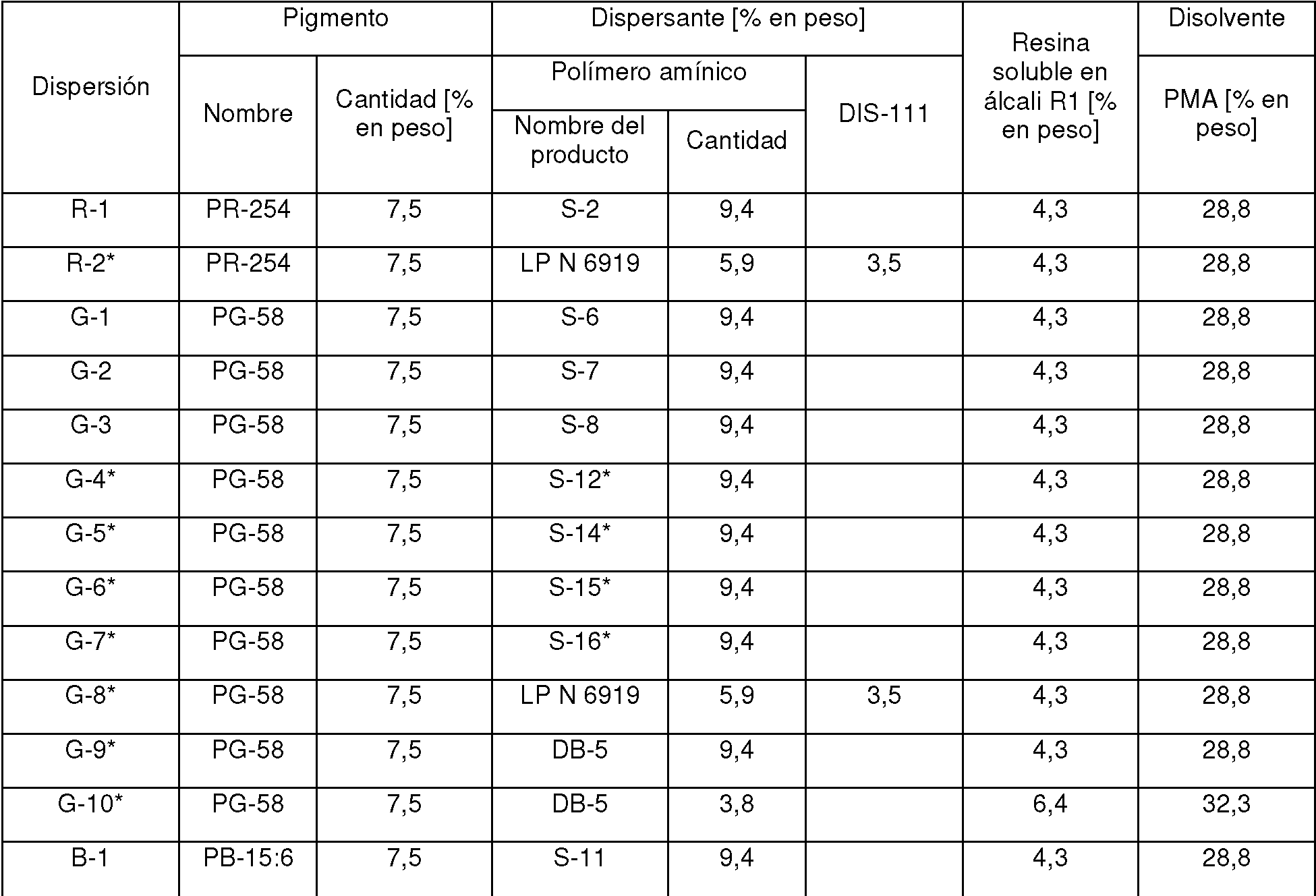

Producción de tinta resistenteDurable ink production
BYK-330: Aditivo de tipo silicona (BYK-Chemie)BYK-330: Silicone type additive (BYK-Chemie)
Aronix M305: Triacrilato de pentaeritritol (TOA GOSEI)Aronix M305: Pentaerythritol Triacrylate (TOA GOSEI)
Omnirad 369: Nombre anterior: Irgacure 369, 2-bencil-2-(dimetilamino)-4'-morfolinobutirofenona (IGM Resins B.V.) La receta de las tintas resistentes se describe como sigue;Omnirad 369: Previous name: Irgacure 369, 2-benzyl-2-(dimethylamino)-4'-morpholinobutyrophenone (IGM Resins B.V.) The recipe of the resist inks is described as follows;
Dispersión 50,0 gDispersion 50.0 g
Solución al 2 % de BYK-330 en PMA 1,0 g2% solution of BYK-330 in PMA 1.0 g
Resina soluble en álcali R-1 14,2 gAlkali soluble resin R-1 14.2 g
Aronix M305 2,0 gAronix M305 2.0g
Omnirad 369 1,0 gOmnirad 369 1.0g
PMA 31,8 gPMA 31.8g
Total 100,0 gTotal 100.0g
Resultados de ensayo de aplicaciónApplication test results
Viscosidad de las dispersiones de color rojo, verde y azulViscosity of red, green and blue dispersions
La viscosidad de las dispersiones de color rojo, verde y azul se midió usando el VISCOSÍMETRO BROOKFIELD DV-II+ (BROOKFIELD, limitación superior de la viscosidad: 1.000 mPas).The viscosity of the red, green and blue dispersions was measured using the BROOKFIELD DV-II+ VISCOSIMETER (BROOKFIELD, upper viscosity limitation: 1,000 mPas).
Tamaño de partícula de las dispersiones de color rojo, verde y azul: El tamaño de partícula (mediana del diámetro: D50) de la dispersión de color rojo, verde y azul se midió usando el analizador de tamaño de partícula ELSZ-1000 (Otsuka Electronics).Particle size of red, green and blue color dispersions: The particle size (median diameter: D50) of red, green and blue color dispersion was measured using ELSZ-1000 particle size analyzer (Otsuka Electronics ).
Propiedad de reveladoReveal Property
Se recubrió una placa de vidrio con tintas resistentes de color rojo, verde y azul usando una recubridora de barras n.° 4 (9,16 μm de espesor en la película humectante) y las películas de recubrimiento se secaron a 80 °C durante 3 minutos. Las películas de recubrimiento secadas se sumergieron gradualmente en una solución acuosa de KOH al 0,05 % (intervalo: 10-60 segundos).A glass plate was coated with red, green, and blue resist inks using a #4 rod coater (9.16 μm thickness on wetting film), and the coating films were dried at 80 °C for 3 minutes. The dried coating films were gradually immersed into 0.05% KOH aqueous solution (range: 10–60 seconds).
Después de lavar las mismas mediante agua, las películas de recubrimiento se limpiaron usando KimWipes (producto de Kimberly Clark Corporation) y la apariencia marcada de la película de recubrimiento se describió como sigue; 1 (Excelente): La película de recubrimiento se eliminó por completo después de limpiarAfter washing by water, the coating films were cleaned using KimWipes (product of Kimberly Clark Corporation) and the marked appearance of the coating film was described as follows; 1 (Excellent): The coating film was completely removed after cleaning
2 (Muy bueno): La película de recubrimiento se eliminó parcialmente después de limpiar2 (Very Good): The coating film was partially removed after cleaning
3 (Bueno): La película de recubrimiento no se eliminó, pero la superficie de la película de recubrimiento se retiró en su mayor parte después de limpiar3 (Good): The coating film was not removed, but the surface of the coating film was mostly removed after cleaning
4 (Deficiente): La película de recubrimiento no se eliminó, pero la superficie de la película de recubrimiento se retiró parcialmente después de limpiar4 (Poor): The coating film was not removed, but the surface of the coating film was partially removed after cleaning
5 (Pésima): La apariencia de la película de recubrimiento no cambió después de limpiar5 (Poor): The appearance of the coating film did not change after cleaning
Resolubilidad en PMAResolubility in PMA
Se recubrió una placa de vidrio con tintas resistentes de color rojo, verde y azul usando una recubridora de barras n.° 4 (9,16 μm de espesor en la película humectante) y las películas de recubrimiento se secaron a 80 °C durante 3 minutos. Se puso una gotita de PMA sobre la película de recubrimiento y se limpió inmediatamente usando KimWipes. La apariencia de la película de recubrimiento después de limpiar se marcó como sigue;A glass plate was coated with red, green, and blue resist inks using a #4 rod coater (9.16 μm thickness on wetting film), and the coating films were dried at 80 °C for 3 minutes. A droplet of PMA was placed on the coating film and immediately cleaned using KimWipes. The appearance of the coating film after cleaning was marked as follows;
1 (Excelente): La película de recubrimiento en el rastro de la gotita de PMA se eliminó por completo después de limpiar 1 (Excellent): The coating film on the PMA droplet trace was completely removed after cleaning
2 (Muy bueno): La película de recubrimiento en el rastro de la gotita de PMA se eliminó parcialmente después de limpiar2 (Very Good): The coating film on the PMA droplet trace was partially removed after cleaning
3 (Bueno): No se eliminó la película de recubrimiento en el rastro de PMA, pero la superficie de la película de recubrimiento se retiró en su mayor parte después de limpiar3 (Good): The coating film on the PMA trace was not removed, but the surface of the coating film was mostly removed after cleaning
4 (Deficiente): La película de recubrimiento en el rastro de PMA no se eliminó, pero la superficie de la película de recubrimiento se retiró parcialmente después de limpiar4 (Poor): The coating film on the PMA trace was not removed, but the surface of the coating film was partially removed after cleaning
5 (Pésima): La apariencia de la película de recubrimiento no cambió después de limpiar5 (Poor): The appearance of the coating film did not change after cleaning
Ejemplos 1 -6: Viscosidad y tamaño de partícula de dispersiones de color rojo (R), verde (G) y azul (B), y propiedad de revelado y resolubilidad en PMA de tintas resistentes de color rojo (R), verde (G) y azul (B)Examples 1-6: Viscosity and particle size of red (R), green (G) and blue (B) dispersions, and development property and PMA resolubility of red (R), green (G) resist inks ) and blue (B)
La viscosidad (mPas a 20 °C, rotación: 60 rpm) y el tamaño de partícula (D50) de dispersiones de color rojo, verde y azul, así como la propiedad de revelado y la resolubilidad en PMA de las tintas resistentes de color rojo, verde y azul se describen en la Tabla 7.Viscosity (mPas at 20 °C, rotation: 60 rpm) and particle size (D50) of red, green and blue dispersions, as well as development property and PMA resolubility of red resist inks , green and blue are described in Table 7.
Tabla 7 Viscosidad y tamaño de partícula de dispersiones de color rojo, verde y azul, y propiedad de revelado y resolubilidad en PMA de tintas resistentes de color rojo, verde y azulTable 7 Viscosity and particle size of red, green and blue dispersions, and development property and PMA resolubility of red, green and blue resist inks

Ejemplos de comparación C-1 a C-9: Viscosidad y tamaño de partícula de dispersiones de color rojo (R), verde (G) y azul (B), y propiedad de revelado y resolubilidad en PMA de tintas resistentes de color rojo, verde y azul;Comparison Examples C-1 to C-9: Viscosity and particle size of red (R), green (G) and blue (B) dispersions, and development property and PMA resolubility of red resist inks, green and blue;
La viscosidad (mPas a 20 °C, rotación: 60 rpm) y el tamaño de partícula (D50) de dispersiones de color rojo, verde y azul se describen en la Tabla 8, y la propiedad de revelado y la resolubilidad en PMA de las tintas resistentes de color rojo, verde y azul se describen en la Tabla 8. The viscosity (mPas at 20 °C, rotation: 60 rpm) and particle size (D50) of red, green and blue dispersions are described in Table 8, and the development property and resolubility in PMA of the Resistant red, green, and blue inks are described in Table 8.
Tabla 8 Viscosidad y tamaño de partícula de dispersiones de color rojo, verde y azul, y propiedad de revelado y resolubilidad en PMA de tintas resistentes de color rojo, verde y azulTable 8 Viscosity and particle size of red, green and blue dispersions, and development property and PMA resolubility of red, green and blue resist inks

Según los resultados en las Tablas 7 y 8, las dispersiones de color rojo, verde y azul que incluyen el producto neutralizado entre el copolímero dibloque amínico o el copolímero tribloque amínico y el polímero ácido muestran una dispersabilidad y una estabilidad de almacenamiento excelentes (los ejemplos 1-6). Además, las tintas resistentes de color rojo, verde y azul que incluyen las dispersiones muestran también unas propiedades de revelado y una resolubilidad en pMa excelentes. Sin embargo, las dispersiones de color rojo y verde que incluyen BYK-LP N 6919 y DISPERBYK-111 que se añadieron durante el proceso de molienda (los ejemplos de comparación C-1 y C-6) muestran una estabilidad de almacenamiento inferior, y sus tintas resistentes muestran también una propiedad de revelado y una resolubilidad en PMA deficientes.According to the results in Tables 7 and 8, the red, green and blue dispersions including the neutralized product between the amino diblock copolymer or the amino triblock copolymer and the acidic polymer show excellent dispersibility and storage stability (examples 1-6). Furthermore, the red, green and blue resist inks including the dispersions also show excellent developing properties and p M a resolubility. However, red and green dispersions including BYK-LP N 6919 and DISPERBYK-111 that were added during the milling process (comparison examples C-1 and C-6) show lower storage stability, and Their resistant inks also show poor development property and PMA resolubility.
Las dispersiones de color verde y azul que incluyen copolímero aleatorio amínico y polímero ácido (los ejemplos de comparación C-2 y C-9) muestran una dispersabilidad deficiente.Green and blue dispersions including amine random copolymer and acidic polymer (comparison examples C-2 and C-9) show poor dispersibility.
Las dispersiones de color verde que incluyen copolímero de bloques amínicos y componente ácido de bajo peso molecular (los ejemplos de comparación C-3 a C-5) muestran una estabilidad de almacenamiento deficiente, y sus tintas resistentes muestran una propiedad de revelado y una resolubilidad en PMA deficientes.Green dispersions including amine block copolymer and low molecular weight acid component (comparison examples C-3 to C-5) show poor storage stability, and their resistant inks show developing property and resolubility. in poor LDCs.
Producción de dispersiones de negro de carbono usadas para recubrimientos de color negro oscuro a base de disolventeProduction of carbon black dispersions used for solvent-based dark black coatings
Raven U3: Raven 5000 Ultra 3 (Birla Carbon)Raven U3: Raven 5000 Ultra 3 (Birla Carbon)
Acetato de butilo (Sigma-Aldrich)Butyl acetate (Sigma-Aldrich)
Procedimiento general para producir la dispersión de negro de carbono a base de disolvente Bk-1:General procedure for producing Bk-1 solvent-based carbon black dispersion:
9,7 g de un dispersante se colocaron en una botella de vidrio de 140 ml. Después de eso, se añadieron 36,0 g de acetato de butilo a la botella de vidrio para disolver el dispersante. Entonces, se añadieron 4,3 g de Raven 5000 Ultra 3 (Raven U3) y 150 g de perlas de circonia (diámetro: 0,4 - 0,6 mm) a la botella de vidrio. El proceso de dispersión se realizó en un Dispersador LAU DAS 200 a lo largo de un período de 10 horas a 30 °C. Después de 10 horas, el concentrado se filtró en una botella de vidrio de 50 ml para retirar las perlas de circonia.9.7 g of a dispersant were placed in a 140 ml glass bottle. After that, 36.0 g of butyl acetate was added to the glass bottle to dissolve the dispersant. Then, 4.3 g of Raven 5000 Ultra 3 (Raven U3) and 150 g of zirconia beads (diameter: 0.4 - 0.6 mm) were added to the glass bottle. The dispersion process was carried out in a LAU DAS 200 Disperser over a period of 10 hours at 30 °C. After 10 hours, the concentrate was filtered into a 50 ml glass bottle to remove the zirconia beads.
Procedimiento general para producir las dispersiones a base de disolvente de negro de carbono Bk-2 - Bk-5:General procedure for producing carbon black solvent-based dispersions Bk-2 - Bk-5:
Las dispersiones a base de disolvente Bk-2 - Bk-5 fueron, según el procedimiento de la dispersión Bk-1 (los detalles se describen en la Tabla 9).The solvent-based dispersions Bk-2 - Bk-5 were, according to the procedure of the dispersion Bk-1 (the details are described in Table 9).
Tabla 9 Recetas de las dispersiones de negro de carbono a base de disolvente Bk-1 -Bk-5Table 9 Recipes for solvent-based carbon black dispersions Bk-1 -Bk-5

Ejemplos 7-10: Viscosidad y tamaño de partícula de las dispersiones de negro de carbono a base de disolvente Bk-1 - Bk-4Examples 7-10: Viscosity and Particle Size of Solvent-Based Carbon Black Dispersions Bk-1 - Bk-4
La viscosidad (mPas a 20 °C, rotación: 60 rpm) y el tamaño de partícula (D50) de las dispersiones de negro de carbono a base de disolvente Bk-1 - Bk-4 se describen en la Tabla 10.The viscosity (mPas at 20 °C, rotation: 60 rpm) and particle size (D50) of the solvent-based carbon black dispersions Bk-1 - Bk-4 are described in Table 10.
Tabla 10 Viscosidad y tamaño de partícula de las dispersiones de negro de carbono a base de disolvente Bk-1 -Bk-4Table 10 Viscosity and particle size of solvent-based carbon black dispersions Bk-1 -Bk-4

Ejemplo de comparación 10: Viscosidad y tamaño de partícula de las dispersiones de negro de carbono a base de disolvente Bk-5Comparison Example 10: Viscosity and Particle Size of Bk-5 Solvent-Based Carbon Black Dispersions
La viscosidad (mPas a 20 °C, rotación: 60 rpm) y el tamaño de partícula (D50) de las dispersiones de negro de carbono a base de disolvente Bk-5 se describen en la Tabla 11. The viscosity (mPas at 20 °C, rotation: 60 rpm) and particle size (D50) of the Bk-5 solvent-based carbon black dispersions are described in Table 11.
Tabla 11 Viscosidad y tamaño de partícula de las dispersiones de negro de carbono a base de disolvente Bk-5Table 11 Viscosity and particle size of Bk-5 solvent-based carbon black dispersions

Según los resultados en las Tablas 10 y 11, el producto neutralizado entre el copolímero de bloques amínicos y el polímero ácido mostró una viscosidad inferior, una estabilidad de almacenamiento mejorada y un tamaño de partículas inferior cuando se usa como dispersante para la dispersión de negro de carbono a base de disolvente adecuada para recubrimientos para vehículos de transporte. Por otro lado, el copolímero de bloques amínicos no neutralizado mostró una dispersabilidad deficiente.According to the results in Tables 10 and 11, the neutralized product between the amine block copolymer and the acidic polymer showed lower viscosity, improved storage stability and lower particle size when used as a dispersant for black dispersion. Solvent-based carbon suitable for coatings for transport vehicles. On the other hand, the unneutralized amine block copolymer showed poor dispersibility.
Producción de dispersiones a base de agua usadas para la aplicación de inyección de tintaProduction of water-based dispersions used for inkjet application
Yellow 3GL-TP: (Clariant)Yellow 3GL-TP: (Clariant)
Inkjet Yellow 4GC: Pigment Yellow 155 (Clariant)Inkjet Yellow 4GC: Pigment Yellow 155 (Clariant)
Riaplas Red 2BL-TP: (Clariant)Riaplas Red 2BL-TP: (Clariant)
Inkjet Magenta E7B VP3958: (Clariant)Inkjet Magenta E7B VP3958: (Clariant)
Procedimiento general para producir la dispersión a base de agua Y-1:General procedure for producing Y-1 water-based dispersion:
se colocaron 10,0 g del dispersante S-3 en una botella de vidrio de 140 ml. Después de eso, se añadieron 10,0 g de agua desionizada a la botella de vidrio y se mezcló homogéneamente. Entonces, se añadieron 10,0 g de Yellow 3GL-TP y 150 g de perlas de circonia (diámetro: 0,4 - 0,6 mm) a la botella de vidrio. El proceso de dispersión se realizó en un Dispersador LAU DAS 200 a lo largo de un período de 16 horas a 30 °C. Después de 16 horas, el concentrado se filtró en una botella de vidrio de 50 ml para retirar las perlas de circonia.10.0 g of S-3 dispersant was placed in a 140 ml glass bottle. After that, 10.0 g of deionized water was added to the glass bottle and mixed homogeneously. Then, 10.0 g of Yellow 3GL-TP and 150 g of zirconia beads (diameter: 0.4 - 0.6 mm) were added to the glass bottle. The dispersion process was carried out in a LAU DAS 200 Disperser over a period of 16 hours at 30 °C. After 16 hours, the concentrate was filtered into a 50 ml glass bottle to remove the zirconia beads.
Procedimiento general para producir las dispersiones a base de agua Y-2 - Y-3, Re-1 y M-1 - M-2General procedure to produce water-based dispersions Y-2 - Y-3, Re-1 and M-1 - M-2
Las dispersiones a base de agua se prepararon usando el mismo procedimiento que se usa para la dispersión a base de agua Y-1, excepto por el uso de diferentes dispersantes y diferentes dosificaciones (los detalles se describen en la Tabla 12).The water-based dispersions were prepared using the same procedure as used for the Y-1 water-based dispersion, except for the use of different dispersants and different dosages (details are described in Table 12).
Tabla 12 Recetas de las dispersiones a base de agua Y-1 - Y-3, Re-1, M-1 y M-2Table 12 Recipes for water-based dispersions Y-1 - Y-3, Re-1, M-1 and M-2


Ejemplos 11-14: Viscosidad y tamaño de partícula de las dispersiones a base de agua Y-1, Y-3, Re-1 y M-1 La viscosidad (mPas a 20 °C, rotación: 60 rpm) y el tamaño de partícula (D50) de las dispersiones a base de agua Y-1, Y-3, Re-1 y M-1 se describen en la Tabla 13.Examples 11-14: Viscosity and particle size of water-based dispersions Y-1, Y-3, Re-1 and M-1 The viscosity (mPas at 20 °C, rotation: 60 rpm) and the size of particle (D50) of the water-based dispersions Y-1, Y-3, Re-1 and M-1 are described in Table 13.
Tabla 13 Viscosidad y tamaño de partícula de las dispersiones a base de agua Y-1, Y-3, Re-1 y M-1Table 13 Viscosity and particle size of water-based dispersions Y-1, Y-3, Re-1 and M-1

Ejemplos de comparación 11-12: Viscosidad y tamaño de partícula de las dispersiones a base de agua Y-2 y M-2 La viscosidad (mPas a 20 °C, rotación: 60 rpm) y el tamaño de partícula (D50) de las dispersiones a base de agua Y-2 y M-2 se describen en la Tabla 14.Comparison examples 11-12: Viscosity and particle size of water-based dispersions Y-2 and M-2 The viscosity (mPas at 20 °C, rotation: 60 rpm) and particle size (D50) of the Water-based dispersions Y-2 and M-2 are described in Table 14.
Tabla 14 Viscosidad y tamaño de partícula de las dispersiones a base de agua Y-2 y M-2Table 14 Viscosity and particle size of water-based dispersions Y-2 and M-2

Según los resultados en las Tablas 13 y 14, el producto neutralizado entre el copolímero de bloques amínicos y el polímero ácido mostró buenos resultados como dispersante para la dispersión a base de agua usada para la aplicación de inyección de tinta. En particular, los ejemplos inventivos presentaron una estabilidad de almacenamiento mejorada en comparación con el copolímero de bloques amínicos no neutralizado. According to the results in Tables 13 and 14, the neutralized product between the amine block copolymer and the acidic polymer showed good results as a dispersant for the water-based dispersion used for inkjet application. In particular, the inventive examples exhibited improved storage stability compared to the non-neutralized amine block copolymer.
Claims (15)


Applications Claiming Priority (2)
| Application Number | Priority Date | Filing Date | Title |
|---|---|---|---|
| EP19171337 | 2019-04-26 | ||
| PCT/EP2020/061242 WO2020216800A1 (en) | 2019-04-26 | 2020-04-22 | Non-pigmented dispersant composition |
Publications (1)
| Publication Number | Publication Date |
|---|---|
| ES2954761T3 true ES2954761T3 (en) | 2023-11-24 |
Family
ID=66290291
Family Applications (1)
| Application Number | Title | Priority Date | Filing Date |
|---|---|---|---|
| ES20719647T Active ES2954761T3 (en) | 2019-04-26 | 2020-04-22 | Non-pigmented dispersant composition |
Country Status (7)
| Country | Link |
|---|---|
| US (1) | US12116492B2 (en) |
| EP (1) | EP3959274B1 (en) |
| JP (2) | JP7253080B2 (en) |
| KR (2) | KR102648624B1 (en) |
| CN (2) | CN113748171B (en) |
| ES (1) | ES2954761T3 (en) |
| WO (2) | WO2020216801A1 (en) |
Families Citing this family (2)
| Publication number | Priority date | Publication date | Assignee | Title |
|---|---|---|---|---|
| EP3959274B1 (en) | 2019-04-26 | 2023-06-07 | BYK-Chemie GmbH | Non-pigmented dispersant composition |
| JP7152625B1 (en) * | 2022-06-23 | 2022-10-12 | 大日精化工業株式会社 | Binder component for water-based ink and water-based ink |
Family Cites Families (31)
| Publication number | Priority date | Publication date | Assignee | Title |
|---|---|---|---|---|
| DE2726854A1 (en) | 1977-06-15 | 1979-01-11 | Bayer Ag | PHOSPHORIC ACID ESTER |
| JPS5774794A (en) | 1980-10-29 | 1982-05-11 | Suwa Seikosha Kk | Piezoelectric speaker driving circuit for electronic timepiece |
| US4746462A (en) | 1985-02-21 | 1988-05-24 | Dainichiseika Color & Chemicals Mfg. Co., Ltd. | Phosphoric ester compound |
| US4755563A (en) | 1986-12-29 | 1988-07-05 | E. I. Du Pont De Nemours And Company | Block copolymer dispersants containing ionic moieties |
| DE69325401T2 (en) * | 1992-02-20 | 1999-11-25 | E.I. Du Pont De Nemours & Co., Inc. | Water dispersions containing three-block polymer dispersants |
| US5219945A (en) | 1992-02-20 | 1993-06-15 | E. I. Du Pont De Nemours And Company | ABC triblock methacrylate polymers |
| US6413306B1 (en) | 1999-10-07 | 2002-07-02 | E. I. Du Pont De Nemours And Company | Pigment dispersions containing ABC-block polymer dispersant |
| US6849679B2 (en) * | 2001-05-21 | 2005-02-01 | Ciba Specialty Chemicals Corporation | Pigment compositions with modified block copolymer dispersants |
| JP4334272B2 (en) | 2003-05-14 | 2009-09-30 | 大日本印刷株式会社 | Epoxy resin composition for inkjet ink for color filter, method for producing color filter, color filter, and display panel |
| JP2006343648A (en) | 2005-06-10 | 2006-12-21 | Mitsubishi Chemicals Corp | Color material dispersion for color filter, curable resin composition for color filter and method for producing the same, color filter and liquid crystal display device |
| JP4793360B2 (en) | 2007-02-26 | 2011-10-12 | 大日本印刷株式会社 | Negative resist composition for color filter, color filter using the same, and liquid crystal display device |
| CN101541898B (en) * | 2007-06-21 | 2013-05-01 | 三菱化学株式会社 | Pigment dispersion, coloring composition for color filter, color filter, liquid crystal display device, and organic EL display |
| JP5540599B2 (en) | 2008-10-31 | 2014-07-02 | Jsr株式会社 | Radiation-sensitive composition for forming colored layer, color filter, and color liquid crystal display element |
| JP5147770B2 (en) | 2009-03-26 | 2013-02-20 | 富士フイルム株式会社 | Droplet discharge head and image forming apparatus |
| JP5863232B2 (en) | 2010-10-08 | 2016-02-16 | 株式会社Dnpファインケミカル | Method for producing pigment dispersion |
| US8292452B2 (en) | 2010-06-07 | 2012-10-23 | Ko Joseph Y | Solar power alarm lamp |
| JP5778686B2 (en) * | 2010-11-08 | 2015-09-16 | 日本曹達株式会社 | New copolymer |
| JP6078999B2 (en) | 2011-09-02 | 2017-02-15 | 大日本印刷株式会社 | Red pigment dispersion for color filter and production method thereof, red photosensitive resin composition for color filter and production method thereof, color filter, liquid crystal display device and organic light emitting display device |
| JP5734821B2 (en) | 2011-12-06 | 2015-06-17 | 大塚化学株式会社 | Block copolymer, dispersant and pigment dispersion composition |
| JP5892510B2 (en) * | 2012-03-28 | 2016-03-23 | 大日精化工業株式会社 | Method for producing polymer dispersant |
| JP2014028891A (en) | 2012-07-31 | 2014-02-13 | Kao Corp | Pigment dispersion for color filter |
| JP6248838B2 (en) | 2013-07-22 | 2017-12-20 | Jsr株式会社 | Colored composition, colored cured film, display element and solid-state image sensor |
| JP6206780B2 (en) * | 2014-12-23 | 2017-10-04 | ベーイプシロンカー−シェミー ゲーエムベーハーBYK−Chemie GmbH | Formulation containing a dispersant having a protecting group |
| JP6488143B2 (en) | 2015-02-13 | 2019-03-20 | 株式会社Dnpファインケミカル | Diketopyrrolopyrrole pigment derivative composition, pigment composition, pigment dispersion, colored resin composition, color filter, and display device |
| JP6755715B2 (en) | 2015-06-01 | 2020-09-16 | 株式会社Dnpファインケミカル | Color material dispersion for color filters, photosensitive coloring resin composition for color filters, color filters, liquid crystal display devices, and organic light emission display devices |
| EP3147335A1 (en) * | 2015-09-23 | 2017-03-29 | BYK-Chemie GmbH | Colorant compositions containing wettting and/or dispersing agents with low amine number |
| CN108699201B (en) * | 2016-02-03 | 2020-05-05 | 大塚化学株式会社 | ABA type block copolymer, dispersant and pigment dispersion composition |
| JP6740765B2 (en) | 2016-07-19 | 2020-08-19 | 東洋インキScホールディングス株式会社 | Coloring composition for color filter, method for producing the same and color filter |
| EP3710542B1 (en) * | 2017-11-15 | 2022-01-05 | BYK-Chemie GmbH | Block co-polymer |
| CN111344319B (en) | 2017-11-15 | 2022-12-23 | 毕克化学有限公司 | block copolymer |
| EP3959274B1 (en) | 2019-04-26 | 2023-06-07 | BYK-Chemie GmbH | Non-pigmented dispersant composition |
-
2020
- 2020-04-22 EP EP20719647.8A patent/EP3959274B1/en active Active
- 2020-04-22 WO PCT/EP2020/061246 patent/WO2020216801A1/en not_active Ceased
- 2020-04-22 JP JP2021563622A patent/JP7253080B2/en active Active
- 2020-04-22 CN CN202080031124.XA patent/CN113748171B/en active Active
- 2020-04-22 CN CN202080031042.5A patent/CN113728061B/en active Active
- 2020-04-22 ES ES20719647T patent/ES2954761T3/en active Active
- 2020-04-22 US US17/605,458 patent/US12116492B2/en active Active
- 2020-04-22 WO PCT/EP2020/061242 patent/WO2020216800A1/en not_active Ceased
- 2020-04-22 KR KR1020217038199A patent/KR102648624B1/en active Active
- 2020-04-22 JP JP2021563616A patent/JP7303902B2/en active Active
- 2020-04-22 KR KR1020217038202A patent/KR102589005B1/en active Active
Also Published As
| Publication number | Publication date |
|---|---|
| KR20220005510A (en) | 2022-01-13 |
| JP7303902B2 (en) | 2023-07-05 |
| EP3959274A1 (en) | 2022-03-02 |
| JP2022530230A (en) | 2022-06-28 |
| KR102589005B1 (en) | 2023-10-17 |
| US20220213337A1 (en) | 2022-07-07 |
| CN113728061A (en) | 2021-11-30 |
| WO2020216800A1 (en) | 2020-10-29 |
| JP7253080B2 (en) | 2023-04-05 |
| JP2022530152A (en) | 2022-06-27 |
| WO2020216801A1 (en) | 2020-10-29 |
| CN113728061B (en) | 2023-06-02 |
| KR20220005512A (en) | 2022-01-13 |
| CN113748171B (en) | 2022-12-13 |
| EP3959274B1 (en) | 2023-06-07 |
| KR102648624B1 (en) | 2024-03-20 |
| US12116492B2 (en) | 2024-10-15 |
| CN113748171A (en) | 2021-12-03 |
Similar Documents
| Publication | Publication Date | Title |
|---|---|---|
| ES2359532T3 (en) | MODIFIED PEINE TYPE COPOLYMERS BASED ON STYRENE / MALEIC ANHYDRIDE. | |
| US9957343B2 (en) | Ionic bonding group-containing comb polymers | |
| US12570797B2 (en) | Acid functional compound | |
| JP6063124B2 (en) | Water-in-oil emulsion composition, coating composition, coating, molding material, and molded article | |
| ES2551314T3 (en) | Water soluble anionic additives | |
| DK2183323T3 (en) | Anionic water-soluble additives based on allyl and vinyl ether | |
| ES2954761T3 (en) | Non-pigmented dispersant composition | |
| KR102456207B1 (en) | Dispersant | |
| JPWO2015008737A1 (en) | Pigment dispersion for color filters | |
| ES2836291T3 (en) | Polyether based on oxetanes for use as wetting and dispersing agents, as well as their production | |
| US12479961B2 (en) | Comb polymer having salt groups | |
| JP6437628B2 (en) | Block copolymer, dispersant and pigment dispersion composition | |
| ES2607929T3 (en) | Water-soluble and solvent-soluble anionic additives | |
| JP6368643B2 (en) | Pigment dispersion for color filters |