ES2955820T3 - Eye drops based on a sterilizable liposomal formulation based on curcumin and ophthalmic use thereof - Google Patents
Eye drops based on a sterilizable liposomal formulation based on curcumin and ophthalmic use thereof Download PDFInfo
- Publication number
- ES2955820T3 ES2955820T3 ES20771921T ES20771921T ES2955820T3 ES 2955820 T3 ES2955820 T3 ES 2955820T3 ES 20771921 T ES20771921 T ES 20771921T ES 20771921 T ES20771921 T ES 20771921T ES 2955820 T3 ES2955820 T3 ES 2955820T3
- Authority
- ES
- Spain
- Prior art keywords
- curcumin
- ophthalmic
- tpgs
- liposomal formulation
- vitamin
- Prior art date
- Legal status (The legal status is an assumption and is not a legal conclusion. Google has not performed a legal analysis and makes no representation as to the accuracy of the status listed.)
- Active
Links
- VFLDPWHFBUODDF-FCXRPNKRSA-N curcumin Chemical compound C1=C(O)C(OC)=CC(\C=C\C(=O)CC(=O)\C=C\C=2C=C(OC)C(O)=CC=2)=C1 VFLDPWHFBUODDF-FCXRPNKRSA-N 0.000 title claims abstract description 243
- 235000012754 curcumin Nutrition 0.000 title claims abstract description 121
- 239000004148 curcumin Substances 0.000 title claims abstract description 121
- 229940109262 curcumin Drugs 0.000 title claims abstract description 121
- VFLDPWHFBUODDF-UHFFFAOYSA-N diferuloylmethane Natural products C1=C(O)C(OC)=CC(C=CC(=O)CC(=O)C=CC=2C=C(OC)C(O)=CC=2)=C1 VFLDPWHFBUODDF-UHFFFAOYSA-N 0.000 title claims abstract description 121
- 239000000203 mixture Substances 0.000 title claims abstract description 112
- 238000009472 formulation Methods 0.000 title claims abstract description 93
- 239000003889 eye drop Substances 0.000 title claims abstract description 27
- 229940012356 eye drops Drugs 0.000 title claims abstract description 25
- 239000002502 liposome Substances 0.000 claims abstract description 59
- AOBORMOPSGHCAX-UHFFFAOYSA-N Tocophersolan Chemical compound OCCOC(=O)CCC(=O)OC1=C(C)C(C)=C2OC(CCCC(C)CCCC(C)CCCC(C)C)(C)CCC2=C1C AOBORMOPSGHCAX-UHFFFAOYSA-N 0.000 claims abstract description 42
- 238000001914 filtration Methods 0.000 claims abstract description 22
- 238000000034 method Methods 0.000 claims abstract description 17
- 229940088594 vitamin Drugs 0.000 claims abstract description 15
- 229930003231 vitamin Natural products 0.000 claims abstract description 15
- 235000013343 vitamin Nutrition 0.000 claims abstract description 15
- 239000011782 vitamin Substances 0.000 claims abstract description 15
- 150000003722 vitamin derivatives Chemical class 0.000 claims abstract description 15
- 230000003078 antioxidant effect Effects 0.000 claims abstract description 10
- 230000000699 topical effect Effects 0.000 claims abstract description 7
- 208000003556 Dry Eye Syndromes Diseases 0.000 claims abstract description 5
- 206010013774 Dry eye Diseases 0.000 claims abstract description 5
- 230000015572 biosynthetic process Effects 0.000 claims abstract description 5
- 239000002202 Polyethylene glycol Substances 0.000 claims abstract description 4
- 229920001223 polyethylene glycol Polymers 0.000 claims abstract description 4
- 230000009977 dual effect Effects 0.000 claims abstract description 3
- 230000001737 promoting effect Effects 0.000 claims abstract description 3
- 150000003904 phospholipids Chemical class 0.000 claims description 37
- GVJHHUAWPYXKBD-UHFFFAOYSA-N (±)-α-Tocopherol Chemical compound OC1=C(C)C(C)=C2OC(CCCC(C)CCCC(C)CCCC(C)C)(C)CCC2=C1C GVJHHUAWPYXKBD-UHFFFAOYSA-N 0.000 claims description 14
- 239000000243 solution Substances 0.000 claims description 12
- 230000001954 sterilising effect Effects 0.000 claims description 12
- 238000004659 sterilization and disinfection Methods 0.000 claims description 11
- 229930003427 Vitamin E Natural products 0.000 claims description 8
- 235000019165 vitamin E Nutrition 0.000 claims description 8
- 239000011709 vitamin E Substances 0.000 claims description 8
- WIGCFUFOHFEKBI-UHFFFAOYSA-N gamma-tocopherol Natural products CC(C)CCCC(C)CCCC(C)CCCC1CCC2C(C)C(O)C(C)C(C)C2O1 WIGCFUFOHFEKBI-UHFFFAOYSA-N 0.000 claims description 7
- 238000005063 solubilization Methods 0.000 claims description 7
- 230000007928 solubilization Effects 0.000 claims description 7
- 229940046009 vitamin E Drugs 0.000 claims description 7
- 239000000872 buffer Substances 0.000 claims description 6
- 239000000546 pharmaceutical excipient Substances 0.000 claims description 5
- XLYOFNOQVPJJNP-UHFFFAOYSA-N water Substances O XLYOFNOQVPJJNP-UHFFFAOYSA-N 0.000 claims description 5
- 239000004480 active ingredient Substances 0.000 claims description 4
- 150000002632 lipids Chemical class 0.000 claims description 4
- 239000003795 chemical substances by application Substances 0.000 claims description 3
- 238000001125 extrusion Methods 0.000 claims description 3
- 230000036571 hydration Effects 0.000 claims description 3
- 238000006703 hydration reaction Methods 0.000 claims description 3
- 239000002904 solvent Substances 0.000 claims description 3
- 238000000265 homogenisation Methods 0.000 claims description 2
- 239000003960 organic solvent Substances 0.000 claims description 2
- 239000007853 buffer solution Substances 0.000 claims 3
- 229940061607 dibasic sodium phosphate Drugs 0.000 claims 2
- BNIILDVGGAEEIG-UHFFFAOYSA-L disodium hydrogen phosphate Chemical compound [Na+].[Na+].OP([O-])([O-])=O BNIILDVGGAEEIG-UHFFFAOYSA-L 0.000 claims 2
- KGBXLFKZBHKPEV-UHFFFAOYSA-N boric acid Chemical compound OB(O)O KGBXLFKZBHKPEV-UHFFFAOYSA-N 0.000 claims 1
- 239000004327 boric acid Substances 0.000 claims 1
- 238000001291 vacuum drying Methods 0.000 claims 1
- 239000003755 preservative agent Substances 0.000 abstract description 3
- 229940087168 alpha tocopherol Drugs 0.000 abstract 1
- 239000006196 drop Substances 0.000 abstract 1
- 229960000984 tocofersolan Drugs 0.000 abstract 1
- 239000002076 α-tocopherol Substances 0.000 abstract 1
- 230000003110 anti-inflammatory effect Effects 0.000 description 14
- 230000000694 effects Effects 0.000 description 12
- 238000012360 testing method Methods 0.000 description 11
- 210000002615 epidermis Anatomy 0.000 description 9
- 238000002360 preparation method Methods 0.000 description 9
- 239000004094 surface-active agent Substances 0.000 description 9
- 230000005764 inhibitory process Effects 0.000 description 8
- 208000002193 Pain Diseases 0.000 description 7
- DBMJMQXJHONAFJ-UHFFFAOYSA-M Sodium laurylsulphate Chemical compound [Na+].CCCCCCCCCCCCOS([O-])(=O)=O DBMJMQXJHONAFJ-UHFFFAOYSA-M 0.000 description 7
- 230000000202 analgesic effect Effects 0.000 description 7
- 238000000338 in vitro Methods 0.000 description 7
- 235000019333 sodium laurylsulphate Nutrition 0.000 description 7
- 210000001519 tissue Anatomy 0.000 description 7
- RZVAJINKPMORJF-UHFFFAOYSA-N Acetaminophen Chemical compound CC(=O)NC1=CC=C(O)C=C1 RZVAJINKPMORJF-UHFFFAOYSA-N 0.000 description 6
- 238000010521 absorption reaction Methods 0.000 description 6
- 239000000470 constituent Substances 0.000 description 6
- HYWYRSMBCFDLJT-UHFFFAOYSA-N nimesulide Chemical compound CS(=O)(=O)NC1=CC=C([N+]([O-])=O)C=C1OC1=CC=CC=C1 HYWYRSMBCFDLJT-UHFFFAOYSA-N 0.000 description 6
- 229960000965 nimesulide Drugs 0.000 description 6
- 239000002245 particle Substances 0.000 description 6
- 235000003373 curcuma longa Nutrition 0.000 description 5
- 239000003814 drug Substances 0.000 description 5
- 230000002757 inflammatory effect Effects 0.000 description 5
- 229960005489 paracetamol Drugs 0.000 description 5
- 239000013641 positive control Substances 0.000 description 5
- 102000004127 Cytokines Human genes 0.000 description 4
- 108090000695 Cytokines Proteins 0.000 description 4
- 239000003963 antioxidant agent Substances 0.000 description 4
- 235000006708 antioxidants Nutrition 0.000 description 4
- 238000011161 development Methods 0.000 description 4
- 239000001963 growth medium Substances 0.000 description 4
- 210000000929 nociceptor Anatomy 0.000 description 4
- 239000008363 phosphate buffer Substances 0.000 description 4
- 239000007787 solid Substances 0.000 description 4
- 244000163122 Curcuma domestica Species 0.000 description 3
- 235000003392 Curcuma domestica Nutrition 0.000 description 3
- 102000010907 Cyclooxygenase 2 Human genes 0.000 description 3
- 108010037462 Cyclooxygenase 2 Proteins 0.000 description 3
- 230000009471 action Effects 0.000 description 3
- 208000005298 acute pain Diseases 0.000 description 3
- 206010003246 arthritis Diseases 0.000 description 3
- 238000003556 assay Methods 0.000 description 3
- 230000015556 catabolic process Effects 0.000 description 3
- 230000003833 cell viability Effects 0.000 description 3
- 231100000433 cytotoxic Toxicity 0.000 description 3
- 230000001472 cytotoxic effect Effects 0.000 description 3
- 238000006731 degradation reaction Methods 0.000 description 3
- 229940079593 drug Drugs 0.000 description 3
- 238000011534 incubation Methods 0.000 description 3
- 230000001404 mediated effect Effects 0.000 description 3
- 239000013642 negative control Substances 0.000 description 3
- 230000036407 pain Effects 0.000 description 3
- WTJKGGKOPKCXLL-RRHRGVEJSA-N phosphatidylcholine Chemical compound CCCCCCCCCCCCCCCC(=O)OC[C@H](COP([O-])(=O)OCC[N+](C)(C)C)OC(=O)CCCCCCCC=CCCCCCCCC WTJKGGKOPKCXLL-RRHRGVEJSA-N 0.000 description 3
- 230000007704 transition Effects 0.000 description 3
- 235000013976 turmeric Nutrition 0.000 description 3
- LFQSCWFLJHTTHZ-UHFFFAOYSA-N Ethanol Chemical compound CCO LFQSCWFLJHTTHZ-UHFFFAOYSA-N 0.000 description 2
- 206010061218 Inflammation Diseases 0.000 description 2
- 108010002352 Interleukin-1 Proteins 0.000 description 2
- KFZMGEQAYNKOFK-UHFFFAOYSA-N Isopropanol Chemical group CC(C)O KFZMGEQAYNKOFK-UHFFFAOYSA-N 0.000 description 2
- 231100000002 MTT assay Toxicity 0.000 description 2
- 238000000134 MTT assay Methods 0.000 description 2
- 102100040247 Tumor necrosis factor Human genes 0.000 description 2
- 230000008901 benefit Effects 0.000 description 2
- 239000000969 carrier Substances 0.000 description 2
- 210000004027 cell Anatomy 0.000 description 2
- 238000004113 cell culture Methods 0.000 description 2
- 230000001413 cellular effect Effects 0.000 description 2
- 239000013078 crystal Substances 0.000 description 2
- 239000001215 curcuma longa l. root Substances 0.000 description 2
- 231100000135 cytotoxicity Toxicity 0.000 description 2
- 230000003013 cytotoxicity Effects 0.000 description 2
- 230000007423 decrease Effects 0.000 description 2
- 230000003247 decreasing effect Effects 0.000 description 2
- 201000010099 disease Diseases 0.000 description 2
- 208000037265 diseases, disorders, signs and symptoms Diseases 0.000 description 2
- 238000009826 distribution Methods 0.000 description 2
- 230000003828 downregulation Effects 0.000 description 2
- 210000002919 epithelial cell Anatomy 0.000 description 2
- 239000012530 fluid Substances 0.000 description 2
- 230000002496 gastric effect Effects 0.000 description 2
- 230000004968 inflammatory condition Effects 0.000 description 2
- 230000004054 inflammatory process Effects 0.000 description 2
- 239000002085 irritant Substances 0.000 description 2
- 231100000021 irritant Toxicity 0.000 description 2
- 239000012528 membrane Substances 0.000 description 2
- 108091008700 nociceptors Proteins 0.000 description 2
- 239000008194 pharmaceutical composition Substances 0.000 description 2
- 230000000144 pharmacologic effect Effects 0.000 description 2
- 238000001556 precipitation Methods 0.000 description 2
- 230000009467 reduction Effects 0.000 description 2
- 238000011160 research Methods 0.000 description 2
- 210000003491 skin Anatomy 0.000 description 2
- 230000003381 solubilizing effect Effects 0.000 description 2
- 235000013599 spices Nutrition 0.000 description 2
- 229940124597 therapeutic agent Drugs 0.000 description 2
- 238000011200 topical administration Methods 0.000 description 2
- IIZPXYDJLKNOIY-JXPKJXOSSA-N 1-palmitoyl-2-arachidonoyl-sn-glycero-3-phosphocholine Chemical compound CCCCCCCCCCCCCCCC(=O)OC[C@H](COP([O-])(=O)OCC[N+](C)(C)C)OC(=O)CCC\C=C/C\C=C/C\C=C/C\C=C/CCCCC IIZPXYDJLKNOIY-JXPKJXOSSA-N 0.000 description 1
- BTBUEUYNUDRHOZ-UHFFFAOYSA-N Borate Chemical compound [O-]B([O-])[O-] BTBUEUYNUDRHOZ-UHFFFAOYSA-N 0.000 description 1
- 208000017667 Chronic Disease Diseases 0.000 description 1
- 241000407170 Curcuma Species 0.000 description 1
- 235000014375 Curcuma Nutrition 0.000 description 1
- IAZDPXIOMUYVGZ-UHFFFAOYSA-N Dimethylsulphoxide Chemical compound CS(C)=O IAZDPXIOMUYVGZ-UHFFFAOYSA-N 0.000 description 1
- 238000002965 ELISA Methods 0.000 description 1
- 238000012286 ELISA Assay Methods 0.000 description 1
- 241000282412 Homo Species 0.000 description 1
- 229920001213 Polysorbate 20 Polymers 0.000 description 1
- 108060008682 Tumor Necrosis Factor Proteins 0.000 description 1
- 238000002835 absorbance Methods 0.000 description 1
- 230000036592 analgesia Effects 0.000 description 1
- 238000000149 argon plasma sintering Methods 0.000 description 1
- QVGXLLKOCUKJST-UHFFFAOYSA-N atomic oxygen Chemical compound [O] QVGXLLKOCUKJST-UHFFFAOYSA-N 0.000 description 1
- 230000004888 barrier function Effects 0.000 description 1
- 239000011324 bead Substances 0.000 description 1
- 230000008499 blood brain barrier function Effects 0.000 description 1
- 210000001218 blood-brain barrier Anatomy 0.000 description 1
- 210000004556 brain Anatomy 0.000 description 1
- VTJUKNSKBAOEHE-UHFFFAOYSA-N calixarene Chemical compound COC(=O)COC1=C(CC=2C(=C(CC=3C(=C(C4)C=C(C=3)C(C)(C)C)OCC(=O)OC)C=C(C=2)C(C)(C)C)OCC(=O)OC)C=C(C(C)(C)C)C=C1CC1=C(OCC(=O)OC)C4=CC(C(C)(C)C)=C1 VTJUKNSKBAOEHE-UHFFFAOYSA-N 0.000 description 1
- 238000003570 cell viability assay Methods 0.000 description 1
- 238000013043 cell viability test Methods 0.000 description 1
- 230000001684 chronic effect Effects 0.000 description 1
- 208000037976 chronic inflammation Diseases 0.000 description 1
- 208000037893 chronic inflammatory disorder Diseases 0.000 description 1
- 210000001953 common bile duct Anatomy 0.000 description 1
- 238000010835 comparative analysis Methods 0.000 description 1
- 230000000052 comparative effect Effects 0.000 description 1
- 238000012790 confirmation Methods 0.000 description 1
- 235000021438 curry Nutrition 0.000 description 1
- 231100000050 cytotoxic potential Toxicity 0.000 description 1
- 230000006378 damage Effects 0.000 description 1
- 238000000354 decomposition reaction Methods 0.000 description 1
- 238000001514 detection method Methods 0.000 description 1
- 230000001079 digestive effect Effects 0.000 description 1
- 238000012377 drug delivery Methods 0.000 description 1
- 239000000975 dye Substances 0.000 description 1
- 239000003995 emulsifying agent Substances 0.000 description 1
- 239000000839 emulsion Substances 0.000 description 1
- 210000005175 epidermal keratinocyte Anatomy 0.000 description 1
- 238000011156 evaluation Methods 0.000 description 1
- 238000002474 experimental method Methods 0.000 description 1
- 238000009650 gentamicin protection assay Methods 0.000 description 1
- 230000007407 health benefit Effects 0.000 description 1
- 208000006454 hepatitis Diseases 0.000 description 1
- 231100000283 hepatitis Toxicity 0.000 description 1
- 238000010348 incorporation Methods 0.000 description 1
- 208000027866 inflammatory disease Diseases 0.000 description 1
- 230000028709 inflammatory response Effects 0.000 description 1
- 150000002484 inorganic compounds Chemical class 0.000 description 1
- 229910010272 inorganic material Inorganic materials 0.000 description 1
- 230000000968 intestinal effect Effects 0.000 description 1
- 239000000787 lecithin Substances 0.000 description 1
- 235000010445 lecithin Nutrition 0.000 description 1
- 229940067606 lecithin Drugs 0.000 description 1
- 210000004072 lung Anatomy 0.000 description 1
- 239000002075 main ingredient Substances 0.000 description 1
- 238000004519 manufacturing process Methods 0.000 description 1
- 239000000463 material Substances 0.000 description 1
- 239000011159 matrix material Substances 0.000 description 1
- 230000007246 mechanism Effects 0.000 description 1
- 238000002483 medication Methods 0.000 description 1
- 239000000693 micelle Substances 0.000 description 1
- 238000001471 micro-filtration Methods 0.000 description 1
- 238000012986 modification Methods 0.000 description 1
- 230000004048 modification Effects 0.000 description 1
- 230000004682 mucosal barrier function Effects 0.000 description 1
- 239000002539 nanocarrier Substances 0.000 description 1
- 239000002105 nanoparticle Substances 0.000 description 1
- 231100000956 nontoxicity Toxicity 0.000 description 1
- 239000002997 ophthalmic solution Substances 0.000 description 1
- 229940054534 ophthalmic solution Drugs 0.000 description 1
- 239000007800 oxidant agent Substances 0.000 description 1
- 230000001590 oxidative effect Effects 0.000 description 1
- 229910052760 oxygen Inorganic materials 0.000 description 1
- 239000001301 oxygen Substances 0.000 description 1
- 150000002978 peroxides Chemical class 0.000 description 1
- 229920001992 poloxamer 407 Polymers 0.000 description 1
- 229920000642 polymer Polymers 0.000 description 1
- 239000000256 polyoxyethylene sorbitan monolaurate Substances 0.000 description 1
- 235000010486 polyoxyethylene sorbitan monolaurate Nutrition 0.000 description 1
- 239000000244 polyoxyethylene sorbitan monooleate Substances 0.000 description 1
- 235000010482 polyoxyethylene sorbitan monooleate Nutrition 0.000 description 1
- 229940068977 polysorbate 20 Drugs 0.000 description 1
- 229920000053 polysorbate 80 Polymers 0.000 description 1
- 229940068968 polysorbate 80 Drugs 0.000 description 1
- 231100000683 possible toxicity Toxicity 0.000 description 1
- 239000000843 powder Substances 0.000 description 1
- 230000037452 priming Effects 0.000 description 1
- 230000008569 process Effects 0.000 description 1
- 230000006641 stabilisation Effects 0.000 description 1
- 238000011105 stabilization Methods 0.000 description 1
- 230000000087 stabilizing effect Effects 0.000 description 1
- 238000012414 sterilization procedure Methods 0.000 description 1
- 210000000434 stratum corneum Anatomy 0.000 description 1
- 239000000126 substance Substances 0.000 description 1
- 230000004083 survival effect Effects 0.000 description 1
- 230000002195 synergetic effect Effects 0.000 description 1
- 238000003786 synthesis reaction Methods 0.000 description 1
- 230000009885 systemic effect Effects 0.000 description 1
- 238000010998 test method Methods 0.000 description 1
- 238000011287 therapeutic dose Methods 0.000 description 1
- 238000002560 therapeutic procedure Methods 0.000 description 1
- 231100000331 toxic Toxicity 0.000 description 1
- 230000002588 toxic effect Effects 0.000 description 1
- 231100000419 toxicity Toxicity 0.000 description 1
- 230000001988 toxicity Effects 0.000 description 1
- 239000010681 turmeric oil Substances 0.000 description 1
- 230000035899 viability Effects 0.000 description 1
- 238000005406 washing Methods 0.000 description 1
- 230000036642 wellbeing Effects 0.000 description 1
Classifications
-
- A—HUMAN NECESSITIES
- A61—MEDICAL OR VETERINARY SCIENCE; HYGIENE
- A61K—PREPARATIONS FOR MEDICAL, DENTAL OR TOILETRY PURPOSES
- A61K9/00—Medicinal preparations characterised by special physical form
- A61K9/0012—Galenical forms characterised by the site of application
- A61K9/0048—Eye, e.g. artificial tears
-
- A—HUMAN NECESSITIES
- A61—MEDICAL OR VETERINARY SCIENCE; HYGIENE
- A61K—PREPARATIONS FOR MEDICAL, DENTAL OR TOILETRY PURPOSES
- A61K31/00—Medicinal preparations containing organic active ingredients
- A61K31/12—Ketones
-
- A—HUMAN NECESSITIES
- A61—MEDICAL OR VETERINARY SCIENCE; HYGIENE
- A61K—PREPARATIONS FOR MEDICAL, DENTAL OR TOILETRY PURPOSES
- A61K31/00—Medicinal preparations containing organic active ingredients
- A61K31/33—Heterocyclic compounds
- A61K31/335—Heterocyclic compounds having oxygen as the only ring hetero atom, e.g. fungichromin
- A61K31/35—Heterocyclic compounds having oxygen as the only ring hetero atom, e.g. fungichromin having six-membered rings with one oxygen as the only ring hetero atom
- A61K31/352—Heterocyclic compounds having oxygen as the only ring hetero atom, e.g. fungichromin having six-membered rings with one oxygen as the only ring hetero atom condensed with carbocyclic rings, e.g. methantheline
- A61K31/353—3,4-Dihydrobenzopyrans, e.g. chroman, catechin
- A61K31/355—Tocopherols, e.g. vitamin E
-
- A—HUMAN NECESSITIES
- A61—MEDICAL OR VETERINARY SCIENCE; HYGIENE
- A61K—PREPARATIONS FOR MEDICAL, DENTAL OR TOILETRY PURPOSES
- A61K36/00—Medicinal preparations of undetermined constitution containing material from algae, lichens, fungi or plants, or derivatives thereof, e.g. traditional herbal medicines
- A61K36/18—Magnoliophyta (angiosperms)
- A61K36/88—Liliopsida (monocotyledons)
- A61K36/906—Zingiberaceae (Ginger family)
- A61K36/9066—Curcuma, e.g. common turmeric, East Indian arrowroot or mango ginger
-
- A—HUMAN NECESSITIES
- A61—MEDICAL OR VETERINARY SCIENCE; HYGIENE
- A61K—PREPARATIONS FOR MEDICAL, DENTAL OR TOILETRY PURPOSES
- A61K47/00—Medicinal preparations characterised by the non-active ingredients used, e.g. carriers or inert additives; Targeting or modifying agents chemically bound to the active ingredient
- A61K47/06—Organic compounds, e.g. natural or synthetic hydrocarbons, polyolefins, mineral oil, petrolatum or ozokerite
- A61K47/22—Heterocyclic compounds, e.g. ascorbic acid, tocopherol or pyrrolidones
-
- A—HUMAN NECESSITIES
- A61—MEDICAL OR VETERINARY SCIENCE; HYGIENE
- A61K—PREPARATIONS FOR MEDICAL, DENTAL OR TOILETRY PURPOSES
- A61K9/00—Medicinal preparations characterised by special physical form
- A61K9/10—Dispersions; Emulsions
- A61K9/127—Synthetic bilayered vehicles, e.g. liposomes or liposomes with cholesterol as the only non-phosphatidyl surfactant
-
- A—HUMAN NECESSITIES
- A61—MEDICAL OR VETERINARY SCIENCE; HYGIENE
- A61P—SPECIFIC THERAPEUTIC ACTIVITY OF CHEMICAL COMPOUNDS OR MEDICINAL PREPARATIONS
- A61P27/00—Drugs for disorders of the senses
- A61P27/02—Ophthalmic agents
Landscapes
- Health & Medical Sciences (AREA)
- Chemical & Material Sciences (AREA)
- Life Sciences & Earth Sciences (AREA)
- Medicinal Chemistry (AREA)
- Pharmacology & Pharmacy (AREA)
- Animal Behavior & Ethology (AREA)
- General Health & Medical Sciences (AREA)
- Public Health (AREA)
- Veterinary Medicine (AREA)
- Epidemiology (AREA)
- Natural Medicines & Medicinal Plants (AREA)
- Engineering & Computer Science (AREA)
- General Chemical & Material Sciences (AREA)
- Ophthalmology & Optometry (AREA)
- Chemical Kinetics & Catalysis (AREA)
- Bioinformatics & Cheminformatics (AREA)
- Microbiology (AREA)
- Mycology (AREA)
- Medical Informatics (AREA)
- Biotechnology (AREA)
- Botany (AREA)
- Alternative & Traditional Medicine (AREA)
- Nuclear Medicine, Radiotherapy & Molecular Imaging (AREA)
- Organic Chemistry (AREA)
- Dispersion Chemistry (AREA)
- Oil, Petroleum & Natural Gas (AREA)
- Acyclic And Carbocyclic Compounds In Medicinal Compositions (AREA)
- Medicinal Preparation (AREA)
Abstract
Una formulación liposomal con curcumina, donde la cantidad de curcumina varía del 0,025% al 0,050% en peso del peso total, es estable en el tiempo, incluso sin conservantes y es esterilizable mediante filtración en filtro de 0,2 μm, de modo que pueda utilizarse como ocular. gotas. Los colirios a base de esta formulación liposomal con curcumina incluyen adicionalmente el uso de vitamina ED-α-tocoferol polietilenglicol (TPGS) con el doble propósito de favorecer la formación y estabilidad de los liposomas y al mismo tiempo proporcionar un fuerte efecto antioxidante. La vitamina E-TGPS está presente en una cantidad entre 0,025 y 0,5% en peso respecto a la composición final. Se describe un método para preparar estas gotas para los ojos y su uso para el tratamiento tópico del síndrome del ojo seco. (Traducción automática con Google Translate, sin valor legal)A liposomal formulation with curcumin, where the amount of curcumin varies from 0.025% to 0.050% by weight of the total weight, is stable over time, even without preservatives and is sterilizable by filtration on a 0.2 μm filter, so that it can used as an eyepiece. drops. Eye drops based on this liposomal formulation with curcumin additionally include the use of vitamin ED-α-tocopherol polyethylene glycol (TPGS) with the dual purpose of promoting the formation and stability of liposomes and at the same time providing a strong antioxidant effect. Vitamin E-TGPS is present in an amount between 0.025 and 0.5% by weight with respect to the final composition. A method of preparing these eye drops and their use for the topical treatment of dry eye syndrome is described. (Automatic translation with Google Translate, without legal value)
Description
DESCRIPCIÓNDESCRIPTION
Gotas oculares basadas en una formulación liposomal esterilizable basada en curcumina y uso oftálmico de la misma CAMPO DE LA INVENCIÓNEye drops based on a sterilizable liposomal formulation based on curcumin and ophthalmic use thereof FIELD OF THE INVENTION
[0001] La presente invención se refiere a gotas oculares basadas en una formulación liposomal con curcumina y al uso oftálmico de la misma. Más en particular, el objeto de la invención es una formulación liposómica con curcumina que es estable en el tiempo, incluso sin conservantes, y que es esterilizable por filtración en un filtro de 0,2 um, para poder usarse como gotas oculares. En detalle, la cantidad de curcumina varía del 0,025 % al 0,050 % en peso. Además, la formulación liposomal incluye el uso de vitamina E - D-a-tocoferol polietilenglicol (TPGS) con el doble propósito de promover la formación y estabilidad de los liposomas y simultáneamente proporcionar un fuerte efecto antioxidante. De acuerdo con una característica peculiar de la invención, Vit-E/TGPS está presente en una cantidad entre 0,025 y 0,5, incluso mejor entre 0,021 y 0,1 en peso con respecto al peso de la composición final, valores por debajo del umbral de citotoxicidad ocular reconocido en la literatura sobre la base de evidencia científica y que conducen a un efecto solubilizante de la curcumina solo si la relación con esta última es de al menos 10/1. (vitamina E-TPGS/curcumina). Dichas gotas oculares para su uso en el tratamiento tópico del síndrome del ojo seco también son un objeto de la invención.[0001] The present invention relates to eye drops based on a liposomal formulation with curcumin and the ophthalmic use thereof. More particularly, the object of the invention is a liposomal formulation with curcumin that is stable over time, even without preservatives, and that is sterilizable by filtration through a 0.2 um filter, so that it can be used as eye drops. In detail, the amount of curcumin varies from 0.025% to 0.050% by weight. Furthermore, the liposomal formulation includes the use of vitamin E - D-a-tocopherol polyethylene glycol (TPGS) with the dual purpose of promoting the formation and stability of liposomes and simultaneously providing a strong antioxidant effect. According to a peculiar characteristic of the invention, Vit-E/TGPS is present in an amount between 0.025 and 0.5, even better between 0.021 and 0.1 by weight with respect to the weight of the final composition, values below the ocular cytotoxicity threshold recognized in the literature on the basis of scientific evidence and that lead to a solubilizing effect of curcumin only if the ratio with the latter is at least 10/1. (vitamin E-TPGS/curcumin). Such eye drops for use in the topical treatment of dry eye syndrome are also an object of the invention.
ANTECEDENTES DE LA INVENCIÓNBACKGROUND OF THE INVENTION
[0002] La curcumina es un componente natural activo muy valioso que se extrae de la raíz de cúrcuma (Curcuma fanga L.). Utilizada desde hace algún tiempo, la cúrcuma es actualmente una especia muy popular en nuestras mesas, la raíz de cúrcuma es el ingrediente principal del curry, se llama la especia dorada, no solo por el característico color amarillo-naranja intenso con el que tiñe los platos en los que está presente, sino también por los numerosos beneficios para la salud que es capaz de aportar. La cúrcuma tiene una importante acción antioxidante: la curcumina, uno de sus componentes más preciados, es capaz de llegar al cerebro, ya que es capaz de atravesar la barrera hematoencefálica. Ahora se sabe por la bibliografía que la curcumina tiene una clara actividad antiinflamatoria. De hecho, la acción de los mismos en la inhibición y regulación negativa de la expresión de ciclooxigenasa 2 (COX-2) es bien conocida. Algunas publicaciones recientes demuestran su capacidad para interactuar con una clase particular de receptores del dolor, los nociceptores. Sobre la base de estos datos, su potencial calmante también se contemplaría para el dolor agudo, a menudo presente en pacientes con diversos tipos de enfermedades crónicas. Según estos datos, la curcumina desensibilizaría el nociceptor TRPAl, incluso capaz de mediar el efecto analgésico del paracetamol. Dado que se conoce su acción en la inhibición y regulación negativa de la expresión de COX-2, la diana preferencial de la molécula antiinflamatoria nimesulida, se llevó a cabo un estudio piloto comparativo sobre la capacidad de la curcumina para aliviar el dolor agudo en comparación con el paracetamol y la nimesulida.[0002] Curcumin is a very valuable active natural component that is extracted from the root of turmeric ( Curcuma fanga L.). Used for some time, turmeric is currently a very popular spice on our tables, turmeric root is the main ingredient in curry, it is called the golden spice, not only because of the characteristic intense yellow-orange color with which it dyes the dishes in which it is present, but also for the numerous health benefits that it is capable of providing. Turmeric has an important antioxidant action: curcumin, one of its most precious components, is capable of reaching the brain, since it is capable of crossing the blood-brain barrier. It is now known from the literature that curcumin has clear anti-inflammatory activity. In fact, their action in the inhibition and negative regulation of the expression of cyclooxygenase 2 (COX-2) is well known. Some recent publications demonstrate its ability to interact with a particular class of pain receptors, nociceptors. Based on these data, its soothing potential would also be considered for acute pain, often present in patients with various types of chronic diseases. According to these data, curcumin would desensitize the TRPAl nociceptor, even capable of mediating the analgesic effect of paracetamol. Given that its action is known in the inhibition and negative regulation of the expression of COX-2, the preferential target of the anti-inflammatory molecule nimesulide, a comparative pilot study was carried out on the ability of curcumin to relieve acute pain in comparison with paracetamol and nimesulide.
[0003] También se ha demostrado que el potencial antiinflamatorio de la curcumina es eficaz contra la artritis, que se sabe que es una enfermedad inflamatoria. Todos los medicamentos para la artritis aprobados actualmente son antiinflamatorios. La terapia anti-TNF (factor de necrosis tumoral) se ha aprobado recientemente para esta enfermedad. Se ha demostrado que la curcumina puede detener la producción de TNF y bloquear su acción. Aplicada tópicamente, se ha demostrado que la curcumina tiene actividad contra la artritis.[0003] The anti-inflammatory potential of curcumin has also been shown to be effective against arthritis, which is known to be an inflammatory disease. All currently approved arthritis medications are anti-inflammatory. Anti-TNF (tumor necrosis factor) therapy has recently been approved for this disease. It has been shown that curcumin can stop the production of TNF and block its action. Applied topically, curcumin has been shown to have anti-arthritis activity.
TÉCNICA ANTERIORPREVIOUS TECHNIQUE
[0004] El principal desafío cuando se desea el uso de la curcumina es mejorar la biodisponibilidad de la misma, es decir, la absorción y el uso por parte del cuerpo. En los últimos años, se han desarrollado varios procedimientos y estrategias para optimizarlo. Además, la escasa solubilidad de la curcumina en agua hace que su uso en forma inyectable y en forma específica de gota ocular sea particularmente difícil debido a la imposibilidad de esterilizar el producto por filtración incluso a baja concentración. La situación se complica aún más por el hecho de que el producto no se puede esterilizar mediante esterilización con vapor de flujo libre a 121 °C durante al menos 15 minutos a una presión de 1 atm, según lo prescrito por la Farmacopea, porque la alta temperatura degrada la molécula.[0004] The main challenge when the use of curcumin is desired is to improve its bioavailability, that is, its absorption and use by the body. In recent years, several procedures and strategies have been developed to optimize it. Furthermore, the poor solubility of curcumin in water makes its use in injectable form and specifically in eye drop form particularly difficult due to the impossibility of sterilizing the product by filtration even at low concentration. The situation is further complicated by the fact that the product cannot be sterilized by free-flow steam sterilization at 121 °C for at least 15 minutes at a pressure of 1 atm, as prescribed by the Pharmacopoeia, because the high temperature degrades the molecule.
[0005] En la técnica anterior se conocen varios productos con características específicas, todos dirigidos a hacer que la curcumina sea soluble y fácilmente asimilable. Actualmente, el principal modo de administración de la curcumina, ya que está en forma de polvo, es por vía oral, se sabe que no tiene toxicidad, incluso a dosis altas (Lao CD y col., 2006). En detalle, nos gustaría destacar:[0005] In the prior art, several products with specific characteristics are known, all aimed at making curcumin soluble and easily assimilated. Currently, the main mode of administration of curcumin, since it is in powder form, is orally, it is known that it has no toxicity, even at high doses (Lao CD et al., 2006). In detail, we would like to highlight:
- UniCunTM: Para mejorar la absorción después de la administración por vía oral, la curcumina se complejó con un sistema de fosfolípidos que aumenta la biodisponibilidad de la misma en el cuerpo 29 veces, en promedio, en comparación con el extracto seco no complejado (Cuomo J y col., 2011). Este complejo, presente en UniCurTM, se llama Curcumin Fitosoma®, que es una patente internacional. La forma sólida es el producto Meriva®. En un estudio realizado por Di Pierro F y col., (Comparative evaluation of the pain-relieving properties of a lecithinized formulation of curcumin (Meriva®), nimesulide, and acetaminophen. Journal of Pain Research 2013:6201-205), fue posible obtener una curcumina de alta biodisponibilidad oral para su uso en el tratamiento del dolor y la inflamación. El producto mostró una clara actividad analgésica, comparable a la del paracetamol, pero ligeramente inferior a la de una dosis terapéutica de nimesulida. La actividad analgésica de Meriva® a dosis más bajas (1,5 g) fue menos satisfactoria. El tiempo de inicio del efecto analgésico de Meriva® fue posterior y el producto tardó más que la nimesulida en reducir el dolor en ambas dosis (1,5 y 2,0 g). En cuanto a los efectos secundarios, por el contrario, la tolerabilidad gástrica de Meriva® es significativamente mejor que la de la nimesulida y comparable a la del paracetamol. En conjunto, estos resultados demuestran que las propiedades analgésicas hipotéticas de la curcumina (en forma fitosómica) han encontrado una mayor confirmación y relevancia clínica en este estudio, al menos en lo que respecta a la dosis de 2 g. Si, por un lado, esta dosis es mayor que la utilizada en afecciones inflamatorias crónicas (1,2 g/día), por otro lado, la actividad analgésica de la misma podría beneficiarse de la reducción de la respuesta inflamatoria inducida por la curcumina, especialmente teniendo en cuenta que los mecanismos de analgesia mediados por los receptores del dolor aumentan por la atenuación de los fenómenos inflamatorios. En pacientes que reciben tratamiento para enfermedades inflamatorias crónicas, esto se traduce en un mejor control del dolor agudo y proporciona una justificación capaz de explicar los efectos analgésicos demostrados por la curcumina fitosómica.- UniCunTM: To improve absorption after oral administration, curcumin was complexed with a phospholipid system that increases its bioavailability in the body 29 times, on average, compared to the uncomplexed dry extract (Cuomo J et al., 2011). This complex, present in UniCurTM, is called Curcumin Fitosoma®, which is an international patent. The solid form is the Meriva® product. In a study carried out by Di Pierro F et al., (Comparative evaluation of the pain-relieving properties of a lecithinized formulation of curcumin (Meriva®), nimesulide, and acetaminophen. Journal of Pain Research 2013:6201-205), it was possible obtain a highly oral bioavailable curcumin for use in the treatment of pain and inflammation. The product showed a clear analgesic activity, comparable to that of paracetamol, but slightly lower than that of a therapeutic dose of nimesulide. The analgesic activity of Meriva® at lower doses (1.5 g) was less satisfactory. The onset time of the analgesic effect of Meriva® was later and the product took longer than nimesulide to reduce pain at both doses (1.5 and 2.0 g). Regarding side effects, on the contrary, the gastric tolerability of Meriva® is significantly better than that of nimesulide and comparable to that of paracetamol. Taken together, these results demonstrate that the hypothesized analgesic properties of curcumin (in phytosomal form) have found further confirmation and clinical relevance in this study, at least as far as the 2 g dose is concerned. If, on the one hand, this dose is higher than that used in chronic inflammatory conditions (1.2 g/day), on the other hand, its analgesic activity could benefit from the reduction of the inflammatory response induced by curcumin, especially taking into account that analgesia mechanisms mediated by pain receptors increase due to the attenuation of inflammatory phenomena. In patients receiving treatment for chronic inflammatory diseases, this results in better control of acute pain and provides a rationale capable of explaining the analgesic effects demonstrated by phytosomal curcumin.
- Cu RCUMINE REDOX: utiliza una tecnología única y exclusiva (NovaSOL® es una marca de AQUANOVA AG) gracias a la cual la curcumina es más fácilmente asimilable por el organismo, ya que imita los procesos digestivos naturales. La matriz en la que se encuentra la curcumina es estable a la acidez gástrica y la curcumina se libera directamente a la pared intestinal para una máxima absorción. Es suficiente usar una sola perla por día. La técnica Novasol consiste en la solubilización mediante la adición de tensioactivos como polisorbato 80 y polisorbato 20 a una alta concentración (10/15 %). La solubilización de la curcumina así obtenida permite administrar la curcumina por vía oral.- Cu RCUMINE REDOX: uses a unique and exclusive technology (NovaSOL® is a brand of AQUANOVA AG) thanks to which curcumin is more easily assimilated by the body, since it imitates natural digestive processes. The matrix in which curcumin is found is stable to gastric acidity and curcumin is released directly to the intestinal wall for maximum absorption. It is enough to use a single bead per day. The Novasol technique consists of solubilization by adding surfactants such as polysorbate 80 and polysorbate 20 at a high concentration (10/15%). The solubilization of the curcumin thus obtained allows curcumin to be administered orally.
[0006] Sin embargo, la presencia de tensioactivos le da a la formulación una toxicidad inherente que la hace inutilizable a nivel de las membranas oculares.[0006] However, the presence of surfactants gives the formulation an inherent toxicity that makes it unusable at the level of the ocular membranes.
[0007] Además, se debe considerar que estudios recientes han llevado a la identificación de efectos negativos debido a la administración por vía oral de curcumina, debido a que la alta absorción provoca la precipitación de la curcumina en el colédoco con la consiguiente posible hepatitis. Por lo tanto, en la hipótesis de que la administración por vía oral de curcumina puede ser útil para el bienestar del ojo, en particular en enfermedades con un componente inflamatorio, estos estudios refuerzan la idea de que una administración tópica de curcumina a nivel ocular es la solución óptima.[0007] Furthermore, it should be considered that recent studies have led to the identification of negative effects due to the oral administration of curcumin, because high absorption causes the precipitation of curcumin in the common bile duct with consequent possible hepatitis. Therefore, on the hypothesis that the oral administration of curcumin can be useful for the well-being of the eye, particularly in diseases with an inflammatory component, these studies reinforce the idea that a topical administration of curcumin at the ocular level is the optimal solution.
[0008] Recientemente se han presentado algunos estudios (Bianco y col., 2013; Davis y col., 2017) en el que se utilizaron nanoportadores para crear una nanoformulación micelar para administrar curcumina a los tejidos oculares. En estos estudios, se utilizaron compuestos inorgánicos como Calixarene y Pluronic F-127 para obtener micelas capaces de administrar curcumina en los tejidos oculares, en forma de gotas oculares y/o gel. Ambos estudios utilizan tensioactivos inorgánicos y, aunque se obtuvo una nanoformulación micelar, no hay evidencia empírica y/o indicación de que la solución resultante sea esterilizable. Se sabe que la curcumina es termolábil y, por lo tanto, no es posible esterilizar ninguna formulación a base de curcumina mediante esterilización con vapor de flujo libre. Además, el uso de tensioactivos, citados en los estudios informados anteriormente, produce principalmente soluciones micelares en la fase de gel, que son difíciles de esterilizar por microfiltración.[0008] Some studies have recently been presented (Bianco et al., 2013; Davis et al., 2017) in which nanocarriers were used to create a micellar nanoformulation to deliver curcumin to ocular tissues. In these studies, inorganic compounds such as Calixarene and Pluronic F-127 were used to obtain micelles capable of delivering curcumin into ocular tissues, in the form of eye drops and/or gel. Both studies use inorganic surfactants and, although a micellar nanoformulation was obtained, there is no empirical evidence and/or indication that the resulting solution is sterilizable. Curcumin is known to be thermolabile and therefore it is not possible to sterilize any curcumin-based formulation by free-flow steam sterilization. Furthermore, the use of surfactants, cited in the studies reported above, mainly produces micellar solutions in the gel phase, which are difficult to sterilize by microfiltration.
PROBLEMA A RESOLVERPROBLEM TO SOLVE
[0009] Como se puede observar a partir de la técnica anterior, uno de los factores limitantes en el uso de la curcumina es la mala biodisponibilidad de la misma, particularmente sistémica, y la solubilidad. Aunque ha habido varios intentos de administración tópica local, un estudio ha demostrado que solo el 3 % de la curcumina llega al área a tratar. La baja solubilidad en agua de la curcumina dificulta su uso. En la técnica anterior y para los expertos en la materia, se conocen diversos procedimientos para la solubilización de los mismos, tales como solubilización en tampón alcalino, en disolventes tales como DMSO (dimetilsulfóxido), pero estos son a menudo tóxicos para los tejidos celulares y no aplicables a los tejidos oculares. La incorporación en nanopartículas para el transporte es conocida, pero el uso de tensioactivos para la estabilización de estas partículas a menudo no permite su uso en el campo oftálmico y no permite una esterilización de las mismas por filtración, la única alternativa a la esterilización con vapor de flujo libre a 121 °C durante 15 minutos a una presión de 1 atm, lo que degradaría la curcumina.[0009] As can be seen from the prior art, one of the limiting factors in the use of curcumin is its poor bioavailability, particularly systemic, and solubility. Although there have been several attempts at local topical administration, one study has shown that only 3% of curcumin reaches the area to be treated. Curcumin's low water solubility makes it difficult to use. In the prior art and to those skilled in the art, various procedures for solubilization thereof are known, such as solubilization in alkaline buffer, in solvents such as DMSO (dimethyl sulfoxide), but these are often toxic to cellular tissues and not applicable to ocular tissues. The incorporation into nanoparticles for transport is known, but the use of surfactants for the stabilization of these particles often does not allow their use in the ophthalmic field and does not allow their sterilization by filtration, the only alternative to steam sterilization. free flow at 121 °C for 15 minutes at a pressure of 1 atm, which would degrade curcumin.
[0010] Hasta la fecha, sigue existiendo la necesidad de una formulación que sea fácilmente esterilizable y que permita que la curcumina se transporte eficazmente a los tejidos oculares, incluso para uso tópico.[0010] To date, there remains a need for a formulation that is easily sterilizable and that allows curcumin to be efficiently transported to ocular tissues, even for topical use.
[0011] En el documento de patente chino CN102008439, se describe una preparación liposómica recubierta de curcumina perteneciente al campo técnico de las aplicaciones médicas. En particular, se describe una formulación liposomal que comprende 10 mg de curcumina, 400 mg de lecitina y 10 mg de vitamina E TPGS en 20 ml de tampón fosfato, capaz de facilitar la absorción oral de fármacos poco solubles. Aquí, la relación de vitamina E TPGS y curcumina es 1/1, una relación que no da ninguna solubilización de la curcumina, pero mejora la absorción oral debido a la vitamina ETPGS.[0011] In Chinese patent document CN102008439, a curcumin-coated liposomal preparation belonging to the technical field of medical applications is described. In particular, a liposomal formulation is described that comprises 10 mg of curcumin, 400 mg of lecithin and 10 mg of vitamin E TPGS in 20 ml of phosphate buffer, capable of facilitating the oral absorption of poorly soluble drugs. Here, the ratio of vitamin E TPGS and curcumin is 1/1, a ratio that does not give any solubilization of curcumin, but improves oral absorption due to vitamin ETPGS.
[0012] El documento de patente CN102379850 describe un liposoma destinado a la administración de fármacos, incluida la curcumina, que atraviesa la barrera mucosa humana, particularmente adecuado para los pulmones y los ojos. En particular, se describe una formulación liposomal que comprende 0,1 % en peso de curcumina, 1 % en peso de Vitamina E TPGS y que se filtra a través de membranas de filtro de 0,22 micras. En este caso, se destaca la necesidad de tener una relación de vitamina E TPGS y curcumina de 10/1 para que la curcumina se solubilice, pero esta concentración de vitamina E TPGS es alta y citotóxica para el ojo.[0012] Patent document CN102379850 describes a liposome intended for the administration of drugs, including curcumin, which crosses the human mucosal barrier, particularly suitable for the lungs and eyes. In particular, a liposomal formulation is described that comprises 0.1% by weight of curcumin, 1% by weight of Vitamin E TPGS and that is filtered through 0.22 micron filter membranes. In this case, the need to have a TPGS vitamin E to curcumin ratio of 10/1 is highlighted for curcumin to solubilize, but this concentration of TPGS vitamin E is high and cytotoxic to the eye.
[0013] El documento de patente CN 1824255 A describe un grano nanométrico de lípido sólido de aceite de cúrcuma de zedoaria y su procedimiento de preparación. Dicho grano nanométrico de lípidos sólidos es un nuevo sistema de administración de fármacos coloidales que puede sustituir el grano nanométrico de emulsión, liposoma y polímero y contiene fosfolípido muy medicinal, emulsionante, antioxidante de material lipídico sólido, etc. Sin embargo, no se proporciona ninguna enseñanza en relación con su posible uso oftálmico, ya que en sus ejemplos la presencia de Vit E TPGS nunca es inferior al 1 % en peso, es decir, alta y citotóxica para los ojos como en el caso anterior.[0013] Patent document CN 1824255 A describes a nanometric grain of solid lipid from zedoaria turmeric oil and its preparation procedure. Such solid lipid nanometer grain is a new colloidal drug delivery system which can replace the nanometer grain of emulsion, liposome and polymer and contains very medicinal phospholipid, emulsifier, antioxidant of solid lipid material, etc. However, no teaching is provided regarding its possible ophthalmic use, since in their examples the presence of Vit E TPGS is never less than 1% by weight, i.e. high and cytotoxic to the eyes as in the previous case. .
[0014] Como parte de la investigación realizada por el Solicitante sobre el desarrollo de una formulación liposómica de composiciones oftálmicas basadas en curcumina para el tratamiento tópico de estados inflamatorios de los tejidos oculares, se ha descubierto que numerosos estudios científicos muestran que altas concentraciones de vitamina E TGPS tienen un efecto solubilizante significativo en productos insolubles en agua, incluida la curcumina. Además, parece que la alta concentración de vitamina ETPGS paradójicamente minimiza el efecto portador de los liposomas formados por fosfolípidos y que cuando aumenta la concentración de vitamina ETPGS (tensioactivo HLB = 13), estos pueden ser destruidos.[0014] As part of the research carried out by the Applicant on the development of a liposomal formulation of ophthalmic compositions based on curcumin for the topical treatment of inflammatory conditions of the ocular tissues, it has been discovered that numerous scientific studies show that high concentrations of vitamin E TGPS have a significant solubilizing effect on water-insoluble products, including curcumin. Furthermore, it seems that the high concentration of vitamin ETPGS paradoxically minimizes the carrier effect of liposomes formed by phospholipids and that when the concentration of vitamin ETPGS (surfactant HLB = 13) increases, these can be destroyed.
[0015] A lo que se acaba de decir hay que añadir que con una concentración superior al 0,5 % en peso, la vitamina E TGPS tiene un efecto citotóxico (irritante) en el ojo: este hecho limita su uso a nivel oftálmico, al ser una sustancia con efecto tensioactivo.[0015] To what has just been said we must add that with a concentration greater than 0.5% by weight, vitamin E TGPS has a cytotoxic (irritant) effect on the eye: this fact limits its use at the ophthalmic level, being a substance with a surfactant effect.
[0016] Por lo tanto, se ha definido experimentalmente una formulación en la que, solo con un intervalo definido de concentraciones, la vitamina E TPGS es compatible con el uso ocular de la misma, dejando a los liposomas el papel principal del portador para transportar la curcumina y mejorando el efecto oxidante de la misma: específicamente, la mejor relación de vitamina E TPGS y curcumina es 1/1 en peso y la relación de vitamina E TPGS y fosfolípidos es 1/20 en peso (0,050 % de vitamina E TPGS / 1 % de fosfolípidos)[0016] Therefore, a formulation has been experimentally defined in which, only with a defined range of concentrations, TPGS vitamin E is compatible with its ocular use, leaving liposomes the main role of the carrier to transport curcumin and improving its oxidant effect: specifically, the best ratio of vitamin E TPGS and curcumin is 1/1 by weight and the ratio of vitamin E TPGS and phospholipids is 1/20 by weight (0.050% vitamin E TPGS / 1% phospholipids)
[0017] Por lo tanto, la presente invención sugiere una formulación liposomal a base de curcumina según las reivindicaciones que es fácilmente esterilizable por filtración de 0,2 micras, donde la presencia de vitamina TPGS, entre 0,05 % y 0,5 % en peso, incluso mejor entre 0,05 y 0,100 % en peso, permite el uso de la misma como gotas oculares, resultando por debajo del umbral de citotoxicidad mencionado anteriormente, mientras se mantiene intacta la capacidad portadora de los liposomas, siendo la relación entre la vitamina E TPGS y los fosfolípidos 1/20 o 1/10 respectivamente.[0017] Therefore, the present invention suggests a liposomal formulation based on curcumin according to the claims that is easily sterilizable by filtration of 0.2 microns, where the presence of vitamin TPGS, between 0.05% and 0.5% by weight, even better between 0.05 and 0.100% by weight, allows its use as eye drops, resulting below the cytotoxicity threshold mentioned above, while the carrying capacity of the liposomes is kept intact, being the ratio between vitamin E TPGS and phospholipids 1/20 or 1/10 respectively.
[0018] Ventajosamente, también debido a la presencia de vitamina E - TPGS y la potente actividad antioxidante de la misma, el objeto de la presente invención es capaz de reducir los fenómenos inflamatorios.[0018] Advantageously, also due to the presence of vitamin E - TPGS and its powerful antioxidant activity, the object of the present invention is capable of reducing inflammatory phenomena.
OBJETO DE LA INVENCIÓNOBJECT OF THE INVENTION
[0019] El primer objeto de la presente invención es la formulación liposomal de composiciones oftálmicas a base de curcumina para el tratamiento tópico de estados inflamatorios de los tejidos oculares, que es fácilmente esterilizable por filtración.[0019] The first object of the present invention is the liposomal formulation of ophthalmic compositions based on curcumin for the topical treatment of inflammatory states of ocular tissues, which is easily sterilizable by filtration.
[0020] Otro objeto de la presente invención es proporcionar una composición oftálmica de liposomas de curcumina, fácilmente esterilizable mediante filtración de 0,2 micrómetros, que comprende además vitamina E - TPGS, otro objeto de la presente invención es proporcionar una composición oftálmica de liposomas de curcumina fácilmente esterilizable, que comprende además vitamina E-TPGS en la que la relación en peso de curcumina y vitamina E TPGS es 1:1.[0020] Another object of the present invention is to provide an ophthalmic composition of curcumin liposomes, easily sterilizable by 0.2 micrometer filtration, further comprising vitamin E - TPGS, another object of the present invention is to provide an ophthalmic composition of liposomes of easily sterilizable curcumin, further comprising vitamin E-TPGS in which the weight ratio of curcumin and vitamin E TPGS is 1:1.
[0021] Otro objeto de la presente invención es proporcionar una composición oftálmica de liposomas de curcumina fácilmente esterilizable que comprende además vitamina E-TPGS, como constituyente de los propios liposomas, en la que la relación en peso de curcumina y vitamina E TPGS es 1:1, para su uso en el tratamiento tópico del síndrome del ojo seco.[0021] Another object of the present invention is to provide an easily sterilizable curcumin liposome ophthalmic composition further comprising vitamin E-TPGS, as a constituent of the liposomes themselves, in which the weight ratio of curcumin and vitamin E TPGS is 1 :1, for use in the topical treatment of dry eye syndrome.
[0022] Otro objeto de la presente invención es proporcionar una composición oftálmica de liposomas de curcumina, que comprende además vitamina E-TPGS, como constituyente de los propios liposomas, en la que la relación en peso de curcumina y vitamina E TPGS es 1:1, y en la que los liposomas consisten en fosfolípidos no hidrogenados, y tienen un diámetro promedio inferior a 200 nm.[0022] Another object of the present invention is to provide an ophthalmic composition of curcumin liposomes, further comprising vitamin E-TPGS, as a constituent of the liposomes themselves, in which the weight ratio of curcumin and vitamin E TPGS is 1: 1, and in which the liposomes consist of non-hydrogenated phospholipids, and have an average diameter of less than 200 nm.
[0023] Otro objeto de la presente invención es proporcionar una composición oftálmica de liposomas de curcumina, que comprende además vitamina E-TPGS, como constituyente de los propios liposomas, en la que la relación en peso de curcumina y vitamina E TPGS es 1:1, y en la que los liposomas consisten en fosfolípidos hidrogenados, y tienen un diámetro promedio inferior a 200 nm.[0023] Another object of the present invention is to provide an ophthalmic composition of curcumin liposomes, which also comprises vitamin E-TPGS, as a constituent of the liposomes themselves, in which the weight ratio of curcumin and vitamin E TPGS is 1:1, and in which the liposomes consist of hydrogenated phospholipids, and have an average diameter less than 200 nm.
BREVE DESCRIPCIÓN DE LOS DIBUJOSBRIEF DESCRIPTION OF THE DRAWINGS
[0024][0024]
La figura 1 muestra la distribución gaussiana de las dimensiones de los liposomas de la formulación objeto de la presente invención, obtenida usando dispersión de luz en modo de intensidad, después de la extrusión, antes de la filtración de 0,2 um;Figure 1 shows the Gaussian distribution of the dimensions of the liposomes of the formulation object of the present invention, obtained using light scattering in intensity mode, after extrusion, before filtration of 0.2 um;
La figura 2 muestra la distribución gaussiana de las dimensiones de los liposomas de la formulación objeto de la presente invención, después de una filtración de 0,2 um.Figure 2 shows the Gaussian distribution of the dimensions of the liposomes of the formulation object of the present invention, after a filtration of 0.2 um.
[0025] Los dos gráficos demuestran cómo el procedimiento de preparación y extrusión utilizado conduce a un tamaño de partícula claramente inferior a 200 nm, lo que permite la filtrabilidad del producto, mientras se mantiene el título inicial de curcumina.[0025] The two graphs demonstrate how the preparation and extrusion procedure used leads to a particle size clearly below 200 nm, allowing the filterability of the product, while maintaining the initial curcumin titer.
DESCRIPCIÓN DETALLADA DE LA INVENCIÓNDETAILED DESCRIPTION OF THE INVENTION
[0026] El componente fundamental de la formulación liposomal según la presente invención es la curcumina, extraída de la raíz de cúrcuma y conocida por sus propiedades antioxidantes y antiinflamatorias. Otro componente presente en la formulación objeto de la presente invención es la vitamina E-TPGS, que mejora la filtrabilidad de los liposomas y, al tener un poder antioxidante, actúa mejorando aún más la capacidad antioxidante de la curcumina en sí, además, estabilizando la formulación en sí.[0026] The fundamental component of the liposomal formulation according to the present invention is curcumin, extracted from turmeric root and known for its antioxidant and anti-inflammatory properties. Another component present in the formulation object of the present invention is vitamin E-TPGS, which improves the filterability of the liposomes and, having an antioxidant power, acts to further improve the antioxidant capacity of curcumin itself, in addition, stabilizing the formulation itself.
[0027] Se llevaron a cabo pruebas de filtración experimentales en diversas formulaciones posibles en las que la concentración de curcumina variaba del 0,1 % p/p al 0,025 % p/p y se descubrió que las formulaciones filtrables a 0,2 micrómetros eran aquellas en las que esta concentración variaba del 0,025 % p/p al 0,050 % en peso sobre el peso total.[0027] Experimental filtration tests were carried out on various possible formulations in which the concentration of curcumin varied from 0.1% w/w to 0.025% w/w and it was found that the formulations filterable at 0.2 micrometers were those in which this concentration varied from 0.025% w/w to 0.050% by weight of the total weight.
[0028] Además, la concentración de vitamina E-TGPS varió de 0,025 % p/p a 0,5 % p/p.[0028] Furthermore, the concentration of vitamin E-TGPS varied from 0.025% w/w to 0.5% w/w.
[0029] Según la presente invención, en una formulación liposomal oftálmica preferida, la relación en peso de Vit E TPGS y curcumina es 1:1.[0029] According to the present invention, in a preferred ophthalmic liposomal formulation, the weight ratio of Vit E TPGS and curcumin is 1:1.
[0030] Preferentemente, en esta formulación liposomal, los fosfolípidos son fosfolípidos hidrogenados con una concentración de fosfatidilcolina entre 80 y 90 %.[0030] Preferably, in this liposomal formulation, the phospholipids are hydrogenated phospholipids with a phosphatidylcholine concentration between 80 and 90%.
[0031] Una característica fundamental de la formulación así obtenida es que la población liposomal obtenida tiene un diámetro promedio menor a 200 nm.[0031] A fundamental characteristic of the formulation thus obtained is that the liposomal population obtained has an average diameter of less than 200 nm.
[0032] Además, se debe evitar la posible formación de micro y/o macroagregados con dimensiones superiores a 200 nm. Además, se pueden añadir excipientes, sistemas tampón y otros agentes comúnmente conocidos por los expertos en la materia y utilizados en gotas oculares oftálmicas a la formulación liposómica objeto de la presente invención.[0032] Furthermore, the possible formation of micro and/or macroaggregates with dimensions greater than 200 nm must be avoided. In addition, excipients, buffer systems and other agents commonly known to those skilled in the art and used in ophthalmic eye drops can be added to the liposomal formulation object of the present invention.
[0033] Además, la formulación debe estar dentro de los límites de los parámetros de osmolaridad (275 - 310 mOsmol/kg) y pH (7 - 7,4) requeridos para su uso como gotas oculares y conocidos por los expertos en la materia. FORMAS FARMACÉUTICAS Y DOSIS DE LA COMPOSICIÓN OBJETO COMPOSICIONES FARMACÉUTICAS[0033] Furthermore, the formulation must be within the limits of the osmolarity (275 - 310 mOsmol/kg) and pH (7 - 7.4) parameters required for use as eye drops and known to those skilled in the art. . PHARMACEUTICAL FORMS AND DOSAGE OF THE OBJECT COMPOSITION PHARMACEUTICAL COMPOSITIONS
[0034] En un aspecto de la presente invención, se proporcionan composiciones farmacéuticas liposomales que comprenden curcumina como agente terapéutico, que puede comprender vitamina E-TGPS. Algunas realizaciones pueden comprender uno o más agentes terapéuticos, portadores y/o excipientes farmacológicamente aceptables adicionales conocidos por los expertos en la materia, que siempre permiten la filtrabilidad de las gotas oculares.[0034] In one aspect of the present invention, liposomal pharmaceutical compositions are provided comprising curcumin as a therapeutic agent, which may comprise vitamin E-TGPS. Some embodiments may comprise one or more additional pharmacologically acceptable therapeutic agents, carriers and/or excipients known to those skilled in the art, which always allow filterability of the eye drops.
[0035] Antes de informar los ejemplos de los prototipos que llevaron al desarrollo de una gota ocular liposomal estéril precisa por filtración de 0,2 micras, indicamos a continuación el procedimiento general que utilizamos para la preparación de los liposomas que contienen curcumina:[0035] Before reporting the examples of the prototypes that led to the development of a sterile liposomal eye drop precise by 0.2 micron filtration, we indicate below the general procedure that we used for the preparation of liposomes containing curcumin:
i) Los fosfolípidos no hidrogenados con curcumina se solubilizan en un disolvente orgánico, tal como etanol, para permitir la inclusión específica del principio activo en los fosfolípidos. La mezcla orgánica que consiste en los fosfolípidos y la curcumina se seca al vacío hasta la eliminación completa de los disolventes.i) Phospholipids not hydrogenated with curcumin are solubilized in an organic solvent, such as ethanol, to allow specific inclusion of the active ingredient in the phospholipids. The organic mixture consisting of the phospholipids and curcumin is dried under vacuum until the solvents are completely removed.
ii) La pasta fosfolipídica seca que contiene curcumina se hidrata en agua que contiene el tampón y otros excipientes, durante un tiempo de hidratación adecuado, luego se homogeneiza con un homogeneizador de cizallamiento durante un período de tiempo adecuado para obtener una mezcla de estructuras fosfolipídicas muy grandes, con un tamaño entre 10-20 micras, que llamaremos preliposomas a continuación.ii) The dried phospholipid paste containing curcumin is hydrated in water containing the buffer and other excipients, for a suitable hydration time, then homogenized with a shear homogenizer for a suitable period of time to obtain a mixture of very large phospholipid structures, with a size between 10-20 microns, which we will call preliposomes below.
iii) La solución preliposómica se extruye a alta presión de 9.119*107 Pa a 1.013*108 Pa (900-1000 atm) durante al menos 5 veces para obtener el tamaño deseado inferior a 200 nm.iii) The preliposomal solution is extruded at high pressure from 9,119*107 Pa to 1,013*108 Pa (900-1000 atm) for at least 5 times to obtain the desired size less than 200 nm.
iv) La solución de liposomas recién extruida se filtra en línea a 0,2 micrómetros.iv) The freshly extruded liposome solution is filtered online at 0.2 micrometers.
v) La solución de liposomas esterilizada por filtración de 0,2 micrómetros se recoge en un recipiente estéril.v) The liposome solution sterilized by 0.2 micrometer filtration is collected in a sterile container.
[0036] El procedimiento indicado anteriormente se llevó a cabo para todas las formulaciones indicadas a continuación.[0036] The procedure indicated above was carried out for all the formulations indicated below.
[0037] Ahora se informan algunos ejemplos de formulación con fines puramente ilustrativos y no limitativos de la invención, en los que se han llevado a cabo pruebas experimentales para verificar la posibilidad de esterilización por medio de una filtración de 0,2 micrómetros y no por medio de un tratamiento a 121 °C.[0037] Some formulation examples are now reported for purely illustrative and non-limiting purposes of the invention, in which experimental tests have been carried out to verify the possibility of sterilization by means of a filtration of 0.2 micrometers and not by means of a treatment at 121 °C.
[0038] Otros aspectos, ventajas o modificaciones dentro del alcance de la invención serán evidentes para los expertos en la materia relacionada con la invención.[0038] Other aspects, advantages or modifications within the scope of the invention will be apparent to those skilled in the art related to the invention.
1) Formulación 1: liposomas de curcumina 0,1 % gotas oculares (no según las reivindicaciones)1) Formulation 1: curcumin liposomes 0.1% eye drops (not according to the claims)
[0039][0039]

[0040] Como se ve en la tabla 1, la formulación número 1 en liposomas de curcumina al 0,1 %, mientras que contiene fosfolípidos no hidrogenados (específicamente Phospholipon S80), es decir, representado por 80 % de fosfatidilcolina, con una transición de fase entre -5 °C y 30 °C, por lo tanto, particularmente flexible, fluido, no es filtrable a 0,2 micras: la concentración de curcumina del 0,1 % es el factor limitante.[0040] As seen in Table 1, formulation number 1 in 0.1% curcumin liposomes, while containing non-hydrogenated phospholipids (specifically Phospholipon S80), that is, represented by 80% phosphatidylcholine, with a transition phase between -5 °C and 30 °C, therefore particularly flexible, fluid, not filterable to 0.2 microns: the curcumin concentration of 0.1 % is the limiting factor.
[0041] Para resolver el problema de la esterilización, que es la condición requerida para el desarrollo de gotas oculares, se ha planteado la hipótesis de la posibilidad de esterilización con vapor a 121 °C durante 15 minutos a una presión de 1 atm según lo prescrito por la Farmacopea.[0041] To solve the problem of sterilization, which is the condition required for the development of eye drops, the possibility of steam sterilization at 121 ° C for 15 minutes at a pressure of 1 atm has been hypothesized as prescribed by the Pharmacopoeia.
[0042] Pero la esterilización con vapor de la preparación condujo a la degradación de la curcumina, que de un color amarillo original se convirtió en un verde oscuro, que es el índice inequívoco de un efecto de degradación causado por la esterilización a 121 °C durante 20 minutos.[0042] But steam sterilization of the preparation led to the degradation of curcumin, which from an original yellow color turned into a dark green, which is the unequivocal index of a degradation effect caused by sterilization at 121 ° C during 20 minutes.
[0043] El pardeamiento de la solución fue acompañado por una precipitación de los cristales de curcumina a lo largo del tiempo. Esto indicaba la destrucción, al menos parcial, de los liposomas compuestos por fosfolípidos no hidrogenados.[0043] The browning of the solution was accompanied by a precipitation of curcumin crystals over time. This indicated the destruction, at least partial, of the liposomes composed of non-hydrogenated phospholipids.
2) Formulación 2: liposomas de curcumina 0,05 % colirio (no según las reivindicaciones)2) Formulation 2: curcumin liposomes 0.05% eye drops (not according to the claims)
[0044] [0044]

[0045] La formulación número 2 en liposomas de curcumina al 0,05 % tiene un pH de 7,16 y una osmolaridad (mOsmol/kg) de 287. Ambos valores están dentro de los límites de aceptación (pH: 7-7,74; mOsmol/kg: 275-310). La formulación es solo parcialmente filtrable a 0,2 micras, después de un corto período de tiempo el filtro está completamente ocluido, por lo tanto, el producto no es esterilizable y, por lo tanto, se excluye su uso como gotas oculares. Es evidente a partir de este ejemplo que incluso con una disminución en la concentración de curcumina desde el 0,100 % inicial hasta la concentración de 0,50 %, la filtrabilidad del producto es muy pobre, especialmente si se considera la preparación industrial de 100-200 litros de gotas oculares. Al igual que la Formulación número 1, el intento de esterilizar al vapor la preparación condujo a la degradación de la curcumina y la consiguiente descomposición de los liposomas con depósitos de cristales de curcumina.[0045] Formulation number 2 in 0.05 % curcumin liposomes has a pH of 7.16 and an osmolarity (mOsmol/kg) of 287. Both values are within the acceptance limits (pH: 7-7, 74; mOsmol/kg: 275-310). The formulation is only partially filterable to 0.2 microns, after a short period of time the filter is completely occluded, therefore the product is not sterilizable and therefore its use as eye drops is excluded. It is evident from this example that even with a decrease in the concentration of curcumin from the initial 0.100% to the concentration of 0.50%, the filterability of the product is very poor, especially considering the industrial preparation of 100-200 liters of eye drops. Like Formulation Number 1, the attempt to steam sterilize the preparation led to the degradation of curcumin and subsequent decomposition of the liposomes with deposits of curcumin crystals.
3) Formulación 3: Liposomas de curcumina 0,025 % (no según las reivindicaciones)3) Formulation 3: 0.025% curcumin liposomes (not according to the claims)
[0046][0046]

[0047] La formulación número 3 en liposomas de curcumina al 0,025 % tiene un pH de 7,2 y una osmolalidad (mOsmol/kg) de 295. Ambos valores se encuentran dentro de los límites de aceptación conocidos en el estado de la técnica.[0047] Formulation number 3 in 0.025% curcumin liposomes has a pH of 7.2 and an osmolality (mOsmol/kg) of 295. Both values are within the acceptance limits known in the state of the art.
[0048] A pesar de haber disminuido la concentración de curcumina del 0,05 % inicial al 0,025 %, se encontró que la formulación número 3 era filtrable, pero aún con gran dificultad. Además, la disminución en la concentración de curcumina es, además, a expensas del posible efecto antiinflamatorio requerido.[0048] Despite having decreased the concentration of curcumin from the initial 0.05% to 0.025%, it was found that formulation number 3 was filterable, but still with great difficulty. Furthermore, the decrease in curcumin concentration is, moreover, at the expense of the possible anti-inflammatory effect required.
[0049] Con el fin de resolver eficazmente el problema de la filtración de 0,2 micras, como único procedimiento de esterilización, se desarrolló la siguiente fórmula:[0049] In order to effectively solve the problem of 0.2 micron filtration, as the only sterilization procedure, the following formula was developed:
4) Formulación 4: Liposomas de curcumina 0,025 % (no según las reivindicaciones)4) Formulation 4: 0.025% curcumin liposomes (not according to the claims)
[0050][0050]


[0051] La formulación número 4 en liposomas de curcumina al 0,025 % tiene un pH de 7.3 y una osmolalidad (mOsmol/kg) de 292. Ambos valores están dentro de los límites de aceptación (pH: 7-7.4; mOsmol/kg: 275-310).[0051] Formulation number 4 in 0.025 % curcumin liposomes has a pH of 7.3 and an osmolality (mOsmol/kg) of 292. Both values are within the acceptance limits (pH: 7-7.4; mOsmol/kg: 275-310).
[0052] Se encontró que la formulación número 4 era filtrable, habiendo disminuido la concentración al 0,025 % desde el 0,05 % inicial, como en la formulación número 3, pero con la adición de Vitamina E-TPGS en la formulación, fuera de los liposomas.[0052] Formulation number 4 was found to be filterable, the concentration having decreased to 0.025% from the initial 0.05%, as in formulation number 3, but with the addition of Vitamin E-TPGS in the formulation, outside of liposomes.
[0053] Se agrega vitamina E-TPGS a una concentración de 0,5% en la etapa ii) del procedimiento de preparación de la formulación como se informó anteriormente, durante la hidratación de la pasta de fosfolípidos que contiene curcumina en agua y antes de la homogeneización de la misma. De este modo, se garantiza la presencia de vitamina E-TGPS especialmente en el exterior de los liposomas, mejorando la filtrabilidad de los liposomas de curcumina.[0053] Vitamin E-TPGS is added at a concentration of 0.5% in step ii) of the formulation preparation procedure as reported above, during the hydration of the curcumin-containing phospholipid paste in water and before its homogenization. In this way, the presence of vitamin E-TGPS is guaranteed especially on the outside of the liposomes, improving the filterability of curcumin liposomes.
[0054] Aunque la vitamina E-TGPS tiene un efecto significativo en la filtrabilidad de los liposomas y asegura un efecto antioxidante sinérgico de la propia curcumina, podría tener, a una concentración del 0,5 %, una posible toxicidad en la superficie ocular, ya que además de ser una vitamina también es un tensioactivo. Con este fin, según la invención, se desarrolló una formulación de curcumina al 0,025% con vitamina E-TPGS a una concentración inferior al 0,1 % para limitar los posibles efectos indeseables. Sin embargo, para asegurar la actividad fluidificante de la misma, se inserta vitamina E-TGPS (con una concentración de 0,1 %) dentro de la estructura liposómica, añadiéndola ventajosamente en la fase de solubilización de los fosfolípidos no hidrogenados y la curcumina, es decir, la etapa i) del procedimiento de preparación de la formulación descrita anteriormente. La formulación así obtenida es la siguiente: Formulación 5. Liposomas de curcumina 0,025 %/Vitamina E - TPGS 0,100 % (dentro de la estructura liposómica) [0055][0054] Although vitamin E-TGPS has a significant effect on the filterability of liposomes and ensures a synergistic antioxidant effect of curcumin itself, it could have, at a concentration of 0.5%, a possible toxicity on the ocular surface, since in addition to being a vitamin it is also a surfactant. To this end, according to the invention, a formulation of 0.025% curcumin with vitamin E-TPGS at a concentration of less than 0.1% was developed to limit possible undesirable effects. However, to ensure its fluidizing activity, vitamin E-TGPS (with a concentration of 0.1%) is inserted into the liposomal structure, advantageously adding it in the solubilization phase of non-hydrogenated phospholipids and curcumin, that is, step i) of the preparation procedure of the formulation described above. The formulation thus obtained is the following: Formulation 5. Curcumin liposomes 0.025% /V itamine E - TPGS 0.100% (within the liposomal structure) [0055]

[0056] La formulación número 5 en liposomas de curcumina al 0,025 % tiene un pH de 7.22 y una osmolalidad (mOsmol/kg) de 280. Ambos valores están dentro de los límites de aceptación (pH: 7-7.4; mOsmol/kg: 275-310). Además, el diámetro medio de las partículas liposomales es inferior a 200 nm. La formulación de liposomas de curcumina al 0,025 % y vitamina E-TPGS al 0,100 % (como constituyente de los propios liposomas) es filtrable a 0,2 micras; el producto es, por lo tanto, esterilizable y, por lo tanto, permite su uso como gotas oculares sin conservantes, lo que hace que su desarrollo industrial sea viable. [0056] Formulation number 5 in 0.025% curcumin liposomes has a pH of 7.22 and an osmolality (mOsmol/kg) of 280. Both values are within the acceptance limits (pH: 7-7.4; mOsmol/kg: 275-310). Furthermore, the average diameter of liposomal particles is less than 200 nm. The liposome formulation of 0.025% curcumin and 0.100% vitamin E-TPGS (as a constituent of the liposomes themselves) is filterable to 0.2 microns; The product is therefore sterilizable and therefore allows its use as preservative-free eye drops, making its industrial development viable.
[0057] Siguiendo la idea de incluir Vitamina E-TGPS dentro de los liposomas, se intentó reducir la concentración de la misma del 0,1 % al 0,050 %, y simultáneamente aumentar la concentración de curcumina del 0,025 % al 0,050 %, con el fin de asegurar una mayor eficacia antiinflamatoria a nivel ocular.[0057] Following the idea of including Vitamin E-TGPS within the liposomes, an attempt was made to reduce its concentration from 0.1% to 0.050%, and simultaneously increase the concentration of curcumin from 0.025% to 0.050%, with the in order to ensure greater anti-inflammatory efficacy at the ocular level.
[0058] Se obtiene la siguiente formulación:[0058] The following formulation is obtained:
Formulación 6: liposomas de curcumina 0,05 %/Vitamina E - TPGS 0,05 % (dentro de la estructura liposómica) [0059]Formulation 6: Curcumin 0.05% /V itamine E liposomes - TPGS 0.05% (within the liposomal structure) [0059]
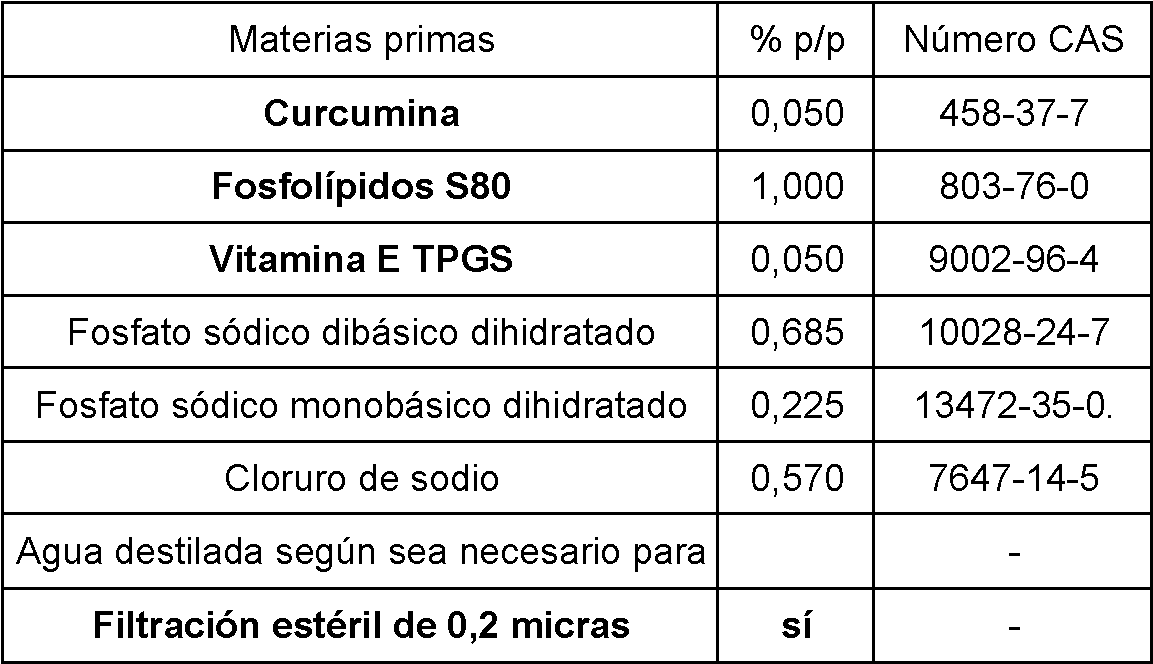
[0060] La formulación número 6 en liposomas de curcumina al 0,050 % tiene un pH de 7.17 y una osmolalidad (mOsmol/kg) de 285. Ambos valores están dentro de los límites de aceptación (pH: 7-7.4; mOsmol/kg: 275-310). Además, el diámetro medio de las partículas liposomales es inferior a 200 nm. La formulación de liposomas de curcumina al 0,050 % y vitamina E-TPGS al 0,05 % (como constituyente de los propios liposomas) es bien filtrable a 0,2 micras, lo que permite su uso como gotas oculares, sin añadir conservantes.[0060] Formulation number 6 in 0.050% curcumin liposomes has a pH of 7.17 and an osmolality (mOsmol/kg) of 285. Both values are within the acceptance limits (pH: 7-7.4; mOsmol/kg: 275-310). Furthermore, the average diameter of liposomal particles is less than 200 nm. The liposome formulation of 0.050% curcumin and 0.05% vitamin E-TPGS (as a constituent of the liposomes themselves) is well filterable to 0.2 microns, allowing its use as eye drops, without adding preservatives.
[0061] Habiendo obtenido un excelente resultado, la formulación anterior se mejoró aún más, reemplazando los fosfolípidos no hidrogenados (S80), que tienen una transición de fase a baja temperatura (-5 y 30 ° C) que es muy flexible y, por lo tanto, fácilmente filtrable, con fosfolípidos hidrogenados (específicamente PHOSPOLIPON 90H, es decir, con una concentración de fosfatidilcolina entre 80-90 %), mucho más rígido que tiene una transición de fase (45 55 ° C) y, por lo tanto, menos flexible y fluido y, por lo tanto, difícilmente filtrable a 0,2 micras.[0061] Having obtained an excellent result, the above formulation was further improved, replacing non-hydrogenated phospholipids (S80), which have a phase transition at low temperature (-5 and 30 ° C) that is very flexible and therefore therefore easily filterable, with hydrogenated phospholipids (specifically PHOSPOLIPON 90H, i.e. with a concentration of phosphatidylcholine between 80-90%), much more rigid having a phase transition (45 55 ° C) and, therefore, less flexible and fluid and, therefore, difficult to filter at 0.2 microns.
[0062] Esta elección se hizo para mejorar la estabilidad general de la formulación, ya que aunque los fosfolípidos no hidrogenados son más fácilmente filtrables, son menos estables que los fosfolípidos hidrogenados: de hecho, estos últimos pueden degradarse con el tiempo debido al oxígeno e incluso a la temperatura con posibles cambios de color y posible presencia de peróxidos. Además, debido a la rigidez intrínseca de los mismos, son portadores más resistentes evitando la liberación de los principios activos a lo largo del tiempo.[0062] This choice was made to improve the overall stability of the formulation, since although non-hydrogenated phospholipids are more easily filterable, they are less stable than hydrogenated phospholipids: in fact, the latter can degrade over time due to oxygen and even at temperature with possible color changes and possible presence of peroxides. Furthermore, due to their intrinsic rigidity, they are more resistant carriers, preventing the release of the active ingredients over time.
[0063] En consideración a lo anterior, informamos la siguiente formulación número 7 aquí, que ha sido estudiada desde un punto de vista farmacológico.[0063] In consideration of the above, we report the following formulation number 7 here, which has been studied from a pharmacological point of view.
Formulación Número 7: Liposomas de curcumina 0,05 %/Vitamina E - TPGS 0,05 % con fosfolípidos hidrogenados (dentro de los liposomas)Formulation Number 7: Curcumin 0.05% /V itamine E - TPGS 0.05% liposomes with hydrogenated phospholipids (within the liposomes)
[0064][0064]

(continuación)(continuation)

[0065] La formulación número 7 en liposomas de curcumina al 0,050 % tiene un pH de 7.10 y una osmolalidad (mOsmol/kg) de 285. Ambos valores están dentro de los límites de aceptación (pH: 7-7.4; mOsmol/kg: 275-310). Además, el diámetro medio de las partículas liposomales es inferior a 200 nm, como se muestra en la Figura 1. A pesar de la sustitución de los fosfolípidos no hidrogenados (más flexibles y filtrables) por otros hidrogenados (más rígidos y menos filtrables), la formulación de liposomas de curcumina al 0,050 % y vitamina E-TPGS al 0,05 % (como constituyente de los propios liposomas) sigue siendo bien filtrable a 0,2 micras, como se ve en la Figura 2, por lo tanto, esterilizable y utilizable para su uso como gotas oculares.[0065] Formulation number 7 in 0.050 % curcumin liposomes has a pH of 7.10 and an osmolality (mOsmol/kg) of 285. Both values are within the acceptance limits (pH: 7-7.4; mOsmol/kg: 275-310). Furthermore, the average diameter of the liposomal particles is less than 200 nm, as shown in Figure 1. Despite the replacement of non-hydrogenated phospholipids (more flexible and filterable) with hydrogenated ones (more rigid and less filterable), the liposome formulation of 0.050% curcumin and 0.05% vitamin E-TPGS (as a constituent of the liposomes themselves) remains well filterable to 0.2 microns, as seen in Figure 2, therefore sterilizable and usable for use as eye drops.
[0066] Con base en lo anterior, la formulación número 7 se analizó, por lo tanto, en las pruebas experimentales que se describen a continuación, con el objetivo de evaluar la eficacia antiinflamatoria de la misma.[0066] Based on the above, formulation number 7 was therefore analyzed in the experimental tests described below, with the aim of evaluating its anti-inflammatory efficacy.
[0067] Es importante tener en cuenta que en el experimento farmacológico que se ilustra a continuación, se informa un ensayo de viabilidad celular con excelentes resultados que demuestran que la estrategia de contener la concentración del tensioactivo VITAMINA E TPGS en la medida de lo posible fue apropiada y correcta (ver la siguiente tabla 2) que se acompaña de una excelente capacidad antiinflamatoria (ver la siguiente tabla 3) (inhibición de citocinas).[0067] It is important to note that in the pharmacological experiment illustrated below, a cell viability assay is reported with excellent results demonstrating that the strategy of containing the concentration of the VITAMIN E TPGS surfactant as much as possible was appropriate and correct (see table 2 below) which is accompanied by an excellent anti-inflammatory capacity (see table 3 below) (cytokine inhibition).
[0068] Además, la formulación número 7 se mejoró aún más reemplazando el tampón fosfato, utilizado en todas las formulaciones anteriores 1 a 7, con el tampón borato, que se sabe que es mucho más aceptado a nivel ocular.[0068] Furthermore, formulation number 7 was further improved by replacing the phosphate buffer, used in all previous formulations 1 to 7, with the borate buffer, which is known to be much more ocularly acceptable.
[0069] La formulación desarrollada es la siguiente.[0069] The formulation developed is the following.
Formulación 8: Liposomas de curcumina 0,05 %/Vitamina E - TPGS 0,05 % con fosfolípidos hidrogenados (dentro de los liposomas)Formulation 8: Curcumin 0.05% /V itamine E - TPGS 0.05% liposomes with hydrogenated phospholipids (within the liposomes)
[0070][0070]

[0071] La formulación número 8 en liposomas de curcumina al 0,050 % tiene un pH de 7.24 y una osmolalidad (mOsmol/kg) de 286. Ambos valores están dentro de los límites de aceptación (pH: 7-7.4; mOsmol/kg: 275-310). Además, el diámetro medio de las partículas liposomales es inferior a 200 nm, lo que lo hace filtrable a 0,2 micras, por lo tanto, esterilizable y utilizable para su uso como gotas oculares.[0071] Formulation number 8 in 0.050% curcumin liposomes has a pH of 7.24 and an osmolality (mOsmol/kg) of 286. Both values are within the acceptance limits (pH: 7-7.4; mOsmol/kg: 275-310). Furthermore, the average diameter of the liposomal particles is less than 200 nm, making it filterable to 0.2 microns, therefore sterilizable and usable for use as eye drops.
PARTE EXPERIMENTAL EVALUACIÓN IN VITRO DEL POTENCIAL ANTIINFLAMATORIO DE LA FORMULACIÓN OFTÁLMICA LIPOSOMAL FORMULACIÓN NÚMERO 7EXPERIMENTAL PART IN VITRO EVALUATION OF THE ANTI-INFLAMMATORY POTENTIAL OF THE OPHTHALMIC LIPOSOMAL FORMULATION FORMULATION NUMBER 7
[0072] Para verificar el efecto antiinflamatorio de la formulación oftálmica liposomal a base de curcumina objeto de la presente invención, se llevó a cabo una prueba experimental, evaluando in vitro, en detalle, el potencial antiinflamatorio en la epidermis humana reconstruida.[0072] To verify the anti-inflammatory effect of the subject curcumin-based liposomal ophthalmic formulation of the present invention, an experimental test was carried out, evaluating in vitro, in detail, the anti-inflammatory potential in the reconstructed human epidermis.
[0073] El objetivo de la prueba fue determinar cuantitativamente los efectos de la formulación en cuestión en la protección de las células epiteliales y en la inhibición de la reacción inflamatoria causada por un irritante moderado como el lauril sulfato de sodio (SLS) mediante un modelo in vitro de células epiteliales multicapa. La inhibición de la liberación mediada por SLS de la citocina IL-1a después de la exposición de la formulación en cuestión y por comparación con la epidermis no tratada se evaluó por medio de un ensayo ELISA. El ensayo incluyó un ensayo de MTT de sensibilización al final de la incubación: ensayo de supervivencia celular utilizando la epidermis humana artificial 3D reconstruida in vitro para evaluar el potencial citotóxico de la muestra. Además, habrá inhibición de la liberación mediada por SLS de mediadores inflamatorios (IL-1 a).[0073] The objective of the test was to quantitatively determine the effects of the formulation in question in the protection of epithelial cells and in the inhibition of the inflammatory reaction caused by a moderate irritant such as sodium lauryl sulfate (SLS) using a model in vitro multilayer epithelial cells. The inhibition of SLS-mediated release of the cytokine IL-1a after exposure to the formulation in question and by comparison with untreated epidermis was evaluated by means of an ELISA assay. The assay included a priming MTT assay at the end of incubation: cell survival assay using the in vitro reconstructed 3D artificial human epidermis to evaluate the cytotoxic potential of the sample. Additionally, there will be inhibition of SLS-mediated release of inflammatory mediators (IL-1a).
Procedimientos de pruebaTest procedures
I. Modelo celularI. Cellular model
[0074] Los sistemas de prueba in vitro utilizados consisten en un sistema tridimensional artificial de la epidermis humana. Se preparó un modelo reconstruido de piel humana artificial que comprende queratinocitos epidérmicos humanos normales, que se cultivó como un modelo de cultivo celular tridimensional integrado, imitando perfectamente la piel humana in vitro. El modelo presenta funciones de barrera normales (presencia de un estrato córneo bien diferenciado). Fue proporcionado por CELLSYSTEMS (Troisdorf, lote 100-AHl244-1).[0074] The in vitro test systems used consist of an artificial three-dimensional system of the human epidermis. A reconstructed artificial human skin model comprising normal human epidermal keratinocytes was prepared, which was cultured as an integrated three-dimensional cell culture model, perfectly mimicking human skin in vitro. The model presents normal barrier functions (presence of a well-differentiated stratum corneum). It was provided by CELLSYSTEMS (Troisdorf, lot 100-AHl244-1).
II. Tratamiento y exposiciónII. Treatment and exposure
[0075] La epidermis se pretrató durante 60 minutos con SLS al 0,25 % y se obtuvo para inducir la síntesis y liberación de IL-1a. Posteriormente se aplicaron 30 ml de la formulación objeto de la invención sobre dos porciones de la epidermis en dos réplicas, y se llevó a cabo la exposición durante 24 horas a 37 °C, 5 % C02. Como control negativo, se trataron dos unidades epidérmicas con tampón fosfato, mientras que la epidermis tratada durante 60 minutos con SLS al 0,25 % se utilizó como control positivo. El ensayo se realizó en dos réplicas. Al final del período de exposición, la formulación de la muestra y los controles se retiraron lavando con tampón fosfato (PBS) y se realizó el ensayo MTT para evaluar la supervivencia celular. Para la prueba de IL 1a, el medio de cultivo se recolectó a las 6 y 24 horas. Solo el medio de cultivo de las unidades tratadas con PBS y los medios de las unidades epidérmicas no irritadas tratadas con muestra se usaron como controles negativos; mientras que los medios de las 2 unidades tratadas con SLS al 0,25 % se utilizaron como controles positivos.[0075] The epidermis was pretreated for 60 minutes with 0.25% SLS and obtained to induce the synthesis and release of IL-1a. Subsequently, 30 ml of the formulation object of the invention were applied to two portions of the epidermis in two replicates, and the exposure was carried out for 24 hours at 37 ° C, 5% C02. As a negative control, two epidermal units were treated with phosphate buffer, while the epidermis treated for 60 minutes with 0.25% SLS was used as a positive control. The test was carried out in two replicates. At the end of the exposure period, the sample formulation and controls were removed by washing with phosphate buffer (PBS) and the MTT assay was performed to evaluate cell survival. For the IL 1a test, the culture medium was collected at 6 and 24 hours. Only the culture medium from the PBS-treated units and the media from the non-irritated epidermal units treated with sample were used as negative controls; while the media from the 2 units treated with 0.25% SLS were used as positive controls.
III. Prueba de viabilidad de células MTTIII. MTT cell viability test
[0076] Las unidades epidérmicas se tratan con 1 mg de solución MD de bromuro de (3-4,5-dimetil-tiazol-2-il)-2,5-difenil-tetrazolio) durante 3 horas a 37 °C. A continuación, la solución se retira y se reemplaza con isopropanol, con 2 horas adicionales de incubación a temperatura ambiente; Se transfieren 2 alícuotas de cada muestra a una placa de 96 pocillos para su lectura. La absorbancia se lee a la longitud de onda de 570 nm con un colorímetro (modelo remoto Tecan Sunrise) provisto de un lector de microplacas.[0076] The epidermal units are treated with 1 mg of (3-4,5-dimethyl-thiazol-2-yl)-2,5-diphenyl-tetrazolium bromide MD solution for 3 hours at 37 ° C. The solution is then removed and replaced with isopropanol, with an additional 2 hours of incubation at room temperature; 2 aliquots of each sample are transferred to a 96-well plate for reading. The absorbance is read at the wavelength of 570 nm with a colorimeter (Tecan Sunrise remote model) fitted with a microplate reader.
IV. Ensayo de IL-1 aIV. IL-1 a assay
[0077] En este estudio, se determinó IL-1a en el medio de cultivo de epidermis tratada y no tratada, utilizando un ensayo ELIS directo (ensayo inmunoabsorbente ligado a enzimas). La señal colorimétrica es directamente proporcional a la cantidad de citocina en el medio de cultivo. Las muestras se leen a 450 nm. El límite de detección es inferior a 10 μg/ml.[0077] In this study, IL-1a was determined in the culture medium of treated and untreated epidermis, using a direct ELIS assay (enzyme-linked immunosorbent assay). The colorimetric signal is directly proportional to the amount of cytokine in the culture medium. Samples are read at 450 nm. The detection limit is less than 10 μg/ml.
V. Expresión de los resultados.V. Expression of the results.
[0078] Los resultados se expresan en términos de viabilidad celular:[0078] The results are expressed in terms of cell viability:
% de viabilidad celular = [OD(570 nm) muestra de prueba/OD (570 nm) CN] x 100% cell viability = [OD(570 nm) test sample/OD(570 nm) CN] x 100
IL-1aIL-1a
[0079] La concentración de citocinas se determina utilizando una curva estándar. La inhibición de la liberación de IL-1a se determinó como: % de inhibición de IL-1 a:[0079] Cytokine concentration is determined using a standard curve. Inhibition of IL-1a release was determined as: % IL-1 inhibition a:
100-(pa/ml W ILW-1 a liberado de muestras ¡rritadas/μg/ml W ILW-1 a control I positivo) /*100 VI. Criterios de aceptación del procedimiento100-(pa/ml W IL W -1 a released from irritated samples/μg/ml W IL W -1 a positive control I ) / *100 SAW. Procedure acceptance criteria
Prueba/dosis de MTTMTT Test/Dose
[0080][0080]
para el control negativo (CN): valor de OD entre 1,0-3,0.for negative control (CN): OD value between 1.0-3.0.
la desviación típica debe ser <18 %standard deviation should be <18%
para el control positivo (CP): la viabilidad media (expresada como % del NC) debe ser <70 % la desviación típica debe ser < 18 %for the positive control (PC): the mean viability (expressed as % of the NC) should be <70% the standard deviation should be <18%
para la muestra: la desviación estándar debe ser <18 %.for sample: standard deviation should be <18%.
Tabla 1. Criterios para la aceptación del ensayo.Table 1. Criteria for acceptance of the trial.

Tabla 2. Valores medios de viabilidad celular (%)Table 2. Mean cell viability values (%)
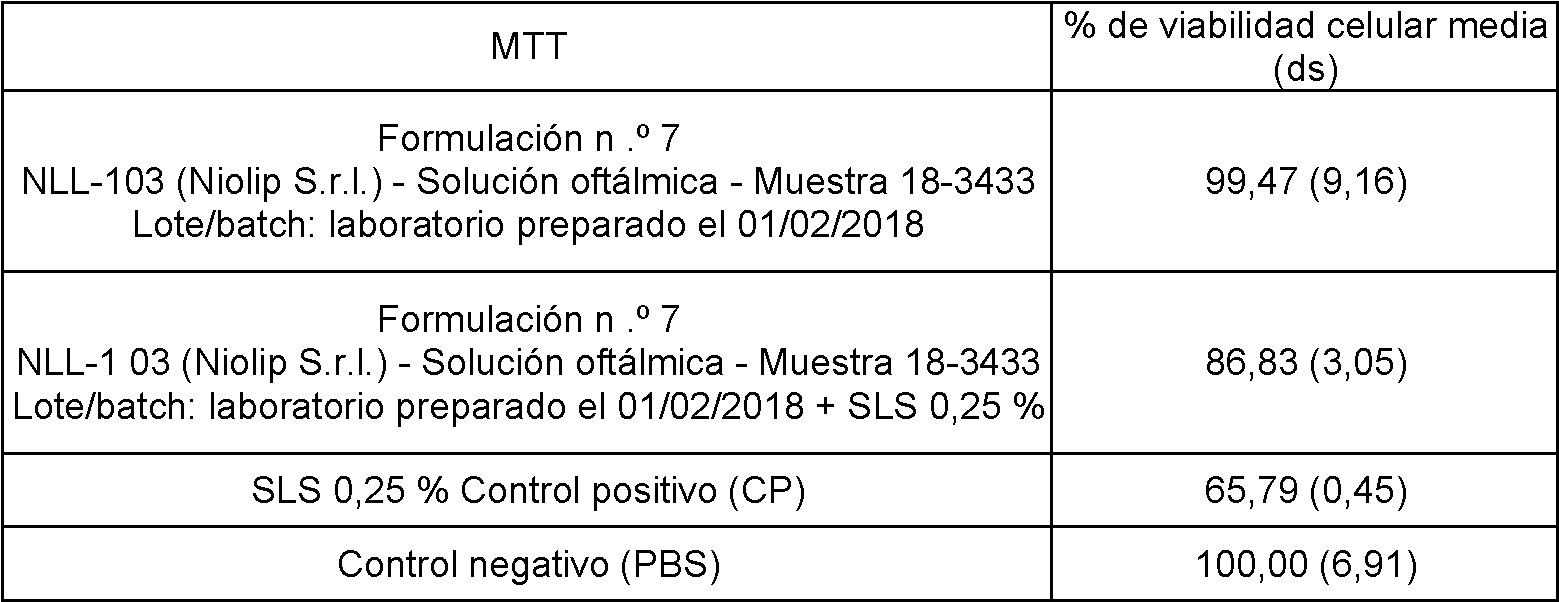
Tabla 3. Cantidad de IL-1a expresada en μg/mlTable 3. Amount of IL-1a expressed in μg/ml

(continuación)(continuation)

ResultadosResults
[0081] En función de los resultados que se muestran aquí, la muestra de la Formulación número 7 NLL-103 (Niolip S.r.l.) - solución oftálmica muestra actividad antiinflamatoria in vitro. Ya después de 6 horas de incubación, se destaca una reducción en la liberación de IL-1a (50,57 %).[0081] Based on the results shown here, the sample of Formulation number 7 NLL-103 (Niolip Srl) - ophthalmic solution shows anti-inflammatory activity in vitro. Already after 6 hours of incubation, a reduction in the release of IL-1a (50.57%) is notable.
CONCLUSIONESCONCLUSIONS
[0082] La eficacia antiinflamatoria de la formulación liposomal según la invención se determinó mediante pruebas experimentales estándar realizadas en cultivos celulares de epidermis humana reconstruida. Los datos así obtenidos se utilizaron para determinar las formulaciones anteriores como los intervalos de dosis óptimos para el uso de la composición en humanos. [0082] The anti-inflammatory efficacy of the liposomal formulation according to the invention was determined by standard experimental tests carried out on cell cultures of reconstructed human epidermis. The data thus obtained were used to determine the above formulations as the optimal dosage ranges for use of the composition in humans.
Claims (12)


Applications Claiming Priority (2)
| Application Number | Priority Date | Filing Date | Title |
|---|---|---|---|
| IT102019000015408A IT201900015408A1 (en) | 2019-09-02 | 2019-09-02 | "EYE DROPS BASED ON A STERILIZABLE LIPOSOMIAL FORMULATION BASED ON CURCUMIN AND ITS OPHTHALMIC USE" |
| PCT/IB2020/058100 WO2021044283A1 (en) | 2019-09-02 | 2020-08-31 | Eye drops based on a sterilizable liposomal formulation based on curcumin and ophthalmic use thereof |
Publications (1)
| Publication Number | Publication Date |
|---|---|
| ES2955820T3 true ES2955820T3 (en) | 2023-12-07 |
Family
ID=69468966
Family Applications (1)
| Application Number | Title | Priority Date | Filing Date |
|---|---|---|---|
| ES20771921T Active ES2955820T3 (en) | 2019-09-02 | 2020-08-31 | Eye drops based on a sterilizable liposomal formulation based on curcumin and ophthalmic use thereof |
Country Status (4)
| Country | Link |
|---|---|
| EP (1) | EP4003298B1 (en) |
| ES (1) | ES2955820T3 (en) |
| IT (1) | IT201900015408A1 (en) |
| WO (1) | WO2021044283A1 (en) |
Families Citing this family (2)
| Publication number | Priority date | Publication date | Assignee | Title |
|---|---|---|---|---|
| IT202300000006A1 (en) * | 2023-01-02 | 2024-07-02 | Offhealth Spa | “LIPOSOMAL FORMULATION OF CURCUMIN FOR OPHTHALMIC USE AND ITS INDUSTRIAL PREPARATION METHOD DESIGNED TO STABILIZE THE CONCENTRATION OF CURCUMIN OVER TIME” |
| CN121153855A (en) * | 2025-09-29 | 2025-12-19 | 中国海洋大学 | Astaxanthin nanoliposome constructed based on interface chimeric and function cooperative strategy and preparation method and application thereof |
Family Cites Families (3)
| Publication number | Priority date | Publication date | Assignee | Title |
|---|---|---|---|---|
| CN1824255B (en) * | 2005-12-29 | 2011-03-09 | 沈阳药科大学 | Curcuma zedoary oil solid lipid nano-particle and its preparation method |
| CN102008439B (en) * | 2010-11-29 | 2012-07-18 | 山东大学 | Curcumin coated liposome preparation and preparation method thereof |
| CN102379850B (en) * | 2011-11-04 | 2013-08-28 | 北京泰德制药股份有限公司 | Targeted administration liposome passing through mucus barriers of human bodies |
-
2019
- 2019-09-02 IT IT102019000015408A patent/IT201900015408A1/en unknown
-
2020
- 2020-08-31 ES ES20771921T patent/ES2955820T3/en active Active
- 2020-08-31 WO PCT/IB2020/058100 patent/WO2021044283A1/en not_active Ceased
- 2020-08-31 EP EP20771921.2A patent/EP4003298B1/en active Active
Also Published As
| Publication number | Publication date |
|---|---|
| IT201900015408A1 (en) | 2021-03-02 |
| EP4003298B1 (en) | 2023-06-14 |
| EP4003298A1 (en) | 2022-06-01 |
| WO2021044283A1 (en) | 2021-03-11 |
Similar Documents
| Publication | Publication Date | Title |
|---|---|---|
| Nasr et al. | Formulation and evaluation of cubosomes containing colchicine for transdermal delivery | |
| Desai | Polymeric drug delivery systems for intraoral site‐specific chemoprevention of oral cancer | |
| ES3038735T3 (en) | Microemulsion for opthalmic drug delivery | |
| CN111867562B (en) | Aqueous formulation of insoluble drug | |
| ES2557475T3 (en) | A carrier comprising one or more di- and / or monophosphate derivatives of electron transfer agents | |
| CN101653414B (en) | Long-circulating solid lipid docetaxel nanoparticles and preparation method thereof | |
| TW201124425A (en) | Parenteral formulations of gemcitabine derivatives | |
| CA2595617C (en) | Formulations for injection of catecholic butanes, including ndga compounds, into animals | |
| CN104427977A (en) | Depot formulations of local anesthetic and methods for preparation thereof | |
| EP1968538A1 (en) | Pharmaceutical compositions comprising cyclosporin | |
| CN108289846B (en) | Preparation method of liposome | |
| ES2395130T3 (en) | Method and composition for the treatment of rhinitis | |
| Raju et al. | Formulation and evaluation of ornidazole topical emulgel | |
| CN102327214A (en) | Thymol nano-medicament and preparation method thereof | |
| WO2022160971A1 (en) | Concentrate containing poorly soluble drug, and emulsion prepared therefrom | |
| EP4003298B1 (en) | Eye drops based on a sterilizable liposomal formulation based on curcumin and ophthalmic use thereof | |
| Pandey et al. | Anti-psoriatic evaluation of aloe emodin-loaded topical hydrogel in an imiquimod-induced human plaque-type psoriasis in BALB/c mice | |
| KR101587385B1 (en) | Non-irritating cyclosporin ophthalmic solution and convenient manufacturing process | |
| CN107088227A (en) | Drug solution and method for making therapeutic agent solubilising | |
| Rane et al. | Next-Generation Nanocarriers for Skin Cancer Therapy via Transdermal Delivery. | |
| CN103893114B (en) | A kind of Vitamin D receptor agonist pharmaceutical composition of the injectable of stabilization and preparation method thereof | |
| Kaur et al. | Exploring applications of flexible vesicular systems as transdermal drug delivery | |
| KR20190040305A (en) | Subcutaneous injections for weight loss and uses thereof | |
| Tambe et al. | Lipid-based Nanocarriers via Nose-to-Brain Pathway for Alzheimer's and Parkinson's Disease | |
| CN109125318B (en) | Application of butylphthalide in preparation of medicine for treating xerophthalmia |