FR2468603A1 - Nouveaux uraciles substitues comportant un groupement 2-tetrahydropyranyle, leur procede de preparation et les compositions pesticides les renfermant - Google Patents
Nouveaux uraciles substitues comportant un groupement 2-tetrahydropyranyle, leur procede de preparation et les compositions pesticides les renfermant Download PDFInfo
- Publication number
- FR2468603A1 FR2468603A1 FR7924045A FR7924045A FR2468603A1 FR 2468603 A1 FR2468603 A1 FR 2468603A1 FR 7924045 A FR7924045 A FR 7924045A FR 7924045 A FR7924045 A FR 7924045A FR 2468603 A1 FR2468603 A1 FR 2468603A1
- Authority
- FR
- France
- Prior art keywords
- sep
- compounds
- methyl
- tetrahydropyranyl
- carbon atoms
- Prior art date
- Legal status (The legal status is an assumption and is not a legal conclusion. Google has not performed a legal analysis and makes no representation as to the accuracy of the status listed.)
- Granted
Links
- 229920000742 Cotton Polymers 0.000 title claims abstract description 23
- 235000010469 Glycine max Nutrition 0.000 title claims abstract description 17
- 244000068988 Glycine max Species 0.000 title claims abstract description 15
- 239000004009 herbicide Substances 0.000 title claims abstract description 13
- -1 methylsulphonyl Chemical group 0.000 title claims description 71
- 125000001160 methoxycarbonyl group Chemical group [H]C([H])([H])OC(*)=O 0.000 title claims description 10
- 125000002777 acetyl group Chemical group [H]C([H])([H])C(*)=O 0.000 title description 3
- 235000013339 cereals Nutrition 0.000 title 1
- ZZUFCTLCJUWOSV-UHFFFAOYSA-N furosemide Chemical compound C1=C(Cl)C(S(=O)(=O)N)=CC(C(O)=O)=C1NCC1=CC=CO1 ZZUFCTLCJUWOSV-UHFFFAOYSA-N 0.000 title 1
- 125000004432 carbon atom Chemical group C* 0.000 claims abstract description 40
- 240000008042 Zea mays Species 0.000 claims abstract description 28
- 235000002017 Zea mays subsp mays Nutrition 0.000 claims abstract description 28
- 244000075850 Avena orientalis Species 0.000 claims abstract description 26
- 241000209140 Triticum Species 0.000 claims abstract description 26
- 235000021307 Triticum Nutrition 0.000 claims abstract description 25
- 235000007319 Avena orientalis Nutrition 0.000 claims abstract description 11
- 235000007340 Hordeum vulgare Nutrition 0.000 claims abstract description 8
- YTPLMLYBLZKORZ-UHFFFAOYSA-N Thiophene Chemical group C=1C=CSC=1 YTPLMLYBLZKORZ-UHFFFAOYSA-N 0.000 claims abstract description 4
- 240000005979 Hordeum vulgare Species 0.000 claims abstract 4
- 150000001875 compounds Chemical class 0.000 claims description 54
- 239000000203 mixture Substances 0.000 claims description 44
- 241000196324 Embryophyta Species 0.000 claims description 34
- BTSKTUHNJCDYNN-UHFFFAOYSA-N 5-ethyl-6-methyl-1h-pyrimidine-2,4-dione Chemical compound CCC1=C(C)NC(=O)NC1=O BTSKTUHNJCDYNN-UHFFFAOYSA-N 0.000 claims description 22
- 235000005824 Zea mays ssp. parviglumis Nutrition 0.000 claims description 21
- 235000005822 corn Nutrition 0.000 claims description 21
- 125000001412 tetrahydropyranyl group Chemical group 0.000 claims description 21
- 238000009333 weeding Methods 0.000 claims description 20
- KEAYESYHFKHZAL-UHFFFAOYSA-N Sodium Chemical compound [Na] KEAYESYHFKHZAL-UHFFFAOYSA-N 0.000 claims description 16
- 239000012312 sodium hydride Substances 0.000 claims description 16
- 229910000104 sodium hydride Inorganic materials 0.000 claims description 16
- 239000004480 active ingredient Substances 0.000 claims description 10
- CIUQDSCDWFSTQR-UHFFFAOYSA-N [C]1=CC=CC=C1 Chemical compound [C]1=CC=CC=C1 CIUQDSCDWFSTQR-UHFFFAOYSA-N 0.000 claims description 9
- 238000000034 method Methods 0.000 claims description 8
- 230000000361 pesticidal effect Effects 0.000 claims description 7
- 229910052799 carbon Inorganic materials 0.000 claims description 6
- 238000002360 preparation method Methods 0.000 claims description 6
- OKTJSMMVPCPJKN-UHFFFAOYSA-N Carbon Chemical group [C] OKTJSMMVPCPJKN-UHFFFAOYSA-N 0.000 claims description 4
- SLRMQYXOBQWXCR-UHFFFAOYSA-N 2154-56-5 Chemical compound [CH2]C1=CC=CC=C1 SLRMQYXOBQWXCR-UHFFFAOYSA-N 0.000 claims description 3
- XMJHPCRAQCTCFT-UHFFFAOYSA-N methyl chloroformate Chemical compound COC(Cl)=O XMJHPCRAQCTCFT-UHFFFAOYSA-N 0.000 claims description 3
- 229910052717 sulfur Inorganic materials 0.000 claims description 3
- 229930192474 thiophene Natural products 0.000 claims description 3
- NINIDFKCEFEMDL-UHFFFAOYSA-N Sulfur Chemical compound [S] NINIDFKCEFEMDL-UHFFFAOYSA-N 0.000 claims 1
- 150000001721 carbon Chemical group 0.000 claims 1
- 239000011593 sulfur Substances 0.000 claims 1
- 230000002363 herbicidal effect Effects 0.000 abstract description 21
- 235000016383 Zea mays subsp huehuetenangensis Nutrition 0.000 abstract description 7
- 235000009973 maize Nutrition 0.000 abstract description 7
- 230000000694 effects Effects 0.000 abstract description 6
- 125000000217 alkyl group Chemical group 0.000 abstract 4
- 125000001997 phenyl group Chemical group [H]C1=C([H])C([H])=C(*)C([H])=C1[H] 0.000 abstract 2
- 241000219146 Gossypium Species 0.000 abstract 1
- 125000001797 benzyl group Chemical group [H]C1=C([H])C([H])=C(C([H])=C1[H])C([H])([H])* 0.000 abstract 1
- 125000002837 carbocyclic group Chemical group 0.000 abstract 1
- 125000000753 cycloalkyl group Chemical group 0.000 abstract 1
- XEKOWRVHYACXOJ-UHFFFAOYSA-N Ethyl acetate Chemical compound CCOC(C)=O XEKOWRVHYACXOJ-UHFFFAOYSA-N 0.000 description 54
- ZMXDDKWLCZADIW-UHFFFAOYSA-N N,N-Dimethylformamide Chemical compound CN(C)C=O ZMXDDKWLCZADIW-UHFFFAOYSA-N 0.000 description 42
- YMWUJEATGCHHMB-UHFFFAOYSA-N Dichloromethane Chemical compound ClCCl YMWUJEATGCHHMB-UHFFFAOYSA-N 0.000 description 30
- VYPSYNLAJGMNEJ-UHFFFAOYSA-N Silicium dioxide Chemical compound O=[Si]=O VYPSYNLAJGMNEJ-UHFFFAOYSA-N 0.000 description 28
- 241000209219 Hordeum Species 0.000 description 20
- 125000004435 hydrogen atom Chemical group [H]* 0.000 description 18
- 238000004821 distillation Methods 0.000 description 17
- RTZKZFJDLAIYFH-UHFFFAOYSA-N Diethyl ether Chemical compound CCOCC RTZKZFJDLAIYFH-UHFFFAOYSA-N 0.000 description 16
- 241000219793 Trifolium Species 0.000 description 16
- 241001506766 Xanthium Species 0.000 description 16
- 235000005781 Avena Nutrition 0.000 description 15
- 241000209149 Zea Species 0.000 description 15
- XLYOFNOQVPJJNP-UHFFFAOYSA-N water Substances O XLYOFNOQVPJJNP-UHFFFAOYSA-N 0.000 description 15
- 241000743339 Agrostis Species 0.000 description 14
- 241000723353 Chrysanthemum Species 0.000 description 14
- 235000007516 Chrysanthemum Nutrition 0.000 description 14
- 241000209082 Lolium Species 0.000 description 14
- 241000220261 Sinapis Species 0.000 description 14
- 229910052739 hydrogen Inorganic materials 0.000 description 14
- VYQNWZOUAUKGHI-UHFFFAOYSA-N monobenzone Chemical compound C1=CC(O)=CC=C1OCC1=CC=CC=C1 VYQNWZOUAUKGHI-UHFFFAOYSA-N 0.000 description 14
- 239000000725 suspension Substances 0.000 description 14
- ZFXYFBGIUFBOJW-UHFFFAOYSA-N theophylline Chemical compound O=C1N(C)C(=O)N(C)C2=C1NC=N2 ZFXYFBGIUFBOJW-UHFFFAOYSA-N 0.000 description 14
- 229960000278 theophylline Drugs 0.000 description 14
- 241000743985 Alopecurus Species 0.000 description 13
- XDTMQSROBMDMFD-UHFFFAOYSA-N Cyclohexane Chemical compound C1CCCCC1 XDTMQSROBMDMFD-UHFFFAOYSA-N 0.000 description 12
- 241000219053 Rumex Species 0.000 description 12
- 239000003921 oil Substances 0.000 description 12
- 235000019198 oils Nutrition 0.000 description 12
- 239000000377 silicon dioxide Substances 0.000 description 12
- 241001101998 Galium Species 0.000 description 11
- 239000011541 reaction mixture Substances 0.000 description 11
- 241000219312 Chenopodium Species 0.000 description 10
- 241000209504 Poaceae Species 0.000 description 10
- LFQSCWFLJHTTHZ-UHFFFAOYSA-N Ethanol Chemical compound CCO LFQSCWFLJHTTHZ-UHFFFAOYSA-N 0.000 description 9
- HEDRZPFGACZZDS-MICDWDOJSA-N Trichloro(2H)methane Chemical compound [2H]C(Cl)(Cl)Cl HEDRZPFGACZZDS-MICDWDOJSA-N 0.000 description 8
- 125000001495 ethyl group Chemical group [H]C([H])([H])C([H])([H])* 0.000 description 8
- 239000001257 hydrogen Substances 0.000 description 8
- AZQWKYJCGOJGHM-UHFFFAOYSA-N 1,4-benzoquinone Chemical compound O=C1C=CC(=O)C=C1 AZQWKYJCGOJGHM-UHFFFAOYSA-N 0.000 description 7
- 238000004458 analytical method Methods 0.000 description 7
- 125000003754 ethoxycarbonyl group Chemical group C(=O)(OCC)* 0.000 description 7
- 125000002496 methyl group Chemical group [H]C([H])([H])* 0.000 description 7
- 238000000655 nuclear magnetic resonance spectrum Methods 0.000 description 7
- UHOVQNZJYSORNB-UHFFFAOYSA-N Benzene Chemical compound C1=CC=CC=C1 UHOVQNZJYSORNB-UHFFFAOYSA-N 0.000 description 6
- HEMHJVSKTPXQMS-UHFFFAOYSA-M Sodium hydroxide Chemical compound [OH-].[Na+] HEMHJVSKTPXQMS-UHFFFAOYSA-M 0.000 description 6
- 239000003208 petroleum Substances 0.000 description 6
- ZAFNJMIOTHYJRJ-UHFFFAOYSA-N Diisopropyl ether Chemical compound CC(C)OC(C)C ZAFNJMIOTHYJRJ-UHFFFAOYSA-N 0.000 description 5
- 230000000052 comparative effect Effects 0.000 description 5
- 239000000706 filtrate Substances 0.000 description 5
- FMPIPUHCVNJFSM-UHFFFAOYSA-N 1,5-dihydrocyclopenta[d]pyrimidine-2,4-dione Chemical compound N1C(NC(C2=C1C=CC2)=O)=O FMPIPUHCVNJFSM-UHFFFAOYSA-N 0.000 description 4
- UFHFLCQGNIYNRP-UHFFFAOYSA-N Hydrogen Chemical compound [H][H] UFHFLCQGNIYNRP-UHFFFAOYSA-N 0.000 description 4
- RIFGWPKJUGCATF-UHFFFAOYSA-N ethyl chloroformate Chemical compound CCOC(Cl)=O RIFGWPKJUGCATF-UHFFFAOYSA-N 0.000 description 4
- 125000004051 hexyl group Chemical group [H]C([H])([H])C([H])([H])C([H])([H])C([H])([H])C([H])([H])C([H])([H])* 0.000 description 4
- 239000000843 powder Substances 0.000 description 4
- 125000001436 propyl group Chemical group [H]C([*])([H])C([H])([H])C([H])([H])[H] 0.000 description 4
- 239000000243 solution Substances 0.000 description 4
- PZVLJGKJIMBYNP-UHFFFAOYSA-N 5,6-dimethyl-1h-pyrimidine-2,4-dione Chemical compound CC=1NC(=O)NC(=O)C=1C PZVLJGKJIMBYNP-UHFFFAOYSA-N 0.000 description 3
- 125000001584 benzyloxycarbonyl group Chemical group C(=O)(OCC1=CC=CC=C1)* 0.000 description 3
- 238000004587 chromatography analysis Methods 0.000 description 3
- 238000001914 filtration Methods 0.000 description 3
- UYWQUFXKFGHYNT-UHFFFAOYSA-N phenylmethyl ester of formic acid Natural products O=COCC1=CC=CC=C1 UYWQUFXKFGHYNT-UHFFFAOYSA-N 0.000 description 3
- 239000000047 product Substances 0.000 description 3
- 238000002211 ultraviolet spectrum Methods 0.000 description 3
- QCJGYHGJRIDHDA-UHFFFAOYSA-N 6-methyl-5-propan-2-yl-1h-pyrimidine-2,4-dione Chemical compound CC(C)C1=C(C)NC(=O)NC1=O QCJGYHGJRIDHDA-UHFFFAOYSA-N 0.000 description 2
- 241001184547 Agrostis capillaris Species 0.000 description 2
- 241001621841 Alopecurus myosuroides Species 0.000 description 2
- 235000021533 Beta vulgaris Nutrition 0.000 description 2
- 241000335053 Beta vulgaris Species 0.000 description 2
- HEDRZPFGACZZDS-UHFFFAOYSA-N Chloroform Chemical compound ClC(Cl)Cl HEDRZPFGACZZDS-UHFFFAOYSA-N 0.000 description 2
- 244000067456 Chrysanthemum coronarium Species 0.000 description 2
- 235000007871 Chrysanthemum coronarium Nutrition 0.000 description 2
- 240000005702 Galium aparine Species 0.000 description 2
- 235000014820 Galium aparine Nutrition 0.000 description 2
- 240000004296 Lolium perenne Species 0.000 description 2
- IMNFDUFMRHMDMM-UHFFFAOYSA-N N-Heptane Chemical compound CCCCCCC IMNFDUFMRHMDMM-UHFFFAOYSA-N 0.000 description 2
- 239000004264 Petrolatum Substances 0.000 description 2
- 235000021501 Rumex crispus Nutrition 0.000 description 2
- 244000207667 Rumex vesicarius Species 0.000 description 2
- FAPWRFPIFSIZLT-UHFFFAOYSA-M Sodium chloride Chemical compound [Na+].[Cl-] FAPWRFPIFSIZLT-UHFFFAOYSA-M 0.000 description 2
- 244000098338 Triticum aestivum Species 0.000 description 2
- 125000003118 aryl group Chemical group 0.000 description 2
- 125000000484 butyl group Chemical group [H]C([*])([H])C([H])([H])C([H])([H])C([H])([H])[H] 0.000 description 2
- 238000002425 crystallisation Methods 0.000 description 2
- 230000008025 crystallization Effects 0.000 description 2
- 125000006639 cyclohexyl carbonyl group Chemical group 0.000 description 2
- 125000000113 cyclohexyl group Chemical group [H]C1([H])C([H])([H])C([H])([H])C([H])(*)C([H])([H])C1([H])[H] 0.000 description 2
- 125000001511 cyclopentyl group Chemical group [H]C1([H])C([H])([H])C([H])([H])C([H])(*)C1([H])[H] 0.000 description 2
- 239000008187 granular material Substances 0.000 description 2
- 239000002198 insoluble material Substances 0.000 description 2
- 125000000325 methylidene group Chemical group [H]C([H])=* 0.000 description 2
- 125000004170 methylsulfonyl group Chemical group [H]C([H])([H])S(*)(=O)=O 0.000 description 2
- 239000003960 organic solvent Substances 0.000 description 2
- 235000019271 petrolatum Nutrition 0.000 description 2
- 229940066842 petrolatum Drugs 0.000 description 2
- 125000006678 phenoxycarbonyl group Chemical group 0.000 description 2
- 239000002244 precipitate Substances 0.000 description 2
- 239000007787 solid Substances 0.000 description 2
- 241000894007 species Species 0.000 description 2
- 238000003756 stirring Methods 0.000 description 2
- 239000000126 substance Substances 0.000 description 2
- VXVWIRKAABQIGS-UHFFFAOYSA-N 2-isocyanatooxane Chemical compound O=C=NC1CCCCO1 VXVWIRKAABQIGS-UHFFFAOYSA-N 0.000 description 1
- SCGFOUNWYPVWMO-UHFFFAOYSA-N 5-ethyl-6-methyl-3-(oxan-2-yl)-1,3-diazinane-2,4-dione Chemical compound O=C1C(CC)C(C)NC(=O)N1C1OCCCC1 SCGFOUNWYPVWMO-UHFFFAOYSA-N 0.000 description 1
- FBBAXRAVJZOJGF-UHFFFAOYSA-N 5h-cyclopenta[d]pyrimidine Chemical compound C1=NC=C2CC=CC2=N1 FBBAXRAVJZOJGF-UHFFFAOYSA-N 0.000 description 1
- XQLIRTZXJDEQAO-UHFFFAOYSA-N 6-methyl-1,3-diazinane-2,4-dione Chemical compound CC1CC(=O)NC(=O)N1 XQLIRTZXJDEQAO-UHFFFAOYSA-N 0.000 description 1
- KSFTTXBCYNRMGU-UHFFFAOYSA-N 6-methyl-3-(oxan-2-yl)-5-propan-2-yl-1h-pyrimidine-2,4-dione Chemical compound O=C1C(C(C)C)=C(C)NC(=O)N1C1OCCCC1 KSFTTXBCYNRMGU-UHFFFAOYSA-N 0.000 description 1
- 235000007320 Avena fatua Nutrition 0.000 description 1
- 241000209764 Avena fatua Species 0.000 description 1
- 235000006463 Brassica alba Nutrition 0.000 description 1
- 244000140786 Brassica hirta Species 0.000 description 1
- 244000025254 Cannabis sativa Species 0.000 description 1
- 239000012359 Methanesulfonyl chloride Substances 0.000 description 1
- 231100000674 Phytotoxicity Toxicity 0.000 description 1
- 241001085205 Prenanthella exigua Species 0.000 description 1
- DHXVGJBLRPWPCS-UHFFFAOYSA-N Tetrahydropyran Chemical compound C1CCOCC1 DHXVGJBLRPWPCS-UHFFFAOYSA-N 0.000 description 1
- WETWJCDKMRHUPV-UHFFFAOYSA-N acetyl chloride Chemical compound CC(Cl)=O WETWJCDKMRHUPV-UHFFFAOYSA-N 0.000 description 1
- 239000012346 acetyl chloride Substances 0.000 description 1
- 239000013543 active substance Substances 0.000 description 1
- 125000004390 alkyl sulfonyl group Chemical group 0.000 description 1
- RLKBOGLIOLFMEK-NSCUHMNNSA-N amino (e)-but-2-enoate Chemical compound C\C=C\C(=O)ON RLKBOGLIOLFMEK-NSCUHMNNSA-N 0.000 description 1
- 239000010775 animal oil Substances 0.000 description 1
- 125000000129 anionic group Chemical group 0.000 description 1
- 239000003945 anionic surfactant Substances 0.000 description 1
- 239000007864 aqueous solution Substances 0.000 description 1
- PASDCCFISLVPSO-UHFFFAOYSA-N benzoyl chloride Chemical compound ClC(=O)C1=CC=CC=C1 PASDCCFISLVPSO-UHFFFAOYSA-N 0.000 description 1
- 125000003236 benzoyl group Chemical group [H]C1=C([H])C([H])=C(C([H])=C1[H])C(*)=O 0.000 description 1
- HSDAJNMJOMSNEV-UHFFFAOYSA-N benzyl chloroformate Chemical compound ClC(=O)OCC1=CC=CC=C1 HSDAJNMJOMSNEV-UHFFFAOYSA-N 0.000 description 1
- 125000000051 benzyloxy group Chemical group [H]C1=C([H])C([H])=C(C([H])=C1[H])C([H])([H])O* 0.000 description 1
- 125000002091 cationic group Chemical group 0.000 description 1
- 239000003093 cationic surfactant Substances 0.000 description 1
- 238000005119 centrifugation Methods 0.000 description 1
- FZFAMSAMCHXGEF-UHFFFAOYSA-N chloro formate Chemical compound ClOC=O FZFAMSAMCHXGEF-UHFFFAOYSA-N 0.000 description 1
- 239000008119 colloidal silica Substances 0.000 description 1
- 239000012141 concentrate Substances 0.000 description 1
- 125000000582 cycloheptyl group Chemical group [H]C1([H])C([H])([H])C([H])([H])C([H])([H])C([H])(*)C([H])([H])C1([H])[H] 0.000 description 1
- 125000001559 cyclopropyl group Chemical group [H]C1([H])C([H])([H])C1([H])* 0.000 description 1
- 238000010790 dilution Methods 0.000 description 1
- 239000012895 dilution Substances 0.000 description 1
- 239000006185 dispersion Substances 0.000 description 1
- 238000010410 dusting Methods 0.000 description 1
- 239000000839 emulsion Substances 0.000 description 1
- 230000003203 everyday effect Effects 0.000 description 1
- PCHJSUWPFVWCPO-UHFFFAOYSA-N gold Chemical compound [Au] PCHJSUWPFVWCPO-UHFFFAOYSA-N 0.000 description 1
- 239000010931 gold Substances 0.000 description 1
- 229910052737 gold Inorganic materials 0.000 description 1
- 238000000227 grinding Methods 0.000 description 1
- KIWBRXCOTCXSSZ-UHFFFAOYSA-N hexyl carbonochloridate Chemical compound CCCCCCOC(Cl)=O KIWBRXCOTCXSSZ-UHFFFAOYSA-N 0.000 description 1
- 229930195733 hydrocarbon Natural products 0.000 description 1
- 150000002430 hydrocarbons Chemical class 0.000 description 1
- 238000005286 illumination Methods 0.000 description 1
- 239000007788 liquid Substances 0.000 description 1
- 239000000463 material Substances 0.000 description 1
- 235000013372 meat Nutrition 0.000 description 1
- QARBMVPHQWIHKH-UHFFFAOYSA-N methanesulfonyl chloride Chemical compound CS(Cl)(=O)=O QARBMVPHQWIHKH-UHFFFAOYSA-N 0.000 description 1
- 239000002480 mineral oil Substances 0.000 description 1
- 235000010446 mineral oil Nutrition 0.000 description 1
- 239000002736 nonionic surfactant Substances 0.000 description 1
- 239000003415 peat Substances 0.000 description 1
- AHWALFGBDFAJAI-UHFFFAOYSA-N phenyl carbonochloridate Chemical compound ClC(=O)OC1=CC=CC=C1 AHWALFGBDFAJAI-UHFFFAOYSA-N 0.000 description 1
- 230000008635 plant growth Effects 0.000 description 1
- IVRIRQXJSNCSPQ-UHFFFAOYSA-N propan-2-yl carbonochloridate Chemical compound CC(C)OC(Cl)=O IVRIRQXJSNCSPQ-UHFFFAOYSA-N 0.000 description 1
- QQKDTTWZXHEGAQ-UHFFFAOYSA-N propyl carbonochloridate Chemical compound CCCOC(Cl)=O QQKDTTWZXHEGAQ-UHFFFAOYSA-N 0.000 description 1
- 125000004742 propyloxycarbonyl group Chemical group 0.000 description 1
- 239000004576 sand Substances 0.000 description 1
- 229920006395 saturated elastomer Polymers 0.000 description 1
- 239000000741 silica gel Substances 0.000 description 1
- 229910002027 silica gel Inorganic materials 0.000 description 1
- 150000004760 silicates Chemical class 0.000 description 1
- ODZPKZBBUMBTMG-UHFFFAOYSA-N sodium amide Chemical compound [NH2-].[Na+] ODZPKZBBUMBTMG-UHFFFAOYSA-N 0.000 description 1
- 239000011780 sodium chloride Substances 0.000 description 1
- 239000002689 soil Substances 0.000 description 1
- 239000008247 solid mixture Substances 0.000 description 1
- 239000002904 solvent Substances 0.000 description 1
- 238000009331 sowing Methods 0.000 description 1
- 239000007921 spray Substances 0.000 description 1
- 125000001424 substituent group Chemical group 0.000 description 1
- 125000004434 sulfur atom Chemical group 0.000 description 1
- 239000004094 surface-active agent Substances 0.000 description 1
- 239000000454 talc Substances 0.000 description 1
- 229910052623 talc Inorganic materials 0.000 description 1
- 229940099259 vaseline Drugs 0.000 description 1
- 235000015112 vegetable and seed oil Nutrition 0.000 description 1
- 239000008158 vegetable oil Substances 0.000 description 1
- 239000013585 weight reducing agent Substances 0.000 description 1
Classifications
-
- C—CHEMISTRY; METALLURGY
- C07—ORGANIC CHEMISTRY
- C07D—HETEROCYCLIC COMPOUNDS
- C07D405/00—Heterocyclic compounds containing both one or more hetero rings having oxygen atoms as the only ring hetero atoms, and one or more rings having nitrogen as the only ring hetero atom
- C07D405/02—Heterocyclic compounds containing both one or more hetero rings having oxygen atoms as the only ring hetero atoms, and one or more rings having nitrogen as the only ring hetero atom containing two hetero rings
- C07D405/04—Heterocyclic compounds containing both one or more hetero rings having oxygen atoms as the only ring hetero atoms, and one or more rings having nitrogen as the only ring hetero atom containing two hetero rings directly linked by a ring-member-to-ring-member bond
-
- A—HUMAN NECESSITIES
- A01—AGRICULTURE; FORESTRY; ANIMAL HUSBANDRY; HUNTING; TRAPPING; FISHING
- A01N—PRESERVATION OF BODIES OF HUMANS OR ANIMALS OR PLANTS OR PARTS THEREOF; BIOCIDES, e.g. AS DISINFECTANTS, AS PESTICIDES OR AS HERBICIDES; PEST REPELLANTS OR ATTRACTANTS; PLANT GROWTH REGULATORS
- A01N43/00—Biocides, pest repellants or attractants, or plant growth regulators containing heterocyclic compounds
- A01N43/48—Biocides, pest repellants or attractants, or plant growth regulators containing heterocyclic compounds having rings with two nitrogen atoms as the only ring hetero atoms
- A01N43/54—1,3-Diazines; Hydrogenated 1,3-diazines
-
- A—HUMAN NECESSITIES
- A01—AGRICULTURE; FORESTRY; ANIMAL HUSBANDRY; HUNTING; TRAPPING; FISHING
- A01N—PRESERVATION OF BODIES OF HUMANS OR ANIMALS OR PLANTS OR PARTS THEREOF; BIOCIDES, e.g. AS DISINFECTANTS, AS PESTICIDES OR AS HERBICIDES; PEST REPELLANTS OR ATTRACTANTS; PLANT GROWTH REGULATORS
- A01N43/00—Biocides, pest repellants or attractants, or plant growth regulators containing heterocyclic compounds
- A01N43/90—Biocides, pest repellants or attractants, or plant growth regulators containing heterocyclic compounds having two or more relevant hetero rings, condensed among themselves or with a common carbocyclic ring system
-
- A—HUMAN NECESSITIES
- A01—AGRICULTURE; FORESTRY; ANIMAL HUSBANDRY; HUNTING; TRAPPING; FISHING
- A01N—PRESERVATION OF BODIES OF HUMANS OR ANIMALS OR PLANTS OR PARTS THEREOF; BIOCIDES, e.g. AS DISINFECTANTS, AS PESTICIDES OR AS HERBICIDES; PEST REPELLANTS OR ATTRACTANTS; PLANT GROWTH REGULATORS
- A01N47/00—Biocides, pest repellants or attractants, or plant growth regulators containing organic compounds containing a carbon atom not being member of a ring and having no bond to a carbon or hydrogen atom, e.g. derivatives of carbonic acid
- A01N47/08—Biocides, pest repellants or attractants, or plant growth regulators containing organic compounds containing a carbon atom not being member of a ring and having no bond to a carbon or hydrogen atom, e.g. derivatives of carbonic acid the carbon atom having one or more single bonds to nitrogen atoms
- A01N47/10—Carbamic acid derivatives, i.e. containing the group —O—CO—N<; Thio analogues thereof
- A01N47/16—Carbamic acid derivatives, i.e. containing the group —O—CO—N<; Thio analogues thereof the nitrogen atom being part of a heterocyclic ring
-
- A—HUMAN NECESSITIES
- A01—AGRICULTURE; FORESTRY; ANIMAL HUSBANDRY; HUNTING; TRAPPING; FISHING
- A01N—PRESERVATION OF BODIES OF HUMANS OR ANIMALS OR PLANTS OR PARTS THEREOF; BIOCIDES, e.g. AS DISINFECTANTS, AS PESTICIDES OR AS HERBICIDES; PEST REPELLANTS OR ATTRACTANTS; PLANT GROWTH REGULATORS
- A01N47/00—Biocides, pest repellants or attractants, or plant growth regulators containing organic compounds containing a carbon atom not being member of a ring and having no bond to a carbon or hydrogen atom, e.g. derivatives of carbonic acid
- A01N47/08—Biocides, pest repellants or attractants, or plant growth regulators containing organic compounds containing a carbon atom not being member of a ring and having no bond to a carbon or hydrogen atom, e.g. derivatives of carbonic acid the carbon atom having one or more single bonds to nitrogen atoms
- A01N47/10—Carbamic acid derivatives, i.e. containing the group —O—CO—N<; Thio analogues thereof
- A01N47/18—Carbamic acid derivatives, i.e. containing the group —O—CO—N<; Thio analogues thereof containing a —O—CO—N< group, or a thio analogue thereof, directly attached to a heterocyclic or cycloaliphatic ring
-
- A—HUMAN NECESSITIES
- A01—AGRICULTURE; FORESTRY; ANIMAL HUSBANDRY; HUNTING; TRAPPING; FISHING
- A01N—PRESERVATION OF BODIES OF HUMANS OR ANIMALS OR PLANTS OR PARTS THEREOF; BIOCIDES, e.g. AS DISINFECTANTS, AS PESTICIDES OR AS HERBICIDES; PEST REPELLANTS OR ATTRACTANTS; PLANT GROWTH REGULATORS
- A01N47/00—Biocides, pest repellants or attractants, or plant growth regulators containing organic compounds containing a carbon atom not being member of a ring and having no bond to a carbon or hydrogen atom, e.g. derivatives of carbonic acid
- A01N47/08—Biocides, pest repellants or attractants, or plant growth regulators containing organic compounds containing a carbon atom not being member of a ring and having no bond to a carbon or hydrogen atom, e.g. derivatives of carbonic acid the carbon atom having one or more single bonds to nitrogen atoms
- A01N47/10—Carbamic acid derivatives, i.e. containing the group —O—CO—N<; Thio analogues thereof
- A01N47/22—O-Aryl or S-Aryl esters thereof
Landscapes
- Life Sciences & Earth Sciences (AREA)
- Agronomy & Crop Science (AREA)
- Pest Control & Pesticides (AREA)
- Plant Pathology (AREA)
- Health & Medical Sciences (AREA)
- Engineering & Computer Science (AREA)
- Dentistry (AREA)
- General Health & Medical Sciences (AREA)
- Wood Science & Technology (AREA)
- Zoology (AREA)
- Environmental Sciences (AREA)
- Chemical & Material Sciences (AREA)
- Organic Chemistry (AREA)
- Agricultural Chemicals And Associated Chemicals (AREA)
- Plural Heterocyclic Compounds (AREA)
Abstract
L'invention a pour objet les composés de formule :
Description
La présente invention à la réalisation de laquelle ont participé Messieurs Jacques MARTEL, Jean TESSIER, André TECHE et Pierre GIRAULT concerne de nouveaux uraciles substitués comportant un groupement 2-tétrahydropyranyle, leur procédé de préparation et les compositions les renfermant.
On avait déjà connaissance de composés uraciles diversement substitués décrits notamment dans les demandes de brevets ou brevets français portant les numéros 2 082 768, 2 079 535, 2 335 511 et possédant des propriétés herbicides.
1 Les composés de l'invention se distinguent nettement des composés précédents du point de vue de la nature et de la position des substituants ainsi que du point de vue biologique, notamment par leurs propriétés de desherbage sélectif des cultures de coton et de soja.
L'invention a plus précisement pour objet les composés de formule générale tij

dans laquelle R1 représente un radical alcoyle, linéaire ou ramifié, comportant de 1 à 3 atomes de carbone, R2 représente un radical alcoyle linéaire ou ramifié comportant de 1 à 3 atomes de carbone, ou bien R1 et R2 représentent ensemble, avec les atomes de carbone auxquels ils sont liés, soit un homocycle carboné comportant de 5 à 7 atomes de carbone, soit un radical thiophène et R3 représente ou bien un groupement

dans lequel Y représente un radical alcoyle, linéaire ié, comportant de 1 à 6 atomes de carbone, ou un radical phényle ou bien un groupement -CO2Z dans lequel Z représente soit un radical alcoyle linéaire ou ramifié, comportant de 1 à 6 atomes de carbone, soit un radical cycloalcoyle comportant de 3 à 7 atomes de carbone, soit un radical phényle, soit un radical benzyle, ou bien un groupement S02Z1, dans lequel Z1 représente un radical alcoyle linéaire ou ramifié comportant de 1 à 6 atomes de carbone.
dans laquelle R1 représente un radical alcoyle, linéaire ou ramifié, comportant de 1 à 3 atomes de carbone, R2 représente un radical alcoyle linéaire ou ramifié comportant de 1 à 3 atomes de carbone, ou bien R1 et R2 représentent ensemble, avec les atomes de carbone auxquels ils sont liés, soit un homocycle carboné comportant de 5 à 7 atomes de carbone, soit un radical thiophène et R3 représente ou bien un groupement
dans lequel Y représente un radical alcoyle, linéaire ié, comportant de 1 à 6 atomes de carbone, ou un radical phényle ou bien un groupement -CO2Z dans lequel Z représente soit un radical alcoyle linéaire ou ramifié, comportant de 1 à 6 atomes de carbone, soit un radical cycloalcoyle comportant de 3 à 7 atomes de carbone, soit un radical phényle, soit un radical benzyle, ou bien un groupement S02Z1, dans lequel Z1 représente un radical alcoyle linéaire ou ramifié comportant de 1 à 6 atomes de carbone.
Dans les composés de l'invention R1 ou R2 représentent notamment un méthyle, un éthyle ou un propyle ou bien R1 et
R2 représentent ensemble avec les atomes de carbone auxquels ils sont liés, soit un cyclopentyle, un cyclohexyle ou un cycloheptyle, soit un radical thiophène et R3 représente notamment ou bien un groupement

dans lequel Y représente notamment un méthyle, un éthyle, un propyle ou un hexyle ou un radical phényle, ou bien un groupement - C02Z dans lequel Z représente notamment soit un méthyle, un éthyle, un propyle, un butyle ou un hexyle, soit un cyclopropyle, un cyclopentyle, ou un cyclohexyle, soit un radical phényle, soit un radical benzyle ou bien un groupement - S02Z1 dans lequel Z1 représente un méthyle, un éthyle, un propyle, un butyle.
R2 représentent ensemble avec les atomes de carbone auxquels ils sont liés, soit un cyclopentyle, un cyclohexyle ou un cycloheptyle, soit un radical thiophène et R3 représente notamment ou bien un groupement
dans lequel Y représente notamment un méthyle, un éthyle, un propyle ou un hexyle ou un radical phényle, ou bien un groupement - C02Z dans lequel Z représente notamment soit un méthyle, un éthyle, un propyle, un butyle ou un hexyle, soit un cyclopropyle, un cyclopentyle, ou un cyclohexyle, soit un radical phényle, soit un radical benzyle ou bien un groupement - S02Z1 dans lequel Z1 représente un méthyle, un éthyle, un propyle, un butyle.
L'invention a plus particulièrement pour objet les composés de formule générale (I) dans lesquels R1 et R2 représentent des radicaux alcoyles, linéaires ou ramifiés, comportant de 1 à 3 atomes de carbone et R3 conserve les significations précitées, les composés de formule générale (I), dans lesquels R1 et R2 représentent des radicaux alcoyles, linéaires ou ramifiés, comportant de 1 à 3 atomes de carbone et R3 représente un groupement - C02Z dans lequel Z représente un radical alcoyle, linéaire ou ramifié, comportant de 1 à 3 atomes de carbone et notamment la (1-méthoxy carbonyl) 3-(2'tétrahydropyranyle) 5-éthyl 6-méthyl tétrahydropyrimidine 2,4-dione.Elle a aussi pour objet les composés de formule générale (I) dans lesquels R1 et R2 représentent des radicaux alcoyles, linéaires ou ramifiés, comportant de 1 à 3 atomes de carbone et R3 représente un groupement
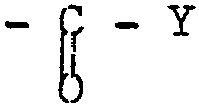
dans lequel
Y représente un radical alcoyle, linéaire ou ramifié, comportant de 1 à 6 atomes de carbone ou un radicaL phényle.
dans lequel
Y représente un radical alcoyle, linéaire ou ramifié, comportant de 1 à 6 atomes de carbone ou un radicaL phényle.
Les Les composés de l'invention sont doués de remarquables propriétés pesticides notamment herbicides.
Les propriétés herbicides de pré ou de post émergence des des composés de l'invention peuvent être mises en évidence par des tests sur des plantes représentatives des grandes familles botaniques tels que Triticum sativum, hordeum speiss zea mais, avena fatma, agrostis tenuis, lolium perenne, alopecurus myosuroides, beta vulgaris, chenopodium chinoa, chrysanthemum coronarium, galium aparine, sinapis alba, rumex crispus, trifolium praetense.
L'étude comparative des propriétés herbicides des composés de l'invention sur coton et sur xanthium ainsi que sur soja et sur xanthium permet d'autre part de juger de la sélectivité des composés de l'invention dans le desherbage de ces deux plantes cultivées.
Des exemples de ces tests sont donnés plus loin dans la partie expérimentale.
Ils montrent l'activité herbicide sélective des composés de l'invention vis-à-vis des graminées cultivées (blé, orge, avoine, mais).
Ils montrent également que les composés de l'invention, notamment ceux pour lesquels R3 représente un groupement - C02Z dans lequel Z représente un radical alcoyle linéaire ou ramifié comportant de 1 à 6 atomes de carbone, présentent une activité herbicide sélective vis-à-vis du coton et du soja, en détruisant les adventices de ces plantes à des doses bien inférieures à celles pour lesquelles se manifeste une phytotoxicité vis-à-vis des plantes cultivées.
L'invention a également pour objet un procédé de préparation ces composés de formule générale (I) tels que définis ci-dessus , caractérisé en ce que l'on fait réagir sur un composé de formule (II)

une base forte puis un composé de formule (III)

dans laquelle R3 conserve les significations précitées et X représente un atome de carbone ou de soufre.
une base forte puis un composé de formule (III)
dans laquelle R3 conserve les significations précitées et X représente un atome de carbone ou de soufre.
La base forte en présence de laquelle on condense le chloroformiate d'alcoyle ou le chlorure d'alcoyle sulfonyle avec le composé (II) est notamment l'hydrure de sodium ou l'amidure de sodium. La réaction peut être effectuée au sein d'un solvant organique tel que le dimêthyl formamide.
L'invention a plus particulièrement pour objet un procédé de préparation du 1-(méthoxyearbonyl) 3(2'-tétrahydropyra nyl) 5-éthyl 6-méthyl tétrahydropyrimidine 2,4-dione, caractérisé en ce que l'on fait réagir sur la 3(2'-tétrahydropy ranyl 5-éthyl 6-méthyl 1,2,3,4-tétrahydropyrimidine 2,4dione, l'hydrure de sodium puis le chloroformiate de méthyle.
Les composés de formule générale(II) utilisés au départ du procédé de l'invention peuvent être préparés en faisant réagir un aminocrotonate de formule générale

dans laquelle R1 et R2 conservent les significations précitées et alc représente un radical alcoyle inférieur, avec l'isocyanate de 2-tétrahydropyranyle, selon, notamment, les procédés du brevet français 2 082 768 et de la demande de brevet français déposée par la Société demanderesse le 5 Décembre 1974 sous le n0 74 39 802 et intitulée "Nouvelles pyrinidines substitués, procédé de préparation et application comme herbicide".
dans laquelle R1 et R2 conservent les significations précitées et alc représente un radical alcoyle inférieur, avec l'isocyanate de 2-tétrahydropyranyle, selon, notamment, les procédés du brevet français 2 082 768 et de la demande de brevet français déposée par la Société demanderesse le 5 Décembre 1974 sous le n0 74 39 802 et intitulée "Nouvelles pyrinidines substitués, procédé de préparation et application comme herbicide".
L'invention a aussi pour objet les compositions pesticides, notamment herbicides, caractérisées en ce qu'elles contiennent, comme principe actif, un au moins des composés de formule générale (I).
L'invention a plus particulièrement pour objet les compositions pesticide-s, notamment herbicides, caractérisées en ce qu'elles contiennent comme principe actif un au moins des composés,de forruie(l), soit dans lesauiLles R1 etR2 représentent des radicaux alcoyles, linéaires ou ramifiés, comportant de 1 à 3 atomes de carbone et R3 conserve les significations précitées, soit dans lesquels Ri et R2 représentent des radicaux alcoyles, linéaires ou ramifiés, comportant de 1 à 3 atomes de carbone et R3 représente un groupement C02Z dans lequel Z représente un radical alcoyle, linéaire ou ramifié, comportant de 1 à 3 atomes de carbone, ou en ce qu'elles contiennent comme principe actif un au moins des composés de formule (I) dans lesquels R1 et R2 représentent des radicaux alcoyles, linéaires ou ramifiés, comportant de 1 à 3 atomes de carbone et R3 représente un groupement

dans lequel Y représente un radical alcoyle, linéaire ou ramifié, comportant de 1 à 6 atomes de carbone ou un radical phényle.
dans lequel Y représente un radical alcoyle, linéaire ou ramifié, comportant de 1 à 6 atomes de carbone ou un radical phényle.
L'invention a plus spécialement pour objet les compositions pesticides, notamment herbicides, caractérisées en ce qu'elles contiennent, corme principe actif la 1-(méthoxv- carbonyl) 3-(2'-tétrahydropyranyl) 5-éthyl 6-méthyl tétrahydropyrimidine 2,4-dione.
Les compositions selon l'invention peuvent se présenter sous forme de poudres, granulés, suspensions, émulsions, solutions contenant le principe actif, par exemple, en mélange avec un véhicule et/ou un agent tensio-actif anionique, cationique ou non ionique assurant entre autres, une dispersion uniforme des substances de la composition. Le véhicule utilisé peut être un liquide, tel que l'eau, l'alcool, les hydrocarbu- res ou autres solvants organiques, une huile minérale, animale ou végétale, ou une poudre, telle que le talc, les argiles, les silicates, le kieselguhr.
Les compositions solides, présentées sous forme de poudre pour poudrage, de poudresmouillables ou de granulés, peuvent être préparées par broyage du composé actif avec un solide inerte ou par imprégnation du support solide avec une solution du principe actif dans un solvant que l'on évapore ensuite.
Outre un véhicule et/ou un agent tensio-actif, ces compositions contiennent, comme principe actif, un ou plusieurs pomposés de formule (I), ainsi qu'éventuellement d'autres ces ticides et des substances présentant des propriétés influant sur la croissance des plantes.
Les composition de l'invention sont, bien entendu, appli quées à des doses suffisantes pour exercer leurs activités pesticides notamment herbicides. Les doses de matière active dans les compositions varient notamment en fonction des végétaux à détruire, de la nature du terrain, des conditions atmosphériques et de l'état d'avancement de la végétation à détruire.
Lescompoeitias herbicides selon l'invention contiennent en général de 10 à 80% en poids et, de préférence, de 10 à 50% en poids de matière active.
Lors de l'utilisation des composés I, comme herbicide, les quantités de substance active appliquées varient, de préférence, entre 0,1 et 5 Kg/ha.
L'invention a également pour objet l'application des composés de formule (I) au desherbage sélectif des cultures de coton, notamment l'application des composés dans lesquels
R1 et R2 représentent des radicaux alcoyles, linéaires ou ramifiés, comportant de 1 à 3 atomes de carbone et R3 r epré- sente un groupement - C02Z dans lequel Z représente un radical alcoyle, linéaire ou ramifié, comportant de 1 à 3 atomes de carbone, au desherbage sélectif des cultures de coton, et plus particulièrement l'application de la 1-(méthoxyearbonyl) 3(2 '-tétrahydropyranyl) 5-éthyl 6-méthyl tétrahydropyrimidine 2,4-dione au desherbage sélectif des cultures de coton.
R1 et R2 représentent des radicaux alcoyles, linéaires ou ramifiés, comportant de 1 à 3 atomes de carbone et R3 r epré- sente un groupement - C02Z dans lequel Z représente un radical alcoyle, linéaire ou ramifié, comportant de 1 à 3 atomes de carbone, au desherbage sélectif des cultures de coton, et plus particulièrement l'application de la 1-(méthoxyearbonyl) 3(2 '-tétrahydropyranyl) 5-éthyl 6-méthyl tétrahydropyrimidine 2,4-dione au desherbage sélectif des cultures de coton.
L'invention a également pour objet l'application des composés de formule générale (I) au desherbage sélectif des cultures de soja, notamment l'application des composé dans lesquels R1 et R2 représentent des radicaux alcoyles, linéaires ou ramifiés, comportant de 1 à 3 atomes de carbone et
R3 représente un groupement - C02Z dans lequel Z représente un radical alcoyle, linéaire ou ramifié, comportant de 1 à 3 atomes de carbone, au desherbage sélectif des cultures de soja, et plus particulièrement l'application de la 1 (méthoxycarbonyl) 3-(2 'tétrahydropyranyl) 5-éttff 6-méthyl tétrahydropyrimidine 2,4-dione au desherbage sélectif des cultures de soja.
R3 représente un groupement - C02Z dans lequel Z représente un radical alcoyle, linéaire ou ramifié, comportant de 1 à 3 atomes de carbone, au desherbage sélectif des cultures de soja, et plus particulièrement l'application de la 1 (méthoxycarbonyl) 3-(2 'tétrahydropyranyl) 5-éttff 6-méthyl tétrahydropyrimidine 2,4-dione au desherbage sélectif des cultures de soja.
L'invention a aussi pour objet l'application des composés de formule (I, au desherbae sélectif des cultures de blé, d'orJe, de mans et d'avoine, notamment l'application des composés dans lesquels R1 et R2 représentent des radi caux alcoyles, linéaires ou ramifiés, comportant de 1 à 3 atome s de carbone et R représente un groupement -CO2-Z dans lequel Z représente un radical alcoyle, linéaire ou ramifié, comportant de 1 à 3 atomes de carbone au desherbage sélectif des cultures de blé, d'orge, de mails et d'avoine et plus particulièrement l'application de la 1-(méthoxycarbonyl) 3 (2 '-tétrahydropyranyl) 5-éthyl 6-méthyl tétrahydropyrimidine 2,4-dione au desherbage sélectif des cultures de blé, d'orge, de mals et d'avoine.
Les exemples suivants illustrent l'invention sans la limiter
Exemple 1 : 1-(Carbethoxy)3-(2'-tétrahydropyranyl) 5,6-diméthyl 1,2,3,4,-tétrahydropyrimidine 2,4-dione.
Exemple 1 : 1-(Carbethoxy)3-(2'-tétrahydropyranyl) 5,6-diméthyl 1,2,3,4,-tétrahydropyrimidine 2,4-dione.
Dans 1120 cm3 de diméthyl formamide on introduit-224 g de 3-(2'tétrahydropyranyl) 5,6-diméthyl-1,2,3,4-tétrahydropyrimidine-2,4-dione, puis progressivement à 200C, 50 g d'une suspension d'hydrure de sodium à 50,ó dans l'huile de vaseline, agite pendant 2 heures à 200C, ajoute progressivement 124 g de chloroformiate d'éthyle, agite pendant 20 heures à 200C, concentre à sec par distillation sous pression réduite, ajoute de l'éther de pétrôle au résidu, agite, laisse décanter, éli- mine l'éther de pétrôle, recommence l'opération à plusieurs reprises, concentre à sec sous pression réduite, dissout le résidu dans le chlorure de méthylène, élimine,par filtration, l'insoluble résiduel, chromatographie le filtrat sur silice, cristallise dans l'éther isopropylique et obtient 94,4 g de 1-carbethoxy 3-(2 'tétrahydropyranyl) 5,6-diméthyl 1,2,3,4tétrahydropyrimidine 2, 4-dione.
F = 740C.
Exemple 2 : 1-(1'-méthyl éthyl oxycarbonyl) 3-(2'-tétrahydro- pyranyl) 5-éthyl 6-méthyl 1,2,3,4-tétrahydropyrimidine 2,4dione.
Dans 500 cm3 de diméthyl formamide, on introduit 47,6 g de 5-(2'-tétrahydropyranyl) 5-éthyl 6-méthyl 1,2,3,4 tétra hydropyriridine 2,4-dione, ajoute 10 g de suspension d'hydru- re de sodium à 50% dans l'huile de vaseline, agite pendant 15 minutes à 20 C, introduit progressivement, à 200C, 24,4 g de chloroformiate d'isopropyle, agite pendant 30 minutes à + 200C, verse le mélange réactionnel dans un mélange d'eau et de glace, extrait au chlorure de méthylène, concentre à sec par distillation sous pression réduite, ajoute de l'éther isopropylique au résidu, agite, éliminepar filtration l'insoluble formé, concentre le filtrat à sec par distillation sous pression réduite, chromatographie le résidu sur silice en éluant par un mélange de cyclohexane et d'acétate d'éthyle (1/1) ajoute de l'éther de pétrôle (eb. 3570CC) au résidu cristallisé, essore, sêche et obtient 11 g de 1-(1'méthyl éthyloxycarbonyl) 3-(2'-tétrahydropyranyl) 5-éthyl 6-méthyl 1,2,3,4-tétrahydropyrimidine 2,4-dione.
F = 1180C.
Analyse : C16 H24 N205 (324,37)
C% H%
Calculé 59,24 7,46 8,64
Trouvé 59,0 7,4 8,5
Exemple 3 : 14éthoxy carbonyl)3-(2'-tétrahydropyranyl) 5-éthvl 6-méthyl 1,2,3,4-tétrahyrimidine-2,4-dione.
C% H%
Calculé 59,24 7,46 8,64
Trouvé 59,0 7,4 8,5
Exemple 3 : 14éthoxy carbonyl)3-(2'-tétrahydropyranyl) 5-éthvl 6-méthyl 1,2,3,4-tétrahyrimidine-2,4-dione.
Dans 9 litres de diméthyl formamide on introduit 1,5 kg de 3-(2-tétrahydropyranyl) 5-éthyl 6-méthyl 1,2,3,4-tétrahydropyramidine 2,4-dione, introduit progressivement à OOC, 450 g d'une suspension huileuse à 50% d'hydrure de sodium, agite pendant une heure à + 150C, introduit lentement en une heure trente minutes, à 200C, 1,35 kg de chloroformiate d'éthyle, agite pendant 20 heures à + 200C, verse le mélange réactionnel dans un mélange d'eau, de glace et de chlorure de méthylène, agite, décante, extrait à nouveau au chlorure de méthylène, lave la solution organique successivement avec une solution de soude N, une solution aqueuse saturée de chlorure de sodium puis à l'eau, la sêche, concentre à sec par distillation sous pression réduite, dissout ce résidu dans le benzène, ajoute de la silice colloïdale, agite, filtre pour éliminer la silice, concentre le filtrat à sec par distillation sous pression réduite, dissout le résidu dans l'éther isopropylique, ajoute de l'heptane, agite, isole pour essorage, le précipité formé, le cristallise dans l'éther isopro pyliuzue et obtient 1,05 kg de l-thoxycarbonyl)3-(2Ltétra- hydropyranyl) 5-éthyl 6-méthyl 1,2,3,4-tétrahydropyrimidine 2,4-dione
F = 850C
Analyse : C15 H22 N2 O5 (310,35)
C% H% N%
Calculé 58,04 7,14 9,02
Trouvé 58,3 7,4 9,0
Spectre UV (éthanol)
max. à 264 nm, # = 9700
Exemple 4 : 1-(méthoxycarbonyl) 3-(2'-tétrahydropyranyl) 5 (éthyl 6-méthyl tétrahydropyrimidine 2,4-dione.
F = 850C
Analyse : C15 H22 N2 O5 (310,35)
C% H% N%
Calculé 58,04 7,14 9,02
Trouvé 58,3 7,4 9,0
Spectre UV (éthanol)
max. à 264 nm, # = 9700
Exemple 4 : 1-(méthoxycarbonyl) 3-(2'-tétrahydropyranyl) 5 (éthyl 6-méthyl tétrahydropyrimidine 2,4-dione.
Dans 300 cm3 de diméthylformamide on introduit 48 g de 3-(2-tétrahydrpyranyl) 5-éthyl 6-méthyl tétrahydropyrimidine 2,4-dione, ajoute, progressivement 10 g de suspension d'hydrure de sodium à 50% dans l'huile de vaseline, agite pendant une heure et trente minutes à 200C, ajoute 21 g de chloroformiate de méthyle, agite pendant 16 heures à 200C, verse le mélange réactionnel dans un mélange d'eau et de glace, extrait au chlorure de méthylène, concentre à sec par distillation sous pression réduite, chromatographie le résidu sur silice en éluant par un mélange de cyclohexane et d'acétate d'éthyle (1-i) et obtient 22 g de 1-(méthmvcarbonyl) 3-(2'-tétrahydro- pyranyl) 5-éthyl 6-méthyl tétrahydropyrimidine 2,4-dione.
Spectre UV (éthanol)
max. à 265 nm E = 8200
Spectre de RMN (deuterochloroforme) pics à 0,90 - 1,02 - 1,13 ppm attribués aux hydrogènes du mé- thyle de l'éthyle en position 5.
max. à 265 nm E = 8200
Spectre de RMN (deuterochloroforme) pics à 0,90 - 1,02 - 1,13 ppm attribués aux hydrogènes du mé- thyle de l'éthyle en position 5.
pic à 2,12 ppm attribué aux hydrogènes du méthyle en position 6.
pics à 2,22 - 2,33 - 2,45 - 2,58 ppm attribués aux hydrogènes du méthylène de l'éthyle en position 5.
pic à 4,0 ppm attribué aux hydrogènes du méthyle du méthoxy carbonyle.
pics à 5,75 - 5,78 - 5,95 - 5,98 ppm attribués à l'hydrogène en position 1 du cycle 2-tétrahydropyranyle.
Exemple 5 : 1 (n-hexvloxycarbonyl) 3-(2'-tétrahydropyranyl) 5-éthyl 6-méthyl 1,2,3,4-tétrahydropyrimidine 2,4-dione.
Dans 500 cm3 de dimethylformamide on introduit 47,6 g de 3-(2'-tétrahydropyranyl) 5-éthyl 6-méthyl 1,2,3,4-tétrahydropyrimidine 2,4-dione, ajoute, progressivement, O g de suspension à 50% d'hydrure de sodium dans l'huile, agite pendant une heure à 200C, introduit lentement 32,9 g de chloroformiate de n-hexyle, agite à 200C pendant 44 heures, verse le mélange réactionnel dans un mélange d'eau et de glace, extrait au chlorure de méthylène, concentre à sec par distillation sous pression réduite, chromatographie le résidu sur silice en éluant par un mélange de cyclohexane et d'acétate d'éthyle (1/1), puis par un mélange de cyclohexane et d'acétate d'éthyle (8-2) et extrait 12 g de 1 (n-hexyloxycarbonyl) 3- (2 '-tétrahydropyranyl) 5-éthyl 6-méthyl 1 ,2,3,4- tétrahydropyrimidine 2,4-dione.
Spectre de RMN (deuterochloroforme) pic à 0,9 ppm attribué aux hydrogènes du méthyle de la chaîne hexyle.
pics à 0,93 - 1,05 - 1,17 ppm attribués aux hydrogènes du méthyle terminal de l'éthyle en position 5.
pic à 2,14 ppm attribué aux hydrogènes du méthyle en position 6.
pics à 3,33 - 4,17 ppm attribués aux hydrogènes du méthylène en position 3 du cycle tétrahydropyranique.
pics à 4,28 - 4,4 - 4,52 ppm attribués aux hydrogènes du méthylène du groupement hexyle en position a du

pics à 5,82 - 5,85 - 5,98 - 6,02 ppm attribués à l'hydrogène en position 1 du cycle tétrahydropyranyle.
pics à 5,82 - 5,85 - 5,98 - 6,02 ppm attribués à l'hydrogène en position 1 du cycle tétrahydropyranyle.
Exemple 6 : 1-(propyloxycarbonyl) 3-(2l-tétrahydroDyranyl) 5-éthyl 6-méthvl 1,2,3,4-tétrahydropyrimidine 2, 4-dione.
Dans 500 cm3 de diméthylformamide on introduit 47,6 g de 3- (2' -tétrahydropyranyl) 5-éthyl 6-méthyl 1,2,3,4-tétrahydro- pyrimidine 2,4-dione, ajoute lentement 10 g de suspension à 50% d'hydrure de sodium dans l'huile, agite pendant 15 minutes à + 200C, ajoute progressivement à + 200C, 25 g de chloroformiate de propyle, agite pendant 30 minutes à 200C, verse le mélange réactionnel dans un mélange d'eau et de glace, élimine par filtration l'insolub1^ formé, concentre le filtrat à sec par distillation sors pression réduite, chromatographie le résidu sur silice en éluant avec un mélange de cyclohexane et d'acétate d'éthyle (1-1) et obtient 20 g de î-(prowloxycar bonyl) 3-(2'-tétrahydropropanyl) 5- éthyl 6-méthyl 1,2,3,4tétrahydropyrimidine 2,4-dione.
Analyse : C16 H24 N205 (324,37)
H% ,4 N%
Calculé 59,24 7,46 8,64
Trouvé 59,2 7,7 8,2
Exemple 7 : 1-(éthoxycarbonyl) 3-(2'-tétrahydropyranyl) 5-isopropyl 6-méthyl 1,2,3,4-tétrahydropyrimidine 2,4-dione.
H% ,4 N%
Calculé 59,24 7,46 8,64
Trouvé 59,2 7,7 8,2
Exemple 7 : 1-(éthoxycarbonyl) 3-(2'-tétrahydropyranyl) 5-isopropyl 6-méthyl 1,2,3,4-tétrahydropyrimidine 2,4-dione.
Dans 200 cm3 de diméthylformamide on introduit 35,8 g de 3-(2- tétrahydropyranyl > 5-isopropyl 6-méthyl 1,2,3,4tétrahydropyrimidine 2,4-dione, ajoute lentement 6,8 g d'une suspension à 50% d'hydrure de sodium dans l'huile, agite pendant 45 minutes à + 200C, introduit progressivement 30,8 g de chloroformiate d'éthyle, agite pendant 72 heures à 200C, verse le mélange réactionnel dans l'eau, extrait au chloroforme, concentre à sec par distillation sur pression réduite, chromatographie le résidu sur gel de silice en éluant par un mélange de benzène et d'acétate d'éthyle (4-6) et obtient 28,5 g de 1-(éthoxycarbonyl) 3-(2'-tétrahydropyranyl) 5-isopropyl 6-méthyl 1,2,3,4-tétrahydropyrimidine 2,4-dione brut.
Spectre de RMN (deutérochloroforme) pics à 1,21 - 1,32 ppm attribués aux hydrogènes des méthyle de l'isopropyle.
pics à 1,30 - 1,42 - 1,53 ppm attribués aux hydrogènes du méthyle de - C02 C2H5 pics à 4,28 - 4,40 - 4,52 - 4,63 ppm attribués aux hydrogènes du méthylène de-C02 C2H5 pic à 2,14 ppm attribué aux hydrogènes de CH3 - i = Exemple 8 : 1 - ( cyclhexylcarbonyl) 3-(2 '-tétrahydropyranyl) 5-éthyl 6-méthyl 1,2,3,4-tétrahydropyrimidine 2,4-dione.
Dans 500 cm3 de diméthylformamide on introduit 47,6 g de 3-(2'-tétrahydropyranyl) 5-éthyl 6-méthyl 1,2,3,4-tétrahydropyrimidine 2,4-dione, ajoute lentement 10 g d'une suspension à 50% d'hydrure de sodium dans l'huile, ajoute goutte à goutte à + 200C, 32,4 g de chloroformiate de cyclohe-yle, agite pendant 30 minutes à + 20 C, verse le mélange réactionnel dans un mélange d'eau et de glace, extrait au chlorure de méthylène, concentre à sec par distillation sous pression réduite, cris tàllise le résidu dans l'acétate d'éthyle, élimine par filtration l'insoluble formé, concentre le filtrat à sec par distil lation sous pression réduite, chromatographie le résidu sur silice en éluant par un mélange de cyclohexane et d'acétate d'éthyle (1-1) et obtient 26 g de 1-(cyclohexylcarbonyl) 3 (2'-tétrahydropyranyl) 5-éthyl 6-méthyl 1,2,3,4-tétrahydro pyri-midine 2,4 -dione.
Spectre de RMN (deutérochloroforme) pics à 0,92 - 1,05 - 1,17 ppm attribués aux hydrogènes du méthyl, de l'éthyle en position 5.
pics à 2,25 - 2,37 - 2,48 - 2,60 ppm attribués aux hydrogènes du méthylène de méthyle en position 5.
pic à 2,15 ppm attribué aux hydrogènes de CH3-C = pics à 3,17 - 4,33 ppm attribués au méthylène en position 3 du cycle tétrahydropyranyle.
pics de 3,0 - 4,35 ppm attribués aux autres protons du cycle tétrahydropyranyle.
pic 4,9 ppm attribué à l'hydrogène angulaire du cyclohexane.
pics à 5,78 - 5,81 - 5,97 - 6,0 ppm attribués à l'hydrogène angulaire du tétrahydropyranyle.
Exemple 9 : 1-(phénoxycarbonyl)3-(2'-tétrahydropyranyl) 5éthyl 6-méthyl 1,2,3,4-tétrahydropyrimidine 2,4-dione.
Dans 250 cm3 de diméthylformamide on introduit 23,8 g de 3-(2'-tétrahydropyranyl) 5-éthyl 6-méthyl 1,2,3,4-tétrahydropyrimidine 2,4-dione, ajoute lentement 5 g d'une suspension d'hydrure de sodium à 50% dans l'huile, -agite pendant 30 minutes, ajoute 15,6 g de chloroformiate de phényle, agite pendant 30 minutes à 200 C, verse le mélange réactionnel dans l'eau, extrait au chlorure de méthylène, concentre à sec par distillation sous pression réduite, chromatographie le résidu sur silice en éluant avec un mélange de cyclohexane et d'acétate d'éthyle (7-3) et obtient 11 g de 1-(phénoxy- carbonyl) 3-(2-1tétrahydropyranyl) 5-éthyl 6-méthyl 1 ,2,3,4- tétrahydropyrimidine 2, 4-dione.
Analyse : C19 H22 N205 (358,42)
C% H% N%
Calculé 63,66 6,19 7,82
Trouvé 63,6 6,5 7,6
Spectre RMN (deutérochloroforme) pics à 0,95 - 1,07 - 1,18 ppm attribués aux hydrogènes du méthyle de l'éthyle en Position -5.
C% H% N%
Calculé 63,66 6,19 7,82
Trouvé 63,6 6,5 7,6
Spectre RMN (deutérochloroforme) pics à 0,95 - 1,07 - 1,18 ppm attribués aux hydrogènes du méthyle de l'éthyle en Position -5.
pic à 2,27 ppm attribué aux hydrogènes du méthyle en posi tion 6.
pics à 2,28 - 2,40 - 2,52 - 2,63 ppm attribués aux hydrogènes du méthylène de l'éthyle en position 5.
pics de 3,17 à 4,33 ppm attribués aux hydrogènes du méthylène en position 3 du cycle tétrahydropyranyle.
pics à 5,83 - 5,93 - 6,02 - 6,05 ppm attribués à l'hydrogène en position 1 du cycle tétrahydropyranyle.
pic à 7,36 ppm attribué aux hydrogènes du noyau aromatique.
Exemple 10 : 1-(benzyloxycarbonyl) 3-(2'-tétrahydropyranyl) 5-éthyl 6-méthyl 1,2,3,4-tétrahydropyrimidine 2,4-dione.
Dans 300 cm3 de diméthylformamide, on introduit 35,7 g de 3-(2'-tétrahydropyranyl) 5-éthyl 6-méthyl 1,2,3,4-tétrahydropyrimidine 2,4-dione, ajoute progressivement 7,2 g de suspension d'hydrure de sodium à 50% dans l'huile, agite pendant une heure à 250C, ajoute goutte à goutte 50 g de chloroformiate de benzyle, agite pendant 4 heures à 250 C, verse le mélange réactionnel dans l'eau, extrait au chlorure de méthylène, concentre à sec par distillation sous pression réduite, chromatographie le résidu sur silice en éluant par un mélange de cyclohexane et d'acétate d'éthyle (1-1) et obtient 10 g de 1-(benyzloxycarbonyl) 3- (2 '-tétrahydropyranyl) 5-éthyl 6-methyl 1,2,3,4-tétrahydropyrimidine 2,4-dione
Spectre de RMN (deuterochloroforme) pics à 0,9 - 1,03 - 1,15 ppm attribués aux hydrogènes du méthyle de l'éthyle en position 5.
Spectre de RMN (deuterochloroforme) pics à 0,9 - 1,03 - 1,15 ppm attribués aux hydrogènes du méthyle de l'éthyle en position 5.
pics à 1,33 - 2,0 ppm attribués aux hydrogènes des méthylènes en position 4,5,6 du cycle tétrahydropyranyle.
pic- à 2,02 ppm attribué aux hydrogènes du méthyle en position 6.
pics à 3,0 - 4,17 ppm attribués aux hydrogènes du méthylène en position 3 du cycle tétrahydropyranyle.
pic à 5,47 ppm attribué aux hydrogèresdu méthylène du benzyle.
pics à 5,87 - 6,C5 ppm attribués à l'hydrogène en position 1 du cycle tétrahydropyranyle.
pics à 7,33 - 7,5 ppm attribués aux hydrogènes des noyaux aromatiques.
Exemple 11 : 1-(carbethoxy) 3- (2'-tétrahydropyranyl) 1,2,3,4,6,7 hexahydro 5H cyclo@enta@vrimidine 2,4-dione.
tans 900 cm3 de din-éthylformamide on dissout 138 g de 3 (2Xtétrahydropyranyl) hexahydropentapyrimidine 2, 4-dione, ajoute lentement 44 g d'une suspension d'hydrure de sodium à 50,0 dans l'huile, agite pendant 2 heures à + 200C, ajoute progressivement à +200C, 135,6 g de chloroformiate d'éthyle, agite pendant 40 heures à + 200C, verse le mélange réactionnel dans un mélange d'eau et de glace, extrait au chlorure de méthylène, concentre à sec par distillation sous pression réduite, ajoute au résidu de l'éther de pétrôle (eb 35 - 750C), agite, élimine l'éther de pétrôle, recommence la même opération, dissout le résidu dans l'éther éthylique, chromatographie sur silice, en éluant à l'éther éthylique et obtient 158 g de 1-(carbethoxy) 3-(2'tétrahydropyranyl) 1,2,3,4,6,7hexahydro 5H-cyclopentapyrimidine 2, 4-dione.
Spectre UV (éthanol) max. 267 nm, e 9000.
Exemple 12 : 1-(acétyl) 342'tétrahydronvranvl) 5-éthyl 6-méthyl 1,2,3,4-tétrahydroDyrimidine 2, 4-dione.
Dans 300 cm3 de diméthyl formamide on introduit 54,7 g de 3-(2 '-tétrahydropyranyl) 5-éthyl 6-méthyl 1,2,3,4-tétrahydropyrimidine 2,4-dione, ajoute,lentement, 11,4 g de suspension d'hydrure de sodium à 50% dans l'huile, agite pendant 2 heures à 20 C, ajoute lentement 19,7 g de chlorure d'acétyle, agite pendant 80 heures, verse le mélange réactionnel sur un mélange d'eau et de glace, extrait à l'acétate d'éthyle, concentre à sec par distillation sous pression réduite, ajoute au résidu 400 cm3 d'un mélange de cyclohexane et d'acétate d'éthyle (1-1), élimine par filtration l'insoluble formé, chromatographie le filtrat sur silice en éluant par un mélange de cyclohexane et d'acétate d'éthyle (1-1), concentre à sec par distillation sur pression réduite,1a'e1e concentrat à l'éther de pétrôle (eb. 35-750C) et obtient 13,9 g de 1q(acétyl)3-(2'tétra- hydropyranyl) 5-éthyl 6-méthyl 1 , 2,3, 4-tétrahydropyrimidine 2 ,4-dione,
F = 8000.
F = 8000.
Après cristallisation dans l'acétate d'éthyle on obtient un produit (F = 800C), dont les caractéristiques sont les suivantes
Analyse : C14 H20 N2O4 (280,32)
C% H% N%
Calculé. 59,99 7,19 9,99
Trouvé 60,0 7,2 10,0
SDectre de RMN (deutérochloroforme) pics à 0,93 - 1,07 - 1,2 ppm et 2,28 - 2,4 - 2,53 - ?,67 ppm attribués aux hydogènes

pic à 2,01 ppm attribué à -COCH. pic à 2,67 ppm attribué à

pics à 2,66 - 3,33 ppm attribués à - CH20- du tétrahydropyranyle.
Analyse : C14 H20 N2O4 (280,32)
C% H% N%
Calculé. 59,99 7,19 9,99
Trouvé 60,0 7,2 10,0
SDectre de RMN (deutérochloroforme) pics à 0,93 - 1,07 - 1,2 ppm et 2,28 - 2,4 - 2,53 - ?,67 ppm attribués aux hydogènes
pic à 2,01 ppm attribué à -COCH. pic à 2,67 ppm attribué à
pics à 2,66 - 3,33 ppm attribués à - CH20- du tétrahydropyranyle.
pics à 5, 87 - 6,05 ppm attribués à l'hydrogène angulaire du tétrahydropyranyl e.
Exemple 13 : 1-(benzoyl) 3-(2'-tétrahydropyranyl) 5-éthyl 6-méthyl 1 4-tétrahydroDyrimidine 2,4-dione.
Dans 100 cm3 de diméthyl formamide on introduit 23,8 g de 3-(2'-tétrahydropyranyl) 5-éthyl 6-méthyl tétrahydropyrimidine 2,4-dione, ajoute progressivement 4,8 g de suspension d'hydrure de sodium à 50% dans l'huile, agite pendant 1 heure, ajoute goutte à goutte 15,4 g de chlorure de benzoyle,agite pendant 66 heures à 20 C, verse le mélange-réactionnel sur un mélange d'eau et de glace, extrait à l'acétate d'éthyle, concentre à sec sous pression réduite, chromatographie le résidu sur silice en éluant par un mélange de cyclohexane et d'acétate d'éthyle (1-1) et obtient 19,6 g de 1-benzoyl 3-(2'- tétrahydropyranyl) 5-éthyl 6-méthyl 1 ,2,3, 4-tétrahydropyrimidine 2,4-dione,
F = 15400.
F = 15400.
Après cristallisation dans l'acétate d'éthyle le produit obtenu (F = 1540C) présente les caractéristiques suivantes
Analyse : 019 H22 N204 (342,39)
C% H% N%
Calculé 66,64 6,48 8,18
Trouvé 66,4 6,6 8,1
Spectre de RMN (deutérochloroforme) pic à 1,0 - 1,12 - 1,23 ppm attribués aux hydrogènes du méthyle de l'éthyle en position 5.
Analyse : 019 H22 N204 (342,39)
C% H% N%
Calculé 66,64 6,48 8,18
Trouvé 66,4 6,6 8,1
Spectre de RMN (deutérochloroforme) pic à 1,0 - 1,12 - 1,23 ppm attribués aux hydrogènes du méthyle de l'éthyle en position 5.
pic à 1,92 ppm attribué aux hydrogènes du méthyle en position 6.
pics à 2,33 - 2,45 - 2,53 - 2,58 ppm attribués aux hydrogènes du méthylène de l'éthyle @@ position 5.
pics à 3,33 - 4,33 ppm attribués à - CH2-O- pics à 6,05 - 6,38 ppm attribués à l'hydrogène angulaire du tétrahydropyrane.
pics à 7,-95 - 8,13 ppm attributs aux hydrogènes du phényle en a du C = 0.
pics à 7,42 - 7,83 ppm attribués aux autres hydrogènes aromatiques.
Exemple 14 : 1-(méthyl sulfonyl) 3-(2'-tétrahydropyranyl) 1,2, 3,4,6,7 hexanydro 5H-cyclopentapyrimidine 2, 4-dione.
Dans 300 cm3, de diméthyle formamide on introduit 46 g de 3-(2-'tétrahydropyranyl) 1,2,3,4,6,7 hexahydro 5H cyclopentapyrimidine, ajoute lentement 10 g de suspension à 50% d'hydrure de sodium dans l'huile, agite pendant 30 minutes à + 20 C, ajoute progressivement 25 g de chlorure de méthane sulfonyle, agite à + 2000 pendant 16 heures, verse le mélange réactionnel dans l'eau, extrait à l'acétate d'éthyle, concentre à sec par distillation sous pression réduite, ajoute de l'éther isopropylique au résidu, agite, isole par essorage le précipité formé, le cristallise dans l'éthanol et obtient 24 g de 1-(méthyl sulfonyl) 3-(2'-tétrahydropyranyl) 1,2,3,4,6,7-hexahydro 5H-cyclopentapyrimidine 2,4-dione, F = 156 C.
Analyse : C13 H18 N2O5S (314,36)
0% H% N% S% 0%
Calculé. 49,67 5,77 8,91 10,20 25,45
Trouvé 49,4 5,8 8,6 10,3 25,6
Exemple 15 : Etude de l'activité herbicide des composés de l'invention.
0% H% N% S% 0%
Calculé. 49,67 5,77 8,91 10,20 25,45
Trouvé 49,4 5,8 8,6 10,3 25,6
Exemple 15 : Etude de l'activité herbicide des composés de l'invention.
1) - Tests utilisés.
Les principaux tests utilisés dans l'étude herbicide des composés de l'invention sont décrits ci-après.
A) Etude de l'activité herbicide de pré-ou de tost-emer-
gence.
gence.
Les végétaux utilisés (Avena Sativa, Avena Fatua, Triticum Sativum, Hordeum Spec., Zea Mais, Agrostis Tenuis, Lolium
Perenne, Alopecurus Myosuroïdes, Beta Vulgaris, Chenopodium
Chinoa, Chrysanthemum Coronarium, Sinapis Alba, Rumex Crispus,
Trifolium Praetense, Galium Aparine) sont cultivés en bac de de culture ( 23 X 14 X 4 cm), à double fond, l'arrosage
s'effectuant par dessous. Les espèces sont placées, à rai
son de 20 graines par espèce, en lignes espacées de 3 cm, ans un bac unique, et il y a 4 essais pour chaque concentation. Les conditions de culture sont les suivantes : température : 20 C + 2 C, humidité : 60% environ, éclairement : par tube fluorescent (lunière du jour + blanc brillant) de six heures à vingt-deux heures, chaque jour.Le mélange terreux utilisé est composé de 10 volumes de terre franche, de 10 volumes de sable de rivière et de 2 volumes de tourbe.
Perenne, Alopecurus Myosuroïdes, Beta Vulgaris, Chenopodium
Chinoa, Chrysanthemum Coronarium, Sinapis Alba, Rumex Crispus,
Trifolium Praetense, Galium Aparine) sont cultivés en bac de de culture ( 23 X 14 X 4 cm), à double fond, l'arrosage
s'effectuant par dessous. Les espèces sont placées, à rai
son de 20 graines par espèce, en lignes espacées de 3 cm, ans un bac unique, et il y a 4 essais pour chaque concentation. Les conditions de culture sont les suivantes : température : 20 C + 2 C, humidité : 60% environ, éclairement : par tube fluorescent (lunière du jour + blanc brillant) de six heures à vingt-deux heures, chaque jour.Le mélange terreux utilisé est composé de 10 volumes de terre franche, de 10 volumes de sable de rivière et de 2 volumes de tourbe.
Pour les essais de pré-émergence, le traitement est effectué vingt-quatre heures après le semis et le premier arrosage est effectué par aspersion de façon à entraîneur une partie du produit au niveau des graines.
Le traitement dé post-émergence est effectué sur les par- ties aériennes, après vingt et un joursde culture.
Le produit à étudier est appliqué, dans des conditions standard, à l'aide d'un micro-pulvérisateur, à des doses correspondant à 5, 2,5 - 1,25, 0,625 et 0,312 Kg/ha et une dilution correspondant à 560 1/ha.
On effectue un essai avec un témoin non traité. Cet essai comporte le même nombre de plantules que les plantules traitées.
Le contrôle final est effectué par dénombrement de plantules vingt et un jours après traitement.
Les résultats sont exprimés en pourcentage de réduction du nombre de plants (pourcentage de mortalité) M :
M = Nombre de plantules témoin - nombre de plantules traités toujours vivantes x 100
Nombre de plantules témoin
On peut également exprimer les résultats en pourcentage de réduction de la végétation (R.P.)
Le type d'étude nerrnet de mettre en évidence la possibilité de desherbbage sélectif des graminées cultivées (avoine, blé, mais, orge)
B) Etude de activité herbicide comparée sur coton et
sur xanthium, ou sur soja et sur xanthium.
M = Nombre de plantules témoin - nombre de plantules traités toujours vivantes x 100
Nombre de plantules témoin
On peut également exprimer les résultats en pourcentage de réduction de la végétation (R.P.)
Le type d'étude nerrnet de mettre en évidence la possibilité de desherbbage sélectif des graminées cultivées (avoine, blé, mais, orge)
B) Etude de activité herbicide comparée sur coton et
sur xanthium, ou sur soja et sur xanthium.
Dans une salle tropicalisée on fait pousser en pot des plants de cotcn (ou de soja) et des plants de xanthium.
Dans les essais de pré-émergence on effectue le traitement à la surface du sol à l'aide d'un pulvérisateur.
Dans les essais de post-émergence on effectue le traitement par pulvérisation sur le plant au stade deux feuilles" et pour le ar.thium au bout de 3 semaines (plants de 10 cm environ).
Les numérations sont effectuées au bout de 45 jours après le traitement.
On exprime les résultats en pourcentage de mortalité (M) ou en pourcentage de réduction de poids (R.P.).
2) Résultats otenus pour divers composés de l'invention
A) Résultats concernant le 1-(méthoxycarbonyl) 3-(2'tétrahydropyranyl) 5-éthyl 6-méthyl tétrahydropyrimidine 2;4-dione.
A) Résultats concernant le 1-(méthoxycarbonyl) 3-(2'tétrahydropyranyl) 5-éthyl 6-méthyl tétrahydropyrimidine 2;4-dione.
a - Tests de pré-émergence

<tb> <SEP> Plantes <SEP> traitées <SEP> DOSES
<tb> <SEP> 5kg/ha <SEP> 2,5kg/ha <SEP> 1,25kg/ha <SEP> 0,625kg/ha
<tb> <SEP> Triticum <SEP> Sativum <SEP> M <SEP> : <SEP> 0 <SEP> M <SEP> : <SEP> 0 <SEP> M <SEP> : <SEP> 0 <SEP> M <SEP> : <SEP> 0
<tb> <SEP> R.P. <SEP> 56 <SEP> R.P. <SEP> 52 <SEP> R.P. <SEP> 53 <SEP> R.P. <SEP> 0
<tb> <SEP> Hordeum <SEP> Spec. <SEP> M <SEP> : <SEP> 0 <SEP> M <SEP> : <SEP> 0 <SEP> M <SEP> : <SEP> 0 <SEP> M <SEP> : <SEP> 0
<tb> <SEP> R.P. <SEP> 68 <SEP> R.P. <SEP> 65 <SEP> R.P. <SEP> 40 <SEP> R.P. <SEP> 36
<tb> <SEP> Zea <SEP> Maïs <SEP> M <SEP> : <SEP> 0 <SEP> M <SEP> : <SEP> 0 <SEP> M <SEP> : <SEP> 0 <SEP> M <SEP> : <SEP> 0
<tb> <SEP> R.P. <SEP> 30 <SEP> R.P. <SEP> 63 <SEP> R.P. <SEP> 37 <SEP> R.P.<SEP> 23
<tb> <SEP> Avena <SEP> Fatua <SEP> M <SEP> : <SEP> 0 <SEP> M <SEP> : <SEP> 0 <SEP> M <SEP> : <SEP> 0 <SEP> M <SEP> : <SEP> 0
<tb> <SEP> R.P. <SEP> 54 <SEP> R.P. <SEP> 57 <SEP> R.P. <SEP> 15 <SEP> R.P. <SEP> 21
<tb> <SEP> Agrostis <SEP> Tenuis <SEP> M <SEP> : <SEP> 100 <SEP> M <SEP> : <SEP> 100 <SEP> M <SEP> : <SEP> 100 <SEP> M <SEP> : <SEP> 100
<tb> <SEP> Lolium <SEP> Perenne <SEP> M <SEP> : <SEP> 100 <SEP> M <SEP> : <SEP> 100 <SEP> M <SEP> : <SEP> 100 <SEP> M <SEP> : <SEP> 100
<tb> <SEP> Alopecurus <SEP> M <SEP> : <SEP> 100 <SEP> M <SEP> : <SEP> 62 <SEP> M <SEP> : <SEP> 100 <SEP> M <SEP> : <SEP> 0
<tb> <SEP> Myosuroïdes <SEP> R.P. <SEP> 89 <SEP> R.P.<SEP> 80
<tb> <SEP> Beta <SEP> Vulgaris <SEP> M <SEP> : <SEP> 100 <SEP> M <SEP> : <SEP> 100 <SEP> M <SEP> : <SEP> 100 <SEP> M <SEP> : <SEP> 100
<tb> <SEP> Chrysanthemum <SEP> M <SEP> : <SEP> 100 <SEP> M <SEP> : <SEP> 100 <SEP> M <SEP> : <SEP> 100 <SEP> M <SEP> : <SEP> 100
<tb> <SEP> Coronarium
<tb> <SEP> Galium <SEP> Aparine <SEP> M <SEP> : <SEP> 100 <SEP> M <SEP> : <SEP> 60 <SEP> M <SEP> : <SEP> 57 <SEP> M <SEP> : <SEP> 0
<tb> <SEP> R.P. <SEP> 72 <SEP> R.P.<SEP> 71
<tb> Sinapis <SEP> Alba <SEP> M <SEP> : <SEP> 100 <SEP> M <SEP> : <SEP> 100 <SEP> M <SEP> : <SEP> 100 <SEP> M <SEP> : <SEP> 100
<tb> <SEP> Rumex <SEP> Crispus <SEP> M <SEP> : <SEP> 100 <SEP> M <SEP> : <SEP> 100 <SEP> M <SEP> : <SEP> 100 <SEP> M <SEP> : <SEP> 100
<tb> <SEP> Trifolium <SEP> M <SEP> : <SEP> 100 <SEP> M <SEP> : <SEP> 100 <SEP> M <SEP> : <SEP> 100 <SEP> M <SEP> : <SEP> 100
<tb> <SEP> Praetense
<tb> b - Tests de post-émergence

<tb> <SEP> 5kg/ha <SEP> 2,5kg/ha <SEP> 1,25kg/ha <SEP> 0,625kg/ha
<tb> <SEP> Triticum <SEP> Sativum <SEP> M <SEP> : <SEP> 0 <SEP> M <SEP> : <SEP> 0 <SEP> M <SEP> : <SEP> 0 <SEP> M <SEP> : <SEP> 0
<tb> <SEP> R.P. <SEP> 56 <SEP> R.P. <SEP> 52 <SEP> R.P. <SEP> 53 <SEP> R.P. <SEP> 0
<tb> <SEP> Hordeum <SEP> Spec. <SEP> M <SEP> : <SEP> 0 <SEP> M <SEP> : <SEP> 0 <SEP> M <SEP> : <SEP> 0 <SEP> M <SEP> : <SEP> 0
<tb> <SEP> R.P. <SEP> 68 <SEP> R.P. <SEP> 65 <SEP> R.P. <SEP> 40 <SEP> R.P. <SEP> 36
<tb> <SEP> Zea <SEP> Maïs <SEP> M <SEP> : <SEP> 0 <SEP> M <SEP> : <SEP> 0 <SEP> M <SEP> : <SEP> 0 <SEP> M <SEP> : <SEP> 0
<tb> <SEP> R.P. <SEP> 30 <SEP> R.P. <SEP> 63 <SEP> R.P. <SEP> 37 <SEP> R.P.<SEP> 23
<tb> <SEP> Avena <SEP> Fatua <SEP> M <SEP> : <SEP> 0 <SEP> M <SEP> : <SEP> 0 <SEP> M <SEP> : <SEP> 0 <SEP> M <SEP> : <SEP> 0
<tb> <SEP> R.P. <SEP> 54 <SEP> R.P. <SEP> 57 <SEP> R.P. <SEP> 15 <SEP> R.P. <SEP> 21
<tb> <SEP> Agrostis <SEP> Tenuis <SEP> M <SEP> : <SEP> 100 <SEP> M <SEP> : <SEP> 100 <SEP> M <SEP> : <SEP> 100 <SEP> M <SEP> : <SEP> 100
<tb> <SEP> Lolium <SEP> Perenne <SEP> M <SEP> : <SEP> 100 <SEP> M <SEP> : <SEP> 100 <SEP> M <SEP> : <SEP> 100 <SEP> M <SEP> : <SEP> 100
<tb> <SEP> Alopecurus <SEP> M <SEP> : <SEP> 100 <SEP> M <SEP> : <SEP> 62 <SEP> M <SEP> : <SEP> 100 <SEP> M <SEP> : <SEP> 0
<tb> <SEP> Myosuroïdes <SEP> R.P. <SEP> 89 <SEP> R.P.<SEP> 80
<tb> <SEP> Beta <SEP> Vulgaris <SEP> M <SEP> : <SEP> 100 <SEP> M <SEP> : <SEP> 100 <SEP> M <SEP> : <SEP> 100 <SEP> M <SEP> : <SEP> 100
<tb> <SEP> Chrysanthemum <SEP> M <SEP> : <SEP> 100 <SEP> M <SEP> : <SEP> 100 <SEP> M <SEP> : <SEP> 100 <SEP> M <SEP> : <SEP> 100
<tb> <SEP> Coronarium
<tb> <SEP> Galium <SEP> Aparine <SEP> M <SEP> : <SEP> 100 <SEP> M <SEP> : <SEP> 60 <SEP> M <SEP> : <SEP> 57 <SEP> M <SEP> : <SEP> 0
<tb> <SEP> R.P. <SEP> 72 <SEP> R.P.<SEP> 71
<tb> Sinapis <SEP> Alba <SEP> M <SEP> : <SEP> 100 <SEP> M <SEP> : <SEP> 100 <SEP> M <SEP> : <SEP> 100 <SEP> M <SEP> : <SEP> 100
<tb> <SEP> Rumex <SEP> Crispus <SEP> M <SEP> : <SEP> 100 <SEP> M <SEP> : <SEP> 100 <SEP> M <SEP> : <SEP> 100 <SEP> M <SEP> : <SEP> 100
<tb> <SEP> Trifolium <SEP> M <SEP> : <SEP> 100 <SEP> M <SEP> : <SEP> 100 <SEP> M <SEP> : <SEP> 100 <SEP> M <SEP> : <SEP> 100
<tb> <SEP> Praetense
<tb> b - Tests de post-émergence
<tb> <SEP> Plantes <SEP> traitées <SEP> DOSES
<tb> <SEP> 5kg/ha <SEP> 2,5kg/ha <SEP> 1,25kg/ha <SEP> 0,625kg/ha
<tb> <SEP> Triticum <SEP> Sativum <SEP> M <SEP> : <SEP> 100 <SEP> M <SEP> : <SEP> 100 <SEP> M <SEP> : <SEP> 100 <SEP> M <SEP> : <SEP> 100
<tb> <SEP> Hordeum <SEP> Spec.<SEP> M <SEP> : <SEP> 100 <SEP> M <SEP> : <SEP> 100 <SEP> M <SEP> : <SEP> 100 <SEP> M <SEP> : <SEP> 100
<tb> <SEP> Zea <SEP> Maïs <SEP> M <SEP> : <SEP> 100 <SEP> M <SEP> : <SEP> 100 <SEP> M <SEP> : <SEP> 30 <SEP> M <SEP> : <SEP> 0
<tb> <SEP> R.P. <SEP> 64
<tb> <SEP> Avena <SEP> Fatua <SEP> M <SEP> : <SEP> 100 <SEP> M <SEP> : <SEP> 100 <SEP> M <SEP> : <SEP> 100 <SEP> M <SEP> : <SEP> 60
<tb> <SEP> R.P. <SEP> 84
<tb> <SEP> Agrostis <SEP> Tenuis <SEP> M <SEP> : <SEP> 100 <SEP> M <SEP> : <SEP> 100 <SEP> M <SEP> : <SEP> 100
<tb> <SEP> Lolium <SEP> Perenne <SEP> M <SEP> : <SEP> 100 <SEP> M <SEP> : <SEP> 100 <SEP> M <SEP> : <SEP> 100 <SEP> M <SEP> : <SEP> 100
<tb> Alopecurus <SEP> M <SEP> : <SEP> 100 <SEP> M <SEP> : <SEP> 102 <SEP> M <SEP> : <SEP> 100 <SEP> M <SEP> : <SEP> 75
<tb> <SEP> Myosuroïdes <SEP> R.P.<SEP> 96
<tb> <SEP> Beta <SEP> Vulgaris <SEP> M <SEP> : <SEP> 100 <SEP> M <SEP> : <SEP> 100 <SEP> M <SEP> : <SEP> 100 <SEP> M <SEP> : <SEP> 100
<tb> Chrysanthemum <SEP> M <SEP> : <SEP> 100 <SEP> M <SEP> : <SEP> 100 <SEP> M <SEP> : <SEP> 100 <SEP> M <SEP> : <SEP> 100
<tb> Coronarium
<tb> <SEP> Galium <SEP> Aparine <SEP> M <SEP> : <SEP> 100 <SEP> M <SEP> : <SEP> 100 <SEP> M <SEP> : <SEP> 100 <SEP> M <SEP> : <SEP> 100
<tb> <SEP> Sinapis <SEP> Alba <SEP> M <SEP> : <SEP> 100 <SEP> M <SEP> : <SEP> 100 <SEP> M <SEP> : <SEP> 100 <SEP> M <SEP> : <SEP> 100
<tb> <SEP> Rumex <SEP> Crispus <SEP> M <SEP> : <SEP> 100 <SEP> M <SEP> : <SEP> 100 <SEP> M <SEP> : <SEP> 100 <SEP> M <SEP> : <SEP> 100
<tb> <SEP> Trifolium <SEP> M <SEP> : <SEP> 100 <SEP> M <SEP> : <SEP> 100 <SEP> M <SEP> : <SEP> 100 <SEP> M <SEP> : <SEP> 100
<tb> <SEP> Praetense
<tb>
Conclusion : on pré-émergence, bonne activité sélective pour desherber les graminées cultivées. En post-émergence activité herbicide élevée sur les adventices comme sur les graminées cultivées.
<tb> <SEP> 5kg/ha <SEP> 2,5kg/ha <SEP> 1,25kg/ha <SEP> 0,625kg/ha
<tb> <SEP> Triticum <SEP> Sativum <SEP> M <SEP> : <SEP> 100 <SEP> M <SEP> : <SEP> 100 <SEP> M <SEP> : <SEP> 100 <SEP> M <SEP> : <SEP> 100
<tb> <SEP> Hordeum <SEP> Spec.<SEP> M <SEP> : <SEP> 100 <SEP> M <SEP> : <SEP> 100 <SEP> M <SEP> : <SEP> 100 <SEP> M <SEP> : <SEP> 100
<tb> <SEP> Zea <SEP> Maïs <SEP> M <SEP> : <SEP> 100 <SEP> M <SEP> : <SEP> 100 <SEP> M <SEP> : <SEP> 30 <SEP> M <SEP> : <SEP> 0
<tb> <SEP> R.P. <SEP> 64
<tb> <SEP> Avena <SEP> Fatua <SEP> M <SEP> : <SEP> 100 <SEP> M <SEP> : <SEP> 100 <SEP> M <SEP> : <SEP> 100 <SEP> M <SEP> : <SEP> 60
<tb> <SEP> R.P. <SEP> 84
<tb> <SEP> Agrostis <SEP> Tenuis <SEP> M <SEP> : <SEP> 100 <SEP> M <SEP> : <SEP> 100 <SEP> M <SEP> : <SEP> 100
<tb> <SEP> Lolium <SEP> Perenne <SEP> M <SEP> : <SEP> 100 <SEP> M <SEP> : <SEP> 100 <SEP> M <SEP> : <SEP> 100 <SEP> M <SEP> : <SEP> 100
<tb> Alopecurus <SEP> M <SEP> : <SEP> 100 <SEP> M <SEP> : <SEP> 102 <SEP> M <SEP> : <SEP> 100 <SEP> M <SEP> : <SEP> 75
<tb> <SEP> Myosuroïdes <SEP> R.P.<SEP> 96
<tb> <SEP> Beta <SEP> Vulgaris <SEP> M <SEP> : <SEP> 100 <SEP> M <SEP> : <SEP> 100 <SEP> M <SEP> : <SEP> 100 <SEP> M <SEP> : <SEP> 100
<tb> Chrysanthemum <SEP> M <SEP> : <SEP> 100 <SEP> M <SEP> : <SEP> 100 <SEP> M <SEP> : <SEP> 100 <SEP> M <SEP> : <SEP> 100
<tb> Coronarium
<tb> <SEP> Galium <SEP> Aparine <SEP> M <SEP> : <SEP> 100 <SEP> M <SEP> : <SEP> 100 <SEP> M <SEP> : <SEP> 100 <SEP> M <SEP> : <SEP> 100
<tb> <SEP> Sinapis <SEP> Alba <SEP> M <SEP> : <SEP> 100 <SEP> M <SEP> : <SEP> 100 <SEP> M <SEP> : <SEP> 100 <SEP> M <SEP> : <SEP> 100
<tb> <SEP> Rumex <SEP> Crispus <SEP> M <SEP> : <SEP> 100 <SEP> M <SEP> : <SEP> 100 <SEP> M <SEP> : <SEP> 100 <SEP> M <SEP> : <SEP> 100
<tb> <SEP> Trifolium <SEP> M <SEP> : <SEP> 100 <SEP> M <SEP> : <SEP> 100 <SEP> M <SEP> : <SEP> 100 <SEP> M <SEP> : <SEP> 100
<tb> <SEP> Praetense
<tb>
Conclusion : on pré-émergence, bonne activité sélective pour desherber les graminées cultivées. En post-émergence activité herbicide élevée sur les adventices comme sur les graminées cultivées.
C - Test d'activité herbicide comparée sur coton, soja et xanthium
Test de post-émergence.

Test de post-émergence.
<SEP> COTON <SEP> SOJA <SEP> XANTHIUM
<tb> Doses <SEP> en <SEP> Kg <SEP> 1,0 <SEP> 0,635 <SEP> 0,312 <SEP> 0,156 <SEP> 1,0 <SEP> 0,635 <SEP> 0,312 <SEP> 0,156 <SEP> 1,0 <SEP> 0,635 <SEP> 0,312 <SEP> 0,156
<tb> Ma/Ha
<tb> Critères <SEP> M <SEP> RP <SEP> M <SEP> RP <SEP> M <SEP> P <SEP> M <SEP> RP <SEP> M <SEP> RP <SEP> M <SEP> RP <SEP> M <SEP> RP <SEP> M <SEP> M <SEP> M
<tb> <SEP> 0 <SEP> 18,5 <SEP> 0 <SEP> 0 <SEP> 0 <SEP> 0 <SEP> 100 <SEP> 25 <SEP> 25 <SEP> 30 <SEP> 0 <SEP> 0 <SEP> 0 <SEP> 0 <SEP> 100 <SEP> 100 <SEP> 100
<tb> Test de pré-émergence.

<tb> Doses <SEP> en <SEP> Kg <SEP> 1,0 <SEP> 0,635 <SEP> 0,312 <SEP> 0,156 <SEP> 1,0 <SEP> 0,635 <SEP> 0,312 <SEP> 0,156 <SEP> 1,0 <SEP> 0,635 <SEP> 0,312 <SEP> 0,156
<tb> Ma/Ha
<tb> Critères <SEP> M <SEP> RP <SEP> M <SEP> RP <SEP> M <SEP> P <SEP> M <SEP> RP <SEP> M <SEP> RP <SEP> M <SEP> RP <SEP> M <SEP> RP <SEP> M <SEP> M <SEP> M
<tb> <SEP> 0 <SEP> 18,5 <SEP> 0 <SEP> 0 <SEP> 0 <SEP> 0 <SEP> 100 <SEP> 25 <SEP> 25 <SEP> 30 <SEP> 0 <SEP> 0 <SEP> 0 <SEP> 0 <SEP> 100 <SEP> 100 <SEP> 100
<tb> Test de pré-émergence.
<SEP> COTON <SEP> SOJA <SEP> XANTHIUM
<tb> Doses <SEP> en <SEP> Kg <SEP> 1,25 <SEP> 1,0 <SEP> 0,5 <SEP> 0,25 <SEP> 1,25 <SEP> 0,625 <SEP> 0,312 <SEP> 0,156 <SEP> 1,0 <SEP> 0,5 <SEP> 0,25
<tb> Ma/Ha
<tb> Critères <SEP> M <SEP> RP <SEP> M <SEP> RP <SEP> M <SEP> M <SEP> M <SEP> M <SEP> RP <SEP> M <SEP> M <SEP> M <SEP> M <SEP> M
<tb> <SEP> 0 <SEP> 12 <SEP> 0 <SEP> 0 <SEP> 100 <SEP> 50 <SEP> 35 <SEP> 0 <SEP> 0 <SEP> 100 <SEP> 100 <SEP> 100
<tb> Conclusion : En post-émergence comme en pré-émergence le coton et le soja sont peu attaqués
ou inattaqués, tandis que le xanthium est détruit.
<tb> Doses <SEP> en <SEP> Kg <SEP> 1,25 <SEP> 1,0 <SEP> 0,5 <SEP> 0,25 <SEP> 1,25 <SEP> 0,625 <SEP> 0,312 <SEP> 0,156 <SEP> 1,0 <SEP> 0,5 <SEP> 0,25
<tb> Ma/Ha
<tb> Critères <SEP> M <SEP> RP <SEP> M <SEP> RP <SEP> M <SEP> M <SEP> M <SEP> M <SEP> RP <SEP> M <SEP> M <SEP> M <SEP> M <SEP> M
<tb> <SEP> 0 <SEP> 12 <SEP> 0 <SEP> 0 <SEP> 100 <SEP> 50 <SEP> 35 <SEP> 0 <SEP> 0 <SEP> 100 <SEP> 100 <SEP> 100
<tb> Conclusion : En post-émergence comme en pré-émergence le coton et le soja sont peu attaqués
ou inattaqués, tandis que le xanthium est détruit.
B) Résultats concernant le I-(benzvloxycarbonyl) 3-(2'
tétrahydropyranyl) 5-éthyl 6-méthyl 1,2,,3,4-tétra
hydropyrimidine 2,4-dione.
tétrahydropyranyl) 5-éthyl 6-méthyl 1,2,,3,4-tétra
hydropyrimidine 2,4-dione.
a) Tests de pré-émergence.

<tb>
<SEP> Plantes <SEP> traitées <SEP> DOSES
<tb> <SEP> 5kg/ha <SEP> 2,5kg/ha <SEP> 1,25kg/ha <SEP> 0,625kg/ha
<tb> <SEP> Triticum <SEP> Sativum <SEP> M <SEP> : <SEP> 0 <SEP> M <SEP> : <SEP> 0 <SEP> M <SEP> : <SEP> 0 <SEP> M <SEP> : <SEP> 0
<tb> <SEP> R.P:69 <SEP> R.P:73 <SEP> R.P:66 <SEP> R.P:53
<tb> <SEP> Hordeum <SEP> Spec.<SEP> M <SEP> : <SEP> 0 <SEP> M <SEP> : <SEP> 0 <SEP> M <SEP> : <SEP> 0 <SEP> M <SEP> : <SEP> 0
<tb> <SEP> R.P:85 <SEP> R.P:82 <SEP> R.P:66 <SEP> R.P:37
<tb> <SEP> Zea <SEP> Maïs <SEP> M <SEP> : <SEP> 0 <SEP> M <SEP> : <SEP> 0 <SEP> M <SEP> : <SEP> 0 <SEP> M <SEP> : <SEP> 0
<tb> <SEP> R.P:36 <SEP> R.P:0 <SEP> R.P:0 <SEP> R.P:0
<tb> <SEP> Avena <SEP> Fatua <SEP> M <SEP> : <SEP> 0 <SEP> M <SEP> : <SEP> 0 <SEP> M <SEP> : <SEP> 0 <SEP> M <SEP> : <SEP> 0
<tb> <SEP> R.P:85 <SEP> R.P:76 <SEP> R.P:49 <SEP> R.:28
<tb> <SEP> Agrostis <SEP> Tenuis <SEP> M <SEP> : <SEP> 100 <SEP> M <SEP> : <SEP> 100 <SEP> M <SEP> : <SEP> 100 <SEP> M <SEP> : <SEP> 100
<tb> <SEP> Lolium <SEP> Perenne <SEP> M <SEP> : <SEP> 100 <SEP> M <SEP> : <SEP> 100 <SEP> M <SEP> : <SEP> 52 <SEP> M <SEP> : <SEP> 0
<tb> <SEP> R.P. <SEP> 93 <SEP> R.P.<SEP> 77
<tb> <SEP> Alopecurus <SEP> M <SEP> : <SEP> 35 <SEP> M <SEP> : <SEP> 74 <SEP> M <SEP> : <SEP> 0 <SEP> M <SEP> : <SEP> 0
<tb> <SEP> Myosuroïdes <SEP> R.P.96 <SEP> R.P.96 <SEP> R.P.87 <SEP> R.P. <SEP> 75
<tb> <SEP> Beta <SEP> Vulgaris <SEP> M <SEP> : <SEP> 100 <SEP> M <SEP> : <SEP> 100 <SEP> M <SEP> : <SEP> 100 <SEP> M <SEP> : <SEP> 100
<tb> <SEP> Chrysanthemum <SEP> M <SEP> : <SEP> 100 <SEP> M <SEP> : <SEP> 100 <SEP> M <SEP> 100 <SEP> M <SEP> : <SEP> 100
<tb> <SEP> Coronarium
<tb> <SEP> Galium <SEP> Aparine <SEP> M <SEP> : <SEP> 100 <SEP> M <SEP> : <SEP> 78 <SEP> M <SEP> : <SEP> 30 <SEP> M <SEP> : <SEP> 0
<tb> <SEP> R.P. <SEP> 91 <SEP> R.P. <SEP> 65 <SEP> R.P.<SEP> 26
<tb> Sinapis <SEP> Alba <SEP> M <SEP> : <SEP> 100 <SEP> M <SEP> : <SEP> 100 <SEP> M <SEP> 100 <SEP> M <SEP> : <SEP> 100
<tb> <SEP> Rumex <SEP> Crispus <SEP> M <SEP> : <SEP> 100 <SEP> M <SEP> : <SEP> 100 <SEP> M <SEP> 100 <SEP> M <SEP> : <SEP> 100
<tb> <SEP> Trifolium <SEP> M <SEP> : <SEP> 100 <SEP> M <SEP> : <SEP> 100 <SEP> M <SEP> 100 <SEP> M <SEP> : <SEP> 100
<tb> <SEP> Praetense
<tb> b) Test du post-émergence

<tb> <SEP> 5kg/ha <SEP> 2,5kg/ha <SEP> 1,25kg/ha <SEP> 0,625kg/ha
<tb> <SEP> Triticum <SEP> Sativum <SEP> M <SEP> : <SEP> 0 <SEP> M <SEP> : <SEP> 0 <SEP> M <SEP> : <SEP> 0 <SEP> M <SEP> : <SEP> 0
<tb> <SEP> R.P:69 <SEP> R.P:73 <SEP> R.P:66 <SEP> R.P:53
<tb> <SEP> Hordeum <SEP> Spec.<SEP> M <SEP> : <SEP> 0 <SEP> M <SEP> : <SEP> 0 <SEP> M <SEP> : <SEP> 0 <SEP> M <SEP> : <SEP> 0
<tb> <SEP> R.P:85 <SEP> R.P:82 <SEP> R.P:66 <SEP> R.P:37
<tb> <SEP> Zea <SEP> Maïs <SEP> M <SEP> : <SEP> 0 <SEP> M <SEP> : <SEP> 0 <SEP> M <SEP> : <SEP> 0 <SEP> M <SEP> : <SEP> 0
<tb> <SEP> R.P:36 <SEP> R.P:0 <SEP> R.P:0 <SEP> R.P:0
<tb> <SEP> Avena <SEP> Fatua <SEP> M <SEP> : <SEP> 0 <SEP> M <SEP> : <SEP> 0 <SEP> M <SEP> : <SEP> 0 <SEP> M <SEP> : <SEP> 0
<tb> <SEP> R.P:85 <SEP> R.P:76 <SEP> R.P:49 <SEP> R.:28
<tb> <SEP> Agrostis <SEP> Tenuis <SEP> M <SEP> : <SEP> 100 <SEP> M <SEP> : <SEP> 100 <SEP> M <SEP> : <SEP> 100 <SEP> M <SEP> : <SEP> 100
<tb> <SEP> Lolium <SEP> Perenne <SEP> M <SEP> : <SEP> 100 <SEP> M <SEP> : <SEP> 100 <SEP> M <SEP> : <SEP> 52 <SEP> M <SEP> : <SEP> 0
<tb> <SEP> R.P. <SEP> 93 <SEP> R.P.<SEP> 77
<tb> <SEP> Alopecurus <SEP> M <SEP> : <SEP> 35 <SEP> M <SEP> : <SEP> 74 <SEP> M <SEP> : <SEP> 0 <SEP> M <SEP> : <SEP> 0
<tb> <SEP> Myosuroïdes <SEP> R.P.96 <SEP> R.P.96 <SEP> R.P.87 <SEP> R.P. <SEP> 75
<tb> <SEP> Beta <SEP> Vulgaris <SEP> M <SEP> : <SEP> 100 <SEP> M <SEP> : <SEP> 100 <SEP> M <SEP> : <SEP> 100 <SEP> M <SEP> : <SEP> 100
<tb> <SEP> Chrysanthemum <SEP> M <SEP> : <SEP> 100 <SEP> M <SEP> : <SEP> 100 <SEP> M <SEP> 100 <SEP> M <SEP> : <SEP> 100
<tb> <SEP> Coronarium
<tb> <SEP> Galium <SEP> Aparine <SEP> M <SEP> : <SEP> 100 <SEP> M <SEP> : <SEP> 78 <SEP> M <SEP> : <SEP> 30 <SEP> M <SEP> : <SEP> 0
<tb> <SEP> R.P. <SEP> 91 <SEP> R.P. <SEP> 65 <SEP> R.P.<SEP> 26
<tb> Sinapis <SEP> Alba <SEP> M <SEP> : <SEP> 100 <SEP> M <SEP> : <SEP> 100 <SEP> M <SEP> 100 <SEP> M <SEP> : <SEP> 100
<tb> <SEP> Rumex <SEP> Crispus <SEP> M <SEP> : <SEP> 100 <SEP> M <SEP> : <SEP> 100 <SEP> M <SEP> 100 <SEP> M <SEP> : <SEP> 100
<tb> <SEP> Trifolium <SEP> M <SEP> : <SEP> 100 <SEP> M <SEP> : <SEP> 100 <SEP> M <SEP> 100 <SEP> M <SEP> : <SEP> 100
<tb> <SEP> Praetense
<tb> b) Test du post-émergence
<tb> <SEP> Plantes <SEP> traitées <SEP> DOSES
<tb> <SEP> 5kg/ha <SEP> 2,5kg/ha <SEP> 1,25kg/ha <SEP> 0,625kg/ha
<tb> <SEP> Triticum <SEP> Sativum <SEP> M <SEP> : <SEP> 100 <SEP> M <SEP> : <SEP> 100 <SEP> M <SEP> : <SEP> 100 <SEP> M <SEP> : <SEP> 100
<tb> <SEP> Hordeum <SEP> Spec. <SEP> M <SEP> : <SEP> 100 <SEP> M <SEP> : <SEP> 100 <SEP> M <SEP> : <SEP> 100 <SEP> M <SEP> : <SEP> 70
<tb> <SEP> R.P.<SEP> 91
<tb> <SEP> Zea <SEP> Maïs <SEP> M <SEP> : <SEP> 100 <SEP> M <SEP> : <SEP> 30 <SEP> M <SEP> : <SEP> 20 <SEP> M <SEP> : <SEP> 0
<tb> <SEP> 45 <SEP> R.P. <SEP> 0 <SEP> R.P. <SEP> 0
<tb> <SEP> Avena <SEP> Fatua <SEP> M <SEP> : <SEP> 100 <SEP> M <SEP> : <SEP> 100 <SEP> M <SEP> : <SEP> 100 <SEP> M <SEP> : <SEP> 60
<tb> <SEP> R.P. <SEP> 81
<tb> <SEP> Agrostis <SEP> Tenuis <SEP> M <SEP> : <SEP> 100 <SEP> M <SEP> : <SEP> 100 <SEP> M <SEP> : <SEP> 100 <SEP> M <SEP> : <SEP> 100
<tb> <SEP> Lolium <SEP> Perenne <SEP> M <SEP> : <SEP> 100 <SEP> M <SEP> : <SEP> 100 <SEP> M <SEP> : <SEP> 100 <SEP> M <SEP> : <SEP> 100
<tb> <SEP> Alopecurus <SEP> M <SEP> : <SEP> 100 <SEP> M <SEP> : <SEP> 102 <SEP> M <SEP> : <SEP> 100 <SEP> M <SEP> : <SEP> 55
<tb> <SEP> Myosuroïdes <SEP> R.P.<SEP> 91
<tb> <SEP> Beta <SEP> Vulgaris <SEP> M <SEP> : <SEP> 100 <SEP> M <SEP> : <SEP> 100 <SEP> M <SEP> : <SEP> 100 <SEP> M <SEP> : <SEP> 100
<tb> Chrysanthemum <SEP> M <SEP> : <SEP> 100 <SEP> M <SEP> : <SEP> 100 <SEP> M <SEP> : <SEP> 100 <SEP> M <SEP> : <SEP> 100
<tb> <SEP> Coronarium
<tb> <SEP> Galium <SEP> Aparine <SEP> M <SEP> : <SEP> 100 <SEP> M <SEP> : <SEP> 100 <SEP> M <SEP> : <SEP> 100 <SEP> M <SEP> : <SEP> 100
<tb> <SEP> Sinapis <SEP> Alba <SEP> M <SEP> : <SEP> 100 <SEP> M <SEP> : <SEP> 100 <SEP> M <SEP> : <SEP> 100 <SEP> M <SEP> : <SEP> 100
<tb> <SEP> Rumex <SEP> Crispus <SEP> M <SEP> : <SEP> 100 <SEP> M <SEP> : <SEP> 100 <SEP> M <SEP> : <SEP> 100 <SEP> M <SEP> : <SEP> 100
<tb> Trifolium <SEP> M <SEP> : <SEP> 100 <SEP> M <SEP> : <SEP> 100 <SEP> M <SEP> : <SEP> 100 <SEP> M <SEP> :<SEP> 100
<tb> <SEP> Praetense
<tb>
Conclusion : en pré-émergence bonne activité sélective pour desherber les graminées cultivées. En post-émergence activité herbicide élevée tant vis-à-vis des graminées cultivées oue des adventices. Le maïs présente toutefois une résistance suffisante pour envisager un desherbage sélectif de cette graminée.
<tb> <SEP> 5kg/ha <SEP> 2,5kg/ha <SEP> 1,25kg/ha <SEP> 0,625kg/ha
<tb> <SEP> Triticum <SEP> Sativum <SEP> M <SEP> : <SEP> 100 <SEP> M <SEP> : <SEP> 100 <SEP> M <SEP> : <SEP> 100 <SEP> M <SEP> : <SEP> 100
<tb> <SEP> Hordeum <SEP> Spec. <SEP> M <SEP> : <SEP> 100 <SEP> M <SEP> : <SEP> 100 <SEP> M <SEP> : <SEP> 100 <SEP> M <SEP> : <SEP> 70
<tb> <SEP> R.P.<SEP> 91
<tb> <SEP> Zea <SEP> Maïs <SEP> M <SEP> : <SEP> 100 <SEP> M <SEP> : <SEP> 30 <SEP> M <SEP> : <SEP> 20 <SEP> M <SEP> : <SEP> 0
<tb> <SEP> 45 <SEP> R.P. <SEP> 0 <SEP> R.P. <SEP> 0
<tb> <SEP> Avena <SEP> Fatua <SEP> M <SEP> : <SEP> 100 <SEP> M <SEP> : <SEP> 100 <SEP> M <SEP> : <SEP> 100 <SEP> M <SEP> : <SEP> 60
<tb> <SEP> R.P. <SEP> 81
<tb> <SEP> Agrostis <SEP> Tenuis <SEP> M <SEP> : <SEP> 100 <SEP> M <SEP> : <SEP> 100 <SEP> M <SEP> : <SEP> 100 <SEP> M <SEP> : <SEP> 100
<tb> <SEP> Lolium <SEP> Perenne <SEP> M <SEP> : <SEP> 100 <SEP> M <SEP> : <SEP> 100 <SEP> M <SEP> : <SEP> 100 <SEP> M <SEP> : <SEP> 100
<tb> <SEP> Alopecurus <SEP> M <SEP> : <SEP> 100 <SEP> M <SEP> : <SEP> 102 <SEP> M <SEP> : <SEP> 100 <SEP> M <SEP> : <SEP> 55
<tb> <SEP> Myosuroïdes <SEP> R.P.<SEP> 91
<tb> <SEP> Beta <SEP> Vulgaris <SEP> M <SEP> : <SEP> 100 <SEP> M <SEP> : <SEP> 100 <SEP> M <SEP> : <SEP> 100 <SEP> M <SEP> : <SEP> 100
<tb> Chrysanthemum <SEP> M <SEP> : <SEP> 100 <SEP> M <SEP> : <SEP> 100 <SEP> M <SEP> : <SEP> 100 <SEP> M <SEP> : <SEP> 100
<tb> <SEP> Coronarium
<tb> <SEP> Galium <SEP> Aparine <SEP> M <SEP> : <SEP> 100 <SEP> M <SEP> : <SEP> 100 <SEP> M <SEP> : <SEP> 100 <SEP> M <SEP> : <SEP> 100
<tb> <SEP> Sinapis <SEP> Alba <SEP> M <SEP> : <SEP> 100 <SEP> M <SEP> : <SEP> 100 <SEP> M <SEP> : <SEP> 100 <SEP> M <SEP> : <SEP> 100
<tb> <SEP> Rumex <SEP> Crispus <SEP> M <SEP> : <SEP> 100 <SEP> M <SEP> : <SEP> 100 <SEP> M <SEP> : <SEP> 100 <SEP> M <SEP> : <SEP> 100
<tb> Trifolium <SEP> M <SEP> : <SEP> 100 <SEP> M <SEP> : <SEP> 100 <SEP> M <SEP> : <SEP> 100 <SEP> M <SEP> :<SEP> 100
<tb> <SEP> Praetense
<tb>
Conclusion : en pré-émergence bonne activité sélective pour desherber les graminées cultivées. En post-émergence activité herbicide élevée tant vis-à-vis des graminées cultivées oue des adventices. Le maïs présente toutefois une résistance suffisante pour envisager un desherbage sélectif de cette graminée.
C) Résultats concernant le 1-(carbethoxy) 3-(2'-tétrahydro-
pyranyl) 1,2,3,4,6,7 hexahydro 5H cyclopentapyrimidine 2,4-dione.
pyranyl) 1,2,3,4,6,7 hexahydro 5H cyclopentapyrimidine 2,4-dione.
Tests de pré-émergence

<tb> <SEP> Plantes <SEP> traitées <SEP> DOSES
<tb> <SEP> 5kg/ha <SEP> 2,5kg/ha <SEP> 1,25kg/ha <SEP> 0,625kg/ha
<tb> Triticum <SEP> Sativum <SEP> M <SEP> : <SEP> 0 <SEP> M <SEP> : <SEP> 0 <SEP> M <SEP> : <SEP> 0 <SEP> M <SEP> : <SEP> 0
<tb> Hordeum <SEP> Spec.<SEP> M <SEP> : <SEP> 53 <SEP> M <SEP> : <SEP> 41 <SEP> M <SEP> : <SEP> 0 <SEP> M <SEP> : <SEP> 0
<tb> Zea <SEP> Maïs <SEP> M <SEP> : <SEP> 0 <SEP> M <SEP> : <SEP> 0 <SEP> M <SEP> : <SEP> 0 <SEP> M <SEP> : <SEP> 0
<tb> Avena <SEP> Fatua <SEP> M <SEP> : <SEP> 87 <SEP> M <SEP> : <SEP> 62 <SEP> M <SEP> : <SEP> 0 <SEP> M <SEP> : <SEP> 0
<tb> Agrostis <SEP> Tenuis <SEP> M <SEP> : <SEP> 100 <SEP> M <SEP> : <SEP> 85 <SEP> M <SEP> : <SEP> 88 <SEP> M <SEP> : <SEP> 88
<tb> Lolium <SEP> Perenne <SEP> M <SEP> : <SEP> 100 <SEP> M <SEP> : <SEP> 96 <SEP> M <SEP> : <SEP> 93 <SEP> M <SEP> : <SEP> 84
<tb> Beta <SEP> Vulgaris <SEP> M <SEP> : <SEP> 98 <SEP> M <SEP> : <SEP> 100 <SEP> M <SEP> : <SEP> 80 <SEP> M <SEP> : <SEP> 43
<tb> Chenopodium <SEP> M <SEP> : <SEP> 92 <SEP> M <SEP> : <SEP> 51 <SEP> M <SEP> : <SEP> 48 <SEP> M <SEP> : <SEP> 0
<tb> Chinoa
<tb> Chrysanthemum
<tb> Coronarium <SEP> M <SEP> : <SEP> 100 <SEP> M <SEP> : <SEP> 100 <SEP> M <SEP> : <SEP> 100 <SEP> M <SEP> : <SEP> 40
<tb> Sinapis <SEP> Alba <SEP> M <SEP> : <SEP> 100 <SEP> M <SEP> : <SEP> 100 <SEP> M <SEP> : <SEP> 97 <SEP> M <SEP> : <SEP> 94
<tb> Rumex <SEP> Crispus <SEP> M <SEP> : <SEP> 74 <SEP> M <SEP> : <SEP> 92 <SEP> M <SEP> : <SEP> 24 <SEP> M <SEP> : <SEP> 0
<tb> Trifolium
<tb> Praetense <SEP> M <SEP> : <SEP> 98 <SEP> M <SEP> : <SEP> 88 <SEP> M <SEP> : <SEP> 71 <SEP> M <SEP> : <SEP> 42
<tb>
Conclusion : Le composé testé est doué d'une bonne activité herbicide selective permettant notamment de desherber le blé et le mais.
<tb> <SEP> 5kg/ha <SEP> 2,5kg/ha <SEP> 1,25kg/ha <SEP> 0,625kg/ha
<tb> Triticum <SEP> Sativum <SEP> M <SEP> : <SEP> 0 <SEP> M <SEP> : <SEP> 0 <SEP> M <SEP> : <SEP> 0 <SEP> M <SEP> : <SEP> 0
<tb> Hordeum <SEP> Spec.<SEP> M <SEP> : <SEP> 53 <SEP> M <SEP> : <SEP> 41 <SEP> M <SEP> : <SEP> 0 <SEP> M <SEP> : <SEP> 0
<tb> Zea <SEP> Maïs <SEP> M <SEP> : <SEP> 0 <SEP> M <SEP> : <SEP> 0 <SEP> M <SEP> : <SEP> 0 <SEP> M <SEP> : <SEP> 0
<tb> Avena <SEP> Fatua <SEP> M <SEP> : <SEP> 87 <SEP> M <SEP> : <SEP> 62 <SEP> M <SEP> : <SEP> 0 <SEP> M <SEP> : <SEP> 0
<tb> Agrostis <SEP> Tenuis <SEP> M <SEP> : <SEP> 100 <SEP> M <SEP> : <SEP> 85 <SEP> M <SEP> : <SEP> 88 <SEP> M <SEP> : <SEP> 88
<tb> Lolium <SEP> Perenne <SEP> M <SEP> : <SEP> 100 <SEP> M <SEP> : <SEP> 96 <SEP> M <SEP> : <SEP> 93 <SEP> M <SEP> : <SEP> 84
<tb> Beta <SEP> Vulgaris <SEP> M <SEP> : <SEP> 98 <SEP> M <SEP> : <SEP> 100 <SEP> M <SEP> : <SEP> 80 <SEP> M <SEP> : <SEP> 43
<tb> Chenopodium <SEP> M <SEP> : <SEP> 92 <SEP> M <SEP> : <SEP> 51 <SEP> M <SEP> : <SEP> 48 <SEP> M <SEP> : <SEP> 0
<tb> Chinoa
<tb> Chrysanthemum
<tb> Coronarium <SEP> M <SEP> : <SEP> 100 <SEP> M <SEP> : <SEP> 100 <SEP> M <SEP> : <SEP> 100 <SEP> M <SEP> : <SEP> 40
<tb> Sinapis <SEP> Alba <SEP> M <SEP> : <SEP> 100 <SEP> M <SEP> : <SEP> 100 <SEP> M <SEP> : <SEP> 97 <SEP> M <SEP> : <SEP> 94
<tb> Rumex <SEP> Crispus <SEP> M <SEP> : <SEP> 74 <SEP> M <SEP> : <SEP> 92 <SEP> M <SEP> : <SEP> 24 <SEP> M <SEP> : <SEP> 0
<tb> Trifolium
<tb> Praetense <SEP> M <SEP> : <SEP> 98 <SEP> M <SEP> : <SEP> 88 <SEP> M <SEP> : <SEP> 71 <SEP> M <SEP> : <SEP> 42
<tb>
Conclusion : Le composé testé est doué d'une bonne activité herbicide selective permettant notamment de desherber le blé et le mais.
D - Résultats concernant le 1-(n-hexyloxycarbonyl) 3-(2'tétrahydropyranyl) 5-éthyl 6-méthyl 1,2,3,4-tétrahydropyrimiding, 2,4-dione 1) Test de post-émergence

<tb> <SEP> Plantes <SEP> traitées <SEP> DOSES
<tb> <SEP> 2,5kg/ha <SEP> 1,25Kg/ha <SEP> 0,625Kg/ha
<tb> Triticum <SEP> Sativum <SEP> M <SEP> : <SEP> 100 <SEP> M <SEP> : <SEP> 0 <SEP> M <SEP> : <SEP> 50
<tb> <SEP> R.P. <SEP> 10 <SEP> R.P. <SEP> 92
<tb> <SEP> Hordeum <SEP> Spec. <SEP> M <SEP> : <SEP> 100 <SEP> M <SEP> : <SEP> 100 <SEP> M <SEP> : <SEP> 20
<tb> <SEP> R.P. <SEP> 72
<tb> <SEP> Zea <SEP> Maïs <SEP> M <SEP> : <SEP> 50 <SEP> M <SEP> : <SEP> 0 <SEP> M <SEP> : <SEP> 0
<tb> <SEP> R.P. <SEP> 71 <SEP> R.P. <SEP> 0 <SEP> R.P. <SEP> 0
<tb> <SEP> Avena <SEP> Fatua <SEP> M <SEP> : <SEP> 100 <SEP> M <SEP> : <SEP> 60 <SEP> M <SEP> : <SEP> 0
<tb> <SEP> R.P. <SEP> 91 <SEP> R.P.<SEP> 21
<tb> <SEP> Agrostis <SEP> Tenuis <SEP> M <SEP> : <SEP> 100 <SEP> M <SEP> : <SEP> 100 <SEP> M <SEP> : <SEP> 100
<tb> <SEP> Lolium <SEP> Perenne <SEP> M <SEP> : <SEP> 100 <SEP> M <SEP> : <SEP> 40 <SEP> M <SEP> : <SEP> 20
<tb> <SEP> R.P. <SEP> 92 <SEP> R.P. <SEP> 69
<tb> <SEP> Alopecurus <SEP> Myosuroïdes <SEP> M <SEP> : <SEP> 100 <SEP> M <SEP> : <SEP> 100 <SEP> M <SEP> : <SEP> 20
<tb> <SEP> R.P. <SEP> 77
<tb> <SEP> Beta <SEP> Vulgaris <SEP> M <SEP> : <SEP> 100 <SEP> M <SEP> : <SEP> 100 <SEP> M <SEP> : <SEP> 100
<tb> Chenopodium <SEP> chinone <SEP> M <SEP> : <SEP> 100 <SEP> M <SEP> : <SEP> 100 <SEP> M <SEP> : <SEP> 80
<tb> <SEP> R.P. <SEP> 89
<tb> <SEP> Chrysanthemum <SEP> M <SEP> : <SEP> 100 <SEP> M <SEP> : <SEP> 100 <SEP> M <SEP> : <SEP> 55
<tb> <SEP> Coronarium <SEP> R.P.<SEP> 99
<tb> <SEP> Galium <SEP> Aparine <SEP> M <SEP> : <SEP> 100 <SEP> M <SEP> : <SEP> 100 <SEP> M <SEP> : <SEP> 100
<tb> <SEP> Sinapis <SEP> Alba <SEP> M <SEP> : <SEP> 100 <SEP> M <SEP> : <SEP> 100 <SEP> M <SEP> : <SEP> 100
<tb> <SEP> Rumex <SEP> Crispus <SEP> M <SEP> : <SEP> 100 <SEP> M <SEP> : <SEP> 100 <SEP> M <SEP> : <SEP> 100
<tb> Trifolium <SEP> M <SEP> : <SEP> 100 <SEP> M <SEP> : <SEP> 100 <SEP> M <SEP> : <SEP> 100
<tb> <SEP> Praetense
<tb>
Conclusion : En post-émergence on note une sélectivité sur graminées cultivées,
b) Tests d'activité herbicide comparé sur coton et xanthium (pré-émergence).
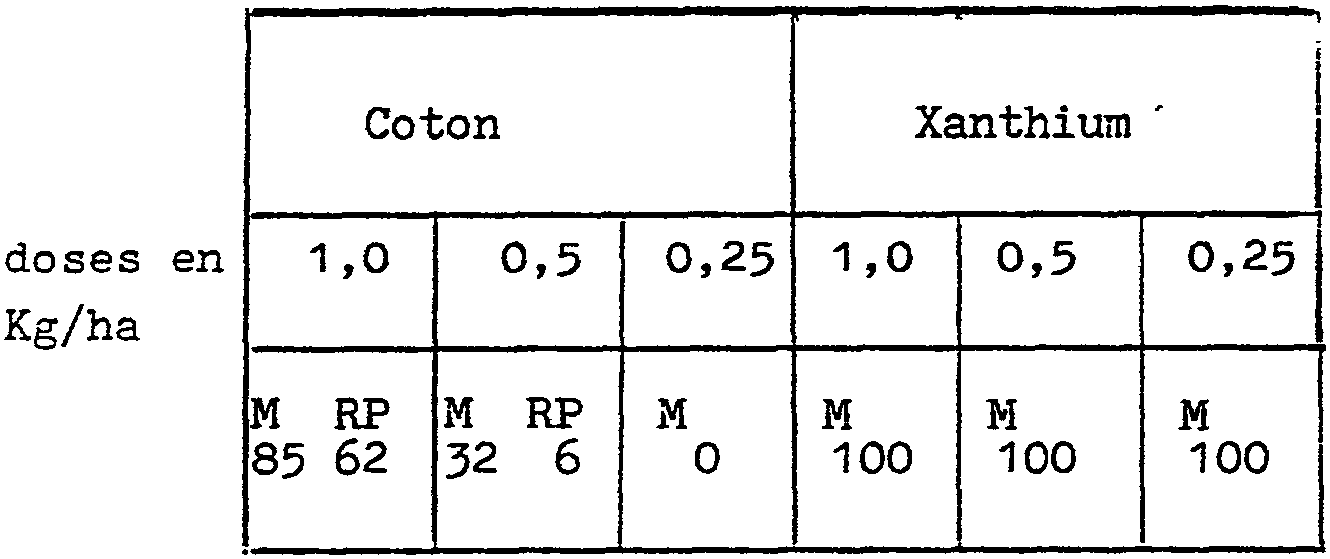
<tb> <SEP> 2,5kg/ha <SEP> 1,25Kg/ha <SEP> 0,625Kg/ha
<tb> Triticum <SEP> Sativum <SEP> M <SEP> : <SEP> 100 <SEP> M <SEP> : <SEP> 0 <SEP> M <SEP> : <SEP> 50
<tb> <SEP> R.P. <SEP> 10 <SEP> R.P. <SEP> 92
<tb> <SEP> Hordeum <SEP> Spec. <SEP> M <SEP> : <SEP> 100 <SEP> M <SEP> : <SEP> 100 <SEP> M <SEP> : <SEP> 20
<tb> <SEP> R.P. <SEP> 72
<tb> <SEP> Zea <SEP> Maïs <SEP> M <SEP> : <SEP> 50 <SEP> M <SEP> : <SEP> 0 <SEP> M <SEP> : <SEP> 0
<tb> <SEP> R.P. <SEP> 71 <SEP> R.P. <SEP> 0 <SEP> R.P. <SEP> 0
<tb> <SEP> Avena <SEP> Fatua <SEP> M <SEP> : <SEP> 100 <SEP> M <SEP> : <SEP> 60 <SEP> M <SEP> : <SEP> 0
<tb> <SEP> R.P. <SEP> 91 <SEP> R.P.<SEP> 21
<tb> <SEP> Agrostis <SEP> Tenuis <SEP> M <SEP> : <SEP> 100 <SEP> M <SEP> : <SEP> 100 <SEP> M <SEP> : <SEP> 100
<tb> <SEP> Lolium <SEP> Perenne <SEP> M <SEP> : <SEP> 100 <SEP> M <SEP> : <SEP> 40 <SEP> M <SEP> : <SEP> 20
<tb> <SEP> R.P. <SEP> 92 <SEP> R.P. <SEP> 69
<tb> <SEP> Alopecurus <SEP> Myosuroïdes <SEP> M <SEP> : <SEP> 100 <SEP> M <SEP> : <SEP> 100 <SEP> M <SEP> : <SEP> 20
<tb> <SEP> R.P. <SEP> 77
<tb> <SEP> Beta <SEP> Vulgaris <SEP> M <SEP> : <SEP> 100 <SEP> M <SEP> : <SEP> 100 <SEP> M <SEP> : <SEP> 100
<tb> Chenopodium <SEP> chinone <SEP> M <SEP> : <SEP> 100 <SEP> M <SEP> : <SEP> 100 <SEP> M <SEP> : <SEP> 80
<tb> <SEP> R.P. <SEP> 89
<tb> <SEP> Chrysanthemum <SEP> M <SEP> : <SEP> 100 <SEP> M <SEP> : <SEP> 100 <SEP> M <SEP> : <SEP> 55
<tb> <SEP> Coronarium <SEP> R.P.<SEP> 99
<tb> <SEP> Galium <SEP> Aparine <SEP> M <SEP> : <SEP> 100 <SEP> M <SEP> : <SEP> 100 <SEP> M <SEP> : <SEP> 100
<tb> <SEP> Sinapis <SEP> Alba <SEP> M <SEP> : <SEP> 100 <SEP> M <SEP> : <SEP> 100 <SEP> M <SEP> : <SEP> 100
<tb> <SEP> Rumex <SEP> Crispus <SEP> M <SEP> : <SEP> 100 <SEP> M <SEP> : <SEP> 100 <SEP> M <SEP> : <SEP> 100
<tb> Trifolium <SEP> M <SEP> : <SEP> 100 <SEP> M <SEP> : <SEP> 100 <SEP> M <SEP> : <SEP> 100
<tb> <SEP> Praetense
<tb>
Conclusion : En post-émergence on note une sélectivité sur graminées cultivées,
b) Tests d'activité herbicide comparé sur coton et xanthium (pré-émergence).
<tb>
<SEP> Coton <SEP> Xanthium
<tb> doses <SEP> en <SEP> 1,0 <SEP> 0,5 <SEP> 0,25 <SEP> 1,0 <SEP> 0,5 <SEP> 0,25
<tb> Kg/ha
<tb> <SEP> M <SEP> RP <SEP> M <SEP> RP <SEP> M <SEP> M <SEP> M <SEP> M
<tb> <SEP> 85 <SEP> 62 <SEP> 32 <SEP> 6 <SEP> 0 <SEP> 100 <SEP> 100 <SEP> 100
<tb>
Conclusion : Bonne activité sélective, le xanthium étant détruit et le coton peu ou pas attaqué.
<tb> doses <SEP> en <SEP> 1,0 <SEP> 0,5 <SEP> 0,25 <SEP> 1,0 <SEP> 0,5 <SEP> 0,25
<tb> Kg/ha
<tb> <SEP> M <SEP> RP <SEP> M <SEP> RP <SEP> M <SEP> M <SEP> M <SEP> M
<tb> <SEP> 85 <SEP> 62 <SEP> 32 <SEP> 6 <SEP> 0 <SEP> 100 <SEP> 100 <SEP> 100
<tb>
Conclusion : Bonne activité sélective, le xanthium étant détruit et le coton peu ou pas attaqué.
E) Résultats concernant le 1-(éthoxycarbonyl) 3-(2'=tétra
hydropyranyl) 5-éthyl 6-méthyl 1,2,3,4-tétrahydropyri
midine 2,4-dione.
hydropyranyl) 5-éthyl 6-méthyl 1,2,3,4-tétrahydropyri
midine 2,4-dione.
a) Tests de post-émergence.
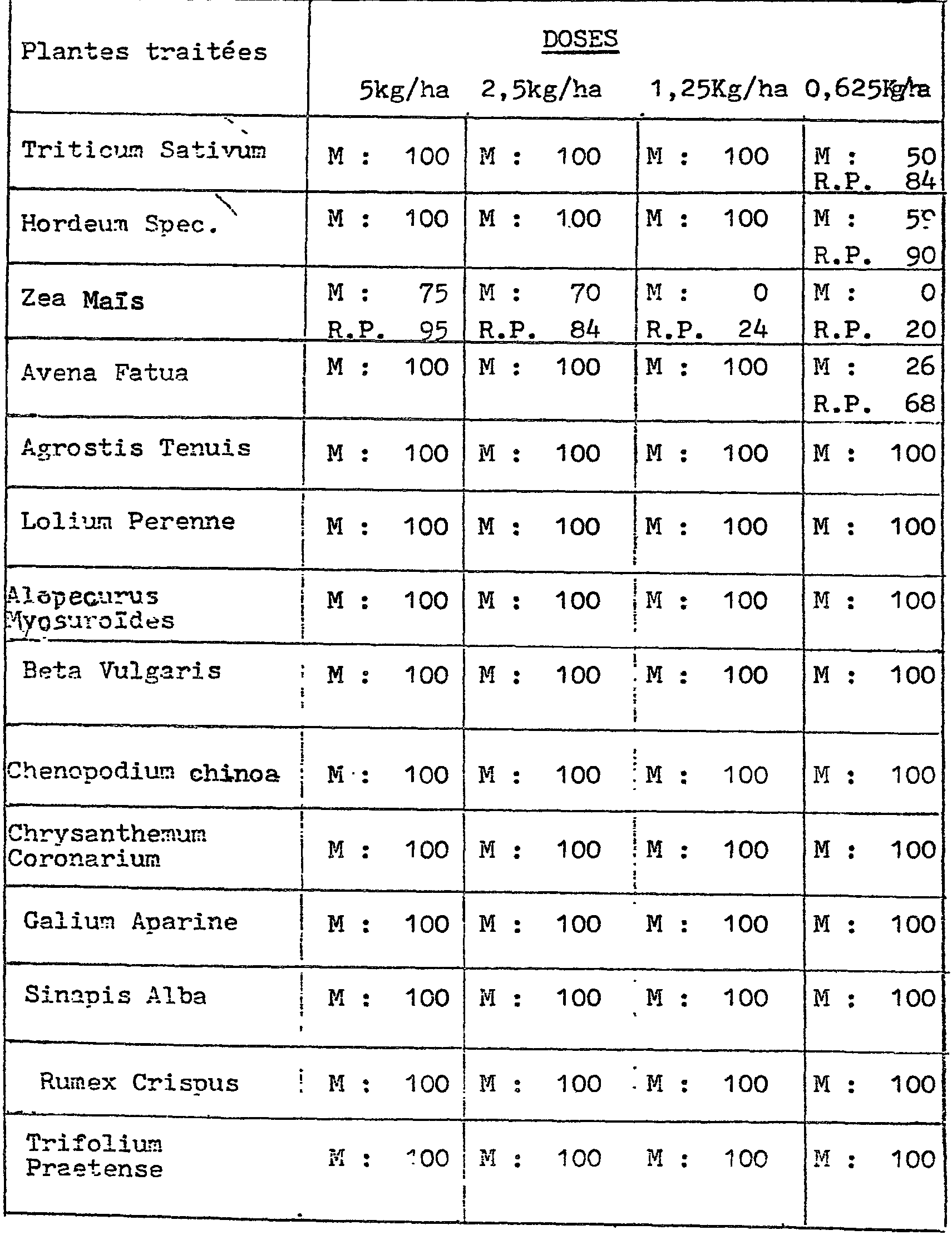
<tb>
<SEP> Plantes <SEP> traitées <SEP> DOSES
<tb> <SEP> 5kg/ha <SEP> 2,5kg/ha <SEP> 1,25kg/ha <SEP> 0,625kg/ha
<tb> <SEP> Triticum <SEP> Sativum <SEP> M <SEP> : <SEP> 100 <SEP> M <SEP> : <SEP> 100 <SEP> M <SEP> : <SEP> 100 <SEP> M <SEP> : <SEP> 50
<tb> <SEP> R.P. <SEP> 84
<tb> <SEP> Hordeum <SEP> Spec. <SEP> M <SEP> : <SEP> 100 <SEP> M <SEP> : <SEP> 100 <SEP> M <SEP> : <SEP> 100 <SEP> M <SEP> : <SEP> 59
<tb> <SEP> R.P. <SEP> 90
<tb> <SEP> Zea <SEP> Maïs <SEP> M <SEP> : <SEP> 75 <SEP> M <SEP> : <SEP> 70 <SEP> M <SEP> : <SEP> 0 <SEP> M <SEP> : <SEP> 0
<tb> R.P. <SEP> 95 <SEP> R.P. <SEP> 84 <SEP> R.P. <SEP> 24 <SEP> R.P. <SEP> 20
<tb> <SEP> Avena <SEP> Fatua <SEP> M <SEP> : <SEP> 100 <SEP> M <SEP> : <SEP> 100 <SEP> M <SEP> : <SEP> 100 <SEP> M <SEP> : <SEP> 26
<tb> <SEP> R.P. <SEP> 54 <SEP> R.P. <SEP> 57 <SEP> R.P. <SEP> 15 <SEP> R.P.<SEP> 68
<tb> Agrostis <SEP> Tenuis <SEP> M <SEP> : <SEP> 100 <SEP> M <SEP> : <SEP> 100 <SEP> M <SEP> : <SEP> 100 <SEP> M <SEP> : <SEP> 100
<tb> <SEP> Lolium <SEP> Perenne <SEP> M <SEP> : <SEP> 100 <SEP> M <SEP> : <SEP> 100 <SEP> M <SEP> : <SEP> 100 <SEP> M <SEP> : <SEP> 100
<tb> Alopecurus <SEP> M <SEP> : <SEP> 100 <SEP> M <SEP> : <SEP> 100 <SEP> M <SEP> : <SEP> 100 <SEP> M <SEP> : <SEP> 100
<tb> Myosuroïdes
<tb> Beta <SEP> Vulgaris <SEP> M <SEP> : <SEP> 100 <SEP> M <SEP> : <SEP> 100 <SEP> M <SEP> : <SEP> 100 <SEP> M <SEP> : <SEP> 100
<tb> Chenopodium <SEP> chinona <SEP> M <SEP> : <SEP> 100 <SEP> M <SEP> : <SEP> 100 <SEP> M <SEP> : <SEP> 100 <SEP> M <SEP> : <SEP> 100
<tb> Chrysanthemum <SEP> M <SEP> : <SEP> 100 <SEP> M <SEP> : <SEP> 100 <SEP> M <SEP> : <SEP> 100 <SEP> M <SEP> : <SEP> 100
<tb> Coronarium
<tb> <SEP> Galium <SEP> Aparine <SEP> M <SEP> : <SEP> 100 <SEP> M <SEP> :<SEP> 100 <SEP> M <SEP> : <SEP> 100 <SEP> M <SEP> : <SEP> 100
<tb> <SEP> Sinapis <SEP> Alba <SEP> M <SEP> : <SEP> 100 <SEP> M <SEP> : <SEP> 100 <SEP> M <SEP> : <SEP> 100 <SEP> M <SEP> : <SEP> 100
<tb> Rumex <SEP> Crispus <SEP> M <SEP> : <SEP> 100 <SEP> M <SEP> : <SEP> 100 <SEP> M <SEP> : <SEP> 100 <SEP> M <SEP> : <SEP> 100
<tb> Trifolium <SEP> M <SEP> : <SEP> 100 <SEP> M <SEP> : <SEP> 100 <SEP> M <SEP> : <SEP> 100 <SEP> M <SEP> : <SEP> 100
<tb> <SEP> Praetense
<tb>

<tb> <SEP> 5kg/ha <SEP> 2,5kg/ha <SEP> 1,25kg/ha <SEP> 0,625kg/ha
<tb> <SEP> Triticum <SEP> Sativum <SEP> M <SEP> : <SEP> 100 <SEP> M <SEP> : <SEP> 100 <SEP> M <SEP> : <SEP> 100 <SEP> M <SEP> : <SEP> 50
<tb> <SEP> R.P. <SEP> 84
<tb> <SEP> Hordeum <SEP> Spec. <SEP> M <SEP> : <SEP> 100 <SEP> M <SEP> : <SEP> 100 <SEP> M <SEP> : <SEP> 100 <SEP> M <SEP> : <SEP> 59
<tb> <SEP> R.P. <SEP> 90
<tb> <SEP> Zea <SEP> Maïs <SEP> M <SEP> : <SEP> 75 <SEP> M <SEP> : <SEP> 70 <SEP> M <SEP> : <SEP> 0 <SEP> M <SEP> : <SEP> 0
<tb> R.P. <SEP> 95 <SEP> R.P. <SEP> 84 <SEP> R.P. <SEP> 24 <SEP> R.P. <SEP> 20
<tb> <SEP> Avena <SEP> Fatua <SEP> M <SEP> : <SEP> 100 <SEP> M <SEP> : <SEP> 100 <SEP> M <SEP> : <SEP> 100 <SEP> M <SEP> : <SEP> 26
<tb> <SEP> R.P. <SEP> 54 <SEP> R.P. <SEP> 57 <SEP> R.P. <SEP> 15 <SEP> R.P.<SEP> 68
<tb> Agrostis <SEP> Tenuis <SEP> M <SEP> : <SEP> 100 <SEP> M <SEP> : <SEP> 100 <SEP> M <SEP> : <SEP> 100 <SEP> M <SEP> : <SEP> 100
<tb> <SEP> Lolium <SEP> Perenne <SEP> M <SEP> : <SEP> 100 <SEP> M <SEP> : <SEP> 100 <SEP> M <SEP> : <SEP> 100 <SEP> M <SEP> : <SEP> 100
<tb> Alopecurus <SEP> M <SEP> : <SEP> 100 <SEP> M <SEP> : <SEP> 100 <SEP> M <SEP> : <SEP> 100 <SEP> M <SEP> : <SEP> 100
<tb> Myosuroïdes
<tb> Beta <SEP> Vulgaris <SEP> M <SEP> : <SEP> 100 <SEP> M <SEP> : <SEP> 100 <SEP> M <SEP> : <SEP> 100 <SEP> M <SEP> : <SEP> 100
<tb> Chenopodium <SEP> chinona <SEP> M <SEP> : <SEP> 100 <SEP> M <SEP> : <SEP> 100 <SEP> M <SEP> : <SEP> 100 <SEP> M <SEP> : <SEP> 100
<tb> Chrysanthemum <SEP> M <SEP> : <SEP> 100 <SEP> M <SEP> : <SEP> 100 <SEP> M <SEP> : <SEP> 100 <SEP> M <SEP> : <SEP> 100
<tb> Coronarium
<tb> <SEP> Galium <SEP> Aparine <SEP> M <SEP> : <SEP> 100 <SEP> M <SEP> :<SEP> 100 <SEP> M <SEP> : <SEP> 100 <SEP> M <SEP> : <SEP> 100
<tb> <SEP> Sinapis <SEP> Alba <SEP> M <SEP> : <SEP> 100 <SEP> M <SEP> : <SEP> 100 <SEP> M <SEP> : <SEP> 100 <SEP> M <SEP> : <SEP> 100
<tb> Rumex <SEP> Crispus <SEP> M <SEP> : <SEP> 100 <SEP> M <SEP> : <SEP> 100 <SEP> M <SEP> : <SEP> 100 <SEP> M <SEP> : <SEP> 100
<tb> Trifolium <SEP> M <SEP> : <SEP> 100 <SEP> M <SEP> : <SEP> 100 <SEP> M <SEP> : <SEP> 100 <SEP> M <SEP> : <SEP> 100
<tb> <SEP> Praetense
<tb>
<tb> <SEP> Plantes <SEP> traitées <SEP> DOSES
<tb> <SEP> 0,312Kg/ha <SEP> 0,156Kg/ha <SEP> 0,078Kg/ha <SEP> 0,039Kg/ha
<tb> <SEP> Triticum <SEP> Sativum <SEP> M <SEP> : <SEP> 0 <SEP> M <SEP> : <SEP> 0 <SEP> M <SEP> : <SEP> 0 <SEP> M <SEP> : <SEP> 0
<tb> <SEP> R.P. <SEP> 30 <SEP> R.P. <SEP> 0 <SEP> R.P. <SEP> 0 <SEP> R.P. <SEP> 0
<tb> <SEP> Hordeum <SEP> Spec.<SEP> M <SEP> : <SEP> 45 <SEP> M <SEP> : <SEP> 0 <SEP> M <SEP> : <SEP> 0 <SEP> M <SEP> : <SEP> 0
<tb> <SEP> R.P. <SEP> 78 <SEP> R.P. <SEP> 0 <SEP> R.P. <SEP> 0 <SEP> R.P. <SEP> 0
<tb> <SEP> Zea <SEP> Maïs <SEP> M <SEP> : <SEP> 0 <SEP> M <SEP> : <SEP> 0 <SEP> M <SEP> : <SEP> 0 <SEP> M <SEP> : <SEP> 0
<tb> <SEP> R.P. <SEP> 0 <SEP> R.P. <SEP> 0 <SEP> R.P. <SEP> 0 <SEP> R.P. <SEP> 0
<tb> <SEP> Avena <SEP> Fatua <SEP> M <SEP> : <SEP> 0 <SEP> M <SEP> : <SEP> 0 <SEP> M <SEP> : <SEP> 0 <SEP> M <SEP> : <SEP> 0
<tb> R.P. <SEP> 0 <SEP> R.P. <SEP> 0 <SEP> R.P. <SEP> 0 <SEP> R.P. <SEP> 0
<tb> <SEP> Agrostis <SEP> Tenuis <SEP> M <SEP> : <SEP> 100 <SEP> M <SEP> : <SEP> 100 <SEP> M <SEP> : <SEP> 66 <SEP> M <SEP> : <SEP> 0
<tb> <SEP> R.P. <SEP> 0 <SEP> R.P.<SEP> 0
<tb> <SEP> Lolium <SEP> Perenne <SEP> M <SEP> : <SEP> 61 <SEP> M <SEP> : <SEP> 0 <SEP> M <SEP> : <SEP> 0 <SEP> M <SEP> : <SEP> 0
<tb> <SEP> R.P. <SEP> 90 <SEP> R.P. <SEP> 64 <SEP> R.P. <SEP> 38 <SEP> R.P. <SEP> 0
<tb> <SEP> Alopecurus <SEP> M <SEP> : <SEP> 100 <SEP> M <SEP> : <SEP> 36 <SEP> M <SEP> : <SEP> 0 <SEP> M <SEP> : <SEP> 0
<tb> <SEP> Myosuroïdes <SEP> R.P. <SEP> 71 <SEP> R.P. <SEP> 55 <SEP> R.P. <SEP> 0
<tb> <SEP> Beta <SEP> Vulgaris <SEP> M <SEP> : <SEP> 56 <SEP> M <SEP> : <SEP> 27 <SEP> M <SEP> : <SEP> 0 <SEP> M <SEP> : <SEP> 0
<tb> <SEP> R.P. <SEP> 93 <SEP> R.P. <SEP> 65 <SEP> R.P. <SEP> 51 <SEP> R.P.<SEP> 0
<tb> Chenopodium <SEP> chinoa <SEP> M <SEP> : <SEP> 100 <SEP> M <SEP> : <SEP> 100 <SEP> M <SEP> : <SEP> 100 <SEP> M <SEP> : <SEP> 0
<tb> Chrysanthemum <SEP> M <SEP> : <SEP> 100 <SEP> M <SEP> : <SEP> 100 <SEP> M <SEP> : <SEP> 100 <SEP> M <SEP> : <SEP> 0
<tb> Coronarium <SEP> R.P. <SEP> 83 <SEP> R.P. <SEP> 29 <SEP> R.P. <SEP> 0
<tb> <SEP> Galium <SEP> Aparine <SEP> M <SEP> : <SEP> 100 <SEP> M <SEP> : <SEP> 100 <SEP> M <SEP> : <SEP> 0 <SEP> M <SEP> : <SEP> 0
<tb> R.P. <SEP> 44 <SEP> R.P. <SEP> 0
<tb> <SEP> Sinapis <SEP> Alba <SEP> M <SEP> : <SEP> 10 <SEP> M <SEP> : <SEP> 0 <SEP> M <SEP> : <SEP> 0 <SEP> M <SEP> : <SEP> 0
<tb> <SEP> R.P. <SEP> 78 <SEP> R.P. <SEP> 53 <SEP> R.P. <SEP> 29 <SEP> R.P. <SEP> 0
<tb> <SEP> Rumex <SEP> Crispus <SEP> M <SEP> : <SEP> 40 <SEP> M <SEP> : <SEP> 0 <SEP> M <SEP> : <SEP> 0 <SEP> M <SEP> : <SEP> 0
<tb> <SEP> R.P. <SEP> 84 <SEP> R.P. <SEP> 64 <SEP> R.P. <SEP> 42 <SEP> R.P. <SEP> 0
<tb> <SEP> Trifolium <SEP> M <SEP> : <SEP> 93 <SEP> M <SEP> : <SEP> 79 <SEP> M <SEP> : <SEP> 29 <SEP> M <SEP> : <SEP> 0
<tb> Praetense <SEP> R.P. <SEP> 97 <SEP> R.P. <SEP> 89 <SEP> R.P. <SEP> 43 <SEP> R.P. <SEP> 0
<tb> b) Test de pré-émergence

<tb> <SEP> 0,312Kg/ha <SEP> 0,156Kg/ha <SEP> 0,078Kg/ha <SEP> 0,039Kg/ha
<tb> <SEP> Triticum <SEP> Sativum <SEP> M <SEP> : <SEP> 0 <SEP> M <SEP> : <SEP> 0 <SEP> M <SEP> : <SEP> 0 <SEP> M <SEP> : <SEP> 0
<tb> <SEP> R.P. <SEP> 30 <SEP> R.P. <SEP> 0 <SEP> R.P. <SEP> 0 <SEP> R.P. <SEP> 0
<tb> <SEP> Hordeum <SEP> Spec.<SEP> M <SEP> : <SEP> 45 <SEP> M <SEP> : <SEP> 0 <SEP> M <SEP> : <SEP> 0 <SEP> M <SEP> : <SEP> 0
<tb> <SEP> R.P. <SEP> 78 <SEP> R.P. <SEP> 0 <SEP> R.P. <SEP> 0 <SEP> R.P. <SEP> 0
<tb> <SEP> Zea <SEP> Maïs <SEP> M <SEP> : <SEP> 0 <SEP> M <SEP> : <SEP> 0 <SEP> M <SEP> : <SEP> 0 <SEP> M <SEP> : <SEP> 0
<tb> <SEP> R.P. <SEP> 0 <SEP> R.P. <SEP> 0 <SEP> R.P. <SEP> 0 <SEP> R.P. <SEP> 0
<tb> <SEP> Avena <SEP> Fatua <SEP> M <SEP> : <SEP> 0 <SEP> M <SEP> : <SEP> 0 <SEP> M <SEP> : <SEP> 0 <SEP> M <SEP> : <SEP> 0
<tb> R.P. <SEP> 0 <SEP> R.P. <SEP> 0 <SEP> R.P. <SEP> 0 <SEP> R.P. <SEP> 0
<tb> <SEP> Agrostis <SEP> Tenuis <SEP> M <SEP> : <SEP> 100 <SEP> M <SEP> : <SEP> 100 <SEP> M <SEP> : <SEP> 66 <SEP> M <SEP> : <SEP> 0
<tb> <SEP> R.P. <SEP> 0 <SEP> R.P.<SEP> 0
<tb> <SEP> Lolium <SEP> Perenne <SEP> M <SEP> : <SEP> 61 <SEP> M <SEP> : <SEP> 0 <SEP> M <SEP> : <SEP> 0 <SEP> M <SEP> : <SEP> 0
<tb> <SEP> R.P. <SEP> 90 <SEP> R.P. <SEP> 64 <SEP> R.P. <SEP> 38 <SEP> R.P. <SEP> 0
<tb> <SEP> Alopecurus <SEP> M <SEP> : <SEP> 100 <SEP> M <SEP> : <SEP> 36 <SEP> M <SEP> : <SEP> 0 <SEP> M <SEP> : <SEP> 0
<tb> <SEP> Myosuroïdes <SEP> R.P. <SEP> 71 <SEP> R.P. <SEP> 55 <SEP> R.P. <SEP> 0
<tb> <SEP> Beta <SEP> Vulgaris <SEP> M <SEP> : <SEP> 56 <SEP> M <SEP> : <SEP> 27 <SEP> M <SEP> : <SEP> 0 <SEP> M <SEP> : <SEP> 0
<tb> <SEP> R.P. <SEP> 93 <SEP> R.P. <SEP> 65 <SEP> R.P. <SEP> 51 <SEP> R.P.<SEP> 0
<tb> Chenopodium <SEP> chinoa <SEP> M <SEP> : <SEP> 100 <SEP> M <SEP> : <SEP> 100 <SEP> M <SEP> : <SEP> 100 <SEP> M <SEP> : <SEP> 0
<tb> Chrysanthemum <SEP> M <SEP> : <SEP> 100 <SEP> M <SEP> : <SEP> 100 <SEP> M <SEP> : <SEP> 100 <SEP> M <SEP> : <SEP> 0
<tb> Coronarium <SEP> R.P. <SEP> 83 <SEP> R.P. <SEP> 29 <SEP> R.P. <SEP> 0
<tb> <SEP> Galium <SEP> Aparine <SEP> M <SEP> : <SEP> 100 <SEP> M <SEP> : <SEP> 100 <SEP> M <SEP> : <SEP> 0 <SEP> M <SEP> : <SEP> 0
<tb> R.P. <SEP> 44 <SEP> R.P. <SEP> 0
<tb> <SEP> Sinapis <SEP> Alba <SEP> M <SEP> : <SEP> 10 <SEP> M <SEP> : <SEP> 0 <SEP> M <SEP> : <SEP> 0 <SEP> M <SEP> : <SEP> 0
<tb> <SEP> R.P. <SEP> 78 <SEP> R.P. <SEP> 53 <SEP> R.P. <SEP> 29 <SEP> R.P. <SEP> 0
<tb> <SEP> Rumex <SEP> Crispus <SEP> M <SEP> : <SEP> 40 <SEP> M <SEP> : <SEP> 0 <SEP> M <SEP> : <SEP> 0 <SEP> M <SEP> : <SEP> 0
<tb> <SEP> R.P. <SEP> 84 <SEP> R.P. <SEP> 64 <SEP> R.P. <SEP> 42 <SEP> R.P. <SEP> 0
<tb> <SEP> Trifolium <SEP> M <SEP> : <SEP> 93 <SEP> M <SEP> : <SEP> 79 <SEP> M <SEP> : <SEP> 29 <SEP> M <SEP> : <SEP> 0
<tb> Praetense <SEP> R.P. <SEP> 97 <SEP> R.P. <SEP> 89 <SEP> R.P. <SEP> 43 <SEP> R.P. <SEP> 0
<tb> b) Test de pré-émergence
<tb> <SEP> Plantes <SEP> traitées <SEP> DOSES
<tb> <SEP> 5kg/ha <SEP> 2,5kg/ha <SEP> 1,25kg/ha <SEP> 0,625Kg/ha
<tb> <SEP> Triticum <SEP> Sativum <SEP> M <SEP> : <SEP> @@ <SEP> <SEP> M <SEP> : <SEP> 0 <SEP> M <SEP> : <SEP> 0 <SEP> M <SEP> : <SEP> 0
<tb> <SEP> R.P. <SEP> 79 <SEP> R.P. <SEP> 67 <SEP> R.P. <SEP> 46 <SEP> R.P. <SEP> 0
<tb> <SEP> Hordeum <SEP> Spec. <SEP> M <SEP> : <SEP> 100 <SEP> M <SEP> : <SEP> 68 <SEP> M <SEP> : <SEP> 0 <SEP> M <SEP> : <SEP> 0
<tb> <SEP> R.P. <SEP> 93 <SEP> R.P. <SEP> 74 <SEP> R.P.<SEP> 54
<tb> <SEP> Zea <SEP> Maïs <SEP> M <SEP> : <SEP> 0 <SEP> M <SEP> : <SEP> 0 <SEP> M <SEP> : <SEP> 0 <SEP> M <SEP> : <SEP> 0
<tb> <SEP> R.P. <SEP> 37 <SEP> R.P. <SEP> 24 <SEP> R.P. <SEP> 0 <SEP> R.P. <SEP> 0
<tb> <SEP> Avena <SEP> Fatua <SEP> M <SEP> : <SEP> 25 <SEP> M <SEP> : <SEP> 0 <SEP> M <SEP> : <SEP> 0 <SEP> M <SEP> : <SEP> 0
<tb> <SEP> R.P. <SEP> 75 <SEP> R.P. <SEP> 67 <SEP> R.P. <SEP> 0 <SEP> R.P. <SEP> 0
<tb> <SEP> Agrostis <SEP> Tenuis <SEP> M <SEP> : <SEP> 0 <SEP> M <SEP> : <SEP> 95 <SEP> M <SEP> : <SEP> 94 <SEP> M <SEP> : <SEP> 91
<tb> <SEP> R.P. <SEP> 0 <SEP> R.P. <SEP> 0 <SEP> R.P. <SEP> 0 <SEP> R.P. <SEP> 0
<tb> <SEP> Lolium <SEP> Perenne <SEP> M <SEP> : <SEP> 100 <SEP> M <SEP> : <SEP> 100 <SEP> M <SEP> : <SEP> 87 <SEP> M <SEP> : <SEP> 60
<tb> <SEP> R.P. <SEP> 95 <SEP> R.P.<SEP> 87
<tb> Alopecurus <SEP> M <SEP> : <SEP> 59 <SEP> M <SEP> : <SEP> 33 <SEP> M <SEP> : <SEP> 33 <SEP> M <SEP> : <SEP> 0
<tb> <SEP> Myosuroïdes <SEP> R.P. <SEP> 90 <SEP> R.P. <SEP> 79 <SEP> R.P. <SEP> 62 <SEP> R.P. <SEP> 66
<tb> <SEP> Beta <SEP> Vulgaris <SEP> M <SEP> : <SEP> 100 <SEP> M <SEP> : <SEP> 100 <SEP> M <SEP> : <SEP> 100 <SEP> M <SEP> : <SEP> 72
<tb> <SEP> R.P. <SEP> 92
<tb> <SEP> Chenopodium <SEP> chinoa <SEP> M <SEP> : <SEP> 100 <SEP> M <SEP> : <SEP> 100 <SEP> M <SEP> : <SEP> 100 <SEP> M <SEP> : <SEP> 89
<tb> <SEP> R.P. <SEP> 88
<tb> Chrysanthemum <SEP> M <SEP> : <SEP> 100 <SEP> M <SEP> : <SEP> 100 <SEP> M <SEP> : <SEP> 100 <SEP> M <SEP> : <SEP> 100
<tb> <SEP> Coronarium
<tb> <SEP> Galium <SEP> Aparine <SEP> M <SEP> : <SEP> 92 <SEP> M <SEP> : <SEP> 75 <SEP> M <SEP> : <SEP> 83 <SEP> M <SEP> : <SEP> 78
<tb> R.P. <SEP> 98 <SEP> R.P. <SEP> 95 <SEP> R.P.<SEP> 97 <SEP> R.P. <SEP> 93
<tb> <SEP> Sinapis <SEP> Alba <SEP> M <SEP> : <SEP> 100 <SEP> M <SEP> : <SEP> 100 <SEP> M <SEP> : <SEP> 100 <SEP> M <SEP> : <SEP> 100
<tb> <SEP> Rumex <SEP> Crispus <SEP> M <SEP> : <SEP> 100 <SEP> M <SEP> : <SEP> 100 <SEP> M <SEP> : <SEP> 100 <SEP> M <SEP> : <SEP> 82
<tb> <SEP> R.P.<SEP> 95
<tb> <SEP> Trifolium <SEP> M <SEP> : <SEP> 100 <SEP> M <SEP> : <SEP> 100 <SEP> M <SEP> : <SEP> 100 <SEP> M <SEP> : <SEP> 100
<tb> <SEP> Praetense
<tb>
Conclusion : En post-émergence à dose suffisamment faible, le composé testé permet d'envisager un desherbage sélectif des graminées cultivées. Néanmoins à ces doses les performances du com- posé sur les adventices sont un peu faibles. - pré-émergence or note une sélectivité appréciable vis-à-vis des raminées ult'- vées et notamment vis-à-vis du maïs.
<tb> <SEP> 5kg/ha <SEP> 2,5kg/ha <SEP> 1,25kg/ha <SEP> 0,625Kg/ha
<tb> <SEP> Triticum <SEP> Sativum <SEP> M <SEP> : <SEP> @@ <SEP> <SEP> M <SEP> : <SEP> 0 <SEP> M <SEP> : <SEP> 0 <SEP> M <SEP> : <SEP> 0
<tb> <SEP> R.P. <SEP> 79 <SEP> R.P. <SEP> 67 <SEP> R.P. <SEP> 46 <SEP> R.P. <SEP> 0
<tb> <SEP> Hordeum <SEP> Spec. <SEP> M <SEP> : <SEP> 100 <SEP> M <SEP> : <SEP> 68 <SEP> M <SEP> : <SEP> 0 <SEP> M <SEP> : <SEP> 0
<tb> <SEP> R.P. <SEP> 93 <SEP> R.P. <SEP> 74 <SEP> R.P.<SEP> 54
<tb> <SEP> Zea <SEP> Maïs <SEP> M <SEP> : <SEP> 0 <SEP> M <SEP> : <SEP> 0 <SEP> M <SEP> : <SEP> 0 <SEP> M <SEP> : <SEP> 0
<tb> <SEP> R.P. <SEP> 37 <SEP> R.P. <SEP> 24 <SEP> R.P. <SEP> 0 <SEP> R.P. <SEP> 0
<tb> <SEP> Avena <SEP> Fatua <SEP> M <SEP> : <SEP> 25 <SEP> M <SEP> : <SEP> 0 <SEP> M <SEP> : <SEP> 0 <SEP> M <SEP> : <SEP> 0
<tb> <SEP> R.P. <SEP> 75 <SEP> R.P. <SEP> 67 <SEP> R.P. <SEP> 0 <SEP> R.P. <SEP> 0
<tb> <SEP> Agrostis <SEP> Tenuis <SEP> M <SEP> : <SEP> 0 <SEP> M <SEP> : <SEP> 95 <SEP> M <SEP> : <SEP> 94 <SEP> M <SEP> : <SEP> 91
<tb> <SEP> R.P. <SEP> 0 <SEP> R.P. <SEP> 0 <SEP> R.P. <SEP> 0 <SEP> R.P. <SEP> 0
<tb> <SEP> Lolium <SEP> Perenne <SEP> M <SEP> : <SEP> 100 <SEP> M <SEP> : <SEP> 100 <SEP> M <SEP> : <SEP> 87 <SEP> M <SEP> : <SEP> 60
<tb> <SEP> R.P. <SEP> 95 <SEP> R.P.<SEP> 87
<tb> Alopecurus <SEP> M <SEP> : <SEP> 59 <SEP> M <SEP> : <SEP> 33 <SEP> M <SEP> : <SEP> 33 <SEP> M <SEP> : <SEP> 0
<tb> <SEP> Myosuroïdes <SEP> R.P. <SEP> 90 <SEP> R.P. <SEP> 79 <SEP> R.P. <SEP> 62 <SEP> R.P. <SEP> 66
<tb> <SEP> Beta <SEP> Vulgaris <SEP> M <SEP> : <SEP> 100 <SEP> M <SEP> : <SEP> 100 <SEP> M <SEP> : <SEP> 100 <SEP> M <SEP> : <SEP> 72
<tb> <SEP> R.P. <SEP> 92
<tb> <SEP> Chenopodium <SEP> chinoa <SEP> M <SEP> : <SEP> 100 <SEP> M <SEP> : <SEP> 100 <SEP> M <SEP> : <SEP> 100 <SEP> M <SEP> : <SEP> 89
<tb> <SEP> R.P. <SEP> 88
<tb> Chrysanthemum <SEP> M <SEP> : <SEP> 100 <SEP> M <SEP> : <SEP> 100 <SEP> M <SEP> : <SEP> 100 <SEP> M <SEP> : <SEP> 100
<tb> <SEP> Coronarium
<tb> <SEP> Galium <SEP> Aparine <SEP> M <SEP> : <SEP> 92 <SEP> M <SEP> : <SEP> 75 <SEP> M <SEP> : <SEP> 83 <SEP> M <SEP> : <SEP> 78
<tb> R.P. <SEP> 98 <SEP> R.P. <SEP> 95 <SEP> R.P.<SEP> 97 <SEP> R.P. <SEP> 93
<tb> <SEP> Sinapis <SEP> Alba <SEP> M <SEP> : <SEP> 100 <SEP> M <SEP> : <SEP> 100 <SEP> M <SEP> : <SEP> 100 <SEP> M <SEP> : <SEP> 100
<tb> <SEP> Rumex <SEP> Crispus <SEP> M <SEP> : <SEP> 100 <SEP> M <SEP> : <SEP> 100 <SEP> M <SEP> : <SEP> 100 <SEP> M <SEP> : <SEP> 82
<tb> <SEP> R.P.<SEP> 95
<tb> <SEP> Trifolium <SEP> M <SEP> : <SEP> 100 <SEP> M <SEP> : <SEP> 100 <SEP> M <SEP> : <SEP> 100 <SEP> M <SEP> : <SEP> 100
<tb> <SEP> Praetense
<tb>
Conclusion : En post-émergence à dose suffisamment faible, le composé testé permet d'envisager un desherbage sélectif des graminées cultivées. Néanmoins à ces doses les performances du com- posé sur les adventices sont un peu faibles. - pré-émergence or note une sélectivité appréciable vis-à-vis des raminées ult'- vées et notamment vis-à-vis du maïs.
c) Tests d'activité herbicide comparée sur coton et
xanthium.
xanthium.
Test de post-émergence
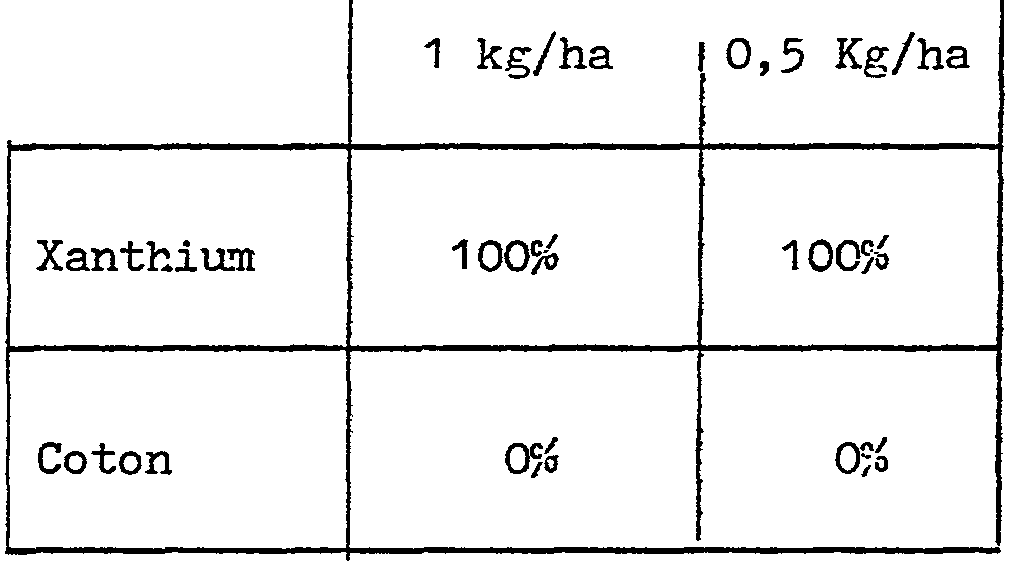
<tb> <SEP> 1 <SEP> kg/ha <SEP> 0,5 <SEP> Kg/ha
<tb> Xanthium <SEP> 100% <SEP> 100%
<tb> Coton <SEP> 0% <SEP> 0%
<tb>
Test de pré-émergence

<tb> Xanthium <SEP> 100% <SEP> 100%
<tb> Coton <SEP> 0% <SEP> 0%
<tb>
Test de pré-émergence
<tb> <SEP> 0,5 <SEP> kg/ha <SEP> 0,25 <SEP> kg/ha
<tb> <SEP> Xanthium <SEP> 100% <SEP> 100%
<tb> Coton <SEP> 0% <SEP> 0%
<tb>
Conclusion : Bonne activite herbicide sélective sur le coton cui n'est pas attaqué aux doses utilisées, alors que le xanthium est détruit totalement.
<tb> <SEP> Xanthium <SEP> 100% <SEP> 100%
<tb> Coton <SEP> 0% <SEP> 0%
<tb>
Conclusion : Bonne activite herbicide sélective sur le coton cui n'est pas attaqué aux doses utilisées, alors que le xanthium est détruit totalement.
F) Résultats concernant le 1-(ohénoxycarbonyl) 3-(2'tétrahydro- pyranyl) 5-éthyl 6-méthyl 1,2,3,4-tétrahydropyrimidine 2,4 dione.
Test de post-émergence

<tb> <SEP> Plantes <SEP> traitées <SEP> DOSES
<tb> <SEP> 5kg/ha <SEP> 2,5kg/ha <SEP> 1,25kg/ha <SEP> 0,625Kg/ha
<tb> Triticum <SEP> Sativum <SEP> M <SEP> : <SEP> 100 <SEP> M <SEP> : <SEP> 100 <SEP> M <SEP> : <SEP> 60 <SEP> M <SEP> : <SEP> 0
<tb> <SEP> R.P. <SEP> 96 <SEP> R.P. <SEP> 47
<tb> <SEP> Hordeum <SEP> Spec. <SEP> M <SEP> : <SEP> 100 <SEP> M <SEP> : <SEP> 100 <SEP> M <SEP> : <SEP> 80 <SEP> M <SEP> : <SEP> 0
<tb> <SEP> R.P. <SEP> 96 <SEP> R.P. <SEP> 53
<tb> <SEP> Zea <SEP> Maïs <SEP> M <SEP> : <SEP> 60 <SEP> M <SEP> : <SEP> 11 <SEP> M <SEP> : <SEP> 0 <SEP> M <SEP> : <SEP> 0
<tb> <SEP> R.P. <SEP> 81 <SEP> R.P. <SEP> 53 <SEP> R.P. <SEP> 0 <SEP> R.P. <SEP> 0
<tb> <SEP> Avena <SEP> Fatua <SEP> M <SEP> : <SEP> 100 <SEP> M <SEP> : <SEP> 100 <SEP> M <SEP> : <SEP> 40 <SEP> M <SEP> : <SEP> 0
<tb> <SEP> R.P. <SEP> 75 <SEP> R.P.<SEP> 38
<tb> Agrostis <SEP> Tenuis <SEP> M <SEP> : <SEP> 100 <SEP> M <SEP> : <SEP> 100 <SEP> M <SEP> : <SEP> 100 <SEP> M <SEP> : <SEP> 100
<tb> <SEP> Lolium <SEP> Perenne <SEP> M <SEP> : <SEP> 100 <SEP> M <SEP> : <SEP> 100 <SEP> M <SEP> : <SEP> 100 <SEP> M <SEP> : <SEP> 50
<tb> <SEP> M <SEP> : <SEP> 84
<tb> Alopecurus <SEP> M <SEP> : <SEP> 100 <SEP> M <SEP> : <SEP> 100 <SEP> M <SEP> : <SEP> 100 <SEP> M <SEP> : <SEP> 80
<tb> Myosuroïdes <SEP> R.P. <SEP> 89
<tb> <SEP> Beta <SEP> Vulgaris <SEP> M <SEP> : <SEP> 100 <SEP> M <SEP> : <SEP> 100 <SEP> M <SEP> : <SEP> 100 <SEP> M <SEP> : <SEP> 100
<tb> Chenopodium <SEP> chinoa <SEP> M <SEP> : <SEP> 100 <SEP> M <SEP> : <SEP> 100 <SEP> M <SEP> : <SEP> 100 <SEP> M <SEP> : <SEP> 0
<tb> Chrysanthemum <SEP> M <SEP> : <SEP> 100 <SEP> M <SEP> : <SEP> 100 <SEP> M <SEP> : <SEP> 100 <SEP> M <SEP> : <SEP> 80
<tb> Coronarium <SEP> R.P.<SEP> 51
<tb> <SEP> Galium <SEP> Aparine <SEP> M <SEP> : <SEP> 100 <SEP> M <SEP> : <SEP> 100 <SEP> M <SEP> : <SEP> 100 <SEP> M <SEP> : <SEP> 100
<tb> <SEP> Sinapis <SEP> Alba <SEP> M <SEP> : <SEP> 100 <SEP> M <SEP> : <SEP> 100 <SEP> M <SEP> : <SEP> 100 <SEP> M <SEP> : <SEP> 100
<tb> <SEP> Rumex <SEP> Crispus <SEP> M <SEP> : <SEP> 100 <SEP> M <SEP> : <SEP> 100 <SEP> M <SEP> : <SEP> 100 <SEP> M <SEP> : <SEP> 100
<tb> Trifolium <SEP> M <SEP> : <SEP> 100 <SEP> M <SEP> : <SEP> 100 <SEP> M <SEP> : <SEP> 100 <SEP> M <SEP> : <SEP> 100
<tb> <SEP> Praetense
<tb>
Conclusion : Dans ce test de post-émergence à 1,25 Kg/ha ou 0,625 Kg/ha, le mais est inattaqué alors que les advendices sont détruits.
<tb> <SEP> 5kg/ha <SEP> 2,5kg/ha <SEP> 1,25kg/ha <SEP> 0,625Kg/ha
<tb> Triticum <SEP> Sativum <SEP> M <SEP> : <SEP> 100 <SEP> M <SEP> : <SEP> 100 <SEP> M <SEP> : <SEP> 60 <SEP> M <SEP> : <SEP> 0
<tb> <SEP> R.P. <SEP> 96 <SEP> R.P. <SEP> 47
<tb> <SEP> Hordeum <SEP> Spec. <SEP> M <SEP> : <SEP> 100 <SEP> M <SEP> : <SEP> 100 <SEP> M <SEP> : <SEP> 80 <SEP> M <SEP> : <SEP> 0
<tb> <SEP> R.P. <SEP> 96 <SEP> R.P. <SEP> 53
<tb> <SEP> Zea <SEP> Maïs <SEP> M <SEP> : <SEP> 60 <SEP> M <SEP> : <SEP> 11 <SEP> M <SEP> : <SEP> 0 <SEP> M <SEP> : <SEP> 0
<tb> <SEP> R.P. <SEP> 81 <SEP> R.P. <SEP> 53 <SEP> R.P. <SEP> 0 <SEP> R.P. <SEP> 0
<tb> <SEP> Avena <SEP> Fatua <SEP> M <SEP> : <SEP> 100 <SEP> M <SEP> : <SEP> 100 <SEP> M <SEP> : <SEP> 40 <SEP> M <SEP> : <SEP> 0
<tb> <SEP> R.P. <SEP> 75 <SEP> R.P.<SEP> 38
<tb> Agrostis <SEP> Tenuis <SEP> M <SEP> : <SEP> 100 <SEP> M <SEP> : <SEP> 100 <SEP> M <SEP> : <SEP> 100 <SEP> M <SEP> : <SEP> 100
<tb> <SEP> Lolium <SEP> Perenne <SEP> M <SEP> : <SEP> 100 <SEP> M <SEP> : <SEP> 100 <SEP> M <SEP> : <SEP> 100 <SEP> M <SEP> : <SEP> 50
<tb> <SEP> M <SEP> : <SEP> 84
<tb> Alopecurus <SEP> M <SEP> : <SEP> 100 <SEP> M <SEP> : <SEP> 100 <SEP> M <SEP> : <SEP> 100 <SEP> M <SEP> : <SEP> 80
<tb> Myosuroïdes <SEP> R.P. <SEP> 89
<tb> <SEP> Beta <SEP> Vulgaris <SEP> M <SEP> : <SEP> 100 <SEP> M <SEP> : <SEP> 100 <SEP> M <SEP> : <SEP> 100 <SEP> M <SEP> : <SEP> 100
<tb> Chenopodium <SEP> chinoa <SEP> M <SEP> : <SEP> 100 <SEP> M <SEP> : <SEP> 100 <SEP> M <SEP> : <SEP> 100 <SEP> M <SEP> : <SEP> 0
<tb> Chrysanthemum <SEP> M <SEP> : <SEP> 100 <SEP> M <SEP> : <SEP> 100 <SEP> M <SEP> : <SEP> 100 <SEP> M <SEP> : <SEP> 80
<tb> Coronarium <SEP> R.P.<SEP> 51
<tb> <SEP> Galium <SEP> Aparine <SEP> M <SEP> : <SEP> 100 <SEP> M <SEP> : <SEP> 100 <SEP> M <SEP> : <SEP> 100 <SEP> M <SEP> : <SEP> 100
<tb> <SEP> Sinapis <SEP> Alba <SEP> M <SEP> : <SEP> 100 <SEP> M <SEP> : <SEP> 100 <SEP> M <SEP> : <SEP> 100 <SEP> M <SEP> : <SEP> 100
<tb> <SEP> Rumex <SEP> Crispus <SEP> M <SEP> : <SEP> 100 <SEP> M <SEP> : <SEP> 100 <SEP> M <SEP> : <SEP> 100 <SEP> M <SEP> : <SEP> 100
<tb> Trifolium <SEP> M <SEP> : <SEP> 100 <SEP> M <SEP> : <SEP> 100 <SEP> M <SEP> : <SEP> 100 <SEP> M <SEP> : <SEP> 100
<tb> <SEP> Praetense
<tb>
Conclusion : Dans ce test de post-émergence à 1,25 Kg/ha ou 0,625 Kg/ha, le mais est inattaqué alors que les advendices sont détruits.
G) Résultats concernant le 1-(benzoxy) 3-(2'-tétrahydropyranyl) 5-éthyl 6-méthyl 1,2,3,4-tétrahydropyrimidine 2,4-dione.
a) Test de pré-émergence.

<tb>
<SEP> Plantes <SEP> traitées <SEP> DOSES
<tb> <SEP> 5kg/ha <SEP> 2,5kg/ha <SEP> 1,25kg/ha <SEP> 0,625Kg/ha
<tb> <SEP> Triticum <SEP> Sativum <SEP> M <SEP> : <SEP> 0 <SEP> M <SEP> : <SEP> 0 <SEP> M <SEP> : <SEP> 0 <SEP> M <SEP> : <SEP> 0
<tb> <SEP> Hordeum <SEP> Spec. <SEP> M <SEP> : <SEP> 47 <SEP> M <SEP> : <SEP> 38 <SEP> M <SEP> : <SEP> 0 <SEP> M <SEP> : <SEP> 0
<tb> <SEP> R.P. <SEP> 84 <SEP> R.P. <SEP> 70 <SEP> R.P. <SEP> 70 <SEP> R.P. <SEP> 64
<tb> <SEP> Zea <SEP> Maïs <SEP> M <SEP> : <SEP> 24 <SEP> M <SEP> : <SEP> 0 <SEP> M <SEP> : <SEP> 0 <SEP> M <SEP> : <SEP> 0
<tb> <SEP> R.P. <SEP> 51 <SEP> R.P. <SEP> 45 <SEP> R.P. <SEP> 0 <SEP> R.P. <SEP> 0
<tb> <SEP> Avena <SEP> Fatua <SEP> M <SEP> : <SEP> 36 <SEP> M <SEP> : <SEP> 0 <SEP> M <SEP> : <SEP> 0 <SEP> M <SEP> : <SEP> 0
<tb> <SEP> R.P. <SEP> 70 <SEP> R.P. <SEP> 70 <SEP> R.P. <SEP> 44 <SEP> R.P.<SEP> 30
<tb> <SEP> Agrostis <SEP> Tenuis <SEP> M <SEP> : <SEP> 100 <SEP> M <SEP> : <SEP> 100 <SEP> M <SEP> : <SEP> 100 <SEP> M <SEP> : <SEP> 100
<tb> <SEP> Lolium <SEP> Perenne <SEP> M <SEP> : <SEP> 100 <SEP> M <SEP> : <SEP> 100 <SEP> M <SEP> : <SEP> 100 <SEP> M <SEP> : <SEP> 77
<tb> <SEP> R.P. <SEP> 89
<tb> <SEP> Alopecurus <SEP> M <SEP> : <SEP> 100 <SEP> M <SEP> : <SEP> 100 <SEP> M <SEP> : <SEP> 100 <SEP> M <SEP> : <SEP> 100
<tb> <SEP> Myosuroïde
<tb> <SEP> Beta <SEP> Vulgaris <SEP> M <SEP> : <SEP> 100 <SEP> M <SEP> : <SEP> 100 <SEP> M <SEP> : <SEP> 100 <SEP> M <SEP> : <SEP> 100
<tb> <SEP> Chrysanthemum <SEP> M <SEP> : <SEP> 100 <SEP> M <SEP> : <SEP> 100 <SEP> M <SEP> : <SEP> 100 <SEP> M <SEP> : <SEP> 100
<tb> <SEP> Coronarium
<tb> <SEP> Galium <SEP> Aparine <SEP> M <SEP> : <SEP> 94 <SEP> M <SEP> : <SEP> 46 <SEP> M <SEP> : <SEP> 51 <SEP> M <SEP> : <SEP> 40
<tb> <SEP> R.P. <SEP> 97 <SEP> R.P. <SEP> 77 <SEP> R.P. <SEP> 65 <SEP> R.P. <SEP> 63
<tb> Sinapis <SEP> Alba <SEP> M <SEP> : <SEP> 100 <SEP> M <SEP> : <SEP> 100 <SEP> M <SEP> : <SEP> 100 <SEP> M <SEP> : <SEP> 100
<tb> <SEP> Rumex <SEP> Crispus <SEP> M <SEP> : <SEP> 100 <SEP> M <SEP> : <SEP> 100 <SEP> M <SEP> : <SEP> 100 <SEP> M <SEP> : <SEP> 79
<tb> <SEP> R.P. <SEP> 98
<tb> Trifolium <SEP> M <SEP> : <SEP> 100 <SEP> M <SEP> : <SEP> 100 <SEP> M <SEP> : <SEP> 100 <SEP> M <SEP> : <SEP> 100
<tb> Praetense
<tb> b) test ce post-émergence

<tb> <SEP> 5kg/ha <SEP> 2,5kg/ha <SEP> 1,25kg/ha <SEP> 0,625Kg/ha
<tb> <SEP> Triticum <SEP> Sativum <SEP> M <SEP> : <SEP> 0 <SEP> M <SEP> : <SEP> 0 <SEP> M <SEP> : <SEP> 0 <SEP> M <SEP> : <SEP> 0
<tb> <SEP> Hordeum <SEP> Spec. <SEP> M <SEP> : <SEP> 47 <SEP> M <SEP> : <SEP> 38 <SEP> M <SEP> : <SEP> 0 <SEP> M <SEP> : <SEP> 0
<tb> <SEP> R.P. <SEP> 84 <SEP> R.P. <SEP> 70 <SEP> R.P. <SEP> 70 <SEP> R.P. <SEP> 64
<tb> <SEP> Zea <SEP> Maïs <SEP> M <SEP> : <SEP> 24 <SEP> M <SEP> : <SEP> 0 <SEP> M <SEP> : <SEP> 0 <SEP> M <SEP> : <SEP> 0
<tb> <SEP> R.P. <SEP> 51 <SEP> R.P. <SEP> 45 <SEP> R.P. <SEP> 0 <SEP> R.P. <SEP> 0
<tb> <SEP> Avena <SEP> Fatua <SEP> M <SEP> : <SEP> 36 <SEP> M <SEP> : <SEP> 0 <SEP> M <SEP> : <SEP> 0 <SEP> M <SEP> : <SEP> 0
<tb> <SEP> R.P. <SEP> 70 <SEP> R.P. <SEP> 70 <SEP> R.P. <SEP> 44 <SEP> R.P.<SEP> 30
<tb> <SEP> Agrostis <SEP> Tenuis <SEP> M <SEP> : <SEP> 100 <SEP> M <SEP> : <SEP> 100 <SEP> M <SEP> : <SEP> 100 <SEP> M <SEP> : <SEP> 100
<tb> <SEP> Lolium <SEP> Perenne <SEP> M <SEP> : <SEP> 100 <SEP> M <SEP> : <SEP> 100 <SEP> M <SEP> : <SEP> 100 <SEP> M <SEP> : <SEP> 77
<tb> <SEP> R.P. <SEP> 89
<tb> <SEP> Alopecurus <SEP> M <SEP> : <SEP> 100 <SEP> M <SEP> : <SEP> 100 <SEP> M <SEP> : <SEP> 100 <SEP> M <SEP> : <SEP> 100
<tb> <SEP> Myosuroïde
<tb> <SEP> Beta <SEP> Vulgaris <SEP> M <SEP> : <SEP> 100 <SEP> M <SEP> : <SEP> 100 <SEP> M <SEP> : <SEP> 100 <SEP> M <SEP> : <SEP> 100
<tb> <SEP> Chrysanthemum <SEP> M <SEP> : <SEP> 100 <SEP> M <SEP> : <SEP> 100 <SEP> M <SEP> : <SEP> 100 <SEP> M <SEP> : <SEP> 100
<tb> <SEP> Coronarium
<tb> <SEP> Galium <SEP> Aparine <SEP> M <SEP> : <SEP> 94 <SEP> M <SEP> : <SEP> 46 <SEP> M <SEP> : <SEP> 51 <SEP> M <SEP> : <SEP> 40
<tb> <SEP> R.P. <SEP> 97 <SEP> R.P. <SEP> 77 <SEP> R.P. <SEP> 65 <SEP> R.P. <SEP> 63
<tb> Sinapis <SEP> Alba <SEP> M <SEP> : <SEP> 100 <SEP> M <SEP> : <SEP> 100 <SEP> M <SEP> : <SEP> 100 <SEP> M <SEP> : <SEP> 100
<tb> <SEP> Rumex <SEP> Crispus <SEP> M <SEP> : <SEP> 100 <SEP> M <SEP> : <SEP> 100 <SEP> M <SEP> : <SEP> 100 <SEP> M <SEP> : <SEP> 79
<tb> <SEP> R.P. <SEP> 98
<tb> Trifolium <SEP> M <SEP> : <SEP> 100 <SEP> M <SEP> : <SEP> 100 <SEP> M <SEP> : <SEP> 100 <SEP> M <SEP> : <SEP> 100
<tb> Praetense
<tb> b) test ce post-émergence
<tb> Plantes <SEP> traitées <SEP> DOSES
<tb> <SEP> 5kg/ha <SEP> 2,5kg/ha <SEP> 1,25kg/ha <SEP> 0,625Kg/ha
<tb> <SEP> Triticum <SEP> Sativum <SEP> M <SEP> : <SEP> 100 <SEP> M <SEP> : <SEP> 100 <SEP> M <SEP> : <SEP> 100 <SEP> M <SEP> : <SEP> 100
<tb> <SEP> R.P. <SEP> 33
<tb> <SEP> Hordeum <SEP> Spec.<SEP> M <SEP> : <SEP> 100 <SEP> M <SEP> : <SEP> 100 <SEP> M <SEP> : <SEP> 60 <SEP> M <SEP> : <SEP> 0
<tb> <SEP> R.P. <SEP> 0
<tb> <SEP> Zea <SEP> Maïs <SEP> M <SEP> : <SEP> 0 <SEP> M <SEP> : <SEP> 0 <SEP> M <SEP> : <SEP> 0 <SEP> M <SEP> : <SEP> 0
<tb> <SEP> R.P. <SEP> 22 <SEP> R.P. <SEP> 0 <SEP> R.P. <SEP> 0 <SEP> R.P. <SEP> 0
<tb> <SEP> Avena <SEP> Fatua <SEP> M <SEP> : <SEP> 100 <SEP> M <SEP> : <SEP> 100 <SEP> M <SEP> : <SEP> 0 <SEP> M <SEP> : <SEP> 0
<tb> <SEP> R.P. <SEP> 32 <SEP> R.P. <SEP> 0
<tb> <SEP> Agrostis <SEP> Tenuis <SEP> M <SEP> : <SEP> 100 <SEP> M <SEP> : <SEP> 100 <SEP> M <SEP> : <SEP> 100 <SEP> M <SEP> : <SEP> 100
<tb> <SEP> Lolium <SEP> Perenne <SEP> M <SEP> : <SEP> 100 <SEP> M <SEP> : <SEP> 100 <SEP> M <SEP> : <SEP> 80 <SEP> M <SEP> : <SEP> 30
<tb> R.P. <SEP> 92 <SEP> R.P.<SEP> 62
<tb> Alopecurus <SEP> M <SEP> : <SEP> 100 <SEP> M <SEP> : <SEP> 100 <SEP> M <SEP> : <SEP> 80 <SEP> M <SEP> : <SEP> 30
<tb> Myosuroïde <SEP> R.P. <SEP> 92 <SEP> R.P. <SEP> 62
<tb> <SEP> Beta <SEP> Vulgaris <SEP> M <SEP> : <SEP> 100 <SEP> M <SEP> : <SEP> 88 <SEP> M <SEP> : <SEP> 94
<tb> R.P. <SEP> 96 <SEP> R.P. <SEP> 98
<tb> <SEP> Chrysanthemum <SEP> M <SEP> : <SEP> 100 <SEP> M <SEP> : <SEP> 70 <SEP> M <SEP> : <SEP> 0
<tb> <SEP> Coronarium <SEP> R.P. <SEP> 74 <SEP> R.P. <SEP> 0
<tb> <SEP> Galium <SEP> Aparine <SEP> M <SEP> : <SEP> 100 <SEP> M <SEP> : <SEP> 30 <SEP> M <SEP> : <SEP> 0
<tb> <SEP> R.P. <SEP> 61 <SEP> R.P. <SEP> 25
<tb> <SEP> Sinapis <SEP> Alba <SEP> M <SEP> : <SEP> 100 <SEP> M <SEP> : <SEP> 100 <SEP> M <SEP> : <SEP> 100
<tb> <SEP> Rumex <SEP> Crispus <SEP> M <SEP> : <SEP> 100 <SEP> M <SEP> : <SEP> 75 <SEP> M <SEP> : <SEP> 27
<tb> <SEP> R.P.<SEP> 94 <SEP> R.P. <SEP> 81
<tb> <SEP> Trifolium <SEP> M <SEP> : <SEP> 100 <SEP> M <SEP> : <SEP> 100 <SEP> M <SEP> : <SEP> 100 <SEP> M <SEP> : <SEP> 70
<tb> <SEP> Praetense <SEP> R.P. <SEP> 96
<tb>
Conclusion : En test de pré-émergence on note une action sélective, du composé testé qui attaque moins les graminées cultivées que les adventices. Cette action sélective est particulièrement nette sur le blé et aussi sur le maïs et l'avoine.
<tb> <SEP> 5kg/ha <SEP> 2,5kg/ha <SEP> 1,25kg/ha <SEP> 0,625Kg/ha
<tb> <SEP> Triticum <SEP> Sativum <SEP> M <SEP> : <SEP> 100 <SEP> M <SEP> : <SEP> 100 <SEP> M <SEP> : <SEP> 100 <SEP> M <SEP> : <SEP> 100
<tb> <SEP> R.P. <SEP> 33
<tb> <SEP> Hordeum <SEP> Spec.<SEP> M <SEP> : <SEP> 100 <SEP> M <SEP> : <SEP> 100 <SEP> M <SEP> : <SEP> 60 <SEP> M <SEP> : <SEP> 0
<tb> <SEP> R.P. <SEP> 0
<tb> <SEP> Zea <SEP> Maïs <SEP> M <SEP> : <SEP> 0 <SEP> M <SEP> : <SEP> 0 <SEP> M <SEP> : <SEP> 0 <SEP> M <SEP> : <SEP> 0
<tb> <SEP> R.P. <SEP> 22 <SEP> R.P. <SEP> 0 <SEP> R.P. <SEP> 0 <SEP> R.P. <SEP> 0
<tb> <SEP> Avena <SEP> Fatua <SEP> M <SEP> : <SEP> 100 <SEP> M <SEP> : <SEP> 100 <SEP> M <SEP> : <SEP> 0 <SEP> M <SEP> : <SEP> 0
<tb> <SEP> R.P. <SEP> 32 <SEP> R.P. <SEP> 0
<tb> <SEP> Agrostis <SEP> Tenuis <SEP> M <SEP> : <SEP> 100 <SEP> M <SEP> : <SEP> 100 <SEP> M <SEP> : <SEP> 100 <SEP> M <SEP> : <SEP> 100
<tb> <SEP> Lolium <SEP> Perenne <SEP> M <SEP> : <SEP> 100 <SEP> M <SEP> : <SEP> 100 <SEP> M <SEP> : <SEP> 80 <SEP> M <SEP> : <SEP> 30
<tb> R.P. <SEP> 92 <SEP> R.P.<SEP> 62
<tb> Alopecurus <SEP> M <SEP> : <SEP> 100 <SEP> M <SEP> : <SEP> 100 <SEP> M <SEP> : <SEP> 80 <SEP> M <SEP> : <SEP> 30
<tb> Myosuroïde <SEP> R.P. <SEP> 92 <SEP> R.P. <SEP> 62
<tb> <SEP> Beta <SEP> Vulgaris <SEP> M <SEP> : <SEP> 100 <SEP> M <SEP> : <SEP> 88 <SEP> M <SEP> : <SEP> 94
<tb> R.P. <SEP> 96 <SEP> R.P. <SEP> 98
<tb> <SEP> Chrysanthemum <SEP> M <SEP> : <SEP> 100 <SEP> M <SEP> : <SEP> 70 <SEP> M <SEP> : <SEP> 0
<tb> <SEP> Coronarium <SEP> R.P. <SEP> 74 <SEP> R.P. <SEP> 0
<tb> <SEP> Galium <SEP> Aparine <SEP> M <SEP> : <SEP> 100 <SEP> M <SEP> : <SEP> 30 <SEP> M <SEP> : <SEP> 0
<tb> <SEP> R.P. <SEP> 61 <SEP> R.P. <SEP> 25
<tb> <SEP> Sinapis <SEP> Alba <SEP> M <SEP> : <SEP> 100 <SEP> M <SEP> : <SEP> 100 <SEP> M <SEP> : <SEP> 100
<tb> <SEP> Rumex <SEP> Crispus <SEP> M <SEP> : <SEP> 100 <SEP> M <SEP> : <SEP> 75 <SEP> M <SEP> : <SEP> 27
<tb> <SEP> R.P.<SEP> 94 <SEP> R.P. <SEP> 81
<tb> <SEP> Trifolium <SEP> M <SEP> : <SEP> 100 <SEP> M <SEP> : <SEP> 100 <SEP> M <SEP> : <SEP> 100 <SEP> M <SEP> : <SEP> 70
<tb> <SEP> Praetense <SEP> R.P. <SEP> 96
<tb>
Conclusion : En test de pré-émergence on note une action sélective, du composé testé qui attaque moins les graminées cultivées que les adventices. Cette action sélective est particulièrement nette sur le blé et aussi sur le maïs et l'avoine.
En test de post-émergence l'action sélective est moins marquée mais subsiste cependant pour le mais.
H) Résultats concernant le 1-(méthyl sulfonyl) 3-(2'-tétrahydropyranyl) 1,2,3,4,6,7 hexahydro 5H cyclopentapyrimidine 2,4-dione.
1) test de pré-émergence.

<SEP> Plantes <SEP> traitées <SEP> Pourcentage <SEP> de <SEP> mortalité <SEP> (M)
<tb> <SEP> DOSES
<tb> <SEP> 5kg/ha <SEP> 2,5kg/ha <SEP> 1,25kg/ha <SEP> 0,625kg/ha
<tb> <SEP> Triticum <SEP> Sativum <SEP> 0 <SEP> 0 <SEP> 0 <SEP> 0
<tb> <SEP> Hordeum <SEP> Spec. <SEP> 53 <SEP> 42 <SEP> 0 <SEP> 0
<tb> <SEP> Zea <SEP> Maïs <SEP> 0 <SEP> 0 <SEP> 0 <SEP> 0
<tb> <SEP> Avena <SEP> Fatua <SEP> 69 <SEP> 65 <SEP> 53 <SEP> 37
<tb> <SEP> Agrostis <SEP> Tenuis <SEP> 58 <SEP> 58 <SEP> 65 <SEP> 38
<tb> <SEP> Lolium <SEP> Perenne <SEP> 57 <SEP> 57 <SEP> 44 <SEP> 0
<tb> <SEP> Alopecurus <SEP> - <SEP> - <SEP> - <SEP>
<tb> <SEP> Myosuroïdes
<tb> <SEP> Beta <SEP> Vulgaris <SEP> 100 <SEP> 100 <SEP> 73 <SEP> 30
<tb> <SEP> Chenopodium <SEP> chinoa <SEP> 100 <SEP> 100 <SEP> 67 <SEP> 60
<tb> <SEP> Chrysanthemum
<tb> <SEP> Coronanium <SEP> 100 <SEP> 100 <SEP> 100 <SEP> 100
<tb> <SEP> Sinapis <SEP> Alba <SEP> 100 <SEP> 100 <SEP> 100 <SEP> 100
<tb> <SEP> Pumex <SEP> Crispus <SEP> 100 <SEP> 100 <SEP> 100 <SEP> 57
<tb> <SEP> Trifolium <SEP> 100 <SEP> 100 <SEP> 85 <SEP> 64
<tb> <SEP> Praetense
<tb> set <SEP> blankcompress <SEP> on
<tb> b) test de post-émergence

<tb> <SEP> DOSES
<tb> <SEP> 5kg/ha <SEP> 2,5kg/ha <SEP> 1,25kg/ha <SEP> 0,625kg/ha
<tb> <SEP> Triticum <SEP> Sativum <SEP> 0 <SEP> 0 <SEP> 0 <SEP> 0
<tb> <SEP> Hordeum <SEP> Spec. <SEP> 53 <SEP> 42 <SEP> 0 <SEP> 0
<tb> <SEP> Zea <SEP> Maïs <SEP> 0 <SEP> 0 <SEP> 0 <SEP> 0
<tb> <SEP> Avena <SEP> Fatua <SEP> 69 <SEP> 65 <SEP> 53 <SEP> 37
<tb> <SEP> Agrostis <SEP> Tenuis <SEP> 58 <SEP> 58 <SEP> 65 <SEP> 38
<tb> <SEP> Lolium <SEP> Perenne <SEP> 57 <SEP> 57 <SEP> 44 <SEP> 0
<tb> <SEP> Alopecurus <SEP> - <SEP> - <SEP> - <SEP>
<tb> <SEP> Myosuroïdes
<tb> <SEP> Beta <SEP> Vulgaris <SEP> 100 <SEP> 100 <SEP> 73 <SEP> 30
<tb> <SEP> Chenopodium <SEP> chinoa <SEP> 100 <SEP> 100 <SEP> 67 <SEP> 60
<tb> <SEP> Chrysanthemum
<tb> <SEP> Coronanium <SEP> 100 <SEP> 100 <SEP> 100 <SEP> 100
<tb> <SEP> Sinapis <SEP> Alba <SEP> 100 <SEP> 100 <SEP> 100 <SEP> 100
<tb> <SEP> Pumex <SEP> Crispus <SEP> 100 <SEP> 100 <SEP> 100 <SEP> 57
<tb> <SEP> Trifolium <SEP> 100 <SEP> 100 <SEP> 85 <SEP> 64
<tb> <SEP> Praetense
<tb> set <SEP> blankcompress <SEP> on
<tb> b) test de post-émergence
<tb> <SEP> Plantes <SEP> traitées <SEP> Pourcentage <SEP> de <SEP> mortalité <SEP> (M)
<tb> <SEP> DOSES
<tb> <SEP> 5kg/ha <SEP> 2,5kg/ha <SEP> 1,25kg/ha <SEP> 0,625kg/ha
<tb> <SEP> Triticum <SEP> Sativum <SEP> 36 <SEP> 28 <SEP> 0 <SEP> 0
<tb> <SEP> Hordeum <SEP> Spec.<SEP> 73 <SEP> 62 <SEP> 30 <SEP> 29
<tb> <SEP> Zea <SEP> Maïs <SEP> 24 <SEP> 0 <SEP> 0 <SEP> 0
<tb> <SEP> Avena <SEP> Fatua <SEP> 100 <SEP> 100 <SEP> 65 <SEP> 79
<tb> <SEP> Agrostis <SEP> Tenuis <SEP> 78 <SEP> 72 <SEP> 55 <SEP> 48
<tb> <SEP> Lolium <SEP> Perenne <SEP> 100 <SEP> 100 <SEP> 62 <SEP> 58
<tb> <SEP> Alopecurus <SEP> - <SEP> - <SEP> - <SEP>
<tb> <SEP> Myosuroïdes
<tb> <SEP> Beta <SEP> Vulgaris <SEP> 100 <SEP> 100 <SEP> 100 <SEP> 100
<tb> Chenopodium <SEP> chinoa <SEP> 100 <SEP> 100 <SEP> 100 <SEP> 100
<tb> Chrysanthemum
<tb> Coronanium <SEP> 100 <SEP> 100 <SEP> 100 <SEP> 100
<tb> <SEP> Sinapis <SEP> Alba <SEP> 100 <SEP> 100 <SEP> 100 <SEP> 100
<tb> <SEP> Pumex <SEP> Crispus <SEP> 100 <SEP> 100 <SEP> 100 <SEP> 100
<tb> <SEP> Trifolium <SEP> 100 <SEP> 100 <SEP> 100 <SEP> 100
<tb> <SEP> Praetense
<tb>
Conclusion : En test de pré-émergence le composé testé permet de desherber sélectivement les graminées cultivées, notamment le blé et le mais. En post-émergence la sélectivité est moins bonne.
<tb> <SEP> DOSES
<tb> <SEP> 5kg/ha <SEP> 2,5kg/ha <SEP> 1,25kg/ha <SEP> 0,625kg/ha
<tb> <SEP> Triticum <SEP> Sativum <SEP> 36 <SEP> 28 <SEP> 0 <SEP> 0
<tb> <SEP> Hordeum <SEP> Spec.<SEP> 73 <SEP> 62 <SEP> 30 <SEP> 29
<tb> <SEP> Zea <SEP> Maïs <SEP> 24 <SEP> 0 <SEP> 0 <SEP> 0
<tb> <SEP> Avena <SEP> Fatua <SEP> 100 <SEP> 100 <SEP> 65 <SEP> 79
<tb> <SEP> Agrostis <SEP> Tenuis <SEP> 78 <SEP> 72 <SEP> 55 <SEP> 48
<tb> <SEP> Lolium <SEP> Perenne <SEP> 100 <SEP> 100 <SEP> 62 <SEP> 58
<tb> <SEP> Alopecurus <SEP> - <SEP> - <SEP> - <SEP>
<tb> <SEP> Myosuroïdes
<tb> <SEP> Beta <SEP> Vulgaris <SEP> 100 <SEP> 100 <SEP> 100 <SEP> 100
<tb> Chenopodium <SEP> chinoa <SEP> 100 <SEP> 100 <SEP> 100 <SEP> 100
<tb> Chrysanthemum
<tb> Coronanium <SEP> 100 <SEP> 100 <SEP> 100 <SEP> 100
<tb> <SEP> Sinapis <SEP> Alba <SEP> 100 <SEP> 100 <SEP> 100 <SEP> 100
<tb> <SEP> Pumex <SEP> Crispus <SEP> 100 <SEP> 100 <SEP> 100 <SEP> 100
<tb> <SEP> Trifolium <SEP> 100 <SEP> 100 <SEP> 100 <SEP> 100
<tb> <SEP> Praetense
<tb>
Conclusion : En test de pré-émergence le composé testé permet de desherber sélectivement les graminées cultivées, notamment le blé et le mais. En post-émergence la sélectivité est moins bonne.
Claims (17)
1) - Les composés de formule générale (I)

dans laquelle R1 représente un radical alcoyle, linéaire ou ramifié, comportant de 1 à 3 atomes de carbone, R2 représente un radical alcoyle linéaire ou ramifié comportant de 1 à 3 atomes de carbone, ou bien R1 et R2 représentent ensemble, avec les atomes de carbone auxquels ils sont liés, soit un homocycle carboné comportant de 5 à 7 atomes de carbone, soit un radical thiophène et R3 représente ou bien un groupement

dans lequel Y représente un radical alcoyle linéaire ou ramifié comportant de 1 à 6 atomes de carbone, ou un radical phényle, ou bien un groupement - CO2Z dans lequel Z représente soit un radical alcoyle linéaire ou ramifié, comportant de 1 à 6 atomes de carbone, soit un radical cycloalcoyle comportant de 3 à7 atomes de carbone, soit un radical phényle, soit un radical benzyle ou bien un groupement S02Z1 dans lequel Z1 représente un radical alcoyle linéaire ou ramifié comportant de 1 à 6 atomes de carbone.
2) - Les composés de formule générale (I), tels que définis à la revendication 1, dans lesquels R1 et R2 représentent des radicaux alcoyles, linéaires ou ramifiés, comportant de 1 à 3 atomes de carbone et R3 conserve les significations de la revendication 1.
3) - Les composés de formule générale (), tels que définis à la revendication 1, dans lesquels R1 et R2 représentent des radicaux alcoyles, linéaires ou ramifiés, comportant de 1 à 3 atomes de carbone et R représente un groupement - C02 Z dans lequel Z représente un radical alcoyle, linéaire ou ramifié, comportant de 1 à 3 atomes de carbone.
4) - La l-(méthoxy carbonyl) 3-(2'-tétrahydropyranyl) 5éthyl 6-méthyl tétrahydropyrimidine 2,4-dione.
5) - Les composés de formule générale (I), tels que définis à la revendication 1 dans lesquels R1 et R2 représentent des radicaux alcoyles, linéaires ou ramifiés, comportant de 1 à 3 atomes de carbone et R3 représente un groupement
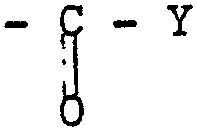
dans lequel Y représente un radical alcoyle, linéaire ou ramifié, comportant de 1 à 6 atomes de carbone ou un radical phényle.
6) - Procédé de préparation des composés de formule générale (I) tels que définis à la revendication 1, caractérisé en ce que l'on fait réagir sur un composé de formule (II):

une base forte puis un composé de formule (III)g

dans laquelle R3 conserve les significations de la revendication 1 et X représente un atome de carbone ca de soufre.
7) - Procédé de préparation selon la revendication Or, du 1- tméthoxy carbonyl) 3~(2 ' -tétrahydropyranyl) 5-éthyl 6méthyl tétrahydropyrimidine 2,4-dione, caractérisé en ce que l'on fait réagir sur la 3-(2'-tétrahydropyranyl) 5-éthyl 6méthyl 1,2,3,4-tetrahydropyrimidine 2,4-dione, l'hydrure de sodium puis le chloroformiate de méthyle.
8) - Les compositions pesticides, notamment herbicides, carac térisées en ce qu'elles contiennent, comme principe actif, un au moins des composés de formule générale (I) tel que défini à la revendication 1.
9) - Les compositions pesticides, notamment herbicides, caractérisées en ce qu'elles contiennent comme principe actif, un au moins des composés d'une des revendications 2 à 5.
i0) - Les compositions pesticides, notamment herbicides, caractérisées en ce qu'elles contiennent, comme principe actif, le composé de la revendication 4.
1i) - Application des composés de formule (I) tels que définis à la revendication 1 au desherbage sélectif des cultures de coton.
12) - Application des composés tels que définis à la revendication 3 au desherbage sélectif des cultures de coton.
13) - Application de la 1-(méthoxycarbonyl) 3-(2'tétrahydro- pyranyl) 5-éthyl 6-méthyl tétrahydropyrimidine 2,4-dione au desherbage sélectif des cultures de coton.
14) - Application des composés de formule (I) tels que définis à la revendication 1 au desherbage sélectif des cultures de soja.
15) - Application des composés tels que définis à la revendication 3 au desherbage sélectif des cultures de soja.
16) - Application de la 1-(méthoxyearbonyl) 3-(2'-tétrahydro- pyranyl) 5-éthyl 6-méthyl tétrahydropyrimidine 2,4-dione au desherbage sélectif des cultures de soja.
17) - Application des composés de formule (I), tels que définis à la revendication 1 au desherbage sélectif des cultures de ble, d'orge, de mais et d'avoine.
18) - Application des composés tels que définis à la revendication 3 au desherbage sélectif des cultures de ble, d'orge, de mais et d'avoine.
19) - Application de la i-(méthoxycarbonyl) 3-(2'-tétrahydropyranyl) 5-éthyl 6-méthyl tétrahydropyrimidine 2,4-dione au desherbage sélectif des cultures de blé, orge, de mais et d1 avoine.
Priority Applications (2)
| Application Number | Priority Date | Filing Date | Title |
|---|---|---|---|
| FR7924045A FR2468603A1 (fr) | 1979-09-27 | 1979-09-27 | Nouveaux uraciles substitues comportant un groupement 2-tetrahydropyranyle, leur procede de preparation et les compositions pesticides les renfermant |
| OA57355A OA06769A (fr) | 1979-09-27 | 1981-03-17 | Nouveaux uraciles substitués comportant un groupement 2-tétrahydropyranyle, leur procédé de préparation et les compositions pesticides les renfermant. |
Applications Claiming Priority (1)
| Application Number | Priority Date | Filing Date | Title |
|---|---|---|---|
| FR7924045A FR2468603A1 (fr) | 1979-09-27 | 1979-09-27 | Nouveaux uraciles substitues comportant un groupement 2-tetrahydropyranyle, leur procede de preparation et les compositions pesticides les renfermant |
Publications (2)
| Publication Number | Publication Date |
|---|---|
| FR2468603A1 true FR2468603A1 (fr) | 1981-05-08 |
| FR2468603B1 FR2468603B1 (fr) | 1983-02-18 |
Family
ID=9230067
Family Applications (1)
| Application Number | Title | Priority Date | Filing Date |
|---|---|---|---|
| FR7924045A Granted FR2468603A1 (fr) | 1979-09-27 | 1979-09-27 | Nouveaux uraciles substitues comportant un groupement 2-tetrahydropyranyle, leur procede de preparation et les compositions pesticides les renfermant |
Country Status (2)
| Country | Link |
|---|---|
| FR (1) | FR2468603A1 (fr) |
| OA (1) | OA06769A (fr) |
Cited By (2)
| Publication number | Priority date | Publication date | Assignee | Title |
|---|---|---|---|---|
| FR2549060A1 (fr) * | 1983-07-11 | 1985-01-18 | Roussel Uclaf | Nouveaux uraciles substitues comportant en position 1 un groupement phenyloxy substitue, leur procede de preparation et les compositions herbicides les renfermant |
| US5346881A (en) * | 1993-08-13 | 1994-09-13 | Fmc Corporation | 2-(bicyclic heterocyclyl)-6-fluoroalkyluracils |
Citations (2)
| Publication number | Priority date | Publication date | Assignee | Title |
|---|---|---|---|---|
| FR2335511A1 (fr) * | 1975-12-18 | 1977-07-15 | Roussel Uclaf | Nouveaux uraciles substitues comportant un groupement 4-tetrahydropyranyl, procede de preparation et compositions pesticides les renfermant |
| FR2371445A2 (fr) * | 1976-11-22 | 1978-06-16 | Roussel Uclaf | Nouveaux uraciles substitues comportant un groupement 4-tetrahydropyranyle, procede de preparation et compositions pesticides les renfermant |
-
1979
- 1979-09-27 FR FR7924045A patent/FR2468603A1/fr active Granted
-
1981
- 1981-03-17 OA OA57355A patent/OA06769A/fr unknown
Patent Citations (2)
| Publication number | Priority date | Publication date | Assignee | Title |
|---|---|---|---|---|
| FR2335511A1 (fr) * | 1975-12-18 | 1977-07-15 | Roussel Uclaf | Nouveaux uraciles substitues comportant un groupement 4-tetrahydropyranyl, procede de preparation et compositions pesticides les renfermant |
| FR2371445A2 (fr) * | 1976-11-22 | 1978-06-16 | Roussel Uclaf | Nouveaux uraciles substitues comportant un groupement 4-tetrahydropyranyle, procede de preparation et compositions pesticides les renfermant |
Cited By (4)
| Publication number | Priority date | Publication date | Assignee | Title |
|---|---|---|---|---|
| FR2549060A1 (fr) * | 1983-07-11 | 1985-01-18 | Roussel Uclaf | Nouveaux uraciles substitues comportant en position 1 un groupement phenyloxy substitue, leur procede de preparation et les compositions herbicides les renfermant |
| EP0131522A3 (en) * | 1983-07-11 | 1985-03-06 | Roussel-Uclaf | Substituted uracils containing in position 1 a substituted phenoxy-carbonyl group, their preparation and herbicidal compositions containing them |
| US4618364A (en) * | 1983-07-11 | 1986-10-21 | Roussel Uclaf | 3-(2-tetrahydropyranyl)-1,2,3,4,5,6,7-hexahydro-1-p-tolyloxycarbonyl-5H-cyclopentapyrimidine-2,4-dione and herbicidal compositions and methods using it |
| US5346881A (en) * | 1993-08-13 | 1994-09-13 | Fmc Corporation | 2-(bicyclic heterocyclyl)-6-fluoroalkyluracils |
Also Published As
| Publication number | Publication date |
|---|---|
| FR2468603B1 (fr) | 1983-02-18 |
| OA06769A (fr) | 1982-06-30 |
Similar Documents
| Publication | Publication Date | Title |
|---|---|---|
| US5123951A (en) | Synergistic plant growth regulator compositions | |
| KR880001717B1 (ko) | 2-치환페닐 하이단토인유도체의 제조방법 | |
| FR2483406A1 (fr) | Composes 3-isoxazolidinones, leur procede de preparation et compositions herbicides les contenant | |
| HU188525B (en) | Herbicidal preparations containing tetrahydrophthalimide derivatives and process for the production of the active substance | |
| FR2590570A1 (fr) | Triazines, compositions herbicides contenant ces triazines et procede pour combattre les mauvaises herbes | |
| FR2494688A1 (fr) | Nouvelles 2-(1-(oxyamino)-alkylidene)-cyclohexane-1,3-diones substituees et compositions herbicides les contenant | |
| FR2484412A1 (fr) | Derive de cyclohexane, composition herbicide en contenant et procede pour sa preparation | |
| FR2597866A1 (fr) | Derives du pyrazole, procede de preparation de ceux-ci et fongicide les contenant. | |
| EP0142769A2 (fr) | Tetrahydrobenzotriazoles, leur préparation et utilisation | |
| EP0000681A1 (fr) | Amino-2 (ou -4) alkylthio-5 pyrimidines, leurs procédés de préparation, leur application comme herbicides et compositions les contenant | |
| KR0160307B1 (ko) | 이미노티아졸린, 그의 제조방법 및 제초제로서의 용도, 및 그의 제조용 중간체 | |
| FR2518547A1 (fr) | Derives de l'acide propionique-2 phenoxy substitue et leur utilisation comme herbicides | |
| FR2532938A1 (fr) | Nouveaux derives du thiophene, leur preparation et leur utilisation en tant que fongicides | |
| EP0265305B1 (fr) | Nouveaux dérivés de la 5-pyrazolone, leur procédé de préparation, leur utilisation comme herbicides et les compositions les renfermant | |
| FR2468603A1 (fr) | Nouveaux uraciles substitues comportant un groupement 2-tetrahydropyranyle, leur procede de preparation et les compositions pesticides les renfermant | |
| EP0060955B1 (fr) | Nouveaux uraciles substitués comportant un groupement 2-tétra-hydropyranyle, leur procédé de préparation et les compositions pesticides les renfermant | |
| EP0262428B1 (fr) | Dérivés d'hydantoine et herbicides contenant les dérivés comme ingrédients actifs | |
| FR2582647A1 (fr) | Derives du phenanthrene, leur procede de preparation et compositions fongicides les contenant | |
| KR900006709B1 (ko) | 설페닐화 아실히드라존의 제조방법 | |
| JP2666380B2 (ja) | 縮合ヘテロ環誘導体、その製法及び除草剤 | |
| FR2616787A1 (fr) | Nouveaux composes heterocycliques, leur preparation et leur utilisation comme herbicides | |
| US5525580A (en) | Substituted benzoyl cyclic enone, process for preparation, and herbicide | |
| FR2462430A1 (fr) | Nouvelles 1,2,4-triazolidine-3,5-dithiones trisubstituees en positions 1, 2 et 4, composition les contenant et leur utilisation comme herbicides et comme substances de croissance des plantes | |
| FR2560007A1 (fr) | Compositions fongicides comprenant des derives de phenoxy benzaldehyde | |
| EP0131522B1 (fr) | Nouveaux uraciles substitués comportant en position 1 un groupement phényloxy carbonyl substitué, leur préparation et les compositions herbicides les renfermant |
Legal Events
| Date | Code | Title | Description |
|---|---|---|---|
| ST | Notification of lapse |