FR2486801A1 - Compositions pharmaceutiques a base de pyridoindoles - Google Patents
Compositions pharmaceutiques a base de pyridoindoles Download PDFInfo
- Publication number
- FR2486801A1 FR2486801A1 FR8000789A FR8000789A FR2486801A1 FR 2486801 A1 FR2486801 A1 FR 2486801A1 FR 8000789 A FR8000789 A FR 8000789A FR 8000789 A FR8000789 A FR 8000789A FR 2486801 A1 FR2486801 A1 FR 2486801A1
- Authority
- FR
- France
- Prior art keywords
- sep
- alkyl
- radical
- cooc2h5
- alkoxycarbonyl
- Prior art date
- Legal status (The legal status is an assumption and is not a legal conclusion. Google has not performed a legal analysis and makes no representation as to the accuracy of the status listed.)
- Granted
Links
- 206010002660 Anoxia Diseases 0.000 title abstract description 5
- 206010021143 Hypoxia Diseases 0.000 title abstract description 5
- 208000009999 tuberous sclerosis Diseases 0.000 title abstract description 3
- 230000000506 psychotropic effect Effects 0.000 title description 2
- 125000000217 alkyl group Chemical group 0.000 claims abstract description 13
- 125000000753 cycloalkyl group Chemical group 0.000 claims abstract description 7
- 125000003545 alkoxy group Chemical group 0.000 claims abstract description 5
- 125000001797 benzyl group Chemical group [H]C1=C([H])C([H])=C(C([H])=C1[H])C([H])([H])* 0.000 claims abstract description 3
- 125000003754 ethoxycarbonyl group Chemical group C(=O)(OCC)* 0.000 claims abstract description 3
- 125000005843 halogen group Chemical group 0.000 claims abstract description 3
- 125000001997 phenyl group Chemical group [H]C1=C([H])C([H])=C(*)C([H])=C1[H] 0.000 claims abstract description 3
- 150000003839 salts Chemical class 0.000 claims abstract description 3
- 150000001875 compounds Chemical class 0.000 claims description 26
- -1 alkoxy radical Chemical class 0.000 claims description 14
- 125000004435 hydrogen atom Chemical group [H]* 0.000 claims description 8
- 150000003254 radicals Chemical class 0.000 claims description 5
- 125000004432 carbon atom Chemical group C* 0.000 claims description 4
- 229910052739 hydrogen Inorganic materials 0.000 claims description 4
- CIUQDSCDWFSTQR-UHFFFAOYSA-N [C]1=CC=CC=C1 Chemical class [C]1=CC=CC=C1 CIUQDSCDWFSTQR-UHFFFAOYSA-N 0.000 claims description 2
- 239000001257 hydrogen Substances 0.000 claims description 2
- WCYWZMWISLQXQU-UHFFFAOYSA-N methyl Chemical compound [CH3] WCYWZMWISLQXQU-UHFFFAOYSA-N 0.000 claims description 2
- 239000008194 pharmaceutical composition Substances 0.000 claims description 2
- SLRMQYXOBQWXCR-UHFFFAOYSA-N 2154-56-5 Chemical group [CH2]C1=CC=CC=C1 SLRMQYXOBQWXCR-UHFFFAOYSA-N 0.000 claims 1
- 241000976983 Anoxia Species 0.000 abstract description 4
- 230000007953 anoxia Effects 0.000 abstract description 4
- 241001465754 Metazoa Species 0.000 abstract description 3
- 230000002490 cerebral effect Effects 0.000 abstract description 2
- 125000004453 alkoxycarbonyl group Chemical group 0.000 abstract 3
- NJBMMMJOXRZENQ-UHFFFAOYSA-N 6H-pyrrolo[2,3-f]quinoline Chemical compound c1cc2ccc3[nH]cccc3c2n1 NJBMMMJOXRZENQ-UHFFFAOYSA-N 0.000 abstract 1
- 239000002253 acid Substances 0.000 abstract 1
- 125000002252 acyl group Chemical group 0.000 abstract 1
- 239000000935 antidepressant agent Substances 0.000 abstract 1
- 229940005513 antidepressants Drugs 0.000 abstract 1
- 210000004204 blood vessel Anatomy 0.000 abstract 1
- 231100000053 low toxicity Toxicity 0.000 abstract 1
- 230000036578 sleeping time Effects 0.000 abstract 1
- 125000002023 trifluoromethyl group Chemical group FC(F)(F)* 0.000 abstract 1
- LFQSCWFLJHTTHZ-UHFFFAOYSA-N Ethanol Chemical compound CCO LFQSCWFLJHTTHZ-UHFFFAOYSA-N 0.000 description 27
- XEKOWRVHYACXOJ-UHFFFAOYSA-N Ethyl acetate Chemical compound CCOC(C)=O XEKOWRVHYACXOJ-UHFFFAOYSA-N 0.000 description 12
- VEXZGXHMUGYJMC-UHFFFAOYSA-N Hydrochloric acid Chemical compound Cl VEXZGXHMUGYJMC-UHFFFAOYSA-N 0.000 description 6
- OKKJLVBELUTLKV-UHFFFAOYSA-N Methanol Chemical compound OC OKKJLVBELUTLKV-UHFFFAOYSA-N 0.000 description 6
- VLKZOEOYAKHREP-UHFFFAOYSA-N n-Hexane Chemical compound CCCCCC VLKZOEOYAKHREP-UHFFFAOYSA-N 0.000 description 6
- 239000000203 mixture Substances 0.000 description 5
- 239000007787 solid Substances 0.000 description 5
- 239000000243 solution Substances 0.000 description 5
- QGZKDVFQNNGYKY-UHFFFAOYSA-N Ammonia Chemical compound N QGZKDVFQNNGYKY-UHFFFAOYSA-N 0.000 description 4
- RTZKZFJDLAIYFH-UHFFFAOYSA-N Diethyl ether Chemical compound CCOCC RTZKZFJDLAIYFH-UHFFFAOYSA-N 0.000 description 4
- BAVYZALUXZFZLV-UHFFFAOYSA-N Methylamine Chemical compound NC BAVYZALUXZFZLV-UHFFFAOYSA-N 0.000 description 4
- JUJWROOIHBZHMG-UHFFFAOYSA-N Pyridine Chemical compound C1=CC=NC=C1 JUJWROOIHBZHMG-UHFFFAOYSA-N 0.000 description 4
- 239000002244 precipitate Substances 0.000 description 4
- 238000001953 recrystallisation Methods 0.000 description 4
- XLYOFNOQVPJJNP-UHFFFAOYSA-N water Substances O XLYOFNOQVPJJNP-UHFFFAOYSA-N 0.000 description 4
- WFDIJRYMOXRFFG-UHFFFAOYSA-N Acetic anhydride Chemical compound CC(=O)OC(C)=O WFDIJRYMOXRFFG-UHFFFAOYSA-N 0.000 description 3
- HEMHJVSKTPXQMS-UHFFFAOYSA-M Sodium hydroxide Chemical compound [OH-].[Na+] HEMHJVSKTPXQMS-UHFFFAOYSA-M 0.000 description 3
- YXFVVABEGXRONW-UHFFFAOYSA-N Toluene Chemical compound CC1=CC=CC=C1 YXFVVABEGXRONW-UHFFFAOYSA-N 0.000 description 3
- 238000006243 chemical reaction Methods 0.000 description 3
- 239000000155 melt Substances 0.000 description 3
- 238000010992 reflux Methods 0.000 description 3
- XYGBKMMCQDZQOZ-UHFFFAOYSA-M sodium;4-hydroxybutanoate Chemical compound [Na+].OCCCC([O-])=O XYGBKMMCQDZQOZ-UHFFFAOYSA-M 0.000 description 3
- 239000002904 solvent Substances 0.000 description 3
- 230000004083 survival effect Effects 0.000 description 3
- 0 CC(*)(*(*)CC1)C(*C2C=C3)=C1C2C=CC3(C)NI Chemical compound CC(*)(*(*)CC1)C(*C2C=C3)=C1C2C=CC3(C)NI 0.000 description 2
- HEDRZPFGACZZDS-UHFFFAOYSA-N Chloroform Chemical compound ClC(Cl)Cl HEDRZPFGACZZDS-UHFFFAOYSA-N 0.000 description 2
- 241000699666 Mus <mouse, genus> Species 0.000 description 2
- 241000700159 Rattus Species 0.000 description 2
- VYPSYNLAJGMNEJ-UHFFFAOYSA-N Silicium dioxide Chemical compound O=[Si]=O VYPSYNLAJGMNEJ-UHFFFAOYSA-N 0.000 description 2
- 229910021529 ammonia Inorganic materials 0.000 description 2
- QVGXLLKOCUKJST-UHFFFAOYSA-N atomic oxygen Chemical compound [O] QVGXLLKOCUKJST-UHFFFAOYSA-N 0.000 description 2
- 125000003917 carbamoyl group Chemical group [H]N([H])C(*)=O 0.000 description 2
- 208000037265 diseases, disorders, signs and symptoms Diseases 0.000 description 2
- LFTRYYFOMNLQNT-UHFFFAOYSA-N ethyl acetate;1h-indole Chemical compound CCOC(C)=O.C1=CC=C2NC=CC2=C1 LFTRYYFOMNLQNT-UHFFFAOYSA-N 0.000 description 2
- 238000001704 evaporation Methods 0.000 description 2
- 230000008020 evaporation Effects 0.000 description 2
- 238000000034 method Methods 0.000 description 2
- 229910052760 oxygen Inorganic materials 0.000 description 2
- 239000001301 oxygen Substances 0.000 description 2
- 239000003208 petroleum Substances 0.000 description 2
- 238000002360 preparation method Methods 0.000 description 2
- 239000000047 product Substances 0.000 description 2
- UMJSCPRVCHMLSP-UHFFFAOYSA-N pyridine Natural products COC1=CC=CN=C1 UMJSCPRVCHMLSP-UHFFFAOYSA-N 0.000 description 2
- 239000000725 suspension Substances 0.000 description 2
- 238000001665 trituration Methods 0.000 description 2
- CFTOTSJVQRFXOF-UHFFFAOYSA-N 2,3,4,9-tetrahydro-1H-pyrido[3,4-b]indole Chemical compound N1C2=CC=CC=C2C2=C1CNCC2 CFTOTSJVQRFXOF-UHFFFAOYSA-N 0.000 description 1
- PBANXRNIXGEHPZ-UHFFFAOYSA-N 2-(5-chloro-1h-indol-3-yl)ethanamine;hydron;chloride Chemical compound Cl.C1=C(Cl)C=C2C(CCN)=CNC2=C1 PBANXRNIXGEHPZ-UHFFFAOYSA-N 0.000 description 1
- PYOUAIQXJALPKW-UHFFFAOYSA-N 2-(5-methyl-1H-indol-3-yl)ethanamine Chemical compound CC1=CC=C2NC=C(CCN)C2=C1 PYOUAIQXJALPKW-UHFFFAOYSA-N 0.000 description 1
- DBWYRYOSKRMVJP-UHFFFAOYSA-N C(C)(=O)OCC.CC=1C=C2C3=C(NC2=CC1)CNCC3 Chemical compound C(C)(=O)OCC.CC=1C=C2C3=C(NC2=CC1)CNCC3 DBWYRYOSKRMVJP-UHFFFAOYSA-N 0.000 description 1
- XDTMQSROBMDMFD-UHFFFAOYSA-N Cyclohexane Chemical compound C1CCCCC1 XDTMQSROBMDMFD-UHFFFAOYSA-N 0.000 description 1
- 208000020401 Depressive disease Diseases 0.000 description 1
- 206010019196 Head injury Diseases 0.000 description 1
- AFVFQIVMOAPDHO-UHFFFAOYSA-N Methanesulfonic acid Chemical compound CS(O)(=O)=O AFVFQIVMOAPDHO-UHFFFAOYSA-N 0.000 description 1
- 241000699670 Mus sp. Species 0.000 description 1
- 208000037656 Respiratory Sounds Diseases 0.000 description 1
- UIIMBOGNXHQVGW-UHFFFAOYSA-M Sodium bicarbonate Chemical class [Na+].OC([O-])=O UIIMBOGNXHQVGW-UHFFFAOYSA-M 0.000 description 1
- 239000004480 active ingredient Substances 0.000 description 1
- 150000001408 amides Chemical class 0.000 description 1
- 230000000496 anti-anoxic effect Effects 0.000 description 1
- 229940054051 antipsychotic indole derivative Drugs 0.000 description 1
- 239000008346 aqueous phase Substances 0.000 description 1
- 239000007864 aqueous solution Substances 0.000 description 1
- 239000003637 basic solution Substances 0.000 description 1
- 230000003542 behavioural effect Effects 0.000 description 1
- 125000006297 carbonyl amino group Chemical group [H]N([*:2])C([*:1])=O 0.000 description 1
- 125000002915 carbonyl group Chemical group [*:2]C([*:1])=O 0.000 description 1
- 239000003795 chemical substances by application Substances 0.000 description 1
- 230000001054 cortical effect Effects 0.000 description 1
- 230000000694 effects Effects 0.000 description 1
- 150000002148 esters Chemical class 0.000 description 1
- VNHHPTIPSYSQIG-UHFFFAOYSA-N ethyl 2,3,4,9-tetrahydro-1h-pyrido[3,4-b]indole-1-carboxylate Chemical compound N1C2=CC=CC=C2C2=C1C(C(=O)OCC)NCC2 VNHHPTIPSYSQIG-UHFFFAOYSA-N 0.000 description 1
- OEXNQFWEJRSZBW-UHFFFAOYSA-N ethyl indole-1-carboxylate Chemical compound C1=CC=C2N(C(=O)OCC)C=CC2=C1 OEXNQFWEJRSZBW-UHFFFAOYSA-N 0.000 description 1
- 238000000605 extraction Methods 0.000 description 1
- 238000001914 filtration Methods 0.000 description 1
- UTWGRMYWDUMKNY-UHFFFAOYSA-N indole-1-carboxylic acid Chemical compound C1=CC=C2N(C(=O)O)C=CC2=C1 UTWGRMYWDUMKNY-UHFFFAOYSA-N 0.000 description 1
- 150000002475 indoles Chemical class 0.000 description 1
- 238000002329 infrared spectrum Methods 0.000 description 1
- 239000002198 insoluble material Substances 0.000 description 1
- VZCYOOQTPOCHFL-UPHRSURJSA-N maleic acid Chemical compound OC(=O)\C=C/C(O)=O VZCYOOQTPOCHFL-UPHRSURJSA-N 0.000 description 1
- QSHDDOUJBYECFT-UHFFFAOYSA-N mercury Chemical compound [Hg] QSHDDOUJBYECFT-UHFFFAOYSA-N 0.000 description 1
- 229910052753 mercury Inorganic materials 0.000 description 1
- FHOPBCYBMWVMGJ-UHFFFAOYSA-N methyl indole-1-carboxylate Chemical compound C1=CC=C2N(C(=O)OC)C=CC2=C1 FHOPBCYBMWVMGJ-UHFFFAOYSA-N 0.000 description 1
- HAMGRBXTJNITHG-UHFFFAOYSA-N methyl isocyanate Chemical compound CN=C=O HAMGRBXTJNITHG-UHFFFAOYSA-N 0.000 description 1
- CWKLZLBVOJRSOM-UHFFFAOYSA-N methyl pyruvate Chemical compound COC(=O)C(C)=O CWKLZLBVOJRSOM-UHFFFAOYSA-N 0.000 description 1
- DUWIGDFPHOOAHN-UHFFFAOYSA-N n,1-dimethyl-2,3,4,9-tetrahydropyrido[3,4-b]indole-1-carboxamide Chemical compound N1C2=CC=CC=C2C2=C1C(C(=O)NC)(C)NCC2 DUWIGDFPHOOAHN-UHFFFAOYSA-N 0.000 description 1
- 238000000655 nuclear magnetic resonance spectrum Methods 0.000 description 1
- 238000006213 oxygenation reaction Methods 0.000 description 1
- 239000000546 pharmaceutical excipient Substances 0.000 description 1
- 230000000144 pharmacologic effect Effects 0.000 description 1
- 230000001737 promoting effect Effects 0.000 description 1
- 206010037833 rales Diseases 0.000 description 1
- 239000011541 reaction mixture Substances 0.000 description 1
- 238000005057 refrigeration Methods 0.000 description 1
- 230000029058 respiratory gaseous exchange Effects 0.000 description 1
- 229920006395 saturated elastomer Polymers 0.000 description 1
- 239000000377 silicon dioxide Substances 0.000 description 1
- ZVCDLGYNFYZZOK-UHFFFAOYSA-M sodium cyanate Chemical compound [Na]OC#N ZVCDLGYNFYZZOK-UHFFFAOYSA-M 0.000 description 1
- 238000003756 stirring Methods 0.000 description 1
- QAOWNCQODCNURD-UHFFFAOYSA-N sulfuric acid Substances OS(O)(=O)=O QAOWNCQODCNURD-UHFFFAOYSA-N 0.000 description 1
- ZXLDQJLIBNPEFJ-UHFFFAOYSA-N tetrahydro-beta-carboline Natural products C1CNC(C)C2=C1C1=CC=C(OC)C=C1N2 ZXLDQJLIBNPEFJ-UHFFFAOYSA-N 0.000 description 1
- 230000001225 therapeutic effect Effects 0.000 description 1
- 238000002560 therapeutic procedure Methods 0.000 description 1
- 230000000287 tissue oxygenation Effects 0.000 description 1
- 231100000331 toxic Toxicity 0.000 description 1
- 230000002588 toxic effect Effects 0.000 description 1
- VZCYOOQTPOCHFL-UHFFFAOYSA-N trans-butenedioic acid Natural products OC(=O)C=CC(O)=O VZCYOOQTPOCHFL-UHFFFAOYSA-N 0.000 description 1
Classifications
-
- C—CHEMISTRY; METALLURGY
- C07—ORGANIC CHEMISTRY
- C07D—HETEROCYCLIC COMPOUNDS
- C07D471/00—Heterocyclic compounds containing nitrogen atoms as the only ring hetero atoms in the condensed system, at least one ring being a six-membered ring with one nitrogen atom, not provided for by groups C07D451/00 - C07D463/00
- C07D471/02—Heterocyclic compounds containing nitrogen atoms as the only ring hetero atoms in the condensed system, at least one ring being a six-membered ring with one nitrogen atom, not provided for by groups C07D451/00 - C07D463/00 in which the condensed system contains two hetero rings
- C07D471/04—Ortho-condensed systems
Landscapes
- Chemical & Material Sciences (AREA)
- Organic Chemistry (AREA)
- Pharmaceuticals Containing Other Organic And Inorganic Compounds (AREA)
Abstract
COMPOSITIONS PHARMACEUTIQUES CARACTERISEES EN CE QU'ELLES CONTIENNENT UN COMPOSE REPONDANT A LA FORMULE I SOUS LA FORME DE RACEMATE OU D'ISOMERE OPTIQUEMENT ACTIF, OU SOUS LA FORME D'UN SEL PHARMACEUTIQUEMENT ACCEPTABLE, (CF DESSIN DANS BOPI) FORMULE DANS LAQUELLE
Description
La presente invention concerne des dérivés de l'indole, leur préparation et leur application en thérapeutique.
Les composés de l'invention, sous la forme de racémates ou d'isomères optiquement actifs, répondent a la formule (I)

dans laquelle
n est 0 ou 1,
R1 représente un atome d'hydrogène ou d'halogène, un radical alkyle
ou alcoxy,
R2 représente un radical alcoxycarbonyle ou CONHR5 dans lequel R5
est un radical alkyle, cycloalkyle ou ben::yle,
R3 est un atome d'hydrogène, un radical alkyle, un radical alcoxy
carbonyle, un radical alcoxy-carbonylmethyle ou un radical alkyl
aminocarbonyl-méthyle,
R4 est soit un atome d'hydrogène, soit le radical méthyle, soit un ;radical acyle, soit un radical CONHR6 dans lequel R6 est un atome 'hydrogène, un radical alkyle, cycloalkyle, benzyle, phényle ou phényle substitué,
les. alkyles et alcoxy ayant de 1 a 4 atomes de carbone, les cycle
alkyles ayant de 3 a 6 atomes de carbone, 15 l'exception des composés pour lesquels
soit n=O R1=H, R2= COO (Et ou Me) R3=H ou CH3 et R4=H,
soit n=1 R1=H, R2= COOEt, R3=H OU CH3 et R4=H,
soit n=l R1=H, R2 CONHCH3 R3=H et R4=H
frelon l'invention, on peut préparer les composés(I) selon les
schémas réactionnels suivants
Schéma 1 R3 # H n = O ou 1

n est 0 ou 1,
R1 représente un atome d'hydrogène ou d'halogène, un radical alkyle
ou alcoxy,
R2 représente un radical alcoxycarbonyle ou CONHR5 dans lequel R5
est un radical alkyle, cycloalkyle ou ben::yle,
R3 est un atome d'hydrogène, un radical alkyle, un radical alcoxy
carbonyle, un radical alcoxy-carbonylmethyle ou un radical alkyl
aminocarbonyl-méthyle,
R4 est soit un atome d'hydrogène, soit le radical méthyle, soit un ;radical acyle, soit un radical CONHR6 dans lequel R6 est un atome 'hydrogène, un radical alkyle, cycloalkyle, benzyle, phényle ou phényle substitué,
les. alkyles et alcoxy ayant de 1 a 4 atomes de carbone, les cycle
alkyles ayant de 3 a 6 atomes de carbone, 15 l'exception des composés pour lesquels
soit n=O R1=H, R2= COO (Et ou Me) R3=H ou CH3 et R4=H,
soit n=1 R1=H, R2= COOEt, R3=H OU CH3 et R4=H,
soit n=l R1=H, R2 CONHCH3 R3=H et R4=H
frelon l'invention, on peut préparer les composés(I) selon les
schémas réactionnels suivants
Schéma 1 R3 # H n = O ou 1
Schéma 2 R3 = H n =1

La transformation de l'ester (I) en amide (I) où R2 =CONHR5 est
effectuée de la même manière que dans le schéma réactionnel (I)
de meme l'addition du radical R4 = CONHR5 sur les composés (I) où
R2 = COOalk ou CONHR5 est effectuée de la même manière que dans le: schéma 1.
effectuée de la même manière que dans le schéma réactionnel (I)
de meme l'addition du radical R4 = CONHR5 sur les composés (I) où
R2 = COOalk ou CONHR5 est effectuée de la même manière que dans le: schéma 1.
Les composés pour lesquels R3 = H et n = 0 sont obtenus selon le mode de préparation décrit par Z.J.Vejdélek et Coll., J.of.Med.and Pharm.Chem., Vol.3, n03 (1961) p.427-440 .
Les exemples suivants illustrent l'invention. Les microanalyses et les spectres IR et RMN confirment la structure des composés.
Les exemples suivants illustrent l'invention. Les microanalyses et les spectres IR et RMN confirment la structure des composés.
Exemple 1 Méthyl-6 tétrahydro-2,3,4,9 1H-pyrido[3,4-b] indole-1
acétate d'éthyle
[n=1 R1= CH3-6 R2 = COOC2H5 R3=H R4=H] 1. On met en suspension dans 250ml d'éthanol, 52,62g (0,25 mole) chlorhydrate de méthyl-5 tryptamine et on porte à reflux. On met en suspension dans 250ml d'ethanol, 57,75g d'éthoxycarbonyl-3 dioxo-1,12 éthoxy-l propane et on ajoute goutte à goutte en 10mn 25ml d'acide chlorhydrique concentré. On ajoute cette suspension à la suspensior de méthyl-5 tryptamine HCl maintenue a la température de reflux. On laisse refroidir pendant la nuit. On élimine le solvant par évaporation e - on dissout le résidu dans 400ml d'eau et on alcalinise avec de l'amoniaque.Après extraction avec de l'acétate d'éthyle, on obtient une huile que l'on chromatographie sur une colonne de silice. Après solution avec un mélange 8/2 de chloroforme et d'éthanol, on obtien une huile qui se solidifie par trituration avec de l'éther de pétr le.
acétate d'éthyle
[n=1 R1= CH3-6 R2 = COOC2H5 R3=H R4=H] 1. On met en suspension dans 250ml d'éthanol, 52,62g (0,25 mole) chlorhydrate de méthyl-5 tryptamine et on porte à reflux. On met en suspension dans 250ml d'ethanol, 57,75g d'éthoxycarbonyl-3 dioxo-1,12 éthoxy-l propane et on ajoute goutte à goutte en 10mn 25ml d'acide chlorhydrique concentré. On ajoute cette suspension à la suspensior de méthyl-5 tryptamine HCl maintenue a la température de reflux. On laisse refroidir pendant la nuit. On élimine le solvant par évaporation e - on dissout le résidu dans 400ml d'eau et on alcalinise avec de l'amoniaque.Après extraction avec de l'acétate d'éthyle, on obtient une huile que l'on chromatographie sur une colonne de silice. Après solution avec un mélange 8/2 de chloroforme et d'éthanol, on obtien une huile qui se solidifie par trituration avec de l'éther de pétr le.
Après recristallisation dans de l'hexane, le composé obtenu

fond à 102-1030C.
fond à 102-1030C.
12. On chauffe à reflux 45g du composé précédent dans 450ml d'une solution aqueuse à 10% de NaOH, pendant 20h. On ajoute, goutte à goutte, de l'acide chlorhydrique concentré (100ml), en 30mn, au mélange réactionnel refroidi. On filtre le solide obtenu et on le sèche sur P205.
3. On chauffe au reflux 99,6g du solide brut précédemment obtenu dans un mélange de 250ml d'éthanol et de 20ml d'acide sulfurique concentré, pendant 9h. On laisse reposer la nuit. On élimine l'étha- nol par évaporation et on alcalinise le solide résiduel avec de l'ammoniaque. On extrait avec 3 fois 300ml d'acétate d'éthyle la solution basique. On évapore. On obtient une huile qui, par trituration avec de l'éther de pétrole, donne un solide blanc. On le filtre et le sèche.
Après recristallisation dans de l'hexane, le composé obtenu fond à 1030C.
Exemple 2 Chloro-6 méthyl-1 tétrahydro-2,3,4,9 1H-pyrido [3,4-b]
indole-l-carboxylate de méthyle
[n=0 R1=Cl-6 R2= COOCH3 R3=CH3 R4=H]
On fait réagir 36,1g (0,156 mole) de chlorhydrate de chloro-5 tryptamine en solution dans 350ml de méthanol avec 20g de pyruvate de méthyle.On laisse une semaine sous agitation à la température ambiante. On chasse le méthanol au rotavapor. Le résidu est repris avec de l'acétate d'éthyle. On agite 15mn puis on filtre le précipite. On traite le précipité avec une solution saturée de bicarbonate de sodium et on extrait à l'acétate d'éthyle. On élimine un insoluble par filtration. On décante la solution organique, on la lave, sèche et évapore au bain-marie sous vide.
indole-l-carboxylate de méthyle
[n=0 R1=Cl-6 R2= COOCH3 R3=CH3 R4=H]
On fait réagir 36,1g (0,156 mole) de chlorhydrate de chloro-5 tryptamine en solution dans 350ml de méthanol avec 20g de pyruvate de méthyle.On laisse une semaine sous agitation à la température ambiante. On chasse le méthanol au rotavapor. Le résidu est repris avec de l'acétate d'éthyle. On agite 15mn puis on filtre le précipite. On traite le précipité avec une solution saturée de bicarbonate de sodium et on extrait à l'acétate d'éthyle. On élimine un insoluble par filtration. On décante la solution organique, on la lave, sèche et évapore au bain-marie sous vide.
Le résidu huileux cristallise après quelques jours. Après recrista ~ lisation dans du toluène le composé fond à 1480C.
Exemple 3 Méthyl-1 méthylaminocarbonyl-2 tétrahydro-2,3,4,9
l-pyrido 3,4 -b]indole-l-acétate d'éthyle
n=1 R1=H R2=COOC2H5 R3=CH3 R4=CONHCH3 lon met en suspension 10,9g (0,04 mole) de méthyl-1 tétrahydro-2,3, ,9 1H-pyrido[3,4-b]indole-1-acétate d'éthyle dans 200ml de cyclohexane.
l-pyrido 3,4 -b]indole-l-acétate d'éthyle
n=1 R1=H R2=COOC2H5 R3=CH3 R4=CONHCH3 lon met en suspension 10,9g (0,04 mole) de méthyl-1 tétrahydro-2,3, ,9 1H-pyrido[3,4-b]indole-1-acétate d'éthyle dans 200ml de cyclohexane.
On ajoute 3ml (0,04 mole)d'isocyanate de méthyle. On chauffe au reflux pendant 1 heure. On laisse refroidir une nuit au réfrigéra leur. On filtre le précipité. On recristallise le produit dans de 1 'éthanol.
F=217 C
Exemple 4 Aminocarbonyl-2 tétrahydro-2,3,4,9 1H-pyrido[3,4-b]
indole-1-carboxylate d'éthyle
[n=o R1=H R2=COOC2H5 R3=H R4-CONH2]
On chauffe vers 600C 56,2g (0,2 mole) de tétrahydro-2,3,4,9 1Hpyrido[3,4-b]indole-1-carboxylate d'éthyle dans 1000ml d'eau.
Exemple 4 Aminocarbonyl-2 tétrahydro-2,3,4,9 1H-pyrido[3,4-b]
indole-1-carboxylate d'éthyle
[n=o R1=H R2=COOC2H5 R3=H R4-CONH2]
On chauffe vers 600C 56,2g (0,2 mole) de tétrahydro-2,3,4,9 1Hpyrido[3,4-b]indole-1-carboxylate d'éthyle dans 1000ml d'eau.
On ajoute en une seule fois une solution de 15,2g (0,234 mole) de cyanate de sodium pulvérulent dans 200ml d'eau.On agite 15mn puis refroidit vers LOOC. On décante la phase aqueuse réactionnelle, lave le compose avec de l'eau et le recristallise dans de l'éthanol.
F=215-2170C.
Exemple 5 Méthyl-1 méthylaminocarbonyl-1 tétrahydro-2,3,4,9
1H-pyrido[3,4-b]indole
[ n=0 R1=H R2=CONH CH3 R3=CH3 R4=H
On met 4,8g (0,02 mole) de méthyl-1 tétrahydro-2,3,4,9, 1H pyrido [3,4-b)] indole-1-carboxylate de méthyle en solution dans 100ml d'éthanol saturé de méthylamine. On laisse à 1 température ambiante pendant 48 heures. On élimine le solvant puis reprend le résidu par 20ml d'éthanol. On filtre et lave à l'éthanol
F= 230-2310C.
1H-pyrido[3,4-b]indole
[ n=0 R1=H R2=CONH CH3 R3=CH3 R4=H
On met 4,8g (0,02 mole) de méthyl-1 tétrahydro-2,3,4,9, 1H pyrido [3,4-b)] indole-1-carboxylate de méthyle en solution dans 100ml d'éthanol saturé de méthylamine. On laisse à 1 température ambiante pendant 48 heures. On élimine le solvant puis reprend le résidu par 20ml d'éthanol. On filtre et lave à l'éthanol
F= 230-2310C.
Exemple 6 Fluoro-6 méthylaminocarbonyl-1 tétrahydro-2,3,4,9
lH-pyrido[3,4-b]indole [1 R1 = F-6 R2=CONHCH3 R3=H R4=H J
On place dans un autoclave 20g de fluoro-6 tétrahydro-2,3,4,9 1H-pyrido[3,4-b] inole-1-acétate d'éthyle (obtenu selon le procédé de l'exemple 1) et 500ml d'éthanol saturé de méthylamine.
lH-pyrido[3,4-b]indole [1 R1 = F-6 R2=CONHCH3 R3=H R4=H J
On place dans un autoclave 20g de fluoro-6 tétrahydro-2,3,4,9 1H-pyrido[3,4-b] inole-1-acétate d'éthyle (obtenu selon le procédé de l'exemple 1) et 500ml d'éthanol saturé de méthylamine.
On chauffe à 1000C pendant 5 h. On chasse le solvant et obtient un solide blanc. On le recristallise dans de l'éthanol.
F= 227 C.
Exemple 7 Chloro-6 méthylaminocarbonyl-1 méthyl-1 acétyl-2
tétrahydro-2,3,4,9 1H-pyrido [3,4-b] indole
tn=l R1 = C1-6 R2= CONHCH3 R3=CH3 R4=COCH3]
On dissout 3g (0,0102 mole ) de chloro-6 méthylaminocarbonyl-1 méthyl-l tétrahydro-2,3,4,9 lH-pyrido 3-4-b indole dans 30ml j de pyridine. On ajoute 2ml d'anhydride acétique. On agite à la température ambiante pendant 48h. On évapore et chasse la pyridine
On reprend le résidu avec 20ml d'éthanol et on filtre le préci pité. Après recristallisation dans 1'éthanol le produit fond à 214 C.
tétrahydro-2,3,4,9 1H-pyrido [3,4-b] indole
tn=l R1 = C1-6 R2= CONHCH3 R3=CH3 R4=COCH3]
On dissout 3g (0,0102 mole ) de chloro-6 méthylaminocarbonyl-1 méthyl-l tétrahydro-2,3,4,9 lH-pyrido 3-4-b indole dans 30ml j de pyridine. On ajoute 2ml d'anhydride acétique. On agite à la température ambiante pendant 48h. On évapore et chasse la pyridine
On reprend le résidu avec 20ml d'éthanol et on filtre le préci pité. Après recristallisation dans 1'éthanol le produit fond à 214 C.
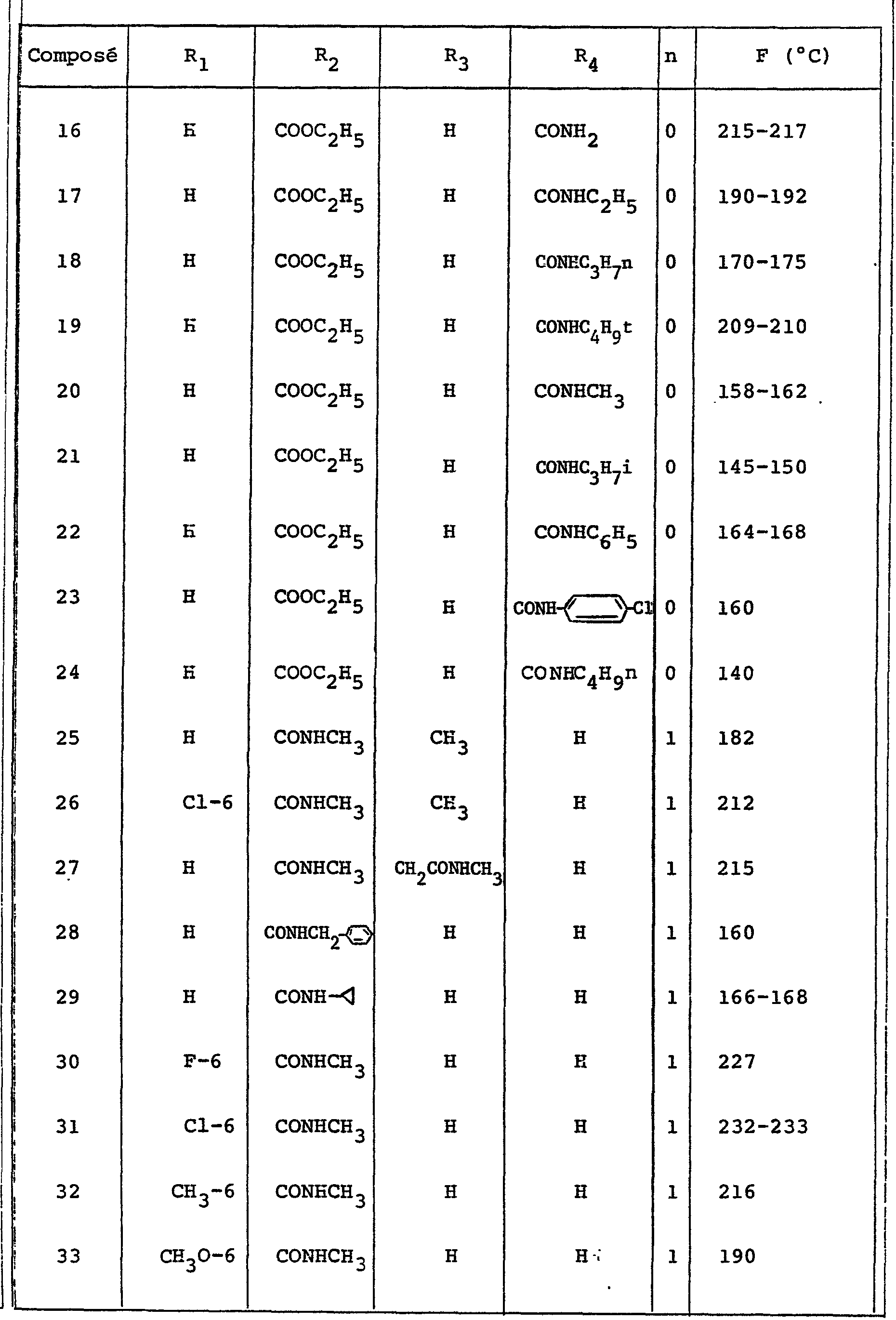
Les composés de l'invention préparés à titre d'exemples sont représentés dans le tableau suivant.
TABLEAU

m.s = Méthane-sulfonate

m.s = Méthane-sulfonate
<tb> <SEP> Composé <SEP> R1 <SEP> R2 <SEP> R3 <SEP> R4 <SEP> n <SEP> F <SEP> ( C)
<tb> 1 <SEP> CH3-6 <SEP> COOC2H5 <SEP> H <SEP> H <SEP> 1 <SEP> 103
<tb> <SEP> 2 <SEP> CH3-6 <SEP> C00C2H5 <SEP> COOC2H5 <SEP> H <SEP> 1 <SEP> 102-103
<tb> <SEP> 3 <SEP> CH30-6 <SEP> COOC2H5 <SEP> H <SEP> H <SEP> 1 <SEP> 181 <SEP> (maléate <SEP>
<tb> <SEP> 4 <SEP> CH30-6 <SEP> COOC2H5 <SEP> COOC2H5 <SEP> H <SEP> 1 <SEP> 100
<tb> <SEP> IH <SEP> COOC2H5 <SEP> COOC2H5 <SEP> H <SEP> 1 <SEP> 80-82
<tb> <SEP> 6 <SEP> Cl-6 <SEP> COOC2H5 <SEP> CH3 <SEP> H <SEP> 1 <SEP> 104
<tb> 7 <SEP> Cl-6 <SEP> COOC2H5 <SEP> H <SEP> H <SEP> 1 <SEP> 240 <SEP> m.s
<tb> 8 <SEP> Cl-6 <SEP> COOC2H5 <SEP> COOC2H5 <SEP> H <SEP> 1 <SEP> 101
<tb> <SEP> 9 <SEP> H <SEP> COOC2H5 <SEP> CH2COOC2H5 <SEP> H <SEP> 1 <SEP> 89
<tb> <SEP> 10 <SEP> F-6 <SEP> COOC2H5 <SEP> H <SEP> H <SEP> 1 <SEP> 229-230 <SEP> m.s
<tb> 11 <SEP> F-6 <SEP> COOC2H5 <SEP> COOC2H5 <SEP> H <SEP> 1 <SEP> 197 <SEP> HCl <SEP>
<tb> <SEP> 12 <SEP> Cl-6 <SEP> COOCH3 <SEP> CH3 <SEP> H <SEP> 0 <SEP> 148
<tb> <SEP> 13 <SEP> H <SEP> COOC2H5 <SEP> H <SEP> CONH2 <SEP> 1 <SEP> huile
<tb> 14 <SEP> H <SEP> COOC2H5 <SEP> CH2COOC2H <SEP> CONHCH3 <SEP> 1 <SEP> 162
<tb> 15 <SEP> 15 <SEP> H <SEP> COOC2H5 <SEP> CH3 <SEP> CONHCH3 <SEP> 1 <SEP> 217
<tb>
<tb> 1 <SEP> CH3-6 <SEP> COOC2H5 <SEP> H <SEP> H <SEP> 1 <SEP> 103
<tb> <SEP> 2 <SEP> CH3-6 <SEP> C00C2H5 <SEP> COOC2H5 <SEP> H <SEP> 1 <SEP> 102-103
<tb> <SEP> 3 <SEP> CH30-6 <SEP> COOC2H5 <SEP> H <SEP> H <SEP> 1 <SEP> 181 <SEP> (maléate <SEP>
<tb> <SEP> 4 <SEP> CH30-6 <SEP> COOC2H5 <SEP> COOC2H5 <SEP> H <SEP> 1 <SEP> 100
<tb> <SEP> IH <SEP> COOC2H5 <SEP> COOC2H5 <SEP> H <SEP> 1 <SEP> 80-82
<tb> <SEP> 6 <SEP> Cl-6 <SEP> COOC2H5 <SEP> CH3 <SEP> H <SEP> 1 <SEP> 104
<tb> 7 <SEP> Cl-6 <SEP> COOC2H5 <SEP> H <SEP> H <SEP> 1 <SEP> 240 <SEP> m.s
<tb> 8 <SEP> Cl-6 <SEP> COOC2H5 <SEP> COOC2H5 <SEP> H <SEP> 1 <SEP> 101
<tb> <SEP> 9 <SEP> H <SEP> COOC2H5 <SEP> CH2COOC2H5 <SEP> H <SEP> 1 <SEP> 89
<tb> <SEP> 10 <SEP> F-6 <SEP> COOC2H5 <SEP> H <SEP> H <SEP> 1 <SEP> 229-230 <SEP> m.s
<tb> 11 <SEP> F-6 <SEP> COOC2H5 <SEP> COOC2H5 <SEP> H <SEP> 1 <SEP> 197 <SEP> HCl <SEP>
<tb> <SEP> 12 <SEP> Cl-6 <SEP> COOCH3 <SEP> CH3 <SEP> H <SEP> 0 <SEP> 148
<tb> <SEP> 13 <SEP> H <SEP> COOC2H5 <SEP> H <SEP> CONH2 <SEP> 1 <SEP> huile
<tb> 14 <SEP> H <SEP> COOC2H5 <SEP> CH2COOC2H <SEP> CONHCH3 <SEP> 1 <SEP> 162
<tb> 15 <SEP> 15 <SEP> H <SEP> COOC2H5 <SEP> CH3 <SEP> CONHCH3 <SEP> 1 <SEP> 217
<tb>
<tb> <SEP> Composé <SEP> R1 <SEP> R2 <SEP> R3 <SEP> R4 <SEP> n <SEP> F <SEP> ( C)
<tb> <SEP> L <SEP> I
<tb> <SEP> 16 <SEP> H <SEP> COOC2H5 <SEP> H <SEP> CONH2 <SEP> 0 <SEP> 215-217
<tb> <SEP> 17 <SEP> H <SEP> COOC2H5 <SEP> H <SEP> CONHC2H5 <SEP> 0 <SEP> 190-192
<tb> <SEP> 18 <SEP> H <SEP> COOC2H5 <SEP> H <SEP> CONF.C3H7n <SEP> 0 <SEP> 170-175
<tb> <SEP> 19 <SEP> H <SEP> COOC2H5 <SEP> H <SEP> CONHC4Hgt <SEP> 0 <SEP> 209-210
<tb> <SEP> 20 <SEP> H <SEP> COOC2H5 <SEP> H <SEP> CONHCH3 <SEP> 0 <SEP> 158-162
<tb> <SEP> 21 <SEP> H <SEP> COOC2H5 <SEP> H <SEP> CONBC3H7i <SEP> 0 <SEP> 145-150
<tb> <SEP> 22 <SEP> H <SEP> COOC2H5 <SEP> H <SEP> CONHC6H5 <SEP> 0 <SEP> 164-168
<tb> <SEP> 23 <SEP> 23 <SEP> H <SEP> 1 <SEP> COOC2H5 <SEP> H <SEP> CONH <SEP> Q <SEP> C <SEP> 0 <SEP> 160
<tb> <SEP> 24 <SEP> H <SEP> COOC2H5 <SEP> H <SEP> CONHC4H9n <SEP> 0 <SEP> 140
<tb> <SEP> 25 <SEP> H <SEP> CONHCH3 <SEP> CH3 <SEP> H <SEP> 1 <SEP> 182
<tb> <SEP> 26 <SEP> C1-6 <SEP> CONHCH3 <SEP> CE3 <SEP> H <SEP> 1 <SEP> 212
<tb> <SEP> 27 <SEP> H <SEP> CONHCH3 <SEP> CH2COSHCH3 <SEP> H <SEP> 1 <SEP> 215
<tb> <SEP> 28 <SEP> H <SEP> coNHcH2q <SEP> 3 <SEP> H <SEP> H <SEP> 1 <SEP> 160
<tb> I29 <SEP> H <SEP> CONH <SEP> 4 <SEP> H <SEP> H <SEP> 1 <SEP> 166-168
<tb> <SEP> i
<tb> <SEP> 30 <SEP> F-6 <SEP> CONHCH3 <SEP> H <SEP> H <SEP> 1 <SEP> 227
<tb> <SEP> 31 <SEP> C1-6 <SEP> CONHCH3 <SEP> H <SEP> H <SEP> 1 <SEP> 232-233
<tb> <SEP> 32 <SEP> CH3-6 <SEP> CONHCH3 <SEP> H <SEP> H <SEP> 1 <SEP> 216
<tb> ! <SEP> 33 <SEP> CE <SEP> 0-6 <SEP> CONHCH3 <SEP> H <SEP> H-;<SEP> 1 <SEP> 190
<tb>

<tb> <SEP> L <SEP> I
<tb> <SEP> 16 <SEP> H <SEP> COOC2H5 <SEP> H <SEP> CONH2 <SEP> 0 <SEP> 215-217
<tb> <SEP> 17 <SEP> H <SEP> COOC2H5 <SEP> H <SEP> CONHC2H5 <SEP> 0 <SEP> 190-192
<tb> <SEP> 18 <SEP> H <SEP> COOC2H5 <SEP> H <SEP> CONF.C3H7n <SEP> 0 <SEP> 170-175
<tb> <SEP> 19 <SEP> H <SEP> COOC2H5 <SEP> H <SEP> CONHC4Hgt <SEP> 0 <SEP> 209-210
<tb> <SEP> 20 <SEP> H <SEP> COOC2H5 <SEP> H <SEP> CONHCH3 <SEP> 0 <SEP> 158-162
<tb> <SEP> 21 <SEP> H <SEP> COOC2H5 <SEP> H <SEP> CONBC3H7i <SEP> 0 <SEP> 145-150
<tb> <SEP> 22 <SEP> H <SEP> COOC2H5 <SEP> H <SEP> CONHC6H5 <SEP> 0 <SEP> 164-168
<tb> <SEP> 23 <SEP> 23 <SEP> H <SEP> 1 <SEP> COOC2H5 <SEP> H <SEP> CONH <SEP> Q <SEP> C <SEP> 0 <SEP> 160
<tb> <SEP> 24 <SEP> H <SEP> COOC2H5 <SEP> H <SEP> CONHC4H9n <SEP> 0 <SEP> 140
<tb> <SEP> 25 <SEP> H <SEP> CONHCH3 <SEP> CH3 <SEP> H <SEP> 1 <SEP> 182
<tb> <SEP> 26 <SEP> C1-6 <SEP> CONHCH3 <SEP> CE3 <SEP> H <SEP> 1 <SEP> 212
<tb> <SEP> 27 <SEP> H <SEP> CONHCH3 <SEP> CH2COSHCH3 <SEP> H <SEP> 1 <SEP> 215
<tb> <SEP> 28 <SEP> H <SEP> coNHcH2q <SEP> 3 <SEP> H <SEP> H <SEP> 1 <SEP> 160
<tb> I29 <SEP> H <SEP> CONH <SEP> 4 <SEP> H <SEP> H <SEP> 1 <SEP> 166-168
<tb> <SEP> i
<tb> <SEP> 30 <SEP> F-6 <SEP> CONHCH3 <SEP> H <SEP> H <SEP> 1 <SEP> 227
<tb> <SEP> 31 <SEP> C1-6 <SEP> CONHCH3 <SEP> H <SEP> H <SEP> 1 <SEP> 232-233
<tb> <SEP> 32 <SEP> CH3-6 <SEP> CONHCH3 <SEP> H <SEP> H <SEP> 1 <SEP> 216
<tb> ! <SEP> 33 <SEP> CE <SEP> 0-6 <SEP> CONHCH3 <SEP> H <SEP> H-;<SEP> 1 <SEP> 190
<tb>
<tb> Composé <SEP> R1 <SEP> R2 <SEP> R3 <SEP> R4 <SEP> n <SEP> F <SEP> ( C)
<tb> 34 <SEP> H <SEP> CONHC2H4 <SEP> H <SEP> H <SEP> 1 <SEP> 148-149
<tb> 35 <SEP> H <SEP> CONHCH3 <SEP> CH3 <SEP> CH3 <SEP> 1 <SEP> 240
<tb> 36 <SEP> H <SEP> CONHCH3 <SEP> CH3 <SEP> .H <SEP> 0 <SEP> 230
<tb> 37 <SEP> H <SEP> CONHCH3 <SEP> CH3 <SEP> CH3 <SEP> 0 <SEP> 207
<tb> 38 <SEP> Cl-6 <SEP> CONHCH3 <SEP> CH3 <SEP> H <SEP> 0 <SEP> 230
<tb> 39 <SEP> F-6 <SEP> CONHCH3 <SEP> CH3 <SEP> H <SEP> 0 <SEP> 238
<tb> 40 <SEP> Cl-6 <SEP> CONHCH3 <SEP> CH3 <SEP> COCH3 <SEP> 1 <SEP> 214
<tb> 41 <SEP> Cl-6 <SEP> CONHCH3 <SEP> CH3 <SEP> COCH3 <SEP> 0 <SEP> 2
<tb>
Les composés de l'invention ont été soumis à divers essais phar
macologiques.
<tb> 34 <SEP> H <SEP> CONHC2H4 <SEP> H <SEP> H <SEP> 1 <SEP> 148-149
<tb> 35 <SEP> H <SEP> CONHCH3 <SEP> CH3 <SEP> CH3 <SEP> 1 <SEP> 240
<tb> 36 <SEP> H <SEP> CONHCH3 <SEP> CH3 <SEP> .H <SEP> 0 <SEP> 230
<tb> 37 <SEP> H <SEP> CONHCH3 <SEP> CH3 <SEP> CH3 <SEP> 0 <SEP> 207
<tb> 38 <SEP> Cl-6 <SEP> CONHCH3 <SEP> CH3 <SEP> H <SEP> 0 <SEP> 230
<tb> 39 <SEP> F-6 <SEP> CONHCH3 <SEP> CH3 <SEP> H <SEP> 0 <SEP> 238
<tb> 40 <SEP> Cl-6 <SEP> CONHCH3 <SEP> CH3 <SEP> COCH3 <SEP> 1 <SEP> 214
<tb> 41 <SEP> Cl-6 <SEP> CONHCH3 <SEP> CH3 <SEP> COCH3 <SEP> 0 <SEP> 2
<tb>
Les composés de l'invention ont été soumis à divers essais phar
macologiques.
Les composés ont en effet été soumis au test de l'anoxie hypobare
chez la souris et au test de l'action sur la durée du sommeil
induit par le 4-hydroxy-butyrate de sodium chez le rat curarisé.
chez la souris et au test de l'action sur la durée du sommeil
induit par le 4-hydroxy-butyrate de sodium chez le rat curarisé.
ANOXIE HYPOBARE
Des souris de souche CD1 sont maintenues dans une atmosphère ap-
pauvrie en oxygène, par réalisation d'un vide partiel (190 mm de
mercure correspondant à 5,25 % d'oxygène).
Des souris de souche CD1 sont maintenues dans une atmosphère ap-
pauvrie en oxygène, par réalisation d'un vide partiel (190 mm de
mercure correspondant à 5,25 % d'oxygène).
Le temps de survie des animaux est noté. Ce temps est augmenté par les agents capables de favoriser l'oxygénation tissulaire et en particulier cérébrale. Les composés étudiés sont administrés à plusiers doses, par voie intrapéritonéale, 10 minutes avant
l'essai. Les pourcentages d'augmentation du temps de survie par
rapport aux valeurs obtenues chez les animaux témoins sont cal
culés. La dose active moyenne (DAM), dose qui augmente le temps
de survie de 100% est déterminée graphiquement.
l'essai. Les pourcentages d'augmentation du temps de survie par
rapport aux valeurs obtenues chez les animaux témoins sont cal
culés. La dose active moyenne (DAM), dose qui augmente le temps
de survie de 100% est déterminée graphiquement.
La DAM des composés de l'invention varie de 13 à 26 mg/kg par voie i.p.
ACTION SUR LA DUREE DU " SOMMEIL
Cette action a été déterminée par l'influence des composés sur 1 I. -
durée du n sommeil " induit par le 4-hydroxy-butyrate de sodium
(GHB) chez le rat curarisé sous respiration artificielle dans le
quel l'activité électrocorticographique est enregistrée par des électrodes corticales.
Cette action a été déterminée par l'influence des composés sur 1 I. -
durée du n sommeil " induit par le 4-hydroxy-butyrate de sodium
(GHB) chez le rat curarisé sous respiration artificielle dans le
quel l'activité électrocorticographique est enregistrée par des électrodes corticales.
Les composés de l'invention diminuent la durée totale du sommeil
de 20 à 35%.
de 20 à 35%.
L'étude pharmacologique des composés de l'invention montre qu'ils
sont actifs dans l'épreuve d'anoxie hypobare chez la souris tout
en n'étant que peu toxiques et qu'ils exercent une action signi
ficative éveillante dans le test du " sommeil " induit par le
4-hydroxy-butyrate de sodium.
sont actifs dans l'épreuve d'anoxie hypobare chez la souris tout
en n'étant que peu toxiques et qu'ils exercent une action signi
ficative éveillante dans le test du " sommeil " induit par le
4-hydroxy-butyrate de sodium.
Les composés de l'invention, possédant à la fois une activité anti
anoxique et une activité psychotrope, peuvent être utilisés en
thérapeutique pour le traitement des troubles de la vigilance, en
particulier pour lutter contre les troubles du comportement impu-:
tables à des dommages vasculaires cérébraux et à la sclérose céré-
brale en gériatrie , ainsi que pour le traitement des abscences dues à à des traumatismes crâniens, et le traitement des états dépressifs.
anoxique et une activité psychotrope, peuvent être utilisés en
thérapeutique pour le traitement des troubles de la vigilance, en
particulier pour lutter contre les troubles du comportement impu-:
tables à des dommages vasculaires cérébraux et à la sclérose céré-
brale en gériatrie , ainsi que pour le traitement des abscences dues à à des traumatismes crâniens, et le traitement des états dépressifs.
L'invention comprend par conséquent, toutes compositions pharmaceutiques, renfermant les composés et/ou leurs sels comme principes
actifs, en association avec tous excipients appropriés à leur admi
nistration, en particulier par voie orale ou parentérale.
actifs, en association avec tous excipients appropriés à leur admi
nistration, en particulier par voie orale ou parentérale.
Les voies d'administration peuvent être les voies orale et parenté
rale.
rale.
La posologie quotidienne peut aller de 10 à 1000 mg.
Claims (1)
- RevendicationCompositions pharmaceutiques caractérisées- en ce qu'elles contiennent un composé répondant à la formule (I) sous la forme de racémate ou d'isomère optiquement actif , ou sous la forme d'un sel pharmaceutiquement acceptable,
 formule dans laquelle n est 0 ou 1,R1 représente un atome d'hydrogène ou d'halogène, un radical alkyle ou alcoxy,R2 représente un radical alcoxycarbonyle ou CONHR5 dans lequel R5 est un- radical alkyle, cycloalkyle ou benzyle,R3 est un atome d'hydrogène, un radical alkyle, un radical alcoxycarbonyle, un radical alcoxy-carbonylméthyle ou un radical alkylaminocarbonyl-méthyle,R4 est soit un atome d'hydrogène, soit le radical méthyle, soit un radical acyle, soit un radical CONHR6 dans lequel R6 est un atome d'hydrogène, un radical alkyle, cycloalkyle, benzyle, phényle ou phényle substitué, les alkyles et.alcoxy ayant de 1 à 4 atomes-de carbone, les cycloalkyles ayant de 3 à 6 atomes de carbone, à l'exception des composes pour lesquels soit n=O R1=H, R2 COO (Et ou Me) R3--H ou CH3 et R4=H, soit n=l R1=H, R2=COOEt, R3=H ou CH3 et R4=H, soit n=l R1=H R2 CONHCH3 R3=H et R4 = H
Priority Applications (1)
| Application Number | Priority Date | Filing Date | Title |
|---|---|---|---|
| FR8000789A FR2486801A1 (fr) | 1979-04-26 | 1980-01-15 | Compositions pharmaceutiques a base de pyridoindoles |
Applications Claiming Priority (2)
| Application Number | Priority Date | Filing Date | Title |
|---|---|---|---|
| FR7910654A FR2455044A1 (fr) | 1979-04-26 | 1979-04-26 | Pyrido-indoles et leur application en therapeutique |
| FR8000789A FR2486801A1 (fr) | 1979-04-26 | 1980-01-15 | Compositions pharmaceutiques a base de pyridoindoles |
Publications (2)
| Publication Number | Publication Date |
|---|---|
| FR2486801A1 true FR2486801A1 (fr) | 1982-01-22 |
| FR2486801B1 FR2486801B1 (fr) | 1983-12-16 |
Family
ID=26221128
Family Applications (1)
| Application Number | Title | Priority Date | Filing Date |
|---|---|---|---|
| FR8000789A Granted FR2486801A1 (fr) | 1979-04-26 | 1980-01-15 | Compositions pharmaceutiques a base de pyridoindoles |
Country Status (1)
| Country | Link |
|---|---|
| FR (1) | FR2486801A1 (fr) |
-
1980
- 1980-01-15 FR FR8000789A patent/FR2486801A1/fr active Granted
Also Published As
| Publication number | Publication date |
|---|---|
| FR2486801B1 (fr) | 1983-12-16 |
Similar Documents
| Publication | Publication Date | Title |
|---|---|---|
| EP0172096A1 (fr) | Dérivés d'acylaminométhyl-3 imidazo[1,2-a]pyridines, leur préparation et leur application en thérapeutique | |
| FR2492382A1 (fr) | Derives d'imidazo (1,2-a) pyridine, leur preparation et leur application en therapeutique | |
| FR2619111A1 (fr) | Derives de (piperidinyl-4)methyl-2 tetrahydro-1,2,3,4 9h-pyrido (3,4-b) indole, leur preparation et leur application en therapeutique | |
| JPH07316113A (ja) | 新規アリールアルキル(チオ)アミド化合物 | |
| EP0008249B1 (fr) | Dérivés de fluorènes et fluoranthènes, leur procédé de préparation et leur application en thérapeutique | |
| EP0021857B1 (fr) | Dérivés de l'indole, leur préparation et medicaments les contenant | |
| EP0018857B1 (fr) | Pyrimido et imidazo-pyrido-indole-diones, leur préparation et leur application en thérapeutique | |
| SU1620049A3 (ru) | Способ получени производных 4-(ароиламино)-пиперидинбутанамида, или их стереоизомеров, или их фармацевтически приемлемых кислотно-аддитивных солей | |
| EP0289371B1 (fr) | Dérivés d'imidazopyridines, leur préparation et leur application en thérapeutique | |
| JPH0536436B2 (fr) | ||
| FR2483929A1 (fr) | Nouvelles adenosines n6-substituees utiles comme medicaments antihypertenseurs, compositions therapeutiques et formes pharmaceutiques les contenant, et leur procede de preparation | |
| EP1189903B1 (fr) | NOUVEAUX DERIVES DE LA BENZO[f]NAPHTYRIDINE, LEUR PREPARATION ET LES COMPOSITIONS LES CONTENANT | |
| EP0062580B1 (fr) | Dérivés de l'imidazo(1,2-a)quinoléines | |
| EP0402232A1 (fr) | Dérivés de pyridobenzoindole, leur préparation et les compositions qui les contiennent | |
| CH622795A5 (fr) | ||
| EP0336555A1 (fr) | Dérivés de 4,5,6,7-tetrahydroisothiazolo (4,5-c)pyridine et isomères | |
| US4614824A (en) | Novel apovincaminic acid derivatives | |
| EP0043811B1 (fr) | Nouvelles indolonaphtyridines et leur utilisation en tant que médicaments | |
| EP0082040B1 (fr) | Dérivés de diaza-3,7a cyclohepta(j,k)fluorènes, leur préparation et leur application en thérapeutique | |
| LU86706A1 (fr) | Nouveaux derives du benzo(4,5)cyclohepta(1,2-b)thiophene,leur preparation et leur utilisation comme medicaments | |
| HU195214B (en) | Process for producing 12b-substituted-1-(hydroxymethyl)-octahydro-indolo /2,3-a/ quinolizine derivatives and pharmaceutical preparations comprising these compounds | |
| FR2566775A1 (fr) | Derives de tetrahydro-4,5,6,7 furo ou 1h-pyrrolo(2,3-c)pyridine, leur preparation et leur application en therapeutique | |
| IE52160B1 (en) | Naphthyridine derivatives | |
| EP0032889B1 (fr) | Nouveaux dérivés du type diméthyl-1,10 oxayohimbane et médicaments les contenant | |
| FR2669637A1 (fr) | Nouveaux derives de pyridobenzoindole, leur preparation et les compositions qui les contiennent. |
Legal Events
| Date | Code | Title | Description |
|---|---|---|---|
| ST | Notification of lapse |