FR2492424A1 - RESIN IMPREGNATION SUPPORT PAPER MADE FROM WOOD PULP PRODUCTS PRODUCED BY ALKALINE PASTA MANUFACTURING PROCESSES - Google Patents
RESIN IMPREGNATION SUPPORT PAPER MADE FROM WOOD PULP PRODUCTS PRODUCED BY ALKALINE PASTA MANUFACTURING PROCESSES Download PDFInfo
- Publication number
- FR2492424A1 FR2492424A1 FR8119688A FR8119688A FR2492424A1 FR 2492424 A1 FR2492424 A1 FR 2492424A1 FR 8119688 A FR8119688 A FR 8119688A FR 8119688 A FR8119688 A FR 8119688A FR 2492424 A1 FR2492424 A1 FR 2492424A1
- Authority
- FR
- France
- Prior art keywords
- sep
- wood pulp
- resin
- paper
- pulp
- Prior art date
- Legal status (The legal status is an assumption and is not a legal conclusion. Google has not performed a legal analysis and makes no representation as to the accuracy of the status listed.)
- Granted
Links
Classifications
-
- D—TEXTILES; PAPER
- D21—PAPER-MAKING; PRODUCTION OF CELLULOSE
- D21D—TREATMENT OF THE MATERIALS BEFORE PASSING TO THE PAPER-MAKING MACHINE
- D21D1/00—Methods of beating or refining; Beaters of the Hollander type
- D21D1/20—Methods of refining
-
- D—TEXTILES; PAPER
- D21—PAPER-MAKING; PRODUCTION OF CELLULOSE
- D21C—PRODUCTION OF CELLULOSE BY REMOVING NON-CELLULOSE SUBSTANCES FROM CELLULOSE-CONTAINING MATERIALS; REGENERATION OF PULPING LIQUORS; APPARATUS THEREFOR
- D21C9/00—After-treatment of cellulose pulp, e.g. of wood pulp, or cotton linters ; Treatment of dilute or dewatered pulp or process improvement taking place after obtaining the raw cellulosic material and not provided for elsewhere
- D21C9/001—Modification of pulp properties
- D21C9/007—Modification of pulp properties by mechanical or physical means
Landscapes
- Engineering & Computer Science (AREA)
- Mechanical Engineering (AREA)
- Life Sciences & Earth Sciences (AREA)
- Wood Science & Technology (AREA)
- Paper (AREA)
- Yarns And Mechanical Finishing Of Yarns Or Ropes (AREA)
Abstract
Description
La présente invention concerne des papiers destinés 13 hêtre imprégnés par de la résine qui sont très économiques à fabriquer et qui se laissent pénétrer par la résine plus rapidement et plus complètement. Plus prdcisément, l'invention concerne un papier support d'imprégnation de résine ayant un bouffant réduit, des temps de pénétration par la résine diminués, un prélèvement de résine accru ainsi qu'un procédé permettant de produire le papier support d'imprégnation ainsi amélioré. The present invention relates to beech-impregnated beech papers which are very economical to manufacture and which allow the resin to penetrate faster and more completely. More specifically, the invention relates to a resin impregnating carrier paper having a reduced bulk, decreased resin penetration times, increased resin removal, and a process for producing the improved impregnating carrier paper. .
Le papier support d'imprégnation est destiné à etre imprégné au moyen de résine. Plusieurs feuilles de papier imprégné de résine sont transformées en un stratifié par consolidation et traitement dans une presse chauffée. Des stratifiés décoratifs classiques comprennent par exemple des feuilles pour impression et de revete- ment extérieur qui sont imprégnées de résine de mélamine formaldéhyde combinées avec plusieurs feuilles de matières premières pour mandrins imprégnées de phénol formaldéhyde. Dans une presse chauffée, l'ensemble en plusieurs couches est transformé en un panneau d'une seule pièce par polymérisation et réticulation des résines. The impregnating support paper is intended to be impregnated with resin. Several sheets of resin-impregnated paper are converted into a laminate by consolidation and treatment in a heated press. Typical decorative laminates include, for example, printing and outer coating sheets which are impregnated with melamine formaldehyde resin combined with several sheets of phenol-formaldehyde impregnated mandrel raw materials. In a heated press, the multi-layered assembly is converted into a one-piece panel by polymerization and crosslinking of the resins.
Pour donner satisfaction, il faut qu'un papier support d'imprégnation possède une combinaison spéciale de propriétés soigneusement ajustées. En premier lieu, il faut ajuster le grammage dans des limites resserrées. Non seulement celui-ci doit entre ajusté sur le travers et sur toute la longueur d'un rouleau, mais il doit également etre ajusté sur une échelle de 0,5 cm à 5 cm. Cette dernière propriété est généralement désignée sous le nom de formation et on la juge en observant la transparence de la feuille vis-à-vis de la lumière. Dans ce cas, des parties minces transmettent plus de lumière que des blocs et des noeuds de fibres plus denses.Pour un bon papier support d'imprégnation, cette formation ou transparence doit entre de contraste faible et présenter des différences réduites de transmission lumineuse entre les endroits les plus opaques et les endroits les plus clairs. To give satisfaction, an impregnating carrier paper must have a special combination of carefully adjusted properties. First, the grammage must be adjusted within tight limits. Not only must this fit between the skew and the full length of a roll, but it must also be adjusted on a scale of 0.5 cm to 5 cm. This last property is generally referred to as the formation and is judged by observing the transparency of the sheet with respect to light. In this case, thin parts transmit more light than denser blocks and fiber nodes. For a good impregnating support paper, this formation or transparency must be between low contrast and have small differences in light transmission between the two. most opaque places and the clearest places.
De bons papiers support d'imprégnation sont en outre relativement propres et dénués de faisceaux de fibres assez grands et de morceaux de bois non fibrillés. Ce type de matériau constitue des non-uniformités de structure et provoque une rugosité de surface et une concentration de points de tension. Un tel matériau ne se laisse pas facilement imprégner par la résine et peut donc devenir le site d'un début de cloque. Good impregnating carrier papers are also relatively clean and devoid of large fiber bundles and non-fibrillated pieces of wood. This type of material constitutes structural non-uniformities and causes a surface roughness and a concentration of tension points. Such a material is not easily impregnated by the resin and can therefore become the site of a blister.
Toutefois, les propriétés importantes des papiers support d'imprégnation sont celles qui commandent la vitesse d'imbibition de la résine et sa répartition dans toute la feuille. Ces propriétés dépendent de la taille et du nombre des vides ou pores se trouvant entre les fibres dans la feuille. Deux termes spéciaux sont utilisés pour désigner ces propriétés : "saturabilité" et "pénétrabilité". However, the important properties of the impregnating carrier papers are those which control the rate of imbibition of the resin and its distribution throughout the sheet. These properties depend on the size and number of voids or pores between the fibers in the sheet. Two special terms are used to designate these properties: "saturability" and "penetrability".
La saturabilité décrit les propriétés du papier qui commandent les phénomènes dynamiques à court terme associés à l'imbibition de la résine. Elle contient toutes les propriétés de la feuille qui commandent la quantité de résine prélevée pendant le laps de temps qui sépare la mise au contact de la feuille et de la résine et l'enlèvement de la résine en excès. En raison de la brièveté de ce laps de temps, seuls les plus grands pores de la feuille jouent un roule notable dans la détermination de la saturabilité. Saturability describes the properties of paper that control the short-term dynamic phenomena associated with the imbibition of the resin. It contains all the properties of the sheet that control the amount of resin taken during the time between contacting the sheet with the resin and removing the excess resin. Due to the shortness of this time, only the largest pores in the sheet play a noticeable role in determining the saturation.
La pénétrabilité décrit les propriétés de la feuille qui commandent la répartition de la résine à l'intérieur de la feuille à l'approche des conditions d'équilibre. La pénétrabilité se rapporte aux propriétés de la feuille qui font passer la résine absorbée par les vides ou pores les plus grands de la feuille dans les pores de plus petit diamètre et qui la répartissent dans tout le papier. Ce processus commence lorsque la résine est d'abord mise en contact avec la feuille et se poursuit jusqu'à ce que la résine ait été solidifiée dans la presse. Le nombre et la distribution de tailles des plus petits pores jouent le rôle principal dans la détermination de la pénétrabilité. Penetrability describes the properties of the sheet that control the distribution of the resin within the sheet as it approaches the equilibrium conditions. Penetrability refers to the properties of the sheet that cause the resin absorbed by larger voids or pores of the sheet to penetrate into smaller pores and distribute it throughout the paper. This process begins when the resin is first contacted with the sheet and continues until the resin has solidified in the press. The number and size distribution of the smaller pores play the major role in determining penetrability.
Puisque ces deux propriétés sont très complexes et ne sont que partiellement comprises, la pratique papetière fait emploi de paramètres plus facilement mesurés pour guider le processus de fabrication. On utilise souvent la densité apparente ou son opposé, le bouffant. Puisque la densité des fibres papetières est relativement constante, la différence entre la densité apparente de la feuille et celle des fibres est une indication du volume total existant de vides ou pores. Since these two properties are very complex and are only partially understood, the paper-making practice uses more easily measured parameters to guide the manufacturing process. We often use the apparent density or its opposite, the bouffant. Since the density of the paper fibers is relatively constant, the difference between the apparent density of the sheet and that of the fibers is an indication of the total existing void or pore volume.
Un papier à faible densité apparente (indice de bouffant éleve) possédera un volume total de pores élevé, c'est-à-dire de nombreux pores de grand diamètre, et aura donc une saturabilité élevée. A low bulk density paper (high bulk index) will have a high total pore volume, i.e., many large diameter pores, and will therefore have high saturability.
Inversement, une feuille à densité apparente élevée possède plus de petits pores. Ceci entraîne une moindre saturabilité et une plus grande pénétrabilité. On commande généralement la densité apparente de la feuille en augmentant ou en diminuant le degré de raffinage de la pate et, ou bien, la compression et le calandrage.Conversely, a high bulk density sheet has more small pores. This results in less saturability and greater penetrability. The apparent density of the sheet is generally controlled by increasing or decreasing the degree of refining of the dough and, or, compressing and calendering.
En pratique, il s'est révélé souhaitable d'utiliser une composition papetière formée d'un mélange de pates de résineux et de feuillus. Les fibres de feuillus, plus courtes et plus minces, facilitent la production d'un papier ayant l'uniformité voulue de formation de feuille. Puisque les fibres de feuillus sont plus petites, il s'ensuit un plus grand nombre de pores de plus petite taille, ce qui améliore la pénétrabilité. Des fibres de pins sont nécessaires pour donner à la feuille la résistance voulue permettant son traitement sur la machine à papier et dans les opérations d'imprégnation par la résine. La fibre de pins, qui est plus grande et plus raide, tend à donner du bouffant à la feuille, accroissant donc sa saturabilité. In practice, it has been found desirable to use a paper composition made from a mixture of softwood and hardwood pasta. Hardwood fibers, which are shorter and thinner, facilitate the production of paper having the desired uniformity of sheet formation. Since the hardwood fibers are smaller, more pores of smaller size result, which improves the penetrability. Pine fibers are required to provide the sheet with the desired strength for processing on the paper machine and in resin impregnation operations. The pine fiber, which is larger and stiffer, tends to give the leafy leaves, thus increasing its saturability.
Dans la fabrication de panneaux à partir de papiers imprégnés de résine, il s'est révélé nécessaire d'utiliser suffisamment de résine pour assurer que > après la compression, tous les vides situés entre les fibres seront remplis de résine. Si ce but n'est pas atteint, les propriétés physiques et les caractéristiques d'absorption d'eau des panneaux en seront affectées. Puisque la résine est plus coûteuse que les fibres à volume égal, il est souhaitable de minimiser la quantité utilisée de résine. On préfère donc des papiers support d' imprégnation ayant des pénétrabilités élevées. Dans ces papiers, les forces capillaires assurent que tous les pores plus fins sont mouillés par la résine et les vides microscopiques sont donc éliminés. In the manufacture of panels from resin-impregnated papers, it has been found necessary to use sufficient resin to ensure that after compression all voids between the fibers will be filled with resin. If this goal is not achieved, the physical properties and water absorption characteristics of the panels will be affected. Since the resin is more expensive than the equal volume fibers, it is desirable to minimize the amount of resin used. Thus, impregnating carrier papers having high penetrations are preferred. In these papers, the capillary forces ensure that all the finer pores are wetted by the resin and the microscopic voids are thus eliminated.
Le brevet des Etats-Unis d'Amérique nO 3 827 934 décrit un procédé permettant de fabriquer une pate de feuillus à résistance élevée et haut rendement qui consiste à modifier le traitement chimique alcalin de préparation de pate et à ensuite traiter mécaniquement la pate pour provoquer une fibrillation suivant la surface des fibres sans sensiblement casser les fibres. La feuille support d'imprégnation préparée à partir de la pate de feuillus à haut rendement absorbe la résine à une vitesse comparable à celle de la feuille classique contenant de la pate de feuillus et de la pdte de pins. U.S. Patent No. 3,827,934 discloses a process for making a high strength, high yielding hardwood pulp which comprises modifying the alkaline chemical pulp processing and then mechanically treating the pulp to cause fibrillation along the surface of the fibers without substantially breaking the fibers. The impregnating carrier sheet made from the high yielding hardwood pulp absorbs the resin at a rate comparable to that of the conventional hardwood pulp and pine pound leaf.
Le brevet des Etats-Unis d'Amdrique nO 4 060 450 décrit un papier support d'imprégnation à haut rendement qui est caractérisé par la composition suivante : 65 % ou plus de pate de feuillus à haut rendement et jusqu'à 35 % de pate de résineux à rendement moindre. U.S. Patent No. 4,060,450 discloses a high performance impregnating carrier paper which is characterized by the following composition: 65% or more of high yielding hardwood pulp and up to 35% pulp Softwoods with lower yields.
te brevet précise en outre que le papier contient de 8 à 15 % de lignine, laquelle doit etre principalement de la lignine de feuillus, afin d'dviter une rapide détérioration des outils. Le papier support d'imprégnation décrit ne présente pas les caractéristiques voulues d'indice de bouffant réduit, de temps de pénétration de résine diminués et de pourcentage de prélèvement de résine accru par rapport aux feuilles support d'imprégnation classiques contenant une moindre teneur en lignine.the patent further specifies that the paper contains from 8 to 15% lignin, which must be mainly hardwood lignin, in order to avoid a rapid deterioration of the tools. The described impregnating carrier paper does not exhibit the desired characteristics of reduced bulk index, decreased resin penetration time, and increased resin removal percentage as compared to conventional lignin-containing impregnating carrier sheets. .
Ainsi, un but principal de l'invention est de proposer un papier support d'imprégnation par de la résine possédant une pénétrabilité améliorée. Plus spécialement un but de l'invention consiste à proposer un papier support d'imprégnation- par la résine produit à partir de divers types de patesqui présente un bouffant réduit, une durée diminuée de pénétration de la résine et un pourcentage accru de prélèvement de résine pour une valeur donnée de la qualité de pate grasse, ou facteur de lenteur de Williams. Un autre but de l'invention est de proposer un papier support d'imprégnation présentant une teneur réduite en faisceaux de fibres et une dispersion améliorée des impuretés. Un autre but est de proposer un procédé permettant de produire le papier support d'imprégnation amélioré. Thus, it is a principal object of the invention to provide a resin impregnating carrier paper having improved penetrability. More specifically, it is an object of the invention to provide a resin impregnating carrier paper produced from various types of pulp which has reduced bulk, decreased resin penetration time, and increased percentage of resin removal. for a given value of the pasta quality, or slow factor of Williams. Another object of the invention is to provide an impregnating carrier paper having a reduced content of fiber bundles and improved dispersion of impurities. Another object is to provide a method for producing the improved impregnated carrier paper.
I1 a été découvert qu'un papier support d'imprégnation ayant une pénétrabilité exceptionnelle pouvait etre produit à partir de divers types de pattes ayant été soumises, à des degrés de consistance élevée des pates, à un traitement mécanique qui provoque une torsion, une formation de tortillons et de boucles et un écrasement des jours dans les fibres. Le papier support d'imprégnation fabriqué à partir d'une pate qui a été traitée de la manière indiquée présenta également, de manière notable, un moins grand nombre de faisce Je fibres et une meilleure dispersion des impuretés.On peut former des papiers support d'imprégnation ayant une saturabilité et une pénétrabilité appropriées avec un égouttage plus rapide sur la machine à table plate (machine fourdrinier), ce qui permet en général un taux de fabrication plus rapide, c'est-à-dire une plus grande vitesse de machine. Selon une autre possibilité, cette propriété permet la fabrication de feuilles ayant un grammage plus élevé que cela ne serait autrement possible. It has been discovered that an impregnating carrier paper having exceptional penetrability can be produced from various types of tabs which have been subjected, at high consistency levels of the pasta, to a mechanical treatment which causes twisting, forming twists and curls and a crush of days in the fibers. The impregnating carrier paper made from a pulp which has been treated in the manner indicated also also has a noticeably fewer fibers and a better dispersion of impurities. impregnation having adequate saturability and penetrability with faster drip on the Fourdrinier machine, which generally allows for a faster manufacturing rate, ie higher machine speed . According to another possibility, this property allows the manufacture of sheets having a higher grammage than would otherwise be possible.
La description suivante, conçue à titre d'illustration de l'invention, vise a donner une meilleure compréhension de ses caractéristiques et avantages ; elle s'appuie sur les dessins annexés, parmi lesquels
- la figure 1 est un graphe montrant l'effet du traitement de l'invention sur le bouffant en fonction du facteur de lenteur de
Williams pour des pattes non traitées et des pates traitées à un niveau d'énergie de 70 kWh par tonne
- la figure 2 est un graphe montrant l'effet du traitement de l'invention sur le bouffant en fonction du facteur de lenteur de
Williams pour des pates non traitées et des pattes traitées à un niveau d'énergie de 140 kWh par tonne
- la figure 3 est un graphe montrant l'effet du traitement de l'invention sur le bouffant en fonction du facteur de lenteur de
Williams pour des mélanges- non traités de pates qui représentent la composition papetière normale pour support d'imprégnation et pour des mélanges traités à un niveau d'énergie de 106 kWh par tonne
- la figure 4 est un graphe montrant l'effet du traitement de l'invention sur le temps nécessaire pour qu'une résine normalisée pénètre dans 5 % de l'aire de l'échantillon en fonction du bouffant pour des échantitons de pattes non traitées et de pates traitées å un niveau d'énergie de 140 kWh par tonne
- la figure 5 est un graphe montrant l'effet du traitement de l'invention sur la durée de pénétration de résine à 5 % en fonction du bouffant pour des mélanges non traités de pates d'une composition papetière normale pour support d'imprégnation et pour des mélanges traités à 106 kWh par tonne ; et
- la figure 6 est un graphe montrant l'effet que procure l'addition de pate de feuillus traitée par le procédé de l'invention à une pate de feuillus non traitée, sur la durée de pénétration de la résine.The following description, designed as an illustration of the invention, is intended to give a better understanding of its features and advantages; it is based on the attached drawings, among which
FIG. 1 is a graph showing the effect of the treatment of the invention on the bouffant as a function of the slowness factor of
Williams for untreated paws and pasta processed at an energy level of 70 kWh per tonne
FIG. 2 is a graph showing the effect of the treatment of the invention on the bouffant as a function of the slowness factor of
Williams for untreated pasta and paws processed at an energy level of 140 kWh per tonne
FIG. 3 is a graph showing the effect of the treatment of the invention on the bouffant as a function of the slowness factor of
Williams for untreated pasta blends which represent the normal papermaking composition for impregnating support and for processed blends at an energy level of 106 kWh per ton
FIG. 4 is a graph showing the effect of the treatment of the invention on the time required for a standardized resin to penetrate 5% of the sample area as a function of the bulk for untreated pellet samples. and pasta processed at an energy level of 140 kWh per tonne
FIG. 5 is a graph showing the effect of the treatment of the invention on the 5% resin penetration time depending on the bulking agent for untreated pasta mixtures of a normal papermaking composition for an impregnating support and for mixtures treated at 106 kWh per tonne; and
Figure 6 is a graph showing the effect of adding hardwood pulp treated by the process of the invention to untreated hardwood pulp over the penetration time of the resin.
Les propriétés supérieures et non prévisibles du papier support d'imprégnation selon l'invention résultent du fait que l'on traite une pate,à consistance élevée de feuillus ou de résineux produite par un procédé alcalin, par exemple l'un des procédés au sulfate en continu ou par lots, ou bien des mélanges de telloepSteq, en effectuant tri traitement mécanique ultérieur, en une ou plusieurs étapes, qui provoque la formation de torsions, de tortillons et de boucles dans les fibres. The superior and unpredictable properties of the impregnating carrier paper according to the invention result from the fact that a pulp with a high hardwood or resinous consistency produced by an alkaline process, for example one of the sulphate processes, is processed. continuously or batchwise, or mixtures of telloepSteq, by performing subsequent mechanical treatment, in one or more steps, which causes the formation of twists, twists and loops in the fibers.
Dans la mesure où l'invention réside en la découverte que des pattes traitées selon le procédé décrit ci-dessus amènent une pénétrabilité de la résine sensiblement améliorée, le type particulier d'équipement mécanique de défibration qui est utilisé n'est pas essentiel pour l'invention. Ce qui est essentiel est que la défibration mécanique amène la production de fibres de cellulose tordues, tortillées, bouclées et écrasées, afin que le papier support d'imprégnation de l'invention possède les caractéristiques améliorées énoncées ci-dessus. Insofar as the invention lies in the discovery that lugs treated according to the method described above lead to a substantially improved resin penetration, the particular type of mechanical defibrillation equipment that is used is not essential for the 'invention. What is essential is that the mechanical defibration causes the production of twisted, twisted, looped and crushed cellulose fibers so that the impregnating carrier paper of the invention has the improved characteristics set forth above.
Pour réaliser l'effet voulu du traitement mécanique des fibres, il faut que la pate ait une consistance relativement élevée, c'est-à-dire de 20 % à 60 % de solides, lorsqu'elle est soumise au traitement mécanique. La pate a une valeur préférée de consistance comprise entre 30 et 35 %. To achieve the desired effect of mechanical fiber processing, the paste must have a relatively high consistency, i.e., 20% to 60% solids, when subjected to mechanical processing. The dough has a preferred consistency value of between 30 and 35%.
Les exemples suivants permettent d'illustrer de manière plus détaillée l'invention. The following examples illustrate the invention in more detail.
EXEMPLE 1
Pour illustrer le procédé de l'invention, on a traité, suivant le processus de l'invention, quatre différents types de p tes, représentant les éléments normaux d'une composition de fabrication pour imprégnation. Les échantillons de pattes sont (1) pate de résineux (2) pate de feuillus, (3) pate de sciure de bois et (4) cassé d'imprégnation (composition pour imprégnation qui a été formée à partir d'un mélange de pdtesde feuillus et de résineux et séchée puis remise sous forme de p8te en vue d'être mélangée avec la pate vierge).EXAMPLE 1
To illustrate the process of the invention, four different types of pts, representing the normal elements of an impregnating manufacturing composition, were processed according to the process of the invention. The leg samples are (1) softwood pulp (2) hardwood paste, (3) sawdust paste and (4) impregnated crack (impregnation composition which has been formed from a mixture of pates hardwood and softwood and dried and then put back in the form of paste to be mixed with the virgin paste).
Les échantilons de pate ont des consistances allant de 7 7. à 28 7. environ. Ainsi, on commence par diluer la pate jusqu'à une consistance de 5 % environ dans un dispositif de remise en pate à faible énergie. On ajuste la température-à 45"C environ au moyen d'une vapeur directe, et on retire des échantillons destines à servir de témoins non traités
On fait ensuite passer, par pompage, la suspension aqueuse de pate dans une presse à vis pour la première phase de traitement, où la consistance est augmentée jusqu'à une valeur de 30 à 35 %. Quelques torsions et boucles se forment.La presse à vis particulière utilisée dans les exemples estme presse "Sudor 100" (marque déposée), mais il existe d'autres moyens acceptables pour augmenter la consistance. Après la compression, on retire des échantillons pour évaluation.The samples of dough have consistencies ranging from about 7% to about 7%. Thus, the pulp is first diluted to a consistency of about 5% in a low-energy reforming device. The temperature is adjusted to about 45 ° C by direct steam, and samples are withdrawn to serve as untreated controls.
The aqueous paste slurry is then pumped through a screw press for the first treatment stage, where the consistency is increased to 30-35%. Some twists and loops are formed. The particular screw press used in the examples is called "Sudor 100", but there are other acceptable ways to increase the consistency. After compression, samples are removed for evaluation.
De la presse à vis, la p8te est transférée par une vis d'alimentation directement dans une machine à double vis en vue d'une défibration mécanique supplémentaire, constituant une deuxième phase de traitement. L'appareil à double vis utilisé dans les exemples est celui décrit dans les brevets suédois n 210 862 et 314 288. From the screw press, the head is transferred by a feed screw directly into a twin-screw machine for further mechanical defibration, constituting a second phase of treatment. The twin-screw apparatus used in the examples is that described in Swedish Patents Nos. 210 862 and 314 288.
Cette phase de traitement mécanique sert à tordre, comprimer, faire boucler, malaxer et cisailler la pâte,entre des vis engrenant et tournant en sens inverses qui sont très rapprochées, sans réellement raccourcir encore les fibres. Chaque échantillon de pate a été soumis, au cours de cette seconde phase de traitement, 9 trois niveaux d'énergie différents correspondant approximativement à 70, 110 et 140 kWh par tonne. Après traitement, on trempe la pâte dans de l'eau à 250C afin de la refroidir. Les conditions d'essai réelles sont données dans le tableau i ci-après.This mechanical processing phase is used to twist, compress, loop, knead and shear the dough, between meshing screws and rotating in opposite directions that are very close together, without actually shorten the fibers. Each sample of pulp was subjected, during this second treatment phase, to three different energy levels corresponding to approximately 70, 110 and 140 kWh per ton. After treatment, the paste is quenched in water at 250C in order to cool it. The actual test conditions are given in Table i below.
EXEMPLE 2
On a fabriqué une série de feuilles normalisées à la main pour déterminer l'effet du processus de- l'invention sur les propriétés normales de résistance des pattes. On a en outre fabriqué un grand nombre de feuilles de 25,4 x 30,5 cm à la main en vue d'évaluations au "Pénétroscope Williams". Les échantillons de pate de l'exemple 1 sont préparés dans une pile raffineuse Valley de 2,5 kg et, dans chaque cas, la charge est de 2 500 g de pate (poids sec absolu) à laquelle on ajoute 90 litres de manière à obtenir une consistance de 2,77 % dans la pile. Le processus normal consiste à ajuster le pH dans la pile à une valeur de 7,0 et à faire des feuilles normalisées à une durée de raffinage de zéro minute après détermination du facteur de lenteur. On raffine ensuite la pate de manière à produire un facteur de lenteur de 20, 30 et 70 secondes.Des feuilles normalisées à la main sont faites pour tous les niveaux du facteur de lenteur.EXAMPLE 2
A series of normalized sheets were made by hand to determine the effect of the process of the invention on the normal strength properties of the tabs. A large number of 25.4 x 30.5 cm sheets were also manufactured by hand for evaluation at the "Williams Penetroscope". The dough samples of Example 1 are prepared in a 2.5 kg Valley stack and in each case the batch is 2500 g dough (absolute dry weight) to which 90 liters are added so that obtain a consistency of 2.77% in the stack. The normal process is to adjust the pH in the stack to a value of 7.0 and to make standard sheets at a refining time of zero minutes after determining the slowness factor. The pulp is then refined so as to produce a slowness factor of 20, 30 and 70 seconds. Normalized sheets by hand are made for all levels of the slug factor.
Quinze feuilles fortes (200 g/m2) de 25,4 x 30,5 cm sont faites à 20 et 30 secondes du facteur de lenteur de Williams sur la forme de
Williams. Ces feuilles fortes sont comprimees, puis séchées une à une sur un séchoir à platines chauffées électriquement. Les résultats (obtenus par interpolation au facteur de Williams de 25 secondes) concernant les feuilles à la main normalisées sont présentés sur le tableau Il ci-après.Fifteen strong sheets (200 g / m2) of 25.4 x 30.5 cm are made at 20 and 30 seconds of the Williams slowness factor on the shape of
Williams. These strong sheets are compressed and then dried one by one on a drier with electrically heated plates. The results (obtained by interpolation at the Williams factor of 25 seconds) for standardized hand sheets are shown in Table II below.
De façon générale, pour toutes les pâtes, le processus de l'invention provoque une diminution de l'indice de bouffant, une diminution de la tension, et une augmentation de l'allongement et du travail de rupture pour un facteur de lenteur constant. Plus spécia lement, l'effet le plus notable du processus de l'invention est une forte diminution du bouffant pour des feuilles faites à partir de putes à un facteur de lenteur donné. Inversement, pour un bouffant donné le facteur de lenteur (c'est-à-dire la résistance à l'dgout tage) est plus faible pour les pates traitées. Cet effet apparait très nettement sur les figures 1, 2 et 3. In general, for all pasta, the process of the invention causes a decrease in the bulk index, a decrease in tension, and an increase in elongation and breaking work for a constant slowness factor. More specifically, the most notable effect of the process of the invention is a sharp decrease in bulk for leaves made from whores at a given slowness factor. Conversely, for a given bouffant the slug factor (i.e., resistance to drainage) is lower for the pasta treated. This effect appears very clearly in Figures 1, 2 and 3.
EXEMPLE 3
Toutes les données de pénétration de la résine ont été déterminées sur les feuilles à la main de 25,4 x 30,5 cm possédant un grammage compris entre 200 et 220 g/m2. L'instrument utilisé pour cette étude est le Pénétrescope de Williams, dans lequel est déterminée la durée, en secondes, nécessaire pour qu'une résine normale pénètre dans 5 7. de l'aire de l'échantillon et 95 % de l'aire de l'échantillon.EXAMPLE 3
All resin penetration data was determined on 25.4 x 30.5 cm hand sheets having a basis weight of between 200 and 220 g / m2. The instrument used for this study is the Williams Penetrescope, which determines the time, in seconds, required for a normal resin to penetrate 5% of the sample area and 95% of the area. of the sample.
Cet instrument mesure une combinaison de la saturabilité et de la pénétrabilité, puisqu'un excès de résine est présent durant tout l'essai.This instrument measures a combination of saturability and penetrability, since an excess of resin is present throughout the test.
Plus la durée au Pénétrescope est brève, plus la feuille boit facilement la résine. De plus, on a déterminé le pourcentage de prélèvement de résine en congelant dans de l'azote liquide un échantillon ayant le niveau de transparence de 5 %, puis on a comparé avec une feuille non pénétrée. La résine utilisée dans cette évaluation est une résine de phénol formaldéhyde contenant 71,4 7. de solides. Elle n'est pas diluée et possède une viscosité de 180 à 205 cps à 230C. Les données correspondant à un facteur de lenteur de Williams de 25 secondes sont présentées sur le tableau III ci-après.The shorter the duration of the Pénétrescope, the easier the sheet drinks the resin. In addition, the percentage of resin uptake was determined by freezing in a liquid nitrogen a sample having the 5% level of transparency, and then compared with an unpenetrated sheet. The resin used in this evaluation is a phenol formaldehyde resin containing 71.4% solids. It is not diluted and has a viscosity of 180 to 205 cps at 230C. The data corresponding to a Williams slowness factor of 25 seconds are presented in Table III below.
Le tableau III et les figures 4 et 5 montrent que la durée de pénétration de résine est fortement diminuée par le traitement pour toutes les pates, à l'exception de la pate de résineux. La pate de résineux présente une certaine diminution de la durée de pénétration de résine, bien qu'il ne s'agisse pas de l'amplitude valable pour les autres pattes
Un autre avantage du papier support d'imprégnation de l'invention consiste en la réduction des faisceaux de fibres et la dispersion des impuretés.Dans le cas des échantillons de feuillus de sciure de bois et de cassé, il ne reste pas de faisceaux de fibres, ou bûchettes, après le traitement, même pour l'application d'une faible énergie ; et les feuilles à la main obtenues ont un aspect extremement net. Latte de résineux est apparemment plus difficile à travailler ; et bien qu'il apparaisse,pour l'application d'une faible énergie, une réduction considérable des faisceaux de fibres, il faut appliquer le niveau d'énergie le plus élevé (140 kWh par tonne) pour éliminer la plupart des impuretés.Table III and Figures 4 and 5 show that the resin penetration time is greatly decreased by the treatment for all pasta except for softwood pulp. Softwood pulp exhibits some decrease in resin penetration time, although it is not the amplitude for other legs
Another advantage of the impregnating carrier paper of the invention is the reduction of fiber bundles and the dispersion of impurities. In the case of sawdust and brokenwood hardwood samples, no bundles of fibers remain , or sticks, after treatment, even for the application of low energy; and the handmade leaves obtained have an extremely sharp appearance. Softwood slat is apparently more difficult to work; and although there is a considerable reduction in fiber bundles for the application of low energy, the highest energy level (140 kWh per ton) must be applied to remove most impurities.
On peut préparer le papier support d'imprégnation perfectionné selon l'invention à partir de pattes choisies dans le groupe forme de la pate de résineux, de la pate de sciure de bois, de la pate de feuillus et de la pate de cassé de support d'imprégnation, ainsi que de leurs mélanges. Le papier traité de la manière décrite ayant les propriétés de fibres indiquées présente un bouffant réduit, par conséquent, une densité plus élevée, une durée réduite de pénétration de la résine et un pourcentage de prélèvement de résine diminué pour un facteur de Williams donné, ainsi qu'une diminution des faisceaux de fibres et une amélioration de la dispersion des impuretés. The improved impregnated carrier paper according to the invention can be prepared from tabs selected from the group consisting of softwood pulp, sawdust paste, hardwood pulp and carrier paste. impregnation, as well as their mixtures. Paper treated in the described manner having the indicated fiber properties exhibits reduced bulk, therefore, higher density, reduced resin penetration time, and decreased resin removal percentage for a given Williams factor, as well as that a decrease in fiber bundles and an improvement in the dispersion of impurities.
EXEMPLE 4
Afin de déterminer combien de fibres traitées par 1' inven- tion doivent être présentes pour produire une amélioration notable des propriétés d'imprégnation de la composition de préparation de support d'imprégnation, on effectue une série de mélanges de pattes de feuillus traitées et non traitées. Des feuilles à la main ont été préparées à partir de ces mélanges, qui contenaient 0, 5, 10, 20, 40, 80 et 100 % de pate traitée. On a déterminé les durées de pénétration de la résine en utilisant le Pénétrescope de Williams et une résine phénolique à 59 % de solides. Les résultats sont donnés dans le tableau IV ci-après et sur la figure 6.EXAMPLE 4
In order to determine how many fibers treated by the invention must be present to produce a noticeable improvement in the impregnating properties of the impregnating carrier preparation composition, a series of mixtures of treated and untreated hardwood flocks are carried out. processed. Handmade leaves were prepared from these blends, which contained 0, 5, 10, 20, 40, 80 and 100% pulp treated. The penetration times of the resin were determined using the Williams Penescope and a phenolic resin at 59% solids. The results are given in Table IV below and in Figure 6.
Les degrés de pénétration ae résinoeprésentés sur le tableau IV ci-après et illustrés sur la figure 6 indiquent qu'une relation linéaire existe entre le proportion de pate traitée et la durée de pénétration de résine. De manière statistique, pour obtenir une différence notable sur la durée de pénétration de résines, il faut une proportion de fibres traitées d'environ 10 Z. The degrees of resin penetration shown in Table IV below and illustrated in Figure 6 indicate that a linear relationship exists between the proportion of pulp treated and the resin penetration time. Statistically, to obtain a noticeable difference in the penetration time of resins, a proportion of treated fibers of about 10% is required.
EXEMPLE 5
Pour déterminer si les niveaux d'énergie appliqués plus faibles (qu'environ 70 kWh par tonne) produisent les modifications notables de la pate et les propriétés du papier final observés dans l'exemple précédent, on a effectué un essai à l'aide de pate de feuillus pour divers niveaux énergétiques appliqués, jusqu'à environ 70 kWh par tonne.EXAMPLE 5
To determine whether the lower applied energy levels (about 70 kWh per ton) produce the significant changes in pulp and the final paper properties observed in the previous example, a test was performed using hardwood pulp for various applied energy levels, up to about 70 kWh per tonne.
On a soumis la pate de feuillus au traitement en deux phases décrit dans l'exemple 1, a l'exception des conditions expérimentales suivantes, indiquées dans le tableau V ci-après. The hardwood pulp was subjected to the two-phase treatment described in Example 1, with the exception of the following experimental conditions, shown in Table V below.
On effectue un prélèvement d'échantillon après la première phase de traitement, et on obtient ensuite un échantillon après la deuxième phase de traitement. On prélève, pendant l'essai, plusieurs échantillons d'alimentation de la première phase de traitement, et ceux-ci sont considérés comme des échantillons de pate non traitée. A sample is taken after the first treatment phase, and then a sample is obtained after the second treatment phase. Several feed samples from the first treatment phase are taken during the test, and these are considered untreated dough samples.
Au total, on effectue des évaluations en pile raffineuse Valley sur onze échantillons (1 non traité, 5 après la première phase, et 5 après la deuxième phase) en utilisant des charges de pate d'un poids sec absolu de 360 grammes. On réalise toutes les feuilles de manière qu'elles soient des feuilles d'un poids nominal de 3,0 grammes avec un grammage de 150 g/m2 ; on place un papier filtre entre la feuille et la plaque polie avant la compression et le séchage à l'air dans des anneaux de limitation. Les évaluations faites sur les feuilles comprennent la longueur de rupture et la résistance à la rupture. On a également effectué des essais sur les feuilles pour la durée de pénétration de résine à 5 Z au moyen d'une résine de phénol formaldéhyde.Le tableau VI ci-après contient les résultats pour divers niveaux de densité.In total, Valley refinery stack evaluations were performed on 11 samples (1 untreated, 5 after the first phase, and 5 after the second phase) using pulp feeds with an absolute dry weight of 360 grams. All sheets are made so that they are sheets with a nominal weight of 3.0 grams with a basis weight of 150 g / m 2; a filter paper is placed between the sheet and the polished plate prior to compression and air drying in limiting rings. The evaluations made on the sheets include breaking length and breaking strength. Foliar tests were also conducted for the time of resin penetration at 5% with a phenol formaldehyde resin. Table VI below contains the results for various density levels.
Les pattes traitées dans la deuxième phase demandent une durée de raffinage notablement moindre dans la pile raffineuse Valley pour atteindre n'importe quelle densité. I1 est également évident que la première phase de traitement réduit elle aussi notablement la durée du raffinage pour un indice de bouffant donné. L'effet le plus frappant des divers niveaux de traitement est représenté par la durée de pénétration de résine à 5 %. Il y a une diminution exceptionnelle des durées de pénétration de résine pour les feuilles traitées entre 21 et 72 kWh par tonne, par comparaison avec la feuille non traitée. The treated legs in the second phase require significantly less refining time in the Valley refiner stack to achieve any density. It is also evident that the first phase of treatment also significantly reduces the refining time for a given bulk index. The most striking effect of the various treatment levels is the 5% resin penetration time. There is an exceptional decrease in resin penetration times for treated leaves between 21 and 72 kWh per ton, compared to untreated leaf.
Ces résultats indiquent qu'il existe une corrélation définie entre la puissance appliquée et la durée de pénétration de résine. Ainsi, alors qu'on peut obtenir une diminution de la pénétration de résine pour des niveaux de 3,5 à 140 kWh par tonne de puissance appliquée, la gamme préférée se situe entre 21 et 72 kWh par tonne.These results indicate that there is a definite correlation between the applied power and the resin penetration time. Thus, while a decrease in resin penetration for levels of 3.5 to 140 kWh per tonne of applied power can be achieved, the preferred range is between 21 and 72 kWh per ton.
L'appréciation de certaines des valeurs numériques données ci-dessus doit tenir compte du fait qu'elles proviennent de la conversion d'unités anglo-saxonnes en unités métriques. The appreciation of some of the numerical values given above must take into account the fact that they come from the conversion of imperial units into metric units.
Bien entendu, l'homme de l'art sera en mesure d'imaginer à partir du procédé dont la description est donnée à titre simplement illustratif et nullement limitatif, diverses variantes et modifications ne sortant pas du cadre de l'invention. Of course, those skilled in the art will be able to imagine from the method whose description is given merely by way of illustration and by no means as a limitation, various variants and modifications that are not outside the scope of the invention.
T A B L E A U I
CONDITIONS EXPERIMENTALES

EXPERIMENTAL CONDITIONS
lère <SEP> phase <SEP> de <SEP> 2ème <SEP> phase
<tb> non <SEP> traité
<tb> traitement <SEP> de <SEP> traitement <SEP> Température
<tb> Consistance <SEP> Température <SEP> consistance <SEP> Energie <SEP> appliquée <SEP> en <SEP> sortie
<tb> Essai <SEP> Pâte <SEP> pH
<tb> (%) <SEP> ( C) <SEP> (%) <SEP> (kWh/tonne) <SEP> ( C)
<tb> 1 <SEP> résineux <SEP> 4,9 <SEP> 43 <SEP> 9,3 <SEP> 28,2 <SEP> 70 <SEP> *
<tb> 4,9 <SEP> 43 <SEP> 9,3 <SEP> 28,2 <SEP> 108 <SEP> *
<tb> 4,9 <SEP> 43 <SEP> 9,3 <SEP> 33,6 <SEP> 151 <SEP> *
<tb> 2 <SEP> feuillus <SEP> 4,8 <SEP> 46 <SEP> 7,8 <SEP> 32,3 <SEP> 72 <SEP> 58
<tb> 4,8 <SEP> 46 <SEP> 7,8 <SEP> 32,3 <SEP> 110 <SEP> 70
<tb> 4,8 <SEP> 46 <SEP> 7,8 <SEP> 36,2 <SEP> 148 <SEP> 85
<tb> 3 <SEP> sciure <SEP> de <SEP> bois <SEP> 5,8 <SEP> 45 <SEP> 7,0 <SEP> 32,8 <SEP> 64 <SEP> *
<tb> 5,8 <SEP> 45 <SEP> 7,0 <SEP> 32,8 <SEP> 100 <SEP> *
<tb> 5,8 <SEP> 45 <SEP> 7,0 <SEP> 32,8 <SEP> 132 <SEP> *
<tb> 4 <SEP> cassé <SEP> mélangé <SEP> 5,2 <SEP> 42 <SEP> 6,5 <SEP> 32,7 <SEP> 71 <SEP> 55
<tb> 5,2 <SEP> 42 <SEP> 6,5 <SEP> 37,5 <SEP> 102 <SEP> 76
<tb> 5,2 <SEP> 42 <SEP> 6,5 <SEP> 37,5 <SEP> 142 <SEP> 88
<tb> *non enregistrée T A B L E A U I I
EFFET OBTENU SUR LES PROPRIETES DE FEUILLES A LA MAIN POUR UN FACTEUR DE WILLIAMS DE 25 s.1st <SEP> phase <SEP> of <SEP> 2nd <SEP> phase
<tb> no <SEP> processed
<tb> processing <SEP> of <SEP> processing <SEP> Temperature
<tb> Consistency <SEP> Temperature <SEP> consistency <SEP> Energy <SEP> applied <SEP> in <SEP> output
<tb> Test <SEP> Paste <SEP> pH
<tb> (%) <SEP> (C) <SEP> (%) <SEP> (kWh / ton) <SEP> (C)
<tb> 1 <SEP> coniferous <SEP> 4.9 <SEP> 43 <SEP> 9.3 <SEP> 28.2 <SEP> 70 <SEP> *
<tb> 4.9 <SEP> 43 <SEP> 9.3 <SEP> 28.2 <SEP> 108 <SEP> *
<tb> 4.9 <SEP> 43 <SEP> 9.3 <SEP> 33.6 <SEP> 151 <SEP> *
<tb> 2 <SEP> hardwoods <SEP> 4.8 <SEP> 46 <SEP> 7.8 <SEP> 32.3 <SE> 72 <SEP> 58
<tb> 4.8 <SEP> 46 <SEP> 7.8 <SEP> 32.3 <SEP> 110 <SEP> 70
<tb> 4.8 <SEP> 46 <SEP> 7.8 <SEP> 36.2 <SE> 148 <SEP> 85
<tb> 3 <SEP> sawdust <SEP> of <SEP> wood <SEP> 5.8 <SEP> 45 <SEP> 7.0 <SEP> 32.8 <SE> 64 <SEP> *
<tb> 5.8 <SEP> 45 <SEP> 7.0 <SEP> 32.8 <SEP> 100 <SEP> *
<tb> 5.8 <SEP> 45 <SEP> 7.0 <SEP> 32.8 <SE> 132 <SEP> *
<tb> 4 <SEP> broken <SEP> mixed <SEP> 5.2 <SEP> 42 <SEP> 6.5 <SEP> 32.7 <SE> 71 <SEP> 55
<tb> 5.2 <SEP> 42 <SEP> 6.5 <SEP> 37.5 <SEP> 102 <SEP> 76
<tb> 5.2 <SEP> 42 <SEP> 6.5 <SEP> 37.5 <SEP> 142 <SEP> 88
<tb> * not registered TABLEAUII
EFFECT OBTAINED ON THE PROPERTIES OF SHEETS BY HAND FOR A FACTOR OF WILLIAMS OF 25 s.
(grammage 60 g/m2)

Temps <SEP> de
<tb> Echantillon <SEP> de <SEP> pâte <SEP> raffinage <SEP> Déchirure <SEP> Eclatement <SEP> Pliure <SEP> Bouffant <SEP> Traction <SEP> Allongement <SEP> Travail <SEP> de <SEP> rupture
<tb> (kWh/tonne) <SEP> (min) <SEP> (cm3/g) <SEP> (100 <SEP> M) <SEP> (%) <SEP> (m.kg/cm2)
<tb> Pâte <SEP> de <SEP> résineux
<tb> non <SEP> traitée <SEP> 21,4 <SEP> 173 <SEP> 55 <SEP> 737 <SEP> 1,89 <SEP> 76 <SEP> 2,9 <SEP> 1,02
<tb> lère <SEP> phase <SEP> 23,5 <SEP> 165 <SEP> 56 <SEP> 583 <SEP> 1,83 <SEP> 78 <SEP> 2,8 <SEP> 0,94
<tb> 2e <SEP> phase <SEP> (70) <SEP> 21,1 <SEP> 176 <SEP> 54 <SEP> 564 <SEP> 1,84 <SEP> 77 <SEP> 3,1 <SEP> 1,05
<tb> (110) <SEP> 18,0 <SEP> 199 <SEP> 44 <SEP> 337 <SEP> 1,85 <SEP> 64 <SEP> 3,0 <SEP> 0,88
<tb> (140) <SEP> 21,8 <SEP> 193 <SEP> 56 <SEP> 711 <SEP> 1,77 <SEP> 76 <SEP> 3,5 <SEP> 1,22
<tb> Pâte <SEP> de <SEP> feuillus
<tb> non <SEP> traitée <SEP> 6,9 <SEP> 102 <SEP> 24 <SEP> 12 <SEP> 1,84 <SEP> 46 <SEP> 2,3 <SEP> 0,51
<tb> lère <SEP> phase <SEP> 10,8 <SEP> 97 <SEP> 26 <SEP> 14 <SEP> 1,73 <SEP> 44 <SEP> 3,0 <SEP> 0,70
<tb> 2e <SEP> phase <SEP> (70) <SEP> 7,0 <SEP> 96 <SEP> 23 <SEP> 14 <SEP> 1,63 <SEP> 39 <SEP> 3,6 <SEP> 0,81
<tb> (110) <SEP> 3,2 <SEP> 105 <SEP> 26 <SEP> 19 <SEP> 1,59 <SEP> 44 <SEP> 3,2 <SEP> 0,66
<tb> (140) <SEP> 8,5 <SEP> 87 <SEP> 18 <SEP> 7 <SEP> 1,67 <SEP> 34 <SEP> 3,4 <SEP> 0,73
<tb> Pâte <SEP> de <SEP> sciure <SEP> de <SEP> bois
<tb> non <SEP> traitée <SEP> 9,0 <SEP> 73 <SEP> 15 <SEP> 7 <SEP> 1,77 <SEP> 31 <SEP> 2,0 <SEP> 0,34
<tb> lère <SEP> phase <SEP> 10,3 <SEP> 74 <SEP> 17 <SEP> 8 <SEP> 1,69 <SEP> 34 <SEP> 2,6 <SEP> 0,49
<tb> 2e <SEP> phase <SEP> (70) <SEP> 5,5 <SEP> 87 <SEP> 19 <SEP> 10 <SEP> 1,62 <SEP> 37 <SEP> 2,7 <SEP> 0,60
<tb> (110) <SEP> 5,7 <SEP> 77 <SEP> 17 <SEP> 7 <SEP> 1,68 <SEP> 31 <SEP> 2,6 <SEP> 0,45
<tb> (140) <SEP> 6,2 <SEP> 74 <SEP> 16 <SEP> 8 <SEP> 1,64 <SEP> 32 <SEP> 2,9 <SEP> 0,55
<tb> T A B L E A U I I (suite)

<tb> Sample <SEP> of <SEP> Paste <SEP> Refining <SEP> Tear <SEP> Separation <SEP> Fold <SEP> Bouffant <SEP> Traction <SEP> Separation <SEP> Work <SEP> of <SEP > rupture
<tb> (kWh / tonne) <SEP> (min) <SEP> (cm3 / g) <SEP> (100 <SEP> M) <SEP> (%) <SEP> (m.kg/cm2)
<tb> Pulp <SEP> of <SEP> Softwood
<tb> no <SEP> treated <SEP> 21.4 <SEP> 173 <SEP> 55 <SEP> 737 <SEP> 1.89 <SEP> 76 <SEP> 2.9 <SEP> 1.02
<tb> 1st <SEP> Phase <SEP> 23.5 <SEP> 165 <SEP> 56 <SEP> 583 <SEP> 1.83 <SEP> 78 <SEP> 2.8 <SEP> 0.94
<tb> 2nd <SEP> phase <SEP> (70) <SEP> 21.1 <SEP> 176 <SEP> 54 <SEP> 564 <SEP> 1.84 <SEP> 77 <SEP> 3.1 <SEP > 1.05
<tb> (110) <SEP> 18.0 <SEP> 199 <SEP> 44 <SEP> 337 <SEP> 1.85 <SEP> 64 <SEP> 3.0 <SEP> 0.88
<tb> (140) <SEP> 21.8 <SEP> 193 <SEP> 56 <SEP> 711 <SEP> 1.77 <SEP> 76 <SEP> 3.5 <SEP> 1.22
<tb> Dough <SEP> of <SEP> hardwood
<tb> no <SEP> treated <SEP> 6.9 <SEP> 102 <SEP> 24 <SEP> 12 <SEP> 1.84 <SEP> 46 <SEP> 2,3 <SEP> 0.51
<tb> 1st <SEP> phase <SEP> 10.8 <SEP> 97 <SEP> 26 <SEP> 14 <SEP> 1.73 <SEP> 44 <SEP> 3.0 <SEP> 0.70
<tb> 2nd <SEP> phase <SEP> (70) <SEP> 7.0 <SEP> 96 <SEP> 23 <SEP> 14 <SEP> 1.63 <SEP> 39 <SEP> 3.6 <SEP > 0.81
<tb> (110) <SEP> 3.2 <SEP> 105 <SEP> 26 <SEP> 19 <SEP> 1.59 <SEP> 44 <SEP> 3.2 <SEP> 0.66
<tb> (140) <SEP> 8.5 <SEP> 87 <SEP> 18 <SEP> 7 <SEP> 1.67 <SEP> 34 <SEP> 3.4 <SEP> 0.73
<tb> Pulp <SEP> of <SEP> sawdust <SEP> of <SEP> wood
<tb> no <SEP> treated <SEP> 9.0 <SEP> 73 <SEP> 15 <SEP> 7 <SEP> 1.77 <SEP> 31 <SEP> 2.0 <SEP> 0.34
<tb> 1st <SEP> phase <SEP> 10.3 <SEP> 74 <SEP> 17 <SEP> 8 <SEP> 1.69 <SEP> 34 <SEP> 2.6 <SEP> 0.49
<tb> 2nd <SEP> phase <SEP> (70) <SEP> 5.5 <SEP> 87 <SEP> 19 <SEP> 10 <SEP> 1.62 <SEP> 37 <SEP> 2.7 <SEP > 0.60
<tb> (110) <SEP> 5.7 <SEP> 77 <SEP> 17 <SEP> 7 <SEP> 1.68 <SEP> 31 <SEP> 2.6 <SEP> 0.45
<tb> (140) <SEP> 6.2 <SEP> 74 <SEP> 16 <SEP> 8 <SEP> 1.64 <SEP> 32 <SEP> 2.9 <SEP> 0.55
<tb> TABLEAUII (continued)
Temps <SEP> de
<tb> Echantillon <SEP> de <SEP> pâte <SEP> raffinage <SEP> Déchirure <SEP> Eclatement <SEP> Pliure <SEP> Bouffant <SEP> Traction <SEP> Allongement <SEP> Travail <SEP> de <SEP> rupture
<tb> (kWh/tonne) <SEP> (min) <SEP> (cm3/g) <SEP> (100 <SEP> M) <SEP> (%) <SEP> (m.kg/cm2)
<tb> Pâte <SEP> de <SEP> cassé*
<tb> non <SEP> traitée <SEP> 2,0 <SEP> 121 <SEP> 28 <SEP> 16 <SEP> 1,76 <SEP> 50 <SEP> 2,7 <SEP> 0,62
<tb> lère <SEP> phase <SEP> 4,3 <SEP> 97 <SEP> 26 <SEP> 14 <SEP> 1,73 <SEP> 46 <SEP> 2,9 <SEP> 0,64
<tb> 2e <SEP> phase <SEP> (70) <SEP> 2,2 <SEP> 114 <SEP> 29 <SEP> 27 <SEP> 1,61 <SEP> 46 <SEP> 3,3 <SEP> 0,79
<tb> (110) <SEP> 3,0 <SEP> 108 <SEP> 22 <SEP> 13 <SEP> 1,65 <SEP> 40 <SEP> 3,2 <SEP> 0,73
<tb> (140) <SEP> 4,1 <SEP> 93 <SEP> 20 <SEP> 8 <SEP> 1,69 <SEP> 35 <SEP> 3,4 <SEP> 0,64
<tb> Mélanges**
<tb> non <SEP> traitée <SEP> 5,0 <SEP> 115 <SEP> 28 <SEP> 19 <SEP> 1,79 <SEP> 49 <SEP> 2,4 <SEP> 0,49
<tb> 2e <SEP> phase <SEP> (110) <SEP> 3,8 <SEP> 110 <SEP> 26 <SEP> 25 <SEP> 1,69 <SEP> 47 <SEP> 3,0 <SEP> 0,77
<tb> *données du cassé à un facteur de Williams de 50 s.<SEP> time of
<tb> Sample <SEP> of <SEP> Paste <SEP> Refining <SEP> Tear <SEP> Separation <SEP> Fold <SEP> Bouffant <SEP> Traction <SEP> Separation <SEP> Work <SEP> of <SEP > rupture
<tb> (kWh / tonne) <SEP> (min) <SEP> (cm3 / g) <SEP> (100 <SEP> M) <SEP> (%) <SEP> (m.kg/cm2)
<tb><SEP> Paste of <SEP> broken *
<tb> no <SEP> treated <SEP> 2.0 <SEP> 121 <SEP> 28 <SEP> 16 <SEP> 1.76 <SEP> 50 <SEP> 2.7 <SEP> 0.62
<tb> 1st <SEP> phase <SEP> 4.3 <SEP> 97 <SEP> 26 <SEP> 14 <SEP> 1.73 <SEP> 46 <SEP> 2.9 <SEP> 0.64
<tb> 2nd <SEP> phase <SEP> (70) <SEP> 2,2 <SEP> 114 <SEP> 29 <SEP> 27 <SEP> 1,61 <SEP> 46 <SEP> 3,3 <SEP > 0.79
<tb> (110) <SEP> 3.0 <SEP> 108 <SEP> 22 <SEP> 13 <SEP> 1.65 <SEP> 40 <SEP> 3.2 <SEP> 0.73
<tb> (140) <SEP> 4.1 <SEP> 93 <SEP> 20 <SEP> 8 <SEP> 1.69 <SEP> 35 <SEP> 3.4 <SEP> 0.64
<tb> Mixtures **
<tb> no <SEP> treated <SEP> 5.0 <SEP> 115 <SEP> 28 <SEP> 19 <SEP> 1.79 <SEP> 49 <SEP> 2.4 <SEP> 0.49
<tb> 2nd <SEP> phase <SEP> (110) <SEP> 3.8 <SEP> 110 <SEP> 26 <SEP> 25 <SEP> 1.69 <SEP> 47 <SEP> 3.0 <SEP > 0.77
<tb> * broke data at a Williams factor of 50s.
**mélanges : 60-65 % pâte de feuillus 8-12 % pâte de résineux 8-12 % pâte de sciure de bois 10-20 % pâte de cassé T A B L E A U I I I
EFFET OBTENU SUR LE BOUFFANT ET LES PROPRIETES DE PENETRATION DE RESINE A UN FACTEUR DE WILLIAMS DE 25 s. POUR
DES FEUILLES DE PAPIER FORT (212 g/m2)

EFFECT OBTAINED ON THE KILLER AND THE PROPERTIES OF RESIN PENETRATION TO A 25-SECOND WILLIAMS FACTOR FOR
STRONG PAPER SHEETS (212 g / m2)
au <SEP> facteur <SEP> de
<tb> Energie <SEP> Pénétrescope <SEP> de <SEP> Williams <SEP> côté <SEP> feutre
<tb> Echantillon <SEP> de <SEP> pâte <SEP> Williams <SEP> de <SEP> 25 <SEP> s
<tb> (kWh/tonne)
<tb> durée <SEP> de <SEP> durée <SEP> de <SEP> pénétration <SEP> Pourcentage <SEP> de
<tb> bouffant
<tb> raffinage <SEP> à <SEP> 5 <SEP> % <SEP> à <SEP> 95 <SEP> % <SEP> prélèvement <SEP> de <SEP> résine
<tb> (cm3/g)
<tb> (min) <SEP> (s) <SEP> (s) <SEP> (%)
<tb> Pâte <SEP> de <SEP> résineux
<tb> non <SEP> traitée <SEP> 21,4 <SEP> 2,07 <SEP> 16,0 <SEP> 52,0 <SEP> 57,7
<tb> lère <SEP> phase <SEP> 23,5 <SEP> 2,01 <SEP> 12,2 <SEP> 43,8 <SEP> 2e <SEP> phase <SEP> 70 <SEP> 21,1 <SEP> 1,78 <SEP> 17,1 <SEP> 79,8 <SEP> 108 <SEP> 18,0 <SEP> 1,84 <SEP> 10,1 <SEP> 38,2 <SEP> 151 <SEP> 21,8 <SEP> 1,72 <SEP> 13,8 <SEP> 60,9 <SEP> 38,8
<tb> Pâte <SEP> de <SEP> feuillus
<tb> non <SEP> traitée <SEP> 6,9 <SEP> 1,94 <SEP> 20,5 <SEP> 48,4 <SEP> 62,5
<tb> lère <SEP> phase <SEP> 10,8 <SEP> 1,86 <SEP> 16,1 <SEP> 36,2 <SEP> 2e <SEP> phase <SEP> 72 <SEP> 7,0 <SEP> 1,70 <SEP> 9,4 <SEP> 21,7 <SEP> 110 <SEP> 3,2 <SEP> 1,70 <SEP> 4,2 <SEP> 11,5 <SEP> 148 <SEP> 8,5 <SEP> 1,68 <SEP> 4,6 <SEP> 15,3 <SEP> 46,0
<tb> Pâte <SEP> de <SEP> sciure <SEP> de <SEP> bois
<tb> non <SEP> traitée <SEP> 9,0 <SEP> 1,86 <SEP> 10,9 <SEP> 38,6 <SEP> 49,5
<tb> lère <SEP> phase <SEP> 10,3 <SEP> 1,85 <SEP> 11,2 <SEP> 41,1 <SEP> 2e <SEP> phase <SEP> 64 <SEP> 5,5 <SEP> 1,69 <SEP> 7,1 <SEP> 24,1 <SEP> 100 <SEP> 5,7 <SEP> 1,77 <SEP> 4,4 <SEP> 20,1 <SEP> 132 <SEP> 6,2 <SEP> 1,71 <SEP> 4,9 <SEP> 14,5 <SEP> 44,8
<tb> T A B L E A U I I I (suite)

<tb> Energy <SEP> Penetrate <SEP> of <SEP> Williams <SEP> side <SEP> felt
<tb> Sample <SEP> of <SEP> Paste <SEP> Williams <SEP> of <SEP> 25 <SEP> s
<tb> (kWh / ton)
<tb> duration <SEP> of <SEP> duration <SEP> of <SEP> penetration <SEP> Percentage <SEP> of
<tb> bouffant
<tb> refining <SEP> to <SEP> 5 <SEP>% <SEP> to <SEP> 95 <SEP>% <SEP> taking <SEP> from <SEP> resin
<tb> (cm3 / g)
<tb> (min) <SEP> (s) <SEP> (s) <SEP> (%)
<tb> Pulp <SEP> of <SEP> Softwood
<tb> no <SEP> treated <SEP> 21.4 <SEP> 2.07 <SEP> 16.0 <SEP> 52.0 <SEP> 57.7
<tb> 1st <SEP> phase <SEP> 23.5 <SEP> 2.01 <SEP> 12.2 <SEP> 43.8 <SEP> 2nd <SEP> phase <SEP> 70 <SEP> 21.1 <SEP> 1.78 <SEP> 17.1 <SEP> 79.8 <SEP> 108 <SEP> 18.0 <SEP> 1.84 <SEP> 10.1 <SEP> 38.2 <SEP> 151 <SEP> 21.8 <SEP> 1.72 <SEP> 13.8 <SEP> 60.9 <SEP> 38.8
<tb> Dough <SEP> of <SEP> hardwood
<tb> no <SEP> treated <SEP> 6.9 <SEP> 1.94 <SEP> 20.5 <SEP> 48.4 <SEP> 62.5
<tb> 1st <SEP> phase <SEP> 10.8 <SEP> 1.86 <SEP> 16.1 <SEP> 36.2 <SEP> 2nd <SEP> phase <SEP> 72 <SEP> 7.0 <SEP> 1.70 <SEP> 9.4 <SEP> 21.7 <SEP> 110 <SEP> 3.2 <SEP> 1.70 <SEP> 4.2 <SEP> 11.5 <SEP> 148 <SEP> 8.5 <SEP> 1.68 <SEP> 4.6 <SEP> 15.3 <SEP> 46.0
<tb> Pulp <SEP> of <SEP> sawdust <SEP> of <SEP> wood
<tb> no <SEP> treated <SEP> 9.0 <SEP> 1.86 <SEP> 10.9 <SEP> 38.6 <SE> 49.5
<tb> 1st <SEP> phase <SEP> 10.3 <SEP> 1.85 <SEP> 11.2 <SEP> 41.1 <SEP> 2nd <SEP> phase <SEP> 64 <SEP> 5.5 <SEP> 1.69 <SEP> 7.1 <SEP> 24.1 <SEP> 100 <SEP> 5.7 <SEP> 1.77 <SEP> 4.4 <SEP> 20.1 <SE> 132 <SEP> 6.2 <SEP> 1.71 <SEP> 4.9 <SEP> 14.5 <SEP> 44.8
<tb> TABLE III (continued)
au <SEP> facteur <SEP> de
<tb> Energie <SEP> Pénétrescope <SEP> de <SEP> Williams <SEP> côte <SEP> feutre
<tb> Echantillon <SEP> de <SEP> pâte <SEP> Williams <SEP> de <SEP> 25 <SEP> s
<tb> (kWh/tonne)
<tb> durée <SEP> de <SEP> durée <SEP> de <SEP> pénétration <SEP> Pourcentage <SEP> de
<tb> raffinage <SEP> à <SEP> 5 <SEP> % <SEP> à <SEP> 95 <SEP> % <SEP> prélèvement <SEP> de <SEP> résine
<tb> (cm3/g)
<tb> (min) <SEP> (s) <SEP> (s) <SEP> (%)
<tb> Pâte <SEP> de <SEP> cassé*
<tb> non <SEP> traitée <SEP> 2,0 <SEP> 1,94 <SEP> 16,8 <SEP> 40,5 <SEP> 57,5
<tb> lère <SEP> phase <SEP> 4,3 <SEP> 1,83 <SEP> 12,3 <SEP> 33,1 <SEP> 2e <SEP> phase <SEP> 70 <SEP> 2,2 <SEP> 1,62 <SEP> 19,0 <SEP> 32,1 <SEP> 102 <SEP> 3,0 <SEP> 1,72 <SEP> 6,9 <SEP> 15,5 <SEP> 142 <SEP> 4,1 <SEP> 1,68 <SEP> 9,0 <SEP> 16,5 <SEP> 52,0
<tb> Mélange <SEP> I** <SEP> 6,6 <SEP> 1,94 <SEP> 15,8 <SEP> 35,7 <SEP> 59,2
<tb> Mélange <SEP> II** <SEP> 106 <SEP> 4,0 <SEP> 1,71 <SEP> 8,8 <SEP> 21,5 <SEP> 53,0
<tb> *données du cassé à un facteur de Williams de 50 s.to the <SEP> factor <SEP> of
<tb> Energy <SEP> Penetrate <SEP> of <SEP> Williams <SEP> rib <SEP> felt
<tb> Sample <SEP> of <SEP> Paste <SEP> Williams <SEP> of <SEP> 25 <SEP> s
<tb> (kWh / ton)
<tb> duration <SEP> of <SEP> duration <SEP> of <SEP> penetration <SEP> Percentage <SEP> of
<tb> refining <SEP> to <SEP> 5 <SEP>% <SEP> to <SEP> 95 <SEP>% <SEP> taking <SEP> from <SEP> resin
<tb> (cm3 / g)
<tb> (min) <SEP> (s) <SEP> (s) <SEP> (%)
<tb><SEP> Paste of <SEP> broken *
<tb> no <SEP> treated <SEP> 2.0 <SEP> 1.94 <SEP> 16.8 <SEP> 40.5 <SE> 57.5
<tb> 1st <SEP> phase <SEP> 4.3 <SEP> 1.83 <SEP> 12.3 <SEP> 33.1 <SEP> 2nd <SEP> phase <SEP> 70 <SEP> 2,2 <SEP> 1.62 <SEP> 19.0 <SEP> 32.1 <SEP> 102 <SEP> 3.0 <SEP> 1.72 <SEP> 6.9 <SEP> 15.5 <SEP> 142 <SEP> 4.1 <SEP> 1.68 <SEP> 9.0 <SEP> 16.5 <SEP> 52.0
<tb> Mixture <SEP> I ** <SEP> 6.6 <SEP> 1.94 <SEP> 15.8 <SEP> 35.7 <SEP> 59.2
<tb> Mixture <SEP> II ** <SEP> 106 <SEP> 4.0 <SEP> 1.71 <SEP> 8.8 <SEP> 21.5 <SEP> 53.0
<tb> * broke data at a Williams factor of 50s.
**mélanges : 60-65 % pâte de feuillus 8-12 % pâte de résineux 8-12 % pâte de sciure de bois 10-20 % pâte de cassé
TABLEAU IV
DUREES DE PENETRATION DE LA RESINE OBTENUES A L'AIDE DU
PENETRES COPE DE WILLIAMS
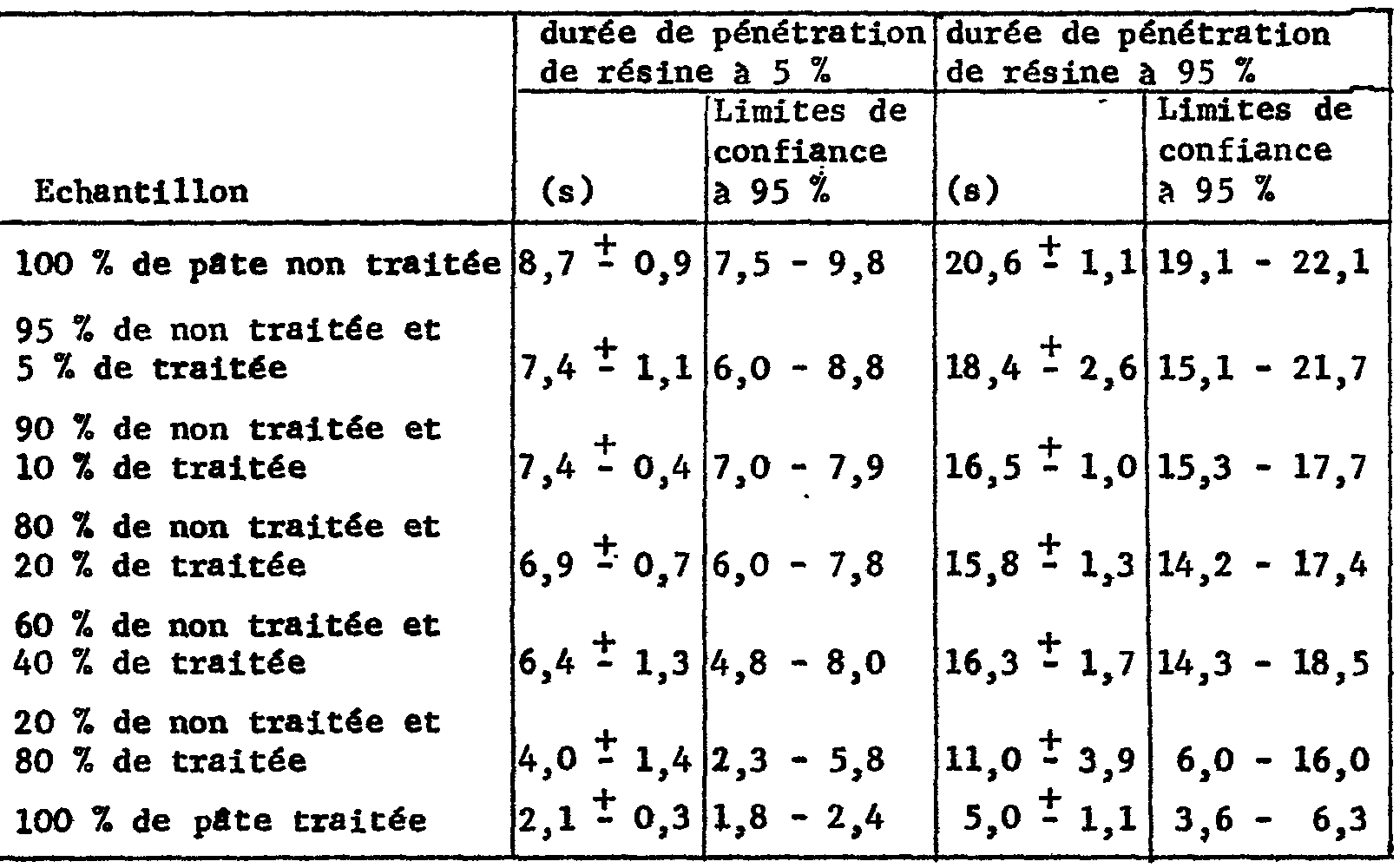
TABLE IV
DURATION OF RESIN PENETRATION OBTAINED BY USING THE
PENETRES COPE OF WILLIAMS
<tb> <SEP> durée <SEP> de <SEP> pénétration <SEP> durée <SEP> de <SEP> pénétration
<tb> <SEP> de <SEP> résine <SEP> à <SEP> 5 <SEP> % <SEP> de <SEP> résine <SEP> à <SEP> 95 <SEP> % <SEP>
<tb> <SEP> Limites <SEP> de <SEP> | <SEP> Limites <SEP> de
<tb> <SEP> confiance <SEP> confiance
<tb> <SEP> Echantillon <SEP> (s) <SEP> à <SEP> 95 <SEP> % <SEP> (s) <SEP> à <SEP> 95 <SEP> % <SEP>
<tb> 100 <SEP> % <SEP> de <SEP> pâte <SEP> non <SEP> traitée <SEP> 8,7 <SEP> # <SEP> 0,9 <SEP> 7,5 <SEP> - <SEP> 9,8 <SEP> 20,6 <SEP> # <SEP> 1,1 <SEP> <SEP> 19,1 <SEP> - <SEP> 22,1
<tb> 95 <SEP> % <SEP> de <SEP> non <SEP> traitée <SEP> et <SEP> + <SEP> +
<tb> 5 <SEP> % <SEP> de <SEP> traitée <SEP> 7,4 <SEP> # <SEP> <SEP> 1,1 <SEP> 6,0 <SEP> - <SEP> 8,8 <SEP> 18,4 <SEP> # <SEP> <SEP> 2,6 <SEP> 15,1 <SEP> - <SEP> 21,7
<tb> 90 <SEP> % <SEP> de <SEP> non <SEP> traitée <SEP> et
<tb> 10 <SEP> % <SEP> de <SEP> traitée <SEP> 7,4 <SEP> # <SEP> <SEP> 0,4 <SEP> 7,0 <SEP> - <SEP> 7,9 <SEP> 16,5 <SEP> # <SEP> <SEP> 1,0 <SEP> 15,3 <SEP> - <SEP> 17,7
<tb> 80 <SEP> z <SEP> de <SEP> non <SEP> traitée <SEP> et <SEP> @ <SEP> @ <SEP>
<tb> 20 <SEP> % <SEP> de <SEP> traitée <SEP> 6,9 <SEP> # <SEP> 0,7 <SEP> <SEP> 6,0 <SEP> - <SEP> 7,8 <SEP> 15,8 <SEP> # <SEP> <SEP> 1,3 <SEP> 14,2 <SEP> - <SEP> 17,4
<tb> 60 <SEP> % <SEP> de <SEP> non <SEP> traitée <SEP> et <SEP> + <SEP> +
<tb> 40 <SEP> X <SEP> de <SEP> traitée <SEP> 0,4 <SEP> - <SEP> 1,34,8 <SEP> - <SEP> 8,0 <SEP> 16,3 <SEP> - <SEP> 1,714,3 <SEP> - <SEP> 18,5 <SEP>
<tb> 20 <SEP> z <SEP> de <SEP> non <SEP> traitée <SEP> et <SEP> + <SEP> + <SEP>
<tb> 80 <SEP> X <SEP> de <SEP> traitée <SEP> 4,0 <SEP> # <SEP> <SEP> 1,4 <SEP> 2,3 <SEP> - <SEP> 5,8 <SEP> 11,0 <SEP> - <SEP> 3,9 <SEP> 6,0 <SEP> - <SEP> 16,0 <SEP>
<tb> 100 <SEP> % <SEP> de <SEP> pâte <SEP> traitée <SEP> 2,1 <SEP> # <SEP> 0,3 <SEP> 1,8 <SEP> - <SEP> 2,4 <SEP> 5,0 <SEP> # <SEP> 1,1 <SEP> 3,6 <SEP> - <SEP> 6,3
<tb>
TABLEAU V
DONNEES EXPERIMENTALES

<tb><SEP> of <SEP> resin <SEP> to <SEP> 5 <SEP>% <SEP> of <SEP> resin <SEP> to <SEP> 95 <SEP>% <SEP>
<tb><SEP><SEP> Limits of <SEP> | <SEP> Limits <SEP> of
<tb><SEP> trust <SEP> trust
<tb><SEP> Sample <SEP> (s) <SEP> to <SEP> 95 <SEP>% <SEP> (s) <SEP> to <SEP> 95 <SEP>% <SEP>
<tb> 100 <SEP>% <SEP> of <SEP> paste <SEP> no <SEP> treated <SEP> 8.7 <SEP>#<SEP> 0.9 <SEP> 7.5 <SEP> - <SEP> 9.8 <SEP> 20.6 <SEP>#<SEP> 1.1 <SEP><SEP> 19.1 <SEP> - <SEP> 22.1
<tb> 95 <SEP>% <SEP> of <SEP> no <SEP> processed <SEP> and <SEP> + <SEP> +
<tb> 5 <SEP>% <SEP> of <SEP> Processed <SEP> 7.4 <SEP>#<SEP><SEP> 1.1 <SEP> 6.0 <SEP> - <SEP> 8, 8 <SEP> 18.4 <SEP>#<SEP><SEP> 2.6 <SEP> 15.1 <SEP> - <SEP> 21.7
<tb> 90 <SEP>% <SEP> of <SEP> no <SEP> processed <SEP> and
<tb> 10 <SEP>% <SEP> of <SEP> treated <SEP> 7.4 <SEP>#<SEP><SEP> 0.4 <SEP> 7.0 <SEP> - <SEP> 7, 9 <SEP> 16.5 <SEP>#<SEP><SEP> 1.0 <SEP> 15.3 <SEP> - <SEP> 17.7
<tb> 80 <SEP> z <SEP> of <SEP> No <SEP> Processed <SEP> and <SEP> @ <SEP> @ <SEP>
<tb> 20 <SEP>% <SEP> of <SEP> treated <SEP> 6.9 <SEP>#<SEP> 0.7 <SEP><SEP> 6.0 <SEP> - <SEP> 7, <SEP> 15.8 <SEP>#<SEP><SEP> 1.3 <SEP> 14.2 <SEP> - <SEP> 17.4
<tb> 60 <SEP>% <SEP> of <SEP> no <SEP> processed <SEP> and <SEP> + <SEP> +
<tb> 40 <SEP> X <SEP> of <SEP> treated <SEP> 0.4 <SEP> - <SEP> 1.34.8 <SEP> - <SEP> 8.0 <SEP> 16.3 <SEP> - <SEP> 1,714.3 <SEP> - <SEP> 18.5 <SEP>
<tb> 20 <SEP> z <SEP> of <SEP> no <SEP> processed <SEP> and <SEP> + <SEP> + <SEP>
<tb> 80 <SEP> X <SEP> of <SEP> treated <SEP> 4.0 <SEP>#<SEP><SEP> 1.4 <SEP> 2,3 <SEP> - <SEP> 5, 8 <SEP> 11.0 <SEP> - <SEP> 3.9 <SEP> 6.0 <SEP> - <SEP> 16.0 <SEP>
<tb> 100 <SEP>% <SEP> of <SEP> treated <SEP> paste <SEP> 2.1 <SEP>#<SEP> 0.3 <SEP> 1.8 <SEP> - <SEP> 2 , 4 <SEP> 5.0 <SEP>#<SEP> 1.1 <SEP> 3.6 <SEP> - <SEP> 6.3
<Tb>
TABLE V
EXPERIMENTAL DATA
<tb> Numéro <SEP> de <SEP> l'expérience <SEP> 1 <SEP> 2 <SEP> 3 <SEP> 4 <SEP> 5
<tb> Débit <SEP> d'alimentation
<tb> (m3/min)* <SEP> 1,42 <SEP> 1,42 <SEP> 1,42 <SEP> 1,42 <SEP> 1,42
<tb> Consistance <SEP> à <SEP> l'issue <SEP> de <SEP> la
<tb> 1ère <SEP> phase <SEP> (%) <SEP> 30,0 <SEP> 29,7 <SEP> 29,9 <SEP> 28,9 <SEP> 28,8
<tb> Consistance <SEP> à <SEP> l'issue <SEP> de <SEP> la
<tb> 2e <SEP> phase <SEP> (%) <SEP> 27,5 <SEP> 28,3 <SEP> 30,2 <SEP> 28,9 <SEP> 29,7
<tb> Puissance <SEP> appliquée <SEP> lors <SEP> de
<tb> la <SEP> 2e <SEP> phase <SEP> (kWh/tonne) <SEP> 7 <SEP> 21 <SEP> 72 <SEP> 3,5 <SEP> 31,5
<tb> *équivalent à 84,3 tonnes par jour. T A B L E A U V I
PROPRIETES DE LA PATE ET DU PAPIER OBTENUES PAR INTERPOLATION GRAPHIQUE POUR DIVERS INDICES DE BOUFFANT

<tb> Feed rate <SEP>
<tb> (m3 / min) * <SEP> 1.42 <SEP> 1.42 <SEP> 1.42 <SEP> 1.42 <SEP> 1.42
<tb> Consistency <SEP> to <SEP> the result <SEP> of <SEP> la
<tb> 1st <SEP> phase <SEP> (%) <SEP> 30.0 <SEP> 29.7 <SEP> 29.9 <SEP> 28.9 <SEP> 28.8
<tb> Consistency <SEP> to <SEP> the result <SEP> of <SEP> la
<tb> 2nd <SEP> phase <SEP> (%) <SEP> 27.5 <SEP> 28.3 <SEP> 30.2 <SEP> 28.9 <SEP> 29.7
<tb> Power <SEP> applied <SEP> when <SEP> of
<tb> the <SEP> 2nd <SEP> phase <SEP> (kWh / ton) <SEP> 7 <SEP> 21 <SEP> 72 <SEP> 3.5 <SEP> 31.5
<tb> * equivalent to 84.3 tonnes per day. TABLEAUVI
PROPERTIES OF PULP AND PAPER OBTAINED BY GRAPHIC INTERPOLATION FOR VARIOUS INDICES OF GUN
Indice <SEP> de <SEP> durée <SEP> de <SEP> Longueur <SEP> de <SEP> durée <SEP> de <SEP> pénétration <SEP> de
<tb> facteur <SEP> de <SEP> Allongement
<tb> Echantillon <SEP> bouffant <SEP> raffinage <SEP> rupture <SEP> résine <SEP> à <SEP> 5 <SEP> %
<tb> Williams <SEP> (%)
<tb> (cm3/g) <SEP> (min) <SEP> (100 <SEP> min) <SEP> (s)
<tb> Témoin <SEP> 2,05 <SEP> 6,1 <SEP> 19,8 <SEP> 41,5 <SEP> 2,5 <SEP> 17,6
<tb> (non <SEP> traité) <SEP> 2,00 <SEP> 8,0 <SEP> 21,8 <SEP> 44,0 <SEP> 2,5 <SEP> 19,6
<tb> 1,95 <SEP> 9,9 <SEP> 25,9 <SEP> 46,0 <SEP> 2,6 <SEP> 21,5
<tb> 1,90 <SEP> 12,0 <SEP> 30,6 <SEP> 48,5 <SEP> 2,6 <SEP> 23,4
<tb> lère <SEP> phase <SEP> 2,05 <SEP> 4,8 <SEP> 16,3 <SEP> 39,9 <SEP> 3,0 <SEP> 16,2
<tb> 2,00 <SEP> 6,1 <SEP> 18,9 <SEP> 43,0 <SEP> 3,1 <SEP> 18,1
<tb> 1,95 <SEP> 7,9 <SEP> 22,0 <SEP> 46,5 <SEP> 3,3 <SEP> 20,6
<tb> 1,90 <SEP> 10,0 <SEP> 26,5 <SEP> 49,9 <SEP> 3,5 <SEP> 24,0
<tb> 2e <SEP> phase <SEP> 2,05 <SEP> 4,3 <SEP> 14,9 <SEP> 37,5 <SEP> 2,5 <SEP> 15,0
<tb> (3,5 <SEP> kWh/tonne) <SEP> 2,00 <SEP> 6,1 <SEP> 17,4 <SEP> 41,0 <SEP> 2,7 <SEP> 16,7
<tb> 1,95 <SEP> 7,9 <SEP> 20,5 <SEP> 44,4 <SEP> 3,0 <SEP> 18,9
<tb> 1,90 <SEP> 9,6 <SEP> 26,5 <SEP> 48,0 <SEP> 3,2 <SEP> 21,6
<tb> 2e <SEP> phase <SEP> 2,05 <SEP> 4,3 <SEP> 14,9 <SEP> 37,5 <SEP> 2,5 <SEP> 15,0
<tb> (7 <SEP> kWh/tonne) <SEP> 2,00 <SEP> 6,1 <SEP> 17,4 <SEP> 41,0 <SEP> 2,7 <SEP> 16,7
<tb> 1,95 <SEP> 7,9 <SEP> 20,5 <SEP> 44,4 <SEP> 3,0 <SEP> 18,9
<tb> 1,90 <SEP> 9,6 <SEP> 26,5 <SEP> 48,0 <SEP> 3,2 <SEP> 21,6
<tb> T A B L E A U V I (suite)

<tb> factor <SEP> of <SEP> Elongation
<tb> Sample <SEP> bulk <SEP> refining <SEP> breaking <SEP> resin <SEP> to <SEP> 5 <SEP>%
<tb> Williams <SEP> (%)
<tb> (cm3 / g) <SEP> (min) <SEP> (100 <SEP> min) <SEP> (s)
<tb> Control <SEP> 2.05 <SEP> 6.1 <SEP> 19.8 <SEP> 41.5 <SEP> 2.5 <SEP> 17.6
<tb> (no <SEP> treated) <SEP> 2.00 <SEP> 8.0 <SEP> 21.8 <SEP> 44.0 <SEP> 2.5 <SEP> 19.6
<tb> 1.95 <SEP> 9.9 <SEP> 25.9 <SEP> 46.0 <SEP> 2.6 <SEP> 21.5
<tb> 1.90 <SEP> 12.0 <SEP> 30.6 <SEP> 48.5 <SEP> 2.6 <SEP> 23.4
<tb> 1st <SEP> phase <SEP> 2.05 <SEP> 4.8 <SEP> 16.3 <SEP> 39.9 <SEP> 3.0 <SEP> 16.2
<tb> 2.00 <SEP> 6.1 <SEP> 18.9 <SEP> 43.0 <SEP> 3.1 <SEP> 18.1
<tb> 1.95 <SEP> 7.9 <SEP> 22.0 <SEP> 46.5 <SEP> 3.3 <SEP> 20.6
<tb> 1.90 <SEP> 10.0 <SEP> 26.5 <SEP> 49.9 <SEP> 3.5 <SEP> 24.0
<tb> 2nd <SEP> phase <SEP> 2.05 <SEP> 4.3 <SEP> 14.9 <SEP> 37.5 <SEP> 2.5 <SEP> 15.0
<tb> (3.5 <SEP> kWh / tonne) <SEP> 2.00 <SEP> 6.1 <SEP> 17.4 <SEP> 41.0 <SEP> 2.7 <SEP> 16.7
<tb> 1.95 <SEP> 7.9 <SEP> 20.5 <SEP> 44.4 <SEP> 3.0 <SEP> 18.9
<tb> 1.90 <SEP> 9.6 <SEP> 26.5 <SEP> 48.0 <SEP> 3.2 <SEP> 21.6
<tb> 2nd <SEP> phase <SEP> 2.05 <SEP> 4.3 <SEP> 14.9 <SEP> 37.5 <SEP> 2.5 <SEP> 15.0
<tb> (7 <SEP> kWh / ton) <SEP> 2.00 <SEP> 6.1 <SEP> 17.4 <SEP> 41.0 <SEP> 2.7 <SEP> 16.7
<tb> 1.95 <SEP> 7.9 <SEP> 20.5 <SEP> 44.4 <SEP> 3.0 <SEP> 18.9
<tb> 1.90 <SEP> 9.6 <SEP> 26.5 <SEP> 48.0 <SEP> 3.2 <SEP> 21.6
<tb> TABLEAUVI (continued)
Indice <SEP> de <SEP> durée <SEP> de <SEP> Longueur <SEP> de <SEP> Durée <SEP> de <SEP> pénétration <SEP> de
<tb> facteur <SEP> de <SEP> Allongement
<tb> Echanillon <SEP> bouffant <SEP> raffinage <SEP> rupture <SEP> résine <SEP> à <SEP> 5 <SEP> %
<tb> Williams <SEP> (%)
<tb> (cm3/g) <SEP> (min) <SEP> (100 <SEP> min) <SEP> (s)
<tb> 2e <SEP> phase <SEP> 2,05 <SEP> 1,3 <SEP> 11,5 <SEP> 29,0 <SEP> 2,3 <SEP> 9,8
<tb> (21 <SEP> kWh/tonne) <SEP> 2,00 <SEP> 3,5 <SEP> 14,0 <SEP> 31,6 <SEP> 2,5 <SEP> 11,2
<tb> 1,95 <SEP> 5,8 <SEP> 17,3 <SEP> 35,8 <SEP> 2,9 <SEP> 13,0
<tb> 1,90 <SEP> 8,0 <SEP> 21,4 <SEP> 41,2 <SEP> 3,3 <SEP> 15,2
<tb> 2e <SEP> phase <SEP> 2,05 <SEP> 1,0 <SEP> 11,5 <SEP> 29,0 <SEP> 2,2 <SEP> 11,0
<tb> (31,5 <SEP> kWh/tonne) <SEP> 2,00 <SEP> 3,2 <SEP> 14,0 <SEP> 31,6 <SEP> 2,3 <SEP> 13,4
<tb> 1,95 <SEP> 5,7 <SEP> 17,3 <SEP> 35,8 <SEP> 2,6 <SEP> 16,0
<tb> 1,90 <SEP> 8,0 <SEP> 21,4 <SEP> 41,2 <SEP> 2,8 <SEP> 18,4
<tb> 2e <SEP> phase <SEP> 2,05 <SEP> 1,0 <SEP> 11,5 <SEP> 29,0 <SEP> 2,9 <SEP> 7,6
<tb> (72 <SEP> kWh/tonne) <SEP> 2,00 <SEP> 3,2 <SEP> 14,0 <SEP> 31,6 <SEP> 3,0 <SEP> 10,0
<tb> 1,95 <SEP> 5,3 <SEP> 17,3 <SEP> 35,8 <SEP> 3,2 <SEP> 11,8
<tb> 1,90 <SEP> 7,5 <SEP> 21,4 <SEP> 41,2 <SEP> 3,5 <SEP> 14,0
<tb> <SEP> index of <SEP><SEP> duration of <SEP><SEP><SEP> length <SEP><SEP><SEP> duration of
<tb> factor <SEP> of <SEP> Elongation
<tb> Sampling <SEP> bulk <SEP> refining <SEP> breaking <SEP> resin <SEP> to <SEP> 5 <SEP>%
<tb> Williams <SEP> (%)
<tb> (cm3 / g) <SEP> (min) <SEP> (100 <SEP> min) <SEP> (s)
<tb> 2nd <SEP> phase <SEP> 2.05 <SEP> 1.3 <SEP> 11.5 <SEP> 29.0 <SEP> 2.3 <SEP> 9.8
<tb> (21 <SEP> kWh / ton) <SEP> 2.00 <SEP> 3.5 <SEP> 14.0 <SEP> 31.6 <SEP> 2.5 <SEP> 11.2
<tb> 1.95 <SEP> 5.8 <SEP> 17.3 <SEP> 35.8 <SEP> 2.9 <SEP> 13.0
<tb> 1.90 <SEP> 8.0 <SEP> 21.4 <SEP> 41.2 <SEP> 3.3 <SEP> 15.2
<tb> 2nd <SEP> phase <SEP> 2.05 <SEP> 1.0 <SEP> 11.5 <SEP> 29.0 <SEP> 2.2 <SEP> 11.0
<tb> (31.5 <SEP> kWh / ton) <SEP> 2.00 <SEP> 3.2 <SEP> 14.0 <SEP> 31.6 <SEP> 2.3 <SEP> 13.4
<tb> 1.95 <SEP> 5.7 <SEP> 17.3 <SEP> 35.8 <SEP> 2.6 <SEP> 16.0
<tb> 1.90 <SEP> 8.0 <SEP> 21.4 <SEP> 41.2 <SEP> 2.8 <SEP> 18.4
<tb> 2nd <SEP> phase <SEP> 2.05 <SEP> 1.0 <SEP> 11.5 <SEP> 29.0 <SEP> 2.9 <SEP> 7.6
<tb> (72 <SEP> kWh / ton) <SEP> 2.00 <SEP> 3.2 <SEP> 14.0 <SEP> 31.6 <SEP> 3.0 <SEP> 10.0
<tb> 1.95 <SEP> 5.3 <SEP> 17.3 <SEP> 35.8 <SEP> 3.2 <SEP> 11.8
<tb> 1.90 <SEP> 7.5 <SEP> 21.4 <SEP> 41.2 <SEP> 3.5 <SEP> 14.0
<Tb>
Claims (12)
Applications Claiming Priority (1)
| Application Number | Priority Date | Filing Date | Title |
|---|---|---|---|
| US19853480A | 1980-10-20 | 1980-10-20 |
Publications (2)
| Publication Number | Publication Date |
|---|---|
| FR2492424A1 true FR2492424A1 (en) | 1982-04-23 |
| FR2492424B1 FR2492424B1 (en) | 1986-04-25 |
Family
ID=22733778
Family Applications (1)
| Application Number | Title | Priority Date | Filing Date |
|---|---|---|---|
| FR8119688A Expired FR2492424B1 (en) | 1980-10-20 | 1981-10-20 | RESIN IMPREGNATION SUPPORT PAPER MADE FROM WOOD PULP PRODUCED BY THE ALKALINE PULP MANUFACTURING PROCESSES |
Country Status (11)
| Country | Link |
|---|---|
| JP (1) | JPS57149599A (en) |
| AU (1) | AU532636B2 (en) |
| BR (1) | BR8106752A (en) |
| CA (1) | CA1181908A (en) |
| DE (1) | DE3141572A1 (en) |
| FI (1) | FI69159B (en) |
| FR (1) | FR2492424B1 (en) |
| IL (1) | IL64031A (en) |
| IT (1) | IT1139255B (en) |
| MX (1) | MX155610A (en) |
| SE (1) | SE457733B (en) |
Families Citing this family (3)
| Publication number | Priority date | Publication date | Assignee | Title |
|---|---|---|---|---|
| US4488932A (en) * | 1982-08-18 | 1984-12-18 | James River-Dixie/Northern, Inc. | Fibrous webs of enhanced bulk and method of manufacturing same |
| JPH02200884A (en) * | 1989-01-25 | 1990-08-09 | Sanyo Kokusaku Pulp Co Ltd | Pulp having high orientation in thickness direction of sheet, its production and paper having excellent penetrability and gas-permeability and produced by using the pulp |
| AT525430B1 (en) * | 2021-12-23 | 2023-04-15 | Mondi Ag | Paper web and method of forming a paper web |
Citations (4)
| Publication number | Priority date | Publication date | Assignee | Title |
|---|---|---|---|---|
| US2516384A (en) * | 1942-01-15 | 1950-07-25 | Hill Harold Sanford | Mechanically curling cellulose fibers |
| GB825050A (en) * | 1954-11-03 | 1959-12-09 | Permacel Lepage S Inc | Improvements in paper backings for pressure-sensitive tape |
| FR2302373A1 (en) * | 1975-02-28 | 1976-09-24 | Buckeye Cellulose Corp | TORSAL CELLULOSIC FIBERS IMPREGNATED WITH RESIN AND PROCESS FOR OBTAINING THEIR |
| US4036679A (en) * | 1975-12-29 | 1977-07-19 | Crown Zellerbach Corporation | Process for producing convoluted, fiberized, cellulose fibers and sheet products therefrom |
Family Cites Families (3)
| Publication number | Priority date | Publication date | Assignee | Title |
|---|---|---|---|---|
| DE1461030A1 (en) * | 1962-10-12 | 1968-12-19 | Crown Zellerbach Corp | Process for the treatment of a pulp for paper manufacture |
| US3827934A (en) * | 1971-06-28 | 1974-08-06 | Westvaco Corp | Process for producing high strength,high yield hardwood pulp |
| US4060450A (en) * | 1972-09-01 | 1977-11-29 | Westinghouse Electric Corporation | High yield saturating paper |
-
1981
- 1981-10-07 CA CA000387453A patent/CA1181908A/en not_active Expired
- 1981-10-11 IL IL64031A patent/IL64031A/en unknown
- 1981-10-14 AU AU76344/81A patent/AU532636B2/en not_active Ceased
- 1981-10-16 FI FI813242A patent/FI69159B/en not_active Application Discontinuation
- 1981-10-16 SE SE8106142A patent/SE457733B/en not_active IP Right Cessation
- 1981-10-19 JP JP56166986A patent/JPS57149599A/en active Pending
- 1981-10-20 MX MX189730A patent/MX155610A/en unknown
- 1981-10-20 DE DE19813141572 patent/DE3141572A1/en not_active Ceased
- 1981-10-20 FR FR8119688A patent/FR2492424B1/en not_active Expired
- 1981-10-20 IT IT24577/81A patent/IT1139255B/en active
- 1981-10-20 BR BR8106752A patent/BR8106752A/en unknown
Patent Citations (4)
| Publication number | Priority date | Publication date | Assignee | Title |
|---|---|---|---|---|
| US2516384A (en) * | 1942-01-15 | 1950-07-25 | Hill Harold Sanford | Mechanically curling cellulose fibers |
| GB825050A (en) * | 1954-11-03 | 1959-12-09 | Permacel Lepage S Inc | Improvements in paper backings for pressure-sensitive tape |
| FR2302373A1 (en) * | 1975-02-28 | 1976-09-24 | Buckeye Cellulose Corp | TORSAL CELLULOSIC FIBERS IMPREGNATED WITH RESIN AND PROCESS FOR OBTAINING THEIR |
| US4036679A (en) * | 1975-12-29 | 1977-07-19 | Crown Zellerbach Corporation | Process for producing convoluted, fiberized, cellulose fibers and sheet products therefrom |
Also Published As
| Publication number | Publication date |
|---|---|
| SE8106142L (en) | 1982-04-21 |
| SE457733B (en) | 1989-01-23 |
| IT1139255B (en) | 1986-09-24 |
| MX155610A (en) | 1988-04-06 |
| FR2492424B1 (en) | 1986-04-25 |
| AU532636B2 (en) | 1983-10-06 |
| DE3141572A1 (en) | 1982-09-23 |
| CA1181908A (en) | 1985-02-05 |
| FI69159B (en) | 1985-08-30 |
| JPS57149599A (en) | 1982-09-16 |
| IT8124577A0 (en) | 1981-10-20 |
| AU7634481A (en) | 1982-04-29 |
| IL64031A (en) | 1985-06-30 |
| BR8106752A (en) | 1982-07-06 |
| FI813242L (en) | 1982-04-21 |
Similar Documents
| Publication | Publication Date | Title |
|---|---|---|
| Yano et al. | Bio-composites produced from plant microfiber bundles with a nanometer unit web-like network | |
| CN102640979B (en) | Method for preparing reconstituted tobacco paper base made from tobacco stems | |
| AU621965B2 (en) | Cellulosic fibrous aggregate and a process for its preparation | |
| CN114855496B (en) | Bamboo fluff pulp preparation technology and its products | |
| FR2744735A1 (en) | USE OF SUGAR BEET PULPES IN THE MANUFACTURE OF PAPER OR CARDBOARD | |
| CN102640980B (en) | Preparation method of tobacco sheet paper base by cabo | |
| JP7116046B2 (en) | METHOD FOR MANUFACTURING CELLULOSE FILAMENT USING LOW BEATING ENERGY | |
| Rizkiansyah et al. | Non-wood paper from coffee pulp waste: How its performance as coffee filter | |
| Novo et al. | Pulp and paper from sugarcane: Properties of rind and core fractions | |
| FR2492424A1 (en) | RESIN IMPREGNATION SUPPORT PAPER MADE FROM WOOD PULP PRODUCTS PRODUCED BY ALKALINE PASTA MANUFACTURING PROCESSES | |
| FR2659673A1 (en) | METHOD OF MANUFACTURING CURRENCY PAPER AND THE LIKE. | |
| CN102268832B (en) | Pulping and papermaking process for producing middle-grade and high-grade cultural paper by using larch chemical-mechanical pulp | |
| Moradbak et al. | Effects of Alkaline Sulfite Anthraquinone and Methanol Pulping Conditions on the Mechanical and Optical Paper Properties of Bamboo (Gigantochloa scortechinii). | |
| JPH08504894A (en) | Mechanical pulp and chemi-mechanical pulp manufacturing method | |
| Rimadhanti Ningtyas et al. | Utilization of waste cellulose raw material for making paper pulp | |
| Song | Evaluation of conservation quality Eastern papers regarding materials and process | |
| CA1193405A (en) | Method for the manufacture of a cellulosic fiber paste for uses other than papermaking | |
| FR3015529A1 (en) | PROCESS FOR PREPARING PAPER PULP | |
| FR2542774A1 (en) | Wood chip processing | |
| Wee et al. | Dendracalamus Asper (D. Asper) Pulp and Paper-Making Properties Development by Using Soda Pulping | |
| US2323339A (en) | Momentarily consolidated board product | |
| Mydin et al. | Development and evaluation of pulp and paper properties using Bambusa vulgaris | |
| CH619120A5 (en) | ||
| WO2023176286A1 (en) | Method for producing fiber board and compressed material for production of fiber board | |
| Marufovich | KOKAND PAPER PRODUCTION TECHNOLOGY |
Legal Events
| Date | Code | Title | Description |
|---|---|---|---|
| ST | Notification of lapse |