【0001】
【発明の属する技術分野】
本発明は、特定の構造を有するペンタエリスリトールジホスホネート化合物の製造方法に関する。更に詳しくは、難燃剤、結晶核剤、可塑剤等の添加剤として使用でき、殊に樹脂用難燃剤として優れた効果を有する新規なペンタエリスリトールジホスホネート化合物の製造方法に関する。
【0002】
【従来の技術】
ポリカーボネート樹脂、ポリフェニレンオキシド樹脂、ポリエステル樹脂、ABS樹脂、スチレン樹脂、エポキシ樹脂、ポリアミド樹脂等の樹脂は、その優れた諸物性を活かし、機械部品、電気部品、自動車部品等の幅広い分野に利用されている。一方、これらの樹脂は本質的に可燃性である為、上記用途として使用するには一般の化学的、物理的諸特性のバランス以外に、火炎に対する安全性、すなわち、高度な難燃性が要求される場合が多い。
【0003】
樹脂に難燃性を付与する方法としては、難燃剤としてハロゲン系化合物、さらに難燃助剤としてアンチモン化合物を樹脂に添加する方法が一般的である。しかしながら、この方法は成形加工時あるいは燃焼時に、多量の腐食性ガスを発生させる等の問題がある。また、特に近年、製品廃棄時における環境影響等が懸念されている。そこで、ハロゲンを全く含まない難燃剤や難燃処方が強く望まれている。
【0004】
ハロゲン系難燃剤を使用しないで熱可塑性樹脂を難燃化する方法としては、水酸化アルミニウム、水酸化マグネシウムなどの金属水和物を添加することが広く知られている。しかし、充分な難燃性を得る為には、上記金属水和物を多量に添加する必要があり、樹脂本来の特性が失われるという欠点を有していた。
【0005】
また、トリアリールリン酸エステルモノマーや縮合リン酸エステルオリゴマーの芳香族リン酸エステルも、熱可塑性樹脂に難燃性を付与するための難燃剤として頻繁に用いられてきた。しかし、トリフェニルホスフェートに代表されるトリアリールリン酸エステルモノマーは、樹脂組成物の耐熱性を著しく低下させ、かつ、揮発性が高い為に、押出し時や成形加工時にガスの発生量が多く、ハンドリング性に問題があった。さらに、この化合物は樹脂を高温に加熱するとその少なくとも一部が揮発、あるいはブリード等によって樹脂中から失われるという問題点を有していた。また、縮合リン酸エステルオリゴマーは、揮発性が改善されているものの、その多くが液体であることから、樹脂との混練には液注装置が必要となり、押出し混練時のハンドリング性に問題があった。
【0006】
一方、二置換ペンタエリスリトールジホスホネートは、樹脂用難燃剤を中心に種々の検討がなされている。この化合物を熱可塑性樹脂に配合することにより、熱可塑性樹脂の難燃化を達成することができる。このホスホネート化合物が配合された熱可塑性樹脂組成物は、難燃剤の配合による耐熱性、および耐衝撃性等の特性が低下することなく、しかも混練の際に化合物が揮発、あるいはブリード等により樹脂中から失われることのない特徴を有する。
【0007】
また、上記二置換ペンタエリスリトールジホスホネートの製造法についてはいくつか開示されている。例えば、特開平5−163288号公報においては、ペンタエリスリトールとフェニルホスホン酸ジクロライドとの反応により、ジフェニルペンタエリスリトールジホスホネートを得る製造例の記載がある。
【0008】
米国特許4174343号明細書においては、ジエチルペンタエリスリトールジホスファイトとハロゲン化誘導体(例えばベンジルクロライド)との反応により、対応する二置換ペンタエリスリトールジホスホネートを得る製造例の記載がある。
【0009】
しかしながら、本発明の特定の構造を有するペンタエリスリトールジホスホネートに関して、必ずしも従来通りの製造方法ではかかる目的物を高収率で回収できないという問題があった。また、上記の特許でも製造法の詳細は詳述されておらず、目的物の純度に関する記載もなく、工業的な製造法の見地からも種々の問題が内在していた。
【0010】
【発明が解決しようとする課題】
本発明の目的は、上記従来技術の問題点を解決し、工業的に有利な生産性に優れた方法でかつ樹脂に混合した際に大きな問題となるガス発生を抑制し高度に難燃性を付与することができるペンタエリスリトールジホスホネートの製造方法及び精製法を提供することにある。
【0011】
本発明者は、前記目的を達成すべく鋭意検討した結果、かかる特定の製造法及び精製法で得られたペンタエリスリトールジホスホネートが、樹脂に対して高度な難燃性を付与することができると同時に各種樹脂物性に悪影響を与えない事を見出し、本発明に至った。
【0012】
【課題を解決するための手段】
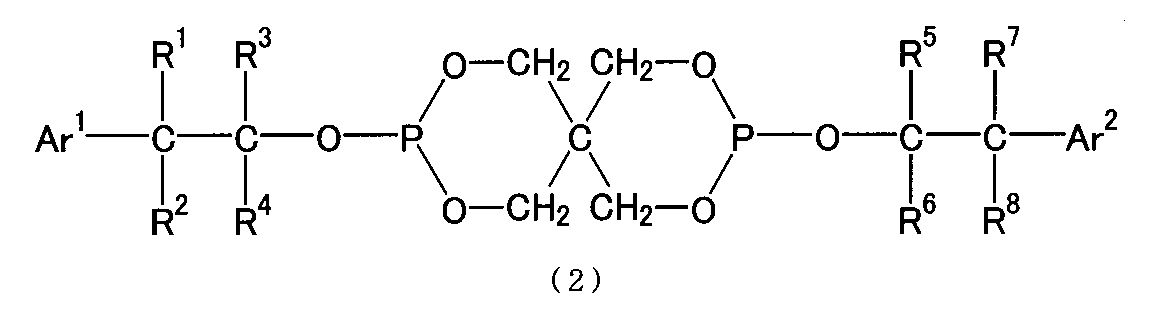
すなわち、本発明によれば、下記式(1)で示されるペンタエリスリトールジホスホネートを製造するに際して、下記式(2)で示されるペンタエリスリトールジホスファイトを、ハロゲン化化合物の存在下に、温度120℃から250℃の条件下で加熱処理するペンタエリスリトールジホスホネートの製造方法に関する。
【0013】
【化3】
【0014】
(式中、Ar1およびAr2は、同一または異なっていてもよく、炭素数6〜20の置換もしくは非置換のアリール基である。また、R1、R2、R3、R4、R5、R6、R7およびR8は、それぞれ同一または異なっていてもよく、水素原子もしくは炭素数6〜20の置換もしくは非置換のアリール基、または炭素数7〜30の置換もしくは非置換のアラルキル基、または炭素数1〜20の飽和もしくは不飽和の炭化水素基である。)
【0015】
【化4】
【0016】
(式中、Ar1、Ar2、R1、R2、R3、R4、R5、R6、R7およびR8は前記一般式(1)における定義と同じものを意味する。)
また、上記条件で製造したペンタエリスリトールジホスホネートを精製する方法に関するものである。
【0017】
上記ペンタエリスリトールジホスホネート化合物として、一般式(1)においてAr1、Ar2が、フェニル基、各種キシリル基、各種トルイル基、ジ−t−ブチルフェニル基、各種クメニル基、ビフェニル基、ナフチル基等であり、R1、R2、R3、R4、R5、R6、R7およびR8が、水素原子、メチル基、エチル基、各種プロピル基、各種ブチル基、各種ペンチル基、プロペニル基、フェニル基、各種トルイル基、各種キシリル基、各種クメニル基、ジ−t−ブチルフェニル基、ビフェニル基、ナフチル基、ベンジル基、フェネチル基、1−フェニルエチル基、3−フェニルプロピル基、ジフェニルメチル基等である化合物を挙げる事ができる。好ましくは、Ar1、Ar2が、フェニル基、R1、R2、R3、R4、R5、R6、R7およびR8が、水素原子、メチル基、フェニル基である。
【0018】
具体的には、3,9−ビス(2−フェニルエチル)−3,9−ジオキソ−2,4,8,10−テトラオキサ−3,9−ジホスファスピロ[5.5]ウンデカン、3,9−ビス(2−(2−メチルフェニル)エチル)−3,9−ジオキソ−2,4,8,10−テトラオキサ−3,9−ジホスファスピロ[5.5]ウンデカン、3,9−ビス(2−(3−メチルフェニル)エチル)−3,9−ジオキソ−2,4,8,10−テトラオキサ−3,9−ジホスファスピロ[5.5]ウンデカン、3,9−ビス(2−(4−メチルフェニル)エチル)−3,9−ジオキソ−2,4,8,10−テトラオキサ−3,9−ジホスファスピロ[5.5]ウンデカン、3,9−ビス(2−(2,4−ジメチルフェニル)エチル)−3,9−ジオキソ−2,4,8,10−テトラオキサ−3,9−ジホスファスピロ[5.5]ウンデカン、3,9−ビス(2−(2,6−ジメチルフェニル)エチル)−3,9−ジオキソ−2,4,8,10−テトラオキサ−3,9−ジホスファスピロ[5.5]ウンデカン、3,9−ビス(2−(3,5−ジメチルフェニル)エチル)−3,9−ジオキソ−2,4,8,10−テトラオキサ−3,9−ジホスファスピロ[5.5]ウンデカン、3,9−ビス(2−(2,4,6−トリメチルフェニル)エチル)−3,9−ジオキソ−2,4,8,10−テトラオキサ−3,9−ジホスファスピロ[5.5]ウンデカン、
【0019】
3,9−ビス(2−(2−tert−ブチルフェニル)エチル)−3,9−ジオキソ−2,4,8,10−テトラオキサ−3,9−ジホスファスピロ[5.5]ウンデカン、3,9−ビス(2−(4−tert−ブチルフェニル)エチル)−3,9−ジオキソ−2,4,8,10−テトラオキサ−3,9−ジホスファスピロ[5.5]ウンデカン、3,9−ビス(2−(2,4−ジ−tert−ブチルフェニル)エチル)−3,9−ジオキソ−2,4,8,10−テトラオキサ−3,9−ジホスファスピロ[5.5]ウンデカン、3,9−ビス(2−(2,6−ジ−tert−ブチルフェニル)エチル)−3,9−ジオキソ−2,4,8,10−テトラオキサ−3,9−ジホスファスピロ[5.5]ウンデカン、3,9−ビス(2−(2,4,6−トリ−tert−ブチルフェニル)エチル)−3,9−ジオキソ−2,4,8,10−テトラオキサ−3,9−ジホスファスピロ[5.5]ウンデカン、
【0020】
3,9−ビス(2−(4−ビフェニル)エチル)−3,9−ジオキソ−2,4,8,10−テトラオキサ−3,9−ジホスファスピロ[5.5]ウンデカン、3,9−ビス(2−(1−ナフチル)エチル)−3,9−ジオキソ−2,4,8,10−テトラオキサ−3,9−ジホスファスピロ[5.5]ウンデカン、3,9−ビス(2−(2−ナフチル)エチル)−3,9−ジオキソ−2,4,8,10−テトラオキサ−3,9−ジホスファスピロ[5.5]ウンデカン、3,9−ビス(2−(1−アントリル)エチル)−3,9−ジオキソ−2,4,8,10−テトラオキサ−3,9−ジホスファスピロ[5.5]ウンデカン、3,9−ビス(2−(2−アントリル)エチル)−3,9−ジオキソ−2,4,8,10−テトラオキサ−3,9−ジホスファスピロ[5.5]ウンデカン、3,9−ビス(2−(9−アントリル)エチル)−3,9−ジオキソ−2,4,8,10−テトラオキサ−3,9−ジホスファスピロ[5.5]ウンデカン、
【0021】
3,9−ビス(2−フェニルプロピル)−3,9−ジオキソ−2,4,8,10−テトラオキサ−3,9−ジホスファスピロ[5.5]ウンデカン、3,9−ビス(2−メチル−2−フェニルプロピル)−3,9−ジオキソ−2,4,8,10−テトラオキサ−3,9−ジホスファスピロ[5.5]ウンデカン、3,9−ビス(2,2−ジフェニルエチル)−3,9−ジオキソ−2,4,8,10−テトラオキサ−3,9−ジホスファスピロ[5.5]ウンデカン、3,9−ビス(2,2,2−トリフェニルエチル)−3,9−ジオキソ−2,4,8,10−テトラオキサ−3,9−ジホスファスピロ[5.5]ウンデカン、3,9−ビス(1−フェニル−2−プロピル)−3,9−ジオキソ−2,4,8,10−テトラオキサ−3,9−ジホスファスピロ[5.5]ウンデカン、3,9−ビス(1,2−ジフェニルエチル)−3,9−ジオキソ−2,4,8,10−テトラオキサ−3,9−ジホスファスピロ[5.5]ウンデカン、3,9−ビス(1,3−ジフェニル−2−プロピル)−3,9−ジオキソ−2,4,8,10−テトラオキサ−3,9−ジホスファスピロ[5.5]ウンデカン、3,9−ビス(1−メチル−2−フェニルプロピル)−3,9−ジオキソ−2,4,8,10−テトラオキサ−3,9−ジホスファスピロ[5.5]ウンデカン、
【0022】
3−(2−フェニルエチル)−9−(2−(2,6−ジメチルフェニル)エチル)−3,9−ジオキソ−2,4,8,10−テトラオキサ−3,9−ジホスファスピロ[5.5]ウンデカン、3−(2−フェニルエチル)−9−(2−(2,4−ジ−tert−ブチルフェニル)エチル)−3,9−ジオキソ−2,4,8,10−テトラオキサ−3,9−ジホスファスピロ[5.5]ウンデカンが好ましい。
【0023】
特に、3,9−ビス(2−フェニルエチル)−3,9−ジオキソ−2,4,8,10−テトラオキサ−3,9−ジホスファスピロ[5.5]ウンデカンが好ましい。
【0024】
本発明で用いるペンタエリスリトールジホスファイトの製造法に関しては、様々な方法が知られている。合成方法の一例としては、ペンタエリスリトールと三塩化リンとの反応生成物に、塩基の存在下、各種アルコールを反応させることで製造することが可能である。
【0025】
上記ペンタエリスリトールジホスファイトとしては、一般式(2)においてAr1、Ar2が、フェニル基、各種キシリル基、各種トルイル基、各種クメニル基、ジ−t−ブチルフェニル基、ビフェニル基、ナフチル基等であり、R1、R2、R3、R4、R5、R6、R7およびR8が、水素原子、メチル基、エチル基、各種プロピル基、各種ブチル基、各種ペンチル基、プロペニル基、フェニル基、各種トルイル基、各種キシリル基、各種クメニル基、ジ−t−ブチルフェニル基、ビフェニル基、ナフチル基、ベンジル基、フェネチル基、1−フェニルエチル基、3−フェニルプロピル基、ジフェニルメチル基等である化合物を挙げる事ができる。好ましくは、Ar1、Ar2が、フェニル基、R1、R2、R3、R4、R5、R6、R7およびR8が、水素原子、メチル基、フェニル基である。
【0026】
具体的には、3,9−ビス((2−フェニルエチル)オキシ)−2,4,8,10−テトラオキサ−3,9−ジホスファスピロ[5.5]ウンデカン、3,9−ビス((2−(2−メチルフェニル)エチル)オキシ)−2,4,8,10−テトラオキサ−3,9−ジホスファスピロ[5.5]ウンデカン、3,9−ビス((2−(3−メチルフェニル)エチル)オキシ)−2,4,8,10−テトラオキサ−3,9−ジホスファスピロ[5.5]ウンデカン、3,9−ビス((2−(4−メチルフェニル)エチル)オキシ)−2,4,8,10−テトラオキサ−3,9−ジホスファスピロ[5.5]ウンデカン、3,9−ビス((2−(2,4−ジメチルフェニル)エチル)オキシ)−2,4,8,10−テトラオキサ−3,9−ジホスファスピロ[5.5]ウンデカン、3,9−ビス((2−(2,6−ジメチルフェニル)エチル)オキシ)−2,4,8,10−テトラオキサ−3,9−ジホスファスピロ[5.5]ウンデカン、3,9−ビス((2−(3,5−ジメチルフェニル)エチル)オキシ)−2,4,8,10−テトラオキサ−3,9−ジホスファスピロ[5.5]ウンデカン、3,9−ビス((2−(2,4,6−トリメチルフェニル)エチル)オキシ)−3,9−ジオキシ2,4,8,10−テトラオキサ−3,9−ジホスファスピロ[5.5]ウンデカン、
【0027】
3,9−ビス((2−(2−tert−ブチルフェニル)エチル)オキシ)−2,4,8,10−テトラオキサ−3,9−ジホスファスピロ[5.5]ウンデカン、3,9−ビス((2−(4−tert−ブチルフェニル)エチル)オキシ)−2,4,8,10−テトラオキサ−3,9−ジホスファスピロ[5.5]ウンデカン、3,9−ビス((2−(2,4−ジ−tert−ブチルフェニル)エチル)オキシ)−2,4,8,10−テトラオキサ−3,9−ジホスファスピロ[5.5]ウンデカン、3,9−ビス((2−(2,6−ジ−tert−ブチルフェニル)エチル)オキシ)−2,4,8,10−テトラオキサ−3,9−ジホスファスピロ[5.5]ウンデカン、3,9−ビス((2−(2,4,6−トリ−tert−ブチルフェニル)エチル)オキシ)−2,4,8,10−テトラオキサ−3,9−ジホスファスピロ[5.5]ウンデカン、
【0028】
3,9−ビス((2−(4−ビフェニル)エチル)オキシ)−2,4,8,10−テトラオキサ−3,9−ジホスファスピロ[5.5]ウンデカン、3,9−ビス((2−(1−ナフチル)エチル)オキシ)−2,4,8,10−テトラオキサ−3,9−ジホスファスピロ[5.5]ウンデカン、3,9−ビス((2−(2−ナフチル)エチル)オキシ)−2,4,8,10−テトラオキサ−3,9−ジホスファスピロ[5.5]ウンデカン、3,9−ビス((2−(1−アントリル)エチル)オキシ)−2,4,8,10−テトラオキサ−3,9−ジホスファスピロ[5.5]ウンデカン、3,9−ビス((2−(2−アントリル)エチル)オキシ)−2,4,8,10−テトラオキサ−3,9−ジホスファスピロ[5.5]ウンデカン、3,9−ビス((2−(9−アントリル)エチル)オキシ)−2,4,8,10−テトラオキサ−3,9−ジホスファスピロ[5.5]ウンデカン、
【0029】
3,9−ビス((2−フェニルプロピル)オキシ)−2,4,8,10−テトラオキサ−3,9−ジホスファスピロ[5.5]ウンデカン、3,9−ビス((2−メチル−2−フェニルプロピル)オキシ)−2,4,8,10−テトラオキサ−3,9−ジホスファスピロ[5.5]ウンデカン、3,9−ビス((2,2−ジフェニルエチル)オキシ)−2,4,8,10−テトラオキサ−3,9−ジホスファスピロ[5.5]ウンデカン、3,9−ビス((2,2,2−トリフェニルエチル)オキシ)−2,4,8,10−テトラオキサ−3,9−ジホスファスピロ[5.5]ウンデカン、3,9−ビス((1−フェニル−2−プロピル)オキシ)−2,4,8,10−テトラオキサ−3,9−ジホスファスピロ[5.5]ウンデカン、3,9−ビス((1,2−ジフェニルエチル)オキシ)−2,4,8,10−テトラオキサ−3,9−ジホスファスピロ[5.5]ウンデカン、3,9−ビス((1,3−ジフェニル−2−プロピル)オキシ)−2,4,8,10−テトラオキサ−3,9−ジホスファスピロ[5.5]ウンデカン、3,9−ビス((1−メチル−2−フェニルプロピル)オキシ)−2,4,8,10−テトラオキサ−3,9−ジホスファスピロ[5.5]ウンデカン、
【0030】
3−(2−フェニルエチル)オキシ−9−(2−(2,6−ジメチルフェニル)エチル)オキシ−2,4,8,10−テトラオキサ−3,9−ジホスファスピロ[5.5]ウンデカン、3−(2−フェニルエチル)オキシ−9−(2−(2,4−ジ−tert−ブチルフェニル)エチル)オキシ−2,4,8,10−テトラオキサ−3,9−ジホスファスピロ[5.5]ウンデカンが好ましい。
【0031】
特に、3,9−ビス((2−フェニルエチル)オキシ)−2,4,8,10−テトラオキサ−3,9−ジホスファスピロ[5.5]ウンデカンが好ましい。
【0032】
本発明の前記式(1)で表されるペンタエリスリトールジホスホネートは、ペンタエリスリトールジホスファイトを、ハロゲン化化合物の共存下に、温度120℃から250℃の条件下で加熱処理する事で得られる。好ましい加熱処理の温度は130℃〜240℃であり、更に好ましい加熱処理の温度は150℃〜230℃以下である。加熱処理の温度が120℃以下では反応速度が著しく低下し、生産効率の点で好ましくない。加熱処理の温度が250℃をこえる場合は、副反応を促進し、本発明のペンタエリスリトールジホスホネートの回収率の低下を引き起こし好ましくない。
【0033】
本発明における加熱処理の時間には制限はないが、1分から1000分が好ましい。1分未満では未反応物が残り、目的とするペンタエリスリトールジホスホネートの回収率の低下を引き起こし好ましくない。一方1000分をこえる時間では生産効率の悪化を引き起こし好ましくない。
【0034】
本発明において共存されるハロゲン化化合物は一般式RXで表され、RXのRとしては、有機化合物若しくはアルカリ金属である。好ましくは該RXのRが炭素数1〜20のアルキル基、アラルキル基、アリ−ル基、炭素数4〜30の4級アンモニウムイオン、ホスホニウムイオンである。また該RXのRがアルカリ金属であれば、Na、K、Liが好ましく用いられる。また該RXのXとしてはBr、Iが好ましい。かかる材料の好ましい具体例としては、メチルブロマイド、エチルブロマイド、n−プロピルブロマイド、iso−プロピルブロマイド、n−ブチルブロマイド、iso−ブチルブロマイド、tert−ブチルブロマイド、n−ペンチルブロマイド、ベンジルブロマイド、(1−ブロモエチル)ベンゼン、(2−ブロモエチル)ベンゼン、ジフェニルメチルブロマイド、テトラブチルアンモニウムブロマイド、テトラエチルアンモニウムブロマイド、テトラメチルアンモニウムブロマイド、テトラブチルホスホニウムブロマイド、テトラエチルホスホニウムブロマイド、臭化ナトリウム、臭化カリウム、臭化リチウム、メチルアイオダイド、エチルアイオダイド、n−プロピルアイオダイド、iso−プロピルアイオダイド、n−ブチルアイオダイド、iso−ブチルアイオダイド、tert−ブチルアイオダイド、n−ペンチルアイオダイド、ベンジルアイオダイド、(1−ヨードエチル)ベンゼン、(2−ヨードエチル)ベンゼン、ジフェニルメチルアイオダイド、テトラブチルアンモニウムアイオダイド、テトラエチルアンモニウムアイオダイド、テトラメチルアンモニウムアイオダイド、テトラブチルホスホニウムアイオダイド、テトラエチルホスホニウムアイオダイド、ヨウ化ナトリウム、ヨウ化カリウム、ヨウ化リチウム等を挙げることが出来る。中でも、ベンジルブロマイド、(1−ブロモエチル)ベンゼン、(2−ブロモエチル)ベンゼン、テトラブチルアンモニウムブロマイド、テトラブチルホスホニウムブロマイド、テトラブチルアンモニウムアイオダイド、メチルアイオダイド、n−ブチルアイオダイド、ヨウ化ナトリウム、ヨウ化カリウムが特に好ましく使用される。該RXが溶媒として機能する場合には、ハロゲン化有機化合物である事が望ましい。
【0035】
本発明で使用されるRXの使用量は特に限定はしないが、反応溶媒として用いない場合には、本発明で用いるペンタエリスリトールジホスファイトに対して1モル%から1000モル%であればよく、好ましくは5モル%から300モル%である。しかし該RXを溶媒として用いる場合には、該RXの溶解性の観点から、この上限で有る必要はない。
【0036】
本発明の製造方法において必ずしも必須ではないが、本発明の加熱処理の段階で溶媒を使用してもよい。溶媒を使用する事で、本発明で用いるペンタエリスリトールジホスファイトが該溶媒中に溶解若しくは分散し、攪拌の負荷が大幅に軽減される。また本発明の加熱処理の際に反応系に熱が均一に伝わり易くなるという利点がある。
【0037】
該溶媒としては特に限定しないが、例を挙げれば、ヘキサン、ヘプタン、オクタン、デカン、ドデカン、ジエチルエーテル、ジプロピルエーテル、ジブチルエーテル、テトラヒドロフラン、ジオキサン、塩化メチレン、クロロホルム、四塩化炭素、酢酸エチル、ベンゼン、クロロベンゼン、オルトジクロロベンゼン、トルエン、キシレン、エチルベンゼン、プロピルベンゼン、ブチルベンゼン、ジメチルホルムアミド、ジメチルスルホキシド等が挙げられる。好ましくは、ヘキサン、デカン、ドデカン、ジエチルエーテル、ジブチルエーテル、ジオキサン、クロロベンゼン、オルトジクロロベンゼン、トルエン、キシレン、エチルベンゼン等が挙げられる。更に好ましくは、ヘキサン、ドデカン、クロロベンゼン、オルトジクロロベンゼン、トルエン、キシレン、エチルベンゼン、ジメチルホルムアミドが挙げる事ができ、目的とする反応温度に対応して選択すればよい。
【0038】
また本発明の製造方法において溶媒を使用する場合、本発明で用いるペンタエリスリトールジホスファイト濃度は0.1mol/L以上、好ましくは0.3mol/L以上であることが望ましい。0.1mol/L未満ではペンタエリスリトールジホスホネートの生成速度が極端に低下し、生産効率の低下を招き好ましくない。
【0039】
本発明でペンタエリスリトールジホスホネートが生成する反応系中の水分量は、本発明では特に規定しないが2000ppm以下が好ましい。更に好ましくは1000ppm以下である。該水分量が2000ppmより多い場合には、理由は不明であるが本発明で用いるペンタエリスリトールジホスファイトと水との反応に由来すると考えられる副生成物の割合以上に目的物の回収率低下の割合が大きくなる。
【0040】
また本発明でペンタエリスリトールジホスホネートが生成する反応系中のアルコール量は本発明では特に規定してないが、30000ppm以下が好ましい。更に好ましくは、10000ppm以下である。該アルコールはペンタエリスリトールジホスファイトの製造工程で混入することがあり、該アルコールが混入しているペンタエリスリトールジホスファイトを本発明で用いると目的とするペンタエリスリトールジホスホネートの回収率が大幅に低下する。
【0041】
また本発明の加熱処理は不活性雰囲気下で行うのが好ましい。不活性雰囲気とは本発明で用いるペンタエリスリトールジホスファイト等を変性しうる酸素ガス、湿気等が無い状態の事である。具体的な例を挙げると、反応系内を窒素、アルゴン等の不活性ガスで置換後、該不活性ガス気流下に加熱処理を行う方法である。
【0042】
本発明において、上記反応で得られたペンタエリスリトールジホスホネートは以下の方法で精製することが好ましい。かかる精製方法とは、一般式R5−OHで表される化合物を用いて、目的物のペンタエリスリトールジホスホネートを加熱洗浄する事である。その際の洗浄温度は50℃〜120℃以下である。120℃をこえる温度では、生成したペンタエリスリトールジホスホネートが分解する可能性があり好ましくない。一方50℃より低い温度では洗浄効果が低く、目的とする残留揮発物の含有量を低減した該ペンタエリスリトールジホスホネートを得る為には洗浄を何度も繰り返す事になり、生産効率の点で好ましくない。上記精製方法を採用することにより、粉末状のペンタエリスリトールジホスホネートは鱗片状の結晶となり、乾燥性に優れたものとなる。
【0043】
かかる一般式R5−OHで表される化合物としては、メタノール、エタノール、プロパノール、ブタノール等をあげる事ができるが経済的観点、操作性の観点から、メタノールが好ましい。
【0044】
本発明の精製方法を適用した場合、ペンタエリスリトールジホスホネート中の残留揮発分は5000ppm以下となる。このように残留揮発分が少ないペンタエリスリトールジホスホネートは、樹脂に混合する際に大きな問題となるガス発生が抑制され、更に樹脂の着色や樹脂そのものの変性も抑制できる。すなわち、本発明の精製方法で得られたペンタエリスリトールジホスホネートは実用的見地からも非常に有用であるといえる。
【0045】
【実施例】
以下に実施例を挙げて本発明を説明するが、本発明の範囲がこれらの実施例に限定されるものではない。以下の実施例においては、温度は全て摂氏で示した。なお、評価は下記の方法で行った。
(1)純度
試料を、アセトニトリルと水の6:4混合溶液に溶かし、その5μlをカラムに注入した。カラムは野村化学(株)製Develosil ODS−7 300mm×4mmφを用い、カラム温度は40℃とした。検出器はUV−260nmを用いた。
(2)酸価
JIS−K−3504に準拠して測定を実施した。
(3)残留揮発物の含有量
ペンタエリスリトールジホスホネートを200℃の熱風乾燥機にて1時間処理を行った。処理後のリン系化合物の重量を測定し、次式により残留揮発分(△Y)を求めた。
ΔY=(Y1−Y2)/Y1×106(ppm)
Y1;処理前の重量(g)
Y2;処理後の重量(g)
【0046】
[実施例1]
2,4,8,10−テトラオキサ−3,9−ジホスファスピロ[5.5]ウンデカン,3,9−ジ(2−フェニルエチル)−3,9−ジオキサイドの合成
3口フラスコに攪拌機、温度計、およびコンデンサーを取り付け、窒素気流下、このフラスコに3,9−ジ(2−フェニルエトキシ)−2,4,8,10−テトラオキサ−3,9−ジホスファスピロ[5.5]ウンデカン21.82g(0.050モル)、フェネチルブロマイド18.51g(0.10モル)を入れ、180℃で8時間加熱、攪拌した。加熱終了後、室温まで放冷し、トルエン20mLを加え、さらに30分攪拌した。析出した固体をろ過により分離し、トルエン20mLで2回洗浄した。得られた粗精製物とメタノール50mLをナス型フラスコにいれ、コンデンサーを取り付け、約1時間還流した。室温まで冷却後、固体をろ過により分離し、メタノール20mLで2回洗浄した後、120℃にて減圧乾燥した。得られた固体は白色の微細粉末であり、収量は18.98g、収率は87%であった。
純度>99%、酸価0.20KOHmg/g、残留揮発物量300ppm
【0047】
[実施例2]
2,4,8,10−テトラオキサ−3,9−ジホスファスピロ[5.5]ウンデカン,3,9−ジ(2−フェニルエチル)−3,9−ジオキサイドの合成
3口フラスコに攪拌機、温度計、およびコンデンサーを取り付け、窒素気流下、このフラスコに3,9−ジ(2−フェニルエトキシ)−2,4,8,10−テトラオキサ−3,9−ジホスファスピロ[5.5]ウンデカン39.7g(0.091モル)、テトラブチルアンモニウムブロマイド58.67g(0.18モル)、を入れ、180℃で8時間加熱、攪拌した。加熱終了後、室温まで放冷し、トルエン30mLを加え、さらに30分攪拌した。析出した固体をろ過により分離し、トルエン30mLで2回洗浄した。得られた粗精製物とメタノール70mLをナス型フラスコにいれ、コンデンサーを取り付け、約1時間還流した。室温まで冷却後、固体をろ過により分離し、メタノール20mLで2回洗浄した後、120℃にて減圧乾燥した。得られた固体は白色の微細粉末であり、収量は26.2g、収率は66%であった。
純度>99%、酸価0.38KOHmg/g、残留揮発物量500ppm
【0048】
[比較例1]
2,4,8,10−テトラオキサ−3,9−ジホスファスピロ[5.5]ウンデカン,3,9−ジ(2−フェニルエチル)−3,9−ジオキサイドの合成
フェネチルブロマイドを使用しない点以外は実施例1と同一の条件で反応を行ったが、反応終了時まで固体は析出しなかった。室温まで放冷後、31P−NMRで反応溶液を分析した結果、ジフェネチルペンタエリスリトールジホスホネートは生成していなかった。
【0049】
[比較例2]
2,4,8,10−テトラオキサ−3,9−ジホスファスピロ[5.5]ウンデカン,3,9−ジ(2−フェニルエチル)−3,9−ジオキサイドの合成
反応温度を80℃に変更した以外は実施例1と同一の条件で反応を行ったが、反応終了時まで固体は析出しなかった。室温まで放冷後、31P−NMRで反応溶液を分析した結果、2,4,8,10−テトラオキサ−3,9−ジホスファスピロ[5.5]ウンデカン,3,9−ジ(2−フェニルエチル)−3,9−ジオキサイドは生成していなかった。
【0050】
[参考例1]
2,4,8,10−テトラオキサ−3,9−ジホスファスピロ[5.5]ウンデカン,3,9−ジ(2−フェニルエチル)−3,9−ジオキサイドの合成
反応終了後の洗浄操作を次のように変更した以外は実施例1と同一の条件で反応を行った。室温まで放冷し、トルエン20mLを加え、30分攪拌した。析出した固体をろ過により分離し、トルエン20mLで2回洗浄した後、120℃にて減圧乾燥した。得られた固体は白色粉末であり、収率は90%であった。
純度92%、酸価1.5KOHmg/g、残留揮発物量8800ppm
【0051】
[参考例2]
2,4,8,10−テトラオキサ−3,9−ジホスファスピロ[5.5]ウンデカン,3,9−ジ(2−フェニルエチル)−3,9−ジオキサイドの合成
反応終了後の洗浄操作を次のように変更した以外は実施例1と同一の条件で反応を行った。溶媒を減圧留去した後、イオン交換水20mLを加え、30分攪拌し、沈殿を濾取した。濾取物をイオン交換水20mLで2回洗浄した後、120℃にて減圧乾燥した。得られた固体は乳白色粉末であり、収率は92%であった。
純度85%、酸価3.0KOHmg/g、残留揮発物量17100ppm
【0052】
[参考例3]
2,4,8,10−テトラオキサ−3,9−ジホスファスピロ[5.5]ウンデカン,3,9−ジ(2−フェニルエチル)−3,9−ジオキサイドの合成
反応終了後の洗浄操作を次のように変更した以外は実施例1と同一の条件で反応を行った。室温まで放冷後、メタノール20mLを加え、30分攪拌し、沈殿を濾取した。メタノール20mLで2回洗浄した後、120℃にて減圧乾燥した。得られた固体は白色粉末であり、収率は80%であった。
純度>99%、酸価0.28KOHmg/g、残留揮発物量6100ppm
【0053】
【発明の効果】
本発明の製造方法および精製方法で得られるペンタエリスリトールジホスホネートは高収率で得られるだけでなく、揮発分の少ない高純度のものであり、該ペンタエリスリトールジホスホネートを樹脂に混合する際に大きな問題となるガス発生を抑制し、更には本材料を練り込んだ樹脂の着色や樹脂そのものの変性も抑制できる。すなわち、本発明の精製方法で得られたペンタエリスリトールジホスホネートは実用的見地からも非常に有用であるといえる。[0001]
TECHNICAL FIELD OF THE INVENTION
The present invention relates to a method for producing a pentaerythritol diphosphonate compound having a specific structure. More specifically, the present invention relates to a method for producing a novel pentaerythritol diphosphonate compound which can be used as an additive such as a flame retardant, a crystal nucleating agent, and a plasticizer, and has an excellent effect particularly as a flame retardant for resins.
[0002]
[Prior art]
Resins such as polycarbonate resin, polyphenylene oxide resin, polyester resin, ABS resin, styrene resin, epoxy resin, and polyamide resin make use of their excellent physical properties and are used in a wide range of fields such as mechanical parts, electric parts, and automobile parts. I have. On the other hand, since these resins are inherently flammable, they require flame safety, that is, high flame retardancy, in addition to general balance of chemical and physical properties, in order to be used for the above applications. Often done.
[0003]
As a method for imparting flame retardancy to a resin, it is common to add a halogen-based compound as a flame retardant and an antimony compound as a flame retardant auxiliary to the resin. However, this method has a problem that a large amount of corrosive gas is generated during molding or combustion. In recent years, in particular, there has been a concern about environmental impacts at the time of product disposal. Therefore, flame retardants and flame retardant formulations containing no halogen are strongly desired.
[0004]
As a method of making a thermoplastic resin flame-retardant without using a halogen-based flame retardant, it is widely known to add a metal hydrate such as aluminum hydroxide or magnesium hydroxide. However, in order to obtain sufficient flame retardancy, it is necessary to add a large amount of the above-mentioned metal hydrate, which has a disadvantage that the inherent properties of the resin are lost.
[0005]
In addition, aromatic phosphates of triaryl phosphate monomers and condensed phosphate oligomers have also been frequently used as flame retardants for imparting flame retardancy to thermoplastic resins. However, triaryl phosphate monomers represented by triphenyl phosphate significantly reduce the heat resistance of the resin composition and have high volatility, so that a large amount of gas is generated during extrusion or molding, There was a problem with handling. Further, this compound has a problem that when the resin is heated to a high temperature, at least a part thereof is volatilized or is lost from the resin by bleeding or the like. In addition, although the condensed phosphate ester oligomer has improved volatility, since most of it are liquid, a liquid injection device is required for kneading with a resin, and there is a problem in handleability during extrusion kneading. Was.
[0006]
On the other hand, various studies have been made on disubstituted pentaerythritol diphosphonates, mainly on flame retardants for resins. By blending this compound with the thermoplastic resin, the flame retardancy of the thermoplastic resin can be achieved. The thermoplastic resin composition in which the phosphonate compound is blended can be used in a resin without volatilization during kneading, or in the resin due to bleeding or the like, without deterioration in properties such as heat resistance and impact resistance due to the blending of the flame retardant. With features that will not be lost from
[0007]
Several methods for producing the above-mentioned disubstituted pentaerythritol diphosphonate have been disclosed. For example, JP-A-5-163288 discloses a production example in which diphenylpentaerythritol diphosphonate is obtained by reacting pentaerythritol with phenylphosphonic dichloride.
[0008]
U.S. Pat. No. 4,174,343 describes a production example in which a corresponding disubstituted pentaerythritol diphosphonate is obtained by reacting diethylpentaerythritol diphosphite with a halogenated derivative (for example, benzyl chloride).
[0009]
However, the pentaerythritol diphosphonate having a specific structure of the present invention has a problem that such a target product cannot always be recovered in a high yield by a conventional production method. Further, even in the above patent, the details of the production method are not described in detail, there is no description regarding the purity of the target substance, and various problems are inherent from the viewpoint of the industrial production method.
[0010]
[Problems to be solved by the invention]
An object of the present invention is to solve the above-mentioned problems of the prior art, to suppress gas generation, which is a major problem when mixed with a resin, in an industrially advantageous method with excellent productivity, and to achieve high flame retardancy. An object of the present invention is to provide a method for producing pentaerythritol diphosphonate that can be provided and a method for purifying pentaerythritol diphosphonate.
[0011]
The present inventors have conducted intensive studies to achieve the above object, and as a result, pentaerythritol diphosphonate obtained by such a specific production method and purification method can impart high flame retardancy to a resin. At the same time, they have found that they do not adversely affect the physical properties of various resins, leading to the present invention.
[0012]
[Means for Solving the Problems]
That is, according to the present invention, when producing pentaerythritol diphosphonate represented by the following formula (1), pentaerythritol diphosphite represented by the following formula (2) is treated at a temperature of 120 in the presence of a halogenated compound. The present invention relates to a method for producing pentaerythritol diphosphonate which is heat-treated at a temperature of from 250C to 250C.
[0013]
Embedded image
(In the formula, Ar 1 and Ar 2 may be the same or different and are a substituted or unsubstituted aryl group having 6 to 20 carbon atoms. Further, R 1 , R 2 , R 3 , R 4 , R 5 , R 6 , R 7 and R 8 may be the same or different, and each is a hydrogen atom or a substituted or unsubstituted aryl group having 6 to 20 carbon atoms, or a substituted or unsubstituted 7 to 30 carbon atoms. An aralkyl group or a saturated or unsaturated hydrocarbon group having 1 to 20 carbon atoms.)
[0015]
Embedded image
[0016]
(In the formula, Ar 1 , Ar 2 , R 1 , R 2 , R 3 , R 4 , R 5 , R 6 , R 7 and R 8 have the same meanings as defined in the general formula (1).)
The present invention also relates to a method for purifying pentaerythritol diphosphonate produced under the above conditions.
[0017]
As the pentaerythritol diphosphonate compound, Ar 1 and Ar 2 in the general formula (1) are phenyl, various xylyl, various toluyl, di-t-butylphenyl, various cumenyl, biphenyl, naphthyl, and the like. Wherein R 1 , R 2 , R 3 , R 4 , R 5 , R 6 , R 7 and R 8 are a hydrogen atom, a methyl group, an ethyl group, various propyl groups, various butyl groups, various pentyl groups, Group, phenyl group, various toluyl groups, various xylyl groups, various cumenyl groups, di-t-butylphenyl group, biphenyl group, naphthyl group, benzyl group, phenethyl group, 1-phenylethyl group, 3-phenylpropyl group, diphenyl Examples of the compound include a methyl group. Preferably, Ar 1 and Ar 2 are a phenyl group, and R 1 , R 2 , R 3 , R 4 , R 5 , R 6 , R 7 and R 8 are a hydrogen atom, a methyl group, or a phenyl group.
[0018]
Specifically, 3,9-bis (2-phenylethyl) -3,9-dioxo-2,4,8,10-tetraoxa-3,9-diphosphaspiro [5.5] undecane, 3,9-bis (2- (2-methylphenyl) ethyl) -3,9-dioxo-2,4,8,10-tetraoxa-3,9-diphosphaspiro [5.5] undecane, 3,9-bis (2- (3 -Methylphenyl) ethyl) -3,9-dioxo-2,4,8,10-tetraoxa-3,9-diphosphaspiro [5.5] undecane, 3,9-bis (2- (4-methylphenyl) ethyl ) -3,9-Dioxo-2,4,8,10-tetraoxa-3,9-diphosphaspiro [5.5] undecane, 3,9-bis (2- (2,4-dimethylphenyl) ethyl) -3 , 9-Dioxo-2,4,8 10-tetraoxa-3,9-diphosphaspiro [5.5] undecane, 3,9-bis (2- (2,6-dimethylphenyl) ethyl) -3,9-dioxo-2,4,8,10-tetraoxa -3,9-diphosphaspiro [5.5] undecane, 3,9-bis (2- (3,5-dimethylphenyl) ethyl) -3,9-dioxo-2,4,8,10-tetraoxa-3, 9-diphosphaspiro [5.5] undecane, 3,9-bis (2- (2,4,6-trimethylphenyl) ethyl) -3,9-dioxo-2,4,8,10-tetraoxa-3,9 -Diphosphaspiro [5.5] undecane,
[0019]
3,9-bis (2- (2-tert-butylphenyl) ethyl) -3,9-dioxo-2,4,8,10-tetraoxa-3,9-diphosphaspiro [5.5] undecane, 3,9 -Bis (2- (4-tert-butylphenyl) ethyl) -3,9-dioxo-2,4,8,10-tetraoxa-3,9-diphosphaspiro [5.5] undecane, 3,9-bis ( 2- (2,4-di-tert-butylphenyl) ethyl) -3,9-dioxo-2,4,8,10-tetraoxa-3,9-diphosphaspiro [5.5] undecane, 3,9-bis (2- (2,6-di-tert-butylphenyl) ethyl) -3,9-dioxo-2,4,8,10-tetraoxa-3,9-diphosphaspiro [5.5] undecane, 3,9- Screw (2- (2,4 6- tri -tert- butylphenyl) ethyl) -3,9-dioxo-2,4,8,10-tetraoxa-3,9-diphosphaspiro [5.5] undecane,
[0020]
3,9-bis (2- (4-biphenyl) ethyl) -3,9-dioxo-2,4,8,10-tetraoxa-3,9-diphosphaspiro [5.5] undecane, 3,9-bis ( 2- (1-naphthyl) ethyl) -3,9-dioxo-2,4,8,10-tetraoxa-3,9-diphosphaspiro [5.5] undecane, 3,9-bis (2- (2-naphthyl) ) Ethyl) -3,9-dioxo-2,4,8,10-tetraoxa-3,9-diphosphaspiro [5.5] undecane, 3,9-bis (2- (1-anthryl) ethyl) -3, 9-dioxo-2,4,8,10-tetraoxa-3,9-diphosphaspiro [5.5] undecane, 3,9-bis (2- (2-anthryl) ethyl) -3,9-dioxo-2, 4,8,10-tetraoxa-3,9 Diphosphaspiro [5.5] undecane, 3,9-bis (2- (9-anthryl) ethyl) -3,9-dioxo-2,4,8,10-tetraoxa-3,9-diphosphaspiro [5.5] Undecane,
[0021]
3,9-bis (2-phenylpropyl) -3,9-dioxo-2,4,8,10-tetraoxa-3,9-diphosphaspiro [5.5] undecane, 3,9-bis (2-methyl- 2-phenylpropyl) -3,9-dioxo-2,4,8,10-tetraoxa-3,9-diphosphaspiro [5.5] undecane, 3,9-bis (2,2-diphenylethyl) -3, 9-dioxo-2,4,8,10-tetraoxa-3,9-diphosphaspiro [5.5] undecane, 3,9-bis (2,2,2-triphenylethyl) -3,9-dioxo-2 , 4,8,10-Tetraoxa-3,9-diphosphaspiro [5.5] undecane, 3,9-bis (1-phenyl-2-propyl) -3,9-dioxo-2,4,8,10- Tetraoxa-3,9-di Sphaspiro [5.5] undecane, 3,9-bis (1,2-diphenylethyl) -3,9-dioxo-2,4,8,10-tetraoxa-3,9-diphosphaspiro [5.5] undecane, 3,9-bis (1,3-diphenyl-2-propyl) -3,9-dioxo-2,4,8,10-tetraoxa-3,9-diphosphaspiro [5.5] undecane, 3,9-bis (1-methyl-2-phenylpropyl) -3,9-dioxo-2,4,8,10-tetraoxa-3,9-diphosphaspiro [5.5] undecane;
[0022]
3- (2-phenylethyl) -9- (2- (2,6-dimethylphenyl) ethyl) -3,9-dioxo-2,4,8,10-tetraoxa-3,9-diphosphaspiro [5.5 ] Undecane, 3- (2-phenylethyl) -9- (2- (2,4-di-tert-butylphenyl) ethyl) -3,9-dioxo-2,4,8,10-tetraoxa-3, 9-Diphosphaspiro [5.5] undecane is preferred.
[0023]
Particularly, 3,9-bis (2-phenylethyl) -3,9-dioxo-2,4,8,10-tetraoxa-3,9-diphosphaspiro [5.5] undecane is preferred.
[0024]
Various methods are known for producing pentaerythritol diphosphite used in the present invention. As an example of the synthesis method, it can be produced by reacting a reaction product of pentaerythritol and phosphorus trichloride with various alcohols in the presence of a base.
[0025]
In the above pentaerythritol diphosphite, in the general formula (2), Ar 1 and Ar 2 are each a phenyl group, various xylyl groups, various toluyl groups, various cumenyl groups, di-t-butylphenyl group, biphenyl group, naphthyl group. R 1 , R 2 , R 3 , R 4 , R 5 , R 6 , R 7 and R 8 are each a hydrogen atom, a methyl group, an ethyl group, various propyl groups, various propyl groups, various butyl groups, various pentyl groups, Propenyl group, phenyl group, various toluyl groups, various xylyl groups, various cumenyl groups, di-t-butylphenyl group, biphenyl group, naphthyl group, benzyl group, phenethyl group, 1-phenylethyl group, 3-phenylpropyl group, Compounds such as a diphenylmethyl group can be mentioned. Preferably, Ar 1 and Ar 2 are a phenyl group, and R 1 , R 2 , R 3 , R 4 , R 5 , R 6 , R 7 and R 8 are a hydrogen atom, a methyl group, or a phenyl group.
[0026]
Specifically, 3,9-bis ((2-phenylethyl) oxy) -2,4,8,10-tetraoxa-3,9-diphosphaspiro [5.5] undecane, 3,9-bis ((2 -(2-methylphenyl) ethyl) oxy) -2,4,8,10-tetraoxa-3,9-diphosphaspiro [5.5] undecane, 3,9-bis ((2- (3-methylphenyl) ethyl ) Oxy) -2,4,8,10-tetraoxa-3,9-diphosphaspiro [5.5] undecane, 3,9-bis ((2- (4-methylphenyl) ethyl) oxy) -2,4 8,10-tetraoxa-3,9-diphosphaspiro [5.5] undecane, 3,9-bis ((2- (2,4-dimethylphenyl) ethyl) oxy) -2,4,8,10-tetraoxa- 3,9-diphospha Pyro [5.5] undecane, 3,9-bis ((2- (2,6-dimethylphenyl) ethyl) oxy) -2,4,8,10-tetraoxa-3,9-diphosphaspiro [5.5] Undecane, 3,9-bis ((2- (3,5-dimethylphenyl) ethyl) oxy) -2,4,8,10-tetraoxa-3,9-diphosphaspiro [5.5] undecane, 3,9- Bis ((2- (2,4,6-trimethylphenyl) ethyl) oxy) -3,9-dioxy 2,4,8,10-tetraoxa-3,9-diphosphaspiro [5.5] undecane;
[0027]
3,9-bis ((2- (2-tert-butylphenyl) ethyl) oxy) -2,4,8,10-tetraoxa-3,9-diphosphaspiro [5.5] undecane, 3,9-bis ( (2- (4-tert-butylphenyl) ethyl) oxy) -2,4,8,10-tetraoxa-3,9-diphosphaspiro [5.5] undecane, 3,9-bis ((2- (2,2 4-di-tert-butylphenyl) ethyl) oxy) -2,4,8,10-tetraoxa-3,9-diphosphaspiro [5.5] undecane, 3,9-bis ((2- (2,6- Di-tert-butylphenyl) ethyl) oxy) -2,4,8,10-tetraoxa-3,9-diphosphaspiro [5.5] undecane, 3,9-bis ((2- (2,4,6- Tri-tert-butyl ether Sulfonyl) ethyl) oxy) -2,4,8,10-tetraoxa-3,9-diphosphaspiro [5.5] undecane,
[0028]
3,9-bis ((2- (4-biphenyl) ethyl) oxy) -2,4,8,10-tetraoxa-3,9-diphosphaspiro [5.5] undecane, 3,9-bis ((2- (1-naphthyl) ethyl) oxy) -2,4,8,10-tetraoxa-3,9-diphosphaspiro [5.5] undecane, 3,9-bis ((2- (2-naphthyl) ethyl) oxy) -2,4,8,10-tetraoxa-3,9-diphosphaspiro [5.5] undecane, 3,9-bis ((2- (1-anthryl) ethyl) oxy) -2,4,8,10- Tetraoxa-3,9-diphosphaspiro [5.5] undecane, 3,9-bis ((2- (2-anthryl) ethyl) oxy) -2,4,8,10-tetraoxa-3,9-diphosphaspiro [5 .5] undecane, , 9-bis ((2- (9-anthryl) ethyl) oxy) -2,4,8,10-tetraoxa-3,9-diphosphaspiro [5.5] undecane,
[0029]
3,9-bis ((2-phenylpropyl) oxy) -2,4,8,10-tetraoxa-3,9-diphosphaspiro [5.5] undecane, 3,9-bis ((2-methyl-2- Phenylpropyl) oxy) -2,4,8,10-tetraoxa-3,9-diphosphaspiro [5.5] undecane, 3,9-bis ((2,2-diphenylethyl) oxy) -2,4,8 , 10-Tetraoxa-3,9-diphosphaspiro [5.5] undecane, 3,9-bis ((2,2,2-triphenylethyl) oxy) -2,4,8,10-tetraoxa-3,9 -Diphosphaspiro [5.5] undecane, 3,9-bis ((1-phenyl-2-propyl) oxy) -2,4,8,10-tetraoxa-3,9-diphosphaspiro [5.5] undecane, , -Bis ((1,2-diphenylethyl) oxy) -2,4,8,10-tetraoxa-3,9-diphosphaspiro [5.5] undecane, 3,9-bis ((1,3-diphenyl-2 -Propyl) oxy) -2,4,8,10-tetraoxa-3,9-diphosphaspiro [5.5] undecane, 3,9-bis ((1-methyl-2-phenylpropyl) oxy) -2,4 , 8,10-Tetraoxa-3,9-diphosphaspiro [5.5] undecane,
[0030]
3- (2-phenylethyl) oxy-9- (2- (2,6-dimethylphenyl) ethyl) oxy-2,4,8,10-tetraoxa-3,9-diphosphaspiro [5.5] undecane, -(2-Phenylethyl) oxy-9- (2- (2,4-di-tert-butylphenyl) ethyl) oxy-2,4,8,10-tetraoxa-3,9-diphosphaspiro [5.5] Undecane is preferred.
[0031]
Particularly, 3,9-bis ((2-phenylethyl) oxy) -2,4,8,10-tetraoxa-3,9-diphosphaspiro [5.5] undecane is preferred.
[0032]
The pentaerythritol diphosphonate represented by the above formula (1) of the present invention can be obtained by heat-treating pentaerythritol diphosphite at a temperature of 120 ° C. to 250 ° C. in the presence of a halogenated compound. . The preferred temperature of the heat treatment is 130 ° C to 240 ° C, and the more preferred temperature of the heat treatment is 150 ° C to 230 ° C or less. When the temperature of the heat treatment is lower than 120 ° C., the reaction rate is remarkably reduced, which is not preferable in terms of production efficiency. If the temperature of the heat treatment exceeds 250 ° C., side reactions are promoted, and the recovery rate of pentaerythritol diphosphonate of the present invention is lowered, which is not preferable.
[0033]
The time of the heat treatment in the present invention is not limited, but is preferably 1 minute to 1000 minutes. If the reaction time is less than 1 minute, unreacted substances remain, which undesirably lowers the recovery rate of the target pentaerythritol diphosphonate. On the other hand, if the time exceeds 1000 minutes, the production efficiency is deteriorated, which is not preferable.
[0034]
The halogenated compound coexisting in the present invention is represented by the general formula RX, wherein R in RX is an organic compound or an alkali metal. Preferably, R of the RX is an alkyl group having 1 to 20 carbon atoms, an aralkyl group, an aryl group, a quaternary ammonium ion having 4 to 30 carbon atoms, or a phosphonium ion. If R of the RX is an alkali metal, Na, K, and Li are preferably used. X of the RX is preferably Br or I. Preferred specific examples of such a material include methyl bromide, ethyl bromide, n-propyl bromide, iso-propyl bromide, n-butyl bromide, iso-butyl bromide, tert-butyl bromide, n-pentyl bromide, benzyl bromide, (1 -Bromoethyl) benzene, (2-bromoethyl) benzene, diphenylmethyl bromide, tetrabutylammonium bromide, tetraethylammonium bromide, tetramethylammonium bromide, tetrabutylphosphonium bromide, tetraethylphosphonium bromide, sodium bromide, potassium bromide, lithium bromide , Methyl iodide, ethyl iodide, n-propyl iodide, iso-propyl iodide, n-butyl eye Dide, iso-butyl iodide, tert-butyl iodide, n-pentyl iodide, benzyl iodide, (1-iodoethyl) benzene, (2-iodoethyl) benzene, diphenylmethyl iodide, tetrabutylammonium iodide, tetraethyl Examples thereof include ammonium iodide, tetramethylammonium iodide, tetrabutylphosphonium iodide, tetraethylphosphonium iodide, sodium iodide, potassium iodide, and lithium iodide. Among them, benzyl bromide, (1-bromoethyl) benzene, (2-bromoethyl) benzene, tetrabutylammonium bromide, tetrabutylphosphonium bromide, tetrabutylammonium iodide, methyl iodide, n-butyl iodide, sodium iodide, iodine Potassium iodide is particularly preferably used. When the RX functions as a solvent, it is preferably a halogenated organic compound.
[0035]
The amount of RX used in the present invention is not particularly limited, but when not used as a reaction solvent, it may be 1 mol% to 1000 mol% with respect to pentaerythritol diphosphite used in the present invention. Preferably it is 5 mol% to 300 mol%. However, when the RX is used as a solvent, it is not necessary to have the upper limit from the viewpoint of the solubility of the RX.
[0036]
Although not essential in the production method of the present invention, a solvent may be used at the stage of the heat treatment of the present invention. By using a solvent, pentaerythritol diphosphite used in the present invention is dissolved or dispersed in the solvent, and the load of stirring is greatly reduced. In addition, there is an advantage that heat is easily transmitted uniformly to the reaction system during the heat treatment of the present invention.
[0037]
Examples of the solvent include, but are not limited to, hexane, heptane, octane, decane, dodecane, diethyl ether, dipropyl ether, dibutyl ether, tetrahydrofuran, dioxane, methylene chloride, chloroform, carbon tetrachloride, ethyl acetate, and the like. Benzene, chlorobenzene, orthodichlorobenzene, toluene, xylene, ethylbenzene, propylbenzene, butylbenzene, dimethylformamide, dimethylsulfoxide and the like can be mentioned. Preferably, hexane, decane, dodecane, diethyl ether, dibutyl ether, dioxane, chlorobenzene, orthodichlorobenzene, toluene, xylene, ethylbenzene and the like are mentioned. More preferably, hexane, dodecane, chlorobenzene, orthodichlorobenzene, toluene, xylene, ethylbenzene, and dimethylformamide can be mentioned, which may be selected according to the desired reaction temperature.
[0038]
When a solvent is used in the production method of the present invention, the concentration of pentaerythritol diphosphite used in the present invention is preferably 0.1 mol / L or more, more preferably 0.3 mol / L or more. When the amount is less than 0.1 mol / L, the production rate of pentaerythritol diphosphonate is extremely reduced, and the production efficiency is lowered, which is not preferable.
[0039]
The amount of water in the reaction system in which pentaerythritol diphosphonate is produced in the present invention is not particularly defined in the present invention, but is preferably 2000 ppm or less. More preferably, it is 1000 ppm or less. When the water content is more than 2,000 ppm, the reason is not clear, but the recovery of the target product is lower than the ratio of by-products considered to be derived from the reaction between pentaerythritol diphosphite used in the present invention and water. The ratio increases.
[0040]
In the present invention, the amount of alcohol in the reaction system for producing pentaerythritol diphosphonate is not particularly defined in the present invention, but is preferably 30000 ppm or less. More preferably, it is 10000 ppm or less. The alcohol may be mixed in the production process of pentaerythritol diphosphite, and when the pentaerythritol diphosphite mixed with the alcohol is used in the present invention, the recovery rate of the target pentaerythritol diphosphonate is significantly reduced. I do.
[0041]
The heat treatment of the present invention is preferably performed in an inert atmosphere. The inert atmosphere is a state in which there is no oxygen gas, moisture, or the like that can modify pentaerythritol diphosphite used in the present invention. A specific example is a method in which the inside of the reaction system is replaced with an inert gas such as nitrogen or argon, and then a heat treatment is performed in a stream of the inert gas.
[0042]
In the present invention, the pentaerythritol diphosphonate obtained by the above reaction is preferably purified by the following method. And such purification method, using a general formula R 5 represented by -OH compounds, is to heat wash pentaerythritol diphosphonate of the object. The washing temperature at that time is 50 ° C to 120 ° C or less. If the temperature exceeds 120 ° C., the generated pentaerythritol diphosphonate may decompose, which is not preferable. On the other hand, at a temperature lower than 50 ° C., the washing effect is low, and in order to obtain the pentaerythritol diphosphonate having a reduced content of the target residual volatiles, washing is repeated many times, which is preferable in terms of production efficiency. Absent. By employing the above-mentioned purification method, the powdery pentaerythritol diphosphonate becomes scaly crystals and has excellent drying properties.
[0043]
The compound represented by the general formula R 5 -OH include methanol, ethanol, propanol, although it is an economical point of view that increasing the butanol from the viewpoint of operability, preferred is methanol.
[0044]
When the purification method of the present invention is applied, the residual volatile matter in pentaerythritol diphosphonate is 5000 ppm or less. As described above, pentaerythritol diphosphonate having a small residual volatile content suppresses gas generation, which is a major problem when mixed with a resin, and can also suppress coloring of the resin and denaturation of the resin itself. That is, it can be said that pentaerythritol diphosphonate obtained by the purification method of the present invention is very useful from a practical viewpoint.
[0045]
【Example】
Hereinafter, the present invention will be described with reference to Examples, but the scope of the present invention is not limited to these Examples. In the following examples, all temperatures are given in degrees Celsius. The evaluation was performed by the following method.
(1) A purity sample was dissolved in a 6: 4 mixed solution of acetonitrile and water, and 5 μl of the solution was injected into a column. The column used was Develosil ODS-7 300 mm × 4 mmφ manufactured by Nomura Chemical Co., Ltd., and the column temperature was 40 ° C. The detector used was UV-260 nm.
(2) Acid value Measurement was performed in accordance with JIS-K-3504.
(3) Content of residual volatiles The pentaerythritol diphosphonate was treated with a hot air dryer at 200 ° C for 1 hour. The weight of the phosphorus compound after the treatment was measured, and the residual volatile matter (ΔY) was determined by the following equation.
ΔY = (Y 1 −Y 2 ) / Y 1 × 10 6 (ppm)
Y 1 : Weight before treatment (g)
Y 2 : Weight after treatment (g)
[0046]
[Example 1]
Synthesis of 2,4,8,10-tetraoxa-3,9-diphosphaspiro [5.5] undecane, 3,9-di (2-phenylethyl) -3,9-dioxide A three-necked flask was equipped with a stirrer and a thermometer. , And a condenser, and 21.82 g of 3,9-di (2-phenylethoxy) -2,4,8,10-tetraoxa-3,9-diphosphaspiro [5.5] undecane was added to the flask under a nitrogen stream. 0.050 mol) and 18.51 g (0.10 mol) of phenethyl bromide, and the mixture was heated and stirred at 180 ° C. for 8 hours. After the heating was completed, the mixture was allowed to cool to room temperature, 20 mL of toluene was added, and the mixture was further stirred for 30 minutes. The precipitated solid was separated by filtration, and washed twice with 20 mL of toluene. The crude product obtained and 50 mL of methanol were placed in an eggplant-shaped flask, fitted with a condenser, and refluxed for about 1 hour. After cooling to room temperature, the solid was separated by filtration, washed twice with 20 mL of methanol, and dried under reduced pressure at 120 ° C. The obtained solid was white fine powder, the yield was 18.98 g, and the yield was 87%.
Purity> 99%, acid value 0.20KOHmg / g, residual volatile matter 300ppm
[0047]
[Example 2]
Synthesis of 2,4,8,10-tetraoxa-3,9-diphosphaspiro [5.5] undecane, 3,9-di (2-phenylethyl) -3,9-dioxide A three-necked flask was equipped with a stirrer and a thermometer. And a condenser, and 39.7 g of 3,9-di (2-phenylethoxy) -2,4,8,10-tetraoxa-3,9-diphosphaspiro [5.5] undecane was added to the flask under a nitrogen stream. 0.091 mol) and 58.67 g (0.18 mol) of tetrabutylammonium bromide were added, and the mixture was heated and stirred at 180 ° C. for 8 hours. After the heating was completed, the mixture was allowed to cool to room temperature, 30 mL of toluene was added, and the mixture was further stirred for 30 minutes. The precipitated solid was separated by filtration, and washed twice with 30 mL of toluene. The crude product obtained and 70 mL of methanol were placed in an eggplant-shaped flask, fitted with a condenser, and refluxed for about 1 hour. After cooling to room temperature, the solid was separated by filtration, washed twice with 20 mL of methanol, and dried under reduced pressure at 120 ° C. The obtained solid was a white fine powder, the yield was 26.2 g, and the yield was 66%.
Purity> 99%, acid value 0.38KOHmg / g, residual volatile matter 500ppm
[0048]
[Comparative Example 1]
Synthesis of 2,4,8,10-tetraoxa-3,9-diphosphaspiro [5.5] undecane, 3,9-di (2-phenylethyl) -3,9-dioxide Except that no phenethyl bromide is used. The reaction was carried out under the same conditions as in Example 1, but no solid precipitated until the end of the reaction. After cooling to room temperature, the reaction solution was analyzed by 31 P-NMR, and as a result, diphenethylpentaerythritol diphosphonate was not produced.
[0049]
[Comparative Example 2]
The synthesis reaction temperature of 2,4,8,10-tetraoxa-3,9-diphosphaspiro [5.5] undecane and 3,9-di (2-phenylethyl) -3,9-dioxide was changed to 80 ° C. Except for the above, the reaction was carried out under the same conditions as in Example 1, but no solid was precipitated until the end of the reaction. After allowing to cool to room temperature, the reaction solution was analyzed by 31 P-NMR, and as a result, 2,4,8,10-tetraoxa-3,9-diphosphaspiro [5.5] undecane, 3,9-di (2-phenylethyl) -3,9-dioxide was not produced.
[0050]
[Reference Example 1]
The washing operation after the completion of the synthesis reaction of 2,4,8,10-tetraoxa-3,9-diphosphaspiro [5.5] undecane and 3,9-di (2-phenylethyl) -3,9-dioxide is described below. The reaction was carried out under the same conditions as in Example 1 except for the following changes. The mixture was allowed to cool to room temperature, 20 mL of toluene was added, and the mixture was stirred for 30 minutes. The precipitated solid was separated by filtration, washed twice with 20 mL of toluene, and dried at 120 ° C. under reduced pressure. The obtained solid was a white powder, and the yield was 90%.
Purity 92%, acid value 1.5KOHmg / g, residual volatile matter 8800ppm
[0051]
[Reference Example 2]
The washing operation after the completion of the synthesis reaction of 2,4,8,10-tetraoxa-3,9-diphosphaspiro [5.5] undecane and 3,9-di (2-phenylethyl) -3,9-dioxide is described below. The reaction was carried out under the same conditions as in Example 1 except for the following changes. After the solvent was distilled off under reduced pressure, 20 mL of ion-exchanged water was added, the mixture was stirred for 30 minutes, and the precipitate was collected by filtration. The filtered material was washed twice with 20 mL of ion-exchanged water, and then dried at 120 ° C. under reduced pressure. The obtained solid was a milky white powder, and the yield was 92%.
Purity 85%, acid value 3.0KOHmg / g, residual volatile matter amount 17100ppm
[0052]
[Reference Example 3]
The washing operation after the completion of the synthesis reaction of 2,4,8,10-tetraoxa-3,9-diphosphaspiro [5.5] undecane and 3,9-di (2-phenylethyl) -3,9-dioxide is described below. The reaction was carried out under the same conditions as in Example 1 except for the following changes. After cooling to room temperature, 20 mL of methanol was added, and the mixture was stirred for 30 minutes, and the precipitate was collected by filtration. After washing twice with 20 mL of methanol, it was dried at 120 ° C. under reduced pressure. The obtained solid was a white powder, and the yield was 80%.
Purity> 99%, acid value 0.28KOHmg / g, residual volatile matter amount 6100ppm
[0053]
【The invention's effect】
The pentaerythritol diphosphonate obtained by the production method and the purification method of the present invention is not only obtained in a high yield, but also has a high purity with a small volatile content. Gas generation which is a problem can be suppressed, and further, coloring of the resin into which the present material is kneaded and denaturation of the resin itself can be suppressed. That is, it can be said that pentaerythritol diphosphonate obtained by the purification method of the present invention is very useful from a practical viewpoint.