JP2004018603A - Pellet and method for producing the same - Google Patents
Pellet and method for producing the same Download PDFInfo
- Publication number
- JP2004018603A JP2004018603A JP2002173267A JP2002173267A JP2004018603A JP 2004018603 A JP2004018603 A JP 2004018603A JP 2002173267 A JP2002173267 A JP 2002173267A JP 2002173267 A JP2002173267 A JP 2002173267A JP 2004018603 A JP2004018603 A JP 2004018603A
- Authority
- JP
- Japan
- Prior art keywords
- pellet
- pellets
- fine powder
- range
- mixture
- Prior art date
- Legal status (The legal status is an assumption and is not a legal conclusion. Google has not performed a legal analysis and makes no representation as to the accuracy of the status listed.)
- Granted
Links
- 239000008188 pellet Substances 0.000 title claims abstract description 174
- 238000004519 manufacturing process Methods 0.000 title claims abstract description 54
- 239000000203 mixture Substances 0.000 claims abstract description 56
- 239000000835 fiber Substances 0.000 claims abstract description 53
- 229920001477 hydrophilic polymer Polymers 0.000 claims abstract description 52
- 150000002484 inorganic compounds Chemical class 0.000 claims abstract description 44
- 229910010272 inorganic material Inorganic materials 0.000 claims abstract description 44
- 229920003002 synthetic resin Polymers 0.000 claims abstract description 42
- 239000000057 synthetic resin Substances 0.000 claims abstract description 42
- XLYOFNOQVPJJNP-UHFFFAOYSA-N water Substances O XLYOFNOQVPJJNP-UHFFFAOYSA-N 0.000 claims abstract description 41
- 238000000034 method Methods 0.000 claims abstract description 20
- 239000002245 particle Substances 0.000 claims abstract description 15
- 229920000098 polyolefin Polymers 0.000 claims abstract description 13
- 229920001169 thermoplastic Polymers 0.000 claims abstract description 12
- 239000004416 thermosoftening plastic Substances 0.000 claims abstract description 12
- 239000002994 raw material Substances 0.000 claims abstract description 10
- 238000000465 moulding Methods 0.000 claims abstract description 7
- 239000000843 powder Substances 0.000 claims description 113
- 239000012530 fluid Substances 0.000 claims description 40
- 230000005484 gravity Effects 0.000 claims description 9
- 238000004898 kneading Methods 0.000 claims description 4
- 239000000155 melt Substances 0.000 claims description 4
- 238000001035 drying Methods 0.000 claims description 2
- 230000001747 exhibiting effect Effects 0.000 claims 1
- 235000013311 vegetables Nutrition 0.000 abstract description 7
- 239000006185 dispersion Substances 0.000 abstract description 6
- 239000010419 fine particle Substances 0.000 abstract 4
- 238000010924 continuous production Methods 0.000 abstract 1
- 241000196324 Embryophyta Species 0.000 description 52
- 229940125898 compound 5 Drugs 0.000 description 31
- 239000000463 material Substances 0.000 description 26
- 239000006261 foam material Substances 0.000 description 22
- -1 rice starch Polymers 0.000 description 12
- 239000006260 foam Substances 0.000 description 11
- 238000005187 foaming Methods 0.000 description 10
- 238000010586 diagram Methods 0.000 description 8
- 239000004743 Polypropylene Substances 0.000 description 7
- 229920001155 polypropylene Polymers 0.000 description 7
- 229920002261 Corn starch Polymers 0.000 description 6
- 229920001131 Pulp (paper) Polymers 0.000 description 6
- 239000008120 corn starch Substances 0.000 description 6
- 238000001125 extrusion Methods 0.000 description 6
- 238000010298 pulverizing process Methods 0.000 description 6
- 238000010438 heat treatment Methods 0.000 description 5
- 239000004698 Polyethylene Substances 0.000 description 4
- 229920002472 Starch Polymers 0.000 description 4
- 239000012141 concentrate Substances 0.000 description 4
- 229920005615 natural polymer Polymers 0.000 description 4
- 239000010893 paper waste Substances 0.000 description 4
- 229920000573 polyethylene Polymers 0.000 description 4
- 238000004080 punching Methods 0.000 description 4
- 229920001059 synthetic polymer Polymers 0.000 description 4
- 238000009834 vaporization Methods 0.000 description 4
- 230000008016 vaporization Effects 0.000 description 4
- 230000010349 pulsation Effects 0.000 description 3
- 229920005989 resin Polymers 0.000 description 3
- 239000011347 resin Substances 0.000 description 3
- 239000008107 starch Substances 0.000 description 3
- 235000019698 starch Nutrition 0.000 description 3
- VTYYLEPIZMXCLO-UHFFFAOYSA-L Calcium carbonate Chemical compound [Ca+2].[O-]C([O-])=O VTYYLEPIZMXCLO-UHFFFAOYSA-L 0.000 description 2
- ZAMOUSCENKQFHK-UHFFFAOYSA-N Chlorine atom Chemical compound [Cl] ZAMOUSCENKQFHK-UHFFFAOYSA-N 0.000 description 2
- CSNNHWWHGAXBCP-UHFFFAOYSA-L Magnesium sulfate Chemical compound [Mg+2].[O-][S+2]([O-])([O-])[O-] CSNNHWWHGAXBCP-UHFFFAOYSA-L 0.000 description 2
- 229920000881 Modified starch Polymers 0.000 description 2
- 239000004368 Modified starch Substances 0.000 description 2
- 239000000853 adhesive Substances 0.000 description 2
- 230000001070 adhesive effect Effects 0.000 description 2
- TZCXTZWJZNENPQ-UHFFFAOYSA-L barium sulfate Chemical compound [Ba+2].[O-]S([O-])(=O)=O TZCXTZWJZNENPQ-UHFFFAOYSA-L 0.000 description 2
- OSGAYBCDTDRGGQ-UHFFFAOYSA-L calcium sulfate Chemical compound [Ca+2].[O-]S([O-])(=O)=O OSGAYBCDTDRGGQ-UHFFFAOYSA-L 0.000 description 2
- 239000000460 chlorine Substances 0.000 description 2
- 229910052801 chlorine Inorganic materials 0.000 description 2
- 238000002485 combustion reaction Methods 0.000 description 2
- 230000009969 flowable effect Effects 0.000 description 2
- 238000002156 mixing Methods 0.000 description 2
- 235000019426 modified starch Nutrition 0.000 description 2
- 229920005629 polypropylene homopolymer Polymers 0.000 description 2
- 239000007787 solid Substances 0.000 description 2
- NIXOWILDQLNWCW-UHFFFAOYSA-M Acrylate Chemical compound [O-]C(=O)C=C NIXOWILDQLNWCW-UHFFFAOYSA-M 0.000 description 1
- 229920001817 Agar Polymers 0.000 description 1
- 239000005995 Aluminium silicate Substances 0.000 description 1
- 244000247812 Amorphophallus rivieri Species 0.000 description 1
- 235000001206 Amorphophallus rivieri Nutrition 0.000 description 1
- 235000017166 Bambusa arundinacea Nutrition 0.000 description 1
- 235000017491 Bambusa tulda Nutrition 0.000 description 1
- 240000006248 Broussonetia kazinoki Species 0.000 description 1
- 235000006716 Broussonetia kazinoki Nutrition 0.000 description 1
- OYPRJOBELJOOCE-UHFFFAOYSA-N Calcium Chemical compound [Ca] OYPRJOBELJOOCE-UHFFFAOYSA-N 0.000 description 1
- 244000025254 Cannabis sativa Species 0.000 description 1
- 235000012766 Cannabis sativa ssp. sativa var. sativa Nutrition 0.000 description 1
- 235000012765 Cannabis sativa ssp. sativa var. spontanea Nutrition 0.000 description 1
- 241001265525 Edgeworthia chrysantha Species 0.000 description 1
- 108010010803 Gelatin Proteins 0.000 description 1
- 240000000797 Hibiscus cannabinus Species 0.000 description 1
- 244000017020 Ipomoea batatas Species 0.000 description 1
- 235000002678 Ipomoea batatas Nutrition 0.000 description 1
- 229920002752 Konjac Polymers 0.000 description 1
- 240000003183 Manihot esculenta Species 0.000 description 1
- 235000016735 Manihot esculenta subsp esculenta Nutrition 0.000 description 1
- 235000014676 Phragmites communis Nutrition 0.000 description 1
- 244000082204 Phyllostachys viridis Species 0.000 description 1
- 235000015334 Phyllostachys viridis Nutrition 0.000 description 1
- 239000004372 Polyvinyl alcohol Substances 0.000 description 1
- 244000061456 Solanum tuberosum Species 0.000 description 1
- 235000002595 Solanum tuberosum Nutrition 0.000 description 1
- GWEVSGVZZGPLCZ-UHFFFAOYSA-N Titan oxide Chemical compound O=[Ti]=O GWEVSGVZZGPLCZ-UHFFFAOYSA-N 0.000 description 1
- XLOMVQKBTHCTTD-UHFFFAOYSA-N Zinc monoxide Chemical compound [Zn]=O XLOMVQKBTHCTTD-UHFFFAOYSA-N 0.000 description 1
- 239000008272 agar Substances 0.000 description 1
- WNROFYMDJYEPJX-UHFFFAOYSA-K aluminium hydroxide Chemical compound [OH-].[OH-].[OH-].[Al+3] WNROFYMDJYEPJX-UHFFFAOYSA-K 0.000 description 1
- 235000012211 aluminium silicate Nutrition 0.000 description 1
- 239000011425 bamboo Substances 0.000 description 1
- 239000011230 binding agent Substances 0.000 description 1
- 229910052791 calcium Inorganic materials 0.000 description 1
- 239000011575 calcium Substances 0.000 description 1
- 229910000019 calcium carbonate Inorganic materials 0.000 description 1
- 235000009120 camo Nutrition 0.000 description 1
- 239000001913 cellulose Substances 0.000 description 1
- 229920002678 cellulose Polymers 0.000 description 1
- 235000005607 chanvre indien Nutrition 0.000 description 1
- 239000004927 clay Substances 0.000 description 1
- 229910052570 clay Inorganic materials 0.000 description 1
- 239000003245 coal Substances 0.000 description 1
- 150000001875 compounds Chemical class 0.000 description 1
- 229940099112 cornstarch Drugs 0.000 description 1
- 238000009826 distribution Methods 0.000 description 1
- 230000000694 effects Effects 0.000 description 1
- 239000006081 fluorescent whitening agent Substances 0.000 description 1
- 239000008273 gelatin Substances 0.000 description 1
- 229920000159 gelatin Polymers 0.000 description 1
- 235000019322 gelatine Nutrition 0.000 description 1
- 235000011852 gelatine desserts Nutrition 0.000 description 1
- 239000003292 glue Substances 0.000 description 1
- 239000008233 hard water Substances 0.000 description 1
- 239000011487 hemp Substances 0.000 description 1
- 229920001903 high density polyethylene Polymers 0.000 description 1
- 239000004700 high-density polyethylene Substances 0.000 description 1
- NLYAJNPCOHFWQQ-UHFFFAOYSA-N kaolin Chemical compound O.O.O=[Al]O[Si](=O)O[Si](=O)O[Al]=O NLYAJNPCOHFWQQ-UHFFFAOYSA-N 0.000 description 1
- 239000000252 konjac Substances 0.000 description 1
- 235000010485 konjac Nutrition 0.000 description 1
- 229920005610 lignin Polymers 0.000 description 1
- 229920000092 linear low density polyethylene Polymers 0.000 description 1
- 239000004707 linear low-density polyethylene Substances 0.000 description 1
- 229920001684 low density polyethylene Polymers 0.000 description 1
- 239000004702 low-density polyethylene Substances 0.000 description 1
- VTHJTEIRLNZDEV-UHFFFAOYSA-L magnesium dihydroxide Chemical compound [OH-].[OH-].[Mg+2] VTHJTEIRLNZDEV-UHFFFAOYSA-L 0.000 description 1
- 239000000347 magnesium hydroxide Substances 0.000 description 1
- 229910001862 magnesium hydroxide Inorganic materials 0.000 description 1
- 229910052943 magnesium sulfate Inorganic materials 0.000 description 1
- 235000019341 magnesium sulphate Nutrition 0.000 description 1
- VZCYOOQTPOCHFL-UPHRSURJSA-N maleic acid Chemical compound OC(=O)\C=C/C(O)=O VZCYOOQTPOCHFL-UPHRSURJSA-N 0.000 description 1
- 229920001179 medium density polyethylene Polymers 0.000 description 1
- 239000004701 medium-density polyethylene Substances 0.000 description 1
- 230000003287 optical effect Effects 0.000 description 1
- 229920000642 polymer Polymers 0.000 description 1
- 238000006116 polymerization reaction Methods 0.000 description 1
- 229920002451 polyvinyl alcohol Polymers 0.000 description 1
- 229940100486 rice starch Drugs 0.000 description 1
- 239000008234 soft water Substances 0.000 description 1
- 239000000126 substance Substances 0.000 description 1
- 239000000454 talc Substances 0.000 description 1
- 229910052623 talc Inorganic materials 0.000 description 1
- 239000008399 tap water Substances 0.000 description 1
- 235000020679 tap water Nutrition 0.000 description 1
- OGIDPMRJRNCKJF-UHFFFAOYSA-N titanium oxide Inorganic materials [Ti]=O OGIDPMRJRNCKJF-UHFFFAOYSA-N 0.000 description 1
- VZCYOOQTPOCHFL-UHFFFAOYSA-N trans-butenedioic acid Natural products OC(=O)C=CC(O)=O VZCYOOQTPOCHFL-UHFFFAOYSA-N 0.000 description 1
- 239000005418 vegetable material Substances 0.000 description 1
- 229940100445 wheat starch Drugs 0.000 description 1
- 239000011787 zinc oxide Substances 0.000 description 1
- 235000014692 zinc oxide Nutrition 0.000 description 1
Images




Landscapes
- Processes Of Treating Macromolecular Substances (AREA)
- Processing And Handling Of Plastics And Other Materials For Molding In General (AREA)
- Compositions Of Macromolecular Compounds (AREA)
Abstract
Description
【0001】
【発明の属する技術分野】
本発明は、成形加工によって作られる成型品の原料を構成するペレットおよびその製造方法に関する。
【0002】
【従来の技術】
特開2000−273800公報は、紙成分と熱可塑性合成樹脂と植物性材料と水とを押出機の内部で加熱しながら混練し、押出機の内部における水の気化を利用して紙成分と合成樹脂と植物性材料とからなる混合物を所定倍率に発泡させた発泡材とその製造方法を開示している。
【0003】
この発泡材は、紙成分として古紙を破砕した破砕物を使用し、合成樹脂としてパウダー状のポリプロピレンホモポリマーを使用するとともに、植物性材料としてコーンスターチを使用している。この発泡材は、それに古紙を破砕した破砕物とコーンスターチとが含まれているので、資源の有効利用に役立つとともに、発泡材が合成樹脂のみから作られている場合と比較し、発泡材の焼却時における燃焼カロリーを低下させることができる。
【0004】
【発明が解決しようとする課題】
前記公報に開示の発泡材では、破砕物やパウダー状ポリプロピレンホモポリマー、コーンスターチ各々の比重や嵩が異なることから、発泡材の製造時に押出機の内部においてそれらが均一に分散せず、製造された発泡材の一部分に破砕物やコーンスターチが偏在する場合がある。破砕物やコーンスターチが発泡材の一部分に偏在すると、その部分における発泡材の強度が著しく低下してしまう。
【0005】
この発泡材の製造時では、押出機の内部における破砕物の分散不良によって、破砕物が押出機のスクリュに集中し、破砕物がスクリュに絡まったり、混合物に対するスクリュの噛み込みが不安定となり、それらによってスクリュの回転に脈動が生じ、混合物が発泡過剰や発泡不良を起こしてしまう場合がある。また、この発泡材の製造時では、押出機の内部における破砕物の分散不良によって、破砕物がダイの一部分に集中し、ダイが目詰まりを起こす場合があるので、発泡材を長時間連続して製造することが困難になる。
【0006】
本発明の課題は、押出機の内部における原料の分散不良を防ぐことができ、押出機を使用して成型品を長時間連続して作ることができるペレットおよびその製造方法を提供することにある。
【0007】
【課題を解決するための手段】
前記課題を解決するための本発明の前提は、成形加工によって作られる成型品の原料を構成するペレットである。
【0008】
前記前提における本発明の特徴は、前記ペレットが、親水性高分子から形成された第1微粉体と、ポリオレフィン系熱可塑性合成樹脂と植物繊維と無機化合物とのうちの少なくとも1つから形成された第2微粉体との混合物であって、所定量の水分を含有し、前記第1および第2微粉体の粒子径が、30〜200μmの範囲、前記ペレットの水分含有量が、前記ペレットの全重量に対して5〜30%の範囲にあり、前記第1および第2微粉体が、前記ペレットに略均一に分散していることにある。
【0009】
本発明の実施の形態の一例としては、前記ペレットの全重量に対する前記親水性高分子の重量比が5〜69.5%、前記ペレットの全重量に対する前記合成樹脂の重量比が10〜50%、前記ペレットの全重量に対する前記植物繊維の重量比が20〜60%、前記ペレットの全重量に対する前記無機化合物の重量比が0.5〜35%の範囲にある。
【0010】
本発明の実施の形態の他の一例としては、前記ペレットが、100〜490Nの圧力で崩壊するとともに、150〜190℃の温度で溶解する。
【0011】
本発明の実施の形態の他の一例としては、前記ペレットの嵩比重が、0.2〜1.0の範囲にある。
【0012】
本発明の実施の形態の他の一例としては、前記ペレットが、略円柱状を呈し、前記ペレットの長さが、0.5〜10.0mmの範囲、前記ペレットの直径が、1.0〜5.0mmの範囲にある。
【0013】
前記課題を解決するための本発明の他の前提は、成形加工によって作られる成型品の原料を構成するペレットの製造方法である。
【0014】
前記製造方法における本発明の特徴は、前記方法が、親水性高分子から形成された第1微粉体と、ポリオレフィン系熱可塑性合成樹脂と植物繊維と無機化合物とのうちの少なくとも1つから形成された第2微粉体とに水を加え、前記第1および第2微粉体を前記水とともに混練して流動性混合物を製造する混合物製造工程と、前記流動性混合物を湿式造粒した後、乾燥させて前記ペレットを製造するペレット製造工程とから形成され、前記第1および第2微粉体の粒子径が、30〜200μmの範囲、前記混合物製造工程で加えられる前記水の割合が、前記混合物製造工程で混練される前記第1および第2微粉体の全重量に対して20〜50%の範囲にあることにある。
【0015】
【発明の実施の形態】
添付の図面を参照し、本発明にかかるペレットおよびその製造方法の詳細を説明すると、以下のとおりである。
【0016】
図1は、一例として示すペレット1Aの斜視図である。このペレット1Aは、押出成形の技術を利用して作られる発泡材7(成型品)の原料を構成する(図3参照)。
【0017】
ペレット1Aは、親水性高分子2から形成された微粉体P1(第1微粉体)と、ポリオレフィン系熱可塑性合成樹脂3と植物繊維4と無機化合物5とから形成された微粉体P2,P3,P4(第2微粉体)とを所定の割合で混合した混合物である(図2参照)。ペレット1Aは、所定量の水分を含有する。
【0018】
ペレット1Aには、親水性高分子2の微粉体P1、合成樹脂3の微粉体P2、植物繊維4の微粉体P3、無機化合物5の微粉体P4、の各々が略均一に分散している。それらの微粉体P1,P2,P3,P4の粒子径は、30〜200μmの範囲にある。ペレット1Aでは、それら微粉体P1,P2,P3,P4が実質的に目視不能である。
【0019】
ペレット1Aは、円柱状を呈する固形物であり、その長さL1が0.5〜10.0mm、その直径L2が1.0〜5.0mmの範囲にある。ペレット1Aは、その嵩比重が0.2〜1.0の範囲にあり、100〜490Nの圧力で崩壊するとともに、150〜190℃の温度で溶解する。
【0020】
親水性高分子2には、植物系天然高分子と合成高分子とのうちの少なくとも一方が使用されている。親水性高分子2は、合成樹脂3と植物繊維4と無機化合物5とを接着するバインダーとして機能する。
【0021】
植物系天然高分子には、デンプンを使用することができる。デンプンには、馬鈴薯、サツマイモ、コーンスターチ、米デンプン、小麦デンプン、コンニャク、タピオカ、改質デンプン、加工デンプン、のうちの少なくとも1つを使用することができる。植物系天然高分子には、デンプンの他に、ニカワ、寒天、フスマ、ヌカ、オカラ、ゼラチン、のうちの少なくとも1つを使用することもできる。
【0022】
合成高分子には、ポリビニルアルコール、アクリル酸塩、マイレン酸塩、油脂ワックス、のうちの少なくとも1つを使用することができる。親水性高分子2の微粉体P1は、植物系天然高分子と合成高分子とを粉砕機で微粉砕して作ることができる。
【0023】
ポリオレフィン系熱可塑性合成樹脂3には、ポリプロピレンとポリエチレンとのうちのいずれか一方、または、それらを所定の割合で混合した樹脂が使用されている。
【0024】
ポリプロピレンには、ブロック重合ポリプロピレン、ランダム重合ポリプロピレン、ホモ重合ポリプロピレン、メタロセン触媒ポリプロピレン、変成ポリプロピレン、のうちの少なくとも1つを使用することができる。
【0025】
ポリエチレンには、低密度ポリエチレン、リニア低密度ポリエチレン、中密度ポリエチレン、高密度ポリエチレン、メタロセン触媒ポリエチレン、変成ポリエチレン、のうちの少なくとも1つを使用することができる。
【0026】
合成樹脂3の微粉体P2としては、合成樹脂3の重合過程で生成されるポリマー粒子を使用することができる。また、合成樹脂3の微粉体P2は、塊状の合成樹脂3を粉砕機で微粉砕して作ることもできる。
【0027】
植物繊維4には、紙が使用されている。紙には、バージン紙や古紙を使用することができる。紙には、それを製造するときに発生する破紙や損紙を使用することもできる。紙には、塩素と蛍光増白剤とを非含有のものを使用することが好ましい。古紙を原料とした植物繊維4は、セルロース成分が95%以上であることが好ましい。紙から形成された植物繊維4の微粉体P3は、紙を粉砕機で微粉砕して作ることができる。
【0028】
植物繊維4には、製紙される以前のパルプを使用することもできる。パルプから形成された植物繊維4の微粉体P3は、パルプを粉砕機で微粉砕して作ることができる。パルプから作られた植物繊維4の微粉体P3は、リグニン成分が1%以下のものを使用することが好ましい。
【0029】
パルプには、機械的パルプ、化学的機械パルプ、半化学的パルプ、化学的パルプ、のうちの少なくとも1つを使用することができる。パルプは、木材パルプを使用することが好ましいが、木材パルプにぼろパルプや茎桿パルプ、靭皮パルプ等のうちの少なくとも1つを混合することもできる。パルプは、塩素と蛍光増白剤とを非含有のものを使用することが好ましい。
【0030】
植物繊維4には、紙やパルプの他に、植物自体を使用することもできる。植物から形成された植物繊維4の微粉体P3は、植物を粉砕機で微粉砕して作ることができる。植物には、パガス、ケナフ、アシ、麻、ミツマタ、コーゾ、ガンビ、竹、のうちの少なくとも1つを使用することができる。
【0031】
無機化合物5は、酸化チタン、タルク、炭酸カルシウム、クレー、硫酸マグネシウム、硫酸カルシウム、硫酸バリウム、カオリン、水酸化アルミ、水酸化マグネシウム、亜鉛華、貝殻カルシウム、石炭、のうちの少なくとも1つが使用されている。無機化合物5の微粉体P4は、無機化合物5が塊状のものであれば、それを粉砕機で微粉砕して作ることができる。
【0032】
図2は、図1のペレット1Aの製造方法を示す工程概略図である。ペレット1Aの製造方法は、混練機11を使用して流動性混合物6を製造する混合物製造工程S1と、造粒機12を使用して混合物6からペレット1Aを製造するペレット製造工程S2とから形成されている。
【0033】
混合物製造工程S1では、親水性高分子2とポリオレフィン系熱可塑性合成樹脂3と植物繊維4と無機化合物5との微粉体P1,P2,P3,P4(第1および第2微粉体)が混練機11に投入されるとともに、水Wが混練機11に注入される。混練機11では、その内部に設置されたスクリュ(図示せず)の回転によってそれら微粉体P1,P2,P3,P4が水Wとともに混練され、粘性を有する粘土状の流動性混合物6が製造される。
【0034】
混練機11に注入される水Wの割合(混合物製造工程で加えられる水の重量比)は、混練機11に投入される微粉体P1,P2,P3,P4の全重量(混合物製造工程で混練される第1および第2微粉体の全重量)に対して20〜50%の範囲にある。水Wの温度は、1〜30℃の範囲にある。水Wには、水道水を使用することができる。水Wには、特に限定はなく、軟水や硬水、純水のいずれであってもよい。
【0035】
混練機11に注入される水Wの割合が20%未満では、親水性高分子2や合成樹脂3、植物繊維4、無機化合物5、の微粉体P1,P2,P3,P4を十分に混練することができず、流動性混合物6を作ることができない。混練機11に注入される水Wの割合が50%を超過すると、混合物6の粘性が著しく低下し、後記するペレット製造工程S2において混合物6を加熱して水分を蒸発させる必要が生じる。また、水分を蒸発させるために混合物6を加熱すると、それに含まれる親水性高分子2の微粉体P1が糊状に変質し、混合物6の粘性が著しく増加してしまう。混練機11に注入される水Wの温度が30℃を超過すると、混練される親水性高分子2の種類にもよるが、親水性高分子2の微粉体P1が糊状に変質してしまう場合がある。
【0036】
ペレット製造工程S2では、混練機11から排出された混合物6が配管13を通ってホッパ14からスクリュ押出し造粒機12の内部に流入する。造粒機12の内部では、混合物6がスクリュ(図示せず)の回転によって加圧されながら造粒機12の後端部12aから先端部12bへ向かって移動する。
【0037】
混合物6は、造粒機12の先端部12bに取り付けられたパンチングプレート(図示せず)を通って造粒機12の外部へ排出される。混合物6は、パンチングプレートに形成された円形の多数の開孔によって円柱状に成形されるとともに、所定の長さに切断される。その後、混合物6が自然乾燥され、多数のペレット1Aが製造される。
【0038】
ペレット1Aの製造方法では、親水性高分子2や合成樹脂3、植物繊維4、無機化合物5、の微粉体P1,P2,P3,P4が水Wとともに十分に混練されるので、製造されたペレット1Aにそれらの微粉体P1,P2,P3,P4を略均一に分散させることができる。微粉体P1,P2,P3,P4は、粒子径が30〜200μmの範囲にあるので、それら微粉体P1,P2,P3,P4の比重や嵩が大きく異なることはなく、微粉体P1,P2,P3,P4のいずれかがペレット1Aの一部分に偏在することはない。
【0039】
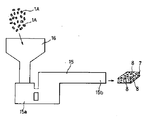
図3は、図1のペレット1Aから作られる発泡材7の製造方法を示す工程概略図である。発泡材7は、押出機15を使用して製造され、押出機15の先端部15bに取り付けられたダイ(図示せず)によって板状に成型される。
【0040】
発泡材7の製造方法では、押出機15の後端部15aに取り付けられたホッパ16から多数のペレット1Aが投入され、ペレット1Aが押出機15の内部に進入する。
【0041】
押出機15の内部では、ペレット1Aが加熱されるとともに、押出機15のスクリュ(図示せず)の回転によってペレット1Aが加圧されながら混練される。押出機15の内部では、親水性高分子2と合成樹脂3とが溶解し、ペレット1Aが所定温度の高温流動物(図示せず)になる。流動物には、植物繊維4と無機化合物5との微粉体P3,P4が略均一に分散している。なお、ペレット1Aは、100〜490Nの圧力で崩壊するので、スクリュの回転によってペレット1Aを容易に砕くことができる。
【0042】
押出機15の内部でペレット1Aが高温流動物に変わると、ペレット1Aに含まれる水分が瞬時に気化し、水分が気化前の体積の約1200倍以上の体積を有する蒸気に変化する。流動物の内部には、水分の気化によって多数の気泡8が形成される。流動物は、ダイから押し出された瞬間に、気泡8の膨張にともなって所定の倍率に膨張する。流動物は、ダイから押し出された後、冷却固化して板状の発泡材7となる。
【0043】
図3に示す発泡材7の製造方法では、微粉体P1,P2,P3,P4が略均一に分散するペレット1Aを使用しているので、ペレット1Aを加熱、混練することによって形成される流動物に微粉体P3,P4を均一に分散させることができ、微粉体P3,P4のいずれかが製造された発泡材7の一部分に偏在することはなく、発泡材7の強度が部分的に低下することはない。
【0044】
発泡材7では、親水性高分子2が気泡8を包被する膜を形成する。発泡材7の発泡倍率は、発泡前の流動物の単位体積当たり20〜80倍である。発泡材7の燃焼カロリーは、4500〜6000kcal/kgの範囲にある。
【0045】
押出機15では、その内部に進入したペレット1Aを150〜190℃に加熱している。ペレット1Aの加熱温度が150℃未満では、押出機15の内部において親水性高分子2と合成樹脂3との微粉体P1,P2が溶解せず、ペレット1Aを高温流動物にすることができない。ペレット1Aの加熱温度が190℃を超過すると、親水性高分子2や合成樹脂3、植物繊維4の性状が変化し、特に、植物繊維4が黄ばんだり、黒ずんだりすることで、発泡材7が変色してしまう場合がある。
【0046】
ペレット1Aでは、その全重量に対する親水性高分子2の重量比が5〜69.5%、その全重量に対する合成樹脂3の重量比が10〜50%の範囲にある。ペレット1Aでは、その全重量に対する植物繊維4の重量比が20〜60%、その全重量に対する無機化合物5の重量比が0.5〜35%の範囲にある。ペレット1Aの全重量に対する親水性高分子2の重量比は、20〜69.5%の範囲にあることが好ましい。
【0047】
なお、このペレット1Aの製造方法では、混練機11で製造される流動性混合物6の全重量に対する親水性高分子2の重量比が5〜69.5%、流動性混合物6の全重量に対する合成樹脂3の重量比が10〜50%、流動性混合物6の全重量に対する植物繊維4の重量比が20〜60%、流動性混合物6の全重量に対する無機化合物5の重量比が0.5〜35%の範囲にある。
【0048】
親水性高分子2の重量比が5%未満では、親水性高分子2の接着機能を十分に利用することができないので、親水性高分子2によって合成樹脂3と植物繊維4と無機化合物5とを接着することができず、所定形状のペレット1Aを製造することができない。
【0049】
合成樹脂3の重量比が10%未満では、ペレット1Aから製造された発泡材7の強度が著しく低下し、発泡材7が容易に破損してしまう。合成樹脂3の重量比が50%を超過すると、ペレット1Aの燃焼カロリーが増加し、その結果、ペレット1Aから製造される発泡材7の燃焼カロリーが6000kcal/kgを超えてしまう。
【0050】
植物繊維4の重量比が20%未満かつ無機化合物5の重量比が0.5%未満では、ペレット1Aの燃焼カロリーを低下させることができず、ペレット1Aから製造された発泡材7の燃焼カロリーを低下させることができない。
【0051】
植物繊維4の重量比が60%超過し、または、無機化合物5の重量比が35%を超過すると、加熱しても流動性を示さない植物繊維4や無機化合物5が押出機15の内部における流動物の流動性を妨げ、定量の流動物をダイから押し出すことができず、流動物の押出不良が生じる。また、ペレット1Aから発泡材7を製造するときに、植物繊維4がダイの一部分に集中し、それによってダイが目詰まりを起こす場合があるので、発泡材7を長時間連続して製造することが困難になる。さらに、ペレット1Aから製造される発泡材7の強度が低下してしまう。
【0052】
ペレット1Aは、その全重量に対する水分量が5〜30%の範囲にある。ペレット1Aの水分量が5%未満では、ペレット1Aを使用して発泡材7を製造するときに、押出機15の内部における高温流動物の発泡が不十分となり、ペレット1Aから製造される発泡材7の発泡倍率が20%以下になってしまう。ペレット1Aの水分量が30%を超過すると、ペレット1Aが著しく脆弱となり、それが100N未満の圧力で容易に崩壊し、その形態を保持することができない。
【0053】
ペレット1Aの長さが10.0mmを超過かつ直径が5.0mmを超過すると、ペレット1Aが必要以上に大きくなり、押出機15の内部においてペレット1Aが迅速に崩壊かつ溶解せず、押出機15のスクリュの噛み込み不良やスクリュの回転に脈動が生じ、押出機15の内部において流動物が発泡過剰や発泡不良を起こしてしまう場合がある。ペレット1Aの嵩比重が0.2未満では、押出機15のスクリュが空回りを起こし、スクリュの回転に脈動が生じる場合がある。
【0054】
親水性高分子2や合成樹脂3、植物繊維4、無機化合物5、の微粉体P1,P2,P3,P4の粒子径が30μm未満では、それらを30μm未満の粒子径に加工するために複数の粉砕工程を必要とするので、ペレット1Aの生産コストが上昇してしまう。それらの微粉体P1,P2,P3,P4の粒子径が200μmを超過すると、ペレット1Aの製造時に微粉体P1,P2,P3,P4が分散不良を起こし、ペレット1Aにそれら微粉体P1,P2,P3,P4を均一に分散させることができない。
【0055】
図4は、他の一例として示すペレット1Bの斜視図である。このペレット1Bは、図1のそれと同様に、押出成形の技術を利用して作られる発泡材7(成型品)の原料を構成する(図6参照)。
【0056】
このペレット1Bは、親水性高分子2から形成された微粉体P1(第1微粉体)と、植物繊維4と無機化合物5とから形成された微粉体P3,P4(第2微粉体)とを所定の割合で混合した混合物である(図5参照)。ペレット1Bは、角柱状を呈する固形物であり、所定量の水分を含有する。
【0057】
ペレット1Bの全重量に対する水分量やペレット1Bの嵩比重は、図1のそれらと同一である。ペレット1Bは、100〜490Nの圧力で崩壊するとともに、150〜190℃の温度で溶解する。
【0058】
ペレット1Bには、親水性高分子2の微粉体P1、植物繊維4の微粉体P3、無機化合物5の微粉体P4、の各々が略均一に分散している。それら微粉体P1,P3,P4は、その粒子径が30〜200μmの範囲にある。親水性高分子2や植物繊維4、無機化合物5には、図1のそれらと同一の素材が使用されている。
【0059】
図5は、図4のペレット1Bの製造方法を示す工程概略図である。このペレット1Bの製造方法は、図1のそれと同様に、混練機11を使用して流動性混合物6を製造する混合物製造工程S1と、造粒機12を使用して混合物6からペレット1Bを製造するペレット製造工程S2とから形成されている。
【0060】
混合物製造工程S1では、親水性高分子2と植物繊維4と無機化合物5との微粉体P1,P3,P4が混練機11に投入されるとともに、水Wが混練機11に注入される。混練機11の内部では、スクリュの回転によってそれら微粉体P1,P3,P4が水Wとともに混練され、粘性を有する粘土状の流動性混合物6が製造される。混練機11に注入される水Wの割合(混合物製造工程で加えられる水の重量比)や水Wの温度は、図2のそれらと同一である。
【0061】
ペレット製造工程S2では、混合物6が配管13を通ってホッパ14からスクリュ押出し造粒機12の内部に流入する。造粒機12の内部では、混合物6がスクリュ(図示せず)の回転によって加圧されながら造粒機12の先端部12bへ向かって移動する。混合物6は、造粒機12の先端部12bに取り付けられたパンチングプレート(図示せず)から造粒機12の外部へ排出される。混合物6は、パンチングプレートに形成された四角形の多数の開孔によって角柱状に成形されるとともに、所定の長さに切断される。その後、混合物6が自然乾燥され、多数のペレット1Bが製造される。
【0062】
ペレット1Bの製造方法では、親水性高分子2や植物繊維4、無機化合物5、の微粉体P1,P3,P4が水Wとともに十分に混練されるので、製造されたペレット1Bにそれらの微粉体P1,P3,P4を略均一に分散させることができる。微粉体P1,P3,P4は、粒子径が30〜200μmの範囲にあるので、それら微粉体P1,P3,P4の比重や嵩が大きく異なることはなく、微粉体P1,P3,P4のいずれかがペレット1Aの一部分に偏在することはない。
【0063】
図6は、図4のペレット1Bから作られる発泡材7の製造方法を示す工程概略図である。発泡材7は、押出機15を使用して製造され、押出機15に取り付けられたダイ(図示せず)から押し出すことによって板状に成型される。
【0064】
押出機15のホッパ16には、多数のペレット1Bとともに所定量のポリオレフィン系熱可塑性合成樹脂3の微粉体P2が投入される。押出機15の内部では、ペレット1Bと合成樹脂3の微粉体P2とが加熱されるとともに、押出機15のスクリュ(図示せず)の回転によってそれらが混練され、親水性高分子2と合成樹脂3との微粉体P1,P2が溶解して所定温度の高温流動物になる。
【0065】
押出機15の内部では、ペレット1Bに含まれる水分が瞬時に気化し、水分が気化前の単位体積の約1200倍以上の体積を有する気体に変化することで、流動物の内部に多数の気泡8が形成される。流動物は、ダイから押し出される瞬間に、気泡8が膨張することにともなって所与倍率に膨張する。流動物は、ダイから押し出された後、冷却固化して板状の発泡材7となる。
【0066】
発泡材7では、親水性高分子2が気泡8を包被する膜を形成する。発泡材7の発泡倍率は、発泡前の流動物の単位体積当たり20〜80倍である。発泡材7の燃焼カロリーは、4500〜6000kcal/kgの範囲にある。ペレット1Bと微粉体P2とに対する押出機15の加熱温度は、図3のそれと同一である。
【0067】
図6に示す発泡材7の製造方法では、微粉体P1,P3,P4が略均一に分散するペレット1Bと合成樹脂3の微粉体P2とを使用しているので、ペレット1Aを加熱、混練することによって形成される流動物に微粉体P3,P4を均一に分散させることができ、製造された発泡材7の一部分に微粉体P3,P4のいずれかが偏在することはなく、発泡材7の強度が部分的に低下することはない。
【0068】
このペレット1Bでは、その全重量に対する親水性高分子2の重量比が5〜69.5%、その全重量に対する植物繊維4の重量比が20〜60%、その全重量に対する無機化合物5の重量比が0.5〜35%の範囲にある。ペレット1Bの全重量に対する親水性高分子2の重量比は、20〜69.5%の範囲にあることが好ましい。
【0069】
なお、このペレット1Bの製造方法では、混練機11で製造される流動性混合物6の全重量に対する親水性高分子2の重量比が5〜69.5%、流動性混合物6の全重量に対する植物繊維4の重量比が20〜60%、流動性混合物6の全重量に対する無機化合物5の重量比が0.5〜35%の範囲にある。
【0070】
親水性高分子2の重量比が5%未満では、親水性高分子2の接着力が低下し、親水性高分子2によって植物繊維4と無機化合物5とを接着することができず、所定形状のペレット1Bを製造することができない。
【0071】
植物繊維4の重量比が20%未満かつ無機化合物5の重量比が0.5%未満では、ペレット1Bの燃焼カロリーを低下させることができず、その結果、ペレット1Bから製造される発泡材7の燃焼カロリーが6000kcal/kgを超えてしまう。
【0072】
植物繊維4の重量比が60%超過し、または、無機化合物5の重量比が35%を超過すると、加熱しても流動性を示さない植物繊維4や無機化合物5が押出機15の内部における流動物の流動性を妨げ、定量の流動物をダイから押し出すことができず、流動物の押出不良が生じる。また、ペレット1Bから発泡材7を製造するときに、植物繊維4がダイの一部分に集中し、それによってダイが目詰まりを起こす場合があるので、発泡材7を長時間連続して製造することが困難になる。
【0073】
ペレット1Bから発泡材7を製造する製造方法において、押出機15に投入する合成樹脂3の重量比は、押出機15に投入するペレット1Bの全重量に対して10〜50%の範囲にあることが好ましい。
【0074】
ペレットは、親水性高分子2の微粉体P1(第1微粉体)と、ポリオレフィン系熱可塑性合成樹脂3と植物繊維4と無機化合物5とのうちから選択された少なくとも1つの微粉体P2,P3,P4(第2微粉体)とを混合した混合物であればよい。たとえば、ペレットが親水性高分子2の微粉体P1と合成樹脂3の微粉体P2との混合物、ペレットが親水性高分子2の微粉体P1と植物繊維4の微粉体P3との混合物、ペレットが親水性高分子2の微粉体P1と無機化合物5の微粉体P4との混合物であってもよい。さらに、ペレットが親水性高分子2の微粉体P1と合成樹脂3および植物繊維4の微粉体P2,P3との混合物、ペレットが親水性高分子2の微粉体P1と合成樹脂3および無機化合物5の微粉体P2,P4との混合物であってもよい。
【0075】
ペレットは、その形状を図示の円柱状や角柱状に限定するものではなく、ペレットの製造工程においてその形状を変えることができる。
【0076】
【発明の効果】
本発明に係るペレットは、親水性高分子から形成された微粉体(第1微粉体)と、ポリオレフィン系熱可塑性合成樹脂と植物繊維と無機化合物とのうちの少なくとも1つから形成された微粉体(第2微粉体)とを混合した混合物であり、それら微粉体がペレットに略均一に分散している。このペレットは、それを形成する微粉体の粒子径が30〜200μmの範囲にあり、それら微粉体の比重や嵩が大きく異なることはなく、親水性高分子や合成樹脂、植物繊維、無機化合物の微粉体のいずれかがペレットの一部分に偏在することはない。
【0077】
このペレットは、それを使用して成型品を製造するときに、押出機の内部における微粉体の分散不良を防ぐことができ、植物繊維と無機化合物との微粉体のいずれかが成型品の一部分に偏在することはなく、成型品の強度の低下を防ぐことができる。
【0078】
このペレットは、その全重量に対する水分含有量が5〜30%の範囲にあり、ペレットを押出機に投入すると、ペレットが溶解して高温の流動物になるとともに水分が気化し、流動物に多数の気泡が形成されるので、ペレットを使用して容易に発泡材を製造することができる。
【0079】
植物繊維と無機化合物とを含有するペレットは、それが合成樹脂のみから形成されている場合と比較し、ペレットから製造された成型品の焼却時における燃焼カロリーを低下させることができる。
【0080】
本発明に係るペレットの製造方法では、ペレットを形成する微粉体を均一に分散させることができ、ペレットにおける微粉体の偏在を防ぐことができる。ゆえに、押出機を使用してペレットから成型品を製造するときに、押出機の内部で流動する流動物に微粉体が均一に分散し、定量の流動物を押出機のダイから円滑に押し出すことができ、ダイが目詰まりを起こすこともなく、押出機を使用して成型品を長時間連続して作ることができる。
【図面の簡単な説明】
【図1】一例として示すペレットの斜視図。
【図2】図1のペレットの製造方法の一例を示す工程概略図。
【図3】図1のペレットから作られる発泡材の製造方法を示す工程概略図。
【図4】他の一例として示すペレットの斜視図。
【図5】図4のペレットの製造方法の一例を示す工程概略図。
【図6】図4のペレットから作られる発泡材の製造方法を示す工程概略図。
【符号の説明】
1A ペレット
1B ペレット
2 親水性高分子
3 ポリオレフィン系合成樹脂
4 植物繊維
5 無機化合物
6 流動性混合物
7 発泡材(成型品)
11 混練機
12 造粒機
15 押出機
L1 長さ
L2 直径
P1 親水性高分子の微粉体(第1微粉体)
P2 ポリオレフィン系合成樹脂の微粉体(第2微粉体)
P3 植物繊維の微粉体(第2微粉体)
P4 無機化合物の微粉体(第2微粉体)
S1 混合物製造工程
S2 ペレット製造工程
W 水[0001]
TECHNICAL FIELD OF THE INVENTION
TECHNICAL FIELD The present invention relates to a pellet constituting a raw material of a molded article produced by molding and a method for producing the pellet.
[0002]
[Prior art]
Japanese Patent Application Laid-Open No. 2000-273800 discloses that a paper component, a thermoplastic synthetic resin, a vegetable material, and water are kneaded while being heated inside an extruder, and are synthesized with the paper component by utilizing vaporization of water inside the extruder. A foamed material obtained by foaming a mixture of a resin and a plant material at a predetermined magnification and a method for producing the foamed material are disclosed.
[0003]
This foamed material uses crushed waste paper as a paper component, uses a powdery polypropylene homopolymer as a synthetic resin, and uses corn starch as a plant material. This foam material contains crushed waste paper and corn starch, which helps to use resources effectively and incinerates the foam material compared to the case where the foam material is made only of synthetic resin. Burning calories at the time can be reduced.
[0004]
[Problems to be solved by the invention]
In the foamed material disclosed in the above publication, since the specific gravity and bulk of each of the crushed product and the powdery polypropylene homopolymer and the corn starch are different, they were not uniformly dispersed inside the extruder during the production of the foamed material, and were manufactured. Crushed materials and corn starch may be unevenly distributed in a part of the foam material. If the crushed material or the corn starch is unevenly distributed in a part of the foam material, the strength of the foam material in that part is significantly reduced.
[0005]
During the production of this foam material, due to poor dispersion of the crushed material inside the extruder, the crushed material concentrates on the screw of the extruder, the crushed material is entangled with the screw, and the biting of the screw with the mixture becomes unstable, These may cause pulsation in the rotation of the screw, resulting in excessive foaming or poor foaming of the mixture. Also, during the production of this foam material, the crushed material may concentrate on a part of the die due to poor dispersion of the crushed material inside the extruder, and the die may be clogged. It becomes difficult to manufacture.
[0006]
An object of the present invention is to provide a pellet capable of preventing poor dispersion of raw materials in an extruder and continuously producing a molded product using the extruder for a long time, and a method for producing the pellet. .
[0007]
[Means for Solving the Problems]
The premise of the present invention for solving the above-mentioned problems is a pellet constituting a raw material of a molded article produced by molding.
[0008]
The feature of the present invention based on the above premise is that the pellet is formed from at least one of a first fine powder formed of a hydrophilic polymer, a polyolefin-based thermoplastic synthetic resin, a plant fiber, and an inorganic compound. A mixture with a second fine powder, containing a predetermined amount of water, a particle diameter of the first and second fine powders in a range of 30 to 200 μm, and a water content of the pellets, The first and second fine powders are in a range of 5 to 30% with respect to the weight, and are substantially uniformly dispersed in the pellets.
[0009]
As an example of an embodiment of the present invention, the weight ratio of the hydrophilic polymer to the total weight of the pellets is 5 to 69.5%, and the weight ratio of the synthetic resin to the total weight of the pellets is 10 to 50%. The weight ratio of the plant fiber to the total weight of the pellets is in the range of 20 to 60%, and the weight ratio of the inorganic compound to the total weight of the pellets is in the range of 0.5 to 35%.
[0010]
As another example of the embodiment of the present invention, the pellet collapses at a pressure of 100 to 490 N and melts at a temperature of 150 to 190 ° C.
[0011]
As another example of the embodiment of the present invention, the bulk specific gravity of the pellet is in the range of 0.2 to 1.0.
[0012]
As another example of the embodiment of the present invention, the pellet has a substantially columnar shape, the length of the pellet is in a range of 0.5 to 10.0 mm, and the diameter of the pellet is 1.0 to 1.0 mm. It is in the range of 5.0 mm.
[0013]
Another premise of the present invention for solving the above-mentioned problems is a method for producing pellets constituting a raw material of a molded product produced by molding.
[0014]
The feature of the present invention in the production method is that the method is formed from a first fine powder formed of a hydrophilic polymer, at least one of a polyolefin-based thermoplastic synthetic resin, a plant fiber, and an inorganic compound. Water, and mixing the first and second fine powders with the water to produce a flowable mixture; and wet-granulating the flowable mixture, followed by drying. The first and second fine powders have a particle diameter in the range of 30 to 200 μm, and the proportion of the water added in the mixture production step is the same as the mixture production step. In the range of 20 to 50% based on the total weight of the first and second fine powders kneaded.
[0015]
BEST MODE FOR CARRYING OUT THE INVENTION
The details of the pellet and the method for producing the pellet according to the present invention will be described below with reference to the accompanying drawings.
[0016]
FIG. 1 is a perspective view of a
[0017]
The
[0018]
In the
[0019]
The
[0020]
As the
[0021]
Starch can be used as a plant-based natural polymer. As the starch, at least one of potato, sweet potato, corn starch, rice starch, wheat starch, konjac, tapioca, modified starch, and modified starch can be used. As the plant-based natural polymer, at least one of glue, agar, bran, nuka, okara, and gelatin can be used in addition to starch.
[0022]
For the synthetic polymer, at least one of polyvinyl alcohol, acrylate, maleate, and fat wax can be used. The fine powder P1 of the
[0023]
As the polyolefin-based thermoplastic
[0024]
As the polypropylene, at least one of block polymerized polypropylene, random polymerized polypropylene, homopolymerized polypropylene, metallocene catalyzed polypropylene, and modified polypropylene can be used.
[0025]
As the polyethylene, at least one of low-density polyethylene, linear low-density polyethylene, medium-density polyethylene, high-density polyethylene, metallocene-catalyzed polyethylene, and modified polyethylene can be used.
[0026]
As the fine powder P2 of the
[0027]
Paper is used for the
[0028]
Pulp before papermaking can also be used for the
[0029]
As the pulp, at least one of mechanical pulp, chemical mechanical pulp, semi-chemical pulp, and chemical pulp can be used. As the pulp, wood pulp is preferably used, but at least one of rag pulp, stalk pulp, bast pulp and the like can be mixed with wood pulp. It is preferable to use a pulp that does not contain chlorine and an optical brightener.
[0030]
As the
[0031]
As the
[0032]
FIG. 2 is a process schematic diagram showing a method of manufacturing the
[0033]
In the mixture production step S1, fine powders P1, P2, P3, and P4 (first and second fine powders) of the
[0034]
The ratio of the water W injected into the kneader 11 (the weight ratio of the water added in the mixture production step) is determined by the total weight of the fine powders P1, P2, P3, and P4 supplied to the kneader 11 (The total weight of the first and second fine powders). The temperature of the water W is in the range of 1 to 30C. Tap water can be used as the water W. The water W is not particularly limited, and may be any of soft water, hard water, and pure water.
[0035]
When the ratio of water W injected into the
[0036]
In the pellet manufacturing step S2, the mixture 6 discharged from the
[0037]
The mixture 6 is discharged to the outside of the
[0038]
In the method for producing the
[0039]
FIG. 3 is a process schematic diagram showing a method for producing a
[0040]
In the method for producing the
[0041]
Inside the
[0042]
When the
[0043]
In the method for manufacturing the
[0044]
In the
[0045]
In the
[0046]
In the
[0047]
In the method for producing the
[0048]
If the weight ratio of the
[0049]
If the weight ratio of the
[0050]
If the weight ratio of the
[0051]
If the weight ratio of the
[0052]
The water content of the
[0053]
If the length of the
[0054]
When the particle diameter of the fine powders P1, P2, P3, and P4 of the
[0055]
FIG. 4 is a perspective view of a
[0056]
The
[0057]
The water content relative to the total weight of the
[0058]
In the
[0059]
FIG. 5 is a process schematic diagram showing a method for manufacturing the
[0060]
In the mixture production step S1, fine powders P1, P3, and P4 of the
[0061]
In the pellet manufacturing step S2, the mixture 6 flows into the
[0062]
In the manufacturing method of the
[0063]
FIG. 6 is a process schematic diagram showing a method for manufacturing the foamed
[0064]
A predetermined amount of the fine powder P2 of the polyolefin-based thermoplastic
[0065]
Inside the
[0066]
In the
[0067]
In the method for manufacturing the
[0068]
In the
[0069]
In the method for producing the
[0070]
When the weight ratio of the
[0071]
If the weight ratio of the
[0072]
If the weight ratio of the
[0073]
In the production method for producing the foamed
[0074]
The pellets are at least one fine powder P2, P3 selected from the fine powder P1 (first fine powder) of the
[0075]
The shape of the pellet is not limited to the illustrated columnar shape or prismatic shape, and the shape can be changed in the pellet manufacturing process.
[0076]
【The invention's effect】
The pellets according to the present invention include a fine powder (first fine powder) formed from a hydrophilic polymer, and a fine powder formed from at least one of a polyolefin-based thermoplastic synthetic resin, a plant fiber, and an inorganic compound. (Second fine powder), and the fine powder is substantially uniformly dispersed in the pellets. The pellets have a particle diameter of 30 to 200 μm in the fine powder forming the pellets, and the specific gravity and bulk of the fine powders are not largely different, and the hydrophilic polymer, the synthetic resin, the plant fiber, and the inorganic compound are used. Either of the fine powders is not unevenly distributed on a part of the pellet.
[0077]
This pellet can prevent poor dispersion of the fine powder inside the extruder when manufacturing a molded product using the pellet, and any one of the fine powder of the plant fiber and the inorganic compound is part of the molded product. And the strength of the molded product can be prevented from lowering.
[0078]
The pellets have a water content in the range of 5 to 30% based on the total weight of the pellets. When the pellets are put into an extruder, the pellets are dissolved to become a high-temperature fluid, and water is vaporized. Thus, a foam material can be easily produced using the pellets.
[0079]
Pellets containing vegetable fibers and inorganic compounds can reduce the calories burned during incineration of molded products produced from the pellets, as compared to the case where they are formed only of synthetic resin.
[0080]
ADVANTAGE OF THE INVENTION In the manufacturing method of the pellet which concerns on this invention, the fine powder which forms a pellet can be uniformly disperse | distributed, and the uneven distribution of the fine powder in a pellet can be prevented. Therefore, when manufacturing a molded product from pellets using an extruder, the fine powder is uniformly dispersed in the fluid flowing inside the extruder, and a fixed amount of fluid is smoothly extruded from the die of the extruder. The molding can be continuously performed for a long time using an extruder without causing clogging of a die.
[Brief description of the drawings]
FIG. 1 is a perspective view of a pellet shown as an example.
FIG. 2 is a schematic process diagram showing an example of a method for producing the pellet of FIG.
FIG. 3 is a schematic process diagram showing a method for producing a foamed material made from the pellets of FIG.
FIG. 4 is a perspective view of a pellet shown as another example.
FIG. 5 is a schematic process diagram showing an example of a method for producing the pellet of FIG.
FIG. 6 is a process schematic diagram showing a method for producing a foamed material made from the pellets of FIG.
[Explanation of symbols]
1A pellet
1B pellet
2 hydrophilic polymer
3 Polyolefin synthetic resin
4 Plant fiber
5 Inorganic compounds
6. Fluid mixture
7 Foam (molded product)
11 Kneading machine
12 Granulator
15 Extruder
L1 length
L2 diameter
P1 Fine powder of hydrophilic polymer (first fine powder)
P2 Fine powder of polyolefin synthetic resin (second fine powder)
P3 Fine powder of vegetable fiber (second fine powder)
P4 Fine powder of inorganic compound (second fine powder)
S1 mixture production process
S2 Pellet manufacturing process
W water
Claims (6)
前記ペレットが、親水性高分子から形成された第1微粉体と、ポリオレフィン系熱可塑性合成樹脂と植物繊維と無機化合物とのうちの少なくとも1つから形成された第2微粉体との混合物であって、所定量の水分を含有し、
前記第1および第2微粉体の粒子径が、30〜200μmの範囲、前記ペレットの水分含有量が、前記ペレットの全重量に対して5〜30%の範囲にあり、前記第1および第2微粉体が、前記ペレットに略均一に分散していることを特徴とする前記ペレット。In the pellets constituting the raw material of the molded product made by the molding process,
The pellet is a mixture of a first fine powder formed from a hydrophilic polymer, and a second fine powder formed from at least one of a polyolefin-based thermoplastic synthetic resin, plant fiber, and an inorganic compound. Contains a predetermined amount of water,
The particle diameter of the first and second fine powders is in the range of 30 to 200 μm, the water content of the pellets is in the range of 5 to 30% based on the total weight of the pellets, and the first and second fine powders are in the range of 5 to 30%. The pellet, wherein the fine powder is substantially uniformly dispersed in the pellet.
前記方法が、親水性高分子から形成された第1微粉体と、ポリオレフィン系熱可塑性合成樹脂と植物繊維と無機化合物とのうちの少なくとも1つから形成された第2微粉体とに水を加え、前記第1および第2微粉体を前記水とともに混練して流動性混合物を製造する混合物製造工程と、前記流動性混合物を湿式造粒した後、乾燥させて前記ペレットを製造するペレット製造工程とから形成され、
前記第1および第2微粉体の粒子径が、30〜200μmの範囲、前記混合物製造工程で加えられる前記水の割合が、前記混合物製造工程で混練される前記第1および第2微粉体の全重量に対して20〜50%の範囲にあることを特徴とする前記方法。In a method for producing pellets constituting a raw material of a molded product made by molding,
The method comprises adding water to a first fine powder formed from a hydrophilic polymer, and a second fine powder formed from at least one of a polyolefin-based thermoplastic synthetic resin, plant fiber, and an inorganic compound. A mixture producing step of producing a fluid mixture by kneading the first and second fine powders with the water, and a pellet producing step of producing the pellets by wet granulating the fluid mixture and then drying. Formed from
The particle diameter of the first and second fine powders is in the range of 30 to 200 μm, and the ratio of the water added in the mixture manufacturing step is the same as that of the first and second fine powders kneaded in the mixture manufacturing step. The above method, wherein the amount is in the range of 20% to 50% by weight.
Priority Applications (1)
| Application Number | Priority Date | Filing Date | Title |
|---|---|---|---|
| JP2002173267A JP3831687B2 (en) | 2002-06-13 | 2002-06-13 | Pellets and manufacturing method thereof |
Applications Claiming Priority (1)
| Application Number | Priority Date | Filing Date | Title |
|---|---|---|---|
| JP2002173267A JP3831687B2 (en) | 2002-06-13 | 2002-06-13 | Pellets and manufacturing method thereof |
Publications (2)
| Publication Number | Publication Date |
|---|---|
| JP2004018603A true JP2004018603A (en) | 2004-01-22 |
| JP3831687B2 JP3831687B2 (en) | 2006-10-11 |
Family
ID=31172601
Family Applications (1)
| Application Number | Title | Priority Date | Filing Date |
|---|---|---|---|
| JP2002173267A Expired - Lifetime JP3831687B2 (en) | 2002-06-13 | 2002-06-13 | Pellets and manufacturing method thereof |
Country Status (1)
| Country | Link |
|---|---|
| JP (1) | JP3831687B2 (en) |
Cited By (8)
| Publication number | Priority date | Publication date | Assignee | Title |
|---|---|---|---|---|
| WO2008010325A1 (en) * | 2006-07-18 | 2008-01-24 | Kankyokeieisogokenkyusho Co., Inc. | Process for producing pellet |
| WO2008136314A1 (en) * | 2007-05-01 | 2008-11-13 | Agri Future Joetsu Co., Ltd. | Polymer composite material, apparatus for producing the same and method of producing the same |
| JP2008296569A (en) * | 2007-05-01 | 2008-12-11 | Agri Future Joetsu Co Ltd | Polymer composite material manufacturing apparatus and manufacturing method thereof |
| JP2009057531A (en) * | 2007-08-03 | 2009-03-19 | Agri Future Joetsu Co Ltd | Biomass resin concentrate and composite material manufacturing method |
| JP2011045866A (en) * | 2009-07-30 | 2011-03-10 | Kankyo Keiei Sogo Kenkyusho:Kk | Method for manufacturing fine paper flour, and fine paper flour-containing resin composition |
| JP2016113850A (en) * | 2014-12-17 | 2016-06-23 | サザンワークス株式会社 | Chip for artificial lawn |
| DE102016212334A1 (en) | 2015-07-07 | 2017-01-12 | Toyo Tire & Rubber Co., Ltd. | A rubber composition for a tire, tire and method of manufacturing the tire |
| CN114144291A (en) * | 2019-03-29 | 2022-03-04 | 陶氏环球技术有限责任公司 | Pellets containing additives |
Families Citing this family (2)
| Publication number | Priority date | Publication date | Assignee | Title |
|---|---|---|---|---|
| JP4926560B2 (en) * | 2006-06-27 | 2012-05-09 | 株式会社環境経営総合研究所 | Chair |
| JP4881424B2 (en) * | 2009-11-10 | 2012-02-22 | 株式会社環境経営総合研究所 | Production method of foam material |
-
2002
- 2002-06-13 JP JP2002173267A patent/JP3831687B2/en not_active Expired - Lifetime
Cited By (12)
| Publication number | Priority date | Publication date | Assignee | Title |
|---|---|---|---|---|
| WO2008010325A1 (en) * | 2006-07-18 | 2008-01-24 | Kankyokeieisogokenkyusho Co., Inc. | Process for producing pellet |
| JP2008023724A (en) * | 2006-07-18 | 2008-02-07 | Kankyo Keiei Sogo Kenkyusho:Kk | Pellet manufacturing method |
| WO2008136314A1 (en) * | 2007-05-01 | 2008-11-13 | Agri Future Joetsu Co., Ltd. | Polymer composite material, apparatus for producing the same and method of producing the same |
| JP2008296569A (en) * | 2007-05-01 | 2008-12-11 | Agri Future Joetsu Co Ltd | Polymer composite material manufacturing apparatus and manufacturing method thereof |
| JP2009057531A (en) * | 2007-08-03 | 2009-03-19 | Agri Future Joetsu Co Ltd | Biomass resin concentrate and composite material manufacturing method |
| JP2011045866A (en) * | 2009-07-30 | 2011-03-10 | Kankyo Keiei Sogo Kenkyusho:Kk | Method for manufacturing fine paper flour, and fine paper flour-containing resin composition |
| JP2016113850A (en) * | 2014-12-17 | 2016-06-23 | サザンワークス株式会社 | Chip for artificial lawn |
| DE102016212334A1 (en) | 2015-07-07 | 2017-01-12 | Toyo Tire & Rubber Co., Ltd. | A rubber composition for a tire, tire and method of manufacturing the tire |
| CN106336534A (en) * | 2015-07-07 | 2017-01-18 | 东洋橡胶工业株式会社 | Rubber Composition For Tire, Tire, And Method For Manufacturing The Tire |
| US10030129B2 (en) | 2015-07-07 | 2018-07-24 | Toyo Tire & Rubber Co., Ltd. | Rubber composition for tire, tire, and method for manufacturing the tire |
| DE102016212334B4 (en) | 2015-07-07 | 2022-06-02 | Toyo Tire & Rubber Co., Ltd. | A rubber composition for a tire, use of the rubber composition for the tire, and method of using the rubber composition for manufacturing the tire |
| CN114144291A (en) * | 2019-03-29 | 2022-03-04 | 陶氏环球技术有限责任公司 | Pellets containing additives |
Also Published As
| Publication number | Publication date |
|---|---|
| JP3831687B2 (en) | 2006-10-11 |
Similar Documents
| Publication | Publication Date | Title |
|---|---|---|
| US4244903A (en) | Manufacture of flowable composite particulate material | |
| JPS59167240A (en) | Method and apparatus for manufacturing molding of organic filler-mixed thermoplastic resin composition | |
| AU2007311811B2 (en) | Method and device for producing wood composite material | |
| ES2203130T3 (en) | PROCESS AND APPARATUS FOR THE CONTINUOUS PRODUCTION OF POLYMER COMPOUNDS AND CELLULOSICAL FIBERS. | |
| CN101827884B (en) | Method for producing foam heat insulation material using paper and starch | |
| JP3831687B2 (en) | Pellets and manufacturing method thereof | |
| JP7061239B1 (en) | Manufacturing method of resin composite material, resin composite material and molded product | |
| JP4881424B2 (en) | Production method of foam material | |
| KR20100018504A (en) | Polymer composite material, apparatus for producing the same and method of producing the same | |
| JP4263337B2 (en) | Biodegradable foam and method for producing the same | |
| JP7433682B2 (en) | Particles and resin compositions | |
| JP2005199531A (en) | Pellets, manufacturing method thereof and molded products thereof | |
| JP2009263675A (en) | Method of manufacturing foaming material | |
| JP5193005B2 (en) | Assembled cushioning insulation | |
| JP5102241B2 (en) | Pellet for foam and manufacturing method thereof | |
| JP7121428B1 (en) | METHOD FOR MANUFACTURING BIOMASS MATERIAL-CONTAINING MOLDED BODY, METHOD FOR MANUFACTURING LAMINATED BODY, AND STARCH-CONTAINING MATERIAL | |
| JPH0971677A (en) | Biodegradable cushioning material and its production | |
| JP2001181511A (en) | Paper-containing resin composition for fabrication | |
| JPH10166355A (en) | How to make composites from wood flour and thermoplastics | |
| JP2002059976A (en) | Loose cushion made of foamed paper and manufacturing method therefor | |
| JP2024142720A (en) | Manufacturing method of sheet-shaped molded product and recycling method of sheet-shaped molded product | |
| JPH08134266A (en) | Water-resistant plant polymer composition and its production | |
| JP3009261B2 (en) | Moisture-proof starch molding | |
| JP3828435B2 (en) | Foam cushioning block | |
| JP4091891B2 (en) | Method for producing a wooden molded body |
Legal Events
| Date | Code | Title | Description |
|---|---|---|---|
| A621 | Written request for application examination |
Free format text: JAPANESE INTERMEDIATE CODE: A621 Effective date: 20050328 |
|
| RD04 | Notification of resignation of power of attorney |
Free format text: JAPANESE INTERMEDIATE CODE: A7424 Effective date: 20050422 |
|
| A711 | Notification of change in applicant |
Free format text: JAPANESE INTERMEDIATE CODE: A711 Effective date: 20050906 |
|
| A521 | Request for written amendment filed |
Free format text: JAPANESE INTERMEDIATE CODE: A821 Effective date: 20050907 |
|
| A977 | Report on retrieval |
Free format text: JAPANESE INTERMEDIATE CODE: A971007 Effective date: 20051114 |
|
| A131 | Notification of reasons for refusal |
Free format text: JAPANESE INTERMEDIATE CODE: A131 Effective date: 20051122 |
|
| A521 | Request for written amendment filed |
Free format text: JAPANESE INTERMEDIATE CODE: A523 Effective date: 20060120 |
|
| A131 | Notification of reasons for refusal |
Free format text: JAPANESE INTERMEDIATE CODE: A131 Effective date: 20060228 |
|
| A521 | Request for written amendment filed |
Free format text: JAPANESE INTERMEDIATE CODE: A523 Effective date: 20060426 |
|
| TRDD | Decision of grant or rejection written | ||
| A01 | Written decision to grant a patent or to grant a registration (utility model) |
Free format text: JAPANESE INTERMEDIATE CODE: A01 Effective date: 20060711 |
|
| A61 | First payment of annual fees (during grant procedure) |
Free format text: JAPANESE INTERMEDIATE CODE: A61 Effective date: 20060714 |
|
| R150 | Certificate of patent or registration of utility model |
Ref document number: 3831687 Country of ref document: JP Free format text: JAPANESE INTERMEDIATE CODE: R150 Free format text: JAPANESE INTERMEDIATE CODE: R150 |
|
| FPAY | Renewal fee payment (event date is renewal date of database) |
Free format text: PAYMENT UNTIL: 20090721 Year of fee payment: 3 |
|
| FPAY | Renewal fee payment (event date is renewal date of database) |
Free format text: PAYMENT UNTIL: 20100721 Year of fee payment: 4 |
|
| R250 | Receipt of annual fees |
Free format text: JAPANESE INTERMEDIATE CODE: R250 |
|
| FPAY | Renewal fee payment (event date is renewal date of database) |
Free format text: PAYMENT UNTIL: 20100721 Year of fee payment: 4 |
|
| FPAY | Renewal fee payment (event date is renewal date of database) |
Free format text: PAYMENT UNTIL: 20110721 Year of fee payment: 5 |
|
| R250 | Receipt of annual fees |
Free format text: JAPANESE INTERMEDIATE CODE: R250 |
|
| FPAY | Renewal fee payment (event date is renewal date of database) |
Free format text: PAYMENT UNTIL: 20120721 Year of fee payment: 6 |
|
| R250 | Receipt of annual fees |
Free format text: JAPANESE INTERMEDIATE CODE: R250 |
|
| FPAY | Renewal fee payment (event date is renewal date of database) |
Free format text: PAYMENT UNTIL: 20130721 Year of fee payment: 7 |
|
| R250 | Receipt of annual fees |
Free format text: JAPANESE INTERMEDIATE CODE: R250 |
|
| R250 | Receipt of annual fees |
Free format text: JAPANESE INTERMEDIATE CODE: R250 |
|
| S111 | Request for change of ownership or part of ownership |
Free format text: JAPANESE INTERMEDIATE CODE: R313117 |
|
| S531 | Written request for registration of change of domicile |
Free format text: JAPANESE INTERMEDIATE CODE: R313531 |
|
| S533 | Written request for registration of change of name |
Free format text: JAPANESE INTERMEDIATE CODE: R313533 |
|
| R360 | Written notification for declining of transfer of rights |
Free format text: JAPANESE INTERMEDIATE CODE: R360 |
|
| R360 | Written notification for declining of transfer of rights |
Free format text: JAPANESE INTERMEDIATE CODE: R360 |
|
| R371 | Transfer withdrawn |
Free format text: JAPANESE INTERMEDIATE CODE: R371 |
|
| S111 | Request for change of ownership or part of ownership |
Free format text: JAPANESE INTERMEDIATE CODE: R313117 |
|
| S531 | Written request for registration of change of domicile |
Free format text: JAPANESE INTERMEDIATE CODE: R313531 |
|
| S533 | Written request for registration of change of name |
Free format text: JAPANESE INTERMEDIATE CODE: R313533 |
|
| R350 | Written notification of registration of transfer |
Free format text: JAPANESE INTERMEDIATE CODE: R350 |
|
| R350 | Written notification of registration of transfer |
Free format text: JAPANESE INTERMEDIATE CODE: R350 |
|
| R250 | Receipt of annual fees |
Free format text: JAPANESE INTERMEDIATE CODE: R250 |
|
| R250 | Receipt of annual fees |
Free format text: JAPANESE INTERMEDIATE CODE: R250 |
|
| R250 | Receipt of annual fees |
Free format text: JAPANESE INTERMEDIATE CODE: R250 |
|
| R250 | Receipt of annual fees |
Free format text: JAPANESE INTERMEDIATE CODE: R250 |
|
| R250 | Receipt of annual fees |
Free format text: JAPANESE INTERMEDIATE CODE: R250 |
|
| R250 | Receipt of annual fees |
Free format text: JAPANESE INTERMEDIATE CODE: R250 |
|
| R250 | Receipt of annual fees |
Free format text: JAPANESE INTERMEDIATE CODE: R250 |
|
| R250 | Receipt of annual fees |
Free format text: JAPANESE INTERMEDIATE CODE: R250 |
|
| EXPY | Cancellation because of completion of term |