【0001】
【発明の属する技術分野】
本発明は、単層又は多層の基材フイルムに、アルミニウム箔、接着層、シーラント層が順次積層された積層体において、リチウムイオン電池用外装材に関する。
【0002】
【従来の技術】
従来、工業製品などの包装材料においては、主にガスバリアー材としてアルミニウム箔が使用され、基材フイルムやシーラントフイルムと積層された積層体が用いられている。これらの積層体のバリアー材と樹脂フイルムからなるシーラント層の接着方法は、イソシアネート化合物からなる接着層を介して、ドライラミネート法や溶融押出ラミネート法を中心とした積層方法が一般的であった。
【0003】
近年、軽量で小型化が可能であり、本質的に高いエネルギー密度を有するリチウムイオン電池、及び電解質にポリマー電解質を使用し、その構成要素が全て固体状の高性能且つ安全性の高いリチウム電池が注目されている。
【0004】
このようなリチウムイオン電池の構造としては、例えばリチウムイオン電池の場合は正極側にアルミニウム箔、アルミニウム箔に対向して負極側に銅またはニッケル箔を設け、各金属箔上に、活物質、及び電解液を含む層を各々形成し、これらの層間に電解液を含むセパレータを設けた構成を有する発電要素と、これを封止する外装材とを有する。電解液には電解質と電解液とが含まれている。
【0005】
リチウムイオン電池の外装材としては、例えば表面層となる樹脂層とバリアー層となるアルミニウム層とシール部材となる熱溶解性のシーラント層との積層体が使用され、十分なバリアー効果、及びヒートシール性の他、電池の使用環境温度である約0℃〜80℃で性能劣化を生じないことが要求されている。
【0006】
しかしながら、電池の使用環境において、外装材のアルミニウム層が、内部電極との電気的短絡するという問題があった。
【0007】
【発明が解決しようとする課題】
本発明は、上記のような従来技術の問題点を鑑みてなされたものであり、その目的は、使用される外装材の耐電解液性を改良し、電池の使用環境において、外装材のアルミニウム層が、内部電極との電気的短絡することなく十分なライフを有するリチウムイオン電池用外装材を提供することにある。
【0008】
【課題を解決するための手段】
本発明の請求項1に係る発明は、単層又は多層の基材フイルムに、アルミニウム箔層、接着層、シーラント層が順次積層された積層体において、少なくともアルミニウム箔層の接着層側の面がカチオンエレクトロコーティング処理されていることを特徴とするリチウムイオン電池用外装材である。
【0009】
次に、本発明の請求項2に係る発明は、単層又は多層の基材フイルムに、アルミニウム箔層、接着層、シーラント層が順次積層された積層体において、アルミニウム箔層の両面がカチオンエレクトロコーティング処理されていることを特徴とするリチウムイオン電池用外装材である。
【0010】
本発明の請求項3に係る発明は、単層又は多層の基材フイルムに、アルミニウム箔層、接着層、シーラント層が順次積層された積層体において、少なくともアルミニウム箔層の接着層側の面がベーマイト処理及びカチオンエレクトロコーティング処理されていることを特徴とするリチウムイオン電池用外装材である。
【0011】
本発明の請求項4に係る発明は、単層又は多層の基材フイルムに、アルミニウム箔層、接着層、シーラント層が順次積層された積層体において、アルミニウム箔層の両面がベーマイト処理及びカチオンエレクトロコーティング処理されていることを特徴とするリチウムイオン電池用外装材である。
【0012】
【作用】
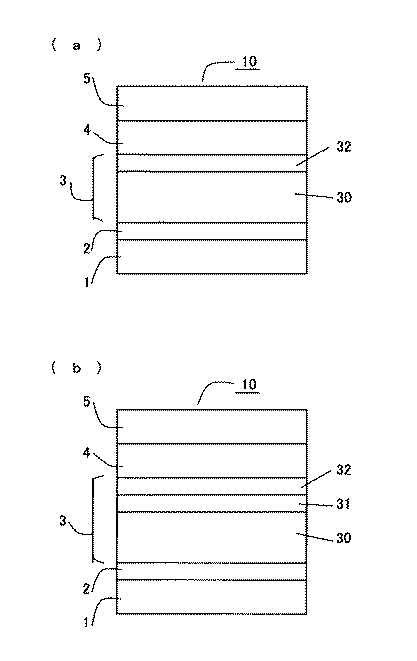
本発明によれば、アルミニウム箔(30)面にベーマイト及びカチオンエレクトロコーティング、又はカチオンエレクトロコーティング処理(32)が施されているので、高度な電気絶縁性、素材間密着性、耐熱性、表面の高硬度な薄膜被服層が形成されるため、外装材の耐電解液性が改良され、電池の使用環境において、外装材のアルミニウム箔層(3)が、内部電極との電気的短絡することがなく十分なライフを有するリチウムイオン電池用外装材を提供できる。
【0013】
【発明の実施の形態】
本発明のリチウムイオン電池用外装材を、実施の形態に沿って以下詳細に説明する。
【0014】
本発明の請求項1に係る発明を詳細に説明すれば、図1は本発明の一実施の形態を示す側断面図である。厚み方向の順に、基材フイルム(1)、接着剤層(2)、アルミニウム箔層(3)、接着層(4)、シーラント層(5)が形成されている。
【0015】
前記基材フイルム(1)は、2軸延伸ポリプロピレンフイルム(OPPフイルム)、2軸延伸ポリエステルフイルム(PETフイルム)、2軸延伸ナイロンフイルム(ONYフイルム)等単層フイルム又はこれらが積層された多層フイルムが好ましい。積層方法はポリウレタン系接着剤等を使用して、公知のドライラミネート法などで貼り合わせる。各々のフイルムの厚さは、OPPフイルムが20μm〜40μm、PETフイルムが6μm〜25μm、ONYフイルムが15μm〜25μmの範囲のものが利用できる。
【0016】
前記接着剤層(2)としては、一般的にドライラミネート用接着剤として使用される二液硬化型ウレタン系接着剤などを使用し、塗布方法としてはグラビアコート法、ロールコート法などで塗布する。接着剤の塗布量は1〜5g/m2(乾燥状態)である。
【0017】
前記アルミニウム箔層(3)としては、一般の軟質アルミニウム箔(30)が使用でき厚さとしては7μm〜100μmの範囲が利用できる。
【0018】
前記アルミニウム箔(30)の片面又は両面に施されるベーマイト処理(31)は、アンモニアあるいはトリエタノールアミンなどの添加剤を蒸留水中に0.01〜1.00重量%の範囲で処理液を調合し、その処理液を75〜100℃の範囲に加熱し、アルミニウム箔(30)の片面、又は両面を1分間以上前記処理液中に漬ける処理をすることで、ベーマイト処理層(31)を形成したアルミニウム箔層(3)を得ることができる。この処理は、コーター機などを使用してウエブ方式で処理しても良く、またはバッチ方式で処理しても良い。本発明の積層体においては、少なくともアルミニウム箔層(3)の接着層側のアルミニウム箔(30)片面がベーマイト処理(31)されているか、又は両面がベーマイト処理(31)されている。
【0019】
このベーマイト処理を行うことにより、アルミニウム箔(30)のベーマイト処理層(31)表面は針状構造になり、またその表面に−O−基を多く存在させることができ、シーラント層の樹脂フイルム表面の−O−基と水素結合を形成することなどにより、より密着強度を上げることができる。
【0020】
前記アルミニウム箔(30)に施されるカチオンエレクトロコーティング処理の一例は、カチオンエレクトロコーティングシステム(EAD)(日本ペイント(株)製造)に順守して処理を行う。前記カチオンエレクトロコーティングとは、水という安定な媒体中で、陰極に帯電させた導電体へ、均一に有機材料を薄膜被服(1μm〜50μm)させるシステムであり、電解活性型プロセスを併用したEAD−21(商品名、日本ペイント(株)製造)では高度な電気絶縁性、素材間密着性、耐熱性、表面の高硬度な薄膜被覆層(以下、カチオンエレクトロコーティング処理層(32)と記す)を形成するものである。
【0021】
前記EAD−21塗装仕様は、適用素材種類として、鉄系、亜鉛系、アルミニウム及びその他各種金属素材であり、電着塗装条件としては、膜厚5μm〜30μm、塗装電圧100V〜300V、塗装時間1.5〜6分、塗装浴温度20〜40℃より適宜選択して行う。焼き付け乾燥条件としては、温度170〜270℃、時間15〜60分から適宜選択することが好ましい。
【0022】
図1に示すように、カチオンエレクトロコーティング処理は、前記アルミニウム箔(30)に直接カチオンエレクトロコーティング処理層(32)を施すか、若しくは前記ベーマイト処理層(31)面上にカチオンエレクトロコーティング処理層(32)を形成するもので、ベーマイト処理層(31)を形成することにより、素材間密着性が強化され且つ表面高硬度の層を形成し、さらに電気絶縁性、耐熱性に優れたカチオンエレクトロコーティング処理層(32)を形成することができる。
【0023】
前記接着層(4)の1つの例としては、イソシアネート系モノマーか、これら重合体、誘導体よりなる、イソシアネート基を有する化合物より形成され、具体的には、2,4−トリレンジイソシアネート、2,6−トリレンジイソシアネート、キシレンジイソシアネート、イソホロンジイソシアネート、ヘキサメチレンジイソシアネート、4,4−ジフェニルメタンジイソシアネート等である。
【0024】
2つ目の前記接着層(4)の例としては、α、β−エチレン性不飽和カルボン酸で変性されたポリオレフィン樹脂(A)10〜90重量%、ポリオレフィン酸(未変性の)(B)90〜10重量%からなる樹脂混合物100重量%に対して、イソシアネート化合物(C)1〜10重量%の割合で配合された樹脂混合組成物からなっている。
【0025】
脂肪族系炭化水素および芳香族系炭化水素などの溶媒に前記の変性ポリオレフィン(A)とポリオレフィン(B)の樹脂混合組成物を15〜20%分散させた分散溶液を製造し、さらに、イソシアネート化合物(C)を添加配合し、最終的に3成分からなる組成物の分散溶液を調整製造する。この分散溶液を基材フイルムと張り合わせたアルミニウム箔の前記処理面(32)にグラビアコート法などの公知の方法で塗布した後、190〜230℃の高温で乾燥させ、溶媒を蒸発除去し、接着層(4)として耐熱接着層を形成する。続いて、その塗布面にシーラント層の樹脂フイルムを積層し、190℃以上の温度の加熱ロールで圧着して、ラミネートする。前記塗布量は1〜10g/m2(乾燥状態)が好ましい。
【0026】
上記2種類の接着層(4)は、適宜判断して最良の選択をすることが必要である。
【0027】
シーラント層(5)は、包装体を形成するために積層されるものである。例えばポリエチレン、ポリプロピレン、エチレン−酢酸ビニル共重合体、エチレン・アクリル酸共重合体、エチレン・メタクリル酸共重合体、エチレン・エチルアクリレート共重合体、アイオノマー樹脂などの1種、又は2種以上のブレンド物の熱可塑性樹脂からなるフイルム類を使用して、前述のごとき方法で積層される。厚さは目的に応じて決められるが、一般的には30μm〜100μmの範囲である。
【0028】
【実施例】
次に、本発明のリチウムイオン電池用外装材を、以下に具体的な実施例に従って説明する。
【0029】
<実施例1>
まず、厚さ50μmアルミニウム箔(30)の表面(片面)に直接、専用の電着塗装設備を用いて、商品名EAD−21塗装仕様(日本ペイント(株)製造)に準じてカチオンエレクトロコーティング処理層(32)を形成し、アルミニウム箔層(3)とした。前記塗装仕様の製造では、塗装電圧200V、塗装時間3分、塗装浴温度30℃の塗装条件で膜厚13μmの絶縁性樹脂層を析出形成し、該層の焼き付け乾燥条件では210℃、25分とした。以降の工程は全てドライラミネート機を使用して製造した。厚さ25μm2軸延伸ナイロンフイルム(ONYフイルム)の基材フイルム(1)を得た。次いで、前記基材フイルムのONYフイルム面に、接着剤層(2)としてグラビアコート法でポリウレタン系接着剤4g/m2(乾燥状態)塗布後、前記カチオンエレクトロコーティング処理層(32)を施したアルミニウム箔(3)を公知の方法で貼り合わせた。そのアルミニウム箔層(3)の処理(32)面に、接着層(4)として、グラビアコート法で固形分5重量%のトリレンジイソシアネート(東洋モ―トン(株)商品名CAT―10)溶液を、塗布量が4g/m2(乾燥状態)になるように塗布後、200℃で熱乾燥し、その塗布面とシーラント層(5)として厚さ50μmの未延伸単層フイルムの間に、200〜350℃の樹脂温度の熱可塑性のポリエチレン樹脂を5μm厚で溶融押出しラミネートする溶融押出ラミネート法で積層(サンドポリ層(55))して本発明のリチウムイオン電池用外装材を製造した。前記シーラント層(5)は単層PE(51)で、ポリエチレンフイルムである。(図1(a)参照)
【0030】
<実施例2>
厚さ50μmアルミニウム箔(30)の表面(片面)に直接、専用の電着塗装設備を用いて、商品名EAD−21塗装仕様(日本ペイント(株)製造)に準じてカチオンエレクトロコーティング処理(32)をし、アルミニウム箔層(3)とした。前記塗装仕様の製造では、塗装電圧200V、塗装時間3分、塗装浴温度30℃の塗装条件で膜厚13μmの絶縁性樹脂層を析出形成し、該層の焼き付け乾燥条件では210℃、25分とした。以降の工程は全てドライラミネート機を使用して製造した。厚さ25μm2軸延伸ナイロンフイルム(ONYフイルム)の基材フイルム(1)を得た。次いで、前記基材フイルムの〇NYフイルム面に、接着剤層(2)としてグラビアコート法でポリウレタン系接着剤4g/m2(乾燥状態)塗布後、前記カチオンエレクトロコーティング処理層(32)を施したアルミニウム箔層(3)を公知の方法で貼り合わせた。さらに、そのアルミニウム箔層(3)の処理(32)面に、接着層(4)として、グラビアコート法でマレイン酸変性ポリプロピレン100重量部、ポリプロピレン60重量部、イソシアネート化合物(東洋モートン社製、商品名CAT―10)3重量部、アイソパーM(エクソン化学、イソパラフィン系溶剤)640重量部、キシレン80重量部からなる組成比率の分散溶液を塗布量が4g/m2(乾燥状態)になるように塗布後、230℃で熱乾燥し、その塗布面にシーラント層(5)として厚さ50μmの未延伸多層のフイルムを積層し、200℃の加熱ロールで圧着し、ラミネートして本発明のリチウムイオン電池用外装材を製造した。前記シーラント層(5)は多層PE(52)で、接着面がポリプロピレンで外面ポリエチレンからなる共押しフイルムである。(図1(a)参照)
【0031】
<実施例3>
厚さ50μmアルミニウム箔(30)の表面(片側)に直接、専用の電着塗装設備を用いて、商品名EAD−21塗装仕様(日本ペイント(株)製造)に準じてカチオンエレクトロコーティング処理(32)をし、アルミニウム箔層(3)とした。前記塗装仕様の製造では、塗装電圧200V、塗装時間3分、塗装浴温度30℃の塗装条件で膜厚13μmの絶縁性樹脂層を析出形成し、該層の焼き付け乾燥条件では210℃、25分とした。以降の工程は全てドライラミネート機を使用して製造した。厚さ25μm2軸延伸ナイロンフイルムの基材フイルム(1)を得た。次いで、前記基材フイルムの〇NYフイルム面に、接着剤層(2)としてグラビアコート法でポリウレタン系接着剤4g/m2(乾燥状態)塗布後、前記カチオンエレクトロコーティング処理層(32)を施したアルミニウム箔層(3)を公知の方法で貼り合わせた。そのアルミニウム箔層(3)の処理(32)面に、接着層(4)として、グラビアコート法で固形分5重量%のトリレンジイソシアネート(東洋モ―トン(株)商品名CAT―10)溶液を、塗布量が4g/m2(乾燥状態)になるように塗布後、200℃で熱乾燥し、その塗布面とシーラント層(5)として厚さ50μmの未延伸多層フイルムの間に、200〜350℃の樹脂温度の熱可塑性のポリエチレン樹脂を5μm厚で溶融押出しラミネートする溶融押出ラミネート法で積層(サンドポリ層(55))して本発明のリチウムイオン電池用外装材を製造した。前記シーラント層(5)は多層PP(53)で、接着面がポリエチレンで外面ポリプロピレンからなる共押しフイルムである。(図1(a)参照)
【0032】
<実施例4>
コーター機で、厚さ50μmのアルミニウム箔(30)の表面(片面)をトリエタノールアミン0.5重量%含有の95℃熱水で3分間表面処理し、ベーマイト処理(31)したアルミニウム箔層(3)を準備した。前記ベーマイト処理したアルミニウム箔層(3)の表面に、専用の電着塗装設備を用いて、商品名EAD−21塗装仕様(日本ペイント(株)製造)に準じてカチオンエレクトロコーティング処理(32)をした。前記塗装仕様の製造では、塗装電圧200V、塗装時間3分、塗装浴温度30℃の塗装条件で膜厚13μmの絶縁性樹脂層を析出形成し、該層の焼き付け乾燥条件では210℃、25分とした。以降の工程は全てドライラミネート機を使用して製造した。厚さ25μm2軸延伸ナイロンフイルム(ONYフイルム)の基材フイルム(1)を得た。次いで、前記基材フイルムの〇NYフイルム面に、接着剤層(2)としてグラビアコート法でポリウレタン系接着剤4g/m2(乾燥状態)塗布後、前記カチオンエレクトロコーティング処理層(32)を施したアルミニウム箔層(3)を公知の方法で貼り合わせた。そのアルミニウム箔層(3)の処理(32)面に、接着層(4)として、グラビアコート法で固形分5重量%のトリレンジイソシアネート(東洋モ―トン(株)商品名CAT―10)溶液を、塗布量が4g/m2(乾燥状態)になるように塗布後、200℃で熱乾燥し、その塗布面とシーラント層(5)として厚さ50μmの未延伸単層フイルムの間に、200〜350℃の樹脂温度の熱可塑性のポリエチレン樹脂を5μm厚で溶融押出しラミネートする溶融押出ラミネート法で積層(サンドポリ層(55))して本発明のリチウムイオン電池用外装材を製造した。前記シーラント層(5)は単層PE(51)で、ポリエチレンフイルムである。(図1(b)参照)
【0033】
<実施例5>
まずコーター機で、厚さ50μmのアルミニウム箔(30)の表面(片面)をトリエタノールアミン0.5重量%含有の95℃熱水で3分間表面処理し、ベーマイト処理層(31)を形成したアルミニウム箔層(3)を準備した。前記ベーマイト処理したアルミニウム箔層(3)の表面に、専用の電着塗装設備を用いて、商品名EAD−21塗装仕様(日本ペイント(株)製造)に準じてカチオンエレクトロコーティング処理層(32)を形成した。前記塗装仕様の製造では、塗装電圧200V、塗装時間3分、塗装浴温度30℃の塗装条件で膜厚13μmの絶縁性樹脂層を析出形成し、該層の焼き付け乾燥条件では210℃、25分とした。以降の工程は全てドライラミネート機を使用して製造した。厚さ25μm2軸延伸ナイロンフイルム(ONYフイルム)の基材フイルム(1)を得た。次いで、前記基材フイルムの〇NYフイルム面に、接着剤層(2)としてグラビアコート法でポリウレタン系接着剤4g/m2(乾燥状態)塗布後、前記カチオンエレクトロコーティング処理層(32)を施したアルミニウム箔層(3)を公知の方法で貼り合わせた。さらに、そのアルミニウム箔層(3)の処理(32)面に、接着層(4)として、グラビアコート法でマレイン酸変性ポリプロピレン100重量部、ポリプロピレン60重量部、イソシアネート化合物(東洋モートン社製、商品名CAT―10)3重量部、アイソパーM(エクソン化学、イソパラフィン系溶剤)640重量部、キシレン80重量部からなる組成比率の分散溶液を塗布量が4g/m2(乾燥状態)になるように塗布後、230℃で熱乾燥し耐熱接着層を形成した。その塗布面にシーラント層(5)として厚さ50μmの未延伸の多層のフイルムを積層し、200℃の加熱ロールで圧着し、ラミネートして本発明のリチウムイオン電池用外装材(10)を製造した。前記シーラント層(5)は多層PE(52)で、接着面がポリプロピレンで外面ポリエチレンからなる共押しフイルムである。(図1(b)参照)
【0034】
<実施例6>
コーター機で、厚さ50μmのアルミニウム箔(30)の表面(片面)をトリエタノールアミン0.5重量%含有の95℃熱水で3分間表面処理し、ベーマイト処理(31)したアルミニウム箔層(3)を準備した。前記ベーマイト処理したアルミニウム箔層(3)の表面に、専用の電着塗装設備を用いて、商品名EAD−21塗装仕様(日本ペイント(株)製造)に準じてカチオンエレクトロコーティング処理(32)をした。前記塗装仕様の製造では、塗装電圧200V、塗装時間3分、塗装浴温度30℃の塗装条件で膜厚13μmの絶縁性樹脂層を析出形成し、該層の焼き付け乾燥条件では210℃、25分とした。以降の工程は全てドライラミネート機を使用して製造した。厚さ25μm2軸延伸ナイロンフイルム(ONYフイルム)の基材フイルム(1)を得た。次いで、前記基材フイルムの〇NYフイルム面に、接着剤層(2)としてグラビアコート法でポリウレタン系接着剤4g/m2(乾燥状態)塗布後、前記カチオンエレクトロコーティング処理層(32)を施したアルミニウム箔層(3)を公知の方法で貼り合わせた。そのアルミニウム箔層(3)の処理(32)面に、接着層(4)として、グラビアコート法で固形分5重量%のトリレンジイソシアネート(東洋モ―トン(株)商品名CAT―10)溶液を、塗布量が4g/m2(乾燥状態)になるように塗布後、200℃で熱乾燥し、その塗布面とシーラント層(5)として厚さ50μmの未延伸多層フイルムの間に、200〜350℃の樹脂温度の熱可塑性のポリエチレン樹脂を5μm厚で溶融押出しラミネートする溶融押出ラミネート法で積層(サンドポリ層(55))して本発明のリチウムイオン電池用外装材を製造した。前記シーラント層(5)は多層PP(53)で、接着面がポリエチレンで外面ポリプロピレンからなる共押しフイルムである。(図1(b)参照)
【0035】
<比較例1>
工程は全てドライラミネート機を使用して製造した。まず、厚さ25μm2軸延伸ナイロンフイルム(ONYフイルム)の基材フイルム(1)を得た。次いで、その基材フイルムの〇NYフイルム面に、接着剤層(2)としてグラビアコート法でポリウレタン系接着剤4g/m2(乾燥状態)塗布後、厚さ50μm厚アルミニウム箔(30)を公知の方法で貼り合わせて、該アルミニウム箔面をアルミニウム箔層(3)とした。さらに、そのアルミニウム箔層(3)の表面に、接着剤層(4)としてグラビアコート法でポリウレタン系接着剤4g/m2(乾燥状態)塗布後、200℃で熱乾燥し、その塗布面にシーラント層(5)として厚さ50μmの未延伸単層フイルムを積層し、200℃の加熱ロールで圧着し、ラミネートして本発明のリチウムイオン電池用外装材を製造した。前記シーラント層(5)は単層PE(51)で、ポリエチレンフイルムである。
【0036】
<比較例2>
コーター機で、厚さ50μmのアルミニウム箔(30)の表面(片面)をトリエタノールアミン0.5重量%含有の95℃熱水で3分間表面処理し、ベーマイト処理(31)したアルミニウム箔層(3)を準備した。以降の工程は全てドライラミネート機を使用して製造した。厚さ25μm2軸延伸ナイロンフイルム(ONYフイルム)の基材フイルム(1)を得た。次いで、その基材フイルムの〇NYフイルム面に、接着剤層(2)としてグラビアコート法でポリウレタン系接着剤4g/m2(乾燥状態)塗布後、前記処理されたベーマイト処理層(31)を施したアルミニウム箔層(3)を公知の方法で貼り合わせた。さらに、そのアルミニウム箔層(3)の処理(31)面に、接着層(4)として、固形分5重量%のトリレンジイソシアネート(東洋モ―トン(株)商品名CAT―10)溶液を、塗布量が4g/m2(乾燥状態)になるように塗布後、200℃で熱乾燥し、その塗布面にシーラント層(5)として厚さ50μmの未延伸単層フイルムを積層し、200℃の加熱ロールで圧着し、ラミネートして本発明のリチウムイオン電池用外装材を製造した。前記シーラント層(5)は単層PE(51)で、ポリエチレンフイルムである。
【0037】
<比較例3>
工程は全てドライラミネート機を使用して製造した。厚さ25μm2軸延伸ナイロンフイルム(ONYフイルム)の基材フイルム(1)を得た。次いで、前記基材フイルムの〇NYフイルム面に、接着剤層(2)としてグラビアコート法でポリウレタン系接着剤4g/m2(乾燥状態)塗布後、厚さ50μm厚のアルミニウム箔(30)を公知の方法で貼り合わせて、該アルミニウム箔面をアルミニウム箔層(3)とした。さらに、そのアルミニウム箔層(3)の表面に、接着剤層(4)としてグラビアコート法でポリウレタン系接着剤4g/m2(乾燥状態)塗布後、厚さ15μm2軸延伸ポリエステルフイルム(54)を公知の方法で貼り合わせ、次に、前記ポリエステルフイルム(54)面に、接着剤層(4)としてグラビアコート法でポリウレタン系接着剤4g/m2(乾燥状態)塗布後、200℃で熱乾燥し、その塗布面にシーラント層(5)として厚さ50μmの未延伸単層フイルムを積層し、200℃の加熱ロールで圧着し、ラミネートして本発明のリチウムイオン電池用外装材を製造した。前記シーラント層(5)は単層PE(51)で、ポリエチレンフイルムである。
【0038】
上述の実施例1〜6及び比較例1〜3のリチウムイオン電池用外装材の層構成を一覧表に整理した。下記の表1に示す。なお表中、層構成に記した符号は、各実施例、比較例で示したものである。
【0039】
【表1】
【0040】
各実施例及び比較例のリチウムイオン電池用外装材を用いて、高さ3cm×幅5cmパウチを作製し、その中に電極と電解液を入れて、リチウムイオン電池を作製した。
【0041】
短絡の試験方法(1)は、各々前記リチウムイオン電池の側面中央近傍に、外装材表面上に試験用電極ヘッド(Nヘッド)を装着し、もう一方の試験用電極ヘッド(Pヘッド)を内部電極に装着した。前記Nヘッドは先端形状が10mmφ円形形状に加工され、試験時には加重100kg/cm2、電池の使用環境温度である約0℃〜80℃に準じた80℃に十分に加温後、変位2mm押し込み回路の短絡の有、無を観察した。
【0042】
長期の性能安定性に試験方法(2)は、エチルカーボネート/エチルメチルカーボネート=1/1+LiPF8(1.5N)の電解液中に、実施例1、4及び比較例3の外装材を15mm×30mmのサイズにカットし、浸漬して85℃で2週間保存し、外装材のアルミニウム箔層とシーラント層の間のラミネート強度及び外観状態を評価した。
【0043】
実施例1〜6は全て、短絡も、長期性能も問題が発生しなかった。比較例3のみ、短絡は合格したが、長期性能は問題が発生した。結果のまとめは下記の表2に記す。
【0044】
【表2】
【0045】
【発明の効果】
本発明は、外装材のアルミニウム箔層がカチオンエレクトロコーティング処理層を形成したことにより、使用される外装材の耐電解液性を改良し、電池の使用環境において、外装材のアルミニウム箔層が、内部電極との電気的短絡することなく十分なライフを有するリチウムイオン電池用外装材を提供する。
【図面の簡単な説明】
【図1】(a)〜(b)は、本発明のリチウムイオン電池用外装材の一例を示す側断面図である。
【符号の説明】
1…基材フイルム
10…外装材
2…汎用接着材層
3…アルミニウム箔層
30…アルミニウム箔
31…ベーマイト処理層
32…カチオンエレクトロコーティング処理層
4…接着層
5…シーラント層
51…単層PE(未延伸ポリエチレンフイルムのシーラント層)
52…多層PE(未延伸PEシーラント層(内PP、外側PE共押出フイルム)
53…多層PP(未延伸PPシーラント層(内PE、外側PP共押出フイルム)
54…(2軸延伸)ポリエステルフイルム
55…サンドポリ層[0001]
TECHNICAL FIELD OF THE INVENTION
The present invention relates to a laminate for a lithium ion battery in a laminate in which an aluminum foil, an adhesive layer, and a sealant layer are sequentially laminated on a single-layer or multilayer base film.
[0002]
[Prior art]
2. Description of the Related Art Conventionally, in packaging materials such as industrial products, aluminum foil is mainly used as a gas barrier material, and a laminate laminated with a base film or a sealant film is used. As a method of bonding the barrier material of these laminates and the sealant layer made of a resin film, a lamination method centering on a dry lamination method or a melt extrusion lamination method via an adhesion layer made of an isocyanate compound was generally used.
[0003]
In recent years, lithium-ion batteries that are lightweight and can be miniaturized and have an inherently high energy density, and high-performance and highly safe lithium batteries that use a polymer electrolyte for the electrolyte and all of the components are solid are now being developed. Attention has been paid.
[0004]
As a structure of such a lithium ion battery, for example, in the case of a lithium ion battery, an aluminum foil is provided on the positive electrode side, a copper or nickel foil is provided on the negative electrode side opposite to the aluminum foil, an active material is provided on each metal foil, and A power generating element having a structure in which layers containing an electrolytic solution are formed and a separator containing the electrolytic solution is provided between these layers, and a packaging material for sealing the power generating element. The electrolyte contains an electrolyte and an electrolyte.
[0005]
As the exterior material of the lithium ion battery, for example, a laminate of a resin layer serving as a surface layer, an aluminum layer serving as a barrier layer, and a heat-soluble sealant layer serving as a sealing member is used, and has a sufficient barrier effect and heat sealing. In addition to the performance, it is required that the performance does not deteriorate at about 0 ° C. to 80 ° C., which is the operating temperature of the battery.
[0006]
However, in the use environment of the battery, there is a problem that the aluminum layer of the exterior material is electrically short-circuited with the internal electrode.
[0007]
[Problems to be solved by the invention]
The present invention has been made in view of the above-mentioned problems of the prior art, and an object of the present invention is to improve the electrolytic solution resistance of an exterior material to be used and to improve the aluminum of the exterior material in an environment in which a battery is used. It is an object of the present invention to provide a lithium-ion battery packaging material in which a layer has a sufficient life without causing an electrical short circuit with an internal electrode.
[0008]
[Means for Solving the Problems]
The invention according to claim 1 of the present invention is directed to a laminate in which an aluminum foil layer, an adhesive layer, and a sealant layer are sequentially laminated on a single-layer or multilayer base film, wherein at least the surface of the aluminum foil layer on the adhesive layer side is formed. An exterior material for a lithium ion battery, which has been subjected to a cationic electrocoating treatment.
[0009]
Next, the invention according to claim 2 of the present invention is directed to a laminate in which an aluminum foil layer, an adhesive layer, and a sealant layer are sequentially laminated on a single-layer or multi-layer base film, wherein both surfaces of the aluminum foil layer are cationic electro-conductive. It is an exterior material for a lithium ion battery, which is coated.
[0010]
The invention according to claim 3 of the present invention is directed to a laminate in which an aluminum foil layer, an adhesive layer, and a sealant layer are sequentially laminated on a single-layer or multilayer base film, wherein at least the surface of the aluminum foil layer on the adhesive layer side is formed. An exterior material for a lithium ion battery, which has been subjected to a boehmite treatment and a cationic electrocoating treatment.
[0011]
The invention according to claim 4 of the present invention is directed to a laminate in which an aluminum foil layer, an adhesive layer, and a sealant layer are sequentially laminated on a single-layer or multi-layer substrate film, wherein both surfaces of the aluminum foil layer are subjected to boehmite treatment and cationic electro-forming. It is an exterior material for a lithium ion battery, which is coated.
[0012]
[Action]
According to the present invention, since the aluminum foil (30) surface is subjected to boehmite and cationic electrocoating or cationic electrocoating (32), high electrical insulation, adhesion between materials, heat resistance, and surface The formation of a high-hardness thin-film coating layer improves the electrolytic solution resistance of the exterior material, and in the battery operating environment, the aluminum foil layer (3) of the exterior material can be electrically short-circuited with the internal electrode. And an exterior material for a lithium ion battery having a sufficient life can be provided.
[0013]
BEST MODE FOR CARRYING OUT THE INVENTION
The exterior material for a lithium ion battery of the present invention will be described in detail below along with embodiments.
[0014]
The invention according to claim 1 of the present invention will be described in detail. FIG. 1 is a side sectional view showing an embodiment of the present invention. In the order of the thickness direction, a base film (1), an adhesive layer (2), an aluminum foil layer (3), an adhesive layer (4), and a sealant layer (5) are formed.
[0015]
The base film (1) is a single-layer film such as a biaxially-stretched polypropylene film (OPP film), a biaxially-stretched polyester film (PET film), a biaxially-stretched nylon film (ONY film), or a multilayer film in which these are laminated. Is preferred. As a lamination method, a known adhesive such as a dry lamination method is used to bond together using a polyurethane adhesive or the like. As for the thickness of each film, an OPP film having a thickness of 20 μm to 40 μm, a PET film having a thickness of 6 μm to 25 μm, and an ONY film having a thickness of 15 μm to 25 μm can be used.
[0016]
As the adhesive layer (2), a two-part curable urethane-based adhesive or the like generally used as an adhesive for dry lamination is used, and the coating method is a gravure coating method or a roll coating method. . The amount of adhesive applied is 1 to 5 g / m 2 (Dry state).
[0017]
As the aluminum foil layer (3), a general soft aluminum foil (30) can be used, and a thickness in a range of 7 μm to 100 μm can be used.
[0018]
In the boehmite treatment (31) applied to one or both surfaces of the aluminum foil (30), an additive such as ammonia or triethanolamine is prepared in distilled water in a range of 0.01 to 1.00% by weight. Then, the boehmite-treated layer (31) is formed by heating the treating solution to a temperature in the range of 75 to 100 ° C. and immersing one or both sides of the aluminum foil (30) in the treating solution for 1 minute or more. The obtained aluminum foil layer (3) can be obtained. This processing may be performed by a web system using a coater or the like, or may be performed by a batch system. In the laminate of the present invention, at least one surface of the aluminum foil (30) on the adhesive layer side of the aluminum foil layer (3) is subjected to boehmite treatment (31), or both surfaces are subjected to boehmite treatment (31).
[0019]
By performing the boehmite treatment, the surface of the boehmite-treated layer (31) of the aluminum foil (30) has a needle-like structure, and a large amount of -O- groups can be present on the surface, and the surface of the resin film of the sealant layer can be formed. By forming a hydrogen bond with the -O- group of the above, the adhesion strength can be further increased.
[0020]
An example of the cationic electrocoating treatment applied to the aluminum foil (30) is performed in compliance with a cationic electrocoating system (EAD) (manufactured by Nippon Paint Co., Ltd.). The cationic electrocoating is a system for uniformly coating a thin film (1 μm to 50 μm) of an organic material on a conductive material charged to a cathode in a stable medium such as water. 21 (trade name, manufactured by Nippon Paint Co., Ltd.) provides a thin film coating layer having a high degree of electrical insulation, adhesion between materials, heat resistance, and high hardness on the surface (hereinafter referred to as a cationic electrocoating layer (32)). To form.
[0021]
The EAD-21 coating specifications are applicable materials such as iron-based, zinc-based, aluminum and other various metal materials. Electrodeposition conditions include a film thickness of 5 μm to 30 μm, a coating voltage of 100 V to 300 V, and a coating time of 1 μm. 0.5 to 6 minutes, appropriately selecting from a coating bath temperature of 20 to 40 ° C. The baking and drying conditions are preferably appropriately selected from a temperature of 170 to 270 ° C. and a time of 15 to 60 minutes.
[0022]
As shown in FIG. 1, the cation electrocoating treatment is performed by directly applying the cation electrocoating treatment layer (32) to the aluminum foil (30), or on the boehmite treatment layer (31) surface. 32), by forming a boehmite-treated layer (31), a layer having a high surface hardness is formed by strengthening the adhesion between the materials, and furthermore, a cationic electrocoating excellent in electrical insulation and heat resistance. A treatment layer (32) can be formed.
[0023]
One example of the adhesive layer (4) is formed from an isocyanate-based monomer or a compound having an isocyanate group, which is composed of these polymers and derivatives, and specifically, 2,4-tolylene diisocyanate, 6-tolylene diisocyanate, xylene diisocyanate, isophorone diisocyanate, hexamethylene diisocyanate, 4,4-diphenylmethane diisocyanate and the like.
[0024]
Examples of the second adhesive layer (4) include 10 to 90% by weight of a polyolefin resin (A) modified with α, β-ethylenically unsaturated carboxylic acid, and a polyolefin acid (unmodified) (B). It is composed of a resin mixture composition in which isocyanate compound (C) is blended in a ratio of 1 to 10% by weight with respect to 100% by weight of a resin mixture of 90 to 10% by weight.
[0025]
A dispersion solution is prepared by dispersing the resin mixture composition of the modified polyolefin (A) and polyolefin (B) in a solvent such as an aliphatic hydrocarbon or an aromatic hydrocarbon in an amount of 15 to 20%. (C) is added and blended, and finally a dispersion solution of the composition comprising the three components is prepared and manufactured. The dispersion solution is applied to the treated surface (32) of the aluminum foil bonded to the base film by a known method such as a gravure coating method, and then dried at a high temperature of 190 to 230 ° C., and the solvent is removed by evaporation. A heat-resistant adhesive layer is formed as the layer (4). Subsequently, a resin film of a sealant layer is laminated on the application surface, and the laminate is pressed and bonded with a heating roll at a temperature of 190 ° C. or more. The coating amount is 1 to 10 g / m 2 (Dry state) is preferred.
[0026]
The two types of adhesive layers (4) need to be appropriately judged and the best selection.
[0027]
The sealant layer (5) is laminated to form a package. For example, one kind of polyethylene, polypropylene, ethylene-vinyl acetate copolymer, ethylene-acrylic acid copolymer, ethylene-methacrylic acid copolymer, ethylene-ethyl acrylate copolymer, ionomer resin, or a blend of two or more kinds It is laminated by the method as described above using a film made of a thermoplastic resin. The thickness is determined depending on the purpose, but is generally in the range of 30 μm to 100 μm.
[0028]
【Example】
Next, the exterior material for a lithium ion battery of the present invention will be described below in accordance with specific examples.
[0029]
<Example 1>
First, a cationic electrocoating treatment was performed directly on the surface (one side) of an aluminum foil (30) having a thickness of 50 μm using a special electrodeposition coating equipment in accordance with the trade name EAD-21 coating specification (manufactured by Nippon Paint Co., Ltd.). The layer (32) was formed to form an aluminum foil layer (3). In the manufacture of the coating specifications, a 13 μm-thick insulating resin layer is deposited and formed under a coating voltage of 200 V, a coating time of 3 minutes, and a coating bath temperature of 30 ° C., and the layer is baked and dried at 210 ° C. for 25 minutes. And All subsequent steps were manufactured using a dry laminating machine. A base film (1) of a biaxially stretched nylon film (ONY film) having a thickness of 25 μm was obtained. Then, a polyurethane-based adhesive of 4 g / m 2 was formed on the ONY film surface of the base film as an adhesive layer (2) by a gravure coating method. 2 (Dry state) After application, the aluminum foil (3) provided with the cationic electrocoating layer (32) was bonded by a known method. On the treated (32) surface of the aluminum foil layer (3), as an adhesive layer (4), a solution of tolylene diisocyanate (CAT-10, trade name of Toyo Morton Co., Ltd.) having a solid content of 5% by weight by a gravure coating method. With a coating amount of 4 g / m 2 (Dry state), and then heat-dried at 200 ° C., and heat the resin at a resin temperature of 200 to 350 ° C. between the coated surface and an unstretched single-layer film having a thickness of 50 μm as a sealant layer (5). A plastic polyethylene resin having a thickness of 5 μm was melt-extruded and laminated by a melt extrusion lamination method (sand poly layer (55)) to produce a lithium ion battery exterior material of the present invention. The sealant layer (5) is a single-layer PE (51) and is a polyethylene film. (See Fig. 1 (a))
[0030]
<Example 2>
The surface (one side) of the 50-μm-thick aluminum foil (30) is directly subjected to cationic electrocoating (32) according to the trade name EAD-21 coating specification (manufactured by Nippon Paint Co., Ltd.) using a special electrodeposition coating equipment. ) To form an aluminum foil layer (3). In the production of the coating specifications, a 13 μm-thick insulating resin layer is deposited and formed under coating conditions of a coating voltage of 200 V, a coating time of 3 minutes, and a coating bath temperature of 30 ° C., and the baking and drying conditions of the layer are 210 ° C. and 25 minutes. And All subsequent steps were manufactured using a dry laminating machine. A base film (1) of a biaxially stretched nylon film (ONY film) having a thickness of 25 μm was obtained. Then, a polyurethane-based adhesive 4 g / m2 was formed on the surface of the base film by a gravure coating method as an adhesive layer (2). 2 (Dry state) After coating, the aluminum foil layer (3) on which the cationic electrocoating layer (32) was applied was bonded by a known method. Further, on the treated (32) surface of the aluminum foil layer (3), as an adhesive layer (4), 100 parts by weight of maleic acid-modified polypropylene, 60 parts by weight of polypropylene, and an isocyanate compound (manufactured by Toyo Morton Co., Ltd. CAT-10) 3 parts by weight, 640 parts by weight of Isopar M (Exxon Chemical, isoparaffin-based solvent), and 80 parts by weight of xylene at a coating amount of 4 g / m. 2 (Dried state), and then heat-dried at 230 ° C., a 50 μm-thick unstretched multilayer film is laminated as a sealant layer (5) on the coated surface, and pressed with a 200 ° C. heating roll, Laminating was carried out to produce an exterior material for a lithium ion battery of the present invention. The sealant layer (5) is a multi-layer PE (52), a co-extruded film having an adhesive surface made of polypropylene and an outer surface polyethylene. (See Fig. 1 (a))
[0031]
<Example 3>
The surface (one side) of the 50 μm-thick aluminum foil (30) is treated directly with a cationic electrocoating treatment (32) according to the EAD-21 coating specification (manufactured by Nippon Paint Co., Ltd.) using a special electrodeposition coating equipment. ) To form an aluminum foil layer (3). In the production of the coating specifications, a 13 μm-thick insulating resin layer is deposited and formed under coating conditions of a coating voltage of 200 V, a coating time of 3 minutes, and a coating bath temperature of 30 ° C., and the baking and drying conditions of the layer are 210 ° C. and 25 minutes. And All subsequent steps were manufactured using a dry laminating machine. A base film (1) of a biaxially stretched nylon film having a thickness of 25 μm was obtained. Then, a polyurethane-based adhesive 4 g / m2 was formed on the surface of the base film by a gravure coating method as an adhesive layer (2). 2 (Dry state) After coating, the aluminum foil layer (3) on which the cationic electrocoating layer (32) was applied was bonded by a known method. On the treated (32) surface of the aluminum foil layer (3), as an adhesive layer (4), a solution of tolylene diisocyanate (CAT-10, trade name of Toyo Morton Co., Ltd.) having a solid content of 5% by weight by a gravure coating method. With a coating amount of 4 g / m 2 (Dry state), and then heat-dried at 200 ° C., and a thermoplastic resin having a resin temperature of 200 to 350 ° C. is applied between the coated surface and an unstretched multilayer film having a thickness of 50 μm as a sealant layer (5). Was melt-extruded to a thickness of 5 μm and laminated by a melt extrusion lamination method (sand poly layer (55)) to produce the exterior material for a lithium ion battery of the present invention. The sealant layer (5) is a multi-layer PP (53), co-extruded film having an adhesive surface made of polyethylene and an outer surface made of polypropylene. (See Fig. 1 (a))
[0032]
<Example 4>
The surface (one side) of an aluminum foil (30) having a thickness of 50 μm was subjected to surface treatment with 95 ° C. hot water containing 0.5% by weight of triethanolamine for 3 minutes by a coater machine, followed by boehmite treatment (31). 3) was prepared. The surface of the boehmite-treated aluminum foil layer (3) was subjected to a cationic electrocoating treatment (32) using a special electrodeposition coating equipment according to the EAD-21 coating specification (manufactured by Nippon Paint Co., Ltd.). did. In the production of the coating specifications, a 13 μm-thick insulating resin layer is deposited and formed under coating conditions of a coating voltage of 200 V, a coating time of 3 minutes, and a coating bath temperature of 30 ° C., and the baking and drying conditions of the layer are 210 ° C. and 25 minutes. And All subsequent steps were manufactured using a dry laminating machine. A base film (1) of a biaxially stretched nylon film (ONY film) having a thickness of 25 μm was obtained. Then, a polyurethane-based adhesive 4 g / m2 was formed on the surface of the base film by a gravure coating method as an adhesive layer (2). 2 (Dry state) After coating, the aluminum foil layer (3) on which the cationic electrocoating layer (32) was applied was bonded by a known method. On the treated (32) surface of the aluminum foil layer (3), as an adhesive layer (4), a solution of tolylene diisocyanate (CAT-10, trade name of Toyo Morton Co., Ltd.) having a solid content of 5% by weight by a gravure coating method. With a coating amount of 4 g / m 2 (Dry state), and then heat-dried at 200 ° C., and heat the resin at a resin temperature of 200 to 350 ° C. between the coated surface and an unstretched single-layer film having a thickness of 50 μm as a sealant layer (5). A plastic polyethylene resin having a thickness of 5 μm was melt-extruded and laminated by a melt extrusion lamination method (sand poly layer (55)) to produce a lithium ion battery exterior material of the present invention. The sealant layer (5) is a single-layer PE (51) and is a polyethylene film. (See FIG. 1 (b))
[0033]
<Example 5>
First, the surface (one side) of an aluminum foil (30) having a thickness of 50 μm was subjected to a surface treatment with hot water containing 0.5% by weight of triethanolamine at 95 ° C. for 3 minutes using a coater machine to form a boehmite-treated layer (31). An aluminum foil layer (3) was prepared. On the surface of the aluminum foil layer (3) subjected to the boehmite treatment, a cation electrocoating layer (32) according to the trade name EAD-21 coating specification (manufactured by Nippon Paint Co., Ltd.) using a special electrodeposition coating facility. Was formed. In the production of the coating specifications, a 13 μm-thick insulating resin layer is deposited and formed under coating conditions of a coating voltage of 200 V, a coating time of 3 minutes, and a coating bath temperature of 30 ° C., and the baking and drying conditions of the layer are 210 ° C. and 25 minutes. And All subsequent steps were manufactured using a dry laminating machine. A base film (1) of a biaxially stretched nylon film (ONY film) having a thickness of 25 μm was obtained. Then, a polyurethane-based adhesive 4 g / m2 was formed on the surface of the base film by a gravure coating method as an adhesive layer (2). 2 (Dry state) After coating, the aluminum foil layer (3) on which the cationic electrocoating layer (32) was applied was bonded by a known method. Further, on the treated (32) surface of the aluminum foil layer (3), as an adhesive layer (4), 100 parts by weight of maleic acid-modified polypropylene, 60 parts by weight of polypropylene, and an isocyanate compound (manufactured by Toyo Morton Co., Ltd. CAT-10) 3 parts by weight, 640 parts by weight of Isopar M (Exxon Chemical, isoparaffin-based solvent), and 80 parts by weight of xylene at a coating amount of 4 g / m. 2 (Dried state), and then heat-dried at 230 ° C. to form a heat-resistant adhesive layer. An unstretched multilayer film having a thickness of 50 μm is laminated as a sealant layer (5) on the coated surface, pressed with a heating roll at 200 ° C., and laminated to produce the exterior material (10) for a lithium ion battery of the present invention. did. The sealant layer (5) is a multi-layer PE (52), a co-extruded film having an adhesive surface made of polypropylene and an outer surface polyethylene. (See FIG. 1 (b))
[0034]
<Example 6>
The surface (one side) of an aluminum foil (30) having a thickness of 50 μm was subjected to surface treatment with 95 ° C. hot water containing 0.5% by weight of triethanolamine for 3 minutes by a coater machine, followed by boehmite treatment (31). 3) was prepared. The surface of the aluminum foil layer (3) subjected to the boehmite treatment is subjected to a cationic electrocoating treatment (32) using a special electrodeposition coating equipment in accordance with the trade name EAD-21 coating specification (manufactured by Nippon Paint Co., Ltd.). did. In the manufacture of the coating specifications, a 13 μm-thick insulating resin layer is deposited and formed under a coating voltage of 200 V, a coating time of 3 minutes, and a coating bath temperature of 30 ° C., and the layer is baked and dried at 210 ° C. for 25 minutes. And All subsequent steps were manufactured using a dry laminating machine. A base film (1) of a biaxially stretched nylon film (ONY film) having a thickness of 25 μm was obtained. Then, a polyurethane-based adhesive 4 g / m2 was formed on the surface of the base film by a gravure coating method as an adhesive layer (2). 2 (Dry state) After coating, the aluminum foil layer (3) on which the cationic electrocoating layer (32) was applied was bonded by a known method. On the treated (32) surface of the aluminum foil layer (3), as an adhesive layer (4), a solution of tolylene diisocyanate (CAT-10, trade name of Toyo Morton Co., Ltd.) having a solid content of 5% by weight by a gravure coating method. With a coating amount of 4 g / m 2 (Dry state), and then heat-dried at 200 ° C., and a thermoplastic resin having a resin temperature of 200 to 350 ° C. is applied between the coated surface and an unstretched multilayer film having a thickness of 50 μm as a sealant layer (5). Was melt-extruded to a thickness of 5 μm and laminated by a melt extrusion lamination method (sand poly layer (55)) to produce the exterior material for a lithium ion battery of the present invention. The sealant layer (5) is a multi-layer PP (53), co-extruded film having an adhesive surface made of polyethylene and an outer surface made of polypropylene. (See FIG. 1 (b))
[0035]
<Comparative Example 1>
All processes were manufactured using a dry laminating machine. First, a base film (1) of a biaxially stretched nylon film (ONY film) having a thickness of 25 μm was obtained. Then, a polyurethane-based adhesive of 4 g / m2 was formed on the surface of the base film by a gravure coating method as an adhesive layer (2). 2 (Dry state) After the application, an aluminum foil (30) having a thickness of 50 μm was adhered by a known method to make the aluminum foil surface an aluminum foil layer (3). Further, a polyurethane-based adhesive 4 g / m 2 was formed on the surface of the aluminum foil layer (3) by a gravure coating method as an adhesive layer (4). 2 (Dry state) After coating, heat drying at 200 ° C., laminating a 50 μm thick unstretched single-layer film as a sealant layer (5) on the coated surface, pressing with a heating roll at 200 ° C., laminating, An exterior material for a lithium ion battery of the invention was manufactured. The sealant layer (5) is a single-layer PE (51) and is a polyethylene film.
[0036]
<Comparative Example 2>
The surface (one side) of an aluminum foil (30) having a thickness of 50 μm was subjected to surface treatment with 95 ° C. hot water containing 0.5% by weight of triethanolamine for 3 minutes by a coater machine, followed by boehmite treatment (31). 3) was prepared. All subsequent steps were manufactured using a dry laminating machine. A base film (1) of a biaxially stretched nylon film (ONY film) having a thickness of 25 μm was obtained. Then, a polyurethane-based adhesive of 4 g / m2 was formed on the surface of the base film by a gravure coating method as an adhesive layer (2). 2 (Dry state) After the application, the treated aluminum foil layer (3) provided with the boehmite treatment layer (31) was bonded by a known method. Further, on the treated (31) surface of the aluminum foil layer (3), a solution of tolylene diisocyanate (CAT-10, trade name of Toyo Morton Co., Ltd.) having a solid content of 5% by weight was applied as an adhesive layer (4). 4 g / m coating amount 2 (Dried state), dried by heating at 200 ° C., an unstretched monolayer film having a thickness of 50 μm was laminated as a sealant layer (5) on the coated surface, and pressed with a heating roll at 200 ° C. Laminating was carried out to produce an exterior material for a lithium ion battery of the present invention. The sealant layer (5) is a single-layer PE (51) and is a polyethylene film.
[0037]
<Comparative Example 3>
All processes were manufactured using a dry laminating machine. A base film (1) of a biaxially stretched nylon film (ONY film) having a thickness of 25 μm was obtained. Then, a polyurethane-based adhesive 4 g / m2 was formed on the surface of the base film by a gravure coating method as an adhesive layer (2). 2 (Dry state) After the application, an aluminum foil (30) having a thickness of 50 μm was bonded by a known method to make the aluminum foil surface an aluminum foil layer (3). Further, a polyurethane-based adhesive 4 g / m 2 was formed on the surface of the aluminum foil layer (3) by a gravure coating method as an adhesive layer (4). 2 (Dry state) After application, a 15 μm-thick biaxially stretched polyester film (54) is adhered by a known method, and then an adhesive layer (4) is formed on the surface of the polyester film (54) by polyurethane coating by a gravure coating method. Adhesive 4g / m 2 (Dry state) After coating, heat drying at 200 ° C., laminating a 50 μm thick unstretched single-layer film as a sealant layer (5) on the coated surface, pressing with a heating roll at 200 ° C., laminating, An exterior material for a lithium ion battery of the invention was manufactured. The sealant layer (5) is a single-layer PE (51) and is a polyethylene film.
[0038]
The layer configurations of the lithium-ion battery exterior materials of Examples 1 to 6 and Comparative Examples 1 to 3 were arranged in a list. It is shown in Table 1 below. In addition, in the table, the reference numerals described in the layer configuration are those shown in each of the examples and the comparative examples.
[0039]
[Table 1]
[0040]
Pouches having a height of 3 cm and a width of 5 cm were prepared using the lithium ion battery exterior materials of the respective examples and comparative examples, and an electrode and an electrolytic solution were put therein, thereby preparing a lithium ion battery.
[0041]
In the short-circuit test method (1), a test electrode head (N head) is mounted on the exterior material surface near the center of the side surface of the lithium ion battery, and the other test electrode head (P head) is placed inside. It was attached to the electrode. The N head has a tip shape processed into a circular shape with a diameter of 10 mmφ. 2 After sufficiently heating the battery to 80 ° C. in accordance with the operating temperature of the battery, approximately 0 ° C. to 80 ° C., the presence or absence of a short circuit in the displacement 2 mm push-in circuit was observed.
[0042]
Test method (2) for long-term performance stability is as follows: ethyl carbonate / ethyl methyl carbonate = 1/1 + LiPF 8 The exterior materials of Examples 1, 4 and Comparative Example 3 were cut into a size of 15 mm × 30 mm in an (1.5 N) electrolytic solution, immersed and stored at 85 ° C. for 2 weeks, and an aluminum foil layer of the exterior material was cut. The laminate strength and appearance between the and sealant layers were evaluated.
[0043]
In all of Examples 1 to 6, no problems occurred in the short circuit and the long-term performance. Only the comparative example 3 passed the short circuit, but had a problem with the long-term performance. A summary of the results is provided in Table 2 below.
[0044]
[Table 2]
[0045]
【The invention's effect】
The present invention improves the electrolytic solution resistance of the used exterior material by forming the cationic electrocoating treatment layer on the aluminum foil layer of the exterior material, and in an environment where the battery is used, the aluminum foil layer of the exterior material is Provided is an exterior material for a lithium ion battery having a sufficient life without causing an electrical short circuit with an internal electrode.
[Brief description of the drawings]
FIGS. 1 (a) and 1 (b) are side sectional views showing an example of a packaging material for a lithium ion battery of the present invention.
[Explanation of symbols]
1. Base film
10 ... exterior material
2 ... General purpose adhesive layer
3: Aluminum foil layer
30 ... Aluminum foil
31 ... Boehmite treatment layer
32 ... Cation electrocoating layer
4: Adhesive layer
5 ... Sealant layer
51 ... single layer PE (sealant layer of undrawn polyethylene film)
52 Multilayer PE (Unstretched PE sealant layer (inner PP, outer PE co-extruded film))
53 ... Multilayer PP (Unstretched PP sealant layer (inner PE, outer PP co-extruded film))
54 ... (biaxially stretched) polyester film
55… Sand poly layer