JP2004123713A - Pharmaceutical for prevention and / or treatment of sudden deafness - Google Patents
Pharmaceutical for prevention and / or treatment of sudden deafness Download PDFInfo
- Publication number
- JP2004123713A JP2004123713A JP2003205668A JP2003205668A JP2004123713A JP 2004123713 A JP2004123713 A JP 2004123713A JP 2003205668 A JP2003205668 A JP 2003205668A JP 2003205668 A JP2003205668 A JP 2003205668A JP 2004123713 A JP2004123713 A JP 2004123713A
- Authority
- JP
- Japan
- Prior art keywords
- group
- carbon atoms
- pyrazolin
- methyl
- phenyl
- Prior art date
- Legal status (The legal status is an assumption and is not a legal conclusion. Google has not performed a legal analysis and makes no representation as to the accuracy of the status listed.)
- Pending
Links
Landscapes
- Pharmaceuticals Containing Other Organic And Inorganic Compounds (AREA)
Abstract
【課題】突発性難聴の予防及び/又は治療に有用な医薬を提供する。
【解決手段】下記式(I):
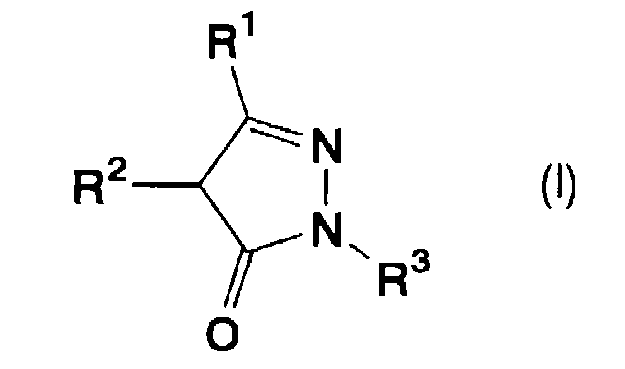
(式中、R1は、水素原子、アリール基、アルキル基又はアルコキシカルボニルアルキル基を表し;R2は、水素原子、アリールオキシ基、アリールメルカプト基、アルキル基又はヒドロキシアルキル基を表し;あるいは、R1及びR2は、共同してアルキレン基を表し;R3は、水素原子、アルキル基、シクロアルキル基、ヒドロキシアルキル基、ベンジル基、ナフチル基、フェニル基、又はアルキル基、アルコキシ基、ヒドロキシアルキル基、アルコキシカルボニル基、アルキルメルカプト基、アルキルアミノ基、ジアルキルアミノ基、ハロゲン原子、トリフルオロメチル基、カルボキシル基、シアノ基、水酸基、ニトロ基、アミノ基及びアセトアミド基からなる群から選ばれる1〜3個の置換基で置換されたフェニル基を表す。)で示されるピラゾロン誘導体を有効成分として含む医薬。
【選択図】なしA medicament useful for preventing and / or treating sudden deafness is provided.
The following formula (I):
(Wherein, R 1 represents a hydrogen atom, an aryl group, an alkyl group or an alkoxycarbonylalkyl group; R 2 represents a hydrogen atom, an aryloxy group, an arylmercapto group, an alkyl group or a hydroxyalkyl group; or R 1 and R 2 together represent an alkylene group; R 3 represents a hydrogen atom, an alkyl group, a cycloalkyl group, a hydroxyalkyl group, a benzyl group, a naphthyl group, a phenyl group, or an alkyl group, an alkoxy group, a hydroxy group; 1 selected from the group consisting of an alkyl group, an alkoxycarbonyl group, an alkylmercapto group, an alkylamino group, a dialkylamino group, a halogen atom, a trifluoromethyl group, a carboxyl group, a cyano group, a hydroxyl group, a nitro group, an amino group and an acetamido group Represents a phenyl group substituted with up to 3 substituents.) Medicaments comprising pyrazolone derivative represented as an active ingredient.
[Selection diagram] None
Description
【0001】
【発明の属する技術分野】
本発明は、ピラゾロン誘導体若しくはその生理学的に許容される塩、又はそれらの水和物若しくは溶媒和物を有効成分として含む突発性難聴の予防及び/又は治療のための医薬ならびに内有毛細胞保護剤に関する。
【0002】
【従来の技術】
難聴には外耳道(耳道)又は中耳の障害によって生じる伝音性難聴と、内耳又は第8脳神経の障害によって生じる感音性難聴がある。感音性難聴は、遺伝的要因、外傷、病気、老化、致命的疾病に対して使われることのある耳毒性薬物などいくつかの要因によって起こる。突発性難聴は、高度の感音性難聴が突然起こる疾患であり、突発性難聴を含む感音性難聴は外耳および中耳には問題がないものの、蝸牛にある有毛細胞に障害が認められることを特徴とする。突発性難聴は、強大な音楽を聴いたために起こる急性音響性難聴、あるいは慢性的に大きな音に曝されている職業環境のために起こる職業性難聴や騒音性難聴とは異なってその原因が不明であることが多いが、血管系の障害、膜迷路の障害などの説がある。また、感音性難聴の原因として、内耳虚血が発症の重要な背景因子であるという報告もある(Gussen, R., Ann Otol Rhinol Laryngol, 85, 94−100, 1976; Cole, RR., et al., Amj Otol, 9, 211−251, 1988)。突発性難聴の治療としては、ステロイド剤、血管拡張剤、血流改善剤、ビタミン(B1,B6,B12)剤の投与のほか、内耳の血行改善と酸素分圧を高める目的で行う高圧酸素療法などがある。しかしながら、現存する治療手段には限界があり、難聴者福祉に十分に対応できているとは言い難い状況にある。
【0003】
本発明者らはこれまでに虚血後長期生存可能な一過性内耳虚血の動物モデルの作成に成功し、虚血性内耳障害について検討を行ってきた(古賀健一郎ら、虚血性内耳障害におけるグルタミン酸の役割、愛媛医学、18、146−151、1999;渡辺太志ら、一過性虚血後の遅発性聴力障害、Otol Jpn, 7(1), 17−21,1999;Hakuba, N., et al., .Journal of Comparative Neurology, 418, 217−226, 2000)。その結果、神経細胞伝達に重要な役割を果たしていると考えられる内有毛細胞において虚血4〜7日後に進行性に脱落細胞数が増加することを報告した(古賀健一郎ら、同上;渡辺太志ら、同上)。しかしながら、かかる虚血後の内有毛細胞脱落数を抑制できる薬剤はこれまで存在しない。
【0004】
一方、下記式(I):
【化3】
【0005】
また、上記式(I)の化合物のうち、3−メチル−1−フェニル−2−ピラゾリン−5−オンを有効成分とする製剤は、2001年6月以来、脳保護剤(一般名「エダラボン」、商品名「ラジカット」:三菱ウェルファーマ株式会社製造・販売)として上市されている。この「エダラボン」は、活性酸素に対して高い反応性を有することが報告される(Kawai, H., et al., J. Phamacol. Exp. Ther., 281(2), 921, 1997; Wu, TW. et al., Life Sci, 67(19), 2387, 2000)。このように、エダラボンは活性酸素をはじめとする種々のフリーラジカルを消去することで、細胞障害などを防ぐ働きをするフリーラジカルスカベンジャーである。しかしながら、これまでエダラボンが突発性難聴に対して有効であるか否かの検討については全く報告がない。
【0006】
【発明が解決しようとする課題】
本発明の課題は、突発性難聴の予防及び/又は治療に有用な医薬ならびに内有毛細胞保護剤を提供することにある。
【0007】
【課題を解決するための手段】
本発明者らは、上記課題を解決すべく種々の検討を行った結果、式(I)で示されるピラゾロン誘導体若しくはその生理学的に許容される塩、又はそれらの水和物若しくは溶媒和物が、スナネズミの一過性内耳虚血障害モデルにおいてABR(聴性脳幹反応)による聴力閾値の増加や内有毛細胞の脱落を抑制することを見出した。本発明は上記の知見を基にして完成された。
【0008】
即ち、本発明によれば、下記式(I)で示されるピラゾロン誘導体若しくはその生理学的に許容される塩、又はそれらの水和物若しくは溶媒和物を有効成分として含む突発性難聴の予防及び/又は治療のための医薬が提供される。
【0009】
【化4】
(式中、R1は、水素原子、アリール基、炭素数1〜5のアルキル基又は総炭素数3〜6のアルコキシカルボニルアルキル基を表し;R2は、水素原子、アリールオキシ基、アリールメルカプト基、炭素数1〜5のアルキル基又は炭素数1〜3のヒドロキシアルキル基を表し;あるいは、R1及びR2は、共同して炭素数3〜5のアルキレン基を表し;R3は、水素原子、炭素数1〜5のアルキル基、炭素数5〜7のシクロアルキル基、炭素数1〜3のヒドロキシアルキル基、ベンジル基、ナフチル基、フェニル基、又は炭素数1〜5のアルキル基、炭素数1〜5のアルコキシ基、炭素数1〜3のヒドロキシアルキル基、総炭素数2〜5のアルコキシカルボニル基、炭素数1〜3のアルキルメルカプト基、炭素数1〜4のアルキルアミノ基、総炭素数2〜8のジアルキルアミノ基、ハロゲン原子、トリフルオロメチル基、カルボキシル基、シアノ基、水酸基、ニトロ基、アミノ基及びアセトアミド基からなる群から選ばれる同一若しくは異なる1〜3個の置換基で置換されたフェニル基を表す。)
【0011】
本発明の好ましい態様によれば、式(I)で示されるピラゾロン誘導体が3−メチル−1−フェニル−2−ピラゾリン−5−オン若しくはその生理学的に許容される塩、又はそれらの水和物若しくは溶媒和物である上記医薬が提供される。
【0012】
本発明の別の局面によれば、式(I)で示されるピラゾロン誘導体が3−メチル−1−フェニル−2−ピラゾリン−5−オン若しくはその生理学的に許容される塩、又はそれらの水和物若しくは溶媒和物を有効成分として含む内有毛細胞保護剤が提供される。
【0013】
本発明のさらに別の局面によれば、式(I)で示されるピラゾロン誘導体若しくはその生理学的に許容される塩、又はそれらの水和物若しくは溶媒和物の予防及び/又は治療有効量をヒトを含む哺乳動物に投与する工程を含む、突発性難聴の予防及び/又は治療方法が提供される。本発明のさらに別の側面によれば、上記医薬の製造のための式(I)で示されるピラゾロン誘導体若しくはその生理学的に許容される塩、又はそれらの水和物若しくは溶媒和物の使用が提供される。
【0014】
【発明の実施の形態】
本発明の突発性難聴の予防及び/又は治療のための医薬ならびに内有毛細胞保護剤(以下、これらを総称して本発明の医薬という)は、本明細書に定義する式(I)で示されるピラゾロン誘導体若しくはその生理学的に許容される塩、又はそれらの水和物若しくは溶媒和物を含む。
【0015】
本発明で用いる式(I)で示される化合物は、互変異性により、以下の式(I’)又は(I”)で示される構造をもとりうる。本明細書の式(I)には、便宜上、互変異性体のうちの1つを示したが、当業者には下記の互変異性体の存在は自明である。本発明の医薬の有効成分としては、下記の式(I’)又は(I”)で表される化合物若しくはその生理学的に許容される塩、又はそれらの水和物若しくは溶媒和物を用いてもよい。
【0016】
【化5】
式(I)において、R1の定義におけるアリール基は単環性又は多環性アリール基のいずれでもよい。例えば、フェニル基、ナフチル基などのほか、メチル基、ブチル基などのアルキル基、メトキシ基、ブトキシ基などのアルコキシ基、塩素原子などのハロゲン原子、又は水酸基等の置換基で置換されたフェニル基等が挙げられる。アリール部分を有する他の置換基(アリールオキシ基など)におけるアリール部分についても同様である。
【0018】
R1、R2及びR3の定義における炭素数1〜5のアルキル基は直鎖状、分枝鎖状のいずれでもよい。例えば、メチル基、エチル基、プロピル基、イソプロピル基、ブチル基、イソブチル基、sec−ブチル基、tert−ブチル基、ペンチル基等が挙げられる。アルキル部分を有する他の置換基(アルコキシカルボニルアルキル基)におけるアルキル部分についても同様である。
【0019】
R1の定義における総炭素数3〜6のアルコキシカルボニルアルキル基としては、メトキシカルボニルメチル基、エトキシカルボニルメチル基、プロポキシカルボニルメチル基、メトキシカルボニルエチル基、メトキシカルボニルプロピル基等が挙げられる。
【0020】
R2の定義におけるアリールオキシ基としては、p−メチルフェノキシ基、p−メトキシフェノキシ基、p−クロロフェノキシ基、p−ヒドロキシフェノキシ基等が挙げられ、アリールメルカプト基としては、フェニルメルカプト基、p−メチルフェニルメルカプト基、p−メトキシフェニルメルカプト基、p−クロロフェニルメルカプト基、p−ヒドロキシフェニルメルカプト基等が挙げられる。
【0021】
R2及びR3の定義における炭素数1〜3のヒドロキシアルキル基としては、ヒドロキシメチル基、2−ヒドロキシエチル基、3−ヒドロキシプロピル基等が挙げられる。R3の定義における炭素数5〜7のシクロアルキル基としては、シクロペンチル基、シクロヘキシル基、シクロヘプチル基等が挙げられる。
【0022】
R3の定義において、フェニル基の置換基における炭素数1〜5のアルコキシ基としては、メトキシ基、エトキシ基、プロポキシ基、イソプロポキシ基、ブトキシ基、ペンチルオキシ基等が挙げられ、総炭素数2〜5のアルコキシカルボニル基としては、メトキシカルボニル基、エトキシカルボニル基、プロポキシカルボニル基、ブトキシカルボニル基等が挙げられ、炭素数1〜3のアルキルメルカプト基としては、メチルメルカプト基、エチルメルカプト基、プロピルメルカプト基等が挙げられ、炭素数1〜4のアルキルアミノ基としては、メチルアミノ基、エチルアミノ基、プロピルアミノ基、ブチルアミノ基等が挙げられ、総炭素数2〜8のジアルキルアミノ基としては、ジメチルアミノ基、ジエチルアミノ基、ジプロピルアミノ基、ジブチルアミノ基等が挙げられる。
【0023】
本発明の医薬の有効成分として好適に用いられる化合物(I)として、例えば、以下に示す化合物が挙げられる。
3−メチル−1−フェニル−2−ピラゾリン−5−オン;
3−メチル−1−(2−メチルフェニル)−2−ピラゾリン−5−オン;
3−メチル−1−(3−メチルフェニル)−2−ピラゾリン−5−オン;
3−メチル−1−(4−メチルフェニル)−2−ピラゾリン−5−オン;
3−メチル−1−(3,4−ジメチルフェニル)−2−ピラゾリン−5−オン;
1−(4−エチルフェニル)−3−メチル−2−ピラゾリン−5−オン;
3−メチル−1−(4−プロピルフェニル)−2−ピラゾリン−5−オン;
1−(4−ブチルフェニル)−3−メチル−2−ピラゾリン−5−オン;
1−(3−トリフルオロメチルフェニル)−3−メチル−2−ピラゾリン−5−オン;
【0024】
1−(4−トリフルオロメチルフェニル)−3−メチル−2−ピラゾリン−5−オン;
1−(2−メトキシフェニル)−3−メチル−2−ピラゾリン−5−オン;
1−(3−メトキシフェニル)−3−メチル−2−ピラゾリン−5−オン;
1−(4−メトキシフェニル)−3−メチル−2−ピラゾリン−5−オン;
1−(3,4−ジメトキシフェニル)−3−メチル−2−ピラゾリン−5−オン;
1−(4−エトキシフェニル)−3−メチル−2−ピラゾリン−5−オン;
3−メチル−1−(4−プロポキシフェニル)−2−ピラゾリン−5−オン;
1−(4−ブトキシフェニル)−3−メチル−2−ピラゾリン−5−オン;
1−(2−クロロフェニル)−3−メチル−2−ピラゾリン−5−オン;
1−(3−クロロフェニル)−3−メチル−2−ピラゾリン−5−オン;
1−(4−クロロフェニル)−3−メチル−2−ピラゾリン−5−オン;
1−(3,4−ジクロロフェニル)−3−メチル−2−ピラゾリン−5−オン;
【0025】
1−(4−ブロモフェニル)−3−メチル−2−ピラゾリン−5−オン;
1−(4−フルオロフェニル)−3−メチル−2−ピラゾリン−5−オン;
1−(3−クロロ−4−メチルフェニル)−3−メチル−2−ピラゾリン−5−オン;
1−(3−メチルメルカプトフェニル)−3−メチル−2−ピラゾリン−5−オン;
1−(4−メチルメルカプトフェニル)−3−メチル−2−ピラゾリン−5−オン;
4−(3−メチル−5−オキソ−2−ピラゾリン−1−イル)安息香酸;
1−(4−エトキシカルボニルフェニル)−3−メチル−2−ピラゾリン−5−オン;
1−(4−ニトロフェニル)−3−メチル−2−ピラゾリン−5−オン;
3−エチル−1−フェニル−2−ピラゾリン−5−オン;
1−フェニル−3−プロピル−2−ピラゾリン−5−オン;
【0026】
1,3−ジフェニル−2−ピラゾリン−5−オン;
3−フェニル−1−(p−トリル)−2−ピラゾリン−5−オン;
1−(4−メトキシフェニル)−3−フェニル−2−ピラゾリン−5−オン;
1−(4−クロロフェニル)−3−フェニル−2−ピラゾリン−5−オン;
3,4−ジメチル−1−フェニル−2−ピラゾリン−5−オン;
4−イソブチル−3−メチル−1−フェニル−2−ピラゾリン−5−オン;
4−(2−ヒドロキシエチル)−3−メチル−1−フェニル−2−ピラゾリン−5−オン;
3−メチル−4−フェノキシ−1−フェニル−2−ピラゾリン−5−オン;
3−メチル−4−フェニルメルカプト−1−フェニル−2−ピラゾリン−5−オン;
【0027】
3,3’,4,5,6,7−ヘキサヒドロ−2−フェニル−2H−インダゾール−3−オン;
3−(エトキシカルボニルメチル)−1−フェニル−2−ピラゾリン−5−オン;
1−フェニル−2−ピラゾリン−5−オン;
3−メチル−2−ピラゾリン−5−オン;
1,3−ジメチル−2−ピラゾリン−5−オン;
1−エチル−3−メチル−2−ピラゾリン−5−オン;
1−ブチル−3−メチル−2−ピラゾリン−5−オン;
1−(2−ヒドロキエチル)−3−メチル−2−ピラゾリン−5−オン;
1−シクロヘキシル−3−メチル−2−ピラゾリン−5−オン;
1−ベンジル−3−メチル−2−ピラゾリン−5−オン;
【0028】
1−(α−ナフチル)−3−メチル−2−ピラゾリン−5−オン;
1−メチル−3−フェニル−2−ピラゾリン−5−オン;
3−メチル−1−(4−メチルフェニル)−2−ピラゾリン−5−オン;
1−(4−ブチルフェニル)−3−メチル−2−ピラゾリン−5−オン;
1−(4−メトキシフェニル)−3−メチル−2−ピラゾリン−5−オン;
1−(4−ブトキシフェニル)−3−メチル−2−ピラゾリン−5−オン;
1−(4−クロロフェニル)−3−メチル−2−ピラゾリン−5−オン;
1−(4−ヒドロキシフェニル)−3−メチル−2−ピラゾリン−5−オン;
1−(3,4−ジヒドロキシフェニル)−3−メチル−2−ピラゾリン−5−オン;
1−(2−ヒドロキシフェニル)−3−メチル−2−ピラゾリン−5−オン;1−(3−ヒドロキシフェニル)−3−メチル−2−ピラゾリン−5−オン;
【0029】
1−(4−ヒドロキシフェニル)−3−メチル−2−ピラゾリン−5−オン;
1−(3,4−ヒドロキシフェニル)−3−メチル−2−ピラゾリン−5−オン;
1−(4−ヒドロキシフェニル)−3−フェニル−2−ピラゾリン−5−オン;
1−(4−ヒドロキシメチルフェニル)−3−メチル−2−ピラゾリン−5−オン;
1−(4−アミノフェニル)−3−メチル−2−ピラゾリン−5−オン;
1−(4−メチルアミノフェニル)−3−メチル−2−ピラゾリン−5−オン;
1−(4−エチルアミノフェニル)−3−メチル−2−ピラゾリン−5−オン;
1−(4−ブチルアミノフェニル)−3−メチル−2−ピラゾリン−5−オン;
1−(4−ジメチルアミノフェニル)−3−メチル−2−ピラゾリン−5−オン;
1−(アセトアミドフェニル)−3−メチル−2−ピラゾリン−5−オン;及び
1−(4−シアノフェニル)−3−メチル−2−ピラゾリン−5−オン
【0030】
本発明の医薬の有効成分としては、式(I)で表される遊離形態の化合物のほか、生理学的に許容される塩を用いてもよい。生理学的に許容される塩としては、塩酸、硫酸、臭化水素塩、リン酸等の鉱酸との塩;メタンスルホン酸、p−トルエンスルホン酸、ベンゼンスルホン酸、酢酸、グリコール酸、グルクロン酸、マレイン酸、フマル酸、シュウ酸、アスコルビン酸、クエン酸、サリチル酸、ニコチン酸、酒石酸等の有機酸との塩;ナトリウム、カリウム等のアルカリ金属との塩;マグネシウム、カルシウム等のアルカリ土類金属との塩;アンモニア、トリス(ヒドロキシメチル)アミノメタン、N,N−ビス(ヒドロキシエチル)ピペラジン、2−アミノ−2−メチル−1−プロパノール、エタノールアミン、N−メチルグルタミン、L−グルタミン等のアミンとの塩が挙げられる。また、グリシンなどのアミノ酸との塩を用いてもよい。
【0031】
本発明の医薬の有効成分としては、上記式(I)で表される化合物若しくはその生理学的に許容される塩の水和物、又は上記式(I)で表される化合物若しくはその生理学的に許容される塩の溶媒和物を用いてもよい。溶媒和物を形成する有機溶媒の種類は特に限定されないが、例えば、メタノール、エタノール、エーテル、ジオキサン、テトラヒドロフランなどを例示することができる。また、上記式(I)で表される化合物は、置換基の種類により1以上の不斉炭素を有する場合があり、光学異性体又はジアステレオ異性体などの立体異性体が存在する場合がある。本発明の医薬の有効成分としては、純粋な形態の立体異性体、立体異性体の任意の混合物、ラセミ体などを用いてもよい。
【0032】
式(I)で表される化合物はいずれも公知の化合物であり、特公平5−31523号公報などに記載された方法により当業者が容易に合成できる。
【0033】
本発明の医薬の投与量は特に限定されないが、通常は、有効成分である式(I)で示される化合物の重量として一般に経口投与の場合には一日あたり0.1〜1000mg/kg体重、好ましくは一日あたり0.5〜50mg/kg体重、であり、非経口投与の場合には一日あたり0.01〜100mg/kg体重、好ましくは0.1〜10mg/kg体重である。上記投与量は1日1回又は2〜3回に分けて投与するのが好ましく、年齢、病態、症状により適宜増減してもよい。
【0034】
本発明の医薬としては、上記式(I)で表される化合物若しくはその生理学的に許容される塩、又はそれらの水和物若しくは溶媒和物をそのまま投与してもよいが、一般的には、有効成分である上記の物質と薬理学的及び製剤学的に許容される添加物を含む医薬組成物を調製して投与することが好ましい。
【0035】
薬理学的及び製剤学的に許容しうる添加物としては、例えば、賦形剤、崩壊剤ないし崩壊補助剤、結合剤、滑沢剤、コーティング剤、色素、希釈剤、基剤、溶解剤ないし溶解補助剤、等張化剤、pH調節剤、安定化剤、噴射剤、及び粘着剤等を用いることができる。
【0036】
経口投与に適する医薬組成物には、添加物として、例えば、ブドウ糖、乳糖、D−マンニトール、デンプン、又は結晶セルロース等の賦形剤;カルボキシメチルセルロース、デンプン、又はカルボキシメチルセルロースカルシウム等の崩壊剤又は崩壊補助剤;ヒドロキシプロピルセルロース、ヒドロキシプロピルメチルセルロース、ポリビニルピロリドン、又はゼラチン等の結合剤;ステアリン酸マグネシウム又はタルク等の滑沢剤;ヒドロキシプロピルメチルセルロース、白糖、ポリエチレングリコール又は酸化チタン等のコーティング剤;ワセリン、流動パラフィン、ポリエチレングリコール、ゼラチン、カオリン、グリセリン、精製水、又はハードファット等の基剤を用いることができる。
【0037】
注射あるいは点滴用に適する医薬組成物には、注射用蒸留水、生理食塩水、プロピレングリコール等の水性あるいは用時溶解型注射剤を構成しうる溶解剤又は溶解補助剤;ブドウ糖、塩化ナトリウム、D−マンニトール、グリセリン等の等張化剤;無機酸、有機酸、無機塩基又は有機塩基等のpH調節剤等の添加物を用いることができる。
【0038】
本発明の医薬の形態は特に限定されず、当業者に利用可能な種々の形態をとることができる。経口投与に適する医薬として、例えば、固体の製剤用添加物を用いて錠剤、散剤、顆粒剤、硬ゼラチンカプセル剤、坐剤、又はトローチ剤などを調製することができ、液状の製剤用添加物を用いてシロップ剤、乳剤、軟ゼラチンカプセル剤などを調製することができる。また、非経口投与に適する医薬として、注射剤、点滴剤、吸入剤、坐剤、経皮吸収剤、経粘膜吸収剤などを調製することができる。なお、上記の式(I)の化合物を有効成分とする脳保護剤(点滴剤)が、すでに臨床において使用されているので(一般名「エダラボン」、商品名「ラジカット」:三菱ウェルファーマ株式会社製造・販売)、本発明の医薬において上記市販製剤をそのまま用いることができる。
【0039】
本発明の医薬は、突発性難聴に有効である。すなわち、本発明の医薬は、突発性難聴を防止する予防剤としての作用、及び/又は突発性難聴を正常な状態に回復させる治療剤としての作用を有している。
【0040】
本明細書において、「突発性難聴」とは、内有毛細胞の脱落や変性が起こり、感音性難聴(多くは片側性)、耳鳴や耳閉塞感、眩暈などを呈する病態をいう。「突発性難聴」の発症原因には一般的には血管系の障害、膜迷路の障害、薬物等がある。本発明にいう「突発性難聴」はこれらの発症原因により限定はされないが、特には内耳虚血障害によるものをいい、一般的に用いられているその診断基準であるオージオグラムにおける高度の感音性難聴(例えば平均聴力レベルが70dbから90db未満)、平衡機能検査における末梢前庭の異常所見、頭位眼振検査(フレンツェルの眼鏡)などによって突発性難聴と認められる場合の全てを含む。
【0041】
本発明の医薬の投与経路は特に限定されず、経口的または非経口的に投与することができる。例えば、上記各疾患の治療に先立って予防的に本発明の医薬を経口投与しておくことができ、注射若しくは点滴などの非経口的投与によって手術中又はその前後に予防的に投与することもできる。また、上記各疾患の患者に対しては、症状の悪化の防止ないしは症状の軽減などを目的として、静脈内、動脈内に注射により投与することもできる。
【0042】
【実施例】
以下、本発明を実施例によりさらに具体的に説明するが、本発明は下記の実施例により限定されるものではない。
【0043】
合成例:3−メチル−1−フェニル−2−ピラゾリン−5−オン(以下、エダラボンと称す)の合成
エタノール50ml中にアセト酢酸エチル13.0g及びフェニルヒドラジン10.8gを加え、3時間還流攪拌した。反応液を放冷後、析出した結晶をろ取し、エタノールより再結晶して、表題の化合物11.3gを無色結晶として得た。
収率 67%
融点 127.5〜128.5℃
【0044】
実施例1
(1)実験方法
▲1▼実験モデル動物作成法
実験動物にはスナネズミ(12−16週齢、体重60−80g)を使用した。ハロセン吸入麻酔下で仰臥位にて頚部横切開を施行して両側の椎骨動脈を露出し、血流を15分間遮断後、再開通することによって一過性内耳虚血負荷を行った。その際、直腸温をthermocouple probeにてモニターし、36.0−37.0℃に保った。
実験動物を3群に分け、各群の動物の頚部を閉創し、片側鼠径部を切開し大腿静脈を露出してシリコンチューブをカニュレーションした。虚血エダラボン投与群には虚血開始より1時間後にエダラボン(3mg/kg)を静脈内投与し、虚血生理食塩水投与群(対照群)には虚血開始より1時間後に生理食塩水を同量静脈内投与し、非虚血エダラボン投与群は虚血負荷は行わずエダラボンの静脈内投与のみを施行した。
▲2▼ABR(auditory brainstem response:聴性脳幹反応)による聴力閾値の測定
刺激音はクリックを用いて加算回数は300回とした。ABRの測定は虚血前、虚血7日後に行い、各群の閾値変化を比較検討した。
▲3▼蛍光顕微鏡による観察
虚血7日後に断頭し、速やかに蝸牛骨胞を摘出した。前庭窓、蝸牛窓を開放し、蝸牛頂回転に設けた小孔より4%パラホルムアルデヒドにて局所灌流固定後、蝸牛摘出を行った。さらに同液にて2時間浸潰固定後、surface preparation にて基底回転のコルチ器を採取し、ローダミンファロイディン(rhodarnine−phalloidin) 染色を行い、内有毛細胞脱落数の割合(%)を測定し、3群問で比較した。
【0045】
(2)実験結果
ABR閾値変化を表1に示す。ABR閾値変化は虚血前の値と比較し、虚血生理食塩水投与群では20dB(平均)、虚血エダラボン投与群においては6.25dB(平均)、非虚血エダラボン投与群では−2.5dB(平均)であった。エダラボン投与により、虚血7日目のABR閾値上昇が抑制されていた。
また、蛍光顕微鏡観察による内有毛細胞脱落数の割合を表2に示す。虚血7日後、虚血生理食塩水投与群における内有毛細胞脱落数の割合は31.1±8.4%(平均±標準偏差)であり、虚血エダラボン投与群では9.41±1.80%(平均±標準偏差)、非虚血エダラボン投与群では0.40%(平均)であった。
【0046】
【表1】
【表2】
【発明の効果】
本発明の医薬は、ABR(聴性脳幹反応)による聴力閾値の増加や内有毛細胞の脱落を抑制する作用を有することから、突発性難聴の予防及び/又は治療のための医薬ならびに内有毛細胞保護剤として有用である。[0001]
TECHNICAL FIELD OF THE INVENTION
The present invention relates to a medicament for preventing and / or treating sudden deafness including a pyrazolone derivative or a physiologically acceptable salt thereof, or a hydrate or solvate thereof as an active ingredient, and protection of inner hair cells. Agent.
[0002]
[Prior art]
Hearing loss includes conductive hearing loss caused by impairment of the external auditory meatus (ear canal) or middle ear, and sensorineural hearing loss caused by impairment of the inner ear or the eighth cranial nerve. Sensorineural hearing loss is caused by several factors, including genetic factors, ototoxic drugs that may be used for trauma, illness, aging, and fatal illness. Sudden deafness is a disorder in which a high degree of sensorineural hearing loss occurs suddenly; sensorineural deafness, including sudden deafness, has no problems in the outer and middle ears, but impairs hair cells in the cochlea It is characterized by the following. The cause of sudden deafness is unknown, unlike acute acoustic deafness caused by listening to loud music or occupational or noisy deafness caused by an occupational environment that is chronically exposed to loud sounds. However, there are theories such as disorders of the vascular system and disorders of the membrane maze. Also, there is a report that inner ear ischemia is an important background factor for the onset of sensorineural hearing loss (Gussen, R., Ann Otol Rhinol Laryngol, 85, 94-100, 1976; Cole, RR., et al., Amj Otol, 9, 211-251, 1988). Treatment of sudden deafness includes administration of steroids, vasodilators, blood flow improvers, vitamins (B1, B6, B12), and hyperbaric oxygen therapy for the purpose of improving inner ear blood circulation and increasing oxygen partial pressure. and so on. However, existing treatment means are limited, and it is difficult to say that they are adequately adapted to the welfare of hearing-impaired persons.
[0003]
The present inventors have succeeded in creating an animal model of transient inner ear ischemia that can survive for a long time after ischemia and have studied ischemic inner ear disorders (Kenichiro Koga et al., The role of glutamate, Ehime Medical, 18, 146-151, 1999; Futoshi Watanabe et al., Delayed hearing loss after transient ischemia, Otol Jpn, 7 (1), 17-21, 1999; Hakuba, N .; , Et al., Journal of Comparative Neurology, 418, 217-226, 2000). As a result, it was reported that the number of shedding cells was progressively increased after 4-7 days of ischemia in inner hair cells, which are thought to play an important role in neuronal transmission (Kenichiro Koga et al., Supra; Futoshi Watanabe) Et al.). However, there is no drug capable of suppressing the number of shedding of inner hair cells after ischemia.
[0004]
On the other hand, the following formula (I):
Embedded image
[0005]
Among the compounds of the above formula (I), a preparation containing 3-methyl-1-phenyl-2-pyrazolin-5-one as an active ingredient has been a cerebral protective agent (generic name “edaravone”) since June 2001. (Trade name: Radicut: manufactured and sold by Mitsubishi Pharma Corporation). This “edaravone” is reported to have high reactivity to active oxygen (Kawai, H., et al., J. Pharmacol. Exp. Ther., 281 (2), 921, 1997; Wu) , TW. Et al., Life Sci, 67 (19), 2387, 2000). As described above, edaravone is a free radical scavenger that functions to prevent cell damage and the like by eliminating various free radicals including active oxygen. However, there has been no report as to whether edaravone is effective for sudden deafness.
[0006]
[Problems to be solved by the invention]
An object of the present invention is to provide a medicament useful for preventing and / or treating sudden deafness and an agent for protecting inner hair cells.
[0007]
[Means for Solving the Problems]
The present inventors have conducted various studies in order to solve the above problems, and as a result, have found that the pyrazolone derivative represented by the formula (I) or a physiologically acceptable salt thereof, or a hydrate or solvate thereof can be obtained. Found that in a gerbil transient inner ear ischemia injury model, the ABR (auditory brainstem response) suppresses an increase in hearing threshold and loss of inner hair cells. The present invention has been completed based on the above findings.
[0008]
That is, according to the present invention, prevention and / or prevention of sudden deafness containing a pyrazolone derivative represented by the following formula (I) or a physiologically acceptable salt thereof, or a hydrate or solvate thereof as an active ingredient: Alternatively, a medicament for treatment is provided.
[0009]
Embedded image
(Wherein, R 1 represents a hydrogen atom, an aryl group, an alkyl group having 1 to 5 carbon atoms or an alkoxycarbonylalkyl group having 3 to 6 carbon atoms; R 2 represents a hydrogen atom, an aryloxy group, an arylmercapto R 1 and R 2 together represent an alkylene group having 3 to 5 carbon atoms; R 3 represents an alkylene group having 1 to 5 carbon atoms or a hydroxyalkyl group having 1 to 3 carbon atoms; Hydrogen atom, alkyl group having 1 to 5 carbon atoms, cycloalkyl group having 5 to 7 carbon atoms, hydroxyalkyl group having 1 to 3 carbon atoms, benzyl group, naphthyl group, phenyl group, or alkyl group having 1 to 5 carbon atoms An alkoxy group having 1 to 5 carbon atoms, a hydroxyalkyl group having 1 to 3 carbon atoms, an alkoxycarbonyl group having 2 to 5 carbon atoms, an alkylmercapto group having 1 to 3 carbon atoms, and an alkylamino having 1 to 4 carbon atoms A dialkylamino group having 2 to 8 carbon atoms, a halogen atom, a trifluoromethyl group, a carboxyl group, a cyano group, a hydroxyl group, a nitro group, an amino group and an acetamide group; Represents a phenyl group substituted with a substituent.)
[0011]
According to a preferred embodiment of the present invention, the pyrazolone derivative represented by the formula (I) is 3-methyl-1-phenyl-2-pyrazolin-5-one, a physiologically acceptable salt thereof, or a hydrate thereof. Alternatively, the above drug which is a solvate is provided.
[0012]
According to another aspect of the present invention, the pyrazolone derivative represented by the formula (I) is 3-methyl-1-phenyl-2-pyrazolin-5-one or a physiologically acceptable salt thereof, or a hydration thereof. An inner hair cell protecting agent comprising a solvate or a solvate as an active ingredient.
[0013]
According to another aspect of the present invention, a prophylactically and / or therapeutically effective amount of a pyrazolone derivative represented by the formula (I) or a physiologically acceptable salt thereof, or a hydrate or solvate thereof, is added to a human. And a method for preventing and / or treating sudden deafness, which comprises the step of administering to a mammal comprising: According to yet another aspect of the present invention, use of the pyrazolone derivative represented by the formula (I) or a physiologically acceptable salt thereof, or a hydrate or solvate thereof for the production of the above medicament is described. Provided.
[0014]
BEST MODE FOR CARRYING OUT THE INVENTION
The medicament for preventing and / or treating sudden deafness of the present invention and the agent for protecting inner hair cells (hereinafter collectively referred to as the medicament of the present invention) are represented by the formula (I) defined herein. It includes the indicated pyrazolone derivative or a physiologically acceptable salt thereof, or a hydrate or solvate thereof.
[0015]
The compound represented by the formula (I) used in the present invention may also have the structure represented by the following formula (I ′) or (I ″) due to tautomerism. For convenience, one of the tautomers is shown, but it is obvious to those skilled in the art that the following tautomers exist: The active ingredient of the medicament of the present invention is represented by the following formula (I ′): Alternatively, the compound represented by (I ″) or a physiologically acceptable salt thereof, or a hydrate or solvate thereof may be used.
[0016]
Embedded image
In the formula (I), the aryl group in the definition of R 1 may be a monocyclic or polycyclic aryl group. For example, in addition to a phenyl group, a naphthyl group, and the like, an alkyl group such as a methyl group and a butyl group, an alkoxy group such as a methoxy group and a butoxy group, a halogen atom such as a chlorine atom, or a phenyl group substituted with a substituent such as a hydroxyl group. And the like. The same applies to the aryl moiety in other substituents having an aryl moiety (such as an aryloxy group).
[0018]
The alkyl group having 1 to 5 carbon atoms in the definition of R 1 , R 2 and R 3 may be linear or branched. Examples include a methyl group, an ethyl group, a propyl group, an isopropyl group, a butyl group, an isobutyl group, a sec-butyl group, a tert-butyl group, a pentyl group, and the like. The same applies to the alkyl moiety in another substituent (alkoxycarbonylalkyl group) having an alkyl moiety.
[0019]
Examples of the alkoxycarbonylalkyl group having a total of 3 to 6 carbon atoms in the definition of R 1 include a methoxycarbonylmethyl group, an ethoxycarbonylmethyl group, a propoxycarbonylmethyl group, a methoxycarbonylethyl group, a methoxycarbonylpropyl group, and the like.
[0020]
The aryloxy group in the definition of R 2 includes a p-methylphenoxy group, a p-methoxyphenoxy group, a p-chlorophenoxy group, a p-hydroxyphenoxy group, and the like. As the arylmercapto group, a phenylmercapto group, -Methylphenylmercapto group, p-methoxyphenylmercapto group, p-chlorophenylmercapto group, p-hydroxyphenylmercapto group and the like.
[0021]
Examples of the hydroxyalkyl group having 1 to 3 carbon atoms in the definition of R 2 and R 3 include a hydroxymethyl group, a 2-hydroxyethyl group, and a 3-hydroxypropyl group. Examples of the cycloalkyl group having 5 to 7 carbon atoms in the definition of R 3 include a cyclopentyl group, a cyclohexyl group, and a cycloheptyl group.
[0022]
In the definition of R 3 , the alkoxy group having 1 to 5 carbon atoms in the substituent of the phenyl group includes a methoxy group, an ethoxy group, a propoxy group, an isopropoxy group, a butoxy group, a pentyloxy group, and the like. Examples of the alkoxycarbonyl group having 2 to 5 include a methoxycarbonyl group, an ethoxycarbonyl group, a propoxycarbonyl group and a butoxycarbonyl group. Examples of the alkylmercapto group having 1 to 3 carbon atoms include a methylmercapto group, an ethylmercapto group, A propylmercapto group and the like; examples of the alkylamino group having 1 to 4 carbon atoms include a methylamino group, an ethylamino group, a propylamino group and a butylamino group; and a dialkylamino group having a total of 2 to 8 carbon atoms. As the dimethylamino group, diethylamino group, dipropylamino group, And a dibutylamino group.
[0023]
The compound (I) suitably used as an active ingredient of the medicament of the present invention includes, for example, the following compounds.
3-methyl-1-phenyl-2-pyrazolin-5-one;
3-methyl-1- (2-methylphenyl) -2-pyrazolin-5-one;
3-methyl-1- (3-methylphenyl) -2-pyrazolin-5-one;
3-methyl-1- (4-methylphenyl) -2-pyrazolin-5-one;
3-methyl-1- (3,4-dimethylphenyl) -2-pyrazolin-5-one;
1- (4-ethylphenyl) -3-methyl-2-pyrazolin-5-one;
3-methyl-1- (4-propylphenyl) -2-pyrazolin-5-one;
1- (4-butylphenyl) -3-methyl-2-pyrazolin-5-one;
1- (3-trifluoromethylphenyl) -3-methyl-2-pyrazolin-5-one;
[0024]
1- (4-trifluoromethylphenyl) -3-methyl-2-pyrazolin-5-one;
1- (2-methoxyphenyl) -3-methyl-2-pyrazolin-5-one;
1- (3-methoxyphenyl) -3-methyl-2-pyrazolin-5-one;
1- (4-methoxyphenyl) -3-methyl-2-pyrazolin-5-one;
1- (3,4-dimethoxyphenyl) -3-methyl-2-pyrazolin-5-one;
1- (4-ethoxyphenyl) -3-methyl-2-pyrazolin-5-one;
3-methyl-1- (4-propoxyphenyl) -2-pyrazolin-5-one;
1- (4-butoxyphenyl) -3-methyl-2-pyrazolin-5-one;
1- (2-chlorophenyl) -3-methyl-2-pyrazolin-5-one;
1- (3-chlorophenyl) -3-methyl-2-pyrazolin-5-one;
1- (4-chlorophenyl) -3-methyl-2-pyrazolin-5-one;
1- (3,4-dichlorophenyl) -3-methyl-2-pyrazolin-5-one;
[0025]
1- (4-bromophenyl) -3-methyl-2-pyrazolin-5-one;
1- (4-fluorophenyl) -3-methyl-2-pyrazolin-5-one;
1- (3-chloro-4-methylphenyl) -3-methyl-2-pyrazolin-5-one;
1- (3-methylmercaptophenyl) -3-methyl-2-pyrazolin-5-one;
1- (4-methylmercaptophenyl) -3-methyl-2-pyrazolin-5-one;
4- (3-methyl-5-oxo-2-pyrazolin-1-yl) benzoic acid;
1- (4-ethoxycarbonylphenyl) -3-methyl-2-pyrazolin-5-one;
1- (4-nitrophenyl) -3-methyl-2-pyrazolin-5-one;
3-ethyl-1-phenyl-2-pyrazolin-5-one;
1-phenyl-3-propyl-2-pyrazolin-5-one;
[0026]
1,3-diphenyl-2-pyrazolin-5-one;
3-phenyl-1- (p-tolyl) -2-pyrazolin-5-one;
1- (4-methoxyphenyl) -3-phenyl-2-pyrazolin-5-one;
1- (4-chlorophenyl) -3-phenyl-2-pyrazolin-5-one;
3,4-dimethyl-1-phenyl-2-pyrazolin-5-one;
4-isobutyl-3-methyl-1-phenyl-2-pyrazolin-5-one;
4- (2-hydroxyethyl) -3-methyl-1-phenyl-2-pyrazolin-5-one;
3-methyl-4-phenoxy-1-phenyl-2-pyrazolin-5-one;
3-methyl-4-phenylmercapto-1-phenyl-2-pyrazolin-5-one;
[0027]
3,3 ′, 4,5,6,7-hexahydro-2-phenyl-2H-indazol-3-one;
3- (ethoxycarbonylmethyl) -1-phenyl-2-pyrazolin-5-one;
1-phenyl-2-pyrazolin-5-one;
3-methyl-2-pyrazolin-5-one;
1,3-dimethyl-2-pyrazolin-5-one;
1-ethyl-3-methyl-2-pyrazolin-5-one;
1-butyl-3-methyl-2-pyrazolin-5-one;
1- (2-hydroxyethyl) -3-methyl-2-pyrazolin-5-one;
1-cyclohexyl-3-methyl-2-pyrazolin-5-one;
1-benzyl-3-methyl-2-pyrazolin-5-one;
[0028]
1- (α-naphthyl) -3-methyl-2-pyrazolin-5-one;
1-methyl-3-phenyl-2-pyrazolin-5-one;
3-methyl-1- (4-methylphenyl) -2-pyrazolin-5-one;
1- (4-butylphenyl) -3-methyl-2-pyrazolin-5-one;
1- (4-methoxyphenyl) -3-methyl-2-pyrazolin-5-one;
1- (4-butoxyphenyl) -3-methyl-2-pyrazolin-5-one;
1- (4-chlorophenyl) -3-methyl-2-pyrazolin-5-one;
1- (4-hydroxyphenyl) -3-methyl-2-pyrazolin-5-one;
1- (3,4-dihydroxyphenyl) -3-methyl-2-pyrazolin-5-one;
1- (2-hydroxyphenyl) -3-methyl-2-pyrazolin-5-one; 1- (3-hydroxyphenyl) -3-methyl-2-pyrazolin-5-one;
[0029]
1- (4-hydroxyphenyl) -3-methyl-2-pyrazolin-5-one;
1- (3,4-hydroxyphenyl) -3-methyl-2-pyrazolin-5-one;
1- (4-hydroxyphenyl) -3-phenyl-2-pyrazolin-5-one;
1- (4-hydroxymethylphenyl) -3-methyl-2-pyrazolin-5-one;
1- (4-aminophenyl) -3-methyl-2-pyrazolin-5-one;
1- (4-methylaminophenyl) -3-methyl-2-pyrazolin-5-one;
1- (4-ethylaminophenyl) -3-methyl-2-pyrazolin-5-one;
1- (4-butylaminophenyl) -3-methyl-2-pyrazolin-5-one;
1- (4-dimethylaminophenyl) -3-methyl-2-pyrazolin-5-one;
1- (acetamidophenyl) -3-methyl-2-pyrazolin-5-one; and 1- (4-cyanophenyl) -3-methyl-2-pyrazolin-5-one
As the active ingredient of the medicament of the present invention, a physiologically acceptable salt may be used in addition to the free form compound represented by the formula (I). Physiologically acceptable salts include salts with mineral acids such as hydrochloric acid, sulfuric acid, hydrobromide and phosphoric acid; methanesulfonic acid, p-toluenesulfonic acid, benzenesulfonic acid, acetic acid, glycolic acid, glucuronic acid Salts with organic acids such as maleic acid, fumaric acid, oxalic acid, ascorbic acid, citric acid, salicylic acid, nicotinic acid, tartaric acid; salts with alkali metals such as sodium and potassium; alkaline earth metals such as magnesium and calcium Such as ammonia, tris (hydroxymethyl) aminomethane, N, N-bis (hydroxyethyl) piperazine, 2-amino-2-methyl-1-propanol, ethanolamine, N-methylglutamine, L-glutamine, etc. And salts with amines. Further, a salt with an amino acid such as glycine may be used.
[0031]
As an active ingredient of the medicament of the present invention, a hydrate of the compound represented by the above formula (I) or a physiologically acceptable salt thereof, or a compound represented by the above formula (I) or a physiologically acceptable salt thereof Solvates of acceptable salts may be used. The type of the organic solvent that forms the solvate is not particularly limited, and examples thereof include methanol, ethanol, ether, dioxane, and tetrahydrofuran. Further, the compound represented by the above formula (I) may have one or more asymmetric carbons depending on the kind of the substituent, and may have a stereoisomer such as an optical isomer or a diastereoisomer. . As the active ingredient of the medicament of the present invention, pure forms of stereoisomers, arbitrary mixtures of stereoisomers, racemates and the like may be used.
[0032]
The compounds represented by the formula (I) are all known compounds, and can be easily synthesized by those skilled in the art by the method described in Japanese Patent Publication No. 5-31523.
[0033]
Although the dose of the medicament of the present invention is not particularly limited, it is generally 0.1 to 1000 mg / kg body weight per day in the case of oral administration generally as the weight of the compound represented by the formula (I) as an active ingredient. Preferably, it is 0.5 to 50 mg / kg body weight per day, and in the case of parenteral administration, it is 0.01 to 100 mg / kg body weight per day, preferably 0.1 to 10 mg / kg body weight. The above dose is preferably administered once a day or divided into two or three times a day, and may be appropriately increased or decreased depending on the age, disease state, and symptoms.
[0034]
As the medicament of the present invention, the compound represented by the above formula (I) or a physiologically acceptable salt thereof, or a hydrate or solvate thereof may be administered as it is. It is preferable to prepare and administer a pharmaceutical composition containing the above-mentioned active ingredient and a pharmacologically and pharmaceutically acceptable additive.
[0035]
Pharmacologically and pharmaceutically acceptable additives include, for example, excipients, disintegrants or disintegration aids, binders, lubricants, coatings, pigments, diluents, bases, solubilizers and the like. Dissolution aids, tonicity agents, pH adjusters, stabilizers, propellants, adhesives and the like can be used.
[0036]
Pharmaceutical compositions suitable for oral administration include, as additives, excipients such as glucose, lactose, D-mannitol, starch, or crystalline cellulose; disintegrants or disintegrants such as carboxymethyl cellulose, starch, or calcium carboxymethyl cellulose. Adjuvants; binders such as hydroxypropylcellulose, hydroxypropylmethylcellulose, polyvinylpyrrolidone or gelatin; lubricants such as magnesium stearate or talc; coating agents such as hydroxypropylmethylcellulose, sucrose, polyethylene glycol or titanium oxide; Bases such as liquid paraffin, polyethylene glycol, gelatin, kaolin, glycerin, purified water, and hard fat can be used.
[0037]
Pharmaceutical compositions suitable for injection or infusion include solubilizing agents or solubilizing agents which can constitute aqueous or ready-to-use injections such as distilled water for injection, physiological saline, and propylene glycol; glucose, sodium chloride, D Additives such as isotonic agents such as mannitol and glycerin; pH regulators such as inorganic acids, organic acids, inorganic bases and organic bases can be used.
[0038]
The form of the medicament of the present invention is not particularly limited, and can take various forms available to those skilled in the art. As pharmaceuticals suitable for oral administration, for example, tablets, powders, granules, hard gelatin capsules, suppositories, or troches can be prepared using solid pharmaceutical additives, and liquid pharmaceutical additives can be prepared. Can be used to prepare syrups, emulsions, soft gelatin capsules and the like. In addition, injections, drops, inhalants, suppositories, transdermal absorbents, transmucosal absorbents, and the like can be prepared as pharmaceuticals suitable for parenteral administration. Since a cerebral protective agent (instillation) containing the compound of the above formula (I) as an active ingredient has already been used in clinical practice (generic name: edaravone, trade name: Radicut: manufactured by Mitsubishi Pharma Corporation)・ Sales), the above-mentioned commercial preparations can be used as they are in the medicament of the present invention.
[0039]
The medicament of the present invention is effective for sudden deafness. That is, the medicament of the present invention has an effect as a prophylactic agent for preventing sudden deafness and / or a therapeutic agent for restoring sudden deafness to a normal state.
[0040]
As used herein, the term “sudden hearing loss” refers to a condition in which inner hair cells fall off or degenerate, and exhibit sensorineural hearing loss (often unilateral), tinnitus, ear-closure, dizziness, and the like. Causes of "sudden hearing loss" generally include vascular system disorders, membrane maze disorders, drugs, and the like. The "sudden deafness" referred to in the present invention is not limited by these causes, but particularly refers to one due to inner ear ischemia disorder, and a high degree of sound perception in an audiogram which is a commonly used diagnostic criterion. This includes all cases of sexual hearing loss (for example, an average hearing level of less than 70 db to less than 90 db), abnormal findings in the peripheral vestibule in a balance function test, and sudden deafness due to a head nystagmus test (Frenzel's glasses).
[0041]
The administration route of the medicament of the present invention is not particularly limited, and it can be administered orally or parenterally. For example, the medicament of the present invention can be administered orally in a prophylactic manner prior to treatment of each of the above-mentioned diseases, and can also be administered prophylactically during or after surgery by parenteral administration such as injection or infusion. it can. In addition, for patients with each of the above-mentioned diseases, they can be administered by intravenous or intraarterial injection for the purpose of preventing the worsening of symptoms or reducing the symptoms.
[0042]
【Example】
Hereinafter, the present invention will be described more specifically with reference to examples, but the present invention is not limited to the following examples.
[0043]
Synthesis Example: Synthesis of 3-methyl-1-phenyl-2-pyrazolin-5-one (hereinafter referred to as edaravone) In 50 ml of ethanol, 13.0 g of ethyl acetoacetate and 10.8 g of phenylhydrazine were added, and the mixture was stirred under reflux for 3 hours. did. After allowing the reaction solution to cool, the precipitated crystals were collected by filtration and recrystallized from ethanol to give 11.3 g of the title compound as colorless crystals.
Yield 67%
127.5-128.5 ° C
[0044]
Example 1
(1) Experimental method (1) Method for preparing an experimental model animal Gerbils (12-16 weeks old, body weight 60-80 g) were used as experimental animals. Under halothane inhalation anesthesia, a transverse incision was made in the supine position to expose the vertebral arteries on both sides, and blood flow was cut off for 15 minutes, followed by reperfusion to perform a transient inner ear ischemia load. At that time, the rectal temperature was monitored with a thermocouple probe and kept at 36.0-37.0 ° C.
The experimental animals were divided into three groups, the necks of the animals in each group were closed, the unilateral groin was incised, the femoral vein was exposed, and the silicone tube was cannulated. Edaravone (3 mg / kg) was intravenously administered 1 hour after the onset of ischemia to the ischemic edaravone administration group, and saline was administered 1 hour after the onset of ischemia to the ischemic saline administration group (control group). In the non-ischemic edaravone-administered group, only the intravenous administration of edaravone was performed without the ischemic load.
{Circle around (2)} Measurement of hearing threshold by ABR (auditive brainstem response): Clicks were used for the stimulation sound, and the number of times of addition was 300 times. The measurement of ABR was performed before and 7 days after ischemia, and the change in the threshold value of each group was compared and examined.
{Circle around (3)} Observation by fluorescence microscope Seven days after ischemia, the head was decapitated, and the cochlear osteotomy was immediately removed. The vestibular window and the cochlear window were opened, and after local perfusion fixation with 4% paraformaldehyde through a stoma provided in the rotation of the cochlea apex, cochleectomy was performed. After further immersion and fixation in the same solution for 2 hours, a cortical organ with a basal rotation was collected by surface preparation and subjected to rhodamine-phalloidin staining to determine the ratio (%) of the number of inner hair cell shedding. Measured and compared in three groups.
[0045]
(2) Experimental Results Table 1 shows changes in the ABR threshold value. The change in the ABR threshold value was compared to the value before ischemia. The ischemic saline administration group was 20 dB (average), the ischemic edaravone group was 6.25 dB (average), and the non-ischemic edaravone group was -2. It was 5 dB (average). Edaravone administration suppressed an increase in the ABR threshold on day 7 of ischemia.
Table 2 shows the ratio of the number of inner hair cells shed by fluorescence microscopy. Seven days after ischemia, the ratio of the number of shed hair cells in the ischemic saline administration group was 31.1 ± 8.4% (mean ± standard deviation), and 9.41 ± 1 in the ischemic edaravone administration group. It was 0.80% (mean ± standard deviation), and 0.40% (mean) in the non-ischemic edaravone administration group.
[0046]
[Table 1]
[Table 2]
【The invention's effect】
Since the medicament of the present invention has an effect of suppressing an increase in hearing threshold and loss of inner hair cells due to ABR (auditory brainstem reaction), a medicament for preventing and / or treating sudden deafness and inner hair Useful as a cytoprotective agent.
Claims (5)
で示されるピラゾロン誘導体若しくはその生理学的に許容される塩、又はそれらの水和物若しくは溶媒和物を有効成分として含む突発性難聴の予防及び/又は治療のための医薬。Formula (I) below:
Or a physiologically acceptable salt thereof, or a hydrate or solvate thereof, as an active ingredient, for preventing and / or treating sudden deafness.
で示されるピラゾロン誘導体若しくはその生理学的に許容される塩、又はそれらの水和物若しくは溶媒和物を有効成分として含む内有毛細胞保護剤。Formula (I) below:
Or a physiologically acceptable salt thereof, or a hydrate or solvate thereof, as an active ingredient.
Priority Applications (1)
| Application Number | Priority Date | Filing Date | Title |
|---|---|---|---|
| JP2003205668A JP2004123713A (en) | 2002-08-05 | 2003-08-04 | Pharmaceutical for prevention and / or treatment of sudden deafness |
Applications Claiming Priority (2)
| Application Number | Priority Date | Filing Date | Title |
|---|---|---|---|
| JP2002227275 | 2002-08-05 | ||
| JP2003205668A JP2004123713A (en) | 2002-08-05 | 2003-08-04 | Pharmaceutical for prevention and / or treatment of sudden deafness |
Publications (1)
| Publication Number | Publication Date |
|---|---|
| JP2004123713A true JP2004123713A (en) | 2004-04-22 |
Family
ID=32300824
Family Applications (1)
| Application Number | Title | Priority Date | Filing Date |
|---|---|---|---|
| JP2003205668A Pending JP2004123713A (en) | 2002-08-05 | 2003-08-04 | Pharmaceutical for prevention and / or treatment of sudden deafness |
Country Status (1)
| Country | Link |
|---|---|
| JP (1) | JP2004123713A (en) |
Cited By (2)
| Publication number | Priority date | Publication date | Assignee | Title |
|---|---|---|---|---|
| WO2010087306A1 (en) | 2009-01-29 | 2010-08-05 | 株式会社林原生物化学研究所 | Anti-neurodegenerative disease agent |
| WO2016117431A1 (en) * | 2015-01-19 | 2016-07-28 | 学校法人慶應義塾 | Therapeutic agent for sensorineural hearing loss |
-
2003
- 2003-08-04 JP JP2003205668A patent/JP2004123713A/en active Pending
Cited By (5)
| Publication number | Priority date | Publication date | Assignee | Title |
|---|---|---|---|---|
| WO2010087306A1 (en) | 2009-01-29 | 2010-08-05 | 株式会社林原生物化学研究所 | Anti-neurodegenerative disease agent |
| WO2016117431A1 (en) * | 2015-01-19 | 2016-07-28 | 学校法人慶應義塾 | Therapeutic agent for sensorineural hearing loss |
| EP3295939A1 (en) | 2015-01-19 | 2018-03-21 | Keio University | Therapeutic agent for sensorineural hearing loss |
| US11013725B2 (en) | 2015-01-19 | 2021-05-25 | Keio University | Therapeutic agents for inner ear hearing impairment |
| US11058669B2 (en) | 2015-01-19 | 2021-07-13 | Keio University | Therapeutic agents for inner ear hearing impairment |
Similar Documents
| Publication | Publication Date | Title |
|---|---|---|
| JP2010043132A (en) | Drug of combination of antithrombotic agent and pyrazolone derivative | |
| JPS62108814A (en) | Lipid peroxide production inhibitor | |
| JP2004123716A (en) | Pharmaceutical for prevention and / or treatment of liver damage caused by chemical substances | |
| JP2004137256A (en) | Pharmaceutical for prevention and / or treatment of inner ear disorders | |
| JP2003252760A (en) | Retinal disease therapeutic and / or prophylactic agent | |
| JP2004091441A (en) | Oral administration preparation containing pyrazolone derivative | |
| JP4418621B2 (en) | Pharmaceuticals for the prevention and / or treatment of lung disorders | |
| JP2004115508A (en) | Drugs for improving the function of burned skin tissue | |
| JP4713859B2 (en) | Treatment and / or prevention agent for mitochondrial encephalomyopathy | |
| WO2016042812A1 (en) | Prophylactic/therapeutic agent for eye disease | |
| JPWO2004013107A1 (en) | Medicament for prevention and / or treatment of injury due to spinal cord injury | |
| JP2004002400A (en) | Drug for cerebral protection and / or normalization of cerebral function used for performing mild hypothermia | |
| JP2008266142A (en) | Preventive and / or therapeutic agent for corneal disorder | |
| US7312239B2 (en) | Medicament for prevention and/or therapy of arterial wall disorder | |
| EP1582517A1 (en) | Blood-brain barrier disruption inhibitors | |
| JP2004002381A (en) | Pharmaceutical for prevention and / or treatment of liver damage caused by endotoxemia | |
| JP2004331653A (en) | Agent for preventing and / or treating pain | |
| JP2004067585A (en) | Pharmaceutical for prevention and / or treatment of disorders due to ischemic spinal cord injury | |
| JP2006096664A (en) | Liver fibrosis inhibitor | |
| JPWO2005012255A1 (en) | Treatment for inflammatory joint diseases | |
| JPWO2004022543A1 (en) | Medicament for prevention and / or treatment of inflammatory bowel disease | |
| JP2008037753A (en) | Treatment and / or prevention agent for pruritus | |
| JPWO2006126625A1 (en) | Medicine containing pyrazolone derivative | |
| JP2004143068A (en) | Pharmaceutical for prevention and / or treatment of influenza encephalitis / encephalopathy | |
| JP2004143149A (en) | Pharmaceutical for prevention and / or treatment of pancreatic disease |
Legal Events
| Date | Code | Title | Description |
|---|---|---|---|
| A621 | Written request for application examination |
Effective date: 20060711 Free format text: JAPANESE INTERMEDIATE CODE: A621 |
|
| A711 | Notification of change in applicant |
Free format text: JAPANESE INTERMEDIATE CODE: A712 Effective date: 20071102 |
|
| A977 | Report on retrieval |
Free format text: JAPANESE INTERMEDIATE CODE: A971007 Effective date: 20091014 |
|
| A131 | Notification of reasons for refusal |
Effective date: 20091020 Free format text: JAPANESE INTERMEDIATE CODE: A131 |
|
| A02 | Decision of refusal |
Free format text: JAPANESE INTERMEDIATE CODE: A02 Effective date: 20100309 |