JP2004123715A - Antibacterial composition for industrial use - Google Patents
Antibacterial composition for industrial use Download PDFInfo
- Publication number
- JP2004123715A JP2004123715A JP2003205784A JP2003205784A JP2004123715A JP 2004123715 A JP2004123715 A JP 2004123715A JP 2003205784 A JP2003205784 A JP 2003205784A JP 2003205784 A JP2003205784 A JP 2003205784A JP 2004123715 A JP2004123715 A JP 2004123715A
- Authority
- JP
- Japan
- Prior art keywords
- group
- compound
- glycol
- solvent
- benzisothiazoline
- Prior art date
- Legal status (The legal status is an assumption and is not a legal conclusion. Google has not performed a legal analysis and makes no representation as to the accuracy of the status listed.)
- Granted
Links
Landscapes
- Agricultural Chemicals And Associated Chemicals (AREA)
Abstract
Description
【0001】
【発明の属する技術分野】
本発明はベンズイソチアゾリン系化合物及びイソチアゾリン系化合物を有効成分とする工業用抗菌組成物に関し、詳しくは、ベンズイソチアゾリン系化合物及びイソチアゾリン系化合物が有機溶剤に溶解した溶液型の工業用抗菌組成物に関する。
【0002】
【従来の技術】
従来、工業用の抗菌剤として、水銀、銀、銅等の重金属の無機又は有機化合物を有効成分とする抗菌剤が優れた抗菌効果を示すことから汎用されてきた。しかし、かかる重金属系抗菌剤は、人畜に対する毒性が強いので、適用時の危険性及び適用した製品中に残存することによる二次障害の危険性があり、さらに排水等による環境汚染等の問題がある等の理由から使用されなくなった。そこで、かかる重金属系抗菌剤に代わって非金属化合物を有効成分とする非金属系抗菌剤が提案されたが、かかる非金属系抗菌剤は限られた種類の微生物にしか抗菌作用を示さないものが多く、一般的な工業材料や製品(例えば、塗料、糊料、木材製品、織物類等)に適用しても、その防腐、防カビ効果が十分でなく、しばしば、これらの工業材料や製品にかびが発育、繁殖して汚染或いは基質の変化が生じるため、工業用抗菌剤として満足できるものではなかった。
【0003】
以上の背景から、本件出願人は、毒性による危険性や環境汚染の問題がなく、種々の工業材料及び製品に対して、優れた抗菌作用(防腐、防かび効果)が得られる抗菌剤として、1,2−ベンズイソチアゾリン−3−オン化合物と、2−n−オクチル−4−イソチアゾリン−3−オンを有効成分とする抗菌組成物を開発した(特公昭61−27365号公報)。かかる抗菌組成物は、種々の剤形態(溶液剤、水和剤、粉剤、粒剤、錠剤等)を採ることできるが、抗菌作用を付与する対象物である工業材料や製品への混合条件及び混合時の取扱いが容易である等の点から、溶液剤の形態で使用されることが多い。
【0004】
ところが、本発明者等の研究の結果、かかる溶液剤型の抗菌組成物は低温度下に長期に置かれた場合に、剤性能が低下することがあることが分かった。
【0005】
【発明が解決しようとする課題】
本発明は、上記の事情に鑑み、低温度下に長期に置かれても、優れた抗菌作用が安定に持続される、抗菌組成物を提供することを目的とする。
【0006】
【課題を解決するための手段】
本発明者らは、上記目的を達成すべく鋭意研究したところ、上記の低温度下での剤性能の低下は溶液中(組成物中)に不溶解物が生じていることが原因であり、さらに研究を重ねた結果、1,2−ベンズイソチアゾリン−3−オン化合物等のベンズイソチアゾリン系化合物及び2−n−オクチル−4−イソチアゾリン−3−オン等のイソチアゾリン系化合物を比誘電率が特定範囲の極性溶剤に溶解させることで、低温度下に置かれても不溶解物が生じず、剤性能が低下しない抗菌組成物が得られることを見出し、本発明を完成するに至った。
【0007】
即ち、本発明は、
(1)比誘電率(25℃)が30〜60の極性溶剤にベンズイソチアゾリン系化合物及びイソチアゾリン系化合物が溶解してなる、工業用抗菌組成物、
(2)極性溶剤が、アミド系溶剤、環状エーテル系溶剤、イオウ系溶剤及びグリコールエーテル系溶剤からなる群から選ばれる少なくとも1種である、上記(1)記載の工業用抗菌組成物、
(3)溶剤100重量部当たりベンズイソチアゾリン系化合物が0.1〜150重量部溶解してなる、上記(1)または(2)記載の工業用抗菌組成物、
(4)ベンズイソチアゾリン系化合物1重量部当たりイソチアゾリン系化合物を0.01〜100重量部含有する、上記(1)〜(3)のいずれかに記載の工業用抗菌組成物、
(5)ベンズイソチアゾリン系化合物が、一般式(1):
【0008】
【化5】
(式中、Y1は水素原子または置換されていてもよい炭化水素基を示し、A1環は置換されていてもよいベンゼン環を示す。)
で表される化合物であり、イソチアゾリン系化合物が、一般式(2):
【0010】
【化6】
(式中、R1は水素原子または置換されていてもよい炭化水素基を示し、R2およびR3は同一または異なって水素原子またはハロゲン原子を示す。)
で表される化合物である、上記(1)〜(4)のいずれかに記載の工業用抗菌組成物、
(6)ベンズイソチアゾリン系化合物が、1,2−ベンズイソチアゾリン−3−オン及びN−n−ブチル−ベンズイソチアゾリン−3−オンから選ばれる少なくとも1種であり、イソチアゾリン系化合物が、2−n−オクチル−4−イソチアゾリン−3−オン、5−クロロ−2−メチル−4−イソチアゾリン−3−オン、5−クロロ−2−n−オクチル−4−イソチアゾリン−3−オン、4−クロロ−2−n−オクチル−4−イソチアゾリン−3−オン、2−メチル−4−イソチアゾリン−3−オン、及び4,5−ジクロロ−2−n−オクチル−4−チアゾリン−3−オンから選ばれる少なくとも1種である、上記(1)〜(4)のいずれかに記載の工業用抗菌組成物、
(7)比誘電率(25℃)が30〜60の極性溶剤に対しグリコール系溶剤を1〜10000重量%混合した混合溶剤に、ベンズイソチアゾリン系化合物及びイソチアゾリン系化合物が溶解してなる、工業用抗菌組成物、
(8)極性溶剤が、アミド系溶剤、環状エーテル系溶剤及びイオウ系溶剤からなる群から選ばれる少なくとも1種である、上記(7)記載の工業用抗菌組成物、
(9)グリコール系溶剤が、エチレングリコール、ジエチレングリコール、トリエチレングリコール、ポリエチレングリコール、プロピレングリコール、ジプロピレングリコール、トリプロピレングリコール、ポリプロピレングリコールからなる群から選ばれる少なくも1種である、上記(7)または(8)に記載の工業用抗菌組成物、
(10)溶剤100重量部当たりベンズイソチアゾリン系化合物が0.1〜150重量部溶解してなる、上記(7)〜(9)のいずれかに記載の工業用抗菌組成物、
(11)ベンズイソチアゾリン系化合物1重量部当たりイソチアゾリン系化合物を0.01〜100重量部含有する、上記(7)〜(10)のいずれかに記載の工業用抗菌組成物、
(12)ベンズイソチアゾリン系化合物が、一般式(1):
【0012】
【化7】
(式中、Y1は水素原子または置換されていてもよい炭化水素基を示し、A1環は置換されていてもよいベンゼン環を示す。)
で表される化合物であり、イソチアゾリン系化合物が、一般式(2):
【0014】
【化8】
(式中、R1は水素原子または置換されていてもよい炭化水素基を示し、R2およびR3は同一または異なって水素原子またはハロゲン原子を示す。)
で表される化合物である、上記(7)〜(11)のいずれかに記載の工業用抗菌組成物、及び
(13)ベンズイソチアゾリン系化合物が、1,2−ベンズイソチアゾリン−3−オン及びN−n−ブチル−ベンズイソチアゾリン−3−オンから選ばれる少なくとも1種であり、イソチアゾリン系化合物が、2−n−オクチル−4−イソチアゾリン−3−オン、5−クロロ−2−メチル−4−イソチアゾリン−3−オン、5−クロロ−2−n−オクチル−4−イソチアゾリン−3−オン、4−クロロ−2−n−オクチル−4−イソチアゾリン−3−オン、2−メチル−4−イソチアゾリン−3−オン、及び4,5−ジクロロ−2−n−オクチル−4−チアゾリン−3−オンから選ばれる少なくとも1種である、上記(7)〜(11)のいずれかに記載の工業用抗菌組成物、に関する。
【0016】
【発明の実施の形態】
本発明の工業用抗菌組成物は、25℃での比誘電率が30〜60の極性溶剤にベンズイソチアゾリン系化合物及びイソチアゾリン系化合物が溶解してなる、組成物である。
また、25℃での比誘電率が30〜60の極性溶剤に対しグリコール系溶剤を1〜10000重量%混合した混合溶剤に、ベンズイソチアゾリン系化合物及びイソチアゾリン系化合物が溶解してなる、組成物である。
【0017】
かかる構成とした本発明の工業用抗菌組成物は、低温度(0℃以下の温度)下に長期に置いても、組成物(溶液)中に不溶解物が生じず、その優れた抗菌作用(防腐、防かび効果)が安定に維持される。
【0018】
本発明の工業用抗菌組成物の対象微生物は、細菌、かび、酵母、藻等広範囲にわたり、本発明の工業用抗菌組成物は、かかる広範囲の微生物に対してそれらの防除剤として優れた効果を発揮する。具体的には、塗料;糊料;木竹製品;ゴム製品;油脂製品;皮革製品;繊維や織物類等;製紙パルプ工場や冷却水循環工程のスライムコントロール剤;切削油等の金屈加工用油剤;塗工紙;紙用塗工液;表面サイズ剤;接着剤;合成ゴムラテックス;印制インキ;ポリビニルアルコールフィルム、塩化ビニルフィルム等のプラスチック製品;セメント混和剤;シーリング剤;目地剤;建築用資材;インキ;インキ用湿し水等の各種工業材料・製品における有害微生物の防除の用途に有効に使用できる。
【0019】
本発明で使用するベンズイソチアゾリン系化合物としては、下記一般式(1)で表される化合物が挙げられる。
【0020】
【化9】
(式中、Y1は水素原子または置換されていてもよい炭化水素基を、A1環は、置換されていてもよいベンゼン環を示す。)
【0022】
式(1)中、Y1で示される置換されていてもよい炭化水素基における炭化水素基としては、炭素数1〜20、好ましくは1〜14の炭化水素基が好ましく、例えば、アルキル基、アルケニル基、アルキニル基、シクロアルキル基、アリール基が挙げられる。好ましくはアルキル基およびシクロアルキル基であり、より好ましくはアルキル基である。
【0023】
上記アルキル基としては、例えば、メチル、エチル、プロピル、イソプロピル、ブチル、イソブチル、sec−ブチル、tert−ブチル、ペンチル、ヘキシル、ヘプチル、n−オクチル、イソオクチル、sec−オクチル、tert−オクチル、ノニル、デシル等の炭素数1〜10のアルキル基が挙げられる。好ましくは、メチル、エチル、プロピル、ブチル、オクチル等の炭素数1〜8のアルキル基であり、より好ましくは、メチル、n−ブチル、n−オクチルである。
【0024】
上記アルケニル基としては、例えば、ビニル、アリル、イソプロペニル、1−プロペニル、2−プロペニル、2−メチル−1−プロペニル等の炭素数2〜4のアルケニル基が挙げられる。好ましくはビニル、アリル等の炭素数2〜3のアルケニル基である。
【0025】
上記アルキニル基としては、例えば、エチニル、1−プロピニル、2−プロピニル、ブチニル、ペンチニル等の炭素数2〜5のアルキニル基が挙げられる。好ましくは、エチニル、プロピニル等の炭素数2〜3のアルキニル基である。
【0026】
上記シクロアルキル基としては、例えば、シクロプロピル、シクロブチル、シクロペンチル、シクロヘキシル、シクロヘプチル、シクロオクチル等の炭素数3〜8のシクロアルキル基が挙げられる。好ましくは、シクロペンチル、シクロヘキシル等の炭素数5〜6のシクロアルキル基である。
【0027】
上記アリール基としては、例えば、フェニル、ナフチル、アントリル、フェナントリル等の炭素数6〜14のアリール基が挙げられる。好ましくはフェニル等の炭素数6のアリール基である。
【0028】
Y1で示される置換されていてもよい炭化水素基における置換基としては、例えば、ヒドロキシル基、ハロゲン原子(例えば、塩素、フッ素、臭素およびヨウ素等)、シアノ基、アミノ基、カルボキシル基、アルコキシ基(例えば、メトキシ、エトキシ、プロポキシ、ブトキシ等の炭素数1〜4の低級アルコキシ基等)、アリールオキシ基(例えば、フェノキシ基等の炭素数6〜20のアリールオキシ基等)、アルキルチオ基(例えば、メチルチオ、エチルチオ、プロピルチオ、ブチルチオ等の炭素数1〜4のアルキルチオ基等)および炭素数6〜20のアリールチオ基(例えば、フェニルチオ基等)等が挙げられる。好ましくは、ハロゲン原子、アルコキシ基である。これらの置換基は同一または相異なって1〜5個、好ましくは1〜3個置換してもよい。
【0029】
Y1で示される置換されていてもよい炭化水素基において、好ましくは置換されていない炭化水素基であり、その中でも、アルキル基、とりわけメチル、エチル、プロピル、n−ブチル、n−オクチル等の炭素数1〜8のアルキル基が好ましく、より好ましくはメチル、n−ブチル、n−オクチルである。
【0030】
Y1の特に好ましい態様は、水素原子、メチル、n−ブチル又はn−オクチルであり、最も好ましいものは水素原子である。
【0031】
上記式(1)中のA1環で示される置換されていてもよいベンゼン環における置換基としては、上記Y1で示される置換されていてもよい炭化水素基における置換基で定義したものと同様のものが挙げられ、さらにニトロ基、シアノ基を挙げることができる。また、好ましいものも同様である。
当該置換基において、好ましくはハロゲン原子、または、アルキル基(例えば、メチル、エチル、プロピル、ブチル等の炭素数1〜4のアルキル基等)であり、当該置換基は同一または異なって1〜4個、好ましくは1または2個置換してもよい。
A1環の特に好ましい態様は無置換のベンゼン環である。
【0032】
上記式(1)で表されるベンズイソチアゾリン系化合物の具体例としては、例えば、1,2−ベンズイソチアゾリン−3−オン(以下、BITと略称する)、N−n−ブチル−ベンズイソチアゾリン−3−オン等が挙げられる。
【0033】
本発明で使用するベンズイソチアゾリン系化合物は、その塩、例えばナトリウム、カリウム等のアルカリ金属;マグネシウム、カルシウム等のアルカリ土類金属;アンモニア、エチレンジアミン、1,6−ヘキサメチレンジアミン等の脂肪族アミン;アニリン等の芳香族アミン;ピリジン、ピロリジン、モルホリン、メチルピリジン等の複素環アミン等との塩の形で使用してもよい。これら塩のうち、好ましくは、ナトリウム、カリウム等のアルカリ金属、アンモニア、エチレンジアミン等の脂肪族アミンあるいはピリジン等の複素環アミンである。
【0034】
本発明で使用するベンズイソチアゾリン系化合物は公知の技術によって製造することができるが、市販品を用いてもよい。市販品としては、例えば、プロキセルプレスペーストP6(商品名)(1,2−ベンズイソチアゾリン−3−オン80重量%、アビシア製)、バンキッシユ100(商品名)(N−n−ブチル−2−ベンズイソチアゾリン−3−オン95重量%、アビシア製)等が挙げられる。本発明において、ベンズイソチアゾリン系化合物は1種の化合物であっても2種以上の化合物を併用してもよい。
【0035】
本発明で使用するイソチアゾリン系化合物としては、例えば、下記一般式(2)で表される化合物を挙げることができる。
【0036】
【化10】
(式中、R1は水素原子または置換されていてもよい炭化水素基を示し、R2およびR3は同一または異なって水素原子またはハロゲン原子を示す。)
【0038】
上記式中R1で示される置換されていてもよい炭化水素基における炭化水素基としては、上記Y1で示される置換されていてもよい炭化水素基における炭化水素基で定義したものと同様のものが挙げられ、好ましいものも同様である。また、R1で示される置換されていてもよい炭化水素基における置換基も、上記Y1で示される置換されていてもよい炭化水素基における置換基で定義したものと同様のものが挙げられ、好ましいものも同様である。
【0039】
R1の特に好ましい態様は置換されていない炭化水素基であり、その中でもアルキル基が更に好ましく、最も好ましくはメチル、n−ブチル、n−オクチルである。
【0040】
上記式中R2、R3で示されるハロゲン原子としては、塩素原子、臭素原子、フッ素原子、ヨウ素原子が挙げられ、好ましくは塩素原子である。
R2及びR3のそれぞれにおいて特に好ましい態様は水素原子または塩素原子である。
【0041】
上記式(2)で示されるイソチアゾリン系化合物の具体例としては、2−n−オクチル−4−イソチアゾリン−3−オン(以下OITと略称する)、5−クロロ−2−メチル−4−イソチアゾリン−3−オン、5−クロロ−2−n−オクチル−4−イソチアゾリン−3−オン、4−クロロ−2−n−オクチル−4−イソチアゾリン−3−オン、2−メチル−4−イソチアゾリン−3−オン、4,5−ジクロロ−2−n−オクチル−4−チアゾリン−3−オン等が挙げられる。中でも、OIT、5−クロロ−2−n−オクチル−4−イソチアゾリン−3−オン、4−クロロ−2−n−オクチル−4−イソチアゾリン−3−オンが好ましく、特に好ましくはOITである。
【0042】
本発明で使用するイソチアゾリン系化合物は公知の技術によって製造することができるが、市販品を用いてもよい。市販品としては、例えば、スケーン893T(商品名)(2−n−オクチル−4−イソチアゾリン−3−オン98重量%、ロームアンドハース社製)、スケーンM8(商品名)(2−n−オクチル−4−イソチアゾリン−3−オン45重量%、ロームアンドハース社製)、ゾーネンO/100(商品名)(2−n−オクチル−4−イソチアゾリン−3−オン98重量%、ケシクレア社製)、等が挙げられる。
本発明において、イソチアゾリン系化合物は1種の化合物であっても2種以上の化合物を併用してもよい。
【0043】
本発明の抗菌組成物において、ベンズイソチアゾリン系化合物の含有量(溶解量)は、一般に溶剤100重量部当たり、0.1重量部以上であり、好ましくは1重量部以上、より好ましくは3重量部以上、とりわけ好ましくは5重量部以上である。しかし、余り高濃度に含有させると、均一な溶液状態に調製することが困難となるので、その上限は通常溶剤100重量部当たり150重量部以下であり、好ましくは100重量部以下、より好ましくは80重量部以下である。
【0044】
一方、イソチアゾリン系化合物の含有量(溶解量)は、一般にベンズイソチアゾリン系化合物1重量部当たり0.01〜100重量部であり、好ましくは0.1〜10重量部である。イソチアゾリン系化合物の含有量(溶解量)がこれよりも少ない場合、抗菌組成物の各種工業材料、製品に対する防かび効果が十分であっても、防腐効果が満足されないことがあり、この範囲よりも多い場合、各種工業材料、製品に対して防かび効果が十分に発揮される使用量において、防腐効果発現のためには過剰な量となり、好ましくない。
【0045】
本発明の抗菌組成物は、溶剤に、ベンズイソチアゾリン系化合物及びイソチアゾリン系化合物をそれぞれ上記の量含有(溶解)させることによって調製される。かかる組成物の調製方法は特に限定されないが、例えば、ステンレス製容器に所定の溶剤を入れ、室温または70℃までの加温条件下で攪拌しながら、イソチアゾリン系化合物、界面活性剤、ベンズイソチアゾリン系化合物の順に投入して、全てが溶解するまで攪拌することによって行われる。
【0046】
本発明では、ベンズイソチアゾリン系化合物及びイソチアゾリン系化合物を溶解させる溶剤として、比誘電率(25℃)が30〜60の極性溶剤、若しくは、当該極性溶剤に対しグリコール系溶剤を1〜10000重量%混合した混合溶剤を使用する。
すなわち、本発明の組成物は、比誘電率(25℃)が30〜60の極性溶剤にベンズイソチアゾリン系化合物及びイソチアゾリン系化合物を溶解してなる組成物(第1の態様)、及び、比誘電率(25℃)が30〜60の極性溶剤に、グリコール系溶剤を1〜10000重量%の範囲で混合した混合溶剤に、ベンズイソチアゾリン系化合物及びイソチアゾリン系化合物を溶解してなる組成物(第2の態様)を包含する。
なお、本発明における溶剤の比誘電率(25℃)は、文献(「化学便覧」(丸善株式会社)及び「The MERCK INDEX」(Merck Publishing Group ))に基づくものである。
【0047】
上記比誘電率(25℃)が30〜60の極性溶剤としては、ベンズイソチアゾリン系化合物及びイソチアゾリン系化合物と実質的に反応しないものであれば、特に制限なく使用できるが、具体的には、アミド系溶剤、環状エーテル系溶剤及びイオウ系溶剤からなる群から選ばれるものが好ましく、そのうちでも比誘電率(25℃)が30〜50の範囲にあるものが特に好ましい。
【0048】
上記アミド系溶剤の具体例としては、例えば、N,N−ジメチルホルムアミド(比誘電率:36.7)、ジメチルアセトアミド(比誘電率:37.8)、N−メチル−2−ピロリドン(比誘電率:32.2)等が挙げられる。上記環状エーテル系溶剤の具体例としては、例えば、テトラヒドロフルフリールアルコール(比誘電率:37.1)が挙げられる。上記イオウ系溶剤の具体例としては、例えば、ジメチルスルホオキシド(比誘電率:45.0)、スルホラン(比誘電率:43.3)等挙げられ、好ましくはジメチルスルホオキシドである。
本発明において、比誘電率(25℃)が30〜60の極性溶剤は1種又は2種以上を混合して使用できる。
【0049】
本発明の組成物を、比誘電率(25℃)が30〜60の極性溶剤にグリコール系溶剤を1〜10000重量%の範囲で混合した混合溶剤に、ベンズイソチアゾリン系化合物及びイソチアゾリン系化合物を溶解してなる組成物(第2の態様の組成物)とする場合のグリコール系溶剤としては、例えば、エチレングリコール、ジエチレングリコール、トリエチレングリコール、ポリエチレングリコール、プロピレングリコール、ジプロピレングリコール、トリプロピレングリコール及びポリプロピレングリコールからなる群から選ばれる少なくとも1種の溶剤が挙げられる。これらの中でも、法的規制、製剤(組成物)粘度、経済的理由等の点から、ジエチレングリコール、プロピレングリコール、ジプロピレングリコールが好ましく、特に好ましくはジエチレングリコールである。
【0050】
当該第2の態様の組成物とした場合、目的とする低温環境下での不溶解物の生成を十分に防止できるのみならず、製剤(組成物)の着色が少なく、しかも、エマルジョンタイプの工業材料(製品)に添加した場合のエマルジョンの凝集が少なく、また、プラスチック素材からなる工業材料(製品)への影響が小さい等の効果が得られる。
【0051】
なお、グリコール系溶剤を比誘電率(25℃)が30〜60の極性溶剤に対して10000重量%を超える量混合した混合溶剤の場合、低温度下で不溶解物が生成する虞があり、また、グリコール系溶剤の混合量が比誘電率(25℃)が30〜60の極性溶剤に対して1重量%未満では、グリコール系溶剤を混合することによる上記の効果が得られ難くなる。本発明において、グリコール系溶剤の混合量は、好ましくは比誘電率(25℃)が30〜60の極性溶剤に対して1〜2000重量%であり、より好ましくは10〜1000重量%である。
【0052】
本発明の抗菌組成物(第1の態様及び第2の態様)には、抗菌スペクトルの広範囲化を目的として、ベンズイソチアゾリン系化合物及びイソチアゾリン系化合物とともにベンズイミダゾール系化合物をさらに配合してもよく、該ベンズイミダゾール系化合物としては、下記一般式(3)で表される化合物が挙げられる。
【0053】
【化11】
(式中、A2環は置換されていてもよいベンゼン環を示し、Zは−NHCOOR(式中、Rは水素原子またはアルキル基を示す。)で示される基または、置換されていてもよい5または6員の含窒素複素環基を示す。)
【0055】
上記式(3)中のA2環で示される置換されていてもよいベンゼン環における置換基としては、例えばヒドロキシル基、ハロゲン原子(例えば塩素、フッ素、臭素およびヨウ素等)、アルキル基、アルケニル基、アルキニル基、シクロアルキル基およびアリール基等が挙げられ、これらの置換基は、同一または相異なって1〜4個、好ましくは1〜2個置換してもよい。
【0056】
上記アルキル基としては、例えば、メチル、エチル、プロピル、イソプロピル、ブチル、イソブチル、sec−ブチル、tert−ブチル、ペンチル、ヘキシル、ヘプチル、オクチル、イソオクチル、sec−オクチル、tert−オクチル、ノニル、デシル等の炭素数1〜10のアルキル基が挙げられ、好ましくは、メチル、エチル、プロピル、ブチル等の炭素数1〜4のアルキル基であり、特に好ましくはメチル、エチル、プロピル等の炭素数1〜3のアルキル基である。
【0057】
上記アルケニル基としては、例えば、ビニル、アリル、イソプロペニル、1−プロペニル、2−プロペニル、2−メチル−1−プロペニル等の炭素数2〜4のアルケニル基が挙げられ、好ましくはビニル、アリル等の炭素数2〜3のアルケニル基である。
【0058】
上記アルキニル基としては、例えばエチニル、1−プロピニル、2−プロピニル、ブチニル、ペンチニル等の炭素数2〜5のアルキニル基が挙げられ、好ましくは、エチニル、プロピニル等の炭素数2〜3のアルキニル基である。
【0059】
上記シクロアルキル基としては、例えばシクロプロピル、シクロブチル、シクロペンチル、シクロヘキシル、シクロヘプチル、シクロオクチル等の炭素数3〜8のシクロアルキル基が挙げられ、好ましくはシクロペンチル、シクロヘキシル等の炭素数5〜6のシクロアルキル基である。
【0060】
上記アリール基としては、例えば、フェニル、ナフチル、アントリル、フェナルトリル等の炭素数6〜14のアリール基が挙げられ、好ましくはフェニル等の炭素数6のアリール基である。
【0061】
また、上記式(3)中のZで表される−NHCOOR(Rは水素原子またはアルキル基を示す。)におけるRで示されるアルキル基としては、例えばメチル、エチル、n−プロピル、イソプロピル、n−ブチル、イソブチル、sec−ブチル、tert−ブチル、n−ペンチル、n−へキシル、n−ヘプチルおよびn−オクチル等の炭素数が1〜8のアルキル基が挙げられ、好ましくは、メチル、エチル、n−プロピル等の炭素数が1〜3のアルキル基である。
【0062】
また、上記式(3)でZで表される置換されていてもよい5または6員の含窒素複素環基における含窒素複素環基としては、例えば1〜4個の窒素原子を環構成原子として含有するか、あるいは1〜2個の窒素原子に加えて酸素および硫黄から選ばれた1個のへテロ原子を環構成原子として含有する5または6員環の単環式複素環基や、この5または6員の含窒素複素環にベンゼン環または5員環が縮合した縮合複素環基が挙げられる。5または6員含窒素単環式複素環基の具体例として、例えばピリジル基(例えば、2−ピリジル基、3−ピリジル基、4−ピリジル基等)、チアゾリル基(例えば、2−チアゾリル基、4−チアゾリル基、5−チアゾリル基等)、イソチアゾリル基(例えば3−イソチアゾリル基、4−イソチアゾリル基、5−イソチアゾリル基等)、イミダゾリル基(例えば、1−イミダゾリル基、2−イミダゾリル基、4−イミダゾリル基、5−イミダゾリル基等)、ピロリル基(2−ピロリル基、3−ピロリル基等)、ピロリニル基(2−ピロリニル基、3−ピロリニル基等)、フラザニル基(4−ニトロ−フラザン−3−イル基、4−メトキシ−フラザン−3−イル基、カルボキシメチル−フラザン−3−イル基等)、ピロリジニル基(1−ピロリジニル基、2−ピロリジニル基、3−ピロリジニル基等)、イミダゾリジニル基(2−イミダゾリジニル基、4−イミダゾリジニル基、5−イミダゾリジニル基等)、ピラゾリジニル基(例えば1−ピラゾリジニル基等)、ピラゾリル基(例えば5−ピラゾリル基等)、オキサゾリル基(例えば2−オキサゾリル基、4−オキサゾリル基、5−オキサゾリル基等)、イソオキサゾリル基(3−イソオキサゾリル基、4−イソオキサゾリル基、5−イソオキサゾリル基等)、テトラゾリル基(例えば1H−テトラゾリル基、2H−テトラゾリル基等)、ピリミジル基(例えば2−ピリミジル基、4−ピリミジル基、5−ピリミジル基等)、ピリダジニル基(例えば3−ピリダジニル基、4−ピリダジニル基等)、ピラジニル基(2−ピラジニル基、3−ピラジニル基、5−ピラジニル基、6−ピラジニル基等)、チアジニル基(2−チアジニル基、3−チアジニル基、5−チアジニル基、6−チアジニル基等)、ピペラジニル基(2−ピペラジニル基、3−ピペラジニル基、5−ピペラジニル基、6−ピペラジニル基等)、チアジアジニル基(2−チアジアジニル基、3−チアジアジニル基、5−チアジアジニル基、6−チアジアジニル基等)、オキサジアゾリル基(例えば1,3,4−オキサジアゾリル基、3−または5−(1,2,4−オキサジアゾリル)基等)、チアジアゾリル基(例えば4−または5−(1,2,3−チアジアゾリル)基等)、トリアゾリル基(例えば1,2,3−トリアゾリル基、1,2,4−トリアゾリル基等)、チオモルホリニル基(2−チオモルホリニル基、3−チオモルホリニル基、5−チオモルホリニル基、6−チオモルホリニル基等)、モルホリニル基(2−モルホリニル基、3−モルホリニル基、5−モルホリニル基、6−モルホリニル基等)、オキソイミダジニル基(2−オキソイミダジニル基等)、ジオキソトリアジニル基(1,2,4−ジオキソトリアジニル−3,5−ジオン−1−イル基、1,2,4−ジオキソトリアジニル−3,5−ジオン−2−イル基、2,4−ジオキソトリアジニル−3,5−ジオン−4−イル基等)、ピペリジニル基(2−ピペリジニル基、3−ピペリジニル基、4−ピペリジニル基、5−ピペリジニル基、6−ピペリジニル基等)、1,4−オキサジニル基(1,4−オキサジニル−2−イル基、1,4−オキサジニル−3−イル基等)等が挙げられる。上記縮合複素環基の具体例としては、例えば、キノリル基(例えば2−キノリル基、3−キノリル基、4−キノリル基等)、イソキノリル基(3−イソキノリル基、4−イソキノリル基等)、インドリル基(2−インドリル基、3−インドリル基等)、イソインドリル基(1H−イソインドール−3−イル基等)、キノリジニル基(8−キノリジニル基等)、プリニル基(1H−プリン−6−イル基、3H−プリン−6−イル基等)、シンノリニル基(3−シンノリニル基、5−シンノリニル基等)、インダゾリル基(3−インダゾリル基等)、ブテリジニル基(2−ブテリジニル基等)、フタラジニル基(4−フタラジニル基等)、キナゾリニル基(2−キナゾリニル基、4−キナゾリニル基等)、キノキサリニル基(2−キノキサリニル基、3−キノキサリニル基等)、インドリジニル基(2−インドリジニル基等)、ベンゾオキサジニル基(2H−1,3−ベンゾオキサジン−2−イル基等)、フェノチアジニル基(2−フェノチアジニル基、3−フェノチアジニル基等)、フェナジニル基(2−フェナジニル基、3−フェナジニル基等)、フェノキザジニル基(2−フェノキザジニル基、3−フェノキザジニル基、4−フェノキザジニル基等)等が挙げられる。
上記複素環基の中でも好ましいものは5員含窒素複素環基であり、チアゾリル基が特に好ましい。
【0063】
上記複素環に置換していてもよい基としては、例えばC1−4アルキル、C1−4アルコキシ、ハロゲン等が挙げられ、C1−4アルキルとしては、例えばメチル、エチル、n−プロピル、イソプロピル、ブチル、n−ブチル、イソブチル、sec−ブチル、tert−ブチル等が挙げられる。C1−4アルコキシとしては、例えばメトキシ、エトキシ、n−プロポキシ、イソプロポキシ、ブトキシ、n−ブトキシ、イソブトキシ、sec−ブトキシ、tert−ブトキシ等が挙げられ、ハロゲンとしては、フルオロ、クロロ、ブロモ等が挙げられる。その他、水酸基、アミノ基、メルカプト基等が挙げられる。該置換基の数としては1〜3個が挙げられる。
【0064】
上記式(3)で示されるベンズイミダゾール系化合物は、その塩、例えば塩酸塩、硝酸塩、リン酸塩等の無機酸塩や、パラトルエンスルフォン酸塩、メチルスルフォン酸塩等の有機酸塩、アンモニア、エチレンジアミン、1,6−ヘキサメチレンジアミン等の脂肪族アミンとの塩およびナトリウム、カリウム等のアルカリ金属等との塩を使用してもよい。上記式(3)で示されるベンズイミダゾール系化合物およびその塩の具体例としては、例えばメチル 2−ベンズイミダゾールカーバメート(以下、BCMと略称する)、エチル 2−ベンズイミダゾールカーバメート、2−(4−チアゾリル)ベンズイミダゾール、メチル 2−ベンズイミダゾールカーバメートの塩酸塩、エチル 2−ベンズイミダゾールカーバメートの塩酸塩、2−(4−チアゾリル)ベンズイミダゾールの塩酸塩、メチル2−ベンズイミダゾールカーバメートのp−トルエンスルホン酸塩、エチル 2−ベンズイミダゾールカーバメートのp−トルエンスルホン酸塩、2−(4−チアゾリル)ベンズイミダゾールのp−トルエンスルホン酸塩等が挙げられ、好ましくはメチル2−ベンズイミダゾールカーバメートの塩酸塩である。
【0065】
ベンズイミダゾール系化合物の配合量は、ベンズイソチアゾリン系化合物100重量部に対してベンズイミダゾール系化合物約1〜10000重量部程度が好ましく、より好ましくはベンズイソチアゾリン系化合物100重量部に対してベンズイミダゾール系化合物約10〜1000重量部程度の割合である。
【0066】
本発明の抗菌組成物には、その目的及び用途等に応じて、公知の添加剤、例えば界面活性剤、酸化防止剤、光安定剤、消泡剤などを添加してもよく、また、他の防藻剤および/または防かび剤を添加してもよい。
【0067】
界面活性剤は、例えば石鹸類、ノニオン系界面活性剤、アニオン系界面活性剤、カチオン系界面活性剤、両イオン界面活性剤、高分子界面活性剤など公知の界面活性剤が挙げられ、好ましくはノニオン系界面活性剤、アニオン系界面活性剤が挙げられる。
【0068】
ノニオン系界面活性剤としては、例えばポリオキシアルキレンアリールフェニルエーテル、ポリオキシエチレンノニルフェニルエーテル、酸化エチレンと酸化プロピレンとのブロック共重合物などが挙げられる。
【0069】
アニオン系界面活性剤としては、例えばアルキルベンゼンスルホン酸金属塩、アルキルナフタレンスルホン酸金属塩、ポリカルボン酸型界面活性剤、ジアルキルスルホコハク酸エステル金属塩、ポリオキシエチレンジスチレン化フェニルエーテルサルフェートアンモニウム塩、リグニンスルホン酸金属塩などが挙げられる。また、これらの金属塩としては、例えばナトリウム塩、カリウム塩、マグネシウム塩などが挙げられる。
【0070】
界面活性剤の使用量は、溶液剤(組成物)全体の0.01〜10重量%程度が好ましく、特に好ましくは0.1〜5重量%程度である。
【0071】
酸化防止剤としては、例えば2,6−ジ−t−ブチル−4−メチルフェノール、2,2’−メチレンビス[4−メチル−6−t−ブチルフェノール]などのフエノール系酸化防止剤、例えば、アルキルジフェニルアミン、N,N−ジ−s−ブチル−p−フェニレンジアミンなどのアミン系酸化防止剤などが挙げられる。
【0072】
酸化防止剤の使用量は、溶液剤(組成物)全体の0.1〜10重量%程度が好ましい。
【0073】
光安定剤としては、例えばビス(2,2,6,6−テトラメチル−4−ピペリジル)セバケートなどのヒンダードアミン系光安定剤などが挙げられる。このような光安定剤は、液剤100重量部に対して約0.1〜10重量部程度添加される。
【0074】
他の防藻剤および/または防かび剤としては、例えば3−ヨード−2−プロピニル−ブチルカーバメイト、ジヨードメチル−p−トリルスルホンおよびp−クロロフエニル−3−ヨードプロパルギルフォルマールなどの有機ヨウ素系化合物、例えばテトラメチルチウラムジスルフィドなどのチオカーバメート系化合物、例えば2,4,5,6−テトラクロロイソフタロニトリルなどのニトリル系化合物、例えばN−(フルオロジクロロメチルチオ)−フタルイミドおよびN−(フルオロジクロロメチルチオ)−N,N’−ジメチル−N−フェニル−スルファミドなどのハロアルキルチオ系化合物、例えば2,3,5,6−テトラクロロ−4−(メチルスルフォニル)ピリジンなどのピリジン系化合物、例えばジンクピリチオンおよびナトリウムピリチオンなどのピリチオン系化合物、例えば2−(4−チオシアノメチルチオ)ベンゾチアゾールなどのベンゾチアゾール系化合物、例えば3−(3,4−ジクロロフェニル)−1,1−ジメチルウレアなどの尿素系化合物、例えばα−t−ブチル−α(p−クロロフェニルエチル)−1H−1,2,4−トリアゾール−1−エタノール(商品名テブコナゾール)、1−[(2−(2,4−ジクロロフェニル)−4−プロピル−1,3−ジオキソラン−2−イル−メチル)−1H−1,2,4−トリアゾール(商品名プロピコナゾール)、1−[2−(2,4−ジクロロフェニル)−1,3−ジオキソラン−2−イル−メチル]−1H−1,2,4−トリアゾール(商品名アザコナゾール)などのトリアゾール系化合物、例えば2−メチルチオ−4−t−ブチルアミノ−6−シクロプロピルアミノ−s−トリアジンなどのトリアジン系化合物、例えば3,3,4,4−テトラクロロテトラヒドロチオフェン−1,1−ジオキシドなどのチオフェン系化合物、例えば3−ベンゾ〔b〕チエン−2−イル−5,6−ジヒドロ−1,4,2−オキサチアジン4−オキシドなどのオキサチアジン系化合物などが挙げられる。これらの他の防藻剤および/または防かび剤は、単独または2種以上併用してもよい。また、これらの配合割合は、溶剤の種類等に応じて適宜決定される。
【0075】
本発明の抗菌組成物は、pH値7〜11の条件下で使用するのが好ましい。よって、本発明の抗菌組成物を工業製品・材料に添加したときの工業製品・材料のpH値が7〜11の範囲内であればpH自体を調整せずに使用できるが、上記工業製品・材料のpH値が7〜11の範囲外である場合、pH値を7〜11に調整するのが好ましい。pH値が7未満の場合、pH調整剤として、例えば水酸化ナトリウム、水酸化カリウム、水酸化カルシウム、水酸化マグネシウム、アンモニア、アンモニア水、トリエタノールアミン、ジメチルアミン、ジエチルアミン、トリメチルアミン、トリエチルアミン、トリイソプロパノールアミン、モノエタノールアミン、ジエタノールアミン、ジイソプロパノールアミン、モノエタノールアミン、ジエタノールアミン、ジイソプロパノールアミン、酸化マグネシウムなどを適当量添加することにより行うことができる。また、pH値が11より大きい場合、pH調整剤として、例えば塩酸、クエン酸、硝酸、硫酸、リン酸三ナトリウム、リン酸水素二ナトリウム、リン酸水素二カリウムなどの適当量を添加することにより行うことができる。
なお、上記pH値の調整は、上記の酸性のpH調整剤と上記の塩基性のpH調整剤の混合物を用いてpH調整してもよい。
【0076】
なお、本発明の工業用組成物は、その適用対象に応じて添加量を適宜決定すればよいが、約10〜10000mg(有効成分)/kg(製品・材料)、好ましくは約50〜1000mg(有効成分)/kg(製品・材料)の濃度として用いるのが好ましい。ここでいう有効成分とは、ベンズイソチアゾリン系化合物およびイソチアゾリン系化合物を指す。
【0077】
本発明の工業用抗菌組成物の具体的用途については、前述したが、その中でも、塗料、糊料、スライムコントール剤、金属加工油、紙用塗工液、表面サイズ剤、印刷インキ等の用途が特に好ましい。これらの対象物(工業材料、製品)は、腐敗の元となる物質を多く含むためである。
【0078】
【実施例】
以下、実施例及び比較例を示して本発明をより具体的に説明するが、本発明は以下に示す実施例によって限定されるものではない。
【0079】
(実施例1)
ステンレス製容器に、N,N−ジメチルホルムアミド(比誘電率:36.7)86.8gを入れ、攪拌しながら、スケーンM8(OIT有効成分:45%)5.1gを溶解し、次にニューポールPE−75(ポリオキシエチレンポリオキシブロックポリマー(ノニオン系界面活性剤))0.5gを溶解し、更にプロキセルプレスペースト(BIT有効成分:86.3%)7.6gを溶解して100.0gとし、溶液組成物を調製した。
【0080】
(実施例2)
N,N−ジメチルホルムアミド86.8gの代わりに、N−メチル−2−ピロリドン(比誘電率:32.2)86.8gを使用した以外は、実施例1と同様にして、溶液組成物を調製した。
【0081】
(実施例3)
N,N−ジメチルホルムアミド86.8gの代わりに、テトラフルフリールアルコール(比誘電率:37.1)86.8gを使用した以外は、実施例1と同様にして、溶液組成物を調製した。
【0082】
(実施例4)
N,N−ジメチルホルムアミド86.8gの代わりに、ジメチルスルホオキシド(比誘電率:45.0)86.8gを使用した以外は、実施例1と同様にして、溶液組成物を調製した。
【0083】
(実施例5)
N,N−ジメチルホルムアミド86.8gの代わりに、ジメチルアセトアミド(比誘電率:37.8)26.0gとジエチレングリコール60.8gの混合溶剤を使用した以外は、実施例1と同様にして、溶液組成物を調製した。
【0084】
(実施例6)
N,N−ジメチルホルムアミド86.8gの代わりに、N−メチル−2−ピロリドン26.0gとジエチレングリコール60.8gの混合溶剤を使用した以外は、実施例1と同様にして、溶液組成物を調製した。
【0085】
(比較例1)
N,N−ジメチルホルムアミド86.8gの代わりに、ジエチレングリコール86.8gを使用した以外は、実施例1と同様にして、溶液組成物を調製した。
【0086】
(試験例)
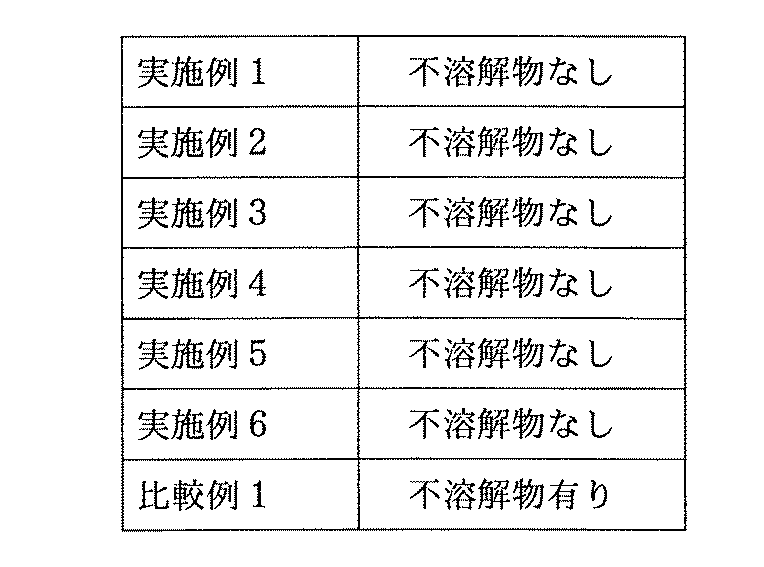
上記調製した実施例1〜6の溶液組成物及び比較例1の溶液組成物の各々について、溶液組成物をポリエチレン容器に入れ、−5℃の冷蔵庫内に静置し、4週間後に容器内の不溶解物の有無を目視観察した。以下がその結果である。
【0087】
【表1】
上記のように、比較例1の溶液組成物は低温下での長期保存により不溶解物を生成してしまうのに対し、実施例1〜6の溶液組成物(本発明の抗菌組成物)は、低温下で長期保存後も不溶解物を生成せず、保存前の良好な状態(溶液状態)が維持されることがわかる。
【0089】
【発明の効果】
以上の説明により明らかなように、本発明によれば、低温度下に長期保存しても不溶解物のない良好な溶液状態が維持し、低温度下での長期保存後も優れた抗菌作用(防腐、防かび効果)を示す、溶液剤型の工業用抗菌組成物を得ることができる。[0001]
TECHNICAL FIELD OF THE INVENTION
The present invention relates to an industrial antibacterial composition containing a benzisothiazoline compound and an isothiazoline compound as active ingredients, and more particularly to a solution-type industrial antibacterial composition in which a benzisothiazoline compound and an isothiazoline compound are dissolved in an organic solvent.
[0002]
[Prior art]
Conventionally, as an industrial antibacterial agent, an antibacterial agent containing an inorganic or organic compound of a heavy metal such as mercury, silver, or copper as an active ingredient has been widely used because of its excellent antibacterial effect. However, such heavy metal-based antibacterial agents are highly toxic to humans and livestock, so there is a danger at the time of application and a danger of secondary obstruction due to remaining in the applied product. It is no longer used for some reason. Therefore, a nonmetallic antibacterial agent containing a nonmetallic compound as an active ingredient instead of such a heavy metal antibacterial agent has been proposed. However, such a nonmetallic antibacterial agent has an antibacterial effect only on a limited kind of microorganisms. Even when applied to general industrial materials and products (for example, paints, pastes, wood products, textiles, etc.), their antiseptic and antifungal effects are not sufficient, and these industrial materials and products are often used. Since mold and growth develop and contaminate or change the substrate, they have not been satisfactory as industrial antibacterial agents.
[0003]
From the above background, the applicant of the present application has proposed an antibacterial agent which is free from dangers due to toxicity and environmental pollution and has excellent antibacterial action (preservation and antifungal effect) on various industrial materials and products. An antibacterial composition containing a 1,2-benzisothiazolin-3-one compound and 2-n-octyl-4-isothiazolin-3-one as active ingredients has been developed (Japanese Patent Publication No. 61-27365). Such an antibacterial composition can take various dosage forms (solutions, wettable powders, powders, granules, tablets, etc.), but the mixing conditions with industrial materials and products which are objects to which an antibacterial action is imparted, and It is often used in the form of a solution because it is easy to handle at the time of mixing.
[0004]
However, as a result of the study by the present inventors, it has been found that such a solution-type antibacterial composition may deteriorate in agent performance when left under a low temperature for a long period of time.
[0005]
[Problems to be solved by the invention]
In view of the above-mentioned circumstances, an object of the present invention is to provide an antibacterial composition in which excellent antibacterial action is stably maintained even when the composition is kept at a low temperature for a long period of time.
[0006]
[Means for Solving the Problems]
The present inventors have conducted intensive studies to achieve the above object, and found that the above-mentioned decrease in agent performance at a low temperature is due to the occurrence of insolubles in a solution (in a composition), As a result of further studies, the relative permittivity of the benzisothiazoline-based compound such as a 1,2-benzisothiazolin-3-one compound and the isothiazoline-based compound such as 2-n-octyl-4-isothiazolin-3-one has a specific range. It has been found that an antimicrobial composition which does not generate insolubles even when placed at a low temperature and does not deteriorate the agent performance can be obtained by dissolving the antibacterial composition in a polar solvent.
[0007]
That is, the present invention
(1) an industrial antibacterial composition comprising a benzisothiazoline-based compound and an isothiazoline-based compound dissolved in a polar solvent having a relative dielectric constant (25 ° C.) of 30 to 60;
(2) The industrial antibacterial composition according to (1), wherein the polar solvent is at least one selected from the group consisting of an amide solvent, a cyclic ether solvent, a sulfur solvent and a glycol ether solvent.
(3) The industrial antibacterial composition according to the above (1) or (2), wherein the benzisothiazoline compound is dissolved in an amount of 0.1 to 150 parts by weight per 100 parts by weight of the solvent.
(4) The industrial antibacterial composition according to any one of the above (1) to (3), which contains 0.01 to 100 parts by weight of the isothiazoline-based compound per 1 part by weight of the benzisothiazoline-based compound,
(5) A benzisothiazoline compound represented by the general formula (1):
[0008]
Embedded image
(Where Y 1 Represents a hydrogen atom or a hydrocarbon group which may be substituted, 1 The ring represents an optionally substituted benzene ring. )
Wherein the isothiazoline compound is represented by the general formula (2):
[0010]
Embedded image
(Where R 1 Represents a hydrogen atom or a hydrocarbon group which may be substituted; 2 And R 3 Represents the same or different and represents a hydrogen atom or a halogen atom. )
An industrial antibacterial composition according to any one of the above (1) to (4), which is a compound represented by the formula:
(6) the benzisothiazoline compound is at least one selected from 1,2-benzisothiazolin-3-one and Nn-butyl-benzisothiazolin-3-one, and the isothiazoline compound is 2-n- Octyl-4-isothiazolin-3-one, 5-chloro-2-methyl-4-isothiazolin-3-one, 5-chloro-2-n-octyl-4-isothiazolin-3-one, 4-chloro-2- at least one selected from n-octyl-4-isothiazolin-3-one, 2-methyl-4-isothiazolin-3-one and 4,5-dichloro-2-n-octyl-4-thiazolin-3-one The industrial antibacterial composition according to any one of the above (1) to (4),
(7) An industrial solution obtained by dissolving a benzisothiazoline compound and an isothiazoline compound in a mixed solvent in which a glycol solvent is mixed at 1 to 10000% by weight with respect to a polar solvent having a relative dielectric constant (25 ° C.) of 30 to 60. Antimicrobial composition,
(8) The industrial antibacterial composition according to (7), wherein the polar solvent is at least one selected from the group consisting of an amide solvent, a cyclic ether solvent, and a sulfur solvent.
(9) The above (7), wherein the glycol solvent is at least one selected from the group consisting of ethylene glycol, diethylene glycol, triethylene glycol, polyethylene glycol, propylene glycol, dipropylene glycol, tripropylene glycol, and polypropylene glycol. Or the industrial antibacterial composition according to (8),
(10) The industrial antibacterial composition according to any of (7) to (9), wherein the benzisothiazoline-based compound is dissolved in an amount of 0.1 to 150 parts by weight per 100 parts by weight of the solvent.
(11) The industrial antibacterial composition according to any one of the above (7) to (10), which contains 0.01 to 100 parts by weight of the isothiazoline-based compound per 1 part by weight of the benzisothiazoline-based compound,
(12) A benzisothiazoline compound represented by the general formula (1):
[0012]
Embedded image
(Where Y 1 Represents a hydrogen atom or a hydrocarbon group which may be substituted, 1 The ring represents an optionally substituted benzene ring. )
Wherein the isothiazoline compound is represented by the general formula (2):
[0014]
Embedded image
(Where R 1 Represents a hydrogen atom or a hydrocarbon group which may be substituted; 2 And R 3 Represents the same or different and represents a hydrogen atom or a halogen atom. )
The industrial antibacterial composition according to any one of the above (7) to (11), which is a compound represented by:
(13) The benzisothiazoline compound is at least one selected from 1,2-benzisothiazolin-3-one and Nn-butyl-benzisothiazolin-3-one, and the isothiazoline compound is 2-n- Octyl-4-isothiazolin-3-one, 5-chloro-2-methyl-4-isothiazolin-3-one, 5-chloro-2-n-octyl-4-isothiazolin-3-one, 4-chloro-2- at least one selected from n-octyl-4-isothiazolin-3-one, 2-methyl-4-isothiazolin-3-one and 4,5-dichloro-2-n-octyl-4-thiazolin-3-one The industrial antibacterial composition according to any one of the above (7) to (11).
[0016]
BEST MODE FOR CARRYING OUT THE INVENTION
The industrial antibacterial composition of the present invention is a composition obtained by dissolving a benzisothiazoline compound and an isothiazoline compound in a polar solvent having a relative dielectric constant of 30 to 60 at 25 ° C.
Further, a composition obtained by dissolving a benzisothiazoline-based compound and an isothiazoline-based compound in a mixed solvent obtained by mixing a glycol-based solvent with a polar solvent having a relative dielectric constant of 30 to 60 at 25 ° C and 1 to 10000% by weight. is there.
[0017]
The industrial antibacterial composition of the present invention having such a constitution does not generate insoluble matter in the composition (solution) even when left for a long time at a low temperature (a temperature of 0 ° C. or lower), and has an excellent antibacterial action. (Antiseptic and antifungal effects) are stably maintained.
[0018]
The target microorganisms of the industrial antimicrobial composition of the present invention are bacteria, molds, yeasts, algae, and a wide range of others, and the industrial antimicrobial composition of the present invention has an excellent effect as a controlling agent against such a wide range of microorganisms. Demonstrate. Specifically, paints; paste; wood and bamboo products; rubber products; fat products; leather products; fibers and fabrics; slime control agents in paper pulp mills and cooling water circulation processes; Coating paper; Coating liquid for paper; Surface sizing agent; Adhesive; Synthetic rubber latex; Sealing ink; Plastic products such as polyvinyl alcohol film and vinyl chloride film; Cement admixture; Sealing agent; It can be used effectively for controlling harmful microorganisms in various industrial materials and products such as materials; inks; fountain solutions for inks.
[0019]
The benzisothiazoline-based compound used in the present invention includes a compound represented by the following general formula (1).
[0020]
Embedded image
(Where Y 1 Represents a hydrogen atom or an optionally substituted hydrocarbon group, 1 The ring represents an optionally substituted benzene ring. )
[0022]
In the formula (1), Y 1 As the hydrocarbon group in the optionally substituted hydrocarbon group represented by, a hydrocarbon group having 1 to 20, preferably 1 to 14 carbon atoms is preferable, and examples thereof include an alkyl group, an alkenyl group, an alkynyl group and a cycloalkyl group. And aryl groups. Preferred are an alkyl group and a cycloalkyl group, and more preferred is an alkyl group.
[0023]
Examples of the alkyl group include methyl, ethyl, propyl, isopropyl, butyl, isobutyl, sec-butyl, tert-butyl, pentyl, hexyl, heptyl, n-octyl, isooctyl, sec-octyl, tert-octyl, nonyl, Examples thereof include an alkyl group having 1 to 10 carbon atoms such as decyl. Preferably, it is an alkyl group having 1 to 8 carbon atoms such as methyl, ethyl, propyl, butyl, octyl and the like, and more preferably, methyl, n-butyl and n-octyl.
[0024]
Examples of the alkenyl group include alkenyl groups having 2 to 4 carbon atoms such as vinyl, allyl, isopropenyl, 1-propenyl, 2-propenyl, and 2-methyl-1-propenyl. It is preferably an alkenyl group having 2 to 3 carbon atoms such as vinyl and allyl.
[0025]
Examples of the alkynyl group include alkynyl groups having 2 to 5 carbon atoms such as ethynyl, 1-propynyl, 2-propynyl, butynyl, and pentynyl. Preferably, it is an alkynyl group having 2 to 3 carbon atoms such as ethynyl and propynyl.
[0026]
Examples of the cycloalkyl group include a cycloalkyl group having 3 to 8 carbon atoms such as cyclopropyl, cyclobutyl, cyclopentyl, cyclohexyl, cycloheptyl, and cyclooctyl. Preferably, it is a cycloalkyl group having 5 to 6 carbon atoms such as cyclopentyl and cyclohexyl.
[0027]
Examples of the aryl group include aryl groups having 6 to 14 carbon atoms, such as phenyl, naphthyl, anthryl, and phenanthryl. It is preferably an aryl group having 6 carbon atoms such as phenyl.
[0028]
Y 1 Examples of the substituent in the hydrocarbon group which may be substituted include a hydroxyl group, a halogen atom (for example, chlorine, fluorine, bromine and iodine), a cyano group, an amino group, a carboxyl group, an alkoxy group ( For example, a lower alkoxy group having 1 to 4 carbon atoms such as methoxy, ethoxy, propoxy, butoxy, etc., an aryloxy group (eg, an aryloxy group having 6 to 20 carbon atoms such as a phenoxy group), an alkylthio group (eg, An alkylthio group having 1 to 4 carbon atoms such as methylthio, ethylthio, propylthio, and butylthio); and an arylthio group having 6 to 20 carbon atoms (eg, a phenylthio group). Preferably, they are a halogen atom and an alkoxy group. These substituents may be the same or different and may be substituted with 1 to 5, preferably 1 to 3.
[0029]
Y 1 In the optionally substituted hydrocarbon group represented by, preferably an unsubstituted hydrocarbon group, and among them, an alkyl group, especially methyl, ethyl, propyl, n-butyl, carbon number such as n-octyl Preferred are alkyl groups of 1 to 8, more preferably methyl, n-butyl and n-octyl.
[0030]
Y 1 Is particularly preferably a hydrogen atom, methyl, n-butyl or n-octyl, and most preferably a hydrogen atom.
[0031]
A in the above formula (1) 1 Examples of the substituent on the optionally substituted benzene ring represented by the ring include the above-mentioned Y 1 And the same as those defined for the substituent in the optionally substituted hydrocarbon group, and further include a nitro group and a cyano group. The same applies to preferred ones.
The substituent is preferably a halogen atom or an alkyl group (e.g., an alkyl group having 1 to 4 carbon atoms such as methyl, ethyl, propyl, and butyl). , Preferably one or two may be substituted.
A 1 A particularly preferred embodiment of the ring is an unsubstituted benzene ring.
[0032]
Specific examples of the benzisothiazoline-based compound represented by the above formula (1) include, for example, 1,2-benzisothiazolin-3-one (hereinafter abbreviated as BIT), Nn-butyl-benzisothiazoline-3. -On and the like.
[0033]
The benzisothiazoline compound used in the present invention is a salt thereof, for example, an alkali metal such as sodium or potassium; an alkaline earth metal such as magnesium or calcium; an aliphatic amine such as ammonia, ethylenediamine or 1,6-hexamethylenediamine; It may be used in the form of a salt with an aromatic amine such as aniline; a heterocyclic amine such as pyridine, pyrrolidine, morpholine and methylpyridine. Among these salts, preferred are alkali metals such as sodium and potassium, aliphatic amines such as ammonia and ethylenediamine, and heterocyclic amines such as pyridine.
[0034]
The benzisothiazoline compound used in the present invention can be produced by a known technique, but a commercially available product may be used. Commercially available products include, for example, Proxel Press Paste P6 (trade name) (1,2-benzisothiazolin-3-one 80% by weight, manufactured by Abisia), Banquish 100 (trade name) (Nn-butyl-2- Benzisothiazolin-3-one 95% by weight, manufactured by Avicia). In the present invention, the benzisothiazoline compound may be a single compound or a combination of two or more compounds.
[0035]
Examples of the isothiazoline-based compound used in the present invention include a compound represented by the following general formula (2).
[0036]
Embedded image
(Where R 1 Represents a hydrogen atom or a hydrocarbon group which may be substituted; 2 And R 3 Represents the same or different and represents a hydrogen atom or a halogen atom. )
[0038]
R in the above formula 1 The hydrocarbon group in the optionally substituted hydrocarbon group represented by 1 And the same as those defined for the hydrocarbon group in the optionally substituted hydrocarbon group, and preferred are also the same. Also, R 1 The substituent in the optionally substituted hydrocarbon group represented by 1 And the same as those defined for the substituents in the optionally substituted hydrocarbon group represented by the above, and preferred ones are also the same.
[0039]
R 1 Is a non-substituted hydrocarbon group, among which an alkyl group is more preferred, and most preferred are methyl, n-butyl and n-octyl.
[0040]
R in the above formula 2 , R 3 Examples of the halogen atom represented by are a chlorine atom, a bromine atom, a fluorine atom, and an iodine atom, and a chlorine atom is preferable.
R 2 And R 3 Is particularly preferably a hydrogen atom or a chlorine atom.
[0041]
Specific examples of the isothiazoline-based compound represented by the above formula (2) include 2-n-octyl-4-isothiazolin-3-one (hereinafter abbreviated as OIT), 5-chloro-2-methyl-4-isothiazoline- 3-one, 5-chloro-2-n-octyl-4-isothiazolin-3-one, 4-chloro-2-n-octyl-4-isothiazolin-3-one, 2-methyl-4-isothiazoline-3- And 4,5-dichloro-2-n-octyl-4-thiazolin-3-one. Among them, OIT, 5-chloro-2-n-octyl-4-isothiazolin-3-one and 4-chloro-2-n-octyl-4-isothiazolin-3-one are preferable, and OIT is particularly preferable.
[0042]
The isothiazoline compound used in the present invention can be produced by a known technique, but a commercially available product may be used. Examples of commercially available products include Skene 893T (trade name) (98% by weight of 2-n-octyl-4-isothiazolin-3-one, manufactured by Rohm and Haas Co.), and Skene M8 (trade name) (2-n-octyl) -4-isothiazolin-3-one 45% by weight, manufactured by Rohm and Haas), Zonen O / 100 (trade name) (2-n-octyl-4-isothiazolin-3-one 98% by weight, manufactured by Kesicrea), And the like.
In the present invention, the isothiazoline compound may be a single compound or a combination of two or more compounds.
[0043]
In the antibacterial composition of the present invention, the content (dissolution amount) of the benzisothiazoline-based compound is generally 0.1 part by weight or more, preferably 1 part by weight or more, more preferably 3 parts by weight, per 100 parts by weight of the solvent. Above, particularly preferably 5 parts by weight or more. However, if the content is too high, it becomes difficult to prepare a uniform solution, so the upper limit is usually 150 parts by weight or less per 100 parts by weight of the solvent, preferably 100 parts by weight or less, more preferably 100 parts by weight or less. 80 parts by weight or less.
[0044]
On the other hand, the content (dissolution amount) of the isothiazoline-based compound is generally 0.01 to 100 parts by weight, preferably 0.1 to 10 parts by weight, per part by weight of the benzisothiazoline-based compound. When the content (dissolution amount) of the isothiazoline-based compound is smaller than this, even if the antibacterial composition has a sufficient antifungal effect on various industrial materials and products, the antiseptic effect may not be satisfied. If the amount is large, the amount used is such that the antifungal effect is sufficiently exhibited for various industrial materials and products, and the amount is excessive in order to exhibit the antiseptic effect, which is not preferable.
[0045]
The antibacterial composition of the present invention is prepared by containing (dissolving) the benzisothiazoline-based compound and the isothiazoline-based compound in the solvent in the above-described amounts, respectively. The method for preparing such a composition is not particularly limited. For example, an isothiazoline-based compound, a surfactant, and a benzisothiazoline-based compound are placed in a stainless steel container while stirring a predetermined solvent and stirring under heating conditions at room temperature or up to 70 ° C. This is done by charging the compounds in order and stirring until all are dissolved.
[0046]
In the present invention, as a solvent for dissolving the benzisothiazoline-based compound and the isothiazoline-based compound, a polar solvent having a relative dielectric constant (25 ° C.) of 30 to 60, or a glycol-based solvent mixed with the polar solvent in an amount of 1 to 10,000% by weight is used. Use the mixed solvent prepared.
That is, the composition of the present invention comprises a composition obtained by dissolving a benzisothiazoline-based compound and an isothiazoline-based compound in a polar solvent having a relative dielectric constant (25 ° C.) of 30 to 60 (first embodiment); A composition obtained by dissolving a benzisothiazoline-based compound and an isothiazoline-based compound in a mixed solvent obtained by mixing a glycol-based solvent in a range of 1 to 10000% by weight with a polar solvent having a ratio (25 ° C.) of 30 to 60 (second Embodiment).
The relative dielectric constant (25 ° C.) of the solvent in the present invention is based on literatures (“Chemical Handbook” (Maruzen Co., Ltd.) and “The MERCK INDEX” (Merck Publishing Group)).
[0047]
The polar solvent having a relative dielectric constant (25 ° C.) of 30 to 60 can be used without particular limitation as long as it does not substantially react with the benzisothiazoline-based compound and the isothiazoline-based compound. Solvents selected from the group consisting of a system solvent, a cyclic ether solvent and a sulfur solvent are preferable, and among them, those having a relative dielectric constant (25 ° C) in the range of 30 to 50 are particularly preferable.
[0048]
Specific examples of the amide solvent include N, N-dimethylformamide (dielectric constant: 36.7), dimethylacetamide (dielectric constant: 37.8), and N-methyl-2-pyrrolidone (dielectric constant). Rate: 32.2). As a specific example of the cyclic ether-based solvent, for example, tetrahydrofurfuryl alcohol (relative permittivity: 37.1) is given. Specific examples of the sulfur-based solvent include, for example, dimethyl sulfoxide (relative dielectric constant: 45.0), sulfolane (relative dielectric constant: 43.3) and the like, and preferably dimethyl sulfoxide.
In the present invention, a polar solvent having a relative dielectric constant (25 ° C.) of 30 to 60 may be used alone or in combination of two or more.
[0049]
The benzisothiazoline-based compound and the isothiazoline-based compound are dissolved in a mixed solvent obtained by mixing the composition of the present invention with a polar solvent having a relative dielectric constant (25 ° C.) of 30 to 60 and a glycol-based solvent in a range of 1 to 10000% by weight. Examples of the glycol-based solvent used in the composition (the composition of the second embodiment) include ethylene glycol, diethylene glycol, triethylene glycol, polyethylene glycol, propylene glycol, dipropylene glycol, tripropylene glycol, and polypropylene. At least one solvent selected from the group consisting of glycols is included. Among these, diethylene glycol, propylene glycol, and dipropylene glycol are preferable, and diethylene glycol is particularly preferable, from the viewpoints of legal regulations, formulation (composition) viscosity, and economic reasons.
[0050]
In the case of the composition of the second aspect, not only can the formation of insolubles under the intended low-temperature environment be sufficiently prevented, but also the formulation (composition) is less colored, and the emulsion-type industrial Effects such as little aggregation of the emulsion when added to the material (product) and little influence on the industrial material (product) made of a plastic material are obtained.
[0051]
In the case of a mixed solvent in which a glycol-based solvent is mixed in an amount exceeding 10,000% by weight with respect to a polar solvent having a relative dielectric constant (25 ° C.) of 30 to 60, insolubles may be generated at a low temperature, If the amount of the glycol-based solvent is less than 1% by weight relative to the polar solvent having a relative dielectric constant (25 ° C.) of 30 to 60, it is difficult to obtain the above-mentioned effects by mixing the glycol-based solvent. In the present invention, the mixing amount of the glycol-based solvent is preferably 1 to 2000% by weight, more preferably 10 to 1000% by weight, based on the polar solvent having a relative dielectric constant (25 ° C) of 30 to 60.
[0052]
The antimicrobial composition of the present invention (first and second embodiments) may further contain a benzimidazole compound together with a benzisothiazoline compound and an isothiazoline compound for the purpose of broadening the antibacterial spectrum, Examples of the benzimidazole-based compound include a compound represented by the following general formula (3).
[0053]
Embedded image
(Where A 2 The ring represents an optionally substituted benzene ring, Z represents a group represented by -NHCOOR (wherein R represents a hydrogen atom or an alkyl group), or an optionally substituted 5- or 6-membered group. Shows a nitrogen heterocyclic group. )
[0055]
A in the above formula (3) 2 Examples of the substituent in the optionally substituted benzene ring represented by the ring include a hydroxyl group, a halogen atom (eg, chlorine, fluorine, bromine and iodine), an alkyl group, an alkenyl group, an alkynyl group, a cycloalkyl group and an aryl These substituents may be the same or different and may be substituted with 1 to 4, preferably 1 or 2 substituents.
[0056]
Examples of the alkyl group include methyl, ethyl, propyl, isopropyl, butyl, isobutyl, sec-butyl, tert-butyl, pentyl, hexyl, heptyl, octyl, isooctyl, sec-octyl, tert-octyl, nonyl, decyl and the like. And alkyl groups having 1 to 10 carbon atoms, preferably alkyl groups having 1 to 4 carbon atoms such as methyl, ethyl, propyl and butyl, and particularly preferably 1 to 4 carbon atoms such as methyl, ethyl and propyl. 3 alkyl groups.
[0057]
Examples of the alkenyl group include alkenyl groups having 2 to 4 carbon atoms such as vinyl, allyl, isopropenyl, 1-propenyl, 2-propenyl and 2-methyl-1-propenyl, and preferably vinyl, allyl and the like. Is an alkenyl group having 2 to 3 carbon atoms.
[0058]
Examples of the alkynyl group include alkynyl groups having 2 to 5 carbon atoms such as ethynyl, 1-propynyl, 2-propynyl, butynyl, and pentynyl, and preferably alkynyl groups having 2 to 3 carbon atoms such as ethynyl and propynyl. It is.
[0059]
Examples of the cycloalkyl group include cycloalkyl groups having 3 to 8 carbon atoms such as cyclopropyl, cyclobutyl, cyclopentyl, cyclohexyl, cycloheptyl and cyclooctyl, and preferably having 5 to 6 carbon atoms such as cyclopentyl and cyclohexyl. It is a cycloalkyl group.
[0060]
Examples of the aryl group include an aryl group having 6 to 14 carbon atoms such as phenyl, naphthyl, anthryl, and phenaltolyl, and an aryl group having 6 carbon atoms such as phenyl is preferable.
[0061]
The alkyl group represented by R in —NHCOOR (R represents a hydrogen atom or an alkyl group) represented by Z in the above formula (3) includes, for example, methyl, ethyl, n-propyl, isopropyl, n -Butyl, isobutyl, sec-butyl, tert-butyl, n-pentyl, n-hexyl, n-heptyl, n-octyl and the like, and alkyl groups having 1 to 8 carbon atoms, preferably methyl, ethyl , N-propyl and the like having 1 to 3 carbon atoms.
[0062]
The nitrogen-containing heterocyclic group in the optionally substituted 5- or 6-membered nitrogen-containing heterocyclic group represented by Z in the above formula (3) includes, for example, 1 to 4 nitrogen atoms as ring constituent atoms. Or a 5- or 6-membered monocyclic heterocyclic group containing, as a ring-constituting atom, one heteroatom selected from oxygen and sulfur in addition to one or two nitrogen atoms, A fused heterocyclic group in which a benzene ring or a 5-membered ring is fused to the 5- or 6-membered nitrogen-containing heterocyclic ring is exemplified. Specific examples of the 5- or 6-membered nitrogen-containing monocyclic heterocyclic group include, for example, a pyridyl group (for example, a 2-pyridyl group, a 3-pyridyl group, a 4-pyridyl group and the like), a thiazolyl group (for example, a 2-thiazolyl group, 4-thiazolyl group, 5-thiazolyl group, etc., isothiazolyl group (for example, 3-isothiazolyl group, 4-isothiazolyl group, 5-isothiazolyl group, etc.), imidazolyl group (for example, 1-imidazolyl group, 2-imidazolyl group, 4- Imidazolyl group, 5-imidazolyl group, etc.), pyrrolyl group (2-pyrrolyl group, 3-pyrrolyl group, etc.), pyrrolinyl group (2-pyrolinyl group, 3-pyrrolyl group, etc.), flazanyl group (4-nitro-furazan-3) -Yl group, 4-methoxy-furazan-3-yl group, carboxymethyl-furazan-3-yl group, etc.), and pyrrolidinyl group (1-pyrrolidin Group, 2-pyrrolidinyl group, 3-pyrrolidinyl group, etc.), imidazolidinyl group (2-imidazolidinyl group, 4-imidazolidinyl group, 5-imidazolidinyl group, etc.), pyrazolidinyl group (eg, 1-pyrazolidinyl group, etc.), pyrazolyl group (eg, 5-pyrazolyl group, etc.), oxazolyl group (eg, 2-oxazolyl group, 4-oxazolyl group, 5-oxazolyl group, etc.), isoxazolyl group (3-isoxazolyl group, 4-isoxazolyl group, 5-isoxazolyl group, etc.), tetrazolyl group (Eg, 1H-tetrazolyl group, 2H-tetrazolyl group, etc.), pyrimidyl group (eg, 2-pyrimidyl group, 4-pyrimidyl group, 5-pyrimidyl group, etc.), pyridazinyl group (eg, 3-pyridazinyl group, 4-pyridazinyl group, etc.) , Pyrazinyl group (2-pyrazinyl group 3-pyrazinyl group, 5-pyrazinyl group, 6-pyrazinyl group, etc.), thiazinyl group (2-thiazinyl group, 3-thiazinyl group, 5-thiazinyl group, 6-thiazinyl group, etc.), piperazinyl group (2-piperazinyl group, 3-piperazinyl group, 5-piperazinyl group, 6-piperazinyl group, etc.), thiadiazinyl group (2-thiadiazinyl group, 3-thiadiazinyl group, 5-thiadiazinyl group, 6-thiadiazinyl group, etc.), oxadiazolyl group (for example, 1,3,3) 4-oxadiazolyl group, 3- or 5- (1,2,4-oxadiazolyl) group, etc., thiadiazolyl group (for example, 4- or 5- (1,2,3-thiadiazolyl) group, etc.), triazolyl group (for example, 1 , 2,3-triazolyl group, 1,2,4-triazolyl group, etc.), thiomorpholinyl group (2-thiomorpholini group) Group, 3-thiomorpholinyl group, 5-thiomorpholinyl group, 6-thiomorpholinyl group, etc.), morpholinyl group (2-morpholinyl group, 3-morpholinyl group, 5-morpholinyl group, 6-morpholinyl group, etc.), oxoimidazinyl Group (2-oxoimidazinyl group, etc.), dioxotriazinyl group (1,2,4-dioxotriazinyl-3,5-dione-1-yl group, 1,2,4-di Oxotriazinyl-3,5-dione-2-yl group, 2,4-dioxotriazinyl-3,5-dione-4-yl group, etc., piperidinyl group (2-piperidinyl group, 3-piperidinyl) Group, 4-piperidinyl group, 5-piperidinyl group, 6-piperidinyl group, etc.), 1,4-oxazinyl group (1,4-oxazinyl-2-yl group, 1,4-oxazinyl-3-yl group, etc.), etc. Is raised It is. Specific examples of the above fused heterocyclic group include, for example, quinolyl group (for example, 2-quinolyl group, 3-quinolyl group, 4-quinolyl group, etc.), isoquinolyl group (3-isoquinolyl group, 4-isoquinolyl group, etc.), indolyl Group (2-indolyl group, 3-indolyl group, etc.), isoindolyl group (1H-isoindol-3-yl group, etc.), quinolizinyl group (8-quinolidinyl group, etc.), purinyl group (1H-purin-6-yl group) , A 3H-purin-6-yl group and the like), a cinnolinyl group (a 3-cinnolinyl group, a 5-cinnolinyl group and the like), an indazolyl group (a 3-indazolyl group and the like), a buteridinyl group (a 2-buteridinyl group and the like), a phthalazinyl group ( 4-phthalazinyl group, etc.), quinazolinyl group (2-quinazolinyl group, 4-quinazolinyl group, etc.), quinoxalinyl group (2-quinoxalinyl) , 3-quinoxalinyl group, etc.), indolizinyl group (2-indolizinyl group, etc.), benzooxazinyl group (2H-1,3-benzoxazin-2-yl group, etc.), phenothiazinyl group (2-phenothiazinyl group, 3-phenothiazinyl group, etc.), phenazinyl group (2-phenazinyl group, 3-phenazinyl group, etc.), phenoxazinyl group (2-phenoxazinyl group, 3-phenoxazinyl group, 4-phenoxazinyl group, etc.).
Preferred among the above heterocyclic groups are 5-membered nitrogen-containing heterocyclic groups, and thiazolyl groups are particularly preferred.
[0063]
Examples of the group which may be substituted on the heterocyclic ring include, for example, C 1-4 Alkyl, C 1-4 Alkoxy, halogen and the like; 1-4 Examples of the alkyl include methyl, ethyl, n-propyl, isopropyl, butyl, n-butyl, isobutyl, sec-butyl, tert-butyl and the like. C 1-4 Alkoxy includes, for example, methoxy, ethoxy, n-propoxy, isopropoxy, butoxy, n-butoxy, isobutoxy, sec-butoxy, tert-butoxy and the like, and halogen includes fluoro, chloro, bromo and the like. Other examples include a hydroxyl group, an amino group, and a mercapto group. Examples of the number of the substituent include 1 to 3.
[0064]
The benzimidazole-based compound represented by the above formula (3) may be a salt thereof, for example, an inorganic acid salt such as hydrochloride, nitrate or phosphate, an organic acid salt such as paratoluenesulfonate or methylsulfonate, or ammonia. , Ethylenediamine, salts with aliphatic amines such as 1,6-hexamethylenediamine, and salts with alkali metals such as sodium and potassium. Specific examples of the benzimidazole-based compound represented by the above formula (3) and salts thereof include, for example, methyl 2-benzimidazole carbamate (hereinafter abbreviated as BCM), ethyl 2-benzimidazole carbamate, and 2- (4-thiazolyl) ) Benzimidazole, hydrochloride of methyl 2-benzimidazole carbamate, hydrochloride of ethyl 2-benzimidazole carbamate, hydrochloride of 2- (4-thiazolyl) benzimidazole, p-toluenesulfonate of methyl 2-benzimidazole carbamate And p-toluenesulfonate of ethyl 2-benzimidazole carbamate, p-toluenesulfonate of 2- (4-thiazolyl) benzimidazole, and the like, and preferably hydrochloride of methyl 2-benzimidazole carbamate. That.
[0065]
The amount of the benzimidazole compound is preferably about 1 to 10,000 parts by weight based on 100 parts by weight of the benzisothiazoline compound, more preferably about 100 parts by weight of the benzimidazole compound based on 100 parts by weight of the benzisothiazoline compound. The ratio is about 10 to 1000 parts by weight.
[0066]
The antimicrobial composition of the present invention may contain known additives, for example, a surfactant, an antioxidant, a light stabilizer, an antifoaming agent, and the like, depending on its purpose and use. May be added.
[0067]
The surfactant includes, for example, known surfactants such as soaps, nonionic surfactants, anionic surfactants, cationic surfactants, amphoteric surfactants, and polymer surfactants, and is preferably used. Nonionic surfactants and anionic surfactants are exemplified.
[0068]
Examples of the nonionic surfactant include polyoxyalkylene aryl phenyl ether, polyoxyethylene nonyl phenyl ether, and a block copolymer of ethylene oxide and propylene oxide.
[0069]
Examples of anionic surfactants include metal salts of alkyl benzene sulfonic acid, metal salts of alkyl naphthalene sulfonic acid, polycarboxylic acid type surfactants, metal salts of dialkyl sulfosuccinate, ammonium salts of polyoxyethylene distyrenated phenyl ether sulfate, lignin And sulfonic acid metal salts. In addition, examples of these metal salts include sodium salts, potassium salts, and magnesium salts.
[0070]
The amount of the surfactant to be used is preferably about 0.01 to 10% by weight, particularly preferably about 0.1 to 5% by weight, based on the whole solution (composition).
[0071]
Examples of the antioxidant include phenolic antioxidants such as 2,6-di-t-butyl-4-methylphenol and 2,2′-methylenebis [4-methyl-6-t-butylphenol], for example, alkyl Examples include amine antioxidants such as diphenylamine and N, N-di-s-butyl-p-phenylenediamine.
[0072]
The amount of the antioxidant used is preferably about 0.1 to 10% by weight of the whole solution (composition).
[0073]
Examples of the light stabilizer include hindered amine light stabilizers such as bis (2,2,6,6-tetramethyl-4-piperidyl) sebacate. About 0.1 to 10 parts by weight of such a light stabilizer is added to 100 parts by weight of the liquid agent.
[0074]
Other anti-algal agents and / or fungicides include, for example, organic iodine compounds such as 3-iodo-2-propynyl-butylcarbamate, diiodomethyl-p-tolylsulfone and p-chlorophenyl-3-iodopropargyl formal; For example, thiocarbamate compounds such as tetramethylthiuram disulfide, for example, nitrile compounds such as 2,4,5,6-tetrachloroisophthalonitrile, for example, N- (fluorodichloromethylthio) -phthalimide and N- (fluorodichloromethylthio) Haloalkylthio compounds such as -N, N'-dimethyl-N-phenyl-sulfamide, for example, pyridine compounds such as 2,3,5,6-tetrachloro-4- (methylsulfonyl) pyridine, for example, zinc pyrithione and sodium Pyrithione compounds such as pyrithione, for example, benzothiazole compounds such as 2- (4-thiocyanomethylthio) benzothiazole, for example, urea compounds such as 3- (3,4-dichlorophenyl) -1,1-dimethylurea, for example, α-t-butyl-α (p-chlorophenylethyl) -1H-1,2,4-triazole-1-ethanol (trade name tebuconazole), 1-[(2- (2,4-dichlorophenyl) -4-propyl -1,3-dioxolan-2-yl-methyl) -1H-1,2,4-triazole (trade name propiconazole), 1- [2- (2,4-dichlorophenyl) -1,3-dioxolane- 2-yl-methyl] -1H-1,2,4-triazole (trade name azaconazole) and the like, for example, 2-methylthiazole Triazine compounds such as o-4-t-butylamino-6-cyclopropylamino-s-triazine, for example, thiophene compounds such as 3,3,4,4-tetrachlorotetrahydrothiophen-1,1-dioxide, for example, Examples include oxathiazine-based compounds such as 3-benzo [b] thien-2-yl-5,6-dihydro-1,4,2-oxathiazine4-oxide. These other algicides and / or fungicides may be used alone or in combination of two or more. The proportions of these components are appropriately determined according to the type of the solvent and the like.
[0075]
The antibacterial composition of the present invention is preferably used under the condition of a pH value of 7 to 11. Therefore, when the antibacterial composition of the present invention is added to an industrial product / material and the pH value of the industrial product / material is in the range of 7 to 11, it can be used without adjusting the pH itself. If the pH value of the material is outside the range of 7-11, it is preferred to adjust the pH value to 7-11. When the pH value is less than 7, as a pH adjuster, for example, sodium hydroxide, potassium hydroxide, calcium hydroxide, magnesium hydroxide, ammonia, aqueous ammonia, triethanolamine, dimethylamine, diethylamine, trimethylamine, triethylamine, triisopropanol The reaction can be carried out by adding an appropriate amount of an amine, monoethanolamine, diethanolamine, diisopropanolamine, monoethanolamine, diethanolamine, diisopropanolamine, magnesium oxide or the like. When the pH value is higher than 11, by adding an appropriate amount of a pH adjuster, for example, hydrochloric acid, citric acid, nitric acid, sulfuric acid, trisodium phosphate, disodium hydrogen phosphate, dipotassium hydrogen phosphate and the like. It can be carried out.
The pH value may be adjusted by using a mixture of the acidic pH adjuster and the basic pH adjuster.
[0076]
In addition, the amount of the industrial composition of the present invention may be appropriately determined depending on the application target, and is about 10 to 10000 mg (active ingredient) / kg (product / material), preferably about 50 to 1000 mg ( It is preferably used as a concentration of (active ingredient) / kg (product / material). The active ingredient referred to herein means a benzisothiazoline compound and an isothiazoline compound.
[0077]
The specific use of the industrial antibacterial composition of the present invention has been described above, and among them, the use of paints, pastes, slime control agents, metalworking oils, paper coating liquids, surface sizing agents, printing inks, etc. Is particularly preferred. This is because these objects (industrial materials and products) contain a lot of substances that cause spoilage.
[0078]
【Example】
Hereinafter, the present invention will be described in more detail with reference to Examples and Comparative Examples, but the present invention is not limited to the following Examples.
[0079]
(Example 1)
86.8 g of N, N-dimethylformamide (dielectric constant: 36.7) is placed in a stainless steel container, and 5.1 g of Skene M8 (OIT active ingredient: 45%) is dissolved with stirring. 0.5 g of Pole PE-75 (polyoxyethylene polyoxy block polymer (nonionic surfactant)) is dissolved, and 7.6 g of Proxel press paste (BIT active ingredient: 86.3%) is dissolved to obtain 100. 0.0 g, to prepare a solution composition.
[0080]
(Example 2)
A solution composition was prepared in the same manner as in Example 1 except that 86.8 g of N-methyl-2-pyrrolidone (dielectric constant: 32.2) was used instead of 86.8 g of N, N-dimethylformamide. Prepared.
[0081]
(Example 3)
A solution composition was prepared in the same manner as in Example 1, except that 86.8 g of tetrafurfuryl alcohol (relative dielectric constant: 37.1) was used instead of 86.8 g of N, N-dimethylformamide. .
[0082]
(Example 4)
A solution composition was prepared in the same manner as in Example 1, except that 86.8 g of dimethyl sulfoxide (dielectric constant: 45.0) was used instead of 86.8 g of N, N-dimethylformamide.
[0083]
(Example 5)
A solution was prepared in the same manner as in Example 1 except that a mixed solvent of 26.0 g of dimethylacetamide (dielectric constant: 37.8) and 60.8 g of diethylene glycol was used instead of 86.8 g of N, N-dimethylformamide. A composition was prepared.
[0084]
(Example 6)
A solution composition was prepared in the same manner as in Example 1, except that a mixed solvent of 26.0 g of N-methyl-2-pyrrolidone and 60.8 g of diethylene glycol was used instead of 86.8 g of N, N-dimethylformamide. did.
[0085]
(Comparative Example 1)
A solution composition was prepared in the same manner as in Example 1 except that 86.8 g of diethylene glycol was used instead of 86.8 g of N, N-dimethylformamide.
[0086]
(Test example)
For each of the solution compositions of Examples 1 to 6 and the solution composition of Comparative Example 1 prepared above, the solution compositions were placed in a polyethylene container, and allowed to stand in a refrigerator at −5 ° C., and after 4 weeks, The presence or absence of insolubles was visually observed. The following is the result.
[0087]
[Table 1]
As described above, the solution composition of Comparative Example 1 generates an insoluble substance due to long-term storage at a low temperature, whereas the solution compositions of Examples 1 to 6 (the antibacterial composition of the present invention) It can be seen that insoluble matter is not generated even after long-term storage at a low temperature, and a good state (solution state) before storage is maintained.
[0089]
【The invention's effect】
As is clear from the above description, according to the present invention, a good solution state free from insoluble matter is maintained even when stored for a long time at a low temperature, and an excellent antibacterial action is obtained even after a long-term storage at a low temperature. A solution-type industrial antibacterial composition exhibiting (preservative and antifungal effects) can be obtained.
Claims (13)
で表される化合物であり、イソチアゾリン系化合物が、一般式(2):
で表される化合物である、請求項1〜4のいずれかに記載の工業用抗菌組成物。The benzisothiazoline-based compound has the general formula (1):
Wherein the isothiazoline compound is represented by the general formula (2):
The industrial antibacterial composition according to any one of claims 1 to 4, which is a compound represented by the following formula:
で表される化合物であり、イソチアゾリン系化合物が、一般式(2):
で表される化合物である、請求項7〜11のいずれかに記載の工業用抗菌組成物。The benzisothiazoline-based compound has the general formula (1):
Wherein the isothiazoline compound is represented by the general formula (2):
The industrial antibacterial composition according to any one of claims 7 to 11, which is a compound represented by the formula:
Priority Applications (1)
| Application Number | Priority Date | Filing Date | Title |
|---|---|---|---|
| JP2003205784A JP4567955B2 (en) | 2002-08-05 | 2003-08-04 | Industrial antibacterial composition |
Applications Claiming Priority (2)
| Application Number | Priority Date | Filing Date | Title |
|---|---|---|---|
| JP2002227874 | 2002-08-05 | ||
| JP2003205784A JP4567955B2 (en) | 2002-08-05 | 2003-08-04 | Industrial antibacterial composition |
Publications (2)
| Publication Number | Publication Date |
|---|---|
| JP2004123715A true JP2004123715A (en) | 2004-04-22 |
| JP4567955B2 JP4567955B2 (en) | 2010-10-27 |
Family
ID=32300839
Family Applications (1)
| Application Number | Title | Priority Date | Filing Date |
|---|---|---|---|
| JP2003205784A Expired - Lifetime JP4567955B2 (en) | 2002-08-05 | 2003-08-04 | Industrial antibacterial composition |
Country Status (1)
| Country | Link |
|---|---|
| JP (1) | JP4567955B2 (en) |
Cited By (8)
| Publication number | Priority date | Publication date | Assignee | Title |
|---|---|---|---|---|
| EP1570739A1 (en) * | 2004-03-05 | 2005-09-07 | Rohm And Haas Company | Antimicrobial composition containing N-(n-Butyl)-1, 2-Benzisothiazolin-3-One |
| JP2007031300A (en) * | 2005-07-22 | 2007-02-08 | Taisho Technos Co Ltd | Antiseptic / antifungal method and antiseptic / antifungal composition for aqueous industrial products |
| JP2007031299A (en) * | 2005-07-22 | 2007-02-08 | Taisho Technos Co Ltd | Industrial antiseptic mildew-proofing agent composition |
| WO2006074788A3 (en) * | 2005-01-13 | 2007-07-26 | Lanxess Deutschland Gmbh | Antimicrobial solid matter preparations |
| JP2009001561A (en) * | 2007-06-21 | 2009-01-08 | Rohm & Haas Co | Microbicidal composition |
| JP2011006453A (en) * | 2005-10-04 | 2011-01-13 | Rohm & Haas Co | Microbicidal composition |
| CN102304880A (en) * | 2011-07-15 | 2012-01-04 | 浙江帝龙新材料股份有限公司 | Mildew-proof antibacterial decorative paper |
| JP2012140409A (en) * | 2010-12-29 | 2012-07-26 | Rohm & Haas Co | Low-temperature-stable solution |
Families Citing this family (1)
| Publication number | Priority date | Publication date | Assignee | Title |
|---|---|---|---|---|
| CN103757984B (en) * | 2013-12-20 | 2015-12-02 | 浙江华川实业集团有限公司 | A kind of mildew-proof antibacterial decorative paper and preparation method thereof |
Citations (3)
| Publication number | Priority date | Publication date | Assignee | Title |
|---|---|---|---|---|
| JPS53145918A (en) * | 1977-05-25 | 1978-12-19 | Takeda Chem Ind Ltd | Fungistatic composition for industrial use |
| JPH02229179A (en) * | 1989-03-01 | 1990-09-11 | Katayama Chem Works Co Ltd | Stable isothiazolone liquid preparation |
| JP2001302418A (en) * | 2000-04-28 | 2001-10-31 | Permachem Asia Ltd | Industrial fungicide |
-
2003
- 2003-08-04 JP JP2003205784A patent/JP4567955B2/en not_active Expired - Lifetime
Patent Citations (3)
| Publication number | Priority date | Publication date | Assignee | Title |
|---|---|---|---|---|
| JPS53145918A (en) * | 1977-05-25 | 1978-12-19 | Takeda Chem Ind Ltd | Fungistatic composition for industrial use |
| JPH02229179A (en) * | 1989-03-01 | 1990-09-11 | Katayama Chem Works Co Ltd | Stable isothiazolone liquid preparation |
| JP2001302418A (en) * | 2000-04-28 | 2001-10-31 | Permachem Asia Ltd | Industrial fungicide |
Cited By (12)
| Publication number | Priority date | Publication date | Assignee | Title |
|---|---|---|---|---|
| EP1570739A1 (en) * | 2004-03-05 | 2005-09-07 | Rohm And Haas Company | Antimicrobial composition containing N-(n-Butyl)-1, 2-Benzisothiazolin-3-One |
| JP2005281305A (en) * | 2004-03-05 | 2005-10-13 | Rohm & Haas Co | Antimicrobial composition containing N- (n-butyl) -1,2-benzisothiazolin-3-one |
| EP2351486A1 (en) * | 2004-03-05 | 2011-08-03 | Rohm and Haas Company | Antimicrobial composition containing N(n-butyl)-1,2-benzisothiazolin-3-one |
| WO2006074788A3 (en) * | 2005-01-13 | 2007-07-26 | Lanxess Deutschland Gmbh | Antimicrobial solid matter preparations |
| JP2007031300A (en) * | 2005-07-22 | 2007-02-08 | Taisho Technos Co Ltd | Antiseptic / antifungal method and antiseptic / antifungal composition for aqueous industrial products |
| JP2007031299A (en) * | 2005-07-22 | 2007-02-08 | Taisho Technos Co Ltd | Industrial antiseptic mildew-proofing agent composition |
| JP2011006453A (en) * | 2005-10-04 | 2011-01-13 | Rohm & Haas Co | Microbicidal composition |
| JP2009001561A (en) * | 2007-06-21 | 2009-01-08 | Rohm & Haas Co | Microbicidal composition |
| JP2012097101A (en) * | 2007-06-21 | 2012-05-24 | Rohm & Haas Co | Microbicidal composition |
| JP2014129380A (en) * | 2007-06-21 | 2014-07-10 | Rohm & Haas Co | Microbicidal composition |
| JP2012140409A (en) * | 2010-12-29 | 2012-07-26 | Rohm & Haas Co | Low-temperature-stable solution |
| CN102304880A (en) * | 2011-07-15 | 2012-01-04 | 浙江帝龙新材料股份有限公司 | Mildew-proof antibacterial decorative paper |
Also Published As
| Publication number | Publication date |
|---|---|
| JP4567955B2 (en) | 2010-10-27 |
Similar Documents
| Publication | Publication Date | Title |
|---|---|---|
| JP5514183B2 (en) | Stabilized fluid | |
| CN1407855A (en) | Bactericidal and fungicidal liquid preparations for industrial products | |
| CN100594791C (en) | Microbicide composition and its application | |
| JP4567955B2 (en) | Industrial antibacterial composition | |
| CN1326456C (en) | Stable halogenated alkynyl microbicide composition | |
| JP2008074850A (en) | 1,2-benzisothiazolin-3-one-based sterilization preparation | |
| JP5518595B2 (en) | Industrial antiseptic and antifouling composition | |
| JP2024510441A (en) | Biocidal compositions and methods | |
| JP5389458B2 (en) | Industrial antibacterial composition | |
| JP2003055116A (en) | Industrial microbicident composition | |
| JPH09263504A (en) | Isothiazolone-based compound-containing composition and stabilization of isothiazolone-based compound | |
| JP5340613B2 (en) | Stable bactericidal and antifungal composition | |
| JP5748971B2 (en) | Aqueous disinfection and antibacterial composition | |
| JP2004143061A (en) | Method for stabilizing bis quaternary ammonium salt compound | |
| JP5457782B2 (en) | Industrial antibacterial agent | |
| JP4226826B2 (en) | Industrial sterilization composition | |
| JP2003055110A (en) | Industrial germicidal composition | |
| JPH1135409A (en) | Anti-algae / anti-mold composition | |
| KR20020000500A (en) | Industrial microbicide | |
| JP3910672B2 (en) | Stabilized industrial fungicide | |
| JP5099826B2 (en) | Industrial antibacterial composition | |
| JPH02250805A (en) | Industrial bactericide | |
| EP3360413B1 (en) | Microbicidal compositions based on 1,2-benzisothiazolin-3-one derivatives | |
| JP5604238B2 (en) | Industrial sterilization composition | |
| JP2003073214A (en) | Industrial bactericidal composition |
Legal Events
| Date | Code | Title | Description |
|---|---|---|---|
| A621 | Written request for application examination |
Free format text: JAPANESE INTERMEDIATE CODE: A621 Effective date: 20060626 |
|
| A977 | Report on retrieval |
Free format text: JAPANESE INTERMEDIATE CODE: A971007 Effective date: 20091119 |
|
| A131 | Notification of reasons for refusal |
Free format text: JAPANESE INTERMEDIATE CODE: A131 Effective date: 20091124 |
|
| A601 | Written request for extension of time |
Free format text: JAPANESE INTERMEDIATE CODE: A601 Effective date: 20100115 |
|
| A602 | Written permission of extension of time |
Free format text: JAPANESE INTERMEDIATE CODE: A602 Effective date: 20100120 |
|
| A521 | Request for written amendment filed |
Free format text: JAPANESE INTERMEDIATE CODE: A523 Effective date: 20100215 |
|
| A131 | Notification of reasons for refusal |
Free format text: JAPANESE INTERMEDIATE CODE: A131 Effective date: 20100511 |
|
| A521 | Request for written amendment filed |
Free format text: JAPANESE INTERMEDIATE CODE: A523 Effective date: 20100630 |
|
| TRDD | Decision of grant or rejection written | ||
| A01 | Written decision to grant a patent or to grant a registration (utility model) |
Free format text: JAPANESE INTERMEDIATE CODE: A01 Effective date: 20100727 |
|
| A01 | Written decision to grant a patent or to grant a registration (utility model) |
Free format text: JAPANESE INTERMEDIATE CODE: A01 |
|
| A61 | First payment of annual fees (during grant procedure) |
Free format text: JAPANESE INTERMEDIATE CODE: A61 Effective date: 20100806 |
|
| R150 | Certificate of patent or registration of utility model |
Ref document number: 4567955 Country of ref document: JP Free format text: JAPANESE INTERMEDIATE CODE: R150 Free format text: JAPANESE INTERMEDIATE CODE: R150 |
|
| FPAY | Renewal fee payment (event date is renewal date of database) |
Free format text: PAYMENT UNTIL: 20130813 Year of fee payment: 3 |
|
| S531 | Written request for registration of change of domicile |
Free format text: JAPANESE INTERMEDIATE CODE: R313531 |
|
| FPAY | Renewal fee payment (event date is renewal date of database) |
Free format text: PAYMENT UNTIL: 20130813 Year of fee payment: 3 |
|
| R350 | Written notification of registration of transfer |
Free format text: JAPANESE INTERMEDIATE CODE: R350 |
|
| R250 | Receipt of annual fees |
Free format text: JAPANESE INTERMEDIATE CODE: R250 |
|
| S111 | Request for change of ownership or part of ownership |
Free format text: JAPANESE INTERMEDIATE CODE: R313111 |
|
| R350 | Written notification of registration of transfer |
Free format text: JAPANESE INTERMEDIATE CODE: R350 |
|
| R250 | Receipt of annual fees |
Free format text: JAPANESE INTERMEDIATE CODE: R250 |
|
| R250 | Receipt of annual fees |
Free format text: JAPANESE INTERMEDIATE CODE: R250 |
|
| R250 | Receipt of annual fees |
Free format text: JAPANESE INTERMEDIATE CODE: R250 |
|
| EXPY | Cancellation because of completion of term |