JP2004123739A - Method for producing cilostazol - Google Patents
Method for producing cilostazol Download PDFInfo
- Publication number
- JP2004123739A JP2004123739A JP2003318669A JP2003318669A JP2004123739A JP 2004123739 A JP2004123739 A JP 2004123739A JP 2003318669 A JP2003318669 A JP 2003318669A JP 2003318669 A JP2003318669 A JP 2003318669A JP 2004123739 A JP2004123739 A JP 2004123739A
- Authority
- JP
- Japan
- Prior art keywords
- cilostazol
- mol
- carbonate
- reaction
- mixture
- Prior art date
- Legal status (The legal status is an assumption and is not a legal conclusion. Google has not performed a legal analysis and makes no representation as to the accuracy of the status listed.)
- Granted
Links
- RRGUKTPIGVIEKM-UHFFFAOYSA-N cilostazol Chemical compound C=1C=C2NC(=O)CCC2=CC=1OCCCCC1=NN=NN1C1CCCCC1 RRGUKTPIGVIEKM-UHFFFAOYSA-N 0.000 title claims abstract description 33
- 229960004588 cilostazol Drugs 0.000 title claims abstract description 32
- 238000004519 manufacturing process Methods 0.000 title claims abstract description 22
- LISFMEBWQUVKPJ-UHFFFAOYSA-N quinolin-2-ol Chemical class C1=CC=C2NC(=O)C=CC2=C1 LISFMEBWQUVKPJ-UHFFFAOYSA-N 0.000 claims abstract description 27
- XLYOFNOQVPJJNP-UHFFFAOYSA-N water Substances O XLYOFNOQVPJJNP-UHFFFAOYSA-N 0.000 claims abstract description 25
- 150000007514 bases Chemical class 0.000 claims abstract description 14
- 150000003536 tetrazoles Chemical class 0.000 claims description 16
- 150000001875 compounds Chemical class 0.000 claims description 6
- 125000005843 halogen group Chemical group 0.000 claims description 3
- 239000002904 solvent Substances 0.000 abstract description 11
- 239000003814 drug Substances 0.000 abstract description 2
- OKKJLVBELUTLKV-UHFFFAOYSA-N Methanol Chemical compound OC OKKJLVBELUTLKV-UHFFFAOYSA-N 0.000 description 39
- 238000006243 chemical reaction Methods 0.000 description 35
- 239000000203 mixture Substances 0.000 description 29
- 239000013078 crystal Substances 0.000 description 26
- BWHMMNNQKKPAPP-UHFFFAOYSA-L potassium carbonate Chemical compound [K+].[K+].[O-]C([O-])=O BWHMMNNQKKPAPP-UHFFFAOYSA-L 0.000 description 22
- HEMHJVSKTPXQMS-UHFFFAOYSA-M Sodium hydroxide Chemical compound [OH-].[Na+] HEMHJVSKTPXQMS-UHFFFAOYSA-M 0.000 description 21
- 238000000034 method Methods 0.000 description 14
- WMFOQBRAJBCJND-UHFFFAOYSA-M Lithium hydroxide Chemical compound [Li+].[OH-] WMFOQBRAJBCJND-UHFFFAOYSA-M 0.000 description 12
- KWYUFKZDYYNOTN-UHFFFAOYSA-M Potassium hydroxide Chemical compound [OH-].[K+] KWYUFKZDYYNOTN-UHFFFAOYSA-M 0.000 description 12
- 238000001914 filtration Methods 0.000 description 12
- GEHJYWRUCIMESM-UHFFFAOYSA-L sodium sulfite Chemical compound [Na+].[Na+].[O-]S([O-])=O GEHJYWRUCIMESM-UHFFFAOYSA-L 0.000 description 12
- 229910000027 potassium carbonate Inorganic materials 0.000 description 11
- 235000011181 potassium carbonates Nutrition 0.000 description 11
- 239000008213 purified water Substances 0.000 description 11
- CDBYLPFSWZWCQE-UHFFFAOYSA-L Sodium Carbonate Chemical compound [Na+].[Na+].[O-]C([O-])=O CDBYLPFSWZWCQE-UHFFFAOYSA-L 0.000 description 10
- UIIMBOGNXHQVGW-UHFFFAOYSA-M Sodium bicarbonate Chemical compound [Na+].OC([O-])=O UIIMBOGNXHQVGW-UHFFFAOYSA-M 0.000 description 10
- 239000000243 solution Substances 0.000 description 8
- 229910000288 alkali metal carbonate Inorganic materials 0.000 description 6
- 150000008041 alkali metal carbonates Chemical class 0.000 description 6
- FJDQFPXHSGXQBY-UHFFFAOYSA-L caesium carbonate Chemical compound [Cs+].[Cs+].[O-]C([O-])=O FJDQFPXHSGXQBY-UHFFFAOYSA-L 0.000 description 6
- 229910000024 caesium carbonate Inorganic materials 0.000 description 6
- XGZVUEUWXADBQD-UHFFFAOYSA-L lithium carbonate Chemical compound [Li+].[Li+].[O-]C([O-])=O XGZVUEUWXADBQD-UHFFFAOYSA-L 0.000 description 6
- 229910052808 lithium carbonate Inorganic materials 0.000 description 6
- 229910000032 lithium hydrogen carbonate Inorganic materials 0.000 description 6
- HQRPHMAXFVUBJX-UHFFFAOYSA-M lithium;hydrogen carbonate Chemical compound [Li+].OC([O-])=O HQRPHMAXFVUBJX-UHFFFAOYSA-M 0.000 description 6
- 229910000028 potassium bicarbonate Inorganic materials 0.000 description 6
- 235000015497 potassium bicarbonate Nutrition 0.000 description 6
- 239000011736 potassium bicarbonate Substances 0.000 description 6
- TYJJADVDDVDEDZ-UHFFFAOYSA-M potassium hydrogencarbonate Chemical compound [K+].OC([O-])=O TYJJADVDDVDEDZ-UHFFFAOYSA-M 0.000 description 6
- 235000010265 sodium sulphite Nutrition 0.000 description 6
- 238000003756 stirring Methods 0.000 description 6
- INTQSGGUSUSCTJ-UHFFFAOYSA-N 5-(4-chlorobutyl)-1-cyclohexyltetrazole Chemical compound ClCCCCC1=NN=NN1C1CCCCC1 INTQSGGUSUSCTJ-UHFFFAOYSA-N 0.000 description 5
- HOSGXJWQVBHGLT-UHFFFAOYSA-N 6-hydroxy-3,4-dihydro-1h-quinolin-2-one Chemical compound N1C(=O)CCC2=CC(O)=CC=C21 HOSGXJWQVBHGLT-UHFFFAOYSA-N 0.000 description 5
- KFZMGEQAYNKOFK-UHFFFAOYSA-N Isopropanol Chemical compound CC(C)O KFZMGEQAYNKOFK-UHFFFAOYSA-N 0.000 description 5
- 239000003960 organic solvent Substances 0.000 description 5
- 229940086066 potassium hydrogencarbonate Drugs 0.000 description 5
- 229910000030 sodium bicarbonate Inorganic materials 0.000 description 5
- 235000017557 sodium bicarbonate Nutrition 0.000 description 5
- 229910000029 sodium carbonate Inorganic materials 0.000 description 5
- MFGOFGRYDNHJTA-UHFFFAOYSA-N 2-amino-1-(2-fluorophenyl)ethanol Chemical compound NCC(O)C1=CC=CC=C1F MFGOFGRYDNHJTA-UHFFFAOYSA-N 0.000 description 4
- LFQSCWFLJHTTHZ-UHFFFAOYSA-N Ethanol Chemical compound CCO LFQSCWFLJHTTHZ-UHFFFAOYSA-N 0.000 description 4
- DGAQECJNVWCQMB-PUAWFVPOSA-M Ilexoside XXIX Chemical compound C[C@@H]1CC[C@@]2(CC[C@@]3(C(=CC[C@H]4[C@]3(CC[C@@H]5[C@@]4(CC[C@@H](C5(C)C)OS(=O)(=O)[O-])C)C)[C@@H]2[C@]1(C)O)C)C(=O)O[C@H]6[C@@H]([C@H]([C@@H]([C@H](O6)CO)O)O)O.[Na+] DGAQECJNVWCQMB-PUAWFVPOSA-M 0.000 description 4
- 150000008044 alkali metal hydroxides Chemical class 0.000 description 4
- HUCVOHYBFXVBRW-UHFFFAOYSA-M caesium hydroxide Inorganic materials [OH-].[Cs+] HUCVOHYBFXVBRW-UHFFFAOYSA-M 0.000 description 4
- 238000001816 cooling Methods 0.000 description 4
- 229910052708 sodium Inorganic materials 0.000 description 4
- 239000011734 sodium Substances 0.000 description 4
- LYCAIKOWRPUZTN-UHFFFAOYSA-N Ethylene glycol Chemical compound OCCO LYCAIKOWRPUZTN-UHFFFAOYSA-N 0.000 description 3
- 239000003153 chemical reaction reagent Substances 0.000 description 3
- 229910052801 chlorine Inorganic materials 0.000 description 3
- 125000001309 chloro group Chemical group Cl* 0.000 description 3
- 230000007613 environmental effect Effects 0.000 description 3
- 239000000126 substance Substances 0.000 description 3
- 238000005406 washing Methods 0.000 description 3
- ZXSQEZNORDWBGZ-UHFFFAOYSA-N 1,3-dihydropyrrolo[2,3-b]pyridin-2-one Chemical compound C1=CN=C2NC(=O)CC2=C1 ZXSQEZNORDWBGZ-UHFFFAOYSA-N 0.000 description 2
- YMWUJEATGCHHMB-UHFFFAOYSA-N Dichloromethane Chemical compound ClCCl YMWUJEATGCHHMB-UHFFFAOYSA-N 0.000 description 2
- LRHPLDYGYMQRHN-UHFFFAOYSA-N N-Butanol Chemical compound CCCCO LRHPLDYGYMQRHN-UHFFFAOYSA-N 0.000 description 2
- ZLMJMSJWJFRBEC-UHFFFAOYSA-N Potassium Chemical compound [K] ZLMJMSJWJFRBEC-UHFFFAOYSA-N 0.000 description 2
- 229910052783 alkali metal Inorganic materials 0.000 description 2
- 150000001340 alkali metals Chemical class 0.000 description 2
- 239000003146 anticoagulant agent Substances 0.000 description 2
- 229960004676 antithrombotic agent Drugs 0.000 description 2
- 239000003125 aqueous solvent Substances 0.000 description 2
- 239000006227 byproduct Substances 0.000 description 2
- 238000010438 heat treatment Methods 0.000 description 2
- -1 hydrogen hydrogen carbonate Inorganic bases Chemical class 0.000 description 2
- 150000007529 inorganic bases Chemical class 0.000 description 2
- VLKZOEOYAKHREP-UHFFFAOYSA-N n-Hexane Chemical compound CCCCCC VLKZOEOYAKHREP-UHFFFAOYSA-N 0.000 description 2
- 229960003975 potassium Drugs 0.000 description 2
- 229910052700 potassium Inorganic materials 0.000 description 2
- 239000011591 potassium Substances 0.000 description 2
- 239000000047 product Substances 0.000 description 2
- 238000000746 purification Methods 0.000 description 2
- 238000000926 separation method Methods 0.000 description 2
- 229910001958 silver carbonate Inorganic materials 0.000 description 2
- LKZMBDSASOBTPN-UHFFFAOYSA-L silver carbonate Substances [Ag].[O-]C([O-])=O LKZMBDSASOBTPN-UHFFFAOYSA-L 0.000 description 2
- ZCYVEMRRCGMTRW-UHFFFAOYSA-N 7553-56-2 Chemical group [I] ZCYVEMRRCGMTRW-UHFFFAOYSA-N 0.000 description 1
- WKBOTKDWSSQWDR-UHFFFAOYSA-N Bromine atom Chemical group [Br] WKBOTKDWSSQWDR-UHFFFAOYSA-N 0.000 description 1
- 229940099471 Phosphodiesterase inhibitor Drugs 0.000 description 1
- 238000010521 absorption reaction Methods 0.000 description 1
- 230000001088 anti-asthma Effects 0.000 description 1
- 230000003276 anti-hypertensive effect Effects 0.000 description 1
- 239000002260 anti-inflammatory agent Substances 0.000 description 1
- 229940121363 anti-inflammatory agent Drugs 0.000 description 1
- 239000000924 antiasthmatic agent Substances 0.000 description 1
- 239000003699 antiulcer agent Substances 0.000 description 1
- 244000309464 bull Species 0.000 description 1
- BVKZGUZCCUSVTD-UHFFFAOYSA-N carbonic acid Chemical compound OC(O)=O BVKZGUZCCUSVTD-UHFFFAOYSA-N 0.000 description 1
- 230000002490 cerebral effect Effects 0.000 description 1
- 239000012295 chemical reaction liquid Substances 0.000 description 1
- 239000003795 chemical substances by application Substances 0.000 description 1
- 238000004040 coloring Methods 0.000 description 1
- 238000004440 column chromatography Methods 0.000 description 1
- 238000000354 decomposition reaction Methods 0.000 description 1
- 238000003113 dilution method Methods 0.000 description 1
- 239000012467 final product Substances 0.000 description 1
- 229910052731 fluorine Inorganic materials 0.000 description 1
- 125000001153 fluoro group Chemical group F* 0.000 description 1
- 231100001261 hazardous Toxicity 0.000 description 1
- 238000004128 high performance liquid chromatography Methods 0.000 description 1
- XLYOFNOQVPJJNP-UHFFFAOYSA-M hydroxide Chemical compound [OH-] XLYOFNOQVPJJNP-UHFFFAOYSA-M 0.000 description 1
- 125000002887 hydroxy group Chemical group [H]O* 0.000 description 1
- 239000012535 impurity Substances 0.000 description 1
- 229910052740 iodine Inorganic materials 0.000 description 1
- 238000005259 measurement Methods 0.000 description 1
- 239000002808 molecular sieve Substances 0.000 description 1
- 150000007530 organic bases Chemical class 0.000 description 1
- 230000003647 oxidation Effects 0.000 description 1
- 238000007254 oxidation reaction Methods 0.000 description 1
- 239000003444 phase transfer catalyst Substances 0.000 description 1
- 239000002571 phosphodiesterase inhibitor Substances 0.000 description 1
- 238000012746 preparative thin layer chromatography Methods 0.000 description 1
- BDERNNFJNOPAEC-UHFFFAOYSA-N propan-1-ol Chemical compound CCCO BDERNNFJNOPAEC-UHFFFAOYSA-N 0.000 description 1
- 239000002994 raw material Substances 0.000 description 1
- 230000035484 reaction time Effects 0.000 description 1
- 238000011084 recovery Methods 0.000 description 1
- 238000001953 recrystallisation Methods 0.000 description 1
- 238000011160 research Methods 0.000 description 1
- 238000012552 review Methods 0.000 description 1
- URGAHOPLAPQHLN-UHFFFAOYSA-N sodium aluminosilicate Chemical compound [Na+].[Al+3].[O-][Si]([O-])=O.[O-][Si]([O-])=O URGAHOPLAPQHLN-UHFFFAOYSA-N 0.000 description 1
- AKHNMLFCWUSKQB-UHFFFAOYSA-L sodium thiosulfate Chemical compound [Na+].[Na+].[O-]S([O-])(=O)=S AKHNMLFCWUSKQB-UHFFFAOYSA-L 0.000 description 1
- 235000019345 sodium thiosulphate Nutrition 0.000 description 1
- 238000000638 solvent extraction Methods 0.000 description 1
- 239000000758 substrate Substances 0.000 description 1
Classifications
-
- C—CHEMISTRY; METALLURGY
- C07—ORGANIC CHEMISTRY
- C07D—HETEROCYCLIC COMPOUNDS
- C07D401/00—Heterocyclic compounds containing two or more hetero rings, having nitrogen atoms as the only ring hetero atoms, at least one ring being a six-membered ring with only one nitrogen atom
- C07D401/02—Heterocyclic compounds containing two or more hetero rings, having nitrogen atoms as the only ring hetero atoms, at least one ring being a six-membered ring with only one nitrogen atom containing two hetero rings
- C07D401/12—Heterocyclic compounds containing two or more hetero rings, having nitrogen atoms as the only ring hetero atoms, at least one ring being a six-membered ring with only one nitrogen atom containing two hetero rings linked by a chain containing hetero atoms as chain links
Landscapes
- Chemical & Material Sciences (AREA)
- Organic Chemistry (AREA)
- Plural Heterocyclic Compounds (AREA)
- Pharmaceuticals Containing Other Organic And Inorganic Compounds (AREA)
- Cephalosporin Compounds (AREA)
- Low-Molecular Organic Synthesis Reactions Using Catalysts (AREA)
Abstract
Description
本発明は、式:
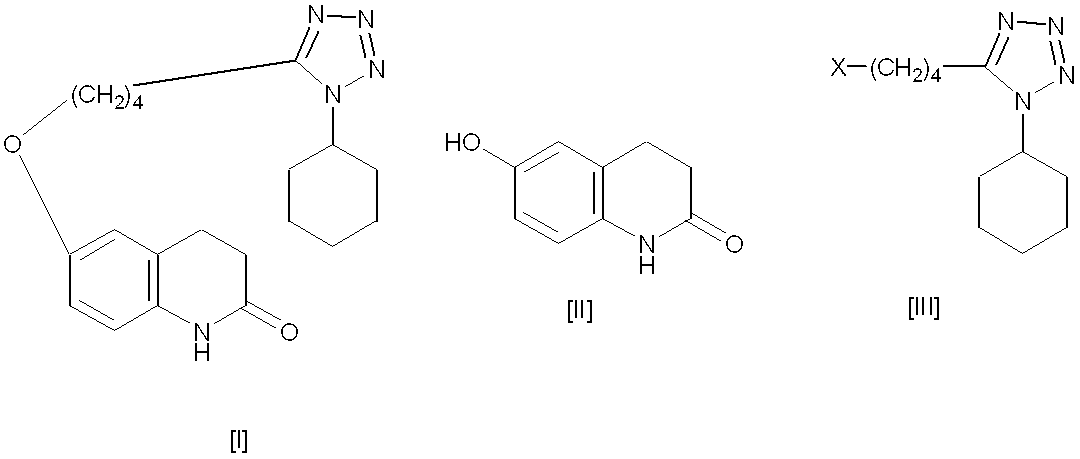
本発明によって得られるシロスタゾールは、化学名が6−[4−(1−シクロヘキシル−1H−テトラゾール−5−イル)ブトキシ]−3,4−ジヒドロカルボスチリルであり、抗血栓剤、脳循環改善剤、消炎剤、抗潰瘍剤、降圧剤、抗喘息剤、さらにホスホジエステラーゼ阻害剤などとして有用であることが知られている(例えば、特許文献1を参照)。 Cilostazol obtained by the present invention has a chemical name of 6- [4- (1-cyclohexyl-1H-tetrazol-5-yl) butoxy] -3,4-dihydrocarbostyril, and is an antithrombotic agent and a cerebral circulation improving agent. It is known to be useful as an anti-inflammatory agent, an anti-ulcer agent, an antihypertensive, an anti-asthmatic, and a phosphodiesterase inhibitor (for example, see Patent Document 1).
シロスタゾールの製法としては、下記式:
で表されるテトラゾール誘導体と反応させる方法が知られている(例えば、特許文献1および非特許文献1を参照)。
The process for preparing cilostazol is represented by the following formula:
(See, for example, Patent Document 1 and Non-patent Document 1).
この方法では、一般式[II]のカルボスチリル誘導体の水酸基と一般式[III]のテトラゾール誘導体が反応するだけでなく、シロスタゾール[I]の1位にも同時に一般式[III]のテトラゾール誘導体が反応した化合物が得られ、シロスタゾールの収率は50−74%程度にすぎない。また上記1位にもテトラゾール誘導体[III]が導入された化合物が不純物として混合し、除去されにくいため、高純度のシロスタゾールを得るためには、煩雑な精製工程を必要とする欠点がある。 In this method, not only the hydroxyl group of the carbostyril derivative of the general formula [II] reacts with the tetrazole derivative of the general formula [III], but also the tetrazole derivative of the general formula [III] is simultaneously placed at the 1-position of cilostazol [I]. A reacted compound is obtained, and the yield of cilostazol is only about 50-74%. In addition, since the compound in which the tetrazole derivative [III] is introduced at the first position is mixed as an impurity and is difficult to be removed, there is a disadvantage that a complicated purification step is required to obtain high-purity cilostazol.
シロスタゾールの別製法として、相関移動触媒の存在下、上記カルボスチリル誘導体[II]と上記テトラゾール誘導体[III]とを反応させる方法も知られている(例えば、特許文献2および特許文献3を参照)。
さらに他の製法として、非水水酸化溶媒中、2種類の塩基性化合物の存在下、あるいは非水溶媒中、反応中の副生物として生成する水を除く目的でモレキュラーシーブスの存在下に、上記カルボスチリル誘導体[II]とテトラゾール誘導体[III]とを反応させてシロスタゾールを製造する方法も提案されている(例えば、特許文献3を参照)。
As another method for producing cilostazol, a method of reacting the above carbostyril derivative [II] with the above tetrazole derivative [III] in the presence of a phase transfer catalyst is also known (for example, see Patent Documents 2 and 3). .
As still another production method, in a non-aqueous hydroxide solvent, in the presence of two types of basic compounds, or in a non-aqueous solvent, in the presence of molecular sieves for the purpose of removing water generated as a by-product during the reaction, A method for producing cilostazol by reacting a carbostyril derivative [II] with a tetrazole derivative [III] has also been proposed (for example, see Patent Document 3).
しかしながら、これら既存の製法では、有機溶媒や試薬類などの環境衛生上好ましくない物質の使用が避けられない。近年の国際的な環境保護に対する意識の高まりに伴い、化学産業界には有害性が指摘されている有機溶媒や試薬類の使用を極力減らし、尚且つ環境への排出を防止する事が強く求められるようになった。この要求に答えるためには既存の製造プロセスを見直し、より有害性の低い原料や反応試薬、溶媒への代替を進めるとともに、変換収率や回収率、選択性の高い反応工程を開発し、環境への負荷を低減していかねばならない。 However, in these existing production methods, it is inevitable to use substances that are not preferable for environmental hygiene such as organic solvents and reagents. With the recent rise in international awareness of environmental protection, there is a strong demand for the chemical industry to minimize the use of organic solvents and reagents, which have been pointed out as hazardous, and to prevent their release into the environment. I was able to. To meet this demand, we will review existing manufacturing processes, promote the use of less harmful raw materials, reaction reagents, and solvents, and develop reaction processes with high conversion yields, recovery rates, and selectivity, The load on the system must be reduced.
上記のような社会的要求を背景に、本発明者らは、より環境にやさしい安全なシロスタゾールの製造法を見出すべく、溶媒として有機溶媒の代りに水を用いる方法について検討した。従来、化学反応は反応基質が溶解する系で行うことによって効率よく進めることができると考えられている。これまでのシロスタゾールの製法を研究する過程においては、前記一般式[III]で表されるテトラゾール誘導体は水に全く不溶であること及び水中では一般式[III]のテトラゾール誘導体の分解が予想されることより、溶媒として水を使用することはなかった。
しかしながら、上記環境衛生上の必要性にかんがみ、何とか水溶媒の使用を可能にする方法を見出すべくさらに研究を重ねた結果、特定の条件を援用することによってその目的を達成し得ることを知り、本発明を完成するに至った。
Against the background of the above social demands, the present inventors have studied a method of using water instead of an organic solvent as a solvent in order to find a more environmentally-friendly and safe method for producing cilostazol. Conventionally, it is thought that a chemical reaction can be efficiently advanced by performing the reaction in a system in which the reaction substrate is dissolved. In the course of studying the production method of cilostazol so far, it is expected that the tetrazole derivative represented by the general formula [III] is completely insoluble in water and that the tetrazole derivative represented by the general formula [III] is decomposed in water. Therefore, water was not used as a solvent.
However, in light of the above environmental hygiene needs, after further research to find a way to enable the use of water solvents, we knew that with the aid of certain conditions the objective could be achieved, The present invention has been completed.
本発明者らの研究によれば、溶媒として水をカルボスチリル誘導体[II]に対して3〜7倍重量使用し、さらにカルボスチリル誘導体[II]に対して等モル〜6倍モル量の無機塩基性化合物を用いることにより、一般式[III]のテトラゾール誘導体が分解することなく反応が進行し、しかも副生物としてのシロスタゾールの1位に一般式[III]のテトラゾール誘導体が反応した化合物の生成も抑制することができることを見出した。 According to the study of the present inventors, water is used as a solvent in an amount of 3 to 7 times the weight of the carbostyril derivative [II], and furthermore, equimolar to 6 times the molar amount of the carbostyril derivative [II]. By using a basic compound, the reaction proceeds without decomposition of the tetrazole derivative of the general formula [III], and furthermore, a compound in which the tetrazole derivative of the general formula [III] is reacted at the first position of cilostazol as a by-product Has also been found to be able to suppress.
すなわち、本発明は、カルボスチリル誘導体[II]に対して3〜7倍重量の水溶媒中、カルボスチリル誘導体[II]に対して等モル〜6倍モル量の無機塩基性化合物の存在下に、カルボスチリル誘導体[II]とテトラゾール誘導体[III]とを反応させることによって目的とするシロスタゾール[I]を高収率、高純度で製造する改良方法を提供するものである。
したがって、本発明の目的は、環境に対して安全な方法でシロスタゾールを製造する方法を提供することである。本発明の他の目的は安価に、しかも簡便な操作で、シロスタゾールを製造し得る方法を提供することである。本発明のさらに他の目的は、シロスタゾールを煩雑な精製工程を必要とせず、高収率、高純度にて製造する方法を提供することである。本発明のさらに他の目的は、シロスタゾールの工業的に有利な製造法を提供することである。
That is, the present invention relates to a method for preparing a carbostyril derivative [II] in an aqueous solvent 3 to 7 times the weight of a carbostyril derivative [II] in the presence of an equimolar to 6-fold molar amount of an inorganic basic compound. An object of the present invention is to provide an improved method for producing a target cilostazol [I] in high yield and high purity by reacting a carbostyril derivative [II] with a tetrazole derivative [III].
Accordingly, it is an object of the present invention to provide a method for producing cilostazol in an environmentally safe manner. Another object of the present invention is to provide a method for producing cilostazol at low cost and with simple operation. Still another object of the present invention is to provide a method for producing cilostazol in a high yield and a high purity without requiring a complicated purification step. Yet another object of the present invention is to provide an industrially advantageous method for producing cilostazol.
本発明には下記の態様が含まれる。
1.前記一般式[II]のカルボスチリル誘導体を、該誘導体[II]に対して3〜7倍重量の水中、等モル〜6倍モル量の無機塩基性化合物の存在下に、前記一般式[III]のテトラゾール誘導体と反応させることからなるシロスタゾール[I]の製造法。
2.無機塩基性化合物が、水酸化ナトリウム、水酸化カリウム、水酸化セシウム、水酸化リチウム、炭酸ナトリウム、炭酸カリウム、炭酸セシウム、炭酸リチウム、炭酸水素リチウム、炭酸水素ナトリウム、炭酸水素カリウム、および炭酸銀から選ばれる無機塩基、ナトリウムおよびカリウムから選ばれるアルカリ金属またはこれらの混合物である上記1項記載の製造法。
3.無機塩基性化合物が、炭酸ナトリウム、炭酸カリウム、炭酸セシウム、炭酸リチウム、炭酸水素リチウム、炭酸水素ナトリウム、および炭酸水素カリウムから選ばれるアルカリ金属炭酸塩の1種である上記2項記載の製造法。
4.無機塩基性化合物が、水酸化ナトリウム、水酸化カリウム、水酸化セシウム、および水酸化リチウムから選ばれるアルカリ金属水酸化物の1種または2種以上と炭酸ナトリウム、炭酸カリウム、炭酸セシウム、炭酸リチウム、炭酸水素リチウム、炭酸水素ナトリウム、および炭酸水素カリウムから選ばれるアルカリ金属炭酸塩の1種または2種以上との混合物である上記2項記載の製造法。
5.アルカリ金属水酸化物の使用量が、カルボスチリル誘導体[II]に対して0.4倍モル〜等モルであり、アルカリ金属炭酸塩の使用量がカルボスチリル誘導体[II]に対して等モル〜5倍モルである上記4項記載の製造法。
6.テトラゾール誘導体[III]の使用量がカルボスチリル誘導体[II]1モルに対して少なくとも0.5モルである上記1項記載の製造法。
7.テトラゾール誘導体[III]におけるXが塩素原子である上記1項記載の製造法。
The present invention includes the following embodiments.
1. The carbostyril derivative of the general formula [II] can be prepared by converting the carbostyril derivative of the general formula [III] in the presence of an equimolar to 6-fold molar amount of an inorganic basic compound in water of 3 to 7 times the weight of the derivative [II]. ] To produce cilostazol [I].
2. Inorganic basic compounds are selected from sodium hydroxide, potassium hydroxide, cesium hydroxide, lithium hydroxide, sodium carbonate, potassium carbonate, cesium carbonate, lithium carbonate, lithium hydrogen carbonate, sodium hydrogen carbonate, potassium hydrogen carbonate, and silver carbonate. 2. The process according to claim 1, which is a selected inorganic base, an alkali metal selected from sodium and potassium, or a mixture thereof.
3. 3. The method according to claim 2, wherein the inorganic basic compound is one of alkali metal carbonates selected from sodium carbonate, potassium carbonate, cesium carbonate, lithium carbonate, lithium hydrogen carbonate, sodium hydrogen carbonate, and potassium hydrogen carbonate.
4. The inorganic basic compound is selected from sodium hydroxide, potassium hydroxide, cesium hydroxide, and one or more alkali metal hydroxides selected from lithium hydroxide and sodium carbonate, potassium carbonate, cesium carbonate, lithium carbonate, 3. The method according to claim 2, wherein the mixture is a mixture with one or more alkali metal carbonates selected from lithium hydrogen carbonate, sodium hydrogen carbonate, and potassium hydrogen carbonate.
5. The amount of the alkali metal hydroxide used is 0.4 times mol to equimolar to the carbostyril derivative [II], and the amount of the alkali metal carbonate used is equimolar to the carbostyril derivative [II]. 5. The production method according to the above item 4, wherein the molar amount is 5 times.
6. 2. The method according to claim 1, wherein the amount of the tetrazole derivative [III] used is at least 0.5 mol per 1 mol of the carbostyril derivative [II].
7. 2. The production method according to the above 1, wherein X in the tetrazole derivative [III] is a chlorine atom.
本発明方法によれば、溶媒として有機溶媒の代りに環境に対して安全な水を用い、無機塩基性化合物の存在下に、カルボスチリル誘導体[II]とテトラゾール誘導体[III]とを反応させることによって、目的とするシロスタゾールを、安価に、しかも簡便な操作で、高収率、高純度にて製造することができる。 According to the method of the present invention, the carbostyril derivative [II] and the tetrazole derivative [III] are reacted in the presence of an inorganic basic compound using water that is safe for the environment instead of the organic solvent as the solvent. As a result, the desired cilostazol can be produced inexpensively and with a simple operation in high yield and high purity.
本発明によるシロスタゾールの改良製法について以下にさらに詳細に説明する。
本発明の製法を反応式で示すと下記反応式−1のとおりである。
The improved process for preparing cilostazol according to the present invention will be described in more detail below.
The reaction formula of the production method of the present invention is as shown in the following reaction formula-1.
上記反応式−1において、式[II]のカルボスチリル誘導体と一般式[III]のテトラゾール誘導体との反応は、該カルボスチリル誘導体[II]に対して3〜7倍重量の水中、カルボスチリル誘導体[II]に対して等モル〜6倍モル量の無機塩基性化合物の存在下に行われる。無機塩基性化合物としては公知のものを広く使用でき、例えば、水酸化ナトリウム、水酸化カリウム、水酸化セシウム、水酸化リチウム、炭酸ナトリウム、炭酸カリウム、炭酸セシウム、炭酸リチウム、炭酸水素リチウム、炭酸水素ナトリウム、炭酸水素カリウム、炭酸銀等の無機塩基、ナトリウム、カリウム等のアルカリ金属等またはこれらの混合物が挙げられる。無機塩素性化合物の1種を単独で使用する場合は、炭酸ナトリウム、炭酸カリウム、炭酸セシウム、炭酸リチウム、炭酸水素リチウム、炭酸水素ナトリウム、炭酸水素カリウム等のアルカリ金属炭酸塩が好ましく、その用量は、カルボスチリル誘導体(II)に対して、通常等モル〜6倍モル、好ましくは等モル〜5倍モルである。また2種以上の無機塩基性化合物を混合して使用する場合には、水酸化ナトリウム、水酸化カリウム、水酸化セシウム、水酸化リチウム等のアルカリ金属水酸化物の1種または2種以上と炭酸ナトリウム、炭酸カリウム、炭酸セシウム、炭酸リチウム、炭酸水素リチウム、炭酸水素ナトリウム、炭酸水素カリウム等のアルカリ金属炭酸塩の1種または2種以上との混合物が好ましい。この混合物を用いる場合、アルカリ金属水酸化物とアルカリ金属炭酸塩の使用量は、カルボスチリル誘導体(II)に対して、前者は、通常0.4倍モル〜等モル量、好ましくは、0.4〜0.9倍モル量、後者は、通常等モル〜5倍モル量、好ましくは、2〜5倍モル量使用するのがよい。この混合物を使用する場合、無機塩基性化合物の総量は、通常等モル〜6倍モル量、好ましくは、等モル〜5倍モル量である。 In the above Reaction Formula-1, the reaction between the carbostyril derivative of the formula [II] and the tetrazole derivative of the general formula [III] is carried out in water in a weight of 3 to 7 times the weight of the carbostyril derivative [II]. The reaction is carried out in the presence of an equimolar to 6-fold molar amount of the inorganic basic compound with respect to [II]. As the inorganic basic compound, known compounds can be widely used, for example, sodium hydroxide, potassium hydroxide, cesium hydroxide, lithium hydroxide, sodium carbonate, potassium carbonate, cesium carbonate, lithium carbonate, lithium hydrogen carbonate, hydrogen hydrogen carbonate Inorganic bases such as sodium, potassium bicarbonate and silver carbonate; alkali metals such as sodium and potassium; and mixtures thereof. When one of the inorganic chlorinated compounds is used alone, alkali metal carbonates such as sodium carbonate, potassium carbonate, cesium carbonate, lithium carbonate, lithium hydrogen carbonate, sodium hydrogen carbonate and potassium hydrogen carbonate are preferable. It is usually 1 to 6 moles, preferably 1 to 5 moles, per 1 mole of the carbostyril derivative (II). When a mixture of two or more inorganic basic compounds is used, one or more alkali metal hydroxides such as sodium hydroxide, potassium hydroxide, cesium hydroxide and lithium hydroxide may be used in combination with carbonic acid. Preferred is a mixture with one or more alkali metal carbonates such as sodium, potassium carbonate, cesium carbonate, lithium carbonate, lithium hydrogen carbonate, sodium hydrogen carbonate, potassium hydrogen carbonate and the like. When this mixture is used, the amount of the alkali metal hydroxide and the alkali metal carbonate to be used is usually 0.4 to 1 times the molar amount of the carbostyril derivative (II), preferably 0.1 to 1.0. The molar amount is usually 4 to 0.9 times, and the latter is usually 1 to 5 times, preferably 2 to 5 times. When this mixture is used, the total amount of the inorganic basic compound is usually equimolar to 6-fold molar amount, preferably, equimolar to 5-fold molar amount.
該反応は、通常室温〜200℃、好ましくは、50〜150℃にて行われる。反応時間は、通常1〜20時間程度である。テトラゾール誘導体[III]の使用量は、カルボスチリル誘導体[II]1モルに対して、通常少なくとも0.5モル、好ましくは、0.5モル〜1.5モル、更に好ましくは、1.1〜1.5モルである。
上記の反応において、生成物のシロスタゾールの溶解性を増すために、環境に影響を与えない程度に低級アルコールを添加することもでき、例えば、メタノール、エタノール、プロパノール、イソプロピルアルコール、ブタノール、エチレングリコール等の低級アルコール類を水に対して5〜30容量%程度加えてもよい。また、該反応には、酸化による着色を防止するために亜硫酸ナトリウム、チオ硫酸ナトリウム等を反応系内に添加してもよい。
該反応は、ホモミキサーを用いて反応液を循環させながら行なうことが出来る。ホモミキサーを用いることにより、反応液はホモミキサーに吸入され機内で粉砕され、反応器に戻される。反応液をこのように絶えず循環させることで最終生成物が大きな結晶塊になることを防ぐことができる。
The reaction is usually performed at room temperature to 200 ° C, preferably at 50 to 150 ° C. The reaction time is usually about 1 to 20 hours. The amount of the tetrazole derivative [III] to be used is usually at least 0.5 mol, preferably 0.5 mol to 1.5 mol, more preferably 1.1 to 1 mol, per 1 mol of the carbostyril derivative [II]. 1.5 mol.
In the above reaction, in order to increase the solubility of the product cilostazol, a lower alcohol may be added to such an extent that it does not affect the environment, for example, methanol, ethanol, propanol, isopropyl alcohol, butanol, ethylene glycol and the like. May be added in an amount of about 5 to 30% by volume based on water. In the reaction, sodium sulfite, sodium thiosulfate, or the like may be added to the reaction system in order to prevent coloring due to oxidation.
The reaction can be performed while circulating the reaction solution using a homomixer. By using a homomixer, the reaction solution is sucked into the homomixer, pulverized in the apparatus, and returned to the reactor. Such continuous circulation of the reaction solution can prevent the final product from becoming a large crystal mass.
上記の反応で得られる式[I]のシロスタゾールは、通常の分離手段により反応液から容易に単離することができる。該分離手段としては、例えば、反応液を冷却後、析出する結晶を濾取する方法、あるいは適当な溶媒、例えばメタノール等のアルコール類で結晶を加熱洗浄後、溶媒を留去し、冷却して結晶を得る方法、さらには、溶媒抽出法、希釈法、再結晶法、カラムクロマトグラフィー、プレパラテイブ薄層クロマトグラフィー等を例示できる。
[実施例]
The cilostazol of the formula [I] obtained by the above reaction can be easily isolated from the reaction solution by a usual separation means. As the separation means, for example, a method of cooling the reaction solution, collecting the precipitated crystals by filtration, or heating and washing the crystals with an appropriate solvent, for example, an alcohol such as methanol, distilling off the solvent, and cooling. Examples of the method for obtaining crystals, further, a solvent extraction method, a dilution method, a recrystallization method, column chromatography, preparative thin layer chromatography and the like can be exemplified.
[Example]
つぎに実施例を挙げて本発明をさらに具体的に説明する。
なお、実施例中の生成物の純度は以下の条件で高速液体クロマトグラフィー(HPLC)にて測定した。
検出器:紫外吸光光度計
カラム:YMC-pack SIL 120A相当
移動層:CH2Cl2:n-hexane:MeOH=20:10:1
流量:約1.0ml/min
測定波長:254nm
Next, the present invention will be described more specifically with reference to examples.
In addition, the purity of the product in an Example was measured by the high performance liquid chromatography (HPLC) on condition of the following.
Detector: UV absorption spectrophotometer Column: YMC-pack SIL 120A equivalent Moving layer: CH2Cl2: n-hexane: MeOH = 20: 10: 1
Flow rate: about 1.0ml / min
Measurement wavelength: 254nm
6−ヒドロキシ−3,4−ジヒドロカルボスチリル(30g,0.18mol)、1−シクロヘキシル−5−(4−クロロブチル)−1,2,3,4−テトラゾール(49.09g,0.20mol,1.1M)、炭酸カリウム(55.90g,0.40mol,2.2M)、水酸化ナトリウム(5.88g,0.15mol,0.8M)、亜硫酸ナトリウム(1.5g,0.01mol)、および精製水(150mL)を500mLビーカーに仕込み、ホモミキサー(特殊機化工業株式会社製、T.K.ロボミックス)を用いて反応液を内部循環させ、約92℃で約6時間反応を行う。反応後、反応液を50℃付近まで冷却した後、1Lコルベンに移し替え、メタノール(150mL)を加えて、約2時間加熱還流させる。混合物を室温に冷却し、析出晶を濾取、得られた結晶を精製水(150mL)、メタノール(90mL)、次いで精製水(150mL)で洗浄後、約80℃で乾燥すると、シロスタゾール62.14gが得られる。収率:91.48%、純度:99.66%、m.p.:158−159℃ 6-hydroxy-3,4-dihydrocarbostyril (30 g, 0.18 mol), 1-cyclohexyl-5- (4-chlorobutyl) -1,2,3,4-tetrazole (49.09 g, 0.20 mol, 1.1 M), Potassium carbonate (55.90 g, 0.40 mol, 2.2 M), sodium hydroxide (5.88 g, 0.15 mol, 0.8 M), sodium sulfite (1.5 g, 0.01 mol), and purified water (150 mL) were charged into a 500 mL beaker, and homogenized. The reaction liquid is internally circulated using a mixer (TK Robomix, manufactured by Tokushu Kika Kogyo Co., Ltd.), and the reaction is carried out at about 92 ° C. for about 6 hours. After the reaction, the reaction solution is cooled to around 50 ° C., transferred to a 1 L kolben, methanol (150 mL) is added, and the mixture is refluxed for about 2 hours. The mixture was cooled to room temperature, and the precipitated crystals were collected by filtration. The obtained crystals were washed with purified water (150 mL), methanol (90 mL), and then purified water (150 mL), and dried at about 80 ° C. to give cilostazol 62.14 g. can get. Yield: 91.48%, purity: 99.66%, m.p. p. 158-159 ° C
6−ヒドロキシ−3,4−ジヒドロカルボスチリル(12g,0.07mol)、1−シクロヘキシル−5−(4−クロロブチル)−1,2,3,4−テトラゾール(19.64g,0.08mol)、炭酸カリウム(22.36g,0.16mol)、水酸化ナトリウム(2.35g,0.05mol)、亜硫酸ナトリウム(0.6g,0.004mol)、および精製水(60mL)を200mLコルベンに仕込み、約92℃で約6時間反応を行う。反応後、反応液を50℃付近まで冷却し、析出晶を濾取する。得られた結晶をコルベンに仕込み、精製水(120mL)を加えて、約85℃で約15分間攪拌洗浄する。混合物を50℃付近まで冷却してから、結晶を濾取する。得られた結晶を再度コルベンに仕込み、メタノール(84mL)を加えて、約25℃で約15分間攪拌洗浄する。混合物を10℃以下に冷却し、結晶を濾取、メタノール(24mL)で洗浄した後、80℃で乾燥すると、シロスタゾール24.15gが得られる。収率:88.88%、純度:99.50%、m.p.:158−159℃ 6-hydroxy-3,4-dihydrocarbostyril (12 g, 0.07 mol), 1-cyclohexyl-5- (4-chlorobutyl) -1,2,3,4-tetrazole (19.64 g, 0.08 mol), potassium carbonate ( 22.36 g, 0.16 mol), sodium hydroxide (2.35 g, 0.05 mol), sodium sulfite (0.6 g, 0.004 mol), and purified water (60 mL) are charged into a 200 mL kolben and reacted at about 92 ° C. for about 6 hours. . After the reaction, the reaction solution is cooled to around 50 ° C., and the precipitated crystals are collected by filtration. The obtained crystals are charged into a Kolben, purified water (120 mL) is added, and the mixture is washed with stirring at about 85 ° C. for about 15 minutes. After cooling the mixture to around 50 ° C., the crystals are filtered off. The obtained crystals are again charged into a Kolben, methanol (84 mL) is added, and the mixture is washed with stirring at about 25 ° C. for about 15 minutes. The mixture is cooled to below 10 ° C., the crystals are collected by filtration, washed with methanol (24 mL) and dried at 80 ° C. to give 24.15 g of cilostazol. Yield: 88.88%, purity: 99.50%, m.p. p. 158-159 ° C
6−ヒドロキシ−3,4−ジヒドロカルボスチリル(30g,0.18mol)、1−シクロヘキシル−5−(4−クロロブチル)−1,2,3,4−テトラゾール(49.1g,0.20mol,1.1M)、炭酸カリウム(83.84g,0.61mol,3.3M)、亜硫酸ナトリウム(1.5g,0.01mol)、および精製水(150mL)を500mLビーカーに仕込み、ホモミキサー(特殊機化工業株式会社製、T.K.ロボミックス)を用いて反応液を内部循環させ、約85℃で約6時間反応を行う。反応後、50℃付近まで冷却し、結晶を濾取する。得られた結晶を1Lコルベンに仕込み、精製水(300mL)を加えて、約85℃で約15分間加熱洗浄する。洗浄後、混合物を50℃付近まで冷却してから、結晶を濾取する。得られた結晶を再度コルベンに仕込み、メタノール(210mL)を加えて、約25℃で約15分間攪拌洗浄する。混合物を10℃以下まで冷却し、結晶を濾取、メタノール(60mL)で洗浄後、80℃で乾燥するとシロスタゾール62.79gが得られる。収率:92.44%、純度:99.61%、m.p.:158−159℃ 6-hydroxy-3,4-dihydrocarbostyril (30 g, 0.18 mol), 1-cyclohexyl-5- (4-chlorobutyl) -1,2,3,4-tetrazole (49.1 g, 0.20 mol, 1.1 M), Charge potassium carbonate (83.84 g, 0.61 mol, 3.3 M), sodium sulfite (1.5 g, 0.01 mol), and purified water (150 mL) into a 500 mL beaker, and add a homomixer (TK Robomix, manufactured by Tokushu Kika Kogyo Co., Ltd.). The reaction solution is internally circulated using, and the reaction is carried out at about 85 ° C for about 6 hours. After the reaction, the mixture is cooled to around 50 ° C., and the crystals are collected by filtration. The obtained crystals are charged into a 1 L Kolben, purified water (300 mL) is added, and the mixture is washed by heating at about 85 ° C. for about 15 minutes. After washing, the mixture is cooled to around 50 ° C., and the crystals are collected by filtration. The obtained crystals are again charged into a Kolben, methanol (210 mL) is added, and the mixture is stirred and washed at about 25 ° C. for about 15 minutes. The mixture is cooled to below 10 ° C., the crystals are collected by filtration, washed with methanol (60 mL) and dried at 80 ° C. to give cilostazol 62.79 g. Yield: 92.44%, purity: 99.61%, m.p. p. 158-159 ° C
6−ヒドロキシ−3,4−ジヒドロカルボスチリル(12g,0.07mol)、1−シクロヘキシル−5−(4−クロロブチル)−1,2,3,4−テトラゾール(19.64g,0.08mol,1.1M)、炭酸カリウム(33.54g,0.24mol,3.3M)、亜硫酸ナトリウム(0.6g,0.004mol)、および精製水(60mL)を200mLコルベンに仕込み、約85℃で約6時間反応を行う。反応後、50℃付近まで冷却し、結晶を濾取する。得られた結晶をコルベンに仕込み、精製水(120mL)を加えて、約85℃で約15分間攪拌洗浄する。洗浄後、混合物を50℃付近まで冷却してから、結晶を濾取する。得られた結晶を再度コルベンに仕込み、メタノール(84mL)を加えて約25℃で約15分間攪拌洗浄する。混合液を10℃以下に冷却し、結晶を濾取、メタノール(24mL)で洗浄後、80℃で乾燥するとシロスタゾール24.28gが得られる。収率:89.36%、純度:99.44%、m.p.:158−159℃ 6-hydroxy-3,4-dihydrocarbostyril (12 g, 0.07 mol), 1-cyclohexyl-5- (4-chlorobutyl) -1,2,3,4-tetrazole (19.64 g, 0.08 mol, 1.1 M), Potassium carbonate (33.54 g, 0.24 mol, 3.3 M), sodium sulfite (0.6 g, 0.004 mol), and purified water (60 mL) are charged into a 200 mL kolben and reacted at about 85 ° C. for about 6 hours. After the reaction, the mixture is cooled to around 50 ° C., and the crystals are collected by filtration. The obtained crystals are charged into a Kolben, purified water (120 mL) is added, and the mixture is washed with stirring at about 85 ° C. for about 15 minutes. After washing, the mixture is cooled to around 50 ° C., and the crystals are collected by filtration. The obtained crystals are again charged into a Kolben, methanol (84 mL) is added, and the mixture is washed with stirring at about 25 ° C. for about 15 minutes. The mixture was cooled to 10 ° C. or lower, the crystals were collected by filtration, washed with methanol (24 mL), and dried at 80 ° C. to obtain 24.28 g of cilostazol. Yield: 89.36%, purity: 99.44%, m.p. p. 158-159 ° C
6−ヒドロキシ−3,4−ジヒドロカルボスチリル(12g,0.07mol)、1−シクロヘキシル−5−(4−クロロブチル)−1,2,3,4−テトラゾール(19.64g,0.08mol)、炭酸カリウム(22.36g,0.16mol)、水酸化ナトリウム(2.35g,0.05mol)、亜硫酸ナトリウム(0.6g,0.004mol)、精製水(36mL)、およびイソプロパノール(3.6mL)を200mLコルベンに仕込み、還流下約6時間反応を行う。反応後、10℃付近まで冷却し、析出晶を濾取する。得られた結晶をコルベンに仕込み、精製水(120mL)を加えて、約85℃で約15分間攪拌洗浄する。混合物を50℃付近まで冷却してから、結晶を濾取する。得られた結晶を再度コルベンに仕込み、メタノール(84mL)を加えて、約25℃で約15分間攪拌洗浄する。混合物を10℃以下に冷却し、結晶を濾取、メタノール(24mL)で洗浄した後、80℃で乾燥すると、シロスタゾール24.31gが得られる。収率:89.47%、純度:99.45%、m.p.:158−159℃ 6-hydroxy-3,4-dihydrocarbostyril (12 g, 0.07 mol), 1-cyclohexyl-5- (4-chlorobutyl) -1,2,3,4-tetrazole (19.64 g, 0.08 mol), potassium carbonate ( 22.36 g, 0.16 mol), sodium hydroxide (2.35 g, 0.05 mol), sodium sulfite (0.6 g, 0.004 mol), purified water (36 mL), and isopropanol (3.6 mL) were charged into a 200 mL kolben, and refluxed for about 6 hours. Perform a time reaction. After the reaction, the mixture is cooled to around 10 ° C., and the precipitated crystals are collected by filtration. The obtained crystals are charged into a Kolben, purified water (120 mL) is added, and the mixture is washed with stirring at about 85 ° C. for about 15 minutes. After cooling the mixture to around 50 ° C., the crystals are filtered off. The obtained crystals are again charged into a Kolben, methanol (84 mL) is added, and the mixture is washed with stirring at about 25 ° C. for about 15 minutes. The mixture is cooled to below 10 ° C., the crystals are collected by filtration, washed with methanol (24 mL) and dried at 80 ° C., yielding 24.31 g of cilostazol. Yield: 89.47%, purity: 99.45%, m.p. p. 158-159 ° C
本発明の方法では、環境に対して安全な水を溶媒として用いて、目的とするシロスタゾールを工業的規模にて安価に、しかも簡単な操作にて高収率、高純度で製造することができるため、本発明は、例えば抗血栓剤などの医薬として有用なシロスタゾールの工業的製法として極めて有用である。 In the method of the present invention, the target cilostazol can be produced at low cost on an industrial scale, with high yield and high purity by a simple operation, using environmentally safe water as a solvent. Therefore, the present invention is extremely useful as an industrial process for producing cilostazol, which is useful as a medicine such as an antithrombotic agent.
Claims (1)
で表されるテトラゾール誘導体と反応させることを特徴とする式:
Wherein the compound is reacted with a tetrazole derivative represented by the following formula:
Priority Applications (1)
| Application Number | Priority Date | Filing Date | Title |
|---|---|---|---|
| JP2003318669A JP4629322B2 (en) | 2002-09-10 | 2003-09-10 | Production method of cilostazol |
Applications Claiming Priority (2)
| Application Number | Priority Date | Filing Date | Title |
|---|---|---|---|
| JP2002264314 | 2002-09-10 | ||
| JP2003318669A JP4629322B2 (en) | 2002-09-10 | 2003-09-10 | Production method of cilostazol |
Publications (2)
| Publication Number | Publication Date |
|---|---|
| JP2004123739A true JP2004123739A (en) | 2004-04-22 |
| JP4629322B2 JP4629322B2 (en) | 2011-02-09 |
Family
ID=31986513
Family Applications (1)
| Application Number | Title | Priority Date | Filing Date |
|---|---|---|---|
| JP2003318669A Expired - Lifetime JP4629322B2 (en) | 2002-09-10 | 2003-09-10 | Production method of cilostazol |
Country Status (13)
| Country | Link |
|---|---|
| US (1) | US7026486B2 (en) |
| EP (1) | EP1489080B1 (en) |
| JP (1) | JP4629322B2 (en) |
| KR (1) | KR100551926B1 (en) |
| CN (1) | CN1257902C (en) |
| AT (1) | ATE496907T1 (en) |
| CY (1) | CY1111277T1 (en) |
| DE (1) | DE60335865D1 (en) |
| DK (1) | DK1489080T3 (en) |
| ES (1) | ES2358324T3 (en) |
| PT (1) | PT1489080E (en) |
| SI (1) | SI1489080T1 (en) |
| WO (1) | WO2004024716A1 (en) |
Cited By (1)
| Publication number | Priority date | Publication date | Assignee | Title |
|---|---|---|---|---|
| KR100633232B1 (en) | 2004-08-25 | 2006-10-11 | 주식회사유한양행 | Novel 6- [4- (1-cyclohexyl-1H-tetrazol-5-yl) butoxy] -3,4-dihydro-2 (1H) -quinolinone purification method |
Families Citing this family (9)
| Publication number | Priority date | Publication date | Assignee | Title |
|---|---|---|---|---|
| US7399864B2 (en) * | 2001-05-02 | 2008-07-15 | Otsuka Pharmaceutical Co., Ltd. | Process for producing carbostyril derivatives |
| US20050101631A1 (en) * | 2002-08-01 | 2005-05-12 | Otsuka Pharmaceuticals Company | Process for producing carbostyril derivatives |
| IL167483A (en) * | 2004-03-16 | 2011-04-28 | Chemagis Ltd | Process for obtaining highly pure cilostazol |
| WO2005123033A2 (en) * | 2004-06-18 | 2005-12-29 | Ranbaxy Laboratories Limited | Fine particles of cilostazol and processes for production thereof |
| US20080075785A1 (en) * | 2006-09-22 | 2008-03-27 | San-Laung Chow | Controlled release hydrogel formulation |
| US20110165236A1 (en) * | 2006-09-22 | 2011-07-07 | Biokey, Inc. | Controlled release hydrogel formulation |
| CN101434598B (en) * | 2008-12-19 | 2012-11-07 | 重庆康乐制药有限公司 | Preparation of cilostazol |
| CN102086190B (en) * | 2011-01-28 | 2013-07-10 | 海南美兰史克制药有限公司 | Cilostazol compound and novel preparation method thereof |
| CN107382970A (en) * | 2017-07-26 | 2017-11-24 | 浙江金立源药业有限公司 | A kind of synthetic method of Cilostazol |
Family Cites Families (12)
| Publication number | Priority date | Publication date | Assignee | Title |
|---|---|---|---|---|
| JPS5535019A (en) * | 1978-09-01 | 1980-03-11 | Otsuka Pharmaceut Co Ltd | Carbostyryl derivative |
| JPS5645414A (en) | 1979-09-19 | 1981-04-25 | Otsuka Pharmaceut Co Ltd | Phosphodiesterase inhibitor |
| JPS5646810A (en) | 1979-09-25 | 1981-04-28 | Otsuka Pharmaceut Co Ltd | Blood platelet coagulation inhibitor |
| JPS5859980A (en) * | 1981-10-05 | 1983-04-09 | Otsuka Pharmaceut Co Ltd | Carbostyril derivative |
| JPS5877880A (en) | 1981-11-05 | 1983-05-11 | Otsuka Pharmaceut Co Ltd | Tetrazole derivative |
| JPS59157084A (en) | 1983-02-28 | 1984-09-06 | Otsuka Pharmaceut Co Ltd | Carbostyryl derivative |
| JPH01265051A (en) * | 1988-04-14 | 1989-10-23 | Fuji Photo Film Co Ltd | Production of diaryloxyalkane |
| KR100281593B1 (en) | 1999-02-09 | 2001-02-15 | 류덕희 | A method of preparing 5-halobutyl-1-cyclohexyltetrazole |
| JP4060523B2 (en) * | 1999-11-24 | 2008-03-12 | 大塚製薬株式会社 | Method for producing carbostyril derivatives |
| US20030045547A1 (en) * | 2001-05-02 | 2003-03-06 | Shinji Aki | Process for producing carbostyril derivatives |
| US6515128B2 (en) * | 2000-03-20 | 2003-02-04 | Teva Pharmaceutical Industries Ltd. | Processes for preparing cilostazol |
| MXPA03001470A (en) | 2000-08-14 | 2005-06-30 | Teva Pharma | Processes for preparing cilostazol. |
-
2003
- 2003-09-09 EP EP03788701A patent/EP1489080B1/en not_active Expired - Lifetime
- 2003-09-09 WO PCT/JP2003/011515 patent/WO2004024716A1/en not_active Ceased
- 2003-09-09 DK DK03788701.5T patent/DK1489080T3/en active
- 2003-09-09 PT PT03788701T patent/PT1489080E/en unknown
- 2003-09-09 US US10/488,951 patent/US7026486B2/en not_active Expired - Fee Related
- 2003-09-09 ES ES03788701T patent/ES2358324T3/en not_active Expired - Lifetime
- 2003-09-09 DE DE60335865T patent/DE60335865D1/en not_active Expired - Lifetime
- 2003-09-09 CN CNB038010089A patent/CN1257902C/en not_active Expired - Fee Related
- 2003-09-09 KR KR1020047003418A patent/KR100551926B1/en not_active Expired - Lifetime
- 2003-09-09 AT AT03788701T patent/ATE496907T1/en active
- 2003-09-09 SI SI200331965T patent/SI1489080T1/en unknown
- 2003-09-10 JP JP2003318669A patent/JP4629322B2/en not_active Expired - Lifetime
-
2011
- 2011-02-28 CY CY20111100236T patent/CY1111277T1/en unknown
Cited By (1)
| Publication number | Priority date | Publication date | Assignee | Title |
|---|---|---|---|---|
| KR100633232B1 (en) | 2004-08-25 | 2006-10-11 | 주식회사유한양행 | Novel 6- [4- (1-cyclohexyl-1H-tetrazol-5-yl) butoxy] -3,4-dihydro-2 (1H) -quinolinone purification method |
Also Published As
| Publication number | Publication date |
|---|---|
| US7026486B2 (en) | 2006-04-11 |
| ATE496907T1 (en) | 2011-02-15 |
| ES2358324T3 (en) | 2011-05-09 |
| CY1111277T1 (en) | 2015-08-05 |
| KR100551926B1 (en) | 2006-02-17 |
| CN1553908A (en) | 2004-12-08 |
| KR20040041605A (en) | 2004-05-17 |
| SI1489080T1 (en) | 2011-05-31 |
| EP1489080A1 (en) | 2004-12-22 |
| JP4629322B2 (en) | 2011-02-09 |
| PT1489080E (en) | 2011-02-16 |
| DE60335865D1 (en) | 2011-03-10 |
| EP1489080B1 (en) | 2011-01-26 |
| CN1257902C (en) | 2006-05-31 |
| DK1489080T3 (en) | 2011-04-04 |
| US20040267020A1 (en) | 2004-12-30 |
| WO2004024716A1 (en) | 2004-03-25 |
| EP1489080A4 (en) | 2006-02-15 |
Similar Documents
| Publication | Publication Date | Title |
|---|---|---|
| CA2238864C (en) | Method for the synthesis of a benzimidazole compound | |
| JP4342940B2 (en) | Process for producing 5-methyl-1-phenyl-2 (1H) pyridinone | |
| JP6269508B2 (en) | Process for producing purified amine compound | |
| JP4629322B2 (en) | Production method of cilostazol | |
| JP2011006379A (en) | Method for recrystallizing {2-amino-1,4-dihydro-6-methyl-4-(3-nitrophenyl)-3,5-pyridine dicarboxylic acid-3-[1-(diphenylmethyl)azetidin-3-yl]ester-5-isopropyl ester}(azelnidipine), isopropyl alcohol adduct of azelnidipine, and method for producing azelnidipine | |
| WO2002004430A1 (en) | Processes for preparing triazine compounds and quaternary ammonium salts | |
| JP2005154442A (en) | Method for preparing valsartan and intermediate thereof | |
| WO2014051077A1 (en) | Method for producing nitrogen-containing heterocyclic compound of high purity | |
| JP6275596B2 (en) | Method for producing ammonium salt of telmisartan | |
| JP6676491B2 (en) | Method for producing azilsartan alkyl ester and method for producing azilsartan | |
| JP3169574B2 (en) | Method for producing 4-hydroxy-4'-benzyloxydiphenyl sulfone | |
| JP3884063B2 (en) | Cefcapene pivoxil methanesulfonate | |
| JP4826132B2 (en) | 6-Hydroxy-2,5,7,8-tetramethylchroman-2-carboxylic acid and process for producing the same | |
| JP4587139B2 (en) | A method for producing an aminoalkoxycarbostyril derivative. | |
| CN117946039A (en) | A chiral synthesis process for empagliflozin intermediate | |
| WO2026088969A1 (en) | Method for producing biphenanthrene-skeleton-containing dihydroxy compound | |
| JP2007302603A (en) | 1,8-dinitro-2-naphthol derivative and method for producing 1,8-diamino-2-naphthol derivative | |
| JP2003212842A (en) | 2-tribromomethylsulfonylanthraquinone and method of production for the same | |
| JP2020063197A (en) | Production method of 2,6-naphthalenedicarboxylic acid diallyl ester | |
| JPH10291973A (en) | Method for producing aminophenylalkyl sulfides | |
| JPH07118239A (en) | Production of 4-chloroimidazole-5-carbaldehyde derivative | |
| JP2003226684A (en) | Aromatic tribromomethylsulfonyl derivative and method for producing the same | |
| JPWO2018212162A1 (en) | Method for producing diaminobenzene compound | |
| JP2005220109A (en) | Method for producing high-purity adamantanetriols | |
| JP2004217556A (en) | Method for producing 1,3-dialkyl-2-benzimidazolinone |
Legal Events
| Date | Code | Title | Description |
|---|---|---|---|
| A977 | Report on retrieval |
Free format text: JAPANESE INTERMEDIATE CODE: A971007 Effective date: 20070510 |
|
| A131 | Notification of reasons for refusal |
Free format text: JAPANESE INTERMEDIATE CODE: A131 Effective date: 20070515 |
|
| A521 | Request for written amendment filed |
Free format text: JAPANESE INTERMEDIATE CODE: A523 Effective date: 20070710 |
|
| A02 | Decision of refusal |
Free format text: JAPANESE INTERMEDIATE CODE: A02 Effective date: 20070807 |
|
| A01 | Written decision to grant a patent or to grant a registration (utility model) |
Free format text: JAPANESE INTERMEDIATE CODE: A01 |
|
| A61 | First payment of annual fees (during grant procedure) |
Free format text: JAPANESE INTERMEDIATE CODE: A61 Effective date: 20101111 |
|
| FPAY | Renewal fee payment (event date is renewal date of database) |
Free format text: PAYMENT UNTIL: 20131119 Year of fee payment: 3 |
|
| R150 | Certificate of patent or registration of utility model |
Ref document number: 4629322 Country of ref document: JP Free format text: JAPANESE INTERMEDIATE CODE: R150 Free format text: JAPANESE INTERMEDIATE CODE: R150 |
|
| R250 | Receipt of annual fees |
Free format text: JAPANESE INTERMEDIATE CODE: R250 |
|
| R250 | Receipt of annual fees |
Free format text: JAPANESE INTERMEDIATE CODE: R250 |
|
| R250 | Receipt of annual fees |
Free format text: JAPANESE INTERMEDIATE CODE: R250 |
|
| EXPY | Cancellation because of completion of term |