JP2004123776A - Modified polyolefin - Google Patents
Modified polyolefin Download PDFInfo
- Publication number
- JP2004123776A JP2004123776A JP2002285590A JP2002285590A JP2004123776A JP 2004123776 A JP2004123776 A JP 2004123776A JP 2002285590 A JP2002285590 A JP 2002285590A JP 2002285590 A JP2002285590 A JP 2002285590A JP 2004123776 A JP2004123776 A JP 2004123776A
- Authority
- JP
- Japan
- Prior art keywords
- polyolefin
- general formula
- modified polyolefin
- group
- modified
- Prior art date
- Legal status (The legal status is an assumption and is not a legal conclusion. Google has not performed a legal analysis and makes no representation as to the accuracy of the status listed.)
- Pending
Links
- 229920000098 polyolefin Polymers 0.000 title claims abstract description 122
- -1 (meth)acrylic acid Chemical class 0.000 claims abstract description 53
- 125000000217 alkyl group Chemical group 0.000 claims description 12
- 229910052736 halogen Inorganic materials 0.000 claims description 10
- 150000002367 halogens Chemical class 0.000 claims description 10
- 229910052783 alkali metal Inorganic materials 0.000 claims description 8
- 150000001340 alkali metals Chemical class 0.000 claims description 6
- 229910052794 bromium Inorganic materials 0.000 claims description 6
- 229910052801 chlorine Inorganic materials 0.000 claims description 6
- 229910052731 fluorine Inorganic materials 0.000 claims description 6
- 229930195733 hydrocarbon Natural products 0.000 claims description 6
- 229910052740 iodine Inorganic materials 0.000 claims description 6
- 239000004215 Carbon black (E152) Substances 0.000 claims description 4
- 125000003118 aryl group Chemical group 0.000 claims description 4
- 229910052744 lithium Inorganic materials 0.000 claims description 3
- 125000000896 monocarboxylic acid group Chemical group 0.000 claims description 3
- 125000004076 pyridyl group Chemical group 0.000 claims description 3
- 125000004929 pyrrolidonyl group Chemical group N1(C(CCC1)=O)* 0.000 claims description 3
- 229910052708 sodium Inorganic materials 0.000 claims description 3
- 125000000008 (C1-C10) alkyl group Chemical group 0.000 claims 4
- 150000001350 alkyl halides Chemical class 0.000 claims 2
- 125000002947 alkylene group Chemical group 0.000 claims 1
- 229910052700 potassium Inorganic materials 0.000 claims 1
- CERQOIWHTDAKMF-UHFFFAOYSA-N Methacrylic acid Chemical compound CC(=C)C(O)=O CERQOIWHTDAKMF-UHFFFAOYSA-N 0.000 abstract description 22
- 150000001875 compounds Chemical class 0.000 abstract description 22
- 125000003700 epoxy group Chemical group 0.000 abstract description 10
- 125000001424 substituent group Chemical group 0.000 abstract description 3
- 125000003011 styrenyl group Chemical class [H]\C(*)=C(/[H])C1=C([H])C([H])=C([H])C([H])=C1[H] 0.000 abstract 2
- 239000003607 modifier Substances 0.000 description 39
- 229920000642 polymer Polymers 0.000 description 32
- 238000006243 chemical reaction Methods 0.000 description 31
- OKKJLVBELUTLKV-UHFFFAOYSA-N Methanol Chemical compound OC OKKJLVBELUTLKV-UHFFFAOYSA-N 0.000 description 30
- YXFVVABEGXRONW-UHFFFAOYSA-N Toluene Chemical compound CC1=CC=CC=C1 YXFVVABEGXRONW-UHFFFAOYSA-N 0.000 description 24
- IMNFDUFMRHMDMM-UHFFFAOYSA-N N-Heptane Chemical compound CCCCCCC IMNFDUFMRHMDMM-UHFFFAOYSA-N 0.000 description 22
- 239000004743 Polypropylene Substances 0.000 description 21
- 229920001155 polypropylene Polymers 0.000 description 20
- SNRUBQQJIBEYMU-UHFFFAOYSA-N dodecane Chemical compound CCCCCCCCCCCC SNRUBQQJIBEYMU-UHFFFAOYSA-N 0.000 description 16
- 239000000243 solution Substances 0.000 description 15
- 239000004593 Epoxy Substances 0.000 description 13
- LFQSCWFLJHTTHZ-UHFFFAOYSA-N Ethanol Chemical compound CCO LFQSCWFLJHTTHZ-UHFFFAOYSA-N 0.000 description 11
- IJGRMHOSHXDMSA-UHFFFAOYSA-N Atomic nitrogen Chemical compound N#N IJGRMHOSHXDMSA-UHFFFAOYSA-N 0.000 description 10
- UHOVQNZJYSORNB-UHFFFAOYSA-N Benzene Chemical compound C1=CC=CC=C1 UHOVQNZJYSORNB-UHFFFAOYSA-N 0.000 description 9
- 238000005227 gel permeation chromatography Methods 0.000 description 9
- DBCAQXHNJOFNGC-UHFFFAOYSA-N 4-bromo-1,1,1-trifluorobutane Chemical compound FC(F)(F)CCCBr DBCAQXHNJOFNGC-UHFFFAOYSA-N 0.000 description 8
- STVZJERGLQHEKB-UHFFFAOYSA-N ethylene glycol dimethacrylate Substances CC(=C)C(=O)OCCOC(=O)C(C)=C STVZJERGLQHEKB-UHFFFAOYSA-N 0.000 description 8
- VOZRXNHHFUQHIL-UHFFFAOYSA-N glycidyl methacrylate Chemical compound CC(=C)C(=O)OCC1CO1 VOZRXNHHFUQHIL-UHFFFAOYSA-N 0.000 description 8
- 238000010550 living polymerization reaction Methods 0.000 description 8
- 238000000034 method Methods 0.000 description 8
- 238000006116 polymerization reaction Methods 0.000 description 8
- QQONPFPTGQHPMA-UHFFFAOYSA-N propylene Natural products CC=C QQONPFPTGQHPMA-UHFFFAOYSA-N 0.000 description 8
- 125000004805 propylene group Chemical group [H]C([H])([H])C([H])([*:1])C([H])([H])[*:2] 0.000 description 8
- 150000003440 styrenes Chemical class 0.000 description 8
- 150000003682 vanadium compounds Chemical class 0.000 description 8
- WOBHKFSMXKNTIM-UHFFFAOYSA-N Hydroxyethyl methacrylate Chemical compound CC(=C)C(=O)OCCO WOBHKFSMXKNTIM-UHFFFAOYSA-N 0.000 description 7
- 239000000853 adhesive Substances 0.000 description 7
- 230000001070 adhesive effect Effects 0.000 description 7
- 239000003795 chemical substances by application Substances 0.000 description 7
- 150000004820 halides Chemical class 0.000 description 7
- 238000004519 manufacturing process Methods 0.000 description 7
- 238000005259 measurement Methods 0.000 description 7
- RTZKZFJDLAIYFH-UHFFFAOYSA-N Diethyl ether Chemical compound CCOCC RTZKZFJDLAIYFH-UHFFFAOYSA-N 0.000 description 6
- 239000003999 initiator Substances 0.000 description 6
- VLKZOEOYAKHREP-UHFFFAOYSA-N n-Hexane Chemical compound CCCCCC VLKZOEOYAKHREP-UHFFFAOYSA-N 0.000 description 6
- OFBQJSOFQDEBGM-UHFFFAOYSA-N n-pentane Natural products CCCCC OFBQJSOFQDEBGM-UHFFFAOYSA-N 0.000 description 6
- 239000003973 paint Substances 0.000 description 6
- 238000007348 radical reaction Methods 0.000 description 6
- 238000003756 stirring Methods 0.000 description 6
- 229920002818 (Hydroxyethyl)methacrylate Polymers 0.000 description 5
- 239000003054 catalyst Substances 0.000 description 5
- 229910052757 nitrogen Inorganic materials 0.000 description 5
- 239000003960 organic solvent Substances 0.000 description 5
- 229920005989 resin Polymers 0.000 description 5
- 239000011347 resin Substances 0.000 description 5
- 239000002904 solvent Substances 0.000 description 5
- 229910052720 vanadium Inorganic materials 0.000 description 5
- LEONUFNNVUYDNQ-UHFFFAOYSA-N vanadium atom Chemical compound [V] LEONUFNNVUYDNQ-UHFFFAOYSA-N 0.000 description 5
- OZAIFHULBGXAKX-UHFFFAOYSA-N 2-(2-cyanopropan-2-yldiazenyl)-2-methylpropanenitrile Chemical compound N#CC(C)(C)N=NC(C)(C)C#N OZAIFHULBGXAKX-UHFFFAOYSA-N 0.000 description 4
- 238000005481 NMR spectroscopy Methods 0.000 description 4
- ATUOYWHBWRKTHZ-UHFFFAOYSA-N Propane Chemical compound CCC ATUOYWHBWRKTHZ-UHFFFAOYSA-N 0.000 description 4
- PPBRXRYQALVLMV-UHFFFAOYSA-N Styrene Chemical compound C=CC1=CC=CC=C1 PPBRXRYQALVLMV-UHFFFAOYSA-N 0.000 description 4
- 125000003545 alkoxy group Chemical group 0.000 description 4
- 125000005907 alkyl ester group Chemical group 0.000 description 4
- 238000004458 analytical method Methods 0.000 description 4
- 238000004925 denaturation Methods 0.000 description 4
- 230000036425 denaturation Effects 0.000 description 4
- 239000000976 ink Substances 0.000 description 4
- 239000000463 material Substances 0.000 description 4
- 238000012986 modification Methods 0.000 description 4
- 230000004048 modification Effects 0.000 description 4
- 230000035484 reaction time Effects 0.000 description 4
- 239000004711 α-olefin Substances 0.000 description 4
- 238000005160 1H NMR spectroscopy Methods 0.000 description 3
- XEKOWRVHYACXOJ-UHFFFAOYSA-N Ethyl acetate Chemical compound CCOC(C)=O XEKOWRVHYACXOJ-UHFFFAOYSA-N 0.000 description 3
- OFOBLEOULBTSOW-UHFFFAOYSA-N Malonic acid Chemical compound OC(=O)CC(O)=O OFOBLEOULBTSOW-UHFFFAOYSA-N 0.000 description 3
- 239000007983 Tris buffer Substances 0.000 description 3
- 239000002253 acid Substances 0.000 description 3
- 150000007513 acids Chemical class 0.000 description 3
- 150000001298 alcohols Chemical class 0.000 description 3
- 150000001336 alkenes Chemical class 0.000 description 3
- 125000005234 alkyl aluminium group Chemical group 0.000 description 3
- 125000003277 amino group Chemical group 0.000 description 3
- 125000004432 carbon atom Chemical group C* 0.000 description 3
- 125000002915 carbonyl group Chemical group [*:2]C([*:1])=O 0.000 description 3
- 239000011248 coating agent Substances 0.000 description 3
- 229920005674 ethylene-propylene random copolymer Polymers 0.000 description 3
- 125000004435 hydrogen atom Chemical group [H]* 0.000 description 3
- 125000002887 hydroxy group Chemical group [H]O* 0.000 description 3
- 239000007788 liquid Substances 0.000 description 3
- 239000012299 nitrogen atmosphere Substances 0.000 description 3
- JRZJOMJEPLMPRA-UHFFFAOYSA-N olefin Natural products CCCCCCCC=C JRZJOMJEPLMPRA-UHFFFAOYSA-N 0.000 description 3
- 229920013730 reactive polymer Polymers 0.000 description 3
- KMOUUZVZFBCRAM-OLQVQODUSA-N (3as,7ar)-3a,4,7,7a-tetrahydro-2-benzofuran-1,3-dione Chemical compound C1C=CC[C@@H]2C(=O)OC(=O)[C@@H]21 KMOUUZVZFBCRAM-OLQVQODUSA-N 0.000 description 2
- MYRTYDVEIRVNKP-UHFFFAOYSA-N 1,2-Divinylbenzene Chemical compound C=CC1=CC=CC=C1C=C MYRTYDVEIRVNKP-UHFFFAOYSA-N 0.000 description 2
- RFFLAFLAYFXFSW-UHFFFAOYSA-N 1,2-dichlorobenzene Chemical group ClC1=CC=CC=C1Cl RFFLAFLAYFXFSW-UHFFFAOYSA-N 0.000 description 2
- LIKMAJRDDDTEIG-UHFFFAOYSA-N 1-hexene Chemical compound CCCCC=C LIKMAJRDDDTEIG-UHFFFAOYSA-N 0.000 description 2
- 238000001644 13C nuclear magnetic resonance spectroscopy Methods 0.000 description 2
- SMZOUWXMTYCWNB-UHFFFAOYSA-N 2-(2-methoxy-5-methylphenyl)ethanamine Chemical compound COC1=CC=C(C)C=C1CCN SMZOUWXMTYCWNB-UHFFFAOYSA-N 0.000 description 2
- LEJBBGNFPAFPKQ-UHFFFAOYSA-N 2-(2-prop-2-enoyloxyethoxy)ethyl prop-2-enoate Chemical compound C=CC(=O)OCCOCCOC(=O)C=C LEJBBGNFPAFPKQ-UHFFFAOYSA-N 0.000 description 2
- NIXOWILDQLNWCW-UHFFFAOYSA-N 2-Propenoic acid Natural products OC(=O)C=C NIXOWILDQLNWCW-UHFFFAOYSA-N 0.000 description 2
- KUDUQBURMYMBIJ-UHFFFAOYSA-N 2-prop-2-enoyloxyethyl prop-2-enoate Chemical compound C=CC(=O)OCCOC(=O)C=C KUDUQBURMYMBIJ-UHFFFAOYSA-N 0.000 description 2
- WSSSPWUEQFSQQG-UHFFFAOYSA-N 4-methyl-1-pentene Chemical compound CC(C)CC=C WSSSPWUEQFSQQG-UHFFFAOYSA-N 0.000 description 2
- JHWGFJBTMHEZME-UHFFFAOYSA-N 4-prop-2-enoyloxybutyl prop-2-enoate Chemical compound C=CC(=O)OCCCCOC(=O)C=C JHWGFJBTMHEZME-UHFFFAOYSA-N 0.000 description 2
- HGINCPLSRVDWNT-UHFFFAOYSA-N Acrolein Chemical compound C=CC=O HGINCPLSRVDWNT-UHFFFAOYSA-N 0.000 description 2
- HRPVXLWXLXDGHG-UHFFFAOYSA-N Acrylamide Chemical compound NC(=O)C=C HRPVXLWXLXDGHG-UHFFFAOYSA-N 0.000 description 2
- QGZKDVFQNNGYKY-UHFFFAOYSA-N Ammonia Chemical compound N QGZKDVFQNNGYKY-UHFFFAOYSA-N 0.000 description 2
- SOGAXMICEFXMKE-UHFFFAOYSA-N Butylmethacrylate Chemical compound CCCCOC(=O)C(C)=C SOGAXMICEFXMKE-UHFFFAOYSA-N 0.000 description 2
- XDTMQSROBMDMFD-UHFFFAOYSA-N Cyclohexane Chemical compound C1CCCCC1 XDTMQSROBMDMFD-UHFFFAOYSA-N 0.000 description 2
- LVZWSLJZHVFIQJ-UHFFFAOYSA-N Cyclopropane Chemical compound C1CC1 LVZWSLJZHVFIQJ-UHFFFAOYSA-N 0.000 description 2
- NIQCNGHVCWTJSM-UHFFFAOYSA-N Dimethyl phthalate Chemical compound COC(=O)C1=CC=CC=C1C(=O)OC NIQCNGHVCWTJSM-UHFFFAOYSA-N 0.000 description 2
- VZCYOOQTPOCHFL-OWOJBTEDSA-N Fumaric acid Chemical compound OC(=O)\C=C\C(O)=O VZCYOOQTPOCHFL-OWOJBTEDSA-N 0.000 description 2
- VEXZGXHMUGYJMC-UHFFFAOYSA-N Hydrochloric acid Chemical compound Cl VEXZGXHMUGYJMC-UHFFFAOYSA-N 0.000 description 2
- KFZMGEQAYNKOFK-UHFFFAOYSA-N Isopropanol Chemical compound CC(C)O KFZMGEQAYNKOFK-UHFFFAOYSA-N 0.000 description 2
- BAPJBEWLBFYGME-UHFFFAOYSA-N Methyl acrylate Chemical compound COC(=O)C=C BAPJBEWLBFYGME-UHFFFAOYSA-N 0.000 description 2
- CTQNGGLPUBDAKN-UHFFFAOYSA-N O-Xylene Chemical compound CC1=CC=CC=C1C CTQNGGLPUBDAKN-UHFFFAOYSA-N 0.000 description 2
- 239000004793 Polystyrene Substances 0.000 description 2
- VYPSYNLAJGMNEJ-UHFFFAOYSA-N Silicium dioxide Chemical compound O=[Si]=O VYPSYNLAJGMNEJ-UHFFFAOYSA-N 0.000 description 2
- QAOWNCQODCNURD-UHFFFAOYSA-N Sulfuric acid Chemical compound OS(O)(=O)=O QAOWNCQODCNURD-UHFFFAOYSA-N 0.000 description 2
- WYURNTSHIVDZCO-UHFFFAOYSA-N Tetrahydrofuran Chemical compound C1CCOC1 WYURNTSHIVDZCO-UHFFFAOYSA-N 0.000 description 2
- GWEVSGVZZGPLCZ-UHFFFAOYSA-N Titan oxide Chemical compound O=[Ti]=O GWEVSGVZZGPLCZ-UHFFFAOYSA-N 0.000 description 2
- XTXRWKRVRITETP-UHFFFAOYSA-N Vinyl acetate Chemical compound CC(=O)OC=C XTXRWKRVRITETP-UHFFFAOYSA-N 0.000 description 2
- MCMNRKCIXSYSNV-UHFFFAOYSA-N Zirconium dioxide Chemical compound O=[Zr]=O MCMNRKCIXSYSNV-UHFFFAOYSA-N 0.000 description 2
- 125000005595 acetylacetonate group Chemical group 0.000 description 2
- 229940048053 acrylate Drugs 0.000 description 2
- 150000001338 aliphatic hydrocarbons Chemical class 0.000 description 2
- 229910052782 aluminium Inorganic materials 0.000 description 2
- RDOXTESZEPMUJZ-UHFFFAOYSA-N anisole Chemical compound COC1=CC=CC=C1 RDOXTESZEPMUJZ-UHFFFAOYSA-N 0.000 description 2
- QVGXLLKOCUKJST-UHFFFAOYSA-N atomic oxygen Chemical compound [O] QVGXLLKOCUKJST-UHFFFAOYSA-N 0.000 description 2
- 239000001273 butane Substances 0.000 description 2
- FUSUHKVFWTUUBE-UHFFFAOYSA-N buten-2-one Chemical compound CC(=O)C=C FUSUHKVFWTUUBE-UHFFFAOYSA-N 0.000 description 2
- 229910052799 carbon Inorganic materials 0.000 description 2
- IFDVQVHZEKPUSC-UHFFFAOYSA-N cyclohex-3-ene-1,2-dicarboxylic acid Chemical compound OC(=O)C1CCC=CC1C(O)=O IFDVQVHZEKPUSC-UHFFFAOYSA-N 0.000 description 2
- DIOQZVSQGTUSAI-UHFFFAOYSA-N decane Chemical compound CCCCCCCCCC DIOQZVSQGTUSAI-UHFFFAOYSA-N 0.000 description 2
- 150000001990 dicarboxylic acid derivatives Chemical class 0.000 description 2
- 229910001873 dinitrogen Inorganic materials 0.000 description 2
- 230000000694 effects Effects 0.000 description 2
- FJKIXWOMBXYWOQ-UHFFFAOYSA-N ethenoxyethane Chemical compound CCOC=C FJKIXWOMBXYWOQ-UHFFFAOYSA-N 0.000 description 2
- MTZQAGJQAFMTAQ-UHFFFAOYSA-N ethyl benzoate Chemical compound CCOC(=O)C1=CC=CC=C1 MTZQAGJQAFMTAQ-UHFFFAOYSA-N 0.000 description 2
- 125000002485 formyl group Chemical group [H]C(*)=O 0.000 description 2
- 229910052739 hydrogen Inorganic materials 0.000 description 2
- 238000002329 infrared spectrum Methods 0.000 description 2
- 229910052500 inorganic mineral Inorganic materials 0.000 description 2
- IQPQWNKOIGAROB-UHFFFAOYSA-N isocyanate group Chemical group [N-]=C=O IQPQWNKOIGAROB-UHFFFAOYSA-N 0.000 description 2
- 239000011707 mineral Substances 0.000 description 2
- 239000000203 mixture Substances 0.000 description 2
- 239000000178 monomer Substances 0.000 description 2
- IJDNQMDRQITEOD-UHFFFAOYSA-N n-butane Chemical compound CCCC IJDNQMDRQITEOD-UHFFFAOYSA-N 0.000 description 2
- 239000001301 oxygen Substances 0.000 description 2
- 229910052760 oxygen Inorganic materials 0.000 description 2
- 239000002685 polymerization catalyst Substances 0.000 description 2
- 229920002223 polystyrene Polymers 0.000 description 2
- 239000013615 primer Substances 0.000 description 2
- 239000002987 primer (paints) Substances 0.000 description 2
- RMXUDXHAJSELLC-UHFFFAOYSA-N prop-1-ene;toluene Chemical compound CC=C.CC1=CC=CC=C1 RMXUDXHAJSELLC-UHFFFAOYSA-N 0.000 description 2
- 239000001294 propane Substances 0.000 description 2
- 229920006395 saturated elastomer Polymers 0.000 description 2
- 239000011734 sodium Substances 0.000 description 2
- 239000006228 supernatant Substances 0.000 description 2
- 238000011191 terminal modification Methods 0.000 description 2
- UFDHBDMSHIXOKF-UHFFFAOYSA-N tetrahydrophthalic acid Natural products OC(=O)C1=C(C(O)=O)CCCC1 UFDHBDMSHIXOKF-UHFFFAOYSA-N 0.000 description 2
- VZCYOOQTPOCHFL-UHFFFAOYSA-N trans-butenedioic acid Natural products OC(=O)C=CC(O)=O VZCYOOQTPOCHFL-UHFFFAOYSA-N 0.000 description 2
- 238000006276 transfer reaction Methods 0.000 description 2
- 229920002554 vinyl polymer Polymers 0.000 description 2
- 239000008096 xylene Substances 0.000 description 2
- FVQMJJQUGGVLEP-UHFFFAOYSA-N (2-methylpropan-2-yl)oxy 2-ethylhexaneperoxoate Chemical compound CCCCC(CC)C(=O)OOOC(C)(C)C FVQMJJQUGGVLEP-UHFFFAOYSA-N 0.000 description 1
- XVOUMQNXTGKGMA-OWOJBTEDSA-N (E)-glutaconic acid Chemical compound OC(=O)C\C=C\C(O)=O XVOUMQNXTGKGMA-OWOJBTEDSA-N 0.000 description 1
- ZWKNLRXFUTWSOY-QPJJXVBHSA-N (e)-3-phenylprop-2-enenitrile Chemical compound N#C\C=C\C1=CC=CC=C1 ZWKNLRXFUTWSOY-QPJJXVBHSA-N 0.000 description 1
- MRAKLTZPBIBWFH-ARJAWSKDSA-N (z)-2-ethenylbut-2-enedioic acid Chemical compound OC(=O)\C=C(\C=C)C(O)=O MRAKLTZPBIBWFH-ARJAWSKDSA-N 0.000 description 1
- POILWHVDKZOXJZ-ARJAWSKDSA-M (z)-4-oxopent-2-en-2-olate Chemical compound C\C([O-])=C\C(C)=O POILWHVDKZOXJZ-ARJAWSKDSA-M 0.000 description 1
- RELMFMZEBKVZJC-UHFFFAOYSA-N 1,2,3-trichlorobenzene Chemical compound ClC1=CC=CC(Cl)=C1Cl RELMFMZEBKVZJC-UHFFFAOYSA-N 0.000 description 1
- WNXJIVFYUVYPPR-UHFFFAOYSA-N 1,3-dioxolane Chemical compound C1COCO1 WNXJIVFYUVYPPR-UHFFFAOYSA-N 0.000 description 1
- PQUXFUBNSYCQAL-UHFFFAOYSA-N 1-(2,3-difluorophenyl)ethanone Chemical compound CC(=O)C1=CC=CC(F)=C1F PQUXFUBNSYCQAL-UHFFFAOYSA-N 0.000 description 1
- XQBHAZDVLGNSOJ-UHFFFAOYSA-N 1-(4-ethenylphenyl)-n,n-dimethylmethanamine Chemical compound CN(C)CC1=CC=C(C=C)C=C1 XQBHAZDVLGNSOJ-UHFFFAOYSA-N 0.000 description 1
- OZCMOJQQLBXBKI-UHFFFAOYSA-N 1-ethenoxy-2-methylpropane Chemical compound CC(C)COC=C OZCMOJQQLBXBKI-UHFFFAOYSA-N 0.000 description 1
- OZFIGURLAJSLIR-UHFFFAOYSA-N 1-ethenyl-2h-pyridine Chemical compound C=CN1CC=CC=C1 OZFIGURLAJSLIR-UHFFFAOYSA-N 0.000 description 1
- ZSZRUEAFVQITHH-UHFFFAOYSA-N 2-(2-methylprop-2-enoyloxy)ethyl 2-(trimethylazaniumyl)ethyl phosphate Chemical compound CC(=C)C(=O)OCCOP([O-])(=O)OCC[N+](C)(C)C ZSZRUEAFVQITHH-UHFFFAOYSA-N 0.000 description 1
- JAHNSTQSQJOJLO-UHFFFAOYSA-N 2-(3-fluorophenyl)-1h-imidazole Chemical compound FC1=CC=CC(C=2NC=CN=2)=C1 JAHNSTQSQJOJLO-UHFFFAOYSA-N 0.000 description 1
- OEPOKWHJYJXUGD-UHFFFAOYSA-N 2-(3-phenylmethoxyphenyl)-1,3-thiazole-4-carbaldehyde Chemical compound O=CC1=CSC(C=2C=C(OCC=3C=CC=CC=3)C=CC=2)=N1 OEPOKWHJYJXUGD-UHFFFAOYSA-N 0.000 description 1
- DPBJAVGHACCNRL-UHFFFAOYSA-N 2-(dimethylamino)ethyl prop-2-enoate Chemical compound CN(C)CCOC(=O)C=C DPBJAVGHACCNRL-UHFFFAOYSA-N 0.000 description 1
- GOXQRTZXKQZDDN-UHFFFAOYSA-N 2-Ethylhexyl acrylate Chemical compound CCCCC(CC)COC(=O)C=C GOXQRTZXKQZDDN-UHFFFAOYSA-N 0.000 description 1
- WYGWHHGCAGTUCH-UHFFFAOYSA-N 2-[(2-cyano-4-methylpentan-2-yl)diazenyl]-2,4-dimethylpentanenitrile Chemical compound CC(C)CC(C)(C#N)N=NC(C)(C#N)CC(C)C WYGWHHGCAGTUCH-UHFFFAOYSA-N 0.000 description 1
- JFZBUNLOTDDXNY-UHFFFAOYSA-N 2-[2-(2-methylprop-2-enoyloxy)propoxy]propyl 2-methylprop-2-enoate Chemical compound CC(=C)C(=O)OCC(C)OCC(C)OC(=O)C(C)=C JFZBUNLOTDDXNY-UHFFFAOYSA-N 0.000 description 1
- XUDBVJCTLZTSDC-UHFFFAOYSA-N 2-ethenylbenzoic acid Chemical compound OC(=O)C1=CC=CC=C1C=C XUDBVJCTLZTSDC-UHFFFAOYSA-N 0.000 description 1
- WDQMWEYDKDCEHT-UHFFFAOYSA-N 2-ethylhexyl 2-methylprop-2-enoate Chemical compound CCCCC(CC)COC(=O)C(C)=C WDQMWEYDKDCEHT-UHFFFAOYSA-N 0.000 description 1
- CMAOLVNGLTWICC-UHFFFAOYSA-N 2-fluoro-5-methylbenzonitrile Chemical compound CC1=CC=C(F)C(C#N)=C1 CMAOLVNGLTWICC-UHFFFAOYSA-N 0.000 description 1
- 125000000954 2-hydroxyethyl group Chemical group [H]C([*])([H])C([H])([H])O[H] 0.000 description 1
- OMIGHNLMNHATMP-UHFFFAOYSA-N 2-hydroxyethyl prop-2-enoate Chemical compound OCCOC(=O)C=C OMIGHNLMNHATMP-UHFFFAOYSA-N 0.000 description 1
- RFONJRMUUALMBA-UHFFFAOYSA-N 2-methanidylpropane Chemical compound CC(C)[CH2-] RFONJRMUUALMBA-UHFFFAOYSA-N 0.000 description 1
- YXYJVFYWCLAXHO-UHFFFAOYSA-N 2-methoxyethyl 2-methylprop-2-enoate Chemical compound COCCOC(=O)C(C)=C YXYJVFYWCLAXHO-UHFFFAOYSA-N 0.000 description 1
- HFCUBKYHMMPGBY-UHFFFAOYSA-N 2-methoxyethyl prop-2-enoate Chemical compound COCCOC(=O)C=C HFCUBKYHMMPGBY-UHFFFAOYSA-N 0.000 description 1
- VAASJZAOHDHRSY-UHFFFAOYSA-N 2-methyl-n,n-di(propan-2-yl)prop-2-enamide Chemical compound CC(C)N(C(C)C)C(=O)C(C)=C VAASJZAOHDHRSY-UHFFFAOYSA-N 0.000 description 1
- SHDZTIZBSYDZSH-UHFFFAOYSA-N 2-methylprop-2-enoyl bromide Chemical compound CC(=C)C(Br)=O SHDZTIZBSYDZSH-UHFFFAOYSA-N 0.000 description 1
- RUMACXVDVNRZJZ-UHFFFAOYSA-N 2-methylpropyl 2-methylprop-2-enoate Chemical compound CC(C)COC(=O)C(C)=C RUMACXVDVNRZJZ-UHFFFAOYSA-N 0.000 description 1
- CFVWNXQPGQOHRJ-UHFFFAOYSA-N 2-methylpropyl prop-2-enoate Chemical compound CC(C)COC(=O)C=C CFVWNXQPGQOHRJ-UHFFFAOYSA-N 0.000 description 1
- NMVXHZSPDTXJSJ-UHFFFAOYSA-L 2-methylpropylaluminum(2+);dichloride Chemical compound CC(C)C[Al](Cl)Cl NMVXHZSPDTXJSJ-UHFFFAOYSA-L 0.000 description 1
- VAPQAGMSICPBKJ-UHFFFAOYSA-N 2-nitroacridine Chemical compound C1=CC=CC2=CC3=CC([N+](=O)[O-])=CC=C3N=C21 VAPQAGMSICPBKJ-UHFFFAOYSA-N 0.000 description 1
- PIAOLBVUVDXHHL-UHFFFAOYSA-N 2-nitroethenylbenzene Chemical compound [O-][N+](=O)C=CC1=CC=CC=C1 PIAOLBVUVDXHHL-UHFFFAOYSA-N 0.000 description 1
- UWRZIZXBOLBCON-UHFFFAOYSA-N 2-phenylethenamine Chemical compound NC=CC1=CC=CC=C1 UWRZIZXBOLBCON-UHFFFAOYSA-N 0.000 description 1
- XLLXMBCBJGATSP-UHFFFAOYSA-N 2-phenylethenol Chemical compound OC=CC1=CC=CC=C1 XLLXMBCBJGATSP-UHFFFAOYSA-N 0.000 description 1
- FMFHUEMLVAIBFI-UHFFFAOYSA-N 2-phenylethenyl acetate Chemical compound CC(=O)OC=CC1=CC=CC=C1 FMFHUEMLVAIBFI-UHFFFAOYSA-N 0.000 description 1
- SEILKFZTLVMHRR-UHFFFAOYSA-N 2-phosphonooxyethyl 2-methylprop-2-enoate Chemical compound CC(=C)C(=O)OCCOP(O)(O)=O SEILKFZTLVMHRR-UHFFFAOYSA-N 0.000 description 1
- OCXPJMSKLNNYLE-UHFFFAOYSA-N 2-prop-2-enylbutanedioic acid Chemical compound OC(=O)CC(C(O)=O)CC=C OCXPJMSKLNNYLE-UHFFFAOYSA-N 0.000 description 1
- KGIGUEBEKRSTEW-UHFFFAOYSA-N 2-vinylpyridine Chemical compound C=CC1=CC=CC=N1 KGIGUEBEKRSTEW-UHFFFAOYSA-N 0.000 description 1
- IWTYTFSSTWXZFU-UHFFFAOYSA-N 3-chloroprop-1-enylbenzene Chemical compound ClCC=CC1=CC=CC=C1 IWTYTFSSTWXZFU-UHFFFAOYSA-N 0.000 description 1
- GNSFRPWPOGYVLO-UHFFFAOYSA-N 3-hydroxypropyl 2-methylprop-2-enoate Chemical compound CC(=C)C(=O)OCCCO GNSFRPWPOGYVLO-UHFFFAOYSA-N 0.000 description 1
- AYKYXWQEBUNJCN-UHFFFAOYSA-N 3-methylfuran-2,5-dione Chemical compound CC1=CC(=O)OC1=O AYKYXWQEBUNJCN-UHFFFAOYSA-N 0.000 description 1
- KBQVDAIIQCXKPI-UHFFFAOYSA-N 3-trimethoxysilylpropyl prop-2-enoate Chemical compound CO[Si](OC)(OC)CCCOC(=O)C=C KBQVDAIIQCXKPI-UHFFFAOYSA-N 0.000 description 1
- XOJWAAUYNWGQAU-UHFFFAOYSA-N 4-(2-methylprop-2-enoyloxy)butyl 2-methylprop-2-enoate Chemical compound CC(=C)C(=O)OCCCCOC(=O)C(C)=C XOJWAAUYNWGQAU-UHFFFAOYSA-N 0.000 description 1
- JLBJTVDPSNHSKJ-UHFFFAOYSA-N 4-Methylstyrene Chemical compound CC1=CC=C(C=C)C=C1 JLBJTVDPSNHSKJ-UHFFFAOYSA-N 0.000 description 1
- YKXAYLPDMSGWEV-UHFFFAOYSA-N 4-hydroxybutyl 2-methylprop-2-enoate Chemical compound CC(=C)C(=O)OCCCCO YKXAYLPDMSGWEV-UHFFFAOYSA-N 0.000 description 1
- NDWUBGAGUCISDV-UHFFFAOYSA-N 4-hydroxybutyl prop-2-enoate Chemical compound OCCCCOC(=O)C=C NDWUBGAGUCISDV-UHFFFAOYSA-N 0.000 description 1
- CMXNFXBFNYHFAL-UHFFFAOYSA-N 5-methylhex-1-en-3-one Chemical compound CC(C)CC(=O)C=C CMXNFXBFNYHFAL-UHFFFAOYSA-N 0.000 description 1
- SAPGBCWOQLHKKZ-UHFFFAOYSA-N 6-(2-methylprop-2-enoyloxy)hexyl 2-methylprop-2-enoate Chemical compound CC(=C)C(=O)OCCCCCCOC(=O)C(C)=C SAPGBCWOQLHKKZ-UHFFFAOYSA-N 0.000 description 1
- QTBSBXVTEAMEQO-UHFFFAOYSA-M Acetate Chemical compound CC([O-])=O QTBSBXVTEAMEQO-UHFFFAOYSA-M 0.000 description 1
- 229920000178 Acrylic resin Polymers 0.000 description 1
- 239000004925 Acrylic resin Substances 0.000 description 1
- NLHHRLWOUZZQLW-UHFFFAOYSA-N Acrylonitrile Chemical compound C=CC#N NLHHRLWOUZZQLW-UHFFFAOYSA-N 0.000 description 1
- OSDWBNJEKMUWAV-UHFFFAOYSA-N Allyl chloride Chemical compound ClCC=C OSDWBNJEKMUWAV-UHFFFAOYSA-N 0.000 description 1
- 239000004342 Benzoyl peroxide Substances 0.000 description 1
- OMPJBNCRMGITSC-UHFFFAOYSA-N Benzoylperoxide Chemical compound C=1C=CC=CC=1C(=O)OOC(=O)C1=CC=CC=C1 OMPJBNCRMGITSC-UHFFFAOYSA-N 0.000 description 1
- VGGSQFUCUMXWEO-UHFFFAOYSA-N Ethene Chemical compound C=C VGGSQFUCUMXWEO-UHFFFAOYSA-N 0.000 description 1
- JIGUQPWFLRLWPJ-UHFFFAOYSA-N Ethyl acrylate Chemical compound CCOC(=O)C=C JIGUQPWFLRLWPJ-UHFFFAOYSA-N 0.000 description 1
- 239000005977 Ethylene Substances 0.000 description 1
- CERQOIWHTDAKMF-UHFFFAOYSA-M Methacrylate Chemical compound CC(=C)C([O-])=O CERQOIWHTDAKMF-UHFFFAOYSA-M 0.000 description 1
- VVQNEPGJFQJSBK-UHFFFAOYSA-N Methyl methacrylate Chemical compound COC(=O)C(C)=C VVQNEPGJFQJSBK-UHFFFAOYSA-N 0.000 description 1
- GYCMBHHDWRMZGG-UHFFFAOYSA-N Methylacrylonitrile Chemical compound CC(=C)C#N GYCMBHHDWRMZGG-UHFFFAOYSA-N 0.000 description 1
- WHNWPMSKXPGLAX-UHFFFAOYSA-N N-Vinyl-2-pyrrolidone Chemical compound C=CN1CCCC1=O WHNWPMSKXPGLAX-UHFFFAOYSA-N 0.000 description 1
- ISWSIDIOOBJBQZ-UHFFFAOYSA-N Phenol Chemical compound OC1=CC=CC=C1 ISWSIDIOOBJBQZ-UHFFFAOYSA-N 0.000 description 1
- 239000004698 Polyethylene Substances 0.000 description 1
- HEDRZPFGACZZDS-MICDWDOJSA-N Trichloro(2H)methane Chemical compound [2H]C(Cl)(Cl)Cl HEDRZPFGACZZDS-MICDWDOJSA-N 0.000 description 1
- BZHJMEDXRYGGRV-UHFFFAOYSA-N Vinyl chloride Chemical compound ClC=C BZHJMEDXRYGGRV-UHFFFAOYSA-N 0.000 description 1
- 238000010521 absorption reaction Methods 0.000 description 1
- 238000000862 absorption spectrum Methods 0.000 description 1
- 150000008065 acid anhydrides Chemical class 0.000 description 1
- 150000001252 acrylic acid derivatives Chemical class 0.000 description 1
- HFBMWMNUJJDEQZ-UHFFFAOYSA-N acryloyl chloride Chemical compound ClC(=O)C=C HFBMWMNUJJDEQZ-UHFFFAOYSA-N 0.000 description 1
- 150000001299 aldehydes Chemical class 0.000 description 1
- 239000003513 alkali Substances 0.000 description 1
- XYLMUPLGERFSHI-UHFFFAOYSA-N alpha-Methylstyrene Chemical compound CC(=C)C1=CC=CC=C1 XYLMUPLGERFSHI-UHFFFAOYSA-N 0.000 description 1
- PNEYBMLMFCGWSK-UHFFFAOYSA-N aluminium oxide Inorganic materials [O-2].[O-2].[O-2].[Al+3].[Al+3] PNEYBMLMFCGWSK-UHFFFAOYSA-N 0.000 description 1
- 150000001412 amines Chemical class 0.000 description 1
- 229910021529 ammonia Inorganic materials 0.000 description 1
- 150000008064 anhydrides Chemical class 0.000 description 1
- 150000004945 aromatic hydrocarbons Chemical class 0.000 description 1
- 239000002585 base Substances 0.000 description 1
- 235000019400 benzoyl peroxide Nutrition 0.000 description 1
- HQMRIBYCTLBDAK-UHFFFAOYSA-M bis(2-methylpropyl)alumanylium;chloride Chemical compound CC(C)C[Al](Cl)CC(C)C HQMRIBYCTLBDAK-UHFFFAOYSA-M 0.000 description 1
- INLLPKCGLOXCIV-UHFFFAOYSA-N bromoethene Chemical compound BrC=C INLLPKCGLOXCIV-UHFFFAOYSA-N 0.000 description 1
- ABBZJHFBQXYTLU-UHFFFAOYSA-N but-3-enamide Chemical compound NC(=O)CC=C ABBZJHFBQXYTLU-UHFFFAOYSA-N 0.000 description 1
- CQEYYJKEWSMYFG-UHFFFAOYSA-N butyl acrylate Chemical compound CCCCOC(=O)C=C CQEYYJKEWSMYFG-UHFFFAOYSA-N 0.000 description 1
- 238000011088 calibration curve Methods 0.000 description 1
- 150000001735 carboxylic acids Chemical class 0.000 description 1
- 239000007795 chemical reaction product Substances 0.000 description 1
- WBLIXGSTEMXDSM-UHFFFAOYSA-N chloromethane Chemical compound Cl[CH2] WBLIXGSTEMXDSM-UHFFFAOYSA-N 0.000 description 1
- HNEGQIOMVPPMNR-IHWYPQMZSA-N citraconic acid Chemical compound OC(=O)C(/C)=C\C(O)=O HNEGQIOMVPPMNR-IHWYPQMZSA-N 0.000 description 1
- 229940018557 citraconic acid Drugs 0.000 description 1
- 238000003776 cleavage reaction Methods 0.000 description 1
- 238000000576 coating method Methods 0.000 description 1
- 230000000052 comparative effect Effects 0.000 description 1
- IHLIVAHFDOAPFC-UHFFFAOYSA-N cyclohex-2-ene-1,4-dicarboxylic acid Chemical compound OC(=O)C1CCC(C(O)=O)C=C1 IHLIVAHFDOAPFC-UHFFFAOYSA-N 0.000 description 1
- OIWOHHBRDFKZNC-UHFFFAOYSA-N cyclohexyl 2-methylprop-2-enoate Chemical compound CC(=C)C(=O)OC1CCCCC1 OIWOHHBRDFKZNC-UHFFFAOYSA-N 0.000 description 1
- KBLWLMPSVYBVDK-UHFFFAOYSA-N cyclohexyl prop-2-enoate Chemical compound C=CC(=O)OC1CCCCC1 KBLWLMPSVYBVDK-UHFFFAOYSA-N 0.000 description 1
- IEPRKVQEAMIZSS-AATRIKPKSA-N diethyl fumarate Chemical class CCOC(=O)\C=C\C(=O)OCC IEPRKVQEAMIZSS-AATRIKPKSA-N 0.000 description 1
- JJSGABFIILQOEY-UHFFFAOYSA-M diethylalumanylium;bromide Chemical compound CC[Al](Br)CC JJSGABFIILQOEY-UHFFFAOYSA-M 0.000 description 1
- PPQUYYAZSOKTQD-UHFFFAOYSA-M diethylalumanylium;iodide Chemical compound CC[Al](I)CC PPQUYYAZSOKTQD-UHFFFAOYSA-M 0.000 description 1
- YNLAOSYQHBDIKW-UHFFFAOYSA-M diethylaluminium chloride Chemical compound CC[Al](Cl)CC YNLAOSYQHBDIKW-UHFFFAOYSA-M 0.000 description 1
- LDCRTTXIJACKKU-ARJAWSKDSA-N dimethyl maleate Chemical compound COC(=O)\C=C/C(=O)OC LDCRTTXIJACKKU-ARJAWSKDSA-N 0.000 description 1
- FBSAITBEAPNWJG-UHFFFAOYSA-N dimethyl phthalate Natural products CC(=O)OC1=CC=CC=C1OC(C)=O FBSAITBEAPNWJG-UHFFFAOYSA-N 0.000 description 1
- JGHYBJVUQGTEEB-UHFFFAOYSA-M dimethylalumanylium;chloride Chemical compound C[Al](C)Cl JGHYBJVUQGTEEB-UHFFFAOYSA-M 0.000 description 1
- 229960001826 dimethylphthalate Drugs 0.000 description 1
- 150000002148 esters Chemical class 0.000 description 1
- DZGCGKFAPXFTNM-UHFFFAOYSA-N ethanol;hydron;chloride Chemical compound Cl.CCO DZGCGKFAPXFTNM-UHFFFAOYSA-N 0.000 description 1
- MEGHWIAOTJPCHQ-UHFFFAOYSA-N ethenyl butanoate Chemical compound CCCC(=O)OC=C MEGHWIAOTJPCHQ-UHFFFAOYSA-N 0.000 description 1
- UIWXSTHGICQLQT-UHFFFAOYSA-N ethenyl propanoate Chemical compound CCC(=O)OC=C UIWXSTHGICQLQT-UHFFFAOYSA-N 0.000 description 1
- FWDBOZPQNFPOLF-UHFFFAOYSA-N ethenyl(triethoxy)silane Chemical compound CCO[Si](OCC)(OCC)C=C FWDBOZPQNFPOLF-UHFFFAOYSA-N 0.000 description 1
- GCSJLQSCSDMKTP-UHFFFAOYSA-N ethenyl(trimethyl)silane Chemical compound C[Si](C)(C)C=C GCSJLQSCSDMKTP-UHFFFAOYSA-N 0.000 description 1
- 150000002170 ethers Chemical class 0.000 description 1
- SUPCQIBBMFXVTL-UHFFFAOYSA-N ethyl 2-methylprop-2-enoate Chemical compound CCOC(=O)C(C)=C SUPCQIBBMFXVTL-UHFFFAOYSA-N 0.000 description 1
- NARCMUVKZHPJHP-UHFFFAOYSA-L ethyl(diiodo)alumane Chemical compound [I-].[I-].CC[Al+2] NARCMUVKZHPJHP-UHFFFAOYSA-L 0.000 description 1
- JFICPAADTOQAMU-UHFFFAOYSA-L ethylaluminum(2+);dibromide Chemical compound CC[Al](Br)Br JFICPAADTOQAMU-UHFFFAOYSA-L 0.000 description 1
- UAIZDWNSWGTKFZ-UHFFFAOYSA-L ethylaluminum(2+);dichloride Chemical compound CC[Al](Cl)Cl UAIZDWNSWGTKFZ-UHFFFAOYSA-L 0.000 description 1
- 238000011156 evaluation Methods 0.000 description 1
- XUCNUKMRBVNAPB-UHFFFAOYSA-N fluoroethene Chemical compound FC=C XUCNUKMRBVNAPB-UHFFFAOYSA-N 0.000 description 1
- 239000001530 fumaric acid Substances 0.000 description 1
- 125000005843 halogen group Chemical group 0.000 description 1
- 150000002430 hydrocarbons Chemical class 0.000 description 1
- 230000010354 integration Effects 0.000 description 1
- GHXZPUGJZVBLGC-UHFFFAOYSA-N iodoethene Chemical compound IC=C GHXZPUGJZVBLGC-UHFFFAOYSA-N 0.000 description 1
- 239000012948 isocyanate Substances 0.000 description 1
- 150000002513 isocyanates Chemical class 0.000 description 1
- 150000002576 ketones Chemical class 0.000 description 1
- RLQOUIUVEQXDPW-UHFFFAOYSA-M lithium;2-methylprop-2-enoate Chemical compound [Li+].CC(=C)C([O-])=O RLQOUIUVEQXDPW-UHFFFAOYSA-M 0.000 description 1
- BKOLBAQLWMWQMZ-UHFFFAOYSA-M lithium;ethenesulfonate Chemical compound [Li+].[O-]S(=O)(=O)C=C BKOLBAQLWMWQMZ-UHFFFAOYSA-M 0.000 description 1
- XSAOIFHNXYIRGG-UHFFFAOYSA-M lithium;prop-2-enoate Chemical compound [Li+].[O-]C(=O)C=C XSAOIFHNXYIRGG-UHFFFAOYSA-M 0.000 description 1
- VZCYOOQTPOCHFL-UPHRSURJSA-N maleic acid Chemical compound OC(=O)\C=C/C(O)=O VZCYOOQTPOCHFL-UPHRSURJSA-N 0.000 description 1
- 239000011976 maleic acid Substances 0.000 description 1
- FPYJFEHAWHCUMM-UHFFFAOYSA-N maleic anhydride Chemical compound O=C1OC(=O)C=C1 FPYJFEHAWHCUMM-UHFFFAOYSA-N 0.000 description 1
- HNEGQIOMVPPMNR-NSCUHMNNSA-N mesaconic acid Chemical compound OC(=O)C(/C)=C/C(O)=O HNEGQIOMVPPMNR-NSCUHMNNSA-N 0.000 description 1
- FQPSGWSUVKBHSU-UHFFFAOYSA-N methacrylamide Chemical compound CC(=C)C(N)=O FQPSGWSUVKBHSU-UHFFFAOYSA-N 0.000 description 1
- VHRYZQNGTZXDNX-UHFFFAOYSA-N methacryloyl chloride Chemical compound CC(=C)C(Cl)=O VHRYZQNGTZXDNX-UHFFFAOYSA-N 0.000 description 1
- RBQRWNWVPQDTJJ-UHFFFAOYSA-N methacryloyloxyethyl isocyanate Chemical compound CC(=C)C(=O)OCCN=C=O RBQRWNWVPQDTJJ-UHFFFAOYSA-N 0.000 description 1
- UZKWTJUDCOPSNM-UHFFFAOYSA-N methoxybenzene Substances CCCCOC=C UZKWTJUDCOPSNM-UHFFFAOYSA-N 0.000 description 1
- XJRBAMWJDBPFIM-UHFFFAOYSA-N methyl vinyl ether Chemical compound COC=C XJRBAMWJDBPFIM-UHFFFAOYSA-N 0.000 description 1
- XBKBZMOLSULOEA-UHFFFAOYSA-L methylaluminum(2+);dibromide Chemical compound C[Al](Br)Br XBKBZMOLSULOEA-UHFFFAOYSA-L 0.000 description 1
- YSTQWZZQKCCBAY-UHFFFAOYSA-L methylaluminum(2+);dichloride Chemical compound C[Al](Cl)Cl YSTQWZZQKCCBAY-UHFFFAOYSA-L 0.000 description 1
- LVHBHZANLOWSRM-UHFFFAOYSA-N methylenebutanedioic acid Natural products OC(=O)CC(=C)C(O)=O LVHBHZANLOWSRM-UHFFFAOYSA-N 0.000 description 1
- HNEGQIOMVPPMNR-UHFFFAOYSA-N methylfumaric acid Natural products OC(=O)C(C)=CC(O)=O HNEGQIOMVPPMNR-UHFFFAOYSA-N 0.000 description 1
- 150000007522 mineralic acids Chemical class 0.000 description 1
- 239000011259 mixed solution Substances 0.000 description 1
- 238000002156 mixing Methods 0.000 description 1
- 238000006011 modification reaction Methods 0.000 description 1
- JESXATFQYMPTNL-UHFFFAOYSA-N mono-hydroxyphenyl-ethylene Natural products OC1=CC=CC=C1C=C JESXATFQYMPTNL-UHFFFAOYSA-N 0.000 description 1
- QRWZCJXEAOZAAW-UHFFFAOYSA-N n,n,2-trimethylprop-2-enamide Chemical compound CN(C)C(=O)C(C)=C QRWZCJXEAOZAAW-UHFFFAOYSA-N 0.000 description 1
- YHOSNAAUPKDRMI-UHFFFAOYSA-N n,n-di(propan-2-yl)prop-2-enamide Chemical compound CC(C)N(C(C)C)C(=O)C=C YHOSNAAUPKDRMI-UHFFFAOYSA-N 0.000 description 1
- RQAKESSLMFZVMC-UHFFFAOYSA-N n-ethenylacetamide Chemical compound CC(=O)NC=C RQAKESSLMFZVMC-UHFFFAOYSA-N 0.000 description 1
- 150000002825 nitriles Chemical class 0.000 description 1
- QJGQUHMNIGDVPM-UHFFFAOYSA-N nitrogen group Chemical group [N] QJGQUHMNIGDVPM-UHFFFAOYSA-N 0.000 description 1
- 229910000069 nitrogen hydride Inorganic materials 0.000 description 1
- ZCYXXKJEDCHMGH-UHFFFAOYSA-N nonane Chemical compound CCCC[CH]CCCC ZCYXXKJEDCHMGH-UHFFFAOYSA-N 0.000 description 1
- BKIMMITUMNQMOS-UHFFFAOYSA-N normal nonane Natural products CCCCCCCCC BKIMMITUMNQMOS-UHFFFAOYSA-N 0.000 description 1
- TVMXDCGIABBOFY-UHFFFAOYSA-N octane Chemical compound CCCCCCCC TVMXDCGIABBOFY-UHFFFAOYSA-N 0.000 description 1
- NZIDBRBFGPQCRY-UHFFFAOYSA-N octyl 2-methylprop-2-enoate Chemical compound CCCCCCCCOC(=O)C(C)=C NZIDBRBFGPQCRY-UHFFFAOYSA-N 0.000 description 1
- ANISOHQJBAQUQP-UHFFFAOYSA-N octyl prop-2-enoate Chemical compound CCCCCCCCOC(=O)C=C ANISOHQJBAQUQP-UHFFFAOYSA-N 0.000 description 1
- 150000007524 organic acids Chemical class 0.000 description 1
- 235000005985 organic acids Nutrition 0.000 description 1
- RPQRDASANLAFCM-UHFFFAOYSA-N oxiran-2-ylmethyl prop-2-enoate Chemical compound C=CC(=O)OCC1CO1 RPQRDASANLAFCM-UHFFFAOYSA-N 0.000 description 1
- 238000010422 painting Methods 0.000 description 1
- XQAGYOLLDSHDDY-UHFFFAOYSA-N pentane-2,4-dione;vanadium Chemical compound [V].CC(=O)CC(C)=O.CC(=O)CC(C)=O.CC(=O)CC(C)=O XQAGYOLLDSHDDY-UHFFFAOYSA-N 0.000 description 1
- PNJWIWWMYCMZRO-UHFFFAOYSA-N pent‐4‐en‐2‐one Natural products CC(=O)CC=C PNJWIWWMYCMZRO-UHFFFAOYSA-N 0.000 description 1
- 150000002978 peroxides Chemical class 0.000 description 1
- 150000002989 phenols Chemical class 0.000 description 1
- FSDNTQSJGHSJBG-UHFFFAOYSA-N piperidine-4-carbonitrile Chemical compound N#CC1CCNCC1 FSDNTQSJGHSJBG-UHFFFAOYSA-N 0.000 description 1
- 229920000573 polyethylene Polymers 0.000 description 1
- 230000000379 polymerizing effect Effects 0.000 description 1
- XAEFZNCEHLXOMS-UHFFFAOYSA-M potassium benzoate Chemical compound [K+].[O-]C(=O)C1=CC=CC=C1 XAEFZNCEHLXOMS-UHFFFAOYSA-M 0.000 description 1
- YLQIJFPHMPTBGU-UHFFFAOYSA-M potassium;ethenesulfonate Chemical compound [K+].[O-]S(=O)(=O)C=C YLQIJFPHMPTBGU-UHFFFAOYSA-M 0.000 description 1
- VWQXLMJSFGLQIT-UHFFFAOYSA-N prop-2-enoyl bromide Chemical compound BrC(=O)C=C VWQXLMJSFGLQIT-UHFFFAOYSA-N 0.000 description 1
- 239000000376 reactant Substances 0.000 description 1
- 150000003839 salts Chemical class 0.000 description 1
- 230000007017 scission Effects 0.000 description 1
- 239000000377 silicon dioxide Substances 0.000 description 1
- 229940047670 sodium acrylate Drugs 0.000 description 1
- SONHXMAHPHADTF-UHFFFAOYSA-M sodium;2-methylprop-2-enoate Chemical compound [Na+].CC(=C)C([O-])=O SONHXMAHPHADTF-UHFFFAOYSA-M 0.000 description 1
- BWYYYTVSBPRQCN-UHFFFAOYSA-M sodium;ethenesulfonate Chemical compound [Na+].[O-]S(=O)(=O)C=C BWYYYTVSBPRQCN-UHFFFAOYSA-M 0.000 description 1
- 238000004611 spectroscopical analysis Methods 0.000 description 1
- 239000000126 substance Substances 0.000 description 1
- SJMYWORNLPSJQO-UHFFFAOYSA-N tert-butyl 2-methylprop-2-enoate Chemical compound CC(=C)C(=O)OC(C)(C)C SJMYWORNLPSJQO-UHFFFAOYSA-N 0.000 description 1
- ISXSCDLOGDJUNJ-UHFFFAOYSA-N tert-butyl prop-2-enoate Chemical compound CC(C)(C)OC(=O)C=C ISXSCDLOGDJUNJ-UHFFFAOYSA-N 0.000 description 1
- YLQBMQCUIZJEEH-UHFFFAOYSA-N tetrahydrofuran Natural products C=1C=COC=1 YLQBMQCUIZJEEH-UHFFFAOYSA-N 0.000 description 1
- 230000001131 transforming effect Effects 0.000 description 1
- PTVDYMGQGCNETM-UHFFFAOYSA-N trityl 2-methylprop-2-enoate Chemical compound C=1C=CC=CC=1C(C=1C=CC=CC=1)(OC(=O)C(=C)C)C1=CC=CC=C1 PTVDYMGQGCNETM-UHFFFAOYSA-N 0.000 description 1
- MTAHZRMCRJONNA-UHFFFAOYSA-N trityl prop-2-enoate Chemical compound C=1C=CC=CC=1C(C=1C=CC=CC=1)(OC(=O)C=C)C1=CC=CC=C1 MTAHZRMCRJONNA-UHFFFAOYSA-N 0.000 description 1
- XLYOFNOQVPJJNP-UHFFFAOYSA-N water Substances O XLYOFNOQVPJJNP-UHFFFAOYSA-N 0.000 description 1
- 239000003643 water by type Substances 0.000 description 1
Landscapes
- Graft Or Block Polymers (AREA)
Abstract
Description
【0001】
【発明の属する技術分野】
本発明は、変性ポリオレフィンに関し、更に詳しくは、末端が特定の置換基で変性されたポリオレフィンを、(メタ)アクリル酸、その誘導体、或いはスチレン誘導体などの化合物で変性した変性ポリオレフィンに関する。
【0002】
【従来の技術】
通常のポリプロピレンやポリエチレンなどのポリオレフィンは、結晶性が高いこと及び無極性であることから、他の基材、例えば、スチレン樹脂、アクリル樹脂や酢酸ビニル樹脂などとの親和性がほとんどない。そのため、これら樹脂どうしのブレンド、塗装や接着、印刷が困難であるという問題がある。
【0003】
これらの問題を解決するため、オレフィンをリビング重合し、その末端を変性する技術が開発されている。
すなわち、従来、チーグラー・ナッタ型触媒を用いてプロピレン等のα−オレフィンを重合すると、連鎖移動反応や停止反応が起きるので、官能基を有する化合物等でポリオレフィンの末端のみを変性するのは困難であったが、バナジウムと有機アルミニウムからなるリビング重合触媒系でα−オレフィンをリビング重合させれば、連鎖移動反応や停止反応が抑制されるので、リビング重合を行った後に、官能基を有する化合物を導入することにより、ポリマーの末端を変性することができるようになった。
【0004】
そこで、本出願人は、リビング重合を用いてポリプロピレン又はエチレン−プロピレンランダム共重合体の末端のみを、エポキシ基を含有する(メタ)アクリル酸誘導体で変性(修飾)した変性ポリオレフィンを提案した(特許文献1参照。)。これにより、ポリプロピレン及び無極性材料との親和性を改善することができた。
しかしながら、末端を変性しただけでは、ポリマーに十分な極性が得られず、このため、たとえ末端に反応性の高いエポキシ基を付与しても、塗料ならびに接着剤、インキ等の用途としては不十分であった。
【0005】
【特許文献1】
特開平5−247119号公報(特許請求の範囲)
【0006】
この問題を解決するため、更に十分な極性を付与した変性ポリオレフィンの開発が必要とされている。
【0007】
【発明が解決しようとする課題】
本発明の目的は、上記のような状況に鑑み、末端が特定の置換基で変性されたポリオレフィンを、(メタ)アクリル酸、その誘導体、或いはスチレン誘導体などの化合物で変性した変性ポリオレフィンを提供することにある。
【0008】
【課題を解決するための手段】
本発明者らは、上記課題を解決するために鋭意研究を重ねた結果、反応性の高いエポキシ基を有する化合物(以下、末端変性剤あるいはエポキシ系変性剤ともいう)で末端を変性したポリオレフィンを、ラジカル反応開始剤の存在下、(メタ)アクリル酸、その誘導体、スチレン誘導体などの化合物(以下、単に変性剤ともいう)と反応させると、末端変性ポリオレフィンに十分な極性が付与され、優れた性能を持つ変性ポリオレフィンが得られることを見出し、本発明を完成するに至った。
【0009】
すなわち、本発明の第1の発明によれば、末端の少なくとも一方が下記一般式(A)で表される構造を有するポリオレフィンに、下記一般式(B)で表されるユニットがグラフト結合しており、かつ数平均分子量(Mn)が5,000〜500,000であることを特徴とする変性ポリオレフィンが提供される。
【0010】
【化5】
一般式(A)中、R1はH又はC1〜10のアルキル基、xは1〜100の整数である。
【0012】
【化6】
一般式(B)中、R1はH又はC1〜10のアルキル基;R2はOR4、Cl、Br、F若しくはIから選択されるハロゲン、NR1 2又はR5―NR1 2基;R3はH、又は―COR2基である。ここで、R4はH、又はハロゲンを有しうるC1〜10のアルキル基;C1〜10のアルキル置換基を有しうる芳香族基;−(CH2)a−O−P(O)(OR1)2、又は−(CH2)a−O−P(O)(O−)(O−(CH2)b−N+R1 3(a及びbは夫々1〜5の整数);Li、Na、又はKから選択されるアルカリ金属M;C5〜10の脂環式炭化水素;R5−COCR1=CH2;R5OR1;R5Si(OR1)3、或いはR5―NCOを示し、また、R5はC1〜10のアルキレン基若しくは−[(CH2)q−O−]r−であり、q及びrは夫々1〜5の整数を示す。さらに、nは0.5〜500であるが、ポリオレフィン1分子あたり該ユニットが2以上存在する場合、nの合計は2〜500である。
【0014】
また、本発明の第2の発明によれば、末端の少なくとも一方が下記一般式(A)で表される構造を有するポリオレフィンに、下記一般式(C)で表されるユニットがグラフト結合しており、かつ数平均分子量(Mn)が5,000〜500,000であることを特徴とする変性ポリオレフィンが提供される。
【0015】
【化7】
一般式(A)中、R1はH又はC1〜10のアルキル基を示し、xは1〜100の整数である。
【0017】
【化8】
一般式(C)中、R6はH、若しくはC1〜10のアルキル基、又はCl、Br、F若しくはIから選択されるハロゲン;R7はAr−X’、OCO−R6、CHO、COR6、CN、ピリジル基、ピロリドニル基、Si(OR1)3、C1〜10のハロゲン化アルキル、ハロゲン、OR6、OSO3M或いはNH−CO−R6である。ここで、X’はR6、OH、COOH、NH2、CN、NO2、C1〜10のハロゲン化アルキル、CH=CH2、又はOCO−R6のいずれか、R1はH、又はC1〜10のアルキル基、Mは前記のアルカリ金属である。さらに、mは0.5〜500であるが、ポリオレフィン1分子あたり該ユニットが2以上存在する場合、mの合計は2〜500である。
【0019】
本発明の好ましい態様としては、次のものが包含される。
(1)本発明の第1の発明において、一般式(A)で表されるユニットのxが1〜50であることを特徴とする変性ポリオレフィン。
(2)本発明の第1の発明において、一般式(B)で表されるユニットが(メタ)アクリル酸又はそのアルキルエステルに由来するユニットであることを特徴とする変性ポリオレフィン。
(3)本発明の第1の発明において、一般式(B)で表されるユニットが(メタ)アクリル酸のアルカリ金属塩、又はそのハロゲン化物に由来するユニットであることを特徴とする変性ポリオレフィン。
(4)本発明の第1の発明において、一般式(B)で表されるユニットがOH基あるいはアルコキシ基、アミノ基又はイソシアネート基のいずれかを含む(メタ)アクリル酸誘導体に由来するユニットであることを特徴とする変性ポリオレフィン。
(5)本発明の第1の発明において、一般式(B)で表されるユニットのnが1〜300であることを特徴とする変性ポリオレフィン。
(6)本発明の第1の発明において、一般式(B)で表されるユニットのnが1〜200であることを特徴とする変性ポリオレフィン。
(7)本発明の第1の発明において、一般式(B)で表されるユニットのnが1〜100であることを特徴とする変性ポリオレフィン。
(8)本発明の第2の発明において、一般式(C)で表されるユニットがスチレン誘導体に由来するユニットであることを特徴とする変性ポリオレフィン。
(9)本発明の第2の発明において、一般式(C)で表されるユニットがビニル化合物又は不飽和ジカルボン酸に由来するユニットであることを特徴とする変性ポリオレフィン。
(10)本発明の第2の発明において、一般式(C)で表されるユニットのmが1〜300であることを特徴とする変性ポリオレフィン。
(11)本発明の第2の発明において、一般式(C)で表されるユニットのmが1〜200であることを特徴とする変性ポリオレフィン。
(12)本発明の第2の発明において、一般式(C)で表されるユニットのmが1〜100であることを特徴とする変性ポリオレフィン。
(13)本発明の第1又は2の発明において、数平均分子量(Mn)が10,000〜250,000であることを特徴とする変性ポリオレフィン。
(14)本発明の第1又は2の発明において、分子量分布(Mw/Mn)が1.01〜3.00であることを特徴とする変性ポリオレフィン。
(15)本発明の第1又は2の発明において、分子量分布(Mw/Mn)が1.01〜1.50であることを特徴とする変性ポリオレフィン。
(16)本発明の第1又は2の発明において、ラセミダイアド[r]値が0.51〜0.88であることを特徴とする変性ポリオレフィン。
(17)バナジウム錯体と有機アルミニウム化合物からなる触媒を使用して重合されたポリオレフィンを用い、これにエポキシ系変性剤を反応させて、先ず末端変性ポリオレフィンを製造することを特徴とする変性ポリオレフィンの製造方法。
(18)末端変性ポリオレフィンを有機溶媒に溶解させてから、更に変性剤と反応させることを特徴とする変性ポリオレフィンの製造方法。
(19)末端変性ポリオレフィンを0〜150℃の温度で更に変性することを特徴とする変性ポリオレフィンの製造方法。
(20)本発明の第1又は2の変性ポリオレフィンを含んでなる塗料、表面改質剤、プライマー、コーティング剤、インキ、接着剤、粘着剤、反応性ポリマー又は相溶化剤。
【0020】
【発明の実施の形態】
以下、本発明の変性ポリオレフィンについて詳細に説明する。
【0021】
1.変性ポリオレフィン
本発明の変性ポリオレフィンは、末端の少なくとも一方が特定のエポキシ基で変性されたポリオレフィンをベースとしており、これに、さらに(メタ)アクリル酸、その誘導体、或いはスチレン誘導体などから選ばれる特定の化合物に由来するユニットがグラフト結合した変性ポリオレフィンである。
【0022】
すなわち、本発明の第1の変性ポリオレフィンは、末端が一般式(A)で表されるエポキシ系変性剤に由来する構造をもつポリオレフィンに、(メタ)アクリル酸(又はそのアルキルエステル)、(メタ)アクリル酸のアルカリ金属塩(又はハロゲン化物)、OH基(あるいはアルコキシ基)、アミノ基又はイソシアネート基を含む(メタ)アクリル酸誘導体のいずれかの変性剤に由来する一般式(B)で表されるユニットが特定数グラフト結合した変性ポリオレフィンである。
【0023】
【化9】
一般式(A)中、R1はH又はC1〜10のアルキル基を示し、xは1〜100の整数である。
【0025】
【化10】
一般式(B)中、R1はH又はC1〜10のアルキル基;R2はOR4、Cl、Br、F若しくはIから選択されるハロゲン、NR1 2又はR5―NR1 2基;R3はH、又は―COR2基である。ここで、R4はH、又はハロゲンを有しうるC1〜10のアルキル基;C1〜10のアルキル置換基を有しうる芳香族基;−(CH2)a−O−P(O)(OR1)2、又は−(CH2)a−O−P(O)(O−)(O−(CH2)b−N+R1 3(a及びbは夫々1〜5の整数);Li、Na、又はKから選択されるアルカリ金属M;C5〜10の脂環式炭化水素;R5−COCR1=CH2;R5OR1;R5Si(OR1)3、或いはR5―NCOを示し、また、R5はC1〜10のアルキレン基若しくは−[(CH2)q−O−]r−であり、q及びrは夫々1〜5の整数を示す。
ポリオレフィン1分子あたりに導入されるユニット数(n)は、0.5〜500であり、特に1〜300、好ましくは1〜200、さらに好ましくは1〜100である。但し、ポリオレフィン1分子あたり該ユニットが2以上存在する場合、nの合計は2〜500である。
【0027】
また、本発明の第2の変性ポリオレフィンは、末端が一般式(A)で表されるエポキシ系変性剤に由来する構造をもつポリオレフィンに、スチレン誘導体、ビニル化合物又は不飽和ジカルボン酸のいずれかの変性剤に由来する一般式(C)で表されるユニットが特定数グラフト結合した変性ポリオレフィンである。
【0028】
【化11】
一般式(C)中、R6はH、若しくはC1〜10のアルキル基、又はCl、Br、F若しくはIから選択されるハロゲン;R7はAr−X’、OCO−R6、CHO、COR6、CN、ピリジル基、ピロリドニル基、Si(OR1)3、C1〜10のハロゲン化アルキル、ハロゲン、OR6、OSO3M或いはNH−CO−R6である。ここで、X’はR6、OH、COOH、NH2、CN、NO2、C1〜10のハロゲン化アルキル、CH=CH2、又はOCO−R6のいずれか、R1はH、又はC1〜10のアルキル基、Mは前記のアルカリ金属である。
【0030】
ポリオレフィン1分子あたりに導入されるユニット数(m)は、0.5〜500であり、好ましくは1〜300、さらに好ましくは1〜200、特に好ましくは1〜100である。但し、ポリオレフィン1分子あたり該ユニットが2以上存在する場合、mの合計は2〜500である。
【0031】
本発明の変性ポリオレフィンにおいて、変性剤は、末端変性ポリオレフィン主鎖に対してグラフト結合している。変性剤が2ヶ所以上に導入された場合は、主鎖の末端変性ポリオレフィンに変性剤がランダムにペンダント構造として導入されたものとなる。
【0032】
例えば、末端変性ポリオレフィン主鎖の1ヶ所に、変性剤モノマーが1つ結合した場合は、n又はm=1のユニットが1つ結合した変性ポリオレフィンとなり、末端変性ポリオレフィン主鎖の3ヶ所に、変性剤モノマーが1つずつ結合した場合は、n又はm=1のユニットが3つ結合した変性ポリオレフィンとなる。また、末端変性ポリオレフィン主鎖の10ヶ所(ユニット)が変性され、そのうちn又はm=1のユニットが2ヶ所、n又はm=2のユニットが3ヶ所、n又はm=3のユニットが4ヶ所の場合、n又はmの合計が2+6+12=20の変性量の変性ポリオレフィンとなる。
変性剤の導入量は、分光学的手法によって求められる。又、n及びmの値は、あくまでも平均値である。
【0033】
本発明の変性ポリオレフィンは、数平均分子量(Mn)が5,000〜500,000、好ましくは10,000〜250,000であり、また、分子量分布(Mw/Mn)が1.01〜3.00、好ましくは、1.01〜1.50であって、ラセミダイアド[r]値が好ましくは0.51〜0.88、特に好ましくは0.55〜0.84である。
【0034】
本発明の変性ポリオレフィンは、ポリオレフィンと他のポリマーとの相溶化剤、塗料、表面改質剤、プライマー、インキ、接着剤、粘着剤、反応性ポリマー或いはコーティング剤などとして使用することができ、特に好ましい用途は、塗料、表面改質剤、プライマー、或いはコーティング剤である。
【0035】
2.変性ポリオレフィンの製造
本発明の変性ポリオレフィンは、リビングポリオレフィンに、エポキシ系変性剤を反応させ、その末端を変性する第1の工程、得られた末端変性ポリオレフィンをさらにエポキシ系以外の特定の変性剤と反応させて変性する第2の工程によって製造される。
【0036】
(1)末端変性ポリオレフィンの製造
末端変性ポリオレフィンは、リビングポリオレフィンの末端にエポキシ基を有するポリオレフィンの製造方法、例えば、特開平5−247119号公報に記載の方法によって製造される。又、特開平11−80226号公報に記載の触媒を用いることによって、両末端あるいは3つ以上の末端全てにエポキシ基を含有するポリオレフィンを製造することができる。
【0037】
(イ)リビングポリオレフィン
リビングポリオレフィンは、バナジウム化合物と有機アルミニウム化合物からなる特定の触媒を用いて、炭素数が2〜8のα−オレフィンの1種又は2種以上を重合して製造される。α−オレフィンとしては、例えば、エチレン、プロピレン、1−ブテン、1−ヘキセン、4−メチル−1−ペンテン等が挙げられる。
【0038】
リビングポリオレフィンとしては、ポリプロピレン及びエチレン−プロピレンランダム共重合体が好ましい。エチレン−プロピレンランダム共重合体の場合、エチレン含量は10モル%未満が好ましい。
【0039】
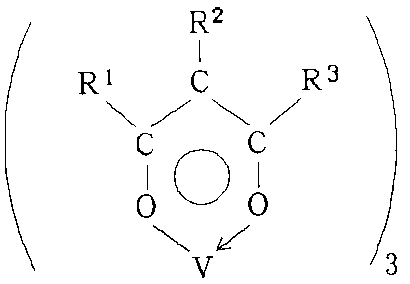
触媒としては、例えば、次の一般式(1)で表わされるバナジウム化合物が好ましく用いられる。
【0040】
一般式(1)
【化12】
一般式(1)中、R1〜R3は、H又はC1〜8のアルキル基を示す。但し、R1〜R3の少なくとも一つはHである必要があるが、R1〜R3の全部がHであってはならない。
【0042】
バナジウム化合物の具体例は、R2が水素原子であり、R1とR3がアルキル基である場合、R1/R3として、CH3/CH3、CH3/C2H5、C2H5/C2H5、CH3/C6H5、C2H5/C6H5、C6H5/C6H5、CH3/C6H5CH2、C6H5CH2/C6H5CH2、C2H5/C6H5CH2、C6H5/C6H5CH2等が挙げられ、これらの内でも、R1及びR3がCH3の化合物が望ましい。
【0043】
また、R2がアルキル基であり、R1とR3のいずれかが水素原子で他がアルキル基である場合は、R2/R1又はR3として、CH3/CH3、C2H5/CH3、CH3/C2H5、C2H5/C2H5、CH3/C6H5、C6H5/C2H5、C2H5/C6H5、C6H5/C6H5、C6H5CH2/CH3、CH3/C6H5CH2、C6H5CH2/C6H5CH2、C6H5CH2/C2H5、C2H5/C6H5CH2、C6H5CH2/C6H5、C6H5/C6H5CH2等が挙げられ、これらの内でも、R1又はR3がCH3の化合物が望ましい。
【0044】
さらに、R2がHであり、R1とR3のいずれかがHで他がアルキル基である場合は、R1又はR3として、CH3、C2H5、C6H5、C6H5CH2等が挙げられ、これらの内でも、R1又はR3がCH3の化合物が望ましく、具体的には、V(アセチルアセトナート)3、V(2−メチル−1,3−ブタンジオナト)3、V(1,3−ブタンジオナト)3が例示できる。
【0045】
また、バナジウム化合物は、必要に応じて、適宜、シリカ、アルミナ、ジルコニア、チタニア等の担体に担持して用いることができる。
【0046】
有機アルミニウム化合物としては、一般式RnAlX3−n(但し、Rはアルキル基又はアリール基、Xはハロゲン原子又は水素原子を示し、nは1≦n<3の範囲の任意の数である。)で示されるものである。例えば、ジアルキルアルミニウムモノハライド、モノアルキルアルミニウムジハライド、アルキルアルミニウムセスキハライドなどの炭素数1ないし18個、好ましくは炭素数2ないし6個のアルキルアルミニウム化合物又はその混合物もしくは錯化合物が特に好ましい。
【0047】
具体的には、ジメチルアルミニウムクロリド、ジエチルアルミニウムクロリド、ジエチルアルミニウムブロミド、ジエチルアルミニウムアイオダイド、ジイソブチルアルミニウムクロリド等のジアルキルアルミニウムモノハライド、メチルアルミニウムジクロリド、エチルアルミニウムジクロリド、メチルアルミニウムジブロミド、エチルアルミニウムジブロミド、エチルアルミニウムジアイオダイド、イソブチルアルミニウムジクロリドなどのモノアルキルアルミニウムジハライド、エチルアルミニウムセスキクロリドなどのアルキルアルミニウムセスキハライド等が挙げられる。
【0048】
重合触媒の使用量は、オレフィン又はオレフィンと少量のコモノマー1モル当り、バナジウム化合物が1×10⁻⁵〜0.1モル、望ましくは1×10⁻⁴〜5×10⁻²モル、有機アルミニウム化合物が1×10⁻⁴〜0.5モル、望ましくは1×10⁻³〜0.1モルである。
バナジウム化合物と有機アルミニウム化合物との割合は、バナジウム化合物1モル当り、有機アルミニウム化合物を1〜100モル、好ましくは5〜50モルとする。
【0049】
重合は、反応に対して不活性で、かつ重合時に液状である溶媒中で行うことが望ましく、該溶媒としては、プロパン、ブタン、ペンタン、ヘキサン、ヘプタン等の飽和脂肪族炭化水素、シクロプロパン、シクロヘキサン等の飽和脂環式炭化水素、ベンゼン、トルエン、キシレン等の芳香族炭化水素等が挙げられる。
【0050】
リビング重合は、通常−100℃〜0℃で0.3〜50時間、好ましくは−80〜−20℃で0.5〜10時間行われる。得られるリビングポリオレフィンの分子量及び収量は、反応温度及び反応時間を変えることにより調節できる。重合温度を低温、例えば−30℃以下にすることにより、単分散に近い分子量分布を持つポリマーとすることができる。特に−50℃以下であれば、Mw(重量平均分子量)/Mn(数平均分子量)が1.01〜1.50のリビング重合体を得ることができる。
【0051】
重合反応時に、反応促進剤(ドナー)を用いることができる。反応促進剤としては、エーテル(アニソール、ジオキソラン、テトラヒドロフラン、ジエチルエーテル等)、水、酸素、アルコール(メタノール、エタノール、イソプロパノール等)、フェノール類、ケトン類、アルデヒド類、カルボン酸、マロン酸、有機酸もしくは無機酸のエステル類等の含酸素電子供与体や、アンモニア、アミン、ニトリル、イソシアネート等の含窒素電子供与体などが挙げられる。有機酸のエステルとしては、安息香酸エチル、酢酸エチル、フタル酸ジメチル等が例示できる。促進剤の使用量は、バナジウム化合物1モル当り、通常0.05〜20モル、好ましくは0.1〜10モルである。
【0052】
上記の方法により、500〜500,000の数平均分子量(Mn、プロピレン換算、以下同じ)を持ち、単分散に近いリビングポリオレフィンを製造することができる。リビングポリオレフィンの数平均分子量(Mn)は、800〜400,000が好ましく、特に1,000〜300,000が好ましい。分子量分布(Mw/Mn)は1.01〜3.0、特に1.01〜1.50が好ましい。
【0053】
(ロ)リビングポリオレフィンの末端変性
リビングポリオレフィンと末端変性剤との反応は、リビングポリオレフィンの反応系に、特定のエポキシ系変性剤を供給して行われる。
【0054】
末端変性剤は、次の一般式(a)で表される化合物である。
【0055】
【化13】
一般式(a)中、R1はH又はC1〜10のアルキル基を示す。このような化合物としては、例えば、グリシジルメタクリレート、グリシジルアクリレートが挙げられる。
【0057】
通常は末端変性剤1種を用いるが、2種以上を用いることもできる。2種以上の末端変性剤は、予め混合してからリビングポリオレフィンと反応させてもよいし、2段或いはそれ以上の多段で反応させてもよい。
【0058】
反応は、−100℃〜+150℃の温度で5分間〜50時間、好ましくは−80〜50℃で0.5〜20時間行う。反応温度を高くするか、反応時間を長くすることにより、エポキシ系変性剤によるポリオレフィン末端の変性率を増大することができる。エポキシ系変性剤は、リビングポリオレフィンの末端変性の程度に応じた量を使用する。
【0059】
リビングポリオレフィンとエポキシ系変性剤との反応物は、次いでプロトン供与体と接触させることによって、末端変性ポリオレフィンとなる。
プロトン供与体としては、メタノール、エタノール、フェノール等のアルコール類、塩酸、硫酸等の鉱酸が挙げられる。アルコール類と鉱酸は同時に用いてもよい。プロトン供与体は通常大過剰に用いられる。上記反応物とプロトン供与体との接触は、通常−100℃〜+100℃で1分間〜10時間行われる。
【0060】
上記の方法により、ポリオレフィンの末端がエポキシ系変性剤で変性された一般式(A)の構造を有する末端変性ポリオレフィンを製造することができる。この末端変性ポリオレフィンは、有機溶媒に可溶である。
【0061】
(2)変性ポリオレフィンの製造
本発明の変性ポリオレフィンは、上記の方法で得られた末端変性ポリオレフィンを有機溶媒に溶解し、あるいは混練機中で、ラジカル反応開始剤の存在下、さらに一般式(b)又は(c)で表される特定の変性剤1種以上と反応させて製造することができる。
【0062】
一般式(b)
【化14】
一般式(b)中、R1、R2及びR3は前記と同じである。
【0064】
一般式(b)で表される化合物として、(メタ)アクリル酸の他に、(メタ)アクリル酸の誘導体として、例えば、次のようなものが挙げられる。
【0065】
メチルアクリレート、エチルアクリレート、n−ブチルアクリレート、イソブチルアクリレート、t−ブチルアクリレート、シクロヘキシルアクリレート、2−エチルヘキシルアクリレート、n−オクチルアクリレート、トリフェニルメチルアクリレート、メチルメタクリレート、エチルメタクリレート、n−ブチルメタクリレート、イソブチルメタクリレート、t−ブチルメタクリレート、シクロヘキシルメタクリレート、2−エチルヘキシルメタクリレート、n−オクチルメタクリレート、トリフェニルメチルメタクリレートなどのアルキルエステル;アクリル酸ナトリウム塩、アクリル酸カリウム塩、アクリル酸リチウム塩、メタクリル酸ナトリウム塩、メタクリル酸カリウム塩、メタクリル酸リチウム塩などの(メタ)アクリル酸のアルカリ金属塩;アクリル酸クロリド、アクリル酸ブロミド、α−クロロ−メチルアクリレート、メタクリル酸クロリド、メタクリル酸ブロミド、α−クロロ−メチルメタクリレートなど(メタ)アクリル酸のハロゲン化物;アクリルアミド、N,N−ジメチルアクリルアミド、N,N−ジイソプロピルアクリルアミド、メタクリルアミド、N,N−ジメチルメタクリルアミド、N,N一ジイソプロピルメタクリルアミド、N,N−ジメチルアミノエチルアクリレート、N,N−ジメチルアミノエチルメタクリレートなどのアミノ基含有(メタ)アクリル酸誘導体;エチレングリコールジアクリレート、ジエチレングリコールジアクリレート、ジプロピレングリコールジアクリレート、1,4−ブタンジオールジアクリレート、1,6−へキサンジオールジアクリレート、エチレングリコールジメタクリレート、ジプロピレングリコールジメタクリレート、1,4−ブタンジオールジメタクリレート、1,6−へキサンジオールジメタクリレート、などのジ(メタ)アクリレート;2−ヒドロキシエチルアクリレート、3−ヒドロキシプロピルアクリレート、4−ヒドロキシブチルアクリレート、トリメトキシシリルプロピルアクリレート、2−メトキシエチルアクリレート、2−ヒドロキシエチルメタクリレート、3−ヒドロキシプロピルメタクリレート、4−ヒドロキシブチルメタクリレート、2−メトキシエチルメタクリレート、トリメトキシシリルプロピルメタクリレートなどのOH基又はアルコキシ基含有(メタ)アクリル酸誘導体;2−イソシアナートエチルメタクリレート、2−イソシアナートエチルアクリレートなどのイソシアナート基含有(メタ)アクリル酸誘導体;エチレングリコールメタクリレートホスフェート、2−メタクリロイロキシエチルホスホリルコリン、等のP含有(メタ)アクリル酸誘導体が挙げられる。
さらに、他のP含有(メタ)アクリル酸誘導体としては、CH2=C(CH3)CO−O−CH2−CH2(CH2Cl)−O−PO(OH)2、CH2=C(CH3)CO−O−CH2−CH2−O−PO(OH)−O−NH3(CH2CH2OH)、なども挙げられる。
また、マレイン酸、シトラコン酸、フマル酸、イタコン酸、メサコン酸、グルタコン酸、ビニルマレイン酸、アリルコハク酸など不飽和脂肪族ジカルボン酸、マレイン酸ジメチル、フマル酸ジエチルなどの不飽和脂肪族ジカルボン酸エステル等の誘導体、テトラヒドロフタル酸、テトラヒドロテレフタル酸などのシクロアルケンジカルボン酸及びそれらの誘導体が挙げられ、その他、無水マレイン酸、無水シトラコン酸、無水テトラヒドロフタル酸、無水エンドメチレンテトラヒドロフタル酸、メチルエンドメチレンテトラヒドロフタル酸無水物等の酸無水物も挙げることができる。
【0066】
本発明において、一般式(b)で表される化合物(変性剤)としては、アクリル酸、メタクリル酸、又はそれらのアルキルエステル、グリシジルエステル、及びOH基又はアルコキシ基含有(メタ)アクリル酸誘導体が好ましい。
【0067】
【化15】
一般式(c)中、R6及びR7は前記と同じである。
【0069】
また、一般式(c)で表される化合物(変性剤)としては、例えば、次のようなものが挙げられる。
アクリロニトリル、メタクリロニトリルなどのニトリル化合物;塩化ビニル、臭化ビニル、ふっ化ビニル、よう化ビニル、塩化ビニリデン、ビニルスルホン酸ナトリウム塩、ビニルスルホン酸カリウム塩、ビニルスルホン酸リチウム塩、メチルビニルエーテル、エチルビニルエーテル、イソブチルビニルエーテル、ビニルピリジン、N−ビニルピリジン、ビニルピロリドン、アクロレイン、メチルビニルケトン、イソブチルビニルケトン、酢酸ビニル、プロピオン酸ビニル、酪酸ビニル、ビニルトリメチルシラン、ビニルトリエトキシシラン、ビニルアセトアミド、N−ビニルアセトアミド、アリルクロリドなどのビニル化合物;スチレン、ヒドロキシスチレン、アミノスチレン、ジビニルベンゼン、ビニル安息香酸、シアノスチレン、ニトロスチレン、クロロメチルスチレン、α−メチルスチレン、p−メチルスチレン、アセトキシスチレン、p−ジメチルアミノメチルスチレンなどのスチレン誘導体。
本発明において、一般式(c)の化合物(変性剤)としては、スチレン誘導体が特に好ましい。
【0070】
末端変性ポリオレフィンを変性するには、ポリオレフィンを有機溶媒に溶解するか混練機中で、必要に応じて、窒素雰囲気下において、ラジカル反応開始剤の存在下、変性剤と反応させる。
【0071】
通常は変性剤1種を用いるが、2種以上を用いることもできる。2種以上を用いる場合、一般式(b)で表される化合物、或いは一般式(c)で表される化合物のいずれかの群から2種以上を選択する。さらに、2種以上の変性剤を予め混合してから末端変性ポリオレフィンと反応させてもよいし、2段或いはそれ以上の多段で反応させてもよい。
【0072】
上記有機溶媒としては、プロパン、ブタン、ペンタン、ヘキサン、ヘプタン、オクタン、ノナン、デカン、ドデカン等の飽和脂肪族炭化水素;シクロプロパン、シクロヘキサン等の飽和脂環式炭化水素;ベンゼン、トルエン、キシレン等の芳香族炭化水素等が挙げられる。
【0073】
また、ラジカル反応開始剤としては、アゾビスイソブチロニトリル、2,2−アゾビス(2,4−ジメチルバレロニトリル)などのアゾ系;過酸化ベンゾイル、t−ブチルパーオキシ−2−エチルヘキサノエート、2,5−ジメチル−2,5−ジ−t−ブチルパーオキシヘキサンなどの過酸化物を使用することができる
【0074】
変性反応は、−50〜200℃、好ましくは−30〜180℃、特に好ましくは0〜150℃の温度範囲で行う。−50℃未満では反応速度が遅く、一方、200℃を超えると末端エポキシ化ポリオレフィンの分子鎖が切断されるので好ましくない。特に好ましくは、0℃〜150℃の温度範囲で炭化水素溶楳を用いて変性反応を行う。
また、反応時間は1分以上、好ましくは5分〜10時間、特に好ましくは10分〜5時間である。反応時間が長いほど、ポリオレフィンへの変性剤の導入量が向上する。通常は1段階で変性反応させるが、2段階以上の多段で反応させてもよい。
【0075】
上記の方法により、ポリオレフィンの末端が一般式(A)で表される構造のエポキシ基で変性され、かつ一般式(B)又は(C)で表されるユニットで主鎖が変性された変性ポリオレフィンを製造することができる。
【0076】
【実施例】
以下に実施例を示して、本発明を更に具体的に説明するが、本発明は、これらの実施例により何ら限定されるものではない。
なお、本実施例、比較例中のポリマーの分析は、次に示す評価方法に基づいて行った。
【0077】
(1)分子量の測定
分子量の測定は、Waters社製GPC(ゲルパーミエーションクロマトグラフィー)モデル150を用いた。その測定条件は、溶媒がo−ジクロルベンゼン、測定温度が135℃、溶媒流速が1.0ml/分である。カラムは、東ソー社製の単分散ポリスチレン標準試料を用い、ポリスチレンの検量線を求め、これによりユニバーサル法でポリオレフィンの検量線を作成し、ポリオレフィンの分子量を測定した。
【0078】
(2)ポリマーの構造決定
(1H−NMR):日本電子社製GSX−400、フーリエ変換型NMRスペクトロメーターを用い、400MHz、30℃、パルス間隔15秒の条件で測定した。試料は、重クロロホルムに溶解して調製した。
(13C−NMR):Varian社製XL−200型NMR(PFTパルスフーリエ変換装置付き)を用い、50MHz、120℃、パルス幅8.2μsπ/3、パルス間隔4秒、積算回数5000の条件で、立体規則性を測定した。試料は、トリクロルベンゼンとベンゼン(2:1)の混合溶液に溶解して調整した。
【0079】
(3)ポリオレフィンへの変性剤導入量の測定
赤外線吸収スペクトル(IR)測定により、吸収ピークの解析により変性剤の導入量を測定した。IR測定には、日本分光社製のFT/IR−470を用いて、フィルム状にしたポリマーを使用した。
【0080】
[実施例1]
プロピレンのリビング重合
窒素ガスで十分に置換した2Lの攪拌機付きフラスコにトルエンを入れ、−78℃に冷却した。同温度でプロピレン8.3molを加え、トルエンに液化溶解した。次に、150mmolのAl(i−C4H9)2Brのトルエン溶液、ならびに15mmolのバナジウムトリス(アセチルアセトナト)のトルエン溶液を加えた。この時の系内の液量は1Lであった。バナジウムトリス(アセチルアセトナト)の添加と同時に攪拌を行い、重合を開始した。−78℃で3.0時間プロピレンの重合を行った。
【0081】
【表1】
グリシジルメタクリレートとの反応
上記の反応系に、グリシジルメタクリレート300mmolを−78℃で添加し、系内の温度を1時間かけて−40℃に上昇させた後、同温度で2時間反応させた。その後、1.5Lのエタノール中に反応溶液を注ぎポリマーを析出させた。得られたポリマーを再度ヘプタンに溶解し、遠心分離して、上澄み液を取り出した。これを1.5Lのメタノールに注ぎ、ポリマーを析出させた。得られたポリマーをメタノールで5回洗浄した後、室湿で減圧乾燥した。得られたポリマーは、2.6gであった。
GPCを測定したところ、ピークは単峰性で、Mnは4200、Mw/Mnは1.1であった。IRスペクトルを測定したところ、1740cm−1にカルボニル基の伸縮振動によるピークが観測された。さらに、1H−NMR測定を行ったところ、ポリプロピレンのプロトンに由来するピーク(δ=0.7〜1.7ppm)以外に、下記の化学シフト値からなるピークが観測された。
【0083】
【化16】
ポリプロピレン部のプロトンシグナルと、2.8ppmのシグナルの強度比とGPCにより算出した数平均分子量より、得られた重合体は、1.0個(x=1.0)のGMAユニットが導入されたものであることが明らかとなった。
【0085】
【表2】
ポリプロピレンヘのエチレングリコールジメタクリレートの導入
十分に窒素置換した100mlの攪拌機付きフラスコに、20gのヘプタンを添加し、前記により得られた末端がエポキシ基で変性されたポリプロピレン2gを加え、ポリマーが完全に溶解するまで攪拌した。その後、ヘプタン溶液に窒素を20分間バブリングした。窒素雰囲気下、エチレングリコールジメタクリレート1.0gと、ラジカル反応の開始剤としてt−ブチルパーオキシ−2−エチルヘキサノエート0.05gとを加え、2分間混合した後、オイルバスを用いて反応系を93℃まで上昇させ、系内温度が93℃到達後、2時間攪拌を続けた。
3時間経過後、オイルバスを下げ、直ちに室温のヘプタンを50ml加えた。ヘプタン溶液を600mlのメタノールに注ぎ、ポリマーを沈殿させた後、当該ポリマーを取り出し、150mlのヘプタンに溶解した。ヘプタン溶液を分液ロートに移し、50mlのメタノールを加えて、分液ロートをよく振り、静置、分液を行った。この操作を3回繰り返した後、ヘプタン層のみを回収し、十分乾燥することにより、ポリマーを得た。
得られたポリマーのIRを測定したところ、カルボニル基の伸縮振動による1740cm−1のピークが、エチレングリコールジメタクリレートを反応させる前と比較して増大していることが観測された。
さらに、1H−NMR測定を行ったところ、ポリプロピレンのプロトンに由来するピーク(δ=0.7〜1.7ppm)ならびに、上記グリシジルメタクリレート由来のピークとともに、エチレングリコールジメタクリレートに起因するピーク(ピークe)が新たに観測された。また、あわせてd、fのピーク強度の増加が観測された。
【0087】
【化17】
これらNMR、IR分析の結果から、エチレングリコールジメタクリレートがポリプロピレン鎖に導入されていることが確認された。
GPCを測定したところ、Mnは4300、Mw/Mnは1.1であり、このことから、エチレングリコールジメタクリレートを導入する反応を行っている間は、ポリプロピレン部の切断は起こっていないことが分かる。
ポリプロピレン部のプロトンとeのピークの強度比、ならびに、GPCにより測定された数平均分子量より算出した、エチレングリコールジメタクリレートのユニット数は4.9(n=4.9)であった。
【0089】
【表3】
なお、得られたポリプロピレンのシンジオタクチックダイアッド分率を測定するために、別に上記の操作と同一にしてプロピレンのリビング重合を行い、反応液を−78℃のエタノール−塩酸溶液500ml中に入れて重合を停止させ、分離したポリマーを500mlのエタノールで5回洗浄し、常温で乾燥してポリプロピレンを得た。得られたポリプロピレンを13C−NMR分析した結果、ダイアッド分率[r]は0.79であった。
【0091】
[実施例2]
プロピレンのリビング重合
窒素ガスで十分に置換した2Lの攪拌機付きフラスコにトルエンを入れ、−60℃に冷却した。同温度でプロピレン8.3molを加え、トルエンに液化溶解した。次に、60mmolのAl(C2H5)2Clのトルエン溶液、ならびに3.5mmolのトリス(2−メチル−1,3−ブタンジオナト)バナジウムのトルエン溶液、及びジエチルエーテル6.0mmolを加えた。この時の系内の液量は1Lであった。バナジウムトリス(アセチルアセトナト)の添加と同時に攪拌を行い、重合を開始した。−60℃で2.0時間プロピレンの重合を行った。
グリシジルメタクリレートとの反応
上記の反応系に、グリシジルメタクリレート1molを−60℃で添加し、系内の温度を1時間かけて0℃に上昇させた後、同温度で5時間反応させた。その後、1.5Lのエタノール中に反応溶液を注ぎポリマーを析出させた。得られたポリマーを再度ヘプタンに溶解し、遠心分離して、上澄み液を取り出した。これを1.5Lのメタノールに注ぎ、ポリマーを析出させた。得られたポリマーをメタノールで5回洗浄した後、室湿で減圧乾燥した。得られたポリマーは、73gであった。
GPCを測定したところ、ピークは単峰性で、Mnは57,000、Mw/Mnは1.2であった。IRスペクトルを測定したところ、1740cm−1にカルボニル基の伸縮振動によるピークが観測された。得られた重合体は、7.6個(x=7.6)のGMAユニットが導入されたものであることが明らかとなった。
ポリプロピレンヘのヒドロキシエチルメタクリレートの導入
十分窒素置換した100mlの攪拌機付きフラスコに20gのドデカンを添加し、前記により得られた末端がエポキシ基で変性されたポリプロピレン2gを加え、ポリマーが完全に溶解するまで攪拌した。その後、ドデカン溶液に窒素を20分間バブリングした。窒素雰囲気下、ヒドロキシエチルメタクリレート1.5gと、ラジカル反応の開始剤として、2,5−ジメチル−2,5−ジ−t−ブチルパーオキシヘキサン0.01gとを加え、2分間混合した後、オイルバスを用いて反応系を136℃まで上昇させ、系内温度が136℃に到達後、5時間攪拌を続けた。
3時間経過後、オイルバスを下げ、直ちに室温のドデカンを50ml加えた。ドデカン溶液を600mlのメタノールに注ぎ、樹脂を沈殿させた後、当該樹脂を取り出し150mlのドデカンに溶解した。ドデカン溶液を分液ロートに移し50mlのメタノールを加えて、分液ロートをよく振り、静置、分液を行った。この操作を3回繰り返した後、ドデカン層のみを回収し、十分乾燥することにより、ポリマーを得た。
NMR、IR分析の結果から、ヒドロキシエチルメタクリレートがポリプロピレン鎖に導入されていることが確認された。
GPCを測定したところ、Mnは55,000、Mw/Mnは1.2であり、このことから、ヒドロキシエチルメタクリレートを導入する反応を行っている間は、ポリプロピレン部の切断は起こっていないことが分かる。
ポリプロピレン部のプロトンとeのピークの強度比、ならびに、GPCにより測定された数平均分子量より算出した、ヒドロキシエチルメタクリレートのユニット数は14(n=14)であった。
【0092】
[実施例3〜5]
実施例1又は2と同様にして、表1に示す条件でプロピレンの重合を行い、ポリプロピレンの末端を表2に示す条件で変性してから、さらに表3の条件で各種変性した。
この際、実施例5では、ヒドロキシエチルメタクリレート1.5gとブタンジオールジアクリレート1.0gを添加し、アゾビスイソブチロニトリル0.1gを添加し、60℃で10時間反応させた。表3に示した変性量は両変性剤合計の値である。
【0093】
[参考例1]
実施例2と同様に重合し、末端変性したポリプロピレンを表3に示す条件で変性反応を試みた。得られたポリマーは、ポリプロピレン1分子あたりの変性量は、8.9個/鎖であったが、実施例2よりも数平均分子量が小さくなり、単分散性も若干低下した。変性反応の温度が高かったために、末端エポキシ化ポリプロピレンが切断されたものと考えられる。
【0094】
表1〜3から明らかなように、実施例1〜5で得られたポリマーは、特定のエポキシ基で変性されており、数平均分子量(Mn)が5,000〜500,000の範囲であり、さらに、ポリプロピレン1分子あたりの変性剤の導入量は、1.0〜27個/鎖の範囲であった。
【0095】
一方、参考例1で得られたポリマーは、ポリプロピレン1分子あたりの変性剤の導入量は、8.9個/鎖であったものの、変性前よりも分子量が低下し分子量分布が広がっていることから、ポリマー鎖の切断が進行していることが判る。
【0096】
【発明の効果】
本発明の変性ポリオレフィンは、末端がエポキシ基で変性されたポリオレフィンを、さらに特定の変性剤と反応させてグラフト結合させているため、ポリオレフィン系材料及び極性を有する材料との親和性が優れているという効果を発揮する。
したがって、本発明の変性ポリオレフィンは、塗装や接着、印刷が容易で、溶剤に対する溶解性が高いため、塗料、表面改質剤、プライマー、インキ、接着剤、粘着剤、相溶化剤、反応性ポリマー或いはコーティング剤として好適であり、その工業的価値は極めて大きい。[0001]
TECHNICAL FIELD OF THE INVENTION
The present invention relates to a modified polyolefin, and more particularly, to a modified polyolefin obtained by modifying a polyolefin having a terminal modified with a specific substituent with a compound such as (meth) acrylic acid, a derivative thereof, or a styrene derivative.
[0002]
[Prior art]
Since ordinary polyolefins such as polypropylene and polyethylene have high crystallinity and are nonpolar, they have almost no affinity with other base materials, for example, styrene resin, acrylic resin, vinyl acetate resin and the like. Therefore, there is a problem that blending, painting, bonding and printing of these resins are difficult.
[0003]
In order to solve these problems, a technique has been developed in which an olefin is subjected to living polymerization to modify its terminal.
That is, conventionally, when an α-olefin such as propylene is polymerized using a Ziegler-Natta type catalyst, a chain transfer reaction or a termination reaction occurs. However, if a living polymerization catalyst system comprising vanadium and organoaluminum is used to carry out living polymerization of an α-olefin, a chain transfer reaction and a termination reaction are suppressed. By the introduction, the terminal of the polymer can be modified.
[0004]
Therefore, the present applicant has proposed a modified polyolefin in which only the terminal of polypropylene or an ethylene-propylene random copolymer is modified (modified) with a (meth) acrylic acid derivative containing an epoxy group by using living polymerization (Patent Reference 1). Thereby, the affinity with the polypropylene and the nonpolar material could be improved.
However, simply modifying the terminal does not provide sufficient polarity to the polymer, and therefore, even if a highly reactive epoxy group is added to the terminal, it is insufficient for use in paints, adhesives, inks, etc. Met.
[0005]
[Patent Document 1]
JP-A-5-247119 (Claims)
[0006]
In order to solve this problem, it is necessary to develop a modified polyolefin having a more sufficient polarity.
[0007]
[Problems to be solved by the invention]
An object of the present invention is to provide a modified polyolefin obtained by modifying a polyolefin having a terminal modified with a specific substituent with a compound such as (meth) acrylic acid, a derivative thereof, or a styrene derivative in view of the above situation. It is in.
[0008]
[Means for Solving the Problems]
The present inventors have conducted intensive studies to solve the above problems, and as a result, have found that polyolefins whose terminals have been modified with compounds having highly reactive epoxy groups (hereinafter also referred to as terminal modifiers or epoxy modifiers) have been developed. When reacted with a compound such as (meth) acrylic acid, a derivative thereof, or a styrene derivative (hereinafter, also simply referred to as a modifier) in the presence of a radical reaction initiator, the terminal-modified polyolefin is imparted with sufficient polarity, and is excellent The inventors have found that a modified polyolefin having high performance can be obtained, and have completed the present invention.
[0009]
That is, according to the first invention of the present invention, at least one of the terminals has a structure represented by the following general formula (A) graft-bonded to a polyolefin having a structure represented by the following general formula (A). And a number average molecular weight (Mn) of 5,000 to 500,000.
[0010]
Embedded image
In the general formula (A), R1Is H or C1 to 10And x is an integer of 1 to 100.
[0012]
Embedded image
In the general formula (B), R1Is H or C1 to 10An alkyl group of R2Is OR4, A halogen selected from Cl, Br, F or I, NR1 2Or R5―NR1 2Group; R3Is H or -COR2Group. Where R4Is H or C which may have a halogen1 to 10An alkyl group of C1 to 10An aromatic group which may have an alkyl substituent of the formula:-(CH2) A-OP (O) (OR1)2Or-(CH2) A-OP (O) (O−) (O- (CH2) B-N+R1 3(A and b are each an integer of 1 to 5); an alkali metal M selected from Li, Na, or K; C5-10An alicyclic hydrocarbon; R5-COCR1= CH2R5OR1R5Si (OR1)3Or R5-Indicates NCO, and R5Is C1 to 10Alkylene group or-[(CH2) Q-O-] r-, wherein q and r each represent an integer of 1 to 5. Further, n is 0.5 to 500, but when two or more units exist per one molecule of polyolefin, the total of n is 2 to 500.
[0014]
According to the second aspect of the present invention, at least one of the terminals has a structure represented by the following general formula (A) graft-bonded to a polyolefin having a structure represented by the following general formula (A). And a number average molecular weight (Mn) of 5,000 to 500,000.
[0015]
Embedded image
In the general formula (A), R1Is H or C1 to 10And x is an integer of 1 to 100.
[0017]
Embedded image
In the general formula (C), R6Is H or C1 to 10Or a halogen selected from Cl, Br, F or I; R7Is Ar-X ', OCO-R6, CHO, COR6, CN, pyridyl group, pyrrolidonyl group, Si (OR1)3, C1 to 10Alkyl halide, halogen, OR6, OSO3M or NH-CO-R6It is. Where X 'is R6, OH, COOH, NH2, CN, NO2, C1 to 10Alkyl halide, CH = CH2Or OCO-R6Any of R1Is H or C1 to 10And M is the above-mentioned alkali metal. Further, m is 0.5 to 500, and when two or more units exist per one molecule of polyolefin, the total of m is 2 to 500.
[0019]
Preferred embodiments of the present invention include the following.
(1) The modified polyolefin according to the first aspect of the present invention, wherein x of the unit represented by the general formula (A) is 1 to 50.
(2) The modified polyolefin according to the first aspect of the present invention, wherein the unit represented by the general formula (B) is a unit derived from (meth) acrylic acid or an alkyl ester thereof.
(3) The modified polyolefin according to the first aspect of the present invention, wherein the unit represented by the general formula (B) is a unit derived from an alkali metal salt of (meth) acrylic acid or a halide thereof. .
(4) In the first invention of the present invention, the unit represented by the general formula (B) is a unit derived from a (meth) acrylic acid derivative containing an OH group, an alkoxy group, an amino group or an isocyanate group. A modified polyolefin characterized by the following.
(5) The modified polyolefin according to the first aspect of the present invention, wherein n of the unit represented by the general formula (B) is 1 to 300.
(6) The modified polyolefin according to the first aspect of the present invention, wherein n of the unit represented by the general formula (B) is 1 to 200.
(7) The modified polyolefin according to the first aspect of the present invention, wherein n of the unit represented by the general formula (B) is 1 to 100.
(8) The modified polyolefin according to the second aspect of the present invention, wherein the unit represented by the general formula (C) is a unit derived from a styrene derivative.
(9) The modified polyolefin according to the second aspect of the present invention, wherein the unit represented by the general formula (C) is a unit derived from a vinyl compound or an unsaturated dicarboxylic acid.
(10) The modified polyolefin according to the second aspect of the present invention, wherein m of the unit represented by the general formula (C) is 1 to 300.
(11) The modified polyolefin according to the second aspect of the present invention, wherein m of the unit represented by the general formula (C) is 1 to 200.
(12) The modified polyolefin according to the second aspect of the present invention, wherein m of the unit represented by the general formula (C) is 1 to 100.
(13) The modified polyolefin according to the first or second aspect of the present invention, wherein the number average molecular weight (Mn) is 10,000 to 250,000.
(14) The modified polyolefin according to the first or second aspect of the present invention, wherein the molecular weight distribution (Mw / Mn) is from 1.01 to 3.00.
(15) The modified polyolefin according to the first or second aspect of the present invention, wherein the molecular weight distribution (Mw / Mn) is from 1.01 to 1.50.
(16) The modified polyolefin according to the first or second aspect of the present invention, wherein the racemic dyad [r] value is 0.51 to 0.88.
(17) Production of a modified polyolefin characterized in that a polyolefin polymerized using a catalyst comprising a vanadium complex and an organoaluminum compound is reacted with an epoxy-based modifier to produce a terminal-modified polyolefin first. Method.
(18) A method for producing a modified polyolefin, comprising dissolving a terminal-modified polyolefin in an organic solvent and then reacting the dissolved polyolefin with a modifier.
(19) A method for producing a modified polyolefin, wherein the terminal-modified polyolefin is further modified at a temperature of 0 to 150 ° C.
(20) A paint, surface modifier, primer, coating agent, ink, adhesive, adhesive, reactive polymer or compatibilizer comprising the first or second modified polyolefin of the present invention.
[0020]
BEST MODE FOR CARRYING OUT THE INVENTION
Hereinafter, the modified polyolefin of the present invention will be described in detail.
[0021]
1. Modified polyolefin
The modified polyolefin of the present invention is based on a polyolefin in which at least one of the terminals is modified with a specific epoxy group, and further includes a specific compound selected from (meth) acrylic acid, a derivative thereof, and a styrene derivative. It is a modified polyolefin in which the derived unit is graft-bonded.
[0022]
That is, the first modified polyolefin of the present invention is obtained by adding (meth) acrylic acid (or an alkyl ester thereof), (meth) to a polyolefin having a structure derived from an epoxy-based modifier represented by the general formula (A). ) A compound represented by the general formula (B) derived from any modifier of a (meth) acrylic acid derivative containing an alkali metal salt (or a halide) of acrylic acid, an OH group (or an alkoxy group), an amino group or an isocyanate group. Is a modified polyolefin having a specific number of grafted units.
[0023]
Embedded image
In the general formula (A), R1Is H or C1 to 10And x is an integer of 1 to 100.
[0025]
Embedded image
In the general formula (B), R1Is H or C1 to 10An alkyl group of R2Is OR4, A halogen selected from Cl, Br, F or I, NR1 2Or R5―NR1 2Group; R3Is H or -COR2Group. Where R4Is H or C which may have a halogen1 to 10An alkyl group of C1 to 10An aromatic group which may have an alkyl substituent of the formula:-(CH2) A-OP (O) (OR1)2Or-(CH2) A-OP (O) (O−) (O- (CH2) B-N+R1 3(A and b are each an integer of 1 to 5); an alkali metal M selected from Li, Na, or K; C5-10An alicyclic hydrocarbon; R5-COCR1= CH2R5OR1R5Si (OR1)3Or R5-Indicates NCO, and R5Is C1 to 10Alkylene group or-[(CH2) Q-O-] r-, wherein q and r each represent an integer of 1 to 5.
The number of units (n) introduced per molecule of polyolefin is 0.5 to 500, particularly 1 to 300, preferably 1 to 200, and more preferably 1 to 100. However, when two or more units exist per one molecule of polyolefin, the sum of n is 2 to 500.
[0027]
In addition, the second modified polyolefin of the present invention includes a polyolefin having a structure derived from an epoxy-based modifier represented by the general formula (A) at the terminal, and any one of a styrene derivative, a vinyl compound, and an unsaturated dicarboxylic acid. The unit represented by the general formula (C) derived from the modifier is a modified polyolefin having a specific number of graft bonds.
[0028]
Embedded image
In the general formula (C), R6Is H or C1 to 10Or a halogen selected from Cl, Br, F or I; R7Is Ar-X ', OCO-R6, CHO, COR6, CN, pyridyl group, pyrrolidonyl group, Si (OR1)3, C1 to 10Alkyl halide, halogen, OR6, OSO3M or NH-CO-R6It is. Where X 'is R6, OH, COOH, NH2, CN, NO2, C1 to 10Alkyl halide, CH = CH2Or OCO-R6Any of R1Is H or C1 to 10And M is the above-mentioned alkali metal.
[0030]
The number of units (m) introduced per molecule of polyolefin is 0.5 to 500, preferably 1 to 300, more preferably 1 to 200, and particularly preferably 1 to 100. However, when two or more units exist per one molecule of polyolefin, the sum of m is from 2 to 500.
[0031]
In the modified polyolefin of the present invention, the modifying agent is grafted to the terminally modified polyolefin main chain. When a modifying agent is introduced at two or more sites, the modifying agent is randomly introduced as a pendant structure into the terminally modified polyolefin of the main chain.
[0032]
For example, when one modifier monomer is bonded to one position of the terminal modified polyolefin main chain, a modified polyolefin in which one unit of n or m = 1 is bonded, and the modified polyolefin is modified at three positions of the terminal modified polyolefin main chain. When the agent monomers are bonded one by one, a modified polyolefin in which three units of n or m = 1 are bonded. In addition, 10 positions (units) of the terminally modified polyolefin main chain are modified, of which 2 units have n or m = 1, 3 units have n or m = 2, and 4 units have n or m = 3. In the case of the modified polyolefin, the total of n or m is 2 + 6 + 12 = 20.
The amount of the modifier to be introduced is determined by a spectroscopic method. Also, the values of n and m are average values to the last.
[0033]
The modified polyolefin of the present invention has a number average molecular weight (Mn) of 5,000 to 500,000, preferably 10,000 to 250,000, and a molecular weight distribution (Mw / Mn) of 1.01 to 3. 00, preferably 1.01 to 1.50, and the racemic dyad [r] value is preferably 0.51 to 0.88, particularly preferably 0.55 to 0.84.
[0034]
The modified polyolefin of the present invention can be used as a compatibilizer between a polyolefin and another polymer, a paint, a surface modifier, a primer, an ink, an adhesive, an adhesive, a reactive polymer or a coating agent, and the like. Preferred applications are paints, surface modifiers, primers or coatings.
[0035]
2. Production of modified polyolefin
The modified polyolefin of the present invention is a first step of reacting a living polyolefin with an epoxy-based modifier and modifying the terminal thereof, and further modifying the obtained terminal-modified polyolefin with a specific modifier other than an epoxy-based modifier. It is manufactured by a second step.
[0036]
(1) Production of terminal-modified polyolefin
The terminal-modified polyolefin is produced by a method for producing a polyolefin having an epoxy group at a terminal of a living polyolefin, for example, a method described in JP-A-5-247119. Also, by using the catalyst described in JP-A-11-80226, a polyolefin containing epoxy groups at both ends or all three or more ends can be produced.
[0037]
(A) Living polyolefin
Living polyolefin is produced by polymerizing one or two or more α-olefins having 2 to 8 carbon atoms using a specific catalyst comprising a vanadium compound and an organoaluminum compound. Examples of the α-olefin include ethylene, propylene, 1-butene, 1-hexene, 4-methyl-1-pentene, and the like.
[0038]
As the living polyolefin, polypropylene and an ethylene-propylene random copolymer are preferable. In the case of an ethylene-propylene random copolymer, the ethylene content is preferably less than 10 mol%.
[0039]
As the catalyst, for example, a vanadium compound represented by the following general formula (1) is preferably used.
[0040]
General formula (1)
Embedded image
In the general formula (1), R1~ R3Is H or C1-8Represents an alkyl group. Where R1~ R3At least one must be H, but R1~ R3Must not be all H.
[0042]
Specific examples of the vanadium compound include R2Is a hydrogen atom, and R1And R3Is an alkyl group,1/ R3As CH3/ CH3, CH3/ C2H5, C2H5/ C2H5, CH3/ C6H5, C2H5/ C6H5, C6H5/ C6H5, CH3/ C6H5CH2, C6H5CH2/ C6H5CH2, C2H5/ C6H5CH2, C6H5/ C6H5CH2And the like. Of these, R1And R3Is CH3Is desirable.
[0043]
Also, R2Is an alkyl group, and R1And R3Is a hydrogen atom and the other is an alkyl group,2/ R1Or R3As CH3/ CH3, C2H5/ CH3, CH3/ C2H5, C2H5/ C2H5, CH3/ C6H5, C6H5/ C2H5, C2H5/ C6H5, C6H5/ C6H5, C6H5CH2/ CH3, CH3/ C6H5CH2, C6H5CH2/ C6H5CH2, C6H5CH2/ C2H5, C2H5/ C6H5CH2, C6H5CH2/ C6H5, C6H5/ C6H5CH2And the like. Of these, R1Or R3Is CH3Is desirable.
[0044]
Further, R2Is H and R1And R3Is H and the other is an alkyl group,1Or R3As CH3, C2H5, C6H5, C6H5CH2And the like. Of these, R1Or R3Is CH3Is preferred, specifically, V (acetylacetonate)3, V (2-methyl-1,3-butanedionato)3, V (1,3-butanedionato)3Can be exemplified.
[0045]
In addition, the vanadium compound can be used by being appropriately supported on a carrier such as silica, alumina, zirconia, or titania, if necessary.
[0046]
As the organic aluminum compound, a compound represented by the general formula RnAlX3-n(Where R represents an alkyl group or an aryl group, X represents a halogen atom or a hydrogen atom, and n is an arbitrary number in the range of 1 ≦ n <3). For example, alkylaluminum compounds having 1 to 18 carbon atoms, preferably 2 to 6 carbon atoms, such as dialkylaluminum monohalide, monoalkylaluminum dihalide, and alkylaluminum sesquihalide, or mixtures or complex compounds thereof are particularly preferred.
[0047]
Specifically, dimethylaluminum chloride, diethylaluminum chloride, diethylaluminum bromide, diethylaluminum iodide, dialkylaluminum monohalide such as diisobutylaluminum chloride, methylaluminum dichloride, ethylaluminum dichloride, methylaluminum dibromide, ethylaluminum dibromide, Monoalkylaluminum dihalides such as ethylaluminum diiodide and isobutylaluminum dichloride, and alkylaluminum sesquihalides such as ethylaluminum sesquichloride.
[0048]
The amount of the polymerization catalyst used is 1 × 10 5 vanadium compounds per mole of olefin or olefin and a small amount of comonomer.-5~ 0.1 mol, desirably 1 × 10⁻⁴~ 5 × 10⁻²Mole, 1 × 10 of organoaluminum compound-40.5 mol, preferably 1 × 10-30.10.1 mol.
The ratio of the vanadium compound to the organic aluminum compound is 1 to 100 mol, preferably 5 to 50 mol, per 1 mol of the vanadium compound.
[0049]
The polymerization is desirably carried out in a solvent which is inert to the reaction and which is liquid at the time of the polymerization, such as propane, butane, pentane, hexane, a saturated aliphatic hydrocarbon such as heptane, cyclopropane, or the like. Saturated alicyclic hydrocarbons such as cyclohexane, and aromatic hydrocarbons such as benzene, toluene, and xylene are exemplified.
[0050]
Living polymerization is carried out usually at -100 ° C to 0 ° C for 0.3 to 50 hours, preferably at -80 to -20 ° C for 0.5 to 10 hours. The molecular weight and yield of the obtained living polyolefin can be adjusted by changing the reaction temperature and reaction time. By setting the polymerization temperature to a low temperature, for example, −30 ° C. or lower, a polymer having a molecular weight distribution close to monodispersion can be obtained. In particular, if it is −50 ° C. or lower, a living polymer having Mw (weight average molecular weight) / Mn (number average molecular weight) of 1.01 to 1.50 can be obtained.
[0051]
At the time of the polymerization reaction, a reaction accelerator (donor) can be used. Reaction accelerators include ethers (anisole, dioxolan, tetrahydrofuran, diethyl ether, etc.), water, oxygen, alcohols (methanol, ethanol, isopropanol, etc.), phenols, ketones, aldehydes, carboxylic acids, malonic acid, organic acids Alternatively, oxygen-containing electron donors such as esters of inorganic acids, and nitrogen-containing electron donors such as ammonia, amines, nitriles, and isocyanates may be used. Examples of the organic acid ester include ethyl benzoate, ethyl acetate, dimethyl phthalate and the like. The amount of the accelerator used is usually 0.05 to 20 mol, preferably 0.1 to 10 mol, per 1 mol of the vanadium compound.
[0052]
By the above method, a living polyolefin having a number average molecular weight of 500 to 500,000 (Mn, in terms of propylene, the same applies hereinafter) and almost monodispersion can be produced. The number average molecular weight (Mn) of the living polyolefin is preferably from 800 to 400,000, particularly preferably from 1,000 to 300,000. The molecular weight distribution (Mw / Mn) is preferably from 1.01 to 3.0, particularly preferably from 1.01 to 1.50.
[0053]
(B) Terminal modification of living polyolefin
The reaction between the living polyolefin and the terminal modifier is carried out by supplying a specific epoxy modifier to the reaction system of the living polyolefin.
[0054]
The terminal modifier is a compound represented by the following general formula (a).
[0055]
Embedded image
In the general formula (a), R1Is H or C1 to 10Represents an alkyl group. Examples of such a compound include glycidyl methacrylate and glycidyl acrylate.
[0057]
Usually, one type of terminal modifier is used, but two or more types may be used. The two or more terminal modifiers may be mixed in advance and then reacted with the living polyolefin, or may be reacted in two or more stages.
[0058]
The reaction is carried out at a temperature of -100C to + 150C for 5 minutes to 50 hours, preferably at -80 to 50C for 0.5 to 20 hours. By increasing the reaction temperature or lengthening the reaction time, it is possible to increase the rate of modification of the polyolefin terminal with the epoxy modifier. The epoxy-based modifier is used in an amount corresponding to the degree of terminal modification of the living polyolefin.
[0059]
The reaction product of the living polyolefin and the epoxy-based modifier is then brought into contact with a proton donor to form a terminal-modified polyolefin.
Examples of the proton donor include alcohols such as methanol, ethanol and phenol, and mineral acids such as hydrochloric acid and sulfuric acid. Alcohols and mineral acids may be used simultaneously. The proton donor is usually used in large excess. The contact between the reactant and the proton donor is usually performed at -100 ° C to + 100 ° C for 1 minute to 10 hours.
[0060]
By the above method, a terminal-modified polyolefin having a structure of the general formula (A) in which the terminal of the polyolefin is modified with an epoxy-based modifier can be produced. This terminal-modified polyolefin is soluble in an organic solvent.
[0061]
(2) Production of modified polyolefin
The modified polyolefin of the present invention is obtained by dissolving the terminal-modified polyolefin obtained by the above method in an organic solvent, or in a kneader in the presence of a radical reaction initiator and further represented by the general formula (b) or (c). And one or more specific modifiers.
[0062]
General formula (b)
Embedded image
In the general formula (b), R1, R2And R3Is the same as above.
[0064]
Examples of the compound represented by the general formula (b) include, in addition to (meth) acrylic acid, derivatives of (meth) acrylic acid as follows.
[0065]
Methyl acrylate, ethyl acrylate, n-butyl acrylate, isobutyl acrylate, t-butyl acrylate, cyclohexyl acrylate, 2-ethylhexyl acrylate, n-octyl acrylate, triphenylmethyl acrylate, methyl methacrylate, ethyl methacrylate, n-butyl methacrylate, isobutyl methacrylate , T-butyl methacrylate, cyclohexyl methacrylate, 2-ethylhexyl methacrylate, n-octyl methacrylate, triphenylmethyl methacrylate, and other alkyl esters; sodium acrylate, potassium acrylate, lithium acrylate, sodium methacrylate, methacrylic acid (Meth) acrylic acid such as potassium salt and lithium methacrylate Metallic salt of alkali; acrylic acid chloride, acrylic acid bromide, α-chloro-methyl acrylate, methacrylic acid chloride, methacrylic acid bromide, α-chloro-methyl methacrylate, etc., halide of (meth) acrylic acid; acrylamide, N, N-dimethyl Contains an amino group such as acrylamide, N, N-diisopropylacrylamide, methacrylamide, N, N-dimethylmethacrylamide, N, N-diisopropylmethacrylamide, N, N-dimethylaminoethyl acrylate, N, N-dimethylaminoethyl methacrylate (Meth) acrylic acid derivatives; ethylene glycol diacrylate, diethylene glycol diacrylate, dipropylene glycol diacrylate, 1,4-butanediol diacrylate, 1,6-hexa Di (meth) acrylates such as diol diacrylate, ethylene glycol dimethacrylate, dipropylene glycol dimethacrylate, 1,4-butanediol dimethacrylate, 1,6-hexanediol dimethacrylate; 2-hydroxyethyl acrylate, 3-hydroxyethyl acrylate Hydroxypropyl acrylate, 4-hydroxybutyl acrylate, trimethoxysilylpropyl acrylate, 2-methoxyethyl acrylate, 2-hydroxyethyl methacrylate, 3-hydroxypropyl methacrylate, 4-hydroxybutyl methacrylate, 2-methoxyethyl methacrylate, trimethoxysilylpropyl OH or alkoxy group-containing (meth) acrylic acid derivatives such as methacrylate; 2-isocyanatoethyl methacrylate DOO, 2-isocyanate group-containing, such as isocyanatoethyl acrylate (meth) acrylic acid derivatives, ethylene glycol methacrylate phosphate, 2-methacryloyloxyethyl phosphorylcholine include P-containing (meth) acrylic acid derivatives and the like.
Further, other P-containing (meth) acrylic acid derivatives include CH2= C (CH3) CO-O-CH2-CH2(CH2Cl) -O-PO (OH)2, CH2= C (CH3) CO-O-CH2-CH2—O—PO (OH) —O—NH3(CH2CH2OH), and the like.
In addition, unsaturated aliphatic dicarboxylic acids such as maleic acid, citraconic acid, fumaric acid, itaconic acid, mesaconic acid, glutaconic acid, vinylmaleic acid, allylsuccinic acid, and unsaturated aliphatic dicarboxylic acid esters such as dimethyl maleate and diethyl fumarate Derivatives such as, tetrahydrophthalic acid, cycloalkenedicarboxylic acids such as tetrahydroterephthalic acid and derivatives thereof, and others, maleic anhydride, citraconic anhydride, tetrahydrophthalic anhydride, endmethylene anhydride tetrahydrophthalic acid, methylendomethylene Acid anhydrides such as tetrahydrophthalic anhydride can also be mentioned.
[0066]
In the present invention, examples of the compound (modifier) represented by the general formula (b) include acrylic acid, methacrylic acid, or an alkyl ester, glycidyl ester, and an OH or alkoxy group-containing (meth) acrylic acid derivative thereof. preferable.
[0067]
Embedded image
In the general formula (c), R6And R7Is the same as above.
[0069]
Further, examples of the compound (modifier) represented by the general formula (c) include the following.
Nitrile compounds such as acrylonitrile and methacrylonitrile; vinyl chloride, vinyl bromide, vinyl fluoride, vinyl iodide, vinylidene chloride, sodium vinyl sulfonate, potassium vinyl sulfonate, lithium vinyl sulfonate, methyl vinyl ether, ethyl Vinyl ether, isobutyl vinyl ether, vinyl pyridine, N-vinyl pyridine, vinyl pyrrolidone, acrolein, methyl vinyl ketone, isobutyl vinyl ketone, vinyl acetate, vinyl propionate, vinyl butyrate, vinyl trimethyl silane, vinyl triethoxy silane, vinyl acetamide, N- Vinyl compounds such as vinylacetamide and allyl chloride; styrene, hydroxystyrene, aminostyrene, divinylbenzene, vinylbenzoic acid, cyanostyrene, and nitro Styrene, chloromethylstyrene, alpha-methyl styrene, p- methyl styrene, acetoxystyrene, styrene derivatives such as p- dimethylaminomethyl styrene.
In the present invention, a styrene derivative is particularly preferable as the compound (modifier) of the general formula (c).
[0070]
To modify the terminal-modified polyolefin, the polyolefin is dissolved in an organic solvent or reacted with a modifier in a kneader, if necessary, in a nitrogen atmosphere in the presence of a radical reaction initiator.
[0071]
Usually, one modifier is used, but two or more modifiers can be used. When two or more compounds are used, two or more compounds are selected from any group of the compound represented by the general formula (b) or the compound represented by the general formula (c). Furthermore, two or more modifiers may be mixed in advance and then reacted with the terminal-modified polyolefin, or may be reacted in two or more stages.
[0072]
Examples of the organic solvent include saturated aliphatic hydrocarbons such as propane, butane, pentane, hexane, heptane, octane, nonane, decane and dodecane; saturated alicyclic hydrocarbons such as cyclopropane and cyclohexane; benzene, toluene, xylene and the like. And the like.
[0073]
Examples of the radical reaction initiator include azo-based compounds such as azobisisobutyronitrile and 2,2-azobis (2,4-dimethylvaleronitrile); benzoyl peroxide, and t-butylperoxy-2-ethylhexano. Peroxides such as acetate, 2,5-dimethyl-2,5-di-t-butylperoxyhexane can be used.
[0074]
The denaturation reaction is carried out in a temperature range of -50 to 200C, preferably -30 to 180C, particularly preferably 0 to 150C. If the reaction temperature is lower than -50 ° C, the reaction rate is slow. Particularly preferably, the denaturation reaction is carried out in a temperature range of 0 ° C to 150 ° C using a hydrocarbon solvent.
The reaction time is 1 minute or more, preferably 5 minutes to 10 hours, particularly preferably 10 minutes to 5 hours. As the reaction time is longer, the amount of the modifier introduced into the polyolefin is improved. Usually, the denaturation reaction is performed in one step, but the reaction may be performed in two or more steps.
[0075]
Modified polyolefin in which the terminal of the polyolefin is modified with the epoxy group having the structure represented by the general formula (A) and the main chain is modified by the unit represented by the general formula (B) or (C) by the above method Can be manufactured.
[0076]
【Example】
Hereinafter, the present invention will be described in more detail with reference to Examples, but the present invention is not limited to these Examples.
In addition, the analysis of the polymer in this Example and a comparative example was performed based on the evaluation method shown below.
[0077]
(1) Measurement of molecular weight
The molecular weight was measured using GPC (gel permeation chromatography) model 150 manufactured by Waters. The measurement conditions are as follows: the solvent is o-dichlorobenzene, the measurement temperature is 135 ° C., and the solvent flow rate is 1.0 ml / min. As the column, a standard curve of polystyrene was obtained by using a monodisperse polystyrene standard sample manufactured by Tosoh Corporation, and a calibration curve of polyolefin was prepared by the universal method, and the molecular weight of polyolefin was measured.
[0078]
(2) Determination of polymer structure
(1H-NMR): Measured using a GSX-400 manufactured by JEOL Ltd. and a Fourier transform type NMR spectrometer at 400 MHz, 30 ° C. and a pulse interval of 15 seconds. The sample was prepared by dissolving in chloroform-d.
(ThirteenC-NMR): Using a Varian XL-200 type NMR (with a PFT pulse Fourier transforming device) under the conditions of 50 MHz, 120 ° C., pulse width 8.2 μs π / 3, pulse interval 4 seconds, and integration number 5000, The regularity was measured. The sample was prepared by dissolving in a mixed solution of trichlorobenzene and benzene (2: 1).
[0079]
(3) Measurement of the amount of modifier introduced into polyolefin
The amount of the modifying agent introduced was determined by analyzing the absorption peak by measuring the infrared absorption spectrum (IR). For IR measurement, a film-shaped polymer was used using FT / IR-470 manufactured by JASCO Corporation.
[0080]
[Example 1]
Living polymerization of propylene
Toluene was charged into a 2 L flask equipped with a stirrer sufficiently purged with nitrogen gas, and cooled to -78 ° C. At the same temperature, 8.3 mol of propylene was added and liquefied and dissolved in toluene. Next, 150 mmol of Al (i-C4H9)2A toluene solution of Br and a 15 mmol solution of vanadium tris (acetylacetonate) in toluene were added. At this time, the liquid volume in the system was 1 L. Stirring was performed at the same time as the addition of vanadium tris (acetylacetonato) to initiate polymerization. Propylene was polymerized at -78 ° C for 3.0 hours.
[0081]
[Table 1]
Reaction with glycidyl methacrylate
300 mmol of glycidyl methacrylate was added to the above reaction system at −78 ° C., and the temperature in the system was raised to −40 ° C. over 1 hour, followed by a reaction at the same temperature for 2 hours. Thereafter, the reaction solution was poured into 1.5 L of ethanol to precipitate a polymer. The obtained polymer was dissolved again in heptane, centrifuged, and the supernatant was taken out. This was poured into 1.5 L of methanol to precipitate a polymer. The obtained polymer was washed five times with methanol, and then dried under reduced pressure at room humidity. The amount of the obtained polymer was 2.6 g.
When GPC was measured, the peak was unimodal, Mn was 4,200, and Mw / Mn was 1.1. When the IR spectrum was measured, 1740 cm-1A peak due to stretching vibration of the carbonyl group was observed. further,1As a result of H-NMR measurement, peaks having the following chemical shift values were observed in addition to peaks (δ = 0.7 to 1.7 ppm) derived from protons of polypropylene.
[0083]
Embedded image
From the intensity ratio of the proton signal of the polypropylene part to the signal of 2.8 ppm and the number average molecular weight calculated by GPC, 1.0 (x = 1.0) GMA unit was introduced into the obtained polymer. It turned out to be something.
[0085]
[Table 2]
Introduction of ethylene glycol dimethacrylate into polypropylene
20 g of heptane was added to a 100-ml flask equipped with a stirrer, which had been sufficiently purged with nitrogen, and 2 g of the thus-terminated epoxy group-modified polypropylene was added, followed by stirring until the polymer was completely dissolved. Thereafter, nitrogen was bubbled through the heptane solution for 20 minutes. Under a nitrogen atmosphere, 1.0 g of ethylene glycol dimethacrylate and 0.05 g of t-butyl peroxy-2-ethylhexanoate as a radical reaction initiator were added, mixed for 2 minutes, and reacted using an oil bath. The temperature of the system was raised to 93 ° C., and after the temperature in the system reached 93 ° C., stirring was continued for 2 hours.
After 3 hours, the oil bath was lowered and immediately 50 ml of room temperature heptane was added. The heptane solution was poured into 600 ml of methanol to precipitate the polymer, and the polymer was taken out and dissolved in 150 ml of heptane. The heptane solution was transferred to a separating funnel, 50 ml of methanol was added, the separating funnel was shaken well, and the mixture was allowed to stand and separated. After repeating this operation three times, only the heptane layer was recovered and sufficiently dried to obtain a polymer.
When the IR of the obtained polymer was measured, it was 1740 cm due to stretching vibration of the carbonyl group.-1Was increased as compared with before the reaction of ethylene glycol dimethacrylate.
further,1When the H-NMR measurement was performed, the peak (peak e) derived from ethylene glycol dimethacrylate together with the peak derived from the proton of polypropylene (δ = 0.7 to 1.7 ppm) and the peak derived from glycidyl methacrylate were obtained. Newly observed. In addition, an increase in the peak intensities of d and f was also observed.
[0087]
Embedded image
From the results of these NMR and IR analyses, it was confirmed that ethylene glycol dimethacrylate was introduced into the polypropylene chain.
When GPC was measured, Mn was 4300 and Mw / Mn was 1.1, which indicates that the polypropylene portion was not cut during the reaction for introducing ethylene glycol dimethacrylate. .
The number of units of ethylene glycol dimethacrylate calculated from the intensity ratio of the peak between the proton and e in the polypropylene part and the number average molecular weight measured by GPC was 4.9 (n = 4.9).
[0089]
[Table 3]
In addition, in order to measure the syndiotactic dyad fraction of the obtained polypropylene, living polymerization of propylene was separately performed in the same manner as in the above operation, and the reaction solution was placed in 500 ml of an ethanol-hydrochloric acid solution at −78 ° C. Then, the polymerization was stopped, and the separated polymer was washed five times with 500 ml of ethanol and dried at room temperature to obtain polypropylene. The obtained polypropyleneThirteenAs a result of C-NMR analysis, the dyad fraction [r] was 0.79.
[0091]
[Example 2]
Living polymerization of propylene
Toluene was charged into a 2 L flask equipped with a stirrer sufficiently purged with nitrogen gas, and cooled to -60 ° C. At the same temperature, 8.3 mol of propylene was added and liquefied and dissolved in toluene. Next, 60 mmol of Al (C2H5)2A toluene solution of Cl, a toluene solution of 3.5 mmol of tris (2-methyl-1,3-butanedionato) vanadium, and 6.0 mmol of diethyl ether were added. At this time, the liquid volume in the system was 1 L. Stirring was performed at the same time as the addition of vanadium tris (acetylacetonato) to initiate polymerization. Polymerization of propylene was performed at -60 ° C for 2.0 hours.
Reaction with glycidyl methacrylate
1 mol of glycidyl methacrylate was added to the above reaction system at −60 ° C., and the temperature in the system was raised to 0 ° C. over 1 hour, followed by a reaction at the same temperature for 5 hours. Thereafter, the reaction solution was poured into 1.5 L of ethanol to precipitate a polymer. The obtained polymer was dissolved again in heptane, centrifuged, and the supernatant was taken out. This was poured into 1.5 L of methanol to precipitate a polymer. The obtained polymer was washed five times with methanol, and then dried under reduced pressure at room humidity. The obtained polymer was 73 g.
When GPC was measured, the peak was unimodal, Mn was 57,000 and Mw / Mn was 1.2. When the IR spectrum was measured, 1740 cm-1A peak due to stretching vibration of the carbonyl group was observed. It was revealed that the obtained polymer had 7.6 (x = 7.6) GMA units introduced therein.
Introduction of hydroxyethyl methacrylate into polypropylene
20 g of dodecane was added to a 100-ml flask equipped with a stirrer that had been sufficiently purged with nitrogen, and 2 g of the thus-terminated epoxy group-modified polypropylene was added, followed by stirring until the polymer was completely dissolved. Thereafter, nitrogen was bubbled through the dodecane solution for 20 minutes. Under a nitrogen atmosphere, 1.5 g of hydroxyethyl methacrylate and 0.01 g of 2,5-dimethyl-2,5-di-t-butylperoxyhexane as an initiator of a radical reaction were added and mixed for 2 minutes. The temperature of the reaction system was raised to 136 ° C. using an oil bath. After the temperature in the system reached 136 ° C., stirring was continued for 5 hours.
After 3 hours, the oil bath was lowered and immediately 50 ml of room temperature dodecane was added. The dodecane solution was poured into 600 ml of methanol to precipitate the resin, and then the resin was taken out and dissolved in 150 ml of dodecane. The dodecane solution was transferred to a separating funnel, 50 ml of methanol was added, the separating funnel was shaken well, and the solution was allowed to stand and separated. After repeating this operation three times, only the dodecane layer was recovered and dried sufficiently to obtain a polymer.
From the results of NMR and IR analysis, it was confirmed that hydroxyethyl methacrylate was introduced into the polypropylene chain.
When GPC was measured, Mn was 55,000 and Mw / Mn was 1.2. From this, it was found that the polypropylene portion was not cut during the reaction for introducing hydroxyethyl methacrylate. I understand.
The number of hydroxyethyl methacrylate units calculated from the intensity ratio between the peak of the proton and the peak of e in the polypropylene part and the number average molecular weight measured by GPC was 14 (n = 14).
[0092]
[Examples 3 to 5]
In the same manner as in Example 1 or 2, propylene was polymerized under the conditions shown in Table 1, the end of the polypropylene was modified under the conditions shown in Table 2, and further modified under the conditions shown in Table 3.
At this time, in Example 5, 1.5 g of hydroxyethyl methacrylate and 1.0 g of butanediol diacrylate were added, and 0.1 g of azobisisobutyronitrile was added, followed by a reaction at 60 ° C. for 10 hours. The amount of modification shown in Table 3 is the value of the total of both modifiers.
[0093]
[Reference Example 1]
Modification reaction was attempted on the polypropylene which was polymerized and terminal-modified in the same manner as in Example 2 under the conditions shown in Table 3. The resulting polymer had a modification amount per polypropylene molecule of 8.9 / chain, but the number average molecular weight was smaller than in Example 2, and the monodispersity was slightly reduced. It is considered that the terminal epoxidized polypropylene was cut due to the high temperature of the denaturation reaction.
[0094]
As is clear from Tables 1 to 3, the polymers obtained in Examples 1 to 5 are modified with a specific epoxy group, and have a number average molecular weight (Mn) in the range of 5,000 to 500,000. Further, the amount of the modifying agent introduced per polypropylene molecule was in the range of 1.0 to 27 / chain.
[0095]
On the other hand, in the polymer obtained in Reference Example 1, although the amount of the modifying agent introduced per molecule of polypropylene was 8.9 / chain, the molecular weight was lower than before the modification and the molecular weight distribution was wider. From this, it can be seen that the cleavage of the polymer chain has progressed.
[0096]
【The invention's effect】
The modified polyolefin of the present invention has excellent affinity with polyolefin-based materials and polar materials, because the polyolefin modified with an epoxy group at the terminal is further reacted with a specific modifier to form a graft bond. It exerts the effect of.
Therefore, the modified polyolefin of the present invention is easy to paint, adhere, and print, and has high solubility in solvents. Therefore, paints, surface modifiers, primers, inks, adhesives, adhesives, compatibilizers, reactive polymers Alternatively, it is suitable as a coating agent, and its industrial value is extremely large.
Claims (2)
ここで、R4はH、又はハロゲンを有しうるC1〜10のアルキル基;C1〜10のアルキル置換基を有しうる芳香族基;−(CH2)a−O−P(O)(OR1)2、又は−(CH2)a−O−P(O)(O−)(O−(CH2)b−N+R1 3(a及びbは夫々1〜5の整数);Li、Na、又はKから選択されるアルカリ金属M;C5〜10の脂環式炭化水素;R5−COCR1=CH2;R5OR1;R5Si(OR1)3、或いはR5―NCOを示し、また、R5はC1〜10のアルキレン基若しくは−[(CH2)q−O−]r−であり、q及びrは夫々1〜5の整数を示す。
さらに、nは0.5〜500であるが、ポリオレフィン1分子あたり該ユニットが2以上存在する場合、nの合計は2〜500である。]At least one of the terminals has a structure represented by the following general formula (A) graft-bonded to a polyolefin having a structure represented by the following general formula (A), and has a number average molecular weight (Mn) of 5,000. A modified polyolefin having a molecular weight of up to 500,000.
Here, R 4 is H, or an alkyl group of C 1 to 10 which may have a halogen; aromatic group may have an alkyl substituent of C 1~10 ;-( CH 2) a- O-P (O ) (oR 1) 2, or - (CH 2) a-O -P (O) (O -) (O- (CH 2) b-N + R 1 3 (a and b are each an integer of 1 to 5 ); Li, Na, or an alkali metal M is selected from K; alicyclic hydrocarbon of C 5~10; R 5 -COCR 1 = CH 2; R 5 oR 1; R 5 Si (oR 1) 3, Alternatively, it represents R 5 —NCO, and R 5 is a C 1-10 alkylene group or — [(CH 2 ) q—O—] r—, and q and r each represent an integer of 1 to 5.
Further, n is 0.5 to 500, and when two or more units exist per one molecule of polyolefin, the total of n is 2 to 500. ]
ここで、X’はR6、OH、COOH、NH2、CN、NO2、C1〜10のハロゲン化アルキル、CH=CH2、又はOCO−R6のいずれか、R1はH、又はC1〜10のアルキル基、Mは前記のアルカリ金属である。
さらに、mは0.5〜500であるが、ポリオレフィン1分子あたり該ユニットが2以上存在する場合、mの合計は2〜500である。]A unit represented by the following general formula (C) is graft-bonded to a polyolefin having at least one terminal having a structure represented by the following general formula (A), and the number average molecular weight (Mn) is 5,000. A modified polyolefin having a molecular weight of up to 500,000.
Here, X ′ is R 6 , OH, COOH, NH 2 , CN, NO 2 , C 1-10 alkyl halide, CH = CH 2 , or OCO—R 6 , R 1 is H, or The C 1-10 alkyl group and M are the aforementioned alkali metals.
Further, m is 0.5 to 500, but when two or more units exist per one molecule of polyolefin, the total of m is 2 to 500. ]
Priority Applications (1)
| Application Number | Priority Date | Filing Date | Title |
|---|---|---|---|
| JP2002285590A JP2004123776A (en) | 2002-09-30 | 2002-09-30 | Modified polyolefin |
Applications Claiming Priority (1)
| Application Number | Priority Date | Filing Date | Title |
|---|---|---|---|
| JP2002285590A JP2004123776A (en) | 2002-09-30 | 2002-09-30 | Modified polyolefin |
Publications (1)
| Publication Number | Publication Date |
|---|---|
| JP2004123776A true JP2004123776A (en) | 2004-04-22 |
Family
ID=32278852
Family Applications (1)
| Application Number | Title | Priority Date | Filing Date |
|---|---|---|---|
| JP2002285590A Pending JP2004123776A (en) | 2002-09-30 | 2002-09-30 | Modified polyolefin |
Country Status (1)
| Country | Link |
|---|---|
| JP (1) | JP2004123776A (en) |
-
2002
- 2002-09-30 JP JP2002285590A patent/JP2004123776A/en active Pending
Similar Documents
| Publication | Publication Date | Title |
|---|---|---|
| US20220041782A1 (en) | Practical synthesis of multiphase self-healing polymers from commodity monomers | |
| JP4788102B2 (en) | Polypropylene copolymer, composition containing the same and process for producing the same | |
| JP4208543B2 (en) | Branched polar group-containing olefin copolymer | |
| JP2005534771A (en) | Fluorinated polymer | |
| JP2004035623A (en) | Modified polypropylene and method for producing the same | |
| CN100402569C (en) | Polypropylene copolymer, composition containing the same, and method for producing the same | |
| JP5137569B2 (en) | Hybrid polymer and method for producing the same | |
| US7335703B2 (en) | Polyolefin graft copolymer prepared in the presence of coordination polymerization catalyst based on late transition metal complex and method for making the same | |
| Zhao et al. | Synthesis of Poly (methyl acrylate) Grafted onto Silica Particles by Z‐supported RAFT Polymerization | |
| US20230026134A1 (en) | Polyacrylate-based graft copolymer | |
| JP2003147032A (en) | Polyolefin graft copolymer with late transition metal complex based coordination polymerization catalyst and method for producing the same | |
| JP5040082B2 (en) | Resin dispersion | |
| JP2004123776A (en) | Modified polyolefin | |
| JP2004137375A (en) | Modified polyolefin | |
| KR100955558B1 (en) | Polyolefin Hybrid Polymer and Manufacturing Method Thereof | |
| JP2004300411A (en) | Polyolefin chain-containing block polymer | |
| JP2005097435A (en) | Primer composition for paint | |
| JP2927841B2 (en) | Method for producing olefin polymer | |
| JP4635449B2 (en) | COATING COMPOSITION CONTAINING PROPYLENE POLYMERS AND METHOD OF USE | |
| JP2005194481A (en) | Modified polypropylene composition | |
| JP2004026879A (en) | Method of manufacturing terminal-modified polyolefin | |
| JP4145173B2 (en) | Three-arm star polymer containing polyolefin segment | |
| JP4908786B2 (en) | Olefin polymer and process for producing the same | |
| JP2004300412A (en) | Graft polymer having polyolefin side chain-containing graft polymer as side chain | |
| JPH10139844A (en) | Graft polymer |
Legal Events
| Date | Code | Title | Description |
|---|---|---|---|
| A621 | Written request for application examination |
Free format text: JAPANESE INTERMEDIATE CODE: A621 Effective date: 20050901 |
|
| A977 | Report on retrieval |
Free format text: JAPANESE INTERMEDIATE CODE: A971007 Effective date: 20070112 |
|
| A131 | Notification of reasons for refusal |
Free format text: JAPANESE INTERMEDIATE CODE: A131 Effective date: 20070213 |
|
| A02 | Decision of refusal |
Free format text: JAPANESE INTERMEDIATE CODE: A02 Effective date: 20070703 |