JP2004123781A - Resol type phenolic resin composition, adhesive for wood materials and plywood - Google Patents
Resol type phenolic resin composition, adhesive for wood materials and plywood Download PDFInfo
- Publication number
- JP2004123781A JP2004123781A JP2002285615A JP2002285615A JP2004123781A JP 2004123781 A JP2004123781 A JP 2004123781A JP 2002285615 A JP2002285615 A JP 2002285615A JP 2002285615 A JP2002285615 A JP 2002285615A JP 2004123781 A JP2004123781 A JP 2004123781A
- Authority
- JP
- Japan
- Prior art keywords
- plywood
- resol
- resin composition
- phenols
- adhesive
- Prior art date
- Legal status (The legal status is an assumption and is not a legal conclusion. Google has not performed a legal analysis and makes no representation as to the accuracy of the status listed.)
- Pending
Links
Landscapes
- Adhesives Or Adhesive Processes (AREA)
- Veneer Processing And Manufacture Of Plywood (AREA)
- Dry Formation Of Fiberboard And The Like (AREA)
- Phenolic Resins Or Amino Resins (AREA)
Abstract
【課題】硬化時間を短縮しても、得られる合板の強度に優れ、パンク防止にも有効で、且つ、製造した合板や木質ボード類から放出するホルムアルデヒド類を低減した木材用接着剤組成物、これを用いた合板を提供すること。
【解決手段】アルカリ触媒存在下、フェノール類中にアルデヒド類を分割添加して多段階で反応させて得られるレゾール型フェノール樹脂を含有することを特徴とするレゾール型フェノール樹脂組成物、これを含有する木材用接着剤、これを用いた合板。
【選択図】 なし。An adhesive composition for wood which is excellent in strength of a plywood obtained even when a curing time is shortened, is effective in preventing puncture, and reduces formaldehydes released from manufactured plywood and wood boards. To provide plywood using this.
A resol-type phenol resin composition containing a resol-type phenol resin obtained by dividing and adding aldehydes to phenols in the presence of an alkali catalyst and reacting in multiple stages, comprising Wood adhesive, plywood using this.
[Selection diagram] None.
Description
【発明の属する技術分野】
本発明は、木質材料用接着剤に好適なレゾール型フェノール樹脂組成物(アルカリフェノール樹脂組成物)、該レゾール型フェノール樹脂組成物を含有する木質材料用接着剤、及びこれからなる合板に関するものである。
【0001】
【従来の技術】
合板や各種木質ボードの製造の際にユリア樹脂、ユリアメラミン樹脂、レゾール型フェノール樹脂が用いられる。最近、シックハウス症候群に代表される健康問題から前述樹脂製造時に、尿素、メラミン、フェノール類に対するホルムアルデヒド類の比率(以下モル比と称する)を小さくし、製造した合板や木質ボード類から放出するホルムアルデヒド類を低減する方法が採られている。従来型のフェノール樹脂成型温度は一般に130〜230℃である(合板の場合130〜150℃、パーティクルボードの場合140〜230℃)。合板の製造の際は、単板に接着剤を塗布後冷圧しその後熱圧により合板を完成させるが熱圧プレスで解圧時にパンク現象といわれる接着不良現象が発生することがある。そのため、合板を製造する際は単板の含水率を6重量%以下程度まで乾燥させる、熱圧温度を高くする、熱圧時間を長くする、或いは、接着剤配合時に水の添加を極力減らす等の対策を講じなければならない。これらの問題点を改善すべく、例えば、ホルムアルデヒドとフェノール類のモル比が2.0〜3.0にて第1段階の反応を行った後、第2段階目の反応でフェノール類を添加しホルムアルデヒドとフェノール類のモル比を1.2〜1.8に低下させて得られたレゾール型フェノール樹脂を用いる木材用接着剤が提案されている(例えば、特許文献1参照。)。
【0002】
【特許文献1】
特開平11−124555号公報
【0003】
【発明が解決しようとする課題】
しかし、前記の方法では、上記の問題点は解決されず、これらの問題点を解決するには、接着剤として使用する際に、得られたレゾール型フェノール樹脂水溶液中に、更にアルデヒド類を、固形または水溶液として添加する必要があり、このため硬化に長時間を要するという問題点を有している。(特許文献1に記載の方法では、熱圧時間が120℃で25秒/mm;硬化に必要な熱圧時間で、合板の単位厚さあたりで表す。)また、多量のホルムアルデヒド量が放出される。従って、本発明の課題は、上記の方法に依らない、レゾール型フェノール樹脂組成物、特に接着性に優れ、且つパンクが発生しない木質材料用接着剤、これを用いた合板を提供することにある。
【0004】
【課題を解決するための手段】
本発明者は、上記課題を解決すべく鋭意検討した結果、次の知見を得た。▲1▼フェノール類とアルデヒド類とをアルカリ触媒下で反応させて、レゾール型フェノール樹脂組成物を得る際に、フェノール類の中に、多段階に分けてアルデヒド類を添加して得られるレゾール型フェノール樹脂組成物は、フェノール類にアルデヒド類を一括で仕込んで得られる樹脂よりも硬化性が高い。▲2▼前記の多段階でアルデヒド類を仕込んで得られたレゾール型フェノール樹脂を含有する木質材料用接着剤は、合板類製造時にパンクが発生せずに、得られた合板類の接着性に優れる。
【0005】
本発明は、これらの知見に基づきなされたものである。即ち、本発明は、アルカリ触媒存在下、フェノール類中にアルデヒド類を分割添加して多段階で反応させて得られるレゾール型フェノール樹脂を含有することを特徴とするレゾール型フェノール樹脂組成物を提供する。
【0006】
また、本発明は、前記レゾール型フェノール樹脂組成物を含有する木質材料用接着剤、前記木質材料用接着剤を用いた製造方法、前記木質材料用接着剤を用いてなる合板を提供する。
【0007】
【発明の実施の形態】
前記合板類とは、合板、LVL(Laminated Veneer Lumber)、パーティクルボード、MDF(Medium Density Fiber Board)、OSB(Oriented Strand Board)等の木質ボードを意味する。
【0008】
本発明のレゾール型フェノール樹脂組成物に用いるレゾール型フェノール樹脂樹脂のフェノール類とアルデヒド類の全使用モル比(A)〔全ホルムアルデヒド類〕/〔全フェノール類〕は、得られた樹脂の保存安定性が良好である点から、(A)が1.5以上であることが好ましく、また木質材料からのホルムアルデヒドの放出が少なく、生産環境、材料使用時の環境が良好となる点から(A)が、2.5以下が好ましい。中でも、(A)=1.8〜2.3が特に好ましい。
【0009】
また、本発明で用いられるレゾール型フェノール樹脂組成物は、アルカリ性の反応触媒下で、フェノール類とアルデヒド類とを反応させて得られ、その際に、フェノール類中にアルデヒド類を分割添加して多段階で反応させることが必須である。
【0010】
前記のフェノール類中にアルデヒド類を分割添加して多段階で添加する分割添加の回数は特に限定されないが、反応条件の制御のしやすさから2又は3段階で添加することが好ましく、2段階に分けて添加することが特に好ましい。
【0011】
その際、フェノール類中にアルデヒド類を分割添加して反応させる際に、1段階目の反応のフェノール類とアルデヒド類とのモル比(A1)は、全使用モル比(A)の比が〔(A)〕/〔(A1)〕=1.05〜2.7となるように調整して添加することが好ましい。例えば、(A1)=1.0〜1.8となるように調整し反応を行い、次いで、2段目以降の反応の際に、〔(A)〕/〔(A1)〕=1.1〜2.5となる範囲で調整することが好ましい。この際、フェノール類に対するアルデヒド類とのモル比は、1段目のモル比よりも2段目が高くなるように調整することが必須である。また、3段階以上で反応する際も、前段階よりも次段階が高くなるように設定する。
【0012】
前記フェノール類としては特に限定されないが、例えば、フェノール、クレゾール等の(アルキル)フェノール類、レゾルシノール、カテコール等の芳香族時オール、ビスフェノールA等のビスフェノール類が挙げられる。また、アルデヒド類としてはホルムアルデヒド、パラホルムアルデヒド、アセトアルデヒド等が挙げられる。
【0013】
また、アルカリ性の触媒としては、水酸化ナトリウム、水酸化カルシウム、水酸化カリウム、水酸化バリウム、アンモニア等が挙げられる。これらの中でも、水酸化ナトリウムまたは水酸化カリウムが好ましい。
【0014】
また樹脂自体の速硬化性を改良するためにレゾルシノール、アミノフェノール等の変性剤を一部共縮合した樹脂を併用することができる。変性量は樹脂分重量全体に対して1〜20重量%共縮合することが望ましい。1重量%以下では効果が得られず、20重量%以上では効果は得られるもののコスト高になり好ましくない。
【0015】
また、本発明の木材用接着剤には、必要に応じて、前記のレゾール型フェノール樹脂に加えて、タンニン、リグニン、ポリビニルブチラール、ポリビニルアルコール、ヒドロキシルエチルセルソース等の物質を用いて変性した変性フェノール樹脂を併用してもよい。
【0016】
本発明の木材用接着剤は、前記接着剤用組成物に充填剤を添加して調製する。充填剤としては、例えば、小麦粉、炭酸カルシウム等が挙げられる。充填剤の添加量は、特に限定されないが、前記レゾール型フェノール樹脂と必要に応じて併用される変性フェノール樹脂の合計100重量部(固形分)当たり、それぞれ5〜50重量部が好ましい。また、必要に応じて、水を添加しても良い。
【0017】
次いで、合板類の製造方法について、説明する。前記合板としては、単板に接着剤塗布して積層し、熱プレスして硬化したものを指し、例えば合板、或いはそれ以外のLVL(Laminated Veneer Lumber)等をも含まれる。例えば、単板積層材の製造法としては、含水率を10重量%以下に乾燥した単板両面に、本発明の木材用接着剤(調合糊)を塗布し、所定の枚数を重ね合わせる。次いで、重ね合わせた板を、冷圧して圧締した後、プレスから取り出す。次いで、冷圧によって仮接着した合板を120〜150℃で熱圧によって硬化させる。次いで、耳きり、表面仕上げ、選別、検査等の工程を経て合板を完成させる。なお、本発明の木質材料用接着剤を用いて、合板を製造する場合は、熱圧時間は20秒/mm以下で充分硬化することが可能である。
【0018】
【実施例】
以下、本発明に関して実施例、比較例により説明する。なお、以下に記載の部及び%は、特に断りのない限り重量基準である。
【0019】
製造例1
フェノール1000グラム、40%ホルムアルデヒド水溶液1275グラムを還流装置の付いたフラスコに入れ攪拌を開始、50%水酸化ナトリウム水溶液600グラムを徐々に加えながら80℃迄昇温し2時間反応させて粘度300mPa・sとした。その後40%ホルムアルデヒド水溶液160グラム、イオン交換水600グラムを加え80℃で2時間反応させて水溶性レゾール型フェノール樹脂を得た。得られた水溶性レゾール型フェノール樹脂は不揮発分45%、粘度200mPa・s、pH12.8であった。
【0020】
製造例2
フェノール1000グラム、40%ホルムアルデヒド水溶液797グラムを還流装置の付いたフラスコに入れ攪拌を開始、50%水酸化ナトリウム水溶液300グラムを徐々に加えながら80℃迄昇温し2時間反応させて粘度150mPa・sとした。その後40%ホルムアルデヒド水溶液1196グラム、イオン交換水1600グラムを加え80℃で2時間反応させて水溶性レゾール型フェノール樹脂を得た。得られた水溶性レゾール型フェノール樹脂は不揮発分45%、粘度200mPa・s、pH10.7であった。
【0021】
製造例3
フェノール1000グラム、40%ホルムアルデヒド水溶液1435グラム、イオン交換水600グラムを還流装置の付いたフラスコに入れ攪拌を開始、50%水酸化ナトリウム水溶液600グラムを徐々に加えながら80℃迄昇温し5時間反応させて水溶性レゾール型フェノール樹脂を得た。得られた水溶性レゾール型フェノール樹脂は不揮発分45%、粘度200mPa・s、pH12.8であった。
【0022】
製造例4
予め、フェノール94.1重量部と37%ホルムアルデヒド水溶液210.8部(F/Pモル比:2.6)及び30%水酸化ナトリウム水溶液を65部仕込み、還流条件下でフェノール樹脂の粘度が300mPa・sとなるまで反応させレゾール型フェノール樹脂接着剤を得る。更に、70℃まで冷却後フェノール68.7部(F/Pモル比:1.5)及び30%水酸化ナトリウム水溶液を30部仕込み、85℃にてフェノール樹脂のB型粘度計による25℃での粘度が1000mPa・sとなるまで反応させ水溶性レゾール型フェノール樹脂を得た。その後、50%ホルムアルデヒド水溶液を15部添加し、更に、水でレゾール型フェノール樹脂水溶液で25℃での粘度を200mPa・sに調整した。(不揮発分50%)
【0023】
実施例1
製造例1で得られた樹脂100部に硬化促進剤として炭酸ナトリウム、充填剤として炭酸カルシウム、小麦粉、水を表1のとおり配合して実施例の調合糊(粘度25dPa・S/25℃)を調製した。調合糊を使用してカラマツ材から作ったロータリー単板、サイズ30cm×30cmで3.0mm厚の糊芯単板、2.1mm厚の原板及び原中板単板(それぞれ含水率6%)を使用し、該糊芯単板に該調合糊を片面に19g、裏面に同量を塗布し、2.1/3.0/2.1/3.0/2.1mmの5プライの12mm構成に1サンプルセットして、0.98MPaにて30分間冷圧後、120℃、0.98MPaにて240秒間(=12mm×20秒/mm)熱圧して実施例の合板を成形テストした。結果は表1の通りであった。
【0024】
実施例2
製造例1で得られた樹脂を用い単板含水率が13%である以外は実施例1と同様にして合板を製造した。結果は表1の通りであった。
【0025】
実施例3
製造例2で得られた樹脂を用い実施例1と同様にして合板を製造した。結果は表1の通りであった。
【0026】
比較例1
製造例3で得られた樹脂を用い実施例1と同様にして合板を製造した。結果は表1の通りであった。
【0027】
比較例2
製造例3で得られた樹脂を用いて熱圧時間を400秒とした以外は実施例1同様にして合板を製造した。結果は表1の通りであった。
【0028】
比較例3
製造例4で得られた樹脂を用い実施例1と同様にして合板を製造した。結果は表2の通りであった。
【0029】
比較例4
製造例4で得られた樹脂を用いて熱圧時間を300秒(12mm×25秒/mm)とした以外は実施例1同様にして合板を製造した。結果は表2の通りであった。
【0030】
【表1】
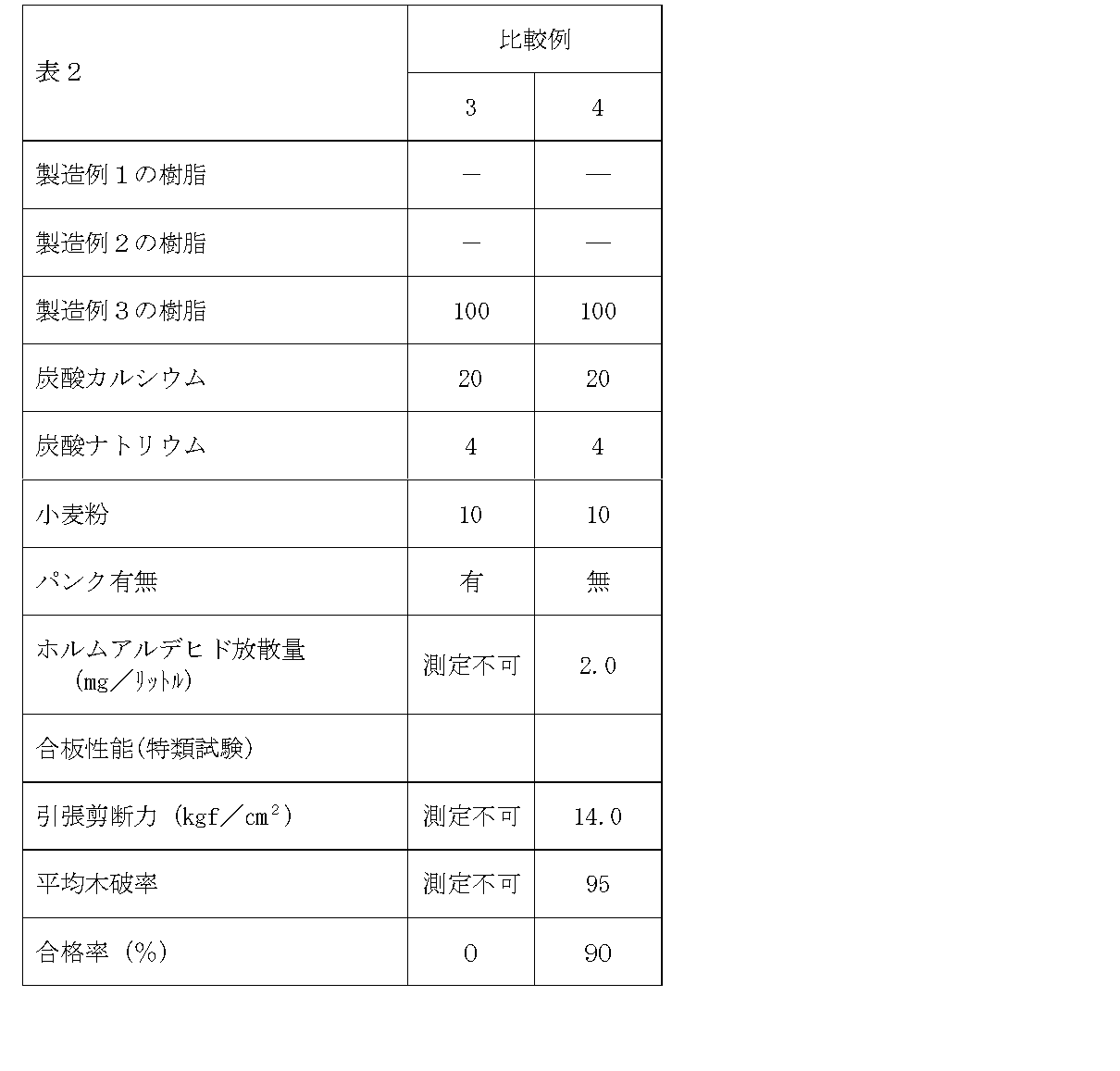
【表2】
合板性能試験としてパンク有無、合板性能、ホルムアルデヒド放散量、引張剪断力、平均木破率、合格率(%)を下記の次の方法で調べた。
【0033】
パンク:前述の応用例にて合板を制作し、得られた合板を長さ30cm×5cmの試験片丸鋸で切断し接着層を観察、パンクの有無を判定した。
【0034】
引張剪断力、平均に木破率、合格率は日本農林規格「構造用合板」にて行った。JAS構造用合板に基づき測定した。
【0035】
【発明の効果】
本発明で得られた木材用フェノール樹脂組成物は合板製造時に、ホルムアルデヒド類が放出すること無しに、従来品のフェノール樹脂より短時間で成型が出来る。TECHNICAL FIELD OF THE INVENTION
TECHNICAL FIELD The present invention relates to a resol-type phenol resin composition (alkali phenol resin composition) suitable for a wood-material adhesive, a wood-material adhesive containing the resol-type phenol resin composition, and a plywood comprising the same. .
[0001]
[Prior art]
Urea resin, urea melamine resin, and resol-type phenol resin are used in the production of plywood and various wooden boards. Recently, due to health problems represented by sick house syndrome, the ratio of formaldehyde to urea, melamine, and phenol (hereinafter referred to as "molar ratio") is reduced during the production of the above resin, and formaldehyde released from the produced plywood or wood board. The method of reducing is adopted. Conventional phenolic resin molding temperatures are generally 130-230 ° C. (130-150 ° C. for plywood, 140-230 ° C. for particle board). In the production of plywood, an adhesive is applied to a veneer and then cold-pressed, and then the plywood is completed by hot pressing. However, a bonding failure phenomenon called a puncture phenomenon may occur when decompressing with a hot press. Therefore, when manufacturing plywood, the moisture content of the veneer is dried to about 6% by weight or less, the heat pressure temperature is increased, the heat pressure time is lengthened, or the addition of water is reduced as much as possible when compounding the adhesive. Measures must be taken. In order to solve these problems, for example, after performing the first-stage reaction at a molar ratio of formaldehyde to phenols of 2.0 to 3.0, phenols are added in the second-stage reaction. A wood adhesive using a resol-type phenol resin obtained by reducing the molar ratio of formaldehyde to phenols to 1.2 to 1.8 has been proposed (for example, see Patent Document 1).
[0002]
[Patent Document 1]
JP-A-11-124555
[Problems to be solved by the invention]
However, in the above method, the above problems are not solved, and in order to solve these problems, an aldehyde is further added to the obtained aqueous resol-type phenolic resin solution when used as an adhesive. It has to be added as a solid or an aqueous solution, so that there is a problem that a long time is required for curing. (In the method described in Patent Document 1, the heat pressure time is 25 seconds / mm at 120 ° C .; the heat pressure time required for curing, expressed per unit thickness of plywood.) Also, a large amount of formaldehyde is released. You. Accordingly, an object of the present invention is to provide a resol type phenol resin composition which is not based on the above-mentioned method, particularly an adhesive for woody materials which is excellent in adhesiveness and does not generate puncture, and a plywood using the same. .
[0004]
[Means for Solving the Problems]
The present inventor has earnestly studied to solve the above-mentioned problems, and as a result, has obtained the following knowledge. {Circle around (1)} When a phenol and an aldehyde are reacted under an alkali catalyst to obtain a resol-type phenolic resin composition, a resol-type obtained by adding an aldehyde to the phenol in multiple stages is obtained. The phenolic resin composition has higher curability than a resin obtained by charging aldehydes to phenols at once. {Circle over (2)} The adhesive for wood materials containing the resole-type phenolic resin obtained by charging the aldehydes in the above-mentioned multi-steps does not cause puncture during the production of plywood, and the adhesiveness of the obtained plywood is improved. Excellent.
[0005]
The present invention has been made based on these findings. That is, the present invention provides a resol-type phenolic resin composition containing a resol-type phenolic resin obtained by dividing and adding aldehydes to phenols in the presence of an alkali catalyst and reacting in multiple stages. I do.
[0006]
The present invention also provides an adhesive for woody materials containing the resol-type phenolic resin composition, a production method using the adhesive for woody materials, and a plywood using the adhesive for woody materials.
[0007]
BEST MODE FOR CARRYING OUT THE INVENTION
The plywoods refer to plywood, LVL (Laminated Veneer Number), particle board, MDF (Medium Density Fiber Board), OSB (Oriented Strand Board), and the like.
[0008]
The total molar ratio of phenols and aldehydes (A) [all formaldehydes] / [all phenols] of the resol-type phenolic resin used in the resol-type phenolic resin composition of the present invention is determined by the storage stability of the obtained resin. (A) is preferably 1.5 or more from the viewpoint of good properties, and the emission of formaldehyde from the wood material is small, and the production environment and the environment when the material is used become favorable (A). However, it is preferably 2.5 or less. Among them, (A) = 1.8 to 2.3 is particularly preferable.
[0009]
Further, the resol type phenol resin composition used in the present invention is obtained by reacting a phenol with an aldehyde under an alkaline reaction catalyst. It is essential that the reaction be performed in multiple stages.
[0010]
The number of divided additions in which the aldehydes are dividedly added to the phenols and added in multiple stages is not particularly limited, but it is preferable to add the aldehydes in two or three stages because of the ease of controlling the reaction conditions. It is particularly preferable to add them separately.
[0011]
At that time, when the aldehydes are dividedly added to the phenols and reacted, the molar ratio (A1) between the phenols and the aldehydes in the first step reaction is such that the ratio of the total molar ratio (A) is [ (A)] / [(A1)] is preferably adjusted and added so as to be 1.05 to 2.7. For example, the reaction is carried out by adjusting so that (A1) = 1.0 to 1.8, and then [(A)] / [(A1)] = 1.1 in the reaction of the second and subsequent stages. It is preferable to adjust within the range of 2.5. At this time, it is essential to adjust the molar ratio of the aldehyde to the phenol so that the molar ratio in the second stage is higher than the molar ratio in the first stage. Also, when reacting in three or more stages, the next stage is set higher than the previous stage.
[0012]
The phenols are not particularly limited, but include, for example, (alkyl) phenols such as phenol and cresol, aromatic alcohols such as resorcinol and catechol, and bisphenols such as bisphenol A. Examples of the aldehyde include formaldehyde, paraformaldehyde, and acetaldehyde.
[0013]
Examples of the alkaline catalyst include sodium hydroxide, calcium hydroxide, potassium hydroxide, barium hydroxide, and ammonia. Among these, sodium hydroxide or potassium hydroxide is preferable.
[0014]
In order to improve the quick-curing property of the resin itself, a resin partially co-condensed with a modifying agent such as resorcinol and aminophenol can be used in combination. The amount of modification is preferably 1 to 20% by weight based on the total weight of the resin. If the amount is less than 1% by weight, no effect can be obtained.
[0015]
Further, the wood adhesive of the present invention may be modified by using a substance such as tannin, lignin, polyvinyl butyral, polyvinyl alcohol, or hydroxyl ethyl cellulose, if necessary, in addition to the resol-type phenol resin. A phenol resin may be used in combination.
[0016]
The wood adhesive of the present invention is prepared by adding a filler to the adhesive composition. Examples of the filler include flour, calcium carbonate and the like. The amount of the filler to be added is not particularly limited, but is preferably 5 to 50 parts by weight, based on 100 parts by weight (solid content) of the modified phenol resin used in combination with the resole phenol resin as required. Further, if necessary, water may be added.
[0017]
Next, a method for manufacturing plywood will be described. The plywood refers to a plywood that is coated with an adhesive, laminated, hot-pressed, and hardened, and includes, for example, plywood or other LVL (Laminated Venue Number). For example, as a method for producing a veneer laminate, a wood adhesive (prepared glue) of the present invention is applied to both surfaces of a veneer dried to a moisture content of 10% by weight or less, and a predetermined number of the laminates are laminated. Next, the stacked plates are cold-pressed and pressed, and then removed from the press. Next, the plywood temporarily bonded by cold pressure is cured by hot pressure at 120 to 150 ° C. Next, plywood is completed through processes such as lubrication, surface finishing, sorting, and inspection. When plywood is manufactured using the adhesive for woody material of the present invention, it is possible to sufficiently cure at a heat pressure time of 20 seconds / mm or less.
[0018]
【Example】
Hereinafter, the present invention will be described with reference to Examples and Comparative Examples. The parts and percentages described below are based on weight unless otherwise specified.
[0019]
Production Example 1
1000 g of phenol and 1275 g of a 40% aqueous formaldehyde solution were placed in a flask equipped with a reflux device and stirring was started. The temperature was raised to 80 ° C. while gradually adding 600 g of a 50% aqueous sodium hydroxide solution, and the mixture was reacted for 2 hours to obtain a viscosity of 300 mPa · s. s. Thereafter, 160 g of a 40% formaldehyde aqueous solution and 600 g of ion-exchanged water were added and reacted at 80 ° C. for 2 hours to obtain a water-soluble resol type phenol resin. The obtained water-soluble resol type phenol resin had a nonvolatile content of 45%, a viscosity of 200 mPa · s, and a pH of 12.8.
[0020]
Production Example 2
1000 g of phenol and 797 g of a 40% formaldehyde aqueous solution were placed in a flask equipped with a reflux device and stirring was started. The temperature was raised to 80 ° C. while gradually adding 300 g of a 50% sodium hydroxide aqueous solution, and the mixture was reacted for 2 hours to obtain a viscosity of 150 mPa · s. s. Thereafter, 1196 g of a 40% formaldehyde aqueous solution and 1600 g of ion-exchanged water were added and reacted at 80 ° C. for 2 hours to obtain a water-soluble resol type phenol resin. The obtained water-soluble resol type phenol resin had a nonvolatile content of 45%, a viscosity of 200 mPa · s, and a pH of 10.7.
[0021]
Production Example 3
1000 g of phenol, 1435 g of a 40% formaldehyde aqueous solution, and 600 g of ion-exchanged water were put into a flask equipped with a reflux device, and stirring was started. The temperature was raised to 80 ° C. while gradually adding 600 g of a 50% aqueous sodium hydroxide solution, and the temperature was raised for 5 hours. The reaction was performed to obtain a water-soluble resol type phenol resin. The obtained water-soluble resol type phenol resin had a nonvolatile content of 45%, a viscosity of 200 mPa · s, and a pH of 12.8.
[0022]
Production Example 4
In advance, 94.1 parts by weight of phenol, 210.8 parts of a 37% aqueous formaldehyde solution (F / P molar ratio: 2.6) and 65 parts of a 30% aqueous sodium hydroxide solution were charged, and the phenol resin had a viscosity of 300 mPa.・ React until s is obtained to obtain a resol type phenol resin adhesive. Further, after cooling to 70 ° C., 68.7 parts of phenol (F / P molar ratio: 1.5) and 30 parts of a 30% aqueous sodium hydroxide solution were charged, and the mixture was heated at 85 ° C. at 25 ° C. using a B-type viscometer for a phenol resin. Until a viscosity of 1000 mPa · s was obtained to obtain a water-soluble resol type phenol resin. Thereafter, 15 parts of a 50% aqueous formaldehyde solution was added, and the viscosity at 25 ° C. was adjusted to 200 mPa · s with water using a resol-type phenol resin aqueous solution. (50% non-volatile content)
[0023]
Example 1
To 100 parts of the resin obtained in Production Example 1, sodium carbonate as a curing accelerator, calcium carbonate as a filler, flour, and water were blended as shown in Table 1, and the prepared paste of Example (viscosity 25 dPa · S / 25 ° C.) was added. Prepared. Rotary veneer made from larch wood using compounded glue, glue core veneer of size 30 cm x 30 cm, thickness of 3.0 mm, original plate of 2.1 mm thickness and veneer plate of original thickness (each 6% water content) Using the glue core veneer, apply 19 g of the prepared glue on one side and the same amount on the back side, and make a 12 / mm structure of 5 plies of 2.1 / 3.0 / 2.1 / 3.0 / 2.1 mm. Was cooled at 0.98 MPa for 30 minutes, and then hot-pressed at 120 ° C. and 0.98 MPa for 240 seconds (= 12 mm × 20 seconds / mm) to perform a forming test of the plywood of the example. The results were as shown in Table 1.
[0024]
Example 2
Plywood was produced in the same manner as in Example 1 except that the resin obtained in Production Example 1 was used and the veneer moisture content was 13%. The results were as shown in Table 1.
[0025]
Example 3
Plywood was produced in the same manner as in Example 1 using the resin obtained in Production Example 2. The results were as shown in Table 1.
[0026]
Comparative Example 1
Plywood was produced in the same manner as in Example 1 using the resin obtained in Production Example 3. The results were as shown in Table 1.
[0027]
Comparative Example 2
A plywood was produced in the same manner as in Example 1 except that the resin obtained in Production Example 3 was used and the heat and pressure time was changed to 400 seconds. The results were as shown in Table 1.
[0028]
Comparative Example 3
Plywood was produced in the same manner as in Example 1 using the resin obtained in Production Example 4. The results were as shown in Table 2.
[0029]
Comparative Example 4
A plywood was manufactured in the same manner as in Example 1 except that the hot pressing time was 300 seconds (12 mm × 25 seconds / mm) using the resin obtained in Production Example 4. The results were as shown in Table 2.
[0030]
[Table 1]
[Table 2]
As a plywood performance test, the presence or absence of puncture, plywood performance, formaldehyde emission, tensile shearing force, average wood breaking rate, and pass rate (%) were examined by the following methods.
[0033]
Puncture: Plywood was produced according to the application example described above, and the obtained plywood was cut with a 30 cm × 5 cm test piece circular saw, and the adhesive layer was observed to determine the presence or absence of puncture.
[0034]
The tensile shearing force, the average wood breakage rate, and the pass rate were determined based on Japanese Agricultural Standards “Structural Plywood”. Measured based on JAS structural plywood.
[0035]
【The invention's effect】
The phenolic resin composition for wood obtained in the present invention can be molded in a shorter time than the conventional phenolic resin without releasing formaldehyde during the production of plywood.
Claims (6)
Priority Applications (1)
| Application Number | Priority Date | Filing Date | Title |
|---|---|---|---|
| JP2002285615A JP2004123781A (en) | 2002-09-30 | 2002-09-30 | Resol type phenolic resin composition, adhesive for wood materials and plywood |
Applications Claiming Priority (1)
| Application Number | Priority Date | Filing Date | Title |
|---|---|---|---|
| JP2002285615A JP2004123781A (en) | 2002-09-30 | 2002-09-30 | Resol type phenolic resin composition, adhesive for wood materials and plywood |
Publications (1)
| Publication Number | Publication Date |
|---|---|
| JP2004123781A true JP2004123781A (en) | 2004-04-22 |
Family
ID=32278872
Family Applications (1)
| Application Number | Title | Priority Date | Filing Date |
|---|---|---|---|
| JP2002285615A Pending JP2004123781A (en) | 2002-09-30 | 2002-09-30 | Resol type phenolic resin composition, adhesive for wood materials and plywood |
Country Status (1)
| Country | Link |
|---|---|
| JP (1) | JP2004123781A (en) |
Cited By (8)
| Publication number | Priority date | Publication date | Assignee | Title |
|---|---|---|---|---|
| JP2005263887A (en) * | 2004-03-17 | 2005-09-29 | Bridgestone Corp | Adhesive composition, method for producing the same, resin material, rubber member, and tire |
| JP2009279934A (en) * | 2008-05-09 | 2009-12-03 | Lanxess Deutschland Gmbh | Manufacturing method of wooden material |
| JP2011104960A (en) * | 2009-11-20 | 2011-06-02 | Dic Corp | Method of producing woody plate |
| JP2017039813A (en) * | 2015-08-18 | 2017-02-23 | Dic株式会社 | Resol type phenol resin, resol type phenol resin composition, cured article thereof and manufacturing method of resol type phenol resin |
| CN112852361A (en) * | 2021-03-26 | 2021-05-28 | 广西南宁市完美木业有限公司 | A kind of anti-corrosion and easy-release building template surface glue and preparation method thereof |
| JP2022061962A (en) * | 2020-10-07 | 2022-04-19 | 三菱ケミカル株式会社 | Resol-type phenol resin, adhesive, and method for manufacturing resol-type phenol resin |
| WO2022210093A1 (en) * | 2021-03-29 | 2022-10-06 | 群栄化学工業株式会社 | Thermally curable composition for cellulosic product and cellulosic product |
| JP2022153295A (en) * | 2021-03-29 | 2022-10-12 | 群栄化学工業株式会社 | Thermosetting composition for cellulose product and cellulose product |
-
2002
- 2002-09-30 JP JP2002285615A patent/JP2004123781A/en active Pending
Cited By (10)
| Publication number | Priority date | Publication date | Assignee | Title |
|---|---|---|---|---|
| JP2005263887A (en) * | 2004-03-17 | 2005-09-29 | Bridgestone Corp | Adhesive composition, method for producing the same, resin material, rubber member, and tire |
| JP2009279934A (en) * | 2008-05-09 | 2009-12-03 | Lanxess Deutschland Gmbh | Manufacturing method of wooden material |
| JP2011104960A (en) * | 2009-11-20 | 2011-06-02 | Dic Corp | Method of producing woody plate |
| JP2017039813A (en) * | 2015-08-18 | 2017-02-23 | Dic株式会社 | Resol type phenol resin, resol type phenol resin composition, cured article thereof and manufacturing method of resol type phenol resin |
| JP2022061962A (en) * | 2020-10-07 | 2022-04-19 | 三菱ケミカル株式会社 | Resol-type phenol resin, adhesive, and method for manufacturing resol-type phenol resin |
| JP7735773B2 (en) | 2020-10-07 | 2025-09-09 | 三菱ケミカル株式会社 | Resole phenolic resin, adhesive, and method for producing resol phenolic resin |
| CN112852361A (en) * | 2021-03-26 | 2021-05-28 | 广西南宁市完美木业有限公司 | A kind of anti-corrosion and easy-release building template surface glue and preparation method thereof |
| CN112852361B (en) * | 2021-03-26 | 2023-04-11 | 广西南宁市完美木业有限公司 | Anti-corrosion easy-demoulding building template surface adhesive and preparation method thereof |
| WO2022210093A1 (en) * | 2021-03-29 | 2022-10-06 | 群栄化学工業株式会社 | Thermally curable composition for cellulosic product and cellulosic product |
| JP2022153295A (en) * | 2021-03-29 | 2022-10-12 | 群栄化学工業株式会社 | Thermosetting composition for cellulose product and cellulose product |
Similar Documents
| Publication | Publication Date | Title |
|---|---|---|
| JP2656227B2 (en) | Plywood manufacturing method | |
| US4915766A (en) | Preparation of wood laminates using high moisture content veneers | |
| JP2010502773A (en) | Novel composite binders with natural compounds for low release products | |
| JP2004123781A (en) | Resol type phenolic resin composition, adhesive for wood materials and plywood | |
| JP2006070081A (en) | Plywood adhesive and method for producing plywood | |
| JP2004174990A (en) | Wood adhesive composition and plywood manufacturing method | |
| JP6043696B2 (en) | Wood board manufacturing method | |
| JP5466491B2 (en) | Wood board manufacturing method | |
| JP5314942B2 (en) | Adhesive for wood material, wood board and method for producing wood board | |
| US5342880A (en) | Phenolic resol plywood resin, manufacture and use | |
| JP2003041225A (en) | An aqueous resin composition for plywood adhesive and a method for producing plywood. | |
| JP2001164228A (en) | Adhesive composition for wood | |
| JPH11172220A (en) | Wood board adhesive composition | |
| JP2018053131A (en) | Plywood adhesive composition, plywood and method for producing the same | |
| JP2001254065A (en) | Wood adhesive composition | |
| JP3375059B2 (en) | Plywood molding method | |
| JP2001152120A (en) | Adhesive composition for wood | |
| JP2001254066A (en) | Phenol resin adhesive | |
| JP2001131522A (en) | Wood adhesive composition | |
| JP2006089677A (en) | Plywood adhesive and method for manufacturing plywood | |
| JPH11124555A (en) | Preparation of wood adhesive | |
| JP2004202839A (en) | Resin composition for wood material adhesive, wood material adhesive, and method for producing wood board | |
| JP2001279214A (en) | Phenolic resin based adhesive composition | |
| JP2002137201A (en) | Method for forming plywood | |
| JPH1170509A (en) | Method of manufacturing wooden board |
Legal Events
| Date | Code | Title | Description |
|---|---|---|---|
| RD01 | Notification of change of attorney |
Free format text: JAPANESE INTERMEDIATE CODE: A7421 Effective date: 20050705 |
|
| A621 | Written request for application examination |
Free format text: JAPANESE INTERMEDIATE CODE: A621 Effective date: 20050921 |
|
| A977 | Report on retrieval |
Free format text: JAPANESE INTERMEDIATE CODE: A971007 Effective date: 20080124 |
|
| RD02 | Notification of acceptance of power of attorney |
Free format text: JAPANESE INTERMEDIATE CODE: A7422 Effective date: 20080310 |
|
| A131 | Notification of reasons for refusal |
Free format text: JAPANESE INTERMEDIATE CODE: A131 Effective date: 20080408 |
|
| A02 | Decision of refusal |
Free format text: JAPANESE INTERMEDIATE CODE: A02 Effective date: 20080729 |