JP2004152152A - Layout system, layout program, and layout method - Google Patents
Layout system, layout program, and layout method Download PDFInfo
- Publication number
- JP2004152152A JP2004152152A JP2002318629A JP2002318629A JP2004152152A JP 2004152152 A JP2004152152 A JP 2004152152A JP 2002318629 A JP2002318629 A JP 2002318629A JP 2002318629 A JP2002318629 A JP 2002318629A JP 2004152152 A JP2004152152 A JP 2004152152A
- Authority
- JP
- Japan
- Prior art keywords
- layout
- pages
- upper limit
- information
- setting
- Prior art date
- Legal status (The legal status is an assumption and is not a legal conclusion. Google has not performed a legal analysis and makes no representation as to the accuracy of the status listed.)
- Withdrawn
Links
Images








Landscapes
- Document Processing Apparatus (AREA)
Abstract
Description
【0001】
【発明の属する技術分野】
本発明は、文書や画像等の掲載情報をレイアウトするシステムおよびプログラム、並びに方法に係り、特に、ユーザの希望に沿ったレイアウトを行うのに好適なレイアウトシステムおよびレイアウトプログラム、並びにレイアウト方法に関する。
【0002】
【従来の技術】
従来、文書や画像等の掲載情報をレイアウトする技術としては、例えば、特許文献1に開示されている文書整形装置(以下、第1の従来例という。)および特許文献2に開示されている(以下、第2の従来例という。)があった。
第1の従来例は、コード情報の系列からなる文書データおよび文書データを出力する際に納めるべきページ数を入力する入力部と、入力部により入力された文書データの形態的特徴を検出し、得られた形態的特徴から文書データの論理構造を解析する論理構造解析部と、論理構造解析部で得られた入力文書データの論理構造を記憶する論理構造記憶部と、論理構造記憶部に記憶された論理構造に基づいて文書データを展開する際の書式およびこの書式を決定する整形規則を記憶した整形規則辞書と、文書データが指定ページ数内に収まるように整形規則を利用して書式を決定する整形処理部と、整形処理部により処理された結果を出力する出力部とで構成されている。
【0003】
第2の従来例は、文書編集プログラムによる文書作成前に全角文字から半角文字に自動的に置換可能な文字を設定する全半置換文字設定プログラムと、全半置換文字設定プログラムにより設定された全半置換文字に対してその優先順位を設定する全半置換文字優先順位設定プログラムと、文書編集中に頁溢れ文字が発生した場合に頁溢れした文字数をカウントする頁溢れ文字数カウントプログラムと、最終段落内の文章中にある置換可能文字数をカウントする置換可能文字数カウントプログラムと、置換可能文字数が頁溢れ文字数より大きい場合に全半置換文字をその優先順位にしたがって全角文字から半角文字に置換する全半置換プログラムとを有し、レイアウト結果の総ページ数が指定ページ数を超えないようにレイアウトするようになっている。
【0004】
【特許文献1】
特開昭63−221457号公報
【特許文献2】
特開平8−241311号公報
【0005】
【発明が解決しようとする課題】
ところで、ニュース等の記事情報をレイアウトしてユーザに配信する場合、掲載対象となる記事情報は、その掲載量や記事数が毎日異なる。ユーザは、通常の日であれば、レイアウト結果の総ページ数が指定ページ数を超えないようにレイアウトを行うことを希望するが、重要なニュースがあるなどの特別な日であれば、レイアウト結果の総ページ数が指定ページ数を超えてでも、重要な記事がすべて掲載されるようにレイアウトを行うことを希望するかもしれない。
【0006】
しかしながら、第1および第2の従来例にあってはいずれも、レイアウト結果の総ページ数が指定ページ数を超えないようにレイアウトするようになっているため、指定ページ数を超えないようにレイアウトを行うか、または指定ページ数を超えてでもレイアウトを行うかの選択を行うことができなかった。したがって、ユーザの希望に沿ったレイアウトを十分に行うことができなかった。
【0007】
そこで、本発明は、このような従来の技術の有する未解決の課題に着目してなされたものであって、ユーザの希望に沿ったレイアウトを行うのに好適なレイアウトシステムおよびレイアウトプログラム、並びにレイアウト方法を提供することを目的としている。
【0008】
【課題を解決するための手段】
〔発明1〕
上記目的を達成するために、発明1のレイアウトシステムは、
掲載情報をレイアウトするレイアウト手段を備え、前記レイアウト手段は、前記掲載情報を、レイアウト領域に配置される情報格納枠に格納することによりレイアウトを行うシステムであって、
前記レイアウト手段は、レイアウト結果の総ページ数が所定ページ数を超えることとなるときは、レイアウト結果の総ページ数が前記所定ページ数を超えないようにレイアウトを行う第1レイアウト処理と、レイアウト結果の総ページ数が前記所定ページ数を超えてでもレイアウトを行う第2レイアウト処理とを選択的に行うようになっていることを特徴とする。
【0009】
このような構成であれば、レイアウト結果の総ページ数が所定ページ数を超えることとなると、レイアウト手段により、第1レイアウト処理と第2レイアウト処理とが選択的に行われる。その結果、第1レイアウト処理が選択されると、レイアウト結果の総ページ数が所定ページ数を超えないようにレイアウトが行われる。また、第2レイアウト処理が選択されると、レイアウト結果の総ページ数が所定ページ数を超えてでもレイアウトが行われる。
【0010】
ここで、掲載情報には、文字情報、画像情報その他の情報が含まれる。以下、発明2および18のレイアウトシステム、発明19および20のレイアウトプログラム、並びに発明21および22のレイアウト方法において同じである。
また、レイアウトとは、例えば、画面上に表示することを目的として掲載情報をレイアウトする場合にはその表示レイアウトを、紙面上に印刷することを目的として掲載情報をレイアウトする場合にはその印刷レイアウトをいう。以下、発明2および18のレイアウトシステム、発明19および20のレイアウトプログラム、並びに発明21および22のレイアウト方法において同じである。
【0011】
また、本システムは、単一の装置、端末その他の機器として実現するようにしてもよいし、複数の装置、端末その他の機器を通信可能に接続したネットワークシステムとして実現するようにしてもよい。後者の場合、各構成要素は、それぞれ通信可能に接続されていれば、複数の機器等のうちいずれに属していてもよい。以下、発明2および18のレイアウトシステムにおいて同じである。
〔発明2〕
さらに、発明2のレイアウトシステムは、
複数の掲載情報を記憶するための掲載情報記憶手段と、前記掲載情報記憶手段のなかから前記掲載情報を選択する掲載情報選択手段と、前記掲載情報選択手段で選択した掲載情報をレイアウトするレイアウト手段とを備え、前記レイアウト手段は、前記掲載情報を、レイアウト領域に配置される情報格納枠に格納することによりレイアウトを行うシステムであって、
レイアウト結果の上限ページ数を設定する上限ページ数設定手段を備え、
前記レイアウト手段は、レイアウト結果の総ページ数が、前記上限ページ数設定手段で設定した上限ページ数を超えることとなるときは、レイアウト結果の総ページ数が前記上限ページ数を超えないようにレイアウトを行う第1レイアウト処理と、レイアウト結果の総ページ数が前記上限ページ数を超えてでもレイアウトを行う第2レイアウト処理とを選択的に行うようになっていることを特徴とする。
【0012】
このような構成であれば、掲載情報選択手段により、掲載情報記憶手段のなかから掲載情報が選択され、レイアウト手段により、選択された掲載情報が情報格納枠に格納されることによりレイアウトが行われる。レイアウトを行うに先立っては、上限ページ数設定手段により上限ページ数を設定する。レイアウトの過程では、レイアウト結果の総ページ数が上限ページ数を超えることとなると、レイアウト手段により、第1レイアウト処理と第2レイアウト処理とが選択的に行われる。その結果、第1レイアウト処理が選択されると、レイアウト結果の総ページ数が上限ページ数を超えないようにレイアウトが行われる。また、第2レイアウト処理が選択されると、レイアウト結果の総ページ数が上限ページ数を超えてでもレイアウトが行われる。
【0013】
ここで、掲載情報記憶手段は、掲載情報をあらゆる手段でかつあらゆる時期に記憶するものであり、掲載情報をあらかじめ記憶してあるものであってもよいし、掲載情報をあらかじめ記憶することなく、本システムの動作時に外部からの入力等によって掲載情報を記憶するようになっていてもよい。以下、発明18のレイアウトシステム、発明19および20のレイアウトプログラム、並びに発明21および22のレイアウト方法において同じである。
〔発明3〕
さらに、発明3のレイアウトシステムは、発明2のレイアウトシステムにおいて、
前記レイアウト領域に配置される情報格納枠のレイアウト書式を規定したレイアウトテンプレートを記憶するためのテンプレート記憶手段を備え、
前記レイアウト手段は、前記テンプレート記憶手段のレイアウトテンプレートに従って前記掲載情報をレイアウトするようになっていることを特徴とする。
【0014】
このような構成であれば、レイアウト手段により、テンプレート記憶手段のレイアウトテンプレートに従って掲載情報がレイアウトされる。
ここで、各レイアウトテンプレートは、それぞれ別々のファイルまたはデータとして構成してもよいし、1つのファイルまたはデータとして構成してもよい。すなわち、テンプレートの総数と、テンプレートを記述したファイルまたはデータの個数とは必ずしも関係しない。
【0015】
また、テンプレート記憶手段は、レイアウトテンプレートをあらゆる手段でかつあらゆる時期に記憶するものであり、レイアウトテンプレートをあらかじめ記憶してあるものであってもよいし、レイアウトテンプレートをあらかじめ記憶することなく、本システムの動作時に外部からの入力等によってレイアウトテンプレートを記憶するようになっていてもよい。
〔発明4〕
さらに、発明4のレイアウトシステムは、発明3のレイアウトシステムにおいて、
前記第1レイアウト処理は、前記レイアウトテンプレートで規定される情報格納枠の形状若しくは配置位置を変更し、前記情報格納枠に格納する掲載情報の書式を変更し、前記掲載情報の一部を破棄し、または前記掲載情報の内容を変更することにより、レイアウト結果の総ページ数が前記上限ページ数を超えないようにレイアウトを行うようになっていることを特徴とする。
【0016】
このような構成であれば、第1レイアウト処理が選択されると、レイアウト手段により、レイアウトテンプレートで規定される情報格納枠の形状若しくは配置位置が変更され、情報格納枠に格納する掲載情報の書式が変更され、掲載情報の一部が破棄され、または掲載情報の内容が変更されることにより、レイアウト結果の総ページ数が上限ページ数を超えないようにレイアウトが行われる。
【0017】
ここで、掲載情報の書式としては、例えば、掲載情報が文字情報であれば、文字サイズ、字間または行間を変更することが挙げられる。以下、発明6のレイアウトシステムにおいて同じである。
また、掲載情報の書式を変更する場合は、例えば、掲載情報が文字情報であれば、可読性を保持する範囲で変更するのが好ましい。以下、発明6のレイアウトシステムにおいて同じである。
〔発明5〕
さらに、発明5のレイアウトシステムは、発明3および4のいずれかのレイアウトシステムにおいて、
さらに、前記上限ページ数よりも大きい第2上限ページ数を設定する第2上限ページ数設定手段を備え、
前記第2レイアウト処理は、レイアウト結果の総ページ数が、前記第2上限ページ数設定手段で設定した第2上限ページ数を超えないようにレイアウトを行うようになっていることを特徴とする。
【0018】
このような構成であれば、第2レイアウト処理が選択されると、レイアウト手段により、レイアウト結果の総ページ数が第2上限ページ数を超えないようにレイアウトが行われる。
ここで、第2上限ページ数設定手段は、第2上限ページ数を設定するようになっていればどのような構成であってもよく、例えば、上限ページ数よりも大きい値を入力し、その入力値を第2上限ページ数として設定するようになっていてもよいし、上限ページ数に加算すべき値を入力し、その入力値を上限ページ数に加算することにより第2上限ページ数を設定するようになっていてもよい。
〔発明6〕
さらに、発明6のレイアウトシステムは、発明5のレイアウトシステムにおいて、
前記第2レイアウト処理は、レイアウト結果の総ページ数が前記第2上限ページ数を超えることとなるときは、前記レイアウトテンプレートで規定される情報格納枠の形状若しくは配置位置を変更し、前記情報格納枠に格納する掲載情報の書式を変更し、前記掲載情報の一部を破棄し、または前記掲載情報の内容を変更することにより、レイアウト結果の総ページ数が前記第2上限ページ数を超えないようにレイアウトを行うようになっていることを特徴とする。
【0019】
このような構成であれば、第2レイアウト処理が選択され、レイアウト結果の総ページ数が第2上限ページ数を超えることとなると、レイアウト手段により、レイアウトテンプレートで規定される情報格納枠の形状若しくは配置位置が変更され、情報格納枠に格納する掲載情報の書式が変更され、掲載情報の一部が破棄され、または掲載情報の内容が変更されることにより、レイアウト結果の総ページ数が第2上限ページ数を超えないようにレイアウトが行われる。
〔発明7〕
さらに、発明7のレイアウトシステムは、発明3ないし6のいずれかのレイアウトシステムにおいて、
前記レイアウト手段は、レイアウト結果の総ページ数が前記上限ページ数を超えることとなるときは、前記第1レイアウト処理および前記第2レイアウト処理のいずれかを選択すべきことを通知し、その通知に応じていずれかの選択結果を入力したときは、入力した選択結果に基づいて、前記第1レイアウト処理および前記第2レイアウト処理のいずれかの選択を行うようになっていることを特徴とする。
【0020】
このような構成であれば、レイアウト結果の総ページ数が上限ページ数を超えることとなると、レイアウト手段により、第1レイアウト処理および第2レイアウト処理のいずれかを選択すべきことが通知される。そして、その通知に応じていずれかの選択結果を入力すると、レイアウト手段により、入力された選択結果に基づいて、第1レイアウト処理および第2レイアウト処理のいずれかの選択が行われる。
〔発明8〕
さらに、発明8のレイアウトシステムは、発明3ないし7のいずれかのレイアウトシステムにおいて、
前記第1レイアウト処理および前記第2レイアウト処理のいずれかの選択を前記レイアウトテンプレートに設定し、
前記レイアウト手段は、前記テンプレート記憶手段のレイアウトテンプレートに基づいて、前記第1レイアウト処理および前記第2レイアウト処理のいずれかの選択を行うようになっていることを特徴とする。
【0021】
このような構成であれば、レイアウト結果の総ページ数が上限ページ数を超えることとなると、レイアウト手段により、テンプレート記憶手段のレイアウトテンプレートに基づいて、第1レイアウト処理および第2レイアウト処理のいずれかの選択が行われる。
〔発明9〕
さらに、発明9のレイアウトシステムは、発明3ないし8のいずれかのレイアウトシステムにおいて、
前記第1レイアウト処理の内容および前記第2レイアウト処理の内容を前記レイアウトテンプレートに設定し、
前記レイアウト手段は、前記テンプレート記憶手段のレイアウトテンプレートに基づいて、前記第1レイアウト処理および前記第2レイアウト処理を行うようになっていることを特徴とする。
【0022】
このような構成であれば、レイアウト結果の総ページ数が上限ページ数を超えることとなると、レイアウト手段により、テンプレート記憶手段のレイアウトテンプレートに基づいて、第1レイアウト処理および第2レイアウト処理が行われる。
ここで、第1レイアウト処理の内容および第2レイアウト処理の内容を設定することには、上限ページ数または第2上限ページ数を設定することも含まれる。以下、発明15のレイアウトシステムにおいて同じである。
〔発明10〕
さらに、発明10のレイアウトシステムは、発明3ないし9のいずれかのレイアウトシステムにおいて、
前記第1レイアウト処理および前記第2レイアウト処理のいずれかの選択を前記掲載情報に設定し、
前記レイアウト手段は、前記掲載情報選択手段で選択した掲載情報に基づいて、前記第1レイアウト処理および前記第2レイアウト処理のいずれかの選択を行うようになっていることを特徴とする。
【0023】
このような構成であれば、レイアウト結果の総ページ数が上限ページ数を超えることとなると、レイアウト手段により、選択された掲載情報に基づいて、第1レイアウト処理および第2レイアウト処理のいずれかの選択が行われる。
〔発明11〕
さらに、発明11のレイアウトシステムは、発明3ないし10のいずれかのレイアウトシステムにおいて、
前記第1レイアウト処理の内容および前記第2レイアウト処理の内容を前記掲載情報に設定し、
前記レイアウト手段は、前記掲載情報選択手段で選択した掲載情報に基づいて、前記第1レイアウト処理および前記第2レイアウト処理を行うようになっていることを特徴とする。
【0024】
このような構成であれば、レイアウト結果の総ページ数が上限ページ数を超えることとなると、レイアウト手段により、選択された掲載情報に基づいて、第1レイアウト処理および第2レイアウト処理が行われる。
〔発明12〕
さらに、発明12のレイアウトシステムは、発明3ないし11のいずれかのレイアウトシステムにおいて、
前記レイアウト手段は、前記レイアウト手段として実現される処理をコンピュータに実行させるためのレイアウトプログラムからなり、
前記レイアウトプログラムは、前記第1レイアウト処理および前記第2レイアウト処理のいずれかの選択が引数として与えられたときは、与えられた引数に基づいて、前記第1レイアウト処理および前記第2レイアウト処理のいずれかの選択を行うようになっていることを特徴とする。
【0025】
このような構成であれば、第1レイアウト処理および第2レイアウト処理のいずれかの選択が引数として与えられ、レイアウト結果の総ページ数が上限ページ数を超えることとなると、レイアウトプログラムにより、与えられた引数に基づいて、第1レイアウト処理および第2レイアウト処理のいずれかの選択が行われる。
〔発明13〕
さらに、発明13のレイアウトシステムは、発明3ないし11のいずれかのレイアウトシステムにおいて、
前記レイアウト手段は、前記レイアウト手段として実現される処理をコンピュータに実行させるためのレイアウトプログラムからなり、
前記レイアウトプログラムは、前記第1レイアウト処理の内容および前記第2レイアウト処理の内容が引数として与えられたときは、与えられた引数に基づいて、前記第1レイアウト処理および前記第2レイアウト処理を行うようになっていることを特徴とする。
【0026】
このような構成であれば、第1レイアウト処理の内容および第2レイアウト処理の内容が引数として与えられ、レイアウト結果の総ページ数が上限ページ数を超えることとなると、レイアウトプログラムにより、与えられた引数に基づいて、第1レイアウト処理および第2レイアウト処理が行われる。
〔発明14〕
さらに、発明14のレイアウトシステムは、発明3ないし7のいずれかのレイアウトシステムにおいて、
前記第1レイアウト処理および前記第2レイアウト処理のいずれかの選択を前記レイアウトテンプレートに設定し、
前記第1レイアウト処理および前記第2レイアウト処理のいずれかの選択を前記掲載情報に設定し、
前記レイアウト手段は、前記レイアウト手段として実現される処理をコンピュータに実行させるためのレイアウトプログラムからなり、
前記レイアウトプログラムは、前記テンプレート記憶手段のレイアウトテンプレートに基づいて、前記第1レイアウト処理および前記第2レイアウト処理のいずれかの選択を行う第1選択処理、前記掲載情報選択手段で選択した掲載情報に基づいて、前記第1レイアウト処理および前記第2レイアウト処理のいずれかの選択を行う第2選択処理、並びに、前記第1レイアウト処理および前記第2レイアウト処理のいずれかの選択が引数として与えられたときは、与えられた引数に基づいて、前記第1レイアウト処理および前記第2レイアウト処理のいずれかの選択を行う第3選択処理を行うようになっており、
前記レイアウトテンプレートの設定、前記掲載情報の設定および前記引数による設定に対して優先度を設定し、
前記レイアウトプログラムは、さらに、前記レイアウトテンプレートの設定、前記掲載情報の設定および前記引数による設定のうち複数の設定が同時に行われたときは、前記優先度に基づいて、前記第1選択処理、前記第2選択処理および前記第3選択処理のいずれかを行うようになっていることを特徴とする。
【0027】
このような構成であれば、レイアウトテンプレートの設定、掲載情報の設定および引数による設定のうち複数の設定が同時に行われた状態において、レイアウト結果の総ページ数が上限ページ数を超えることとなると、レイアウトプログラムにより、優先度に基づいて、第1選択処理、第2選択処理および第3選択処理のいずれかが行われる。その結果、第1選択処理が行われると、テンプレート記憶手段のレイアウトテンプレートに基づいて、第1レイアウト処理および第2レイアウト処理のいずれかの選択が行われる。また、第2選択処理が行われると、選択された掲載情報に基づいて、第1レイアウト処理および第2レイアウト処理のいずれかの選択が行われる。また、第3選択処理が行われると、与えられた引数に基づいて、第1レイアウト処理および第2レイアウト処理のいずれかの選択が行われる。
〔発明15〕
さらに、発明15のレイアウトシステムは、発明3ないし7のいずれかのレイアウトシステムにおいて、
前記第1レイアウト処理の内容および前記第2レイアウト処理の内容を前記レイアウトテンプレートに設定し、
前記第1レイアウト処理の内容および前記第2レイアウト処理の内容を前記掲載情報に設定し、
前記レイアウト手段は、前記レイアウト手段として実現される処理をコンピュータに実行させるためのレイアウトプログラムからなり、
前記レイアウトプログラムは、前記テンプレート記憶手段のレイアウトテンプレートに基づいて、前記第1レイアウト処理および前記第2レイアウト処理を行う第1実行処理、前記掲載情報選択手段で選択した掲載情報に基づいて、前記第1レイアウト処理および前記第2レイアウト処理を行う第2実行処理、並びに、前記第1レイアウト処理の内容および前記第2レイアウト処理の内容が引数として与えられたときは、与えられた引数に基づいて、前記第1レイアウト処理および前記第2レイアウト処理を行う第3実行処理を行うようになっており、
前記レイアウトテンプレートの設定、前記掲載情報の設定および前記引数による設定に対して優先度を設定し、
前記レイアウトプログラムは、さらに、前記レイアウトテンプレートの設定、前記掲載情報の設定および前記引数による設定のうち複数の設定が同時に行われたときは、前記優先度に基づいて、前記第1実行処理、前記第2実行処理および前記第3実行処理のいずれかを行うようになっていることを特徴とする。
【0028】
このような構成であれば、レイアウトテンプレートの設定、掲載情報の設定および引数による設定のうち複数の設定が同時に行われた状態において、レイアウト結果の総ページ数が上限ページ数を超えることとなると、レイアウトプログラムにより、優先度に基づいて、第1実行処理、第2実行処理および第3実行処理のいずれかが行われる。その結果、第1実行処理が行われると、テンプレート記憶手段のレイアウトテンプレートに基づいて、第1レイアウト処理および第2レイアウト処理が行われる。また、第2実行処理が行われると、選択された掲載情報に基づいて、第1レイアウト処理および第2レイアウト処理が行われる。また、第3実行処理が行われると、与えられた引数に基づいて、第1レイアウト処理および第2レイアウト処理が行われる。
〔発明16〕
さらに、発明16のレイアウトシステムは、発明2ないし15のいずれかのレイアウトシステムにおいて、
ユーザに関するユーザ情報を記憶するためのユーザ情報記憶手段を備え、
前記掲載情報選択手段は、前記ユーザ情報記憶手段のユーザ情報に基づいて、前記掲載情報記憶手段のなかから前記掲載情報を選択するようになっていることを特徴とする。
【0029】
このような構成であれば、掲載情報選択手段により、ユーザ情報記憶手段のユーザ情報に基づいて、掲載情報記憶手段のなかから掲載情報が選択される。
ここで、ユーザ情報には、例えば、ユーザの年齢、性別、興味嗜好、住所、氏名またはユーザ端末に関する使用環境が含まれる。以下、発明17のレイアウトシステムにおいて同じである。
【0030】
また、ユーザ情報記憶手段は、ユーザ情報をあらゆる手段でかつあらゆる時期に記憶するものであり、ユーザ情報をあらかじめ記憶してあるものであってもよいし、ユーザ情報をあらかじめ記憶することなく、本システムの動作時に外部からの入力等によってユーザ情報を記憶するようになっていてもよい。以下、発明17のレイアウトシステムにおいて同じである。
〔発明17〕
さらに、発明17のレイアウトシステムは、発明2ないし15のいずれかのレイアウトシステムにおいて、
ユーザに関するユーザ情報を記憶するためのユーザ情報記憶手段を備え、
前記レイアウト手段は、前記ユーザ情報記憶手段のユーザ情報に基づいて、前記掲載情報選択手段で選択した掲載情報をレイアウトするようになっていることを特徴とする。
【0031】
このような構成であれば、レイアウト手段により、ユーザ情報記憶手段のユーザ情報に基づいて、選択された掲載情報がレイアウトされる。
ここで、ユーザ情報に基づいてレイアウトを行うこととして、ユーザ情報に年齢を含む場合は、ユーザが比較的年輩者であるならば、フォントサイズが比較的大きいレイアウトを採用することが考えられる。また、ユーザ情報に性別を含む場合は、性別が女性であれば、丸文字フォントのレイアウトを採用することが考えられる。また、ユーザ情報に興味嗜好を含む場合は、その興味嗜好に応じて、子供向け雑誌風、スポーツ新聞風または技術文書風のレイアウトを採用することが考えられる。また、ユーザ情報に住所を含む場合は、その住所のある土地に特化した風景の画像を背景としたレイアウトを採用することが考えられる。また、ユーザ情報に氏名を含む場合は、その氏名をタイトルとしたレイアウトを採用することが考えられる。また、ユーザ情報にユーザ端末に関する使用環境を含む場合は、ユーザ端末のRAMの容量が少ないときは、データ容量の大きな画像はできるだけ使用しないようなレイアウトを採用することが考えられる。
〔発明18〕
さらに、発明18のレイアウトシステムは、
複数の掲載情報を記憶するための掲載情報記憶手段と、前記掲載情報記憶手段のなかから前記掲載情報を選択する掲載情報選択手段と、前記掲載情報選択手段で選択した掲載情報をレイアウトするレイアウト手段とを備え、前記レイアウト手段は、前記掲載情報を、レイアウト領域に配置される情報格納枠に格納することによりレイアウトを行うシステムであって、
レイアウト結果の第1上限ページ数を設定する第1上限ページ数設定手段と、前記第1上限ページ数設定手段で設定した第1上限ページ数よりも大きい第2上限ページ数を設定する第2上限ページ数設定手段とを備え、
前記レイアウト手段は、レイアウト結果の総ページ数が、前記第1上限ページ数設定手段で設定した第1上限ページ数を超えることとなるときは、レイアウト結果の総ページ数が、前記第2上限ページ数設定手段で設定した第2上限ページ数を超えないようにレイアウトを行うようになっていることを特徴とする。
【0032】
このような構成であれば、掲載情報選択手段により、掲載情報記憶手段のなかから掲載情報が選択され、レイアウト手段により、選択された掲載情報が情報格納枠に格納されることによりレイアウトが行われる。レイアウトを行うに先立っては、第1上限ページ数設定手段により第1上限ページ数を設定し、第2上限ページ数設定手段により第2上限ページ数を設定する。レイアウトの過程では、レイアウト結果の総ページ数が第1上限ページ数を超えることとなると、レイアウト手段により、レイアウト結果の総ページ数が第2上限ページ数を超えないようにレイアウトが行われる。
【0033】
ここで、第2上限ページ数設定手段は、第2上限ページ数を設定するようになっていればどのような構成であってもよく、例えば、第1上限ページ数よりも大きい値を入力し、その入力値を第2上限ページ数として設定するようになっていてもよいし、第1上限ページ数に加算すべき値を入力し、その入力値を第1上限ページ数に加算することにより第2上限ページ数を設定するようになっていてもよい。
〔発明19〕
一方、上記目的を達成するために、発明19のレイアウトプログラムは、
発明1のレイアウトシステムにおける前記レイアウト手段として実現される処理をコンピュータに実行させるためのプログラムであって、
前記レイアウト手段は、レイアウト結果の総ページ数が所定ページ数を超えることとなるときは、レイアウト結果の総ページ数が前記所定ページ数を超えないようにレイアウトを行う第1レイアウト処理と、レイアウト結果の総ページ数が前記所定ページ数を超えてでもレイアウトを行う第2レイアウト処理とを選択的に行うようになっていることを特徴とする。
【0034】
このような構成であれば、コンピュータによってプログラムが読み取られ、読み取られたプログラムに従ってコンピュータが処理を実行すると、発明1のレイアウトシステムと同等の作用が得られる。
〔発明20〕
さらに、発明20のレイアウトプログラムは、
発明18のレイアウトシステムにおける前記レイアウト手段として実現される処理をコンピュータに実行させるためのプログラムであって、
前記レイアウト手段は、レイアウト結果の総ページ数が、前記第1上限ページ数設定手段で設定した第1上限ページ数を超えることとなるときは、レイアウト結果の総ページ数が、前記第2上限ページ数設定手段で設定した第2上限ページ数を超えないようにレイアウトを行うようになっていることを特徴とする。
【0035】
このような構成であれば、コンピュータによってプログラムが読み取られ、読み取られたプログラムに従ってコンピュータが処理を実行すると、発明18のレイアウトシステムと同等の作用が得られる。
〔発明21〕
一方、上記目的を達成するために、発明21のレイアウト方法は、
掲載情報をレイアウトするレイアウトステップを含み、前記レイアウトステップは、前記掲載情報を、レイアウト領域に配置される情報格納枠に格納することによりレイアウトを行う方法であって、
前記レイアウトステップは、レイアウト結果の総ページ数が所定ページ数を超えることとなるときは、レイアウト結果の総ページ数が前記所定ページ数を超えないようにレイアウトを行う第1レイアウト処理と、レイアウト結果の総ページ数が前記所定ページ数を超えてでもレイアウトを行う第2レイアウト処理とを選択的に行うことを特徴とする。
〔発明22〕
さらに、発明22のレイアウト方法は、
掲載情報記憶手段のなかから掲載情報を選択する掲載情報選択ステップと、前記掲載情報選択ステップで選択した掲載情報をレイアウトするレイアウトステップとを含み、前記レイアウトステップは、前記掲載情報を、レイアウト領域に配置される情報格納枠に格納することによりレイアウトを行う方法であって、
レイアウト結果の第1上限ページ数を設定する第1上限ページ数設定ステップと、前記第1上限ページ数設定ステップで設定した第1上限ページ数よりも大きい第2上限ページ数を設定する第2上限ページ数設定ステップとを含み、
前記レイアウトステップは、レイアウト結果の総ページ数が、前記第1上限ページ数設定ステップで設定した第1上限ページ数を超えることとなるときは、レイアウト結果の総ページ数が、前記第2上限ページ数設定ステップで設定した第2上限ページ数を超えないようにレイアウトを行うことを特徴とする。
【0036】
【発明の実施の形態】
以下、本発明の実施の形態を図面を参照しながら説明する。図1ないし図15は、本発明に係るレイアウトシステムおよびレイアウトプログラム、並びにレイアウト方法の実施の形態を示す図である。
本実施の形態は、本発明に係るレイアウトシステムおよびレイアウトプログラム、並びにレイアウト方法を、図1に示すように、コンテンツ配信端末100において、ニュース等のディジタルコンテンツをユーザ端末200に配信する場合について適用したものである。
【0037】
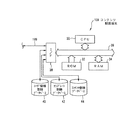
まず、本発明を適用するネットワークシステムの構成を図1を参照しながら説明する。図1は、本発明を適用するネットワークシステムの構成を示すブロック図である。
インターネット199には、図1に示すように、ディジタルコンテンツを提供する複数のコンテンツ提供端末S1〜Snと、コンテンツ提供端末S1〜Snから提供されたディジタルコンテンツ(以下、コンテンツ提供端末S1〜Snから提供されたディジタルコンテンツを記事情報または記事と称することもある。)を収集蓄積して配信するコンテンツ配信するコンテンツ配信端末100と、ユーザの利用に供するユーザ端末200とが接続されている。なお、発明の理解を容易にするため、ユーザ端末200を1台しか図示していないが、実際には、複数のユーザ端末がインターネット199に接続されている。
【0038】
コンテンツ提供端末S1〜Snは、CPU、ROM、RAMおよびI/F等をバス接続した一般的なコンピュータと同一機能を有して構成されており、ディジタルコンテンツを作成したときは、ディジタルコンテンツのカテゴリを特定するためのカテゴリNo.をそのディジタルコンテンツに付加し、コンテンツ配信端末100に送信するようになっている。なお、カテゴリNo.については、後段で詳細に説明する。
【0039】
ユーザ端末200は、CPU、ROM、RAMおよびI/F等をバス接続した一般的なコンピュータと同一機能を有して構成されており、WWW(World WideWeb)ブラウザを有し、WWWブラウザによりコンテンツ配信端末100にアクセスするようになっている。
次に、コンテンツ配信端末100の機能概要を図2を参照しながら詳細に説明する。図2は、コンテンツ配信端末100の機能概要を示す機能ブロック図である。
【0040】
コンテンツ配信端末100は、図2に示すように、XML(eXtensible Markup Language)形式のコンテンツデータファイル10を解析するXMLパーサ11と、XMLパーサ11で解析したコンテンツデータファイル10を入力するコンテンツデータファイル入力部12と、XML形式のレイアウト定義ファイル(後述のページテンプレートおよびテンプレート適用ルールをいう。)13を解析するXMLパーサ14と、XMLパーサ14で解析したレイアウト定義ファイル13を入力するレイアウト定義ファイル入力部15と、入力部12,15で入力したコンテンツデータファイル10およびレイアウト定義ファイル13に基づいてレイアウトを行うレイアウティング部16と、レイアウティング部16からのXML形式の描画指定ファイル17を解析するXMLパーサ18と、XMLパーサ18で解析した描画指定ファイル17に基づいて描画を行うことによりPDF(Portable Document Format)形式のファイル20を作成するラスタライズ部19とで構成されている。本実施の形態は、これら構成要素のうち特にレイアウティング部16に特徴があるものである。
【0041】
次に、コンテンツ配信端末100の構成を図3を参照しながら詳細に説明する。図3は、コンテンツ配信端末100の構成を示すブロック図である。
コンテンツ配信端末100は、図3に示すように、制御プログラムに基づいて演算およびシステム全体を制御するCPU30と、所定領域にあらかじめCPU30の制御プログラム等を格納しているROM32と、ROM32等から読み出したデータやCPU30の演算過程で必要な演算結果を格納するためのRAM34と、外部装置に対してデータの入出力を媒介するI/F38とで構成されており、これらは、データを転送するための信号線であるバス39で相互にかつデータ授受可能に接続されている。
【0042】
I/F38には、外部装置として、ユーザ情報を登録するユーザ情報登録データベース(以下、データベースのことを単にDBと略記する。)40と、ページ単位のレイアウト領域についてレイアウトの枠組みを規定したページテンプレートを登録するテンプレート登録DB42と、コンテンツ提供端末S1〜Snから提供されたディジタルコンテンツを収集蓄積するコンテンツ登録DB44と、インターネット199に接続するための信号線とが接続されている。
【0043】
次に、ユーザ情報登録DB40のデータ構造を図面を参照しながら詳細に説明する。
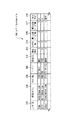
ユーザ情報登録DB40には、図4に示すように、ユーザ情報を登録するユーザプロファイルテーブル300が格納されている。図4は、ユーザプロファイルテーブル300のデータ構造を示す図である。
【0044】
ユーザプロファイルテーブル300は、図4に示すように、各ユーザごとに1または複数のレコードが登録可能となっている。各レコードは、ユーザを特定するためのユーザIDを登録するフィールド302と、ディジタルコンテンツの配信先アドレスを登録するフィールド304と、カテゴリNo.を登録するフィールド306と、キーワードを登録するフィールド308と、配信日を登録するフィールド310と、配信時刻を登録するフィールド312と、レイアウトNo.を登録するフィールド314と、第1上限ページ数を登録するフィールド316と、第1上限ページ数よりも大きい第2上限ページ数を登録するフィールド317と、フォントサイズを登録するフィールド318とを含んで構成されている。
【0045】
フィールド308には、ユーザが指定したキーワードを含むディジタルコンテンツを配信対象として選択する場合においてそのキーワードを登録する。キーワードとしては、例えば、ユーザが興味をもっているカテゴリの記事において頻出すると思われるキーワードを与える。図4の例では、フィールド308の第1段目には「プロセッサ」が、フィールド308の第2段目には「OS(Operating System)」がそれぞれ登録されている。
【0046】
フィールド310には、ユーザがディジタルコンテンツの配信を希望する配信日を登録する。配信日としては、例えば、ディジタルコンテンツの配信を毎日希望する場合は「毎日」を指定し、平日のみ配信を希望する場合は「平日」を指定し、週末のみ配信を希望する場合は「週末」を指定する。図4の例では、フィールド310の第1段目には「毎日」が、フィールド310の第2段目には「平日」がそれぞれ登録されている。
【0047】
フィールド312には、ユーザが指定した配信日においてディジタルコンテンツの配信を希望する配信時刻を登録する。配信時刻としては、例えば、1日を0時から23時までの24時間制時刻で表現したときのいずれかの時刻を指定する。図4の例では、フィールド312の第1段目には5時が、フィールド312の第2段目には11時がそれぞれ登録されている。
【0048】
フィールド314には、ディジタルコンテンツの出力レイアウトを特定するためのレイアウトNo.を登録する。レイアウトNo.としては、例えば、ユーザが希望する出力レイアウトを特定するためのレイアウトNo.を指定する。図4の例では、フィールド314の第1段目にはレイアウトNo.2が、フィールド314の第2段目にはレイアウトNo.5がそれぞれ登録されている。なお、レイアウトNo.については、後段で詳細に説明する。
【0049】
フィールド316,317には、ディジタルコンテンツの表示または印刷を行ったときにその上限となる上限ページ数を登録する。上限ページ数としては、例えば、ページ数を指定するほか、「u」という表記により上限を設定しないことを指定することもできる。図4の例では、フィールド316の第1段目には2ページが、フィールド316の第3段目には「u」がそれぞれ登録されている。
【0050】
フィールド318には、ディジタルコンテンツの表示または印刷を行ったときのフォントのサイズを登録する。図4の例では、フィールド318の第1段目には「小」が、フィールド318の第3段目には「通常」がそれぞれ登録されている。
次に、テンプレート登録DB42のデータ構造を図面を参照しながら詳細に説明する。
【0051】
テンプレート登録DB42には、異なる複数のページテンプレートが格納されている。ページテンプレートの構成を図5および図6を参照しながら説明する。図5は、ページテンプレートが規定するレイアウト状態を示す図である。図6は、ページテンプレートのデータ構造を示す図である。
ページテンプレートは、図5に示すように、タイトル情報を格納するためのタイトル情報格納枠362と、文字情報を格納するための文字情報格納枠364と、画像情報を格納するための画像情報格納枠366と、画像情報格納枠368と、文字情報格納枠370とをレイアウト領域360に配置したレイアウト状態を規定している。また、図示しないが、文字情報格納枠に文字情報が格納しきれず溢れた場合に、文字情報のうち文字情報格納枠に格納しきれなかったものを専ら格納するための文字情報格納枠(以下、フローオブジェクト格納枠という。)がレイアウト領域360に配置されることもある。もちろん、未使用の文字情報格納枠をフローオブジェクト格納枠として使用することもできる。以下、現在のページまたはそれよりも前のページで文字情報格納枠に格納しきれずに溢れた文字情報その他の溢れ情報をフローオブジェクトという。なお、図5はあくまで一例であり、情報格納枠の形状、大きさ、個数またはレイアウト領域360での配置位置は、各ページテンプレートによってそれぞれ異なる。
【0052】
ページテンプレートは、図6に示すように、所定の開始タグ(例えば、<page>)と終了タグ(例えば、</page>)との間に、開始タグと終了タグとのタグセットを記述することによりレイアウト書式を設定するようになっている。図6の例では、第1番目のページテンプレートとして、画像情報格納枠を設定するタグセット500,502と、レイアウト領域360における画像情報格納枠の配置位置を設定するタグセット504,506と、第1レイアウト処理および第2レイアウト処理のいずれかの選択を設定するタグセット508,510とが記述されている。
【0053】
ここで、第1レイアウト処理は、レイアウト結果の総ページ数が第1上限ページ数を超えないようにレイアウトを行う処理である。また、第2レイアウト処理は、レイアウト結果の総ページ数が第1上限ページ数を超えてでもレイアウトを行うが、レイアウト結果の総ページ数が第2上限ページ数を超えないようにレイアウトを行う処理である。以下、第1レイアウト処理が設定されていることを「ページ優先設定」といい、第2レイアウト処理が設定されていることを「ジャンプ優先設定」という。図6の例では、タグセット508,510により「true」が記述されており、これは、レイアウト結果の総ページ数が第1上限ページ数を超えることとなるときは、第2レイアウト処理を行うことを示している。また、図6の例では、複数のページテンプレートを1つのテンプレート定義ファイルに記述しており、各ページテンプレートは、テンプレート定義ファイルにおける記述順により特定することができる。例えば、テンプレート番号「3」のページテンプレートは、テンプレート定義ファイルにおいて3番目に記述されているページテンプレートを示す。
【0054】
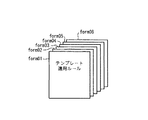
また、テンプレート登録DB42には、図7に示すように、異なる複数のテンプレート適用ルールform01〜form06が格納されている。テンプレート適用ルールの構成を図7および図8を参照しながら説明する。図7および図8は、テンプレート適用ルールのデータ構造を示す図である。
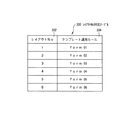
テンプレート適用ルールは、レイアウト結果が複数のレイアウト領域に及ぶことを想定して各レイアウト領域ごとに適用すべきテンプレートのルールを規定したものであり、図8に示すように、各ページごとに1つのレコードを登録してなる。各レコードは、ページ番号を登録するフィールド350と、ページテンプレートを特定するためのテンプレート番号を登録するフィールド352とを含んで構成されている。
【0055】
図8の例では、第1段目のレコードには、ページ番号として「1」が、テンプレート番号として「1」がそれぞれ登録されている。これは、1ページ目のレイアウト領域には、テンプレート番号「1」のページテンプレートを適用すべきであることを示している。
また、テンプレート登録DB42には、図9に示すように、テンプレート適用ルールform01〜form06とレイアウトNo.との対応関係を示すレイアウトNo.対応テーブル330が格納されている。レイアウトNo.対応テーブル330の構成を図9を参照しながら説明する。図9は、レイアウトNo.対応テーブル330のデータ構造を示す図である。
【0056】
レイアウトNo.対応テーブル330には、図9に示すように、各レイアウトNo.ごとに1つのレコードが登録されている。各レコードは、レイアウトNo.を登録するフィールド332と、テンプレート適用ルール名を登録するフィールド334とを含んで構成されている。
図9の例では、第1段目のレコードには、レイアウトNo.として「1」が、テンプレート適用ルール名として「form01」がそれぞれ登録されており、第2段目のレコードには、レイアウトNo.として「2」が、テンプレート適用ルール名として「form02」がそれぞれ登録されている。
【0057】
次に、コンテンツ登録DB44のデータ構造を図面を参照しながら詳細に説明する。
コンテンツ登録DB44には、図10に示すように、コンテンツ提供端末S1〜Snから提供されたディジタルコンテンツと、メインカテゴリおよびサブカテゴリとカテゴリNo.との対応関係を示すカテゴリNo.対応テーブル340とが格納されている。図10は、ディジタルコンテンツおよびカテゴリNo.対応テーブル340のデータ構造を示す図である。
【0058】
コンテンツ提供端末S1〜Snから提供されたディジタルコンテンツには、図10(a)に示すように、記事番号およびカテゴリNo.が付されており、コンテンツ配信端末100は、そのカテゴリNo.に基づいて、ディジタルコンテンツをカテゴリごとに分類してコンテンツ登録DB44に登録する。登録の際には、カテゴリNo.対応テーブル340を参照して、記事番号およびカテゴリNo.のほか、さらにメインカテゴリおよびサブカテゴリをディジタルコンテンツに付加して登録する。また、ディジタルコンテンツは、記事のタイトルを示すタイトル情報と、記事の画像に関する画像情報と、記事の文章に関する文字情報とを含んで1つの記事として構成されている。
【0059】
カテゴリNo.対応テーブル340には、図10(b)に示すように、各メインカテゴリおよびサブカテゴリごとに1つのレコードが登録されている。各レコードは、カテゴリNo.を登録するフィールド342と、メインカテゴリを登録するフィールド344と、サブカテゴリを登録するフィールド346とを含んで構成されている。
【0060】
図10(b)の例では、第1段目のレコードには、カテゴリNo.として「1102」が、メインカテゴリとして「ワールドニュース」が、サブカテゴリとして「アメリカ」がそれぞれ登録されており、第6段目のレコードには、カテゴリNo.として「2010」が、メインカテゴリとして「スポーツ」が、サブカテゴリとして「野球」がそれぞれ登録されている。
【0061】
次に、CPU30の構成およびCPU30で実行される処理を図11および図12を参照しながら説明する。
CPU30は、マイクロプロセッシングユニットMPU等からなり、ROM32の所定領域に格納されている所定のプログラムを起動させ、そのプログラムに従って、図11および図12のフローチャートに示すユーザ登録処理およびコンテンツ配信処理をそれぞれ時分割で実行するようになっている。
【0062】
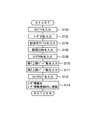
初めに、ユーザ登録処理を図11を参照しながら詳細に説明する。図11は、ユーザ登録処理を示すフローチャートである。
ユーザ登録処理は、アクセスのあったユーザに対してユーザID等の必要なユーザ情報の入力を要求し、入力したユーザ情報をユーザプロファイルテーブル300に登録する処理であって、CPU30において実行されると、まず、図11に示すように、ステップS100に移行するようになっている。なお、以下、各ステップでの入力は、すべてユーザとの対話型通信により行う。
【0063】
ステップS100では、メインカテゴリおよびサブカテゴリを入力し、ステップS102に移行して、ユーザIDおよびパスワードを入力し、ステップS104に移行して、配信先アドレスを入力し、ステップS106に移行して、配信日および配信時刻を入力し、ステップS108に移行する。
ステップS108では、レイアウトNo.を入力し、ステップS110に移行して、第1上限ページ数を入力し、ステップS111に移行して、第2上限ページ数を入力し、ステップS112に移行して、フォントサイズを入力し、ステップS114に移行して、ステップS100〜S112で入力したユーザ情報をユーザプロファイルテーブル300に登録し、一連の処理を終了して元の処理に復帰させる。なお、ユーザ情報のうち第1上限ページ数および第2上限ページ数は、入力を省略することもできる。入力を省略した場合、ユーザプロファイルテーブル300には、上限を設定しないことを示す「u」が登録される。
【0064】
次に、コンテンツ配信処理を図12を参照しながら詳細に説明する。図12は、コンテンツ配信処理を示すフローチャートである。
コンテンツ配信処理は、ユーザプロファイルテーブル300を参照してディジタルコンテンツをユーザ端末200に配信する処理であって、CPU30において実行されると、まず、図12に示すように、ステップS200に移行するようになっている。なお、以下、各ステップの処理は、ユーザプロファイルテーブル300の1つのレコードについての処理である。実際には、ユーザプロファイルテーブル300に登録されているレコード数だけ各ステップの処理を実行する。
【0065】
ステップS200では、ユーザプロファイルテーブル300から配信日および配信時刻を読み出し、ステップS202に移行して、読み出した配信日および配信時刻に基づいてディジタルコンテンツを配信すべき日時であるか否かを判定し、ディジタルコンテンツを配信すべき日時であると判定したとき(Yes)は、ステップS204に移行するが、そうでないと判定したとき(No)は、ステップS200に移行する。
【0066】
ステップS204では、ユーザプロファイルテーブル300からカテゴリNo.を読み出し、ステップS206に移行して、読み出したカテゴリNo.をもとにコンテンツ登録DB44のディジタルコンテンツを検索して、そのカテゴリNo.と一致するカテゴリNo.が付されたディジタルコンテンツを索出し、ステップS208に移行する。
【0067】
ステップS208では、ユーザプロファイルテーブル300からレイアウトNo.を読み出し、ステップS210に移行して、レイアウトNo.対応テーブル330を参照して、読み出したレイアウトNo.に対応するテンプレート適用ルールをテンプレート登録DB42から読み出し、ステップS212に移行して、読み出したテンプレート適用ルールに基づいて、ステップS206で索出したディジタルコンテンツについて出力レイアウトを決定して提供用ディジタルコンテンツを作成する自動レイアウト処理を実行し、ステップS214に移行する。
【0068】
ステップS214では、ユーザプロファイルテーブル300から配信先アドレスを読み出し、ステップS216に移行して、読み出した配信先アドレス宛に、作成した提供用ディジタルコンテンツを配信し、一連の処理を終了して元の処理に復帰させる。
次に、上記ステップS212の自動レイアウト処理を図13を参照しながら詳細に説明する。図13は、自動レイアウト処理を示すフローチャートである。
【0069】
自動レイアウト処理は、上記ステップS212において実行されると、図13に示すように、まず、ステップS300に移行するようになっている。
ステップS300では、先頭ページのレイアウト領域を処理対象として設定し、ステップS302に移行して、ステップS210で読み出したテンプレート適用ルールに基づいてテンプレート登録DB42のなかからページテンプレートを読み出し、ステップS304に移行して、読み出したページテンプレートを現在のページのレイアウト領域に適用し、ステップS306に移行する。
【0070】
ステップS306では、ページ内に固定的に配置される固定線の位置を決定し、ステップS308に移行して、ページ内に固定的に配置される固定文字情報の形状および位置を決定し、ステップS310に移行して、ページ内に固定的に配置される固定画像情報の形状および位置を決定し、ステップS312に移行する。
【0071】
ステップS312では、フローオブジェクト格納枠の形状および位置を決定し、フローオブジェクトをそのフローオブジェクト格納枠に格納する処理を実行し、ステップS314に移行して、所定の優先順位に基づいて、ステップS206で索出したディジタルコンテンツのなかからレイアウト領域に配置すべき記事を選択し、ステップS316に移行する。
【0072】
ステップS316では、ステップS314で選択した選択記事に基づいてタイトル情報格納枠の形状および位置を決定し、選択記事に含まれるタイトル情報をそのタイトル情報格納枠に格納する処理を実行し、ステップS318に移行して、選択記事に基づいて画像情報格納枠の形状および位置を決定し、選択記事に含まれる画像情報をその画像情報格納枠に格納する処理を実行し、ステップS320に移行して、選択記事に基づいて文字情報格納枠の形状および位置を決定し、選択記事に含まれる文字情報をその文字情報格納枠に格納する処理を実行し、ステップS322に移行する。
【0073】
ステップS322では、レイアウト領域内に未処理の情報格納枠が存在するか否かを判定し、未処理の情報格納枠が存在しないと判定したとき(No)は、ステップS324に移行して、ステップS206で索出したディジタルコンテンツのうち未掲載の記事が存在するか否かを判定し、未掲載の記事が存在しないと判定したとき(No)は、ステップS326に移行して、未処理のフローオブジェクトを掲載する処理を実行し、一連の処理を終了して元の処理に復帰させる。
【0074】
一方、ステップS324で、未掲載の記事が存在すると判定したとき(Yes)は、ステップS328に移行して、次ページのレイアウト領域を処理対象として設定し、ステップS302に移行する。
一方、ステップS322で、レイアウト領域内に未処理の情報格納枠が存在すると判定したとき(Yes)は、ステップS314に移行する。
【0075】
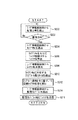
次に、上記ステップS302のページテンプレート選択処理を図14を参照しながら詳細に説明する。図14は、ページテンプレート選択処理を示すフローチャートである。
ページテンプレート選択処理は、上記ステップS302において実行されると、図14に示すように、まず、ステップS400に移行するようになっている。
【0076】
ステップS400では、ステップS400の実行が初めての実行であるか否かを判定し、初めての実行であると判定したとき(Yes)は、ステップS402に移行して、変数nに「0」を設定し、ステップS404に移行して、テンプレート適用ルールの総レコード数を変数Nmaxに設定し、ステップS406に移行する。
【0077】
ステップS406では、テンプレート適用ルールのレコードのうち変数nの値により特定される順番のものからテンプレート番号を取得し、ステップS408に移行して、取得したテンプレート番号のページテンプレートをテンプレート登録DB42のなかから読み出し、ステップS410に移行する。
ステップS410では、ユーザプロファイルテーブル300から第1上限ページ数を読み出し、ステップS412に移行して、現在処理対象となっているレイアウト領域のページ(以下、単に現在のページという。)数を取得し、ステップS414に移行して、現在のページ数が第1上限ページ数よりも大きいか否かを判定し、現在のページ数が第1上限ページ数未満であると判定したとき(No)は、ステップS416に移行する。
【0078】
ステップS416では、変数nの値が、変数Nmaxの値から「1」を減算した値以上であるか否かを判定し、変数nの値が、変数Nmaxの値から「1」を減算した値未満であると判定したとき(No)は、ステップS418に移行して、変数nの値に「1」を加算したものを変数nの新たな値として設定し、一連の処理を終了して元の処理に復帰させる。
【0079】
一方、ステップS416で、変数nの値が、変数Nmaxの値から「1」を減算した値以上であると判定したとき(Yes)は、一連の処理を終了して元の処理に復帰させる。
一方、ステップS414で、現在のページ数が第1上限ページ数よりも大きいと判定したとき(Yes)は、ステップS420に移行して、ステップS408で読み出したページテンプレートに基づいて、第1レイアウト処理および第2レイアウト処理のうち第1レイアウト処理が選択されているか否かを判定し、第1レイアウト処理が選択されていると判定したとき(Yes)は、ステップS422に移行する。
【0080】
ステップS422では、レイアウト結果の総ページ数が第1上限ページ数を超えないように再レイアウトを行い、ステップS424に移行して、ステップS212の自動レイアウト処理を終了する。具体的に、ステップS422では、次の第1ないし第7の方法により再レイアウトを行う。
第1に、レイアウト領域の書式または画像情報格納枠の形状を変更することにより、未掲載の記事およびフローオブジェクトを第1上限ページ内に格納する。書式変更の内容としては、例えば、フォントサイズの変更、文字間・行間の調整である。
【0081】
第2に、掲載済みの記事、未掲載の記事またはフローオブジェクトの要約を作成することにより、未掲載の記事およびフローオブジェクトを第1上限ページ内に格納する。
第3に、掲載済みの記事、未掲載の記事またはフローオブジェクトに含まれる単語または文を略語に変換することにより、未掲載の記事およびフローオブジェクトを第1上限ページ内に格納する。この場合、語形の一部を省略した略語をその語形からなる単語または文と対応付けて記憶した略語登録テーブルをユーザ情報登録DB40等にあらかじめ格納しておき、略語登録テーブルを参照して、文字情報に含まれる単語または文を略語に変換する。
【0082】
第4に、文字情報格納枠と画像情報格納枠とが重なり合わない範囲を超えて文字情報格納枠の領域を拡大することにより、未掲載の記事およびフローオブジェクトを第1上限ページ内に格納する。この場合、文字情報格納枠を拡大した結果、文字情報格納枠と画像情報格納枠とが重なり合う場合は、画像情報格納枠のうち重なり合う部分の色彩に基づいて、文字情報格納枠のうち重なり合う部分の文字の色彩を決定する。例えば、画像情報格納枠のうち重なり合う部分の色彩が黒であれば、文字情報格納枠のうち重なり合う部分の文字の色彩を白にする。
【0083】
第5に、掲載済みまたは未掲載のフローオブジェクトを破棄し、それらフローオブジェクトの文字数よりも少ない文字数の記事を掲載することにより、未掲載の記事およびフローオブジェクトを第1上限ページ内に格納する。ただし、掲載可能な代替記事が存在しない場合は、レイアウト結果の総ページ数が第1上限ページ数を超えて掲載済みまたは未掲載のフローオブジェクトを掲載してもよい。
【0084】
第6に、フローオブジェクトを破棄することにより、未掲載の記事を第1上限ページ内に格納する。この場合、文字情報のうちフローオブジェクト以外のものを格納した文字情報格納枠に、フローオブジェクトを破棄したことを示す案内情報を格納するのが好ましい。案内情報としては、破棄したことを示す印(省略記号)や「以下省略」というメッセージ、コンテンツ配信端末100若しくはコンテンツ提供端末S1〜SnのURL(Uniform Resource Locator)のうち破棄したフローオブジェクトを格納した端末のURL、コンテンツ配信端末100若しくはコンテンツ提供端末S1〜Snにおいて破棄したフローオブジェクトを参照するための記事番号、その記事番号を示すバーコード、またはコンテンツ配信端末100若しくはコンテンツ提供端末S1〜Snにおいて破棄したフローオブジェクトにアクセスするためのパスワードを格納する。
【0085】
第7に、第1ないし第5の方法により、未掲載のフローオブジェクトのうちレイアウト可能な部分のみレイアウトし、レイアウト不可能な部分を破棄することにより、未掲載の記事およびフローオブジェクトを第1上限ページ内に格納する。この場合も、第6の方法同様に、文字情報のうちフローオブジェクト以外のものを格納した文字情報格納枠に、フローオブジェクトを破棄したことを示す案内情報を格納するのが好ましい。
【0086】
一方、ステップS420で、第1レイアウト処理および第2レイアウト処理のうち第2レイアウト処理が選択されていると判定したとき(No)は、ステップS426に移行して、第2上限ページ数が有限値として設定されているか否かを判定し、第2上限ページ数が有限値として設定されていると判定したとき(Yes)は、ステップS428に移行する。
【0087】
ステップS428では、ユーザプロファイルテーブル300から第2上限ページ数を読み出し、ステップS430に移行して、現在のページ数が第2上限ページ数よりも大きいか否かを判定し、現在のページ数が第2上限ページ数よりも大きいと判定したとき(Yes)は、ステップS432に移行する。
ステップS432では、レイアウト結果の総ページ数が第2上限ページ数を超えないように再レイアウトを行い、ステップS424に移行する。具体的に、ステップS432では、上記第1ないし第7の方法と同様の方法により再レイアウトを行う。
【0088】
一方、ステップS430で、現在のページ数が第2上限ページ数未満であると判定したとき(No)は、ステップS416に移行する。
一方、ステップS426で、第2上限ページ数が有限値として設定されていないと判定したとき(No)は、ステップS434に移行して、ページ数の増加を極力抑えるようにレイアウトを行い、ステップS424に移行する。具体的に、ステップS434では、上記第1〜第4の方法と同様の方法によりレイアウトを行う。
【0089】
一方、ステップS400で、ステップS400の実行が初めての実行でないと判定したとき(No)は、ステップS406に移行する。
次に、本実施の形態の動作を図面を参照しながら説明する。図15は、レイアウト結果の一例を示す図である。
まず、ディジタルコンテンツを配信するために必要な情報を登録する場合を説明する。
【0090】
ユーザがディジタルコンテンツの配信を希望する場合、ユーザは、ユーザ端末200において、WWWブラウザによりコンテンツ配信端末100にアクセスし、ユーザ登録要求を入力する。
ユーザ端末200では、ユーザ登録要求が入力されると、コンテンツ配信端末100との通信により、必要なユーザ情報を入力すべき要求がユーザに対して行われる。ここで、ユーザは、その入力要求に応じて、ユーザ情報として、メインカテゴリ、サブカテゴリ、ユーザID、パスワード、配信先アドレス、配信日、配信時刻、レイアウトNo.、第1上限ページ数、第2上限ページ数、フォントサイズを入力すると、それらユーザ情報がコンテンツ配信端末100に送信される。
【0091】
コンテンツ配信端末100では、登録要求に伴ってユーザ情報を受信すると、ステップS100〜S114を経て、受信したユーザ情報がユーザプロファイルテーブル300に登録される。
次に、ユーザプロファイルテーブル300を参照してディジタルコンテンツを配信する場合を説明する。
【0092】
コンテンツ配信端末100では、ユーザプロファイルテーブル300を参照してディジタルコンテンツを配信すべき日時になると、ステップS204,S206を経て、ユーザプロファイルテーブル300からカテゴリNo.が読み出され、読み出されたカテゴリNo.をもとにコンテンツ登録DB44のディジタルコンテンツを検索して、そのカテゴリNo.と一致するカテゴリNo.が付されたディジタルコンテンツが索出される。次いで、ステップS208〜S212を経て、ユーザプロファイルテーブル300からレイアウトNo.が読み出され、レイアウトNo.対応テーブル330を参照して、読み出されたレイアウトNo.に対応するテンプレート適用ルールがユーザ情報登録DB40から読み出され、読み出されたテンプレート適用ルールに基づいて、索出されたディジタルコンテンツについて出力レイアウトが決定されて提供用ディジタルコンテンツが作成される。
【0093】
レイアウトの過程では、まず、ステップS300,S400〜S404を経て、先頭ページのレイアウト領域が処理対象として設定され、変数nに「0」が、テンプレート適用ルールの総レコード数が変数Nmaxにそれぞれ設定される。次いで、ステップS406,S408を経て、テンプレート適用ルールのレコードのうち変数nの値により特定される順番のものからテンプレート番号が取得され、取得されたテンプレート番号のページテンプレートがテンプレート登録DB42のなかから読み出される。
【0094】
次いで、ステップS410〜S414を経て、ユーザプロファイルテーブル300から第1上限ページ数が読み出され、現在のページ数が取得され、現在のページ数が第1上限ページ数よりも大きいか否かが判定される。ここで、現在のページ数が第1上限ページ数よりも大きい場合には、ステップS420を経て、ステップS408で読み出されたページテンプレートに基づいて、第1レイアウト処理および第2レイアウト処理のうち第1レイアウト処理が選択されているか否かが判定される。その結果、第1レイアウト処理が選択されていると、ステップS422を経て、レイアウト結果の総ページ数が第1上限ページ数を超えないように再レイアウトが行われる。再レイアウトが完了した後は、ステップS212の自動レイアウト処理が終了する。例えば、図15(a)の例では、第1上限ページ数から記事が溢れてしまっている。そこで、ページ優先設定の場合には、第1レイアウト処理により溢れを解消するように処理を行う。その結果、図15(b)のレイアウト結果が得られる。図15(b)の例では、溢れたコンテンツの文章の書式変更と図版を縮小し、さらにレイアウト済の領域に対しても書式の変更を行うことで第1上限ページ数内に記事が収まるようにしている。
【0095】
一方、第2レイアウト処理が選択されていると、ステップS428,S430を経て、ユーザプロファイルテーブル300から第2上限ページ数が読み出され、現在のページ数が第2上限ページ数よりも大きいか否かが判定される。現在のページ数が第2上限ページ数よりも大きい場合には、ステップS432を経て、レイアウト結果の総ページ数が第2上限ページ数を超えないように再レイアウトが行われる。再レイアウトが完了した後は、ステップS212の自動レイアウト処理が終了する。例えば、図15(a)の例では、第1上限ページ数から記事が溢れてしまっている。そこで、ジャンプ優先設定の場合には、図15(c)に示すように、第2レイアウト処理により第2上限ページ数の設定がないまたは第2上限ページ数に達しないときはそのままページを追加してレイアウトを行う。
また、第2上限ページ数の設定がありかつ第2上限ページ数に達した場合は第2上限ページ数内に記事が収まるように処理を行う。図15(d)の例では、第1上限ページ数が2ページの場合で、記事が収まるように溢れたコンテンツの書式変更を行っている。また、溢れ領域をできるだけ小さくする処理を行うことで図15(e)のようにもなる。
【0096】
なお、第2レイアウト処理が選択されているが第2上限ページ数が設定されていないと、ステップS434を経て、ページ数の増加を極力抑えるようにレイアウトが行われる。レイアウトが完了した後は、ステップS212の自動レイアウト処理が終了する。
一方、現在のページ数が第1上限ページ数未満である場合、または第2レイアウト処理が選択されている場合において現在のページ数が第2上限ページ数未満である場合には、ステップS416,S418を経て、変数nの値に「1」を加算したものが変数nの新たな値として設定される。次いで、ステップS304〜S314を経て、読み出されたページテンプレートが現在のページのレイアウト領域に適用され、固定線の位置、固定文字情報の形状および位置、並びに固定画像情報の形状および位置がその順で決定され、所定の優先順位に基づいて、ステップS206で索出されたディジタルコンテンツのなかからレイアウト領域に配置すべき記事が選択される。
【0097】
選択記事にタイトル情報が含まれている場合には、ステップS316を経て、選択記事に含まれるタイトル情報がタイトル情報格納枠に格納される。具体的には、選択記事に含まれるタイトル情報の情報量が算出され、算出された情報量に基づいてタイトル情報格納枠の形状および位置が決定され、選択記事に含まれるタイトル情報がそのタイトル情報格納枠に格納される。
【0098】
選択記事に画像情報が含まれている場合には、ステップS318を経て、選択記事に含まれる画像情報が画像情報格納枠に格納される。具体的には、選択記事に含まれる画像情報の情報量が算出され、算出された情報量に基づいて、他の情報格納枠と重なり合わないように画像情報格納枠の形状および位置が決定され、選択記事に含まれる画像情報がその画像情報格納枠に格納される。
【0099】
選択記事に文字情報が含まれている場合には、ステップS320を経て、選択記事に含まれる文字情報が文字情報格納枠に格納される。具体的には、選択記事に含まれる文字情報の情報量が算出され、算出された情報量に基づいて、他の情報格納枠と重なり合わないように文字情報格納枠の形状および位置が決定され、選択記事に含まれる文字情報がその文字情報格納枠に格納される。このとき、文字情報格納枠に文字情報が格納しきれず溢れると、フローオブジェクトが保存される。
【0100】
そして、このようなタイトル情報格納枠への格納処理、画像情報格納枠への格納処理および文字情報格納枠への格納処理が、レイアウト領域内に未処理の情報格納枠が存在しなくなるまで繰り返し実行される。これにより、先頭ページのレイアウト領域内に記事が配置される。
次に、レイアウト領域内に未処理の情報格納枠が存在しなくなると、ステップS328を経て、次ページのレイアウト領域が処理対象として設定され、テンプレート適用ルールのレコードのうち変数nの値により特定される順番のものからテンプレート番号が取得され、取得されたテンプレート番号のページテンプレートがテンプレート登録DB42のなかから読み出される。その後の処理は、上記同様にして、第1レイアウト処理および第2レイアウト処理のいずれかが行われる場合以外は、変数nの値に「1」を加算したものが変数nの新たな値として設定される。
【0101】
次いで、フローオブジェクトが保存されかつフローオブジェクト格納枠がレイアウト領域に存在する場合には、ステップS312を経て、フローオブジェクトがフローオブジェクト格納枠に格納される。具体的には、フローオブジェクトの情報量が算出され、算出された情報量に基づいて、フローオブジェクト格納枠の形状および位置が決定されるとともに、そのフローオブジェクト格納枠と重なり合わないように他の情報格納枠の形状および位置が決定され、フローオブジェクトがそのフローオブジェクト格納枠に格納される。次いで、タイトル情報格納枠への格納処理、画像情報格納枠への格納処理および文字情報格納枠への格納処理が、上記同様に、レイアウト領域内に未処理の情報格納枠が存在しなくなるまで繰り返し実行される。
【0102】
そして、このようなフローオブジェクト格納枠への格納処理、タイトル情報格納枠への格納処理、画像情報格納枠への格納処理および文字情報格納枠への格納処理の繰り返し処理が、ステップS206で索出されたディジタルコンテンツのうち未掲載の記事が存在しなくなるまで実行される。これにより、索出されたディジタルコンテンツに含まれるすべての記事が掲載されることになり、ディジタルコンテンツの出力レイアウトが決定される。出力レイアウトが決定されると、ステップS222,S224を経て、ユーザプロファイルテーブル300から配信先アドレスが読み出され、読み出された配信先アドレス宛に、作成された提供用ディジタルコンテンツが配信される。
【0103】
このようにして、本実施の形態では、コンテンツ配信端末100は、レイアウト結果の総ページ数が第1上限ページ数を超えることとなるときは、レイアウト結果の総ページ数が第1上限ページ数を超えないようにレイアウトを行う第1レイアウト処理と、レイアウト結果の総ページ数が第1上限ページ数を超えてでもレイアウトを行う第2レイアウト処理とを選択的に行うようになっている。
【0104】
これにより、レイアウト結果の総ページ数が第1上限ページ数を超えることとなるときは、第1上限ページ数を超えないようにレイアウトを行うか、または第1上限ページ数を超えてでもレイアウトを行うかの選択を行うことができるので、ユーザの自由度が増し、従来に比して、ユーザの希望に比較的沿ったレイアウトを行うことができる。
【0105】
さらに、本実施の形態では、第1レイアウト処理は、ページテンプレートで規定される情報格納枠の形状若しくは配置位置を変更し、情報格納枠に格納する記事の書式を可読性を保持する範囲で変更し、記事の一部を破棄し、または記事の内容を変更することにより、レイアウト結果の総ページ数が第1上限ページ数を超えないようにレイアウトを行うようになっている。
【0106】
これにより、レイアウト結果の総ページ数が第1上限ページ数を超えないレイアウトを実現しつつも、比較的見やすいレイアウトとなる。
さらに、本実施の形態では、第2レイアウト処理は、レイアウト結果の総ページ数が第2上限ページ数を超えないようにレイアウトを行うようになっている。これにより、ページ数の際限なくレイアウトが行われる可能性を低減することができる。また、第2上限ページ数を設定することができるので、ユーザの自由度が向上し、ユーザの希望にさらに沿ったレイアウトを行うことができる。
【0107】
さらに、本実施の形態では、第2レイアウト処理は、レイアウト結果の総ページ数が第2上限ページ数を超えることとなるときは、ページテンプレートで規定される情報格納枠の形状若しくは配置位置を変更し、情報格納枠に格納する記事の書式を可読性を保持する範囲で変更し、記事の一部を破棄し、または記事の内容を変更することにより、レイアウト結果の総ページ数が第2上限ページ数を超えないようにレイアウトを行うようになっている。
【0108】
これにより、レイアウト結果の総ページ数が第2上限ページ数を超えないレイアウトを実現しつつも、比較的見やすいレイアウトとなる。
さらに、本実施の形態では、コンテンツ配信端末100は、第1レイアウト処理および第2レイアウト処理のいずれかの選択をページテンプレートに設定し、テンプレート登録DB42のページテンプレートに基づいて、第1レイアウト処理および第2レイアウト処理のいずれかの選択を行うようになっている。
【0109】
これにより、第1レイアウト処理および第2レイアウト処理のいずれかの選択を比較的簡単に設定することができる。
さらに、本実施の形態では、コンテンツ配信端末100は、レイアウト結果が複数のレイアウト領域に及ぶことを想定して各レイアウト領域ごとに適用すべきページテンプレートのルールを規定したテンプレート適用ルールに基づいて、レイアウトに必要となる各レイアウト領域ごとに、テンプレート登録DB42のなかからページテンプレートを選択し、選択したページテンプレートに従って記事をレイアウトするようになっている。
【0110】
これにより、異なる複数のページテンプレートおよびテンプレート適用ルールを作成するだけで、各ページごとにレイアウト書式を任意に設定することができる。したがって、レイアウト書式の設定が比較的容易となるので、記事の内容や量があらかじめ確定できない場合でも、比較的適切なレイアウトを実現することができる。
【0111】
さらに、本実施の形態では、コンテンツ配信端末100は、レイアウトに必要となる各レイアウト領域ごとに、テンプレート適用ルールからテンプレート番号を所定順序で取得し、取得したテンプレート番号のページテンプレートをテンプレート登録DB42のなかから選択するようになっている。
これにより、テンプレート番号を配列するだけでテンプレート適用ルールを作成することができるので、テンプレート適用ルールを比較的容易に作成することができる。
【0112】
さらに、本実施の形態では、コンテンツ配信端末100は、ユーザ情報登録DB40のユーザ情報に基づいて、ディジタルコンテンツをコンテンツ登録DB44のなかから索出するようになっている。
これにより、ディジタルコンテンツの選択に関してユーザの固有情報やユーザによる指定情報が参照されることから、ユーザの希望に比較的沿った内容の提供用ディジタルコンテンツを作成することができる。
【0113】
さらに、本実施の形態では、コンテンツ配信端末100は、ユーザ情報登録DB40のユーザ情報に基づいて、ディジタルコンテンツの出力レイアウトを決定して提供用ディジタルコンテンツを作成するようになっている。
これにより、出力レイアウトの決定に関してユーザの固有情報やユーザによる指定情報が参照されることから、ユーザの希望に比較的沿った出力レイアウトで提供用ディジタルコンテンツを作成することができる。
【0114】
さらに、本実施の形態では、コンテンツ配信端末100は、フローオブジェクト格納枠と他の情報格納枠とが重なり合うこととなるときは、フローオブジェクト格納枠と重なり合わないように、他の情報格納枠の形状および位置を決定するようになっている。
これにより、他の情報格納枠に格納する情報の配置よりも、フローオブジェクトの配置を優先的に行うことができる。
【0115】
さらに、本実施の形態では、コンテンツ配信端末100は、タイトル情報、画像情報または文字情報を格納するのに必要最小限の大きさとなるように、タイトル情報格納枠、画像情報格納枠および文字情報格納枠の形状を決定するようになっている。
これにより、タイトル情報格納枠、画像情報格納枠または文字情報格納枠にタイトル情報、画像情報または文字情報を効率的に格納することができる。
【0116】
さらに、本実施の形態では、コンテンツ配信端末100は、タイトル情報格納枠、画像情報格納枠および文字情報格納枠の順番で、その情報格納枠の形状および位置を決定するようになっている。
これにより、レイアウトを重視すべき順番でレイアウトを決定することができるので、比較的見やすい出力レイアウトで提供用ディジタルコンテンツを作成することができる。
【0117】
上記実施の形態において、ユーザ情報登録DB40は、発明16または17のユーザ情報記憶手段に対応し、テンプレート登録DB42は、発明3または8のテンプレート記憶手段に対応し、コンテンツ登録DB44は、発明2、16、18または22の掲載情報記憶手段に対応している。また、ステップS110は、発明2の上限ページ数設定手段、発明18若しくは20の第1上限ページ数設定手段、または発明22の第1上限ページ数設定ステップに対応し、ステップS111は、発明5、18若しくは20の第2上限ページ数設定手段、または発明22の第2上限ページ数設定ステップに対応している。
【0118】
また、上記実施の形態において、ステップS206は、発明2、16ないし18の掲載情報選択手段、または発明22の掲載情報選択ステップに対応し、ステップS212は、発明1ないし3、8、17ないし20のレイアウト手段、または発明21若しくは22のレイアウトステップに対応している。また、記事は、発明1ないし4、6、16ないし18、21または22の掲載情報に対応し、ページテンプレートは、発明3、4、6または8のレイアウトテンプレートに対応している。
【0119】
なお、上記実施の形態においては、レイアウト結果の総ページ数が第1上限ページ数を超えることとなるときは、テンプレート登録DB42のページテンプレートに基づいて、第1レイアウト処理および第2レイアウト処理のいずれかの選択を行うように構成したが、これに限らず、ユーザに選択させるように構成してもよい。具体的には、レイアウト結果の総ページ数が第1上限ページ数を超えることとなるときは、第1レイアウト処理および第2レイアウト処理のいずれかを選択すべきことをユーザ端末200に対して通知し、その通知に応じていずれかの選択結果を入力したときは、入力した選択結果に基づいて、第1レイアウト処理および第2レイアウト処理のいずれかの選択を行う。
【0120】
これにより、ユーザは、レイアウト結果の総ページ数が第1上限ページ数を超えることを把握することができる。また、ユーザは、その通知に応じて選択結果を入力すれば、自己の意図をレイアウトに反映させることができるので、ユーザの希望にさらに沿ったレイアウトを行うことができる。
この場合において、ステップS212は、発明7のレイアウト手段に対応している。
【0121】
また、上記実施の形態においては、第1レイアウト処理および第2レイアウト処理のいずれかの選択をページテンプレートに設定するように構成したが、これに限らず、第1レイアウト処理および第2レイアウト処理のいずれかの選択を記事に設定し、または引数として与えるように構成してもよい。この場合、記事または引数に基づいて、第1レイアウト処理および第2レイアウト処理のいずれかの選択を行う。
【0122】
これにより、第1レイアウト処理および第2レイアウト処理のいずれかの選択を比較的簡単に設定することができる。
この場合において、ステップS206は、発明10の掲載情報選択手段に対応し、ステップS212は、発明10または12のレイアウト手段に対応し、記事は、発明10の掲載情報に対応している。
【0123】
また、第1レイアウト処理および第2レイアウト処理のいずれかの選択をページテンプレート若しくは記事に設定し、および引数として与えるように構成した場合には、ページテンプレートの設定、記事の設定および引数による設定のうち複数の設定を同時に行うことができるが、複数の設定が同時に行われた結果、相互の設定内容に矛盾が生じる場合が想定される。その場合は、ページテンプレートの設定、記事の設定および引数による設定に対して優先度を設定し、ページテンプレートの設定、記事の設定および引数による設定のうち複数の設定が同時に行われたときは、優先度に基づいて、ページテンプレートの設定に基づいて第1レイアウト処理および第2レイアウト処理のいずれかの選択を行うか、記事の設定に基づいて第1レイアウト処理および第2レイアウト処理のいずれかの選択を行うか、引数による設定に基づいて第1レイアウト処理および第2レイアウト処理のいずれかの選択を行うかを決定する。
【0124】
これにより、複数の設定が同時に行われた結果、相互の設定内容に矛盾が生じても、優先度に応じていずれかの設定が採用されるので、レイアウトが損なわれる可能性を低減することができる。
この場合において、テンプレート登録DB42は、発明14のテンプレート記憶手段に対応し、ステップS206は、発明14の掲載情報選択手段に対応し、ステップS212は、発明14のレイアウト手段に対応し、記事は、発明14の掲載情報に対応している。また、ページテンプレートは、発明14のレイアウトテンプレートに対応している。
【0125】
また、上記実施の形態においては、第1レイアウト処理の内容および第2レイアウト処理の内容(第1上限ページ数の設定および第2上限ページ数の設定を含む。)をプログラムの一部として構成したが、これに限らず、第1レイアウト処理の内容および第2レイアウト処理の内容をページテンプレート若しくは記事に設定し、または引数として与えるように構成してもよい。この場合、ページテンプレート、記事または引数に基づいて、第1レイアウト処理および第2レイアウト処理を行う。
【0126】
第1に、第1レイアウト処理の内容および第2レイアウト処理の内容を引数として与える場合、例えば、「−page 6」という引数を与えたときは、第1上限ページ数を6ページに設定することを、「−overflow」という引数を与えたときは、溢れを許可する(デフォルトでは許可しない。)ことを、「−limit 2」という引数を与えたときは、第2上限ページ数を第1上限ページ数よりも2ページ多いものとして設定することをそれぞれ示している。また、「−proc style,blank」という引数を与えたときは、ページに収める処理として書式変更を行いだめなときは空白化の順で処理することを示している。「−proc」に続く引数としては、「style」、「summary」、「pile」、「blank」、「part」、「another」、「styleall」、「summaryall」または「pileall」を処理優先度が高い順にカンマで区切って指定する。ここで、引数「style」は書式変更を、引数「summary」は要約作成を、引数「pile」は重ね合わせを許可を、引数「blank」は空白化を、引数「part」はレイアウトできない部分を破棄をそれぞれ示している。また、引数「another」は別のコンテンツに変更を、引数「styleall」はレイアウト済のコンテンツも含め書式変更を、引数「summaryall」はレイアウト済のコンテンツも含めて要約作成を、引数「pileall」はレイアウト済のコンテンツも含めて重ね合わせ許可をそれぞれ示している。また、「blank:30%」のように指定したときは、ページ全体の30%までの空白を許可することを示している。
【0127】
第2に、第1レイアウト処理の内容および第2レイアウト処理の内容をページテンプレートに設定する場合には、例えば、図16ないし図18に示すように設定することができる。
第1上限ページ数を設定する場合、ページテンプレートは、図16に示すように、所定の開始タグ(例えば、<setting>)と終了タグ(例えば、</setting>)との間に、開始タグと終了タグとのタグセットを記述することによりレイアウト書式を設定するようになっている。図16の例では、第1上限ページ数を設定するタグセット512,514により「8」が記述されている。これは、第1上限ページを8ページに設定することを示している。図16は、第1上限ページ数を設定する場合のページテンプレートのデータ構造を示す図である。
【0128】
また、第2上限ページ数を設定する場合、ページテンプレートは、図17に示すように、所定の開始タグ(例えば、<setting>)と終了タグ(例えば、</setting>)との間に、開始タグと終了タグとのタグセットを記述することによりレイアウト書式を設定するようになっている。図17の例では、第2上限ページ数を設定するタグセット516,518により「2」が記述されている。これは、第2上限ページを第1上限ページ数よりも2ページ多いものとして設定することを示している。図17は、第2上限ページ数を設定する場合のページテンプレートのデータ構造を示す図である。
【0129】
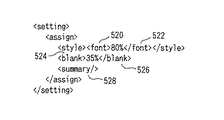
また、ページ内に記事を納める処理を設定する場合、ページテンプレートは、図18に示すように、所定の開始タグ(例えば、<setting>)と終了タグ(例えば、</setting>)との間に、開始タグと終了タグとのタグセットを記述することによりレイアウト書式を設定するようになっている。図18の例では、フォントサイズの変更による格納処理を設定するタグセット520,522により「80%」が、空白を設けることによる格納処理を設定するタグセット524,526により「35%」が、要約の作成による格納処理を設定するタグ528がそれぞれ記述されている。これは、書式変更(フォントサイズを80%まで)してレイアウトを行い、それでも格納しきれないときはページに対し35%までなら空白とし、さらにそれでも格納しきれないときは要約を作成することを示している。図18は、ページ内に記事を納める処理を設定する場合のページテンプレートのデータ構造を示す図である。
【0130】
これにより、第1レイアウト処理および第2レイアウト処理の内容を比較的簡単に設定することができる。
この場合において、テンプレート登録DB42は、発明9のテンプレート記憶手段に対応し、ステップS206は、発明11の掲載情報選択手段に対応し、ステップS212は、発明9、11または13のレイアウト手段に対応し、記事は、発明11の掲載情報に対応している。また、ページテンプレートは、発明9のレイアウトテンプレートに対応している。
【0131】
また、第1レイアウト処理の内容および第2レイアウト処理の内容をページテンプレート若しくは記事に設定し、および引数として与えるように構成した場合には、ページテンプレートの設定、記事の設定および引数による設定のうち複数の設定を同時に行うことができるが、複数の設定が同時に行われた結果、相互の設定内容に矛盾が生じる場合が想定される。その場合は、ページテンプレートの設定、記事の設定および引数による設定に対して優先度を設定し、ページテンプレートの設定、記事の設定および引数による設定のうち複数の設定が同時に行われたときは、優先度に基づいて、ページテンプレートの設定に基づいて第1レイアウト処理および第2レイアウト処理を行うか、記事の設定に基づいて第1レイアウト処理および第2レイアウト処理を行うか、引数による設定に基づいて第1レイアウト処理および第2レイアウト処理を行うかを決定する。
【0132】
これにより、複数の設定が同時に行われた結果、相互の設定内容に矛盾が生じても、優先度に応じていずれかの設定が採用されるので、レイアウトが損なわれる可能性を低減することができる。
この場合において、テンプレート登録DB42は、発明15のテンプレート記憶手段に対応し、ステップS206は、発明15の掲載情報選択手段に対応し、ステップS212は、発明15のレイアウト手段に対応し、記事は、発明15の掲載情報に対応している。また、ページテンプレートは、発明15のレイアウトテンプレートに対応している。
【0133】
また、上記実施の形態においては、テンプレート適用ルールに基づいて、レイアウトに必要となる各レイアウト領域ごとに、テンプレート登録DB42のなかからページテンプレートを選択し、選択したページテンプレートに従って記事をレイアウトするように構成したが、ページテンプレートの数が少なく、第2レイアウト処理を許可するページテンプレートをコピーして利用するケースでは、ページ数指定を優先したい場合に、最終ページとしてコピーしたテンプレートの第2レイアウト処理をキャンセルする必要がある。したがって、その際には設定中に、<final−page−reassign/>といったタグを付与して、最終ページでの第2レイアウト処理をキャンセルして第2上限ページ数内に記事を収める処理を行う。
【0134】
また、上記実施の形態においては、ページテンプレートに固有のテンプレート番号を関連付け、テンプレート番号を所定順序で登録してテンプレート適用ルールを構成し、レイアウトに必要となる各レイアウト領域ごとに、テンプレート適用ルールからテンプレート番号を所定順序で取得し、取得したテンプレート番号のページテンプレートをテンプレート登録DB42のなかから選択するように構成したが、これに限らず、ページテンプレートの関連付けを文字列により管理するように構成することもできる。具体的には、ページテンプレートに固有の識別用文字列を関連付け、識別用文字列を所定順序で登録してテンプレート適用ルールを構成し、レイアウトに必要となる各レイアウト領域ごとに、テンプレート適用ルールから識別用文字列を所定順序で取得し、取得した識別用文字列に対応するページテンプレートをテンプレート登録DB42のなかから選択する。
【0135】
例えば、テンプレート適用ルールとして「top」、「economy」および「sports」を記述した場合には、1ページ目のレイアウト領域には、識別用文字列「top」が付されたページテンプレートが適用され、2ページ目のレイアウト領域には、識別用文字列「economy」が付されたページテンプレートが適用され、3ページ目のレイアウト領域には、識別用文字列「sports」が付されたページテンプレートが適用される。
【0136】
これにより、識別用文字列を配列するだけでテンプレート適用ルールを作成することができるので、テンプレート適用ルールを比較的容易に作成することができる。
また、上記実施の形態においては、フローオブジェクト格納枠と他の情報格納枠とが重なり合うこととなるときは、フローオブジェクト格納枠と重なり合わないように、他の情報格納枠の形状および位置を決定するように構成したが、これに限らず、フローオブジェクト格納枠と他の情報格納枠とが重なり合うこととなるときは、他の情報格納枠と重なり合わないように、フローオブジェクト格納枠の形状および位置を決定するように構成してもよい。
【0137】
これにより、フローオブジェクトの配置よりも、他の情報格納枠に格納する情報の配置を優先的に行うことができる。
また、上記実施の形態においては、フローオブジェクトとして文字情報を取り扱うように構成したが、これに限らず、タイトル情報または画像情報を取り扱うように構成してもよい。ただし、タイトル情報または画像情報は、タイトル情報格納枠または画像情報格納枠から溢れることが望ましくないので、文字情報のような溢れ処理はむしろ行わない方がレイアウトの面で好適な場合がある。
【0138】
また、上記実施の形態においては、記事情報として文字情報および画像情報を採用したが、これに限らず、例えば、動画像情報、音声情報その他のマルチメディアデータを記事情報として採用することができる。
また、上記実施の形態においては、タイトル情報格納枠、画像情報格納枠および文字情報格納枠の順番で、その情報格納枠の形状および位置を決定するように構成したが、これに限らず、任意の順番で、情報格納枠の形状および位置を決定するように構成してもよい。また、形状および位置の決定順序をユーザ情報としてユーザプロファイルテーブル300に登録しておいてもよい。
【0139】
また、上記実施の形態においては、情報格納枠の形状および位置を動的に決定しながらレイアウトを行うように構成したが、これに限らず、レイアウト領域内のすべての情報格納枠に一旦情報を格納してから、各情報格納枠の形状および位置を決定することによりレイアウトを行うように構成してもよい。
また、上記実施の形態においては、ユーザ情報に基づいて、ディジタルコンテンツの出力レイアウトを決定するように構成したが、これに限らず、ディジタルコンテンツに含まれる画像の数またはディジタルコンテンツに含まれる文字情報の量に基づいて、ディジタルコンテンツの出力レイアウトを決定するように構成してもよい。
【0140】
これにより、ディジタルコンテンツに含まれる画像の数またはディジタルコンテンツに含まれる文字情報の量が多かったり、また逆に少なかったりしても、比較的見やすい出力レイアウトにすることができる。
また、上記実施の形態においては、ステップS212のレイアウト処理をコンテンツ配信端末100で実行するように構成したが、これに限らず、それらレイアウト処理をユーザ端末200で実行するように構成してもよい。これにより、コンテンツ配信端末100に処理負荷が集中するのを低減することができる。
【0141】
また、上記実施の形態において、図11ないし図14のフローチャートに示す処理を実行するにあたってはいずれも、ROM32にあらかじめ格納されている制御プログラムを実行する場合について説明したが、これに限らず、これらの手順を示したプログラムが記憶された記憶媒体から、そのプログラムをRAM34に読み込んで実行するようにしてもよい。
【0142】
ここで、記憶媒体とは、RAM、ROM等の半導体記憶媒体、FD、HD等の磁気記憶型記憶媒体、CD、CDV、LD、DVD等の光学的読取方式記憶媒体、MO等の磁気記憶型/光学的読取方式記憶媒体であって、電子的、磁気的、光学的等の読み取り方法のいかんにかかわらず、コンピュータで読み取り可能な記憶媒体であれば、あらゆる記憶媒体を含むものである。
【0143】
また、上記実施の形態においては、本発明に係るレイアウトシステムおよびレイアウトプログラム、並びにレイアウト方法を、インターネット199からなるネットワークシステムに適用した場合について説明したが、これに限らず、例えば、インターネット199と同一方式により通信を行ういわゆるイントラネットに適用してもよい。もちろん、インターネット199と同一方式により通信を行うネットワークに限らず、通常のネットワークに適用することもできる。
【0144】
また、上記実施の形態においては、本発明に係るレイアウトシステムおよびレイアウトプログラム、並びにレイアウト方法を、図1に示すように、コンテンツ配信端末100において、ニュース等のディジタルコンテンツをユーザ端末200に配信する場合について適用したが、これに限らず、本発明の主旨を逸脱しない範囲で他の場合にも適用可能である。
【0145】
【発明の効果】
以上説明したように、本発明に係る請求項1記載のレイアウトシステムによれば、レイアウト結果の総ページ数が所定ページ数を超えることとなるときは、所定ページ数を超えないようにレイアウトを行うか、または所定ページ数を超えてでもレイアウトを行うかの選択を行うことができるので、ユーザの自由度が向上し、従来に比して、ユーザの希望に比較的沿ったレイアウトを行うことができるという効果が得られる。
【0146】
さらに、本発明に係る請求項2ないし17記載のレイアウトシステムによれば、レイアウト結果の総ページ数が上限ページ数を超えることとなるときは、上限ページ数を超えないようにレイアウトを行うか、または上限ページ数を超えてでもレイアウトを行うかの選択を行うことができるので、ユーザの自由度が増し、従来に比して、ユーザの希望に比較的沿ったレイアウトを行うことができるという効果が得られる。
【0147】
さらに、本発明に係る請求項4記載のレイアウトシステムによれば、情報格納枠の形状若しくは配置位置が変更され、情報格納枠に格納する掲載情報の書式が変更され、掲載情報の一部が破棄され、または掲載情報の内容が変更されることによりレイアウトが行われる。したがって、レイアウト結果の総ページ数が上限ページ数を超えないレイアウトを実現しつつも、比較的見やすいレイアウトとなるという効果も得られる。
【0148】
さらに、本発明に係る請求項5または6記載のレイアウトシステムによれば、第2レイアウト処理が選択されても、レイアウト結果の総ページ数が第2上限ページ数を超えないようにレイアウトが行われるので、ページ数の際限なくレイアウトが行われる可能性を低減することができるという効果も得られる。また、第2上限ページ数を設定することができるので、ユーザの自由度が向上し、ユーザの希望にさらに沿ったレイアウトを行うことができるという効果も得られる。
【0149】
さらに、本発明に係る請求項6記載のレイアウトシステムによれば、情報格納枠の形状若しくは配置位置が変更され、情報格納枠に格納する掲載情報の書式が変更され、掲載情報の一部が破棄され、または掲載情報の内容が変更されることによりレイアウトが行われる。したがって、レイアウト結果の総ページ数が第2上限ページ数を超えないレイアウトを実現しつつも、比較的見やすいレイアウトとなるという効果も得られる。
【0150】
さらに、本発明に係る請求項7記載のレイアウトシステムによれば、レイアウト結果の総ページ数が上限ページ数を超えることとなるときは、第1レイアウト処理および第2レイアウト処理のいずれかを選択すべきことが通知されるので、ユーザは、レイアウト結果の総ページ数が上限ページ数を超えることを把握することができるという効果も得られる。また、ユーザは、その通知に応じて選択結果を入力すれば、自己の意図をレイアウトに反映させることができるので、ユーザの希望にさらに沿ったレイアウトを行うことができるという効果も得られる。
【0151】
さらに、本発明に係る請求項8記載のレイアウトシステムによれば、第1レイアウト処理および第2レイアウト処理のいずれかの選択をレイアウトテンプレートに設定するようにしたので、選択の設定を比較的簡単に行うことができるという効果も得られる。
さらに、本発明に係る請求項9記載のレイアウトシステムによれば、第1レイアウト処理の内容および第2レイアウト処理の内容をレイアウトテンプレートに設定するようにしたので、処理内容の設定を比較的簡単に行うことができるという効果も得られる。
【0152】
さらに、本発明に係る請求項10記載のレイアウトシステムによれば、第1レイアウト処理および第2レイアウト処理のいずれかの選択を掲載情報に設定するようにしたので、選択の設定を比較的簡単に行うことができるという効果も得られる。
さらに、本発明に係る請求項11記載のレイアウトシステムによれば、第1レイアウト処理の内容および第2レイアウト処理の内容を掲載情報に設定するようにしたので、処理内容の設定を比較的簡単に行うことができるという効果も得られる。
【0153】
さらに、本発明に係る請求項12記載のレイアウトシステムによれば、第1レイアウト処理および第2レイアウト処理のいずれかの選択を引数として与えるようにしたので、選択の設定を比較的簡単に行うことができるという効果も得られる。
さらに、本発明に係る請求項13記載のレイアウトシステムによれば、第1レイアウト処理の内容および第2レイアウト処理の内容を引数として与えるようにしたので、処理内容の設定を比較的簡単に行うことができるという効果も得られる。
【0154】
さらに、本発明に係る請求項14記載のレイアウトシステムによれば、第1レイアウト処理および第2レイアウト処理のいずれかの選択を、レイアウトテンプレート若しくは掲載情報に設定し、または引数として与えるようにしたので、選択の設定を比較的簡単に行うことができるという効果も得られる。また、レイアウトテンプレートの設定、掲載情報の設定および引数による設定のうち複数の設定が同時に行われた結果、相互の設定内容に矛盾が生じても、優先度に応じていずれかの設定が採用されるので、レイアウトが損なわれる可能性を低減することができるという効果も得られる。
【0155】
さらに、本発明に係る請求項15記載のレイアウトシステムによれば、第1レイアウト処理の内容および第2レイアウト処理の内容を、レイアウトテンプレート若しくは掲載情報に設定し、または引数として与えるようにしたので、処理内容の設定を比較的簡単に行うことができるという効果も得られる。また、レイアウトテンプレートの設定、掲載情報の設定および引数による設定のうち複数の設定が同時に行われた結果、相互の設定内容に矛盾が生じても、優先度に応じていずれかの設定が採用されるので、レイアウトが損なわれる可能性を低減することができるという効果も得られる。
【0156】
さらに、本発明に係る請求項16記載のレイアウトシステムによれば、掲載情報の選択に関してユーザの固有情報やユーザによる指定情報が参照されることから、ユーザの希望に比較的沿った掲載内容を作成することができるという効果も得られる。
さらに、本発明に係る請求項17記載のレイアウトシステムによれば、レイアウトに関してユーザの固有情報やユーザによる指定情報が参照されることから、ユーザの希望に比較的沿ったレイアウト結果を作成することができるという効果も得られる。
【0157】
さらに、本発明に係る請求項18記載のレイアウトシステムによれば、レイアウト結果の総ページ数が第1上限ページ数を超えてレイアウトが行われても、レイアウト結果の総ページ数が第2上限ページ数を超えないようにレイアウトが行われるので、ページ数の際限なくレイアウトが行われる可能性を低減することができるという効果が得られる。また、第1上限ページ数および第2上限ページ数を設定することができるので、ユーザの自由度が向上し、ユーザの希望に比較的沿ったレイアウトを行うことができるという効果も得られる。
【0158】
一方、本発明に係る請求項19記載のレイアウトプログラムによれば、請求項1記載のレイアウトシステムと同等の効果が得られる。
さらに、本発明に係る請求項20記載のレイアウトプログラムによれば、請求項18記載のレイアウトシステムと同等の効果が得られる。
一方、本発明に係る請求項21記載のレイアウト方法によれば、請求項1記載のレイアウトシステムと同等の効果が得られる。
【0159】
さらに、本発明に係る請求項22記載のレイアウト方法によれば、請求項18記載のレイアウトシステムと同等の効果が得られる。
【図面の簡単な説明】
【図1】本発明を適用するネットワークシステムの構成を示すブロック図である。
【図2】コンテンツ配信端末100の機能概要を示す機能ブロック図である。
【図3】コンテンツ配信端末100の構成を示すブロック図である。
【図4】ユーザプロファイルテーブル300のデータ構造を示す図である。
【図5】ページテンプレートが規定するレイアウト状態を示す図である。
【図6】ページテンプレートのデータ構造を示す図である。
【図7】テンプレート適用ルールのデータ構造を示す図である。
【図8】テンプレート適用ルールのデータ構造を示す図である。
【図9】レイアウトNo.対応テーブル330のデータ構造を示す図である。
【図10】ディジタルコンテンツおよびカテゴリNo.対応テーブル340のデータ構造を示す図である。
【図11】ユーザ登録処理を示すフローチャートである。
【図12】コンテンツ配信処理を示すフローチャートである。
【図13】自動レイアウト処理を示すフローチャートである。
【図14】ページテンプレート選択処理を示すフローチャートである。
【図15】レイアウト結果の一例を示す図である。
【図16】第1上限ページ数を設定する場合のページテンプレートのデータ構造を示す図である。
【図17】第2上限ページ数を設定する場合のページテンプレートのデータ構造を示す図である。
【図18】ページ内に記事を納める処理を設定する場合のページテンプレートのデータ構造を示す図である。
【符号の説明】
10…コンテンツデータファイル,11,14,18…XMLパーサ,12…コンテンツデータファイル入力部,13…レイアウト定義ファイル,15…レイアウト定義ファイル入力部,16…レイアウティング部,17…描画指定ファイル,19…ラスタライズ部,100…コンテンツ配信端末,200…ユーザ端末,S1〜Sn…コンテンツ提供端末,30…CPU,32…ROM,34…RAM,38…I/F,40…ユーザ情報登録DB,42…テンプレート登録DB,44…コンテンツ登録DB,300…ユーザプロファイルテーブル,330…レイアウトNo.対応テーブル,340…カテゴリNo.対応テーブル,360…レイアウト領域,362…タイトル情報格納枠,364,370…文字情報格納枠,366,368…画像情報格納枠,500〜510…タグセット[0001]
TECHNICAL FIELD OF THE INVENTION
The present invention relates to a system, a program, and a method for laying out posted information such as documents and images, and more particularly to a layout system, a layout program, and a layout method suitable for performing a layout according to a user's desire.
[0002]
[Prior art]
2. Description of the Related Art Conventionally, as a technique for laying out posted information such as a document and an image, for example, a document shaping device (hereinafter, referred to as a first conventional example) disclosed in
The first conventional example detects an input unit for inputting document data consisting of a sequence of code information and the number of pages to be accommodated when outputting the document data, and detects a morphological characteristic of the document data input by the input unit. A logical structure analysis unit for analyzing the logical structure of the document data from the obtained morphological features; a logical structure storage unit for storing the logical structure of the input document data obtained by the logical structure analysis unit; and a logical structure storage unit A formatting rule dictionary that stores a format for expanding document data based on the logical structure and a formatting rule that determines the format, and a formatting rule that uses the formatting rules so that the document data is within the specified number of pages. It is composed of a shaping processing unit to be determined, and an output unit that outputs a result processed by the shaping processing unit.
[0003]
In a second conventional example, a full-half-replacement character setting program that sets characters that can be automatically replaced from full-width characters to half-width characters before a document is created by a document editing program, and a full-half replacement character setting program A full-replacement character priority setting program for setting the priority order for half-replacement characters, a page overflow character count program for counting the number of overflowed characters when a page overflow character occurs during document editing, and a final paragraph A replaceable character count program that counts the number of replaceable characters in the text within, and if the replaceable character number is greater than the number of characters overflowing the page, replaces half-full replacement characters from full-width characters to half-width characters according to their priorities. And a layout program so that the total number of pages of the layout result does not exceed the specified number of pages. To have.
[0004]
[Patent Document 1]
JP-A-63-221457
[Patent Document 2]
Japanese Patent Application Laid-Open No. 8-241313
[0005]
[Problems to be solved by the invention]
By the way, when laying out article information such as news and distributing it to a user, the amount of article information to be posted and the number of articles differ every day. The user wants to perform the layout so that the total number of pages of the layout result does not exceed the specified page number on a normal day, but on a special day such as when there is important news, the layout result is displayed. You may want to lay out all important articles, even if the total number of pages exceeds the specified number of pages.
[0006]
However, in both the first and second conventional examples, the layout is performed so that the total number of pages of the layout result does not exceed the specified number of pages. To perform the layout, or to perform the layout even when the number of pages exceeds the specified number of pages. Therefore, it was not possible to sufficiently lay out the layout according to the user's request.
[0007]
Therefore, the present invention has been made in view of such unresolved problems of the conventional technology, and is suitable for performing a layout according to a user's desire. It is intended to provide a way.
[0008]
[Means for Solving the Problems]
[Invention 1]
In order to achieve the above object, a layout system according to
A system comprising a layout unit for laying out publication information, wherein the layout unit performs the layout by storing the publication information in an information storage frame arranged in a layout area,
When the total number of pages of the layout result exceeds the predetermined number of pages, the layout means performs a first layout process for performing layout so that the total number of pages of the layout result does not exceed the predetermined number of pages; And a second layout process for laying out even when the total number of pages exceeds the predetermined number of pages.
[0009]
With such a configuration, when the total number of pages of the layout result exceeds the predetermined number of pages, the first layout processing and the second layout processing are selectively performed by the layout unit. As a result, when the first layout processing is selected, the layout is performed so that the total number of pages of the layout result does not exceed the predetermined number of pages. When the second layout process is selected, the layout is performed even if the total number of pages of the layout result exceeds a predetermined number of pages.
[0010]
Here, the publication information includes character information, image information, and other information. Hereinafter, the same applies to the layout systems of
A layout is, for example, a display layout when laying out posting information for displaying on a screen, and a print layout when laying out posting information for printing on paper. Say. Hereinafter, the same applies to the layout systems of
[0011]
The present system may be realized as a single device, terminal, or other device, or may be realized as a network system in which a plurality of devices, terminals, or other devices are communicably connected. In the latter case, each component may belong to any of a plurality of devices and the like as long as they are communicably connected to each other. Hereinafter, the same applies to the layout systems of
[Invention 2]
Furthermore, the layout system of the second aspect is
Listing information storage means for storing a plurality of listing information, listing information selection means for selecting the listing information from the listing information storage means, and layout means for laying out the listing information selected by the listing information selection means A system that performs the layout by storing the publication information in an information storage frame arranged in a layout area,
An upper limit page number setting unit for setting an upper limit page number of the layout result is provided,
When the total number of pages of the layout result exceeds the upper limit number of pages set by the upper limit number of pages setting means, the layout unit performs layout so that the total number of pages of the layout result does not exceed the upper limit number of pages. And a second layout process for performing a layout even when the total number of pages of the layout result exceeds the upper limit number of pages is selectively performed.
[0012]
With such a configuration, the publication information is selected from the publication information storage means by the publication information selecting means, and the layout is performed by storing the selected publication information in the information storage frame by the layout means. . Prior to the layout, the upper limit number of pages is set by the upper limit number of pages setting means. In the layout process, when the total number of pages of the layout result exceeds the upper limit number of pages, the first layout processing and the second layout processing are selectively performed by the layout unit. As a result, when the first layout process is selected, the layout is performed so that the total number of pages of the layout result does not exceed the upper limit number of pages. When the second layout process is selected, the layout is performed even if the total number of pages of the layout result exceeds the upper limit number of pages.
[0013]
Here, the publication information storage means is for storing the publication information by all means and at all times, may be the one in which the publication information is stored in advance, or without storing the publication information in advance, The publication information may be stored by an external input or the like during the operation of the present system. Hereinafter, the same applies to the layout system of
[Invention 3]
Further, the layout system of the third aspect is the layout system of the second aspect.
A template storage unit for storing a layout template that defines a layout format of an information storage frame arranged in the layout area;
The layout means lays out the publication information according to a layout template of the template storage means.
[0014]
With such a configuration, the publication information is laid out by the layout means in accordance with the layout template in the template storage means.
Here, each layout template may be configured as separate files or data, or may be configured as one file or data. That is, the total number of templates does not necessarily relate to the number of files or data describing the templates.
[0015]
The template storage means stores the layout template by any means and at any time, and may store the layout template in advance, or may store the layout template in advance without storing the layout template in advance. During the operation, the layout template may be stored by an external input or the like.
[Invention 4]
Further, the layout system of the fourth aspect is the layout system of the third aspect, wherein
The first layout processing changes a shape or an arrangement position of an information storage frame defined by the layout template, changes a format of publication information stored in the information storage frame, and discards a part of the publication information. Alternatively, the layout is performed such that the total number of pages of the layout result does not exceed the upper limit number of pages by changing the content of the publication information.
[0016]
With such a configuration, when the first layout processing is selected, the layout means changes the shape or arrangement position of the information storage frame specified by the layout template, and the format of the publication information stored in the information storage frame. Is changed, a part of the publication information is discarded, or the contents of the publication information are changed, so that the layout is performed so that the total number of pages of the layout result does not exceed the upper limit number of pages.
[0017]
Here, as the format of the publication information, for example, if the publication information is character information, changing the character size, character spacing, or line spacing may be mentioned. Hereinafter, the same applies to the layout system of the sixth aspect.
When the format of the publication information is changed, for example, if the publication information is character information, it is preferable to change the format within a range that maintains readability. Hereinafter, the same applies to the layout system of the sixth aspect.
[Invention 5]
Further, the layout system according to the fifth aspect is the layout system according to any of the third and fourth aspects, wherein
Furthermore, a second upper limit page number setting means for setting a second upper limit page number larger than the upper limit page number is provided,
The second layout processing is characterized in that the layout is performed so that the total number of pages of the layout result does not exceed the second upper limit number of pages set by the second upper limit number of pages setting means.
[0018]
With such a configuration, when the second layout processing is selected, the layout is performed by the layout unit such that the total number of pages of the layout result does not exceed the second upper limit number of pages.
Here, the second upper limit page number setting means may have any configuration as long as the second upper limit page number is set, for example, by inputting a value larger than the upper limit page number, The input value may be set as the second upper limit number of pages, or a value to be added to the upper limit number of pages may be input, and the input value may be added to the upper limit number of pages to set the second upper limit number of pages. It may be set.
[Invention 6]
Further, the layout system according to the sixth aspect is the layout system according to the fifth aspect, wherein
When the total number of pages of the layout result exceeds the second upper limit number of pages, the second layout process changes the shape or arrangement position of the information storage frame defined by the layout template, and By changing the format of the publication information stored in the frame, discarding a part of the publication information, or changing the content of the publication information, the total number of pages of the layout result does not exceed the second upper limit number of pages. The layout is performed in such a manner as described above.
[0019]
With such a configuration, when the second layout processing is selected and the total number of pages of the layout result exceeds the second upper limit number of pages, the layout unit determines the shape of the information storage frame specified by the layout template or The layout position is changed, the format of the publication information stored in the information storage frame is changed, a part of the publication information is discarded, or the content of the publication information is changed, so that the total number of pages of the layout result becomes the second. Layout is performed so as not to exceed the maximum number of pages.
[Invention 7]
Further, the layout system according to the seventh aspect is the layout system according to any one of the third to sixth aspects, wherein
When the total number of pages of the layout result exceeds the upper limit number of pages, the layout unit notifies that one of the first layout process and the second layout process should be selected, and notifies the notification. When any one of the selection results is input in response thereto, one of the first layout processing and the second layout processing is selected based on the input selection result.
[0020]
With such a configuration, when the total number of pages in the layout result exceeds the upper limit number of pages, the layout means notifies the user that one of the first layout process and the second layout process should be selected. Then, when one of the selection results is input in response to the notification, the layout unit selects one of the first layout processing and the second layout processing based on the input selection result.
[Invention 8]
Further, the layout system according to the eighth aspect is the layout system according to any of the third to seventh aspects, wherein
Selecting one of the first layout processing and the second layout processing in the layout template;
The layout unit is configured to select one of the first layout process and the second layout process based on a layout template in the template storage unit.
[0021]
With such a configuration, when the total number of pages of the layout result exceeds the upper limit number of pages, the layout unit performs one of the first layout process and the second layout process based on the layout template in the template storage unit. Is selected.
[Invention 9]
Further, the layout system according to the ninth aspect is the layout system according to any one of the third to eighth aspects, wherein
Setting the contents of the first layout processing and the contents of the second layout processing in the layout template;
The layout means performs the first layout processing and the second layout processing based on a layout template stored in the template storage means.
[0022]
With such a configuration, when the total number of pages of the layout result exceeds the upper limit number of pages, the layout unit performs the first layout process and the second layout process based on the layout template in the template storage unit. .
Here, setting the contents of the first layout processing and the contents of the second layout processing includes setting the upper limit number of pages or the second upper limit number of pages. Hereinafter, the same applies to the layout system of the fifteenth aspect.
[Invention 10]
Further, the layout system according to the tenth aspect is the layout system according to any one of the third to ninth aspects, wherein
Setting any one of the first layout processing and the second layout processing in the publication information;
The layout means is configured to select one of the first layout processing and the second layout processing based on the publication information selected by the publication information selection means.
[0023]
With such a configuration, when the total number of pages of the layout result exceeds the upper limit number of pages, the layout unit performs one of the first layout process and the second layout process based on the selected publication information. A selection is made.
[Invention 11]
Further, the layout system according to the eleventh aspect is the layout system according to any one of the third to tenth aspects, wherein
Setting the contents of the first layout processing and the contents of the second layout processing in the publication information;
The layout means performs the first layout processing and the second layout processing based on the publication information selected by the publication information selection means.
[0024]
With such a configuration, when the total number of pages of the layout result exceeds the upper limit number of pages, the first layout processing and the second layout processing are performed by the layout unit based on the selected publication information.
[Invention 12]
Further, the layout system according to the twelfth aspect is the layout system according to any of the third to eleventh aspects, wherein
The layout means comprises a layout program for causing a computer to execute processing realized as the layout means,
When one of the first layout process and the second layout process is given as an argument, the layout program executes the first layout process and the second layout process based on the given argument. It is characterized in that one of the selections is made.
[0025]
With such a configuration, selection of one of the first layout processing and the second layout processing is given as an argument, and when the total number of pages of the layout result exceeds the upper limit number of pages, it is given by the layout program. One of the first layout processing and the second layout processing is selected based on the argument.
[Invention 13]
Further, the layout system according to the thirteenth aspect is the layout system according to any one of the third to eleventh aspects,
The layout means comprises a layout program for causing a computer to execute processing realized as the layout means,
When the contents of the first layout processing and the contents of the second layout processing are given as arguments, the layout program performs the first layout processing and the second layout processing based on the given arguments. It is characterized by the following.
[0026]
With such a configuration, the content of the first layout process and the content of the second layout process are given as arguments, and when the total number of pages of the layout result exceeds the upper limit page number, the content is given by the layout program. The first layout processing and the second layout processing are performed based on the argument.
[Invention 14]
Further, the layout system according to the fourteenth aspect is the layout system according to any of the third to seventh aspects, wherein
Selecting one of the first layout processing and the second layout processing in the layout template;
Setting any one of the first layout processing and the second layout processing in the publication information;
The layout means comprises a layout program for causing a computer to execute processing realized as the layout means,
The layout program includes a first selection process for selecting one of the first layout process and the second layout process based on a layout template stored in the template storage unit. A second selection process for selecting one of the first layout process and the second layout process, and a selection of one of the first layout process and the second layout process are provided as arguments. At the time, a third selection process for selecting one of the first layout process and the second layout process is performed based on a given argument,
Setting a priority for the setting of the layout template, the setting of the publication information and the setting by the argument,
The layout program may further include, when a plurality of settings among the setting of the layout template, the setting of the publication information, and the setting by the argument are performed at the same time, the first selection processing, It is characterized in that either one of the second selection processing and the third selection processing is performed.
[0027]
With such a configuration, in a state where a plurality of settings among the setting of the layout template, the setting of the publication information, and the setting by the argument are simultaneously performed, if the total number of pages of the layout result exceeds the upper limit number of pages, The layout program performs one of the first selection processing, the second selection processing, and the third selection processing based on the priority. As a result, when the first selection processing is performed, one of the first layout processing and the second layout processing is selected based on the layout template in the template storage unit. When the second selection process is performed, one of the first layout process and the second layout process is selected based on the selected publication information. When the third selection process is performed, one of the first layout process and the second layout process is selected based on the given argument.
[Invention 15]
Further, the layout system of the
Setting the contents of the first layout processing and the contents of the second layout processing in the layout template;
Setting the contents of the first layout processing and the contents of the second layout processing in the publication information;
The layout means comprises a layout program for causing a computer to execute processing realized as the layout means,
The layout program includes a first execution process for performing the first layout process and the second layout process based on a layout template in the template storage unit, and the first execution process based on the publication information selected by the publication information selection unit. When one layout process and a second execution process for performing the second layout process, and when the content of the first layout process and the content of the second layout process are given as arguments, based on the given arguments, A third execution process for performing the first layout process and the second layout process;
Setting a priority for the setting of the layout template, the setting of the publication information and the setting by the argument,
The layout program may further include, when a plurality of settings among the setting of the layout template, the setting of the publication information, and the setting by the argument are performed simultaneously, the first execution process, It is characterized in that one of the second execution process and the third execution process is performed.
[0028]
With such a configuration, in a state where a plurality of settings among the setting of the layout template, the setting of the publication information, and the setting by the argument are simultaneously performed, if the total number of pages of the layout result exceeds the upper limit number of pages, Any one of the first execution process, the second execution process, and the third execution process is performed by the layout program based on the priority. As a result, when the first execution process is performed, the first layout process and the second layout process are performed based on the layout template in the template storage unit. When the second execution process is performed, the first layout process and the second layout process are performed based on the selected publication information. When the third execution process is performed, the first layout process and the second layout process are performed based on the given argument.
[Invention 16]
Further, the layout system according to the sixteenth aspect is the layout system according to any one of the second to fifteenth aspects, wherein
Comprising user information storage means for storing user information about the user,
The publication information selection means is configured to select the publication information from the publication information storage means based on the user information in the user information storage means.
[0029]
With such a configuration, the publication information is selected from the publication information storage means by the publication information selection means based on the user information in the user information storage means.
Here, the user information includes, for example, the user's age, gender, interest and preference, address, name, or usage environment related to the user terminal. Hereinafter, the same applies to the layout system of the seventeenth aspect.
[0030]
The user information storage means stores the user information by all means and at all times, and may store the user information in advance, or may store the user information without storing the user information in advance. The user information may be stored by an external input or the like during the operation of the system. Hereinafter, the same applies to the layout system of the seventeenth aspect.
[Invention 17]
Further, the layout system according to the seventeenth aspect is the layout system according to any one of the second to fifteenth aspects,
Comprising user information storage means for storing user information about the user,
The layout means lays out the publication information selected by the publication information selection means based on the user information in the user information storage means.
[0031]
With such a configuration, the layout information lays out the selected publication information based on the user information in the user information storage means.
Here, assuming that the layout is performed based on the user information, when the user information includes the age, if the user is a relatively elderly person, a layout having a relatively large font size may be adopted. When gender is included in the user information, a glyph layout may be adopted if the gender is female. When the user information includes interests and preferences, a layout for children's magazines, sports newspapers, or technical documents may be adopted according to the interests and preferences. When an address is included in the user information, it is conceivable to adopt a layout with a background of a landscape image specialized for the land where the address is located. When the user information includes a name, a layout using the name as a title may be adopted. In addition, when the user information includes a use environment related to the user terminal, when the RAM capacity of the user terminal is small, it is conceivable to adopt a layout in which an image having a large data capacity is not used as much as possible.
[Invention 18]
Further, the layout system of the eighteenth aspect is
Listing information storage means for storing a plurality of listing information, listing information selection means for selecting the listing information from the listing information storage means, and layout means for laying out the listing information selected by the listing information selection means A system that performs the layout by storing the publication information in an information storage frame arranged in a layout area,
A first upper limit page number setting means for setting a first upper limit page number of the layout result, and a second upper limit setting a second upper limit page number larger than the first upper limit page number set by the first upper limit page number setting means. Page number setting means,
When the total number of pages of the layout result exceeds the first upper limit number of pages set by the first upper limit page number setting means, the total number of pages of the layout result is equal to the second upper limit number of pages. The layout is performed so as not to exceed the second upper limit number of pages set by the number setting means.
[0032]
With such a configuration, the publication information is selected from the publication information storage means by the publication information selecting means, and the layout is performed by storing the selected publication information in the information storage frame by the layout means. . Prior to the layout, the first upper limit page number setting means sets the first upper limit page number, and the second upper limit page number setting means sets the second upper limit page number. In the layout process, when the total number of pages of the layout result exceeds the first upper limit number of pages, the layout is performed by the layout unit such that the total number of pages of the layout result does not exceed the second upper limit number of pages.
[0033]
Here, the second upper limit page number setting means may have any configuration as long as the second upper limit page number is set. For example, a value larger than the first upper limit page number may be input. The input value may be set as the second upper limit page number, or a value to be added to the first upper limit page number may be input, and the input value may be added to the first upper limit page number. The second upper limit number of pages may be set.
[Invention 19]
On the other hand, in order to achieve the above object, a layout program according to a nineteenth aspect includes:
A program for causing a computer to execute processing realized as the layout unit in the layout system of the first invention,
When the total number of pages of the layout result exceeds the predetermined number of pages, the layout means performs a first layout process for performing layout so that the total number of pages of the layout result does not exceed the predetermined number of pages; And a second layout process for laying out even when the total number of pages exceeds the predetermined number of pages.
[0034]
With such a configuration, when the program is read by the computer and the computer executes the processing in accordance with the read program, an operation equivalent to that of the layout system of the first aspect is obtained.
[Invention 20]
Further, a layout program according to a twentieth aspect is:
A program for causing a computer to execute processing realized as the layout means in the layout system according to an eighteenth aspect,
When the total number of pages of the layout result exceeds the first upper limit number of pages set by the first upper limit page number setting means, the total number of pages of the layout result is equal to the second upper limit number of pages. The layout is performed so as not to exceed the second upper limit number of pages set by the number setting means.
[0035]
With such a configuration, when the program is read by the computer and the computer executes the processing in accordance with the read program, an operation equivalent to that of the layout system in
[Invention 21]
On the other hand, in order to achieve the above object, the layout method of Invention 21
A method for performing a layout by storing the publication information in an information storage frame arranged in a layout area, including a layout step of laying out publication information,
The layout step includes: a first layout process for performing a layout so that the total number of pages of the layout result does not exceed the predetermined number of pages when the total number of pages of the layout result exceeds the predetermined number of pages; And a second layout process for performing a layout even when the total number of pages exceeds the predetermined number of pages.
[Invention 22]
Furthermore, the layout method of the twenty-second aspect is
A listing information selecting step of selecting listing information from the listing information storage means, and a layout step of laying out the listing information selected in the listing information selecting step, wherein the layout step includes placing the listing information in a layout area. A method of laying out by storing in an information storage frame to be arranged,
A first upper limit page number setting step for setting a first upper limit page number of the layout result; and a second upper limit setting a second upper limit page number larger than the first upper limit page number set in the first upper limit page number setting step. Page number setting step,
In the layout step, when the total number of pages of the layout result exceeds the first upper limit number of pages set in the first upper limit page number setting step, the total number of pages of the layout result is reduced to the second upper limit page number. The layout is performed so as not to exceed the second upper limit number of pages set in the number setting step.
[0036]
BEST MODE FOR CARRYING OUT THE INVENTION
Hereinafter, embodiments of the present invention will be described with reference to the drawings. 1 to 15 are diagrams showing an embodiment of a layout system, a layout program, and a layout method according to the present invention.
In this embodiment, a layout system, a layout program, and a layout method according to the present invention are applied to a case where digital content such as news is distributed to a
[0037]
First, the configuration of a network system to which the present invention is applied will be described with reference to FIG. FIG. 1 is a block diagram showing a configuration of a network system to which the present invention is applied.
As shown in FIG. 1, a plurality of content providing terminals S for providing digital content are provided on the
[0038]
Content providing terminal S 1 ~ S n Is configured to have the same function as a general computer in which a CPU, a ROM, a RAM, an I / F, and the like are connected via a bus. When a digital content is created, a category for specifying the category of the digital content No. Is added to the digital content and transmitted to the
[0039]
The
Next, an outline of functions of the
[0040]
As shown in FIG. 2, the
[0041]
Next, the configuration of the
As shown in FIG. 3, the
[0042]
The I /
[0043]
Next, the data structure of the user
As shown in FIG. 4, the user
[0044]
In the user profile table 300, as shown in FIG. 4, one or a plurality of records can be registered for each user. Each record includes a
[0045]
In the
[0046]
In
[0047]
In a
[0048]
A
[0049]
In
[0050]
In a
Next, the data structure of the
[0051]
The
As shown in FIG. 5, the page template includes a title
[0052]
As shown in FIG. 6, the page template describes a tag set of a start tag and an end tag between a predetermined start tag (for example, <page>) and an end tag (for example, </ page>). This allows the layout format to be set. In the example of FIG. 6, tag sets 500 and 502 for setting an image information storage frame, tag sets 504 and 506 for setting an arrangement position of the image information storage frame in the
[0053]
Here, the first layout processing is processing for performing layout such that the total number of pages of the layout result does not exceed the first upper limit page number. In the second layout processing, the layout is performed even if the total number of pages of the layout result exceeds the first upper limit page number, but the layout is performed such that the total number of pages of the layout result does not exceed the second upper limit number of pages. It is. Hereinafter, the setting of the first layout processing is referred to as “page priority setting”, and the setting of the second layout processing is referred to as “jump priority setting”. In the example of FIG. 6, “true” is described by the tag sets 508 and 510. When the total number of pages of the layout result exceeds the first upper limit page number, the second layout processing is performed. It is shown that. In the example of FIG. 6, a plurality of page templates are described in one template definition file, and each page template can be specified by the description order in the template definition file. For example, the page template with the template number “3” indicates the page template described third in the template definition file.
[0054]
As shown in FIG. 7, the
The template application rule prescribes a rule of a template to be applied to each layout area on the assumption that the layout result covers a plurality of layout areas. As shown in FIG. 8, one template is applied to each page. Register a record. Each record includes a
[0055]
In the example of FIG. 8, “1” is registered as the page number and “1” is registered as the template number in the first record. This indicates that the page template of template number “1” should be applied to the layout area of the first page.
As shown in FIG. 9, the
[0056]
Layout No. In the correspondence table 330, as shown in FIG. One record is registered for each. Each record has a layout No. And a field 334 for registering a template application rule name.
In the example of FIG. 9, the record of the first row includes the layout No. Is registered as a template application rule name, and “form01” is registered as a template application rule name. And “form02” are registered as template application rule names, respectively.
[0057]
Next, the data structure of the
In the
[0058]
Content providing terminal S 1 ~ S n As shown in FIG. 10 (a), the digital content provided by the And the
[0059]
Category No. In the correspondence table 340, as shown in FIG. 10B, one record is registered for each main category and sub-category. Each record has a category No. , A
[0060]
In the example of FIG. 10B, the first row record includes the category number. "1102" is registered as the main category, "World News" is registered as the main category, and "USA" is registered as the subcategory. "2010", "sports" as a main category, and "baseball" as a subcategory are registered.
[0061]
Next, the configuration of the
The
[0062]
First, the user registration process will be described in detail with reference to FIG. FIG. 11 is a flowchart showing the user registration process.
The user registration process is a process of requesting the accessed user to input necessary user information such as a user ID and registering the input user information in the user profile table 300. First, as shown in FIG. 11, the process proceeds to step S100. Hereinafter, all the inputs in each step are performed by interactive communication with the user.
[0063]
In step S100, the main category and the sub-category are input, the process proceeds to step S102, the user ID and the password are input, the process proceeds to step S104, the delivery destination address is input, and the process proceeds to step S106, where the delivery date is determined. And the delivery time, and the process moves to step S108.
In step S108, the layout No. Is input, the process proceeds to step S110, a first upper limit page number is input, the process proceeds to step S111, a second upper limit page number is input, the process proceeds to step S112, and a font size is input. The process proceeds to S114, where the user information input in steps S100 to S112 is registered in the user profile table 300, and a series of processes is completed to return to the original process. It should be noted that input of the first upper limit page number and the second upper limit page number in the user information can be omitted. When the input is omitted, “u” indicating that no upper limit is set is registered in the user profile table 300.
[0064]
Next, the content distribution processing will be described in detail with reference to FIG. FIG. 12 is a flowchart showing the content distribution processing.
The content distribution process is a process of distributing digital content to the
[0065]
In step S200, the distribution date and distribution time are read from the user profile table 300, and the process proceeds to step S202, where it is determined whether or not the digital content should be distributed based on the read distribution date and distribution time. If it is determined that it is the date and time when the digital content should be distributed (Yes), the process proceeds to step S204. If it is not (No), the process proceeds to step S200.
[0066]
In step S204, the category No. from the user profile table 300 is displayed. Is read, and the process proceeds to step S206 to read the read category No. The digital content in the
[0067]
In step S208, the layout No. is determined from the user profile table 300. Is read, and the process proceeds to step S210, where the layout No. is read. With reference to the correspondence table 330, the read layout No. Is read from the
[0068]
In step S214, the distribution destination address is read from the user profile table 300, and the process proceeds to step S216 to distribute the created providing digital content to the read distribution destination address. To return to.
Next, the automatic layout processing in step S212 will be described in detail with reference to FIG. FIG. 13 is a flowchart showing the automatic layout processing.
[0069]
When the automatic layout process is performed in step S212, the process first proceeds to step S300 as shown in FIG.
In step S300, the layout area of the first page is set as a processing target, and the process proceeds to step S302, where a page template is read from the
[0070]
In step S306, the position of the fixed line fixedly arranged in the page is determined, and the process proceeds to step S308 to determine the shape and position of the fixed character information fixedly arranged in the page, and step S310. Then, the shape and position of the fixed image information fixedly arranged in the page are determined, and the process shifts to step S312.
[0071]
In step S312, the shape and position of the flow object storage frame are determined, a process of storing the flow object in the flow object storage frame is executed, and the process proceeds to step S314, where the flow object is stored in step S206 based on a predetermined priority. An article to be arranged in the layout area is selected from the searched digital contents, and the process proceeds to step S316.
[0072]
In step S316, the shape and position of the title information storage frame are determined based on the selected article selected in step S314, and the process of storing the title information included in the selected article in the title information storage frame is executed. The process proceeds to determine the shape and position of the image information storage frame based on the selected article, execute processing for storing the image information included in the selected article in the image information storage frame, and proceed to step S320 to select the image information storage frame. The process determines the shape and position of the character information storage frame based on the article, stores the character information included in the selected article in the character information storage frame, and proceeds to step S322.
[0073]
In step S322, it is determined whether there is an unprocessed information storage frame in the layout area. If it is determined that there is no unprocessed information storage frame (No), the process proceeds to step S324, and the process proceeds to step S324. It is determined whether or not there is an unpublished article in the digital contents retrieved in S206. If it is determined that there is no unpublished article (No), the process proceeds to step S326, and the unprocessed flow is performed. A process for posting an object is executed, a series of processes is completed, and the process returns to the original process.
[0074]
On the other hand, when it is determined in step S324 that there is an unpublished article (Yes), the process proceeds to step S328, where the layout area of the next page is set as a processing target, and the process proceeds to step S302.
On the other hand, when it is determined in step S322 that an unprocessed information storage frame exists in the layout area (Yes), the process proceeds to step S314.
[0075]
Next, the page template selection process in step S302 will be described in detail with reference to FIG. FIG. 14 is a flowchart showing the page template selection processing.
When the page template selection process is executed in step S302, the process first proceeds to step S400 as shown in FIG.
[0076]
In step S400, it is determined whether or not the execution of step S400 is the first execution. If it is determined that the execution is the first execution (Yes), the process proceeds to step S402, and “0” is set to the variable n. Then, the process proceeds to step S404, where the total number of records of the template application rule is set in a variable N. max And the process moves to step S406.
[0077]
In step S406, the template number is acquired from the record of the template application rule in the order specified by the value of the variable n, and the process proceeds to step S408, where the page template of the acquired template number is stored in the
In step S410, the first upper limit page number is read from the user profile table 300, and the process proceeds to step S412 to acquire the number of pages (hereinafter simply referred to as the current page) in the layout area that is currently being processed. Proceeding to step S414, it is determined whether the current page number is greater than the first upper limit page number. If it is determined that the current page number is less than the first upper limit page number (No), the process proceeds to step S414. The process moves to S416.
[0078]
In step S416, the value of the variable n is max Is determined to be greater than or equal to the value obtained by subtracting “1” from the value of max If it is determined that the value is less than the value obtained by subtracting “1” from the value of (n) (No), the process proceeds to step S418, and the value obtained by adding “1” to the value of the variable n is set as a new value of the variable n. Then, a series of processes is completed and the process returns to the original process.
[0079]
On the other hand, in step S416, the value of the variable n is max If it is determined that the value is equal to or greater than the value obtained by subtracting “1” from the value (Yes), a series of processes is terminated and the process returns to the original process.
On the other hand, if it is determined in step S414 that the current page number is larger than the first upper limit page number (Yes), the process proceeds to step S420, and the first layout processing is performed based on the page template read in step S408. Then, it is determined whether the first layout processing is selected from among the second layout processing. If it is determined that the first layout processing is selected (Yes), the process proceeds to step S422.
[0080]
In step S422, re-layout is performed so that the total number of pages of the layout result does not exceed the first upper limit page number, and the process proceeds to step S424, where the automatic layout process in step S212 is completed. Specifically, in step S422, the relayout is performed by the following first to seventh methods.
First, unpublished articles and flow objects are stored in the first upper limit page by changing the format of the layout area or the shape of the image information storage frame. The contents of the format change include, for example, a change in font size and an adjustment between characters and lines.
[0081]
Second, the unpublished articles and flow objects are stored in the first upper limit page by creating a summary of the published articles, unpublished articles or flow objects.
Third, the unpublished articles and flow objects are stored in the first upper limit page by converting words or sentences included in the published articles, unpublished articles or flow objects into abbreviations. In this case, an abbreviation registration table in which abbreviations in which a part of the abbreviation is omitted is stored in advance in the user
[0082]
Fourth, unpublished articles and flow objects are stored in the first upper limit page by expanding the area of the character information storage frame beyond the range where the character information storage frame and the image information storage frame do not overlap. . In this case, if the character information storage frame and the image information storage frame overlap as a result of enlarging the character information storage frame, the overlapping portion of the character information storage frame is determined based on the color of the overlapping portion of the image information storage frame. Determines the color of the text. For example, if the color of the overlapping part of the image information storage frame is black, the color of the character of the overlapping part of the character information storage frame is white.
[0083]
Fifth, posted or unpublished flow objects are discarded, and articles with fewer characters than those of the flow objects are posted, thereby storing the unpublished articles and flow objects in the first upper limit page. However, when there is no alternative article that can be posted, a flow object that has been posted or has not been posted may be posted with the total number of pages of the layout result exceeding the first upper limit page number.
[0084]
Sixth, unpublished articles are stored in the first upper limit page by discarding the flow object. In this case, it is preferable to store guidance information indicating that the flow object has been discarded in a character information storage frame storing character information other than the flow object. The guidance information includes a mark (abbreviation symbol) indicating that the information has been discarded, a message of "omitted hereafter", the
[0085]
Seventh, the first to fifth methods lay out only the laid-out portion of the unpublished flow object, and discard the unlayable portion, thereby reducing the unpublished articles and flow objects to the first upper limit. Store in page. Also in this case, similarly to the sixth method, it is preferable to store guidance information indicating that the flow object has been discarded in a character information storage frame storing character information other than the flow object.
[0086]
On the other hand, if it is determined in step S420 that the second layout process is selected from the first layout process and the second layout process (No), the process proceeds to step S426, and the second upper limit page number is set to a finite value. It is determined whether or not the second maximum number of pages is set as a finite value (Yes), and the process proceeds to step S428.
[0087]
In step S428, the second upper limit number of pages is read from the user profile table 300, and the process proceeds to step S430 to determine whether the current number of pages is greater than the second upper limit number of pages. If it is determined that the number is larger than the upper limit number of pages (Yes), the process proceeds to step S432.
In step S432, re-layout is performed so that the total number of pages of the layout result does not exceed the second upper limit page number, and the process proceeds to step S424. Specifically, in step S432, the relayout is performed by a method similar to the first to seventh methods.
[0088]
On the other hand, when it is determined in step S430 that the current page number is less than the second upper limit page number (No), the process proceeds to step S416.
On the other hand, if it is determined in step S426 that the second upper limit number of pages is not set as a finite value (No), the process proceeds to step S434 to perform a layout so as to minimize an increase in the number of pages, and perform step S424. Move to Specifically, in step S434, a layout is performed by a method similar to the first to fourth methods.
[0089]
On the other hand, when it is determined in step S400 that the execution of step S400 is not the first execution (No), the process proceeds to step S406.
Next, the operation of the present embodiment will be described with reference to the drawings. FIG. 15 is a diagram illustrating an example of a layout result.
First, a case in which information necessary for distributing digital content is registered will be described.
[0090]
When the user desires to distribute digital content, the user accesses the
In the
[0091]
When the
Next, a case where digital contents are distributed with reference to the user profile table 300 will be described.
[0092]
In the
[0093]
In the layout process, first, through steps S300 and S400 to S404, the layout area of the first page is set as a processing target, “0” is set as the variable n, and the total number of records of the template application rule is set as the variable N. max Are set respectively. Next, through steps S406 and S408, a template number is obtained from the record of the template application rule in the order specified by the value of the variable n, and the page template of the obtained template number is read out from the
[0094]
Next, through steps S410 to S414, the first upper limit page number is read from the user profile table 300, the current page number is obtained, and it is determined whether the current page number is larger than the first upper limit page number. Is done. Here, if the current page number is larger than the first upper limit page number, after step S420, based on the page template read in step S408, the first layout process and the second layout process are executed. It is determined whether or not one layout process is selected. As a result, if the first layout process is selected, the layout is performed via step S422 so that the total number of pages of the layout result does not exceed the first upper limit page number. After the re-layout is completed, the automatic layout processing in step S212 ends. For example, in the example of FIG. 15A, articles overflow from the first upper limit page number. Therefore, in the case of the page priority setting, processing is performed so as to eliminate overflow by the first layout processing. As a result, the layout result of FIG. 15B is obtained. In the example of FIG. 15B, the format of the text of the overflowing content is changed and the illustration is reduced, and the format is also changed for the already laid-out area so that the article can fit within the first upper limit number of pages. I have to.
[0095]
On the other hand, if the second layout processing is selected, the second upper limit page number is read from the user profile table 300 via steps S428 and S430, and whether the current page number is larger than the second upper limit page number is determined. Is determined. If the current page number is larger than the second upper limit page number, the layout is performed via step S432 so that the total page number of the layout result does not exceed the second upper limit page number. After the re-layout is completed, the automatic layout processing in step S212 ends. For example, in the example of FIG. 15A, articles overflow from the first upper limit page number. Therefore, in the case of the jump priority setting, as shown in FIG. 15C, if the second layout processing does not set the second upper limit page number or does not reach the second upper limit page number, the page is added as it is. Layout.
When the second upper limit page number is set and reaches the second upper limit page number, the processing is performed so that the article falls within the second upper limit page number. In the example of FIG. 15D, when the first upper limit page number is two, the format of the overflowing content is changed so that the article can be accommodated. FIG. 15E also shows the result of performing the process of reducing the overflow area as much as possible.
[0096]
If the second layout process is selected but the second upper limit number of pages is not set, the layout is performed through step S434 so as to minimize the increase in the number of pages. After the layout is completed, the automatic layout processing in step S212 ends.
On the other hand, if the current page number is less than the first upper limit page number, or if the current page number is less than the second upper limit page number when the second layout processing is selected, steps S416 and S418 are performed. , A value obtained by adding “1” to the value of the variable n is set as a new value of the variable n. Next, through steps S304 to S314, the read page template is applied to the layout area of the current page, and the position of the fixed line, the shape and position of the fixed character information, and the shape and position of the fixed image information are changed in this order. The article to be arranged in the layout area is selected from the digital contents searched out in step S206 based on the predetermined priority.
[0097]
When title information is included in the selected article, the title information included in the selected article is stored in the title information storage frame via step S316. Specifically, the information amount of the title information included in the selected article is calculated, the shape and position of the title information storage frame are determined based on the calculated information amount, and the title information included in the selected article is the title information. Stored in the storage frame.
[0098]
If image information is included in the selected article, the image information included in the selected article is stored in the image information storage frame via step S318. Specifically, the information amount of the image information included in the selected article is calculated, and the shape and position of the image information storage frame are determined based on the calculated information amount so as not to overlap with other information storage frames. The image information included in the selected article is stored in the image information storage frame.
[0099]
If the selected article includes character information, the character information included in the selected article is stored in the character information storage frame via step S320. Specifically, the information amount of the character information included in the selected article is calculated, and the shape and position of the character information storage frame are determined based on the calculated information amount so as not to overlap with other information storage frames. The character information included in the selected article is stored in the character information storage frame. At this time, if the character information storage frame overflows without being able to store the character information, the flow object is saved.
[0100]
The storage process in the title information storage frame, the storage process in the image information storage frame, and the storage process in the character information storage frame are repeatedly executed until there is no unprocessed information storage frame in the layout area. Is done. Thereby, the article is arranged in the layout area of the first page.
Next, when there is no unprocessed information storage frame in the layout area, the layout area of the next page is set as a processing target through step S328, and specified by the value of the variable n in the record of the template application rule. The template number is acquired from the template order, and the page template of the acquired template number is read from the
[0101]
Next, if the flow object is stored and the flow object storage frame exists in the layout area, the flow object is stored in the flow object storage frame via step S312. Specifically, the information amount of the flow object is calculated, the shape and the position of the flow object storage frame are determined based on the calculated information amount, and another flow object storage frame is not overlapped with the flow object storage frame. The shape and position of the information storage frame are determined, and the flow object is stored in the flow object storage frame. Next, the storage process in the title information storage frame, the storage process in the image information storage frame, and the storage process in the character information storage frame are repeated until there is no unprocessed information storage frame in the layout area, as described above. Be executed.
[0102]
In step S206, the repetition processing of such storage processing in the flow object storage frame, storage processing in the title information storage frame, storage processing in the image information storage frame, and storage processing in the character information storage frame is performed. The process is executed until there is no unpublished article in the digital content. As a result, all the articles included in the retrieved digital content are posted, and the output layout of the digital content is determined. When the output layout is determined, the distribution destination address is read from the user profile table 300 via steps S222 and S224, and the created digital content for distribution is distributed to the read distribution destination address.
[0103]
Thus, in the present embodiment, when the total number of pages in the layout result exceeds the first upper limit page number,
[0104]
Accordingly, when the total number of pages of the layout result exceeds the first upper limit number of pages, the layout is performed so as not to exceed the first upper limit number of pages, or the layout is changed even if the first upper limit number of pages is exceeded. Since it is possible to select whether to perform the layout, the degree of freedom of the user is increased, and a layout that is relatively in line with the user's desire can be performed as compared with the related art.
[0105]
Further, in the present embodiment, the first layout process changes the shape or arrangement position of the information storage frame specified by the page template, and changes the format of articles stored in the information storage frame within a range that maintains readability. By discarding a part of the article or changing the content of the article, the layout is performed so that the total number of pages of the layout result does not exceed the first upper limit page number.
[0106]
As a result, the layout is relatively easy to see while realizing a layout in which the total number of pages of the layout result does not exceed the first upper limit page number.
Further, in the present embodiment, the second layout processing performs the layout so that the total number of pages of the layout result does not exceed the second upper limit number of pages. As a result, it is possible to reduce the possibility that the layout will be performed without limit to the number of pages. Further, since the second upper limit number of pages can be set, the degree of freedom of the user is improved, and the layout can be performed more in accordance with the user's desire.
[0107]
Further, in the present embodiment, when the total number of pages of the layout result exceeds the second upper limit number of pages, the second layout process changes the shape or arrangement position of the information storage frame specified by the page template. Then, by changing the format of the article stored in the information storage frame within a range that maintains readability, discarding part of the article, or changing the content of the article, the total number of pages of the layout result becomes the second upper limit page. The layout is designed so as not to exceed the number.
[0108]
As a result, the layout is relatively easy to see while realizing a layout in which the total number of pages of the layout result does not exceed the second upper limit number of pages.
Further, in the present embodiment, the
[0109]
Thereby, selection of either the first layout processing or the second layout processing can be set relatively easily.
Furthermore, in the present embodiment, the
[0110]
Thus, a layout format can be arbitrarily set for each page only by creating a plurality of different page templates and template application rules. Therefore, the setting of the layout format is relatively easy, so that a relatively appropriate layout can be realized even when the content and amount of the article cannot be determined in advance.
[0111]
Furthermore, in the present embodiment, the
Thus, since the template application rule can be created only by arranging the template numbers, the template application rule can be created relatively easily.
[0112]
Further, in the present embodiment, the
As a result, the user-specific information or the user-specified information is referred to for the selection of the digital content, so that it is possible to create the digital content for provision of the content relatively in accordance with the user's desire.
[0113]
Further, in the present embodiment, the
Thus, the user-specific information and the information specified by the user are referred to in determining the output layout, so that the digital content to be provided can be created with an output layout that relatively meets the user's desire.
[0114]
Further, in the present embodiment, when the flow object storage frame overlaps with another information storage frame, the
Thus, the flow object can be arranged with priority over the arrangement of information stored in other information storage frames.
[0115]
Further, in the present embodiment, the
Thereby, title information, image information, or character information can be efficiently stored in the title information storage frame, the image information storage frame, or the character information storage frame.
[0116]
Further, in the present embodiment, the
This allows the layout to be determined in the order in which the layout should be prioritized, so that the digital contents to be provided can be created with an output layout that is relatively easy to see.
[0117]
In the above embodiment, the user
[0118]
Further, in the above embodiment, step S206 corresponds to the publication information selecting means of
[0119]
In the above embodiment, when the total number of pages of the layout result exceeds the first upper limit number of pages, any one of the first layout processing and the second layout processing is performed based on the page template in the
[0120]
Thereby, the user can understand that the total number of pages of the layout result exceeds the first upper limit number of pages. Further, if the user inputs a selection result in response to the notification, his or her own intention can be reflected in the layout, so that the layout can be performed more in accordance with the user's wishes.
In this case, step S212 corresponds to the layout unit of the seventh aspect.
[0121]
Further, in the above embodiment, the selection is made between the first layout process and the second layout process in the page template. However, the present invention is not limited to this. Either selection may be set in the article or provided as an argument. In this case, one of the first layout processing and the second layout processing is selected based on the article or the argument.
[0122]
Thereby, selection of either the first layout processing or the second layout processing can be set relatively easily.
In this case, step S206 corresponds to the publication information selecting means of the invention 10, step S212 corresponds to the layout means of the
[0123]
Further, in a case where any one of the first layout processing and the second layout processing is set to a page template or an article and given as an argument, the setting of the page template, the setting of the article, and the setting by the argument are performed. Of these, a plurality of settings can be made at the same time, but it is assumed that as a result of the plurality of settings being made at the same time, inconsistencies may occur in the mutual settings. In that case, set the priority for the page template settings, article settings and settings by arguments, and when multiple settings are performed simultaneously among the page template settings, article settings and settings by arguments, Based on the priority, one of the first layout processing and the second layout processing is selected based on the setting of the page template, or one of the first layout processing and the second layout processing is selected based on the setting of the article. It is determined whether to make a selection or to select one of the first layout processing and the second layout processing based on the setting by the argument.
[0124]
As a result, even if a contradiction occurs between the settings as a result of a plurality of settings being made at the same time, one of the settings is adopted in accordance with the priority, thereby reducing the possibility of the layout being damaged. it can.
In this case, the
[0125]
In the above embodiment, the contents of the first layout processing and the contents of the second layout processing (including the setting of the first upper limit page number and the setting of the second upper limit page number) are configured as a part of the program. However, the present invention is not limited to this, and the content of the first layout process and the content of the second layout process may be set in a page template or an article, or may be provided as an argument. In this case, a first layout process and a second layout process are performed based on a page template, an article, or an argument.
[0126]
First, when the contents of the first layout processing and the contents of the second layout processing are given as arguments, for example, when the argument "-
[0127]
Second, when the contents of the first layout processing and the contents of the second layout processing are set in the page template, they can be set as shown in FIGS. 16 to 18, for example.
When setting the first upper limit page number, as shown in FIG. 16, the page template includes a start tag between a predetermined start tag (for example, <setting>) and an end tag (for example, </ setting>). The layout format is set by describing a tag set consisting of a tag and an end tag. In the example of FIG. 16, “8” is described by the tag sets 512 and 514 for setting the first upper limit page number. This indicates that the first upper limit page is set to eight pages. FIG. 16 is a diagram illustrating a data structure of a page template when the first upper limit page number is set.
[0128]
When setting the second upper limit number of pages, as shown in FIG. 17, the page template includes a predetermined start tag (for example, <setting>) and an end tag (for example, </ setting>). The layout format is set by describing a tag set of a start tag and an end tag. In the example of FIG. 17, “2” is described by the tag sets 516 and 518 for setting the second upper limit number of pages. This indicates that the second upper limit page is set as two pages larger than the first upper limit page number. FIG. 17 is a diagram illustrating a data structure of a page template when the second upper limit number of pages is set.
[0129]
In addition, when a process for storing an article in a page is set, a page template is placed between a predetermined start tag (for example, <setting>) and an end tag (for example, </ setting>) as shown in FIG. Then, a layout format is set by describing a tag set of a start tag and an end tag. In the example of FIG. 18, “80%” is set by the tag sets 520 and 522 for setting the storage process by changing the font size, and “35%” is set by the tag sets 524 and 526 for setting the storage process by providing a blank. A
[0130]
Thus, the contents of the first layout processing and the second layout processing can be set relatively easily.
In this case, the
[0131]
When the content of the first layout processing and the content of the second layout processing are set in a page template or an article and given as arguments, the setting of the page template, the setting of the article, and the setting by the argument are included. A plurality of settings can be made at the same time. However, as a result of the plurality of settings being made at the same time, there is a case where inconsistencies arise between the settings. In that case, set the priority for the page template settings, article settings and settings by arguments, and when multiple settings are performed simultaneously among the page template settings, article settings and settings by arguments, Based on the priority, whether to perform the first layout processing and the second layout processing based on the setting of the page template, the first layout processing and the second layout processing based on the setting of the article, or based on the setting by the argument To perform the first layout processing and the second layout processing.
[0132]
As a result, even if a contradiction occurs between the settings as a result of a plurality of settings being made at the same time, one of the settings is adopted in accordance with the priority, thereby reducing the possibility of the layout being damaged. it can.
In this case, the
[0133]
In the above-described embodiment, a page template is selected from the
[0134]
Further, in the above embodiment, a template number is associated with a page template, template numbers are registered in a predetermined order to form a template application rule, and for each layout area required for layout, the template application rule Although the template numbers are acquired in a predetermined order and the page template of the acquired template number is selected from the
[0135]
For example, when “top”, “economiy”, and “sports” are described as template application rules, a page template with an identification character string “top” is applied to the layout area of the first page, A page template with an identification character string “economy” is applied to the layout area of the second page, and a page template with an identification character string “sports” is applied to the layout area of the third page. Is done.
[0136]
Thus, the template application rule can be created simply by arranging the identification character strings, so that the template application rule can be created relatively easily.
Further, in the above embodiment, when the flow object storage frame overlaps with the other information storage frame, the shape and position of the other information storage frame are determined so as not to overlap with the flow object storage frame. However, the present invention is not limited to this. When the flow object storage frame overlaps with another information storage frame, the shape of the flow object storage frame and the shape of the flow object storage frame are set so as not to overlap with the other information storage frame. You may comprise so that a position may be determined.
[0137]
Thus, the arrangement of the information stored in another information storage frame can be prioritized over the arrangement of the flow object.
Further, in the above-described embodiment, the configuration is such that character information is handled as a flow object. However, the present invention is not limited to this, and may be configured to handle title information or image information. However, since it is not desirable that the title information or the image information overflows from the title information storage frame or the image information storage frame, it is sometimes preferable not to perform overflow processing such as character information in terms of layout.
[0138]
Further, in the above embodiment, the text information and the image information are adopted as the article information. However, the present invention is not limited to this. For example, moving image information, audio information, and other multimedia data can be adopted as the article information.
Further, in the above-described embodiment, the configuration and the position of the information storage frame are determined in the order of the title information storage frame, the image information storage frame, and the character information storage frame. In this order, the shape and position of the information storage frame may be determined. Further, the determination order of the shape and the position may be registered in the user profile table 300 as user information.
[0139]
In the above embodiment, the layout is performed while dynamically determining the shape and position of the information storage frame. However, the present invention is not limited to this, and information is temporarily stored in all the information storage frames in the layout area. After storage, the layout may be performed by determining the shape and position of each information storage frame.
Further, in the above embodiment, the output layout of the digital content is determined based on the user information. However, the present invention is not limited to this, and the number of images included in the digital content or the character information included in the digital content may be determined. The output layout of the digital content may be determined based on the amount of the content.
[0140]
As a result, even if the number of images included in the digital content or the amount of character information included in the digital content is large or small, the output layout can be made relatively easy to see.
Further, in the above embodiment, the layout processing in step S212 is configured to be executed by the
[0141]
Further, in the above-described embodiment, when executing the processing shown in the flowcharts of FIGS. 11 to 14, the case where a control program stored in advance in the
[0142]
Here, the storage medium is a semiconductor storage medium such as a RAM or a ROM, a magnetic storage type storage medium such as an FD or HD, an optical read type storage medium such as a CD, CDV, LD, or DVD, or a magnetic storage type storage such as an MO. / Optical reading type storage media, including any storage media that can be read by a computer, regardless of an electronic, magnetic, optical, or other reading method.
[0143]
Further, in the above-described embodiment, a case has been described where the layout system, the layout program, and the layout method according to the present invention are applied to a network system including the
[0144]
In the above embodiment, the layout system, the layout program, and the layout method according to the present invention are applied to a case where digital content such as news is distributed to the
[0145]
【The invention's effect】
As described above, according to the layout system of the first aspect of the present invention, when the total number of pages of the layout result exceeds the predetermined number of pages, the layout is performed so as not to exceed the predetermined number of pages. Or the layout can be selected even when the number of pages exceeds a predetermined number of pages. Therefore, the degree of freedom of the user is improved, and the layout can be performed relatively in accordance with the user's desire as compared with the related art. The effect that can be obtained is obtained.
[0146]
Further, according to the layout system according to
[0147]
Further, according to the layout system of the fourth aspect of the present invention, the shape or arrangement position of the information storage frame is changed, the format of the information stored in the information storage frame is changed, and a part of the information is discarded. The layout is performed by changing the contents of the posted information. Therefore, it is possible to achieve a layout in which the total number of pages of the layout result does not exceed the upper limit number of pages, but the layout is relatively easy to see.
[0148]
Furthermore, according to the layout system according to the fifth or sixth aspect of the present invention, even when the second layout processing is selected, the layout is performed such that the total number of pages of the layout result does not exceed the second upper limit number of pages. Therefore, it is possible to reduce the possibility that the layout is performed without any limit to the number of pages. Further, since the second upper limit number of pages can be set, the degree of freedom of the user is improved, and an effect that the layout can be performed more in accordance with the user's desire can be obtained.
[0149]
Further, according to the layout system of
[0150]
Further, according to the layout system of the present invention, when the total number of pages of the layout result exceeds the upper limit number of pages, one of the first layout processing and the second layout processing is selected. Since the notification of the power should be notified, the user can also understand that the total number of pages of the layout result exceeds the upper limit number of pages. In addition, if the user inputs a selection result in response to the notification, the user's intention can be reflected in the layout, so that the layout can be further tailored to the user's desire.
[0151]
Further, according to the layout system of the present invention, either one of the first layout processing and the second layout processing is set in the layout template, so that the selection can be set relatively easily. The effect of being able to perform is also obtained.
Further, according to the layout system of the ninth aspect of the present invention, since the contents of the first layout processing and the contents of the second layout processing are set in the layout template, the setting of the processing contents can be relatively easily performed. The effect of being able to perform is also obtained.
[0152]
Further, according to the layout system of the tenth aspect of the present invention, the selection of either the first layout processing or the second layout processing is set in the publication information, so that the selection can be set relatively easily. The effect of being able to perform is also obtained.
Further, according to the layout system of the present invention, since the contents of the first layout processing and the contents of the second layout processing are set in the publication information, the setting of the processing contents can be made relatively easily. The effect of being able to perform is also obtained.
[0153]
Further, according to the layout system of the twelfth aspect of the present invention, the selection of either the first layout processing or the second layout processing is given as an argument, so that the selection can be set relatively easily. The effect that can be obtained is also obtained.
Further, according to the layout system of the present invention, the contents of the first layout processing and the contents of the second layout processing are given as arguments, so that the processing contents can be set relatively easily. The effect that can be obtained is also obtained.
[0154]
Further, according to the layout system of the present invention, either one of the first layout processing and the second layout processing is set in the layout template or the publication information or given as an argument. Also, the effect that the selection can be set relatively easily can be obtained. In addition, as a result of multiple settings being made simultaneously among layout template settings, publication information settings, and settings using arguments, even if inconsistencies arise between the settings, one of the settings is adopted according to the priority. Therefore, the effect that the possibility that the layout is damaged can be reduced can be obtained.
[0155]
Further, according to the layout system of the present invention, the contents of the first layout processing and the contents of the second layout processing are set in the layout template or the publication information or given as arguments. The effect that processing contents can be set relatively easily can also be obtained. In addition, as a result of multiple settings being made simultaneously among layout template settings, publication information settings, and settings using arguments, even if inconsistencies arise between the settings, one of the settings is adopted according to the priority. Therefore, the effect that the possibility that the layout is damaged can be reduced can be obtained.
[0156]
Further, according to the layout system of
Furthermore, according to the layout system of claim 17 of the present invention, since the user-specific information and the user-specified information regarding the layout are referred to, it is possible to create a layout result that is relatively in line with the user's desire. The effect that can be obtained is also obtained.
[0157]
Further, according to the layout system of the present invention, even if the total number of pages of the layout result exceeds the first upper limit page number and the layout is performed, the total number of pages of the layout result is the second upper limit page number. Since the layout is performed so as not to exceed the number, it is possible to reduce the possibility that the layout is performed without limit to the number of pages. Further, since the first upper limit number of pages and the second upper limit number of pages can be set, the degree of freedom of the user is improved, and the effect that the layout can be performed relatively in accordance with the user's desire can be obtained.
[0158]
On the other hand, according to the layout program of the nineteenth aspect of the present invention, the same effect as the layout system of the first aspect can be obtained.
Further, according to the layout program of the present invention, the same effects as those of the layout system of the present invention can be obtained.
On the other hand, according to the layout method of the present invention, the same effects as those of the layout system of the first aspect can be obtained.
[0159]
Further, according to the layout method of the present invention, the same effects as those of the layout system of the eighteenth aspect can be obtained.
[Brief description of the drawings]
FIG. 1 is a block diagram showing a configuration of a network system to which the present invention is applied.
FIG. 2 is a functional block diagram showing a functional outline of the
FIG. 3 is a block diagram showing a configuration of a
FIG. 4 is a diagram showing a data structure of a user profile table 300.
FIG. 5 is a diagram showing a layout state defined by a page template.
FIG. 6 is a diagram showing a data structure of a page template.
FIG. 7 is a diagram showing a data structure of a template application rule.
FIG. 8 is a diagram showing a data structure of a template application rule.
FIG. FIG. 4 is a diagram showing a data structure of a correspondence table 330.
FIG. 10 shows digital contents and category numbers. FIG. 9 is a diagram showing a data structure of a correspondence table 340.
FIG. 11 is a flowchart illustrating a user registration process.
FIG. 12 is a flowchart illustrating content distribution processing.
FIG. 13 is a flowchart illustrating an automatic layout process.
FIG. 14 is a flowchart illustrating a page template selection process.
FIG. 15 is a diagram illustrating an example of a layout result.
FIG. 16 is a diagram showing a data structure of a page template when a first upper limit number of pages is set.
FIG. 17 is a diagram illustrating a data structure of a page template when a second upper limit number of pages is set.
FIG. 18 is a diagram showing a data structure of a page template when a process of putting an article in a page is set.
[Explanation of symbols]
10: Content data file, 11, 14, 18 ... XML parser, 12: Content data file input unit, 13: Layout definition file, 15: Layout definition file input unit, 16: Layouting unit, 17: Drawing designation file, 19 ... Rasterizing unit, 100 ... Content distribution terminal, 200 ... User terminal, S 1 ~ S n ... Content providing terminal, 30 ... CPU, 32 ... ROM, 34 ... RAM, 38 ... I / F, 40 ... User information registration DB, 42 ... Template registration DB, 44 ... Content registration DB, 300 ... User profile table, 330 ... Layout No. Correspondence table, 340: Category No. Correspondence table, 360: layout area, 362: title information storage frame, 364, 370: character information storage frame, 366, 368: image information storage frame, 500 to 510: tag set
Claims (22)
前記レイアウト手段は、レイアウト結果の総ページ数が所定ページ数を超えることとなるときは、レイアウト結果の総ページ数が前記所定ページ数を超えないようにレイアウトを行う第1レイアウト処理と、レイアウト結果の総ページ数が前記所定ページ数を超えてでもレイアウトを行う第2レイアウト処理とを選択的に行うようになっていることを特徴とするレイアウトシステム。A system comprising a layout unit for laying out publication information, wherein the layout unit performs the layout by storing the publication information in an information storage frame arranged in a layout area,
When the total number of pages of the layout result exceeds the predetermined number of pages, the layout means performs a first layout process for performing a layout so that the total number of pages of the layout result does not exceed the predetermined number of pages. And a second layout process for performing a layout even when the total number of pages exceeds the predetermined number of pages.
レイアウト結果の上限ページ数を設定する上限ページ数設定手段を備え、
前記レイアウト手段は、レイアウト結果の総ページ数が、前記上限ページ数設定手段で設定した上限ページ数を超えることとなるときは、レイアウト結果の総ページ数が前記上限ページ数を超えないようにレイアウトを行う第1レイアウト処理と、レイアウト結果の総ページ数が前記上限ページ数を超えてでもレイアウトを行う第2レイアウト処理とを選択的に行うようになっていることを特徴とするレイアウトシステム。Listing information storage means for storing a plurality of listing information, listing information selection means for selecting the listing information from the listing information storage means, and layout means for laying out the listing information selected by the listing information selection means A system that performs the layout by storing the publication information in an information storage frame arranged in a layout area,
An upper limit page number setting unit for setting an upper limit page number of the layout result is provided,
When the total number of pages of the layout result exceeds the upper limit number of pages set by the upper limit number of pages setting means, the layout unit performs layout so that the total number of pages of the layout result does not exceed the upper limit number of pages. And a second layout process for performing a layout even when the total number of pages resulting from the layout exceeds the upper limit number of pages.
前記レイアウト領域に配置される情報格納枠のレイアウト書式を規定したレイアウトテンプレートを記憶するためのテンプレート記憶手段を備え、
前記レイアウト手段は、前記テンプレート記憶手段のレイアウトテンプレートに従って前記掲載情報をレイアウトするようになっていることを特徴とするレイアウトシステム。In claim 2,
A template storage unit for storing a layout template that defines a layout format of an information storage frame arranged in the layout area;
The layout system, wherein the layout means lays out the publication information in accordance with a layout template of the template storage means.
前記第1レイアウト処理は、前記レイアウトテンプレートで規定される情報格納枠の形状若しくは配置位置を変更し、前記情報格納枠に格納する掲載情報の書式を変更し、前記掲載情報の一部を破棄し、又は前記掲載情報の内容を変更することにより、レイアウト結果の総ページ数が前記上限ページ数を超えないようにレイアウトを行うようになっていることを特徴とするレイアウトシステム。In claim 3,
The first layout process changes a shape or an arrangement position of an information storage frame defined by the layout template, changes a format of publication information stored in the information storage frame, and discards a part of the publication information. Or a layout system wherein the layout information is changed so that the total number of pages of the layout result does not exceed the upper limit number of pages.
さらに、前記上限ページ数よりも大きい第2上限ページ数を設定する第2上限ページ数設定手段を備え、
前記第2レイアウト処理は、レイアウト結果の総ページ数が、前記第2上限ページ数設定手段で設定した第2上限ページ数を超えないようにレイアウトを行うようになっていることを特徴とするレイアウトシステム。In any one of claims 3 and 4,
Furthermore, a second upper limit page number setting means for setting a second upper limit page number larger than the upper limit page number is provided,
In the second layout processing, the layout is performed such that the total number of pages of the layout result does not exceed the second upper limit number of pages set by the second upper limit number of pages setting means. system.
前記第2レイアウト処理は、レイアウト結果の総ページ数が前記第2上限ページ数を超えることとなるときは、前記レイアウトテンプレートで規定される情報格納枠の形状若しくは配置位置を変更し、前記情報格納枠に格納する掲載情報の書式を変更し、前記掲載情報の一部を破棄し、又は前記掲載情報の内容を変更することにより、レイアウト結果の総ページ数が前記第2上限ページ数を超えないようにレイアウトを行うようになっていることを特徴とするレイアウトシステム。In claim 5,
When the total number of pages of the layout result exceeds the second upper limit number of pages, the second layout process changes the shape or arrangement position of an information storage frame defined by the layout template, and By changing the format of the publication information stored in the frame, discarding part of the publication information, or changing the contents of the publication information, the total number of pages of the layout result does not exceed the second upper limit page number A layout system characterized in that the layout is performed as follows.
前記レイアウト手段は、レイアウト結果の総ページ数が前記上限ページ数を超えることとなるときは、前記第1レイアウト処理及び前記第2レイアウト処理のいずれかを選択すべきことを通知し、その通知に応じていずれかの選択結果を入力したときは、入力した選択結果に基づいて、前記第1レイアウト処理及び前記第2レイアウト処理のいずれかの選択を行うようになっていることを特徴とするレイアウトシステム。In any one of claims 3 to 6,
When the total number of pages of the layout result exceeds the upper limit number of pages, the layout unit notifies the user that one of the first layout process and the second layout process should be selected. When any one of the selection results is input in response thereto, one of the first layout processing and the second layout processing is selected based on the input selection result. system.
前記第1レイアウト処理及び前記第2レイアウト処理のいずれかの選択を前記レイアウトテンプレートに設定し、
前記レイアウト手段は、前記テンプレート記憶手段のレイアウトテンプレートに基づいて、前記第1レイアウト処理及び前記第2レイアウト処理のいずれかの選択を行うようになっていることを特徴とするレイアウトシステム。In any one of claims 3 to 7,
Setting any one of the first layout processing and the second layout processing in the layout template;
The layout system, wherein the layout unit is configured to select one of the first layout process and the second layout process based on a layout template in the template storage unit.
前記第1レイアウト処理の内容及び前記第2レイアウト処理の内容を前記レイアウトテンプレートに設定し、
前記レイアウト手段は、前記テンプレート記憶手段のレイアウトテンプレートに基づいて、前記第1レイアウト処理及び前記第2レイアウト処理を行うようになっていることを特徴とするレイアウトシステム。In any one of claims 3 to 8,
Setting the content of the first layout process and the content of the second layout process in the layout template;
The layout system, wherein the layout means performs the first layout processing and the second layout processing based on a layout template in the template storage means.
前記第1レイアウト処理及び前記第2レイアウト処理のいずれかの選択を前記掲載情報に設定し、
前記レイアウト手段は、前記掲載情報選択手段で選択した掲載情報に基づいて、前記第1レイアウト処理及び前記第2レイアウト処理のいずれかの選択を行うようになっていることを特徴とするレイアウトシステム。In any one of claims 3 to 9,
Setting any one of the first layout processing and the second layout processing in the publication information;
The layout system is characterized in that the layout means selects one of the first layout processing and the second layout processing based on the publication information selected by the publication information selection means.
前記第1レイアウト処理の内容及び前記第2レイアウト処理の内容を前記掲載情報に設定し、
前記レイアウト手段は、前記掲載情報選択手段で選択した掲載情報に基づいて、前記第1レイアウト処理及び前記第2レイアウト処理を行うようになっていることを特徴とするレイアウトシステム。In any one of claims 3 to 10,
Setting the content of the first layout process and the content of the second layout process in the publication information;
The layout system is characterized in that the layout means performs the first layout processing and the second layout processing based on the publication information selected by the publication information selection means.
前記レイアウト手段は、前記レイアウト手段として実現される処理をコンピュータに実行させるためのレイアウトプログラムからなり、
前記レイアウトプログラムは、前記第1レイアウト処理及び前記第2レイアウト処理のいずれかの選択が引数として与えられたときは、与えられた引数に基づいて、前記第1レイアウト処理及び前記第2レイアウト処理のいずれかの選択を行うようになっていることを特徴とするレイアウトシステム。In any one of claims 3 to 11,
The layout means comprises a layout program for causing a computer to execute processing realized as the layout means,
When one of the first layout process and the second layout process is given as an argument, the layout program executes the first layout process and the second layout process based on the given argument. A layout system wherein one of the selections is performed.
前記レイアウト手段は、前記レイアウト手段として実現される処理をコンピュータに実行させるためのレイアウトプログラムからなり、
前記レイアウトプログラムは、前記第1レイアウト処理の内容及び前記第2レイアウト処理の内容が引数として与えられたときは、与えられた引数に基づいて、前記第1レイアウト処理及び前記第2レイアウト処理を行うようになっていることを特徴とするレイアウトシステム。In any one of claims 3 to 11,
The layout means comprises a layout program for causing a computer to execute processing realized as the layout means,
When the content of the first layout process and the content of the second layout process are given as arguments, the layout program performs the first layout process and the second layout process based on the given arguments. A layout system characterized in that:
前記第1レイアウト処理及び前記第2レイアウト処理のいずれかの選択を前記レイアウトテンプレートに設定し、
前記第1レイアウト処理及び前記第2レイアウト処理のいずれかの選択を前記掲載情報に設定し、
前記レイアウト手段は、前記レイアウト手段として実現される処理をコンピュータに実行させるためのレイアウトプログラムからなり、
前記レイアウトプログラムは、前記テンプレート記憶手段のレイアウトテンプレートに基づいて、前記第1レイアウト処理及び前記第2レイアウト処理のいずれかの選択を行う第1選択処理、前記掲載情報選択手段で選択した掲載情報に基づいて、前記第1レイアウト処理及び前記第2レイアウト処理のいずれかの選択を行う第2選択処理、並びに、前記第1レイアウト処理及び前記第2レイアウト処理のいずれかの選択が引数として与えられたときは、与えられた引数に基づいて、前記第1レイアウト処理及び前記第2レイアウト処理のいずれかの選択を行う第3選択処理を行うようになっており、
前記レイアウトテンプレートの設定、前記掲載情報の設定及び前記引数による設定に対して優先度を設定し、
前記レイアウトプログラムは、さらに、前記レイアウトテンプレートの設定、前記掲載情報の設定及び前記引数による設定のうち複数の設定が同時に行われたときは、前記優先度に基づいて、前記第1選択処理、前記第2選択処理及び前記第3選択処理のいずれかを行うようになっていることを特徴とするレイアウトシステム。In any one of claims 3 to 7,
Setting any one of the first layout processing and the second layout processing in the layout template;
Setting any one of the first layout processing and the second layout processing in the publication information;
The layout means comprises a layout program for causing a computer to execute processing realized as the layout means,
The layout program includes a first selection process for selecting one of the first layout process and the second layout process based on a layout template stored in the template storage unit. A second selection process for selecting one of the first layout process and the second layout process, and a selection of one of the first layout process and the second layout process are given as arguments based on the first and second layout processes. At the time, based on a given argument, a third selection process for selecting one of the first layout process and the second layout process is performed,
Setting a priority for the setting of the layout template, the setting of the publication information and the setting by the argument,
The layout program may further include, when a plurality of settings among the settings of the layout template, the settings of the publication information, and the settings by the argument are performed at the same time, the first selection processing based on the priority. A layout system wherein one of a second selection process and the third selection process is performed.
前記第1レイアウト処理の内容及び前記第2レイアウト処理の内容を前記レイアウトテンプレートに設定し、
前記第1レイアウト処理の内容及び前記第2レイアウト処理の内容を前記掲載情報に設定し、
前記レイアウト手段は、前記レイアウト手段として実現される処理をコンピュータに実行させるためのレイアウトプログラムからなり、
前記レイアウトプログラムは、前記テンプレート記憶手段のレイアウトテンプレートに基づいて、前記第1レイアウト処理及び前記第2レイアウト処理を行う第1実行処理、前記掲載情報選択手段で選択した掲載情報に基づいて、前記第1レイアウト処理及び前記第2レイアウト処理を行う第2実行処理、並びに、前記第1レイアウト処理の内容及び前記第2レイアウト処理の内容が引数として与えられたときは、与えられた引数に基づいて、前記第1レイアウト処理及び前記第2レイアウト処理を行う第3実行処理を行うようになっており、
前記レイアウトテンプレートの設定、前記掲載情報の設定及び前記引数による設定に対して優先度を設定し、
前記レイアウトプログラムは、さらに、前記レイアウトテンプレートの設定、前記掲載情報の設定及び前記引数による設定のうち複数の設定が同時に行われたときは、前記優先度に基づいて、前記第1実行処理、前記第2実行処理及び前記第3実行処理のいずれかを行うようになっていることを特徴とするレイアウトシステム。In any one of claims 3 to 7,
Setting the content of the first layout process and the content of the second layout process in the layout template;
Setting the content of the first layout process and the content of the second layout process in the publication information;
The layout means comprises a layout program for causing a computer to execute processing realized as the layout means,
The layout program includes a first execution process for performing the first layout process and the second layout process based on a layout template in the template storage unit, and the first execution process based on the publication information selected by the publication information selection unit. When one layout process and the second execution process for performing the second layout process, and when the content of the first layout process and the content of the second layout process are given as arguments, based on the given arguments, A third execution process for performing the first layout process and the second layout process;
Setting a priority for the setting of the layout template, the setting of the publication information and the setting by the argument,
The layout program may further include, when a plurality of settings among the setting of the layout template, the setting of the publication information, and the setting by the argument are performed simultaneously, the first execution processing, A layout system for performing one of a second execution process and the third execution process.
ユーザに関するユーザ情報を記憶するためのユーザ情報記憶手段を備え、
前記掲載情報選択手段は、前記ユーザ情報記憶手段のユーザ情報に基づいて、前記掲載情報記憶手段のなかから前記掲載情報を選択するようになっていることを特徴とするレイアウトシステム。In any one of claims 2 to 15,
Comprising user information storage means for storing user information about the user,
The layout system according to claim 1, wherein said publication information selecting means selects said publication information from said publication information storage means based on user information in said user information storage means.
ユーザに関するユーザ情報を記憶するためのユーザ情報記憶手段を備え、
前記レイアウト手段は、前記ユーザ情報記憶手段のユーザ情報に基づいて、前記掲載情報選択手段で選択した掲載情報をレイアウトするようになっていることを特徴とするレイアウトシステム。In any one of claims 2 to 15,
Comprising user information storage means for storing user information about the user,
The layout system, wherein the layout means lays out the publication information selected by the publication information selection means based on the user information in the user information storage means.
レイアウト結果の第1上限ページ数を設定する第1上限ページ数設定手段と、前記第1上限ページ数設定手段で設定した第1上限ページ数よりも大きい第2上限ページ数を設定する第2上限ページ数設定手段とを備え、
前記レイアウト手段は、レイアウト結果の総ページ数が、前記第1上限ページ数設定手段で設定した第1上限ページ数を超えることとなるときは、レイアウト結果の総ページ数が、前記第2上限ページ数設定手段で設定した第2上限ページ数を超えないようにレイアウトを行うようになっていることを特徴とするレイアウトシステム。Listing information storage means for storing a plurality of listing information, listing information selection means for selecting the listing information from the listing information storage means, and layout means for laying out the listing information selected by the listing information selection means A system that performs the layout by storing the publication information in an information storage frame arranged in a layout area,
A first upper limit page number setting means for setting a first upper limit page number of the layout result, and a second upper limit setting a second upper limit page number larger than the first upper limit page number set by the first upper limit page number setting means. Page number setting means,
When the total number of pages of the layout result exceeds the first upper limit number of pages set by the first upper limit page number setting means, the total number of pages of the layout result is equal to the second upper limit page. A layout system wherein the layout is performed so as not to exceed the second upper limit number of pages set by the number setting means.
前記レイアウト手段は、レイアウト結果の総ページ数が所定ページ数を超えることとなるときは、レイアウト結果の総ページ数が前記所定ページ数を超えないようにレイアウトを行う第1レイアウト処理と、レイアウト結果の総ページ数が前記所定ページ数を超えてでもレイアウトを行う第2レイアウト処理とを選択的に行うようになっていることを特徴とするレイアウトプログラム。A program for causing a computer to execute processing realized as the layout means in the layout system according to claim 1,
When the total number of pages of the layout result exceeds the predetermined number of pages, the layout means performs a first layout process for performing a layout so that the total number of pages of the layout result does not exceed the predetermined number of pages. A second layout process for performing a layout even when the total number of pages exceeds the predetermined number of pages.
前記レイアウト手段は、レイアウト結果の総ページ数が、前記第1上限ページ数設定手段で設定した第1上限ページ数を超えることとなるときは、レイアウト結果の総ページ数が、前記第2上限ページ数設定手段で設定した第2上限ページ数を超えないようにレイアウトを行うようになっていることを特徴とするレイアウトプログラム。19. A program for causing a computer to execute processing realized as the layout unit in the layout system according to claim 18,
When the total number of pages of the layout result exceeds the first upper limit number of pages set by the first upper limit page number setting means, the total number of pages of the layout result is equal to the second upper limit number of pages. A layout program for performing a layout so as not to exceed a second upper limit number of pages set by the number setting means.
前記レイアウトステップは、レイアウト結果の総ページ数が所定ページ数を超えることとなるときは、レイアウト結果の総ページ数が前記所定ページ数を超えないようにレイアウトを行う第1レイアウト処理と、レイアウト結果の総ページ数が前記所定ページ数を超えてでもレイアウトを行う第2レイアウト処理とを選択的に行うことを特徴とするレイアウト方法。A method for performing a layout by storing the publication information in an information storage frame arranged in a layout area, including a layout step of laying out publication information,
The layout step includes: a first layout process for performing a layout so that the total number of pages of the layout result does not exceed the predetermined number of pages when the total number of pages of the layout result exceeds the predetermined number of pages; And a second layout process for performing a layout even when the total number of pages exceeds the predetermined number of pages.
レイアウト結果の第1上限ページ数を設定する第1上限ページ数設定ステップと、前記第1上限ページ数設定ステップで設定した第1上限ページ数よりも大きい第2上限ページ数を設定する第2上限ページ数設定ステップとを含み、
前記レイアウトステップは、レイアウト結果の総ページ数が、前記第1上限ページ数設定ステップで設定した第1上限ページ数を超えることとなるときは、レイアウト結果の総ページ数が、前記第2上限ページ数設定ステップで設定した第2上限ページ数を超えないようにレイアウトを行うことを特徴とするレイアウト方法。A listing information selecting step of selecting listing information from the listing information storage means, and a layout step of laying out the listing information selected in the listing information selecting step, wherein the layout step includes placing the listing information in a layout area. A method of laying out by storing in an information storage frame to be arranged,
A first upper limit page number setting step for setting a first upper limit page number of the layout result; and a second upper limit setting a second upper limit page number larger than the first upper limit page number set in the first upper limit page number setting step. Page number setting step,
In the layout step, when the total number of pages in the layout result exceeds the first upper limit page number set in the first upper limit page number setting step, the total number of pages in the layout result is reduced to the second upper limit page number. A layout method, wherein the layout is performed so as not to exceed the second upper limit number of pages set in the number setting step.
Priority Applications (1)
| Application Number | Priority Date | Filing Date | Title |
|---|---|---|---|
| JP2002318629A JP2004152152A (en) | 2002-10-31 | 2002-10-31 | Layout system, layout program, and layout method |
Applications Claiming Priority (1)
| Application Number | Priority Date | Filing Date | Title |
|---|---|---|---|
| JP2002318629A JP2004152152A (en) | 2002-10-31 | 2002-10-31 | Layout system, layout program, and layout method |
Publications (1)
| Publication Number | Publication Date |
|---|---|
| JP2004152152A true JP2004152152A (en) | 2004-05-27 |
Family
ID=32461713
Family Applications (1)
| Application Number | Title | Priority Date | Filing Date |
|---|---|---|---|
| JP2002318629A Withdrawn JP2004152152A (en) | 2002-10-31 | 2002-10-31 | Layout system, layout program, and layout method |
Country Status (1)
| Country | Link |
|---|---|
| JP (1) | JP2004152152A (en) |
Cited By (2)
| Publication number | Priority date | Publication date | Assignee | Title |
|---|---|---|---|---|
| JP2007018413A (en) * | 2005-07-11 | 2007-01-25 | Seiko Epson Corp | Layout device, layout program, and layout method |
| JP2007199772A (en) * | 2006-01-23 | 2007-08-09 | Canon Inc | Information processing apparatus, output control method of information processing apparatus, program, and storage medium |
-
2002
- 2002-10-31 JP JP2002318629A patent/JP2004152152A/en not_active Withdrawn
Cited By (3)
| Publication number | Priority date | Publication date | Assignee | Title |
|---|---|---|---|---|
| JP2007018413A (en) * | 2005-07-11 | 2007-01-25 | Seiko Epson Corp | Layout device, layout program, and layout method |
| JP2007199772A (en) * | 2006-01-23 | 2007-08-09 | Canon Inc | Information processing apparatus, output control method of information processing apparatus, program, and storage medium |
| US8255797B2 (en) | 2006-01-23 | 2012-08-28 | Canon Kabushiki Kaisha | Information processing apparatus and method |
Similar Documents
| Publication | Publication Date | Title |
|---|---|---|
| JP4154976B2 (en) | Layout system, program | |
| JP4127194B2 (en) | Layout system, layout program, and layout method | |
| JP3835193B2 (en) | Digital content creation system and digital content creation program | |
| JP4079087B2 (en) | Layout system | |
| JP3835191B2 (en) | Digital content creation system and digital content creation program | |
| JP2004295864A (en) | Layout system, layout program, and layout method | |
| JP2002157238A (en) | Browsing information creation system, digital content creation system, digital content distribution system, and digital content creation program | |
| JP3835194B2 (en) | Digital content creation system and digital content creation program | |
| JP4055494B2 (en) | Layout system, layout program, and layout method | |
| EP1189153A2 (en) | Readable information production system and digital content delivery system | |
| JP4146620B2 (en) | Digital content creation system and digital content creation program | |
| JP4019878B2 (en) | Layout system, layout program, and layout method | |
| JP2004152152A (en) | Layout system, layout program, and layout method | |
| JP2003122738A (en) | Digital content creation system, digital content creation program, and digital content creation method | |
| JP4013539B2 (en) | Digital content creation system, digital content creation program, and digital content creation method | |
| JP4063032B2 (en) | Layout system, layout program, and layout method | |
| JP2003122737A (en) | Digital content creation system, digital content creation program, and digital content creation method | |
| JP2010287012A (en) | Information processor, information processing method and program | |
| JP4288972B2 (en) | Layout system, layout support system, layout support program, and layout support method | |
| JP4145765B2 (en) | Layout system, program | |
| JP2004102530A (en) | Digital content creation system, digital content creation program, and digital content creation method | |
| JP2003157277A (en) | Information updating system, information updating program, and information updating method | |
| JP2004295651A (en) | Layout system, layout support system, layout program, and layout method | |
| JPH10116276A (en) | Method and device for document processing | |
| JP2003157276A (en) | Digital content creation system, content data selection system, digital content creation program, and digital content creation method |
Legal Events
| Date | Code | Title | Description |
|---|---|---|---|
| A621 | Written request for application examination |
Free format text: JAPANESE INTERMEDIATE CODE: A621 Effective date: 20050725 |
|
| A977 | Report on retrieval |
Free format text: JAPANESE INTERMEDIATE CODE: A971007 Effective date: 20070219 |
|
| A131 | Notification of reasons for refusal |
Free format text: JAPANESE INTERMEDIATE CODE: A131 Effective date: 20070227 |
|
| RD04 | Notification of resignation of power of attorney |
Free format text: JAPANESE INTERMEDIATE CODE: A7424 Effective date: 20070402 |
|
| A761 | Written withdrawal of application |
Free format text: JAPANESE INTERMEDIATE CODE: A761 Effective date: 20070403 |