【0001】
【発明の属する技術分野】
本発明は、液体試料中の特定の成分を分析するバイオセンサに関し、特に唾液中の糖濃度を特定に検知するセンサに関するものである。
【0002】
【従来の技術】
バイオセンサは、微生物、酵素、抗体等の生物材料の分子認識能力を利用し、生物材料を分子識別素子として応用したセンサである。すなわち、固定化された生物材料が、目的の特定物質を認識したときに起こる反応、微生物の呼吸による酸素の消費、酵素反応、発光などを利用したものである。
バイオセンサの中でも酵素センサの実用化は進んでおり、例えば、グルコース、乳酸、コレステロール、ラクトース用の酵素センサは、医療計測や食品工業に利用されている。酵素センサは、検体である試料液に含まれる基質と酵素との反応により生成する電子によって電子受容体を還元し、測定装置がその電子受容体の還元量を電気化学的に計測することにより、検体の定量分析を行う(例えば特許文献1を参照。)。
【0003】
図3は、従来の血糖用バイオセンサの一例を示す分解斜視図である。これは、ポリエチレンテレフタレートのような絶縁性基板1上に、電気伝導性物質からなる作用極2、対極3ならびに唾液の供給を検知しかつ酵素反応により生じる電流値を検出する検知極4が形成されており、これら電極上には試料液中の特定成分と特異的に反応する酵素、及び電子伝達体、親水性高分子を含む試薬層6が形成されている。そして、試料液中の特定成分と試薬層6中の試薬との反応により生じる電流値を前記電極2、3、4で検出するためのキャビティを形成するため、電極および試薬層上の部分に細長い切り欠け部8を有したスペーサ7と、空気孔10を形成したカバー9とを絶縁基板上に貼りあわせている。このような構成のバイオセンサにおいて、試料液は、キャビティの唾液吸引口11から毛細管現象によりキャビティ内に供給され、電極と試薬層のある位置まで導かれる。そして試料液中の特定成分が試薬層の試薬と反応することにより、電流を生じ、生じた電流を外部の測定装置が読み取ることにより、検体の定量分析が行われる。
【0004】
糖尿病をスクリーニングする目的で使用する簡易型の血糖センサは、指先を付属品の針で突くことにより血液を少量採取し血糖値を測定しているが、この方法は指先から出血させるため痛みを伴い、何回も突くことにより皮膚が傷んだり、高齢者(特に糖尿病により視力が低下した人)にとって扱いにくい機器となっている。そこで、精度良く無痛で測定できる非侵襲センサとして唾液を検体として唾液中の糖濃度を測定することにより、無痛で短時間に簡易な測定方法で血糖値に相関した糖濃度が測定できるセンサが提案されている(例えば特許文献2を参照。)。
【0005】
【特許文献1】
特開2002−207022号公報(2頁−4頁、第1図)
【特許文献2】
特開2002−122562号公報(2頁−4頁、第2図)
【0006】
【発明が解決しようとする課題】
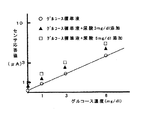
しかしながら、糖尿病の有無あるいはその程度を唾液糖で判断するには0.5〜6.0mg/dlの検出が必要である。しかし、特許文献2の発明では前記唾液糖を正確に測定できない。その理由は、唾液中には尿酸が血液中とほぼ同等量の濃度で存在し、電極反応により酸化電流を発生する。そのため唾液糖を検出のため電圧印加を行なうと、尿酸の酸化電流も唾液糖検知の電流に加算されてしまい、唾液糖を定量できないといった問題が生じる。図4に従来センサで所定濃度のグルコース標準液を測定した場合と同グルコース標準液に尿酸を3mg/dlおよび5mg/dl添加したサンプル液で測定したデータを示すが、尿酸を添加した場合は尿酸の濃度に応じて検出電流が高くなり、適正なグルコース量を検知できない。
【0007】
本発明は、前記従来の課題を解決するもので、唾液中の尿酸による影響を除去し、正確な唾液糖を測定できるバイオセンサを提供することを目的とする。
【0008】
【課題を解決するための手段】
上記従来の課題を解決するために、本発明の唾液糖バイオセンサは、電気絶縁性基板と、前記基板上に形成された作用極、検知極、対極に追加して第4の電極を唾液供給経路上であって試薬層と唾液供給口の間に対極とともに配置したものである。
【0009】
これによって、試料吸引口から唾液が試薬層に到達するまでの間に唾液供給経路下に配置した第4の電極と対極間に電圧印加することで唾液中の尿酸を酸化処理し、尿酸の影響がない唾液を試薬上で反応させることができる。
【0010】
【発明の実施の形態】
請求項1に記載の発明は、電気絶縁性基板と、前記基板上に形成され、酵素反応を行なう作用極と唾液の供給を検知しかつ酵素反応により生じる電流値を検出する検知極および妨害物質を酸化するための第4の電極と対極とからなる電極系と、前記作用極と検知極上に設けられた試薬層と、前記基板との間に唾液供給経路と唾液供給口を形成するカバー部材からなり、前記唾液供給経路上であって前記試薬層と前記唾液供給口との間に前記第4の電極と前記対極が形成されることにより、吸引した唾液が試薬層に達するまでに酸化処理ができる構成とすることができ、唾液糖を定量できるバイオセンサを提供するものである。
【0011】
請求項2に記載の発明は、請求項1に記載の唾液糖バイオセンサにおいて試薬層が少なくとも酸化還元酵素と電子伝達体を含有することにより、酸化還元酵素が唾液糖と反応し、発生した電子を電子伝達体が測定極に伝達することでグルコース濃度を検出することができる。
【0012】
請求項1に記載の唾液糖バイオセンサにおいて、前記第4の電極と前記対極と間に第1の電圧を加えた後、前記唾液供給口から唾液を供給し、前記作用極と前記検知極との間の抵抗が変化した時に前記第1の電圧の印加を停止し、前記作用極と前記検知極との間に第2の電圧を加えて前記作用極と前記検知極間に流れる電流を測定して糖量を決定することを特徴とする唾液糖の測定方法であり、唾液が試薬層へ到達することによって生じる作用極と検知極との間の抵抗変化を検知した段階で対極と第4の電極との間の電圧印加を解除して作用極と検知極間に電圧印加による作用極と検知極間に流れる電流を測定して糖量を決定することにより、唾液糖の正確な測定ができる。
【0013】
請求項4に記載の発明は、電気絶縁性基板と、前記基板上に形成された作用極、対極、検知極を有する電極系と、前記作用極と対極および検知極上に設けられた少なくとも酸化還元酵素と電子伝達体を含有する試薬層と、前記基板との間に唾液供給経路を形成するカバー部材からなるバイオセンサにおいて、カバー部材に尿酸に対して吸着性を有する材料を塗布することにより、唾液中の尿酸を吸着させ、試薬層で唾液糖の酸化反応のみの電流値を測定することができる。
【0014】
(実施の形態1)
以下本発明の実施の形態について図面を参照しながら説明する。図1は、本発明の一実施の形態における唾液用バイオセンサの分解斜視図を示すものである。ポリエチレンテレフタレートからなる絶縁基板1上に、スパッタリング蒸着により前記絶縁基板の表面全面に約10nmの厚みのパラジウム薄膜を形成した後、YAGレーザにより、前記薄膜上に作用極2、対極3、検知極4および第4の電極5に電極を分割形成した。検知極4は、検体量の導入を検知するための電極として機能するだけでなく、参照電極あるいは対極の一部として用いることも可能である。
【0015】
なお、好適な上記絶縁性基板1の材料としては、ポリエチレンテレフタレート、ポリカーボネート、ポリイミドなどがある。また、各電極を構成する電気伝導性物質としては、金、白金、パラジウムなどの貴金属やカーボンなどの単体材料、あるいは、カーボンペーストや貴金属ペーストなどの複合材料があげられる。
【0016】
なお、金、白金、パラジウムなどの貴金属やカーボンなどの単体材料は、スパッタリング蒸着法などで、またカーボンペーストや貴金属ペーストなどの複合材料はスクリーン印刷法などを用いて容易に電気伝導性層を絶縁性基板1に形成することができる。
【0017】
また、各電極の形成においては、上述したスパッタリング蒸着法やスクリーン印刷法などにより絶縁性基板1の全面、もしくは一部に前記電気伝導性層を形成した後、レーザなどを用いてスリットを設けることにより電極を分割形成することができる。また、あらかじめ電極パターンの形成された印刷版やマスク版を用いたスクリーン印刷法やスパッタリング蒸着法などでも同様に電極を形成することが可能である。
【0018】
このようにして形成された電極上には、試薬層6となる部分に酵素(グルコースオキシターゼ)、電子伝達体(例えばフェリシアン化カリウムなど)および親水性高分子(例えばカルボキシメチルセルロースなど)を含んだ水溶液を前記作用極2を中心にして対極3ならびに検知極4の一部を覆うように円状に滴下し、乾燥させることで試薬層6を形成した。
【0019】
さらにその上にポリエチレンテレフタレートからなる切り欠け部8を有するスペーサ7を貼り付け、その上に空気孔10を有するポリエチレンテレフタレートのカバー9を貼り合わせる。カバー9には、尿酸に対して吸着性のある非水溶性樹脂として(キトサンを含有)を唾液と接する部分に塗布したものを使用した。以上の構成により、唾液が導かれる毛細管となるキャビティが形成された4電極方式の唾液糖バイオセンサを作製した。本実施例では吸着剤に、キトサンを含有する非水溶性樹脂を用いたが、尿酸を吸着できる非水溶性樹脂で有れば、これに限る物ではない。
【0020】
以下に本発明の唾液糖バイオセンサについて、その操作方法を説明する。まず作製したセンサを測定装置に装着し、その際に自動もしくは手動にて作用極と第4の電極間に電圧を印加する。電圧印加の状態で唾液を試料吸引口より吸引させ、試料液が毛細管現象によりキャビティ内に充填される。唾液が試薬層まで到達し、検知極が抵抗変化を認識した段階で前記電圧印加を解除する。その後所定の時間、酵素反応を促進した後、唾液糖が酵素とフェリシアン化カリウムと反応して生成されるフェロシアン化カリウムを作用極と検知極間に0.5Vの電圧を印加することで、電流値を測定する。
【0021】
図2に本発明の唾液糖バイオセンサと従来の血糖センサによる測定データを示す。グルコース標準液(糖濃度0、1、3、6mg/dl)と前述グルコース標準液に尿酸を3mg/dlおよび5mg/dl添加したサンプル液について測定したところ本発明の唾液糖バイオセンサでは尿酸濃度に関係なくグルコース標準液と同じ電流値を測定することができた。
【0022】
【発明の効果】
以上のように請求項1、2、3、4に記載の発明によれば、唾液供給経路上であって試薬層と唾液供給口との間に形成した第4の電極と対極間への電圧印加と尿酸に対して吸着性を有する材料を塗布したカバー材を使うことで唾液中の尿酸を完全に除去することができるので、従来不可能であった唾液に含まれる微量な糖を高精度に検出することができる。
【図面の簡単な説明】
【図1】本発明の実施の形態1における唾液糖バイオセンサの分解斜視図
【図2】本発明の実施の形態1における唾液糖バイオセンサによるグルコース標準液とグルコース標準液に尿酸を添加したサンプル液の測定データを示す図
【図3】従来の血糖用バイオセンサの分解斜視図
【図4】従来のバイオセンサによるグルコース標準液とグルコース標準液に尿酸を添加したサンプル液の測定データを示す図
【符号の説明】
1 絶縁性基板
2 作用極
3 対極
4 検知極
5 第4の電極
6 試薬層
7 スペーサ
8 切り欠け部
9 カバー
10 空気孔
11 唾液供給口[0001]
TECHNICAL FIELD OF THE INVENTION
The present invention relates to a biosensor for analyzing a specific component in a liquid sample, and more particularly to a sensor for specifically detecting a sugar concentration in saliva.
[0002]
[Prior art]
A biosensor is a sensor that uses a biological material as a molecular identification element by utilizing the molecular recognition ability of a biological material such as a microorganism, an enzyme, and an antibody. That is, it utilizes a reaction that occurs when the immobilized biological material recognizes the target specific substance, consumption of oxygen by respiration of microorganisms, an enzymatic reaction, luminescence, and the like.
Among biosensors, enzyme sensors have been put into practical use. For example, enzyme sensors for glucose, lactic acid, cholesterol, and lactose are used in medical measurement and the food industry. The enzyme sensor reduces the electron acceptor by the electrons generated by the reaction between the substrate and the enzyme contained in the sample solution that is the specimen, and the measuring device electrochemically measures the reduction amount of the electron acceptor. The sample is quantitatively analyzed (see, for example, Patent Document 1).
[0003]
FIG. 3 is an exploded perspective view showing an example of a conventional blood glucose biosensor. In this method, a working electrode 2 made of an electrically conductive substance, a counter electrode 3 and a detection electrode 4 for detecting supply of saliva and detecting a current value generated by an enzyme reaction are formed on an insulating substrate 1 such as polyethylene terephthalate. On these electrodes, a reagent layer 6 containing an enzyme that specifically reacts with a specific component in the sample solution, an electron carrier, and a hydrophilic polymer is formed. Then, in order to form a cavity for detecting the current value generated by the reaction between the specific component in the sample solution and the reagent in the reagent layer 6 with the electrodes 2, 3, and 4, an elongated portion is formed on the electrode and the reagent layer. A spacer 7 having a cutout 8 and a cover 9 having an air hole 10 are bonded on an insulating substrate. In the biosensor having such a configuration, the sample liquid is supplied into the cavity from the saliva suction port 11 of the cavity by capillary action, and is guided to a position where the electrode and the reagent layer are present. Then, a specific component in the sample liquid reacts with the reagent in the reagent layer to generate an electric current, and the generated electric current is read by an external measuring device, whereby a quantitative analysis of the sample is performed.
[0004]
A simple type of blood glucose sensor used for the purpose of screening for diabetes measures a small amount of blood by measuring the blood glucose level by piercing the fingertip with the attached needle, but this method is painful due to bleeding from the fingertip. However, it is a device that can damage the skin due to many pokes and is difficult to handle for elderly people (particularly those who have diminished vision due to diabetes). Therefore, as a non-invasive sensor that can measure accurately and painlessly, a sensor that measures sugar concentration in saliva using saliva as a sample and can measure sugar concentration correlated with blood glucose level in a simple and short time is proposed. (See, for example, Patent Document 2).
[0005]
[Patent Document 1]
JP-A-2002-207022 (pages 2-4, FIG. 1)
[Patent Document 2]
JP-A-2002-122562 (page 2-4, FIG. 2)
[0006]
[Problems to be solved by the invention]
However, detection of 0.5 to 6.0 mg / dl is necessary for judging the presence or absence or the degree of diabetes based on salivary sugar. However, in the invention of Patent Document 2, the salivary sugar cannot be measured accurately. The reason is that uric acid is present in saliva at a concentration substantially equal to that in blood, and an oxidative current is generated by an electrode reaction. Therefore, when a voltage is applied to detect salivary sugar, the oxidation current of uric acid is also added to the current for detecting salivary sugar, which causes a problem that salivary sugar cannot be quantified. FIG. 4 shows data obtained when a glucose standard solution having a predetermined concentration was measured by a conventional sensor and data obtained by measuring a sample solution in which uric acid was added to the same glucose standard solution at 3 mg / dl and 5 mg / dl. The detection current increases in accordance with the concentration of, and an appropriate amount of glucose cannot be detected.
[0007]
An object of the present invention is to solve the above-mentioned conventional problems, and an object of the present invention is to provide a biosensor capable of removing the influence of uric acid in saliva and accurately measuring salivary sugar.
[0008]
[Means for Solving the Problems]
In order to solve the above-mentioned conventional problems, the salivary glucose biosensor of the present invention comprises an electrically insulating substrate and a saliva supply electrode in addition to a working electrode, a detection electrode, and a counter electrode formed on the substrate. It is arranged on the path between the reagent layer and the saliva supply port together with the counter electrode.
[0009]
In this way, uric acid in saliva is oxidized by applying a voltage between the fourth electrode disposed under the saliva supply path and the counter electrode until the saliva reaches the reagent layer from the sample suction port, and the influence of uric acid The absence of saliva can be reacted on the reagent.
[0010]
BEST MODE FOR CARRYING OUT THE INVENTION
The invention according to claim 1 is an electric insulating substrate, a sensing electrode formed on the substrate, a sensing electrode for sensing the supply of saliva and a current value generated by the enzyme reaction, and an interfering substance. Member for forming a saliva supply path and a saliva supply port between the electrode system consisting of a fourth electrode for oxidizing the electrode, a counter electrode, a reagent layer provided on the working electrode and the detection electrode, and the substrate The fourth electrode and the counter electrode are formed between the reagent layer and the saliva supply port on the saliva supply path, so that the oxidized treatment is performed until the sucked saliva reaches the reagent layer. The present invention provides a biosensor capable of determining salivary sugar.
[0011]
According to a second aspect of the present invention, there is provided the saliva sugar biosensor according to the first aspect, wherein the reagent layer contains at least an oxidoreductase and an electron carrier, so that the oxidoreductase reacts with the salivary sugar to generate electrons. Is transmitted to the measurement electrode by the electron carrier, whereby the glucose concentration can be detected.
[0012]
The saliva sugar biosensor according to claim 1, wherein after applying a first voltage between the fourth electrode and the counter electrode, saliva is supplied from the saliva supply port, and the working electrode and the detection electrode are The application of the first voltage is stopped when the resistance changes during the measurement, and a second voltage is applied between the working electrode and the detection electrode to measure a current flowing between the working electrode and the detection electrode. A saliva sugar measuring method, wherein the resistance change between the working electrode and the detection electrode caused by saliva reaching the reagent layer is detected at the stage where the resistance change is detected. By removing the voltage application between the electrodes and measuring the current flowing between the working electrode and the sensing electrode by applying a voltage between the working electrode and the sensing electrode and determining the sugar amount, accurate measurement of salivary sugar can be achieved. it can.
[0013]
According to a fourth aspect of the present invention, there is provided an electrode system having an electrically insulating substrate, a working electrode, a counter electrode, and a detection electrode formed on the substrate, and at least oxidation-reduction provided on the working electrode, the counter electrode, and the detection electrode. A reagent layer containing an enzyme and an electron mediator, and a biosensor comprising a cover member forming a saliva supply path between the substrate, by applying a material having adsorbability to uric acid to the cover member, Uric acid in saliva is adsorbed, and the current value of only the oxidation reaction of salivary sugar can be measured in the reagent layer.
[0014]
(Embodiment 1)
Hereinafter, embodiments of the present invention will be described with reference to the drawings. FIG. 1 is an exploded perspective view of a saliva biosensor according to an embodiment of the present invention. After a palladium thin film having a thickness of about 10 nm is formed on the insulating substrate 1 made of polyethylene terephthalate over the entire surface of the insulating substrate by sputtering deposition, a working electrode 2, a counter electrode 3, and a detection electrode 4 are formed on the thin film by a YAG laser. And the fourth electrode 5 was divided into electrodes. The detection electrode 4 not only functions as an electrode for detecting the introduction of a sample amount, but can also be used as a reference electrode or a part of a counter electrode.
[0015]
Suitable materials for the insulating substrate 1 include polyethylene terephthalate, polycarbonate, and polyimide. In addition, examples of the electrically conductive substance constituting each electrode include a simple material such as a noble metal such as gold, platinum and palladium and carbon, and a composite material such as a carbon paste and a noble metal paste.
[0016]
Simple materials such as noble metals such as gold, platinum and palladium and carbon are easily insulated by a sputtering deposition method, and composite materials such as a carbon paste and a noble metal paste are easily insulated by a screen printing method or the like. Can be formed on the conductive substrate 1.
[0017]
In the formation of each electrode, after forming the electric conductive layer on the entire surface or a part of the insulating substrate 1 by the above-described sputtering deposition method or screen printing method, a slit is provided using a laser or the like. The electrode can be divided and formed. Further, the electrodes can be similarly formed by a screen printing method or a sputtering deposition method using a printing plate or a mask plate on which an electrode pattern is formed in advance.
[0018]
On the electrode thus formed, an aqueous solution containing an enzyme (glucose oxidase), an electron carrier (such as potassium ferricyanide) and a hydrophilic polymer (such as carboxymethylcellulose) in a portion to be the reagent layer 6 is provided. A reagent layer 6 was formed by dropping in a circular shape around the working electrode 2 so as to cover a part of the counter electrode 3 and a part of the detection electrode 4, followed by drying.
[0019]
Further, a spacer 7 having a cutout 8 made of polyethylene terephthalate is adhered thereon, and a polyethylene terephthalate cover 9 having an air hole 10 is adhered thereon. The cover 9 used was a non-water-soluble resin (containing chitosan) applied to a portion in contact with saliva as a non-water-soluble resin having an adsorptivity to uric acid. With the above configuration, a four-electrode type salivary sugar biosensor in which a cavity serving as a capillary through which saliva is introduced was formed. In the present embodiment, a water-insoluble resin containing chitosan is used as the adsorbent, but the water-insoluble resin capable of adsorbing uric acid is not limited thereto.
[0020]
Hereinafter, a method of operating the salivary glucose biosensor of the present invention will be described. First, the produced sensor is mounted on a measuring device, and at that time, a voltage is automatically or manually applied between the working electrode and the fourth electrode. Saliva is sucked from the sample suction port with the voltage applied, and the sample liquid is filled in the cavity by capillary action. When the saliva reaches the reagent layer and the detection electrode recognizes the change in resistance, the application of the voltage is released. After promoting the enzyme reaction for a predetermined time thereafter, the current value is increased by applying a voltage of 0.5 V between the working electrode and the detection electrode to the potassium ferrocyanide produced by the reaction of salivary sugar with the enzyme and potassium ferricyanide. Measure.
[0021]
FIG. 2 shows measurement data obtained by the salivary glucose biosensor of the present invention and a conventional blood glucose sensor. Measurements were made on a glucose standard solution (sugar concentration 0, 1, 3, 6 mg / dl) and on a sample solution in which uric acid was added to the glucose standard solution at 3 mg / dl and 5 mg / dl. Regardless, the same current value as that of the glucose standard solution could be measured.
[0022]
【The invention's effect】
As described above, according to the first, second, third, and fourth aspects, the voltage between the fourth electrode and the counter electrode formed between the reagent layer and the saliva supply port on the saliva supply path. By using a cover material coated with a material that absorbs uric acid when applied, uric acid in saliva can be completely removed, making it possible to accurately remove trace amounts of sugar in saliva, which was previously impossible. Can be detected.
[Brief description of the drawings]
FIG. 1 is an exploded perspective view of a salivary glucose biosensor according to Embodiment 1 of the present invention. FIG. 2 is a glucose standard solution and a sample obtained by adding uric acid to the glucose standard solution by the salivary glucose biosensor according to Embodiment 1 of the present invention. FIG. 3 is an exploded perspective view of a conventional biosensor for blood glucose. FIG. 4 is a view showing measurement data of a glucose standard solution and a sample solution obtained by adding uric acid to the glucose standard solution by the conventional biosensor. [Explanation of symbols]
DESCRIPTION OF SYMBOLS 1 Insulating substrate 2 Working electrode 3 Counter electrode 4 Detection electrode 5 Fourth electrode 6 Reagent layer 7 Spacer 8 Notch 9 Cover 10 Air hole 11 Saliva supply port