【0001】
【発明の属する技術分野】
本発明は、亜鉛含有水を供給する電気分解装置を備えた給湯装置に関するものである。
【0002】
【従来の技術】
一般に、殺菌作用を有する金属としては銀が知られており、銀を水へ溶解させる手段として、銀化合物の粉体をカートリッジに充填して、そのカートリッジに被処理水を通水して銀イオン含有水を得る方法が公開されている(例えば、特許文献1参照)。また、銀電極を陽極として電気分解により銀イオンを被処理水へ溶解させる方法が公開されている(例えば、特許文献2参照)。
【0003】
【特許文献1】
特開2002−113288号公報
【特許文献2】
特開2001−276484号公報
【0004】
【発明が解決しようとする課題】
しかしながら、上記特許文献1に開示されている銀化合物の粉体をカートリッジに充填する手法では、銀イオンの水への溶解速度が銀化合物粉体の表面積と通水量とに依存するので、溶出する銀イオン濃度が安定しないという課題を有する。つまり、カートリッジに充填されている銀化合物粉体の表面積は、使用時間の経過と共に減少していくので、カートリッジからの銀イオンの溶出量は使用時間の経過と共に減少することとなる。
【0005】
また、通水量が大きいほど銀イオンの溶出濃度は減少するので、通水量を安定化するための調整弁を設けるなどしなければ、安定した銀イオン溶出は実現しない。
【0006】
また、上記特許文献2に開示されている銀電極を陽極とする電気分解を用いる手法は、銀イオンの飽和溶解度が極めて小さいために、飽和溶解度を超えて陽極から溶出しようとする銀成分は、イオンの状態とはならずに電極表面で析出物として付着し、長期間使用するとその析出物が陽極と陰極を電気的に短絡させ、被処理水に電圧が印加されることなく回路がショートを起こすなどの不具合が生じるという課題を有していた。
【0007】
また、貴金属である銀が極めて高価であるので、上記公報に記載されている銀イオン溶出手段を家庭用の種々の装置へ搭載することはコスト上はなはだ困難である。
【0008】
本発明は上記課題に鑑み、殺菌性能を有し、かつ、殺菌剤としては比較的安価な亜鉛をイオン状態として安定して定量的に湯中へ溶解させる電気分解装置を備えた給湯装置を実現することを目的としている。
【0009】
【課題を解決するための手段】
上記の目的を達成するために本発明の給湯装置は、給水経路中または出湯経路中に電気分解装置を具備し、前記電気分解装置は、被処理水中に陽極と陰極を配置し、前記陽極は亜鉛または亜鉛を含有する金属からなることを特徴とするものである。
【0010】
本発明は、殺菌成分として亜鉛を用いているので、被処理水中の亜鉛イオン濃度が飽和溶解度(室温で約5〜10ppm)を越えてなお電気分解をし続けた場合でも、電極表面に亜鉛の析出物が付着することはない。つまり、被処理水が亜鉛イオンの飽和溶解度に達した後もなお電気分解を続けた場合、電極表面からはスラリー状の水酸化亜鉛が発生すると同時に電極から分離するので、銀陽極を用いる従来手法の様に陽極と陰極が短絡を起こすと言う危険性が無い。
【0011】
また、本発明では亜鉛を被処理水に溶解させる手法として電気分解を用いているので、通水する水量に応じて印加電圧を調整するなどの手段を併用すれば、被処理水へ溶解する亜鉛量が比較的安定化するので、銀化合物の粉体をカートリッジに充填する従来手法の様に溶出イオン量が経時的に減少したり通水量に応じて変化する等の不具合を解決することができる。
【0012】
また、殺菌剤としては比較的安価な亜鉛を用いるために、給湯装置のコストを勘案した場合、コスト上その実現が容易である。
【0013】
【発明の実施の形態】
本発明の請求項1に記載の発明は、水を加熱する湯沸かし部と、前記湯沸かし部に水道水を供給する給水経路と、前記湯沸かし部で沸いた湯を外部へ導く出湯経路と、前記給水経路中または前記出湯経路中に設けた電気分解装置とを具備し、前記電気分解装置は、被処理水中に陽極と陰極を配置し、前記陽極は亜鉛または亜鉛を含有する金属からなることを特徴とするものであり、殺菌成分として亜鉛を用いているので、被処理水中の亜鉛イオン濃度が飽和溶解度(室温で約7ppm)を越えてなお電気分解をし続けた場合でも、電極表面に亜鉛の析出物が付着することはなく、被処理水が亜鉛イオンの飽和溶解度に達した後もなお電気分解をし続けた場合、電極表面からはスラリー状の水酸化亜鉛が発生すると同時に電極から分離するので、電極表面の析出物成長による陽極と陰極の短絡発生と言う危険性が無い。
【0014】
請求項2に記載の発明は、上記請求項1に記載の発明において、陽極は銀を含有する亜鉛合金からなることを特徴とするものであり、陽極が銀を含有する亜鉛合金であるので、被処理水中の銀イオン濃度が銀イオンの飽和溶解度を超えた後もさらに電気分解し続けた場合、銀は電極表面から溶出する水酸化亜鉛中に混入した状態で溶出し、速やかに水酸化亜鉛と共に電極から分離するので、銀が析出物として電極表面に付着することが無く、銀の析出物成長による陽極と陰極の短絡を起こすことなく銀イオンを被処理水中に溶出させ続けることができる。
【0015】
請求項3に記載の発明は、上記請求項1または2に記載の発明において、陽極から溶出する水酸化亜鉛を貯蔵し、被処理水と貯蔵された水酸化亜鉛を混合することにより亜鉛イオンを含有する亜鉛含有水を供給することを特徴とするものであり、亜鉛を高濃度な水酸化亜鉛の状態で貯蔵し、貯蔵された水酸化亜鉛を必要時に被処理水と混合して亜鉛イオン含有水を得ることができるので、あらかじめ水酸化亜鉛を貯蔵することにより大量の被処理水に亜鉛イオンを含有させることができる。
【0016】
請求項4に記載の発明は、上記請求項1〜3に記載の発明において、陰極から発生する水素ガスの排出経路中に水酸化亜鉛の貯蔵槽を設けたことを特徴とするものであり、陽極から発生する水酸化亜鉛と陰極から発生する水素ガスとを混合するように排出すれば、水素ガスの浮力により水酸化亜鉛は直ちに電極から分離し、また、水素ガス排出経路中に水酸化亜鉛の貯蔵槽を設ければ効率良く水酸化亜鉛を回収し貯蔵することができる。
【0017】
請求項5に記載の発明は、上記請求項1〜4に記載の発明において、亜鉛含有水中に含有する亜鉛イオンの濃度が0.5ppm以上であることを特徴とするものであり、殺菌水として機能する有効亜鉛イオン濃度を評価したところ、おおよそ0.5ppm以上で真菌、細菌の制菌能力、また、1ppm以上で強力な殺菌能力が確認できた。したがって、本発明の亜鉛含有水を殺菌水として用いる場合、亜鉛濃度は0.5ppm以上で用いる必要が有り、殺菌のためには1ppm以上であることが好ましい。
【0018】
請求項6に記載の発明は、上記請求項1〜5に記載の発明において、陽極及び陰極は略平行に対向して配置された平板からなり、前記陽極と前記陰極は近接する方向に付勢され、かつ、前記陽極と前記陰極間が一定距離以上縮まらないように規制したことを特徴とするものであり、陽極と陰極間に両者が近接する方向に力が加えられているので、連続して電気分解を行った場合でも、陽極の腐食による陽極と陰極間距離の増大が生じることないので、仮に同一電圧を陽極と陰極間に印加し続けても電解電流値は低下することがなく、長期間にわたり安定した亜鉛の供給が可能となる。また、陽極と陰極間距離が一定距離以上には縮まない構成を取っているので、陽極と陰極間での電気的短絡が生じることが無い。
【0019】
請求項7に記載の発明は、上記請求項6に記載の発明において、陽極を陰極側へ押圧するバネを有し、前記陽極と前記陰極の間にスペーサを設けたことを特徴とするものであり、陽極と陰極間距離が一定距離以上縮まないために、特に陽極と陰極間にスペーサを設けてなるので、そのスペーサで確実に本電気分解装置で実現する最小の電極間距離を設定できるために、その最小の電極間距離での電解特性(電圧−電流特性)をあらかじめ把握しておけば、陽極の腐食摩耗などの情報を電圧値または電流値から得ることができる。
【0020】
請求項8に記載の発明は、上記請求項1〜5に記載の発明において、陽極と陰極間の距離と、陰極に面する陽極の面積との比は、前記陽極が電気分解によって腐食しても略一定値となるようにしたことを特徴とするものであり、電極間距離と陽極面積との比が一定に保たれる構成を採るために、電気分解を連続して行い陽極が腐食摩耗して電極間距離が増大した場合でも、電極間距離増大に伴う電解抵抗の増加分が、陽極面積が増大することにより相殺されるので、連続運転時にも電気分解が安定して行えることとなる。
【0021】
また、連続運転時に電解抵抗がほとんど変化しないので、電気分解へのエネルギー供給手段として比較的安価な定電圧電源を用いても安定した電気分解が実現することとなるので、給湯装置及び電気分解装置の低コスト化が実現する。
【0022】
請求項9に記載の発明は、上記請求項8に記載の発明において、陽極は円筒もしくは円筒の一部の形を成し、陰極は前記円筒もしくは円筒の一部の中心軸を貫通するように配置したことを特徴とするものであり、陽極を円筒状もしくは円筒の一部形状として、陰極を陽極が形成する円筒の中心軸に配置する構成により、電極間距離と陽極面積との比を一定に保つものであるために、特殊な部材を他に用いることなく安定した電気分解が比較的安価な定電圧電源で実現することとなる。
【0023】
【実施例】
以下、本発明の実施例について、図面を用いて詳細に説明する。
【0024】
(実施例1)
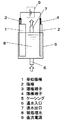
図1は本発明の給湯装置の電気分解装置の構成断面図を示したもので、1は亜鉛陽極、2は陰極であり、亜鉛陽極1としては市販のインゴッド状亜鉛(亜鉛純度99.9%)を長さ、幅各5cm、厚み5mmに切削加工したものを用い、陰極としては厚み1mmの市販のアルミニウム基材を長さ、幅各5cmに切断したものを用いた。3は陽極端子、4は陰極端子であり、亜鉛陽極1、陰極2へ電源回路を接続するために便宜上設けたものである。
【0025】
5は亜鉛陽極1、陰極2を内部に配するケーシングであり、本発明では加工の容易さを勘案して透明ポリカーボネート樹脂で作成した。ケーシング5の下部には通水入口6、上部には通水出口7をそれぞれ備え、被処理水が図中の矢印に従って通水入口6から供給され、電気分解により亜鉛を含有した被処理水8が通水出口7から排出される構成とした。9は電気分解を起こすための直流電源であり、その正電圧側は陽極端子3に、陰極側は陰極端子4に接続されている。亜鉛陽極1と陰極2は、電極間距離が4cmとなるよう平行に配置した。
【0026】
以下、実験条件の詳細について述べる。実験には水道水を用い、図示しない調整弁によって水道水を通水入口6へ通水量5L/minで供給した。通水出口7から排出される被処理水8を適宜ガラスビーカーで採取し、イオンクロマトグラフを用いて含有する金属イオンを定量分析した。
【0027】
直流電源9によって亜鉛陽極1と陰極2間に7Vの電圧を印加して電気分解を行った。その際、約0.8Aの電流が流れたので、5.6Wの電力を投入したこととなった。
【0028】
通水出口7から排出される被処理水をガラスビーカーにて採取し、イオンクロマトグラフによって含有する金属イオンを定量分析したところ、亜鉛イオンが6.7ppm溶解していることが分かった。亜鉛イオンの飽和溶解度が約7ppmであることから、本実施例で得られた亜鉛含有水の亜鉛イオン濃度は、ほぼ飽和濃度にまで近づいていることが分かった。
【0029】
また、上記条件下にて50時間の連続通水、連続電気分解を行ったところ、亜鉛陽極1の表面には、わずかながら黒色の析出物の付着が観測されたが、析出物が成長することはなく、50時間にわたり安定した電気分解が行えることを確認した。
【0030】
この様に本実施例によれば、亜鉛を陽極とする電気分解装置により被処理水中へ亜鉛を溶解させるので、被処理水は飽和溶解度に近い亜鉛イオンを含有し、かつ、長時間の連続運転を行っても陽極表面での析出物成長は起こることはない。
【0031】
【発明の効果】
以上の様に本発明によれば、被処理水が亜鉛イオンの飽和溶解濃度に達した後に更に電気分解を続けても、亜鉛がスラリー状の水酸化物として電極から溶出するために陽極表面で析出物が成長することがなく、陽極と陰極間が短絡を起こさずに長時間安定した亜鉛溶出を実現することができる。
【図面の簡単な説明】
【図1】本発明の実施例1の給湯装置の電気分解装置の構成断面図
【符号の説明】
1 亜鉛陽極
2 陰極
3 陽極端子
4 陰極端子
5 ケーシング
6 通水入口
7 通水出口
8 被処理水
9 直流電源[0001]
TECHNICAL FIELD OF THE INVENTION
TECHNICAL FIELD The present invention relates to a water heater provided with an electrolyzer for supplying zinc-containing water.
[0002]
[Prior art]
In general, silver is known as a metal having a bactericidal action. As a means for dissolving silver in water, a silver compound powder is filled in a cartridge, and water to be treated is passed through the cartridge to form silver ions. A method for obtaining the contained water has been disclosed (for example, see Patent Document 1). In addition, a method has been disclosed in which silver ions are dissolved in water to be treated by electrolysis using a silver electrode as an anode (for example, see Patent Document 2).
[0003]
[Patent Document 1]
JP 2002-11288 A [Patent Document 2]
JP 2001-276484 A
[Problems to be solved by the invention]
However, in the method of filling the cartridge with the silver compound powder disclosed in Patent Document 1, elution occurs because the dissolution rate of silver ions in water depends on the surface area and the amount of water passing through the silver compound powder. There is a problem that the silver ion concentration is not stable. That is, since the surface area of the silver compound powder filled in the cartridge decreases with the elapse of use time, the amount of silver ion eluted from the cartridge decreases with the elapse of use time.
[0005]
Further, since the elution concentration of silver ions decreases as the water flow rate increases, stable silver ion elution cannot be realized unless a regulating valve for stabilizing the water flow rate is provided.
[0006]
Further, the method using electrolysis using a silver electrode as an anode disclosed in Patent Document 2 described above has a very small saturation solubility of silver ions. It does not become ionic and adheres as a deposit on the electrode surface, and when used for a long time, the deposit causes an electrical short circuit between the anode and cathode, causing a short circuit without applying voltage to the water to be treated. There was a problem that a malfunction such as raising occurs.
[0007]
In addition, since silver, which is a noble metal, is extremely expensive, it is extremely difficult to mount the silver ion eluting means described in the above-mentioned gazette on various household devices in terms of cost.
[0008]
The present invention has been made in view of the above problems, and has realized a hot water supply device having an electrolyzing device that has a sterilizing performance and stably dissolves relatively inexpensive zinc as a bactericide in an ionized state stably and quantitatively in hot water. It is intended to be.
[0009]
[Means for Solving the Problems]
In order to achieve the above object, the hot water supply device of the present invention includes an electrolyzer in a water supply path or a tapping path, and the electrolyzer arranges an anode and a cathode in the water to be treated, and the anode is It is characterized by being made of zinc or a metal containing zinc.
[0010]
In the present invention, since zinc is used as a bactericidal component, even if the concentration of zinc ions in the water to be treated exceeds the saturation solubility (about 5 to 10 ppm at room temperature) and the electrolysis is continued, the zinc surface on the electrode surface is not affected. No precipitate adheres. In other words, if the electrolysis continues even after the water to be treated reaches the saturation solubility of zinc ions, slurry-like zinc hydroxide is generated from the electrode surface and separated from the electrode at the same time. As described above, there is no danger that the anode and the cathode cause a short circuit.
[0011]
Further, in the present invention, since electrolysis is used as a method of dissolving zinc in the water to be treated, if means such as adjusting the applied voltage in accordance with the amount of water passing through is used in combination, the zinc dissolved in the water to be treated is used. Since the amount is relatively stabilized, it is possible to solve problems such as a decrease in the amount of eluted ions with time or a change in accordance with the amount of water passing, as in the conventional method of filling a cartridge with a silver compound powder. .
[0012]
In addition, since relatively inexpensive zinc is used as a disinfectant, the cost can be easily realized in consideration of the cost of the hot water supply device.
[0013]
BEST MODE FOR CARRYING OUT THE INVENTION
The invention according to claim 1 of the present invention provides a water heater that heats water, a water supply path that supplies tap water to the water heater, a hot water supply path that guides the hot water boiled in the water heater to the outside, and the water supply. An electrolyzer provided in a path or in the tapping path, wherein the electrolyzer arranges an anode and a cathode in the water to be treated, and the anode is made of zinc or a metal containing zinc. Since zinc is used as a bactericidal component, even if the concentration of zinc ions in the water to be treated exceeds the saturation solubility (about 7 ppm at room temperature) and the electrolysis is continued, the zinc surface of the electrode is treated with zinc. If the precipitate does not adhere and the electrolysis continues even after the water to be treated reaches the saturation solubility of zinc ions, slurry-like zinc hydroxide is generated from the electrode surface and separated from the electrode at the same time. Because There is no risk to say that short circuit the anode and the cathode by deposit growth of the electrode surface.
[0014]
The invention according to claim 2 is the invention according to claim 1, wherein the anode is made of a zinc alloy containing silver, and the anode is a zinc alloy containing silver. If the electrolysis continues even after the silver ion concentration in the water to be treated exceeds the saturation solubility of silver ions, the silver is eluted in a state of being mixed into the zinc hydroxide eluted from the electrode surface, and the zinc hydroxide is rapidly dissolved. At the same time, the silver ion is separated from the electrode, so that silver does not adhere to the electrode surface as a precipitate, and silver ions can be continuously eluted into the water to be treated without causing a short circuit between the anode and the cathode due to the growth of the silver precipitate.
[0015]
According to a third aspect of the present invention, in the first or second aspect of the invention, zinc ions eluted from the anode are stored, and zinc ions are formed by mixing the water to be treated with the stored zinc hydroxide. It is characterized by supplying zinc-containing water that contains zinc ions in the form of high-concentration zinc hydroxide, and mixing the stored zinc hydroxide with the water to be treated when necessary to contain zinc ions. Since water can be obtained, a large amount of water to be treated can contain zinc ions by storing zinc hydroxide in advance.
[0016]
The invention according to claim 4 is the invention according to claims 1 to 3, wherein a storage tank for zinc hydroxide is provided in a discharge path of hydrogen gas generated from the cathode, If zinc hydroxide generated from the anode and hydrogen gas generated from the cathode are discharged so as to be mixed, zinc hydroxide is immediately separated from the electrode by the buoyancy of the hydrogen gas, and zinc hydroxide is discharged into the hydrogen gas discharge path. If the storage tank is provided, zinc hydroxide can be efficiently recovered and stored.
[0017]
The invention according to claim 5 is the invention according to claims 1 to 4, wherein the concentration of zinc ions contained in the zinc-containing water is 0.5 ppm or more, and When the functional effective zinc ion concentration was evaluated, it was confirmed that the fungi and bacteria were controlled at about 0.5 ppm or more, and the strong sterilization ability was confirmed at 1 ppm or more. Therefore, when the zinc-containing water of the present invention is used as sterilizing water, the zinc concentration must be used at 0.5 ppm or more, and is preferably 1 ppm or more for sterilization.
[0018]
According to a sixth aspect of the present invention, in the first to fifth aspects of the present invention, the anode and the cathode are formed of flat plates disposed to face each other substantially in parallel, and the anode and the cathode are urged in the approaching direction. And, it is characterized in that the distance between the anode and the cathode is regulated so as not to shrink more than a certain distance, and since a force is applied between the anode and the cathode in a direction in which the two approach each other, continuous Even when electrolysis is performed, the distance between the anode and the cathode due to corrosion of the anode does not increase, so even if the same voltage is continuously applied between the anode and the cathode, the electrolytic current value does not decrease, Stable supply of zinc over a long period of time becomes possible. In addition, since the distance between the anode and the cathode is not reduced beyond a certain distance, an electric short circuit between the anode and the cathode does not occur.
[0019]
The invention according to claim 7 is the invention according to claim 6, wherein a spring for pressing the anode to the cathode side is provided, and a spacer is provided between the anode and the cathode. Yes, since the distance between the anode and the cathode does not shrink more than a certain distance, especially since a spacer is provided between the anode and the cathode, the spacer can reliably set the minimum distance between the electrodes realized by the present electrolyzer. If the electrolytic characteristics (voltage-current characteristics) at the minimum inter-electrode distance are grasped in advance, information such as the corrosion and wear of the anode can be obtained from the voltage value or the current value.
[0020]
The invention according to claim 8 is the invention according to claims 1 to 5, wherein the ratio between the distance between the anode and the cathode and the area of the anode facing the cathode is such that the anode is corroded by electrolysis. The electrode is also made to have a substantially constant value, and in order to adopt a configuration in which the ratio between the distance between the electrodes and the anode area is kept constant, electrolysis is continuously performed and the anode is corroded and worn. Even if the distance between the electrodes increases, the increase in the electrolytic resistance due to the increase in the distance between the electrodes is offset by the increase in the anode area, so that the electrolysis can be stably performed even during continuous operation. .
[0021]
In addition, since the electrolytic resistance hardly changes during continuous operation, stable electrolysis can be realized even if a relatively inexpensive constant voltage power supply is used as an energy supply means for electrolysis. Cost reduction is realized.
[0022]
According to a ninth aspect of the present invention, in the invention according to the eighth aspect, the anode forms a cylinder or a part of a cylinder, and the cathode passes through a central axis of the cylinder or a part of the cylinder. The arrangement is such that the anode has a cylindrical shape or a partial shape of the cylinder, and the cathode is arranged on the central axis of the cylinder formed by the anode, so that the ratio between the distance between the electrodes and the anode area is constant. Therefore, stable electrolysis can be realized with a relatively inexpensive constant voltage power supply without using any special member.
[0023]
【Example】
Hereinafter, embodiments of the present invention will be described in detail with reference to the drawings.
[0024]
(Example 1)
FIG. 1 shows a sectional view of the configuration of an electrolyzer of a water heater according to the present invention, wherein 1 is a zinc anode, 2 is a cathode, and a zinc anode 1 is a commercially available ingot-like zinc (zinc purity 99.9%). ) Was cut to a length and width of 5 cm and a thickness of 5 mm, and a cathode was a commercially available aluminum substrate having a thickness of 1 mm cut to a length and width of 5 cm. Reference numeral 3 denotes an anode terminal, and 4 denotes a cathode terminal, which are provided for convenience to connect a power supply circuit to the zinc anode 1 and the cathode 2.
[0025]
Reference numeral 5 denotes a casing in which the zinc anode 1 and the cathode 2 are disposed. In the present invention, the casing 5 is made of a transparent polycarbonate resin in consideration of ease of processing. A water inlet 6 is provided at a lower portion of the casing 5 and a water outlet 7 is provided at an upper portion. The water to be treated is supplied from the water inlet 6 according to the arrow in the figure, and the water 8 containing zinc by electrolysis is provided. Is discharged from the water outlet 7. Reference numeral 9 denotes a DC power supply for causing electrolysis, the positive voltage side of which is connected to the anode terminal 3 and the cathode side of which is connected to the cathode terminal 4. The zinc anode 1 and the cathode 2 were arranged in parallel so that the distance between the electrodes was 4 cm.
[0026]
Hereinafter, details of the experimental conditions will be described. Tap water was used for the experiment, and tap water was supplied to the water inlet 6 at a flow rate of 5 L / min by a regulating valve (not shown). The water 8 to be treated discharged from the water passage outlet 7 was appropriately collected in a glass beaker, and the contained metal ions were quantitatively analyzed using an ion chromatograph.
[0027]
Electrolysis was performed by applying a voltage of 7 V between the zinc anode 1 and the cathode 2 by the DC power supply 9. At that time, a current of about 0.8 A flowed, so that a power of 5.6 W was supplied.
[0028]
The water to be treated discharged from the water passage outlet 7 was collected in a glass beaker, and the contained metal ions were quantitatively analyzed by ion chromatography. As a result, it was found that 6.7 ppm of zinc ions were dissolved. Since the saturation solubility of the zinc ion was about 7 ppm, it was found that the zinc ion concentration of the zinc-containing water obtained in this example was almost approaching the saturation concentration.
[0029]
In addition, when continuous water flow and continuous electrolysis were performed for 50 hours under the above conditions, a slight deposit of black precipitate was observed on the surface of the zinc anode 1, but the precipitate grew. No, it was confirmed that stable electrolysis could be performed for 50 hours.
[0030]
As described above, according to the present embodiment, zinc is dissolved in the water to be treated by the electrolyzer using zinc as an anode, so that the water to be treated contains zinc ions having a near saturation solubility, and the continuous operation for a long time. Does not cause precipitate growth on the anode surface.
[0031]
【The invention's effect】
As described above, according to the present invention, even if the electrolysis is continued after the water to be treated reaches the saturated dissolution concentration of zinc ions, zinc is eluted from the electrode as a slurry-like hydroxide, so that the zinc is dissolved on the anode surface. Precipitates do not grow, and stable zinc elution can be realized for a long time without causing a short circuit between the anode and the cathode.
[Brief description of the drawings]
FIG. 1 is a cross-sectional view of a configuration of an electrolyzer of a water heater according to a first embodiment of the present invention.
DESCRIPTION OF SYMBOLS 1 Zinc anode 2 Cathode 3 Anode terminal 4 Cathode terminal 5 Casing 6 Water inlet 7 Water outlet 8 Treated water 9 DC power supply