JP2004196673A - Method for producing carotenoid-containing powder - Google Patents
Method for producing carotenoid-containing powder Download PDFInfo
- Publication number
- JP2004196673A JP2004196673A JP2002364082A JP2002364082A JP2004196673A JP 2004196673 A JP2004196673 A JP 2004196673A JP 2002364082 A JP2002364082 A JP 2002364082A JP 2002364082 A JP2002364082 A JP 2002364082A JP 2004196673 A JP2004196673 A JP 2004196673A
- Authority
- JP
- Japan
- Prior art keywords
- carotenoid
- containing powder
- antioxidant
- mixed
- coating agent
- Prior art date
- Legal status (The legal status is an assumption and is not a legal conclusion. Google has not performed a legal analysis and makes no representation as to the accuracy of the status listed.)
- Granted
Links
- 235000021466 carotenoid Nutrition 0.000 title claims abstract description 96
- 150000001747 carotenoids Chemical class 0.000 title claims abstract description 96
- 239000000843 powder Substances 0.000 title claims abstract description 76
- 238000004519 manufacturing process Methods 0.000 title claims abstract description 34
- 239000011248 coating agent Substances 0.000 claims abstract description 48
- 108090000623 proteins and genes Proteins 0.000 claims abstract description 38
- 102000004169 proteins and genes Human genes 0.000 claims abstract description 38
- 238000002156 mixing Methods 0.000 claims abstract description 21
- 238000001035 drying Methods 0.000 claims abstract description 18
- 150000001720 carbohydrates Chemical class 0.000 claims abstract description 12
- 239000000126 substance Substances 0.000 claims abstract description 9
- 239000003921 oil Substances 0.000 claims description 67
- 239000003963 antioxidant agent Substances 0.000 claims description 52
- 235000006708 antioxidants Nutrition 0.000 claims description 52
- 230000003078 antioxidant effect Effects 0.000 claims description 48
- 235000018102 proteins Nutrition 0.000 claims description 37
- GVJHHUAWPYXKBD-UHFFFAOYSA-N (±)-α-Tocopherol Chemical compound OC1=C(C)C(C)=C2OC(CCCC(C)CCCC(C)CCCC(C)C)(C)CCC2=C1C GVJHHUAWPYXKBD-UHFFFAOYSA-N 0.000 claims description 30
- 239000000839 emulsion Substances 0.000 claims description 22
- 239000003925 fat Substances 0.000 claims description 22
- 238000011049 filling Methods 0.000 claims description 20
- 239000007864 aqueous solution Substances 0.000 claims description 19
- 229930003427 Vitamin E Natural products 0.000 claims description 15
- 239000003995 emulsifying agent Substances 0.000 claims description 15
- WIGCFUFOHFEKBI-UHFFFAOYSA-N gamma-tocopherol Natural products CC(C)CCCC(C)CCCC(C)CCCC1CCC2C(C)C(O)C(C)C(C)C2O1 WIGCFUFOHFEKBI-UHFFFAOYSA-N 0.000 claims description 15
- 229940046009 vitamin E Drugs 0.000 claims description 15
- 235000019165 vitamin E Nutrition 0.000 claims description 15
- 239000011709 vitamin E Substances 0.000 claims description 15
- CIWBSHSKHKDKBQ-JLAZNSOCSA-N Ascorbic acid Natural products OC[C@H](O)[C@H]1OC(=O)C(O)=C1O CIWBSHSKHKDKBQ-JLAZNSOCSA-N 0.000 claims description 14
- 235000013871 bee wax Nutrition 0.000 claims description 11
- 239000012166 beeswax Substances 0.000 claims description 11
- 235000000072 L-ascorbyl-6-palmitate Nutrition 0.000 claims description 9
- 239000011786 L-ascorbyl-6-palmitate Substances 0.000 claims description 9
- QAQJMLQRFWZOBN-LAUBAEHRSA-N L-ascorbyl-6-palmitate Chemical compound CCCCCCCCCCCCCCCC(=O)OC[C@H](O)[C@H]1OC(=O)C(O)=C1O QAQJMLQRFWZOBN-LAUBAEHRSA-N 0.000 claims description 9
- 229920002494 Zein Polymers 0.000 claims description 9
- 239000005019 zein Substances 0.000 claims description 9
- 229940093612 zein Drugs 0.000 claims description 9
- 108010010803 Gelatin Proteins 0.000 claims description 8
- 239000005018 casein Substances 0.000 claims description 8
- BECPQYXYKAMYBN-UHFFFAOYSA-N casein, tech. Chemical compound NCCCCC(C(O)=O)N=C(O)C(CC(O)=O)N=C(O)C(CCC(O)=N)N=C(O)C(CC(C)C)N=C(O)C(CCC(O)=O)N=C(O)C(CC(O)=O)N=C(O)C(CCC(O)=O)N=C(O)C(C(C)O)N=C(O)C(CCC(O)=N)N=C(O)C(CCC(O)=N)N=C(O)C(CCC(O)=N)N=C(O)C(CCC(O)=O)N=C(O)C(CCC(O)=O)N=C(O)C(COP(O)(O)=O)N=C(O)C(CCC(O)=N)N=C(O)C(N)CC1=CC=CC=C1 BECPQYXYKAMYBN-UHFFFAOYSA-N 0.000 claims description 8
- 235000021240 caseins Nutrition 0.000 claims description 8
- 239000008273 gelatin Substances 0.000 claims description 8
- 229920000159 gelatin Polymers 0.000 claims description 8
- 235000019322 gelatine Nutrition 0.000 claims description 8
- 235000011852 gelatine desserts Nutrition 0.000 claims description 8
- 239000004375 Dextrin Substances 0.000 claims description 7
- 229920001353 Dextrin Polymers 0.000 claims description 7
- 235000019425 dextrin Nutrition 0.000 claims description 7
- 239000011259 mixed solution Substances 0.000 claims description 7
- ZZZCUOFIHGPKAK-UHFFFAOYSA-N D-erythro-ascorbic acid Natural products OCC1OC(=O)C(O)=C1O ZZZCUOFIHGPKAK-UHFFFAOYSA-N 0.000 claims description 6
- 229930003268 Vitamin C Natural products 0.000 claims description 6
- 239000004203 carnauba wax Substances 0.000 claims description 6
- 235000013869 carnauba wax Nutrition 0.000 claims description 6
- 239000004170 rice bran wax Substances 0.000 claims description 6
- 235000019384 rice bran wax Nutrition 0.000 claims description 6
- 229940088594 vitamin Drugs 0.000 claims description 6
- 229930003231 vitamin Natural products 0.000 claims description 6
- 235000013343 vitamin Nutrition 0.000 claims description 6
- 239000011782 vitamin Substances 0.000 claims description 6
- 235000019154 vitamin C Nutrition 0.000 claims description 6
- 239000011718 vitamin C Substances 0.000 claims description 6
- 150000003722 vitamin derivatives Chemical class 0.000 claims description 6
- 239000004386 Erythritol Substances 0.000 claims description 5
- UNXHWFMMPAWVPI-UHFFFAOYSA-N Erythritol Natural products OCC(O)C(O)CO UNXHWFMMPAWVPI-UHFFFAOYSA-N 0.000 claims description 5
- 235000019414 erythritol Nutrition 0.000 claims description 5
- 229940009714 erythritol Drugs 0.000 claims description 5
- UNXHWFMMPAWVPI-ZXZARUISSA-N erythritol Chemical compound OC[C@H](O)[C@H](O)CO UNXHWFMMPAWVPI-ZXZARUISSA-N 0.000 claims description 5
- 238000001291 vacuum drying Methods 0.000 claims description 5
- -1 vitamin C stearic acid ester Chemical class 0.000 claims description 5
- 239000010668 rosemary oil Substances 0.000 claims description 4
- 229940058206 rosemary oil Drugs 0.000 claims description 4
- CIWBSHSKHKDKBQ-DUZGATOHSA-N D-araboascorbic acid Natural products OC[C@@H](O)[C@H]1OC(=O)C(O)=C1O CIWBSHSKHKDKBQ-DUZGATOHSA-N 0.000 claims description 3
- 239000004373 Pullulan Substances 0.000 claims description 3
- 229920001218 Pullulan Polymers 0.000 claims description 3
- 239000004318 erythorbic acid Substances 0.000 claims description 3
- 235000010350 erythorbic acid Nutrition 0.000 claims description 3
- 229940026239 isoascorbic acid Drugs 0.000 claims description 3
- 235000019423 pullulan Nutrition 0.000 claims description 3
- 235000021355 Stearic acid Nutrition 0.000 claims description 2
- OQCDKBAXFALNLD-UHFFFAOYSA-N octadecanoic acid Natural products CCCCCCCC(C)CCCCCCCCC(O)=O OQCDKBAXFALNLD-UHFFFAOYSA-N 0.000 claims description 2
- 239000008117 stearic acid Substances 0.000 claims description 2
- 238000009777 vacuum freeze-drying Methods 0.000 claims description 2
- 230000003064 anti-oxidating effect Effects 0.000 abstract 1
- 239000011369 resultant mixture Substances 0.000 abstract 1
- JEBFVOLFMLUKLF-IFPLVEIFSA-N Astaxanthin Natural products CC(=C/C=C/C(=C/C=C/C1=C(C)C(=O)C(O)CC1(C)C)/C)C=CC=C(/C)C=CC=C(/C)C=CC2=C(C)C(=O)C(O)CC2(C)C JEBFVOLFMLUKLF-IFPLVEIFSA-N 0.000 description 46
- 235000013793 astaxanthin Nutrition 0.000 description 46
- 239000001168 astaxanthin Substances 0.000 description 46
- MQZIGYBFDRPAKN-ZWAPEEGVSA-N astaxanthin Chemical compound C([C@H](O)C(=O)C=1C)C(C)(C)C=1/C=C/C(/C)=C/C=C/C(/C)=C/C=C/C=C(C)C=CC=C(C)C=CC1=C(C)C(=O)[C@@H](O)CC1(C)C MQZIGYBFDRPAKN-ZWAPEEGVSA-N 0.000 description 46
- 229940022405 astaxanthin Drugs 0.000 description 46
- LFQSCWFLJHTTHZ-UHFFFAOYSA-N Ethanol Chemical compound CCO LFQSCWFLJHTTHZ-UHFFFAOYSA-N 0.000 description 28
- 239000000243 solution Substances 0.000 description 25
- CSCPPACGZOOCGX-UHFFFAOYSA-N Acetone Chemical compound CC(C)=O CSCPPACGZOOCGX-UHFFFAOYSA-N 0.000 description 16
- QVGXLLKOCUKJST-UHFFFAOYSA-N atomic oxygen Chemical compound [O] QVGXLLKOCUKJST-UHFFFAOYSA-N 0.000 description 11
- 239000001301 oxygen Substances 0.000 description 11
- 229910052760 oxygen Inorganic materials 0.000 description 11
- 238000000034 method Methods 0.000 description 9
- 239000011148 porous material Substances 0.000 description 8
- 108010055615 Zein Proteins 0.000 description 7
- 239000000203 mixture Substances 0.000 description 7
- 230000003647 oxidation Effects 0.000 description 7
- 238000007254 oxidation reaction Methods 0.000 description 7
- 239000002904 solvent Substances 0.000 description 7
- VLKZOEOYAKHREP-UHFFFAOYSA-N n-Hexane Chemical compound CCCCCC VLKZOEOYAKHREP-UHFFFAOYSA-N 0.000 description 6
- 239000000047 product Substances 0.000 description 6
- 238000012360 testing method Methods 0.000 description 6
- 108010076119 Caseins Proteins 0.000 description 5
- 230000014759 maintenance of location Effects 0.000 description 5
- 239000000463 material Substances 0.000 description 5
- XLYOFNOQVPJJNP-UHFFFAOYSA-N water Substances O XLYOFNOQVPJJNP-UHFFFAOYSA-N 0.000 description 5
- 238000000576 coating method Methods 0.000 description 4
- 238000001694 spray drying Methods 0.000 description 4
- PIGTXFOGKFOFTO-FVFWYJKVSA-N (2S,3S,4S,5R,6R)-6-[[(3S,4S,4aR,6aR,6bS,8R,8aR,12aS,14aR,14bR)-8a-carboxy-4-formyl-8-hydroxy-4,6a,6b,11,11,14b-hexamethyl-1,2,3,4a,5,6,7,8,9,10,12,12a,14,14a-tetradecahydropicen-3-yl]oxy]-3,4,5-trihydroxyoxane-2-carboxylic acid Chemical compound O([C@H]1CC[C@]2(C)[C@H]3CC=C4[C@@]([C@@]3(CC[C@H]2[C@@]1(C=O)C)C)(C)C[C@@H](O)[C@]1(CCC(C[C@H]14)(C)C)C(O)=O)[C@@H]1O[C@H](C(O)=O)[C@@H](O)[C@H](O)[C@H]1O PIGTXFOGKFOFTO-FVFWYJKVSA-N 0.000 description 3
- 229930006000 Sucrose Natural products 0.000 description 3
- 230000015572 biosynthetic process Effects 0.000 description 3
- 238000010586 diagram Methods 0.000 description 3
- 235000014113 dietary fatty acids Nutrition 0.000 description 3
- 230000000694 effects Effects 0.000 description 3
- 229930195729 fatty acid Natural products 0.000 description 3
- 239000000194 fatty acid Substances 0.000 description 3
- 238000010438 heat treatment Methods 0.000 description 3
- 239000005720 sucrose Substances 0.000 description 3
- 235000000346 sugar Nutrition 0.000 description 3
- 150000008163 sugars Chemical class 0.000 description 3
- CURLTUGMZLYLDI-UHFFFAOYSA-N Carbon dioxide Chemical compound O=C=O CURLTUGMZLYLDI-UHFFFAOYSA-N 0.000 description 2
- DGAQECJNVWCQMB-PUAWFVPOSA-M Ilexoside XXIX Chemical compound C[C@@H]1CC[C@@]2(CC[C@@]3(C(=CC[C@H]4[C@]3(CC[C@@H]5[C@@]4(CC[C@@H](C5(C)C)OS(=O)(=O)[O-])C)C)[C@@H]2[C@]1(C)O)C)C(=O)O[C@H]6[C@@H]([C@H]([C@@H]([C@H](O6)CO)O)O)O.[Na+] DGAQECJNVWCQMB-PUAWFVPOSA-M 0.000 description 2
- REFJWTPEDVJJIY-UHFFFAOYSA-N Quercetin Chemical compound C=1C(O)=CC(O)=C(C(C=2O)=O)C=1OC=2C1=CC=C(O)C(O)=C1 REFJWTPEDVJJIY-UHFFFAOYSA-N 0.000 description 2
- OENHQHLEOONYIE-UKMVMLAPSA-N all-trans beta-carotene Natural products CC=1CCCC(C)(C)C=1/C=C/C(/C)=C/C=C/C(/C)=C/C=C/C=C(C)C=CC=C(C)C=CC1=C(C)CCCC1(C)C OENHQHLEOONYIE-UKMVMLAPSA-N 0.000 description 2
- 235000013734 beta-carotene Nutrition 0.000 description 2
- 239000011648 beta-carotene Substances 0.000 description 2
- TUPZEYHYWIEDIH-WAIFQNFQSA-N beta-carotene Natural products CC(=C/C=C/C=C(C)/C=C/C=C(C)/C=C/C1=C(C)CCCC1(C)C)C=CC=C(/C)C=CC2=CCCCC2(C)C TUPZEYHYWIEDIH-WAIFQNFQSA-N 0.000 description 2
- 229960002747 betacarotene Drugs 0.000 description 2
- 230000003247 decreasing effect Effects 0.000 description 2
- 239000000284 extract Substances 0.000 description 2
- 239000007788 liquid Substances 0.000 description 2
- 229930014626 natural product Natural products 0.000 description 2
- 229910052708 sodium Inorganic materials 0.000 description 2
- 239000011734 sodium Substances 0.000 description 2
- 230000001988 toxicity Effects 0.000 description 2
- 231100000419 toxicity Toxicity 0.000 description 2
- OENHQHLEOONYIE-JLTXGRSLSA-N β-Carotene Chemical compound CC=1CCCC(C)(C)C=1\C=C\C(\C)=C\C=C\C(\C)=C\C=C\C=C(/C)\C=C\C=C(/C)\C=C\C1=C(C)CCCC1(C)C OENHQHLEOONYIE-JLTXGRSLSA-N 0.000 description 2
- PFTAWBLQPZVEMU-DZGCQCFKSA-N (+)-catechin Chemical compound C1([C@H]2OC3=CC(O)=CC(O)=C3C[C@@H]2O)=CC=C(O)C(O)=C1 PFTAWBLQPZVEMU-DZGCQCFKSA-N 0.000 description 1
- 241000239366 Euphausiacea Species 0.000 description 1
- 241000168525 Haematococcus Species 0.000 description 1
- 241001542817 Phaffia Species 0.000 description 1
- 241000238030 Procambarus clarkii Species 0.000 description 1
- ZVOLCUVKHLEPEV-UHFFFAOYSA-N Quercetagetin Natural products C1=C(O)C(O)=CC=C1C1=C(O)C(=O)C2=C(O)C(O)=C(O)C=C2O1 ZVOLCUVKHLEPEV-UHFFFAOYSA-N 0.000 description 1
- HWTZYBCRDDUBJY-UHFFFAOYSA-N Rhynchosin Natural products C1=C(O)C(O)=CC=C1C1=C(O)C(=O)C2=CC(O)=C(O)C=C2O1 HWTZYBCRDDUBJY-UHFFFAOYSA-N 0.000 description 1
- BUGBHKTXTAQXES-UHFFFAOYSA-N Selenium Chemical compound [Se] BUGBHKTXTAQXES-UHFFFAOYSA-N 0.000 description 1
- 239000004480 active ingredient Substances 0.000 description 1
- 102000011759 adducin Human genes 0.000 description 1
- 108010076723 adducin Proteins 0.000 description 1
- 230000032683 aging Effects 0.000 description 1
- 239000002775 capsule Substances 0.000 description 1
- 229910002092 carbon dioxide Inorganic materials 0.000 description 1
- 239000001569 carbon dioxide Substances 0.000 description 1
- 235000005487 catechin Nutrition 0.000 description 1
- ADRVNXBAWSRFAJ-UHFFFAOYSA-N catechin Natural products OC1Cc2cc(O)cc(O)c2OC1c3ccc(O)c(O)c3 ADRVNXBAWSRFAJ-UHFFFAOYSA-N 0.000 description 1
- 239000003795 chemical substances by application Substances 0.000 description 1
- 229950001002 cianidanol Drugs 0.000 description 1
- 238000000354 decomposition reaction Methods 0.000 description 1
- 201000010099 disease Diseases 0.000 description 1
- 208000037265 diseases, disorders, signs and symptoms Diseases 0.000 description 1
- 238000004945 emulsification Methods 0.000 description 1
- 238000005516 engineering process Methods 0.000 description 1
- 150000002148 esters Chemical class 0.000 description 1
- 238000004108 freeze drying Methods 0.000 description 1
- 239000007789 gas Substances 0.000 description 1
- 239000007902 hard capsule Substances 0.000 description 1
- MWDZOUNAPSSOEL-UHFFFAOYSA-N kaempferol Natural products OC1=C(C(=O)c2cc(O)cc(O)c2O1)c3ccc(O)cc3 MWDZOUNAPSSOEL-UHFFFAOYSA-N 0.000 description 1
- 238000004898 kneading Methods 0.000 description 1
- 235000012680 lutein Nutrition 0.000 description 1
- 239000001656 lutein Substances 0.000 description 1
- 229960005375 lutein Drugs 0.000 description 1
- ORAKUVXRZWMARG-WZLJTJAWSA-N lutein Natural products CC(=C/C=C/C=C(C)/C=C/C=C(C)/C=C/C1=C(C)CCCC1(C)C)C=CC=C(/C)C=CC2C(=CC(O)CC2(C)C)C ORAKUVXRZWMARG-WZLJTJAWSA-N 0.000 description 1
- KBPHJBAIARWVSC-RGZFRNHPSA-N lutein Chemical compound C([C@H](O)CC=1C)C(C)(C)C=1\C=C\C(\C)=C\C=C\C(\C)=C\C=C\C=C(/C)\C=C\C=C(/C)\C=C\[C@H]1C(C)=C[C@H](O)CC1(C)C KBPHJBAIARWVSC-RGZFRNHPSA-N 0.000 description 1
- 229940057059 monascus purpureus Drugs 0.000 description 1
- 238000000465 moulding Methods 0.000 description 1
- QIQXTHQIDYTFRH-UHFFFAOYSA-N octadecanoic acid Chemical compound CCCCCCCCCCCCCCCCCC(O)=O QIQXTHQIDYTFRH-UHFFFAOYSA-N 0.000 description 1
- 235000014593 oils and fats Nutrition 0.000 description 1
- 239000003960 organic solvent Substances 0.000 description 1
- 230000001590 oxidative effect Effects 0.000 description 1
- 238000004806 packaging method and process Methods 0.000 description 1
- 244000052769 pathogen Species 0.000 description 1
- 150000008442 polyphenolic compounds Chemical class 0.000 description 1
- 235000013824 polyphenols Nutrition 0.000 description 1
- 230000002265 prevention Effects 0.000 description 1
- 235000005875 quercetin Nutrition 0.000 description 1
- 229960001285 quercetin Drugs 0.000 description 1
- 239000013557 residual solvent Substances 0.000 description 1
- 238000007789 sealing Methods 0.000 description 1
- 229910052711 selenium Inorganic materials 0.000 description 1
- 239000011669 selenium Substances 0.000 description 1
- 230000035945 sensitivity Effects 0.000 description 1
- PPASLZSBLFJQEF-RXSVEWSESA-M sodium-L-ascorbate Chemical compound [Na+].OC[C@H](O)[C@H]1OC(=O)C(O)=C1[O-] PPASLZSBLFJQEF-RXSVEWSESA-M 0.000 description 1
- 239000007901 soft capsule Substances 0.000 description 1
- 238000007711 solidification Methods 0.000 description 1
- 230000008023 solidification Effects 0.000 description 1
- 238000013112 stability test Methods 0.000 description 1
- 239000013589 supplement Substances 0.000 description 1
- 238000010998 test method Methods 0.000 description 1
- KBPHJBAIARWVSC-XQIHNALSSA-N trans-lutein Natural products CC(=C/C=C/C=C(C)/C=C/C=C(C)/C=C/C1=C(C)CC(O)CC1(C)C)C=CC=C(/C)C=CC2C(=CC(O)CC2(C)C)C KBPHJBAIARWVSC-XQIHNALSSA-N 0.000 description 1
- 238000009423 ventilation Methods 0.000 description 1
- FJHBOVDFOQMZRV-XQIHNALSSA-N xanthophyll Natural products CC(=C/C=C/C=C(C)/C=C/C=C(C)/C=C/C1=C(C)CC(O)CC1(C)C)C=CC=C(/C)C=CC2C=C(C)C(O)CC2(C)C FJHBOVDFOQMZRV-XQIHNALSSA-N 0.000 description 1
Images



Landscapes
- Acyclic And Carbocyclic Compounds In Medicinal Compositions (AREA)
- Coloring Foods And Improving Nutritive Qualities (AREA)
- Medical Preparation Storing Or Oral Administration Devices (AREA)
- Medicinal Preparation (AREA)
Abstract
Description
【0001】
【発明の属する技術分野】
本発明は、カロテノイド類を有効成分とするカロテノイド含有パウダーの製造方法に関するものである。
【0002】
【従来の技術】
従来より、活性酸素は体内に侵入してきた病原菌やカビなどの異物から身を守る役割を持つ反面、強い毒性を有しており、この活性酸素が体内に過剰に発生したときの毒性を防ぐことは、様々な疾患、老化の防止に繋がることが知られている。この活性酸素に対して抗酸化作用を有する物質(以下、抗酸化物質という。)としては、カロテノイド(βカロテンやアスタキサンチンなど)やビタミンC、ビタミンE、ポリフェノール(カテキン、ケルセチンなど)、セレン等の物質が知られている。
しかし、これらの抗酸化物質、特にカロテノイド類においては、その形態を問わず、非常に不安定な物質であり、自体の酸化によって抗酸化作用が削減したり、さらには分解することもある。
このため、酸素非透過性の容器中に密封しガス置換したり、低温で保存するなどして、安定性の保持を図っている。
【0003】
【発明が解決しようとする課題】
しかし、上記した従来の技術にあっては、以下のような問題点があった。
<イ>カロテノイド類は高い酸素感受性を有するため、カロテノイド類の製造から包装までの過程において、わずかな酸素との接触でも酸化する可能性が高く、そのため常に取り扱いには注意を払う必要がある。
<ロ>カロテノイド類は、本来油状物質であるため加工上制約される面がある。そのためにサプリメントとして供給される場合、オイル状のまま軟カプセルに封入し、外気との接触を遮断するカプセル剤商品が多く扱われている。一方では粉末状から加工する錠剤製品あるいは粉末状で充填する硬カプセル製品も要求されるところである。
しかし、カロテノイド類の粉末タイプは、乳化剤と共にビタミンEオイルを加えデキストリンに添加練合し(ねり合せて)、安定性が決して良いとは言えない。
【0004】
【発明の目的】
本発明は上記したような従来の問題を解決するためになされたもので、製造工程中、カロテノイド類の分解が抑制されつつ、酸化されにくい安定した形態のカロテノイド含有パウダーの製造方法を提供することを目的とする。
【0005】
【課題を解決するための手段】
上記のような目的を達成するために、本発明のカロテノイド含有パウダーの製造方法は、カロテノイド含有オイルを、抗酸化物質と、油脂類及び/又はタンパクとを有するコート剤に混和、乾燥してなることを特徴とするものである。
ここで、コート剤とは核となるカロテノイドを直接包皮し、カロテノイドの酸化を防止する役割を果たすものである。
【0006】
また、本発明のカロテノイド含有パウダーの製造方法は、カロテノイド含有オイルを溶媒で溶解したカロテノイド含有オイル溶液と、抗酸化物質と、油脂類及び/又はタンパクとを有するコート剤とを混和、乾燥してなることを特徴とするものである。
【0007】
また、本発明のカロテノイド含有パウダーの製造方法は、カロテノイド含有オイルをエタノール又はアセトンで溶解したカロテノイド含有オイル溶液と、抗酸化物質と、油脂類及び/又はタンパクとを有するコート剤とを混和、乾燥してなることを特徴とするものである。
【0008】
また、本発明のカロテノイド含有パウダーの製造方法は、カロテノイド含有オイルを、抗酸化物質と、油脂類及び/又はタンパクとを有するコート剤に混和し、この混和溶液を、乳化剤に抗酸化物質と、糖類及び/又はタンパクとを混和したエマルジョン用水溶液に混和した後、乾燥してなることを特徴とするものである。
【0009】
また、本発明のカロテノイド含有パウダーの製造方法は、カロテノイド含有オイルを溶媒で溶解したカロテノイド含有オイル溶液と、抗酸化物質と油脂類及び/又はタンパクを有するコート剤とを混和し、この混和溶液を、乳化剤に抗酸化物質と、糖類及び/又はタンパクとを混和したエマルジョン用水溶液に混和した後、乾燥してなることを特徴とするものである。
【0010】
また、本発明のカロテノイド含有パウダーの製造方法は、カロテノイド含有オイルをエタノール又はアセトンで溶解したカロテノイド含有オイル溶液と、抗酸化物質と油脂類及び/又はタンパクを有するコート剤とを混和し、この混和溶液を、乳化剤に抗酸化物質と、糖類及び/又はタンパクとを混和したエマルジョン用水溶液に混和した後、乾燥してなることを特徴とするものである。
【0011】
さらに、本発明のカロテノイド含有パウダーの製造方法は、カロテノイド含有オイルを、抗酸化物質と、油脂類及び/又はタンパクとを有するコート剤に混和し、この混合溶液を、乳化剤に抗酸化物質と、糖類及び/又はタンパクとを混和したエマルジョン用水溶液に混和した後、乾燥してなる第一のカロテノイド含有パウダーに、抗酸化物質と、油脂類及び/又はタンパクとを有する充填コート剤を混合、乾燥してなることを特徴とするものである。
ここで、最終的に得られたカロテノイド含有パウダーは、第一のカロテノイド含有パウダーを凍結乾燥する際に生じた気孔を抗酸化物質等で充填すると同時に、さらにカロテノイドを二次コートするものである。
【0012】
さらに、本発明のカロテノイド含有パウダーの製造方法は、カロテノイド含有オイルを溶媒で溶解したカロテノイド含有オイル溶液と、抗酸化物質と油脂類及び/又はタンパクとを有するコート剤とを混和し、この混合溶液を、乳化剤に抗酸化物質と、糖類及び/又はタンパクとを混和したエマルジョン用水溶液に混和した後、乾燥してなる第一のカロテノイド含有パウダーに、抗酸化物質と、油脂類及び/又はタンパクとを有する充填コート剤を混合、乾燥してなることを特徴とするものである。
【0013】
さらに、本発明のカロテノイド含有パウダーの製造方法は、カロテノイド含有オイルをエタノール又はアセトンで溶解したカロテノイド含有オイル溶液と、抗酸化物質と油脂類及び/又はタンパクとを有するコート剤とを混和し、この混合溶液を、乳化剤に抗酸化物質と、糖類及び/又はタンパクとを混和したエマルジョン用水溶液に混和した後、乾燥してなる第一のカロテノイド含有パウダーに、抗酸化物質と、油脂類及び/又はタンパクとを有する充填コート剤を混合、乾燥してなることを特徴とするものである。
【0014】
また、本発明のカロテノイド含有パウダーの製造方法は、前記した何れかに記載のカロテノイド含有パウダーの製造方法を利用して、コート剤に含有する抗酸化物質としてビタミンE、ビタミンCパルミチン酸エステル、ビタミンCステアリン酸エステル、ローズマリーオイル、油脂類としてミツロウ、カルナウバロウ、コメヌカロウ、タンパクとしてゼイン、ゼラチン、カゼインより成る群から選択したことを特徴とするものである。
【0015】
また、本発明のカロテノイド含有パウダーの製造方法は、前記した何れかに記載のカロテノイド含有パウダーの製造方法を利用して、エマルジョン用水溶液に含有する抗酸化物質としてビタミンC類、エリソルビン酸、糖類としてデキストリン、プルラン、エリスリトール、タンパクとしてゼラチン、カゼインより成る群から選択したことを特徴とするものである。
【0016】
さらに、本発明のカロテノイド含有パウダーの製造方法は、前記した何れかに記載のカロテノイド含有パウダーの製造方法を利用して、充填コート剤に含有する抗酸化物質としてビタミンC類、ビタミンE、油脂類としてミツロウ、カルナウバロウ、コメヌカロウ、タンパクとしてゼイン、ゼラチン、カゼインより成る群から選択したことを特徴とするものである。
【0017】
また、本発明のカロテノイド含有パウダーの製造方法は、前記した何れかに記載のカロテノイド含有パウダーの製造方法を利用して、乾燥方法が減圧乾燥、凍結乾燥の中より選択されたことを特徴とするものである。なお、その他の乾燥方法として、スプレードライを利用してもよい。
【0018】
【発明の実施の形態1】
以下図面を参照しながら本発明の実施の形態について説明する。
【0019】
<イ>全体構成
本発明のカロテノイド含有パウダーの製造方法は、カロテノイド含有オイルから幾つかの工程を経てカロテノイド含有パウダーを製造する方法に関するものである。例えば、図1に示すように、カロテノイド含有オイル溶液にコート材を混合し乾燥してカロテノイド含有パウダーを製造する。又は、図2に示すように、カロテノイド含有オイル溶液にコート材を混和し、この混合溶液をエマルジョン用水溶液に混和し乾燥してカロテノイド含有パウダーを製造する。又は、図3に示すように、カロテノイド含有オイル溶液にコート材を混和し、この混合溶液をエマルジョン用水溶液に混和した後、乾燥してなるカロテノイド含有パウダーに、充填コート剤を混和し乾燥してカロテノイド含有パウダーを製造する。いずれの製造においても、カロテノイド含有オイル溶液の代わりにカロテノイド含有オイルを直接コート材に混和してもよい。
【0020】
<ロ>カロテノイド含有オイル溶液
カロテノイド含有オイル溶液とは、抗酸化作用を有する物質であるカロテノイド含有オイルを、エタノール又はアセトンなどの溶媒で溶解した溶液である。
カロテノイド含有オイルには、アスタキサンチン、α、β−カロテン、ルテインなどの種類を含有するものがある。
【0021】
<ハ>コート剤
コート剤は、抗酸化物質と、油脂類及び/又はタンパクとを有するものであって、たとえばエタノール、アセトン、ヘキサン等の溶剤に溶解して用いる。
コート剤を、カロテノイド含有オイル溶液に混合すると、コート剤中の油脂類及び/又はタンパクが、カロテノイドの周囲に抗酸化物質とともに固着し、酸化防止の被膜を形成する。
【0022】
抗酸化物質は酸化防止の役割を有するものであって、エタノール及び/又はアセトン溶解性を示し、乾燥後固形化するものが好ましい。
この抗酸化物質は、たとえばビタミンE、ビタミンCパルミチン酸エステル、ビタミンCステアリン酸エステル、ローズマリーオイルなどの中から少なくとも一種類が使用できる。ビタミンE、ローズマリーオイル等は、常温で液状であるがアスタキサンチンの酸化防止に有用で、ビタミンCパルミチン酸エステルやミツロウ等の油脂類、ゼインなどと同時に用いれば粉末固形化には差し障りなく目的を得ることができる。
【0023】
油脂類は、ミツロウ、カルナウバロウ、コメヌカロウなどの中からいずれか一種または数種を、またタンパクにはゼインを使用する。
【0024】
本例においては、抗酸化物質として、ビタミンCパルミチン酸エステル、ビタミンEオイルを使用し、油脂類の中からミツロウを選択して使用した。
【0025】
<ニ>エマルジョン用水溶液
エマルジョン用水溶液は、コートされたカロテノイドを溶液中に微細に、均一かつ安定に分散させる溶液であって、安定なエマルジョンを得るために乳化剤を含むほか、抗酸化物質と、糖類及び/又はタンパクとを任意に含む溶液である。
【0026】
乳化剤は、必要に応じて任意のものから一種または数種を選択して用いることができるが、乾燥後、粉末化するものが好ましい。乳化剤は、たとえばショ糖脂肪酸エステル、キラヤサポニンなどのような粉末化できるものが好ましい。
抗酸化物質にはビタミンC類、エリソルビン酸が使用でき、特に水中に含まれる酸素からの酸化防止用としてはビタミンCナトリウムが使用できる。
糖類は、デキストリン、プルラン、エリスリトールなどの中からいずれか一種または数種を、またタンパクはゼラチン、カゼインなどの中から一種または数種を選択して使用することができる。
【0027】
本例においては、乳化剤としてショ糖脂肪酸エステル、キラヤサポニンを使用し、抗酸化物質としてはビタミンCナトリウムを、また糖類の中から、エリスリトール、デキストリンを選択して使用した。
【0028】
<ホ>充填コート剤
充填コート剤は、既述した第一のカロテノイド含有パウダーを乾燥する際に、抗酸化物質で形成した被膜に生じた気孔を充填すると共に、第一のカロテノイド含有パウダーの周囲を二次コートするものである。
【0029】
充填コート剤は、抗酸化物質と、油脂類及び/又はタンパクとを有するものであって、たとえばエタノールまたはアセトン若しくは水に溶解して用いる。
抗酸化物質は、たとえばビタミンC類、ビタミンEなどの中からいずれか一種または数種を選択して使用する。
油脂類には、ミツロウ、カルナウバロウ、コメヌカロウの中からいずれか一種または数種を、またタンパクにはゼイン、ゼラチン、カゼインなどの中からいずれか一種または数種を選択して使用する。
【0030】
本例においては、抗酸化物質として、ビタミンCパルミチン酸エステル、ビタミンEオイルを使用し、油脂類からミツロウ、タンパクからはゼインを其々選択して調整し、充填コート剤として使用した。
【0031】
<ヘ>その他
上記各材料を混和させた後、これを乾燥する方法として、減圧乾燥、凍結乾燥、またスプレードライの中から選択する。
減圧下で乾燥すれば、酸素濃度が希薄になり乾燥中、酸素による障害はほとんどない。また、スプレードライは短時間で乾燥が終了するため、同様に酸素による障害を受けにくい。
減圧下に置く場合、たとえば200パスカル以下、より好ましくは40パスカル以下が良い。
【0032】
つぎに図4〜図5を用いて、本発明に係るカロテノイド含有パウダーの製造方法を、アスタキサンチンを一例とし、アスタキサンチン含有オイルからアスタキサンチン含有パウダーを製造する方法について説明する。
【0033】
アスタキサンチン含有オイルは、アスタキサンチン及び/又はアスタキサンチンのエステル結合体を含有するもので、たとえば、天然物からアセトン、ヘキサン等の有機溶剤を用いて分離することができるが、溶媒残留という点では全く心配のない超臨界炭酸ガスによっても抽出される。天然物には、緑藻ヘマトコッカス、赤色酵母ファフィア、アメリカザリガニやナンキョクオキアミ等からの抽出物を挙げることができる。
また、抽出物は必要に応じて適宜精製したものでよい。
【0034】
<イ>アスタキサンチン含有オイル溶液とコート剤の混合
95%のエタノール(8ml)に10%のアスタキサンチン含有オイル(9.6g)を加え、60℃で加温のもと、混合溶解してアスタキサンチン含有オイルエタノール溶液を得る。
【0035】
ビタミンCパルミチン酸エステル(0.68g)、ビタミンEオイル(0.16g)、ミツロウ(0.08g)を95%のエタノール(6ml)に加え70℃で加温のもと、混合溶解してコート剤を得る。
【0036】
次いで、アスタキサンチン含有オイル溶液およびコート剤を混合(以下、A液と称する)しつつ、70℃を保持する。
この結果アスタキサンチンの周囲は、ビタミンCパルミチン酸エステル、ビタミンEなどの抗酸化物質で覆われた形態を呈する。
なお、この段階で、A液を減圧下、たとえば30パスカル程で乾燥して、アスタキサンチン含有パウダーとしてもよい。
【0037】
<ロ>A液とエマルジョン用水溶液との混合
次に、エマルジョン用水溶液を製造する。
エマルジョン用水溶液は、水(150ml)を溶媒として、ショ糖脂肪酸エステルDKエステルF160(第一工業製薬社製:0.68g)、キラヤサポニン(0.68g)を用い、さらにエリスリトール(7g)、ビタミンCナトリウム(1.36g)およびデキストリン(1.36g)を70℃のもと、混合溶解して得る。
乳化には高速撹拌器、ホモジナイザー等を用いて充分に撹拌し、均一な状態とする。
【0038】
70℃のもと、撹拌するエマルジョン用水溶液にA液を徐々に注いでエマルジョンを形成し、さらに70℃のもとで撹拌し続けて均一に分散させる。
【0039】
<ハ>アスタキサンチン含有パウダーの形成
このようにして得られたエマルジョンを約マイナス30℃で凍結し、真空状態で水を昇華させて乾燥し、ドライパウダー状のアスタキサンチン含有パウダー(以下、第一のアスタキサンチン含有パウダーと称する)を形成する。
また、その他の乾燥方法としてスプレードライを利用することもできる。
【0040】
なお、上記の各工程に記載した加熱温度は限定されるものではなく、約60℃〜約70℃の範囲における温度であってもよい。
【0041】
【発明の実施の形態2】
以上、実施の形態1では第一のアスタキサンチン含有パウダーの形成について詳述した。しかし、第一のアスタキサンチン含有パウダーは形成過程において、凍結状態で真空乾燥するため、その表面および内部にエタノール、水等の溶媒が気化し脱気する際に気孔を生じる。この気孔が内部に配するアスタキサンチンに接している場合、気孔は酸素の通気路となりアスタキサンチンを酸化する危険性が伴う。
【0042】
そこで実施の形態2では、形成した気孔を抗酸化物質(充填コート剤に含有)で充填することにより、内部のアスタキサンチンをより確実に酸化から保護し、加えて、第一のアスタキサンチン含有パウダーの周面全体を二次コートして強力に酸化防止を図るものである。
以下、実施例を挙げて詳細する。
【0043】
<イ>充填コート剤の生成
ビタミンCパルミチン酸エステル(0.32g)、ビタミンEオイル(0.01g)、ミツロウ(0.01g)、ゼイン(0.66g)を95%のエタノール(6ml)に加え、70℃で加温のもと、混合、溶解して充填コート剤を得る。
【0044】
<ロ>第一のアスタキサンチン含有パウダーと充填コート剤の捏和
第一のアスタキサンチン含有パウダーと70℃に保つ充填コート剤を混ぜ、練り合わせ、均一となるように充分に捏和する。
これによって、充填コート剤含有の抗酸化物質が第一のアスタキサンチン含有パウダーの周囲に生じた気孔を充填しつつ、コート剤の周囲をさらに覆う。
つまり、アスタキサンチンは二重に被覆された形態を呈し、ほぼ完全に酸化から防止することができる。
このとき、充填コート剤に含有させる抗酸化物質は必ずしも、同種とする必要はない。
その後、これを約5mm〜約10mmの厚みになるように略均一に延ばし、平形状を形成する。
成形後、真空乾燥を行い内部に残留するエタノールを除去する。
このような非凍結状態のもとでの真空乾燥においては、アスタキサンチン含有パウダーの周囲に形成する被膜に、前述したような気孔を生じることはない。
【0045】
乾燥物をスピードミル(スクリーン6mm)、大型粉砕機(スクリーンなし)で粉砕する。
次いで、小型振るい機(40M)に通してアスタキサンチン含有パウダーを形成する。
なお、真空乾燥を施す前工程のアスタキサンチンの厚みは、エタノールを除去できる厚みであればよく、機械の能力や条件等に応じて任意とすることができる。
【0046】
以下、上記工程を経て最終的に得られたアスタキサンチン含有パウダーのアスタキサンチンの安定性に関する試験について説明する。
【0047】
<ハ>試験の方法
図5の工程で得られたアスタキサンチン含有パウダー(AX−P)と、コントロールとして、アスタキサンチン含有オイルにデキストリン、ビタミンE、乳化剤を混和し、粉末形成したアスタキサンチンコントロール粉末(AX−C)とを、遮光、大気下で、40℃保存した時のアスタキサンチン含有率の経時変化を測定した(加速安定性試験)。
【0048】
<ニ>試験結果
試験結果を図6および表1に示す。
図6は、各試験品(AX−P、AX−C)の、アスタキサンチン含有保持率(%)と経過日数(日)との関係について示した図で、表1は試験データを表で纏めたものである。
【0049】
【表1】
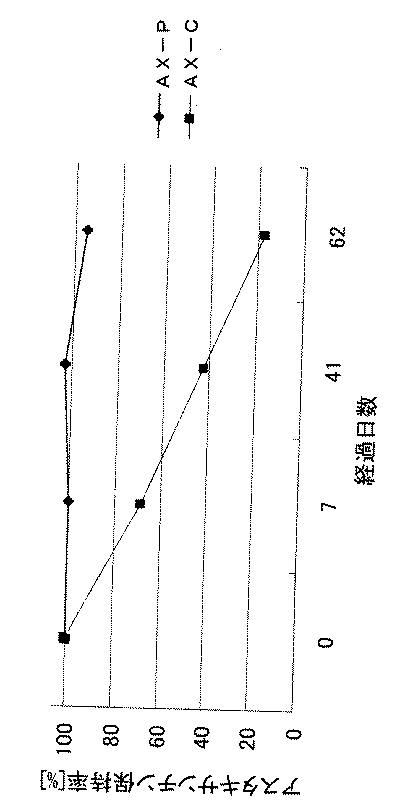
経過日数0日目における、アスタキサンチン含有パウダー(AX−P)、アスタキサンチンコントロール粉末(AX−C)のアスタキサンチン含有率(%)を100として示した。
アスタキサンチンコントロール粉末(AX−C)は、日数が経つにつれてアスタキサンチン保持率(%)が低下し、7日目では68.2%、62日目にあっては17%まで低下した。
一方、本発明のアスタキサンチン含有パウダー(AX−P)は、7日目では100%、62日経過後でも95%と高いアスタキサンチン保持率を示した。
両試験品のアスタキサンチン含有保持率(%)には、経過日数と共に明らかな違いが認められた。
【0051】
【発明の効果】
本発明のカロテノイド含有パウダーの製造方法は、以上説明したようになるから次のような効果を得ることができる。
<イ>本発明のカロテノイド含有パウダーは、抗酸化物質や他のコート剤によって表面をコートされているため、核となるカロテノイド類は酸化されにくい。
<ロ>さらに、カロテノイド類をコートする表面の抗酸化物質を別成分とすることによって、かつ本発明の利用時においてその性能を保つならば、それぞれ異なる抗酸化作用により、より強力な効果を得ることができる。
【図面の簡単な説明】
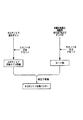
【図1】本発明のカロテノイド含有パウダーの形成工程図。
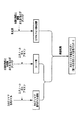
【図2】カロテノイド含有オイル溶液にコート剤およびエマルジョン用水溶液を添加して得るカロテノイド含有パウダーの形成工程図。
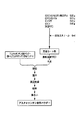
【図3】図2で形成されたカロテノイド含有パウダーに充填コート剤を添加して得るカロテノイド含有パウダーの形成工程図。
【図4】アスタキサンチン含有パウダーを形成する実施の形態1を示す図。
【図5】アスタキサンチン含有パウダーを形成する実施の形態2を示す図。
【図6】アスタキサンチン保持率(%)と経過日数(日)との関係を示す図である。[0001]
TECHNICAL FIELD OF THE INVENTION
TECHNICAL FIELD The present invention relates to a method for producing a carotenoid-containing powder containing carotenoids as an active ingredient.
[0002]
[Prior art]
Conventionally, active oxygen has the role of protecting itself from foreign substances such as pathogens and mold that have invaded the body, but also has strong toxicity, and it is necessary to prevent the toxicity when this active oxygen is excessively generated in the body. Is known to lead to prevention of various diseases and aging. Substances having an antioxidant effect on the active oxygen (hereinafter referred to as antioxidants) include carotenoids (β-carotene, astaxanthin, etc.), vitamin C, vitamin E, polyphenols (catechin, quercetin, etc.), selenium, etc. The substance is known.
However, these antioxidants, particularly carotenoids, are extremely unstable irrespective of their form, and their oxidation may reduce their antioxidant action or degrade.
For this reason, stability is maintained by sealing in a container impermeable to oxygen and replacing the gas, or storing at a low temperature.
[0003]
[Problems to be solved by the invention]
However, the above-described conventional technology has the following problems.
<A> Since carotenoids have high oxygen sensitivity, in the process from production of carotenoids to packaging, there is a high possibility that they will be oxidized even by a slight contact with oxygen, so that care must always be taken during handling.
<B> Carotenoids are inherently oily substances, and therefore have some limitations in processing. For this reason, when supplied as a supplement, many capsule products are sealed in a soft capsule as they are in the form of oil to block contact with the outside air. On the other hand, a tablet product processed from a powder or a hard capsule product filled in a powder is also required.
However, powdered carotenoids do not have good stability because they add vitamin E oil together with an emulsifier and knead (knead) them into dextrin.
[0004]
[Object of the invention]
The present invention has been made in order to solve the conventional problems as described above, and provides a method for producing a carotenoid-containing powder in a stable form that is hardly oxidized while suppressing decomposition of carotenoids during a production process. With the goal.
[0005]
[Means for Solving the Problems]
In order to achieve the above object, the method for producing a carotenoid-containing powder of the present invention comprises mixing a carotenoid-containing oil with a coating agent having an antioxidant, an oil and / or a protein, and drying. It is characterized by the following.
Here, the coating agent plays a role of directly covering the core carotenoid and preventing oxidation of the carotenoid.
[0006]
Further, the method for producing a carotenoid-containing powder of the present invention comprises mixing a carotenoid-containing oil solution obtained by dissolving a carotenoid-containing oil with a solvent, a coating agent having an antioxidant, and a fat or oil and / or a protein, and drying. It is characterized by becoming.
[0007]
Further, the method for producing a carotenoid-containing powder of the present invention comprises mixing a carotenoid-containing oil solution obtained by dissolving a carotenoid-containing oil with ethanol or acetone, a coating agent having an antioxidant, and a fat or oil and / or a protein, and drying. It is characterized by becoming.
[0008]
In addition, the method for producing a carotenoid-containing powder of the present invention comprises mixing a carotenoid-containing oil with an antioxidant and a coating agent having fats and oils and / or protein, and mixing the mixed solution with an antioxidant as an emulsifier. It is characterized by being mixed with an aqueous solution for emulsion mixed with saccharides and / or proteins and then dried.
[0009]
Further, the method for producing a carotenoid-containing powder of the present invention comprises mixing a carotenoid-containing oil solution obtained by dissolving a carotenoid-containing oil with a solvent, and a coating agent having an antioxidant and an oil and fat and / or a protein. It is characterized by being mixed with an aqueous solution for emulsion in which an antioxidant, a saccharide and / or a protein are mixed with an emulsifier, and then dried.
[0010]
Further, the method for producing a carotenoid-containing powder of the present invention comprises mixing a carotenoid-containing oil solution obtained by dissolving a carotenoid-containing oil with ethanol or acetone, and a coating agent having an antioxidant and oils and / or proteins. The solution is characterized by being mixed with an aqueous solution for emulsion in which an antioxidant, a saccharide and / or a protein are mixed with an emulsifier, and then dried.
[0011]
Further, the method for producing a carotenoid-containing powder of the present invention comprises mixing a carotenoid-containing oil with a coating agent having an antioxidant and an oil and / or protein, and mixing the mixed solution with an antioxidant and an emulsifier. After mixing with an aqueous solution for emulsion in which saccharides and / or proteins are mixed, the first carotenoid-containing powder obtained by drying is mixed with a filling coating agent having an antioxidant, an oil and fats and / or a protein, and dried. It is characterized by becoming.
Here, the finally obtained carotenoid-containing powder fills the pores generated when the first carotenoid-containing powder is freeze-dried with an antioxidant or the like, and at the same time, further coats the carotenoid secondarily.
[0012]
Further, the method for producing a carotenoid-containing powder of the present invention comprises mixing a carotenoid-containing oil solution obtained by dissolving a carotenoid-containing oil with a solvent, and a coating agent having an antioxidant and oils and / or proteins. Is mixed with an aqueous solution for emulsion in which an antioxidant, a saccharide and / or a protein are mixed with an emulsifier, and then dried, the first carotenoid-containing powder, which is dried, is mixed with an antioxidant, an oil and / or a protein. Characterized by mixing and drying a filling coating agent having the following formula:
[0013]
Further, the method for producing a carotenoid-containing powder of the present invention comprises mixing a carotenoid-containing oil solution in which a carotenoid-containing oil is dissolved with ethanol or acetone, and a coating agent having an antioxidant and an oil or fat and / or a protein. After mixing the mixed solution with an aqueous solution for emulsion in which an antioxidant and an saccharide and / or protein are mixed in an emulsifier, the first carotenoid-containing powder obtained by drying is mixed with an antioxidant, an oil and / or fat. And a filling coating agent having a protein and mixing and drying the mixture.
[0014]
In addition, the method for producing a carotenoid-containing powder of the present invention utilizes the method for producing a carotenoid-containing powder described in any of the above, and vitamin E, vitamin C palmitate, vitamin C as an antioxidant contained in the coating agent. C It is selected from the group consisting of stearic acid ester, rosemary oil, beeswax, carnauba wax, rice bran wax as fats and oils, and zein, gelatin and casein as proteins.
[0015]
In addition, the method for producing a carotenoid-containing powder of the present invention utilizes the method for producing a carotenoid-containing powder described in any of the above, and as vitamin Cs, erythorbic acid, and saccharides as antioxidants contained in an aqueous solution for emulsion. The dextrin, pullulan, erythritol, and protein are selected from the group consisting of gelatin and casein.
[0016]
Further, the method for producing a carotenoid-containing powder of the present invention utilizes the method for producing a carotenoid-containing powder described in any of the above, and as an antioxidant contained in the filling coating agent, vitamin Cs, vitamin E, fats and oils Selected from the group consisting of beeswax, carnauba wax, rice bran wax, and zein, gelatin, and casein as proteins.
[0017]
The method for producing a carotenoid-containing powder according to the present invention is characterized in that the method for producing a carotenoid-containing powder according to any one of the above-mentioned methods is used, and the drying method is selected from reduced-pressure drying and freeze-drying. Things. Note that spray drying may be used as another drying method.
[0018]
Embodiment 1 of the present invention
Hereinafter, embodiments of the present invention will be described with reference to the drawings.
[0019]
<A> Overall Configuration The method for producing a carotenoid-containing powder of the present invention relates to a method for producing carotenoid-containing powder from carotenoid-containing oil through several steps. For example, as shown in FIG. 1, a coating material is mixed with a carotenoid-containing oil solution and dried to produce a carotenoid-containing powder. Alternatively, as shown in FIG. 2, a coating material is mixed with a carotenoid-containing oil solution, and this mixed solution is mixed with an emulsion aqueous solution and dried to produce a carotenoid-containing powder. Alternatively, as shown in FIG. 3, a coating material is mixed with a carotenoid-containing oil solution, the mixed solution is mixed with an emulsion aqueous solution, and then a carotenoid-containing powder obtained by drying is mixed with a filling coating agent and dried. Produce carotenoid-containing powder. In any of the processes, a carotenoid-containing oil may be directly mixed with the coating material instead of the carotenoid-containing oil solution.
[0020]
<B> Carotenoid-containing oil solution The carotenoid-containing oil solution is a solution in which a carotenoid-containing oil, which is a substance having an antioxidant effect, is dissolved in a solvent such as ethanol or acetone.
Some carotenoid-containing oils contain types such as astaxanthin, α, β-carotene, and lutein.
[0021]
<C> Coating agent The coating agent has an antioxidant substance, fats and oils and / or proteins, and is used after being dissolved in a solvent such as ethanol, acetone or hexane.
When the coating agent is mixed with the carotenoid-containing oil solution, the fats and oils and / or proteins in the coating agent are fixed around the carotenoid together with the antioxidant to form an antioxidant film.
[0022]
The antioxidant has an antioxidant role, and preferably has solubility in ethanol and / or acetone and solidifies after drying.
As the antioxidant, for example, at least one of vitamin E, vitamin C palmitate, vitamin C stearate, and rosemary oil can be used. Vitamin E, rosemary oil, etc. are liquid at room temperature but are useful for preventing the oxidation of astaxanthin. If used together with vitamin C palmitate or beeswax, oils and fats, zein, etc., they can be used for solidification of powder without any problem. Obtainable.
[0023]
As fats and oils, one or several kinds of beeswax, carnauba wax, rice bran wax and the like are used, and zein is used for protein.
[0024]
In this example, vitamin C palmitate and vitamin E oil were used as antioxidants, and beeswax was selected from fats and oils and used.
[0025]
<D> Aqueous solution for emulsion The aqueous solution for emulsion is a solution in which the coated carotenoid is finely, uniformly and stably dispersed in the solution, and contains an emulsifier in order to obtain a stable emulsion. It is a solution optionally containing saccharides and / or proteins.
[0026]
One or more emulsifiers can be selected from any of the emulsifiers as necessary, and those which are dried and then powdered are preferred. The emulsifier is preferably one that can be powdered, such as, for example, sucrose fatty acid ester, quillajasaponin and the like.
Vitamin Cs and erythorbic acid can be used as antioxidants. In particular, sodium Vitamin C can be used to prevent oxidation from oxygen contained in water.
One or more sugars can be selected from dextrin, pullulan, erythritol, and the like, and one or more sugars can be selected from gelatin, casein, and the like.
[0027]
In this example, sucrose fatty acid ester and quillaja saponin were used as emulsifiers, vitamin C sodium was used as an antioxidant, and erythritol and dextrin were selected from sugars and used.
[0028]
<E> Filling coating agent The filling coating agent fills pores formed in the film formed of the antioxidant when the first carotenoid-containing powder is dried, and surrounds the first carotenoid-containing powder. Is to be secondarily coated.
[0029]
The filling coating agent has an antioxidant substance, fats and oils and / or proteins, and is used by dissolving in ethanol, acetone or water, for example.
As the antioxidant, for example, one or more of vitamin Cs and vitamin E are selected and used.
One or several kinds of beeswax, carnauba wax and rice bran wax are used as fats and oils, and one or several kinds are selected and used from proteins such as zein, gelatin and casein.
[0030]
In this example, vitamin C palmitate and vitamin E oil were used as antioxidants, beeswax was selected from fats and oils, and zein was selected and adjusted from proteins, and used as a filling coating agent.
[0031]
<F> Other methods for drying after mixing the above materials are selected from vacuum drying, freeze drying and spray drying.
When dried under reduced pressure, the oxygen concentration becomes low and there is almost no obstruction by oxygen during drying. In addition, since spray drying is completed in a short time, it is similarly hardly affected by oxygen.
When placed under reduced pressure, for example, the pressure is preferably 200 Pa or less, more preferably 40 Pa or less.
[0032]
Next, a method for producing a carotenoid-containing powder according to the present invention using astaxanthin as an example will be described with reference to FIGS.
[0033]
The astaxanthin-containing oil contains astaxanthin and / or an ester bond of astaxanthin, and can be separated from natural products using an organic solvent such as acetone or hexane. However, there is no concern about residual solvent. Not extracted by supercritical carbon dioxide. Examples of natural products include extracts from green alga Haematococcus, red yeast Phaffia, American crayfish, Antarctic krill, and the like.
The extract may be appropriately purified as needed.
[0034]
<A> Mix of astaxanthin-containing oil solution and coating agent Add 95% ethanol (8 ml) to 10% astaxanthin-containing oil (9.6 g), mix and dissolve under heating at 60 ° C. Obtain an ethanol solution.
[0035]
Vitamin C palmitate (0.68g), Vitamin E oil (0.16g) and beeswax (0.08g) were added to 95% ethanol (6ml), heated and mixed at 70 ° C, and dissolved and coated. Get the agent.
[0036]
Next, the mixture is kept at 70 ° C. while mixing the astaxanthin-containing oil solution and the coating agent (hereinafter, referred to as solution A).
As a result, the periphery of astaxanthin assumes a form covered with antioxidants such as vitamin C palmitate and vitamin E.
At this stage, the liquid A may be dried under reduced pressure, for example, at about 30 Pascal to obtain an astaxanthin-containing powder.
[0037]
<B> Mixing of solution A with aqueous solution for emulsion Next, an aqueous solution for emulsion is produced.
The aqueous solution for emulsion uses water (150 ml) as a solvent, sucrose fatty acid ester DK ester F160 (manufactured by Daiichi Kogyo Seiyaku Co., Ltd .: 0.68 g), quillajasaponin (0.68 g), erythritol (7 g), vitamin Sodium C (1.36 g) and dextrin (1.36 g) are obtained by mixing and dissolving at 70 ° C.
For the emulsification, the mixture is sufficiently stirred using a high-speed stirrer, a homogenizer, or the like, to obtain a uniform state.
[0038]
The solution A is gradually poured into the aqueous solution for emulsion to be stirred at 70 ° C. to form an emulsion, and the mixture is further stirred and uniformly dispersed at 70 ° C.
[0039]
<C> Formation of astaxanthin-containing powder The thus obtained emulsion is frozen at about -30 ° C, and water is sublimated and dried under vacuum to obtain a dry powder-like astaxanthin-containing powder (hereinafter referred to as first astaxanthin). Containing powder).
Also, spray drying can be used as another drying method.
[0040]
In addition, the heating temperature described in each of the above steps is not limited, and may be a temperature in a range of about 60C to about 70C.
[0041]
Embodiment 2 of the present invention
As mentioned above, in Embodiment 1, formation of the first astaxanthin-containing powder was described in detail. However, since the first astaxanthin-containing powder is vacuum-dried in a frozen state in a forming process, pores are generated on the surface and inside when a solvent such as ethanol and water is vaporized and degassed. When the pores are in contact with astaxanthin disposed inside, the pores serve as a ventilation path for oxygen, and there is a risk of oxidizing astaxanthin.
[0042]
Therefore, in the second embodiment, the formed pores are filled with an antioxidant (contained in the filling coating agent) to more reliably protect the internal astaxanthin from oxidation, and, in addition, to surround the first astaxanthin-containing powder. The whole surface is secondarily coated to strongly prevent oxidation.
Hereinafter, an example will be described in detail.
[0043]
<B> Formation of Filling Coating Agent Vitamin C palmitate (0.32 g), vitamin E oil (0.01 g), beeswax (0.01 g), and zein (0.66 g) in 95% ethanol (6 ml) In addition, the mixture is mixed and dissolved under heating at 70 ° C. to obtain a filling coating agent.
[0044]
<B> Kneading the first astaxanthin-containing powder and the filling coating agent The first astaxanthin-containing powder and the filling coating agent kept at 70 ° C are mixed, kneaded, and kneaded sufficiently to be uniform.
Thereby, the antioxidant contained in the filling coating agent further covers the periphery of the coating agent while filling the pores formed around the first astaxanthin-containing powder.
In other words, astaxanthin has a double-coated form and can be almost completely prevented from oxidation.
At this time, the antioxidant contained in the filling coating agent does not necessarily need to be the same type.
Thereafter, this is substantially uniformly stretched to a thickness of about 5 mm to about 10 mm to form a flat shape.
After molding, vacuum drying is performed to remove ethanol remaining inside.
In the vacuum drying under such a non-frozen state, the above-mentioned pores are not generated in the film formed around the astaxanthin-containing powder.
[0045]
The dried product is pulverized by a speed mill (screen 6 mm) and a large pulverizer (no screen).
Next, the powder is passed through a small shaker (40M) to form an astaxanthin-containing powder.
In addition, the thickness of the astaxanthin in the pre-process of performing vacuum drying may be any thickness as long as ethanol can be removed, and may be arbitrary according to the capability and conditions of the machine.
[0046]
Hereinafter, the test regarding the stability of astaxanthin of the astaxanthin-containing powder finally obtained through the above steps will be described.
[0047]
<C> Test method Astaxanthin-containing powder (AX-P) obtained in the step of FIG. 5 and, as a control, astaxanthin-containing powder mixed with dextrin, vitamin E and an emulsifier to form astaxanthin control powder (AX- C) and the change with time of the astaxanthin content when stored at 40 ° C. in the dark and in the air were measured (accelerated stability test).
[0048]
<D> Test results The test results are shown in FIG.
FIG. 6 is a diagram showing the relationship between the astaxanthin content retention rate (%) and the number of elapsed days (days) of each test product (AX-P, AX-C), and Table 1 summarizes the test data. Things.
[0049]
[Table 1]
The astaxanthin content (%) of the astaxanthin-containing powder (AX-P) and the astaxanthin control powder (AX-C) on
In the astaxanthin control powder (AX-C), the astaxanthin retention rate (%) decreased as the number of days passed, and decreased to 68.2% on the 7th day and to 17% on the 62nd day.
On the other hand, the astaxanthin-containing powder (AX-P) of the present invention showed a high astaxanthin retention of 100% on the seventh day and 95% even after 62 days.
The astaxanthin content retention rate (%) of both test products showed a clear difference with the elapsed days.
[0051]
【The invention's effect】
Since the method for producing a carotenoid-containing powder of the present invention is as described above, the following effects can be obtained.
<A> Since the surface of the carotenoid-containing powder of the present invention is coated with an antioxidant or another coating agent, the core carotenoids are not easily oxidized.
<B> Furthermore, if the antioxidant on the surface coated with the carotenoids is used as a separate component and its performance is maintained during use of the present invention, a stronger effect is obtained by different antioxidant effects. be able to.
[Brief description of the drawings]
FIG. 1 is a process chart of forming a carotenoid-containing powder of the present invention.
FIG. 2 is a process chart of forming a carotenoid-containing powder obtained by adding a coating agent and an aqueous solution for an emulsion to a carotenoid-containing oil solution.
FIG. 3 is a process chart of forming a carotenoid-containing powder obtained by adding a filling coating agent to the carotenoid-containing powder formed in FIG. 2;
FIG. 4 is a diagram showing Embodiment 1 for forming an astaxanthin-containing powder.
FIG. 5 is a diagram showing Embodiment 2 for forming an astaxanthin-containing powder.
FIG. 6 is a graph showing the relationship between astaxanthin retention (%) and elapsed days (days).
Claims (7)
カロテノイド含有パウダーの製造方法。The carotenoid-containing oil is mixed with an antioxidant, a coating agent having fats and oils and / or protein, and dried.
A method for producing a carotenoid-containing powder.
この混合溶液を、乳化剤に抗酸化物質と、糖類及び/又はタンパクとを混和したエマルジョン用水溶液に混和した後、乾燥してなる、
カロテノイド含有パウダーの製造方法。The carotenoid-containing oil is mixed with an antioxidant and a coating agent having fats and oils and / or protein,
This mixed solution is mixed with an aqueous solution for emulsion obtained by mixing an antioxidant substance, a saccharide and / or a protein with an emulsifier, and then dried.
A method for producing a carotenoid-containing powder.
この混合溶液を、乳化剤に抗酸化物質と、糖類及び/又はタンパクとを混和したエマルジョン用水溶液に混和した後、乾燥してなる第一のカロテノイド含有パウダーに、抗酸化物質と、油脂類及び/又はタンパクとを有する充填コート剤を混和、乾燥してなる、
カロテノイド含有パウダーの製造方法。The carotenoid-containing oil is mixed with an antioxidant and a coating agent having fats and oils and / or protein,
This mixed solution is mixed with an aqueous solution for emulsion in which an antioxidant, a saccharide and / or a protein are mixed with an emulsifier, and then dried, the first carotenoid-containing powder obtained by drying is mixed with an antioxidant, an oil and / or fat. Or mixed with a filling coating agent having a protein and dried,
A method for producing a carotenoid-containing powder.
Priority Applications (1)
| Application Number | Priority Date | Filing Date | Title |
|---|---|---|---|
| JP2002364082A JP3969652B2 (en) | 2002-12-16 | 2002-12-16 | Method for producing carotenoid-containing powder |
Applications Claiming Priority (1)
| Application Number | Priority Date | Filing Date | Title |
|---|---|---|---|
| JP2002364082A JP3969652B2 (en) | 2002-12-16 | 2002-12-16 | Method for producing carotenoid-containing powder |
Publications (2)
| Publication Number | Publication Date |
|---|---|
| JP2004196673A true JP2004196673A (en) | 2004-07-15 |
| JP3969652B2 JP3969652B2 (en) | 2007-09-05 |
Family
ID=32762053
Family Applications (1)
| Application Number | Title | Priority Date | Filing Date |
|---|---|---|---|
| JP2002364082A Expired - Fee Related JP3969652B2 (en) | 2002-12-16 | 2002-12-16 | Method for producing carotenoid-containing powder |
Country Status (1)
| Country | Link |
|---|---|
| JP (1) | JP3969652B2 (en) |
Cited By (9)
| Publication number | Priority date | Publication date | Assignee | Title |
|---|---|---|---|---|
| JP2008509945A (en) * | 2004-08-19 | 2008-04-03 | ディーエスエム アイピー アセッツ ビー.ブイ. | New composition of fat-soluble substances |
| WO2008087139A1 (en) * | 2007-01-16 | 2008-07-24 | Basf Se | Unctuous compositions |
| WO2009048120A1 (en) * | 2007-10-11 | 2009-04-16 | Nisshin Pharma Inc. | Water-soluble composition containing astaxanthin |
| US8809398B2 (en) | 2007-01-16 | 2014-08-19 | Basf Se | Liquid formulations containing a carotinoid |
| CN104783181A (en) * | 2015-04-10 | 2015-07-22 | 钱绍祥 | Astaxanthin-containing composition and preparation method thereof |
| US9375387B2 (en) | 2008-10-07 | 2016-06-28 | Basf Se | Ready-to-use, stable emulsion |
| US11185093B2 (en) | 2007-11-29 | 2021-11-30 | Christian Köpsel | Pulverulent carotenoid preparation for colouring drinks |
| CN114868907A (en) * | 2022-05-30 | 2022-08-09 | 合肥工业大学 | Double-encapsulated β-carotene-based starch-based nanoparticles and their preparation and application |
| CN117502565A (en) * | 2023-12-07 | 2024-02-06 | 湖南隆森生物科技股份有限公司 | A compound carotenoid preparation and its application in animal breeding |
-
2002
- 2002-12-16 JP JP2002364082A patent/JP3969652B2/en not_active Expired - Fee Related
Cited By (13)
| Publication number | Priority date | Publication date | Assignee | Title |
|---|---|---|---|---|
| JP2008509945A (en) * | 2004-08-19 | 2008-04-03 | ディーエスエム アイピー アセッツ ビー.ブイ. | New composition of fat-soluble substances |
| JP2014097999A (en) * | 2004-08-19 | 2014-05-29 | Dsm Ip Assets Bv | Reparation method of compositions containing fat-soluble physiologically active components |
| WO2008087139A1 (en) * | 2007-01-16 | 2008-07-24 | Basf Se | Unctuous compositions |
| US8809398B2 (en) | 2007-01-16 | 2014-08-19 | Basf Se | Liquid formulations containing a carotinoid |
| WO2009048120A1 (en) * | 2007-10-11 | 2009-04-16 | Nisshin Pharma Inc. | Water-soluble composition containing astaxanthin |
| JPWO2009048120A1 (en) * | 2007-10-11 | 2011-02-24 | 日清ファルマ株式会社 | Astaxanthin-containing water-soluble composition |
| US11185093B2 (en) | 2007-11-29 | 2021-11-30 | Christian Köpsel | Pulverulent carotenoid preparation for colouring drinks |
| US9375387B2 (en) | 2008-10-07 | 2016-06-28 | Basf Se | Ready-to-use, stable emulsion |
| US10004670B2 (en) | 2008-10-07 | 2018-06-26 | Basf Se | Ready-to-use, stable emulsion |
| CN104783181A (en) * | 2015-04-10 | 2015-07-22 | 钱绍祥 | Astaxanthin-containing composition and preparation method thereof |
| CN114868907A (en) * | 2022-05-30 | 2022-08-09 | 合肥工业大学 | Double-encapsulated β-carotene-based starch-based nanoparticles and their preparation and application |
| CN114868907B (en) * | 2022-05-30 | 2023-07-21 | 合肥工业大学 | Double-embedded β-carotene starch-based nanoparticles and its preparation and application |
| CN117502565A (en) * | 2023-12-07 | 2024-02-06 | 湖南隆森生物科技股份有限公司 | A compound carotenoid preparation and its application in animal breeding |
Also Published As
| Publication number | Publication date |
|---|---|
| JP3969652B2 (en) | 2007-09-05 |
Similar Documents
| Publication | Publication Date | Title |
|---|---|---|
| Chuacharoen et al. | The potential of zein nanoparticles to protect entrapped β-carotene in the presence of milk under simulated gastrointestinal (GI) conditions | |
| AU2008340061B2 (en) | Microcapsules comprising a fat -soluble active substance | |
| FR2493701A1 (en) | PROCESS FOR ENCAPSULATING OILS AND LIPOSOLUBLE SUBSTANCES, SUCH AS VITAMINS, AND MICROCAPSULES OBTAINED | |
| EP1487469B1 (en) | Co-beadlet of dha and rosemary | |
| US20110002984A1 (en) | Formulations comprising exine shells | |
| JPH09302379A (en) | Microcapsules and tablets with multi-core structure containing natural carotenoids, compounding agents for foods and pharmaceuticals | |
| AU2006273841B2 (en) | Uses of sporopollenin | |
| US20080152710A1 (en) | Co-beadlet of dha and rosemary and methods of use | |
| CN106360437A (en) | Krill oil microcapsule with antioxidation effect and preparation process thereof | |
| EP2348879B1 (en) | Process for producing protein microparticles | |
| KR20220147132A (en) | Stable food-grade microcapsules for transporting labile and food-critical active ingredients to food | |
| Park et al. | Effects of protein and peptide addition on lipid oxidation in powder model system | |
| JP3969652B2 (en) | Method for producing carotenoid-containing powder | |
| CN114680332B (en) | Water-in-oil type high internal phase emulsion carrying bitter substances and preparation method thereof | |
| EP3432729B1 (en) | Nanocapsules comprising a liposoluble active ingredient, production and uses | |
| Rajasekaran et al. | Omega-3 enriched fish and shellfish oils: extraction, preservation, and health benefits | |
| US20050232996A1 (en) | Matrix comprising a bioactive component containing phospholipid | |
| KR20180047468A (en) | Microcapsule composed of surfactant and particulate material | |
| JPH05176739A (en) | Method for modifying powdery particle | |
| CA3174568C (en) | A stable food-grade microcapsule for the delivery of unstable and food-incompatible active ingredients to food products | |
| FR2745979A1 (en) | New food additive for animal feed, particularly dairy cows | |
| JP2017048129A (en) | Soft capsules and production method thereof | |
| JPS60163819A (en) | Soft capsule of liver oil | |
| JP2001178383A (en) | Royal jelly-containing soft capsule agent | |
| Hu et al. | Rationally designed electrosprayed particles for encapsulation of essential oils, flavors, essential fatty acids, and antibacterials |
Legal Events
| Date | Code | Title | Description |
|---|---|---|---|
| A621 | Written request for application examination |
Free format text: JAPANESE INTERMEDIATE CODE: A621 Effective date: 20030115 |
|
| A131 | Notification of reasons for refusal |
Free format text: JAPANESE INTERMEDIATE CODE: A131 Effective date: 20061212 |
|
| A521 | Written amendment |
Free format text: JAPANESE INTERMEDIATE CODE: A523 Effective date: 20070209 |
|
| A131 | Notification of reasons for refusal |
Free format text: JAPANESE INTERMEDIATE CODE: A131 Effective date: 20070320 |
|
| A521 | Written amendment |
Free format text: JAPANESE INTERMEDIATE CODE: A523 Effective date: 20070418 |
|
| TRDD | Decision of grant or rejection written | ||
| A01 | Written decision to grant a patent or to grant a registration (utility model) |
Free format text: JAPANESE INTERMEDIATE CODE: A01 Effective date: 20070515 |
|
| A61 | First payment of annual fees (during grant procedure) |
Free format text: JAPANESE INTERMEDIATE CODE: A61 Effective date: 20070601 |
|
| R150 | Certificate of patent or registration of utility model |
Ref document number: 3969652 Country of ref document: JP Free format text: JAPANESE INTERMEDIATE CODE: R150 Free format text: JAPANESE INTERMEDIATE CODE: R150 |
|
| FPAY | Renewal fee payment (event date is renewal date of database) |
Free format text: PAYMENT UNTIL: 20130615 Year of fee payment: 6 |
|
| R250 | Receipt of annual fees |
Free format text: JAPANESE INTERMEDIATE CODE: R250 |
|
| FPAY | Renewal fee payment (event date is renewal date of database) |
Free format text: PAYMENT UNTIL: 20160615 Year of fee payment: 9 |
|
| R250 | Receipt of annual fees |
Free format text: JAPANESE INTERMEDIATE CODE: R250 |
|
| R250 | Receipt of annual fees |
Free format text: JAPANESE INTERMEDIATE CODE: R250 |
|
| R250 | Receipt of annual fees |
Free format text: JAPANESE INTERMEDIATE CODE: R250 |
|
| R250 | Receipt of annual fees |
Free format text: JAPANESE INTERMEDIATE CODE: R250 |
|
| R250 | Receipt of annual fees |
Free format text: JAPANESE INTERMEDIATE CODE: R250 |
|
| LAPS | Cancellation because of no payment of annual fees |