JP2004201719A - Disposable wearing article - Google Patents
Disposable wearing article Download PDFInfo
- Publication number
- JP2004201719A JP2004201719A JP2002371036A JP2002371036A JP2004201719A JP 2004201719 A JP2004201719 A JP 2004201719A JP 2002371036 A JP2002371036 A JP 2002371036A JP 2002371036 A JP2002371036 A JP 2002371036A JP 2004201719 A JP2004201719 A JP 2004201719A
- Authority
- JP
- Japan
- Prior art keywords
- adhesive
- sheet
- core
- nonwoven fabric
- wearing article
- Prior art date
- Legal status (The legal status is an assumption and is not a legal conclusion. Google has not performed a legal analysis and makes no representation as to the accuracy of the status listed.)
- Granted
Links
- 239000000853 adhesive Substances 0.000 claims abstract description 230
- 230000001070 adhesive effect Effects 0.000 claims abstract description 230
- 239000007788 liquid Substances 0.000 claims abstract description 11
- 239000004745 nonwoven fabric Substances 0.000 claims description 212
- 239000000835 fiber Substances 0.000 claims description 40
- 230000006835 compression Effects 0.000 claims description 19
- 238000007906 compression Methods 0.000 claims description 19
- 239000002985 plastic film Substances 0.000 claims description 17
- 229920006255 plastic film Polymers 0.000 claims description 15
- 239000002131 composite material Substances 0.000 claims description 10
- 239000002245 particle Substances 0.000 claims description 7
- 239000000203 mixture Substances 0.000 claims description 4
- 229920000247 superabsorbent polymer Polymers 0.000 claims description 4
- 229920003002 synthetic resin Polymers 0.000 claims description 4
- 239000000057 synthetic resin Substances 0.000 claims description 4
- 229920001169 thermoplastic Polymers 0.000 claims description 4
- 239000004416 thermosoftening plastic Substances 0.000 claims description 4
- 239000011248 coating agent Substances 0.000 claims description 3
- 238000000576 coating method Methods 0.000 claims description 3
- 229920000642 polymer Polymers 0.000 claims description 3
- 238000010030 laminating Methods 0.000 claims description 2
- 230000002093 peripheral effect Effects 0.000 claims description 2
- 238000000926 separation method Methods 0.000 abstract description 4
- 230000003449 preventive effect Effects 0.000 abstract 1
- YXFVVABEGXRONW-UHFFFAOYSA-N Toluene Chemical compound CC1=CC=CC=C1 YXFVVABEGXRONW-UHFFFAOYSA-N 0.000 description 42
- 238000005259 measurement Methods 0.000 description 24
- 230000002209 hydrophobic effect Effects 0.000 description 12
- 230000007423 decrease Effects 0.000 description 10
- 238000000034 method Methods 0.000 description 10
- 239000002250 absorbent Substances 0.000 description 6
- -1 polyethylene Polymers 0.000 description 5
- 239000000470 constituent Substances 0.000 description 4
- 230000000694 effects Effects 0.000 description 4
- 238000012423 maintenance Methods 0.000 description 4
- 239000004831 Hot glue Substances 0.000 description 3
- 239000004698 Polyethylene Substances 0.000 description 3
- 229920000728 polyester Polymers 0.000 description 3
- 229920000573 polyethylene Polymers 0.000 description 3
- 230000002265 prevention Effects 0.000 description 3
- 239000004743 Polypropylene Substances 0.000 description 2
- 230000002745 absorbent Effects 0.000 description 2
- 238000010586 diagram Methods 0.000 description 2
- 229920002457 flexible plastic Polymers 0.000 description 2
- 210000004251 human milk Anatomy 0.000 description 2
- 235000020256 human milk Nutrition 0.000 description 2
- 238000002844 melting Methods 0.000 description 2
- 230000008018 melting Effects 0.000 description 2
- 229920001155 polypropylene Polymers 0.000 description 2
- 239000011347 resin Substances 0.000 description 2
- 229920005989 resin Polymers 0.000 description 2
- 230000035807 sensation Effects 0.000 description 2
- 238000009987 spinning Methods 0.000 description 2
- 229920002725 thermoplastic elastomer Polymers 0.000 description 2
- 210000002700 urine Anatomy 0.000 description 2
- 238000005406 washing Methods 0.000 description 2
- XLYOFNOQVPJJNP-UHFFFAOYSA-N water Substances O XLYOFNOQVPJJNP-UHFFFAOYSA-N 0.000 description 2
- 239000003522 acrylic cement Substances 0.000 description 1
- 230000004888 barrier function Effects 0.000 description 1
- 210000001124 body fluid Anatomy 0.000 description 1
- 239000003795 chemical substances by application Substances 0.000 description 1
- 229920001971 elastomer Polymers 0.000 description 1
- 239000011521 glass Substances 0.000 description 1
- 239000003292 glue Substances 0.000 description 1
- 230000001788 irregular Effects 0.000 description 1
- 230000035699 permeability Effects 0.000 description 1
- 229920002647 polyamide Polymers 0.000 description 1
- 229920000098 polyolefin Polymers 0.000 description 1
- 239000005060 rubber Substances 0.000 description 1
- 238000007789 sealing Methods 0.000 description 1
- 239000000126 substance Substances 0.000 description 1
- 230000037303 wrinkles Effects 0.000 description 1
Images
Classifications
-
- A—HUMAN NECESSITIES
- A61—MEDICAL OR VETERINARY SCIENCE; HYGIENE
- A61F—FILTERS IMPLANTABLE INTO BLOOD VESSELS; PROSTHESES; DEVICES PROVIDING PATENCY TO, OR PREVENTING COLLAPSING OF, TUBULAR STRUCTURES OF THE BODY, e.g. STENTS; ORTHOPAEDIC, NURSING OR CONTRACEPTIVE DEVICES; FOMENTATION; TREATMENT OR PROTECTION OF EYES OR EARS; BANDAGES, DRESSINGS OR ABSORBENT PADS; FIRST-AID KITS
- A61F13/00—Bandages or dressings; Absorbent pads
- A61F13/15—Absorbent pads, e.g. sanitary towels, swabs or tampons for external or internal application to the body; Supporting or fastening means therefor; Tampon applicators
- A61F13/53—Absorbent pads, e.g. sanitary towels, swabs or tampons for external or internal application to the body; Supporting or fastening means therefor; Tampon applicators characterised by the absorbing medium
- A61F13/539—Absorbent pads, e.g. sanitary towels, swabs or tampons for external or internal application to the body; Supporting or fastening means therefor; Tampon applicators characterised by the absorbing medium characterised by the connection of the absorbent layers with each other or with the outer layers
-
- A—HUMAN NECESSITIES
- A61—MEDICAL OR VETERINARY SCIENCE; HYGIENE
- A61F—FILTERS IMPLANTABLE INTO BLOOD VESSELS; PROSTHESES; DEVICES PROVIDING PATENCY TO, OR PREVENTING COLLAPSING OF, TUBULAR STRUCTURES OF THE BODY, e.g. STENTS; ORTHOPAEDIC, NURSING OR CONTRACEPTIVE DEVICES; FOMENTATION; TREATMENT OR PROTECTION OF EYES OR EARS; BANDAGES, DRESSINGS OR ABSORBENT PADS; FIRST-AID KITS
- A61F13/00—Bandages or dressings; Absorbent pads
- A61F13/15—Absorbent pads, e.g. sanitary towels, swabs or tampons for external or internal application to the body; Supporting or fastening means therefor; Tampon applicators
- A61F2013/15008—Absorbent pads, e.g. sanitary towels, swabs or tampons for external or internal application to the body; Supporting or fastening means therefor; Tampon applicators characterized by the use
- A61F2013/15016—Absorbent pads, e.g. sanitary towels, swabs or tampons for external or internal application to the body; Supporting or fastening means therefor; Tampon applicators characterized by the use for breast; pads for bras
-
- A—HUMAN NECESSITIES
- A61—MEDICAL OR VETERINARY SCIENCE; HYGIENE
- A61F—FILTERS IMPLANTABLE INTO BLOOD VESSELS; PROSTHESES; DEVICES PROVIDING PATENCY TO, OR PREVENTING COLLAPSING OF, TUBULAR STRUCTURES OF THE BODY, e.g. STENTS; ORTHOPAEDIC, NURSING OR CONTRACEPTIVE DEVICES; FOMENTATION; TREATMENT OR PROTECTION OF EYES OR EARS; BANDAGES, DRESSINGS OR ABSORBENT PADS; FIRST-AID KITS
- A61F13/00—Bandages or dressings; Absorbent pads
- A61F13/15—Absorbent pads, e.g. sanitary towels, swabs or tampons for external or internal application to the body; Supporting or fastening means therefor; Tampon applicators
- A61F13/53—Absorbent pads, e.g. sanitary towels, swabs or tampons for external or internal application to the body; Supporting or fastening means therefor; Tampon applicators characterised by the absorbing medium
- A61F13/539—Absorbent pads, e.g. sanitary towels, swabs or tampons for external or internal application to the body; Supporting or fastening means therefor; Tampon applicators characterised by the absorbing medium characterised by the connection of the absorbent layers with each other or with the outer layers
- A61F2013/53908—Absorbent pads, e.g. sanitary towels, swabs or tampons for external or internal application to the body; Supporting or fastening means therefor; Tampon applicators characterised by the absorbing medium characterised by the connection of the absorbent layers with each other or with the outer layers with adhesive
- A61F2013/53916—Absorbent pads, e.g. sanitary towels, swabs or tampons for external or internal application to the body; Supporting or fastening means therefor; Tampon applicators characterised by the absorbing medium characterised by the connection of the absorbent layers with each other or with the outer layers with adhesive with epicyclical pattern
-
- A—HUMAN NECESSITIES
- A61—MEDICAL OR VETERINARY SCIENCE; HYGIENE
- A61F—FILTERS IMPLANTABLE INTO BLOOD VESSELS; PROSTHESES; DEVICES PROVIDING PATENCY TO, OR PREVENTING COLLAPSING OF, TUBULAR STRUCTURES OF THE BODY, e.g. STENTS; ORTHOPAEDIC, NURSING OR CONTRACEPTIVE DEVICES; FOMENTATION; TREATMENT OR PROTECTION OF EYES OR EARS; BANDAGES, DRESSINGS OR ABSORBENT PADS; FIRST-AID KITS
- A61F13/00—Bandages or dressings; Absorbent pads
- A61F13/15—Absorbent pads, e.g. sanitary towels, swabs or tampons for external or internal application to the body; Supporting or fastening means therefor; Tampon applicators
- A61F13/53—Absorbent pads, e.g. sanitary towels, swabs or tampons for external or internal application to the body; Supporting or fastening means therefor; Tampon applicators characterised by the absorbing medium
- A61F13/539—Absorbent pads, e.g. sanitary towels, swabs or tampons for external or internal application to the body; Supporting or fastening means therefor; Tampon applicators characterised by the absorbing medium characterised by the connection of the absorbent layers with each other or with the outer layers
- A61F2013/53908—Absorbent pads, e.g. sanitary towels, swabs or tampons for external or internal application to the body; Supporting or fastening means therefor; Tampon applicators characterised by the absorbing medium characterised by the connection of the absorbent layers with each other or with the outer layers with adhesive
- A61F2013/53925—Absorbent pads, e.g. sanitary towels, swabs or tampons for external or internal application to the body; Supporting or fastening means therefor; Tampon applicators characterised by the absorbing medium characterised by the connection of the absorbent layers with each other or with the outer layers with adhesive with intermittent pattern, e.g. spots
-
- Y—GENERAL TAGGING OF NEW TECHNOLOGICAL DEVELOPMENTS; GENERAL TAGGING OF CROSS-SECTIONAL TECHNOLOGIES SPANNING OVER SEVERAL SECTIONS OF THE IPC; TECHNICAL SUBJECTS COVERED BY FORMER USPC CROSS-REFERENCE ART COLLECTIONS [XRACs] AND DIGESTS
- Y10—TECHNICAL SUBJECTS COVERED BY FORMER USPC
- Y10T—TECHNICAL SUBJECTS COVERED BY FORMER US CLASSIFICATION
- Y10T428/00—Stock material or miscellaneous articles
- Y10T428/24—Structurally defined web or sheet [e.g., overall dimension, etc.]
- Y10T428/24802—Discontinuous or differential coating, impregnation or bond [e.g., artwork, printing, retouched photograph, etc.]
- Y10T428/24826—Spot bonds connect components
Landscapes
- Health & Medical Sciences (AREA)
- Epidemiology (AREA)
- Engineering & Computer Science (AREA)
- Biomedical Technology (AREA)
- Heart & Thoracic Surgery (AREA)
- Vascular Medicine (AREA)
- Life Sciences & Earth Sciences (AREA)
- Animal Behavior & Ethology (AREA)
- General Health & Medical Sciences (AREA)
- Public Health (AREA)
- Veterinary Medicine (AREA)
- Absorbent Articles And Supports Therefor (AREA)
- Orthopedics, Nursing, And Contraception (AREA)
- Prostheses (AREA)
- Gloves (AREA)
- Materials For Medical Uses (AREA)
Abstract
Description
【0001】
【発明の属する技術分野】
本発明は、体液を吸収、保持する使い捨ておむつや生理用ナプキン、尿とりパッド、母乳パッド等の使い捨て着用物品に関する。
【0002】
【従来の技術】
肌当接側に位置する透液性表面シートと、肌非当接側に位置する不透液性裏面シートと、表裏面シートの間に介在する吸液性コアと、コアの上方へ起立性向を有する不透液性防漏シートとから構成され、縦方向に前後胴周り域およびそれら胴周り域の間に位置する股下域を備え、コアの両端縁の外側に横方向へ延びるエンドフラップと、コアの両側縁の外側に縦方向へ延びるサイドフラップとを有し、コアがティッシュペーパーに包被された使い捨ておむつがある(特許文献1参照)。表裏面シートどうしの固着や表裏面シートに対する防漏シートの固着、表裏面シートに対するティッシュペーパーの固着、ティッシュペーパーに対するコアの固着には、それらシートやティッシュペーパーに塗布されたホットメルト型接着剤が使用されている。
【0003】
特許文献1に開示のおむつは、シートやティッシュペーパーに略均一に塗布されたホットメルト型接着剤が縦方向へ波状に曲折して延びる独立した複数条の接着ラインを形成している。接着ラインは、隣接するラインどうしが互いに交差することなく、ラインどうしが横方向へ所与寸法離間して並んでいる。接着ラインには、それ自身が交わる交差部がわずかに存在する。シートやティッシュペーパーに対する接着剤の塗布量は、0.8〜8g/m2の範囲にある。
【0004】
特許文献1には、接着剤が縦方向へ曲折して延びる独立した複数条の接着ラインを形成しているので、縦方向と横方向とのいずれの方向に対しても、略同等の接着強度でシートやティッシュペーパー、コアを固着することができ、それらの剥離を防止することができるという効果が記載されている。また、接着剤の塗布量が0.8〜8g/m2の範囲にあるので、表面シートに繊維不織布が使用された場合でも、接着剤が不織布の繊維間隙を広範囲に塞いでしまうことはなく、表面シートの透水性を維持することができるという効果が記載されている。
【0005】
【特許文献1】
特開2001−95837号公報
【0006】
【発明が解決しようとする課題】
前記特許文献1に開示のおむつでは、シートやティッシュペーパー、コアの剥離を確実に防ぐため、シートやティッシュペーパーに対する接着剤の塗布量を多くすると、多量の接着剤がシートやティッシュペーパーの繊維間隙に滲入したり、接着剤がシート間で大きく広がり、硬化した接着剤によってシートの柔軟性が低下してしまう。また、シートの柔軟性を維持するため、シートやティッシュペーパーに対する接着剤の塗布量を少なくすると、シートどうしの接着強度やシートとティッシュペーパーとの接着強度、ティッシュペーパーとコアとの接着強度が低下し、それらが容易に剥離してしまう場合がある。このおむつでは、シートやティッシュペーパーに略均一に塗布された接着剤が接着ラインを形成しており、一条のライン全体として接着剤の塗布量を多くするかまたは少なくするかのいずれかの手段しか採用し得ず、接着剤の塗布量によってはシートやティッシュペーパー、コアの接着強度が低下したり、シートの柔軟性が低下するという上述した問題があり、シートやティッシュペーパー、コアの剥離防止とシートの柔軟性の維持との両者を同時に達成することが難しい。
【0007】
本発明の目的は、シートどうしの剥離やシートとコアとの剥離を確実に防止することができるとともに、シートの柔軟性を維持することができる使い捨て着用物品を提供することにある。
【0008】
【課題を解決するための手段】
前記課題を解決するための本発明の前提は、互いに対向配置された少なくとも2枚のシートと、それらシートの間に介在する吸液性コアとから構成され、前記コアの周縁から周方向外方へ延びるそれらシートどうしが接着剤を介して固着され、前記コアがそれらシートのうちの少なくとも一方に接着剤を介して固着された使い捨て着用物品である。
【0009】
前記前提における本発明の特徴としては、前記接着剤が前記シートのうちの少なくとも一方の対向面に塗布されて所定の方向へ連続して延びる接着ラインを形成し、前記接着ラインが所定の方向へ交互に並ぶ第1部位と第2部位とを有し、前記第1部位における前記接着剤の分量が前記第2部位における前記接着剤の分量よりも多いことにある。
【0010】
本発明は、以下の実施態様を有する。
(1)前記第1部位の単位長さ当たりの接着剤の分量が0.0001〜0.0045g/cmの範囲、前記第2部位の単位長さ当たりの接着剤の分量が0.00003〜0.0008g/cmの範囲にあり、前記第2部位の単位長さ当たりの接着剤の分量に対する前記第1部位の単位長さ当たりの接着剤の分量が3倍以上である。
(2)前記第1部位では、前記接着ラインが前記物品の厚み方向へ少なくとも3層に重なり合っている。
(3)前記第1部位の長さ寸法が1〜10mmの範囲にあり、前記第2部位の長さ寸法が0.5〜80mmの範囲にある。
(4)前記第1部位の幅寸法が0.01〜3mmの範囲、前記第2部位の幅寸法が0.003〜0.5mmの範囲にあり、前記第2部位の幅寸法に対する前記第1部位の幅寸法が3倍以上である。
(5)前記シートに対する前記接着剤の塗布量が2.0〜100g/m2の範囲にある。
(6)前記コアがフラッフパルプと高吸収性ポリマー粒子と熱可塑性合成樹脂繊維とのうちの少なくとも該パルプおよび該ポリマー粒子の混合物であり、前記接着剤が前記コアに塗布されて前記接着ラインを形成し、前記コアに対する前記接着剤の塗布量が2.0〜100g/m2の範囲にある。
(7)前記シートのうちの少なくとも一方が繊維不織布とプラスチックフィルムとのうちの少なくとも一方から形成され、前記不織布の圧縮特性が0.3g・cm/m2以上、前記不織布の厚み寸法が0.2mm以上である。
(8)前記シートのうちの少なくとも一方が弾性的な伸縮性を有するプラスチックフィルムの少なくとも片面に繊維不織布を重ね合わせた複合シートから形成され、前記フィルムが前記不織布に収縮可能に固着され、前記複合シートの圧縮特性が0.3g・cm/m2以上、前記複合シートの厚み寸法が0.2mm以上である。
(9)前記着用物品が、縦方向に前後胴周り域およびそれら胴周り域の間に位置する股下域を備え、前記コアの両端縁の外側に横方向へ延びるエンドフラップおよび前記コアの両側縁の外側に縦方向へ延びるサイドフラップを有する使い捨ておむつであり、前記シートが、肌当接側に位置する透液性表面シートと、肌非当接側に位置する不透液性裏面シートと、前記コアの上方へ起立性向を有して縦方向へ延びる不透液性防漏シートとのうちの少なくとも該表裏面シートであり、前記エンドフラップと前記サイドフラップとが、前記表裏面シートと前記防漏シートとのうちの少なくとも該裏面シートから形成されている。
(10)前記着用物品が、縦方向に前後域およびそれら域の間に位置する中間域を備え、前記コアの両端縁の外側に横方向へ延びる両端部および前記コアの両側縁の外側に縦方向へ延びる両側部を有する生理用ナプキンであり、前記シートが、肌当接側に位置する透液性表面シートと、肌非当接側に位置する不透液性裏面シートとであり、前記両端部と前記両側部とが、前記表裏面シートのうちの少なくとも該裏面シートから形成されている。
【0011】
【発明の実施の形態】
添付の図面を参照し、本発明に係る使い捨て着用物品の詳細を、使い捨ておむつと生理用ナプキンとを例として説明すると、以下のとおりである。
【0012】
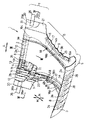
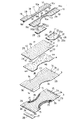
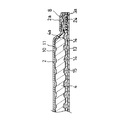
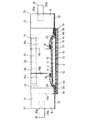
図1,2は、一例として示す使い捨ておむつ1の部分破断斜視図と、図1のおむつ1の分解斜視図とであり、図3,4は、図1のIII−III線端面図と、図1のIV−IV線矢視断面図とである。図1では、横方向を矢印L、縦方向を矢印Mで示し、厚み方向を矢印Nで示す。図3は、接着ライン29上を切断した状態で示す。なお、不織布10,13,17やフィルム12,22の内面とは、コア4に対向する面をいい、それらの外面とは、コア4に非対向の面をいう。
【0013】
おむつ1は、肌当接側に位置する透液性表面シート2(シート)と、肌非当接側に位置する不透液性裏面シート3(シート)と、表裏面シート2,3の間に介在する吸液性コア4と、一対の不透液性防漏シート16(シート)とを主要な構成部材とする。おむつ1は、それら構成部材の他に、伸縮性シート20(シート)および各伸縮性弾性部材18,24,25と、テープファスナ26およびターゲットテープ27とを有する。おむつ1は、縦方向に前胴周り域5および後胴周り域7と、それら胴周り域5,7の間に位置する股下域6とを備え、コア4の両端縁4aの外側に位置して横方向へ延びる一対のエンドフラップ8と、コア4の両側縁4bの外側に位置して縦方向へ延びる一対のサイドフラップ9とを有する。
【0014】
股下域6では、サイドフラップ9がおむつ1の横方向内方へ向かって弧を画いている。おむつ1は、着用時に前後胴周り域5,7を連結するオープン型であり、その平面形状が実質的に砂時計型を呈する。コア4は、前後胴周り域5,7間に延び、それら域5,7の中央に配置されている。
【0015】
表面シート2は、親水性繊維不織布10から形成され、コア4の両端縁4aから縦方向外方へ延びる両端部2aと、コア4の両側縁4bから横方向外方へ延びる両側部2bとを有する。不織布10の内面には、縦方向へ連続して延びる複数条の接着剤11が塗布されている。裏面シート3は、通気不透液性プラスチックフィルム12と、フィルム12の外側に位置する疎水性繊維不織布13とから形成されている。裏面シート3は、コア4の両端縁4aから縦方向外方へ延びる両端部3aと、コア4の両側縁4bから横方向外方へ延びる両側部3bとを有する。フィルム12の内面には、縦方向へ連続して延びる複数条の接着剤14が塗布されている。不織布13の内面には、縦方向へ連続して延びる複数条の接着剤15が塗布されている。フィルム12と不織布13とは、それらの内外面が接着剤15を介して固着されている。表裏面シート2,3の両端部2a,3aおよび両側部2b,3bでは、不織布10の内面とフィルム12の内面とが接着剤11,14を介して固着されている。コア4は、不織布10の内面とフィルム12の内面とに接着剤11,14を介して固着されている。
【0016】
防漏シート16は、疎水性繊維不織布17から形成され、サイドフラップ9を縦方向へ延びている。防漏シート16は、縦方向へ延びる固定側部16aと、コア4の上方へ起立性向を有して縦方向へ延びる可動部16bと、エンドフラップ8に位置しておむつ1の横方向内方へ倒伏した固定両端部16cとを有する。可動部16bの上方には、縦方向へ延びる伸縮性弾性部材18が収縮可能に取り付けられている。弾性部材18は、可動部16bの一部に被覆された状態で、可動部16bに固着されている。固定側部16aと固定両端部16cとにおける不織布17の内面には、縦方向へ連続して延びる複数条の接着剤19が塗布されている。固定側部16aでは、不織布17の内面が表裏面シート2,3を形成する不織布10の外面とフィルム12の内面とに接着剤14,19を介して固着されている。固定両端部16cでは、不織布17の内面が不織布10の外面に接着剤19を介して固着されている。おむつ1が表面シート2を内側にして縦方向へ湾曲すると、弾性部材18が収縮し、可動部16bがコア4の上方へ起立する。起立した可動部16bは、排泄物に対する障壁を形成する。
【0017】
伸縮性シート20は、後胴周り域7に配置され、疎水性繊維不織布21と、不織布21の外側に位置する通気不透液性の伸縮性プラスチックフィルム22とから形成されている。伸縮性シート20では、横方向へ所定の倍率に伸長させた状態にあるフィルム22に不織布21が固着されており、フィルム22が横方向内方へ収縮することで不織布21が横方向内方へ引き寄せられ、シート20に不規則な多数の皺(図示せず)が形成されている。フィルム22の一部には、縦方向へ連続して延びる複数条の接着剤23が塗布されている。伸縮性シート20は、その一部が裏面シート3の両側部3bと防漏シート16の固定側部16aとの間に介在している。伸縮性シート20では、不織布21の外面が防漏シート16を形成する不織布17の内面に接着剤19を介して固着され、フィルム22の内面が裏面シート3を形成するフィルム12の内面に接着剤14,23を介して固着されている。
【0018】
コア4は、フラッフパルプと高吸収性ポリマー粒子との混合物、または、フラッフパルプと高吸収性ポリマー粒子と熱可塑性合成樹脂繊維との混合物であり、所定の厚みに圧縮されている。コア4は、それの型崩れやポリマー粒子の脱落を防止するため、その全体をティッシュペーパーや親水性繊維不織布等の透液性シートで包被することもできる。
【0019】
エンドフラップ8は、コア4の両端縁4aから縦方向外方へ延びる表裏面シート2,3の両端部2a,3aと防漏シート16の固定両端部16cとから形成されている。エンドフラップ8には、横方向へ延びる帯状の胴周り用弾性部材24が収縮可能に取り付けられている。胴周り用弾性部材24は、裏面シート3を形成するフィルム12と不織布13との間に介在し、それらに接着剤15を介して固着されている。
【0020】
サイドフラップ9は、表裏面シート2,3の両側部2b,3bと防漏シート16の固定側部16aと伸縮性シート20とから形成されている。伸縮性シート20は、サイドフラップ9の一部を形成している。サイドフラップ9では、コア4の両側縁4bから表面シート2の両側部2bが横方向外方へわずかに延び、両側部2bからさらに横方向外方へ裏面シート3の両側部3bと防漏シート16の固定側部16aとが延びている。サイドフラップ9には、縦方向へ延びる複数条の脚周り用弾性部材25が収縮可能に取り付けられている。脚周り用弾性部材25は、裏面シート3を形成するフィルム12と不織布13との間に介在し、それらに接着剤15を介して固着されている。
【0021】
テープファスナ26は、可撓性を有するプラスチックフィルムから形成されている。テープファスナ26は、横方向へ延びる固定端部26aと自由端部26bとを有する。固定端部26aは、伸縮性シート20を形成するフィルム21と不織布22との間に介在し、それらに固着されている。自由端部26bの内面には、粘着剤(図示せず)が塗布され、粘着剤が剥離紙(図示せず)に被覆、保護されている。前胴周り域5には、テープファスナ26の自由端部26bを着脱可能に止着するターゲットテープ27が取り付けられている。ターゲットテープ27は、可撓性を有するプラスチックフィルムから形成され、横方向へ長い矩形を呈する。ターゲットテープ27には、縦方向へ連続して延びる複数条の接着剤28が塗布されている。ターゲットテープ27は、裏面シート2を形成する不織布22の外面に接着剤28を介して固着されている。
【0022】
おむつ1を着用するには、後胴周り域7のサイドフラップ9を前胴周り域5のサイドフラップ9の外側に重ね合わせ、粘着剤を介してテープファスナ26の自由端部26bをターゲットテープ27に止着して前胴周り域5と後胴周り域7とを連結する。前後胴周り域5,7が連結されたおむつ1には、胴周り開口とその下方に一対の脚周り開口とが形成される(図示せず)。
【0023】
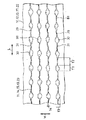
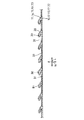
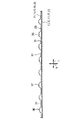
図5は、接着剤11,14,15,19,23を塗布した不織布10,13,17やフィルム12,22の部分上面図であり、図6,7は、不織布10,13,17やフィルム12,22に接着剤11,14,15,19,23を塗布する状態を示す図と、不織布10,13,17やフィルム12,22に接着剤11,14,15,19,23を塗布した後の図とである。図5は、接着剤19を介して固着された不織布10,17どうしを厚み方向へプレスした後の状態、または、接着剤11,14,15,23を介して固着された不織布10,13とフィルム12,22とを厚み方向へプレスした後の状態を示している。なお、それら図では、縦方向を矢印L、横方向を矢印M(図5のみ)で示し、厚み方向を矢印N(図6,7のみ)で示す。
【0024】
表裏面シート2,3、防漏シート16、伸縮性シート20を形成する不織布10,13,17やフィルム12,22に塗布された接着剤11,14,15,19,23(以下、接着剤の符号11,14,15,19,23を一括してB1とする。)は、縦方向へ連続して略直状に延びる独立した複数条の接着ライン29を形成している。接着ライン29は、隣接するそれらライン29どうしが互いに交差することなく、横方向へ所与寸法離間して並んでいる。ライン29は、縦方向へ交互に並ぶ第1部位30と第2部位31とを有する。第1部位30は、図6に示すように、接着ライン29が厚み方向へ3層に重なり合うことで形成されている。なお、第1部位30では、接着ライン29が厚み方向へ4層以上重なり合っていてもよい。
【0025】
接着ライン29は、図7に示すように、第1部位30における接着剤B1の分量が第2部位31における接着剤B1の分量よりも多く、第1部位30における接着剤B1の厚みが第2部位31における接着剤B1の厚みよりも大きくなり、縦方向へ凹凸を繰り返している。接着剤B1の分量が第2部位31のそれよりも多い第1部位30では、第2部位31と比較し、接着剤B1が不織布10,13,17の繊維間隙に厚み方向へ深く滲入するとともに、接着剤B1がフィルム12,22面で大きく広がる。これとは逆に、接着剤B1の分量が第1部位30のそれよりも少ない第2部位31では、第1部位30と比較し、接着剤B1が不織布10,13,17の繊維間隙にわずかに滲入するだけであり、接着剤B1がフィルム12,22面でわずかに広がるだけである。第1部位30では、アンカー効果が第2部位31よりも強く作用し、不織布10,17どうしの接着強度や不織布10,13とフィルム12,22との接着強度、不織布10とフィルム12とに対するコア4の接着強度を向上させることができる。第2部位31では、接着剤B1が硬化したとしても、不織布10,13,17やフィルム12,22の剛性が接着剤B1によって影響を受けることがなく、不織布10,13,17自身やフィルム12,22自身が有する柔軟性を維持することができる。
【0026】
第1部位30の単位長さ当たりの接着剤B1の分量は、0.0001〜0.0045g/cmの範囲にあり、第2部位31の単位長さ当たりの接着剤B1の分量は、0.00003〜0.0008g/cmの範囲にある。なお、第2部位31の単位長さ当たりの接着剤B1の分量に対する第1部位30の単位長さ当たりの接着剤B1の分量が3倍以上である。
【0027】
第1部位30の接着剤B1の分量が0.0001g/cm未満では、第1部位30における不織布10,17どうしや不織布10,13とフィルム12,22との接着強度、不織布10とフィルム12とに対するコア4の接着強度が低下し、第1部位30において不織布10,17どうしや不織布10,13とフィルム12,22とが剥離したり、コア4が不織布10とフィルム12とから剥離してしまう場合がある。第1部位30の接着剤B1の分量が0.0045g/cmを超過すると、第1部位30において接着剤B1が不織布10,13,17の繊維間隙に厚み方向へ必要以上に滲入したり、接着剤B1がフィルム12,22面で必要以上に広がり、硬化した接着剤B1によって不織布10,13,17やフィルム12,22の剛性が増加し、不織布10,13,17やフィルム12,22の柔軟性が低下してしまう。
【0028】
第2部位31の接着剤B1の分量が0.00003g/cm未満では、第2部位31において不織布10,17どうしを固着したり、不織布10,13とフィルム12,22とを固着することが困難になり、第2部位31を不織布10,17どうしの固着や10,13とフィルム12,22との固着に利用することができない場合がある。また、コア4表面に多数の凹凸が形成されていることから、第2部位31に塗布された接着剤B1(11,14)がコア4表面に接することができず、不織布10とフィルム12とにコア4を固着することができない。第2部位31の接着剤B1の分量が0.0008g/cmを超過すると、硬化した接着剤B1によって不織布10,13,17やフィルム11,22の剛性が増加し、不織布10,13,17やフィルム11,22の柔軟性が低下してしまう。なお、第1および第2部位30,31の単位長さ当たりの接着剤B1の分量は、以下の方法で測定した。
(1)おむつ1から表面シート2や裏面シート3、防漏シート16を分離し、接着ライン29を有するそれらシート2,3,16のうちの少なくとも1つを切断して長さ1cmの分量測定用シート片を作成し、測定用シート片の重さを直示天秤で測定する。測定用シート片には、1条の接着ライン29が延びている。
(2)測定用シート片に塗布された接着剤B1をトルエンで溶解する。接着剤B1の溶解手順は、以下のとおりである。測定用シート片をトルエンに30分間浸し、10分毎に計4回掻き混ぜる。30分後に測定用シート片をトルエンから取り出し、濾紙でトルエンを拭き取る。次に、測定用シート片を洗浄用トルエンに浸して5分間掻き混ぜた後、測定用シート片をトルエンから取り出し、濾紙でトルエンを拭き取る。さらに、測定用シート片をオーブン(40℃全開)内に入れ、1時間放置乾燥させ、乾燥後の測定用シート片の重さを直示天秤で測定する。
(3)接着剤B1の塗布量は、接着剤B1を溶解する以前の測定用シート片の重さ(単位:g)をA、接着剤B1を溶解した後の測定用シート片の重さ(単位:g)をBとし、C=(A−B)で算出する。ここで、Cは、接着剤B1の分量(単位:g/cm)である。
【0029】
接着ライン29では、第1部位30の長さ寸法T1が1〜10mmの範囲にあり、第2部位31の長さ寸法T2が0.5〜80mmの範囲にある。第1部位30の長さ寸法T1が1mm未満では、第1部位30における不織布10,17どうしや不織布10,13とフィルム12,22との接着強度、不織布10とフィルム12とに対するコア4の接着強度が低下し、第1部位30において不織布10,17どうしや不織布10,13とフィルム12,22とが剥離したり、コア4が不織布10とフィルム12とから剥離してしまう場合がある。第1部位30の長さ寸法T1が10mmを超過すると、硬化した接着剤B1によって不織布10,13,17やフィルム12,22の剛性が増加し、不織布10,13,17やフィルム12,22の柔軟性が低下してしまう。第2部位31の長さ寸法T2が80mmを超過すると、接着ライン29における第1部位30の占有率が低下し、不織布10,17どうしや不織布10,13とフィルム12,22との接着強度、不織布10とフィルム12とに対するコア4の接着強度が低下し、不織布10,17どうしや不織布10,13とフィルム12,22とが剥離したり、コア4が不織布10とフィルム12とから剥離してしまう場合がある。
【0030】
接着ライン29では、第1部位30の幅寸法T3が0.01〜3mmの範囲、第2部位31の幅寸法T4が0.003〜0.5mmの範囲にあり、第2部位31の幅寸法T4に対する第1部位30の幅寸法T3が3倍以上である。
【0031】
第1部位30の幅寸法T3が0.01mm未満では、第1部位30における不織布10,13,17の有効接着面積やフィルム12,22の有効接着面積が小さくなり、第1部位30における不織布10,17どうしや不織布10,13とフィルム12,22との接着強度、不織布10とフィルム12とに対するコア4の接着強度が低下し、第1部位30において不織布10,17どうしや不織布10,13とフィルム12,22とが剥離したり、コア4が不織布10とフィルム12とから剥離してしまう場合がある。第1部位30の幅寸法T3が3mmを超過すると、硬化した接着剤B1によって不織布10,13,17やフィルム12,22の剛性が増加し、不織布10,13,17やフィルム12,22の柔軟性が低下してしまう。第2部位31の幅寸法T4が0.003mm未満では、第2部位31において不織布10,17どうしを固着したり、不織布10,13とフィルム12,22とを固着することが困難になり、第2部位31を不織布10,17どうしの固着や不織布10,13とフィルム12,22との固着に利用することができない場合がある。また、第2部位31に塗布された接着剤B1(11,14)がコア4表面に接することができず、不織布10とフィルム12とにコア4を固着することができない。なお、第1および第2部位30,31の長さ寸法T1,T2や幅寸法T3,T4は、拡大鏡または電子顕微鏡を用いて測定することができる。
【0032】
不織布10,13,17やフィルム12,22に対する接着剤B1の塗布量は、2.0〜100g/m2の範囲にある。ここで、接着剤B1の塗布量は、不織布10,13,17やフィルム12,22の単位面積当たりの坪量(単位:g/m2)であり、接着ライン29の単位長さ当たりの接着剤B1の分量(単位:g/cm)とは異なる。
【0033】
不織布10,13,17やフィルム12,22に対する接着剤B1の塗布量が2.0g/m2未満では、単位面積当たりの接着剤B1の塗布量が極端に減少し、不織布10,17どうしや不織布10,13とフィルム12,22とを固着することができず、不織布10とフィルム12とにコア4を固着することができない。不織布10,13,17やフィルム12,22に対する接着剤B1の塗布量が100g/m2を超過すると、硬化した接着剤B1によって不織布10,13,17やフィルム12,22の剛性が著しく増加し、不織布10,13,17やフィルム12,22の柔軟性が低下してしまう。なお、接着剤B1の塗布量は、以下の方法で測定した。
(1)おむつ1から表面シート2や裏面シート3、防漏シート16を分離し、それらシート2,3,16のうちの少なくとも1つを切断して100mm×100mmの塗布量測定用シート片を作成し、測定用シート片の重さを直示天秤で測定する。
(2)測定用シート片に塗布された接着剤B1をトルエンで溶解する。接着剤B1の溶解手順は、以下のとおりである。測定用シート片をトルエンに30分間浸し、10分毎に計4回掻き混ぜる。30分後に測定用シート片をトルエンから取り出し、濾紙でトルエンを拭き取る。次に、測定用シート片を洗浄用トルエンに浸して5分間掻き混ぜた後、測定用シート片をトルエンから取り出し、濾紙でトルエンを拭き取る。さらに、測定用シート片をオーブン(40℃全開)内に入れ、1時間放置乾燥させ、乾燥後の測定用シート片の重さを直示天秤で測定する。
(3)接着剤B1の塗布量は、接着剤B1を溶解する以前の測定用シート片の重さ(単位:g)をD、接着剤B1を溶解した後の測定用シート片の重さ(単位:g)をEとし、F=(D−E)÷0.01で算出する。ここで、Fは、接着剤B1の塗布量(単位:g/m2)である。
【0034】
表面シート2を形成する不織布10と裏面シート3を形成する不織布13とは、それらの圧縮特性が0.3g・cm/m2以上のものを使用することができ、それらの厚み寸法が0.2mm以上のものを使用することができる。圧縮特性が0.3g・cm/m2以上かつ厚み寸法が0.2mm以上の不織布10,13は、高い嵩と優れた柔軟性とを有し、それら不織布10,13が着用者の肌に接したときの触感がよい。また、そのような圧縮特性と厚み寸法とを有する不織布10,13を使用したとしても、接着ライン29における第1部位30の接着剤B1(11,15)が不織布10,13の繊維間隙に厚み方向へ深く滲入するので、嵩が高い不織布10,13とフィルム12とを確実に固着することができる。
【0035】
伸縮性シート20は、その圧縮特性が0.3g・cm/m2以上のものを使用することができ、その厚み寸法が0.2mm以上のものを使用することができる。圧縮特性が0.3g・cm/m2以上かつ厚み寸法が0.2mm以上の伸縮性シート20は、高い嵩と優れた柔軟性とを有し、伸縮性シート20が着用者の肌に接したときの触感がよい。また、そのような圧縮特性と厚み寸法とを有する伸縮性シート20を使用したとしても、接着ライン29における第1部位30の接着剤B1(23)が伸縮性シート20を形成する不織布22の繊維間隙に厚み方向へ深く滲入するので、伸縮性シート20をフィルム12に確実に固着することができる。なお、不織布10,13や伸縮性シート20には、圧縮特性が0.3g・cm/m2未満かつ厚み寸法が0.2mm未満のものを使用することもできる。不織布10,13や伸縮性シート20の圧縮特性と厚み寸法とは、以下の方法で測定した。
(1)おむつ1から表面シート2や裏面シート3、防漏シート16、伸縮性シート20を分離し、さらに、裏面シート2や伸縮性シート20からフィルム12,21を分離した後、それらシート2,3,16,20を切断して10mm×10mmの圧縮特性測定用シート片と厚み寸法測定用シート片とを作成する。
(2)圧縮特性の測定器には、COMPRESSION TESTER(カトーテック株式会社製、型式:KES-FB3 AUTO-A)を使用した。測定条件は、SENS:2×5、スピード:50sec/mm、加圧面積:2cm2、ストロークセレクト:5mm/10V、上限荷重(Fm):50gf/cm、Fmセットダイヤル:5である。
(3)厚み寸法の測定器には、THICKNESS GAGE(大栄科学精器株式会社製、型式:Model UF-60)を使用した。測定条件は、測定面:φ44mm、測定圧:3g/cm2である。厚み寸法は、厚み寸法測定用シート片を測定器に挟み測定する。厚み寸法は、厚み寸法測定用シート片の厚み寸法を少なくとも10回測定し、それら測定値の平均を採用した。
【0036】
おむつ1では、表裏面シート2,3、防漏シート16、伸縮性シート20を形成する不織布10,13,17やフィルム12,22またはコア4が縦方向へ連続して延びる接着ライン29を介して固着され、接着ライン29が縦方向に交互に並ぶ第1部位30と第2部位31とを有し、第2部位30よりも接着剤B1の分量が多い第1部位30で不織布どうし10,17や不織布10,13とフィルム12,22とを確実に固着することができるとともに、コア4を不織布10とフィルム12とに確実に固着することができ、それらの剥離を防ぐことができる。
【0037】
接着ライン29は、接着剤B1の分量が第1部位30のそれよりも少ない第2部位31を有する。ゆえに、おむつ1では、ライン29が第1部位30のみから形成されている場合と比較し、不織布10,13,17やフィルム12,22の柔軟性の低下を防ぐことができ、不織布10,13,17自身やフィルム11,22自身が有する柔軟性を維持することができる。このおむつ1は、不織布10,13,17やフィルム12,22が接着ライン29を介して固着されることで、不織布10,13,17やフィルム12,22、コア4の剥離防止と不織布10,13,17やフィルム12,22の柔軟性の維持との両者を同時に達成することができる。
【0038】
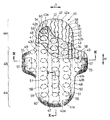
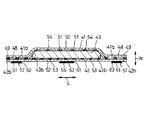
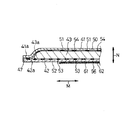
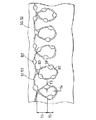
図8,9は、一例として示す生理用ナプキン40の部分破断斜視図と、図8のIX−IX線端面図とであり、図10,11は、図8のX−X線端面図と、接着剤51,53を介して固着された不織布50とフィルム52との部分上面図である。図11は、接着剤51,53を介して固着された不織布50とフィルム52とを厚み方向へプレスした後の状態を示している。それら図では、横方向を矢印L(図8,9のみ)、縦方向を矢印M(図8,10のみ)で示し、厚み方向を矢印N(図9,10のみ)で示す。
【0039】
ナプキン40は、肌当接側に位置する透液性表面シート41(シート)と、肌非当接側に位置する不透液性裏面シート42(シート)と、表裏面シート41,42の間に介在する吸液性コア43とを主要な構成部材とする。ナプキン40は、縦方向に前域44および後域46と、それら域44,46の間に位置する中間域45とを備え、コア43の両端縁43aの外側に位置して横方向へ延びる両端部47と、コア43の両側縁43bの外側に位置して縦方向へ延びる両側部48とを有する。コア43は、図1のおむつ1のそれと同一のものであり、前後域44,46間に延び、それら域44,46の中央に配置されている。中間域45の両側部48には、横方向外方へ延びる一対のウイング49が形成されている。
【0040】
表面シート41は、親水性繊維不織布50から形成され、コア43の両端縁43aから縦方向外方へ延びる両端部41aと、コア43の両側縁43bから横方向外方へ延びる両側部41bとを有する。不織布50の内面には、縦方向へ連続かつ曲折して延びる複数条の接着剤51が塗布されている。裏面シート42は、プラスチックフィルム52から形成され、コア43の両端縁43aから縦方向外方へ延びる両端部42aと、コア43の両側縁43bから横方向外方へ延びる両側部42bとを有する。フィルム52の内面には、縦方向へ連続かつ曲折して延びる複数条の接着剤53が塗布されている。コア43の上面には、縦方向へ連続かつ曲折して延びる複数条の接着剤54が塗布されている。表裏面シート41,42の両端部41a,42aおよび両側部41b,42bでは、不織布50の内面とフィルム52の内面とが接着剤51,53を介して固着されている。コア43は、不織布50の内面とフィルム52の内面とに接着剤51,51,54を介して固着されている。両端部47と両側部48とでは、接着剤51,53の他に、不織布50の内面とフィルム52の内面とがドット状の多数の熱融着部55を介して固着されている。
【0041】
ナプキン40では、その横方向中央に縦方向へ延びる粘着域56が形成され、ウイング49に縦方向へ延びる粘着域57が形成されている。それら粘着域56,57は、フィルム52の外面に形成されている。粘着域56,57には、粘着剤61が塗布されている。粘着剤61は、剥離紙62に被覆、保護されている。ナプキン40を使用するには、粘着域56,57から剥離紙62を剥がし、粘着域56をショーツの内側に貼付するとともに、ウイング49をショーツの外側に折り返し、粘着域57を介してウイング49をショーツの外側に貼付する。
【0042】
表面シート41を形成する不織布50とコア43とに塗布された接着剤51,54は、縦方向へ連続してスパイラル状に延びる独立した複数条の接着ライン58を形成している。裏面シート42を形成するフィルム52に塗布された接着剤53は、縦方向へ連続してジグザグ状に延びる独立した複数条の接着ライン58を形成している。接着ライン58は、隣接するそれらライン58どうしが互いに交差することなく、横方向へ所与寸法離間して並んでいる。ライン58は、その延びる方向に沿って交互に並ぶ第1部位59と第2部位60とを有する。第1部位59は、接着ライン58が厚み方向へ3層に重なり合うことで形成されている(図6参照)。なお、第1部位59では、接着ライン58が厚み方向へ4層以上重なり合っていてもよい。
【0043】
それら接着ライン58では、第1部位59における接着剤51,53,54(以下、接着剤の符号51,53,54を一括してB2とする。)の分量が第2部位60における接着剤B2の分量よりも多い。接着剤B2の分量が第2部位60のそれよりも多い第1部位59では、第2部位60と比較し、接着剤B2(51,54)が不織布50の繊維間隙に厚み方向へ深く滲入するとともに、接着剤B2(53)がフィルム52面で大きく広がる。これとは逆に、接着剤B2の分量が第1部位59のそれよりも少ない第2部位60では、第1部位59と比較し、接着剤B2(51,54)が不織布50の繊維間隙にわずかに滲入するだけであり、接着剤B2(53)がフィルム52面でわずかに広がるだけである。第1部位59では、アンカー効果が第2部位60よりも強く作用し、不織布50とフィルム52との接着強度や不織布50とフィルム52とに対するコア43の接着強度を向上させることができる。第2部位60では、接着剤B2が硬化したとしても、不織布50やフィルム52の剛性が接着剤B2によって影響を受けることがなく、不織布50自身やフィルム52自身の有する柔軟性を維持することができる。
【0044】
第1部位59の単位長さ当たりの接着剤B2の分量は、0.0001〜0.0045g/cmの範囲にあり、第2部位60の単位長さ当たりの接着剤B2の分量は、0.00003〜0.0008g/cmの範囲にある。なお、第2部位60の単位長さ当たりの接着剤B2の分量に対する第1部位59の単位長さ当たりの接着剤B2の分量が3倍以上である。
【0045】
第1部位59の接着剤B2の分量が0.0001g/cm未満では、第1部位59において不織布50とフィルム52とが剥離したり、第1部位59においてコア43が不織布50とフィルム52とから剥離してしまう場合がある。第1部位59の接着剤B2の分量が0.0045g/cmを超過すると、第1部位59において接着剤B2(51,54)が不織布50の繊維間隙に厚み方向へ必要以上に滲入したり、接着剤B2(53)がフィルム52面で必要以上に広がり、硬化した接着剤B2によって不織布50やフィルム52の剛性が増加し、不織布50やフィルム52の柔軟性が低下してしまう。第2部位60の接着剤B2の分量が0.00003g/cm未満では、第2部位60において不織布50とフィルム52とを固着することが困難となり、第2部位60を不織布50とフィルム52との固着に利用することができない場合がある。また、コア43表面に多数の凹凸が形成されていることから、第2部位60に塗布された接着剤B2(51,53)がコア43表面に接することができず、不織布50とフィルム52とにコア43を固着することができない。第2部位60の接着剤B2の分量が0.0008g/cmを超過すると、硬化した接着剤B2によって不織布50やフィルム52の剛性が増加し、不織布50やフィルム52の柔軟性が低下してしまう。
【0046】
接着ライン58では、第1部位59の長さ寸法T1が1〜10mmの範囲にあり、第2部位60の長さ寸法T2が0.5〜80mmの範囲にある。第1部位59の長さ寸法T1が1mm未満では、第1部位59において不織布50とフィルム52とが剥離したり、第1部位59においてコア43が不織布50とフィルム52とから剥離してしまう場合がある。第1部位59の長さ寸法T1が10mmを超過すると、硬化した接着剤B2によって不織布50やフィルム52の剛性が増加し、不織布50やフィルム52の柔軟性が低下してしまう。第2部位60の長さ寸法T2が80mmを超過すると、接着ライン58における第1部位59の占有率が低下し、不織布50とフィルム52との接着強度、不織布50とフィルム52とに対するコア43の接着強度が低下し、不織布50とフィルム52とが剥離したり、コア43が不織布50とフィルム52とから剥離してしまう場合がある。
【0047】
接着ライン58では、第1部位59の幅寸法T3が0.01〜3mmの範囲、第2部位60の幅寸法T4が0.003〜0.5mmの範囲にあり、第2部位60の幅寸法T4に対する第1部位59の幅寸法T3が3倍以上である。
【0048】
第1部位59の幅寸法T3が0.01mm未満では、第1部位59における不織布50とフィルム52との有効接着面積が小さくなり、第1部位59において不織布50とフィルム52とが剥離したり、コア43が不織布50とフィルム52とから剥離してしまう場合がある。第1部位59の幅寸法T3が3mmを超過すると、硬化した接着剤B2によって不織布50やフィルム52の剛性が増加し、不織布50やフィルム52の柔軟性が低下してしまう。第2部位60の幅寸法T4が0.003mm未満では、第2部位60において不織布50とフィルム52とを固着することが困難になるとともに、第2部位60において不織布50とフィルム52とにコア43を固着することができない。
【0049】
不織布50やフィルム52、コア43に対する接着剤B2の塗布量は、2.0〜100g/m2の範囲にある。不織布50やフィルム52、コア43に対する接着剤B2の塗布量が2.0g/m2未満では、単位面積当たりの接着剤B2の塗布量が極端に減少し、不織布50とフィルム52とを固着することができず、不織布50とフィルム52とにコア43を固着することができない。不織布50やフィルム52に対する接着剤B2の塗布量が100g/m2を超過すると、硬化した接着剤B2によって不織布50やフィルム52の剛性が著しく増加し、不織布50やフィルム52の柔軟性が低下してしまう。
【0050】
なお、第1および第2部位59,60の単位長さ当たりの接着剤B2の分量(g/cm)の測定方法、第1および第2部位59,60の長さ寸法(mm)や幅寸法(mm)の測定方法、接着剤B2の塗布量(g/m2)の測定方法は、図1のおむつ1のそれらと同様である。
【0051】
表面シート41を形成する不織布50は、それらの圧縮特性が0.3g・cm/m2以上のものを使用することができ、それらの厚み寸法が0.2mm以上のものを使用することができる。圧縮特性が0.3g・cm/m2以上かつ厚み寸法が0.2mm以上の不織布50は、高い嵩と優れた柔軟性とを有し、不織布50が着用者の肌に接したときの触感がよい。また、そのような圧縮特性と厚み寸法とを有する不織布50を使用したとしても、接着ライン58における第1部位59の接着剤B2(51)が不織布50の繊維間隙に厚み方向へ深く滲入するので、嵩が高い不織布50とフィルム52とを確実に固着することができる。不織布50の圧縮特性(g・cm/m2)と厚み寸法(mm)との測定方法は、図1のおむつ1のそれと同様である。
【0052】
ナプキン40では、表裏面シート41,42を形成する不織布50やフィルム52またはコア43が縦方向へ連続して延びる接着ライン58を介して固着され、接着ライン58が縦方向に交互に並ぶ第1部位59と第2部位60とを有し、第2部位60よりも接着剤B2の分量が多い第1部位60で不織布50とフィルム52とを確実に固着することができるとともに、不織布50とフィルム52とにコア43を確実に固着することができ、それらの剥離を防ぐことができる。接着ライン58は、スパイラル状やジグザグ状に延びているので、ナプキン40の縦方向と横方向とのいずれの方向に対しても、略同等の接着強度で不織布50やフィルム52、コア43を固着することができ、縦方向と横方向との両方向から剥離力が作用したとしても、不織布50とフィルム52とが剥離することはなく、コア43が不織布50とフィルム52とから剥離することはない。
【0053】
接着ライン58は、接着剤B2の分量が第1部位59のそれよりも少ない第2部位60を有する。ゆえに、ナプキン40では、ライン58が第1部位59のみから形成されている場合と比較し、不織布50やフィルム52の柔軟性の低下を防ぐことができ、不織布50自身やフィルム52自身が有する柔軟性を維持することができる。このナプキン40は、不織布50やフィルム52、コア43の剥離防止と不織布50やフィルム52の柔軟性の維持との両者を同時に達成することができる。
【0054】
表面シート2,41には、親水性繊維不織布の他に、多数の開孔を有する疎水性繊維不織布や微細な多数の開孔を有するプラスチックフィルムのいずれかを使用することもできる。裏面シート3,42には、疎水性繊維不織布や通気不透液性プラスチックフィルムのいずれかを使用することもでき、高い耐水性を有するメルトブローン法による繊維不織布の少なくとも片面に、高い強度と優れた柔軟性とを有するスパンボンド法による繊維不織布を固着した複合不織布を使用することもできる。
【0055】
不織布としては、スパンレース、ニードルパンチ、メルトブローン、サーマルボンド、スパンボンド、ケミカルボンド、の各製法により製造されたものを使用することができる。不織布の構成繊維としては、ポリオレフィン系、ポリエステル系、ポリアミド系、の各繊維、ポリエチレン/ポリプロピレンやポリエチレン/ポリエステルからなる芯鞘型複合繊維または並列型複合繊維を使用することができる。
【0056】
裏面シート3には、伸縮性かつ疎水性の繊維不織布や伸縮性かつ通気不透液性のプラスチックフィルム、伸縮性かつ疎水性の繊維不織布と伸縮性かつ通気不透液性のプラスチックフィルムとを重ね合わせた複合シートのいずれかを使用することもできる。裏面シート3には、熱可塑性エラストマー樹脂繊維からなる伸縮性かつ疎水性の繊維不織布の少なくとも片面に、ポリプロピレン、ポリエチレン、ポリエステル、のいずれかの熱可塑性合成樹脂を溶融、紡糸した捲縮繊維からなる疎水性繊維不織布を重ね合わせた複合不織布を使用することもできる。伸縮性の繊維不織布としては、メルトブローンやスパンボンドの各製法により製造されたものを使用することができる。伸縮性の不織布の構成繊維には、熱可塑性エラストマー樹脂を溶融、紡糸した伸縮性繊維を使用することができる。
【0057】
接着剤B1,B2には、ホットメルト型接着剤やアクリル系接着剤、ゴム系接着剤を使用することができる。
【0058】
図1のおむつ1では、接着剤がコア4に塗布され、コア4に縦方向へ連続して略直状に延びる独立した複数条の接着ライン29が形成されていてもよい。また、接着ライン29が横方向へ略直状に延びていてもよく、接着ライン29が縦方向と横方向との両方向へ略直状に延びていてもよい。さらに、接着ライン29が図8のナプキン40と同様にスパイラル状またはジグザグ状に延びていてもよい。おむつ1は、オープン型のみならず、前後胴周り域5,7のサイドフラップ9があらかじめ連結されたパンツ型であってもよい。図8のナプキン40では、接着ライン58が横方向と縦方向とのいずれかへ略直状に延びていてもよく、接着ライン58が縦方向と横方向との両方向へ略直状に延びていてもよい。なお、使い捨て着用物品には、おむつ1やナプキン40のみならず、尿とりパッドや母乳パッドも含まれる。
【0059】
【発明の効果】
本発明にかかる使い捨て着用物品によれば、シートどうしおよびシートと吸液性コアとが所定の方向へ連続して延びる接着ラインを介して固着され、接着ラインが所定の方向へ交互に並ぶ第1部位と第2部位とを有し、第2部位よりも接着剤の分量が多い第1部位でシートどうしやシートとコアとを確実に固着することができ、シートどうしの剥離やシートとコアとの剥離を防ぐことができる。物品は、接着ラインが接着剤の分量が第1部位のそれよりも少ない第2部位を有するので、ラインが第1部位のみから形成されている場合と比較し、接着剤が硬化したとしても、シートの柔軟性の低下を防ぐことができ、シート自身が有する柔軟性を維持することができる。この物品は、シートどうしの剥離防止やシートとコアとの剥離防止およびシートの柔軟性の維持の両者を同時に達成することができる。
【0060】
この着用物品では、シートが繊維不織布やプラスチックフィルムから形成されていたとしても、第1部位の接着剤が不織布の繊維間隙に厚み方向へ深く滲入するとともに、第1部位の接着剤がフィルム面で大きく広がり、不織布どうしの接着強度や不織布とフィルムとの接着強度、不織布とフィルムとに対するコアの接着強度を向上させることができ、不織布どうしや不織布とフィルムとが剥離することはなく、コアが不織布とフィルムとから剥離することはない。また、第2部位の接着剤が不織布の繊維間隙にわずかに滲入するだけであり、第2部位の接着剤がフィルム面でわずかに広がるだけなので、第2部位において不織布やフィルムの剛性が硬化した接着剤によって影響を受けることがなく、不織布自身やフィルム自身が有する柔軟性を維持することができる。
【0061】
この着用物品は、着用者の肌に接するシートの柔軟性を維持することができ、着用者の動作が伝わったとしても、シートどうしの剥離やシートとコアとの剥離を防止することができるので、使い捨ておむつや生理用ナプキンとして好適である。
【図面の簡単な説明】
【図1】一例として示す使い捨ておむつの部分破断斜視図。
【図2】図1のおむつの分解斜視図。
【図3】図1のIII−III線端面図。
【図4】図1のIV−IV線矢視断面図。
【図5】接着剤を塗布した不織布やフィルムの上面図。
【図6】不織布やフィルムに接着剤を塗布する状態を示す図。
【図7】不織布やフィルムに接着剤を塗布した後の図。
【図8】一例として示す生理用ナプキンの部分破断斜視図。
【図9】図8のIX−IX線端面図。
【図10】図8のX−X線矢視断面図。
【図11】接着剤を介して固着された不織布とフィルムとの部分上面図。
【符号の説明】
1 使い捨ておむつ(使い捨て着用物品)
2 透液性表面シート(シート)
3 不透液性裏面シート(シート)
4 吸液性コア
5 前胴周り域
6 股下域
7 後胴周り域
8 エンドフラップ
9 サイドフラップ
10 親水性繊維不織布
11 接着剤
12 通気不透液性プラスチックフィルム
13 疎水性繊維不織布
14 接着剤
15 接着剤
16 不透液性防漏シート(シート)
17 疎水性繊維不織布
19 接着剤
20 伸縮性シート(シート)
21 疎水性繊維不織布
22 伸縮性プラスチックフィルム
23 接着剤
29 接着ライン
30 第1部位
31 第2部位
40 生理用ナプキン(使い捨て着用物品)
41 透液性表面シート(シート)
42 不透液性裏面シート(シート)
43 吸液性コア
44 前域
45 中間域
46 後域
47 両端部
48 両側部
50 親水性繊維不織布
51 接着剤
52 通気不透液性プラスチックフィルム
53 接着剤
54 接着剤
58 接着ライン
59 第1部位
60 第2部位
B1 接着剤
B2 接着剤
T1,T2 長さ寸法
T3,T4 幅寸法[0001]
TECHNICAL FIELD OF THE INVENTION
TECHNICAL FIELD The present invention relates to disposable diapers, sanitary napkins, urine absorbing pads, breast milk pads, and other disposable wearing articles that absorb and retain bodily fluids.
[0002]
[Prior art]
A liquid-permeable top sheet located on the skin-contacting side, a liquid-impermeable backing sheet located on the non-skin-contacting side, a liquid-absorbing core interposed between the front and back sheets, and an upright propensity above the core. An end flap comprising a front and rear waist region in the longitudinal direction and a crotch region located between the waist regions in the longitudinal direction, and extending laterally outside both end edges of the core. There is a disposable diaper having a vertically extending side flap outside both side edges of the core, and the core being wrapped in tissue paper (see Patent Document 1). The hot-melt adhesive applied to these sheets and tissue paper is used to fix the front and back sheets, the leakproof sheet to the front and back sheets, the tissue paper to the front and back sheets, and the core to the tissue paper. It is used.
[0003]
The diaper disclosed in Patent Literature 1 forms a plurality of independent bonding lines in which a hot-melt adhesive applied substantially uniformly to a sheet or tissue paper is bent in a wavy manner in a vertical direction and extends. In the bonding line, the adjacent lines do not intersect with each other, and the lines are arranged side by side with a given distance therebetween. The glue line has a few intersections where it intersects itself. The amount of the adhesive applied to the sheet or tissue paper is 0.8 to 8 g / m 2 In the range.
[0004]
In Patent Document 1, since the adhesive forms a plurality of independent bonding lines extending in a bent direction in the vertical direction, substantially the same bonding strength is obtained in both the vertical direction and the horizontal direction. Describes that the sheet, the tissue paper, and the core can be fixed to each other, and the separation thereof can be prevented. The amount of the adhesive applied is 0.8 to 8 g / m. 2 Therefore, even when a fibrous nonwoven fabric is used for the topsheet, the effect that the adhesive does not block the fiber gap of the nonwoven fabric over a wide range and the water permeability of the topsheet can be maintained is described. Have been.
[0005]
[Patent Document 1]
JP 2001-95837 A
[0006]
[Problems to be solved by the invention]
In the diaper disclosed in Patent Document 1, when the amount of the adhesive applied to the sheet or the tissue paper is increased in order to surely prevent the peeling of the sheet, the tissue paper, and the core, a large amount of the adhesive causes the fiber gap of the sheet or the tissue paper. Or the adhesive spreads greatly between the sheets, and the cured adhesive reduces the flexibility of the sheet. Also, if the amount of adhesive applied to the sheet or tissue paper is reduced to maintain the flexibility of the sheet, the adhesive strength between the sheets, the adhesive strength between the sheet and the tissue paper, and the adhesive strength between the tissue paper and the core will decrease. However, they may be easily peeled off. In this diaper, an adhesive applied substantially uniformly to a sheet or tissue paper forms an adhesive line, and only one means is used to increase or decrease the amount of adhesive applied as a whole line. Depending on the amount of adhesive applied, the adhesive strength of the sheet or tissue paper or core may be reduced, or the flexibility of the sheet may be reduced, as described above. It is difficult to simultaneously achieve both maintenance of the flexibility of the sheet and the sheet.
[0007]
An object of the present invention is to provide a disposable wearing article that can reliably prevent peeling between sheets and between a sheet and a core and can maintain flexibility of the sheet.
[0008]
[Means for Solving the Problems]
The premise of the present invention for solving the above-mentioned problem is that it is composed of at least two sheets arranged to face each other, and a liquid-absorbent core interposed between the sheets, and is arranged in a circumferentially outward direction from a peripheral edge of the core. The disposable wearing article, wherein the sheets extending to each other are fixed via an adhesive, and the core is fixed to at least one of the sheets via an adhesive.
[0009]
As a feature of the present invention based on the above premise, the adhesive is applied to at least one opposing surface of the sheet to form an adhesive line extending continuously in a predetermined direction, and the adhesive line is moved in a predetermined direction. It has a first part and a second part which are alternately arranged, and the amount of the adhesive in the first part is larger than the amount of the adhesive in the second part.
[0010]
The present invention has the following embodiments.
(1) The amount of the adhesive per unit length of the first portion is in the range of 0.0001 to 0.0045 g / cm, and the amount of the adhesive per unit length of the second portion is 0.00003 to 0. 0.0008 g / cm, and the amount of the adhesive per unit length of the first portion is at least three times the amount of the adhesive per unit length of the second portion.
(2) At the first portion, the adhesive lines overlap at least three layers in the thickness direction of the article.
(3) The length of the first portion is in a range of 1 to 10 mm, and the length of the second portion is in a range of 0.5 to 80 mm.
(4) The width of the first portion is in a range of 0.01 to 3 mm, the width of the second portion is in a range of 0.003 to 0.5 mm, and the first portion has a width with respect to the width of the second portion. The width dimension of the part is three times or more.
(5) The amount of the adhesive applied to the sheet is 2.0 to 100 g / m. 2 In the range.
(6) the core is a mixture of at least the pulp and the polymer particles of fluff pulp, superabsorbent polymer particles, and thermoplastic synthetic resin fibers, and the adhesive is applied to the core to form the bonding line; And the amount of the adhesive applied to the core is 2.0 to 100 g / m2. 2 In the range.
(7) At least one of the sheets is formed from at least one of a fibrous nonwoven fabric and a plastic film, and the nonwoven fabric has a compression characteristic of 0.3 g · cm / m. 2 As described above, the thickness of the nonwoven fabric is 0.2 mm or more.
(8) At least one of the sheets is formed from a composite sheet in which a fibrous nonwoven fabric is superposed on at least one surface of a plastic film having elasticity and elasticity, and the film is shrinkably fixed to the nonwoven fabric, The compression property of the sheet is 0.3 gcm / m 2 As described above, the thickness of the composite sheet is 0.2 mm or more.
(9) The wearing article includes front and rear waist regions in the longitudinal direction and a crotch region located between the waist regions, and end flaps extending laterally outside both end edges of the core and both side edges of the core. A disposable diaper having side flaps extending in the longitudinal direction on the outside of the disposable diaper, wherein the sheet is a liquid-permeable top sheet located on the skin contact side, and a liquid-impermeable back sheet located on the skin non-contact side. At least the front and back sheets of the liquid-impermeable leakproof sheet extending in the vertical direction with an upright propensity above the core, wherein the end flap and the side flaps are the front and back sheets and It is formed from at least the backsheet of the leakproof sheet.
(10) The wearing article has a front-rear region in the longitudinal direction and an intermediate region located between the regions, and both end portions extending laterally outside both end edges of the core and vertical portions outside both side edges of the core. A sanitary napkin having both sides extending in the direction, wherein the sheet is a liquid-permeable top sheet located on the skin contact side, and a liquid impermeable back sheet located on the skin non-contact side; Both end portions and the both side portions are formed from at least the back sheet of the front and back sheets.
[0011]
BEST MODE FOR CARRYING OUT THE INVENTION
The details of the disposable wearing article according to the present invention will be described below with reference to the accompanying drawings, taking a disposable diaper and a sanitary napkin as examples.
[0012]
1 and 2 are a partially cutaway perspective view of the disposable diaper 1 shown as an example and an exploded perspective view of the diaper 1 of FIG. 1, and FIGS. 3 and 4 are end views along the line III-III of FIG. 1 is a sectional view taken along line IV-IV of FIG. In FIG. 1, the horizontal direction is indicated by an arrow L, the vertical direction is indicated by an arrow M, and the thickness direction is indicated by an arrow N. FIG. 3 shows a state where the
[0013]
The diaper 1 includes a liquid-permeable top sheet 2 (sheet) located on the skin contact side, a liquid-impermeable back sheet 3 (sheet) located on the skin non-contact side, and front and
[0014]
In the
[0015]
The
[0016]
The leak-
[0017]
The
[0018]
The
[0019]
The
[0020]
The side flaps 9 are formed from both
[0021]
The
[0022]
In order to wear the diaper 1, the side flaps 9 of the
[0023]
FIG. 5 is a partial top view of
[0024]
[0025]
As shown in FIG. 7, the
[0026]
The amount of the adhesive B1 per unit length of the
[0027]
When the amount of the adhesive B1 at the
[0028]
If the amount of the adhesive B1 in the
(1) The
(2) Dissolve the adhesive B1 applied to the measurement sheet piece with toluene. The procedure for dissolving the adhesive B1 is as follows. The measurement sheet piece is immersed in toluene for 30 minutes and stirred every 10 minutes for a total of 4 times. After 30 minutes, the measurement sheet piece is taken out of the toluene, and the toluene is wiped off with a filter paper. Next, the measurement sheet piece is immersed in the washing toluene and stirred for 5 minutes, then the measurement sheet piece is taken out of the toluene, and the toluene is wiped off with a filter paper. Further, the measurement sheet piece is placed in an oven (fully open at 40 ° C.) and left to dry for one hour, and the weight of the dried measurement sheet piece is measured by a direct balance.
(3) The amount of the adhesive B1 to be applied is such that the weight (unit: g) of the measuring sheet piece before dissolving the adhesive B1 is A, and the weight of the measuring sheet piece after dissolving the adhesive B1 ( The unit: g) is B, and C = (AB). Here, C is the amount (unit: g / cm) of the adhesive B1.
[0029]
In the
[0030]
In the
[0031]
If the width dimension T3 of the
[0032]
The amount of the adhesive B1 applied to the
[0033]
The amount of the adhesive B1 applied to the
(1) The
(2) Dissolve the adhesive B1 applied to the measurement sheet piece with toluene. The procedure for dissolving the adhesive B1 is as follows. The measurement sheet piece is immersed in toluene for 30 minutes and stirred every 10 minutes for a total of 4 times. After 30 minutes, the measurement sheet piece is taken out of the toluene, and the toluene is wiped off with a filter paper. Next, the measurement sheet piece is immersed in the washing toluene and stirred for 5 minutes, then the measurement sheet piece is taken out of the toluene, and the toluene is wiped off with a filter paper. Further, the measurement sheet piece is placed in an oven (fully open at 40 ° C.) and left to dry for one hour, and the weight of the dried measurement sheet piece is measured by a direct balance.
(3) The amount of the adhesive B1 to be applied is as follows: D is the weight (unit: g) of the measurement sheet piece before dissolving the adhesive B1, and D is the weight of the measurement sheet piece after dissolving the adhesive B1 ( The unit: g) is set to E, and F = (DE) ÷ 0.01. Here, F is the amount of the adhesive B1 applied (unit: g / m 2 ).
[0034]
The
[0035]
The
(1) The
(2) COMPRESSION TESTER (manufactured by Kato Tech Co., Ltd., model: KES-FB3 AUTO-A) was used as a measuring device for compression characteristics. Measurement conditions are: SENS: 2 × 5, speed: 50 sec / mm, pressurized area: 2 cm 2 , Stroke select: 5 mm / 10 V, upper limit load (Fm): 50 gf / cm, Fm set dial: 5.
(3) THICKNESS GAGE (manufactured by Daiei Kagaku Seiki Co., Ltd., model: Model UF-60) was used as a measuring instrument for thickness dimensions. The measurement conditions are: measurement surface: φ44 mm, measurement pressure: 3 g / cm 2 It is. The thickness dimension is measured by sandwiching the sheet for measuring the thickness dimension between measuring instruments. As the thickness dimension, the thickness dimension of the thickness dimension measuring sheet piece was measured at least 10 times, and the average of the measured values was adopted.
[0036]
In the diaper 1, the
[0037]
The
[0038]
8 and 9 are a partially cutaway perspective view of the
[0039]
The
[0040]
The
[0041]
In the
[0042]
The
[0043]
In these
[0044]
The amount of the adhesive B2 per unit length of the
[0045]
When the amount of the adhesive B2 at the
[0046]
In the
[0047]
In the
[0048]
When the width dimension T3 of the
[0049]
The amount of the adhesive B2 applied to the
[0050]
The method of measuring the amount (g / cm) of the adhesive B2 per unit length of the first and
[0051]
The
[0052]
In the
[0053]
The
[0054]
For the
[0055]
As the nonwoven fabric, those manufactured by each of the methods of spunlace, needle punch, melt blown, thermal bond, spunbond, and chemical bond can be used. As the constituent fibers of the nonwoven fabric, polyolefin-based, polyester-based, polyamide-based fibers, core-in-sheath type composite fibers made of polyethylene / polypropylene or polyethylene / polyester, or parallel type composite fibers can be used.
[0056]
On the
[0057]
As the adhesives B1 and B2, a hot-melt adhesive, an acrylic adhesive, or a rubber adhesive can be used.
[0058]
In the diaper 1 of FIG. 1, an adhesive may be applied to the
[0059]
【The invention's effect】
ADVANTAGE OF THE INVENTION According to the disposable wearing article which concerns on this invention, a sheet | seat and a sheet | seat and a liquid-absorbent core are fixed via the adhesive line extended continuously in a predetermined direction, and the 1st adhesive line is alternately lined up in a predetermined direction. A first portion having a portion and a second portion, the amount of the adhesive being larger than that of the second portion, the sheets and the core and the sheet can be securely fixed to each other; Can be prevented from peeling off. Since the article has a second portion where the adhesive line has a smaller amount of adhesive than that of the first portion, even if the adhesive is hardened as compared to the case where the line is formed only from the first portion, A decrease in the flexibility of the sheet can be prevented, and the flexibility of the sheet itself can be maintained. This article can simultaneously achieve both prevention of peeling between sheets, prevention of peeling between the sheet and the core, and maintenance of the flexibility of the sheet.
[0060]
In this wearing article, even if the sheet is formed of a fibrous nonwoven fabric or a plastic film, the adhesive of the first portion penetrates deeply into the fiber gap of the nonwoven fabric in the thickness direction, and the adhesive of the first portion is exposed on the film surface. Widely spreads and can improve the adhesive strength between non-woven fabrics, the adhesive strength between non-woven fabric and film, and the adhesive strength of the core between non-woven fabric and film. It does not peel off from the film. Further, since the adhesive at the second portion only slightly penetrates into the fiber gap of the nonwoven fabric and the adhesive at the second portion only spreads slightly on the film surface, the rigidity of the nonwoven fabric or the film is hardened at the second portion. The flexibility of the nonwoven fabric itself or the film itself can be maintained without being affected by the adhesive.
[0061]
Since this wearing article can maintain the flexibility of the sheet in contact with the skin of the wearer and can prevent the sheets from peeling or the sheet from the core even when the movement of the wearer is transmitted. It is suitable as a disposable diaper or sanitary napkin.
[Brief description of the drawings]
FIG. 1 is a partially broken perspective view of a disposable diaper shown as an example.
FIG. 2 is an exploded perspective view of the diaper of FIG.
FIG. 3 is an end view taken along line III-III of FIG. 1;
FIG. 4 is a sectional view taken along line IV-IV of FIG. 1;
FIG. 5 is a top view of a nonwoven fabric or a film to which an adhesive has been applied.
FIG. 6 is a diagram showing a state in which an adhesive is applied to a nonwoven fabric or a film.
FIG. 7 is a diagram after an adhesive is applied to a nonwoven fabric or a film.
FIG. 8 is a partially cutaway perspective view of a sanitary napkin shown as an example.
FIG. 9 is an end view taken along line IX-IX of FIG. 8;
FIG. 10 is a sectional view taken along line XX of FIG. 8;
FIG. 11 is a partial top view of a nonwoven fabric and a film fixed via an adhesive.
[Explanation of symbols]
1 disposable diapers (disposable worn articles)
2 Liquid permeable surface sheet (sheet)
3 Liquid-impermeable back sheet (sheet)
4 Absorbent core
5 Front waist area
6 inseam
7 Rear waist area
8 End flap
9 Side flap
10 hydrophilic fiber non-woven fabric
11 Adhesive
12. Air-permeable liquid-impermeable plastic film
13 Hydrophobic fiber non-woven fabric
14 Adhesive
15 Adhesive
16 Liquid impervious leakproof sheet (sheet)
17 hydrophobic fiber non-woven fabric
19 adhesive
20 elastic sheet (sheet)
21 Hydrophobic fiber non-woven fabric
22 Stretchable plastic film
23 Adhesive
29 Bonding line
30 First part
31 Second part
40 sanitary napkins (disposable wearing articles)
41 Liquid permeable surface sheet (sheet)
42 Liquid-impervious back sheet (sheet)
43 Liquid absorbent core
44 Front area
45 Middle range
46 Rear area
47 Both ends
48 both sides
50 hydrophilic fiber non-woven fabric
51 Adhesive
52 Air-permeable liquid-impervious plastic film
53 adhesive
54 adhesive
58 Bonding line
59 1st part
60 Second part
B1 adhesive
B2 adhesive
T1, T2 Length dimensions
T3, T4 width dimensions
Claims (11)
前記接着剤が、前記シートのうちの少なくとも一方の対向面に塗布されて所定の方向へ連続して延びる接着ラインを形成し、前記接着ラインが、所定の方向へ交互に並ぶ第1部位と第2部位とを有し、前記第1部位における前記接着剤の分量が、前記第2部位における前記接着剤の分量よりも多いことを特徴とする前記着用物品。At least two sheets arranged opposite to each other, and a liquid-absorbing core interposed between the sheets, and the sheets extending from the peripheral edge of the core outward in the circumferential direction are fixed to each other via an adhesive. A disposable wearing article wherein the core is fixed to at least one of the sheets via an adhesive,
The adhesive is applied to at least one opposing surface of the sheet to form an adhesive line that extends continuously in a predetermined direction, and the adhesive line is a first part and a first part alternately arranged in a predetermined direction. The wearing article having two portions, wherein an amount of the adhesive in the first portion is larger than an amount of the adhesive in the second portion.
Priority Applications (15)
| Application Number | Priority Date | Filing Date | Title |
|---|---|---|---|
| JP2002371036A JP4363842B2 (en) | 2002-12-20 | 2002-12-20 | Disposable wearing items |
| DK03778816.3T DK1579834T3 (en) | 2002-12-20 | 2003-12-11 | Portable disposable item |
| CA002510452A CA2510452C (en) | 2002-12-20 | 2003-12-11 | Disposable wearing article |
| AU2003289033A AU2003289033B2 (en) | 2002-12-20 | 2003-12-11 | Disposable wearing article |
| EP03778816A EP1579834B1 (en) | 2002-12-20 | 2003-12-11 | Disposable wearing article |
| AT03778816T ATE481953T1 (en) | 2002-12-20 | 2003-12-11 | DISPOSABLE ITEMS |
| CNB2003801090096A CN100486553C (en) | 2002-12-20 | 2003-12-11 | Disposable wearing article |
| PCT/JP2003/015873 WO2004056299A1 (en) | 2002-12-20 | 2003-12-11 | Disposable wearing article |
| ES03778816T ES2353078T3 (en) | 2002-12-20 | 2003-12-11 | DISPOSABLE GARMENT. |
| KR1020057011554A KR100708571B1 (en) | 2002-12-20 | 2003-12-11 | Disposable wear items |
| BR0316901-4A BR0316901A (en) | 2002-12-20 | 2003-12-11 | Disposable garment item |
| DE60334320T DE60334320D1 (en) | 2002-12-20 | 2003-12-11 | DISPOSABLE USE ITEMS |
| MYPI20034818A MY137058A (en) | 2002-12-20 | 2003-12-16 | Disposable wearing article |
| US10/736,494 US7227051B2 (en) | 2002-12-20 | 2003-12-17 | Disposable wearing article |
| TW092135999A TWI248345B (en) | 2002-12-20 | 2003-12-18 | Disposable wearing article |
Applications Claiming Priority (1)
| Application Number | Priority Date | Filing Date | Title |
|---|---|---|---|
| JP2002371036A JP4363842B2 (en) | 2002-12-20 | 2002-12-20 | Disposable wearing items |
Publications (2)
| Publication Number | Publication Date |
|---|---|
| JP2004201719A true JP2004201719A (en) | 2004-07-22 |
| JP4363842B2 JP4363842B2 (en) | 2009-11-11 |
Family
ID=32652647
Family Applications (1)
| Application Number | Title | Priority Date | Filing Date |
|---|---|---|---|
| JP2002371036A Expired - Fee Related JP4363842B2 (en) | 2002-12-20 | 2002-12-20 | Disposable wearing items |
Country Status (15)
| Country | Link |
|---|---|
| US (1) | US7227051B2 (en) |
| EP (1) | EP1579834B1 (en) |
| JP (1) | JP4363842B2 (en) |
| KR (1) | KR100708571B1 (en) |
| CN (1) | CN100486553C (en) |
| AT (1) | ATE481953T1 (en) |
| AU (1) | AU2003289033B2 (en) |
| BR (1) | BR0316901A (en) |
| CA (1) | CA2510452C (en) |
| DE (1) | DE60334320D1 (en) |
| DK (1) | DK1579834T3 (en) |
| ES (1) | ES2353078T3 (en) |
| MY (1) | MY137058A (en) |
| TW (1) | TWI248345B (en) |
| WO (1) | WO2004056299A1 (en) |
Cited By (3)
| Publication number | Priority date | Publication date | Assignee | Title |
|---|---|---|---|---|
| JP2010022588A (en) * | 2008-07-18 | 2010-02-04 | Daio Paper Corp | Tape type disposable diaper |
| WO2013161950A1 (en) * | 2012-04-27 | 2013-10-31 | ユニ・チャーム株式会社 | Disposable diaper |
| CN113164306A (en) * | 2018-12-05 | 2021-07-23 | 易希提卫生与保健公司 | Disposable sanitary article with improved fit |
Families Citing this family (43)
| Publication number | Priority date | Publication date | Assignee | Title |
|---|---|---|---|---|
| MXPA03005588A (en) * | 2000-12-21 | 2004-10-15 | Procter & Gamble | Ink-printed substrate web and disposable absorbent article exhibiting improved ink rub-off resistance. |
| US20050137549A1 (en) * | 2003-12-22 | 2005-06-23 | Kimberly-Clark Worldwide, Inc. | Use of swirl-like adhesive patterns in the formation of absorbent articles |
| US8716547B2 (en) * | 2005-05-13 | 2014-05-06 | The Procter & Gamble Company | Stretch laminates |
| USD685905S1 (en) * | 2007-03-16 | 2013-07-09 | The Procter & Gamble Company | Diaper having colored back ears |
| JP5604041B2 (en) * | 2007-12-10 | 2014-10-08 | 花王株式会社 | Elastic composite sheet |
| TWI501757B (en) * | 2008-12-24 | 2015-10-01 | Kao Corp | Wearing articles and their manufacturing methods |
| US20100193135A1 (en) * | 2009-01-30 | 2010-08-05 | Joseph Allen Eckstein | System and Method for High-Speed Continuous Application of a Strip Material to a Moving Sheet-Like Substrate Material at Laterally Shifting Locations |
| US20100193138A1 (en) * | 2009-01-30 | 2010-08-05 | Joseph Allen Eckstein | System for High-Speed Continuous Application of a Strip Material to a Moving Sheet-Like Substrate Material at Laterally Shifting Locations |
| US8171972B2 (en) | 2009-01-30 | 2012-05-08 | The Procter & Gamble Company | Strip guide for high-speed continuous application of a strip material to a moving sheet-like substrate material at laterally shifting locations |
| US8182627B2 (en) * | 2009-01-30 | 2012-05-22 | The Procter & Gamble Company | Method for high-speed continuous application of a strip material to a substrate along an application path on the substrate |
| CN101579274B (en) * | 2009-06-22 | 2013-09-11 | 王中军 | Disposable diaper and production technique and production equipment thereof |
| JP5615523B2 (en) * | 2009-09-25 | 2014-10-29 | 株式会社リブドゥコーポレーション | Sheet member and method for manufacturing sheet member |
| JP5517290B2 (en) * | 2009-12-28 | 2014-06-11 | 株式会社リブドゥコーポレーション | Absorbent articles |
| JP5924754B2 (en) * | 2011-03-30 | 2016-05-25 | ユニ・チャーム株式会社 | Absorbent articles for pets |
| WO2014004453A1 (en) | 2012-06-29 | 2014-01-03 | The Procter & Gamble Company | System and method for high-speed continuous application of a strip material to a moving sheet-like substrate material |
| US9339424B2 (en) | 2013-10-24 | 2016-05-17 | Kimberly-Clark Worldwide, Inc. | Absorbent article having an absorbent assembly with integral containment flaps |
| US9265669B2 (en) | 2013-10-31 | 2016-02-23 | Kimberly-Clark Worldwide, Inc. | Absorbent article having fully encircling bodyside and garment-side waistband |
| US9820889B2 (en) | 2013-10-31 | 2017-11-21 | Kimberly-Clark Worldwide, Inc. | Method of manufacturing an absorbent article having fully encircling bodyside and garment-side waistband |
| US9320655B2 (en) | 2013-11-27 | 2016-04-26 | Kimberly-Clark Worldwide, Inc. | Method of manufacturing an absorbent article having a fin seam |
| US10327963B2 (en) | 2014-01-31 | 2019-06-25 | Kimberly-Clark Worldwide, Inc. | Absorbent article having a zoned attachment area for securing an absorbent assembly to a chassis |
| WO2015171384A1 (en) | 2014-05-08 | 2015-11-12 | The Procter & Gamble Company | Length to side silhouettes of adult disposable absorbent articles and arrays |
| WO2015171379A1 (en) | 2014-05-08 | 2015-11-12 | The Procter & Gamble Company | Length to waist silhouettes of adult disposable absorbent articles and arrays |
| US20150320613A1 (en) | 2014-05-08 | 2015-11-12 | The Procter & Gamble Company | Waist-to-side silhouettes of adult disposable absorbent articles and arrays |
| WO2015171378A1 (en) | 2014-05-08 | 2015-11-12 | The Procter & Gamble Company | Hip to waist silhouettes of adult disposable absorbent articles and arrays |
| MX2016014571A (en) | 2014-05-08 | 2017-02-20 | Procter & Gamble | Hip to side silhouettes of adult disposable absorbent articles and arrays. |
| JP5574557B1 (en) * | 2014-05-27 | 2014-08-20 | ユニ・チャーム株式会社 | Wearing article |
| US10034801B2 (en) | 2014-10-03 | 2018-07-31 | The Procter & Gamble Company | Adult disposable absorbent articles and arrays comprising improved product lengths |
| US10864117B2 (en) | 2014-10-09 | 2020-12-15 | The Procter & Gamble Company | Length-to-waist and hip-to-side silhouettes of adult disposable absorbent articles and arrays |
| CN106999325B (en) | 2014-10-09 | 2020-10-27 | 宝洁公司 | Length-to-side contour and hip-to-waist contour for adult disposable absorbent articles and series |
| US10285876B2 (en) | 2014-10-24 | 2019-05-14 | The Procter & Gamble Company | Absorbent article with core-to-backsheet glue pattern comprising two glues |
| US10456307B2 (en) | 2015-01-16 | 2019-10-29 | The Procter & Gamble Company | Adult disposable absorbent articles and arrays of said articles comprising absorbent cores having channels |
| EP3957290B1 (en) | 2015-06-25 | 2025-05-14 | The Procter & Gamble Company | Adult disposable absorbent articles and arrays of said articles comprising improved capacity profiles |
| JP6465764B2 (en) * | 2015-06-30 | 2019-02-06 | ユニ・チャーム株式会社 | Disposable wearing items |
| WO2017079576A1 (en) | 2015-11-06 | 2017-05-11 | The Procter & Gamble Company | Disposable absorbent article silhouettes and silhouette arrays |
| CN106551760A (en) * | 2016-11-06 | 2017-04-05 | 天津露乐国际贸易有限公司 | A kind of preparation method of baby paper diaper compound core body |
| JP6718809B2 (en) * | 2016-12-27 | 2020-07-08 | ユニ・チャーム株式会社 | Pants type absorbent article |
| EP3644927B1 (en) | 2017-06-30 | 2025-08-27 | The Procter & Gamble Company | Length-to-hip and length-to-waist silhouettes of disposable absorbent articles |
| US11432973B2 (en) | 2017-06-30 | 2022-09-06 | The Procter & Gamble Company | Hip-to-side silhouettes for boxer brief type disposable absorbent articles and arrays |
| EP3644925B1 (en) | 2017-06-30 | 2025-08-27 | The Procter & Gamble Company | Length-to-side silhouettes for boxer brief/boyshort type disposable absorbent articles |
| EP3644928B1 (en) | 2017-06-30 | 2025-08-20 | The Procter & Gamble Company | Length-to-side silhouettes for bikini/low rise brief type disposable absorbent articles and arrays |
| US11432971B2 (en) | 2017-06-30 | 2022-09-06 | The Procter & Gamble Company | Hip-to-side and waist-to-side silhouettes for bikini/low rise brief type disposable absorbent articles and arrays |
| USD876843S1 (en) * | 2019-08-22 | 2020-03-03 | Xiaohuan Zhang | Embossed fabric |
| EP4175597A1 (en) * | 2020-07-06 | 2023-05-10 | Ontex BV | Absorbent article with improved core and method of making |
Family Cites Families (46)
| Publication number | Priority date | Publication date | Assignee | Title |
|---|---|---|---|---|
| GB688985A (en) * | 1949-12-15 | 1953-03-18 | Personal Products Corp | Fabric-like webs of bonded textile fibres and the use thereof in sanitary napkins |
| US2734843A (en) * | 1952-12-02 | 1956-02-14 | Method of producing honeycomb | |
| US3677249A (en) * | 1969-09-29 | 1972-07-18 | Procter & Gamble | Arcuately shaped sanitary napkin and method of formation |
| US3682755A (en) * | 1970-01-29 | 1972-08-08 | Int Paper Co | Reinforced nonwoven fabric |
| US3730798A (en) * | 1970-08-26 | 1973-05-01 | Procter & Gamble | Method of forming and adhering a web of material to the lower surface of a pad or the like |
| US3727615A (en) * | 1971-11-26 | 1973-04-17 | Kimberly Clark Co | Soft, drapable nonwoven material |
| US4081301A (en) * | 1975-10-30 | 1978-03-28 | The Procter & Gamble Company | Method and apparatus for continuously attaching discrete, stretched elastic strands to predetermined isolated portions of disposable abosrbent products |
| US4050462A (en) * | 1976-03-29 | 1977-09-27 | Kimberly-Clark Corporation | Disposable diaper with elastically constricted crotch section |
| US4488923A (en) * | 1981-11-27 | 1984-12-18 | Personal Products Company | Method for producing a fabric having unsecured elastic in areas intermittently disposed along an edge thereof |
| US4880420A (en) * | 1984-08-17 | 1989-11-14 | Mcneil-Ppc, Inc. | Multiple strand elastic means |
| US4573986A (en) * | 1984-09-17 | 1986-03-04 | The Procter & Gamble Company | Disposable waste-containment garment |
| US4894277A (en) * | 1985-01-16 | 1990-01-16 | Nordson Corporation | Application method and products that use a foamed hot melt adhesive |
| US4874451A (en) * | 1986-03-20 | 1989-10-17 | Nordson Corporation | Method of forming a disposable diaper with continuous/intermittent rows of adhesive |
| US4849049A (en) * | 1986-05-14 | 1989-07-18 | Slautterback Corporation | Joining of dissimilar surfaces by quasi-random adhesive splatter pattern |
| US4891258A (en) * | 1987-12-22 | 1990-01-02 | Kimberly-Clark Corporation | Stretchable absorbent composite |
| US4960619A (en) * | 1988-06-30 | 1990-10-02 | Slautterback Corporation | Method for depositing adhesive in a reciprocating motion |
| US5024667A (en) * | 1988-11-07 | 1991-06-18 | H. B. Fuller Licensing & Financing, Inc. | Disposable article construction |
| US5354597A (en) * | 1990-03-30 | 1994-10-11 | Minnesota Mining And Manufacturing Company | Elastomeric tapes with microtextured skin layers |
| US5316836A (en) * | 1990-07-02 | 1994-05-31 | Kimberly-Clark Corporation | Sprayed adhesive diaper construction |
| US5107866A (en) * | 1990-09-28 | 1992-04-28 | Kimberly-Clark Corporation | Heatseal porous plugwrap using hot melt adhesive |
| CA2053110C (en) * | 1990-12-17 | 2002-09-10 | Bruce M. Siebers | Diaper or absorbent article with tensioning attachment |
| TW200394B (en) * | 1991-01-25 | 1993-02-21 | Kao Corp | |
| US5421921A (en) * | 1992-07-08 | 1995-06-06 | Nordson Corporation | Segmented slot die for air spray of fibers |
| US5800867A (en) * | 1992-08-13 | 1998-09-01 | Nordson Corporation | Deflection control of liquid or powder stream during dispensing |
| US5330598A (en) * | 1992-08-14 | 1994-07-19 | Paragon Trade Brands, Inc. | Method of manufacturing an absorbent garment with target region and end caps |
| US5593400A (en) * | 1994-02-09 | 1997-01-14 | Paragon Trade Brands | Disposable absorbent article with suspended absorbent structure |
| PT748196E (en) * | 1994-03-01 | 2000-11-30 | Procter & Gamble | HYGIENIC PENSION WITH TRISECCOES |
| JPH0811246A (en) * | 1994-07-04 | 1996-01-16 | Okabe Eng Kk | Formed article out of paper sheet and pulp fiber sheet as stock and manufacture thereof |
| US5472137A (en) * | 1994-07-11 | 1995-12-05 | Illinois Tool Works Inc. | Sift proof carton and method of making |
| US5868725A (en) * | 1994-07-12 | 1999-02-09 | The Procter & Gamble Company | Absorbent article having a cushioning member and a barrier |
| US5686169A (en) * | 1994-11-21 | 1997-11-11 | Eastman Kodak Company | Pattern to control spread of adhesive during lamination of sheets |
| US6417122B1 (en) * | 1994-11-23 | 2002-07-09 | Bba Nonwovens Simpsonville, Inc. | Multicomponent fibers and fabrics made using the same |
| US6120487A (en) * | 1996-04-03 | 2000-09-19 | The Procter & Gamble Company | Disposable pull-on pant |
| JP3155711B2 (en) * | 1996-07-15 | 2001-04-16 | ユニ・チャーム株式会社 | Disposable diapers |
| SE514462C2 (en) * | 1996-11-15 | 2001-02-26 | Sca Hygiene Prod Ab | Absorbent articles such as a sanitary napkin, an incontinence guard, a panty guard or the like |
| US5882573A (en) * | 1997-09-29 | 1999-03-16 | Illinois Tool Works Inc. | Adhesive dispensing nozzles for producing partial spray patterns and method therefor |
| US6200635B1 (en) * | 1998-08-31 | 2001-03-13 | Illinois Tool Works Inc. | Omega spray pattern and method therefor |
| KR20010108479A (en) * | 1999-04-08 | 2001-12-07 | 데이비드 엠 모이어 | Absorbent article with improved combination of skin feel and fluid handling |
| USH1978H1 (en) * | 1999-05-14 | 2001-08-07 | Kimberly-Clark Worldwide, Inc. | Monolithic films having zoned breathability |
| JP3560504B2 (en) * | 1999-06-29 | 2004-09-02 | ユニ・チャーム株式会社 | Disposable diapers |
| JP3550053B2 (en) * | 1999-06-30 | 2004-08-04 | ユニ・チャーム株式会社 | Disposable diapers |
| JP3560514B2 (en) | 1999-09-29 | 2004-09-02 | ユニ・チャーム株式会社 | Disposable body fluid treatment article |
| US6602554B1 (en) * | 2000-01-14 | 2003-08-05 | Illinois Tool Works Inc. | Liquid atomization method and system |
| DE60114289T2 (en) * | 2000-05-15 | 2006-04-20 | Kao Corp. | Absorbent article |
| JP4677597B2 (en) * | 2001-08-31 | 2011-04-27 | ユニ・チャーム株式会社 | Disposable diapers |
| US6936125B2 (en) * | 2002-03-15 | 2005-08-30 | Nordson Corporation | Method of applying a continuous adhesive filament to an elastic strand with discrete bond points and articles manufactured by the method |
-
2002
- 2002-12-20 JP JP2002371036A patent/JP4363842B2/en not_active Expired - Fee Related
-
2003
- 2003-12-11 ES ES03778816T patent/ES2353078T3/en not_active Expired - Lifetime
- 2003-12-11 WO PCT/JP2003/015873 patent/WO2004056299A1/en not_active Ceased
- 2003-12-11 DK DK03778816.3T patent/DK1579834T3/en active
- 2003-12-11 CA CA002510452A patent/CA2510452C/en not_active Expired - Fee Related
- 2003-12-11 KR KR1020057011554A patent/KR100708571B1/en not_active Expired - Fee Related
- 2003-12-11 AU AU2003289033A patent/AU2003289033B2/en not_active Ceased
- 2003-12-11 BR BR0316901-4A patent/BR0316901A/en active IP Right Grant
- 2003-12-11 CN CNB2003801090096A patent/CN100486553C/en not_active Expired - Fee Related
- 2003-12-11 DE DE60334320T patent/DE60334320D1/en not_active Expired - Lifetime
- 2003-12-11 EP EP03778816A patent/EP1579834B1/en not_active Expired - Lifetime
- 2003-12-11 AT AT03778816T patent/ATE481953T1/en not_active IP Right Cessation
- 2003-12-16 MY MYPI20034818A patent/MY137058A/en unknown
- 2003-12-17 US US10/736,494 patent/US7227051B2/en not_active Expired - Fee Related
- 2003-12-18 TW TW092135999A patent/TWI248345B/en not_active IP Right Cessation
Cited By (5)
| Publication number | Priority date | Publication date | Assignee | Title |
|---|---|---|---|---|
| JP2010022588A (en) * | 2008-07-18 | 2010-02-04 | Daio Paper Corp | Tape type disposable diaper |
| WO2013161950A1 (en) * | 2012-04-27 | 2013-10-31 | ユニ・チャーム株式会社 | Disposable diaper |
| JP2013230255A (en) * | 2012-04-27 | 2013-11-14 | Unicharm Corp | Disposable diaper |
| CN113164306A (en) * | 2018-12-05 | 2021-07-23 | 易希提卫生与保健公司 | Disposable sanitary article with improved fit |
| CN113164306B (en) * | 2018-12-05 | 2022-04-12 | 易希提卫生与保健公司 | Disposable hygiene article with improved fit |
Also Published As
| Publication number | Publication date |
|---|---|
| AU2003289033B2 (en) | 2009-09-10 |
| DE60334320D1 (en) | 2010-11-04 |
| KR100708571B1 (en) | 2007-04-19 |
| ATE481953T1 (en) | 2010-10-15 |
| WO2004056299A1 (en) | 2004-07-08 |
| MY137058A (en) | 2008-12-31 |
| JP4363842B2 (en) | 2009-11-11 |
| TWI248345B (en) | 2006-02-01 |
| CN100486553C (en) | 2009-05-13 |
| BR0316901A (en) | 2005-10-18 |
| CN1738584A (en) | 2006-02-22 |
| US20040127865A1 (en) | 2004-07-01 |
| TW200423886A (en) | 2004-11-16 |
| EP1579834A1 (en) | 2005-09-28 |
| DK1579834T3 (en) | 2011-01-24 |
| US7227051B2 (en) | 2007-06-05 |
| EP1579834A4 (en) | 2007-05-02 |
| WO2004056299A8 (en) | 2004-10-14 |
| EP1579834B1 (en) | 2010-09-22 |
| KR20050090405A (en) | 2005-09-13 |
| CA2510452A1 (en) | 2004-07-08 |
| ES2353078T3 (en) | 2011-02-25 |
| AU2003289033A1 (en) | 2004-07-14 |
| CA2510452C (en) | 2008-05-27 |
Similar Documents
| Publication | Publication Date | Title |
|---|---|---|
| JP4363842B2 (en) | Disposable wearing items | |
| JP6262264B2 (en) | Absorbent article with leg gasket cuff | |
| JP5951754B2 (en) | Absorbent article comprising a narrow polymer film and an opacity enhancing patch | |
| JP2022534719A (en) | disposable absorbent article | |
| JP2022534905A (en) | Absorbent article with waist gasket element | |
| JP2019529057A (en) | Disposable absorbent article comprising a core having a plurality of laminates | |
| JP2018512212A (en) | Absorbent article comprising waist gasket element and leg cuff | |
| JP2024023394A (en) | Absorbent article with ear portion | |
| JP2018512054A (en) | Absorbent article comprising waist gasket element and leg cuff | |
| JP2009542486A (en) | Junction for joining at least two web materials together | |
| JP5855901B2 (en) | Disposable diapers | |
| US20230172767A1 (en) | Absorbent article with waist guard | |
| JP2000210328A (en) | Absorptive article for body fluid treatment | |
| JP3392416B2 (en) | Absorbent products | |
| JP4261128B2 (en) | Disposable wearing items | |
| JP2017080028A (en) | Absorbent article | |
| JP4925812B2 (en) | Absorbent articles | |
| JP7517898B2 (en) | Absorbent articles | |
| JP2015177901A (en) | absorbent article | |
| JP2024104035A (en) | Absorbent articles | |
| JP2024132669A (en) | Absorbent articles | |
| JP2017056068A (en) | Absorbent article | |
| RU2441633C1 (en) | Absorbing product for absorption and processing of body waste | |
| JP6319562B2 (en) | Absorbent articles | |
| RU2435558C1 (en) | Absorbing product of particular shape with marginal elastic elements |
Legal Events
| Date | Code | Title | Description |
|---|---|---|---|
| RD04 | Notification of resignation of power of attorney |
Free format text: JAPANESE INTERMEDIATE CODE: A7424 Effective date: 20050422 |
|
| A621 | Written request for application examination |
Free format text: JAPANESE INTERMEDIATE CODE: A621 Effective date: 20051201 |
|
| A131 | Notification of reasons for refusal |
Free format text: JAPANESE INTERMEDIATE CODE: A131 Effective date: 20081021 |
|
| A521 | Request for written amendment filed |
Free format text: JAPANESE INTERMEDIATE CODE: A523 Effective date: 20081222 |
|
| A131 | Notification of reasons for refusal |
Free format text: JAPANESE INTERMEDIATE CODE: A131 Effective date: 20090512 |
|
| A521 | Request for written amendment filed |
Free format text: JAPANESE INTERMEDIATE CODE: A523 Effective date: 20090709 |
|
| TRDD | Decision of grant or rejection written | ||
| A01 | Written decision to grant a patent or to grant a registration (utility model) |
Free format text: JAPANESE INTERMEDIATE CODE: A01 Effective date: 20090811 |
|
| A01 | Written decision to grant a patent or to grant a registration (utility model) |
Free format text: JAPANESE INTERMEDIATE CODE: A01 |
|
| A61 | First payment of annual fees (during grant procedure) |
Free format text: JAPANESE INTERMEDIATE CODE: A61 Effective date: 20090818 |
|
| FPAY | Renewal fee payment (event date is renewal date of database) |
Free format text: PAYMENT UNTIL: 20120828 Year of fee payment: 3 |
|
| R150 | Certificate of patent or registration of utility model |
Free format text: JAPANESE INTERMEDIATE CODE: R150 |
|
| FPAY | Renewal fee payment (event date is renewal date of database) |
Free format text: PAYMENT UNTIL: 20120828 Year of fee payment: 3 |
|
| FPAY | Renewal fee payment (event date is renewal date of database) |
Free format text: PAYMENT UNTIL: 20130828 Year of fee payment: 4 |
|
| R250 | Receipt of annual fees |
Free format text: JAPANESE INTERMEDIATE CODE: R250 |
|
| R250 | Receipt of annual fees |
Free format text: JAPANESE INTERMEDIATE CODE: R250 |
|
| R250 | Receipt of annual fees |
Free format text: JAPANESE INTERMEDIATE CODE: R250 |
|
| R250 | Receipt of annual fees |
Free format text: JAPANESE INTERMEDIATE CODE: R250 |
|
| LAPS | Cancellation because of no payment of annual fees |