JP2004231992A - High-strength steel sheet excellent in hydrogen embrittlement resistance and method for producing the same - Google Patents
High-strength steel sheet excellent in hydrogen embrittlement resistance and method for producing the same Download PDFInfo
- Publication number
- JP2004231992A JP2004231992A JP2003019183A JP2003019183A JP2004231992A JP 2004231992 A JP2004231992 A JP 2004231992A JP 2003019183 A JP2003019183 A JP 2003019183A JP 2003019183 A JP2003019183 A JP 2003019183A JP 2004231992 A JP2004231992 A JP 2004231992A
- Authority
- JP
- Japan
- Prior art keywords
- steel sheet
- strength
- hydrogen
- hydrogen embrittlement
- embrittlement resistance
- Prior art date
- Legal status (The legal status is an assumption and is not a legal conclusion. Google has not performed a legal analysis and makes no representation as to the accuracy of the status listed.)
- Granted
Links
Images
Landscapes
- Heat Treatment Of Sheet Steel (AREA)
Abstract
【課題】薄鋼板において、水素性欠陥を防止し、耐遅れ破壊性に優れた鋼板とその製造方法を提供する。
【解決手段】質量%にて、C:0.05〜0.3 %,Si:0.01〜3.0 %,Mn:0.01〜4.0 %,P:0.0001〜0.020 %,S:0.0001〜0.020 %,Al:0.01〜3.0 %,N:0.0001〜0.01%を含有し、Ni:0.001〜5.5 %、Cu:0.001 〜3.0 %、Cr:0.001〜5.0 %、Mo:0.005 〜5 %のうち1種以上を含有し、下記式(1)を満たし、残部が鉄及び不可避的不純物からなることを特徴とする耐水素脆化に優れた高強度薄鋼板。

【選択図】 図1The present invention provides a steel sheet which prevents hydrogen-induced defects and has excellent delayed fracture resistance, and a method of manufacturing the same.
SOLUTION: In mass%, C: 0.05-0.3%, Si: 0.01-3.0%, Mn: 0.01-4.0%, P: 0.0001-0. 020%, S: 0.0001 to 0.020%, Al: 0.01 to 3.0%, N: 0.0001 to 0.01%, Ni: 0.001 to 5.5%, Cu: 0.001 to 3.0%, Cr: 0.001 to 5.0%, Mo: 0.005 to 5%, which satisfies the following formula (1), and the balance is iron And a high-strength steel sheet excellent in hydrogen embrittlement resistance characterized by being composed of unavoidable impurities.
[Selection diagram] Fig. 1
Description
【0001】
【発明の属する技術分野】
本発明は、特に高強度薄鋼板において問題となる、水素脆化、置き割れや遅れ破壊を抑制した高強度薄鋼板及びその製造方法に関するものである。
【0002】
【従来の技術】
従来、ボルト、PC鋼線やラインパイプといった用途には高強度鋼が多く使われており、980MPa以上の引張強度になると、鋼中への水素の侵入により遅れ破壊が発生することが知られている。これに対し、薄鋼板は板厚が薄いため水素が侵入しても短時間で放出されることから、いわゆる遅れ破壊に対する問題意識は低かったと言える。
【0003】
しかし、最近では自動車の軽量化や衝突安全性の向上の必要性から、980MPa以上の超高強度鋼板にプレス成形、パイプ成形、曲げ加工、端面加工、穴拡げ加工などを施して、バンパーやインパクトビーム等の補強材やシートレール等に使用に供する場合が急速に増えてきている。したがって、耐遅れ破壊性を備えた超高強度薄鋼板の開発が急務である。
【0004】
これまで、耐遅れ破壊を向上させる技術は、ほとんどがボルトや条鋼、厚板といった、製品のままでかつ耐力または降伏応力以下で使用されることの多い鋼材に対して開発されてきた。
例えば条鋼・ボルト用鋼においては、焼き戻しマルテンサイトを中心に開発が行われ、下記非特許文献1に、Cr,MoやVといった焼き戻し軟化抵抗性を示す添加元素が耐遅れ破壊性向上に有効であることが報告されている。これは、合金炭化物を析出させて、これを水素のトラップサイトに活用することで遅れ破壊形態を粒界から粒内破壊へと移行させる技術である。しかし、これらの鋼はC量0.4%以上で合金元素も多く含むことから、薄鋼板で要求される加工性や溶接性が劣悪で、さらに、合金炭化物析出には数時間以上という析出熱処理が必要なため、製造性にも問題がある。
【0005】
また、下記特許文献1では、Ti,Mgを主体とする酸化物が水素性欠陥を防ぐことに効果があるとされている。しかし、これは対象が厚鋼板であり、特に大入熱の溶接後の遅れ破壊については考慮されている。しかしながら、薄鋼板の自動車に部品における使用環境を十分考慮したものは無い。
【0006】
一方、薄鋼板の遅れ破壊に関しては、例えば下記非特許文献2に、残留オーステナイト量の加工誘起変態に起因した遅れ破壊の助長について報告されている。これは、薄鋼板の成型加工を考慮したものであるが、耐遅れ破壊性を劣化させない残留オーステナイト量の規制について述べられている。すなわち、特定の組織を持つ高強度薄鋼板に関するものであり、根本的な耐遅れ破壊向上対策とは言えない。
【0007】
【非特許文献1】
「遅れ破壊解明の新展開」(日本鉄鋼協会、1997年1月発行)、111〜120頁。
【特許文献1】
特開平11―293383号公報
【非特許文献2】
CAMP−ISIJ、Vol.5、1992年10月、日本鉄鋼協会発行、山崎ら、1839〜1842頁。
【0008】
【発明が解決しようとする課題】
上記のように、特に自動車用薄鋼板の使用環境を十分考慮して水素脆化型の遅れ破壊に対する対策を講じた開発事例はほとんどない。
本発明は、薄鋼板において、水素性欠陥を防止し、耐遅れ破壊性に優れた鋼板とその製造方法について提供することを目的とする。
【0009】
【課題を解決するための手段】
発明者らは、以上のような背景から、薄鋼板における使用環境を十分に考慮して、根本的に耐遅れ破壊性を向上させる方法を見出すに至った。すなわち、鋼板中のトラップサイト制御に加えて環境から侵入し得る水素量を低減することで、水素起因の耐遅れ破壊性を向上させることが可能なことを見出した。
【0010】
本発明は上記知見に基づくものであり、その要旨は以下の通りである。
(1) 質量%にて、
C :0.05%〜0.3%、 Si:0.01〜3.0%、
Mn:0.01〜4.0%、 P :0.0001〜0.020%、
S :0.0001〜0.020%、Al:0.01〜3.0%、
N :0.0001〜0.01%を含有し、更に
Ni:0.001〜5.5%、 Cu:0.001〜3.0%、
Cr:0.001〜5.0%、 Mo:0.005〜5%
のうち1種以上を含有し、下記式(1)を満たし、残部が鉄および不可避的不純物からなることを特徴とする耐水素脆化に優れた高強度薄鋼板。
0≦0.8×{2Cu+20Mo+3Ni+Cr}−{0.1−3.5×10⁷ ×(TS)−3.1} ………(1)
ここで、TS:引張強さ(MPa)
【0011】
(2) 質量%にて、
C :0.05%〜0.3%、 Si:0.01〜3.0%、
Mn:0.01〜4.0%、 P :0.0001〜0.020%、
S :0.0001〜0.020%、Al:0.01〜3.0%、
N :0.0001〜0.01%を含有すると共に、
Ni:0.001〜5.5%、 Cu:0.001〜3.0%、
Cr:0.001〜5.0%、 Mo:0.005〜5%
のうちの1種以上を含有し、更に、
V :0.005〜1%
を含有し、下記式(2)を満たし、残部が鉄および不可避的不純物からなることを特徴とする耐水素脆化に優れた高強度薄鋼板。
0≦0.8×{2Cu+20Mo+3Ni+Cr+20V}−{0.1−V/5−3.5×107 ×(TS)−3.1}………(2)
ここで、TS:引張強さ(MPa)
【0012】
(3) 更に、質量%にて、
Se:0.0002〜0.05%、 As:0.0002〜0.05%、
Sb:0.0002〜0.05%、 Sn:0.0002〜0.05%、
Pb:0.0002〜0.05%、 Bi:0.0002〜0.05%、
の1種または2種以上を含有し,かつ,それらの合計が0.05%以下を満たすことを特徴とする前記(1)又は(2)に記載の耐水素脆化に優れた高強度薄鋼板。
【0013】
(4) 更に、質量%にて、
REM:0.0002〜0.10%、Ca:0.0002〜0.10%、
Mg :0.0002〜0.10%の1種または2種以上を含むことを特徴とする前記(1)〜(3)の何れか1項に記載の耐水素脆化に優れた高強度薄鋼板。
【0014】
(5) 更に、質量%にて、
Ti:0.002〜1%、 Nb:0.002〜1%、
Zr:0.005〜1%、 Hf:0.005〜1%、
Ta:0.005〜1%
の1種または2種以上を含有することを特徴とする前記(1)〜(4)の何れか1項に記載の耐水素脆化に優れた高強度薄鋼板。
【0015】
(6) 更に、質量%にて、
W :0.005〜5%、 Co:0.005〜2.0%
の1種または2種を含有することを特徴とする前記(1)〜(5)の何れか1項に記載の耐水素脆化に優れた高強度薄鋼板。
【0016】
(7) 更に、質量%にて、B:0.0002〜0.1%を含有することを特徴とする前記(1)〜(6)の何れか1項に記載の耐水素脆化に優れた高強度薄鋼板。
【0017】
(8) 更に、質量%にて、Y:0.0005〜0.1%を含有することを特徴とする前記(1)〜(7)の何れか1項に記載の耐水素脆化特性に優れた高強度薄鋼板。
【0018】
(9) 前記(1)〜(8)のいずれか1項に記載の組成からなる鋳片を1100℃以上に加熱し、Ar3 点以上の仕上温度で熱間圧延を施し、400〜800℃で捲取り、次いで酸洗の後、圧下率を10〜80%として冷間圧延してから、600〜950℃にて再結晶焼鈍を施し、次いで調質圧延を施すことを特徴とする耐水素脆化に優れた高強度薄鋼板の製造方法。
【0019】
【発明の実施の形態】
これまでの高強度鋼材である焼き戻しマルテンサイト鋼では、水素起因の遅れ破壊は旧オーステナイト粒界等に水素が集積することにより、ボイド等が形成して、その部分が起点となって破壊を生じると考えられている。そこで、水素のトラップサイトを均等かつ微細に分散させて、その部分に水素をトラップさせると、拡散性水素濃度が下がり、遅れ破壊の感受性が下がる。
【0020】
前出の特許文献1にあるように、MgおよびTiを複合添加した厚鋼板における酸化物の分散形態制御で、水素起因の耐遅れ破壊性が向上することが分かっている。しかし、環境から来る水素量が局部的にでも大量である場合を考えると、いくら鋼材内に水素のトラップサイトを分散させても必然的に水素起因の遅れ破壊は発生してしまう。このため、まず▲1▼鋼材内にトラップサイトを分散させて鋼材自体の許容水素量を高めておくことに加えて、▲2▼置かれた環境から侵入し得る水素量を低減することが重要である。
【0021】
本発明者らは、上述の背景を踏まえて、薄鋼板の使用環境において、耐遅れ
壊性を確保・向上させるため、種々の晶出物、析出物のトラップサイトの分散や鋼板の強度の影響に加えて、環境から入り得る水素量の低減について検討した。その結果、薄鋼板の使用環境下(例えばプレス加工後の設計応力相当付加下)で、水素起因の耐遅れ破壊性を向上・確保するための技術を見出した。
【0022】
すなわち、
▲1▼鋼板の強度と成分による析出物制御。
▲2▼鋼板の成分による耐侵入水素特性の制御。
をそれぞれ行うことで、自動車用薄鋼板の使用環境下での耐水素脆化を向上させることができる。これを満たすための条件として、前記式(1)および(2)を規定した。この式を満たすことで、高強度薄鋼板の対遅れ破壊性が確保できる。
【0023】
次に、▲2▼鋼材の成分による水素侵入特性の制御、について述べる。
水素侵入の過程は、腐食や酸洗などによって、水分子(中性またはアルカリ性環境の場合)または水素イオン(酸性環境の場合)の還元反応が鋼板表面で生じると、鋼板表面に水素原子が生成、吸着する。この吸着水素原子は、再結合して水素分子としてガス化するか、鋼板内部に侵入する。
本発明者らはこれらの過程を鋭意研究した結果、水素侵入速度を低減するには、耐食性を向上させるほかに、1)腐食反応の進行に伴う環境のpH(水素イオン濃度)低下を極力抑えて、表面の吸着水素原子濃度を低くする、2)再結合反応(水素発生反応)を加速することが有効であることを見出した。
【0024】
1)については、鋼中へのREM,Ca,Mg添加が有効であることを見出した。ここでREMは「Rare Earth Metal」の略で、Laから始まるランタノイド系元素の総称である。工業的な添加としてはミッシュメタルの形で添加する場合が多く、この場合にはLaやCeの添加量が多くなる。腐食反応でREM,Ca,Mgが溶出すると、水酸化物の平衡反応により雰囲気をアルカリ化、すなわち腐食反応によるpHの低下を抑制する。
【0025】
2)については、二つの方法が見出された。第一の方法は、水素イオンまたは水の還元反応の交換電流密度を上昇させる方法である。Cu,Ni,Cr,Moが有効であり、0.1≦2Cu+20Mo+3Ni+Cr+20Vを満足した場合、水素透過速度は著しく抑制される。第二の方法は、上記の交換電流密度を低下させるか、または水素発生過電圧を著しく上昇させる不純物元素を制限する方法である。該当する不純物元素として、Se,As,Sb,Pb,Biを制限すれば、水素透過速度の増加を抑制できる。
【0026】
自動車用薄鋼板の使用において、水素侵入は次の過程で生じる。第一に、プレス加工などの加工工程、第二に、酸洗、脱脂、水洗、塗装などの防食被覆工程、第三に使用環境での腐食である。いずれの環境でも、上記に述べた鋼材の成分による水素侵入特性の制御は有効である。自動車用鋼板の裸耐食性を向上させて水素侵入を抑制するには、高価な元素を大量に添加する必要があるが、これらの1)および2)の方法では、いずれも微量添加で顕著な効果が得られるという利点がある。
【0027】
以下に本発明を更に詳細に説明する。まず、本発明における鋼の化学成分(質量%)の限定理由について説明する。
Cは、鋼板の強度を上昇できる元素である。特にマルテンサイトやオーステナイトなどの硬質相を生成し高強度化には必須の元素であり、980MPa以上の強度を得るためには0.05%以上が必要であるが、逆に多く含有すると、脆性破壊の起点となるセメンタイトを増加させるため、水素脆性を生じ易くする。従って上限を0.3%とした。
【0028】
Siは、材質を大きく硬質化する置換型固溶体強化元素であり、0.01%以上含有することにより鋼板の強度を上昇させることに有効なうえ、セメンタイト析出を抑制する元素であるが、3.0%を超えると熱間圧延でのスケール形成が顕著になることと、キズの除去にコストがかかり経済的に不利なため、3.0%を上限とする。
【0029】
Mnは、鋼板の強度上昇に有効な元素である。しかし0.01%未満ではこの効果が得られないので、下限値を0.01%とした。逆に多いと偏析が顕著となり、加工性が劣化する場合があるため4.0%を上限値とする。
【0030】
Pは、粒界偏析による粒界破壊の助長をする元素であり、低い方が望ましいが、極低下は製造コスト上好ましくないため、下限を0.0001%ととした。また耐食性を劣化させる元素であるため、上限を0.020%とする。
【0031】
Sは、腐食環境下での水素吸収を助長する元素であり、低い方が望ましため、上限を0.020%とする。一方、極低下は製造コスト上好ましくないため、下限を0.0001%とした。
【0032】
Alは、脱酸のために0.01%以上を添加するが、添加量が増加するとアルミナ等の介在物が増加し、加工性が劣化するため3.0%を上限とする。
【0033】
Nは、加工性劣化や溶接時のブローホール発生にも寄与するため少ない方が良い。0.01%を超えると加工性が劣化してくるので、0.01%を上限とする。また極低下は経済的に不利なため、下限を0.0001%とする。
【0034】
Niは、水素侵入を抑制し遅れ破壊特性を向上させる効果や、鋼板の焼入れ性を高めることにより鋼板の強度を確保する効果がある。しかし、0.001%未満ではこれらの効果が得られないため、下限値を0.001%とした。逆に5.5%超では加工性が悪くなるため、上限値を5.5%とした。
【0035】
Cuは、水素侵入を抑制し遅れ破壊特性を向上させる効果や、強化に有効である上、自身の微細析出は遅れ破壊の向上にも寄与するため、0.001%以上の添加とした。また過剰添加は加工性の劣化を招くことから、上限を3.0%とした。
【0036】
Crは、水素侵入を抑制し遅れ破壊特性を向上させる効果や、鋼板の強度上昇に有効な元素である。しかし0.001%未満ではこれらの効果が得られないため、下限値を0.001%とした。逆に5%超含有すると加工性低下が生じるため、上限値を5%とした。
【0037】
Moは、水素侵入を抑制し遅れ破壊特性を向上させる効果や、鋼板の焼入れ性を高め連続焼鈍設備で安定してマルテンサイトを得るために有効な元素であるだけでなく、粒界を強化して水素脆性の発生を抑制する効果がある。しかし、0.005%未満ではこれらの効果が得られないため、下限値を0.005%とした。また、5%超ではこれらの効果が飽和するため、上限値を5%とした。
【0038】
Vは、水素侵入を抑制し遅れ破壊特性を向上させる効果や鋼板の強度上昇及び粒径の微細化に加えて、炭窒化物の形態制御により水素のトラップサイトととして活用可能であることからも、耐水素脆化向上のための重要な添加元素である。しかし、0.005%未満ではこの効果が得られないため、下限値を0.005%とした。逆に1%超含有すると炭窒化物の析出が顕著になり、延性低下が著しくなる。このため上限値を1%とした。
【0039】
Se,As,Sb,Sn,Pb,Biは、単独で0.05%を超えて含有または合計で0.05%を超えて含有すると、耐遅れ破壊特性を著しく阻害するため、各々の元素について上限を0.05%とし、かつ元素の合計について上限を0.05%とした。一方で、極低化はリサイクル上の制限を狭める理由から、0.0002%を下限とした。
【0040】
REM,Ca,Mgは、鋼板表面の腐食に伴う界面雰囲気の水素イオン濃度の上昇を抑制する、すなわちpHの低下を抑制するのに有効な元素である。しかし、それぞれ0.0002%未満ではこれらの効果が得られないため、下限値を0.0002%とした。逆にそれぞれ0.1%超含有すると加工性が劣化するため、上限値を0.1%とした。
【0041】
Tiは、析出物や介在物を生成するために必要な元素である。しかし、0.002%未満では析出物を活用できないため、下限値を0.002%とした。逆に1%超では粗大析出または昇出物が生成するために加工性および耐遅れ破壊性が低下する。このため上限値を1%とした。
【0042】
Nbは、鋼板の強度上昇及び細粒化に有効な元素である。しかし、0.002%未満ではこれらの効果が得られないため、下限値を0.002%とした。逆に1%超含有すると、炭窒化物の析出が多くなり加工性および耐遅れ破壊性低下が生じるため、上限値を1%とした。
【0043】
Zrは、鋼板の強度上昇及び細粒化に有効な元素である。しかし、0.005%未満ではこれらの効果が得られないため、下限値を0.005%とした。逆に1%超含有すると、炭窒化物の析出が多くなり加工性および耐遅れ破壊性低下が生じるため、上限値を1%とした。
【0044】
Hfは、鋼板の強度上昇及び細粒化に有効な元素である。しかし、0.005%未満ではこれらの効果が得られないため、下限値を0.005%とした。逆に1%超含有すると、炭窒化物の析出が多くなり加工性および耐遅れ破壊性低下が生じるため、上限値を1%とした。
【0045】
Taは、鋼板の強度上昇及び細粒化に有効な元素である。しかし、0.005%未満ではこれらの効果が得られないため、下限値を0.005%とした。逆に1%超含有すると、炭窒化物の析出が多くなり加工性および耐遅れ破壊性低下が生じるため、上限値を1%とした。
【0046】
Wは、鋼板の強度上昇に有効な元素である。しかし、0.005%未満ではこれらの効果が得られないため、下限値を0.005%とした。逆に5%超含有すると加工性低下が生じるため、上限値を5%とした。
【0047】
Coは、強化に有効であるため、0.005%以上の添加とした。また、過剰添加は加工性の劣化を招くことから、上限を2.0%とした。
【0048】
Bは、鋼板の強度上昇に有効な元素である。しかし、0.0002%未満ではこれらの効果が得られないため、下限値を0.0002%とした。逆に0.1%超含有すると熱間加工性が劣化するため、上限値を0.1%とした。
【0049】
Yは、介在物の形態制御に有効で、耐遅れ破壊性に寄与することから、0.0005%以上の添加とした。一方、過剰添加は熱間加工性を劣化させるため、0.1%以下の添加とした。
【0050】
次に製造方法について説明する。
特に製品板での表面状態を確保するために、製造工程における酸化スケールの形成およびデスケを十分に行う観点から下記のような製造方法とするのが望ましい。
まず、熱延時の加熱温度は変形抵抗の観点から1100℃以上とした、また、高温すぎると粒粗大化やスケール形成の増大などの問題があるため、1300℃以下とすることが望ましい。
【0051】
熱間圧延ではフェライト粒にひずみが過度に加わり加工性が低下するのを防ぐために熱間圧延をAr3 以上で行い、また高温すぎても焼鈍後の再結晶粒径が必要以上に粗大化するため、仕上温度は940℃以下が望ましい。
巻き取り温度については、高温にすれば再結晶や粒成長が促進され、加工性の向上が望まれるが、熱間圧延時に発生するスケール生成も促進され酸洗性が低下するので、800℃以下とする。一方で低温になりすぎると硬化するため、冷間圧延時での負荷が高くなる。このため400℃以上とする。
ここで、トラップサイトである微細析出物を巻き取り時に積極的に析出させるためには、400〜800℃、好ましくは550〜650℃の巻き取り処理が望ましい。
【0052】
酸洗後の冷間圧延は、圧下率が低いと鋼板の形状矯正が難しくなるため下限値を10%とする。また、80%を超える圧下率で圧延すると、鋼板のエッジ部における割れの発生及び形状の乱れの原因になるため、上限値を80%とする。
【0053】
焼鈍温度は低すぎると未再結晶の状態になり硬質化し、逆に高すぎると粒が粗大化しプレス時に肌荒れを起こす場合があるという問題点があるので、600〜950℃とした。また、焼鈍中のスケール形成および焼鈍後のデスケの観点からすると、還元雰囲気で780〜880℃の温度域で焼鈍することが望ましい。
【0054】
【実施例】
次に本発明を実施例に基づいて説明する。
表1(表1−1),表2(表1−2)に示す成分の鋼を溶製し、常法に従い連続鋳造でスラブとした。符号A〜Tが本発明に従った成分の鋼で、符号CA〜CIは成分が逸脱する比較鋼である。これらの鋼を加熱炉中で1160〜1250℃の温度で加熱し、870〜900℃の仕上げ温度で熱間圧延を行い、650〜750℃にて巻き取った。これに続いて酸洗後、圧下率30〜80%の冷間圧延を行い、次いで800〜900℃で再結晶焼鈍を行い、その後0.4%の調質圧延をして冷延鋼板となした。表1(表1−1),表2(表1−2)に各鋼板の材質特性を併せて示す。
【0055】
表3(表2)に、鋼板の耐遅れ破壊性の評価結果と各鋼の前記式(1)または(2)の値を示した。評価方法の詳細は以下の通りである。
▲1▼調質圧延後、プレス時の歪を模擬する目的で2%歪を鋼板に与える。
▲2▼鋼板より応力集中率3.2の切欠き板状引張り試験片を採取する。
▲3▼33%NaCl−3g/lNa4 SCN水溶液中で0.01〜0.025mA/cm2 で定電流陰極チャージを施す。
▲4▼Cdめっきを行う。
▲5▼引張り強度の0.8倍の一定荷重を付加する。
▲6▼100hまで試験を行い、破断か未破断を判断する。
【0056】
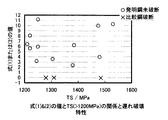
表2(表2)に示すように、本発明例で請求項に示した式(1)または(2)を満たすものは、遅れ破壊試験で未破断である。一方比較鋼では、強度レベルが同等あるは低いにもかかわらず前述の遅れ破壊試験で破断した。図1に鋼板強度と式の値の関係図上に破断/未破断の結果を示す。
【0057】
【表1】
【表2】
【表3】
【発明の効果】
以上に説明した通り、本発明による薄鋼板は水素起因の耐遅れ破壊性を向上確保するために、鋼板の強度と成分による析出物制御と鋼板の成分による耐侵入水素特性の制御をそれぞれ行うことで、自動車用薄鋼板の使用環境下での耐水素脆化を向上させることができる。また、自動車のバンパーやドアインパクトビームなどの補強部材として最適な強度を有し、また加工した後での耐遅れ破壊性を向上させることができる。
【図面の簡単な説明】
【図1】鋼板強度と式(1)および(2)の値とTS(>1200MPa)の関係と遅れ破壊特性(破断/未破断の結果)を示す。[0001]
TECHNICAL FIELD OF THE INVENTION
The present invention relates to a high-strength thin steel sheet which suppresses hydrogen embrittlement, placing cracks and delayed fracture, which are particularly problematic in a high-strength thin steel sheet, and a method for producing the same.
[0002]
[Prior art]
Conventionally, high-strength steels are often used for applications such as bolts, PC steel wires and line pipes, and it is known that when the tensile strength exceeds 980 MPa, delayed fracture occurs due to intrusion of hydrogen into the steel. I have. On the other hand, since the thin steel sheet has a small thickness and is released in a short time even if hydrogen enters, it can be said that the awareness of the problem of so-called delayed fracture was low.
[0003]
However, recently, due to the need to reduce the weight of automobiles and improve collision safety, ultra-high-strength steel sheets of 980MPa or higher are subjected to press forming, pipe forming, bending, end face processing, hole expanding, etc. to make bumpers and impacts. The use of such materials as reinforcing materials such as beams, seat rails, and the like is rapidly increasing. Therefore, there is an urgent need to develop an ultra-high strength steel sheet having delayed fracture resistance.
[0004]
Heretofore, techniques for improving delayed fracture resistance have been mostly developed for steel materials such as bolts, steel bars, and thick plates, which are often used as products and with a yield strength or yield stress or less.
For example, in steel for steel strip and bolts, development has been conducted mainly on tempered martensite. In Non-Patent Document 1 described below, an additional element exhibiting temper softening resistance, such as Cr, Mo or V, is used to improve delayed fracture resistance. Reported to be valid. This is a technique in which an alloy carbide is precipitated and is used as a hydrogen trap site to shift a delayed fracture mode from a grain boundary to an intragranular fracture. However, since these steels have a C content of 0.4% or more and contain a lot of alloying elements, the workability and weldability required for thin steel sheets are inferior, and the precipitation heat treatment for alloy carbide precipitation is several hours or more. However, there is also a problem in manufacturability.
[0005]
Patent Document 1 below discloses that an oxide mainly composed of Ti and Mg is effective in preventing a hydrogen defect. However, this is intended for thick steel plates, and in particular, delayed fracture after high heat input welding is considered. However, there is no sheet steel automobile that sufficiently considers the usage environment in parts.
[0006]
On the other hand, with respect to delayed fracture of a thin steel plate, for example, Non-Patent Document 2 below reports on the promotion of delayed fracture caused by the work-induced transformation of the amount of retained austenite. This takes into account the forming of a thin steel sheet, but describes the regulation of the amount of retained austenite that does not degrade delayed fracture resistance. That is, it relates to a high-strength thin steel sheet having a specific structure, and cannot be said to be a fundamental measure for improving delayed fracture resistance.
[0007]
[Non-patent document 1]
"New developments in elucidating delayed fracture" (Iron and Steel Institute of Japan, published in January 1997), pp. 111-120.
[Patent Document 1]
JP-A-11-293383 [Non-Patent Document 2]
CAMP-ISIJ, Vol. 5, October 1992, published by The Iron and Steel Institute of Japan, Yamazaki et al., Pp. 1839-1842.
[0008]
[Problems to be solved by the invention]
As described above, there are few development examples in which measures for hydrogen embrittlement-type delayed fracture were taken with due consideration given particularly to the working environment of automotive thin steel sheets.
An object of the present invention is to provide a steel sheet which prevents hydrogen-induced defects and has excellent delayed fracture resistance and a method for producing the same.
[0009]
[Means for Solving the Problems]
In view of the above background, the inventors have come to find a method for fundamentally improving the delayed fracture resistance by sufficiently considering the use environment of a thin steel sheet. That is, it has been found that by reducing the amount of hydrogen that can enter from the environment in addition to controlling the trap sites in the steel sheet, the delayed fracture resistance due to hydrogen can be improved.
[0010]
The present invention is based on the above findings, and the gist is as follows.
(1) In mass%,
C: 0.05% to 0.3%, Si: 0.01 to 3.0%,
Mn: 0.01 to 4.0%, P: 0.0001 to 0.020%,
S: 0.0001 to 0.020%, Al: 0.01 to 3.0%,
N: 0.0001 to 0.01%, Ni: 0.001 to 5.5%, Cu: 0.001 to 3.0%,
Cr: 0.001 to 5.0%, Mo: 0.005 to 5%
A high-strength steel sheet excellent in hydrogen embrittlement resistance, characterized by containing at least one of the following, and satisfying the following formula (1), with the balance being iron and unavoidable impurities.
0 ≦ 0.8 × {2Cu + 20Mo + 3Ni + Cr} − {0.1−3.5 × 10 7 × (TS) −3.1 } (1)
Here, TS: tensile strength (MPa)
[0011]
(2) In mass%,
C: 0.05% to 0.3%, Si: 0.01 to 3.0%,
Mn: 0.01 to 4.0%, P: 0.0001 to 0.020%,
S: 0.0001 to 0.020%, Al: 0.01 to 3.0%,
N: contains 0.0001 to 0.01%,
Ni: 0.001 to 5.5%, Cu: 0.001 to 3.0%,
Cr: 0.001 to 5.0%, Mo: 0.005 to 5%
Containing at least one of the following,
V: 0.005 to 1%
A high-strength steel sheet excellent in hydrogen embrittlement resistance, wherein the steel sheet satisfies the following formula (2) and the balance consists of iron and inevitable impurities.
0 ≦ 0.8 × {2Cu + 20Mo + 3Ni + Cr + 20V} − {0.1−V / 5−3.5 × 10 7 × (TS) −3.1 } (2)
Here, TS: tensile strength (MPa)
[0012]
(3) Further, in mass%,
Se: 0.0002-0.05%, As: 0.0002-0.05%,
Sb: 0.0002-0.05%, Sn: 0.0002-0.05%,
Pb: 0.0002-0.05%, Bi: 0.0002-0.05%,
(1) or (2), wherein the high-strength thin film contains one or two or more of the following, and the total thereof satisfies 0.05% or less. steel sheet.
[0013]
(4) Further, in mass%,
REM: 0.0002 to 0.10%, Ca: 0.0002 to 0.10%,
High strength thin excellent in hydrogen embrittlement resistance according to any one of the above (1) to (3), wherein one or more of Mg: 0.0002 to 0.10% is contained. steel sheet.
[0014]
(5) Further, in mass%,
Ti: 0.002 to 1%, Nb: 0.002 to 1%,
Zr: 0.005 to 1%, Hf: 0.005 to 1%,
Ta: 0.005 to 1%
The high-strength steel sheet excellent in hydrogen embrittlement resistance according to any one of the above (1) to (4), comprising one or more of the following.
[0015]
(6) Further, in mass%,
W: 0.005 to 5%, Co: 0.005 to 2.0%
The high-strength thin steel sheet excellent in hydrogen embrittlement resistance according to any one of the above (1) to (5), comprising one or two kinds of the following.
[0016]
(7) Further, it is excellent in hydrogen embrittlement resistance according to any one of the above (1) to (6), further containing B: 0.0002 to 0.1% by mass%. High strength steel sheet.
[0017]
(8) The hydrogen embrittlement resistance described in any one of the above (1) to (7), further containing Y: 0.0005 to 0.1% by mass%. Excellent high-strength steel sheet.
[0018]
(9) A slab having the composition according to any one of the above (1) to (8) is heated to 1100 ° C. or higher, hot-rolled at a finishing temperature of Ar3 point or higher, and heated to 400 to 800 ° C. After winding and pickling, cold rolling is performed at a rolling reduction of 10 to 80%, recrystallization annealing is performed at 600 to 950 ° C., and then temper rolling is performed. Method for manufacturing high-strength thin steel sheets that are highly efficient.
[0019]
BEST MODE FOR CARRYING OUT THE INVENTION
In conventional tempered martensitic steel, which is a high-strength steel material, delayed fracture caused by hydrogen causes voids to form due to the accumulation of hydrogen at the former austenite grain boundary, etc. It is believed to occur. Therefore, if the hydrogen trap sites are evenly and finely dispersed and hydrogen is trapped in that portion, the concentration of diffusible hydrogen decreases, and the sensitivity to delayed fracture decreases.
[0020]
As described in Patent Document 1 mentioned above, it has been found that by controlling the dispersion form of oxides in a thick steel sheet to which Mg and Ti are added in combination, delayed fracture resistance due to hydrogen is improved. However, considering the case where the amount of hydrogen coming from the environment is large even locally, no matter how many hydrogen trap sites are dispersed in the steel material, hydrogen-induced delayed fracture necessarily occurs. For this reason, it is important to (1) reduce the amount of hydrogen that can enter from the placed environment in addition to (1) disperse the trap sites in the steel material to increase the allowable hydrogen amount of the steel material itself. It is.
[0021]
In view of the above-mentioned background, the present inventors, in the use environment of a thin steel sheet, in order to secure and improve delayed fracture resistance, various crystallized substances, dispersion of trap sites of precipitates and the influence of the strength of the steel sheet. In addition, the reduction of the amount of hydrogen that can enter from the environment was examined. As a result, the inventors have found a technique for improving and securing the delayed fracture resistance due to hydrogen under the use environment of a thin steel sheet (for example, under the application of design stress after press working).
[0022]
That is,
{Circle around (1)} Precipitate control by steel sheet strength and composition.
{Circle around (2)} Control of the resistance to intrusion hydrogen by the composition of the steel sheet.
Respectively, it is possible to improve the hydrogen embrittlement resistance under the usage environment of the automotive thin steel sheet. Equations (1) and (2) were defined as conditions for satisfying this. By satisfying this equation, delayed fracture resistance of the high-strength thin steel sheet can be secured.
[0023]
Next, (2) the control of the hydrogen penetration characteristics by the components of the steel material will be described.
In the process of hydrogen intrusion, when a reduction reaction of water molecules (in a neutral or alkaline environment) or hydrogen ions (in an acidic environment) occurs on the steel sheet surface due to corrosion or pickling, hydrogen atoms are generated on the steel sheet surface Adsorb. The adsorbed hydrogen atoms recombine and gasify as hydrogen molecules, or penetrate into the steel sheet.
The present inventors have conducted intensive studies on these processes. As a result, in order to reduce the hydrogen penetration rate, in addition to improving the corrosion resistance, 1) the decrease in the pH (hydrogen ion concentration) of the environment due to the progress of the corrosion reaction is minimized. It has been found that it is effective to lower the concentration of adsorbed hydrogen atoms on the surface and 2) to accelerate the recombination reaction (hydrogen generation reaction).
[0024]
Regarding 1), it was found that REM, Ca, Mg addition to steel was effective. Here, REM is an abbreviation of “Rare Earth Metal” and is a general term for lanthanoid elements starting with La. As industrial addition, it is often added in the form of misch metal, and in this case, the added amount of La or Ce increases. When REM, Ca, and Mg are eluted by the corrosion reaction, the atmosphere is alkalized by the equilibrium reaction of the hydroxide, that is, the decrease in pH due to the corrosion reaction is suppressed.
[0025]
For 2), two methods were found. The first method is to increase the exchange current density of the reduction reaction of hydrogen ions or water. Cu, Ni, Cr, and Mo are effective, and when 0.1 ≦ 2Cu + 20Mo + 3Ni + Cr + 20V is satisfied, the hydrogen permeation rate is significantly suppressed. The second method is a method of reducing the above-described exchange current density or limiting impurity elements that significantly increase the hydrogen generation overpotential. By limiting Se, As, Sb, Pb, and Bi as the corresponding impurity elements, an increase in the hydrogen permeation rate can be suppressed.
[0026]
In the use of automotive steel sheets, hydrogen intrusion occurs in the following process. First, processing steps such as press working, second, anticorrosion coating steps such as pickling, degreasing, water washing, and painting, and third, corrosion in the use environment. In any environment, the control of the hydrogen penetration characteristics by the components of the steel material described above is effective. In order to improve the bare corrosion resistance of automotive steel sheets and suppress hydrogen intrusion, it is necessary to add a large amount of expensive elements. However, in these methods 1) and 2), a remarkable effect is obtained by adding a small amount of each. Is obtained.
[0027]
Hereinafter, the present invention will be described in more detail. First, the reasons for limiting the chemical components (% by mass) of steel in the present invention will be described.
C is an element that can increase the strength of the steel sheet. In particular, it is an essential element for forming a hard phase such as martensite or austenite and increasing the strength. To obtain a strength of 980 MPa or more, 0.05% or more is necessary. Hydrogen embrittlement is likely to occur because cementite, which is a starting point of fracture, is increased. Therefore, the upper limit is set to 0.3%.
[0028]
Si is a substitutional solid solution strengthening element that greatly hardens the material, and is effective in increasing the strength of the steel sheet by containing 0.01% or more, and is an element that suppresses cementite precipitation. If it exceeds 0%, the scale formation during hot rolling becomes remarkable, and the removal of scratches is costly and economically disadvantageous, so the upper limit is 3.0%.
[0029]
Mn is an element effective for increasing the strength of the steel sheet. However, if the content is less than 0.01%, this effect cannot be obtained, so the lower limit is set to 0.01%. Conversely, if the content is large, segregation becomes remarkable, and workability may be deteriorated. Therefore, the upper limit is set to 4.0%.
[0030]
P is an element that promotes grain boundary destruction due to grain boundary segregation, and is preferably as low as possible. However, since the extreme decrease is not preferable in terms of manufacturing cost, the lower limit is set to 0.0001%. Further, since it is an element that deteriorates corrosion resistance, the upper limit is made 0.020%.
[0031]
S is an element that promotes hydrogen absorption in a corrosive environment, and since a lower one is desirable, the upper limit is made 0.020%. On the other hand, the extremely lowering is not preferable in terms of manufacturing cost, so the lower limit was made 0.0001%.
[0032]
Al is added in an amount of 0.01% or more for deoxidation. Increasing the amount of Al increases inclusions such as alumina and deteriorates workability, so the upper limit is 3.0%.
[0033]
N should be small as it contributes to deterioration of workability and generation of blowholes during welding. If it exceeds 0.01%, the workability deteriorates, so the upper limit is made 0.01%. Further, since the extremely lowering is economically disadvantageous, the lower limit is made 0.0001%.
[0034]
Ni has the effect of suppressing hydrogen intrusion and improving delayed fracture characteristics, and the effect of securing the strength of the steel sheet by increasing the hardenability of the steel sheet. However, if the content is less than 0.001%, these effects cannot be obtained, so the lower limit is set to 0.001%. Conversely, if the content exceeds 5.5%, the workability deteriorates. Therefore, the upper limit is set to 5.5%.
[0035]
Cu is effective in enhancing the delayed fracture characteristics by suppressing hydrogen intrusion and improving the delayed fracture characteristics, and is effective for strengthening. In addition, its own fine precipitation contributes to the improvement of the delayed fracture, so Cu is added in an amount of 0.001% or more. Further, excessive addition causes deterioration of workability, so the upper limit was made 3.0%.
[0036]
Cr is an element that suppresses hydrogen intrusion and improves delayed fracture characteristics, and is effective for increasing the strength of steel sheets. However, if the content is less than 0.001%, these effects cannot be obtained. Therefore, the lower limit is set to 0.001%. Conversely, if the content exceeds 5%, the workability decreases, so the upper limit is set to 5%.
[0037]
Mo is an element that suppresses hydrogen intrusion and improves delayed fracture characteristics, and is an effective element for improving the hardenability of steel sheets and obtaining martensite stably with continuous annealing equipment, as well as strengthening grain boundaries. This has the effect of suppressing the occurrence of hydrogen embrittlement. However, if the content is less than 0.005%, these effects cannot be obtained, so the lower limit is set to 0.005%. If the content exceeds 5%, these effects are saturated, so the upper limit is set to 5%.
[0038]
V can be used as a hydrogen trap site by controlling the form of carbonitride, in addition to the effect of suppressing hydrogen intrusion and improving delayed fracture characteristics, increasing the strength of steel sheets and reducing the grain size. Is an important additive element for improving hydrogen embrittlement resistance. However, if the content is less than 0.005%, this effect cannot be obtained, so the lower limit is set to 0.005%. Conversely, when the content exceeds 1%, precipitation of carbonitride becomes remarkable, and ductility decreases remarkably. Therefore, the upper limit is set to 1%.
[0039]
If Se, As, Sb, Sn, Pb, and Bi are contained alone in an amount exceeding 0.05% or in a total amount exceeding 0.05%, the delayed fracture resistance is significantly impaired. The upper limit was set to 0.05%, and the upper limit was set to 0.05% for the total of the elements. On the other hand, the lower limit was set at 0.0002% for the purpose of narrowing the restrictions on recycling.
[0040]
REM, Ca, and Mg are effective elements for suppressing an increase in the hydrogen ion concentration in the interface atmosphere due to corrosion of the steel sheet surface, that is, for suppressing a decrease in pH. However, these effects cannot be obtained if each is less than 0.0002%, so the lower limit was made 0.0002%. Conversely, if the content exceeds 0.1%, the workability deteriorates, so the upper limit was made 0.1%.
[0041]
Ti is an element necessary to generate precipitates and inclusions. However, if the content is less than 0.002%, the precipitate cannot be used, so the lower limit is set to 0.002%. Conversely, if it exceeds 1%, coarse precipitates or exudates are formed, so that workability and delayed fracture resistance decrease. Therefore, the upper limit is set to 1%.
[0042]
Nb is an element effective for increasing the strength and reducing the grain size of the steel sheet. However, if the content is less than 0.002%, these effects cannot be obtained, so the lower limit is set to 0.002%. Conversely, if the content exceeds 1%, the precipitation of carbonitrides increases and the workability and the delayed fracture resistance decrease, so the upper limit is set to 1%.
[0043]
Zr is an element effective for increasing the strength and reducing the grain size of the steel sheet. However, if the content is less than 0.005%, these effects cannot be obtained, so the lower limit is set to 0.005%. Conversely, if the content exceeds 1%, the precipitation of carbonitrides increases and the workability and the delayed fracture resistance decrease, so the upper limit is set to 1%.
[0044]
Hf is an element effective for increasing the strength and reducing the grain size of the steel sheet. However, if the content is less than 0.005%, these effects cannot be obtained, so the lower limit is set to 0.005%. Conversely, if the content exceeds 1%, the precipitation of carbonitrides increases and the workability and the delayed fracture resistance decrease, so the upper limit is set to 1%.
[0045]
Ta is an element effective for increasing the strength and reducing the grain size of the steel sheet. However, if the content is less than 0.005%, these effects cannot be obtained, so the lower limit is set to 0.005%. Conversely, if the content exceeds 1%, the precipitation of carbonitrides increases and the workability and the delayed fracture resistance decrease, so the upper limit is set to 1%.
[0046]
W is an element effective for increasing the strength of the steel sheet. However, if the content is less than 0.005%, these effects cannot be obtained, so the lower limit is set to 0.005%. Conversely, if the content exceeds 5%, the workability decreases, so the upper limit is set to 5%.
[0047]
Since Co is effective for strengthening, 0.005% or more is added. In addition, since excessive addition causes deterioration of workability, the upper limit is set to 2.0%.
[0048]
B is an element effective for increasing the strength of the steel sheet. However, if these effects are not obtained at less than 0.0002%, the lower limit is set to 0.0002%. Conversely, if the content exceeds 0.1%, hot workability deteriorates, so the upper limit was set to 0.1%.
[0049]
Y is effective in controlling the form of inclusions and contributes to delayed fracture resistance, so Y was added in an amount of 0.0005% or more. On the other hand, excessive addition deteriorates hot workability, so the addition was made 0.1% or less.
[0050]
Next, a manufacturing method will be described.
In particular, in order to ensure the surface condition of the product plate, it is desirable to adopt the following manufacturing method from the viewpoint of sufficiently forming oxide scale and deskewing in the manufacturing process.
First, the heating temperature at the time of hot rolling is set to 1100 ° C. or higher from the viewpoint of deformation resistance. If too high, there is a problem such as grain coarsening and increase in scale formation.
[0051]
In hot rolling, hot rolling is performed at Ar3 or more to prevent excessive strain from being applied to ferrite grains and reducing workability. Also, even if the temperature is too high, the recrystallized grain size after annealing becomes unnecessarily coarse. The finishing temperature is desirably 940 ° C. or lower.
As for the winding temperature, recrystallization and grain growth are promoted at a high temperature, and improvement in workability is desired. However, scale formation generated during hot rolling is promoted and pickling property is reduced, so that the temperature is 800 ° C. or less. And On the other hand, if the temperature is too low, the material is hardened, so that the load during cold rolling increases. Therefore, the temperature is set to 400 ° C. or higher.
Here, in order to positively precipitate fine precipitates serving as trap sites at the time of winding, a winding treatment at 400 to 800 ° C, preferably 550 to 650 ° C is desirable.
[0052]
In cold rolling after pickling, if the rolling reduction is low, the shape correction of the steel sheet is difficult, so the lower limit is set to 10%. Further, if rolling is performed at a rolling reduction of more than 80%, the occurrence of cracks at the edge portion of the steel sheet and the disorder of the shape are caused, so the upper limit is set to 80%.
[0053]
If the annealing temperature is too low, it becomes unrecrystallized and becomes hard, whereas if it is too high, there is a problem that the grains become coarse and the surface may be roughened during pressing. Further, from the viewpoint of scale formation during annealing and deskewing after annealing, it is desirable to perform annealing in a temperature range of 780 to 880 ° C. in a reducing atmosphere.
[0054]
【Example】
Next, the present invention will be described based on examples.
Steels having the components shown in Table 1 (Table 1-1) and Table 2 (Table 1-2) were melted and slabs were formed by continuous casting according to a conventional method. Symbols A to T are steels having components according to the present invention, and symbols CA to CI are comparative steels whose components deviate. These steels were heated in a heating furnace at a temperature of 1160-1250 ° C, hot rolled at a finishing temperature of 870-900 ° C, and wound at 650-750 ° C. Following this, after pickling, cold rolling is performed at a rolling reduction of 30 to 80%, then recrystallization annealing is performed at 800 to 900 ° C, and then temper rolling is performed at 0.4% to obtain a cold-rolled steel sheet. did. Table 1 (Table 1-1) and Table 2 (Table 1-2) also show the material properties of each steel sheet.
[0055]
Table 3 (Table 2) shows the evaluation results of the delayed fracture resistance of the steel sheet and the values of the above formula (1) or (2) for each steel. Details of the evaluation method are as follows.
{Circle around (1)} After temper rolling, a 2% strain is applied to the steel sheet for the purpose of simulating the strain during pressing.
{Circle around (2)} A notched plate-like tensile test piece having a stress concentration rate of 3.2 is sampled from a steel sheet.
{Circle around (3)} A constant current cathode charge is performed at 0.01 to 0.025 mA / cm 2 in a 33% NaCl-3 g / l Na 4 SCN aqueous solution.
(4) Cd plating is performed.
(5) A constant load of 0.8 times the tensile strength is applied.
(6) The test is performed up to 100 hours, and it is determined whether the sample is broken or not broken.
[0056]
As shown in Table 2 (Table 2), those of the present invention that satisfy the formula (1) or (2) shown in the claims are not broken in the delayed fracture test. On the other hand, the comparative steel broke in the delayed fracture test described above, although the strength level was the same or lower. FIG. 1 shows the results of fracture / non-fracture on the relationship diagram between the steel sheet strength and the value of the equation.
[0057]
[Table 1]
[Table 2]
[Table 3]
【The invention's effect】
As described above, the thin steel sheet according to the present invention performs control of precipitates by the strength and composition of the steel sheet and control of the intrusion hydrogen resistance by the composition of the steel sheet in order to improve the delayed fracture resistance caused by hydrogen. Thus, the hydrogen embrittlement resistance under the use environment of the automotive thin steel sheet can be improved. Further, it has an optimum strength as a reinforcing member for a bumper or a door impact beam of an automobile, and can improve delayed fracture resistance after processing.
[Brief description of the drawings]
FIG. 1 shows the relationship between the strength of a steel sheet, the values of equations (1) and (2), and TS (> 1200 MPa), and the delayed fracture characteristics (results of fracture / not fracture).
Claims (9)
C :0.05%〜0.3%、
Si:0.01〜3.0%、
Mn:0.01〜4.0%、
P :0.0001〜0.020%、
S :0.0001〜0.020%、
Al:0.01〜3.0%、
N :0.0001〜0.01%
を含有し、更に
Ni:0.001〜5.5%、
Cu:0.001〜3.0%、
Cr:0.001〜5.0%、
Mo:0.005〜5%
のうち1種以上を含有し、下記式(1)を満たし、残部が鉄および不可避的不純物からなることを特徴とする耐水素脆化に優れた高強度薄鋼板。
0≦0.8×{2Cu+20Mo+3Ni+Cr}−{0.1−3.5×10⁷ ×(TS)−3.1} ………(1)
ここで、TS:引張強さ(MPa)In mass%,
C: 0.05% to 0.3%,
Si: 0.01 to 3.0%,
Mn: 0.01 to 4.0%,
P: 0.0001 to 0.020%,
S: 0.0001 to 0.020%,
Al: 0.01 to 3.0%,
N: 0.0001 to 0.01%
And further, Ni: 0.001 to 5.5%,
Cu: 0.001 to 3.0%,
Cr: 0.001 to 5.0%,
Mo: 0.005 to 5%
A high-strength steel sheet excellent in hydrogen embrittlement resistance, characterized by containing at least one of the following, and satisfying the following formula (1), with the balance being iron and unavoidable impurities.
0 ≦ 0.8 × {2Cu + 20Mo + 3Ni + Cr} − {0.1−3.5 × 10 7 × (TS) −3.1 } (1)
Here, TS: tensile strength (MPa)
C :0.05%〜0.3%、
Si:0.01〜3.0%、
Mn:0.01〜4.0%、
P :0.0001〜0.020%、
S :0.0001〜0.020%、
Al:0.01〜3.0%、
N :0.0001〜0.01%
を含有すると共に、
Ni:0.001〜5.5%、
Cu:0.001〜3.0%、
Cr:0.001〜5.0%、
Mo:0.005〜5%
のうち1種以上を含有し、更に、
V :0.005〜1%
を含有し、下記式(2)を満たし、残部が鉄および不可避的不純物からなることを特徴とする耐水素脆化に優れた高強度薄鋼板。
0≦0.8×{2Cu+20Mo+3Ni+Cr+20V}−{0.1−V/5−3.5×107 ×(TS)−3.1}………(2)
ここで、TS:引張強さ(MPa)In mass%,
C: 0.05% to 0.3%,
Si: 0.01 to 3.0%,
Mn: 0.01 to 4.0%,
P: 0.0001 to 0.020%,
S: 0.0001 to 0.020%,
Al: 0.01 to 3.0%,
N: 0.0001 to 0.01%
Containing
Ni: 0.001 to 5.5%,
Cu: 0.001 to 3.0%,
Cr: 0.001 to 5.0%,
Mo: 0.005 to 5%
Containing at least one of the following,
V: 0.005 to 1%
A high-strength steel sheet excellent in hydrogen embrittlement resistance, wherein the steel sheet satisfies the following formula (2) and the balance consists of iron and inevitable impurities.
0 ≦ 0.8 × {2Cu + 20Mo + 3Ni + Cr + 20V} − {0.1−V / 5−3.5 × 10 7 × (TS) −3.1 } (2)
Here, TS: tensile strength (MPa)
Se:0.0002〜0.05%、
As:0.0002〜0.05%、
Sb:0.0002〜0.05%、
Sn:0.0002〜0.05%、
Pb:0.0002〜0.05%、
Bi:0.0002〜0.05%
の1種または2種以上を含有し、かつ、それらの合計が0.05%以下を満たすことを特徴とする請求項1又は2記載の耐水素脆化に優れた高強度薄鋼板。Furthermore, in mass%,
Se: 0.0002-0.05%,
As: 0.0002-0.05%,
Sb: 0.0002-0.05%,
Sn: 0.0002-0.05%,
Pb: 0.0002-0.05%,
Bi: 0.0002-0.05%
The high-strength thin steel sheet excellent in hydrogen embrittlement resistance according to claim 1 or 2, which contains one or more of the following, and the total of them satisfies 0.05% or less.
REM:0.0002〜0.10%、
Ca :0.0002〜0.10%、
Mg :0.0002〜0.10%
の1種または2種以上を含有することを特徴とする請求項1〜3の何れか1項に記載の耐水素脆化に優れた高強度薄鋼板。Furthermore, in mass%,
REM: 0.0002-0.10%,
Ca: 0.0002 to 0.10%,
Mg: 0.0002 to 0.10%
The high-strength steel sheet excellent in hydrogen embrittlement resistance according to any one of claims 1 to 3, which comprises one or more of the following.
Ti:0.002〜1%、
Nb:0.002〜1%、
Zr:0.005〜1%、
Hf:0.005〜1%、
Ta:0.005〜1%
の1種または2種以上を含有することを特徴とする請求項1〜4の何れか1項に記載の耐水素脆化に優れた高強度薄鋼板。Furthermore, in mass%,
Ti: 0.002 to 1%,
Nb: 0.002 to 1%,
Zr: 0.005 to 1%,
Hf: 0.005 to 1%,
Ta: 0.005 to 1%
The high-strength steel sheet excellent in hydrogen embrittlement resistance according to any one of claims 1 to 4, comprising one or more of the following.
W :0.005〜5%、
Co:0.005〜2.0%
の1種または2種を含有することを特徴とする請求項1〜5の何れか1項に記載の耐水素脆化に優れた高強度薄鋼板。Furthermore, in mass%,
W: 0.005 to 5%,
Co: 0.005 to 2.0%
The high-strength thin steel sheet excellent in hydrogen embrittlement resistance according to any one of claims 1 to 5, comprising one or two of the following.
B :0.0002〜0.1%
を含有することを特徴とする請求項1〜6の何れか1項に記載の耐水素脆化に優れた高強度薄鋼板。Furthermore, in mass%,
B: 0.0002 to 0.1%
The high-strength thin steel sheet excellent in hydrogen embrittlement resistance according to any one of claims 1 to 6, which comprises:
Y :0.0005〜0.1%
を含有することを特徴とする請求項1〜7の何れか1項に記載の耐水素脆化特性に優れた高強度薄鋼板。Furthermore, in mass%,
Y: 0.0005 to 0.1%
The high-strength thin steel sheet excellent in hydrogen embrittlement resistance according to any one of claims 1 to 7, which comprises:
Priority Applications (1)
| Application Number | Priority Date | Filing Date | Title |
|---|---|---|---|
| JP2003019183A JP4714404B2 (en) | 2003-01-28 | 2003-01-28 | High strength thin steel sheet with excellent hydrogen embrittlement resistance and method for producing the same |
Applications Claiming Priority (1)
| Application Number | Priority Date | Filing Date | Title |
|---|---|---|---|
| JP2003019183A JP4714404B2 (en) | 2003-01-28 | 2003-01-28 | High strength thin steel sheet with excellent hydrogen embrittlement resistance and method for producing the same |
Publications (2)
| Publication Number | Publication Date |
|---|---|
| JP2004231992A true JP2004231992A (en) | 2004-08-19 |
| JP4714404B2 JP4714404B2 (en) | 2011-06-29 |
Family
ID=32949127
Family Applications (1)
| Application Number | Title | Priority Date | Filing Date |
|---|---|---|---|
| JP2003019183A Expired - Fee Related JP4714404B2 (en) | 2003-01-28 | 2003-01-28 | High strength thin steel sheet with excellent hydrogen embrittlement resistance and method for producing the same |
Country Status (1)
| Country | Link |
|---|---|
| JP (1) | JP4714404B2 (en) |
Cited By (17)
| Publication number | Priority date | Publication date | Assignee | Title |
|---|---|---|---|---|
| JP2006183140A (en) * | 2004-11-30 | 2006-07-13 | Jfe Steel Kk | High-strength cold-rolled steel sheet and manufacturing method thereof |
| EP1746176A1 (en) * | 2005-07-22 | 2007-01-24 | Nippon Steel Corporation | Steel with excellent delayed fracture resistance and tensile strength of 1600 MPa class or more, its shaped articles, and methods of production of the same |
| JP2007154289A (en) * | 2005-12-08 | 2007-06-21 | Nippon Steel Corp | Method for producing a high impact resistant steel pipe excellent in delayed fracture characteristics with a tensile strength of 1700 MPa or more |
| JP2007198895A (en) * | 2006-01-26 | 2007-08-09 | Kobe Steel Ltd | Evaluation method of delayed fracture resistance of high strength steel sheet |
| US7510614B2 (en) * | 2005-07-22 | 2009-03-31 | Nippon Steel Corporation | High strength bolt excellent in delayed fracture resistance and method of production of same |
| JP2009069007A (en) * | 2007-09-13 | 2009-04-02 | Nippon Steel Corp | Evaluation method for hydrogen embrittlement of thin steel sheet |
| JP2009069008A (en) * | 2007-09-13 | 2009-04-02 | Nippon Steel Corp | Test piece for evaluating hydrogen embrittlement of thin steel sheet and method for evaluating hydrogen embrittlement of thin steel sheet |
| JP2010163684A (en) * | 2008-12-19 | 2010-07-29 | Jfe Steel Corp | Method for producing high-strength member |
| JP2011508085A (en) * | 2007-12-28 | 2011-03-10 | ポスコ | High strength thin steel sheet with excellent weldability and method for producing the same |
| KR101141015B1 (en) * | 2009-06-26 | 2012-05-02 | 현대제철 주식회사 | Steel sheet having excellent hydrogen delayed fracture resistance quality, and method for producing the same |
| JP2016186097A (en) * | 2015-03-27 | 2016-10-27 | Jfeスチール株式会社 | High-strength steel sheet with excellent delayed fracture resistance and corrosion resistance |
| CN107858599A (en) * | 2017-09-29 | 2018-03-30 | 宁波市胜源技术转移有限公司 | A kind of wear-resisting reinforced type fan blade and preparation method thereof |
| WO2018128067A1 (en) | 2017-01-05 | 2018-07-12 | Jfeスチール株式会社 | High-strength cold-rolled steel plate |
| WO2022206911A1 (en) * | 2021-04-02 | 2022-10-06 | 宝山钢铁股份有限公司 | Low-carbon low-alloy q&p steel or hot-dip galvanized q&p steel with tensile strength greater than or equal to 1180 mpa, and manufacturing method therefor |
| CN115181898A (en) * | 2021-04-02 | 2022-10-14 | 宝山钢铁股份有限公司 | 1280 MPa-grade low-carbon low-alloy Q & P steel and rapid thermal treatment manufacturing method thereof |
| WO2023171143A1 (en) | 2022-03-08 | 2023-09-14 | Jfeスチール株式会社 | Steel sheet, plated steel sheet, press-molded article, processed member, production method for press-molded article, and production method for processed member |
| CN116815051A (en) * | 2023-06-27 | 2023-09-29 | 首钢集团有限公司 | A kind of hot-rolled pickling plate and preparation method thereof |
Citations (14)
| Publication number | Priority date | Publication date | Assignee | Title |
|---|---|---|---|---|
| JPS62146247A (en) * | 1985-12-20 | 1987-06-30 | Kobe Steel Ltd | Cr-mo steel plate for multilayer vessel |
| JPH05106007A (en) * | 1991-10-15 | 1993-04-27 | Nkk Corp | Production of high strength galvannealed steel sheet excellent in film characteristic as well as in balance between strength and ductility |
| JPH06122936A (en) * | 1992-10-12 | 1994-05-06 | Nkk Corp | Ultra-high-strength thin steel sheet excellent in hydrogen-delayed cracking resistance and manufacturing method thereof |
| JPH07197183A (en) * | 1993-12-29 | 1995-08-01 | Kobe Steel Ltd | Ultra-high strength thin steel sheet without developing hydrogen brittleness and its production |
| JPH08193240A (en) * | 1994-11-18 | 1996-07-30 | Nippon Steel Corp | Steel material excellent in tempering brittleness resistance and method for producing the same |
| JPH08311600A (en) * | 1995-05-19 | 1996-11-26 | Kobe Steel Ltd | Ultrahigh strength steel sheet excellent in hydrogen embrittlement resistance and its production |
| JPH10130782A (en) * | 1996-11-01 | 1998-05-19 | Nippon Steel Corp | Ultra-high strength cold rolled steel sheet and method for producing the same |
| JP2000169934A (en) * | 1998-09-29 | 2000-06-20 | Kawasaki Steel Corp | High-strength thin steel sheet excellent in workability and plating property and method for producing the same |
| JP2000345288A (en) * | 1999-06-10 | 2000-12-12 | Nippon Steel Corp | High-strength steel sheet excellent in formability and weldability and method for producing the same |
| JP2001081533A (en) * | 1999-09-16 | 2001-03-27 | Sumitomo Metal Ind Ltd | High tensile cold rolled steel sheet and method for producing the same |
| JP2001192770A (en) * | 2000-01-14 | 2001-07-17 | Nkk Corp | Hot-dip galvanized steel sheet and method for producing the same |
| JP2001214242A (en) * | 2000-01-28 | 2001-08-07 | Nkk Corp | Hot-dip galvanized steel sheet and method for producing the same |
| JP2001254144A (en) * | 2000-03-09 | 2001-09-18 | Nkk Corp | Hot-dip galvanized steel sheet and method for producing the same |
| JP2001262271A (en) * | 2000-03-17 | 2001-09-26 | Sumitomo Metal Ind Ltd | High-strength steel sheet excellent in electroplating adhesion and ductility and method for producing the same |
-
2003
- 2003-01-28 JP JP2003019183A patent/JP4714404B2/en not_active Expired - Fee Related
Patent Citations (14)
| Publication number | Priority date | Publication date | Assignee | Title |
|---|---|---|---|---|
| JPS62146247A (en) * | 1985-12-20 | 1987-06-30 | Kobe Steel Ltd | Cr-mo steel plate for multilayer vessel |
| JPH05106007A (en) * | 1991-10-15 | 1993-04-27 | Nkk Corp | Production of high strength galvannealed steel sheet excellent in film characteristic as well as in balance between strength and ductility |
| JPH06122936A (en) * | 1992-10-12 | 1994-05-06 | Nkk Corp | Ultra-high-strength thin steel sheet excellent in hydrogen-delayed cracking resistance and manufacturing method thereof |
| JPH07197183A (en) * | 1993-12-29 | 1995-08-01 | Kobe Steel Ltd | Ultra-high strength thin steel sheet without developing hydrogen brittleness and its production |
| JPH08193240A (en) * | 1994-11-18 | 1996-07-30 | Nippon Steel Corp | Steel material excellent in tempering brittleness resistance and method for producing the same |
| JPH08311600A (en) * | 1995-05-19 | 1996-11-26 | Kobe Steel Ltd | Ultrahigh strength steel sheet excellent in hydrogen embrittlement resistance and its production |
| JPH10130782A (en) * | 1996-11-01 | 1998-05-19 | Nippon Steel Corp | Ultra-high strength cold rolled steel sheet and method for producing the same |
| JP2000169934A (en) * | 1998-09-29 | 2000-06-20 | Kawasaki Steel Corp | High-strength thin steel sheet excellent in workability and plating property and method for producing the same |
| JP2000345288A (en) * | 1999-06-10 | 2000-12-12 | Nippon Steel Corp | High-strength steel sheet excellent in formability and weldability and method for producing the same |
| JP2001081533A (en) * | 1999-09-16 | 2001-03-27 | Sumitomo Metal Ind Ltd | High tensile cold rolled steel sheet and method for producing the same |
| JP2001192770A (en) * | 2000-01-14 | 2001-07-17 | Nkk Corp | Hot-dip galvanized steel sheet and method for producing the same |
| JP2001214242A (en) * | 2000-01-28 | 2001-08-07 | Nkk Corp | Hot-dip galvanized steel sheet and method for producing the same |
| JP2001254144A (en) * | 2000-03-09 | 2001-09-18 | Nkk Corp | Hot-dip galvanized steel sheet and method for producing the same |
| JP2001262271A (en) * | 2000-03-17 | 2001-09-26 | Sumitomo Metal Ind Ltd | High-strength steel sheet excellent in electroplating adhesion and ductility and method for producing the same |
Cited By (23)
| Publication number | Priority date | Publication date | Assignee | Title |
|---|---|---|---|---|
| JP2006183140A (en) * | 2004-11-30 | 2006-07-13 | Jfe Steel Kk | High-strength cold-rolled steel sheet and manufacturing method thereof |
| EP1746176A1 (en) * | 2005-07-22 | 2007-01-24 | Nippon Steel Corporation | Steel with excellent delayed fracture resistance and tensile strength of 1600 MPa class or more, its shaped articles, and methods of production of the same |
| CN100443614C (en) * | 2005-07-22 | 2008-12-17 | 新日本制铁株式会社 | Steel excellent in delayed fracture resistance, bolt and manufacturing method thereof |
| US7510614B2 (en) * | 2005-07-22 | 2009-03-31 | Nippon Steel Corporation | High strength bolt excellent in delayed fracture resistance and method of production of same |
| US7754029B2 (en) | 2005-07-22 | 2010-07-13 | Nippon Steel Corporation | Steel with excellent delayed fracture resistance and tensile strength of 1801 MPa class or more, and its shaped article |
| JP2007154289A (en) * | 2005-12-08 | 2007-06-21 | Nippon Steel Corp | Method for producing a high impact resistant steel pipe excellent in delayed fracture characteristics with a tensile strength of 1700 MPa or more |
| JP2007198895A (en) * | 2006-01-26 | 2007-08-09 | Kobe Steel Ltd | Evaluation method of delayed fracture resistance of high strength steel sheet |
| JP2009069007A (en) * | 2007-09-13 | 2009-04-02 | Nippon Steel Corp | Evaluation method for hydrogen embrittlement of thin steel sheet |
| JP2009069008A (en) * | 2007-09-13 | 2009-04-02 | Nippon Steel Corp | Test piece for evaluating hydrogen embrittlement of thin steel sheet and method for evaluating hydrogen embrittlement of thin steel sheet |
| JP2011508085A (en) * | 2007-12-28 | 2011-03-10 | ポスコ | High strength thin steel sheet with excellent weldability and method for producing the same |
| JP2010163684A (en) * | 2008-12-19 | 2010-07-29 | Jfe Steel Corp | Method for producing high-strength member |
| KR101141015B1 (en) * | 2009-06-26 | 2012-05-02 | 현대제철 주식회사 | Steel sheet having excellent hydrogen delayed fracture resistance quality, and method for producing the same |
| JP2016186097A (en) * | 2015-03-27 | 2016-10-27 | Jfeスチール株式会社 | High-strength steel sheet with excellent delayed fracture resistance and corrosion resistance |
| US11293103B2 (en) | 2017-01-05 | 2022-04-05 | Jfe Steel Corporation | High-strength cold-rolled steel sheet |
| WO2018128067A1 (en) | 2017-01-05 | 2018-07-12 | Jfeスチール株式会社 | High-strength cold-rolled steel plate |
| KR20190086007A (en) | 2017-01-05 | 2019-07-19 | 제이에프이 스틸 가부시키가이샤 | High strength cold rolled steel sheet |
| CN107858599A (en) * | 2017-09-29 | 2018-03-30 | 宁波市胜源技术转移有限公司 | A kind of wear-resisting reinforced type fan blade and preparation method thereof |
| WO2022206911A1 (en) * | 2021-04-02 | 2022-10-06 | 宝山钢铁股份有限公司 | Low-carbon low-alloy q&p steel or hot-dip galvanized q&p steel with tensile strength greater than or equal to 1180 mpa, and manufacturing method therefor |
| CN115181898A (en) * | 2021-04-02 | 2022-10-14 | 宝山钢铁股份有限公司 | 1280 MPa-grade low-carbon low-alloy Q & P steel and rapid thermal treatment manufacturing method thereof |
| CN115181898B (en) * | 2021-04-02 | 2023-10-13 | 宝山钢铁股份有限公司 | 1280 MPa-level low-carbon low-alloy Q & P steel and rapid heat treatment manufacturing method thereof |
| WO2023171143A1 (en) | 2022-03-08 | 2023-09-14 | Jfeスチール株式会社 | Steel sheet, plated steel sheet, press-molded article, processed member, production method for press-molded article, and production method for processed member |
| KR20240144975A (en) | 2022-03-08 | 2024-10-04 | 제이에프이 스틸 가부시키가이샤 | Steel plate, coated steel plate, press-formed product, machined member, manufacturing method of press-formed product and manufacturing method of machined member |
| CN116815051A (en) * | 2023-06-27 | 2023-09-29 | 首钢集团有限公司 | A kind of hot-rolled pickling plate and preparation method thereof |
Also Published As
| Publication number | Publication date |
|---|---|
| JP4714404B2 (en) | 2011-06-29 |
Similar Documents
| Publication | Publication Date | Title |
|---|---|---|
| JP4091894B2 (en) | High-strength steel sheet excellent in hydrogen embrittlement resistance, weldability, hole expansibility and ductility, and method for producing the same | |
| JP4317384B2 (en) | High-strength galvanized steel sheet with excellent hydrogen embrittlement resistance, weldability and hole expansibility, and its manufacturing method | |
| JP4214006B2 (en) | High strength steel sheet with excellent formability and method for producing the same | |
| JP3924159B2 (en) | High-strength thin steel sheet with excellent delayed fracture resistance after forming, its manufacturing method, and automotive strength parts made from high-strength thin steel sheet | |
| JP4167587B2 (en) | High-strength steel sheet excellent in hydrogen embrittlement resistance and method for producing the same | |
| JP4288201B2 (en) | Manufacturing method of automotive member having excellent hydrogen embrittlement resistance | |
| KR101313957B1 (en) | High-strength steel sheet, hot-dipped steel sheet, and alloy hot-dipped steel sheet that have excellent fatigue, elongation, and collision characteristics, and manufacturing method for said steel sheets | |
| CN101460646B (en) | High-strength composite structure steel plate with excellent formability and delayed failure resistance | |
| JP5020572B2 (en) | High strength thin steel sheet with excellent delayed fracture resistance after forming | |
| JP3545980B2 (en) | Ultra high strength electric resistance welded steel pipe with excellent delayed fracture resistance and manufacturing method thereof | |
| EP2581465A1 (en) | Hot-stamp-molded article, process for production of steel sheet for hot stamping, and process for production of hot-stamp-molded article | |
| CN111868284A (en) | High-strength cold-rolled steel sheet and method for producing same | |
| KR101600731B1 (en) | High strength cold rolled steel sheet with excellent deep drawability and material uniformity in coil and method for manufacturing the same | |
| JP7235102B2 (en) | Steel plate and its manufacturing method | |
| JP4714404B2 (en) | High strength thin steel sheet with excellent hydrogen embrittlement resistance and method for producing the same | |
| WO2010137343A1 (en) | High strength steel sheet having excellent hydrogen embrittlement resistance | |
| JP2012041613A (en) | Steel sheet for hot press having excellent delayed fracture resistance and collision safety, and method for producing the same | |
| JP7136335B2 (en) | High-strength steel plate and its manufacturing method | |
| JP4102281B2 (en) | High strength thin steel sheet excellent in hydrogen embrittlement resistance, weldability and hole expandability, and method for producing the same | |
| JP2006161112A (en) | High-strength hot-rolled steel sheet and its manufacturing method | |
| KR102463485B1 (en) | Ferritic stainless steel sheet, manufacturing method thereof, and ferritic stainless steel member | |
| JP5272412B2 (en) | High strength steel plate and manufacturing method thereof | |
| JP2011080106A (en) | High strength cold-rolled steel sheet excellent in balance of extension and formability for extending flange | |
| JP2007262494A (en) | High strength steel sheet having excellent workability | |
| JPH06145891A (en) | High-strength cold-rolled steel sheet excellent in ductility and delayed fracture resistance and method for producing the same |
Legal Events
| Date | Code | Title | Description |
|---|---|---|---|
| A621 | Written request for application examination |
Free format text: JAPANESE INTERMEDIATE CODE: A621 Effective date: 20050914 |
|
| A977 | Report on retrieval |
Free format text: JAPANESE INTERMEDIATE CODE: A971007 Effective date: 20071010 |
|
| A131 | Notification of reasons for refusal |
Free format text: JAPANESE INTERMEDIATE CODE: A131 Effective date: 20081014 |
|
| A521 | Request for written amendment filed |
Free format text: JAPANESE INTERMEDIATE CODE: A523 Effective date: 20081212 |
|
| A131 | Notification of reasons for refusal |
Free format text: JAPANESE INTERMEDIATE CODE: A131 Effective date: 20091006 |
|
| A521 | Request for written amendment filed |
Free format text: JAPANESE INTERMEDIATE CODE: A523 Effective date: 20091204 |
|
| A131 | Notification of reasons for refusal |
Free format text: JAPANESE INTERMEDIATE CODE: A131 Effective date: 20101228 |
|
| A521 | Request for written amendment filed |
Free format text: JAPANESE INTERMEDIATE CODE: A523 Effective date: 20110221 |
|
| TRDD | Decision of grant or rejection written | ||
| A01 | Written decision to grant a patent or to grant a registration (utility model) |
Free format text: JAPANESE INTERMEDIATE CODE: A01 Effective date: 20110315 |
|
| A01 | Written decision to grant a patent or to grant a registration (utility model) |
Free format text: JAPANESE INTERMEDIATE CODE: A01 |
|
| A61 | First payment of annual fees (during grant procedure) |
Free format text: JAPANESE INTERMEDIATE CODE: A61 Effective date: 20110328 |
|
| R151 | Written notification of patent or utility model registration |
Ref document number: 4714404 Country of ref document: JP Free format text: JAPANESE INTERMEDIATE CODE: R151 |
|
| FPAY | Renewal fee payment (event date is renewal date of database) |
Free format text: PAYMENT UNTIL: 20140401 Year of fee payment: 3 |
|
| S533 | Written request for registration of change of name |
Free format text: JAPANESE INTERMEDIATE CODE: R313533 |
|
| FPAY | Renewal fee payment (event date is renewal date of database) |
Free format text: PAYMENT UNTIL: 20140401 Year of fee payment: 3 |
|
| R350 | Written notification of registration of transfer |
Free format text: JAPANESE INTERMEDIATE CODE: R350 |
|
| S533 | Written request for registration of change of name |
Free format text: JAPANESE INTERMEDIATE CODE: R313533 |
|
| R350 | Written notification of registration of transfer |
Free format text: JAPANESE INTERMEDIATE CODE: R350 |
|
| LAPS | Cancellation because of no payment of annual fees |