JP2004233473A - Apparatus and method for assembling large substrates - Google Patents
Apparatus and method for assembling large substrates Download PDFInfo
- Publication number
- JP2004233473A JP2004233473A JP2003019640A JP2003019640A JP2004233473A JP 2004233473 A JP2004233473 A JP 2004233473A JP 2003019640 A JP2003019640 A JP 2003019640A JP 2003019640 A JP2003019640 A JP 2003019640A JP 2004233473 A JP2004233473 A JP 2004233473A
- Authority
- JP
- Japan
- Prior art keywords
- substrate
- chamber
- lower table
- frame
- held
- Prior art date
- Legal status (The legal status is an assumption and is not a legal conclusion. Google has not performed a legal analysis and makes no representation as to the accuracy of the status listed.)
- Granted
Links
- 239000000758 substrate Substances 0.000 title claims abstract description 150
- 238000000034 method Methods 0.000 title claims description 20
- 230000007246 mechanism Effects 0.000 claims abstract description 53
- 239000004973 liquid crystal related substance Substances 0.000 claims abstract description 14
- 238000004519 manufacturing process Methods 0.000 claims abstract 3
- 239000003566 sealing material Substances 0.000 claims 3
- 238000010586 diagram Methods 0.000 abstract description 4
- 239000000853 adhesive Substances 0.000 description 13
- 230000001070 adhesive effect Effects 0.000 description 13
- 238000003825 pressing Methods 0.000 description 7
- 238000006073 displacement reaction Methods 0.000 description 5
- 238000005452 bending Methods 0.000 description 4
- 230000000694 effects Effects 0.000 description 2
- 238000009281 ultraviolet germicidal irradiation Methods 0.000 description 2
- 238000004140 cleaning Methods 0.000 description 1
- 230000006837 decompression Effects 0.000 description 1
- 239000002783 friction material Substances 0.000 description 1
- 238000012423 maintenance Methods 0.000 description 1
- 238000002360 preparation method Methods 0.000 description 1
- 238000005096 rolling process Methods 0.000 description 1
- 239000000565 sealant Substances 0.000 description 1
Images
Landscapes
- Liquid Crystal (AREA)
Abstract
【課題】液晶表示装置を製造する場合、使用する基板を大型にして複数の表示装置を一度に製造できる基板組立装置が望まれている。
【解決手段】架台上に下フレームと上フレームとを設け、下フレーム側に上フレームを上下に大きく移動させる第1のZ軸駆動機構を設け、前記下フレームの内側に下チャンバを、上フレームの内側に上チャンバを設け、上チャンバの内側に上テーブルを設け、前記下チャンバの下側に下チャンバ内に設けた下テーブルを上下に微小移動させる第2のZ軸駆動機構を、下チャンバ側面に前記下テーブルを水平方向に移動させる駆動機構を設け、上フレームと下フレームを合体させることで、上チャンバと下チャンバとをシールリングを介して合体し真空チャンバを形成する構成とした。
【選択図】 図1When manufacturing a liquid crystal display device, a substrate assembling apparatus capable of manufacturing a plurality of display devices at once by enlarging a substrate to be used is desired.
A lower frame and an upper frame are provided on a gantry, and a first Z-axis driving mechanism is provided on the lower frame side for largely moving the upper frame up and down. A lower chamber is provided inside the lower frame, and an upper frame is provided. A second Z-axis driving mechanism for vertically moving the lower table provided in the lower chamber below the lower chamber by providing an upper chamber inside the upper chamber; A drive mechanism for moving the lower table in the horizontal direction is provided on the side surface, and the upper frame and the lower frame are combined to form a vacuum chamber by combining the upper and lower chambers via a seal ring.
[Selection diagram] Fig. 1
Description
【0001】
【発明の属する技術分野】
本発明は液晶表示装置等の2枚の基板を貼り合わせる装置に係り、特に1辺が1m以上の大面積の基板同士を貼り合わせるための基板組立装置とその組立方法に関する。
【0002】
【従来の技術】
従来の大型基板の組立装置としては、特開2002−318378号公報に記載のものがある。この装置では、上側基板を支持して真空チャンバを形成する上側容器を回転できるように構成すし、上側基板を上向きにした上側容器に設けたテーブル上に受け取り保持した後、回転し、その後下側基板を支持するテーブルに下側基板を載置し、下側容器を前記上側容器位置に移動て、上側容器と合体して、上下容器内を真空にする構成としている。このため、下側容器は、移動後に合体した容器内を真空のにするための排気管等と結合、切り離し可能な構成としている。
【0003】
【特許文献1】
特開2002−318378号公報
【0004】
【発明が解決しようとする課題】
ところで、前記特許文献1の構成では上基板を保持する上側容器を回転させるために、回転するための空間が必ず必要となり、そのために、装置の大型化が避けられないものであった。
【0005】
また、下側容器を移動可能にしたため、上下の容器を合体した場合いに真空排気をするための排気管等を移動後に接続するように構成する必要があり、真空排気管の漏れ等の問題が発生する恐れがあった。
【0006】
本発明は、以上の課題を解決し、小型で、高精度の基板組立が可能な基板組立装置と組立方法を提供するものである。
【0007】
【課題を解決するための手段】
上記目的を達成するために、本発明では、架台上に下フレームと上フレームとを設け、下フレーム側に対して上フレームを上下に大きく移動させる第1のZ軸駆動機構を設け、前記下フレームの内側に真空チャンバを構成する下チャンバを前記上フレームの内側に上チャンバを設け、上チャンバの内側に上テーブルを設け、前記下チャンバの下側に下チャンバ内に設けた下テーブルを上下に微小移動させる第2のZ軸駆動機構を、下チャンバ側面に前記下テーブルを水平方向に移動させる駆動機構を設け、前記上フレームと下フレームを合体させることで、上チャンバと下チャンバとをシールリングを介して合体し真空チャンバを形成する構成とした。
【0008】
また基板を上下テーブルに保持する際に、基板中央幅方向を基板に保持し、その後長さ方向の中央部から一方端側に向かって順次端部に向かって基板をテーブルに吸着していき、一方端までの吸着が終了すると、他方端に向かって順次吸着することで基板を歪なく、基板とテーブル間に残留空気の殆どない状態で保持することができる。
【0009】
【発明の実施の形態】
以下、本発明の一実施の形態を図面を用いて説明する。
【0010】
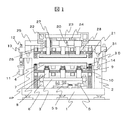
図1は本発明の基板組立装置の一実施例の縦段面図を示したものである。基板組立装置は架台1上に設けた下フレーム2と上フレーム25を剛体支持部材として、その内側に上チャンバ21と下チャンバ4を設ける構成としている。なお、上フレーム25は下フレーム2側に設けた第1のZ軸駆動機構(上ユニット駆動機構)を構成する第1のZ軸駆動モータ11のボールネジ12を回転駆動することで、上フレーム25に設けたボールネジ受け部13を介して上フレーム25が下フレーム2に対して上下方向に移動する構成としてある。また、下フレーム2側には、上フレーム25側に設けた突起部31にはめ合う略円錐形の溝30が設けてあるが、上フレーム25が下方向に移動し、下フレーム2に乗った後に下フレーム2と上フレーム25を固定する機構を設置してもよい。
【0011】
架台1上には下フレーム2の内側に下チャンバ4を支持する下チャンバ支持部材4Pが設けてある。下チャンバ4の下側には架台1に取り付けられた第2のZ軸ガイド6に下連結ベース3が設けてある。下連結ベース3の下側には回転輪が設けてあり、回転輪は架台1上に設けた第2のZ軸駆動モータ5により駆動され図の左右方向にテーパを備えた移動部材5b上を転動することで、下連結ベース3を上下に移動させ基板間に加圧力を加えるための第2のZ軸駆動機構(テーブル微動機構)が設けてある。
【0012】
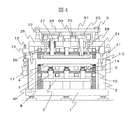
なお本実施例では下テーブル7の上下駆動機構(第2のZ軸駆動機構)を、上記の構成としたが、この構成に限るものではなく、上テーブル20を水平を保ったまま上下に数mm程度、精度良く移動できる機構であればモータで直接上下する機構や、油圧又は空気圧等を用いた機構であっても良い。この一例として、図4に上テーブル20を上下に精度良く移動することが可能な上テーブル微動機構(第2のZ軸駆動機構)を備えた構造を示す。本構造は、リニアアクチュエーター60を上フレーム25の上に設置し、プレート61を上下移動させることができるようになっている。また、プレート61はロードセル24を介して連結プレート23と固定されており、加圧力がロードセル24で検知できるようになっている。尚、リニアアクチュエーター60の代わりに、ボールネジやエアシリンダ等を使った上下移動機構を使用しても良い。このように上テーブル側を上下に大きく移動させる第1のZ軸駆動機構(粗動機構)と第2のZ軸駆動機構(微動機構)を設けることで下テーブル側には水平方向の駆動機構(XYθ方向の位置決め機構)のみを設ければよく、水平方向の駆動機構において下テーブル7の上下に伴なう移動を考慮する必要がなくなり位置合わせ精度が向上する。
【0013】
図1に戻り、下連結ベース3の上方には下テーブル7を支持するために複数の下シャフト8が取り付けてある。各下シャフト8は下チャンバ4内と気密性を保つため真空シールを介して下チャンバ4内に突出している。さらに各下シャフト8と下テーブル7の間にはXYθ方向にそれぞれ独立に可動可能なように構成されたXYθ移動ユニット10が取り付けてある。尚、XYθ移動ユニット10は、上下方向の固定で水平方向に自由に移動可能なボールベア等を使用した機構で構成しても良い。下テーブル7の水平方向(X,Y方向)に複数の下テーブル水平駆動機構9が下チャンバ4の外側に設けてあり、駆動機構に設けた軸で下テーブル側面(下テーブルの厚み方向)を押すことでXYθ方向の位置決めを行えるように構成してある。下テーブル7のZ軸方向の移動は先の述べた第2の上下駆動機構により下連結ベース3を上下さすことで行われる。また下テーブル水平駆動機構9の下テーブルと接触する軸の先端は、下テーブルが上下に移動しても抵抗とならないように上下方向に回転する車輪形状又は低摩擦材で形成されている。尚、図4に示す上テーブル20を上下移動させる構造では、水平駆動機構9の軸先端は、下テーブルを7押すだけの構造で良い。
【0014】
さらに下チャンバ4と上チャンバ21の接続部にはシールリング14が設けてあり、これにより上下のチャンバを合体させ、内部を排気した時の空気の漏れを防止している。
【0015】
また上フレーム25の内側には、上チャンバ21が取り付けてある。また上フレーム25の上部に上連結プレート23が設けてあり、この上連結プレート23と上フレーム間に複数のロードセル24が設けてある。また、上連結プレート23には、上テーブル20を支持するため、上チャンバ内に向かって複数の上シャフト26が設けてある。上シャフト26と上チャンバ21間にはチャンバ内の気圧を保持するために真空シールで接続されている。さらに上シャフト26と上フレーム25との間には上下方向に移動可能で水平方向にはガタのないシャフトガイド27が設けてある。この構造により上テーブル20と上フレーム25は固定状態と見なすことができ、かつ、基板を加圧した時の力をロードセル24で検知できる構造となる。
【0016】
また、上連結プレートには基板に設けた位置マークを検出するためのカメラ22が固定してある。このようにカメラ22を上連結プレート23に固定することで、カメラ22と上テーブル20間の距離が変化せず、1度焦点を合わせると、大きな振動等が加わり焦点位置が変化しない限り、カメラ22の上テーブル20に保持される上基板の位置マークの焦点調整が不要となる。
【0017】
上下チャンバを合体して真空チャンバを形成した時の上下テーブル間距離は、基板に加圧力を加えられる距離(数mm)でよく、第2のZ軸駆動機構で下テーブルを持ち上げる程度の距離を移動させることで加圧力を加えることができる。このため、真空チャンバ内の容積も大きく取る必要がなくなくなり、減圧に要する時間も短縮することが可能となる。なお加圧力は上記したように、上テーブル側に設けたロードセル24で計測することができる。
【0018】
また上記のように本実施例では、上テーブル20および下テーブル7は上チャンバ21および下チャンバ4とは離間して配置してるため、チャンバ内を減圧した時にチャンバが変形するが、この変形がテーブルに伝達することがなく、基板を水平に保持することができる。
【0019】
さらに、架台1や下フレーム2及び上フレーム25等大きな力の作用する部分は、剛体で構成するが、下チャンバ4や上チャンバ21は、チャンバ内が減圧された時に大きく変形しないように角パイプ構造体を用いて装置全体の軽量化を図るようにしてる。
【0020】
なお、本図では、図示していないが、基板の保持には負圧による吸引吸着のための吸着孔をテーブルに設ける方法や、静電チャックをテーブルに設け静電吸着力で吸着保持する方法や、粘着材をテーブル側に設けて粘着保持する方法が考えれる。特に負圧による吸引吸着を利用する場合は、チャンバ内を減圧すると吸着力が小さくなるため、静電吸着力又は粘着力と併用することが好ましい。
【0021】
次に本発明の基板組立の手順について説明する。
【0022】
まず、上ユニット駆動機構を動作させて、基板を挿入し、上テーブル20と下テーブル7に保持できるだけの空間を設けるために、上フレーム25を下フレーム2から離間させる。この動作距離は100〜200mm程度である。尚、チャンバ内のメンテナンスや清掃を行う場合は、200〜300mm程度離間させると作業性が向上する。
【0023】
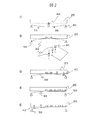
次に、図2に示す手順で上基板33を上テーブル20に吸着保持する。なお図2の実施形態では、左右方向を基板の長手方向、前後方向を基板の幅方向としてる。すなわち、ロボットハンド50を用いて貼り合わせ面を下テーブル7側に向けた上基板33を上テーブル20下面に搬入する。この時、上基板33は図2▲1▼のように中央が撓んだ状態(下方向に凸状態)で上テーブル20の下に搬入される。その状態で、図2▲1▼に示すように上テーブル20の中央部の幅方向に設けた複数の吸着サポートノズル40を基板の撓み面まで下げて、上基板をサポートノズル40の先端に吸着する。その後、図2▲2▼に示すように、サポートノズル40の吸着面が上テーブル20面と同じになるまでサポートノズル40を後退させ、かつ、上テーブル20中央部近傍の吸引吸着孔に負圧を供給し上基板中央部を部分吸着する。
【0024】
次に、図2▲3▼に示すように上基板の長手方向の一端側に向かってサポートノズル40を上基板33面まで突出させ吸引吸着する。そして、突出させたサポートノズル40を吸着面が上テーブル20面になるまで後退させ、周囲の吸引吸着孔にも負圧を供給する。この時、上基板長手方の他端側はまだロボットハンド50により支持されている。そこで、上基板の他端側に対してサポートノズル40を突出させてサポートノズル先端部に上基板の他端側を吸引吸着する。その後サポートノズル40の先端が上テーブル面位置になるまでサポートノズル40を後退し、その周囲の吸引吸着孔に負圧を供給し基板を上テーブル面に保持する。その状態でもし上テーブル20に静電吸着機構を備えている場合は、小さな電圧で静電吸着する。また粘着保持機構を備えている場合は、上テーブル面まで、粘着部材を下げて粘着保持する。なお、吸引吸着機構を用いずに粘着機構を用いて、上記▲1▼〜▲5▼の手順で基板を保持するようにしても良い。
【0025】
前述の手順で上基板を保持することで、上基板に撓みが残らず、かつ基板と上テーブル面間に空気層が残らずに基板を保持することができる。もし撓みが残っていると、基板に設けた位置合わせマーク位置がずれて正確な貼り合わせを行うことができなくなる。また、基板と上テーブル面間に空気層が残っていると、真空チャンバ内を減圧した時に、残留空気が膨張し、基板を保持できなくなったり、静電吸着力を作用させているときは、放電現象が発生し、基板を損傷する恐れがある。尚、図2の説明では、吸着サポートノズル40は、基板の中央の幅方向を吸着してから、長手方向に端部に向って吸着させていく方法を記載しているが、吸着サポートノズル40は、基板の中央の長手方向に設け、基板の中央の長手方向を吸着してから、幅方向に端部に向って吸着させていく方法でも良い。
【0026】
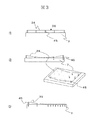
図3に、下テーブルに下基板を保持する手順を示す。上テーブル20に上基板33を吸着保持した後に、もし、下テーブル7に貼り合わせの完了した液晶基板が存在する場合は、下テーブル7に設けたサポートピン45をテーブル面より突出させて液晶基板を下テーブル面より浮かして、ロボットハンド50を液晶基板の下に挿入できるようにする。そして、ロボットハンド50で液晶基板を真空チャンバの外に排出する。その後、図3▲1▼に示すように、下基板34面に環状に接着剤(シール材)を塗布し、その接着剤で囲まれた領域に液晶を滴下した下基板34を下テーブル7位置までロボットハンド50で搬入し、サポートピン45上に載置する。なお接着剤は上記では下基板に設けることで説明したが、上基板側に設けてもよく、上下両基板に設けてもよい。
【0027】
次に、図3▲2▼に示すように、サポートピン45のうち下テーブル7の中央線上に設置したサポートピン45の先端部がテーブル面になるまで下テーブル側に後退させ中央部の吸着孔に負圧を供給し中央部付近を保持する。その後、図3▲3▼に示すように、一方の端部側に向かって他のサポートピン45を徐々に後退させる。サポートピン45の後退に伴なって後退したサポートピン近傍の吸着孔にも順次負圧を供給する。一方端側の吸着保持が完了すると、他端側に向かって同じように他のサポートピン45を後退させると共に、負圧を吸着孔に供給することで下基板全面を下テーブル7に吸引吸着で保持する。尚、上記では、それぞれのサポートピン45が後退した後、その都度接触した基板部を下テーブル7に負圧吸着させたが、サポートピン45の全ての動作が終了し、下基板全体が下テーブル7に接触してから負圧吸着させても良い。このように基板を中央部から一端部に向かって下テーブル面に載置させることで、基板とテーブル面間には空気層が残らず、確実にテーブル面に吸着することができ、チャンバ内を減圧していく過程で基板があばれ位置ずれを起こすことが無い。
上下テーブルにそれぞれ上下基板を保持し終わると、上ユニット駆動機構を動作させて、上フレーム25を下フレーム2に合体させる。このとき、上チャンバ21と下チャンバ4も、シールリング14を介して一緒に合体して真空チャンバを形成する。また、このとき上下基板間の間隔は数mm程度に設定してある。真空チャンバを形成した状態で上ユニット側に設けた焦点深度の深いカメラ22を用いて上基板33と下基板34に予め設けてある位置決めマークのずをれ量を求める。しかし、カメラ22の焦点深度が浅い場合は、カメラ22を上下動作させる機構を設けて、まず上基板33の位置間決めマークを認識してからカメラ22を下方に移動させ下基板34の位置決めマークを認識して上下基板の位置決めマークのずれ量をもとめる方法をとる。その後、下テーブル水平駆動機構9のモータを駆動することで、下テーブル7を移動して上下基板のXYθ方向のずれを修正する。
【0028】
上下基板の位置合わせが終了すると、図1には図示してないが、下チャンバ4側に設けた排気口から真空チャンバ内の空気を排気して真空チャンバ内を減圧する。真空チャンバ内が加圧するための減圧状態になると、下チャンバ4の外側下部に設けた第2のZ軸駆動機構を動作させて、下連結ベース3を介して下テーブル7を上テーブル20側に移動させることで基板に加圧力を加えて貼り合わせを行う。なお加圧時に両テーブル上に保持している基板が位置ずれを起こす場合もあり、時々位置決めマークを観測して位置ずれ補正を行ったほうが良い。また、吸引吸着と合わせて静電吸着機構で基板を保持している場合は、真空チャンバ内を減圧する過程で、大気中では低電圧(500V程度)で保持していたが、所定の減圧状態になると静電チャックに印加する電圧を数キロVと大きくして吸着させると放電等を確実に防止できる。
【0029】
上下の基板を加圧して貼り合わせが終了すると、その状態で、図示していないUV照射機構を動作させて、複数箇所接着剤を硬化させて仮止めを行う。その後、真空チャンバ内に大気を導入して、大気圧に戻す。仮固定して大気圧に戻された貼り合わされた基板は、大気圧に戻すことでさらに押し付け力が作用して、規定の厚みまで加圧される。その状態で、UV照射機構で接着剤全体を硬化させて液晶基板の貼り合わせが終了する。
【0030】
1組の基板の貼り合わせが終了すると、先に述べたように、次の基板の貼り合わせの準備と、完成した液晶基板の排出を行う。
【0031】
以上のように、本発明の基板組立方法を用いると、大型基板を板をテーブル上に保持する際に発生する基板の撓みを防止でき高精度の位置決めが可能になる。また、基板間に発生しやすい残留空気をほとんどなくすことができ、真空チャンバ内を減圧するときに残留空気の影響で基板の一部がテーブルから外れたり、静電吸着しているときに発生する放電現象の発生を抑制できる。
【0032】
【発明の効果】
以上、本発明の基板組立装置の構成とすることで、真空チャンバの容積を小さくでき装置全体の小型化及び軽量化を計ることができる。
【0033】
また、位置合わせマークを観測するカメラを上テーブルと一緒に移動する構成としたため、カメラを位置を合わせるための駆動機構及び、カメラの焦点位置を上テーブルを動かす度に調整する必要がなくなり、貼り合わせに要する作業時間を短縮することが可能となる。
【0034】
また、本発明の組立方法を用いることで、大型基板をテーブルに保持する際に発生する基板の撓みをなくし、上基板と下基板の位置合せ精度の高い貼り合わせが実現できる。更に、基板とテーブル間の残留空気の発生を抑制できるので、減圧時の基板のあばれや落下、静電吸着を使用している場合は放電を防ぐことができ、信頼性の高い貼り合わせが実現できる。
【図面の簡単な説明】
【図1】本発明の基板組立装置の全体構成の概略図である。
【図2】上テーブルに上基板を保持するときの手順を説明する図である。
【図3】下テーブルに下基板を保持するときの手順を説明する図である。
【図4】本発明の他の実施形態による基板組立装置の全体構成の概略図である。
【符号の説明】
1…架台、2…下フレーム、3…下連結ベース、4…下チャンバ、5…第2のZ軸駆動モータ、6…第2のZ軸ガイド、7…下テーブル、8…下シャフト、9下テーブル水平駆動機構、10…XYθ移動ユニット、11…第1のZ軸駆動モータ、12…ボールネジ、13…ボールネジ受け部、14…シールリング、20…上テーブル、21…上チャンバ、22…カメラ、23…上連結プレート、24…ロードセル、25…上フレーム、26…上シャフト、27…シャフトガイド、60…リニアアクチュエーター、61…プレート。[0001]
TECHNICAL FIELD OF THE INVENTION
The present invention relates to a device for bonding two substrates such as a liquid crystal display device, and more particularly to a substrate assembly device for bonding substrates having a large area of 1 m or more on one side and a method for assembling the same.
[0002]
[Prior art]
As a conventional large substrate assembling apparatus, there is one described in Japanese Patent Application Laid-Open No. 2002-318378. In this apparatus, the upper container that forms the vacuum chamber by supporting the upper substrate is configured to be rotatable, and the upper substrate is received and held on a table provided in the upper container facing upward, and then rotated, and then the lower substrate is rotated. The lower substrate is placed on a table that supports the substrate, the lower container is moved to the upper container position, and the lower container is combined with the upper container to evacuate the upper and lower containers. For this reason, the lower container is configured to be connectable and detachable to an exhaust pipe or the like for evacuating the combined container after the movement.
[0003]
[Patent Document 1]
Japanese Patent Application Laid-Open No. 2002-318378
[Problems to be solved by the invention]
By the way, in the configuration of Patent Document 1, in order to rotate the upper container holding the upper substrate, a space for the rotation is necessarily required, and therefore, an increase in the size of the apparatus is inevitable.
[0005]
In addition, since the lower container is movable, it is necessary to connect an exhaust pipe for evacuation when the upper and lower containers are combined, and to connect the moved container after the movement. Could occur.
[0006]
SUMMARY OF THE INVENTION The present invention has been made to solve the above problems, and provides a board assembling apparatus and an assembling method capable of assembling a board with small size and high accuracy.
[0007]
[Means for Solving the Problems]
In order to achieve the above object, according to the present invention, a lower frame and an upper frame are provided on a gantry, and a first Z-axis drive mechanism for largely moving the upper frame up and down with respect to the lower frame is provided. A lower chamber constituting a vacuum chamber inside the frame is provided with an upper chamber inside the upper frame, an upper table is provided inside the upper chamber, and a lower table provided in the lower chamber below the lower chamber is moved up and down. A second Z-axis drive mechanism for minute movement is provided, and a drive mechanism for horizontally moving the lower table is provided on the side of the lower chamber, and the upper and lower chambers are combined by combining the upper and lower frames. It was configured to form a vacuum chamber by uniting via a seal ring.
[0008]
Also, when holding the substrate on the upper and lower tables, the substrate center width direction is held on the substrate, and then the substrate is sequentially sucked from the center in the length direction to one end side toward the end, When the suction to one end is completed, the suction is sequentially performed toward the other end, so that the substrate can be maintained without distortion and with little residual air between the substrate and the table.
[0009]
BEST MODE FOR CARRYING OUT THE INVENTION
Hereinafter, an embodiment of the present invention will be described with reference to the drawings.
[0010]
FIG. 1 is a vertical sectional view of an embodiment of the substrate assembling apparatus of the present invention. The substrate assembling apparatus is configured such that the
[0011]
On the gantry 1, a lower
[0012]
In the present embodiment, the vertical drive mechanism (second Z-axis drive mechanism) of the lower table 7 is configured as described above. However, the present invention is not limited to this configuration. A mechanism that can move up and down directly by a motor or a mechanism that uses hydraulic pressure or air pressure may be used as long as the mechanism can move with high accuracy of about mm. As an example of this, FIG. 4 shows a structure provided with an upper table fine movement mechanism (second Z-axis driving mechanism) capable of moving the upper table 20 up and down with high accuracy. In this structure, the
[0013]
Returning to FIG. 1, a plurality of
[0014]
Further, a
[0015]
The
[0016]
A
[0017]
The distance between the upper and lower tables when the vacuum chamber is formed by combining the upper and lower chambers may be a distance (several mm) at which a pressing force can be applied to the substrate, and the distance for lifting the lower table by the second Z-axis driving mechanism is sufficient. Pressing can be applied by moving. Therefore, it is not necessary to take a large volume in the vacuum chamber, and the time required for decompression can be shortened. As described above, the pressing force can be measured by the
[0018]
In addition, as described above, in the present embodiment, the upper table 20 and the lower table 7 are arranged separately from the
[0019]
Further, the portions on which a large force acts, such as the gantry 1, the
[0020]
Although not shown in the drawing, a method of holding a substrate with suction holes for suction suction by negative pressure or a method of providing an electrostatic chuck on the table to hold the substrate by electrostatic suction force is used for holding the substrate. Alternatively, a method in which an adhesive is provided on the table side to hold the adhesive is considered. In particular, in the case of using suction suction by negative pressure, the suction force is reduced when the pressure in the chamber is reduced. Therefore, it is preferable to use the suction force together with the electrostatic suction force or the adhesive force.
[0021]
Next, a procedure for assembling the substrate according to the present invention will be described.
[0022]
First, the upper unit drive mechanism is operated to insert a substrate, and the
[0023]
Next, the
[0024]
Next, as shown in FIG. 2 (3), the
[0025]
By holding the upper substrate in the above-described procedure, the substrate can be held without bending remaining on the upper substrate and without leaving an air layer between the substrate and the upper table surface. If the flexure remains, the position of the alignment mark provided on the substrate is shifted and accurate bonding cannot be performed. Also, if an air layer remains between the substrate and the upper table surface, when the pressure in the vacuum chamber is reduced, the residual air expands, and when the substrate cannot be held or an electrostatic attraction force is applied, A discharge phenomenon may occur, damaging the substrate. Note that, in the description of FIG. 2, the
[0026]
FIG. 3 shows a procedure for holding the lower substrate on the lower table. After adsorbing and holding the
[0027]
Next, as shown in FIG. 3 (2), among the support pins 45, the support pins 45 installed on the center line of the lower table 7 are retracted toward the lower table until the tips of the support pins 45 are on the table surface, and the suction holes in the center are formed. And maintain the vicinity of the center. Thereafter, as shown in FIG. 3 (3), the other support pins 45 are gradually retracted toward one end. A negative pressure is also sequentially supplied to the suction holes near the support pins that have retreated as the support pins 45 retreat. When the suction holding at one end is completed, the other support pins 45 are similarly retracted toward the other end, and a negative pressure is supplied to the suction holes, so that the entire lower substrate is suction-adsorbed to the lower table 7. Hold. In the above description, after the respective support pins 45 are retracted, the substrate portion that is in contact each time is attracted to the lower table 7 by negative pressure. However, all the operations of the support pins 45 are completed, and the entire lower substrate is moved to the lower table. The negative pressure may be applied after contact with the negative electrode 7. By placing the substrate on the lower table surface from the center toward the one end in this way, no air layer remains between the substrate and the table surface, and the substrate can be securely adsorbed on the table surface, and the inside of the chamber can be maintained. In the process of reducing the pressure, the substrate does not come off and no displacement occurs.
When the upper and lower substrates are respectively held on the upper and lower tables, the upper unit driving mechanism is operated to combine the
[0028]
When the positioning of the upper and lower substrates is completed, although not shown in FIG. 1, the air in the vacuum chamber is exhausted from the exhaust port provided on the lower chamber 4 side to reduce the pressure in the vacuum chamber. When the inside of the vacuum chamber is decompressed to pressurize, the second Z-axis driving mechanism provided at the lower outside of the lower chamber 4 is operated to move the lower table 7 to the upper table 20 side via the lower connection base 3. The substrates are bonded by applying a pressing force to the substrates by moving them. In some cases, the substrates held on both tables may be displaced during the pressurization, and it is better to correct the displacement by observing the positioning marks from time to time. Further, when the substrate is held by the electrostatic suction mechanism together with the suction suction, the substrate was held at a low voltage (about 500 V) in the atmosphere during the process of depressurizing the inside of the vacuum chamber. Then, if the voltage applied to the electrostatic chuck is increased to several kilo volts and the chuck is attracted, discharge and the like can be reliably prevented.
[0029]
When the upper and lower substrates are pressed and the bonding is completed, a UV irradiation mechanism (not shown) is operated in this state to cure the adhesive at a plurality of locations and temporarily fix the adhesive. Thereafter, the atmosphere is introduced into the vacuum chamber to return to the atmospheric pressure. When the substrate is temporarily fixed and returned to the atmospheric pressure, the substrate is returned to the atmospheric pressure, so that a pressing force is further applied, and the substrate is pressed to a specified thickness. In this state, the entire adhesive is cured by the UV irradiation mechanism, and the bonding of the liquid crystal substrates is completed.
[0030]
When bonding of one set of substrates is completed, as described above, preparation for bonding of the next substrate and discharge of the completed liquid crystal substrate are performed.
[0031]
As described above, when the substrate assembling method of the present invention is used, the bending of the substrate that occurs when the large substrate is held on the table can be prevented, and highly accurate positioning can be performed. In addition, residual air that is easily generated between the substrates can be almost eliminated, and is generated when a part of the substrate comes off the table or is electrostatically attracted due to the effect of the residual air when the pressure in the vacuum chamber is reduced. The occurrence of a discharge phenomenon can be suppressed.
[0032]
【The invention's effect】
As described above, with the configuration of the substrate assembling apparatus of the present invention, the volume of the vacuum chamber can be reduced, and the entire apparatus can be reduced in size and weight.
[0033]
In addition, since the camera for observing the alignment mark is moved together with the upper table, there is no need to adjust the drive mechanism for aligning the camera and the focal position of the camera each time the upper table is moved. The work time required for the alignment can be reduced.
[0034]
Further, by using the assembling method of the present invention, the bending of the substrate that occurs when the large substrate is held on the table can be eliminated, and the bonding of the upper substrate and the lower substrate with high positioning accuracy can be realized. Furthermore, since the generation of residual air between the substrate and the table can be suppressed, it is possible to prevent the substrate from falling or falling when depressurizing, and to prevent discharge when using electrostatic suction, and achieve highly reliable bonding. it can.
[Brief description of the drawings]
FIG. 1 is a schematic diagram of an overall configuration of a substrate assembling apparatus of the present invention.
FIG. 2 is a diagram illustrating a procedure for holding an upper substrate on an upper table.
FIG. 3 is a diagram illustrating a procedure for holding a lower substrate on a lower table.
FIG. 4 is a schematic view of an overall configuration of a substrate assembling apparatus according to another embodiment of the present invention.
[Explanation of symbols]
DESCRIPTION OF SYMBOLS 1 ... Stand, 2 ... Lower frame, 3 ... Lower connection base, 4 ... Lower chamber, 5 ... Second Z-axis drive motor, 6 ... Second Z-axis guide, 7 ... Lower table, 8 ... Lower shaft, 9 Lower table horizontal drive mechanism, 10 XYθ moving unit, 11 first Z-axis drive motor, 12 ball screw, 13 ball screw receiver, 14 seal ring, 20 upper table, 21 upper chamber, 22 camera , 23 ... Upper connection plate, 24 ... Load cell, 25 ... Upper frame, 26 ... Upper shaft, 27 ... Shaft guide, 60 ... Linear actuator, 61 ... Plate.
Claims (8)
前記下フレームと上フレームとは剛体で形成され、前記上チャンバと下チャンバは角パイプ構造体で形成することを特徴とする大型基板の組立装置。The apparatus for assembling a large-sized board according to claim 1 or 2,
The apparatus for assembling a large substrate, wherein the lower frame and the upper frame are formed of a rigid body, and the upper chamber and the lower chamber are formed of a square pipe structure.
前記上テーブルおよび下テーブルとは前記上チャンバおよび下チャンバとは別部材で支持する構成としたことを特徴とする大型基板の組立装置。The apparatus for assembling a large-sized board according to claim 1 or 2,
An apparatus for assembling a large substrate, wherein the upper table and the lower table are supported by members separate from the upper chamber and the lower chamber.
前記上テーブル上および下テーブル上に保持した基板の位置合わせマークを観測するカメラが前記上テーブルと一体で移動する構成としたことを特徴とする大型基板の組立装置。The apparatus for manufacturing a large-sized substrate according to claim 1 or 2,
A large substrate assembling apparatus, wherein a camera for observing the alignment marks of the substrates held on the upper table and the lower table moves integrally with the upper table.
前記上テーブルに基板を保持するときに、まず上テーブル中央部幅方向の複数のサポートノズルを基板面近傍に下げて基板を吸着し、前記サポートノズル先端を上テーブル面まで後退させると共に、上テーブル中央部近傍の吸引孔に負圧を供給して基板中央部を吸着し、次に、基板の一方端側に順次サポートノズルを基板面に突出させて先端に吸着し中央側から順次サポートノズル先端を上テーブル面まで後退させると共に、上テーブル側の該サポートノズル近傍の吸引孔に順次負圧を供給して上テーブル面に吸着し、前記基板の他方端も同様に中央部から端部に向かって上テーブルに吸着し保持するようにしたことを特徴とする大型基板の組立方法。The substrate is held on the upper table and the lower table provided in the vacuum chamber, and a sealing material is applied to at least one of the substrates, and the liquid crystal is dropped on the surface of the substrate held on the lower table. In the method of assembling a large-sized substrate in which the pressure in the chamber is reduced and the distance between the two tables is reduced, the substrates are attached to each other to assemble the liquid crystal substrate.
When holding the substrate on the upper table, first, a plurality of support nozzles in the width direction of the center of the upper table are lowered near the substrate surface to suck the substrate, and the tip of the support nozzle is retracted to the upper table surface. A negative pressure is supplied to the suction hole near the central portion to suck the central portion of the substrate, and then a support nozzle is sequentially protruded from one side of the substrate to the substrate surface, sucked to the front end, and the support nozzle tip is sequentially started from the central side. Is retracted to the upper table surface, and a negative pressure is sequentially supplied to suction holes near the support nozzles on the upper table side to be sucked on the upper table surface, and the other end of the substrate is similarly moved from the center to the end. A method for assembling a large substrate, wherein the large substrate is suctioned and held on an upper table.
前記下テーブルに基板を保持する際に、下テーブルから突出した複数のサポートピンのうち下テーブル中央部幅方向のものを下テーブル内に降下させ、その後基板の長さ方向の中央部から一方端に向かって順次サポートピンを下テーブル内に降下させると共に、降下させたサポートピン近傍の吸引吸着孔に負圧を供給して一方端まで基板を下テーブル面に吸着し、その後、中央部から他端に向かって順次サポートピンを下テーブル内に降下させる共に、下テーブル内に降下したサポートピン近傍の吸引吸着孔に負圧を供給することで基板を下テーブルに保持するようにしたことを特徴とする大型基板の組立方法。A substrate is held on an upper table and a lower table provided in a vacuum chamber, and a sealing material is applied to at least one of the substrates held on the upper or lower table, and further, the substrate held on the lower table With the liquid crystal dropped on the surface, the inside of the vacuum chamber is decompressed, the distance between the two tables is reduced, and the substrates are attached to each other to assemble the liquid crystal substrate.
When holding the substrate on the lower table, of the plurality of support pins protruding from the lower table, lower one of the support pins in the width direction of the lower table central portion into the lower table, and thereafter, from the central portion in the longitudinal direction of the substrate to one end. The support pins are sequentially lowered into the lower table toward the lower table, and a negative pressure is supplied to the suction suction holes near the lowered support pins to suck the substrate to the lower table surface to one end, and then, from the central portion to another side. The support pins are sequentially lowered into the lower table toward the end, and the substrate is held on the lower table by supplying negative pressure to suction suction holes near the support pins that have been lowered into the lower table. To assemble a large substrate.
前記下テーブルに基板を保持する際に、下テーブルから突出した複数のサポートピンのうちテーブル中央部幅方向のものを下テーブル内に降下させ、その後基板の長さ方向の中央部から一方端に向かって順次サポートピンを下テーブル内に降下させると共に、中央部から他端に向かって順次サポートピンを下テーブル内に降下させ、基板の全面が下テーブル上に接触した後に下テーブルの吸引吸着孔に負圧を供給することで基板を下テーブルに保持するようにしたことを特徴とする大型基板の組立方法。A substrate is held on an upper table and a lower table provided in a vacuum chamber, and a sealing material is applied to at least one of the substrates held on the upper or lower table, and further, the substrate held on the lower table With the liquid crystal dropped on the surface, the inside of the vacuum chamber is decompressed, the distance between the two tables is reduced, and the substrates are attached to each other to assemble the liquid crystal substrate.
When holding the board on the lower table, of the plurality of support pins protruding from the lower table, lower one of the support pins in the width direction of the table into the lower table, and then from the center in the length direction of the substrate to one end. The support pins are sequentially lowered into the lower table toward the lower table, and the support pins are sequentially lowered into the lower table from the center toward the other end, and after the entire surface of the substrate is in contact with the lower table, the suction suction holes of the lower table. A substrate is held on a lower table by supplying a negative pressure to the substrate.
Priority Applications (1)
| Application Number | Priority Date | Filing Date | Title |
|---|---|---|---|
| JP2003019640A JP3694691B2 (en) | 2003-01-29 | 2003-01-29 | Large substrate assembly apparatus and assembly method |
Applications Claiming Priority (1)
| Application Number | Priority Date | Filing Date | Title |
|---|---|---|---|
| JP2003019640A JP3694691B2 (en) | 2003-01-29 | 2003-01-29 | Large substrate assembly apparatus and assembly method |
Publications (2)
| Publication Number | Publication Date |
|---|---|
| JP2004233473A true JP2004233473A (en) | 2004-08-19 |
| JP3694691B2 JP3694691B2 (en) | 2005-09-14 |
Family
ID=32949454
Family Applications (1)
| Application Number | Title | Priority Date | Filing Date |
|---|---|---|---|
| JP2003019640A Expired - Fee Related JP3694691B2 (en) | 2003-01-29 | 2003-01-29 | Large substrate assembly apparatus and assembly method |
Country Status (1)
| Country | Link |
|---|---|
| JP (1) | JP3694691B2 (en) |
Cited By (13)
| Publication number | Priority date | Publication date | Assignee | Title |
|---|---|---|---|---|
| KR100609897B1 (en) | 2004-11-01 | 2006-08-09 | 삼성전자주식회사 | Substrate Manufacturing Equipment |
| JP2007041132A (en) * | 2005-08-01 | 2007-02-15 | Shibaura Mechatronics Corp | Substrate laminating apparatus and laminating method |
| KR100827859B1 (en) | 2006-01-16 | 2008-05-07 | 도쿄엘렉트론가부시키가이샤 | Pressure reduction vessel and pressure reduction processing apparatus |
| KR100844968B1 (en) * | 2005-05-25 | 2008-07-09 | 가부시키가이샤 히타치플랜트테크놀로지 | Substrate assembling apparatus and method |
| KR100894944B1 (en) | 2006-11-10 | 2009-04-27 | 가부시키가이샤 히타치플랜트테크놀로지 | Transfer jig of substrate assembling apparatus, and transfer method thereof |
| CN100550283C (en) * | 2004-10-06 | 2009-10-14 | 爱德牌工程有限公司 | Apparatus for manufacturing flat panel display |
| US7640960B2 (en) * | 2006-11-29 | 2010-01-05 | Adp Engineering Co., Ltd. | Apparatus for attaching substrates |
| US8256101B2 (en) | 2006-08-21 | 2012-09-04 | Adp Engineering Co., Ltd. | Apparatus for attaching substrates of flat display panel |
| KR101208317B1 (en) | 2011-03-30 | 2012-12-05 | 엘아이지에이디피 주식회사 | Apparatus for processing substrate and maintain method of processing chamber using the same |
| KR101245181B1 (en) * | 2006-03-13 | 2013-03-19 | 엘아이지에이디피 주식회사 | Substrate bonding apparatus |
| KR101334095B1 (en) | 2006-11-28 | 2013-11-28 | 엘아이지에이디피 주식회사 | Substrate sticking device |
| CN104369519A (en) * | 2013-08-14 | 2015-02-25 | 奈恩泰克有限公司 | Adhesion device for large-size substrate |
| CN105607307A (en) * | 2014-11-14 | 2016-05-25 | 株式会社日立制作所 | Substrate mounting device and substrate mounting method using the same |
Families Citing this family (2)
| Publication number | Priority date | Publication date | Assignee | Title |
|---|---|---|---|---|
| KR100931608B1 (en) * | 2007-12-20 | 2009-12-14 | 주식회사 에이디피엔지니어링 | Board Bonding Device |
| KR100931602B1 (en) * | 2007-12-21 | 2009-12-14 | 주식회사 에이디피엔지니어링 | Board Bonding Device |
-
2003
- 2003-01-29 JP JP2003019640A patent/JP3694691B2/en not_active Expired - Fee Related
Cited By (15)
| Publication number | Priority date | Publication date | Assignee | Title |
|---|---|---|---|---|
| CN100550283C (en) * | 2004-10-06 | 2009-10-14 | 爱德牌工程有限公司 | Apparatus for manufacturing flat panel display |
| KR100609897B1 (en) | 2004-11-01 | 2006-08-09 | 삼성전자주식회사 | Substrate Manufacturing Equipment |
| KR100844968B1 (en) * | 2005-05-25 | 2008-07-09 | 가부시키가이샤 히타치플랜트테크놀로지 | Substrate assembling apparatus and method |
| US7819159B2 (en) | 2005-05-25 | 2010-10-26 | Hitachi Plant Technologies, Ltd. | Substrate assembly apparatus and substrate assembly method |
| JP2007041132A (en) * | 2005-08-01 | 2007-02-15 | Shibaura Mechatronics Corp | Substrate laminating apparatus and laminating method |
| KR100827859B1 (en) | 2006-01-16 | 2008-05-07 | 도쿄엘렉트론가부시키가이샤 | Pressure reduction vessel and pressure reduction processing apparatus |
| KR101245181B1 (en) * | 2006-03-13 | 2013-03-19 | 엘아이지에이디피 주식회사 | Substrate bonding apparatus |
| US8256101B2 (en) | 2006-08-21 | 2012-09-04 | Adp Engineering Co., Ltd. | Apparatus for attaching substrates of flat display panel |
| KR100894944B1 (en) | 2006-11-10 | 2009-04-27 | 가부시키가이샤 히타치플랜트테크놀로지 | Transfer jig of substrate assembling apparatus, and transfer method thereof |
| KR101334095B1 (en) | 2006-11-28 | 2013-11-28 | 엘아이지에이디피 주식회사 | Substrate sticking device |
| US7640960B2 (en) * | 2006-11-29 | 2010-01-05 | Adp Engineering Co., Ltd. | Apparatus for attaching substrates |
| KR101208317B1 (en) | 2011-03-30 | 2012-12-05 | 엘아이지에이디피 주식회사 | Apparatus for processing substrate and maintain method of processing chamber using the same |
| CN104369519A (en) * | 2013-08-14 | 2015-02-25 | 奈恩泰克有限公司 | Adhesion device for large-size substrate |
| CN105607307A (en) * | 2014-11-14 | 2016-05-25 | 株式会社日立制作所 | Substrate mounting device and substrate mounting method using the same |
| CN105607307B (en) * | 2014-11-14 | 2019-04-09 | 艾美柯技术株式会社 | Substrate mounting apparatus and substrate mounting method using the same |
Also Published As
| Publication number | Publication date |
|---|---|
| JP3694691B2 (en) | 2005-09-14 |
Similar Documents
| Publication | Publication Date | Title |
|---|---|---|
| JP4379435B2 (en) | Board assembly apparatus and board assembly method using the same | |
| JP4078487B2 (en) | Substrate assembly apparatus and method | |
| JP3694691B2 (en) | Large substrate assembly apparatus and assembly method | |
| JP3906753B2 (en) | Board assembly equipment | |
| JP4955070B2 (en) | Bonded substrate manufacturing apparatus and bonded substrate manufacturing method | |
| KR100550648B1 (en) | Wafer assembling apparatus | |
| JP3823083B2 (en) | Board assembly equipment | |
| KR20230152637A (en) | Substrate assembly apparatus and substrate assembly method | |
| JP3823118B2 (en) | Board assembly equipment | |
| JP7553152B2 (en) | Circuit Board Assembly Equipment | |
| JP4470923B2 (en) | Board assembly equipment | |
| JP4470922B2 (en) | Board loading / unloading method and robot | |
| JP4023510B2 (en) | Board assembly equipment | |
| JP3840451B2 (en) | Board assembly apparatus and board assembly method | |
| JP4449932B2 (en) | Board assembly apparatus and board assembly method | |
| JP4470921B2 (en) | Substrate assembly apparatus and assembly method | |
| JP3694688B2 (en) | Substrate assembly apparatus and substrate assembly method | |
| JP2003066469A (en) | Substrate assembling method and its assembling apparatus | |
| JP2005017515A (en) | Substrate bonding device |
Legal Events
| Date | Code | Title | Description |
|---|---|---|---|
| A977 | Report on retrieval |
Free format text: JAPANESE INTERMEDIATE CODE: A971007 Effective date: 20050401 |
|
| TRDD | Decision of grant or rejection written | ||
| A01 | Written decision to grant a patent or to grant a registration (utility model) |
Free format text: JAPANESE INTERMEDIATE CODE: A01 Effective date: 20050621 |
|
| A61 | First payment of annual fees (during grant procedure) |
Free format text: JAPANESE INTERMEDIATE CODE: A61 Effective date: 20050627 |
|
| R150 | Certificate of patent or registration of utility model |
Free format text: JAPANESE INTERMEDIATE CODE: R150 |
|
| S111 | Request for change of ownership or part of ownership |
Free format text: JAPANESE INTERMEDIATE CODE: R313111 |
|
| R350 | Written notification of registration of transfer |
Free format text: JAPANESE INTERMEDIATE CODE: R350 |
|
| FPAY | Renewal fee payment (event date is renewal date of database) |
Free format text: PAYMENT UNTIL: 20090701 Year of fee payment: 4 |
|
| FPAY | Renewal fee payment (event date is renewal date of database) |
Free format text: PAYMENT UNTIL: 20090701 Year of fee payment: 4 |
|
| FPAY | Renewal fee payment (event date is renewal date of database) |
Free format text: PAYMENT UNTIL: 20100701 Year of fee payment: 5 |
|
| FPAY | Renewal fee payment (event date is renewal date of database) |
Free format text: PAYMENT UNTIL: 20100701 Year of fee payment: 5 |
|
| FPAY | Renewal fee payment (event date is renewal date of database) |
Free format text: PAYMENT UNTIL: 20110701 Year of fee payment: 6 |
|
| FPAY | Renewal fee payment (event date is renewal date of database) |
Free format text: PAYMENT UNTIL: 20120701 Year of fee payment: 7 |
|
| FPAY | Renewal fee payment (event date is renewal date of database) |
Free format text: PAYMENT UNTIL: 20120701 Year of fee payment: 7 |
|
| FPAY | Renewal fee payment (event date is renewal date of database) |
Free format text: PAYMENT UNTIL: 20130701 Year of fee payment: 8 |
|
| S111 | Request for change of ownership or part of ownership |
Free format text: JAPANESE INTERMEDIATE CODE: R313111 |
|
| R350 | Written notification of registration of transfer |
Free format text: JAPANESE INTERMEDIATE CODE: R350 |
|
| LAPS | Cancellation because of no payment of annual fees |