JP2004238433A - Styrene-olefin mixed resin expandable particles, method for producing the same, and styrene-olefin mixed resin expanded molded article - Google Patents
Styrene-olefin mixed resin expandable particles, method for producing the same, and styrene-olefin mixed resin expanded molded article Download PDFInfo
- Publication number
- JP2004238433A JP2004238433A JP2003026966A JP2003026966A JP2004238433A JP 2004238433 A JP2004238433 A JP 2004238433A JP 2003026966 A JP2003026966 A JP 2003026966A JP 2003026966 A JP2003026966 A JP 2003026966A JP 2004238433 A JP2004238433 A JP 2004238433A
- Authority
- JP
- Japan
- Prior art keywords
- styrene
- resin
- mass
- olefin
- particles
- Prior art date
- Legal status (The legal status is an assumption and is not a legal conclusion. Google has not performed a legal analysis and makes no representation as to the accuracy of the status listed.)
- Granted
Links
Images
Landscapes
- Manufacture Of Porous Articles, And Recovery And Treatment Of Waste Products (AREA)
- Compositions Of Macromolecular Compounds (AREA)
Abstract
Description
【0001】
【発明の属する技術分野】
本発明は、スチレン系樹脂とオレフィン系樹脂の混合樹脂からなる発泡性粒子およびその製造方法、またその発泡性粒子から得られる発泡成形体に関し、詳しくはスチレン系樹脂の剛性とオレフィン系樹脂の優れた弾性を兼ね備え、常圧、常温下、ある程度の期間放置しても揮発性発泡剤を保持することができるスチレン−オレフィン混合樹脂発泡性粒子に関するもので、本発明の発泡性粒子は型物成形して工業製品の緩衝包装材、あるいは自動車の構造部材、エネルギー吸収材、または住宅分野、レジャー分野等に広く用いることができる。
【0002】
【従来の技術】
スチレン系樹脂の発泡成形体は、軽量でありかつ剛性も高く、また断熱性にも優れるため、住宅用断熱や包装用緩衝材などに広く使用されている。
スチレン系樹脂を発泡させて発泡成形体とするには幾つかの方法があるが、その中の一つに発泡性ビーズを用いる方法がある。この方法は、まずスチレン系樹脂の粒子を材料とし、この粒子に揮発性発泡剤を含浸させて発泡性粒子とし、次いでこの発泡性粒子に水蒸気を接触させて、粒子を加熱し発泡させて予備発泡粒子を作り、その後この予備発泡粒子を金型内に充填し、金型内へ水蒸気を吹き込んで、粒子をさらに発泡させるとともに互いに融着させて、成形体とするものである。
【0003】
しかし、スチレン系樹脂からなる発泡成形体は、樹脂の特徴から衝撃に対して脆く、また油、溶剤に対して弱いという欠点を有している。
そのようなスチレン系樹脂の欠点を克服するものとして、エチレン系樹脂からなる発泡体やプロピレン系樹脂からなる発泡体またはエチレンとスチレンの重合体からなる発泡体(例えば、特許文献1参照。)が提案されている。
【0004】
しかし、ポリエチレンやポリプロピレンなどのオレフィン系樹脂からなる樹脂粒子は、含浸せしめた揮発性発泡剤が逸散しやすく、発泡性粒子を製造した後、速やかに予備発泡して発泡粒子とする必要があり、または発泡性粒子を加圧容器内に保存する必要があった。それに比較し、スチレン系樹脂は揮発性発泡剤の保持性が良いので、該発泡剤を含浸せしめた後、未発泡粒子及び予備発泡粒子を問わず長時間放置した後でも十分な発泡力が保持される。従って、オレフィン系樹脂からなる発泡性粒子はスチレン系樹脂からなる発泡性粒子に比べ、保管及び輸送に際して不利な面があった。
【0005】
また、スチレンとエチレンの重合体からなる発泡体は、上述したオレフィン系樹脂単独品に比べれば、発泡剤の保持は良いものの、やはり、常温、常圧にて放置すれば短時間で揮発性発泡剤は逸散してしまい短時間で成形体を製造する必要があり、保管状態や揮発性発泡剤の量を調整する必要があった。このような課題を解決するためにスチレン−オレフィン共重合樹脂を基材樹脂とし、その基材樹脂と相溶性があり常圧下250℃以上の沸点を有しかつ常温で液状の物質が基材樹脂に対し0.2〜7質量部含浸させた発泡性粒子が提案されている(例えば、特許文献2参照。)。
この発泡粒子はある程度、揮発性発泡剤の保持性は向上するものの、その保持性は未だ不十分であった。
【0006】
また、スチレン系樹脂とオレフィン系樹脂を予め押出機になどの混練機にて溶融ブレンドし、揮発性発泡剤を含浸させ、発泡させた発泡成形体も幾つか提案されている。
一つは、オレフィン系樹脂を全樹脂量に対して1〜15質量%含有するビニル芳香族重合体原料を熱溶融したペレットに発泡剤を含浸発泡させた発泡体の製造方法が提案されている(例えば、特許文献3参照。)。
もう一つは、スチレン系樹脂とエチレン系樹脂とスチレン−イソプレン−スチレンブロックからなる特定のトリブロック共重合体からなる樹脂組成物を発泡させて得られる発泡体が提案されている(例えば、特許文献4参照。)。
【0007】
前者は実質的に発泡体の気泡径を調整するためにオレフィン系樹脂を混合するものであり、実質的にオレフィン系樹脂は5質量%程度であり、スチレン系樹脂発泡体の物性を大きく変化させるものではない。また、後者は一定ガス量を含浸した後、5〜60倍発泡の範囲で発泡体が得られるかどうかという評価のみで、揮発性発泡剤の保持性については言及されておらず、また、本発明者らがこの請求範囲内で揮発性発泡剤の保持性を評価した結果、揮発性発泡剤の減少が確認された。
【0008】
その他、発泡剤保持性の良いオレフィン系樹脂発泡性粒子の製造方法として、プロピレン重合体に発泡剤を加えて押出し、実質的に発泡が起こらない温度および圧力の条件下でペレット化し450g/Lを超える嵩密度を有する発泡性プロピレン重合体粒子を製造することが提案されている(例えば、特許文献5参照。)。しかしながら、この発泡性粒子は、保存中に粒子中から揮発性発泡剤が逸散し易く、製造後大気中で1時間貯蔵後の発泡性粒子を発泡させても、発泡粒子の嵩密度が237〜280g/Lと大きく、十分な緩衝性を有した発泡体とは成り得なかった。
【0009】
【特許文献1】
特開昭48−101457号公報
【特許文献2】
特開昭57−111330号公報
【特許文献3】
特公昭47−26097号公報
【特許文献4】
特開平06−49256号公報
【特許文献5】
特開2001−240678号公報
【0010】
【発明が解決しようとする課題】
上述した通り、従来のスチレン−オレフィン混合樹脂からなる発泡性粒子は、冷凍保管もしくは密閉容器中での加圧保管等をしない限りは、粒子中からの揮発性発泡剤の逸散を防止することができなかった。一般に、良好な発泡成形体を得るには、発泡性粒子中には少なくとも2質量%以上の揮発性発泡剤を含有していることが必要であるが、従来のスチレン−オレフィン混合樹脂からなる発泡性粒子は、常温、常圧下で1〜2日間放置すると大部分の揮発性発泡剤は粒子中から逸散してしまい、その後に発泡成形しても良好な発泡成形体は得られなかった。また、オレフィン系樹脂の組成比率が高い場合には、たとえ発泡性粒子中にある程度の揮発性発泡剤を含んでいても、加熱発泡時に揮発性発泡剤が逸散してしまい、高度に発泡させることが困難であった。
【0011】
本発明は上記事情に鑑みてなされたもので、常圧、室温下においても揮発性発泡剤の逸散が少なく、製造後の保管、輸送が容易で、高度に発泡させることができ、かつスチレン樹脂製発泡体よりも耐衝撃性や緩衝性に優れた発泡体を製造可能なスチレン−オレフィン混合樹脂発泡性粒子とその製造方法及びスチレン−オレフィン混合樹脂発泡成形体の提供を目的とする。
【0012】
【課題を解決するための手段】
上記目的を達成するため、本発明は、50〜90質量%のスチレン系樹脂と10〜50質量%のオレフィン系樹脂との混合樹脂100質量部と、0〜15質量部のスチレン系エラストマーとを含む樹脂組成物と、揮発性発泡剤とを含む発泡性粒子であって、常圧、雰囲気温度18℃の条件下で3日間放置後の発泡性粒子中に含まれる揮発性発泡剤量が2質量%以上であることを特徴とするスチレン−オレフィン混合樹脂発泡性粒子を提供する。
本発明のスチレン−オレフィン混合樹脂発泡性粒子において、オレフィン系樹脂は、密度が0.900〜0.935g/cm3のポリエチレン系樹脂であることが好ましい。
また、スチレン系エラストマーは、水素添加されたスチレン系モノマーと共役ジエンの共重合体であることが好ましい。
さらに、揮発性発泡剤は、少なくとも50質量%以上のイソペンタンを含むことが好ましい。
また、粒子中に高級脂肪酸とアルコールとの部分エステルを含むことが好ましい。
また本発明は、50〜90質量%のスチレン系樹脂と10〜50質量%のオレフィン系樹脂との混合樹脂100質量部と、スチレン系エラストマー0〜15質量部と、高級脂肪酸とアルコールとの部分エステル0〜3質量部とを押出機に供給し加熱溶融させて樹脂組成物とし、該押出機途中より沸点が20〜60℃の揮発性発泡剤を樹脂組成物100質量部に対して3〜15質量部圧入した後、発泡剤含有溶融樹脂を多孔ダイから液体中に押出し、押出しと同時に液体中で樹脂を切断し、発泡性粒子を得ることを特徴とするスチレン−オレフィン混合樹脂発泡性粒子の製造方法を提供する。
本発明の方法において、混合樹脂を押出、切断する部位に存在する液体が、15〜60℃の範囲でかつダイ流入時の樹脂温度より100〜200℃低く調温された水であることが好ましい。
さらに本発明は、上記発泡性粒子を発泡成形してなる密度0.014〜0.2g/cm3のスチレン−オレフィン混合樹脂発泡成形体を提供する。
【0013】
【発明の実施の形態】
本発明のスチレン−オレフィン混合樹脂発泡性粒子(以下、発泡性粒子と略記する)は、必須成分としてスチレン系樹脂、オレフィン系樹脂及び揮発性発泡剤(以下、発泡剤と略記する)を含み、さらに、好ましくはスチレン系エラストマー及び発泡剤逸散防止剤として高級脂肪酸とアルコールとの部分エステルとを含む。本発明の発泡性粒子は、発泡剤の保持性に優れており、製造後、常圧、雰囲気温度18℃の条件下で3日間放置後の発泡性粒子中に含まれる発泡剤量が2質量%以上であることを特徴とする。発泡性粒子中に含まれる発泡剤量が2質量%を下回ると、発泡性粒子の発泡性が不充分となり、有用な発泡成形体が得られないばかりでなく、発泡剤の保持性が優れた発泡性粒子とはいいがたい。好ましくは3〜10質量%であり、10質量%を超えても発泡性の更なる上昇は見込めない可能性がある。特に好ましくは3〜6質量%である。
【0014】
本発明の発泡性粒子の必須成分であるスチレン系樹脂としては、スチレンの単独重合体(ホモポリマー)の他、スチレンとアクリロニトリル、アクリル酸、メタクリル酸、アクリル酸メチル、メタクリル酸メチル、無水マレイン酸などとの共重合体やポリスチレンにジエン系ゴムエラストマーを混合したりジエン系ゴムエラストマーにスチレン系モノマーをグラフト重合することなどにより得られる耐衝撃性ポリスチレンなどが使用できる。これらのスチレン系樹脂は1種または2種以上混合して使用できる。この中でも特に好ましいのはスチレンの単独重合体である。
【0015】
本発明の発泡性粒子の必須成分であるオレフィン系樹脂としては、ポリエチレン系樹脂、ポリプロピレン系樹脂などが挙げられ、例えば低密度ポリエチレン、高密度ポリエチレン、直鎖状低密度ポリエチレンなどのポリエチレン、エチレン−ブテン共重合体、エチレン−ヘキセン共重合体、エチレン−オクテン共重合体、エチレン−エチレンとα−オレフィンとのコポリマー、エチレン−酢酸ビニル共重合体、エチレン−メタクリル酸共重合体、エチレン−メタクリル酸エチル共重合体、アイオノマーなどエチレンと極性モノマーとのコポリマー、プロピレン単独重合体、プロピレンとα−オレフィンとのランダム共重合体、プロピレン単独重合体のマトリックス中に約20%までのエチレン−プロピレンゴム(EPR)を含むインパクト共重合体(ブロック共重合体ともいう)、ポリブテン−1などが挙げられる。これらのオレフィン系樹脂は1種または2種以上混合して使用できる。この中でもポリエチレン系樹脂が好ましい。特に好ましいのは樹脂密度が0.900〜0.935g/cm3のポリエチレン系樹脂であり、低密度ポリエチレン、直鎖状低密度ポリエチレンが挙げられる。
【0016】
本発明の発泡性粒子に配合し得るスチレン系エラストマーとしては、スチレン系モノマーと共役ジエンとのランダム共重合体、ブロック共重合体またはこれらの水素添加共重合体等が挙げられ、それらの中でも、水素添加共重合体が特に好ましい。水素添加されたスチレン系モノマー−共役ジエン共重合体としては、例えば、スチレン−ブタジエン・ブチレン−スチレン共重合体(SBBS)、スチレン−エチレン・ブチレン共重合体(SEB)、スチレン−エチレン・ブチレン−スチレンブロック共重合体(SEBS)、スチレン−エチレン・プロピレン共重合体(SEP)、スチレン−エチレン・プロピレン−スチレンブロック共重合体(SEPS)、スチレン−ビニルイソプレン−スチレン共重合体(S−VIS)等が挙げられる。
【0017】
本発明の発泡性粒子において、樹脂組成物中のスチレン系樹脂、オレフィン系樹脂及びスチレン系エラストマーの組成比は、50〜90質量%のスチレン系樹脂と10〜50質量%のオレフィン系樹脂との混合樹脂100質量部に対し、スチレン系エラストマー0〜15質量部の範囲とする。上記混合樹脂中のスチレン系樹脂が50質量%より少ないか、オレフィン系樹脂が50質量%を超えると、発泡剤の保持性が十分に得られなくなり、スチレン系樹脂が90質量%を超えると、スチレン系樹脂単独の発泡体との物性差がほとんど見られなくなり、耐衝撃性、耐油性、耐溶剤性が悪くなる。混合樹脂100質量部中のスチレン系樹脂とオレフィン系樹脂の好ましい組成比は、70〜90質量%のスチレン系樹脂と10〜30質量%のオレフィン系樹脂である。スチレン系エラストマーは任意成分であるが、スチレン系樹脂とオレフィン系樹脂の混合性を改良するために、樹脂組成物中に配合することが好ましい。特にオレフィン系樹脂の組成比率が比較的高い場合には、粒子中に発泡剤を長期に渡って保持するのに有効である。ただし、添加量がスチレン系樹脂とオレフィン系樹脂との混合樹脂100質量部に対して15質量部を超えると、押出し中の樹脂粘度が低下し、粒子の発泡を抑制するのが難しくなり、好ましくない。スチレン系エラストマーを添加する場合、その添加量はスチレン系樹脂とオレフィン系樹脂との混合樹脂100質量部に対して3〜10質量部の範囲が好ましい。
【0018】
本発明において用いられる発泡剤としては、発泡性粒子を押し出す段階では発泡を抑えやすく、また常温下では発泡性粒子中から逸散しにくく、粒子を発泡させる段階では高度に発泡し易いものが好ましい。従って、発泡剤としては、常温、常圧下では気化せず、蒸気加熱で容易に気化する特性を有する発泡剤が好適であり、沸点が20〜60℃の範囲にあるものが好ましい。沸点が20℃未満では、押出中に発泡剤の気化が始まりやすく粒子の発泡を抑制することが困難であり、沸点が60℃を越えると、発泡性粒子を蒸気加熱して発泡粒子とする際の発泡性が悪くなり好ましくない。
【0019】
発泡剤としては、例えばノルマルペンタン(沸点36℃)、イソペンタン(沸点28℃)、シクロペンタン(沸点49℃)、シクロペンタジエン(沸点41℃)等を単独もしくは2種以上混合して使用することができる。また、上記ペンタン類を主成分として、ノルマルブタン、イソブタン、プロパン等の沸点が20℃以下の発泡剤を共沸点が20℃以上になる範囲で混合して使用することもできる。これらの内、特に好ましい発泡剤はイソペンタンであり、発泡剤成分中に少なくとも50質量%以上のイソペンタンを含むものが好適である。イソペンタンが発泡剤として好適な理由は、ノルマルペンタンより沸点が低いにも関わらず、発泡性粒子中に保持されやすく、発泡時により高度に発泡するという利点を有しているからである。これは、イソペンタンの分子立体構造が作用しているものと推定される。発泡剤成分中のイソペンタンが50質量%を下回ると、発泡性粒子中での保持性が不十分となるので好ましくない。
【0020】
また、発泡剤の圧入量としては、樹脂組成物100質量部に対して3〜15質量部が適正である。発泡剤の圧入量が3質量部を下回ると、発泡性粒子の発泡性が不十分となり、有用な発泡成形体が得られない。一方、発泡剤の圧入量が15質量部を超えても、発泡性の更なる上昇は見込めず、かえって押し出しが不安定となり好ましくない。特に好ましい範囲としては、4〜10質量部である。
【0021】
本発明において、発泡性粒子からの発泡剤の逸散を防止するため、上記樹脂組成物中に、高級脂肪酸とアルコールの部分エステルを添加するのが効果的である。高級脂肪酸としては、パルミチン酸、ステアリン酸、オレイン酸、リノール酸、リノレン酸、ベヘニン酸等の炭素数15以上の脂肪酸が挙げられ、これらのモノグリセライド、ジグリセライド等が使用できる。これらの内、特に好適なものとしてステアリン酸モノグセライドとステアリン酸ジグリセライドが挙げられる。これらの部分エステルは、発泡剤逸散防止剤として混合樹脂100質量部に対して0〜3質量部添加する。3質量部を超えると発泡性粒子を発泡成形した際に粒子間の接合が弱くなり好ましくない。特に好ましくは0.5〜3.0質量部である。
【0022】
また、高級脂肪酸とアルコールの部分エステルを樹脂組成物に添加する方法としては、ドライブレンド法、マスターバッチ法、溶融圧入法等の通常行われている方法を用いれば良いが、均一な混合分散性を考慮すると、あらかじめスチレン系樹脂またはエチレン系樹脂に高濃度で練り込んだマスターバッチを樹脂に添加するのが好ましい。
【0023】
また、本発明の発泡性粒子には、例えばタルク、炭酸カルシウム、マイカ、あるいはクエン酸と重炭酸ナトリウムなどの、発泡の際に気泡の大きさを調整するための気泡調整剤や、顔料、安定剤、充てん剤、帯電防止剤等の種々の添加剤を、本発明の効果を損なわない範囲で適宜、添加することができる。
【0024】
本発明の発泡性粒子は、50〜90質量%のスチレン系樹脂と10〜50質量%のオレフィン系樹脂との混合樹脂100質量部と、スチレン系エラストマー0〜15質量部と、高級脂肪酸とアルコールとの部分エステル0〜3質量部とを押出機に供給し加熱溶融させて樹脂組成物とし、該押出機途中より沸点が20〜60℃の揮発性発泡剤を樹脂組成物100質量部に対して3〜15質量部圧入した後、発泡剤含有溶融樹脂を多孔ダイから液体中に押出し、押出しと同時に液体中で樹脂を切断し、液体から分離して製造される。液中で押出した樹脂を切断する際、その液体の温度は15〜60℃とするのが好ましく、更に好ましくは20℃〜40℃である。この液体の温度が15℃より低い場合、ダイ表面の冷却が強くなり、ダイ内の圧力が上昇し押出が困難となる。また、60℃より高い場合は、樹脂粒子の発泡を抑えることが困難となり、更に80℃を超えると切断された樹脂粒子が合着し易くなるので好ましくない。また、上記液体温度はダイ流入時の樹脂温度より100〜200℃低いことが好ましい。樹脂温度との温度差が100℃未満の場合は樹脂粒子の冷却が不十分であり発泡を抑制するのが難しく、温度差が200℃を超える場合は粒子表面と内部の温度差の為に粒子が変形し、真球状にならなくなるので好ましくない。この液体としては水が好ましい。
【0025】
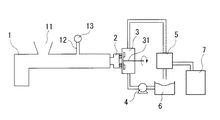
この発明の発泡性粒子を製造するに適した装置の一例を図1に示す。この製造装置は、樹脂流れ方向(図1において左から右への方向)上流側に樹脂組成物原料を投入する原料供給ホッパー11と、それよりも樹脂流れ方向下流側に高圧ポンプ13を有する発泡剤供給口12と、樹脂流れ方向末端に多孔ダイ2とがそれぞれ設けられた押出機1と、多孔ダイ2の出口を覆うように設けられ、内部にカッター31を回転駆動可能に配置すると共に、内部に水を循環するように構成されたカッティング室3と、カッティング室3に水を供給するための水槽6及び送水ポンプ4と、カッティング室3内でカットした発泡性粒子を水とともに導入し、水と発泡性粒子とを分離する脱水乾燥機5と、脱水乾燥機5で分離した発泡性粒子を貯留する容器7とを備えて構成されている。押出機1としては、樹脂の押出成形において用いられる公知の押出機、例えば単軸押出機、二軸押出機、タンデム式押出機等の中から適宜選択して使用し得る。押出機1は、原料供給ホッパー11から樹脂組成物原料を投入し、押出機1内で加熱混練して樹脂組成物とし、それを樹脂流れ方向下流に向けて移送する。樹脂組成物が発泡剤供給口12に達すると、高圧ポンプ13で圧送された発泡剤が樹脂組成物中に混合される。その後、発泡剤含有溶融樹脂は多孔ダイ2からカッティング室3内に押し出され、水と接触するとともに、水中でカッター31によって切断される。切断された樹脂は、ほぼ均一な粒径の球状粒子となり、循環水流によりカッティング室3から脱水乾燥機5に搬送される。脱水乾燥機5で水と分離、乾燥された発泡性粒子は、容器7に貯留される一方、水は水槽6に送られる。
【0026】
本発明の発泡性粒子は、製造後長期に渡って発泡性を保持することができる。発泡剤保持能力を判定する方法として、発泡性粒子を常圧、雰囲気温度18℃の条件下で3日間放置後の発泡性粒子中に含まれる揮発性発泡剤量を指標とした。本発明の発泡性粒子は製造1時間後に対する3日間放置後の発泡剤量の減少率は10〜40%程度である。
発泡剤の減少率=(製造1時間後の発泡剤量−3日間放置後の発泡剤量)/製造1時間後の発泡剤量×100(%)
従って、製造時に十分な量の発泡剤を粒子中に含ませておけば、製造後に常圧(約1気圧)、18℃温度条件下に3日間放置されたとしても、粒子中に発泡成形に必要とされる発泡剤量2質量%以上が残存しており、良好な発泡性を示す。また、該温度より低い温度条件下で保管すれば、更に長期に渡って発泡性を維持することが可能である。例えば、本発明の発泡性粒子を製造後に常圧、10℃温度条件下に14日以上保管し、次に常圧、18℃温度条件下に3日間放置したとしても、粒子中に含まれる発泡剤量が2質量%以上あり、良好な発泡性を示すことが可能である。
【0027】
本発明の発泡性粒子を発泡成形することにより、スチレン系樹脂の剛性とオレフィン系樹脂の優れた弾性を兼ね備えた、産業上有用な発泡成形体が得られる。また、本発明の発泡性粒子は発泡剤の保持性が良好であり、長期に渡って発泡性能を維持することができるので、従来の冷凍保管、密閉容器中での加圧保管等の必要がなく、冬期であれば大気温度下で、夏季においても一般的な保冷倉庫内に保管することが可能となり、保管および輸送において経済的に有利である。
【0028】
【実施例】
以下に実施例と比較例を挙げて、本発明の効果を明確にする。以下の実施例と比較例において、発泡性粒子中に含まれている発泡剤量、発泡成形体の密度を測定しているが、これらはそれぞれ以下の方法にて測定した値である。
【0029】
<発泡性粒子中に含まれる発泡剤量>
0.5cm3程度の発泡性粒子を精秤しサンプルとして準備し、島津製作所社製の熱分解炉PTR−1Aの分解炉入口にセットし、15秒間ヘリウムでパージしてサンプルセット時の混入気体を排出する。次に、密閉後サンプルを200℃の炉心に挿入し60秒間加熱して気体を放出させ、この放出気体を島津製作所社製のガスクロマトグラフGC−14B(検出器:TCD)を用いて定量する。その測定条件は、カラムがジーエルサイエンス社製ボラパックQ(80/100)3mmφ×1.5mを用い、カラム温度(100℃)、キャリアガス(ヘリウム)、キャリアガス流量(1mL/分)、注入口温度(100℃)、検出器温度(120℃)とした。
【0030】
<発泡成形体の密度>
JISK7222:1999記載の方法にて測定した。すなわち、成形体から10×10×5cmの試験片を試料のセル構造を変えないように切断し、その質量を測定し、次式にて算出した。
密度(g/cm3)=試験片質量(g)/試験片体積(cm3)
【0031】
[実施例1]
本実施例では、図1に示した装置を用いて発泡性粒子を製造した。
ポリスチレン(東洋スチレン株式会社製 HRM10N)85質量%とポリエチレン(日本ポリケム株式会社製 SF240)15質量%との混合樹脂100質量部に、水素添加されたスチレンとブタジエンの共重合体(旭化成工業株式会社製 タフテックH1041)5質量部とステアリン酸モノグリセライドを1質量部添加(ポリエチレンに練り込んだマスターバッチ使用)し、気泡調整剤として微粉末タルク0.2質量部とともにφ90mmの単軸押出機に供給し、加熱溶融した後、発泡剤として樹脂組成物100質量部に対し6質量部のイソペンタンを圧入し、溶融混合した。次いで、押出機中で溶融樹脂を混練冷却して、樹脂温度178℃にて押出孔φ0.5mm×200個の多孔ダイを通して30℃の水で満たされたカッティング室の中に100kg/hrの押出量で押出し、直ちに水中でカットし、遠心脱水機を通して脱水し、直径約1.2mmの発泡性粒子を得た。
得られた発泡性粒子を製造後1時間大気中に放置後、含まれる発泡剤量を測定したところ4.8質量%のイソペンタンが含まれていた。この発泡性粒子を常圧(約1気圧)、18℃温度条件下で3日間放置し、再度発泡性粒子中に含まれる発泡剤量を測定したところ4.2質量%であった。
この3日間放置した発泡性粒子を、箱型発泡機に入れて発泡させ予備発泡粒子とし、24時間放置したのち、300×300×50mmの成形型に充填し、ゲージ圧1.0kg/cm2の水蒸気を20秒間吹き込んで成形し発泡成形体を得た。得られた成形体は0.026g/cm3の密度で表面平滑性、発泡粒子の融着性の良い良好なものであった。
【0032】
[実施例2〜7]
実施例1と同様の設備を用い、原料配合組成、添加剤、発泡剤の種類、圧入量等をそれぞれ変えて発泡性粒子および発泡成形体を製造し、実施例1と同様の方法で発泡性粒子中に含まれる発泡剤量、発泡成形体の密度等を測定評価した。実施例2〜7で得られた発泡性粒子はいずれも発泡剤の保持性に優れており、常圧、18℃温度下に3日間放置後も2質量%以上の発泡剤を含んでおり、発泡性も良好なものであった。
実施例1〜7における発泡性粒子の製造条件と各測定結果を表1にまとめて示す。
【0033】
【表1】

[比較例1〜2]
比較例1は、発泡剤を沸点約0℃の工業用ブタンに変更した点を除いては実施例1と同様の設備、原料配合組成にて、比較例2はステアリン酸モノグリセライドを添加しなかった点を除いては実施例4と同様の設備、原料配合組成にて、それぞれ発泡性粒子および発泡成形体を製造した。
得られた発泡性粒子中に含まれる発泡剤量、発泡成形体の密度等を実施例1と同様の方法で測定評価したところ、それぞれの発泡性粒子は共に発泡剤保持能力が不十分であり、常圧、18℃温度下に3日間放置することで発泡剤量が2質量%を下回り、これを発泡して得られた発泡成形体も密度が大きく、接合粒子界面に隙間が残った表面平滑性の悪いものであった。
【0035】
[比較例3]
この比較例3ではスチレン系樹脂とオレフィン系樹脂の組成比率を変え、オレフィン系樹脂の組成比率を70質量%と増やした点を除いては実施例4と同様の方法で発泡性粒子を得た。得られた発泡性粒子は製造後1時間の時点で既に発泡性粒子中に含まれる発泡剤量が少なく、常圧、18℃温度下に3日間放置することで発泡剤量が1質量%を下回り、これを発泡しても満足な発泡成形体は得られなかった。
【0036】
[比較例4]
この比較例4では実施例1と同様の配合処方で発泡剤を圧入せずに樹脂ペレットを作製した。その樹脂ペレットを圧力容器に入れ、分散剤、可塑剤を加えた水性媒体中で工業用ブタン12質量部を加え、70℃、4時間発泡剤含浸処理を行い、室温まで冷却後、脱水し発泡性粒子を得た。得られた発泡性粒子は製造1時間後にはそれなりの発泡剤を含有していたが、常圧、18℃温度下に3日間放置することで発泡性粒子中の発泡剤量が大幅に減少し、これを発泡しても満足な発泡成形体は得られなかった。ちなみに、発泡剤をイソペンタンに変えて同様の条件で含浸処理を試みたが、この場合はペレット中にほとんど発泡剤が含浸されなかった。
比較例1〜4における発泡性粒子の製造条件と各測定結果を表2にまとめて示す。
【0037】
【表2】
【発明の効果】
本発明の発泡性粒子は、スチレン系樹脂の剛性とオレフィン系樹脂の優れた弾性を兼ね備えた、産業上有用な発泡成形体が得られる。
また、本発明の発泡性粒子は、発泡剤の保持性が良好であり、長期に渡って発泡性能を維持することができるので、従来の冷凍保管、密閉容器中での加圧保管等の必要がなく、冬期であれば大気温度下で、夏季においても一般的な保冷倉庫内に保管することが可能となり、保管および輸送において経済的に有利である。
【図面の簡単な説明】
【図1】本発明の発泡性粒子の製造方法に好適な製造装置を示す概略構成図である。
【符号の説明】
1…押出機、2…多孔ダイ、3…カッティング室、4…送水ポンプ、5…脱水乾燥機、6…水槽、7…容器、11…原料供給ホッパー、12…発泡剤供給口、13…高圧ポンプ、31…カッター。[0001]
TECHNICAL FIELD OF THE INVENTION
The present invention relates to expandable particles comprising a mixed resin of a styrene-based resin and an olefin-based resin, a method for producing the same, and a foamed molded article obtained from the expandable particles. The present invention relates to styrene-olefin mixed resin foamable particles which have elasticity and can retain a volatile foaming agent even when left for a certain period of time under normal pressure and normal temperature. As a result, it can be widely used in cushioning and packaging materials for industrial products, structural members of automobiles, energy absorbing materials, housing fields, leisure fields, and the like.
[0002]
[Prior art]
BACKGROUND ART Styrene-based resin foam molded articles are widely used for heat insulation for houses, cushioning materials for packaging, and the like because they are lightweight, have high rigidity, and have excellent heat insulation properties.
There are several methods for foaming a styrene-based resin into a foamed molded product, and one of them is a method using foamable beads. In this method, first, particles of a styrene resin are used as a material, and the particles are impregnated with a volatile foaming agent to form expandable particles. Then, steam is brought into contact with the expandable particles, and the particles are heated and expanded to prepare a pre-expanded particle. Expanded particles are produced, and then the pre-expanded particles are filled in a mold, and steam is blown into the mold to further expand the particles and fuse them together to form a molded article.
[0003]
However, a foamed molded article made of a styrene-based resin has disadvantages that it is brittle against impact due to the characteristics of the resin and also weak against oil and solvents.
In order to overcome such disadvantages of the styrene resin, a foam made of an ethylene resin, a foam made of a propylene resin, or a foam made of a polymer of ethylene and styrene (for example, see Patent Document 1). Proposed.
[0004]
However, resin particles composed of an olefin-based resin such as polyethylene or polypropylene are liable to dissipate the impregnated volatile foaming agent. Or the expandable particles had to be stored in a pressurized container. In comparison, styrene resins have a good retention of volatile foaming agents, so they retain sufficient foaming power after being impregnated with the foaming agent and left for a long time regardless of unfoamed particles or pre-foamed particles. Is done. Therefore, the expandable particles made of an olefin resin have disadvantages in storage and transportation as compared with the expandable particles made of a styrene resin.
[0005]
In addition, foams made of a polymer of styrene and ethylene have better retention of a foaming agent than the above-mentioned olefin-based resin alone, but still have volatile foaming in a short time if left at normal temperature and normal pressure. The agent dissipated, and it was necessary to produce a molded body in a short time, and it was necessary to adjust the storage state and the amount of the volatile foaming agent. In order to solve such problems, a styrene-olefin copolymer resin is used as a base resin, and a substance which is compatible with the base resin, has a boiling point of 250 ° C. or more under normal pressure, and is liquid at normal temperature is used as the base resin. In addition, expandable particles impregnated with 0.2 to 7 parts by mass have been proposed (for example, see Patent Document 2).
Although the expanded particles have improved the retention of the volatile foaming agent to some extent, the retention is still insufficient.
[0006]
There have also been proposed some foamed molded articles in which a styrene-based resin and an olefin-based resin are previously melt-blended by a kneading machine such as an extruder, impregnated with a volatile foaming agent, and foamed.
One is a method for producing a foam in which a blowing agent is impregnated and foamed into pellets obtained by hot-melting a vinyl aromatic polymer raw material containing 1 to 15% by mass of an olefin-based resin with respect to the total resin amount. (See, for example, Patent Document 3).
The other proposes a foam obtained by foaming a resin composition comprising a specific triblock copolymer comprising a styrene resin, an ethylene resin and a styrene-isoprene-styrene block (for example, Patent Reference 4).
[0007]
In the former, an olefin-based resin is mixed to substantially adjust the cell diameter of the foam. The olefin-based resin is substantially about 5% by mass, and greatly changes the physical properties of the styrene-based resin foam. Not something. In addition, the latter impregnates a certain amount of gas and then only evaluates whether or not a foam can be obtained in the range of 5 to 60 times expansion, but does not mention the retention of the volatile foaming agent. As a result of the evaluation of the retention of the volatile blowing agent by the present inventors within the scope of the claims, a decrease in the volatile blowing agent was confirmed.
[0008]
In addition, as a method for producing expandable olefin resin particles having good foaming agent retention, a foaming agent is added to a propylene polymer and extruded, and pelletized at a temperature and pressure under which substantially no foaming occurs, and 450 g / L is obtained. It has been proposed to produce expandable propylene polymer particles having a bulk density exceeding (see, for example, Patent Document 5). However, in the foamable particles, the volatile foaming agent easily escapes from the particles during storage, and the bulk density of the foamed particles is 237 even if the foamable particles after storage for 1 hour in the atmosphere after production are foamed. It was as large as 2280 g / L and could not be a foam having a sufficient cushioning property.
[0009]
[Patent Document 1]
JP-A-48-101457
[Patent Document 2]
JP-A-57-11330
[Patent Document 3]
JP-B-47-26097
[Patent Document 4]
JP 06-49256 A
[Patent Document 5]
JP 2001-240678 A
[0010]
[Problems to be solved by the invention]
As described above, conventional foamable particles made of a styrene-olefin mixed resin should prevent the volatile foaming agent from escaping from the particles unless they are stored frozen or stored under pressure in a closed container. Could not. Generally, in order to obtain a good foamed molded article, it is necessary that the foamable particles contain at least 2% by mass or more of a volatile foaming agent. When the volatile particles were left at normal temperature and normal pressure for 1 to 2 days, most of the volatile foaming agent escaped from the particles, and a good foamed molded product could not be obtained even after foam molding. Further, when the composition ratio of the olefin-based resin is high, even if the foamable particles contain a certain amount of volatile foaming agent, the volatile foaming agent dissipates at the time of heating and foaming, and the foam is highly foamed. It was difficult.
[0011]
The present invention has been made in view of the above circumstances, the volatile foaming agent is less dissipated even at normal pressure and room temperature, storage and transportation after production is easy, highly foamable, and styrene An object of the present invention is to provide styrene-olefin mixed resin expandable particles capable of producing a foam having better impact resistance and cushioning properties than resin foams, a method for producing the same, and a styrene-olefin mixed resin foam molded article.
[0012]
[Means for Solving the Problems]
In order to achieve the above object, the present invention relates to 100 parts by mass of a mixed resin of 50 to 90% by mass of a styrene-based resin and 10 to 50% by mass of an olefin-based resin, and 0 to 15 parts by mass of a styrene-based elastomer. Particles containing the resin composition and the volatile foaming agent, wherein the amount of the volatile foaming agent contained in the foamable particles after standing for 3 days at normal pressure and an ambient temperature of 18 ° C. is 2 Provided is a styrene-olefin mixed resin expandable particle, characterized in that the amount is not less than mass%.
In the styrene-olefin mixed resin expandable particles of the present invention, the olefin resin has a density of 0.900 to 0.935 g / cm. 3 Is preferred.
Further, the styrene-based elastomer is preferably a copolymer of a hydrogenated styrene-based monomer and a conjugated diene.
Further, the volatile blowing agent preferably contains at least 50% by mass or more of isopentane.
Further, it is preferable that the particles contain a partial ester of a higher fatty acid and an alcohol.
Further, the present invention provides a method for producing a mixture of 100 to 100 parts by mass of a mixed resin of 50 to 90% by mass of a styrene resin and 10 to 50% by mass of an olefin resin, 0 to 15 parts by mass of a styrene elastomer, and a portion of a higher fatty acid and an alcohol. 0 to 3 parts by mass of the ester is supplied to an extruder and heated and melted to form a resin composition, and a volatile foaming agent having a boiling point of 20 to 60 ° C. is added from the middle of the extruder to 3 to 100 parts by mass of the resin composition. After press-fitting 15 parts by mass of the foaming agent-containing molten resin, the blowing agent-containing molten resin is extruded from a porous die into a liquid, and simultaneously with the extrusion, the resin is cut in the liquid to obtain foamable particles. And a method for producing the same.
In the method of the present invention, it is preferable that the liquid present at the site where the mixed resin is extruded and cut is water whose temperature is in the range of 15 to 60 ° C. and 100 to 200 ° C. lower than the resin temperature at the time of flowing into the die. .
The present invention further provides a foam obtained by foaming the expandable particles at a density of 0.014 to 0.2 g / cm. 3 And a styrene-olefin mixed resin foam molded article.
[0013]
BEST MODE FOR CARRYING OUT THE INVENTION
The styrene-olefin mixed resin expandable particles of the present invention (hereinafter, abbreviated as expandable particles) include a styrene-based resin, an olefin-based resin, and a volatile blowing agent (hereinafter, abbreviated as a blowing agent) as essential components, Further, it preferably contains a styrene-based elastomer and a partial ester of a higher fatty acid and an alcohol as a blowing agent escape preventing agent. The expandable particles of the present invention are excellent in retention of the blowing agent. After production, the amount of the expanding agent contained in the expandable particles after leaving for 3 days at normal pressure and an ambient temperature of 18 ° C. is 2 mass%. % Or more. When the amount of the blowing agent contained in the expandable particles is less than 2% by mass, the expandability of the expandable particles becomes insufficient, so that not only a useful expanded molded article cannot be obtained, but also the retention of the blowing agent is excellent. It's hard to say effervescent particles. It is preferably from 3 to 10% by mass, and even if it exceeds 10% by mass, a further increase in foamability may not be expected. Particularly preferably, it is 3 to 6% by mass.
[0014]
Examples of the styrene resin which is an essential component of the expandable particles of the present invention include styrene homopolymer, styrene and acrylonitrile, acrylic acid, methacrylic acid, methyl acrylate, methyl methacrylate, and maleic anhydride. For example, impact-resistant polystyrene obtained by mixing a diene rubber elastomer with a copolymer with polystyrene or polystyrene or graft-polymerizing a styrene monomer to the diene rubber elastomer can be used. These styrene resins can be used alone or in combination of two or more. Among them, particularly preferred is a homopolymer of styrene.
[0015]
Examples of the olefin-based resin which is an essential component of the expandable particles of the present invention include polyethylene-based resins and polypropylene-based resins, for example, low-density polyethylene, high-density polyethylene, polyethylene such as linear low-density polyethylene, and ethylene- Butene copolymer, ethylene-hexene copolymer, ethylene-octene copolymer, copolymer of ethylene-ethylene and α-olefin, ethylene-vinyl acetate copolymer, ethylene-methacrylic acid copolymer, ethylene-methacrylic acid Ethylene copolymers, copolymers of ethylene and polar monomers such as ionomers, propylene homopolymers, random copolymers of propylene and α-olefins, up to about 20% ethylene-propylene rubber in a matrix of propylene homopolymer ( Impact sharing including EPR) And a copolymer (also referred to as a block copolymer), polybutene-1 and the like. These olefin resins can be used alone or in combination of two or more. Of these, polyethylene resins are preferred. Particularly preferred is a resin density of 0.900 to 0.935 g / cm. 3 And low-density polyethylene and linear low-density polyethylene.
[0016]
Examples of the styrene-based elastomer that can be added to the expandable particles of the present invention include a random copolymer of a styrene-based monomer and a conjugated diene, a block copolymer or a hydrogenated copolymer thereof, and among them, Hydrogenated copolymers are particularly preferred. Examples of the hydrogenated styrene-based monomer-conjugated diene copolymer include styrene-butadiene-butylene-styrene copolymer (SBBS), styrene-ethylene-butylene copolymer (SEB), and styrene-ethylene-butylene- Styrene block copolymer (SEBS), styrene-ethylene propylene copolymer (SEP), styrene-ethylene propylene-styrene block copolymer (SEPS), styrene-vinyl isoprene-styrene copolymer (S-VIS) And the like.
[0017]
In the expandable particles of the present invention, the composition ratio of the styrene-based resin, the olefin-based resin, and the styrene-based elastomer in the resin composition is 50 to 90% by mass of the styrene-based resin and 10 to 50% by mass of the olefin-based resin. The range is from 0 to 15 parts by mass with respect to 100 parts by mass of the mixed resin. When the styrene-based resin in the mixed resin is less than 50% by mass or the olefin-based resin exceeds 50% by mass, the retention of the foaming agent cannot be sufficiently obtained, and when the styrene-based resin exceeds 90% by mass, The difference in physical properties from the foam of the styrene resin alone is hardly observed, and the impact resistance, oil resistance, and solvent resistance deteriorate. The preferred composition ratio of the styrene resin to the olefin resin in 100 parts by mass of the mixed resin is 70 to 90% by mass of the styrene resin and 10 to 30% by mass of the olefin resin. The styrene-based elastomer is an optional component, but is preferably incorporated into the resin composition in order to improve the mixing property between the styrene-based resin and the olefin-based resin. In particular, when the composition ratio of the olefin resin is relatively high, it is effective to hold the foaming agent in the particles for a long time. However, when the addition amount exceeds 15 parts by mass with respect to 100 parts by mass of the mixed resin of the styrene-based resin and the olefin-based resin, the resin viscosity during extrusion decreases, and it becomes difficult to suppress foaming of the particles, which is preferable. Absent. When the styrene-based elastomer is added, the addition amount is preferably in the range of 3 to 10 parts by mass with respect to 100 parts by mass of the mixed resin of the styrene-based resin and the olefin-based resin.
[0018]
The foaming agent used in the present invention is preferably a foaming agent which is easy to suppress foaming at the stage of extruding the foamable particles, hardly escapes from the foamable particles at normal temperature, and highly easily foams at the stage of foaming the particles. . Therefore, as the foaming agent, a foaming agent having a property that it does not vaporize at normal temperature and normal pressure and easily vaporizes by steam heating is preferable, and one having a boiling point in the range of 20 to 60 ° C is preferable. If the boiling point is less than 20 ° C., vaporization of the foaming agent tends to start during extrusion, and it is difficult to suppress the foaming of the particles. Is not preferred because the foaming property of the resin becomes poor.
[0019]
As the foaming agent, for example, normal pentane (boiling point: 36 ° C.), isopentane (boiling point: 28 ° C.), cyclopentane (boiling point: 49 ° C.), cyclopentadiene (boiling point: 41 ° C.), or a mixture of two or more thereof can be used. it can. Further, a foaming agent having a boiling point of 20 ° C. or less, such as normal butane, isobutane, or propane, containing the above-mentioned pentanes as a main component can be used in a mixture within an azeotropic point of 20 ° C. or more. Among these, a particularly preferred foaming agent is isopentane, and a foaming agent component containing at least 50% by mass or more of isopentane is suitable. Isopentane is suitable as a foaming agent because, despite its lower boiling point than normal pentane, it has the advantage that it is easily retained in the foamable particles and foams more highly during foaming. This is presumed to be caused by the molecular steric structure of isopentane. If the amount of isopentane in the blowing agent component is less than 50% by mass, the retention in the expandable particles becomes insufficient, which is not preferable.
[0020]
Also, the injection amount of the foaming agent is appropriately 3 to 15 parts by mass with respect to 100 parts by mass of the resin composition. If the injection amount of the blowing agent is less than 3 parts by mass, the expandability of the expandable particles becomes insufficient, and a useful foam molded article cannot be obtained. On the other hand, if the amount of the pressurized foaming agent exceeds 15 parts by mass, no further increase in the foaming property can be expected, and the extrusion is undesirably unstable. A particularly preferred range is 4 to 10 parts by mass.
[0021]
In the present invention, it is effective to add a partial ester of a higher fatty acid and an alcohol to the resin composition in order to prevent the escape of the blowing agent from the expandable particles. Examples of the higher fatty acids include fatty acids having 15 or more carbon atoms such as palmitic acid, stearic acid, oleic acid, linoleic acid, linolenic acid, and behenic acid, and monoglycerides and diglycerides thereof can be used. Of these, particularly preferred are monostearate stearate and diglyceride stearate. These partial esters are added as a blowing agent escape preventing agent in an amount of 0 to 3 parts by mass based on 100 parts by mass of the mixed resin. If the amount is more than 3 parts by mass, the bonding between the particles may be weak when the expandable particles are subjected to foam molding. Particularly preferably, the amount is 0.5 to 3.0 parts by mass.
[0022]
As a method for adding a partial ester of a higher fatty acid and an alcohol to the resin composition, a commonly used method such as a dry blending method, a masterbatch method, or a melt-injection method may be used. In consideration of the above, it is preferable to add a masterbatch kneaded in a styrene-based resin or an ethylene-based resin at a high concentration in advance to the resin.
[0023]
Further, the expandable particles of the present invention include, for example, a bubble regulator such as talc, calcium carbonate, mica, or citric acid and sodium bicarbonate for adjusting the size of bubbles during foaming, a pigment, and a stabilizer. Various additives such as an agent, a filler, and an antistatic agent can be appropriately added as long as the effects of the present invention are not impaired.
[0024]
The expandable particles of the present invention comprise 100 parts by mass of a mixed resin of 50 to 90% by mass of a styrene-based resin and 10 to 50% by mass of an olefin-based resin, 0 to 15 parts by mass of a styrene-based elastomer, a higher fatty acid and an alcohol. And 0 to 3 parts by weight of a partial ester of the above with an extruder and heated and melted to form a resin composition, and a volatile foaming agent having a boiling point of 20 to 60 ° C. from the middle of the extruder to 100 parts by weight of the resin composition. After press-fitting 3 to 15 parts by mass of the resin, the blowing agent-containing molten resin is extruded from a porous die into a liquid, and simultaneously with the extrusion, the resin is cut in the liquid and separated from the liquid. When the resin extruded in the liquid is cut, the temperature of the liquid is preferably 15 to 60 ° C, more preferably 20 to 40 ° C. If the temperature of the liquid is lower than 15 ° C., the cooling of the die surface becomes strong, and the pressure inside the die increases, making extrusion difficult. On the other hand, if the temperature is higher than 60 ° C., it is difficult to suppress foaming of the resin particles, and if it is higher than 80 ° C., the cut resin particles are apt to coalesce, which is not preferable. Further, it is preferable that the liquid temperature is 100 to 200 ° C. lower than the resin temperature at the time of flowing into the die. If the temperature difference from the resin temperature is less than 100 ° C., the cooling of the resin particles is insufficient and it is difficult to suppress foaming. If the temperature difference exceeds 200 ° C., the temperature difference between the particle surface and the inside of the particle causes Are not preferable because they are deformed and become no longer spherical. Water is preferred as this liquid.
[0025]
FIG. 1 shows an example of an apparatus suitable for producing the expandable particles of the present invention. This production apparatus is a foaming apparatus having a raw
[0026]
The expandable particles of the present invention can maintain the expandability for a long time after production. As a method for determining the foaming agent holding ability, the amount of the volatile foaming agent contained in the foamable particles after leaving the foamable particles at normal pressure and an ambient temperature of 18 ° C. for 3 days was used as an index. In the expandable particles of the present invention, the reduction rate of the amount of the blowing agent after leaving for 3 days with respect to 1 hour after the production is about 10 to 40%.
Reduction rate of foaming agent = (amount of foaming agent after 1 hour of production−amount of foaming agent after standing for 3 days) / amount of foaming agent after 1 hour of production × 100 (%)
Therefore, if a sufficient amount of a foaming agent is contained in the particles at the time of production, even if the particles are left under normal pressure (about 1 atm) and at a temperature of 18 ° C. for 3 days after the production, the particles can be formed into foam by molding. The required amount of foaming agent of 2% by mass or more remains, showing good foaming properties. In addition, when stored under a temperature condition lower than the temperature, it is possible to maintain the foaming property for a longer period. For example, even if the expandable particles of the present invention are stored at normal pressure and at a temperature of 10 ° C. for 14 days or more after production and then allowed to stand at normal pressure and a temperature of 18 ° C. for 3 days, the foaming particles contained in the particles may be removed. When the amount of the agent is 2% by mass or more, it is possible to exhibit good foaming properties.
[0027]
By foam-forming the expandable particles of the present invention, an industrially useful foam molded article having both the rigidity of a styrene-based resin and the excellent elasticity of an olefin-based resin can be obtained. In addition, the expandable particles of the present invention have good retention of the blowing agent and can maintain the foaming performance over a long period of time. Therefore, conventional freezing storage, pressurized storage in a closed container, and the like are necessary. In addition, it can be stored in a general cold storage warehouse at atmospheric temperature in winter and in summer in summer, which is economically advantageous in storage and transportation.
[0028]
【Example】
Hereinafter, the effects of the present invention will be clarified with reference to Examples and Comparative Examples. In the following Examples and Comparative Examples, the amount of the foaming agent contained in the expandable particles and the density of the foamed molded article are measured, and these are values measured by the following methods, respectively.
[0029]
<Amount of blowing agent contained in expandable particles>
0.5cm 3 A foamable particle having a sufficient degree is precisely weighed and prepared as a sample. The sample is set at a cracking furnace inlet of a thermal cracking furnace PTR-1A manufactured by Shimadzu Corporation, and purged with helium for 15 seconds to discharge mixed gas during sample setting. Next, after sealing, the sample is inserted into a core at 200 ° C. and heated for 60 seconds to release gas, and the released gas is quantified using a gas chromatograph GC-14B (detector: TCD) manufactured by Shimadzu Corporation. The measurement conditions were as follows: the column used was VOLAPAC Q (80/100) 3 mmφ × 1.5 m manufactured by GL Sciences, column temperature (100 ° C.), carrier gas (helium), carrier gas flow rate (1 mL / min), inlet Temperature (100 ° C.) and detector temperature (120 ° C.).
[0030]
<Density of foamed molded article>
It was measured by the method described in JIS K7222: 1999. That is, a test piece of 10 × 10 × 5 cm was cut from the molded body without changing the cell structure of the sample, and its mass was measured and calculated by the following equation.
Density (g / cm 3 ) = Test piece mass (g) / test piece volume (cm) 3 )
[0031]
[Example 1]
In this example, expandable particles were produced using the apparatus shown in FIG.
A copolymer of hydrogenated styrene and butadiene (Asahi Chemical Industry Co., Ltd.) was added to 100 parts by mass of a mixed resin of 85% by mass of polystyrene (HRM10N manufactured by Toyo Styrene Co., Ltd.) and 15% by mass of polyethylene (SF240 manufactured by Nippon Polychem Co., Ltd.) 5 parts by mass of Tuftec H1041) and 1 part by mass of monoglyceride stearate were added (using a masterbatch kneaded in polyethylene) and fed to a φ90 mm single screw extruder together with 0.2 parts by mass of fine powder talc as a cell regulator. After heating and melting, 6 parts by mass of isopentane was injected into 100 parts by mass of the resin composition as a foaming agent, and the mixture was melted and mixed. Then, the molten resin is kneaded and cooled in an extruder, and extruded at a resin temperature of 178 ° C. through a perforation die having an extrusion hole of 0.5 mm × 200 and into a cutting chamber filled with water at 30 ° C. at a rate of 100 kg / hr. The mixture was extruded, cut immediately in water, and dehydrated through a centrifugal dehydrator to obtain expandable particles having a diameter of about 1.2 mm.
After the obtained expandable particles were left in the air for 1 hour after production, the amount of the blowing agent contained was measured. As a result, 4.8% by mass of isopentane was contained. The expandable particles were allowed to stand under normal pressure (about 1 atm) and at a temperature of 18 ° C. for 3 days, and the amount of the blowing agent contained in the expandable particles was measured again to be 4.2% by mass.
The expandable particles left for 3 days are put into a box-type foaming machine to expand them to form pre-expanded particles, left for 24 hours, filled in a 300 × 300 × 50 mm molding die, and a gauge pressure of 1.0 kg / cm. 2 Was blown for 20 seconds to form a foamed molded product. The obtained molded body is 0.026 g / cm 3 With a density of, the surface smoothness and the fusion property of the expanded particles were good.
[0032]
[Examples 2 to 7]
Using the same equipment as in Example 1, the raw material composition, additives, types of foaming agents, the amount of injection, etc. were respectively changed to produce expandable particles and foamed molded articles. The amount of the foaming agent contained in the particles, the density of the foam molded article, and the like were measured and evaluated. Each of the expandable particles obtained in Examples 2 to 7 is excellent in the holding property of the blowing agent, and contains 2% by mass or more of the blowing agent even after being left at normal pressure and a temperature of 18 ° C. for 3 days. The foamability was also good.
Table 1 summarizes the production conditions of the expandable particles and the measurement results in Examples 1 to 7.
[0033]
[Table 1]
[Comparative Examples 1-2]
Comparative Example 1 had the same equipment and raw material composition as in Example 1 except that the blowing agent was changed to industrial butane having a boiling point of about 0 ° C., and Comparative Example 2 did not include stearic acid monoglyceride. Except for the above points, expandable particles and an expanded molded article were produced using the same equipment and raw material composition as in Example 4, respectively.
When the amount of the foaming agent contained in the obtained expandable particles, the density of the foamed molded article, and the like were measured and evaluated in the same manner as in Example 1, each of the expandable particles had insufficient foaming agent holding capacity. By leaving it at a normal pressure and a temperature of 18 ° C. for 3 days, the amount of the foaming agent falls below 2% by mass. It had poor smoothness.
[0035]
[Comparative Example 3]
In Comparative Example 3, expandable particles were obtained in the same manner as in Example 4, except that the composition ratio of the styrene-based resin and the olefin-based resin was changed, and the composition ratio of the olefin-based resin was increased to 70% by mass. . One hour after the production, the obtained expandable particles have a small amount of the blowing agent already contained in the expandable particles, and when left at normal pressure and a temperature of 18 ° C. for 3 days, the amount of the blowing agent becomes 1% by mass. Below, even if this was foamed, a satisfactory foam molded article could not be obtained.
[0036]
[Comparative Example 4]
In Comparative Example 4, resin pellets were produced in the same formulation as in Example 1 without pressurizing the blowing agent. The resin pellets are placed in a pressure vessel, 12 parts by mass of industrial butane is added in an aqueous medium to which a dispersant and a plasticizer have been added, and the foaming agent is impregnated with the foaming agent at 70 ° C. for 4 hours. Particles were obtained. Although the obtained expandable particles contained a certain amount of the foaming agent one hour after the production, the amount of the foaming agent in the expandable particles was greatly reduced by leaving them at normal pressure and a temperature of 18 ° C. for 3 days. However, even if this was foamed, a satisfactory foam molded article could not be obtained. Incidentally, the impregnating treatment was attempted under the same conditions by changing the blowing agent to isopentane, but in this case, the pellet was hardly impregnated with the blowing agent.
Table 2 summarizes the production conditions of the expandable particles and the measurement results in Comparative Examples 1 to 4.
[0037]
[Table 2]
【The invention's effect】
The expandable particles of the present invention provide an industrially useful expanded molded article having both the rigidity of a styrene resin and the excellent elasticity of an olefin resin.
In addition, the expandable particles of the present invention have good foaming agent holding properties and can maintain the foaming performance over a long period of time. In winter, it can be stored in a general insulated warehouse at atmospheric temperature in the summer and in the summer, which is economically advantageous in storage and transportation.
[Brief description of the drawings]
FIG. 1 is a schematic configuration diagram showing a production apparatus suitable for a method for producing expandable particles of the present invention.
[Explanation of symbols]
DESCRIPTION OF SYMBOLS 1 ... Extruder, 2 ... Perforated die, 3 ... Cutting room, 4 ... Water pump, 5 ... Dehydration dryer, 6 ... Water tank, 7 ... Container, 11 ... Raw material supply hopper, 12 ... Blowing agent supply port, 13 ... High pressure Pump, 31 ... Cutter.
Claims (8)
常圧、雰囲気温度18℃の条件下で3日間放置後の発泡性粒子中に含まれる揮発性発泡剤量が2質量%以上であることを特徴とするスチレン−オレフィン混合樹脂発泡性粒子。A resin composition comprising 100 to 100 parts by mass of a mixed resin of 50 to 90% by mass of a styrene-based resin and 10 to 50% by mass of an olefin-based resin, and 0 to 15 parts by mass of a styrene-based elastomer; An expandable particle containing:
Styrene-olefin mixed resin expandable particles, characterized in that the amount of the volatile blowing agent contained in the expandable particles after standing for 3 days at normal pressure and an ambient temperature of 18 ° C. is 2% by mass or more.
Priority Applications (1)
| Application Number | Priority Date | Filing Date | Title |
|---|---|---|---|
| JP2003026966A JP4017535B2 (en) | 2003-02-04 | 2003-02-04 | Styrene-olefin mixed resin foamable particles, production method thereof, and styrene-olefin mixed resin foam molded article |
Applications Claiming Priority (1)
| Application Number | Priority Date | Filing Date | Title |
|---|---|---|---|
| JP2003026966A JP4017535B2 (en) | 2003-02-04 | 2003-02-04 | Styrene-olefin mixed resin foamable particles, production method thereof, and styrene-olefin mixed resin foam molded article |
Publications (2)
| Publication Number | Publication Date |
|---|---|
| JP2004238433A true JP2004238433A (en) | 2004-08-26 |
| JP4017535B2 JP4017535B2 (en) | 2007-12-05 |
Family
ID=32954830
Family Applications (1)
| Application Number | Title | Priority Date | Filing Date |
|---|---|---|---|
| JP2003026966A Expired - Fee Related JP4017535B2 (en) | 2003-02-04 | 2003-02-04 | Styrene-olefin mixed resin foamable particles, production method thereof, and styrene-olefin mixed resin foam molded article |
Country Status (1)
| Country | Link |
|---|---|
| JP (1) | JP4017535B2 (en) |
Cited By (3)
| Publication number | Priority date | Publication date | Assignee | Title |
|---|---|---|---|---|
| JP2007084744A (en) * | 2005-09-26 | 2007-04-05 | Sekisui Plastics Co Ltd | Styrenic resin foamable particles, method for producing the same, and styrene resin foamed molded article |
| JP2009292015A (en) * | 2008-06-04 | 2009-12-17 | Sekisui Plastics Co Ltd | Methods of producing foamable thermoplastic resin particle, foamedthermoplastic resin particle and foamed thermoplastic resin molded product |
| JP2016500387A (en) * | 2012-12-17 | 2016-01-12 | ベルサリス、ソシエタ、ペル、アチオニVersalis S.P.A. | Expandable polymer compositions with improved flexibility and related production processes |
-
2003
- 2003-02-04 JP JP2003026966A patent/JP4017535B2/en not_active Expired - Fee Related
Cited By (3)
| Publication number | Priority date | Publication date | Assignee | Title |
|---|---|---|---|---|
| JP2007084744A (en) * | 2005-09-26 | 2007-04-05 | Sekisui Plastics Co Ltd | Styrenic resin foamable particles, method for producing the same, and styrene resin foamed molded article |
| JP2009292015A (en) * | 2008-06-04 | 2009-12-17 | Sekisui Plastics Co Ltd | Methods of producing foamable thermoplastic resin particle, foamedthermoplastic resin particle and foamed thermoplastic resin molded product |
| JP2016500387A (en) * | 2012-12-17 | 2016-01-12 | ベルサリス、ソシエタ、ペル、アチオニVersalis S.P.A. | Expandable polymer compositions with improved flexibility and related production processes |
Also Published As
| Publication number | Publication date |
|---|---|
| JP4017535B2 (en) | 2007-12-05 |
Similar Documents
| Publication | Publication Date | Title |
|---|---|---|
| US5667728A (en) | Blowing agent, expandable composition, and process for extruded thermoplastic foams | |
| JP5873098B2 (en) | Method for producing foamable thermoplastic beads with improved foamability | |
| JP3380816B2 (en) | Ultra-low density polyolefin foams, foamable polyolefin compositions and methods of making them | |
| JP2007084744A (en) | Styrenic resin foamable particles, method for producing the same, and styrene resin foamed molded article | |
| ES2295337T3 (en) | MIXTURES OF ETHYLENE POLYMERS WITH IMPROVED MODULE AND RESISTANCE OF THE CAST AND ARTICLES MANUFACTURED FROM THESE MIXTURES. | |
| JP5410803B2 (en) | Expandable thermoplastic resin particles and method for producing the same, pre-expanded particles and foamed molded body | |
| US6872757B2 (en) | Expandable composition, blowing agent, and process for extruded thermoplastic foams | |
| JP4017538B2 (en) | Styrenic resin foamable particles, method for producing the same, and styrene resin foamed molded article | |
| CA2399239C (en) | Extruded foam product with reduced surface defects | |
| JP2010525107A (en) | Low solubility hydrofluorocarbon containing alkenyl aromatic foam | |
| JPH0198638A (en) | Blowing agent composition for expanding thermoplastic resin | |
| JP7636900B2 (en) | Expandable styrene resin particles, pre-expanded styrene resin particles, styrene resin foamed molded product, and method for producing expandable styrene resin particles | |
| CN101001899B (en) | Styrene-modified polyethylene-based resin particles, styrene-modified polyethylene-based expandable resin particles, method for producing same, pre-expanded particles, and foam-molded product | |
| JP4017535B2 (en) | Styrene-olefin mixed resin foamable particles, production method thereof, and styrene-olefin mixed resin foam molded article | |
| JPH07278365A (en) | Low-density polyolefin foam, foamable polyolefin compositionand their production | |
| JPH10204203A (en) | Manufacturing method of polyethylene resin pre-expanded particles | |
| JP2018145212A (en) | Expandable polystyrene resin particles, pre-expanded particles, molded products | |
| JP2002248645A (en) | Method for manufacturing thermoplastic resin foam small piece molding | |
| JP5492581B2 (en) | Thermoplastic resin foam molding | |
| JP5758586B2 (en) | Polyethylene resin expanded particles and polyethylene resin in-mold expanded molding | |
| JP4001669B2 (en) | Olefinic resin foamable particles and method for producing the same | |
| JP3270109B2 (en) | Styrene-based resin foam and method for producing the same | |
| JP2013159758A (en) | Pre-expanded bead, molded article and method for manufacturing the same | |
| JPH10237211A (en) | Method for producing non-crosslinked polyethylene resin pre-expanded particles | |
| TW202535635A (en) | Recycled foamable styrene resin particles, recycled pre-foamed styrene resin particles, and recycled styrene resin foamed molded article |
Legal Events
| Date | Code | Title | Description |
|---|---|---|---|
| A621 | Written request for application examination |
Free format text: JAPANESE INTERMEDIATE CODE: A621 Effective date: 20050214 |
|
| A977 | Report on retrieval |
Free format text: JAPANESE INTERMEDIATE CODE: A971007 Effective date: 20070302 |
|
| A131 | Notification of reasons for refusal |
Free format text: JAPANESE INTERMEDIATE CODE: A131 Effective date: 20070306 |
|
| A521 | Written amendment |
Free format text: JAPANESE INTERMEDIATE CODE: A523 Effective date: 20070425 |
|
| TRDD | Decision of grant or rejection written | ||
| A01 | Written decision to grant a patent or to grant a registration (utility model) |
Free format text: JAPANESE INTERMEDIATE CODE: A01 Effective date: 20070904 |
|
| A61 | First payment of annual fees (during grant procedure) |
Free format text: JAPANESE INTERMEDIATE CODE: A61 Effective date: 20070918 |
|
| R150 | Certificate of patent or registration of utility model |
Ref document number: 4017535 Country of ref document: JP Free format text: JAPANESE INTERMEDIATE CODE: R150 Free format text: JAPANESE INTERMEDIATE CODE: R150 |
|
| FPAY | Renewal fee payment (event date is renewal date of database) |
Free format text: PAYMENT UNTIL: 20100928 Year of fee payment: 3 |
|
| FPAY | Renewal fee payment (event date is renewal date of database) |
Free format text: PAYMENT UNTIL: 20100928 Year of fee payment: 3 |
|
| FPAY | Renewal fee payment (event date is renewal date of database) |
Free format text: PAYMENT UNTIL: 20110928 Year of fee payment: 4 |
|
| FPAY | Renewal fee payment (event date is renewal date of database) |
Free format text: PAYMENT UNTIL: 20120928 Year of fee payment: 5 |
|
| FPAY | Renewal fee payment (event date is renewal date of database) |
Free format text: PAYMENT UNTIL: 20130928 Year of fee payment: 6 |
|
| FPAY | Renewal fee payment (event date is renewal date of database) |
Free format text: PAYMENT UNTIL: 20130928 Year of fee payment: 6 |
|
| FPAY | Renewal fee payment (event date is renewal date of database) |
Free format text: PAYMENT UNTIL: 20140928 Year of fee payment: 7 |
|
| LAPS | Cancellation because of no payment of annual fees |