JP2004242598A - beta1,3-N-ACETYLGLUCOSAMINE TRANSFERASE - Google Patents
beta1,3-N-ACETYLGLUCOSAMINE TRANSFERASE Download PDFInfo
- Publication number
- JP2004242598A JP2004242598A JP2003036827A JP2003036827A JP2004242598A JP 2004242598 A JP2004242598 A JP 2004242598A JP 2003036827 A JP2003036827 A JP 2003036827A JP 2003036827 A JP2003036827 A JP 2003036827A JP 2004242598 A JP2004242598 A JP 2004242598A
- Authority
- JP
- Japan
- Prior art keywords
- protein
- acetylglucosamine transferase
- dna
- fusion protein
- acetylglucosamine
- Prior art date
- Legal status (The legal status is an assumption and is not a legal conclusion. Google has not performed a legal analysis and makes no representation as to the accuracy of the status listed.)
- Granted
Links
- 229950006780 n-acetylglucosamine Drugs 0.000 title claims abstract description 108
- 108090000992 Transferases Proteins 0.000 title claims abstract description 106
- 102000004357 Transferases Human genes 0.000 title claims abstract description 104
- 108090000623 proteins and genes Proteins 0.000 claims abstract description 53
- 102000004169 proteins and genes Human genes 0.000 claims abstract description 45
- 238000004519 manufacturing process Methods 0.000 claims abstract description 20
- 102000037865 fusion proteins Human genes 0.000 claims description 52
- 108020001507 fusion proteins Proteins 0.000 claims description 52
- 235000000346 sugar Nutrition 0.000 claims description 50
- 230000000694 effects Effects 0.000 claims description 42
- 239000013598 vector Substances 0.000 claims description 31
- 150000001413 amino acids Chemical class 0.000 claims description 26
- 101710175625 Maltose/maltodextrin-binding periplasmic protein Proteins 0.000 claims description 16
- 108091008324 binding proteins Proteins 0.000 claims description 13
- 239000002773 nucleotide Substances 0.000 claims description 12
- 125000003729 nucleotide group Chemical group 0.000 claims description 12
- FWMNVWWHGCHHJJ-SKKKGAJSSA-N 4-amino-1-[(2r)-6-amino-2-[[(2r)-2-[[(2r)-2-[[(2r)-2-amino-3-phenylpropanoyl]amino]-3-phenylpropanoyl]amino]-4-methylpentanoyl]amino]hexanoyl]piperidine-4-carboxylic acid Chemical compound C([C@H](C(=O)N[C@H](CC(C)C)C(=O)N[C@H](CCCCN)C(=O)N1CCC(N)(CC1)C(O)=O)NC(=O)[C@H](N)CC=1C=CC=CC=1)C1=CC=CC=C1 FWMNVWWHGCHHJJ-SKKKGAJSSA-N 0.000 claims description 11
- 230000001131 transforming effect Effects 0.000 claims description 8
- 230000000295 complement effect Effects 0.000 claims description 4
- DUKURNFHYQXCJG-UHFFFAOYSA-N Lewis A pentasaccharide Natural products OC1C(O)C(O)C(C)OC1OC1C(OC2C(C(O)C(O)C(CO)O2)O)C(NC(C)=O)C(OC2C(C(OC3C(OC(O)C(O)C3O)CO)OC(CO)C2O)O)OC1CO DUKURNFHYQXCJG-UHFFFAOYSA-N 0.000 claims description 2
- 125000003275 alpha amino acid group Chemical group 0.000 claims 6
- 102000014914 Carrier Proteins Human genes 0.000 claims 3
- 230000004927 fusion Effects 0.000 claims 1
- 238000000034 method Methods 0.000 abstract description 27
- 241000282898 Sus scrofa Species 0.000 abstract 1
- 108020004414 DNA Proteins 0.000 description 51
- 210000004027 cell Anatomy 0.000 description 30
- 235000018102 proteins Nutrition 0.000 description 28
- 239000002299 complementary DNA Substances 0.000 description 20
- 241000588724 Escherichia coli Species 0.000 description 19
- OVRNDRQMDRJTHS-UHFFFAOYSA-N N-acelyl-D-glucosamine Natural products CC(=O)NC1C(O)OC(CO)C(O)C1O OVRNDRQMDRJTHS-UHFFFAOYSA-N 0.000 description 13
- MBLBDJOUHNCFQT-LXGUWJNJSA-N N-acetylglucosamine Natural products CC(=O)N[C@@H](C=O)[C@@H](O)[C@H](O)[C@H](O)CO MBLBDJOUHNCFQT-LXGUWJNJSA-N 0.000 description 13
- 102000004190 Enzymes Human genes 0.000 description 11
- 108090000790 Enzymes Proteins 0.000 description 11
- 108700023372 Glycosyltransferases Proteins 0.000 description 11
- 102000023732 binding proteins Human genes 0.000 description 10
- 108091032973 (ribonucleotides)n+m Proteins 0.000 description 8
- 238000000746 purification Methods 0.000 description 8
- 239000013613 expression plasmid Substances 0.000 description 7
- 239000000284 extract Substances 0.000 description 7
- 101100007328 Cocos nucifera COS-1 gene Proteins 0.000 description 6
- 102000051366 Glycosyltransferases Human genes 0.000 description 6
- 230000015572 biosynthetic process Effects 0.000 description 6
- 150000002482 oligosaccharides Chemical class 0.000 description 6
- 108700039691 Genetic Promoter Regions Proteins 0.000 description 5
- 102000003886 Glycoproteins Human genes 0.000 description 5
- 108090000288 Glycoproteins Proteins 0.000 description 5
- 241000238631 Hexapoda Species 0.000 description 5
- 102000008300 Mutant Proteins Human genes 0.000 description 5
- 108010021466 Mutant Proteins Proteins 0.000 description 5
- OVRNDRQMDRJTHS-FMDGEEDCSA-N N-acetyl-beta-D-glucosamine Chemical compound CC(=O)N[C@H]1[C@H](O)O[C@H](CO)[C@@H](O)[C@@H]1O OVRNDRQMDRJTHS-FMDGEEDCSA-N 0.000 description 5
- 240000004808 Saccharomyces cerevisiae Species 0.000 description 5
- 210000004102 animal cell Anatomy 0.000 description 5
- 238000010367 cloning Methods 0.000 description 5
- 239000013604 expression vector Substances 0.000 description 5
- 239000012634 fragment Substances 0.000 description 5
- 102000045442 glycosyltransferase activity proteins Human genes 0.000 description 5
- 108700014210 glycosyltransferase activity proteins Proteins 0.000 description 5
- 238000004128 high performance liquid chromatography Methods 0.000 description 5
- 229920001542 oligosaccharide Polymers 0.000 description 5
- 239000000047 product Substances 0.000 description 5
- 239000000243 solution Substances 0.000 description 5
- 238000003786 synthesis reaction Methods 0.000 description 5
- 230000009466 transformation Effects 0.000 description 5
- OWEGMIWEEQEYGQ-UHFFFAOYSA-N 100676-05-9 Natural products OC1C(O)C(O)C(CO)OC1OCC1C(O)C(O)C(O)C(OC2C(OC(O)C(O)C2O)CO)O1 OWEGMIWEEQEYGQ-UHFFFAOYSA-N 0.000 description 4
- 102000016928 DNA-directed DNA polymerase Human genes 0.000 description 4
- 108010014303 DNA-directed DNA polymerase Proteins 0.000 description 4
- WQZGKKKJIJFFOK-GASJEMHNSA-N Glucose Chemical compound OC[C@H]1OC(O)[C@H](O)[C@@H](O)[C@@H]1O WQZGKKKJIJFFOK-GASJEMHNSA-N 0.000 description 4
- 102000005720 Glutathione transferase Human genes 0.000 description 4
- 108010070675 Glutathione transferase Proteins 0.000 description 4
- 229930186217 Glycolipid Natural products 0.000 description 4
- GUBGYTABKSRVRQ-PICCSMPSSA-N Maltose Natural products O[C@@H]1[C@@H](O)[C@H](O)[C@@H](CO)O[C@@H]1O[C@@H]1[C@@H](CO)OC(O)[C@H](O)[C@H]1O GUBGYTABKSRVRQ-PICCSMPSSA-N 0.000 description 4
- 241000124008 Mammalia Species 0.000 description 4
- LFTYTUAZOPRMMI-CFRASDGPSA-N UDP-N-acetyl-alpha-D-glucosamine Chemical compound O1[C@H](CO)[C@@H](O)[C@H](O)[C@@H](NC(=O)C)[C@H]1OP(O)(=O)OP(O)(=O)OC[C@@H]1[C@@H](O)[C@@H](O)[C@H](N2C(NC(=O)C=C2)=O)O1 LFTYTUAZOPRMMI-CFRASDGPSA-N 0.000 description 4
- LFTYTUAZOPRMMI-UHFFFAOYSA-N UNPD164450 Natural products O1C(CO)C(O)C(O)C(NC(=O)C)C1OP(O)(=O)OP(O)(=O)OCC1C(O)C(O)C(N2C(NC(=O)C=C2)=O)O1 LFTYTUAZOPRMMI-UHFFFAOYSA-N 0.000 description 4
- 238000001042 affinity chromatography Methods 0.000 description 4
- IEQCXFNWPAHHQR-YKLSGRGUSA-N beta-D-Gal-(1->4)-beta-D-GlcNAc-(1->3)-beta-D-Gal-(1->4)-D-Glc Chemical compound O([C@H]1[C@H](O)[C@H]([C@@H](O[C@@H]1CO)O[C@@H]1[C@H]([C@H](O[C@@H]2[C@H](OC(O)[C@H](O)[C@H]2O)CO)O[C@H](CO)[C@@H]1O)O)NC(=O)C)[C@@H]1O[C@H](CO)[C@H](O)[C@H](O)[C@H]1O IEQCXFNWPAHHQR-YKLSGRGUSA-N 0.000 description 4
- 238000006243 chemical reaction Methods 0.000 description 4
- 238000003776 cleavage reaction Methods 0.000 description 4
- 238000012258 culturing Methods 0.000 description 4
- 150000004676 glycans Chemical class 0.000 description 4
- 239000000411 inducer Substances 0.000 description 4
- 239000003446 ligand Substances 0.000 description 4
- 229920001282 polysaccharide Polymers 0.000 description 4
- 239000005017 polysaccharide Substances 0.000 description 4
- 238000010188 recombinant method Methods 0.000 description 4
- 230000007017 scission Effects 0.000 description 4
- 210000001519 tissue Anatomy 0.000 description 4
- 229920000856 Amylose Polymers 0.000 description 3
- 108700007698 Genetic Terminator Regions Proteins 0.000 description 3
- PEDCQBHIVMGVHV-UHFFFAOYSA-N Glycerine Chemical compound OCC(O)CO PEDCQBHIVMGVHV-UHFFFAOYSA-N 0.000 description 3
- KFEUJDWYNGMDBV-LODBTCKLSA-N N-acetyllactosamine Chemical compound O[C@@H]1[C@@H](NC(=O)C)[C@H](O)O[C@H](CO)[C@H]1O[C@H]1[C@H](O)[C@@H](O)[C@@H](O)[C@@H](CO)O1 KFEUJDWYNGMDBV-LODBTCKLSA-N 0.000 description 3
- 102000007056 Recombinant Fusion Proteins Human genes 0.000 description 3
- 108010008281 Recombinant Fusion Proteins Proteins 0.000 description 3
- 239000000427 antigen Substances 0.000 description 3
- 102000036639 antigens Human genes 0.000 description 3
- 108091007433 antigens Proteins 0.000 description 3
- 238000005119 centrifugation Methods 0.000 description 3
- 239000007795 chemical reaction product Substances 0.000 description 3
- 239000003153 chemical reaction reagent Substances 0.000 description 3
- 238000004440 column chromatography Methods 0.000 description 3
- 238000004520 electroporation Methods 0.000 description 3
- 239000008103 glucose Substances 0.000 description 3
- 210000004962 mammalian cell Anatomy 0.000 description 3
- 241000894007 species Species 0.000 description 3
- 239000000758 substrate Substances 0.000 description 3
- 150000008163 sugars Chemical class 0.000 description 3
- 238000012546 transfer Methods 0.000 description 3
- ICSNLGPSRYBMBD-UHFFFAOYSA-N 2-aminopyridine Chemical compound NC1=CC=CC=N1 ICSNLGPSRYBMBD-UHFFFAOYSA-N 0.000 description 2
- BFSVOASYOCHEOV-UHFFFAOYSA-N 2-diethylaminoethanol Chemical compound CCN(CC)CCO BFSVOASYOCHEOV-UHFFFAOYSA-N 0.000 description 2
- DBTMGCOVALSLOR-UHFFFAOYSA-N 32-alpha-galactosyl-3-alpha-galactosyl-galactose Natural products OC1C(O)C(O)C(CO)OC1OC1C(O)C(OC2C(C(CO)OC(O)C2O)O)OC(CO)C1O DBTMGCOVALSLOR-UHFFFAOYSA-N 0.000 description 2
- NLXLAEXVIDQMFP-UHFFFAOYSA-N Ammonia chloride Chemical compound [NH4+].[Cl-] NLXLAEXVIDQMFP-UHFFFAOYSA-N 0.000 description 2
- IJGRMHOSHXDMSA-UHFFFAOYSA-N Atomic nitrogen Chemical compound N#N IJGRMHOSHXDMSA-UHFFFAOYSA-N 0.000 description 2
- OKTJSMMVPCPJKN-UHFFFAOYSA-N Carbon Chemical compound [C] OKTJSMMVPCPJKN-UHFFFAOYSA-N 0.000 description 2
- RXVWSYJTUUKTEA-UHFFFAOYSA-N D-maltotriose Natural products OC1C(O)C(OC(C(O)CO)C(O)C(O)C=O)OC(CO)C1OC1C(O)C(O)C(O)C(CO)O1 RXVWSYJTUUKTEA-UHFFFAOYSA-N 0.000 description 2
- SHZGCJCMOBCMKK-UHFFFAOYSA-N D-mannomethylose Natural products CC1OC(O)C(O)C(O)C1O SHZGCJCMOBCMKK-UHFFFAOYSA-N 0.000 description 2
- 229920002307 Dextran Polymers 0.000 description 2
- PNNNRSAQSRJVSB-SLPGGIOYSA-N Fucose Natural products C[C@H](O)[C@@H](O)[C@H](O)[C@H](O)C=O PNNNRSAQSRJVSB-SLPGGIOYSA-N 0.000 description 2
- SHZGCJCMOBCMKK-DHVFOXMCSA-N L-fucopyranose Chemical compound C[C@@H]1OC(O)[C@@H](O)[C@H](O)[C@@H]1O SHZGCJCMOBCMKK-DHVFOXMCSA-N 0.000 description 2
- TWRXJAOTZQYOKJ-UHFFFAOYSA-L Magnesium chloride Chemical compound [Mg+2].[Cl-].[Cl-] TWRXJAOTZQYOKJ-UHFFFAOYSA-L 0.000 description 2
- CSNNHWWHGAXBCP-UHFFFAOYSA-L Magnesium sulfate Chemical compound [Mg+2].[O-][S+2]([O-])([O-])[O-] CSNNHWWHGAXBCP-UHFFFAOYSA-L 0.000 description 2
- 108091034117 Oligonucleotide Proteins 0.000 description 2
- 108010034634 Repressor Proteins Proteins 0.000 description 2
- 102000009661 Repressor Proteins Human genes 0.000 description 2
- FAPWRFPIFSIZLT-UHFFFAOYSA-M Sodium chloride Chemical compound [Na+].[Cl-] FAPWRFPIFSIZLT-UHFFFAOYSA-M 0.000 description 2
- BFNBIHQBYMNNAN-UHFFFAOYSA-N ammonium sulfate Chemical compound N.N.OS(O)(=O)=O BFNBIHQBYMNNAN-UHFFFAOYSA-N 0.000 description 2
- 229910052921 ammonium sulfate Inorganic materials 0.000 description 2
- 235000011130 ammonium sulphate Nutrition 0.000 description 2
- 229960000723 ampicillin Drugs 0.000 description 2
- AVKUERGKIZMTKX-NJBDSQKTSA-N ampicillin Chemical compound C1([C@@H](N)C(=O)N[C@H]2[C@H]3SC([C@@H](N3C2=O)C(O)=O)(C)C)=CC=CC=C1 AVKUERGKIZMTKX-NJBDSQKTSA-N 0.000 description 2
- 238000004458 analytical method Methods 0.000 description 2
- 239000001506 calcium phosphate Substances 0.000 description 2
- 229910000389 calcium phosphate Inorganic materials 0.000 description 2
- 235000011010 calcium phosphates Nutrition 0.000 description 2
- 229910052799 carbon Inorganic materials 0.000 description 2
- 239000000287 crude extract Substances 0.000 description 2
- 238000011161 development Methods 0.000 description 2
- RWSXRVCMGQZWBV-WDSKDSINSA-N glutathione Chemical compound OC(=O)[C@@H](N)CCC(=O)N[C@@H](CS)C(=O)NCC(O)=O RWSXRVCMGQZWBV-WDSKDSINSA-N 0.000 description 2
- 238000001727 in vivo Methods 0.000 description 2
- 210000003000 inclusion body Anatomy 0.000 description 2
- 230000001939 inductive effect Effects 0.000 description 2
- 238000002955 isolation Methods 0.000 description 2
- IEQCXFNWPAHHQR-UHFFFAOYSA-N lacto-N-neotetraose Natural products OCC1OC(OC2C(C(OC3C(OC(O)C(O)C3O)CO)OC(CO)C2O)O)C(NC(=O)C)C(O)C1OC1OC(CO)C(O)C(O)C1O IEQCXFNWPAHHQR-UHFFFAOYSA-N 0.000 description 2
- 239000002502 liposome Substances 0.000 description 2
- 125000003071 maltose group Chemical group 0.000 description 2
- FYGDTMLNYKFZSV-UHFFFAOYSA-N mannotriose Natural products OC1C(O)C(O)C(CO)OC1OC1C(CO)OC(OC2C(OC(O)C(O)C2O)CO)C(O)C1O FYGDTMLNYKFZSV-UHFFFAOYSA-N 0.000 description 2
- 108020004999 messenger RNA Proteins 0.000 description 2
- 235000015097 nutrients Nutrition 0.000 description 2
- 230000035484 reaction time Effects 0.000 description 2
- 230000010076 replication Effects 0.000 description 2
- 108091008146 restriction endonucleases Proteins 0.000 description 2
- 239000006228 supernatant Substances 0.000 description 2
- QORWJWZARLRLPR-UHFFFAOYSA-H tricalcium bis(phosphate) Chemical compound [Ca+2].[Ca+2].[Ca+2].[O-]P([O-])([O-])=O.[O-]P([O-])([O-])=O QORWJWZARLRLPR-UHFFFAOYSA-H 0.000 description 2
- 238000011144 upstream manufacturing Methods 0.000 description 2
- 238000001262 western blot Methods 0.000 description 2
- FYGDTMLNYKFZSV-BYLHFPJWSA-N β-1,4-galactotrioside Chemical compound O[C@@H]1[C@@H](O)[C@H](O)[C@@H](CO)O[C@H]1O[C@@H]1[C@H](CO)O[C@@H](O[C@@H]2[C@@H](O[C@@H](O)[C@H](O)[C@H]2O)CO)[C@H](O)[C@H]1O FYGDTMLNYKFZSV-BYLHFPJWSA-N 0.000 description 2
- DGVVWUTYPXICAM-UHFFFAOYSA-N β‐Mercaptoethanol Chemical compound OCCS DGVVWUTYPXICAM-UHFFFAOYSA-N 0.000 description 2
- 229920000936 Agarose Polymers 0.000 description 1
- 241000972773 Aulopiformes Species 0.000 description 1
- 102100031500 Beta-1,4-glucuronyltransferase 1 Human genes 0.000 description 1
- 101710088655 Beta-1,4-glucuronyltransferase 1 Proteins 0.000 description 1
- 102100026189 Beta-galactosidase Human genes 0.000 description 1
- UXVMQQNJUSDDNG-UHFFFAOYSA-L Calcium chloride Chemical compound [Cl-].[Cl-].[Ca+2] UXVMQQNJUSDDNG-UHFFFAOYSA-L 0.000 description 1
- 108091026890 Coding region Proteins 0.000 description 1
- 108020004635 Complementary DNA Proteins 0.000 description 1
- 108091035707 Consensus sequence Proteins 0.000 description 1
- 102000004163 DNA-directed RNA polymerases Human genes 0.000 description 1
- 108090000626 DNA-directed RNA polymerases Proteins 0.000 description 1
- 229930091371 Fructose Natural products 0.000 description 1
- 239000005715 Fructose Substances 0.000 description 1
- RFSUNEUAIZKAJO-ARQDHWQXSA-N Fructose Chemical compound OC[C@H]1O[C@](O)(CO)[C@@H](O)[C@@H]1O RFSUNEUAIZKAJO-ARQDHWQXSA-N 0.000 description 1
- 108010024636 Glutathione Proteins 0.000 description 1
- 102100021700 Glycoprotein-N-acetylgalactosamine 3-beta-galactosyltransferase 1 Human genes 0.000 description 1
- 101000896564 Homo sapiens Glycoprotein-N-acetylgalactosamine 3-beta-galactosyltransferase 1 Proteins 0.000 description 1
- DGAQECJNVWCQMB-PUAWFVPOSA-M Ilexoside XXIX Chemical compound C[C@@H]1CC[C@@]2(CC[C@@]3(C(=CC[C@H]4[C@]3(CC[C@@H]5[C@@]4(CC[C@@H](C5(C)C)OS(=O)(=O)[O-])C)C)[C@@H]2[C@]1(C)O)C)C(=O)O[C@H]6[C@@H]([C@H]([C@@H]([C@H](O6)CO)O)O)O.[Na+] DGAQECJNVWCQMB-PUAWFVPOSA-M 0.000 description 1
- 108010093096 Immobilized Enzymes Proteins 0.000 description 1
- GUBGYTABKSRVRQ-QKKXKWKRSA-N Lactose Natural products OC[C@H]1O[C@@H](O[C@H]2[C@H](O)[C@@H](O)C(O)O[C@@H]2CO)[C@H](O)[C@@H](O)[C@H]1O GUBGYTABKSRVRQ-QKKXKWKRSA-N 0.000 description 1
- 102000004856 Lectins Human genes 0.000 description 1
- 108090001090 Lectins Proteins 0.000 description 1
- 229910021380 Manganese Chloride Inorganic materials 0.000 description 1
- GLFNIEUTAYBVOC-UHFFFAOYSA-L Manganese chloride Chemical compound Cl[Mn]Cl GLFNIEUTAYBVOC-UHFFFAOYSA-L 0.000 description 1
- 108010052285 Membrane Proteins Proteins 0.000 description 1
- 102000018697 Membrane Proteins Human genes 0.000 description 1
- 206010027476 Metastases Diseases 0.000 description 1
- OVRNDRQMDRJTHS-RTRLPJTCSA-N N-acetyl-D-glucosamine Chemical compound CC(=O)N[C@H]1C(O)O[C@H](CO)[C@@H](O)[C@@H]1O OVRNDRQMDRJTHS-RTRLPJTCSA-N 0.000 description 1
- 125000001429 N-terminal alpha-amino-acid group Chemical group 0.000 description 1
- 206010028980 Neoplasm Diseases 0.000 description 1
- 108700026244 Open Reading Frames Proteins 0.000 description 1
- 241000283973 Oryctolagus cuniculus Species 0.000 description 1
- 108091005804 Peptidases Proteins 0.000 description 1
- 239000004365 Protease Substances 0.000 description 1
- 108091034057 RNA (poly(A)) Proteins 0.000 description 1
- 108020005091 Replication Origin Proteins 0.000 description 1
- 102100037486 Reverse transcriptase/ribonuclease H Human genes 0.000 description 1
- 102000003838 Sialyltransferases Human genes 0.000 description 1
- 108090000141 Sialyltransferases Proteins 0.000 description 1
- 229920002472 Starch Polymers 0.000 description 1
- 108091081024 Start codon Proteins 0.000 description 1
- 239000007983 Tris buffer Substances 0.000 description 1
- 229930003451 Vitamin B1 Natural products 0.000 description 1
- JLCPHMBAVCMARE-UHFFFAOYSA-N [3-[[3-[[3-[[3-[[3-[[3-[[3-[[3-[[3-[[3-[[3-[[5-(2-amino-6-oxo-1H-purin-9-yl)-3-[[3-[[3-[[3-[[3-[[3-[[5-(2-amino-6-oxo-1H-purin-9-yl)-3-[[5-(2-amino-6-oxo-1H-purin-9-yl)-3-hydroxyoxolan-2-yl]methoxy-hydroxyphosphoryl]oxyoxolan-2-yl]methoxy-hydroxyphosphoryl]oxy-5-(5-methyl-2,4-dioxopyrimidin-1-yl)oxolan-2-yl]methoxy-hydroxyphosphoryl]oxy-5-(6-aminopurin-9-yl)oxolan-2-yl]methoxy-hydroxyphosphoryl]oxy-5-(6-aminopurin-9-yl)oxolan-2-yl]methoxy-hydroxyphosphoryl]oxy-5-(6-aminopurin-9-yl)oxolan-2-yl]methoxy-hydroxyphosphoryl]oxy-5-(6-aminopurin-9-yl)oxolan-2-yl]methoxy-hydroxyphosphoryl]oxyoxolan-2-yl]methoxy-hydroxyphosphoryl]oxy-5-(5-methyl-2,4-dioxopyrimidin-1-yl)oxolan-2-yl]methoxy-hydroxyphosphoryl]oxy-5-(4-amino-2-oxopyrimidin-1-yl)oxolan-2-yl]methoxy-hydroxyphosphoryl]oxy-5-(5-methyl-2,4-dioxopyrimidin-1-yl)oxolan-2-yl]methoxy-hydroxyphosphoryl]oxy-5-(5-methyl-2,4-dioxopyrimidin-1-yl)oxolan-2-yl]methoxy-hydroxyphosphoryl]oxy-5-(6-aminopurin-9-yl)oxolan-2-yl]methoxy-hydroxyphosphoryl]oxy-5-(6-aminopurin-9-yl)oxolan-2-yl]methoxy-hydroxyphosphoryl]oxy-5-(4-amino-2-oxopyrimidin-1-yl)oxolan-2-yl]methoxy-hydroxyphosphoryl]oxy-5-(4-amino-2-oxopyrimidin-1-yl)oxolan-2-yl]methoxy-hydroxyphosphoryl]oxy-5-(4-amino-2-oxopyrimidin-1-yl)oxolan-2-yl]methoxy-hydroxyphosphoryl]oxy-5-(6-aminopurin-9-yl)oxolan-2-yl]methoxy-hydroxyphosphoryl]oxy-5-(4-amino-2-oxopyrimidin-1-yl)oxolan-2-yl]methyl [5-(6-aminopurin-9-yl)-2-(hydroxymethyl)oxolan-3-yl] hydrogen phosphate Polymers Cc1cn(C2CC(OP(O)(=O)OCC3OC(CC3OP(O)(=O)OCC3OC(CC3O)n3cnc4c3nc(N)[nH]c4=O)n3cnc4c3nc(N)[nH]c4=O)C(COP(O)(=O)OC3CC(OC3COP(O)(=O)OC3CC(OC3COP(O)(=O)OC3CC(OC3COP(O)(=O)OC3CC(OC3COP(O)(=O)OC3CC(OC3COP(O)(=O)OC3CC(OC3COP(O)(=O)OC3CC(OC3COP(O)(=O)OC3CC(OC3COP(O)(=O)OC3CC(OC3COP(O)(=O)OC3CC(OC3COP(O)(=O)OC3CC(OC3COP(O)(=O)OC3CC(OC3COP(O)(=O)OC3CC(OC3COP(O)(=O)OC3CC(OC3COP(O)(=O)OC3CC(OC3COP(O)(=O)OC3CC(OC3COP(O)(=O)OC3CC(OC3CO)n3cnc4c(N)ncnc34)n3ccc(N)nc3=O)n3cnc4c(N)ncnc34)n3ccc(N)nc3=O)n3ccc(N)nc3=O)n3ccc(N)nc3=O)n3cnc4c(N)ncnc34)n3cnc4c(N)ncnc34)n3cc(C)c(=O)[nH]c3=O)n3cc(C)c(=O)[nH]c3=O)n3ccc(N)nc3=O)n3cc(C)c(=O)[nH]c3=O)n3cnc4c3nc(N)[nH]c4=O)n3cnc4c(N)ncnc34)n3cnc4c(N)ncnc34)n3cnc4c(N)ncnc34)n3cnc4c(N)ncnc34)O2)c(=O)[nH]c1=O JLCPHMBAVCMARE-UHFFFAOYSA-N 0.000 description 1
- 239000000370 acceptor Substances 0.000 description 1
- 238000002299 affinity electrophoresis Methods 0.000 description 1
- NIGUVXFURDGQKZ-UQTBNESHSA-N alpha-Neup5Ac-(2->3)-beta-D-Galp-(1->4)-[alpha-L-Fucp-(1->3)]-beta-D-GlcpNAc Chemical compound O[C@H]1[C@H](O)[C@H](O)[C@H](C)O[C@H]1O[C@H]1[C@H](O[C@H]2[C@@H]([C@@H](O[C@]3(O[C@H]([C@H](NC(C)=O)[C@@H](O)C3)[C@H](O)[C@H](O)CO)C(O)=O)[C@@H](O)[C@@H](CO)O2)O)[C@@H](CO)O[C@@H](O)[C@@H]1NC(C)=O NIGUVXFURDGQKZ-UQTBNESHSA-N 0.000 description 1
- 235000019270 ammonium chloride Nutrition 0.000 description 1
- 239000003242 anti bacterial agent Substances 0.000 description 1
- 235000015278 beef Nutrition 0.000 description 1
- 230000008901 benefit Effects 0.000 description 1
- WQZGKKKJIJFFOK-FPRJBGLDSA-N beta-D-galactose Chemical group OC[C@H]1O[C@@H](O)[C@H](O)[C@@H](O)[C@H]1O WQZGKKKJIJFFOK-FPRJBGLDSA-N 0.000 description 1
- WPIHMWBQRSAMDE-YCZTVTEBSA-N beta-D-galactosyl-(1->4)-beta-D-galactosyl-N-(pentacosanoyl)sphingosine Chemical compound CCCCCCCCCCCCCCCCCCCCCCCCC(=O)N[C@@H](CO[C@@H]1O[C@H](CO)[C@H](O[C@@H]2O[C@H](CO)[C@H](O)[C@H](O)[C@H]2O)[C@H](O)[C@H]1O)[C@H](O)\C=C\CCCCCCCCCCCCC WPIHMWBQRSAMDE-YCZTVTEBSA-N 0.000 description 1
- WQZGKKKJIJFFOK-VFUOTHLCSA-N beta-D-glucose Chemical compound OC[C@H]1O[C@@H](O)[C@H](O)[C@@H](O)[C@@H]1O WQZGKKKJIJFFOK-VFUOTHLCSA-N 0.000 description 1
- 108010005774 beta-Galactosidase Proteins 0.000 description 1
- SQVRNKJHWKZAKO-UHFFFAOYSA-N beta-N-Acetyl-D-neuraminic acid Natural products CC(=O)NC1C(O)CC(O)(C(O)=O)OC1C(O)C(O)CO SQVRNKJHWKZAKO-UHFFFAOYSA-N 0.000 description 1
- GUBGYTABKSRVRQ-QUYVBRFLSA-N beta-maltose Chemical compound OC[C@H]1O[C@H](O[C@H]2[C@H](O)[C@@H](O)[C@H](O)O[C@@H]2CO)[C@H](O)[C@@H](O)[C@@H]1O GUBGYTABKSRVRQ-QUYVBRFLSA-N 0.000 description 1
- 230000003115 biocidal effect Effects 0.000 description 1
- 239000008280 blood Substances 0.000 description 1
- 210000004369 blood Anatomy 0.000 description 1
- 238000009835 boiling Methods 0.000 description 1
- 239000000872 buffer Substances 0.000 description 1
- 238000010805 cDNA synthesis kit Methods 0.000 description 1
- 239000001110 calcium chloride Substances 0.000 description 1
- 229910001628 calcium chloride Inorganic materials 0.000 description 1
- 201000011510 cancer Diseases 0.000 description 1
- 229940041514 candida albicans extract Drugs 0.000 description 1
- 150000001720 carbohydrates Chemical class 0.000 description 1
- 235000014633 carbohydrates Nutrition 0.000 description 1
- 239000005018 casein Substances 0.000 description 1
- BECPQYXYKAMYBN-UHFFFAOYSA-N casein, tech. Chemical compound NCCCCC(C(O)=O)N=C(O)C(CC(O)=O)N=C(O)C(CCC(O)=N)N=C(O)C(CC(C)C)N=C(O)C(CCC(O)=O)N=C(O)C(CC(O)=O)N=C(O)C(CCC(O)=O)N=C(O)C(C(C)O)N=C(O)C(CCC(O)=N)N=C(O)C(CCC(O)=N)N=C(O)C(CCC(O)=N)N=C(O)C(CCC(O)=O)N=C(O)C(CCC(O)=O)N=C(O)C(COP(O)(O)=O)N=C(O)C(CCC(O)=N)N=C(O)C(N)CC1=CC=CC=C1 BECPQYXYKAMYBN-UHFFFAOYSA-N 0.000 description 1
- 235000021240 caseins Nutrition 0.000 description 1
- POIUWJQBRNEFGX-XAMSXPGMSA-N cathelicidin Chemical compound C([C@@H](C(=O)N[C@@H](CCCNC(N)=N)C(=O)N[C@@H](CCCCN)C(=O)N[C@@H](CO)C(=O)N[C@@H](CCCCN)C(=O)N[C@@H](CCC(O)=O)C(=O)N[C@@H](CCCCN)C(=O)N[C@@H]([C@@H](C)CC)C(=O)NCC(=O)N[C@@H](CCCCN)C(=O)N[C@@H](CCC(O)=O)C(=O)N[C@@H](CC=1C=CC=CC=1)C(=O)N[C@@H](CCCCN)C(=O)N[C@@H](CCCNC(N)=N)C(=O)N[C@@H]([C@@H](C)CC)C(=O)N[C@@H](C(C)C)C(=O)N[C@@H](CCC(N)=O)C(=O)N[C@@H](CCCNC(N)=N)C(=O)N[C@@H]([C@@H](C)CC)C(=O)N[C@@H](CCCCN)C(=O)N[C@@H](CC(O)=O)C(=O)N[C@@H](CC=1C=CC=CC=1)C(=O)N[C@@H](CC(C)C)C(=O)N[C@@H](CCCNC(N)=N)C(=O)N[C@@H](CC(N)=O)C(=O)N[C@@H](CC(C)C)C(=O)N[C@@H](C(C)C)C(=O)N1[C@@H](CCC1)C(=O)N[C@@H](CCCNC(N)=N)C(=O)N[C@@H]([C@@H](C)O)C(=O)N[C@@H](CCC(O)=O)C(=O)N[C@@H](CO)C(O)=O)NC(=O)[C@H](CC=1C=CC=CC=1)NC(=O)[C@H](CC(O)=O)NC(=O)CNC(=O)[C@H](CC(C)C)NC(=O)[C@@H](N)CC(C)C)C1=CC=CC=C1 POIUWJQBRNEFGX-XAMSXPGMSA-N 0.000 description 1
- 230000011712 cell development Effects 0.000 description 1
- 230000024245 cell differentiation Effects 0.000 description 1
- 108091008394 cellulose binding proteins Proteins 0.000 description 1
- 230000008859 change Effects 0.000 description 1
- 102000021178 chitin binding proteins Human genes 0.000 description 1
- 108091011157 chitin binding proteins Proteins 0.000 description 1
- 238000004925 denaturation Methods 0.000 description 1
- 230000036425 denaturation Effects 0.000 description 1
- 230000018109 developmental process Effects 0.000 description 1
- 238000000502 dialysis Methods 0.000 description 1
- 230000004069 differentiation Effects 0.000 description 1
- ZPWVASYFFYYZEW-UHFFFAOYSA-L dipotassium hydrogen phosphate Chemical compound [K+].[K+].OP([O-])([O-])=O ZPWVASYFFYYZEW-UHFFFAOYSA-L 0.000 description 1
- 201000010099 disease Diseases 0.000 description 1
- 208000037265 diseases, disorders, signs and symptoms Diseases 0.000 description 1
- 239000003814 drug Substances 0.000 description 1
- 238000001962 electrophoresis Methods 0.000 description 1
- 230000002255 enzymatic effect Effects 0.000 description 1
- 238000001400 expression cloning Methods 0.000 description 1
- 229930182830 galactose Natural products 0.000 description 1
- 238000002523 gelfiltration Methods 0.000 description 1
- 230000002068 genetic effect Effects 0.000 description 1
- 229960003180 glutathione Drugs 0.000 description 1
- 239000003102 growth factor Substances 0.000 description 1
- 238000003505 heat denaturation Methods 0.000 description 1
- 230000002209 hydrophobic effect Effects 0.000 description 1
- 210000000987 immune system Anatomy 0.000 description 1
- 238000000338 in vitro Methods 0.000 description 1
- 230000006698 induction Effects 0.000 description 1
- 210000005061 intracellular organelle Anatomy 0.000 description 1
- 238000005342 ion exchange Methods 0.000 description 1
- 229930027917 kanamycin Natural products 0.000 description 1
- 229960000318 kanamycin Drugs 0.000 description 1
- SBUJHOSQTJFQJX-NOAMYHISSA-N kanamycin Chemical compound O[C@@H]1[C@@H](O)[C@H](O)[C@@H](CN)O[C@@H]1O[C@H]1[C@H](O)[C@@H](O[C@@H]2[C@@H]([C@@H](N)[C@H](O)[C@@H](CO)O2)O)[C@H](N)C[C@@H]1N SBUJHOSQTJFQJX-NOAMYHISSA-N 0.000 description 1
- 229930182823 kanamycin A Natural products 0.000 description 1
- 229940062780 lacto-n-neotetraose Drugs 0.000 description 1
- 239000008101 lactose Substances 0.000 description 1
- 239000002523 lectin Substances 0.000 description 1
- 210000004185 liver Anatomy 0.000 description 1
- 238000010841 mRNA extraction Methods 0.000 description 1
- 229910001629 magnesium chloride Inorganic materials 0.000 description 1
- 229910052943 magnesium sulfate Inorganic materials 0.000 description 1
- 235000019341 magnesium sulphate Nutrition 0.000 description 1
- 239000011565 manganese chloride Substances 0.000 description 1
- 238000005259 measurement Methods 0.000 description 1
- 238000000691 measurement method Methods 0.000 description 1
- 230000009401 metastasis Effects 0.000 description 1
- 244000005700 microbiome Species 0.000 description 1
- 238000012986 modification Methods 0.000 description 1
- 230000004048 modification Effects 0.000 description 1
- 150000002772 monosaccharides Chemical class 0.000 description 1
- 210000000653 nervous system Anatomy 0.000 description 1
- 229910052757 nitrogen Inorganic materials 0.000 description 1
- 125000001477 organic nitrogen group Chemical group 0.000 description 1
- 230000000704 physical effect Effects 0.000 description 1
- 239000002243 precursor Substances 0.000 description 1
- 230000000644 propagated effect Effects 0.000 description 1
- 101150079601 recA gene Proteins 0.000 description 1
- 230000006798 recombination Effects 0.000 description 1
- 238000005215 recombination Methods 0.000 description 1
- 230000008929 regeneration Effects 0.000 description 1
- 238000011069 regeneration method Methods 0.000 description 1
- 238000011160 research Methods 0.000 description 1
- 239000011347 resin Substances 0.000 description 1
- 229920005989 resin Polymers 0.000 description 1
- 108700022109 ropocamptide Proteins 0.000 description 1
- 235000019515 salmon Nutrition 0.000 description 1
- 238000005185 salting out Methods 0.000 description 1
- 150000003839 salts Chemical class 0.000 description 1
- SQVRNKJHWKZAKO-OQPLDHBCSA-N sialic acid Chemical compound CC(=O)N[C@@H]1[C@@H](O)C[C@@](O)(C(O)=O)OC1[C@H](O)[C@H](O)CO SQVRNKJHWKZAKO-OQPLDHBCSA-N 0.000 description 1
- 238000002741 site-directed mutagenesis Methods 0.000 description 1
- 239000011734 sodium Substances 0.000 description 1
- 229910052708 sodium Inorganic materials 0.000 description 1
- 239000011780 sodium chloride Substances 0.000 description 1
- ZNJHFNUEQDVFCJ-UHFFFAOYSA-M sodium;2-[4-(2-hydroxyethyl)piperazin-1-yl]ethanesulfonic acid;hydroxide Chemical compound [OH-].[Na+].OCCN1CCN(CCS(O)(=O)=O)CC1 ZNJHFNUEQDVFCJ-UHFFFAOYSA-M 0.000 description 1
- 230000007928 solubilization Effects 0.000 description 1
- 238000005063 solubilization Methods 0.000 description 1
- 238000000527 sonication Methods 0.000 description 1
- 235000019698 starch Nutrition 0.000 description 1
- 239000008107 starch Substances 0.000 description 1
- 239000000126 substance Substances 0.000 description 1
- 239000000725 suspension Substances 0.000 description 1
- 238000005287 template synthesis Methods 0.000 description 1
- RYCLIXPGLDDLTM-UHFFFAOYSA-J tetrapotassium;phosphonato phosphate Chemical compound [K+].[K+].[K+].[K+].[O-]P([O-])(=O)OP([O-])([O-])=O RYCLIXPGLDDLTM-UHFFFAOYSA-J 0.000 description 1
- 229960003495 thiamine Drugs 0.000 description 1
- DPJRMOMPQZCRJU-UHFFFAOYSA-M thiamine hydrochloride Chemical compound Cl.[Cl-].CC1=C(CCO)SC=[N+]1CC1=CN=C(C)N=C1N DPJRMOMPQZCRJU-UHFFFAOYSA-M 0.000 description 1
- 230000005030 transcription termination Effects 0.000 description 1
- 238000006276 transfer reaction Methods 0.000 description 1
- 238000013519 translation Methods 0.000 description 1
- 230000014621 translational initiation Effects 0.000 description 1
- LENZDBCJOHFCAS-UHFFFAOYSA-N tris Chemical compound OCC(N)(CO)CO LENZDBCJOHFCAS-UHFFFAOYSA-N 0.000 description 1
- 238000000108 ultra-filtration Methods 0.000 description 1
- 235000013343 vitamin Nutrition 0.000 description 1
- 239000011782 vitamin Substances 0.000 description 1
- 229940088594 vitamin Drugs 0.000 description 1
- 229930003231 vitamin Natural products 0.000 description 1
- 239000011691 vitamin B1 Substances 0.000 description 1
- 235000010374 vitamin B1 Nutrition 0.000 description 1
- 239000012138 yeast extract Substances 0.000 description 1
Images
Landscapes
- Enzymes And Modification Thereof (AREA)
- Micro-Organisms Or Cultivation Processes Thereof (AREA)
- Peptides Or Proteins (AREA)
Abstract
Description
【0001】
【発明の属する技術分野】
本発明は、β1,3−N−アセチルグルコサミン転移酵素活性の製造方法に関する。また、本発明は、β1,3−N−アセチルグルコサミン転移酵素活性を有する蛋白質と異種蛋白質との融合蛋白質に関する。
【0002】
【従来の技術】
種々の単糖がグリコシド結合により連結した糖鎖は、生体内において、細胞内オルガネラ成分、細胞表層成分、分泌糖蛋白質成分などとして存在している。糖鎖の構造は、生物種や組織特異的に異なっているが、同一生物種や同一組織内においても、その発生時期や疾病等によっても異なることから、従来考えられていた蛋白質の熱安定性、親水性、電荷、プロテアーゼ耐性等の蛋白質に対する物理的性質の付与といった機能のみならず、発生・分化、神経系、免疫系、ガンの転移等の細胞間認識に糖鎖が関与していることが明らかになり、医薬品等の種々の分野への応用の観点から、近年、非常に注目されるようになった。
【0003】
糖鎖の合成は、生体内においては糖転移酵素によって担われている。糖転移酵素は、糖ヌクレオチドを糖供与体として、受容体となる糖鎖に糖を転移し、糖鎖の伸長を行う酵素である。糖受容体の糖鎖構造に対する糖転移酵素の特異性は厳密であり、通常、1つのグリコシド結合は対応する1つの糖転移酵素によって形成されると言われている。このような糖転移酵素は、糖鎖研究、特に有用糖鎖の簡便な合成、天然の糖鎖の修飾に利用されるという点で重要な酵素である。しかしながら、天然に存在する糖転移酵素の量は極微量であり、大量且つ安定に供給することは事実上困難であった。
【0004】
GlcNAcβ1,3 Galの糖鎖構造(GlcNAcはN−アセチルグルコサミン、Galはガラクトースを示す。)は、天然の種々のオリゴ糖、糖脂質、糖蛋白質等に見出されている。なかでも、GlcNAcβ1,3 Galの構造を含むラクトサミノグリカンとして、Galβ1,4GlcNAcβ1,3の繰り返し構造を有するポリ−N−アセチルラクトサミンが、哺乳動物の種々のN−結合糖蛋白質(例えば、非特許文献1参照)、O−結合糖蛋白質(例えば、非特許文献2参照)および糖脂質(例えば、非特許文献3参照)に見出されている。ポリ−N−アセチルラクトサミンはIi抗原と密接に関連し(例えば、非特許文献4参照)、ABH型およびルイス型の血液型物質(例えば、非特許文献5参照)、あるいはシアリルルイスX等の糖鎖抗原の前駆体であり(例えば、非特許文献6参照)、細胞の分化や発生との密接な関連が研究されている。一方、Galβ1,4GlcNAcβ1,3Galβ1,4Glcの構造(Glcはグルコースを示す。)を有するラクト−N−ネオテトラース(以下、LNnTとも示す。)は、哺乳動物においては、ネオラクト系糖脂質のコア構造であり、シアル酸、フコース等の種々の糖が結合した数十種類の糖脂質の構造が決定されている(例えば、非特許文献7参照)。
【0005】
このようなGlcNAcβ1,3 Galの糖鎖構造は、β1,3−N−アセチルグルコサミン転移酵素により合成される。β1,3−N−アセチルグルコサミン転移酵素は、種々の哺乳動物細胞組織にその存在が確認されており(例えば、非特許文献8および9参照)、由来により、糖蛋白質あるいは糖脂質の糖鎖に対する基質特異性が異なることが報告されている。上記のβ1,3−N−アセチルグルコサミン転移酵素の生体内における存在量は極めて少ないことから、GlcNAcβ1,3 Galの構造を有する糖鎖の大量合成に用いるには、遺伝子組換えによるβ1,3−N−アセチルグルコサミン転移酵素の大量生産による安定した供給が必要とされる。β1,3−N−アセチルグルコサミン転移酵素をコードするDNAとしては、抗i抗原を用いた発現クローニングによりヒト由来β1,3−N−アセチルグルコサミン転移酵素(iGnT)のcDNAが最初に単離された(例えば、非特許文献10参照)。続いて、β1,3−N−ガラクトース転移酵素と共通のモチーフをコードする、ヒトおよびマウス由来β1,3−N−アセチルグルコサミン転移酵素のcDNAが単離されている(例えば、非特許文献11および12参照)。さらには、ラクトシルセラミドに特異的なラット、ヒトおよびマウス由来β1,3−N−アセチルグルコサミン転移酵素(Lac3Cer合成酵素)が見出されている(例えば、非特許文献13および14参照)。
上記のβ1,3−N−アセチルグルコサミン転移酵素をコードするDNAを利用して、形質転換体を作製し、組換えβ1,3−N−アセチルグルコサミン転移酵素が得られているが(例えば、非特許文献15参照)、安定した供給が可能な大量生産のレベルには至っていない。
【0006】
β1,3−N−アセチルグルコサミン転移酵素のような哺乳動物由来の糖転移酵素を哺乳動物細胞において発現させて組換え酵素として得る場合、哺乳動物細胞が本来有する他の糖転移酵素の夾雑活性を完全に除去する必要があり、精製が困難になるという問題点がある。一方、大腸菌で発現させる場合、大腸菌は、β1,3−N−アセチルグルコサミン転移酵素等のN−アセチルグルコサミン転移酵素のみならず、ガラクトース転移酵素、シアル酸転移酵素、N−アセチルガラクトサミン転移酵素、フコース転移酵素、マンノース転移酵素等の哺乳動物に見られる糖転移酵素の酵素活性をほとんど有していないことから、精製工程が容易になり、得られた組換え酵素は、他の糖転移酵素の夾雑活性を有しない高純度の酵素であるという利点を有する。さらに、コスト面を考慮すれば、組換え蛋白質の大量生産には、大腸菌等の微生物に発現させる方法が有利である。
【0007】
大腸菌における発現系において、目的とする遺伝子を大量に発現させ、且つ発現産物の精製を容易にする方法として、例えば、目的蛋白質をグルタチオン−S−トランスフェラーゼ(GST)との融合蛋白質として発現させる方法がある。この方法では、GSTとの融合蛋白質はグルタチオンをリガンドとするアフィニティカラムクロマトグラフィーにより、容易に精製することができる。しかしながら、哺乳動物由来の糖転移酵素の発現にこの方法を用いた場合、発現した蛋白質の多くが不溶性の封入体(inclusion body)として存在することが多く、精製に際して可溶化・再生(renaturation)の工程を必要とするので、必ずしも効率的な発現系とは言えなかった。このような理由から、β1,3−N−アセチルグルコサミン転移酵素を大量且つ安定に供給することは事実上困難であった。
【0008】
【非特許文献1】
Eur. J. Biochem., 92, 289−300 1978
【非特許文献2】
Biochem. Biophys. Res. Commun., 110, 424−431, 1983
【非特許文献3】
Eur. J. Biochem., 71, 9−18, 1976
【非特許文献4】
FEBS Lett., 104, 135−140, 1979
【非特許文献5】
Semin. Hematol., 18, 39−62, 1981
【非特許文献6】
J. Biol. Chem., 259, 10925−10935, 1984
【非特許文献7】
Methods Enzymol., 50, 236−250, 1972
【非特許文献8】
J. Biol. Chem., 258, 3435−3437,
【非特許文献9】
1983; Carbohydr. Res., 120, 251−268, 1983
【非特許文献10】
Proc. Natl. Acad. Sci. USA, 94, 14294−14299, 1997
【非特許文献11】
Proc. Natl. Acad. Sci. USA, 96, 406−411, 1999
【非特許文献12】
J. Biol. Chem., 276, 3498−3507, 2001
【非特許文献13】
J. Biol. Chem., 276, 22032−22040, 2001
【非特許文献14】
J. Biol. Chem., 276, 30261−32069, 2001
【非特許文献15】
Glycobiology, 9, 1123, 1999
【0009】
【発明が解決しようとする課題】
本発明は上記の実状を鑑みてなされたものであり、β1,3−N−アセチルグルコサミン転移酵素遺伝子を用いてβ1,3−N−アセチルグルコサミン転移酵素を大量に生産する方法を開発することにより、糖鎖工学用試薬、糖鎖合成、糖鎖構造解析等に、安価且つ安定供給可能な当該酵素を提供することを目的とする。
【0010】
【課題を解決するための手段および発明の実施の形態】
本発明者らは、上述したような事情に鑑み、鋭意研究を重ねた結果、β1,3−N−アセチルグルコサミン転移酵素をコードするDNAを単離し、本DNAがβ1,3−N−アセチルグルコサミン転移酵素を発現することを見出した。さらに、遺伝子組換え技術により、β1,3−N−アセチルグルコサミン転移酵素を糖結合性蛋白質との融合蛋白質として宿主に発現させると、β1,3−N−アセチルグルコサミン転移酵素を可溶性蛋白質として得ることができ、容易に精製することが可能であり、得られた融合蛋白質がβ1,3−N−アセチルグルコサミン転移酵素の活性を有していることを見出し、本発明を完成させるに至った。
【0011】
すなわち、本発明は、
(1)下記(a)または(b)に示すDNA:
(a)配列番号:1に記載の塩基配列の塩基番号52〜1242の塩基配列を含むDNA
(b)(a)の配列を含むDNAとストリンジェントな条件下でハイブリダイズするDNA、
(2)下記(a)または(b)に示す、β1,3−N−アセチルグルコサミン転移酵素活性を有する蛋白質:
(a)配列番号:2に記載のアミノ酸配列からなる蛋白質
(b)(a)のアミノ酸配列において1または数個のアミノ酸が欠失、置換もしくは付加されたアミノ酸配列からなる蛋白質、
(3)上記(2)記載の蛋白質をコードするDNA、
(4)上記(1)または(3)記載のDNAに相補的なRNA、
(5)上記(1)または(3)記載のDNAを含む組換えベクター、
(6)上記(5)記載の組換えベクターにより宿主細胞を形質転換して得られる形質転換体、
(7)上記(1)または(3)記載のDNAあるいは上記(4)記載のRNAあるいは上記(5)記載のベクターを用いて宿主細胞を形質転換し、該形質転換体を培養し、該形質転換体からβ1,3−N−アセチルグルコサミン転移酵素を採取することを特徴とする、β1,3−N−アセチルグルコサミン転移酵素の製造方法、
(8)異種蛋白質と下記(a)または(b)に示すβ1,3−N−アセチルグルコサミン転移酵素活性を有する蛋白質とを含み、β1,3−N−アセチルグルコサミン転移酵素活性を有する融合蛋白質:
(a)配列番号:2に記載のアミノ酸配列からなる蛋白質
(b)(a)のアミノ酸配列において1または数個のアミノ酸が欠失、置換もしくは付加されたアミノ酸配列からなる蛋白質、
(9)該β1,3−N−アセチルグルコサミン転移酵素活性を有する蛋白質の膜貫通領域の一部または全部が欠失したものである上記(8)記載の融合蛋白質、
(10)異種蛋白質が糖結合性蛋白質である上記(8)または(9)記載の融合蛋白質、
(11)糖結合性蛋白質がマルトース結合性蛋白質である上記(10)記載の融合蛋白質、
(12)上記(8)ないし(11)のいずれか1つに記載の融合蛋白質をコードするDNA、
(13)上記(12)記載のDNAを含む組換えベクター、
(14)上記(13)記載の組換えベクターにより宿主細胞を形質転換して得られる形質転換体、
(15)上記(12)記載のDNAあるいは上記(13)記載のベクターを用いて宿主細胞を形質転換し、該形質転換体を培養し、該形質転換体からβ1,3−N−アセチルグルコサミン転移酵素活性を有する融合蛋白質を採取することを特徴とする、β1,3−N−アセチルグルコサミン転移酵素活性を有する融合蛋白質の製造方法、
(16)得られる融合蛋白質において該β1,3−N−アセチルグルコサミン転移酵素活性を有する蛋白質の膜貫通領域の一部または全部が欠失したものである上記(15)記載の融合蛋白質の製造方法、ならびに
(17)糖結合性蛋白質がマルトース結合性蛋白質である上記(15)または(16)記載の融合蛋白質の製造方法
を提供するものである。
【0012】
以下、本発明を具体的に説明する。
本発明の1の態様において、配列番号:1に記載の塩基配列の塩基番号52〜1242の塩基配列を含む新規DNAが提供される。このDNAは、配列番号:2(アミノ酸1〜397)で示される本発明の新規β1,3−N−アセチルグルコサミン転移酵素をコードするものである。したがって、新規β1,3−N−アセチルグルコサミン転移酵素は、典型的には、配列番号:2で示されるアミノ酸配列からなる。
【0013】
配列番号:1に記載の塩基配列の塩基番号52〜1242の塩基配列を含むDNAにストリンジェントな条件下でハイブリダイズするDNAも、上記(a)と同様の構造、機能等を有していると考えられることから、上記(a)に代えて上記(b)のDNAを用いることができる。ストリンジェントな条件とは、6X SSC、5X Denhardt’s reagentおよび0.5% SDS、100μg/ml サケ精子DNAを含む溶液中で42℃にてハイブリダイダイズさせる条件が例示される。
【0014】
上記のDNAは、例えば、実施例に示すように、既知のヒトあるいはマウス由来のβ1,3−N−アセチルグルコサミン転移酵素cDNAの塩基配列に基づいて作製したオリゴヌクレオチドをプライマーとして用いて、ブタ組織由来のcDNAから、PCRによりクローニングすることができる。また、ブタ組織から抽出したトータルRNAあるいはポリ(A)+RNAからPCRにより、上記のオリゴヌクレオチドをプライマーとして用い、クローニングすることもできる。
【0015】
本発明はもう1つの態様において、配列番号:2のアミノ酸配列(アミノ酸1〜397)からなる新規ブタ由来β1,3−N−アセチルグルコサミン転移酵素を提供する。上記のごとく、典型的には、本酵素は配列番号:2で示されるアミノ酸配列からなる蛋白質であるが、配列番号:2のアミノ酸配列において1個または数個のアミノ酸が欠失、置換もしくは付加されたアミノ酸配列からなる変異蛋白質であってもよい。ただし、かかる変異蛋白であっても、配列番号:2で示されるアミノ酸配列からなる新規β1,3−N−アセチルグルコサミン転移酵素と実質的に同じ活性を有している。本明細書において、本発明のβ1,3−N−アセチルグルコサミン転移酵素および実質的に同じ活性を有する変異蛋白をまとめてβ1,3−N−アセチルグルコサミン転移酵素と称することがある。
【0016】
本発明のβ1,3−N−アセチルグルコサミン転移酵素は後で説明するように組換え法により製造することができる。さらに、当業者に公知の方法、例えば部位特異的突然変異誘発法等を用いて本発明のβ1,3−N−アセチルグルコサミン転移酵素中の所望位置のアミノ酸を変化させることもでき、かくして変異β1,3−N−アセチルグルコサミン転移酵素を得ることもできる。
【0017】
本発明において製造されるβ1,3−N−アセチルグルコサミン転移酵素は、糖鎖の非還元末端に存在するガラクトース残基にβ1,3結合によりN−アセチルグルコサミンを転移する活性を有するものが好ましい。また、Galβ1,4GlcNAcβ1,3Galβ1,4Glcの非還元末端に存在するガラクトース残基もしくは(Galβ1,4GlcNAcβ1,3)nの繰り返し構造を有するポリーN−アセチルラクトサミンにβ1,3結合によりN−アセチルグルコサミンを転移する活性を有するものが好ましい。
【0018】
N−アセチルグルコサミン転移酵素活性は、例えば、N−アセチルグルコサミン供与体としてウリジンー5’―ジホスホーN−アセチルグルコサミン(以下、UDP−GlcNAcと略することがある)を用い、LNnTへのN−アセチルグルコサミンの転移反応を利用した活性測定法により測定できる。
【0019】
本発明は、もう1つの態様において、上記β1,3−N−アセチルグルコサミン転移酵素あるいはその変異蛋白をコードするDNAを提供する。本明細書において、上記β1,3−N−アセチルグルコサミン転移酵素あるいはその変異蛋白をコードするDNAをまとめて本発明のβ1,3−N−アセチルグルコサミン転移酵素コードするDNAと称することがある。当業者は公知の方法を用いて本発明のβ1,3−N−アセチルグルコサミン転移酵素コードするDNA中の所望位置のヌクレオチドを変化させることができ、かかるDNAは変異β1,3−N−アセチルグルコサミン転移酵素をコードするものである。また、元々変異したβ1,3−N−アセチルグルコサミン転移酵素を有する個体から変異β1,3−N−アセチルグルコサミン転移酵素および/または変異β1,3−N−アセチルグルコサミン転移酵素をコードするDNAを得ることもできる。
【0020】
本発明はさらなる態様において、上記DNAに対して相補的なRNAも提供する。
【0021】
さらに本発明は、もう1つの態様において、上記DNAを含む組換えベクターを提供する。
【0022】
本発明の組換えベクターは、大腸菌、酵母、昆虫細胞、動物細胞、植物細胞等において、前記のDNAを発現させるためのベクターであり、特に限定されない。具体的には、形質転換する宿主に応じて、様々なものが使用できる。例えば、大腸菌では、pMAL系、pUC19、pBluescriptII、pET系等、酵母では、pYEUra3TM等、昆虫細胞では、pBLUE Bac4等、動物細胞では、pSVK3等、植物細胞では、pBI121等が挙げられる。
【0023】
上記宿主細胞に前記DNAまたはRNAを導入して本発明のβ1,3−N−アセチルグルコサミン転移酵素あるいはその変異蛋白を発現する形質転換体を作製することができる。かかる形質転換体は、前記組換えベクターにより形質転換されて作製されたものである。形質転換の宿主は、大腸菌、酵母、昆虫細胞、動物細胞、植物細胞等が例示される。形質転換体は、公知のコンピテント細胞、エレクトロポレーション、リン酸カルシウム法、リポソーム法、DEAEデキストラン法等を用いて、細胞に組換えベクターを導入することによって作製される。
【0024】
本発明はさらなる態様において、本発明のβ1,3−N−アセチルグルコサミン転移酵素をコードするDNAあるいはそれらに相補的なRNAあるいは本発明のβ1,3−N−アセチルグルコサミン転移酵素をコードするDNAを担持するベクターを用いて宿主細胞を形質転換し、該形質転換体を培養し、該形質転換体からβ1,3−N−アセチルグルコサミン転移酵素を採取することを特徴とする、β1,3−N−アセチルグルコサミン転移酵素の製造方法を提供する。上記形質転換体を適切な条件下で培養・増殖させて本発明のβ1,3−N−アセチルグルコサミン転移酵素あるいはその変異蛋白を生成せしめ、これを適当な単離・精製手段により培地から取り出すことができる。
形質転換体の培養ならびに生成蛋白の単離・精製等の詳細については、後述する本発明の融合蛋白質の製造に関する説明を参照すれば当業者に明らかである。
【0025】
本発明は、もう1つの態様において、上記のβ1,3−N−アセチルグルコサミン転移酵素と異種蛋白質との融合蛋白質を提供する。本発明の融合蛋白は本発明のβ1,3−N−アセチルグルコサミン転移酵素と実質的に同じ活性を有している。本発明のβ1,3−N−アセチルグルコサミン転移酵素の活性およびその測定方法については前記したとおりである。かかる融合蛋白において、本発明のβ1,3−N−アセチルグルコサミン転移酵素部分は実質的に同じ活性を有する変異蛋白であってもよく、該変異蛋白については前記説明を参照のこと。
【0026】
前記融合蛋白質の異種蛋白質としては、マルトース結合性蛋白質(以下、MBPと示すこともある。)等の糖結合性蛋白質、GST、His、FLAG、Protein A等が例示される。
【0027】
本発明において、糖結合性蛋白質とは、糖もしくは糖残基を有する少糖類及び多糖類に対して高い親和性を保持する蛋白質である。該糖結合性蛋白質は、いかなる生物種に由来するものでもよい。具体的には、マルトース結合性蛋白質、セルロース結合性蛋白質、キチン結合性蛋白質、各種レクチン等が例示される。なかでも、マルトース結合性蛋白質(MBP)は、以下の点から、特に好ましい。MBPをコードするDNAを含む発現ベクターを用いて大腸菌で発現させることにより、inclusion bodyの形成が低減し、大量の可溶性の融合蛋白質を容易に得ることができる。目的の融合蛋白質は、マルトース結合性蛋白質と特異的に結合する各種糖残基を含むリガンドを結合した不溶性担体を用いたアフィニティークロマトグラフィーにより容易に精製することができる。さらに、このような担体に結合させた融合蛋白質は、高純度の固定化酵素としても利用可能である。
【0028】
MBPは、マルトース又はマルトース残基を有する少糖類(例えば、マルトトリオース等)もしくは多糖類(例えば、アミロース等)に対して特異的親和性を有する部位を有していれば、必ずしもその全配列を含む必要はなく、該配列の一部を含むものであってもよい。したがって、公知のアミノ酸配列において、1又は数個のアミノ酸が欠失、置換若しくは付加された配列からなり、マルトース又はマルトース残基を有する少糖類(例えば、マルトトリオース等)もしくは多糖類(例えば、アミロース等)に対して特異的親和性を有する部位を有する蛋白質も、本発明におけるMBPに含めることができる。
【0029】
また、本発明はさらなる態様において、上記融合蛋白をコードするDNA、かかるDNAを含む組換えベクター、ならびにかかる組換えベクターにより宿主を形質転換して得られる形質転換体を提供する。
【0030】
本発明において、MBPをコードするDNAは、マルトース又はマルトース残基を有する少糖類もしくは多糖類に対して特異的親和性を有する翻訳産物をコードする限り、必ずしもコード領域の全てを含む必要はなく、該コード領域の一部を含むものであってもよい。その由来は特に限定されるものではないが、pMAL−p2、pMAL−c2(いずれも、New England Biolabs社製)等のpMAL系ベクターに由来するものが挙げられる。
【0031】
本発明において、上記の融合蛋白質をコードするDNAは、異種蛋白質をコードするDNAと、N−アセチルグルコサミン転移酵素をコードするDNAを、結果的に上記の性質を有する融合蛋白質として翻訳されるように、イン・フレームに連結したキメラDNAである。
【0032】
また本発明の融合蛋白質において、本発明のβ1,3−N−アセチルグルコサミン転移酵素のアミノ酸配列の膜貫通領域の一部または全部が欠失されていることも、膜蛋白質であるβ1,3−N−アセチルグルコサミン転移酵素を、精製工程において取扱いの容易な可溶性画分の蛋白質として発現させることが可能になるという点から好ましい。
したがって、本発明は、本発明のβ1,3−N−アセチルグルコサミン転移酵素のアミノ酸配列の膜貫通領域の一部または全部が欠失されている融合蛋白質ならびにそれをコードするDNAも包含する。
【0033】
上記の融合蛋白質の製造方法としては、組換え法が一般的であり、これについて以下に説明する。
上記の融合蛋白質をコードするDNAを含む組換えベクターは、N−アセチルグルコサミン転移酵素活性を有する融合蛋白質として翻訳されるように、前記のDNAを発現させるためのベクターであり、特に限定されない。具体的には、形質転換する宿主に応じて、様々なものが使用できる。例えば、N−アセチルグルコサミン転移酵素をコードするcDNAをpMAL−p2に挿入することにより、目的の組換えベクターを得ることができる。
【0034】
前記の組換えベクターは、上記の糖結合性蛋白質−N−アセチルグルコサミン転移酵素をコードするキメラDNAが、大腸菌で機能し得るプロモーターの制御下におかれた、任意の発現ベクターである。該プロモーター領域には、RNAポリメラーゼの結合位置を決定するコンセンサス配列である−35領域及び−10領域が含まれる。所望の組換え蛋白質を大量に発現させる系として、誘導酵素のプロモーター領域を使用することがより好ましい。このようなプロモーター領域として、trpプロモーター、lacプロモーター、recAプロモーター、lppプロモーター、tacプロモーター等が挙げられる。これらのプロモーター領域は、リプレッサー蛋白質が結合するオペレーターをさらに含む。誘導物質(例えば、lacプロモーターではラクトースやIPTG)を添加するとリプレッサー蛋白質のオペレーターへの結合が抑制され、プロモーターの制御下におかれた遺伝子が大量に発現する。また、該組換えベクターは、翻訳開始コドンの上流にコンセンサスなShine−Dalgarno(SD)配列を含む。さらに、該発現ベクターは、糖結合性蛋白質−N−アセチルグルコサミン転移酵素をコードするキメラDNAの下流に転写終結シグナル、すなわちターミネーター領域を含有する。ターミネーター領域としては、通常使用されている天然又は合成のターミネーターを用いることができる。本発明の組換えベクターは、上記のプロモーター領域及びターミネーター領域に加えて、宿主大腸菌内で自律複製し得る複製起点を含む必要がある。このような複製起点としては、ColEl ori、M13 ori等が挙げられる。
【0035】
形質転換体は、公知の方法を用いて前記組換えベクターにより形質転換されて作製されたものを包含する。形質転換の宿主は、大腸菌、酵母、昆虫細胞、動物細胞、植物細胞等が例示される(上記参照)。なかでも、大腸菌が特に好ましい。大腸菌の場合、その菌株は特に限定されず、例えば、市販のXL1−Blue株、BL−21株、JM107株、TB1株、JM109株、C600株、DH5α株、HB101株等が挙げられる。
【0036】
本発明は、もう1つの態様において、上記融合蛋白質をコードするDNAあるいは上記融合蛋白質をコードするDNAを担持するベクターを用いて宿主細胞を形質転換し、該形質転換体を培養し、該形質転換体からβ1,3−N−アセチルグルコサミン転移酵素活性を有する融合蛋白質を採取することを特徴とする、β1,3−N−アセチルグルコサミン転移酵素活性を有する融合蛋白質の製造方法を提供する。形質転換の宿主は、大腸菌、酵母、昆虫細胞、動物細胞、植物細胞等が例示される。形質転換体は、公知のコンピテント細胞、エレクトロポレーション、リン酸カルシウム法、リポソーム法、DEAEデキストラン法等を用いて、細胞に組換えベクターを導入することによって作製される。
【0037】
例えば、上述のpMAL−p2から得られた組換えベクターにより形質転換した大腸菌JM109株を用いる場合、用いられる培地としては、炭素源としてグルコース、フルクトース、グリセロール、スターチなどの炭水化物を含有するものである。また無機もしくは有機窒素源(例えば、硫酸アンモニウム、塩化アンモニウム、カゼインの加水分解物、酵母抽出物、ポリペプトン、バクトトリプトン、ビーフ抽出物等)を含んでいてもよい。これらの炭素源及び窒素源は、純粋な形で使用する必要はなく、純度の低いものも微量の生育因子や無機栄養素を豊富に含んでいるので有利である。さらに所望により、他の栄養源(例えば、無機塩(例えば、二リン酸ナトリウム又は二リン酸カリウム、リン酸水素二カリウム、塩化マグネシウム、硫酸マグネシウム、塩化カルシウム)、ビタミン類(例えば、ビタミンB1)、抗生物質(例えば、アンピシリン、カナマイシン)など)を培地中に添加してもよい。
【0038】
形質転換体の培養は、通常pH5.5〜8.5、好適には6〜8、通常18〜40℃、好適には20〜35℃で1〜150時間行われるが、これらは培養条件及び培養規模により適宜変更することができる。
【0039】
融合蛋白質の発現が、誘導蛋白質遺伝子のプロモーター系により制御される場合、誘導物質は培養開始時から添加しておいてもよいが、対数増殖期初期に添加するのがより好ましい。誘導物質の添加時期や添加濃度は、培養条件、培養規模、誘導物質の種類等によって適宜変更することができる。
【0040】
本発明の方法では、融合蛋白質の精製は、該融合蛋白質の存在する画分を、その糖結合性蛋白質と特異的に結合する各種糖残基を含むリガンドを結合した不溶性担体を用いたアフィニティクロマトグラフィに供することにより達成することができる。また。リガンドとして該糖結合性蛋白質に特異的な抗体(モノクロナール抗体もしくはポリクロナール抗体)を用いてもよい。精製方法としては、例えば、硫酸アンモニウムによる塩析、遠心分離、透析、限外濾過、イオン交換カラムクロマトグラフィー、疎水カラムクロマトグラフィー、ゲル濾過カラムクロマトグラフィー、アフィニティーカラムクロマトグラフィー、電気泳動法等が挙げられ、これらを組み合わせることにより、該融合蛋白質を精製することができる。
【0041】
上記方法で得られる融合蛋白質において該β1,3−N−アセチルグルコサミン転移酵素活性を有する蛋白質の膜貫通領域の一部または全部が欠失していてもよい。
また、上記方法で得られる融合蛋白質において糖結合性蛋白質がマルトース結合性蛋白質であるのが好ましい。
【0042】
【実施例】
以下、実施例を挙げることにより、本発明をより具体的に説明する。なお、本発明は実施例に特に限定されるものではない。
【0043】
実施例1:β1,3−N−アセチルグルコサミン転移酵素 cDNAのクローニング
ブタ肝臓トータルRNA(フナコシ)から、PolyATract mRNA Isolation SystemIV(Promega社)を用い、mRNAを抽出した。得られたmRNAを鋳型として、cDNA Synthesis Kit(Stratagene社)を用い、添付のプロトコルに従い、cDNAを調製した。
続いて、β1,3−ガラクトース転移酵素と共通のモチーフをコードする、ヒトおよびマウス由来β1,3−N−アセチルグルコサミン転移酵素cDNA(Proc. Natl. Acad. Sci. USA, 96, 406−411, 1999)の相同性を基に、数種類のPCRプライマーを作製した。これらのPCRプライマーを用いて、KOD Dash DNAポリメラーゼ(東洋紡績製)を用いて、上記のcDNAを鋳型としてPCR(96℃・120秒の変性の後、94℃・30秒、60℃・2秒、74℃・60秒を30サイクル)を行った。このPCR反応液を1.5%アガロース電気泳動に供し、増幅断片を得た。PCR産物を精製し、DNAシーケンサーABI PRISM310 Genetic Analyzer(PE Appplied Biosystems社)により配列を決定した。その結果、5’プライマー(5’−ATCCTGATGATGGCAAATGTCTTC−3’(配列番号:3))および3’プライマー(5’−ATCAAATGTCCTGAAGCCTTTGTG−3’(配列番号:4))を用いたPCRの結果、ヒトおよびマウス由来β1,3−N−アセチルグルコサミン転移酵素cDNAと相同性の高い配列が得られた。次に、LA PCR in vitro Cloning Kit(寶酒造製)を用い、5’上流側および3’下流側の未知領域の増幅を行い、単一のORFを有するcDNA配列を得た。尚、DNAポリメラーゼによるミスリーディングを補正するため、複数のクローンから配列を決定した。
【0044】
実施例2:β1,3−N−アセチルグルコサミン転移酵素のCOS−1細胞における発現
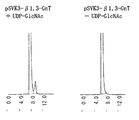
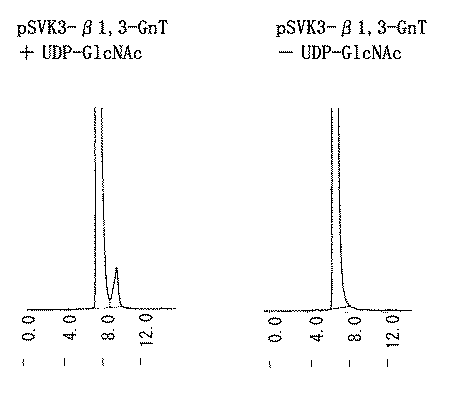
上述のクローニングで得られた単一のORFを含むcDNA断片をPCRで増幅した。PCRプライマーは、KpnI部位を有する5’プライマー(5’−GGGGTACCGAAATGAGTGTTGGACCTC−3’(配列番号:5))およびXbaI部位を有するプライマー(5’−GCTCTAGACTTAGAGGCCCTCAAATGGACACT−3’(配列番号:6))を用いた。これらのPCRプライマーを用いて、KOD Plus DNAポリメラーゼを用いて、上記のcDNAを鋳型としてPCR(94℃・120秒の熱変性の後、94℃・15秒、60℃・30秒、68℃・90秒を30サイクル)を行った。得られた増幅断片を発現ベクターpSVK3の制限酵素切断部位に挿入し、発現プラスミドpSVK3−β1,3−GnTを作製した。ジーンパルサー(Bio−Rad社)を用いたエレクトロポレーションにより、発現プラスミドpSVK3−β1,3−GnTをCOS−1細胞にトランスフェクトした。トランスフェクトした細胞を48時間培養した後、遠心分離により回収し、超音波破砕機で破砕した。得られた破砕物を遠心し、上清を粗抽出液として回収した。
上記粗抽出液を用いて、β1,3−N−アセチルグルコサミン転移酵素活性の確認を行った。活性測定の基質には、公知の方法(J. Biochem., 105, 547−555, 1989)により、2−アミノピリジンで蛍光標識したオリゴ糖鎖(PA化糖鎖)を用いた。受容体基質には、PA化ラクト−N−ネオテトラオース(Galβ1,4GlcNAcβ1,3Galβ1,4Glc −PA)を用いた。また、PA化para−ラクトーN―ネオヘキサオース(Galβ1,4GlcNAcβ1,3Galβ1,4GlcNAcβ1,3Galβ1,4Glc−PA)をβガラクトシダーゼで処理して末端のガラクトース残基を除去して得られたPA化5糖(GlcNAcβ1,3Galβ1,4GlcNAcβ1,3Galβ1,4Glc−PA)を生成物の標準品として用いた。糖供与体としてUDP−GlcNAcを用い、これを加えない系を対照とした。100mM HEPES−NaOH緩衝液(pH7.0)、15mM MnCl2、20mM UDP−GlcNAc、0.1mM LNnT−PAおよび上記酵素液を含む反応液10μlを37℃にて12時間反応させた。反応液を3分間煮沸することにより反応を停止させた後、高速液体クロマトグラフィー(HPLC)に供した。コントロールとしてmock pSVK3を導入したCOS−1細胞の破砕物のβ1,3−N−アセチルグルコサミン転移酵素活性を測定した。発現プラスミドpSVK3−β1,3−GnTを導入されたCOS−1細胞粗抽出液のHPLCの結果は図1に示す通りである。図1より明らかなように、糖供与体が共存する場合にのみ、反応生成物のピークが確認された。反応時間の経過と共に、そのピーク強度が強くなることも確認された。コントロールでは、反応生成物のピークはほとんど検出されなかったのに対し、該β1,3−N−アセチルグルコサミン転移酵素遺伝子を含む発現プラスミドを導入されたCOS−1細胞では16.8pmol/h/mg蛋白質の活性値を示した。この結果から、上述のクローニングで得られた遺伝子はβ1,3−N−アセチルグルコサミン転移酵素をコードするcDNAであることが示された。
【0045】
実施例3:β1,3−N−アセチルグルコサミン転移酵素の大腸菌における発現
N−アセチルグルコサミン転移酵素の膜貫通領域を含むN末端側のアミノ酸(配列番号:2のアミノ酸番号1から55まで)を欠損させたcDNA断片をPCRで増幅した。PCRプライマーは、BamHI切断部位を有する5’プライマー(5’−CCGGATCCAAGGCATATTGGAACAGG−3’(配列番号:7))およびXbaI切断部位を有する3’プライマー(5’−CGTCTAGACTTAGAGGCCCTCAAATGGACACT−3’(配列番号:8))を用いた。これらのPCRプライマーを用いて、KOD Plus DNAポリメラーゼを用いて、上記のcDNAを鋳型としてPCR(94℃・15秒、55℃・30秒、68℃・90秒を30サイクル)を行った。得られた増幅断片を発現ベクターpMAL−p2の制限酵素切断部位に挿入し、発現プラスミドpMAL−p2−β1,3−GnTを作製した。
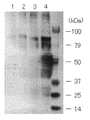
発現プラスミドpMAL−p2−β1,3−GnTを有する大腸菌JM109をアンピシリン(50μg/ml)および0.2%グルコースを含むLB培地10ml中にて、37℃で終夜培養を行い、さらにこの培養液250μlを、同培地25mlに接種して37℃、3時間の培養を行い、25℃に温度を下げた後、イソプロピルチオ−β−D−ガラクトピラノシド(IPTG)を最終濃度0.3mMとなるように加えて、組換え蛋白質の発現誘導を行った。菌体を遠心分離により集め、200mM NaCl、1mM 2−メルカプトエタノールを含む20mM トリス緩衝液(pH7.5)で懸濁し、超音波処理により菌体を破砕した。懸濁液を遠心分離し、上清を無細胞抽出液として回収した。この無細胞抽出液のウエスタンブロッティングを抗MBPウサギ抗血清を用いて行った結果、MBPとβ1,3−N−アセチルグルコサミン転移酵素の融合蛋白質と推定される分子量約85,000のバンドが検出された(図2)。
【0046】
上記無細胞抽出液を、Amylose resin column(New England Biolab社)を用いて精製し、得られた溶出画分について、実施例2と同様に、β1,3−N−アセチルグルコサミン転移酵素活性を測定した。
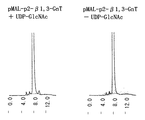
【0047】
HPLCの結果は図3に示す通りである。図3より明らかなように、糖供与体が共存する場合にのみ、反応生成物のピークが確認された。反応時間の経過と共に、そのピーク強度が強くなることも確認された。したがって、β1,3−N−アセチルグルコサミン転移酵素活性を確認することができた。
【0048】
【発明の効果】
上述したように、本発明により、新規ブタβ1,3−N−アセチルグルコサミン転移酵素およびその組換え法による製造方法が提供される。また、β1,3−N−アセチルグルコサミン転移酵素活性を有する蛋白質と異種蛋白質との融合蛋白質およびその製造方法が提供される。本発明の方法は組換え法によるので、糖鎖工学用試薬、糖鎖合成、糖鎖構造解析等に有用な酵素を大量に得ることができる。
【0049】
【配列表フリーテキスト】
SEQ ID NO. 1
A nucleotide sequence encoding the novel beta−1,3−N−acetylglucosaminyltransferase.
SEQ ID NO.2
An amino acid sequence of the novel beta−1,3−N−acetylglucosaminyltransferase.
SEQ ID NO.3
A primer for amplifying beta−1,3−N−acetylglucosaminyltransferase cDNA.
SEQ ID NO.4
A primer for amplifying beta−1,3−N−acetylglucosaminyltransferase cDNA.
SEQ ID NO.5
A primer for amplifying beta−1,3−N−acetylglucosaminyltransferase cDNA.
SEQ ID NO.6
A primer for amplifying beta−1,3−N−acetylglucosaminyltransferase cDNA.
SEQ ID NO.7
A primer for amplifying beta−1,3−N−acetylglucosaminyltransferase cDNA.
SEQ ID NO.8
A primer for amplifying beta−1,3−N−acetylglucosaminyltransferase cDNA.
【0050】
【配列表】
【図面の簡単な説明】
【図1】図1はHPLCにより、COS−1細胞において発現させたβ1,3−N−アセチルグルコサミン転移酵素の活性を確認した結果を示す。
【図2】図2は、発現プラスミドpMAL−p2−β1,3−GnTを有する大腸菌JM109株の無細胞抽出液のウエスタンブロッティングの結果を示す。レーン1、2、3および4は、IPTGの添加による発現誘導開始0、3、7および20時間後の無細胞抽出液の結果をそれぞれ示す。
【図3】図3はHPLCにより、大腸菌JM109株において発現させたβ1,3−N−アセチルグルコサミン転移酵素の活性を確認した結果を示す。[0001]
TECHNICAL FIELD OF THE INVENTION
The present invention relates to a method for producing β1,3-N-acetylglucosamine transferase activity. The present invention also relates to a fusion protein of a protein having β1,3-N-acetylglucosamine transferase activity and a heterologous protein.
[0002]
[Prior art]
Sugar chains in which various monosaccharides are linked by glycosidic bonds are present in vivo as an intracellular organelle component, a cell surface component, a secreted glycoprotein component, and the like. The structure of sugar chains differs depending on the species and tissue, but also within the same species or tissue, depending on the time of occurrence or disease. Sugar chains are involved not only in functions such as imparting physical properties to proteins such as hydrophilicity, charge and protease resistance, but also in intercellular recognition such as development / differentiation, nervous system, immune system, cancer metastasis, etc. Has recently become very popular from the viewpoint of application to various fields such as pharmaceuticals.
[0003]
The synthesis of sugar chains is carried out in vivo by glycosyltransferases. Glycosyltransferases are enzymes that use sugar nucleotides as sugar donors to transfer sugars to sugar chains that serve as acceptors and extend sugar chains. The specificity of a glycosyltransferase for the sugar chain structure of a sugar receptor is strict, and it is generally said that one glycosidic bond is formed by one corresponding glycosyltransferase. Such a glycosyltransferase is an important enzyme in that it is used for sugar chain research, particularly for convenient synthesis of useful sugar chains and modification of natural sugar chains. However, the amount of naturally-occurring glycosyltransferase is extremely small, and it has been practically difficult to supply it stably in large quantities.
[0004]
The sugar chain structure of GlcNAcβ1,3Gal (GlcNAc indicates N-acetylglucosamine, Gal indicates galactose) has been found in various natural oligosaccharides, glycolipids, glycoproteins and the like. In particular, poly-N-acetyllactosamine having a repeating structure of Galβ1,4GlcNAcβ1,3 as a lactosaminoglycan containing a structure of GlcNAcβ1,3Gal is used in various N-linked glycoproteins of mammals (for example, Patent Literature 1), O-linked glycoprotein (for example, see Non-Patent Literature 2), and glycolipids (for example, see Non-Patent Literature 3). Poly-N-acetyllactosamine is closely related to the Ii antigen (see, for example, Non-Patent Document 4), ABH-type and Lewis-type blood group substances (for example, see Non-Patent Document 5), or sugars such as sialyl Lewis X. It is a precursor of a chain antigen (for example, see Non-Patent Document 6), and its close association with cell differentiation and development has been studied. On the other hand, lacto-N-neotetrose (hereinafter, also referred to as LNnT) having a structure of Galβ1,4GlcNAcβ1,3Galβ1,4Glc (Glc indicates glucose) is a core structure of a neolactoglycolipid in mammals. The structures of dozens of glycolipids to which various sugars such as sialic acid, fucose and the like are bound have been determined (for example, see Non-Patent Document 7).
[0005]
Such a sugar chain structure of GlcNAcβ1,3Gal is synthesized by β1,3-N-acetylglucosamine transferase. The existence of β1,3-N-acetylglucosamine transferase has been confirmed in various mammalian cell tissues (for example, see Non-Patent Documents 8 and 9), and depending on the origin, it reacts with sugar chains of glycoproteins or glycolipids. Different substrate specificities have been reported. Since the abundance of the above β1,3-N-acetylglucosamine transferase in the living body is extremely small, the β1,3-N-acetylglucosamine transferase is used for mass synthesis of sugar chains having the structure of GlcNAcβ1,3Gal. A stable supply by mass production of N-acetylglucosamine transferase is required. As a DNA encoding β1,3-N-acetylglucosamine transferase, cDNA of human β1,3-N-acetylglucosamine transferase (iGnT) was first isolated by expression cloning using an anti-i antigen. (For example, see Non-Patent Document 10). Subsequently, cDNAs of human and mouse β1,3-N-acetylglucosamine transferase encoding a motif common to β1,3-N-galactosyltransferase have been isolated (for example, Non-Patent Document 11 and 12). Furthermore, rat, human and mouse-derived β1,3-N-acetylglucosamine transferase (Lac3Cer synthase) specific to lactosylceramide has been found (for example, see Non-Patent Documents 13 and 14).
A transformant was prepared by using the DNA encoding the above β1,3-N-acetylglucosamine transferase to obtain a recombinant β1,3-N-acetylglucosamine transferase (for example, However, it has not reached the level of mass production that enables stable supply.
[0006]
When a mammalian-derived glycosyltransferase such as β1,3-N-acetylglucosamine transferase is expressed in a mammalian cell and obtained as a recombinant enzyme, the contaminating activity of other glycosyltransferases originally possessed by mammalian cells may be reduced. There is a problem that it is necessary to completely remove it and purification becomes difficult. On the other hand, when expressed in Escherichia coli, Escherichia coli is not only N-acetylglucosaminetransferase such as β1,3-N-acetylglucosaminetransferase, but also galactosetransferase, sialyltransferase, N-acetylgalactosaminetransferase, and fucose. Since it has almost no enzymatic activity of glycosyltransferases found in mammals such as transferases and mannose transferases, the purification step is facilitated, and the obtained recombinant enzymes are contaminated with other glycosyltransferases. It has the advantage of being a highly pure enzyme having no activity. Furthermore, in view of cost, mass production of a recombinant protein is advantageously achieved by a method of expressing it in a microorganism such as Escherichia coli.
[0007]
As a method of expressing a target gene in a large amount and facilitating purification of an expression product in an expression system in Escherichia coli, for example, a method of expressing a target protein as a fusion protein with glutathione-S-transferase (GST) is known. is there. In this method, a fusion protein with GST can be easily purified by affinity column chromatography using glutathione as a ligand. However, when this method is used for the expression of a glycosyltransferase derived from a mammal, many of the expressed proteins are often present as insoluble inclusion bodies, and solubilization / regeneration during purification is required. Because of the need for steps, it was not always an efficient expression system. For these reasons, it has been practically difficult to stably supply β1,3-N-acetylglucosamine transferase in large quantities.
[0008]
[Non-patent document 1]
Eur. J. Biochem. , 92, 289-300 1978
[Non-patent document 2]
Biochem. Biophys. Res. Commun. , 110, 424-431, 1983.
[Non-Patent Document 3]
Eur. J. Biochem. , 71, 9-18, 1976
[Non-patent document 4]
FEBS Lett. , 104, 135-140, 1979.
[Non-Patent Document 5]
Semin. Hematol. , 18, 39-62, 1981.
[Non-Patent Document 6]
J. Biol. Chem. , 259, 10925-10935, 1984.
[Non-Patent Document 7]
Methods Enzymol. , 50, 236-250, 1972.
[Non-Patent Document 8]
J. Biol. Chem. , 258, 3435-3437,
[Non-Patent Document 9]
1983; Carbohydr. Res. , 120, 251-268, 1983.
[Non-Patent Document 10]
Proc. Natl. Acad. Sci. USA, 94, 14294-14299, 1997.
[Non-Patent Document 11]
Proc. Natl. Acad. Sci. USA, 96, 406-411, 1999.
[Non-Patent Document 12]
J. Biol. Chem. , 276, 3498-3507, 2001.
[Non-patent document 13]
J. Biol. Chem. , 276, 22032-22040, 2001.
[Non-patent document 14]
J. Biol. Chem. , 276, 30261-32069, 2001
[Non-Patent Document 15]
Glycobiology, 9, 1123, 1999
[0009]
[Problems to be solved by the invention]
The present invention has been made in view of the above circumstances, and has been made by developing a method for mass-producing β1,3-N-acetylglucosamine transferase using a β1,3-N-acetylglucosamine transferase gene. It is an object of the present invention to provide the enzyme which can be supplied at low cost and stably to sugar chain engineering reagents, sugar chain synthesis, sugar chain structure analysis and the like.
[0010]
Means for Solving the Problems and Embodiments of the Invention
The present inventors have conducted intensive studies in view of the circumstances described above, and as a result, isolated a DNA encoding β1,3-N-acetylglucosamine transferase, and identified the present DNA as β1,3-N-acetylglucosamine. It was found to express a transferase. Furthermore, when β1,3-N-acetylglucosamine transferase is expressed in a host as a fusion protein with a sugar-binding protein by a gene recombination technique, β1,3-N-acetylglucosamine transferase can be obtained as a soluble protein. It was found that the obtained fusion protein had the activity of β1,3-N-acetylglucosamine transferase, and completed the present invention.
[0011]
That is, the present invention
(1) DNA shown in the following (a) or (b):
(A) DNA containing the nucleotide sequence of nucleotide numbers 52 to 1242 in the nucleotide sequence of SEQ ID NO: 1
(B) a DNA that hybridizes with the DNA containing the sequence of (a) under stringent conditions,
(2) a protein having the activity of β1,3-N-acetylglucosamine transferase shown in the following (a) or (b):
(A) a protein consisting of the amino acid sequence of SEQ ID NO: 2
(B) a protein comprising an amino acid sequence in which one or several amino acids have been deleted, substituted or added in the amino acid sequence of (a),
(3) a DNA encoding the protein of (2),
(4) RNA complementary to the DNA according to (1) or (3) above,
(5) a recombinant vector containing the DNA of (1) or (3) above,
(6) a transformant obtained by transforming a host cell with the recombinant vector according to (5),
(7) A host cell is transformed with the DNA according to (1) or (3), the RNA according to (4) or the vector according to (5), and the transformant is cultured. A method for producing β1,3-N-acetylglucosamine transferase, comprising collecting β1,3-N-acetylglucosamine transferase from the transformant;
(8) A fusion protein comprising a heterologous protein and a protein having β1,3-N-acetylglucosamine transferase activity shown in the following (a) or (b), and having a β1,3-N-acetylglucosamine transferase activity:
(A) a protein consisting of the amino acid sequence of SEQ ID NO: 2
(B) a protein comprising an amino acid sequence in which one or several amino acids have been deleted, substituted or added in the amino acid sequence of (a),
(9) The fusion protein according to the above (8), wherein the protein having β1,3-N-acetylglucosamine transferase activity has a part or all of a transmembrane region deleted.
(10) The fusion protein according to the above (8) or (9), wherein the heterologous protein is a sugar-binding protein,
(11) the fusion protein according to the above (10), wherein the sugar-binding protein is a maltose-binding protein;
(12) a DNA encoding the fusion protein according to any one of the above (8) to (11),
(13) a recombinant vector comprising the DNA of (12) above,
(14) a transformant obtained by transforming a host cell with the recombinant vector according to (13),
(15) A host cell is transformed with the DNA according to (12) or the vector according to (13), the transformant is cultured, and β1,3-N-acetylglucosamine transfer from the transformant is performed. A method for producing a fusion protein having β1,3-N-acetylglucosamine transferase activity, comprising collecting a fusion protein having enzyme activity.
(16) The method for producing a fusion protein according to (15) above, wherein a part or all of a transmembrane region of the protein having β1,3-N-acetylglucosamine transferase activity is deleted in the obtained fusion protein. , And
(17) The method for producing a fusion protein according to the above (15) or (16), wherein the sugar-binding protein is a maltose-binding protein.
Is provided.
[0012]
Hereinafter, the present invention will be described specifically.
In one embodiment of the present invention, there is provided a novel DNA comprising the nucleotide sequence of nucleotide numbers from 52 to 1242 in the nucleotide sequence of SEQ ID NO: 1. This DNA encodes the novel β1,3-N-acetylglucosamine transferase of the present invention represented by SEQ ID NO: 2 (amino acids 1-397). Therefore, the novel β1,3-N-acetylglucosamine transferase typically consists of the amino acid sequence represented by SEQ ID NO: 2.
[0013]
A DNA that hybridizes under stringent conditions to a DNA containing the base sequence of base numbers 52 to 1242 of the base sequence described in SEQ ID NO: 1 also has the same structure, function, and the like as in (a) above. Therefore, the DNA of the above (b) can be used in place of the above (a). The stringent condition is exemplified by conditions for hybridizing at 42 ° C. in a solution containing 6 × SSC, 5 × Denhardt's reagent and 0.5% SDS, 100 μg / ml salmon sperm DNA.
[0014]
For example, as described in Examples, the above-mentioned DNA is prepared by using, as a primer, an oligonucleotide prepared based on the base sequence of a known human or mouse-derived β1,3-N-acetylglucosamine transferase cDNA, and From the derived cDNA, it can be cloned by PCR. Alternatively, cloning can also be performed by PCR from total RNA or poly (A) + RNA extracted from porcine tissue using the above oligonucleotides as primers.
[0015]
In another aspect, the present invention provides a novel pig-derived β1,3-N-acetylglucosamine transferase comprising the amino acid sequence of SEQ ID NO: 2 (amino acids 1-397). As described above, typically, the present enzyme is a protein having the amino acid sequence represented by SEQ ID NO: 2, but one or several amino acids are deleted, substituted or added in the amino acid sequence of SEQ ID NO: 2. It may be a mutein consisting of the amino acid sequence obtained. However, even such a mutant protein has substantially the same activity as the novel β1,3-N-acetylglucosamine transferase having the amino acid sequence represented by SEQ ID NO: 2. In the present specification, the β1,3-N-acetylglucosamine transferase of the present invention and muteins having substantially the same activity may be collectively referred to as β1,3-N-acetylglucosamine transferase.
[0016]
The β1,3-N-acetylglucosamine transferase of the present invention can be produced by a recombinant method as described later. Furthermore, the amino acid at a desired position in the β1,3-N-acetylglucosamine transferase of the present invention can be changed using a method known to those skilled in the art, for example, a site-directed mutagenesis method. , 3-N-acetylglucosamine transferase can also be obtained.
[0017]
The β1,3-N-acetylglucosamine transferase produced in the present invention preferably has an activity of transferring N-acetylglucosamine via a β1,3 bond to a galactose residue present at the non-reducing end of the sugar chain. In addition, N-acetylglucosamine is linked to β-galactose residue at the non-reducing end of Galβ1,4GlcNAcβ1,3Galβ1,4Glc or poly-N-acetyllactosamine having a repeating structure of (Galβ1,4GlcNAcβ1,3) n by β1,3 bond. Those having an activity to transfer are preferred.
[0018]
The N-acetylglucosamine transferase activity can be determined, for example, by using uridine-5′-diphospho-N-acetylglucosamine (hereinafter sometimes abbreviated as UDP-GlcNAc) as an N-acetylglucosamine donor, and converting N-acetylglucosamine to LNnT. Can be measured by an activity measurement method utilizing the transfer reaction of
[0019]
In another aspect, the present invention provides a DNA encoding the above β1,3-N-acetylglucosamine transferase or a mutant protein thereof. In the present specification, the DNA encoding the β1,3-N-acetylglucosamine transferase or the mutant protein thereof may be collectively referred to as the DNA encoding the β1,3-N-acetylglucosamine transferase of the present invention. Those skilled in the art can change the nucleotide at a desired position in the DNA encoding the β1,3-N-acetylglucosamine transferase of the present invention by using a known method, and the DNA can be a mutant β1,3-N-acetylglucosamine. It encodes a transferase. In addition, a DNA encoding a mutated β1,3-N-acetylglucosamine transferase and / or a DNA encoding a mutated β1,3-N-acetylglucosamine transferase is obtained from an individual having the originally mutated β1,3-N-acetylglucosamine transferase. You can also.
[0020]
In a further aspect, the present invention also provides RNA complementary to the above DNA.
[0021]
Further, the present invention provides, in another aspect, a recombinant vector comprising the above DNA.
[0022]
The recombinant vector of the present invention is a vector for expressing the above DNA in Escherichia coli, yeast, insect cells, animal cells, plant cells, and the like, and is not particularly limited. Specifically, various types can be used depending on the host to be transformed. For example, for Escherichia coli, pMAL, pUC19, pBluescriptII, pET, etc., for yeast, pYEUra3TM, for insect cells, pBLUE Bac4, etc., for animal cells, pSVK3, etc., for plant cells, pBI121, etc.
[0023]
A transformant that expresses the β1,3-N-acetylglucosamine transferase of the present invention or its mutant protein can be prepared by introducing the DNA or RNA into the host cell. Such a transformant is produced by transformation with the above-mentioned recombinant vector. Examples of a transformation host include Escherichia coli, yeast, insect cells, animal cells, plant cells, and the like. Transformants are prepared by introducing a recombinant vector into cells using known competent cells, electroporation, calcium phosphate method, liposome method, DEAE dextran method and the like.
[0024]
In a further aspect, the present invention provides a DNA encoding the β1,3-N-acetylglucosamine transferase of the present invention or an RNA complementary thereto, or a DNA encoding the β1,3-N-acetylglucosamine transferase of the present invention. Transforming a host cell with the carrying vector, culturing the transformant, and collecting β1,3-N-acetylglucosamine transferase from the transformant; -To provide a method for producing acetylglucosamine transferase. The above transformant is cultured and propagated under appropriate conditions to produce the β1,3-N-acetylglucosamine transferase of the present invention or its mutant protein, which is removed from the medium by a suitable isolation and purification means. Can be.
The details of the culturing of the transformant and the isolation / purification of the produced protein will be apparent to those skilled in the art by referring to the description relating to the production of the fusion protein of the present invention described below.
[0025]
In another aspect, the present invention provides a fusion protein of the above β1,3-N-acetylglucosamine transferase and a heterologous protein. The fusion protein of the present invention has substantially the same activity as the β1,3-N-acetylglucosamine transferase of the present invention. The activity of the β1,3-N-acetylglucosamine transferase of the present invention and the method for measuring the same are as described above. In such a fusion protein, the β1,3-N-acetylglucosamine transferase moiety of the present invention may be a mutein having substantially the same activity. For the mutein, see the description above.
[0026]
Examples of the heterologous protein of the fusion protein include sugar-binding proteins such as maltose-binding protein (hereinafter sometimes referred to as MBP), GST, His, FLAG, and Protein A.
[0027]
In the present invention, a sugar-binding protein is a protein that retains high affinity for oligosaccharides and polysaccharides having a sugar or a sugar residue. The sugar-binding protein may be derived from any species. Specific examples include maltose binding protein, cellulose binding protein, chitin binding protein, various lectins and the like. Among them, maltose binding protein (MBP) is particularly preferred from the following points. Expression in Escherichia coli using an expression vector containing DNA encoding MBP reduces the formation of an inclusion body, and makes it possible to easily obtain a large amount of a soluble fusion protein. The target fusion protein can be easily purified by affinity chromatography using an insoluble carrier bound with a ligand containing various sugar residues that specifically bind to the maltose-binding protein. Further, the fusion protein bound to such a carrier can be used as a high-purity immobilized enzyme.
[0028]
If the MBP has a site having a specific affinity for maltose or an oligosaccharide having a maltose residue (for example, maltotriose or the like) or a polysaccharide (for example, amylose or the like), the entire sequence thereof is not necessarily required. Need not be included, and may include a part of the sequence. Therefore, in a known amino acid sequence, one or several amino acids are deleted, substituted or added, and are composed of maltose or a maltose-containing oligosaccharide (for example, maltotriose or the like) or a polysaccharide (for example, A protein having a site having specific affinity for amylose) can also be included in the MBP of the present invention.
[0029]
In a further aspect, the present invention provides a DNA encoding the fusion protein, a recombinant vector containing the DNA, and a transformant obtained by transforming a host with the recombinant vector.
[0030]
In the present invention, the DNA encoding MBP does not necessarily need to include the entire coding region, as long as it encodes a translation product having specific affinity for maltose or oligosaccharides or polysaccharides having maltose residues. It may include a part of the coding region. The origin is not particularly limited, but examples include those derived from pMAL-based vectors such as pMAL-p2 and pMAL-c2 (both are manufactured by New England Biolabs).
[0031]
In the present invention, the DNA encoding the fusion protein is prepared so that the DNA encoding the heterologous protein and the DNA encoding N-acetylglucosamine transferase can be translated as a fusion protein having the above properties. , Are chimeric DNAs linked in-frame.
[0032]
Further, in the fusion protein of the present invention, the fact that part or all of the transmembrane region of the amino acid sequence of the β1,3-N-acetylglucosamine transferase of the present invention is deleted also indicates that the β1,3-N-acetylglucosamine transferase is a membrane protein. N-acetylglucosamine transferase is preferred in that it allows the expression of a soluble fraction protein that is easy to handle in the purification step.
Therefore, the present invention also includes a fusion protein in which a part or all of the transmembrane region of the amino acid sequence of the β1,3-N-acetylglucosamine transferase of the present invention is deleted, and a DNA encoding the same.
[0033]
As a method for producing the above-mentioned fusion protein, a recombinant method is generally used, which will be described below.
The recombinant vector containing the DNA encoding the fusion protein is a vector for expressing the DNA so as to be translated as a fusion protein having N-acetylglucosamine transferase activity, and is not particularly limited. Specifically, various types can be used depending on the host to be transformed. For example, a desired recombinant vector can be obtained by inserting a cDNA encoding N-acetylglucosamine transferase into pMAL-p2.
[0034]
The above-mentioned recombinant vector is any expression vector in which a chimeric DNA encoding the above-mentioned sugar-binding protein-N-acetylglucosamine transferase is placed under the control of a promoter capable of functioning in Escherichia coli. The promoter region includes -35 region and -10 region, which are consensus sequences that determine the binding position of RNA polymerase. As a system for expressing a desired recombinant protein in a large amount, it is more preferable to use a promoter region of an inducible enzyme. Such promoter regions include the trp promoter, lac promoter, recA promoter, lpp promoter, tac promoter and the like. These promoter regions further include an operator to which the repressor protein binds. Addition of an inducer (eg, lactose or IPTG in the case of the lac promoter) suppresses the binding of the repressor protein to the operator, and causes the expression of a large number of genes under the control of the promoter. The recombinant vector also contains a consensus Shine-Dalgarno (SD) sequence upstream of the translation initiation codon. Further, the expression vector contains a transcription termination signal, that is, a terminator region, downstream of the chimeric DNA encoding sugar-binding protein-N-acetylglucosamine transferase. As the terminator region, a commonly used natural or synthetic terminator can be used. The recombinant vector of the present invention must contain an origin of replication capable of autonomous replication in host Escherichia coli, in addition to the above-mentioned promoter region and terminator region. Examples of such a replication origin include ColEl ori and M13 ori.
[0035]
Transformants include those produced by transformation with the above-described recombinant vector using a known method. Transformation hosts include Escherichia coli, yeast, insect cells, animal cells, plant cells and the like (see above). Among them, Escherichia coli is particularly preferred. In the case of Escherichia coli, the strain is not particularly limited, and examples thereof include commercially available XL1-Blue strain, BL-21 strain, JM107 strain, TB1, JM109 strain, C600 strain, DH5α strain, HB101 strain, and the like.
[0036]
In another aspect, the present invention provides a method for transforming a host cell using a DNA encoding the fusion protein or a vector carrying the DNA encoding the fusion protein, culturing the transformant, and transforming the transformant. Provided is a method for producing a fusion protein having β1,3-N-acetylglucosamine transferase activity, comprising collecting a fusion protein having β1,3-N-acetylglucosamine transferase activity from a body. Examples of a transformation host include Escherichia coli, yeast, insect cells, animal cells, plant cells, and the like. Transformants are prepared by introducing a recombinant vector into cells using known competent cells, electroporation, calcium phosphate method, liposome method, DEAE dextran method and the like.
[0037]
For example, when using the Escherichia coli JM109 strain transformed with the recombinant vector obtained from the above-described pMAL-p2, the medium used is a medium containing a carbohydrate such as glucose, fructose, glycerol, and starch as a carbon source. . It may also contain an inorganic or organic nitrogen source (for example, ammonium sulfate, ammonium chloride, casein hydrolyzate, yeast extract, polypeptone, bactotripton, beef extract, etc.). These carbon and nitrogen sources do not need to be used in a pure form, and those having low purity are advantageous because they are rich in trace amounts of growth factors and inorganic nutrients. If desired, other nutrient sources (eg, inorganic salts (eg, sodium or potassium diphosphate, dipotassium hydrogen phosphate, magnesium chloride, magnesium sulfate, calcium chloride), vitamins (eg, vitamin B1)) And an antibiotic (eg, ampicillin, kanamycin) and the like may be added to the medium.
[0038]
Culture of the transformant is usually performed at pH 5.5 to 8.5, preferably 6 to 8, usually 18 to 40 ° C., preferably 20 to 35 ° C. for 1 to 150 hours. It can be appropriately changed depending on the culture scale.
[0039]
When the expression of the fusion protein is controlled by the promoter system of the inducible protein gene, the inducer may be added from the start of the culture, but is more preferably added in the early logarithmic phase. The timing and concentration of the inducer can be appropriately changed depending on culture conditions, culture scale, type of inducer, and the like.
[0040]
In the method of the present invention, the fusion protein is purified by subjecting the fraction in which the fusion protein is present to affinity chromatography using an insoluble carrier to which a ligand containing various sugar residues specifically binding to the sugar-binding protein is bound. Can be achieved. Also. An antibody (monoclonal antibody or polyclonal antibody) specific to the sugar-binding protein may be used as the ligand. Examples of the purification method include salting out with ammonium sulfate, centrifugation, dialysis, ultrafiltration, ion exchange column chromatography, hydrophobic column chromatography, gel filtration column chromatography, affinity column chromatography, and electrophoresis. By combining these, the fusion protein can be purified.
[0041]
In the fusion protein obtained by the above method, a part or all of the transmembrane region of the protein having the β1,3-N-acetylglucosamine transferase activity may be deleted.
Further, in the fusion protein obtained by the above method, the sugar-binding protein is preferably a maltose-binding protein.
[0042]
【Example】
Hereinafter, the present invention will be described more specifically with reference to examples. The present invention is not particularly limited to the examples.
[0043]
Example 1: Cloning of β1,3-N-acetylglucosamine transferase cDNA
MRNA was extracted from pig liver total RNA (Funakoshi) using PolyATtract mRNA Isolation System IV (Promega). Using the obtained mRNA as a template and cDNA Synthesis Kit (Stratagene), cDNA was prepared according to the attached protocol.
Subsequently, human and mouse-derived β1,3-N-acetylglucosamine transferase cDNA encoding a motif common to β1,3-galactosyltransferase (Proc. Natl. Acad. Sci. USA, 96, 406-411, 1999), several types of PCR primers were prepared. Using these PCR primers, KOD Dash DNA polymerase (manufactured by Toyobo Co., Ltd.) and PCR (denaturation at 96 ° C for 120 seconds, 94 ° C for 30 seconds, 60 ° C for 2 seconds , 74 ° C, 60 seconds for 30 cycles). This PCR reaction solution was subjected to 1.5% agarose electrophoresis to obtain an amplified fragment. The PCR product was purified and sequenced using a DNA sequencer ABI PRISM310 Genetic Analyzer (PE Applied Biosystems). As a result, the results of PCR using the 5 ′ primer (5′-ATCCTGATGATGGCAAATGTCTTC-3 ′ (SEQ ID NO: 3)) and the 3 ′ primer (5′-ATCAAATGTCCTGAAGCCTTTGTG-3 ′ (SEQ ID NO: 4)), human and mouse A sequence highly homologous to the derived β1,3-N-acetylglucosamine transferase cDNA was obtained. Next, using the LA PCR in vitro Cloning Kit (manufactured by Takara Shuzo), the 5 ′ upstream and 3 ′ downstream unknown regions were amplified to obtain a cDNA sequence having a single ORF. In order to correct misreading by DNA polymerase, sequences were determined from a plurality of clones.
[0044]
Example 2: Expression of β1,3-N-acetylglucosamine transferase in COS-1 cells
A cDNA fragment containing a single ORF obtained by the above cloning was amplified by PCR. As the PCR primers, a 5 ′ primer having a KpnI site (5′-GGGGTACCCGAAATGAGTGTTGGACCTC-3 ′ (SEQ ID NO: 5)) and a primer having an XbaI site (5′-GCTCTAGACTTAGAGGCCCTCAAATGGACACT-3 ′ (SEQ ID NO: 6)) were used. . Using these PCR primers and KOD Plus DNA polymerase, PCR was performed using the above cDNA as a template (heat denaturation at 94 ° C for 120 seconds, followed by 94 ° C for 15 seconds, 60 ° C for 30 seconds, and 68 ° C for 30 seconds. 90 seconds (30 cycles). The obtained amplified fragment was inserted into a restriction enzyme cleavage site of the expression vector pSVK3 to prepare an expression plasmid pSVK3-β1,3-GnT. The expression plasmid pSVK3-β1,3-GnT was transfected into COS-1 cells by electroporation using Gene Pulser (Bio-Rad). After culturing the transfected cells for 48 hours, they were collected by centrifugation and disrupted with an ultrasonic disrupter. The obtained crushed product was centrifuged, and the supernatant was recovered as a crude extract.
Using the crude extract, β1,3-N-acetylglucosamine transferase activity was confirmed. As a substrate for activity measurement, an oligosaccharide chain (PA-linked sugar chain) fluorescently labeled with 2-aminopyridine by a known method (J. Biochem., 105, 547-555, 1989) was used. As a receptor substrate, PA-lacto-N-neotetraose (Galβ1,4GlcNAcβ1,3Galβ1,4Glc-PA) was used. In addition, PA-para-lacto-N-neohexaose (Galβ1,4GlcNAcβ1,3Galβ1,4GlcNAcβ1,3Galβ1,4Glc-PA) is treated with β-galactosidase to remove terminal galactose residues, thereby obtaining a PA-pentasaccharide. (GlcNAcβ1,3Galβ1,4GlcNAc1,3Galβ1,4Glc-PA) was used as a standard product. UDP-GlcNAc was used as a sugar donor, and a system without this was used as a control. 100 mM HEPES-NaOH buffer (pH 7.0), 15 mM MnCl2, 20 mM UDP-GlcNAc, 0.1 mM LNnT-PA and 10 μl of a reaction solution containing the above enzyme solution were reacted at 37 ° C. for 12 hours. After stopping the reaction by boiling the reaction solution for 3 minutes, it was subjected to high performance liquid chromatography (HPLC). As a control, β1,3-N-acetylglucosamine transferase activity of the crushed COS-1 cells into which mock pSVK3 was introduced was measured. The results of HPLC of the crude COS-1 cell extract into which the expression plasmid pSVK3-β1,3-GnT was introduced are as shown in FIG. As apparent from FIG. 1, the peak of the reaction product was confirmed only when the sugar donor coexisted. It was also confirmed that the peak intensity increased with the passage of the reaction time. In the control, almost no peak of the reaction product was detected, whereas 16.8 pmol / h / mg in COS-1 cells into which the expression plasmid containing the β1,3-N-acetylglucosamine transferase gene was introduced. The activity value of the protein was shown. This result indicated that the gene obtained by the above cloning was a cDNA encoding β1,3-N-acetylglucosamine transferase.
[0045]
Example 3: Expression of β1,3-N-acetylglucosamine transferase in E. coli
A cDNA fragment lacking the N-terminal amino acid (
Escherichia coli JM109 having the expression plasmid pMAL-p2-β1,3-GnT was cultured overnight at 37 ° C. in 10 ml of LB medium containing ampicillin (50 μg / ml) and 0.2% glucose. Was inoculated into 25 ml of the same medium and cultured at 37 ° C. for 3 hours. After the temperature was lowered to 25 ° C., isopropylthio-β-D-galactopyranoside (IPTG) was brought to a final concentration of 0.3 mM. In addition, the expression of the recombinant protein was induced. The cells were collected by centrifugation, suspended in a 20 mM Tris buffer (pH 7.5) containing 200 mM NaCl and 1 mM 2-mercaptoethanol, and disrupted by sonication. The suspension was centrifuged and the supernatant was collected as a cell-free extract. Western blotting of this cell-free extract using an anti-MBP rabbit antiserum revealed a band with a molecular weight of about 85,000, which was estimated to be a fusion protein of MBP and β1,3-N-acetylglucosamine transferase. (FIG. 2).
[0046]
The cell-free extract was purified using Amylose resin column (New England Biolab), and β1,3-N-acetylglucosamine transferase activity was measured for the obtained eluted fraction in the same manner as in Example 2. did.
[0047]
The result of HPLC is as shown in FIG. As apparent from FIG. 3, the peak of the reaction product was confirmed only when the sugar donor coexisted. It was also confirmed that the peak intensity increased with the passage of the reaction time. Therefore, β1,3-N-acetylglucosamine transferase activity could be confirmed.
[0048]
【The invention's effect】
As described above, the present invention provides a novel porcine β1,3-N-acetylglucosamine transferase and a method for producing the same by a recombinant method. Further, a fusion protein of a protein having β1,3-N-acetylglucosamine transferase activity and a heterologous protein and a method for producing the same are provided. Since the method of the present invention is a recombinant method, a large amount of enzymes useful for sugar chain engineering reagents, sugar chain synthesis, sugar chain structure analysis, and the like can be obtained.
[0049]
[Sequence List Free Text]
SEQ ID NO. 1
A nucleotide sequence encoding the novel beta-1,3-N-acetylglucosaminyltransferase.
SEQ ID NO. 2
Ana amino acid sequence of the novel beta-1,3-N-acetylglucosaminolyltransferase.
SEQ ID NO. 3
A primer for amplifying beta-1,3-N-acetylglucosaminyltransferase cDNA.
SEQ ID NO. 4
A primer for amplifying beta-1,3-N-acetylglucosaminyltransferase cDNA.
SEQ ID NO. 5
A primer for amplifying beta-1,3-N-acetylglucosaminyltransferase cDNA.
SEQ ID NO. 6
A primer for amplifying beta-1,3-N-acetylglucosaminyltransferase cDNA.
SEQ ID NO. 7
A primer for amplifying beta-1,3-N-acetylglucosaminyltransferase cDNA.
SEQ ID NO. 8
A primer for amplifying beta-1,3-N-acetylglucosaminyltransferase cDNA.
[0050]
[Sequence list]
[Brief description of the drawings]
FIG. 1 shows the results of confirming the activity of β1,3-N-acetylglucosamine transferase expressed in COS-1 cells by HPLC.
FIG. 2 shows the results of Western blotting of a cell-free extract of Escherichia coli JM109 strain having an expression plasmid pMAL-p2-β1,3-GnT.
FIG. 3 shows the results of confirming the activity of β1,3-N-acetylglucosamine transferase expressed in E. coli JM109 strain by HPLC.
Claims (17)
(a)配列番号:1に記載の塩基配列の塩基番号52〜1242の塩基配列を含むDNA
(b)(a)の配列を含むDNAとストリンジェントな条件下でハイブリダイズするDNA。DNA shown in the following (a) or (b):
(A) DNA containing the nucleotide sequence of nucleotide numbers 52 to 1242 in the nucleotide sequence of SEQ ID NO: 1
(B) DNA that hybridizes under stringent conditions to DNA containing the sequence of (a).
(a)配列番号:2に記載のアミノ酸配列からなる蛋白質
(b)(a)のアミノ酸配列において1または数個のアミノ酸が欠失、置換もしくは付加されたアミノ酸配列からなる蛋白質。A protein having β1,3-N-acetylglucosamine transferase activity shown in the following (a) or (b):
(A) a protein consisting of the amino acid sequence of SEQ ID NO: 2; (b) a protein consisting of an amino acid sequence in which one or several amino acids are deleted, substituted or added in the amino acid sequence of (a).
(a)配列番号:2に記載のアミノ酸配列からなる蛋白質
(b)(a)のアミノ酸配列において1または数個のアミノ酸が欠失、置換もしくは付加されたアミノ酸配列からなる蛋白質。A fusion protein comprising a heterologous protein and a protein having β1,3-N-acetylglucosamine transferase activity shown in the following (a) or (b), and having a β1,3-N-acetylglucosamine transferase activity:
(A) a protein consisting of the amino acid sequence of SEQ ID NO: 2; (b) a protein consisting of an amino acid sequence in which one or several amino acids are deleted, substituted or added in the amino acid sequence of (a).
Priority Applications (1)
| Application Number | Priority Date | Filing Date | Title |
|---|---|---|---|
| JP2003036827A JP4232478B2 (en) | 2003-02-14 | 2003-02-14 | β1,3-N-acetylglucosamine transferase |
Applications Claiming Priority (1)
| Application Number | Priority Date | Filing Date | Title |
|---|---|---|---|
| JP2003036827A JP4232478B2 (en) | 2003-02-14 | 2003-02-14 | β1,3-N-acetylglucosamine transferase |
Publications (2)
| Publication Number | Publication Date |
|---|---|
| JP2004242598A true JP2004242598A (en) | 2004-09-02 |
| JP4232478B2 JP4232478B2 (en) | 2009-03-04 |
Family
ID=33021813
Family Applications (1)
| Application Number | Title | Priority Date | Filing Date |
|---|---|---|---|
| JP2003036827A Expired - Fee Related JP4232478B2 (en) | 2003-02-14 | 2003-02-14 | β1,3-N-acetylglucosamine transferase |
Country Status (1)
| Country | Link |
|---|---|
| JP (1) | JP4232478B2 (en) |
-
2003
- 2003-02-14 JP JP2003036827A patent/JP4232478B2/en not_active Expired - Fee Related
Also Published As
| Publication number | Publication date |
|---|---|
| JP4232478B2 (en) | 2009-03-04 |
Similar Documents
| Publication | Publication Date | Title |
|---|---|---|
| RU2473695C2 (en) | Method of producing sialylated oligosaccharides | |
| US10577581B2 (en) | Efficient production of oligosaccharides using metabolically engineered microorganisms | |
| US20020132320A1 (en) | Glycoconjugate synthesis using a pathway-engineered organism | |
| Chen et al. | Reassembled Biosynthetic Pathway for Large‐Scale Carbohydrate Synthesis: α‐Gal Epitope Producing “Superbug” | |
| US20110236934A1 (en) | Production of globosides oligosaccharieds using metabolically engineered microorganisms | |
| WO2004009838A2 (en) | H. Pylori FUCOSYLTRANSFERASES | |
| JP2002530087A (en) | Inexpensive production of oligosaccharides | |
| JP2003504072A (en) | Method for producing oligopolysaccharide | |
| Seto et al. | Expression of a recombinant human glycosyltransferase from a synthetic gene and its utilization for synthesis of the human blood group B trisaccharide | |
| JP2011167200A (en) | H.pylori fucosyltransferase | |
| CN114369585B (en) | Fucosyltransferase mutant of recombinant helicobacter pylori and application thereof | |
| JP2003047467A (en) | Chondroitin synthase | |
| Randriantsoa et al. | Synthesis of globopentaose using a novel β1, 3-galactosyltransferase activity of the Haemophilus influenzae β1, 3-N-acetylgalactosaminyltransferase LgtD | |
| US9938510B2 (en) | Photobacterium sp. alpha-2-6-sialyltransferase variants | |
| Palcic et al. | Natural and recombinant A and B gene encoded glycosyltransferases | |
| JP4232478B2 (en) | β1,3-N-acetylglucosamine transferase | |
| Revers et al. | Development of recombinant, immobilised β-1, 4-mannosyltransferase for use as an efficient tool in the chemoenzymatic synthesis of N-linked oligosaccharides | |
| JP5921065B2 (en) | Engineered form of CgtB (β-1,3-galactosyltransferase) enzyme with enhanced enzymatic properties | |
| KR20230124995A (en) | Sialyltransferase for the production of 6'-sialyllactose | |
| JP2005046031A (en) | FUSED PROTEIN HAVING alpha1,3- FUCOSYL TRANSFERASE VI ACTIVITY AND METHOD FOR PRODUCING THE SAME | |
| JP4451036B2 (en) | New chondroitin synthase | |
| JP2001178453A (en) | Method for producing N-acetylglucosaminyltransferase | |
| JPH11137247A (en) | Method for producing β1,4-galactosyltransferase | |
| JP4629214B2 (en) | N-acetylglucosamine transferase | |
| JP2005046030A (en) | FUSED PROTEIN HAVING I BRANCH-FORMING beta1,6-N-ACETYLGLUCOSAMINYL TRANSFERASE ACTIVITY AND METHOD FOR PRODUCING THE SAME |
Legal Events
| Date | Code | Title | Description |
|---|---|---|---|
| A621 | Written request for application examination |
Free format text: JAPANESE INTERMEDIATE CODE: A621 Effective date: 20051118 |
|
| A131 | Notification of reasons for refusal |
Free format text: JAPANESE INTERMEDIATE CODE: A131 Effective date: 20080826 |
|
| A521 | Written amendment |
Free format text: JAPANESE INTERMEDIATE CODE: A523 Effective date: 20081021 |
|
| TRDD | Decision of grant or rejection written | ||
| A01 | Written decision to grant a patent or to grant a registration (utility model) |
Free format text: JAPANESE INTERMEDIATE CODE: A01 Effective date: 20081118 |
|
| A01 | Written decision to grant a patent or to grant a registration (utility model) |
Free format text: JAPANESE INTERMEDIATE CODE: A01 |
|
| A61 | First payment of annual fees (during grant procedure) |
Free format text: JAPANESE INTERMEDIATE CODE: A61 Effective date: 20081201 |
|
| FPAY | Renewal fee payment (prs date is renewal date of database) |
Free format text: PAYMENT UNTIL: 20111219 Year of fee payment: 3 |
|
| FPAY | Renewal fee payment (prs date is renewal date of database) |
Free format text: PAYMENT UNTIL: 20111219 Year of fee payment: 3 |
|
| FPAY | Renewal fee payment (prs date is renewal date of database) |
Free format text: PAYMENT UNTIL: 20121219 Year of fee payment: 4 |
|
| LAPS | Cancellation because of no payment of annual fees |