JP2004339032A - Lithium-cobalt based composite oxide, method for producing the same, positive electrode active material for lithium secondary battery, and lithium secondary battery - Google Patents
Lithium-cobalt based composite oxide, method for producing the same, positive electrode active material for lithium secondary battery, and lithium secondary battery Download PDFInfo
- Publication number
- JP2004339032A JP2004339032A JP2003140330A JP2003140330A JP2004339032A JP 2004339032 A JP2004339032 A JP 2004339032A JP 2003140330 A JP2003140330 A JP 2003140330A JP 2003140330 A JP2003140330 A JP 2003140330A JP 2004339032 A JP2004339032 A JP 2004339032A
- Authority
- JP
- Japan
- Prior art keywords
- lithium
- cobalt
- composite oxide
- based composite
- atoms
- Prior art date
- Legal status (The legal status is an assumption and is not a legal conclusion. Google has not performed a legal analysis and makes no representation as to the accuracy of the status listed.)
- Granted
Links
Images








Classifications
-
- Y—GENERAL TAGGING OF NEW TECHNOLOGICAL DEVELOPMENTS; GENERAL TAGGING OF CROSS-SECTIONAL TECHNOLOGIES SPANNING OVER SEVERAL SECTIONS OF THE IPC; TECHNICAL SUBJECTS COVERED BY FORMER USPC CROSS-REFERENCE ART COLLECTIONS [XRACs] AND DIGESTS
- Y02—TECHNOLOGIES OR APPLICATIONS FOR MITIGATION OR ADAPTATION AGAINST CLIMATE CHANGE
- Y02E—REDUCTION OF GREENHOUSE GAS [GHG] EMISSIONS, RELATED TO ENERGY GENERATION, TRANSMISSION OR DISTRIBUTION
- Y02E60/00—Enabling technologies; Technologies with a potential or indirect contribution to GHG emissions mitigation
- Y02E60/10—Energy storage using batteries
Landscapes
- Secondary Cells (AREA)
- Battery Electrode And Active Subsutance (AREA)
- Inorganic Compounds Of Heavy Metals (AREA)
Abstract
【課題】リチウム二次電池の正極活物質として用いたときに、電池性能、特に負荷特性、サイクル特性、高温保存特性及び低温特性、更には安全性を向上させることができるリチウムコバルト系複合酸化物を提供すること。
【解決手段】本発明に係るリチウムコバルト系複合酸化物は、F原子を0.02〜3重量%含有するリチウムコバルト系複合酸化物であって、該リチウムコバルト系複合酸化物は下記計算式(1)から求められる粒子内部に存在するF原子の含有量(C)が30重量%を越えることを特徴とするリチウムコバルト系複合酸化物である。
【数1】

式中のA、B及びCは以下のことを示す。
A;リチウムコバルト系複合酸化物の粒子表面上に存在するF原子の量。
B;リチウムコバルト系複合酸化物中に含有されているF原子の全量。
C;リチウムコバルト系複合酸化物の粒子内部に存在するF原子の量。
【選択図】 なしLithium-cobalt-based composite oxide capable of improving battery performance, particularly load characteristics, cycle characteristics, high-temperature storage characteristics and low-temperature characteristics, and safety when used as a positive electrode active material of a lithium secondary battery. To provide.
The lithium-cobalt-based composite oxide according to the present invention is a lithium-cobalt-based composite oxide containing 0.02 to 3% by weight of F atoms, and the lithium-cobalt-based composite oxide has the following calculation formula ( The lithium-cobalt-based composite oxide is characterized in that the content (C) of F atoms present in the particles obtained from 1) exceeds 30% by weight.
(Equation 1)
A, B and C in the formula indicate the following.
A: The amount of F atoms existing on the particle surface of the lithium-cobalt-based composite oxide.
B: The total amount of F atoms contained in the lithium-cobalt-based composite oxide.
C: the amount of F atoms present inside the particles of the lithium-cobalt-based composite oxide.
[Selection diagram] None
Description
【0001】
【発明が属する技術分野】
本発明は、リチウム二次電池の正極活物質として有用なリチウムコバルト系複合酸化物、その製造方法、これを含有するリチウム二次電池正極活物質及び特に負荷特性、サイクル特性、高温保存特性及び低温特性、更には安全性に優れたリチウム二次電池に関するものである。
【0002】
【従来の技術】
近年、家庭電器においてポータブル化、コードレス化が急速に進むに従い、ラップトップ型パソコン、携帯電話、ビデオカメラ等の小型電子機器の電源としてリチウムイオン二次電池が実用化されている。このリチウムイオン二次電池については、1980年に水島等によりコバルト酸リチウムがリチウムイオン二次電池の正極活物質として有用であるとの報告(「マテリアル リサーチブレティン」vol15,P783−789(1980)〕)がなされて以来、リチウム系複合酸化物に関する研究開発が活発に進められており、これまで多くの提案がなされている。
【0003】
例えば、正極活物質としてF原子を含有するリチウムコバルト系複合酸化物が提案されている(例えば、特許文献1〜3参照。)。
【0004】
特許文献1(特開平7−33443号公報)のF原子を含有するリチウムコバルト系複合酸化物は、コバルト酸リチウムとガス状ハロゲン化合物とを接触させて得られるものであり、通常このようなにして得られるコバルト酸リチウムはその表面層においてのみF原子が存在しF原子を粒子内部にまで存在させることができない。
【0005】
また、特許文献2(特開2002−298846号公報)及び特許文献3(特開2002−216760号公報)のF原子を含有するリチウムコバルト系複合酸化物はフッ素化合物としてフッ化リチウム(LiF)を用いているが、単にフッ化リチウムを用いただけではリチウムコバルト系複合酸化物の粒子内部のF原子の含有率を高めることができず、また、これを1000〜1100℃で焼成して平均粒径が10μm以上とした正極活物質を用いたリチウム二次電池に至っても、未だ満足のできる負荷特性、サイクル特性、高温保存特性及び低温特性、更には安全性を実現することができない。
【0006】
本発明者らは、先にリチウム二次電池の負荷特性、サイクル特性、高温保存特性、低温特性及び安全性を向上させることができるリチウムコバルト系複合酸化物として、粒子内部のF含有量が10〜30重量%まで高めたF原子を含有するリチウムコバルト系複合酸化物を提案した(特許文献4参照。)。
【0007】
【特許文献1】
特開平7−33443号公報
【特許文献2】
特開2002−298846号公報
【特許文献3】
特開2002−216760号公報
【特許文献4】
特願2002−312924号
【0008】
【発明が解決しようとする課題】
本発明者らは、コバルト化合物、リチウム化合物及びフッ素化合物とを混合し、次いで焼成を行うF原子を含有するリチウムコバルト系複合酸化物の製造方法において、コバルト化合物として特定比表面積のものを用い、フッ素化合物としてフッ化マグネシウム(MgF2)を用いて特定温度範囲で焼成を行って得られるリチウムコバルト系複合酸化物は、粒子内部のF含有量が従来になく高くなり、更に、該リチウムコバルト系複合酸化物を正極活物質とするリチウム二次電池は、特に負荷特性、サイクル特性、高温保存特性及び低温特性、更には安全性が向上することを見出し本発明を完成するに至った。
【0009】
即ち、本発明の目的はリチウム二次電池の正極活物質として用いたときに、特に負荷特性、サイクル特性、高温保存特性及び低温特性、更には安全性を向上させることができるリチウムコバルト系複合酸化物、その製造方法、これを含有するリチウム二次電池正極活物質及び該正極活物質を用いるリチウム二次電池を提供することにある。
【0010】
【課題を解決するための手段】
本発明が提供しようとする第1の発明はF原子を0.02〜3重量%含有するリチウムコバルト系複合酸化物であって、該リチウムコバルト系複合酸化物は下記計算式(1)から求められる粒子内部に存在するF原子の含有量(C)が30重量%を越えることを特徴とするリチウムコバルト系複合酸化物である。
【数2】
A;リチウムコバルト系複合酸化物の粒子表面上に存在するF原子の量。
B;リチウムコバルト系複合酸化物中に含有されているF原子の全量。
C;リチウムコバルト系複合酸化物の粒子内部に存在するF原子の量。
また、かかるリチウムコバルト系複合酸化物は粒子内部に存在するF原子の含有量(C)が40〜90重量%であることが好ましく、また、平均粒径が1〜20μmであること、また、BET比表面積が0.1〜2.0m2/gであることが好ましい。
また、該リチウムコバルト系複合酸化物は、残存アルカリの含有量が0.1重量%以下であることが好ましく、更に該複合酸化物20gを水100mlに分散させたときの分散液のpHが9.5〜12.0であることが特に好ましい。
【0011】
また、本発明が提供しようとする第2の発明はコバルト化合物、フッ素化合物及びリチウム化合物とをCo原子に対するモル比で、Li原子0.90〜1.10、F原子0.001〜0.15で混合し、次いで焼成を行うリチウムコバルト系複合酸化物の製造方法において、コバルト化合物としてBET比表面積が1m2/g以上のものを用い、フッ素化合物としてフッ化マグネシウム(MgF2)を用いて800〜1100℃で焼成を行うことを特徴とするリチウムコバルト系複合酸化物の製造方法である。
かかる前記リチウムコバルト系複合酸化物の製造方法はコバルト化合物としてBET比表面積が2m2/g以上であるものを用いることが好ましく、また、前記焼成温度は1000〜1100℃であることがより好ましい。
【0012】
また、本発明が提供しようとする第3の発明は前記第1の発明のリチウムコバルト系複合酸化物を含むことを特徴とするリチウム二次電池正極活物質である。
【0013】
また、本発明が提供しようとする第4の発明は前記第3の発明のリチウム二次電池正極活物質を用いることを特徴とするリチウム二次電池である。
【0014】
【発明の実施の形態】
以下、本発明を詳細に説明する。
本発明に係るリチウムコバルト系複合酸化物は、F原子を0.02〜3重量%、好ましくは0.04〜2.0重量%含有するリチウムコバルト系複合酸化物である。
なお、このF原子の含有量はフッ素化合物の添加量から求められるリチウムコバルト系複合酸化物に存在する理論上の全F原子の含有量を示し、通常は実測値と一致する。
【0015】
本発明に係るリチウムコバルト系複合酸化物は全体として当該範囲でF原子を含有するものであるが、従来のリチウムコバルト系複合酸化物に比べて粒子内部に存在するF原子の含有量が高いことにその大きな特徴があり、即ち、下記計算式(1)から求められる粒子内部に存在するF原子の含有量(C)が30重量%を越える。
【数3】
A;リチウムコバルト系複合酸化物の粒子表面上に存在するF原子の量。
B;リチウムコバルト系複合酸化物中に含有されているF原子の全量。
C;リチウムコバルト系複合酸化物の粒子内部に存在するF原子の量。
【0016】
なお、前記計算式(1)中のAのリチウムコバルト系複合酸化物の粒子表面上に存在するF原子の量は該リチウムコバルト系複合酸化物を水に分散させ、粒子表面から溶出するF原子の量をイオンクロマトグラフィーで定量分析することにより求められる測定値である。また、前記計算式(1)中のBはリチウムコバルト系複合酸化物中に含有されているF原子の全量を示し、このF原子の全量とは上記したとおりフッ素化合物の添加量から求められるリチウムコバルト系複合酸化物に存在する理論上の全F原子の含有量を示す。
【0017】
本発明にかかるリチウムコバルト系複合酸化物は、前記計算式(1)から求められる粒子内部に存在するF原子の含有量(C)が当該範囲であり、該リチウムコバルト系複合酸化物を正極活物質とするリチウム二次電池に良好な負荷特性、サイクル特性、高温保存特性及び低温特性、更には安全性を付与することができる。
【0018】
本発明のリチウムコバルト系複合酸化物は、更に前記計算式(1)から求められる粒子内部に存在するF原子の含有量(C)が40〜90重量%であると該リチウムコバルト系複合酸化物を正極活物質とするリチウム二次電池の負荷特性、サイクル特性、高温保存特性及び低温特性、更には安全性をより向上させることができる。
【0019】
本発明にかかるリチウムコバルト系複合酸化物の他の物性としては、レーザー回折法から求められる平均粒径が1〜20μm、好ましくは5〜20μmであり、平均粒径が該範囲内にあると均一な厚さの塗膜の形成が可能となるため好ましく、特に好ましくは10〜20μmであると該リチウムコバルト系複合酸化物を正極活物質とするリチウム二次電池の安全性を更に向上させることができる。また、本発明に係るリチウムコバルト系複合酸化物は、平均粒径が上記範囲であることに加え、更に、平均粒径0.1〜2.5μmの一次粒子が集合してなる平均粒径1.0〜20μmの一次粒子集合体であると、リチウムコバルト系複合酸化物を正極活物質として用いるときに、Liの脱挿入が速やかに行われため好ましい。さらに、上記一次集合体は全体積の70%以上、好ましくは80%以上が粒径1〜20μmであると、均一な厚さの塗膜の形成が可能となるためより望ましい。
【0020】
また、本発明に係るリチウムコバルト系複合酸化物は、BET比表面積が0.1〜2.0m2/g,好ましくは0.2〜1.5m2/g,特に好ましくは0.3〜1.0m2/gである。BET比表面積が該範囲内にあると、安全性が良好であるため好ましい。
【0021】
また、本発明に係るリチウムコバルト系複合酸化物は、残存アルカリの含有量が0.1重量%以下、好ましくは0.05重量%以下で、該リチウムコバルト系複合酸化物20gを水100mlに分散させたときの分散液の25℃におけるpHが9.5〜12.0、好ましくは9.5〜10.5であることが特に好ましい。
本発明にかかるリチウムコバルト系複合酸化物は残存アルカリの含有量及びpHが当該範囲であれば、不純物、例えば炭酸リチウム、水酸化リチウム等の残存アルカリに由来するガスの発生を抑制し、該リチウムコバルト系複合酸化物を正極活物質とするリチウム二次電池の高温保存特性を向上させることができる。
【0022】
次いで、本発明のリチウムコバルト系複合酸化物の製造方法について説明する。
本発明のリチウムコバルト系複合酸化物の製造方法は、コバルト化合物、フッ素化合物及びリチウム化合物とをCo原子に対するモル比で、Li原子0.90〜1.10、F原子0.001〜0.15で混合し、次いで焼成を行うリチウムコバルト系複合酸化物の製造方法において、コバルト化合物として特定のBET比表面積を有するものを用い、フッ素化合物としてフッ化マグネシウム(MgF2)を用いて特定温度範囲で焼成を行うことにその大きな特徴がある。
【0023】
用いることができる第1の原料のコバルト化合物は、BET比表面積が1m2/g以上である必要がある。コバルト化合物の比表面積を当該範囲とする理由は、BET比表面積が1m2/gより小さくなると、本発明の構成要件とするリチウムコバルト系複合酸化物の粒子内部のF原子の含有量(C)を30重量%を越える値まで高めることができないためである。また、該コバルト化合物のBET比表面積が2m2/g以上であると、フッ化マグネシウム(MgF2)との相乗効果が高まり、フッ化マグネシウム(MgF2)の存在下においてもリチウム化合物とコバルト化合物の共溶融温度で容易に反応するためリチウムコバルト系複合酸化物の粒子内部のF原子の含有量(C)を更に40重量%以上に高めることができる。
かかるコバルト化合物としては、例えば、コバルトの酸化物、水酸化物、炭酸塩、硝酸塩及び有機酸塩等が挙げられるが、工業的に安価で、反応性、更には焼成中に副生する副生物の安全性の面で四酸化三コバルト(Co3O4)又はオキシ水酸化コバルト(CoOOH)を用いることが特に好ましい。
【0024】
また、用いることができる第2の原料のフッ化マグネシウム(MgF2)としては、BET比表面積が1m2/g以上、好ましくは5m2/g以上であるとリチウムコバルト系複合酸化物の粒子内部にF原子とMg原子を均一に分布させることができるため好ましく、また、該フッ化マグネシウム(MgF2)はレーザー回折法から求められる平均粒径が10μm以下、好ましくは8μm以下であると,更に均一にF原子とMg原子を粒子内部に分布させることができることから特に好ましい。
【0025】
また、用いることができる第3の原料のリチウム化合物は、例えば、リチウムの酸化物、水酸化物、炭酸塩、硝酸塩及び有機酸塩等が挙げられるが、これらの中で、工業的に安価な炭酸リチウムが好ましい。
かかるリチウム化合物の物性等は特に制限されるものではないが、微細なものが反応性の面で好ましく、レーザー回折法から求められる平均粒径が20μm以下、好ましくは10μm以下のものが特に好ましい。
【0026】
また、前記第1〜第3の原料のコバルト化合物、フッ素マグネシウム(MgF2)及びリチウム化合物は、製造履歴は問わないが、高純度リチウムコバルト系複合酸化物を製造するために、可及的に不純物含有量が少ないものであることが好ましい。
【0027】
反応操作は、まず、前記第1〜第3の原料のコバルト化合物、フッ化マグネシウム(MgF2)及びリチウム化合物を所定量混合する。混合は、乾式又は湿式のいずれの方法でもよいが、製造が容易であるため乾式が好ましい。乾式混合の場合は、原料が均一に混合するようなブレンダー等を用いることが好ましい。
【0028】
上記した第1〜第3の原料のコバルト化合物、フッ化マグネシウム(MgF2)及びリチウム化合物の配合割合は、Co原子に対するモル比で、Li原子0.90〜1.10、好ましくは0.95〜1.05、F原子0.001〜0.15、好ましくは0.002〜0.10であり、この配合割合で後述する焼成を行うことにより、得られるリチウムコバルト系複合酸化物に対してF原子を0.20〜3重量%、好ましくは0.04〜2.0重量%含有したリチウムコバルト系複合酸化物で、尚且つ粒子内部において上記範囲のものを得ることができる。
【0029】
次いで、前記第1〜第3の原料が均一混合された混合物を焼成する。本発明において焼成温度は800〜1100℃である。本発明において、焼成温度を当該範囲とする理由は800℃未満では、リチウム化合物、コバルト化合物及びフッ化マグネシウム(MgF2)との固相反応が十分に起こらないためF原子及びMg原子が粒子内部まで入りにくく、また、1100℃を越えると目的とするリチウムコバルト系複合酸化物が分解を起こすため好ましくない。特に本発明のリチウムコバルト系複合酸化物の製造方法において1000℃を越える温度、即ち1000〜1100℃で焼成を行うと、粒子成長が著しいため平均粒径が10μm以上となり、これに伴って比表面積が小さくなるため、該リチウムコバルト系複合酸化物を正極活物質とするリチウム二次電池の安全性を更に向上させることができる。
【0030】
焼成時間は2〜24時間、好ましくは5〜10時間とすることが好ましい。焼成は大気中又は酸素雰囲気中のいずれで行ってもよく、特に制限されるものではない。また、これら焼成は必要により何度でも行うことができる。
【0031】
焼成後は、適宜冷却し、必要に応じ粉砕してリチウムコバルト系複合酸化物を得る。
なお、必要に応じて行われる粉砕は、焼成して得られるリチウムコバルト系複合酸化物がもろく結合したブロック状のものである場合等に適宜行うが、リチウムコバルト系複合酸化物の粒子自体は特定の平均粒径、BET比表面積を有するものである。即ち、得られるリチウムコバルト系複合酸化物は、平均粒径が1.0〜20μm、好ましくは5.0〜20μmであり、BET比表面積が0.1〜2.0m2/g、好ましくは0.2〜1.5m2/g、さらに好ましくは0.3〜1.0m2/gである。
【0032】
かくして得られるリチウムコバルト系複合酸化物は、F原子を0.02〜3重量%、好ましくは0.04〜2重量%含有し、粒子内部に存在するF原子の含有量(C)が30重量%を越え、好ましくは40〜90重量%で、このようなリチウムコバルト系複合酸化物は、正極、負極、セパレータ、及びリチウム塩を含有する非水電解質からなるリチウム二次電池の正極活物質として好適に用いることができる。
【0033】
本発明に係るリチウム二次電池正極活物質は、上記リチウムコバルト系複合酸化物が用いられる。正極活物質は、後述するリチウム二次電池の正極合剤、すなわち、正極活物質、導電剤、結着剤、及び必要に応じてフィラー等とからなる混合物の一原料である。本発明に係るリチウム二次電池正極活物質は、上記リチウムコバルト系複合酸化物で、上述したような好ましい粒度特性を有するものを用いることにより、他の原料と共に混合して正極合剤を調製する際に混練が容易であり、また、得られた正極合剤を正極集電体に塗布する際の塗工性が容易になる。
【0034】
本発明に係るリチウム二次電池は、上記リチウム二次電池正極活物質を用いるものであり、正極、負極、セパレータ、及びリチウム塩を含有する非水電解質からなる。正極は、例えば、正極集電体上に正極合剤を塗布乾燥等して形成されるものであり、正極合剤は正極活物質、導電剤、結着剤、及び必要により添加されるフィラー等からなる。本発明に係るリチウム二次電池は、正極に正極活物質である前記のリチウムコバルト系複合酸化物が均一に塗布されている。
このため本発明に係るリチウム二次電池は、特に負荷特性とサイクル特性の低下が生じ難い。
【0035】
正極集電体としては、構成された電池において化学変化を起こさない電子伝導体であれば特に制限されるものでないが、例えば、ステンレス鋼、ニッケル、アルミニウム、チタン、焼成炭素、アルミニウムやステンレス鋼の表面にカーボン、ニッケル、チタン、銀を表面処理させたもの等が挙げられる。これらの材料の表面を酸化して用いてもよく、表面処理により集電体表面に凹凸を付けて用いてもよい。また、集電体の形態としては、例えば、フォイル、フィルム、シート、ネット、パンチングされたもの、ラス体、多孔質体、発砲体、繊維群、不織布の成形体などが挙げられる。集電体の厚さは特に制限されないが、1〜500μmとすることが好ましい。
【0036】
導電剤としては、構成された電池において化学変化を起こさない電子伝導材料であれば特に限定はない。例えば、天然黒鉛及び人工黒鉛等の黒鉛、カーボンブラック、アセチレンブラック、ケッチェンブラック、チャンネルブラック、ファーネスブラック、ランプブラック、サーマルブラック等のカーボンブラック類、炭素繊維や金属繊維等の導電性繊維類、フッ化カーボン、アルミニウム、ニッケル粉等の金属粉末類、酸化亜鉛、チタン酸カリウム等の導電性ウィスカー類、酸化チタン等の導電性金属酸化物、後述する無機固体電解質を粉末状にしたもの、或いはポリフェニレン誘導体等の導電性材料が挙げられ、天然黒鉛としては、例えば、鱗状黒鉛、鱗片状黒鉛及び土状黒鉛等が挙げられる。これらは、1種又は2種以上組み合わせて用いることができる。導電剤の配合比率は、正極合剤中、1〜50重量%、好ましくは2〜30重量%である。
【0037】
結着剤としては、例えば、デンプン、ポリフッ化ビニリデン、ポリビニルアルコール、カルボキシメチルセルロース、ヒドロキシプロピルセルロース、再生セルロース、ジアセチルセルロース、ポリビニルピロリドン、テトラフロオロエチレン、ポリエチレン、ポリプロピレン、エチレン−プロピレン−ジエンターポリマー(EPDM)、スルホン化EPDM、スチレンブタジエンゴム、フッ素ゴム、テトラフルオロエチレン−ヘキサフルオロエチレン共重合体、テトラフルオロエチレン−ヘキサフルオロプロピレン共重合体、テトラフルオロエチレン−パーフルオロアルキルビニルエーテル共重合体、フッ化ビニリデン−ヘキサフルオロプロピレン共重合体、フッ化ビニリデン−クロロトリフルオロエチレン共重合体、エチレン−テトラフルオロエチレン共重合体、ポリクロロトリフルオロエチレン、フッ化ビニリデン−ペンタフルオロプロピレン共重合体、プロピレン−テトラフルオロエチレン共重合体、エチレン−クロロトリフルオロエチレン共重合体、フッ化ビニリデン−ヘキサフルオロプロピレン−テトラフルオロエチレン共重合体、フッ化ビニリデン−パーフルオロメチルビニルエーテル−テトラフルオロエチレン共重合体、エチレン−アクリル酸共重合体またはその(Na+)イオン架橋体、エチレン−メタクリル酸共重合体またはその(Na+)イオン架橋体、エチレン−アクリル酸メチル共重合体またはその(Na+)イオン架橋体、エチレン−メタクリル酸メチル共重合体またはその(Na+)イオン架橋体、ポリエチレンオキシドなどの多糖類、熱可塑性樹脂、ゴム弾性を有するポリマー等が挙げられ、これらは1種または2種以上組み合わせて用いることができる。なお、多糖類のようにリチウムと反応するような官能基を含む化合物を用いるときは、例えば、イソシアネート基のような化合物を添加してその官能基を失活させることが好ましい。結着剤の配合比率は、正極合剤中、1〜50重量%、好ましくは3〜15重量%である。
【0038】
フィラーは正極合剤において正極の体積膨張等を抑制するものであり、必要により添加される。フィラーとしては、構成された電池において化学変化を起こさない繊維状材料であれば何でも用いることができるが、例えば、ポリプロピレン、ポリエチレン等のオレフィン系ポリマー、ガラス、炭素等の繊維が用いられる。フィラーの添加量は特に限定されないが、正極合剤中、0〜30重量%が好ましい。
【0039】
負極は、負極集電体上に負極材料を塗布乾燥等して形成される。負極集電体としては、構成された電池において化学変化を起こさない電子伝導体であれば特に制限されるものでないが、例えば、ステンレス鋼、ニッケル、銅、チタン、アルミニウム、焼成炭素、銅やステンレス鋼の表面にカーボン、ニッケル、チタン、銀を表面処理させたもの、及び、アルミニウム−カドミウム合金等が挙げられる。また、これらの材料の表面を酸化して用いてもよく、表面処理により集電体表面に凹凸を付けて用いてもよい。また、集電体の形態としては、例えば、フォイル、フィルム、シート、ネット、パンチングされたもの、ラス体、多孔質体、発砲体、繊維群、不織布の成形体などが挙げられる。集電体の厚さは特に制限されないが、1〜500μmとすることが好ましい。
【0040】
負極材料としては、特に制限されるものではないが、例えば、炭素質材料、金属複合酸化物、リチウム金属、リチウム合金、ケイ素系合金、錫系合金、金属酸化物、導電性高分子、カルコゲン化合物、Li−Co−Ni系材料等が挙げられる。炭素質材料としては、例えば、難黒鉛化炭素材料、黒鉛系炭素材料等が挙げられる。金属複合酸化物としては、例えば、Snp M1 1−pM2 q Or (式中、M1 はMn、Fe、Pb及びGeから選ばれる1種以上の元素を示し、M2 はAl、B、P、Si、周期律表第1族、第2族、第3族及びハロゲン元素から選ばれる1種以上の元素を示し、0<p≦1、1≦q≦3、1≦r≦8を示す。)、LixFe2O3 (0≦x≦1)、LixWO2(0≦x≦1)等の化合物が挙げられる。金属酸化物としては、GeO、GeO2、SnO、SnO2、PbO、PbO2、Pb2O3、Pb3O4、Sb2O3、Sb2O4、Sb2O5、Bi2O3、Bi2O4、Bi2O5等が挙げられる。導電性高分子としては、ポリアセチレン、ポリ−p−フェニレン等が挙げられる。
【0041】
セパレータとしては、大きなイオン透過度を持ち、所定の機械的強度を持った絶縁性の薄膜が用いられる。耐有機溶剤性と疎水性からポリプロピレンなどのオレフィン系ポリマーあるいはガラス繊維あるいはポリエチレンなどからつくられたシートや不織布が用いられる。セパレーターの孔径としては、一般的に電池用として有用な範囲であればよく、例えば、0.01〜10μm である。セパレターの厚みとしては、一般的な電池用の範囲であればよく、例えば5〜300μm である。なお、後述する電解質としてポリマーなどの固体電解質が用いられる場合には、固体電解質がセパレーターを兼ねるようなものであってもよい。
【0042】
リチウム塩を含有する非水電解質は、非水電解質とリチウム塩とからなるものである。非水電解質としては、非水電解液、有機固体電解質、無機固体電解質が用いられる。非水電解液としては、例えば、N−メチル−2−ピロリジノン、プロピレンカーボネート、エチレンカーボネート、ブチレンカーボネート、ジメチルカーボネート、ジエチルカーボネート、γ−ブチロラクトン、1,2−ジメトキシエタン、テトラヒドロキシフラン、2−メチルテトラヒドロフラン、ジメチルスルフォキシド、1,3−ジオキソラン、ホルムアミド、ジメチルホルムアミド、ジオキソラン、アセトニトリル、ニトロメタン、蟻酸メチル、酢酸メチル、リン酸トリエステル、トリメトキシメタン、ジオキソラン誘導体、スルホラン、メチルスルホラン、3−メチル−2−オキサゾリジノン、1,3−ジメチル−2−イミダゾリジノン、プロピレンカーボネート誘導体、テトラヒドロフラン誘導体、ジエチルエーテル、1,3−プロパンサルトン、プロピオン酸メチル、プロピオン酸エチル等の非プロトン性有機溶媒の1種または2種以上を混合した溶媒が挙げられる。
【0043】
有機固体電解質としては、例えば、ポリエチレン誘導体、ポリエチレンオキサイド誘導体又はこれを含むポリマー、ポリプロピレンオキサイド誘導体又はこれを含むポリマー、リン酸エステルポリマー、ポリホスファゼン、ポリアジリジン、ポリエチレンスルフィド、ポリビニルアルコール、ポリフッ化ビニリデン、ポリヘキサフルオロプロピレン等のイオン性解離基を含むポリマー、イオン性解離基を含むポリマーと上記非水電解液の混合物等が挙げられる。
【0044】
無機固体電解質としては、Liの窒化物、ハロゲン化物、酸素酸塩、硫化物等を用いることができ、例えば、Li3N、LiI、Li5NI2、Li3N−LiI−LiOH、LiSiO4、LiSiO4−LiI−LiOH、Li2SiS3、Li4SiO4、Li4SiO4−LiI−LiOH、P2S5、Li2S又はLi2S−P2S5、Li2S−SiS2、Li2S−GeS2、Li2S−Ga2S3、Li2S−B2S3、Li2S−P2S5−X、Li2S−SiS2−X、Li2S−GeS2−X、Li2S−Ga2S3−X、Li2S−B2S3−X、(式中、XはLiI、B2S3、又はAl2S3から選ばれる少なくとも1種以上)等が挙げられる。
更に、無機固体電解質が非晶質(ガラス)の場合は、リン酸リチウム(Li3PO4)、酸化リチウム(Li2O)、硫酸リチウム(Li2SO4)、酸化リン(P2O5)、硼酸リチウム(Li3BO3)等の酸素を含む化合物、Li3PO4−xN2x/3(xは0<x<4)、Li4SiO4−xN2x/3(xは0<x<4)、Li4GeO4−xN2x/3(xは0<x<4)、Li3BO3−xN2x/3(xは0<x<3)等の窒素を含む化合物を無機固体電解質に含有させることができる。この酸素を含む化合物又は窒素を含む化合物の添加により、形成される非晶質骨格の隙間を広げ、リチウムイオンが移動する妨げを軽減し、更にイオン伝導性を向上させることができる。
【0045】
リチウム塩としては、上記非水電解質に溶解するものが用いられ、例えば、LiCl、LiBr、LiI、LiClO4 、LiBF4 、LiB10Cl10、LiPF6 、LiCF3 SO3 、LiCF3 CO2 、LiAsF6 、LiSbF6 、LiB10Cl10、LiAlCl4 、CH3SO3Li、CF3SO3Li、(CF3SO2)2NLi、クロロボランリチウム、低級脂肪族カルボン酸リチウム、四フェニルホウ酸リチウム、イミド類等の1種または2種以上を混合した塩が挙げられる。
【0046】
また、非水電解質には、放電、充電特性、難燃性を改良する目的で、以下に示す化合物を添加することができる。例えば、ピリジン、トリエチルホスファイト、トリエタノールアミン、環状エーテル、エチレンジアミン、n−グライム、ヘキサリン酸トリアミド、ニトロベンゼン誘導体、硫黄、キノンイミン染料、N−置換オキサゾリジノンとN,N−置換イミダゾリジン、エチレングリコールジアルキルエーテル、アンモニウム塩、ポリエチレングルコール、ピロール、2−メトキシエタノール、三塩化アルミニウム、導電性ポリマー電極活物質のモノマー、トリエチレンホスホンアミド、トリアルキルホスフィン、モルフォリン、カルボニル基を持つアリール化合物、ヘキサメチルホスホリックトリアミドと4−アルキルモルフォリン、二環性の三級アミン、オイル、ホスホニウム塩及び三級スルホニウム塩、ホスファゼン、炭酸エステル等が挙げられる。また、電解液を不燃性にするために含ハロゲン溶媒、例えば、四塩化炭素、三弗化エチレンを電解液に含ませることができる。また、高温保存に適性を持たせるために電解液に炭酸ガスを含ませることができる。
【0047】
本発明に係るリチウム二次電池は、電池性能、特に負荷特性、サイクル特性、高温保存特性及び低温特性、更には安全性にも優れたリチウム二次電池であり、電池の形状はボタン、シート、シリンダー、角、コイン型等いずれの形状であってもよい。
【0048】
本発明に係るリチウム二次電池の用途は、特に限定されないが、例えば、ノートパソコン、ラップトップパソコン、ポケットワープロ、携帯電話、コードレス子機、ポータブルCDプレーヤー、ラジオ、液晶テレビ、バックアップ電源、電気シェーバー、メモリーカード、ビデオムービー等の電子機器、自動車、電動車両、ゲーム機器等の民生用電子機器が挙げられる。
【0049】
【実施例】
以下、本発明を実施例により詳細に説明するが、本発明はこれらに限定されるものではない。
<酸化コバルト(Co3O4)の調製>
・試料Co−1、Co−2
特開平4−321523号公報の四酸化三コバルトの製造方法に従って、硫酸コバルト・6水和物13.7kgを純水15Lに溶解し、コバルト水溶液を作成した。次いで炭酸水素アンモニウム9kgを純水6Lに溶解した後、攪拌しながら前記のコバルト水溶液を1時間かけて添加した。添加終了後30分間攪拌して沈澱を生成させ、次いで濾過して沈澱物を回収し、60Lの純水で2回リパルプして洗浄を行った。次いで、沈澱物を420℃で3時間電気炉で焼成し、冷却後、粉砕し得られたものを、X線回折測定で確認したところ四酸化三コバルトであることを確認した。また、走査型電子顕微鏡(SEM)より観察した結果、平均粒径が0.02μmで、BET比表面積は44.5m2/gであった。この四酸化三コバルト試料をCo−1とし、更にこのCo−1を粉砕及び分級してBET比表面積が104m2/gの四酸化三コバルトを調製し、これをCo−2試料とした。
・試料Co−3、Co−4
特願2002−162726号の四酸化三コバルトの製造方法に従って、20L容量のステンレスタンクに、予め1.8mol/L(CoSO4として)の硫酸コバルト水溶液を4L張り、これを60℃に加温し、そこに1mol/Lの炭酸水素ナトリウム水溶液14.4Lを2時間かけて60℃に温度を維持しながら滴下した。なお、滴下終了後の反応系内のpHは6.7であった.
次いで滴下終了後、温度を60℃に維持したままpH8になるまで4mol/Lの水酸化ナトリウム溶液を加え、このpHと温度を維持しながら3時間の熟成を行った。
次いで、濾過に要する時間を確認しながら、固液分離後、回収した沈澱物を10%スラリーとした時の25℃における電気伝導度を電気伝導度計で確認しながら電気伝導度が100μs/cm以下となるまで十分に押水洗浄を行い、乾燥して沈澱物856.1gを得た(収率99.96%)。
次に、この沈澱物を900℃で5時間電気炉で焼成し、冷却後、粉砕し得られたものを、X線回折測定で確認したところ凝集状の四酸化三コバルトであることを確認した。また、走査型電子顕微鏡(SEM)より観察した結果、一次粒子の粒径が0.5〜2μmで、二次粒子の平均粒径が14.1μmで、BET比表面積は0.62m2/gであった。これをCo−4試料とした。
次いで、上記で得られたCo−4試料を粉砕及び分級してBET比表面積が1.02m2/gの四酸化三コバルトを調製し、これをCo−3試料とした。
また、前記で調製したCo−1、Co−2、Co−3及びCo−4試料のBET比表面積を表1に示した。
【表1】
実施例1〜4及び参考例1
表2に示したCo原子とLi原子のモル比となるように前記で調製した各種の四酸化三コバルト試料、Li2CO3(平均粒径7μm)を秤量し、更に市販のMgF2(Aldrich社製)を粉砕、分級して平均粒径7μm、BET比表面積6.5m2/gのMgF2を調製し、表2に示したF原子のモル比となるようにこの調製したMgF2と各原料を乾式で十分に混合した後、表2に示した温度で5時間焼成した。該焼成物を粉砕、分級して各種のF原子含有リチウムコバルト系複合酸化物を得た。得られたものの主物性を表3に示す。
【表2】
参考例2
Li原子、Co原子及びF原子のモル比が1.02:1.00:0.01となるように四酸化三コバルト(試料;Co−1)、Li2CO3(平均粒径7μm)及びLiF(平均粒径5μm、比表面積30.2m2/g、Aldrich社製)を乾式で十分に混合した後、1020℃で5時間焼成した。該焼成物を粉砕、分級してF原子含有リチウムコバルト系複合酸化物を得た。得られたものの主物性を表3に示す。
【0052】
参考例3
Li2CO3(平均粒径7μm)、四酸化三コバルト(試料;Co−1)、炭酸マグネシウム(MgCO3 :平均粒径14μm、BET比表面積6.7m2/g)及びLiF(平均粒径5μm、比表面積30.2m2/g、Aldrich社製)をLi/Coのモル比1.02、Mg/Coのモル比0.005、F/Coのモル比で0.01となるように乾式で十分に混合した後1020℃で5時間焼成した。該焼成物を粉砕、分級してリチウムコバルト系複合酸化物を得た。得られたものの主物性を表3に示す。
【0053】
比較例1
Li原子:Co原子のモル比が1.03:1.00となるように四酸化三コバルト(試料;Co−1)及びLi2CO3(平均粒径7μm)を乾式で十分に混合した後、1020℃で5時間焼成した。該焼成物を粉砕、分級してリチウムコバルト系複合酸化物を得た。得られたものの主物性を表3に示す。
【0054】
<物性の評価>
▲1▼リチウムコバルト系複合酸化物の粒子内部のF原子の量
実施例1〜4、参考例1〜3及び比較例1で得られたリチウムコバルト系複合酸化物0.5gに水100mlを加え、25℃で十分に攪拌して、リチウムコバルト系複合酸化物の粒子表面からF原子を水に溶出させ、溶液中のF原子の量をイオンクロマトグラフィーにより定量した。次に、原料のフッ素化合物の添加量から求められる理論量から下記計算式(1)により、リチウムコバルト系複合酸化物の粒子内部のF原子の存在割合(C)を求めた。その結果を表3に示した。
【数4】
A:リチウムコバルト系複合酸化物を水に分散させて粒子表面から溶出するF原子の量をイオンクロマトグラフィーで定量分析した値。
B:フッ化マグネシウム(MgF2)の添加量から求められるリチウムコバルト系複合酸化物粒子中に理論上含有された全F原子の量。
C:リチウムコバルト系複合酸化物の粒子内部に存在するF原子の量。
▲2▼分散液のpH及び残存アルカリの含有量
実施例1〜4、参考例1〜3及び比較例1で得られたリチウムコバルト系複合酸化物20gに水100mlを加え、25℃で5分間十分に攪拌した。次いで、濾過し、その濾過液のpHをpHメーターで測定した。更に、該濾過液60gを0.1NのHClを用いてアルカリ滴定により、該リチウムコバルト系複合酸化物に含まれる残存アルカリ分を測定し、その結果を表3に示した。
▲3▼平均粒径
平均粒径はレーザー回折法により求めた。
【表3】
<電池性能試験>
(1)リチウム二次電池の作製;
上記のように製造した実施例1〜4及び比較例1で得られたリチウムコバルト系複合酸化物91重量%、黒鉛粉末6重量%、ポリフッ化ビニリデン3重量%を混合して正極剤とし、これをN−メチル−2−ピロリジノンに分散させて混練ペーストを調製した。該混練ペーストをアルミ箔に塗布したのち乾燥、プレスして直径15mmの円盤に打ち抜いて正極板を得た。
この正極板を用いて、セパレーター、負極、正極、集電板、取り付け金具、外部端子、電解液等の各部材を使用してリチウム二次電池を製作した。このうち、負極は金属リチウム箔を用い、電解液にはエチレンカーボネートとメチルエチルカーボネートの1:1混練液1リットルにLiPF6 1モルを溶解したものを使用した。
【0056】
(2)電池の性能評価
作製したリチウム二次電池を室温で作動させ、下記の電池性能を評価した。
<容量維持率、エネルギー維持率の測定>
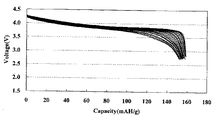
室温にて正極に対して定電流電圧(CCCV)0.5Cで4.3Vまで充電した後、0.2Cで2.7Vまで放電させる充放電を1サイクルとして、放電容量およびエネルギー密度を測定した。
次いで、上記放電容量及びエネルギー密度の測定における充放電を20サイクル行い、下記式(2)により容量維持率を算出し、また、下記式(3)によりエネルギー維持率を算出した。その結果を表4に示す。また、実施例1〜4及び比較例1で調製したリチウムコバルト系複合酸化物を正極活物質として用いたリチウム二次電池のこの条件下での放電特性図を図1〜5にそれぞれ示した。
【数5】
<負荷特性の評価>
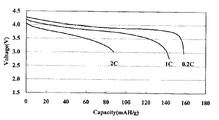
まず、正極に対して定電流電圧(CCCV)充電により0.5Cで5時間かけて、4.3Vまで充電した後、放電レート0.2C、1.0C、2.0Cで2.7Vまで放電させる充放電を行い、これらの操作を1サイクルとして1サイクル毎に放電容量とエネルギー密度を測定した。
このサイクルの各放電レートで3サイクル繰り返し、3サイクル目の放電容量とエネルギー密度を求めた。その結果を表4に示す。
また、実施例1〜4及び比較例1で調製したリチウムコバルト系複合酸化物を正極活物質として用いたリチウム二次電池について同様に試験を行い、0.2C、1.0C、2.0Cでの放電特性図を図6〜10にそれぞれ示した。
なお、エネルギー密度の値が高い方が、高負荷放電時でもより多くのエネルギーを利用でき、同じ放電容量の場合にはより高電圧での放電が可能である事を示し、即ち、負荷特性が優れていることを示す。
【表4】
【0058】
<高温保存特性の評価>
実施例1及び比較例1で調製したリチウムコバルト系複合酸化物を正極活物質として用いたリチウム二次電池について、室温にて正極に対して定電流電圧(CCCV)0.5Cで4.3Vまで5時間かけて充電した後、0.2Cで2.7Vまで放電させる充放電を1サイクル行った。次いで、同様に2サイクル目の充電を行った後、リチウム二次電池を80℃に調整された恒温室中で3週間放置(自己放電)した。
次に、リチウム二次電池を恒温室から取り出して、室温まで冷却後、放電レート0.2Cで放電を行った。その際の放電特性図を図11に示した。
また、図11に室温にて正極に対して定電流電圧(CCCV)0.5Cで4.3Vまで5時間かけて充電した後、0.2Cで2.7Vまで放電させる充放電を1サイクル行った後、2サイクル目の充電を行い、室温で放電レート0.2Cで放電を行い、その際の放電特性を図11に合わせて併記した。
図11の結果より、本発明のリチウムコバルト系複合酸化物を正極活物質として用いたリチウム二次電池は比較例1のLiCoO2を正極活物質として用いたものと比べ、80℃で3週間放置後においても放電容量及び平均放電電圧が高いことから高温保存特性に優れていることが分かる。
【0059】
<低温特性の評価>
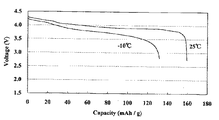
実施例1〜3及び比較例1で調製したリチウムコバルト系複合酸化物を正極活物質として用いたリチウム二次電池について、室温にて正極に対して定電流電圧(CCCV)0.5Cで4.3Vまで5時間かけて充電した後、0.2Cで2.7Vまで放電させる充放電を1サイクル行った。次いで、同様に2サイクル目の充電を行った後、リチウム二次電池を−10℃に調整された冷蔵庫中で放電レート0.2Cで放電を行った。その際の放電特性図を図12〜15に示した。
また、図12〜15に室温にて正極に対して定電流電圧(CCCV)0.5Cで4.3Vまで5時間かけて充電した後、0.2Cで2.7Vまで放電させる充放電を1サイクル行った後、2サイクル目の充電を行い、室温で放電レート0.2Cで放電を行い、その際の放電特性を図12〜15に合わせて併記した。
図12〜15の結果より、本発明のリチウムコバルト系複合酸化物を正極活物質として用いたリチウム二次電池は比較例1のLiCoO2を正極活物質として用いたものと比べ、−10℃の低温においても放電容量及び放電電圧が高いことから低温特性に優れていることが分かる。
【0060】
<安全性の評価>
輿石、喜多、和田(平成13年11月21日〜23日開催 第42回 電池討論会 講演要旨集、462〜463頁)、太田、大岩、石垣ら(平成13年11月21日〜23日開催 第42回 電池討論会 講演要旨集、470〜471頁)及び特開2002−158008号公報の電池の熱安定性評価方法に基づいて、実施例1、3、4及び比較例1で調製したリチウムコバルト系複合酸化物を正極活物質として用いたリチウム二次電池を正極に対して、定電流電圧(CCCV)充電により0.5Cで5時間かけて、4.3Vまで充電した後、アルゴン雰囲気下でリチウム二次電池を分解し、リチウムを引き抜きデインターカレーションした正極活物質を含有する正極板を取り出した。次いで、この取り出した各正極板から正極活物質を5.0mg削り取り、エチレンカーボネートとメチルエチルカーボネートの1:1混練液1リットルにLiPF61モルを溶解した液5.0μmlと一緒に示差走査熱量測定(DSC)用密閉式セル(SUSセル)に封入し、昇温速度2℃/minにて示差走査熱量測定装置(SIIエポリードサービス社製、形式DSC6200)にて示差熱量変化を測定した。その示差熱量変化の結果を図16及び表5に示す。
この図16の縦軸の熱量は、測定した正極活物質の重さで割った値を用いた。なお、図16において発熱ピークの高さが最大になった時の温度が高く、また、発熱開始からの発熱量の勾配が緩やかな方が、熱安定性、即ち電池安全性が優れていることを示す。
【表5】
また、本発明のリチウムコバルト系複合酸化物(実施例1、3、4)は、発熱開始温度から発熱ピークの高さが最大となる時の温度までの発熱量の勾配が緩やかであることから電池の安全性に優れていることが分かる。
【0061】
【発明の効果】
上記したとおり、本発明のリチウムコバルト系複合酸化物は、F原子を0.02〜3重量%含有し、該リチウムコバルト系複合酸化物は上記計算式(1)から求められる粒子内部に存在するF原子の含有量(C)が30重量%を越える。また、このリチウムコバルト系複合酸化物を正極活物質とするリチウム二次電池は、特に、負荷特性、サイクル特性、高温保存特性及び低温特性、更には安全性に優れたリチウム二次電池となる。
【図面の簡単な説明】
【図1】実施例1で得られたリチウムコバルト系複合酸化物を正極活物質とするリチウム二次電池のサイクル特性を示す図。
【図2】実施例2で得られたリチウムコバルト系複合酸化物を正極活物質とするリチウム二次電池のサイクル特性を示す図。
【図3】実施例3で得られたリチウムコバルト系複合酸化物を正極活物質とするリチウム二次電池のサイクル特性を示す図。
【図4】実施例4で得られたリチウムコバルト系複合酸化物を正極活物質とするリチウム二次電池のサイクル特性を示す図。
【図5】比較例1で得られたリチウムコバルト系複合酸化物を正極活物質とするリチウム二次電池のサイクル特性を示す図。
【図6】実施例1で得られたリチウムコバルト系複合酸化物を正極活物質とするリチウム二次電池の0.2C、1Cと2Cでの負荷特性を示す図。
【図7】実施例2で得られたリチウムコバルト系複合酸化物を正極活物質とするリチウム二次電池の0.2C、1Cと2Cでの負荷特性を示す図。
【図8】実施例3で得られたリチウムコバルト系複合酸化物を正極活物質とするリチウム二次電池の0.2C、1Cと2Cでの負荷特性を示す図。
【図9】実施例4で得られたリチウムコバルト系複合酸化物を正極活物質とするリチウム二次電池の0.2C、1Cと2Cでの負荷特性を示す図。
【図10】比較例1で得られたリチウムコバルト系複合酸化物を正極活物質とするリチウム二次電池の0.2C、1Cと2Cでの負荷特性を示す図。
【図11】実施例1及び比較例1で得られたリチウムコバルト系複合酸化物を正極活物質とするリチウム二次電池の高温保存特性を示す放電特性図。
【図12】実施例1で得られたリチウムコバルト系複合酸化物を正極活物質とするリチウム二次電池の低温特性を示す放電特性図。
【図13】実施例2で得られたリチウムコバルト系複合酸化物を正極活物質とするリチウム二次電池の低温特性を示す放電特性図。
【図14】実施例3で得られたリチウムコバルト系複合酸化物を正極活物質とするリチウム二次電池の低温特性を示す放電特性図。
【図15】比較例1で得られたリチウムコバルト系複合酸化物を正極活物質とするリチウム二次電池の低温特性を示す放電特性図。
【図16】実施例1、3、4及び比較例1で得られたリチウムコバルト系複合酸化物からリチウムを引き抜きデインターカレーションした正極活物質の示差熱量変化を示す図。[0001]
TECHNICAL FIELD OF THE INVENTION
The present invention relates to a lithium-cobalt-based composite oxide useful as a positive electrode active material for a lithium secondary battery, a method for producing the same, a lithium secondary battery positive electrode active material containing the same, and particularly load characteristics, cycle characteristics, high-temperature storage characteristics, and low temperature. The present invention relates to a lithium secondary battery having excellent characteristics and safety.
[0002]
[Prior art]
In recent years, as home appliances become more portable and cordless, lithium ion secondary batteries have been put into practical use as power supplies for small electronic devices such as laptop personal computers, mobile phones, and video cameras. Regarding this lithium ion secondary battery, in 1980, Mizushima et al. Reported that lithium cobaltate is useful as a positive electrode active material of a lithium ion secondary battery ("Material Research Bulletin" vol 15, P783-789 (1980)). ), Research and development on lithium-based composite oxides have been actively promoted, and many proposals have been made so far.
[0003]
For example, lithium cobalt-based composite oxides containing an F atom as a positive electrode active material have been proposed (for example, see Patent Documents 1 to 3).
[0004]
The lithium-cobalt-based composite oxide containing an F atom disclosed in Patent Document 1 (Japanese Patent Application Laid-Open No. 7-33443) is obtained by bringing lithium cobalt oxide into contact with a gaseous halogen compound. In the lithium cobaltate obtained by the above method, F atoms are present only in the surface layer, and F atoms cannot be present inside the particles.
[0005]
The lithium-cobalt-based composite oxide containing an F atom disclosed in Patent Document 2 (JP-A-2002-298846) and Patent Document 3 (JP-A-2002-216760) uses lithium fluoride (LiF) as a fluorine compound. However, the use of lithium fluoride alone cannot increase the content of F atoms inside the particles of the lithium-cobalt-based composite oxide, and it is baked at 1000 to 1100 ° C. to obtain an average particle size. However, even with a lithium secondary battery using a positive electrode active material having a particle size of 10 μm or more, satisfactory load characteristics, cycle characteristics, high-temperature storage characteristics, low-temperature characteristics, and safety cannot be realized yet.
[0006]
The present inventors have previously proposed a lithium-cobalt-based composite oxide capable of improving the load characteristics, cycle characteristics, high-temperature storage characteristics, low-temperature characteristics, and safety of a lithium secondary battery having an F content of 10%. A lithium-cobalt-based composite oxide containing F atoms increased to 3030% by weight has been proposed (see Patent Document 4).
[0007]
[Patent Document 1]
JP-A-7-33443
[Patent Document 2]
JP 2002-298846 A
[Patent Document 3]
JP-A-2002-216760
[Patent Document 4]
Japanese Patent Application No. 2002-319924
[0008]
[Problems to be solved by the invention]
The present inventors mixed a cobalt compound, a lithium compound and a fluorine compound, and then fired. In a method for producing a lithium-cobalt-based composite oxide containing an F atom, a cobalt compound having a specific specific surface area was used, Magnesium fluoride (MgF2), The content of F in the particles becomes higher than before, and the lithium cobalt-based composite oxide is used as a positive electrode active material. The lithium secondary battery was found to have particularly improved load characteristics, cycle characteristics, high-temperature storage characteristics and low-temperature characteristics, and further improved safety, and completed the present invention.
[0009]
That is, an object of the present invention is to provide a lithium-cobalt-based composite oxide which can improve load characteristics, cycle characteristics, high-temperature storage characteristics and low-temperature characteristics, and furthermore, when used as a positive electrode active material of a lithium secondary battery. An object of the present invention is to provide a product, a method for producing the same, a positive electrode active material for a lithium secondary battery containing the same, and a lithium secondary battery using the positive electrode active material.
[0010]
[Means for Solving the Problems]
A first invention to be provided by the present invention is a lithium-cobalt-based composite oxide containing 0.02 to 3% by weight of F atoms, wherein the lithium-cobalt-based composite oxide is obtained by the following formula (1). The lithium-cobalt-based composite oxide is characterized in that the content (C) of F atoms present in the particles obtained exceeds 30% by weight.
(Equation 2)
A: The amount of F atoms existing on the particle surface of the lithium-cobalt-based composite oxide.
B: The total amount of F atoms contained in the lithium-cobalt-based composite oxide.
C: the amount of F atoms present inside the particles of the lithium-cobalt-based composite oxide.
Further, in the lithium cobalt-based composite oxide, the content (C) of F atoms present inside the particles is preferably 40 to 90% by weight, and the average particle size is 1 to 20 μm. BET specific surface area 0.1 ~ 2.0m2/ G.
Further, the lithium-cobalt-based composite oxide preferably has a residual alkali content of 0.1% by weight or less. Further, when 20 g of the composite oxide is dispersed in 100 ml of water, the pH of the dispersion is 9%. It is particularly preferred that the ratio be from 0.5 to 12.0.
[0011]
In a second aspect of the present invention, the molar ratio of a cobalt compound, a fluorine compound and a lithium compound to Co atoms is 0.90 to 1.10 for Li atoms and 0.001 to 0.15 for F atoms. In the method for producing a lithium-cobalt-based composite oxide, wherein the BET specific surface area is 1 m2/ G or more, and magnesium fluoride (MgF2And baking at 800 to 1100 ° C. using the method of (1).
The method for producing the lithium-cobalt-based composite oxide has a BET specific surface area of 2 m as a cobalt compound.2/ G or more is preferable, and the firing temperature is more preferably 1000 to 1100 ° C.
[0012]
According to a third aspect of the present invention, there is provided a positive electrode active material for a lithium secondary battery, comprising the lithium-cobalt-based composite oxide according to the first aspect.
[0013]
According to a fourth aspect of the present invention, there is provided a lithium secondary battery using the positive electrode active material of the lithium secondary battery according to the third aspect.
[0014]
BEST MODE FOR CARRYING OUT THE INVENTION
Hereinafter, the present invention will be described in detail.
The lithium-cobalt-based composite oxide according to the present invention is a lithium-cobalt-based composite oxide containing 0.02 to 3% by weight, preferably 0.04 to 2.0% by weight, of F atoms.
The content of F atoms indicates the theoretical content of all F atoms present in the lithium-cobalt-based composite oxide obtained from the added amount of the fluorine compound, and usually coincides with the actually measured value.
[0015]
Although the lithium-cobalt-based composite oxide according to the present invention contains F atoms as a whole in the range, the content of F-atoms present inside the particles is higher than that of the conventional lithium-cobalt-based composite oxide. Has a great feature, that is, the content (C) of F atoms present inside the particles determined from the following formula (1) exceeds 30% by weight.
(Equation 3)
A: The amount of F atoms existing on the particle surface of the lithium-cobalt-based composite oxide.
B: The total amount of F atoms contained in the lithium-cobalt-based composite oxide.
C: the amount of F atoms present inside the particles of the lithium-cobalt-based composite oxide.
[0016]
In Formula (1), the amount of F atoms present on the surface of the lithium-cobalt-based composite oxide of A is determined by dispersing the lithium-cobalt-based composite oxide in water and dissolving F atoms eluted from the particle surface. Is a measured value obtained by quantitatively analyzing the amount of the compound by ion chromatography. B in the above formula (1) indicates the total amount of F atoms contained in the lithium-cobalt-based composite oxide, and the total amount of F atoms is, as described above, the lithium obtained from the addition amount of the fluorine compound. It shows the content of all the theoretical F atoms present in the cobalt-based composite oxide.
[0017]
In the lithium-cobalt-based composite oxide according to the present invention, the content (C) of the F atom present inside the particles, which is determined from the above formula (1), is within the above range. Good load characteristics, cycle characteristics, high-temperature storage characteristics and low-temperature characteristics, and furthermore, safety can be imparted to the lithium secondary battery used as the material.
[0018]
The lithium-cobalt-based composite oxide according to the present invention further has a content (C) of F atoms present in the particles of 40 to 90% by weight, which is determined from the above formula (1). Load characteristics, cycle characteristics, high-temperature storage characteristics and low-temperature characteristics, and furthermore, safety of a lithium secondary battery using as a positive electrode active material.
[0019]
As other physical properties of the lithium-cobalt-based composite oxide according to the present invention, the average particle diameter determined by a laser diffraction method is 1 to 20 μm, preferably 5 to 20 μm. It is preferable because a coating film having a large thickness can be formed, and particularly preferably 10 to 20 μm further improves the safety of a lithium secondary battery using the lithium cobalt-based composite oxide as a positive electrode active material. it can. In addition, the lithium-cobalt-based composite oxide according to the present invention has an average particle diameter in the above range, and further has an average particle diameter of 1 to 2.5 μm in which primary particles are aggregated. A primary particle aggregate of from 0.0 to 20 μm is preferable because when lithium cobalt-based composite oxide is used as the positive electrode active material, Li is quickly inserted and removed. Further, it is more preferable that the primary aggregate has a particle size of 70% or more, preferably 80% or more of the whole volume, having a particle size of 1 to 20 μm, since a coating film having a uniform thickness can be formed.
[0020]
The lithium-cobalt-based composite oxide according to the present invention has a BET specific surface area of 0.1 to 2.0 m.2/ G, preferably 0.2 to 1.5 m2/ G, particularly preferably 0.3 to 1.0 m2/ G. It is preferable that the BET specific surface area is within the above range because safety is good.
[0021]
The lithium-cobalt-based composite oxide according to the present invention has a residual alkali content of 0.1% by weight or less, preferably 0.05% by weight or less, and 20 g of the lithium-cobalt-based composite oxide is dispersed in 100 ml of water. It is particularly preferred that the pH of the dispersion at 25 ° C. at that time is from 9.5 to 12.0, preferably from 9.5 to 10.5.
The lithium-cobalt-based composite oxide according to the present invention suppresses the generation of gas derived from residual alkali such as impurities, for example, lithium carbonate and lithium hydroxide, when the content and pH of the remaining alkali are within the above ranges, High-temperature storage characteristics of a lithium secondary battery using a cobalt-based composite oxide as a positive electrode active material can be improved.
[0022]
Next, a method for producing the lithium-cobalt-based composite oxide of the present invention will be described.
In the method for producing a lithium-cobalt-based composite oxide of the present invention, the molar ratio of a cobalt compound, a fluorine compound and a lithium compound to Co atoms is 0.90 to 1.10 for Li atoms and 0.001 to 0.15 for F atoms. In a method for producing a lithium-cobalt-based composite oxide, which is mixed and then calcined, a compound having a specific BET specific surface area is used as a cobalt compound, and magnesium fluoride (MgF2There is a great feature in performing calcination in a specific temperature range by using the above method.
[0023]
The cobalt compound as the first raw material that can be used has a BET specific surface area of 1 m.2/ G or more. The reason why the specific surface area of the cobalt compound is set in the range is that the BET specific surface area is 1 m.2If the ratio is less than / g, the content (C) of F atoms inside the particles of the lithium-cobalt-based composite oxide, which is a component of the present invention, cannot be increased to a value exceeding 30% by weight. The cobalt compound has a BET specific surface area of 2 m.2/ G or more, magnesium fluoride (MgF2) With magnesium fluoride (MgF2), It easily reacts at the co-melting temperature of the lithium compound and the cobalt compound, so that the F atom content (C) inside the particles of the lithium-cobalt-based composite oxide can be further increased to 40% by weight or more. .
Such cobalt compounds include, for example, cobalt oxides, hydroxides, carbonates, nitrates, and organic acid salts, and are industrially inexpensive, reactive, and by-products produced as a by-product during firing. Tricobalt tetroxide (Co)3O4) Or cobalt oxyhydroxide (CoOOH).
[0024]
Also, a second raw material magnesium fluoride (MgF2) Has a BET specific surface area of 1 m2/ G or more, preferably 5 m2/ G or more is preferable because F atoms and Mg atoms can be uniformly distributed inside the particles of the lithium-cobalt-based composite oxide.2It is particularly preferable that the average particle size determined by the laser diffraction method is 10 μm or less, preferably 8 μm or less, since F atoms and Mg atoms can be more uniformly distributed inside the particles.
[0025]
Examples of the third raw material lithium compound that can be used include lithium oxides, hydroxides, carbonates, nitrates, and organic acid salts, and among these, industrially inexpensive. Lithium carbonate is preferred.
The physical properties and the like of the lithium compound are not particularly limited, but fine ones are preferred in terms of reactivity, and those having an average particle diameter determined by a laser diffraction method of 20 μm or less, preferably 10 μm or less are particularly preferred.
[0026]
Further, the first to third raw materials of the cobalt compound, magnesium fluoride (MgF2) And the lithium compound are not limited in production history, but are preferably as low as possible in content of impurities in order to produce a high-purity lithium-cobalt-based composite oxide.
[0027]
First, the reaction operation is performed using the first to third raw materials of a cobalt compound and magnesium fluoride (MgF2) And a predetermined amount of a lithium compound. Mixing may be performed by either a dry method or a wet method, but a dry method is preferred because of easy production. In the case of dry mixing, it is preferable to use a blender or the like that uniformly mixes the raw materials.
[0028]
The above-mentioned first to third raw materials of the cobalt compound, magnesium fluoride (MgF2) And a lithium compound in a molar ratio to Co atoms of 0.90 to 1.10, preferably 0.95 to 1.05, and 0.001 to 0.15, preferably 0.1 to 0.1% of F atoms. By performing the calcination described later at this blending ratio, the F atom is 0.20 to 3% by weight, preferably 0.04 to 2% by weight, based on the obtained lithium cobalt-based composite oxide. It is possible to obtain a lithium-cobalt-based composite oxide containing 0% by weight and having the above range inside the particles.
[0029]
Next, the mixture in which the first to third raw materials are uniformly mixed is fired. In the present invention, the firing temperature is 800 to 1100 ° C. In the present invention, the reason for setting the sintering temperature to the above range is that when the firing temperature is lower than 800 ° C., the lithium compound, the cobalt compound and the magnesium fluoride (MgF2) Does not sufficiently occur, so that F atoms and Mg atoms do not easily enter the inside of the particles. If the temperature exceeds 1100 ° C., the intended lithium-cobalt-based composite oxide is undesirably decomposed. In particular, when calcination is performed at a temperature exceeding 1000 ° C., that is, 1000 to 1100 ° C. in the method for producing a lithium cobalt-based composite oxide of the present invention, the average particle diameter becomes 10 μm or more due to the remarkable particle growth, and the specific surface Therefore, the safety of a lithium secondary battery using the lithium-cobalt-based composite oxide as a positive electrode active material can be further improved.
[0030]
The firing time is preferably 2 to 24 hours, and more preferably 5 to 10 hours. The firing may be performed in the air or in an oxygen atmosphere, and is not particularly limited. These firings can be performed as many times as necessary.
[0031]
After calcination, the mixture is appropriately cooled and pulverized as necessary to obtain a lithium-cobalt-based composite oxide.
The pulverization that is performed as necessary is appropriately performed, for example, when the lithium-cobalt-based composite oxide obtained by firing is in the form of a brittlely bonded block. Having a BET specific surface area. That is, the obtained lithium cobalt-based composite oxide has an average particle size of 1.0 to 20 μm, preferably 5.0 to 20 μm, and a BET specific surface area of 0.1 to 2.0 m.2/ G, preferably 0.2-1.5 m2/ G, more preferably 0.3 to 1.0 m2/ G.
[0032]
The lithium-cobalt-based composite oxide thus obtained contains F atoms in an amount of 0.02 to 3% by weight, preferably 0.04 to 2% by weight, and the content (C) of the F atoms present inside the particles is 30% by weight. %, Preferably 40 to 90% by weight, such a lithium cobalt-based composite oxide is used as a positive electrode active material of a lithium secondary battery comprising a positive electrode, a negative electrode, a separator, and a non-aqueous electrolyte containing a lithium salt. It can be suitably used.
[0033]
The lithium cobalt-based composite oxide is used as the positive electrode active material for a lithium secondary battery according to the present invention. The positive electrode active material is one raw material of a positive electrode mixture of a lithium secondary battery described later, that is, a mixture of a positive electrode active material, a conductive agent, a binder, and if necessary, a filler and the like. The positive electrode active material for a lithium secondary battery according to the present invention is prepared by mixing the above lithium-cobalt-based composite oxide having the preferable particle size characteristics as described above with other raw materials to prepare a positive electrode mixture. In this case, kneading is easy, and the coatability when applying the obtained positive electrode mixture to the positive electrode current collector becomes easy.
[0034]
The lithium secondary battery according to the present invention uses the above-mentioned lithium secondary battery positive electrode active material, and includes a positive electrode, a negative electrode, a separator, and a non-aqueous electrolyte containing a lithium salt. The positive electrode is formed, for example, by applying a positive electrode mixture onto a positive electrode current collector and drying the positive electrode mixture. The positive electrode mixture includes a positive electrode active material, a conductive agent, a binder, and a filler that is added as necessary. Consists of In the lithium secondary battery according to the present invention, the above-described lithium-cobalt-based composite oxide as a positive electrode active material is uniformly applied to a positive electrode.
For this reason, in the lithium secondary battery according to the present invention, load characteristics and cycle characteristics are particularly unlikely to be reduced.
[0035]
The positive electrode current collector is not particularly limited as long as it is an electronic conductor that does not cause a chemical change in the configured battery.For example, stainless steel, nickel, aluminum, titanium, calcined carbon, aluminum and stainless steel Examples thereof include those whose surfaces are surface-treated with carbon, nickel, titanium, and silver. The surface of these materials may be oxidized and used, or the surface of the current collector may be made uneven by surface treatment. Examples of the form of the current collector include a foil, a film, a sheet, a net, a punched material, a lath body, a porous body, a foamed body, a fiber group, and a molded nonwoven fabric. The thickness of the current collector is not particularly limited, but is preferably 1 to 500 μm.
[0036]
The conductive agent is not particularly limited as long as it is an electron conductive material that does not cause a chemical change in the configured battery. For example, graphite such as natural graphite and artificial graphite, carbon black, acetylene black, Ketjen black, channel black, furnace black, lamp black, carbon black such as thermal black, conductive fibers such as carbon fiber and metal fiber, Metal powders such as carbon fluoride, aluminum and nickel powder, conductive whiskers such as zinc oxide and potassium titanate, conductive metal oxides such as titanium oxide, and powdered inorganic solid electrolytes described below, or Examples of the conductive material include a polyphenylene derivative, and examples of the natural graphite include scaly graphite, scaly graphite, and earthy graphite. These can be used alone or in combination of two or more. The mixing ratio of the conductive agent is 1 to 50% by weight, preferably 2 to 30% by weight in the positive electrode mixture.
[0037]
Examples of the binder include starch, polyvinylidene fluoride, polyvinyl alcohol, carboxymethyl cellulose, hydroxypropyl cellulose, regenerated cellulose, diacetyl cellulose, polyvinyl pyrrolidone, tetrafluoroethylene, polyethylene, polypropylene, ethylene-propylene-diene terpolymer ( EPDM), sulfonated EPDM, styrene butadiene rubber, fluoro rubber, tetrafluoroethylene-hexafluoroethylene copolymer, tetrafluoroethylene-hexafluoropropylene copolymer, tetrafluoroethylene-perfluoroalkylvinyl ether copolymer, fluorinated Vinylidene-hexafluoropropylene copolymer, vinylidene fluoride-chlorotrifluoroethylene copolymer, ethylene-tetrafluoroethylene Oroethylene copolymer, polychlorotrifluoroethylene, vinylidene fluoride-pentafluoropropylene copolymer, propylene-tetrafluoroethylene copolymer, ethylene-chlorotrifluoroethylene copolymer, vinylidene fluoride-hexafluoropropylene-tetra Fluoroethylene copolymer, vinylidene fluoride-perfluoromethylvinyl ether-tetrafluoroethylene copolymer, ethylene-acrylic acid copolymer or its (Na +) ion crosslinked product, ethylene-methacrylic acid copolymer or its (Na +) Ion crosslinked product, ethylene-methyl acrylate copolymer or its (Na +) ion crosslinked product, ethylene-methyl methacrylate copolymer or its (Na +) ion crosslinked product, polysaccharides such as polyethylene oxide, thermoplastic resin , Polymers having rubber elasticity, and these may be used individually or in combination. When a compound having a functional group that reacts with lithium, such as a polysaccharide, is used, for example, it is preferable to add a compound such as an isocyanate group to deactivate the functional group. The compounding ratio of the binder is 1 to 50% by weight, preferably 3 to 15% by weight in the positive electrode mixture.
[0038]
The filler suppresses volume expansion and the like of the positive electrode in the positive electrode mixture, and is added as necessary. As the filler, any fibrous material that does not cause a chemical change in the configured battery can be used. For example, olefin polymers such as polypropylene and polyethylene, fibers such as glass and carbon are used. The addition amount of the filler is not particularly limited, but is preferably 0 to 30% by weight in the positive electrode mixture.
[0039]
The negative electrode is formed by applying and drying a negative electrode material on a negative electrode current collector. The negative electrode current collector is not particularly limited as long as it is an electronic conductor that does not cause a chemical change in the configured battery.For example, stainless steel, nickel, copper, titanium, aluminum, calcined carbon, copper or stainless steel Examples thereof include a steel surface treated with carbon, nickel, titanium, and silver, and an aluminum-cadmium alloy. Further, the surface of these materials may be oxidized and used, or the surface of the current collector may be made uneven by surface treatment. Examples of the form of the current collector include a foil, a film, a sheet, a net, a punched material, a lath body, a porous body, a foamed body, a fiber group, and a molded nonwoven fabric. The thickness of the current collector is not particularly limited, but is preferably 1 to 500 μm.
[0040]
Examples of the negative electrode material include, but are not particularly limited to, carbonaceous materials, metal composite oxides, lithium metals, lithium alloys, silicon-based alloys, tin-based alloys, metal oxides, conductive polymers, and chalcogen compounds. , Li-Co-Ni-based materials, and the like. Examples of the carbonaceous material include a non-graphitizable carbon material and a graphite-based carbon material. Examples of the metal composite oxide include Snp M1 1-pM2 q Or (Where M1Represents one or more elements selected from Mn, Fe, Pb and Ge;2Represents one or more elements selected from Al, B, P, Si, the first, second, and third groups of the periodic table and a halogen element, and 0 <p ≦ 1, 1 ≦ q ≦ 3, ≦ r ≦ 8. ), LixFe2O3(0 ≦ x ≦ 1), LixWO2(0 ≦ x ≦ 1) and the like. GeO, GeO as the metal oxide2, SnO, SnO2, PbO, PbO2, Pb2O3, Pb3O4, Sb2O3, Sb2O4, Sb2O5, Bi2O3, Bi2O4, Bi2O5And the like. Examples of the conductive polymer include polyacetylene and poly-p-phenylene.
[0041]
As the separator, an insulating thin film having high ion permeability and predetermined mechanical strength is used. Sheets and nonwoven fabrics made of olefin polymers such as polypropylene, glass fiber, polyethylene, or the like are used because of their organic solvent resistance and hydrophobicity. The pore size of the separator may be generally in a range useful for batteries, and is, for example, 0.01 to 10 μm. The thickness of the separator may be in the range for general batteries, and is, for example, 5 to 300 μm. When a solid electrolyte such as a polymer is used as an electrolyte described later, the solid electrolyte may also serve as a separator.
[0042]
The non-aqueous electrolyte containing a lithium salt is composed of a non-aqueous electrolyte and a lithium salt. As the non-aqueous electrolyte, a non-aqueous electrolyte, an organic solid electrolyte, and an inorganic solid electrolyte are used. Examples of the non-aqueous electrolyte include N-methyl-2-pyrrolidinone, propylene carbonate, ethylene carbonate, butylene carbonate, dimethyl carbonate, diethyl carbonate, γ-butyrolactone, 1,2-dimethoxyethane, tetrahydroxyfuran, and 2-methyl Tetrahydrofuran, dimethylsulfoxide, 1,3-dioxolane, formamide, dimethylformamide, dioxolane, acetonitrile, nitromethane, methyl formate, methyl acetate, phosphoric acid triester, trimethoxymethane, dioxolane derivative, sulfolane, methylsulfolane, 3-methyl -2-oxazolidinone, 1,3-dimethyl-2-imidazolidinone, propylene carbonate derivative, tetrahydrofuran derivative, diethyl ether, 1,3- Ropansaruton, methyl propionate, and a solvent obtained by mixing one or more aprotic organic solvents such as ethyl propionate.
[0043]
Examples of the organic solid electrolyte include a polyethylene derivative, a polyethylene oxide derivative or a polymer containing the same, a polypropylene oxide derivative or a polymer containing the same, a phosphate ester polymer, polyphosphazene, polyaziridine, polyethylene sulfide, polyvinyl alcohol, polyvinylidene fluoride, Examples thereof include a polymer containing an ionic dissociating group such as polyhexafluoropropylene, and a mixture of the polymer containing an ionic dissociating group and the above nonaqueous electrolyte.
[0044]
As the inorganic solid electrolyte, nitrides, halides, oxyacid salts, sulfides, and the like of Li can be used.3N, LiI, Li5NI2, Li3N-LiI-LiOH, LiSiO4, LiSiO4-LiI-LiOH, Li2SiS3, Li4SiO4, Li4SiO4-LiI-LiOH, P2S5, Li2S or Li2SP2S5, Li2S-SiS2, Li2S-GeS2, Li2S-Ga2S3, Li2SB2S3, Li2SP2S5-X, Li2S-SiS2-X, Li2S-GeS2-X, Li2S-Ga2S3-X, Li2SB2S3-X, wherein X is LiI, B2S3Or Al2S3At least one or more selected from the following).
Furthermore, when the inorganic solid electrolyte is amorphous (glass), lithium phosphate (Li)3PO4), Lithium oxide (Li2O), lithium sulfate (Li2SO4), Phosphorus oxide (P2O5), Lithium borate (Li3BO3) And other compounds containing oxygen, Li3PO4-xN2x / 3(X is 0 <x <4), Li4SiO4-xN2x / 3(X is 0 <x <4), Li4GeO4-xN2x / 3(X is 0 <x <4), Li3BO3-xN2x / 3A compound containing nitrogen such as (x is 0 <x <3) can be contained in the inorganic solid electrolyte. By adding the compound containing oxygen or the compound containing nitrogen, the gap between the formed amorphous skeletons can be widened, the hindrance of the movement of lithium ions can be reduced, and the ion conductivity can be further improved.
[0045]
As the lithium salt, those which dissolve in the non-aqueous electrolyte are used. For example, LiCl, LiBr, LiI, LiClO4 , LiBF4 , LiB10Cl10, LiPF6 , LiCF3SO3 , LiCF3CO2 , LiAsF6 , LiSbF6 , LiB10Cl10, LiAlCl4 , CH3SO3Li, CF3SO3Li, (CF3SO2)2Salts of one or more of NLi, lithium chloroborane, lithium lower aliphatic carboxylate, lithium tetraphenylborate, imides and the like can be mentioned.
[0046]
Further, the following compounds can be added to the non-aqueous electrolyte for the purpose of improving discharge, charge characteristics and flame retardancy. For example, pyridine, triethyl phosphite, triethanolamine, cyclic ether, ethylene diamine, n-glyme, hexaphosphoric triamide, nitrobenzene derivative, sulfur, quinone imine dye, N-substituted oxazolidinone and N, N-substituted imidazolidine, ethylene glycol dialkyl ether , Ammonium salt, polyethylene glycol, pyrrole, 2-methoxyethanol, aluminum trichloride, monomer for conductive polymer electrode active material, triethylenephosphonamide, trialkylphosphine, morpholine, aryl compound having a carbonyl group, hexamethylphos Holic triamide and 4-alkylmorpholine, bicyclic tertiary amines, oils, phosphonium salts and tertiary sulfonium salts, phosphazenes, carbonates and the like. That. Further, in order to make the electrolyte nonflammable, a halogen-containing solvent such as carbon tetrachloride or ethylene trifluoride can be contained in the electrolyte. In addition, carbon dioxide gas can be included in the electrolytic solution in order to make it suitable for high-temperature storage.
[0047]
The lithium secondary battery according to the present invention is a lithium secondary battery having excellent battery performance, in particular, load characteristics, cycle characteristics, high-temperature storage characteristics and low-temperature characteristics, and further excellent safety.The shape of the battery is a button, a sheet, Any shape such as a cylinder, a corner, and a coin shape may be used.
[0048]
The use of the lithium secondary battery according to the present invention is not particularly limited. For example, notebook computers, laptop computers, pocket word processors, mobile phones, cordless handsets, portable CD players, radios, LCD televisions, backup power supplies, electric shavers , A memory card, an electronic device such as a video movie, and a consumer electronic device such as an automobile, an electric vehicle, and a game device.
[0049]
【Example】
Hereinafter, the present invention will be described in detail with reference to Examples, but the present invention is not limited thereto.
<Cobalt oxide (Co3O4Preparation of))
-Samples Co-1 and Co-2
13.7 kg of cobalt sulfate hexahydrate was dissolved in 15 L of pure water to prepare a cobalt aqueous solution in accordance with the method for producing tricobalt tetroxide disclosed in JP-A-4-321523. Next, 9 kg of ammonium bicarbonate was dissolved in 6 L of pure water, and the above-mentioned aqueous cobalt solution was added over 1 hour while stirring. After completion of the addition, the mixture was stirred for 30 minutes to form a precipitate, and then the precipitate was recovered by filtration and repulped twice with 60 L of pure water for washing. Next, the precipitate was fired in an electric furnace at 420 ° C. for 3 hours, cooled, and pulverized. The obtained product was confirmed by X-ray diffraction measurement to be tricobalt tetroxide. As a result of observation with a scanning electron microscope (SEM), the average particle size was 0.02 μm, and the BET specific surface area was 44.5 m.2/ G. This tricobalt tetroxide sample was used as Co-1, and this Co-1 was further pulverized and classified to have a BET specific surface area of 104 m.2/ G of tricobalt tetroxide was prepared and used as a Co-2 sample.
-Sample Co-3, Co-4
According to the production method of tricobalt tetroxide of Japanese Patent Application No. 2002-162726, 1.8 mol / L (CoSO4) Was heated to 60 ° C, and 14.4L of a 1 mol / L aqueous sodium hydrogen carbonate solution was added dropwise thereto over 2 hours while maintaining the temperature at 60 ° C. The pH in the reaction system after the completion of the dropwise addition was 6.7.
Then, after completion of the dropwise addition, a 4 mol / L sodium hydroxide solution was added until the pH reached 8 while maintaining the temperature at 60 ° C., and aging was performed for 3 hours while maintaining the pH and temperature.
Then, while confirming the time required for filtration, after solid-liquid separation, the electric conductivity at 25 ° C. when the recovered precipitate was made into a 10% slurry was checked with an electric conductivity meter at 25 ° C., and the electric conductivity was 100 μs / cm. Washing was carried out sufficiently until the water content became as follows, and dried to obtain 856.1 g of a precipitate (yield: 99.96%).
Next, this precipitate was baked in an electric furnace at 900 ° C. for 5 hours, cooled, and then pulverized. The obtained product was confirmed by X-ray diffraction measurement to be agglomerated tricobalt tetroxide. . Further, as a result of observation with a scanning electron microscope (SEM), the particle size of the primary particles was 0.5 to 2 μm, the average particle size of the secondary particles was 14.1 μm, and the BET specific surface area was 0.62 m.2/ G. This was used as a Co-4 sample.
Next, the Co-4 sample obtained above was pulverized and classified to have a BET specific surface area of 1.02 m.2/ G of tricobalt tetroxide was prepared and used as a Co-3 sample.
Table 1 shows the BET specific surface areas of the Co-1, Co-2, Co-3 and Co-4 samples prepared above.
[Table 1]
Examples 1 to 4 and Reference Example 1
Various cobalt tetroxide samples prepared above so as to have the molar ratios of Co atoms and Li atoms shown in Table 2,2CO3(Average particle size: 7 μm), and furthermore, commercially available MgF2(Aldrich) was pulverized and classified to have an average particle size of 7 μm and a BET specific surface area of 6.5 m.2/ G MgF2Was prepared and the MgF thus prepared was adjusted to have the molar ratio of F atoms shown in Table 2.2And the raw materials were thoroughly mixed in a dry system, and then fired at the temperature shown in Table 2 for 5 hours. The fired product was pulverized and classified to obtain various F atom-containing lithium cobalt-based composite oxides. Table 3 shows the main physical properties of the obtained product.
[Table 2]
Reference Example 2
Tricobalt tetroxide (sample; Co-1), Li such that the molar ratio of Li, Co, and F atoms is 1.02: 1.00: 0.01.2CO3(Average particle size 7 μm) and LiF (average particle size 5 μm, specific surface area 30.2 m)2/ G, manufactured by Aldrich) was thoroughly mixed in a dry system, and then baked at 1020 ° C for 5 hours. The fired product was pulverized and classified to obtain an F atom-containing lithium cobalt-based composite oxide. Table 3 shows the main physical properties of the obtained product.
[0052]
Reference Example 3
Li2CO3(Average particle size: 7 μm), tricobalt tetroxide (sample; Co-1), magnesium carbonate (MgCO3: Average particle size 14 μm, BET specific surface area 6.7 m2/ G) and LiF (average particle size 5 μm, specific surface area 30.2 m)2/ G, manufactured by Aldrich) in a dry system so that the molar ratio of Li / Co becomes 1.02, the molar ratio of Mg / Co becomes 0.005, and the molar ratio of F / Co becomes 0.01. Calcination was performed at 5 ° C. for 5 hours. The fired product was pulverized and classified to obtain a lithium-cobalt-based composite oxide. Table 3 shows the main physical properties of the obtained product.
[0053]
Comparative Example 1
Tricobalt tetroxide (sample; Co-1) and Li such that the molar ratio of Li atoms: Co atoms is 1.03: 1.00.2CO3(Average particle size: 7 μm) was thoroughly mixed by a dry method, and then baked at 1020 ° C. for 5 hours. The fired product was pulverized and classified to obtain a lithium-cobalt-based composite oxide. Table 3 shows the main physical properties of the obtained product.
[0054]
<Evaluation of physical properties>
(1) The amount of F atoms inside the particles of the lithium-cobalt-based composite oxide
100 ml of water was added to 0.5 g of the lithium-cobalt-based composite oxide obtained in Examples 1 to 4, Reference Examples 1 to 3, and Comparative Example 1, and the mixture was sufficiently stirred at 25 ° C. F atoms were eluted from the particle surface into water, and the amount of F atoms in the solution was quantified by ion chromatography. Next, the abundance ratio (C) of F atoms in the particles of the lithium-cobalt-based composite oxide was determined from the theoretical amount determined from the added amount of the raw material fluorine compound, using the following formula (1). Table 3 shows the results.
(Equation 4)
A: A value obtained by quantitatively analyzing the amount of F atoms eluted from the particle surface by dispersing a lithium-cobalt-based composite oxide in water by ion chromatography.
B: Magnesium fluoride (MgF2A) The amount of all F atoms theoretically contained in the lithium-cobalt-based composite oxide particles determined from the added amount.
C: the amount of F atoms present inside the particles of the lithium-cobalt-based composite oxide.
(2) pH of dispersion and content of residual alkali
100 ml of water was added to 20 g of the lithium-cobalt-based composite oxide obtained in Examples 1 to 4, Reference Examples 1 to 3, and Comparative Example 1, and the mixture was sufficiently stirred at 25 ° C for 5 minutes. Next, the mixture was filtered, and the pH of the filtrate was measured with a pH meter. Further, 60 g of the filtrate was subjected to alkali titration with 0.1 N HCl to measure the residual alkali content contained in the lithium-cobalt-based composite oxide, and the results are shown in Table 3.
(3) Average particle size
The average particle size was determined by a laser diffraction method.
[Table 3]
<Battery performance test>
(1) Preparation of lithium secondary battery;
91% by weight of the lithium-cobalt-based composite oxide, 6% by weight of graphite powder and 3% by weight of polyvinylidene fluoride obtained in Examples 1 to 4 and Comparative Example 1 produced as described above were mixed to form a positive electrode agent. Was dispersed in N-methyl-2-pyrrolidinone to prepare a kneaded paste. The kneaded paste was applied to an aluminum foil, dried, pressed and punched into a disk having a diameter of 15 mm to obtain a positive electrode plate.
Using this positive electrode plate, a lithium secondary battery was manufactured using each member such as a separator, a negative electrode, a positive electrode, a current collector, a mounting bracket, an external terminal, and an electrolyte. Among these, the negative electrode used a metal lithium foil, and the electrolyte used was a 1: 1 mixture of ethylene carbonate and methyl ethyl carbonate in 1 liter of LiPF.6 A solution in which 1 mol was dissolved was used.
[0056]
(2) Battery performance evaluation
The produced lithium secondary battery was operated at room temperature, and the following battery performance was evaluated.
<Measurement of capacity maintenance rate and energy maintenance rate>
After charging the positive electrode at room temperature to 4.3 V at a constant current voltage (CCCV) of 0.5 C and discharging it to 2.7 V at 0.2 C as one cycle, the discharge capacity and the energy density were measured. .
Next, the charge and discharge in the measurement of the discharge capacity and the energy density were performed for 20 cycles, the capacity retention rate was calculated by the following equation (2), and the energy retention rate was calculated by the following equation (3). Table 4 shows the results. FIGS. 1 to 5 show discharge characteristics diagrams of lithium secondary batteries using the lithium-cobalt-based composite oxide prepared in Examples 1 to 4 and Comparative Example 1 as a positive electrode active material under these conditions.
(Equation 5)
<Evaluation of load characteristics>
First, the positive electrode is charged to 4.3 V by constant current voltage (CCCV) charging at 0.5 C for 5 hours, and then discharged to 2.7 V at a discharge rate of 0.2 C, 1.0 C, and 2.0 C. These operations were defined as one cycle, and the discharge capacity and energy density were measured every cycle.
Three cycles were repeated at each discharge rate of this cycle, and the discharge capacity and energy density at the third cycle were determined. Table 4 shows the results.
In addition, a similar test was performed on a lithium secondary battery using the lithium-cobalt-based composite oxide prepared in Examples 1 to 4 and Comparative Example 1 as a positive electrode active material, and the test was performed at 0.2C, 1.0C, and 2.0C. 6 to 10 show the discharge characteristic diagrams.
It should be noted that a higher value of the energy density indicates that more energy can be used even during high-load discharge, and that discharge at a higher voltage is possible with the same discharge capacity. Indicates that it is excellent.
[Table 4]
[0058]
<Evaluation of high-temperature storage characteristics>
For a lithium secondary battery using the lithium-cobalt-based composite oxide prepared in Example 1 and Comparative Example 1 as a positive electrode active material, at room temperature, a constant current voltage (CCCV) of 0.5 C to 4.3 V with respect to the positive electrode at room temperature. After charging for 5 hours, one cycle of charge / discharge for discharging at 0.2 C to 2.7 V was performed. Next, after similarly performing the second cycle charging, the lithium secondary battery was allowed to stand (self-discharge) for 3 weeks in a constant temperature room adjusted to 80 ° C.
Next, the lithium secondary battery was taken out of the constant temperature chamber, cooled to room temperature, and then discharged at a discharge rate of 0.2C. FIG. 11 shows a discharge characteristic diagram at that time.
In addition, FIG. 11 shows that the positive electrode was charged at a constant current voltage (CCCV) of 0.5 C to 4.3 V over 5 hours at room temperature over 5 hours, and then discharged and charged to 2.7 V at 0.2 C for one cycle. After that, charging was performed in the second cycle, and discharging was performed at room temperature at a discharge rate of 0.2 C. The discharging characteristics at that time are also shown in FIG.
11, the lithium secondary battery using the lithium-cobalt-based composite oxide of the present invention as the positive electrode active material was
[0059]
<Evaluation of low-temperature characteristics>
3. Regarding the lithium secondary battery using the lithium-cobalt-based composite oxide prepared in Examples 1 to 3 and Comparative Example 1 as a positive electrode active material, a constant current voltage (CCCV) of 0.5 C with respect to the positive electrode at room temperature. After charging the battery to 3 V for 5 hours, the battery was discharged and charged to 2.7 V at 0.2 C for one cycle. Next, after the second cycle of charging was performed, the lithium secondary battery was discharged at a discharge rate of 0.2 C in a refrigerator adjusted to -10 ° C. FIGS. 12 to 15 show discharge characteristics at that time.
12 to 15 show that the positive electrode was charged at a constant current voltage (CCCV) of 0.5 C to 4.3 V over 5 hours at room temperature over 5 hours, and then discharged at 0.2 C to 2.7 V. After the cycle, the second cycle was charged and discharged at room temperature at a discharge rate of 0.2 C. The discharge characteristics at that time are also shown in FIGS.
12 to 15, the lithium secondary battery using the lithium-cobalt-based composite oxide of the present invention as the positive electrode active material was
[0060]
<Safety evaluation>
Oshiishi, Kita, and Wada (November 21-23, 2001 The 42nd Battery Symposium, Abstracts, pp. 462-463), Ota, Oiwa, Ishigaki, etc. (November 21-23, 2001) Held at the 42nd Battery Symposium, Abstracts of Lectures, pp. 470-471) and prepared in Examples 1, 3, 4 and Comparative Example 1 based on the method for evaluating the thermal stability of batteries disclosed in JP-A-2002-158008. A lithium secondary battery using a lithium-cobalt-based composite oxide as a positive electrode active material was charged to a positive electrode at a constant current voltage (CCCV) at 0.5 C for 5 hours to 4.3 V over 4.3 hours, and then charged in an argon atmosphere. The lithium secondary battery was disassembled below, lithium was extracted, and a positive electrode plate containing a deintercalated positive electrode active material was taken out. Next, 5.0 mg of the positive electrode active material was scraped off from each of the positive electrode plates taken out, and LiPF was added to 1 liter of a 1: 1 kneading liquid of ethylene carbonate and methyl ethyl carbonate.6A differential scanning calorimeter (SII Epolide Service) was sealed in a differential scanning calorimetry (DSC) sealed cell (SUS cell) together with 5.0 μml of a solution in which 1 mol was dissolved, and heated at a rate of 2 ° C./min. The change in differential calorific value was measured using a model DSC6200 manufactured by the company. The results of the differential calorie change are shown in FIG.
The value of heat on the vertical axis in FIG. 16 was obtained by dividing by the measured weight of the positive electrode active material. In FIG. 16, the higher the temperature when the height of the heat generation peak becomes maximum, and the gentler the gradient of the heat generation amount from the start of heat generation, the better the thermal stability, that is, the better the battery safety. Is shown.
[Table 5]
Further, in the lithium-cobalt-based composite oxide of the present invention (Examples 1, 3, and 4), the gradient of the calorific value from the heat generation start temperature to the temperature at which the height of the heat generation peak becomes maximum is gentle. It is understood that the safety of the battery is excellent.
[0061]
【The invention's effect】
As described above, the lithium-cobalt-based composite oxide of the present invention contains F atoms in an amount of 0.02 to 3% by weight, and the lithium-cobalt-based composite oxide is present inside the particles obtained from the above formula (1). The F atom content (C) exceeds 30% by weight. In addition, a lithium secondary battery using this lithium-cobalt-based composite oxide as a positive electrode active material is a lithium secondary battery that is particularly excellent in load characteristics, cycle characteristics, high-temperature storage characteristics, low-temperature characteristics, and safety.
[Brief description of the drawings]
FIG. 1 is a diagram showing cycle characteristics of a lithium secondary battery using a lithium-cobalt-based composite oxide obtained in Example 1 as a positive electrode active material.
FIG. 2 is a diagram showing cycle characteristics of a lithium secondary battery using the lithium-cobalt-based composite oxide obtained in Example 2 as a positive electrode active material.
FIG. 3 is a view showing cycle characteristics of a lithium secondary battery using the lithium-cobalt-based composite oxide obtained in Example 3 as a positive electrode active material.
FIG. 4 is a view showing cycle characteristics of a lithium secondary battery using the lithium-cobalt-based composite oxide obtained in Example 4 as a positive electrode active material.
FIG. 5 is a view showing cycle characteristics of a lithium secondary battery using the lithium-cobalt-based composite oxide obtained in Comparative Example 1 as a positive electrode active material.
FIG. 6 is a diagram showing load characteristics at 0.2 C, 1 C, and 2 C of a lithium secondary battery using the lithium cobalt-based composite oxide obtained in Example 1 as a positive electrode active material.
FIG. 7 is a diagram showing load characteristics at 0.2 C, 1 C, and 2 C of a lithium secondary battery using the lithium-cobalt-based composite oxide obtained in Example 2 as a positive electrode active material.
FIG. 8 is a diagram showing load characteristics at 0.2 C, 1 C, and 2 C of a lithium secondary battery using the lithium cobalt-based composite oxide obtained in Example 3 as a positive electrode active material.
FIG. 9 is a graph showing load characteristics at 0.2 C, 1 C, and 2 C of a lithium secondary battery using the lithium cobalt-based composite oxide obtained in Example 4 as a positive electrode active material.
FIG. 10 is a diagram showing load characteristics at 0.2 C, 1 C and 2 C of a lithium secondary battery using the lithium cobalt-based composite oxide obtained in Comparative Example 1 as a positive electrode active material.
FIG. 11 is a discharge characteristic diagram showing high-temperature storage characteristics of a lithium secondary battery using the lithium-cobalt-based composite oxide obtained in Example 1 and Comparative Example 1 as a positive electrode active material.
FIG. 12 is a discharge characteristic diagram showing low-temperature characteristics of a lithium secondary battery using the lithium-cobalt-based composite oxide obtained in Example 1 as a positive electrode active material.
FIG. 13 is a discharge characteristic diagram showing low-temperature characteristics of a lithium secondary battery using the lithium-cobalt-based composite oxide obtained in Example 2 as a positive electrode active material.
FIG. 14 is a discharge characteristic diagram showing low-temperature characteristics of a lithium secondary battery using the lithium-cobalt-based composite oxide obtained in Example 3 as a positive electrode active material.
FIG. 15 is a discharge characteristic diagram showing low-temperature characteristics of a lithium secondary battery using the lithium-cobalt-based composite oxide obtained in Comparative Example 1 as a positive electrode active material.
FIG. 16 is a graph showing a change in differential calorie of a positive electrode active material obtained by extracting lithium from the lithium-cobalt-based composite oxide obtained in Examples 1, 3, and 4 and Comparative Example 1, and deintercalating the lithium.
Claims (11)
A;リチウムコバルト系複合酸化物の粒子表面上に存在するF原子の量。
B;リチウムコバルト系複合酸化物中に含有されているF原子の全量。
C;リチウムコバルト系複合酸化物の粒子内部に存在するF原子の量。A lithium-cobalt-based composite oxide containing 0.02 to 3% by weight of F atoms, wherein the lithium-cobalt-based composite oxide has a content of F atoms present inside the particles determined by the following formula (1) ( C) is more than 30% by weight.
A: The amount of F atoms existing on the particle surface of the lithium-cobalt-based composite oxide.
B: The total amount of F atoms contained in the lithium-cobalt-based composite oxide.
C: the amount of F atoms present inside the particles of the lithium-cobalt-based composite oxide.
Priority Applications (1)
| Application Number | Priority Date | Filing Date | Title |
|---|---|---|---|
| JP2003140330A JP4271488B2 (en) | 2003-05-19 | 2003-05-19 | Lithium cobalt based composite oxide, method for producing the same, lithium secondary battery positive electrode active material, and lithium secondary battery |
Applications Claiming Priority (1)
| Application Number | Priority Date | Filing Date | Title |
|---|---|---|---|
| JP2003140330A JP4271488B2 (en) | 2003-05-19 | 2003-05-19 | Lithium cobalt based composite oxide, method for producing the same, lithium secondary battery positive electrode active material, and lithium secondary battery |
Publications (2)
| Publication Number | Publication Date |
|---|---|
| JP2004339032A true JP2004339032A (en) | 2004-12-02 |
| JP4271488B2 JP4271488B2 (en) | 2009-06-03 |
Family
ID=33529080
Family Applications (1)
| Application Number | Title | Priority Date | Filing Date |
|---|---|---|---|
| JP2003140330A Expired - Fee Related JP4271488B2 (en) | 2003-05-19 | 2003-05-19 | Lithium cobalt based composite oxide, method for producing the same, lithium secondary battery positive electrode active material, and lithium secondary battery |
Country Status (1)
| Country | Link |
|---|---|
| JP (1) | JP4271488B2 (en) |
Cited By (9)
| Publication number | Priority date | Publication date | Assignee | Title |
|---|---|---|---|---|
| JP2006286511A (en) * | 2005-04-04 | 2006-10-19 | Nippon Chem Ind Co Ltd | Lithium secondary battery positive electrode active material, method for producing the same, and lithium secondary battery |
| JP2008147160A (en) * | 2006-11-17 | 2008-06-26 | Nippon Chem Ind Co Ltd | Positive electrode active material for lithium secondary battery, method for producing the same, and lithium secondary battery |
| JP2011146152A (en) * | 2010-01-12 | 2011-07-28 | Toyota Motor Corp | Cathode paste and manufacturing method of cathode paste |
| US8003256B2 (en) | 2007-07-20 | 2011-08-23 | Nippon Chemical Industrial Co., Ltd | Positive electrode active material having magnesium atoms and sulfate groups, method for manufacturing the same, and lithium secondary battery having the same |
| US8137844B2 (en) | 2006-11-17 | 2012-03-20 | Nippon Chemical Industrial Co., Ltd. | Cathode active material for lithium rechargeable battery, manufacturing method thereof and lithium rechargeable battery |
| JP2013105643A (en) * | 2011-11-15 | 2013-05-30 | Nippon Shokubai Co Ltd | Lithium secondary battery |
| CN109792049A (en) * | 2016-10-12 | 2019-05-21 | 株式会社半导体能源研究所 | Positive electrode active material particle and method for producing positive electrode active material particle |
| JP2022088594A (en) * | 2016-11-24 | 2022-06-14 | 株式会社半導体エネルギー研究所 | How to make a lithium-ion secondary battery |
| US11923541B2 (en) * | 2018-07-18 | 2024-03-05 | Asahi Kasei Kabushiki Kaisha | Lithium ion secondary battery |
Citations (15)
| Publication number | Priority date | Publication date | Assignee | Title |
|---|---|---|---|---|
| JPH04321523A (en) * | 1991-04-23 | 1992-11-11 | Sumitomo Metal Mining Co Ltd | Method for producing tricobalt tetroxide |
| JPH0733443A (en) * | 1993-07-20 | 1995-02-03 | Central Glass Co Ltd | Lithium-containing metal halide oxide and method for producing the same |
| JPH10125325A (en) * | 1996-10-22 | 1998-05-15 | Nippon Chem Ind Co Ltd | Lithium cobaltate-based positive electrode active material for lithium secondary batteries |
| JPH11162465A (en) * | 1997-11-28 | 1999-06-18 | Nippon Chem Ind Co Ltd | Lithium composite oxide for lithium secondary battery positive electrode active material and lithium secondary battery |
| JP2000203842A (en) * | 1998-11-13 | 2000-07-25 | Ube Ind Ltd | Lithium transition metal halide oxide, method for producing the same and use thereof |
| JP2002151080A (en) * | 2000-11-15 | 2002-05-24 | Sony Corp | Positive electrode active material, non-aqueous electrolyte battery, and methods for producing them |
| JP2002216760A (en) * | 2001-01-23 | 2002-08-02 | Nichia Chem Ind Ltd | Positive electrode active material for lithium secondary battery and method for producing the same |
| JP2002251995A (en) * | 2000-12-22 | 2002-09-06 | Mitsui Mining & Smelting Co Ltd | Spinel-type positive electrode material for lithium secondary battery and manufacturing method |
| JP2002298846A (en) * | 2001-03-30 | 2002-10-11 | Sanyo Electric Co Ltd | Nonaqueous electrolyte secondary battery and method for manufacturing the same |
| JP2003221235A (en) * | 2001-11-20 | 2003-08-05 | Nippon Chem Ind Co Ltd | Lithium-cobalt-based composite oxide, method for producing the same, positive electrode active material for lithium secondary battery, and lithium secondary battery |
| WO2003069702A1 (en) * | 2002-02-15 | 2003-08-21 | Seimi Chemical Co., Ltd. | Particulate positive electrode active material for lithium secondary cell |
| JP2004010375A (en) * | 2002-06-04 | 2004-01-15 | Nippon Chem Ind Co Ltd | Method for producing tricobalt tetroxide and method for producing lithium cobalt oxide |
| JP2004220897A (en) * | 2003-01-14 | 2004-08-05 | Seimi Chem Co Ltd | Positive electrode active substance powder for lithium secondary battery |
| JP2004339034A (en) * | 2003-05-19 | 2004-12-02 | Nippon Chem Ind Co Ltd | Method for producing lithium cobalt composite oxide |
| JP2004342554A (en) * | 2003-05-19 | 2004-12-02 | Nippon Chem Ind Co Ltd | Method for producing positive electrode active material for lithium secondary battery |
-
2003
- 2003-05-19 JP JP2003140330A patent/JP4271488B2/en not_active Expired - Fee Related
Patent Citations (15)
| Publication number | Priority date | Publication date | Assignee | Title |
|---|---|---|---|---|
| JPH04321523A (en) * | 1991-04-23 | 1992-11-11 | Sumitomo Metal Mining Co Ltd | Method for producing tricobalt tetroxide |
| JPH0733443A (en) * | 1993-07-20 | 1995-02-03 | Central Glass Co Ltd | Lithium-containing metal halide oxide and method for producing the same |
| JPH10125325A (en) * | 1996-10-22 | 1998-05-15 | Nippon Chem Ind Co Ltd | Lithium cobaltate-based positive electrode active material for lithium secondary batteries |
| JPH11162465A (en) * | 1997-11-28 | 1999-06-18 | Nippon Chem Ind Co Ltd | Lithium composite oxide for lithium secondary battery positive electrode active material and lithium secondary battery |
| JP2000203842A (en) * | 1998-11-13 | 2000-07-25 | Ube Ind Ltd | Lithium transition metal halide oxide, method for producing the same and use thereof |
| JP2002151080A (en) * | 2000-11-15 | 2002-05-24 | Sony Corp | Positive electrode active material, non-aqueous electrolyte battery, and methods for producing them |
| JP2002251995A (en) * | 2000-12-22 | 2002-09-06 | Mitsui Mining & Smelting Co Ltd | Spinel-type positive electrode material for lithium secondary battery and manufacturing method |
| JP2002216760A (en) * | 2001-01-23 | 2002-08-02 | Nichia Chem Ind Ltd | Positive electrode active material for lithium secondary battery and method for producing the same |
| JP2002298846A (en) * | 2001-03-30 | 2002-10-11 | Sanyo Electric Co Ltd | Nonaqueous electrolyte secondary battery and method for manufacturing the same |
| JP2003221235A (en) * | 2001-11-20 | 2003-08-05 | Nippon Chem Ind Co Ltd | Lithium-cobalt-based composite oxide, method for producing the same, positive electrode active material for lithium secondary battery, and lithium secondary battery |
| WO2003069702A1 (en) * | 2002-02-15 | 2003-08-21 | Seimi Chemical Co., Ltd. | Particulate positive electrode active material for lithium secondary cell |
| JP2004010375A (en) * | 2002-06-04 | 2004-01-15 | Nippon Chem Ind Co Ltd | Method for producing tricobalt tetroxide and method for producing lithium cobalt oxide |
| JP2004220897A (en) * | 2003-01-14 | 2004-08-05 | Seimi Chem Co Ltd | Positive electrode active substance powder for lithium secondary battery |
| JP2004339034A (en) * | 2003-05-19 | 2004-12-02 | Nippon Chem Ind Co Ltd | Method for producing lithium cobalt composite oxide |
| JP2004342554A (en) * | 2003-05-19 | 2004-12-02 | Nippon Chem Ind Co Ltd | Method for producing positive electrode active material for lithium secondary battery |
Cited By (14)
| Publication number | Priority date | Publication date | Assignee | Title |
|---|---|---|---|---|
| JP2006286511A (en) * | 2005-04-04 | 2006-10-19 | Nippon Chem Ind Co Ltd | Lithium secondary battery positive electrode active material, method for producing the same, and lithium secondary battery |
| KR101184851B1 (en) | 2005-04-04 | 2012-09-20 | 니폰 가가쿠 고교 가부시키가이샤 | Positive Electrode Active Material of Lithium Secondary Battery, Process for Preparing the Same and Lithium Secondary Battery |
| JP2008147160A (en) * | 2006-11-17 | 2008-06-26 | Nippon Chem Ind Co Ltd | Positive electrode active material for lithium secondary battery, method for producing the same, and lithium secondary battery |
| US8137844B2 (en) | 2006-11-17 | 2012-03-20 | Nippon Chemical Industrial Co., Ltd. | Cathode active material for lithium rechargeable battery, manufacturing method thereof and lithium rechargeable battery |
| US8003256B2 (en) | 2007-07-20 | 2011-08-23 | Nippon Chemical Industrial Co., Ltd | Positive electrode active material having magnesium atoms and sulfate groups, method for manufacturing the same, and lithium secondary battery having the same |
| JP2011146152A (en) * | 2010-01-12 | 2011-07-28 | Toyota Motor Corp | Cathode paste and manufacturing method of cathode paste |
| JP2013105643A (en) * | 2011-11-15 | 2013-05-30 | Nippon Shokubai Co Ltd | Lithium secondary battery |
| CN109792049A (en) * | 2016-10-12 | 2019-05-21 | 株式会社半导体能源研究所 | Positive electrode active material particle and method for producing positive electrode active material particle |
| CN109792049B (en) * | 2016-10-12 | 2023-03-14 | 株式会社半导体能源研究所 | Positive electrode active material particle and method for producing positive electrode active material particle |
| JP2022088594A (en) * | 2016-11-24 | 2022-06-14 | 株式会社半導体エネルギー研究所 | How to make a lithium-ion secondary battery |
| JP2023085296A (en) * | 2016-11-24 | 2023-06-20 | 株式会社半導体エネルギー研究所 | Positive electrode active material for lithium ion secondary battery and lithium ion secondary battery |
| JP7341278B2 (en) | 2016-11-24 | 2023-09-08 | 株式会社半導体エネルギー研究所 | Method for manufacturing lithium ion secondary battery |
| JP7403016B2 (en) | 2016-11-24 | 2023-12-21 | 株式会社半導体エネルギー研究所 | Positive electrode active material for lithium ion secondary batteries and lithium ion secondary batteries |
| US11923541B2 (en) * | 2018-07-18 | 2024-03-05 | Asahi Kasei Kabushiki Kaisha | Lithium ion secondary battery |
Also Published As
| Publication number | Publication date |
|---|---|
| JP4271488B2 (en) | 2009-06-03 |
Similar Documents
| Publication | Publication Date | Title |
|---|---|---|
| JP4187523B2 (en) | Lithium iron phosphorus composite oxide carbon composite, method for producing the same, lithium secondary battery positive electrode active material, and lithium secondary battery | |
| JP5225708B2 (en) | Lithium nickel manganese cobalt composite oxide for positive electrode active material of lithium secondary battery, method for producing the same, and lithium secondary battery | |
| EP2178138B1 (en) | Positive electrode active material for lithium secondary battery, method for production thereof, and lithium secondary battery | |
| JP4245888B2 (en) | Lithium cobalt based composite oxide, method for producing the same, lithium secondary battery positive electrode active material, and lithium secondary battery | |
| JP5172231B2 (en) | Positive electrode active material for lithium secondary battery, method for producing the same, and lithium secondary battery | |
| JP5732351B2 (en) | Method for producing lithium cobalt oxide | |
| US20080241693A1 (en) | Lithium transition metal complex oxide for lithium ion secondary battery cathode active material and method for producing the same, lithium ion secondary battery cathode active material, and lithium ion secondary battery | |
| JP3959333B2 (en) | Lithium cobalt based composite oxide, method for producing the same, lithium secondary battery positive electrode active material, and lithium secondary battery | |
| WO2011007751A1 (en) | Positive electrode active material for lithium secondary batteries, production method for same and lithium secondary battery | |
| WO2011065391A1 (en) | Positive electrode active material for lithium secondary battery, method for producing same, and lithium secondary battery | |
| KR101184851B1 (en) | Positive Electrode Active Material of Lithium Secondary Battery, Process for Preparing the Same and Lithium Secondary Battery | |
| KR20080022057A (en) | Method for producing lithium manganate, lithium manganate for lithium secondary battery positive electrode active material, lithium secondary battery positive electrode active material and lithium secondary battery | |
| KR20120042837A (en) | Positive electrode active material for lithium secondary cells, manufacturing method thereof, and lithium secondary cell | |
| JP2013182758A (en) | Manufacturing method of positive electrode active material for lithium secondary battery, positive electrode active material for lithium secondary battery and lithium secondary battery | |
| JP4271488B2 (en) | Lithium cobalt based composite oxide, method for producing the same, lithium secondary battery positive electrode active material, and lithium secondary battery | |
| KR101202143B1 (en) | Lithium-Cobalt Based Composite Oxide Powder, Process for Preparing the Same, Positive Electrode Active Material of Lithium Secondary Battery and Lithium Secondary Battery | |
| JP4562496B2 (en) | Modified lithium-manganese composite oxide, method for producing the same, lithium secondary battery positive electrode active material composition, and lithium secondary battery | |
| JP5508322B2 (en) | Lithium cobalt based composite oxide powder, lithium secondary battery positive electrode active material, and lithium secondary battery | |
| JP4319663B2 (en) | Lithium manganate, lithium secondary battery positive electrode secondary active material, lithium secondary battery positive electrode active material, and lithium secondary battery | |
| WO2021246215A1 (en) | Positive electrode active material for lithium secondary batteries, method for producing same, and lithium secondary battery | |
| JP2005235416A (en) | Lithium secondary battery positive electrode secondary active material lithium manganate, lithium secondary battery positive electrode active material and lithium secondary battery | |
| KR100869436B1 (en) | Lithium cobalt-based composite oxide, method for producing the same, lithium secondary battery positive electrode active material and lithium secondary battery | |
| JP2009167100A (en) | Lithium manganate, method for producing the same, lithium secondary battery positive electrode secondary active material, lithium secondary battery positive electrode active material, and lithium secondary battery |
Legal Events
| Date | Code | Title | Description |
|---|---|---|---|
| A621 | Written request for application examination |
Free format text: JAPANESE INTERMEDIATE CODE: A621 Effective date: 20051125 |
|
| A977 | Report on retrieval |
Free format text: JAPANESE INTERMEDIATE CODE: A971007 Effective date: 20081106 |
|
| A131 | Notification of reasons for refusal |
Free format text: JAPANESE INTERMEDIATE CODE: A131 Effective date: 20081202 |
|
| A521 | Request for written amendment filed |
Free format text: JAPANESE INTERMEDIATE CODE: A523 Effective date: 20090128 |
|
| RD02 | Notification of acceptance of power of attorney |
Free format text: JAPANESE INTERMEDIATE CODE: A7422 Effective date: 20090128 |
|
| TRDD | Decision of grant or rejection written | ||
| A01 | Written decision to grant a patent or to grant a registration (utility model) |
Free format text: JAPANESE INTERMEDIATE CODE: A01 Effective date: 20090218 |
|
| A01 | Written decision to grant a patent or to grant a registration (utility model) |
Free format text: JAPANESE INTERMEDIATE CODE: A01 |
|
| A61 | First payment of annual fees (during grant procedure) |
Free format text: JAPANESE INTERMEDIATE CODE: A61 Effective date: 20090225 |
|
| FPAY | Renewal fee payment (event date is renewal date of database) |
Free format text: PAYMENT UNTIL: 20120306 Year of fee payment: 3 |
|
| R150 | Certificate of patent or registration of utility model |
Ref document number: 4271488 Country of ref document: JP Free format text: JAPANESE INTERMEDIATE CODE: R150 Free format text: JAPANESE INTERMEDIATE CODE: R150 |
|
| FPAY | Renewal fee payment (event date is renewal date of database) |
Free format text: PAYMENT UNTIL: 20130306 Year of fee payment: 4 |
|
| R250 | Receipt of annual fees |
Free format text: JAPANESE INTERMEDIATE CODE: R250 |
|
| FPAY | Renewal fee payment (event date is renewal date of database) |
Free format text: PAYMENT UNTIL: 20140306 Year of fee payment: 5 |
|
| R250 | Receipt of annual fees |
Free format text: JAPANESE INTERMEDIATE CODE: R250 |
|
| R250 | Receipt of annual fees |
Free format text: JAPANESE INTERMEDIATE CODE: R250 |
|
| R250 | Receipt of annual fees |
Free format text: JAPANESE INTERMEDIATE CODE: R250 |
|
| R250 | Receipt of annual fees |
Free format text: JAPANESE INTERMEDIATE CODE: R250 |
|
| R250 | Receipt of annual fees |
Free format text: JAPANESE INTERMEDIATE CODE: R250 |
|
| R250 | Receipt of annual fees |
Free format text: JAPANESE INTERMEDIATE CODE: R250 |
|
| R250 | Receipt of annual fees |
Free format text: JAPANESE INTERMEDIATE CODE: R250 |
|
| R250 | Receipt of annual fees |
Free format text: JAPANESE INTERMEDIATE CODE: R250 |
|
| R250 | Receipt of annual fees |
Free format text: JAPANESE INTERMEDIATE CODE: R250 |
|
| R250 | Receipt of annual fees |
Free format text: JAPANESE INTERMEDIATE CODE: R250 |
|
| LAPS | Cancellation because of no payment of annual fees |