JP2004519082A - Positive electrode active material for high performance lithium secondary battery and method for producing the same - Google Patents
Positive electrode active material for high performance lithium secondary battery and method for producing the same Download PDFInfo
- Publication number
- JP2004519082A JP2004519082A JP2002564773A JP2002564773A JP2004519082A JP 2004519082 A JP2004519082 A JP 2004519082A JP 2002564773 A JP2002564773 A JP 2002564773A JP 2002564773 A JP2002564773 A JP 2002564773A JP 2004519082 A JP2004519082 A JP 2004519082A
- Authority
- JP
- Japan
- Prior art keywords
- positive electrode
- lithium
- active material
- compound
- electrode active
- Prior art date
- Legal status (The legal status is an assumption and is not a legal conclusion. Google has not performed a legal analysis and makes no representation as to the accuracy of the status listed.)
- Granted
Links
Images




Classifications
-
- H—ELECTRICITY
- H01—ELECTRIC ELEMENTS
- H01M—PROCESSES OR MEANS, e.g. BATTERIES, FOR THE DIRECT CONVERSION OF CHEMICAL ENERGY INTO ELECTRICAL ENERGY
- H01M4/00—Electrodes
- H01M4/02—Electrodes composed of, or comprising, active material
- H01M4/36—Selection of substances as active materials, active masses, active liquids
- H01M4/48—Selection of substances as active materials, active masses, active liquids of inorganic oxides or hydroxides
- H01M4/485—Selection of substances as active materials, active masses, active liquids of inorganic oxides or hydroxides of mixed oxides or hydroxides for inserting or intercalating light metals, e.g. LiTi2O4 or LiTi2OxFy
-
- H—ELECTRICITY
- H01—ELECTRIC ELEMENTS
- H01M—PROCESSES OR MEANS, e.g. BATTERIES, FOR THE DIRECT CONVERSION OF CHEMICAL ENERGY INTO ELECTRICAL ENERGY
- H01M4/00—Electrodes
- H01M4/02—Electrodes composed of, or comprising, active material
- H01M4/36—Selection of substances as active materials, active masses, active liquids
- H01M4/48—Selection of substances as active materials, active masses, active liquids of inorganic oxides or hydroxides
-
- C—CHEMISTRY; METALLURGY
- C01—INORGANIC CHEMISTRY
- C01G—COMPOUNDS CONTAINING METALS NOT COVERED BY SUBCLASSES C01D OR C01F
- C01G45/00—Compounds of manganese
- C01G45/12—Complex oxides containing manganese and at least one other metal element
- C01G45/1221—Manganates or manganites with trivalent manganese, tetravalent manganese or mixtures thereof
- C01G45/1228—Manganates or manganites with trivalent manganese, tetravalent manganese or mixtures thereof of the type (MnO2)-, e.g. LiMnO2 or Li(MxMn1-x)O2
-
- C—CHEMISTRY; METALLURGY
- C01—INORGANIC CHEMISTRY
- C01G—COMPOUNDS CONTAINING METALS NOT COVERED BY SUBCLASSES C01D OR C01F
- C01G51/00—Compounds of cobalt
- C01G51/40—Complex oxides containing cobalt and at least one other metal element
- C01G51/42—Complex oxides containing cobalt and at least one other metal element containing alkali metals, e.g. LiCoO2
-
- C—CHEMISTRY; METALLURGY
- C01—INORGANIC CHEMISTRY
- C01G—COMPOUNDS CONTAINING METALS NOT COVERED BY SUBCLASSES C01D OR C01F
- C01G51/00—Compounds of cobalt
- C01G51/40—Complex oxides containing cobalt and at least one other metal element
- C01G51/42—Complex oxides containing cobalt and at least one other metal element containing alkali metals, e.g. LiCoO2
- C01G51/44—Complex oxides containing cobalt and at least one other metal element containing alkali metals, e.g. LiCoO2 containing manganese
- C01G51/50—Complex oxides containing cobalt and at least one other metal element containing alkali metals, e.g. LiCoO2 containing manganese of the type (MnO2)n-, e.g. Li(CoxMn1-x)O2 or Li(MyCoxMn1-x-y)O2
-
- C—CHEMISTRY; METALLURGY
- C01—INORGANIC CHEMISTRY
- C01G—COMPOUNDS CONTAINING METALS NOT COVERED BY SUBCLASSES C01D OR C01F
- C01G53/00—Compounds of nickel
- C01G53/40—Complex oxides containing nickel and at least one other metal element
- C01G53/42—Complex oxides containing nickel and at least one other metal element containing alkali metals, e.g. LiNiO2
-
- C—CHEMISTRY; METALLURGY
- C01—INORGANIC CHEMISTRY
- C01G—COMPOUNDS CONTAINING METALS NOT COVERED BY SUBCLASSES C01D OR C01F
- C01G53/00—Compounds of nickel
- C01G53/40—Complex oxides containing nickel and at least one other metal element
- C01G53/42—Complex oxides containing nickel and at least one other metal element containing alkali metals, e.g. LiNiO2
- C01G53/44—Complex oxides containing nickel and at least one other metal element containing alkali metals, e.g. LiNiO2 containing manganese
- C01G53/50—Complex oxides containing nickel and at least one other metal element containing alkali metals, e.g. LiNiO2 containing manganese of the type (MnO2)n-, e.g. Li(NixMn1-x)O2 or Li(MyNixMn1-x-y)O2
-
- H—ELECTRICITY
- H01—ELECTRIC ELEMENTS
- H01M—PROCESSES OR MEANS, e.g. BATTERIES, FOR THE DIRECT CONVERSION OF CHEMICAL ENERGY INTO ELECTRICAL ENERGY
- H01M10/00—Secondary cells; Manufacture thereof
- H01M10/05—Accumulators with non-aqueous electrolyte
- H01M10/052—Li-accumulators
- H01M10/0525—Rocking-chair batteries, i.e. batteries with lithium insertion or intercalation in both electrodes; Lithium-ion batteries
-
- H—ELECTRICITY
- H01—ELECTRIC ELEMENTS
- H01M—PROCESSES OR MEANS, e.g. BATTERIES, FOR THE DIRECT CONVERSION OF CHEMICAL ENERGY INTO ELECTRICAL ENERGY
- H01M4/00—Electrodes
- H01M4/02—Electrodes composed of, or comprising, active material
- H01M4/04—Processes of manufacture in general
-
- H—ELECTRICITY
- H01—ELECTRIC ELEMENTS
- H01M—PROCESSES OR MEANS, e.g. BATTERIES, FOR THE DIRECT CONVERSION OF CHEMICAL ENERGY INTO ELECTRICAL ENERGY
- H01M4/00—Electrodes
- H01M4/02—Electrodes composed of, or comprising, active material
- H01M4/13—Electrodes for accumulators with non-aqueous electrolyte, e.g. for lithium-accumulators; Processes of manufacture thereof
- H01M4/139—Processes of manufacture
- H01M4/1391—Processes of manufacture of electrodes based on mixed oxides or hydroxides, or on mixtures of oxides or hydroxides, e.g. LiCoOx
-
- H—ELECTRICITY
- H01—ELECTRIC ELEMENTS
- H01M—PROCESSES OR MEANS, e.g. BATTERIES, FOR THE DIRECT CONVERSION OF CHEMICAL ENERGY INTO ELECTRICAL ENERGY
- H01M4/00—Electrodes
- H01M4/02—Electrodes composed of, or comprising, active material
- H01M4/36—Selection of substances as active materials, active masses, active liquids
- H01M4/362—Composites
- H01M4/366—Composites as layered products
-
- H—ELECTRICITY
- H01—ELECTRIC ELEMENTS
- H01M—PROCESSES OR MEANS, e.g. BATTERIES, FOR THE DIRECT CONVERSION OF CHEMICAL ENERGY INTO ELECTRICAL ENERGY
- H01M4/00—Electrodes
- H01M4/02—Electrodes composed of, or comprising, active material
- H01M4/36—Selection of substances as active materials, active masses, active liquids
- H01M4/48—Selection of substances as active materials, active masses, active liquids of inorganic oxides or hydroxides
- H01M4/52—Selection of substances as active materials, active masses, active liquids of inorganic oxides or hydroxides of nickel, cobalt or iron
- H01M4/525—Selection of substances as active materials, active masses, active liquids of inorganic oxides or hydroxides of nickel, cobalt or iron of mixed oxides or hydroxides containing iron, cobalt or nickel for inserting or intercalating light metals, e.g. LiNiO2, LiCoO2 or LiCoOxFy
-
- C—CHEMISTRY; METALLURGY
- C01—INORGANIC CHEMISTRY
- C01P—INDEXING SCHEME RELATING TO STRUCTURAL AND PHYSICAL ASPECTS OF SOLID INORGANIC COMPOUNDS
- C01P2002/00—Crystal-structural characteristics
- C01P2002/50—Solid solutions
- C01P2002/52—Solid solutions containing elements as dopants
-
- C—CHEMISTRY; METALLURGY
- C01—INORGANIC CHEMISTRY
- C01P—INDEXING SCHEME RELATING TO STRUCTURAL AND PHYSICAL ASPECTS OF SOLID INORGANIC COMPOUNDS
- C01P2002/00—Crystal-structural characteristics
- C01P2002/50—Solid solutions
- C01P2002/52—Solid solutions containing elements as dopants
- C01P2002/54—Solid solutions containing elements as dopants one element only
-
- C—CHEMISTRY; METALLURGY
- C01—INORGANIC CHEMISTRY
- C01P—INDEXING SCHEME RELATING TO STRUCTURAL AND PHYSICAL ASPECTS OF SOLID INORGANIC COMPOUNDS
- C01P2002/00—Crystal-structural characteristics
- C01P2002/80—Crystal-structural characteristics defined by measured data other than those specified in group C01P2002/70
- C01P2002/88—Crystal-structural characteristics defined by measured data other than those specified in group C01P2002/70 by thermal analysis data, e.g. TGA, DTA, DSC
-
- C—CHEMISTRY; METALLURGY
- C01—INORGANIC CHEMISTRY
- C01P—INDEXING SCHEME RELATING TO STRUCTURAL AND PHYSICAL ASPECTS OF SOLID INORGANIC COMPOUNDS
- C01P2004/00—Particle morphology
- C01P2004/80—Particles consisting of a mixture of two or more inorganic phases
- C01P2004/82—Particles consisting of a mixture of two or more inorganic phases two phases having the same anion, e.g. both oxidic phases
- C01P2004/84—Particles consisting of a mixture of two or more inorganic phases two phases having the same anion, e.g. both oxidic phases one phase coated with the other
-
- C—CHEMISTRY; METALLURGY
- C01—INORGANIC CHEMISTRY
- C01P—INDEXING SCHEME RELATING TO STRUCTURAL AND PHYSICAL ASPECTS OF SOLID INORGANIC COMPOUNDS
- C01P2006/00—Physical properties of inorganic compounds
- C01P2006/40—Electric properties
-
- H—ELECTRICITY
- H01—ELECTRIC ELEMENTS
- H01M—PROCESSES OR MEANS, e.g. BATTERIES, FOR THE DIRECT CONVERSION OF CHEMICAL ENERGY INTO ELECTRICAL ENERGY
- H01M4/00—Electrodes
- H01M4/02—Electrodes composed of, or comprising, active material
- H01M2004/026—Electrodes composed of, or comprising, active material characterised by the polarity
- H01M2004/028—Positive electrodes
-
- Y—GENERAL TAGGING OF NEW TECHNOLOGICAL DEVELOPMENTS; GENERAL TAGGING OF CROSS-SECTIONAL TECHNOLOGIES SPANNING OVER SEVERAL SECTIONS OF THE IPC; TECHNICAL SUBJECTS COVERED BY FORMER USPC CROSS-REFERENCE ART COLLECTIONS [XRACs] AND DIGESTS
- Y02—TECHNOLOGIES OR APPLICATIONS FOR MITIGATION OR ADAPTATION AGAINST CLIMATE CHANGE
- Y02E—REDUCTION OF GREENHOUSE GAS [GHG] EMISSIONS, RELATED TO ENERGY GENERATION, TRANSMISSION OR DISTRIBUTION
- Y02E60/00—Enabling technologies; Technologies with a potential or indirect contribution to GHG emissions mitigation
- Y02E60/10—Energy storage using batteries
Landscapes
- Chemical & Material Sciences (AREA)
- Organic Chemistry (AREA)
- Inorganic Chemistry (AREA)
- Chemical Kinetics & Catalysis (AREA)
- Electrochemistry (AREA)
- General Chemical & Material Sciences (AREA)
- Engineering & Computer Science (AREA)
- Manufacturing & Machinery (AREA)
- Materials Engineering (AREA)
- Composite Materials (AREA)
- Battery Electrode And Active Subsutance (AREA)
- Inorganic Compounds Of Heavy Metals (AREA)
- Secondary Cells (AREA)
Abstract
常温及び高温での寿命特性、高温保存特性、及び電池の安全性などが優れたリチウム2次電池用正極活物質及びその製造方法を提供する。
本発明はリチウム2次電池用正極活物質及びその製造方法に関し、特にリチウム2次電池の高温保存特性、寿命特性、及び電池の安全性を向上させることができる正極活物質及びその製造方法に関する。
本発明はこのためにリチウム2次電池用正極活物質において、a)下記の式1で表示されるリチウム金属複合酸化物、及びb)前記a)のリチウム金属複合酸化物に被覆された下記の式2で表示される非晶質酸化物であるガラス相の被覆層を含む正極活物質を提供する。
【化1】

【化2】
The present invention relates to a positive electrode active material for a lithium secondary battery and a method for manufacturing the same, and more particularly, to a positive electrode active material capable of improving high-temperature storage characteristics, life characteristics, and battery safety of a lithium secondary battery and a method for manufacturing the same.
For this purpose, the present invention provides a positive electrode active material for a rechargeable lithium battery, comprising: a) a lithium metal composite oxide represented by the following formula 1; A positive electrode active material including a coating layer of a glass phase, which is an amorphous oxide represented by Formula 2, is provided.
Embedded image
Embedded image
Description
【0001】
【発明の属する技術分野】
本発明はリチウム2次電池用正極活物質及びその製造方法に関し、特に、リチウム2次電池用正極活物質のうち高温における保存及びサイクル寿命の両特性、さらに、安全性を向上させる正極活物質及びその製造方法に関する。
【0002】
【従来の技術】
リチウム2次電池においては、高温での、良好なサイクル寿命特性、安全性、及び保存特性が求められている。電池のサイクル寿命特性における重要因子は、正極及び負極の活物質特性である。最近、大幅な改良が負極活物質分野であったが、依然として多くの問題が正極活物質分野には残っている。正極活物質の研究が特に必要とされているが、これは高温における電池の安全性及び保存特性が正極活物質の特性に依存しているためである。
【0003】
リチウム2次電池の代表的な正極活物質はLiCoO2、LiNiO2、及びLiMn2O4である。この中で、LiNiO2は容量が最高であるが安全性の問題のため実用化に難しさがあり、LiMn2O4は比容量が最小なので正極活物質としては不適当であり、LiCoO2も高温での保存特性が劣悪である。
【0004】
上記の問題を克服するために多くの研究が進められている。これには3種類の代表的研究法がある。第1は、金属炭酸塩と共にLiMn2O4を被覆して高温保存特性を向上させる方法であり;第2は、LiCoO2を金属酸化物と共に被覆してサイクル寿命特性と安全性とを向上させる方法;第3は、各種の添加不純物を使用して構造的及び熱的特性を向上させて電池の安全性を向上させる方法である。
【0005】
しかし、既に述べた諸方法が常温でのサイクル寿命特性を向上させるとしても、それらは保存特性及びサイクル寿命特性を高温では改善できない。
【0006】
本発明の目的は、リチウム2次電池用正極活物質及びその製造方法を提供して、常温及び高温でのサイクル寿命特性を改善し、保存特性を改善することにある。
【0007】
これらの目的及び他の目的を達成するために、本発明が提供するリチウム2次電池用正極活物質は、a)下記の式1に記されたリチウム金属複合酸化物、及びb)前記a)のリチウム金属複合酸化物に被覆された下記の式2に記された非晶質酸化物のガラス相被覆層を含む。
【化5】
ここで、AはCoまたはNiであり、BはAl、B、Ni、Co、Ti、Sn、Mn、及びZrからなる群より選択され、xは0乃至0.5の実数であり、
【化6】
【0009】
また、本発明が提供するリチウム2次電池用正極活物質の製造方法は、a)式1に記されたリチウム金属複合酸化物である中心粒子を製造する段階と、b)前記式2に記された被覆層原料化合物を供給する段階と、c)前記b)段階の被覆層原料化合物を前記a)段階のリチウム金属複合酸化物に被覆する段階と、d)前記c)段階の被覆されたリチウム金属複合酸化物を焼成する段階と、を含む。
【0010】
また、本発明は前記正極活物質を含むリチウム2次電池を提供する。
【0011】
【発明の実施の形態】
以下、本発明を詳細に説明する。
【0012】
本発明のリチウム2次電池用正極活物質はa)リチウムイオンを挿入放出することができるリチウム金属複合化合物とb)電子伝導性が少なく電解質との反応性が低い酸化物ガラス相で構成された被覆層とを含む。
【0013】
a)中心粒子であるリチウム金属複合化合物は式1で記述される。
【化7】
【0014】
b)の被覆層は金属酸化物を含み、式2で表示される。
【化8】
【0015】
式2のCsOtは網目構造変更子酸化物であってガラス相を弱くし、DzOwは網目構造形成者酸化物であってガラス相を強化する。網目構造変更子と網目構造形成者との比率を調節することにより、被覆層酸化物ガラスの特性は変化可能である。式2のyはCsOtとDzOwの比率であって、y値はガラス相形成条件が生じるものが好ましい。
【0016】
また、下付き添字s、t、z、及びwは各々C、Dの原子価による変数である。例えば、Cが1価元素であれば、CsOtはC2Oであり;Cが2価元素であれば、CsOtはCO;Cが4価元素であれば、CsOtはCO2である。
【0017】
前記被覆層のガラス相は組成及び成分は多少変化可能であるが、電気化学的に安全で電子伝導性が低くなるように構成されている。従って、この層のガラス相は電解質の電気化学的分解反応を減少させて電池のサイクル寿命特性を改善するだけでなく、また、高温で正極活物質の表面での電解質分解副産物による抵抗増加を抑制することによって、高温保存特性を向上させる。さらに、この層のガラス相は中心粒子を硬く被覆する。従って、表面の欠陥を除去すると共に構造的特性を改善することにより電池の安全性が向上する。
【0018】
また、本発明が提供するリチウム2次電池用正極活物質の製造方法はa)リチウム金属複合酸化物中心粒子を製造する段階、b)被覆層原料化合物を供給する段階、c)a)の前記被覆層原料化合物を前記リチウム金属複合酸化物に被覆する段階、及びd)c)の被覆されたリチウム金属複合酸化物を焼成する段階を含む。
【0019】
式1で記述されるリチウム金属複合酸化物が製造されるのは前記a)段階である。特に好ましいことは、リチウム化合物を形成するために使用可能な原料としてリチウム化合物はLiOH、LiOH・H2O、LiCH3COO、LiCHO2、LiCHO2・H2O、及びLiNO3からなる群より1種以上選択され、前記式1でリチウム以外の他の金属元素の原料として用いることができる材料は前記の金属元素A、Bの炭酸塩、硝酸塩、含水塩、硫酸塩、酢酸塩、クエン酸塩、及び塩化物などからなる群より1種以上選択される。
【0020】
リチウム化合物及び金属化合物の前記化合物が空気、または酸素10体積%以上を含む混合ガス雰囲気下で1時間乃至20時間400℃乃至900℃の温度で熱処理されて本発明の中心粒子が製造される。
【0021】
b)段階で、被覆層として酸化物ガラス相化合物を形成する原料化合物群を適切な比率で混合して均質な混合溶液が調整される。この時、被覆層の原料は式2で示された金属元素C、Dの炭酸塩、硝酸塩、含水塩、硫酸塩、酢酸塩、クエン酸塩、塩化物及び酸化物からなる群より選択され、水またはアルコールに溶解した後、攪拌により前記が製造される。
【0022】
上記被覆層を形成する化合物が熱処理後にガラス相金属酸化物になるという仮定の下で、上記被覆層の上記原料が中心粒子の0.01モル%乃至10モル%であることが好ましい。
【0023】
c)段階で、前記a)段階の中心粒子が前記b)段階で用意された被覆層原料によって被覆されるが、これには二つの方法がある。一つの方法は、前記a)段階の前記リチウム金属複合酸化物粉末が前記b)段階の前記原料化合物の水溶液または有機溶液の懸濁液に加えられ、スラリーを作って撹拌機で十分に攪拌し、加熱して溶媒を蒸発させる。熱処理の後、複合酸化物ガラスが前記リチウム金属複合酸化物粉末に被覆される。
【0024】
これより簡単な他の方法は、前記水溶液または有機溶液の懸濁液がリチウム金属複合酸化物の表面に噴霧され、乾燥される。詳しく記せば、複合懸濁液が中心粒子を覆うように噴霧され、同時に中心粒子が空気中で流動化して塗布と乾燥とが同時に行われ、その間中、温度が制御される。
【0025】
前記リチウム金属複合酸化物粉末を50℃乃至150℃温度のオーブンで乾燥て、空気、または酸素の含量が10体積%以上である混合ガス雰囲気下で熱処理する。この処理では、前記ガス流量は0.05L/gH乃至2.0L/gHであり、熱処理時間は1時間乃至30時間、好ましくは5時間乃至15時間である。
【0026】
熱処理時間と温度とは目的に応じて先に述べた範囲内で調節が可能である。表面層の一部は熱処理温度に応じて部分的に硬化することがあり、一部の元素は熱処理過程で中心粒子表面にドープされることもある。
【0027】
以下の実施例により本発明をさらに詳細に説明するが、本発明を特定の実施例だけに限定解釈するべきではない。
【0028】
【実施例】
実施例1
(中心粒子の製造)
リチウムの原料であるLi2CO3とコバルトの原料であるCo3O4とをLi:Coのモル比を1.02:1としてエタノール中で混合した後、10時間均質に粉砕及び混合し12時間乾燥した。その後、400℃で10時間焼成して再び粉砕及び混合を行った後、900℃で10時間空気中で熱処理し中心粒子であるLiCoO2を製造した。
【0029】
(被覆層原料の製造)
LiOH・H2Oを網目構造変更子になるLiを供給するために原料として使用し、Si(OC2H5)4を網目構造形成者になるSiを供給するための原料として使用した。網目構造変更子と網目構造形成者との量を、Li:Siの当量比が2.0:1.0になるように調節した後、LiOH・H2OとSi(OC2H5)4とを有機溶媒に溶解して30分以上攪拌し、均一な金属化合物混合溶液を得た。被覆層になる前記化合物の量は中心粒子に対し1モル%で、前提として前記化合物の原料が熱処理により酸化物ガラスに変換されると仮定した。
【0030】
(被覆)
前記被覆層化合物と前記リチウムコバルト複合酸化物とを混合した後、攪拌しながら中心粒子にコーティングを行って、熱を加え溶媒を蒸発させた。
【0031】
(焼成)
被覆されたリチウムコバルト複合酸化物粉末をチューブ炉内で600℃、5時間熱処理した。空気中で、空気の流量は0.1L/gHとした。
【0032】
(テストセルの製作)
リチウムコバルト複合酸化物粉末、10重量%の黒鉛(graphite)及び5重量%のPVDF(polyvinylidine fluoride)をNMP(n−methyl pyrrolidinone)溶媒に分散させてスラリーを得た。スラリーをアルミニウム箔に塗布して加熱し、NMP溶媒を蒸発させて乾燥した。
【0033】
MCMB(Mesocarbon Microbead)が負極として使われ、電解質としては、体積比1:2のEC(ethylene carbonate):EMC(ethylmethyl carbonate)化合物にLiPF6を1モル溶かして使用した。
【0034】
(テストセルの特性測定)
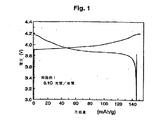
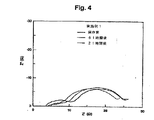
高温保存特性を試験するために、先に製造された電極を正極とし、リチウム金属を負極とするハーフセルを構成した。充放電電圧範囲を3V乃至4.2Vとした充放電特性を図1に示し、サイクル数に応じた容量変化を図2に示した。ハーフセルを3V乃至4.2Vで2サイクル充放電した後、ハーフセルを再び4.2Vに充電してインピーダンスを試験した。インピーダンス測定後、55℃で0.1kHz乃至100kHz範囲のインピーダンス変動結果を図4及び表1に示した。
フルセルのインピーダンスは、3V乃至4.2Vで2サイクル充放電した後、フルセルを再び4.2Vに充電して試験した。フルセル(Full cell)で同一に各々4.2Vまで2サイクルした後、第15、75、175サイクルで4.2Vで充電しながらインピーダンスを試験した。
【0035】
前記セルを4.2Vまで充電して分解し、電極を洗浄、このセルの構造的な安全性をTG/DTAで試験して、結果を図6に示した。前記過程はセルが空気と接触しないようにグローブボックス内で実施した。
【0036】
実施例2
リチウム材料の原料であるLi2CO3、コバルト原料であるCo(OH)3、そしてAlをドーピングするためのAl(OH)3をエタノールに溶かしLi:Co:Alのモル比を1.02:0.95:0.05にした。これらの原料を溶かした後、それらをボールミルで均一に粉砕し12時間混合して、乾燥器で12時間乾燥した。前記化合物を400℃で10時間焼成して繰り返し粉砕及び混合を行い、900℃で10時間空気中で熱処理して中心粒子であるLiCo0.95Al0.05O2を得た。
【0037】
前記正電極及びテストセルは、中心粒子を前記方法で製造したことを除き、実施例1と同じ方法で作りテストした。
【0038】
実施例3
リチウム原料であるLi2CO3及びコバルト原料であるCo(OH)3、そしてB及びSnをドーピングするためにB(OH)3及びSnCl4をエタノールに溶かしてLi:Co:B:Snのモル比を1.02:0.88:0.07:0.05とした。これらの原料を溶かした後、ボールミルを使用して均一に粉砕し12時間混合して、化合物を乾燥器で12時間乾燥した。前記化合物は400℃で10時間焼成し、繰り返し粉砕及び混合を行い、900℃で10時間空気中で熱処理して、中心粒子であるLiCo0.88B0.07Sn0.05O2を得た。
【0039】
前記正電極及びテストセルは、中心粒子を前記方法で製造したことを除き、実施例1と同じ方法で作りテストした。
【0040】
実施例4
前記正電極及びテストセルは実施例1と同じ方法で作りテストしたが、中心粒子は前記実施例2で得られたリチウムコバルト複合酸化物を使用し、網目構造変更子であるリチウムを供給する原料としてはLiOH・H2O、網目構造形成者であるBを供給する原料としてはB(OH)3を使用した。網目構造変更子と網目構造形成者との各量は当量比1.0:1.0になるように調節した。
【0041】
実施例5
前記正電極及びテストセルは実施例1と同じ方法で作りテストしたが、中心粒子は前記実施例2で得られたリチウムコバルト複合酸化物を使用し、網目構造変更子であるリチウム及びナトリウムを供給する原料としてはLiOH・H2O及びNaOH、網目構造形成者であるSiを供給する原料としてはSi(OC2H5)4を使用した。網目構造変更子と網目構造形成者との各量は当量比2.0:1.0になるように調節した。
【0042】
実施例6
前記正電極及びテストセルは実施例1と同じ方法で作りテストしたが、中心粒子は前記実施例3で得られたリチウムコバルト複合酸化物を使用し、網目構造変更子であるリチウムを供給する原料としてはLiOH・H2O、網目構造形成者であるAlを供給する原料としてはAl(OH)3を使用した。網目構造変更子と網目構造形成者との各量は当量比1.0:1.0になるように調節した。
【0043】
実施例7
前記正電極及びテストセルは実施例1と同じ方法で作ったが、中心粒子としては従来のリチウムコバルト複合酸化物(LiCoO2;Nippon Chem. Inc.;C−10)を使用した。
【0044】
実施例8
前記正電極及びテストセルは実施例2と同じ方法で作ったが、中心粒子としては従来のリチウムコバルト複合酸化物(LiCoO2;Nippon Chem. Inc.;C−10)を使用した。
【0045】
実施例9
前記正電極及びテストセルは実施例3と同じ方法で作ったが、中心粒子としては従来のリチウムコバルト複合酸化物(LiCoO2;Nippon Chem. Inc.;C−10)を使用した。
【0046】
実施例10
前記正電極及びテストセルは実施例2と同じ方法で作ったが、中心粒子としては被覆層の量を3モル%とした。
【0047】
実施例11
前記正電極及びテストセルは実施例1と同じ方法で作ったが、中心粒子としては従来のリチウムコバルト複合酸化物(LiCoO2;Nippon Chem. Inc.;C−10)を使用し、実施例1と同一の被覆層組成を有する中心粒子を100℃で10時間空気中で熱処理した。
【0048】
実施例12
前記正電極及びテストセルは実施例9と同じ方法で作ったが、熱処理は90体積%のCO2混合気と10体積%のO2の中で行った。
【0049】
比較例1
前記正電極及びテストセルは実施例1と同じ方法で作ったが、中心粒子の被覆は行わない。
【0050】
比較例2
前記正電極及びテストセルは実施例2と同じ方法で作ったが、中心粒子の被覆は行わない。
【0051】
比較例3
前記正電極及びテストセルは実施例3と同じ方法で作ったが、中心粒子の被覆は行わない。
【0052】
比較例4
前記正電極及びテストセルは比較例1と同じ方法で作ったが、中心粒子としては従来のリチウムコバルト複合酸化物(LiCoO2;Nippon Chem. Inc.;C−10)を使用した。
【0053】
図1は、Li2O・SiO2被覆層を形成した実施例1のリチウムコバルト複合酸化物中心粒子の充放電特性を示したグラフである。表面層の被覆後に容量が多少増加したことが分かった。これは従来の発明によると表面被覆層がリチウムを含有していないために容量が減少するのに比べて、本発明では表面層にリチウムを含有したガラス相を形成させることによってコーティング後にも容量の減少がない。
【0054】
図2及び図3は実施例と比較例のサイクル寿命特性を示したグラフである。本発明の被覆された中心粒子を有する実施例が、被覆された中心粒子を有しない比較例より優れた寿命特性を示している。
【0055】
図5及び図4は55℃での保存時間による正極活物質の表面抵抗インピーダンスの変化を示した図である。図4及び図5において、カーブ群の第2半分の形態群は表面のインピーダンス特性に起因したものである。グラフに示すように、実施例1の場合には初期表面インピーダンスが多少高いが、保存時間による実質的な変化がない。しかし比較例1の場合には、初期表面インピーダンスは少し低いいが、保存時間による大きい変化がある。電池の良好な安全性を得るためには初期表面インピーダンスが高くなければならず、電池の良好なサイクル寿命特性のためには保存時間によるインピーダンスの変化が僅少であるべきである。塗布被覆層を有する電池は塗布被覆層の無い電池より優れた安全性とサイクル寿命特性とを示している。
【0056】
図6は、4.2Vまで充電した後、実施例1、実施例6及び比較例1の各電池の酸素乖離によって把握したリチウムコバルト複合酸化物の温度による熱流量をTG/DTAで分析したグラフである。本発明の塗布被覆層を有する電池は、塗布被覆層の無い従来型電池より高い熱流開始温度と低い熱流量とを示す。
【0057】
【表1】
【発明の効果】
本発明はリチウム2次電池用正極活物質及びその製造法を提供して、正極活物質の表面にガラス相被覆層を形成して保存及びサイクル寿命特性と安全性とを改善する効果を有する。
本発明は好ましい実施例を用いて詳細に説明されており、当業者であれば、特許請求の範囲に記された本発明の本筋から離脱することなく、種々の変形や置き換えが簡単に行えるものである。
【図面の簡単な説明】
【図1】実施例1において、中心粒子にLi2O・SiO2被覆層を形成したリチウムコバルト複合酸化物の充放電特性を示したグラフである。
【図2】実施例1乃至実施例6と比較例1及び比較例2のサイクル寿命特性を示したグラフである。
【図3】実施例7乃至実施例12と比較例3及び比較例4のサイクル寿命特性を示したグラフである。
【図4】実施例1において、55℃での保存時間による正極活物質表面抵抗インピーダンスの変化を示したグラフである。
【図5】比較例1において、55℃での保存時間による正極活物質表面抵抗インピーダンスの変化を示したグラフである。
【図6】4.2Vまで充電した後で、実施例1、実施例6及び比較例1による電池の、酸素解離状況下でのリチウムコバルト複合酸化物の温度に依存する熱流レートを、示差熱熱量同時測定装置(TG/DTA)で分析して示したグラフである。[0001]
TECHNICAL FIELD OF THE INVENTION
The present invention relates to a positive electrode active material for a rechargeable lithium battery and a method for producing the same, and more particularly, to a positive electrode active material for a lithium rechargeable battery that improves both the characteristics of storage and cycle life at high temperatures and further improves safety. It relates to the manufacturing method.
[0002]
[Prior art]
Lithium secondary batteries are required to have good cycle life characteristics, safety and storage characteristics at high temperatures. An important factor in the cycle life characteristics of a battery is the active material characteristics of the positive electrode and the negative electrode. Recently, significant improvements have been made in the field of negative electrode active materials, but many problems still remain in the field of positive electrode active materials. Research on cathode active materials is particularly needed, because the safety and storage characteristics of batteries at high temperatures depend on the characteristics of the cathode active material.
[0003]
Representative positive electrode active materials of the lithium secondary battery are LiCoO 2 , LiNiO 2 , and LiMn 2 O 4 . In this, LiNiO 2 has a difficulty in practical use because of capacity is a maximum safety issues, since LiMn 2 O 4 is a minimum specific capacity is not suitable as a positive electrode active material, LiCoO 2 also Poor storage characteristics at high temperatures.
[0004]
Much research is underway to overcome the above problems. There are three representative approaches to this. First, a method of coating LiMn 2 O 4 with a metal carbonate to improve high-temperature storage characteristics; second, coating of LiCoO 2 with a metal oxide to improve cycle life characteristics and safety. Method: A third method is to improve the safety of a battery by improving structural and thermal characteristics by using various kinds of added impurities.
[0005]
However, even if the above-mentioned methods improve the cycle life characteristics at room temperature, they cannot improve the storage characteristics and the cycle life characteristics at high temperatures.
[0006]
An object of the present invention is to provide a positive electrode active material for a rechargeable lithium battery and a method for manufacturing the same, to improve cycle life characteristics at room temperature and high temperature, and to improve storage characteristics.
[0007]
In order to achieve these and other objects, the present invention provides a positive electrode active material for a lithium secondary battery, comprising: a) a lithium metal composite oxide represented by the following
Embedded image
Here, A is Co or Ni, B is selected from the group consisting of Al, B, Ni, Co, Ti, Sn, Mn, and Zr, x is a real number from 0 to 0.5,
Embedded image
[0009]
In addition, the method for manufacturing a cathode active material for a rechargeable lithium battery provided by the present invention includes the steps of: a) manufacturing a central particle that is a lithium metal composite oxide represented by Formula 1; Supplying the coating layer raw material compound, c) coating the coating layer raw material compound of step b) on the lithium metal composite oxide of step a), and d) coating the lithium metal composite oxide of step c). Firing the lithium metal composite oxide.
[0010]
The present invention also provides a lithium secondary battery including the positive electrode active material.
[0011]
BEST MODE FOR CARRYING OUT THE INVENTION
Hereinafter, the present invention will be described in detail.
[0012]
The positive electrode active material for a rechargeable lithium battery according to the present invention comprises: a) a lithium metal composite compound capable of inserting and releasing lithium ions; and b) an oxide glass phase having low electron conductivity and low reactivity with an electrolyte. A coating layer.
[0013]
a) The lithium metal composite compound as the central particle is described by Formula 1.
Embedded image
[0014]
The coating layer of b) contains a metal oxide and is represented by Formula 2.
Embedded image
[0015]
C s O t of the
[0016]
The subscripts s, t, z, and w are variables depending on the valence of C and D, respectively. For example, if C is a monovalent element, C s O t is an C 2 O; if C is a divalent element, C s O t is CO; if C is a tetravalent element, C s O t is CO 2 .
[0017]
Although the composition and components of the glass phase of the coating layer can vary somewhat, they are configured to be electrochemically safe and have low electron conductivity. Therefore, the glass phase in this layer not only reduces the electrochemical decomposition reaction of the electrolyte and improves the cycle life characteristics of the battery, but also suppresses the increase in resistance due to electrolyte decomposition by-products on the surface of the positive electrode active material at high temperatures. By doing so, the high temperature storage characteristics are improved. Furthermore, the glass phase of this layer hardly covers the central particles. Therefore, the safety of the battery is improved by removing the surface defects and improving the structural characteristics.
[0018]
The method for producing a positive electrode active material for a lithium secondary battery provided by the present invention includes the steps of: a) producing lithium metal composite oxide center particles; b) supplying a coating layer raw material compound; The method includes the steps of: coating a coating layer raw material compound on the lithium metal composite oxide; and d) firing the coated lithium metal composite oxide in c).
[0019]
It is step a) that the lithium metal composite oxide represented by the
[0020]
The lithium and metal compounds are heat-treated at a temperature of 400 ° C. to 900 ° C. for 1 hour to 20 hours in a mixed gas atmosphere containing 10% by volume or more of air or oxygen to produce the center particles of the present invention.
[0021]
In step b), the raw material compound group forming the oxide glass phase compound as the coating layer is mixed at an appropriate ratio to prepare a homogeneous mixed solution. At this time, the raw material of the coating layer is selected from the group consisting of carbonates, nitrates, hydrates, sulfates, acetates, citrates, chlorides and oxides of the metal elements C and D represented by
[0022]
It is preferable that the raw material of the coating layer is 0.01 mol% to 10 mol% of the central particles, on the assumption that the compound forming the coating layer becomes a glass phase metal oxide after heat treatment.
[0023]
In step c), the central particles of step a) are coated with the coating material prepared in step b). There are two methods. In one method, the lithium metal composite oxide powder of step a) is added to the aqueous or organic solution suspension of the raw material compound of step b), and a slurry is formed and stirred sufficiently with a stirrer. Heat to evaporate the solvent. After the heat treatment, the composite oxide glass is coated on the lithium metal composite oxide powder.
[0024]
Another simpler method is to spray the aqueous solution or the suspension of the organic solution on the surface of the lithium metal composite oxide and dry it. Specifically, the composite suspension is sprayed over the central particles, while the central particles are fluidized in air, and the application and drying are performed simultaneously, during which the temperature is controlled.
[0025]
The lithium metal composite oxide powder is dried in an oven at a temperature of 50 ° C. to 150 ° C. and heat-treated in an atmosphere of air or a mixed gas having an oxygen content of 10% by volume or more. In this treatment, the gas flow rate is 0.05 L / gH to 2.0 L / gH, and the heat treatment time is 1 hour to 30 hours, preferably 5 hours to 15 hours.
[0026]
The heat treatment time and temperature can be adjusted within the above-mentioned range according to the purpose. A part of the surface layer may be partially cured depending on the heat treatment temperature, and some elements may be doped on the center particle surface during the heat treatment.
[0027]
The following examples illustrate the invention in more detail, but should not be construed as limiting the invention to any particular embodiment.
[0028]
【Example】
Example 1
(Production of center particle)
Li 2 CO 3, which is a raw material of lithium, and Co 3 O 4 , which is a raw material of cobalt, are mixed in ethanol at a molar ratio of Li: Co of 1.02: 1, and then homogenized and mixed for 10 hours. Dried for hours. Thereafter, the resultant was fired at 400 ° C. for 10 hours to perform pulverization and mixing again, and then heat-treated at 900 ° C. for 10 hours in air to produce LiCoO 2 as central particles.
[0029]
(Manufacture of coating layer material)
LiOH.H 2 O was used as a raw material for supplying Li to be a network structure modifier, and Si (OC 2 H 5 ) 4 was used as a raw material for supplying Si for forming a network structure. After adjusting the amounts of the network structure modifier and the network structure former so that the equivalent ratio of Li: Si becomes 2.0: 1.0, LiOH · H 2 O and Si (OC 2 H 5 ) 4 Was dissolved in an organic solvent and stirred for 30 minutes or more to obtain a uniform mixed solution of a metal compound. The amount of the compound to be the coating layer was 1 mol% with respect to the center particles, and it was assumed that the raw material of the compound was converted to oxide glass by heat treatment.
[0030]
(Coating)
After mixing the coating layer compound and the lithium-cobalt composite oxide, the central particles were coated with stirring, and heat was applied to evaporate the solvent.
[0031]
(Fired)
The coated lithium cobalt composite oxide powder was heat-treated in a tube furnace at 600 ° C. for 5 hours. In the air, the flow rate of the air was 0.1 L / gH.
[0032]
(Production of test cell)
Lithium-cobalt composite oxide powder, 10% by weight of graphite and 5% by weight of PVDF (polyvinylidene fluoride) were dispersed in NMP (n-methyl pyrrolidone) solvent to obtain a slurry. The slurry was applied to an aluminum foil and heated, and the NMP solvent was evaporated to dryness.
[0033]
MCMB (Mesocarbon Microbead) is used as a negative electrode, the electrolyte, a volume ratio of 1: 2 of EC (ethylene carbonate): a LiPF 6 was used by dissolving 1 mol of EMC (ethylmethyl carbonate) compounds.
[0034]
(Measurement of test cell characteristics)
In order to test the high-temperature storage characteristics, a half cell having the previously manufactured electrode as a positive electrode and lithium metal as a negative electrode was constructed. FIG. 1 shows the charge / discharge characteristics when the charge / discharge voltage range is 3 V to 4.2 V, and FIG. 2 shows the change in capacity according to the number of cycles. After charging and discharging the half cell at 3 V to 4.2 V for 2 cycles, the half cell was charged again to 4.2 V and the impedance was tested. After the impedance measurement, the impedance fluctuation results in the range of 0.1 kHz to 100 kHz at 55 ° C. are shown in FIG.
The full cell impedance was tested by charging / discharging the full cell at 3 V to 4.2 V for 2 cycles and then charging the full cell to 4.2 V again. After performing two cycles to 4.2 V each in the same manner in a full cell, the impedance was tested while charging at 4.2 V at the 15, 75, and 175 cycles.
[0035]
The cell was charged to 4.2 V and disassembled, the electrodes were washed, and the structural safety of the cell was tested by TG / DTA. The results are shown in FIG. The process was performed in a glove box so that the cell did not come into contact with air.
[0036]
Example 2
Dissolved Li 2 CO 3 as a raw material for lithium material, cobalt is a starting material Co (OH) 3, and the Al (OH) 3 for doping Al in ethanol Li: Co: the molar ratio of Al 1.02: 0.95: 0.05. After dissolving these raw materials, they were uniformly ground with a ball mill, mixed for 12 hours, and dried in a dryer for 12 hours. The compound was calcined at 400 ° C. for 10 hours, repeatedly pulverized and mixed, and heat-treated at 900 ° C. for 10 hours in air to obtain LiCo 0.95 Al 0.05 O 2 as central particles.
[0037]
The positive electrode and the test cell were manufactured and tested in the same manner as in Example 1, except that the central particles were manufactured by the above method.
[0038]
Example 3
Li: CO: B: Sn is dissolved by dissolving B (OH) 3 and SnCl 4 in ethanol to dope Li 2 CO 3 as a lithium material and Co (OH) 3 as a cobalt material, and B and Sn. The ratio was 1.02: 0.88: 0.07: 0.05. After dissolving these raw materials, they were uniformly ground using a ball mill, mixed for 12 hours, and dried in a dryer for 12 hours. The compound is calcined at 400 ° C. for 10 hours, repeatedly pulverized and mixed, and heat-treated in air at 900 ° C. for 10 hours to obtain LiCo 0.88 B 0.07 Sn 0.05 O 2 as the central particle. Was.
[0039]
The positive electrode and the test cell were manufactured and tested in the same manner as in Example 1, except that the central particles were manufactured by the above method.
[0040]
Example 4
The positive electrode and the test cell were manufactured and tested in the same manner as in Example 1, but the central particles used were the lithium-cobalt composite oxide obtained in Example 2 and a raw material for supplying lithium as a network structure modifier. the as raw material supplies B is LiOH · H 2 O, network former's using B (OH) 3. The respective amounts of the network structure modifier and the network structure creator were adjusted so that the equivalent ratio was 1.0: 1.0.
[0041]
Example 5
The positive electrode and the test cell were manufactured and tested in the same manner as in Example 1, but the central particles used the lithium-cobalt composite oxide obtained in Example 2 and supplied lithium and sodium as network structure modifiers. The raw materials used were LiOH.H 2 O and NaOH, and Si (OC 2 H 5 ) 4 was used as the raw material for supplying Si, the network structure creator. The amounts of the network structure modifier and the network structure creator were adjusted so that the equivalent ratio was 2.0: 1.0.
[0042]
Example 6
The positive electrode and the test cell were manufactured and tested in the same manner as in Example 1, but the central particles used were the lithium-cobalt composite oxide obtained in Example 3 and a raw material for supplying lithium as a network structure modifier. And Li (OH) 3 as a raw material for supplying LiOH.H 2 O and Al as a network structure maker. The respective amounts of the network structure modifier and the network structure creator were adjusted so that the equivalent ratio was 1.0: 1.0.
[0043]
Example 7
The positive electrode and the test cell were manufactured in the same manner as in Example 1, but a conventional lithium-cobalt composite oxide (LiCoO 2 ; Nippon Chem. Inc .; C-10) was used as the central particle.
[0044]
Example 8
The positive electrode and the test cell were manufactured in the same manner as in Example 2, but a conventional lithium-cobalt composite oxide (LiCoO 2 ; Nippon Chem. Inc .; C-10) was used as the central particle.
[0045]
Example 9
The positive electrode and the test cell were manufactured in the same manner as in Example 3, but a conventional lithium-cobalt composite oxide (LiCoO 2 ; Nippon Chem. Inc .; C-10) was used as the central particle.
[0046]
Example 10
The positive electrode and the test cell were produced in the same manner as in Example 2, except that the amount of the coating layer as the central particle was 3 mol%.
[0047]
Example 11
The positive electrode and the test cell were prepared in the same manner as in Example 1, except that a conventional lithium-cobalt composite oxide (LiCoO 2 ; Nippon Chem. Inc .; C-10) was used as the central particle. The center particles having the same coating layer composition as in Example 1 were heat-treated at 100 ° C. for 10 hours in air.
[0048]
Example 12
The positive electrode and the test cell were prepared in the same manner as in Example 9, except that the heat treatment was performed in a 90% by volume CO 2 mixture and 10% by volume O 2 .
[0049]
Comparative Example 1
The positive electrode and the test cell were made in the same manner as in Example 1, but without coating the central particles.
[0050]
Comparative Example 2
The positive electrode and the test cell were made in the same manner as in Example 2, but without coating the central particles.
[0051]
Comparative Example 3
The positive electrode and test cell were made in the same manner as in Example 3, but without the coating of the central particles.
[0052]
Comparative Example 4
The positive electrode and the test cell were manufactured in the same manner as in Comparative Example 1, but a conventional lithium-cobalt composite oxide (LiCoO 2 ; Nippon Chem. Inc .; C-10) was used as the central particle.
[0053]
FIG. 1 is a graph showing the charge / discharge characteristics of the lithium-cobalt composite oxide center particles of Example 1 in which a Li 2 O.SiO 2 coating layer was formed. It was found that the capacity increased somewhat after coating of the surface layer. This is because, according to the conventional invention, the capacity is reduced because the surface coating layer does not contain lithium, whereas in the present invention, the capacity is maintained even after coating by forming a glass phase containing lithium on the surface layer. There is no decrease.
[0054]
2 and 3 are graphs showing cycle life characteristics of the example and the comparative example. The examples with coated center particles of the present invention show better life characteristics than the comparative example without coated center particles.
[0055]
FIGS. 5 and 4 are diagrams showing changes in the surface resistance impedance of the positive electrode active material depending on the storage time at 55 ° C. In FIGS. 4 and 5, the second half form group of the curve group is due to the impedance characteristics of the surface. As shown in the graph, in the case of Example 1, the initial surface impedance was slightly higher, but there was no substantial change due to the storage time. However, in the case of Comparative Example 1, although the initial surface impedance is slightly low, there is a large change due to the storage time. The initial surface impedance must be high in order to obtain good safety of the battery, and the change in impedance with storage time should be small for good cycle life characteristics of the battery. Batteries with a coating layer show better safety and cycle life characteristics than batteries without a coating layer.
[0056]
FIG. 6 is a graph in which the heat flow according to the temperature of the lithium-cobalt composite oxide determined by the oxygen divergence of each battery of Example 1, Example 6, and Comparative Example 1 after being charged to 4.2 V was analyzed by TG / DTA. It is. The battery having the coating layer of the present invention exhibits a higher heat flow initiation temperature and a lower heat flow rate than the conventional battery without the coating layer.
[0057]
[Table 1]
【The invention's effect】
The present invention provides a positive active material for a rechargeable lithium battery and a method of manufacturing the same, and has an effect of forming a glass phase coating layer on the surface of the positive active material to improve storage and cycle life characteristics and safety.
The present invention has been described in detail using preferred embodiments, and those skilled in the art will be able to easily perform various modifications and replacements without departing from the main features of the present invention described in the claims. It is.
[Brief description of the drawings]
FIG. 1 is a graph showing charge / discharge characteristics of a lithium-cobalt composite oxide in which a Li 2 O.SiO 2 coating layer is formed on central particles in Example 1.
FIG. 2 is a graph showing cycle life characteristics of Examples 1 to 6 and Comparative Examples 1 and 2.
FIG. 3 is a graph showing cycle life characteristics of Examples 7 to 12 and Comparative Examples 3 and 4.
FIG. 4 is a graph showing the change in the surface resistance impedance of the positive electrode active material depending on the storage time at 55 ° C. in Example 1.
FIG. 5 is a graph showing a change in surface resistance impedance of a positive electrode active material according to a storage time at 55 ° C. in Comparative Example 1.
FIG. 6 shows the heat flow rate of the batteries according to Example 1, Example 6 and Comparative Example 1 depending on the temperature of the lithium-cobalt composite oxide under oxygen dissociation conditions after being charged to 4.2 V. It is the graph analyzed and shown by the simultaneous calorimeter (TG / DTA).
Claims (10)
a)下記の式1で記述されるリチウム金属複合酸化物;及び
b)前記a)のリチウム金属複合酸化物に被覆されて下記の式2で記述される非晶質酸化物であるガラス相の被覆層、を含むことを特徴とする正極活物質。
AはCoまたはNiであり、
BはAl、B、Ni、Co、Ti、Sn、Mn、及びZrからなる群より選択され、
xは0乃至0.5の実数であり、
CはNa、K、Mg、Ba、Sr、Y、Sn、Ga、In、Th、Pb、Li、Zn、Ca、Cd、Rb、Sc、Ti、Zn、Al、Be、及びZrからなる群より選択され、
DはAl、B、Si、Ge、P、V、As、Sb、Zr、Nb、Ti、Zn、Zr、及びPbからなる群より選択され、
yは0.5乃至3の実数であり、
s、t、z、及びwは各々C、Dの原子価による変数である。In a positive electrode active material for a lithium secondary battery,
a) a lithium metal composite oxide represented by the following formula 1; and b) a glass phase coated on the lithium metal composite oxide of the above a) and being an amorphous oxide represented by the following formula 2 A positive electrode active material comprising a coating layer.
A is Co or Ni;
B is selected from the group consisting of Al, B, Ni, Co, Ti, Sn, Mn, and Zr;
x is a real number from 0 to 0.5,
C is from the group consisting of Na, K, Mg, Ba, Sr, Y, Sn, Ga, In, Th, Pb, Li, Zn, Ca, Cd, Rb, Sc, Ti, Zn, Al, Be, and Zr. Selected,
D is selected from the group consisting of Al, B, Si, Ge, P, V, As, Sb, Zr, Nb, Ti, Zn, Zr, and Pb;
y is a real number of 0.5 to 3,
s, t, z, and w are variables depending on the valence of C and D, respectively.
a)式1で記述されるリチウム金属複合酸化物である中心粒子を製造する段階と、
b)式2で記述される酸化物ガラス相を形成する被覆層原料の化合物を供給する段階と、
c)前記b)段階の被覆層原料の化合物を前記a)段階のリチウム金属複合酸化物に被覆する段階と、
d)前記c)段階の被覆されたリチウム金属複合酸化物を焼成する段階と、を含むことを特徴とする方法。
AはCoまたはNiであり、
BはAl、B、Ni、Co、Ti、Sn、Mn、及びZrからなる群より選択され、
xは0乃至0.5の実数であり、
CはNa、K、Mg、Ba、Sr、Y、Sn、Ga、In、Th、Pb、Li、Zn、Ca、Cd、Rb、Sc、Ti、Zn、Al、Be、及びZrからなる群より選択され、
DはAl、B、Si、Ge、P、V、As、Sb、Zr、Nb、Ti、Zn、Zr、及びPbからなる群より選択され、
yは0.5乃至3の実数であり、
s、t、z、及びwは各々C、Dの原子価による変数である。In a method for producing a positive electrode active material for a lithium secondary battery,
a) producing a central particle that is a lithium metal composite oxide described by Formula 1;
b) providing a coating layer raw material compound that forms an oxide glass phase described by Formula 2;
c) coating the compound of the coating layer raw material of the step b) on the lithium metal composite oxide of the step a);
d) calcining the coated lithium metal composite oxide of step c).
A is Co or Ni;
B is selected from the group consisting of Al, B, Ni, Co, Ti, Sn, Mn, and Zr;
x is a real number from 0 to 0.5,
C is from the group consisting of Na, K, Mg, Ba, Sr, Y, Sn, Ga, In, Th, Pb, Li, Zn, Ca, Cd, Rb, Sc, Ti, Zn, Al, Be, and Zr. Selected,
D is selected from the group consisting of Al, B, Si, Ge, P, V, As, Sb, Zr, Nb, Ti, Zn, Zr, and Pb;
y is a real number of 0.5 to 3,
s, t, z, and w are variables depending on the valence of C and D, respectively.
i)リチウム化合物、
ii)Aと記述される金属CoまたはNiの炭酸塩、硝酸塩、含水塩、酢酸塩、クエン酸塩、塩化物、及び酸化物からなる群より選択される化合物、
及び
空気、または酸素10体積%以上を含む混合ガス雰囲気下で1時間乃至20時間400℃乃至900℃の温度で熱処理されて製造される金属Bの化合物を含む化合物、を含むことを特徴とする請求項3に記載の製造方法。The central particles in the step a) are as follows:
i) lithium compound,
ii) a compound selected from the group consisting of carbonates, nitrates, hydrates, acetates, citrates, chlorides and oxides of the metal Co or Ni described as A;
And a compound containing a metal B compound that is heat-treated at a temperature of 400 to 900 ° C. for 1 to 20 hours in a mixed gas atmosphere containing 10% by volume or more of air or oxygen. The method according to claim 3.
i)Na、K、Mg、Ba、Sr、Y、Sn、Ga、In、Th、Pb、Li、Zn、Ca、Cd、Rb、Sc、Ti、Zn、Al、Be、及びZrと記述された金属Cの炭酸塩、硝酸塩、含水塩、酢酸塩、クエン酸塩、塩化物及び酸化物からなる群より選択される化合物、及び
ii)Al、B、Si、Ge、P、V、As、Sb、Zr、Nb、Ti、Zn、Zr、及びPbと記述された金属Dの炭酸塩、硝酸塩、含水塩、酢酸塩、クエン酸塩、塩化物及び酸化物からなる群より選択される化合物を含む化合物、を分解して製造される、ことを特徴とする請求項3に記載の方法。The raw material of the coating layer in step b) is i) Na, K, Mg, Ba, Sr, Y, Sn, Ga, In, Th, Pb, Li, Zn, Ca, Cd, Rb, Sc, Ti, Zn, A compound selected from the group consisting of carbonates, nitrates, hydrates, acetates, citrates, chlorides and oxides of metal C, described as Al, Be and Zr; and ii) Al, B, Si , Ge, P, V, As, Sb, Zr, Nb, Ti, Zn, Zr, and metal D carbonates, nitrates, hydrates, acetates, citrates, chlorides and oxides described as Pb The method according to claim 3, wherein the compound is produced by decomposing a compound containing a compound selected from the group consisting of:
Applications Claiming Priority (2)
| Application Number | Priority Date | Filing Date | Title |
|---|---|---|---|
| KR1020010006791A KR100674015B1 (en) | 2001-02-12 | 2001-02-12 | A cathode active material of a lithium secondary battery having excellent lifespan characteristics, a method of manufacturing the same, and a lithium secondary battery including the same |
| PCT/KR2002/000110 WO2002065562A1 (en) | 2001-02-12 | 2002-01-24 | A positive active material for a lithium secondary battery with higher performance and preparation method of the same |
Publications (2)
| Publication Number | Publication Date |
|---|---|
| JP2004519082A true JP2004519082A (en) | 2004-06-24 |
| JP3984169B2 JP3984169B2 (en) | 2007-10-03 |
Family
ID=19705634
Family Applications (1)
| Application Number | Title | Priority Date | Filing Date |
|---|---|---|---|
| JP2002564773A Expired - Lifetime JP3984169B2 (en) | 2001-02-12 | 2002-01-24 | Positive electrode active material for high-performance lithium secondary battery and method for producing the same |
Country Status (7)
| Country | Link |
|---|---|
| US (2) | US7252906B2 (en) |
| EP (1) | EP1277247B1 (en) |
| JP (1) | JP3984169B2 (en) |
| KR (1) | KR100674015B1 (en) |
| CN (1) | CN1213495C (en) |
| TW (1) | TW552729B (en) |
| WO (1) | WO2002065562A1 (en) |
Cited By (5)
| Publication number | Priority date | Publication date | Assignee | Title |
|---|---|---|---|---|
| WO2014013837A1 (en) * | 2012-07-19 | 2014-01-23 | 株式会社 日立製作所 | Active material particles for lithium ion secondary batteries, and lithium ion secondary battery using same |
| JP2014513392A (en) * | 2011-04-06 | 2014-05-29 | ユミコア | Glass coated cathode powder for rechargeable batteries |
| US8911903B2 (en) | 2006-07-03 | 2014-12-16 | Sony Corporation | Cathode active material, its manufacturing method, and non-aqueous electrolyte secondary battery |
| JP2015130273A (en) * | 2014-01-07 | 2015-07-16 | 日立金属株式会社 | Positive electrode active material for lithium ion secondary battery, positive electrode for lithium ion secondary battery using the same and lithium ion secondary battery, and production method of positive electrode active material for lithium ion secondary battery |
| JP2018508114A (en) * | 2015-11-30 | 2018-03-22 | エルジー・ケム・リミテッド | Positive electrode active material for secondary battery and secondary battery including the same |
Families Citing this family (30)
| Publication number | Priority date | Publication date | Assignee | Title |
|---|---|---|---|---|
| KR20030083476A (en) * | 2002-04-23 | 2003-10-30 | 주식회사 엘지화학 | Lithium metal oxides with enhanced cycle life and safety and a process for preparation thereof |
| US8029930B2 (en) * | 2002-12-06 | 2011-10-04 | Kawatetsu Mining Co., Ltd. | Positive electrode material for lithium secondary battery, method for producing the same, and lithium secondary battery |
| CN1328806C (en) * | 2003-01-10 | 2007-07-25 | 日本化学工业株式会社 | Lithium-cobalt system composite oxides and mfg. method, lithium storage battery positive pole active material and lithium storage battery |
| US7566479B2 (en) * | 2003-06-23 | 2009-07-28 | Lg Chem, Ltd. | Method for the synthesis of surface-modified materials |
| US7709149B2 (en) * | 2004-09-24 | 2010-05-04 | Lg Chem, Ltd. | Composite precursor for aluminum-containing lithium transition metal oxide and process for preparation of the same |
| KR100681451B1 (en) | 2004-10-26 | 2007-02-09 | 주식회사 엘지화학 | Electrode active material containing a zinc-tin compound and a lithium secondary battery using the same |
| CN100420088C (en) * | 2004-11-08 | 2008-09-17 | 深圳市比克电池有限公司 | Lithium-ion secondary battery with nickel-based positive electrode active material and preparation method thereof |
| KR100911798B1 (en) * | 2005-03-23 | 2009-08-12 | 파나소닉 주식회사 | Lithium-ion Secondary Battery and Manufacturing Method Thereof |
| US20070298512A1 (en) | 2005-04-13 | 2007-12-27 | Lg Chem, Ltd. | Material for lithium secondary battery of high performance |
| US20080032196A1 (en) | 2005-04-13 | 2008-02-07 | Lg Chem, Ltd. | Method of preparing material for lithium secondary battery of high performance |
| US20070292761A1 (en) * | 2005-04-13 | 2007-12-20 | Lg Chem, Ltd. | Material for lithium secondary battery of high performance |
| US7648693B2 (en) * | 2005-04-13 | 2010-01-19 | Lg Chem, Ltd. | Ni-based lithium transition metal oxide |
| US20080280190A1 (en) * | 2005-10-20 | 2008-11-13 | Robert Brian Dopp | Electrochemical catalysts |
| JP5128779B2 (en) * | 2006-03-06 | 2013-01-23 | パナソニック株式会社 | Lithium ion secondary battery |
| US7955755B2 (en) | 2006-03-31 | 2011-06-07 | Quantumsphere, Inc. | Compositions of nanometal particles containing a metal or alloy and platinum particles |
| CN100464907C (en) * | 2007-04-29 | 2009-03-04 | 北京科技大学 | Preparation method of high specific capacity cobalt/antimony alloy material for negative electrode of lithium ion battery |
| US8296843B2 (en) * | 2007-09-14 | 2012-10-23 | At&T Intellectual Property I, L.P. | Apparatus, methods and computer program products for monitoring network activity for child related risks |
| US20090087744A1 (en) * | 2007-09-28 | 2009-04-02 | 3M Innovative Properties Company | Method of making cathode compositions |
| KR101124492B1 (en) | 2009-09-09 | 2012-03-16 | 한국과학기술연구원 | Method of preparing positine active material for lithium battery |
| CN101740755B (en) * | 2009-12-31 | 2012-10-31 | 江苏凯力克钴业股份有限公司 | Production method of lithium cobalt oxide |
| KR101409191B1 (en) * | 2012-03-26 | 2014-06-19 | 한국세라믹기술원 | Manufacturing method of cathode active material for lithium secondary battery |
| KR101406512B1 (en) * | 2012-12-14 | 2014-06-12 | 삼성정밀화학 주식회사 | Positive active material, method of preparing the same, and lithium secondary battery using the same |
| CN103915629A (en) * | 2014-03-25 | 2014-07-09 | 湖南立方新能源科技有限责任公司 | A kind of preparation method of coating material for lithium ion battery |
| CN105047858A (en) * | 2015-08-25 | 2015-11-11 | 田东 | Preparation method for lithium cobalt oxide cathode slurry |
| CN109643794B (en) * | 2017-02-02 | 2021-11-23 | 株式会社Lg化学 | Positive electrode active material for secondary battery and method for preparing same |
| KR102237951B1 (en) * | 2017-03-21 | 2021-04-08 | 주식회사 엘지화학 | Positive electrode active material, producing method thereof, positive electrode and secondary battery comprising the same |
| EP3736820A4 (en) * | 2018-01-05 | 2021-03-10 | Panasonic Intellectual Property Management Co., Ltd. | Solid electrolyte material, and battery |
| US11870070B2 (en) * | 2018-01-24 | 2024-01-09 | Lg Energy Solution, Ltd. | Positive electrode active material for secondary battery, method of preparing the same, and lithium secondary battery including the positive electrode active material |
| GB2572610B (en) * | 2018-04-03 | 2021-06-23 | Ilika Tech Limited | Composition, methods for its production, and its use |
| CN115663165B (en) * | 2022-12-26 | 2023-03-10 | 松山湖材料实验室 | Positive active material and preparation method thereof, positive pole piece and lithium battery |
Family Cites Families (19)
| Publication number | Priority date | Publication date | Assignee | Title |
|---|---|---|---|---|
| US3251926A (en) * | 1964-09-02 | 1966-05-17 | Union Carbide Corp | Electrode joint for joining negative carbon electrodes |
| EP0630064B1 (en) * | 1993-04-28 | 1998-07-15 | Fuji Photo Film Co., Ltd. | Nonaqueous electrolyte-secondary battery |
| JP2787153B2 (en) | 1994-09-30 | 1998-08-13 | 株式会社日立製作所 | Secondary battery and method of manufacturing the same |
| JP3298358B2 (en) * | 1995-04-25 | 2002-07-02 | 日産自動車株式会社 | Method and apparatus for controlling compression end temperature in diesel engine |
| JPH09115505A (en) | 1995-10-16 | 1997-05-02 | Sanyo Electric Co Ltd | Lithium secondary battery and its manufacture |
| JP3588885B2 (en) | 1995-12-21 | 2004-11-17 | ソニー株式会社 | Non-aqueous electrolyte battery |
| JPH10172557A (en) | 1996-12-16 | 1998-06-26 | Kansai Shokubai Kagaku Kk | Manufacture of active material for nickel electrode |
| JPH1116566A (en) | 1997-06-20 | 1999-01-22 | Hitachi Ltd | Battery |
| JPH1192119A (en) | 1997-09-16 | 1999-04-06 | Toyota Central Res & Dev Lab Inc | Oxide powder |
| JP3691279B2 (en) * | 1998-02-10 | 2005-09-07 | 三星エスディアイ株式会社 | Positive electrode active material for lithium secondary battery, method for producing the same, and lithium secondary battery |
| KR19990079408A (en) * | 1998-04-06 | 1999-11-05 | 손욱 | Cathode active material for lithium secondary battery and manufacturing method thereof |
| US6214061B1 (en) * | 1998-05-01 | 2001-04-10 | Polyplus Battery Company, Inc. | Method for forming encapsulated lithium electrodes having glass protective layers |
| JP2000195517A (en) * | 1998-12-28 | 2000-07-14 | Japan Storage Battery Co Ltd | Lithium secondary battery |
| KR100326455B1 (en) | 1999-03-30 | 2002-02-28 | 김순택 | Positive active material for lithium secondary battery and method of preparing the same |
| CA2268346A1 (en) * | 1999-04-07 | 2000-10-07 | Hydro-Quebec | Lipo3 commutation electrode |
| KR100398744B1 (en) * | 2000-02-16 | 2003-09-19 | 주식회사 엘지화학 | Method for preparing lithium manganese spinel oxide with improved electrochemical performance |
| KR100696619B1 (en) * | 2000-09-25 | 2007-03-19 | 삼성에스디아이 주식회사 | Cathode active material for lithium secondary battery and manufacturing method thereof |
| KR100389655B1 (en) * | 2000-10-14 | 2003-06-27 | 삼성에스디아이 주식회사 | Lithium-ion secondary thin-film battery exhibiting good cycling stability and high ion-conductivity |
| KR100450256B1 (en) * | 2001-02-06 | 2004-09-30 | 주식회사 엘지화학 | Positive active material for lithium secondary battery and method for preparing the same |
-
2001
- 2001-02-12 KR KR1020010006791A patent/KR100674015B1/en not_active Expired - Lifetime
-
2002
- 2002-01-24 JP JP2002564773A patent/JP3984169B2/en not_active Expired - Lifetime
- 2002-01-24 EP EP02711485.9A patent/EP1277247B1/en not_active Expired - Lifetime
- 2002-01-24 CN CNB028002776A patent/CN1213495C/en not_active Expired - Lifetime
- 2002-01-24 WO PCT/KR2002/000110 patent/WO2002065562A1/en not_active Ceased
- 2002-01-24 US US10/240,536 patent/US7252906B2/en not_active Expired - Lifetime
- 2002-02-04 TW TW091102160A patent/TW552729B/en not_active IP Right Cessation
-
2006
- 2006-12-22 US US11/643,674 patent/US20070122713A1/en not_active Abandoned
Cited By (7)
| Publication number | Priority date | Publication date | Assignee | Title |
|---|---|---|---|---|
| US8911903B2 (en) | 2006-07-03 | 2014-12-16 | Sony Corporation | Cathode active material, its manufacturing method, and non-aqueous electrolyte secondary battery |
| JP2014513392A (en) * | 2011-04-06 | 2014-05-29 | ユミコア | Glass coated cathode powder for rechargeable batteries |
| WO2014013837A1 (en) * | 2012-07-19 | 2014-01-23 | 株式会社 日立製作所 | Active material particles for lithium ion secondary batteries, and lithium ion secondary battery using same |
| JP2014022204A (en) * | 2012-07-19 | 2014-02-03 | Hitachi Ltd | Active material particle for lithium ion secondary battery, and lithium ion secondary battery using the same |
| JP2015130273A (en) * | 2014-01-07 | 2015-07-16 | 日立金属株式会社 | Positive electrode active material for lithium ion secondary battery, positive electrode for lithium ion secondary battery using the same and lithium ion secondary battery, and production method of positive electrode active material for lithium ion secondary battery |
| JP2018508114A (en) * | 2015-11-30 | 2018-03-22 | エルジー・ケム・リミテッド | Positive electrode active material for secondary battery and secondary battery including the same |
| US10177386B2 (en) | 2015-11-30 | 2019-01-08 | Lg Chem, Ltd. | Positive electrode active material for secondary battery, and secondary battery including the same |
Also Published As
| Publication number | Publication date |
|---|---|
| CN1457519A (en) | 2003-11-19 |
| EP1277247A1 (en) | 2003-01-22 |
| JP3984169B2 (en) | 2007-10-03 |
| US7252906B2 (en) | 2007-08-07 |
| US20070122713A1 (en) | 2007-05-31 |
| EP1277247B1 (en) | 2017-08-23 |
| TW552729B (en) | 2003-09-11 |
| CN1213495C (en) | 2005-08-03 |
| WO2002065562A1 (en) | 2002-08-22 |
| KR20020066548A (en) | 2002-08-19 |
| KR100674015B1 (en) | 2007-01-24 |
| US20030148182A1 (en) | 2003-08-07 |
Similar Documents
| Publication | Publication Date | Title |
|---|---|---|
| JP3984169B2 (en) | Positive electrode active material for high-performance lithium secondary battery and method for producing the same | |
| JP4465264B2 (en) | Lithium metal composite oxide having excellent life characteristics and safety and method for producing the same | |
| KR100326455B1 (en) | Positive active material for lithium secondary battery and method of preparing the same | |
| CN111916697B (en) | Cobalt-free cathode material, preparation method thereof, lithium ion battery cathode and lithium battery | |
| CN1263182C (en) | Positive active material for rechargeable lithium cell and preparation process thereof | |
| US6531220B1 (en) | Positive active material for rechargeable lithium battery and method of preparing same | |
| JP3770834B2 (en) | Method for producing lithium manganese spinel composite oxide with improved electrochemical performance | |
| JP2004519825A (en) | Positive electrode active material for lithium secondary battery and method for producing the same | |
| JP2000268812A (en) | Positive electrode active material for lithium secondary battery and method for producing the same | |
| WO2010135960A1 (en) | Titanium system composite and the preparing method of the same | |
| CN108365220B (en) | Lithium source material, preparation method thereof and application thereof in lithium ion battery | |
| CN117154097A (en) | Coated positive electrode lithium supplementing agent and preparation method thereof | |
| US6972134B2 (en) | Method of preparing positive active material for rechargeable lithium batteries | |
| CN114506830A (en) | Preparation method of phosphate coated positive electrode active material | |
| JP2024035880A (en) | Cathode for all-solid-state batteries and all-solid-state batteries | |
| JP7163624B2 (en) | Positive electrode active material for lithium ion secondary battery, method for producing the same, and lithium ion secondary battery using the positive electrode active material | |
| CN102779992B (en) | A kind of lithium ion battery positive electrode material in layer structure and preparation method thereof | |
| JP2021093287A (en) | Manufacturing method of coated active material | |
| JP3835235B2 (en) | Cathode active material for non-aqueous electrolyte secondary battery and method for producing the same | |
| CN114614009A (en) | Composite material, preparation method thereof, negative plate and secondary battery | |
| CN119695127B (en) | Positive electrode material, and preparation method and application thereof | |
| TWI857380B (en) | Positive electrode active material for lithium electronic battery, lithium battery and method of manufacturing the same | |
| TW202419637A (en) | Anode material for lithium-ion secondary battery, and anode, battery and preparation method thereof | |
| JP2001048544A (en) | Method for producing lithium manganese composite oxide for non-aqueous lithium secondary battery and use thereof |
Legal Events
| Date | Code | Title | Description |
|---|---|---|---|
| A977 | Report on retrieval |
Free format text: JAPANESE INTERMEDIATE CODE: A971007 Effective date: 20050715 |
|
| A131 | Notification of reasons for refusal |
Free format text: JAPANESE INTERMEDIATE CODE: A131 Effective date: 20050726 |
|
| A601 | Written request for extension of time |
Free format text: JAPANESE INTERMEDIATE CODE: A601 Effective date: 20051026 |
|
| A602 | Written permission of extension of time |
Free format text: JAPANESE INTERMEDIATE CODE: A602 Effective date: 20051102 |
|
| A521 | Request for written amendment filed |
Free format text: JAPANESE INTERMEDIATE CODE: A523 Effective date: 20060126 |
|
| A131 | Notification of reasons for refusal |
Free format text: JAPANESE INTERMEDIATE CODE: A131 Effective date: 20070130 |
|
| A521 | Request for written amendment filed |
Free format text: JAPANESE INTERMEDIATE CODE: A523 Effective date: 20070427 |
|
| TRDD | Decision of grant or rejection written | ||
| A01 | Written decision to grant a patent or to grant a registration (utility model) |
Free format text: JAPANESE INTERMEDIATE CODE: A01 Effective date: 20070612 |
|
| A61 | First payment of annual fees (during grant procedure) |
Free format text: JAPANESE INTERMEDIATE CODE: A61 Effective date: 20070705 |
|
| FPAY | Renewal fee payment (event date is renewal date of database) |
Free format text: PAYMENT UNTIL: 20100713 Year of fee payment: 3 |
|
| R150 | Certificate of patent or registration of utility model |
Ref document number: 3984169 Country of ref document: JP Free format text: JAPANESE INTERMEDIATE CODE: R150 Free format text: JAPANESE INTERMEDIATE CODE: R150 |
|
| FPAY | Renewal fee payment (event date is renewal date of database) |
Free format text: PAYMENT UNTIL: 20100713 Year of fee payment: 3 |
|
| FPAY | Renewal fee payment (event date is renewal date of database) |
Free format text: PAYMENT UNTIL: 20110713 Year of fee payment: 4 |
|
| R250 | Receipt of annual fees |
Free format text: JAPANESE INTERMEDIATE CODE: R250 |
|
| FPAY | Renewal fee payment (event date is renewal date of database) |
Free format text: PAYMENT UNTIL: 20120713 Year of fee payment: 5 |
|
| R250 | Receipt of annual fees |
Free format text: JAPANESE INTERMEDIATE CODE: R250 |
|
| FPAY | Renewal fee payment (event date is renewal date of database) |
Free format text: PAYMENT UNTIL: 20120713 Year of fee payment: 5 |
|
| FPAY | Renewal fee payment (event date is renewal date of database) |
Free format text: PAYMENT UNTIL: 20130713 Year of fee payment: 6 |
|
| R250 | Receipt of annual fees |
Free format text: JAPANESE INTERMEDIATE CODE: R250 |
|
| R250 | Receipt of annual fees |
Free format text: JAPANESE INTERMEDIATE CODE: R250 |
|
| R250 | Receipt of annual fees |
Free format text: JAPANESE INTERMEDIATE CODE: R250 |
|
| R250 | Receipt of annual fees |
Free format text: JAPANESE INTERMEDIATE CODE: R250 |
|
| R250 | Receipt of annual fees |
Free format text: JAPANESE INTERMEDIATE CODE: R250 |
|
| R250 | Receipt of annual fees |
Free format text: JAPANESE INTERMEDIATE CODE: R250 |
|
| R250 | Receipt of annual fees |
Free format text: JAPANESE INTERMEDIATE CODE: R250 |
|
| R250 | Receipt of annual fees |
Free format text: JAPANESE INTERMEDIATE CODE: R250 |
|
| R250 | Receipt of annual fees |
Free format text: JAPANESE INTERMEDIATE CODE: R250 |
|
| R250 | Receipt of annual fees |
Free format text: JAPANESE INTERMEDIATE CODE: R250 |
|
| EXPY | Cancellation because of completion of term |