JP2005190870A - Electrolyte for polymer battery, and the polymer battery equipped with it - Google Patents
Electrolyte for polymer battery, and the polymer battery equipped with it Download PDFInfo
- Publication number
- JP2005190870A JP2005190870A JP2003432040A JP2003432040A JP2005190870A JP 2005190870 A JP2005190870 A JP 2005190870A JP 2003432040 A JP2003432040 A JP 2003432040A JP 2003432040 A JP2003432040 A JP 2003432040A JP 2005190870 A JP2005190870 A JP 2005190870A
- Authority
- JP
- Japan
- Prior art keywords
- electrolyte
- polymer battery
- group
- phosphazene compound
- formula
- Prior art date
- Legal status (The legal status is an assumption and is not a legal conclusion. Google has not performed a legal analysis and makes no representation as to the accuracy of the status listed.)
- Pending
Links
- 239000003792 electrolyte Substances 0.000 title claims abstract description 116
- 229920000642 polymer Polymers 0.000 title claims abstract description 92
- -1 phosphazene compound Chemical class 0.000 claims abstract description 82
- 239000000203 mixture Substances 0.000 claims abstract description 39
- 238000010438 heat treatment Methods 0.000 claims abstract description 12
- 150000002019 disulfides Chemical class 0.000 claims abstract description 11
- 125000001424 substituent group Chemical group 0.000 claims description 34
- 150000002367 halogens Chemical class 0.000 claims description 17
- 229910052736 halogen Inorganic materials 0.000 claims description 16
- OKTJSMMVPCPJKN-UHFFFAOYSA-N Carbon Chemical group [C] OKTJSMMVPCPJKN-UHFFFAOYSA-N 0.000 claims description 14
- 150000003839 salts Chemical class 0.000 claims description 14
- NINIDFKCEFEMDL-UHFFFAOYSA-N Sulfur Chemical compound [S] NINIDFKCEFEMDL-UHFFFAOYSA-N 0.000 claims description 13
- 229910052717 sulfur Inorganic materials 0.000 claims description 13
- 239000011593 sulfur Substances 0.000 claims description 13
- IJGRMHOSHXDMSA-UHFFFAOYSA-N Atomic nitrogen Chemical group N#N IJGRMHOSHXDMSA-UHFFFAOYSA-N 0.000 claims description 11
- BUGBHKTXTAQXES-UHFFFAOYSA-N Selenium Chemical compound [Se] BUGBHKTXTAQXES-UHFFFAOYSA-N 0.000 claims description 11
- 229910052711 selenium Inorganic materials 0.000 claims description 11
- 239000011669 selenium Substances 0.000 claims description 11
- 125000000217 alkyl group Chemical group 0.000 claims description 9
- QVGXLLKOCUKJST-UHFFFAOYSA-N atomic oxygen Chemical compound [O] QVGXLLKOCUKJST-UHFFFAOYSA-N 0.000 claims description 9
- 229910052760 oxygen Inorganic materials 0.000 claims description 9
- 239000001301 oxygen Substances 0.000 claims description 9
- OAICVXFJPJFONN-UHFFFAOYSA-N Phosphorus Chemical group [P] OAICVXFJPJFONN-UHFFFAOYSA-N 0.000 claims description 7
- 125000005647 linker group Chemical group 0.000 claims description 7
- 229910052698 phosphorus Inorganic materials 0.000 claims description 7
- 239000011574 phosphorus Chemical group 0.000 claims description 7
- 229910052799 carbon Inorganic materials 0.000 claims description 6
- 229910052757 nitrogen Inorganic materials 0.000 claims description 6
- BWGNESOTFCXPMA-UHFFFAOYSA-N Dihydrogen disulfide Chemical compound SS BWGNESOTFCXPMA-UHFFFAOYSA-N 0.000 claims description 5
- XUIMIQQOPSSXEZ-UHFFFAOYSA-N Silicon Chemical group [Si] XUIMIQQOPSSXEZ-UHFFFAOYSA-N 0.000 claims description 5
- 229910052710 silicon Inorganic materials 0.000 claims description 5
- 239000010703 silicon Chemical group 0.000 claims description 5
- ATJFFYVFTNAWJD-UHFFFAOYSA-N Tin Chemical group [Sn] ATJFFYVFTNAWJD-UHFFFAOYSA-N 0.000 claims description 4
- 229910052787 antimony Inorganic materials 0.000 claims description 4
- WATWJIUSRGPENY-UHFFFAOYSA-N antimony atom Chemical group [Sb] WATWJIUSRGPENY-UHFFFAOYSA-N 0.000 claims description 4
- 229910052785 arsenic Inorganic materials 0.000 claims description 4
- RQNWIZPPADIBDY-UHFFFAOYSA-N arsenic atom Chemical group [As] RQNWIZPPADIBDY-UHFFFAOYSA-N 0.000 claims description 4
- 229910052797 bismuth Inorganic materials 0.000 claims description 4
- JCXGWMGPZLAOME-UHFFFAOYSA-N bismuth atom Chemical group [Bi] JCXGWMGPZLAOME-UHFFFAOYSA-N 0.000 claims description 4
- 229910052732 germanium Inorganic materials 0.000 claims description 4
- GNPVGFCGXDBREM-UHFFFAOYSA-N germanium atom Chemical group [Ge] GNPVGFCGXDBREM-UHFFFAOYSA-N 0.000 claims description 4
- 229910052699 polonium Inorganic materials 0.000 claims description 4
- HZEBHPIOVYHPMT-UHFFFAOYSA-N polonium atom Chemical compound [Po] HZEBHPIOVYHPMT-UHFFFAOYSA-N 0.000 claims description 4
- 229910052714 tellurium Inorganic materials 0.000 claims description 4
- PORWMNRCUJJQNO-UHFFFAOYSA-N tellurium atom Chemical compound [Te] PORWMNRCUJJQNO-UHFFFAOYSA-N 0.000 claims description 4
- 239000011135 tin Chemical group 0.000 claims description 4
- 229910052718 tin Inorganic materials 0.000 claims description 4
- 125000004432 carbon atom Chemical group C* 0.000 claims description 3
- 229960002447 thiram Drugs 0.000 claims description 3
- 238000013461 design Methods 0.000 abstract description 8
- 229910052731 fluorine Inorganic materials 0.000 description 24
- 239000011737 fluorine Substances 0.000 description 23
- YCKRFDGAMUMZLT-UHFFFAOYSA-N Fluorine atom Chemical compound [F] YCKRFDGAMUMZLT-UHFFFAOYSA-N 0.000 description 21
- 239000007788 liquid Substances 0.000 description 15
- GKTNLYAAZKKMTQ-UHFFFAOYSA-N n-[bis(dimethylamino)phosphinimyl]-n-methylmethanamine Chemical class CN(C)P(=N)(N(C)C)N(C)C GKTNLYAAZKKMTQ-UHFFFAOYSA-N 0.000 description 12
- 125000003545 alkoxy group Chemical group 0.000 description 11
- 239000003960 organic solvent Substances 0.000 description 11
- 238000012360 testing method Methods 0.000 description 10
- 239000000460 chlorine Substances 0.000 description 9
- 229910052801 chlorine Inorganic materials 0.000 description 9
- ZAMOUSCENKQFHK-UHFFFAOYSA-N Chlorine atom Chemical compound [Cl] ZAMOUSCENKQFHK-UHFFFAOYSA-N 0.000 description 8
- 125000001301 ethoxy group Chemical group [H]C([H])([H])C([H])([H])O* 0.000 description 8
- XEEYBQQBJWHFJM-UHFFFAOYSA-N Iron Chemical compound [Fe] XEEYBQQBJWHFJM-UHFFFAOYSA-N 0.000 description 7
- 239000010408 film Substances 0.000 description 7
- 125000000956 methoxy group Chemical group [H]C([H])([H])O* 0.000 description 7
- KMTRUDSVKNLOMY-UHFFFAOYSA-N Ethylene carbonate Chemical compound O=C1OCCO1 KMTRUDSVKNLOMY-UHFFFAOYSA-N 0.000 description 6
- PXHVJJICTQNCMI-UHFFFAOYSA-N Nickel Chemical compound [Ni] PXHVJJICTQNCMI-UHFFFAOYSA-N 0.000 description 6
- 229910002804 graphite Inorganic materials 0.000 description 6
- 239000010439 graphite Substances 0.000 description 6
- TZIHFWKZFHZASV-UHFFFAOYSA-N methyl formate Chemical compound COC=O TZIHFWKZFHZASV-UHFFFAOYSA-N 0.000 description 6
- WKBOTKDWSSQWDR-UHFFFAOYSA-N Bromine atom Chemical compound [Br] WKBOTKDWSSQWDR-UHFFFAOYSA-N 0.000 description 5
- GDTBXPJZTBHREO-UHFFFAOYSA-N bromine Substances BrBr GDTBXPJZTBHREO-UHFFFAOYSA-N 0.000 description 5
- 229910052794 bromium Inorganic materials 0.000 description 5
- 229910052744 lithium Inorganic materials 0.000 description 5
- 239000007774 positive electrode material Substances 0.000 description 5
- UFHFLCQGNIYNRP-UHFFFAOYSA-N Hydrogen Chemical compound [H][H] UFHFLCQGNIYNRP-UHFFFAOYSA-N 0.000 description 4
- WYURNTSHIVDZCO-UHFFFAOYSA-N Tetrahydrofuran Chemical compound C1CCOC1 WYURNTSHIVDZCO-UHFFFAOYSA-N 0.000 description 4
- 125000002252 acyl group Chemical group 0.000 description 4
- 125000003118 aryl group Chemical group 0.000 description 4
- 238000002485 combustion reaction Methods 0.000 description 4
- 239000002131 composite material Substances 0.000 description 4
- IEJIGPNLZYLLBP-UHFFFAOYSA-N dimethyl carbonate Chemical compound COC(=O)OC IEJIGPNLZYLLBP-UHFFFAOYSA-N 0.000 description 4
- 125000001153 fluoro group Chemical group F* 0.000 description 4
- 229910052739 hydrogen Inorganic materials 0.000 description 4
- 239000001257 hydrogen Substances 0.000 description 4
- 238000000034 method Methods 0.000 description 4
- 125000002496 methyl group Chemical group [H]C([H])([H])* 0.000 description 4
- 239000011259 mixed solution Substances 0.000 description 4
- 238000002156 mixing Methods 0.000 description 4
- 239000011255 nonaqueous electrolyte Substances 0.000 description 4
- OIFBSDVPJOWBCH-UHFFFAOYSA-N Diethyl carbonate Chemical compound CCOC(=O)OCC OIFBSDVPJOWBCH-UHFFFAOYSA-N 0.000 description 3
- XTHFKEDIFFGKHM-UHFFFAOYSA-N Dimethoxyethane Chemical compound COCCOC XTHFKEDIFFGKHM-UHFFFAOYSA-N 0.000 description 3
- XEKOWRVHYACXOJ-UHFFFAOYSA-N Ethyl acetate Chemical compound CCOC(C)=O XEKOWRVHYACXOJ-UHFFFAOYSA-N 0.000 description 3
- 229910012851 LiCoO 2 Inorganic materials 0.000 description 3
- 229910013870 LiPF 6 Inorganic materials 0.000 description 3
- WHXSMMKQMYFTQS-UHFFFAOYSA-N Lithium Chemical compound [Li] WHXSMMKQMYFTQS-UHFFFAOYSA-N 0.000 description 3
- HBBGRARXTFLTSG-UHFFFAOYSA-N Lithium ion Chemical compound [Li+] HBBGRARXTFLTSG-UHFFFAOYSA-N 0.000 description 3
- 239000004743 Polypropylene Substances 0.000 description 3
- 229910052782 aluminium Inorganic materials 0.000 description 3
- 239000011230 binding agent Substances 0.000 description 3
- 125000003178 carboxy group Chemical group [H]OC(*)=O 0.000 description 3
- 239000006258 conductive agent Substances 0.000 description 3
- 230000006866 deterioration Effects 0.000 description 3
- 230000000694 effects Effects 0.000 description 3
- 125000001495 ethyl group Chemical group [H]C([H])([H])C([H])([H])* 0.000 description 3
- JBTWLSYIZRCDFO-UHFFFAOYSA-N ethyl methyl carbonate Chemical compound CCOC(=O)OC JBTWLSYIZRCDFO-UHFFFAOYSA-N 0.000 description 3
- 238000011156 evaluation Methods 0.000 description 3
- 239000000835 fiber Substances 0.000 description 3
- 229910052738 indium Inorganic materials 0.000 description 3
- 229910052742 iron Inorganic materials 0.000 description 3
- 229910001416 lithium ion Inorganic materials 0.000 description 3
- 239000000463 material Substances 0.000 description 3
- 229910052759 nickel Inorganic materials 0.000 description 3
- 238000006116 polymerization reaction Methods 0.000 description 3
- 229920001155 polypropylene Polymers 0.000 description 3
- 229920001343 polytetrafluoroethylene Polymers 0.000 description 3
- 239000004810 polytetrafluoroethylene Substances 0.000 description 3
- RUOJZAUFBMNUDX-UHFFFAOYSA-N propylene carbonate Chemical compound CC1COC(=O)O1 RUOJZAUFBMNUDX-UHFFFAOYSA-N 0.000 description 3
- 239000010453 quartz Substances 0.000 description 3
- VYPSYNLAJGMNEJ-UHFFFAOYSA-N silicon dioxide Inorganic materials O=[Si]=O VYPSYNLAJGMNEJ-UHFFFAOYSA-N 0.000 description 3
- OZJPLYNZGCXSJM-UHFFFAOYSA-N 5-valerolactone Chemical compound O=C1CCCCO1 OZJPLYNZGCXSJM-UHFFFAOYSA-N 0.000 description 2
- ZOXJGFHDIHLPTG-UHFFFAOYSA-N Boron Chemical compound [B] ZOXJGFHDIHLPTG-UHFFFAOYSA-N 0.000 description 2
- VYZAMTAEIAYCRO-UHFFFAOYSA-N Chromium Chemical compound [Cr] VYZAMTAEIAYCRO-UHFFFAOYSA-N 0.000 description 2
- 229940126062 Compound A Drugs 0.000 description 2
- LFQSCWFLJHTTHZ-UHFFFAOYSA-N Ethanol Chemical compound CCO LFQSCWFLJHTTHZ-UHFFFAOYSA-N 0.000 description 2
- GYHNNYVSQQEPJS-UHFFFAOYSA-N Gallium Chemical compound [Ga] GYHNNYVSQQEPJS-UHFFFAOYSA-N 0.000 description 2
- NLDMNSXOCDLTTB-UHFFFAOYSA-N Heterophylliin A Natural products O1C2COC(=O)C3=CC(O)=C(O)C(O)=C3C3=C(O)C(O)=C(O)C=C3C(=O)OC2C(OC(=O)C=2C=C(O)C(O)=C(O)C=2)C(O)C1OC(=O)C1=CC(O)=C(O)C(O)=C1 NLDMNSXOCDLTTB-UHFFFAOYSA-N 0.000 description 2
- 229910015643 LiMn 2 O 4 Inorganic materials 0.000 description 2
- 229910013290 LiNiO 2 Inorganic materials 0.000 description 2
- ZOKXTWBITQBERF-UHFFFAOYSA-N Molybdenum Chemical compound [Mo] ZOKXTWBITQBERF-UHFFFAOYSA-N 0.000 description 2
- 239000002033 PVDF binder Substances 0.000 description 2
- 239000004698 Polyethylene Substances 0.000 description 2
- RTAQQCXQSZGOHL-UHFFFAOYSA-N Titanium Chemical compound [Ti] RTAQQCXQSZGOHL-UHFFFAOYSA-N 0.000 description 2
- QCWXUUIWCKQGHC-UHFFFAOYSA-N Zirconium Chemical compound [Zr] QCWXUUIWCKQGHC-UHFFFAOYSA-N 0.000 description 2
- 239000006230 acetylene black Substances 0.000 description 2
- XAGFODPZIPBFFR-UHFFFAOYSA-N aluminium Chemical compound [Al] XAGFODPZIPBFFR-UHFFFAOYSA-N 0.000 description 2
- 238000009835 boiling Methods 0.000 description 2
- 229910052796 boron Inorganic materials 0.000 description 2
- 125000004106 butoxy group Chemical group [*]OC([H])([H])C([H])([H])C(C([H])([H])[H])([H])[H] 0.000 description 2
- 239000003575 carbonaceous material Substances 0.000 description 2
- 229920002678 cellulose Polymers 0.000 description 2
- 239000001913 cellulose Substances 0.000 description 2
- 238000006243 chemical reaction Methods 0.000 description 2
- 229910052804 chromium Inorganic materials 0.000 description 2
- 239000011651 chromium Substances 0.000 description 2
- 229910017052 cobalt Inorganic materials 0.000 description 2
- 239000010941 cobalt Substances 0.000 description 2
- GUTLYIVDDKVIGB-UHFFFAOYSA-N cobalt atom Chemical compound [Co] GUTLYIVDDKVIGB-UHFFFAOYSA-N 0.000 description 2
- 150000001875 compounds Chemical class 0.000 description 2
- 150000002148 esters Chemical class 0.000 description 2
- 150000002170 ethers Chemical class 0.000 description 2
- 229910052733 gallium Inorganic materials 0.000 description 2
- 239000007789 gas Substances 0.000 description 2
- APFVFJFRJDLVQX-UHFFFAOYSA-N indium atom Chemical compound [In] APFVFJFRJDLVQX-UHFFFAOYSA-N 0.000 description 2
- 150000002500 ions Chemical class 0.000 description 2
- 229910052746 lanthanum Inorganic materials 0.000 description 2
- FZLIPJUXYLNCLC-UHFFFAOYSA-N lanthanum atom Chemical compound [La] FZLIPJUXYLNCLC-UHFFFAOYSA-N 0.000 description 2
- 229910003002 lithium salt Inorganic materials 0.000 description 2
- 159000000002 lithium salts Chemical class 0.000 description 2
- 238000005259 measurement Methods 0.000 description 2
- 229910052750 molybdenum Inorganic materials 0.000 description 2
- 239000011733 molybdenum Substances 0.000 description 2
- 125000003506 n-propoxy group Chemical group [H]C([H])([H])C([H])([H])C([H])([H])O* 0.000 description 2
- 239000007773 negative electrode material Substances 0.000 description 2
- 229910052758 niobium Inorganic materials 0.000 description 2
- 239000010955 niobium Substances 0.000 description 2
- GUCVJGMIXFAOAE-UHFFFAOYSA-N niobium atom Chemical compound [Nb] GUCVJGMIXFAOAE-UHFFFAOYSA-N 0.000 description 2
- 125000000951 phenoxy group Chemical group [H]C1=C([H])C([H])=C(O*)C([H])=C1[H] 0.000 description 2
- 125000001997 phenyl group Chemical group [H]C1=C([H])C([H])=C(*)C([H])=C1[H] 0.000 description 2
- 229920002627 poly(phosphazenes) Polymers 0.000 description 2
- 229920001707 polybutylene terephthalate Polymers 0.000 description 2
- 229920000573 polyethylene Polymers 0.000 description 2
- 229920000139 polyethylene terephthalate Polymers 0.000 description 2
- 239000005020 polyethylene terephthalate Substances 0.000 description 2
- 239000005518 polymer electrolyte Substances 0.000 description 2
- 229920002981 polyvinylidene fluoride Polymers 0.000 description 2
- 125000002572 propoxy group Chemical group [*]OC([H])([H])C(C([H])([H])[H])([H])[H] 0.000 description 2
- 238000010526 radical polymerization reaction Methods 0.000 description 2
- 229910052706 scandium Inorganic materials 0.000 description 2
- SIXSYDAISGFNSX-UHFFFAOYSA-N scandium atom Chemical compound [Sc] SIXSYDAISGFNSX-UHFFFAOYSA-N 0.000 description 2
- 229910052715 tantalum Inorganic materials 0.000 description 2
- GUVRBAGPIYLISA-UHFFFAOYSA-N tantalum atom Chemical compound [Ta] GUVRBAGPIYLISA-UHFFFAOYSA-N 0.000 description 2
- YLQBMQCUIZJEEH-UHFFFAOYSA-N tetrahydrofuran Natural products C=1C=COC=1 YLQBMQCUIZJEEH-UHFFFAOYSA-N 0.000 description 2
- 229910052716 thallium Inorganic materials 0.000 description 2
- BKVIYDNLLOSFOA-UHFFFAOYSA-N thallium Chemical compound [Tl] BKVIYDNLLOSFOA-UHFFFAOYSA-N 0.000 description 2
- 229910052719 titanium Inorganic materials 0.000 description 2
- 239000010936 titanium Substances 0.000 description 2
- WFKWXMTUELFFGS-UHFFFAOYSA-N tungsten Chemical compound [W] WFKWXMTUELFFGS-UHFFFAOYSA-N 0.000 description 2
- 229910052721 tungsten Inorganic materials 0.000 description 2
- 239000010937 tungsten Substances 0.000 description 2
- 229910052720 vanadium Inorganic materials 0.000 description 2
- GPPXJZIENCGNKB-UHFFFAOYSA-N vanadium Chemical compound [V]#[V] GPPXJZIENCGNKB-UHFFFAOYSA-N 0.000 description 2
- 229910052727 yttrium Inorganic materials 0.000 description 2
- VWQVUPCCIRVNHF-UHFFFAOYSA-N yttrium atom Chemical compound [Y] VWQVUPCCIRVNHF-UHFFFAOYSA-N 0.000 description 2
- 229910052726 zirconium Inorganic materials 0.000 description 2
- GEWWCWZGHNIUBW-UHFFFAOYSA-N 1-(4-nitrophenyl)propan-2-one Chemical compound CC(=O)CC1=CC=C([N+]([O-])=O)C=C1 GEWWCWZGHNIUBW-UHFFFAOYSA-N 0.000 description 1
- RNFJDJUURJAICM-UHFFFAOYSA-N 2,2,4,4,6,6-hexaphenoxy-1,3,5-triaza-2$l^{5},4$l^{5},6$l^{5}-triphosphacyclohexa-1,3,5-triene Chemical compound N=1P(OC=2C=CC=CC=2)(OC=2C=CC=CC=2)=NP(OC=2C=CC=CC=2)(OC=2C=CC=CC=2)=NP=1(OC=1C=CC=CC=1)OC1=CC=CC=C1 RNFJDJUURJAICM-UHFFFAOYSA-N 0.000 description 1
- 229920002134 Carboxymethyl cellulose Polymers 0.000 description 1
- VGGSQFUCUMXWEO-UHFFFAOYSA-N Ethene Chemical compound C=C VGGSQFUCUMXWEO-UHFFFAOYSA-N 0.000 description 1
- 239000005977 Ethylene Substances 0.000 description 1
- 229910000733 Li alloy Inorganic materials 0.000 description 1
- 229910015015 LiAsF 6 Inorganic materials 0.000 description 1
- 229910013063 LiBF 4 Inorganic materials 0.000 description 1
- 229910013372 LiC 4 Inorganic materials 0.000 description 1
- 229910013684 LiClO 4 Inorganic materials 0.000 description 1
- 229910010586 LiFeO 2 Inorganic materials 0.000 description 1
- 229910010707 LiFePO 4 Inorganic materials 0.000 description 1
- 229910015645 LiMn Inorganic materials 0.000 description 1
- 229910019142 PO4 Inorganic materials 0.000 description 1
- 239000005062 Polybutadiene Substances 0.000 description 1
- 125000002777 acetyl group Chemical group [H]C([H])([H])C(*)=O 0.000 description 1
- 230000009471 action Effects 0.000 description 1
- 239000000654 additive Substances 0.000 description 1
- 230000002411 adverse Effects 0.000 description 1
- 229910021383 artificial graphite Inorganic materials 0.000 description 1
- 230000008901 benefit Effects 0.000 description 1
- 230000015572 biosynthetic process Effects 0.000 description 1
- MTAZNLWOLGHBHU-UHFFFAOYSA-N butadiene-styrene rubber Chemical compound C=CC=C.C=CC1=CC=CC=C1 MTAZNLWOLGHBHU-UHFFFAOYSA-N 0.000 description 1
- 125000000484 butyl group Chemical group [H]C([*])([H])C([H])([H])C([H])([H])C([H])([H])[H] 0.000 description 1
- 125000004063 butyryl group Chemical group O=C([*])C([H])([H])C([H])([H])C([H])([H])[H] 0.000 description 1
- OJIJEKBXJYRIBZ-UHFFFAOYSA-N cadmium nickel Chemical compound [Ni].[Cd] OJIJEKBXJYRIBZ-UHFFFAOYSA-N 0.000 description 1
- 125000001309 chloro group Chemical group Cl* 0.000 description 1
- 230000000052 comparative effect Effects 0.000 description 1
- 229920001940 conductive polymer Polymers 0.000 description 1
- 125000004122 cyclic group Chemical group 0.000 description 1
- 238000000354 decomposition reaction Methods 0.000 description 1
- 229910001873 dinitrogen Inorganic materials 0.000 description 1
- ROORDVPLFPIABK-UHFFFAOYSA-N diphenyl carbonate Chemical compound C=1C=CC=CC=1OC(=O)OC1=CC=CC=C1 ROORDVPLFPIABK-UHFFFAOYSA-N 0.000 description 1
- 239000000284 extract Substances 0.000 description 1
- 239000003063 flame retardant Substances 0.000 description 1
- 125000002485 formyl group Chemical group [H]C(*)=O 0.000 description 1
- 238000007710 freezing Methods 0.000 description 1
- 230000008014 freezing Effects 0.000 description 1
- 230000006870 function Effects 0.000 description 1
- 239000011245 gel electrolyte Substances 0.000 description 1
- 229910021469 graphitizable carbon Inorganic materials 0.000 description 1
- 230000006872 improvement Effects 0.000 description 1
- 125000000959 isobutyl group Chemical group [H]C([H])([H])C([H])(C([H])([H])[H])C([H])([H])* 0.000 description 1
- 125000001449 isopropyl group Chemical group [H]C([H])([H])C([H])(*)C([H])([H])[H] 0.000 description 1
- 229910052745 lead Inorganic materials 0.000 description 1
- 229910052748 manganese Inorganic materials 0.000 description 1
- 238000004519 manufacturing process Methods 0.000 description 1
- 150000001247 metal acetylides Chemical class 0.000 description 1
- 229910044991 metal oxide Inorganic materials 0.000 description 1
- 150000004706 metal oxides Chemical class 0.000 description 1
- 229910052976 metal sulfide Inorganic materials 0.000 description 1
- 239000011325 microbead Substances 0.000 description 1
- 239000012046 mixed solvent Substances 0.000 description 1
- 125000004108 n-butyl group Chemical group [H]C([H])([H])C([H])([H])C([H])([H])C([H])([H])* 0.000 description 1
- 125000004123 n-propyl group Chemical group [H]C([H])([H])C([H])([H])C([H])([H])* 0.000 description 1
- 125000001624 naphthyl group Chemical group 0.000 description 1
- 229910021382 natural graphite Inorganic materials 0.000 description 1
- 229910021470 non-graphitizable carbon Inorganic materials 0.000 description 1
- 239000004745 nonwoven fabric Substances 0.000 description 1
- 125000001147 pentyl group Chemical group C(CCCC)* 0.000 description 1
- 239000010452 phosphate Substances 0.000 description 1
- 229920000767 polyaniline Polymers 0.000 description 1
- 229920002857 polybutadiene Polymers 0.000 description 1
- 239000002861 polymer material Substances 0.000 description 1
- 230000002265 prevention Effects 0.000 description 1
- 230000001737 promoting effect Effects 0.000 description 1
- 125000001501 propionyl group Chemical group O=C([*])C([H])([H])C([H])([H])[H] 0.000 description 1
- 125000001436 propyl group Chemical group [H]C([*])([H])C([H])([H])C([H])([H])[H] 0.000 description 1
- 239000007870 radical polymerization initiator Substances 0.000 description 1
- 239000002516 radical scavenger Substances 0.000 description 1
- 238000005096 rolling process Methods 0.000 description 1
- 125000002914 sec-butyl group Chemical group [H]C([H])([H])C([H])([H])C([H])(*)C([H])([H])[H] 0.000 description 1
- 239000000243 solution Substances 0.000 description 1
- 238000003860 storage Methods 0.000 description 1
- 229920003002 synthetic resin Polymers 0.000 description 1
- 239000000057 synthetic resin Substances 0.000 description 1
- 125000000999 tert-butyl group Chemical group [H]C([H])([H])C(*)(C([H])([H])[H])C([H])([H])[H] 0.000 description 1
- 239000010409 thin film Substances 0.000 description 1
- 125000003944 tolyl group Chemical group 0.000 description 1
- 230000001988 toxicity Effects 0.000 description 1
- 231100000419 toxicity Toxicity 0.000 description 1
- 229910052723 transition metal Inorganic materials 0.000 description 1
- 150000003624 transition metals Chemical class 0.000 description 1
- 125000003652 trifluoroethoxy group Chemical group FC(CO*)(F)F 0.000 description 1
- 125000003774 valeryl group Chemical group O=C([*])C([H])([H])C([H])([H])C([H])([H])C([H])([H])[H] 0.000 description 1
- 229910052725 zinc Inorganic materials 0.000 description 1
Classifications
-
- Y—GENERAL TAGGING OF NEW TECHNOLOGICAL DEVELOPMENTS; GENERAL TAGGING OF CROSS-SECTIONAL TECHNOLOGIES SPANNING OVER SEVERAL SECTIONS OF THE IPC; TECHNICAL SUBJECTS COVERED BY FORMER USPC CROSS-REFERENCE ART COLLECTIONS [XRACs] AND DIGESTS
- Y02—TECHNOLOGIES OR APPLICATIONS FOR MITIGATION OR ADAPTATION AGAINST CLIMATE CHANGE
- Y02E—REDUCTION OF GREENHOUSE GAS [GHG] EMISSIONS, RELATED TO ENERGY GENERATION, TRANSMISSION OR DISTRIBUTION
- Y02E60/00—Enabling technologies; Technologies with a potential or indirect contribution to GHG emissions mitigation
- Y02E60/10—Energy storage using batteries
Landscapes
- Polymers With Sulfur, Phosphorus Or Metals In The Main Chain (AREA)
- Conductive Materials (AREA)
- Primary Cells (AREA)
- Secondary Cells (AREA)
Abstract
Description
本発明は、ポリマー電池用電解質及びそれを備えたポリマー電池に関し、特に安全性及び設計の自由度が高いポリマー電池用電解質に関するものである。 The present invention relates to an electrolyte for a polymer battery and a polymer battery including the same, and more particularly to an electrolyte for a polymer battery having high safety and high design freedom.
従来、パソコン・VTR等のAV・情報機器のメモリーバックアップやそれらの駆動電源用の2次電池としては、主としてニカド電池が用いられていた。これに対し、ニカド電池に代替するものとして、高電圧・高エネルギー密度で且つ優れた自己放電性を示す非水電解液2次電池が開発され、商品化されている。例えば、ノート型パソコンや携帯電話等は、その半数以上が非水電解液2次電池によって駆動している。該非水電解液2次電池には、正極と負極との接触を防止するためにセパレーターが用いられており、該セパレーターとしては電解液中のイオンの移動を妨げないものとして多孔性の薄層フィルム等が用いられている。しかしながら、薄層フィルムは電解液を保持する能力が無いため、薄層フィルムをセパレーターとして用いた電池は液漏れの危険性があった。 Conventionally, nickel-cadmium batteries have been mainly used as memory backups for AV and information devices such as personal computers and VTRs, and as secondary batteries for their drive power. On the other hand, as an alternative to a NiCad battery, a non-aqueous electrolyte secondary battery having high voltage and high energy density and excellent self-discharge characteristics has been developed and commercialized. For example, more than half of notebook computers and mobile phones are driven by non-aqueous electrolyte secondary batteries. In the non-aqueous electrolyte secondary battery, a separator is used to prevent contact between the positive electrode and the negative electrode, and the separator is a porous thin film that does not hinder the movement of ions in the electrolyte. Etc. are used. However, since the thin layer film does not have the ability to retain the electrolyte, the battery using the thin layer film as a separator has a risk of liquid leakage.
これに対して、液漏れの心配の無い電池として電解質にポリマーを用いたポリマー電池が開発されている。該ポリマー電池は、液漏れの心配がないことに加え、フィルム化が可能で電子機器への組み込み性が良く、スペースの有効利用が可能であるため、近年研究が盛んである。該ポリマー電池に用いられる電解質としては、ポリマーにリチウム塩を保持させた真性ポリマー電解質と、ポリマーに有機溶媒を膨潤させたゲル電解質とが知られている(特許文献1参照)。 On the other hand, a polymer battery using a polymer as an electrolyte has been developed as a battery that does not cause a liquid leakage. In recent years, the polymer battery has been actively researched because it does not have to worry about liquid leakage, can be formed into a film, can be easily incorporated into an electronic device, and can effectively use a space. As an electrolyte used for the polymer battery, an intrinsic polymer electrolyte in which a lithium salt is held in a polymer and a gel electrolyte in which an organic solvent is swollen in the polymer are known (see Patent Document 1).
上記ポリマー電池の電解質には、ポリマーや有機溶媒等の燃焼し易い物質が用いられるため、例えば、ポリマー電池の短絡時等に大電流が急激に流れ、電池が異常に発熱した際に、有機溶媒が気化・分解してガスを発生したり、発生したガス及び熱により電池の破裂・発火を引き起こしたり、短絡時に生じる火花がポリマーや有機溶媒に引火する等の危険性が高い。これに対して、ポリマー電池用電解質にホスファゼン化合物を添加して、電解質に不燃性、難燃性又は自己消火性を付与して、短絡等の非常時にポリマー電池が発火・引火する危険性を大幅に低減したポリマー電池が開発されている(特許文献2参照)。 Since the polymer battery electrolyte uses a material that easily burns, such as a polymer or an organic solvent, for example, when a polymer battery is short-circuited, a large current flows suddenly, and the battery is heated abnormally. Vaporizes and decomposes to generate gas, the generated gas and heat cause battery rupture / ignition, and sparks generated during short-circuiting ignite polymers and organic solvents. In contrast, adding phosphazene compounds to polymer battery electrolytes gives the electrolyte nonflammability, flame retardancy, or self-extinguishing properties, greatly increasing the risk of polymer batteries igniting and igniting in the event of a short circuit or other emergency. A polymer battery having a reduced thickness has been developed (see Patent Document 2).
しかしながら、従来のポリマー電池は、セルの組立前に電解質を所定の形状に成形しなければならず、非水電解液2次電池に比べ設計の自由度が低かった。 However, in the conventional polymer battery, the electrolyte has to be formed into a predetermined shape before assembling the cell, and the degree of design freedom is low compared to the non-aqueous electrolyte secondary battery.
そこで、本発明の目的は、安全性が高いことに加え、設計の自由度が高いポリマー電池用電解質を提供することにある。また、本発明の他の目的は、該ポリマー電池用電解質を用いたポリマー電池を提供することにある。 Therefore, an object of the present invention is to provide an electrolyte for a polymer battery that has a high degree of freedom in design in addition to high safety. Another object of the present invention is to provide a polymer battery using the polymer battery electrolyte.
本発明者らは、上記目的を達成するために鋭意検討した結果、ホスファゼン化合物とテトラアルキルチウラムジスルフィド類と支持塩との混合溶液を電池用セルに充填した後、加熱することで、ホスファゼン化合物が重合して前記混合溶液がポリマー電解質となり、液漏れの危険性のないポリマー電池が得られることを見出し、本発明を完成させるに至った。 As a result of intensive studies to achieve the above object, the inventors of the present invention filled a battery cell with a mixed solution of a phosphazene compound, a tetraalkylthiuram disulfide and a supporting salt, and then heated the phosphazene compound. The polymer solution was polymerized to become a polymer electrolyte, and it was found that a polymer battery without risk of liquid leakage was obtained, and the present invention was completed.
即ち、本発明のポリマー電池用電解質は、ホスファゼン化合物とテトラアルキルチウラムジスルフィド類と支持塩とからなる電解質組成物を60℃以上で加熱してなることを特徴とする。ここで、本発明のポリマー電池用電解質においては、前記電解質組成物中のホスファゼン化合物が加熱により重合するため、液漏れの可能性がない。 That is, the polymer battery electrolyte of the present invention is characterized in that an electrolyte composition comprising a phosphazene compound, a tetraalkylthiuram disulfide and a supporting salt is heated at 60 ° C. or higher. Here, in the polymer battery electrolyte of the present invention, since the phosphazene compound in the electrolyte composition is polymerized by heating, there is no possibility of liquid leakage.
本発明のポリマー電池用電解質の好適例においては、前記ホスファゼン化合物が下記式(I):
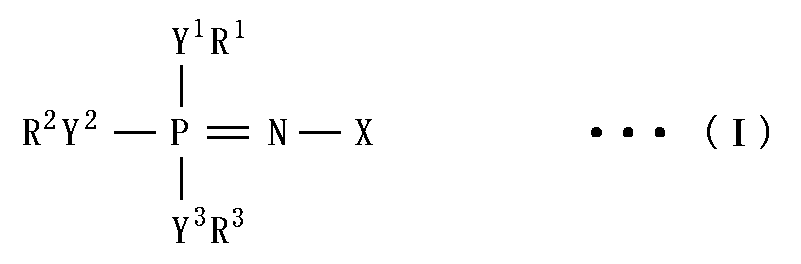
(式中、R1、R2及びR3は、それぞれ独立して一価の置換基又はハロゲン元素を表し;Xは、炭素、ケイ素、ゲルマニウム、スズ、窒素、リン、ヒ素、アンチモン、ビスマス、酸素、硫黄、セレン、テルル及びポロニウムからなる群から選ばれる元素の少なくとも1種を含む置換基を表し;Y1、Y2及びY3は、それぞれ独立して2価の連結基、2価の元素又は単結合を表す)又は下記式(II):
(NPR4 2)n ・・・ (II)
(式中、R4はそれぞれ独立して一価の置換基又はハロゲン元素を表し;nは3〜15を表す)で表される。また、前記電解質組成物におけるホスファゼン化合物の含有量は、3〜20質量%の範囲が好ましい。
In a preferred example of the polymer battery electrolyte of the present invention, the phosphazene compound is represented by the following formula (I):
(Wherein R 1 , R 2 and R 3 each independently represents a monovalent substituent or a halogen element; X represents carbon, silicon, germanium, tin, nitrogen, phosphorus, arsenic, antimony, bismuth, Represents a substituent containing at least one element selected from the group consisting of oxygen, sulfur, selenium, tellurium and polonium; Y 1 , Y 2 and Y 3 are each independently a divalent linking group, divalent Represents an element or a single bond) or the following formula (II):
(NPR 4 2 ) n ... (II)
(Wherein R 4 independently represents a monovalent substituent or a halogen element; n represents 3 to 15). The content of the phosphazene compound in the electrolyte composition is preferably in the range of 3 to 20% by mass.
本発明のポリマー電池用電解質の他の好適例においては、前記テトラアルキルチウラムジスルフィド類が下記式(III):
(式中、R5、R6、R7及びR8は、それぞれ独立して炭素数1〜4のアルキル基を示す)で表される。また、前記電解質組成物におけるテトラアルキルチウラムジスルフィド類の含有量は、1〜3質量%の範囲が好ましい。
In another preferred embodiment of the polymer battery electrolyte of the present invention, the tetraalkylthiuram disulfides are represented by the following formula (III):
(Wherein R 5 , R 6 , R 7 and R 8 each independently represents an alkyl group having 1 to 4 carbon atoms). Moreover, the content of tetraalkylthiuram disulfides in the electrolyte composition is preferably in the range of 1 to 3% by mass.
また、本発明のポリマー電池は、上記ポリマー電池用電解質と、正極と、負極とを備えることを特徴とする。 Moreover, the polymer battery of this invention is equipped with the said electrolyte for polymer batteries, a positive electrode, and a negative electrode, It is characterized by the above-mentioned.
本発明によれば、ホスファゼン化合物とテトラアルキルチウラムジスルフィド類と支持塩との混合溶液を加熱してなる、安全性及び設計自由度の高いポリマー電池用電解質を提供することができる。また、該ポリマー電池用電解質を備え、安全性及び設計自由度の高いポリマー電池を提供することができる。 ADVANTAGE OF THE INVENTION According to this invention, the electrolyte for polymer batteries with a high safety | security and a high design freedom which heats the mixed solution of a phosphazene compound, tetraalkyl thiuram disulfides, and support salt can be provided. Further, a polymer battery having the polymer battery electrolyte and having high safety and high design freedom can be provided.
<ポリマー電池用電解質>
以下に、本発明のポリマー電池用電解質を詳細に説明する。本発明のポリマー電池用電解質は、ホスファゼン化合物とテトラアルキルチウラムジスルフィド類と支持塩とを含む電解質組成物を60℃以上で加熱してなる。本発明においては、上記電解質組成物中のホスファゼン化合物が加熱により重合し、ポリマー電池用電解質が形成される。但し、本発明においては、上記ホスファゼン化合物の総てが重合する必要はなく、該ホスファゼン化合物は、液漏れの危険性がない程度に重合すればよい。本発明のポリマー電池用電解質は、ポリマー電池の製造において、予め所定の形状に成形する必要がなく、例えば、正極及び負極等が組み込まれた電池ケースに上記電解質組成物を充填した後、加熱して形成することができる。そのため、本発明のポリマー電池用電解質を用いることで、ポリマー電池の設計の自由度が増す。
<Electrolyte for polymer battery>
Hereinafter, the polymer battery electrolyte of the present invention will be described in detail. The polymer battery electrolyte of the present invention is obtained by heating an electrolyte composition containing a phosphazene compound, a tetraalkylthiuram disulfide, and a supporting salt at 60 ° C. or higher. In the present invention, the phosphazene compound in the electrolyte composition is polymerized by heating to form an electrolyte for a polymer battery. However, in the present invention, it is not necessary to polymerize all of the phosphazene compounds, and the phosphazene compounds may be polymerized to such an extent that there is no risk of liquid leakage. The polymer battery electrolyte of the present invention does not need to be molded into a predetermined shape in advance in the production of a polymer battery. For example, the electrolyte composition is filled in a battery case in which a positive electrode and a negative electrode are incorporated, and then heated. Can be formed. Therefore, the polymer battery design flexibility is increased by using the polymer battery electrolyte of the present invention.
また、本発明のポリマー電池用電解質においては、上記ホスファゼン化合物及びその重合体から誘導される窒素ガスの作用によって、電解質が燃焼する危険性が低減されている。また、上記ホスファゼン化合物及びその重合体を構成するリンには、リン酸エステル等を発生して電池を構成する高分子材料の連鎖分解を抑制する作用があるため、電池の発火・引火の危険性を効果的に低減することができる。更に、上記ホスファゼン化合物がハロゲンを含む場合、万が一の燃焼時にはハロゲンが活性ラジカルの捕捉剤として機能し、電解質の燃焼の危険性を低減する。 Further, in the polymer battery electrolyte of the present invention, the risk of the electrolyte burning is reduced by the action of nitrogen gas derived from the phosphazene compound and its polymer. In addition, the phosphorus constituting the phosphazene compound and the polymer thereof has a function of generating a phosphate ester and the like to suppress chain decomposition of the polymer material constituting the battery, and therefore, risk of ignition and ignition of the battery. Can be effectively reduced. Furthermore, when the phosphazene compound contains a halogen, the halogen functions as an active radical scavenger in the unlikely event of combustion, reducing the risk of electrolyte combustion.
本発明のポリマー電池用電解質においては、上記電解質組成物を60℃以上で加熱することを要し、60〜80℃の範囲で加熱するのが、電池の特性劣化を防止する点で好ましい。また、上記電解質組成物の加熱時間は加熱温度に応じて適宜選択され、例えば、60℃で加熱する場合は、10〜20分間加熱するのが好ましい。 In the polymer battery electrolyte of the present invention, it is necessary to heat the electrolyte composition at 60 ° C. or higher, and heating in the range of 60 to 80 ° C. is preferable in terms of preventing deterioration of battery characteristics. Moreover, the heating time of the said electrolyte composition is suitably selected according to heating temperature, for example, when heating at 60 degreeC, it is preferable to heat for 10 to 20 minutes.
本発明のポリマー電池用電解質に用いる電解質組成物は、ホスファゼン化合物を含む。該ホスファゼン化合物として、具体的には、上記式(I)で表される鎖状ホスファゼン化合物及び上記式(II)で表される環状ホスファゼン化合物が挙げられる。また、式(I)又は式(II)で表されるホスファゼン化合物の中でも、25℃(室温)において液体であるものが好ましい。該液状ホスファゼン化合物の25℃における粘度は、300mPa・s(300cP)以下が好ましく、20mPa・s(20cP)以下が更に好ましく、5mPa・s(5cP)以下が特に好ましい。なお、本発明において粘度は、粘度測定計[R型粘度計Model RE500-SL、東機産業(株)製]を用い、1rpm、2rpm、3rpm、5rpm、7rpm、10rpm、20rpm及び50rpmの各回転速度で120秒間づつ測定し、指示値が50〜60%となった時の回転速度を分析条件とし、その際の粘度を測定することによって求めた。ホスファゼン化合物の25℃における粘度が300mPa・s(300cP)を超えると、支持塩が溶解し難くなり、電解質のイオン導電性が著しく低下し、特に氷点以下等の低温条件下での使用において性能不足となる。 The electrolyte composition used for the polymer battery electrolyte of the present invention contains a phosphazene compound. Specific examples of the phosphazene compound include a chain phosphazene compound represented by the above formula (I) and a cyclic phosphazene compound represented by the above formula (II). Of the phosphazene compounds represented by formula (I) or formula (II), those which are liquid at 25 ° C. (room temperature) are preferred. The viscosity at 25 ° C. of the liquid phosphazene compound is preferably 300 mPa · s (300 cP) or less, more preferably 20 mPa · s (20 cP) or less, and particularly preferably 5 mPa · s (5 cP) or less. In the present invention, the viscosity is measured at 1 rpm, 2 rpm, 3 rpm, 5 rpm, 7 rpm, 10 rpm, 20 rpm and 50 rpm using a viscometer [R-type viscometer Model RE500-SL, manufactured by Toki Sangyo Co., Ltd.] The measurement was performed at a speed of 120 seconds, and the rotation speed when the indicated value reached 50 to 60% was set as an analysis condition, and the viscosity was measured at that time. If the viscosity of the phosphazene compound at 25 ° C exceeds 300 mPa · s (300 cP), the supporting salt will be difficult to dissolve, and the ionic conductivity of the electrolyte will be significantly reduced, especially when used under low temperature conditions such as below the freezing point. It becomes.
式(I)において、R1、R2及びR3としては、一価の置換基又はハロゲン元素であれば特に制限はない。一価の置換基としては、アルコキシ基、アルキル基、カルボキシル基、アシル基、アリール基等が挙げられ、これらの中でも、ホスファゼン化合物が低粘度となる点で、アルコキシ基が好ましい。一方、ハロゲン元素としては、フッ素、塩素、臭素等が好適に挙げられる。R1〜R3は、総て同一の種類の置換基でもよく、それらの内の幾つかが異なる種類の置換基でもよい。ここで、上記アルコキシ基としては、例えばメトキシ基、エトキシ基、プロポキシ基、ブトキシ基等や、メトキシエトキシ基、メトキシエトキシエトキシ基等のアルコキシ置換アルコキシ基等が挙げられ、これらの中でも、メトキシ基、エトキシ基、メトキシエトキシ基及びメトキシエトキシエトキシ基が好ましく、低粘度・高誘電率の観点から、メトキシ基又はエトキシ基が特に好ましい。また、上記アルキル基としては、メチル基、エチル基、プロピル基、ブチル基、ペンチル基等が挙げられ、上記アシル基としては、ホルミル基、アセチル基、プロピオニル基、ブチリル基、イソブチリル基、バレリル基等が挙げられ、上記アリール基としては、フェニル基、トリル基、ナフチル基等が挙げられる。これら一価の置換基中の水素元素は、ハロゲン元素で置換されているのが好ましく、該ハロゲン元素としては、フッ素、塩素、臭素が好適であり、フッ素が最も好ましく、次いで塩素が好ましい。一価の置換基中の水素元素がフッ素で置換されているものは、塩素で置換されているものに比べてポリマー電池のサイクル特性を向上させる効果が大きい傾向がある。 In the formula (I), R 1 , R 2 and R 3 are not particularly limited as long as they are monovalent substituents or halogen elements. Examples of the monovalent substituent include an alkoxy group, an alkyl group, a carboxyl group, an acyl group, and an aryl group. Among these, an alkoxy group is preferable in that the phosphazene compound has low viscosity. On the other hand, preferred examples of the halogen element include fluorine, chlorine, bromine and the like. R 1 to R 3 may all be the same type of substituent, and some of them may be different types of substituents. Here, examples of the alkoxy group include a methoxy group, an ethoxy group, a propoxy group, a butoxy group, and an alkoxy-substituted alkoxy group such as a methoxyethoxy group and a methoxyethoxyethoxy group. Among these, a methoxy group, An ethoxy group, a methoxyethoxy group, and a methoxyethoxyethoxy group are preferable, and a methoxy group or an ethoxy group is particularly preferable from the viewpoint of low viscosity and high dielectric constant. Examples of the alkyl group include a methyl group, an ethyl group, a propyl group, a butyl group, and a pentyl group. Examples of the acyl group include a formyl group, an acetyl group, a propionyl group, a butyryl group, an isobutyryl group, and a valeryl group. Examples of the aryl group include a phenyl group, a tolyl group, and a naphthyl group. The hydrogen element in these monovalent substituents is preferably substituted with a halogen element. As the halogen element, fluorine, chlorine and bromine are preferred, fluorine is most preferred, and chlorine is then preferred. When the hydrogen element in the monovalent substituent is substituted with fluorine, the effect of improving the cycle characteristics of the polymer battery tends to be greater than when the hydrogen element is substituted with chlorine.
式(I)において、Y1、Y2及びY3で表される2価の連結基としては、例えば、CH2基の他、酸素、硫黄、セレン、窒素、ホウ素、アルミニウム、スカンジウム、ガリウム、イットリウム、インジウム、ランタン、タリウム、炭素、ケイ素、チタン、スズ、ゲルマニウム、ジルコニウム、鉛、リン、バナジウム、ヒ素、ニオブ、アンチモン、タンタル、ビスマス、クロム、モリブデン、テルル、ポロニウム、タングステン、鉄、コバルト、ニッケルからなる群から選ばれる元素の少なくとも1種を含む2価の連結基が挙げられ、これらの中でも、CH2基、及び、酸素、硫黄、セレン、窒素からなる群から選ばれる元素の少なくとも1種を含む2価の連結基が好ましく、硫黄及び/又はセレンの元素を含む2価の連結基が特に好ましい。また、Y1、Y2及びY3は、酸素、硫黄、セレン等の2価の元素、又は単結合であってもよい。Y1〜Y3は総て同一種類でもよく、幾つかが互いに異なる種類でもよい。 In the formula (I), examples of the divalent linking group represented by Y 1 , Y 2 and Y 3 include CH 2 group, oxygen, sulfur, selenium, nitrogen, boron, aluminum, scandium, gallium, Yttrium, indium, lanthanum, thallium, carbon, silicon, titanium, tin, germanium, zirconium, lead, phosphorus, vanadium, arsenic, niobium, antimony, tantalum, bismuth, chromium, molybdenum, tellurium, polonium, tungsten, iron, cobalt, And divalent linking groups containing at least one element selected from the group consisting of nickel. Among these, at least one element selected from the group consisting of CH 2 groups and oxygen, sulfur, selenium, and nitrogen is included. A divalent linking group containing a seed is preferred, and a divalent linking group containing a sulfur and / or selenium element is particularly preferred. Y 1 , Y 2 and Y 3 may be a divalent element such as oxygen, sulfur or selenium, or a single bond. Y 1 to Y 3 may all be the same type, or some of them may be different types.
式(I)において、Xとしては、有害性、環境等への配慮の観点から、炭素、ケイ素、窒素、リン、酸素及び硫黄からなる群から選ばれる元素の少なくとも1種を含む置換基が好ましい。これらの置換基の内、下記式(IV)、式(V)又は式(VI)で表される構造を有する置換基が更に好ましい。
[式(IV)、式(V)及び式(VI)において、R9〜R13は、それぞれ独立に一価の置換基又はハロゲン元素を表し;Y9〜Y13は、それぞれ独立に2価の連結基、2価の元素又は単結合を表し;Zは2価の基又は2価の元素を表す。]
In the formula (I), X is preferably a substituent containing at least one element selected from the group consisting of carbon, silicon, nitrogen, phosphorus, oxygen and sulfur from the viewpoints of toxicity, environment and the like. . Of these substituents, substituents having a structure represented by the following formula (IV), formula (V) or formula (VI) are more preferred.
[In Formula (IV), Formula (V) and Formula (VI), R 9 to R 13 each independently represents a monovalent substituent or a halogen element; Y 9 to Y 13 each independently represent a divalent group. A linking group, a divalent element or a single bond; Z represents a divalent group or a divalent element. ]
式(IV)、式(V)及び式(VI)において、R9〜R13としては、式(I)におけるR1〜R3で述べたのと同様の一価の置換基又はハロゲン元素がいずれも好適に挙げられる。また、これらは、同一置換基内において、それぞれ同一の種類でもよく、幾つかが互いに異なる種類でもよい。式(IV)のR9とR10とは、及び式(VI)のR12とR13とは、互いに結合して環を形成していてもよい。 In formula (IV), formula (V) and formula (VI), R 9 to R 13 are the same monovalent substituents or halogen elements as those described for R 1 to R 3 in formula (I). Any of these is preferably mentioned. In addition, these may be the same type within the same substituent, or some of them may be different from each other. R 9 and R 10 in formula (IV) and R 12 and R 13 in formula (VI) may be bonded to each other to form a ring.
式(IV)、式(V)及び式(VI)において、Y9〜Y13で表される基としては、式(I)におけるY1〜Y3で述べたのと同様の2価の連結基又は2価の元素等が挙げられ、同様に、硫黄及び/又はセレンの元素を含む基である場合には、電解質の発火・引火の危険性が低減するため特に好ましい。これらは、同一置換基内において、それぞれ同一の種類でもよく、幾つかが互いに異なる種類でもよい。 In formula (IV), formula (V) and formula (VI), the group represented by Y 9 to Y 13 is a divalent linkage similar to that described for Y 1 to Y 3 in formula (I). In the same manner, a group containing a sulfur and / or selenium element is particularly preferable because the risk of ignition and ignition of the electrolyte is reduced. These may be the same type within the same substituent, or some of them may be different from each other.
式(IV)において、Zとしては、例えば、CH2基、CHR(Rは、アルキル基、アルコキシル基、フェニル基等を表す。以下同様。)基、NR基のほか、酸素、硫黄、セレン、ホウ素、アルミニウム、スカンジウム、ガリウム、イットリウム、インジウム、ランタン、タリウム、炭素、ケイ素、チタン、スズ、ゲルマニウム、ジルコニウム、鉛、リン、バナジウム、ヒ素、ニオブ、アンチモン、タンタル、ビスマス、クロム、モリブデン、テルル、ポロニウム、タングステン、鉄、コバルト及びニッケルからなる群から選ばれる元素の少なくとも1種を含む2価の基等が挙げられ、これらの中でも、CH2基、CHR基、NR基の他、酸素、硫黄、セレンからなる群から選ばれる元素の少なくとも1種を含む2価の基が好ましい。特に、硫黄及び/又はセレンの元素を含む2価の基の場合には、電解質の発火・引火の危険性が低減するため好ましい。また、Zは、酸素、硫黄、セレン等の2価の元素であってもよい。 In the formula (IV), as Z, for example, CH 2 group, CHR (R represents an alkyl group, an alkoxyl group, a phenyl group, etc .; the same shall apply hereinafter) group, NR group, oxygen, sulfur, selenium, Boron, aluminum, scandium, gallium, yttrium, indium, lanthanum, thallium, carbon, silicon, titanium, tin, germanium, zirconium, lead, phosphorus, vanadium, arsenic, niobium, antimony, tantalum, bismuth, chromium, molybdenum, tellurium, Examples include divalent groups containing at least one element selected from the group consisting of polonium, tungsten, iron, cobalt and nickel. Among these, in addition to CH 2 groups, CHR groups, NR groups, oxygen, sulfur A divalent group containing at least one element selected from the group consisting of selenium is preferred. In particular, a divalent group containing an element of sulfur and / or selenium is preferable because the risk of ignition and ignition of the electrolyte is reduced. Z may be a divalent element such as oxygen, sulfur, or selenium.
これら置換基としては、特に効果的に発火・引火の危険性を低減し得る点で、式(IV)で表されるようなリンを含む置換基が特に好ましい。また、置換基が式(V)で表されるような硫黄を含む置換基である場合には、電解質の小界面抵抗化の点で特に好ましい。 As these substituents, a substituent containing phosphorus as represented by the formula (IV) is particularly preferable in that the risk of ignition / flammability can be particularly effectively reduced. In addition, when the substituent is a substituent containing sulfur as represented by the formula (V), it is particularly preferable from the viewpoint of reducing the interface resistance of the electrolyte.
式(II)において、R4としては、一価の置換基又はハロゲン元素であれば特に制限はない。一価の置換基としては、アルコキシ基、アルキル基、カルボキシル基、アシル基、アリール基等が挙げられ、これらの中でも、ホスファゼン化合物が低粘度となる点で、アルコキシ基が好ましい。一方、ハロゲン元素としては、例えば、フッ素、塩素、臭素等が好適に挙げられる。ここで、アルコキシ基としては、メトキシ基、エトキシ基、メトキシエトキシ基、プロポキシ基、フェノキシ基等が挙げられ、これらの中でも、メトキシ基、エトキシ基、メトキシエトキシ基、フェノキシ基が特に好ましい。これら一価の置換基中の水素元素は、ハロゲン元素で置換されているのが好ましく、ハロゲン元素としては、フッ素、塩素、臭素等が好適に挙げられ、フッ素原子で置換された置換基としては、例えば、トリフルオロエトキシ基が挙げられる。 In the formula (II), R 4 is not particularly limited as long as it is a monovalent substituent or a halogen element. Examples of the monovalent substituent include an alkoxy group, an alkyl group, a carboxyl group, an acyl group, and an aryl group. Among these, an alkoxy group is preferable in that the phosphazene compound has low viscosity. On the other hand, preferred examples of the halogen element include fluorine, chlorine, bromine and the like. Here, examples of the alkoxy group include a methoxy group, an ethoxy group, a methoxyethoxy group, a propoxy group, and a phenoxy group, and among these, a methoxy group, an ethoxy group, a methoxyethoxy group, and a phenoxy group are particularly preferable. The hydrogen element in these monovalent substituents is preferably substituted with a halogen element. Preferred examples of the halogen element include fluorine, chlorine, bromine and the like. Examples of the substituent substituted with a fluorine atom include Examples thereof include a trifluoroethoxy group.
式(I)、(II)、(IV)〜(VI)におけるR1〜R4、R9〜R13、Y1〜Y3、Y9〜Y13、Zを適宜選択することにより、より好適な粘度、添加・混合に適する溶解性等を有するホスファゼン化合物が得られる。これらホスファゼン化合物は、1種単独で使用してもよく、2種以上を併用してもよい。 By appropriately selecting R 1 to R 4 , R 9 to R 13 , Y 1 to Y 3 , Y 9 to Y 13 , and Z in formulas (I), (II), and (IV) to (VI), A phosphazene compound having suitable viscosity, solubility suitable for addition and mixing, and the like can be obtained. These phosphazene compounds may be used alone or in combination of two or more.
上記式(II)のホスファゼン化合物の中でも、電解質の耐劣化性及び安全性を向上させる観点からは、下記式(VII)で表されるホスファゼン化合物が好ましい。
(NPF2)n ・・・ (VII)
(式中、nは3〜13を表す。)
Among the phosphazene compounds of the above formula (II), a phosphazene compound represented by the following formula (VII) is preferable from the viewpoint of improving the deterioration resistance and safety of the electrolyte.
(NPF 2 ) n ... (VII)
(In the formula, n represents 3 to 13.)
式(VII)において、nとしては、3〜5が好ましく、3〜4が更に好ましく、3が特に好ましい。nの値が小さい場合には沸点が低く、未重合のホスファゼン化合物が接炎時の着火防止特性を向上させる。一方、nの値が大きくなるにつれて、沸点が高くなるため、高温でも安定に使用することができる。上記性質を利用して目的とする性能を得るために、複数のホスファゼンを適時選択し、使用することも可能である。 In the formula (VII), n is preferably 3 to 5, more preferably 3 to 4, and particularly preferably 3. When the value of n is small, the boiling point is low, and the unpolymerized phosphazene compound improves the ignition prevention property at the time of flame contact. On the other hand, since the boiling point increases as the value of n increases, it can be used stably even at high temperatures. A plurality of phosphazenes can be selected and used in a timely manner in order to obtain the desired performance using the above properties.
式(VII)におけるn値を適宜選択することにより、より好適な粘度、混合に適する溶解性等を有するホスファゼン化合物が得られる。これらのホスファゼン化合物は、1種単独で使用してもよく、2種以上を併用してもよい。 By appropriately selecting the n value in formula (VII), a phosphazene compound having a more suitable viscosity, solubility suitable for mixing, and the like can be obtained. These phosphazene compounds may be used alone or in combination of two or more.
式(VII)で表されるホスファゼン化合物の粘度としては、20mPa・s以下であれば特に制限はないが、10mPa・s以下が好ましく、5mPa・s以下が更に好ましい。 The viscosity of the phosphazene compound represented by the formula (VII) is not particularly limited as long as it is 20 mPa · s or less, but is preferably 10 mPa · s or less, and more preferably 5 mPa · s or less.
上記式(II)のホスファゼン化合物の中でも、電解質の耐劣化性及び安全性を向上させる観点からは、下記式(VIII)で表されるホスファゼン化合物も好ましい。
(NPR14 2)n ・・・ (VIII)
(式中、R14は夫々独立して一価の置換基又はフッ素を表し、全R14のうち少なくとも1つはフッ素を含む一価の置換基又はフッ素であり、nは3〜8を表す。但し、総てのR14がフッ素であることはない。)
Among the phosphazene compounds of the above formula (II), phosphazene compounds represented by the following formula (VIII) are also preferable from the viewpoint of improving the deterioration resistance and safety of the electrolyte.
(NPR 14 2 ) n ... (VIII)
(Wherein R 14 independently represents a monovalent substituent or fluorine, and at least one of all R 14 is a monovalent substituent or fluorine containing fluorine, and n represents 3 to 8) (However, not all R 14 are fluorine.)
上記式(II)のホスファゼン化合物を含有すれば、電解質に優れた自己消火性又は難燃性を付与して電解質の安全性を向上させることができるが、式(VIII)で表され、全R14のうち少なくとも1つがフッ素を含む一価の置換基であるホスファゼン化合物を含有すれば、電解質により優れた安全性を付与することが可能となる。更に、式(VIII)で表され、全R14のうち少なくとも1つがフッ素であるホスファゼン化合物を含有すれば、更に優れた安全性を付与することが可能となる。即ち、フッ素を含まないホスファゼン化合物に比べ、式(VIII)で表され、全R14のうち少なくとも1つがフッ素を含む一価の置換基又はフッ素であるホスファゼン化合物は、電解質をより燃え難くする効果があり、電解質に対し更に優れた安全性を付与することができる。 If the phosphazene compound of the above formula (II) is contained, the electrolyte can be provided with excellent self-extinguishing properties or flame retardancy, and the safety of the electrolyte can be improved. If at least one of 14 contains a phosphazene compound which is a monovalent substituent containing fluorine, it is possible to impart superior safety to the electrolyte. Furthermore, if a phosphazene compound represented by the formula (VIII) and at least one of all R 14 is fluorine is contained, further excellent safety can be imparted. That is, as compared with a phosphazene compound not containing fluorine, a phosphazene compound represented by the formula (VIII) in which at least one of all R 14 is a monovalent substituent containing fluorine or fluorine is effective in making the electrolyte more difficult to burn. And can provide further excellent safety to the electrolyte.
式(VIII)における一価の置換基としては、アルコキシ基、アルキル基、アシル基、アリール基及びカルボキシル基等が挙げられ、電解質の安全性の向上に特に優れる点で、アルコキシ基が好適である。ここで、アルコキシ基としては、メトキシ基、エトキシ基、n-プロポキシ基、i-プロポキシ基、ブトキシ基等の他、メトキシエトキシ基等のアルコキシ基置換アルコキシ基等が挙げられ、電解質の安全性の向上に優れる点で、メトキシ基、エトキシ基、n-プロポキシ基が特に好ましい。 Examples of the monovalent substituent in the formula (VIII) include an alkoxy group, an alkyl group, an acyl group, an aryl group, and a carboxyl group, and an alkoxy group is preferable because it is particularly excellent in improving the safety of the electrolyte. . Here, examples of the alkoxy group include methoxy group, ethoxy group, n-propoxy group, i-propoxy group, butoxy group and the like, alkoxy group-substituted alkoxy groups such as methoxyethoxy group, and the like. A methoxy group, an ethoxy group, and an n-propoxy group are particularly preferable in terms of excellent improvement.
式(VIII)において、nとしては、電解質に優れた安全性を付与し得る点で、3〜5が好ましく、3〜4が更に好ましい。 In the formula (VIII), n is preferably 3 to 5 and more preferably 3 to 4 because it can provide excellent safety to the electrolyte.
上記一価の置換基は、フッ素で置換されているのが好ましく、式(VIII)のR14が一つもフッ素でない場合は、少なくとも一つの一価の置換基はフッ素含む。 The monovalent substituent is preferably substituted with fluorine. When R 14 in formula (VIII) is not fluorine, at least one monovalent substituent contains fluorine.
式(VIII)のホスファゼン化合物におけるフッ素の含有量としては、3〜70質量%が好ましく、7〜45質量%がより好ましい。フッ素の含有量が3〜70質量%であれば、電解質に「優れた安全性」を特に好適に付与することができる。 The fluorine content in the phosphazene compound of the formula (VIII) is preferably 3 to 70% by mass, more preferably 7 to 45% by mass. When the fluorine content is 3 to 70% by mass, “excellent safety” can be particularly suitably imparted to the electrolyte.
式(VIII)のホスファゼン化合物は、前述のフッ素以外にも塩素、臭素等のハロゲン元素を含んでいてもよい。但し、フッ素が最も好ましく、次いで塩素が好ましい。フッ素を含むものは、塩素を含むものに比べてポリマー電池のサイクル特性を向上させる効果が大きい傾向がある。 The phosphazene compound of the formula (VIII) may contain a halogen element such as chlorine and bromine in addition to the above-mentioned fluorine. However, fluorine is most preferred, followed by chlorine. Those containing fluorine tend to have a greater effect of improving the cycle characteristics of the polymer battery than those containing chlorine.
式(VIII)におけるR14及びn値を適宜選択することにより、より好適な安全性、粘度、混合に適する溶解性等を有するホスファゼン化合物が得られる。これらのホスファゼン化合物は、1種単独で使用してもよく、2種以上を併用してもよい。 By appropriately selecting R 14 and n value in the formula (VIII), a phosphazene compound having more suitable safety, viscosity, solubility suitable for mixing, and the like can be obtained. These phosphazene compounds may be used alone or in combination of two or more.
式(VIII)のホスファゼン化合物の粘度としては、20mPa・s以下であれば特に制限はないが、10mPa・s以下が好ましく、5mPa・s以下がより好ましい。 The viscosity of the phosphazene compound of the formula (VIII) is not particularly limited as long as it is 20 mPa · s or less, but is preferably 10 mPa · s or less, and more preferably 5 mPa · s or less.
本発明のポリマー電池用電解質に用いる電解質組成物において、上記ホスファゼン化合物の含有量は、電解質の安全性を向上させる観点から、3〜20質量%が好ましく、8〜20質量%が更に好ましい。また、本発明のポリマー電池用電解質においては、電解質の液漏れを防止する観点から、電解質組成物の8〜15質量%に相当する量のホスファゼン化合物が重合しているのが好ましい。 In the electrolyte composition used for the polymer battery electrolyte of the present invention, the content of the phosphazene compound is preferably 3 to 20% by mass, more preferably 8 to 20% by mass, from the viewpoint of improving the safety of the electrolyte. Moreover, in the polymer battery electrolyte of the present invention, it is preferable that a phosphazene compound in an amount corresponding to 8 to 15% by mass of the electrolyte composition is polymerized from the viewpoint of preventing electrolyte leakage.
本発明のポリマー電池用電解質に用いる電解質組成物は、テトラアルキルチウラムジスルフィド類を含む。該テトラアルキルチウラムジスルフィド類として、具体的には、上記式(III)で表される化合物が好ましい。ここで、式(III)のR5、R6、R7及びR8における、炭素数1〜4のアルキル基としては、メチル基、エチル基、n-プロピル基、イソプロピル基、n-ブチル基、sec-ブチル基、イソブチル基、t-ブチル基等が挙げられる。これらアルキル基の中でも、ポリマー化反応を促進する観点から、メチル基及びエチル基が好ましい。上記テトラアルキルチウラムジスルフィド類は、1種単独で使用してもよく、2種以上を併用してもよい。 The electrolyte composition used for the polymer battery electrolyte of the present invention contains tetraalkylthiuram disulfides. As the tetraalkylthiuram disulfides, specifically, a compound represented by the above formula (III) is preferable. Here, as the alkyl group having 1 to 4 carbon atoms in R 5 , R 6 , R 7 and R 8 in the formula (III), a methyl group, an ethyl group, an n-propyl group, an isopropyl group, an n-butyl group , Sec-butyl group, isobutyl group, t-butyl group and the like. Among these alkyl groups, a methyl group and an ethyl group are preferable from the viewpoint of promoting the polymerization reaction. The said tetraalkyl thiuram disulfides may be used individually by 1 type, and may use 2 or more types together.
本発明のポリマー電池用電解質に用いる電解質組成物において、上記テトラアルキルチウラムジスルフィド類の含有量は、電池特性への悪影響を防止する観点から、1〜3質量%が好ましく、1〜1.5質量%が更に好ましい。 In the electrolyte composition used in the polymer battery electrolyte of the present invention, the content of the tetraalkylthiuram disulfides is preferably 1 to 3% by mass, and 1 to 1.5% by mass from the viewpoint of preventing adverse effects on battery characteristics. Further preferred.
上記電解質組成物において、テトラアルキルチウラムジスルフィド類はラジカル重合開始剤として機能し、上記ホスファゼン化合物にラジカルを生成させ、ホスファゼン化合物のラジカル重合を開始させる。例えば、式(II)の環状ホスファゼン化合物と式(III)のテトラアルキルチウラムジスルフィド類を例にとると、以下のようにして、ホスファゼン化合物のラジカル重合が進行する。
上記反応スキームに示すように、まず、式(III)のテトラアルキルチウラムジスルフィド類が開裂して、複数種のラジカルが生成する。次に生成したラジカルが式(II)のホスファゼン化合物から、R4・を引き抜き、式(II)のホスファゼン化合物にラジカルが生じる。次に、ラジカルを持った式(II)のホスファゼン化合物と他のホスファゼン化合物とが重合し、引き続き、ラジカルがクエンチされるまで重合が進行して、ポリホスファゼンが生成する。なお、反応スキームを示さないが、式(I)の鎖状ホスファゼン化合物についても、テトラアルキルチウラムジスルフィド類から生成したラジカルがR1Y1・、R2Y2・、R2Y2・を引き抜くことでホスファゼン化合物の重合が開始され、ポリホスファゼンが生成する。 As shown in the above reaction scheme, first, tetraalkylthiuram disulfides of formula (III) are cleaved to generate a plurality of types of radicals. Next, the generated radical draws R 4 · from the phosphazene compound of formula (II), and a radical is generated in the phosphazene compound of formula (II). Next, the phosphazene compound of the formula (II) having a radical and another phosphazene compound are polymerized, and then polymerization proceeds until the radical is quenched to produce polyphosphazene. Although the reaction scheme is not shown, for the chain phosphazene compound of the formula (I), the radicals generated from the tetraalkylthiuram disulfides extract R 1 Y 1 , R 2 Y 2 , and R 2 Y 2. As a result, polymerization of the phosphazene compound is started, and polyphosphazene is produced.
本発明のポリマー電池用電解質に用いる電解質組成物は、支持塩を含有する。該支持塩としては、リチウムイオンのイオン源となる支持塩が好ましい。該支持塩としては、特に制限はないが、例えば、LiClO4、LiBF4、LiPF6、LiCF3SO3、LiAsF6、LiC4F9SO3、Li(CF3SO2)2N及びLi(C2F5SO2)2N等のリチウム塩が好適に挙げられる。これら支持塩は、1種単独で使用してもよく、2種以上を併用してもよい。ここで、上記支持塩の含有量は、電解質の電気伝導度が5mS/cm以上になるように配合するのが好ましい。 The electrolyte composition used for the polymer battery electrolyte of the present invention contains a supporting salt. The supporting salt is preferably a supporting salt that serves as an ion source for lithium ions. The supporting salt is not particularly limited, and for example, LiClO 4 , LiBF 4 , LiPF 6 , LiCF 3 SO 3 , LiAsF 6 , LiC 4 F 9 SO 3 , Li (CF 3 SO 2 ) 2 N and Li ( Preferable examples include lithium salts such as C 2 F 5 SO 2 ) 2 N. These supporting salts may be used alone or in combination of two or more. Here, the content of the supporting salt is preferably blended so that the electric conductivity of the electrolyte is 5 mS / cm or more.
本発明のポリマー電池用電解質にかかわる電解質組成物は、上記ホスファゼン化合物、テトラアルキルチウラムジスルフィド類及び支持塩の他に、非プロトン性有機溶媒等を含有する。該非プロトン性有機溶媒としては、ジメチルカーボネート(DMC)、ジエチルカーボネート(DEC)、ジフェニルカーボネート、エチルメチルカーボネート(EMC)、エチレンカーボネート(EC)、プロピレンカーボネート(PC)、γ-ブチロラクトン(GBL)、γ-バレロラクトン、メチルフォルメート(MF)等のエステル類、1,2-ジメトキシエタン(DME)、テトラヒドロフラン(THF)等のエーテル類が好適に挙げられる。これらの中でも、エチレンカーボネート、プロピレンカーボネート、ジエチルカーボネート、ジメチルカーボネート、エチルメチルカーボネート及びメチルフォルメートが好ましい。なお、環状のエステル類は、比誘電率が高く支持塩の溶解性に優れる点で好適であり、一方、鎖状のエステル類及び鎖状のエーテル類は、低粘度であるため、電池への充填が容易である点で好適である。上記非プロトン性有機溶媒は、負極と反応することなく、更には容易に電解質のイオン導電性を向上させることができる。上記非プロトン性有機溶媒は、25℃における粘度が10mPa・s(10cP)以下であるのが好ましく、5mPa・s(5cP)以下であるのが更に好ましい。これら非プロトン性有機溶媒は、1種単独で使用してもよく、2種以上を併用してもよい。ここで、電解質組成物に非プロトン性有機溶媒を含有させる場合、該非プロトン性有機溶媒の組成は、電解質の電気伝導度が5mS/cm以上になるように配合するのが好ましい。 The electrolyte composition related to the polymer battery electrolyte of the present invention contains an aprotic organic solvent in addition to the phosphazene compound, tetraalkylthiuram disulfides and supporting salt. Examples of the aprotic organic solvent include dimethyl carbonate (DMC), diethyl carbonate (DEC), diphenyl carbonate, ethyl methyl carbonate (EMC), ethylene carbonate (EC), propylene carbonate (PC), γ-butyrolactone (GBL), γ Preferred examples include esters such as valerolactone and methyl formate (MF), and ethers such as 1,2-dimethoxyethane (DME) and tetrahydrofuran (THF). Among these, ethylene carbonate, propylene carbonate, diethyl carbonate, dimethyl carbonate, ethyl methyl carbonate, and methyl formate are preferable. Cyclic esters are preferred in that they have a high relative dielectric constant and excellent solubility of the supporting salt, while chain esters and chain ethers have low viscosity and are therefore suitable for batteries. It is preferable in terms of easy filling. The aprotic organic solvent can further easily improve the ionic conductivity of the electrolyte without reacting with the negative electrode. The aprotic organic solvent preferably has a viscosity at 25 ° C. of 10 mPa · s (10 cP) or less, and more preferably 5 mPa · s (5 cP) or less. These aprotic organic solvents may be used alone or in combination of two or more. Here, when the aprotic organic solvent is contained in the electrolyte composition, the composition of the aprotic organic solvent is preferably blended so that the electric conductivity of the electrolyte is 5 mS / cm or more.
<ポリマー電池>
次に、本発明のポリマー電池を詳細に説明する。本発明のポリマー電池は、上述のポリマー電池用電解質と、正極と、負極とを備え、必要に応じてポリマー電池の技術分野で通常使用されている他の部材を備える。本発明のポリマー電池は、液漏れの心配がなく、発火・引火の危険性が低く、更には設計の自由度が高い。
<Polymer battery>
Next, the polymer battery of the present invention will be described in detail. The polymer battery of the present invention includes the above-described polymer battery electrolyte, a positive electrode, and a negative electrode, and includes other members that are usually used in the technical field of polymer batteries as necessary. The polymer battery of the present invention has no risk of liquid leakage, has a low risk of ignition and ignition, and has a high degree of design freedom.
本発明のポリマー電池の正極活物質としては、特に制限はなく、公知の正極活物質から適宜選択して使用できる。該正極活物質として、具体的には、V2O5、V6O13、MnO2、MnO3等の金属酸化物、LiCoO2、LiNiO2、LiMn2O4、LiFeO2及びLiFePO4等のリチウム含有複合酸化物、TiS2、MoS2等の金属硫化物、ポリアニリン等の導電性ポリマー等が好適に挙げられる。上記リチウム含有複合酸化物は、Fe、Mn、Co及びNiからなる群から選択される2種又は3種の遷移金属を含む複合酸化物であってもよく、この場合、該複合酸化物は、LiFexCoyNi(1-x-y)O2(式中、0≦x<1、0≦y<1、0<x+y≦1)、あるいはLiMnxFeyO2-x-y等で表される。これらの中でも、高容量で安全性が高く、更には電解質組成物の濡れ性に優れる点で、LiCoO2、LiNiO2、LiMn2O4が特に好適である。これら正極活物質は、1種単独で使用してもよく、2種以上を併用してもよい。 There is no restriction | limiting in particular as a positive electrode active material of the polymer battery of this invention, It can select from a well-known positive electrode active material suitably, and can use it. Specific examples of the positive electrode active material include metal oxides such as V 2 O 5 , V 6 O 13 , MnO 2 and MnO 3 , LiCoO 2 , LiNiO 2 , LiMn 2 O 4 , LiFeO 2 and LiFePO 4 . Preferable examples include lithium-containing composite oxides, metal sulfides such as TiS 2 and MoS 2 , and conductive polymers such as polyaniline. The lithium-containing composite oxide may be a composite oxide containing two or three transition metals selected from the group consisting of Fe, Mn, Co, and Ni. In this case, the composite oxide includes: LiFe x Co y Ni (wherein, 0 ≦ x <1,0 ≦ y <1,0 <x + y ≦ 1) (1-xy) O 2, or represented by LiMn x Fe y O 2-xy like. Among these, LiCoO 2 , LiNiO 2 , and LiMn 2 O 4 are particularly preferable because they have a high capacity and high safety, and are excellent in wettability of the electrolyte composition. These positive electrode active materials may be used individually by 1 type, and may use 2 or more types together.
本発明のポリマー電池の負極活物質としては、リチウム金属自体、リチウムとAl、In、Pb又はZn等との合金、リチウムをドープした黒鉛等の炭素材料等が好適に挙げられ、これらの中でも安全性がより高い点で、黒鉛等の炭素材料が好ましく、黒鉛が特に好ましい。ここで、黒鉛としては、天然黒鉛、人造黒鉛、メソフェーズカーボンマイクロビーズ(MCMB)等、広くは易黒鉛化カーボンや難黒鉛化カーボンが挙げられる。これら負極活物質は、1種単独で使用してもよく、2種以上を併用してもよい。 Preferred examples of the negative electrode active material of the polymer battery of the present invention include lithium metal itself, an alloy of lithium and Al, In, Pb, Zn, or the like, a carbon material such as graphite doped with lithium, and among these, From the viewpoint of higher properties, a carbon material such as graphite is preferable, and graphite is particularly preferable. Here, examples of graphite include natural graphite, artificial graphite, mesophase carbon microbeads (MCMB), and the like, and widely include graphitizable carbon and non-graphitizable carbon. These negative electrode active materials may be used individually by 1 type, and may use 2 or more types together.
上記正極及び負極には、必要に応じて導電剤、結着剤を混合することができ、導電剤としてはアセチレンブラック等が挙げられ、結着剤としてはポリフッ化ビニリデン(PVDF)、ポリテトラフルオロエチレン(PTFE)、スチレン・ブタジエンゴム(SBR)、カルボキシメチルセルロース(CMC)等が挙げられる。これらの添加剤は、従来と同様の配合割合で用いることができる。 The positive electrode and the negative electrode can be mixed with a conductive agent and a binder as necessary. Examples of the conductive agent include acetylene black, and the binder includes polyvinylidene fluoride (PVDF) and polytetrafluoro. Examples thereof include ethylene (PTFE), styrene / butadiene rubber (SBR), carboxymethyl cellulose (CMC), and the like. These additives can be used at a blending ratio similar to the conventional one.
また、上記正極及び負極の形状としては、特に制限はなく、電極として公知の形状の中から適宜選択することができる。例えば、シート状、円柱形状、板状形状、スパイラル形状等が挙げられる。 Moreover, there is no restriction | limiting in particular as a shape of the said positive electrode and a negative electrode, It can select suitably from well-known shapes as an electrode. For example, a sheet shape, a columnar shape, a plate shape, a spiral shape, and the like can be given.
本発明のポリマー電池に使用する他の部材としては、正負極間に、両極の接触による電流の短絡を防止する役割で介在させるセパレーターが挙げられる。セパレーターの材質としては、両極の接触を確実に防止し得、且つ電解質組成物を通したり含んだりできる材料、例えば、ポリテトラフルオロエチレン、ポリプロピレン、ポリエチレン、セルロース系、ポリブチレンテレフタレート、ポリエチレンテレフタレート等の合成樹脂製の不織布、薄層フィルム等が好適に挙げられる。これらの中でも、厚さ20〜50μm程度のポリプロピレン又はポリエチレン製の微孔性フィルム、セルロース系、ポリブチレンテレフタレート、ポリエチレンテレフタレート等のフィルムが特に好適である。本発明では、上述のセパレーターの他にも、通常ポリマー電池に使用されている公知の各部材が好適に使用できる。 Another member used in the polymer battery of the present invention includes a separator interposed between positive and negative electrodes in a role of preventing current short-circuit due to contact between both electrodes. As the material of the separator, a material that can reliably prevent contact between both electrodes and can pass through or contain the electrolyte composition, such as polytetrafluoroethylene, polypropylene, polyethylene, cellulose, polybutylene terephthalate, polyethylene terephthalate, etc. A non-woven fabric made of a synthetic resin, a thin layer film, and the like are preferable. Of these, polypropylene or polyethylene microporous films having a thickness of about 20 to 50 μm, cellulose-based films, polybutylene terephthalate, polyethylene terephthalate, and the like are particularly suitable. In the present invention, in addition to the separator described above, known members that are usually used in polymer batteries can be suitably used.
以上に説明した本発明のポリマー電池の形態としては、特に制限はなく、コインタイプ、ボタンタイプ、ペーパータイプ、角型又はスパイラル構造の円筒型電池等、種々の公知の形態が好適に挙げられる。ボタンタイプの場合は、シート状の正極及び負極を作製し、セパレーターを介して正負極を対座させ、上記電解質組成物を注入して封口し、加熱してポリマー電池を作製することができる。また、スパイラル構造の場合は、例えば、シート状の正極を作製して集電体を挟み、これに、シート状の負極を重ね合わせて巻き上げ、上記電解質組成物を注入して封口し、加熱してポリマー電池を作製することができる。 There is no restriction | limiting in particular as a form of the polymer battery of this invention demonstrated above, Various well-known forms, such as a coin type, a button type, a paper type, a square type or a cylindrical battery of a spiral structure, are mentioned suitably. In the case of the button type, a sheet-like positive electrode and negative electrode are prepared, the positive and negative electrodes are opposed to each other through a separator, the electrolyte composition is injected, sealed, and heated to produce a polymer battery. In the case of a spiral structure, for example, a sheet-like positive electrode is produced and a current collector is sandwiched between them, and a sheet-like negative electrode is stacked and rolled up, and the electrolyte composition is injected, sealed, and heated. Thus, a polymer battery can be manufactured.
以下に、実施例を挙げて本発明を更に詳しく説明するが、本発明は下記の実施例に何ら限定されるものではない。 Hereinafter, the present invention will be described in more detail with reference to examples. However, the present invention is not limited to the following examples.
(実施例1)
1M(mol/L)のLiPF6を含むエチレンカーボネート(EC)/ジメチルカーボネート(DMC)混合溶液(体積比=1/2)86質量部に対して、ホスファゼン化合物A[式(II)において、nが3であって、6つのR4のうち2つがエトキシ基(CH3CH2O−)、4つがフッ素である環状ホスファゼン化合物、25℃における粘度:1.2mPa・s]12質量部と、テトラアルキルチウラムジスルフィドZ[式(III)において、R5〜R9がメチル基である化合物]2質量部とを添加して電解質組成物を調製し、該電解質組成物を加熱してなるポリマー電池用電解質の安全性を下記の方法で評価した。
(Example 1)
With respect to 86 parts by mass of a mixed solution (volume ratio = 1/2) of ethylene carbonate (EC) / dimethyl carbonate (DMC) containing 1 M (mol / L) LiPF 6 , phosphazene compound A [in formula (II), n Is a cyclic phosphazene compound in which two of the six R 4 groups are ethoxy groups (CH 3 CH 2 O—) and four are fluorine atoms, viscosity at 25 ° C .: 1.2 mPa · s] 12 parts by mass, An alkyl thiuram disulfide Z [a compound in which R 5 to R 9 are methyl groups in the formula (III)] is added to prepare an electrolyte composition, and the electrolyte composition is heated for a polymer battery. The safety of the electrolyte was evaluated by the following method.
(1)電解質の安全性
UL(アンダーライティングラボラトリー)規格のUL94HB法をアレンジした方法で、大気環境下において着火した炎の燃焼挙動からポリマー電池用電解質の安全性を評価した。その際、着火性、燃焼性、炭化物の生成、二次着火時の現象についても観察した。具体的には、UL試験基準に基づき、不燃性石英ファイバーに上記電解質組成物1.0mLを染み込ませ60℃で20分間加熱してポリマー電池用電解質を形成し、127mm×12.7mmの試験片を作製して行った。ここで、試験炎が試験片に着火しない場合(燃焼長:0mm)を「不燃性」、着火した炎が25mmラインまで到達せず且つ落下物にも着火が認められない場合を「難燃性」、着火した炎が25〜100mmラインで消火し且つ落下物にも着火が認められない場合を「自己消火性」、着火した炎が100mmラインを超えた場合を「燃焼性」と評価した。
(1) Electrolyte Safety The safety of the polymer battery electrolyte was evaluated from the combustion behavior of flames ignited in an atmospheric environment by the method of arranging UL94HB method of UL (Underwriting Laboratory) standard. At that time, ignitability, combustibility, formation of carbides, and secondary ignition phenomena were also observed. Specifically, based on the UL test standards, impregnated 1.0 mL of the above electrolyte composition into non-combustible quartz fiber and heated at 60 ° C. for 20 minutes to form an electrolyte for a polymer battery, producing a 127 mm × 12.7 mm test piece I went there. Here, when the test flame does not ignite the test piece (combustion length: 0 mm), it is “non-flammable”, and when the ignited flame does not reach the 25 mm line and the fallen object is not ignited, “flame retardant” The case where the ignited flame was extinguished on the 25 to 100 mm line and the fallen object was not ignited was evaluated as “self-extinguishing”, and the case where the ignited flame exceeded the 100 mm line was evaluated as “combustible”.
次に、LiCoO2(正極活物質)100質量部に対して、アセチレンブラック(導電剤)10質量部と、ポリテトラフルオロエチレン(結着剤)10質量部とを添加し、有機溶媒(酢酸エチルとエタノールとの50/50体積%混合溶媒)で混練した後、ロール圧延により厚さ100μm、幅40mmの正極シートを作製した。また、負極には厚さ150μmの黒鉛製のシートを使用した。上記正極シートに、厚さ25μmのセパレーター(微孔性フィルム:ポリプロピレン製)を介して、黒鉛製シートを重ね合わせて巻き上げ、円筒型電極(正極長さ:約260mm)を作製した。該円筒型電極に上記電解質組成物を注入し封口してリチウムイオン電池を作製し、該電池を60℃で20分間加熱して単三型ポリマー電池(ポリマーゲル電池)を作製した。得られたポリマー電池に対して、下記の方法で電池容量を測定し、更に液漏れ試験を行った。結果を表1に示す。 Next, 10 parts by mass of acetylene black (conductive agent) and 10 parts by mass of polytetrafluoroethylene (binder) are added to 100 parts by mass of LiCoO 2 (positive electrode active material), and an organic solvent (ethyl acetate) is added. And 50/50% by volume mixed solvent of ethanol), and a positive electrode sheet having a thickness of 100 μm and a width of 40 mm was produced by roll rolling. A graphite sheet having a thickness of 150 μm was used for the negative electrode. The graphite sheet was superposed on the positive electrode sheet via a separator having a thickness of 25 μm (microporous film: made of polypropylene) and wound up to produce a cylindrical electrode (positive electrode length: about 260 mm). The electrolyte composition was injected into the cylindrical electrode and sealed to produce a lithium ion battery, and the battery was heated at 60 ° C. for 20 minutes to produce an AA polymer battery (polymer gel battery). With respect to the obtained polymer battery, the battery capacity was measured by the following method, and a liquid leakage test was further conducted. The results are shown in Table 1.
(2)電池容量
(2-1)充放電サイクル性能の評価
25℃の大気下、上限電圧4.3V、下限電圧3.0V、放電電流100mA、充電電流50mAの条件で、50サイクルまで充放電を繰り返し、初期の充放電容量と50サイクル後の充放電容量を測定した。なお、合計3本の電池について測定を行い、平均値をとった。
(2) Battery capacity (2-1) Evaluation of charge / discharge cycle performance
Under an atmosphere of 25 ° C, charge / discharge is repeated up to 50 cycles under conditions of an upper limit voltage of 4.3V, a lower limit voltage of 3.0V, a discharge current of 100mA, and a charge current of 50mA, and the initial charge / discharge capacity and the charge / discharge capacity after 50 cycles are measured. did. A total of three batteries were measured and averaged.
(2-2)低温放電容量の測定
得られた電池を常温(25℃)で充電した後、低温(-20℃)で放電し、低温における放電容量を測定した。合計3本の電池について測定を行い、平均値をとった。
(2-2) Measurement of low-temperature discharge capacity The obtained battery was charged at room temperature (25 ° C), then discharged at low temperature (-20 ° C), and the discharge capacity at low temperature was measured. A total of three batteries were measured and averaged.
(2-3)高温保存特性の評価
得られた電池を80℃にて10日間保存した後、常温(25℃)にて放電容量を測定した。合計3本の電池について測定を行い、平均値をとった。
(2-3) Evaluation of high-temperature storage characteristics The obtained battery was stored at 80 ° C for 10 days, and then the discharge capacity was measured at room temperature (25 ° C). A total of three batteries were measured and averaged.
(3)液漏れ試験
完成した電池にピンホールを開け、該ピンホールから液が漏れるか否かを判断した。
(3) Liquid leak test A pinhole was opened in the completed battery, and it was determined whether or not liquid leaked from the pinhole.
(比較例1)
1MのLiPF6を含むEC/DMC混合溶液(体積比=1/2)88質量部に対して、ホスファゼン化合物A 12質量部を添加して電解質組成物を調製し、該電解質組成物の安全性を実施例1と同様にして評価した。但し、安全性の評価で用いた試験片は、127mm×12.7mmの不燃性石英ファイバーに上記電解質組成物1.0mLを染み込ませて作製した。
(Comparative Example 1)
An electrolyte composition was prepared by adding 12 parts by mass of phosphazene compound A to 88 parts by mass of EC / DMC mixed solution (volume ratio = 1/2) containing 1M LiPF 6, and safety of the electrolyte composition Were evaluated in the same manner as in Example 1. However, the test piece used in the safety evaluation was prepared by impregnating the non-combustible quartz fiber of 127 mm × 12.7 mm with 1.0 mL of the electrolyte composition.
また、実施例1と同様に円筒型電極を作製し、該円筒型電極に上記電解質組成物を注入して封口し、単三型リチウムイオン電池を作製した。得られた電池に対して、実施例1と同様にして電池容量を測定し、更に液漏れ試験を行った。結果を表1に示す。 In addition, a cylindrical electrode was produced in the same manner as in Example 1, and the electrolyte composition was injected into the cylindrical electrode and sealed to produce an AA lithium ion battery. For the obtained battery, the battery capacity was measured in the same manner as in Example 1, and a liquid leakage test was further conducted. The results are shown in Table 1.
(実施例2)
実施例1と同じ電解質組成物1.0mLを不燃性石英ファイバーに染み込ませ90℃で10分間加熱してポリマー電池用電解質を形成し、127mm×12.7mmの試験片を作製する以外は、実施例1と同様にしてポリマー電池用電解質の安全性を評価した。
(Example 2)
Example 1 except that 1.0 mL of the same electrolyte composition as in Example 1 was soaked in nonflammable quartz fiber and heated at 90 ° C. for 10 minutes to form an electrolyte for a polymer battery, and a test piece of 127 mm × 12.7 mm was produced. In the same manner, the safety of the polymer battery electrolyte was evaluated.
また、実施例1と同様にして円筒型電極に電解質組成物を注入して封口した後、90℃で10分間加熱して単三型ポリマー電池を作製した。得られた電池に対して、実施例1と同様にして電池容量を測定し、更に液漏れ試験を行った。また、結果を表1に示す。 Further, in the same manner as in Example 1, the electrolyte composition was injected into the cylindrical electrode and sealed, and then heated at 90 ° C. for 10 minutes to produce an AA polymer battery. For the obtained battery, the battery capacity was measured in the same manner as in Example 1, and a liquid leakage test was further conducted. The results are shown in Table 1.
表1の結果から、実施例のポリマー電池は、液漏れがなく、安全性が高いことが分かる。また、60℃程度の比較的低温の加熱で電解質組成物中のホスファゼン化合物が十分に重合して液漏れのないポリマー電池用電解質が形成されることが分かる。 From the results in Table 1, it can be seen that the polymer battery of the example has no leakage and high safety. It can also be seen that the phosphazene compound in the electrolyte composition is sufficiently polymerized by heating at a relatively low temperature of about 60 ° C. to form an electrolyte for a polymer battery free from liquid leakage.
Claims (7)
(式中、R1、R2及びR3は、それぞれ独立して一価の置換基又はハロゲン元素を表し;Xは、炭素、ケイ素、ゲルマニウム、スズ、窒素、リン、ヒ素、アンチモン、ビスマス、酸素、硫黄、セレン、テルル及びポロニウムからなる群から選ばれる元素の少なくとも1種を含む置換基を表し;Y1、Y2及びY3は、それぞれ独立して2価の連結基、2価の元素又は単結合を表す)又は下記式(II):
(NPR4 2)n ・・・ (II)
(式中、R4はそれぞれ独立して一価の置換基又はハロゲン元素を表し;nは3〜15を表す)で表されることを特徴とする請求項1に記載のポリマー電池用電解質。 The phosphazene compound has the following formula (I):
(Wherein R 1 , R 2 and R 3 each independently represents a monovalent substituent or a halogen element; X represents carbon, silicon, germanium, tin, nitrogen, phosphorus, arsenic, antimony, bismuth, Represents a substituent containing at least one element selected from the group consisting of oxygen, sulfur, selenium, tellurium and polonium; Y 1 , Y 2 and Y 3 are each independently a divalent linking group, divalent Represents an element or a single bond) or the following formula (II):
(NPR 4 2 ) n ... (II)
2. The polymer battery electrolyte according to claim 1, wherein each R 4 independently represents a monovalent substituent or a halogen element; n represents 3 to 15. 3.
(式中、R5、R6、R7及びR8は、それぞれ独立して炭素数1〜4のアルキル基を示す)で表されることを特徴とする請求項1に記載のポリマー電池用電解質。 The tetraalkyl thiuram disulfides are represented by the following formula (III):
(Wherein R 5 , R 6 , R 7 and R 8 each independently represents an alkyl group having 1 to 4 carbon atoms), for a polymer battery according to claim 1, Electrolytes.
Priority Applications (1)
| Application Number | Priority Date | Filing Date | Title |
|---|---|---|---|
| JP2003432040A JP2005190870A (en) | 2003-12-26 | 2003-12-26 | Electrolyte for polymer battery, and the polymer battery equipped with it |
Applications Claiming Priority (1)
| Application Number | Priority Date | Filing Date | Title |
|---|---|---|---|
| JP2003432040A JP2005190870A (en) | 2003-12-26 | 2003-12-26 | Electrolyte for polymer battery, and the polymer battery equipped with it |
Publications (1)
| Publication Number | Publication Date |
|---|---|
| JP2005190870A true JP2005190870A (en) | 2005-07-14 |
Family
ID=34789864
Family Applications (1)
| Application Number | Title | Priority Date | Filing Date |
|---|---|---|---|
| JP2003432040A Pending JP2005190870A (en) | 2003-12-26 | 2003-12-26 | Electrolyte for polymer battery, and the polymer battery equipped with it |
Country Status (1)
| Country | Link |
|---|---|
| JP (1) | JP2005190870A (en) |
-
2003
- 2003-12-26 JP JP2003432040A patent/JP2005190870A/en active Pending
Similar Documents
| Publication | Publication Date | Title |
|---|---|---|
| JP5315674B2 (en) | Non-aqueous battery electrolyte and non-aqueous battery using the same | |
| JP5314885B2 (en) | Non-aqueous electrolyte and non-aqueous electrolyte secondary power source including the same | |
| JP5738011B2 (en) | Non-aqueous electrolyte additive for secondary battery, non-aqueous electrolyte for secondary battery and non-aqueous electrolyte secondary battery | |
| JP2008300126A (en) | Nonaqueous electrolyte for battery, and nonaqueous electrolyte secondary battery equipped with the same | |
| JP4911888B2 (en) | Nonaqueous electrolyte and nonaqueous electrolyte secondary battery including the same | |
| JP2007200605A (en) | Nonaqueous electrolyte solution and nonaqueous electrolyte solution battery equipped with it | |
| JP2010015717A (en) | Nonaqueous electrolyte for battery, and nonaqueous electrolyte secondary battery equipped with it | |
| JP4671693B2 (en) | Non-aqueous electrolyte additive for secondary battery and non-aqueous electrolyte secondary battery | |
| JP2010050021A (en) | Nonaqueous electrolyte for battery and nonaqueous electrolyte secondary battery having the same | |
| JP2010015719A (en) | Nonaqueous electrolyte for battery, and nonaqueous electrolyte secondary battery equipped with it | |
| JP4458841B2 (en) | Nonaqueous electrolyte for battery and nonaqueous electrolyte battery provided with the same | |
| WO2005064734A1 (en) | Nonaqueous liquid electrolyte for battery, nonaqueous liquid electrolyte battery containing the same, electrolyte for polymer battery and polymer battery containing the same | |
| JP5738010B2 (en) | Non-aqueous electrolyte for secondary battery and non-aqueous electrolyte secondary battery | |
| CN100511816C (en) | Nonaqueous liquid electrolyte for battery, nonaqueous liquid electrolyte battery, electrolyte for polymer battery and polymer battery | |
| JP2004006301A (en) | Positive electrode for non-aqueous electrolyte secondary battery and its manufacturing method, and non-aqueous electrolyte secondary battery having the same | |
| JP2008300125A (en) | Nonaqueous electrolyte for battery, and nonaqueous electrolyte secondary battery equipped with the same | |
| JP5095883B2 (en) | Non-aqueous electrolyte secondary battery additive and non-aqueous electrolyte secondary battery | |
| EP1498965A1 (en) | Positive electrode for nonaqueous electrolyte battery, process for producing the same and nonaqueous electrolyte battery | |
| JP5093992B2 (en) | Non-aqueous electrolyte for lithium secondary battery and lithium secondary battery provided with the same | |
| JP4785735B2 (en) | Nonaqueous electrolyte for battery and nonaqueous electrolyte battery provided with the same | |
| JPWO2003005478A1 (en) | Polymer battery and polymer electrolyte | |
| JP2010050026A (en) | Nonaqueous electrolyte for battery and nonaqueous electrolyte secondary battery having the same | |
| JP2008287965A (en) | Non-aqueous electrolyte secondary battery | |
| JP2006134736A (en) | Gel electrolyte for polymer battery and polymer battery equipped with it | |
| JP2006127839A (en) | Separator for battery and nonaqueous electrolyte battery having it |
Legal Events
| Date | Code | Title | Description |
|---|---|---|---|
| A621 | Written request for application examination |
Free format text: JAPANESE INTERMEDIATE CODE: A621 Effective date: 20060614 |
|
| A977 | Report on retrieval |
Free format text: JAPANESE INTERMEDIATE CODE: A971007 Effective date: 20090410 |
|
| A131 | Notification of reasons for refusal |
Free format text: JAPANESE INTERMEDIATE CODE: A131 Effective date: 20090421 |
|
| A02 | Decision of refusal |
Free format text: JAPANESE INTERMEDIATE CODE: A02 Effective date: 20090901 |