JP2005190879A - Aluminum primary battery - Google Patents
Aluminum primary battery Download PDFInfo
- Publication number
- JP2005190879A JP2005190879A JP2003432228A JP2003432228A JP2005190879A JP 2005190879 A JP2005190879 A JP 2005190879A JP 2003432228 A JP2003432228 A JP 2003432228A JP 2003432228 A JP2003432228 A JP 2003432228A JP 2005190879 A JP2005190879 A JP 2005190879A
- Authority
- JP
- Japan
- Prior art keywords
- aluminum
- primary battery
- negative electrode
- plane
- positive electrode
- Prior art date
- Legal status (The legal status is an assumption and is not a legal conclusion. Google has not performed a legal analysis and makes no representation as to the accuracy of the status listed.)
- Granted
Links
Images

Classifications
-
- Y02E60/12—
Landscapes
- Primary Cells (AREA)
- Battery Electrode And Active Subsutance (AREA)
Abstract
【課題】 放電時の水素ガス発生を抑制することが可能なアルミニウム一次電池用負極材料を提供することを目的とする。
【解決手段】 反応面が[100]面に配向している純アルミニウムもしくはアルミニウム合金を負極として用いるアルミニウム一次電池。
また、上記アルミニウム一次電池において、反応面からの傾斜角度が15°以下である[100]面を有する結晶粒の面積率が70%以上であることを特徴とする。
【選択図】 図1
PROBLEM TO BE SOLVED: To provide a negative electrode material for an aluminum primary battery capable of suppressing generation of hydrogen gas during discharge.
An aluminum primary battery using, as a negative electrode, pure aluminum or an aluminum alloy having a reaction surface oriented in a [100] plane.
In the above aluminum primary battery, the area ratio of crystal grains having a [100] plane whose inclination angle from the reaction surface is 15 ° or less is 70% or more.
[Selection] Figure 1
Description
本発明は、アルミニウム一次電池用負極材料と、アルミニウム一次電池用負極材料を含む負極を備えたアルミニウム一次電池に関するものである。 The present invention relates to an aluminum primary battery including a negative electrode material for an aluminum primary battery and a negative electrode including the negative electrode material for an aluminum primary battery.
現在、携帯機器の一次電池としてマンガン電池及びアルカリ電池が広く使用されている。携帯機器の発達に伴い、この一次電池において高電圧、高容量並びに軽量化が望まれている。 Currently, manganese batteries and alkaline batteries are widely used as primary batteries for portable devices. With the development of portable devices, high voltage, high capacity and light weight are desired in this primary battery.
負極にアルミニウムを使用する一次電池は、亜鉛からなる負極の一次電池に比べて高容量化が期待できるため、古くから検討されている。中でも、無通電時および通電時の電位を卑となすため、あるいは自己腐食を抑制するため、種々の合金組成が試みられてきたことが、特開昭54−25208号公報(特許文献1)に記載されている。 A primary battery using aluminum for the negative electrode has been studied for a long time since it can be expected to have a higher capacity than a primary battery made of zinc. In particular, Japanese Patent Laid-Open No. 54-25208 (Patent Document 1) discloses that various alloy compositions have been tried in order to reduce the potential during no energization and energization, or to suppress self-corrosion. Has been described.
しかしながら、この特許文献1には、放電中の水素ガス発生についての問題提起は一切無い。この特許文献1の従来構造では、Alの圧延面は通常{110}面が多く出ているものである。特許文献1においては結晶面に配慮してはいないようなので、まず無配向と思われる。これは、一部{100}面を含むとしても主に前記{110}面で構成されていると合理的に推定できる。この様な電極構造では、放電中の水素ス発生を抑制しなければ、うまくガスを逃がさない限り電池の内圧が高まり破裂にいたる危険がある上、電流効率も悪くなる。この放電中の水素ガス発生は、放置もしくは貯蔵中の水素ガス発生(自己放電)とは比例関係でも線形の関係でもないことを発明者らは見出した。
従来の負極にアルミニウムを使用する一次電池は、放電中に水素ガスが発生し、うまくガスを逃がさない限り電池の内圧が高まり破裂にいたる危険がある問題があった。
本発明は、上記問題点を鑑みてなされたもので、放電時の水素ガス発生を抑制することが可能で、電池の内圧が高まり破裂にいたる危険が少ないアルミニウム一次電池を提供することを課題とする。
A conventional primary battery using aluminum for the negative electrode has a problem that hydrogen gas is generated during discharge, and the internal pressure of the battery is increased and explosion may occur unless the gas is allowed to escape.
The present invention has been made in view of the above problems, and it is an object of the present invention to provide an aluminum primary battery that can suppress the generation of hydrogen gas during discharge and has a low risk of explosion due to an increase in internal pressure of the battery. To do.
上記課題を解決するために、本発明の請求項1に係るアルミニウム一次電池は、正極と、この正極に対向して配置される反応面が少なくともアルミニウムを含む金属である負極と、この負極及び前記正極の間に介在する電解液とを有するアルミニウム一次電池において、前記負極の反応面の前記アルミニウムを含む金属が[100]面に配向したことを特徴とする。 In order to solve the above problems, an aluminum primary battery according to claim 1 of the present invention includes a positive electrode, a negative electrode in which a reaction surface disposed to face the positive electrode is a metal containing at least aluminum, the negative electrode, and the negative electrode In an aluminum primary battery having an electrolyte solution interposed between positive electrodes, the metal containing aluminum on the reaction surface of the negative electrode is oriented in the [100] plane.
請求項2に係るアルミニウム一次電池は、請求項1において、前記反応面からの傾斜角度が15°以下の範囲内に[100]面を有する結晶粒の面積率が70%以上であることを特徴とする。ここで、面積率とは、表面に[100]面及びこれと傾斜角度が15°以下の面が、ある観察面の中で占める面積(百分率)のことである。ある観察面とは全体を代表できるものでなければならないので、必要に応じ十分な数の写真をとって平均をとる、もしくは十分な面積の観察面にすることが求められる。
The aluminum primary battery according to
請求項3に係るアルミニウム一次電池は、請求項1において、前記電解液は、水溶液である事を特徴とする。
An aluminum primary battery according to
請求項4に係るアルミニウム一次電池は、請求項3において、前記電解液が、塩化アルミニウム、塩化カリウム、及びビピリジルを少なくとも含有する水溶液である事を特徴とする。
An aluminum primary battery according to
請求項5に係るアルミニウム一次電池は、請求項1において、前記アルミニウムを含む金属が、下記(1)式で表される組成を有するアルミニウム合金であることを特徴とする請求項1に記載のアルミニウム一次電池。 The aluminum primary battery according to claim 5 is the aluminum primary battery according to claim 1, wherein the metal containing aluminum is an aluminum alloy having a composition represented by the following formula (1). Primary battery.
ZnaMgbSncMdAl100-a-b-c-d (1)
但し、前記Mは、Ga、Ti、Zr、Cr、Mg、Bi及び希土類元素よりなる群から選択される少なくとも1種類の元素であり、a、b、c及びdは、それぞれ、0.01重量%≦a≦20重量%、0.01重量%≦b≦10重量%、0≦c≦0.01重量%、0≦d≦3重量%を示す。
ZnaMgBncMdAl100-abcd (1)
Where M is at least one element selected from the group consisting of Ga, Ti, Zr, Cr, Mg, Bi and rare earth elements, and a, b, c and d are each 0.01 wt. % ≦ a ≦ 20 wt%, 0.01 wt% ≦ b ≦ 10 wt%, 0 ≦ c ≦ 0.01 wt%, and 0 ≦ d ≦ 3 wt%.
以上詳述したように本発明によれば、放電時の水素ガス発生を抑制し、破裂にいたる危険の少ないアルミニウム一次電池を提供することができる。 As described above in detail, according to the present invention, it is possible to provide an aluminum primary battery that suppresses the generation of hydrogen gas during discharge and has a low risk of rupture.
本発明に係るアルミニウム一次電池について説明する。 The aluminum primary battery according to the present invention will be described.
このアルミニウム一次電池は、上記に詳述した負極材料を含む負極と、正極と、正極と負極の間に配置されるセパレータと、電解液とを備えるものである。 The aluminum primary battery includes a negative electrode including the negative electrode material described in detail above, a positive electrode, a separator disposed between the positive electrode and the negative electrode, and an electrolytic solution.
(負極)
負極材料として使用される純アルミニウムもしくはアルミニウム合金の反応面が[100]面に配向した負極を採用する。ここでの反応面とは、正極に対して対抗している電極の表面のことである。また、[100]面とは、立方晶において等価である(010)、(001)面も含み、また(200)や(400)といった(n00)面も含んでおり、総称として用いている。
(Negative electrode)
A negative electrode in which the reaction surface of pure aluminum or aluminum alloy used as the negative electrode material is oriented in the [100] plane is adopted. The reaction surface here is the surface of the electrode facing the positive electrode. Further, the [100] plane includes (010) and (001) planes that are equivalent in a cubic crystal, and also includes (n00) planes such as (200) and (400), and is used as a generic term.
この反応面が[100]面に配向している範囲に規定する理由を説明する。純アルミニウムもしくはアルミニウム合金の反応面が[100]面に配向していると放電時の水素ガス発生を抑制する効果が高いことを本発明者らは種々の実験から見出した。 The reason why the reaction surface is defined in the range oriented in the [100] plane will be described. The present inventors have found from various experiments that when the reaction surface of pure aluminum or an aluminum alloy is oriented in the [100] plane, the effect of suppressing the generation of hydrogen gas during discharge is high.
すなわち、本発明者らは、アルミニウム一次電池の実用化に向けて必要とされる特性を達成すべく鋭意研究を重ねてきた。まず無配向の通常のAl板を単純腐食試験した後のX線回折パターンを見た場合(200)面が多く残っていることに気づいたので、このような面が腐食に強いものと予想された(ここで、単純腐食とは電流を流さず電解液中に試験片を浸漬しただけの腐食試験のことを指す)。そこで、通常の無配向面と[100]配向面とで単純腐食の比較試験を行なったところ、[100]配向面のほうが腐食されにくかった。一方、試みにこれらの試料で放電中水素ガス発生を測定したところ、[100]配向面からのガス発生がずっと少なかった。腐食されにくいことで、電子が水素発生に使われず外部回路により多く流れたと考えうる。 That is, the present inventors have conducted intensive research to achieve the characteristics required for practical use of aluminum primary batteries. First, when we look at the X-ray diffraction pattern after a simple corrosion test on a non-oriented ordinary Al plate, we noticed that many (200) planes remain, so it is expected that such surfaces will be resistant to corrosion. (Here, simple corrosion refers to a corrosion test in which a test piece is immersed in an electrolyte without passing an electric current). Therefore, when a comparative test of simple corrosion was performed on a normal non-oriented surface and a [100] oriented surface, the [100] oriented surface was less likely to be corroded. On the other hand, when hydrogen gas generation during discharge was measured for these samples in an attempt, gas generation from the [100] orientation plane was much less. Because it is difficult to corrode, it can be considered that electrons were not used for hydrogen generation and flowed more to the external circuit.
配向の度合いは100%に近づくほど理想的であるが、反応面からの傾斜角度が0°〜15°以内に少なくとも[100]面を有し、しかもその結晶粒の面積率が70%以上、望
ましくは90%以上であれば、実用に際して十分な効果を期待できる。
The degree of orientation is ideal as it approaches 100%, but the tilt angle from the reaction surface has at least a [100] plane within 0 ° to 15 °, and the crystal grain area ratio is 70% or more, If it is desirably 90% or more, a sufficient effect can be expected in practical use.
合金中に添加元素を含有させることによって、放電中の水素ガス発生量をさらに少なくすることができる。添加元素の候補としては、Zn、Mg、Bi、Mn、In、Sn、Ga、Ti、Zrの他、La、Nd、Dy、Er、Ho等の希土類金属を用いることができる。但し、各元素の重量比は最大10重量%で、Alは少なくとも50重量%以上あるものとする。この範囲を超えて添加元素を含有させると、放電時の水素ガス発生抑制の効果が飽和する一方、配向しにくくなることも起こるので好ましくない。 By containing an additive element in the alloy, the amount of hydrogen gas generated during discharge can be further reduced. As a candidate for the additive element, in addition to Zn, Mg, Bi, Mn, In, Sn, Ga, Ti, Zr, rare earth metals such as La, Nd, Dy, Er, and Ho can be used. However, the weight ratio of each element is a maximum of 10% by weight, and Al is at least 50% by weight. If the additive element is included beyond this range, the effect of suppressing the generation of hydrogen gas during discharge is saturated, but it may be difficult to align, which is not preferable.
上記合金において、意図的に添加された上述の元素以外は、合計で0.01重量%より多く含まれないことが好ましい。特にSnは放電中ガスを増やす傾向にあるので、0.01重量%を越えてはならない。 In the above-mentioned alloy, it is preferable that the total amount is not more than 0.01% by weight except for the above-mentioned elements added intentionally. In particular, Sn tends to increase the gas during discharge, so it should not exceed 0.01% by weight.
純度については高いほうが、意図しない元素の混入を防いでよいと考えられるが、Alが99.99%以上、添加元素の原料が99.9%以上の純度であれば、不可避的に混入されるどの不純物元素もおおむね50ppm以内に収まり、十分な品質が得られると考えられる。 It is considered that the higher the purity, the better the prevention of unintended elements may be prevented. However, if the purity of Al is 99.99% or more and the additive element material is 99.9% or more, which is inevitably mixed in? Impurity elements are generally within 50 ppm, and it is considered that sufficient quality can be obtained.
以上詳述した本発明に係る負極材料は、反応面が[100]面に配向している合金であるため、放電時の水素ガス発生が抑制されたアルミニウム一次電池を実現することができる。
(電解液)
電解液としては、硫酸イオン(SO4 2-)及び硝酸イオン(NO3 -)よりなる群から選ばれる少なくとも1種類のイオンと、ハロゲンイオンとを含む水系電解液を使用することが好ましい。
Since the negative electrode material according to the present invention described in detail above is an alloy whose reaction surface is oriented in the [100] plane, it is possible to realize an aluminum primary battery in which hydrogen gas generation during discharge is suppressed.
(Electrolyte)
As the electrolytic solution, an aqueous electrolytic solution containing at least one kind of ion selected from the group consisting of sulfate ion (SO 4 2− ) and nitrate ion (NO 3 − ) and a halogen ion is preferably used.
また、この電解液は、窒素含有有機物及び有機酸のうち少なくとも一方をさらに含むことが好ましい。窒素含有有機物としては、ピラジン(pyrazine)、ビピリジル(2,2'-bipyridyl)、フェナントロリン(phenanthrolineもしくは1,10- phenanthroline)、シンコニン(cinchonine)、ピペラジン(piperazine)、トリピリジルトリアジン(tri-pyridyl-triazine,もしくは2,4,6-tri-2-pyridyl-1,3,5-triazine)等が挙げられる。一方、有機酸としては、マレイン酸(maleic acid)、酒石酸(tartaric acid)、マロン酸(malonic acid)、リンゴ酸等が挙げられる。 Moreover, it is preferable that this electrolyte solution further contains at least one of a nitrogen-containing organic substance and an organic acid. Nitrogen-containing organic substances include pyrazine, bipyridyl (2,2'-bipyridyl), phenanthroline or 1,10-phenanthroline, cinchonine, piperazine, tripyridyltriazine (tri-pyridyl- triazine, or 2,4,6-tri-2-pyridyl-1,3,5-triazine). On the other hand, examples of the organic acid include maleic acid, tartaric acid, malonic acid, malic acid and the like.
最適な電解液組成は、合金組成により変わり得るが、おおむね上に列挙した添加物から選んで添加した水溶液の電解液を使用するのが望ましい。 The optimum electrolytic solution composition may vary depending on the alloy composition, but it is preferable to use an aqueous electrolyte solution selected from the additives listed above.
(正極)
正極は活物質を含む正極合剤と前記正極合剤に電気的に接する正極集電体とを含む。正極活物質としては、金属酸化物、金属硫化物、導電性ポリマー等を挙げることができる。金属酸化物としては、二酸化マンガン、二酸化鉛、水酸化ニッケル、酸化銀、等。金属硫化物としては、硫化鉄、硫化ニッケル、等。導電性ポリマーとしてはポリアニリン、ポリピロール、等。中でも、電解二酸化マンガンが望ましい。粉末形状が主に使用される形態であり、粒度はおおむね100μm以下が好ましい。前記正極合剤はさらに導電剤を含むことが望ましい。前記導電剤は、たとえば、黒鉛、アセチレンブラック、カーボンブラック、等。正極合剤中の導電剤の含有量は2〜20重量%の範囲が好ましい。前記正極合剤は、たとえば活物質、導電剤、電解液及びバインダーを混合した後、ペレット状に加圧成形することにより作製される。
(Positive electrode)
The positive electrode includes a positive electrode mixture containing an active material and a positive electrode current collector in electrical contact with the positive electrode mixture. Examples of the positive electrode active material include metal oxides, metal sulfides, and conductive polymers. Examples of the metal oxide include manganese dioxide, lead dioxide, nickel hydroxide, silver oxide, and the like. Examples of metal sulfides include iron sulfide and nickel sulfide. Examples of the conductive polymer include polyaniline and polypyrrole. Among these, electrolytic manganese dioxide is desirable. The powder shape is the form that is mainly used, and the particle size is preferably about 100 μm or less. The positive electrode mixture preferably further contains a conductive agent. Examples of the conductive agent include graphite, acetylene black, carbon black, and the like. The content of the conductive agent in the positive electrode mixture is preferably in the range of 2 to 20% by weight. The positive electrode mixture is produced, for example, by mixing an active material, a conductive agent, an electrolytic solution, and a binder, and then pressure-molding the mixture into a pellet.
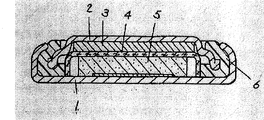
本発明に係るアルミニウム一次電池の構造の一例を図1を参照して説明する。図1は、
本発明のアルミニウム一次電池の一例であるコイン型乾電池構造のアルミニウム一次電池を示す部分断面図である。
An example of the structure of the aluminum primary battery according to the present invention will be described with reference to FIG. FIG.
It is a fragmentary sectional view which shows the aluminum primary battery of the coin type dry battery structure which is an example of the aluminum primary battery of this invention.
1は電池ケース、2は封口板、3は負極、4はセパレータ、5は正極、6はガスケットである。 1 is a battery case, 2 is a sealing plate, 3 is a negative electrode, 4 is a separator, 5 is a positive electrode, and 6 is a gasket.
図1に示すように、アルミニウムの負極として直径15mmの円盤状アルミニウム配向板を用いた。正極には、正極活物質と導電剤と電解液を含む正極合剤を圧縮成形したものを配置した。 As shown in FIG. 1, a disk-shaped aluminum alignment plate having a diameter of 15 mm was used as the aluminum negative electrode. The positive electrode was formed by compression molding a positive electrode mixture containing a positive electrode active material, a conductive agent, and an electrolytic solution.
以下、本発明を具体的な実施例によって詳細に説明する。
(実施例1)
上述した図1の電池構造を以下の条件にて試作し、性能の評価を行った。
<電解液の調製>
塩化アルミニウム、塩化カリウム、ビピリジルそれぞれの濃度が1.5mol/L、0.75mol/L、及び0.1mol/L(mol/Lは以下Mと略す)になるように溶解させ、水溶液の電解液を調製した。
<正極合剤の作製>
正極活物質として電解二酸化マンガンを用い、これに導電剤としてアセチレンブラック5重量%を添加して混合した後、上記電解液をさらに加え、正極合剤を作製した。これを圧縮成形し、正極ペレットにした。
<負極の作製>
4nine純度のAlで{100}面配向した0.1mm厚の板を用意した。これを電池ケース1に合うよう適当な大きさに切り負極板を形成した。
<電池組立て>
電池ケース1に正極ペレットを配置し、その上にセパレータ、さらにその上に負極板を配置した。さらに封口板を載せ、ガスケットで固定した。
後でガス発生を調べる都合上封口は完全には行わず、封口板と電池ケースとが離れない程度に固定した。その後、封口板及び電池ケースにリード線をつけた。
<放電試験>
上記の電池を室温(20℃)中で26mA/cm2になるように定電流放電をさせた。このとき発生するガスを捕集し、体積測定を行い、ガス発生速度を求めた。表1にその結果を示す。
Hereinafter, the present invention will be described in detail by way of specific examples.
(Example 1)
The battery structure of FIG. 1 described above was prototyped under the following conditions, and performance was evaluated.
<Preparation of electrolyte>
Dissolve so that the concentrations of aluminum chloride, potassium chloride, and bipyridyl are 1.5 mol / L, 0.75 mol / L, and 0.1 mol / L (mol / L is abbreviated as “M” below), and use an aqueous electrolyte. Was prepared.
<Preparation of positive electrode mixture>
Electrolytic manganese dioxide was used as the positive electrode active material, and 5% by weight of acetylene black as a conductive agent was added and mixed therewith, and then the above electrolytic solution was further added to prepare a positive electrode mixture. This was compression molded into a positive electrode pellet.
<Production of negative electrode>
A 0.1 mm thick plate with {100} plane orientation made of 4nine purity Al was prepared. This was cut into a suitable size to fit the battery case 1 to form a negative electrode plate.
<Battery assembly>
A positive electrode pellet was disposed in the battery case 1, a separator was disposed thereon, and a negative electrode plate was disposed thereon. Further, a sealing plate was placed and fixed with a gasket.
For the purpose of examining gas generation later, the sealing was not performed completely, and the sealing plate and the battery case were fixed so as not to be separated. Thereafter, lead wires were attached to the sealing plate and the battery case.
<Discharge test>
The battery was discharged at a constant current so as to be 26 mA / cm 2 at room temperature (20 ° C.). The gas generated at this time was collected and the volume was measured to determine the gas generation rate. Table 1 shows the results.
(比較例1)
実施例1における負極を同組成(99.99%純度Al)で配向していない通常の板(無配向)に替えて、それ以外は実施例1と同様に電池を作製し、放電試験を行なった。表1に、実施例1と同様の評価試験を実施した結果を同時に示した。
(Comparative Example 1)
A battery was fabricated in the same manner as in Example 1 except that the negative electrode in Example 1 was replaced with a normal plate (non-oriented) not oriented with the same composition (99.99% purity Al), and a discharge test was performed. Table 1 shows the results of the same evaluation test as in Example 1.
(実施例2〜実施例15)
以下の実施例の説明では、実施例1と同一内容については説明を省略し、異なる部分を中心にして説明を行った。実施例2〜実施例15は実施例1の負極の材料を種々のアルミニウム合金に変え、その他は実施例1と同様にした電池を用意した。各実施例で使用した負極の材料及び評価試験の結果を表1示した。合金組成としては意図的に添加した元素のみ示し、Snは重要な不純物であるので分析結果を右側に載せた。Sn含有量はいずれも0.01重量%未満で、多くは0.005重量%以下であった。
(Example 2 to Example 15)
In the following description of the embodiment, the description of the same content as that of the first embodiment is omitted, and the description is focused on different portions. In Examples 2 to 15, batteries were prepared in the same manner as in Example 1 except that the negative electrode material of Example 1 was changed to various aluminum alloys. Table 1 shows the negative electrode materials used in each Example and the results of evaluation tests. Only the intentionally added elements are shown as the alloy composition. Since Sn is an important impurity, the analysis results are shown on the right side. The Sn content was less than 0.01% by weight and most was 0.005% by weight or less.
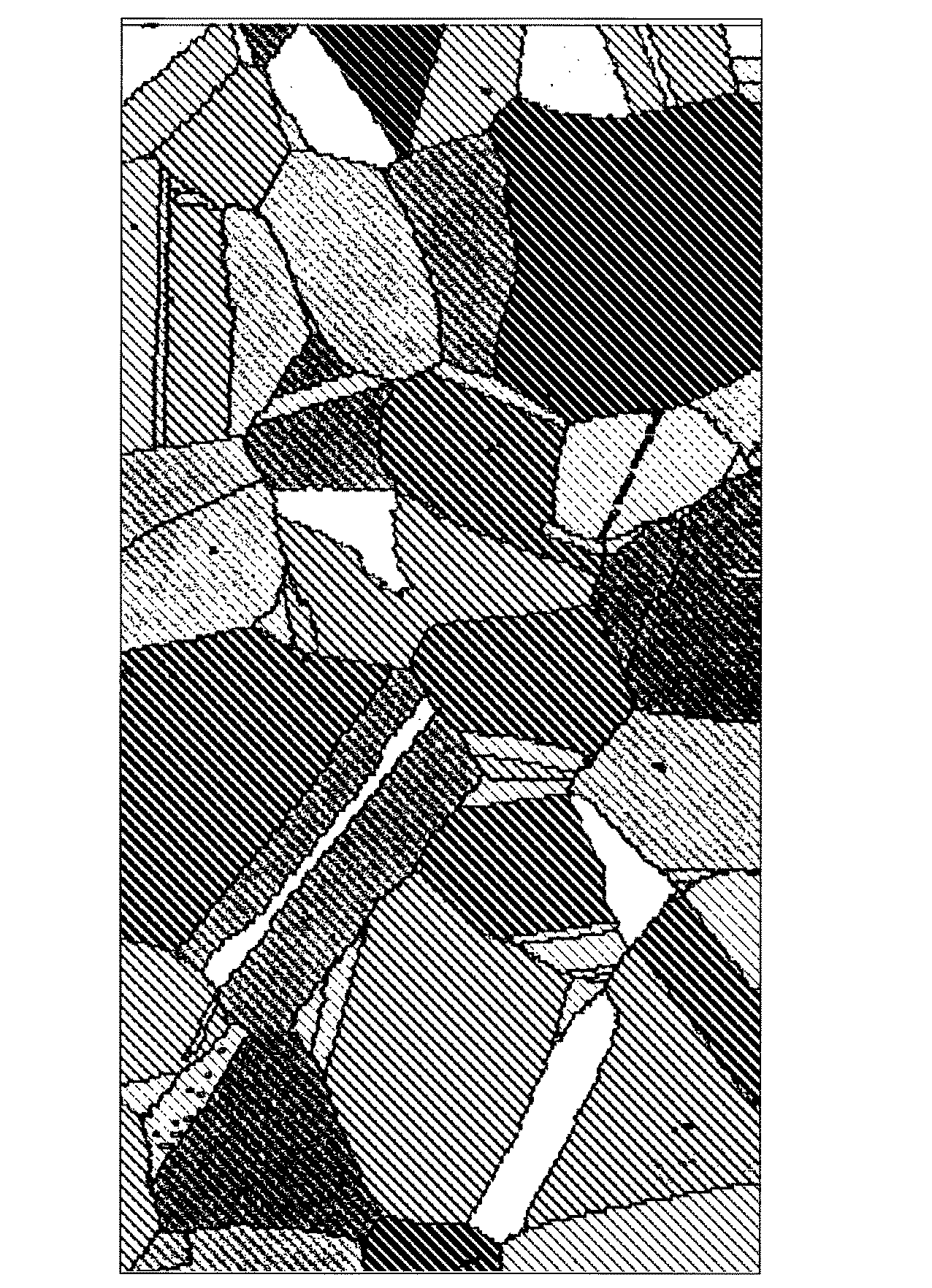
表1からわかるように、(100)配向した実施例1の負極材料が、配向していない場合(比較例1)に比べて放電中水素ガス発生量(速度)が小さく、効果があることがわかる。また、各種のアルミニウム合金であっても実施例1と同様に(100)配向を施せば、同様の効果が得られることが判明した。 As can be seen from Table 1, the (100) oriented negative electrode material of Example 1 has a smaller amount of hydrogen gas generated during discharge (speed) than the case where it is not oriented (Comparative Example 1). Understand. Further, it was found that even if various aluminum alloys are used, the same effect can be obtained if the (100) orientation is applied in the same manner as in Example 1.
また、実施例1の負極合金をEBSP観察した結果を図2に示す。図2では{100}面と15°以内の傾斜を持つ結晶粒のみ着色(それ以外は白抜き)して示す。これらの結晶粒の全体に占める面積率は95%であった。その他の実施例に関しても実施例1と同様結晶粒の全体に占める面積率は95%の結果を得ている。 Moreover, the result of having observed the negative electrode alloy of Example 1 by EBSP is shown in FIG. In FIG. 2, only crystal grains having a {100} plane and an inclination of 15 ° or less are colored (otherwise, white). The area ratio of these crystal grains was 95%. Regarding the other examples, the area ratio of the entire crystal grains was 95% as in Example 1.
比較例1の無配向の場合、同様の面積率を測定すると20%であった。 In the case of non-orientation in Comparative Example 1, the same area ratio was measured and found to be 20%.
(実施例16)
<電解液の調製>
実施例1と同様に、電解液を調製した。
(Example 16)
<Preparation of electrolyte>
An electrolyte solution was prepared in the same manner as in Example 1.
<正極合剤の作製>
正極活物質として電解二酸化マンガンを用い、これに導電剤としてアセチレンブラック10重量%を添加して混合した後、上記電解液をさらに加え、正極合剤を作製した。
<Preparation of positive electrode mixture>
Electrolytic manganese dioxide was used as the positive electrode active material, and 10% by weight of acetylene black as a conductive agent was added and mixed therewith, and then the electrolyte solution was further added to prepare a positive electrode mixture.
<負極の作製>
4nine純度のAlで{100}面配向した6mm厚の板を用意した。これを塑性変形させることにより、有底円筒形状のアルミニウム合金製容器を得た。
実施例1と同様、EBSP観察したところ、{100}面と15°以内の傾斜を持つ結晶
粒は、面積率にして90%であった。
<Production of negative electrode>
A 6 mm thick plate with {100} plane orientation made of 4nine purity Al was prepared. This was plastically deformed to obtain a bottomed cylindrical aluminum alloy container.
As in Example 1, when EBSP was observed, crystal grains having a {100} plane and an inclination within 15 ° were 90% in terms of area ratio.
<電池組立て>
上記で作製した負極容器の内壁を覆うようにセパレータを収納し、その中に正極合剤を充填し、さらにそこに黒鉛製正極集電体を挿入した。後でガス発生を調べる都合上封口等は行なわなかった。
<Battery assembly>
A separator was accommodated so as to cover the inner wall of the negative electrode container produced above, and a positive electrode mixture was filled therein, and a graphite positive electrode current collector was further inserted therein. For the purpose of examining gas generation later, no sealing or the like was performed.
実施例1と同様に、放電試験を行なった。表2に放電中水素ガス発生量を示す。 A discharge test was conducted in the same manner as in Example 1. Table 2 shows the amount of hydrogen gas generated during discharge.
(実施例17)
実施例16のアルミニウムに関して、{100}面と15°以内の傾斜を持つ結晶粒は、面積率にして90%であったが、これを75%にしたのが、実施例16であり、その他の点では、実施例16と同様である。この実施例17ついても実施例16と同様に性能評価を実施して表2に示した。
(Example 17)
Regarding the aluminum of Example 16, the crystal grains having a {100} plane and an inclination of 15 ° or less were 90% in terms of area ratio, but it was Example 16 that made this 75%. This is the same as Example 16. The performance evaluation of Example 17 was performed in the same manner as in Example 16 and is shown in Table 2.
(実施例18)
実施例16のアルミニウムに関して、{100}面と15°以内の傾斜を持つ結晶粒は、面積率にして90%であったが、これを70%にしたのが、実施例18であり、その他の点では、実施例16と同様である。この実施例18についても実施例16と同様に性能評価を実施して表2に示した。
(Example 18)
Regarding the aluminum of Example 16, the crystal grains having a {100} plane and an inclination of 15 ° or less were 90% in terms of area ratio, but this was changed to 70% in Example 18, and the others. This is the same as Example 16. The performance of Example 18 was evaluated in the same manner as in Example 16 and is shown in Table 2.
(実施例19)
実施例15のアルミニウムに関して、{100}面と15°以内の傾斜を持つ結晶粒は、面積率にして90%であったが、これを60%にしたのが、実施例19であり、その他の点では、実施例16と同様である。この実施例19についても実施例16と同様に性能評価を実施して表2に示した。
(Example 19)
Regarding the aluminum of Example 15, the crystal grains having a {100} plane and an inclination of 15 ° or less were 90% in terms of area ratio, but this was changed to 60% in Example 19, and the others. This is the same as Example 16. The performance of Example 19 was evaluated in the same manner as in Example 16 and is shown in Table 2.
実施例16〜19の負極材料は、いずれも比較例1と比べて良好な特性を示す。特に、上記面積率を90%にすることで飛躍的に電流効率を向上できることが判明した。 The negative electrode materials of Examples 16 to 19 all show better characteristics than Comparative Example 1. In particular, it has been found that the current efficiency can be dramatically improved by setting the area ratio to 90%.
なお、本発明は上記実施形態そのままに限定されるものではなく、実施段階ではその要旨を逸脱しない範囲で構成要素を変形して具体化できる。また、上記実施形態に開示されている複数の構成要素の適宜な組み合わせにより、種々の発明を形成できる。例えば、実施形態に示される全構成要素から幾つかの構成要素を削除してもよい。さらに、異なる実
施形態にわたる構成要素を適宜組み合わせてもよい。また、実施例16〜19を検討すると、{100}面と15°以内の傾斜を持つ結晶粒が、面積率にして100%に近づくほど特性が良好であることがわかる。ただし、面積率が60%と70%との間でやや大きな格差が存在し、面積率70%以上が特に好ましいことがわかる。従って、{100}面と15°以内の傾斜を持つ結晶粒が、面積率にして70%以上である事が望ましい。
Note that the present invention is not limited to the above-described embodiment as it is, and can be embodied by modifying the constituent elements without departing from the scope of the invention in the implementation stage. In addition, various inventions can be formed by appropriately combining a plurality of components disclosed in the embodiment. For example, some components may be deleted from all the components shown in the embodiment. Furthermore, constituent elements over different embodiments may be appropriately combined. Moreover, when Examples 16-19 are examined, it turns out that a crystal grain with a {100} plane and the inclination within 15 degrees has a favorable characteristic, so that it approaches 100% in area ratio. However, it can be seen that there is a slightly large difference between the area ratio of 60% and 70%, and an area ratio of 70% or more is particularly preferable. Accordingly, it is desirable that crystal grains having a {100} plane and an inclination of 15 ° or less are 70% or more in terms of area ratio.
(参考例1〜2)
実施例6と15の組成のアルミニウム合金に関しては、550℃程度の熱処理を施し、無配向のものを作製した。このとき{100}面と15°以内の傾斜を持つ結晶粒は、両者とも面積率にして約20%であった。その他の点では、実施例1と同様である。この参考例1及び2についても実施例1と同様に性能評価を実施して表3に示した。
(Reference examples 1-2)
The aluminum alloys having the compositions of Examples 6 and 15 were heat-treated at about 550 ° C. to produce non-oriented ones. At this time, the crystal grains having a {100} plane and an inclination within 15 ° were both about 20% in terms of area ratio. The other points are the same as in the first embodiment. For Reference Examples 1 and 2, performance evaluation was performed in the same manner as in Example 1, and the results are shown in Table 3.
これらの組成については、配向したものとほぼ同等の特性が得られた。ここで明示された元素以外の不純物元素はSnを含めて合計で100ppm(0.01重量%)以内であった。表にはしないが、この周辺組成も性能評価をした結果、この場合にはSnが少ないこと、並びにZn、Mg、及びInが所定の範囲内に入っていることが良い評価をもたらしたことがわかった。Znが5重量%を越えた場合、Mgが3重量%を越えた場合、及びInが1重量%を越えた場合はかえって放電中のガス発生を増やす。また、Zn,Mg,Inのうちどれか一つでも欠けると参考例に比べて放電中のガス発生が小さくならない。その他のSnやBiなどの元素を微量添加してもかえって放電中のガス発生が増える。ここで、0.01重量%未満の添加元素は不純物と見なすので、微量添加というのは0.01重量%以上のことを指す。参考例の組成では特異的に配向面の影響が小さく、放電中ガスも少ないことがわかった。換言すれば、本提案の本質は{100}面配向によって最適組成を広げうることにあるといってもよい。 About these compositions, the characteristic substantially equivalent to what was orientated was acquired. Impurity elements other than those specified here were within 100 ppm (0.01 wt%) in total including Sn. Although not shown in the table, this peripheral composition was evaluated for performance. As a result, it was confirmed that Sn was small and that Zn, Mg, and In were within a predetermined range. all right. If Zn exceeds 5% by weight, Mg exceeds 3% by weight, and In exceeds 1% by weight, gas generation during discharge is increased. Further, if any one of Zn, Mg, and In is missing, gas generation during discharge is not reduced as compared with the reference example. Even if a small amount of other elements such as Sn and Bi are added, the generation of gas during discharge increases. Here, since an additive element of less than 0.01% by weight is regarded as an impurity, the addition of a trace amount means 0.01% by weight or more. In the composition of the reference example, it was found that the influence of the orientation plane was specifically small and the gas during discharge was small. In other words, it can be said that the essence of the proposal is that the optimum composition can be expanded by {100} plane orientation.
1…電池ケース、2…封口板、3…負極、4…セパレータ、5…正極、6…ガスケット。 DESCRIPTION OF SYMBOLS 1 ... Battery case, 2 ... Sealing plate, 3 ... Negative electrode, 4 ... Separator, 5 ... Positive electrode, 6 ... Gasket.
Claims (5)
ZnaMgbSncMdAl100-a-b-c-d (1)
但し、前記Mは、Ga、Ti、Zr、Cr、Bi、In、Mn及び希土類元素よりなる群から選択される少なくとも1種類の元素であり、a、b、c及びdは、それぞれ、0.01重量%≦a≦20重量%、0.01重量%≦b≦10重量%、0≦c<0.01重量%、0≦d≦3重量%を示す。 The aluminum primary battery according to claim 1, wherein the metal containing aluminum is an aluminum alloy having a composition represented by the following formula (1).
ZnaMgBncMdAl100-abcd (1)
Here, M is at least one element selected from the group consisting of Ga, Ti, Zr, Cr, Bi, In, Mn, and rare earth elements, and a, b, c, and d are each 0. 01 wt% ≦ a ≦ 20 wt%, 0.01 wt% ≦ b ≦ 10 wt%, 0 ≦ c <0.01 wt%, and 0 ≦ d ≦ 3 wt% are shown.
Priority Applications (1)
| Application Number | Priority Date | Filing Date | Title |
|---|---|---|---|
| JP2003432228A JP4327586B2 (en) | 2003-12-26 | 2003-12-26 | Aluminum primary battery |
Applications Claiming Priority (1)
| Application Number | Priority Date | Filing Date | Title |
|---|---|---|---|
| JP2003432228A JP4327586B2 (en) | 2003-12-26 | 2003-12-26 | Aluminum primary battery |
Publications (2)
| Publication Number | Publication Date |
|---|---|
| JP2005190879A true JP2005190879A (en) | 2005-07-14 |
| JP4327586B2 JP4327586B2 (en) | 2009-09-09 |
Family
ID=34789990
Family Applications (1)
| Application Number | Title | Priority Date | Filing Date |
|---|---|---|---|
| JP2003432228A Expired - Fee Related JP4327586B2 (en) | 2003-12-26 | 2003-12-26 | Aluminum primary battery |
Country Status (1)
| Country | Link |
|---|---|
| JP (1) | JP4327586B2 (en) |
Cited By (2)
| Publication number | Priority date | Publication date | Assignee | Title |
|---|---|---|---|---|
| CN105648282A (en) * | 2016-02-26 | 2016-06-08 | 江西德义半导体科技有限公司 | Gallium-aluminum alloy and preparation method thereof |
| JP2019109966A (en) * | 2017-12-15 | 2019-07-04 | 株式会社Gsユアサ | Primary battery |
-
2003
- 2003-12-26 JP JP2003432228A patent/JP4327586B2/en not_active Expired - Fee Related
Cited By (2)
| Publication number | Priority date | Publication date | Assignee | Title |
|---|---|---|---|---|
| CN105648282A (en) * | 2016-02-26 | 2016-06-08 | 江西德义半导体科技有限公司 | Gallium-aluminum alloy and preparation method thereof |
| JP2019109966A (en) * | 2017-12-15 | 2019-07-04 | 株式会社Gsユアサ | Primary battery |
Also Published As
| Publication number | Publication date |
|---|---|
| JP4327586B2 (en) | 2009-09-09 |
Similar Documents
| Publication | Publication Date | Title |
|---|---|---|
| KR100281729B1 (en) | Nickel positive electrode and alkaline storage battery using the same | |
| US8153298B2 (en) | Positive electrode for alkaline battery and alkaline battery using the same | |
| US20100003596A1 (en) | Alkaline battery | |
| JP5121499B2 (en) | Hydrogen storage alloy, hydrogen storage alloy electrode using the alloy, and nickel hydride secondary battery | |
| EP3915161A1 (en) | Alkaline electrochemical cells comprising increased zinc oxide levels | |
| JP3932047B2 (en) | Button-type alkaline battery | |
| JP5172181B2 (en) | Zinc alkaline battery | |
| JP2005327541A (en) | Alkaline battery | |
| JP4222488B2 (en) | Alkaline battery | |
| JP4327586B2 (en) | Aluminum primary battery | |
| JP3545985B2 (en) | Zinc alloy powder and alkaline battery using the same | |
| JP2010080291A (en) | Hydrogen storage alloy powder, manufacturing method therefor, and alkaline accumulator of alkaline storage battery | |
| JPWO2019181538A1 (en) | Alkaline battery | |
| JP2004303459A (en) | Anode material for aluminum battery and aluminum primary battery | |
| JP4309311B2 (en) | Aluminum battery | |
| JP2001313069A (en) | Nickel hydrogen storage battery | |
| JP3163006B2 (en) | Negative electrode zinc base alloy powder for alkaline battery and method for producing the same | |
| JP3968248B2 (en) | Aluminum battery | |
| JP3155203B2 (en) | Negative electrode zinc base alloy powder for alkaline battery and method for producing the same | |
| JP3163007B2 (en) | Method for producing negative electrode zinc-based alloy powder for alkaline battery | |
| JP3548006B2 (en) | Hydrogen storage alloy for alkaline storage battery and method for producing the same, hydrogen storage alloy electrode for alkaline storage battery and method for producing the same | |
| JP2001006666A (en) | Hydrogen storage alloy for alkaline storage battery and manufacture of such alloy | |
| JP3163005B2 (en) | Method for producing negative electrode zinc-based alloy powder for alkaline battery | |
| JP3155202B2 (en) | Negative electrode zinc base alloy powder for alkaline battery and method for producing the same | |
| JPH06256873A (en) | Hydrogen storage alloy and electrode using the alloy |
Legal Events
| Date | Code | Title | Description |
|---|---|---|---|
| RD02 | Notification of acceptance of power of attorney |
Free format text: JAPANESE INTERMEDIATE CODE: A7422 Effective date: 20050415 |
|
| RD04 | Notification of resignation of power of attorney |
Free format text: JAPANESE INTERMEDIATE CODE: A7424 Effective date: 20050606 |
|
| A977 | Report on retrieval |
Free format text: JAPANESE INTERMEDIATE CODE: A971007 Effective date: 20081003 |
|
| A131 | Notification of reasons for refusal |
Free format text: JAPANESE INTERMEDIATE CODE: A131 Effective date: 20081118 |
|
| A521 | Written amendment |
Free format text: JAPANESE INTERMEDIATE CODE: A523 Effective date: 20090116 |
|
| A131 | Notification of reasons for refusal |
Free format text: JAPANESE INTERMEDIATE CODE: A131 Effective date: 20090403 |
|
| A521 | Written amendment |
Free format text: JAPANESE INTERMEDIATE CODE: A523 Effective date: 20090423 |
|
| TRDD | Decision of grant or rejection written | ||
| A01 | Written decision to grant a patent or to grant a registration (utility model) |
Free format text: JAPANESE INTERMEDIATE CODE: A01 Effective date: 20090519 |
|
| A01 | Written decision to grant a patent or to grant a registration (utility model) |
Free format text: JAPANESE INTERMEDIATE CODE: A01 |
|
| A61 | First payment of annual fees (during grant procedure) |
Free format text: JAPANESE INTERMEDIATE CODE: A61 Effective date: 20090611 |
|
| FPAY | Renewal fee payment (event date is renewal date of database) |
Free format text: PAYMENT UNTIL: 20120619 Year of fee payment: 3 |
|
| FPAY | Renewal fee payment (event date is renewal date of database) |
Free format text: PAYMENT UNTIL: 20120619 Year of fee payment: 3 |
|
| FPAY | Renewal fee payment (event date is renewal date of database) |
Free format text: PAYMENT UNTIL: 20120619 Year of fee payment: 3 |
|
| FPAY | Renewal fee payment (event date is renewal date of database) |
Free format text: PAYMENT UNTIL: 20130619 Year of fee payment: 4 |
|
| LAPS | Cancellation because of no payment of annual fees |