JP2005239727A - Second p-phenylenediamines containing carboxyl groups, dye compositions using them, production methods and uses thereof - Google Patents
Second p-phenylenediamines containing carboxyl groups, dye compositions using them, production methods and uses thereof Download PDFInfo
- Publication number
- JP2005239727A JP2005239727A JP2005092684A JP2005092684A JP2005239727A JP 2005239727 A JP2005239727 A JP 2005239727A JP 2005092684 A JP2005092684 A JP 2005092684A JP 2005092684 A JP2005092684 A JP 2005092684A JP 2005239727 A JP2005239727 A JP 2005239727A
- Authority
- JP
- Japan
- Prior art keywords
- amino
- group
- radical
- methylphenylamino
- acid
- Prior art date
- Legal status (The legal status is an assumption and is not a legal conclusion. Google has not performed a legal analysis and makes no representation as to the accuracy of the status listed.)
- Pending
Links
- 0 ***c(cc1)ccc1[N+]([O-])=O Chemical compound ***c(cc1)ccc1[N+]([O-])=O 0.000 description 2
- BQIVJVAZDJHDJF-UHFFFAOYSA-N CCOC(C(C(C)C)N)=O Chemical compound CCOC(C(C(C)C)N)=O BQIVJVAZDJHDJF-UHFFFAOYSA-N 0.000 description 1
- VUHDYNPUSBTRIJ-UHFFFAOYSA-N CCOC(C(C(C)C)Nc(cc1)ccc1N)=O Chemical compound CCOC(C(C(C)C)Nc(cc1)ccc1N)=O VUHDYNPUSBTRIJ-UHFFFAOYSA-N 0.000 description 1
- NTLOSSXQTHGNGZ-UHFFFAOYSA-N CCOC(C(C(C)C)Nc(cc1)ccc1[N+]([O-])=O)=O Chemical compound CCOC(C(C(C)C)Nc(cc1)ccc1[N+]([O-])=O)=O NTLOSSXQTHGNGZ-UHFFFAOYSA-N 0.000 description 1
- TYMLOMAKGOJONV-UHFFFAOYSA-N Nc(cc1)ccc1[N+]([O-])=O Chemical compound Nc(cc1)ccc1[N+]([O-])=O TYMLOMAKGOJONV-UHFFFAOYSA-N 0.000 description 1
- WFQDTOYDVUWQMS-UHFFFAOYSA-N [O-][N+](c(cc1)ccc1F)=O Chemical compound [O-][N+](c(cc1)ccc1F)=O WFQDTOYDVUWQMS-UHFFFAOYSA-N 0.000 description 1
Classifications
-
- C—CHEMISTRY; METALLURGY
- C07—ORGANIC CHEMISTRY
- C07C—ACYCLIC OR CARBOCYCLIC COMPOUNDS
- C07C229/00—Compounds containing amino and carboxyl groups bound to the same carbon skeleton
- C07C229/02—Compounds containing amino and carboxyl groups bound to the same carbon skeleton having amino and carboxyl groups bound to acyclic carbon atoms of the same carbon skeleton
- C07C229/04—Compounds containing amino and carboxyl groups bound to the same carbon skeleton having amino and carboxyl groups bound to acyclic carbon atoms of the same carbon skeleton the carbon skeleton being acyclic and saturated
- C07C229/06—Compounds containing amino and carboxyl groups bound to the same carbon skeleton having amino and carboxyl groups bound to acyclic carbon atoms of the same carbon skeleton the carbon skeleton being acyclic and saturated having only one amino and one carboxyl group bound to the carbon skeleton
- C07C229/18—Compounds containing amino and carboxyl groups bound to the same carbon skeleton having amino and carboxyl groups bound to acyclic carbon atoms of the same carbon skeleton the carbon skeleton being acyclic and saturated having only one amino and one carboxyl group bound to the carbon skeleton the nitrogen atom of the amino group being further bound to carbon atoms of six-membered aromatic rings
-
- C—CHEMISTRY; METALLURGY
- C07—ORGANIC CHEMISTRY
- C07C—ACYCLIC OR CARBOCYCLIC COMPOUNDS
- C07C229/00—Compounds containing amino and carboxyl groups bound to the same carbon skeleton
- C07C229/02—Compounds containing amino and carboxyl groups bound to the same carbon skeleton having amino and carboxyl groups bound to acyclic carbon atoms of the same carbon skeleton
- C07C229/04—Compounds containing amino and carboxyl groups bound to the same carbon skeleton having amino and carboxyl groups bound to acyclic carbon atoms of the same carbon skeleton the carbon skeleton being acyclic and saturated
- C07C229/22—Compounds containing amino and carboxyl groups bound to the same carbon skeleton having amino and carboxyl groups bound to acyclic carbon atoms of the same carbon skeleton the carbon skeleton being acyclic and saturated the carbon skeleton being further substituted by oxygen atoms
Landscapes
- Chemical & Material Sciences (AREA)
- Organic Chemistry (AREA)
- Cosmetics (AREA)
- Organic Low-Molecular-Weight Compounds And Preparation Thereof (AREA)
- Coloring (AREA)
Abstract
【課題】 強く、芸術的な、そして、選択性が低く、変色しない、特に耐光性の着色をさまざまな度合いで与えることができ、繊維が曝される可能性がある種々の攻撃要因に対して良い抵抗力を示す、ケラチン繊維、特に毛髪など、人間のケラチン繊維の染料組成物を得ること。
【解決手段】
カルボキシル基を含有する新規の第二p−フェニレンジアミン類、それらの合成方法、それらの毛髪用酸化染料への応用、ケラチン繊維、特に、毛髪のような人間のケラチン繊維を染色するための、染色に適当な媒質中に、第二p−フェニレンジアミンを少なくとも1つ含む組成物、この組成物の毛髪染色への利用法、ケラチン繊維の染色方法、さらに、染色キットを用いる。PROBLEM TO BE SOLVED: To provide various kinds of attack factors that can give a fiber with various degrees of strong, artistic, low selectivity, non-discoloration, particularly light-resistant coloring. To obtain a dye composition of human keratin fibers, such as keratin fibers, particularly hair, which exhibits good resistance.
[Solution]
Novel second p-phenylenediamines containing carboxyl groups, their synthesis methods, their application to oxidative dyes for hair, dyeing for dyeing keratin fibers, in particular human keratin fibers such as hair A composition containing at least one second p-phenylenediamine in a medium suitable for the above, a method for using this composition for hair dyeing, a method for dyeing keratin fibers, and a dyeing kit are used.
Description
本特許出願は新規のカルボキシル基含有第二p−フェニレンジアミン類、その製造方法、およびそのケラチン繊維のための酸化染料としての用途に関する。 This patent application relates to novel carboxyl group-containing secondary p-phenylenediamines, processes for their preparation, and their use as oxidative dyes for keratin fibers.
ケラチン繊維、とりわけヒトの毛髪を染色するのに、オルト−又はパラ−フェニレンジアミン類、オルト−又はパラ−アミノフェノール類、及び複素環化合物など、一般に酸化塩基と呼ばれる酸化染料前駆体を含む染料組成物を用いることが公知の手法である。これらの酸化塩基類は無色又は僅かに色があるが、酸化作用のある物質と結びつくと酸化縮合の過程により着色化合物を生じさせることができる。 Dye compositions comprising oxidative dye precursors commonly referred to as oxidative bases, such as ortho- or para-phenylenediamines, ortho- or para-aminophenols, and heterocyclic compounds for dyeing keratin fibers, especially human hair It is a known technique to use a product. These oxidized bases are colorless or slightly colored, but when combined with an oxidative substance, a colored compound can be produced by the oxidative condensation process.
これらの酸化塩基類によって得られる色調が、酸化塩基類と発色剤又は着色モディファイアーとの組み合わせ次第で多様となることも知られている。この後者の着色モディファイアーとしては、特に芳香族メタ−ジアミノベンゼン類、メタ−アミノフェノール類、メタ−ジフェノール類及びインド−ル化合物等の特定の複素環化合物から選択される。 It is also known that the color tone obtained with these oxidized bases varies depending on the combination of the oxidized base and a color former or a coloring modifier. This latter colored modifier is selected in particular from specific heterocyclic compounds such as aromatic meta-diaminobenzenes, meta-aminophenols, meta-diphenols and indole compounds.
酸化塩基類及び発色剤として使用される分子が多様であることによって、広範にわたる色を得ることが可能となる。 The variety of molecules used as oxidizing bases and color formers makes it possible to obtain a wide range of colors.
これらの酸化染料により「永久的な」着色を施す場合は、さらに特定の条件を多数満たさなければならない。たとえば、毒物学的欠点があってはならないこと、所望の濃さの色調が得られること、光、悪天候、洗浄、パーマ、汗及び摩擦などの外的な要因に対して十分な耐性を有することである。 In the case of “permanent” coloring with these oxidation dyes, a number of specific conditions must also be fulfilled. For example, it must be free of toxicological defects, obtain the desired shade of color, be sufficiently resistant to external factors such as light, bad weather, washing, perm, sweat and friction It is.
また、これらの染料で白髪が被覆されなければないが、最終的にはできる限り無差別でなければならない。言い換えると、一般に、ケラチン繊維は根元から先端までの間で増感のされかた(損傷のうけかた)が異なるものだが、同一のケラチン繊維の全長にわたって施される着色の差異が最小限でなければならないということである。 In addition, these hairs must be covered with gray hair, but ultimately they should be as indiscriminate as possible. In other words, keratin fibers generally differ in how they are sensitized from the root to the tip (the way they are damaged), but the difference in coloring applied over the entire length of the same keratin fibers is minimal. It must be.
本出願人は、驚くべきことに、そして、有利なことに、強く、芸術的な、そして、選択性の低い着色をさまざまな度合いで与えることができ、繊維が曝される可能性がある種々の攻撃要因に対して良い抵抗力を示す、新規な、カルボキシル基含有第二p−フェニレンジアミン類を得ることが可能であることを発見した。本特許出願はまた、該カルボキシル基含有第二p−フェニレンジアミン類の製造方法、および、その毛髪の酸化染料への利用法にも関する。 Applicants are surprisingly and advantageously able to give varying degrees of strong, artistic and less selective coloration and the fibers may be exposed. It was discovered that it is possible to obtain novel carboxyl group-containing secondary p-phenylenediamines that exhibit good resistance to attacking factors. The present patent application also relates to a process for producing the carboxyl group-containing second p-phenylenediamines and their use in hair oxidative dyes.
さらに、本発明の他の主題は、ケラチン繊維、特に毛髪などの人間のケラチン繊維の染料組成物に関する。該組成物は、上述の利点を有するカルボキシル基を含有する第二p−フェニレンジアミン類を少なくとも1つ含む。 さらに、この組成物は良好な毒物学的特徴を有する。 Furthermore, another subject of the invention relates to a dye composition of keratin fibers, in particular human keratin fibers such as hair. The composition comprises at least one second p-phenylenediamine containing a carboxyl group having the advantages described above. Furthermore, the composition has good toxicological characteristics.
また、本発明の主題の1つは、この組成物を用いた染色方法、ケラチン繊維、とりわけ毛髪等のヒトのケラチン繊維の染色への本発明の組成物の使用、及び、マルチコンパートメント型装置又は染色用「キット」である。 Also, one of the subjects of the present invention is a dyeing method using this composition, the use of the composition of the present invention for dyeing keratin fibers, especially human keratin fibers such as hair, and a multi-compartment type device or It is a “kit” for staining.
本発明の組成物は、特に、ケラチン繊維に対する、大変強い、まんべんない、変色しない、特に耐光性の着色をこれらの繊維を劣化させることなく行うことを可能にする。 The composition according to the invention makes it possible in particular to carry out very strong, even, non-discoloring, in particular light-resistant coloring on keratin fibers without degrading these fibers.
本発明によるこの他の特徴、態様、主題及び利点については、以下の説明及び実施例を読むことでより一層明確になるであろう。 Other features, aspects, subject matter and advantages of the present invention will become more apparent upon reading the following description and examples.
本発明の新規な第二p−フェニレンジアミン類は下記の一般式(I)で表わされる化合物又はその付加塩である。
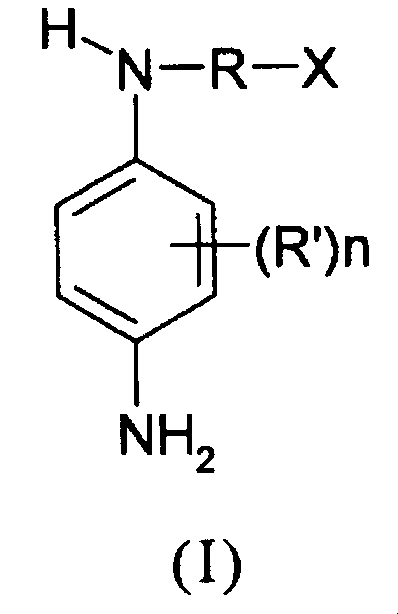
nは0から4の範囲の整数を表わし、
nが1から4の範囲の場合、Rは、直鎖のまたは分岐したC2−C10アルキレンラジカルを表わし、該アルキレンラジカルは、無置換でも、ヒドロキシル基、(C1−C15)アルキルカルボニル基、カルボキシル基、アミド基、(C1−C15)アルコキシカルボニル基、モノまたはジ(C1−C15)アルキルアミノカルボニル基からなる群から選ばれた1つ以上の基で置換されていても良く、該アルキレンラジカルは酸素および窒素から選ばれるヘテロ原子を1つ以上を含んでいても良く、
nが0の場合、Rは直鎖または分岐した(C2−C10)アルキレンラジカルを表わし、該アルキレンラジカルは、無置換でも、ヒドロキシル基、(C1−C15)アルコキシ基、(C1−C15)アルキルカルボニル基、カルボキシル基、アミド基、(C1−C15)アルコキシカルボニル基、モノまたはジ(C1−C15)アルキルアミノカルボニル基からなる群から選ばれる少なくとも1つの基で置換されていても良く、該アルキレンラジカルは酸素および窒素から選ばれるヘテロ原子を1つ以上含んでいても良く、
XはCOOYで表わされるラジカルであり、該Yは水素原子、C1−C15アルキルラジカル、C1−C15モノヒドロキシアルキルラジカル、または、C1−C15ポリヒドロキシアルキルラジカルから選ばれ、
R'はC1−C15アルキルラジカル、C1−C15アルコキシラジカル、C1−C15ヒドロキシアルコキシラジカル、(C1−C15)アルコキシ(C1−C15)アルキルラジカル、C1−C15モノヒドロキシアルキルラジカルまたはC1−C15ポリヒドロキシアルキルラジカル、または塩素原子を表し、 2−N−(3−メトキシ−4−アミノフェニル)アミノエタン酸、6−N−(4−アミノフェニル)アミノカプロン酸、3−N−(4−アミノフェニル)アミノプロパン酸および4−N−(4−アミノフェニル)アミノブタン酸を除く。
The novel second p-phenylenediamine of the present invention is a compound represented by the following general formula (I) or an addition salt thereof.
n represents an integer ranging from 0 to 4;
When n is in the range of 1 to 4, R represents a linear or branched C 2 -C 10 alkylene radical, which is unsubstituted or substituted with a hydroxyl group, (C 1 -C 15 ) alkylcarbonyl. Substituted with one or more groups selected from the group consisting of a group, a carboxyl group, an amide group, a (C 1 -C 15 ) alkoxycarbonyl group, a mono- or di (C 1 -C 15 ) alkylaminocarbonyl group The alkylene radical may contain one or more heteroatoms selected from oxygen and nitrogen;
When n is 0, R represents a linear or branched (C 2 -C 10 ) alkylene radical, and the alkylene radical may be unsubstituted, a hydroxyl group, a (C 1 -C 15 ) alkoxy group, (C 1 At least one group selected from the group consisting of —C 15 ) alkylcarbonyl group, carboxyl group, amide group, (C 1 -C 15 ) alkoxycarbonyl group, mono- or di (C 1 -C 15 ) alkylaminocarbonyl group; Optionally substituted, the alkylene radical may contain one or more heteroatoms selected from oxygen and nitrogen,
X is a radical represented by COOY, wherein Y is a hydrogen atom, C 1 -C 15 alkyl radicals, C 1 -C 15 monohydroxy alkyl radical, or is selected from C 1 -C 15 polyhydroxyalkyl radical,
R ′ is a C 1 -C 15 alkyl radical, C 1 -C 15 alkoxy radical, C 1 -C 15 hydroxyalkoxy radical, (C 1 -C 15 ) alkoxy (C 1 -C 15 ) alkyl radical, C 1 -C 15 monohydroxyalkyl radical or C 1 -C 15 polyhydroxyalkyl radical, or chlorine atom, 2-N- (3-methoxy-4-aminophenyl) aminoethanoic acid, 6-N- (4-aminophenyl) aminocaprone Excludes acids, 3-N- (4-aminophenyl) aminopropanoic acid and 4-N- (4-aminophenyl) aminobutanoic acid.
好ましくは、nが0の場合、前記式(I)のR基は直鎖または分岐のC2−C10アルキレンラジカルであり、たとえばエチレン、プロピレン、ブチレン、ペンチレン、ヘキシレンなどを挙げることができる。該アルキレンラジカルは、無置換でも、または、(C2−C8)アルキルカルボニルラジカル、カルボキシルラジカル、(C2−C8)アルコキシカルボニルラジカルから選ばれる1つ以上の基によって置換されていても良く、該アルキレンラジカルは、1つ以上の酸素原子と結合していても良い。 Preferably, when n is 0, the R group of the formula (I) is a linear or branched C 2 -C 10 alkylene radical, and examples thereof include ethylene, propylene, butylene, pentylene, hexylene and the like. The alkylene radical may be unsubstituted or substituted with one or more groups selected from a (C 2 -C 8 ) alkylcarbonyl radical, a carboxyl radical, and a (C 2 -C 8 ) alkoxycarbonyl radical. The alkylene radical may be bonded to one or more oxygen atoms.
好ましくは、nが1から4の範囲の場合、前記式(I)のR基は直鎖または分岐のC2−C10アルキレンラジカルであり、たとえばエチレン、プロピレン、ブチレン、ペンチレン、ヘキシレンなどを挙げることができる。該アルキレンラジカルは、無置換でも、または、(C2−C8)アルキルカルボニルラジカル、カルボキシルラジカル、(C2−C8)アルコキシカルボニルラジカルから選ばれる1つ以上の基によって置換されていても良く、さらに、該アルキレンラジカルは、1つ以上の酸素原子を含んでいても良い。 Preferably, when n is in the range of 1 to 4, the R group of formula (I) is a linear or branched C 2 -C 10 alkylene radical, such as ethylene, propylene, butylene, pentylene, hexylene and the like. be able to. The alkylene radical may be unsubstituted or substituted with one or more groups selected from a (C 2 -C 8 ) alkylcarbonyl radical, a carboxyl radical, and a (C 2 -C 8 ) alkoxycarbonyl radical. Furthermore, the alkylene radical may contain one or more oxygen atoms.
好ましくは、前記式(I)のX基は−COOYラジカルを表わし、該Yは水素原子、および、メチル、エチル、イソプロピル、t−ブチルなどのC1−C6 アルキルラジカルから選ばれる。 Preferably, X group of the formula (I) represents a -COOY radical, said Y is a hydrogen atom, and methyl, ethyl, isopropyl, selected from C 1 -C 6 alkyl radical, such as t- butyl.
好ましくは、前記式(I)のR'基はメチル基、エチル基、n−プロピル基、またはイソプロピル基などC1−C6アルキルラジカル、(C1−C6)アルコキシラジカル、β−ヒドロキシエトキシ基などの(C1−C6)ヒドロキシアルコキシラジカル、(C1−C6)アルコキシ(C1−C6)アルキルラジカル、または(C1−C6)モノヒドロキシアルキルラジカル、または、(C1−C6)ポリヒドロキシアルキルラジカルを表わす。 Preferably, the R ′ group in the formula (I) is a C 1 -C 6 alkyl radical such as a methyl group, an ethyl group, an n-propyl group, or an isopropyl group, a (C 1 -C 6 ) alkoxy radical, β-hydroxyethoxy (C 1 -C 6 ) hydroxyalkoxy radicals such as groups, (C 1 -C 6 ) alkoxy (C 1 -C 6 ) alkyl radicals, or (C 1 -C 6 ) monohydroxyalkyl radicals, or (C 1 represent -C 6) polyhydroxyalkyl radicals.
より好ましくは、前記一般式(I)で表わされる化合物は、下表で示す化合物から選ばれる。
一般に、付加塩としては、塩酸塩、シュウ化水素酸塩、硫酸塩、クエン酸塩、琥珀酸塩、酒石酸塩、乳酸塩、トシレ−ト、ベンゼンスルホン酸塩、リン酸塩、および、酢酸塩などの酸との付加塩から選ばれる。 In general, the addition salts include hydrochloride, hydrooxalate, sulfate, citrate, oxalate, tartrate, lactate, tosylate, benzenesulfonate, phosphate, and acetate. Selected from addition salts with acids such as
本特許出願になる式(I)の化合物は、一般に下記の工程を含む方法で製造することができる。
・塩基の存在下で、p−ハロニトロベンゼン誘導体の式X−RNH2で表わされる第一アミンによる吸核置換。ここで、RおよびXは前出の定義どおりである。
・上記工程で得られる化合物のニトロ官能基のアミン官能基への還元。これにより、式(I)の化合物が得られる。
Nucleophilic substitution of a p-halonitrobenzene derivative with a primary amine represented by the formula X-RNH 2 in the presence of a base. Here, R and X are as defined above.
-Reduction of the nitro functional group of the compound obtained in the above process to an amine functional group. This gives a compound of formula (I).
最初の合成工程はscientific revues Synthesis 1990 (12), 1147−1148 and Synth. Commun. 1990, 20(22), 35373545に記載されている。 The first synthesis step is described in scientific revues Synthesis 1990 (12), 1147-1148 and Synth. Commun. 1990, 20 (22), 35373545.
最後の工程は標準的な還元工程であり、たとえば、触媒としてのPd/C, Pd(II)/C or ラネ−ニッケルの存在下不均一系触媒を用いて水素化反応を行うこと、または、例えば亜鉛、鉄、スズなどの金属を用いて還元反応を行うこと(Advanced Organic Chemistry, 4th edition, 1992, J. MARCH, WILEY Interscience; Reduction in Organic Chemistry, M. Hudlicky, 1983, Ellis Honwood series Chemical Science参照)などが挙げられる。 The last step is a standard reduction step, for example, performing a hydrogenation reaction using a heterogeneous catalyst in the presence of Pd / C, Pd (II) / C or Raney-Nickel as a catalyst, or For example, reduction reaction using metals such as zinc, iron and tin (Advanced Organic Chemistry, 4th edition, 1992, J. MARCH, WILEY Interscience; Reduction in Organic Chemistry, M. Hudlicky, 1983, Ellis Honwood series Chemical Science For example).
第二の合成ル−トは例えば、下記の式で表わすことができる。
第一の合成工程は総説 J. Indian. Chem. Soc. 1990, 67, 602−603 and Synth. Commun. 1999, 29, 1819−1833に記載されている。 The first synthesis step is described in the review J. Indian. Chem. Soc. 1990, 67, 602-603 and Synth. Commun. 1999, 29, 1819-1833.
第二の合成工程は上述と同様の還元反応である。 The second synthesis step is a reduction reaction similar to that described above.
本特許出願はまた、下記式(II)
本特許出願はまた、下記式(I)で表わされる化合物またはその付加塩の毛髪の酸化染色への使用にも関する。
nは0から4の範囲の整数を表わし、
nが1から4の範囲の場合、Rは、直鎖のまたは分岐したC1−C10アルキレンラジカルを表わし、該アルキレンラジカルは無置換でも、ヒドロキシル基、(C1−C15)アルキルカルボニル基、カルボキシル基、アミド基、(C1−C15)アルコキシカルボニル基、モノまたはジ(C1−C15)アルキルアミノカルボニル基からなる群から選ばれた1つ以上の基で置換されていても良く、該アルキレンラジカルは酸素および窒素から選ばれる1つ以上のヘテロ原子を含んでいても良く、
nが0の場合、Rは直鎖または分岐した(C2−C10)アルキレンラジカルを表わし、該アルキレンラジカルは、無置換でも、ヒドロキシル基、(C1−C15)アルコキシ基、(C1−C15)アルキルカルボニル基、カルボキシル基、アミド基、(C1−C15)アルコキシカルボニル基、モノまたはジ(C1−C15)アルキルアミノカルボニル基からなる群から選ばれる少なくとも1つの基で置換されていても良く、該アルキレンラジカルは酸素および窒素から選ばれるヘテロ原子を1つ以上含んでいても良く、
Xは−COOYラジカルを表わし、Yは、水素原子、C1−C15アルキルラジカル、C1−C15モノヒドロキシアルキルラジカル、または、C1−C15ポリヒドロキシアルキルラジカルから選ばれ、
R'はC1−C15アルキルラジカル、C1−C15アルコキシラジカル、C1−C15ヒドロキシアルコキシラジカル、(C1−C15)アルコキシ(C1−C15)アルキルラジカル、またはC1−C15モノヒドロキシアルキルラジカル、C1−C15ポリヒドロキシアルキルラジカル、塩素原子、から選ばれ、6−N−(4−ニトロフェニル)アミノカプロン酸を除く。
The present patent application also relates to the use of a compound represented by the following formula (I) or an addition salt thereof for oxidative dyeing of hair.
n represents an integer ranging from 0 to 4;
When n is in the range of 1 to 4, R represents a linear or branched C 1 -C 10 alkylene radical, which may be unsubstituted, hydroxyl group, (C 1 -C 15 ) alkylcarbonyl group , A carboxyl group, an amide group, a (C 1 -C 15 ) alkoxycarbonyl group, a mono or di (C 1 -C 15 ) alkylaminocarbonyl group, and one or more groups selected from the group Preferably, the alkylene radical may contain one or more heteroatoms selected from oxygen and nitrogen,
When n is 0, R represents a linear or branched (C 2 -C 10 ) alkylene radical, and the alkylene radical may be unsubstituted, a hydroxyl group, a (C 1 -C 15 ) alkoxy group, (C 1 At least one group selected from the group consisting of —C 15 ) alkylcarbonyl group, carboxyl group, amide group, (C 1 -C 15 ) alkoxycarbonyl group, mono- or di (C 1 -C 15 ) alkylaminocarbonyl group; Optionally substituted, the alkylene radical may contain one or more heteroatoms selected from oxygen and nitrogen,
X represents a -COOY radical, Y represents a hydrogen atom, C 1 -C 15 alkyl radicals, C 1 -C 15 monohydroxy alkyl radical, or is selected from C 1 -C 15 polyhydroxyalkyl radical,
R ′ is a C 1 -C 15 alkyl radical, C 1 -C 15 alkoxy radical, C 1 -C 15 hydroxyalkoxy radical, (C 1 -C 15 ) alkoxy (C 1 -C 15 ) alkyl radical, or C 1- It is selected from C 15 monohydroxyalkyl radical, C 1 -C 15 polyhydroxyalkyl radical, chlorine atom, and excludes 6-N- (4-nitrophenyl) aminocaproic acid.
本特許出願はまた、繊維を染色するための化粧組成物にも関する。該繊維は、好ましくは毛髪などのケラチン繊維であり、下記式(I)で表わされる、染色に適した少なくとも1つの化合物又はその付加塩を媒質中に含む。
nは0から4の整数を表わし、
nが1から4の範囲の場合、Rは、直鎖のまたは分岐したC2−C10アルキレンラジカルを表わし、該アルキレンラジカルは、無置換でも、ヒドロキシル基、(C1−C15)アルキルカルボニル基、カルボキシル基、アミド基、(C1−C15)アルコキシカルボニル基、モノまたはジ(C1−C15)アルキルアミノカルボニル基からなる群から選ばれた1つ以上の基で置換されていても良く、該アルキレンラジカルは酸素および窒素から選ばれるヘテロ原子を1つ以上含んでいても良く、
nが0の場合、Rは直鎖または分岐したC2−C10アルキレンラジカルを表わし、該アルキレンラジカルは、無置換でも、ヒドロキシル基、C1−C15アルコキシ基、(C1−C15)アルキルカルボニル基、カルボキシル基、アミド基、(C1−C15)アルコキシカルボニル基、モノまたはジ(C1−C15)アルキルアミノカルボニル基からなる群から選ばれる少なくとも1つの基で置換されていても良く、該アルキレンラジカルは酸素および窒素から選ばれるヘテロ原子を1つ以上含んでいても良く、
Xは−COOYで表わされるラジカルであり、該Yは水素原子、C1−C15アルキルラジカル、C1−C15モノヒドロキシアルキルラジカル、または、C1−C15ポリヒドロキシアルキルラジカルから選ばれ、
R'はC1−C15アルキルラジカル、C1−C15アルコキシラジカル、C1−C15ヒドロキシアルコキシラジカル、(C1−C15)アルコキシ(C1−C15)アルキルラジカル、C1−C15モノヒドロキシアルキルラジカルまたはC1−C15ポリヒドロキシアルキルラジカル、または塩素原子を表し、6−N−(4−アミノフェニル)アミノカプロン酸を除く。
The patent application also relates to a cosmetic composition for dyeing fibers. The fiber is preferably keratin fiber such as hair, and contains in the medium at least one compound represented by the following formula (I) or an addition salt thereof suitable for dyeing.
n represents an integer of 0 to 4,
When n is in the range of 1 to 4, R represents a linear or branched C 2 -C 10 alkylene radical, which is unsubstituted or substituted with a hydroxyl group, (C 1 -C 15 ) alkylcarbonyl. Substituted with one or more groups selected from the group consisting of a group, a carboxyl group, an amide group, a (C 1 -C 15 ) alkoxycarbonyl group, a mono- or di (C 1 -C 15 ) alkylaminocarbonyl group The alkylene radical may contain one or more heteroatoms selected from oxygen and nitrogen;
When n is 0, R represents a linear or branched C 2 -C 10 alkylene radical, which may be unsubstituted, hydroxyl group, C 1 -C 15 alkoxy group, (C 1 -C 15 ) Substituted with at least one group selected from the group consisting of an alkylcarbonyl group, a carboxyl group, an amide group, a (C 1 -C 15 ) alkoxycarbonyl group, a mono- or di (C 1 -C 15 ) alkylaminocarbonyl group The alkylene radical may contain one or more heteroatoms selected from oxygen and nitrogen;
X is a radical represented by -COOY, wherein Y is a hydrogen atom, C 1 -C 15 alkyl radicals, C 1 -C 15 monohydroxy alkyl radical, or is selected from C 1 -C 15 polyhydroxyalkyl radical,
R ′ is a C 1 -C 15 alkyl radical, C 1 -C 15 alkoxy radical, C 1 -C 15 hydroxyalkoxy radical, (C 1 -C 15 ) alkoxy (C 1 -C 15 ) alkyl radical, C 1 -C Represents a 15 monohydroxyalkyl radical or a C 1 -C 15 polyhydroxyalkyl radical, or a chlorine atom, excluding 6-N- (4-aminophenyl) aminocaproic acid.
好ましくは、前記nが0のときは、前記式(I)のR基は直鎖または分岐のC2−C10アルキレンラジカルを表し、たとえばエチレン、プロピレン、ブチレン、ペンチレン、ヘキシレンなどを挙げることができる。該アルキレンラジカルは、無置換でも、または、(C2−C8)アルキルカルボニルラジカル、カルボキシルラジカル、および(C2−C8)アルコキシカルボニルラジカルから選ばれる1つ以上の基によって置換されていても良く、該アルキレンラジカルは、1つ以上の酸素原子を含んでいても良い。 Preferably, when n is 0, the R group of formula (I) represents a linear or branched C 2 -C 10 alkylene radical, such as ethylene, propylene, butylene, pentylene, hexylene and the like. it can. The alkylene radical may be unsubstituted or substituted by one or more groups selected from (C 2 -C 8 ) alkylcarbonyl radicals, carboxyl radicals, and (C 2 -C 8 ) alkoxycarbonyl radicals. The alkylene radical may contain one or more oxygen atoms.
好ましくは、前記nが1から4の範囲の場合、前記式(I)のR基は直鎖または分岐のC2−C10アルキレンラジカルであり、たとえばエチレン、プロピレン、ブチレン、ペンチレン、ヘキシレンなどを挙げることができる。該アルキレンラジカルは、無置換でも、または、(C2−C8)アルキルカルボニルラジカル、カルボキシルラジカル、(C2−C8)アルコキシカルボニルラジカルから選ばれる1つあるいは二種以上の基によって置換されていても良く、さらに、該アルキレンラジカルは、1つ以上の酸素原子を含んでいても良い。 Preferably, when n is in the range of 1 to 4, the R group of formula (I) is a linear or branched C 2 -C 10 alkylene radical, such as ethylene, propylene, butylene, pentylene, hexylene and the like. Can be mentioned. The alkylene radical may be unsubstituted or substituted by one or more groups selected from a (C 2 -C 8 ) alkylcarbonyl radical, a carboxyl radical, and a (C 2 -C 8 ) alkoxycarbonyl radical. In addition, the alkylene radical may contain one or more oxygen atoms.
好ましくは、式(I)のX基は−COOYラジカルを表わし、該Yは水素原子、および、メチル、エチル、イソプロピル、t−ブチルなどのC1−C6 アルキルラジカルから選ばれる。 Preferably, X group of formula (I) represents a -COOY radical, said Y is a hydrogen atom, and methyl, ethyl, isopropyl, selected from C 1 -C 6 alkyl radical, such as t- butyl.
好ましくは、式(I)のR'基はメチル基、エチル基、n−プロピル基、イソプロピル基などC1−C6アルキルラジカル、(C1−C6)アルコキシラジカル、β−ヒドロキシエトキシ基などの(C1−C6)ヒドロキシアルコキシラジカル、(C1−C6)アルコキシ(C1−C6)アルキルラジカル、または(C1−C6)モノヒドロキシアルキルラジカル、または、(C1−C6)ポリヒドロキシアルキルラジカルを表わす。 Preferably, the R ′ group of formula (I) is a C 1 -C 6 alkyl radical such as a methyl group, ethyl group, n-propyl group, isopropyl group, (C 1 -C 6 ) alkoxy radical, β-hydroxyethoxy group, etc. (C 1 -C 6 ) hydroxyalkoxy radical, (C 1 -C 6 ) alkoxy (C 1 -C 6 ) alkyl radical, or (C 1 -C 6 ) monohydroxyalkyl radical, or (C 1 -C 6 ) represents a polyhydroxyalkyl radical.
好ましくは、該組成物は下記から選ばれる、式(I)で表わされる化合物の少なくとも1つを含有する。
3−(4−アミノフェニルアミノ)プロピオン酸t−ブチル
3−[4−アミノ−2−(2−ヒドロキシエトキシ)フェニルアミノ]プロピオン酸
2−(4−アミノフェニルアミノ)ペンタン二酸ジエチル
2−(4−アミノフェニルアミノ)琥珀酸ジメチル
3−(4−アミノフェニルアミノ)酪酸エチル
4−(4−アミノフェニルアミノ)酪酸エチル
6−(4−アミノフェニルアミノ)ヘキサン酸メチル
2−(4−アミノフェニルアミノ)ペンタン二酸ジメチル
4−(4−アミノフェニルアミノ)酪酸メチル
2−(4−アミノフェニルアミノ)ペンタン二酸ジ−t−ブチル
3−(4−アミノフェニルアミノ)プロピオン酸エチル
3−(4−アミノフェニルアミノ)プロピオン酸メチル
6−(4−アミノ−2−メチルフェニルアミノ)ヘキサン酸
3−(4−アミノ−2−メチルフェニルアミノ)プロピオン酸
2−(4−アミノ−2−メチルフェニルアミノ)ペンタン二酸ジエチル
2−(4−アミノ−2−メチルフェニルアミノ)琥珀酸ジメチル
3−(4−アミノ−2−メチルフェニルアミノ)酪酸エチル
4−(4−アミノ−2−メチルフェニルアミノ)酪酸エチル
6−(4−アミノ−2−メチルフェニルアミノ)ヘキサン酸メチル
2−(4−アミノ−2−メチルフェニルアミノ)ペンタン二酸ジメチル
4−(4−アミノ−2−メチルフェニルアミノ)酪酸メチル
2−(4−アミノ−2−メチルフェニルアミノ)ペンタン二酸ジ−t−ブチル
3−(4−アミノ−2−メチルフェニルアミノ)プロピオン酸エチル
3−(4−アミノ−2−メチルフェニルアミノ)プロピオン酸メチル
3−(4−アミノ−2−メチルフェニルアミノ)プロピオン酸t−ブチル
2−(4−アミノフェニルアミノ)−3−メチル酪酸エチル
6−(4−アミノ−3−メチルフェニルアミノ)ヘキサン酸
3−(4−アミノ−2−メチルフェニルアミノ)プロピオン酸
2−(4−アミノ−3−メチルフェニルアミノ)ペンタン二酸ジエチル
2−(4−アミノ−3−メチルフェニルアミノ)琥珀酸ジメチル
3−(4−アミノ−3−メチルフェニルアミノ)酪酸エチル
4−(4−アミノ−3−メチルフェニルアミノ)酪酸エチル
6−(4−アミノ−3−メチルェニルアミノ)ヘキサン酸メチル
2(−4−アミノ−3−メチルフェニルアミノ)ペンタン二酸ジメチル
4−(4−アミノ−3−メチルフェニルアミノ)酪酸メチル
2−(4−アミノ−3−メチルフェニルアミノ)ペンタン二酸ジ−t−ブチル
3−(4−アミノ−3−メチルフェニルアミノ)プロピオン酸エチル
3−(4−アミノ−3−メチルフェニルアミノ)プロピオン酸メチル
3−(4−アミノ−3−メチルフェニルアミノ)プロピオン酸t−ブチル
2−(4−アミノフェニルアミノ)プロピオン酸t−ブチル
Preferably, the composition contains at least one compound of formula (I) selected from:
3- (4-Aminophenylamino) propionic acid t-butyl 3- [4-amino-2- (2-hydroxyethoxy) phenylamino] propionic acid 2- (4-aminophenylamino) pentanedioic acid diethyl 2- ( 4-aminophenylamino) ethyl succinate 3- (4-aminophenylamino) butyrate ethyl 4- (4-aminophenylamino) butyrate 6- (4-aminophenylamino) methyl hexanoate 2- (4-aminophenyl) Amino) dimethyl pentanedioate 4- (4-aminophenylamino) butyrate 2- (4-aminophenylamino) pentanedioate di-t-butyl 3- (4-aminophenylamino) ethyl propionate 3- (4 -Aminophenylamino) methyl propionate 6- (4-amino-2-methylphenylamino) hexane 3- (4-Amino-2-methylphenylamino) propionic acid Diethyl 2- (4-amino-2-methylphenylamino) pentanedioate 2- (4-Amino-2-methylphenylamino) dimethyl oxalate 3- Ethyl (4-amino-2-methylphenylamino) butyrate 4- (4-amino-2-methylphenylamino) butyrate 6- (4-amino-2-methylphenylamino) methyl hexanoate 2- (4-amino 2-methylphenylamino) pentanedioic acid dimethyl 4- (4-amino-2-methylphenylamino) butyrate 2- (4-amino-2-methylphenylamino) pentanedioic acid di-t-butyl 3- ( Methyl 4-amino-2-methylphenylamino) propionate methyl 3- (4-amino-2-methylphenylamino) propionate 3- (4-Amino-2-methylphenylamino) propionic acid t-butyl 2- (4-aminophenylamino) -3-methylbutyrate 6- (4-amino-3-methylphenylamino) hexanoic acid 3- (4-Amino-2-methylphenylamino) propionic acid 2- (4-amino-3-methylphenylamino) pentanedioic acid diethyl 2- (4-amino-3-methylphenylamino) dimethyl oxalate 3- (4 -Ethyl amino-3-methylphenylamino) butyrate 4- (4-amino-3-methylphenylamino) butyrate 6- (4-amino-3-methylenylamino) hexanoic acid methyl 2 (-4-amino-3) -Methylphenylamino) dimethyl pentanedioate 4- (4-amino-3-methylphenylamino) butyrate 2- (4-amino-3- 3- (4-amino-3-ethylphenylamino) propionate 3- (4-amino-3-methylphenylamino) propionate di-t-butyl 3-phenylphenyl) pentanedioate -3-Methylphenylamino) t-butyl propionate 2- (4-aminophenylamino) t-butyl propionate
好ましくは、一般式(I)の化合物の濃度は、組成物の全質量に対して質量比で0.0001%〜20%、好ましくは0.005%〜6%である。 Preferably, the concentration of the compound of general formula (I) is from 0.0001% to 20%, preferably from 0.005% to 6% by weight with respect to the total weight of the composition.
染色に好適な媒体は、水からなる媒体又は水と少なくとも1種の有機溶媒とを含む混合物からなる媒体であることが有利であり、前記有機溶媒は、例えばエタノール及びイソプロパノール等の分岐若しくは分岐していない炭素数1〜4の低級アルコール類;例えば2−ブトキシエタノール、プロピレングリコール、プロピレングリコールモノメチルエーテル、ジエチレングリコールモノメチルエーテル、ジエチレングリコールモノエチルエーテル、グリセロ−ル等のポリオール類及びポリオールエーテル類、及びベンジルアルコール又はフェノキシエタノール等の芳香族アルコール類、並びにこれらの混合物である。 The medium suitable for dyeing is advantageously a medium consisting of water or a medium consisting of a mixture comprising water and at least one organic solvent, the organic solvent being branched or branched, for example ethanol and isopropanol. Lower alcohols having 1 to 4 carbon atoms such as 2-butoxyethanol, propylene glycol, propylene glycol monomethyl ether, diethylene glycol monomethyl ether, diethylene glycol monoethyl ether, glycerol and other polyols and polyol ethers, and benzyl alcohol Or aromatic alcohols, such as phenoxyethanol, and mixtures thereof.
溶媒は、染料組成物の全質量に対して質量比でおよそ1%〜40%の割合で存在することが好ましく、さらに好ましくは質量比でおよそ5%〜30%の割合で存在する。 The solvent is preferably present in a ratio of approximately 1% to 40% by mass ratio with respect to the total mass of the dye composition, and more preferably in a ratio of approximately 5% to 30% by mass ratio.
化粧組成物は、酸化防止剤、浸透剤、金属イオン封鎖剤、香料、緩衝剤、分散剤、界面活性剤、コンディショニング剤、フィルム形成剤、ポリマ−類、セラミド、防腐剤、真珠光沢剤又は乳白剤、及びビタミン類又はプロビタミン類で形成される群から選択される少なくとも1種の化粧用補助物質を含むことが有利である。 Cosmetic compositions include antioxidants, penetrants, sequestering agents, fragrances, buffers, dispersants, surfactants, conditioning agents, film formers, polymers, ceramides, preservatives, pearlescent agents or milky whites. Advantageously, it comprises an agent and at least one cosmetic auxiliary substance selected from the group formed by vitamins or provitamins.
上記の補助物質はそれぞれ、組成物の質量に対して0.01%〜20%の質量比で通常存在する。 Each of the above-mentioned auxiliary substances is usually present in a mass ratio of 0.01% to 20% with respect to the mass of the composition.
本発明の組成物は、少なくとも1種の酸化発色剤を含むことが好ましい。 The composition of the present invention preferably contains at least one oxidation color former.
酸化発色剤のなかでも、メタ−フェニレンジアミン類、メタ−アミノフェノール類、メタージフェノール類、ナフタレン系発色剤及び複素環化合物発色剤、並びにこれらの付加塩を特別に挙げることができる。 Among the oxidative color formers, meta-phenylenediamines, meta-aminophenols, metadiphenols, naphthalene color formers and heterocyclic compound color formers, and addition salts thereof can be specifically mentioned.
例として、2−メチル−5−アミノフェノール、5−N−(β−ヒドロキシエチル)アミノ−2−メチルフェノール、6−クロロ−2−メチル−5−アミノフェノール、3−アミノフェノール、1,3−ジヒドロキシベンゼン(又はレゾルシノール)、1,3−ジヒドロキシ−2−メチルベンゼン、4−クロロ−1,3−ジヒドロキシベンゼン、2,4−ジアミノ−1−(β−ヒドロキシエチルオキシ)ベンゼン、2−アミノ−4−(β−ヒドロキシエチルアミノ)−1−メトキシベンゼン、1,3−ジアミノベンゼン、1,3−ビス−(2,4−ジアミノフェノキシ)プロパン、3−ウレイドアニリン、3−ウレイド−1−ジメチルアミノベンゼン、セサモ−ル、1−β−ヒドロキシエチルアミノ−3,4−メチレンジオキシベンゼン、α−ナフト−ル、2−メチル−1−ナフト−ル、6−ヒドロキシインド−ル、4−ヒドロキシインド−ル、4−ヒドロキシ−N−メチルインド−ル、2−アミノ−3−ヒドロキシピリジン、6−ヒドロキシベンゾモルホリン、3,5−ジアミノ−2,6−ジメトキシピリジン、1−N−(β−ヒドロキシエチル)アミノ−3,4−メチレンジオキシベンゼン及び2,6−ビス(β−ヒドロキシエチルアミノ)トルエン、並びにこれらの付加塩を特に挙げることができる。 Examples include 2-methyl-5-aminophenol, 5-N- (β-hydroxyethyl) amino-2-methylphenol, 6-chloro-2-methyl-5-aminophenol, 3-aminophenol, 1,3 -Dihydroxybenzene (or resorcinol), 1,3-dihydroxy-2-methylbenzene, 4-chloro-1,3-dihydroxybenzene, 2,4-diamino-1- (β-hydroxyethyloxy) benzene, 2-amino -4- (β-hydroxyethylamino) -1-methoxybenzene, 1,3-diaminobenzene, 1,3-bis- (2,4-diaminophenoxy) propane, 3-ureidoaniline, 3-ureido-1- Dimethylaminobenzene, sesamol, 1-β-hydroxyethylamino-3,4-methylenedioxybenzene, α-naphthol, 2-methyl-1-naphthol, 6-hydroxyindole, 4- Hide Xyindole, 4-hydroxy-N-methylindole, 2-amino-3-hydroxypyridine, 6-hydroxybenzomorpholine, 3,5-diamino-2,6-dimethoxypyridine, 1-N- (β- Particular mention may be made of hydroxyethyl) amino-3,4-methylenedioxybenzene and 2,6-bis (β-hydroxyethylamino) toluene and their addition salts.
通常、一又は複数の酸化発色剤の濃度は、組成物の全質量に対して質量比で0.0001%〜20%、好ましくは0.005%〜6%である。 Usually, the concentration of the one or more oxidative color formers is 0.0001% to 20%, preferably 0.005% to 6% by mass ratio with respect to the total mass of the composition.
本発明の組成物は、前記式(I)で表わされる化合物の他に付加的な酸化塩基類を少なくとも1個含んでも良い。 The composition of the present invention may contain at least one additional oxidized base in addition to the compound represented by the formula (I).
酸化塩基類は、とりわけ、パラ−フェニレンジアミン類、ビス(フェニル)アルキレンジアミン類、パラ−アミノフェノール類、オルト−アミノフェノール類及び複素環式塩基類、並びにこれらの付加塩から選択されてもよい。 Oxidized bases may be selected from, among others, para-phenylenediamines, bis (phenyl) alkylenediamines, para-aminophenols, ortho-aminophenols and heterocyclic bases, and addition salts thereof. .
パラ−フェニレンジアミン類のなかでも特に例として挙げることができるのは、パラ−フェニレンジアミン、パラ−トルエンジアミン、2−クロロ−パラ−フェニレンジアミン、2,3−ジメチル−パラ−フェニレンジアミン、2,6−ジメチル−パラ−フェニレンジアミン、2,6−ジエチル−パラ−フェニレンジアミン、2,5−ジメチル−パラ−フェニレンジアミン、N,N−ジメチル−パラ−フェニレンジアミン、N,N−ジエチル−パラ−フェニレンジアミン、N,N−ジプロピル−パラ−フェニレンジアミン、4−アミノ−N,N−ジエチル−3−メチルアニリン、N,N−ビス(β−ヒドロキシエチル)−パラ−フェニレンジアミン、4−アミノ−N,N−ビス(β−ヒドロキシエチル)−2−メチルアニリン、4−アミノ−2−クロロ−N,N−ビス−(β−ヒドロキシエチル)アニリン、2−β−ヒドロキシエチル−パラ−フェニレンジアミン、2−フルオロ−パラ−フェニレンジアミン、2−イソプロピル−パラ−フェニレンジアミン、N−(β−ヒドロキシプロピル)−パラ−フェニレンジアミン、2−ヒドロキシメチル−パラ−フェニレンジアミン、N,N−ジメチル−3−メチル−パラ−フェニレンジアミン、N−エチル−N−(β−ヒドロキシエチル)−パラ−フェニレンジアミン、N−(β,γ−ジヒドロキシプロピル)−パラ−フェニレンジアミン、N−(4'−アミノフェニル)−パラ−フェニレンジアミン、N−フェニル−パラ−フェニレンジアミン、2−β−ヒドロキシエチルオキシ−パラ−フェニレンジアミン、2−β−アセチルアミノエチルオキシ−パラ−フェニレンジアミン、N−(β−メトキシエチル)−パラ−フェニレンジアミン、4−アミノフェニルピロリジン、2−チエニル−パラ−フェニレンジアミン、2−β−ヒドロキシエチルアミノ−5−アミノトルエン、3−ヒドロキシ−1−(4'−アミノフェニル)ピロリジン及び6−(4−アミノフェニルアミノ)ヘキサン−1−オール、並びにこれらと酸との付加塩である。 Among the para-phenylenediamines, para-phenylenediamine, para-toluenediamine, 2-chloro-para-phenylenediamine, 2,3-dimethyl-para-phenylenediamine, 2, 6-dimethyl-para-phenylenediamine, 2,6-diethyl-para-phenylenediamine, 2,5-dimethyl-para-phenylenediamine, N, N-dimethyl-para-phenylenediamine, N, N-diethyl-para- Phenylenediamine, N, N-dipropyl-para-phenylenediamine, 4-amino-N, N-diethyl-3-methylaniline, N, N-bis (β-hydroxyethyl) -para-phenylenediamine, 4-amino- N, N-bis (β-hydroxyethyl) -2-methylaniline, 4-amino-2-chloro-N, N-bis- (β-hydroxyethyl) aniline, 2-β -Hydroxyethyl-para-phenylenediamine, 2-fluoro-para-phenylenediamine, 2-isopropyl-para-phenylenediamine, N- (β-hydroxypropyl) -para-phenylenediamine, 2-hydroxymethyl-para-phenylenediamine N, N-dimethyl-3-methyl-para-phenylenediamine, N-ethyl-N- (β-hydroxyethyl) -para-phenylenediamine, N- (β, γ-dihydroxypropyl) -para-phenylenediamine, N- (4′-aminophenyl) -para-phenylenediamine, N-phenyl-para-phenylenediamine, 2-β-hydroxyethyloxy-para-phenylenediamine, 2-β-acetylaminoethyloxy-para-phenylenediamine N- (β-methoxyethyl) -para-phenylenediamine, 4-aminopheny Pyrrolidine, 2-thienyl-para-phenylenediamine, 2-β-hydroxyethylamino-5-aminotoluene, 3-hydroxy-1- (4′-aminophenyl) pyrrolidine and 6- (4-aminophenylamino) hexane 1-ols, and addition salts of these with acids.
上記のパラ−フェニレンジアミン類の中で、パラ−フェニレンジアミン、パラ−トリレンジアミン、2−イソプロピル−パラ−フェニレンジアミン、2−β−ヒドロキシエチル−パラ−フェニレンジアミン、2−β−ヒドロキシエチルオキシ−パラ−フェニレンジアミン、2,6−ジメチル−パラ−フェニレンジアミン、2,6−ジエチル−パラ−フェニレンジアミン、2,3−ジメチル−パラ−フェニレンジアミン、N,N−ビス(β−ヒドロキシエチル)−パラ−フェニレンジアミン、2−クロロ−パラ−フェニレンジアミン及び2−β−アセチルアミノエチルオキシ−パラ−フェニレンジアミン、並びにこれらと酸との付加塩が特に好ましい。 Among the above para-phenylenediamines, para-phenylenediamine, para-tolylenediamine, 2-isopropyl-para-phenylenediamine, 2-β-hydroxyethyl-para-phenylenediamine, 2-β-hydroxyethyloxy -Para-phenylenediamine, 2,6-dimethyl-para-phenylenediamine, 2,6-diethyl-para-phenylenediamine, 2,3-dimethyl-para-phenylenediamine, N, N-bis (β-hydroxyethyl) Particularly preferred are -para-phenylenediamine, 2-chloro-para-phenylenediamine and 2-β-acetylaminoethyloxy-para-phenylenediamine, and addition salts thereof with acids.
ビス(フェニル)アルキレンジアミン類の中では、N,N'−ビス(β−ヒドロキシエチル)−N,N'−ビス(4'−アミノフェニル)−1,3−ジアミノプロパノール、N,N'−ビス(β−ヒドロキシエチル)−N,N'−ビス(4'−アミノフェニル)エチレンジアミン、N,N'−ビス(4−アミノフェニル)テトラメチレンジアミン、N,N'−ビス(β−ヒドロキシエチル)−N,N'−ビス(4−アミノフェニル)テトラメチレンジアミン、N,N'−ビス(4−メチルアミノフェニル)テトラメチレンジアミン、N,N'−ビス(エチル)−N,N'−ビス(4'−アミノ−3'−メチルフェニル)−エチレンジアミン及び1,8−ビス(2,5−ジアミノフェノキシ)−3,6−ジオキサオクタン、並びにこれらと酸との付加塩を例として挙げることができる。 Among bis (phenyl) alkylenediamines, N, N′-bis (β-hydroxyethyl) -N, N′-bis (4′-aminophenyl) -1,3-diaminopropanol, N, N′— Bis (β-hydroxyethyl) -N, N′-bis (4′-aminophenyl) ethylenediamine, N, N′-bis (4-aminophenyl) tetramethylenediamine, N, N′-bis (β-hydroxyethyl) ) -N, N'-bis (4-aminophenyl) tetramethylenediamine, N, N'-bis (4-methylaminophenyl) tetramethylenediamine, N, N'-bis (ethyl) -N, N'- Examples include bis (4'-amino-3'-methylphenyl) -ethylenediamine and 1,8-bis (2,5-diaminophenoxy) -3,6-dioxaoctane, and their addition salts with acids. be able to.
パラ−アミノフェノール類の中では、パラ−アミノフェノール、4−アミノ−3−メチルフェノール、4−アミノ−3−フルオロフェノール、4−アミノ−2−クロロフェノール、4−アミノ−3−クロロフェノール、4−アミノ−3−ヒドロキシメチルフェノール、4−アミノ−2−メチルフェノール、4−アミノ−2−ヒドロキシメチルフェノール、4−アミノ−2−メトキシメチルフェノール、4−アミノ−2−アミノメチルフェノール、4−アミノ−2−(β−ヒドロキシエチルアミノメチル)フェノール、4−アミノ−2−フルオロフェノール、4−アミノ−2,6−ジクロロフェノール、4−アミノ−6[((5'−アミノ−2'−ヒドロキシ−3'−メチル)フェニル)メチル]−2−メチルフェノール及びビス(5'−アミノ−2'−ヒドロキシ)フェニルメタン、並びにこれらと酸との付加塩を例として挙げることができる。 Among para-aminophenols, para-aminophenol, 4-amino-3-methylphenol, 4-amino-3-fluorophenol, 4-amino-2-chlorophenol, 4-amino-3-chlorophenol, 4-amino-3-hydroxymethylphenol, 4-amino-2-methylphenol, 4-amino-2-hydroxymethylphenol, 4-amino-2-methoxymethylphenol, 4-amino-2-aminomethylphenol, 4 -Amino-2- (β-hydroxyethylaminomethyl) phenol, 4-amino-2-fluorophenol, 4-amino-2,6-dichlorophenol, 4-amino-6 [(((5'-amino-2 ' -Hydroxy-3'-methyl) phenyl) methyl] -2-methylphenol and bis (5'-amino-2'-hydroxy) phenylmethane, and addition salts thereof with acids It can be cited as an example.
オルト−アミノフェノール類の中では、2−アミノフェノール、2−アミノ−5−メチルフェノール、2−アミノ−6−メチルフェノール及び5−アセトアミド−2−アミノフェノール、並びにこれらと酸との付加塩を例として挙げることができる。 Among the ortho-aminophenols, 2-aminophenol, 2-amino-5-methylphenol, 2-amino-6-methylphenol and 5-acetamido-2-aminophenol, and addition salts of these with acids are included. As an example.
複素環式塩基類の中では、ピリジン誘導体、ピリミジン誘導体及びピラゾール誘導体を例として挙げることができる。 Among the heterocyclic bases, pyridine derivatives, pyrimidine derivatives and pyrazole derivatives can be mentioned as examples.
ピリジン誘導体としては、例えば、特許GB 1026978及びGB 1153196記載の化合物で、2,5−ジアミノピリジン、2−(4−メトキシフェニル)−アミノ−3−アミノピリジン及び3,4−ジアミノピリジン、並びにこれらと酸との付加塩などを挙げることができる。 Examples of the pyridine derivative include compounds described in patents GB 1026978 and GB 1153196, 2,5-diaminopyridine, 2- (4-methoxyphenyl) -amino-3-aminopyridine, 3,4-diaminopyridine, and these And an acid addition salt.
本発明において有用な他のピリジン酸化塩基としては、例えば、特許出願FR 2801308号明細書に記載の3−アミノピラゾロ[1,5−a]ピリジン酸化塩基類又はその付加塩である。例として、ピラゾロ[1,5−a]ピリド−3−イルアミン、2−アセチルアミノピラゾロ[1,5−a]ピリド−3−イルアミン、2−モルホリン−4−イルピラゾロ[1,5−a]ピリド−3−イルアミン、3−アミノピラゾロ[1,5−a]ピリジン−2−カルボン酸、2−メトキシピラゾロ[1,5−a]ピリド−3−イルアミン、(3−アミノピラゾロ[1,5−a]ピリド−7−イル)メタノール、2−(3−アミノピラゾロ[1,5−a]ピリド−5−イル)エタノール、2−(3−アミノピラゾロ[1,5−a]ピリド−7−イル)エタノール、(3−アミノピラゾロ[1,5−a]ピリド−2−イル)メタノール、3,6−ジアミノピラゾロ[1,5−a]ピリジン、3,4−ジアミノピラゾロ[1,5−a]ピリジン、ピラゾロ[1,5−a]ピリジン−3,7−ジアミン、7−モルホリン−4−イルピラゾロ[1,5−a]ピリド−3−イルアミン、ピラゾロ[1,5−a]ピリジン−3,5−ジアミン、5−モルホリン−4−イルピラゾロ[1,5−a]ピリド−3−イルアミン、2−[(3−アミノピラゾロ[1,5−a]ピリド−5−イル)−(2−ヒドロキシエチル)アミノ]エタノール、2−[(3−アミノピラゾロ[1,5−a]ピリド−7−イル)−(2−ヒドロキシエチル)アミノ]エタノール、3−アミノピラゾロ[1,5−a]ピリド−5−オール、3−アミノピラゾロ[1,5−a]ピリド−4−オール、3−アミノピラゾロ[1,5−a]ピリド−6−オール、3−アミノピラゾロ[1,5−a]ピリド−7−オール、並びにこれらと酸との付加塩などを挙げることができる。 Other pyridine oxide bases useful in the present invention are, for example, 3-aminopyrazolo [1,5-a] pyridine oxide bases or addition salts thereof described in patent application FR 2801308. Examples include pyrazolo [1,5-a] pyrid-3-ylamine, 2-acetylaminopyrazolo [1,5-a] pyrid-3-ylamine, 2-morpholin-4-ylpyrazolo [1,5-a] Pyrid-3-ylamine, 3-aminopyrazolo [1,5-a] pyridine-2-carboxylic acid, 2-methoxypyrazolo [1,5-a] pyrid-3-ylamine, (3-aminopyrazolo [1,5- a) pyrid-7-yl) methanol, 2- (3-aminopyrazolo [1,5-a] pyrid-5-yl) ethanol, 2- (3-aminopyrazolo [1,5-a] pyrid-7-yl) Ethanol, (3-aminopyrazolo [1,5-a] pyrid-2-yl) methanol, 3,6-diaminopyrazolo [1,5-a] pyridine, 3,4-diaminopyrazolo [1,5-a ] Pyridine, pyrazolo [1,5-a] pyridine-3,7-diamine, 7-morpholin-4-ylpyrazolo [1,5-a] pyrid-3-ylamine, pyrazolo [1,5-a] pyridine-3 , 5-diamine, 5-morpholin-4-ylpyrazolo [1,5-a] pyrid-3-ylamine, 2-[(3-aminopyrazolo [1,5-a] pyrid-5-yl)-(2-hydroxyethyl) amino] ethanol 2-[(3-aminopyrazolo [1,5-a] pyrid-7-yl)-(2-hydroxyethyl) amino] ethanol, 3-aminopyrazolo [1,5-a] pyrid-5-ol, 3- Aminopyrazolo [1,5-a] pyrid-4-ol, 3-aminopyrazolo [1,5-a] pyrid-6-ol, 3-aminopyrazolo [1,5-a] pyrid-7-ol, and acids thereof And an addition salt.
ピリミジン誘導体の中では、例えば、特許DE 2359399、JP 88−169571、JP 0563124及びEP 0770375、又は特許出願WO 96/15765号明細書記載の化合物で、2,4,5,6−テトラアミノピリミジン、4−ヒドロキシ−2,5,6−トリアミノピリミジン、2−ヒドロキシ−4,5,6−トリアミノピリミジン、2,4−ジヒドロキシ−5,6−ジアミノピリミジン及び2,5,6−トリアミノピリミジン、並びにこれらの付加塩、さらにはこれらの互変体の平衡が存在する場合は互変異性型を挙げることができる。 Among the pyrimidine derivatives, for example, compounds described in Patent DE 2359399, JP 88-169571, JP 0563124 and EP 0770375, or Patent Application WO 96/15765, 2,4,5,6-tetraaminopyrimidine, 4-hydroxy-2,5,6-triaminopyrimidine, 2-hydroxy-4,5,6-triaminopyrimidine, 2,4-dihydroxy-5,6-diaminopyrimidine and 2,5,6-triaminopyrimidine , As well as their addition salts, and tautomeric forms where there is an equilibrium of these tautomers.
ピラゾール誘導体の中では、例えば、特許DE 3843892及びDE 4133957、並びに特許出願WO 94/08969、WO 94/08970、FR−A−2,733,749及びDE 19543988号明細書記載の化合物で、4,5−ジアミノ−1−メチルピラゾール、4,5−ジアミノ−1−(β−ヒドロキシエチル)ピラゾール、3,4−ジアミノピラゾール、4,5−ジアミノ−1−(4'−クロロベンジル)ピラゾール、4,5−ジアミノ−1,3−ジメチルピラゾール、4,5−ジアミノ−3−メチル−1−フェニルピラゾール、4,5−ジアミノ−1−メチル−3−フェニルピラゾール、4−アミノ−1,3−ジメチル−5−ヒドラジノピラゾール、1−ベンジル−4,5−ジアミノ−3−メチルピラゾール、4,5−ジアミノ−3−t−ブチル−1−メチルピラゾール、4,5−ジアミノ−1−t−ブチル−3−メチルピラゾール、4,5−ジアミノ−1−(β−ヒドロキシエチル)−3−メチルピラゾール、4,5−ジアミノ−1−エチル−3−メチルピラゾール、4,5−ジアミノ−1−エチル−3−(4'−メトキシフェニル)ピラゾール、4,5−ジアミノ−1−エチル−3−ヒドロキシメチルピラゾール、4,5−ジアミノ−3−ヒドロキシメチル−1−メチルピラゾール、4,5−ジアミノ−3−ヒドロキシメチル−1−イソプロピルピラゾール、4,5−ジアミノ−3−メチル−1−イソプロピルピラゾール、4−アミノ−5−(2'−アミノエチル)−アミノ−1,3−ジメチルピラゾール、3,4,5−トリアミノピラゾール、1−メチル−3,4,5−トリアミノピラゾール、3,5−ジアミノ−1−メチル−4−メチルアミノピラゾール及び3,5−ジアミノ−4−(β−ヒドロキシエチル)アミノ−1−メチルピラゾール、並びにこれらの付加塩を挙げることができる。 Among the pyrazole derivatives, for example, the compounds described in patents DE 3843892 and DE 4133957 and patent applications WO 94/08969, WO 94/08970, FR-A-2,733,749 and DE 19543988, 4,5-diamino- 1-methylpyrazole, 4,5-diamino-1- (β-hydroxyethyl) pyrazole, 3,4-diaminopyrazole, 4,5-diamino-1- (4′-chlorobenzyl) pyrazole, 4,5-diamino -1,3-dimethylpyrazole, 4,5-diamino-3-methyl-1-phenylpyrazole, 4,5-diamino-1-methyl-3-phenylpyrazole, 4-amino-1,3-dimethyl-5- Hydrazinopyrazole, 1-benzyl-4,5-diamino-3-methylpyrazole, 4,5-diamino-3-t-butyl-1-methylpyrazole, 4,5-diamino-1-t-butyl-3- Methylpyrazole, 4,5-diamino-1- (β-hydroxyethyl) -3-methyl Razole, 4,5-diamino-1-ethyl-3-methylpyrazole, 4,5-diamino-1-ethyl-3- (4′-methoxyphenyl) pyrazole, 4,5-diamino-1-ethyl-3- Hydroxymethylpyrazole, 4,5-diamino-3-hydroxymethyl-1-methylpyrazole, 4,5-diamino-3-hydroxymethyl-1-isopropylpyrazole, 4,5-diamino-3-methyl-1-isopropylpyrazole 4-amino-5- (2′-aminoethyl) -amino-1,3-dimethylpyrazole, 3,4,5-triaminopyrazole, 1-methyl-3,4,5-triaminopyrazole, 3, Mention may be made of 5-diamino-1-methyl-4-methylaminopyrazole and 3,5-diamino-4- (β-hydroxyethyl) amino-1-methylpyrazole, and addition salts thereof.
通常、一又は複数の追加の酸化塩基の濃度は、組成物の全質量に対して質量比で0.0001%〜20%、好ましくは0.005%〜6%の範囲である。 Usually, the concentration of the one or more additional oxidizing bases is in the range of 0.0001% to 20%, preferably 0.005% to 6% by weight with respect to the total weight of the composition.
通常、酸化塩基及び発色剤に使用してもよい付加塩は、例えば、塩酸塩、臭化水素酸塩、硫酸塩、クエン酸塩、コハク酸塩、酒石酸塩、乳酸塩、トシル酸塩、ベンゼンスルホン酸塩、リン酸塩及び酢酸塩等の酸との付加塩や、水酸化ナトリウム、水酸化カリウム、アンモニア、アミン類、アルカノールアミン類などの塩基との塩からとりわけ選択される。 Addition salts that may normally be used in oxidizing bases and color formers are, for example, hydrochloride, hydrobromide, sulfate, citrate, succinate, tartrate, lactate, tosylate, benzene Particularly selected from addition salts with acids such as sulfonates, phosphates and acetates and salts with bases such as sodium hydroxide, potassium hydroxide, ammonia, amines, alkanolamines.
また、本発明の染料組成物は1種以上の直接染料を含んでもよく、該直接染料は、中性、酸性又はカチオン系ニトロベンゼン染料、中性、酸性又はカチオン系アゾ直接染料、中性、酸性又はカチオン系キノン、特にアントラキノン直接染料、アジン直接染料、メチン直接染料、アゾメチン直接染料、トリアリールメタン直接染料、インドアミン直接染料、及び天然直接染料から選択されると特によい。本発明の組成物が、カチオン直接染料及び天然直接染料から選択された少なくとも1種の染料を含むと好ましい。 The dye composition of the present invention may also contain one or more direct dyes, which are neutral, acidic or cationic nitrobenzene dyes, neutral, acidic or cationic azo direct dyes, neutral, acidic Or cationic quinones, in particular anthraquinone direct dyes, azine direct dyes, methine direct dyes, azomethine direct dyes, triarylmethane direct dyes, indoamine direct dyes, and natural direct dyes. It is preferred that the composition of the present invention comprises at least one dye selected from cationic direct dyes and natural direct dyes.
本発明で用いることができるカチオン直接染料の中でも、特許出願明細書WO 95/15144、WO 95/01772及びEP 714954号明細書に記載のカチオン系アゾ直接染料を挙げることができる。 Among the cationic direct dyes that can be used in the present invention, there can be mentioned cationic azo direct dyes described in patent application specifications WO 95/15144, WO 95/01772 and EP 714954.
これらの化合物のなかでも以下の染料、
− 1,3−ジメチル−2−[(4−(ジメチルアミノ)フェニル]アゾ]−1H−イミダゾリウムクロリド、
− 1,3−ジメチル−2−[(4−アミノフェニル)アゾ]−1H−イミダゾリウムクロリド及び
− 1−メチル−4−[(メチルフェニルヒドラゾノ)メチル]ピリジニウムメチルサルフェ−ト
をさらに特別に挙げることができる。
Among these compounds, the following dyes,
-1,3-dimethyl-2-[(4- (dimethylamino) phenyl] azo] -1H-imidazolium chloride,
-1,3-dimethyl-2-[(4-aminophenyl) azo] -1H-imidazolium chloride and-1-methyl-4-[(methylphenylhydrazono) methyl] pyridinium methyl sulfate Can be listed.
本発明において使用できる天然直接染料として、ラウソン、ジュグロン、アリザリン、プルプリン、カルミン酸、ケルメス酸、プルプロガリン、プロトカテクアルデヒド、インジゴ、イサチン、クルクミン、スピヌロシン(spinulosin)及びアピゲニジンを挙げることができる。また、これらの天然染料を含む抽出物又は煎剤、特にヘンナをベースにした湿布剤又は抽出物を使用することもできる。 As natural direct dyes that can be used in the present invention, mention may be made of lauson, juglone, alizarin, purpurin, carminic acid, kermesic acid, purprogalin, protocatechualdehyde, indigo, isatin, curcumin, spinulosin and apigenidine. It is also possible to use extracts or decoctions containing these natural dyes, in particular poultices or extracts based on henna.
1種以上の直接染料が、そのまま使用可能な組成物の全質量に対して質量比で約0.001%〜20%存在することが好ましく、0.005%〜10%存在することがさらに好ましい。 The one or more direct dyes are preferably present in a weight ratio of about 0.001% to 20%, more preferably 0.005% to 10%, based on the total weight of the ready-to-use composition.
言うまでもなく、この分野の当業者であれば、想定した添加によって本発明の酸化染料組成物に本来備わっている有利な特徴が悪影響を受けないように、若しくは実質的に悪影響を受けないように、補助物質、付加的な酸化染料前駆体、酸化発色剤及びの直接染料を注意して選択できるであろう。 Of course, those skilled in the art will appreciate that the advantageous features inherent in the oxidative dye composition of the present invention are not adversely affected or substantially not adversely affected by the contemplated additions. Auxiliary materials, additional oxidative dye precursors, oxidative color formers and direct dyes could be carefully selected.
酸化剤を1個以上加えることにより、そのまま使える染料組成物が得られる。ケラチン繊維の酸化染色に従来から使用されている酸化剤としては、例えば、過酸化水素、過酸化尿素、アルカリ金属臭素酸塩、過ホウ酸塩や過硫酸塩等の過酸塩、過酸、並びにペルオキシダーゼ、ウリカーゼ等の2個の電子を有するオキシドレドクターゼ(酸化還元酵素)及びラッカーゼ等をはじめとする4個の電子を有するオキシゲナーゼ(酸素添加酵素)等が例示できるオキシダーゼ(酸化酵素)等を挙げることができる。上記の染料組成物においては、過酸化水素が特に好ましい。 A dye composition that can be used as it is can be obtained by adding one or more oxidizing agents. Examples of oxidizing agents conventionally used for oxidative dyeing of keratin fibers include hydrogen peroxide, urea peroxide, alkali metal bromate, persalts such as perborate and persulfate, peracids, And oxidase (oxidase) that can be exemplified by oxidoreductase (oxidoreductase) having two electrons such as peroxidase and uricase, and oxygenase (oxygenase) having four electrons including laccase Can be mentioned. In the above dye composition, hydrogen peroxide is particularly preferable.
本発明の染料組成物のpH値は、通常はおよそ3〜12であり、およそ5〜11が好ましい。ケラチン繊維の染色に通常用いられる酸性化剤又は塩基性化剤で、あるいは、標準的な緩衝剤系を用いて所望のpH値に調整すればよい。 The pH value of the dye composition of the present invention is usually about 3 to 12, and preferably about 5 to 11. What is necessary is just to adjust to the desired pH value with the acidifying agent or basifying agent normally used for dyeing | staining of a keratin fiber, or using a standard buffer system.
酸性化剤として挙げられるのは、二価カルボン酸の他に無機酸又は有機酸で、例えば、塩酸;オルトリン酸;硫酸;酢酸、酒石酸、クエン酸及び乳酸をはじめとするカルボン酸;並びにスルホン酸が挙げられる。 Acidic agents include inorganic or organic acids in addition to divalent carboxylic acids, such as hydrochloric acid; orthophosphoric acid; sulfuric acid; carboxylic acids including acetic acid, tartaric acid, citric acid and lactic acid; and sulfonic acids Is mentioned.
塩基性化剤として挙げられるのは、例えば、アンモニア水、アルカリ金属炭酸塩、モノエタノールアミン、ジエタノールアミン及びトリエタノールアミン等のアルカノールアミン類とその誘導体、水酸化ナトリウム、水酸化カリウム、並びに以下式で表わされる化合物を挙げることができる。
(式中、Wはヒドロキシル基又は炭素数1〜4個のアルキル基で置換されていてもよいプロピレン残基であり、Ra、Rb、Rc及びRdは、同一であっても異なっていてもよく、水素原子、炭素数1〜4個のアルキル基又は炭素数1〜4個のヒドロキシアルキル基を表わす。) Wherein W is a propylene residue optionally substituted with a hydroxyl group or an alkyl group having 1 to 4 carbon atoms, and R a , R b , R c and R d are the same or different. And represents a hydrogen atom, an alkyl group having 1 to 4 carbon atoms, or a hydroxyalkyl group having 1 to 4 carbon atoms.)
本発明の染料組成物は様々な形態であってよく、例えば、リキッド、クリ−ム若しくはジェルの形態であってよく、又は、とりわけヒトの毛髪であるケラチン繊維を染色するのに適した他の形態でもよい。 The dye compositions of the present invention may be in various forms, for example in the form of liquids, creams or gels, or other suitable for dyeing keratin fibers, especially human hair. Form may be sufficient.
本特許出願の別の主題は、上記に定義した組成物を繊維に塗布し、酸化剤を用いて発色させる方法に関するものである。酸性、中性又はアルカリ性のpH値で発色させることができる。酸化剤は、使用時に本発明の組成物に添加すればよい。酸化剤は、酸化剤を含有する酸化組成物の形で使用してもよく、染料組成物の塗布時に繊維に対して同時に又は連続的に塗布される。 Another subject of the present patent application relates to a method of applying the composition as defined above to a fiber and coloring with an oxidizing agent. Color can be developed at an acidic, neutral or alkaline pH value. What is necessary is just to add an oxidizing agent to the composition of this invention at the time of use. The oxidizing agent may be used in the form of an oxidizing composition containing an oxidizing agent, and is applied to the fibers simultaneously or sequentially when the dye composition is applied.
特定の実施形態においては、染色に適した媒体中に少なくとも1種の酸化剤を含む組成物と、本発明の組成物を好ましくは使用時に混合するもので、この場合の酸化剤は、発色を起こすのに十分な量で含まれている。その後、得られた混合物をケラチン繊維に塗布する。約3〜50分、好ましくは約5〜30分の処置時間の経過後、ケラチン繊維を水洗いし、シャンプーで洗い再度水で流してから乾燥させる。 In certain embodiments, a composition comprising at least one oxidizing agent in a medium suitable for dyeing and the composition of the present invention are preferably mixed at the time of use, wherein the oxidizing agent provides color development. Contains enough to wake up. Thereafter, the resulting mixture is applied to keratin fibers. After a treatment time of about 3 to 50 minutes, preferably about 5 to 30 minutes, the keratin fibers are washed with water, washed with shampoo, rinsed with water and dried.
酸化組成物は、染毛剤組成物に従来から使用され、上記に記載したような様々な補助物質を含んでもよい。 Oxidizing compositions are conventionally used in hair dye compositions and may contain various auxiliary substances as described above.
酸化剤を含む酸化組成物のpH値は、染料組成物と混合してケラチン繊維に塗布される最終組成物のpH値が好ましくは約3〜12、さらに好ましくは5〜11の範囲になるようにする。ケラチン繊維の染色の際に通常用いられる、前記記載の酸性化剤又は塩基性化剤によって所望のpH値に調整すればよい。 The pH value of the oxidizing composition containing the oxidizing agent is such that the pH value of the final composition mixed with the dye composition and applied to the keratin fibers is preferably in the range of about 3-12, more preferably 5-11. To. What is necessary is just to adjust to a desired pH value by the acidification agent or basification agent of the said description normally used in the case of dyeing | staining of a keratin fiber.
最終的にケラチン繊維に塗布するそのまま使用可能な組成物は様々な形態であってよく、例えば、リキッド、クリ−ム状若しくはジェルの形態、又は、とりわけヒトの毛髪であるケラチン繊維を染色するのに適した他の形態でもよい。 The ready-to-use composition that is finally applied to the keratin fibers can be in various forms, for example in the form of liquid, cream or gel, or in particular keratin fibers which are human hair. Other forms suitable for can be used.
また、本特許出願は、染色に適した媒体中に式(I)で表わされる少なくとも1種の化合物を含む本発明の化粧組成物を、繊維の染色、好ましくは毛髪等のケラチン繊維の染色に使用することに関する。 In addition, the present patent application uses the cosmetic composition of the present invention containing at least one compound represented by the formula (I) in a medium suitable for dyeing for dyeing fibers, preferably keratin fibers such as hair. About using.
さらにまた、本発明の主題の1つであるマルチコンポ−ネントタイプの装置又は染色用「キット」は、第1のコンパートメントに前記記載の染料組成物、第2のコンパートメントには酸化組成物が収容されている。この装置には、所望の混合物を毛髪に塗布する手段として、例えば本願出願人による特許FR−2586913号に記載の機構のようなものを備えていてもよい。 Furthermore, the multi-component type apparatus or “kit” for dyeing, which is one of the subjects of the present invention, contains the above-described dye composition in the first compartment, and the oxidizing composition in the second compartment. Has been. This device may be provided with a mechanism such as that described in the Applicant's patent FR-2586913 as means for applying the desired mixture to the hair.
この装置を用いることで、本発明の染料組成物と前記記載の酸化剤とを混合することと、得られた混合物を所望の発色を得るのに十分な時間ケラチン繊維に塗布することとを含む方法を介して、ケラチン繊維を染色することができる。 Using this apparatus includes mixing the dye composition of the present invention with the oxidizing agent described above and applying the resulting mixture to keratin fibers for a time sufficient to obtain the desired color development. Through the method keratin fibers can be dyed.
以下に示す実施例は、本質的に、本発明を限定することなく本発明を説明するためのものである。 The following examples are essentially intended to illustrate the invention without limiting it.
(実施例1)
3−[4−アミノ−2−(2−ヒドロキシエトキシ)フェニルアミノ]プロピオン酸ジヒドロクロライド(5)の合成
2−アミノ−5−ニトロフェノール15g(0.1モル)、アクリルアミド7.8g(0.11モル)96%硫酸3滴、ヒドロキノン20mgを100℃で45分保温する。混合物は溶解し、生成した不溶物を濾取する。この析出物を100mlの還流トルエンに入れ、加熱しながらろ過し、熱酢酸エチル中で再度スラリ−として、18gの粉体を得る(融点=194℃)。
工程2:3−[2−(2−ヒドロキシエトキシ)−4−ニトロフェニルアミノ]プロピオンアミド(3)の調製
10mlのジメチルフォルムアミドに溶かした、上記で得られた3−(2−ヒドロキシ−4−ニトロフェニルアミノ)プロピオンアミド2g(8.8ミリモル)と水酸化カリウム(0.015モル)の15%アルコール溶液7mlを合わせて95℃にし、さらに該混合物に2−ブロモエタノール14ml(0.2モル)を加えて2.5時間加熱した後、反応混合物を氷と水の混合物に投入する。得られた黄色の析出物を吸引ろ過し、1Nの水酸化ナトリウムで、次に水洗し、乾燥する。エタノールで再結晶した後、2.1gの黄色の粉体が得られる(融点=184℃)。
工程3:3−[2−(2−ヒドロキシエトキシ)−4−ニトロフェニルアミノ]プロピオン酸(4)の調製
3−[2−(2−ヒドロキシエトキシ)−4−ニトロフェニルアミノ]プロピオンアミド(6)1gを塩酸(d=1.18)4mlの存在下、沸騰水浴上で1時間加熱し、5gの氷に投入する。吸引ろ過後、乾燥して黄色の粉体を得る。元素分析により以下の結果を得る。
工程4:3−[4−アミノ−2−(2−ヒドロキシエトキシ)フェニルアミノ]プロピオン酸ジヒドロクロライド(5)の調製
前工程で得られた3−[2−(2−ヒドロキシエトキシ)−4−ニトロフェニルアミノ]プロピオン酸(7)を亜鉛/NH4Clの存在下還元し、目的の3−[4−アミノ−2−(2−ヒドロキシエトキシ)フェニルアミノ]プロピオン酸ジヒドロクロライドを得る。
プロトンNMR及び質量スペクトルは予想した生成物の化学構造によるものである。
上記で得られた化合物を含む標準染料基体と過酸化水素を含有する酸化剤組成物とを混合してなる組成物を用いることにより、着色した毛髪束が得られる。
(Example 1)
Synthesis of 3- [4-amino-2- (2-hydroxyethoxy) phenylamino] propionic acid dihydrochloride (5)
Step 2: Preparation of 3- [2- (2-hydroxyethoxy) -4-nitrophenylamino] propionamide (3) 3- (2-hydroxy-4) obtained above dissolved in 10 ml dimethylformamide -Nitrophenylamino) propionamide 2 g (8.8 mmol) and 7 ml of a 15% alcohol solution of potassium hydroxide (0.015 mol) were combined to 95 ° C., and 14 ml of 2-bromoethanol (0.2 ml) was added to the mixture. The reaction mixture is poured into a mixture of ice and water. The yellow precipitate obtained is filtered off with suction, washed with 1N sodium hydroxide, then with water and dried. After recrystallization from ethanol, 2.1 g of a yellow powder is obtained (melting point = 184 ° C.).
Step 3: Preparation of 3- [2- (2-hydroxyethoxy) -4-nitrophenylamino] propionic acid (4) 3- [2- (2-hydroxyethoxy) -4-nitrophenylamino] propionamide (6 ) 1 g is heated in a boiling water bath for 1 hour in the presence of 4 ml of hydrochloric acid (d = 1.18) and poured into 5 g of ice. After suction filtration, it is dried to obtain a yellow powder. The following results are obtained by elemental analysis.
Step 4: Preparation of 3- [4-amino-2- (2-hydroxyethoxy) phenylamino] propionic acid dihydrochloride (5) 3- [2- (2-hydroxyethoxy) -4- obtained in the previous step Nitrophenylamino] propionic acid (7) is reduced in the presence of zinc / NH 4 Cl to give the desired 3- [4-amino-2- (2-hydroxyethoxy) phenylamino] propionic acid dihydrochloride.
Proton NMR and mass spectra are due to the expected chemical structure of the product.
A colored hair bundle can be obtained by using a composition obtained by mixing a standard dye substrate containing the compound obtained above and an oxidizing agent composition containing hydrogen peroxide.
(実施例2)
3−(4−アミノフェニルアミノ)プロピオン酸エチルジヒドロクロライド(7)の合成
4−フルオロニトロベンゼン459mg、β−アラニンエチルエステル500mg、およびEt3Nジエチルアミン1.15mlを10mlのN−メチルピロリジノン(NMP)溶液に加える。反応媒体物を70℃で8時間加熱し、室温まで冷却後、水と氷の混合物に投入する。得られた黄色の析出物を濾取し、水中で再度スラリ−とした後P2O5で乾燥した後、520mgの3−(4−ニトロフェニルアミノ)プロピオン酸エチル(6)を得る。
工程2:3−(4−アミノフェニルアミノ)プロピオン酸エチルジヒドロクロライド(7)の合成
前段階で得られた生成物を沸騰している亜鉛/塩化アンモニウム/水/エタノール混合物で還元する。対応するアミンがジヒドロクロライドの形で得られる。
プロトンNMR及び質量スペクトルは予想した生成物の化学構造によるものである。
上記で得られた化合物を含有する標準染料基体と過酸化水素を含む酸化剤組成物とを混合して得られた組成物を用いることにより、着色した毛髪束が得られる。
(Example 2)
Synthesis of 3- (4-aminophenylamino) propionic acid ethyl dihydrochloride (7)
Step 2: Synthesis of ethyl 3- (4-aminophenylamino) propionate dihydrochloride (7) The product obtained in the previous step is reduced with a boiling zinc / ammonium chloride / water / ethanol mixture. The corresponding amine is obtained in the form of dihydrochloride.
Proton NMR and mass spectra are due to the expected chemical structure of the product.
A colored hair bundle can be obtained by using a composition obtained by mixing a standard dye substrate containing the compound obtained above and an oxidizing agent composition containing hydrogen peroxide.
(実施例3)
2−(4−アミノフェニルアミノ)−3−メチル酪酸エチルジヒドロクロライド(9)の合成
4−フルオロニトロベンゼン162mg、L−バリンエチルエステル200ml、およびトリエチルアミン0.4mlを10mlのN−メチルピロリジノン(NMP)溶液に加える。反応媒体物を70℃で8時間加熱し、室温まで冷却後、水と氷の混合物に投入する。得られた黄色の析出物を濾取し、水で再度スラリ−とした後P2O5で乾燥し、100mgの2−(4−ニトロフェニルアミノ)−3−メチル酪酸エチル(8)を得る。
工程2:2−(4−アミノフェニルアミノ)−3−メチル酪酸エチルジヒドロクロライド(9)の合成
前工程で得られた化合物を沸騰している亜鉛/塩化アンモニウム/水/エタノール混合物で還元する。対応するアミンがジヒドロクロライドの形で得られる。
プロトンNMR及び質量スペクトルは予想した生成物の化学構造によるものである。
上記で得られた化合物を含む標準染料基体と過酸化水素を含む酸化剤組成物とを混合して得られる組成物を用いることにより着色した毛髪束が得られる。
(Example 3)
Synthesis of 2- (4-aminophenylamino) -3-methylbutyric acid ethyl dihydrochloride (9)
Step 2: Synthesis of ethyl 2- (4-aminophenylamino) -3-methylbutyrate dihydrochloride (9) The compound obtained in the previous step is reduced with a boiling zinc / ammonium chloride / water / ethanol mixture. The corresponding amine is obtained in the form of dihydrochloride.
Proton NMR and mass spectra are due to the expected chemical structure of the product.
A colored hair bundle can be obtained by using a composition obtained by mixing the standard dye substrate containing the compound obtained above and an oxidizing agent composition containing hydrogen peroxide.
(実施例4)
2−(4−アミノフェニルアミノ)プロピオン酸タ−シャリ−ブチルジヒドロクロライド(11)の合成
4−フルオロニトロベンゼン388ml、L−アラニン−タ−シャリ−ブチルエステル500mg、および、Et3N0トリエチルアミン(Et3N0)0.9mlを10mlのN−メチルピロリジノン溶液に加える。反応媒体物を70℃で20時間加熱し、室温まで冷却視した後水と氷の混合物に投入する。得られた黄色の析出物を濾取し、水で再度スラリ−とした後P2O5で乾燥し、246mgの2−(4−ニトロフェニルアミノ)プロピオン酸タ−シャリ−ブチル(10)を得る。
工程2:2−(4−アミノフェニルアミノ)プロピオン酸タ−シャリ−ブチルジヒドロクロライド(11)の合成
前工程で得られた化合物を沸騰している亜鉛/塩化アンモニウム/水/エタノール混合物で還元する。対応するアミンがジヒドロクロライドの形で得られる。
上記で得られた化合物を含む標準染料基体と過酸化水素を含む酸化剤組成物とを混合して得られる組成物を用いることにより、着色した毛髪束が得られる。
Example 4
Synthesis of 2- (4-aminophenylamino) propionic acid tertiary-butyl dihydrochloride (11)
Step 2: Synthesis of 2- (4-aminophenylamino) propionic acid tertiary-butyl dihydrochloride (11) The compound obtained in the previous step is reduced with a boiling zinc / ammonium chloride / water / ethanol mixture. . The corresponding amine is obtained in the form of dihydrochloride.
A colored hair bundle can be obtained by using a composition obtained by mixing a standard dye substrate containing the compound obtained above and an oxidizing agent composition containing hydrogen peroxide.
(実施例5)
3−(4−アミノ−2−メチルフェニルアミノ)プロピオン酸エチルエステル(13)の合成
2−フルオロ−5−ニトロトルエン3.1g(0.02モル)、炭酸ナトリウム4.7g(0.045モル)3−アミノプロパン酸エチルヒドロクロライド3.8g(0.022モル)および15mlのN−メチルピロリジノンを窒素雰囲気下で三ツ口フラスコに入れる。混合物を90℃まで加熱する。48時間反応させた後反応混合物を冷却し、該反応混合物を激しく攪拌しながら50mlの蒸留水をゆっくりと加える。ニトロ誘導体が黄色の半個体の形で得られる。これをジクロロメタンで抽出し、シリカのカラムで2/3酢酸エチル/ヘプタン溶離液を用いて精製する。目的のニトロ誘導体(12)の3.2gが黄色の粉体として得られる。
工程2:3−(4−アミノ−2−メチルフェニルアミノ)プロピオン酸エチルエステル(13)の調製
上記で得られたニトロ誘導体(12)2gと約50mlのメタノールを攪拌装置つきの200mlのオ−トクレ−ブ(ハイドロジェネ−タ−)に入れる。得られた溶液を窒素で脱気する。これに木炭に担持させたパラジウム(湿度5%、水分50%含有)0.2gを加える。一度水素をかけながらこの反応混合物を攪拌し、水素を導入して圧力を約5barにする。6時間反応させた後、反応器に窒素を勢いよく流し、その後窒素で軽く圧力をかけながらセライトで反応物を素早くろ過する。ろ液を、予め冷却された、約3等量の塩化水素ガスを含むメタノール溶液に回収する。ろ過ケーキは窒素流の中でメタノールで数回洗浄する。こうして得られる溶液を濃縮し、エーテルで処理する。得られた生成物(13)は淡いピンクのペ−スト状であり、これを攪拌し、窒素雰囲気下でアセト二トリルとエーテルで数回洗浄する。目的の生成物2.3gが薄くピンクがかった白色の粉体として得られる。
プロトンNMRと13C−NMRのスペクトルおよび微量分析の結果は予想した生成物の化学構造によるものである。
(Example 5)
Synthesis of 3- (4-amino-2-methylphenylamino) propionic acid ethyl ester (13)
Step 2: Preparation of 3- (4-amino-2-methylphenylamino) propionic acid ethyl ester (13) 2 g of the nitro derivative (12) obtained above and about 50 ml of methanol were mixed with 200 ml of autoclave with a stirrer. -Put in the hydrotube (hydrogenerator). The resulting solution is degassed with nitrogen. To this, 0.2 g of palladium (humidity 5%, moisture 50%) supported on charcoal is added. The reaction mixture is stirred once with hydrogen and hydrogen is introduced to bring the pressure to about 5 bar. After reacting for 6 hours, the reactor is flushed with nitrogen, and the reaction is then quickly filtered through celite with light pressure with nitrogen. The filtrate is recovered in a precooled methanol solution containing about 3 equivalents of hydrogen chloride gas. The filter cake is washed several times with methanol in a nitrogen stream. The solution thus obtained is concentrated and treated with ether. The product (13) obtained is a pale pink paste, which is stirred and washed several times with acetonitrile and ether under a nitrogen atmosphere. 2.3 g of the expected product are obtained as a pale pinkish white powder.
Proton NMR and 13C-NMR spectra and microanalysis results are due to the expected chemical structure of the product.
(実施例6)
6−[(4−アミノ−3−メチルフェニル)アミノ]ヘキサン酸メチルジヒドロクロライド(15)の合成
5−フルオロ−2−ニトロトルエン3.1g(0.02モル)、炭酸ナトリウム4.7g(0.045モル)、6−アミノヘキサン酸メチルヒドロクロライド4.5g(0.025モル)および20mlのN−メチルピロリジノンを窒素雰囲気下、三ツ口フラスコに導入する。混合物を90℃まで過熱する。56時間反応させた後反応混合物を冷却し、該反応混合物を激しく攪拌しながら50mlの蒸留水をゆっくりと添加する。黄色の析出物が現れる。この析出物を濾取し、水で次にペンタンで数回洗浄し、真空中で乾燥する。目的のニトロ誘導体5.3gが黄色の粉体の形で得られる。
工程2:6−[(4−アミノ−3−メチルフェニル)アミノ]ヘキサン酸エチルジヒドロクロライド(15)の調製
上記で得られたニトロ誘導体2.3gと約100mlのメタノールを磁気スタ−ラ−を具えた200mlオ−トクレ−ブ(ハイドロジェネ−タ)に導入する。得られた溶液を窒素で脱気し、これに木炭で担持したパラジウム(湿度5%、水分含有率50%)0.4gを加える。反応混合物を一度水素を勢いよく流しながら攪拌し、水素を導入して圧力を約5barとする。4時間反応後、反応器に窒素を勢いよく流す。反応混合物を窒素で軽く圧力をかけながらセライトで素早くろ過する。ろ液を予め冷却した3等量の塩化水素ガスを含むメタノール溶液中に回収する。ろ過ケーキを窒素流の中でメタノールで数回洗浄する。このようにして得られた溶液を濃縮し、エーテルで処理する。得られた生成物は淡いピンク色のペ−ストであり、攪拌後、窒素雰囲気下、アセトニトリルとエーテルで数回洗浄する。目的の生成物(15)2.1gを薄いピンクがかった白色の粉体の形で分離する。
プロトンNMRと13C−NMRのスペクトルおよび微量分析の結果は予想した生成物の化学構造によるものである。
(Example 6)
Synthesis of 6-[(4-amino-3-methylphenyl) amino] hexanoic acid methyl dihydrochloride (15)
Step 2: Preparation of 6-[(4-amino-3-methylphenyl) amino] hexanoic acid ethyl dihydrochloride (15) A magnetic stirrer was prepared by combining 2.3 g of the nitro derivative obtained above and about 100 ml of methanol. Introduce into the prepared 200 ml autoclave (hydrogenerator). The resulting solution is degassed with nitrogen, and 0.4 g of palladium supported on charcoal (humidity 5%, moisture content 50%) is added thereto. The reaction mixture is stirred once with vigorous hydrogen flow and hydrogen is introduced to bring the pressure to about 5 bar. After reacting for 4 hours, the reactor is flushed with nitrogen. The reaction mixture is quickly filtered through celite under light pressure with nitrogen. The filtrate is recovered in a methanol solution containing 3 equivalents of hydrogen chloride gas which has been cooled beforehand. The filter cake is washed several times with methanol in a nitrogen stream. The solution thus obtained is concentrated and treated with ether. The product obtained is a pale pink paste that is stirred and then washed several times with acetonitrile and ether under a nitrogen atmosphere. 2.1 g of the desired product (15) are isolated in the form of a pale pinkish white powder.
Proton NMR and 13C-NMR spectra and microanalysis results are due to the expected chemical structure of the product.
(実施例7)
3−[4−アミノフェニル)アミノ]−2−ヒドロキシプロパン酸ジヒドロクロライド(16)の合成
プロトンNMRと13C−NMRのスペクトルおよび微量分析の結果は予想した生成物の化学構造によるものである。
(Example 7)
Synthesis of 3- [4-aminophenyl) amino] -2-hydroxypropanoic acid dihydrochloride (16)
Proton NMR and 13C-NMR spectra and microanalysis results are due to the expected chemical structure of the product.
(実施例8)
4−[4−アミノフェニル)アミノ]−3−ヒドロキシブタン酸ジヒドロクロライド(17)の合成
プロトンNMRと13C−NMRのスペクトルおよび微量分析の結果は予想した生成物の化学構造によるものである。
(Example 8)
Synthesis of 4- [4-aminophenyl) amino] -3-hydroxybutanoic acid dihydrochloride (17)
Proton NMR and 13C-NMR spectra and microanalysis results are due to the expected chemical structure of the product.
Claims (29)
nは0から4の整数を表わし、nが1から4の範囲の場合、Rは直鎖のまたは分岐したC2−C10アルキレンラジカルを表わし、該アルキレンラジカルは、無置換でも、ヒドロキシル基、(C1−C15)アルキルカルボニル基、カルボキシル基、アミド基、(C1−C15)アルコキシカルボニル基、モノまたはジ(C1−C15)アルキルアミノカルボニル基からなる群から選ばれた1つ以上の基で置換されていても良く、該アルキレンラジカルは酸素および窒素から選ばれるヘテロ原子を1つ以上含んでいても良く、
nが0の場合、Rは直鎖または分岐した(C2−C10)アルキレンラジカルを表わし、該アルキレンラジカルは、無置換でも、ヒドロキシル基、(C1−C15)アルコキシ基、(C1−C15)アルキルカルボニル基、(C1−C15)アルコキシカルボニル基、モノまたはジ(C1−C15)アルキルアミノカルボニル基からなる群から選ばれる少なくとも1つの基で置換されていても良く、該アルキレンラジカルは酸素および窒素から選ばれる1つ以上のヘテロ原子を含んでいても良く、
Xは−COOYラジカルを表わし、Yは水素原子、C1−C15アルキルラジカル、C1−C15モノヒドロキシアルキルラジカル、または、C1−C15ポリヒドロキシアルキルラジカルから選ばれ、
R'はC1−C15アルキルラジカル、C1−C15アルコキシラジカル、C1−C15ヒドロキシアルコキシラジカル、(C1−C15)アルコキシ(C1−C15)アルキルラジカル、C1−C15モノヒドロキシアルキルラジカルまたはC1−C15ポリヒドロキシアルキルラジカル、または、塩素原子を表し、但し、2−N−(3−メトキシ−4−アミノフェニル)アミノエタン酸、6−N−(4−アミノフェニル)アミノカプロン酸、3−N−(4−アミノフェニル)アミノプロパン酸、および4−N−(4−アミノフェニル)アミノブタン酸を除く)。 A second p-phenylenediamine compound represented by the following general formula (I) or an addition salt thereof.
n represents an integer of 0 to 4, and when n is in the range of 1 to 4, R represents a linear or branched C 2 -C 10 alkylene radical, which alkylene radical may be unsubstituted, hydroxyl group, 1 selected from the group consisting of (C 1 -C 15 ) alkylcarbonyl group, carboxyl group, amide group, (C 1 -C 15 ) alkoxycarbonyl group, mono- or di (C 1 -C 15 ) alkylaminocarbonyl group Optionally substituted with one or more groups, the alkylene radical may contain one or more heteroatoms selected from oxygen and nitrogen,
When n is 0, R represents a linear or branched (C 2 -C 10 ) alkylene radical, and the alkylene radical may be unsubstituted, a hydroxyl group, a (C 1 -C 15 ) alkoxy group, (C 1 -C 15) alkylcarbonyl group may be substituted by (C 1 -C 15) alkoxycarbonyl group, at least one group selected from the group consisting of mono- or di- (C 1 -C 15) alkylaminocarbonyl group The alkylene radical may contain one or more heteroatoms selected from oxygen and nitrogen;
X represents a -COOY radical, Y is a hydrogen atom, C 1 -C 15 alkyl radicals, C 1 -C 15 monohydroxy alkyl radical, or is selected from C 1 -C 15 polyhydroxyalkyl radical,
R ′ is a C 1 -C 15 alkyl radical, C 1 -C 15 alkoxy radical, C 1 -C 15 hydroxyalkoxy radical, (C 1 -C 15 ) alkoxy (C 1 -C 15 ) alkyl radical, C 1 -C 15 monohydroxy alkyl radical or C 1 -C 15 polyhydroxyalkyl radical, or a chlorine atom, provided that, 2-N- (3- methoxy-4-aminophenyl) aminoethane acid, 6-N- (4- amino Except phenyl) aminocaproic acid, 3-N- (4-aminophenyl) aminopropanoic acid, and 4-N- (4-aminophenyl) aminobutanoic acid).
nが1から4の範囲である場合、Rは、直鎖のまたは分岐したC2−C10アルキレンラジカルを表わし、該アルキレンラジカルは、無置換でも、ヒドロキシル基、(C1−C15)アルキルカルボニル基、カルボキシル基、アミド基、(C1−C15)アルコキシカルボニル基、モノまたはジ(C1−C15)アルキルアミノカルボニル基からなる群から選ばれた1つ以上の基で置換されていても良く、酸素および窒素から選ばれるヘテロ原子の1つ以上が挿入されても良く、
nが0の場合、Rは直鎖または分岐したC2−C10アルキレンラジカルを表わし、該アルキレンラジカルは、無置換でも、ヒドロキシル基、C1−C15アルコキシ基、(C1−C15)アルキルカルボニル基、(C1−C15)アルコキシカルボニル基、モノまたはジ(C1−C15)アルキルアミノカルボニル基からなる群から選ばれる少なくとも1つの基で置換されていても良く、酸素および窒素から選ばれるヘテロ原子の1つ以上が挿入されても良く、
Xは−COOYラジカルを表し、Yは水素原子、C1−C15アルキルラジカル、C1−C15モノヒドロキシアルキルラジカル、または、C1−C15ポリヒドロキシアルキルラジカルから選ばれ、
R'はC1−C15アルキルラジカル、C1−C15アルコキシラジカル、C1−C15ヒドロキシアルコキシラジカル、(C1−C15)アルコキシ(C1−C15)アルキルラジカル、またはC1−C15モノヒドロキシアルキルラジカルまたはC1−C15ポリヒドロキシアルキルラジカル、または、塩素原子を表し、但し、6−N−(4−ニトロフェニル)アミノカプロン酸を除く)。 A nitro compound represented by the following structure (II).
If n is in the range 1 to 4, R represents a C 2 -C 10 alkylene radical or branched straight-chain, said alkylene radicals, also unsubstituted, hydroxyl group, (C 1 -C 15) alkyl Substituted with one or more groups selected from the group consisting of a carbonyl group, a carboxyl group, an amide group, a (C 1 -C 15 ) alkoxycarbonyl group, a mono- or di (C 1 -C 15 ) alkylaminocarbonyl group One or more heteroatoms selected from oxygen and nitrogen may be inserted,
When n is 0, R represents a linear or branched C 2 -C 10 alkylene radical, which may be unsubstituted, hydroxyl group, C 1 -C 15 alkoxy group, (C 1 -C 15 ) Optionally substituted with at least one group selected from the group consisting of an alkylcarbonyl group, a (C 1 -C 15 ) alkoxycarbonyl group, a mono- or di (C 1 -C 15 ) alkylaminocarbonyl group, oxygen and nitrogen One or more heteroatoms selected from may be inserted,
X represents a -COOY radical, Y is a hydrogen atom, C 1 -C 15 alkyl radicals, C 1 -C 15 monohydroxy alkyl radical, or is selected from C 1 -C 15 polyhydroxyalkyl radical,
R ′ is a C 1 -C 15 alkyl radical, C 1 -C 15 alkoxy radical, C 1 -C 15 hydroxyalkoxy radical, (C 1 -C 15 ) alkoxy (C 1 -C 15 ) alkyl radical, or C 1- C 15 monohydroxyalkyl radical or C 1 -C 15 polyhydroxyalkyl radical or a chlorine atom, except 6-N- (4-nitrophenyl) aminocaproic acid).
nが1から4の範囲の場合、Rは、直鎖のまたは分岐したC2−C10アルキレンラジカルを表わし、該アルキレンラジカルは、無置換でも、ヒドロキシル基、(C1−C15)アルキルカルボニル基、カルボキシル基、アミド基、(C1−C15)アルコキシカルボニル基、モノまたはジ(C1−C15)アルキルアミノカルボニル基からなる群から選ばれた1つ以上の基で置換されていても良く、酸素および窒素から選ばれる1つ以上のヘテロ原子を含んでいても良く、
nが0の場合、Rは、直鎖または分岐したC2−C10アルキレンラジカルを表わし、該アルキレンラジカルは、無置換でも、ヒドロキシル基、C1−C15アルコキシ基、(C1−C15)アルキルカルボニル基、カルボキシル基、アミド基、(C1−C15)アルコキシカルボニル基、モノまたはジ(C1−C15)アルキルアミノカルボニル基からなる群から選ばれる少なくとも1つの基で置換されていても良く、酸素および窒素から選ばれる1つ以上のヘテロ原子を含んでいても良く、
Xは−COOYラジカルを表し、Yは水素原子、C1−C15アルキルラジカル、C1−C15モノヒドロキシアルキルラジカル、または、C1−C15ポリヒドロキシアルキルラジカルから選ばれ、
R'はC1−C15アルキルラジカル、C1−C15アルコキシラジカル、C1−C15ヒドロキシアルコキシラジカル、(C1−C15)アルコキシ(C1−C15)アルキルラジカル、またはC1−C15モノヒドロキシアルキルラジカルまたはC1−C15ポリヒドロキシアルキルラジカル、または、塩素原子を表す)。 Use of the compound represented by the following formula (I) or an addition salt thereof for oxidative dyeing for hair.
When n is in the range of 1 to 4, R represents a linear or branched C 2 -C 10 alkylene radical, which is unsubstituted or substituted with a hydroxyl group, (C 1 -C 15 ) alkylcarbonyl. Substituted with one or more groups selected from the group consisting of a group, a carboxyl group, an amide group, a (C 1 -C 15 ) alkoxycarbonyl group, a mono- or di (C 1 -C 15 ) alkylaminocarbonyl group And may contain one or more heteroatoms selected from oxygen and nitrogen,
When n is 0, R represents a linear or branched C 2 -C 10 alkylene radical, which may be unsubstituted, hydroxyl group, C 1 -C 15 alkoxy group, (C 1 -C 15 And substituted with at least one group selected from the group consisting of an alkylcarbonyl group, a carboxyl group, an amide group, a (C 1 -C 15 ) alkoxycarbonyl group, a mono- or di (C 1 -C 15 ) alkylaminocarbonyl group And may contain one or more heteroatoms selected from oxygen and nitrogen,
X represents a -COOY radical, Y is a hydrogen atom, C 1 -C 15 alkyl radicals, C 1 -C 15 monohydroxy alkyl radical, or is selected from C 1 -C 15 polyhydroxyalkyl radical,
R ′ is a C 1 -C 15 alkyl radical, C 1 -C 15 alkoxy radical, C 1 -C 15 hydroxyalkoxy radical, (C 1 -C 15 ) alkoxy (C 1 -C 15 ) alkyl radical, or C 1- C 15 monohydroxy alkyl radical or C 1 -C 15 polyhydroxyalkyl radical, or a chlorine atom).
nが1から4の範囲の場合、Rは、直鎖のまたは分岐したC2−C10アルキレンラジカルを表わし、該アルキレンラジカルは、無置換でも、ヒドロキシル基、(C1−C15)アルキルカルボニル基、カルボキシル基、アミド基、(C1−C15)アルコキシカルボニル基、モノまたはジ(C1−C15)アルキルアミノカルボニル基からなる群から選ばれた1つ以上の基で置換されていても良く、酸素および窒素から選ばれるヘテロ原子を1つ以上を含んでいても良く
nが0の場合、Rは、直鎖または分岐したC2−C10アルキレンラジカルを表わし、該アルキレンラジカルは、無置換でも、ヒドロキシル基、C1−C15アルコキシ基、(C1−C15)アルキルカルボニル基、カルボキシル基、アミド基、(C1−C15)アルコキシカルボニル基、モノまたはジ(C1−C15)アルキルアミノカルボニル基からなる群から選ばれる少なくとも1つの基で置換されていても良く、酸素および窒素から選ばれるヘテロ原子を1つ以上含んでいても良く、
Xは−COOYラジカルを表し、該Yは水素原子、C1−C15アルキルラジカル、C1−C15モノヒドロキシアルキルラジカル、または、C1−C15ポリヒドロキシアルキルラジカルから選ばれ、
R'はC1−C15アルキルラジカル、C1−C15アルコキシラジカル、C1−C15ヒドロキシアルコキシラジカル、(C1−C15)アルコキシ(C1−C15)アルキルラジカル、C1−C15モノヒドロキシアルキルラジカルまたはC1−C15ポリヒドロキシアルキルラジカル、または、塩素原子を表し、6−N−(4−アミノフェニル)アミノカプロン酸を除く。 Cosmetic composition for dyeing keratin fibers, preferably human keratin fibers such as hair, characterized in that it contains at least one compound of the following formula (I) or an addition salt thereof in a medium suitable for dyeing Stuff.
When n is in the range of 1 to 4, R represents a linear or branched C 2 -C 10 alkylene radical, which is unsubstituted or substituted with a hydroxyl group, (C 1 -C 15 ) alkylcarbonyl. Substituted with one or more groups selected from the group consisting of a group, a carboxyl group, an amide group, a (C 1 -C 15 ) alkoxycarbonyl group, a mono- or di (C 1 -C 15 ) alkylaminocarbonyl group And may contain one or more heteroatoms selected from oxygen and nitrogen, and when n is 0, R represents a linear or branched C 2 -C 10 alkylene radical, be unsubstituted, hydroxyl group, C 1 -C 15 alkoxy groups, (C 1 -C 15) alkylcarbonyl group, carboxyl group, amide group, (C 1 -C 15) alkoxycarbonyl two Group, may be substituted with at least one group selected from the group consisting of mono- or di- (C 1 -C 15) alkylaminocarbonyl group, be a hetero atom selected from oxygen and nitrogen comprise one or more well,
X represents a -COOY radical, said Y is a hydrogen atom, C 1 -C 15 alkyl radicals, C 1 -C 15 monohydroxy alkyl radical, or is selected from C 1 -C 15 polyhydroxyalkyl radical,
R ′ is a C 1 -C 15 alkyl radical, C 1 -C 15 alkoxy radical, C 1 -C 15 hydroxyalkoxy radical, (C 1 -C 15 ) alkoxy (C 1 -C 15 ) alkyl radical, C 1 -C 15 monohydroxy alkyl radical or C 1 -C 15 polyhydroxyalkyl radical, or a chlorine atom, except 6-N-a (4-aminophenyl) aminocaproic acid.
Applications Claiming Priority (1)
| Application Number | Priority Date | Filing Date | Title |
|---|---|---|---|
| FR0402026A FR2866878B1 (en) | 2004-02-27 | 2004-02-27 | SECONDARY PARA-PHENYLENEDIAMINS CARRYING A CARBOXY GROUP, TINCTORIAL COMPOSITION COMPRISING SAME, METHODS AND USES |
Publications (1)
| Publication Number | Publication Date |
|---|---|
| JP2005239727A true JP2005239727A (en) | 2005-09-08 |
Family
ID=34834113
Family Applications (1)
| Application Number | Title | Priority Date | Filing Date |
|---|---|---|---|
| JP2005092684A Pending JP2005239727A (en) | 2004-02-27 | 2005-02-28 | Second p-phenylenediamines containing carboxyl groups, dye compositions using them, production methods and uses thereof |
Country Status (3)
| Country | Link |
|---|---|
| EP (1) | EP1580186A1 (en) |
| JP (1) | JP2005239727A (en) |
| FR (1) | FR2866878B1 (en) |
Cited By (1)
| Publication number | Priority date | Publication date | Assignee | Title |
|---|---|---|---|---|
| WO2010104082A1 (en) * | 2009-03-10 | 2010-09-16 | 日産化学工業株式会社 | Polyimide precursor, polyimide, and liquid-crystal alignment material |
Family Cites Families (2)
| Publication number | Priority date | Publication date | Assignee | Title |
|---|---|---|---|---|
| FR1141548A (en) * | 1956-01-20 | 1957-09-03 | Cfmc | New process for the preparation of oxidation dyes on textile fibers and products intended for its production |
| FR2769309B1 (en) * | 1997-10-08 | 2001-06-15 | Oreal | KERATINIC FIBER OXIDATION DYE COMPOSITION COMPRISING AN AMINO ACID DERIVATIVE AS AN OXIDATION BASE AND NOVEL AMINO ACID DERIVATIVES |
-
2004
- 2004-02-27 FR FR0402026A patent/FR2866878B1/en not_active Expired - Fee Related
-
2005
- 2005-02-18 EP EP05290369A patent/EP1580186A1/en not_active Withdrawn
- 2005-02-28 JP JP2005092684A patent/JP2005239727A/en active Pending
Cited By (7)
| Publication number | Priority date | Publication date | Assignee | Title |
|---|---|---|---|---|
| WO2010104082A1 (en) * | 2009-03-10 | 2010-09-16 | 日産化学工業株式会社 | Polyimide precursor, polyimide, and liquid-crystal alignment material |
| KR20110129457A (en) * | 2009-03-10 | 2011-12-01 | 닛산 가가쿠 고교 가부시키 가이샤 | Polyimide precursor, polyimide and liquid crystal aligning agent |
| US8901353B2 (en) | 2009-03-10 | 2014-12-02 | Nissan Chemical Industries, Ltd. | Polyimide precursor, polyimide, and liquid crystal aligning agent |
| JP2014237839A (en) * | 2009-03-10 | 2014-12-18 | 日産化学工業株式会社 | Polyimide precursor, and polyimide |
| JP5899927B2 (en) * | 2009-03-10 | 2016-04-13 | 日産化学工業株式会社 | Liquid crystal alignment agent |
| KR101726456B1 (en) * | 2009-03-10 | 2017-04-12 | 닛산 가가쿠 고교 가부시키 가이샤 | Polyimide precursor, polyimide, and liquid-crystal alignment material |
| KR101771871B1 (en) | 2009-03-10 | 2017-08-25 | 닛산 가가쿠 고교 가부시키 가이샤 | Polyimide precursor, polyimide, and liquid-crystal alignment material |
Also Published As
| Publication number | Publication date |
|---|---|
| FR2866878A1 (en) | 2005-09-02 |
| FR2866878B1 (en) | 2008-04-04 |
| EP1580186A1 (en) | 2005-09-28 |
Similar Documents
| Publication | Publication Date | Title |
|---|---|---|
| JP2005239734A (en) | N-alkyl polyhydroxylated secondary para-phenylenediamines, dye compositions containing them, processes and uses thereof | |
| EP2509951B1 (en) | Novel cationic aminopyridines, dye composition comprising a cationic aminopyridine, processes therefor and uses thereof | |
| JP2007045825A (en) | Method for coloring keratin fibers comprising the step of treating the scalp using a specific sorbitan ester | |
| US7591860B2 (en) | N-alkylpolyhydroxylated secondary para-phenylenediamines, dye compositions comprising them, processes, and uses thereof | |
| US7776107B2 (en) | Aminoindolizines, dyeing composition comprising at least one aminoindolizine, methods and uses thereof | |
| US7384432B2 (en) | Secondary para-phenylenediamines having a carboxyl group, dye compositions comprising the same, and dyeing processes using the compositions | |
| JP2007008940A (en) | Novel double para-phenylenediamines linked by bridges containing saturated cyclic groups and their use in dyeing | |
| US7429278B2 (en) | N-alkyleheteroaryl secondary para-phenylenediamine and composition comprising such a para-phenylenediamine | |
| US7445645B2 (en) | Ortho-and/or meta-substituted N-alkylhydroxylated secondary para-phenylenediamine compounds, compositions for dyeing keratin fibers comprising such compounds, and processes of dyeing therewith | |
| JP2005239730A (en) | N-alkylamino secondary p-phenylenediamine, composition for dyeing keratin fibers containing the p-phenylenediamine, method of using the composition, and use of the composition | |
| JP2005239731A (en) | N-alkylhydroxylated secondary para-phenylenediamine, composition for dyeing keratin fibers containing said para-phenylenediamine, method of use and use of said composition | |
| JP2005314384A (en) | Second para-phenylenediamines containing N-alkyl fluorine, dye compositions using the same, and uses thereof | |
| US7338536B2 (en) | N-alkylamino secondary para-phenylenediamine, composition for dyeing keratin fibers comprising such a para-phenylenediamine, processes using this composition and uses thereof | |
| US7311737B2 (en) | Secondary para-phenylenediamine compounds comprising N-alkylfluorine, dye compositions comprising them and processes of dyeing therewith | |
| US7413580B2 (en) | Double para-phenylenediamines joined by a linker arm substituted with one or more carboxylic radicals and/or derivatives and use in dyeing | |
| JP2005255684A (en) | Secondary para-phenylenediamines having alkoxy groups, dye compositions containing the same, processes and uses thereof | |
| US7347879B2 (en) | Sulfur-containing secondary para-phenylenediamines dye compositions comprising such para-phenylenediamines, processes, and uses thereof | |
| JP2007008943A (en) | Novel double para-phenylenediamines linked by bridges containing sulfur or nitrogen atoms and their use in dyeing | |
| JP2005263806A (en) | Secondary para-phenylenediamine containing sulfur, dye compositions containing the same, processes and uses thereof | |
| JP2005239733A (en) | N-heteroaromatic secondary para-phenylenediamine, dye composition containing the para-phenylenediamine, method of using the composition and use thereof | |
| US7435267B2 (en) | Secondary para-phenylenediamines bearing an alkoxy group, dye composition comprising them, processes therefor and uses thereof | |
| EP2509977B1 (en) | Novel cationic 4-aminoindoles, dye composition comprising a cationic 4-aminoindole, processes therefor and uses thereof | |
| JP2005239732A (en) | Ortho- and / or meta-substituted N-alkylamino secondary para-phenylenediamines, compositions for dyeing keratin fibers containing the compounds, methods of using the compositions and uses thereof | |
| US7435268B2 (en) | N-alkylhydroxylated secondary para-phenylenediamine compounds, composition for dyeing keratin fibers comprising the same, and dyeing processes using the composition | |
| JP2007008941A (en) | Novel double para-phenylenediamines linked by aromatic groups and their use in dyeing |
Legal Events
| Date | Code | Title | Description |
|---|---|---|---|
| A521 | Written amendment |
Free format text: JAPANESE INTERMEDIATE CODE: A523 Effective date: 20050930 |
|
| A521 | Written amendment |
Free format text: JAPANESE INTERMEDIATE CODE: A821 Effective date: 20050930 |