JP2005290029A - Manufacturing method of prepreg and composite laminated plate - Google Patents
Manufacturing method of prepreg and composite laminated plate Download PDFInfo
- Publication number
- JP2005290029A JP2005290029A JP2004102584A JP2004102584A JP2005290029A JP 2005290029 A JP2005290029 A JP 2005290029A JP 2004102584 A JP2004102584 A JP 2004102584A JP 2004102584 A JP2004102584 A JP 2004102584A JP 2005290029 A JP2005290029 A JP 2005290029A
- Authority
- JP
- Japan
- Prior art keywords
- resin composition
- epoxy resin
- prepreg
- woven fabric
- epoxy
- Prior art date
- Legal status (The legal status is an assumption and is not a legal conclusion. Google has not performed a legal analysis and makes no representation as to the accuracy of the status listed.)
- Pending
Links
- 239000002131 composite material Substances 0.000 title claims abstract description 54
- 238000004519 manufacturing process Methods 0.000 title claims abstract description 40
- 229920000647 polyepoxide Polymers 0.000 claims abstract description 98
- 239000003822 epoxy resin Substances 0.000 claims abstract description 96
- 239000011521 glass Substances 0.000 claims abstract description 74
- 239000011342 resin composition Substances 0.000 claims abstract description 58
- 239000000203 mixture Substances 0.000 claims abstract description 52
- 239000002759 woven fabric Substances 0.000 claims abstract description 42
- 239000004745 nonwoven fabric Substances 0.000 claims abstract description 32
- 239000013034 phenoxy resin Substances 0.000 claims abstract description 23
- 229920006287 phenoxy resin Polymers 0.000 claims abstract description 23
- 238000001035 drying Methods 0.000 claims abstract description 22
- 239000011248 coating agent Substances 0.000 claims abstract description 18
- 238000000576 coating method Methods 0.000 claims abstract description 18
- 239000011256 inorganic filler Substances 0.000 claims abstract description 18
- 229910003475 inorganic filler Inorganic materials 0.000 claims abstract description 18
- 238000010438 heat treatment Methods 0.000 claims abstract description 9
- 238000000034 method Methods 0.000 claims description 28
- 239000003795 chemical substances by application Substances 0.000 claims description 10
- 238000003825 pressing Methods 0.000 claims description 2
- 239000004593 Epoxy Substances 0.000 abstract description 18
- 239000000758 substrate Substances 0.000 abstract description 12
- 229920005989 resin Polymers 0.000 description 18
- 239000011347 resin Substances 0.000 description 18
- IISBACLAFKSPIT-UHFFFAOYSA-N bisphenol A Chemical compound C=1C=C(O)C=CC=1C(C)(C)C1=CC=C(O)C=C1 IISBACLAFKSPIT-UHFFFAOYSA-N 0.000 description 13
- 239000007787 solid Substances 0.000 description 10
- 239000002904 solvent Substances 0.000 description 10
- 239000002966 varnish Substances 0.000 description 10
- CSCPPACGZOOCGX-UHFFFAOYSA-N Acetone Chemical compound CC(C)=O CSCPPACGZOOCGX-UHFFFAOYSA-N 0.000 description 8
- 230000000694 effects Effects 0.000 description 8
- LNEPOXFFQSENCJ-UHFFFAOYSA-N haloperidol Chemical compound C1CC(O)(C=2C=CC(Cl)=CC=2)CCN1CCCC(=O)C1=CC=C(F)C=C1 LNEPOXFFQSENCJ-UHFFFAOYSA-N 0.000 description 7
- PXKLMJQFEQBVLD-UHFFFAOYSA-N bisphenol F Chemical compound C1=CC(O)=CC=C1CC1=CC=C(O)C=C1 PXKLMJQFEQBVLD-UHFFFAOYSA-N 0.000 description 6
- 125000005843 halogen group Chemical group 0.000 description 6
- 238000005470 impregnation Methods 0.000 description 6
- WNROFYMDJYEPJX-UHFFFAOYSA-K aluminium hydroxide Chemical compound [OH-].[OH-].[OH-].[Al+3] WNROFYMDJYEPJX-UHFFFAOYSA-K 0.000 description 5
- 229910000679 solder Inorganic materials 0.000 description 5
- VTYYLEPIZMXCLO-UHFFFAOYSA-L Calcium carbonate Chemical compound [Ca+2].[O-]C([O-])=O VTYYLEPIZMXCLO-UHFFFAOYSA-L 0.000 description 4
- VYPSYNLAJGMNEJ-UHFFFAOYSA-N Silicium dioxide Chemical compound O=[Si]=O VYPSYNLAJGMNEJ-UHFFFAOYSA-N 0.000 description 4
- ZUOUZKKEUPVFJK-UHFFFAOYSA-N diphenyl Chemical compound C1=CC=CC=C1C1=CC=CC=C1 ZUOUZKKEUPVFJK-UHFFFAOYSA-N 0.000 description 4
- 238000001704 evaporation Methods 0.000 description 4
- -1 glycidyl ester Chemical class 0.000 description 4
- 239000000463 material Substances 0.000 description 4
- 238000000465 moulding Methods 0.000 description 4
- 239000000126 substance Substances 0.000 description 4
- 239000002344 surface layer Substances 0.000 description 4
- VEORPZCZECFIRK-UHFFFAOYSA-N 3,3',5,5'-tetrabromobisphenol A Chemical compound C=1C(Br)=C(O)C(Br)=CC=1C(C)(C)C1=CC(Br)=C(O)C(Br)=C1 VEORPZCZECFIRK-UHFFFAOYSA-N 0.000 description 3
- 230000000052 comparative effect Effects 0.000 description 3
- 238000013329 compounding Methods 0.000 description 3
- 150000001875 compounds Chemical class 0.000 description 3
- 238000005520 cutting process Methods 0.000 description 3
- 238000007865 diluting Methods 0.000 description 3
- 230000002349 favourable effect Effects 0.000 description 3
- 239000010410 layer Substances 0.000 description 3
- 238000002156 mixing Methods 0.000 description 3
- 229920003986 novolac Polymers 0.000 description 3
- 239000005011 phenolic resin Substances 0.000 description 3
- 229920001721 polyimide Polymers 0.000 description 3
- 239000009719 polyimide resin Substances 0.000 description 3
- 238000012546 transfer Methods 0.000 description 3
- QTWJRLJHJPIABL-UHFFFAOYSA-N 2-methylphenol;3-methylphenol;4-methylphenol Chemical compound CC1=CC=C(O)C=C1.CC1=CC=CC(O)=C1.CC1=CC=CC=C1O QTWJRLJHJPIABL-UHFFFAOYSA-N 0.000 description 2
- ULKLGIFJWFIQFF-UHFFFAOYSA-N 5K8XI641G3 Chemical compound CCC1=NC=C(C)N1 ULKLGIFJWFIQFF-UHFFFAOYSA-N 0.000 description 2
- 229930185605 Bisphenol Natural products 0.000 description 2
- RYGMFSIKBFXOCR-UHFFFAOYSA-N Copper Chemical compound [Cu] RYGMFSIKBFXOCR-UHFFFAOYSA-N 0.000 description 2
- UFWIBTONFRDIAS-UHFFFAOYSA-N Naphthalene Chemical compound C1=CC=CC2=CC=CC=C21 UFWIBTONFRDIAS-UHFFFAOYSA-N 0.000 description 2
- ISWSIDIOOBJBQZ-UHFFFAOYSA-N Phenol Chemical compound OC1=CC=CC=C1 ISWSIDIOOBJBQZ-UHFFFAOYSA-N 0.000 description 2
- 239000004305 biphenyl Substances 0.000 description 2
- 235000010290 biphenyl Nutrition 0.000 description 2
- 229910000019 calcium carbonate Inorganic materials 0.000 description 2
- 238000006243 chemical reaction Methods 0.000 description 2
- 239000004927 clay Substances 0.000 description 2
- 229910052570 clay Inorganic materials 0.000 description 2
- 239000011889 copper foil Substances 0.000 description 2
- 229930003836 cresol Natural products 0.000 description 2
- 238000011156 evaluation Methods 0.000 description 2
- 229910052736 halogen Inorganic materials 0.000 description 2
- 150000002367 halogens Chemical class 0.000 description 2
- RAXXELZNTBOGNW-UHFFFAOYSA-N imidazole Natural products C1=CNC=N1 RAXXELZNTBOGNW-UHFFFAOYSA-N 0.000 description 2
- 239000012948 isocyanate Substances 0.000 description 2
- 239000004843 novolac epoxy resin Substances 0.000 description 2
- 229920000768 polyamine Polymers 0.000 description 2
- 239000000377 silicon dioxide Substances 0.000 description 2
- 239000000454 talc Substances 0.000 description 2
- 229910052623 talc Inorganic materials 0.000 description 2
- 229920001342 Bakelite® Polymers 0.000 description 1
- 125000002723 alicyclic group Chemical group 0.000 description 1
- 125000001931 aliphatic group Chemical group 0.000 description 1
- 125000003118 aryl group Chemical group 0.000 description 1
- 239000012298 atmosphere Substances 0.000 description 1
- WPYMKLBDIGXBTP-UHFFFAOYSA-N benzoic acid Chemical compound OC(=O)C1=CC=CC=C1 WPYMKLBDIGXBTP-UHFFFAOYSA-N 0.000 description 1
- 239000004841 bisphenol A epoxy resin Substances 0.000 description 1
- 230000003247 decreasing effect Effects 0.000 description 1
- 238000011161 development Methods 0.000 description 1
- QGBSISYHAICWAH-UHFFFAOYSA-N dicyandiamide Chemical compound NC(N)=NC#N QGBSISYHAICWAH-UHFFFAOYSA-N 0.000 description 1
- 238000010292 electrical insulation Methods 0.000 description 1
- 239000011888 foil Substances 0.000 description 1
- 230000009477 glass transition Effects 0.000 description 1
- 238000009499 grossing Methods 0.000 description 1
- 125000000623 heterocyclic group Chemical group 0.000 description 1
- 239000011229 interlayer Substances 0.000 description 1
- 150000002513 isocyanates Chemical class 0.000 description 1
- 238000003475 lamination Methods 0.000 description 1
- 238000005259 measurement Methods 0.000 description 1
- 125000001624 naphthyl group Chemical group 0.000 description 1
- 239000010680 novolac-type phenolic resin Substances 0.000 description 1
- 150000002989 phenols Chemical class 0.000 description 1
- 238000002360 preparation method Methods 0.000 description 1
- 239000002994 raw material Substances 0.000 description 1
- 230000000717 retained effect Effects 0.000 description 1
- 238000004062 sedimentation Methods 0.000 description 1
- 238000000926 separation method Methods 0.000 description 1
- 238000007493 shaping process Methods 0.000 description 1
- 230000035939 shock Effects 0.000 description 1
- 238000012360 testing method Methods 0.000 description 1
Images
Landscapes
- Application Of Or Painting With Fluid Materials (AREA)
- Reinforced Plastic Materials (AREA)
- Compositions Of Macromolecular Compounds (AREA)
Abstract
Description
本発明は、プリプレグ及びコンポジット積層板の製造方法に関するものである。 The present invention relates to a method for producing a prepreg and a composite laminate.
プリント回路板には多くの種類の積層板が用いられるが、これらの中でも、ガラス不織布を中間層基材、ガラス織布を表面層基材としコンポジット基材エポキシ積層板は、基本的な機械的特性、電気的特性に優れるとともに低価格であるため、産業・民生など広い分野で使用されている。そして、このように複数種の基材を用いたコンポジット基材エポキシ積層板用のプリプレグを効率的に生産する方法についても数多くの検討がなされてきている(例えば、特許文献1又は2参照。)。
Many types of laminated boards are used for printed circuit boards. Among these, composite non-woven epoxy laminates that use glass nonwoven fabric as an intermediate layer substrate and glass woven fabric as a surface layer substrate are the basic mechanical Because of its excellent characteristics and electrical characteristics and low price, it is used in a wide range of industries, such as industry and consumer. And many examinations are also made | formed about the method of producing efficiently the prepreg for composite base material epoxy laminated boards using a multiple types of base material in this way (for example, refer
コンポジット基材エポキシ積層板は、一般的にガラス織布基材エポキシ樹脂積層板と比較すると線膨張率が大きい傾向があるため、搭載部品との半田接続信頼性をより向上させるために、コンポジット基材エポキシ積層板の低線膨張率化が検討されている。
積層板に低線膨張性を付与する手法のひとつとして、基材とともに用いるエポキシ樹脂組成物に無機充填材を高率で配合する手法が挙げられる。しかし、打抜性、ドリル加工性、耐熱性が低下しやすい傾向がみられる。このため、コンポジット基材エポキシ積層板が有する耐熱性などの基本特性と、接続信頼性とを兼ね備えたコンポジット基材エポキシ積層板の開発が望まれていた。
In general, composite base epoxy laminates tend to have a higher coefficient of linear expansion than glass woven fabric base epoxy resin laminates. Therefore, in order to further improve the reliability of solder connections with mounted components, composite base epoxy laminates are required. Reduction of the linear expansion coefficient of the epoxy resin laminate is being studied.
One technique for imparting low linear expansion to the laminate is a technique in which an inorganic filler is blended at a high rate with the epoxy resin composition used together with the base material. However, there is a tendency that punchability, drill workability, and heat resistance tend to decrease. For this reason, there has been a demand for the development of a composite substrate epoxy laminate having both basic properties such as heat resistance of the composite substrate epoxy laminate and connection reliability.
本発明は、耐熱性などの基本特性を実質的に維持しながら、接続信頼性を備えたコンポジット基材エポキシ積層板を製造することができるプリプレグの製造方法と、このプリプレグを用いたコンポジット基材エポキシ積層板の製造方法を提供するものである。 The present invention relates to a method for producing a prepreg capable of producing a composite substrate epoxy laminate having connection reliability while substantially maintaining basic characteristics such as heat resistance, and a composite substrate using the prepreg. The manufacturing method of an epoxy laminated board is provided.
このような目的は、以下の本発明(1)〜(4)により達成される。
(1)コンポジット積層板に用いられるプリプレグの製造方法であって、
(A)ガラス織布に、エポキシ樹脂とフェノキシ樹脂とを含有する樹脂組成物(a)を塗布する工程、
(B)ガラス織布の、樹脂組成物(a)を塗布した面にガラス不織布を重ね合わせる工程、
(C)ガラス不織布の上から、エポキシ樹脂と無機充填材とを含有するエポキシ樹脂組成物(b)を塗布する工程、
(D)ガラス織布の、樹脂組成物(a)を塗布した反対側の面にエポキシ樹脂組成物(c)を塗布する工程、及び、
(E)上記工程で得られたものを加熱乾燥する工程、
を有することを特徴とする、プリプレグの製造方法。
(2)上記樹脂組成物(a)は、エポキシ樹脂(E)とフェノキシ樹脂(P)とを、重量比(E:P)で1:9〜8:2の割合で含有する上記(1)に記載のプリプレグの製造方法。
(3)上記エポキシ樹脂組成物(b)は、該組成物中のエポキシ樹脂と硬化剤との合計100重量部に対して、無機充填材80〜250重量部を含有する上記(1)又は(2)に
記載のプリプレグの製造方法。
(4)上記(1)ないし(3)のいずれかに記載の製造方法により得られたプリプレグ2枚を、ガラス不織布を内側にして重ね合わせ、これを加熱加圧成形することを特徴とするコンポジット積層板の製造方法。
Such an object is achieved by the following present inventions (1) to (4).
(1) A method for producing a prepreg used in a composite laminate,
(A) A step of applying a resin composition (a) containing an epoxy resin and a phenoxy resin to a glass woven fabric,
(B) A step of superposing a glass nonwoven fabric on the surface of the glass woven fabric to which the resin composition (a) is applied,
(C) The process of apply | coating the epoxy resin composition (b) containing an epoxy resin and an inorganic filler from on a glass nonwoven fabric,
(D) The process of apply | coating an epoxy resin composition (c) to the surface on the opposite side which apply | coated the resin composition (a) of glass woven fabric, and
(E) a step of heating and drying the product obtained in the above step,
A method for producing a prepreg characterized by comprising:
(2) The resin composition (a) contains the epoxy resin (E) and the phenoxy resin (P) in a weight ratio (E: P) in a ratio of 1: 9 to 8: 2. The method for producing a prepreg according to 1.
(3) The said epoxy resin composition (b) contains the inorganic filler 80-250 weight part with respect to a total of 100 weight part of the epoxy resin and hardening | curing agent in this composition, (1) or ( The manufacturing method of the prepreg as described in 2).
(4) A composite characterized in that two prepregs obtained by the production method according to any one of (1) to (3) above are laminated with a glass nonwoven fabric inside, and this is heated and pressed. A manufacturing method of a laminated board.
本発明の製造方法によれば、耐熱性などの基本特性を実質的に維持しながら、接続信頼性を備えたコンポジット基材エポキシ積層板に適用できるプリプレグと、このプリプレグを用いたコンポジット基材エポキシ積層板を製造することができる。 According to the production method of the present invention, a prepreg that can be applied to a composite substrate epoxy laminate having connection reliability while substantially maintaining basic characteristics such as heat resistance, and a composite substrate epoxy using the prepreg Laminates can be manufactured.
以下に、本発明のプリプレグ及びコンポジット基材エポキシ積層板(以下、単に「コンポジット積層板」ということがある)について説明する。 The prepreg and composite base material epoxy laminated board of the present invention (hereinafter sometimes simply referred to as “composite laminated board”) will be described below.
本発明のプリプレグの製造方法では、まず、
(A)ガラス織布に、エポキシ樹脂とフェノキシ樹脂とを含有する樹脂組成物(a)を塗布する。
In the prepreg manufacturing method of the present invention, first,
(A) A resin composition (a) containing an epoxy resin and a phenoxy resin is applied to a glass woven fabric.
上記(A)工程で用いられるガラス織布としては特に限定されないが、単位面積当たりの重量が、150〜250g/cm2 であるものが好ましい。さらに好ましくは190〜230g/cm2である。これにより、コンポジット積層板の機械的強度を確保することができる。 Although it does not specifically limit as a glass woven fabric used at the said (A) process, The thing per unit area is 150-250 g / cm < 2 > is preferable. More preferably, it is 190-230 g / cm < 2 >. Thereby, the mechanical strength of the composite laminate can be ensured.
上記(A)工程で用いられる樹脂組成物(a)は、エポキシ樹脂とフェノキシ樹脂とを含有することを特徴とする。 The resin composition (a) used in the step (A) contains an epoxy resin and a phenoxy resin.
樹脂組成物(a)は、エポキシ樹脂を含有する。これにより、耐熱性を付与することができる。
ここでエポキシ樹脂としては特に限定されないが、例えば、ビスフェノールA型エポキシ樹脂、ビスフェノールF型エポキシ樹脂、ビスフェノールAD型エポキシ樹脂等のビスフェノール型エポキシ樹脂、フェノールノボラック型エポキシ樹脂、クレゾールノボラック型エポキシ樹脂等のノボラック型エポキシ樹脂、臭素化ビスフェノールA型エポキシ樹脂、臭素化フェノールノボラック型エポキシ樹脂等の臭素化型エポキシ樹脂、トリグリシジルイソシアネートなどの複素環式エポキシ樹脂のほか、脂環式型エポキシ樹脂、ビフェニル型エポキシ樹脂、ナフタレン型エポキシ樹脂、グリシジルエステル型エポキシ樹脂等が挙げられる。これらを単独または2種類以上組み合わせて使用することができる。
The resin composition (a) contains an epoxy resin. Thereby, heat resistance can be provided.
Here, the epoxy resin is not particularly limited, and examples thereof include bisphenol type epoxy resins such as bisphenol A type epoxy resin, bisphenol F type epoxy resin, and bisphenol AD type epoxy resin, phenol novolac type epoxy resins, cresol novolac type epoxy resins and the like. Brominated epoxy resins such as novolac epoxy resins, brominated bisphenol A epoxy resins, brominated phenol novolac epoxy resins, and heterocyclic epoxy resins such as triglycidyl isocyanate, alicyclic epoxy resins, and biphenyl types Examples thereof include an epoxy resin, a naphthalene type epoxy resin, a glycidyl ester type epoxy resin, and the like. These can be used alone or in combination of two or more.
また、コンポジット積層板として、ハロゲン物質を含まないものを製造する場合は、上記エポキシ樹脂として、実質的にハロゲン原子を含まないエポキシ樹脂を用いることができる。なおここで、実質的にハロゲン原子を含まないエポキシ樹脂としては、例えば、樹脂中のハロゲン原子の含有量が1重量%以下であるものを用いることができる。 Moreover, when manufacturing what does not contain a halogen substance as a composite laminated board, the epoxy resin which does not contain a halogen atom substantially can be used as said epoxy resin. In addition, as an epoxy resin which does not contain a halogen atom substantially here, what has content of the halogen atom in resin below 1 weight% can be used, for example.
上記エポキシ樹脂には、通常、硬化剤を用いることができる。硬化剤としては特に限定されないが、例えば、脂肪族ポリアミン、芳香族ポリアミン、脂環族酸無水物、芳香族酸無水物、イソシアネート化合物、ノボラック型フェノール樹脂、イミダゾール化合物、ジシアンジアミドなどが挙げられる。これらを単独または2種類以上組み合わせて使用することができる。 A curing agent can usually be used for the epoxy resin. Although it does not specifically limit as a hardening | curing agent, For example, an aliphatic polyamine, an aromatic polyamine, an alicyclic acid anhydride, an aromatic acid anhydride, an isocyanate compound, a novolak-type phenol resin, an imidazole compound, a dicyandiamide etc. are mentioned. These can be used alone or in combination of two or more.
樹脂組成物(a)は、フェノキシ樹脂を含有する。これにより、コンポジット積層板の表面層と中間層との間に可塑性を付与することができ、熱履歴に対する中間層の寸法変化
を吸収することができるので、表面層側の線膨張を低減させ、表面層に搭載された部品との半田接続信頼性を向上させることができる。
ここで用いられるフェノキシ樹脂としては特に限定されないが、例えば、ビスフェノールA型フェノキシ樹脂、ビスフェノールF型フェノキシ樹脂、ビスフェノールA・F混合型フェノキシ樹脂などのビスフェノール骨格を有するフェノキシ樹脂のほか、ナフタレン骨格を有するフェノキシ樹脂、ビフェニル骨格を有するフェノキシ樹脂等が挙げられる。
また、フェノキシ樹脂の分子量としては特に限定されないが、重量平均分子量が10000以上であるものを用いることが好ましい。さらに好ましくは30000〜80000である。これにより、上記特性をより効果的に発現させることができる。
The resin composition (a) contains a phenoxy resin. Thereby, plasticity can be imparted between the surface layer and the intermediate layer of the composite laminate, and the dimensional change of the intermediate layer relative to the thermal history can be absorbed, so the linear expansion on the surface layer side is reduced, Solder connection reliability with a component mounted on the surface layer can be improved.
Although it does not specifically limit as phenoxy resin used here, For example, in addition to phenoxy resin which has bisphenol skeletons, such as bisphenol A type phenoxy resin, bisphenol F type phenoxy resin, bisphenol A and F mixed type phenoxy resin, it has a naphthalene skeleton. Examples include phenoxy resins and phenoxy resins having a biphenyl skeleton.
The molecular weight of the phenoxy resin is not particularly limited, but it is preferable to use a resin having a weight average molecular weight of 10,000 or more. More preferably, it is 30000-80000. Thereby, the said characteristic can be expressed more effectively.
また、コンポジット積層板として、ハロゲン物質を含まないものを製造する場合は、上記フェノキシ樹脂として、実質的にハロゲン原子を含まないフェノキシ樹脂を用いることができる。なおここで、実質的にハロゲン原子を含まないフェノキシ樹脂としては、例えば、樹脂中のハロゲン原子の含有量が1重量%以下であるものを用いることができる。 Moreover, when manufacturing what does not contain a halogen substance as a composite laminated board, the phenoxy resin which does not contain a halogen atom substantially can be used as said phenoxy resin. Here, as the phenoxy resin substantially not containing a halogen atom, for example, a resin having a halogen atom content of 1% by weight or less in the resin can be used.
上記樹脂組成物(a)において、エポキシ樹脂(E)とフェノキシ樹脂(P)との配合割合(E:P)は特に限定されないが、重量比で1:9〜8:2の割合で含有することが好ましい。さらに好ましくは3:7〜7:3である。これにより、コンポジット積層板としての耐熱性と、上記効果とを高い水準で両立させることができる。 In the said resin composition (a), although the compounding ratio (E: P) of an epoxy resin (E) and a phenoxy resin (P) is not specifically limited, It contains by the ratio of 1: 9-8: 2 by weight ratio. It is preferable. More preferably, it is 3: 7-7: 3. Thereby, the heat resistance as a composite laminated board and the said effect can be made compatible at a high level.
樹脂組成物(a)は、樹脂成分として上記エポキシ樹脂とフェノキシ樹脂とを主成分として含有するが、このほかにも、本発明の効果を損なわない範囲内において、その他の樹脂成分、例えば、フェノール樹脂、ポリイミド樹脂などのほか、エポキシ樹脂と反応するテトラブロムビスフェノールAなどの化合物を配合して用いることができる。 The resin composition (a) contains the above epoxy resin and phenoxy resin as main components as a resin component, but in addition to this, other resin components such as phenol are used within the range not impairing the effects of the present invention. In addition to resins, polyimide resins, etc., compounds such as tetrabromobisphenol A that reacts with epoxy resins can be blended and used.
また、樹脂組成物(a)は、樹脂成分のほか、無機充填材を配合することができる。これにより、コンポジット積層板に難燃性、低線膨張性、耐トラッキング性などを付与することができる。
ここで用いられる無機充填材としては特に限定されないが、例えば、水酸化アルミニウム、炭酸カルシウム、クレー、タルク、シリカ等が挙げられる。これらの中でも、水酸化アルミニウムを用いると、上記効果に加えてコンポジット積層板に耐燃性を付与することができる。
無機充填材を用いる場合、その配合量としては特に限定されないが、上記樹脂成分、及び、硬化剤成分との合計100重量部に対して、20〜80重量部とすることが好ましい。
The resin composition (a) can contain an inorganic filler in addition to the resin component. Thereby, a flame retardance, low linear expansion property, tracking resistance, etc. can be provided to a composite laminated sheet.
The inorganic filler used here is not particularly limited, and examples thereof include aluminum hydroxide, calcium carbonate, clay, talc, and silica. Among these, when aluminum hydroxide is used, in addition to the above effects, flame resistance can be imparted to the composite laminate.
When the inorganic filler is used, the blending amount is not particularly limited, but is preferably 20 to 80 parts by weight with respect to 100 parts by weight as a total of the resin component and the curing agent component.
樹脂組成物(a)の形態としては特に限定されないが、以上に説明した成分を含有した、比較的高粘度のワニスとすることが好ましい。これにより、ガラス織布に塗布する際の取り扱い性が良好になり、塗布後にガラス織布中に樹脂組成物(a)を容易に保持させることができる。また、溶剤の使用量を削減でき、その後の加熱乾燥に要するエネルギーも少なくすることができる。
高粘度のワニスとする場合、樹脂組成物(a)中の固形分は特に限定されないが、50〜95重量%とすることが好ましい。さらに好ましくは60〜90重量%である。これにより、上記効果を有効に発現できる。固形分が上記下限値より少ないと、ガラス織布中に保持される樹脂組成物(a)の量が少なくなることがある。また、上記上限値より多いと、ガラス織布への含浸性が低下する場合がある。
樹脂組成物(a)の固形分量を調整する方法としては、例えば、アセトン等の溶剤を用いて希釈する方法が挙げられる。
Although it does not specifically limit as a form of a resin composition (a), It is preferable to set it as the comparatively high-viscosity varnish containing the component demonstrated above. Thereby, the handleability at the time of apply | coating to a glass woven fabric becomes favorable, and the resin composition (a) can be easily hold | maintained in a glass woven fabric after application | coating. Moreover, the usage-amount of a solvent can be reduced and the energy required for subsequent heat drying can also be decreased.
When setting it as a high viscosity varnish, although solid content in a resin composition (a) is not specifically limited, It is preferable to set it as 50 to 95 weight%. More preferably, it is 60 to 90% by weight. Thereby, the said effect can be expressed effectively. If the solid content is less than the lower limit, the amount of the resin composition (a) retained in the glass woven fabric may be reduced. Moreover, when more than the said upper limit, the impregnation property to a glass woven fabric may fall.
Examples of the method for adjusting the solid content of the resin composition (a) include a method of diluting with a solvent such as acetone.
ガラス織布に塗布される樹脂組成物(a)の量は特に限定されないが、ガラス織布10
0重量部に対して、20〜200重量部であることが好ましい。さらに好ましくは50〜150重量部である。樹脂組成物(a)の量が上記下限値より少ないと、(B)工程で重ね合わせるガラス不織布との密着性が低下することがあり、コンポジット積層板の特性が低下する原因となることがある。また、上記上限値より多いと、樹脂組成物(a)の配合内容によっては樹脂成分量が多くなり、コンポジット積層板の熱時特性に影響することがある。
The amount of the resin composition (a) applied to the glass woven fabric is not particularly limited.
It is preferable that it is 20-200 weight part with respect to 0 weight part. More preferably, it is 50-150 weight part. If the amount of the resin composition (a) is less than the above lower limit value, the adhesion with the glass nonwoven fabric to be superimposed in the step (B) may be lowered, which may cause the characteristics of the composite laminate to be lowered. . Moreover, when more than the said upper limit, depending on the compounding content of the resin composition (a), the amount of resin components will increase and may affect the heat characteristic of a composite laminated board.
ガラス織布に樹脂組成物(a)を塗布する方法としては特に限定されないが、樹脂組成物(a)をワニスとし、コンマロールコーター、ナイフコーター、ダイスコーター、リバースコーター等のコーター装置を用いてガラス織布の上面に塗工する方法が好ましい。特に、コンマロールコーター、ナイフコーターを用いることが好ましい。これにより、樹脂組成物(a)を高粘度ワニスの形態で用いても、均一な塗工を簡易に行うことができる。 Although it does not specifically limit as a method of apply | coating the resin composition (a) to a glass woven fabric, The coater apparatus, such as a comma roll coater, a knife coater, a die coater, a reverse coater, is used for the resin composition (a) as a varnish. A method of coating on the upper surface of the glass woven fabric is preferred. In particular, it is preferable to use a comma roll coater or a knife coater. Thereby, even if it uses a resin composition (a) with the form of a high-viscosity varnish, uniform coating can be performed easily.
本発明のプリプレグの製造方法においては、上記(A)工程の後、樹脂組成物(a)を塗布したガラス織布を加熱乾燥して、樹脂組成物(a)中の溶剤を蒸発させる工程を設けることもできる。この加熱乾燥により、プリプレグ中の気泡を低減することができる。この加熱乾燥条件は、特に限定されないが、例えば、120〜180℃、1〜5分間で行うことができる。 In the prepreg manufacturing method of the present invention, after the step (A), the step of evaporating the solvent in the resin composition (a) by heating and drying the glass woven fabric coated with the resin composition (a) is performed. It can also be provided. Air bubbles in the prepreg can be reduced by this heat drying. Although this heat drying condition is not specifically limited, For example, it can carry out at 120-180 degreeC for 1 to 5 minutes.
次に、本発明のプリプレグの製造方法においては、
(B)ガラス織布の、樹脂組成物(a)を塗布した面にガラス不織布を重ね合わせる。
Next, in the method for producing the prepreg of the present invention,
(B) A glass nonwoven fabric is overlaid on the surface of the glass woven fabric on which the resin composition (a) is applied.
上記(B)工程で用いられるガラス不織布としては特に限定されないが、単位面積当たりの重量が25〜150g/cm2であるものを用いることが好ましい。さらに好ましくは30〜120g/cm2である。これにより、コンポジット積層板の機械的強度を確保することができるとともに、後述する(C)工程において塗布するエポキシ樹脂組成物(b)含浸性を向上させることができる。 Although it does not specifically limit as a glass nonwoven fabric used at the said (B) process, It is preferable to use what the weight per unit area is 25-150 g / cm < 2 >. More preferably, it is 30-120 g / cm < 2 >. Thereby, while being able to ensure the mechanical strength of a composite laminated board, the impregnation property of the epoxy resin composition (b) apply | coated in the (C) process mentioned later can be improved.
ガラス不織布を重ね合わせる方法としては特に限定されないが、ガラス織布の、樹脂組成物(a)を塗布した面に、ガラス不織布を重ね合わせながら、重ね合わせロール等を用いて平滑化する方法が好ましい。これにより、ガラス不織布に対する樹脂組成物(a)の含浸性を均一にすることができる。また、(C)工程において、エポキシ樹脂組成物(b)の塗工量を均一にすることができる。 The method for superimposing the glass nonwoven fabric is not particularly limited, but a method of smoothing the glass woven fabric using an overlay roll or the like while superimposing the glass nonwoven fabric on the surface coated with the resin composition (a) is preferable. . Thereby, the impregnation property of the resin composition (a) with respect to the glass nonwoven fabric can be made uniform. Moreover, in the (C) step, the coating amount of the epoxy resin composition (b) can be made uniform.
本発明のプリプレグの製造方法においては、上記(B)工程の後、これを加熱乾燥して、樹脂組成物(a)中の溶剤を蒸発させる工程を設けることもできる。この加熱乾燥により、プリプレグ中の気泡を低減することができる。この加熱乾燥条件は、特に限定されないが、例えば、120〜180℃、1〜5分間で行うことができる。ただし、この加熱乾燥は、上記(A)工程の後、(B)工程の前に加熱乾燥を行う場合は、省略することができる。 In the method for producing a prepreg of the present invention, a step of evaporating the solvent in the resin composition (a) may be provided after the step (B) by heating and drying. Air bubbles in the prepreg can be reduced by this heat drying. Although this heat drying condition is not specifically limited, For example, it can carry out at 120-180 degreeC for 1 to 5 minutes. However, this heat drying can be omitted when the heat drying is performed after the step (A) and before the step (B).
次に、本発明のプリプレグの製造方法においては、
(C)ガラス不織布の上から、エポキシ樹脂と無機充填材とを含有するエポキシ樹脂組成物(b)を塗布する。
Next, in the method for producing the prepreg of the present invention,
(C) An epoxy resin composition (b) containing an epoxy resin and an inorganic filler is applied from above the glass nonwoven fabric.
上記(C)工程で用いられるエポキシ樹脂組成物(b)は、エポキシ樹脂と無機充填材とを含有する。これにより、コンポジット積層板に耐熱性、低線膨張性、寸法安定性を付与することができる。 The epoxy resin composition (b) used in the step (C) contains an epoxy resin and an inorganic filler. Thereby, heat resistance, low linear expansion property, and dimensional stability can be imparted to the composite laminate.
エポキシ樹脂組成物(b)に用いるエポキシ樹脂、硬化剤、無機充填材としては、樹脂
組成物(a)と同様のものを用いることができる。このほかにも、その他の樹脂成分、例えば、フェノール樹脂、ポリイミド樹脂などのほか、エポキシ樹脂と反応するテトラブロムビスフェノールAなどの化合物を配合して用いることができる。
As an epoxy resin, a hardening | curing agent, and an inorganic filler used for an epoxy resin composition (b), the thing similar to a resin composition (a) can be used. In addition, other resin components such as a phenol resin and a polyimide resin, and a compound such as tetrabromobisphenol A that reacts with an epoxy resin can be used in combination.
エポキシ樹脂組成物(b)における無機充填材の配合量としては特に限定されないが、上記樹脂成分、及び、硬化剤成分との合計100重量部に対して、80〜250重量部とすることが好ましい。さらに好ましくは100〜200重量部である。配合量が上記下限値より少ないと、低熱膨張性、寸法安定性の向上効果が小さくなることがある。また、上記上限値を越えると、成形性が低下し、これに伴う熱時特性の低下がみられることがある。 Although it does not specifically limit as a compounding quantity of the inorganic filler in an epoxy resin composition (b), It is preferable to set it as 80-250 weight part with respect to a total of 100 weight part with the said resin component and a hardening | curing agent component. . More preferably, it is 100-200 weight part. If the blending amount is less than the above lower limit, the effect of improving low thermal expansion and dimensional stability may be reduced. On the other hand, when the above upper limit is exceeded, the moldability may be lowered, and the resulting thermal characteristics may be lowered.
エポキシ樹脂組成物(b)の形態としては特に限定されないが、以上に説明した成分を含有した、比較的高粘度のワニスとすることが好ましい。これにより、ガラス不織布に塗布する際の取り扱い性が良好になり、エポキシ樹脂組成物(b)中の無機充填材の沈降分離を防止することができる。また、塗布後にガラス不織布中にエポキシ樹脂組成物(a)を容易に保持させることができる。さらに、溶剤の使用量を削減でき、その後の加熱乾燥に要するエネルギーも少なくすることができる。
高粘度のワニスとする場合、樹脂組成物(a)中の固形分は特に限定されないが、65〜95重量%とすることが好ましい。さらに好ましくは70〜90重量%である。これにより、上記効果を有効に発現できる。固形分が上記下限値より少ないと、ガラス不織布中に保持されるエポキシ樹脂組成物(b)の量が少なくなることがある。また、上記上限値より多いと、ガラス不織布への含浸性が低下する場合がある。
エポキシ樹脂組成物(b)の固形分量を調整する方法としては、例えば、アセトン等の溶剤を用いて希釈する方法が挙げられる。
Although it does not specifically limit as a form of an epoxy resin composition (b), It is preferable to set it as the comparatively high-viscosity varnish containing the component demonstrated above. Thereby, the handleability at the time of apply | coating to a glass nonwoven fabric becomes favorable, and the sedimentation separation of the inorganic filler in an epoxy resin composition (b) can be prevented. Moreover, an epoxy resin composition (a) can be easily hold | maintained in a glass nonwoven fabric after application | coating. Furthermore, the amount of solvent used can be reduced, and the energy required for subsequent heating and drying can also be reduced.
When setting it as a highly viscous varnish, although solid content in a resin composition (a) is not specifically limited, It is preferable to set it as 65 to 95 weight%. More preferably, it is 70 to 90% by weight. Thereby, the said effect can be expressed effectively. When solid content is less than the said lower limit, the quantity of the epoxy resin composition (b) hold | maintained in a glass nonwoven fabric may decrease. Moreover, when more than the said upper limit, the impregnation property to a glass nonwoven fabric may fall.
Examples of the method for adjusting the solid content of the epoxy resin composition (b) include a method of diluting with a solvent such as acetone.
ガラス不織布に塗布されるエポキシ樹脂組成物(b)の量は特に限定されないが、ガラス織布100重量部に対して、150〜1500重量部であることが好ましい。さらに好ましくは300〜1200重量部である。エポキシ樹脂組成物(b)の量が上記下限値より少ないと、コンポジット積層板を成形する際にプリプレグ間の密着性が小さくなる傾向があり、コンポジット積層板の熱時特性に影響することがある。上記上限値より多いと、成形性が低下するようになる。 The amount of the epoxy resin composition (b) applied to the glass nonwoven fabric is not particularly limited, but is preferably 150 to 1500 parts by weight with respect to 100 parts by weight of the glass woven fabric. More preferably, it is 300-1200 weight part. If the amount of the epoxy resin composition (b) is less than the above lower limit, the adhesiveness between the prepregs tends to be reduced when the composite laminate is molded, which may affect the thermal characteristics of the composite laminate. . When the amount is larger than the above upper limit value, the moldability is lowered.
ガラス不織布にエポキシ樹脂組成物(b)を塗布する方法としては特に限定されないが、エポキシ樹脂組成物(b)をワニスとし、コンマロールコーター、ナイフコーター、ダイスコーター、リバースコーター等のコーター装置を用いてガラス不織布の上面に塗工する方法が好ましい。特に、コンマロールコーター、ナイフコーターを用いることが好ましい。これにより、エポキシ樹脂組成物(b)を高粘度ワニスの形態で用いても、均一な塗工を簡易に行うことができる。 Although it does not specifically limit as a method of apply | coating an epoxy resin composition (b) to a glass nonwoven fabric, The coater apparatus, such as a comma roll coater, a knife coater, a die coater, a reverse coater, is used for the epoxy resin composition (b) as a varnish. A method of coating on the upper surface of the glass nonwoven fabric is preferred. In particular, it is preferable to use a comma roll coater or a knife coater. Thereby, even if it uses an epoxy resin composition (b) with the form of a high-viscosity varnish, uniform coating can be performed easily.
本発明のプリプレグの製造方法においては、上記(C)工程の後、これを加熱乾燥して、樹脂組成物(a)中の溶剤を蒸発させる工程を設けることができる。この加熱乾燥により、プリプレグ中の気泡を低減することができる。この加熱乾燥条件は、特に限定されないが、例えば、120〜180℃、1〜10分間で行うことができる。 In the manufacturing method of the prepreg of this invention, after the said (C) process, this can be heat-dried and the process of evaporating the solvent in a resin composition (a) can be provided. Air bubbles in the prepreg can be reduced by this heat drying. Although this heat-drying condition is not specifically limited, For example, it can carry out at 120-180 degreeC and 1 to 10 minutes.
次に、本発明のプリプレグの製造方法においては、
(D)ガラス織布の、樹脂組成物(a)を塗布した反対側の面にエポキシ樹脂組成物(c)を塗布する。
これにより、ガラス織布の外側表面の樹脂量を多くすることができ、成形性を向上させることができる。
Next, in the method for producing the prepreg of the present invention,
(D) An epoxy resin composition (c) is apply | coated to the surface on the opposite side to which the resin composition (a) was apply | coated of the glass woven fabric.
Thereby, the resin amount of the outer surface of a glass woven fabric can be increased, and a moldability can be improved.
上記(C)工程で用いられるエポキシ樹脂組成物(c)としては、エポキシ樹脂と硬化剤を含む樹脂組成物を好適に用いることができる。このほかにも、その他の樹脂成分、例えば、フェノール樹脂、ポリイミド樹脂などのほか、エポキシ樹脂と反応するテトラブロムビスフェノールAなどの化合物を配合して用いることができる。 As the epoxy resin composition (c) used in the step (C), a resin composition containing an epoxy resin and a curing agent can be suitably used. In addition, other resin components such as a phenol resin and a polyimide resin, and a compound such as tetrabromobisphenol A that reacts with an epoxy resin can be used in combination.
また、樹脂組成物(c)は、これら樹脂成分のほか、無機充填材を配合することができる。これにより、コンポジット積層板に難燃性、低線膨張性、耐トラッキング性などを付与することができる。
ここで用いられる無機充填材としては特に限定されないが、例えば、水酸化アルミニウム、炭酸カルシウム、クレー、タルク、シリカ等が挙げられる。これらの中でも、水酸化アルミニウムを用いると、上記効果に加えてコンポジット積層板に耐燃性を付与することができる。
無機充填材を用いる場合、その配合量としては特に限定されないが、上記樹脂成分、及び、硬化剤成分との合計100重量部に対して、20〜80重量部とすることが好ましい。
In addition to these resin components, the resin composition (c) can contain an inorganic filler. Thereby, a flame retardance, low linear expansion property, tracking resistance, etc. can be provided to a composite laminated sheet.
The inorganic filler used here is not particularly limited, and examples thereof include aluminum hydroxide, calcium carbonate, clay, talc, and silica. Among these, when aluminum hydroxide is used, in addition to the above effects, flame resistance can be imparted to the composite laminate.
When the inorganic filler is used, the blending amount is not particularly limited, but is preferably 20 to 80 parts by weight with respect to 100 parts by weight as a total of the resin component and the curing agent component.
エポキシ樹脂組成物(c)に用いるエポキシ樹脂、硬化剤としては、樹脂組成物(a)と同様のものを用いることができる。この中でも、樹脂組成物(a)、エポキシ樹脂組成物(c)とも、同じガラス織布に塗布含浸されるものであるので、同一種のものを用いることが好ましい。 As an epoxy resin and a hardening | curing agent used for an epoxy resin composition (c), the thing similar to a resin composition (a) can be used. Among these, since the resin composition (a) and the epoxy resin composition (c) are both coated and impregnated on the same glass woven fabric, it is preferable to use the same type.
エポキシ樹脂組成物(c)の形態としては特に限定されないが、以上に説明した成分を含有したワニスとすることが好ましい。これにより、ガラス不織布に塗布する際の取り扱い性と、ガラス織布への含浸性とを良好なものとすることができる。
エポキシ樹脂組成物(c)中の固形分は特に限定されないが、35〜85重量%とすることが好ましい。さらに好ましくは45〜75重量%である。これにより、上記効果を有効に発現できる。固形分が上記下限値より少ないと、ガラス織布中に保持されるエポキシ樹脂組成物(c)の量が少なくなることがある。また、上記上限値より多いと、ガラス織布への含浸性が低下する場合がある。
エポキシ樹脂組成物(c)の固形分量を調整する方法としては、例えば、アセトン等の溶剤を用いて希釈する方法が挙げられる。
Although it does not specifically limit as a form of an epoxy resin composition (c), It is preferable to set it as the varnish containing the component demonstrated above. Thereby, the handleability at the time of apply | coating to a glass nonwoven fabric and the impregnation property to a glass woven fabric can be made favorable.
Although the solid content in an epoxy resin composition (c) is not specifically limited, It is preferable to set it as 35 to 85 weight%. More preferably, it is 45 to 75% by weight. Thereby, the said effect can be expressed effectively. When solid content is less than the said lower limit, the quantity of the epoxy resin composition (c) hold | maintained in a glass woven fabric may become small. Moreover, when more than the said upper limit, the impregnation property to a glass woven fabric may fall.
Examples of the method for adjusting the solid content of the epoxy resin composition (c) include a method of diluting with a solvent such as acetone.
ガラス織布に塗布されるエポキシ樹脂組成物(c)の量は特に限定されないが、ガラス織布100重量部に対して、20〜200重量部であることが好ましい。さらに好ましくは40〜180重量部である。エポキシ樹脂組成物(c)の量が上記下限値より少ないと、銅箔とプリプレグとの密着性が低下するようになる。また、上記上限値より多いと、樹脂量が多くなり成形性の低下や寸法安定性の低下を生じやすくなる。 The amount of the epoxy resin composition (c) applied to the glass woven fabric is not particularly limited, but is preferably 20 to 200 parts by weight with respect to 100 parts by weight of the glass woven fabric. More preferably, it is 40-180 weight part. When the amount of the epoxy resin composition (c) is less than the above lower limit, the adhesion between the copper foil and the prepreg is lowered. On the other hand, when the amount is larger than the above upper limit value, the amount of the resin is increased and the moldability and the dimensional stability are liable to be reduced.
ガラス織布にエポキシ樹脂組成物(c)を塗布する方法としては特に限定されないが、エポキシ樹脂組成物(c)をワニスとし、転写ロール、ロールコーター、ナイフコーター等の装置を用いて塗工する方法が好ましい。 Although it does not specifically limit as a method of apply | coating an epoxy resin composition (c) to a glass woven fabric, It coats using apparatuses, such as a transfer roll, a roll coater, and a knife coater, using an epoxy resin composition (c) as a varnish. The method is preferred.
次に、本発明のプリプレグの製造方法においては、
(E)上記の工程で得られたものを加熱乾燥する。
Next, in the method for producing the prepreg of the present invention,
(E) The thing obtained by said process is heat-dried.
上記(E)工程において、(A)〜(D)工程で得られたものを加熱乾燥する条件は特に限定されないが、例えば、120〜180℃、1〜10分間で行うことができる。これにより、(A)〜(D)工程で用いた樹脂組成物中の溶剤分を実質的に蒸発除去するとともに、樹脂成分の硬化反応を途中まで進めることにより、取り扱い性が良好なプリプレグを得ることができる。 In the step (E), the conditions for heating and drying the products obtained in the steps (A) to (D) are not particularly limited, but can be performed at 120 to 180 ° C. for 1 to 10 minutes, for example. Thereby, while substantially evaporating and removing the solvent content in the resin composition used in the steps (A) to (D), the curing reaction of the resin component is advanced halfway to obtain a prepreg having good handleability. be able to.
得られたプリプレグは、カッター装置により所定長さのプリプレグに切断した後、コンポジット積層板の成形に用いることができる。また、長尺物のまま連続的なコンポジット積層板の成形に供してもよい。 The obtained prepreg can be used for molding a composite laminate after being cut into a prepreg having a predetermined length by a cutter device. Moreover, you may use for shaping | molding of a continuous composite laminated board with a long thing.
次に、本発明のコンポジット積層板の製造方法について説明する。
本発明のコンポジット積層板の製造方法は、上記本発明のプリプレグの製造方法で得られたプリプレグ2枚を用い、ガラス不織布側を内側にして重ね合わせ、加熱加圧成形することを特徴とする。
Next, the manufacturing method of the composite laminated board of this invention is demonstrated.
The method for producing a composite laminate of the present invention is characterized in that two prepregs obtained by the method for producing a prepreg of the present invention are used, the glass nonwoven fabric side is overlapped, and heat-press molding is performed.
上記加熱加圧成形する条件としては特に限定されないが、例えば、温度150〜200℃、圧力1〜4MPa、時間60〜120分間で行うことができる。
このようにして得られたコンポジット積層板は、耐熱性、接続信頼性などに優れたものである。
Although it does not specifically limit as the conditions which carry out the above-mentioned heat-press molding, For example, it can carry out at the temperature of 150-200 degreeC, the pressure of 1-4 MPa, and time 60-120 minutes.
The composite laminate thus obtained is excellent in heat resistance, connection reliability and the like.
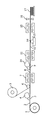
次に、本発明のプリプレグの製造方法について、その好適な形態の一例を、図面を参照しながら詳細に説明する。
図1において、ガラス織布1は巻き出し装置から順次連続的に供給される。そして、ガラス織布の上面側2に、樹脂組成物(a)3をコンマコーター装置4により所定量塗工する。次いで、ガラス不織布5を巻き出し装置から供給し、重ね合わせロール6により重ね合わせて一体化する。これを乾燥装置7に通した後、ガラス不織布の上面側8から、エポキシ樹脂組成物(b)9をコンマコーター装置10により所定量塗工する。これを乾燥装置11に通した後、さらに、ガラス織布の下面側12から、エポキシ樹脂組成物(c)13を転写ロール装置14により所定量塗工する。これを乾燥装置15に通した後、裁断装置16により所定長さに裁断して、プリプレグ17を得ることができる。
Next, an example of the suitable form about the manufacturing method of the prepreg of this invention is demonstrated in detail, referring drawings.
In FIG. 1, the glass woven
以下、実施例により本発明を具体的に説明する。 Hereinafter, the present invention will be described specifically by way of examples.
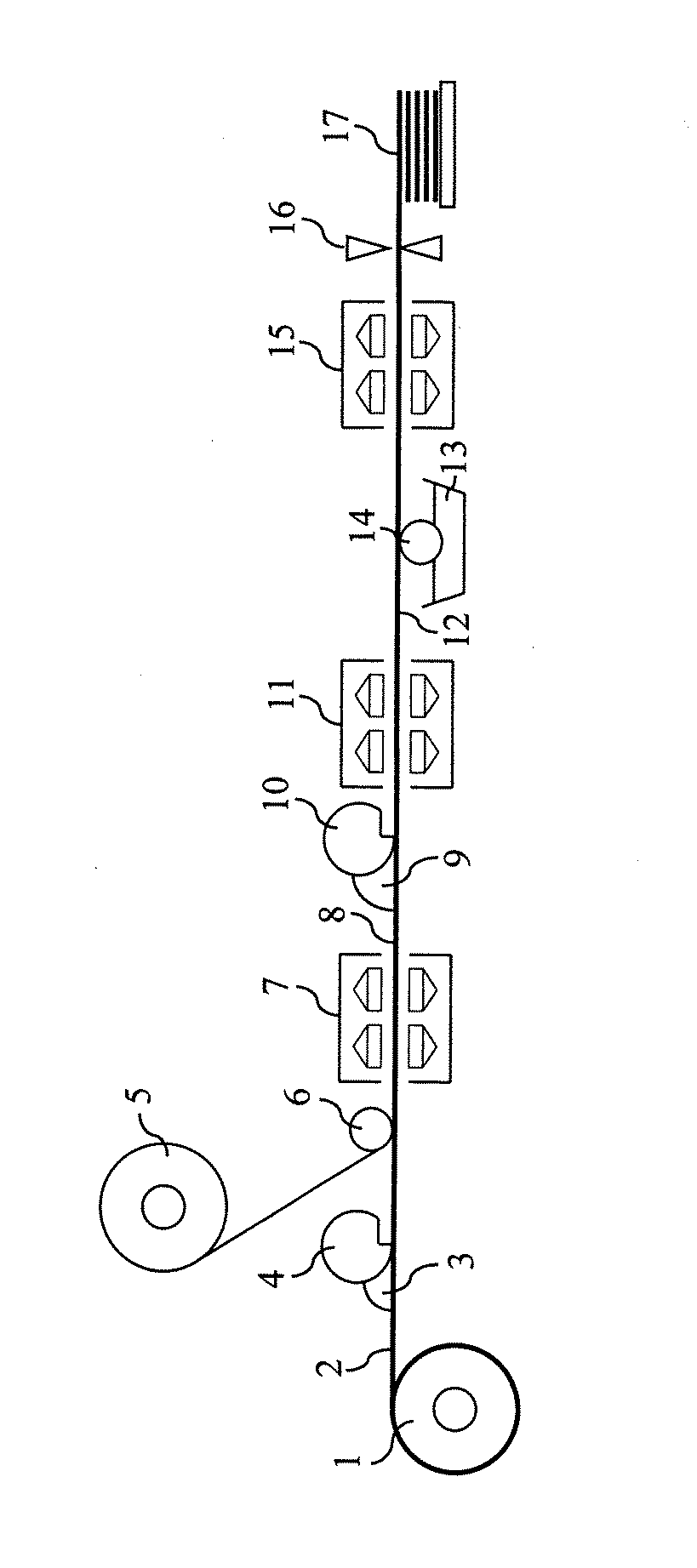
1.樹脂組成物(a)、エポキシ樹脂組成物(b)、及び、エポキシ樹脂組成物(c)の調製
下記の原料を、表1に示した量(重量部)で配合し、樹脂組成物(a1)〜(a3)、エポキシ樹脂組成物(b)、及び、エポキシ樹脂組成物(c)を得た。
1. Preparation of Resin Composition (a), Epoxy Resin Composition (b), and Epoxy Resin Composition (c) The following raw materials were blended in the amounts (parts by weight) shown in Table 1, and the resin composition (a1 ) To (a3), an epoxy resin composition (b), and an epoxy resin composition (c).
(1)ビスフェノ−ルA型エポキシ樹脂:大日本インキ化学社製・「エピクロン850」、エポキシ当量190
(2)臭素化ビスフェノ−ルA型エポキシ樹脂:大日本インキ化学社製・「GX153」、エポキシ当量400
(3)クレゾ−ルノボラック型エポキシ樹脂:ジャパンエポキシレジン社製・「エピコ−ト180S75」、エポキシ当量210
(4)フェノキシ樹脂:ジャパンエポキシレジン社製・「エピコ−ト4250」、重量平均分子量60000
(5)ノボラック型フェノール樹脂:住友ベークライト社製・「PR−51470」
(6)硬化促進剤:2−エチル−4−メチルイミダゾ−ル
(7)無機充填材:住友化学社製・水酸化アルミニウム「CL−310」
(8)溶剤:アセトン
(1) Bisphenol A type epoxy resin: manufactured by Dainippon Ink & Chemicals, Inc. “Epicron 850”, epoxy equivalent 190
(2) Brominated bisphenol A type epoxy resin: manufactured by Dainippon Ink & Chemicals, Inc. “GX153”, epoxy equivalent 400
(3) Cresol novolac type epoxy resin: manufactured by Japan Epoxy Resin Co., Ltd. “Epicoat 180S75”, epoxy equivalent 210
(4) Phenoxy resin: “Epicoat 4250” manufactured by Japan Epoxy Resin Co., Ltd., weight average molecular weight 60000
(5) Novolac-type phenolic resin: “PR-51470” manufactured by Sumitomo Bakelite Co., Ltd.
(6) Curing accelerator: 2-ethyl-4-methylimidazole (7) Inorganic filler: Aluminum hydroxide “CL-310” manufactured by Sumitomo Chemical Co., Ltd.
(8) Solvent: Acetone
4.プリプレグ及びコンポジット積層板の製造
<実施例1>
ガラス織布(日東紡績社製・「WEA7628」、単位面積当たりの重量180g/m2)に、ガラス織布100重量部に対して樹脂組成物(a1)100重量部を塗布した。その上面側からガラス不織布(キュムラス社製・「EPM―4100B」、単位面積当たりの重量100g/m2 )を重ね合わせ、150℃で2分間加熱乾燥した。
次に、ガラス不織布の上面側から、ガラス不織布100重量部に対してエポキシ樹脂組成物(b)1000重量部を塗布した。これを150℃で6分間加熱乾燥した。
次に、ガラス織布の側から、ガラス織布100重量部に対してエポキシ樹脂組成物(c)50重量部を塗布した。これを150℃で2分間加熱乾燥して、プリプレグを得た。
なお、樹脂組成物(a)、エポキシ樹脂組成物(b)、及び、エポキシ樹脂組成物(c)の塗布量は、すべて固形分換算値である。
上記で得られたプリプレグ2枚を、ガラス不織布側を内側にして重ね合わせ、さらに、その両外面に18μm厚みの電解銅箔(古河サーキットフォイル社製・「GTSMP−18」)を重ね、180℃、4MPaで90分間加熱加圧成形してコンポジット積層板を得た。
4). Production of prepreg and composite laminate <Example 1>
100 parts by weight of the resin composition (a1) was applied to 100 parts by weight of the glass woven fabric (Nittobo Co., Ltd., “WEA7628”, weight per unit area: 180 g / m 2 ). A glass nonwoven fabric (“EPM-4100B” manufactured by Cumulus Co., Ltd., weight per unit area: 100 g / m 2 ) was superposed from the upper surface side, and dried by heating at 150 ° C. for 2 minutes.
Next, 1000 parts by weight of the epoxy resin composition (b) was applied to 100 parts by weight of the glass nonwoven fabric from the upper surface side of the glass nonwoven fabric. This was heat-dried at 150 ° C. for 6 minutes.
Next, 50 parts by weight of the epoxy resin composition (c) was applied to 100 parts by weight of the glass woven fabric from the glass woven fabric side. This was heat-dried at 150 ° C. for 2 minutes to obtain a prepreg.
In addition, all the application quantity of a resin composition (a), an epoxy resin composition (b), and an epoxy resin composition (c) is a solid content conversion value.
The two prepregs obtained above are overlapped with the glass nonwoven fabric side inside, and further, an electrolytic copper foil with a thickness of 18 μm (Furukawa Circuit Foil, “GTSMP-18”) is overlapped on both outer surfaces, 180 ° C. A composite laminate was obtained by heating and pressing at 4 MPa for 90 minutes.
<実施例2>
樹脂組成物(a1)の代わりに、樹脂組成物(a2)を用いた。これ以外は、実施例1と同様にしてプリプレグ及びコンポジット積層板を得た。
<Example 2>
Instead of the resin composition (a1), the resin composition (a2) was used. Except this, it carried out similarly to Example 1, and obtained the prepreg and the composite laminated sheet.
<実施例3>
樹脂組成物(a1)の代わりに、樹脂組成物(a3)を用いた。これ以外は、実施例1と同様にしてプリプレグ及びコンポジット積層板を得た。
<Example 3>
Instead of the resin composition (a1), the resin composition (a3) was used. Except this, it carried out similarly to Example 1, and obtained the prepreg and the composite laminated sheet.
<比較例1>
ガラス織布に最初に塗布する樹脂組成物(a1)の代わりに、エポキシ樹脂組成物(c)を用いた。これ以外は、実施例1と同様にしてプリプレグ及びコンポジット積層板を得た。
<Comparative Example 1>
The epoxy resin composition (c) was used instead of the resin composition (a1) first applied to the glass woven fabric. Except this, it carried out similarly to Example 1, and obtained the prepreg and the composite laminated sheet.
実施例及び比較例で得られたコンポジット積層板について、以下の評価を行った。結果を表2に示す。 The following evaluation was performed about the composite laminated board obtained by the Example and the comparative example. The results are shown in Table 2.
5.評価方法
(1)ガラス転移温度:DMA法により、 周波数60Hzでの回転振動による粘弾性データを用い実施した。測定は3℃昇温で行った。
5). Evaluation method (1) Glass transition temperature: It was carried out by the DMA method using viscoelasticity data by rotational vibration at a frequency of 60 Hz. The measurement was performed at 3 ° C. temperature rise.
(2)半田接続信頼性:コンポジット積層板を使用したプリント板に市販の6432チップ抵抗を半田で接続し、−65℃・30分間/125℃・30分間 の冷熱衝撃試験を100サイクル実施し、半田接続部のクラックの有無を目視にて観察した。符号は以下のとおりである。
○:クラックなし ×:クラックあり
(2) Solder connection reliability: A commercially available 6432 chip resistor is connected to a printed board using a composite laminate with solder, and a thermal shock test of -65 ° C./30 minutes / 125 ° C./30 minutes is performed 100 cycles. The presence or absence of cracks in the solder connection portion was visually observed. The symbols are as follows.
○: No crack ×: There is a crack
(3)耐熱性:100×100mmのコンポジット積層板を、250℃の雰囲気中にて30分間処理した後、層間ふくれ又は剥離の発生の有無を目視にて観察した。 (3) Heat resistance: A 100 × 100 mm composite laminate was treated in an atmosphere at 250 ° C. for 30 minutes, and then the presence or absence of interlayer blistering or peeling was visually observed.
(4)電気絶縁性:JIS C 6481に準拠して、コンポジット積層板の常態における体積抵抗率を測定した。 (4) Electrical insulation: The volume resistivity in the normal state of the composite laminate was measured in accordance with JIS C 6481.
実施例1〜3はいずれも、樹脂組成物(a)にエポキシ樹脂とフェノキシ樹脂とを含有するものを用いた本発明の製造方法により得られたプリプレグ及びコンポジット積層板であり、耐熱性などの基本的特性を実質的に維持しながら、接続信頼性を向上させることができた。
比較例1は、実施例1〜3で用いた樹脂組成物(a)の代わりに、樹脂組成物(c)を用いたが、接続信頼性に劣るものとなった。
Examples 1 to 3 are all prepregs and composite laminates obtained by the production method of the present invention using the resin composition (a) containing an epoxy resin and a phenoxy resin, such as heat resistance. The connection reliability could be improved while substantially maintaining the basic characteristics.
Although the comparative example 1 used the resin composition (c) instead of the resin composition (a) used in Examples 1-3, it became inferior to connection reliability.
本発明の製造方法によれば、耐熱性などの基本特性を実質的に維持しながら、接続信頼性を備えたコンポジット基材エポキシ積層板に適用できるプリプレグと、このプリプレグを用いたコンポジット基材エポキシ積層板を製造することができる。本発明の製造方法により得られたコンポジット積層板は、ガラス織布基材エポキシ樹脂積層板と同様な用途への展開が期待できるものである。 According to the production method of the present invention, a prepreg that can be applied to a composite substrate epoxy laminate having connection reliability while substantially maintaining basic characteristics such as heat resistance, and a composite substrate epoxy using the prepreg Laminates can be manufactured. The composite laminate obtained by the production method of the present invention can be expected to be used for the same applications as the glass woven fabric base epoxy resin laminate.
1 ガラス織布
3 樹脂組成物(a)
4 コンマコーター装置
5 ガラス不織布
6 重ね合わせロール
7 乾燥装置
9 エポキシ樹脂組成物(b)
10 コンマコーター装置
11 乾燥装置
13 エポキシ樹脂組成物(c)
14 転写ロール装置
15 乾燥装置
16 裁断装置
17 プリプレグ
1 Glass woven
4 Comma coater device 5 Glass
10
14
Claims (4)
(A)ガラス織布に、エポキシ樹脂とフェノキシ樹脂とを含有する樹脂組成物(a)を塗布する工程、
(B)ガラス織布の、樹脂組成物(a)を塗布した面にガラス不織布を重ね合わせる工程、
(C)ガラス不織布の上から、エポキシ樹脂と無機充填材とを含有するエポキシ樹脂組成物(b)を塗布する工程、
(D)ガラス織布の、樹脂組成物(a)を塗布した反対側の面にエポキシ樹脂組成物(c)を塗布する工程、及び、
(E)前記工程で得られたものを加熱乾燥する工程、
を有することを特徴とする、プリプレグの製造方法。 A method for producing a prepreg used in a composite laminate,
(A) A step of applying a resin composition (a) containing an epoxy resin and a phenoxy resin to a glass woven fabric,
(B) A step of superposing a glass nonwoven fabric on the surface of the glass woven fabric to which the resin composition (a) is applied,
(C) The process of apply | coating the epoxy resin composition (b) containing an epoxy resin and an inorganic filler from on a glass nonwoven fabric,
(D) The process of apply | coating an epoxy resin composition (c) to the surface on the opposite side which apply | coated the resin composition (a) of glass woven fabric, and
(E) a step of heating and drying the product obtained in the step,
A method for producing a prepreg characterized by comprising:
A method for producing a composite laminate, comprising: two prepregs obtained by the production method according to any one of claims 1 to 3 being laminated with a glass nonwoven fabric inside, and then heat-pressing the laminate.
Priority Applications (1)
| Application Number | Priority Date | Filing Date | Title |
|---|---|---|---|
| JP2004102584A JP2005290029A (en) | 2004-03-31 | 2004-03-31 | Manufacturing method of prepreg and composite laminated plate |
Applications Claiming Priority (1)
| Application Number | Priority Date | Filing Date | Title |
|---|---|---|---|
| JP2004102584A JP2005290029A (en) | 2004-03-31 | 2004-03-31 | Manufacturing method of prepreg and composite laminated plate |
Publications (1)
| Publication Number | Publication Date |
|---|---|
| JP2005290029A true JP2005290029A (en) | 2005-10-20 |
Family
ID=35323339
Family Applications (1)
| Application Number | Title | Priority Date | Filing Date |
|---|---|---|---|
| JP2004102584A Pending JP2005290029A (en) | 2004-03-31 | 2004-03-31 | Manufacturing method of prepreg and composite laminated plate |
Country Status (1)
| Country | Link |
|---|---|
| JP (1) | JP2005290029A (en) |
Cited By (3)
| Publication number | Priority date | Publication date | Assignee | Title |
|---|---|---|---|---|
| JP2008280470A (en) * | 2007-05-14 | 2008-11-20 | Sumitomo Bakelite Co Ltd | Method for producing prepreg, method for producing composite laminated board and composite laminated board |
| JP2011068772A (en) * | 2009-09-25 | 2011-04-07 | Namics Corp | Epoxy resin composition and adhesive film thereof |
| CN103946012A (en) * | 2011-12-30 | 2014-07-23 | 氰特科技股份有限公司 | Peel ply, method of surface preparation and bonding composite structures using the same |
-
2004
- 2004-03-31 JP JP2004102584A patent/JP2005290029A/en active Pending
Cited By (4)
| Publication number | Priority date | Publication date | Assignee | Title |
|---|---|---|---|---|
| JP2008280470A (en) * | 2007-05-14 | 2008-11-20 | Sumitomo Bakelite Co Ltd | Method for producing prepreg, method for producing composite laminated board and composite laminated board |
| JP2011068772A (en) * | 2009-09-25 | 2011-04-07 | Namics Corp | Epoxy resin composition and adhesive film thereof |
| CN103946012A (en) * | 2011-12-30 | 2014-07-23 | 氰特科技股份有限公司 | Peel ply, method of surface preparation and bonding composite structures using the same |
| CN103946012B (en) * | 2011-12-30 | 2016-01-20 | 氰特科技股份有限公司 | Peel ply, the surface preparation using it and the method in conjunction with composite construction |
Similar Documents
| Publication | Publication Date | Title |
|---|---|---|
| TWI570200B (en) | Thermosetting adhesive composition, thermosetting adhesive film, and composite film | |
| JP4957552B2 (en) | Manufacturing method of prepreg with carrier for printed wiring board, prepreg with carrier for printed wiring board, manufacturing method of thin double-sided board for printed wiring board, thin double-sided board for printed wiring board, and manufacturing method of multilayer printed wiring board | |
| CN101687981B (en) | Resin composition and copper foil with resin obtained by using the resin composition | |
| JP6205692B2 (en) | Thermosetting epoxy resin composition, insulating film forming adhesive film and multilayer printed wiring board | |
| JP5206600B2 (en) | Epoxy resin composition, prepreg, laminate, resin sheet, multilayer printed wiring board, and semiconductor device | |
| JP5547032B2 (en) | Thermally conductive resin composition, resin sheet, prepreg, metal laminate and printed wiring board | |
| JP2008050526A (en) | Resin composition, prepreg and laminated board using the same | |
| TW201936878A (en) | Thermosetting resin composition, prepreg, and metal-clad laminate for semiconductor packaging | |
| TW201315767A (en) | Prepreg, laminated board, semiconductor package, and method for manufacturing laminated board | |
| JP2008177463A (en) | Flexible wiring board adhesive composition, flexible wiring board cover lay, and flexible wiring board with electromagnetic wave shield layer | |
| JP4553595B2 (en) | Prepreg resin composition and prepreg using the same | |
| JP2008280470A (en) | Method for producing prepreg, method for producing composite laminated board and composite laminated board | |
| KR102546390B1 (en) | Process for producing resin sheet | |
| TWI504663B (en) | Resin composition | |
| JP2005290029A (en) | Manufacturing method of prepreg and composite laminated plate | |
| JP2005290030A (en) | Manufacturing method of prepreg and composite laminated plate | |
| KR100802840B1 (en) | Manufacturing method of composite laminate | |
| JP4784011B2 (en) | Laminate production method | |
| JP2003011269A (en) | Manufacturing method of insulating material with copper leaf | |
| JP6816566B2 (en) | Resin compositions, adhesive films, prepregs, multilayer printed wiring boards and semiconductor devices | |
| JPH1154922A (en) | Manufacturing inner layer circuit-contg. laminate board | |
| JP2006232984A (en) | Adhesive composition and coverlay film and adhesive sheet using the same | |
| JP2007128955A (en) | Printed wiring board and its manufacturing method | |
| JP2000133900A (en) | Pre-preg for printed wiring board | |
| JP2001040069A (en) | Epoxy resin composition, prepreg, metal foil with resin, adhesive sheet, laminated board and multilayer board |