JP2005295561A - Method for encoding and decoding moving picture data, representation of an image sequence encoded using said method, apparatus for implementing said method, computer program, and storage medium - Google Patents
Method for encoding and decoding moving picture data, representation of an image sequence encoded using said method, apparatus for implementing said method, computer program, and storage medium Download PDFInfo
- Publication number
- JP2005295561A JP2005295561A JP2005103252A JP2005103252A JP2005295561A JP 2005295561 A JP2005295561 A JP 2005295561A JP 2005103252 A JP2005103252 A JP 2005103252A JP 2005103252 A JP2005103252 A JP 2005103252A JP 2005295561 A JP2005295561 A JP 2005295561A
- Authority
- JP
- Japan
- Prior art keywords
- motion
- motion vector
- component
- encoding
- rate
- Prior art date
- Legal status (The legal status is an assumption and is not a legal conclusion. Google has not performed a legal analysis and makes no representation as to the accuracy of the status listed.)
- Pending
Links
Images
Classifications
-
- H—ELECTRICITY
- H04—ELECTRIC COMMUNICATION TECHNIQUE
- H04N—PICTORIAL COMMUNICATION, e.g. TELEVISION
- H04N19/00—Methods or arrangements for coding, decoding, compressing or decompressing digital video signals
- H04N19/50—Methods or arrangements for coding, decoding, compressing or decompressing digital video signals using predictive coding
- H04N19/503—Methods or arrangements for coding, decoding, compressing or decompressing digital video signals using predictive coding involving temporal prediction
- H04N19/51—Motion estimation or motion compensation
- H04N19/513—Processing of motion vectors
- H04N19/517—Processing of motion vectors by encoding
-
- H—ELECTRICITY
- H04—ELECTRIC COMMUNICATION TECHNIQUE
- H04N—PICTORIAL COMMUNICATION, e.g. TELEVISION
- H04N19/00—Methods or arrangements for coding, decoding, compressing or decompressing digital video signals
- H04N19/50—Methods or arrangements for coding, decoding, compressing or decompressing digital video signals using predictive coding
- H04N19/593—Methods or arrangements for coding, decoding, compressing or decompressing digital video signals using predictive coding involving spatial prediction techniques
-
- H—ELECTRICITY
- H04—ELECTRIC COMMUNICATION TECHNIQUE
- H04N—PICTORIAL COMMUNICATION, e.g. TELEVISION
- H04N19/00—Methods or arrangements for coding, decoding, compressing or decompressing digital video signals
- H04N19/60—Methods or arrangements for coding, decoding, compressing or decompressing digital video signals using transform coding
- H04N19/62—Methods or arrangements for coding, decoding, compressing or decompressing digital video signals using transform coding by frequency transforming in three dimensions [3D]
Landscapes
- Engineering & Computer Science (AREA)
- Multimedia (AREA)
- Signal Processing (AREA)
- Compression Or Coding Systems Of Tv Signals (AREA)
- Compression, Expansion, Code Conversion, And Decoders (AREA)
Abstract
【課題】圧縮効率を大きくすることができ、それゆえ、スケーラブル動き情報に関連して性能に不利な条件がもたらされるのを減らす、動画データを符号化する方法を提供する。
【解決手段】特に動き補償された3Dサブバンドコーディングを用いて動画データを符号化する方法であって、動き補償からの動きベクトルの第1の成分が該動きベクトルの第2の成分とは別々にあるいは無関係にスケーラブルに符号化され、当該方法は、第1の動きベクトル成分および第2の動きベクトル成分のための個別のビットレート割当てを含む方法。
【選択図】図2
Disclosed is a method for encoding video data that can increase compression efficiency and thus reduce the performance penalties associated with scalable motion information.
In particular, a method of encoding motion picture data using motion compensated 3D subband coding, wherein a first component of a motion vector from motion compensation is separate from a second component of the motion vector. Wherein the method includes scalable bit rate assignment for the first motion vector component and the second motion vector component.
[Selection] Figure 2
Description
本発明は、画像シーケンスの形で構成される動画(motion picture)データを符号化するための方法および装置に関する。本発明は特に、空間および時間フィルタリング、動き補償(motion compensation)、ならびに動きベクトルのコーディングを含む3Dサブバンドコーディングに関係する。 The present invention relates to a method and apparatus for encoding motion picture data configured in the form of an image sequence. The invention is particularly concerned with 3D subband coding including spatial and temporal filtering, motion compensation, and motion vector coding.
インターネットのような混成の通信ネットワークにおいて、効率的に映像を通信するには、多種多様な伝送上の制約およびビデオディスプレイパラメータを規定しなければならない。同じネットワーク上の種々のユーザの間で、チャネル帯域幅が数桁異なることも珍しくない。さらに、ネットワークの相互接続に向かう急速な進展は、それぞれ異なるディスプレイ解像度および処理能力を有する移動電話、手持ち式の個人情報端末およびデスクトップワークステーションのような装置が全て同じデジタルメディアコンテンツにアクセスする可能性があることを意味している。 In order to efficiently communicate video in a hybrid communication network such as the Internet, a wide variety of transmission constraints and video display parameters must be defined. It is not uncommon for channel bandwidths to differ by several orders of magnitude between different users on the same network. In addition, rapid progress toward network interconnections is likely to allow devices such as mobile phones, handheld personal digital assistants and desktop workstations, each with different display resolutions and processing capabilities, to access the same digital media content. It means that there is.
スケーラブルビデオコーディングは、多数の異なるビットレートおよびディスプレイ解像度において同時に効率的な再構成がサポートされるように元のビデオコンテンツを圧縮することにより、映像通信ネットワークおよびエンドユーザの関心の多様性に対処することを目的とする。ビットレートスケーラビリティとは、圧縮効率を損なうことなく、様々なビットレートに細かく対応しながら、圧縮された映像を再構成する能力を指している。これにより、1つの圧縮されたビットストリームが、それぞれ自らが利用可能な帯域幅を全て利用する多数のユーザによってアクセスされるようになる。レートスケーラビリティがない場合、同じビデオデータのいくつかのバージョンをネットワーク上で利用できるようにしなければならないので、記憶装置および伝送にかかる負担が著しく大きくなるであろう。スケーラビリティの他の重要な形態は、空間分解能およびフレームレート(時間分解能)スケーラビリティを含む。これらによって、圧縮された映像が種々のディスプレイ解像度で効率的に再構成され、それにより種々の能力のあらゆる種類のエンドユーザ装置にサービスを提供できるようになる。スケーラブル映像圧縮に関する現在の欲求、過去の実績および今後の動向の概要は、D. Taubman著「Successive refinement of video: fundamental issues, past efforts and new directions」(Int Sym. Visual Comm. Image Proc., July 2003)において知ることができる。 Scalable video coding addresses the diversity of video communication networks and end-user interests by compressing the original video content to support efficient reconstruction simultaneously at a number of different bit rates and display resolutions For the purpose. Bit rate scalability refers to the ability to reconstruct a compressed video while finely supporting various bit rates without compromising compression efficiency. This allows one compressed bitstream to be accessed by multiple users, each using all the bandwidth available to them. Without rate scalability, the storage and transmission burden would be significantly increased because several versions of the same video data must be made available over the network. Other important forms of scalability include spatial resolution and frame rate (temporal resolution) scalability. These allow the compressed video to be efficiently reconstructed at different display resolutions, thereby enabling service to all types of end-user devices with different capabilities. For an overview of current desires, past performance, and future trends for scalable video compression, see “Successive refinement of video: fundamental issues, past efforts and new directions” by D. Taubman (Int Sym. Visual Comm. Image Proc., July. 2003).
近年に至って、スケーラブルビデオコーディングの研究は、いくつかの重要な発見を受けて、わずかの間に大きな関心を集めてきた。詳細には、効率的なフィードフォワード圧縮システムを構成するための新たなフレームワークは、これまでの方式に比べて大きな利点を提供するように思われる。実際には、スケーラブルビデオコーダは、既存の非スケーラブルコーディング方法に匹敵しながら、上記の所望のスケーラビリティ機能の全てを持つ圧縮性能をようやく達成し始めたところである。これらの新たな方式は、「動き補償リフティング」方式として知られており、最初にSeckerおよびTaubman(A. Secker and D. Taubman著「Lifting-based ivertible motion adaptive transform (LIMAT) framework for highly scalable video compression」(IEEE Trans. Image Proc., Dec 2003)によって、そして同時にPesquet-Popescu他(B. Pesquet-Popescu and V. Bottreau著「Three-dimensional lifting schemes for motion compensated video compression」(IEEE Int. Conf. Acoustics. Speech Signal Proc., pp 1793-1796, Dec 2001)によって提案された。 In recent years, research on scalable video coding has gained a great deal of interest in the face of several important discoveries. In particular, the new framework for constructing an efficient feedforward compression system appears to provide significant advantages over previous approaches. In practice, scalable video coders are finally beginning to achieve compression performance with all of the desired scalability features described above, comparable to existing non-scalable coding methods. These new schemes are known as “motion-compensated lifting” schemes. First, Secker and Taubman (“Lifting-based ivertible motion adaptive transform (LIMAT) framework for highly scalable video compression” by A. Secker and D. Taubman) (IEEE Trans. Image Proc., Dec 2003) and at the same time, Pesquet-Popescu et al. (B. Pesquet-Popescu and V. Bottreau, “Three-dimensional lifting schemes for motion compensated video compression” (IEEE Int. Conf. Acoustics Speech Signal Proc., Pp 1793-1796, Dec 2001).
動き補償リフティング方式によって、圧縮システムを逆変換する能力を犠牲にすることなく、効率的なウェーブレット(wavelet)に基づく時間変換が、ビデオデータに適用されるようになる。ウェーブレット時間変換は、元のビデオフレームを、一群の時間「サブバンド」フレームに変換する。十分な帯域幅が利用できるなら、可逆変換によって映像が完全に再構成されるようになるので、可逆変換は特に重要である。時間サブバンドフレームは、スケーラブル画像圧縮の場合に用いられる技法と概ね同じ技法を用いて処理される。そのような技法は、現時点では概ね完成した状態に達しており(最近のJPEG2000画像圧縮標準規格において完結している)、J. Shapiro著「Embedded image coding using zerotrees of wavelet coefficients」(IEEE Trans. Signal Proc., vol 41, pp 3445-3462, Dec 1993)、D. Taubman and A. Zakhor著「Multi-rate 3-d subband coding of video」(IEEE Trans. Image Proc., vol.3, pp. 572-588, Sept 1994)、A. Said and W. Pearlman著「A new, fast and efficient image codec based on set partitioning in hierarchical trees」(IEEE Trans. Circ. Sys. Video Tech., pp 243-250, June 1996)、およびD. Taubman, E. Ordentlich, M. Weinberger and G. Seroussi著「Embedded Block Coding in JPEG2000」(Signal Processing - Image Communication, vol 17, no 1, pp. 49-72, Jan 2002)において確認することができる技法を含む。同一出願人による同時係属出願である欧州特許出願第03255624.3号明細書(P047)も参照され、その内容は参照して本明細書に援用される。 Motion compensated lifting schemes allow efficient wavelet based time transforms to be applied to video data without sacrificing the ability to invert the compression system. The wavelet temporal transform converts the original video frame into a group of temporal “subband” frames. Reversible transformation is especially important if sufficient bandwidth is available, because the video can be completely reconstructed by reversible transformation. Temporal subband frames are processed using generally the same techniques used for scalable image compression. Such a technique has now been largely completed (completed in the recent JPEG2000 image compression standard) and is written by J. Shapiro “Embedded image coding using zerotrees of wavelet coefficients” (IEEE Trans. Signal Proc., Vol 41, pp 3445-3462, Dec 1993), “Multi-rate 3-d subband coding of video” by D. Taubman and A. Zakhor (IEEE Trans. Image Proc., Vol.3, pp. 572 -588, Sept 1994), "A new, fast and efficient image codec based on set partitioning in hierarchical trees" by A. Said and W. Pearlman (IEEE Trans. Circ. Sys. Video Tech., Pp 243-250, June 1996) and D. Taubman, E. Ordentlich, M. Weinberger and G. Seroussi, "Embedded Block Coding in JPEG2000" (Signal Processing-Image Communication, vol 17, no 1, pp. 49-72, Jan 2002). Includes techniques that can be verified. Reference is also made to European Patent Application No. 03255624.3 (P047), a co-pending application by the same applicant, the contents of which are incorporated herein by reference.
動き補償リフティング変換の高い圧縮性能への鍵は、それが非常に効率的に動きを利用できること、および任意の動きモデルに対して容易に適合できることである。多数の動きモデルが文献において提案されており、これらのモデルのうちの任意のものがリフティング変換のフレームワークに都合良く組み込まれることができる。パラメータ化された動きモデルを用いることから生じる付随的な情報を表現し、コーディングするための種々の方法も提案されている。しかしながら、従来の方法によれば、付随的な情報の量がかなり多く、典型的にはロスレスに(losslessly)コーディング(されており、圧縮システム全体のレートスケーラビリティを大きく低下させる可能性がある。 The key to the high compression performance of motion compensated lifting transforms is that it can utilize motion very efficiently and can be easily adapted to any motion model. A number of motion models have been proposed in the literature, and any of these models can be conveniently incorporated into a lifting transformation framework. Various methods have also been proposed for representing and coding the incidental information resulting from using parameterized motion models. However, according to the conventional method, the amount of incidental information is considerably large, and is typically losslessly coded (which can greatly reduce the rate scalability of the entire compression system.
非常に広い範囲のビットレート、すなわち数キロビット/秒(kbps)から何メガビット/秒(Mbps)にも及ぶ範囲のビットレートにわたってレートスケーラビリティを可能にするために、動き情報が表現される精度もスケーラブルでなければならない。動きのスケーラビリティがない場合、動きパラメータをコーディングする代償として、低ビットレートにおいて利用可能な帯域幅のうちの不当な割合を占有する可能性がある。逆に、高ビットレートにおいて最大のコーディング利得を達成するために、動きが十分な精度で表現されない場合がある。動き情報が処理される精度をスケーリングする能力は、時間スケーラビリティの当然の拡張であることにも留意されたい。これは、再構成される映像シーケンスの時間情報を精緻化することは、時間サンプリングレートだけでなく、これらの時間サンプル(temporal sample)が動き適応時間合成フィルタバンクによって補間される精度も精緻化することを含むことになるためである。 The accuracy with which motion information is represented is scalable to enable rate scalability over a very wide range of bit rates, ie, ranging from several kilobits per second (kbps) to many megabits per second (Mbps). Must. In the absence of motion scalability, the cost of coding motion parameters may occupy an unreasonable proportion of the available bandwidth at low bit rates. Conversely, motion may not be represented with sufficient accuracy to achieve maximum coding gain at high bit rates. Note also that the ability to scale the accuracy with which motion information is processed is a natural extension of temporal scalability. This means that refining the temporal information of the reconstructed video sequence not only refines the temporal sampling rate, but also the accuracy with which these temporal samples are interpolated by the motion adaptive temporal synthesis filter bank. It is because it will include.
SeckerおよびTaubmanは最近、A. Secker and D. Taubman著「Highly scalable video compression with scalable motion coding」としてIEEE Trans. Image Procに掲載され、著者たちのウエブサイトwww.ee.unsw.edu.au/~taubman/にも開示される、スケーラブル動きコーディングに取り組んだ。この研究において、彼らは、動きパラメータおよびビデオサンプルを圧縮し、両方を一緒にスケーリングするための新規のフレームワークを提供する。彼らの方法は、時間サブバンドフレームをコーディングするために用いられる技法に類似のスケーラブル画像コーディング技法を用いて、動き補償リフティング変換に関連付けられる動きパラメータを圧縮することを含む。 Secker and Taubman were recently published in IEEE Trans. Image Proc as `` Highly scalable video compression with scalable motion coding '' by A. Secker and D. Taubman, and their website www.ee.unsw.edu.au/~ Worked on scalable motion coding, also disclosed in taubman /. In this work, they provide a new framework for compressing motion parameters and video samples and scaling both together. Their method includes compressing motion parameters associated with the motion compensated lifting transform using a scalable image coding technique similar to the technique used to code temporal subband frames.
SeckerおよびTaubmanの研究は2つの大きな貢献に関与する。第1に、彼らは動き情報のスケーラブル圧縮のための方法を記述しており、第2に、彼らはビデオフレームをコーディングする際に費やされるビットの数と、動きパラメータをコーディングする際に費やされるビットの数との間の最適なバランスをとるためのフレームワークを提供する。部分的には、スケーラブル動きコーディング手法は、スカラー画像サンプルが従来のスケーラブル画像コーディングシステムにおいて処理されるのと同じようにして、動きベクトルの個々の成分を処理することを含む。動き情報は典型的には、2次元ベクトルの2次元のアレイ(ビデオフレーム間の垂直方向および水平方向への動きに対応する)からなる。それらの情報は、垂直方向および水平方向の動き成分を抽出し、それらの成分を2次元のスカラー場に配列することにより、スカラー画像として圧縮されることができる。空間ウェーブレット変換はスカラーの動き成分に適用されるが、結果として変換された動き成分はベクトルに再結合され、一緒に埋め込み量子化およびコーディングにかけられる。これにより、埋め込みコーディングステージが、変換された動きベクトル成分間の冗長性を利用できるようになる。 Secker and Taubman's work is involved in two major contributions. First, they describe a method for scalable compression of motion information, and second, they spend the number of bits spent coding video frames and coding motion parameters. Provides a framework for optimal balance between the number of bits. In part, scalable motion coding techniques involve processing individual components of motion vectors in the same way that scalar image samples are processed in a conventional scalable image coding system. The motion information typically consists of a two-dimensional array of two-dimensional vectors (corresponding to vertical and horizontal motion between video frames). Such information can be compressed as a scalar image by extracting vertical and horizontal motion components and arranging them in a two-dimensional scalar field. The spatial wavelet transform is applied to the scalar motion components, but the resulting transformed motion components are recombined into vectors and subjected to embedded quantization and coding together. This allows the embedded coding stage to take advantage of the redundancy between the transformed motion vector components.
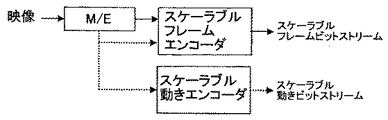
SeckerおよびTaubmanのスケーラブル動きコーディング方式が注目されるが、動きビットレートとビデオサンプルビットレートとの間の最適なバランスをとるための彼らの方法も注目される。既存のスケーラブルビデオコーディング方式は、スケーラブルビデオサンプルビットストリームに加えて、非スケーラブル動きパラメータビットストリームを生成することを含むが、SeckerおよびTaubmanの方法は、図1に示されるように、2つのスケーラブルビットストリーム、すなわちビデオサンプルに対応するスケーラブルビットストリームと、動きパラメータに対応するスケーラブルビットストリームとを生成する。 While Secker and Taubman's scalable motion coding schemes are noted, their methods for achieving an optimal balance between motion bit rate and video sample bit rate are also noted. Existing scalable video coding schemes include generating a non-scalable motion parameter bitstream in addition to a scalable video sample bitstream, but the Secker and Taubman method uses two scalable bits as shown in FIG. A stream, i.e., a scalable bit stream corresponding to the video sample and a scalable bit stream corresponding to the motion parameter are generated.
元の動きパラメータを用いて、スケーラブルビデオサンプルビットストリームが生成される。圧縮した後に動き情報をスケーリングすることは、圧縮中に用いられるのとは異なる動きパラメータで再構成が実行されることを意味する。この相違の結果として、再構成されたビデオの歪みが余分に生成される。しかしながら、この余分な歪みは定量化され、ビデオサンプルビットストリームをスケーリングすることから生じる歪みとバランスがとられることができるので、動きビットレートとサンプルビットレートとの最適な組み合わせを見いだすことができる。 A scalable video sample bitstream is generated using the original motion parameters. Scaling motion information after compression means that the reconstruction is performed with different motion parameters than those used during compression. As a result of this difference, extra distortion of the reconstructed video is generated. However, this extra distortion is quantified and can be balanced with the distortion resulting from scaling the video sample bitstream, so that an optimal combination of motion bit rate and sample bit rate can be found.
先に述べられたA. Secker and D. Taubman著「Highly scalable video compression with scalable motion coding」において、著者たちは、動き誤差と結果として生成されるビデオ歪みとの間の複雑な相互作用にもかかわらず、その挙動が線形な方法を用いて概ねモデル化されることができることを示している。動きビットレートおよびサンプルビットレートの最適な組み合わせを、ビデオフレームが圧縮された後に決定することができるので、この重要な報告は、スケーラブル動きビットストリームおよびビデオビットストリームの個別の構成を正当化する。SeckerおよびTaubmanによれば、再構成された映像シーケンス内の動き誤差に起因する、全2乗誤差D(M)は、以下の線形モデルによって表されることができる。 In "Highly scalable video compression with scalable motion coding" by A. Secker and D. Taubman, mentioned earlier, the authors are concerned with the complex interaction between motion error and the resulting video distortion. It shows that its behavior can be roughly modeled using a linear method. This important report justifies the separate organization of the scalable motion bitstream and the video bitstream, since the optimal combination of motion bitrate and sample bitrate can be determined after the video frame is compressed. According to Secker and Taubman, the total square error D (M) due to motion errors in the reconstructed video sequence can be represented by the following linear model.

ただし、DMは圧縮後スケーリングに起因する動きベクトルの平均2乗誤差を表す。スケーリングファクタΨR,Sは、ビデオ信号が再構成されることになる空間分解能Sと、ビデオサンプルが再構成される精度、すなわちビットレートRとに依存する。 However, D M represents the mean square error of the motion vector due to compression after scaling. The scaling factor Ψ R, S depends on the spatial resolution S at which the video signal will be reconstructed and the accuracy with which the video samples are reconstructed, ie the bit rate R.
動き情報とサンプルデータとの間の最適なレート割当ては、サブバンドフレームのスケーラブルコーディング中に生成される埋め込み表現(embedded representation)の最初のL(S)ビットに関連付けられる再構成されたビデオサンプル歪みD(S)を知ることを含む。さらにレート割当ては、動きパラメータビットストリームを長さL(M)に打ち切ることから生じる再構成されたビデオ歪みD(M)を知ることも含む。ラグランジュ乗数(Lagrange multiplier)の方法に従って、ある全長Lmaxの場合に、動きビットおよびサンプルビットの最適な割当ては、或る歪み−長さ勾配λ>0の場合に、以下の式が成り立つときに見いだされる。 The optimal rate allocation between motion information and sample data is the reconstructed video sample distortion associated with the first L (S) bits of the embedded representation generated during scalable coding of subband frames Including knowing D (S) . Further, the rate assignment also includes knowing the reconstructed video distortion D (M) that results from truncating the motion parameter bitstream to length L (M) . According to the method of Lagrange multiplier, for a certain total length L max , the optimal allocation of motion bits and sample bits is when the following equation holds for a certain distortion-length gradient λ> 0: Be found.
L(S)+L(M)は、Lmaxを超えない範囲で最も大きな値である。ここで、ΔD(S)/ΔL(S)およびΔD(M)/ΔL(M)はそれぞれ、サンプルビットストリームおよび動きビットストリームの打ち切り点における歪み−長さ勾配に対する離散的な近似値である。実際には、任意のLmaxのための概ね最適なレート割当てを得るためには、通常、限られた1組の取り得るビットストリーム打ち切り点のためのD(S)、L(S)、D(M)およびL(M)を知ることだけで十分である。 L (S) + L (M) is the largest value within a range not exceeding L max . Where ΔD (S) / ΔL (S) and ΔD (M) / ΔL (M) are discrete approximations to the distortion-length gradient at the censoring points of the sample bit stream and motion bit stream, respectively. In practice, to obtain a generally optimal rate allocation for any L max , D (S) , L (S) , D for a limited set of possible bitstream truncation points is usually used. It is sufficient to know (M) and L (M) .
式(1)によれば、L(M)にわずかな変化があってもΨR,Sがほぼ一定である限り、レート割当ては以下の式に従って同じく実行されることができる。 According to equation (1), rate allocation can also be performed according to the following equation as long as Ψ R, S is approximately constant even with a slight change in L (M) .
先に述べられたSeckerおよびTaubmanによれば、L(M)にわずかな変化があってもΨR,Sがほぼ一定であることは一般的に当てはまるので、コーディングされた動きデータのレート歪み最適性はサンプルデータとは概ね無関係であり、スケーラブル動きビットストリームは、スケーラブルサンプルビットストリームとは無関係に構成されることができる。動きデータとサンプルデータとの間の最適なレート割当ては、動き感度ファクタΨR,Sに従って、圧縮後に求めることができる。 According to Secker and Taubman described above, it is generally true that Ψ R, S is almost constant even if there is a slight change in L (M) , so that the rate distortion optimization of coded motion data is optimal. The nature is largely independent of the sample data, and the scalable motion bitstream can be configured independently of the scalable sample bitstream. The optimal rate allocation between the motion data and the sample data can be determined after compression according to the motion sensitivity factor Ψ R, S.
このレート歪み最適化モデルは、スケーラブルビデオコーディングの任意の方法に都合良く適用されることができるが、JPEG2000に採用されたEBCOTアルゴリズムは、動きおよびサンプルの両方のビットストリームをコーディングし、一緒にスケーリングするための優れたフレームワークを提供する。EBCOTコーディングアルゴリズムの全体的な説明は、D. Taubman, E. Ordentlich, M. Weinberger and G. Seroussi著「Embedded Block Coding in JPEG2000」(Signal Processing - Image Communication, vol 17, no 1, pp. 49-72, Jan 2002)から入手することができる。EBCOTアルゴリズムは、埋め込まれた「品質層」に編成されるビットストリームを生成する。任意の層境界においてビットストリームを打ち切っても、上記のレート歪み最適化の目標を満たす、再構成された信号が生成される。さらに、部分品質層を含む再構成は、再構成された歪みを減少させるが、必ずしもレート歪みが最適にはならない。この最適ではない状態(sub-optimality)は、十分な数の品質層が用いられる限り、一般的に問題ではない。 While this rate distortion optimization model can be conveniently applied to any method of scalable video coding, the EBCOT algorithm employed in JPEG2000 codes both motion and sample bitstreams and scales together Provide an excellent framework for doing this. The overall description of the EBCOT coding algorithm is “Embedded Block Coding in JPEG2000” by D. Taubman, E. Ordentlich, M. Weinberger and G. Seroussi (Signal Processing-Image Communication, vol 17, no 1, pp. 49- 72, Jan 2002). The EBCOT algorithm produces a bitstream that is organized into an embedded “quality layer”. A truncation of the bitstream at any layer boundary will produce a reconstructed signal that meets the rate distortion optimization goal described above. Furthermore, reconstruction that includes a partial quality layer reduces the reconstructed distortion, but rate distortion is not necessarily optimal. This sub-optimality is generally not a problem as long as a sufficient number of quality layers are used.
動きパラメータをビデオデータとともにスケーリングするための現在の方法は、動きベクトルの歪みの大きさのみを考慮し、向きは考慮しない。しかしながら、ビデオシーケンスが異方性の電力スペクトルを示し、垂直方向および水平方向の動き誤差の影響が著しく異なるようになることは珍しくない。これが当てはまるとき、垂直方向および水平方向の動きベクトル成分間のビットの割当ては、既存の方式では最適ではない。 Current methods for scaling motion parameters with video data consider only the magnitude of motion vector distortion, not orientation. However, it is not uncommon for video sequences to exhibit anisotropic power spectra and the effects of vertical and horizontal motion errors become significantly different. When this is the case, the allocation of bits between the vertical and horizontal motion vector components is not optimal in existing schemes.
この問題を修正すれば、結果として圧縮効率を大きくすることができ、それゆえ、スケーラブル動き情報に関連して性能に不利な条件がもたらされるのを減らすことができる。 Correcting this problem can result in greater compression efficiency and therefore reduce the performance penalties associated with scalable motion information.
本発明の概念は、動きベクトル成分毎にレート割当てを個別に実行することにより、ビデオコーダ全体のレート歪み最適化を改善することである。基本的には、これは、再構成されたビデオデータが最も影響を受ける動き成分に、より多くのビットを費やすことを含む。たとえば、ビデオデータが垂直方向に支配的な高い周波数エネルギーを含む場合、垂直方向の動き成分をコーディングする際に多くのビットが費やされ、水平方向の動きベクトル成分をコーディングする際に少ないビットが費やされる。逆に、ビデオシーケンスが支配的な水平方向のテクスチャ情報を含むときには、動きビットの大部分が水平方向の動きベクトル成分をコーディングする際に費やされ、それゆえ水平方向の動き誤差に対してより感度が高くなる。 The concept of the present invention is to improve the rate distortion optimization of the entire video coder by performing rate allocation separately for each motion vector component. Basically, this involves spending more bits on the motion component to which the reconstructed video data is most affected. For example, if the video data contains high frequency energy that dominates in the vertical direction, many bits are spent coding the vertical motion component and few bits are coded when coding the horizontal motion vector component. Is spent. Conversely, when the video sequence contains dominant horizontal texture information, the majority of the motion bits are spent coding the horizontal motion vector component and are therefore more sensitive to horizontal motion errors. Sensitivity is increased.
本発明は、従来技術の、動きによって引き起こされるビデオ歪みのモデルを改善することに基づく。ここで、変更されたモデルは、動きベクトルの大きさのMSEに対応する単一の項ではなく、動きベクトル成分のMSE毎に項を含む。その改善されたモデルは以下の式によって記述される。 The present invention is based on improving the prior art model of video distortion caused by motion. Here, the modified model includes a term for each MSE of the motion vector component, not a single term corresponding to the MSE of the magnitude of the motion vector. The improved model is described by the following equation:
ただし、 However,
および and
は垂直方向の動きベクトル成分を指しており、 Refers to the vertical motion vector component,
および and
は水平方向の動きベクトル成分を指している。動き誤差およびサンプル誤差に相関がないものと仮定すると、以下の加法的な歪みモデルを用いて、再構成された全ビデオ歪みを個々の動き成分の歪みおよびフレームサンプル歪みの和として定量化することができる。 Indicates a horizontal motion vector component. Assuming there is no correlation between motion and sample errors, quantify the total reconstructed video distortion as the sum of individual motion component distortion and frame sample distortion, using the following additive distortion model: Can do.
動き情報のコーディングおよびレート割当てのための既存の方法は、当然の結果として、改善されたモデルの適用を容易にするように拡張されることができる。これらの拡張が以下に説明される。 Existing methods for motion information coding and rate allocation can of course be extended to facilitate application of the improved model. These extensions are described below.
包括的には、本発明の1つの態様は、動き補償を用いて動画データを符号化する方法に関し、その方法は、水平方向および垂直方向の動きベクトル成分の影響を(たとえば、再構成/再構成誤差において)個別に考慮することを含む。これは、水平方向および垂直方向の動きベクトル成分を別々に符号化し、たとえば、再構成された画像/フレームの品質への寄与がより大きい成分を優先的に符号化することにより達成されることができる。優先的な符号化は、ビットプレーンにおけるビットプレーンシフトあるいは部分(fractional)ビットプレーンコーディングのような、シフトあるいはスケーリングを含むことができる。優先的な符号化は、ビットレート割当てに、すなわち、たとえば最適化技法、たとえば種々のビットレートおよび/または空間分解能の場合に再構成誤差を最小限に抑える技法を用いて、より多くのビットをより重要な動きベクトル成分に割り当てることに基づくことができる。本発明は、動きベクトルのスケーラブル符号化との関連で、特に3Dサブバンドコーディングに関して適用することができる。 In general, one aspect of the present invention relates to a method of encoding video data using motion compensation, which includes the effects of horizontal and vertical motion vector components (eg, reconstruction / reconstruction). Including individual consideration (in configuration error). This can be achieved by coding the horizontal and vertical motion vector components separately, eg, preferentially coding the component that contributes more to the quality of the reconstructed image / frame. it can. Preferential coding can include shifting or scaling, such as bit-plane shifting or fractional bit-plane coding in the bit-plane. Preferential coding is used to allocate more bits to the bit rate allocation, i.e. using optimization techniques, e.g. techniques that minimize reconstruction errors in the case of various bit rates and / or spatial resolutions. It can be based on assigning to more important motion vector components. The present invention can be applied in the context of scalable coding of motion vectors, especially for 3D subband coding.
本発明の別の態様によれば、動画データを符号化する方法、特に動き補償された3Dサブバンドコーディングが提供され、その方法では、動き補償からの動きベクトルの第1の成分が動きベクトルの第2の成分とは別々にあるいは無関係にスケーラブルに符号化され、その方法は動きベクトルの第1および第2の成分のための個別のビットレート割当てを含む。その動きベクトルは、動き推定技法から導出される。 According to another aspect of the present invention, there is provided a method for encoding video data, in particular, motion compensated 3D subband coding, wherein the first component of the motion vector from motion compensation is the motion vector. The encoding is scalable separately or independently of the second component, and the method includes separate bit rate assignments for the first and second components of the motion vector. The motion vector is derived from a motion estimation technique.
本発明のこれらの態様および他の態様は添付の特許請求の範囲において詳述されるであろう。 These and other aspects of the invention will be detailed in the appended claims.
この発明によれば、結果として圧縮効率を大きくすることができ、それゆえ、スケーラブル動き情報に関連して性能に不利な条件がもたらされるのを減らすことができる。 According to the present invention, it is possible to increase the compression efficiency as a result, and therefore, it is possible to reduce the adverse performance condition related to the scalable motion information.
本発明の実施形態を、添付の図面を参照しながら説明する。 Embodiments of the present invention will be described with reference to the accompanying drawings.
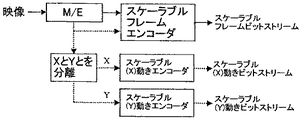
本発明と従来技術との間の主な相違は、垂直方向および水平方向の動きベクトル成分の歪みが個別に制御されることである。これは、図2に示されるように、最初に、動きベクトル場を各画像次元に対応するスカラー場に分離し、それぞれ個別にコーディングすることにより、2つのスケーラブル動き成分ビットストリームを生成することによって達成される。 The main difference between the present invention and the prior art is that the vertical and horizontal motion vector component distortions are individually controlled. This is accomplished by first generating two scalable motion component bitstreams by separating the motion vector field into scalar fields corresponding to each image dimension and coding each separately, as shown in FIG. Achieved.
各動き成分ビットストリームは、文献において確立されたスケーラブル画像圧縮技法のうちの任意のものを用いて、スケーラブルに符号化されることができる。詳細には、最近のJPEG2000画像圧縮標準規格から導出される方法を用いることが好ましく、その方法は、動きデータに対して有効に機能するために先に述べられたSeckerおよびTaubmanにおいて既に示されている。その最も簡単な形態では、本発明は、埋め込み量子化およびコーディングの前に、動きベクトル成分を再結合することを含まない。これは、JPEG2000の部分ビットプレーンコーディング技法の1つの変形形態を用いて、各動きベクトルが埋め込み量子化およびコーディングに一緒にかけられる、従来技術とは異なることに留意されたい。 Each motion component bitstream can be scalable encoded using any of the scalable image compression techniques established in the literature. In particular, it is preferred to use a method derived from the recent JPEG2000 image compression standard, which has already been shown in Secker and Taubman mentioned earlier to work effectively on motion data. Yes. In its simplest form, the present invention does not include recombining motion vector components prior to embedded quantization and coding. Note that this differs from the prior art where each motion vector is subjected to embedded quantization and coding together using one variation of the JPEG2000 partial bit-plane coding technique.
映像の効率的な再構成は、コーディングされたサンプル情報と、2つのコーディングされた動き成分の表現それぞれとの間で正確なレート割当てを必要とする。これは、補助レート割当て情報によって容易にされ、その情報は、空間分解能およびビットレートのような所望の再構成パラメータに応じて、動きデータおよびサンプルデータの最適な組み合わせを指定する。ビデオサーバによる再構成、あるいは圧縮されたファイルからの再構成のいずれの場合でも、そのために必要とされる補助レート情報は、従来技術として先に説明されたような1組のテーブルからなる。しかしながら、本発明では、レートテーブルは、必要とされる再構成ビットレートおよび空間分解能毎に、2つ(1つではない)の動きビットレート、およびビデオサンプルビットレートを決定する。 Efficient reconstruction of video requires accurate rate allocation between coded sample information and each of the two coded motion component representations. This is facilitated by auxiliary rate assignment information, which specifies the optimal combination of motion data and sample data depending on the desired reconstruction parameters such as spatial resolution and bit rate. In either case of reconstruction by a video server or reconstruction from a compressed file, the auxiliary rate information required for this consists of a set of tables as previously described in the prior art. However, in the present invention, the rate table determines two (not one) motion bit rate and video sample bit rate for each required reconstruction bit rate and spatial resolution.
実際には、再構成ビットレートの選択に応じて、動き成分ビットレートとサンプルビットレートとを指定するだけで十分である。別法では、レートテーブルは、再構成されたビットレートおよび空間分解能を選択するために用いるための動き成分およびサンプル品質層の数を指定することができる。所望の再構成レートが、レートテーブルによって指定される合計ビットレートの範囲に入るなら、次に低い合計ビットレートに対応するレート割当てが用いられ、残りのビットはサンプルデータに割り当てられる。この取り決めは、動きビットストリームが常に動き成分品質層の全数に対応するビットレートで再構成されるという性質を持っており、それは、その動きビットストリームそのものによって、レート歪みが最適になることを確実にする。さらに、それは動き情報の堅実な割当てを促し、それは動きデータおよびサンプルデータのバランスが、わずかに少ない動き情報ではなく、わずかに多くの動き情報を送出するのを選ぶ傾向があることを意味する。別法では、R−D勾配を品質層間で線形に変化するものとして近似することができ、それにより品質層間の歪み−長さ曲線が2次の多項式としてモデル化される。この近似は、部分的な動きおよびサンプル品質層を用いてビットレートを割り当てるための手段を提供する。 In practice, it is sufficient to specify the motion component bit rate and the sample bit rate depending on the selection of the reconstruction bit rate. Alternatively, the rate table can specify the number of motion components and sample quality layers to use to select the reconstructed bit rate and spatial resolution. If the desired reconstruction rate falls within the total bit rate range specified by the rate table, the rate allocation corresponding to the next lower total bit rate is used and the remaining bits are allocated to the sample data. This arrangement has the property that the motion bitstream is always reconstructed at a bit rate corresponding to the total number of motion component quality layers, which ensures that the rate distortion is optimal by the motion bitstream itself. To. In addition, it encourages a steady allocation of motion information, which means that the balance of motion data and sample data tends to choose to send slightly more motion information rather than slightly less motion information. Alternatively, the RD gradient can be approximated as changing linearly between quality layers, whereby the distortion-length curve between quality layers is modeled as a second order polynomial. This approximation provides a means for assigning bit rates using partial motion and sample quality layers.
再構成された各ビットレートを達成するために組み合わせることができる動き成分ビットレートおよびサンプルビットレートの全ての組み合わせを用いてビデオを一度再構成することによってレートテーブルを決定することができる。この手法を用いる場合、品質層の全数に対応する動き成分レートおよびサンプルレートのみを含むように探索を限定する必要がある。特定の合計ビットレートでそれぞれ再構成された後に、PSNRが測定され、結果として最も高いPSNRを生成する組み合わせが最適なレート割当てとして選択される。 The rate table can be determined by reconstructing the video once with all combinations of motion component bit rates and sample bit rates that can be combined to achieve each reconstructed bit rate. When using this method, it is necessary to limit the search to include only the motion component rate and the sample rate corresponding to the total number of quality layers. After each reconfiguration at a particular total bit rate, the PSNR is measured and the combination that results in the highest PSNR is selected as the optimal rate assignment.
好ましくは、上記の手法は最初に、2つの動き成分ビットレートが強制的に同じにされる、粗い探索を実行することにより速度を速められる。これは、従来技術(上記のSeckerおよびTaubman)によって記述されるのと同じようにして、合計ビットレート毎にビットレートの対(動きビットレートおよびサンプルビットレート)のみをテストすることを含むであろう。最適な動き成分ビットレートは通常、同程度の桁数からなるので、この方法は良好な初期の推測をもたらすであろう。その初期の推測は、初期の推測によって特定されるものに近いいくつかの動き成分ビットレートを試すことにより精緻化される。再び、その探索は、全動き成分層に対応する動きビットレートのみに限定される。 Preferably, the above approach is first speeded up by performing a coarse search in which the two motion component bit rates are forced to be the same. This includes testing only bit rate pairs (motion bit rate and sample bit rate) for each total bit rate in the same way as described by the prior art (Secker and Taubman above). Let's go. Since the optimal motion component bit rate usually consists of a similar number of digits, this method will yield a good initial guess. That initial guess is refined by trying several motion component bit rates close to those specified by the initial guess. Again, the search is limited to only the motion bit rate corresponding to the entire motion component layer.
さらに計算効率を高めるようにレートテーブルを決定するために、個々の打ち切り点において、各ビットストリームの歪み−長さ勾配が同じであるようにそれぞれ打ち切られるときに、3つのデータソースの組み合わせが最適であるという事実を利用することができる。すなわち、或る勾配λ>0の場合に、ラグランジュの最適化の目的が、以下の式が成り立つように3つのビットストリームを打ち切ることを含むという事実を利用する。 To determine the rate table for further computational efficiency, the combination of three data sources is optimal when each bitstream is censored so that the distortion-length gradient is the same at each censoring point. You can take advantage of the fact that That is, we take advantage of the fact that for some gradient λ> 0, the Lagrangian optimization objective involves truncating the three bitstreams such that:
ただし、L(S)+L(M,1)+L(M,2)は、Lmaxを超えない範囲で最も大きな値である。この問題は上述の文献に記述されるものと同じであり、その解は「モデルに基づくレート割当て」と呼ばれる。本発明は、2つの動き成分ビットストリームおよび2つの動き感度ファクタを用いることを除いて、概ね同じレート割当て手順を含む。動き感度ファクタは、以下の積分を計算することにより求められる。ただし、SR,S(ω1,ω2)は適当な電力スペクトル推定法を用いて決定される。 However, L (S) + L (M, 1) + L (M, 2) is the largest value in the range which does not exceed Lmax . The problem is the same as described in the above-mentioned literature, and the solution is called “model-based rate allocation”. The present invention includes generally the same rate allocation procedure except that it uses two motion component bitstreams and two motion sensitivity factors. The motion sensitivity factor is determined by calculating the following integral: However, S R, S (ω 1 , ω 2 ) is determined using an appropriate power spectrum estimation method.
上記のSeckerおよびTaubmanにおいて報告され、それらの式によって示されるように、効率的なレート割当ては一般的に、空間分解能S毎に用いられ、かつ再構成ビットレートRの選択のために用いられることになる異なる一対の動き感度ファクタを必要とする。 As reported in Secker and Taubman above and shown by their equations, efficient rate allocation is generally used for each spatial resolution S and used for the selection of the reconstructed bit rate R Requires a different pair of motion sensitivity factors.
これまでの実施形態の制約は、動きベクトル成分を個別に符号化し、送信することが、1組の動きベクトルの全体が圧縮される効率を低下させる可能性があることである。これには2つの理由がある。第1の理由は、各動きビットストリームが、空間次元のような種々の再構成パラメータ、およびビットストリームの最適な打ち切りに関係する情報を指示するためのヘッダ情報を必要とすることである。後者は、コードブロックのための識別マーカ、品質層、時空間サブバンドなどを含む種々の形態において存在する。本発明の場合のように、2つの動き成分ビットストリームが、従来技術において用いられるような1つの動きベクトルビットストリームの代わりに用いられるときには、このオーバーヘッドは概ね2倍になる。2つの動き成分ビットストリームによって必要とされるシグナリングオーバーヘッドを削減するために、2つの成分ビットストリームを1つのビットストリームにまとめて、種々のマーカが動き成分間で共有されるようにすることが好ましい。これは一般的には、少なくとも、時空間サブバンドマーカ、次元情報、時空間分解および埋め込みコーディングパラメータを含むであろう。 A limitation of previous embodiments is that individually encoding and transmitting the motion vector components can reduce the efficiency with which the entire set of motion vectors is compressed. There are two reasons for this. The first reason is that each motion bitstream requires various reconstruction parameters such as spatial dimensions and header information to indicate information related to the optimal truncation of the bitstream. The latter exists in various forms including identification markers for code blocks, quality layers, spatio-temporal subbands and the like. As in the present invention, this overhead is approximately doubled when two motion component bitstreams are used instead of one motion vector bitstream as used in the prior art. To reduce the signaling overhead required by the two motion component bitstreams, it is preferable to combine the two component bitstreams into one bitstream so that various markers are shared between the motion components. . This will generally include at least space-time subband markers, dimensional information, space-time decomposition and embedded coding parameters.
動きベクトル成分を個別にコーディングすることが圧縮を低下させる可能性がある第2の理由は、これにより、2つの動き成分間の冗長性の利用が妨げられることである。この影響を抑えるために、本発明の別の実施態様は、埋め込み量子化およびコーディングの前に、2つの動きベクトル成分を再結合することを含む。これは、2つの動き成分ビットストリーム間で個別にビットを割り当てることができないので、レート割当てが最適ではないことを意味することに留意されたい。しかしながら、これは、2つのビットストリーム間の依存性を利用して、コーディング効率が高められることによって補償されることができる。詳細には、一方の動き成分が0であるときに、他方の動き成分も0である可能性が高いという事実を利用することが望ましい。これは、上記のSeckerおよびTaubmanによって提案される方法と同じようなコンテクストコーディング法を用いて果たされることができる。しかしながら、以前のやり方とは異なり、本発明は、再構成されたビデオ歪みへの2つの動き成分の相対的な有意性を利用することも含む。これは、SeckerおよびTaubmanにおいて記述されるものから、部分ビットプレーンコーディング操作をさらに変更することにより実行されることができる。たとえば、ビットプレーンコーディングの前に、1つの動きベクトル成分にスケーリング操作を適用することができる。これを果たすための簡単な方法は、全ての垂直方向の動きベクトル成分サンプルをビット数Nだけ左にシフトすることによる。ただし、N=log2(Ψ1/Ψ2)である。 A second reason that coding motion vector components individually can reduce compression is that this prevents the use of redundancy between the two motion components. To mitigate this effect, another embodiment of the present invention involves recombining the two motion vector components prior to embedded quantization and coding. Note that this means that the rate assignment is not optimal because the bits cannot be individually assigned between the two motion component bitstreams. However, this can be compensated by taking advantage of the dependency between the two bitstreams to increase coding efficiency. Specifically, it is desirable to take advantage of the fact that when one motion component is zero, the other motion component is likely to be zero. This can be accomplished using a context coding method similar to that proposed by Secker and Taubman above. However, unlike previous approaches, the present invention also includes utilizing the relative significance of the two motion components to the reconstructed video distortion. This can be done by further modifying the partial bit-plane coding operation from that described in Secker and Taubman. For example, a scaling operation can be applied to one motion vector component before bit plane coding. A simple way to accomplish this is by shifting all vertical motion vector component samples to the left by N bits. However, N = log 2 (Ψ 1 / Ψ 2 ).
別法では、Nが負の数であるときに、水平方向の動きベクトル成分を−Nだけ左にシフトすることができる。この手法は、2つの動きベクトル成分間のビットプレーン走査順序を有効に変更するものであり、M. van der Schaar and Y-T Lin著「Content-based selective enhancement for streaming video」(IEEE Int. Conf. Image Proc. Vol. 2, pp. 977-980, Sept 2001)に記載されるような、MPEG−4細粒度スケーラビリティ(Fine Granularity Scalability)コーディング方式において、コンテンツに基づくスケーラビリティのために用いられるビットプレーンシフトの方法に概念的に類似している。正確な大きさが解凍中に再生されることができるように、ビットシフトパラメータがデコーダに送信されるが、これらのパラメータを送るために必要とされるビットの数は少なく、圧縮性能に著しい影響を及ぼさないことに留意されたい。 Alternatively, when N is a negative number, the horizontal motion vector component can be shifted left by -N. This method effectively changes the bit-plane scanning order between two motion vector components, “Content-based selective enhancement for streaming video” (IEEE Int. Conf. Image) by M. van der Schaar and YT Lin. Proc. Vol. 2, pp. 977-980, Sept 2001), in the MPEG-4 Fine Granularity Scalability coding scheme, the bit-plane shift used for content-based scalability. It is conceptually similar to the method. Bit shift parameters are sent to the decoder so that the exact size can be reproduced during decompression, but the number of bits required to send these parameters is small and has a significant impact on compression performance Note that this does not affect
本発明は、たとえば、コンピュータを利用するシステムにおいて、あるいは適当なハードウエアおよび/またはソフトウエアを用いて、あるいは特定用途の装置またはチップのような特定用途のモジュールにおいて実装されることができる。図2にはコーダが示されており、対応するデコーダは、逆の復号操作を実行するために対応する構成要素を有する。 The present invention can be implemented, for example, in a computer-based system, using suitable hardware and / or software, or in a special purpose module such as a special purpose device or chip. FIG. 2 shows a coder, and the corresponding decoder has corresponding components to perform the reverse decoding operation.
Claims (25)
動きベクトルの第1の成分が前記動きベクトルの第2の成分とは別々にあるいは無関係にスケーラブルに符号化される方法。 A method for encoding moving image data using motion compensated 3D subband coding,
A method wherein a first component of a motion vector is scalable and encoded separately or independently of the second component of the motion vector.
動きベクトルの第1の成分が前記動きベクトルの第2の成分とは別々にあるいは無関係に符号化され、
前記第1の動きベクトル成分および前記第2の動きベクトル成分のための個別のビットレート割当てを含む方法。 A method of encoding video data using motion compensation,
The first component of the motion vector is encoded separately or independently of the second component of the motion vector;
A method comprising separate bit rate assignments for the first motion vector component and the second motion vector component.
動きベクトルの成分はコンテクストコーディングを用いて一緒にスケーラブルに符号化され、
前記方法は一方の動きベクトル成分に対して他方をスケーリングあるいはシフトすることを含む方法。 A method for encoding moving image data using motion compensated 3D subband coding,
The motion vector components are encoded together scalable using context coding,
The method includes scaling or shifting the other for one motion vector component.
前記方法は水平方向および垂直方向の動きベクトル成分の影響を個別に考慮することを含む方法。 A method of encoding video data using motion compensation,
The method includes separately considering the effects of horizontal and vertical motion vector components.
第2の動きベクトル成分を符号化および/または復号するためのスケーラブル動きエンコーダおよび/またはデコーダとを備える、請求項20に記載の装置。 A scalable motion encoder and / or decoder for encoding and / or decoding a first motion vector component;
21. The apparatus of claim 20, comprising a scalable motion encoder and / or decoder for encoding and / or decoding a second motion vector component.
Applications Claiming Priority (1)
| Application Number | Priority Date | Filing Date | Title |
|---|---|---|---|
| EP04251920A EP1583368A1 (en) | 2004-03-31 | 2004-03-31 | Direction-adaptive scalable motion parameter coding for scalable video coding |
Publications (2)
| Publication Number | Publication Date |
|---|---|
| JP2005295561A true JP2005295561A (en) | 2005-10-20 |
| JP2005295561A5 JP2005295561A5 (en) | 2008-05-08 |
Family
ID=34878318
Family Applications (1)
| Application Number | Title | Priority Date | Filing Date |
|---|---|---|---|
| JP2005103252A Pending JP2005295561A (en) | 2004-03-31 | 2005-03-31 | Method for encoding and decoding moving picture data, representation of an image sequence encoded using said method, apparatus for implementing said method, computer program, and storage medium |
Country Status (4)
| Country | Link |
|---|---|
| US (1) | US20050226323A1 (en) |
| EP (1) | EP1583368A1 (en) |
| JP (1) | JP2005295561A (en) |
| CN (1) | CN1678073B (en) |
Families Citing this family (20)
| Publication number | Priority date | Publication date | Assignee | Title |
|---|---|---|---|---|
| US7657060B2 (en) * | 2004-03-31 | 2010-02-02 | Microsoft Corporation | Stylization of video |
| US20070136372A1 (en) * | 2005-12-12 | 2007-06-14 | Proctor Lee M | Methods of quality of service management and supporting apparatus and readable medium |
| US8875199B2 (en) | 2006-11-13 | 2014-10-28 | Cisco Technology, Inc. | Indicating picture usefulness for playback optimization |
| US20090180546A1 (en) | 2008-01-09 | 2009-07-16 | Rodriguez Arturo A | Assistance for processing pictures in concatenated video streams |
| US8416859B2 (en) | 2006-11-13 | 2013-04-09 | Cisco Technology, Inc. | Signalling and extraction in compressed video of pictures belonging to interdependency tiers |
| US8804845B2 (en) | 2007-07-31 | 2014-08-12 | Cisco Technology, Inc. | Non-enhancing media redundancy coding for mitigating transmission impairments |
| US8958486B2 (en) | 2007-07-31 | 2015-02-17 | Cisco Technology, Inc. | Simultaneous processing of media and redundancy streams for mitigating impairments |
| US8718388B2 (en) | 2007-12-11 | 2014-05-06 | Cisco Technology, Inc. | Video processing with tiered interdependencies of pictures |
| CN101217654B (en) * | 2008-01-04 | 2010-04-21 | 华南理工大学 | Scalable organization method of video code stream |
| US8416858B2 (en) | 2008-02-29 | 2013-04-09 | Cisco Technology, Inc. | Signalling picture encoding schemes and associated picture properties |
| WO2009152450A1 (en) | 2008-06-12 | 2009-12-17 | Cisco Technology, Inc. | Picture interdependencies signals in context of mmco to assist stream manipulation |
| US8699578B2 (en) | 2008-06-17 | 2014-04-15 | Cisco Technology, Inc. | Methods and systems for processing multi-latticed video streams |
| US8705631B2 (en) | 2008-06-17 | 2014-04-22 | Cisco Technology, Inc. | Time-shifted transport of multi-latticed video for resiliency from burst-error effects |
| US8971402B2 (en) | 2008-06-17 | 2015-03-03 | Cisco Technology, Inc. | Processing of impaired and incomplete multi-latticed video streams |
| US8259817B2 (en) | 2008-11-12 | 2012-09-04 | Cisco Technology, Inc. | Facilitating fast channel changes through promotion of pictures |
| US8949883B2 (en) | 2009-05-12 | 2015-02-03 | Cisco Technology, Inc. | Signalling buffer characteristics for splicing operations of video streams |
| US8279926B2 (en) * | 2009-06-18 | 2012-10-02 | Cisco Technology, Inc. | Dynamic streaming with latticed representations of video |
| CN102802138A (en) * | 2011-05-25 | 2012-11-28 | 腾讯科技(深圳)有限公司 | Video file processing method and system, and video proxy system |
| US10230957B2 (en) * | 2016-03-22 | 2019-03-12 | Cyberlink Corp. | Systems and methods for encoding 360 video |
| CN110113669B (en) * | 2019-06-14 | 2021-07-16 | 北京达佳互联信息技术有限公司 | Method and device for acquiring video data, electronic equipment and storage medium |
Family Cites Families (9)
| Publication number | Priority date | Publication date | Assignee | Title |
|---|---|---|---|---|
| FR2725577B1 (en) * | 1994-10-10 | 1996-11-29 | Thomson Consumer Electronics | CODING OR DECODING METHOD OF MOTION VECTORS AND CODING OR DECODING DEVICE USING THE SAME |
| KR100249223B1 (en) * | 1997-09-12 | 2000-03-15 | 구자홍 | Method for motion vector coding of mpeg-4 |
| US7023922B1 (en) * | 2000-06-21 | 2006-04-04 | Microsoft Corporation | Video coding system and method using 3-D discrete wavelet transform and entropy coding with motion information |
| AU2001293994B2 (en) * | 2000-10-09 | 2007-04-26 | Snell & Wilcox Limited | Compression of motion vectors |
| GB2368220A (en) * | 2000-10-09 | 2002-04-24 | Snell & Wilcox Ltd | Compression of motion vectors |
| US6845130B1 (en) * | 2000-10-12 | 2005-01-18 | Lucent Technologies Inc. | Motion estimation and compensation for video compression |
| CN101448162B (en) * | 2001-12-17 | 2013-01-02 | 微软公司 | Method for processing video image |
| AU2002951574A0 (en) * | 2002-09-20 | 2002-10-03 | Unisearch Limited | Method of signalling motion information for efficient scalable video compression |
| US7580460B2 (en) * | 2003-03-28 | 2009-08-25 | Sony Corporation | Video encoder with multiple outputs having different attributes |
-
2004
- 2004-03-31 EP EP04251920A patent/EP1583368A1/en not_active Withdrawn
-
2005
- 2005-03-30 CN CN2005100588974A patent/CN1678073B/en not_active Expired - Fee Related
- 2005-03-30 US US11/092,777 patent/US20050226323A1/en not_active Abandoned
- 2005-03-31 JP JP2005103252A patent/JP2005295561A/en active Pending
Also Published As
| Publication number | Publication date |
|---|---|
| CN1678073A (en) | 2005-10-05 |
| US20050226323A1 (en) | 2005-10-13 |
| CN1678073B (en) | 2011-01-19 |
| EP1583368A1 (en) | 2005-10-05 |
Similar Documents
| Publication | Publication Date | Title |
|---|---|---|
| JP5014989B2 (en) | Frame compression method, video coding method, frame restoration method, video decoding method, video encoder, video decoder, and recording medium using base layer | |
| CN100435585C (en) | Method and device for predecoding and decoding bitstream including base layer | |
| JP2005295561A (en) | Method for encoding and decoding moving picture data, representation of an image sequence encoded using said method, apparatus for implementing said method, computer program, and storage medium | |
| KR100679030B1 (en) | Method and apparatus for precoding hybrid bitstream | |
| US7200277B2 (en) | Method for transcoding a JPEG2000 compressed image | |
| KR100631777B1 (en) | Method and apparatus for effectively compressing motion vectors in multi-layer | |
| CN1906945B (en) | Method and apparatus for scalable video encoding and decoding | |
| KR100664928B1 (en) | Video coding method and apparatus | |
| KR100703748B1 (en) | Efficiently predicting multi-layer based video frames, and video coding method and apparatus using the same | |
| JP4891234B2 (en) | Scalable video coding using grid motion estimation / compensation | |
| US20050226335A1 (en) | Method and apparatus for supporting motion scalability | |
| WO2005020586A1 (en) | Scalable video coding and decoding methods, and scalable video encoder and decoder | |
| US20050201468A1 (en) | Method and apparatus for interframe wavelet video coding | |
| CN102006483B (en) | Video coding and decoding method and device | |
| KR100621584B1 (en) | Video decoding method or video decoder using smoothing filter | |
| US20050163217A1 (en) | Method and apparatus for coding and decoding video bitstream | |
| MXPA06006117A (en) | Method and apparatus for scalable video encoding and decoding. | |
| Lazar et al. | Wavelet-based video coder via bit allocation | |
| CN100466735C (en) | Video encoding and decoding method and video encoder and decoder | |
| KR101107318B1 (en) | Scalable video encoding and decoding methods and scalable video encoders and decoders | |
| Bruylants et al. | On the use of directional transforms for still image coding | |
| KR20050038732A (en) | Scalable video coding method and apparatus using pre-decoder | |
| JP2007527651A (en) | JPEG2000 compressed image transcoding method |
Legal Events
| Date | Code | Title | Description |
|---|---|---|---|
| A521 | Written amendment |
Free format text: JAPANESE INTERMEDIATE CODE: A523 Effective date: 20080324 |
|
| A621 | Written request for application examination |
Free format text: JAPANESE INTERMEDIATE CODE: A621 Effective date: 20080324 |
|
| A131 | Notification of reasons for refusal |
Free format text: JAPANESE INTERMEDIATE CODE: A131 Effective date: 20110301 |
|
| A601 | Written request for extension of time |
Free format text: JAPANESE INTERMEDIATE CODE: A601 Effective date: 20110601 |
|
| A602 | Written permission of extension of time |
Free format text: JAPANESE INTERMEDIATE CODE: A602 Effective date: 20110606 |
|
| A02 | Decision of refusal |
Free format text: JAPANESE INTERMEDIATE CODE: A02 Effective date: 20110906 |