JP2005296024A - Auxiliary pad - Google Patents
Auxiliary pad Download PDFInfo
- Publication number
- JP2005296024A JP2005296024A JP2002027293A JP2002027293A JP2005296024A JP 2005296024 A JP2005296024 A JP 2005296024A JP 2002027293 A JP2002027293 A JP 2002027293A JP 2002027293 A JP2002027293 A JP 2002027293A JP 2005296024 A JP2005296024 A JP 2005296024A
- Authority
- JP
- Japan
- Prior art keywords
- auxiliary pad
- sheet
- region
- auxiliary
- bent region
- Prior art date
- Legal status (The legal status is an assumption and is not a legal conclusion. Google has not performed a legal analysis and makes no representation as to the accuracy of the status listed.)
- Withdrawn
Links
- 238000005452 bending Methods 0.000 claims abstract description 37
- 230000002745 absorbent Effects 0.000 claims description 90
- 239000002250 absorbent Substances 0.000 claims description 90
- 239000000853 adhesive Substances 0.000 claims description 26
- 230000001070 adhesive effect Effects 0.000 claims description 26
- 239000007788 liquid Substances 0.000 claims description 5
- 238000012423 maintenance Methods 0.000 claims description 2
- 210000001124 body fluid Anatomy 0.000 abstract description 32
- 239000010839 body fluid Substances 0.000 abstract description 28
- 239000006096 absorbing agent Substances 0.000 abstract description 20
- 238000010521 absorption reaction Methods 0.000 abstract description 19
- 230000000452 restraining effect Effects 0.000 abstract 2
- 239000000463 material Substances 0.000 description 30
- 238000000034 method Methods 0.000 description 27
- 239000000835 fiber Substances 0.000 description 24
- 210000001217 buttock Anatomy 0.000 description 21
- 239000004745 nonwoven fabric Substances 0.000 description 20
- 230000002175 menstrual effect Effects 0.000 description 15
- XLYOFNOQVPJJNP-UHFFFAOYSA-N water Substances O XLYOFNOQVPJJNP-UHFFFAOYSA-N 0.000 description 15
- 239000008280 blood Substances 0.000 description 14
- 210000004369 blood Anatomy 0.000 description 14
- -1 polyethylene Polymers 0.000 description 12
- 229920001971 elastomer Polymers 0.000 description 11
- 239000000806 elastomer Substances 0.000 description 11
- 239000000126 substance Substances 0.000 description 11
- 230000006835 compression Effects 0.000 description 10
- 238000007906 compression Methods 0.000 description 10
- 239000004698 Polyethylene Substances 0.000 description 9
- 229920000573 polyethylene Polymers 0.000 description 9
- 239000004831 Hot glue Substances 0.000 description 8
- 239000004743 Polypropylene Substances 0.000 description 8
- 230000000694 effects Effects 0.000 description 8
- 229920001155 polypropylene Polymers 0.000 description 8
- 230000001681 protective effect Effects 0.000 description 8
- 238000011084 recovery Methods 0.000 description 8
- 229920000297 Rayon Polymers 0.000 description 7
- 230000008569 process Effects 0.000 description 7
- 239000002964 rayon Substances 0.000 description 7
- 230000002829 reductive effect Effects 0.000 description 7
- 230000001105 regulatory effect Effects 0.000 description 7
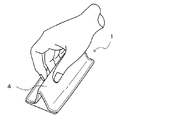
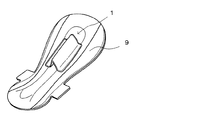
- 229920005989 resin Polymers 0.000 description 7
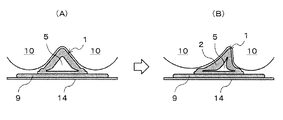
- 239000011347 resin Substances 0.000 description 7
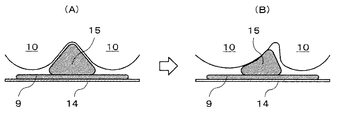
- 239000004372 Polyvinyl alcohol Substances 0.000 description 6
- PPBRXRYQALVLMV-UHFFFAOYSA-N Styrene Chemical compound C=CC1=CC=CC=C1 PPBRXRYQALVLMV-UHFFFAOYSA-N 0.000 description 6
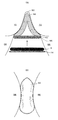
- 238000010586 diagram Methods 0.000 description 6
- 238000004049 embossing Methods 0.000 description 6
- 229920000728 polyester Polymers 0.000 description 6
- 229920000642 polymer Polymers 0.000 description 6
- 229920002451 polyvinyl alcohol Polymers 0.000 description 6
- 238000012545 processing Methods 0.000 description 6
- QTBSBXVTEAMEQO-UHFFFAOYSA-M Acetate Chemical compound CC([O-])=O QTBSBXVTEAMEQO-UHFFFAOYSA-M 0.000 description 5
- 239000003795 chemical substances by application Substances 0.000 description 5
- 239000002657 fibrous material Substances 0.000 description 5
- 229920000747 poly(lactic acid) Polymers 0.000 description 5
- 229920000139 polyethylene terephthalate Polymers 0.000 description 5
- 239000005020 polyethylene terephthalate Substances 0.000 description 5
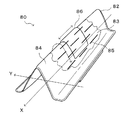
- 239000004626 polylactic acid Substances 0.000 description 5
- 229920002050 silicone resin Polymers 0.000 description 5
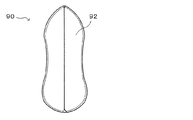
- 229920000742 Cotton Polymers 0.000 description 4
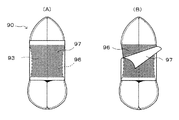
- PEDCQBHIVMGVHV-UHFFFAOYSA-N Glycerine Chemical compound OCC(O)CO PEDCQBHIVMGVHV-UHFFFAOYSA-N 0.000 description 4
- 229920002678 cellulose Polymers 0.000 description 4
- 239000001913 cellulose Substances 0.000 description 4
- 230000008859 change Effects 0.000 description 4
- 239000011248 coating agent Substances 0.000 description 4
- 238000000576 coating method Methods 0.000 description 4
- 239000000470 constituent Substances 0.000 description 4
- 239000006260 foam Substances 0.000 description 4
- 229920001684 low density polyethylene Polymers 0.000 description 4
- 239000004702 low-density polyethylene Substances 0.000 description 4
- 238000002156 mixing Methods 0.000 description 4
- 230000002093 peripheral effect Effects 0.000 description 4
- 239000004014 plasticizer Substances 0.000 description 4
- 239000002994 raw material Substances 0.000 description 4
- 229920001935 styrene-ethylene-butadiene-styrene Polymers 0.000 description 4
- 238000012546 transfer Methods 0.000 description 4
- 210000000689 upper leg Anatomy 0.000 description 4
- 210000003905 vulva Anatomy 0.000 description 4
- 229920002134 Carboxymethyl cellulose Polymers 0.000 description 3
- 230000009471 action Effects 0.000 description 3
- 150000001336 alkenes Chemical class 0.000 description 3
- 230000005540 biological transmission Effects 0.000 description 3
- 235000010948 carboxy methyl cellulose Nutrition 0.000 description 3
- 230000029142 excretion Effects 0.000 description 3
- 239000004744 fabric Substances 0.000 description 3
- 230000002209 hydrophobic effect Effects 0.000 description 3
- 238000005304 joining Methods 0.000 description 3
- 239000004750 melt-blown nonwoven Substances 0.000 description 3
- 239000000203 mixture Substances 0.000 description 3
- 238000000465 moulding Methods 0.000 description 3
- JRZJOMJEPLMPRA-UHFFFAOYSA-N olefin Natural products CCCCCCCC=C JRZJOMJEPLMPRA-UHFFFAOYSA-N 0.000 description 3
- 210000002640 perineum Anatomy 0.000 description 3
- 239000002985 plastic film Substances 0.000 description 3
- 229920002961 polybutylene succinate Polymers 0.000 description 3
- 239000004631 polybutylene succinate Substances 0.000 description 3
- 229920005862 polyol Polymers 0.000 description 3
- 229920000346 polystyrene-polyisoprene block-polystyrene Polymers 0.000 description 3
- 239000004627 regenerated cellulose Substances 0.000 description 3
- 229920000468 styrene butadiene styrene block copolymer Polymers 0.000 description 3
- 229920001169 thermoplastic Polymers 0.000 description 3
- 239000004416 thermosoftening plastic Substances 0.000 description 3
- 239000001993 wax Substances 0.000 description 3
- VTYYLEPIZMXCLO-UHFFFAOYSA-L Calcium carbonate Chemical compound [Ca+2].[O-]C([O-])=O VTYYLEPIZMXCLO-UHFFFAOYSA-L 0.000 description 2
- CURLTUGMZLYLDI-UHFFFAOYSA-N Carbon dioxide Chemical compound O=C=O CURLTUGMZLYLDI-UHFFFAOYSA-N 0.000 description 2
- 229920003043 Cellulose fiber Polymers 0.000 description 2
- 239000004129 EU approved improving agent Substances 0.000 description 2
- LYCAIKOWRPUZTN-UHFFFAOYSA-N Ethylene glycol Chemical compound OCCO LYCAIKOWRPUZTN-UHFFFAOYSA-N 0.000 description 2
- 241001313288 Labia Species 0.000 description 2
- CSNNHWWHGAXBCP-UHFFFAOYSA-L Magnesium sulfate Chemical compound [Mg+2].[O-][S+2]([O-])([O-])[O-] CSNNHWWHGAXBCP-UHFFFAOYSA-L 0.000 description 2
- 239000004677 Nylon Substances 0.000 description 2
- 210000000436 anus Anatomy 0.000 description 2
- 229920006167 biodegradable resin Polymers 0.000 description 2
- 229920001400 block copolymer Polymers 0.000 description 2
- 239000006085 branching agent Substances 0.000 description 2
- 239000001768 carboxy methyl cellulose Substances 0.000 description 2
- 239000008112 carboxymethyl-cellulose Substances 0.000 description 2
- 239000002131 composite material Substances 0.000 description 2
- 239000003431 cross linking reagent Substances 0.000 description 2
- 235000011187 glycerol Nutrition 0.000 description 2
- 230000007062 hydrolysis Effects 0.000 description 2
- 238000006460 hydrolysis reaction Methods 0.000 description 2
- 238000003475 lamination Methods 0.000 description 2
- 239000006224 matting agent Substances 0.000 description 2
- 229910052751 metal Inorganic materials 0.000 description 2
- 239000002184 metal Substances 0.000 description 2
- VNWKTOKETHGBQD-UHFFFAOYSA-N methane Chemical compound C VNWKTOKETHGBQD-UHFFFAOYSA-N 0.000 description 2
- 229920001778 nylon Polymers 0.000 description 2
- BASFCYQUMIYNBI-UHFFFAOYSA-N platinum Chemical compound [Pt] BASFCYQUMIYNBI-UHFFFAOYSA-N 0.000 description 2
- 229920002647 polyamide Polymers 0.000 description 2
- 150000003077 polyols Chemical class 0.000 description 2
- 229920001296 polysiloxane Polymers 0.000 description 2
- 229920002742 polystyrene-block-poly(ethylene/propylene) -block-polystyrene Polymers 0.000 description 2
- 239000000047 product Substances 0.000 description 2
- 239000005871 repellent Substances 0.000 description 2
- 150000003839 salts Chemical class 0.000 description 2
- 239000002195 soluble material Substances 0.000 description 2
- 238000012360 testing method Methods 0.000 description 2
- 229920005992 thermoplastic resin Polymers 0.000 description 2
- 230000008719 thickening Effects 0.000 description 2
- ILJSQTXMGCGYMG-UHFFFAOYSA-N triacetic acid Chemical compound CC(=O)CC(=O)CC(O)=O ILJSQTXMGCGYMG-UHFFFAOYSA-N 0.000 description 2
- 239000006097 ultraviolet radiation absorber Substances 0.000 description 2
- 229920003169 water-soluble polymer Polymers 0.000 description 2
- 239000002759 woven fabric Substances 0.000 description 2
- 239000004711 α-olefin Substances 0.000 description 2
- UPMLOUAZCHDJJD-UHFFFAOYSA-N 4,4'-Diphenylmethane Diisocyanate Chemical compound C1=CC(N=C=O)=CC=C1CC1=CC=C(N=C=O)C=C1 UPMLOUAZCHDJJD-UHFFFAOYSA-N 0.000 description 1
- RSWGJHLUYNHPMX-UHFFFAOYSA-N Abietic-Saeure Natural products C12CCC(C(C)C)=CC2=CCC2C1(C)CCCC2(C)C(O)=O RSWGJHLUYNHPMX-UHFFFAOYSA-N 0.000 description 1
- 241000186361 Actinobacteria <class> Species 0.000 description 1
- 208000019901 Anxiety disease Diseases 0.000 description 1
- 241000894006 Bacteria Species 0.000 description 1
- UXVMQQNJUSDDNG-UHFFFAOYSA-L Calcium chloride Chemical compound [Cl-].[Cl-].[Ca+2] UXVMQQNJUSDDNG-UHFFFAOYSA-L 0.000 description 1
- 239000004971 Cross linker Substances 0.000 description 1
- 229920000089 Cyclic olefin copolymer Polymers 0.000 description 1
- JOYRKODLDBILNP-UHFFFAOYSA-N Ethyl urethane Chemical compound CCOC(N)=O JOYRKODLDBILNP-UHFFFAOYSA-N 0.000 description 1
- 108010010803 Gelatin Proteins 0.000 description 1
- 244000043261 Hevea brasiliensis Species 0.000 description 1
- ZOKXTWBITQBERF-UHFFFAOYSA-N Molybdenum Chemical compound [Mo] ZOKXTWBITQBERF-UHFFFAOYSA-N 0.000 description 1
- 239000004721 Polyphenylene oxide Substances 0.000 description 1
- KHPCPRHQVVSZAH-HUOMCSJISA-N Rosin Natural products O(C/C=C/c1ccccc1)[C@H]1[C@H](O)[C@@H](O)[C@@H](O)[C@@H](CO)O1 KHPCPRHQVVSZAH-HUOMCSJISA-N 0.000 description 1
- 229920002472 Starch Polymers 0.000 description 1
- GWEVSGVZZGPLCZ-UHFFFAOYSA-N Titan oxide Chemical compound O=[Ti]=O GWEVSGVZZGPLCZ-UHFFFAOYSA-N 0.000 description 1
- 229920006311 Urethane elastomer Polymers 0.000 description 1
- 239000011358 absorbing material Substances 0.000 description 1
- NIXOWILDQLNWCW-UHFFFAOYSA-N acrylic acid group Chemical group C(C=C)(=O)O NIXOWILDQLNWCW-UHFFFAOYSA-N 0.000 description 1
- 238000012644 addition polymerization Methods 0.000 description 1
- 229920003232 aliphatic polyester Polymers 0.000 description 1
- 229910052787 antimony Inorganic materials 0.000 description 1
- WATWJIUSRGPENY-UHFFFAOYSA-N antimony atom Chemical compound [Sb] WATWJIUSRGPENY-UHFFFAOYSA-N 0.000 description 1
- 239000003963 antioxidant agent Substances 0.000 description 1
- 230000003078 antioxidant effect Effects 0.000 description 1
- 230000036506 anxiety Effects 0.000 description 1
- 125000003118 aryl group Chemical group 0.000 description 1
- 238000006065 biodegradation reaction Methods 0.000 description 1
- 230000037237 body shape Effects 0.000 description 1
- 229910000019 calcium carbonate Inorganic materials 0.000 description 1
- 239000001110 calcium chloride Substances 0.000 description 1
- 229910001628 calcium chloride Inorganic materials 0.000 description 1
- 229910002092 carbon dioxide Inorganic materials 0.000 description 1
- 239000001569 carbon dioxide Substances 0.000 description 1
- 229920002301 cellulose acetate Polymers 0.000 description 1
- 229920006184 cellulose methylcellulose Polymers 0.000 description 1
- 229920003211 cis-1,4-polyisoprene Polymers 0.000 description 1
- 239000003086 colorant Substances 0.000 description 1
- 238000004040 coloring Methods 0.000 description 1
- 239000000306 component Substances 0.000 description 1
- 239000012141 concentrate Substances 0.000 description 1
- 229920001577 copolymer Polymers 0.000 description 1
- 239000011162 core material Substances 0.000 description 1
- 150000001993 dienes Chemical class 0.000 description 1
- 239000013013 elastic material Substances 0.000 description 1
- 150000002148 esters Chemical class 0.000 description 1
- HQQADJVZYDDRJT-UHFFFAOYSA-N ethene;prop-1-ene Chemical group C=C.CC=C HQQADJVZYDDRJT-UHFFFAOYSA-N 0.000 description 1
- 239000000945 filler Substances 0.000 description 1
- 239000006261 foam material Substances 0.000 description 1
- 239000000499 gel Substances 0.000 description 1
- 229920000159 gelatin Polymers 0.000 description 1
- 239000008273 gelatin Substances 0.000 description 1
- 235000019322 gelatine Nutrition 0.000 description 1
- 235000011852 gelatine desserts Nutrition 0.000 description 1
- 238000010559 graft polymerization reaction Methods 0.000 description 1
- 210000004013 groin Anatomy 0.000 description 1
- 229920001903 high density polyethylene Polymers 0.000 description 1
- 239000004700 high-density polyethylene Substances 0.000 description 1
- 229910052739 hydrogen Inorganic materials 0.000 description 1
- 239000001257 hydrogen Substances 0.000 description 1
- WGCNASOHLSPBMP-UHFFFAOYSA-N hydroxyacetaldehyde Natural products OCC=O WGCNASOHLSPBMP-UHFFFAOYSA-N 0.000 description 1
- 230000006872 improvement Effects 0.000 description 1
- 230000002401 inhibitory effect Effects 0.000 description 1
- 239000001023 inorganic pigment Substances 0.000 description 1
- 230000007794 irritation Effects 0.000 description 1
- 229920000092 linear low density polyethylene Polymers 0.000 description 1
- 239000004707 linear low-density polyethylene Substances 0.000 description 1
- 239000010721 machine oil Substances 0.000 description 1
- 238000003754 machining Methods 0.000 description 1
- 229910052943 magnesium sulfate Inorganic materials 0.000 description 1
- 235000019341 magnesium sulphate Nutrition 0.000 description 1
- 239000012968 metallocene catalyst Substances 0.000 description 1
- 244000005700 microbiome Species 0.000 description 1
- 229910052750 molybdenum Inorganic materials 0.000 description 1
- 239000011733 molybdenum Substances 0.000 description 1
- 230000003387 muscular Effects 0.000 description 1
- 229920003052 natural elastomer Polymers 0.000 description 1
- 229920001194 natural rubber Polymers 0.000 description 1
- 239000012188 paraffin wax Substances 0.000 description 1
- 230000036961 partial effect Effects 0.000 description 1
- 230000037361 pathway Effects 0.000 description 1
- 230000035699 permeability Effects 0.000 description 1
- 239000012466 permeate Substances 0.000 description 1
- 229920006255 plastic film Polymers 0.000 description 1
- 229910052697 platinum Inorganic materials 0.000 description 1
- 229920001495 poly(sodium acrylate) polymer Polymers 0.000 description 1
- 229920001707 polybutylene terephthalate Polymers 0.000 description 1
- 229920000570 polyether Polymers 0.000 description 1
- 229920001228 polyisocyanate Polymers 0.000 description 1
- 239000005056 polyisocyanate Substances 0.000 description 1
- 229920002635 polyurethane Polymers 0.000 description 1
- 239000004814 polyurethane Substances 0.000 description 1
- 238000010298 pulverizing process Methods 0.000 description 1
- 238000004080 punching Methods 0.000 description 1
- 238000000746 purification Methods 0.000 description 1
- 229920005604 random copolymer Polymers 0.000 description 1
- 230000002940 repellent Effects 0.000 description 1
- 230000001846 repelling effect Effects 0.000 description 1
- 230000004044 response Effects 0.000 description 1
- 238000007789 sealing Methods 0.000 description 1
- NNMHYFLPFNGQFZ-UHFFFAOYSA-M sodium polyacrylate Chemical compound [Na+].[O-]C(=O)C=C NNMHYFLPFNGQFZ-UHFFFAOYSA-M 0.000 description 1
- 230000007480 spreading Effects 0.000 description 1
- 238000003892 spreading Methods 0.000 description 1
- 239000008107 starch Substances 0.000 description 1
- 235000019698 starch Nutrition 0.000 description 1
- 230000000638 stimulation Effects 0.000 description 1
- 238000003860 storage Methods 0.000 description 1
- 229920006132 styrene block copolymer Polymers 0.000 description 1
- 229920003051 synthetic elastomer Polymers 0.000 description 1
- 229920002994 synthetic fiber Polymers 0.000 description 1
- 239000012209 synthetic fiber Substances 0.000 description 1
- 229920001059 synthetic polymer Polymers 0.000 description 1
- 229920003002 synthetic resin Polymers 0.000 description 1
- 239000000057 synthetic resin Substances 0.000 description 1
- 239000005061 synthetic rubber Substances 0.000 description 1
- 150000003505 terpenes Chemical class 0.000 description 1
- 235000007586 terpenes Nutrition 0.000 description 1
- 229920002725 thermoplastic elastomer Polymers 0.000 description 1
- OGIDPMRJRNCKJF-UHFFFAOYSA-N titanium oxide Inorganic materials [Ti]=O OGIDPMRJRNCKJF-UHFFFAOYSA-N 0.000 description 1
- KHPCPRHQVVSZAH-UHFFFAOYSA-N trans-cinnamyl beta-D-glucopyranoside Natural products OC1C(O)C(O)C(CO)OC1OCC=CC1=CC=CC=C1 KHPCPRHQVVSZAH-UHFFFAOYSA-N 0.000 description 1
- 239000002699 waste material Substances 0.000 description 1
Images

Landscapes
- Absorbent Articles And Supports Therefor (AREA)
- Orthopedics, Nursing, And Contraception (AREA)
Abstract
Description
【0001】
【発明の属する技術分野】
本発明は、女性用の衛生用品であって、生理用ナプキン等の吸収性物品取り付け用の補助パッドに関する。
【0002】
【従来の技術】
従来より、体液を吸収する衛生用品として、生理用ナプキンのような吸収体を内包させた吸収性物品が広く使用されている。ここで、特に需要層の厚い生理用ナプキンに対しては、経血のモレを防ぐべく、多大なる努力が払われている。
【0003】
しかしながら、生理用ナプキンとは、元来下着に取り付けられるものであり、着用者の内股と密着して装着されるものではないことから、着用者の身体と生理用ナプキンとの間に隙間が生じやすく、かかる隙間から経血が漏れ出しやすい。
【0004】
この点、特開平10−127692号において、吸水性を有する材質を棒状に形成し、その断面が略三角形の部分を有するようにした生理用補助吸収体が開示されている。
【0005】
この生理用補助吸収体は、着用者が生理用ナプキンを装着した状態において、着用者の内股と生理用ナプキンとの間に生じる隙間を埋めるものであるため、生理用ナプキンを単独で使用する場合と比較して、経血のモレ防止効果を高めることができると言える。
【0006】
しかしながら、かかる生理用補助吸収体は、単に吸収性を有する材質を細長い棒状に成型したものであるために剛性が高く、着用者の動作によっては装着当初の状態を維持することができず、着用者の内股(特に臀部の谷間)と生理用ナプキンとの間において隙間が生じてしまうおそれがある。このような場合には、かかる隙間から経血が漏れやすくなるため、生理用ナプキンを補助して経血モレを防止する、という機能が十分に発揮されないこととなる。
【0007】
【発明が解決しようとする課題】
このように、上述の生理用補助吸収体のような従来の補助具では、単に安定した装着状態下の生理用ナプキンの経血吸収能を補助するに留まり、着用者の活動等に対応して着用者の内股への密着性を十分に確保するまでには至っていないのである。
【0008】
本発明は、以上のような課題に鑑みてなされたものであり、その目的は、装着時においても着用者の内股との密着性を維持して体液のモレの発生を低減するとともに、好適な着用感を備えた吸収性物品取り付け用の補助パッドを提供することにある。
【0009】
【課題を解決するための手段】
上記のような課題を解決するために、本発明においては、吸収性物品に取り付ける補助具を着用者の内股と吸収性物品との隙間を埋めるような形状とするとともに、着用後は着用者の動きに応じて柔軟に変形可能としたこと、具体的には、吸収体を折り曲げて内部に空間を有する状態のまま吸収性物品に取り付けられるようにしたことを特徴とする。
【0010】
より具体的には、本発明は、以下のようなものを提供する。
【0011】
(1) 液体吸収性を備える吸収性物品取り付け用の補助パッドであって、
液体吸収性を備えるとともに、着用者の身体に面する身体側面及び吸収性物品に面する反身体側面が、着用時に着用者の身体側に向かって凸となる屈曲領域を備え、この屈曲領域は、当該屈曲領域の屈曲状態の維持を行なう維持手段が設けられているとともに、前記吸収性物品に接着するための接着部が、前記屈曲領域の反身体側の底部に設けられているものであることを特徴とする補助パッド。
【0012】
本発明に係る補助パッドは、身体側が頂部となるように折り曲げられた屈曲領域を有している。このため、生理用ナプキン等の吸収性物品を使用するに際し、当該吸収性物品の身体側面に本発明に係る補助パッドを取り付けることにより、着用者の内股と吸収性物品との間に隙間を生じさせない状態にし、しかも、この状態を装着中においても維持することが可能となっている。
【0013】
即ち、本発明に係る補助パッドは、一連の吸収性シートを折り曲げて成る屈曲領域を有しているため、当該屈曲領域の内側(反身体側)において空間を形成している。そして、かかる空間内に向けて補助パッド自体の形状が適宜変形することにより体圧等の外圧を緩衝し、着用中の動作変化等に対応して着用者の内股における凹形状部分に補助パッドを密着した状態を維持することが可能となり、補助パッドや吸収性物品と着用者の内股との間において隙間が発生することを防止できるのである。
【0014】
上述のように、本発明に係る補助パッドの屈曲領域は、一連のシートを単に折り曲げることにより形成されたものであるため、柔軟性を有するものであり、個々の着用者の内股に柔軟に対応可能であるとともに、剛着感を与えない着用感を提供するものである。
【0015】
この点、上述した生理用補助吸収体のように、単に吸収性素材を棒状や三角形状に形成させた場合には剛性が高く、装着時に着用者に異物感を与えるばかりでなく、その剛性ゆえに形状の変形が容易ではない。このため、体圧等の外圧を当該補助吸収体自体では緩衝しにくく、併用する吸収性物品の止着面に外圧が直接伝わってしまう結果、装着中に当該補助吸収体が生理用ナプキンから外れてしまうおそれがある。このような場合には、臀部の谷間の隙間を埋めることができず経血が流出してしまう危険性が高い。
【0016】
これに対し、本発明の補助パッドは、屈曲領域が着用者の動作に応じて自らを柔軟に変形させることが可能であるため、着用者の身体との間に隙間が発生するのを防止して体液の流出を効果的に防止しながら、併用する吸収性物品との装着位置を維持して体液吸収を補助することが可能となっているのである。
【0017】
なお、本発明に係る補助パッドは、吸収性物品を身体に装着した際に当該吸収性物品の後方に位置する部分、即ち、装着時において臀部近傍にあたる部分、に接着されるようにする。このようにすることにより、身体と吸収性物品の間において最も大きい隙間となりやすい臀部の谷間を埋めることができ、かかる空間から体液が流れ出て背中にまで至ることによる体液の肌への広範囲にわたる付着を未然に防止して、肌や下着の汚れを効果的に防ぐことが可能となる。
【0018】
このように、本発明に係る補助パッドは、併用する既成の吸収性物品の性能を向上させて着用者を体液モレに対する不安感から開放し、着用者の活動領域やアクティビティを拡大するという効果をもたらす衛生用品なのである。
【0019】
(2) 前記維持手段は、前記屈曲領域の一方裾部から他方裾部にまたがるようにして設けられた規制シートであり、当該規制シートにより前記屈曲領域の広がりが規制されることにより前記屈曲状態の維持が行なわれるものであることを特徴とする(1)記載の補助パッド。
【0020】
本発明に係る補助パッドによれば、反身体側面において、屈曲領域の一方裾部から他方裾部にまたがるようにして、規制シートが取り付けられている。このため、装着時において、外圧や着用者の動作によって屈曲領域が広がってしまい、屈曲領域の内側に形成された空間が押し潰されてしまうことを確実に防止することができる。特に、使用が長時間に及んだ場合に有用である。
【0021】
また、使用前に屈曲領域が広がってしまうことも防止されるため、着用者は特段の注意を要することなく、屈曲領域の形状を本発明に係る補助パッドを装着するまで保つことができる。
【0022】
(3) 前記規制シートは、前記屈曲領域の一部に対して設けられているものであることを特徴とする(1)又は(2)記載の補助パッド。
【0023】
本発明に係る補助パッドによれば、屈曲領域において、その広がりが規制されている規制領域と規制されていない非規制領域とが存するように規制シートが配置されている。このため、凹部を有する身体の部位に規制領域が位置するように装着することにより、かかる規制領域において屈曲領域が抵抗無く凹部の一番奥に接するようにすることができ、非規制領域においては屈曲領域が広がって外陰部を被覆するように密着させることができるようになっている。
【0024】
このように、本発明に係る補助パッドによれば、屈曲部が着用者の内股の形状に沿って変形可能となっているために、効果的に体液のモレ防止を図ることができるのである。
【0025】
(4) 前記接着部は、前記規制シートの反身体側面に設けられていることを特徴とする(2)又は(3)記載の補助パッド。
【0026】
本発明に係る補助パッドによれば、併用する吸収性物品に固定するための接着部が、屈曲領域の広がりを規制する規制シートの反身体側面に設けられている。
【0027】
この場合において、接着部の配置箇所は、少なくとも規制シートと補助パッド本体とが接合されている接合位置、即ち、屈曲領域の両裾野近傍に対応する箇所に設けるようにするのが好ましい。補助パッドにかかる体圧等の荷重は屈曲領域の裾野に集中するため、このような箇所に設けるようにすることにより、補助パッドの吸収性物品に対する固定状態を強化することが可能となるからであり、これにより、着用中の動作変化によって補助パッドを止着した吸収性物品から剥離しにくくすることができる。
【0028】
(5) 前記屈曲領域の両裾野には、当該両裾野の末端から外側に延び、装着時において身体に接する平坦状領域が連接していることを特徴とする(1)から(4)いずれか記載の補助パッド。
【0029】
本発明に係る補助パッドは、屈曲領域の左右裾野から延在する平坦状領域を有している。かかる平坦状領域は、装着時において、外陰部を被覆するように位置付けることができるため、補助パッドの身体側面を着用者の陰部表面に沿うようにさせることができる。このため、補助パッドの表面が着用者の身体に広く接することが可能となり、着用者に激しい異物感を与えることなく補助パッドの最大吸収容量を高めることができる。特に、屈曲領域よりも平坦状領域における吸収体の厚みを薄くすることにより、異物感をより一層低減することも可能である。
【0030】
また、補助パッドが有する吸収体の密度を屈曲領域よりも平坦状領域において高めることにより、毛管現象により屈曲領域で吸収した体液を平坦状領域へと移送できるため、補助パッドの最大吸収容量を最大限活用することができることになる(図10参照)。
【0031】
更に、本発明に係る補助パッドによれば、吸収性物品に接着するための接着部が平坦状領域の反身体側面に位置付けられることから、接着部も平坦状の形状を保ち易くなる。このため、補助パッドを身体に装着した後に吸収性物品を固定した下着を引き上げることにより補助パッドと吸収性物品とを接着させるという装着工程を経る場合において、下着を引き上げる間に接着部同士が貼り付いてしまうということや、併用する吸収性物品の表面材と本発明に係る補助パッドとの接着が完全に行われないということを、未然に防止することができる。この結果、装着中に補助パッドが吸収性物品から外れてしまう危険性を低減することが可能となるのである。
【0032】
(6) 前記補助パッドは、弾性を有することを特徴とする(1)から(5)いずれか記載の補助パッド。
【0033】
本発明に係る補助パッドは、弾性を有するように弾性部材が配されている。このため、吸収した体液(特に経血)によって補助パッドが湿潤状態にある場合でも、補助パッドの嵩が低下して、装着当初には存在しなかった隙間が発生してしまうことを防止することができる。
【0034】
また、弾性部材が有する反発力によって、着用者の行動によって身体形状のいかなる変形に対しても、補助パッドの身体側面を沿わせて隙間の発生を防止することができる。
【0035】
(7) 前記補助パッドは、曲げ剛性値が1.5mN/25mm以下、より好ましくは1.0mN/25mm以下であることを特徴とする(1)から(6)いずれか記載の補助パッド。
【0036】
本発明に係る補助パッドによれば、装着時において着用者の前方及び後方へ向かう方向をX軸方向と規定し、これに直交する方向をY軸方向と規定したときに、Y軸方向への曲げ剛性値が1.5mN/25mm以下、より好ましくは1.0mN/25mm以下となっている。補助パッドにこのような曲げ剛性値を持たせることにより、着用者の動作に伴って変化する内股の凹形状に対し、より低抵抗で補助パッドを変形させることができる。
【0037】
このような剛性値は、補助パッドが備える吸収体にヒートエンボス加工やスリット加工などを施してY軸方向への剛性差を与えることにより、得ることができる。
【0038】
ここで、肌への風合いを考慮した場合には、密度差により剛性差を得るエンボス加工よりも、繊維交絡を分断することで剛性差を得るスリット加工を施すことが好ましい。
【0039】
スリット加工としては、X軸方向へ破線状に延び、Y軸方向へ千鳥状に配列される、長さ10mmのスリット刃によって行なうスリット加工が挙げられる。
【0040】
なお、上記曲げ剛性値は、補助パッドの中央付近を短手方向の長さ38mm、長手方向への長さ25mmとなるようにサンプルを採取してガーレー測定器により測定したものである(図18参照)。
【0041】
(8) 前記補助パッドは、実質的に縦長の形状を成し、長手方向と、短手方向と、を有するものであることを特徴とする(1)から(7)いずれか記載の補助パッド。
【0042】
本発明に係る補助パッドによれば、補助パッドが実質的に縦長の形状をなしている。このため、屈曲領域の頂部を、着用者の内股、具体的には陰裂から会陰へと伸びて臀部の溝へと繋がる着用者の内股の中心部分、に沿わせるようにして、装着することができる。これにより、体液のモレ、特に尻部の割れ目から背中を伝って流れ出ることにより生じる後方への体液のモレ、を効果的に防止することが可能となる。
【0043】
(9) 前記屈曲領域は、前記長手方向の一方端部から他方端部に向かうにつれて当該屈曲領域の頂部の高さが徐々に高くなるものであることを特徴とする
(8)記載の補助パッド。
【0044】
本発明に係る補助パッドによれば、屈曲領域の頂部が補助パッドの一方端部から他方端部に向かうにつれて徐々に高くなっている。この高くなっている部分を併用する吸収性物品の後方側に向けて本発明の補助パッドを吸収性物品に取り付けるようにすることにより、傾斜した屈曲領域が着用者の臀部の形状に合致しやすくなる。即ち、最も隙間の大きい尻の隙間に近傍に上記高くなっている部分が位置するようにして本発明の補助パッドを使用することになるので、屈曲領域が会陰部から肛門にかけて徐々に深さを増す臀部の谷間に対してより適合し易くなるのである。このため、伝いモレによる体液の流出をより一層効果的に防止することが可能となる。
【0045】
(10) 前記補助パッドは、前記長手方向を中心軸として左右に位置する両側部が前記中心軸に向かって窪んだウエスト部を形成しているものであることを特徴とする請求項8または9記載の補助パッド。
【0046】
本発明に係る補助パッドによれば、長手方向における両側縁が、直線ではなく湾曲した部分を備えている。このため、かかる湾曲部分が着用者の内股にフィットしやすくなっている。
【0047】
即ち、生理用ナプキン等の吸収性物品と併用する補助パッドは、装着する工程が2通りに大別できる。1つは、併用する吸収性物品に補助パッドを接着させ、これを下着に固定して下着を引き上げることにより装着する工程であり、他の1つは、伝いモレが発生しやすい箇所、例えば臀部に、予め補助パッドを挟み込んでおき、吸収性物品を固定した下着を引き上げることで補助パッドと吸収性物品とを接着させ、装着する工程である。
【0048】
ここで、後者の工程で装着される場合には、補助パッドを直接着用者の意図する身体の箇所に挟み込めるので、補助パッドを適切な位置に確実に装着することが可能であり、これにより体液モレを効果的に防止することができる。しかし、この工程においては、吸収性物品を固定した下着を引き上げる間に、挟み込んだ補助パッドが身体から脱落しないようにすることが必要である。
【0049】
この点、本発明に係る補助パッドは、その形状が臀部もしくは内股の湾曲方向に沿うように両側縁部が湾曲している。このため、補助パッドを身体に装着したときには、臀部等の筋力で補助パッドの屈曲部が挟み込まれるだけではなく、身体と補助パッドとの接触面積が高められることとなり、補助パッドの身体への装着状態が維持されやすくなる。これにより、吸収性物品を固定した下着を引き上げる間に、挟み込んだ補助パッドが身体から脱落してしまうことを防止することが可能となる。
【0050】
【発明の実施の形態】
次に、本発明の補助パッドの実施形態について、図を参照しつつ説明する。
【0051】
[基本的な補助パッド]
<補助パッドの基本構成>
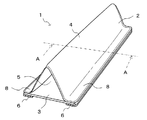
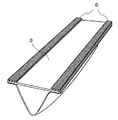
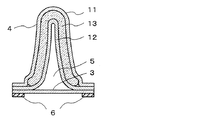
図1は本実施形態における補助パッド1の身体側を説明するための斜視図であり、図2は補助パッド1の反身体側を説明するための斜視図であり、図3はA−A視断面図である。
【0052】
図1に示すように、補助パッド1は、身体側に向かって凸となる屈曲領域4を有するように折り曲げられた吸収層2と、屈曲領域4に連接する短平坦状領域8の反身体面に取り付けられた規制シート3と、から成る。そして、吸収層2の屈曲領域4と規制シート3との間において、空間5が形成されている。
【0053】
図2に示すように、規制シート3の反身体側には、長手方向の両側部において、併用する生理用ナプキン(図示せず)に補助パッド1を固定するための接着部6が設けられている。
【0054】
図3に示すように、吸収層2は、透水性の表面側シート11と裏面側シート12とが、その両シートの間に吸収体13を内包するようにして接合されることにより形成されている。そして、このような吸収層2の屈曲領域4の内側と規制シート3の身体側との間において、断面が略三角形状の空間5が形成されている。
【0055】
<装着状態>
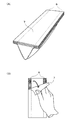
次に、このような補助パッド1の装着状態について説明する。図4は接着部6を保護する保護シート7を説明するための図であり、図5は補助パッド1を屈曲領域4を摘まんで保持する状態を示す図であり、図6は補助パッド1を生理用ナプキン9に取り付けた状態を示す図であり、図7は補助パッド1の装着状態を示す縦断面図であり、図8は従来の補助具15の装着状態を示す縦断面図である。
【0056】
本実施形態の補助パッド1は、図4(A)に示すように、使用前においてはこれを保護する保護シート7が取り付けられている。従って、使用するにあたっては、同(B)に示すように、かかる保護シート7を剥がし、接着部6を露出させることとなる。
【0057】
次に、図5に示すように、露出した接着部6(図示せず)が手に付かないようにして屈曲領域4を指で摘まんで補助パッド1を保持し、図6に示すように、生理用ナプキン9の後方部分、具体的には、生理用ナプキン9の装着時において臀部近傍に対応する部分、に補助パッド1を取り付ける。着用者はこの補助パッド1が取り付けられた生理用ナプキン9を下着に固定し、これを着用することとなる。なお、装着方法としては、まず補助パッドを身体の凹部に一時的に挟み込み、それから生理用ナプキンを固定した下着を引き上げることで補助パッドと生理用ナプキンとを接着させる方法も採用できる。この場合には、後述の図19に示すような補助パッド90を用いるのが好ましい。
【0058】
補助パッド1を取り付けた生理用ナプキン9を下着14に固定した場合には、図7(A)に示すように、装着時において、臀部10と生理用ナプキン9との間に生じる隙間を補助パッド1によって埋めることができる。そして、同(B)に示すように、着用者の動作に伴って装着当初とは生理用ナプキン9の臀部10に対する位置や臀部10の形状が変化してしまった場合でも、吸収層2がその内部に存する空間5に向かってが変形することにより、かかる変化に柔軟に対応可能となっている。
【0059】
この点、図8(A)に示すような従来の補助具15は、装着当初においては、臀部10間に挟みこまれて併用する生理用ナプキン9との間に生じる隙間が埋めることができ、本実施形態の補助パッド1と同様の効果を奏している。しかし、着用者の動作に伴って、臀部10の位置や形状に変化が生じてしまった場合には、当該補助具15の変形がその構成素材自体の柔らかさだけに依存しているために、同(B)に示すように、もはや臀部10の隙間に入り込んでいる状態を維持することが困難となってしまう。この結果、臀部10と生理用ナプキン9との間に隙間が生じてしまい、この隙間から経血が漏れ出てしまうおそれがある。
【0060】
[他の実施形態の補助パッド]
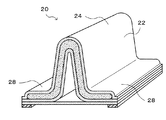
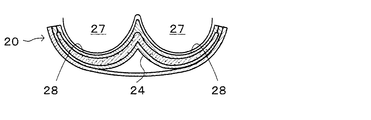
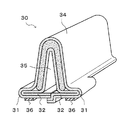
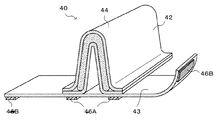
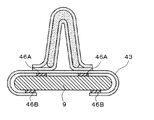
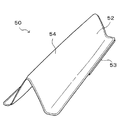
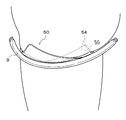
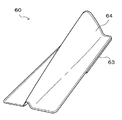
次に、他の実施形態の補助パッドについて説明する。図9は吸収層22が屈曲領域24の裾野の左右側部に繋がる長平坦状領域28を有する補助パッド20を示す縦断面斜視図であり、図10は補助パッド20の装着状態を示す図であり、図11は表面側シート31及び裏面側シート32が屈曲領域34の両側縁から延在し、衣服側面において両シート同士が接合された補助パッド30を示す図であり、図12は吸収層42の短手方向よりも寸法の長い規制シート43を有する補助パッド40を示す図であり、図13は規制シート43で生理用ナプキン9を巻き込んで固定した状態を示す縦断面図であり、図14は規制シート53によって屈曲領域54の広がりが規制されている規制領域と、規制されていない非規制領域と、を有する補助パッド50を示す斜視図であり、図15は補助パッド50の装着状態を示す側面図であり、図16は長手方向へ緩やかに傾斜するように屈曲領域64が形成されている補助パッド60を示す斜視図であり、図17は吸収層72に弾性部材75が配されている補助パッド70を示す縦断面図であり、図18は吸収体83にスリット加工が施されている補助パッド80を示す斜視図(図は、部分的に表面側シートを削除している)であり、図19は吸収層92の両側部が湾曲した形状の補助パッド90を示す図であり、図20は補助パッド90を臀部10に挟み込んだ状態を示す図であり、図21は補助パッド90の反身体側面を示す図であり、図22は補助パッド90の斜視図である。
【0061】
図9に示す補助パッド20は、屈曲領域24の短手方向の左右側部において、屈曲領域24の裾野から延長された長平坦状領域28が連接している。このため、装着時には、図10に示すように、屈曲領域24は陰唇27の凹部に沿うように、長平坦状領域28は外陰部を被覆するようにして補助パッド20を装着できるため、着用者に異物感を与えることなく補助パッド20の最大吸収容量を高めることができる。
【0062】
図11に示す補助パッド30は、表面側シート31及び裏面側シート32の一部を屈曲領域34の両側縁から延在させ、衣服側面に折り返して端部同士を接合させることにより、屈曲領域34が広がってしまうことを規制している。このような構成とした場合には、別途シートを取り付けて規制シートを構成する場合のように、吸収層と規制シートとを接合する必要がなくなるため、吸収層と規制シートとの接合部の存在により補助パッドの周縁部が硬くなってしまうということがなく、着用感を好適なものとすることができる。
【0063】
なお、各シートの延長領域は、本実施形態のように、表面側シート31と裏面側シート32の一部を延出させるようにするほか、表面側シート31及び裏面側シート32の全部を延出させるようにしても構わない。更には、表面側シート31若しくは裏面側シート32のいずれか一方のみを延出させるようにしても構わない。
【0064】
図12に示す補助パッド40は、規制シート43が、吸収層42の短手方向において、吸収層42に対する接合位置よりも更に外側まで延在している。そして、この規制シート43の反身体側面においては、吸収層42との接合位置に対応した部分に設けられた第1の接着部46Aの他に、第2の接着部46Bが、規制シート43の延在した部分における両側部において設けられている。このため、図13に示すように、規制シート43の延在部分で生理用ナプキン9を巻き込み、この状態のままで下着に装着することができる。このようにすることにより、着用者の動作によって補助パッド40が止着した生理用ナプキン9から剥離してしまうという事態が防止される。
【0065】
図14に示す補助パッド50は、吸収層52の長手方向において、当該吸収層52の中央付近から後方(装着時には臀部側)端に位置するように規制シート53が取り付けられている。即ち、補助パッド50においては、規制シート53が補助パッド50の反身体側面において、その全部ではなく、一部分に対して取り付けられている。このため、屈曲領域54において、規制シート53が取り付けられた部分は広がりが規制された規制領域となり、当該規制シート54が取り付けられていない部分は非規制領域となっている。
【0066】
このような補助パッド50を、図15に示すように、規制領域が後方に位置するように使用することにより、規制領域が配置された後方は、着用者の陰裂から臀部の谷間を埋めるように屈曲領域54が位置するようになる。そして、このような規制領域においては、仮に屈曲領域54と身体の凹部(陰裂や臀部の谷間など)が合致しないままに装着されたとしても、補助パッド50への外圧が補助パッド50が有する空間55によって緩衝できるので、屈曲領域54の形状が自在に変化して上記凹部形状に沿うように適合することとなる。
【0067】
一方、非規制領域においては、陰裂の前方に位置する陰阜(恥丘)の膨らんだ形状に密着するように屈曲領域54が広がるため、当該屈曲領域54の両裾野が変形した状態で装着されることとなる。これにより、前方からの体液のモレも効果的に防止することができる。なお、本実施形態においては、吸収層52の長手方向の長さ寸法は150mmとなっている。
【0068】
図16に示す補助パッド60は、屈曲領域64が長手方向へ向かって緩やかに傾斜しており、傾斜の高い部分に対応するように規制シート63が取り付けられている。
【0069】
このような補助パッド60は、屈曲領域64の傾斜の高い部分が後方になるようにして生理用ナプキンに取り付ける。このようにすることにより、屈曲領域64の傾斜が前方から後方にかけて徐々にピークをなすように位置付けられ、着用者の身体表面、即ち、会陰部から肛門にかけて徐々に深さを増す臀部の谷間に対してより適合し易くなるため、伝いモレによる経血の流出を効果的に防止することができる。
【0070】
図17に示す補助パッド70は、吸収層72に弾性部材75が配されている。このため、吸収体が吸収保持した体液の重みによって吸収層72の嵩が低下して隙間が発生することを防止するとともに、弾性部材75の反発力によって、着用者の動作に伴う内股の形状変化に柔軟に対応することも可能となっている。
【0071】
なお、本実施形態では、このような弾性部材75の反発力を効果的に発生させるために、弾性部材75は、吸収体73と同様に長手方向中心線にほぼ沿って折り曲げられ、短手方向における末端部72a及び72bまで存在するように内包されている。
【0072】
また、弾性部材75の配置位置は経血の透水性を阻害しない位置であればよいことから、本実施形態のように吸収体73の反身体側面と裏面側シート74の身体側面との間に配置するほか、表面側シート71の反身体側面と吸収体73の身体側面との間に配置することもできる。
【0073】
図18に示す補助パッド80は、吸収層82に内包される吸収体83にスリット加工85が施されている。このスリット加工により、吸収層82のY軸方向の曲げ剛性値が1.5mN/25mm以下、より好ましくは1.0mN/25mm以下とすることができる。
【0074】
なお、上述の曲げ剛性値は、製品の中央付近を短手方向の長さ38mm、長手方向への長さ25mmとなるようにサンプル86を採取し、ガーレー測定器により測定したものである。
【0075】
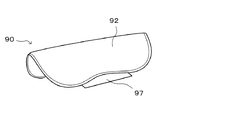
図19に示す補助パッド90は、吸収層92の形状が、長手方向の両側部が内側にえぐれたように湾曲状態となっている。このため、図20(A)に示すように、臀部10に補助パッド90を挟み込んでから生理用ナプキン9が固定された下着14を引き上げて装着する場合でも、同(B)に示すように、吸収層92が着用者の内股98にぴったりフィットすることが可能となる。このため、生理用ナプキン9が規制シート93に設けられた接着部96に接して補助パッド9と生理用ナプキン9が接着されるまで、臀部10から補助パッド90が外れてしまう事態が防止される。
【0076】
図21に示すように、吸収層92の反身体側面においては、着色された規制シート93が吸収層92の長手方向の中央部に設けられており、当該規制シート93の反身体側面全体が接着部96となっている。そして、この接着部96を覆うように保護シート97が貼着されている。この保護シート97は長方形状であるため、吸収層92の曲線状の輪郭に完全には合致しておらず、使用前においては、図22に示すように反身体側面から以外からでもかかる保護シート97を視認することができる。
【0077】
[吸収層の形状]
屈曲領域が形成される前の吸収層の形状は、女性の体に無理なく適合可能な形状であれば特に制限されるものではないが、実質的に縦長の形状であることが好ましく、楕円形・瓢箪型・雫型等の形状を採用することができる。
【0078】
屈曲領域が形成された後の吸収層の見かけ上の形状は、吸収層の反身体側面と規制シートの身体側面と間に形成される空間の形状に依存する。この空間の形状は特に限定されるものではないが、着用者の陰裂や臀部谷間の一番奥に屈曲領域の頂部が低抵抗で接するためには、略三角形状であることが望ましい。
【0079】
[吸収層の大きさ]
補助パッドの本体となる吸収層のサイズは、長さが50〜200mm、好ましくは80〜150mmの範囲が良く、身体側面からみた見かけ幅(短手方向の長さ)は、10〜80mm、好ましくは30〜40mmの範囲が適当である。
【0080】
上述の範囲未満であると、排泄された体液の量が容易に補助パッドの最大吸収容量を越えてしまい、経血が流出する危険性があり、一方、上述の範囲よりも大きいサイズの場合には、併用する生理用ナプキン等のサイズ寸法を超えてしまうばかりでなく、着用感を阻害するおそれがある。
【0081】
この点、上述のような範囲内のサイズとすることにより、体液吸収能をある程度保持しながらも着用感を害しないものとすることができる。
【0082】
屈曲領域の高さ(内部空間が略三角形状の場合においては、規制シートの身体側面から屈曲領域の頂部の反身体側面までの距離)は、5〜40mm、好ましくは15〜25mmの範囲とするのが好ましい。
【0083】
屈曲領域の高さがこの範囲未満であると、屈曲領域の高さが特に臀部における谷間の深さより小さくなってしまうために、臀部の谷間の一番奥の肌を伝う体液の排泄経路を遮断することができなくなり、一方、この範囲より大きい場合には、着用感を阻害するおそれがあるからである。
【0084】
屈曲領域の内側に形成されている空間の断面積は、12〜1600mm2範囲、好ましくは10〜500mm2の範囲とするのが好ましい。
【0085】
前記空間が上述の範囲未満であると、吸収層が空間内に向けて自在に変形するための空間量が少なくなって動作変化に対して追従し難くなり、この範囲よりも大きいと、着用感を阻害するおそれがあるからである。
【0086】
[規制シート]
規制シートは、吸収層の反身体側面において、屈曲領域の両裾野近傍において吸収層と接合されている。
【0087】
規制シートと吸収層との接合方法は、ヒートエンボス加工やホットメルト型接着剤を単独もしくは組み合わせて使用することができ、着用者が補助パッドを使用している際に、屈曲領域の広がりを規制し続けることが可能な接合強度を有していれば、特に制限なく使用することができる。ここで、体液による湿潤時を想定すると、ヒートエンボス加工を単独、もしくはヒートエンボス加工とホットメルト型接着剤を組み合わせて使用することが好ましい。
【0088】
[構成材料]
吸収体を被覆する被覆材は、着用者の意図によって使い分けることができる。例えば、体液の排泄量に対して強い意識を持つ着用者であれば、身体側に面する透水性の表面側シートと衣服側に面する透水性の裏面側シートによって吸収体を内包させた状態で周縁部を接合した形態、もしくは透水性のシートによって吸収体を内包させた状態で周縁部を接合した形態、から成る吸収層によって構成された補助パッドを使用することができる。被覆材をこのような構成とすることにより、当該補助パッドで吸収した体液を併用する生理用ナプキン等へと移行させることが可能となるため、補助パッドに吸収された体液が、補助パッド自体の最大吸収容量を越えにくくなる。この結果、長時間の着用や多量の排泄時においても体液の流出を防止することが可能となるのである。
【0089】
なお、かかる場合においては、生理用ナプキン等への体液の移行をスムーズなものとするために、屈曲領域の広がりを規制する規制シートも透水性のシートであることが望ましい。
【0090】
一方、排泄量は少ないものの肌を体液が伝い流れることにより生じる伝いモレに対して強い意識を持つ着用者であれば、身体側に面する透水性の表面側シートと衣服側に面する不透水性の裏面側シートによって吸収体を内包させた状態で周縁部を接合した形態から成る吸収層によって構成された補助パッドを使用することができる。このような補助パッドを通常伝いモレが発生する個所に装着することにより、効果的に伝いモレを防止することができる。
【0091】
なお、かかる場合には、補助パッド自体で体液を吸収保持することが可能となっているため、併用する生理用ナプキン等の吸収性物品に体液が付着することが低減できる。これにより、補助パッドのみを交換することにより新しいナプキンに交換する頻度が低減できるため、経済的であり、かつ交換時の煩雑さも低減できることになる。
【0092】
<表面側シート>
透水性の表面側シートとしては、織布、不織布、或いは有孔プラスチックシート等の液体を透過する構造のシート状材料であれば、特に限定されずに使用することができる。織布、不織布の素材としては、天然繊維、化学繊維のいずれも使用することが可能である。天然繊維の例としては、粉砕パルプ、コットン等のセルロースが挙げられる。化学繊維の例としては、レーヨン、フィブリルレーヨン等の再生セルロース、アセテート、トリアセテート等の半合成セルロース、熱可塑性疎水性化学繊維に親水化処理を施したもの等が挙げられる。前記熱可塑性疎水性化学繊維としては、ポリエチレン(PE)、ポリプロピレン(PP)、ポリエチレンテレフタレート(PET)等の単繊維、PEとPPをグラフト重合して成る繊維、或いは芯材がPPないしPETで、鞘部がPEの複合繊維などが挙げられる。
【0093】
なお、特に不織布の場合には、ウェブフォーミングは乾式(カード法、スパンボンド法、メルトブローン法、エアレイド法等)や湿式等を単独、又は複数組み合わせることにより製造してもよい。ボンディングの方法としては、サーマルボンディング、ニードルパンチ、ケミカルボンディング等の方法が挙げられるが、特にこれらの方法に限定されるものではない。また、水流交絡法によりシート状に形成したスパンレースを用いてもよい。
【0094】
有孔プラスチックシートとしては、PE、PP、PETといった熱可塑性樹脂の有孔シートや、多孔質の発泡材等を用いることができる。また、これらについては、必要に応じて酸化チタンや炭酸カルシウム等から成るフィラーを0.5〜10質量%の範囲で混入することにより、白濁化させて使用することも好ましい。また、前記熱可塑性樹脂から成るフィルムをパーフォレーション、ヒートエンボス加工、或いは機械加工等により開孔した有孔フィルムを使用してもよい。有孔フィルムは、不織布との複合シートとして使用してもよい。
【0095】
透水性シートのより具体的な構成としては、流出する経血吸収性に優れていること、化学的刺激が少なく着用感に優れていることを考慮すると、コットン5〜30%、レーヨン又はアセテートを70〜95%の比率で混合した繊維を水流により交絡させた、目付20〜50g/m2、厚み0.3〜1.0mmのスパンレース不織布を選択することが好ましい。使用する繊維の繊維長は、コットンであれば15〜60mm、レーヨン又はアセテートであれば25〜51mmの範囲で、また、繊度は1.5〜6dtexから一般的に選ばれる。
【0096】
<吸収体>
吸収体は液体(体液)の吸収保持が可能であればよく、嵩高であり、型崩れし難く、化学的刺激が少ないものであることが好ましい。その材質としては、セルロース(粉砕パルプ、コットン等)、再生セルロース(レーヨン、フィブリルレーヨン等)、半合成セルロース(アセテート、トリアセテート等)、粒子状高分子吸収体、繊維状高分子吸収体、化学繊維(熱可塑性疎水性化学繊維に親水化処理を施したもの等)、ケミカルボンド処理されたエアレイドパルプ、親水性樹脂を単独で又は混合して用いることができる。
【0097】
また、吸収体として、セルロース発泡体、合成樹脂の連続発泡体等も使用することができる。更に、前記発泡体を粉砕した後に吸収体に成形したものを使用することも可能である。
【0098】
これらの材料を吸収体に成形する方法は特に限定されるものではないが、例えばエアレイド法、メルトブローン法、スパンレース法、抄紙法等によってシート化したものが使用される。
【0099】
吸収体のより具体的な構成としては、1〜4dtexの範囲から選ばれるレーヨン又はアセテートを60〜90%、繊維状高分子吸収体10〜40%の混合比で積層した繊維を、ニードリングにより絡ませ、シート化した目付50〜250g/m2、2〜5mmの嵩を有する不織布シートが挙げられる。
【0100】
<裏面側シート>
裏面側シートに使用する材料は、透水性の素材を用いる場合には表面側シートと同様のものを用いることができる。
【0101】
また、前記裏面側シートに不透水性の素材を用いる場合には、吸収体に保持された体液が補助パッドの外側へ漏れ出すことを防止することができる。更に、透湿性素材から成ることにより、装着時のムレを低減させることができ、装着時における不快感を低減させることが可能となる。
【0102】
不透水性のシートを採用する場合にあっては、PE、PP等を主体とした不透水性フィルム、通気性の樹脂フィルム、撥水処理されたスパンボンド又はスパンレースなどの不織布の裏面に通気性の樹脂フィルムが接合されたものなどを好適に用いることができる。不液透過材である場合には、装着感を損なわない柔軟性を考慮すると、例えば低密度ポリエチレン樹脂を主体とした目付15〜30g/m2の範囲から得られるフィルムを使用することが好ましい。
【0103】
<規制シート>
規制シートに使用する材料は、補助パッドを使用している際に、屈曲領域の広がりを規制し続けることが可能であり、かつ、併用する吸収性物品に止着するための接着部が設けられている場合には、当該シートが破断しないための強度を有することを考慮した上で選択することが好ましい。例えば、不織布シート、弾性伸縮性不織布、フィルム、フォームフィルム、弾性伸縮性フィルム、発泡シート、薄葉紙等を単独で又はこれらをラミネート加工したものの中から選択することが可能である。具体的には、低密度ポリエチレン樹脂を主成分とした厚さ15〜30μmのフィルム等を選択することができる。
【0104】
また、規制シートは、併用する生理用ナプキン等の吸収性物品が装着時において好適に変形することを阻害しないように、吸収層の短手方向に対して伸長性を持たせることも有用である。
【0105】
規制シートに伸長性を持たせるためには、つかみ間隔100mm、引張速度を100mm/分で定速伸張した場合の5%伸長時の応力が0.1〜0.5N/25mmである伸長性スパンボンド不織布を使用することができる。
【0106】
<接着部>
「接着部」は規制シートの衣服側面に、接着剤を塗布することにより形成することができる。本発明において使用可能な接着剤としては、補助パッドを使用している際に、併用している生理用ナプキン等から補助パッドが剥離してしまわないような接着強度を有することを考慮した上で選択することが好ましく、水溶性高分子、架橋剤、可塑剤、水分から成るゲル接着剤等が挙げられる。より具体的には、水溶性高分子の例として、ゼラチン、ポリアクリル酸ナトリウム、ポリビニルアルコール、カルボキシルメチルセルロース等が、架橋剤の例として、塩化カルシウム、硫酸マグネシウムのような水溶性金属塩が、可塑剤の例として、グリセリン、ワックス、パラフィン等が挙げられる。
【0107】
この他にも、感圧型ホットメルト接着剤も接着部を形成するための接着剤として使用することができる。感圧型ホットメルト接着剤は、スチレン−イソプレン−スチレンブロック共重合体(SIS)、スチレン−ブタジエン−スチレンブロック共重合体(SBS)、スチレン−エチレン・ブタジエン−スチレンブロック共重合体(SEBS)、スチレン−エチレン・プロピレン−スチレンブロック共重合体(SEPS)のような合成ゴム樹脂を主たる成分とし、そこにテルペン樹脂、ロジン樹脂などの接着付与剤とワックス等の可塑剤を溶融混合することによって得られる。
【0108】
更には、シリコーン樹脂系接着剤も使用することが可能である。シリコーン樹脂系接着剤としては、シリコーン樹脂、フッ素樹脂を主たる成分とし、白金、モリブデン、アンチモン等の金属塩等の架橋剤、エステル系ワックス、グリセリン、マシンオイル等の可塑剤を混合して成る混合物などが挙げられる。
【0109】
このように接着部を形成するための接着剤は多種類存在するが、塗布安定性を考慮すると、感圧型ホットメルト接着剤を用いることが好ましい。塗布安定性が高い感圧型ホットメルト接着剤としては、SEBSを15〜25質量%、可塑剤を15〜35質量%、接着付与剤を40〜70質量%で溶融混合したものが挙げられる。この感圧型ホットメルト接着剤については、酸化防止剤、蛍光防止剤などを0.1〜1.0質量%の範囲で添加してもよい。
【0110】
接着部における接着剤の配置の仕方としては、面状・ドット状・網目状・筋状などが挙げられる。併用するナプキンから確実にずれないためには、例として感圧型ホットメルト接着剤を幅5〜15mmの面状で目付20〜70g/m2の範囲で、左右に長さ30〜100mmの範囲で塗布することが好ましい。
【0111】
なお、接着部については、一般に剥離紙として用いられている薄葉紙にシリコーン樹脂をコーティングして成るシート、又はプラスチックフィルムにシリコーン樹脂をコーティングして成るシートで被覆しておくことが好ましい。こうすることにより、保管時における接着部の汚損や剥離を防止し得る。
【0112】
<弾性部材>
弾性部材としては、例えば、エラストマー成分、発泡ポリエチレンなどの発泡体等を単独で若しくは所定の比率で混合して使用することができる。具体的には、エラストマー成分は10〜90質量%、好ましくは15〜60質量%の範囲で含有するものが好ましい。10質量%未満であると十分な圧縮回復率が得られず、90質量%以上であれば圧縮回復率の飛躍的な向上は見られない一方で、シート成形が困難となる不具合がある。
【0113】
エラストマー成分としては、例えば、ポリエステル系、ウレタン系、オレフィン系、スチレン系、ポリアミド系の熱可塑性エラストマー、メタロセン触媒を用いた低密度ポリエチレン、エチレン−α−オレフィン共重合体等が挙げられ、これらの成分を単独で或いは適宜混合して使用すればよい。
【0114】
ポリエステル系エラストマーとしては、芳香族ポリエステルをハードセグメントに、非晶性ポリエーテルや脂肪族ポリエステルをソフトセグメントにしたもの等が挙げられる。ウレタン系エラストマーとしては、ポリエステル、低分子グリコール、メチレンビスフェニルイソシアネート等から成るポリウレタンがあり、具体的には、ポリラクトンエステルポリオールに、短鎖ポリオールの存在下、ポリイソシアネートを付加重合したものが挙げられる。
【0115】
オレフィン系エラストマーとしては、エチレン−α−オレフィンランダム共重合体やこれに第三成分としてジエンを共重合させたものが挙げられる。スチレン系エラストマーとしては、SEBS、SIS、SEPS、SBS等のブロック共重合体が挙げられる。ポリアミド系エラストマーとしては、ナイロンをハードセグメントに、ポリエステルまたはポリオールをソフトセグメントにしたものが挙げられる。
【0116】
エラストマー成分の構成ポリマー中には弾性材の成形を安定させるために、高密度ポリエチレン、低密度ポリエチレン、或いは線状低密度ポリエチレン等を配合してもよい。更には、ブロッキング防止剤、紫外線吸収剤、増粘分岐剤、艶消剤、その他の各種改良剤を配合することもできる。
【0117】
弾性部材は繊維状物の集合体から成るものであってもよい。繊維状物の集合体はエラストマー成分及び非エラストマー成分から構成することができ、得られる弾性部材の圧縮回復性に優れ、成形時に繊維同士を熱で融着できる点において好ましい。前記繊維状物の集合体における非エラストマー成分としては、例えば、ポリエチレンテレフタレート、ポリブチレンテレフタレート等のポリエステル系成分、ポリエチレン、ポリプロピレン等のオレフィン系成分、更にはナイロン、アクリル等が挙げられる。非エラストマー成分の構成ポリマーの中には紫外線吸収剤、増粘分岐剤、艶消剤、着色剤、その他の各種改良剤が配合されていてもよい。
【0118】
目付は10〜100g/m2の範囲であることが好ましい。この範囲未満であると、圧縮回復率や弾性部材の反発力が低下してしまい、隙間形状の変化に対しても吸収層を沿わせることができにくくなる。一方、この範囲を超えると剛性が高まり着用者に異物感を与えてしまう。
【0119】
弾性部材の圧縮回復率は50%以上、反発力は50%圧縮時において490〜4900Paの範囲であることが好ましい。この範囲未満であると、吸収体によって反発力が完全に緩衝されてしまう。この範囲を超えると着用者の肌を必要以上に押圧してしまい、着用者に異物感を与えるだけでなく、動作変化に対して自在に変化しにくくなってしまう。
【0120】
圧縮回復率及び反発力はカトーテック社のKES圧縮特性 FB‐3 AUTO‐A Tester(商品名)を使用し、測定条件は端子面積2cm2、最大荷重4900Pa、速度50sec/mmに設定し、100mm×100mmにカットした試験片を試験台の上にセットして測定した値である。
【0121】
なお、非エラストマー成分のみからなる繊維状物から形成される集合体であっても、前記の目付、圧縮回復率、反発力を満たすものがある。このような不織布としては、嵩を高く成形した不織布が挙げられ、例えば、PE/PPの偏芯繊維で繊度4.4dtex、繊維長51mmの繊維を用い、スルーエアー法で目付50g/m2、厚み5mmに調整した不織布は、前記の圧縮回復率、反発力を満たすことができる。このように、非エラストマー成分のみからなる繊維状物の集合体であっても、本発明における弾性部材として用いることが可能である。
【0122】
[生分解性・水分散性・水溶性を付与した補助パッドの構成]
本発明の補助パッドは生分解性素材及び/又は水分散性素材及び/又は水溶性素材で構成することもできる。このような構成とした場合には、補助パッドを使用後そのままトイレに脱落させて流すことができるため、補助パッドの破棄を簡便かつ清潔に行なうことができ、トイレ内のゴミの低減を図ることもできる。
【0123】
本明細書において、「生分解性」とは、放線菌をはじめとする細菌、その他の微生物の存在下、自然界のプロセスに従って、嫌気性又は好気性条件下で物質が二酸化炭素又はメタン等のガス、水及びバイオマスに分解されることをいい、当該物質の生分解能(生分解速度、生分解度など)が、落ち葉等の自然に生じる材料、もしくは同一環境下で生分解性として一般に認識される合成ポリマーに匹敵することをいう。「水分散性」とは、水解性と同じ意味であって、使用時の限定された量の水分(経血)では影響はないものの、多量の水又は水流中では、繊維同士が、少なくとも一般のトイレ配管を詰まらせることがない程度の小断片に容易に分散される性質のことをいう。「水溶性」とは、使用時の限定された量の水分(経血)では影響はないものの、多量の水又は水流中においては溶解する性質のことをいう。
【0124】
<透水性シート>
透水性シートに使用できる材料としては、スパンレース不織布のほか、繊維長を1〜15mmの範囲から選択される湿式スパンレース不織布を使用することができる。他の材料としては、ポリ乳酸、ポリブチレンサクシネートなどの加水分解による生分解性樹脂も使用することができる。例えば、ポリ乳酸を原料として作られる目付が20〜60g/m2の範囲で調整されたメルトブローン不織布や目付が15〜30g/m2の範囲、繊維太さが1.1〜3.3dtexの範囲で調整されたスパンボンド不織布が挙げられる。なお、各不織布材料には開孔処理を施しても施さなくてもどちらでもよい。
【0125】
他の材料としてはアセテート、合成繊維を単独又は積層体の連続繊維であるトウを目付50〜300g/m2の範囲に調整し、繊維同士を解繊することにより使用することもできる。
【0126】
<吸収体>
吸収体に使用できる材料としては、ニードリングから得られる不織布シートを使用することができる。なお、高分子吸収材料の生分解性等を考慮すると、カルボキシメチルセルロース繊維を使用するのが好ましい。
【0127】
<不透水性シート>
不透水性のシートに使用できる材料としては、PVAフィルム、PVAフィルムの片面若しくは両面あるいは部分的にシリコーンなどにより撥水処理を施したフィルムシート、シリコーンを混合したPVAフィルム、澱粉フィルム、ポリ乳酸又はポリブチレンサクシネート等の加水分解による生分解性樹脂を原料としたフィルム及びティッシュ等とのラミネート紙を使用することができる。必要に応じて無機顔料を0.1〜5%の範囲で混合して着色を施してもよい。
【0128】
過湿下における防漏性の維持と浄化層への過度な負荷を与えないこと等をも考慮した場合には、ポリ乳酸を原料としたフィルムを10〜20ミクロンの厚み範囲で目付15〜20g/m2の範囲から選ばれるティッシュとラミネートし、更にラミネート時の貼り合せ面積率を5〜40%の範囲で設けられたラミネート紙が好適である。
【0129】
<規制シート>
規制シートに使用できる材料としては、ポリ乳酸、ポリブチレンサクシネート等の生分解性材料を原料としたフィルム、スパンボンド不織布、メルトブローン不織布等、又はPVA、CMC等の水溶性材料を原料としたフィルム、不織布等、並びにセルロース繊維、再生セルロース繊維等を主体とした水分散性ティッシュ、スパンレース不織布等が挙げられる。
【0130】
好適には、生分解性材料を主体としたスパンボンド不織布又はメルトブローン不織布であって、太さが0.1〜3.3dtexの範囲、目付が15〜40g/m2の範囲に調整されたシートであって、前途した機械的コルゲート加工を施すことにより得られる。
【0131】
<接合方法>
接合方法としては、水溶性又は水膨潤性を有するポリビニルアルコール等による接着、ヒートシール、或いは水素結合による接合、等の接合方法を単独で若しくは適宜組み合わせて用いることができる。
【0132】
<弾性部材>
弾性部材としては、天然ゴム(シス−1、4−ポリイソプレン)が挙げられる。
【0133】
【発明の効果】
以上のように、本発明に係る補助パッドによれば、装着時における着用者の行動や外圧に対しても当該補助パッド自体が変形して併用する生理用ナプキン等の吸収性物品と着用者の内股との間に生じる隙間の発生を防止し、好適な着用感を提供しながらも体液のモレを効果的に防止するができる。
【図面の簡単な説明】
【図1】 本実施形態における補助パッドの身体側面を示す斜視図である。
【図2】 本実施形態における補助パッド反身体側を示す斜視図である。
【図3】 図1のA−A視縦断面図である。
【図4】 本実施形態における補助パッドの規制シートの反身体側に設けられた接着部を保護する保護シートを説明するための図である。
【図5】 本実施形態の補助パッドを屈曲領域を摘むことにより保持した状態を示す図である。
【図6】 本実施形態における補助パッドを生理用ナプキンに接着部を介して固定した状態を示す図である。
【図7】 本実施形態における補助パッドの臀部への嵌合状態を説明するための縦断面図である。
【図8】 従来の生理用補助具の臀部への嵌合状態を説明するための縦断面図である。
【図9】 他の実施形態の補助パッドであって、屈曲領域の左右裾野に延在する長平坦状領域を備えた補助パッドの縦断面斜視図である。
【図10】 図9に示す補助パッドの装着状態を説明するための説明図である。
【図11】 他の実施形態の補助パッドであって、屈曲領域の左右裾野から表面側シート及び裏面側シートが延在して規制シートを形成する補助パッドを示す断面斜視図である。
【図12】 他の実施形態の補助パッドであって、吸収層の短手方向よりも寸法の長い規制シートを具備する補助パッドを示す断面斜視図である。
【図13】 図12に示す補助パッドの規制シートで生理用ナプキンを巻き込んで当該補助パッドを生理用ナプキンに固定した状態を示す縦断面図であり。
【図14】 規制シートによって広がりを規制されている規制領域と、規制されていない非規制領域と、を有する屈曲領域を備えた補助パッドを示すである。
【図15】 図14の補助パッドの装着状態を示す側面図である。
【図16】 他の実施形態の補助パッドであって、長手方向へ緩やかに傾斜するように屈曲領域を備えた補助パッドを示す斜視図である。
【図17】 他の実施形態の補助パッドであって、弾性部材からなるシートを内包する補助パッドを示す縦断面図である。
【図18】 他の実施形態の補助パッドであって、内包する吸収体にスリット加工が施された補助パッドを示す斜視図である。
【図19】 他の実施形態の補助パッドであって、両側部が湾曲した形状の補助パッドの身体側面を示す図である。
【図20】 図19の補助パッドの装着状態を示す図である。
【図21】 図19の補助パッドの反身体側面を示す図である。
【図22】 図19の補助パッドの斜視図である
【符号の説明】
1、20、30、40、50、60、70、80、90 補助パッド
2、22、42、52、72、82、92吸収層
3、43、53、63、93 規制シート
4、24、34、44、54、64 屈曲領域
5、35、55 空間
6、36,46A、46B、96 接着部
7、97 保護シート
8 短平坦状領域
9 生理用ナプキン
10 臀部
11、31、71 表面側シート
12、32、74 裏面側シート
13、73、83 吸収体
14 下着
15 従来の補助具
27 陰唇
28 長平坦状領域
75 弾性部材
85 スリット加工
86 サンプル
98 内股[0001]
BACKGROUND OF THE INVENTION
The present invention relates to a sanitary article for women, and relates to an auxiliary pad for attaching an absorbent article such as a sanitary napkin.
[0002]
[Prior art]
Conventionally, as a sanitary article that absorbs body fluids, absorbent articles containing an absorbent body such as a sanitary napkin have been widely used. Here, particularly for sanitary napkins with a thick demand layer, great efforts are made to prevent menstrual blood leakage.
[0003]
However, the sanitary napkin is originally attached to the undergarment and is not attached in close contact with the wearer's inner crotch, so a gap is created between the wearer's body and the sanitary napkin. Easily leak menstrual blood from the gap.
[0004]
In this regard, Japanese Patent Application Laid-Open No. 10-127692 discloses a sanitary auxiliary absorber in which a water-absorbing material is formed in a rod shape and the cross section has a substantially triangular portion.
[0005]
When this sanitary napkin is used alone, this sanitary auxiliary absorber fills a gap formed between the inner thigh of the wearer and the sanitary napkin when the wearer wears the sanitary napkin. It can be said that the effect of preventing leakage of menstrual blood can be enhanced.
[0006]
However, such a sanitary auxiliary absorbent body has a high rigidity because it is simply formed from a material having absorbability in the shape of an elongated rod, and depending on the wearer's movement, the initial state of wearing cannot be maintained, and it is worn. There is a possibility that a gap may be formed between the inner groin (especially the valley of the buttocks) and the sanitary napkin. In such a case, menstrual blood easily leaks from the gap, and thus the function of preventing menstrual blood leakage by assisting a sanitary napkin is not sufficiently exhibited.
[0007]
[Problems to be solved by the invention]
As described above, the conventional assisting device such as the above-described sanitary auxiliary absorber simply supports the menstrual absorption ability of the sanitary napkin in a stable wearing state, and corresponds to the activities of the wearer. It has not yet been possible to ensure sufficient adhesion to the wearer's inner crotch.
[0008]
The present invention has been made in view of the problems as described above, and the purpose thereof is to maintain the close contact with the wearer's inner thigh even at the time of wearing and reduce the occurrence of body fluid leakage. It is providing the auxiliary pad for absorbent article attachment provided with the feeling of wear.
[0009]
[Means for Solving the Problems]
In order to solve the problems as described above, in the present invention, the auxiliary tool attached to the absorbent article is shaped to fill the gap between the wearer's inner crotch and the absorbent article, and after wearing, the wearer's It is characterized in that it can be flexibly deformed in accordance with movement, specifically, the absorbent body is bent and attached to the absorbent article with a space inside.
[0010]
More specifically, the present invention provides the following.
[0011]
(1) An auxiliary pad for attaching an absorbent article having liquid absorbency,
The body side surface facing the wearer's body and the anti-body side surface facing the absorbent article have a bent region that is convex toward the wearer's body side when worn, A maintenance means for maintaining the bent state of the bent region is provided, and an adhesive portion for bonding to the absorbent article is provided at the bottom of the bent region on the side opposite to the body. Auxiliary pad characterized by that.
[0012]
The auxiliary pad according to the present invention has a bent region that is bent so that the body side is the top. For this reason, when using an absorbent article such as a sanitary napkin, an auxiliary pad according to the present invention is attached to the body side surface of the absorbent article to create a gap between the wearer's inner crotch and the absorbent article. In addition, it is possible to maintain this state even during mounting.
[0013]
That is, since the auxiliary pad according to the present invention has a bent region formed by bending a series of absorbent sheets, a space is formed inside (on the opposite side of) the bent region. And the external pad such as body pressure is buffered by appropriately deforming the shape of the auxiliary pad itself toward such a space, and the auxiliary pad is placed on the concave shape portion of the wearer's inner crotch in response to the movement change during wearing. It is possible to maintain a close contact state, and it is possible to prevent a gap from being generated between the auxiliary pad or absorbent article and the wearer's inner crotch.
[0014]
As described above, since the bending region of the auxiliary pad according to the present invention is formed by simply folding a series of sheets, it has flexibility and flexibly corresponds to the inner crotch of each wearer. It is possible to provide a feeling of wearing without giving a feeling of firmness.
[0015]
In this respect, when the absorbent material is simply formed into a rod shape or a triangular shape like the above-described sanitary auxiliary absorber, the rigidity is high, and not only does the wearer feel a foreign object at the time of wearing, but also because of its rigidity. Shape deformation is not easy. For this reason, external pressure such as body pressure is not easily buffered by the auxiliary absorbent body itself, and the external pressure is directly transmitted to the fastening surface of the absorbent article to be used together. As a result, the auxiliary absorbent body is detached from the sanitary napkin during wearing. There is a risk that. In such a case, there is a high risk that menstrual blood may flow out because the gap between the valleys of the buttocks cannot be filled.
[0016]
On the other hand, the auxiliary pad of the present invention can flexibly deform itself according to the wearer's movement, and thus prevents a gap from being generated between the wearer's body. Thus, while effectively preventing the outflow of bodily fluids, it is possible to support the absorption of bodily fluids while maintaining the mounting position with the absorbent article used together.
[0017]
The auxiliary pad according to the present invention is adhered to a portion located behind the absorbent article when the absorbent article is attached to the body, that is, a portion corresponding to the vicinity of the buttocks when worn. By doing so, it is possible to fill the valleys of the buttocks that tend to be the largest gap between the body and the absorbent article, and extensive attachment of body fluid to the skin due to body fluid flowing out from this space to the back It is possible to prevent the stains on the skin and underwear effectively.
[0018]
Thus, the auxiliary pad according to the present invention has the effect of improving the performance of the existing absorbent article to be used in combination, releasing the wearer from anxiety about body fluids, and expanding the wearer's activity area and activity. It is a sanitary product to bring.
[0019]
(2) The maintaining means is a restricting sheet provided so as to extend from one hem portion to the other hem portion of the bent region, and the bent state is controlled by restricting the spread of the bent region by the restricting sheet. (1) The auxiliary pad according to (1), wherein
[0020]
According to the auxiliary pad according to the present invention, on the side opposite to the body, the regulation sheet is attached so as to extend from one hem part to the other hem part of the bent region. For this reason, at the time of wearing, it is possible to reliably prevent the bending area from being expanded by the external pressure or the wearer's action and the space formed inside the bending area from being crushed. It is particularly useful when used for a long time.
[0021]
Further, since the bending area is prevented from spreading before use, the wearer can maintain the shape of the bending area until the auxiliary pad according to the present invention is worn without requiring special attention.
[0022]
(3) The auxiliary pad according to (1) or (2), wherein the regulation sheet is provided for a part of the bent region.
[0023]
According to the auxiliary pad according to the present invention, the restriction sheet is arranged in the bending area so that there are a restriction area where the spread is restricted and a non-regulation area where the spread is not restricted. For this reason, by mounting so that the restriction region is located at a body part having a recess, the bending region can be in contact with the innermost part of the recess without resistance in such a restriction region. The bent region is widened and can be brought into close contact with the vulva.
[0024]
As described above, according to the auxiliary pad according to the present invention, since the bent portion can be deformed along the shape of the wearer's inner crotch, it is possible to effectively prevent the leakage of body fluid.
[0025]
(4) The auxiliary pad according to (2) or (3), wherein the adhesive portion is provided on a side opposite to the body of the regulation sheet.
[0026]
According to the auxiliary pad concerning the present invention, the adhesion part for fixing to the absorptive article used together is provided in the antibody side of the regulation sheet which regulates the expansion of a bending field.
[0027]
In this case, it is preferable that the adhesive portion is arranged at least at a joining position where the regulation sheet and the auxiliary pad main body are joined, that is, at a location corresponding to the vicinity of both hems of the bent region. Since the load such as body pressure applied to the auxiliary pad concentrates on the skirt of the bent region, it is possible to reinforce the fixing state of the auxiliary pad to the absorbent article by providing it at such a location. With this, it is possible to make it difficult to peel off the absorbent article to which the auxiliary pad is fastened due to a change in operation during wearing.
[0028]
(5) Any one of (1) to (4), wherein both the skirts of the bent region are connected to a flat region that extends outward from the ends of the skirts and contacts the body when worn. Auxiliary pad as described.
[0029]
The auxiliary pad according to the present invention has a flat region extending from the left and right skirts of the bent region. Since the flat region can be positioned so as to cover the vulva when worn, the body side surface of the auxiliary pad can be made to follow the surface of the vulva of the wearer. For this reason, it becomes possible for the surface of an auxiliary pad to contact | abut a wearer's body widely, and the maximum absorption capacity | capacitance of an auxiliary pad can be raised, without giving a wearer a severe foreign material feeling. In particular, it is possible to further reduce the feeling of foreign matter by reducing the thickness of the absorber in the flat region rather than the bent region.
[0030]
In addition, by increasing the density of the absorbent body of the auxiliary pad in the flat region rather than the bent region, the body fluid absorbed in the bent region by capillary action can be transferred to the flat region, so that the maximum absorption capacity of the auxiliary pad is maximized. It can be used to a limited extent (see FIG. 10).
[0031]
Furthermore, according to the auxiliary pad according to the present invention, since the bonding portion for bonding to the absorbent article is positioned on the side opposite to the body of the flat region, the bonding portion can easily maintain a flat shape. For this reason, in the case where the auxiliary pad and the absorbent article are bonded by pulling up the underwear to which the absorbent article is fixed after the auxiliary pad is attached to the body, the adhesive portions are adhered to each other while the underwear is pulled up. It can be prevented in advance that the attachment of the surface material of the absorbent article to be used together with the auxiliary pad according to the present invention is not performed completely. As a result, it is possible to reduce the risk that the auxiliary pad will come off the absorbent article during wearing.
[0032]
(6) The auxiliary pad according to any one of (1) to (5), wherein the auxiliary pad has elasticity.
[0033]
The auxiliary pad according to the present invention is provided with an elastic member so as to have elasticity. For this reason, even when the auxiliary pad is in a wet state due to absorbed body fluid (particularly menstrual blood), the volume of the auxiliary pad is reduced, and a gap that did not exist at the beginning of wearing is prevented from being generated. Can do.
[0034]
Further, due to the repulsive force of the elastic member, it is possible to prevent the generation of a gap along the body side surface of the auxiliary pad against any deformation of the body shape due to the wearer's action.
[0035]
(7) The auxiliary pad according to any one of (1) to (6), wherein the auxiliary pad has a flexural rigidity value of 1.5 mN / 25 mm or less, more preferably 1.0 mN / 25 mm or less.
[0036]
According to the auxiliary pad according to the present invention, the direction toward the wearer's front and rear at the time of wearing is defined as the X-axis direction, and when the direction orthogonal thereto is defined as the Y-axis direction, The bending rigidity value is 1.5 mN / 25 mm or less, more preferably 1.0 mN / 25 mm or less. By giving such a bending rigidity value to the auxiliary pad, the auxiliary pad can be deformed with lower resistance with respect to the concave shape of the inner crotch that changes with the wearer's movement.
[0037]
Such a rigidity value can be obtained by giving a difference in rigidity in the Y-axis direction by performing heat embossing, slitting, or the like on the absorber provided in the auxiliary pad.
[0038]
Here, when the texture on the skin is taken into consideration, it is preferable to perform slit processing for obtaining a stiffness difference by dividing fiber entanglement rather than embossing for obtaining a stiffness difference due to a density difference.
[0039]
Examples of the slit processing include slit processing performed by a slit blade having a length of 10 mm, which extends in a broken line shape in the X-axis direction and is arranged in a staggered manner in the Y-axis direction.
[0040]
The bending stiffness value was measured with a Gurley measuring instrument by collecting a sample so that the length near the center of the auxiliary pad was 38 mm in the short direction and 25 mm in the long direction (FIG. 18). reference).
[0041]
(8) The auxiliary pad according to any one of (1) to (7), wherein the auxiliary pad has a substantially vertically long shape and has a longitudinal direction and a short direction. .
[0042]
According to the auxiliary pad of the present invention, the auxiliary pad has a substantially vertically long shape. For this reason, the top of the bending area is worn so as to be along the inner crotch of the wearer, specifically the center part of the wearer's inner crotch that extends from the cleft to the perineum and leads to the groove of the buttocks be able to. Accordingly, it is possible to effectively prevent body fluid leakage, in particular, body fluid leakage to the rear caused by flowing out from the cracks at the buttocks along the back.
[0043]
(9) The bending area is characterized in that the height of the top of the bending area gradually increases from one end in the longitudinal direction toward the other end.
(8) Auxiliary pad as described.
[0044]
According to the auxiliary pad according to the present invention, the top of the bent region gradually increases as it goes from one end of the auxiliary pad to the other end. By attaching the auxiliary pad of the present invention to the absorbent article toward the rear side of the absorbent article that uses this raised portion together, the inclined bent region can easily match the shape of the wearer's buttocks Become. That is, since the auxiliary pad of the present invention is used so that the above-mentioned high portion is located in the vicinity of the gap of the butt having the largest gap, the bending area gradually increases in depth from the perineum to the anus. It becomes easier to adapt to the increasing valley of the buttock. For this reason, it becomes possible to prevent more effectively the outflow of the body fluid by transmission mole.
[0045]
(10) The auxiliary pad is characterized in that both side portions located on the left and right with the longitudinal direction as a central axis form a waist portion that is recessed toward the central axis. Auxiliary pad as described.
[0046]
According to the auxiliary pad of the present invention, both side edges in the longitudinal direction are provided with curved portions instead of straight lines. For this reason, this curved part is easy to fit a wearer's inner crotch.
[0047]
That is, auxiliary pads used in combination with absorbent articles such as sanitary napkins can be roughly divided into two processes. One is a process of attaching an auxiliary pad to an absorbent article to be used together, fixing the pad to the undergarment, and pulling up the undergarment, and the other one is a place where transfer leakage is likely to occur, for example, a buttock In this step, the auxiliary pad is sandwiched in advance, and the underwear to which the absorbent article is fixed is pulled up so that the auxiliary pad and the absorbent article are adhered and attached.
[0048]
Here, in the case of being attached in the latter process, the auxiliary pad is directly inserted into the body part intended by the wearer, so that the auxiliary pad can be securely attached in an appropriate position. Body fluid leakage can be effectively prevented. However, in this process, it is necessary to prevent the sandwiched auxiliary pad from falling off from the body while pulling up the underwear to which the absorbent article is fixed.
[0049]
In this respect, the auxiliary pad according to the present invention is curved at both side edges so that the shape thereof follows the bending direction of the buttocks or the inner crotch. For this reason, when the auxiliary pad is attached to the body, not only the bending part of the auxiliary pad is sandwiched by the muscular strength of the buttocks etc., the contact area between the body and the auxiliary pad is increased, and the auxiliary pad is attached to the body. The state is easily maintained. Accordingly, it is possible to prevent the sandwiched auxiliary pad from falling off from the body while pulling up the underwear to which the absorbent article is fixed.
[0050]
DETAILED DESCRIPTION OF THE INVENTION
Next, an embodiment of the auxiliary pad of the present invention will be described with reference to the drawings.
[0051]
[Basic auxiliary pads]
<Basic configuration of auxiliary pad>
FIG. 1 is a perspective view for explaining the body side of the
[0052]
As shown in FIG. 1, the
[0053]
As shown in FIG. 2, an
[0054]
As shown in FIG. 3, the
[0055]
<Worn state>
Next, the mounting state of the
[0056]
As shown in FIG. 4A, the
[0057]
Next, as shown in FIG. 5, the
[0058]
When the
[0059]
In this regard, the conventional assisting
[0060]
[Auxiliary pads of other embodiments]
Next, auxiliary pads according to other embodiments will be described. FIG. 9 is a longitudinal sectional perspective view showing the
[0061]
In the
[0062]
The
[0063]
In addition, the extension area | region of each sheet | seat extends all the surface side sheet |
[0064]
In the
[0065]
In the
[0066]
As shown in FIG. 15, such an
[0067]
On the other hand, in the non-regulated area, the
[0068]
In the
[0069]
Such an
[0070]
In the
[0071]
In the present embodiment, in order to effectively generate such a repulsive force of the
[0072]
Moreover, since the arrangement position of the
[0073]
In the
[0074]
The above-mentioned bending rigidity value is obtained by measuring a
[0075]
In the
[0076]
As shown in FIG. 21, on the opposite side of the
[0077]
[Absorption layer shape]
The shape of the absorbent layer before the bent region is formed is not particularly limited as long as it can be reasonably adapted to the female body, but is preferably a substantially vertically long shape, and is elliptical・ A shape such as a saddle shape or a saddle shape can be adopted.
[0078]
The apparent shape of the absorbent layer after the bent region is formed depends on the shape of the space formed between the anti-body side surface of the absorbent layer and the body side surface of the regulation sheet. Although the shape of this space is not particularly limited, it is desirable that the space has a substantially triangular shape so that the apex of the bent region contacts the innermost part of the wearer's incision and buttock valley with low resistance.
[0079]
[Size of absorbing layer]
The size of the absorbent layer as the main body of the auxiliary pad is 50 to 200 mm, preferably 80 to 150 mm in length, and the apparent width (length in the short direction) viewed from the side of the body is 10 to 80 mm, preferably The range of 30 to 40 mm is appropriate.
[0080]
If the amount is less than the above range, the amount of body fluid excreted easily exceeds the maximum absorption capacity of the auxiliary pad, and there is a risk of menstrual blood flowing out. Not only exceeds the size of sanitary napkins and the like used in combination, but also may impair the feeling of wearing.
[0081]
In this respect, by setting the size within the above-described range, it is possible to maintain the body fluid absorbability to some extent while not impairing the wearing feeling.
[0082]
The height of the bending region (in the case where the internal space is substantially triangular), the distance from the body side surface of the regulation sheet to the anti-body side surface of the top of the bending region is 5 to 40 mm, preferably 15 to 25 mm. Is preferred.
[0083]
If the height of the bend area is less than this range, the height of the bend area will be smaller than the depth of the valley at the buttocks, so the body fluid excretion pathway that passes through the innermost skin of the valley of the buttocks is blocked. On the other hand, if it is larger than this range, the wearing feeling may be hindered.
[0084]
The cross-sectional area of the space formed inside the bent region is 12 to 1600 mm 2 Range, preferably 10-500mm 2 It is preferable to be in the range.
[0085]
If the space is less than the above range, the amount of space for the absorbent layer to be freely deformed into the space is reduced, making it difficult to follow changes in operation. It is because there is a possibility of inhibiting.
[0086]
[Regulation sheet]
The regulation sheet is joined to the absorbent layer in the vicinity of both hems of the bent region on the side opposite to the body of the absorbent layer.
[0087]
The bonding method between the regulation sheet and the absorbent layer can be used with heat embossing or hot-melt adhesives alone or in combination, and when the wearer is using the auxiliary pad, the expansion of the bending area is regulated. If it has a bonding strength that can be continued, it can be used without particular limitation. Here, it is preferable to use heat embossing alone or a combination of heat embossing and a hot melt adhesive, assuming that the body fluid is wet.
[0088]
[Constituent materials]
The covering material for covering the absorbent body can be properly used depending on the intention of the wearer. For example, if it is a wearer who has a strong consciousness about the amount of excretion of body fluid, a state in which the absorbent body is included by a water-permeable front side sheet facing the body side and a water-permeable back side sheet facing the clothes side The auxiliary pad constituted by the absorbent layer comprising the form in which the peripheral part is joined in the above, or the form in which the peripheral part is joined in a state where the absorbent body is encapsulated by a water-permeable sheet can be used. Since the covering material has such a configuration, it is possible to shift to a sanitary napkin or the like that uses the body fluid absorbed by the auxiliary pad, so that the body fluid absorbed by the auxiliary pad is absorbed by the auxiliary pad itself. It becomes difficult to exceed the maximum absorption capacity. As a result, it is possible to prevent the outflow of body fluids even when worn for a long time or when excreted in large quantities.
[0089]
In such a case, it is desirable that the restricting sheet for restricting the expansion of the bending region is also a water-permeable sheet in order to smoothly transfer the body fluid to the sanitary napkin or the like.
[0090]
On the other hand, if it is a wearer who has a strong awareness of the transfer leakage caused by the body fluid flowing through the skin although the amount of excretion is small, the water-permeable surface side sheet facing the body side and the impervious water facing the clothes side It is possible to use an auxiliary pad constituted by an absorbent layer having a form in which the peripheral portion is joined in a state in which the absorbent body is encapsulated by the conductive backside sheet. By mounting such an auxiliary pad at a place where normal transmission is generated, transmission can be effectively prevented.
[0091]
In such a case, since the body fluid can be absorbed and held by the auxiliary pad itself, it is possible to reduce the body fluid from adhering to an absorbent article such as a sanitary napkin used together. Thereby, since the frequency which replaces | exchanges for a new napkin can be reduced by replacing | exchanging only an auxiliary pad, it is economical and the complexity at the time of replacement | exchange can also be reduced.
[0092]
<Surface side sheet>
The water-permeable surface-side sheet can be used without particular limitation as long as it is a sheet-like material having a structure that allows liquid to permeate, such as a woven fabric, a non-woven fabric, or a perforated plastic sheet. As the material for the woven fabric and the nonwoven fabric, any of natural fibers and chemical fibers can be used. Examples of natural fibers include cellulose such as pulverized pulp and cotton. Examples of chemical fibers include regenerated cellulose such as rayon and fibril rayon, semi-synthetic cellulose such as acetate and triacetate, and those obtained by subjecting thermoplastic hydrophobic chemical fibers to a hydrophilic treatment. Examples of the thermoplastic hydrophobic chemical fibers include single fibers such as polyethylene (PE), polypropylene (PP), and polyethylene terephthalate (PET), fibers formed by graft polymerization of PE and PP, or the core material is PP or PET. Examples include a composite fiber whose sheath is PE.
[0093]
In particular, in the case of a non-woven fabric, the web forming may be produced by a dry method (card method, spun bond method, melt blown method, airlaid method, etc.), a wet method or the like alone or in combination. Examples of bonding methods include thermal bonding, needle punching, chemical bonding, and the like, but are not particularly limited to these methods. Moreover, you may use the spunlace formed in the sheet form by the hydroentanglement method.
[0094]
As the perforated plastic sheet, a perforated sheet of a thermoplastic resin such as PE, PP, or PET, a porous foam material, or the like can be used. Moreover, about these, it is also preferable to make it cloudy by mixing the filler which consists of a titanium oxide, a calcium carbonate, etc. in the range of 0.5-10 mass% as needed. In addition, a perforated film obtained by perforating, heat embossing, machining, or the like may be used for the film made of the thermoplastic resin. The perforated film may be used as a composite sheet with a nonwoven fabric.
[0095]
As a more specific structure of the water permeable sheet, 5% to 30% cotton, rayon or acetate are considered in consideration of excellent menstrual blood absorbability that flows out and less chemical irritation. Fibers mixed at a ratio of 70 to 95% were entangled by a water stream, and the basis weight was 20 to 50 g / m. 2 It is preferable to select a spunlace nonwoven fabric having a thickness of 0.3 to 1.0 mm. The fiber length of the fiber used is generally 15 to 60 mm for cotton, 25 to 51 mm for rayon or acetate, and the fineness is generally selected from 1.5 to 6 dtex.
[0096]
<Absorber>
The absorbent body only needs to be able to absorb and hold a liquid (body fluid), and is preferably bulky, hardly deformed, and has little chemical stimulation. The materials include cellulose (pulverized pulp, cotton, etc.), regenerated cellulose (rayon, fibrillar rayon, etc.), semi-synthetic cellulose (acetate, triacetate, etc.), particulate polymer absorber, fibrous polymer absorber, chemical fiber (A thermoplastic hydrophobic chemical fiber subjected to a hydrophilic treatment), chemically bonded airlaid pulp, and a hydrophilic resin can be used alone or in combination.
[0097]
Moreover, a cellulose foam, the continuous foam of a synthetic resin, etc. can be used as an absorber. Furthermore, it is also possible to use what was shape | molded in the absorber after grind | pulverizing the said foam.
[0098]
The method for forming these materials into the absorbent body is not particularly limited, but for example, a sheet formed by an airlaid method, a meltblown method, a spunlace method, a papermaking method or the like is used.
[0099]
As a more specific structure of the absorbent body, a fiber in which rayon or acetate selected from the range of 1 to 4 dtex is laminated at a mixing ratio of 60 to 90% and fibrous polymer
[0100]
<Back side sheet>
When using a water-permeable raw material, the same material as the front side sheet can be used for the back side sheet.
[0101]
Moreover, when using a water-impermeable raw material for the said back surface side sheet | seat, it can prevent that the bodily fluid hold | maintained at the absorber leaks outside the auxiliary pad. Furthermore, by comprising a moisture-permeable material, it is possible to reduce the stuffiness at the time of wearing, and to reduce discomfort at the time of wearing.
[0102]
When using a water-impermeable sheet, impervious to the back side of non-permeable films such as PE and PP, breathable resin films, and water-repellent spunbond or spunlace. And the like can be suitably used. In the case of a non-liquid permeable material, considering the flexibility that does not impair the wearing feeling, for example, the basis weight is 15 to 30 g / m mainly composed of a low density polyethylene resin. 2 It is preferable to use a film obtained from the above range.
[0103]
<Regulation sheet>
The material used for the regulation sheet can continue to regulate the expansion of the bending area when using the auxiliary pad, and is provided with an adhesive part for fixing to the absorbent article used together. In such a case, it is preferable to select the sheet in consideration of the strength that prevents the sheet from being broken. For example, it is possible to select a nonwoven fabric sheet, an elastic stretchable nonwoven fabric, a film, a foam film, an elastic stretchable film, a foamed sheet, a thin paper or the like alone or a laminate thereof. Specifically, a film having a thickness of 15 to 30 μm mainly composed of a low density polyethylene resin can be selected.
[0104]
In addition, it is also useful that the regulation sheet has extensibility in the short direction of the absorbent layer so as not to inhibit the absorbent article such as a sanitary napkin used together from being suitably deformed at the time of wearing. .
[0105]
In order to give extensibility to the regulation sheet, an extensibility span in which the stress at 5% elongation is 0.1 to 0.5 N / 25 mm when the gripping interval is 100 mm and the tensile speed is constant at 100 mm / min. Bond nonwoven fabrics can be used.
[0106]
<Adhesive part>
The “adhesive part” can be formed by applying an adhesive to the side of the clothes of the regulation sheet. As an adhesive that can be used in the present invention, in consideration of having an adhesive strength that prevents the auxiliary pad from being peeled off from the sanitary napkin used in combination when the auxiliary pad is used. Preferably, a water-soluble polymer, a crosslinking agent, a plasticizer, a gel adhesive composed of moisture, and the like are included. More specifically, examples of water-soluble polymers include gelatin, sodium polyacrylate, polyvinyl alcohol, and carboxymethyl cellulose. Examples of cross-linking agents include water-soluble metal salts such as calcium chloride and magnesium sulfate. Examples of the agent include glycerin, wax, paraffin and the like.
[0107]
In addition, a pressure-sensitive hot melt adhesive can also be used as an adhesive for forming an adhesive portion. Pressure sensitive hot melt adhesives are styrene-isoprene-styrene block copolymer (SIS), styrene-butadiene-styrene block copolymer (SBS), styrene-ethylene-butadiene-styrene block copolymer (SEBS), styrene Synthetic rubber resin such as ethylene / propylene / styrene block copolymer (SEPS) as the main component, and obtained by melt-mixing an adhesion-imparting agent such as terpene resin or rosin resin and a plasticizer such as wax. .
[0108]
Furthermore, a silicone resin adhesive can also be used. Silicone resin adhesive is a mixture of silicone resin and fluororesin as main components, mixed with crosslinkers such as metal salts such as platinum, molybdenum and antimony, and plasticizers such as ester wax, glycerin and machine oil. Etc.
[0109]
As described above, there are many types of adhesives for forming the adhesive portion. However, in consideration of coating stability, it is preferable to use a pressure-sensitive hot melt adhesive. Examples of the pressure-sensitive hot melt adhesive having high coating stability include those obtained by melt-mixing 15 to 25% by mass of SEBS, 15 to 35% by mass of a plasticizer, and 40 to 70% by mass of an adhesion imparting agent. About this pressure-sensitive hot melt adhesive, an antioxidant, an anti-fluorescent agent, etc. may be added in the range of 0.1 to 1.0% by mass.
[0110]
Examples of the manner in which the adhesive is arranged in the bonding portion include a surface shape, a dot shape, a mesh shape, and a stripe shape. In order to ensure that it does not deviate from the napkin used in combination, for example, a pressure-sensitive hot melt adhesive is applied in a planar shape with a width of 5 to 15 mm and a basis weight of 20 to 70 g /
[0111]
The adhesive portion is preferably covered with a sheet obtained by coating a thin paper generally used as a release paper with a silicone resin, or a sheet obtained by coating a plastic film with a silicone resin. By doing so, it is possible to prevent the bonded portion from being soiled or peeled off during storage.
[0112]
<Elastic member>
As the elastic member, for example, an elastomer component, a foamed material such as foamed polyethylene, or the like can be used alone or mixed at a predetermined ratio. Specifically, the elastomer component is preferably contained in the range of 10 to 90% by mass, preferably 15 to 60% by mass. If the amount is less than 10% by mass, a sufficient compression recovery rate cannot be obtained. If the amount is 90% by mass or more, a dramatic improvement in the compression recovery rate is not observed, but sheet molding becomes difficult.
[0113]
Examples of the elastomer component include polyester-based, urethane-based, olefin-based, styrene-based, polyamide-based thermoplastic elastomers, low-density polyethylene using a metallocene catalyst, ethylene-α-olefin copolymers, and the like. The components may be used alone or in appropriate mixture.
[0114]
Examples of the polyester-based elastomer include those in which aromatic polyester is used as a hard segment and amorphous polyether or aliphatic polyester is used as a soft segment. Examples of urethane elastomers include polyurethanes composed of polyester, low molecular glycol, methylene bisphenyl isocyanate, and the like. Specific examples include polylactone ester polyols obtained by addition polymerization of polyisocyanates in the presence of short-chain polyols. It is done.
[0115]
Examples of the olefin elastomer include an ethylene-α-olefin random copolymer and a copolymer obtained by copolymerizing a diene as a third component. Examples of the styrene-based elastomer include block copolymers such as SEBS, SIS, SEPS, and SBS. Examples of polyamide-based elastomers include nylon with a hard segment and polyester or polyol with a soft segment.
[0116]
In the constituent polymer of the elastomer component, high-density polyethylene, low-density polyethylene, linear low-density polyethylene, or the like may be blended in order to stabilize the molding of the elastic material. Furthermore, an antiblocking agent, an ultraviolet absorber, a thickening branching agent, a matting agent, and other various improving agents can be blended.
[0117]
The elastic member may be composed of an aggregate of fibrous materials. The aggregate of fibrous materials can be composed of an elastomer component and a non-elastomeric component, and is preferable in that the resulting elastic member is excellent in compression recovery and can be fused with heat during molding. Examples of the non-elastomer component in the aggregate of fibrous materials include polyester components such as polyethylene terephthalate and polybutylene terephthalate, olefin components such as polyethylene and polypropylene, and nylon and acrylic. In the constituent polymer of the non-elastomeric component, an ultraviolet absorber, a thickening branching agent, a matting agent, a coloring agent, and other various improving agents may be blended.
[0118]
The basis weight is 10 to 100 g / m 2 It is preferable that it is the range of these. If it is less than this range, the compression recovery rate and the repulsive force of the elastic member are reduced, and it becomes difficult to follow the absorption layer even when the gap shape changes. On the other hand, if it exceeds this range, the rigidity increases and the wearer feels a foreign object.
[0119]
The compression recovery rate of the elastic member is preferably 50% or more, and the repulsive force is preferably in the range of 490 to 4900 Pa at 50% compression. If it is less than this range, the repelling force is completely buffered by the absorber. If this range is exceeded, the wearer's skin is pressed more than necessary, which not only gives the wearer a sense of foreign matter, but also makes it difficult to change freely with respect to operational changes.
[0120]
The compression recovery rate and repulsive force are based on Kato Tech's KES compression characteristics FB-3 AUTO-A Tester (trade name). 2 The maximum load is 4900 Pa, the speed is set to 50 sec / mm, and a test piece cut to 100 mm × 100 mm is set on a test bench and measured.
[0121]
In addition, some aggregates formed from fibrous materials composed only of non-elastomeric components satisfy the above-mentioned basis weight, compression recovery rate, and repulsive force. Examples of such a non-woven fabric include a non-woven fabric formed with high bulk. For example, PE / PP eccentric fiber with a fineness of 4.4 dtex and a fiber length of 51 mm is used, and the basis weight is 50 g / m by the through air method. 2 The nonwoven fabric adjusted to a thickness of 5 mm can satisfy the compression recovery rate and the repulsive force. As described above, even an aggregate of fibrous materials composed only of non-elastomer components can be used as the elastic member in the present invention.
[0122]
[Composition of auxiliary pad with biodegradability, water dispersibility, and water solubility]
The auxiliary pad of the present invention can be composed of a biodegradable material and / or a water-dispersible material and / or a water-soluble material. In such a configuration, the auxiliary pad can be dropped and flushed in the toilet after use, so the auxiliary pad can be discarded easily and cleanly, and waste in the toilet can be reduced. You can also.
[0123]
In the present specification, “biodegradable” means that a substance such as carbon dioxide or methane is present under anaerobic or aerobic conditions in the presence of bacteria such as actinomycetes or other microorganisms in accordance with natural processes. The biodegradability (biodegradation rate, biodegradability, etc.) of the substance is generally recognized as a naturally occurring material such as fallen leaves or biodegradability in the same environment. Comparing with synthetic polymer. “Water dispersibility” means the same as water disintegration, and there is no effect with a limited amount of water (menstrual blood) at the time of use, but in a large amount of water or water stream, fibers are at least general This means that it is easily dispersed into small pieces that do not clog the toilet piping. “Water-soluble” refers to the property of being soluble in a large amount of water or water stream, although it is not affected by a limited amount of water (menstrual blood) at the time of use.
[0124]
<Water-permeable sheet>
As a material that can be used for the water-permeable sheet, in addition to the spunlace nonwoven fabric, a wet spunlace nonwoven fabric having a fiber length selected from a range of 1 to 15 mm can be used. As other materials, biodegradable resins by hydrolysis such as polylactic acid and polybutylene succinate can also be used. For example, the basis weight made from polylactic acid is 20-60 g / m 2 15-30 g / m of meltblown nonwoven fabric and basis weight adjusted in the range of 2 And a spunbonded nonwoven fabric whose fiber thickness is adjusted in the range of 1.1 to 3.3 dtex. Each nonwoven material may or may not be subjected to a hole opening treatment.
[0125]
Other materials include acetate, synthetic fiber alone or tow which is a continuous fiber of
[0126]
<Absorber>
As a material that can be used for the absorbent body, a nonwoven fabric sheet obtained by needling can be used. In view of biodegradability of the polymer absorbent material, it is preferable to use carboxymethyl cellulose fiber.
[0127]
<Impermeable sheet>
Examples of materials that can be used for the water-impermeable sheet include a PVA film, a film sheet that has been subjected to water repellent treatment on one or both sides of the PVA film, or a silicone, a PVA film mixed with silicone, a starch film, a polylactic acid, or A laminated paper with a film, tissue or the like using a biodegradable resin by hydrolysis such as polybutylene succinate as a raw material can be used. If necessary, an inorganic pigment may be mixed within a range of 0.1 to 5% for coloring.
[0128]
In consideration of maintaining leakproofness under excessive humidity and not giving an excessive load to the purification layer, a film made of polylactic acid as a raw material has a basis weight of 15 to 20 g in a thickness range of 10 to 20 microns. / M 2 Laminated paper that is laminated with a tissue selected from the above range and further provided with a lamination area ratio of 5 to 40% at the time of lamination is suitable.
[0129]
<Regulation sheet>
Materials that can be used for the regulation sheet include films made from biodegradable materials such as polylactic acid and polybutylene succinate, spunbond nonwoven fabrics, meltblown nonwoven fabrics, and films made from water-soluble materials such as PVA and CMC. And non-woven fabrics, water dispersible tissues mainly composed of cellulose fibers, regenerated cellulose fibers, etc., spunlace nonwoven fabrics, and the like.
[0130]
Preferably, a spunbond nonwoven fabric or a meltblown nonwoven fabric mainly composed of a biodegradable material having a thickness in the range of 0.1 to 3.3 dtex and a basis weight of 15 to 40 g / m. 2 The sheet is adjusted to the above range, and is obtained by performing a mechanical corrugation process in advance.
[0131]
<Join method>
As a bonding method, bonding methods such as adhesion using water-soluble or water-swelling polyvinyl alcohol, heat sealing, or bonding by hydrogen bonding can be used alone or in appropriate combination.
[0132]
<Elastic member>
Examples of the elastic member include natural rubber (cis-1,4-polyisoprene).
[0133]
【The invention's effect】
As described above, according to the auxiliary pad according to the present invention, an absorbent article such as a sanitary napkin that is deformed and used in combination with the wearer's behavior and external pressure at the time of wearing and the wearer's It is possible to prevent the generation of a gap between the inner crotch and effectively prevent the body fluid from leaking while providing a suitable wearing feeling.
[Brief description of the drawings]
FIG. 1 is a perspective view showing a body side surface of an auxiliary pad in the present embodiment.
FIG. 2 is a perspective view showing an auxiliary pad opposite body side in the present embodiment.
FIG. 3 is a longitudinal sectional view taken along line AA in FIG. 1;
FIG. 4 is a diagram for explaining a protective sheet that protects an adhesive portion provided on the opposite side of a restriction sheet of an auxiliary pad according to the present embodiment.
FIG. 5 is a view showing a state in which the auxiliary pad of the present embodiment is held by picking a bent region.
FIG. 6 is a view showing a state in which the auxiliary pad according to the present embodiment is fixed to a sanitary napkin through an adhesive portion.
FIG. 7 is a longitudinal sectional view for explaining a fitting state of the auxiliary pad to the collar portion in the present embodiment.
FIG. 8 is a longitudinal sectional view for explaining a state of fitting a conventional sanitary aid to a heel part.
FIG. 9 is a longitudinal sectional perspective view of an auxiliary pad according to another embodiment, which is provided with a long flat region extending to the left and right skirts of a bent region.
10 is an explanatory diagram for explaining a mounting state of the auxiliary pad shown in FIG. 9; FIG.
FIG. 11 is a cross-sectional perspective view showing an auxiliary pad according to another embodiment, in which a front side sheet and a back side sheet extend from the left and right skirts of a bent region to form a regulation sheet.
FIG. 12 is a cross-sectional perspective view illustrating an auxiliary pad according to another embodiment, the auxiliary pad including a restriction sheet having a dimension longer than the short side direction of the absorbent layer.
13 is a longitudinal sectional view showing a state in which a sanitary napkin is wound on the auxiliary pad regulating sheet shown in FIG. 12 and the auxiliary pad is fixed to the sanitary napkin. FIG.
FIG. 14 shows an auxiliary pad including a bent region having a restriction region in which the spread is restricted by a restriction sheet and a non-regulation region that is not restricted.
15 is a side view showing a state in which the auxiliary pad of FIG. 14 is mounted.
FIG. 16 is a perspective view showing an auxiliary pad according to another embodiment, which is provided with a bent region so as to be gently inclined in the longitudinal direction.
FIG. 17 is a longitudinal sectional view showing an auxiliary pad according to another embodiment, the auxiliary pad including a sheet made of an elastic member.
FIG. 18 is a perspective view showing an auxiliary pad according to another embodiment, in which the absorbent body to be included is slit-processed.
FIG. 19 is a diagram showing a side surface of an auxiliary pad according to another embodiment, the auxiliary pad having curved shapes on both sides.
20 is a view showing a state where the auxiliary pad of FIG. 19 is attached.
FIG. 21 is a view showing a non-body side surface of the auxiliary pad of FIG. 19;
22 is a perspective view of the auxiliary pad of FIG. 19;
[Explanation of symbols]
1, 20, 30, 40, 50, 60, 70, 80, 90 Auxiliary pad
2, 22, 42, 52, 72, 82, 92 absorption layer
3, 43, 53, 63, 93 Restriction sheet
4, 24, 34, 44, 54, 64 Bending area
5, 35, 55 space
6, 36, 46A, 46B, 96 Bonding part
7,97 Protective sheet
8 Short flat area
9 Sanitary napkins
10 Buttocks
11, 31, 71 Surface side sheet
12, 32, 74 Back side sheet
13, 73, 83 Absorber
14 Underwear
15 Conventional aids
27 labia
28 Long flat region
75 Elastic member
85 Slit processing
86 samples
98 inner thigh
Claims (10)
液体吸収性を備えるとともに、着用者の身体に面する身体側面及び吸収性物品に面する反身体側面が、着用時に着用者の身体側に向かって凸となる屈曲領域を備え、
この屈曲領域は、当該屈曲領域の屈曲状態の維持を行なう維持手段が設けられているとともに、
前記吸収性物品に接着するための接着部が、前記屈曲領域の反身体側の底部に設けられているものであることを特徴とする補助パッド。An auxiliary pad for attaching an absorbent article having liquid absorbency,
The body side surface facing the wearer's body and the anti-body side surface facing the absorbent article have a bent region that is convex toward the wearer's body side when worn,
The bent region is provided with a maintenance means for maintaining the bent state of the bent region,
An auxiliary pad, wherein an adhesive portion for adhering to the absorbent article is provided on a bottom portion of the bent region on the side opposite to the body.
Priority Applications (4)
| Application Number | Priority Date | Filing Date | Title |
|---|---|---|---|
| JP2002027293A JP2005296024A (en) | 2001-05-22 | 2002-02-04 | Auxiliary pad |
| PCT/JP2002/012020 WO2003065952A1 (en) | 2002-02-04 | 2002-11-18 | Auxiliary pad |
| AU2002343827A AU2002343827A1 (en) | 2002-02-04 | 2002-11-18 | Auxiliary pad |
| TW91133849A TW200303186A (en) | 2002-02-04 | 2002-11-20 | Auxiliary pad |
Applications Claiming Priority (2)
| Application Number | Priority Date | Filing Date | Title |
|---|---|---|---|
| JP2001152403 | 2001-05-22 | ||
| JP2002027293A JP2005296024A (en) | 2001-05-22 | 2002-02-04 | Auxiliary pad |
Publications (1)
| Publication Number | Publication Date |
|---|---|
| JP2005296024A true JP2005296024A (en) | 2005-10-27 |
Family
ID=35328308
Family Applications (1)
| Application Number | Title | Priority Date | Filing Date |
|---|---|---|---|
| JP2002027293A Withdrawn JP2005296024A (en) | 2001-05-22 | 2002-02-04 | Auxiliary pad |
Country Status (1)
| Country | Link |
|---|---|
| JP (1) | JP2005296024A (en) |
Cited By (6)
| Publication number | Priority date | Publication date | Assignee | Title |
|---|---|---|---|---|
| JP2011152304A (en) * | 2010-01-28 | 2011-08-11 | Daio Paper Corp | Absorbent article |
| US8388329B2 (en) | 2010-08-12 | 2013-03-05 | Johnson & Johnson Do Brasil Industria E Comercio Produtos Para Saude Ltda. Rodovia | Apparatus for making a fibrous article |
| US8394316B2 (en) | 2010-08-12 | 2013-03-12 | Johnson & Johnson Do Brasil Industria E Comercio Produtos Para Saude Ltda. Rodovia | Method for making a fibrous article |
| US8398915B2 (en) | 2010-08-12 | 2013-03-19 | Johnson & Johnson do Brasil Industria e Comercio Produtos Paral Saude Ltda. Rodovia | Method for making a fibrous article |
| US8480387B2 (en) | 2010-08-12 | 2013-07-09 | Johnson & Johnson Do Brasil Industria E Comercio Produtos Para Saude Ltda. | Apparatus for making a fibrous article having a three dimensional profile |
| WO2022054436A1 (en) * | 2020-09-11 | 2022-03-17 | ユニ・チャーム株式会社 | Absorbent article group and supplemental menstrual pad |
-
2002
- 2002-02-04 JP JP2002027293A patent/JP2005296024A/en not_active Withdrawn
Cited By (8)
| Publication number | Priority date | Publication date | Assignee | Title |
|---|---|---|---|---|
| JP2011152304A (en) * | 2010-01-28 | 2011-08-11 | Daio Paper Corp | Absorbent article |
| US8388329B2 (en) | 2010-08-12 | 2013-03-05 | Johnson & Johnson Do Brasil Industria E Comercio Produtos Para Saude Ltda. Rodovia | Apparatus for making a fibrous article |
| US8394316B2 (en) | 2010-08-12 | 2013-03-12 | Johnson & Johnson Do Brasil Industria E Comercio Produtos Para Saude Ltda. Rodovia | Method for making a fibrous article |
| US8398915B2 (en) | 2010-08-12 | 2013-03-19 | Johnson & Johnson do Brasil Industria e Comercio Produtos Paral Saude Ltda. Rodovia | Method for making a fibrous article |
| US8480387B2 (en) | 2010-08-12 | 2013-07-09 | Johnson & Johnson Do Brasil Industria E Comercio Produtos Para Saude Ltda. | Apparatus for making a fibrous article having a three dimensional profile |
| WO2022054436A1 (en) * | 2020-09-11 | 2022-03-17 | ユニ・チャーム株式会社 | Absorbent article group and supplemental menstrual pad |
| JP2022047407A (en) * | 2020-09-11 | 2022-03-24 | ユニ・チャーム株式会社 | Absorbent article group and sanitary auxiliary pad |
| JP7566542B2 (en) | 2020-09-11 | 2024-10-15 | ユニ・チャーム株式会社 | Absorbent articles and sanitary pads |
Similar Documents
| Publication | Publication Date | Title |
|---|---|---|
| JP4224303B2 (en) | Interlabial pad and its packaging | |
| JP4178041B2 (en) | Interlabial pad | |
| JP4230778B2 (en) | Interlabial pad | |
| JP4573480B2 (en) | Auxiliary sheet for absorbent articles | |
| JP4224304B2 (en) | Interlabial product and individual package with a form for securing fingers | |
| JP4230780B2 (en) | Interlabial pad | |
| KR100948897B1 (en) | Absorbent articles | |
| JP4719799B2 (en) | Interlabial pad | |
| KR100801942B1 (en) | Interlabial pad | |
| JPWO2002094148A1 (en) | Interlabial pad | |
| JP4178043B2 (en) | Interlabial pad | |
| JP4178042B2 (en) | Interlabial pad | |
| JP4599005B2 (en) | Sanitary napkin | |
| JP4632597B2 (en) | Interlabial pad, packaging body, and method for producing interlabial pad | |
| JP2005296024A (en) | Auxiliary pad | |
| WO2003065952A1 (en) | Auxiliary pad | |
| WO2004045478A1 (en) | Inter-labium pudenda pad and package body for the pad | |
| WO2003075813A1 (en) | Sanitary product | |
| JP2005296025A (en) | Sanitary product | |
| HK1068241B (en) | Interlabial pad | |
| HK1068054B (en) | Interlabial pad |
Legal Events
| Date | Code | Title | Description |
|---|---|---|---|
| A300 | Withdrawal of application because of no request for examination |
Free format text: JAPANESE INTERMEDIATE CODE: A300 Effective date: 20051101 |