JP2006144792A - System and method for controlling crank shaft position by use of cylinder pressure during stop of internal combustion engine - Google Patents
System and method for controlling crank shaft position by use of cylinder pressure during stop of internal combustion engine Download PDFInfo
- Publication number
- JP2006144792A JP2006144792A JP2005330119A JP2005330119A JP2006144792A JP 2006144792 A JP2006144792 A JP 2006144792A JP 2005330119 A JP2005330119 A JP 2005330119A JP 2005330119 A JP2005330119 A JP 2005330119A JP 2006144792 A JP2006144792 A JP 2006144792A
- Authority
- JP
- Japan
- Prior art keywords
- cylinder
- crankshaft
- pressure
- controlling
- piston
- Prior art date
- Legal status (The legal status is an assumption and is not a legal conclusion. Google has not performed a legal analysis and makes no representation as to the accuracy of the status listed.)
- Pending
Links
- 238000002485 combustion reaction Methods 0.000 title claims description 51
- 238000000034 method Methods 0.000 title claims description 25
- 230000006835 compression Effects 0.000 claims abstract description 59
- 238000007906 compression Methods 0.000 claims abstract description 59
- 239000000446 fuel Substances 0.000 claims description 23
- 230000008859 change Effects 0.000 abstract description 5
- 239000007789 gas Substances 0.000 description 67
- 230000007423 decrease Effects 0.000 description 7
- 230000003247 decreasing effect Effects 0.000 description 7
- 238000002347 injection Methods 0.000 description 6
- 239000007924 injection Substances 0.000 description 6
- 230000008569 process Effects 0.000 description 6
- 239000000203 mixture Substances 0.000 description 5
- 230000009471 action Effects 0.000 description 4
- 230000000694 effects Effects 0.000 description 4
- 230000009467 reduction Effects 0.000 description 4
- 230000008901 benefit Effects 0.000 description 3
- 239000000567 combustion gas Substances 0.000 description 3
- 238000006073 displacement reaction Methods 0.000 description 3
- 238000005265 energy consumption Methods 0.000 description 2
- 230000000630 rising effect Effects 0.000 description 2
- 239000007858 starting material Substances 0.000 description 2
- 238000013459 approach Methods 0.000 description 1
- 238000005452 bending Methods 0.000 description 1
- 230000009286 beneficial effect Effects 0.000 description 1
- 230000003750 conditioning effect Effects 0.000 description 1
- 238000010586 diagram Methods 0.000 description 1
- 238000010304 firing Methods 0.000 description 1
- 238000005259 measurement Methods 0.000 description 1
- 230000007246 mechanism Effects 0.000 description 1
- 238000012986 modification Methods 0.000 description 1
- 230000004048 modification Effects 0.000 description 1
- 239000003507 refrigerant Substances 0.000 description 1
Images
Classifications
-
- F—MECHANICAL ENGINEERING; LIGHTING; HEATING; WEAPONS; BLASTING
- F02—COMBUSTION ENGINES; HOT-GAS OR COMBUSTION-PRODUCT ENGINE PLANTS
- F02B—INTERNAL-COMBUSTION PISTON ENGINES; COMBUSTION ENGINES IN GENERAL
- F02B75/00—Other engines
- F02B75/04—Engines with variable distances between pistons at top dead-centre positions and cylinder heads
- F02B75/048—Engines with variable distances between pistons at top dead-centre positions and cylinder heads by means of a variable crank stroke length
Landscapes
- Engineering & Computer Science (AREA)
- Chemical & Material Sciences (AREA)
- Combustion & Propulsion (AREA)
- Mechanical Engineering (AREA)
- General Engineering & Computer Science (AREA)
- Output Control And Ontrol Of Special Type Engine (AREA)
- Control Of Vehicle Engines Or Engines For Specific Uses (AREA)
Abstract
Description
本発明は、再始動に好適な停止位置となるように、エンジン(内燃機関)の停止動作中にクランクシャフトの停止位置を制御するシステム及び方法に関する。 The present invention relates to a system and a method for controlling a stop position of a crankshaft during a stop operation of an engine (internal combustion engine) so that the stop position is suitable for restart.
車両の燃料消費率を低減する方法の一つとして、動力が要求されていないときに、エンジンのアイドル運転を中止して、それを停止させる、というものがある(アイドルストップ)。これは、渋滞、交通信号、踏切などにおける一時停止に適用される。 One method of reducing the fuel consumption rate of a vehicle is to stop the engine idle operation and stop it when power is not required (idle stop). This applies to temporary stops in traffic jams, traffic signals, railroad crossings, and the like.
そのようなアイドルストップにおける課題の一つは、エンジンは再び始動されなければならない、ということである。エンジンが制御されずに停止される場合には、クランクシャフトやカムシャフトは不特定位置に停止することになり、結果として、エンジンの各シリンダーのピストンの位置もまた不特定になって、成り行き任せとなる。しかしながら、出来るだけ迅速かつ効率的でそれにより燃料を節約する態様で、また、それほど複雑でない態様でエンジンを再始動させるためには、クランクシャフト位置の正確な情報が有用である。例えば、直接噴射式のエンジンにおいて、燃料を燃焼室内に直接噴射し点火プラグを用いて燃料/空気混合気に点火することにより、スターター・モーターを用いることなしに、静止状態から直接エンジンを始動又は再始動することが可能である(以下、直接始動ともいう)。これを適切に行なうためには、少なくとも一つのシリンダーにおいて、燃料の噴射とそれに続く空気/燃料混合気の点火とによってピストンに有効な力が加えられるよう、始動開始時にクランクシャフトが特定の位置又はその近傍にあることが有利である。4ストロークエンジンにおいて、ピストンは、少なくとも一つの排気弁が閉じた状態で、膨張(若しくは仕事)行程になければならない。そのため、この直接始動又は再始動のための方法は、エンジンを始動するための燃料噴射に適したシリンダーを選択するために、クランクシャフト位置又はピストン位置の正確な情報を必要とする。 One of the challenges in such an idle stop is that the engine must be started again. If the engine is stopped without control, the crankshaft and camshaft will stop at an unspecified position, and as a result, the position of the piston in each cylinder of the engine will also become unspecified, and it will be left to success. It becomes. However, accurate crankshaft position information is useful to restart the engine in a manner that is as quick and efficient as possible, thereby saving fuel and in a less complex manner. For example, in a direct injection engine, the fuel is directly injected into the combustion chamber and the fuel / air mixture is ignited using a spark plug, so that the engine can be started directly from a stationary state or without a starter motor. It is possible to restart (hereinafter also referred to as direct start). In order to do this properly, the crankshaft is at a certain position or at the start of the start-up so that an effective force is applied to the piston by fuel injection and subsequent ignition of the air / fuel mixture in at least one cylinder. It is advantageous to be in the vicinity thereof. In a four-stroke engine, the piston must be in an expansion (or work) stroke with at least one exhaust valve closed. Therefore, this method for direct start or restart requires accurate information of crankshaft position or piston position in order to select a cylinder suitable for fuel injection to start the engine.
電子制御燃料噴射及び/又は電子点火制御を備えたエンジンにおいては、クランクシャフト上のマーカーが、点火時期と噴射時期を制御するエンジン制御システムに接続されたセンサーへ、クランクシャフト位置に関する信号を供給する。しかしながら、このようなセンサーは、信号供給のためにクランクシャフトの回転を要求し、エンジンの始動又は再始動を開始してから数回のシリンダー着火の間、不明瞭な情報を提供するので、クランク角位置(クランクシャフト位置)とエンジン制御パラメーターとを同期させるのに、ある程度の時間が必要となる。加えて、エンジンを始動又は再始動させるために、通常のスターター・モーター、電気モーター又はクランクシャフトを回転させるのに適した同様の装置が必要である。 In engines with electronically controlled fuel injection and / or electronic ignition control, markers on the crankshaft supply signals related to crankshaft position to sensors connected to an engine control system that controls ignition timing and injection timing. . However, such sensors require crankshaft rotation to provide a signal and provide indistinct information during several cylinder firings after starting or restarting the engine. A certain amount of time is required to synchronize the angular position (crankshaft position) and the engine control parameter. In addition, a similar device suitable for rotating a normal starter motor, electric motor or crankshaft is needed to start or restart the engine.
クランクシャフトの停止位置を制御するため(又はエンジンが停止した後で位置を調整するため)そしてエンジンを再始動するために、様々な考え方が提案されている。これらの考え方は、能動的なもの又は受動的なもののいずれかに分類することが出来る。能動的調整装置は、調整トルクを加えるために電気モーターのような追加要素を必要とするか、又は所定のクランク角位置を設定するために、追加の燃料噴射及び点火によってエンジンを動作させるかのいずれかである。追加燃料又は電気エネルギーを必要とするアクティブ装置を用いる考え方は、燃料又はエネルギーを節約して燃料経済性を向上するために、エンジンのアイドル運転を停止する、という基本的な目的に反することになる。 Various ideas have been proposed to control the stop position of the crankshaft (or to adjust the position after the engine has stopped) and to restart the engine. These ideas can be categorized as either active or passive. Active regulators require additional elements, such as an electric motor, to apply the tuning torque, or whether to operate the engine with additional fuel injection and ignition to set a predetermined crank angle position Either. The idea of using an active device that requires additional fuel or electrical energy goes against the basic goal of shutting down the engine to save fuel or energy and improve fuel economy. .
受動的調整装置は、燃料供給及び/又は点火が終了した後の停止動作中にクランクシャフトの回転運動を用いて、その停止位置を所定の好適な位置に制御することが出来る(例えば特許文献1を参照)。すなわち、例えばクランクシャフトの減速とその停止位置を制御するために、吸排気(ガス交換)弁制御システムを受動的調整装置として用いて、エンジン又はクランクシャフトを停止又は減速させる力を発生させることが出来る。これは、比較的複雑で高コストの可変バルブ制御システムを必要とする。
開示されている考え方の多くは、直接始動を実現するのに必要な精度でクランクシャフトの停止位置を制御するのには適していない。 Many of the ideas disclosed are not suitable for controlling the stop position of the crankshaft with the accuracy required to achieve direct starting.
本発明は、多気筒エンジンの停止動作中にクランクシャフトの停止位置を制御するシステム及び方法によって、クランクシャフトが再始動に好ましい位置に停止するように、エンジンの停止動作中に吸排気バルブとは独立して、シリンダー内の圧力に影響を及ぼすようにした(例えば、シリンダー内のガス圧力を制御するようにした)ものである。 The present invention relates to an intake / exhaust valve during an engine stop operation so that the crankshaft stops at a preferred position for restart by a system and method for controlling the stop position of the crankshaft during a stop operation of a multi-cylinder engine. Independently, the pressure in the cylinder is affected (for example, the gas pressure in the cylinder is controlled).
本発明の実施形態には、停止動作中にクランクシャフトの停止位置を制御するために、シリンダーの圧縮比を制御してその圧力を変更することができる圧縮比可変気筒を持つエンジンが含まれる。また、本発明の別の実施形態には、シリンダー壁の開口に配置され、エンジン停止動作中にクランクシャフトの停止位置を制御するために、吸排気弁とは独立して制御され、シリンダー圧力を変更する補助制御弁を備えたエンジンが含まれる。 Embodiments of the present invention include an engine having a variable compression ratio cylinder that can control the compression ratio of the cylinder and change its pressure to control the stop position of the crankshaft during the stop operation. In another embodiment of the present invention, the cylinder pressure is controlled independently of the intake and exhaust valves to control the stop position of the crankshaft, which is disposed in the opening of the cylinder wall and controls the stop position of the crankshaft during engine stop operation. An engine with an auxiliary control valve to change is included.
本発明は、多くの利点を奏する。例えば、エンジンの停止動作中にシリンダー圧力を制御する目的で圧縮比εを変更するようにすれば、別の調整装置、具体的にはエンジンが停止された後でクランクシャフトを所望の位置へ回すための電気モーターのような能動的調整装置、を設ける必要がない。本発明は代わりに、停止動作中にクランクシャフトの回転が停止するまで、これに作用するトルクを制御するために、シリンダーの圧縮比、又は該シリンダーに設けられた補助バルブを制御することによる、シリンダー圧力の受動的制御を用いる。能動的調整装置と比較して、本発明は、新たにクランクシャフトを回転させるのではなく、既に回転しているクランクシャフトの回転運動を減速させるので、エネルギー消費量が低い。 The present invention provides many advantages. For example, if the compression ratio ε is changed for the purpose of controlling the cylinder pressure while the engine is stopped, another adjusting device, specifically, the crankshaft is turned to a desired position after the engine is stopped. There is no need to provide an active adjustment device, such as an electric motor. The present invention is instead based on controlling the compression ratio of the cylinder, or an auxiliary valve provided on the cylinder, in order to control the torque acting on the crankshaft until it stops rotating during the stop operation. Use passive control of cylinder pressure. Compared with the active adjustment device, the present invention does not newly rotate the crankshaft, but reduces the rotational motion of the crankshaft that is already rotating, so that the energy consumption is low.
本発明のものなどの上述の如き利点及び特徴は、添付の図面と関連させて好ましい実施形態の以下の詳細な説明を読めば、容易に明らかとなろう。 The above-described advantages and features, such as those of the present invention, will be readily apparent upon reading the following detailed description of the preferred embodiments in conjunction with the accompanying drawings.
この分野の当業者であれば理解していることであるが、一つ又は複数の実施形態又は図面と関連させて記載され、説明された本発明の様々な特徴を、別の複数の実施形態又は図面に記載された特徴と組み合わせて、明示的に記載又は説明されていない本発明の実施形態を作り出すことも出来る。記載された各特徴の組み合わせは、典型的な適用例についての代表的な実施形態を提供するものである。しかしながら、本発明の教示内容に沿った特徴の組み合わせと改変が、特定の適用例又は実施のために望まれる場合もある。 Those skilled in the art will appreciate that various features of the invention described and described in connection with one or more embodiments or drawings may be implemented in other embodiments. Or, in combination with the features described in the drawings, embodiments of the invention not explicitly described or described may be created. Each described feature combination provides a representative embodiment for a typical application. However, combinations and modifications of features consistent with the teachings of the present invention may be desired for a particular application or implementation.
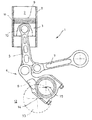
図1は、本発明の第1実施形態により、クランクシャフトの停止位置を制御するシステムを示す。クランク駆動部1はピストン3を含み、ピストン3は、ピストン・クラウン9により燃焼室2の内壁の一部を構成するとともに、シリンダー8内で軸方向に摺動される。加えて、ピストン3はピストン・リング11と共に、燃焼ガスがクランク・ケーシング12に入り込まず、且つオイルが燃焼室2に入り込まないように、該燃焼室2をクランク・ケーシング12から遮断する。
FIG. 1 shows a system for controlling a stop position of a crankshaft according to a first embodiment of the present invention. The crank drive unit 1 includes a
ピストン3は、燃焼により生成されたガスの力(圧力)をクランクシャフト13に伝達する。この目的で、ピストン3は、ピストン・ボルト10を用いてコネクティング・ロッド4に連結されて関節を成し、そして、コネクティング・ロッドは、その一端がクランクシャフト13のベアリング・ピン15に関節状に結合される。ピストン3に作用するガス力は、ピストン・ボルト10を介してコネクティング・ロッド4に伝達され、そしてそこからクランクシャフト13へと伝達される。ピストン3、ピストン・ボルト10及びコネクティング・ロッド4の上述の構成が、ピストン3の往復運動を、クランクシャフト13の軸心14回りの回転運動へと変換する。
The
本発明の実施形態の一つによれば、少なくとも一つのシリンダー8の圧縮比が、可変になるように構成されて、選択的に燃焼室2の圧力及びクランクシャフト13に作用するトルクに影響を及ぼす。ガス力は、シリンダー8の軸心方向にピストン3を付勢して、上死点(TDC)からはピストン3に生じる運動がガス力により加速させられる。こうしてピストン3がガス力により加速されるとき、その運動が、クランクシャフト13に関節状に結合されたコネクティング・ロッドに力を発生する。ピストン3は、ガス力をピストン・ボルト10を介してコネクティング・ロッド4に伝達し、それを下向きに加速しようとする。ピストン3は、下死点(BDC)に近付くと、そこに結合された構成部品(具体的にはコネクティング・ロッド4)と共に減速し、下死点(BDC)において運動の反転を完了する。シリンダー8の上死点(TDC)と下死点(TDC)との間でピストンが移動する距離を、ピストン・ストロークsと呼ぶ。エンジンの押しのけ容積VHは、気筒数n、ピストン面積AK、及びピストン・ストロークsを用いて以下のように表せる。
VH = n・ AK・ s
又は
VH = n・ Vh
ここでVh = AK・ sであり、またVhは単気筒の押しのけ容積となる。
According to one of the embodiments of the present invention, the compression ratio of at least one
VH = n ・ AK ・ s
Or
VH = n ・ Vh
Here, Vh = AK · s, and Vh is the displacement of the single cylinder.
気筒容積VZ,TDCは、ピストンが上死点(TDC)にあるときの圧縮容積VCと呼ばれるものに対応する。ピストンの下死点(BDC)における気筒容積VZ,BDCは、結果として、押しのけ容積Vhと圧縮容積VCとの和になる。 The cylinder volumes VZ and TDC correspond to what is called a compression volume VC when the piston is at top dead center (TDC). As a result, the cylinder volumes VZ and BDC at the bottom dead center (BDC) of the piston are the sum of the displacement volume Vh and the compression volume VC.
エンジンの幾何学的圧縮比εは、以下の式から得られる。
ε = 1 + Vh/VC
クランクシャフト3に伝達されるトルクに影響を及ぼすために、少なくとも一つのシリンダー8における圧縮比εが可変とされる。その少なくとも一つのシリンダー8内に存在するガスの圧力は、圧縮比εを低下することにより低下させられ、このことで、そのガスによりクランクシャフトに作用するトルクが低下させられる。
The geometric compression ratio ε of the engine is obtained from the following equation:
ε = 1 + Vh / VC
In order to influence the torque transmitted to the
各シリンダー又は燃焼室2はまた、シリンダーブロックに形成されたシリンダー壁面により横方向に囲まれ、そして、そのシリンダー8内で軸方向に移動可能なピストン3により下方から囲まれている。ピストン3はピストン・リング11と共に、クランクケース12から燃焼室を遮断する。燃焼室2は、上方からはシリンダーヘッドと、そこに配置され通常は図2に示されるような往復動弁として具現化される制御要素とにより、囲まれている。
Each cylinder or combustion chamber 2 is also surrounded laterally by a cylinder wall formed in the cylinder block and surrounded from below by a
これらの実施形態において、本発明は、圧縮比εを変更することにより、瞬間的な燃焼室容積に影響を及ぼし(つまり燃焼室容積を変更し)、結果として、燃焼室内のガスの圧力に影響を及ぼす。可変圧縮比εは、具体的な適用状態に応じて、様々な方法で具現化することが出来る。 In these embodiments, the present invention affects the instantaneous combustion chamber volume (ie, changes the combustion chamber volume) by changing the compression ratio ε, and consequently affects the gas pressure in the combustion chamber. Effect. The variable compression ratio ε can be embodied in various ways depending on the specific application state.
本発明の実施形態の一つにおいて、可変圧縮比εを具現化するために、シリンダーブロックの高さ(hB)が可変とされる。シリンダーブロック高さ(hB)を増加及び減少することにより圧縮比εが変化し、この結果としてシリンダー内のガスの圧力が影響を受け、それにより、クランクシャフトに生じるトルクが影響を受ける(つまり、トルクが変化する)。このトルクは、点火及び/又は燃料供給が中止されてから、エンジンの運動エネルギーがシリンダー圧力に対応するトルクにより消費されて、それが静止(つまりクランクシャフトが停止)するまでの間、クランクシャフトが再始動に好適な所定位置に停止するように、制御される。 In one embodiment of the present invention, the cylinder block height (hB) is variable in order to implement the variable compression ratio ε. Increasing and decreasing the cylinder block height (hB) changes the compression ratio ε, which in turn affects the gas pressure in the cylinder, thereby affecting the torque generated on the crankshaft (ie, Torque changes). This torque is applied to the crankshaft after the ignition and / or fuel supply is stopped until the engine's kinetic energy is consumed by the torque corresponding to the cylinder pressure until it stops (ie, the crankshaft stops). Control is performed to stop at a predetermined position suitable for restart.
本発明の別の実施形態においては、可変圧縮比εを具現化するために、シリンダーヘッドの高さ(hK)が可変とされる。シリンダーヘッド高さ(hK)を増加及び減少することにより圧縮比εが変化し、この結果としてシリンダー内のガスの圧力が影響を受け、それにより、n個のシリンダー内のガスによりクランクシャフトに生じるトルクが影響を受ける。先に述べた実施形態におけるように、このトルクは、クランクシャフトの停止位置を制御するために、エンジンの停止動作中に制御される。 In another embodiment of the present invention, the cylinder head height (hK) is variable in order to implement a variable compression ratio ε. Increasing and decreasing the cylinder head height (hK) changes the compression ratio ε, which in turn affects the pressure of the gas in the cylinder, which in turn causes the crankshaft to be generated by the gas in the n cylinders. Torque is affected. As in the previously described embodiment, this torque is controlled during engine stop operation to control the crankshaft stop position.
圧縮比εは、ピストン高さ(hP)が可変である少なくとも一つのピストンを備えたシステムにおいて、変更することが出来る。少なくとも一つのピストンのピストン高さ(hP)を増大及び減少することにより、少なくとも一つのシリンダー内のガスの圧力が影響を受けて、n個のシリンダー内のガスによりクランクシャフトに生ずるトルクが影響を受ける。このことを利用して、クランクシャフトの停止位置を制御することができる。 The compression ratio ε can be changed in a system with at least one piston whose piston height (hP) is variable. By increasing and decreasing the piston height (hP) of at least one piston, the pressure of the gas in at least one cylinder is affected, and the torque generated in the crankshaft by the gas in n cylinders is affected. receive. Using this fact, the stop position of the crankshaft can be controlled.
ピストン高さの変化は、シリンダー内のガス圧が作用する燃焼室の容積を変化させる。 The change of the piston height changes the volume of the combustion chamber in which the gas pressure in the cylinder acts.
本発明の他の実施形態において、クランクシャフトの少なくとも一つの肘部(elbow)が、少なくとも一つのシリンダーにおいて可変に構成とされる、つまり、圧縮比εを可変とするために、クランクシャフトの軸心からの距離(hZ)が可変とされる。クランクシャフト肘部は、クランクシャフト上で互いに離間して配置されるクランク側の二つの要素を、その二つの要素の間であってクランクシャフトから一定の距離に配置され、コネクティング・ロッドを受けるクランクシャフト・ベアリング・ピンと共に、有する。可変クランクシャフト肘部つまり、それのクランクシャフト・ベアリング・ピンのクランクシャフト軸心からの距離(hZ)が可変とされたクランクシャフト肘部は、例えば、長さが可変のクランクシャフト側要素を用いることにより、具現化することが出来る。少なくとも一つの肘部からの距離(hZ)を増加及び減少することにより、圧縮比εの変化の結果として、少なくとも一つのシリンダー内のガスの圧力が影響を受け、そのn個のシリンダー内のガスによりクランクシャフトに作用するトルクが影響を受ける。前述のように、クランクシャフトの停止位置を制御するために、そのトルクは制御される。n個全てのクランクシャフト肘部の長さが可変の構成を持つ本発明の実施形態は、有利である。その結果として、n個シリンダー全てが可変圧縮比εを持ち、それが、所望のクランクシャフト位置を設定する際の自由度を高める。 In another embodiment of the invention, at least one elbow of the crankshaft is variably configured in at least one cylinder, i.e., the crankshaft shaft is made variable in order to make the compression ratio ε variable. The distance (hZ) from the heart is variable. The crankshaft elbow has two crank-side elements that are spaced apart from each other on the crankshaft. The crankshaft elbow is placed between the two elements at a certain distance from the crankshaft and receives the connecting rod. With shaft bearing pin. The variable crankshaft elbow, that is, the crankshaft elbow where the distance (hZ) from the crankshaft axis of the crankshaft bearing pin is variable, for example, uses a crankshaft side element with variable length This can be realized. By increasing and decreasing the distance (hZ) from at least one elbow, the pressure of the gas in at least one cylinder is affected as a result of the change in the compression ratio ε, and the gas in that n cylinders is affected. This affects the torque acting on the crankshaft. As described above, the torque is controlled in order to control the stop position of the crankshaft. Embodiments of the present invention having a configuration in which the lengths of all n crankshaft elbows are variable are advantageous. As a result, all n cylinders have a variable compression ratio ε, which increases the freedom in setting the desired crankshaft position.
具体的な構成の一例を図1に示されるように、本発明によれば、エンジンの動作が停止された後で、クランクシャフト13を所望の位置に停止するのに、ピストン3とコネクティング・ロッド4を介してクランクシャフト13に作用するトルクが用いられる。クランクシャフト13に伝達されるトルクに影響を及ぼすために、少なくとも一つのシリンダーが、圧縮比εを可変として、構成される。図1に記載の実施形態では、コネクティング・ロッド4の実効長さが可変とされて、圧縮比εを可変とする。コネクティング・ロッドの実効長さは、コネクティング・ロッドの小端部と大端部の間で、コネクティング・ロッドの二つの端部を結ぶ仮想の直線に沿っての距離、である。小端部は、ピストン・ボルト10を受け入れるもので、大端部は、クランクシャフト・ベアリング・ピン15を受け入れるものである。
As shown in FIG. 1 as an example of a specific configuration, according to the present invention, the
そして、コネクティング・ロッド長さ(実効長さ)を可変とすることが出来る方法の一つが、コネクティング・ロッドを二つの部品から構成することである。そのような場合において、コネクティング・ロッド4は、ピストン3に関節状に結合された上方コネクター5と、クランクシャフト13に関節状に結合された下方コネクター6とからなり、そして、上方コネクター5と下方コネクター6とは、互いに関節状に結合されて、互いに枢動自在とされている。コネクティング・ロッド長さは、上方及び下方コネクター5, 6を互いに回動させることにより、変更される。つまり、二部品からなるコネクティング・ロッドの曲がりの程度に応じて、その実効長さが変更される。
One of the methods by which the connecting rod length (effective length) can be made variable is to construct the connecting rod from two parts. In such a case, the connecting rod 4 comprises an
上方コネクター5に枢動可能に結合され、エンジン・ケーシングに取り付けられた偏心軸上に回転自在に保持される連結ロッド7により、圧縮比εが設定される。コネクティング・ロッド4の実効長さを増加及び減少することが、燃焼室2内のガスの圧力に影響し、圧縮比εを変化させ、そして、クランクシャフト13に作用するトルクに影響を及ぼす。本発明によれば、このトルクは、点火及び/又は燃料供給が遮断された後でクランクシャフトが停止するまでの間、エンジンの運動エネルギーがシリンダー圧力に伴うトルクにより消費されて、クランクシャフトが再始動に好ましい位置に停止されるように、制御される。
A compression ratio ε is set by a connecting
すなわち、本発明によれば、圧縮比εを増加させて、少なくとも一つのシリンダー内のガス圧を上昇させ、これによりクランクシャフトに発生するトルクを増大させることが出来る。減速段階において、圧縮行程中の燃焼室内での圧力の高まりは、クランクシャフトの回転運動に対する減速効果を持つ、つまり制動トルクとして作用する。クランクシャフトは、シリンダー内に位置するガスの圧縮仕事を実行し、それにエネルギーを用いる。圧縮比εが増大されて、圧力レベルが高められると、クランクシャフトの回転運動が減速させられて、減速運動が短縮させられる。 That is, according to the present invention, it is possible to increase the compression ratio ε and increase the gas pressure in at least one cylinder, thereby increasing the torque generated in the crankshaft. In the deceleration stage, the pressure increase in the combustion chamber during the compression stroke has a deceleration effect on the rotational movement of the crankshaft, that is, acts as a braking torque. The crankshaft performs the compression work of the gas located in the cylinder and uses energy for it. When the compression ratio ε is increased and the pressure level is increased, the rotational motion of the crankshaft is decelerated and the deceleration motion is shortened.
膨張行程では、燃焼室内で加圧されたガスが膨張し、その圧力が低下する。圧縮比εの増大は、ガス圧の低下を相殺し、その結果として、クランクシャフト上に発生するトルクが増大して、クランクシャフトの減速期間を延長する。減速段階の間、膨張行程中に燃焼室内で高まる圧力は、クランクシャフトの回転運動に対する駆動作用を持ち、つまり、駆動トルクとして作用する。膨張するガスは、クランクシャフトを駆動し、その過程でクランクシャフトにエネルギーを与える。言い換えると、クランクシャフトの運動エネルギーが増大する。同様に、圧縮行程で圧縮比εを減少させ、少なくとも一つのシリンダー内のガス圧を低下させ、これによりクランクシャフトに発生するトルクを減少させることも出来る。圧縮行程の間、圧縮比εの低下とそれに伴う圧力レベルの低下は、クランクシャフトの減速作用を低下させ、減速期間の短縮度合いを低下させる。圧縮行程では、クランクシャフト上に発生するトルクは、制動トルクとして作用することに注意を要する。 In the expansion stroke, the pressurized gas in the combustion chamber expands and the pressure decreases. The increase in the compression ratio ε cancels the decrease in gas pressure, and as a result, the torque generated on the crankshaft increases and the deceleration period of the crankshaft is extended. During the deceleration phase, the pressure that rises in the combustion chamber during the expansion stroke has a driving effect on the rotational movement of the crankshaft, ie acts as a driving torque. The expanding gas drives the crankshaft and energizes the crankshaft in the process. In other words, the kinetic energy of the crankshaft increases. Similarly, the compression ratio ε can be reduced in the compression stroke, and the gas pressure in the at least one cylinder can be reduced, thereby reducing the torque generated in the crankshaft. During the compression stroke, a decrease in the compression ratio ε and a concomitant decrease in pressure level reduce the deceleration action of the crankshaft and reduce the degree of reduction of the deceleration period. Note that in the compression stroke, the torque generated on the crankshaft acts as a braking torque.
本発明は、膨張行程で圧縮比εを低下させて、シリンダー内のガス圧を低下させることも出来る。膨張行程で、加圧されたガスは燃焼室内で膨張する。圧縮比εの低下によりガス圧が低下し、結果として、クランクシャフト上に発生する駆動トルクが低下し、それが、クランクシャフトの減速期間を短縮する。 The present invention can also reduce the gas pressure in the cylinder by reducing the compression ratio ε during the expansion stroke. In the expansion stroke, the pressurized gas expands in the combustion chamber. As the compression ratio ε decreases, the gas pressure decreases, and as a result, the drive torque generated on the crankshaft decreases, which shortens the deceleration period of the crankshaft.
本発明の実施形態は、吸気行程中に圧縮比εを増大させて、シリンダー内のガス圧を増加させ、そしてクランクシャフトへ伝達されるトルクを増大させることが出来る。吸気行程において、下向きに動くピストンによりシリンダーの燃焼室内に部分負荷が生成される。新気又は吸気部からの新たな混合気が、吸気弁を通じて、吸入される。結果として、燃焼室とクランクケースとの間の圧力の違いの結果としてピストンに作用するガスの力が、ピストンを上死点の方向に引く。つまり、そのガス力は、吸気行程中のピストンの下向き運動を相殺し、下向き運動を減速して、トルクを減少するのと同等になる。 Embodiments of the present invention can increase the compression ratio ε during the intake stroke to increase the gas pressure in the cylinder and increase the torque transmitted to the crankshaft. In the intake stroke, a partial load is generated in the combustion chamber of the cylinder by the piston moving downward. Fresh air or new air-fuel mixture from the intake section is sucked through the intake valve. As a result, the force of the gas acting on the piston as a result of the pressure difference between the combustion chamber and the crankcase pulls the piston in the direction of top dead center. That is, the gas force is equivalent to canceling the downward movement of the piston during the intake stroke, decelerating the downward movement, and reducing the torque.
本発明の実施形態は、少なくとも一つのシリンダー内に存在するガスの圧力が圧縮行程及び/又は膨張行程中にクランクケース内の圧力よりも低いときに、圧縮比εを増大させて、そのシリンダー内のガス圧力を増大させ、これによりクランクシャフトに伝達される減速トルクを低下させることが出来る。エンジンの減速運動中に、シリンダー圧力がクランクケース圧力を下回るときには、圧縮行程及び膨張行程の両方において、吸気行程について前述したように、ガス力が生むトルクが減速態様で作用する。クランクシャフトに発生したトルクは、制動トルクとみなすことが出来る。この制動トルクはクランクシャフトの減速過程を延長し、クランクシャフトの停止位置に影響を及ぼすように、圧縮行程と膨張行程の両方において、選択的に低下させられる。 Embodiments of the present invention increase the compression ratio ε when the pressure of the gas present in at least one cylinder is lower than the pressure in the crankcase during the compression stroke and / or expansion stroke, Thus, the deceleration torque transmitted to the crankshaft can be reduced. When the cylinder pressure falls below the crankcase pressure during engine deceleration, the torque generated by the gas force acts in a deceleration manner in both the compression stroke and the expansion stroke, as described above for the intake stroke. Torque generated in the crankshaft can be regarded as braking torque. This braking torque can be selectively reduced during both the compression stroke and the expansion stroke so as to extend the deceleration process of the crankshaft and affect the stop position of the crankshaft.
図1に記載し、それを参照して説明したように圧縮比を変更することにより、或いは、図2に記載し、それを参照して後述するように補助バルブを制御することによって、シリンダー圧力を制御する本発明の実施形態は、エンジン停止動作を制御するために、一般的なエンジン制御システム(不図示)を利用する。このような一般的なエンジン制御システムは、少なくとも一つの追加制御要素を制御するのに有用な他の動作パラメーターについての情報を持っている。クランクシャフトの具体的な好ましい停止位置を設定するためには、大量の情報が必要であるか、又は有用であるのは確かである。この点に関し、従来よりエンジン制御のために一般的に計測されていたデータ及び/又は導かれていたデータ全てに依存するのは有益である。そのようなデータとして具体的には、エンジン速度、クランクシャフト角度、エンジンの温度及び/又は冷媒温度のようなエンジン温度に関連する温度、及び/又は、吸気マニフォールドの吸気圧がある。本発明によれば、上述の変数が、エンジン又は、クランクシャフトの減速運動に大きな影響を持つことが、実験的に判っている。 Cylinder pressure by changing the compression ratio as described in and described with reference to FIG. 1 or by controlling the auxiliary valve as described in FIG. The embodiment of the present invention for controlling the engine uses a general engine control system (not shown) to control the engine stop operation. Such typical engine control systems have information about other operating parameters useful for controlling at least one additional control element. Certainly a great deal of information is needed or useful to set a specific preferred stop position for the crankshaft. In this regard, it is beneficial to rely on all data that has been conventionally measured and / or derived for engine control. Such data may specifically include engine speed, crankshaft angle, temperature related to engine temperature, such as engine temperature and / or refrigerant temperature, and / or intake manifold intake pressure. According to the present invention, it has been experimentally found that the above variables have a great influence on the deceleration movement of the engine or crankshaft.
クランクシャフトの停止位置を判定そして制御するために、エンジンの停止動作が開始した後でドライブトレイン及び/又はクランクシャフトにどの程度の運動エネルギーが存在しているかを判定することは有用である。エンジンの減速運動のモデルは、例えば欧州特許出願03101379.0号に記載されている。このモデルは、ドライブトレインの現在の運動エネルギー、摩擦損失及び/又はエンジンのシリンダー内の圧縮及び膨張行程、を考慮する。そのようなモデルは、理論的な検討に基づいて数式の形態で具現化することが出来る。しかしながら、このモデルは、完全に、又は少なくとも部分的に、実験的に求めることも出来る。つまり、エンジン挙動を観察し、その過程で得られた計測データを(例えばルックアップ・テーブルとして)条件付けることにより求めることも出来る。 In order to determine and control the stop position of the crankshaft, it is useful to determine how much kinetic energy is present in the drivetrain and / or crankshaft after the engine stop operation has begun. A model of engine deceleration motion is described, for example, in European Patent Application No. 03101379.0. This model takes into account the current kinetic energy of the drivetrain, friction losses and / or compression and expansion strokes in the cylinder of the engine. Such a model can be embodied in the form of a mathematical formula based on theoretical considerations. However, this model can also be determined experimentally completely or at least in part. That is, it can be obtained by observing the engine behavior and conditioning the measurement data obtained in the process (for example, as a lookup table).
それで、本発明による方法には、n個のシリンダーのそれぞれにおいてピストンとクランクシャフトとを連結するn個のコネクティング・ロッドを持ち、それらの一端がピストンに関節状に接続され、他端がクランクシャフトに対して肘部に関節状に接続されたエンジンにおいて、クランクシャフトが再始動に好適な位置に停止するように、そのエンジンを停止させる制御された停止動作が含まれる。n個のシリンダーは、シリンダー・ブロックとシリンダー・ヘッドとにより囲まれ、そして少なくとも一つのシリンダーの圧縮比εを増大及び/又は減少させることで、少なくとも一つのシリンダーの圧力が影響されて、n個のシリンダー内に存在するガスによりクランクシャフトに働くトルクが影響を受けるように、少なくとも一つのシリンダーが可変圧縮比εを持つ。このトルクは、点火及び/又は燃料供給の遮断後にエンジンが静止状態になるまでの間、このエンジンの運動エネルギーが制御可能なトルクにより消費されて、クランクシャフトが所定位置に停止されるように、制御される。 Thus, the method according to the present invention has n connecting rods connecting the piston and the crankshaft in each of the n cylinders, one end of which is articulated to the piston and the other end of the crankshaft. On the other hand, in the engine jointly connected to the elbow, a controlled stop operation is included to stop the engine so that the crankshaft stops at a position suitable for restart. n cylinders are surrounded by a cylinder block and a cylinder head, and by increasing and / or decreasing the compression ratio ε of at least one cylinder, the pressure of at least one cylinder is affected and n At least one cylinder has a variable compression ratio ε so that the torque acting on the crankshaft is affected by the gas present in the cylinder. This torque is consumed by the controllable torque until the engine is at rest after ignition and / or fuel supply interruption, so that the crankshaft is stopped in place. Be controlled.
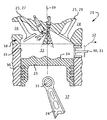
図2は、エンジンの停止動作中にクランクシャフトの停止位置を制御するために、補助バルブを用いてシリンダー圧力を変更するようにした実施形態を示す。シリンダー21が、ピストン23の頂面(ピストン・ボウル34)と共に燃焼室22を形成する。ピストン23は、シリンダーボア33内を軸方向に案内される。ピストン23は、ピストン・リング36と共に燃焼ガスがクランクケース37へ入らず、オイルが燃焼室22へ入らないように、燃焼室22をクランクケース37から遮断する。
FIG. 2 shows an embodiment in which the cylinder pressure is changed by using an auxiliary valve in order to control the stop position of the crankshaft during the stop operation of the engine. The
燃焼室22の上側は、シリンダー・ヘッド38と、そこに配置された吸排気弁27, 29(制御要素25)とにより、区画されている。ピストン23は、膨張行程中に燃焼により生成されるガス力を、クランクシャフト(不図示)へ伝達する働きをする。この目的で、ピストン23は、ピストン・ボルト35により、コネクティング・ロッド24へ関節状に結合される。ピストン23に作用するガス力は、ピストン・ボルト35を介してコネクティング・ロッド24へ伝達され、更にそこからクランクシャフトへ伝達される。このようなピストン23、ピストン・ボルト35及びコネクティング・ロッド24の構成によって、ピストン23の往復運動がクランクシャフトの回転運動へと変換される。
The upper side of the
ピストン23は上死点(TDC)から下死点(BDC)へと進行し、それが上死点へ向かう上方運動の間に排気弁27が開いていれば、燃焼ガスを排気系26へと押し出す。それに続くピストン23の下向きの運動が、吸気弁29が開いているときに、これを介して新気又は新たな空気燃料混合気を吸引する働きをする。そして、燃焼室22内のガスは圧縮され、燃焼される。
本発明によれば、ピストン23とコネクティング・ロッド24とを介して、ガス力によりクランクシャフトに作用するトルクを用いて、エンジンへの燃料供給及び/又は点火が中止された後で、クランクシャフトを所定位置に停止させる。クランクシャフトに伝達されるトルクに影響を及ぼすために、追加制御要素30が設けられている。図2に示された実施形態において、電子制御可能なバルブ31が追加制御要素30として用いられ、バルブ31は、これを作動させるための接続ライン32を用いてエンジン制御システム(不図示)に接続されている。バルブ31は、ピストン23が上死点(TDC)近くに位置していても、燃焼室22からガスが流出し、又はガスが燃焼室22内へ流入するのを許容するために、上死点(TDC)位置近くに配置されている。
According to the present invention, the torque applied to the crankshaft by the gas force via the
追加制御要素30の開放は、ある特定の時点での圧力勾配に応じてガスをシリンダー21から流出させ、又はシリンダー21内へ流入させて、ガス交換を行わせることができる。その結果、シリンダー21内部及び/又は燃焼室22内の圧力が影響を受ける。そして、クランクシャフトが再始動に適した所定位置に停止するように、点火及び/又は燃料供給が遮断されてから静止状態になるまで(つまりクランクシャフトが停止するまで)の間、エンジンの運動エネルギーがクランクシャフトに生じるトルクによって消費されるように、そのトルクが制御される。
The opening of the additional control element 30 can cause gas to flow out of or into the
本発明の範囲内では、シリンダーの周囲のものは全て、シリンダーに隣接するシステムであるとみなされる。追加制御要素30により流出させるガスは、例えば、クランクケースへ供給することも、若しくはシリンダーヘッドを通してシリンダーから排出することも出来る。こうしたガス交換を実行するためには、追加制御要素が開放させられた結果としてガスがシリンダーから流出し、又はシリンダーへ流入することが出来るように、追加制御要素30がシリンダー33の境界を貫通していなければならない。追加制御要素30を用いれば、エンジンの停止後にクランクシャフトを所望の位置へと回転させるための追加調整装置、具体的には電気モーターのような能動的調整装置を設ける必要がない。追加制御要素30は、クランクシャフトが静止状態になるまで該クランクシャフトに生じるトルクに影響を及ぼす受動的調整装置とみなすことが出来る。能動的調整装置と比較して受動的調整装置は、新たにクランクシャフトの回転運動を起こすのではなく、クランクシャフトの既存の回転運動を適切に減速するだけなので、そのエネルギー消費量が低いという利点を奏する。
Within the scope of the present invention, everything around the cylinder is considered to be a system adjacent to the cylinder. The gas discharged by the additional control element 30 can for example be supplied to the crankcase or discharged from the cylinder through the cylinder head. In order to perform such a gas exchange, the additional control element 30 penetrates the boundary of the
少なくとも一つの追加制御要素をn個のシリンダーのそれぞれに設け、それを用いて各シリンダーと周辺部との間でガス交換を行なう実施形態は、有利である。n個のシリンダーのそれぞれに追加制御要素30が設けられる場合、各シリンダーがクランクシャフトに伝達されるトルクに比例的に関係するので、上述の如く制御された態様でエンジンを停止させる過程において、ガス力によりクランクシャフトに生じるトルクに影響を及ぼす際の自由度及び可能性が高くなる。n個のシリンダーそれぞれの作動は異なるクランク角度にて行われるので、ピストン上に生じるn個のシリンダーの瞬間的なガス力は、異なる可能性がある。 Embodiments in which at least one additional control element is provided in each of the n cylinders and used to exchange gas between each cylinder and the periphery are advantageous. When an additional control element 30 is provided for each of the n cylinders, each cylinder is proportional to the torque transmitted to the crankshaft, so in the process of stopping the engine in a controlled manner as described above, The degree of freedom and possibility of affecting the torque generated on the crankshaft by the force is increased. Since the operation of each of the n cylinders is performed at different crank angles, the instantaneous gas force of the n cylinders generated on the piston can be different.
少なくとも一つの追加制御要素30をバルブ(好ましくは電子制御バルブ)とした実施形態は、有利である。ガスの交換量及び/又はシリンダー内の圧力を、開弁時間の制御及び/又はその流路断面積の設定により、増大又は減少することが出来る。電子制御バルブを用いることにより、非常に短い開弁時間を実現することが出来、そのような場合の作動は、基本的に完全に自由な状態で実行することが出来る。 Embodiments in which at least one additional control element 30 is a valve (preferably an electronic control valve) are advantageous. The amount of gas exchange and / or the pressure in the cylinder can be increased or decreased by controlling the valve opening time and / or setting the flow path cross-sectional area. By using an electronically controlled valve, a very short valve opening time can be realized, and the operation in such a case can basically be carried out in a completely free state.
本発明によれば、少なくとも一つの追加制御要素が、エンジンの制御された停止動作のために利用され、エンジンの通常の燃焼サイクルのための吸排気弁は利用されない。本発明は、少なくとも一部でも可変のバルブ制御システムを持たず、開閉時期が固定の通常の機械式バルブ制御システムを持つエンジンに適用することができる。追加制御要素を用いる結果として、エンジンが停止されるときの自由度が、一部可変バルブ制御システムにより可能なレベルから大幅に高まる。この点において、完全に可変のバルブ制御システムを用いてエンジンを停止するときには、同じ程度の自由度を実現することが可能である。加えて、追加制御要素は、比較的複雑でもなくコストも低い。 In accordance with the present invention, at least one additional control element is utilized for controlled stop operation of the engine, and intake and exhaust valves for the normal combustion cycle of the engine are not utilized. The present invention can be applied to an engine having an ordinary mechanical valve control system that does not have at least a part of a variable valve control system and has a fixed opening and closing timing. As a result of using additional control elements, the degree of freedom when the engine is stopped is greatly increased from the level possible with a partially variable valve control system. In this respect, the same degree of freedom can be achieved when the engine is stopped using a completely variable valve control system. In addition, the additional control elements are relatively complex and low in cost.
エンジンへの燃料供給及び/又は点火が遮断された後でのクランクシャフトの回転運動は、ピストンがシリンダー内で往復運動を継続するときに、エンジンのn個のシリンダー内のガスの圧縮及び膨張を継続する。燃焼のために設けられた吸排気制御要素若しくは吸排気弁は、電磁作動弁又は弁停止機構を持つ実施形態においては、停止されることも、或いは、空気が吸引そして吐出され続けるように、通常動作中にするのと同じように機能する(つまり減速中のクランクシャフトにより変わらずに開閉される)ことも、有り得る。場合によっては、吸気システムに設けられるスロットル弁が、点火及び/又は燃料供給の遮断後に閉じられる。それもまた、燃焼室内のガス圧に影響を及ぼす。 The rotational motion of the crankshaft after the fuel supply to the engine and / or ignition has been interrupted causes the compression and expansion of gas in the engine's n cylinders as the piston continues to reciprocate within the cylinder. continue. The intake / exhaust control element or intake / exhaust valve provided for combustion is usually stopped in an embodiment having an electromagnetically operated valve or a valve stop mechanism, or so that air is continuously sucked and discharged. It is also possible to function in the same way as in operation (ie, open and close unchanged by the decelerating crankshaft). In some cases, a throttle valve provided in the intake system is closed after ignition and / or shut off of the fuel supply. It also affects the gas pressure in the combustion chamber.
シリンダー内の燃焼室圧力及びクランクシャフトに生じるトルクに影響を及ぼすために、本発明の実施形態によれば、追加制御要素30が、前述のように設けられる。追加制御要素30を開くことは、シリンダーの周囲よりも燃焼室内の圧力が高いときには、そのシリンダー内の圧力降下につながる。結果として、クランクシャフトに生じるトルクが低減される。反対に、吸入行程で、つまり燃焼室内が負圧のときに追加制御要素30を開けば、シリンダー内へガスが流入し、これによりトルクが増加する。 In order to influence the combustion chamber pressure in the cylinder and the torque generated in the crankshaft, according to an embodiment of the invention, an additional control element 30 is provided as described above. Opening the additional control element 30 leads to a pressure drop in the cylinder when the pressure in the combustion chamber is higher than around the cylinder. As a result, the torque generated in the crankshaft is reduced. On the other hand, if the additional control element 30 is opened during the intake stroke, that is, when the pressure in the combustion chamber is negative, the gas flows into the cylinder, thereby increasing the torque.
本発明の実施形態では、シリンダー内のガス圧を低下させるために、圧縮行程で少なくとも一つの追加制御要素を開くことが、有利である。そうすれば、そのガスによりクランクシャフトに伝達されるトルクが低下させられる。減速中に、圧縮行程で燃焼室内で上昇する圧力は、クランクシャフトの回転運動に減速作用を持つ、つまり、制動トルクとして作用する。クランクシャフトは、シリンダー内のガスに対して圧縮仕事を行い、その過程で、クランクシャフトの回転運動エネルギーが消費される。圧縮行程で少なくとも一つの制御要素を開くことは、シリンダーの周囲よりも大きな圧力が燃焼室内に存在しているならば、シリンダー内の圧力降下につながる。結果として、クランクシャフト上に作用するトルクが、低減され、クランクシャフトの減速期間が延長される。 In an embodiment of the invention, it is advantageous to open at least one additional control element in the compression stroke in order to reduce the gas pressure in the cylinder. Then, the torque transmitted to the crankshaft by the gas is reduced. During deceleration, the pressure rising in the combustion chamber during the compression stroke has a decelerating action on the rotational movement of the crankshaft, that is, acts as a braking torque. The crankshaft performs compression work on the gas in the cylinder, and in the process, the rotational kinetic energy of the crankshaft is consumed. Opening at least one control element in the compression stroke leads to a pressure drop in the cylinder if a pressure greater than the circumference of the cylinder is present in the combustion chamber. As a result, the torque acting on the crankshaft is reduced and the crankshaft deceleration period is extended.
本発明の実施形態では、また、シリンダー内のガス圧を低下するために膨張行程で少なくとも一つの追加制御要素を開くことが、有利である。こうすれば、ガスによりクランクシャフトに伝達されるトルクが減少される。膨張行程の間に、加圧されたガスが、燃焼室内で緩んで、大きくなる。少なくとも一つの追加制御要素を開くことは、ガス圧の低下につながり、結果として、クランクシャフト上に生じるトルクが低下し、それが、クランクシャフトの減速期間を短縮する。減速中に、膨張行程で燃焼室内で上昇する圧力は、クランクシャフトの回転運動に駆動作用を持つ、つまり、駆動トルクとして作用する。膨張するガスは、クランクシャフトを駆動し、その過程でクランクシャフトへエネルギーを出力する。つまり、クランクシャフトがそのエネルギーを吸収する。 In an embodiment of the invention it is also advantageous to open at least one additional control element in the expansion stroke in order to reduce the gas pressure in the cylinder. In this way, the torque transmitted to the crankshaft by the gas is reduced. During the expansion stroke, the pressurized gas relaxes and grows in the combustion chamber. Opening at least one additional control element leads to a reduction in gas pressure, resulting in a reduction in torque generated on the crankshaft, which shortens the crankshaft deceleration period. During deceleration, the pressure rising in the combustion chamber during the expansion stroke has a driving action on the rotational movement of the crankshaft, that is, acts as a driving torque. The expanding gas drives the crankshaft and in the process outputs energy to the crankshaft. That is, the crankshaft absorbs the energy.
本発明の実施形態では、また、シリンダー内のガス圧を増大するために吸入行程で少なくとも一つの追加制御要素を開くことが、有利である。こうすれば、ガスによりクランクシャフトに伝達されるトルクが増加する。吸入行程の間に、下向きに運動するピストンにより、燃焼室内で負圧が生成され、その結果として、吸気弁を介して、新気又は新たな混合気が吸気システムから吸引される。その結果、燃焼室とクランクケースとの間の圧力差の結果ピストン上に作用するガス力が、ピストンを上死点の方向に引く。つまり、そのガス力は、吸入行程の範囲内では、ピストンの下向き運動に対抗し、それが、下向き運動そしてクランクシャフトの回転の減速をもたらす。少なくとも一つの追加制御要素を吸入行程で開くことは、シリンダー内へのガス流の増加の結果として、圧力の相殺それで燃焼室内の圧力の増加につながり、減速トルクが低下する。 In an embodiment of the invention it is also advantageous to open at least one additional control element in the intake stroke in order to increase the gas pressure in the cylinder. This increases the torque transmitted to the crankshaft by the gas. During the intake stroke, a downwardly moving piston creates a negative pressure in the combustion chamber, with the result that fresh air or a new mixture is drawn from the intake system via the intake valve. As a result, the gas force acting on the piston as a result of the pressure difference between the combustion chamber and the crankcase pulls the piston in the direction of top dead center. That is, the gas force opposes the downward movement of the piston within the intake stroke, which results in downward movement and slowing down of the crankshaft rotation. Opening at least one additional control element in the intake stroke results in an increase in gas flow into the cylinder, resulting in a pressure offset and thus an increase in the pressure in the combustion chamber and a reduction in the deceleration torque.
本発明の実施形態では、また、少なくとも一つのシリンダー内に位置するガスの圧力がクランクケース内の圧力よりも低いときに、少なくとも一つのシリンダー内の圧力を上昇させるために、少なくとも一つの制御要素を圧縮行程及び/又は膨張行程で開くことが、有利である。こうすれば、ガスによりクランクシャフトに伝達される減速トルクが低減される。エンジンの減速中に、シリンダー圧力が前述のようにクランクケースの圧力よりも下回るときに、ガスにより生じるトルクは、圧縮行程と膨張行程の両方で減速作用を持つ。クランクシャフト上に生じるトルクは、制動トルクとみなすことが出来る。この制動トルクは、クランクシャフトの減速期間を延長し、そしてクランクシャフトの停止位置に影響を及ぼすように、圧縮行程と膨張行程の両方で選択的に低減される。 In an embodiment of the present invention, at least one control element is also used to increase the pressure in the at least one cylinder when the pressure of the gas located in the at least one cylinder is lower than the pressure in the crankcase. It is advantageous to open the valve in the compression stroke and / or the expansion stroke. This reduces the deceleration torque transmitted to the crankshaft by the gas. During engine deceleration, when the cylinder pressure falls below the crankcase pressure as described above, the torque generated by the gas has a deceleration action in both the compression stroke and the expansion stroke. The torque generated on the crankshaft can be regarded as braking torque. This braking torque is selectively reduced during both the compression stroke and the expansion stroke so as to extend the crankshaft deceleration period and affect the stop position of the crankshaft.
本発明を実施するための最良の態様について詳細に述べてきたが、本発明が関連する分野の当業者であれば、添付の請求項により規定される本発明を実施する様々な代替構成及び実施形態を想到するであろう。 Although the best mode for carrying out the invention has been described in detail, those skilled in the art to which the invention pertains will present various alternative configurations and implementations for carrying out the invention as defined by the appended claims. The form will come to mind.
4, 24 コネクティング・ロッド
8、33 シリンダー(シリンダーボア)
13 クランクシャフト
27 吸気弁
29 排気弁
30 制御要素
4, 24 connecting rod
8, 33 cylinder (cylinder bore)
13 Crankshaft
27 Intake valve
29 Exhaust valve
30 Control elements
Claims (20)
上記クランクシャフトを内燃機関の再始動に好適な所定位置に停止させるために、上記吸気弁及び排気弁の動作とは独立して、上記複数のシリンダーのうち少なくとも一つの内部圧力を制御する圧力制御工程、を備えることを特徴とする内燃機関の停止位置制御方法。 A method of controlling a stop position of a crankshaft during a stop operation of an internal combustion engine provided with a plurality of cylinders each having at least one intake valve and one exhaust valve,
Pressure control for controlling the internal pressure of at least one of the plurality of cylinders independently of the operation of the intake valve and the exhaust valve in order to stop the crankshaft at a predetermined position suitable for restarting the internal combustion engine A stop position control method for an internal combustion engine.
上記圧力制御工程が、上記少なくとも一つの追加制御要素を制御する工程、を有する、請求項1の方法。 The at least one cylinder is provided with an additional control element capable of exchanging gas between and around the cylinder,
The method of claim 1, wherein the pressure control step comprises controlling the at least one additional control element.
上記クランクシャフトを内燃機関の再始動に好適な所定位置に停止させるために、上記吸気弁及び排気弁の開閉時期を変更することなく、上記複数のシリンダーのうち少なくとも一つの内部圧力を制御する圧力制御手段、を備えることを特徴とする内燃機関の停止位置制御システム。 A system for controlling a stop position of a crankshaft during a stop operation of an internal combustion engine provided with a plurality of cylinders each having at least one intake valve and one exhaust valve,
Pressure for controlling the internal pressure of at least one of the plurality of cylinders without changing the opening / closing timing of the intake valve and the exhaust valve in order to stop the crankshaft at a predetermined position suitable for restarting the internal combustion engine. A stop position control system for an internal combustion engine.
19. The system of claim 18, wherein the valve controls gas exchange through an opening in the cylinder wall.
Applications Claiming Priority (2)
| Application Number | Priority Date | Filing Date | Title |
|---|---|---|---|
| EP04105811A EP1657420A1 (en) | 2004-11-16 | 2004-11-16 | Internal combustion engine and method for controlled shut down of an engine |
| EP04106259A EP1669576A1 (en) | 2004-12-03 | 2004-12-03 | Method for controlling the shut-down of a combustion engine |
Publications (1)
| Publication Number | Publication Date |
|---|---|
| JP2006144792A true JP2006144792A (en) | 2006-06-08 |
Family
ID=36384846
Family Applications (1)
| Application Number | Title | Priority Date | Filing Date |
|---|---|---|---|
| JP2005330119A Pending JP2006144792A (en) | 2004-11-16 | 2005-11-15 | System and method for controlling crank shaft position by use of cylinder pressure during stop of internal combustion engine |
Country Status (2)
| Country | Link |
|---|---|
| US (1) | US7191756B2 (en) |
| JP (1) | JP2006144792A (en) |
Cited By (3)
| Publication number | Priority date | Publication date | Assignee | Title |
|---|---|---|---|---|
| US20100212629A1 (en) * | 2009-02-25 | 2010-08-26 | Gm Global Technology Operations, Inc. | Oxygen flow reduction during engine start/stop operation |
| US9239017B2 (en) | 2011-11-01 | 2016-01-19 | GM Global Technology Operations LLC | Stop-start control systems for engines with fully flexible valve actuation system |
| WO2020044768A1 (en) * | 2018-08-30 | 2020-03-05 | 日立オートモティブシステムズ株式会社 | Variable compression ratio system for internal combustion engine, and control device for same |
Families Citing this family (8)
| Publication number | Priority date | Publication date | Assignee | Title |
|---|---|---|---|---|
| DE10322305A1 (en) * | 2003-05-17 | 2004-12-02 | Daimlerchrysler Ag | Method for stopping an internal combustion engine |
| US9764726B2 (en) | 2009-01-02 | 2017-09-19 | Ford Global Technologies, Llc | Methods and systems for assisted direct start control |
| US8424496B2 (en) * | 2009-02-03 | 2013-04-23 | Ford Global Technologies, Llc | Methods and systems for starting a vehicle engine |
| US8328687B2 (en) | 2010-07-09 | 2012-12-11 | Ford Global Technologies, Llc | Method for controlling an engine that may be automatically stopped |
| US8864623B2 (en) | 2010-07-09 | 2014-10-21 | Ford Global Technologies, Llc | Method for controlling a transmission coupled to an engine that may be automatically stopped |
| US8414456B2 (en) | 2010-07-09 | 2013-04-09 | Ford Global Technologies, Llc | Method for starting an engine |
| DE102010032087A1 (en) * | 2010-07-23 | 2012-01-26 | Daimler Ag | Method and device for stopping an internal combustion engine |
| CN104074614B (en) * | 2013-03-28 | 2016-09-07 | 比亚迪股份有限公司 | The crank position of engine controls device |
Family Cites Families (20)
| Publication number | Priority date | Publication date | Assignee | Title |
|---|---|---|---|---|
| US3970056A (en) * | 1974-10-11 | 1976-07-20 | Morris Kenneth B | Variable compression ratio control system for internal combustion engines |
| JPS5735486U (en) * | 1980-08-08 | 1982-02-24 | ||
| JP2843614B2 (en) * | 1989-09-29 | 1999-01-06 | ヤマハ発動機株式会社 | Two-cycle diesel engine |
| US5193493A (en) * | 1992-01-10 | 1993-03-16 | Ickes Theodore P | Internal combustion engine with piston valving |
| DE4227699C2 (en) | 1992-08-21 | 1994-06-23 | Daimler Benz Ag | Device for variable adjustment of the compression ratio for piston internal combustion engines |
| DE4313852B4 (en) * | 1993-04-28 | 2004-11-25 | Robert Bosch Gmbh | Fuel injection device for internal combustion engines |
| DE19514116A1 (en) * | 1995-04-14 | 1996-10-17 | Daimler Benz Ag | Device for controlling air compressed in a cylinder of an internal combustion engine |
| FR2797304B1 (en) | 1999-08-06 | 2002-03-01 | Renault | METHOD FOR CONTROLLING A COMBUSTION ENGINE TO FACILITATE STARTING THE ENGINE AFTER A STOPPAGE |
| US6199520B1 (en) * | 1999-08-26 | 2001-03-13 | Edward Lawrence Warren | Two stroke engine with displacer |
| JP4066589B2 (en) * | 2000-03-06 | 2008-03-26 | トヨタ自動車株式会社 | Idling stop control device for internal combustion engine and vehicle equipped with the same |
| DE10151505A1 (en) | 2000-10-18 | 2002-07-18 | Ford Global Tech Dearborn | Variable compression ratio engine has two connecting rod locking mechanisms, both biased to their locking states and able to be unlocked by feeding hydraulic fluid to them |
| JP2002195129A (en) * | 2000-12-27 | 2002-07-10 | Mitsubishi Electric Corp | Variable discharge fuel supply device |
| JP2002371877A (en) * | 2001-06-14 | 2002-12-26 | Toyota Motor Corp | Automatic stop control device for in-vehicle internal combustion engine |
| US7066118B2 (en) | 2001-06-15 | 2006-06-27 | Honda Giken Kogyo Kabushiki Kaisha | Compression ratio variable device in internal combustion engine |
| JP4089282B2 (en) * | 2002-04-26 | 2008-05-28 | トヨタ自動車株式会社 | Calculation method of engine torque |
| JP4416377B2 (en) * | 2002-05-16 | 2010-02-17 | 日産自動車株式会社 | Control device for internal combustion engine |
| EP1413727B1 (en) * | 2002-10-25 | 2006-04-05 | Ford Global Technologies, LLC | Method for shutdown of an internal combustion engine and internal combustion engine to carry out this method |
| DE10258872A1 (en) * | 2002-12-17 | 2004-07-08 | Robert Bosch Gmbh | Variable compression ratio operation of an internal combustion engine for a motor vehicle, uses inputs from camshaft and crankshaft angle |
| DE10301695A1 (en) | 2003-01-17 | 2004-08-05 | Siemens Ag | Process for the controlled shutdown of an internal combustion engine |
| JP4020002B2 (en) | 2003-04-22 | 2007-12-12 | トヨタ自動車株式会社 | Internal combustion engine capable of changing compression ratio and compression ratio control method |
-
2005
- 2005-11-08 US US11/164,047 patent/US7191756B2/en not_active Expired - Lifetime
- 2005-11-15 JP JP2005330119A patent/JP2006144792A/en active Pending
Cited By (4)
| Publication number | Priority date | Publication date | Assignee | Title |
|---|---|---|---|---|
| US20100212629A1 (en) * | 2009-02-25 | 2010-08-26 | Gm Global Technology Operations, Inc. | Oxygen flow reduction during engine start/stop operation |
| US8326519B2 (en) * | 2009-02-25 | 2012-12-04 | GM Global Technology Operations LLC | Oxygen flow reduction during engine start/stop operation |
| US9239017B2 (en) | 2011-11-01 | 2016-01-19 | GM Global Technology Operations LLC | Stop-start control systems for engines with fully flexible valve actuation system |
| WO2020044768A1 (en) * | 2018-08-30 | 2020-03-05 | 日立オートモティブシステムズ株式会社 | Variable compression ratio system for internal combustion engine, and control device for same |
Also Published As
| Publication number | Publication date |
|---|---|
| US7191756B2 (en) | 2007-03-20 |
| US20060102112A1 (en) | 2006-05-18 |
Similar Documents
| Publication | Publication Date | Title |
|---|---|---|
| JP5919697B2 (en) | Diesel engine start control device | |
| JP2006144793A (en) | Method and system for controlling stop position of crank shaft by use of fluid pump during stop of internal combustion engine | |
| EP1777398A2 (en) | Variable valve timing for an internal combustion engine | |
| JP2013501187A (en) | Turbocharged reciprocating piston engine with connecting pressure tank for avoiding turbo lag and method of operation thereof | |
| JP2002511130A (en) | Free piston internal combustion engine | |
| CN103016174B (en) | Device and method for controlling start of compression self-ignition engine | |
| JP2004197745A (en) | Method for operating a multi-cylinder internal combustion engine with a variable compression ratio | |
| JP2000073800A (en) | Engine control device with electromagnetically driven intake and exhaust valves | |
| JP2000170545A (en) | Variable cycle internal combustion engine and control device therefor | |
| JP2007211730A (en) | Reciprocating internal combustion engine | |
| CN108930567A (en) | The oil pressure cntrol of variable cam timing system | |
| US7191756B2 (en) | System and method for controling crankshaft position during engine shutdown using cylinder pressure | |
| JP2009525430A (en) | 2-stroke combustion engine | |
| JP4944131B2 (en) | Two-cycle internal combustion engine with variable compression ratio and exhaust port shutter | |
| JP4201708B2 (en) | Torque control method | |
| US11156249B2 (en) | Hybrid opposed-piston internal combustion engine | |
| JP2008115830A (en) | Control device and control method for reciprocating internal combustion engine | |
| JP4992757B2 (en) | Control method for internal combustion engine | |
| WO2007120398A1 (en) | Method and apparatus for controlling engine valve timing | |
| JP5935275B2 (en) | Start control device for compression self-ignition engine | |
| JP4144421B2 (en) | Control device for internal combustion engine | |
| JP4701811B2 (en) | Variable compression ratio internal combustion engine | |
| JP4760739B2 (en) | Automatic stop / start system for internal combustion engine | |
| JP4839893B2 (en) | Double link variable compression ratio internal combustion engine | |
| JP2007162664A (en) | Variable valve operating angle control device for internal combustion engine |