JP2006192006A - Dishwasher - Google Patents
Dishwasher Download PDFInfo
- Publication number
- JP2006192006A JP2006192006A JP2005004955A JP2005004955A JP2006192006A JP 2006192006 A JP2006192006 A JP 2006192006A JP 2005004955 A JP2005004955 A JP 2005004955A JP 2005004955 A JP2005004955 A JP 2005004955A JP 2006192006 A JP2006192006 A JP 2006192006A
- Authority
- JP
- Japan
- Prior art keywords
- water
- supply tank
- water supply
- stored
- power
- Prior art date
- Legal status (The legal status is an assumption and is not a legal conclusion. Google has not performed a legal analysis and makes no representation as to the accuracy of the status listed.)
- Pending
Links
- XLYOFNOQVPJJNP-UHFFFAOYSA-N water Substances O XLYOFNOQVPJJNP-UHFFFAOYSA-N 0.000 claims abstract description 695
- 238000005406 washing Methods 0.000 claims description 76
- 238000002347 injection Methods 0.000 claims description 45
- 239000007924 injection Substances 0.000 claims description 45
- 238000000034 method Methods 0.000 claims description 33
- 230000008569 process Effects 0.000 claims description 32
- 238000001514 detection method Methods 0.000 claims description 24
- 238000012790 confirmation Methods 0.000 claims description 20
- 238000007599 discharging Methods 0.000 claims description 12
- 238000005507 spraying Methods 0.000 claims description 8
- 230000004044 response Effects 0.000 claims description 4
- 238000004851 dishwashing Methods 0.000 abstract description 16
- 241000894006 Bacteria Species 0.000 abstract 1
- 238000004140 cleaning Methods 0.000 description 28
- 239000003570 air Substances 0.000 description 10
- 238000012545 processing Methods 0.000 description 9
- 238000001035 drying Methods 0.000 description 7
- 239000003599 detergent Substances 0.000 description 5
- 238000009434 installation Methods 0.000 description 5
- 238000003825 pressing Methods 0.000 description 5
- 230000009471 action Effects 0.000 description 4
- 238000010586 diagram Methods 0.000 description 4
- 230000008901 benefit Effects 0.000 description 3
- 239000008399 tap water Substances 0.000 description 3
- 235000020679 tap water Nutrition 0.000 description 3
- 239000012080 ambient air Substances 0.000 description 2
- 238000013459 approach Methods 0.000 description 2
- 244000052616 bacterial pathogen Species 0.000 description 2
- 238000010981 drying operation Methods 0.000 description 2
- 239000013505 freshwater Substances 0.000 description 2
- 230000004048 modification Effects 0.000 description 2
- 238000012986 modification Methods 0.000 description 2
- 230000004913 activation Effects 0.000 description 1
- 238000007792 addition Methods 0.000 description 1
- 230000004397 blinking Effects 0.000 description 1
- 230000003749 cleanliness Effects 0.000 description 1
- 235000009508 confectionery Nutrition 0.000 description 1
- 238000012937 correction Methods 0.000 description 1
- 230000007423 decrease Effects 0.000 description 1
- 230000007613 environmental effect Effects 0.000 description 1
- 238000010438 heat treatment Methods 0.000 description 1
- 235000021190 leftovers Nutrition 0.000 description 1
- 230000007246 mechanism Effects 0.000 description 1
- 238000005192 partition Methods 0.000 description 1
- 230000000644 propagated effect Effects 0.000 description 1
- 239000007921 spray Substances 0.000 description 1
- 230000001954 sterilising effect Effects 0.000 description 1
- 239000008400 supply water Substances 0.000 description 1
- 238000011144 upstream manufacturing Methods 0.000 description 1
- 238000009423 ventilation Methods 0.000 description 1
- 230000000007 visual effect Effects 0.000 description 1
- 238000010792 warming Methods 0.000 description 1
- 239000002699 waste material Substances 0.000 description 1
- 239000002351 wastewater Substances 0.000 description 1
Images






Landscapes
- Washing And Drying Of Tableware (AREA)
Abstract
Description
本発明は、洗浄庫内に収容された食器類に水を噴射して洗浄を行う食器洗い機に関し、更に詳しくは、洗いやすすぎに使用する水を予め貯留するための給水タンクを備える食器洗い機に関する。 The present invention relates to a dishwasher that performs washing by spraying water onto dishes stored in a washing cabinet, and more particularly to a dishwasher that includes a water supply tank for preliminarily storing water used for easy washing. .
家庭用の食器洗い機は、食器類を収容した洗浄庫に水を供給して該洗浄庫の底部に水を貯留し、その水を洗浄ポンプにより吸引してノズルアームへと圧送し、ノズルアームに設けた水噴射穴から食器類に水を噴射することによって食器類の洗い及びすすぎを行う構成を有している。こうした食器洗い機を一般家庭の台所に設置する際には、通常、台所のシンクに配設されている水道栓の開閉栓の上流側の配管に分岐水栓を取り付け、この分岐水栓と食器洗い機本体とを給水ホースで接続するような設置工事が必要となる。しかしながら、例えば賃貸住宅などではこうした分岐水栓の取付工事が困難であったり許可されなかったりする場合もあり、食器洗い機を使用したくてもできないといった問題がある。 A household dishwasher supplies water to a washing cabinet containing dishes, stores the water at the bottom of the washing cabinet, sucks the water with a washing pump, and pumps it to the nozzle arm. It has the structure which wash | cleans and rinses tableware by injecting water to the tableware from the provided water injection hole. When installing such a dishwasher in a kitchen of a general household, a branch faucet is usually attached to the pipe on the upstream side of the tap on the tap installed in the sink of the kitchen. Installation work that connects the main body with a water supply hose is required. However, for example, in rental housing, the installation work of such a faucet may be difficult or not permitted, and there is a problem that it is impossible to use a dishwasher.
そこで、分岐水栓の取付工事が不要な分岐水栓レス方式の食器洗い機が市場から要望されている。こうした食器洗い機として、例えば特許文献1などに記載のように、洗い運転やすすぎ運転に必要とする水を予め貯留しておくための給水タンクを備えた食器洗い機が従来より知られている。この食器洗い機では、運転に先立って使用者が給水タンクに必要な量の水を注入しておき、運転が開始されると、食器洗い機本体はその給水タンク内の水を使用して全ての運転を実行する。 Therefore, there has been a demand from the market for a dishwasher of a branch faucet-less type that does not require a branch faucet installation work. As such a dishwasher, for example, as described in Patent Document 1, a dishwasher including a water supply tank for storing in advance water required for washing operation and rinsing operation has been conventionally known. In this dishwasher, the user injects the required amount of water into the water supply tank prior to operation, and when the operation is started, the dishwasher body uses the water in the water supply tank to perform all operations. Execute.
近年、環境問題、省エネルギーなどへの関心の高まりにより、各種の電気機器の待機時消費電力をできるだけ抑える、可能であればゼロにすることが望まれており、非使用時の時間が長い食器洗い機においても同様の要望が多い。待機時消費電力をゼロとした食器洗い機では、電源オフ時にはCPUを中心に構成される制御部にも電力が全く供給されず、制御部の動作は完全に停止した状態にある。そのため、上述したような給水タンクを備える食器洗い機において、電源オフの状態であるときに使用者が給水タンクへの注水を行うと、次に電源がオンされた後に給水タンクに水が貯留されていることは検知可能であるが、いつの時点で注水が行われたのかを知ることはできない。 In recent years, due to growing interest in environmental issues and energy savings, it has been desired to reduce the standby power consumption of various types of electrical equipment as much as possible, to zero if possible, and a long time when not in use There are many similar requests. In a dishwasher with zero standby power consumption, no power is supplied to the control unit, which is mainly composed of the CPU, when the power is turned off, and the operation of the control unit is completely stopped. Therefore, in a dishwasher equipped with a water supply tank as described above, when the user pours water into the water supply tank when the power is off, the water is stored in the water supply tank after the power is turned on next time. However, it is not possible to know when water has been injected.
また、待機時消費電力ゼロではなく電源プラグが商用交流電源コンセントに挿入されていると常に制御部に通電がなされているような食器洗い機においても、節電のために非使用時に使用者が電源プラグをコンセントから抜いてしまうことはよくある。このように電源プラグがコンセントから抜かれている状態つまり制御部に電力が供給されない状態であるときに給水タンクに注水が行われてしまうと、次に電源プラグがコンセントに挿入された後に給水タンクに水が貯留されていることは検知可能であるが、いつの時点で注水が行われたのかを知ることはできない。この点では、待機時消費電力ゼロの食器洗い機と同様である。 Even in dishwashers where the control unit is always energized when the power plug is inserted into a commercial AC power outlet instead of zero standby power consumption, the user can plug in the power plug when not in use to save power. Often you unplug from the power outlet. If water is poured into the water supply tank when the power plug is disconnected from the outlet, that is, when power is not supplied to the control unit, the power supply tank is inserted into the water supply tank after the power plug is inserted into the outlet next time. It is possible to detect that water has been stored, but it is not possible to know when water has been injected. This is the same as a dishwasher with zero standby power consumption.
例えば、数日前に使用者が食器洗いを行うつもりで給水タンクに注水を行ったものの実際には運転を行わず且つ排水も行わなかったような場合、給水タンク内には数日前に注水された水がそのまま残った状態になっている。こうした場合、給水タンク内の水には有害な雑菌が繁殖している可能性がある。したがって、そうした水を使用して食器洗い、特に最終のすすぎ運転を行うことは衛生上避けることが望ましい。しかしながら、このようなリスクを回避するために、電源投入の時点や制御部への通電復帰時点において給水タンクに貯留されている水を全て強制的に廃棄するような制御を行ってしまうと、使用者が電源投入直前や電源プラグをコンセントに入れる直前に注水した水も廃棄されてしまうことになりせっかく注水した水が無駄になってしまう。また、こうした水の無駄を避けるために、電源投入後や電源プラグがコンセントに挿入されているとき、即ち給水タンク内の水の有無を検知可能な状態であるときに給水タンクへ注水を行うように使用者に徹底してもらうことも考えられるが、そうした使用条件を使用者に課すことで使い勝手が悪くなるおそれがある。 For example, if the user poured water into the water tank with the intention of washing dishes several days ago, but did not actually drive and drain, the water poured into the water tank a few days ago Is left as it is. In such a case, harmful germs may be propagated in the water in the water supply tank. Therefore, it is desirable to avoid hygiene to use such water for dishwashing, especially the final rinse operation. However, in order to avoid such a risk, if the control is performed such that all the water stored in the water supply tank is forcibly discarded when the power is turned on or when the power supply to the control unit is restored, Water that has been poured in immediately before the user turns on the power or just before the power plug is inserted into the outlet will be discarded, and the water that has been poured will be wasted. In addition, in order to avoid such waste of water, water should be injected into the water supply tank after the power is turned on or when the power plug is inserted into the outlet, that is, when it is possible to detect the presence or absence of water in the water supply tank. It may be possible to have the user thoroughly, but imposing such usage conditions on the user may deteriorate usability.
本発明は上記課題に鑑みて成されたものであり、洗い運転やすすぎ運転に使用する水を予め貯留しておくための給水タンクを備えた食器洗い機において、使用する水の清潔さを確保するとともに水をできる限り無駄にせず、且つ使い勝手も高めることを目的としている。 The present invention has been made in view of the above problems, and in a dishwasher equipped with a water supply tank for preliminarily storing water used for washing operation and rinsing operation, the cleanliness of the water used is ensured. At the same time, the purpose is not to waste water as much as possible and to improve usability.
上記課題を解決するために成された第1発明に係る食器洗い機は、食器類が内部に収容され、その底部に貯留された水を吸引して食器類に向けて噴射することで該食器類を洗浄するための洗浄庫と、該洗浄庫の外部にあって運転に必要な量の水を貯留しておくための給水タンクとを有し、該給水タンクから前記洗浄庫内に水を移動させて洗い及びすすぎ運転を実行する食器洗い機において、
前記給水タンク内に水が貯留されているか否かを検知する検知手段と、
電源投入の直後に前記検知手段により前記給水タンク内の貯留水の有無を確認する確認手段と、
該確認手段により貯留水有りと判断された場合に、その貯留水が前記給水タンクへ注水がなされてから長時間が経過したものであるか否かを推定する時間経過推定手段と、
該時間経過推定手段による推定結果に基づいて使用者に報知を行う報知手段と、
該報知手段による報知の後に使用者による所定操作を受けて、前記給水タンク内の貯留水を機外に排出する強制排水手段と、
を備えることを特徴としている。
The dishwasher according to the first aspect of the present invention, which has been made to solve the above-mentioned problems, is a dishwasher in which the dishware is housed, and the water stored in the bottom of the dishwasher is sucked and sprayed toward the dishware. And a water supply tank for storing an amount of water necessary for operation outside the cleaning container, and the water is moved from the water supply tank into the cleaning container. In a dishwasher that performs washing and rinsing operations,
Detecting means for detecting whether water is stored in the water supply tank;
Confirmation means for confirming the presence or absence of stored water in the water supply tank by the detection means immediately after turning on the power;
A time lapse estimation means for estimating whether or not a long time has elapsed since the water was poured into the water supply tank when it is determined by the confirmation means that there is stored water;
Informing means for informing the user based on the estimation result by the time lapse estimating means,
A forced drainage means for receiving a predetermined operation by the user after the notification by the notification means, and discharging the stored water in the water supply tank to the outside of the machine;
It is characterized by having.
上記課題を解決するために成された第2発明に係る食器洗い機は、食器類が内部に収容され、その底部に貯留された水を吸引して食器類に向けて噴射することで該食器類を洗浄するための洗浄庫と、該洗浄庫の外部にあって運転に必要な量の水を貯留しておくための給水タンクとを有し、該給水タンクから前記洗浄庫内に水を移動させて洗い及びすすぎ運転を実行する食器洗い機において、
前記給水タンク内に水が貯留されているか否かを検知する検知手段と、
電源投入の直後に前記検知手段により前記給水タンク内の貯留水の有無を確認する確認手段と、
該確認手段により貯留水有りと判断された場合に、その貯留水が前記給水タンクへ注水がなされてから長時間が経過したものであるか否かを推定する時間経過推定手段と、
該時間経過推定手段により貯留水が長時間経過したものであると判定された場合に、前記給水タンク内の貯留水を機外に排出する強制排水手段と、
を備えることを特徴としている。
A dishwasher according to a second aspect of the invention made to solve the above-described problems is a dishwasher according to a second aspect of the present invention, in which dishware is accommodated inside, and the water stored in the bottom of the dishwasher is sucked and sprayed toward the dishware. And a water supply tank for storing an amount of water necessary for operation outside the cleaning container, and the water is moved from the water supply tank into the cleaning container. In a dishwasher that performs washing and rinsing operations,
Detecting means for detecting whether water is stored in the water supply tank;
Confirmation means for confirming the presence or absence of stored water in the water supply tank by the detection means immediately after turning on the power;
A time lapse estimation means for estimating whether or not a long time has elapsed since the water was poured into the water supply tank when it is determined by the confirmation means that there is stored water;
A forced drainage means for discharging the stored water in the water supply tank to the outside when it is determined by the time lapse estimation means that the stored water has passed for a long time;
It is characterized by having.
上記課題を解決するために成された第3発明に係る食器洗い機は、食器類が内部に収容され、その底部に貯留された水を吸引して食器類に向けて噴射することで該食器類を洗浄するための洗浄庫と、該洗浄庫の外部にあって運転に必要な量の水を貯留しておくための給水タンクとを有し、該給水タンクから前記洗浄庫内に水を移動させて洗い及びすすぎ運転を実行する食器洗い機において、
前記給水タンク内に水が貯留されているか否かを検知する検知手段と、
電源投入の直後に前記検知手段により前記給水タンク内の貯留水の有無を確認する確認手段と、
該確認手段による確認の結果を使用者に報知する報知手段と、
該報知手段による報知の後に使用者による所定操作を受けて、前記給水タンク内の貯留水を機外に排出する強制排水手段と、
を備えることを特徴としている。
A dishwasher according to a third aspect of the present invention for solving the above-mentioned problems is a dishwasher in which dishware is accommodated inside, and the water stored in the bottom of the dishwasher is sucked and sprayed toward the dishware. And a water supply tank for storing an amount of water necessary for operation outside the cleaning container, and the water is moved from the water supply tank into the cleaning container. In a dishwasher that performs washing and rinsing operations,
Detecting means for detecting whether water is stored in the water supply tank;
Confirmation means for confirming the presence or absence of stored water in the water supply tank by the detection means immediately after turning on the power;
Notification means for notifying the user of the result of confirmation by the confirmation means;
A forced drainage means for receiving a predetermined operation by the user after the notification by the notification means, and discharging the stored water in the water supply tank to the outside of the machine;
It is characterized by having.
上記課題を解決するために成された第4発明に係る食器洗い機は、食器類が内部に収容され、その底部に貯留された水を吸引して食器類に向けて噴射することで該食器類を洗浄するための洗浄庫と、該洗浄庫の外部にあって運転に必要な量の水を貯留しておくための給水タンクとを有し、該給水タンクから前記洗浄庫内に水を移動させて洗い及びすすぎ運転を実行する食器洗い機において、
前記給水タンク内に水が貯留されているか否かを検知する検知手段と、
電源投入の直後に前記検知手段により前記給水タンク内の貯留水の有無を確認する確認手段と、
該確認手段により貯留水有りと判断された場合に、前記給水タンク内の貯留水を機外に排出する強制排水手段と、
を備えることを特徴としている。
A dishwasher according to a fourth aspect of the present invention made to solve the above-mentioned problems is a dishwasher in which dishware is accommodated inside, and the water stored in the bottom of the dishwasher is sucked and sprayed toward the dishware. And a water supply tank for storing an amount of water necessary for operation outside the cleaning container, and the water is moved from the water supply tank into the cleaning container. In a dishwasher that performs washing and rinsing operations,
Detecting means for detecting whether water is stored in the water supply tank;
Confirmation means for confirming the presence or absence of stored water in the water supply tank by the detection means immediately after turning on the power;
Forcibly draining means for discharging the stored water in the water supply tank to the outside when the confirmation means determines that there is stored water;
It is characterized by having.
上記課題を解決するために成された第5発明に係る食器洗い機は、食器類が内部に収容され、その底部に貯留された水を吸引して食器類に向けて噴射することで該食器類を洗浄するための洗浄庫と、該洗浄庫の外部にあって運転に必要な量の水を貯留しておくための給水タンクとを有し、外部の水道栓から前記給水タンクに注水を行って一旦水を貯留し、該給水タンクから前記洗浄庫内にその貯留水を移動させて洗い及びすすぎ運転を実行する食器洗い機において、
前記給水タンク内の貯留水の水位が所定水位に達したか否かを検知する検知手段と、
電源投入後の前記給水タンクへの注水時に、前記検知手段により所定水位に達するまでの注水時間を測定又は推定する注水時間取得手段と、
前記注水時間が短い場合に、注水前に前記給水タンク内に既に貯留水があったものとみなして使用者に警告報知を行う報知手段と、
該報知手段による報知の後に使用者による所定操作を受けて、前記給水タンク内の貯留水を機外に排出する強制排水手段と、
を備えることを特徴としている。
A dishwasher according to a fifth aspect of the present invention, which has been made to solve the above-mentioned problems, is a dishwasher in which dishware is housed, and the water stored in the bottom of the dishwasher is sucked and sprayed toward the dishware. And a water supply tank for storing an amount of water necessary for operation outside the cleaning container, and water is poured into the water supply tank from an external water tap In a dishwasher that temporarily stores water, moves the stored water from the water supply tank into the washing cabinet, and performs washing and rinsing operations.
Detecting means for detecting whether or not the water level of the stored water in the water supply tank has reached a predetermined water level;
Water injection time acquisition means for measuring or estimating the water injection time until the predetermined water level is reached by the detection means at the time of water injection to the water supply tank after turning on the power;
When the water injection time is short, notifying means for notifying the user that warning water has already been stored in the water supply tank before water injection;
A forced drainage means for receiving a predetermined operation by the user after the notification by the notification means, and discharging the stored water in the water supply tank to the outside of the machine;
It is characterized by having.
上記課題を解決するために成された第6発明に係る食器洗い機は、食器類が内部に収容され、その底部に貯留された水を吸引して食器類に向けて噴射することで該食器類を洗浄するための洗浄庫と、該洗浄庫の外部にあって運転に必要な量の水を貯留しておくための給水タンクとを有し、外部の水道栓から前記給水タンクに注水を行って一旦水を貯留し、該給水タンクから前記洗浄庫内にその貯留水を移動させて洗い及びすすぎ運転を実行する食器洗い機において、
前記給水タンク内の貯留水の水位が所定水位に達したか否かを検知する検知手段と、
電源投入後の前記給水タンクへの注水時に、前記検知手段により所定水位に達するまでの注水時間を測定又は推定する注水時間取得手段と、
前記注水時間が短い場合に、注水前に前記給水タンク内に既に貯留水があったものとみなして該給水タンク内の貯留水を機外に排出する強制排水手段と、
を備えることを特徴としている。
A dishwasher according to a sixth aspect of the present invention for solving the above-mentioned problems is a dishwasher in which dishware is accommodated inside, and the water stored in the bottom of the dishwasher is sucked and sprayed toward the dishware. And a water supply tank for storing an amount of water necessary for operation outside the cleaning container, and water is poured into the water supply tank from an external water tap In a dishwasher that temporarily stores water, moves the stored water from the water supply tank into the washing cabinet, and performs washing and rinsing operations.
Detecting means for detecting whether or not the water level of the stored water in the water supply tank has reached a predetermined water level;
Water injection time acquisition means for measuring or estimating the water injection time until the predetermined water level is reached by the detection means at the time of water injection to the water supply tank after turning on the power;
When the water injection time is short, it is assumed that there is already stored water in the water supply tank before water injection, forced drainage means for discharging the stored water in the water supply tank outside the machine,
It is characterized by having.
上記第1乃至第6発明に係る食器洗い機において、「電源投入」とは様々な状態が考えられる。例えば、上記第1乃至第6発明に係る食器洗い機の一態様として、商用交流電源から交流電力が供給されている場合に常に前記各手段は動作可能であり、その交流電力の供給が開始されたときに電源が投入されたものとすることができる。 In the dishwasher according to any one of the first to sixth inventions, various states can be considered as “power-on”. For example, as one aspect of the dishwasher according to the first to sixth inventions, each means is always operable when AC power is supplied from a commercial AC power source, and supply of the AC power is started. Sometimes power can be turned on.
また別の態様として、商用交流電源から交流電力が供給されている場合に常に前記各手段は動作可能であって、使用者による操作を受けて見かけ上電源をオン/オフする操作部を備え、その操作部の電源オン操作が行われたときに電源が投入されたものとすることもできる。 As another aspect, each means can always operate when AC power is supplied from a commercial AC power supply, and includes an operation unit that apparently turns on and off the power supply in response to an operation by the user. The power may be turned on when the power-on operation of the operation unit is performed.
さらにまた別の態様として、使用者による操作を受けて電源をオン/オフする操作部と、運転終了時に前記操作部による電源オフ操作がなくても自動的に電源をオフさせるオートパワーオフ手段とを備え、電源オフ時には前記各手段への電力供給を停止するものであって、前記操作部の電源オン操作が行われたときに電源が投入されたものとすることもできる。 As still another aspect, an operation unit that turns on / off the power upon receiving an operation by the user, and an auto power-off unit that automatically turns off the power even if there is no power-off operation by the operation unit at the end of operation The power supply to each of the means is stopped when the power is turned off, and the power can be turned on when a power-on operation of the operation unit is performed.
第1発明に係る食器洗い機では、例えば上記操作部としての電源スイッチの操作等により本食器洗い機の電源が投入されると、まず確認手段が検知手段により給水タンク内の貯留水の有無を確認する。そして、給水タンク内に貯留水が有ると判断した場合、時間経過推定手段は、その貯留水が給水タンク内に溜められてから或る程度の長い時間が経過したものであるか否か、簡潔に言えば、古い水であるか新しい水であるのかを推定する。注水から長い時間が経過した古い水であると推定された場合には、雑菌が繁殖している等、衛生上問題がある可能性があるから、使用者の判断を仰ぐために報知手段がその旨を使用者に報知する。報知手段としては、例えば表示器の点灯、点滅などによる視覚的な報知、ブザーの鳴動などによる聴覚的な報知、その両者の併用など、が考え得る。この報知によって、使用者は給水タンク内に水が残っていることを認識できる。 In the dishwasher according to the first aspect of the present invention, for example, when the power of the dishwasher is turned on, for example, by operating a power switch as the operation unit, the confirmation means first confirms the presence or absence of water stored in the water supply tank by the detection means . When it is determined that there is stored water in the water supply tank, the time lapse estimation means simply determines whether or not a certain long time has passed since the stored water was stored in the water supply tank. In other words, it is estimated whether it is old water or new water. If it is estimated that the water is old, a long time has passed since the injection, there may be sanitary problems such as the propagation of various germs. Is notified to the user. As the notification means, for example, visual notification by lighting or blinking of the display, audible notification by sounding a buzzer, or a combination of both can be considered. By this notification, the user can recognize that water remains in the water supply tank.
その直前に給水タンクへの注水を行っていない場合等、給水タンク内の水が本当に古いものであると使用者が判断した場合には、例えば所定のキー操作を行うといった排水を実行するための操作を行う。強制排水手段は使用者によるその操作を受けて、給水タンクに溜まっている水を機外へと排出し、給水タンク内をほぼ空の状態にする。したがって、その後に水道栓から水を給水タンクに注入して食器洗い運転の開始を指示することにより、給水タンク内で長時間が経過した古い水を使用せずに水道栓から供給したばかりの新しい水を使用して食器洗いを実行することができる。一方、電源投入の直前に給水タンクへの注水を行った場合等、給水タンク内の水が新しいものであると使用者が判断した場合には、報知手段による報知の後にも上記のような所定の操作を行わなければ給水タンク内の貯留水は廃棄されず、そのまま又は給水タンク内への注水を追加して食器洗いを実行させることができる。 When the user determines that the water in the water supply tank is really old, such as when water has not been poured into the water supply tank immediately before that, for example, to perform drainage such as performing a predetermined key operation. Perform the operation. In response to the operation by the user, the forced drainage means discharges the water accumulated in the water supply tank to the outside of the apparatus, and makes the water supply tank almost empty. Therefore, by injecting water from the tap into the water supply tank and instructing the start of the dishwashing operation, new water that has just been supplied from the tap without using old water that has passed for a long time in the water supply tank. Can be used to perform dishwashing. On the other hand, when the user determines that the water in the water supply tank is new, such as when water is supplied to the water supply tank immediately before the power is turned on, the predetermined value as described above is provided after the notification by the notification means. If the above operation is not performed, the stored water in the water supply tank is not discarded, and dishwashing can be executed as it is or by adding water injection into the water supply tank.
このように第1発明に係る食器洗い機によれば、例えば数日前等、以前に注水した水が給水タンク内にそのまま残っているような場合には、電源投入時になされた報知によって使用者がそのことに気付くので、使用者は例えば排水キーを押す等の簡単な操作を行うだけで給水タンク内の非衛生的な水を廃棄して新たに注水したきれいな水を使用して清潔な食器洗いを遂行することができる。それにより、常に衛生的な食器洗いを行うことができる。他方、食器洗いを行おうとして電源投入直前に給水タンクに注水を行ったような場合には、報知手段による報知がなされないか、或いは誤って報知がなされた場合でも一旦使用者の判断を仰ぐので、例えばそのまま運転コース等を設定してスタートキーを押すといった通常の操作を行うことにより、注水した水を無駄にすることなくその水を使用した運転を実行することができる。また、使用者は特に電源投入前であるか電源投入後であるのかを気にすることなく給水タンクへの注水を行うことができるので、使い勝手も良好である。 As described above, according to the dishwasher according to the first aspect of the present invention, for example, when water that has been previously poured remains in the water supply tank, such as several days ago, the user is notified by the notification that is made when the power is turned on. As a result, the user simply performs a simple operation such as pressing the drain key, discarding the unsanitary water in the water supply tank and using fresh water to clean the dishwasher. can do. Thereby, hygienic dishwashing can always be performed. On the other hand, when water is poured into the water supply tank just before the power is turned on for dishwashing, the notification by the notification means is not made, or even if the notification is made by mistake, the user's judgment is once asked. For example, by performing a normal operation such as setting an operation course or the like and pressing a start key, operation using the water can be performed without wasting water. In addition, since the user can inject water into the water supply tank without worrying about whether it is before the power is turned on or after the power is turned on, the usability is also good.
第2発明に係る食器洗い機では、第1発明に係る食器洗い機と同様に、確認手段により給水タンク内に貯留水が有ると判断された場合に、時間経過推定手段はその貯留水が古い水であるか新しい水であるのかを推定する。但し、この貯留水が注水から長い時間が経過した古い水であると推定された場合に、使用者の判断を仰ぐことなく、強制排水手段は給水タンクに溜まっている水を機外へと排出し、給水タンク内をほぼ空の状態にする。したがって、時間経過推定手段が判断を誤った場合には、電源投入の直前に注水された新しい水であるにも拘わらず廃棄されてしまう可能性はある。その反面、給水タンク内の貯留水が古い水である可能性がある場合には使用者の手を煩わせることなく排水が実行されるので、例えば使用者が食器洗い機の傍を一時的に離れているような場合でも、自動的に古い水の排出を行って効率良く家事を進めることができ、新たに注水したきれいな水を使用して清潔な食器洗いを遂行することができる。 In the dishwasher according to the second invention, similarly to the dishwasher according to the first invention, when it is determined by the checking means that there is stored water in the water supply tank, the time lapse estimating means uses old water as the stored water. Estimate whether there is new water. However, when it is estimated that this stored water is old water that has passed for a long time since water injection, the forced drainage means discharges the water stored in the water supply tank to the outside without asking the user's judgment. And make the water tank almost empty. Therefore, if the time lapse estimation means makes a mistake, there is a possibility that the water will be discarded even though it is new water poured just before the power is turned on. On the other hand, if there is a possibility that the stored water in the water supply tank is old water, drainage is performed without bothering the user. For example, the user temporarily leaves the dishwasher. Even in such a case, the old water can be automatically drained and housework can be carried out efficiently, and clean water can be cleaned using freshly poured clean water.
なお、第1及び第2発明に係る食器洗い機の具体的な一態様として、前記時間経過推定手段は、
前記給水タンク内の貯留水の水温を検出する水温検出手段と、
周囲の雰囲気温度を検出する雰囲気温度検出手段と、
前記水温と前記雰囲気温度との温度差を算出し、その温度差が所定値以下である場合に前記貯留水は前記給水タンクへ注水がなされてから長時間が経過したものであると判断する処理手段と、
を備える構成とすることができる。
In addition, as a specific aspect of the dishwasher according to the first and second inventions, the time lapse estimation means includes:
Water temperature detecting means for detecting the water temperature of the stored water in the water tank;
An ambient temperature detection means for detecting the ambient ambient temperature;
A process of calculating a temperature difference between the water temperature and the atmospheric temperature, and determining that a long time has elapsed since the water was poured into the water supply tank when the temperature difference is a predetermined value or less. Means,
It can be set as the structure provided with.
即ち、一般に水道栓から供給される水道水は年間を通じて比較的温度(水温)が一定であるのに対し、周囲の雰囲気温度(気温)は季節による変動が大きい。したがって、春や秋などの一時的な時期を除けば、水道水から供給されたばかりの水が給水タンク内に貯留されている場合には水温と雰囲気温度との温度差は大きく、給水タンク内に水が貯留されている時間が長くなると水温は雰囲気温度に近づいて温度差が縮小する。そこで上記処理手段は、水温と雰囲気温度との温度差が所定値以下である場合に、貯留水は給水タンクへ注水がなされてから長時間が経過したものであると判断する。これにより、簡単な構成で以て給水タンク内の貯留水が古いものか新しいものかをかなり高い確度で推定することができる。 That is, generally, the temperature (water temperature) of tap water supplied from a tap is relatively constant throughout the year, but the ambient temperature (air temperature) varies greatly depending on the season. Therefore, except for temporary periods such as spring and autumn, when the water just supplied from tap water is stored in the water supply tank, the temperature difference between the water temperature and the ambient temperature is large, As the time during which water is stored increases, the water temperature approaches the ambient temperature and the temperature difference decreases. Therefore, when the temperature difference between the water temperature and the ambient temperature is equal to or less than a predetermined value, the processing means determines that the stored water has passed for a long time since the water was poured into the water supply tank. Thereby, it is possible to estimate with a very high accuracy whether the stored water in the water supply tank is old or new with a simple configuration.
第3発明に係る食器洗い機では、第1及び第2発明に係る食器洗い機と同様に、確認手段により給水タンク内に貯留水が有るか否かを判断するが、給水タンク内に貯留水が有ると判断された場合でもその貯留水が古い水であるか新しい水であるのかの推定は行わず、貯留水が有る旨を知らせる報知を報知手段が行う。そして、第1発明に係る食器洗い機と同様に、その報知に応じて使用者が所定の操作を行った場合には、強制排水手段が給水タンク内の貯留水を機外へと排出するし、使用者が所定の操作を行わなければ排水は実行されない。 In the dishwasher according to the third invention, as in the dishwasher according to the first and second inventions, it is determined by the checking means whether or not there is stored water in the water supply tank, but there is stored water in the water supply tank. Even when it is determined that the stored water is old water or new water, it is not estimated, and the notification means performs notification notifying that there is stored water. And, similarly to the dishwasher according to the first invention, when the user performs a predetermined operation according to the notification, the forced drainage means discharges the stored water in the water supply tank to the outside of the machine, Drainage is not performed unless the user performs a predetermined operation.
したがって、この第3発明に係る食器洗い機では、電源投入直前に使用者が給水タンク内に注水を行った場合でも報知がなされるので、給水タンク内に貯留水が有る場合には常に使用者による判断が求められるという多少の煩わしさがある反面、自動的な誤った判断によって給水タンク内で長時間が経過した非衛生的な水を使用して食器洗いが行われてしまうことを回避することができる。それにより、より確実に清潔な水を使用して食器洗いを行うことができる。また、注水したばかりの水を無駄に廃棄することもなくなる。 Therefore, in the dishwasher according to the third aspect of the invention, since the notification is made even when the user pours water into the water supply tank immediately before turning on the power, the user always keeps the stored water in the water supply tank. While there is some annoyance that requires judgment, it is possible to avoid dishwashing using unsanitary water that has passed for a long time in the water supply tank due to automatic erroneous judgment. it can. Thereby, dishwashing can be performed more reliably using clean water. In addition, the water just injected is not wasted.
第4発明に係る食器洗い機では、第1及び第2発明に係る食器洗い機と同様に、確認手段により給水タンク内に貯留水が有るか否かを判断するが、給水タンク内に貯留水が有ると判断された場合でもその貯留水が古い水であるか新しい水であるのかの推定は行わず、第3発明に係る食器洗い機のように貯留水が有る旨を知らせる報知も行わず、強制排水手段が給水タンク内の貯留水を機外へと排出する。したがって、この第4発明に係る食器洗い機では、電源投入直前に使用者が給水タンク内に注水を行ってしまうとその水が無駄になるものの、より確実に清潔な水を使用して食器洗いを行うことができる。 In the dishwasher according to the fourth invention, as in the dishwasher according to the first and second inventions, it is determined by the checking means whether or not there is stored water in the water supply tank, but there is stored water in the water supply tank. Even if it is determined that the stored water is old water or new water, it is not estimated, and there is no notification that there is stored water as in the dishwasher according to the third invention. The means discharges the stored water in the water supply tank to the outside of the machine. Therefore, in the dishwasher according to the fourth aspect of the present invention, if the user pours water into the water supply tank immediately before the power is turned on, the water is wasted, but dishwashing is performed more reliably using clean water. be able to.
第5及び第6発明に係る食器洗い機では、電源投入後の給水タンクへの注水時に、注水時間取得手段は検知手段により所定水位に達するまでの注水時間を測定又は推定する。給水タンクへの注水が水道栓から例えばホース等を経由して行われる場合、注水時間は水道栓の開閉栓の開度や水道栓の供給能力等に依存するものの、標準的な条件を仮定した場合、給水タンクがほぼ空である状態から所定水位に達するまでには或る程度の時間が掛かる筈である。したがって、上記注水時間が短すぎるような場合には、注水開始前に給水タンク内が空でなかったと判断するのが妥当である。 In the dishwasher according to the fifth and sixth inventions, at the time of pouring water into the water supply tank after the power is turned on, the water pouring time acquisition means measures or estimates the water pouring time until the predetermined water level is reached by the detecting means. When water supply to the water supply tank is performed from a water tap via a hose, for example, the water injection time depends on the opening of the water tap and the supply capacity of the water tap, but standard conditions are assumed. In this case, it takes some time to reach a predetermined water level from a state where the water supply tank is almost empty. Therefore, when the water injection time is too short, it is appropriate to determine that the inside of the water supply tank was not empty before the start of water injection.
そこで第5発明に係る食器洗い機では、上記注水時間が短い場合には注水前に給水タンク内に既に水が貯留されていたとみなして、報知手段は使用者に警告報知を行う。報知手段により貯留水が有る旨を認識した使用者は、上述したように、注水前に給水タンク内に有った水が古いものであるか否かを判断する。そして、給水タンク内の水が古いものであると使用者が判断した場合には、例えば所定のキー操作を行うといった排水を実行するための操作を行う。強制排水手段は使用者によるその操作を受けて、給水タンクに溜まっている水を機外へと排出する。 Therefore, in the dishwasher according to the fifth aspect of the present invention, when the water injection time is short, it is assumed that water has already been stored in the water supply tank before water injection, and the notification means issues a warning notification to the user. As described above, the user who has recognized that there is stored water by the notification means determines whether or not the water in the water supply tank before the water injection is old. And when a user judges that the water in a water supply tank is old, operation for performing the drainage which performs predetermined | prescribed key operation, for example is performed. The forced drainage means receives the operation by the user and discharges the water accumulated in the water supply tank to the outside of the machine.
したがって、この第5発明に係る食器洗い機によれば、例えば注水前に検知手段により検知可能な所定水位よりも低い位置の水が給水タンク内に貯留されている場合でも、その貯留水が有ったことを使用者に知らせて、使用者は例えば排水キーを押す等の簡単な操作を行うだけで給水タンク内の非衛生的な水を廃棄して新たに注水したきれいな水を使用して清潔な食器洗いを遂行することができる。それにより、常に衛生的な食器洗いを行うことができる。他方、食器洗いを行おうとして電源投入直前に給水タンクに注水を行ったような場合には、使用者は例えばそのまま運転コース等を設定してスタートキーを押すといった通常の操作を行うことにより、注水した水を無駄にすることなくその水を使用した運転を実行することができる。 Therefore, according to the dishwasher according to the fifth aspect of the invention, for example, even when water at a position lower than a predetermined water level that can be detected by the detection means is stored in the water supply tank before water injection, the stored water is present. The user can simply use a simple operation such as pressing the drain key to dispose of the unsanitary water in the water tank and clean it using fresh water. Can perform proper dishwashing. Thereby, hygienic dishwashing can always be performed. On the other hand, when water is poured into the water supply tank just before the power is turned on for dishwashing, the user performs normal operation such as setting the operation course and pressing the start key as it is. It is possible to execute the operation using the water without wasting it.
一方、第6発明に係る食器洗い機では、上記注水時間が短い場合には注水前に給水タンク内に既に水が貯留されていたとみなし、警告報知を行うことなく、強制排水手段は給水タンクに溜まっている水を機外へと排出する。したがって、注水前に給水タンク内に貯留水があった場合には使用者の手を煩わせることなく排水が実行されるので、例えば使用者が食器洗い機の傍を一時的に離れているような場合でも、自動的に古い水の排出を行って効率良く家事を進めることができ、新たに注水したきれいな水を使用して清潔な食器洗いを遂行することができる。 On the other hand, in the dishwasher according to the sixth aspect of the invention, if the water injection time is short, it is considered that water has already been stored in the water supply tank before water injection, and the forced drainage means stays in the water supply tank without warning. Drain the water out of the machine. Therefore, if there is stored water in the water supply tank before water injection, drainage is performed without bothering the user. For example, the user is temporarily away from the dishwasher. Even in this case, old water can be automatically drained and housework can be carried out efficiently, and clean dishwashing can be performed using freshly poured clean water.
[第1実施例]
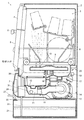
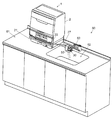
まず、第1発明の一実施例(第1実施例)による食器洗い機を図面を参照して説明する。図1は本実施例による食器洗い機の側面縦断面図、図2は本実施例の食器洗い機の設置状態の一例を示す斜視図である。
[First embodiment]
First, a dishwasher according to an embodiment (first embodiment) of the first invention will be described with reference to the drawings. FIG. 1 is a side longitudinal sectional view of a dishwasher according to the present embodiment, and FIG. 2 is a perspective view illustrating an example of an installation state of the dishwasher according to the present embodiment.
食器洗い機1は外形を形成する筐体2を有し、この筐体2の内部には乾燥室を兼用する洗浄庫3が配設されている。洗浄庫3の前面開口には、その上端及び下端でそれぞれ軸支される上部ドア4及び下部ドア5が、上下方向に観音開きするように取り付けられている。下部ドア5の上端中央部には把手6が設けられており、使用者がこの把手6を掴んで下部ドア5を手前(図1では左方)に引いて開けると、これに連動して上部ドア4が上方に開く構成となっている。下部ドア5の下方には操作パネル7が配置されている。この操作パネル7には、操作部として、電源スイッチ、スタートキー、コース選択キーなどが配置されており、表示部として、コース選択キーで選択された運転コースを表示するコース表示部や、乾燥時間、給湯設定の有無などを表示する条件表示部などが配置されている。
The dishwasher 1 has a
食器類を収容するための食器籠8は、上部ドア4及び下部ドア5を開放した状態で洗浄庫3内に出し入れされるようになっている。洗浄庫3の底部には、上面に複数の水噴射穴10が形成された回転自在のノズルアーム9が設けられている。この食器洗い機では洗浄庫3の幅が奥行よりも大きいため、1本のノズルアームだけでは洗浄庫3内の両側方部まで水が行き渡らない。そこで、回転時に図示したノズルアーム9と干渉しない位置に並んで、図示しない他のノズルアームが設けられている。洗浄庫3の底部には一段低く窪んで水溜め部11が形成されており、その上面には、食器類から流れ落ちた残菜を捕集するための残菜フィルタ12が着脱自在に設けられている。
The
洗浄庫3の底壁面下方には洗浄兼排水ポンプ13が配置されている。洗浄兼排水ポンプ13は、図示しないものの、隔壁で区画された洗浄ポンプ室と排水ポンプ室とを有しており、洗浄ポンプ室内及び排水ポンプ室内には、ポンプモータの同軸に取り付けられた洗浄用インペラ及び排水用インペラが設けられている。洗浄ポンプ室の吸入口14は水溜め部11の後壁に設けられた循環口15に接続され、吐出口16は横方向に延在して配設された通水路17を介してノズルアーム9及び図示しないもう一方のノズルアームの水路に連通している。一方、図示していないが、排水ポンプ室の吸入口は水溜め部11の側壁に設けられた排水口18に接続され、排水ポンプ室の吐出口は排水ホース19を介して機外に連通している。
A washing and draining
食器洗い機1の下部には、給水タンク21が前方への引き出し自在に配設されている。この給水タンク21の手前には、後述する給水機構から水を導入するための給水ホース27の出口端を接続する給水口22が設けられている。給水タンク21は標準的な食器洗い運転を行うために必要な水を貯留可能な内容積を有している。この給水タンク21に貯留された水を吸引するために、取水パイプ23、取水ポンプ24が洗浄庫3の下方に設置されている。給水タンク21内に所定水位以上の水が貯留された状態で取水ポンプ24が作動すると、取水パイプ23を経て水が吸い上げられて洗浄庫3内に注がれ、水溜め部11を含む洗浄庫3の底部に貯留される。
A
洗浄庫3内に貯留された水の水位は、水溜め部11に連通する図示しないエアトラップ、洗浄庫3の背面下部に配置された圧力センサ、及びエアトラップと圧力センサとを連結するエアホースから成る庫内水位センサ25により検知される。また、洗浄庫3の底部には、洗浄庫3内に貯留された水を温めるとともに乾燥時には洗浄庫3内の空気を加熱するためのループ状のヒータ26が配設されている。
The level of water stored in the
なお、本実施例の食器洗い機では、図1には示さないものの洗浄兼排水ポンプ13の横に送風装置が配置されており、乾燥運転時に送風装置のファンが回転駆動されると、筐体2の側面又は背面に形成された吸気口から吸い込まれた外気が洗浄庫3内へと導入され、一方、洗浄庫3内の湿気を含む空気は前面側の排気口から機外へと排出されるようになっている。
In the dishwasher of this embodiment, although not shown in FIG. 1, a blower is arranged beside the washing and draining
本実施例の食器洗い機では、上述したように取水ポンプ24により給水タンク21内の貯留水が吸い上げられ、洗浄庫3底部に所定水位(例えば図1中に記載の貯留水位)の水が溜められた状態で洗い運転やすすぎ運転が実行される。即ち、洗浄兼排水ポンプ13のポンプモータ13aは正転方向に回転駆動されることで洗浄ポンプとして機能する。このとき、回転する洗浄用インペラの作用によって、循環口15を通して水溜め部11から吸い込んだ水を通水路17を介してノズルアーム9へと圧送する。すると、ノズルアーム9の上面に設けられた水噴射穴10から水が噴出し、その水勢によってノズルアーム9は略垂直な軸を中心に所定方向に回転する。水噴射穴10から噴射された水は洗浄庫3内に収容されている食器類に当たり、食器類に付着している汚れを落としたり洗剤水を流したりする。
In the dishwasher of the present embodiment, the water stored in the
一方、ポンプモータ13aが逆転方向に回転駆動されることで、洗浄兼排水ポンプ13は排水ポンプとして機能する。このときには、回転する排水用インペラの作用により、排水口18を通して水溜め部11から吸い込んだ水を排水ホース19を通して機外へと排出する。
On the other hand, the washing and draining
給水タンク21は引き出し自在になっているので、例えば図2に示すように食器洗い機1が台所のシステムキッチン60の天板61上に設置された状態では、使用者は給水タンク21を前方に引き出してその上面開口から給水タンク21内に注水を行うことができる。但し、一般的にはこうした注水作業は面倒であるため、図2に示すように、シンク62上方の水道栓63の蛇口の先端に、本食器洗い機の付属部品として(又は別売品として)用意される分岐給水器具28を装着し、その分岐給水器具28と給水口22との間を給水ホース27で連結する。そして、使用者は給水タンク21への注水が必要なときに、分岐給水器具28のレバーを回動させてその内部水路を給水ホース27側に切り替え、水道栓63の開閉栓を開いて給水タンク21への給水を行う。
Since the
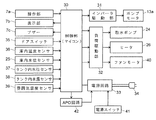
図3は本実施例の食器洗い機の要部の電気系構成図である。本発明における確認手段、時間経過推定手段等として機能する制御部30はCPUを含むマイクロコンピュータを中心に構成されており、インバータ駆動部31を介して洗浄兼排水ポンプ13のポンプモータ13aの回転を制御するとともに、負荷駆動部32を介して取水ポンプ24、ヒータ26、及び乾燥送風用のファンモータ40の動作を制御する。また、制御部30には、電源スイッチ41を含む操作部7a、表示部7b、ブザー7c、ドアスイッチ35、庫内温度センサ36、庫内水位センサ25、本発明における検知手段としてのタンク内水位センサ37、本発明における水温検知手段としてのタンク内水温センサ38、本発明における雰囲気温度検出手段としての雰囲気温度センサ39なども接続されている。また、制御部30には電源プラグ34を介して商用交流電源に接続される電源回路33から駆動電力が供給され、さらに制御部30の制御の下に各部に駆動電力が分配されるようになっている。制御部30は制御プログラムが格納されたROMを備えており、CPUが該制御プログラムを実行することにより、後述するような運転制御を遂行する。
FIG. 3 is an electric system configuration diagram of a main part of the dishwasher of the present embodiment. The
本実施例の食器洗い機では、電源プラグ34が商用交流電源コンセントに挿入されていれば電源スイッチ41を切った状態であっても少なくとも制御部30には駆動電力が供給されるようになっている。このとき、表示部7bの全ての表示は消えていて見かけ上は完全に電源が遮断されたようになっているが、制御部30は所定の制御動作を行うことが可能である。したがって、制御部30はタンク内水位センサ37の検知信号に基づき給水タンク21内への注水が為されたか否かを検知することができる。しかしながら、電源プラグ34が商用交流電源コンセントに挿入されていないと制御部30は全く動作していないから、給水タンク21内への注水を認識することができない。
In the dishwasher of the present embodiment, if the
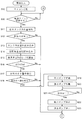
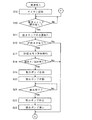
そこで、本実施例の食器洗い機では、電源プラグ34が抜かれた状態から商用交流電源コンセントに挿入されたとき、つまり電源投入時に、特徴的な給排水処理を実行する。次に、この処理動作について、図4及び図5のフローチャートを参照して説明する。
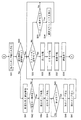
Therefore, in the dishwasher of this embodiment, a characteristic water supply / drainage process is executed when the
電源プラグ34が抜かれた状態から商用交流電源コンセントに挿入されると、電源回路33は制御部30等への電力供給を開始し、制御部30の中心であるマイクロコンピュータは起動して所定の初期設定動作を実行する(ステップS10)。その後に、制御部30はタンク内水位センサ37により給水タンク21内の水量を検知し(ステップS11)、それにより給水タンク21に水が貯留されているか否かを判定する(ステップS12)。
When the
給水タンク21内に水が貯留されていると判断した場合には(ステップS12でYes)、タンク内水温センサ38の検知信号に基づきタンク内水温T1を読み込み(ステップS13)、次いで雰囲気温度センサ39の検知信号に基づき雰囲気温度T2を読み込む(ステップS14)。なお、雰囲気温度とはこの食器洗い機の周囲の気温であり、雰囲気温度センサ39はこうした温度の測定が可能である位置に取り付けられている。温度T1、T2が共に取得されたならば、温度差ΔT=|T2−T1|を算出し(ステップS15)、求めた温度差ΔTが予め定めた規定値Ta以下であるか否かを判定する(ステップS16)。
If it is determined that water is stored in the water supply tank 21 (Yes in step S12), the tank water temperature T1 is read based on the detection signal of the tank water temperature sensor 38 (step S13), and then the
一般に、水道栓から供給される水の温度は一年を通じて比較的安定していて変動が小さい。そのため、夏季のように外気温が比較的高い時期には周囲の気温は水温よりも高く、逆に冬季のように外気温が比較的低い時期には周囲の気温は水温よりも低いことが多い。したがって、水道栓から供給されたばかりの水の温度が周囲の気温にほぼ等しいような状況は一年を通じてもかなり少ないものと考えられる。一方、水道水が給水タンク21に貯留されて時間が経過すると、その時間経過に伴い水温は周囲温度の影響で上昇又は下降し外気温に漸近してゆく。こうしたことから、給水タンク21内に貯留されている水の温度と周囲気温との差(つまり上記温度差ΔT)が十分に小さい場合には、その水が給水タンク21に導入されてからかなり時間が経過しており、逆に貯留水の温度と周囲気温との差が大きい場合には、その水が給水タンク21に導入されてからあまり時間が経過していないものと、高い確率で以て推定することが可能である。
In general, the temperature of water supplied from a water tap is relatively stable throughout the year and has little fluctuation. Therefore, the ambient temperature is higher than the water temperature when the outside temperature is relatively high, such as in summer, and conversely, the ambient temperature is often lower than the water temperature when the outside temperature is relatively low, such as in winter. . Therefore, it is considered that the situation where the temperature of the water just supplied from the tap is almost equal to the ambient temperature is considerably low throughout the year. On the other hand, when the tap water is stored in the
そこで、規定値Taを上記のような判定が可能である値に定めておき、ステップS16でYesの場合には給水タンク21内の水は古く、Noの場合には給水タンク21内の水は新しいものと判断する。ここで規定値Taとしては実験的に適宜の値に決めればよいが、例えば1〜2℃程度にしておくとよい。
Therefore, the prescribed value Ta is set to a value that allows the above determination, and if Yes in step S16, the water in the
給水タンク21内の水が古いと判断した場合には、本発明における報知手段である表示部7bで所定の表示器を点灯させたりブザー7cを鳴動させたりすることにより、残水有りの警告報知を行う(ステップS17)。使用者がこの警告報知に気付いて給水タンク21内の水の入れ替えが必要であると判断した場合には、使用者は操作部7aにおいて排水キーを操作する。一方、警告報知がなされた場合でも、使用者が給水タンク21内の水の入れ替えは不要であると判断したときには何も操作しない。そこで、制御部30は警告報知から所定時間の期間内に排水キーの操作がなされたか否かを判定し(ステップS18)、排水キーの操作がなされた場合には、まず取水ポンプ24を作動させて給水タンク21内の水を吸い上げて洗浄庫3内に移し始めた後(ステップS19)、ポンプモータ13aを排水ポンプとして動作させて洗浄庫3内の水を排水ホース19を通して機外へと排出する(ステップS20)。これにより、給水タンク21内の貯留水は洗浄庫3を経て機外へと廃棄される。したがって、取水ポンプ24、ポンプモータ13a、これを駆動するインバータ駆動部31、負荷駆動部32、及び制御部30が本発明における強制排水手段に相当する。
When it is determined that the water in the
もちろん、給水タンク21内の貯留水を機外へと廃棄するために、給水タンク21に排水バルブを設け、排水バルブを開放することで洗浄庫3を経ずに給水タンク21から例えば排水ホース19等を通して直接機外へと水を廃棄できるようにしてもよい。
Of course, in order to dispose of the stored water in the
取水ポンプ24及び排水ポンプの作動後に、排水が完了したか否かを繰り返し判定する(ステップS21)。排水完了の判断の一例を挙げると、タンク内水位センサ37が給水タンク21内の複数段階(又は無段階)の水位の検知が可能である場合には、給水タンク21内の検知水位が最も低い位置の設定水位よりも下がったときに排水完了であると判断することができる。また、排水能力を勘案して排水所要時間を予め定めておき、取水ポンプ24及び排水ポンプの作動開始時点からその排水所要時間が経過したときに排水が完了したものと判断してもよい。また、タンク内水位センサ37による検知ではなく庫内水位センサ25による検知信号に基づいて給水タンク21内の残留水の排水完了を判断するようにしてもよい。
After the
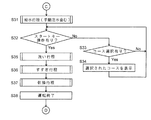
いずれにしても、排水完了であると判定されたならば取水ポンプ24を停止し(ステップS22)、ポンプモータ13aも停止することで排水ポンプを停止する(ステップS23)。その後、電源スイッチ41による電源オン操作が有るか否かを判定する(ステップS30)。電源オン操作が無ければステップS11へと戻るが、電源オン操作が有った場合にはステップS31の給水行程に進む。
In any case, if it is determined that the drainage is completed, the
ステップS12で給水タンク21内に水が無いと判定された場合には、ステップS13〜S23の処理がスキップされてステップS30の判断に移行する。さらに、ステップS16の判断により給水タンク21内の水が新しいと判断した場合、及びステップS18において警告報知後の所定時間内に排水キーの操作がないと判断した場合にも同様に、給水タンク21内に既に貯留されている水を廃棄することなくステップS30に進む。
If it is determined in step S12 that there is no water in the
給水行程では、まず使用者による給水タンク21への注水を待つ。この注水は基本的には、上述したように分岐給水器具28のレバーの切り換え操作と水道栓63の開閉栓の開放操作によって行われる。注水によって給水タンク21内に所定量以上の水が溜まると取水ポンプ24が作動し、洗い行程に必要な量の水を給水タンク21内から吸い上げて洗浄庫3の底部に溜める。そして、給水タンク21内が満量になると例えばブザー7cによる報知がなされ、それに応じて使用者は注水を停止する。
In the water supply process, first, the user waits for water injection to the
次に制御部30は操作部7aにおいてスタートキーが操作されたか否かを判定し(ステップS32)、スタートキーの操作がなければコース選択の操作が有ったか否かを判定する(ステップS33)。使用者によりコース選択の操作が為された場合には選択されたコースを表示部7bに表示して(ステップS34)ステップS32に戻る。なお、使用者によりコース選択が為されない状態では、標準的なコースが設定されているものとする。
Next, the
運転を行う際には、使用者が食器籠5に食器類を収容し、ドア4、5開いて食器籠8を洗浄庫3内に収納するととも適量の洗剤を洗浄庫3内に投入し、ドア4、5を閉めた後、操作部7aで必要に応じてコース選択キーによりコース選択を行った後にスタートキーを押す。制御部30はこのスタートキーの操作を受けると(ステップS32でYes)、所定の順番で運転を開始する。
When driving, the user stores the dishes in the
即ち、まず洗浄庫3内に投入された洗剤を水に溶解させた洗剤水を食器類に噴射することで洗い行程を実行する(ステップS35)。その後、すすぎ行程として、食器類に付着した洗剤水を洗い流すために、2乃至3回のすすぎと、除菌を行うとともに食器類を温めることによって次の乾燥時の乾燥効率を高めるために、高温の湯を用いた加熱すすぎとを実行する(ステップS36)。ここまでの洗い行程及びすすぎ行程では、給水タンク21に貯留されている水を取水ポンプ24で吸引して洗浄庫3底部に溜めた水を使用する。そしてその後に、ファンモータ40を作動させるとともにヒータ26に通電を行うことで洗浄庫3内に加熱空気を供給し、洗浄の終了した食器類を乾燥させる乾燥行程を実行する(ステップS37)。所定の乾燥運転時間が終了すると全ての運転を終了して表示部7bを消灯させ(ステップS38)、ステップS11へと戻る。
That is, first, the washing process is executed by spraying the detergent water, which is the detergent put into the
以上のように、本実施例の食器洗い機では、制御部30への通電が開始された時点で既に給水タンク21内に水が貯留されている場合に、その水が古いものであるか新しいものであるのかが推定され、古いものである(注水時点から長い時間が経過している)と判断した場合には残水の警告報知が為される。したがって、この警告報知が為された場合には、使用者自らが判断して、本当に古い水であって衛生上問題があると判断した場合には給水タンク21内の水を入れ替えて運転を開始することができ、一方、実際には古い水ではない又は古い水だが衛生上問題ないと使用者が判断した場合にはその水を使用して運転を開始することができる。
As described above, in the dishwasher of the present embodiment, when water is already stored in the
[第2実施例]
次に、第2発明の一実施例(第2実施例)による食器洗い機の動作制御について、図6のフローチャートを参照して説明する。この第2実施例の食器洗い機の構成は上記第1実施例と同じであり、制御部30における制御動作のみが第1実施例のものと若干相違する。図6は第1実施例における図4に代わるフローチャートであり、図5はこの第2実施例でも共通の部分である。図6中で図4中と同じ処理ステップには同一ステップ番号を付して説明を省略する。
[Second Embodiment]
Next, operation control of the dishwasher according to one embodiment (second embodiment) of the second invention will be described with reference to the flowchart of FIG. The configuration of the dishwasher of the second embodiment is the same as that of the first embodiment, and only the control operation in the
第1実施例では給水タンク21内に貯留されている水が古いものであると判断した場合に使用者に対する警告報知を行って使用者の判断を仰ぐようにしていたが、この第2実施例では、給水タンク21内に貯留されている水が古いものであると判断した場合に無条件に給水タンク21内の水の廃棄を実行する。こうした制御動作を行うため、図6に示したこの第2実施例におけるフローチャートでは、第1実施例の図4のフローチャートにおけるステップS17、S18が削除されており、ステップS16でYesと判定されると即座にステップS19へと進む。
In the first embodiment, when it is determined that the water stored in the
したがって、この第2実施例に係る食器洗い機によれば、給水タンク21に注水した水が新しいにも拘わらずステップS16で古い水であると誤判定したときに給水タンク21内の水が無駄になるという不利な点がある。その反面、給水タンク21内の水の廃棄について使用者の判断や操作が不要であるので、例えば使用者が食器洗い機の近くに居ないような場合でも自動的に給水タンク21内の水を廃棄した状態で待機することができるという利点がある。
Therefore, according to the dishwasher according to the second embodiment, the water in the
[第3実施例]
次に、第1発明の別の実施例(第3実施例)による食器洗い機の動作制御について、図7及び図8のフローチャートを参照して説明する。この第3実施例の食器洗い機の構成も上記第1実施例と同じであり、制御部30における制御動作のみが第1実施例のものと若干相違する。図7及び図8中で図4及び図5中と同じ処理ステップには同一ステップ番号を付して特に要しない限り説明を省略する。
[Third embodiment]
Next, the operation control of the dishwasher according to another embodiment (third embodiment) of the first invention will be described with reference to the flowcharts of FIGS. The configuration of the dishwasher of the third embodiment is the same as that of the first embodiment, and only the control operation in the
上記第1及び第2実施例の食器洗い機では、電源スイッチ41による電源オン操作前に、つまり見かけ上電源が切断されている状態で給水タンク21内の水が古いものか新しいものかを推断し、必要に応じてその水の廃棄を実行するようにしていたが、この第3実施例の食器洗い機では、電源スイッチ41による電源オン操作後にそうした一連の処理を実行する。即ち、電源プラグ34が商用交流電源コンセントに挿入され、制御部30のマイクロコンピュータが起動した後、電源スイッチ41の操作が有るまで待機する(ステップS30)。そして、使用者が電源スイッチ41により電源オン操作を行うと、第1実施例で説明したステップS11以降の処理を実行する。
In the dishwasher of the first and second embodiments, it is determined whether the water in the
したがって、この第3実施例の食器洗い機では、見かけ上電源が切断されている状態で取水ポンプ24やポンプモータ13aが作動することが無くなるため、電源が切断されている筈であるにも拘わらず残水警告が出されたり取水ポンプが作動したりするといった不可解感を使用者が持つことを回避できる。
Therefore, in the dishwasher of the third embodiment, the
[第4実施例]
次に、第3及び第5発明の一実施例(第4実施例)による食器洗い機の動作制御について、図9及び図10のフローチャートを参照して説明する。図9及び図10中で図4及び図5中と同じ処理ステップには同一ステップ番号を付して特に要しない限り説明を省略する。
[Fourth embodiment]
Next, operation control of the dishwasher according to one embodiment (fourth embodiment) of the third and fifth inventions will be described with reference to the flowcharts of FIGS. In FIG. 9 and FIG. 10, the same process steps as those in FIG. 4 and FIG.
この第4実施例の食器洗い機では、給水タンク21内の水の温度や雰囲気温度の検出を実行しない。したがって、上記第1乃至第3実施例の食器洗い機が備えるタンク内水温センサ38や雰囲気温度センサ39は省略することができるが、そのほかの構成は第1実施例と同じである。
In the dishwasher of the fourth embodiment, detection of the temperature of the water in the
この第4実施例の食器洗い機では、上記第3実施例と同様に、ステップS12で給水タンク21内に水が貯留されているか否かを判定するが、水が有ると判定された場合にその水が古いものであるか否かの判定処理を実行することなく、すぐに使用者に対する警告報知を行って使用者の判断を仰ぐ。こうした制御動作を行うため、図9に示したこの第4実施例におけるフローチャートでは、第1実施例の図4のフローチャートにおけるステップS13〜S16が削除されており、ステップS12でYesと判定されると即座にステップS17へと進む。したがって、この第4実施例に係る食器洗い機によれば、給水タンク21に注水した水が古いにも拘わらず新しい水であると誤判定してしまって水の入れ替えの機会を奪うということを回避できる。
In the dishwasher of the fourth embodiment, as in the third embodiment, it is determined whether or not water is stored in the
ステップS12で給水タンク21内に水が貯留されていないと判定されたときには、ステップS31へと進んで使用者による手動の注水動作を待つことになるが、タンク内水位センサ37が例えば水位検知スイッチ等である場合には多段階の水位検知は難しいため、実際にステップS12で行われる判定処理は満量又はそれに近い量の水が貯留されているか否かという判定である。そのため、給水タンク21内に古い水が残っていてもタンク内水位センサ37で検知できない水位である場合には、残水が無いと判断される。そこで、こうした残水の見逃しをできる限り防止するため、ステップS30で電源スイッチ41が操作されたと判断された時点から、ステップS31の給水行程において給水タンク21内の貯留水が満量になったと検知されるまでの所要時間を制御部30が計測して給水時間とし、この給水時間が規定値以上であるか否かを判定する(ステップS40)。
When it is determined in step S12 that water is not stored in the
上記給水時間は、使用者が電源スイッチ41を操作してから給水タンク21への注水を実行するまでの時間の長短、給水タンク21への注水時の水道栓の開度、水道栓の給水能力など、様々な要素に依存するものの、給水行程を実行する前に給水タンク21が空である場合にはこれを満量にするには或る程度の時間が掛かることから、給水時間が短過ぎるときには給水前に給水タンク21内に水が残っている可能性が高いと推測できる。そこで、ステップS40において給水時間が規定値未満であると判定された場合には、先に説明したステップS17〜S23と同じステップS41〜S47の処理を実行する。
The water supply time includes the length of time from when the user operates the
即ち、給水タンク21への注水前に給水タンク21内に残水が有ったことの警告報知を実行し、それに応じて使用者が排水キーを操作したならば、給水タンク21内の水を廃棄する。一方、排水キーが操作されなかったならば、使用者に給水タンク21内の水を廃棄する意志が無いものとみなしてスタートキーの操作を待つ。ステップS40において給水時間が規定値以上であると判定された場合には、注水前に給水タンク21内はほぼ空であったと判断し、既に説明したステップS32〜S38の処理を実行する。
That is, before water is injected into the
[第5実施例]
次に、第4及び第6発明の一実施例(第5実施例)による食器洗い機の動作制御について、図11及び図12のフローチャートを参照して説明する。図11及び図12中で図4〜図10中と同じ処理ステップには同一ステップ番号を付して特に要しない限り説明を省略する。
[Fifth embodiment]
Next, operation control of the dishwasher according to one embodiment (fifth embodiment) of the fourth and sixth inventions will be described with reference to the flowcharts of FIGS. In FIG. 11 and FIG. 12, the same processing steps as those in FIG. 4 to FIG.
上記第4実施例の食器洗い機では、ステップS12及びS40において給水タンク21内に残水があると判断した場合に一旦残水有り警告報知を行い、使用者により排水キーが操作されたならば排水を実行するようにしていたが、この第5実施例の食器洗い機では、給水タンク21内に残水があると判断した場合に警告報知を行うことなく即座に排水を実行する。即ち、第5実施例のフローチャートでは第4実施例の図9及び図10のフローチャートにおけるステップS17、S18、S41、S42が省略されている。したがって、第2実施例と同様に、給水タンク21内の水の廃棄について使用者の判断や操作が不要であるので、例えば使用者が食器洗い機の近くに居ないような場合でも自動的に給水タンク21内の水を廃棄した状態で待機することができるという利点がある。
In the dishwasher of the fourth embodiment, when it is determined in steps S12 and S40 that there is residual water in the
[第6実施例]
上記第1乃至第5実施例の食器洗い機はいずれも、電源プラグ34が商用交流電源コンセントに挿入されていれば制御部30が動作可能であるような構成であったが、こうした構成では、運転を実行していないときにも制御部30に僅かな駆動電流が常に流れることになる。これに対し、待機時消費電力ゼロを達成するために、電源オフ時には制御部30を含めて全ての電気回路への電力供給が遮断される構成を採ることも可能である。この第6実施例はそうした構成の食器洗い機である。図13はこの第6実施例の食器洗い機の電気系のブロック構成図であり、図3に示したものと同一又は相当する構成要素には同一符号を付している。
[Sixth embodiment]
In any of the dishwashers of the first to fifth embodiments, the
この第6実施例の食器洗い機では、図13に示すように、制御部30からの指令に基づいてその指令から所定時間経過後に電源回路33の供給電力を完全に遮断するオートパワーオフ(APO)回路42を備え、電源スイッチ41は制御部30が動作していない状態でも電源投入を可能とするように電源回路33に接続されている。したがって、電源オフ状態では、マイクロコンピュータを中心とする制御部30も完全にその動作を停止しており、使用者が電源スイッチ41を操作して電源オン状態にすると、始めてマイクロコンピュータが起動する。即ち、第6実施例の食器洗い機では電源スイッチ41で電源オン操作するという行為が、第1乃至第5実施例の食器洗い機において電源プラグ34を商用交流電源コンセントに挿入するという行為に相当することになる。
In the dishwasher of the sixth embodiment, as shown in FIG. 13, based on a command from the
図14及び図15は第6実施例における給排水処理を中心とする特徴的な動作のフローチャートである。既に説明した第1乃至第5実施例の食器洗い機の各フローチャート中の処理ステップと同じ処理を行うものについては同一のステップ番号を付している。基本的な処理動作は第1実施例と同じであり、異なるのは、図14においてステップS9が、図15においてステップS50が追加されている点だけである。 14 and 15 are flowcharts of characteristic operations centering on the water supply / drainage treatment in the sixth embodiment. The same step numbers are assigned to the same processing steps as those in the flowcharts of the dishwashers of the first to fifth embodiments already described. The basic processing operation is the same as that of the first embodiment, and the only difference is that step S9 is added in FIG. 14 and step S50 is added in FIG.
即ち、初期状態として本食器洗い機は電源オフ状態になっているものとすると、この状態から使用者が電源スイッチ41を押して電源をオンすると(ステップS9)、電源回路33は制御部30等への電力供給を開始し、これにより制御部30のマイクロコンピュータは起動する(ステップS10)。起動後のステップS11以降の処理動作は第1実施例と同じである。一方、一連の運転が終了すると(ステップS38)、制御部30から指令を受けたAPO回路42は所定時間(例えば5分など)が経過すると、電源回路33により供給される電力を強制的に遮断する(ステップS50)。もちろん、それ以前に使用者が電源スイッチ41で電源オフ操作を行っても同様に駆動電力が遮断される。このようにして電源オフ状態となった後には、制御部30を含む全電気回路に駆動電流が流れないので、待機時消費電力はゼロとなる。
That is, assuming that the dishwasher is in a power-off state as an initial state, when the user turns on the power by pressing the
上記第6実施例の食器洗い機についても、第2乃至第5実施例の各食器洗い機と同様にその制御フローチャートを変形することが可能であり、それぞれ上述したような利点を有する。例えば第6実施例の食器洗い機のフローチャートを第2実施例と同様に変形した場合の例を図16に示す。即ち、図14のフローチャートにおいてステップS17、S18を省略したのが図16である。 Regarding the dishwasher of the sixth embodiment, the control flowchart can be modified similarly to the dishwashers of the second to fifth embodiments, and each has the advantages as described above. For example, FIG. 16 shows an example where the flowchart of the dishwasher of the sixth embodiment is modified in the same manner as the second embodiment. That is, FIG. 16 omits steps S17 and S18 in the flowchart of FIG.
なお、上記実施例はいずれも本発明の一例にすぎず、本発明の趣旨の範囲で適宜、変形、修正又は追加などを行っても本発明に包含されることは明らかである。 It should be noted that any of the above embodiments is merely an example of the present invention, and it is apparent that the present invention is encompassed by the present invention even if appropriate modifications, corrections or additions are made within the scope of the present invention.
1…食器洗い機
2…筐体
3…洗浄庫
4…上部ドア
5…下部ドア
6…把手
7…操作パネル
7a…操作部
7b…表示部
7c…ブザー
8…食器籠
9…ノズルアーム
10…水噴射穴
11…水溜め部
12…残菜フィルタ
13…洗浄兼排水ポンプ
13a…ポンプモータ
14…吸入口
15…循環口
16…吐出口
17…通水路
18…排水口
19…排水ホース
21…給水タンク
22…給水口
23…取水パイプ
24…取水ポンプ
25…庫内水位センサ
26…ヒータ
27…給水ホース
28…分岐給水器具
30…制御部
31…インバータ駆動部
32…負荷駆動部
33…電源回路
34…電源プラグ
35…ドアスイッチ
36…庫内温度センサ
37…タンク内水位センサ
38…タンク内水温センサ
39…雰囲気温度センサ
40…ファンモータ
41…電源スイッチ
42…オートパワーオフ(APO)回路
63…水道栓
DESCRIPTION OF SYMBOLS 1 ...
Claims (10)
前記給水タンク内に水が貯留されているか否かを検知する検知手段と、
電源投入の直後に前記検知手段により前記給水タンク内の貯留水の有無を確認する確認手段と、
該確認手段により貯留水有りと判断された場合に、その貯留水が前記給水タンクへ注水がなされてから長時間が経過したものであるか否かを推定する時間経過推定手段と、
該時間経過推定手段による推定結果に基づいて使用者に報知を行う報知手段と、
該報知手段による報知の後に使用者による所定操作を受けて、前記給水タンク内の貯留水を機外に排出する強制排水手段と、
を備えることを特徴とする食器洗い機。 Tableware is housed inside, a washing cabinet for washing the tableware by sucking the water stored in the bottom and spraying it toward the tableware, and outside the washing cabinet for operation A dishwasher having a water supply tank for storing a necessary amount of water, and performing washing and rinsing operations by moving water from the water supply tank into the washing cabinet,
Detecting means for detecting whether water is stored in the water supply tank;
Confirmation means for confirming the presence or absence of stored water in the water supply tank by the detection means immediately after turning on the power;
A time lapse estimation means for estimating whether or not a long time has elapsed since the water was poured into the water supply tank when it is determined by the confirmation means that there is stored water;
Informing means for informing the user based on the estimation result by the time lapse estimating means,
A forced drainage means for receiving a predetermined operation by the user after the notification by the notification means, and discharging the stored water in the water supply tank to the outside of the machine;
A dishwasher characterized by comprising:
前記給水タンク内に水が貯留されているか否かを検知する検知手段と、
電源投入の直後に前記検知手段により前記給水タンク内の貯留水の有無を確認する確認手段と、
該確認手段により貯留水有りと判断された場合に、その貯留水が前記給水タンクへ注水がなされてから長時間が経過したものであるか否かを推定する時間経過推定手段と、
該時間経過推定手段により貯留水が長時間経過したものであると判定された場合に、前記給水タンク内の貯留水を機外に排出する強制排水手段と、
を備えることを特徴とする食器洗い機。 Tableware is housed inside, a washing cabinet for washing the tableware by sucking the water stored in the bottom and spraying it toward the tableware, and outside the washing cabinet for operation A dishwasher having a water supply tank for storing a necessary amount of water, and performing washing and rinsing operations by moving water from the water supply tank into the washing cabinet,
Detecting means for detecting whether water is stored in the water supply tank;
Confirmation means for confirming the presence or absence of stored water in the water supply tank by the detection means immediately after turning on the power;
A time lapse estimation means for estimating whether or not a long time has elapsed since the water was poured into the water supply tank when it is determined by the confirmation means that there is stored water;
A forced drainage means for discharging the stored water in the water supply tank to the outside when it is determined by the time lapse estimation means that the stored water has passed for a long time;
A dishwasher characterized by comprising:
前記給水タンク内の貯留水の水温を検出する水温検出手段と、
周囲の雰囲気温度を検出する雰囲気温度検出手段と、
前記水温と前記雰囲気温度との温度差を算出し、その温度差が所定値以下である場合に前記貯留水は前記給水タンクへ注水がなされてから長時間が経過したものであると判断する処理手段と、
を備えることを特徴とする請求項1又は2に記載の食器洗い機。 The time lapse estimation means includes
Water temperature detecting means for detecting the water temperature of the stored water in the water tank;
An ambient temperature detection means for detecting the ambient ambient temperature;
A process of calculating a temperature difference between the water temperature and the atmospheric temperature, and determining that a long time has elapsed since the water was poured into the water supply tank when the temperature difference is a predetermined value or less. Means,
The dishwasher according to claim 1, further comprising:
前記給水タンク内に水が貯留されているか否かを検知する検知手段と、
電源投入の直後に前記検知手段により前記給水タンク内の貯留水の有無を確認する確認手段と、
該確認手段による確認の結果を使用者に報知する報知手段と、
該報知手段による報知の後に使用者による所定操作を受けて、前記給水タンク内の貯留水を機外に排出する強制排水手段と、
を備えることを特徴とする食器洗い機。 Tableware is housed inside, a washing cabinet for washing the tableware by sucking the water stored in the bottom and spraying it toward the tableware, and outside the washing cabinet for operation A dishwasher having a water supply tank for storing a necessary amount of water, and performing washing and rinsing operations by moving water from the water supply tank into the washing cabinet,
Detecting means for detecting whether water is stored in the water supply tank;
Confirmation means for confirming the presence or absence of stored water in the water supply tank by the detection means immediately after turning on the power;
Notification means for notifying the user of the result of confirmation by the confirmation means;
A forced drainage means for receiving a predetermined operation by the user after the notification by the notification means, and discharging the stored water in the water supply tank to the outside of the machine;
A dishwasher characterized by comprising:
前記給水タンク内に水が貯留されているか否かを検知する検知手段と、
電源投入の直後に前記検知手段により前記給水タンク内の貯留水の有無を確認する確認手段と、
該確認手段により貯留水有りと判断された場合に、前記給水タンク内の貯留水を機外に排出する強制排水手段と、
を備えることを特徴とする食器洗い機。 Tableware is housed inside, a washing cabinet for washing the tableware by sucking the water stored in the bottom and spraying it toward the tableware, and outside the washing cabinet for operation A dishwasher having a water supply tank for storing a necessary amount of water, and performing washing and rinsing operations by moving water from the water supply tank into the washing cabinet,
Detecting means for detecting whether water is stored in the water supply tank;
Confirmation means for confirming the presence or absence of stored water in the water supply tank by the detection means immediately after turning on the power;
Forcibly draining means for discharging the stored water in the water supply tank to the outside when the confirmation means determines that there is stored water;
A dishwasher characterized by comprising:
前記給水タンク内の貯留水の水位が所定水位に達したか否かを検知する検知手段と、
電源投入後の前記給水タンクへの注水時に、前記検知手段により所定水位に達するまでの注水時間を測定又は推定する注水時間取得手段と、
前記注水時間が短い場合に、注水前に前記給水タンク内に既に貯留水があったものとみなして使用者に警告報知を行う報知手段と、
該報知手段による報知の後に使用者による所定操作を受けて、前記給水タンク内の貯留水を機外に排出する強制排水手段と、
を備えることを特徴とする食器洗い機。 Tableware is housed inside, a washing cabinet for washing the tableware by sucking the water stored in the bottom and spraying it toward the tableware, and outside the washing cabinet for operation A water supply tank for storing a necessary amount of water, water is poured into the water supply tank from an external tap, and the water is temporarily stored, and the stored water is stored in the washing chamber from the water supply tank. In a dishwasher that carries out washing and rinsing operations by moving
Detecting means for detecting whether or not the water level of the stored water in the water supply tank has reached a predetermined water level;
Water injection time acquisition means for measuring or estimating the water injection time until the predetermined water level is reached by the detection means at the time of water injection to the water supply tank after turning on the power;
When the water injection time is short, notifying means for notifying the user that warning water has already been stored in the water supply tank before water injection;
A forced drainage means for receiving a predetermined operation by the user after the notification by the notification means, and discharging the stored water in the water supply tank to the outside of the machine;
A dishwasher characterized by comprising:
前記給水タンク内の貯留水の水位が所定水位に達したか否かを検知する検知手段と、
電源投入後の前記給水タンクへの注水時に、前記検知手段により所定水位に達するまでの注水時間を測定又は推定する注水時間取得手段と、
前記注水時間が短い場合に、注水前に前記給水タンク内に既に貯留水があったものとみなして該給水タンク内の貯留水を機外に排出する強制排水手段と、
を備えることを特徴とする食器洗い機。 Tableware is housed inside, a washing cabinet for washing the tableware by sucking the water stored in the bottom and spraying it toward the tableware, and outside the washing cabinet for operation A water supply tank for storing a necessary amount of water, water is poured into the water supply tank from an external tap, and the water is temporarily stored, and the stored water is stored in the washing chamber from the water supply tank. In a dishwasher that carries out washing and rinsing operations by moving
Detecting means for detecting whether or not the water level of the stored water in the water supply tank has reached a predetermined water level;
Water injection time acquisition means for measuring or estimating the water injection time until the predetermined water level is reached by the detection means at the time of water injection to the water supply tank after turning on the power;
When the water injection time is short, it is assumed that there is already stored water in the water supply tank before water injection, forced drainage means for discharging the stored water in the water supply tank outside the machine,
A dishwasher characterized by comprising:
An operation unit that turns on / off the power in response to an operation by the user, and an auto power-off unit that automatically turns off the power even if the operation unit does not perform a power-off operation at the end of operation. 8. The power supply to each means is stopped, and the power is turned on when a power-on operation of the operation unit is performed. Dishwasher.
Priority Applications (1)
| Application Number | Priority Date | Filing Date | Title |
|---|---|---|---|
| JP2005004955A JP2006192006A (en) | 2005-01-12 | 2005-01-12 | Dishwasher |
Applications Claiming Priority (1)
| Application Number | Priority Date | Filing Date | Title |
|---|---|---|---|
| JP2005004955A JP2006192006A (en) | 2005-01-12 | 2005-01-12 | Dishwasher |
Publications (1)
| Publication Number | Publication Date |
|---|---|
| JP2006192006A true JP2006192006A (en) | 2006-07-27 |
Family
ID=36798531
Family Applications (1)
| Application Number | Title | Priority Date | Filing Date |
|---|---|---|---|
| JP2005004955A Pending JP2006192006A (en) | 2005-01-12 | 2005-01-12 | Dishwasher |
Country Status (1)
| Country | Link |
|---|---|
| JP (1) | JP2006192006A (en) |
Cited By (7)
| Publication number | Priority date | Publication date | Assignee | Title |
|---|---|---|---|---|
| JP2012090838A (en) * | 2010-10-28 | 2012-05-17 | Harman Co Ltd | Dish washing and drying machine |
| JP2012179307A (en) * | 2011-03-02 | 2012-09-20 | Hoshizaki Electric Co Ltd | Dishwasher |
| JP2013145252A (en) * | 2013-04-30 | 2013-07-25 | Sysmex Corp | Reagent preparation device, specimen measurement device and reagent preparation method |
| JP2015504708A (en) * | 2011-12-13 | 2015-02-16 | エコラボ ユーエスエー インコーポレイティド | Dishwasher |
| JP2016067674A (en) * | 2014-09-30 | 2016-05-09 | リンナイ株式会社 | Dishwasher |
| JP2016193169A (en) * | 2015-03-31 | 2016-11-17 | ホシザキ株式会社 | washing machine |
| CN116439624A (en) * | 2022-01-10 | 2023-07-18 | 追觅创新科技(苏州)有限公司 | Control method and device applied to cleaning equipment and cleaning equipment |
-
2005
- 2005-01-12 JP JP2005004955A patent/JP2006192006A/en active Pending
Cited By (10)
| Publication number | Priority date | Publication date | Assignee | Title |
|---|---|---|---|---|
| JP2012090838A (en) * | 2010-10-28 | 2012-05-17 | Harman Co Ltd | Dish washing and drying machine |
| JP2012179307A (en) * | 2011-03-02 | 2012-09-20 | Hoshizaki Electric Co Ltd | Dishwasher |
| JP2015504708A (en) * | 2011-12-13 | 2015-02-16 | エコラボ ユーエスエー インコーポレイティド | Dishwasher |
| US10314461B2 (en) | 2011-12-13 | 2019-06-11 | Ecolab Usa Inc. | Dishmachine |
| US10349803B2 (en) | 2011-12-13 | 2019-07-16 | Ecolab Usa Inc. | Dishmachine |
| US11191419B2 (en) | 2011-12-13 | 2021-12-07 | Ecolab Usa Inc. | Dishmachine |
| JP2013145252A (en) * | 2013-04-30 | 2013-07-25 | Sysmex Corp | Reagent preparation device, specimen measurement device and reagent preparation method |
| JP2016067674A (en) * | 2014-09-30 | 2016-05-09 | リンナイ株式会社 | Dishwasher |
| JP2016193169A (en) * | 2015-03-31 | 2016-11-17 | ホシザキ株式会社 | washing machine |
| CN116439624A (en) * | 2022-01-10 | 2023-07-18 | 追觅创新科技(苏州)有限公司 | Control method and device applied to cleaning equipment and cleaning equipment |
Similar Documents
| Publication | Publication Date | Title |
|---|---|---|
| JPH10165913A (en) | Spray type cleaner | |
| JP2006192006A (en) | Dishwasher | |
| JP2011177423A (en) | Washer | |
| JP2007007178A (en) | Dishwasher | |
| JP2006230498A (en) | Dishwasher | |
| JP3676113B2 (en) | dishwasher | |
| JP4206261B2 (en) | Dishwasher and method for supplying detergent | |
| JP2001112686A (en) | Dishwasher | |
| JP3500092B2 (en) | dishwasher | |
| JP4522891B2 (en) | Dishwasher | |
| TWI532459B (en) | Tableware cleaning machine | |
| JP2008036130A (en) | Dishwasher | |
| JP2000316783A (en) | Dishwasher | |
| JP2004129742A (en) | Dishwasher | |
| JP4476159B2 (en) | dishwasher | |
| JP2004229942A (en) | Dishwasher | |
| JP2012019975A (en) | Dishwasher | |
| JP6629075B2 (en) | washing machine | |
| JP2000316784A (en) | Dishwasher | |
| JP3197800B2 (en) | How to operate the washing machine | |
| JPH09234298A (en) | Washing machine | |
| JP4357390B2 (en) | Washing machine | |
| JP2001087203A (en) | Dishwasher | |
| JP4988490B2 (en) | Dishwasher | |
| KR0157581B1 (en) | How to prevent the pump from freezing in a dishwasher |