JP2006328043A - Agent for antibacterial and deodorant treatment, and antibacterial and deodorant article treated therewith - Google Patents
Agent for antibacterial and deodorant treatment, and antibacterial and deodorant article treated therewith Download PDFInfo
- Publication number
- JP2006328043A JP2006328043A JP2005344203A JP2005344203A JP2006328043A JP 2006328043 A JP2006328043 A JP 2006328043A JP 2005344203 A JP2005344203 A JP 2005344203A JP 2005344203 A JP2005344203 A JP 2005344203A JP 2006328043 A JP2006328043 A JP 2006328043A
- Authority
- JP
- Japan
- Prior art keywords
- antibacterial
- deodorant
- agent
- fluorescent
- photocatalyst
- Prior art date
- Legal status (The legal status is an assumption and is not a legal conclusion. Google has not performed a legal analysis and makes no representation as to the accuracy of the status listed.)
- Withdrawn
Links
Images




Landscapes
- Chemical Or Physical Treatment Of Fibers (AREA)
- Treatments For Attaching Organic Compounds To Fibrous Goods (AREA)
- Paper (AREA)
- Apparatus For Disinfection Or Sterilisation (AREA)
- Disinfection, Sterilisation Or Deodorisation Of Air (AREA)
- Catalysts (AREA)
- Agricultural Chemicals And Associated Chemicals (AREA)
Abstract
Description
本発明は、内装材や布等の物品や壁材の表面に抗菌防臭処理を施すための処理剤およびそれにより処理した抗菌防臭性物品に関し、殊に、抗菌防臭処理後に外観から光触媒の有無および量を判断することのできる抗菌防臭処理剤およびそれにより処理した抗菌防臭性物品に関する。 The present invention relates to a treatment agent for applying antibacterial and deodorant treatment to the surface of articles such as interior materials and fabrics and wall materials, and antibacterial and deodorant articles treated thereby, in particular, the presence or absence of a photocatalyst from the appearance after antibacterial and deodorant treatment, and The present invention relates to an antibacterial and deodorant treatment agent whose amount can be judged and an antibacterial and deodorant article treated thereby.
近年、光触媒物質を物品表面に塗布し所定波長を含む光線を照射することで、付着した汚染物質を分解させるセルフクリーニング機能を付与する技術が普及している。例えば、特開平9−268280号公報や特開平10−259325号公報に記載されているように、光触媒物質を建築物の壁面または内外装面に塗布することで、付着または吸着した有害物質や汚染物質を分解させるための空気清浄及び防汚処理として、或いは医療施設の内装面に塗布することで院内感染を減少させる抗菌処理として等、様々な用途で広く実施されている。 In recent years, a technique for providing a self-cleaning function for decomposing adhering contaminants by applying a photocatalytic substance to the surface of an article and irradiating a light beam having a predetermined wavelength has become widespread. For example, as described in JP-A-9-268280 and JP-A-10-259325, a photocatalytic substance is applied to the wall surface or interior / exterior surface of a building, thereby adhering or adsorbing harmful substances or contamination. It is widely used in various applications, such as air purification and antifouling treatment for decomposing substances, or antibacterial treatment for reducing hospital infections by applying it to the interior surface of medical facilities.
これは、光触媒が所定波長の光線を受けることで光励起状態となり、その表面に所定の物質を付着・活性化させることで所定の作用を発揮する触媒能を利用したものである。例えば器物表面に塗布された酸化チタンは、紫外線を含む太陽光やライト光を受けることで付着した有害物質を酸化して分解したり、或いは空気中の水分を電気的に分解して活性酸素を発生し、付着した細菌を傷害して減少させたりする作用が知られている。 This utilizes a catalytic ability that a photocatalyst receives a light beam having a predetermined wavelength to be in a photoexcited state and attaches and activates a predetermined substance on the surface to exert a predetermined action. For example, titanium oxide applied to the surface of a container oxidizes and decomposes harmful substances attached by receiving sunlight and light including ultraviolet rays, or electrically decomposes moisture in the air to produce active oxygen. It is known to act to damage and reduce attached bacteria.
しかし、光触媒物質は通常無色であり抗菌防臭処理剤も非着色性であることを要請されていることから、内装材などの物品に対し現場で抗菌防臭処理を行う場合に、処理済み部分と未処理部分とは通常見分けがつかない。従って、これを施工者がムラなく塗布することは困難であることに加えて、発注者が外観から抗菌防臭処理の有無を確認することも容易ではない。また、基材の質感保持の観点から単位面積当たりの光触媒物質の塗布量にも限界があることに加え、例えば屋内など塗布場所によっては触媒作用に必要とする所定波長の光線量が不足することがあるため光触媒機能が充分に発揮されない場合が多い。 However, since the photocatalyst substance is usually colorless and the antibacterial and deodorant treatment agent is required to be non-coloring, when the antibacterial and deodorant treatment is performed on the article such as the interior material on the site, the treated part and the untreated part are not treated. It is usually indistinguishable from the processing part. Therefore, it is difficult for the contractor to apply this without unevenness, and it is not easy for the orderer to confirm the presence or absence of the antibacterial and deodorizing treatment from the appearance. In addition, there is a limit to the amount of photocatalytic substance applied per unit area from the viewpoint of maintaining the texture of the base material, and the amount of light with a predetermined wavelength required for catalysis may be insufficient depending on the application location, such as indoors. Therefore, the photocatalytic function is often not fully exhibited.
一方、特開平9―296364号公報には、光触媒物質を水または有機溶剤に分散してスラリーとしたものを、布と接触させて光触媒を繊維に固定することにより抗菌防臭能を付与する技術が提案されている。この技術により、布の風合いや手触りを損ねることなく比較的簡易な手順で抗菌防臭布を作製することができる。 On the other hand, Japanese Patent Application Laid-Open No. 9-296364 discloses a technique for imparting antibacterial and deodorizing performance by dispersing a photocatalyst substance in water or an organic solvent into a slurry and bringing the photocatalyst into contact with a cloth to fix the photocatalyst to fibers. Proposed. By this technique, an antibacterial and deodorant cloth can be produced by a relatively simple procedure without impairing the texture and feel of the cloth.
しかしながら、光触媒物質を繊維表面に直接固定した場合には光触媒の物質分解能により繊維自体が分解されることがあるため、布自体の耐久性において難点が生じる。また、可撓性を有する繊維製品においては光触媒物質を含む塗装層を厚く設けることができないことから、使用または洗濯により光触媒が脱落することで触媒能が比較的短期間で減少してしまう、という問題もある。 However, when the photocatalytic substance is directly fixed to the fiber surface, the fiber itself may be decomposed due to the substance resolution of the photocatalyst, which causes a difficulty in the durability of the cloth itself. In addition, in a textile product having flexibility, since a coating layer containing a photocatalytic substance cannot be provided thickly, the catalytic ability decreases in a relatively short period of time due to the photocatalyst falling off due to use or washing. There is also a problem.
この問題に対し、特開2004―50047号公報には、繊維等の有機質基材の表面にシェラック樹脂を含有する樹脂バインダで光触媒微粒子を接着するコーティング処理を行うことにより、基材の風合いを損ねることなく光触媒の接着性を高めて脱落しにくくするとともに、光触媒による基材の分解を軽減させた光触媒含有基材が提案されている。 In response to this problem, Japanese Patent Application Laid-Open No. 2004-50047 impairs the texture of the base material by performing a coating process in which photocatalyst fine particles are adhered to the surface of an organic base material such as fiber with a resin binder containing shellac resin. In addition, a photocatalyst-containing base material has been proposed in which the adhesiveness of the photocatalyst is increased to make it difficult to fall off and the decomposition of the base material by the photocatalyst is reduced.
ところが、斯かる光触媒含有基材においても、洗濯頻度が高い繊維製品においては触媒能を長期間に亘って維持することは困難であり、いずれは製品を交換、或いは光触媒含有処理液を再塗布する必要性が生じるが、前述と同様に光触媒塗布層は通常無色であって外観からはその脱落の程度が判別できないため、製品の交換時期または再塗布時期の判断が困難となりやすい。一方、光触媒と所定の着色物質とを混合して光触媒の脱落に伴って色が落ちる手段を用いた場合は、繊維製品に不必要な着色を施す結果となるとともに洗濯による色あせを伴うことから美観上採用しにくいものである。 However, even in such a photocatalyst-containing base material, it is difficult to maintain the catalytic ability for a long period of time in a textile product having a high washing frequency, and either of them replaces the product or reapplies a photocatalyst-containing treatment solution. Although the necessity arises, as described above, the photocatalyst coating layer is usually colorless and the degree of drop-off cannot be determined from the appearance, so that it is difficult to determine the replacement time or re-coating time of the product. On the other hand, using a means that mixes a photocatalyst with a predetermined coloring substance and causes the color to drop as the photocatalyst is removed results in unnecessary coloration of the textile product, and is also accompanied by fading due to washing. It is difficult to adopt above.
従って、交換時期または再塗布時期が早すぎる場合、維持コストおよび手間の面で無駄が多いものとなり、時期が遅すぎる場合は光触媒機能が充分に発揮されない状態で使用してしまう事態が生じる。さらに、上述した繊維製品に光触媒物質を固着させる総ての技術に共通して、繊維製品の風合いや手触りを確保するために繊維表面に固着できる光触媒物質の量は限定されていることから、強い臭気を伴いやすい繊維製品においては抗菌防臭効果が不充分となりやすかった。 Therefore, if the replacement time or the recoating time is too early, there will be a lot of waste in terms of maintenance cost and labor, and if the time is too late, the photocatalytic function will not be fully exerted. Furthermore, in common with all the techniques for fixing the photocatalytic substance to the fiber product described above, the amount of the photocatalytic substance that can be fixed to the fiber surface in order to ensure the texture and feel of the fiber product is limited. In textile products that tend to be accompanied by odor, the antibacterial and deodorizing effect tends to be insufficient.
これに対し、特開平11−57491号公報には、蛍光物質の粉末と光触媒物質の粉末とを混合したもので器物の表面を塗装処理して、触媒塗布層の有り無しおよび触媒機能の発揮中であるか否かの確認を、目視で容易に行えるものとした技術が提示されている。この技術は、光触媒および蛍光物質が紫外線を照射されることによりともに光励起されて機能を発揮することを利用して、通常は判別できない蛍光物質の塗装部が蛍光発光した時に光触媒能を発揮していると判定するように工夫したものである。 On the other hand, Japanese Patent Application Laid-Open No. 11-57491 discloses that the surface of a container is coated with a mixture of a fluorescent substance powder and a photocatalytic substance powder, so that the presence or absence of a catalyst coating layer is present and the catalytic function is being demonstrated. A technique has been proposed that makes it easy to visually confirm whether or not the above is true. This technology utilizes the fact that the photocatalyst and the fluorescent material are both photoexcited and exhibit their functions when irradiated with ultraviolet rays, and exhibit a photocatalytic activity when the painted portion of the fluorescent material that cannot be normally distinguished emits fluorescence. It is devised to judge that it is.
しかしながら、この技術はあくまで表面が所定の硬さを有する器物に、比較的厚い塗装被膜を設けるものであって光触媒および蛍光物質の粒径は問わないものであり、可撓性に富むとともに風合いや肌触りを重視する繊維製品等に適用することを想定したものではない。また、使用により光触媒が脱落していく場合を想定していないことから、蛍光発光の程度を手がかりに光触媒の残存量を判定しようとするものでもない。 However, this technique only provides a relatively thick coating film on an object having a predetermined surface hardness, and the particle size of the photocatalyst and the fluorescent material is not limited. It is not intended to be applied to textile products that emphasize the touch. In addition, since it is not assumed that the photocatalyst drops off due to use, the photocatalyst remaining amount is not determined based on the degree of fluorescence emission.
さらに、この技術は耐熱性・耐光性など高度な耐久性を半永久的に求める器物に適用するものであることから、無機系の蛍光物質を用いることを想定しており、人が直接触れやすいとともに洗濯の機会が多い繊維製品への適用を想定していないため無機系物質による人体への悪影響および洗濯で生じた洗浄水による環境への悪影響を回避するための観点がないものである。
本発明は、上記のような問題点を解決しようとするものであり、基材表面に抗菌防臭処理を施した場合に、機能を発揮する光触媒の有無および量について外観から的確に判定できるようにし、且つ、抗菌防臭処理により基材の外観や手触り・風合いを損なうことなく優れた抗菌防臭能を発揮できるようにすることを課題とする。 The present invention is intended to solve the above-described problems, and when antibacterial deodorizing treatment is performed on the surface of a base material, the presence and amount of a photocatalyst exhibiting a function can be accurately determined from the appearance. And it makes it a subject to be able to exhibit the outstanding antibacterial deodorizing ability, without impairing the external appearance, the touch, and the texture of a base material by antibacterial deodorizing treatment.
そこで、本発明は、水または有機溶剤に、紫外線照射により触媒能を発揮する光触媒微粒子が分散されており基材表面に塗布することで抗菌防臭機能を発揮するものとした抗菌防臭処理剤において、紫外線照射により蛍光発光する有機系蛍光剤が所定割合で混合されてなるものとした。 Therefore, the present invention provides an antibacterial and deodorant treatment agent that exhibits antibacterial and deodorant functions by applying to the surface of the substrate in which photocatalyst fine particles that exhibit catalytic activity are dispersed in water or an organic solvent, and applied to the substrate surface. An organic fluorescent agent that emits fluorescence when irradiated with ultraviolet rays is mixed at a predetermined ratio.
これにより、通常は目視できない光触媒を含有する抗菌防臭処理層を、紫外線を照射することにより蛍光剤による蛍光発光が目視可能となって、容易に確認できるようになり外観から抗菌防臭処理による光触媒の有無が判定できるとともに、発光強度から光触媒量や塗りムラまで判定することができる。しかも、微粒子状で同一質量当たりの表面積が大きい光触媒微粒子と、これに分子レベルで複合可能な有機系蛍光剤との組合せにより光触媒活性が増強されるため、比較的少量の光触媒で基材の風合いや手触りを損なうことなく、また比較的少ない紫外線照射量で優れた抗菌防臭能を発揮させることができる。 This makes it possible to visually observe the fluorescence emission by the fluorescent agent by irradiating the antibacterial deodorant treatment layer containing the photocatalyst that is not normally visible, and can easily check the photocatalyst by the antibacterial deodorization treatment from the appearance. Presence / absence can be determined, and the amount of photocatalyst and uneven coating can be determined from the emission intensity. In addition, the photocatalytic activity is enhanced by the combination of finely divided photocatalyst particles with a large surface area per mass and an organic fluorescent agent that can be combined with this at the molecular level. In addition, the antibacterial and deodorizing ability can be exhibited with a relatively small amount of ultraviolet irradiation without impairing the touch and the touch.
また、この抗菌防臭処理剤において、光触媒と蛍光剤との比率を質量比で1:0.01乃至5.0であるものとすれば光触媒能の増強効果に優れたものとなるとともに光触媒による蛍光増白剤の分解があっても充分な発光強度が確保されるものとなり、光触媒微粒子の最大粒子径を250nm以下とすれば液体への分散性が良好になるとともに基材への密着性が良好となって光触媒を基材側に固定するためのバインダを不要または少量としても高い結合性を発揮しながらその可撓性や風合い・肌触りを良好な状態に維持することができ、その光触媒微粒子を酸化チタンからなるものとすれば優れた抗菌防臭能を発揮できるものとなる。 Further, in this antibacterial and deodorizing agent, if the mass ratio of the photocatalyst to the fluorescent agent is 1: 0.01 to 5.0, the effect of enhancing the photocatalytic activity is improved and the fluorescence by the photocatalyst is enhanced. Even if the brightener is decomposed, sufficient light emission intensity can be ensured. If the maximum particle size of the photocatalyst fine particles is 250 nm or less, the dispersibility in the liquid is good and the adhesion to the substrate is good. Even if a binder for fixing the photocatalyst to the substrate side is unnecessary or small, the flexibility, texture and touch can be maintained in a good state while exhibiting high binding properties, and the photocatalyst fine particles can be If it consists of titanium oxide, it will be able to exhibit excellent antibacterial and deodorizing ability.
さらに、上述した抗菌防臭処理剤において、光触媒微粒子を基材表面に固着させるバインダが分散されているものとすれば、光触媒がより確実に基材表面に固着されるものとなる。 Furthermore, in the antibacterial and deodorizing agent described above, if the binder for fixing the photocatalyst fine particles to the substrate surface is dispersed, the photocatalyst is more reliably fixed to the substrate surface.
さらにまた、上述した抗菌防臭処理剤を用いて所定の物品を処理することにより得た抗菌防臭性物品とすれば、これを配置するだけで室内のような紫外線照射量の少ない場所であっても光触媒能の増強効果により抗菌防臭効果を容易に発揮できるものとなり、その物品が建築物用の内装材であるものとすれば、内装材は通常風雨に曝されることがないため光触媒を基材側に固定させるためのバインダやコート層を不要または最小限とすることができることから、内装材の美観や手触り・風合いを損ねることが少ないとともに室内において長期間に亘って優れた抗菌防臭機能を発揮させることが容易となり、その物品が紙製品であるものとすれば、内装材と同様に美観や手触り・風合いを損なうことなく抗菌防臭機能を発揮させることが容易になる。 Furthermore, if it is an antibacterial and deodorant article obtained by processing a predetermined article using the above-mentioned antibacterial and deodorant treatment agent, even if it is placed in a place where the amount of ultraviolet irradiation is small, such as indoors. If the antibacterial and deodorizing effect can be easily demonstrated by the enhancement effect of the photocatalytic ability, and the article is an interior material for a building, the interior material is not normally exposed to wind and rain, so the photocatalyst is used as a base material. Binder and coat layer for fixing to the side can be eliminated or minimized, so that the aesthetics, texture and texture of the interior material are not impaired, and the antibacterial and deodorizing function is excellent over the long term indoors. If the article is a paper product, it is easy to exhibit antibacterial and deodorizing functions without damaging the aesthetics, texture, and texture as with interior materials. That.
一方、上述した抗菌防臭処理剤を、光触媒微粒子を繊維に固着させるバインダが分散されているとともに、混合する有機系蛍光剤を蛍光増白剤とした布用抗菌防臭処理液とすれば、蛍光増白剤を混合して布に蛍光増白処理を行うことにより洗濯で光触媒が脱落するのと同様に蛍光増白剤も脱落することになって、紫外線照射による発光強度を目安に光触媒の残存量を判定することにより光触媒再塗布または交換のタイミングを容易に判断できるものとなる。 On the other hand, if the antibacterial deodorant treatment agent described above is used as an antibacterial deodorant treatment solution for fabrics in which a binder for fixing photocatalyst fine particles to fibers is dispersed and the organic fluorescent agent to be mixed is a fluorescent brightening agent, When whitening agent is mixed and fluorescent whitening treatment is applied to the cloth, the photocatalyst will fall off in the same manner as washing, and the remaining amount of photocatalyst will be determined based on the emission intensity of UV irradiation. This makes it possible to easily determine the timing of photocatalyst recoating or replacement.
加えて、この布用抗菌防臭処理液において、抗菌防臭処理後にその蛍光増白剤分子の一部が光触媒微粒子とバインダの複合体に付着した状態となるものとした。このように、光触媒微粒子を繊維に固着させるバインダと、処理後にこのバインダと光触媒微粒子の複合体にその一部の分子が付着する蛍光増白剤とを混合したことで、光触媒が確実に基材表面に固着されることに加えて光触媒微粒子の脱落に伴いバインダに付着した蛍光増白剤分子の一部が脱落するものとなって、洗濯を重ねた場合の発光強度の減少率と光触媒の残存量の減少率とが相関関係を示しやすいものとなる。 In addition, in this antibacterial and deodorant treatment liquid for cloth, after the antibacterial and deodorant treatment, a part of the fluorescent brightener molecule is attached to the composite of the photocatalyst fine particles and the binder. In this way, the photocatalyst is surely made to be a base material by mixing the binder for fixing the photocatalyst fine particles to the fiber and the fluorescent whitening agent in which some molecules adhere to the composite of the binder and the photocatalyst fine particles after the treatment. In addition to being fixed to the surface, some of the fluorescent brightener molecules attached to the binder will drop off as the photocatalyst fine particles fall off, and the rate of decrease in emission intensity and residual photocatalyst when washing is repeated It becomes easy to show a correlation with the decrease rate of the quantity.
さらに加えて、上述した布用抗菌防臭処理液においてバインダを有機系のバインダとすれば、有機系の蛍光増白剤が付着しやすいものとなって、上述の相関関係を一層確保しやすいものとなり、この有機系のバインダをシェラック樹脂を主成分とするものとすれば、光触媒微粒子の繊維への結合が堅固となって洗濯等による脱落量が軽減されることに加え、光触媒による繊維の分解速度を軽減して布自体の耐久性も大幅に向上するものとなる。 In addition, if the binder is an organic binder in the antibacterial and deodorizing treatment liquid for cloth described above, the organic fluorescent whitening agent is likely to adhere, making it easier to ensure the above correlation. If the organic binder is mainly composed of shellac resin, the photocatalyst fine particles are firmly bonded to the fibers and the amount of falling off by washing is reduced. In addition, the degradation rate of the fibers by the photocatalyst is reduced. As a result, the durability of the cloth itself is greatly improved.
また、上述した布用抗菌防臭処理液において、その蛍光増白剤をユビテックスERNとすれば、蛍光増白剤の繊維側への付着がさらに少ないものとなって、前述の相関関係を一層確保しやすいものとなる。 Moreover, in the antibacterial and deodorizing treatment liquid for cloth described above, if the fluorescent whitening agent is Ubitex ERN, the fluorescent whitening agent will be less adhered to the fiber side, and the above correlation will be further secured. It will be easy to do.
さらに、上述した布用抗菌防臭処理液を用いて布を処理することで、布の蛍光増白剤と光触媒とが減少していく場合に、紫外線照射時における発光強度の減少率と光触媒の減少率とが所定の相関関係を示すものとして、発光強度により光触媒の残存量を判定することのできる抗菌防臭布とすれば、紫外線照射時に外観だけで光触媒の再塗布時期または交換時期を的確に判断することができる。 Furthermore, when the fabric is treated with the antibacterial and deodorizing treatment liquid for fabrics described above, when the fluorescent whitening agent and the photocatalyst of the fabric are decreased, the decrease rate of the emission intensity and the decrease of the photocatalyst at the time of ultraviolet irradiation If the antibacterial deodorant cloth can determine the remaining amount of photocatalyst based on the light emission intensity, the rate of recoating or replacement of the photocatalyst can be accurately determined only by the appearance when irradiated with ultraviolet rays. can do.
そして、この抗菌防臭布でサウナマットを作製すれば、汗などで汚れることで細菌が増殖して悪臭が発生しやすくなった場合に、紫外線を照射するだけで優れた抗菌防臭能を発揮させることができることから、洗濯回数を減らせるとともに紫外線照射時に目視により発光強度を確認するだけで光触媒の残存量を判定して光触媒再塗布のタイミングを容易に判断することができる。 And if you make a sauna mat with this antibacterial deodorant cloth, if it becomes dirty with sweat etc. and bacteria grow and it becomes easy to generate bad odor, it will exhibit excellent antibacterial and deodorant ability just by irradiating ultraviolet rays Therefore, the number of washings can be reduced, and the photocatalyst recoating timing can be easily determined by determining the remaining amount of the photocatalyst only by visually confirming the light emission intensity during ultraviolet irradiation.
そしてまた、この抗菌防臭布で白衣全体を作製するか、或いは既存の蛍光増白処理済みの白衣を前述の抗菌防臭処理液で処理した後にこの抗菌防臭布を光触媒残存量モニタ部分として設けたものとすれば、使用後に紫外線照射することで上記同様の効果を発揮して手間を要さずにしかも低コストで施設内細菌感染を防止するための有効な手段を講じることができ、この抗菌防臭布でカーテンを作成すれば、光触媒機能を発揮する表面積が比較的大きいことから室内で優れた抗菌防臭効果が期待できるものである。 Also, the entire lab coat is produced with this antibacterial deodorant cloth, or the existing white coat after fluorescent whitening treatment is treated with the above-mentioned antibacterial deodorant treatment liquid, and then this antibacterial deodorant cloth is provided as a photocatalyst residual amount monitor part. If this is the case, the antibacterial and deodorizing effect can be taken by irradiating ultraviolet rays after use to achieve the same effect as described above, and without the need for labor, and at a low cost to prevent bacterial infection in the facility. If a curtain is made of cloth, an excellent antibacterial and deodorizing effect can be expected in a room because the surface area that exhibits the photocatalytic function is relatively large.
光触媒微粒子と蛍光剤とを混合した本発明によると、基材表面に塗布することにより外観や手触り・風合いを損なうことなく優れた抗菌防臭能を発揮するものとなり、しかも機能を発揮する光触媒の有無および量について外観から的確に判定できるものである。 According to the present invention in which photocatalyst fine particles and a fluorescent agent are mixed, the presence of a photocatalyst that exhibits excellent antibacterial and deodorizing ability without impairing the appearance, touch and texture by applying it to the surface of the substrate. And the amount can be accurately determined from the appearance.
以下に、本発明における実施の形態を説明する。尚、本発明において、布とは繊維または繊維からなる糸を織成・編成、或いは絡み合わせて組織とした平面状のものを指し、繊維製品には紙製品も含まれるものとする。また、抗菌には細菌の増殖を抑えることのみならず細菌を傷害して生菌数を減少させる場合も含み、さらに、防臭には臭いの発生を抑えることのみならず臭い分子を付着または分解して臭いを減少させる脱臭・消臭の場合も含み、光触媒微粒子とは最大粒子径が1000nm未満に微細化された光触媒を指す。 Embodiments according to the present invention will be described below. In the present invention, the fabric refers to a flat fabric having a texture formed by weaving, knitting, or intertwining fibers or yarns made of fibers, and the fiber products include paper products. In addition, antibacterial not only suppresses bacterial growth but also damages bacteria to reduce the number of viable bacteria, and deodorization not only suppresses the generation of odor but also attaches or decomposes odorous molecules. The photocatalyst fine particles refer to photocatalysts whose maximum particle diameter is refined to less than 1000 nm.
さらにまた、サウナマットにはサウナの床面に敷設されるものに限らず、人の着座面に敷設する所謂ヒップガードも含むものとする。加えて、最大粒子径は電子顕微鏡により粒子の径(長径)を測定した最大値であるとともに、特にことわりのない限り一次粒子径を指すものとする。さらに加えて、物品には例えば壁紙・襖・障子・内装板等の内装材や包装材やペーパーフィルタ等の紙製品および電灯の傘やカバー・ブラインド・家具等の調度品のように、単独で流通可能なものを指している。 Furthermore, the sauna mat is not limited to being laid on the floor of the sauna, but also includes a so-called hip guard laid on a person's seating surface. In addition, the maximum particle diameter is the maximum value obtained by measuring the particle diameter (major axis) with an electron microscope, and refers to the primary particle diameter unless otherwise specified. In addition, for example, articles such as interior materials such as wallpaper, bags, shoji, and interior boards, paper products such as packaging materials and paper filters, and furniture such as light umbrellas, covers, blinds, and furniture are used alone. It refers to something that can be distributed.
本発明の第一の実施の形態として、酸化チタン微粒子を水に所定割合で混合・分散させてスラリーとしたものに、有機系蛍光剤(液状)を所定割合で加えて混合・分散させた抗菌防臭処理剤およびこの抗菌防臭処理剤で内装材などの物品を処理してなる抗菌防臭性物品について説明し、第二の実施の形態として、これに有機系のバインダを所定割合で加えて混合してなり抗菌防臭処理後において蛍光増白剤分子の所定量が酸化チタン微粒子と樹脂系バインダの複合体に付着した状態となる布用抗菌防臭処理液およびこれにより所定形状のサウナマット等を処理してなる抗菌防臭布について説明する。 As the first embodiment of the present invention, an antibacterial composition in which titanium oxide fine particles are mixed and dispersed in water at a predetermined ratio to form a slurry, and an organic fluorescent agent (liquid) is added at a predetermined ratio and mixed and dispersed. An antibacterial deodorant and an antibacterial deodorant article obtained by treating an article such as an interior material with the antibacterial deodorant agent will be described. As a second embodiment, an organic binder is added thereto in a predetermined ratio and mixed. After the antibacterial and deodorizing treatment, the antibacterial and deodorizing treatment liquid for the cloth in which a predetermined amount of the fluorescent brightening agent molecules adheres to the composite of the titanium oxide fine particles and the resin binder, and a sauna mat having a predetermined shape is treated thereby. The antibacterial and deodorant cloth will be described.
斯かる抗菌防臭処理剤および布用抗菌防臭処理液は、繊維や内装材等の物品表面への結合性および塗布後の手触りや風合いを保持する観点から、最大粒子径が250nm以下、好ましくは50nm以下に微粒子化された酸化チタン等の光触媒能に優れた物質が、水または有機溶剤に分散させる光触媒として適している。 Such antibacterial and deodorant treatment agents and antibacterial and deodorant treatment liquids for fabrics have a maximum particle size of 250 nm or less, preferably 50 nm, from the viewpoint of maintaining the binding to the surface of articles such as fibers and interior materials and the feel and texture after application. Substances having excellent photocatalytic activity such as finely divided titanium oxide are suitable as photocatalysts to be dispersed in water or an organic solvent.
第一の実施の形態の抗菌防臭処理剤は、光触媒微粒子として例えば微粒子状の二酸化チタンを水または有機溶剤に2.5g含有する光触媒処理液と、有機系蛍光剤を25mg〜12.5g主成分として含有する蛍光処理液とを、水または有機溶剤に投入して混合撹拌することで均一に分散させた500mlのスラリーとして作成する。これは、各成分を様々な割合にして試験した結果、この割合で混合・分散させた場合に、蛍光剤としての機能を発揮しつつ光触媒と蛍光剤との相乗効果による抗菌防臭効果の増強に優れていたからである。また、蛍光剤を有機系としたのは塗布後に人体への悪影響が少ないことに加え、溶液化しやすいとともに光触媒微粒子との分子レベルでの複合性に優れており触媒能の増強効果が期待できるからである。 The antibacterial and deodorant treatment agent of the first embodiment includes, as photocatalyst fine particles, for example, a photocatalyst treatment liquid containing 2.5 g of finely divided titanium dioxide in water or an organic solvent, and 25 to 12.5 g of an organic fluorescent agent as a main component. As a slurry of 500 ml, the solution is added to water or an organic solvent and mixed and stirred. As a result of testing each component in various proportions, when mixed and dispersed at this proportion, the antibacterial deodorizing effect is enhanced by the synergistic effect of the photocatalyst and the fluorescent agent while exhibiting the function as a fluorescent agent. Because it was excellent. In addition to the fact that the fluorescent agent is organic, in addition to having little adverse effect on the human body after application, it is easy to make a solution and is excellent in the composite property at the molecular level with the photocatalyst fine particles, so that the enhancement of catalytic ability can be expected. It is.
そして、抗菌防臭処理剤で処理する対象物品として、例えば洗濯・洗浄の機会が殆どなく基材への結合性の強さがあまり問題とならず、且つ、本発明における抗菌防臭能の増強が有効となるものとして、壁紙や襖・障子などの建築物用の内装材が挙げられ、或いは、少なくとも室内灯レベルの紫外線が照射されるものであれば紙製の包装材やペーパーフィルタ・紙マスク等の紙製品も挙げられる。そして、その物品表面に上述の抗菌防臭処理剤を充填した噴霧器で20〜30cmの距離からまんべんなくスプレーして均一に湿るまで塗布し、その後、所定時間乾燥させるだけで抗菌防臭性物品としての内装材や紙製品を得る。 And as an article to be treated with an antibacterial and deodorant treatment agent, for example, there is almost no opportunity for washing and washing, and the strength of binding to the base material is not a problem, and the enhancement of the antibacterial and deodorant ability in the present invention is effective. For example, interior materials for buildings such as wallpaper, shoji and shoji, or paper packaging materials, paper filters, paper masks, etc., as long as they are irradiated with ultraviolet rays at least at the level of room lights Paper products. And the interior of the article as an antibacterial and deodorant article can be sprayed evenly with a sprayer filled with the above-mentioned antibacterial and deodorant treatment agent from a distance of 20 to 30 cm until it is uniformly moistened and then dried for a predetermined time. Get wood and paper products.
例えば、抗菌防臭処理剤で内装材としての壁紙を施工業者が現場で処理する場合を考えると、抗菌防臭処理の有無は通常目視不能であるため、施工業者自身がムラなく塗れた否かの判断が容易でないとともに、発注者も抗菌防臭処理済みであるか否かを外観から確認できない点が問題となるのに対し、部屋を暗くしてブラックライトなどの紫外線照射手段で紫外線を照射することにより、蛍光発光の有無および目視等による発光量で容易に抗菌防臭処理の有無および量を確認することができる点を特徴としている。また、屋内の照明は屋外の太陽光に比べ紫外線照射量が極めて少ないことから通常は光触媒の機能が十分に発揮されにくいのに対し、光触媒微粒子と有機系蛍光剤との組合せによる触媒能の増強効果で室内光下でも優れた抗菌防臭効果を発揮しやすいものとなる。 For example, considering the case where a contractor treats wallpaper as an interior material with an antibacterial and deodorant treatment agent, the presence or absence of the antibacterial and deodorant treatment is usually invisible, so it is judged whether the contractor itself has been applied evenly. However, the problem is that the ordering person cannot confirm whether the antibacterial and deodorizing treatment has been completed from the appearance. On the other hand, by darkening the room and irradiating it with ultraviolet light such as black light. Further, the present invention is characterized in that the presence / absence and amount of antibacterial / deodorizing treatment can be easily confirmed by the presence / absence of fluorescence emission and the amount of light emission by visual observation. In addition, indoor lighting uses an extremely small amount of ultraviolet light compared to outdoor sunlight, so the photocatalyst function is usually difficult to fully demonstrate, whereas the combination of photocatalyst particles and organic fluorescent agents enhances the catalytic performance. This makes it easy to exert an excellent antibacterial and deodorizing effect even under indoor light.
そして、このようにして現場で抗菌防臭処理剤を塗布して抗菌防臭性内装材としたり、或いは予め抗菌防臭処理を施した壁紙・障子や襖などの抗菌防臭性内装材、或いは抗菌防臭性紙製品などの物品を現場で貼付または設置したりすることで、容易に抗菌防臭効果を発揮させることができる。 And in this way, antibacterial deodorant treatment material is applied on site to make antibacterial and deodorant interior materials, or antibacterial and deodorant interior materials such as wallpaper, shoji and candy that have been subjected to antibacterial and deodorant treatment in advance, or antibacterial and deodorant paper By attaching or installing an article such as a product on site, an antibacterial and deodorizing effect can be easily exhibited.
そして、蛍光灯などの室内灯から照射される僅かな紫外線量でも上述した光触媒能を発揮させることができ、室内空気に存在する、例えばタバコの煙やペット由来の有機系悪臭物質を分解・無臭化し、シックハウス症候群の原因の一つでもあるアセトアルデヒド等の有害物質を分解・無害化することができ、さらに、汚れの原因となる付着した手垢や煙等の物質を分解して壁面の汚れを防ぐ防汚効果を発揮したり、付着した細菌等の病原体を傷害して感染を防ぐ感染防止効果を発揮したりする等、多岐に亘る優れた効果を発揮するものである。尚、壁紙のように光触媒の固着が比較的容易な基材とは異なり、平滑性の高いコンクリート内壁や光沢のある家具類のように光触媒の固着が比較的困難な基材においては光触媒微粒子を固着させるバインダを最小限度使用することが推奨され、用いるバインダとしては対象に応じた周知のもので充分である。 The above-described photocatalytic activity can be exerted even with a small amount of ultraviolet light irradiated from a room lamp such as a fluorescent lamp, and the organic malodorous substances derived from, for example, tobacco smoke and pets existing in room air are decomposed and odorless. It is possible to decompose and detoxify harmful substances such as acetaldehyde, which is one of the causes of sick house syndrome, and to prevent dirt on the wall by decomposing the adhered dirt and smoke that cause dirt It exhibits a wide range of excellent effects, such as exerting an antifouling effect, and demonstrating an infection prevention effect that prevents infection by damaging pathogens such as attached bacteria. Unlike substrates that are relatively easy to fix photocatalysts, such as wallpaper, photocatalyst fine particles are used on substrates that are relatively difficult to fix photocatalysts, such as highly smooth concrete inner walls and shiny furniture. It is recommended to use a minimum amount of the binder to be fixed, and a known binder corresponding to the object is sufficient as the binder to be used.
また、抗菌防臭性紙製品においては、例えば空気清浄機において外面に露出して室内灯の照射を受ける部位に設けるタイプの抗菌防臭性ペーパーフィルタとすれば、部屋の臭い対策と同時に微生物による感染対策としても有用なものとなり、これを紙マスクとすれば、唾液や口由来の悪臭対策と同時に感染予防対策として有用なものとなり、これを紙製の包装材とすれば、貴重な被服や美術品等の保管用としてタバコ等による臭いや汚れがつきにくいものとなる。 In addition, in antibacterial and deodorant paper products, for example, an antibacterial and deodorant paper filter of the type that is exposed to the exterior surface of an air cleaner and is exposed to room light can be used to prevent odors in the room and prevent infection by microorganisms. If this is used as a paper mask, it will be useful as a countermeasure against infection at the same time as countermeasures against malodor from saliva and mouth, and if this is used as a paper packaging material, it will be valuable clothing and artwork. For storage, etc., odors and dirt due to cigarettes and the like are hardly attached.
次に、本発明の第二の実施の形態である布用抗菌防臭処理液について説明する。例えば、水に光触媒として酸化チタン微粒子を20g含有する光触媒処理液と、主成分としてオキサゾール系などの有機系蛍光増白剤を4〜60g含む蛍光増白処理液と、酸化チタンを繊維に結合させるとともに光触媒による繊維分解を軽減するシェラック樹脂等を主成分とする有機系バインダを20〜60gとを、水または有機溶剤に投入して混合撹拌することで均一に分散させた500mlのスラリーとする。 Next, the antibacterial and deodorizing treatment liquid for cloth which is the second embodiment of the present invention will be described. For example, a photocatalytic treatment liquid containing 20 g of titanium oxide fine particles as a photocatalyst in water, a fluorescent whitening liquid containing 4 to 60 g of an organic fluorescent whitening agent such as an oxazole as a main component, and titanium oxide are bonded to the fiber. At the same time, 20 to 60 g of an organic binder mainly composed of shellac resin or the like that reduces fiber decomposition by the photocatalyst is added to water or an organic solvent, and mixed and stirred to obtain a 500 ml slurry uniformly dispersed.
このようにしたのは、各成分を様々な割合にして試験した結果、この割合で混合・分散させた場合に、洗濯を重ねた状況で光触媒残存量と発光強度とが一定の相関関係を示しやすかったからである。また、この時点で蛍光増白剤分子の多くはバインダ(分子)に付着しているものと推定されるが、これは、蛍光増白剤、殊に有機系の蛍光増白剤が有機系のバインダに親和性が高く吸着されやすいことから、混合・撹拌の過程で付着しやすいことによると考えられている。尚、蛍光剤の下限量が第一の実施の形態よりも多くなったのは、布製品は洗濯により脱落する量が多いことが関係している。 This is because, as a result of testing each component in various proportions, when mixed and dispersed at this proportion, the residual amount of photocatalyst and the emission intensity show a certain correlation in the state of repeated washing. Because it was easy. At this time, it is presumed that most of the fluorescent brightening agent molecules are attached to the binder (molecule). This is because the fluorescent brightening agent, especially the organic fluorescent brightening agent, is organic. It is thought to be due to the fact that it has a high affinity to the binder and is easily adsorbed, so that it easily adheres during mixing and stirring. Note that the lower limit amount of the fluorescent agent is larger than that in the first embodiment because the amount of the cloth product that falls off by washing is large.
処理対象であるサウナマットは、繊維の種類および織成または編成状態に限定はないが、速乾性および耐久性の観点から、アクリルなどの合成繊維からなる太番手の糸を、表面に凹凸を与えるように編み上げることで所定の厚さを備えたものが好ましい。これに前述の布用抗菌防臭処理剤を充填した噴霧器で20〜30cmの距離から表裏まんべんなくスプレーして均一に湿るまで塗布し、その後、所定時間乾燥させることで抗菌防臭サウナマットを得る。尚、噴霧量は1m2当たり30ml程度で充分であるが、初回の塗布については布用抗菌防臭処理液を入れた容器にサウナマット全体を浸漬して塗布するものとし、再塗布を行う場合に噴霧器でスプレーするものとしてもよい。 The sauna mat to be treated is not limited to the type of fiber and the woven or knitted state, but from the viewpoint of quick drying and durability, thick yarns made of synthetic fibers such as acrylic are given unevenness on the surface. It is preferable to have a predetermined thickness by knitting. A sprayer filled with the above-mentioned antibacterial and deodorant treatment agent for cloth is sprayed evenly from the distance of 20 to 30 cm and applied uniformly until wet, and then dried for a predetermined time to obtain an antibacterial and deodorant sauna mat. In addition, about 30 ml per 1 m 2 is sufficient for the spray amount, but for the first application, the entire sauna mat is immersed in a container containing the antibacterial deodorizing treatment liquid for cloth, and when re-application is performed. It is good also as what sprays with an atomizer.
ところで、サウナ室においては、通常、床面や着座面にサウナマットが配設され、使用者の汗や体に付着した水分を吸収するようになっている。そして、これがサウナ室内の悪臭の主たる原因となり、汗に加えて体臭や化粧臭等が入り交じって複雑な臭気を発生し、使用者に不快感を与える原因となっている。また、人の足や臀部が触れるサウナマットには様々な細菌が付着・繁殖して衛生上の問題が生じやすく、また、この細菌の増殖により悪臭がさらに増強されることになる。 By the way, in the sauna room, a sauna mat is usually disposed on the floor surface or the seating surface so as to absorb the user's sweat and moisture attached to the body. And this becomes the main cause of the bad smell in the sauna room, and in addition to sweat, a body odor, a makeup odor and the like are mixed to generate a complex odor, causing discomfort to the user. In addition, various types of bacteria adhere to and propagate on the sauna mat that is touched by human feet and buttocks, and hygiene problems are likely to occur. Further, the growth of the bacteria further enhances malodor.
そのため、使用者ニーズの観点からサウナマットは洗濯した清潔なものに頻繁に交換することが望ましい。しかし、これを実施するには多大なコストと手間を要するため、経営面から実際上は困難である。そこで、本実施の形態においては、サウナマットに光触媒物質を塗布して所定時間ごとに所定の紫外線照射手段を用いて紫外線を照射して光触媒を光励起させ、抗菌防臭作用を発揮させるものとしている。これにより、過大な手間を要さずに比較的短時間で抗菌防臭効果を得ることができるため、頻繁な洗濯を不要としてコストおよび手間を大幅に削減することができる。 For this reason, it is desirable that the sauna mat is frequently replaced with a washed and clean one from the viewpoint of user needs. However, since this requires a great deal of cost and labor, it is practically difficult from a management perspective. Therefore, in the present embodiment, a photocatalytic substance is applied to the sauna mat, and the photocatalyst is photoexcited by irradiating the photocatalyst with a predetermined ultraviolet ray irradiating means every predetermined time to exert an antibacterial and deodorizing action. Thereby, since an antibacterial deodorizing effect can be obtained in a relatively short time without requiring excessive labor, frequent washing is not necessary, and costs and labor can be greatly reduced.
しかし、回数は削減しても洗濯の度に光触媒物質は脱落して次第に触媒能が低下していくものであるが、従来は光触媒の残存量を外観で判定できなかったため、的確な再塗布のタイミングを判断するのが容易ではなかった。そこで、本発明において抗菌防臭処理後に光触媒微粒子とバインダの複合体に蛍光増白剤分子の一部が付着した状態となる布用抗菌防臭処理液とし、これを用いてサウナマットを処理することにより、バインダ上で光触媒微粒子に近接・密着した蛍光増白剤が光触媒能を増強するとともに、紫外線照射時の蛍光増白剤による発光強度(発光強度)で光触媒の残存量を判定することにより再塗布のタイミングを容易に判断できるようにしたものである。 However, even if the number of times is reduced, the photocatalytic substance drops off each time washing is performed, and the catalytic ability gradually decreases.However, since the remaining amount of the photocatalyst could not be judged by appearance in the past, accurate recoating was not possible. It was not easy to judge the timing. Therefore, in the present invention, after the antibacterial deodorizing treatment, the antibacterial deodorizing treatment liquid for cloth in which a part of the fluorescent brightener molecule is attached to the composite of the photocatalyst fine particles and the binder, and the sauna mat is treated by using this In addition, the fluorescent whitening agent that is close to and in close contact with the photocatalyst fine particles on the binder enhances the photocatalytic activity, and it is recoated by determining the remaining amount of photocatalyst based on the emission intensity (emission intensity) of the fluorescent whitening agent during UV irradiation. This makes it possible to easily determine the timing.
尚、紫外線照射手段には観察用の窓を設け、紫外線照射時のサウナマットの蛍光発光状態を外部から目視で確認できるものとする。この紫外線照射手段に汗などで濡れて汚れたサウナマットを広げて入れ、所定時間紫外線を照射することで光触媒微粒子が光励起して触媒能を発揮し、サウナマットや空気中に含まれる水分を分解して活性酸素を発生させる。これにより、繊維に付着している細菌を傷害して滅菌に近いレベルまで生菌数を減少させ、優れた抗菌防臭能を発揮する。 The ultraviolet irradiation means is provided with an observation window so that the fluorescence emission state of the sauna mat during the ultraviolet irradiation can be visually confirmed from the outside. Spread the sauna mat that has become wet and sweaty with this UV irradiation means and irradiate it with ultraviolet light for a predetermined time to photoexcite the photocatalyst particles to exhibit catalytic activity, and decompose the moisture contained in the sauna mat and air Thus, active oxygen is generated. Thereby, the bacteria adhering to the fiber are damaged, the number of viable bacteria is reduced to a level close to sterilization, and excellent antibacterial and deodorizing ability is exhibited.
このとき、繊維および光触媒微粒子とバインダの複合体に付着している蛍光増白剤分子も紫外線照射により光励起されて蛍光発光する。これにより光触媒能が増強されるとともに、洗濯回数が少ない間は蛍光増白剤分子の残存量が多いことから発光強度が高く洗濯回数を重ねるごとに蛍光増白剤分子が減少して発光強度が低下していく。 At this time, the fluorescent brightening agent molecules adhering to the composite of the fiber and the photocatalyst fine particles and the binder are also photoexcited by the ultraviolet irradiation to emit fluorescence. As a result, the photocatalytic activity is enhanced, and the amount of fluorescent whitening agent molecules remaining is large while the number of washings is small. It goes down.
即ち、蛍光増白剤分子の一部は光触媒微粒子とバインダの複合体に付着しており、微粒子化された酸化チタンと蛍光増白剤分子とが近接または密着した状態において、光励起された蛍光増白剤分子が光触媒能を増強するものと考えられている。また、一般に繊維側に付着した蛍光増白剤分子は複合体側に付着した蛍光増白剤分子よりも洗濯により落ちにくいものであるところ、複合体に付着した蛍光増白剤分子は複合体の脱落に伴って脱落するため、蛍光増白剤の減少率と光触媒の減少率とが所定の相関関係を示しやすいものとなる。従って、発光強度を基準として光触媒の残存量を推定しやすいものとなり、再塗布を必要とする光触媒の残存量に対応する発光強度のモデルを予め設定しておくことで、目視による確認でも的確な再処理のタイミングを判断できるものとなる。 That is, some of the fluorescent brightener molecules are attached to the complex of the photocatalyst fine particles and the binder, and the photoexcited fluorescent brightening is performed in the state where the finely divided titanium oxide and the fluorescent brightener molecules are close to or in close contact with each other. It is believed that whitener molecules enhance photocatalytic activity. In general, fluorescent brightener molecules attached to the fiber side are less likely to be washed away than fluorescent whitener molecules attached to the composite side. Accordingly, the decrease rate of the fluorescent whitening agent and the decrease rate of the photocatalyst are likely to show a predetermined correlation. Therefore, it becomes easy to estimate the remaining amount of the photocatalyst based on the emission intensity, and by setting a model of the emission intensity corresponding to the remaining amount of the photocatalyst that needs to be re-applied, it is possible to accurately check even by visual confirmation. The reprocessing timing can be determined.
そして、布への再塗布において、上述した布用抗菌防臭処理剤を噴霧して乾燥させるだけで初期の抗菌防臭能のレベルまで戻すことが可能となる。従って、無駄な光触媒の再塗布をなくすとともに、抗菌防臭能を充分発揮しない状態でサウナマットを使用してしまう事態を回避することができるため、コストおよび手間の増加を最小限としながら、使用者の満足が得られやすいサウナルームを提供することができる。 And in re-application to cloth, it becomes possible to return to the level of the initial antibacterial deodorizing ability only by spraying and drying the antibacterial deodorizing agent for cloth described above. Therefore, it is possible to avoid unnecessary re-application of the photocatalyst and to avoid the situation where the sauna mat is used in a state where the antibacterial and deodorizing ability is not sufficiently exhibited. Sauna room can be provided easily.
尚、本実施の形態における布用抗菌防臭処理液は、光触媒物質が微粒子化されて水に分散された状態としたことで、サウナマットを構成する繊維に比較的容易に塗布・固着できる状態となっている。また、比較的少量の有機系のバインダで微粒子化された光触媒物質を繊維に堅固に結合させるものであるため、布の手触りや風合いを損なうことが殆どないとともに、触媒能による繊維自体の分解を軽微に抑えることも可能としている。 The antibacterial and deodorizing treatment liquid for cloth according to the present embodiment is in a state where the photocatalytic substance is finely divided and dispersed in water, so that it can be applied and fixed to fibers constituting the sauna mat relatively easily. It has become. In addition, since the photocatalytic substance finely divided with a relatively small amount of an organic binder is firmly bonded to the fiber, the touch and texture of the cloth are hardly impaired and the fiber itself is decomposed by the catalytic ability. It is also possible to minimize it.
また、第一の実施の形態および第二の実施の形態に共通して、蛍光剤として有機系のもの、殊に衣料用で無害のものを使用することで人体に優しいものとなり、例えば布に適用した場合に、洗濯の洗浄水等に混入しても環境に対する悪影響が少ないものとなる。この場合、蛍光剤が有機系蛍光増白剤であることは光触媒により容易に分解されて短期間で減少することが懸念されるが、分解による減少量よりも洗濯で複合体とともに脱落する減少量の方が遙かに大きいものであるため、再塗布時期の判断には支障のないものとなっている。 In addition, in common with the first embodiment and the second embodiment, by using an organic material as a fluorescent agent, in particular, a harmless material for clothing, for example, a cloth can be used. When applied, even if it is mixed in washing water for washing, the adverse effect on the environment is small. In this case, it is feared that the fluorescent agent is an organic fluorescent whitening agent, but it is easily decomposed by the photocatalyst and decreases in a short period of time. Since this is much larger, there is no hindrance to the determination of the re-application time.
尚、サウナマットを抗菌防臭処理することだけではなく、例えば、医療機関や研究施設において職員および来訪者が身につける白衣を、本実施の形態の布用抗菌防臭処理液で同様に処理した布で作製するにより、上述同様の効果を発揮させることができ、洗濯に伴い効果が減少する際に再塗布時期を容易に判断できるものとなる。この場合、白衣に付着した細菌の繁殖を抑制するとともに生菌数を減少させる優れた抗菌作用を発揮する点が重要であり、比較的少ない洗濯回数で白衣が施設内感染の媒体となることを最小限に抑えることを可能とする。 The sauna mat is not only treated with antibacterial and deodorizing treatment, but for example, a white coat worn by a staff member or a visitor in a medical institution or research facility is similarly treated with the antibacterial and deodorizing treatment liquid for cloth of the present embodiment. Thus, the same effect as described above can be exhibited, and the reapplication time can be easily determined when the effect decreases with washing. In this case, it is important to exhibit excellent antibacterial action that suppresses the growth of bacteria attached to the lab coat and reduces the number of viable bacteria. It can be minimized.
一方、既存の白衣を布用抗菌防臭処理液で処理する方法も考えられるが、白衣は通常蛍光増白処理済みであることから、洗濯に伴う光触媒の脱落と発光強度とが相関関係を示しにくいものとなる。従って、蛍光増白処理をしていない布で白衣を作りこれに上述した処理を施すか、或いは蛍光増白されていない布きれをモニタ部分として蛍光増白処理済の白衣に縫いつけてから抗菌防臭処理を施したり、抗菌防臭処理済みの白衣に抗菌防臭処理済みの布きれを縫いつけたりすること等で対応することができる。 On the other hand, a method of treating an existing lab coat with an antibacterial and deodorant treatment solution for fabrics is also conceivable, but since the lab coat has already been subjected to fluorescent whitening treatment, it is difficult to show a correlation between the photocatalyst dropout and the emission intensity associated with washing It will be a thing. Therefore, make a lab coat with a cloth that has not been subjected to fluorescent whitening treatment, and apply the above-mentioned treatment to it, or sew it onto a lab coat that has been subjected to fluorescent whitening treatment without using a piece of cloth that has not been fluorescent whitened, and then antibacterial and deodorant. This can be dealt with by performing treatment or sewing a cloth with antibacterial and deodorant treatment on a white garment that has been subjected to antibacterial and deodorant treatment.
さらに、上述と同様の手法でカーテンを抗菌防臭処理すれば、紫外線照射を受ける面積が比較的広いとともに空気に触れる表面積が大きいものとなることから、優れた抗菌防臭能等の光触媒能を発揮することが期待されるが、殊にカーテンに付着しやすい汚れの微粒子の多くを分解する防汚効果も充分に期待できるものである。 Furthermore, if the curtain is subjected to antibacterial and deodorizing treatment in the same manner as described above, the surface area that is exposed to ultraviolet rays is relatively large and the surface area that comes into contact with the air becomes large. In particular, the antifouling effect for decomposing many of the fine particles of dirt that easily adheres to the curtain can be sufficiently expected.
以下に、本発明の作用・効果について、実施例1,2によりさらに詳細に説明する。 Hereinafter, the operation and effect of the present invention will be described in more detail with reference to Examples 1 and 2.
本発明の第二の実施の形態における抗菌防臭布について、複数回洗濯した場合の発光強度の低下と光触媒の減少(触媒能の低下)との相関関係、および蛍光剤添加による触媒能増強効果について検証した。 About the antibacterial deodorant cloth in the second embodiment of the present invention, the correlation between the decrease in emission intensity and the decrease in photocatalyst (decrease in catalytic ability) when washed multiple times, and the effect of enhancing the catalytic ability by adding a fluorescent agent Verified.
(試料の作製)
布用抗菌防臭処理液として、1ml当たり最大粒子径250nm以下の酸化チタン(二酸化チタン)微粒子が20mg分散されているとともに、バインダとしてのシェラック樹脂、ポリアクリルアンモニウム、棚砂等の添加物を30mg含有する光触媒処理液(製品名:チターナルW、伏見(株)製)を100ml準備し、これに有機系の蛍光増白剤であるユビテックスERNを20質量%含有する蛍光増白処理液(製品名:Hakkol.STR、昭和化学工業(株)製)を5ml混入・撹拌してスラリーを作製し、これを水で希釈して、全量500mlに対し酸化チタンが0.4質量%、蛍光増白処理剤が1質量%となるように調製し、試験用の布用抗菌防臭処理液を作製した。
(Sample preparation)
20 mg of titanium oxide (titanium dioxide) fine particles with a maximum particle size of 250 nm or less per ml are dispersed as antibacterial and deodorizing treatment liquid for cloth, and contains 30 mg of additives such as shellac resin, polyacrylammonium, shelf sand as
尚、光触媒処理液は酸化チタンと蛍光増白剤の質量比が上記のように調製できるものであれば、上記製品に限定されないが、有機系のバインダを質量比で酸化チタン1に対し1〜3程度含有するものとすることが好ましい。これよりもバインダ量が多いと布の風合いや手触りを害しやすく、これよりも少ないと充分なバインダ力を発揮できなくなるからである。
The photocatalyst treatment liquid is not limited to the above product as long as the mass ratio of titanium oxide and fluorescent whitening agent can be prepared as described above. However, an organic binder is 1 to 1 with respect to
この試験用の布用抗菌防臭処理剤を、前述したサウナマットと同様のアクリル繊維からなる布を4×7cmにカットした複数の布片に、前述同様に1m2当たり30ml噴霧・塗布して抗菌防臭処理を施し、充分に乾燥させて試験片を作製した。
The fabric for antibacterial treatment agent for this test, a plurality of fabric pieces cut into
[試験1:洗濯の繰り返しによる発光強度の変化]
上述した試験片を、約0.2gの洗濯用洗剤を溶かした200mlの水で、マグネットスターラーを使用して5分間撹拌し、軽く脱水した後、200mlの水で5分間撹拌してすすぎ、再度軽く脱水して、110℃に設定した恒温槽で30分間乾燥させた。この洗濯・乾燥作業を0回〜5回繰り返した6種類の試験片からなる検体を作製した。
[Test 1: Change in emission intensity due to repeated washing]
The test piece described above was stirred with 200 ml of water in which about 0.2 g of laundry detergent was dissolved for 5 minutes using a magnetic stirrer, lightly dehydrated, then rinsed with 200 ml of water for 5 minutes and rinsed again. It was dehydrated lightly and dried for 30 minutes in a thermostatic bath set at 110 ° C. A specimen composed of six types of test pieces was prepared by repeating this washing / drying
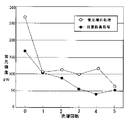
発光強度は、20Wのブラックライト下で5分間照射(1mW/cm2)し、光スペクトラムアナライザ(品番:AQ―6315C、安藤電気(株)製)を使用して測定した。その結果を図1のグラフに示す。 The emission intensity was measured using an optical spectrum analyzer (product number: AQ-6315C, manufactured by Ando Electric Co., Ltd.) after irradiation for 5 minutes (1 mW / cm 2 ) under a 20 W black light. The result is shown in the graph of FIG.
グラフに示すように、波長460nmの条件において、洗濯回数を重ねるごとに発光強度が低下しており、2回の洗濯により未洗濯(0回)と比較して発光強度が半分程度に低下し、3回で三分の一程度に減少している。この結果より、洗濯を重ねる度に蛍光増白剤が徐々に脱落していき、3回の洗濯で少なくとも半分以下に減少するものと推定される。 As shown in the graph, under the condition of wavelength of 460 nm, the emission intensity is reduced every time the number of washings is repeated, and the emission intensity is reduced to about half compared with non-washing (0 times) by washing twice, It has decreased to about one third in 3 times. From this result, it is presumed that the fluorescent whitening agent is gradually dropped each time the washing is repeated, and is reduced to at least half or less by three washings.
[試験2:洗濯の繰り返しによる光触媒量の変化]
試験1で作製したものと同じ6種類の検体からそれぞれ10mm径の円形の小片に切除したものを、蛍光X線分析装置(品番:XRF―1700、(株)島津製作所製)を用いて光触媒量(Ti量)を測定した。その結果を図2のグラフに示す。グラフに示すように、洗濯回数を重ねるごとに光触媒量は減少しており、洗濯により徐々に光触媒が脱落していくことが分かる。
[Test 2: Change in the amount of photocatalyst by repeated washing]
A photocatalytic amount obtained by excising the same 6 types of specimens as those prepared in
そして、以上の二つの試験により、洗濯を重ねることで光触媒および蛍光増白剤の両方がともに徐々に減少することが確認され、両試験結果を比較した図3のグラフに示すように、両者の洗濯回数に対応する減少率には一定の相関関係があることが分かり、また、発光強度の減少率の方がやや大きいことも確認できた。従って、光触媒の残存量を判定するための指標として蛍光増白剤の蛍光発光を利用することは妥当であり、「見える光触媒」とするための可視化手段として極めて有用であると言える。 And by the above two tests, it was confirmed that both the photocatalyst and the fluorescent brightening agent gradually decreased by laundering, and as shown in the graph of FIG. It was found that the reduction rate corresponding to the number of washings had a certain correlation, and it was also confirmed that the reduction rate of the luminescence intensity was slightly larger. Therefore, it is appropriate to use the fluorescent light emission of the fluorescent brightening agent as an index for determining the remaining amount of the photocatalyst, and it can be said that it is extremely useful as a visualization means for making a “visible photocatalyst”.
また、図4において、上記と同じ蛍光増白剤を上記と同じ濃度に調製した蛍光増白処理剤のみで布片を処理した検体を前記同様に洗濯した場合の発光強度の変化と、図2の抗菌防臭処理剤による試験結果とをグラフで比較した。これにより、繊維に付着した蛍光増白剤は1回目の洗濯で発光強度が大きく落ちたことから過剰部分が一旦大量に落ちるものの、その後は図2の試験結果と比べて低下の割合がやや少ないことから、繊維のみに付着させた場合の蛍光増白剤は抗菌防臭処理剤によるものより、洗濯による脱落量が少ないといえる。従って、蛍光増白剤は所定の割合で光触媒とバインダの複合体に付着していることがわかり、このことが、複数回の洗濯後による光触媒の残存量と発光強度が所定の相関関係を示す要因の一つになっていると考えられる。 Also, in FIG. 4, the change in emission intensity when a specimen obtained by treating a cloth piece only with the fluorescent whitening agent prepared in the same concentration as the fluorescent whitening agent as described above was washed in the same manner as described above, and FIG. The test results with antibacterial and deodorant treatment agents were compared with graphs. As a result, the fluorescent whitening agent adhering to the fiber has a large decrease in light emission intensity after the first washing, so that the excess portion once falls in a large amount, but thereafter the rate of decrease is slightly less than the test result of FIG. Therefore, it can be said that the fluorescent whitening agent when adhered only to the fiber has less dropout amount by washing than the antibacterial deodorizing agent. Therefore, it can be seen that the fluorescent whitening agent is adhered to the composite of the photocatalyst and the binder at a predetermined ratio, which indicates that the residual amount of the photocatalyst and the emission intensity after a plurality of washings have a predetermined correlation. This is considered to be one of the factors.
[試験3:蛍光増白剤による光触媒活性増強効果(発生ラジカル量)]
蛍光増白剤添加による酸化チタン光触媒活性に対する影響を、電子スピン共鳴分析(ESR)装置を用いたスピントラップESR法で試験を実施した。先ず、スピントラップ剤(5,5-dimethyl-1-pyrroline-1-oxide(略称:DMPO))水溶液を滴下し、紫外線照射時に試料から発生するラジカル量を測定して検証した。試料の光触媒活性が高ければ紫外線照射時に生成する電子・正孔の影響を受けて発生するラジカル量も多くなると考えられるからである。
[Test 3: Photocatalytic activity enhancement effect by fluorescent whitening agent (generated radical amount)]
The effect on the titanium oxide photocatalytic activity due to the addition of the optical brightener was tested by a spin trap ESR method using an electron spin resonance analysis (ESR) apparatus. First, an aqueous solution of a spin trap agent (5,5-dimethyl-1-pyrroline-1-oxide (abbreviation: DMPO)) was dropped, and the amount of radicals generated from the sample during ultraviolet irradiation was measured and verified. This is because if the photocatalytic activity of the sample is high, the amount of radicals generated under the influence of electrons and holes generated during ultraviolet irradiation is considered to increase.
発生するラジカルは主としてヒドロキシラジカル(・OH)であるが、スピントラップ剤DMPOと反応して安定なラジカル(DMPO・OH)を形成するものであり、これにより光触媒反応で発生する・OH量変化を見積もり、蛍光増白剤添加による光触媒活性増強効果を調べるものである。 The generated radicals are mainly hydroxy radicals (.OH), but react with the spin trapping agent DMPO to form stable radicals (DMPO.OH), thereby changing the amount of OH generated by the photocatalytic reaction. We estimate and investigate the photocatalytic activity enhancement effect by adding fluorescent whitening agent.
試験に用いたのは上述の光触媒処理液(チターナルW)を試料1とし、この光触媒処理液と蛍光増白処理液(Hakkol.STR)とを混合してなる未希釈の前述の抗菌防臭処理液(質量比;酸化チタン:蛍光増白処理剤=0.4:1)を試料2として、試料1,2をそれぞれ200μl採取し、直径15mmのガラス瓶に滴下した後、70℃で4時間乾燥させた。
In the test, the above-mentioned photocatalyst treatment liquid (Titanal W) was used as
以下の手順で安定化ラジカル量を測定した。上記試料瓶に2%DMPO水溶液200μlを滴下し、ブラックライト光(中心波長360nm)1mW/cm2の紫外線を1分間照射した。そして、紫外線照射後、試料中のDMPO水溶液を容量25μlのキャピラリー管に迅速に採取してからESR装置(品番:JER―FR80 日本電子(JOEL)社製)にセットし、安定化ラジカル量を測定した。尚、ESR装置の中心磁場は336.7mT±5mT、マイクロ波は9.447GHz―8mW、変調周波数は100KHz、検出器ゲインは4×100、Time Constantは0.1秒であり、紫外線照射停止から測定開始までの時間は2分、測定時間は4分であった。試料1,2ともに、DMPO・OH由来のピークと内部標準として用いたMn2+由来のピーク強度と比較し求めた強度比を以下の表1に示す。
The amount of stabilized radicals was measured by the following procedure. 200 μl of 2% DMPO aqueous solution was dropped into the sample bottle and irradiated with 1 mW / cm 2 of ultraviolet light of black light (center wavelength 360 nm) for 1 minute. After the UV irradiation, the DMPO aqueous solution in the sample is quickly collected in a capillary tube with a capacity of 25 μl, and then set in an ESR device (product number: JER-FR80 manufactured by JEOL Ltd.), and the amount of stabilized radicals is measured. did. The central magnetic field of the ESR device is 336.7 mT ± 5 mT, the microwave is 9.447 GHz-8 mW, the modulation frequency is 100 KHz, the detector gain is 4 × 100, the Time Constant is 0.1 second, and the ultraviolet irradiation is stopped. The time until the start of measurement was 2 minutes, and the measurement time was 4 minutes. Table 1 below shows the intensity ratio obtained by comparing the peaks derived from DMPO.OH with the peak intensity derived from Mn 2+ used as the internal standard for both
両試料から得られたESRスペクトルのピーク強度比を比較したところ、試料2からのスペクトルは試料1からのスペクトルに対して、1.48倍であった。発生ラジカル量はピーク強度に比例することから、試料2では試料1に比べ多量のヒドロキシラジカルが発生したと考えられる。即ち、蛍光増白剤添加により紫外線照射により発生するラジカル量が増え、光触媒活性が増強されたと考えられる。
When the peak intensity ratios of the ESR spectra obtained from both samples were compared, the spectrum from
尚、蛍光増白剤添加による光触媒活性増強のメカニズムとしては、蛍光増白剤と光触媒間の電子移動が起因していると推定される。光触媒および蛍光増白剤は紫外線照射により原子・分子に束縛されていた電子が励起されて正孔が発生するが、この励起電子と正孔は通常短時間のうちに再結合する。ところが、長寿命化した正孔等は化学反応に関与するようになり、表面に吸着した化学物質を分解するとともに、分解時に発生するラジカルと相俟って化学反応を引き起こす。酸化チタンの場合、この化学反応が効率的に進むため光触媒効果をもたらすと考えられている。 In addition, it is presumed that the electron transfer between the fluorescent whitening agent and the photocatalyst is caused as a mechanism for enhancing the photocatalytic activity by adding the fluorescent whitening agent. In the photocatalyst and the fluorescent brightening agent, electrons bound to atoms and molecules are excited by ultraviolet irradiation to generate holes, and these excited electrons and holes usually recombine within a short time. However, long-lived holes and the like become involved in chemical reactions, decompose chemical substances adsorbed on the surface, and cause chemical reactions in combination with radicals generated during decomposition. In the case of titanium oxide, it is considered that this chemical reaction proceeds efficiently, so that a photocatalytic effect is brought about.
一方、蛍光増白剤自身では通常、光触媒反応は進行しないものであるが、酸化チタンと複合した際に、励起した電子が酸化チタンとの間で移動することが考えられる。そのため、酸化チタン側の励起電子が蛍光増白剤側に移動し、取り残された正孔が長寿命化することで反応に関与する正孔の量が増え、その結果、光触媒活性が増強されるものと推定される。 On the other hand, the fluorescent whitening agent itself usually does not proceed with a photocatalytic reaction, but when combined with titanium oxide, it is considered that excited electrons move between the titanium oxide and titanium oxide. Therefore, the excited electrons on the titanium oxide side move to the fluorescent brightener side, and the remaining holes increase the amount of holes involved in the reaction by extending the lifetime, resulting in enhanced photocatalytic activity. Estimated.
[試験4:蛍光増白剤による光触媒活性増強効果(微生物発育阻止能)]
試験3において、蛍光増白剤添加による光触媒活性増強効果として発生ラジカル量が増加したことから、本発明の目的の一つである抗菌防臭能が増強されていると考えられるため、菌の発育阻止試験を実施して検証した。
[Test 4: Photocatalytic activity enhancement effect by fluorescent whitening agent (microbe growth inhibition ability)]
In
試験3において用いた光触媒処理剤(試料1)の水で5倍に希釈したもの、および抗菌防臭処理剤(試料2)の水で5倍に希釈したもので、試験1において用いたアクリル繊維からなる布(4cm×4cm)をそれぞれ処理して検体とし、肉眼でも菌量を確認しやすい真菌であるAspergillus nigerを、PDA培地上に塗抹して培養後、検体A,Bを添付し、ブラックライト(製品名:5W11、NEC製)照射下で2週間培養した。ブラックライトと試験区との距離は40cm、培養温度は22℃で試験を実施し、目視により菌量を比較して、菌の発育阻止能を判定した。
The photocatalyst treating agent used in Test 3 (Sample 1) diluted 5 times with water, and the antibacterial deodorizing agent (Sample 2) diluted 5 times with water. From the acrylic fiber used in
(結果)肉眼および顕微鏡(100倍)を用いた目視による比較の結果、抗菌防臭処理剤による検体の方が、光触媒処理剤による検体よりも明らかに菌量(繊維表面の菌のコロニー数)が少なかった。この結果より、本実施例の抗菌防臭処理剤で布を処理することで、光触媒処理剤で処理したものよりも優れた抗菌能を付与できたことが言える。また、斯かる優れた抗菌能により、菌の繁殖に由来する悪臭の発生を防止することができると考えられ、優れた防臭効果も期待することができるものである。 (Results) As a result of visual comparison using the naked eye and a microscope (100 times), the amount of bacteria (the number of colonies of bacteria on the fiber surface) of the sample using the antibacterial and deodorant treatment agent is clearly higher than that of the sample using the photocatalyst treatment agent. There were few. From this result, it can be said that the antibacterial ability superior to what was processed with the photocatalyst processing agent was able to be provided by processing cloth with the antibacterial deodorizing processing agent of a present Example. Moreover, it is thought that generation | occurrence | production of the malodor derived from propagation of a microbe can be prevented by such outstanding antimicrobial ability, and the outstanding deodorizing effect can also be anticipated.
以上述べたように、本発明の布用抗菌防臭処理液で布を処理して抗菌防臭布とすることで、布の風合いや手触りを損なうことなく優れた抗菌防臭能を付与することができるものである。 As described above, by treating the fabric with the antibacterial and deodorant treatment liquid for fabric according to the present invention to obtain an antibacterial and deodorant fabric, it is possible to impart an excellent antibacterial and deodorant ability without impairing the texture and feel of the fabric. It is.
尚、上述した実験において光触媒および蛍光増白剤を励起させるために紫外線照射手段(装置)を用いたが、太陽光の下で日干しすることでも同様の抗菌防臭効果は期待することができる。この場合、光触媒の残存量を太陽光で判定することは困難であるが、所定のタイミングでブラックライト等を照射して確認すればよい。また、抗菌防臭処理を行っていない場合でも半日程度の日干しで所定の抗菌防臭効果は認められるものであるが、本発明の布用抗菌防臭処理剤で処理することで短時間の日干しでも優れた抗菌防臭効果を発揮できるものである。 In addition, although the ultraviolet irradiation means (apparatus) was used in order to excite a photocatalyst and a fluorescent whitening agent in the experiment mentioned above, the same antibacterial deodorizing effect can be expected also by sun-drying under sunlight. In this case, it is difficult to determine the remaining amount of the photocatalyst with sunlight, but it may be confirmed by irradiating black light or the like at a predetermined timing. In addition, even when antibacterial and deodorant treatment is not performed, the predetermined antibacterial and deodorant effect is recognized by sundrying for about half a day, but by treating with the antibacterial and deodorant treatment agent for cloth of the present invention, it is excellent even in short sundrying. It can exhibit antibacterial and deodorizing effects.
上述した本発明の第一の実施の形態とはバインダを含有しない点で異なる抗菌防臭処理剤による光触媒能活性について、蛍光剤を含むものと含まないものの両方について測定し、光触媒活性および蛍光剤添加による光触媒活性の増強効果について検証した。 The photocatalytic activity by the antibacterial and deodorant treatment agent, which differs from the first embodiment of the present invention described above in that it does not contain a binder, is measured for both those containing and not containing a fluorescent agent, and photocatalytic activity and addition of the fluorescent agent are performed. The effect of enhancing the photocatalytic activity was verified.
(試料の作製)
抗菌防臭処理剤として、アナターゼ型二酸化チタン(製品名:試薬1級 二酸化チタン(アナターゼ型)、品番:40167―01、関東化学(株)製)1mgを純水200μlに懸濁させた試料を2つ用意し、一方に0.1μlの未希釈の蛍光増白剤(製品名:Hakkol.STR,昭和化学工業(株)製)を添加後、よくかき混ぜて作成し、これを実施例1と同様に、直径15mmのガラス瓶に滴下した後、70℃で4時間乾燥させて作成し、蛍光剤を添加しないものを試料1、添加したものを試料2とした。
(Sample preparation)
As an antibacterial deodorant treatment agent, 2 samples of 1 mg of anatase type titanium dioxide (product name:
[試験1:ブラックライト下および蛍光灯下の蛍光剤添加による光触媒活性増強効果(発生ラジカル量)]
上述した実施例1の試験3と同様に、2%DMPO水溶液(型名:LM―2110,品名:DMPO(5,5―dimethyl−1−pyrroline−1−oxide),ラボテック(株)製)を上記1,2の試料瓶にそれぞれ滴下後、スピントラップESR法により光生成ラジカル量を測定してピーク強度比を比較した。尚、蛍光灯下の試験では光照射時間を1分から5分に延長した以外は実施例1と同様であり、ラジカル量測定方法も同様である。蛍光灯下の試験は、内装材等の室内用物品に適用した場合を想定した紫外線照射条件で行ったものであり、蛍光灯(型名:FL20SS・N/18,National製)下30cmの位置に試料を置き、そのときの紫外線量は10μW/cm2であった。
[Test 1: Photocatalytic activity enhancement effect by adding fluorescent agent under black light and fluorescent lamp (amount of generated radicals)]
As in
(結果)図5(A)のラジカル量(ピーク強度比)のグラフに示すように、ブラックライト光照射では、蛍光剤を添加した試料2が添加しない試料1の1.9倍を示しており、蛍光剤添加により触媒活性が増強されたことが分かる。実施例1よりも増強効果に顕著な差が出たのは、抗菌防臭処理剤にバインダを含まなかったことが影響したものと推定される。さらに、図5(B)のラジカル量のグラフに示すように、蛍光灯下の試験では、蛍光剤を添加した試料2が添加しない試料1の2.9倍を示しており、蛍光剤添加により触媒活性が増強されたことが分かる。すなわち、蛍光灯下での試験により実施例1における紫外線照射量の100分の1の紫外線照射量でも光触媒活性があり、室内における使用にも適していることが分かった。
(Result) As shown in the graph of radical amount (peak intensity ratio) in FIG. 5 (A), in the case of black light irradiation, the
[試験2:ブラックライト下の光触媒活性増強効果(有機分子分解活性)]
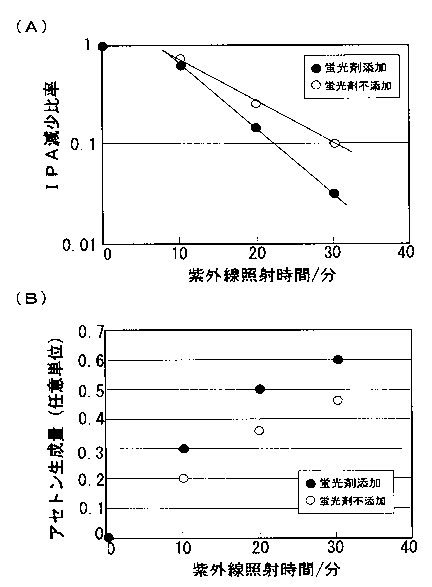
分解対象の有機分子として、イソプロピルアルコールを用いた。これは、光触媒反応中間体としてアセトンが生成するので、これを測定することで吸着による消臭ではなく、光触媒活性の進行をアセトン生成により確認できるからである。紫外線照射は実施例1の試験と同様にブラックライト(1mW/cm2)を用いて30分間実施し、イソプロピルアルコールの濃度変化をガスクロマトグラフ分析により求め、その変化を紫外線照射時間に対し片対数表示した。また、これと同様にしてガスクロマトグラフ分析により生成アセトン量を測定した。
[Test 2: Photocatalytic activity enhancement effect under black light (organic molecule decomposition activity)]
Isopropyl alcohol was used as the organic molecule to be decomposed. This is because acetone is produced as a photocatalytic reaction intermediate, and by measuring this, the progress of the photocatalytic activity can be confirmed by acetone production, not deodorization by adsorption. Ultraviolet irradiation was performed for 30 minutes using black light (1 mW / cm 2 ) in the same manner as in the test of Example 1, and the change in isopropyl alcohol concentration was determined by gas chromatographic analysis. did. Similarly, the amount of produced acetone was measured by gas chromatographic analysis.
アナターゼ型二酸化チタン(製品名:試薬1級二酸化チタン(アナターゼ型),品番:40167−01,関東化学(株)製)1mgを、純水200μlに懸濁させた試料を2つ用意し、一方に100倍希釈した蛍光増白剤(製品名:Hakkol.STR,昭和化学工業(株)製)10μlを添加した。それぞれを良く撹拌後、ヘッドスペースサンプラーガスクロマトグラフ質量分析用バイアル(材質:ガラス,容量:20ml,直径:15mm,Agilent製)に滴下し、70℃で4時間乾燥させた。その後、専用キャップで密閉した。マイクロシリンジを用いて、上記バイアルに1%イソプロピルアルコール水溶液1μl導入した後、ヘッドスペースサンプラー装置(型番:HP7694,Agilent製)を用いて50℃で20分間加熱し、平衡状態となったバイアル内のガスをガスクロマトグラフ質量分析計(型番:6890/5973,Agilent製)にて分離・分析した。尚、バイアルからのガス採取量は1μl、スプリット比は500/1としてガスクロマトグラフへ導入した。また、分離に用いたカラムはキャピラリーカラム(製品名:DB―WAX,仕様:60m×0.25mm×0.5μm,J&W製)であり、カラムの昇温条件は35℃(5分)〜5℃/分〜240℃(5分)とした。分析後、バイアルに20Wブラックライトを用いて約1mW/cm2の照射強度で10分間、紫外線を照射し、再び分析を行った。これを2回繰り返し、紫外線照射10分毎のイソプロピルアルコール及びアセトン量から図6(A),(B)を得た。
Two samples were prepared by suspending 1 mg of anatase type titanium dioxide (product name:
(結果)図6(A)のイソプロピルアルコールの減少比率のグラフに示すように蛍光剤添加および不添加の両方が、ともに紫外線照射時間10分以降ではイソプロピルアルコールがほぼ直線的に(一次反応的に)減少している。この直線の傾きから減少率(反応活性)を評価できるが、蛍光剤添加の方の傾きは不添加の1.5倍以上であった。また、図6(B)のアセトン生成量のグラフに示すように、蛍光剤添加の方が不添加に比べて明らかにアセトン生成量が増えている。これにより、光触媒微粒子に蛍光剤を添加したことが、有機分子の分解活性の増強に影響を与えたということが分かる。さらに、実施例2試験1の結果から、光触媒微粒子に蛍光剤を添加する効果は、蛍光灯下ではブラックライト下に比べラジカル量が、1.9倍から2.9倍と向上した。従って、例えば内装材など紫外線照射量の少ない屋内用物品に適用した場合でも、屋内における悪臭分子や人体に有害な分子の多くを分解して無臭化・無害化することが期待されるものである。
(Results) As shown in the graph of the reduction ratio of isopropyl alcohol in FIG. 6 (A), both the addition and non-addition of the fluorescent agent showed that the isopropyl alcohol was almost linear (primarily reactive) after 10 minutes of ultraviolet irradiation. )is decreasing. The rate of decrease (reaction activity) can be evaluated from the slope of this straight line, but the slope with the addition of the fluorescent agent was 1.5 times or more that with no addition. Moreover, as shown in the graph of the amount of acetone produced in FIG. 6B, the amount of acetone produced is clearly increased when the fluorescent agent is added compared to when the fluorescent agent is not added. Thus, it can be seen that the addition of the fluorescent agent to the photocatalyst fine particles had an effect on the enhancement of the decomposition activity of the organic molecules. Furthermore, from the result of Example 2
以上述べたように、光触媒微粒子に蛍光剤を加えた抗菌防臭処理剤およびこれにより処理してなる抗菌防臭性物品とした本発明により、抗菌防臭処理の有無および量が容易に判定できるものとなり、また、蛍光剤の添加により光触媒単独のものと比べて光触媒活性が有意に増強され、より少ない紫外線照射量・照射時間でも優れた光触媒能を発揮するものである。 As described above, the antibacterial and deodorant treatment agent obtained by adding a fluorescent agent to the photocatalyst fine particles and the present invention as an antibacterial and deodorant article processed by this, can easily determine the presence and amount of the antibacterial and deodorant treatment, Further, the addition of a fluorescent agent significantly enhances the photocatalytic activity as compared with the photocatalyst alone, and exhibits excellent photocatalytic ability even with a smaller amount of UV irradiation and irradiation time.
Claims (17)
ことを特徴とする抗菌防臭処理液。 In the antibacterial deodorant treatment agent, which exhibits antibacterial and deodorant function when applied to the surface of the base material, the photocatalyst fine particles that exhibit the catalytic ability when dispersed in water or organic solvent are dispersed. An organic fluorescent agent is mixed at a predetermined ratio.
An antibacterial deodorizing treatment liquid characterized by that.
The curtain comprised with the antibacterial deodorant cloth described in Claim 14.
Priority Applications (1)
| Application Number | Priority Date | Filing Date | Title |
|---|---|---|---|
| JP2005344203A JP2006328043A (en) | 2005-04-25 | 2005-11-29 | Agent for antibacterial and deodorant treatment, and antibacterial and deodorant article treated therewith |
Applications Claiming Priority (2)
| Application Number | Priority Date | Filing Date | Title |
|---|---|---|---|
| JP2005126022 | 2005-04-25 | ||
| JP2005344203A JP2006328043A (en) | 2005-04-25 | 2005-11-29 | Agent for antibacterial and deodorant treatment, and antibacterial and deodorant article treated therewith |
Publications (1)
| Publication Number | Publication Date |
|---|---|
| JP2006328043A true JP2006328043A (en) | 2006-12-07 |
Family
ID=37550112
Family Applications (1)
| Application Number | Title | Priority Date | Filing Date |
|---|---|---|---|
| JP2005344203A Withdrawn JP2006328043A (en) | 2005-04-25 | 2005-11-29 | Agent for antibacterial and deodorant treatment, and antibacterial and deodorant article treated therewith |
Country Status (1)
| Country | Link |
|---|---|
| JP (1) | JP2006328043A (en) |
Cited By (2)
| Publication number | Priority date | Publication date | Assignee | Title |
|---|---|---|---|---|
| IT201800003836A1 (en) * | 2018-03-21 | 2019-09-21 | Andrea Gaglianone | COMPOSITION AND SANITATION METHOD FOR THE SANITIZATION-PURIFICATION OF SURFACES AND ENVIRONMENTS |
| JPWO2022244814A1 (en) * | 2021-05-18 | 2022-11-24 |
-
2005
- 2005-11-29 JP JP2005344203A patent/JP2006328043A/en not_active Withdrawn
Cited By (4)
| Publication number | Priority date | Publication date | Assignee | Title |
|---|---|---|---|---|
| IT201800003836A1 (en) * | 2018-03-21 | 2019-09-21 | Andrea Gaglianone | COMPOSITION AND SANITATION METHOD FOR THE SANITIZATION-PURIFICATION OF SURFACES AND ENVIRONMENTS |
| JPWO2022244814A1 (en) * | 2021-05-18 | 2022-11-24 | ||
| WO2022244814A1 (en) * | 2021-05-18 | 2022-11-24 | 積水マテリアルソリューションズ株式会社 | Functional article, active ingredient confirmation method, and coating liquid |
| JP7837493B2 (en) | 2021-05-18 | 2026-03-31 | 積水マテリアルソリューションズ株式会社 | Functional articles, methods for confirming active ingredients, and coating liquids. |
Similar Documents
| Publication | Publication Date | Title |
|---|---|---|
| US20040245496A1 (en) | Cleaning agent, antibacterial material, environment clarifying material, functional adsorbent | |
| CN1345390A (en) | Fiber structure having deodorizing or antibacterial property | |
| JPWO2006046443A1 (en) | Fiber cloth with VOC removal function | |
| Radić et al. | Deposition of silver ions onto DBD and DCSBD plasma treated nonwoven polypropylene | |
| JP2025506476A (en) | Long-acting, wash-resistant antibacterial and deodorant textile product and its manufacturing method | |
| WO1998052871A1 (en) | Titanium oxide-containing material and process for preparing the same | |
| JPH0874171A (en) | Fiber fabric having deodorizing, antimicorbial and antifouling functions | |
| JP2006328043A (en) | Agent for antibacterial and deodorant treatment, and antibacterial and deodorant article treated therewith | |
| JP4428510B2 (en) | A fiber fabric carrying a photocatalyst and having a deodorizing function. | |
| JP2003213565A (en) | Flame retardant antibacterial fiber product and method for producing the same | |
| JP2010069469A (en) | Method of deodorizing/sterilizing with photocatalyst and transparent liquid photocatalyst used for this method | |
| JP4679790B2 (en) | Functional fiber fabric | |
| WO2017043359A1 (en) | Spray deodorant | |
| JP2010265561A (en) | A fiber fabric having a deodorizing function and a VOC removing function. | |
| JP4119964B2 (en) | Deodorant manufacturing method | |
| JP4348327B2 (en) | Fiber cloth having photocatalytic function and method for producing the same | |
| JP4119507B2 (en) | Method for producing functional coating | |
| JP4647334B2 (en) | Photocatalytic liquid composition | |
| JP2007262180A (en) | Photocatalytic coating agent and photocatalyst coated product treated using the same | |
| JP2009209498A (en) | Deodorant cloth product | |
| JPH08196607A (en) | Deodorizing/sterilizing composition and fiber cloth using the composition | |
| JP3042743U (en) | Wax with deodorant and bactericidal action | |
| JPH10130619A (en) | Zinc oxide fine particle-attached composite and method for producing the same | |
| JP2007111333A (en) | Footwear with deodorant and antibacterial properties. | |
| JP5088654B2 (en) | Transparent liquid photocatalyst |
Legal Events
| Date | Code | Title | Description |
|---|---|---|---|
| A300 | Application deemed to be withdrawn because no request for examination was validly filed |
Free format text: JAPANESE INTERMEDIATE CODE: A300 Effective date: 20090203 |